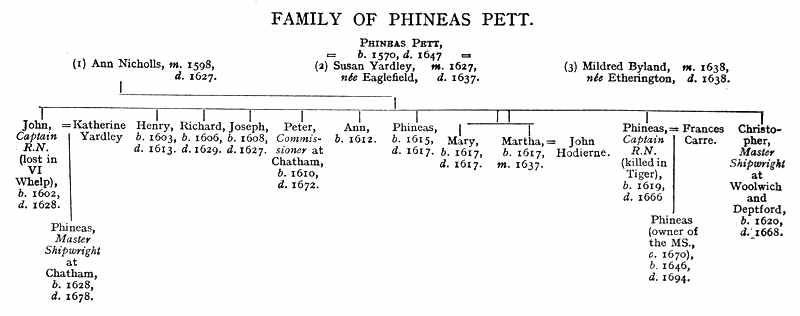
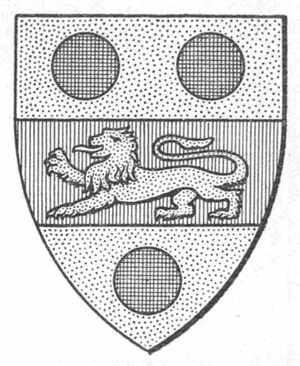
I, Phineas[178] Pett, being the son of Mr. Peter
Pett of Deptford Strond[179] in the County of Kent,
one of her Majesty's Master Shipwrights, was
born in my father's dwelling house in the same
town one All Saints' day in the morning, being
the first day of November in the year of our Lord
1570, and was baptized the 8th of the same month
and year aforesaid in the parish church of Deptford
Strond aforesaid.
I was brought up in my father's house at
Deptford Strond until I was almost nine years of
age, and then put out to a free school at Rochester
in Kent, to one Mr. Webb, with whom I boarded
about one year, and afterward lay at Chatham
Hill in my father's lodging in the Queen's House,
from whence I went every day to school to Rochester
and came home at night for three years space.
Afterwards, by reason of my small profiting at this
school, my father removed me from thence to
Greenwich to a private school kept by one Mr.
Adams, where I so well profited that in three years
I was made fit for Cambridge.
In the year 1586 at Shrovetide, against bachelor's
commencement, I was sent to the University
of Cambridge, and by the means of one Mr. Howell,[180]
a Minister in Essex, I was placed in Emanuel
College with a reverend tutor, President of the
house, called Mr. Charles Chadwick, where I was
allowed 20l. per annum during my father's life,
besides books, apparel, and other necessaries.
In the year 1589, about the 6th day of September,
it pleased God[181] to call to his mercy my
reverend loving father, whose loss proved afterward
my utter undoing almost, had not God
been more merciful unto me; for leaving all
things to my mother's directions, her fatal matching
with a most wicked husband, one Mr. Thomas
Nunn,[182] a Minister, brought a general ruin both
to herself and whole family.
Some two months after my father's decease or
thereabouts, my eldest sister Rachel was married
to one Mr. Newman, Minister of Canewdon in
Essex, a man of most dissolute life, with whom
she not long enjoyed, for God, of his great mercy,
took her and delivered her from a most miserable
and slavish life wherein she lived with him; by
whom he had two children, but both died.
By reason of my mother's cross matching,
my means of maintenance being wholly taken
from me, and having no hopes of exhibition from
any friend, I was forced after four years continuance
in Cambridge, my graces for Bachelor of
Art being passed both in house and town, to
abandon the University presently after Christmas
in anno 1590.
At Candlemas after, I, by the instant persuasion
of my mother, was contented to put myself to
be an apprentice to become a shipwright (my
father's profession) and was bound a covenant
servant[183] to one Mr. Richard Chapman of Deptford
Strond in Kent, one of her Majesty's Master
Shipwrights, and one whom my father had bred
of a child to that profession, my allowance from
him to find myself tools and apparel being bare
but 46 shillings and 8 pence per annum. This man
I served almost two years altogether at Chatham
in the Queen's Majesty's Works, and then he died;
where I spent all that time, God he knoweth, to
very little purpose.
After my foresaid master his death, I laboured
to have served Mr. Mathew Baker, one of her
Majesty's Master Shipwrights also; but by the
working of one Mr. Peter Buck,[184] then Clerk of
the Check at Chatham, and some other back
friends, I was crossed in my service and so put to
my shifts, and left to the wide world without
either comfort or friend, but only God.
At this time my eldest brother by my father's
side, Mr. Joseph Pett, succeeded in my father's
place, one of her Majesty's Master Shipwrights,
which preferment no doubt God brought him to
the better to enable him to have given his help to
us; but we found it clean contrary, for he was not
only careless of us all and left us to our fortunes,
but became also so unkind a brother to two of
us, my own brother Noah and myself, that he was
forced to leave his native country and seek comfort
in Ireland with an uncle of ours, own brother
to my mother, called George Thornton, an ancient
and well experienced sea captain; where he shortly
after was drowned in the river of Cork; and myself
was constrained to ship myself to sea upon a
desperate voyage in a man of war,[185] not greatly
caring what became of me.
I was shipped on this voyage a little before
Christmas in anno 1592, in a ship called the
Gallion Constance of London, of burden of 200
tons or thereabouts, belonging to a gentleman of
Suffolk, one Captain Edward Glenham,[186] for the
carpenter's mate, the master carpenter being one
Edward Goodale, born in Deptford. To my
setting out to sea, I found not any of my kindred
so kind as to help me, either with money or
clothes, or any other comfort; only another
brother I had by my father's side, Peter Pett,
dwelling then at Wapping, that vouchsafed me
lodging and meat and drink till the ship was ready
to set sail; one William King, a yeoman in Essex
and a stranger to me, lent me 3l. in ready money
to help to furnish my necessaries, which afterward
I repaid him again.
In this voyage I endured much misery for
want of victuals and apparel; and after twenty
months spent in the Levant Seas, coasts of Barbary
and Spain, with many hazards both of loss of life
and time, without taking any purchase[187] of any
value, we, extreme poorly, returned for Ireland
into the river of Cork; and there taking leave
both of ship and voyage, I travelled to Dublin[188]
to visit my uncle Captain Thornton and my
brother Noah, being then master with him in the
Popinjay of the Queen's Majesty's; and presently
after bent my course for England, taking passage
at the town of Waterford.
With some difficulty I got to London, some
three days before Christmas in anno 1594, having
neither money nor apparel, and took up my
lodging at my brother Peter's house in Wapping,
before spoken of, who, although I was returned
very poor, yet vouchsafed me kind entertainment.
The next day I presented myself to my
brother Joseph, who very coyly receiving me,
out of his bounty lent me 40s. to apparel myself,
which I bestowed as frugally as I could in Birchin
Lane in London, contenting myself as well as I
could with mean attire, till such time as it should
please God to provide better for me.
At that time it so fell out that there were
certain of her Majesty's ships appointed to be
made ready for the voyage of Sir Francis Drake
and Sir John Hawkyns, amongst which the
Defiance[189] was to be brought into Woolwich Dock
to be sheathed; which work being commended
to my brother Joseph's charge, he was contented
to admit me amongst many others to be one,
where I was contented to take any pains to get
something to apparel myself, which by God's
blessing I performed before Easter next after,
and that in very good fashion, always endeavouring
to keep company with men of good rank far
better than myself.
In the latter end of this year 1594 about the
beginning of Lent, I lost my dear brother Noah,
who was drowned in Cork river with eight more of
his company, and lieth buried in Cork church in
Ireland.
About Bartholomew tide in anno 1595, the
Triumph of her Majesty's was had into Woolwich
Dock to be new builded by Mr. Mathew Baker,
under whom I was entertained there as an ordinary
workman and had allowed me a boy, which was
John Wood, being the first servant that I ever
kept; but presently after Mr. Baker was appointed
to leave that business, and had order to
go in hand with the building of a great new ship
at Deptford, called afterward the Repulse,[190] and
was admiral of my Lord's of Essex squadron
in the Cadiz journey. The Triumph[191] was then
appointed to my brother Joseph's charge, with
whom I a while continued, but, finding him
altogether unwilling to prefer[192] me in his work
as next under him, with some passage of discontent
betwixt us, I left him, and had ready entertainment
by Mr. Baker in his new business at Deptford,
yet no otherwise than an ordinary workman;
with whom I continued from the beginning of the
foresaid ship, till she was wholly finished, launched,
and set sail of her voyage from Woolwich, which
was about the latter end of April 1596.
All that winter, in the evenings, commonly I
spent my time to good purposes, as in cyphering,
drawing, and practising to attain the knowledge
of my profession, and I then found Mr. Baker
sometime forward to give me instructions, from
whose help I must acknowledge I received my
greatest lights. At this time also the Lord
Admiral[193] lay most of the winter at his house[194] at
Deptford, by reason whereof I got some acquaintance
amongst his men, and was much importuned
to have attended his Lordship in that journey,[195]
which no doubt might have proved very much both
profitable and beneficial unto me, besides it would
have brought me in acquaintance and favour with
my Lord Admiral, but some other reasons restrained
me from all these likelihoods and kept me
at home, to my no small hindrance as it fell out.
After I was discharged from the Repulse,
my brother Joseph entertained me at Woolwich
upon the Triumph, upon which ship I wrought till
her launching and the discharge of the men from
her, and afterwards was employed at my brother's,
at Limehouse, upon a small model for the Lord
Treasurer[196] his house called Theobalds,[197] and the
next winter I spent in Essex, at Paglesham[198] in
Rochford Hundred, as overseer for my brother
Peter in certain woods he had bought there.
About this time, was I very desirous, by the
instigation of some special friends of mine, to have
been a follower of the Lord of Essex, and was
three several times brought purposely to have
been presented unto his lordship, but was every
time delayed by reason of his great state[199] affairs,
the Lord of heaven having other ways in his
secret wisdom determined to dispose of me.
In the latter end of March succeeding, or
beginning of April 1597, by the means of one Mr.
Gilbert Wood, one of the Lord Admiral's Chamber,
an especial good friend of mine, I was presented to
the Lord High Admiral of England, at his Manor
at Chelsea, where his lordship was pleased not
only to accept me as his servant, but also openly
shewed such extraordinary respect of me as I
had much cause to give God thanks, who no doubt
had stirred his honourable heart to regard me,
but a simple and mean fellow, even far beyond
my expectation or desert, and this was the very
first beginning of my rising.
In the beginning of this year, 1597, my dear
and loving mother deceased at Weston in Suffolk,
not far from Bury, and lieth buried in the parish
church there. A little after midsummer in the
same year, I was employed by my brother Joseph
Pett, in his yard at Limehouse, upon the repairing
of a great Flemish ship of whom was master
Mr. John King of Limehouse, where I first came
acquainted with him, and in his company and Mr.
Nicolas Simonson of Limehouse, I was first brought
acquainted at Highwood Hill[200] where I first fell
in love with my now wife, which was about
St. James' tide.[201] About Bartholomew tide[202] next
following, the Elizabeth Jonas was brought into her
Majesty's Dock at Woolwich, and there was the
first preferment my brother Joseph holp me
with, making me principal overseer of that business
under him. During all the time of this
work, we both lodged and dieted at old Mr.
Lydiard's[203] in the yard.
During the continuance of this work I did not
neglect my wooing, having taken such a liking
of the maiden that I determined resolutely (by
God's help) either to match with her or never to
marry any; the which I with much difficulty
(praised be God) at length achieved, all my own
kindred being much against my matching with
her, by reason of some controversies grown twixt
Mr. Nicolas Simonson and them.
Toward the end of February in this present
year, I took the lease of a new house (of Mr. William
Borough,[204] then Comptroller of her Majesty's
Navy) at Limehouse by the through head,[205] which
to some charge I fitted for my dwelling, although
I remained not in it little more than two years,
paying 11l. yearly rent, and 20l. income.[206]
I was married to my now wife Ann, the
daughter of Richard Nicholls of Highwood Hill in
the parish of Hendon in Middlesex, a man of good
report and honest stock, the 15th day of May
1598 at Stepney Church upon a Monday in the
forenoon. I kept my wedding at my own charge
in my new dwelling house at Limehouse, accompanied
with my brothers and sisters, my wife's
parents, and divers of her friends and kindred.
About midsummer after, was the Elizabeth
Jonas launched out of Woolwich Dock, and sudden
preparation made to have received her Majesty
aboard the ship riding afloat; but upon some
unknown reasons her Majesty came not at all,
for even at that instant had one Mr. Wiggs[207]
procured commission about examination of certain
abuses in the Navy, which was pursued with
a great deal of malice against divers particular
men but with little profit to her Majesty's
service.
From midsummer, all the ensuing year, till
Christmas I lay still and idle without any manner
employment or comings in but what my servants
got with working now and then abroad, which
was very little and hardly able to buy me food.
About Christmas my honourable lord and
master the Lord High Admiral commended me to
an employment in Suffolk and Norfolk for the
finishing of a purveyance of timber and plank
formerly undertaken by one Child of Sole,[208] who
dealt in Norfolk and, dying, left the business in
much disorder.
And one Robert Ungle[209] who dealt in Suffolk
and, for divers abuses by him there committed, fled
the country and left all the service in great disorder
and spoil; for the rectifying of which abuses,
saving of her Majesty's provisions, and discharging
of the countries,[210] it pleased my Lord to make
choice of me to undertake the same, and to take
order to send in all the said provisions of timber
and plank; which accordingly I did, using all care
and diligence in the performance of the same, both
to the content of her Majesty's service, my Lord
Admiral and the Officers of the Navy, and the
satisfaction of all countries where I had to do.
Notwithstanding through the malicious envy of
old Mathew Baker, Bright, Adye, and others[211] all
my doings and accounts were throughly sifted,
but thanks be to God nothing could be proved
against me, so that I had all my bills passed
quietly; but by reason Mr. Fulke Greville,[212] being
then Treasurer of the Navy, did not greatly affect[213]
me, by cause of some particular spleens between
him and Mr. John Trevor,[214] then newly made
Surveyor, who was my especial and worshipful
friend, he laid a rub[215] in my way, cutting me off
wrongfully of twenty pounds in my accounts after
all my bills were passed and signed by the hands of
the Principal Officers, according to the custom of
the Navy.
All this year of 1599, I spent wholly in this
service, in which time these occurrences happened.
After the decease of my dear and loving mother
there were left under the keeping of my father-in-law,[216]
Thomas Nunn, then Minister of Weston in
Suffolk, three sisters, vide: Abigail Pett, Elizabeth
and Mary, the youngest, and one brother named
Peter Pett, who was put out to a gentleman's
house in Suffolk to teach his children, the daughters
remaining all at home with him, he being
then lately again married.
He used himself to them as a stern and cruel
father-in-law, not contented that he had brought
a general ruin upon my mother's whole family
by cosening us of all that was left us, but proceeded
further, even to blood, for upon a slight
occasion about making clean his cloak, being wet
and dirty with riding a journey the day before,
he furiously fell upon my eldest sister Abigail,
beating her so cruelly with a pair of tongs and a
great firebrand that she died within three days
upon that beating and was privately by his
means buried; but God that would not let murder
pass unrevenged, stirred up the hearts of his own
parishioners and neighbours, who, complaining
to the Justice, caused the body to be taken up,
and so by the coroner's inquest that passed upon
her and miraculous tokens of the dead corpse, as
fresh bleeding, sensible opening of one of her
eyes, and other things, he was found guilty of her
death and so committed and bound over to answer
the matter at next General Assizes to be held at
Bury, which was in the Lent after, being in this
year 1599, and in the time of my employment in
Suffolk and Norfolk.
Upon his committing, my two other poor
sisters were put by the justices to the keeping of
the town of Weston, till the assizes[217] were past,
at whose hands I received them at Bury in a
miserable fashion, not having clothes nor any
necessaries fit for them; the charge of their board
I was glad to defray to the constable, and all the
charge of the assizes, where both they and my
young brother were bound to give in evidence
against our father-in-law, to whom we shewed more
mercy than he did to us, whom our spoil would not
content, but he thirsted also our blood. In his
arraignment Sir John Popham, then Lord Chief
Justice of England and Chief Judge of that circuit,
shewed such true justice (notwithstanding great
means was made for him, not only by his friends,
but by the clergy of that country), that all his
cruelty and wicked proceedings was laid open and
he, convict of manslaughter by the jury, was
committed to prison to sue for the benefit of the
Queen's pardon,[218] from whence being shortly freed,
he, by God's just revenging hand, lived but a
short time after.
From the assizes at Bury I sent my brother
and my two sisters home to my wife at Limehouse,
being no small charge to me, being but newly
married and having little means but my hands to
bring in anything, yet I refused not to do the duty
of a brother to them to the utmost of my power;
the eldest of my sisters, called Elizabeth, by
means of friends I placed in London with a
gentlewoman of good fashion, where she continued
not long, but came home sick and died at my
house as we doubted of the plague. My youngest
sister sickened also shortly after, but it proved the
small pox.
In all these extremities I had little help from
my brothers, who were bound in conscience to have
had some care of them, the small portions they had
being in the hands of my eldest brother Joseph,
yet no relief came from him towards their maintenance
or bringing up; but being but half brothers
and sisters they thought them less bound to do
them good and therefore left all the burden upon
me, worst able of all to bear it.
My youngest sister Mary, recovering her sickness,
continued with me in my house contenting
herself with such breeding as I could give her;
from whence she never removed till she was
married from me. My young brother Peter, about
the end of November, I placed with a worshipful
gentleman, Doctor Hone,[219] in the Arches,[220] as one
of his clerks, where he might have lived well if he
would have stayed with him.
In December this year, 1599, I began a small
model, which being perfected and very exquisitely
set out and rigged, I presented it to my good
friend Mr. John Trevor, who very kindly accepted
the same of me.
In the beginning of this year, I, having no
employment, determined with myself to have
bought some part of a castle carvel[221] and to have
gone in her myself; whereby I hoped (by God's
blessing) to have gotten an honest and convenient
maintenance, and to that end I began to follow one
John Goodwin of London, professor of the mathematics,
with whom I spent three days in a week in
practice, and so was purposed to have continued
the whole year till the spring following; but God,
who in his secret counsel had otherwise decreed of
me, altered all my determinations, for upon the
25th day of June I was sent for to the Court,
lying then at Greenwich, by my honourable lord
and master the Lord High Admiral who, after
some speeches expressing both his love and honourable
care of me, his lordship concluded to send
me down to Chatham, where I was to succeed in
the place of one John Holding, a shipwright that
was keeper of the plank yard timber and other
provisions (upon some displeasure turned out of
all), the means whereof being but small, as 18d.
per diem and 6l. per annum fee for myself, and
allowance for one servant at 16d. per diem.
I was very unwilling to undertake so mean a
place, by the which I was neither sure of competent
maintenance nor of any reputation, but that I was
encouraged by the persuasions of my ever honourable
lord, who comforted me with promises of
better preferment to the utmost of his power;
whereupon I being contented to accept his lordship's
offer, I was, the 27th of the same month of
June, placed at Chatham by Sir Henry Palmer,
then Comptroller, Mr. John Trevor, Surveyor,
and Mr. Peter Buck, Clerk of the Ships.
At this time there was grown very high terms
of unkindness between my brother Joseph and
me about my poor sisters and brother, because he
did not only deny to be any ways contributory
to their maintenance but also made the neighbours
believe that they were brought up at his charge
in my house, because he would not be troubled
with them, when God knoweth he never disbursed
halfpenny to their bringing up, nor cared what
became of them.
Now upon this occasion of my placing at Chatham,
we were reconciled and ever after lived
together as loving brethren. It also happened
that Sir Fulke Greville, then Treasurer, continuing
his spleen against me for Mr. Trevor's sake,
opposed me all he could, which after turned me
to much trouble.
About the time of my coming to Chatham,
Mr. Barker, the lord of the Manor, was removed
to a house he had bought at Boley Hill[222] by
Rochester, by reason whereof his Manor House
wherein he formerly dwelt at Chatham was void,
the which house by means of my brother Joseph's
encouragement I ventured upon and took a lease
for twenty-one years, paying 25l. income, the
which lease was sealed unto me the 17th day of
October, 1600.
The 16th day of June in this year my youngest
brother Peter, having, against all the consent of his
friends and without their knowledge, forsaken his
worshipful master Doctor Hone's service and betaken
himself to disordered courses, sickened at
London at the sign of the Dolphin in Water Lane,
and the 21st day after deceased of the small pox
before I knew he was sick, whose charge both of his
sickness and funeral I was at, and saw him seemly
interred, accompanied with a good company of my
friends, in Barking churchyard[223] in Tower Street,
the 23rd of the same month of June 1600.
The 24th October, having bestowed all my
poor stock upon the lease of my house and the
furnishing of the same in some convenient manner,
I shipped the same in [an] hoy of Rainham[224] and
so removed to Chatham, myself going down in the
hoy; where I missed a great danger, for at the west
end of the Nore about 3 of the clock in the morning,
25th day, we were like to be surprised by a picking
Dunkirk[225] full of men who, being at our passing by
(although it was very dark) at an anchor, suddenly
weighed and gave us chase, and had boarded us
had not God prevented him by our bearing up,
the wind being at east; and running ourselves on
shore within the Swatch,[226] the next day we got
safe as high as Gillingham.
My dwelling house at Limehouse I passed away
with a great deal of loss, both of income, rent and
wainscotting to the value of 50l., putting it over at
10l. per annum, when I was bound by lease to pay
11l. Yet was I glad to be rid of it upon any
condition.
Presently after Christyde[227] my wife, being great
with child, fell sick at Chatham and grew so weak
that I was forced, about the 10th of March following,
to remove her, not without great hazard, to
London, and from there to her father's house at
Highwood Hill in Middlesex, where the 23rd day
of March after, thanks be given to God, she was
delivered of her first born son, John Pett; from
whence she returned to Chatham in safety some
two months after.
Much about this time I was made an assistant
to the Master Shipwrights at Chatham, in the room
of Thomas Bodman. In this year the first business
I undertook was the repairing of the Lion's Whelp
hauled up at the storehouse end at Chatham.
In the year 1602 I also new built the Moon,
hauled up in the same place, enlarging her both in
length and breadth, and this year also, I, with
Mr. Pickasee, undertook the victualling of the shipwrights
and caulkers at Chatham, which we continued
only two months, to our great loss; which
we could never get recompensed by reason Mr.
Fulke Greville continued my heavy enemy, and
was content to receive and countenance informations
against me, because he could not win me to
such conditions as he laboured me in, both against
my good friend Sir John Trevor (who then lay
very dangerously sick at Plymouth) and against
many others serving with me at Chatham. The
principal informer and stirrer in this business
against me was one George Collins, sometimes
carpenter of the Foresight, a very stubborn and
malicious fellow, who by Mr. Greville's countenance
was suffered to sue me at the common law
upon an action of trespass for striking him with
a little rod upon the shoulder in the Queen's
yard at Chatham, upon a cause of mutiny in the
time of victualling; and so little relief had I against
him, notwithstanding my Lord Admiral's favour,
that I was forced to compound with him and
gave him 20 nobles[228] ready money for satisfaction.
Thus it pleased God to exercise me with continual
trouble and hindrances in the beginning of my
service.
In November this present year, 1602, Mr.
Greville, having undertaken the preparation of a
Fleet with her Majesty, to be ready fitted to sea
by a set time, was contented (upon my promise
to him to procure the said Fleet to be fitted in
six weeks) to receive me to his favour, which
promise I accordingly (by God's gracious assistance)
fully accomplished; by which means I had
gained his love, favour and good opinion, had
there not happened a sudden alteration by the
death of her Majesty which presently followed.
The 18th day of March 1603,[229] my wife was
delivered of her second son, Henry, at my house at
Chatham.
The 24th day of the same month, her Majesty
of sacred memory deceased at Richmond.
The same day his Majesty, whom God grant
long to reign, was proclaimed at Westminster,
London, and other places, and the next day,
being Friday and market day, at Rochester.
This year happened the great plague throughout
England, but especially about London, by
reason whereof many removed from thence into
divers places in the country where they had any
friends or means of succour.
In the middle of July my brother Joseph, with
his wife and children, removed from his house
at Limehouse to Ipswich.
To transport them thither by sea I procured
a small pinnace of his Majesty's to be prepared
ready, called the Primrose, and manning her with
my good friends and neighbours as Boatswain
Vale,[230] David Duck, Mr. Rock, Robert Perin,
Jarvis Mins, and divers others, together with
myself, we embarked at Chatham the 14th of July,
1603, and in Tilbury Hope took in our passengers;
and the 16th day in the afternoon landed them
safely at Ipswich, where of their friends we
received very great entertainment, staying there
about 4 days; and the 21st day we arrived again
at Chatham, thanks be to God, in health, about
4 of the clock in the afternoon.
The sickness beginning to be very hot at
Chatham, upon the persuasions of some of my
friends I removed my wife and children from
thence to my wife's father's in Middlesex, shipping
them away in the same vessel I had to Ipswich,
and landing at Dagenham[231] in Essex, had horses
there met us, and so journeyed to Highwood Hill.
This voyage was taken from Chatham the 16th of
August; we came to Highwood Hill the 19th day,
where my wife and children remained till the
3rd of October following, which day we took our
journey to Dagenham, where the next day we were
stayed by a great rain, but the 4th day we came
over the ferry at Greenhithe[232] and safely home,
thanks be given to God, at 4 of the clock that
afternoon.
This summer I began to new-build the Answer,
being hauled up and blocked at the end of the
storehouse at Chatham.
The 10th of November my landlord Mr. Barker,
with some of his family, sojourned with me at
Chatham, where they remained till the 28th day
of the same month, and then returned to their own
house at Boley Hill.
During this time I divers times solicited my
brother to be joined patentee with him, but his
remissness caused me to overslip opportunity so
long that one Mr. Stevens[233] of Limehouse, this
year, by means of some great friends about my
Lord Admiral, got a general reversion of all the
Master Shipwrights' places, cutting me off from
all hopes of any timely preferment, to my great
discouragement considering what pains I took at
Chatham to further his Majesty's service.
When I was most dejected with the conceit of
this injury, as I took it, it pleased God of His great
mercy to me, even then when I least expected
any such thing, to raise me up a means of some
hope of preferment after this manner; for about
the 15th of January, being at Ratcliff with my
wife, to christen her sister Simonson's daughter
Martha, there was, unknown unto me, a letter
sent post to Chatham from my honourable Lord
Admiral, commanding me with all possible speed
to build a little vessel for the young prince Henry
to disport himself in above London Bridge, and to
acquaint his Grace with shipping and the manner
of that element, setting me down the proportions
and the manner of her garnishing, which was
to be like the work of the Ark Royal, battlement
wise. This little ship was in length by the keel
25 foot, and 12 foot in breadth, garnished with
painting and carving both within board and without
very curiously, according to his Lordship's
directions. I laid her keel the 19th day of January,
wrought upon her as well day as all night
by torch and candle lights under a great awning
made with sails for that purpose.
The 6th day of March after, I launched the
ship, being upon a Tuesday, with a noise[234] of
trumpets, drums, and such like ceremonies at
such time used.
I set sail with her on the Friday after, being
the 9th day, from Chatham. Between the Nore
head and the east end of Tilbury we had a very
great storm, so that it was Sunday before we could
get Gravesend; and on Monday morning, being
the 12th day, we anchored at Blackwall. Mr.
George Wilson, then boatswain of the Lion, was
master with me, and myself captain, and I was
manned with almost all boatswains of the Navy
and other choice men.
On Wednesday, being the 14th day of March,
by my Lord Admiral's commandment we weighed
from Limehouse, and anchored right against the
Tower before the King's lodgings, his Majesty
then lying there before his riding through London.
There the young Prince, accompanied with the
Lord Admiral and divers of the Lords, came and
took great pleasure in beholding of the ship, being
furnished at all points with ensigns and pendants.
The 16th day, being Friday, we unrigged and shot
the bridge, and the 17th day we rigged again and
received both ordnance and powder from the
Tower.
On Sunday in the afternoon, being the 18th
day, fitted with a noise of trumpets and drums
and fife, we weighed and turned up with the wind
at south-west as high as Lambeth, with multitudes
of boats and people attending upon us. As we
passed by Whitehall, I saluted the Court with a
volley of small shot and our great ordnance, and
upon the ebb, turning down again, we did the like,
and then taking in our sails we came to an anchor
right against the Privy Stairs.
On Monday the 19th day his Majesty went by
barge to the Parliament. We shot our great and
small ordnance of round,[235] both at his taking barge
and landing.
All Tuesday and Wednesday we rode still,
without doing anything but giving entertainment
to gentlemen of the King's and Prince's servants
that hourly came aboard of us.
On Thursday morning, being the 22nd day, I
received a commandment from the Lord Admiral
to prepare the ship and all things fitting to receive
the young prince aboard of us in the afternoon;
who accordingly presently[236] after dinner came
aboard us in his barge accompanied with the Lord
High Admiral, Earl of Worcester, and divers other
noblemen. We presently weighed and fell down
as far as Paul's Wharf,[237] under both our topsails
and foresail, and there came to an anchor; and then
his Grace,[238] according to the manner in such cases
used, with a great bowl of wine christened the
ship and called her by the name of the Disdain.
His Grace then withdrawing himself with the
lords into the great cabin, there my honourable
lord, and till then master,[239] with his own hands
presented me to his Grace, using many favourable
words (beyond my deserts) in my commendations,
with this addition, that I was a servant worthy the
acceptance of the greatest prince of the world.
From his hands it pleased his Grace very thankfully
to receive me as his servant, with many
promises of his princely favour to me. The next
day, being Friday and the 23rd of March, it pleased
my Lord Admiral to entreat my worthy friend
Sir John[240] Trevor to accompany me to the Lord
Thomas Howard, then Lord Chamberlain, from
whom receiving a ticket, I was sent to St. James',
the Prince's house, where by Mr. Alexander and
Mr. Abington, then gentlemen ushers, I was sworn
his Grace's servant, and by them presented to the
Prince before he went to dinner, with as much
favour and respect as I could desire.
During this time of my attendance at the Court
as his Grace's Captain of his ship, it pleased my
honourable Lord Admiral to give order to Sir
Thomas Windebank,[241] one of the Clerks of the
Signet, to draw me a bill for the reversion of Mr.
Baker's or my brother Joseph Pett's place, which
first should happen to be void, notwithstanding the
letters patent formerly granted to Mr. Stevens;
which accordingly was with all expedition performed,
and the 11th of April following was
presented to his Majesty and signed, and shortly
after passed the great seal; for the whole charge
whereof I gave Sir Thomas Windebank 17l.
About the same time Sir Robert Mansell had his
patent passed for the Treasurer of his Majesty's
Navy.
The 3rd of May, after my return to Chatham
from my attendance at Court, I began to set up a
small ship at Gillingham in David Duck's yard at
my own charges; and the 17th day of the same
month also was launched the Answer, whom I
had new built, who by carelessness ran off before
her time without any great hurt, thanks be to
God therefor. About the midst of June following,
the preparation was begun for the entertainment
of his Majesty aboard the ships at Chatham, where
I took both extraordinary care and pains, which
my envious enemies Mr. Baker and Mr. Bright
sought by all means to disgrace, even at the instant
time when his Majesty was to come on board the
Elizabeth; but the Lord diverted all their malice
by the countenance of my old master the Lord
Admiral who, approving my honest endeavours
and finding the success answerable in all respects
to his Lordship's expectation, dismissed them with
sharp rebukes and encouraged me with no small
commendation. This happened the 4th of July,
1604.
The 12th of November after, I launched the
new ship at Gillingham, which was begun in May
preceding, and called her[242] name the Resistance.
And in the beginning of December following I
carried her up to Limehouse, and there hauled her on
shore at the south side of my brother Joseph's wharf,
where she lay till I had sold away part of her.
The 21st of January following I sold one-third
part of her to Sir Robert Mansell and another third
to Sir John Trevor, and the other third I reserved
to myself.
I rigged her and prepared her with all her furniture
to attend the Lord High Admiral of England
in his journey into Spain when he went Ambassador,
and made ready the Bear and the rest of his
Majesty's ships at Chatham that went that voyage,
myself being commanded by his Lordship to
wait upon him in his own ship, the Bear, which
accordingly I performed.
The 24th of March I took my leave of the most
noble Prince my master at Greenwich, being Sunday
in the afternoon; and the 28th day of the
same month following I took leave of my wife
and children at Chatham and attended the Lord
Ambassador on board the Bear in his own barge,
the whole fleet then riding at Queenborough, from
whence we set sail the last day, being Sunday and
Easter day.
The 4th day of April we[243] came to an anchor in
Dover Road, and the 10th day after we lost the sight of
the Lizard. The next day, being the 11th, the Lord
Ambassador sent me aboard my own ship, the Resistance,
with one Captain Morgan, with certain directions,
to the Groyne.[244] But by the overbearing of
Captain Morgan, his Lordship altering his determination
came into the Groyne two days before us,
where we also arrived the 16th day, being Tuesday.
The 20th of April, being Saturday, I set sail
with the Resistance out of the Groyne, with
instructions to go for Lisbon, where I arrived the
24th after, and there stayed to despatch my
affairs till the 9th day of May following; from
whence I set sail for St. Lucar,[245] and arrived there
the 11th day in the afternoon, being Saturday;
from whence I went by passage boat, leaving my
ship at Bonanza,[246] to Seville;[247] from whence, after
three days stay there, I returned to my ship the
17th day of the same month.
From St. Lucar I set sail the 2nd day of June,
and plying it up for Cape St. Mary's[248] with a contrary
wind, I put room[249] the 5th day for Cales[250]
road, from whence, putting to sea again the 8th
day, I arrived back again at the Groyne the 19th
day, according as my instructions directed me.
Where going ashore to the Governor and understanding
the fleet to be all gone to St. Anderas[251]
and that the Lord Ambassador was already (as
he said) embarked for England, I put to sea again
presently, directing my course for England. The
23rd day I made the Start, and the 26th day of
June, being Wednesday, I landed at Rye in the
forenoon; from whence I came post to my house
at Chatham, with much rain, thunder, and
lightning all the way, where I lighted about 10
of the clock at night.
In the midst of July, after my return home,
I let out my ship, the Resistance, to merchants
for a voyage into the Straits by the month, one
Mr. Burgess going master, and my friend William
Gibbons, his mate and purser. I docked her,
sheathed her, and fitted her, and she went from
Gravesend the 23rd day of August following.
In the midst of October following I made a
journey into Hampshire, to make a survey of a
part of the forest of East Bere,[252] being then in the
occupation of the Right Honourable the Earl of
Worcester, of whom, after my return, Sir Robert
Mansell and Sir John Trevor bought 3000 trees.
At my return to London from that journey I
found my eldest brother Joseph Pett, then dwelling
at Limehouse, very dangerously sick, of the
which he never recovered but departed this life
the 15th day of November about 9 of the clock in
the forenoon, being Friday.
He was buried in the chancel in Stepney Church
the 18th day of November in the forenoon, accompanied
with my good friends Sir Robert Mansell,
Sir Henry Palmer, Sir John Trevor, then Principal
Officers of His Majesty's Navy, and many other
good friends and neighbours, who after the funeral
returned to my brother's house, where they all
were welcomed with a very great dinner and feast.
Presently after my brother's decease, it pleased
my very good lord, the Lord High Admiral, to
grant his warrant for my entrance into my
brother's place, to the effect of my letters patent,
notwithstanding the claim made unto it by one
Edward Stevens[253] of Limehouse, who had formerly
procured a general reversion of all the Master
Shipwrights' places, but by reason the fee was
mistaken, wherein his Majesty was abused and
charged with an innovation, he could not prevail
in his claim, albeit he often petitioned the Lords
of the Council and made great friends against me;
yet it pleased God, by the noble favour of the Prince
my master, and the Lord Admiral's countenance,
I enjoyed my place with a general approbation
both of the State and Officers; and so finished this
year of 1605.
I had forgotten[254] to insert in his proper place
the birth of two sons, which it pleased God were
born unto me, the eldest whereof named John
was born at Highwood Hill, in my wife's father's
house, in the Parish of Hendon in Middlesex, the
23rd day of March, 1600. The second son named
Henry was born in my house at Chatham in Kent
the 18th of March in anno Domini 1602.
The 12th of January following I began a
journey into Hampshire, into the forest of East
Bere, where I spent the rest of that month in
making choice of the trees were bought of the
Earl of Worcester; which business performed, and
my good friend David Duck undertaking the
whole charge of the same in the behalf of Sir
Robert Mansell and Sir John Trevor, I returned
home to my house at Chatham in the beginning of
February.
The 21st of June succeeding it pleased God my
wife was safely delivered of our third son Richard
Pett at my house in Chatham.
The 8th day of July I took another journey
into Hampshire into Bere forest, as well to survey
how the business was ordered as to carry down
money to David Duck; from whence I returned
home the 14th day of the same month.
The 17th day of July, his Majesty the noble
King of Denmark arrived in England, against
whose coming, being but only supposed some two
months before, I received private directions from
the Lord Admiral and some of the Principal
Officers to have all the ships put into a comely
readiness, which accordingly was performed in a
decent and warlike manner, as if they had been
prepared to sea; but upon the news of his certain
arrival they were all rigged and furnished with
their ordnance, and a great preparation was made
aboard the Elizabeth Jonas and the Bear, for
entertaining the Kings, Queen, Prince, and all the
other State and Troupes;[255] wherein I confess I
strove extraordinarily to express my service for
the honour of the Kingdom, but by reason the
time limited was short, and the business great,
we laboured night and day to effect it; which
accordingly was performed, to the great honour of
our sovereign King and Master and no less admiration
of all strangers that were eye witnesses of the
same.
The solemnity of this entertainment was performed
the 10th day of August, being Sunday.
At this time Sir Oliver Cromwell[256] and other gentlemen,
my good friends, were lodged at my house.
Presently after the King of Denmark was
returned into his own country, order was taken
by the Lords of his Majesty's Council, together
with the Lord Admiral, for the dry docking of
four of his Majesty's ships, videlicet, the Ark
Royal, the Victory, the Golden Lion, and the
Swiftsure; the two latter being appointed to be
docked at Deptford, commended to the charge of
old Mathew Baker; the other two, being ships
royal, appointed to Woolwich and committed
to my charge (by reason the Victory was given by
the King to the Prince, whose servant I being, it
was held fit to be most proper to me, which bred
me no small trouble and question afterward).[257]
About the beginning of September following I
received warrant and directions from the Principal
Officers of the Navy for preparing the dock at
Woolwich to receive the ships formerly appointed
for that place; which accordingly being effected,
the 8th of October ensuing I docked the Victory,
and the next day after, being Thursday, I docked
the Ark, hastened the shutting in of the dock gates,
shored them, and discharged my company the
3rd day of November following; but the 21st day
of the same month I had order to press in new men,
to rip and lay open the state of the ships, which in
a short time being performed, I discharged my
company the 11th of December after.
Towards the fine of January ensuing, I received
warrant for the surveying of the forest of Alice
Holt[258] in Hampshire, and the forest of Shotover
near Oxford. I began my journey thither from
London the 27th day of the same month, and
returned back to London the second day of February,
with a good account of my service; within
short time after, warrants being granted for the
number of trees to be taken in both these places,
I substituted my brother Peter, my purveyor
in Alice Holt, and one Richard Meritt, purveyor
for Shotover.
About the 15th day of April 1607, I received
warrant for going in hand with the ships at Woolwich,
whereupon I removed thither with my household
presently after, and began first to work upon
the Ark with a small company, till provisions could
be brought in to put on more workmen, which was
not till the beginning of August following, at which
time I began to victual all the workmen, on a
Monday, being the 3rd day of the same month.
The 25th day of the same month, I was elected
and sworn Master of the Company of Shipwrights,
and kept a solemn feast with a great number of
our friends, well stored with venison, at the
King's Head in New Fish Street.[259]
After my settling at Woolwich I began a curious
model for the Prince my master, most part whereof
I wrought with my own hands; which being most
fairly garnished with carving and painting, and
placed in a frame arched, covered, and curtained
with crimson taffety, was, the 10th day of November,
by me presented to the Lord High Admiral
at his lodging at Whitehall. His Lordship, well
approving of it, after I had supped with his honour
that night, gave me commandment to carry the
same to Richmond, where the Prince my master
then lay; which accordingly was performed the
next day after, being Tuesday and the 11th day.
On Wednesday morning, being the 12th day,
having acquainted Sir David Murray[260] with my
business, and he delivering the same to his Highness,
order was given to have the model brought
and placed in a private room in the long gallery,
where his Highness determined to see it in the
afternoon, but my ever honoured old lord and
master, unknown to me, studying by all means to
do me good, had acquainted his Majesty with
this thing, and the same day, unlooked for of
any, procured his Majesty to make a purposed[261]
journey from Whitehall to Richmond, to see the
same model, whither he came in the afternoon
about 3 of the clock, accompanied only with the
Prince, the Lord Admiral and one or two attendants.
His Majesty was exceedingly delighted
with the sight of the model, and spent some time
in questioning me divers material things concerning
the same, and demanding whether I would
build the great ship in all points like to the same,
for I will (said his Majesty) compare them together
when she shall be finished.
Then the Lord Admiral commanded me to
report to his Majesty the story of the 3 ravens
I had seen at Lisbon, in St. Vincent's Church,[262]
which I did as well as I could, with my best expression,
though somewhat daunted at the first at his
Majesty's presence, having never before this
time spoken before any King. It pleased his
Majesty to accept all things in good part, and to
use me very graciously; and so returned back to
Whitehall again the same night.
The succeeding year brought with it many
great troubles, for the Lord of Northampton having,
by the instigation of some that were no great well
willers to the honourable Admiral and some of the
Principal Officers of his Majesty's Navy in especial
favour with his Lordship, had procured a great
and large[263] commission from his Majesty for the
inquiring of all abuses and misdemeanours committed
by all Officers in their several places, under
colour of reformation and saving great sums to
his Majesty, which he expended yearly in the
maintenance of his ships; which inquisition was
presented with such extremity of malice as not
only many were brought into great question and
tossed to and fro before the commissioners at
Westminster, to their no small charge and vexation,
but the government itself of that Royal Office
was so shaken and disjointed as brought almost
imminent ruin upon the whole Navy, and a far
greater charge to his Majesty in his yearly expense,
than was ever known before. In this great inquisition
it pleased God, for punishment of my sins, to
suffer me to be grievously persecuted and publicly
arraigned, as shall be in his proper place at more
large described.
The parties informers[264] were many, whereof
some were principal members of the Navy and had
been raised from nothing by the noble favours of
the good Lord Admiral, against whom they were
contented to take party; by name Sir Peter Buck,
Clerk of the Ships, Thomas Buck, his brother,
under clerk to him, Mr. Mathew Baker, William
Bright, principal Master Shipwrights to his
Majesty, Hugh Meritt, one of the six Masters,
Hugh Lydiard, Clerk of the Check at Woolwich,
Thomas Norreys, and one Clifton, a baker, sometime
Pursers of ships in the Navy, with divers others,
Pursers, Boatswains, Gunners, and Carpenters.
These were assisted with many others, as one
Edward Stevens, a shipwright and yard keeper
of Limehouse, and was in reversion for a Master
Shipwright's place[265] to his Majesty, Thomas
Graves of Limehouse, shipwright and yard keeper,
Nicholas Clay of Redriff,[266] shipwright and yard
keeper, George Waymouth, sometime a master
and mariner, one Tranckmore, a shipwright; with
divers others that were either drawn into this
business upon private ends of their own or wrought
in with great hopes of future preferment.
The persons principally questioned and aimed
at (leaving the great master of the office) were Sir
Robert Mansell, then Treasurer, Sir John Trevor,
Surveyor, Sir Henry Palmer, Comptroller, Captain
Thomas Button, John Legatt, Clerk of the Check
at Chatham, myself, and Sir Thomas Bludder,[267]
then Victualler to the Navy.
This year, in the end of July, I began the new
gates for Woolwich Dock, and set up a dam without
them, so that we wrought always dry; which
gates were placed, set up, and finished, and the
dam taken away, within the space of nine weeks;
wherein I saved to his Majesty above four hundred
pounds, according to a former estimate made of the
charge of the same under the hands of his Majesty's
Master Shipwrights.
During this business at Woolwich it pleased
God that my wife was safely delivered of her
fourth son in Mr. Lydiard's house in the yard the
27th April 1608, and was baptized in Woolwich
Church the 5th of May following, and named
Joseph.
About the beginning of August it pleased the
Prince's Highness my master to send me word
that he would come to Woolwich at his return out
of Essex from the Lord Petre's,[268] whither his
Grace was then going in progress; and on Saturday
after, being the 13th day of August, his Highness
took his barge at Blackwall, and came by water
to Woolwich about noon, accompanied only with
his own train, where I received him on shore at
the yard stairs. On the poop of the Ann Royal
was placed a noise of trumpets, an ensign, and
two ensigns upon the heads of both the mizens.
After my duty presented to his Highness with the
best expression I could, to cause him to understand
his welcome to that place and how much
it would joy all seamen's hearts to perceive his
Highness so well addicted to his Majesty's ships
and the sight of them, I conducted his Highness
round about the dock, and so directly aboard the
Ann Royal to the very top of her poop where, after
my duty performed, I gave a secret signal (as was
before concluded between us) to my good friend
Mr. William Bull, then Master Gunner of England,
who stood ready prepared upon a mount in Mr.
Hugh Lydiard's garden with thirty-one great brass
chambers,[269] orderly and distinctly placed, which,
with Mr. Gunner's help, I had procured from the
Tower for that purpose. He, presently receiving
the signal, diligently attending the same, gave fire
to the train, and so discharged the whole volley
with so good order as gave a marvellous pleasing
content to his Highness (and the more because
he expected no such thing, but that it was done
suddenly).
When the ordnance gave over, I then kneeled
down to his Highness and besought him to be
pleased to accept this poor sea entertainment
from me, as an unfeigned earnest of my duty to
him, which I would hereafter strive to express in
better manner if his Highness would be pleased
graciously to receive this his first homely welcome.
His Highness then, having answered my request
with a princely acceptance, commanded me to
lead into all the places of the ship; which having
viewed with a great deal of delightful judgment,
I led his Grace into the Yard, and so to the place
where the keel, stem, and stern of his own ship,
which was to be built, lay ready framed; which
having perused very seriously, and caused the
length of the keel to be measured, I besought his
Grace to walk into the house to rest himself,
which his Highness willingly condescending unto,
I conducted him unto Mr. Lydiard's parlour where
was prepared a set banquet of sweet meats and all
other fruits the season of the year could yield,
with plentiful store of wine, both Rhenish white,
sack, Greek wine and claret. His Highness was
well pleased to take his refection, and after the
banquet done, giving his hand to kiss to divers
gentlewomen of the town that were in the room
together with my wife, his Highness desired to be
brought to the mount where the chambers were
placed, which were again laden in this interim
and ranged in their first order with the train
made ready. This sight so much pleased his
Grace that he was very desirous to have the train
fired, his Highness standing by, but at my humble
entreaty, understanding what danger was incident
to such a business, he gave me order that, at the
holding up of his handkerchief in his barge, I
should see them put off; and so taking notice of
Mr. Bull and giving him his hand to kiss, taking
his leave, I conducted his Highness to his barge,
being the top of full sea; where kissing his hand
upon my knee, he expressed how kindly he accepted
his welcome, using many gracious speeches to me,
and so putting off. I returned to the mount,
and, upon his Highness' signal given me, the train
was fired and the chambers delivered their loud
voices in as distinct order as at the first, to the
great delight of his Highness, and general applause
of all others there present.
Having now finished, by God's providence
and gracious assistance, the Ark, which I began to
repair in Woolwich Dock in May, was twelve-month
before, on the 29th day of September, 1608,
I launched her. It was a very blustering day,
the wind at south-west, but, thanks be to God, with
a little difficulty she was launched and brought
safely to her moorings. Her name was altered
and given by the mouth of my very good friend
Sir Oliver Cromwell, in presence of Sir Robert
Mansell, Sir John Trevor and Captain Button,
divers other gentlemen being on board, with his
Majesty's trumpets and drums; her name was
given the Anne Royal. These knights, with the
Lady Mansell, the Lady Trevor, Mrs. Button, and
sundry others, dined this day with me at Woolwich
in Mr. Lydiard's parlour, my lodgings being
as yet not altered, and therefore inconvenient
for entertaining of any friends of account; which
lodgings I after by warrant repaired and made
as they now are, for which I was greatly questioned
by the Lord of Northampton in his inquisition,
and stand upon his book of reformation at
large recorded.
The 20th October following, being Thursday,
by God's good help I lay the keel of the new great
ship[270] upon the blocks in the dock, and the 28th
day following, of the same month, I raised her
stern, and presently after the stem, and proceeded
in order with the floor[271] as fast as I could, notwithstanding
the many practices underhand attempted
to have diverted the whole course of that
building, as hereafter in his proper place shall be
discovered.
During the time that I proceeded on with the
new frame, the inquisition against the Navy then
growing to the height and prosecuted with extremity
of malice against Sir John Trevor, Sir
Robert Mansell, and some others, amongst whom
myself held not the least place, about the fine of
March, 1609, there was discovered unto me (by
Mr. Sebastian Vicars, Carver to the Ships, my ever
true and faithful friend) a secret combination
against me concerning the building of the great
ship, suggested first by the practice of my fellows,
old Mr. Mathew Baker and Mr. William Bright,
old adversaries to my name and family, assisted by
Edward Stevens, a Master Shipwright, who laid
great claim to my place by a former patent to him
granted under the broad seal of England, with
some other shipwrights also joined with them by
especial warrant from the great Lord of Northampton,
my most implacable enemy; my fellows
bearing me no small grudge because by the Prince's
Highness' means, my master, I was preferred to
that great business before them; and Mr. Stevens
malicing me because he could not prevail against
me to recover my place from me.
They had also won to their party by much
importunity, and by means of a particular letter
directed from the Lord Northampton to him to
that very purpose, a great braggadocio, a vain
and idle fellow sometime a mariner and master,
called by the name of Captain George Waymouth;
who, having much acquaintance abroad amongst
gentlemen, was to disperse the insufficiency of my
business, reporting how I was no artist, and
altogether insufficient to perform such a service,
of no experience, and that the King's Majesty
was cosened and all the charge lost, and the frame
of her was unfit for any use but a dung boat, with
many other such false opprobrious defamations,
wherein he was better practised than in any other
profession.
These rumours being thus divulged, the report
thereof coming to Mr. Sebastian Vicars' ears was
the cause that he, out of his great love and honesty
to me, wrote to me what he heard abroad, wishing
me to keep a careful watch over myself, for that
they would bend all their practices, powers and
friends, to the disgracing of the building and
ruining of me. But I, being very confident of the
goodness of my cause (though I received that
admonition as from a dear friend with much
acknowledgment of his love and care of me), yet,
little regarding what their malicious practices
could bring forth, made small reckoning of their
plottings till such time as the good honest man,
understanding from some of their own mouths
what was intended against me, made a purposed
journey to me to Woolwich (though he was then
scarce able to travel by reason of a tedious[272]
sickness) and there thoroughly possessed me of
the certainty of what he before by his writing had
truly informed me.
I, now perceiving it was no idle flim flam[273] as
I before supposed, considered that the goodness
of my cause might by my secure[274] neglect either
suffer hazard, or be overborne by greatness,
began to call my wits about me and to advise
what was to be done in the business; at which
time, to make good the supposition, I received a
message by word of mouth from a worthy gentleman,
and good friend of mine, Mr. William Burrell,
principal Master Workman to the East India
Company, of all their project, which was discovered
to him particularly by that Captain Waymouth,
being at that instant time between drunk and
sober.
The 13th of April this Waymouth was, by
consent of the rest, sent to Woolwich to survey
my work, and thereupon to deliver his opinion, and
I in the mean time was appointed to be at Redriff
at a meeting at a court held for the incorporation
of Shipwrights, whereof I was then Master, that
in my absence he might have the better opportunity
to perform his malicious instructions, as he
was directed by his great masters; of the which
his purpose I receiving certain intelligence, leaving
my intended journey to Redriff, I awaited
his coming, and, receiving him after a courteous
manner, after some discourse and ordinary compliments
he returned back to his confederates,
frustrate of his great purpose.
Within some few days after, I wrote something
to this purpose to my very good friends Sir
Robert Mansell and Sir John Trevor, being then
Treasurer and Surveyor of the Navy, desiring
them, for that it was a business highly concerning
the honour of our honourable lord the Lord High
Admiral and their own particular reputations, they
would be pleased to take the pains to make a sudden
journey to Woolwich, there truly to inform
themselves not only concerning the state of the
work but of divers other material business wherewith
I was to acquaint them at their coming
thither. According to my request, they both
came the next day; where being throughly possessed
of all the passages and occurrences concerning
the project of our adversaries, after they had
carefully also surveyed the work, with all other
things necessary to be advised of, leaving with
me, with good deliberation, instructions how to
proceed in my defence, they departed again to
Westminster the same afternoon.
Presently after the departure of these gentlemen,
desiring first the Lord to guide and direct
my pen so as might best tend to his glory and the
discharge of my duty, I betook myself to my
study and in the briefest manner I could I certified
the Lord Admiral of the truth of all the whole
project plotted against me, with the names of the
principalest actors therein, and the reasons inducing
them unto it; withal earnestly beseeching his
Lordship to be pleased, since the matter so nearly
concerned his Majesty's profit, the honour of the
state, his Lordship's own safety, and the reputation
of his Office, to leave all respect of my particular
good and to procure such a view to be
presently made of the work, by judicious and
impartial persons, as his Majesty might receive
no loss, the strength of the kingdom no prejudice,
his honour no impeachment, and the Officers of
the Navy no just calumniation nor blame.
It pleased his Lordship, then lying at Whitehall,
presently after the receipt of my letter
(wherewith he was not a little troubled to observe
their malicious practices) to send for me to wait
upon him, that by conference with me his Lordship
might be better informed of each particular
passage in this so dangerous information and
conspiracy; and after his Lordship had received
from me such satisfaction as he desired, comforting
me with many noble encouragements, as
being (as he said) sufficiently persuaded both of
my skill, experience and honesty, wishing me to
take a good heart and never a whit to distrust
the goodness of my cause, albeit I had strong
adversaries, for that God in his mercy would never
permit such a malicious practice to prevail against
those that relied upon him, with many other
fatherly instructions; and so, being somewhat
late, for that night his Lordship was pleased to
dismiss me, giving me commandment to attend
his further pleasure the next morning; and this
was the 20th day of April.
It was no sooner day the next morrow but his
Lordship, very careful of doing something in this
weighty business, made himself ready, and by 4
of clock, taking my letter in his hand, speeds
himself to his Majesty's chamber, lying then also
at Whitehall, and sending in word that his Lordship
was there to acquaint his Majesty with some
business of great consequence, was presently
admitted to his Majesty's bedside, and, having
in few words given his Majesty a taste of his
errand, delivered him my letter and besought him
to be pleased thoroughly to peruse the same.
The letter his Majesty twice read over, and perceiving
how malice was the original of all this
stir, seemed greatly to pity the wrong and injury
done unto me, using this gracious speech in my
behalf, that whatsoever my act was he knew not,
but I deserved great commendation for my honest
plainness delivered in my letter, and that it was
great reason I should be justly proceeded withal.
To the end therefore I might not be wrongfully
oppressed, and the works disgraced without just
cause, his Majesty took present order with the
Lord High Admiral that he should join unto him
the right honourable lords, the Earls of Worcester,
then Master of his Majesty's horse, and of Suffolk,
then Lord High Chamberlain, and repairing to
Woolwich, should there, upon their oaths, honours,
and faithful allegiance to his Majesty, without
respect of any particular person, call before them
my accusers, and, as well by examination of them
as trial of the work itself, both in point of sufficiency,
as well of matter as manner, should truly
inform themselves whether this main accusation
so much concerning his Majesty's honour were
justly commenced or no; which charge of his
Majesty being performed, they should return the
true report thereof with all speed to his Majesty,
as they would answer it upon their allegiance.
Whilst these things were thus ordering, my
malicious adversaries were not idle, but plotting as
fast against me, and had so far prevailed with the
Lord Northampton that there should be a private
warrant directed to the chief of them, vide;
to Mr. Baker, Bright and Stevens, and to some
other whom they should associate with them,
which warrant should have been signed with the
King's own hand, to authorise them to repair to
Woolwich, and there strictly to make a survey
of the work; which being done, upon the return
of the insufficiency of the same under their hands
and confirmation by oath, it was resolved amongst
them I should be turned out and for ever disgraced,
the work utterly defaced, and I never to
come to any personal answer; and one of them
that could make his party strongest should undertake
the business, about which they were in great
contention amongst themselves who should be
preferred to it.
But it pleased my good God, that never leaves
his servants destitute of his help when all other
means fail them, so mightily to work for me by
means of my letter sent to my honourable Lord
Admiral, and, as is shewed afore, delivered to his
Majesty, so far to prevent their purposes, that
upon that very day wherein they had determined
to have displaced and disgraced me, that they were,
unawares to them, warned by one of his Majesty's
messengers to appear before the three Lords before
named, to answer them at that very place and
time wherein they made their account to have
triumphed over me. This was the Lord's doing
and it is marvellous in our eyes, and this day was
appointed to be on Tuesday the 25th day of April,
which time was accordingly kept, and the Lords
were come to Woolwich by nine of the clock the
same morning. The first thing they did was to
take a diligent survey of the work, first touching
the form and manner of the same, and then concerning
the goodness of the materials; which having
very carefully perused, they repaired into the house
and sat at a little table in the middle of my dining
room. Their Lordships being set, first Mr. Baker
was called and demanded, for the good of his
Majesty's service, to deliver plainly what he could
justly except against the ship, either in point of
art or in sufficiency of the materials, and leading
him from point to point concerning her proportion
of length, breadth, depth, draught of water,
height of tuck,[275] rake afore and abaft, breadth of the
floor, scantling of timber, and other circumstances,
after a deal of frivolous arguings to no purpose,
their Lordships found by his examination nothing
worthy of observing; and directly finding him to
be led more out of an envious malicious humour
against me than upon any certain ground of error
in the mould, or probability of insufficiency of any
of the materials used in the frame; whereupon he
was dismissed.
After him was Bright called, and then Stevens,
who were so tripped in their several examinations
as their Lordships found them in their answers
clean contrary one to another almost in every
question, by which their Lordships concluded, as
they did of Mr. Baker, that all this question and
infamous report of the business was plotted by
them out of some malicious respects to disgrace
me and my works, and not of any care or conscionable
regard of the good of his Majesty's
service; and so they were dismissed.
Then was great killcow[276] Waymouth called,
who being examined as the others before him were,
was able to say nothing to any purpose, but held
their Lordships with a long tedious discourse of
proportions, measures, lines, and an infinite rabble
of idle and unprofitable speeches clean from the
matter, wherewith their Lordships were so tired
as he was commanded silence. Then every man
being dismissed the room, they consulted in
private about some half hour, and then we were
all called in again; where their Lordships, addressing
their speech to me, delivered that, by all this
enquiry, they in their judgments could find no
just cause of exception against the business, and
this accusation grew for aught they could perceive
out of envy and malice, and therefore I had no
cause to be discouraged in my service but to go on
both comfortably and cheerfully, assuring me they
would so effectually return the account of the
particulars of this their day's work to his Majesty
as should not only give his Majesty satisfaction,
but also secure and defend me from all the
opposition any of my adversaries could practise
against me, with many other noble speeches of
encouragement. And so about 4 of the clock in
the evening, taking their caroches,[277] they returned
to the Court to Whitehall.
The same night, after their coming to the
Court, their Lordships repairing to his Majesty,
they there delivered the account of their journey,
together with all the particular passages in the
same; there offering to prove upon their honours,
allegiances, and their lives, the ground of that
conspiracy to spring from no other reason than
inveterate malice to me, and that they found the
business in every part and point so excellent, as
befitted the service of so royal a king; with which
his Majesty rested marvellous well satisfied.
My adversaries, whose malicious practices nothing
could daunt, hunting after nothing so much
as my ruin and utter disgrace, were so fired
with this prevention that, redoubling their fury,
[they] went all together the next morning to their
great patron and abettor, the Lord Northampton,
who being vehemently incensed before, to
have such an affront to the proceeding of his
commission, as he termed our courses to have
wrought, was willing to entertain anything that
carried but likelihood to give him means to be
revenged on me for it. After therefore these caterpillars
had discovered to his Lordship all the
circumstances of the hearing before the Lords,
complaining very grievously as they termed it,
of their partiality towards me and bitterness to
them, and that they were not suffered to speak,
nor could be heard in any[thing] they could inform
against me, they offering upon their lives to make
good all their informations against me to be true,
so that they might but gain an equal hearing, his
Lordship promised to move his Majesty in the
granting of a second hearing; wherein he doubted
not, as he said unto them, but they should have
amends made to them for the former injuries and
obtain their purpose against me in despite of all
my friends and upholders.
His Lordship immediately upon this repaired
to his Majesty, and there made a grievous complaint
against the partiality of the three Lords,
which they shewed in the examination of the
business; there in the behalf of the plaintiffs—tendering
to his Majesty that they did offer upon
their lives to prove all their informations true,
and besought his Majesty very earnestly there
might be a second examination committed to his
Lordships care, whereby all partiality should be
prevented and his Majesty receive better confirmations
of their good service than what the Lords
had before, upon their superficial survey and
partial examination, exhibited to his Majesty.
His Majesty made answer that upon his Lordship's
first complaint he had made especial choice
of three principal peers of the realm, of whose
faithful fidelity he was so confidently assured that
he could not but give credit to that account their
Lordships had returned upon the serious examination
of that so weighty a business. Notwithstanding,
seeing his Lordship urged so earnestly
a review and second examination, since it was a
business of such main consequence, for his better
satisfaction and clearing all doubts and scruple,
his Majesty resolved to take the pains in his own
person to have the hearing of the cause indifferently
between all parties; appointing Monday the
8th of May following to be the time for the same
hearing at Woolwich in the yard where the ship
was then in building; giving order to the Lord
High Admiral of England to provide for the same,
and to command all such persons as were any ways
interested in that business to give their personal
attendance upon his Majesty at the same time
and place.
This resolution of his Majesty made known,
there was preparation on both sides, to be provided
both of information and defence, to give his
Majesty satisfaction; but the contrary parties
doubting their malicious practices would now
be plainly discovered, never dreaming of such a
course, they still laboured to bring disgraces
upon me; informing, in this interim of ten days,
if I might be suffered to continue the workmen
upon the frames, I would so handle the matter
that all things should be reformed that had by
them been formerly found defective, both in
point of materials and proportions; and therefore
were earnest suitors to have all the workmen
presently discharged, and the work to stand.
His Majesty, upon the advice of some of the Lords,
whereof the then Lord Treasurer, Sir Robert
Cecil and Earl of Salisbury[278] being chief, would not
consent on any condition to have the workmen
absolutely discharged, but that order should be
taken the work should cease, and the men continued
at his Majesty's charge till the hearing should
be past, and his Majesty determine what was after
to be done. Whereupon his Majesty commanded
a letter to be written to me to the same effect,
charging me upon my allegiance to follow the
directions therein contained, which I accordingly
very carefully observed. In the mean time no
day almost passed wherein Mr. Baker, Bright,
Stevens, Clay, Graves, Captain Waymouth, with
their malicious associates, did not meet at Woolwich
to take all the dimensions of the ship, to
deface the work by striking aside the shores, and
condemning the materials, aggravating continual
disgraces upon me, and railing despitefully to
my face; which I was forced to endure with
patience and put up with silence, flying to God,
on whose mercy I wholly depended in these extremities.
The good Lord Admiral was not idle in this
interim to provide for to give his Majesty full
satisfaction in all things could be objected by
the informers, and to that purpose carefully advising
with Sir Robert Mansell and Sir John Trevor,
principal Officers of his Majesty's Navy, together
with myself, whom it did most concern, what
course was to be held to meet all objections could
be any ways produced against me; and for that
the adverse part had made choice of a certain
number of masters and builders in the river of
Thames to strengthen their proceedings, it was
held fit and resolved the like course should be
taken by us for our better defence; whereupon
sundry experienced men known to be honest and
impartial of both kinds were nominated and
appointed by warrant from the Lord Admiral to
attend this service, some inhabiting about the river
of Thames and others of remote places, with whom
divers consultations were held, as well to inform
them of the truth of every particular as also to
satisfy their doubts in anything wherein it was
fit they should be throughly resolved. I, for my
own part, confident of mine own integrity, commending
my cause to God, provided myself to be
able to answer all objections whatsoever could
be alleged against me, either in point of art, experience,
or care, in this so weighty service of trust
and consequence.
I must not here forget the princely favour of
my royal, then master, Prince Henry, of ever
famous memory, who in his noble care of me in
the interim of the time appointed by his Majesty
for my hearing did almost every day send me a
comfortable encouragement by some one of his
principal gentlemen to heart me on and put life
into me, lest I should any ways be disheartened
with the apprehension of the power of my great
and potent adversary; and when the time grew
near for my trial sent me a commandment to
wait upon his Grace, the Sunday preceding the
day, at St. James, which I accordingly performed;
where his Highness vouchsafing to lead me in his
hand through the park to Whitehall, in the public
view and hearing of many people there attending
to see him pass to the King, his father, did in such
loving manner counsel me with such comfortable,
wise, and grave advice touching my carriage and
resolution in my trial, as was no little testimony
of his principal care of me, to my great comfort,
and joy of all those that were both eye and ear
witnesses of it; besides casting[279] the worst that
might be, if I had been overthrown by the censure
of his Majesty, his Highness had graciously determined
to have received me into a place in his
house, and resolved to have provided for me whilst
I had lived.
The time drawing now near, there was sent
from London at the appointment of the Lord
Admiral, hangings to furnish the room where his
Majesty was to sit, and the next room to it where
he was to withdraw, the one being the common
dining room of the workmen, and the other my
own dining room, both which I caused to be
hanged and trimmed up with such furniture as
was befitting such a presence, with all convenience
the place could any ways afford.
On Monday morning, being the eighth day of
May, the Lord Admiral came betimes to Woolwich,
attended by Sir Robert Mansell, Sir John Trevor,
and others, where his Lordship was met by all
those persons which were formerly[280] warned to be
there on our part, and his Lordship took those
rooms which were fitted for his Majesty. Presently
after came the Lord Northampton attended
with all the spiteful crew of his informers, and he
took Hugh Lydiard's house, being Clerk of the
Check, which was fitted for him, and was there
attended with all his rabble.
Before his Majesty's coming, Waymouth and
his associates pryed up and down the yard, belching
out nothing but disgraces, despiteful speeches,
and base opprobrious terms, being so confident of
their wished ends as they before had given out
that I should be hanged and the work defaced
at the least; which was likely enough to have
proved so, had not God put a hook into their
nostrils and by the justice of the King caused
themselves to fall into the pit they digged for
another.
The noble Admiral spent the time till his
Majesty's coming very quietly and privately,
consulting advisedly with those appointed for
the business, never so much as taking notice of
the base usage of them on their side.
All things being in a readiness, about eight of
the clock his Majesty came in his caroche attended
with Prince Henry and the principal Lords of
his Majesty's Council. The Lord Northampton
met him before he came to the ordinary gate of
the yard, and used all the means he could to have
led his Majesty through Lydiard's garden by a
back way into his house; but his Majesty told his
Lordship that the Lord Admiral, whom he espied
waiting with his train at the ordinary gate of the
yard, would justly take exception at his so doing,
for that it belonged properly there to his Lordship
to receive and entertain him. So alighting, the
Lord Admiral, after his duty performed, guided
his Majesty in the rooms provided purposely for
the business, whom I ushered as belonged to my
place.
After his Majesty had a little reposed, he
desired the Lord Admiral to bring him to the
sight of the work then in hand, which accordingly
was done, directing his Majesty to a brow[281] or
stage made at the stem of the ship, where he might
perfectly take a perfect view of the whole ground
work of the frame, being then about half set up
and planked as high as the rungheads,[282] no foot-waling[283]
as then begun. After his Majesty had
satisfied himself sufficiently, he returned back
to the place again, and there seated himself in
the chair under the state,[284] at a little table standing
right before him; the Prince and Lords taking
their stands on his Majesty's right hand, with the
Lord Admiral and all those warned on our part;
and the Lord Northampton on the left hand of his
Majesty, with all his crew of informers and others
appointed to assist him on his part, of sea masters
and shipwrights of the Thames.
These things thus ordered, his Majesty, silence
be[ing] commanded by his gentlemen ushers,
his Majesty began a very worthy speech; first to
signify the cause of his coming to that place and
how much it imported the royal care of a king
to take to his personal examination a business
of such consequence, as so much concerned the
strength and honour of his Kingdom and State,
besides the expense of his Treasure. Next he
addressed his speech to the actors on both sides,
to those that were informers and to those that were
defendants; the substance of his royal speech
tending to a religious exhortation that none of
both sides should either accuse for malice or other
pretence, or excuse for love, favour, or other particular
respects, for that his Majesty, in the seat
of justice presenting God's person, would not be
deluded, nor led by any coloured pretences from
understanding the very plain truth of that business
which was to be handled; and therefore willed
such on both sides whose conscience accused them
either of malicious proceedings, private ends, or
partial favour, to give over and depart before they
took the oath to be administered unto them;
threatening severe punishments to those should be
found offenders herein; declaring what danger it
was to be perjured before the Majesty of God and
the King.
His Majesty's speech so effectually delivered
to the purpose of the matter in hand to the
admiration of the hearers, commandment was
given to call the names of those to be sworn on
both sides.
On Lord Northampton's side were:
Seamen.
Sir Henry Middleton.
[285]
Mr. Hugh Meritt.
[286]
Captain Watts.
[287]
Captain Norreys.
[288]
Mr. Chester.
[289]
Captain Waymouth.
[290]
Captain Newport.
[291]
Robert Rickman.
[292]
Thomas Redwood.
[293]
Captain Geare.
[294]
Captain Moore.
[295]
Mr. James Woodcott.
[296]
Mr. Mathew Woodcott.
[297]
Captain Miller.
Shipwrights.
Mr. Mathew Baker.
[298]
Mr. William Bright.
[298]
Mr. Edward Stevens.
[298]
Captain Waymouth.
Mr. Clay.
[299]
Mr. Graves.
[300]
Mr. Tranckmore.
[301]
Mr. Lydiard.
[302]
Other Informers.
Sworn on our part:—
Seamen.
Mr. William Jones.
[305]
Mr. William Bygatt.
[306]
Mr. Michael Meriall.
[307]
Mr. John King.
[308]
Mr. George Ireland.
Mr. Arthur Pett.
[309]
Mr. John Woodcott.
[310]
Mr. Thomas Fuller.
[311]
Mr. Robert Wright.
[312]
Mr. Thomas Johnson.
[313]
Mr. John Dawes.
Mr. Nicholas Diggens.
[314]
Mr. Jorden.
[315]
Mr. Michael Edmondes.
Shipwrights.
Mr. William Burrell.
[316]
Mr. Nicolas Simonson.
[317]
Mr. Thomas Jenkins.
[318]
Mr. Thomas Cole.
[319]
Mr. Thomas Prime.
[319]
Carpenters of his Majesty's Navy.
Lawrence Andrews.
[320]
David Duck.
[321]
Robert Bromadge.
Thomas Cateroll.
John Elye.
Thomas Hampton.
Nicholas Surtis.
[322]
Robert Sharpe.
[322]
These several persons being called and appearing,
the form of the oath was read unto them by
the Right Honourable Sir Robert Cecil, Earl of
Salisbury, and then Lord Treasurer, who personated
the Clerk of the Session, and the book was
presented to them by the Right Honourable
Charles Howard, Earl of Nottingham, Lord High
Admiral of England.
These ceremonies performed, his Majesty
willed the Lord Northampton to begin his accusation,
and then I was called personally to answer
and kneeled right before his Majesty, near the side
of the table; the Lord High Admiral standing at
my left hand, Sir Robert Mansell and Sir John
Trevor standing both right behind me. The accusation
against me was exhibited by the Lord
Northampton in writing,[323] containing sundry articles
in point of my sufficiency, art, and experience, and
in point of my care and honesty in discharge of
my duty in putting in unserviceable materials
to the great detriment of his Majesty's Service.
His Majesty perceiving the articles to be many
and very intricate to answer each particular, very
judiciously contracted all the business to three
principal heads: the point of art, the point of
sufficiency of materials, and the point of charge;
and to these heads I was commanded to frame
my answers, and they their accusations. I must
confess that at the first I was so daunted with
the majesty of the King, the power of my
adversary, and the confused urging of the
objections, that I was confounded in myself till
it pleased God, by the helps of the Lord Treasurer
and his discreet directions,[324] I was recollected
and recovered my spirits, and so orderly answered
to each objection; his Majesty still holding us on
both sides to the proposition.
Much time was spent in dispute of proportions,
comparing my present frame with former precedents
and dimensions of the best ships, for
length, breadth, depth, floor, and other circumstances;
in all which they could not fasten anything
upon me but reflected to their disgrace and
apparent breach of oath, and plain demonstration
and expression of combined practice.
One point of proportion was mainly insisted
upon and with much violence and eagerness urged
on both sides, which was the square of the ship's
flat in the midships,[325] they affirming constantly
upon their oath it was full thirteen foot, we as
constantly insisting that it was but eleven foot
and eight inches; but because this difference was
long and could not be tried upon the small plates
his Majesty referred the trial to be made upon
the great platform, which was purposely framed
of planks, to the full scale of the ship, where all
the lines of the midship bend[326] were drawn, and
the square of the flat truly described, with their
centres, perpendiculars, and sweeps; which trial,
because it much concerned the truth or falsity of
all the rest, his Majesty would not give trust to
any of those that were by oath interested in the
same, but made choice of the noble and worthy
knight, Sir Thomas Chaloner, then Governor of
the Prince's Highness' household, and of the
learned reverend gentleman Mr. Briggs,[327] reader
of geometry lecture in Gresham College in London,
and Master of Art and student in St. John's in
Cambridge, who were to decide this controversy.
This thus concluded, we came to the point
of charge; to which was answered that the charge
of the building of this ship should not exceed
other ships that had been built in her Majesty's
times, I mean Queen Elizabeth of famous and
happy memory, allowing proportion for proportion,
the garnishing not exceeding theirs. This gave
full satisfaction to this point of charge, being the
second head propounded. It then being almost
one of the clock, his Majesty called for his dinner,
referring the other points to be handled in the
ship, after dinner. All this time I sat upon my
knees, baited by the great Lord and his bandogs;
sometimes by Baker, sometimes by Bright,
Stevens, Clay, gaping Waymouth, and sometimes
confusedly by all; and, which was worst,
his Majesty's angry countenance still bent upon
me, so that I was almost disheartened and out of
breath, albeit the Prince's Highness, standing near
me, from time to time encouraged me as far as
he might without offence to his father, labouring
to have me eased by standing up, but his Majesty
would not permit it.
So soon as his Majesty and the Lords had
dined, the King rose and went into the body of
the frame of the ship, to make trial of the goodness
of the materials. All the lower futtocks[328] were
placed, and many upper futtocks also. The adverse
part had chalked with a mark almost half
the lower futtocks for red[329] wood, cross-grained,
and merely[330] unserviceable, all which timbers his
Majesty caused to be dubbed[331] by the workmen
ready with their tools for that purpose, and being
tried they were all approved very sound and
serviceable; and touching the cross-grained timber
his Majesty protested very earnestly the cross
grain was in the men and not in the timber.
His Majesty spent much time in the survey of
these things, still giving way to what objections
the adverse part could allege, and what answer
I could make in my defence.
This business performed within board and
his Majesty well satisfied in every particular, he
openly delivered that the ship would be too
strong if one third of the timber[332] were left out;
and then began to give me a princely countenance
and encouragement, protesting oftentimes that
all this grievous accusation proceeded of nothing
but malice. Then his Majesty came without
board and curiously[333] surveyed the planks, trenails,
and workmanship, all which gave him such
good satisfaction as still confirmed his opinion of
their malicious proceedings.
All the while his Majesty was intentive upon
this search, the gentlemen forenamed, that were
appointed for the trial of the point of the true
flat of the floor, they were busied in taking off the
measures from the ship and bringing them to the
platform; and when they found by due trial all
the lines to be truly set off, they acquainted his
Majesty that all things was in readiness. His
Majesty then, having received satisfaction of all
things about the frame, repaired to the platform,
attended with the Prince, the Lords, and many
thousand spectators besides. His Majesty then
caused those gentlemen to measure each dimension
of breadth and depth for his own satisfaction,
and then coming to the point of the square of
the floor, whether it were answering their assertion
of 13 foot, or agreeable to ours of eleven foot eight
inches, the square of 13 foot was tried from the
true centre and perpendicular, which being applied
to the sweeps of the mould did differ above 16
inches at the runghead, the like trial made by
our true centre and perpendicular fell as just
in our lines as could be possibly; which done,
his Majesty with a loud voice commanded the
measurers to declare publicly the very truth, which
when they had delivered clearly on our sides, all
the whole multitude heaved up their hats, and
gave a great and a loud shout and acclamation,
and then the Prince's Highness called with a high
voice in these words: 'Where be now these perjured
fellows that dare thus abuse his Majesty
with these false informations, do they not worthily
deserve hanging?'
By that time all these things were thus performed
and his Majesty wonderfully satisfied, and
it growing somewhat late, his Majesty returned
again into the hall where he formerly sat; and
being placed, and the room filled as full as it
could be packed, his Majesty began a most worthy
and learned speech for conclusion of the business,
the scope of his words tending first to a full declaration
of the satisfaction he had received touching
this great business, wherein he expressed with
many effectual speeches what content he received
in bestowing his pains that day to so good a
purpose; next his Majesty addressed himself to
give thanks to the Lord Northampton for his
great care and diligence to search out such errors
in the Office of the Admiralty, wherein his Majesty
and the State were abused, with encouragement
for him to go forward with prosecuting his commission,
notwithstanding his Lordship had been
misinformed by being drawn to question this
present business; next, his Majesty directed his
speech to Mr. Baker, Bright, Stevens and the
rest of the informers, very bitterly reprehending
their malicious practices, more to bring to effect
their own private ends than out of any conscionable
care of the good of his Majesty's Service
or benefit of the State, repining at the preferment
I had and the countenance of the Prince, his
son, and therefore combining together to disgrace
and ruin me, though otherwise they envied
one another and were at controversy who should
be preferred to my business; with many good
exhortations to will them to beware how they
did abuse the Majesty of God and himself, his
substitute, with malicious informations in which
he could do no less than think them perjured,
as in the prosecuting of this whole business
was too apparent to himself and all the world,
whereby they deserved to be severely punished,
if he should censure them as they worthily
merited.
His Majesty then began to shew me a very
pleasing countenance and turned his speech to
me, willing me not to be discountenanced with
these proceedings against me, since he was now
sufficiently persuaded of my honesty, integrity
and abilities to perform what I had undertaken,
advising me not to refuse counsel of my fellow
servants since it was his service, wherein we ought
to join together for his good and the honour of
the State; with many other princely expressions
of his good opinion of me and readiness, not only
to give me countenance, but assurance of future
favour towards me; and lastly he cleared all
imputations and aspersions unjustly cast upon
the Lord High Admiral, with recital of all his
honourable services performed to the honour of
the State and his perpetual fame, commending his
great wisdom and impartial carriage of himself
in this day's trial, wherein he was never observed
to give any impediment to his Majesty's judicial
proceedings but all furtherance possible, as was
both evidently manifest to his Majesty by the
great pains he had endured that day and the
noble patience he had given public testimony of
to all present which were eye witnesses of it; with
many other gracious speeches to put new life and
power into him to go on as he had begun to the
perpetual eternizing his name and honour: then,
giving general thanks to those that had taken pains
in that day's business, with protestation of his
princely care in all matters of such consequence
for the safety and honour of the State and Kingdom,
he concluded his speech.
Then the noble Admiral, as his Majesty was
rising, humbly besought his Majesty to license him
to speak a few words, as well to declare his own
innocency concerning these unjust accusations,
as to clear me in the point both of my sufficiency
and my care and honesty to perform the service
entrusted to me, to which his honourable request
(though it grew now to be late) his Majesty most
willingly condescended.
The sum of his Lordship's speech tended to
admire[334] and extol his Majesty's justice, great
wisdom, and princely care of the good of the commonwealth,
in that he had refused no pains (as this
day's work and honourable assembly could justly
witness) to provide to rectify and set straight, to
the wonder and admiration of them all, a work
of so great a consequence, and of such a kind
of intricacy as his Majesty had never been accustomed
to before, and yet so clearly to examine
and try in so short a space, as if he had only [been]
bred and accustomed to such elements, with many
other honourable speeches tending to that purpose.
His Lordship then laying his hand upon my head,
standing next unto him upon his right hand, did
there freely offer to pawn all his lands, his honour,
and his life, in my behalf for the performance and
finishing of this royal work; which being once
perfected, if his Majesty (by the advice of the best
experienced artist and seamen of the Kingdom)
should dislike, he would willingly, with help of
his, take off from his Majesty's hands at his and
their proper charge with[out] any damage or loss
to his Majesty; and this did his Lordship deliver
with such bold, assured, confident earnestness as
gave much content to his Majesty and satisfaction
to the Prince, the Lords, and most part of
the rest of the standers by.
To this speech his Majesty replied briefly with
gracious acknowledgments of his princely acceptance
of his Lordship's true, faithful service and zeal
expressed in that his worthy speech, of which he
had so great assurance as he confidently protested
never king could be more happy than himself
in the service of such an honourable subject; and
therefore there was no need why he should any
ways engage neither himself nor his honour in that
which his Majesty had, by the course of upright
justice, before the face of God and the world,
so apparently cleared; this said, his Majesty
rose.
In passing through the hall, the Lord Admiral
going before and leading me in his hand, the Lord
Thomas Howard, then Lord Chamberlain of the
Household, made a motion to his Majesty to lay a
charge upon me that I should not make any
quarrel against any person or persons that had
that day given information against me, alleging
he knew my stomach to be such as, if I were
not contained by his Majesty's commandment, I
would call them to account for their doings, whereupon
blood might ensue.
His Majesty, giving ear to what his Lordship
advised, gave him thanks for his worthy counsel;
and calling me unto him before the whole company,
I sitting upon my knees, he gave me an especial
charge upon my allegiance and life that I should
not quarrel or challenge any person or persons
whatsoever that had that day given information
against me, alleging I had honour sufficient to
have been cleared of all questions and objections
unjustly laid to my charge by the equity of my
cause and his justice.
This speech concluded, his Majesty hastened to
take his caroche which attended at the gate: the
noble Lord Admiral brought me in his hand to
his Majesty, to kiss his royal hand and take my
leave. His Majesty gave me his hand to kiss
with such an expression of his princely favour
and encouragements to proceed cheerfully in my
business as did not only infuse new life into me,
but also gave great comfort and content to all
the standers by.
Then I presented myself upon my knee to the
most noble Prince my then master, who, taking
me from the ground, did so affectionately express
his joy for my clearing and the satisfaction his
father had received that day, that he protested
he would not only countenance and comfort me
hereafter but care to provide for me and my
posterity while he lived. I received the like
noble courtesy from all the lords, who declared
their joy for the happy success[335] God gave me in
this great deliverance.
The great Lord of Northampton, seeing the
event of this business, and that all things sorted
out clean contrary to his expectation, railing
bitterly against his informing instruments, took
the back way to his coach and would not so much
as take any leave of his Majesty, but posted away
with no little expression of great discontentment,
as did also the rest of his partakers.
The Lord Admiral attended his Majesty, being
never better contented in all his life, and returned
to Whitehall with the company, it being almost
eight of the clock before they went from Woolwich.
Sir Robert Mansell, Sir John Trevor, Captain
Button,[336] and the rest of my good friends followed,
amongst whom was the good old Lady Mansell
and Mrs. Button, who had taken the pains to
attend the hearing in an inner room all that day.
This day, as it was a very tedious day unto
me by reason I was to answer all objections and
kneel so long together, so was it a day of jubilee
to me, a day never to be forgotten of me nor mine;
wherein my good God shewed me wonderful favour
and mercy to enable me to endure the frowns of
the King, and to strengthen my weak abilities to
withstand the malice of such and so many powerful
adversaries by the space of one whole long
summer's day, for his Majesty (albeit he was
sufficiently persuaded of their malice and my
integrity) yet till he had cleared all doubts by the
course of strict examination, and found me in his
justice guiltless, he would show me no countenance
at all; but after their malice was discovered,
and all those heads and points fully answered and
clearly resolved, his Majesty then both in countenance,
words, and all other princely expressions,
declared his royal disposition towards me.
The next day, being the 9th of May, I began
the work again, every man striving to express
his willingness thereunto by reason of the great
encouragement his Majesty had publicly and
generally given to them; and within two or three
days after, the Lord Admiral, Sir Robert Mansell,
and Sir John Trevor, advising together with me,
we resolved to move the Lords of the Council to
have two principal men, which were Master Shipwrights,
to be by their order appointed to repair
twice at least in the week to Woolwich, to survey
the provisions, and to foresee that no unserviceable
materials should be wrought upon the ship, which
we did to clear all suspicions of any ends of our
own. This accordingly was consented to of the
Lords, and Mr. Mathew Baker and Henry Reynolds
were appointed to be the overseers, who for
fashion's sake some three or four times came to
Woolwich, but finding our care to be more to
perform honestly than theirs could be to prevent
with their best endeavours, they gave over the
trust recommended to them and left me to myself.
The 7th of June following, the Red Lion, which
was newly rebuilt by Mr. Baker at Deptford, was
launched; where was present the King's Majesty
and the Prince, I attending then near the place
at the great storehouse end, where his Majesty
had his standing; he was pleased very graciously
to confer with me and to use me with extraordinary
expressions of his princely favour.
The 8th day of June, being the Thursday in
Whitsun week, his Majesty began to hear the great
and general cause of the Navy in his Presence
Chamber at[337] Greenwich, wherein three whole days
was spent in several examinations of the truth and
circumstances of the informations delivered by
the Lord Northampton and his agents, against
Sir Robert Mansell, Sir John Trevor, Captain
Button, Sir Thomas Bludder, Mr. Legatt,[338] myself
and many others.
The first day the Lord Northampton made
the very entrance into the business a great complaint
of the dishonour he reaped by my hearing
at Woolwich, insisting very maliciously in incensing
his Majesty against me and others, who, as he
said, traduced him in every tavern and ale bench,
to his great dishonour; and therefore humbly
besought his Majesty that business might be again
called in question, alleging the confidence of the
informers who were ready to maintain the truth
of their former informations with their lives.
His Majesty, taking it ill that my Lord should
dare to question his just proceedings, which he had
taken such pains personally to hear [and] determine,
took him short off with a sharp reprehension
and willed him no further to insist upon that
whereof his Majesty and the whole world were so
sufficiently satisfied; but if he had aught else to
say he should proceed with that, and he was there
ready to hear and to do him all right. Then his
Lordship began to deliver sundry particular
bitter accusations against Sir Robert Mansell, Sir
John Trevor, and the rest, all savouring more of
malice than of truth, as was apparent by every
man's answer when they were called to speak for
themselves.
On Saturday, being the 10th of June and the
last day of hearing, to conclude all, I was called
the last man to answer a grievous accusation for
my Spanish voyage made in the Resistance, when
I attended the Lord Admiral for the conclusion of
the peace. Captain Norreys being then the principal
informer, it was laid to my charge I had transported
and sold to the Spaniards divers tons of
brass ordnance and other provisions of powder
and shot, but after it came to the trial all proved
nothing but ridiculus mus;[339] his Majesty being
made privy to all the proceeding in that business
by the Lord Admiral when he was in Spain, so
that I was fully cleared of all those scandalous
and false informations by his Majesty's own mouth,
to the shame and disgrace of those that were
the principal actors and prosecutors of it; and
thus was that great hearing fully concluded at
Greenwich.
It must not be forgotten how the Lord in his
justice did revenge my injuries and wrongs even
upon all those that were sworn against me; but
because in modesty I will spare to nominate
some, and in what particulars they were afterwards
in special matters beholding to me, yet I
must not pass over one remarkable accident that
happened to one of them in this manner.
Captain George Waymouth before mentioned,
being one of the most violent and bitterest
adversaries that came against me, happened to
have drawn in a knight of Hampshire to be so
credulously confident of his special art in building
of ships, that he trusted him to have the oversight
and direction of building a small ship for
him, which was expected to have been so rare a
sailer, and every way so well conditioned, as she
should run beyond the moon; but in the end,
when she came to be tried, she proved the veriest
bauble and drown devil[340] that ever went to sea;
and so plainly cozened the knight both of his
charge and expectation.
The provisions of cordage, anchors, sails,
munition, and other furniture were to come from
London, and Captain Waymouth was trusted both
to ship them and to convey them to the vessel;
and for the better security he resolved to embark
himself with them, and falling down as low as the
North Foreland, there mistaking his course (as
he did in the North-west Passage[341]), instead of
going to Shoreham in Sussex, he went for Flushing;
and so, pretending some lame excuse to colour
his pretence, passed from thence to Antwerp,
where it is most certain he proffered to sell all
his commodities and his service also, had he not
been prevented, albeit he enjoyed a pension[342] of
ten groats per diem here in England from his
Majesty under the title of Master Engineer.
This his juggling was not so privately conveyed
but notice and advertisement was given
and sent to the Lords of the Council, and by their
Lordships to the Lord High Admiral; whereupon
strict order was taken that he should be apprehended
as a pirate if he at any time were found
in England.
Upon knowledge hereof, he secretly stole over
and got to London, and there very privately, by
means of one Mr. Poory,[343] a gentleman having
some near dependence upon the right honourable
the Earl of Salisbury, then the Lord Treasurer of
England, his case was made known to his Lordship
to be a means to his Majesty for his pardon.
His Lordship, very well remembering what part
he played at my hearing at Woolwich, and what
particular notice his Majesty and the Prince's
Highness took of his dishonest and base carriage,
utterly disclaimed him so much as to hear him
named; but being very much importuned by Mr.
Poory and one, old Keymer,[344] he advised his safest
course to be to make his way to the Lord Admiral,
in whose power he was now fallen by piracy, and
that he had no better or readier way to effect
this but to repair to me and to confess his former
injuries and truly to deliver by what means and
working he was drawn into that business, and so
to offer me as public satisfaction as he had done
me public injury, that I might be a mean both
to the Prince's Highness and to the Lord Admiral
he might, upon this submission, be both pardoned
and received into favour. This counsel was
presently followed, and a great supper bespoken
at the Three Cranes in the Vintry by Mr. Poory and
Mr. Keymer, to which I was trained by a solemn
invitation by them both, by a letter sent to me to
Woolwich that very morning before the supper
intended.
We met according to appointment, and, after
some compliments passed, Poory and Keymer,
drawing me aside into a private room, there discovered
unto me the cause of their meeting and
sending for me, which when I throughly understood
I refused either to stay or see Waymouth;
but at length won by their importunities, and the
rather for that they confidently assured me this
was done by the advice of my most honourable
good Lord, the Lord Treasurer, I was contented
to stay supper with them, and Waymouth came
in and sat at the same table without any speech
concerning the business. Supper ended, Mr.
Poory began to break the matter to this effect:
that Captain Waymouth there present, acknowledging
his error in doing me so great an injury,
was purposely come in their company to offer me
what satisfaction I would desire, confessing it
now lay in my power either to undo him or to
recover his lost reputation, and to perform what
I should enjoin him, in what public manner I
would require.
To this I answered that, first, I never had any
conversation with Waymouth, nor did ever give
him any cause to be my enemy in so great a height
as to accuse me before a king in the presence of
such an audience, wherein no less than my life
was questioned, aggra[va]ting each circumstance
of his malicious carriage towards me as well as
I could then remember.
To be short, Captain Waymouth, there rising
from the table, in the presence of all that were
there, fell on his knee and desired me as I was a
gentleman to pardon what he had inadvisedly
done against me; all the circumstances he would
truly discover, if I would give him leave to speak;
and then, rising from the ground, laid down his
sword at my feet, there vowing in the presence
of God and that company, both himself, his life,
and sword, should be ever at my command and
service.
He then freely delivered by whom he was first
solicited to join in that business against me, which
was Mr. Baker, Bright, and the rest, for the space
of two months together; to whom he made flat
denial to join in such a malicious practice, and did
never condescend till they procured him to be sent
for by a letter from the Lord Northampton to
come to speak with him, by whose flatteries and
fair promises he was enticed to be a party with
them; and this he offered to make good upon his
oath whensoever he should be called.
Upon this his submission, I was contented to
forgive the injury done to me in my own particular,
but I could not promise to mediate betwixt him
and the Prince my master, nor the Lord Admiral.
This was accepted upon my promise I would not
aggravate anything against him, and thus spending
almost the whole night I took my leave, and so
took boat and returned that morning to Woolwich;
and this was about the 18th of November.
This meeting was not so private but that his
Highness and the Lord Admiral had notice of it,
whereupon the Prince sent for me and commanded
me to deliver the truth, which I accordingly did
in each particular. His Highness disliked that I
did not acquaint him with it, but when I assured
him of the manner of my training thither, with
some little check[345] he was satisfied; and the Lord
Treasurer did so mediate for him to the good Lord
Admiral that his pardon was granted, but himself
from that time after (till his dying day which
shortly followed) was never received to favour,
nor good opinion.
In the beginning of January following, there
were two new ships, builded at Deptford[346] for the
East India Merchants, to be launched; whereat
his Majesty with the Prince and divers lords
were present, and feasted with a banquet of sweetmeats
on board the great ship in the dock, which
was called the Trade's Increase[347]; the other was
called the Peppercorn,[348] the names being given
by his Majesty. I did there attend, and received
gracious public usage from his Majesty, the Prince,
and the Lords; but the tide was so bad that the
great ship could not be launched out of the dock,
and the smaller, which was built upon the wharf,
was so ill stroken[349] upon the launching ways that
she could by no means be put off, which did somewhat
discontent his Majesty.[350]
The last day of January, the Prince's Highness
came to Woolwich, to see in what forwardness the
ship was in, where I gave him and his followers
entertainment.
The 7th day of January, by commandment
from the Prince's Highness, I attended at the great
feast made by him at St. James's to the King,
Queen, Duke of York, Lady Elizabeth, the Lords
of the Council, and all the Knights that were
actors at the barriers.[351] The supper was not ended
till after ten at night, from whence they went to
the Play, and, that ended, returned again to a set
banquet in the gallery where the supper was, the
table being above 120 foot long, and it was 3 of
the clock in the morning before all was finished.
The 9th of February, my wife's brother, John
Nicholls, being a linen draper dwelling in Friday
Street, died of the sickness.
The 25th April the Prince's Highness came to
Woolwich and dined there, with all his train, in
my dining room.
The 27th April, my sister Lydia, whom I was
glad to maintain a long time before, with a poor
man that was her husband, died at Plumstead,
and was there buried at my charge.
The 30th of this month, the Resistance was
launched out of my brother Simonson's Dock at
Ratcliff, where she was newly repaired.
The second of May, the Lady Elizabeth with
her train came to see the great ship at Woolwich,
and was entertained by my wife, I being then
at London.
About the 10th of May, this present year, I
bought Sir John Trevor's third part of the Resistance,
so that I had two third parts of her to
myself.
The 18th of June the Prince's Highness came
to Woolwich, to see the ship, who was now in
great forwardness and almost ready; and the next
day after he came thither again in company of the
King his father, and a great train attending on
them, in the afternoon. His Majesty spent almost
two hours in great content in surveying the ship,
both within and without, protesting it did not
repent him to have taken such great pains in
examination of the business of that work, since
the fruit thereof yielded him such contentation.[352]
His Majesty then did me the honour to come
into the house, where my wife had prepared a
banquet of sweetmeats and such fruits as were
then to be had, whereof he was pleased to taste
plentifully and did very graciously accept of his
homely entertainment, giving me especial commandment
not to launch the ship till his progress
was ended.
Between Easter and Michaelmas that the
ship began to be garnished,[353] it is not credible
what numbers of people continually resorted to
Woolwich of all sorts, both nobles, gentry, citizens,
and from all parts of the country round about;
which was no small charge to me, in giving daily
entertainment to all comers, which could not be
possibly avoided in that place at such a time.
In the beginning of August I was summoned
to Chatham with my fellow Master Shipwrights,
there to take a survey of the Navy according
to the yearly custom. Sir John Trevor, then
Surveyor, attended that service personally; where
we spent four days in performing that business,
and so returned to Woolwich.
The 6th of this month of August, my wife was
delivered of her fifth son, at Woolwich in my own
lodgings, between the hours of 6 and 7 of the clock
in the morning, being Thursday.[354] And the 16th
day of the same month he was baptized in the
church at Woolwich, upon a Thursday in the
forenoon.
The witnesses were my brother Peter and
brother William Brooke, godfathers, and my wife's
mother, Mistress Katherine Nicholls, godmother.
The 22nd of this month, I let out the Resistance
for a voyage into the Straits at the rate of
100l. per mensem, with 36 men; Mr. William
Gibbons appointed the master.
The 31st day, I rode to Nonsuch,[355] to the
Prince, that then was there in hunting, who of
his nobleness promised to send me a buck to
Woolwich, because he had then given all away
that were fallen that day.
The 9th of September, being Sunday, about
six of the clock in the evening, divers London maids,
coming to see the ship, brought in their company
a little boy of 12 years old, the only child of his
mother, a widow woman dwelling in Tower Street,
who, carelessly going up and down upon the main
orlop,[356] fell down into the hold of the ship and
was thereby so broken and bruised that he
died before midnight, being the first mischance
that did happen in the whole time of the ship's
building.
About the middle of this month, being ready
to have the ship stroken down upon her ways, I
caused 12 of the choice master carpenters of his
Majesty's Navy to be sent for from Chatham to
be assistance in her striking and launching; and
upon the 18th day, being Tuesday, she was safely
set upon her ways, and this day Sir Robert Mansell
came and dined with me in my lodgings.
The 20th of this month, the French Leaguer[357]
Ambassador came to Woolwich, to see the ship,
whom I entertained in the best manner I could;
and in the time of his being within, the Prince, my
royal master, sent me a wonderful fat buck which
he killed with his own hand.
Now began we on all sides to make preparation
for the launching of the ship, and for that purpose
there was provided a rich standard of taffety,[358]
very fairly gilt with gold, with his Majesty's arms,
to be placed upon the poop, and a very large
ensign of crimson rich taffety, with a canton of the
Prince's crest, to be placed upon the quarter deck,
and all other ornaments were carefully provided
for, befitting that purpose. There was a standing
set up in the most convenient place in the Yard for
his Majesty, the Queen, and their royal children, and
places fitted for the ladies and Council, all railed
in and boarded; all the rooms both in my own lodgings
and at Mr. Lydiard's were[359] prepared and very
handsomely hanged and furnished with a cloth of
state, chairs, stools and other necessaries; nothing
was omitted that could be imagined any ways
necessary, both for ease and entertainment.
Upon Sunday in the afternoon, being the 23rd
day of September, Sir Robert Mansell, Sir John
Trevor, and Sir Henry Palmer came to Woolwich
to see how everything was ordered, and finding
all things prepared and fitted to their likings,
about three of the clock they returned all to Deptford,
where they lodged that night at Sir Robert
Mansell's. This evening, very late, there [came]
a messenger to me from them, bringing a letter
which was sent to them from Court, at Theobalds,
to give me order to be very careful to search the
ship's hold for fear some treacherous persons
might have bored some holes, privily, in the ship,
to sink her after she should be launched; but my
care had prevented their fears aforehand, so far
as possibly could be searched or discerned.
On Monday morning, assisted by the help of
my brother Simonson and sundry other my friends,
we opened the dock gates and made all things ready
against the tide, but the wind blowing very hard
at south-west kept out the flood so as it proved a
very bad tide, little better than a neap, which
put us afterwards to great trouble and hazard.
The King's Majesty came from Theobalds,
though he had been very ill at ease with a scouring
taken with surfeiting by eating grapes, and landed
here about eleven of the clock. Prince Henry
attended him, and most part of the Lords of the
Council. The Lord Admiral, attended by the
Principal Officers of the Navy together with
myself, received him on land out of his barge and
conducted him to the place provided for him in
Mr. Lydiard's house; his dinner was dressed in
our great kitchen. After dinner came the Queen's
Majesty, accompanied with the Duke of York,
Lady Elizabeth, and divers great lords and ladies
in her train. The drums and trumpets [were]
placed on poop and forecastle and the wind instruments
by them, so that nothing was wanting to so
great a royalty that could be desired.
When it grew towards high water and all
things ready, and a great close lighter made fast
at the ship's stern, and the Queen's Majesty with
her train placed, the Lord Admiral gave me commandment
to heave taut the crabs[360] and screws,[361]
though I had little hope to launch by reason the
wind over-blew the tide; yet the ship started and
had launched, but that the dock gates pent her in
so strait that she stuck fast between them, by
reason the ship was nothing lifted with the tide
as we expected she should, and the great lighter
by unadvised counsel being cut off the stern, the
ship settled so hard upon the ground that there
was no possibility of launching that tide, besides
that there was such a multitude of people got into
the ship that one could scarcely stir by another.
The noble Prince himself, accompanied with the
Lord Admiral and other great Lords, were upon
the poop, where the great standing gilt cup was
ready filled with wine to name the ship, so soon as
she had been on float, according to ancient custom
and ceremony performed at such times, by drinking
part of the wine, giving the ship her name,
and heaving the standing cup overboard.
The King's Majesty was much grieved to be
frustrate of his expectation, coming on purpose,
though very ill at ease, to have done me honour,
but God saw it not so good for me and therefore
sent this cross upon me both to humble me and
to make me know that howsoever we purposed,
he would dispose all things as he pleased; so that
about five of the clock his Majesty with the Queen
and all their train departed away to Greenwich,
where then the household were removed. Prince
Henry stayed behind a good while after his Majesty
was gone, conferring with the Lord Admiral,
Principal Officers, and myself what was to be
done; and, leaving the Lord Admiral to stay here
to see all things performed that was resolved on,
he took horse and rode after the King to Greenwich,
with promise to return back presently after
midnight.
So soon as the multitudes were gone and things
quiet, we went presently in hand to make way with
the sides of the dock gates, and having great store
of scavelmen[362] and other labourers, we made all
things ready before any flood came; which performed,
every man applied himself to get victuals
and to take rest. The Lord Admiral sat up all
the night in a chair in his chamber, till the tide
was come about the ship; and Sir Robert Mansell,
Sir John Trevor, and Sir Henry Palmer made shift
in my lodgings to rest themselves.
The beginning of the night was very fair and
bright moonshine, the moon being a little past
full, but after midnight the weather was sore
overcast, and a very sore gust of rain, thunder
and lightning, which made me doubt that there
was some indirect working amongst our enemies
to dash our launching; this gust lasted about half
an hour with great extremity, the wind being at
south-west.
In the midst of this great gust, Prince Henry
and all his [train] were taken upon the top of
Blackheath in their coming to Woolwich, but his
invincible spirit, daunted with nothing, made little
account of it but came through, and was no sooner
alighted in the yard but, calling for the Lord
Admiral and myself and Sir Robert Mansell, went
all presently on board the ship, being about two
of the clock, almost one hour before high water;
and was no sooner entered but, the word being
given to set all taut, the ship went away without
any straining of screws or tackles, till she came
clear afloat into the midst of the channel, to the
great joy and comfort of the Prince's Highness,
the Lord Admiral, and all the rest of my noble
loving friends, which mercy of God to me I pray
I may never forget.
His Highness then, standing upon the poop
with a selected company only, besides the trumpets,
with a great deal of expression of princely joy,
and with the ceremony[363] of drinking in the great
standing cup, threw all the wine forward towards
the half deck, and solemnly calling her by the
name of the Prince Royal, the trumpets sounding
all the while, with many gracious words to me,
gave the standing cup into mine own hands, and
would not go from the ship till he saw her fast at
her moorings. In heaving down to the moorings
we found that all the hawsers that were laid on
shore for land-fasts were treacherously cut, to put
the ship to hazard of running on shore, if God had
not blessed us better.
In the interim of warping to the moorings, his
Highness went down to the platform of the cook-room
where the ship's beer stood for the ordinary
company, and there finding an old can without a
lid, went and drew it full of beer himself, and drank
it off to the Lord Admiral, and caused him with
the rest of his attendants to do the like.
About nine the same morning, being very
rainy, he took his barge, accompanied with the
Lord Admiral and the rest of his train, and, giving
us a princely gracious farewell, rowed against the
tide to Greenwich, where he made relation of all
the business and the circumstances thereof to the
King his father.
We then came on shore to refresh ourselves
with victuals, and to take some rest, having toiled
all the night before; and, amongst the rest of the
company, Sir Henry Palmer was pleased to stay
dinner, where we drank Prince Henry's health
round, to hansel[364] the standing cup given at the
launching.
The 8th day of October I began to kill beef at
Woolwich for the victualling of the Resistance, for
a voyage into the Straits.
The 20th of October were discharged most part
of all the workmen which wrought upon the Prince,
and were paid at Deptford [the] same day.
The 22nd day of this month, the Resistance
fell down to the wall,[365] and the 27th day she came
down to Woolwich, and there anchored by the
Prince.
This day also I shipped away my household
stuff from Woolwich to Chatham.
The 29th day, being Monday, I removed from
Woolwich to Chatham, with my wife, children, and
my whole family, and the next day I returned
again to Woolwich, and the next day divers Straits
ships fell down to Woolwich, and we caused them
to anchor by the Prince, and to help us with all
their men to set the Prince's masts.
The first of November, being Thursday, was
set the Prince's foremast, and on Saturday, being
the 3rd day, her boltsprit was set also, all the
merchantmen's companies helping us.
The 8th day, being Thursday, the Resistance
and the rest of the Straits ships set sail for Gravesend,
and I went down thither in the Resistance,
and that night went to Chatham, and the next
day returned to Gravesend and cleared away my
ship.
The 10th day, being Saturday, betimes in the
morning the Resistance and the rest of the Straits
ships set sail from Gravesend, and went over the
next tide. I went in the Resistance, Captain
John King went in his own ship, the Mathew, and
Mr. Jenkins the shipwright went with Mr. Wills
in the Althea, and Mr. Newport went master in
the Centaur. We all anchored in the Gore,[366]
and lay ashore at Birchington that night, old
Thomas Puniett in our company. The next day
Captain King, Mr. Jenkins, Mr. Puniett,[367] and
myself, came post to Chatham; they lay at my
house all night, and the next day I came up to
Woolwich with them in my company.
The Prince by this time was wholly rigged and
made ready to go to Chatham, of which having
made Prince Henry's Highness acquainted, he
was pleased to come on board her at Woolwich on
Thursday, being the 6th December, where he
stayed some 3 hours, being wonderful desirous to
[have] had us set sail, if we could possibly have
done it without danger. Sir Robert Mansell
that day attended upon the Prince, and was by
him commanded to go down in her to Chatham
with us. Captain King was master, thereto being
appointed by the Prince, old John a Vale was our
pilot, Mr. John Reynolds the master gunner, and
Lawrence Spencer, boatswain. So soon as it was
high water, which was about 3 of the clock, his
Highness went on shore at Woolwich where his
coach attended; at his landing we gave him
eleven pieces of ordnance, which was all we had
then aboard.
The 7th day of this month, Sir Robert Mansell
sent his bedding and provision on board the Prince,
and necessaries for the journey, and that night
he came on board and lay there all night; and the
next day, being Saturday, the wind being at
south-west, we made ready to set sail and got our
anchors on board, but it was a great fog all the
morning, and at noon it cleared up, but it was so
little wind that we could scarce bear ahead with
all our sails and boats, yet we with much ado
got as low as Halfway Tree,[368] and there, the water
being much fallen, we anchored all that night.
The next day, being Sunday the 9th December,
we set sail about one of the clock, with a fresh
gale at south-west, and that night anchored at
the lower end of Gravesend. Monday, the 10th
day, we set sail into Tilbury Hope, and, for that
we wanted a great anchor and cable, Sir Robert
thought it fit for us to stay there till we were
supplied with all wants, for which purpose Sir
Robert went back to London that night, and I
went home to Chatham.
On Friday after, being the 14th day, I returned
on board the ship into Tilbury Hope, and presently
after Sir Robert came on board, and having received
the supply of our wants, we made ready
to set sail again the next day.
Saturday morning, we set sail from Tilbury
Hope and anchored thwart the Nore, where we
lay all that night; Sunday, the 16th day, we
weighed and anchored within Sheerness; and on
Monday we got up as high as St. Mary's Creek;[369]
and the next day, being Tuesday and the 18th
day, we brought the ship safe to her moorings
within the chain at Upnor, for which we gave
God thanks.
So soon as the ship was safe moored, Sir Robert
Mansell rode away post for London, and I went
home to my house. On the Wednesday after I
made a journey to London to wait upon the Prince,
my master, where I stayed till the Saturday after,
being the 22nd day, and then returned home to
Chatham; and thus ended the year of 1610.
Anno 1611. There passed little worth note till
towards the end of April, this present year; and
the 29th day of this month, being on a Monday,
I was by the Prince's Highness' command sent
for to come to London, to be at Westminster with
Sir Robert Mansell that night at supper. The
message came to me between 2 and 3 [of the] clock
in the afternoon. I presently caused my horses
to be taken up and made ready, and presently
took horse and according to appointment came
thither by seven that night, where I found Sir
Robert Mansell and Sir Oliver Cromwell expecting
my coming.
The next morning Sir Robert Mansell and
myself repaired to St. James's, where I received
from the Prince's own mouth his Highness' intent
to make a private journey to Chatham, and to
go down in his barges round about by Queenborough;
giving me strait charge I should
acquaint none with it, but make preparation
for his lodging and diet and his small train in
Chatham, Mr. Legatt's house being appointed
the place to receive his own person. So, being
taught my lesson, I returned to Chatham, taking
present order for the preparing of all things for
his entertainment.
There was a small merchantman bound for the
East Country, which was purposely sent down into
Tilbury Hope, to ride there, to refresh his Highness
on board her and to relieve the watermen; to
which purpose she was quaintly fitted with all
things, and a great breakfast prepared for that
purpose, Sir William St. John[370] having the charge
of seeing it performed, being as Captain of the
ship for present.[371]
The 5th of May, being Sunday, after dinner I
took horse to Gravesend, where met me Captain
King, who had part of that merchant ship and
was commanded to attend, and we lay all night
at Gravesend.
On Monday morning, being the 6th of May, the
Prince's Highness took his barges at Whitehall by
5 of the clock. He was accompanied with the
Earls of Shrewsbury, Arundel, and Earl of Mar,
Sir Thomas Chaloner, Sir Oliver Cromwell, Sir
Robert Mansell, and some others of his household
servants. About 9 of the clock his Highness came
on board, where we were ready to receive him
after the sea manner, with trumpets and drums,
and after he had refreshed himself, the Lords
broke fast, and the watermen relieved with fresh
spells, we went on against the tide till we came
within Queenborough water, and it was ebbed
before we could get as high as Upnor; and so,
passing along by all the ships, his Highness was
landed at the old dock at Chatham a little before
6 at night, and thence walked on foot to
Mr. Legatt's house, where his supper was ready
prepared for him and his train, to his great
content.
The Earl of Arundel was lodged at a boatswain's
house next Mr. Legatt's, the Earl of
Shrewsbury and Earl of Mar were lodged at my
house, the other train in other convenient places.
Tuesday morning betimes, according to his
Highness' directions overnight, barges and boats
were ready prepared to attend his Highness; who
had broke fast and was ready by seven of the
clock, and took his barge and went first on board
the Prince, and so from ship to ship of the lower
reach, taking particular private information from
Sir Robert Mansell and myself (none else suffered
to come near) of the state and condition of each
several ship in his own table book. This done,
landed and went to dinner, where he was very
merry and pleasant; we having placed 15 great
brass chambers in the garden to be fired when his
Highness drunk any healths, and were attended
by Mr. John Reynolds, master gunner of his own
ship, who carefully performed his charge.
Dinner done, his Highness proceeded again
in viewing all the ships and pinnaces in the upper
reach, not leaving out any one which he was not
on board of, taking[372] the same course with them as
was done with the other in the forenoon, by which
time the day was far spent, and his Highness
returned to his lodging, supper being ready against
his coming.
Wednesday, after his Highness had broke fast,
he took his barges and went up to Strood by water,
all the ships of both reaches giving him a royal
farewell with their ordnance, which he commanded
to be shot, even over his barge, notwithstanding
all the persuasion to the contrary.[373]
He was landed at Strood, where his coaches
attended him, and thence went to Gravesend,
whither I also waited on him, and there his Highness
was received by the magistrates of the town
with all their small shot and the ordnance of the
blockhouses: at his putting in his barge he was
pleased to grace me with kissing his hand, expressing
how well he was pleased with his journey
and entertainment; thence I returned home to
Chatham.
The 4th of June, being Tuesday, being prepared
to have gone to London the next day, about midnight
one of the King's messengers was sent down
to me from the Lord Treasurer to man the light
horseman[374] with 20 musketeers and to run out as
low as the Nore head to search all ships, barks,
and other vessels, for the Lady Arabella[375] that
had then made a scape and was bound over for
France; which service I performed accordingly,
and searched Queenborough, and all other vessels
I could meet withal, and then went over to Leigh[376]
in Essex and searched the town; and when we
could hear no news of her went to Gravesend, and
thence took post horse to Greenwich, where his
Majesty then lay, and delivered the account of
my journey to the Lord Treasurer by his Majesty's
command; and so was dismissed, and went that
night to Ratcliff, where I lay at Captain King's.
The 10th of June, being at London, I had news of
the arrival of the Resistance from the Straits, whereupon
I went presently for Chatham, and the next
morning returned to Gravesend and shipped myself
in a ketch, and was before night set on board the
Resistance in Gore End road, where were other
ships that came thither in company, and amongst
the rest one of the East India ships newly come,
of whom one David Middleton[377] was captain. I
stayed in the Gore till the 17th day, at which
time we were purposed to have weighed and come
over, but there rose such a storm at west, and so
over-blew, that divers ships venturing were cast
away, and they that scaped best lost their masts
and ground tackle, but God blessed us that we did
not lose the ship at all. I then, having earnest
business to be at Chatham, was set on shore at
Margate, from whence I took post horse and came
safely that night to Chatham, giving God thanks
for his merciful deliverance.
About this time Sir John Trevor, having sold
his place of Surveyor of the Navy to one Captain
Richard Bingley,[378] was come down to Chatham to
surrender his place unto him at the pay then made;
and thereupon there was by the new Surveyor's
means a strict survey made of the whole Navy,
wherein I denied to join before I knew the Prince's
pleasure, but was afterwards persuaded to yield
unto it by Sir John Trevor's importunity; whereby
I incurred great blame and a sharp check from
the Prince's Highness, which I had much ado to
pacify by the help of the best friends I had about
him, being sent for on purpose to Richmond to
give his Highness satisfaction therein.
About the 8th day of July I paid the company
of the Resistance for their voyage, and presently
graved her for another, and at the same time I
was sent for by the Lord Admiral of England, to
Hampton Court, to give an account about the
proceedings of the survey, made a little before
at Chatham, of the state of the Navy; and
then I was also sent for to attend the Prince
at Richmond, to give his Highness satisfaction
concerning the proceedings therein, which he
took as an affront, because I had not made his
Grace acquainted with it, being hindered by Sir
Richard Bingley.
The 17th day of this month,[379] being Saturday,
having fitted the Resistance in all points for her
voyage into the Straits, she set sail to Blackwall,
and the next morning came to Gravesend, where
I left her and went to Chatham; and next day,
being Monday morning, I brought my wife to
Gravesend with me, where we lay that night,
and having cleared the ship from thence, saw
her set sail on Tuesday morning betimes, and
then returned home to Chatham.
In the end of this month I caused the little
Disdain, Prince Henry's pinnace, to be rigged and
fitted for me to take the air of the sea to the
river's mouth.
The 3rd of September, being Tuesday, I set
sail with the Disdain betimes in the morning from
Upnor, having the ship manned with divers of my
friends in the Navy, which voluntary went with
me, as David Duck, Nicholas Surtis, Robert
Sharpe, cousin[380] Peter Pett, and others, whom I
royally victualled, and put out of Queenborough,
and with the next flood, the wind westerly, we
turned up as high as Hole Haven,[381] where we
anchored all night; next morning I turned up to
Gravesend, where we anchored in expectance of
the company of my friend Captain John King,
who was to come from London to meet me there
upon his faithful promise, but he failing, I with
my company dined on shore at Gravesend, and in
the afternoon set sail into Tilbury Hope where we
anchored all night.
The next morning, being Thursday and the
5th day, we weighed betimes in the morning with
a fair gale of wind at west and went down as low
as the buoy of the Oase edge, where we anchored
till the flood, before which time the wind harted[382]
in and blew a very fresh gale, and before a quarter
flood it blew so much wind as we could not maintain
our topsails abroad, and the sea was so high
grown that our little ship would not work, so that
we had much ado to get up as high as thwart of
Minster Church upon the Island of Sheppey,[383]
where, close under the edge of the Cant, we came
to an anchor in shoal water; by which time it blew
up a very great storm, the wind at west-south-west,
and there we were forced to ride it out till the next
day at half flood, not without some danger; and
then the wind beginning to duller[384] we weighed
and got up under Sheerness,[385] where we anchored
all night, and the next day, being Saturday and
the 7th day, we brought our ship safe to Gillingham,
giving God thanks for our safety and
deliverance.
About the middle of December, the Honour[386]
and Defiance being appointed to be brought into
dry dock at Woolwich, the Honour to be repaired
by Mr. Baker, who first built her, and the Defiance
commended to me, we began to prepare the dock
for the receiving of them in after Christmas; and
so ended this year of 1611.
The 6th day of January I went from Chatham
to Woolwich to dock the Honour and the Defiance.
On the 9th day we opened the gates and brought
in the Defiance; the next day proved so much
wind as we could not stir the Honour from her
moorings, so that she was not docked till the night
tide; the 11th day the gates were shut in and
caulked. About the middle of this month, Prince
Henry lying at Greenwich, all the King's Master
Shipwrights were commanded by his Highness
to attend him about a resolution of building ships
in Ireland, and a proposition was made by Mr.
William Burrell to undertake to build one of six
hundred tons in the room of the old Bonaventure,
at a rate,[387] to build her in Ireland, myself being
appointed to have gone over thither to see him
to perform his bargain; and every Master Shipwright
brought in plats,[388] to the end his Highness
might make the better choice for what proportions
and kinds of moulds[389] he did best approve of
for fitness of service.
About this time also I did accompany Captain
Thomas Button to make choice of a ship[390] for the
North-west Passage, in which journey he was to
be employed by the appointment of the Prince.
Towards the end of this month I attended at
Deptford to the docking of the Dreadnought.
About the 6th of March, the Resistance returned
home of her voyage, and the 23rd of the
same I paid all her company.
The 14th day of April, being Easter Tuesday,
I came to Gravesend to meet Captain Button,
who was then going away upon his voyage, and
we parted together[391] on board his ship, from whence
I returned to Chatham.
About the middle of June, by the commandment
of Prince Henry, I began to make ready a
frame for a small new ship, who was to be as a
pinnace to the great ship, the Prince, in which the
Prince's Highness did purpose to solace himself
sometimes into the Narrow Seas; and therefore
she was appointed to be fitted with a very roomy
cabin and all other accommodations for that purpose;
the keel of which ship was laid in the
launching place at the old dock at Chatham the
last day of June, being in length 72 foot, in breadth
24 foot, and to draw 11 foot water, of the burden
250 tons and tonnage,[392] or thereabouts.
Much about the 10th July, I sold the good
ship called the Resistance to one Mr. Henry Mainwaring,[393]
brother to Sir Arthur Mainwaring, for
700 and odd pounds, whereof I received 450l.
down and gave time for the payment of the rest,
having Sir Arthur Mainwaring bound for the
payment of the same, which was not performed
in more than two years after. The cause that I
sold this lucky ship was for that Mr. William
Gibbons,[394] that was my master in her, was by my
consent licensed to go with Captain Button (being
his near kinsman) to the North-west Passage.
The 1st of August, being Saturday, the Prince's
Highness being to take his progress from Richmond,
I rode from Chatham to Richmond, accompanied
with Captain John King and Mr. John
Reynolds, then master gunner of the Prince. The
next day, being Sunday, I waited on his Highness to
chapel and at dinner; he had this day a great deal
of private conference with me concerning affairs
of consequence. After his Highness was risen from
dinner and had talked with me awhile at the bay
window of the presence,[395] he was pleased to license
me to depart to dinner, which was prepared for
me and my company by Mr. Alexander, the
principal gentleman usher, at Mr. Wilson's house,
then his Highness' tailor; from whence I was three
times sent for by his Highness in dinner time, to
attend him to give him satisfaction about sundry
material questions wherein he desired to be satisfied;
which done, he sent me to dinner, commanding
me after I had dined to wait upon him again.
Between two and three of the clock, I attended
according to his Highness' commandment, at what
time he was pleased to deliver his pleasure to the
full unto me, with protestation of the trust he
reposed in me and the good opinion of my performance
of what he was pleased to commend to
my charge, with many princely passages of his
gracious favour and intendiments to provide for
me. In conclusion, upon my parting, with a most
princely loving gravity, he gave me a farewell in
these words 'Go on cheerfully' saith he 'in that
which I entrust you with, and let not the care for
your posterity incumber you any ways, for you
shall leave the care both of yourself and them to
me, who have a purpose carefully to provide for
you'; which gracious speeches took such impression
in me, that when I came to kiss his Highness'
hands at parting I could not choose but shed some
tears, though I little thought (as God knoweth)
that had been the last time I should have seen
him alive, and those the last words that ever he
spake unto me. This night we took our leaves
at Richmond and came to Greenwich, and lodged
that night with Mr. Reynolds.
At the time of our being at Richmond, it was
concluded by Mr. Alexander and some others of
the Prince's servants (not without his Highness'
knowledge) to come to Chatham with their wives
to be merry, and it was agreed also that we would
fetch them to Chatham by water in our pinnaces,
to go round about by water; which accordingly
was by us performed, and upon the 12th day of
this month we embarked them at Greenwich, about
five of the clock in the morning, to the number of
some twenty persons, men and women, being provided
of all manner of victuals and store of wine
for our passage, and by 6 at night we arrived at
Chatham, where they were that night entertained
at supper and lodged with me, as many as we could
receive; the rest were billeted with Mr. Legatt
and other neighbours; they were entertained by
none but the Prince's servants. The first day I
feasted all the company; the second day they were
feasted with great royalty on board the great ship,
the Prince, dinner and supper, accompanied with
the Principal Officers of his Majesty's Navy, where
the King's, Queen's, and all their children's healths
were drunk round with loud report of the ordnance,
a noise of music attending us all the day. We took
leave on board about ten of the clock at night, our
music playing before us, and for our farewell there
were 25 pieces of great ordnance discharged after
the watch was set. On the Saturday, being the
15th day, all the company were feasted, dinner
and supper, at Mr. John Legatt's. On the Sunday
we were all invited to Rochester by Doctor Milbourne,
one of his Highness' chaplains, and then
Dean of Rochester, who bestowed upon us a
sermon, himself preaching; with him we dined
and supped, and then returned to Chatham.
Monday proved so foul and rainy that the
company could not take their journey towards
London as was purposed; they all dined with me
and supped at Captain King's.
The next proved very fair, so that after breakfast
some in coaches, and some on horseback,
rode for Gravesend, accompanied with Mr. Legatt,
Captain King, and myself; where we saw them
shipped in a barge, and then took our leaves,
bidding them farewell with some ordnance from
both blockhouses.
The 25th day of September, the new charter[396]
for incorporating the shipwrights of England,
granted by King James, in which by the same
charter I was ordained the first Master. I was
sworn in my place of Mr. Master, the dinner being
kept at the King's Head in Fish Street, Mr. Doctor
Pay[397] making the sermon at the next church
adjoining.
About this time my picture was begun to be
drawn by a Dutchman working then with Mr.
Rock[398] at Rochester.
The 15th day of October, my eldest and first
daughter Ann was born at my house [at] Chatham
between one and two of the clock in the afternoon,
and at that time I had a little fit of sickness which
made me keep house 9 or 10 days.
The 25th day of this month the noble Prince
my master, the hope of Christendom, sickened.
The 26th of this month my daughter was
baptized in the forenoon at Chatham Church,
where Mr. Doctor Milbourne, then Dean of Rochester,
preached; where a great company of my
friends dined with me and were very merry, little
thinking of the calamity that so soon followed to
us all in general, but to myself in particular, by
the death of that ever renowned branch, Prince
Henry, my royal and most indulgent master; at
which time began my ensuing misfortune and the
utter downfall of all my former hopes, to the ruin
of all my poor posterity, being now exposed to the
malicious practices of my old enemies, having
nothing but the mercies of my good God to trust
unto and to comfort me withal.
The 6th day of November, I being the same
day come up to London, in the afternoon I came
to St. James about four of the clock, where I found
a house turned to the very map[399] of true sorrow,
every man with the character of grief written in
his dejected countenance, all places flowing with
tears and bitter lamentations; and about 6 of
the clock the same evening, the most renowned
Prince of the world, our royal and most loving
master, departed this life, not only to the loss and
utter undoing of his poor servants, but the general
loss of all Christendom of the protestant religion.
The beginning of December, I had warning to
attend at St. James upon the preparation for the
funeral of our master, and had black cloth delivered
to me according to the place I was ranked in
above stairs, which was a gentleman of the Privy
Chamber extraordinary; and the 6th day after,
being Sunday, all his Highness' servants waited
at St. James upon his hearse, then standing in the
Chapel, to whom Doctor Price, then one of his
Highness' chaplains, directed an excellent sermon,
his text being taken out of the 3rd chapter of the
second book of Samuel, the 31st verse, in these
words:—'Rend your clothes, put on sackcloth,
and mourn before Abner.' There were very
few present at the sermon that did not bitterly
mourn and shed tears in abundance.
The next day, being Monday the 7th December,
we did attend his Highness' corpse to the funeral
in the Abbey at Westminster, which was the most
lamentable march that ever I went. It was three
of the clock in the afternoon before his body was
placed under the hearse. The Lord of Canterbury's
Grace preached the funeral sermon: there,
with his body, I burying all my hopes of my
future preferments. I came with an exceeding
heavy heart that night to Ratcliff, where that
time I lodged.
After the ceremonies of the funeral were performed,
I returned to my house at Chatham, where
I stayed till the 27th day of this month, and then,
being sent for by the Lord High Admiral's messenger
to attend his pleasure, I rode to London by
land, where I stayed till the end of December, and
then returned again to my house at Chatham.
The 6th day of January I received a letter
from the Lord High Admiral, together with the
list of those ships that were appointed to be made
ready for the transportation of the Lady Elizabeth,[400]
with warrant to put them presently in
hand to be graved and fitted accordingly.
The 11th day I was sent for from Chatham by
a messenger, to attend the Lord Admiral, lying
then at Chelsea; which accordingly I presently
performed and rode to London, where I stayed
full three days, the Lord Admiral sitting every
of those in council, attended by the Principal
Officers of the Navy, the Masters and Master Shipwrights,
to resolve not only for the preparation of
the fleet to attend the transportation, but also for
preparing many vessels, to be built upon long
boats and barges, for ships and galleys for a sea-fight
to be presented before Whitehall against
the marriage of the Lady Elizabeth; the manner
whereof concluded and ordered in writing, I was
licensed to go to Chatham, to take order for the
Disdain and sending up of as many long boats and
sea barges as could be spared from the Navy;
which having ordered, I returned again presently
to London, and did there attend daily in overseeing
these businesses, which were put out by the great[401]
to divers yardkeepers,[402] by reason of the shortness
of time limited for making them ready against
the marriage. By reason of this my continual
attendance, not only upon that service but also
upon the Admiral and Sir Robert Mansell (principally
entrusted for the ordering of the whole
service), I first took a lodging at Westminster, near
Sir Robert's house, in St. Stephen's Alley,[403] which
I continued many years after. Amongst other
vessels fitted for this piece of service was an old
pinnace of the King's called the Spy, of the burden
of 60 tons, having 9 pieces of brass ordnance,
appointed to serve as an Argosy, whereof I was
(somewhat against my will, by the Lord Admiral's
persuasion) made to serve as a Captain, in which
jesting business I ran more danger than if it had
been a sea service in good earnest.
After the sea fight was performed, I was entreated
by divers gentlemen of the Inns of Court,
whereof Sir Francis Bacon was chief, to attend the
bringing of a mask by water in the night from St.
Mary Overy's[404] to Whitehall in some of the galleys,
but, the tide falling out very contrary, and the
company attending the maskers very unruly, the
project could not be performed so exactly as was
purposed and expected, but yet they were safely
landed at the Privy Stairs at Whitehall; for which
my pains the gentlemen gave me a fair recompense.
The marriage consummate and these royalties
ended, the Lord Admiral gave me a present
despatch to post to Chatham, to make all possible
haste for to make ready the fleet, the Prince being
appointed to go Admiral,[405] and to transport the
Lady and the Palsgrave's[406] person and the Lord
Admiral to command her. So that upon the 21st
day of February I took my journey from London
to Chatham, and about the middle of the week
ensuing I caused the Anne Royal and the Lion to
be brought on the ground and graved.
On the 27th of this month I launched the small
ship I had begun to build the summer before, which
the Lord Admiral was pleased to call by the name
of the Phœnix, and was also appointed to be one of
[the] Fleet for the transportation, being commanded
by Sir Allen Apsley, then Victualler of the Navy.
The 5th and 6th days of March I careened the
Prince, and might with much ease have brought
her keel above the water but that I received a
strict commandment from the Lord High Admiral
that I should not careen her but within six strakes[407]
of the keel, to which purpose Mr. Thomas Aylesbury,[408]
then his Lordship's secretary, was sent
down to see me perform it.
About the 14th of this month the Lord Admiral,
very careful to have all things ordered as befitted
the royalty of such a service, came down to Chatham
in person, where he stayed two days to direct
all things according to his liking; wherein I gave
his Lordship much satisfaction, and by the end of
this month I had by my care and diligence fitted
the whole Fleet to set sail to Gillingham.
The 1st of April, being Maundy Thursday, the
Prince set sail over the chain,[409] Captain John King
being master. The Lord Admiral, being newly
come to Chatham, came on board of us as we were
under sail and went down in her to Gillingham,
coming to an anchor at St. Mary Creek's mouth.
His Lordship lay at Mr. Legatt's.
On Easter day, being the 4th of April, the Lord
Admiral with his retinue received the holy sacrament
in the parish church at Chatham. Doctor
Pay that was chaplain to the Lord William
Howard, Baron of Effingham and Vice Admiral
in the Anne Royal, preached and delivered the
sacrament.
On Easter Tuesday in the afternoon the Lord
Admiral with all his retinue removed from Chatham,
and came on board their several charges at
St. Mary Creek at Gillingham, and lay on board
in his own cabin this night. So soon as prayers
were done this evening and the tables covered,
the Lord Admiral, out of his noble favour to me,
called me unto him and there gave me special
charge to take my place at his own table all the
voyage; and would not commonly have grace said
before his Lordship had seen me set down, except
I had been upon some earnest business, giving
charge also to all his officers to let me have any
thing of his own provisions which I should send
for at any time. I lay in a settle bed on one side
of the master's cabin.
Wednesday being the 7th day, at quarter flood,
being about eleven of the clock, we set sail from
Gillingham, the wind at south-west, a pretty fresh
gale: the ship wrought exceedingly well and was
so yare[410] of conduct, as a foot of the helm did steer
her: we came to an anchor at Queenborough a
great while before high water, where we rode
all that night.
The next day, being Thursday, the wind south-west
and a very fair gale, the Admiral had given
order we should weigh betimes to get out, and
accordingly the Anne Royal, being Vice Admiral,
in whom Hugh Meritt served Master, was fitted
and prepared for the purpose, having one anchor
on board by the time the ship was went up upon
the flood, and was ready with his other anchor
on peak,[411] supposing we had been so provident to
have our ship in the like readiness; but our master,
willing to do his countryman a courtesy, that lay
by our side in a hoy with forty tons of beer of our
provision to take in, neglected the time so long,
being not accustomed to command such great
ships, that it was more than half flood before we
could get our anchor on board; by reason whereof,
the tide running very strong and the wind hartening[412]
in, it was almost high water before we were
fitted to set sail and our other anchor got up. The
wind then having power on our weather quarter,
and the tide upon the lee bow, kept our ship from
flatting;[413] and in the setting of our sails, many
seamen being with us that were prime commanders
and captains, attending the Lord Admiral as his
retinue, had every one their voice in commanding
and countermanding one another, that they bred
a mere[414] confusion and put the master clean
besides almost his senses; so that in fine the ship
was put on ground at the top of high water, upon
the tongue of the spit of the sand going into
Queenborough, where, do what we could with all
our wits and endeavours, she sat all the tide of
ebb and almost ebbed dry; which unfortunate
accident gave not only great discouragement to
the Lord Admiral, to have such a chance befall
him, but also gave great advantage to the enemies
of the ship, of whom the Lord Northampton was
chief, to persuade the Lady Elizabeth not to
venture her person in such a vessel that had so ill
a beginning, but rather to embark herself in some
other and to return her[415] home.
When we saw we were so fast as there was not
hope of getting the ship off that tide, I desired
liberty to sound the place where she sat, which
the Lord Admiral easily gave his consent to do.
I then calling into the boat with me some of the
captains that were masters and mariners, amongst
which I chose Captain Robert Bradshaw and
Captain Geare for two principal, with others,
and John Reynolds, then Master Gunner of the
ship, taking lead lines with us, we sounded both on
head, stern, and sides; and finding soft ground and
little difference in depth, we were satisfied that
the ship could take no hurt if she had strength
sufficient to bear herself with so massy a weight
as she had in her of ordnance, victuals, and other
things in hold, and her masts and sails above
head, with so much company, both of the mariners
belonging to the ship and the Lord Admiral's
retinue, being not so few in all as 800 persons;
but God be thanked, the ship took no harm at all;
and we, having sounded the depth of the same
furrow she made in running on shore, we caused
an anchor to be laid right a-stern as her dock[416]
directed us, and so with little difficulty she was
heaved afloat into the channel in the morning
tide, to the great satisfaction and content of[417] the
Lord Admiral and general joy of the whole company,
for which we gave God thanks.
The next days, being Friday and Saturday,
we lay still to prytly[418] the ship and take in such
provisions as were wanting.
The 11th day, being Sunday, we weighed and
set sail, and anchored for that night at The Spits[419];
next day we weighed and anchored short of the
Long Sand head[420]; next day we weighed and
anchored middle of the Channel[421]; next day
anchored short of the North Foreland.
The 15th day, being Thursday, we came to an
anchor in Margate Road.
The next day the Lord Admiral went on shore
to Margate, where he lay 3 days at the house of
Mr. Roger Morice, one of the 4 Masters of His
Majesty's Navy, and then returned on board.
The 21st day, being Wednesday, [the] Lady
Elizabeth's Grace [and] the Palsgrave, with all
their train, came to Margate; there were embarked
in barges and the ships' boats, and were received
on board the Admiral, where they lay all the
night.
The 22nd day, the wind being got easterly and
likely to be foul weather, her Highness, with the
Palsgrave and most part of her train, were again
carried on shore to Margate and there landed.
The 25th day, being Sunday, they were all
again embarked in the barges and boats and
received on board the ships; presently we set
sail and that night anchored without the Foreland.
The 26th day the wind shortened[422] upon us, so
that we were constrained to anchor in the midst
of the Channel in 25 fathom, being a windy, rainy,
foul night.
The 27th day, being Tuesday, was a very wet
forenoon, but about 11 of the clock whilst her
Highness was at the sermon, it cleared up and the
wind veered southerly, so that we weighed, both
having fair weather and a fair wind; standing our
course, quarter winds, a little before we made the
land we lost a man through his own wilfulness.
This evening we anchored under Blankenberghe[423]
Sconce,[424] being very fair weather.
The 28th day we weighed about noon, and
anchored thwart of Sluis,[425] where came on board us
with his yachts,[426] the Prince of Orange, Grave[427]
Maurice, with a great train of gallantry and
followers, who all lay this night on board the
Admiral.
The 29th day we weighed upon the flood and
turned up to Flushing. Some mile short of the
town, her Highness, with the Palatine and most
part of her train, were embarked in the barges and
boats, being very fair weather, and was saluted
with all the ordnance of the whole fleet, and landed
at Flushing, where they were received with all
royalty and saluted with all the ordnance of the
town and castles and guarded with the soldiers
and garrison of the town; our ships anchored a
little above the Rammekens.[428] This afternoon I
went on shore to attend the Lord Admiral and lay
in Flushing, our charges being defrayed by the
town. The 30th day, being Friday, the Count
Palatine took leave of her Highness and went post
to the Palatinate.
This afternoon I, with others of the Lord
Admiral's retinue, took coach to Middelburg and
were lodged and billeted for our diet at the
English house with him.
This forenoon, being May Day, divers of our
retinue took a coach and rode to Camphire[429] to
see the Island; this afternoon her Highness and
her train were received into Middelburg with all
royalty.
The second day, being Sunday, the Burghers
feasted her Highness at the Town House; this
evening the Lord Admiral brought me to take
leave of her Highness and to kiss her hand; the
next day her Highness took leave of the Lord
Admiral and his train, having attended her to the
place where she was embarked; which done, the
Lord Admiral returned from Middelburg in his
barge on board the Prince, where he found such a
multitude of people, men, women, and children,
that came from all places in Holland to see the
ship, that we could scarce have room to go up and
down till very night, which confluence of people
lasted from the time we anchored at Flushing
till we weighed thence.
Fourth day; [the] Lord Admiral gave order
we should weigh from Flushing to avoid the
trouble of people, which accordingly was done, and
we fell down to Cassant Point,[430] where we anchored
all that day and next night.
The 6th day, in the morning, we weighed with
the wind at east-north-east, a fresh gale and very
fair weather, and this evening we anchored under
the Gunfleet.[431]
The 7th day, the wind continuing easterly, we
weighed and set sail, and by 12 of the clock we
came to anchor at Gillingham, from whence I
attended the Lord Admiral in his barge to Chatham,
where he lay that night at Mr. Legatt's
house. I found my wife and family all in health,
and gave God thanks for his preservation of us in
our journey and safe return home to our mutual
comforts.
Sir Robert Mansell lay at my house. On
Saturday morning, being the 8th day, the Lord
Admiral went from Chatham, on whom I attended
to Gravesend, and there taking leave returned
back to my house [at] Chatham.
At Whitsuntide Sir Robert Mansell was committed
to the Marshalsea,[432] upon some displeasure[433]
his Majesty took against him by the instigation of
the Lord Northampton, where he was detained
prisoner, till the 13th June following [he] was
released at Greenwich.
In the latter end of July I received commandment
to take the charge of new building the Defiance,
being then in dry dock at Woolwich. Old
Mr. Baker having the charge of new building the
Merhonor at the same time in the same dock with
her, upon which business I was entered the second
August.
About the middle of August, old Mr. Baker
sickened and, perceiving his sickness was to death,
was desirous to recommend the finishing of the
Merhonor to me, and to that end importuned me
to ride to Windsor to the Lord Admiral to signify
his earnest suit to his Lordship in that behalf;
which was willingly condescended unto, and I
had his Lordship's warrant at the same time for
it; he deceasing the last of this month, and his
funeral was solemnized at Deptford, the second
of September, where myself was present.
About the midst of September, my good,
faithful friend, Mr. Sebastian Vicars, the carver,
departed this life; and the 27th day of this month
my second son Henry departed this life at Chatham;
and at the very instant my noble, worthy
friend, Sir Thomas Button, then Captain Button,
alighted at my house, newly being returned from
the dangerous voyage of the North-west Passage,
where he had wintered.
The 16th of October, I escaped a great danger
by the fall of my horse within one mile of Dartford,
being riding to Chatham.
The 28th of October, I was taken very sick,
going by water from Woolwich to Westminster
to accompany the ordinary shipwrights and other
of Chatham to move the Lord Admiral about their
pay, being much behindhand. I was forced this
night to lie at the King's Head in Fish Street,
whither I came from Westminster on foot, to
have prevented my sickness. The whole company
having appointed to dine there, most part
of them waked with me all that night. The next
day, accompanied with my brother Peter, I took
oars to Gravesend, and from thence rode home,
being taken with a fit upon Gad's Hill, with much
ado recovering my own house, presently taking
my chamber, and being dangerously sick; from
whence I did not stir down stairs till Christmas
holidays after; which happened ill for my business
at Woolwich, where in my absence, through
the careless neglect of the foremen, the workmen
made wonderful spoil and havoc.
The next week after I took my sickness, and
the news thereof, brought to London, came to
the ears of the Lord Admiral, who acquainted
his Majesty therewith; whereupon I received two
several letters from the Lord Admiral by post,
and special commandment from his Majesty to be
certified the truth, and to let me know that, if I
needed, some of his own physicians should be
sent unto me; which exceeding great grace from
his Majesty and expression of love from the
Lord Admiral was no small comfort unto me in
my extremity.
The end of this month my wife's cook-maid
died in the house, and was buried on New Year's
Day.
The seventh of January, I returned from
Chatham to Woolwich with my wife and some of
my children and family; and because my lodgings
at the Dock were not fitted, I lay in the town
at the house of a widow woman called Mistress
Spicke, for the space of a month, till the lodgings
in the King's Yard were prepared and made
ready.
The 14th of February, I began to victual all
the shipwrights and workmen employed upon the
Merhonor and Defiance at Woolwich.
The 28th of March it pleased God miraculously
to preserve me from loss of life by a fall on board
the Honor, which was only from deck to deck,
by God's merciful providence very hardly escaping
to fall into the hold, which would have beat
me all to pieces.
The 14th of June, my honourable and implacable
enemy, the Earl of Northampton, departed
this life at his house at Charing Cross.
The 22nd of July, the King of Denmark came
suddenly to Somerset House unexpected.
The first of August, my gracious master, King
James, accompanied with the King of Denmark,
Prince of Wales, Lord Admiral, and many other
lords, came to Woolwich and went on board the
Merhonor, then being in dry dock and almost
finished, which ship liked them wondrous well:
here our King took leave of his Majesty of Denmark
and returned to Whitehall. From hence
the King of Denmark took barge to Gravesend,
being accompanied with the Prince and Lord
Admiral; Sir Robert Mansell and myself were
commanded to attend them.
The second of August, the King of Denmark
was entertained on board the Prince, riding at
her moorings in the river of Chatham, the Prince of
Wales and the Lord Admiral of England accompanying
him, Sir Robert Mansell and myself
attending. The ship was completely rigged and
all her sails at the yards, and richly adorned with
ensigns and pendants, all of silk, which gave very
great content to the King of Denmark; yet it
was a very foul rainy day. From thence they
returned to Gravesend, where they took leave and
the King of Denmark embarked in his own ships.
In the end of November, all the workmen that
wrought upon the Merhonor were discharged
from Woolwich.
The 6th of March,[434] the Merhonor and Defiance
were both launched out of the dry dock at Woolwich
in one tide, and the 25th day of April following
they set sail from Woolwich, and the next
day came to their moorings at Chatham.
In May the dock at Woolwich was prepared
for the receiving in of the Elizabeth Jonas and the
Triumph, who were appointed to be new built;
which ships were accordingly brought from Chatham,
and were both brought into the dock, the
first and second days of June, and the gates shut
again and the ships shored.
The 25th of July, the Lord's Grace of Canterbury
lay at Rochester, and went on board the
Prince, riding at her moorings, where he was
entertained with a banquet of sweetmeats by Sir
Robert Mansell, myself attending there.
The 29th of August, I removed from Woolwich
to Chatham with my wife and family, and
the next day after my wife sickened of a surfeit,
eating too many grapes, which had like to have
cost her her life.
The 9th of October, my wife was delivered of
her 7th child, being a son, between the hours of
10 and 11 [o']clock at night: the 22nd day after
he was baptized at Chatham Church and called
by mine own name, Phineas; the witnesses were
Mr. Robert Yardley and Mr. King, godfathers, and
my sister Simonson, the godmother.
About the 27th day of March I bargained with
Sir Walter Ralegh[435] for to build him a ship of 500
tons, which I procured leave for from the Lord
Admiral, to build her in the galley dock in his
Majesty's Yard at Woolwich, towards which I
presently received 500l. to begin withal, and the
8th day of April following I began to set men on
work upon her.
The 8th day of April, I bought a piece of ground
of one Christopher Collier, lying in a place called
the Brook at Chatham, for which I paid him 35l.
ready moneys.
The 18th day of April, I was elected and
sworn Master of the Corporation of Shipwrights
at our common hall and meeting place at
Redriff.
The 13th day of May, I bought the rest of the
land at the Brook, of John Griffin and Robert
Griffin, brothers, and a lease of their sister, belonging
to the College of Rochester.
The 22nd of May, I removed my wife and some
of my family from Chatham to Woolwich.
In July Sir Henry Mainwaring caused me to
build a small pinnace of 40 tons for the Lord
Zouch, being then Lord Warden of the Cinque
Ports, which pinnace was launched the 2nd of
August and presently rigged and fitted, all at my
charge; and the 6th day we set sail with her from
Woolwich accompanied with Sir Walter Ralegh
and his sons, Sir Henry Mainwaring, Mr. Christopher
Hamon,[436] cousin William Hawkridge,[437] myself,
son, and divers others. The first tide we
anchored [at] Gravesend; next night at the North
Foreland; next tide in the Downs, where we landed
and rode to Dover Castle in the Lord Warden's
coach, sent purposely for us, leaving the pinnace
to be brought in to Dover Pier with the pilot
and mariners. We stayed at Dover till the
16th of August and then took leave of the Lord
Warden, and came to Woolwich the 17th day at
night.
Towards the whole of the hull of the pinnace
and all her rigging and furniture I received only
100l. from the Lord Zouch, the rest Sir Henry
Mainwaring cunningly received in my behalf,
without my knowledge, which I could never get
from him but by piece-meal, so that by the bargain
I was loser 100l. at least.
The 3rd day [of] December following, died my
brother Cooper at Chatham. The 16th of December
I launched the great ship of Sir Walter
Ralegh's called the Destiny, and had much ado
to get her into the water, but I delivered her to
him on float in good order and fashion; by which
business I lost 700l. and could never get any
recompense at all for it, Sir Walter Ralegh going
to sea and leaving me unsatisfied.
This year of 1617 proved a very fatal and
troublesome year unto me. The 14th day of
March I removed my wife and family from Woolwich
to my house at Chatham, she being so
big with child that I was forced to carry her by
coach, and that very leisurely for that she was
with child with two twins. The 20th of this
month my wife's own father died at his house at
Highwood Hill.
The 15th day of April my wife was safely
delivered of two daughters at 12 of the clock
at night: they were both baptized in Chatham
Church the 22nd day in the afternoon, being
Tuesday; the eldest named Mary; the other
Martha.
About the midst of May, I was sent for by the
Lord Treasurer, then Earl of Suffolk, and Sir
Fulke Greville, then Chancellor of the Exchequer,
and by them employed in a most troublesome
business into the New Forest in Hampshire, where
one Sir Giles Mompesson[438] had made a vast waste
in the spoil of his Majesty's timber, to redress
which I was employed thither to make choice, out
of the number of trees he had felled, of all such
timber as was useful for shipping; in which business
I spent a great deal of time, and brought
myself into a great deal of trouble.
The 6th of November my daughter Mary, the
eldest of the twins, departed this life at Chatham,
and was buried 2 days after at Chatham.
The 8th day of December my young son Phineas
departed this life after he had lived 2 years 2
months and odd days,[439] and was buried at Chatham.
My dear loving wife sickened at Chatham the
29th day of December, and hardly escaped with
life, yet it pleased God she did recover.
The last of this month my brother Simonson
made himself away in the garret of his own house
at Ratcliff, to the utter undoing of his poor wife
and children.
In the month of June[440] there was a commission
granted by his Majesty to certain Commissioners
for the reformation of the abuses in his
Majesty's Navy, the names of which Commissioners
were Sir Lionel Cranfield,[441] Sir Thomas Smith,[442]
Sir Richard Weston,[443] Sir Francis Gofton,[444]
Sir Richard Sutton,[445] Mr. John Coke,[446] Mr. Pitt[447] of
the Exchequer, Sir John Osborne, Sir John
Wolstenholme,[448] Mr. Burrell, and Captain Thomas
Norreys.
The 6th day of July these Commissioners
came to Chatham in great state, having called to
assist them divers masters of the Trinity House
and divers shipwrights of the river of Thames,
where, commanding also the masters and master
shipwrights of his Majesty's Navy, they went on
board the Prince and there publicly caused their
Commission to be read, the Officers of the Navy
being present; which done they proceeded to give
order for a general survey of all the ships in the
Navy, with all their furniture, and all other things
belonging unto them; in the which was spent a
great deal of time, for they returned not to London
till the 16th day of the month after. Myself was
commanded in particular from his Majesty to give
them the best assistance I could, which accordingly
I did with all diligence and carefulness; which
proved afterwards to the ruin and undoing to
me and all mine, the whole bent of Mr. Burrell
tending only to overthrow me and root my name
out of the earth, by his means procuring most
part of the Commissioners to join with him in his
malicious practice; so that from the time that
he was settled, I was sequestered from meddling
with any business, and all employments and privileges
taken from me, Captain Norreys being
brought over me, and I forced to live as a slave
under them the whole of the time of their Commission,
undergoing many disgraces and contempts
which I could not possibly have undergone had
not the Lord been exceedingly merciful unto me
in giving me patience to submit myself to his will
and pleasure.
The whole year of '18, '19 and part of '20, I
attended altogether at Chatham, being employed
upon the making of the new dock and other businesses
under the command of the Commissioners;
the reward of my extraordinary pains was recompensed
with no other reward than base usage and
continual counsels and plats to ruin me, wherein
they obtained the sum of their desires to the utter
undoing of me and mine; Mr. Burrell and Norreys
my greatest enemies.
The 24th of January in this present year my
wife was delivered of a young son at Chatham,
who was, the 3rd day of the next month, being
Sunday, baptized in Chatham Church by Mr.
Pyham; his name called Phineas. The witnesses
were my wife's sister Russell and niece Hawkridge,
godmothers, my nephews Peter and William
Pett, godfathers.
The 19th day of this present month of July
in the year 1619, the great Duke of Buckingham,
lately made the Lord Admiral of England, came
to visit the Navy then riding at Chatham, being
accompanied with divers lords and Sir Robert
Mansell; who in his being here used me with such
extraordinary public respect that wrought me
much prejudice in the opinion of the Commissioners,
who ever after plotted to ruin me and to
bring me out of favour both with the Lord Admiral
and the King himself.
The 20th day of November, attending at Theobalds
to deliver his Majesty a petition, his Majesty
in his princely care of me, by the means of the
honourable Lord High Admiral, had before my
coming bestowed on me for supply of my present
relief the making of a knight baronet,[449] which I
afterwards passed under the broad seal of England
for one Francis Radclyffe[450] of Northumberland,
a great recusant,[451] for which I was to have 700l.,
but by reason that Sir Arnold Herbert[452] (that
brought him to me) played not fair play with me,
I lost some 50l. of my bargain.
About this time the Commissioners of the Navy
had finished two new ships built by Mr. Burrell at
Deptford in his Majesty's Dockyard, and had
procured the King's Majesty to come thither
and see them, and named[453] the one the Happy
Entrance, and the other the Reformation.
The 14th day of May in the year 1620, my
wife was delivered of her eleventh child, being
the last she had, being a son born at my house in
Chatham. The 25th day after, it was baptized and
called Christopher. Sir Christopher Cleve[454] and his
brother-in-law, Mr. Samuel Heyward, being godfathers,
and my good neighbour, Mistress Legatt,
godmother.
The 12th day of June this present year, Sir
Robert Mansell being ordained Lord General of
the Fleet for the expedition against the Pirates of
Algiers, by his great importunity with his Majesty
I was commanded to go in hand with building two
new pinnaces for that voyage, whereof the one
was to be of burden 120 tons, and the other, 80
tons; for which I did contract with certain merchants
of the city that were appointed Committees
for that business, whereof Sir Thomas Smith,
Mr. Burrell, and divers others of my great enemies
were of the quorum; but I, upon some hopes of
thanks and reward, enlarged them to a greater
proportion than my contract, making the one
wherein I was myself to serve as Captain in the
voyage, of 300 tons, called the Mercury, and the
other, called the Spy, of 200 tons, wherein Captain
Edward Giles served; and for that I exceeded the
contract, the unconscionable merchants and Committees
cast upon me all the whole surplusage[455]
of the charge, to the value of 700l., notwithstanding
I was forced to hasten the business and
to keep extraordinary numbers of workmen at
great rates, and in a place where the provision and
materials were nightly stolen and embezzled to
my utter undoing; whereof I never could obtain
any recompense, though to my great expense and
charge I made means both to his Majesty and the
Lords of the Council, and had warrant against
the Committees, but was continually overborn by
their greatness and malice.
The 16th and 18th days of October, both the
pinnaces were launched at Ratcliff, where they
were built, and all expedition was used to rig and
make them ready to set sail; I preparing myself,
to my great charge, to proceed in the voyage and
to get the ships to Erith, because of ice in the
river, where we rode till we were cleared thence
by the Committees, which was about the 22nd of
December; at what time Mr. Puniett the pilot
came on board me to carry me into the Downs,
and Sir John Ferne,[456] that went passenger with
me to the Fleet; my wife also came then on board
of me.
The 27th day of December, we weighed and
turned down from Erith into Tilbury Hope, where
we rode till the 29th day, and then weighed, and
anchored at the buoy of the Oaze Edge.[457]
The 30th day of December, I parted with my
wife and sent her to Gravesend in a light horseman
that came to the ship with some provisions.
We set sail from the buoy of the Red Sand[458]
the first of January, being New Year's Day, and
anchored in the Gore, where we rode one day, and
thence into the Downs, where we landed our pilot.
We rode in the Downs till the 13th day, and
then set sail and were put into the Needles, and
anchored at the Cowes two days; then set sail,
and the 4th of February we made the South Cape.[459]
The 8th day we entered into the Straits of Gibraltar,[460]
and the 8th day at night came to an anchor
in Malaga Road.
The 19th day of September, 1621, we arrived
in the Downs, and the 20th day at night, I came
safe to my house at Chatham, finding my wife
and children all in good health, for which mercy
of God I gave God thanks, as did also my whole
family.
All the year 1622 I did nothing but follow the
Court with petitions, to my infinite charge and
trouble, and all to little purpose, for I could never
prevail against my adversaries, who detained all
my entertainment for the Algiers voyage, both for
myself, son, and servants; which cost me 300l.
setting out, and the expense of the voyage.
I must not forget that in the beginning of the
year 1621, before I was two months out of England,
[through] the malice of Mr. Burrell and some of
the rest of the Commissioners for the Navy, that
there were divers master shipwrights of the river
of Thames and some masters of the Trinity House
sent down to Chatham to survey the state of the
Prince;[461] amongst which Commissioners was, beside
old Burrell and his son, my fellow,[462] Stevens,
Graves,[463] Dearslye,[464] Bourne,[465] Thomas Brunning of
Woodbridge, and one Chandler,[466] a creature of Mr.
Burrell's, and divers other mariners, who maliciously
certified the ship to be merely unserviceable and
not fit to be continued, and what charge soever
should be bestowed upon her would be lost, which
they certified under their hands. But the 24th of
February succeeding, by special command from his
Majesty, who well understood their malicious proceedings,
the selfsame surveyors were again sent
to Chatham and under their hands certified that
the ship might be made serviceable for a voyage
into Spain with the charge of 300 pounds,[467] to be
bestowed upon her hull and the perfecting her
masts, which certificate was returned under their
hands and delivered to his Majesty. Whereupon
present warrant was granted to have the ship
docked and fitted for a Spanish voyage; which
was accordingly done, and brought into the dock
the 8th of March, 1623, at Chatham, and was
launched the 24th day of the same month.
About the 17th of this month of February, I
attended at Theobalds the very morning that the
Prince's Highness and the Lord Duke of Buckingham
took leave of the King to take their journey
for Spain, being carried so privately that few knew
of their intent. At their taking horse I kissed
both their hands and they only gave me an item[468]
that I should shortly come to sea in the Prince.
After the Prince and the rest of the Fleet were
all fitted and prepared to set sail from their
moorings, the St. George fell down to Gillingham
with the Antelope, being both appointed to go
before to Santander with the jewels and other
provisions. The noble gentleman, my honoured
friend, Sir Francis Steward,[469] commanding in her,
whom my eldest son, John Pett, attended as one
of his retinue in that journey, and Captain Thomas
Love[470] commanded in the Antelope.
The 2nd of May being on a Friday, the Prince
removed from her moorings to St. Mary Creek,
where she anchored. Thither came down from
London many of the Commissioners of the Navy,
with Sir Thomas Smith and the Lord Brooke,[471]
who all plotted together to have hindered me from
going the voyage which the King had commanded
me unto, but their malicious practices were prevented
and their purposes frustrated.
The 17th day of May I took leave of his Majesty
in the park at Greenwich and kissed his hand,
with many expressions of his favour, which was not
very pleasing to Sir John Coke, then there present.
The 20th of May, the Prince set sail from St.
Mary Creek and anchored at Queenborough;
the 21st day we set sail from Queenborough and
anchored at Whitaker;[472] 23rd day anchored [at
the] Gunfleet; 24th day anchored short [of the]
North Foreland; 25th day we came and anchored
in the Downs, where we rode till the 28th day of
June, having three several times proffered to go
on, but were still put room[473] again; but the 28th
day, being Saturday, we weighed and got as high
as Fairlight,[474] where we anchored all the flood and
so plyed to windward all the ebbs, being fair
weather. On Tuesday after, being the first of
July, we came to anchor in Stokes Bay by Portsmouth.
The 20th day of August, his Majesty,
then lying in the New Forest at Beaulieu[475] House,
embarked himself and train and came on board
the Prince, then riding in Stokes Bay, accompanied
with Marquis Hamilton,[476] the Lord Chamberlain,[477]
Holderness,[478] Kellie,[479] Carlisle,[480] Montgomery,[481] and
divers other attendants, who all dined on board
the Prince; our Admiral, the Earl of Rutland,[482]
being absent at London. His Majesty was very
well pleased, and after dinner, again embarking
in the barge, lay hovering in the midst of the Fleet
till all the ships had discharged their great ordnance,
and then returned on shore at Calshot
Castle.
In the interim of our stay in Stokes Bay I
procured leave of the Admiral to go to London,
and the 2nd day of August, being Saturday, I
met my wife at Lambeth with my son Richard.
There we lay that night, and the next day took
oars to Kingston, where we lay till Tuesday
following, on which day I went to Hampton
Court to take leave of my honoured lord and
good master, the Earl of Nottingham, who then
lay there in his old lodgings, which was the last
time I ever saw him, being the fifth of August.
The next day I took leave of my wife and friends
at Kingston; she returned home, and myself to
Portsmouth on board the Prince again.
The 24th day of August, being Sunday and
Bartholomew's day, we set sail out of Stokes
Bay in the afternoon; the 25th day, the wind
taking us short[483] put us into the grass[484] at
Weymouth, where we rode till the 26th at night;
and thence setting sail with the wind easterly,
on the 28th day, being Thursday, we came to
anchor in Plymouth Sound.
The 2nd day of September, being Tuesday,
in the morning betimes we set out of Plymouth
Sound, and by contrary winds we beat it up till,
the 9th day following, being Tuesday, we made
the Cape of Ortegal[485] bearing south-west of us.
The 10th day we lay becalmed, and the 11th
day about 2 of the clock in the forenoon we came
to an anchor in the river of Santander.
The 12th day, it pleased God, the Prince and
all his train came to Santander and presently
took his barge, being there ready attending for
him, and came on board the Prince, accompanied
with all the Spaniards that attended him thither,
where we all joyfully received him. After some
stay on board, his Highness resolving to lie at
Santander Town that night, where provision
was made to entertain him and his train, he took
his barge to go back; whereinto we, being overjoyed
with his safe arrival, forgot to send either
master, pilot, or mariner to conduct him to the
town, being a dangerous rocky way, and the tide
of ebb bent,[486] which runneth there with a very
swift stream; which had likely to have proved
a very dangerous accident, for that at the instant
of embarking there arose a very great tempest
of rain and wind and darkness withal, so that
the barge could not possibly row ahead[487] the
tide, whereby she was in great danger to have
been driven to sea out of the harbour's mouth, to
the utter loss of all in her, had not God in mercy
prevented it by the vigilant care of the captain
and officers of the Defiance, Sir Sackvill Trevor[488]
being the commander,[489] who seeing the danger
they were in, veered out casks and buoys with
lights fastened unto them, by small warps, of
which they taking hold, were rowed and haled
on board the ship, where the Prince with all his
train were entertained and lodged all this night,
the weather proving so stormy and rainy that no
provision from any other ship could be brought
unto them.
The 13th day, being Saturday, the Prince came
on board his own ship and lodged in his own cabin.
The 14th day, being Sunday, the Prince feasted
all the Spaniards that accompanied him to the
waterside, the Cardinal Zapata and his brother,
who was a grandee, being the chief, with Gondomar[490]
and divers others of the King of Spain's servants;
whom he feasted with no other provisions than
such as we brought out of England with us:
stalled oxen, fatted sheep, venison and all kind
of fowls and other varieties in abundance, wanting
no ordnance to welcome them withal, loudly
speaking every health; but it was a very foul
rainy day. Notwithstanding, at their going from
the ship all the ordnance was discharged in our
ship, all the rest of the Fleet following in order as
they passed by to the town of Santander.
The Rainbow, wherein Sir Henry Palmer
commanded as captain, and John King, one of the
four Masters, being master, by neglect of following
the Admiral, could not get within the river's
mouth, but was forced to leeward, where she rode
three days and nights in such extremity as every
hour it was expected when she should drive upon
the shore, which she hardly escaped by God's great
mercy, and upon the Tuesday after, came safely
off and anchored under the Prince's stern.
On Thursday, being the 18th day of September,
we set sail out of Santander River, the wind somewhat
southerly, from whence we beat it to and
fro with contrary winds till the 26th day after,
being Friday, at which time a little before noon
we had sight of Scilly, which bore north-east of
us, about some 8 leagues off.
This day we met 4 Dunkirk men-of-war, very
well fitted, chased by Holland men-of-war, whom
the Prince caused to come to leeward, and their
commanders to come on board; whom his Highness
laboured to have accepted a peaceable course,
which the Hollanders durst not accept, whereupon
they were dismissed, the Dunkirkers having liberty
to have the start of the Hollanders, which many
disliked.
Saturday all day we plied to and fro, and
got within some four leagues of the Islands, the
wind at north-east but fair weather.
On Sunday a Council of War was summoned,
wherein was principally propounded his Highness
landing upon the Island of Scilly[491] in the ketch,
some pilots of the island being come off unto us,
but it was generally protested against under all
the Council's hands, and so were dismissed to
their charges; but after supper, beyond expectation,
order was given to make ready the long boat
and to call the ketch, and the Prince made choice
of all the company should accompany him on
shore, and so about one of the clock after midnight,
with great danger to his Highness' person and to
the Lord Duke of Buckingham, they were put into
our long boat, which was veered astern by a long
warp, where the ketch, laying the long boat on
board, and the sea going somewhat high, they
entered the ketch disorderly, without regard to
any, but everyone shifting for themselves. Being
all shipped, the ketch was so over burdened as
she could make but little way, so that after we
had taken farewell with the discharge of a volley
of our great ordnance we tacked into the sea and
left the ketch to ply into the island, which she safely
gained by 7 of the morning, and had landed the
Prince and all his company on St. Mary's Island.
The next morning our Admiral advised with me
what course we should take with ourselves, for
the Prince had commanded Sir Henry Mainwaring,
who was Captain under the Admiral, and Mr.
Walter Whiting, the Master of the ship, to attend
him in the ketch, I being left purposely to supply
both their places in their absence. After serious
consultation with the master's mates and two pilots
of the island, who all assured us we might safely
go in, the Admiral resolved on that course, and
after two or three boards we laid it in quarter
winds,[492] and came to an anchor in the best of the
road about 2 of the clock afternoon; the Prince
and all his train standing upon the lower point
of land, and welcomed us in as we passed close
by with much expression of joy and heaving up
their hats. The Prince and his train lay in the
Castle[493] four nights.
On Friday morning, being the 3rd of October,
we set sail out of Scilly, and on Sunday following,
being the 5th day, we came into St. Helen's and
anchored on Nomans Land,[494] and shipped the Prince
and his train into our long boat and other ships'
boats, who were safely landed at Portsmouth about
11 of the clock; we taking our farewell with discharge
of all our great ordnance, seconded by
all the Fleet, with general thanksgiving to God
for our safe arrival, to the joy and comfort of all
true hearted subjects.
The 14th day of October, we set sail from St.
Helen's Point, being Tuesday. The 16th day
after, being Thursday morning, we came to an
anchor in Dover Road, where, having leave of the
Admiral, I went into a fisher boat, and taking in
my son John out of the St. George, wherein he
had served the whole voyage under Sir Thomas
Steward, we landed at Dover, from whence we
took horse to Chatham, where we alighted at my
house about 4 of the clock in the evening, finding
my wife and family in good health; for which
great mercies in our preservation in the whole
journey and safe return we all gave thanks to our
good God.
The 24th of May, 1624, being sent for to St.
James's, I there received from Sir Robert Carr,[495]
by the Prince's Highness' order, a gold chain of
the value of 104l. in way of reward for my attendance
in the voyage into Spain in bringing his
Highness home, which chain I was commanded
to wear one day, and to wait upon the Prince
to the Parliament, which I accordingly did and
received very gracious respect from his Highness.
About this time I was joined Commissioner
with Captain Love, Captain Edward Giles, and
Mr. John Reynolds, the Master Gunner of England,
to take up divers colliers, and to put them out to
sundry shipwrights to be fitted for men-of-war,
for which service I never received allowance.
In the beginning of October this present year,
happened a wonderful great storm, through which
many ships perished, especially in the Downs,
amongst which was riding there the Antelope of his
Majesty, being bound for Ireland under the command
of Sir Thomas Button, my son John
being then passenger in her. A merchant ship,
being put from her anchors, came foul of her, and
put her also from all her anchors, by means
whereof she drove upon the Brakes,[496] where she
beat off her rudder and much of the run[497] abaft,
miraculously escaping utter loss of all, for that
the merchant ship that came foul of her,[498] called
the Dolphin, hard by her utterly perished both
ship and all the company. Yet it pleased God to
save her, and got off into the Downs, having cut
all her masts by the board, and with much labour
was kept from foundering. My son John was
sent post from the ship to Sir Thomas Button,
who was presently sent by the Lord Admiral on
board, and brought warrant for me to attend him
to the ship, to use the best means we could to save
her. After our coming on board, by placing
chain pumps into the steward's room, we kept the
water easily under, and then fitted a rudder and
jury masts, by which means she was safely brought
to Deptford Dock and her defects perfected.
About the end of December this present year,
the Prince was docked, to be prepared and fitted
to sea, meanwhile the Duke of Brunswick[499] came
to Chatham accompanied with divers of the
Prince's servants, and went on board the ship in
the dock.
The 29th day of January after, the Prince was
launched, and soon after had her masts set; and
divers other ships graved and made ready for
a voyage to sea.
The 28th of March 1625, certain news was
brought to Chatham of King James' death; and
the next day after, his Majesty was proclaimed
amongst us in the Navy at the Hill House;[500] the
Masters, Boatswains, Gunners, Pursers, and all
belonging to the Navy were present.
All April and May I attended at Chatham, to
prepare the Fleet that was then bound to fetch
over the Queen. In the latter end of May his
Majesty came to Rochester, where I presented
myself unto him in the Dean's Yard and kissed
his hand and had speech with him, till he came into
the house, where he dined and I attended him all the
dinner while. Thence I hasted home, and waited
his Majesty's coming by towards Canterbury, who
alighted at my house and stayed there awhile
and gave me leave to drink his health, and then
returned to his coach, giving me charge to follow
him and to hasten on board the Prince, being
then in the Downs. According to his command, I
presently took horse and followed him, and lay at
Sandwich that night, and next day came into the
Downs; went on board to the Vanguard, commanded
by Captain Pennington, bound for France,
where I met Sir Thomas Button, Captain Ned
Giles, and other good company; there dined,
and after was set on board the Prince.
Saturday the 4th of June, his Majesty came
on board the Prince, riding then in Dover Road,
where he dined and was safely landed again.
Yet this evening we let slip and went room[501]
for the Downs with very foul weather.
Thursday the 9th of June, we got over to
Boulogne[502] and anchored in Boulogne Road.
The 10th day we had a great storm, the wind
north-west, where all our ships drove,[503] and we
brake our best bower and were forced to let fall
our sheet anchor, which put us both to great
danger and puzzle[504] of loss of men and boats, and
had also one of our men belonging to the steward-room
drowned.
Sunday morning, being the 12th day, all
things prepared fit and the great storm allayed,
about 11 of the clock we received our young Queen
on board, and having a fair leading gale, fitting
the entertainment of a Queen, we set sail out of
Boulogne Road about one [of the] clock, and before
8 had safely landed her and her train at Dover.
Monday morning I left the ship and went on
shore at Dover, and missing my horses was forced
to go to Sandwich, where I lay all night, and next
day hired post horse home. The boatswain of
the ship, John Handcroft, died so soon as I was
landed upon the beach.
The 14th day of July 1625, my eldest son John
Pett was married to Catherine Yardley, youngest
daughter to Mr. Robert Yardley, of Chatham,
deceased. The wedding was kept at our own
house.
The 24th of September my wife's mother
sickened at my house [at] Chatham, and the 4th
of October she died, and the 6th day, being
Thursday, she was buried in the chancel of our
parish church: Mr. Pyham[505] made her funeral
sermon.
The last part of this Christmas quarter, I was
posted to and again from Chatham to London
and Hampton Court, about building of small
ships and presenting plats[506] of them, both to the
King and Commissioners of the Navy, to very
little purpose and my great trouble and charge.
My son Joseph died in Ireland in February
this year.[507]
In the year '26 I was called to sundry employments,
the one to have built a new ship at Chatham
of 300 tons, and Mr. Burrell was to have built
another, for which I made moulds and sent them
into the woods by one Thomas Williams, shipwright,
who hewed the frame in the woods, which was
brought into the yard with an excellent provision
of long straight timber; but by the malice of Mr.
Burrell the business was hindered, and not suffered
to go forward, so that the frame was kept in
the yard till it was good for no use of shipping;
but afterward I was employed to build two
small pinnaces of 70 tons a piece or thereabouts,
which I performed accordingly at Chatham, my
son Richard being my principal foreman. They
were called, the one the Henrietta, the other
Maria, after the Queen's name.
Also, the Commissioners of the Navy growing
to be called in question for their actions, in the
latter end of this year,[508] there was a great commission
of Lords and divers other experienced
captains granted under the Broad Seal[509] for inquiry
of their actions, amongst which number I was
chosen one: much doing was about it, but in the
end it trenched so far upon some great personages,
that it was let fall and nothing to any purpose
done in it, but divers of the Commissioners came
to Chatham, and surveyed the state of the ships
and other things; and so in the end of January
following returned all to London.
The 14th of February, being Wednesday and
St. Valentine's Day, my dear wife Ann departed
this life in the morning, and was buried the Friday
after in Chatham Church in the evening, leaving
behind her a disconsolate husband and sad family.
Not long after, I being at London, my only sister
then living, Mary Cooper, departed this life the
fifth of March for very grief of the loss of my dear
wife.
This summer, my son John was made captain
of a merchant ship, and served under Sir Sackvill
Trevor's command at the taking of the French
prize called the St. Esprit.[510]
In July, I was contracted to my second wife
Mistress Susan Yardley, the widow of Mr. Robert
Yardley, whose daughter my son John had
formerly married. The 16th of the same month
we were married at St. Margaret's Church, by
Mr. Franklyn; Mr. George Wilson[511] gave her in
the church.
The 20th of February, 1627,[512] the Commissioners
of the Navy were summoned before the Lords,
and their commission called in and dissolved, and
the government of the Navy conferred upon the
Principal Officers then being, to be carried as in
former times.
The 26th of February, attending the Officers
of the Navy at Sir Sackville Crowe's[513] house by
Charing Cross, Sir[514] John Pennington came thither
to acquaint them with a warrant from the Lord
Duke, directed to him and myself, for present
bargaining with the yard-keepers[515] of the river
for the building of 10 small vessels[516] for the enterprise
of Rochelle, of some 120 tons a-piece, with
one deck and quarter only, to row as well as sail.
The 28th day of the same month we concluded
our bargains with the several yardkeepers and
drew covenants between us, and delivered them
imprests[517] accordingly. In this business I was
employed till the latter end of July, that the
ships set sail to Portsmouth. My son John was
placed Captain in the sixth Whelp, built by my
kinsman Peter Pett; having liberty from the
Lord Duke to make choice for him amongst them
all, I chose that pinnace before the rest, supposing
she would have proved best, which fell out afterward
clean contrary.
The 21st of this month of July, as I was going
in London to attend the meeting of the Officers
of the Navy, I was arrested at the suit of one
Freeman, upon 3 executions for timber delivered
to the building of Sir Walter Ralegh's ship and
the two pinnaces built at Ratcliff[518] for the expedition
of Algier, and was forcibly carried to prison to
the Counter[519] in the Poultry, where I was lodged
all night. The next morning, the King and the
Lord Duke being made acquainted by Sir John
Pennington with the business, the Lords of the
Council were twice assembled about my clearing,
and the care recommended to the Lord Treasurer
Weston, who employed his secretary, Mr. John
Gibbons, to see me freed, which was done by a
habeas corpus to remove me to the Fleet,[520] where
I was carried and there put in bond for my appearance
the first day of Michaelmas term; so for
that time discharged, Mr. Gibbons defraying the
whole charge. A little before this his Majesty
gave me a blank for making a baronet, which was
signed by his hand.
I received warrant from the Lord Duke to go
to Portsmouth, there to attend the setting out
of the Fleet; which accordingly I did, taking my
journey from Lambeth the first of August, accompanied
with my son Richard, William Dalton, and
some other shipwrights. When I came to Portsmouth,
by means of some friends I procured a
convenient lodging in a private house, where
I lay all the time of my being there, in which I
saw many passages and the great disaster happening
unto the Lord Duke. After the mutiny upon
the Green on Friday in the evening, about the
execution of a poor seaman that was hanged upon
a gibbet on the beach, and the next day, being
Saturday and the 23rd day, about 10 of the clock,
the Duke was murdered in Captain Mason's[521] house
by a private[522] discontented lieutenant called
Felton, being stabbed with a knife to the heart
as he was talking with Sir Thomas (left blank
in MS.)[523] at the parlour door.
The 4th of September, my son John took leave
of me in the evening and went on board his ship;
whom I never saw after, being unfortunately cast
away in the return from Rochelle; both ship and
men perishing in the sea, as it was supposed
foundered in the storm, which was a grievous
affliction to myself, my wife [and] his own wife,
left great with child at his going to sea.
The 6th September, the service concluded and
all the Fleet sent away, I left Portsmouth accompanied
with son Richard and returned for Chatham,
coming thither on Monday the 8th day, finding my
wife and family in good health, praising God for
our comfortable meeting.
After divers passages and journeys from
Chatham to London and Hampton Court, to my
great expense, and could conclude nothing for
clearing my arrest, I was forced, for saving harmless
my sureties in the Fleet,[524] to deliver myself
a prisoner the first day of the term, going thither
in the evening, taking possession of the chamber
provided for me with a heavy heart, my son
Richard accompanying me. Afterward, being
advised by my worthy friend, Captain Pennington,
who never forsook me in all my troubles, but
furnished my wants continually, way was made to
acquaint his Majesty with my case; who very
graciously gave order to the Lord Treasurer to see
me freed from prison, where I continued, notwithstanding,
six or seven days before I could
be released and an agreement concluded with
Freeman for his debt by the Lord Treasurer;
which done, I presented myself to his Majesty who
used me very graciously.
In this interim I received certain intelligence of
the great loss of my son John, his ship, and all his
company, who foundered in the sea about the
Seames,[525] in a great storm about the beginning of
November; not one man saved to bring the doleful
news; no ship near them to deliver the certainty,
but a small pink belonging to the Fleet,
that was within ken of her, and saw her shoot
9 pieces of ordnance, hoping of succour. This
affliction was the greater for that his dear wife
was, much about the time of her husband's loss,
delivered of a son at my house at Chatham,
having a mournful time of lying in, which son was
baptized at Chatham Church on Sunday the 23rd
day, afternoon, called Phineas. The witnesses:—my
wife, godmother; myself and good friend,
Mr. George Wilson, being godfathers.
Towards the end of December, I was appointed
by the Officers of the Navy to take charge of
docking the Vanguard at Woolwich, which I
presently took order in, to have the dock fitted
and prepared for that purpose.
I docked the Vanguard and caused a dam to
be made without the gates; then took down the
gates and wharves within the dam, and made
all new, both floor, wharves and gates; which was
finished in a short time. About this time, riding
from Woolwich to Greenwich, sent for by Captain
Pennington, mid way betwixt both, the horse
gave me a dangerous fall, close by a ditch side
full of water; by which I received a great hurt
upon my right leg and thigh, which was sore
bruised by the fall, in so much as I had much
ado to get back again, and was not recovered of
the hurt in six weeks time, but was forced to use
crutches.
About the beginning of June, by Captain Pennington's
procurement I passed the baronet given
me formerly by the King, for which the Captain
received for me 200 pounds, which he sent me to
Woolwich in gold.
About this time I gave over my house at
Chatham and surrendered the lease thereof to Mr.
Isackson,[526] the painter, who renewed it for longer
time with Sir Robert Jackson, then Lord of the
Manor.
Towards the end of September, I was employed
by the Lord Treasurer Weston as a Commissioner
for his Majesty to the forests of Shotover and
Stowood, near Oxford, which forests were
granted from his Majesty by letters patent to
the Earl of Lindsey;[527] wherein I discharged my
duty so effectually as gained me a good opinion
both from his Majesty and the Lord Treasurer;
from which employment I returned to Woolwich
the 8th day of November, having finished a tedious
and troublesome business.
The 27th day of November, it pleased God
to take from me my dear beloved son Richard,
who died with me at Woolwich and was buried in
the church chancel next day after; being a great
affliction unto me, by reason he was my eldest son
then living, being a very hopeful young man, and
for his years an excellent artist, being trained by
me to that purpose for making of ships.
A little after Christmas, I was employed as a
Commissioner with Mr. Treswell,[528] Surveyor of his
Majesty's Woods, to view certain parks of his
Majesty: as Ditton Park, Sunning Park and Folly
John[529] Park, lying near about Windsor; which
we despatched in four or five days, and returned
back to Westminster, and delivered in the account
and certificate of the business to the Lord
Treasurer.
Towards the middle of February, there was a
resolution by his Majesty and the Lords of the
Admiralty to make an addition of assistants to
the Principal Officers of his Majesty's Navy, for
the better managing of that great business by
experienced men; to which purpose Mr. William
Burrell was nominated as one and myself by his
Majesty's own appointment was chosen for the
other, not without some strong opposition which
could not prevail; so that there was a letter under
his Majesty's signet directed to the Officers,
and ourselves to sit with the Officers, and to
authorise us to proceed together in all businesses
concerning his Majesty's Service, which was
twice read in public court at their meeting in
Mincing Lane, the 8th day of March 1629, and then
we took place first with them; where it was concluded
to begin first with a general survey of the
whole Navy at Chatham, and all stores within
and without doors, and to put out by the great,
as we should hold fitting, the repair of all apparent
defects in the ships, which was recommended
wholly to the care of Mr. Burrell and myself;
which was effectually performed by us, and the
works of the ships put to Mr. Goddard,[530] one of
the Master Shipwrights, to be done by contract;
which business we fully concluded by the end of
March, 1630.
After we had settled all business at Chatham,
Deptford and Woolwich, Mr. Burrell and myself
took our journey, the 6th of May, to Portsmouth,
where we arrived the 8th day after; taking up
our lodgings at [the] Dock with the Clerk of the
Stores,[531] where Mr. Burrell lay, and myself at the
Clerk of the Check,[532] both Mr. Brookes and brothers;
here we stayed upon despatch of all business concerning
the defects of the ships, surveys, and other
material business; which having all ordered,
settled, and graved the ships, we returned thence
and came to London the 4th day of June following.
The 4th of August, there was a great Commission
sent to Portsmouth, to take a view of the
harbour and the river running up to Fareham,[533]
for the removing of his Majesty's ships to a more
safe place of riding; all the Principal Officers of
his Majesty's Navy being Commissioners, together
with Mr. Burrell, his Majesty's Masters of the Navy,
and six of the chief Masters of the Trinity House.
There was much dispute and contrariety about
the business, but in the end a fair agreement was
concluded. Some of the Masters of the Trinity
House there sickened, which hastened both their
returns and ours back. In our return home,
myself was taken very sick at Farnham, where
Mr. Burrell and myself parted, he staying behind
about some particular business of his own, but
we never saw one another after, being the 13th day
of August. It pleased God that I got home to
Woolwich that very night very dangerously sick,
and stirred not out of my chamber in eight weeks
space, in which interim Mr. Burrell died in an
inn, as he travelled toward Huntingdon, the end
of this present month.
About the 23rd day of November following, I
was sent again to Portsmouth with a commission
to search and enquire about the worm which was
reported to eat the ships in the Road, to their
endangering and hazard. There were divers
Master Shipwrights joined with me in the business,
but upon strict examination upon oath there
could be no such matter found, but only a rumour
raised to hinder the keeping of any his Majesty's
ships in that harbour.[534]
About the end of December his Majesty signed
my letters patent for the place of a Principal Officer
and Commissioner of his Navy, and the 19th day
of January following I had my letters patent
publicly read at the meeting of the Principal
Officers of his Majesty's Navy in Mincing Lane in
London, and accordingly took my place amongst
them; the 26th day after, they were publicly
read before the whole Navy men at Chatham.
The 23rd of February I brought my wife
from Woolwich to Chatham in a coach all the way
by land; we alighted at son Yardley's door where
we took up our lodging.
The first of March I received from Mr. Robert
Smith, Messenger of the Navy, 8 commissions of
purveyance and other business concerning the
Navy under the Broad Seal of England directed
to me.
The 21st day of April, being Thursday, his
Majesty, accompanied with divers of the lords, as
the Treasurer,[535] Chamberlain,[536] Marquis Hamilton,
Holland[537] and others, came to Woolwich to see
the Vanguard launched that day, which was performed
to his Majesty's great content. I entertained
them in my lodgings with wine, cakes and
other things, which were well accepted. His
Majesty commanded me into the barge with him,
purposing to have landed at Deptford to have seen
the St. Denis,[538] newly repaired in dry dock, but the
rain hindered his landing, and I was taken out of
his Majesty's barge into a pair of oars. On Friday
morning was launched the Victory, lying above
the Vanguard in the same dock [at] Woolwich.
On Friday, being the 13th of May, I shipped all
my goods and household stuff from Woolwich in
one Starland's hoy, which were all safely landed at
his Majesty's new dock [at] Chatham the next day.
On Monday, the 16th day, I brought myself and
family into my lodgings at the new dock.
Wednesday, being the 15th day of June, all the
ships in the Navy at Chatham being completely
trimmed in all points, rigged, and all their sails
at yards, and ordnance on board, his Majesty, attended
with divers lords, came to Strood[539] about 2
o'clock afternoon, where the Officers of the Navy
attended his Highness with barges and boats, and
being embarked rew[540] down the river on board the
Prince, and from her on board all the ships riding
in that [place]. At his Majesty's embarking, the
ships did orderly discharge their ordnance. The
King went to his lodging at the Crown, Rochester.
Next morning betimes, his Majesty took
his barge again, and went on board the rest of
the ships riding in the upper reach, beginning
with the Lion, being the uppermost ship; so to the
rest in order, observing the course and order of
the discharging their ordnance as the day before;
then landed at the old dock and viewed all the ordnance
upon the wharves; then walked on foot to
the new dock, by the way taking notice of the
ropehouse and storehouses without the dock gates;
then came into the yard and viewed the stores
and houses; after came into my lodgings, where
he stayed a pretty while; then went to the top of
the hill on the back side, where his Majesty stood
to see the ordnance fired from the ships; from
thence walked back to the old dock, where his
Highness took his barge to Rochester, by the way
hovering to observe the trained-band placed in
two battalions and skirmished in warlike manner,
to his Majesty's great content. His Majesty
landed at Rochester and went to dinner; then
called for the Officers of the Navy, giving[541] them
many thanks for their care and pains; then took
his coach to Gravesend, thence up by water to
Greenwich.
Monday morning, being the 25th of July, I
took my journey from Chatham towards Portsmouth,
riding through Sussex. We came to
Portsmouth [the] 27th day at night and lodged
at the Queen's Head. We were sent to provide
and prepare all the ships riding at Portsmouth in
manner as they were at Chatham, to entertain
his Majesty, resolved to view them all; which was
accordingly performed.
The second of August, being Tuesday, his
Majesty came to Portsmouth accompanied with
divers lords, and presently took boat and went on
board each several ship, from thence treatably[542]
returning, and the ships saluting him with their
ordnance. His Majesty was landed by six of
the clock and went directly to the Governor's
house, where he was lodged, and called for supper
as soon as he came. Next day I attended his
Majesty for order for removing the ships, which
presently was done by his Majesty's own mouth;
and waiting at dinner, his Majesty commanded
me to attend the Lord Treasurer and others, to
transport them into the Isle of Wight and bring
them back; which I carefully performed in his
Majesty's pinnace, the Maria, appointed for that
purpose, and safely landed him from the Cowes at
Titchfield Haven, being attended with one of the
Whelps. I returned to Chatham from Portsmouth
the 10th of August after.
The 25th of this month, being Thursday, my son
John's wife, lost in the sixth Whelp, was married
to Edward Stevens,[543] a shipwright, in Chatham
Church, the wedding being at my house in the
new dockyard, where we gave entertainment to
all his friends till Monday after, when they returned
for London.
In[544] the beginning of this year, 1632, I was commanded
from his Majesty to assist my son Peter in
the building a new ship at Woolwich, which was begun
in February, being of the burthen of 800 tons and tonnage;
most part of the frame and provisions being made
in the forests of Shotover and Stowood, Oxfordshire;
my son had the oversight of the work. About the
8th of June, his Majesty came to Woolwich to see the
work, where I entertained him afterwards in my
lodgings and attended his Majesty to Deptford in his
own barge, where he landed to view the other new ship
built by Mr. Goddard.
The 30th day of January, 1633, the new ship at
Woolwich was launched, the King's Majesty being
there present, standing in my lodgings. It proved
a fair day and good tide, so that the ship was put out
without strain of tackle, which much contented his
Majesty, who soon after took his barge and returned
to Whitehall. The ship was named the Charles
after his own name.
The next day the new ship at Deptford built by
Mr. Goddard was launched, the King and Queen's
Majesties being present, and was called after the
Queen's name, Henrietta Maria.
By the beginning of March, the Henrietta being
come to ride at Woolwich by the Charles, both being
ready fitted to set sail for Chatham, his Majesty was
pleased to come down in his barge on board the Charles.
We presently weighed with both ships and set sail
with the wind at south-west and better; his Majesty
went in her a little beneath[545] Barking Creek, and
then took his barge and returned, we taking leave
after the manner of the sea with our voices and
whistles, and the King's trumpets upon the poop.
By low water we were got beneath the Nore a good
distance, and there anchored all night, and the next
flood we turned up as high as Oakham Ness[546] and
there anchored, and on Monday after came over the
chain.
The 22nd of March, I was appointed to make a
journey to Portsmouth to take survey of all the business
there, both on float and on the shore. Mr.
Edisbury,[547] Mr. Goddard, Mr. Goodwin[548] the Master,
Mr. Apslyn,[549] and our clerks going along with us.
We took our journey from London on Friday
morning, and came to Portsmouth on Sunday afternoon.
It was the 6th of April following before I
returned to home to Chatham. The 11th day, son
Peter first time took his journey to Woodbridge in
Suffolk to see Mrs. Cole's eldest daughter.
The 15th of June, 1633, I went a journey to
Portsmouth from Chatham, through part of East
Kent, accompanied with Sir Henry Palmer, Captain
William Hawkridge, newly returned from captivity,[550]
our clerks and servants. Saturday and Sunday
night we lay at Buckwell,[551] at Captain Moyle's, whose
wife was sister to the Lady Palmer. Monday we rode
to one Sir William Campion's, where we were very
kindly entertained till Wednesday morning; thence
taking leave we rode to Lewes to dinner; thence to
Shoreham,[552] where we lodged that night; thence to
Chichester, there dined; then to Portsmouth where
we stayed four days to despatch business there;
which done, we came thence to Guildford; so to
London; and the 26th day, being Wednesday, I came
home to Chatham.
The 5th of July, 1633, being a Friday, I began a
journey from Chatham by sea into Suffolk in the
little Henrietta pinnace commanded by Captain
Cook, one of the Master Attendants of his Majesty's
Navy, accompanied with young Mr. Henry Palmer,
Mr. Isackson, son Yardley, cousin[553] Joseph, my
sons Peter and Christopher, man Charles Bowles,
and George Parker.[554] We set sail from Gillingham
in the morning, having a fair gale at south-west.
We anchored against Harwich, between two and
three of the clock, afternoon, and from thence shipped
ourselves and company in boats for Ipswich, arriving
there afore 6 in the evening, and lodged at the
Angel Inn, which was then kept by my cousin Barwick.
On Saturday morning we were horsed to
Woodbridge on hackneys, whither we came about 11
of the clock and were lodged at the Crown. After
dinner we went to visit Mrs. Cole and her daughters,
with whom we had large discourse about the match
of her daughter with my son Peter, and found our
propositions entertained, I having great liking to the
maid. Sunday, we and our train dined and supped
at Mrs. Cole's. Monday, we invited mother and
daughters and Mr. Fleming to dine with us at
our inn, whither came to us divers of our friends
to whom we gave the best entertainment the place
could afford. In the afternoon we had private
conferences together, and concluded the match and
contracted the parties with free consent on both sides;
we supped this night at Mrs. Cole's. Tuesday
forenoon, having despatched all our business, we
took our journey by horse to Landguard Point[555]
accompanied with Mistress Cole, her daughters,
and other their friends and neighbours, whom we
entertained a while on board our pinnace, and
there resolved the day of marriage; thence we
accompanied them on shore, saw them horsed,
and so took leave. My son and some other of our
company accompanied them to Woodbridge, being
overtaken with a mighty storm of rain, thunder
and lightning all the way. All the next day proving
very foul and wet weather, the wind contrary,
and my son and his company not returned (who
came not to us till almost 3, afternoon) we concluded
to stay till next morning in the road. Myself
and most of our company went on shore to
Harwich and there lay that night.
Thursday morning we came on board betimes
and set sail, and that tide came up as high as
Bishop Ness in our river of Medway, where we
anchored and had boats meet us from Chatham, in
whom we embarked, and were safely landed at the
new dock about seven, Friday morning, 12th July,
giving God thanks for our prosperous voyage and
safe return.
About the middle of this month, my son
Peter had order to prepare moulds for a frame of
a new ship of 500 tons, to be built by him at
Woolwich, and was assigned to have the timber
out of Stowood and Shotover in Oxfordshire.
About this time also, Sir Henry Palmer and
myself were deeply questioned about making sale
of brown paper stuff[556] which we claimed as a
perquisite to our places, and by the information of
Mr. Edisbury, our fellow officer, to Sir John Coke.
The information was presented with a great deal
of malice, and his Majesty was made acquainted
withal; but it pleased God that their malice
took no effect, the King giving us a free discharge,
only we repaid the moneys received for the
commodity to the Treasurer of the Navy for his
Majesty's use.
The 3rd day of September, my son Peter came
to Chatham accompanied with Mr. Sheldon[557] and
Mr. Francis Terringham, and the next morning
we embarked ourselves at the new dock, accompanied
also with Mr. Bostock, cousin Joseph, and
son Christopher, and all our provisions, and came
on board the Henrietta pinnace at Gillingham,
where Captain Cooke attended us ready to set
sail; from whence with a prosperous gale, the
wind at south-west and very fair weather, we
came to anchor before Harwich about six of the
clock. All our company went on shore to Harwich,
where we lodged that night, and the next day
from thence took our journey to Woodbridge,
where we were joyfully received and entertained
by Mistress Cole[558] and her friends. On Sunday
following, being the 8th day of September, my
son was married to Mistress Cole's daughter in
Woodbridge Church after the sermon. On the
Thursday after, all my company took leave at
Woodbridge and came to our ship riding at
Harwich, where we lodged that night, and on
Friday morning embarked ourselves and set
sail; having the wind fair, we got up as high as
Oakham, where we anchored and took boats to
St. Mary Creek, where we landed and walked
home on foot, giving God thanks for our prosperous
voyage and safe return.
The 8th of December, being Sunday, lying at
my lodging in Mincing Lane, London, as I was
going to church in the forenoon, I was set upon
by six sergeants,[559] who arrested me at the suit of
my sister Pett,[560] widow to my brother Peter; by
whom I was used uncivilly, but after they were
told by Sir Henry Palmer they would be called
to account for abusing the King's servant they
let me go; which turned me afterward to a
great trouble and suit in law, to my great
charge.
In the month of February were launched the
Unicorn at Woolwich, built by Mr. Boate,[561] and
the next spring following was launched the James
out of Deptford Dock, built there by my nephew,
Peter Pett; the King's Majesty being in person
present at both places, where I attended his
Highness all the time of that business.
The 22nd day of the same month, Sir Henry
Palmer[562] and myself were commanded to attend
the Lords Commissioners of the Admiralty, to
answer the great information prosecuted against us
by the malice of Secretary Coke by intimation of
Mr. Edisbury, newly made Surveyor of the Navy,
for selling the old brown paper stuff as perquisites
of our places; we were not called in till the evening;
none but Mr. Fleming[563] and myself appeared,
Sir Henry Palmer purposely absenting himself.
There were present at [the] council table, Earl
Dorset,[564] Sir Henry Vane,[565] Secretary Coke and
Secretary Windebank.[566]
Mr. Secretary Coke delivered his Majesty's
pleasure, with despiteful aggravation of the fact
and the dangerous precedent[567] to others. The
conclusion was that his Majesty's command was
we should be suspended our places. We were
not suffered to make any reply, but dismissed
and referred to his Majesty's further pleasure.
On the Monday after, I attended to speak to his
Majesty so soon as he was ready in his withdrawing
chamber, where his Majesty was pleased to call
me to him; and before all the lords there present
and my professed enemy, Secretary Coke, his
Majesty used me very graciously, with large
expression and protestation of the continuance
of his future favour and continued encouragements;
which though Secretary Coke liked not,
yet he made great show of his well wishing to me
in his Majesty's presence; but notwithstanding
all this, I repaid the moneys I had received for
my share, being 86 pounds, to the Treasurer of
the Navy for his Majesty's use, out of my yearly
entertainment.
About the middle of March, my son brought
his wife and his mother, with their family, from
Woodbridge to my house at Chatham, where
they all stayed with us till the 23rd of April
following, and then went all to Woolwich, where
my son was employed upon the building of his
Majesty's ship the Leopard.
The 22nd of June was finished a little ship,
being completely rigged and gilded, and placed
upon a carriage with wheels[568] resembling the sea;
was enclosed in a great case of deals and shipped
for London in the Fortune Pink, and was out of
her taken into a wherry and carried through bridge
to Scotland Yard and from thence to St. James',
where it was placed in the long gallery and presented
to the Prince, who entertained it with a
great deal of joy, being purposely made for him to
disport himself withal.
The 26th of June, his Majesty came to Woolwich
in his barge to see the frame of the Leopard,
then half built; and being in the ship's hold his
Highness, calling me aside, privately acquainted
me with his princely resolution for the building
of a great new ship, which he would have me to
undertake, using these words to me:—'You have
made many requests to me, and now I will make
it my request to you to build this ship,' commanding
me to attend his coming to Wanstead[569]
where he would further confer with me about it.
The 29th October, the model made for the
great new ship was carried to Hampton Court
and there placed in the Privy Gallery, where,
after his Majesty had seen and thoroughly perused,
he commanded us to carry it back to Whitehall
and place it in the Privy Gallery till his
Majesty's coming thither; which was accordingly
performed.
In March, 1635, the 11th day, his Majesty
came to Woolwich to see the launching of the new
ship built there by my son Peter, the which ship
I caused to have her masts set in the dock and to
be completely rigged and ten pieces of ordnance
placed in her, with her sails at the yard. The
ship being launched betimes, she was, by his
Majesty's command, called the Leopard by Sir
Robert Mansell. After the ship was clear out of
the dock, his Majesty came on board and there
stayed almost one hour. We hoped to sail her
whilst his Majesty had been on board, but the
wind came northerly, that we could do no good
to lead it to our moorings. At his Majesty's
parting away in his barge we gave nine pieces
of ordnance.
In the midst of April, his Majesty was graciously
pleased to renew my privy seal for my pension of
40l. per annum, payable in the Exchequer, with
order for all my arrears due upon it. The 8th
of May following, my son Peter received the same
arrears, being one hundred pounds.
The 14th of May, I took leave of his Majesty
at Greenwich, with his command to hasten my
journey into the north, to provide and prepare
the frame and timber and plank and trenails
for the great new ship to be built at Woolwich;
and having despatched all warrants and letters
concerning that business and some imprests of
moneys for travelling charges, I took leave at
Woolwich and came to Chatham, leaving my
son to see all the moulds and other necessaries
to be shipped in a Castle ship, taken up for that
purpose, to transport all our provisions and workmen
to Newcastle and to send the ships to take
us in at Queenborough.
The 21st of May, my son with his wife, mother,
and sisters, and rest of their company, being come
to us to Chatham and in readiness, we, accompanied
with cousin Joseph's wife and mine own
company, we took leave at Chatham in the morning
and repaired by our boats to Queenborough,
where the ship was in readiness; where we embarked
ourselves, intending to have set sail presently,
but the wind chopping to east and north-east, we
could not stir that tide, but rode till the morning;
then weighed and set sail and got down as low
as the Blacktail Sand,[570] where we anchored all
the flood. At high water, being about 3 [o']clock
afternoon, we weighed again and plyed down
beneath the Spits and there anchored all that
night. Saturday morning we weighed and set
sail again, and the next day by five afternoon we
came to an anchor against Harwich and landed
all our passengers bound for Woodbridge, who
got thither that night; and the next myself and
rest of my company went for Woodbridge, where
we stayed till Tuesday afternoon and then returned
to Harwich to our ship. Wednesday forenoon,
we set sail from Harwich, and Thursday morning
we came into Yarmouth Road, where we anchored,
went on shore and dined, and after dinner returned
on board and set sail, plying our course till
Saturday morning. Being got within twenty
leagues of Newcastle, the wind took us short,
and we put room and were landed, not without
some danger, at Scarborough where we lay that
night, and our ship put room for Bridlington.[571]
Sunday morning we got horse with some
difficulty and rode to Whitby,[572] where we were
kindly entertained and lodged at one Captain
Foxe's[573] house, then lying sick. There we found
much kindness at the hands of one Mr. Bagwell,
a shipwright and yardkeeper; this was the 31st
of May. Monday morning we parted thence
and came to Guisborough, a great market town,
where we baited. From thence we went to
Stockton,[574] where we found but mean entertainment,
being lodged in the Mayor's house, being
a poor thatched cottage.[575] On Tuesday we came
to Durham, where we baited; from thence we
came to Newcastle about five of the clock, lodging
this night at the posthouse, where we were very
homely used; but the next day we removed thence
to Mr. Leonard Carr's house, where we were very
well accommodated and neatly lodged, in which
house we lay all the time of our abode at Newcastle;
this was the 3rd of June, 1635.
After our coming to Newcastle and that[576]
lodged ourselves conveniently, we advised together
how to proceed in our business, [that] no time
might be lost; and first viewed the places from
whence we were to make choice of our frame and
other provisions, which were Chopwell Woods[577]
and Brancepeth Park,[578] a good way from one
another.
Then, having marked such trees as were fittest
our purpose, our workmen were disposed of to their
several charges, and began to fell, square, and
saw with all the expedition we could. That
work being settled, my son carefully followed that
business whilst I myself attended the Lord Bishop
of Durham[579] with my commission and instructions,
whom I found wonderfully ready and willing to
give all furtherance to us, assisted by other
knights and gentlemen, Justices of the Peace in
the county; who with all care and diligence took
order with the country for present carriage. God
so blessed us in our proceedings that in a short
time as much of the frame was made ready as laded
away a great collier belonging to Woodbridge,
which was safely landed at Woolwich; and as
fast as provisions could be made ready, they were
shipped away. That from Chopwell Woods was
laded from Newcastle; that which came from
Brancepeth, from Sunderland.
Having ordered all our business, both for
carriage, moneys, and all other needful things to
set forward the business, leaving my loving son
Peter to oversee all, I took my leave of my friends
at Newcastle the 22nd day of July, being Wednesday,
and came to Durham where we lodged that
night at the posthouse. Next morning I waited
upon my Lord of Durham, with whom I dined,
and after dinner took leave and returned to my
lodging.
Friday morning, being the 24th day, I parted
from Durham accompanied with my son Christopher,
Charles Bowles,[580] and the guide. We met,
also bound our way towards London, three
Scottish gentlemen and their attendants, who very
kindly accepted of our company, and we rode
together to Northallerton where we lodged that
night at the postmaster's. Next day we rode
to York and lodged at the postmaster's. Sunday,
we stayed at York all the day, myself being entertained
at dinner by Sir Arthur Ingram[581] and at
night by Alderman Sir William Allison.
Monday morning, 27th day, we rode to dinner
to Wentbridge, thence to Doncaster to bed.
Tuesday we rode to Tuxford,[582] where we dined;
thence to Newark upon Trent, there lodged this
night.
Wednesday morning we rode from Newark to
Grantham[583] where we dined; thence to Stamford,
where lodged this night.
Thursday, being the 30th day, we rode from
Stamford to Huntingdon, and there dined and
met there my old acquaintance and noble friend,
Sir Oliver Cromwell. After dinner we took horse
again, and at Huntingdon town's-end the Scottish
gentlemen and we parted; they took their way
for London, myself and company for Cambridge,
where I lodged at the Falcon and visited Emmanuel
College, where I had been a scholar in my youth.
Friday, being last of July, after I had visited
Trinity College and some others, I rode from
Cambridge to Bury in Suffolk, where we only
baited, and rode that night to Stowmarket,
coming thither very wet, having rained very hard
all that afternoon; there we lay that night.
From thence rode next morning to Ipswich, drank
only at the Greyhound Inn, and thence came to
Woodbridge, alighting at sister Cole's about eleven
of the clock, being the first of August.
I stayed at Woodbridge till Tuesday, the 4th
of August; thence taking leave, I rode to Witham
to bed; from thence next morning taking horse
I came to Gravesend ferry; there passing over
my horses I stayed their coming, and then taking
horse again I came home to my house about
4 clock afternoon, in safety and health, giving
God thanks for our safe meeting after eleven weeks
absence from thence.
The 4th November, being Tuesday, it pleased
God to send my son Peter safely to Woolwich,
where we met together to our great comfort;
and so gave order for proceeding in our business.
The 21st day of December, the keel of the great
new ship was laid in his place upon the blocks
in the dock; most part of the frame and other
provisions came safely to Woolwich and were
landed in the Yard.
The 16th day of January, his Majesty, accompanied
with divers of the lords, came to Woolwich
to see part of the frame and floor of the ship laid.
At that time his Majesty gave order to myself
and son to build two small pinnaces out of the
wastes of the great ship.
The 28th day of March, his Majesty came
again to Woolwich, accompanied with the Palsgrave,[584]
his brother Duke Robert,[585] and divers
other lords, who all stood in the windows of my
lodgings to see the two pinnaces launched, which
was performed to their great content, and named
the Greyhound and Roebuck.
About[586] the 10th of April, his Majesty's ship
called by the name of the Anne Royal, bound
for to be Admiral of the narrow seas, and anchoring
in Tilbury Hope, being unmoored,[587] the ship
winding up[588] upon the flood, came foul of her
own anchor, which pulled out a great part of
her keel abaft the mast; and so, in sinking, overthrew
so suddenly that some of the company
were drowned, amongst whom was the master's
wife and one other woman. Myself, amongst
others, was commanded by his Majesty to give
my assistance for weighing of her, which cost
much trouble, great charge and no small danger
to them that travelled[589] about it; which was afterwards
objected to them as a great fault, and were
rewarded with a bitter check from the Lords.
The ship was weighed, and carried to Blackwall,
and put into the East India Dock about the 10th
of August.
The 3rd of February, his Majesty came to
Woolwich by water, accompanied with the Prince
Elector[590] and divers other lords, where he
thoroughly viewed all the works of the ship
without; and then went on board and seriously
perused all the ship within board, both aloft and
in the hold, being very well satisfied in all points;
and then retired himself into my lodgings, where
he stayed till flood, and then took his barge and
returned to Whitehall.
Tuesday, the 25th of April, my daughter
Martha was married unto John Hodierne, sometimes
my servant.[591] She was married at Chatham
Church, accompanied with the best sort of our
neighbours, who were entertained in the garden
under a long tent, set up for that purpose, where
they ate, dined, and supped.
On the 21st day [of] July, being Friday, I
brought my wife from Woolwich to Chatham
in a coach, having been very ill some weeks
before. We brought her safe to my house, and
the next day she was to our thinking very cheerful,
and was visited by divers our good neighbours,
but on Sunday she grew very ill, and continued
worse and worse all that night. About 3 clock,
Monday morning, she fell into a sweet sleep and
so like [a] lamb quietly departed this life, and
the Wednesday afternoon following was buried
in Chatham Church, accompanied with the better
sort of all the neighbours about us; Mr. Vaughan,
our Minister, preached at her funeral.
Tuesday, being the 29th August, proved a
very wet, rainy day, but the shipwrights of the
river, which were warned to help to strike the
ship upon the ways, being come together, we
set on the business, and by God's blessing the
ship was struck by eleven of the clock without
harm to any man, which we accounted a great
mercy of God.
Monday, the 25th of September, was the day
peremptorily appointed by his Majesty for launching
the great ship; and accordingly all things
were prepared in readiness for performance
thereof. His Majesty, accompanied with the
Queen and all the train of lords and ladies,
their attendants, came to Woolwich, for the most
part by water, landing at the dock stairs about
12 of the clock, and went directly on board the
ship, where they stayed about one hour, and
thence retired into our rooms, prepared and
furnished for their entertainment. About 2 of
the clock the tackles were set taut and the
ship started as they heaved, till the tackles failed
and the water pinched,[592] being a very poor tide,
so that we gave over to strain the tackles and
began to shore the ship. Then his Majesty with
the Queen took their barge and returned to Whitehall,
being very sorry the ship could not be
launched. We attempted two or three tides
afterward to no purpose; it was then concluded
to let the ship sit till the next spring,[593]
sitting so easily and safely that she could take
no hurt.
After, it was resolved the ship should lie till
the spring after, which was about the 12th or
13th October following. In the interim many
malicious reports were raised to disable the ship,
and to bring as much disgrace upon me as malice
itself could possibly invent; all proceeding from
the Masters of the Trinity House and other rough-hewn
seamen, with whom William Cooke, one of
the four Masters of his Majesty's Navy, enviously
adhering to pleasure Secretary Coke, and Mr.
Edisbury, then newly made Surveyor of his
Majesty's Navy, all professed enemies to the
building of the ship, and more to myself, joined
together to cast what aspersions upon both as far
as they durst (for fear of the King's displeasure);
but the time of the spring drawing on, there was
a meeting called by Sir Robert Mansell's means
at Woolwich of such Trinity House Masters as
were formerly employed on the business, with
the Officers of the Navy, to resolve of the certain
day and time of launching, which was generally
concluded to be on Sunday following, being the
14th October, and that I should not attempt
to stir the ship before; but on the Saturday
night tide, the wind chopping up for westerly,
and a fair night in hand promising a great tide
to follow, I caused the two Masters of the Navy
there attending to be ready, commanding all we
could on the sudden get together to attend us,
contrary to the mind of Mr. Cooke, who was very
unwilling to meddle with the ship in the night,
though Mr. Austen,[594] the more resolute man, was
very willing to take the benefit of the first opportunity
to launch. The tide came in so fast that
the ship was on float by three-quarters flood, which
I perceiving thought it fit to command the ship
to be heaved off, the night being fair and calm;
which accordingly was presently performed, and
the ship brought into the channel and from thence
by several warps conveyed safely to her moorings
by high water; keeping lights with reed[595] all
alongst the shore till the mooring cables were
taken in and made fast to the bitts; which
success with much thankfulness we acknowledged
an especial mercy of God towards us. This done,
I presently dispatched a messenger to Sir Robert
Mansell at Greenwich, who came with all speed
on board us, and according to his Majesty's
commandment gave the name to the ship and
named her the Sovereign of the Seas. The next
morning the company of the Trinity House
Masters and others appointed to attend the
launching, came according to the appointment to
give their attendance, but finding the ship already
launched, and at her moorings in the midst of
the river, they seemed to be much discontented
that they were so disappointed and prevented,
which they expressed as far as they durst.
This morning Sir Robert Mansell rode away
post to the King, lying then at Hampton Court,
and acquainted his Majesty with our proceedings,
who was wonderfully pleased with it.
The week following we reared the sheers to
set the masts, which was performed with much
safety and expedition, and all the masts set
within fourteen days; and so soon as the rigging
could be in some reasonable complete manner
fitted, and sails brought to the yards, the ship
was removed from Woolwich to Erith, by reason
there was a greater depth of water to ride in.
His Majesty had been on board of her before she
went thence.
The 12th of May, 1638, the Sovereign set
sail from Erith to Greenhithe,[596] where she anchored
to take in her ordnance and provisions. The
6th of June after, his Majesty, accompanied with
the Queen, Duchess of Chevreuse,[597] Duke and
Duchess of Lennox,[598] with divers other lords and
ladies more, came on board the ship at Greenhithe,
where they dined to their great content.
At their going from the ship, we gave them 17
pieces of ordnance.
The 10th of February before, I received particular
warrants from his Majesty at council table,
being himself there present, for bringing the
ship from Chatham to Woolwich dock; which
was by my care speedily performed, and the
ship safely dry docked, the 21st day of March
following.
About the 12th of July, the Sovereign weighed
from Greenhithe and anchored a little beneath
Gravesend, where she rode till the King's Majesty
came on board her, which was upon the 21st day
of July, being Saturday, coming down in his
barge, and rowed some part of the way against
the tide. In the time of his being on board, his
Majesty observed the condition of the ship as
she now rode ready to sail, vidt. the draught of
water, the distance of the ports of the lower tier
from the water, number of the ordnance, and
all other circumstances to her complete furnishing;
wherewith he was so well satisfied and
pleased that he parted from her with as much
expression of content and satisfaction as we could
expect from him, to the general comfort of us
all.
Before his Majesty took barge I had placed
my then wife, Bylande,[599] daughter Ann,[600] and many
other gentlewomen, my special friends, in the
great cabin to kiss his Majesty's hand, and prevailed
with his Majesty to walk aft into the cabin,
where his Highness most graciously gave each
of them his hand to kiss. His Majesty then took
his barge, and at his going from the ship we gave
him 72 pieces of great ordnance. I then with
my wife and friends went on shore and took the
coach and came directly home.
Thursday, 2nd of August, I took leave of my
wife and friends at Chatham after supper; so
rode to Gravesend, thence on board the Sovereign
and lay on board in mine cabin, being the first
night I lodged in her.
Friday, my son Peter came on board from
Woolwich; then about 10 of the clock we weighed
from Gravesend, and stood down beneath Hole
Haven, and there anchored that night, being
little wind.
Saturday morning, 4th August, we weighed
from Hole Haven and stood down beneath the
buoy of the Gunfleet, where we anchored all
that night.
Sunday we came to an anchor right before
Margate town, where we rode till Thursday morning
following, then weighed and set sail with the
wind at west; but coming about the Foreland
we met the wind so far southerly as put us to go
without the sand, and blew so much wind as we
could bear our topsails but half mast high, so
that we could not possibly weather the South
Sand Head;[601] the tides running also dead, we
were forced to anchor in 32 fathom and there rode
that night, which proved reasonable fair.
Friday morning, the 20th August, we weighed;
having the benefit of a whole tide of ebb, we
weathered the South Sand Head and stood in
right thwart of Dover; but neither the town nor
Castle took notice of us. So we put room into
the Downs and anchored as near Sir John Pennington,
then riding Admiral, as we conveniently
could do, being about 8 of the clock in the morning;
we were saluted by the Admiral and all the
ships in the road, whom we answered again, giving
the Admiral 21 pieces. This done we went on
board the Admiral, Sir John Pennington, to
whom we were continual guests while we stayed
in the Downs.
Wednesday morning, being the 15th of August,
we set sail out of the Downs, the wind at south
and sometimes south-west. We turned to [and]
fro with very foul weather till we came as high
[as] thwart of Shoreham, or thereabouts (the
Garland attending us, who was not able to keep
way with us); which course we held till Saturday
the 18th day [of] August; then finding in that time
we had sufficient trial of the condition and working
of the ship in all respects, and having but a
small proportion of victuals to stay out longer,
we resolved to bear up again for the Downs;
which accordingly was done, and about 3 clock,
afternoon, we anchored close to the Admiral,
Sir John Pennington entertaining us on board his
ship all the time we rode by him.
Tuesday morning, the 21st of August, I took
leave of the Sovereign and the Admiral, and went
on shore at Deal, where I found my man attending
ready with my horses, being the night[602] before
come thither, where I presently took horse and
rode directly to Canterbury, having visited Sir
Henry Palmer by the way. I baited some hour
or more at Canterbury, and took horse again and
came home to my house [at] New Dock[603] a little
after four in the afternoon; giving God hearty
thanks for my safe return, finding my wife,
family and friends in a reasonable health.
The 28th of August, the Sovereign came safe
to her moorings at St. Mary Creek, being Tuesday.
The 8th of September my dear wife sickened,
taken with a violent fever, being then great with
child.
The 19th of September, being Wednesday, between
8 and 9 clock in the morning, she departed
this life in a most Christian manner, surrendering
up her spirit into His hands that gave it her;
the next day after, being Thursday, she was
buried in a seemly manner in Chatham Church,
close by the side of my first wife, leaving me a
sorrowful and disconsolate husband.
Within few days after, deceased also my wife's
one[604] sister and next neighbour, wife to Mr. John
Short, Clerk of the Check to his Majesty's Navy.[605]
They sickened together, she also being with
child, and knew not of one and tother's death.
Soon after died Mr. Etherington, their own father,
at Mr. Short's house, who came thither purposely
to visit them.
After I had a little passed over this great and
sudden affliction, I prepared myself to go for
London; and having set all things in order, on
Thursday morning, the 27th of September, 1638,
I took leave of my family at Chatham and rode
to Gravesend, thence took boat to Woolwich where
I stayed one night, and next day, accompanied
with my son Peter, we went by water to Kingston,
where we took up our lodging in a private house,
the inns being full. The next day, being Sunday,
we went by water to Hampton Court, where we
presented ourselves to his Majesty, who was
pleased to use us very graciously, where we spent
that whole day, at night returning by water to
our lodging at Kingston.
Next morning, my son and myself rode to
Sion,[606] to wait upon the Lord Admiral, and was
presently commanded by him to hasten to Chatham
to prepare barges and boats to be sent to
Dover for the receiving on shore the Queen
Mother,[607] expected to arrive and land there
(Here the manuscript ends.)