The Autobiography of Lieutenant-General Sir Harry Smith Bart., G.C.B., by Smith, Harry
Whole book · 51 sections
THE AUTOBIOGRAPHY OF LIEUTENANT-GENERAL Sir Harry Smith BART., G.C.B. — PREFACE. — DATES OF LIEUT.-GENERAL SIR HARRY SMITH’S COMMISSIONS AND APPOINTMENTS. — BOOKS USEFUL FOR REFERENCE IN CONNEXION WITH SIR HARRY SMITH’S LIFE. — CONTENTS. — LIST OF ILLUSTRATIONS. — On the Cover.
First Edition (2 vols.)
December, 1901.
Reprinted
January, 1902.
Reprinted
February, 1902.
Reprinted
April, 1902.
One Vol. Edition
September, 1903.
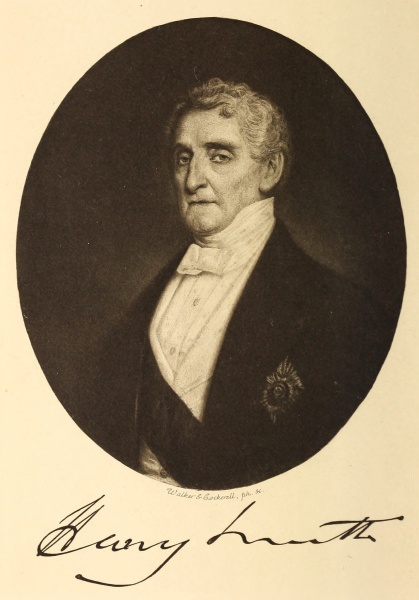
Harry Smith
THE AUTOBIOGRAPHY OF
LIEUTENANT-GENERAL Sir Harry Smith
BARONET OF ALIWAL ON THE SUTLEJ
G.C.B.
EDITED
WITH THE ADDITION OF SOME SUPPLEMENTARY CHAPTERS By G. C. MOORE SMITH, M.A.
WITH PORTRAITS AND ILLUSTRATIONS
LONDON
JOHN MURRAY, ALBEMARLE STREET
1903
PRINTED BY
WILLIAM CLOWES AND SONS, LIMITED,
LONDON AND BECCLES.
The Life of Sir Harry Smith here offered to the
public consists of an Autobiography covering the
period 1787 to 1846 (illustrated by notes and
appendices), and some supplementary chapters
contributed by myself on the last period of Sir
Harry’s life (1846-1860). Chapter XXXI. carries
the reader to the year 1829. This, it is interesting
to remark, is a true turning point in the life of the
great soldier. Till then he had seen warfare only
on two continents, Europe and America (the
Peninsula, France, the Netherlands, Monte Video,
Buenos Ayres, Washington, New Orleans); from
that date onwards the scene of his active service
was Africa and Asia. Till 1829 his responsibility
was small; after 1829 he had a large or paramount
share in directing the operations in which he was
engaged. This difference naturally affects the tone
of his narrative in the two periods.
The Autobiography (called by its author “Various
Anecdotes and Events of my Life”) was begun by
Sir Harry Smith, then Lieutenant-Colonel Smith,
at Glasgow in 1824. At that time it was only continued
as far as page 15 of the present volume. On
11th August, 1844, when he had won his K.C.B.,
and was Adjutant-General of Her Majesty’s Forces
in India, he resumed his task at Simla. He then
wrote with such speed that on 15th October he was
able to tell his sister that he had carried his narrative
to the end of the campaign of Gwalior, that
is, to 1844 (p. 490). Finally, on 7th September,
1846, when at Cawnpore in command of a Division,
he began to add to what he had previously written
an account of the campaign of the Sutlej, which
had brought him fresh honours. This narrative
was broken off abruptly in the middle of the Battle
of Sobraon (p. 550), and was never completed.
Accordingly, of Sir Harry Smith’s life from
February, 1846, to his death on 12th October, 1860,
we have no record by his own hand.
The Autobiography had been carefully preserved
by Sir Harry’s former aide-de-camp and friend,
General Sir Edward Alan Holdich, K.C.B., but,
as it happened, I was not myself aware of its
existence until, owing to the fresh interest awakened
in Sir Harry Smith and his wife by the siege of
Ladysmith early in 1900, I inquired from members
of my family what memorials of my great-uncle
were preserved. Sir Edward then put this manuscript
and a number of letters and documents at
my disposal. It appeared to me and to friends
whom I consulted that the Autobiography was so
full of romantic adventure and at the same time of
such solid historical value that it ought no longer to
remain unpublished, and Mr. John Murray, to whom
I submitted a transcription of it, came at once to
the same conclusion.
My task as Editor has not been a light one. In
Sir Harry’s letter to Mrs. Sargant of 15th October,
1844,[1] he says of his manuscript, “I have never
read a page of it since my scrawling it over at full
gallop;” and in a letter of 14th January, 1845,
“Harry Lorrequer would make a good story of it.
You may ask him if you like, and let me know what
he says of it.” It is clear from these passages that
Sir Harry did not contemplate the publication of
his story in the rough form in which he had written
it, but imagined that some literary man, such as
Charles Lever, might take it in hand, rewrite it
with fictitious names, and so fashion out of it a
military romance. The chapters[2] on Afghanistan
and Gwalior, already written, were, however, of a
serious character which would make them unsuitable
for such treatment; and the same was the case with
the chapters on the Sikh War, afterwards added.
Whether Lever ever saw the manuscript I do not
know; at any rate, the author’s idea was never
carried out.
It is obvious that now that fifty years have
passed, some of the reasons which made Sir Harry
suggest such a transformation of his story are no
longer in force. The actors in the events which he
describes having almost all passed away, to suppress
names would be meaningless and would deprive the
book of the greater part of its interest. And for
the sake of literary effect to rewrite Sir Harry’s
story would be to destroy its great charm, the
intimate relation in which it sets us with his fiery
and romantic character.
The book here given to the public is not indeed
word for word as Sir Harry wrote it. It has often
been necessary to break up a long sentence, to
invert a construction—sometimes to transpose a
paragraph in order to bring it into closer connexion
with the events to which it refers. But such
changes have only been made when they seemed
necessary to bring out more clearly the writer’s
intention; the words are the author’s own, even
where a specially awkward construction has been
smoothed; and it may be broadly said that nothing
has been added to Sir Harry’s narrative or omitted
from it. Such slight additions to the text as seemed
desirable, for example, names and dates of battles,[3]
have been included in square brackets. In some
cases, to avoid awkward parentheses, sentences of
Sir Harry’s own have been relegated from the text
to footnotes. Such notes are indicated by the
addition of his initials (“H. G. S.”).
Sir Harry’s handwriting was not of the most
legible order, as he admits, and I have had considerable
difficulty in identifying some of the
persons and places he mentions. Sometimes I
have come to the conclusion that his own recollection
was at fault, and in this case I have laid my
difficulty before the reader.
I have not thought it my duty to normalize
the spelling of proper names, such as those of
towns in the Peninsula and in India, and the
names of Kafir chiefs. Sir Harry himself spells
such names in a variety of ways, and I have
not thought absolute consistency a matter of importance,
while to have re-written Indian names
according to the modern official spelling would
have been, as it seems to me, to perpetrate an
anachronism.
I have, indeed, generally printed “Sutlej,”
though Sir Harry frequently or generally wrote
“Sutledge;” but I have kept in his own narrative
his spelling “Ferozeshuhur” (which is, I believe,
more correct) for the battle generally called
“Ferozeshah.” Even Sir Harry’s native place
(and my own) has two spellings, “Whittlesey”
and “Whittlesea.” In his narrative I have preserved
his usual spelling “Whittlesea,” but I have
myself used the other, as I have been taught to do
from a boy.
Perhaps it is worth while to mention here that
Sir Harry’s name was strictly “Henry George
Wakelyn Smith,” and it appears in this form in
official documents. But having been always known
in the army as “Harry Smith,” after attaining his
knighthood he stoutly refused to become “Sir
Henry,” and insisted on retaining the more familiar
name.[4] As the year of his birth is constantly given
as 1788, it is worth while to state that the Baptismal
Register of St. Mary’s, Whittlesey, proves him to
have been born on 28th June, 1787.
While the documents put into my hands by Sir
Edward Holdich enabled me to throw a good deal
of additional light on the events recorded in the
Autobiography, I thought it a prime duty not to
interrupt Sir Harry’s own narrative by interpolations.
Accordingly I have thrown this illustrative
matter into Appendices. In some of these, especially
in his letters to his wife of 1835 (Appendix iv.),
one sees the writer, perhaps, in still more familiar
guise than in the Autobiography.
But I had not merely to illustrate the period of
Sir Harry’s life covered by his Autobiography; I
had a further task before me, viz. to construct a
narrative of the rest of his life (1846-1860), including
his Governorship of the Cape (1847-1852).
For the manner in which I have done this, I must
crave indulgence. At the best it would have been
no easy matter to continue in the third person a
story begun by the main actor in the first, and in
this case the letters and personal memoranda, which
were tolerably abundant for Sir Harry’s earlier
years, suddenly became very scanty when they
were most required. Accordingly, for much of Sir
Harry’s life I had no more sources to draw on than
are accessible to anybody—histories, blue-books,
and newspapers. I can only say that in this
situation I have done the best I could. My chief
difficulty was, of course, in dealing with the time
of Sir Harry’s command at the Cape. It would
have been inconsistent with the scope of the whole
book to have attempted a systematic history of the
colony or of the operations of the Kafir War. At
the same time I could not enable my readers to
form an estimate of Sir Harry’s conduct at this
time without giving them some indication of the
circumstances which surrounded him. If I am
found by some critics to have subordinated biography
too much to history, I can only hope that
other critics will console me by finding that I have
subordinated history too much to biography.
Amid a certain dearth of materials of a private
kind, I do congratulate myself on having been able
to use the packet of letters docketed by Sir Harry,
“John Bell’s and Charlie Beckwith’s Letters.”
General Beckwith was an earlier General Gordon,
and his letters are so interesting in matter and so
brilliant in expression that one is tempted to wish
to see them printed in full. Perhaps some readers
of this book may be able to tell me of other letters
by the same remarkable man which have been
preserved.
The latter part of this book would have been
balder than it is, if it had not been for the help I
have received from various friends, known and
unknown. I must express my thanks in particular
to the Misses Payne of Chester, who lent me letters
addressed to their father, Major C. W. Meadows
Payne; to Mrs. Thorne of Chippenham, who lent
me letters addressed to her father, Major George
Simmons; to Mrs. Fasson, daughter of Mr. Justice
Menzies of the Cape, and Mr. W. F. Collier of
Horrabridge, who gave me their reminiscences; to
Colonel L. G. Fawkes, R.A., Stephen A. Aveling,
Esq., of Rochester, Major J. F. Anderson of Faringdon,
R. Morton Middleton, Esq., of Ealing, Captain
C. V. Ibbetson of Preston, Mrs. Henry Fawcett,
my aunt Mrs. John A. Smith, Mrs. Farebrother of
Oxford, Mr. B. Genn of Ely, Mr. Charles Sayle
of Cambridge, Mr. G. J. Turner of Lincoln’s Inn,
Mr. A. E. Barnes of the Local Government Board,
the Military Secretary of the War Office, and
others, for kind assistance of various kinds. I am
indebted to my cousins, Mrs. Lambert of 1, Sloane
Gardens, S.W., and C. W. Ford, Esq., for permission
to reproduce pictures in their possession,
and to General Sir Edward Holdich for much
aid and interest in my work in addition to the
permission to use his diary of the Boomplaats expedition.
Lastly, my thanks are due to my brothers
and sisters who assisted in transcribing the Autobiography,
and in particular to my sister, Miss M.
A. Smith, who did most of the work of preparing
the Index.
I shall feel that any labour which I have
bestowed on the preparation of this book will be
richly repaid if through it Harry and Juana Smith
cease to be mere names and become living figures,
held in honour and affection by the sons and
daughters of the Empire which they served.
G. C. MOORE SMITH.
Sheffield, September, 1901.
For some of the corrections now introduced I
am indebted to Lieut.-Col. Willoughby Verner,
Rifle Brigade, and to the Rev. Canon C. Evans,
late Fellow of Trinity College, Cambridge.
G. C. M. S.
University College, Sheffield, April, 1902.
REGIMENTAL RANK.
Second Lieutenant, 1st Battalion 95th Regiment
8 May, 1805
Lieutenant
15 Aug. 1805
Captain
28 Feb. 1812
Major, unattached
29 Dec. 1826
Lieut.-Colonel, unattached
22 July, 1830
Lieut.-Colonel, 3rd Foot
13 May, 1842
Lieut.-Colonel, unattached
25 Aug. 1843
Colonel, 47th Foot
18 Jan. 1847
Colonel, 2nd Battalion Rifle Brigade
16 April, 1847
Colonel, 1st Battalion Rifle Brigade
18 Jan. 1855
ARMY RANK.
Major
29 Sept. 1814
Lieut.-Colonel
18 June, 1815
Colonel
10 Jan. 1837
Local rank of Major-General in the East Indies
21 Aug. 1840
Major-General
9 Nov. 1846
Local rank of Lieut.-General in South Africa
1847-1852
Lieut.-General
20 June, 1854
STAFF APPOINTMENTS.
Peninsular War.
A.D.C. to Colonel T. S. Beckwith
Oct. 1810
Brigade Major, 2nd Brigade, Light Division under Major-General Drummond, Major-General Vandeleur, Major-General Skerrett, and Colonel Colborne successively
Mar. 1811 to the end of the war, Mar. 1814
Washington Expedition.
D.A.G. to Major-General R. Ross
1814
New Orleans Expedition.
A.A.G. to Major-General Sir E. Pakenham
1814
Military Secretary to Major-General Sir J. Lambert
1815
Waterloo Campaign.
Brigade-Major, afterwards A.Q.M.G. to 6th Division
(Major-General Sir J. Lambert and Major-General
Sir Lowry Cole successively)
1815
[Returns to his regiment.]
Occupation of France.
Major de Place of Cambray
1815-1818
[Returns to his regiment.]
Glasgow.
Major of Brigade to Major-General Sir T. Reynell
(commanding Western District) and Lieut-General
Sir T. Bradford (Commander-in-Chief in
Scotland) successively
1819-1825
[Returns to his regiment.]
Nova Scotia.
A.D.C. to Lieut.-General Sir James Kempt, Governor
1826
Jamaica.
D.Q.M.G. under Lieut.-General Sir John Keane, Governor
1827
Cape of Good Hope.
D.Q.M.G. under Lieut.-General Sir Lowry Cole, Lieut.-General
Sir B. D’Urban, Major-General Sir G.
T. Napier, Governors, successively
1828-1840
Chief of the Staff under Sir Benjamin D’Urban in
the Kafir War
1835
India.
A.G. to Her Majesty’s Forces, under Lieut.-General
Sir Jasper Nicolls and Lieut.-General Sir Hugh
Gough, Commanders-in-Chief, successively
1840-1845
Sikh War.
In Command of the 1st Division Infantry
1845-1846
Cape of Good Hope.
Governor and Commander-in-Chief
1847-1852
Home Staff.
In Command of the Western Military District
1853-1854
In Command of the Northern and Midland Military Districts
1854-1859
STEPS IN THE ORDER OF THE BATH.
C.B. for Waterloo
1815
K.C.B. for Maharajpore
1844
G.C.B. for Aliwal and Sobraon
1846
An Authentic Narrative of the Proceedings of the Expedition under
... Craufurd until its Arrival at Monte Video, with an Account
of the Operations against Buenos Ayres.... By an Officer of the
Expedition (1808).
Sir William F. P. Napier: History of the War in the Peninsula.
Sir H. E. Maxwell: Life of Wellington.
Sir William H. Cope: History of the Rifle Brigade (1877).
Edward Costello: Adventures of a Soldier (1852).
A British Rifleman (Major George Simmons’ Diary), edited by
Lt.-Colonel Willoughby Verner (1899).
Sir John Kincaid: Random Shots by a Rifleman.
Sir John Kincaid: Adventures in the Rifle Brigade.
Recollections of Rifleman Harris (1848).
Surtees: Twenty-five Years in the Rifle Brigade (1833).
Colonel Jonathan Leach: Rough Sketches in the Life of an
Old Soldier (1831).
A Narrative of the Campaigns of the British Army at Washington
and New Orleans. By an Officer (1821).
Charles Dalton: The Waterloo Roll Call (1890).
George McC. Theal: History of South Africa, vol. iv. (1893).
R. Godlonton: A Narrative of the Irruption of the Kafir Hordes
into the Eastern Province of the Cape of Good Hope, 1834-5
(1836).
Sir J. E. Alexander: Narrative of a Voyage, etc. (1837). This
work contains in vol. ii. a history of the Kafir War of 1835, with
illustrations.
H. Cloete: The Great Boer Trek.
The War in India. Despatches of Viscount Hardinge, Lord Gough,
Major-General Sir Harry Smith, Bart., etc. (1846).
J. D. Cunningham: History of the Sikhs.
McGregor: History of the Sikhs.
General Sir Chas. Gough and A. D. Innes: The Sikhs and
the Sikh Wars (1897).
J. W. Clark and T. McK. Hughes: Life of Adam Sedgwick.
Harriet Ward: Five Years in Kaffirland.
J. Noble: South Africa (1877).
A. Wilmot and J. C. Chase: Annals of the Colony of the Cape of
Good Hope (1869).
Alfred W. Cole: The Cape and the Kaffirs (1852).
W. R. King: Campaigning in Kaffirland (with illustrations), (1853).
W. A. Newman: Memoir of John Montagu (1855).
Correspondence of General Sir G. Cathcart (1856).
Earl Grey: The Colonial Policy of Lord John Russell’s Administration
(1853).
Blue-Books: Cape of Good Hope (1830-1852).
M. Meille: Memoir of General Beckwith, C.B. (1873).
Harry Smith once more in England—Reunion with his Wife in London—Interview with the Prince Regent—Dinner at Lord Bathurst’s—A Journey to Bath—Harry Smith introduces his Wife to his Father—Visit to Whittlesey—He receives Orders To return to America under Sir Edward Pakenham
Sails with Sir Edward Pakenham on the Expedition against New Orleans—Reverse of 8th January, 1815, and Death of Pakenham—Sir John Lambert succeeds to the Command, appoints Harry Smith his Military Secretary, and withdraws the Force
Capture of Fort Bowyer—Disembarcation on Ile Dauphine—End of the American War—Visit to Havana and Return-Voyage to England—News of Napoleon’s Return to Power—Harry Smith at his Home at Whittlesey
March to Paris—Harry Smith Quartermaster-General of the Reserve—He becomes Lieut.-Colonel and C.B.—The 6th Division moved from Neuilly to St. Germain—the Duc de Berri as a Sportsman—On the Reduction of the 6th Division Harry Smith rejoins his Regiment as Captain—March to Cambray—He is made Major de Place of that Town
Glasgow (1819-1825)—Radical Disturbances—Harry Smith once more on the Staff as Major of Brigade—George IV.’s Visit to Edinburgh—Harry Smith revisits Paris—He rejoins his Regiment in Ireland
1825-1828: Harry Smith accompanies his Regiment to Nova Scotia—Sir James Kempt—Harry Smith parts with his old Regiment On Being Appointed Deputy Quartermaster-General in Jamaica—He has to deal with an Epidemic of Yellow Fever among the Troops—Appointed Deputy Quartermaster-General at the Cape of Good Hope
After staying Three Weeks at Nassau, Harry Smith and his Wife sail for England, and after a Miserable Voyage land at Liverpool—He visits London and Whittlesey, and leaves England (1829), not to return till 1847
Outbreak of a Kafir War—Harry Smith’s Historic Ride to Grahamstown—On his Arrival he proclaims Martial Law—Provides for the Defence of the Town—Attacks the Kafirs and rescues Seven Missionaries
Harry Smith Chief of the Staff under Sir Benjamin D’Urban—He makes Two Forays into the Fish River Bush and One into the Umdizini Bush—The Force under Sir B. D’Urban marches from Fort Willshire to the Poorts of the Buffalo, from whence Harry Smith makes another Foray
Over the Kei into Hintza’s Territory—War declared against Hintza—His Kraal being destroyed the Chief comes in, and agrees to the Terms of Peace—He remains as a Hostage with the British Force, which marches back to the Kei—Harry Smith marches under Hintza’s Guidance into his Territory to recover the Stolen Cattle—Near the Xabecca Hintza tries to escape, and is shot
March across the Bashee to the Umtata and back to the Bashee—Death of Major White—Difficult March from the Bashee to rejoin Sir B. D’Urban on the Kei—Annexation of the Territory called the “Province of Queen Adelaide,” and Founding of its Capital, “King William’s Town”—Return of the Governor to Grahamstown
Harry Smith left in Command of the New “Province of Queen Adelaide” at King William’s Town—Death of Lieutenant Bailie—Harry Smith joined by his Wife—Forays on the Kafirs—Conclusion of Peace
Harry Smith’s Attempts at civilizing the Kafirs—The Chiefs made British Magistrates—A Census taken—A Police Force established—A Great Meeting of Chiefs—Witchcraft forbidden—A Chief punished for Disobedience—A Rebellious Chief awed into Submission—Agriculture and Commerce introduced—Nakedness discountenanced—Burial of the Dead encouraged—Buying of Wives checked—Hopes of a General Conversion to Christianity
Lord Glenelg orders the Abandonment of the Province of Queen Adelaide, and appoints Captain Stockenstrom to succeed Harry Smith on the Frontier—Grief of the Kafirs at the Change—Journey of Harry Smith and his Wife to Cape Town—He is exonerated by Lord Glenelg, and receives Testimonials for his Services to the Colony—Leaves Cape Town June, 1840, on being appointed Adjutant-General of the Queen’s Army in India
Sir Harry Smith detached from the Main Army—He reduces the Fortresses of Futteyghur and Dhurmcote—Combines with Colonel Phillips at Jugraon, and after changing his Route To Loodiana encounters the Enemy at Budowal, and loses Some Part of his Baggage—He relieves Loodiana, and, being reinforced and the Enemy having retreated, occupies his Position at Budowal
(Supplementary.) South Africa in 1847—Sir Harry’s Reception at Cape Town and on the Frontier—End of the Kafir War—Extension of the Boundaries of the Colony and Establishment of the Province of “British Kaffraria”—Visit to the Country beyond the Orange and to Natal—Proclamation of the “Orange River Sovereignty”—Triumphant Return to Cape Town—Disaffection among the Boers in the Sovereignty—Expedition thither and Battle of Boomplaats—Return to Cape Town
(Supplementary.) The Question of the Establishment of a Representative Assembly in the Cape Colony—The Convict Question—Kafir War—Recall of Sir Harry Smith—His Departure from the Cape
Arms—Argent, on a chevron between two martlets in chief gules, and upon
a mount vert in base, an elephant proper, a fleur-de-lis between two
lions rampant, of the first: from the centre-chief, pendant by a riband,
gules, fimbriated azure, a representation of the Waterloo medal.
Crest—Upon an Eastern crown or, a lion rampant argent, supporting a
lance proper; therefrom flowing to the sinister, a pennon gules, charged
with two palm-branches, in saltier, or.
The supporters are a soldier of the Rifle Brigade and a soldier of the 52nd
Regiment.
THE AUTOBIOGRAPHY OF
Lt.-Gen. Sir Harry Smith,
BARONET OF ALIWAL, G.C.B.
CHAPTER I. MONTE VIDEO AND BUENOS AYRES. 1806-7.
Written in Glasgow in 1824.—H. G. Smith.
I was born in the parish of Whittlesea and county
of Cambridgeshire in the year [1787]. I am one
of eleven children, six sons and five daughters.
Every pains was taken with my education which
my father could afford, and I was taught natural
philosophy, classics, algebra, and music.[5]
In 1804 the whole country was en masse
collected in arms as volunteers from the expected
invasion of the French, and being now sixteen years
of age, I was received into the Whittlesea troop of
Yeomanry Cavalry, commanded by Captain Johnson.
During this year the Yeomanry in the neighbourhood
patrolled through Norman Cross Barracks,
where 15,000 French prisoners were kept, when
the Frenchmen laughed exceedingly at the young
dragoon, saying, “I say, leetel fellow, go home with
your mamma; you most eat more pudding.” In the
spring of 1805 the Whittlesea Yeomanry kept the
ground at a review made by Brigadier-General
Stewart (now Sir W. Stewart), when I was orderly
to the General, who said, “Young gentleman, would
you like to be an officer?” “Of all things,” was
my answer. “Well, I will make you a Rifleman, a
green jacket,” says the General, “and very smart.”
I assure you the General kept his word, and upon
the 15th [8th?] May, 1805, I was gazetted second
lieutenant in the 95th Regiment Riflemen,[6] and
joined at Brabourne Lees upon the 18th of August.
A vacancy of lieutenant occurring for purchase,
my father kindly advanced the money, and I was
gazetted lieutenant the 15th September [August?],
1805. This fortunate purchase occurred when the
2nd Battalion of the corps was raising and the
officers had not been appointed, by which good luck
twenty-seven steps were obtained by £100.
In the summer of 1806 a detachment of three
Companies was directed to proceed from the 2nd
Battalion of the corps from Faversham to Portsmouth,
there to embark and form part of an army about to
proceed to South America under the command of
Sir Samuel Auchmuty. This detachment was
under the command of Major Gardner, and I was
appointed Adjutant, a great honour for so young an
officer.[7] The army sailed for America, touching at
Plymouth, Falmouth, Peak of Teneriffe, and Rio
Janeiro, at which place it stayed one week to
take in water, stores, etc., and, covered by the
detachment of Riflemen, landed within a few miles
of Monte Video upon the 16th of January, 1807.
Some skirmishing took place the whole day with
the light troops of the enemy. Upon the 17th and
18th the army halted for the artillery, stores, etc.,
to be landed. The outposts (Riflemen) were employed
both of these days.
Upon the 19th the army moved forward,
and a general action took place, the result of
which was most favourable to the British, and a
position was taken up in the suburbs of Monte
Video. Upon the 20th the garrison made a most
vigorous sortie in three columns, and drove in
our outposts, and a heavy and general attack
lasted for near two hours, when the enemy
were driven to the very walls of the place. The
Riflemen were particularly distinguished on this
occasion.
The siege of Monte Video was immediately
commenced, and upon the morning of the 3rd of
February, the breach being considered practicable,
a general assault was ordered in two columns, the
one upon the breach, the other an escalade. Both
ultimately succeeded. Not a defence was destroyed
nor a gun dismounted upon the works. The breach
was only wide enough for three men to enter abreast,
and when upon the top of the breach there was a
descent into the city of twelve feet. Most of the
men fell, and many were wounded by each other’s
bayonets. When the head of the column entered
the breach, the main body lost its communications
or was checked by the tremendous fire. Perceiving
the delay, I went back and conducted the column
to the breach, when the place was immediately taken.
The slaughter in the breach was enormous owing
to the defence being perfect, and its not being really
practicable. The surrender of this fortress put the
English in the possession of this part of the country.
I was now afflicted with a most severe fever and
dysentery, and owe my life to the kind attentions
of a Spanish family in whose house I was billeted.
My own relations could not have treated me with
greater kindness. My gratitude to them can never
be expressed or sufficiently appreciated.[8]
In the autumn[9] an outpost was established on
the same side of the river as Monte Video, but
nearly opposite to Buenos Ayres, at Colonia del
Sacramento. This had formerly belonged to the
Portuguese. It was situated on a neck of land,
and a mud wall was carried from water to water.
There were no guns up, and in one place a considerable
breach. One particular night a column of
Spaniards which had crossed the river from Buenos
Ayres stormed this post, and were near carrying
it by surprise had it not been for the valour of
Scott and his guard of Riflemen, who most bravely
defended the breach until the troops got under
arms. The enemy were not pursued, as their
numbers were not known and the night was dark.
Why this breach was not repaired one cannot say,
except that in those days our commanders understood
little of the art of war, and sat themselves
down anywhere in a state of blind security without
using every means to strengthen their posts.
Experience taught us better.
The enemy did not re-cross the river, but took
up a position about fourteen miles from Colonia,
in which Colonel Pack (afterwards Sir Denis
Pack), who commanded the British force, resolved
to attack them. The column consisted of three
companies of Riflemen, the 40th Regiment, two
6-pounders, and three light companies. It marched
upon the night of [6-7 June], and arrived in sight
of the enemy at daylight in the morning. They
were drawn up on an elevated piece of ground,
with a narrow but deep, muddy, and miry river in
their front. Their cavalry formed a right angle upon
the right of their infantry and they had seven guns
upon the left. The Rifle Brigade covered the
troops whilst crossing the rivulet, and in about
twenty minutes by a rapid advance the position was
carried, the enemy leaving behind him his guns,
tents, stores, etc., with a great quantity of ammunition.
In the destroying of the latter poor Major
Gardner and fourteen soldiers suffered most dreadfully
from an explosion. Some flints had been
scattered upon the field; the soldiers took the shot
to break the cartridges, and thus the whole blew
up. About two hundred shells also exploded.
The army at a short distance lay down, and not
an individual was touched. Colonel Pack, with his
army, the captured guns, etc., returned to Colonia
in the evening.[10]
A considerable force having arrived under
General Whitelock, who took the command, the
army was remodelled and embarked in August
[really on the 17th of June], 1807, to attack Buenos
Ayres. The post of Colonia was abandoned, and
the three companies of the 2nd Battalion Rifle
Brigade were embodied with five of the 1st just
arrived from England, and I was appointed
adjutant of the whole under the command of
Major McLeod. The army landed upon [28
June], and was divided into two columns, the one
consisting of the light troops under General
Craufurd, and of a heavy brigade, the whole under
Major-General Leveson-Gower. [Some uncomplimentary
epithets are here omitted.] His column
was one day in advance of the main body commanded
by General Whitelock in person. His
orders were to march up to the enemy’s outposts and
take up a position. In place of obeying his orders,
General Leveson-Gower immediately attacked the
enemy in the suburbs of Buenos Ayres, and drove
them in with great loss, leaving their cannon behind
them. Having thus committed himself, in lieu of
following up the advantage he had gained and
pushing forward into Buenos Ayres, which would
have immediately surrendered, he halted his column
and took up a position. The enemy recovered from
his panic, and with the utmost vigour turned to and
fortified the entrances of all the streets. (Buenos
Ayres is perfectly open on the land side, but has a
citadel of some strength within the town and upon
the river. The houses are all flat-roofed, with a
parapet of about three feet high.) The day after
the affair alluded to, General Whitelock with his
column arrived. The next day he reconnoitred the
enemy, drove in their outposts, and partially invested
the city. Some very heavy skirmishing took place
in the enclosures, the fences consisting of aloe
hedges, very difficult to get through, but making
excellent breastworks. The Rifle Corps particularly
distinguished themselves.
Upon the [5 July] the whole army attacked in
four columns. The men were ordered to advance
without flints in their musquets, and crowbars, axes,
etc., were provided at the head of the column to
break open the doors, which were most strongly
barricaded. It must be stated that the streets of
Buenos Ayres run at right angles from each other.
Each street was cut off by a ditch and a battery
behind it. Thus the troops were exposed to a
cross fire. The tops of the houses were occupied
by troops, and such a tremendous fire was
produced of grape, canister, and musquetry, that
in a short time two columns were nearly annihilated
without effecting any impression. The column I
belonged to, under Brigadier-General Craufurd,
after severe loss, took refuge in a church, and about
dusk in the evening surrendered to the enemy.
Thus terminated one of the most sanguinary
conflicts Britons were ever engaged in, and all
owing to the stupidity of the General-in-chief and
General Leveson-Gower. Liniers, a Frenchman by
birth, who commanded, treated us prisoners tolerably
well, but he had little to give us to eat, his citadel
not being provisioned for a siege. We were three
or four days in his hands, when, in consequence of
the disgraceful convention entered into by General
Whitelock, who agreed within two months to
evacuate the territory altogether and to give up the
fortress of Monte Video, we were released. The
army re-embarked with all dispatch and sailed to
Monte Video. Our wounded suffered dreadfully,
many dying from slight wounds in the extremity of
lockjaw.
The division of troops I belonged to sailed upon
[12 July], under the command of Brigadier-General
Lumley. I confess I parted from the kind Spanish
family, who during my illness had treated me with
such paternal kindness, with feelings of the deepest
sorrow and most lively gratitude. The old lady
offered me her daughter in marriage and $20,000,
with as many thousand oxen as I wished, and she
would build me a house in the country upon any
plan I chose to devise.
Now that I am brought to leave the fertile
plains of the Plate, let me make some little
mention of its climate, soil, and productions. Its
summer is, of course, in January; during this time
it is very hot. Still you have a sea breeze and a
land breeze, which is very refreshing. During the
rainy seasons the weather is very tempestuous.
The climate altogether is, however, most mild and
salubrious. Corn of all descriptions grows with the
least possible care. The fertile grass plains are
immense. The country is not a dead flat, but undulated
like the great Atlantic a few days after a
gale of wind. Upon these plains thousands of oxen
and horses are grazing; they are so thick that were
an individual ever entangled amongst them he
would be lost as in a wood. These animals are,
however, all the property of individuals, and not wild
as supposed, and each horse and ox is branded.
You could buy a most excellent horse for two dollars
(I gave ten for one, he being very handsome, which
was a price unheard of before), a cow and calf one
dollar, a pair of draft oxen five (they are thus dear
in consequence of being trained). The country
abounds in all sorts of wild fowl and innumerable
wild dogs, which nature must have provided to eat
the carcases of the slaughtered cattle, many of which
are killed merely for their hides, a few of the prime
pieces alone being made use of for food. The
marrow is usually also taken and rendered into
bladders, with which they cook everything, using it,
in short, as we use butter, which makes their dishes
very palatable. The native inhabitants, called
“peons,” or labourers, are a very superior race of
men, almost Patagonians, are beautiful horsemen,
and have a peculiar art of catching horses and oxen
by what is termed the “lasso.” This is a leathern
thong of about thirty feet resembling the lash of a
hunting-whip. An iron ring is at one end, through
which the other end is passed, by which means a
noose is formed; the end is then fastened to the
girths of the horse. The lasso is collected in the
man’s hand, he swings it circularly round his head,
and when the opportunity offers, he throws it over
the head of the animal he wishes to catch. He is
sure of his aim; the noose draws tight round the
animal’s throat, and he is of course choked, and
down he drops.
In killing bullocks they are very dexterous. The
moment the bullock finds himself caught he begins
to gallop round; the end being fast to the saddle,
the horse turns gradually round so that he is not
entangled. A second peon with his lasso gallops
after the bullock, and throws his lasso round the
hind leg above the hough and rides in a contrary
direction to the other horseman, consequently the
bullock is stretched between the two horses. The
riders jump off and plunge their knives into the
bullock, and other persons are employed to dress
it, etc.
The fleet separated in a gale of wind off the
Azores. During this gale the transport I was in
carried away its rudder. Our captain had kept so
bad a reckoning we ran four hundred miles after he
expected to make the Lizard. In the chops of the
Channel we fell in with the Swallow, sloop of war, to
whom we made a signal of distress, and she towed
us into Falmouth Harbour [5 Nov.]. It blew the
most tremendous gale of wind that night. A
transport with the 9th Dragoons aboard was wrecked
near the Lizard, and this would inevitably have been
our fate had we not been towed in by the sloop
of war. The rudder was repaired, we were driven
into Plymouth, and in the middle of December
anchored at Spithead, where we delighted to have
arrived. However, to our great mortification, we
were ordered to the Downs, there to disembark.
I obtained leave of absence, and was soon in the
arms of a most affectionate family, who dearly loved
me. My mother’s delight I shall never forget.
There are feelings we possess in our youth which
cannot be described. I was then only nineteen.
My brothers and sisters were all well, and every
moment called to my recollection some incident of
juvenile delight and affection.
CHAPTER II. WITH SIR JOHN MOORE—BATTLE OF CORUÑA. 1808-9.
I stayed in this happy land of my sires for two
months, when I was ordered to join. The Regiment
was then quartered at Colchester. Although there
were many subalterns present who were senior to
me, I had given to me, for my exertions abroad as
Adjutant, the command of a Company. This was
the act of my kind and valued friend Colonel
Beckwith, whom I shall have occasion frequently
to mention in these memoirs, but never without feelings
of affection and gratitude. The Company was
in very bad order when I received it, which Colonel
Beckwith told me was the reason he gave it me.
I now procured a commission for my brother Tom,
who was gazetted over the heads of several other
candidates.
In the summer [spring] of 1808 10,000 men were
ordered to Sweden under the command of Sir J.
Moore. Three Companies of the Rifle Brigade under
Major Gilmour were to form part of the expedition.
By dint of great exertion I was appointed Adjutant
to this detachment. We marched to Harwich to
embark. When the fleet was collected, we anchored
a few days in Yarmouth roads. The fleet arrived
at Gottenburgh [on 7 May], blowing a heavy gale
of wind. The harbour of this place is most beautiful.
The army never landed, but the men were drilled,
embarking and disembarking in flat-bottomed boats.
I jumped against three regiments, 95th, 43rd, and
52nd, and beat them by four inches, having leaped
19 feet and 4 inches.
Commenced at Simla, Himalayas, 11th Aug. 1844—H.G.S.
At this period Napoleon announced his unjust
invasion of Spain, and Sir John Moore’s army was
ordered to sail and unite with the forces collecting
on the coast of Portugal for the purpose of expelling
Junot’s army from Lisbon. On approaching the
mouth of the Mondego, a frigate met us to say Sir
Arthur Wellesley’s army had landed in Mondego
and pushed forward, and that Sir John Moore was
to sail for Peniche, and there land on arrival. The
battle of Vimiera had been fought [21 Aug. 1808],
and the Convention was in progress. Sir John
Moore’s army landed one or two days after the battle
and took the outposts. The three Companies to
which I was Adjutant joined Colonel Beckwith and
the headquarters of the Regiment, and I was
appointed to Captain O’Hare’s Company (subalterns
Smith, W. Eeles, Eaton).
After the embarcation of the French army, an
army was formed under Sir John Moore for the aid
of the Spaniards, and it moved on the frontier of
Alemtejo.
The 95th were quartered in Villa Viciosa, in an
elegant palace. I occupied a beautiful little room
with a private staircase, called the Hall of Justice.
I was sent by Sir Edward Paget to examine the fort
Xuramenha and report upon it, the fords of the
Guadiana, etc., near the important fortress of
Badajos.
In the autumn of this year (1808), Sir John
Moore’s army moved on Salamanca. As I could
speak Spanish, I was employed by Colonel Beckwith
to precede the Regiment daily to aid the Quartermaster
in procuring billets and rations in the different
towns, and various were the adventures I met with.
The army was assembled at Salamanca, and never
did England assemble such a body of organized and
elegant troops as that army of Sir John Moore,
destined to cover itself with glory, disgrace, victory,
and misfortune. The whole of this campaign is too
ably recorded by Napier for me to dwell on. I shall
only say that never did corps so distinguish itself
during the whole of this retreat as my dear old Rifles.
From the severe attack on our rear-guard at Calcavellos
[3 Jan. 1809], where I was particularly distinguished,
until the battle of Coruña, we were daily
engaged with a most vigorous and pushing enemy,
making most terrific long marches (one day 37 miles).
The fire of the Riflemen ever prevented the column
being molested by the enemy; but the scenes of
drunkenness, riot, and disorder we Reserve Division
witnessed on the part of the rest of the army are not
to be described; it was truly awful and heartrending
to see that army which had been so brilliant at Salamanca
so totally disorganized, with the exception
of the reserve under the revered Paget and the
Brigade of Guards. The cavalry were nearly all
dismounted, the whole a mass of fugitives and
insubordinates; yet these very fellows licked the
French at Coruña like men [16 Jan.]. The army
embarked the following day. I shall never forget
the explosion of a fortress blown up by us—the
report cannot be imagined. Oh, the filthy state we
were all in! We lost our baggage at Calcavellos;
for three weeks we had no clothes but those on our
backs; we were literally covered and almost eaten
up with vermin, most of us suffering from ague and
dysentery, every man a living still active skeleton.
On embarcation many fell asleep in their ships and
never awoke for three days and nights, until in a
gale we reached Portsmouth [21 Jan.]. I was so
reduced that Colonel Beckwith, with a warmth of
heart equalling the thunder of his voice, on meeting
me in the George Inn, roared out, “Who the devil’s
ghost are you? Pack up your kit—which is soon
done, the devil a thing have you got—take a place
in the coach, and set off home to your father’s. I
shall soon want again such fellows as you, and I will
arrange your leave of absence!” I soon took the
hint, and naked and slothful and covered with vermin
I reached my dear native home, where the kindest
of fathers and most affectionate of mothers soon
restored me to health. [11]
CHAPTER III. BACK TO THE PENINSULA UNDER SIR ARTHUR WELLESLEY. 1809.
In two months I rejoined the Regiment at Hythe.
From Hythe we marched for Dover, where we
embarked for Lisbon [25 May] to join the Duke’s[12]
army. Having landed at Lisbon, we commenced
our march for Talavera. On this march—a very
long one—General Craufurd compiled his orders
for the march of his Brigade, consisting of the
43rd, 52nd, and 95th, each upwards of 1000 strong.
These orders he enforced with rigour (as it seemed
at the moment), but he was in this way the means
of establishing the organization and discipline of
that corps which acquired for it its after-celebrity
as the “Light Division.”
We had some long, harassing, and excessively
hot marches. In the last twenty-eight hours we
marched from Oropesa to Talavera, a distance of
fourteen Spanish leagues (56 miles), our soldiers
carrying their heavy packs, the Riflemen eighty
rounds of ammunition. But the battle of Talavera
was thundering in our ears, and created a spirit in
the Brigade which cast away all idea of fatigue. We
reached the sanguinary field at daylight after the
battle [29 July], greeted as if we were demi-gods by
all the gallant heroes who had gained such a victory.
We took up the outposts immediately, and some
of us Riflemen sustained some heavy skirmishing.
The field was literally covered with dead and dying.
The bodies began to putrefy, and the stench was
horrible, so that an attempt was made to collect
the bodies and burn them. Then, however, came a
stench which literally affected many to sickness.
The soldiers were not satisfied with this mode of
treating the bodies of their dead comrades, and the
prosecution of the attempt was relinquished. After
our stay at Talavera [29 July-3 Aug.], during
which we were nearly starved, the army commenced
its retreat, passing the bridge of Arzobispo in the
most correct and soldier-like manner, our Brigade
forming the rear-guard. The army retired on
Deleytosa, the Light Brigade remaining in a
position so as to watch the bridge of Almaraz.
Here for three weeks we were nearly starved
[6 Aug.-20 Aug.], and our position received the
name of Doby Hill.[13] We marched every evening
and bivouacked so as to occupy the passage of
the Tagus, and at daylight returned to our hill.
Honey was plentiful, but it gave dysentery. My
mess—Leach’s Company (Leach, Smith, Layton,
and Bob Beckwith)—were not as badly off as our
neighbours. We had a few dollars, and as I could
speak Spanish, I rode into the lines of the Spanish
troops, where I could always purchase some loaves
of bread at a most exorbitant price. With this
and some horrid starved goats we lived tolerably
for soldiers in hard times. The army retired
into quarters—the headquarters to Badajos, our
Division (which had added to it Sir Rufane Donkin’s
Brigade, the 45th, 87th, and 88th Regiments) to
Campo Mayor [11 Sept.], where sickness and mortality
commenced to an awful extent. On our
reaching the frontier of Portugal, Castello de Vidi,
wine was plentiful, and every man that evening had
his skin full.
During the period we were at Campo Mayor
[11 Sept.-12 Dec.], the Hon. Captain James
Stewart and I got some excellent greyhounds.
We were always out coursing or shooting, and
were never sick a day; our more sedentary comrades
many of them distressingly so. The seven
right-hand men of Leslie’s Company died in the
winter of this year.
While at Campo Mayor the convalescents of my
Light Brigade were ordered to our old fortress,
called Onguala, on the immediate frontier of
Portugal, and opposite to Abuchucha, the frontier
of Spain. They consisted of forty or fifty weakly
men. I was first for Brigade duty, and I was sent
in command, with a Lieut. Rentall of the 52nd
Regiment and my brother Tom, who was sick. I
knew this country well, for we had had some grand
battues there, and shot red deer and wild boars.
So soon, therefore, as I was installed in my command,
lots of comrades used to come from Campo Mayor
to breakfast with me and shoot all day. On one
occasion Jack Molloy, Considine, and several fellows
came, and while out we fell into the bivouac of a set
of banditti and smugglers. We hallooed and bellowed
as if an army were near us. The bandits jumped
on their horses and left lots of corn-sacks, etc., in
our hands; but on discovering our numbers, and
that we fired no balls (for we had only some
Rifle buttons pulled off my jacket), being well
armed, they soon made us retreat. This, after my
friends returned to Campo Mayor, so disconcerted me
that I made inquiry about these same rascals, and
ascertained there were a body of about twenty
under a Catalan, the terror of the country. I immediately
sent for my sergeant (a soldier in every
sense of the word) to see how many of our convalescents
he could pick out who could march at all.
He soon returned. He himself and ten men,
myself, Rentall, and my sick brother Tom (who
would go) composed my army. I got a guide, and
ascertained that there were several haunts of these
bandits; so off I started. We moved on a small
chapel (many of which lone spots there are in all
Roman Catholic countries), at which there was a
large stable. On approaching we heard a shot
fired, then a great and lawless shouting, which
intimated to us our friends of the morning were
near at hand. So Pat Nann and I crept on to peep
about. We discovered the fellows were all inside
a long stable, with a railed gate shut, and a regular
sentry with his arms in his hand. They were all
about and had lights, and one very dandy-looking
fellow with a smart dagger was cutting tobacco to
make a cigar. Pat and I returned to our party and
made a disposition of attack, previously ascertaining
if the stable had a back door, which it had not. I
then fell in our men very silently, Mr. Rentall being
much opposed to our attack, at which my brother
Tom blew him up in no bad style of whispering
abuse, and our men went for the gate. The sentry
soon discovered us and let fly, but hit no one. The
gate was fast and resisted two attempts to force it, but
so amazed were the bandits, they [never] attempted
to get away their horses, although their arms were
regularly piled against the supports of the roof of
the stable, and we took twelve banditti with their
captain, a fine handsome fellow, horses, etc. His
dagger I sent to my dear father. I sent my prisoners
on the next day to Campo Mayor, galloping ahead
myself, in an awful funk lest General Craufurd
should blow me up. However, I got great credit
for my achievement in thus ridding the neighbourhood
of a nest of robbers; and the captain and five
of his men (being Spaniards) were sent to Badajos
and sentenced to the galleys for life, being recognized
as old offenders. The remainder received
a lesser punishment. My men got forty Spanish
dollars each prize money, the amount I sold the
horses for. I bought for forty dollars the captain’s
capital horse. The men wanted me to keep him as
my share, but I would not. Dr. Robb, our surgeon,
gave sixty Spanish dollars for a black mare. Thus
ended the Battle of the Bandits.
CHAPTER IV. CAMPAIGN OF 1810—THE 1ST GERMAN HUSSARS.
In the winter of this year [12 Dec. 1809] we
marched towards the northern frontier of Portugal.
We marched towards Almeida, and were cantoned
in villages to its rear—Alameda, Villa de Lobos,
Fequenas, not far from the Douro. Here too was
good shooting and coursing; but I was not permitted
to be idle. We moved into Spain [19 Mar. 1810],
and at Barba del Puerco had a most brilliant night
attack, in which Colonel Beckwith greatly distinguished
himself.
At Villa de Ciervo a detachment of one sergeant
and twelve Hussars (1st German) were given me
by General Craufurd to go right in among the
French army, which had moved on Ciudad Rodrigo
and then retired. Many are the hairbreadth
escapes my Hussars and I had, for we were very
daring; we were never two nights in the same place.
One night at Villa de Ciervo, where we were watching
a ford over the Agueda, two of my vedettes
(two Poles elegantly mounted) deserted to the enemy.
The old sergeant, a noble soldier, came to me in
great distress. “O mein Gott, upstand and jump up
your horse; she will surely be here directly!” I was
half asleep, with my horse’s reins in my hand, and
roared out, “Who the devil is she?” “The Franzosen,
mein Herr. Two d——d schelms have
deserted.” So we fell back to the rear of the village,
sitting on our horses the remainder of the night,
every moment expecting the weakness of our party
would cause an attempt to cut us off. At daylight
we saw fifty French dragoons wending their way on
the opposite bank to the ford. I immediately got
hold of the padre and alcalde (priest and magistrate),
and made them collect a hundred villagers and
make them shoulder the long sticks with which
they drive their bullock-carts and ploughs, which
of course at a distance would resemble bayonets.
These villagers I stationed in two parties behind
two hills, so that the “bayonets” alone could be
seen by the enemy. Then with my sergeant and
ten Hussars (two having deserted) I proceeded to
meet the enemy, first riding backwards and forwards
behind a hill to deceive him as to my numbers.
The French sent over the river about half their
number. I immediately galloped up to them in
the boldest manner, and skirmished advancing.
The enemy were deceived and rapidly retired, and
I saved the village from an unmerciful ransacking,
to the joy of all the poor people.
At this period General Craufurd had officers at
two or three of the most advanced vedettes where
there were beacons, who had orders to watch the
enemy with their telescopes, and, in case of any
movement, to report or fire the beacon. I was on
this duty in rather a remote spot on the extreme left
of our posts. The vedette was from the 1st Hussar
picquet. These men would often observe a patrol
or body of the enemy with the naked eye which
was barely discernible through a telescope, so
practised were they and watchful. Towards the
evening my servant ought to have arrived with my
dinner (for we officers of the look-out could take
nothing with us but our horse and our telescope),
but he must have missed his way, and as my
appetite was sharpened by a day’s look-out, I began
to look back, contrary to the vedette’s idea of due
vigilance. He asks, “What for Mynheer so much
look to de rear?” I, sad at the fast, “Hussar, you
are relieved every two hours. I have been here
since daylight. I am confounded hungry, and am
looking out for my servant and my dinner.” “Poor
yonge mans! but ’tis notings.” “Not to you,” said
I, “but much to me.” “You shall see, sir. I shall
come off my horse, you shall up clim, or de French
shall come if he see not de vedette all right.”
Knowing the provident habits of these Germans,
I suspected what he was about. Off he got;
up get I en vedette. With the greatest celerity,
he unbuckled his valise from behind his saddle,
and took out a piece of bacon (I had kept up
a little fire from the sticks and bushes around me),
from a cloth some ground coffee and sugar, from
his haversack some biscuit, and spread on the
ground a clean towel with knife, fork, and a little
tin cup. He had water in his canteen—his cooking-tin.
He made me a cup of coffee, sliced some bacon,
broiled it in the embers, and in ten minutes coffee,
bacon, biscuit were ready and looked as clean as if in
a London tavern. He then says, “Come off.” Up
he mounts, saying, “Can eat. All you sall vant is
de schnaps.” I fell to, and never relished any meal
half so much; appetite was perfect, and the ingenious,
quick and provident care of the Hussar added
another to the many instances I had witnessed of
this regiment to make them be regarded, as indeed
they were, as exemplary soldiers for our emulation.
My servant soon after arrived. The contents of
his haversack I transferred to my kind friend the
Hussar’s, and half the bottle of wine, on which the
Hussar remarked, “Ah, dat is good; the schnaps
make nice;” and my servant put up his valise again
for him. I was highly amused to observe the
momentary glances the Hussar cast on me and my
meal, for no rat-catcher’s dog at a sink-hole kept a
sharper look-out to his front than did this vedette.
In the whole course of my service I never was more
amused, and nothing could be more disinterested
than the Hussar’s conduct, which I never forgot.
CHAPTER V. CAMPAIGN OF 1810—BATTLE OF THE COA.
Soon after this the French invested Ciudad Rodrigo,
and regularly commenced the siege. The
Light Division (into which fell the three regiments
43rd, 52nd, and two Battalions of Rifles, 1st and
3rd Portuguese Caçadores, the latter under Elder, a
most brilliant Rifle officer), 1st Hussars, 14th Light
Dragoons, 16th Light Dragoons occupied Gallegos,
Exejo, etc., our advanced post being at Marialva, on
the road to Ciudad Rodrigo. During the whole
siege our alerts were innumerable, and at Marialva we
had several very smart skirmishes, but so able were
Craufurd’s dispositions, we never lost even a vedette.
The French were in the habit of patrolling
over the Agueda with cavalry and infantry, about
30 Dragoons and 200 foot. General Craufurd
determined to intercept one of these patrols [10
July], and [moved out with] the cavalry, 1st Hussars,
14th and 16th Light Dragoons, and Light Division.
It may now be asked, Was it necessary to take
out such a force to intercept so small a party?
Certainly. Because the enemy might have crossed
the Agueda to support the patrols. We were all
moved to where directed, the infantry were halted,
some of the cavalry moved on. At grey daylight
the patrols of the enemy appeared, their Dragoons
some way in advance of the infantry. The patrol
was very incautiously conducted (not like our 1st
Hussars), and the Dragoons were taken in a moment.
The infantry speedily retired to an eminence above
the ford and formed square. Craufurd ordered
them to be attacked by the cavalry, and several
right good charges were made; but the French were
steady, the dead horses in their front became a
defence, and our cavalry never made the slightest
impression. Craufurd never moved one of us.
The charges of cavalry ceased for a few seconds—the
fields around were high-standing corn. The
gallant fellow in command gave the word, “Sauve
qui peut.” In a moment all dispersed, ran through
the standing corn down to the banks of the river,
and were saved without the loss of a man. The
officer was promoted on his arrival in his camp.
Our loss was very considerable. Poor Colonel
Talbot of the 14th (commanding) killed, and a lot of
men. I and Stewart, Adjutant of the Rifle Brigade,
asked leave to go ahead, and we saw it all. Indeed,
it was in sight of the whole division. Had two
Companies of ours only been moved to threaten the
ford, the enemy would have laid down their arms.
Such a piece of soldiering as that morning presented
the annals of war cannot produce.[14]
While we were at a village called Valde
Mula, in the neighbourhood of Fort Concepcion,
that most perfect little work was blown up [21
July]. It was the neatest fortification I ever saw
(except the Moro in the Havana subsequently), and
the masonry was beautifully executed.
After the fall of Ciudad Rodrigo, which made a
brilliant defence, our advanced line fell back to the
Dos Casas, and in front of Alameda we had a
brilliant affair with the French, in which Krauchenberg
1st Hussars and McDonald Royal Artillery
greatly distinguished themselves. The 3rd Caçadores
were this day first under fire, and behaved
nobly. After this our advanced posts were
retired behind the Dos Casas to cover Almeida.
While Massena prepared his army to invade
Portugal and besiege Almeida, we were daily on
the alert and had frequent skirmishes. General
Craufurd, too, by a variety of ruses frequently made
the whole French army turn out.
In the early morning of the 24th of July (I was
on picquet with Leach and my Company that night)
the enemy moved forward with 40,000 men. Our
force, one Brigade of Horse Artillery, three Regiments
of cavalry, five of infantry, were ordered by
the Duke to remain as long as possible on the right
bank of the Coa, where there was a bridge over the
river on the road from Almeida into Portugal to
Celerico and Pinhel, posting ourselves between
the fortress and the bridge, so as to pass over so
soon as the enemy advanced in force. In place of
doing this, Craufurd took up a position to our
right of Almeida, and but for Colonel Beckwith our
whole force would have been sacrificed. Fortunately
a heavy rain had fallen, which made the Coa impassable
except by the bridge, which was in our
possession, and the enemy concentrated his force
in one rush for the bridge [24 July].
During the Peninsular War there never was a
more severe contest. The 43rd lost 17 officers and
150 men, my Regiment 10 officers and 140 men.
When we passed the bridge my section was the
rear-guard of the whole, and in a rush to drive
back the enemy (with whom we were frequently
absolutely mixed), my brother Tom and I were
both severely wounded, and a Major Macleod, a
noble fellow, afterwards killed at Badajos, put me on
his horse, or I should have been taken. The enemy
made several attempts to cross, but old Alister
Cameron, Captain in the Rifle Brigade, had posted
his Company in a ruined house which commanded
the bridge, and mainly contributed to prevent the
passage of the enemy, who made some brilliant
attempts. The bridge was literally piled with their
dead and they made breastworks of the bodies. On
this day, on going to the rear wounded, I first
made the acquaintance of my dear friend Will
Havelock,[15] afterwards my whipper-in, who was joining
the 43rd fresh from England, with smart chako
and jacket. I had a ball lodged in my ankle-joint,
a most painful wound. We were sent to Pinhel,
where the 3rd Division was seven leagues from
the action, the nearest support (?). Sir Thomas
Picton treated us wounded en princes.
The wounded were ordered to the rear, so as
to embark on the Mondego at Pinhel. In collecting
transport for the wounded, a sedan chair
between two mules was brought, the property of
some gentleman in the neighbourhood, and, fortunately
for me, I was the only person who could ride
in it, and by laying my leg on the one seat and
sitting on the other, I rode comparatively easy to
the poor fellows in the wretched bullock-cars, who
suffered excruciating agony, poor brother Tom
(who was very severely wounded above the
knee) among the rest. This little story will
show what wild fellows we were in those days.
George Simmons’ (1st Rifles) bullocks at one
stage had run away. As I was the spokesman,
the surgeon in charge came to me in great distress.
I sent for the village magistrate, and actually
fixed a rope in my room to hang him if he did
not get a pair of bullocks (if the Duke of W. had
known he would have hung me). However, the
bullocks were got, and off we started. The bullocks
were not broken, and they ran away with poor
George and nearly jolted him to death, for he was
awfully wounded through the thick of the thigh.
However, we all got down to Pinhel [31 July], and
thence descended the Mondego by boats, landing
every night. At one house a landlord was most
insolent to us, and Lieut. Pratt of the Rifles, shot
through the neck, got very angry. The carotid
artery must have been wounded, for it burst out in
a torrent of blood, and he was dead in a few
seconds, to our horror, for he was a most excellent
fellow. On the same bed with me was a Captain
Hull of the 43rd Regiment with a similar wound.
I never saw any man in such a funk.
On our reaching the mouth of the Mondego, we
were put on board a transport. In the ship with
me was a stout little officer, 14th Light Dragoons,
severely wounded, whose thigh afterwards disgorged
a French 6-lb. shot. On arrival in Lisbon
[7 Aug.] we were billeted in Buenos Ayres, poor Tom
and I in awful agony in our miserable empty house.
However, we got books, and I, although suffering,
got on well enough. But poor Tom’s leg was in
such an awful state he was sent home. George
Simmons’s wound healed.[16] My ball was lodged on
my ankle-joint, having partially divided the tendo
Achillis. However, we heard of the army having
retired into the celebrated lines of Torres Vedras,
and nothing would serve us but join the Regiment.
So our medical heroes very unwillingly sent us off to
Belem, the convalescent department under Colonel
Tucker, 29th Regiment, a sharp fellow enough.
When I, George Simmons, and Charlie Eeles, 3rd
Battalion, just arrived sick from Cadiz, waited on
him to express our desire to join, he said, “Oh,
certainly; but you must be posted to do duty with
convalescents going up the country.” I was lame
and could not walk. George Simmons cantered on
crutches, and Charlie Eeles was very sick. However,
go or no go, and so we were posted to 600
villains of every Regiment in the army under a long
Major Ironmonger of the 88th (afterwards of
Almeida celebrity, when the garrison escaped). We
marched in a day [7 Oct.]. On the first day’s march
he pretended to faint. George Simmons, educated a
surgeon, literally threw a bucket of water over him.[17]
He recovered the faint, but not the desire to return;
and the devil would have it, the command devolved
on me, a subaltern, for whom the soldiers of other
corps have no great respect, and such a task I never
had as to keep these six hundred rascals together.
However, I had a capital English horse, good at
riding over an insubordinate fellow, and a voice like
thunder. The first bivouac I came to was the
Guards (these men were very orderly). The commanding
officer had a cottage. I reported myself.
It was raining like the devil. He put his head out
of the window, and I said, “Sir, I have 150 men
of your Regiment convalescent from Belem.” “Oh,
send for the Sergeant-major,” he very quietly said;—no
“walk in out of the rain.” So I roared out, “We
Light Division men don’t do duty with Sergeant-majors,
nor are we told to wait. There are your
men, every one—the only well-conducted men in 600
under my charge—and these are their accounts!”
throwing down a bundle of papers, and off I galloped,
to the Household man’s astonishment. That day
I delivered over, or sent by officers under me, all
the vagabonds I had left. Some of my own men
and I reached our corps that night at Arruda, when
old Sydney Beckwith, dear Colonel, said, “You are
a mad fool of a boy, coming here with a ball in
your leg. Can you dance?” “No,” says I; “I
can hardly walk but with my toe turned out.” “Can
you be my A.D.C.?” “Yes; I can ride and eat,”
I said, at which he laughed, and was kind as a
brother; as was my dear friend Stewart, or Rutu,
as we called him, his Brigade Major, the actual
Adjutant of the Regiment.
That very night General Craufurd sent for me,
and said, “You have come from Sobral, have you
not, to-day, and know the road?” I said, “Yesterday.”
“Well, get your horse and take this letter
to the Duke for me when it is ready.” I did not
like the job, but said nothing about balls or pains,
which were bad enough. He kept me waiting
about an hour, and then said, “You need wait no
longer; the letter won’t be ready for some time, and
my orderly dragoon shall take it. Is the road
difficult to find?” I said, “No; if he keeps the
chaussée, he can’t miss it.” The poor dragoon
fell in with the French patrol, and was taken
prisoner. When the poor fellow’s fate was known,
how Colonel Beckwith did laugh at my escape!
At Arruda we marched every day at daylight
into position in the hills behind us, and by the
ability of Craufurd they were made impregnable.
The whole Division was at work. As Colonel Beckwith
and I were standing in the camp one day, it
came on to rain, and we saw a Rifleman rolling down
a wine-cask, apparently empty, from a house near.
He deliberately knocked in one of the heads; then—for
it was on the side of a rapidly shelving hill—propped
it up with stones, and crept in out of the
rain. Colonel Beckwith says, “Oh, look at the lazy
fellow; he has not half supported it. When he falls
asleep, if he turns round, down it will come.” Our
curiosity was excited, and our time anything but
occupied, so we watched our friend, when in about
twenty minutes the cask with the man inside came
rolling down the hill. He must have rolled over
twenty times at least before the rapidity disengaged
him from his round-house, and even afterwards,
such was the impetus, he rolled over several times.
To refrain from laughing excessively was impossible,
though we really thought the noble fellow must be
hurt, when up he jumped, looked round, and said
“I never had any affection for an empty wine-cask,
and may the devil take me if ever I go near another—to
be whirled round like a water-mill in this
manner!” The fellow was in a violent John Bull
passion, while we were nearly killed with laughing.
When Massena retired, an order came to the
Light Division to move on De Litte, and to Lord
Hill to do the same on our right at [Vallada?].
This dispatch I was doomed to carry. It was one
of the utmost importance, and required a gallop.
By Jove, I had ten miles to go just before dark,
and when I got to Colborne’s position, who had a
Brigade under Lord Hill, a mouse could not get
through his works. (Colborne was afterwards my
Brigadier in the Light Division, and is now Lord
Seaton.) Such a job I never had. I could not go
in front of the works—the French had not retired;
so some works I leaped into, and led my noble
English horse into others. At last I got to Lord
Hill, and he marched immediately, night as it was.
How I got back to my Division through the night I
hardly know, but horse and rider were both done.
The spectacle of hundreds of miserable wretches of
French soldiers on the road in a state of starvation
is not to be described.
We moved viâ Caccas to Vallé on the [Rio
Mayor], where our Division were opposite Santarem.
The next day [20 Nov.] the Duke came up and
ordered our Division to attack Santarem, which
was bristling on our right with abattis, three or four
lines. We felt the difficulty of carrying such heights,
but towards the afternoon we moved on. On the
Duke’s staff there was a difference of opinion as to
the number of the enemy, whether one corps d’armée
or two. The Duke, who knew perfectly well
there were two, and our move was only a reconnaissance,
turned to Colonel Beckwith. “Beckwith,
my Staff are disputing whether at Santarem there is
one corps d’armée or two?” “I’ll be d——d if I
know, my Lord, but you may depend on it, a great
number were required to make those abattis in one
night.” Lord Wellington laughed, and said, “You
are right, Beckwith; there are two corps d’armée.”[18]
The enemy soon showed themselves. The Duke, as
was his wont, satisfied himself by ocular demonstration,
and the Division returned to its bivouac.
Whilst here, Colonel Beckwith was seized with a
violent attack of ague.
Our outposts were perfectly quiet, although
sentries, French and English, were at each end of
the bridge over the Rio Mayor, and vedettes along
each bank. There was most excellent coursing on
the plains of Vallé, and James Stewart and I were
frequently out. Here I gave him my celebrated
Spanish greyhound, Moro, the best the world ever
produced, with a pedigree like that of an Arab
horse, bred at Zamora by the Conde de Monteron;
but the noble dog’s story is too long to tell here.
In one year Stewart gave me him back again to run
a match against the Duke of Wellington’s dog. But
the siege of Ciudad Rodrigo prevented our sports of
that description. Colonel Beckwith going to Lisbon,
and I being his A.D.C., it was voted a capital
opportunity for me to go to have the ball cut out
from under the tendon Achillis, in the very joint. I
was very lame, and the pain often excruciating, so
off I cut.
Soon after we reached Lisbon, I was ordered
to Buenos Ayres to be near the surgeons. A
board was held consisting of the celebrated Staff
Surgeon Morell, who had attended me before,
Higgins, and Brownrigg. They examined my
leg. I was all for the operation. Morell and
Higgins recommended me to remain with a stiff
leg of my own as better than a wooden one, for the
wounds in Lisbon of late had sloughed so, they
were dubious of the result. Brownrigg said, “If it
were my leg, out should come the ball.” On which
I roared out, “Hurrah, Brownrigg, you are the
doctor for me.” So Morell says, “Very well, if you
are desirous, we will do it directly.” My pluck was
somewhat cooled, but I cocked up my leg, and said,
“There it is; slash away.” It was five minutes,
most painful indeed, before it was extracted. The
ball was jagged, and the tendonous fibres had so
grown into it, it was half dissected and half torn out,
with most excruciating torture for a moment, the
forceps breaking which had hold of the ball.
George Simmons was present, whose wound had
broken out and obliged him to go to Lisbon.[19] The
surgeon wanted some linen during the operation, so
I said, “George, tear a shirt,” which my servant
gave him. He turned it about, said, “No, it is a
pity; it is a good shirt;” at which I did not ——
him a few, for my leg was aching and smoking from
a wound four or five inches long. Thank God
Almighty and a light heart, no sloughing occurred,
and before the wound was healed I was with the
regiment. Colonel Beckwith’s ague was cured, and
he had joined his Brigade before I could move, so
when I returned to Vallé he was delighted to see
his A.D.C.
CHAPTER VI. CAMPAIGN OF 1811.
I found the army in hourly expectation to move,
and the Captain of my Company—Leach—was gone
sick to the rear, so I said to my Colonel, “I must
be no longer A.D.C., sir. However grateful I am,
my Company wants me.” “Ah, now you can walk
a little, you leave me! Go and be d——d to you;
but I love you for the desire.” Off I started, and the
very next day we marched [6 Mar. 1811], Massena
retreating out of Portugal, and many is the skirmish
we had. My leg was so painful, the wound open,
and I was so lame. When others could lie down
I was on horseback, on a dear little Spanish horse
given me by James Stewart, afterwards an animal
of still greater renown.
At Pombala I had with my Company a very
heavy skirmish [11 Mar.]. At Redinha my
Company was in the advance [12 Mar.], supported
by Captain O’Hare’s. A wood on our front
and right was full of Frenchmen. The Light
Companies of the 3rd Division came up. I
asked, “Are you going to attack that wood?” A
Captain of the 88th Light Company, whom I knew,
quite laughed at my question. I said very quietly,
“You will be beat back, and when you are, I will
move on the edge of the wood and help you.” How
he laughed! My prediction was very soon verified:
he was wounded, and picked up by my Company,
which I moved on the right flank of the French and
stopped them immediately. I sent to my support,
O’Hare, to move up to me. The obstinate old
Turk would not, and so I was obliged to come
back, and had most unnecessarily five or six men
wounded.
The Plain of Redinha is a fine field for
military display, and our lines formed to attack
Ney’s rearguard were magnificent. The enemy
had many guns in the field, with prolonged lines,
an excellent mode for retreat on such ground,
and no rearguard was ever drawn off in more
masterly style, while I thought our attack in lines
was heavy, slow, and not half so destructive as
a rush of many contiguous columns would have
been. The enemy had to retire over a bridge
through the village of Redinha, and we Riflemen
sorely pressed them on their left. A line of French
infantry, concealed behind an atalaya (or tower) on
a hill good for the purpose, were lying down as my
Company and the one commanded by that wonderful
Rifleman, Willie Johnstone, got within twenty
yards of them. To our astonishment, up jumped
the line, fired a volley (they did not hit a man), and
went about. At them we all went like devils, a
regular foot race, except for me and my little horse
Tiny, from which I could not dismount. In the
pursuit he carried me down a rock twelve feet high,
and Johnstone and I got to the bridge and cut off
half a Battalion of French. So many Legions of
Honour I scarcely ever saw in a group, but the eagle
was off! We never told what we had done, though
we enjoyed the fun, but it is an anecdote worthy of
record in Napier’s History.
We were engaged with the enemy every day.
The next turn up was at Condesia [Condeixa]; the
next at Casal Nova [14 Mar.], where we had as heavy
a skirmishing fight as ever occurred. We Light
Division gentlemen had our full complement of fighting,
for the French were obliged to hold a village to
give their column time to retire, and if the Duke’s
orders had been obeyed, our Division ought not to
have attacked until the 3rd and 4th Divisions were
well up on the Frenchmen’s left. I lost several men
that day, as did all our Companies, and particularly
the 52nd. Poor Major Jack Stewart,[20] a dear little
fellow, a friend of mine, was shot through the
lungs and died in three days, (Beckwith’s Brigade-Major,
Lieut. James Stewart, was in three days
[28 Mar., near Freixadas] killed off the very
same little English horse, called Tom); Strode, a
Lieutenant, received his death-wound while talking
to me, etc. That night I was on picquet. The
enemy were retiring all night, but their sentries and
ours were in sight. At daylight a thick fog came
on. Beckwith’s Brigade, with him at its head,
moved up to where I was posted. He said,
“Come, Harry, get your Company together, and
fall in at the head of the column.” At this moment
two of the 16th Dragoons rode back, and Beckwith
said, “Where do you come from?” “We have
patrolled a league and a half in the front, and seen
naught.” “A league and a half, my friend,” says
old Sydney, “in a thick fog is a d——d long way.
Why, Harry, you said the vedettes were close to
you.” “So they are,” I said, “and you will be fired
at the moment you advance.” We had not gone
fifty yards when “Pop! pop!” Oh, how old
Sydney laughed! “A league and a half!” But
the fog was so thick we could not move, and the
enemy, hearing our column on their rear, being
clear, moved off.
In a few days, as we had got well up to the
French rear-guard and were about to attack, a
General Order was received, to my astonishment,
appointing me Brigade Major[21] to the 2nd Light
Brigade, not dear old Sydney’s. He expected it,
since he and Colonel Pakenham (dear Sir Edward!)
were trying to do something for me on account of
my lame leg. Beckwith says, “Now give your
Company over to Layton, and set off immediately
to Colonel Drummond,” who commanded the
Brigade. Hardly had I reached it, when such a
cannonade commenced, knocking the 52nd about in
a way I never saw before and hardly since. We
were soon all engaged, and drove the French, with
very hard fighting, into and over the river, with a
severe loss in killed, prisoners, and drowned. A
very heavy fight it was, ending just before dark.
I said to my Brigadier, “Have you any orders for
the picquets, sir?” He was an old Guardsman, the
kindest though oddest fellow possible. “Pray, Mr.
Smith, are you my Brigade Major?” “I believe so,
sir.” “Then let me tell you, it is your duty to post
the picquets, and mine to have a d—d good dinner
for you every day.” We soon understood each
other. He cooked the dinner often himself, and I
commanded the Brigade.
Our next great fight was a bitter one, Sabugal
[3 April]. I shall never forget the German 1st
Hussars, my old friends, moving on that day; their
singing was melodious. Sir W. Erskine commanded
the cavalry and Light Division, a near-sighted old
ass, and we got meléed with Reynier’s corps d’armée
strongly posted on heights above Sabugal, and
attacked when the Duke intended we should have
moved round their left to Quadraseyes, as the 5th,
4th, and 3rd Divisions were to attack their front in
the centre of their position. However, we began,
and never was more gallantry mutually displayed
by friend and foe than on this occasion, particularly
by dear old Beckwith and his 1st Brigade. Some
guns were taken and retaken several times. A
French officer on a grey horse was most gallant.
Old Beckwith, in a voice like thunder, roared out
to the Riflemen, “Shoot that fellow, will you?”
In a moment he and his horse were knocked over,
and Sydney exclaimed, “Alas! you were a noble
fellow.”
My Brigadier, as I soon discovered, left the
command to me, so I led away, and we came in for
a pretty good share in preventing Reynier’s turning
the left of Beckwith’s Brigade. Fortunately, the
5th Division got into action just in time, for the
French at the moment were squeezing us awfully.
The Light Division, under the shout of old Beckwith,
rushed on with an impetuosity nothing could
resist, for, so checked had we been, our bloods were
really up, and we paid off the enemy most awfully.
Such a scene of slaughter as there was on one hill
would appal a modern soldier. The night came on
most awfully wet, and the 5th and Light Division
were sent back to Sabugal for shelter. Most dilapidated
the place was, but the roofs were on, and
Sir W. Gomm, A.Q.M.G. of the 5th, and I divided
the town between us, our poor wounded lying out
in the rain and cold all night. The next morning
was fine, and as the sun rose we marched over the
field of battle. Our soldiers’ blood was then cool,
and it was beautiful to hear the remarks of sympathy
for the distress of the numerous dying and wounded
all around us. Oh, you kings and usurpers should
view these scenes and moderate ambition!
This evening [4 April] we had a long march into
Quadraseyes, but did not see a vestige of the enemy
all day, nor of our commissariat either. We were
literally starving. That old rogue Picton had
seized the supplies of the Light Division for his 3rd.
If he be now in the Purgatory that we condemned
him to, he is to be pitied.
We closely pursued the French over the frontier,
but never had a real slap at them. Almeida, which
was garrisoned by their troops, was invested by the
5th Division, while the Light Division moved into
its old lines, Gallegos, Marialva, Carpio, and Espeja.
From the French garrison of Ciudad Rodrigo the
enemy frequently came out. The Duke had gone
into the Alemtejo, and Sir Brent Spencer commanded—a
regular old woman, who allowed the
French to commit all sorts of extravagances under
our noses, when a rapid move on their rear from
Espeja would have punished them. Sir W. Erskine
commanded the advance Cavalry and Light Division.
I was at breakfast one morning with Sir William
Erskine, who, early in the morning, with his staff
had taken out a small party to reconnoitre Ciudad
Rodrigo. The enemy immediately sent over a
detachment of cavalry to check the advance, and
a great argument occurred between Sir William
and his A.A.G., Macdonald, whether the enemy
crossed one or two squadrons. During the discussion
in came Sir William’s orderly, a clever old
dragoon of the 1st German Hussars. “Ah!” says
Sir William, “here is my old orderly; he can tell
us. Hussar, how many squadrons of the enemy
crossed the Agueda this morning?” With a body
as stiff and erect as a statue, and a salute with
an arm braced as if in the act of cutting down his
enemy, “Just forty-nine mans, no more; I count
him.” The laugh was against both disputants.
Now occurred the dreadful disaster of the escape
of the French garrison of Almeida. I shall never
forget the mortification of our soldiers or the admiration
of our officers of the brilliancy of such an
attempt, the odds being a hundred to one against
success. My long friend Ironmonger, then of the
Queen’s, into whose face George Simmons threw
the bucket of water when marching, as before
described, from Belem,[22] was grievously to blame.
Massena’s army were rapidly recovering. They
had received reinforcements, and were preparing to
throw into Ciudad Rodrigo a large convoy of provisions.
For this, it was necessary for them to put
us back, and the present moment seemed a favourable
one, as it was the intention ultimately to
withdraw the French army to Salamanca and the
neighbouring large towns, so that no demand might
be made on the ample supplies required for Ciudad
Rodrigo. At this moment Soult was making a
formidable demonstration in the Alemtejo and Estremadura,
our attempt on Badajoz had failed, and a
large portion of our army had moved towards the
south; it was therefore a fair opening for Massena
to drive us over the Coa.
However, the dear Duke of Wellington took a
braver view of the situation, and concentrated his
army behind Fuentes D’Oñoro, and there fought
that celebrated battle which lasted a day and a
half [5 May]. General Craufurd joined us here
on the day of the general action. The soldiers
received him with every demonstration of joy.
The officers at that time execrated him. I did
not; he had appointed me his A.D.C., though I
would not go to him, and he was always most kind
and hospitable to me.
On the morning of this day old Sydney again
distinguished himself, for the enemy from Poza
Velha turned our right flank and licked our cavalry
(14th Light Dragoons and Royals) awfully, bringing
4000 fresh fellows against them. There never
was a more heavy fight than for several hours
in the village of Fuentes. Here I saw the 79th
Regiment, in an attack on the head of a French
column coming up the road, bayonet eight or nine
French officers and upwards of 100 men, the only
real bayonet conflict I ever witnessed. After
the battle of Fuentes d’Oñoro, the French retired
unmolested, for we were glad to get rid of them.
As they had such a formidable body of cavalry,
on that open country we literally could not molest
them.
At this time almost all our army moved into the
Alemtejo viâ Arronchas, where, on Sir John Moore’s
advance to Salamanca, I had a nice quarter which I
occupied four different times during the war. The
poor family were always delighted to see me. On
our advance into the Alemtejo we heard of
the bloody battle of Albuera [16 May], and many
of us rode on to see the field, which was well
demonstrated by the lines of dead bodies, a most
sanguinary conflict, and beautifully and truly
described by Napier.
I must here record a most ridiculous night
alarm the Light Division had, although leagues from
any enemy, on their march into the Alemtejo. A
drove of bullocks galloped over our men asleep in
the bivouac, and for some time the officers could
hardly persuade our best soldiers they were not
French cavalry. My Brigadier, Drummond, was
sleeping under a tree on his little portable iron
bedstead. The light of a fire showed him, to my
amusement, in his shirt (not a very long one),
endeavouring to climb into the tree. I fell in his
guard, and manfully charged nothing up a road leading
to our camp, while General Craufurd lay on his
back laughing to hysterics, poor fellow. Drummond
soon after died at Guinaldo, in my arms, of a putrid
sore throat, and Craufurd was killed in the storm of
Ciudad Rodrigo.
During all this summer our army was assembled
watching Soult, who neither attacked us nor we him.
Never did we spend a more inactive summer. The
enemy from Ciudad Rodrigo moved on Castello
Branco, and threatened thereby our left flank and
line of communication over the Tagus. When Soult
could no longer feed his assembled army, he retired,
and our Light Division were rapidly moved on
Castello Branco, the remainder of the army of the
north following.
Our army this autumn was cantoned, as near as it
could be fed, on the frontiers to watch Ciudad Rodrigo,
which the Duke contemplated besieging. After
the death of General Drummond, Major-General
Vandeleur was appointed to my Brigade, a fine,
gentleman-like old Irish hero. We were quartered
at Martiago, and our Division, some at El Bodon,
others at Zamora, Guinaldo, etc. It was a very hot
autumn, but towards the end of the year, when the
rains commenced, there was capital coursing.
General Craufurd this year, in one of his mad
freaks, reported that the Light Division was in
want of clothing, etc., and it must go to the
rear. The Duke ordered us to march one cold
night over the Agueda to Larade, not far from
Guinaldo, for his inspection. A great scene
occurred. Craufurd had not arrived before the
Duke rode down the line, and the Duke laughed
and said, “Craufurd, you are late.” “No, my
Lord; you are before your time. My watch is to
be depended on.” (I was riding a brown mare
which I gave £120 for to Charlie Rowan, who
had been thrown by her, after buying her from
General Craufurd because he could not ride her. The
mare charged the Duke, I on her back. “Hallo,
Smith,” says the Duke, “your horse masters you.”)
The Duke, to our delight, says to General Craufurd,
“I never saw the Light Division look better or
more ready for service. March back to your
quarters; I shall soon require you in the field.”
About this time Marmont moved up to Ciudad
Rodrigo with an enormous convoy of provisions,
and he compelled the Duke to assemble, and the
brilliant affair of cavalry and squares of infantry
behind El Bodon took place [24 Sept.].
About this time we had some heavy and
laborious manœuvring, night marches, etc. During
these movements we marched a dark night’s
march from Guinaldo, and, as the road was
wet and far from good, we had several checks in
the column, when I heard a conversation between a
16th Light Dragoon and one of the German 1st
Hussars, neither of whom had abstained from
the ingredient which formed the subject. 16th
Dragoon: “I say, Hussar, I likes it strong and
hot and sweet, and plenty of ——. How do you
like it?” Hussar: “I likes him raw.”
Marmont, having accomplished his object, fell
back, and we returned to our old cantonments.
The Duke of Wellington’s dispatch dated
“Quadrasies, Sept. 29,” so fully details all these
operations and shows the beauty of the manœuvres
so distinctly, I may confine myself to what occurred
the evening General Pakenham’s brigade had such
a formidable brush at Aldea de Ponte.
The 4th Division was to return at dusk, as was
the Light. I was lying in bivouac, talking to
General Craufurd and John Bell, when a dragoon
rode up with a note from General Cole, requesting
Craufurd to send an officer as a guide to lead his
division to the heights of Rendo at dusk. I
said, “Oh, John Bell will go, of course.” “No,”
says John; “Harry Smith knows the road best.” So
I was ordered to go. Before I reached Cole it
was dark. I found his Division moving: they were
all right. I reported myself to him—the first time
I had ever spoken to him. Colonel Brooke,
brother of the “Shannon” Brooke, his Q.M.G., was
with him. “Oh,” says Cole, “sent by Craufurd,
are you? Do you know the road?” We Light
Division gentlemen were proper saucy fellows. I
said, “I suppose I should not have been sent if
I had not.” “Ugh,” says Cole, as hot as pepper.
Here I may remark upon the difficulty there is at
night to know roads, even for one well acquainted
with them. Fires lighting, fires going out, the
covering of the country with troops—such things
change the face of nature, and a little anxiety adds
to the difficulty. Cole, a most anxious man, kept
saying, “Are you sure you know the road, sir?”
etc., etc., etc. At last I said, “General Cole, if you
will let me alone, I will conduct your Division; if
you thus attract my attention, I cannot.” It was an
anxious moment, I admit. I was just at a spot
where I might miss the road, a great road which
I knew was near. I galloped ahead to look for it,
and oh, how General Cole did blow me up! I
found my road, though, and so soon as the head of
the column had fairly reached it, I said, “Good
night, General,” and in a moment was in full speed,
while he was hallooing to me to come back. I had
some difficulty in finding my own Division, which
was moving parallel with the force. When I told
Craufurd of my first acquaintance with that hot
Irishman Cole, how he laughed! Poor dear Sir
Lowry! I was afterwards A.Q.M.G. to him after
the battle of Waterloo, and served under him as
Commandant of Cape Castle and Senior Member
of Council when he was Governor, and many is the
laugh we have had at our first acquaintance.
On one of our marches from the Alemtejo to
the north, in a house where General Drummond
and I were quartered at Idanha a Nova, a very
facetious Portuguese gentleman showed us a sort
of a return of the British, so incorrect that General
Drummond laughed at it; but Charlie Rowan, our
A.A.G. (now the great policeman in London[23]), who
was dining with General Drummond, told this
anecdote at the Duke’s table at Guinaldo, and I
was sent back about 150 miles to fetch my friend.
I could speak Portuguese as well as English. I
therefore persuaded our hero to accompany me to
the Duke without telling why, but a more unpleasant
ride than this, in charge of my friend and
all alone, without groom, etc., I never had, and many
was the blessing I bestowed on Charlie Rowan’s
tongue. I delivered my friend to the Adjutant-General
at Guinaldo, and had twenty-four miles to
join my General at Robledillo.
CHAPTER VII. CAMPAIGN OF 1812: STORMING OF CIUDAD RODRIGO.
As the winter approached we had private theatricals.
The Duke appointed so many days for horse races,
greyhound matches, etc., and the very day they
were to come off, which was well known to the
French army, we invested Ciudad Rodrigo, namely,
on the 8th of January, 1812, and that very night
carried by storm the outworks called Fort San
Francisco, up to which spot it took the French
several days to approach. We broke ground, and
thus the siege commenced.
When the detachments of the Light Division
Brigades were parading, my Brigade was to furnish
400 men. I understood four Companies, and when
Colonel Colborne (now Lord Seaton) was counting
them, he said, “There are not the complement of
men.” I said, “I am sorry if I have mistaken.”
“Oh, never mind; run and bring another Company.”
I mention this to show what a cool, noble
fellow he is. Many an officer would have stormed
like fury. He only thought of storming Fort
San Francisco, which he carried in a glorious
manner.[24]
The siege was carried on by four Divisions—1st,
3rd, 4th, and Light, cantoned as near Ciudad
Rodrigo as possible. One Division was on duty at
a time, and each had to ford the Agueda the day it
was for duty. The Light was at El Bodon. We
had a distance of nine miles to march every fourth
day, and back on the fifth, so that we had only three
days’ halt. The frost was excessive, and there was
some little snow, but fortunately the weather was
fine above head.
The Light Division stormed the little breach
on the evening of the 19th of January (nine
o’clock). I was supping with my dear friend
Captain Uniacke, and brother Tom, his only subaltern
not wounded. When I parted from Uniacke—he
was a noble, light-hearted fellow—he says,
“Harry, you will be a Captain before morning.”
Little, poor fellow, did he think he was to make the
vacancy. I was senior subaltern of the 95th, and
I went to General Craufurd and volunteered the
forlorn hope that was given to Gurwood. Craufurd
said, “Why, you cannot go; you, a Major of
Brigade, a senior Lieutenant, you are sure to get a
Company. No, I must give it to a younger officer.”
This was to me a laborious night. Just as my
Brigade had to march, I discovered the Engineer
officer had not brought up the ladders, fascines,
and bundles of hay, and old George Simmons was
sent for them.
In ascending the breach, I got on a ravelin at
the head of the 43rd and 52nd, moving in column
together. Colborne pulled me down again, and up
the right breach we ascended. I saw the great
breach, stormed by the 3rd Division, was ably
defended, and a line behind a work which, as soon
as we rushed along the ramparts, we could enfilade.
I seized a Company of the 43rd and rushed on the
flank, and opened a fire which destroyed every
man behind the works. My conduct caused great
annoyance to the Captain, Duffy, with whom I had
some very high words; but the Company obeyed
me, and then ran on with poor Uniacke’s Company
to meet the 3rd Division, or rather clear the ramparts
to aid them, when the horrid explosion took
place which killed General Mackinnon of the 3rd
Division on the spot and many soldiers, awfully
scorching others. I and Uniacke were much
scorched, but some splinters of an ammunition
chest lacerated him and caused his death three days
after the storm. Tom, my brother, was not hurt.
I shall never forget the concussion when it
struck me, throwing me back many feet into a lot
of charged fuses of shells, which in the confusion
I took for shells. But a gallant fellow, a Sergeant
MacCurrie, 52nd Regiment, soon put me
right, and prevented me leaping into the ditch.
My cocked hat was blown away, my clothes all
singed; however the sergeant, a noble fellow, lent
me a catskin forage-cap, and on we rushed to
meet the 3rd Division, which we soon did. It was
headed by a great, big thundering Grenadier of the
88th, a Lieutenant Stewart, and one of his men
seized me by the throat as if I were a kitten, crying
out, “You French ——.” Luckily, he left me
room in the windpipe to d—— his eyes, or the
bayonet would have been through me in a moment.
Gurwood got great credit here unfairly. Willie
Johnstone[25] and poor Uniacke were the two first
on the ramparts, Gurwood having been knocked
down in the breach and momentarily stunned, which
enabled them to get before him. However, Gurwood’s
a sharp fellow, and he cut off in search of
the Governor, and brought his sword to the Duke,
and Lord Fitzroy Somerset buckled it on him in the
breach. Gurwood made the most of it.
We had many officers of rank wounded.
George Napier, of the 52nd, lost an arm; the
General of Brigade, Vandeleur, was wounded
severely in the shoulder; and Colonel Colborne,
of the 52nd, received an awful wound, but he never
quitted his Regiment until the city was perfectly
ours, and his Regiment all collected. A musket-ball
had struck him under the epaulette of his
right shoulder, and broken the head of the bone
right off in the socket. To this the attention of the
surgeons was of course directed. Some months
after Colborne complained of a pain four inches
below where the ball entered, and suppuration took
place, and by surgical treatment the bone was
gradually exposed. The ball, after breaking the
arm above, had descended and broken the arm four
inches below, and was firmly embedded in the bone.
The pain he suffered in the extraction of the ball
was more even than his iron heart could bear. He
used to lay his watch on the table and allow the
surgeons five minutes’ exertions at a time, and
they were three or four days before they wrenched
the ball from its ossified bed. In three weeks from
that day Colborne was in the Pyrenees, and in command
of his Regiment. Of course the shoulder
joint was anchylosed, but he had free use of the
arm below the elbow.
After this siege we had a few weeks’ holiday,
with the exception of shooting some rascals who
had deserted to the enemy. Eleven knelt on one
grave at Ituero. It is an awful ceremony, a
military execution. I was Major of Brigade of
the day. The Provost-Marshal had not told the
firing off, so that a certain number of men should
shoot one culprit, and so on, but at his signal the
whole party fired a volley. Some prisoners were
fortunate enough to be killed, others were only
wounded, some untouched. I galloped up. An
unfortunate Rifleman called to me by name—he
was awfully wounded—“Oh, Mr. Smith, put me out
of my misery,” and I literally ordered the firing-party,
when reloaded, to run up and shoot the poor
wretches. It was an awful scene.
“Blood he had viewed, but then
It flowed in combat....”
CHAPTER VIII. CAMPAIGN OF 1812: THE STORMING OF BADAJOS—HARRY SMITH’S MARRIAGE.
At this period of the year (February, March) the
coursing in this part of Spain is capital, and by
help of my celebrated dog Moro and two other
excellent ones, I supplied the officers’ mess of every
Company with hares for soup. We had a short
repose, for the army moved into Estremadura for
the purpose of besieging Badajos. We Light, 3rd
and 4th Divisions, thought, as we had taken Ciudad
Rodrigo, others would have the pleasure of the
trenches of Badajos, but on our reaching Elvas
[17 Feb., 1812] we were very soon undeceived,
and we were destined for the duty,—to our mortification,
for soldiers hate sieges and working-parties.
The Guards work better than any soldiers, from
their habits in London. Badajos was invested
by the 3rd, 4th, and Light Divisions on the
Spanish side, or left bank of the river, and by
the 5th Division[26] on the Portuguese side, or right
bank. On the night of the 17th March, St.
Patrick’s Day, the Light Division broke ground
under a deluge of rain, which swelled the
Guadiana so as to threaten our bridge of boats.
Our duties in the trenches were most laborious
during the whole siege, and much hard fighting we
had, sorties, etc. The night [26 Mar.] the outworks
La Picurina was carried by my dear friend Sir
James Kempt, part of the 3rd Division (which was
his) were to compose the storming party. The Light
Division, the working party, consequently were sent
to the Engineer Park for the ladders. When they
arrived, General Kempt ordered them to be planted
(Sir H. Hardinge, D.Q.M.G. of the Portuguese
army, was here distinguished). The boys of the
3rd Division said to our fellows, “Come, stand out
of the way;” to which our fellows replied, “D——
your eyes, do you think we Light Division fetch
ladders for such chaps as you to climb up? Follow
us”—springing on the ladders, and many of them
were knocked over. A notorious fellow, a Sergeant
Brotherwood, a noble fellow on duty, told me this
anecdote. The siege was prosecuted with the same
vigour from without with which it was repelled from
within.
After some hours in the trenches, when we
returned I invariably ate and went out coursing,
and many is the gallant course I had, and many
the swift hare I and my dog Moro brought home
from the right bank of the Guadiana. One day
James Stewart, I, and Charlie Eeles set off, having
three hours off duty, to look for a hare or two
at a celebrated spot where the hares ran very
strong because there was a rabbit warren which
saved them. Moro, of course, was of the party.
We soon found an unusually strong hare, and,
although the greyhounds fetched round a dozen
times, she still worked her way for the warren. I
was riding a great stupid Irish horse bought from
General Vandeleur, called Paddy, and as it was
important for the soup to kill this hare, however
unsportsmanlike on quiet occasions it would be
deemed, I rode to head her from the warren. My
stupid beast of a horse put his foot into a hole and
rolled over me. Stewart and Eeles picked me
up, but I was insensible. Although I have generally
managed on such occasions to get away from the
horse, the animal had rolled over me, and when I
came to myself I was sitting on Eeles’ knee, my
arms tied up with a whip-thong, and James Stewart,
with a blunt-looking penknife, trying to bleed me,
an operation I quickly prohibited by starting on to
my legs. Moro killed his hare, though, without
my help.
On the night of the 6th April the 3rd Division
were to storm the citadel, the 4th and Light the
great breach, the 5th the Olivença Gate, and to
escalade, if possible. The command of the Light
Division had devolved on Colonel Barnard. Vandeleur
was wounded, and stayed at Portalegre, and
poor Beckwith had gone to the rear with violent
ague; he never joined us again, noble soldier that
he was.
This escalade has been so frequently described,
I shall only say that when the head of the Light
Division arrived at the ditch of the place it was
a beautiful moonlight night. Old Alister Cameron,
who was in command of four Companies of the
95th Regiment, extended along the counterscape to
attract the enemy’s fire, while the column planted
their ladders and descended, came up to Barnard
and said, “Now my men are ready; shall I begin?”
“No, certainly not,” says Barnard. The breach and
the works were full of the enemy, looking quietly at
us, but not fifty yards off and most prepared, although
not firing a shot. So soon as our ladders were all
ready posted, and the column in the very act to
move and rush down the ladders, Barnard called
out, “Now, Cameron!” and the first shot from us
brought down such a hail of fire as I shall never
forget, nor ever saw before or since. It was most
murderous. We flew down the ladders and rushed
at the breach, but we were broken, and carried no
weight with us, although every soldier was a hero.
The breach was covered by a breastwork from
behind, and ably defended on the top by chevaux-de-frises
of sword-blades, sharp as razors, chained
to the ground; while the ascent to the top of the
breach was covered with planks with sharp nails in
them. However, devil a one did I feel at this
moment. One of the officers of the forlorn hope,
Lieut. Taggart of the 43rd, was hanging on my
arm—a mode we adopted to help each other
up, for the ascent was most difficult and steep. A
Rifleman stood among the sword-blades on the
top of one of the chevaux-de-frises. We made
a glorious rush to follow, but, alas! in vain. He
was knocked over. My old captain, O’Hare, who
commanded the storming party, was killed. All
were awfully wounded except, I do believe, myself
and little Freer of the 43rd. I had been some
seconds at the revêtement of the bastion near the
breach, and my red-coat pockets were literally filled
with chips of stones splintered by musket-balls.
Those not knocked down were driven back by this
hail of mortality to the ladders. At the foot of
them I saw poor Colonel Macleod with his hands
on his breast—the man who lent me his horse when
wounded at the bridge on the Coa. He said,
“Oh, Smith, I am mortally wounded. Help me
up the ladder.” I said, “Oh no, dear fellow!”
“I am,” he said; “be quick!” I did so, and came
back again. Little Freer and I said, “Let us throw
down the ladders; the fellows shan’t go out.” Some
soldiers behind said, “D—— your eyes, if you do
we will bayonet you!” and we were literally forced
up with the crowd. My sash had got loose, and
one end of it was fast in the ladder, and the bayonet
was very nearly applied, but the sash by pulling
became loose. So soon as we got on the glacis,
up came a fresh Brigade of the Portuguese of the
4th Division. I never saw any soldiers behave with
more pluck. Down into the ditch we all went again,
but the more we tried to get up, the more we were
destroyed. The 4th Division followed us in marching
up to the breach, and they made a most
uncommon noise. The French saw us, but took
no notice. Sir Charles Colville, commanding the
4th Division (Cole having been wounded at Albuera),
made a devil of a noise, too, on the glacis. Both
Divisions were fairly beaten back; we never carried
either breach (nominally there were two breaches).
After the attacks upon the breaches, some time
before daylight Lord Fitzroy Somerset came to our
Division. I think I was almost the first officer
who spoke to him. He said, “Where is Barnard?”
I didn’t know, but I assured his Lordship he was
neither killed nor wounded. A few minutes after
his Lordship said that the Duke desired the Light
and 4th Divisions to storm again. “The devil!”
says I. “Why, we have had enough; we are all
knocked to pieces.” Lord Fitzroy says, “I dare
say, but you must try again.” I smiled and said,
“If we could not succeed with two whole fresh
and unscathed Divisions, we are likely to make a
poor show of it now. But we will try again with
all our might.” Scarcely had this conversation
occurred when a bugle sounded within the breach,
indicating what had occurred at the citadel and
Puerto de Olivença; and here ended all the fighting.
Our fellows would have gone at it again when
collected and put into shape, but we were just as
well pleased that our attempt had so attracted the
attention of the enemy as greatly to facilitate that
success which assured the prize contended for.
There is no battle, day or night, I would
not willingly react except this. The murder of
our gallant officers and soldiers is not to be
believed. Next day I and Charlie Beckwith, a
brother Brigade-Major, went over the scene. It
was appalling. Heaps on heaps of slain,—in
one spot lay nine officers. Whilst we were
there, Colonel Allen of the Guards came up, and
beckoned me to him. I saw that, in place of congratulating
me, he looked very dull. “What’s the
matter?” I said. “Do you not know my brother in
the Rifles was killed last night?” “God help him
and you! no, for I and we all loved him.” In a flood
of tears, he looked round and pointed to a body.
“There he lies.” He had a pair of scissors with
him. “Go and cut off a lock of his hair for my
mother. I came for the purpose, but I am not equal
to doing it.”
The returns of killed and wounded and the
evident thin appearance of our camp at once too
plainly told the loss we had sustained. O memorable
night of glory and woe! for, although the 4th
and Light were so beaten, our brilliant and numerous
attacks induced the governor to concentrate all his
force in the breaches; thus the 3rd escaladed the
citadel, and the 5th got in by the Olivença gate.
Although we lost so many stout hearts, so many
dear friends and comrades, yet not one staff officer
of our Division was killed or wounded. We had
all been struck. My clothes were cut by musket-balls,
and I had several contusions, particularly one
on my left thigh.
Now comes a scene of horror I would willingly
bury in oblivion. The atrocities committed by our
soldiers on the poor innocent and defenceless inhabitants
of the city, no words suffice to depict.
Civilized man, when let loose and the bonds of
morality relaxed, is a far greater beast than the
savage, more refined in his cruelty, more fiend-like
in every act; and oh, too truly did our heretofore
noble soldiers disgrace themselves, though the
officers exerted themselves to the utmost to repress
it, many who had escaped the enemy being
wounded in their merciful attempts! Yet this scene
of debauchery, however cruel to many, to me has
been the solace and the whole happiness of my life
for thirty-three years. A poor defenceless maiden
of thirteen years was thrown upon my generous
nature through her sister, as described so ably in
Johnny Kincaid’s book, of which this is an extract—
“I was conversing with a friend the day after, at the
door of his tent, when we observed two ladies coming from
the city, who made directly towards us; they seemed both
young, and when they came near, the elder of the two
threw back her mantilla to address us, showing a remarkably
handsome figure, with fine features; but her sallow,
sun-burnt, and careworn, though still youthful, countenance
showed that in her ‘the time for tender thoughts and
soft endearments had fled away and gone.’
“She at once addressed us in that confident, heroic
manner so characteristic of the high-bred Spanish maiden,
told us who they were—the last of an ancient and honourable
house—and referred to an officer high in rank in
our army, who had been quartered there in the days of her
prosperity, for the truth of her tale.
“Her husband, she said, was a Spanish officer in a
distant part of the kingdom; he might, or he might not,
still be living. But yesterday she and this her young
sister were able to live in affluence and in a handsome
house; to-day they knew not where to lay their heads,
where to get a change of raiment or a morsel of bread.
Her house, she said, was a wreck; and, to show the indignities
to which they had been subjected, she pointed to
where the blood was still trickling down their necks, caused
by the wrenching of their ear-rings through the flesh by
the hands of worse than savages, who would not take the
trouble to unclasp them!
“For herself, she said, she cared not; but for the agitated
and almost unconscious maiden by her side, whom she had
but lately received over from the hands of her conventual
instructresses, she was in despair, and knew not what to do;
and that, in the rapine and ruin which was at that moment
desolating the city, she saw no security for her but the
seemingly indelicate one she had adopted—of coming to
the camp and throwing themselves upon the protection
of any British officer who would afford it; and so great,
she said, was her faith in our national character, that she
knew the appeal would not be made in vain, nor the confidence
abused. Nor was it made in vain! Nor could it
be abused, for she stood by the side of an angel! A being
more transcendingly lovely I had never before seen—one
more amiable I have never yet known!
“Fourteen summers had not yet passed over her youthful
countenance, which was of a delicate freshness—more
English than Spanish; her face, though not perhaps rigidly
beautiful, was nevertheless so remarkably handsome, and
so irresistibly attractive, surmounting a figure cast in nature’s
fairest mould, that to look at her was to love her; and I
did love her, but I never told my love, and in the mean time
another and a more impudent fellow stepped in and won
her! But yet I was happy, for in him she found such a
one as her loveliness and her misfortunes claimed—a
man of honour, and a husband in every way worthy of her!
“That a being so young, so lovely, and so interesting,
just emancipated from the gloom of a convent, unknowing
of the world and to the world unknown, should thus have
been wrecked on a sea of troubles, and thrown on the
mercy of strangers under circumstances so dreadful, so
uncontrollable, and not have sunk to rise no more, must
be the wonder of every one. Yet from the moment she
was thrown on her own resources, her star was in the
ascendant.
“Guided by a just sense of rectitude, an innate purity of
mind, a singleness of purpose which defied malice, and a
soul that soared above circumstances, she became alike the
adored of the camp and of the drawing-room, and eventually
the admired associate of princes. She yet lives, in
the affections of her gallant husband, in an elevated situation
in life, a pattern to her sex, and everybody’s beau ideal
of what a wife should be.”[27]
I confess myself to be the “more impudent
fellow,” and if any reward is due to a soldier, never
was one so honoured and distinguished as I have
been by the possession of this dear child (for she
was little more than a child at this moment), one
with a sense of honour no knight ever exceeded in
the most romantic days of chivalry, an understanding
superior to her years, a masculine mind with a
force of character no consideration could turn from
her own just sense of rectitude, and all encased in a
frame of Nature’s fairest and most delicate moulding,
the figure of an angel, with an eye of light and an
expression which then inspired me with a maddening
love which, from that period to this (now thirty-three
years), has never abated under many and the
most trying circumstances. Thus, as good may
come out of evil, this scene of devastation and
spoil yielded to me a treasure invaluable; to me
who, among so many dear friends, had escaped all
dangers; to me, a wild youth not meriting such
reward, and, however desirous, never able to express
half his gratitude to God Almighty for such signal
marks of His blessing shown to so young and so
thoughtless a being. From that day to this she
has been my guardian angel. She has shared with
me the dangers and privations, the hardships and
fatigues, of a restless life of war in every quarter
of the globe. No murmur has ever escaped her.
Bereft of every relative, of every tie to her country
but the recollection of it, united to a man of
different though Christian religion, yet that man
has been and is her all, on whom have hinged the
closed portals of hope, happiness, and bliss; if
opened, misery, destitution, and bereavement, and
every loss language can depict summed up in one
word, “He is lost to me.” But, O my God, Thou
hast kindly spared us for each other; we have,
through Thy grace, been but little separated, and
we have, in unison of soul, received at Thy holy
altar the Blessed Sacrament of the Body and Blood
of Christ.[28] May we, through His mediation, be still
spared to each other in this life, and in the life to
come be eternally united in Heaven!
After the disorganization our troops had rushed
into, it became the duty of every officer to exert
himself, and nobly did Colonel Barnard set about
the task, and ably supported was he by every
officer in the Division. We had not marched for
the north two days when our soldiers were, like
Richard, “themselves again.” When the French
garrison were marched to the rear, my Brigade
furnished an escort to the next Division en route
to Elvas. I paraded upwards of four thousand very
orderly, fine-looking fellows. Many of the officers
praised the gallantry of our men, and all said, “Why
break ground at all with such soldiers? Had you
stormed on the rainy night of the 17th March,
you would have taken the place with half the loss.”
This is creditable to us, but the Duke of Wellington
would have been by no means borne out in such an
attempt.
However, as all this writing is to show rather
my individual participation in these scenes of glory
and bloodshed, I must dwell a little upon the joy of
my marriage. I was only twenty-two, my wife just
on the verge of fourteen.[29] But in southern climates
Nature more early develops herself and attains
maturity. Every day was an increase of joy.
Although both of us were of the quickest tempers,
we were both ready to forgive, and both intoxicated
in happiness. All my dearest friends—Charlie
Beckwith, John Bell, Johnstone, Charlie Eeles,
Jack Molloy, etc.—were saying to themselves,
“Alas! poor Harry Smith is lost, who was the
example of a duty-officer previously. It is only
natural he must neglect duty now.” I assured them
all that the contrary would be the case, for love
would incite me to exertions in hopes of preferment,
the only mode I had to look to for a comfortable
maintenance; and my wife’s love, aided by her good
sense, would see I was never neglecting her if
engaged in the performance of my duty. Conscientiously
did I act up to my feeling then, and no
one ever did or ever could say, I was out of my
place night or day.
My duty was my duty—I gloried in it; my wife
even still more so, and never did she say, “You
might have been with me,” or complain if I was
away. On the contrary, after many a day’s
fatiguing march, when I sought her out in the
baggage or awaiting me, her first question invariably
was, “Are you sure you have done all your
duty?” Then I admit my attention was unbounded,
and we were happy—oh, how happy, often
amidst scenes of distress and privation that would
have appalled stouter hearts, not devoted like ours!
And oh, when I reflect on God’s mercy to us both!
In a succession of the most brilliant battles for years
I was never even wounded, and, although I say it,
no man ever exposed himself in every way more
as a soldier, or rode harder as a sportsman.
Wonderful, most wonderful, have been my hairbreadth
escapes from falls of horses under and over
me all over the world.
CHAPTER IX. CAMPAIGN OF 1812: BATTLE OF SALAMANCA—OCCUPATION OF MADRID—RETREAT TO SALAMANCA.
But to the thread of my narrative. Hardly had
we reached the frontier of Portugal [24 April,
1812], our old haunts, Ituero, Guinaldo, etc., when
our army moved on again for Spain, and fought the
Battle of Salamanca. Before this battle we had
an immense deal of marching and manœuvring.
The armies of Marmont and Wellington were close
to each other for several days, so that a trifling
occurrence would have brought on a general action,
and we were frequently under cannonade.
My wife could not ride in the least at first, and
oh, the difficulty I had! although she had frequently
ridden a donkey on her pilgrimage to Olivença,
once to avoid the siege of Badajos, and at other
times to her grandmother’s at Almendrajos.[30]
However, I had one of my saddles turned into a
side-saddle most ably by a soldier of Ross’s Troop
of Horse Artillery, and at first made her ride a
great brute of a Portuguese horse I had; but she
so rapidly improved, took such pains, had so much
practice and naturally good nerves, that she soon
got ashamed of her Portuguese horse, and wanted
to ride my Spanish little fellow, who had so nobly
carried me at Redinha and in many other fights.
I always said, “When you can ride as well as you
can dance and sing, you shall,” for in those accomplishments
she was perfect. In crossing the Tormes
[21 July], the very night before the battle of Salamanca
(there are quicksands in the river), her
Portuguese horse was so cowardly he alarmed me,
and hardly had we crossed the river when a clap of
thunder, louder than anything that can be described,
burst over our heads. The Portuguese
horse was in such a funk, she abjured all Portuguese,
and insisted hereafter on riding her own
gallant countryman, as gallant as any Arab. He
was an Andalusian, which is a thorough-bred descendant
of the Moosul horse, which is literally an
Arab. The next day she mounted her Tiny, and
rode him ever afterwards over many an eventful
field, until the end of the war at Toulouse. She
had him afterwards at my father’s house. The
affection between them was of the character of
that between spaniel and master. The dear, gallant
horse lived to twenty-nine years of age, and died a
happy pensioner on my brother Charles’s estate.
It is difficult to say who was the proudest on
the morning of the battle [22 July], horse, wife, or
Enrique (as I was always called). She caracoled
him about among the soldiers, to their delight,
for he was broken in like a Mameluke, though
very difficult to ride. (The soldiers of the whole
Division loved her with enthusiasm from the
events so peculiar in her history, and she would
laugh and talk with all, which a soldier loves.
Blackguards as many of the poor gallant fellows
were, there was not a man who would not have laid
down his life to defend her, and among the officers
she was adored, and consulted on all occasions of
baggage-guard, etc.) Her attendant, who also had
a led horse in case of accident, with a little tent and
a funny little pair of lanterns, my dear, trusty old
groom West, as the battle began, took her to the
rear, much to her annoyance, and in the thunder of
cannon, the pride of equestrianism was buried in
anxiety for him on whom her all depended. She
and West slept on the field of battle, he having
made a bed for her with the green wheat he had cut
just in full ear. She had to hold her horse all night,
and he ate all her bed of green wheat, to her juvenile
amusement; for a creature so gay and vivacious,
with all her sound sense, the earth never produced.
Next morning soon after daylight she joined me
on the march. I was at that time so afflicted with
boils, I could hardly live on horseback. I had
eleven immense ones at the time on my legs and
thighs, the excruciating pain of which is not to be
described. Our surgeon, old Joe Bowker, insisted
on my going to Salamanca, and one particular boil
on the bone of the inside of my knee proved a
more irresistible argument. So to Salamanca I
had to go, my brother Tom doing my duty. I
stayed fourteen days at Salamanca, a time of love
and excitement, although, so distressed was the
army for money, we lived almost on our rations,
except for a little assistance from the lady of our
house in coffee, etc. Wade, Sir Lowry Cole’s
A.D.C., lent me one dollar out of forty which he
had received to support his General (who had been
severely wounded in the battle), and his staff. In
such times of privation heroism is required which
our countrymen little dream of.
At the end of the fourteen days I had as many
boils as ever, but, boils and all, off we started, and
rode some terrible distances for three or four days.
We overtook the Division, to the joy of the
soldiers, before we crossed the Guadarama Pass
[11 Aug.]. There had been no fighting in my
absence, thank God.
We soon reached the neighbourhood of Madrid.
No city could be better laid out for pomp and
show, and the Duke’s entry [13 Aug.] was a most
brilliant spectacle. My vivacious wife used to enjoy
her native capital, and in her admiration treated
London and Paris as villages in comparison. We
spent a very happy time. It was a great amusement
to improve our wardrobe for the walk on the
elegant Prado of an evening, in which no love
among the Spanish beauties showed to greater
advantage than my Estremenha, or native of Estremadura.
During our stay in the vicinity of Madrid
we made several agreeable acquaintances, among
others the vicar of one of the many rich villages
around Madrid, Vicalbaro, a highly educated and
clever fellow, a great sportsman and excellent shot,
with a morbid hatred to a Frenchman. Upon our
moving forward beyond Madrid as far as the
beautiful and clean city Alcala [23 Oct.], I was
brought in contact with the celebrated and unfortunate
General Elio, whom I had known in South
America at Monte Video. He was very conversational,
and we had a long talk as to that colonial
war; but, as I was acting as interpreter for my friend
James Stewart, the A.Q.M.G. of our Division, who
was making arrangements of march with Elio, conversation
on the past turned into plans for the
future. We moved forwards towards our right
to Arganda [27 Oct.]. At this period the Duke
had gone to Burgos, and Lord Hill commanded.
We soon felt the loss of our decided and far-seeing
chief, and we made marches and counter-marches
we were unaccustomed to. At ten at night, at
Arganda, Major-General Vandeleur received an
order from General Alten, who remained in Alcala,
to march immediately back to Alcala with the
whole Division. Vandeleur sent for me and told
me to order the assembly to sound. I remonstrated
and prayed him to wait until two hours before daylight,
for every soldier in the Division had more or
less indulged in the wine for which Arganda was
celebrated. The good general had been at the
shrine of Bacchus too, and was uncontrollable.
Blast went the assembly, and staggering to their
alarm-posts went the soldiers. Such a scene of
good-natured riot I had never seen in my own
Division. With the Duke we generally had a sort
of hint we might be wanted, and our tried soldiers
would be as steady as rocks. Oh, such a dark
night’s march as we had back to Alcala! Vandeleur
repented of his obstinacy, and well he might.
We halted the next day at Alcala. Here, although
it was now October, it was evident to me
that a long retreat to the frontier was about to be
undertaken, and I got from a Spanish officer, called
Labrador, his fine large Andalusian horse in exchange
for an Irish brute I had bought from General
Vandeleur. He gave me three Spanish doubloons to
boot, a fortune in those days, particularly to me.
These three doubloons were given to my vivacious
Spanish wife, who put them up most carefully
in my portmanteau, among my few shirts. On the
march the motion of the mule had shaken them out
of place, the doubloons were gone, and all our
fortune! Her horror, poor girl, is not to be
described. She knew it was our all, and her
delight when I gave the treasure into her charge
was now more than eclipsed by the misery of the
loss. I only laughed, for in those days hardships
and privations were so common, they were missed
when comparative affluence supplied their place.
We marched [30 Oct.] to Madrid, or rather its
suburbs, where the poor inhabitants were in indescribable
distress, seeing that they were again to
be abandoned to French clemency and contributions.
While our troops were halted, waiting for orders
whether to bivouac or whether to retire, to our
astonishment up came the Vicar of Vicalbaro. He
took me on one side, and told me most pathetically
that he had made himself so obnoxious to the
French, he feared to stay, and had come to crave
my protection. This I gladly promised. While I
described to him the hardships a winter retreat
would impose upon him and us, he said gallantly,
“I am young and healthy like yourselves; what you
suffer, I can. My only fear is that I may inconvenience
you and my young countrywoman, your
wife.” I laughed, and called her. She was all fun,
notwithstanding the loss of the doubloons, and
began to quiz him; but in the midst of her raillery
he observed, as he said to me afterwards, her soul
of kindness, and the Padre was installed in my
establishment, while my old comrades laughed and
said, “Harry Smith will do, now he has a father
confessor,” by which name the Padre always went—“Harry
Smith’s confessor.” The hour or two of
halt was occupied by the Padre in buying a pony,
which he soon effected, and his marching establishment,
a few shirts, with an immense capa, or cloak,
almost as much as the pony could carry.
It rained in torrents, and we marched to
Aravaca, some miles to the rear of the capital,
where we found Lord Hill’s headquarters in possession
of every hole in the village, which was a very
small one. General Vandeleur, who was still suffering
from his wound at Ciudad Rodrigo, found a
Captain of the Waggon Train in possession of a small
house. In walks the General to a nice clean little
room with a cheerful fire. “Who are you, sir?”
says the General. “I am Captain ——, of the
Royal Waggon Train, attached to Lord Hill, and
this house is given me for my quarters.” “I, sir,
am General Vandeleur, and am d——d glad to see
you in my quarters for five minutes.” The poor
Captain very quietly packed up his traps and went—I
know not where.
I, my young wife, the Padre, all my greyhounds
and dogs, about thirteen, got into a little hole about
six feet square, and were glad enough to get out
of the rain, for, though my wife had her little tent,
that, pitched on exceedingly wet ground, was a
horrid shelter for any one. Owing to the kindness
of our Provost-Marshal (Mr. Stanway), I got my
horses also under a kind of out-office. We marched
the next day to the foot of the Guadarama Pass,
where our soldiers, when dismissed in bivouac, had
a fine hunt after a wild boar, which they killed.
The sunshine brightened, and when I returned from
a variety of duties I found the young wife as neat
as a new pin in her little tent, her habit and all her
things which had got wet in yesterday’s rain hung
out to dry. So after breakfast I proposed to
decorate my person (shave I need not, for as yet
that operation was unnecessary), and the portmanteau
was opened, the delinquent from which our doubloons
had escaped. Some of the shirts were wet
from the rain, and in searching for a dry one, out
tumbled the three doubloons, which had been
shaken into the folds of the shirt by the motion of
the mule, and so lost. Oh, such joy and such
laughing! We were so rich. We could buy bread
and chocolate and sausages and eggs through the
interest of the Padre (for we found the holy friar
could get things when, however much money was
exhibited, it proved no talisman), and our little
fortune carried us through the retreat even to
Ciudad Rodrigo, where money was paid to us.
This retreat was a very severe one as to
weather, and although the enemy did not actually
press us, as he did the column from Burgos, we
made long marches and were very broad awake,
and lost some of our baggage and stores, which
the wearied bullocks obliged us to abandon. On
reaching Salamanca, my wife, with the foresight of
age rather than youth, expended some of the doubloons
in buying me two pairs of worsted stockings
and a pair of worsted mits, and the same for herself,
which I do believe saved her from sickness, for the
rain, on the retreat from Salamanca, came in torrents.
CHAPTER X. CAMPAIGN OF 1812: RETREAT TO THE LINES OF TORRES VEDRAS—WINTER OF 1812-13.
The army concentrated again under the dear Duke
of Wellington, and took up its old victorious
position on the Arapiles [14 Nov.], but not
with the same prospects. Soult, an able fellow,
had nearly double our force, and so soon as our
rear was open the army was in full march on
Ciudad Rodrigo. It rained in torrents, and the
roads rose above the soldiers’ ankles. Our supplies
were nil, and the sufferings of the soldiers were
considerable. Many compared this retreat with that
of Coruña, at which I then laughed, and do now.
The whole distance from Ciudad Rodrigo is only
forty-four miles. On one day to Coruña we marched
thirty-seven miles, fighting every yard, and the cold
was intense; on this retreat it was cold, but no frost
in the atmosphere.
In crossing the Huebra [17 Nov.], at San
Muños, the enemy pressed our rear-guard very
sharply, and we had some very heavy skirmishing.
Sir E. Paget, by his own obstinacy in not believing
the French Dragoons had intervened upon our line
of march, was taken prisoner, and our rear-guard
(my Brigade) driven from the ford. They had to
take to the river as well as they were able, the
soldiers leaping from a steep bank into it.
The sense and strength of my wife’s Spanish
horse were this day put to the test, for she had
nothing for it but to make him leap into the river
from the high bank, which the noble animal did, all
fours like a dog. The poor Padre attempted the
same, with the result that he and pony floated down
the stream, and the pony was drowned, but his
large Spanish capa or cloak kept him afloat, and he
was dragged out by some of our soldiers. His
holiness began now to think I had not exaggerated
the hardships of a soldier’s life. When well out of
the river, he quietly asked my poor old West for a
horse I always had ready to jump on in case my own
were killed. West very quietly said, “Never lend
master’s other fighting horse, not to nobody.” My
wife interceded for the poor Padre, but had the same
refusal. Old West says, “We shan’t march far;
the river bothered us, it will stop the French. Our
Riflemen don’t mean to let those fellows over.
Night and the walk will warm you.”
I, seeing the distress my poor wife was likely to
be in, had told her particularly to stay with the 52nd,
thinking they would move into bivouac, while the
Riflemen held the bed of the river where we had
crossed, to which alone my attention was drawn.
There was a ford, however, lower down the river,
to which the 52nd were suddenly ordered. It was
impassable, but in the enemy’s attempt to cross,
a heavy skirmish ensued, in which poor Captain
Dawson was killed and forty or fifty men wounded;
my wife in the thick of it, and the friar.
As soon as the ford was ascertained impassable,
I was sent to bring back the 52nd, when, to my
astonishment and alarm, I found my young wife
drenched with leaping in the river, as much as from
the torrents of rain above. The poor Padre might
have been drawn for “the Knight of the Woeful
Countenance.” I brought the whole into our wet
and miserable bivouac, and gave some Portuguese
of my Brigade a dollar for a large fire, when, cold
and shivery as she was, she laughed at the Padre.
We had nothing to eat that night, as our mules
were sent on, and there was this young and delicate
creature, in the month of November in the north of
Spain, wet as a drowned rat, with nothing to eat, and
no cover from the falling deluge. Not a murmur
escaped her but once. I had had no sleep for three
nights, our rear being in a very ticklish position.
In sitting by the fire I had fallen asleep, and fell
between the fire and her. She had previously been
roasted on one side, a cold mud on the other. This
change of temperature awoke her, and for the only
time in her life did she cry and say I might have
avoided it. She had just woke out of her sleep, and
when cold and shivery our feelings are acute. In a
moment she exclaimed, “How foolish! you must
have been nice and warm, and to know that is enough
for me.”
I took the Padre a mule; the rain broke, the
little rivulet would soon be fordable, and at daylight
the next morning we expected a regular
squeeze from the enemy. To amend matters, too,
in place of our moving off before daylight and
getting a start, we were to follow the 1st Division,
and this did not move. General Alten sent repeatedly
to poor dear Sir William Stewart (who
gave me my commission), to represent the prospect
he had of a brush which ought to be avoided, when
up rides to Charlie Beckwith, our A.Q.M.G., the
Honourable Arthur Upton, saying, “My dear-e
Beckwith, you could not inform me where I could
get a paysano (a peasant)? The 1st Division can’t
move; we have no guide.” “Oh, d——,” says
Charlie, “is that it? We will do anything to get
you out of our way. Come to Harry Smith. He
has a paysano, I know.” I always had three or
four poor fellows in charge of a guard, so requisite
are guides with light troops. I gave him his paysano,
and by this time the sun was an hour high at least.
To our delight, in place of a fight retreating, which
partakes neither of the pomp nor majesty of war, but
of nothing but hard and often inglorious losses, we
saw the French army dismissed, all drying their
clothes, and as little in a state to attack as we were
desirous of their company. We had a clear, cold,
but unmolested long march, and fell in with some
stores coming. Yesterday the soldier’s life was one
of misery, to-day all joy and elasticity!
Just as the rear-guard had moved off the ground,
I heard the voice of a soldier familiar to me calling
out, “Oh, Mr. Smith!” (The Rifle soldiers ever
called me “Mr. Smith.”) “Don’t leave me here.”
I rode up. As gallant a Rifleman as ever breathed,
by name O’Donnell, lay there with his thigh fractured
the day before by a cannon-shot. I was grieved
for him. I had no means to assist him but one
which I deemed it impossible he could avail himself
of—the tumbril of a gun. He said, “Oh, I can
ride.” I galloped to Ross, who literally sent back
with me a six-pounder, and took the poor fellow on
the tumbril, the gunner cheerfully giving him his
place. It was grievous to see poor O’Donnell
hoisted up with his thigh smashed. We got him
there, though, and he said, “I shall do now.” He
died in two hours. I shall ever feel grateful to
Ross; few men could have done it, but his guns
were drawn by noble horses, and he was, and is, a
SOLDIER.
Over the bivouac fire this night the Padre
became eloquent and sentimental. “When you
told me at Madrid what were the hardships and
privations of a soldier’s life in retreat, pursued by
a vigorous enemy, I considered I had a very correct
idea; I now see I had no conception whatever.
But what appears to me so extraordinary is that
every one acts for himself alone. There you see a
poor knocked-up soldier sitting in the mud, unable
to move; there come grooms with led horses. No
one asks the sick man to ride, no one sympathizes
with the other’s feelings—in short, every one appears
to struggle against difficulties for himself alone.”
I could see the Padre had not forgotten my old
man West’s refusal of my second war-horse.
On the day following [19 Nov.], the weather
was clear but bitterly cold. We reached the
suburbs of Ciudad Rodrigo, happy enough to know
that for this campaign the fighting was over.
Although some of our troops had a long march
before them into Portugal, we Light Division
gentlemen were close at home. Many of our
stoutest officers were sick, John Bell, Charlie Eeles,
etc., and we had many wounded to look after. The
Padre and my cheerful, light-hearted wife were
cooking in a little house all day long. The Padre
was a capital cook, and equally good when the food
was prepared. I went out coursing every day, and
some of our regiment fellows, notwithstanding the
“retreat” and its hardships, went out duck-shooting,
up to their middles in water, Jonathan Leach among
the rest.
My brigade was ordered into our old villages of
Alameda, Fuentes d’Oñoro, Guinaldo, and to march
viâ San Felices el chico, there to cross the Agueda.
The weather was very rainy and cold, but my
vivacious little wife was full of animation and happiness,
and the Padre usually cooking.
Fuentes d’Oñoro was to be the head-quarters
of our Brigade. General Vandeleur took up his
quarters in the Curé’s house, around which in the
battle had been a sanguinary conflict. I was at the
other end of the village for the sake of an excellent
stable. It belonged to the father of the beautiful
Maria Josefa, who fled from her father’s house with
a commissary, was infamously treated by him, returned
to her fathers house, and was received by
the good old man kindly, although with nearly a
broken heart. Songs were sung about her all over
Spain, and she was universally condemned, pitied,
and pardoned. I put the Padre in this house, told
him the tale of woe, and, to his credit, he did everything
a Christian clergyman ought, to urge on the
parents pardon of the ill-used penitent. Nor did
he plead in vain, the poor thing was forgiven by
every one but herself. The Padre requested my
generous-hearted wife to see her, and this was a
consolation to poor Maria Josefa worth a general
action to behold.
My billet was some little distance from the
stable, and while there my landlord married a
second wife. The inhabitants of this part of Spain
are very peculiar and primitive in their manners,
dress, and customs; they are called Charras. The
dress of the women is most costly, and a marriage
feast exceeds any feast that I ever saw, or that has
been described by Abyssinian Bruce. We had fun
and much feasting for three days. One of the
ceremonies is that during a dance in which the
bride is, of course, the prima donna, her relatives
and friends make her presents, which she receives
while dancing in the most graceful, though rustic,
attitudes. The presents are frequently considerable
sums in gold, or gold and silver ornaments of singular
workmanship. All relatives and friends give something,
or it is regarded as a slight. My wife, who
learned to dance the rustic measure on purpose,
presented a doubloon in the most elegant and
graceful manner, to the delight of her compatriots
around, although, being an Estremenha, she was
regarded by these primitive, but hospitable and
generous, creatures, as half a foreigner. The bride
has a knife in her uplifted hand, upon it an apple,
and the smaller presents are presented by cutting
the apple, and placing in the cut the money or
ornament.
In this part of Spain the pigs are fed most
delicately; they are driven first into woods of cork
trees, which produce beautiful, sweet acorns, then
into woods of magnificent chestnut trees, the
keeper getting into the trees and flogging down
the acorns and chestnuts with an immense long
whip. The pigs thus fed yield a meat different
from the usual meat of the animal. They are of
a beautiful breed, become exceedingly fat, and the
season of killing them and making black puddings
and sausages for the year’s supply is one of continual
feasting. The peasants also cure the meat
along each side of the backbone called loma de
puerco. This they do in a very peculiar manner
with salt, red pepper, and of course a soupçon of
garlic in a thick slice; and, notwithstanding the little
garlic, when simply boiled, it is the most delicious
food, for breakfast particularly, that even a French
cook could boast of.
During our stay at Fuentes, many were the rides
my wife took on her horse Tiny to our friends in
the different villages. At last, however, an order
came to our Brigade head-quarters to vacate Fuentes
d’Oñoro, as it was required for a part of the head-quarters
establishment not far off at Freneda, and
we moved to Guinaldo, to our deep regret. The
Padre a few days before had taken his departure for
his living at Vicalbaro. Two most magnificent
mules, and his servant, came for him. We parted
with mutual regret, but I am sorry to say he only
wrote to us twice afterwards, and once to ask a
favour for some individual.
At this time I was sporting mad. The Duke
had a capital pack of fox-hounds. James Stewart,
my chum, our A.Q.M.G., had an excellent pack of
harriers to which I acted as whipper-in. After a
very severe run, swimming two rivers, my Andalusian,
which produced the doubloons at Alcala,
died soon after he got back to his stable. Mr.
Commissary Haines, at head-quarters, had a
beautiful pack of little beagles. I was too proud to
look at them. I had the best greyhounds in the
world,—“Moro,” and some of his almost equally
celebrated sons.
CHAPTER XI. CAMPAIGN OF 1813: BATTLE OF VITTORIA.
At Guinaldo we soon saw it was requisite to
prepare for another campaign, and without any
previous warning whatever, we received, about
twelve at night, an order to march, which we did at
daylight [21 May, 1813], and marched nineteen
successive days without one halt.
I commenced this campaign under very unfortunate
circumstances as far as my stud was
concerned. I had five capital horses, and only two
fit for work. Tiny, my wife’s noble little horse,
had received a violent injury from the pulling down
of the bullock-manger (an immensely heavy timber,
with mere holes in it for the ox’s muzzle), when the
extreme end and sharp point fell on his off fore-hoof,
and he was so lame he could hardly travel to
Vittoria. This was an awful loss to my wife.
General Vandeleur now and then mounted me, or I
should have been badly off indeed. James Stewart
gave me a celebrated English hunter called “Old
Chap.” He had picked up a nail in his hind foot,
and was not fit to ride for months, and an English
mare had thrown out a ring-bone. (I must observe
that winter quarters to my stud was no holiday.)
The march from Guinaldo to Palencia and
thence to Vittoria was exceedingly interesting; the
weather delightful; supplies, the mainspring of
happiness in a soldier’s life, plentiful; and never was
any army (although the Duke had so censured us
after the retreat from Burgos) inspired with such
confidence in their leader, and such dependence on
their own prowess. All was cheerfulness, joy, and
anticipation. On reaching Toro [2 June], we found
the bridge over the Douro destroyed. The river
was full and barely fordable for cavalry and baggage
animals. The bridge was partially repaired, some
boats collected, and by boats our artillery, baggage,
and material crossed, some of the infantry in boats,
some scrambling over the bridge. The Douro, a
magnificent and deep flowing river, was much up
for the time of year. The passage was a most animating
spectacle; it would have been a difficulty to
an inexperienced army. With us, we were ordered
to cross, and it was a matter of fun and excitement.
No halt of Divisions, the river was crossed, and the
day’s march completed. My wife’s dear Spaniard
being lame, she rode a thoroughbred mare, which
I gave £140 for, an elegant animal, but it no more
had the sagacity of Tiny than a cur has that of a
foxhound, and the day before we reached Palencia,
upon a greasy bank, the mare slipped up and fell
upon my poor wife and broke a small bone in her
foot. This was to me an awful accident; heretofore
health and happiness facilitated all; now, but for
her natural vivacity and devotion, such was the
pain, she must have remained at Palencia, and we
must have separated. The bare idea aroused all
her energy, and she said, “Get me a mule or an ass,
and put a Spanish saddle for a lady on it; my feet
will rest upon the foot-board, and go I will!”
Dozens of officers were in immediate requisition,
some trying mules to find a very easy one, others
running from shop to shop to get a good easy and
well-cushioned saddle. There was no difficulty.
The word “stay behind” was the talisman to move
pain, and the mule was put in progress next morning
with that success determination ever ensures, for
“Where there’s a will, there’s a way.”
The whole of the Duke’s army passed this
day through the narrow main street of rather a
pretty city, Palencia [7 June]. From a little after
daylight, until past six in the evening, there was a
continued stream of men—cavalry, artillery, infantry,
and baggage, without a moment’s interruption the
whole day. To view this torrent of life was a
sight which made an indelible impression upon a
beholder.
But to my wounded wife. At the end of the
march, the Brigade head-quarters went, as usual,
into the village near the bivouac. Oh, the ceremony
of her dismounting, the quantity of officers’ cloaks
spread for her reception; the “Take care! Now I’ll
carry the leg,” of the kind-hearted doctor! Talk of
Indian attention! Here were a set of fellows ready
to lay down their lives even to alleviate momentary
pain.
As we approached Burgos, the scene of previous
failure, we Light, 3rd, and 4th Divisions expected
the reluctant honour of besieging it, and so flushed
with hope were we to meet the enemy in an open
field and not behind bastions, curtains, embrasures,
and defences, we fairly wished Burgos at the devil.
The day we were moving upon it [13 June]
(the Duke knew it would not be defended), to our
delight, one, two, three, four terrific explosions took
place, and well did we know the enemy had blown
Burgos to where we wished it. The universal joy
was most manifest, for, if we had besieged it, former
failure would have excited these crack Divisions
to get into it with the determination they had ever
previously evinced, but the blowing it up happily
got us out of the difficulty to our hearts’ content.[31]
My wife’s foot gradually improved, and in a few
days she was on her horse again, and en route in the
column; for the soldiers, although generally averse
to be interfered with by horses on the line of march,
were ever delighted to get her to ride with their
Company. Seeing her again on her horse was a
great relief to my mind, for, in her peculiar and
isolated position, the bare surmise of our separation
was horrid, and, if I must have left her behind, the
fact of a true Catholic allying herself to a heretic
would, among bigoted inhabitants, have secured
her anything but tender attention.
Our Division at San Millan, near Vittoria [18
June], intercepted the route of one of the French
Columns as it was retiring into their position at
Vittoria, and had as brilliant a fight entirely of our
own as any one throughout the campaign. Some
of the 1st Hussars also had a severe brush. Our
Division halted the next day [20th], but the army
never did, from the day of breaking up its cantonments
until they fought the battle of Vittoria. It
was a most wonderful march, the army in great
fighting order, and every man in better wind than a
trained pugilist.
At the Battle of Vittoria [21 June] my Brigade,
in the middle of the action, was sent to support the
7th Division, which was very hotly engaged. I was
sent forward to report myself to Lord Dalhousie,
who commanded. I found his lordship and his
Q.M.G., Drake, an old Rifle comrade, in deep
conversation. I reported pretty quick, and asked
for orders (the head of my Brigade was just getting
under fire). I repeated the question, “What orders,
my Lord?” Drake became somewhat animated,
and I heard His Lordship say, “Better to take the
village,” which the French held with twelve guns
(I had counted by their fire), and seemed to be
inclined to keep it. I roared out, “Certainly, my
Lord,” and off I galloped, both calling to me to
come back, but, as none are so deaf as those who
won’t hear, I told General Vandeleur we were
immediately to take the village. There was no
time to lose, and the 52nd Regiment deployed into
line as if at Shorncliffe, while our Riflemen were
sent out in every direction, five or six deep, keeping
up a fire nothing could resist. I galloped to the
officer commanding a Battalion in the 7th Division
(the 82nd, I think). “Lord Dalhousie desires you
closely to follow this Brigade of the Light Division.”
“Who are you, sir?” “Never mind that; disobey
my Lord’s order at your peril.” My Brigade, the
52nd in line and the swarms of Riflemen, rushed
at the village, and although the ground was intersected
in its front by gardens and ditches, nothing
ever checked us until we reached the rear of the
village, where we halted to reform—the twelve
guns, tumbrils, horses, etc., standing in our possession.
There never was a more impetuous onset—nothing
could withstand such a burst of determination.
Before we were ready to pursue the enemy—for
we Light Division ever reformed and got
into order before a second attack, thanks to poor
General Bob Craufurd’s most excellent tuition—up
came Lord Dalhousie with his Q.M.G., Drake,
to old Vandeleur, exclaiming, “Most brilliantly
achieved indeed! Where is the officer you sent
to me for orders?” “Here I am, my lord.” Old
Drake knew well enough. “Upon my word, sir,
you receive and carry orders quicker than any
officer I ever saw.” “You said, ‘Take the village.’
My lord, there it is,” I said, “guns and all.” He
smiled, and old Drake burst into one of his grins,
“Well done, Harry.”
We were hotly engaged all the afternoon
pursuing the French over very broad ditches. Until
we neared Vittoria to our left, there was a plain free
from ditches. The confusion of baggage, etc., was
indescribable. Our Brigade was moving rapidly
on, when such a swarm of French Cavalry rushed
out from among the baggage into our skirmishers,
opposite a company of the 2nd Battalion Rifle
Brigade, commanded by Lieutenant Tom Cochrane,
we thought they must have been swept off. Fortunately
for Tom, a little rough ground and a bank
enabled him to command his Company to lie down,
and such a reception they gave the horsemen, while
some of our Company were flying to their support,
that the French fled with a severe loss. Our Riflemen
were beautiful shots, and as undaunted as bulldogs.
We knew so well, too, how to support each
other, that scarcely had the French Dragoons shown
themselves when Cochrane’s rear was supported, and
we had such mutual confidence in this support that
we never calculated on disaster, but assumed the
boldest front and bearing.
A rather curious circumstance occurred to me
after the first heights and the key of the enemy’s
central position was carried. I was standing with
Ross’s Brigade of guns sharply engaged, when my
horse fell as if stone dead. I jumped off, and began
to look for the wound. I could see none, and gave
the poor animal a kick on the nose. He immediately
shook his head, and as instantly jumped on
his legs, and I on his back. The artillerymen all
said it was the current of air, or, as they call it,
the wind, of one of the enemy’s cannon-shot. On
the attack on the village previously described,
Lieutenant Northey (52nd Regiment) was not
knocked off as I was, but he was knocked down
by the wind of a shot, and his face as black as if he
had been two hours in a pugilistic ring.
The fall of my horse had been observed by
some of our soldiers as they were skirmishing
forward, and a report soon prevailed that I was
killed, which, in the course of the afternoon, was
communicated to my poor wife, who followed close
to the rear on the very field of battle, crossing the
plain covered with treasure. Her old groom, West,
proposed to carry off some on a led horse. She
said, “Oh, West, never mind money. Let us look
for your master.” She had followed the 1st Brigade
men, the 2nd having been detached, unobserved by
her, to aid the 7th Division. After the battle, at
dusk, my Brigade was ordered to join the 1st
Brigade, with General Alten’s head-quarters. I
had lost my voice from the exertion of cheering
with our men (not cheering them on, for they
required no such example), and as I approached
the 1st Brigade, to take up the ground for mine,
I heard my wife’s lamentations. I immediately
galloped up to her, and spoke to her as well as
I could, considering the loss of my voice. “Oh,
then, thank God, you are not killed, only badly
wounded.” “Thank God,” I growled, “I am
neither,” but, in her ecstasy of joy, this was not
believed for a long while.
After putting up my Brigade (we required no
picquets, the Cavalry were far in our front in pursuit
of the flying enemy) we, that is, my General
and Staff, repaired to a barn, where we got in our
horses and some forage, and lay down among them.
It was dark; we had no lights, and sleep after such
a day was as refreshing as eating, even if we had
any means. At daybreak our luggage had arrived,
and we were busy preparing some breakfast.
Hardly did the kettle boil when “Fall in!” was the
word. Just as we were jumping on our horses, my
young wife, her ears being rather quick, said, “I am
sure I hear some one moaning, like a wounded
man.” We looked round, and I saw there was a
loft for hay over our barn. I immediately scrambled
up with assistance, for the ladder, like Robinson
Crusoe’s, had been hauled up. When I reached
the landing-place, such a scene met my eye! Upwards
of twenty French officers, all more or less
severely wounded, one poor fellow in the agony of
death, and a lady, whom I recognized as Spanish,
grieving over him. At first the poor fellows
funked. I soon assured them of every safety and
protection, and put my wife and the poor Spanish
lady, her countrywoman, in communication. All
we could spare, or, rather, all our breakfast, was
given to the wounded, for march we must. The
General sent his A.D.C. for a guard; we did all we
could at the moment, and the poor fellows were
grateful indeed. The Spanish lady had a most
beautiful little pug dog, a thoroughbred one, with a
very extraordinary collar of bells about its neck.
She insisted upon my wife’s accepting the dog as a
token of gratitude for our kindness. The little
animal was accepted immediately, and named “Vittoria”;
we jumped on our horses, and parted for
ever, gratified, however, at having had it in our
power to render this slight assistance to the poor
fellows wounded and in distress. The dog became
afterwards a celebrated animal in the Division,
universally known and caressed, and the heroine of
many a little anecdote, and hereafter at Waterloo
must claim half a page to itself. It was the most
sensible little brute Nature ever produced, and it
and Tiny became most attached friends.
On this day’s march our soldiers could scarcely
move—men, in such wind and health as they were—but
the fact is they had got some flocks of the
enemy’s sheep, and fallen in with a lot of flour;
they had eaten till they were gorged like vultures,
and every man’s haversack was laden with flour
and raw meat, all of which, except a day or two’s
supply, the Generals of Brigade were obliged to
order to be thrown away. We were soon, however,
close on the heels of the enemy, and the first
shot revived the power to march. The retreat of
the enemy was marked by every excess and
atrocity and villages burning in every direction.
Oh, my countrymen of England, if you had seen
the twentieth part of the horrors of war I have,
readily would you pay the war-taxes, and grumble
less at the pinching saddle of National Debt! The
seat of war is hell upon earth, even when stripped
of the atrocities committed in Spain and Portugal,
and everywhere else, I believe, except dear old
England, by the French Army.
We Light Division had the pleasure, ere we
reached Pamplona, to take the enemy’s only remaining
gun.[32]
CHAPTER XII. CAMPAIGN OF 1813: ADVANCE TO VERA.
The night before we reached Pamplona [24 June],
the enemy, rather unexpectedly to us, drove in the
picquets of my Brigade in a very sharp skirmish,
although we were as ever prepared, and the
Division got under arms. This convinced us that
the whole army, except the garrison at Pamplona,
was in full retreat into France. It is a peculiar
custom of the French unexpectedly to put back
your picquets when they are about to retire; that
is, when the ground admits no obstacle of bridge,
river, or village, intervening. The object of such
forward moves I have never heard satisfactorily
given.
On this evening a stout French gentleman came
in to our advanced post, saying he wanted to see
the Duke. I took him to General Vandeleur. He
dined with us, and a most jawing, facetious fellow
he was. At first we regarded him as a spy, which
he afterwards told General Vandeleur he was,
and in the employ of the Duke. He could not
proceed that night, for we did not know in the
least where head-quarters were, and the night was
excessively dark; so the French gentleman, whom I
wished at the devil, was given in charge to me. If
he had had any inclination to escape I defied him,
for I put some of our old vigilant Riflemen around
him, so that not a man could get in or out of the
room I had put him in. We afterwards heard my
friend was a man of great use to the Duke, and one
of King Joseph’s household.
The next day [25 June] we Light Division
passed Pamplona, leaving it by a very intricate road
to our right, and were cantoned in the village of
Offala. It was necessary to keep a look-out
towards Pamplona, and my General, Vandeleur, and
I, rode to look where to post our picquets. I had a
most athletic and active fellow with me as a guide,
very talkative, and full of the battle of Vittoria.
He asked me what was the name of the General
before us. I said, “General Vandeleur.” I heard
him muttering it over to himself several times. He
then ran up to the General, and entered into conversation.
The General soon called me to him, for
he could not speak a word [of Spanish]. “What’s
the fellow say?” “He is telling all he heard from
the Frenchmen who were billeted in his house in
the retreat. He is full of anecdote.” He then
looked most expressively in Vandeleur’s face, and
says, “Yes, they say the English fought well, but
had it not been for one General Bandelo, the
French would have gained the day.” “How the
devil did this fellow know?” says Vandeleur. I
never undeceived the General, and he fancies to
this day his Brigade’s being sent to assist the 7th
Division was the cause of the Frenchmen’s remark.
My guide, just like a “cute” Irishman
or American, gave me a knowing wink.
This very fellow turned out to be owner of the
house my wife and baggage and I got into—the
General’s Aide-de-camp, as was often the case,
having shown her into one near the General. After
I had dressed myself, he came to me and said,
“When you dine, I have some capital wine, as much
as you and your servants like; but,” he says, “come
down and look at my cellar.” The fellow had been
so civil, I did not like to refuse him. We descended
by a stone staircase, he carrying a light. He had
upon his countenance a most sinister expression.
I saw something exceedingly excited him: his look
became fiend-like. He and I were alone, but such
confidence had we Englishmen in a Spaniard, and
with the best reason, that I apprehended no personal
evil. Still his appearance was very singular. When
we got to the cellar-door, he opened it, and held
the light so as to show the cellar; when, in a voice
of thunder, and with an expression of demoniacal
hatred and antipathy, pointing to the floor, he
exclaimed, “There lie four of the devils who thought
to subjugate Spain! I am a Navarrese. I was
born free from all foreign invasion, and this right
hand shall plunge this stiletto in my own heart as
it did into theirs, ere I and my countrymen are
subjugated!” brandishing his weapon like a demon.
I see the excited patriot as I write. Horror-struck
as I was, the instinct of self-preservation induced
me to admire the deed exceedingly, while my very
frame quivered and my blood was frozen, to see
the noble science of war and the honour and chivalry
of arms reduced to the practices of midnight assassins.
Upon the expression of my admiration, he cooled, and
while he was deliberately drawing wine for my dinner,
which, however strange it may be, I drank with the
gusto its flavour merited, I examined the four bodies.
They were Dragoons—four athletic, healthy-looking
fellows. As we ascended, he had perfectly recovered
the equilibrium of his vivacity and naturally good
humour. I asked him how he, single-handed, had
perpetrated this deed on four armed men (for their
swords were by their sides). “Oh, easily enough. I
pretended to love a Frenchman” (or, in his words, ‘I
was an Afrancesado’), “and I proposed, after giving
them a good dinner, we should drink to the extermination
of the English.” He then looked at me and
ground his teeth. “The French rascals, they little
guessed what I contemplated. Well, we got into
the cellar, and drank away until I made them so
drunk, they fell, and my purpose was easily, and as
joyfully, effected.” He again brandished his dagger,
and said, “Thus die all enemies to Spain.” Their
horses were in his stable. When the French
Regiment marched off, he gave these to some
guerrillas in the neighbourhood. It is not difficult
to reconcile with truth the assertion of the historian
who puts down the loss of the French army, during
the Spanish war, as 400,000 men, for more men fell
in this midnight manner than by the broad-day
sword, or the pestilence of climate, which in Spain,
in the autumn, is excessive.
The next day we marched a short distance to a
beautiful village, or town, rather,—Villalba, where
we halted a day, and expected to remain three or
four. It was on a Sunday afternoon, and some
of the recollection of the Sunday of our youth was
passing across the mind of the lover of his family
and his country—the very pew at church, the old
peasants in the aisle; the friendly neighbours’
happy faces; the father, mother, brothers, sisters;
the joys, in short, of home, for, amidst the eventful
scenes of such a life, recollection will bring the past
in view, and compare the blessings of peace with
the horror, oh! the cruel horror, of war! In the
midst of this mental soliloquy, my dear wife
exclaims, “Mi Enrique, how thoughtful you look!”
I dare not tell her that my thoughts reverted to
my home. Hers being a desolate waste, the subject
was ever prohibited, for her vivacious mind, and
her years of juvenile excitement, could never control
an excess of grief if the words, “your home,” ever
escaped my lips.
My reverie was soon aroused by the entrance of
a soldier, without ceremony—for every one was
ever welcome. “Sir, is the order come?” “For
what?” I said. “An extra allowance of wine?”
“No,” he said, “for an extra allowance of marching.
We are to be off directly after these French chaps,
as expects to get to France without a kick from the
Light Division.” I was aware he alluded to
General Clausel’s division that was retiring by the
pass over the Pyrenees, called La Haca. It is most
singular, but equally true, that our soldiers knew
every move in contemplation long before any
officer. While we were in conversation, in came the
order; away went all thoughts of home, and a
momentary regret on quitting so nice a quarter was
banished in the excitement of the march.
In twenty minutes our Division was in full
march to try and intercept Clausel’s Division.
That night we marched most rapidly to Tafalla,
next day to Olite, thence brought up our right
shoulder towards Sanguessa. This was a night-march
of no ordinary character to all, particularly
to me and my wife. Her Spanish horse, Tiny, was
so far recovered from his lameness that she insisted
on riding him. On a night-march we knew the road
to be difficult. In crossing the Arragon [30 June],
although the bridge was excellent, on this march
by some singular accident (it was very dark and
raining) an interval occurred in our column—a
thing unprecedented, so particular were we, thanks
to Craufurd’s instructions—and the majority of the
Division, in place of crossing the bridge, passed the
turn and went on a league out of the direction.
My Brigade was leading. Two Battalions came all
right, and I stayed more at the head of the column
than was my wont, to watch the guides. So dark
and intricate was the road we were moving on, I proposed
to the General to form up, and see that our
troops were all right. After the two first Battalions
formed, I waited a short time in expectation of the
next, the 2nd Battalion of the Rifle Brigade. I
hallooed, seeing no column, when a voice a long
way off answered. It was that of the most extraordinary
character, the eccentric Colonel Wade.
I galloped up, and said, “Colonel, form up your
Battalion, so soon as you reach the Brigade.” “By
Jesus,” he said, “we are soon formed; I and my
bugler are alone.” I, naturally somewhat excited,
asked, “Where’s the Regiment?” “Upon my soul,
and that’s what I would like to ask you.” I then
saw some mistake must have happened. I galloped
back in the dark to the bridge, saw no column whatever,
but heard voices far beyond the bridge. The
column, after passing it in the dark, had discovered
the error and were coming back. Meanwhile,
my wife heard me hallooing and came
towards me. I had dismounted, and was leading
my horse a little way off the road up the left bank
of the Arragon; the rain was falling in torrents, the
bank of the river gave way under me, and a flash
of lightning at the moment showed me I was falling
into the bed of the river about thirty feet below.
I had firmly hold of my bridle—the avalanche
frightened my noble horse (the celebrated “Old
Chap,” the hunter that James Stewart gave me);
he flew round and dragged me from inevitable perdition.
My wife and old West were close behind
at the moment, and she witnessed the whole, equally
to her horror and satisfaction. Then such a tale of
woe from herself. The uneven ground at night
had so lamed her dear little horse, Tiny, that he
could not carry her. She got off in the rain and
dark, herself still excessively lame from the broken
bone in the foot, and literally crawled along, until
the rocky road improved, and West again put her
upon her faithful Tiny. I could devote neither
time nor attention to her. Day was just beginning
to break. I directed her to the bivouac, and most
energetically sought to collect my Brigade, which,
with the daylight, I soon effected. When I got
back, I found my wife sitting, holding her umbrella
over General Vandeleur (who was suffering dreadfully
from rheumatism in the shoulder in which he
had been wounded at the storm of Ciudad Rodrigo),
recounting to him her night’s adventures and laughing
heartily. The weather totally precluded any
possibility of our molesting Clausel, and we were
ordered to march to Sanguessa, which we did the
following day, and Charlie Gore, General Kempt’s
A.D.C., gave a ball [1 July], where there was as
much happiness as if we were at Almack’s, and
some as handsome women, the loves of girls of
Sanguessa.
That night’s march was the most extraordinary
thing which ever occurred to our organized Light
Division. We all blamed each other, but the fact
is, the turn of the road to the bridge was abrupt,
the night dark, the road so narrow that staff-officers
could not ride up and down the flank of the column;
it may be regarded as “an untoward event.” From
Sanguessa we made rather long marches for the
Valle of San Estevan, through a most beautiful
country covered in a great measure with immense
chestnut trees. After we had halted a day or two
[7-14 July] in this valley, of which the beauty is not
to be conceived, we marched on towards Vera by a
road along the banks of the river Bidassoa. At
Vera, the enemy had fortified a large house very
strongly, and their picquets were upon its line.
On our advance, we put back the enemy’s picquets,
but not without a sharp skirmish, and we held the
house that afternoon.
In front of the mountain of Santa Barbara was a
very steep hill, which the enemy held in force, but a
dense fog of the mountains prevented us seeing each
other. Colonel Barnard, with the 1st Battalion Rifle
Brigade, was sent to dislodge them [15 July].
They proved to be three or four times his numbers.
His attack, however, was supported, and as he himself
describes it, “I hallooed the fellows off in the
fog.” We had a good many men and officers, however,
severely wounded. The next day, or in the
night, the enemy abandoned the fortified house of
the large village of Vera in their front, retired
behind the village, and firmly established themselves
on the heights, while we occupied Vera
with some sick officers, our picquets being posted
beyond. The enemy’s vedettes and ours for many
days were within talking distance, yet we never
had an alert by night or by day.
CHAPTER XIII.
CAMPAIGN OF 1813: IN THE PYRENEES—GENERAL
SKERRETT—COMBAT OF VERA—FIGHT AT THE
BRIDGE, AND DEATH OF CADOUX.
Just before we reached Vera, my dear friend
and General, Vandeleur, was moved to a Cavalry
Brigade, and General Skerrett, a very different
man, was sent to us, with a capital fellow for an
A.D.C.—Captain Fane, or, as usually designated,
“Ugly Tom.” I, who had been accustomed to go
in and out of my previous Generals’ tents and
quarters as my own, and either breakfast or dine as
I liked, was perfectly thunderstruck when it was
intimated to me I was to go only when asked; so
Tom the A.D.C. and we lived together, to the
great amusement of my wife, who was always playing
Tom some trick or other.
During our halt in this position, the siege of
San Sebastian was going on. Soult, an able officer,
who had been appointed to the command of the
beaten French force, soon reorganized it, and instilled
its old pride of victory, and inspired all again
with the ardour and vivacity of French soldiers.
The siege of San Sebastian was vigorously
prosecuted. Pamplona was closely invested, and,
from want of provisions, must inevitably ere long
surrender. Soult, therefore, had a brilliant opportunity
either to raise the siege of San Sebastian, or
to throw supplies in to Pamplona, or to do both, if
great success attended his operations. This opportunity
he ably availed himself of, by making a rapid
movement to our right to the Pass of Roncesvalles
of knightly fame, and obliging the Duke of Wellington
to concentrate a great part of his army to
protect Pamplona, or, rather, to ensure its strict
blockade, while the siege of San Sebastian was for
the time suspended, awaiting supplies which were
on their passage from England. My Division, the
Light, was kept between the two, as were Lord
Dacre’s “horsemen light,” to “succour those that
need it most,”[33] and we had some very harassing
marches, when it was discovered Soult had penetrated
the Pyrenees and was resolved on a general
action. This he fought on the 27th and 28th
July, with the Frenchman’s usual success, a good
thrashing.[34]
The Light Division made a terrible night march
on this occasion, one of the most fatiguing to the
soldiers that I ever witnessed. On the Pyrenees,
as on other mountains, the darkness is indescribable.
We were on a narrow mountain path,
frequently with room only for one or two men,
when a soldier of the Rifle Brigade rolled down
a hill as nearly perpendicular as may be. We heard
him bumping along, pack, rifle, weight of ammunition,
etc., when from the bottom he sang out,
“Halloa there! Tell the Captain there’s not a bit
of me alive at all; but the devil a bone have I
broken; and faith I’m thinking no soldier ever came
to his ground at such a rate before. Have a care,
boys, you don’t follow. The breach at Badajos was
nothing to the bottomless pit I’m now in.”
After the battles of the Pyrenees, our Division
was pushed forward with great rapidity to intercept
the retreat of one of the corps d’armée, and General
Kempt’s—the 1st—Brigade had some very heavy
fighting [at Jansi, 1 Aug.]; while at [Echallar],
poor General Barnes, now no more, in command of
a Brigade of the 7th Division, made one of the
boldest and most successful attacks on five times
his number, but one in which bravery and success
far exceeded judgment or utility.
We moved on again, and on one of our marches
came to some very nice cottages, one of which
fell to the lot of myself and Tom Fane, the A.D.C.
The poor peasant was a kind-hearted farmer of the
mountains, his fields highly cultivated, his farm-yard
supplied with poultry; every domestic comfort
his situation in life demanded was his—poor fellow,
he merited all. He killed some ducks for our
supper, his garden supplied beautiful peas, and we
had a supper royalty would have envied with our
appetites. My wife had spread her cloak on the
floor—she was perfectly exhausted—and was fast
asleep. I awoke her, she ate a capital supper, but
the next morning upbraided me and Tom Fane for
not having given her anything to eat; and to this
day she is unconscious of sitting at our supper-table.
Judge by this anecdote what real fatigue is.
The next morning we could hardly induce our
host to receive payment for his eggs, his poultry,
his bread, bacon, peas, milk, etc., and he would
insist on giving my wife a beautiful goat in full
milk, which was added to the boy Antonio’s herd.[35]
We marched with mutual feelings of newly-acquired
but real friendship. Three days afterwards,
we returned to the very same ground, and
we again occupied our previous dear little mountain
retreat, but the accursed hand of war had stamped
devastation upon it. The beautiful fields of Indian
corn were all reaped as forage, the poultry yard was
void, the produce of our peasant’s garden exhausted,
his flour all consumed—in a word, he had nothing
left of all his previous plenty but a few milch goats,
and that night he, poor thing, supped with us from
the resources of our rations and biscuit. He said
the French had swept off everything the English
did not require. The latter paid for everything,
and gave him bons or receipts for the Indian corn
reaped as forage, which he knew some day our
commissary would take up and pay. I never pitied
man more, and in the midst of his affliction it was
beautiful to observe a pious resignation and a love
for his country, when he exclaimed, “Gracias a
Dios, you have driven back the villainous French to
their own country.”
“O fortunatos nimium, sua si bona norint,
Agricolas ... procul discordibus armis.”
We returned to our line on this side of Vera, and
the siege of San Sebastian was again vigorously
resumed. We Light Division, with the 3rd and
4th, were out of that glory, which we did not regret,
although the Duke never took the town until he
sent to these three Divisions for volunteers for
the storming party [31 Aug.]. Then we soon
took it; but in candour I should state that the
breaches were rendered more practicable than when
first stormed, the defences destroyed, and the
enemy’s means of defence diminished. It was,
however, still a tough piece of work, in which we
lost some valuable officers and soldiers. The enemy
made a forward movement [the same day, 31 Aug.]
for the purpose of reinforcing the garrison, and in
the morning put back our picquets, and we anticipated
a general action. However, the whole of the enemy
moved to the Lower Bidassoa, and crossed in force.
The day was very rainy, and the river was so full
the French were compelled to retreat rapidly; in
fact, so sudden was the rise of the river, many were
obliged to retire by the bridge in our possession,
as described by Napier.
I have only, therefore, to relate an incident
which occurred between me and my new General—who,
I soon discovered, was by nature a gallant
Grenadier, and no Light Troop officer, which requires
the eye of a hawk and the power of anticipating the
enemy’s intention—who was always to be found off
his horse, standing in the most exposed spot under
the enemy’s fire while our Riflemen were well concealed,
as stupidly composed for himself as inactive
for the welfare of his command.[36] When the enemy
put back our picquets in the morning, it was evidently
their intention to possess themselves of the bridge,
which was curiously placed as regarded our line of
picquets. Thus—
We did not occupy Vera, but withdrew on our
own side of it, and I saw the enemy preparing to
carry the houses near the bridge in the occupation
of the 2nd Battalion Rifle Brigade. I said, “General
Skerrett, unless we send down the 52nd Regiment
in support, the enemy will drive back the Riflemen.
They cannot hold those houses against the numbers
prepared to attack. Our men will fight like devils
expecting to be supported, and their loss, when driven
out, will be very severe.” He laughed (we were
standing under a heavy fire exposed) and said,
“Oh, is that your opinion?” I said—most impertinently,
I admit,—“And it will be yours in five
minutes,” for I was by no means prepared to see
the faith in support, which so many fights had
established, destroyed, and our gallant fellows
knocked over by a stupidity heretofore not exemplified.
We had scarcely time to discuss the
matter when down came a thundering French column
with swarms of sharpshooters, and, as I predicted,
drove our people out of the houses with one fell
swoop, while my General would move nothing
on their flank or rear to aid them. We lost
many men and some officers, and the enemy
possessed the houses, and consequently, for the
moment, possessed the passage of the bridge.
From its situation, however, it was impossible they
could maintain it, unless they put us farther back
by a renewed attack on our elevated position.
So I said, “You see now what you have permitted,
General, and we must retake these houses, which
we ought never to have lost.” He quietly said,
“I believe you are right.” I could stand this no
longer, and I galloped up to Colonel Colborne, in
command of that beautiful 52nd Regiment, now Lord
Seaton, who was as angry as he soon saw I was.
“Oh, sir, it is melancholy to see this. General
Skerrett will do nothing; we must retake those
houses. I told him what would happen.” “I am
glad of it, for I was angry with you.” In two
seconds we retook the houses, for the enemy, seeing
our determination to hold them, was aware the
nature of the ground would not enable him to do
so unless he occupied the position we intended to
defend, and his effort was as much as not to see
whether we were in earnest, or whether, when
attacked in force, we should retire. The houses
were retaken, as I said, and the firing ceased the
whole afternoon.
The evening came on very wet. We knew that
the enemy had crossed the Bidassoa [31 Aug.], and
that his retreat would be impossible from the swollen
state of the river. We knew pretty well the Duke
would shove him into the river if he could; this
very bridge, therefore, was of the utmost importance,
and no exertion should have been spared on
our part so to occupy it after dark as to prevent
the passage being seized. The rain was falling in
torrents. I proposed that the whole of the 2nd
Battalion Rifle Brigade should be posted in the
houses, the bridge should be barricaded, and the
52nd Regiment should be close at hand in support.
Skerrett positively laughed outright, ordered the
whole Battalion into our position, but said, “You
may leave a picquet of one officer and thirty men
at the bridge.” He was in the house on the heights
he had previously occupied. I had a little memorandum-book
in my pocket; I took it out for the
first time in my life to note my General’s orders. I
read what he said, asking if that was his order. He
said, “Yes, I have already told you so.” I said
most wickedly, “We shall repent this before daylight.”
He was callous to anything. I galloped
down to the houses, ordered the Battalion to retire,
and told my brother Tom, the Adjutant, to call to
me a picquet of an officer and thirty men for the
bridge. Every officer and soldier thought I was
mad. Tom said, “Cadoux’s company is for picquet.”
Up rode poor Cadoux, a noble soldier, who could
scarcely believe what I said, but began to abuse me
for not supporting them in the morning. I said,
“Scold away, all true; but no fault of mine. But
come, no time for jaw, the picquet!” Cadoux,
noble fellow, says, “My company is so reduced this
morning, I will stay with it if I may. There are
about fifty men.” I gladly consented, for I had great
faith in Cadoux’s ability and watchfulness, and I
told him he might rest assured he would be attacked
an hour or two before daylight. He said, “Most
certainly I shall, and I will now strengthen myself,
and block up the bridge as well as I can, and I will,
if possible, hold the bridge until supported; so, when
the attack commences, instantly send the whole
Battalion to me, and, please God, I will keep the
bridge.” It was then dark, and I rode as fast as
I could to tell Colborne, in whom we had all complete
faith and confidence. He was astonished, and
read my memorandum. We agreed that, so soon
as the attack commenced, his Battalion should move
down the heights on the flank of the 2nd Battalion
Rifle Brigade, which would rush to support Cadoux,
and thus we parted, I as sulky as my hot nature
would admit, knowing some disaster would befall
my dear old Brigade heretofore so judiciously
handled.
In the course of the night, as we were lying
before the fire, I far from asleep, General Skerrett
received a communication from General Alten to
the purport “that the enemy were retiring over
the swollen river; it was, therefore, to be apprehended
he would before daylight endeavour to
possess himself of the bridge; that every precaution
must be taken to prevent him.” I, now being
reinforced in opinion, said, “Now, General, let me
do so.” As he was still as obstinate as ever, we
were discussing the matter (I fear as far as I
am concerned, very hotly) when the “En avant,
en avant! L’Empereur récompensera le premier
qu’avancera,” was screeched into our very ears, and
Cadoux’s fire was hot as ever fifty men’s was on
earth. “Now,” says I, “General, who is right?”
I knew what the troops would do. My only hope
was that Cadoux could keep the bridge as he anticipated.
The fire of the enemy was very severe, and
the rushes of his columns most determined; still
Cadoux’s fire was from his post. Three successive
times, with half his gallant band, did he charge and
drive back the enemy over the bridge, the other
half remaining in the houses as support. His hope
and confidence in support and the importance of
his position sustained him until a melancholy shot
pierced his head, and he fell lifeless from his horse.[37]
A more gallant soul never left its mortal abode.
His company at this critical moment were driven
back; the French column and rear-guard crossed,
and, by keeping near the bed of the river, succeeded
in escaping, although the Riflemen were in support
of poor Cadoux with as much rapidity as distance
allowed, and daylight saw Colborne where he said
he would be.
I was soon at the bridge. Such a scene of
mortal strife from the fire of fifty men was never
witnessed. The bridge was almost choked with
the dead; the enemy’s loss was enormous, and
many of his men were drowned, and all his
guns were left in the river a mile or two below
the bridge. The number of dead was so great,
the bodies were thrown into the rapid stream in
the hope that the current would carry them, but
many rocks impeded them, and when the river
subsided, we had great cause to lament our precipitancy
in hurling the bodies, for the stench
soon after was awful. The Duke was awfully
annoyed, as well he might be, but, as was his
rule, never said anything when disaster could not be
amended. I have never told my tale till now.
Skerrett was a bilious fellow (a gallant Grenadier, I
must readily avow), and I hope his annoyance so
affected his liver it precipitated a step he had
desired—as his father was just dead, and he was heir
to an immense property—to retire home on sick-leave.
You may rely on it, I threw no impediment
in his way, for when he was gone, Colonel Colborne
was my Brigadier, whom we all regarded inferior to
no one but the Duke. Many is the conversation he
and I have had over the lamentable affair which
killed poor Cadoux. I really believe, had he survived,
he would have held the bridge, although the
enemy attacked it in desperation, and although each
time the column was driven back, a few men in the
dark succeeded in crossing, and these fellows, all
practised soldiers, posted themselves under cover on
the banks of the river below the bridge, and caused
the loss our people sustained, that of noble Cadoux
among the rest, with impunity. Cadoux’s manner
was effeminate, and, as a boy, I used to quiz him.[38]
He and I were, therefore, although not enemies, not
friends, until the battle of Vittoria, when I saw him
most conspicuous. He was ahead of me on his
gallant war horse, which he took at Barossa with
the holsters full of doubloons, as the story went. I
was badly mounted that day, and my horse would
not cross a brook which his was scrambling over.
I leaped from my saddle over my horse’s head (I
was very active in those days), seized his horse by
the tail, and I believe few, if any, were as soon in the
middle of the Frenchmen’s twelve guns as we were
in support of the 7th Division. From that day we
were comrades in every sense of the term, and I
wept over his gallant remains with a bursting heart,
as, with his Company who adored him, I consigned
to the grave the last external appearance of Daniel
Cadoux. His fame can never die.
The enemy retired into their previous position,
as did we, and San Sebastian was ours. We were
in this line for some time, daily watching the enemy
making works with extraordinary vigour and diligence,
which we knew ere long we should have the
glory (the pleasure, to most of us) to run our heads
against, for such was the ardour and confidence of
our army at this moment, that, if Lord Wellington
had told us to attempt to carry the moon, we should
have done it.
During the occupation of our present position, I
found the Basque inhabitants on the Spanish side,
and those on the French side of the Pyrenees,
carried on a sort of contraband trade, and that
brandy and claret were to be had. One day, therefore,
upon General Skerrett’s complaining to me he
could get no wine or sheep, I told him I could get
him both. My smugglers were immediately in
requisition. They got me eight sheep and one
dozen of claret. I was disappointed at the small
supply—accustomed to hospitable old Vandeleur’s
consumption—and I told my new General. He said
he was exceedingly obliged to me; he should be glad
of one sheep and two bottles of wine. It did not
make a bad story through the Brigade. I and
the A.D.C., Tom Fane, however, managed to consume
all.
One day (the man may now be conceived)
Skerrett gave a great dinner, and the liberal Barnard
and Colborne, commanding Regiments in the
Division, were asked to dine. Tom Fane and I
were amused, for we knew he had but little to give
them to eat and less to drink, and where were the
materials to come from? And Barnard loved a
good dinner, with at least two bottles of good wine.
To my astonishment, when I waited on him, as
I usually did every morning, for orders, he was
dressed. I said, “Where are you going, General?”
(To me he was ever a most affable, and rather an
amusing, fellow.) He said, “To head-quarters at
Lesaca.” So Tom and I supposed he would come
back laden with supplies. (At head-quarters there
was an excellent sutler, but the prices were, of
course, beyond any moderate means.) So Tom,
A.D.C., was on the look-out for his return. He
soon arrived with a bottle of sherry in each pocket
of his military blue coat, viz. two, and says, “Fane,
tell Smith, as my wine stock is not large, to be
cautious of it.” Tom did tell me, and, when we
met in the dining-room, the joke was too good not
to tell such noble and liberal fellows as Barnard and
Colborne. Down we sat to, oh! such a dinner; our
soldiers in camp lived far better. So Barnard says,
“Being so near the French, we shall have plenty of
cooks in camp soon; come, Smith, a glass of wine,”
and I think we drank the pocket two bottles in
about as many minutes; when Barnard, as funny a
fellow and as noble a soldier as ever lived, says,
“Now, General, some more of this wine. We camp
fellows do not get such a treat everyday.” Barnard
had a French cook, taken at the battle of Salamanca,
and lived like a gentleman. “Barnard,” Skerrett
says, looking like a fiend at me, “that is the last, I
very much regret to say, of an old stock” (Barnard
winked at me); “what I must now give you, I fear,
won’t be so good.” It was produced; it was trash
of some sort, but not wine. “No,” says Barnard,
“that won’t do, but let us have some brandy.” We
got some execrable coffee, and here ended the only
feast he ever gave while in command of my Brigade.
Poor Skerrett, he soon inherited £7000 a year, not
long to enjoy it. He was killed in the most brilliant,
and at the same time the most unfortunate, affair
that ever decorated and tarnished British laurels, at
Bergen Op Zoom.
CHAPTER XIV. CAMPAIGN OF 1813: COLONEL COLBORNE—SECOND COMBAT OF VERA.
In our Division, generally speaking, the officers
of each Company had a little mess of their own, an
arrangement indispensable, so much detached were
we on picquets, etc. Some of us lived most comfortably,
and great interchange of hospitality existed.
We all had goats, and every mess had a boy, who
was in charge of them on the march and in quarters,
and milked them. On the march the flock of each
Regiment and Brigade assembled and moved with
their goat-herds, when each drove his master’s goats
to his quarters. We observed extraordinary regularity
with these goats, and upon inquiry we found
out the little fellows organized themselves into
regular guards. They had a captain, quite a little
fellow of dear old Billy Mein’s (52nd Regiment);
their time of duty was as regular as our soldiers’;
they had sentries with long white sticks in their
hands, and Mein’s little boy held a sort of court
martial, and would lick a boy awfully who neglected
his charge. My little boy’s name was Antonio, and
when he was for guard, I have seen him turn out
unusually smart, with his face and hands washed.
This little republic was very extraordinary, and quite
true to the letter as I have drawn it. Mein’s little
captain told it all to my wife, who took great
interest in them after she was acquainted with their
organization, and the captain often consulted her.
When our army was broken up after Toulouse, and
all the Portuguese Corps of course marched back
into Portugal, and the followers with them, we all
of us gave our goats to the poor little boys to whom
we had been so much indebted. My little fellow
had a flock of fifteen. Many are probably great
goat-proprietors now from this basis for future
fortune.
Our Brigade was now commanded by Colonel
Colborne, in whom we all had the most implicit
confidence. I looked up to him as a man whose
regard I hoped to deserve, and by whose knowledge
and experience I desired to profit. He had more
knowledge of ground, better understood the posting
of picquets, consequently required fewer men on
duty (he always strengthened every post by throwing
obstacles—trees, stones, carts, etc.—on the road,
to prevent a rush at night), knew better what the
enemy were going to do, and more quickly anticipated
his design than any officer; with that coolness
and animation, under fire, no matter how hot, which
marks a good huntsman when he finds his fox in his
best country.
The French were now erecting works, upon a
position by nature strong as one could well devise,
for the purpose of defending the Pass of Vera, and
every day Colonel Colborne and I took rides to look
at them, with a pleasant reflexion that the stronger
the works were, the greater the difficulty we should
have in turning them out—an achievement we well
knew in store for us. On Oct. 7, the Duke resolved
to cross the Bidassoa, and push the enemy at once
into his own country, San Sebastian having been
taken. Now had arrived the time we long had
anticipated of a regular tussle with our fortified
friends on the heights of Vera. The Duke’s dispatch,
Oct. 9, 1813, No. 837, tells the military glory of the
exploit. My object is the record of anecdotes of
myself and my friends. On the afternoon of the
7th, about two o’clock, we were formed for the
attack, and so soon as the head of the 4th Division
under that noble fellow, Sir Lowry Cole, appeared
in sight, we received the command to move forward.
We attacked on three different points. Advancing
to the attack, Colborne, who had taken a liking to
me as an active fellow, says, “Now, Smith, you see
the heights above us?” “Well,” I said, “I wish
we were there.” He laughed. “When we are,”
he says, “and you are not knocked over, you shall
be a Brevet-Major, if my recommendation has any
weight at head-quarters.” Backed by the performance
of our Brigade, next day off he posted to Lord Fitzroy
Somerset, and came back as happy as a soldier
ever is who serves his comrade. “Well, Major
Smith, give me your hand.” I did, and my heart
too (although not as a blushing bride). Kind-hearted
Colonel Barnard heard of this, went to Lord Fitzroy
Somerset, asking for the Brevet for one of his
Captains, remarking that I should be made a Major
over the heads of twenty in my own Regiment.
This startling fact obliged Lord Fitzroy to lay the
matter before the Duke, who, I am told, said, “A
pity, by G——! Colborne and the Brigade are so
anxious about it, and he deserves anything. If
Smith will go and serve as Brigade-Major to another
Brigade, I will give him the rank after the next
battle.” Colborne’s mortification was so great that
I banished mine altogether by way of alleviating his
disappointment. There was such a demonstration
of justice on the part of his Grace, and so did I love
the fellows whose heads I should have jumped over,
that, honestly and truly, I soon forgot the affair.
Colborne said, “Go and serve with another
Brigade.” “No,” says I, “dear Colonel, not to be
made of your rank. Here I will fight on happily,
daily acquiring knowledge from your ability.”
The 1st Caçadores, under poor Colonel Algeo,
moved so as to threaten the enemy’s left, and
intercept or harass the retreat of the troops in the
redoubt (which the noble 52nd were destined to
carry at the point of the bayonet without one check),
and the 2nd Battalion of the 95th and the 3rd
Caçadores moved to the enemy’s right of this
redoubt for a similar purpose. This Battalion was
fiercely opposed, but so soon as it succeeded in
putting back the enemy, Colonel Colborne, at the
head of the 52nd, with an eye like a hawk’s, saw
the moment had arrived, and he gave the word
“Forward.” One rush put us in possession of the
redoubt, and the Caçadores and 2nd Battalion 95th
caused the enemy great loss in his retreat to the
top of the pass where his great defence was made.
The redoubt just carried was placed on the ridge of
the ravine, and must be carried ere any advance
could be made on the actual [position].
In this attack poor Algeo was killed. He rode
a chestnut horse marked precisely as my celebrated
hunter and war-horse, “Old Chap,” which I rode
on that day. My wife was looking on the fight
from the very cottage window we had occupied so
long, barely without the range of musketry, and saw
this horse gallop to the rear, dragging for some
distance the body by the stirrup. The impulse of
the moment caused her with one shriek to rush
towards it, and so did anxiety and fright add to her
speed that my servant for some time could not
overtake her. The horse came on, when she soon
recognized it was poor Algeo’s charger, not mine,
and fell senseless from emotion, but soon recovered,
to express her gratitude to Almighty God.
After this attack—and there never was a more
brilliant one—the 4th Division was well pushed up
the hill, and, so soon as our Brigade was reformed,
we prepared for the great struggle on the top of
the Pass of Vera. Colborne sent me to Sir Lowry
Cole, to tell him what he was about to attempt,
and to express his hope of a support to what he
had just so vigorously commenced. General Cole
was all animation, and said, “Rely on my support,
and you will need it, for you have a tough struggle
before you.” On my return, we again advanced
with a swarm of Riflemen in skirmishing order
keeping up a murderous fire. Firing up a hill is
far more destructive than firing down, as the balls
in the latter case fly over. The 52nd Regiment,
well in hand, with their bayonets sharp and glistening
in the sun (for the afternoon was beautiful), were
advanced under a most heavy fire, but, from the
cause mentioned, it was not near so destructive as
we expected. Still more to our astonishment, the
enemy did not defend their well-constructed work
as determinedly as we anticipated. Although they
stood behind their parapets until we were in the act
of leaping on them, they then gave way, and we
were almost mixed together, till they precipitated
themselves into a ravine, and fled down almost out
of sight as if by magic.
On the opposite side of this ravine, a few of the
Riflemen of General Kempt’s Brigade were pushing
forward with a noble fellow, Reid, of the Engineers,
at their head. At the moment he did not know
how full of the enemy the ravine was. Colonel
Colborne and I were on horseback. We pushed on,
a little madly, I admit, followed by those who could
run fastest, until the ravine expanded and a whole
column of French were visible, but we and Reid on
the opposite side were rather ahead, while the
enemy could not see from out the ravine. The
few men who were there could not have resisted
them, and certainly could not have cut them off, had
they been aware. Colonel Colborne, however,
galloped up to the officer at the head of the column
with the bearing of a man supported by 10,000, and
said to the officer in French, “You are cut off. Lay
down your arms.” The officer, a fine soldier-like
looking fellow, as cool as possible, says, presenting
his sword to Colonel Colborne, “There, Monsieur,
is a sword which has ever done its duty,” and then
ordered his men to lay down their arms. Colborne,
with the presence of mind which stamps the character
of a soldier, said, “Face your men to the left, and
move out of the ravine.” By this means the French
soldiers were separated from their arms. At this
moment there were up with Colborne myself,
Winterbottom, Adjutant of the 52nd Regiment, my
brother Tom, Adjutant of the 95th, and probably
ten soldiers, and about as many with Reid on the
opposite ridge. Reid wisely did not halt, but pushed
forward, which added to the Frenchman’s impression
of our numbers, and Colborne turns to me, “Quick,
Smith; what do you here? Get a few men together,
or we are yet in a scrape.” The French having
moved from their arms, Colborne desired the officer
commanding to order them to sit down. Our men
were rapidly coming up and forming, and, when our
strength permitted, we ordered the enemy to march
out of the ravine, and there were 22 officers and
400 men. Three pieces of cannon we had previously
carried (vide the Duke’s dispatch, Oct. 9, 1813,
No. 837). Colonel Colborne, myself, and others
were called madmen for our audacity. I never
witnessed such presence of mind as Colborne
evinced on this occasion, and when, like a man as
he is, he returned the poor Frenchman’s sword,
“There,” he says, “wear the sword, your pride;
it is not yet disgraced.” The fortune of war gave
us the advantage over equal bravery.[39]
By this time our men had got well out of the
Pyrenees into the plain of France below, and as
night was rapidly approaching, I was sent on to
halt them, ready for Colonel Colborne to take up
his position. The prisoners were sent to the rear
(what became of their arms I never knew) under
charge of a Lieutenant Cargill, of the 52nd Regiment,
a manly, rough young subaltern, who on his march,
just at dusk, met the Duke, who says, “Halloa, sir,
where did you get those fellows?” “In France.
Colonel Colborne’s Brigade took them.” “How
the devil do you know it was France?” “Because
I saw a lot of our fellows coming into the column
just before I left with pigs and poultry, which we
had not on the Spanish side.” The Duke turned
hastily away without saying a word. The next
morning Mr. Cargill reported this to Colonel
Colborne, whom I hardly ever saw so angry. “Why,
Mr. Cargill, you were not such a blockhead as to
tell the Duke that, were you?” In very broad
Scotch, “What for no? It was fact as death.” It
did not escape the Duke, who spoke to Colborne,
saying, “Though your Brigade have even more
than usually distinguished themselves, we must
respect the property of the country.” “I am fully
aware of it, my lord, and can rely upon the discipline
of my soldiers, but your lordship well knows in the
very heat of action a little irregularity will occur.”
“Ah, ah!” says my lord, “stop it in future, Colborne.”
Nor had his Grace cause to complain
of us.
This night we slept on our arms, and cold and
miserable we were, for no baggage had been permitted
to come to us. The next day we occupied
the heights of Vera, our outposts remaining pushed
forward, and head-quarters and our general hospital
were established at Vera. My wife joined me very
early, and I never before had seen her under such
excitement, the effect of the previous day, when,
as she conceived at the moment, she had seen me
killed. She did not recover her usual vivacity for
several days, and the report of a musket acted on
her like an electric shock. We remained in this
position several days.
One day I dressed myself in all my best to do
a little dandy at head-quarters, to see some of my
wounded comrades and officers, and to look into our
hospitals. In galloping through the country, I
heard a very melancholy and faint call, repeated
once or twice without attracting my attention. When
I turned towards it, it was repeated. I rode up and
among several dead bodies of the enemy, I found
the poor fellow who had called to me greatly
exhausted. Four days had elapsed since the action,
and he had both legs shot off high up. I dismounted
and felt his pulse, which was still far from faint. Of
course he prayed me to send succour. I promised
to do so, and I proceeded to tie some of the bushes
of the underwood to mark the spot, and continued
to do so until I reached a mountain track leading
to Vera. I now even hear the hideous moans
he uttered when I turned from him, although I
earnestly assured him of help. Away I galloped
to the hospital, not to visit my own poor fellows,
but to get a fatigue party and a stretcher, and off
I set for my poor wounded enemy, whom, from the
precautions taken, I easily found. Poor thing, from
the belief that I had abandoned him, he was nearly
exhausted. We got him on the stretcher, the party
set off to the hospital, and I to my bivouac, for it
was late and I was well aware the poor thing would
be treated just as one of our own soldiers. I had
literally forgotten the circumstance, when one day
after we had advanced considerably into France,
a month or five weeks after the man was picked
up, a large convoy of disabled men, as an act of
humanity, were sent to their own country from the
rear. My Brigade was of course on the outpost,
and it became my duty to go to the enemy’s advanced
post close to, with a letter and flag of truce. I was
received as usual with great civility, and the convoy
passed on. While I was talking to the French
officers, a poor fellow on one of the stretchers called
to me and the officer, and began a volley of thanks,
which, if it had been of musquetry, would have been
difficult to resist. I said, “I know nothing about
you, poor fellow; that will do.” “I know you; I
owe my life to you; you fetched the party who
carried me to hospital. Both stumps were amputated;
I am now doing perfectly well, and I was
treated like one of your own soldiers.” I never
saw gratitude so forcibly expressed in my life.
CHAPTER XV. CAMPAIGN OF 1813: BATTLE OF THE NIVELLE.
Our Division was soon after pushed forward to
our right on a ridge somewhat in advance, and
fully looking upon the enemy’s position. His right
extended from St. Jean de Luz, his left was on the
Nivelle, his centre on La Petite Rhune[40] and the
heights beyond that village. Our Division was in
the very centre opposite La Petite Rhune.
One morning Colonel Colborne and I were at
the advance vedette at daylight, and saw a French
picquet of an officer and fifty men come down to
occupy a piece of rising ground between our respective
advanced posts, as to which the night before I
and a French staff-officer had agreed that neither
should put a picquet on it. (Such arrangements
were very commonly made.) Colonel Colborne said,
“Gallop up to the officer, wave him back, or tell
him he shall not put a picquet there.” Having
waved to no purpose, I then rode towards him and
called to him. He still moved on, so I galloped
back. Colborne fell in our picquet, ordered up a
reserve, and fired five or six shots over the heads of
the Frenchmen. They then went back immediately,
and the hill became, as previously agreed, neutral
ground. I give this anecdote to show how gentlemanlike
enemies of disciplined armies can be; there
was no such courtesy between French and Spaniards.
A few days previously to Nov. 10, the Battle
of the Nivelle, the Division took ground on the
ridge of hills in our occupation, and the extreme
right of the Division became the left. Gilmour,
commanding the 1st Battalion of the Rifles, then
in the 1st Brigade, had built a very nice little mud
hut about ten feet square with a chimney, fireplace,
and a door made of wattle and a bullock’s hide.
When my wife rode up, Gilmour had just turned
out. The night was bitterly cold; it was November
in the Pyrenees. Gilmour says, “Jump off, and
come into your own castle, which I in perpetuity
bequeath to you.” When I returned from my
Brigade and new line of picquets, etc., I found my
wife as warm and as snug as possible—dinner
prepared for me and Tom Fane, our horses all
bivouacked, our cold tent pitched, and our servants
established in it; all was comfort, happiness, and
joy, every want supplied, every care banished.
At night we retired to our nuptial couch, a hard
mattress on the floor, when a sudden storm of rain
came on. In ten seconds it came down through
the roof of our black-earth sods, and, literally in a
moment, we were drenched to the skin and as
black as chimney-sweepers. The buoyant spirits
of my wife, and the ridiculous position we were in,
made her laugh herself warm. We turned the
servants out of our tent, and never enjoyed the late
comforts of our castle again.
The enemy, not considering this ground strong
enough, turned to it with a vigour I have rarely
witnessed, to fortify it by every means art could
devise. Every day, before the position was attacked,
Colonel Colborne and I went to look at their progress;
the Duke himself would come to our outpost,
and continue walking there a long time. One day
he stayed unusually long. He turns to Colborne,
“These fellows think themselves invulnerable, but
I will beat them out, and with great ease.” “That
we shall beat them,” says Colborne, “when your
lordship attacks, I have no doubt, but for the
ease——” “Ah, Colborne, with your local knowledge
only, you are perfectly right; it appears
difficult, but the enemy have not men to man the
works and lines they occupy. They dare not concentrate
a sufficient body to resist the attacks I shall
make upon them. I can pour a greater force on
certain points than they can concentrate to resist
me.” “Now I see it, my lord,” says Colborne.
The Duke was lying down, and began a very
earnest conversation. General Alten, Kempt, Colborne,
I, and other staff-officers were preparing to
leave the Duke, when he says, “Oh, lie still.”
After he had conversed for some time with Sir
G. Murray, Murray took out of his sabretache his
writing-materials, and began to write the plan of
attack for the whole army. When it was finished,
so clearly had he understood the Duke, I do not
think he erased one word. He says, “My lord,
is this your desire?” It was one of the most
interesting scenes I have ever witnessed. As Murray
read, the Duke’s eye was directed with his telescope
to the spot in question. He never asked Sir G.
Murray one question, but the muscles of his face
evinced lines of the deepest thought. When Sir
G. Murray had finished, the Duke smiled and said,
“Ah, Murray, this will put us in possession of the
fellows’ lines. Shall we be ready to-morrow?” “I
fear not, my lord, but next day.” “Now, Alten,”
says the Duke, “if, during the night previous to the
attack, the Light Division could be formed on this
very ground, so as to rush at La Petite Rhune just
as day dawned, it would be of vast importance and
save great loss, and by thus precipitating yourselves
on the right of the works of La Petite Rhune, you
would certainly carry them.” This Petite Rhune
was well occupied both by men and works, and a
tough affair was in prospect. General Alten says,
“I ‘dink’ I can, my lord.” Kempt says, “My
Brigade has a road. There can be no difficulty,
my lord.” Colborne says, “For me there is no
road, but Smith and I both know every bush and
every stone. We have studied what we have
daily expected, and in the darkest night we can
lead the Brigade to this very spot.” I was proud
enough at thus being associated, but no credit
was due to me. “Depend on me, my lord,” says
Colborne. “Well then, Alten, when you receive
your orders as to the attack, let it be so.”
Just before starting on this night’s march,
[9 Nov.], having had many military arrangements
to make before I got on my horse, I
had got a short distance when I remarked that,
although I knew a proper tough fight was in hand,
I had forgotten to bid my “goodbye” to my wife,
which habit (on my part, at least) had rendered
about as formal as if going to London out of the
country. Her feelings were acute enough on such
occasions, so I went into my hut, and avowed my
neglect. She looked very sad, and I said, “Hallo,
what’s the matter?” “You or your horse will be
killed to-morrow.” I laughed and said, “Well, of
two such chances, I hope it may be the horse.”
We parted, but she was very sad indeed.
As we started for our position before the great,
the important day [Battle of Nivelle, 10 Nov.],
the night was very dark. We had no road, and
positively nothing to guide us but knowing the
bushes and stones over a mountain ridge. Colborne
stayed near the Brigade, and sent me on
from spot to spot which we both knew, when he
would come up to me and satisfy himself that I
was right. I then went on again. In this manner
we crept up with our Brigade to our advanced
picquet within a hundred and fifty yards of the
enemy. We afterwards found Kempt’s Brigade
close to our right, equally successfully posted. When
Colborne and I rode up to our most advanced
picquet, of course by the rear, we found, to the
delight of us both, the Sergeant, Crowther, and his
men, all sitting round a fire, as alert as if on sentry
themselves, with their rifles between their legs, the
sentry a few paces in their front. We had crept up
by ourselves. Without any agitation, they stood up
very quietly to reconnoitre us, when Colborne spoke,
and commended their vigilance. [I and] Tom Fane,
Skerrett’s A.D.C., who nobly stayed with me rather
than go to the rear, lay down for about two hours,
when I could sleep, but Tom told me he could not.
He had had a small flask of brandy, but, what with
the cold and the necessity of keeping it out, the
brandy was exhausted. About an hour before daylight,
by some accident, a soldier’s musket went off.
It was a most anxious moment, for we thought the
enemy had discovered us, and, if they had not, such
shots might be repeated, and they would; but most
fortunately all was still. I never saw Colborne so
excited as he was for the moment. The anxious
moment of appearing day arrived. We fell in, and
our attack was made on the enemy’s position in
seven columns, nor did we ever meet a check, but
carried the enemy’s works, the tents all standing, by
one fell swoop of irresistible victory. Napier, the
author of the History of the Peninsular War, at
the head of the 43rd, had his pantaloons torn by the
ball, and singed by the fire, of one of the enemy from
the parapet of their works. Such was the attack
and such the resistance, that a few prisoners whom
we took declared that they and their officers were
perfectly thunderstruck, for they had no conception
any force was near them. The 4th Division had
some heavy fighting on our right. Vide Napier and
the Duke’s despatch.[41] Ours was the most beautiful
attack ever made in the history of war.
The key of the enemy’s position was in our
hands, and the great line was our next immediate
object. We were speedily reformed, and ready for
our attack on the enemy’s line-position and strong
field fortifications. In descending La Petite Rhune,
we were much exposed to the enemy’s fire, and when
we got to the foot of the hill we were about to
attack, we had to cross a road enfiladed very
judiciously by the enemy, which caused some loss.
We promptly stormed the enemy’s works and as
promptly carried them. I never saw our men fight
with such lively pluck; they were irresistible; and
we saw the other Divisions equally successful, the
enemy flying in every direction. Our Riflemen
were pressing them in their own style, for the
French themselves are terrific in pursuit, when poor
dear gallant (Sir Andrew) Barnard was knocked off
his horse by a musket-ball through his lungs.[42]
When Johnny Kincaid (the author), his adjutant,
got up to him, he was nearly choked by blood in
his mouth. They washed it out for him, and he
recovered so as to give particular orders about a
pocket-book and some papers he wished sent to his
brother. He did not want assistance; the soldiers
loved him; he was borne off to the rear, and, when
examined by Assistant-Surgeon Robson, it was found
that the ball had not passed through, but was
perceptible to the touch. The surgeon had him
held up, so that when he made a bold incision to let
the ball out, its own weight would prevent its being
repelled into the cavity of the chest. The ball was
boldly and judiciously extracted, no fever came on,
and in three weeks Barnard was at the head of a
Brigade, with one wound still open, and in the
passage of the Gave d’Oleron he plunged into the
water, and saved the life of a soldier floating down
the river.
But to the fight. Everything was carried
apparently, and our Division was halted. Some
sharp skirmishing was going on, and Colborne and
I were standing with the 52nd Regiment, again
ready for anything, on a neck of land which conducted
to a strong-looking star redoubt, the only
work the enemy still held, when Charlie Beckwith,
the A.Q.M.G. of our Division, came up with orders
from General Alten to move on. “What, Charlie,
to attack that redoubt? Why, if we leave it to our
right or left, it must fall, as a matter of course; our
whole army will be beyond it in twenty minutes.”
“I don’t know; your orders are to move on.” “Am
I to attack the redoubt?” says Colborne. “Your
orders are to move on,” and off he galloped. Colborne
turns to me, and says, “What an evasive
order!” “Oh, sir,” says I, “let us take the last of
their works; it will be the operation of a few
minutes,” and on we went in a column of companies.
As we neared the enemy, Colborne’s brilliant eye
saw they were going to hold it, for it was a closed
work, and he says, “Smith, they do not mean to go
until fairly driven out; come, let us get off our
horses.” I was just mounted on a beautiful
thoroughbred mare, my “Old Chap” horse being
somewhat done, and I really believed anything like
fighting was all over. I said nothing, but sat still,
and on we went with a hurrah which we meant
should succeed, but which the garrison intended
should do no such thing. My horse was struck
within twenty yards of the ditch, and I turned her
round so that I might jump off, placing her between
me and the fire, which was very hot. As I was
jumping off, another shot struck her, and she fell
upon me with a crash, which I thought had squeezed
me as flat as a thread-paper, her blood, like a fountain,
pouring into my face. The 52nd were not beat
back, but swerved from the redoubt into a ravine,
for they could not carry it.[43] While lying under
my horse, I saw one of the enemy jump on the
parapet of the works in an undaunted manner and
in defiance of our attack, when suddenly he started
straight up into the air, really a considerable height,
and fell headlong into the ditch. A ball had struck
him in the forehead, I suppose—the fire of our
skirmishers was very heavy on the redoubt. Our
whole army was actually passing to the rear of the
redoubt. Colborne, in the most gallant manner,
jumped on his horse, rode up to the ditch under the
fire of the enemy, which, however, slackened as he
loudly summoned the garrison to surrender. The
French officer, equally plucky, said, “Retire, sir, or
I will shoot you!” Colborne deliberately addressed
the men. “If a shot is fired, now that you are
surrounded by our army, we will put every man to
the sword.” By this time I succeeded in getting
some soldiers, by calling to them, to drag me from
under my horse, when they exclaimed, “Well, d——
my eyes if our old Brigade-Major is killed, after all.”
“Come, pull away,” I said; “I am not even wounded,
only squeezed.” “Why, you are as bloody as a
butcher.” I ran to Colborne just as he had finished
his speech. He took a little bit of paper out, wrote
on it, “I surrender unconditionally,” and gave it to
me to give the French officer, who laughed at the
state of blood I was in. He signed it, and Colborne
sent me to the Duke. When I rode up (on a horse
just lent me), his Grace says, “Who are you?”
“The Brigade-Major, 2nd Rifle Brigade.” “Hullo,
Smith, are you badly wounded?” “Not at all,
sir; it is my horse’s blood.” “Well.” I gave him
the paper. “Tell Colborne I approve.” The
garrison began to march out just as my Brigade were
again moved on, and General Downie was left to
receive it with his Spaniards. The garrison was
composed of the whole of the French 88th Regiment,
complete in every respect. The Duke was
sorry we had attacked, for the 52nd lost many men,
and it never was the Duke’s intention, as he saw
what Colborne had previously observed. Some
discussion afterwards took place as to the order
Colborne received. However, I think now, as I did
then, move on implied attack.
This was a most brilliant day’s fighting, and
showed how irresistible our army was. As the
Duke foretold, the enemy had not men enough.
We were never opposed to a formed body. The
whole army was in occupation of their works, and
when we penetrated, retired. A proclamation had
been issued to show the French inhabitants we
made war on their army, not on them, and never in
an enemy’s country was such rigid discipline maintained
as by the British Army. It is scarcely to be
credited. The day after the battle our baggage
moved up, and my wife joined me, horror-struck
at the state of my cocked hat, clothes, and only
half-washed face. She would not believe I was not
awfully wounded, and then reminded me of her
prophecy, that either I or my horse would be killed
the following day.
A curious coincidence occurred in respect to this
horse. Shortly before the Battle of Salamanca
[22 July, 1812] a great friend of mine, Lindsay,[44] of
the 11th Dragoons, came and prayed me to take it
in exchange for a magnificent brown mare I had
bought from Charlie Rowan; he had often tempted
me, but I resisted, but upon this occasion I yielded,
so earnest was he for a Dragoon’s charger; and he
gave me sixty guineas to boot. In a few months
he was killed off my gallant mare on the Bridge of
Tudela on the Douro, and now his mare was killed
under me as described. Lord Fitzroy Somerset
bought his mare at the sale; his lordship afterwards
sold her to me, and she went with me to Washington.
I brought her back, gave her to a brother,
and she bred many foals afterwards.
CHAPTER XVI. COMBAT OF THE 10TH DECEMBER—HARRY SMITH’S DREAM AND THE DEATH OF HIS MOTHER.
The following day we moved into a most beautiful
country, intersected with hedgerows, and
the finest and sweetest second crop of hay I ever
saw, which our horses rejoiced in. We took up our
posts in front of Arbonne [15 Nov.], and the
following day had a sharp skirmish at our advanced
posts. We halted here a day or two, and then
moved on to a line more approaching Bayonne.
The first Brigade occupied the Chateau d’Arcangues
[17 Nov.], of which Johnny Kincaid recounts
some anecdotes; the second the Chateau of Castilleur,
where Colonel Colborne packed the 52nd
Regiment as close as cards; and the 2nd Battalion,
95th Regiment, and the 1st and 3rd Caçadores also
had cover. Our posts were here very close upon
each other, and we had far more skirmishing and
alarms than usual.
Upon the morning of the 9th December, the 1st
and 7th Divisions came close up to our rear, which
led us to suppose something was going on. The
enemy in our front were alarmed, and stood to their
arms. Shortly after these Divisions moved to our
right, for the purpose of crossing the river [Nive],
and our Division moved on to drive back the
enemy’s picquets in the direction of Bayonne. To
occupy his attention, our Riflemen formed up before
the firing commenced close to the enemy’s strongest
post, on the high-road to Bayonne, where we had
been watching each other for several days. When
I and Beckwith, the A.Q.M.G., rode up and ordered
our people to advance, not a shot was fired. The
French saw we were going to attack, but did not
withdraw their picquet. We beckoned to them to
do so, but they would not take the hint. We then
actually fired some shots over their heads. There
was positively a reluctance on our part to shoot any
man in so cold-blooded a manner. The moment a
shot was fired the affair became general, and we
drove in the French picquets, who rapidly retired,
and we had little fighting all day. In the evening,
having effected the demonstration required, the
Division retired to its old ground, and we resumed
our usual line of picquets.
On the following morning [10 Dec.], having a
presentiment the enemy would create a considerable
diversion upon the left of our army, I was with
our most advanced picquets before daylight. I had
not been there many minutes, when I was joined
by Beckwith, and soon after up came Colborne.
We said, “The enemy are going to attack us.”
Colborne said, “No; they are only going to resume
their ordinary posts in our front.” I said, “But look
at the body in our immediate front, and a column
far off, evidently moving on the 1st Division,” which
was on the extreme left. It was evident we should
be attacked immediately, and I said so, but Colborne
asserted it was no such thing. I prayed him to
allow me to order my Brigade under arms. At last
he consented, and, although I rode at the utmost
speed, our troops were barely out in time, so furiously
did the French drive us back. They took the
Chateau of Castilleur from us, making at the same
time a heavy attack on that of Arcangues. Much
of our baggage fell into the enemy’s hands, although
they could not carry it off. My wife had barely
time to slip on her habit and jump upon her horse;
her Vittoria pug-dog in the scuffle was left behind,
so sharp was the fire on the Chateau. A bugler of
the 52nd Regiment, however, knew pug, whipped
him up, and put him in his haversack. This was
nearer a surprise than anything we had ever experienced.
For some time the enemy possessed our
quarters and bivouac, and—what was of great
importance to Tom Fane—rifled his portmanteau.
They also carried off a goose which was fattening for
our Christmas dinner. We soon repaid our friends
with interest and retook our position, but it was one
of as heavy attacks as I have ever witnessed.
In the afternoon of that day, the enemy made a
most vigorous attack on Sir J. Hope, particularly at
the Mayor’s House of Biaritz,[45] sharply skirmishing
with us at the same time to occupy our attention.
I thought then, and I think now, if my
Brigade had been moved on the left of the attack
on Sir J. Hope, it would have caused the enemy
great loss, as his flank was exposed, but the Duke
of Wellington knew better, and never attempted
hazardous and little affairs, but ever played a great
and safe game.
That evening the Regiments of Nassau and
Frankfort walked over to us from the French lines
into those of the 7th Division at Arbonne. Colonel
Beyring,[46] Count Alten’s A.D.C., was said to have
been for some time with them, and it was evident
the Duke knew about their intention.
Upon the 11th [Dec.] we had some partial
skirmishing. The 2nd Battalion Rifle Brigade
struck their tents for the purpose of moving their
ground. The enemy were most alarmed, and took
up their ground to receive us. That night, when
our armies were dismissed, rations were served out.
In my life I never heard such a row as among the
French when preparing to cook. I was posting the
night’s sentries, when I saw a French officer doing
the same. I went towards him, and we civilly
greeted each other. I said I wished to speak to
him. He came up with the greatest confidence and
good humour. I showed him my vedette, and then
remarked that his was too far in advance and might
create an alarm at night when relieving. He said
he did not see that, but to please me, if I would
point out where I wished he should be, he would
immediately move him—which he did. He presented
his little flask of excellent French brandy,
of which I took a sup, and we parted in perfect
amity.
When I returned to Colborne, who was in the
Chateau, I found him lying asleep before a fire just
as he had got off his horse. I did not awake him,
nor had I anything to eat. Sleep at night readily
supplies the place of food, and hunger at night on
that account is not nearly so acute and painful as
in the morning, when your day’s work is before you.
Down I lay, without one thought in the world, from
exhaustion. I had a long dream, its purport that
the enemy had attacked my father’s house (the front
of which opened to the street, the back into a beautiful
garden, by what we children called “The Black
Door”). My father had my mother in his arms;
I saw them as plainly as ever I did in my life, he
carrying her through the Black Door, at the moment
calling out, “Now, some one shut the door; she is
safe and rescued.” At the instant I sprang on my
feet, and in our usual military words in cases of
alarm, roared out in a voice of thunder, “Stand
to your arms.” Colborne was on his feet like a
shot, the light of the fire showed me the room and
my delusion, and I said, “Oh, sir, I beg your pardon;
I have been dreaming.” He said, in his noble way,
“Never mind, it is near daylight, and it shows that,
asleep or awake, you are intent on your duty.” He
lay down, and was asleep in a moment. I never felt
so oppressed in my life, so vividly was depicted to
my mind the scene described, and I took out of my
pocket a little roster of duties and picquets bound in
calf-skin, and noted down the hour and particulars
of my dream. In a few days I received a letter
from my afflicted father,[47] telling me my mother died
on Sunday morning, Dec. 12, at one o’clock, at the
very moment I cried out, “Stand to your arms.”
Such is the fact. When I lay down, I was tired
and exhausted, as before expressed. I had not a
thought in the world of home or anything, nor was
I prepared for the probability of the event. I
presume to make no remarks on such intimations
from God alone, but the whole day I was heavy
and oppressed, nor did I ever shake off the vivid
impression until the receipt of the letter put me in
possession of the loss I had sustained.
SIR HARRY SMITH’S BIRTHPLACE, WHITTLESEY.
(The “Black Door” is seen to the right.)
From a photograph by A. Gray, Whittlesey, 1900.
[Opposite p. 156.
Her dying moments were perfectly composed;
to the last she blessed her two sons engaged in
the wars of their country, and died saying, “Would
I could have seen them after their dangers and
good conduct!” Among all our relations and friends
we receive kindness and attention and unbounded
love, but the love of a mother is distinct in character;
youth in distress turns to the mother for
sympathy and pardon; in joy it desires to impart
its feeling to the mother, who participates in it
with the warmth of a mother’s heart. The mother
is the friend, the counsellor, the pardoner of offences,
and, happen what may, the mother ever clings
to her offspring. When I first parted from my
mother to join my Regiment, the French Army was
assembled at Boulogne, and every day was full of
news that the French were coming. We dined
early that day, I and my father, who was kindly
to accompany me to Brabourne Lees, in Kent. At
dinner I held up manfully. Then I ran to the
stable to part with a beautiful little horse I
had reared almost from a foal—he was thoroughbred,
and carried me hunting in such a style that
no one could beat me. I threw my arms round
Jack’s neck, and had a good cry. I saw my poor
mother observed what I had been doing, and a
smile of approbation curled upon her placid lip.
The awful moment now approached: the buggy was
at the door. I parted with my dear brothers and
sisters (five boys and five girls) tolerably well, my
poor mother glad to observe in me a force of
character which she hoped in greater and more
eventful scenes I might evince. It came next to
her turn. She seized me in her arms, and wept
awfully. Suddenly, with an effort I shall never
forget, her tears were dried, she held me at arm’s
length, and, gazing at me most intently, said, “I
have two favours to ask of you: one is that you
never enter a public billiard-room; the next—our
country is at war—if ever you meet your enemy,
remember you are born a true Englishman. Now,
God bless and preserve you, which I hope He will,
and listen to the constant, the fervent prayers, I
will offer up for your welfare.” I exclaimed, “Dear
mother, I promise!” God knows the first request
I have honestly fulfilled, the latter I hope I have—at
least, my superiors and comrades ever gave me
credit for a bold and courageous bearing. I returned
to her beloved embrace after South America,
and got a commission for my brother Tom, and
again to her nearly naked and a skeleton after the
retreat to Coruña. I was covered with vermin,
and had no clothes but those on my back. To her
alone did I impart what, although I felt no disgrace,
I did not want to be known. She dressed
me, and put me in a hot bath, and we preserved
our secret mutually inviolate. I soon again left her
for Talavera, restored to health by her care, never
to see her again, but our intercourse by letters was
constant. The last she received from me was after
we had carried the heights of Vera in such a brilliant
manner, and it told her that for my conduct I was
promised the brevet rank of Major. May every
soldier obey the fifth commandment as I did! I
never was in a situation of appalling death, mortality,
and danger, but my mother’s words rang in my
ears, “Remember you were born an Englishman.”
My dear wife participated and sympathized in all
my grief, for I admit it was excessive, saying ever,
“I have lost father and mother, and my brother
died in my arms of his wounds. Your home and
relatives you have still left, while I live alone for
you,—my all, my home, my kindred.”
The morning after my dream [12 Dec.] I was
very early at our advanced posts, and I saw some
French soldiers coming on in a very unusual manner
to attack us, while the mass of their force were dismissed
in bivouac. The 1st Caçadores had the
advance. I never saw the French so daring since
the retreat to Coruña, and they were most excellent
shots, and actually astonished our Caçadores.
Colborne, hearing a smart firing, rode up, and
stopped in the road opposite one of the barricades
of our picquets. I said, “I don’t know what the
devil we have got in our front to-day. Don’t stand
there, you will be shot in a moment!” He laughed,
but would not move. In a second a ball went
through his cap just above his noble head. He
moved then and laughed. “Look at the fellows,”
he says, “how viciously they come on; it is evident
it is no general attack, for the troops in their
bivouac are not under arms. They want this post.”
“Which,” says I, “they will have in ten minutes,
unless I bring up the 2nd Battalion Rifle Brigade,”
for our Caçadores were evidently not equal to their
task. Colborne says, “Fetch them!” In a very
short time our Riflemen came up. By this time
the enemy had driven in everything beyond the
barricade, and were prepared to assault it. Our
95th fellows had a few men wounded as they were
coming up the road, before they could be extended,
which made them as savage as the enemy, who
were capering about the fields in our front as if
drunk. Our fellows turned to, and soon brought
them to repent any pranks or exposure. We took
a few prisoners, and ascertained the Regiment was
the 32nd Voltigeurs, a crack corps of Suchet’s army
which had joined the night before, when we heard
all the noise going on in the bivouac. These
gentlemen had ever previously been venturous and
laughed at the tales of British prowess; that morning’s
lesson, however, seemed to have made converts
of them, for I never after observed any extra feats
of dancing; but Colborne and all of us were perfectly
astonished when the fact was known, and
our 2nd Battalion 95th Regiment were rather elated
in having thus shown themselves such able instructors.
We were very much on the alert all day, and
a few shots were exchanged. At night our picquets
were strengthened, for we were not aware if our
friends, the new Voltigeurs, intended a fresh prank.
After these three days’ fighting and vigilance, the
enemy withdrew close to Bayonne, their and our
advanced posts being nearly as before. Notwithstanding
the loss of our goose, we had a capital
Christmas dinner, at which, of course, we had the
Commissary of the Brigade, and induced him to
find us champagne, which many commissaries were
able to do.
CHAPTER XVII. CAMPAIGN OF 1814: BATTLE OF ORTHEZ—ANECDOTE OF JUANA SMITH.
From the Chateau of Castilleur we moved more
into the mountains to the rear and to our left of
Ustaritz, where we never saw the enemy [Jan.
1814]. Our time was spent in shooting, and exploring
the mountains. While we were in this
position forage was very scarce, and we chopped
up the furze-bushes very small by way of hay.
It is astonishing how it agreed with the horses.
The natives use it in the same way for their cattle.
We remained in this position until the end of
February, when we moved, reaching Orthez on the
26th. Here our Division had one of the sharpest
skirmishes in a town which I ever saw. Orthez is
situated on both sides of the Gave de Pau and has
a bridge, which the enemy held with great jealousy.
On the afternoon of this day, the Duke and his
head-quarters came up. It was his intention to
have fought the battle that afternoon, had the 3rd
Division been able to reach its position in time. I
heard the Duke say, “Very well, Murray, if the
Division does not arrive in time, we must delay the
attack till to-morrow. However, I must have a
sleep.” He folded his little white cloak round him,
and lay down, saying, “Call me in time, Murray.”
Murray awoke the Duke, saying, “It is too late
to-day, my Lord.” “Very well, then, my orders
for to-morrow hold good.”
At dark we withdrew all our posts out of
Orthez but a picquet near the bridge in the town,
and at daylight [27 Feb.] we crossed by a pontoon
bridge below Orthez, and marched over
difficult ground. We saw the enemy very strongly
posted, both as regards the elevation and the
nature of the ground, which was intersected by
large banks and ditches, while the fences of the field
were most admirably calculated for vigorous defence.
As we were moving on the right of the 3rd
Division, Sir Thomas Picton, who was ever ready
to find fault with the Light, rode up to Colonel
Barnard. “Who the devil are you?” knowing
Barnard intimately. “We are the Light Division.”
“If you are Light, sir, I wish you would move a
little quicker,” said in his most bitter and sarcastic
tone. Barnard says very cool, “Alten commands.
But the march of infantry is quick time, and you
cannot accelerate the pace of the head of the
column without doing an injury to the whole.
Wherever the 3rd Division are, Sir Thomas, we
will be in our places, depend on it.”
We were soon engaged, but less for some time
than the troops to our right and left. I never saw
the French fight so hard as this day, and we were
actually making no advance, when the Duke came
up, and ordered the 52nd Regiment to form line and
advance. The Battalion was upwards of seven
hundred strong. It deployed into line like clockwork,
and moved on, supported by clouds of sharpshooters.
It was the most majestic advance I ever
saw. The French, seeing this line advance so
steadily, were appalled; their fire, which at first was
terrific, gradually decreased as we neared. The
Divisions on our right and left also moved on.
The battle was won.
In this advance the 52nd suffered considerably.
The present Duke of Richmond, then Lord March,
a Captain in the corps, received a severe wound in
the side; the ball still annoys him. The Duke
himself also got a crack on his knee, which lamed
him for several days. When Lord March lay on
the ground after the attack, I went to bring up
Maling, Surgeon of the 52nd Regiment. As soon
as he arrived, to my horror, he poked his forefinger
into the wound to trace the course of the ball. At
this moment up rode Lord Fitzroy Somerset, and
Lord March’s brother, Lord George Lennox,
awfully affected, believing the wound mortal. Lord
March said, “Maling, tell me if I am mortally
wounded, because I have something I wish to
impart to George.” Maling said, “If you will be
quiet, you will do very well.” Maling did not think
so. However, Lord March made a miraculous
recovery. I never knew a finer young fellow,
braver or cooler. In those days, he would not have
opposed his kind patron, the Duke, as he did
subsequently. That every peer and every other
man should speak out his mind according to his
conscience, I earnestly desire; but, as Duke of
Richmond, he opposed the Duke of Wellington
politically in a manner rather partaking of personal
hostility than political consistency.[48] Every admirer
of Lord March in the army, and he had many,
lamented the course he pursued.
But to the fight. We drove the enemy in great
confusion before us. On this occasion, I literally
lost a Battalion of my Brigade, the 1st Caçadores,
for two days, they got so mixed with the 6th
Division. The night I found them, after much
diligence, I and my Brigadier, Barnard, got into a
little sort of inn, kept by an old soldier disabled in
Bonaparte’s Italian campaigns. He did not require
to be told the wants of a soldier, but from habit and
sympathy turned to like a “good ’un” to cook us
some dinner. As he was hard at work, he said to
Barnard, “Ah, the French are not always victorious,
and I see war now is [not?] what it was when I
served. The Cavalry give way first, then come
the Artillery, and then follow the Infantry in disorder.”
He became in the course of the evening
very eloquent over his own wine, and told us some
very amusing stories. The next morning, when
Barnard paid him for everything we had consumed,
he was perfectly thunderstruck. I shall never forget
his astonishment or his “Eh bien! monsieur,
comme vous voulez.”
The baggage reached us early the following
day [1 March], and in the afternoon we forded
the Adour, which was deep, rapid, and broad. My
wife had ridden over the field of battle, and
described it as covered with dead, dying, and
wounded. She observed an extraordinary number
of wounds in the head. These were due to the
fact that, owing to the cover of the high banks
before described, the head only was vulnerable or
exposed. She saw one fine fellow of an Artilleryman
with both his arms shot off, which he said
occurred while he was ramming down the cartridge
into his own gun. She offered him all she had in
the eating or drinking way, but he most disdainfully
refused all.
The same afternoon we made a long and rapid
march on Mont de Marsan, where a Division of
Cavalry and Marshal Beresford and his head-quarters
preceded us. We did not reach Mont de
Marsan until some hours after dark. We were
ordered to take up quarters for the night, but so
full of Cavalry and head-quarters was the place,
and all scattered over the town, not collected, as we
Light Division used to be by streets and regiments
as if on parade, we had great difficulty in getting in
anywhere.
The night was showery, with sleet drifting, frosty
and excessively cold. My poor wife was almost
perished. We at last got her into a comfortable
little house, where the poor Frenchwoman, a widow,
lighted a fire, and in about half an hour produced
some bouillon in a very handsome Sèvres slop-basin,
saying this had been a present to her many years
ago on the day of her marriage, and that it had
never been used since her husband’s death. She,
therefore, wished my wife to know how happy she
was to wait on the nation who was freeing France
of an usurper. The widow was a true “Royaliste,”
and we were both most grateful to the poor woman.
The next day we were ordered back to St. Sever,
on the high-road to Toulouse, and parted with
our widow with all mutual concern and gratitude,
our baggage being left to follow. We had a very
showery, frosty, and miserable long march over an
execrable road, after which we and Barnard got
into a little cottage on the roadside. At daylight
the following morning we were expecting to move,
but, having received no order, we turned to to
breakfast, my wife relating to Barnard the kindness
she had received the previous night and the history
of the basin. To our horror in came my servant,
Joe Kitchen, with the identical slop-basin full of
milk. The tears rolled down my wife’s cheeks.
Barnard got in a storming passion. I said, “How
dare you, sir, do anything of the sort?” (he was an
excellent servant.) “Lord, sir,” he says, “why, the
French soldiers would have carried off the widow,
an’ she had been young, and I thought it would be
so nice for the goat’s milk in the morning; she was
very angry, though, ’cos I took it.”
Barnard got on his horse, and rode to head-quarters.
About ten o’clock he came back and
said the Duke told him the army would not march
until to-morrow. My wife immediately sent for the
trusty groom, old West, and said, “Bring my horse
and yours too, and a feed of corn in your haversack.”
She said to me, “I am going to see an officer who
was wounded the day before yesterday, and if I am
not back until late, do not be alarmed.” Young as
she was, I never controlled her desire on such
occasions, having perfect confidence in her superior
sense and seeing her frequently visit our wounded
or sick. I went to my Brigade, having various
duties, just before she started. It became dark, she
had not returned, but Barnard would wait dinner
for her, saying, “She will be in directly.” She did
arrive soon, very cold and splashed from hard
riding on a very dirty, deep, and wet road. She
laughed and said, “Well, why did you wait dinner?
Order it; I shall soon have my habit off.” Barnard
and I exclaimed with one voice, “Where have you
been?” “Oh,” she says, “do not be angry, I am
not taken prisoner, as you see. I have been to
Mont de Marsan, to take back the poor widow’s
basin.” I never saw a warm-hearted fellow so
delighted as Barnard. “Well done, Juana, you are
a heroine. The Maid of Saragossa is nothing to
you.” She said the widow cried exceedingly with
joy, but insisted on her now keeping the basin for
the milk, which my wife would on no account do.
She had ridden that day thirty miles and had every
reason to expect to meet a French patrol. I said,
“Were you not afraid of being taken prisoner?”
“No, I and West kept a good look-out, and no
French dragoon could catch me on my Spanish
horse, Tiny.” She was tired from the excessive
cold, but the merit of her act sustained her as
much as it inspired us with admiration. The
story soon got wind, and the next day every
officer in the Division loaded her with praise. It
was a kind and noble act which few men, much
less a delicate girl of sixteen, would have done
under all the circumstances. Our worthy friend,
Bob Digby, of the 52nd Regiment, Barnard’s
A.D.C., overhearing my wife’s orders to West, after
she had started, most kindly followed and joined
my wife on the road, for, as he said, he was alarmed
lest she should fall in with a patrol.
CHAPTER XVIII. CAMPAIGN OF 1814: AT GÉE, NEAR AIRE—BATTLE OF TARBES—BATTLE OF TOULOUSE—END OF THE WAR.
On our advance [9 March, etc.], we were for
some days at a village called Gée, near Aire,
where the 2nd Division, under Sir W. Stewart, had
a brilliant little affair.
But I must first interpose an anecdote. One of
his A.D.C.’s, his nephew, Lord Charles Spencer, a
Lieutenant of the 95th Regiment, was mounted on
a very valuable horse which he had paid more for
than he could afford, contrary to the advice of Sir
William. In driving the French through the town,
Lord Charles’s horse was shot on the bank of a
large pond, into which he himself was thrown head
foremost. (The fire at this moment was very heavy,
and in a street more balls take effect than in the
open.) Sir William very quietly says, “Ha, there
goes my poor nephew and all his fortune,” alluding
to the price he paid for his horse.
I have often heard Colonel Colborne (Lord
Seaton) affirm that if he were asked to name the
bravest man he had ever seen (and no one was a
better judge), he should name Sir William Stewart.
Although he gave me my commission, I never saw
him under fire. If he exceeded in bravery my dear
friend, Sir Edward Pakenham, he was gallant
indeed. Pakenham’s bravery was of that animated,
intrepid cast that he applied his mind vigorously at
the moment to the position of his own troops as
well as to that of the enemy, and by judicious foresight
ensured success, but he never avoided a fight
of any sort.
The village of Gée was to the right of the
high-road to Toulouse, the River [Adour] running to
our right. The Cavalry were posted on the main
road, their advance vedettes looking on to the
village of [Tarsac?] where the enemy were very
alert and obstinate in resisting our approach.
On the day the army advanced,[49] the French
Cavalry made a fierce resistance in the village, and
when driven out, made some desperate charges on the
chaussée, in one of which the officer in command was
cut down while gallantly leading his Squadron. An
officer of our 15th Hussars (I think Booth), having
admired his gallant bearing, dismounted to his
assistance. He said he believed he was not mortally
wounded, and he requested to be carried to
the Chateau in the village he had so gallantly
fought for, where his father and family resided.
This peculiar tale may be relied on, like everything
else, as I hope, which I have asserted. For several
days it was the usual topic of conversation, and
when any one came from the rear, inquiry was
always made if the French Captain who was
wounded and in his fathers house, (we never knew
his name), was doing well. We learnt afterwards
that he perfectly recovered, but the sword wound
had stamped him with a deep scar.
At Gée we had several alerts, and our baggage
for some successive days was loaded for hours. On
one of these occasions the old housekeeper of a large
house which Barnard occupied, and whom he had
paid for many a fat fowl and fish out of tanks, etc.,
came into the room where my wife remained waiting
to join the troops, seized my wife and vowed
she would put her to death, grasping her with
a fiend-like strength. Fortunately, at this moment
my servant returned to say the Division were not
to march, and rescued my poor affrighted and delicate
wife. We afterwards learnt that this violent
woman, if anything excited her, was afflicted with
temporary insanity, and she had been put in a rage
below, and came up to vent her spleen on my poor
wife. We were in this house for two or three days
after, but my wife had been so alarmed she would
never allow her servant to quit her. The latter was
a powerful woman of the 52nd, rejoicing in the name
of Jenny Bates.
While in this village, Charlie Beckwith, the
Q.M.G., came to me and said, “Harry, I want a
Company for picquet immediately.” I named the
Corps, 1st Battalion 95th, who had one ready
accoutred in waiting, as we always had in positions
subject to alerts. It was out in five minutes, and
Charlie Beckwith marched to point out where the
officer commanding was to post it. I invariably
went out with every picquet when possible. On
this occasion I had other duty. In the afternoon
I got on my horse to look for my picquet. I met
Charlie Beckwith in the village. He said, “I will
ride with you.” We did not find the picquet where
we expected—on our side of a bridge (beyond which
was a comfortable village). Having heard no firing,
we were not alarmed for the safety of the Company,
still we could not find it. We rode to the bridge,
the object of the officer’s watch, saying, “There will
surely be a sentry upon it.” We rode up and found
one certainly, but on the enemy’s side. We asked
where the Company was. The vedette was an Irishman.
“By Jasus, the Captain’s the boy. It was so
rainy and cold on the plain, he harboured us all comfortably,
like the man that he is, in the village.”
The French were in the habit of patrolling into this
village in force, and, although the Captain had so
posted himself as I do believe he would have been
able to hold his own until the Division came up, it
would have cost us a fight to rescue him from the
far side of the bridge, which he ought never to have
crossed. So the Captain got a blowing-up, and the
Company had to make their fires in a cold, wet, and
miserable bivouac. I never had a picquet out from
the Brigade without visiting it so as to judge how
it was posted, and how to withdraw it either at night
or in case of abrupt necessity.
We had also a sharp skirmish at Vic Begorre,
but the brunt of it fell on the 3rd Division, where
one of the most able officers got himself killed where
he had no business to be—Major Sturgeon, of the
Staff. I hold nothing to be more unsoldierlike than
for officers well mounted to come galloping in among
our skirmishers. The officers of companies have
always some little exertion to restrain impetuosity,
and your galloping gentlemen set our men wild
sometimes. We Light Division, while ever conspicuous
for undaunted bravery, prided ourselves
upon destroying the enemy and preserving ourselves;
for good, light troops, like deer-stalkers, may effect
feats of heroism by stratagem, ability, and cool
daring.
At Tarbes [20 March] we fell in with the
enemy, strongly posted, but evidently only a rear-guard
in force. The Duke made immediate dispositions
to attack them, and so mixed up did we
appear, that we concluded a large number of the
enemy must be cut off. The Light Division, however,
alone succeeded in getting up with them. Our three
Battalions of the 95th were most sharply engaged.
Three successive times the enemy, with greatly
superior force, endeavoured to drive them off a hill,
but the loss of the enemy from the fire of our Rifles
was so great that one could not believe one’s eyes.
I certainly had never seen the dead lie so thick, nor
ever did, except subsequently at Waterloo. Barnard
even asked the Duke to ride over the hill and see
the sight, which he consented to do, saying, “Well,
Barnard, to please you, I will go, but I require no
novel proof of the destructive fire of your Rifles.”
At this period we lived capitally. It was delightful
to see one of our soldiers with a piece of cold
bacon, slicing it over his bread like an English
haymaker.
We had at this time exceedingly wet weather.
Notwithstanding the fulness of the Garonne, however,
after a feint or two and some skilful demonstrations
to deceive the enemy, the Duke succeeded
[4 April] in throwing over the 3rd, 4th, and 6th
Divisions with as much ease as he had previously
overcome what seemed to others insurmountable
difficulties. These Divisions were strongly posted
under Marshal Beresford as a tête du pont. They
were barely established on the opposite side when
such a torrent of rain fell, our bridge could not stem
the flood. It was hauled to the shore, and, of
course, our communication cut off. Marshal Beresford
had every reason to apprehend an attack, for
the enemy, being in his own country, possessed
perfect information, and would know the moment
the bridge was impassable. The Marshal wrote
very strongly to the Duke, who was ferried over
in a little boat with one or two of his Staff, while
their horses swam across. His Grace quickly but
narrowly examined the position, which was excellent,
behind a very difficult ravine. “Beresford,”
said the Duke, “you are safe enough; two such
armies as Soult’s could make no impression on you.
Be assured, he is too clever a General to attempt
to drive you into the river.” Our Division was
immediately opposite the bridge, but on the left,
or opposite bank, to the Marshal. The river soon
subsided sufficiently to enable us to relay the bridge,
and at daylight on the 10th of April the Light Division
crossed, followed by the remainder of the army,
except Lord Hill’s corps, which was posted on the
Pyrenees side of Toulouse. It was evidently the
Duke’s intention to attack Soult’s position this day.
Nor were we long on the march before each general
officer had his point of rendezvous designated.
The battle of Toulouse [10 April] has been so
often fought and refought, I shall only make two
or three remarks. Sir Thomas Picton, as usual,
attacked when he ought not, and lost men. The
Spaniards made three attacks on a very important
part of the enemy’s position defended by a strong
redoubt. The first was a very courageous though
unsuccessful attack; the second, a most gallant,
heavy, and persevering one, and had my dear old
Light Division been pushed forward on the right of
the Spaniards in place of remaining inactive, that
attack of the Spaniards would have succeeded. I
said so at the moment. The third attempt of the
Spaniards was naturally, after two such repulses, a
very poor one. At this period, about two o’clock
in the afternoon, the Duke’s Staff began to look
grave, and all had some little disaster to report to
His Grace, who says, “Ha, by God, this won’t do;
I must try something else.” We then saw the heads
of the 4th and 6th Divisions coming into action
immediately on the right flank of the enemy, having
been conducted to that particular and vulnerable
spot by that gallant, able, and accomplished soldier,
my dear friend, John Bell, A.Q.M.G., 4th Division.
I must record an anecdote of John. He was
mounted on a noble English hunter, but the most
violent and difficult horse to manage I ever rode
to hounds, and would of course, in a fight, be
equally so. This animal knew by the mode in
which she was mounted whether her rider was an
artist or not, and in a moment would throw her
rider down by way of fun. Colonel Achmuty,
a noble fellow, would ride John Bell’s horse
awkwardly, and she would then plunge like a
devil, but if ridden, she was as quiet as possible.
John Bell had on this horse a very large and
high-peaked Hussar saddle, with his cloak
strapped on the pique before, a favourite mode
of General Robert Craufurd, who indeed gave Bell
the identical saddle. Over this pique Craufurd’s
black muzzle could barely be discovered (he was
a short man), so entrenched was he. In conducting
their Divisions, the Staff officers moved on small
roads through a country intersected by deep and
broad ditches full of water. Many of them attempted
to ride on the flanks, but no one succeeded but
Bell on his fiery horse. At one ditch John Bell
was fairly pitched over the pique on to the neck
of his horse, a powerful mare six feet high. “Oh,”
says John, in telling this story, “Ah, to get there
was extraordinary, but wait! The horse tossed up
her head, and by some violent exertion pitched me
over the pique back again to my saddle.” “Oh,
John!” I exclaimed, “how is that possible?” “With
that, Harry, I have nothing to do.”
But to the fight. The 4th and 6th Divisions
were brought up in most gallant style, carrying
redoubt after redoubt, which were ably defended
by the enemy. It was the heaviest fighting I
ever looked at, slow owing to the redoubts.
The ground was gained step by step, and so was
the battle of Toulouse. Our Cavalry lost a
brilliant opportunity of distinguishing themselves
and punishing the rearguard of the French.
This battle appeared to me then, and does the
more I reflect on it, the only battle the Duke ever
fought without a weight of attack and general
support. It was no fault of the Duke’s. There
are fortunate days in war as in other things.
Our attacks were commenced by that of the 3rd
Division; then came those of the Spaniards, in
which the Light Division did not support as the
4th Division supported us at the heights of Vera.
Thus, until the afternoon, we literally had done
rather worse than nothing. The success of this
battle is to be attributed mainly to the 4th and 6th
Divisions, but I will ever assert that the second
attack was most heavy and energetic, and would
have succeeded if my dear old Division had been
shoved up. As a whole, the French lost a great
number of men and were thoroughly defeated.
The French have now agitated a claim to the
victory, which they are as much borne out in as
they would be in claiming the victory at Waterloo.
The next day [11 March] various were the
reports flying about camp as to peace, etc. In
the afternoon I was posting a picquet, and in
riding forward no nearer than usual to a French
sentry, the fellow most deliberately fired at me. I
took off my cocked hat and made him a low bow.
The fellow, in place of reloading his musket, presented
arms to me, evidently ashamed of what he
had done.
Peace was soon made known. The French
moved out of Toulouse, and we occupied it. (The
most slippery pavement to ride over in Europe is
that of the streets of Toulouse.) My Division was
most comfortably cantoned in the suburbs. I and
my wife, and two or three of my dear old Rifle
comrades—Jack Molloy and young Johnstone (not
the Rifle hero of Badajos and Ciudad Rodrigo,
old Willie)—had a delightfully furnished château.
We got a French cook, and were as extravagant
and wanton in our ideas as lawless sailors just
landed from a long cruise. The feeling of no war,
no picquets, no alerts, no apprehension of being
turned out, was so novel after six years’ perpetual
and vigilant war, it is impossible to describe the
sensation. Still, it was one of momentary anxiety,
seeing around us the promptitude, the watchfulness,
the readiness with which we could move and be in
a state of defence or attack. It was so novel that
at first it was positively painful—at least, I can
answer for myself in this feeling. I frequently
deemed the old Division in danger, who had never
even lost a picquet, or, to my recollection, a sentry,
after so many years’ outpost duty.
We had one melancholy duty to wind up our
period of war—the funeral of poor Colonel Coghlan,
61st Regiment. The officers of the army attended,
the Duke himself as chief mourner. Many is the
gallant fellow we had all seen left on the field or
with some trifling ceremony consigned to his long
home; but this funeral, in the midst of a populous
city, in a graveyard, after a ceremony in a Protestant
chapel, where the corpse was placed, in the custom
of our home and infancy, while the service was read
by a clergyman, after death in the last battle, and
nearly at the end of it, too—all so tended to excite
our comrade-like feelings, it positively depressed
us all, for the love a soldier bears another tried
and gallant soldier is more than fraternal.
Toulouse, a royalist city, soon rushed into the
extravagant and vivacious joy of France. We had
theatres, balls, fêtes, etc., until the army moved into
regular cantonments. There we had plenty of room
and quarters, no squabbling about the shade of a
tree in bivouac, or your stable being previously
occupied by cavalry or artillery horses. Abundance
of food, drink, and raiment, and the indolence of
repose, succeeded the energetic and exciting occupation
of relentless and cruel war. I had a safeguard
in a lovely young wife; but most of our gallant
fellows were really in love, or fancied themselves
so, and such had been the drain by conscription of
the male population, you never saw a young Frenchman.
The rich and fertile fields in this part of
France were cultivated by female exertion.
My Division went to Castel Sarrasin [towards
the end of April]. This place is situated on the
Tarne, which divides it from Marsac, where were
a body of French troops; but, as they seldom
came to visit us, we seldom encroached upon
them, for the Napoleonist officers were brutally
sulky and so uncivil, John Bull could not put
up with it with impunity. This part of France
is a garden, and the views, trees, beautiful rivers,
etc., and the idleness rendered it a perfect Elysium.
I say “idleness;”—because it was so totally novel,
it was amusing. Fortunately—for we were nine
months in arrear of pay—money was so scarce
that a trifle of ready money produced a great
deal. Among the rich inhabitants money was never
seen, any more than young men. Rents were
paid in produce, wages in kind, purchases made by
barter. Oh, dear John Bull, grumbling, still liberal
John Bull, had you witnessed, felt, and suffered all
this, and then had the best rooms in your house
occupied by soldiers (for, however orderly, there is
much riot and fun ever going on amongst them),
you would now wear the yoke of the national debt
as a light burden!
CHAPTER XIX. HARRY SMITH PARTS FROM HIS WIFE BEFORE STARTING FOR THE WAR IN AMERICA.
My happiness of indolence and repose was doomed
to be of short duration, for on the 28th of
August I was in the Battle of Bladensburg, and at
the capture of the American capital, Washington,
some thousands of miles distant. Colborne, my
ever dear, considerate friend, then in command
of his gallant Corps, the 52nd, sent for me, and
said, “You have been so unlucky, after all your
gallant and important service, in not getting your
Majority, you must not be idle. There is a force,
a considerable one, going to America. You must
go. To-morrow we will ride to Toulouse to headquarters;
send a horse on to-night—it is only thirty-four
miles—we will go there and breakfast, and ride
back to dinner.” I said, very gratefully, “Thank
you, sir; I will be ready. This is a kind act of
yours;” but as I knew I must leave behind my
young, fond and devoted wife, my heart was ready
to burst, and all my visions for our mutual happiness
were banished in search of the bubble reputation.
I shall never forget her frenzied grief when,
with a sort of despair, I imparted the inevitable
separation that we were doomed to suffer, after all
our escapes, fatigue, and privation; but a sense of
duty surmounted all these domestic feelings, and
daylight saw me and dear Colborne full gallop
thirty-four miles to breakfast. We were back again
at Castel Sarrasin by four in the afternoon, after
a little canter of sixty-eight miles, not regarded as
any act of prowess, but just a ride. In those days
there were men.
On our arrival in Toulouse, we found my name
rather high up—the third, I think—on the list of
Majors of Brigade in the A.G.’s office desirous to
serve in America. We asked kind old Darling
who had put my name down. He said, “Colonel
Elley,” afterwards Sir John. He had known my
family in early life, and was ever paternally kind
to me. He had asked my ever dear friend, General
Sir Edward Pakenham, to do so, which he readily
did. Colborne then said, “My old friend Ross, who
commanded the 20th Regiment while I was Captain
of the Light Company, is going. I will go and
ask him to take you as his Major of Brigade.”
Ross knew me on the retreat to Coruña, and the
affair, in a military point of view, was satisfactorily
settled. But oh! the heaviness of my heart when
I had to impart the separation now decided on to
my affectionate young wife of seventeen years old!
She bore it, as she did everything, when the energies
of her powerful mind were called forth, exclaiming,
“It is for your advantage, and neither of us must
repine. All your friends have been so kind in
arranging the prospect before you so satisfactorily.”
At the word “friends” she burst into a flood of
tears, which relieved her, exclaiming, “You have
friends everywhere. I must be expatriated, separated
from relations, go among strangers, while I lose
the only thing on earth my life hangs on and
clings to!”
Preparation was speedily made for our journey
down the Garonne, which we performed in a small
boat, accompanied by our kind friend Digby. My
wife was to accompany me to Bordeaux, there to
embark for England with my brother Tom, who
had recently suffered excessively in the extraction
of the ball he had received in his knee five years
previously at the Coa. The great difficulty I had
was to get my regimental pay (nine months being
due to me), and I only did so through the kindness
of our acting-paymaster, Captain Stewart, and every
officer readily saying, “Oh, give us so much less
the first issue, and let Smith have what would
otherwise come to us.” Such an act, I say, testifies
to the mutual friendship and liberality we acquired
amidst scenes of glory, hardship, and privation.
Before I left my old Brigade, the 52nd Regiment,
the 95th Regiment (Rifle Brigade now), the 1st and
3rd Caçadores,[50] with whom I had been so many
eventful years associated—and I may say, most
happily—all gave me a parting dinner, including
the good fellows, the Portuguese, whom I never
had any chance of seeing again. Our farewell
dinner partook of every feeling of excitement. The
private soldiers, too, were most affectionate, and I
separated from all as from my home. The Portuguese
are a brave, kind-hearted people, and most
susceptible of kindness. We had also ten men a
Company in our British Regiments, Spaniards, many
of them the most daring of sharpshooters in our
corps, who nobly regained the distinction attached
to the name of the Spanish infantry in Charles V.’s
time. I never saw better, more orderly, perfectly
sober soldiers in my life, and as vedettes the old
German Hussar did not exceed them. The 52nd
Regiment I was as much attached to as my own
corps, with every reason.
My old 1st Battalion embarked at Dover just
before Talavera, 1050 rank and file. During the
war only 100 men joined us. We were now reduced
to about 500. There was scarcely a man who had
not been wounded. There was scarcely one whose
knowledge of his duty as an outpost soldier was not
brought to a state of perfection, and when they were
told they must not drink, a drunken man was a rare
occurrence indeed, as rare as a sober one when we dare
give a little latitude. My old Brigade was equal to
turn the tide of victory (as it did at Orthez) any day.
It was early in May when we left Castel Sarrasin,
where we had been happy (oh, most happy!) for
a month—an age in the erratic life we had been
leading. We were quartered in the house of a
Madame La Rivière, an excellent and motherly
woman, a widow with a large family and only one
son spared to her—the rest had perished as soldiers.
Never was there a more happy and cheerful family,
and never did mother endeavour to soothe the acute
feelings of a daughter more than did this good lady
those of my poor wife. We often afterwards heard
of her in Paris in 1815.
Our voyage down the Garonne in our little skiff
was delightful. We anchored every night. In
youth everything is novel and exciting, and our
voyage was such a change after marching! The
beauties of the scenery, and the drooping foliage
on the banks of the river, added to our enjoyment.
We landed each night at some town or village, and
ever found a comfortable inn which could give us
a dinner. After such privations as ours, the delight
of being able to order dinner at an inn is not to be
believed. On reaching Bordeaux, the most beautiful
city I was ever in, I found I had only three
or four days to prepare to reach the fleet and the
troops embarked in the Gironde (a continuation of
the Garonne), and that I was to embark on board
his Majesty’s ship the Royal Oak, 74, Rear-Admiral
Malcolm, for the troops under General Ross were
destined for a peculiar and separate service in
America. I did, of course, all I could to draw the
attention of my poor wife from the approaching
separation. There was a theatre, various spectacles,
sights, etc., but all endeavour was vain to relieve
the mind one instant from the awful thought of that
one word “separation.” Digby was most kind to
her. He had an excellent private servant, who was
to embark with her for London. My brother Tom
was to her all a brother could be, and in the transport
she was to proceed in were several old and
dear Rifle friends going to England from wounds.
I wished her to go to London for some time before
going down to my father’s, for the benefit of masters
to learn English, etc.—for not a word could she
speak but her own language, French, and Portuguese,—and
to every wish she readily assented.
Time rolls rapidly on to the goal of grief, and
the afternoon arrived when I must ride twenty
miles on my road for embarcation. Many a year
has now gone by, still the recollection of that
afternoon is as fresh in my memory as it was
painful at the moment—oh, how painful! To see
that being whose devotedness in the field of three
years’ eventful war, in a life of such hardship at the
tender age of fourteen, had been the subject of
wonder to the whole community, in a state bordering
on despair, possessing, as she did, the strong
and enthusiastic feelings of her country-women—who
love with a force cooler latitudes cannot boast
of—this was to me an awful trial, and although she
had every prospect of care and kindness, to be
separated conveyed to the sensitive mind of youth
(for I was only twenty-four[51]) every anguish and
horror that is to be imagined. I left her insensible
and in a faint. God only knows the number of
staggering and appalling dangers I had faced; but,
thank the Almighty, I never was unmanned until
now, and I leaped on my horse by that impulse
which guides the soldier to do his duty.
I had a long ride before me on the noble mare
destined to embark with me. On my way I
reached a village where I received the attention
of a kind old lady, who from her age had been
exempt from having any troops quartered on her;
but, the village being full of Rifle Brigade, Artillery,
and Light Division fellows, the poor old lady
was saddled with me. The Artillery readily took
charge of my horse. The kind old grandmamma
showed me into a neat little bedroom and left me.
I threw myself on the bed as one alone in all the
wide world, a feeling never before experienced,
when my eye caught some prints on the wall.
What should they be but pictures in representation
of the Sorrows of Werther, and, strange though it
be, they had the contrary effect upon me to that
which at the first glance I anticipated. They roused
me from my sort of lethargy of grief and inspired a
hope which never after abandoned me. The good
lady had a nice little supper of côtelettes de mouton,
and the most beautiful strawberries I ever saw, and
she opened a bottle of excellent wine. To gratify
her I swallowed by force all I could, for her kindness
was maternal.
We soon parted for ever, for I was on horseback
before daylight, en route to Pauillac, a village
on the Garonne, where we were to embark. On
my ride, just at grey daylight, I saw something
walking in the air. “It is like a man,” I said,
“certainly, only that men do not walk in the air.”
It advanced towards me with apparently rapid
strides, and in the excited state of mind I was in, I
really believed I was deluded, and ought not to
believe what I saw. Suspense was intolerable, and
I galloped up to it. As I neared my aeronaut, I
found it a man walking on stilts about twenty-five
feet high. In the imperfect light and the distance,
of course the stilts were invisible. The phenomenon
was accounted for, and my momentary
credulity in I did not know what called to mind
stories I had heard recounted, evidently the results
of heated imaginations. This walking on stilts is
very general in the deep sands of this country.
On reaching Pauillac, I found my trusty old
groom West waiting for me. He led me to a
comfortable billet, where my portmanteau, all my
worldly property, and my second horse, which was
to embark with me, were reported “All right, sir.”
Old West did not ask after “Mrs.,” but he looked
at me a thousand inquiries, to which I shook my
head. I found a note for me at our military post-office
from dear little Digby, as consolatory as I
could expect.
I was detained two days at Pauillac, in the
house of another widow, an elderly lady (all women
in France of moderate or certain age were widows
at this period). One morning I heard a most
extraordinary shout of joyful exclamation, so much
so I ran into the room adjoining the one I was
sitting in. The poor old woman says, “Oh, come
in and witness my happiness!” She was locked in
the arms of a big, stout-looking, well-whiskered
Frenchman. “Here is my son, oh! my long-lost
son, who has been a [prisoner] in England from the
beginning of the war.” The poor fellow was a
sous-officier in a man-of-war, and, having been taken
early in the war off Boulogne, for years he had
been in those accursed monsters of inhuman invention,
“the hulks,” a prisoner. He made no
complaint. He said England had no other place to
keep their prisoners, that they were well fed when
fed by the English, but when, by an arrangement
with France at her own request, that Government
fed them, they were half starved. The widow gave
a great dinner-party at two o’clock, to which I was
of course invited. The poor old lady said, “Now
let us drink some of this wine: it was made the
year my poor son was taken prisoner. I vowed it
should never be opened until he was restored to
me, and this day I have broached the cask.” The
wine was excellent. If all the wine-growers had
sons taken prisoners, and kept it thus until their
release, the world would be well supplied with good
wine in place of bad. Poor family! it was delightful
to witness their happiness, while I could
but meditate on the contrast between it and my
wretchedness. But I lived in hope.
CHAPTER XX.
VOYAGE TO BERMUDA—RENDEZVOUS IN THE CHESAPEAKE—BATTLE
OF BLADENSBURG AND CAPTURE
OF WASHINGTON—HARRY SMITH SENT HOME
WITH DISPATCHES.
That afternoon, after seeing my horses off, I
embarked in a boat, and I and all my personal
property, my one portmanteau, reached the Royal
Oak, at her anchorage a few miles below, about
eight o’clock. I found General Ross had not
arrived, but was hourly expected. We soldiers had
heard such accounts of the etiquette required in a
man-of-war, the rigidity with which it was exacted,
etc., that I was half afraid of doing wrong in anything
I said or did. When I reached the quarters,
the officer of the watch asked my name, and then, in
the most gentlemanlike and unaffected manner, the
lieutenant of the watch, Holmes (with whom I afterwards
became very intimate), showed me aft into
the Admiral’s cabin. Here I saw wine, water,
spirits, etc., and at the end of the table sat the finest-looking
specimen of an English sailor I ever saw.
This was Admiral Malcolm, and near him sat
Captain Dick, an exceedingly stout man, a regular
representation of John Bull. They both rose immediately,
and welcomed me on board in such an
honest and hospitable manner, that I soon discovered
the etiquette consisted in nothing but a marked endeavour
to make us all happy. The fact is that
Army and Navy had recently changed places.
When I joined the Army, it was just at a time
when our Navy, after a series of brilliant victories,
had destroyed at Trafalgar the navy of the world.
Nine years had elapsed, and the glories of the
Army were so fully appreciated by our gallant
brothers of the sea service, we were now by them
regarded as the heroes whom I well recollect I
thought them to be in 1805.
The Admiral says, “Come, sit down and have
a glass of grog.” I was so absorbed in the thought
that this large floating ship was to bear me away
from all I held so dear, that down I sat, and seized
a bottle (gin, I believe), filled a tumbler half full, and
then added some water. “Well done!” says the
Admiral. “I have been at sea, man and boy, these
forty years, but d—— me, if I ever saw a stiffer
glass of grog than that in my life.” He afterwards
showed me my cabin, telling me he was punctual in
his hours. “I breakfast at eight, dine at three,
have tea in the evening, and grog at night, as you
see; and if you are thirsty or want anything, my
steward’s name is Stewart, a Scotchman like myself—tell
the Marine at the cabin door to call him
and desire him to bring you everything you want.”
I shall never forget the kindness I received on
board the Royal Oak, and subsequently on board
the Menelaus (commanded by poor Sir Peter
Parker), and from every ship and every sailor with
whom I became associated. Our Navy are noble
fellows, and their discipline and the respect on
board for rank are a bright example to the more
familiar habits of our Army.
General Ross arrived next morning, with his
A.D.C., Tom Falls, a Captain in the 20th, and
Lieut. De Lacy Evans (subsequently of great
notoriety), both as good-hearted fellows as ever
wore a sword. The fleet sailed in the afternoon.
The troops all embarked in men-of-war, with the
lower-deck guns out. We had on board a Company
of Artillery; otherwise the force consisted of the
4th Regiment, the 44th, and the 85th. We had a
very slow but beautiful passage to St. Michael’s,
one of the Western Islands, where, as Admiral
Malcolm said, “that d——d fellow Clavering, the
Duke of York’s enemy, had the impudence to call
on me,” and we embarked live bullocks, fruit, and
vegetables.
The parts capable of cultivation in this island
are most fertile, and the inhabitants (all Portuguese)
looked cheerful and happy. I could then speak
Portuguese like a native. One day on shore I
walked into a large draper’s shop, where I was
quite struck by the resemblance of the man behind
the counter to my old clerk, Sergeant Manuel.
After some little conversation, I discovered he
actually was his brother. At first I doubted it, but
he fetched me a bundle of letters in which my name
frequently appeared. It was an extraordinary
rencontre, and my friend Señor Manuel’s attention
to me was very “gostozo” indeed.
We sailed for Bermuda in a few days. It was
a long passage, but we had fine weather until we
neared Bermuda, when we fell in with a violent
thunderstorm, which carried away the mizen topmast
of the Royal Oak.
Much of my time was spent with my friend
Holmes, and many is the time I have walked the
quarter-deck with him. In any state of grief
or excitement, some one who participates and
sympathizes in your feeling is always sought for,
and this warm-hearted fellow fully entered into all
I must feel at the fate of my wife—a foreigner in
a foreign land, to whom, though surrounded by
many kind friends, everything was strange, everything
brought home the absence of that being on
whom her life depended.
On reaching Bermuda we found the 21st Regiment
awaiting us, and a communication from the
Admiral, Cochrane, Commander-in-chief of the
Navy (who commanded on the coast of America
170 Pennons of all descriptions), that a Battalion
of Marines was organized under Colonel Malcolm,
the Admiral’s brother, upwards of 800 strong, so
that General Ross’s force became respectable. The
Admiral proposed to rendezvous in Chesapeake Bay
so soon as possible.
Ross organized his force into three Brigades,
one commanded by Colonel Thornton, the second
by Colonel Brooke, the third, which comprised all
Naval auxiliaries, by Colonel Malcolm. A Brigade-Major
was appointed to each. I was put in orders
Deputy Adjutant-General; Evans, Deputy Quartermaster-General.
The price of things on this spot
in the ocean was enormous; I, Evans, Macdougall,
of the 85th, Holmes of the Navy, etc., dined on
shore at the inn one day, and were charged fifteen
Spanish dollars for a miserable turkey; but the
excellent fish called a “groper” made up for the
price of the turkey.
General Ross left the troops here, and proceeded
to join the Naval Commander-in-chief in a frigate.
I was the only Staff officer left with Admiral Malcolm,
who was quite as much a soldier in heart as a
sailor; he prided himself very much on having
brought home the Duke of Wellington (when
Sir A. Wellesley) from India, and he landed his
army at Mondego Bay, before Vimiera. I never
saw a man sleep so little: four hours a night was
plenty, and half that time he would talk aloud in
his sleep, and if you talked with him would answer
correctly, although next morning he recollected
nothing.
To get from the anchorage at Bermuda is
difficult, and the wind was contrary, and appeared
so likely to continue so, that the Admiral resolved
on the boldest thing that was ever attempted, viz.
to take the whole fleet through the North-east
Passage—a thing never done but by one single
frigate. There was only one man in the island
who would undertake to pilot the 74 Royal Oak
through. The passage is most intricate, and the
pilot directs the helmsman by ocular demonstration,
that is, by looking into the water at the rocks. It
was the most extraordinary thing ever seen, the
rocks visible under water all round the ship. Our
pilot, a gentleman, said there was only one part
of the passage which gave him any apprehension.
There was a turn in it, and he was afraid the
Royal Oak was so long her bows would touch.
When her rudder was clear, on my honour, there
appeared not a foot to spare. The breeze was
very light; at one period, for half an hour, it almost
died away. The only expression the Admiral was
heard to make use of was, “Well, if the breeze fails
us, it will be a good turn I have done the Yankees.”
He certainly was a man of iron nerves. The fleet
all got through without one ship touching. The
Admiral’s tender, a small sloop, ran on a rock, but
was got off without injury.
At night, after the fleet was well clear (and the
bold attempt was of every importance to the success
of our expedition, which, as we now began to
observe, evidently meditated the capture of Washington),
we had rather a good passage to the mouth
of the Chesapeake, where we met the Admiral
Chief in Command and General Ross. We did not
anchor, having a leading wind to take us up the
bay. We were going ten knots when the frigate
struck on the tail of a bank, with a crash like an
earthquake; she got over, however, without injury.
We anchored off the mouth of the Patuxen, the
river which leads to Washington.
Next day all the Staff were assembled on board
the Tonnant, and all the Admirals came on board.
We had present—Sir A. Cochrane, Admiral Cockburn
(of great renown on the American coast),
Admiral Malcolm, Admiral Codrington, Captain of
the Fleet, and, if I recollect right, Sir T. Hardy,
but he left us next day. After much discussion
and poring over bad maps, it was resolved the force
should sail up the serpentine and wooded Patuxen
in the frigates and smaller vessels. This we did,
and it was one of the most beautiful sights the eye
could behold. The course of the large river was
very tortuous, the country covered with immense
forest trees; thus, to look back, the appearance
was that of a large fleet stalking through a wood.
We went up as far as we could, and the Navy
having very dexterously and gallantly burned and
destroyed Commodore Barney’s flotilla, which was
drawn up to oppose our passage [19, 20 Aug.],
the army was landed about thirty-six miles from
Washington. I cannot say my dear friend General
Ross inspired me with the opinion he was the
officer Colborne regarded him as being. He was
very cautious in responsibility—awfully so, and
lacked that dashing enterprise so essential to carry
a place by a coup de main. He died the death of
a gallant soldier, as he was, and friendship for the
man must honour the manes of the brave.
We fell in with the enemy on our second day’s
march, well posted on the eastern bank. We were
told that the only approach to their position was by a
bridge through the village of Bladensburg. The
day we landed, a most awful spectacle of a man
named Calder came in to give us information.
He was given in my charge, the secret service
department having been confided to me. The
poor wretch was covered with leprosy, and I really
believe was induced to turn traitor to his country
in the hope of receiving medical [aid] from our
surgeons, in the miserable state of disease he was
in. If such was his object, he is partly to be pardoned.
He was a very shrewd, intelligent fellow,
and of the utmost use to us. He was afterwards
joined by a young man of the name of Brown, as
healthy a looking fellow as he was the reverse,
who was very useful to us as a guide and as a
scout.
When the head of the Light Brigade reached
the rising ground, above the bridge, Colonel
Thornton immediately proposed to attack, which
astonished me [Battle of Bladensburg, 24 Aug.],
We old Light Division always took a good
look before we struck, that we might find a vulnerable
part. I was saying to General Ross we
should make a feint at least on the enemy’s left
flank, which rested on the river higher up, and
I was in the act of pointing out the position, guns,
etc., when Colonel Thornton again proposed to
move on. I positively laughed at him. He got
furiously angry with me; when, to my horror and
astonishment, General Ross consented to this isolated
and premature attack. “Heavens!” says I, “if
Colborne was to see this!” and I could not refrain
from saying, “General Ross, neither of the other
Brigades can be up in time to support this mad
attack, and if the enemy fight, Thornton’s Brigade
must be repulsed.” It happened just as I said.
Thornton advanced, under no cloud of sharpshooters,
such as we Light Division should have had, to make
the enemy unsteady and render their fire ill-directed.
They were strongly posted behind redoubts and in
houses, and reserved their fire until Thornton was
within fifty yards. Thornton was knocked over, and
Brown, commanding the 85th Light Infantry, and
Captain Hamilton, a noble fellow from the 52nd, were
killed, and the attack repulsed. “There,” says I,
“there is the art of war and all we have learned
under the Duke given in full to the enemy!”
Thornton’s Brigade was ordered to hold its own
until the arrival of the Brigade consisting of the
4th and 44th under Brooke, many men having
dropped down dead on the march from the heat,
being fat and in bad wind from having been so
long on board. As the Brigades closed up, General
Ross says, “Now, Smith, do you stop and bring
into action the other two Brigades as fast as possible.”
“Upon what points, sir?” He galloped to the
head of Thornton’s people, and said, “Come on,
my boys,” and was the foremost man until the
victory was complete. He had two horses shot
under him, and was shot in the clothes in two or
three places. I fed the fight for him with every
possible vigour. Suffice it to say we licked the
Yankees and took all their guns, with a loss of
upwards of 300 men, whereas Colborne would have
done the same thing with probably a loss of 40 or
50, and we entered Washington for the barbarous
purpose of destroying the city. Admiral Cockburn
would have burnt the whole, but Ross would only
consent to the burning of the public buildings. I
had no objection to burn arsenals, dockyards, frigates
building, stores, barracks, etc., but well do I recollect
that, fresh from the Duke’s humane warfare
in the South of France, we were horrified at the
order to burn the elegant Houses of Parliament and
the President’s house. In the latter, however, we
found a supper all ready, which was sufficiently
cooked without more fire, and which many of us
speedily consumed, unaided by the fiery elements,
and drank some very good wine also.[52] I shall
never forget the destructive majesty of the flames
as the torches were applied to beds, curtains, etc.
Our sailors were artists at the work. Thus was
fought the Battle of Bladensburg, which wrested
from the Americans their capital Washington, and
burnt its Capitol and other buildings with the
ruthless firebrand of the Red Savages of the woods.
Neither our Admirals nor the Government at home
were satisfied that we had not allowed the work
of destruction to progress, as it was considered the
total annihilation of Washington would have removed
the seat of government to New York, and
the Northern and Federal States were adverse to
the war with England.
We remained two days, or rather nights, at
Washington, and retired on the third night in a
most injudicious manner. I had been out in the
camp, and when I returned after dark, General Ross
says, “I have ordered the army to march at night.”
“To-night?” I said. “I hope not, sir. The road
you well know, for four miles to Bladensburg, is
excellent, and wide enough to march with a front
of subdivisions. After that we have to move
through woods by a track, not a road. Let us
move so as to reach Bladensburg by daylight. Our
men will have a nights rest, and be refreshed after
the battle. I have also to load all the wounded,
and to issue flour, which I have also caused to be
collected.” (I had seized in Washington everything
in the shape of transport, and Baxter, the
Staff Surgeon, brought away every wounded man
who could travel.) General Ross said, “I have
made the arrangement with Evans, and we must
march.” I muttered to myself, “Oh, for dear John
Colborne!”
We started at nine, and marched rapidly and
in good order to Bladensburg, where we halted
for about an hour to load the wounded. The
barrels of flour were arranged in the streets, the
heads knocked in, and every soldier told to take
some. Soldiers are greedy fellows, and many filled
their haversacks. During a tedious night’s march
through woods as dark as chaos, they found the
flour far from agreeable to carry and threw it
away by degrees. If it had not been for the flour
thus marking the track, the whole column would
have lost its road. Such a scene of intolerable and
unnecessary confusion I never witnessed. At daylight
we were still not three miles from Bladensburg.
Our soldiers were dead done, and so fatigued, there
was nothing for it but to halt and bring into play
the flour, which was soon set about, while we Staff
were looking out like a Lieutenant of the Navy in
chase, to see the Yankees come down upon us with
showers of sharpshooters. Thanks to their kind
consideration they abstained from doing so, but we
were very much in their power.
I now began to see how it was that our Light
Division gentlemen received so much credit in the
army of the dear Duke. I recommend every officer
in command to avoid a night march as he would
the devil, unless on a good road, and even thus
every precaution must be taken by all staff officers
to keep up the communications, or regularity cannot
be ensured. I have seen many night marches, but
I never yet saw time gained, or anything, beyond the
evil of fatiguing your men and defeating your own
object. You may move before daylight, i.e. an
hour or two, if the nights are light. By this means,
about the time the column requires collection, daylight
enables you to do it. You have got a start
of your enemy, your men are in full vigour either
to march rapidly or, in case of difficulty, to fight.
But avoid night marches. However, owing to their
want of knowledge of the art of war, the enemy on
this occasion allowed us to get to our boats perfectly
unmolested.
On one of the days we were near Washington
a storm came on, a regular hurricane. It did not
last more than twenty minutes, but it was accompanied
by a deluge of rain and such a gale that it
blew down all our piles of arms and blew the drums
out of camp. I never witnessed such a scene as
I saw for a few minutes. It resembled the
storm in Belshazzar’s feast,[53] and we learnt that even
in the river, sheltered by the woods, several of our
ships at anchor had been cast on their beam
ends.
We gave out we were going to Annapolis, and
thence to Baltimore to re-act the conflagration of
Washington, and the bait took. Some American
gentlemen came in under a flag of truce, evidently
to have a look at us, but avowedly to ask how
private property had been respected. Their
observations were frustrated by our vigilance. I
was sent out to receive them, and nothing could
exceed their gentlemanlike deportment. I loaded
them with questions about roads, resources, force,
etc., etc., at Annapolis and Baltimore. It was evident
they took the bait, for that night we heard their
army was off in full force to Annapolis, leaving
us quietly to get down to our ships. We made
arrangements for the care and provisioning of the
wounded we had left at Bladensburg, and the
attention and care they received from the Americans
became the character of a civilized nation.
We reached our landing-place unmolested, and
at our leisure embarked our army, which began to
suffer very much from dysentery. A long sea voyage
is the worst possible preparation for long and
fatiguing marches. The men are fat, in no exercise,
have lost the habit of wearing their accoutrements,
packs, etc.—in short, they are not the same army
they were on embarcation. Before our men left
the Gironde, thirty miles a day would have been
nothing to them.
General Ross, just before we went on board, sent
for me (there never was a more kind or gallant
soldier), and said, “Smith, the sooner I get my
dispatch home the better. As you know, it is
nearly ready, and as poor Falls, my A.D.C., is too
unwell, it is my intention you should be the bearer
of my dispatches, and that Falls should go home
for the benefit of his health.” This most unexpected
arrangement set me on the qui vive indeed.
I had not been in England for seven years. Wife,
home, country, all rushed in my mind at once. The
General said, “A frigate is already ordered by the
Admiral.”
This day my information man, Calder the
Leper, came to me, and told me that Brown had
been taken and would be hung. I was much
distressed. Although one cannot admire a traitor
to his country, yet I was some degree of gratitude
in his debt, and I said, “Well, Calder, but can we
do nothing to save him?” “Well, now I calculate
that’s not to be denied, and if I hear General Ross
say, ‘If I catch that rascal Brown, I will hang him
like carrion,’ he may be saved, for I would go at
once among our people (they will not injure me),
and I will swear I heard General Ross say so.” I
immediately went to the General. On the first
view of the thing, his noble nature revolted at
making an assertion he never intended to abide
by. At length, however, to save the poor wretch’s
life, he consented, and in course of a desultory
conversation with Calder, dovetailed the words
required into it. I saw Calder catch at it. When
he left the General’s tent, he said to me, “Well,
now, I calculate Brown may yet live many years.”
He left us that night with a purse of money and a
long string of medical instructions for the benefit
of his health from one of our surgeons. “Ah,”
says he, “this will save me” (meaning the medical
advice); “I can save Brown.” I had an hieroglyphical
note from him brought by a slave,
just before I sailed [30? Aug. 1814], to say
“All’s right, you may reckon.” I told this story
afterwards to the Prince Regent. He was exceedingly
amused.
The Iphigenia frigate, Captain King, was to
take me home, and Captain Wainwright of the
Tonnant was to be the bearer of the naval dispatches.
Sir Alexander Cochrane, Admiral Cockburn,
and Evans, burning with ambition, had urged
General Ross to move on Baltimore. The General
was against it, and kindly asked my opinion. I
opposed it, not by opinions or argument, but by a
simple statement of facts.
“1. We have, by a ruse, induced the enemy to
concentrate all his means at Baltimore.
“2. A coup de main like the conflagration of
Washington may be effected once during a war,
but can rarely be repeated.
“3. The approach to Baltimore Harbour will be
effectually obstructed.” “Oh,” says the General,
“so the Admirals say; but they say that in one
hour they would open the passage.” I laughed.
“It is easier said than done, you will see,
General.” (The passage defied their exertions
when tested.)
“4. Your whole army is a handful of men, and
the half of them are sick from dysentery.
“5. Your success in the attack on Washington
is extraordinary, and will have a general effect.
Your success on Baltimore would add little to that
effect, admitting you were successful, which I again
repeat I doubt, while a reverse before Baltimore
would restore the Americans’ confidence in their
own power, and wipe away the stain of their
previous discomfiture.”
General Ross says, “I agree with you. Such
is my decided opinion.” “Then, sir, may I tell
Lord Bathurst you will not go to Baltimore?”
He said, “Yes.” I was delighted, for I had a
presentiment of disaster, founded on what I have
stated.
The day we were to sail in the Iphigenia, as I
left the Tonnant, kind-hearted General Ross, whom
I loved as a brother, accompanied me to the gangway.
His most sensible and amiable wife was at
Bath. I promised to go there the moment I had
delivered my dispatches, and of course I was
charged with a variety of messages. In the warmth
of a generous heart he shook my hand, and said,
“A pleasant voyage, dear Smith, and thank you
heartily for all your exertions and the assistance
you have afforded me. I can ill spare you.” My
answer was, “Dear friend, I will soon be back to
you, and may I assure Lord Bathurst you will not
attempt Baltimore?” “You may.” These were
the last words I ever heard that gallant soul utter.
He was over-ruled: attempted Baltimore [12 Sept.
1814], failed, and lost his noble life. A more
gallant and amiable man never existed, and one
who, in the continuance of command, would have
become a General of great ability. But few men,
who from a Regiment to a Brigade are suddenly
pushed into supreme authority and have a variety
of conflicting considerations to cope with—Navy,
Army, country, resources, etc., are at the outset
perfectly at home.
The Iphigenia had a most extraordinary passage
from the Chesapeake to our anchorage at Spithead.
We were only twenty-one days. The kindness I
received from Captain King I shall never forget.
The rapidity of our voyage was consonant to my
feelings and in perfect accordance with my character.
CHAPTER XXI.
HARRY SMITH ONCE MORE IN ENGLAND—REUNION
WITH HIS WIFE IN LONDON—INTERVIEW WITH THE
PRINCE REGENT—DINNER AT LORD BATHURST’S—A
JOURNEY TO BATH—HARRY SMITH INTRODUCES
HIS WIFE TO HIS FATHER—VISIT TO WHITTLESEY—HE
RECEIVES ORDERS TO RETURN TO AMERICA
UNDER SIR EDWARD PAKENHAM.
Wainwright and I started from the George Inn,
Portsmouth, which I well knew, with four horses at
five o’clock. I do not know what he considered
himself, but I was of opinion that, as the bearer of
dispatches to Government, I was one of the greatest
men in England. Just before we started, our outfit
merchant and general agent, tailor, etc., by name
Meyers, who had been very civil to me going out
to South America, begged to speak to me. He
said, “I find the Iphigenia is from America, from
the Chesapeake: that little box under your arm
contains, I see, dispatches.” “Well,” I said, “what
of that?” “If you will tell me their general
purport, whether good news or bad, I will make
it worth your while, and you may secure some
pounds for a refit.” At first I felt inclined to
knock him down. On a moment’s reflexion I
thought, “every one to his trade,” so I compromised
my feelings of indignation in rather a high tone of
voice, and with “I’d see you d—— first; but of
what use would such general information be to
you?” He, a knowing fellow, began to think the
pounds were in my thoughts, so he readily said, “I
could get a man on horseback in London two hours
before you, and good news or bad on ‘Change’ is
my object. Now do you understand?” I said,
“Perfectly, and when I return to America I shall
expect a capital outfit from you for all the valuable
information I have afforded you. Good-bye,
Meyers.”
Oh! the delight of that journey. I made the
boys drive a furiously good pace. D—— me, if
I had rather be beating off a leeshore in a gale,
tide against me! The very hedgerows, the houses,
the farms, the cattle, the healthy population all
neatly clothed, all in occupation; no naked slaves,
no burned villages, no starving, wretched inhabitants,
no trace of damnable and accursed war! For
seven years, an immense period in early life, I had
viewed nothing beyond the seat of a war, a glorious
war, I admit, but in that glory, death in its most
various shapes, misery of nations, hardships, privations,
wounds, and sickness, and their concomitants.
The wild excitement bears a soldier happily
through. My career had been a most fortunate
one. Still the contrast around me was as striking
as the first appearance of a white and clothed man
to a naked savage. The happy feeling of being in
my native land once more, in health and in possession
of every limb, excited a maddening sensation
of doubt, anxiety, hope, and dread, all summed up
in this—“Does your young wife live? Is she
well?” Oh! the pain, the hope, the fear, and the
faith in Almighty God, who had so wonderfully
protected me, must have turned the brain if endurance
had continued, for I had never heard of her
since we parted.
At twelve o’clock we were in London, and
drove to Downing Street, where I lodged my dispatches;
then we sought out a bivouac, I and poor
Falls. The navy man was off to the Admiralty.
Every inn was full near Downing Street, at least
where I desired to be. At last we got to the
Salopian Coffee-house in Parliament Street. The
waiter said, “One spare bedroom, sir; nothing
more.” “Oh, plenty!” we said. We had been
feasting on the road on that indigenous-to-England
luxury of bread, butter, cream, and tea. All we
wanted was an hour or two’s sleep, for, at that time
of night, as to finding any one, we might as well
have been back in America! The chambermaid
said, “Only one room, sir.” “Plenty,” we said.
“But only one bed, gentlemen!” “Plenty,” we
said. “Bring up the portmanteau, West.” When
we got to the room and proceeded (West and I) to
divide this copious bed into two by hauling half
the clothes on the floor, according to our custom
of seven years, the astonishment of the poor
chambermaid is not to be described. We bundled
her out and were asleep before a minute.
By daylight I was in a hackney coach, and
drove to the British (the Scotch) barracks of my
old Rifle comrades. There I asked the porter the
name of any officer he knew. At last he stammered
out some. “Colonel Ross? What regiment?”
says I. “He had a green jacket when he
came up.” I knew it was my dear friend John
Ross. “Where is the room?” I said. “Oh,
don’t disturb the gentleman, sir; he is only just gone
to bed.” Says I, “My friend, I have often turned
him out, and he shall quickly be broad awake now.”
He showed the room. In I bolted. “Halloa,
Ross, stand to your arms.” “Who the devil are
you?” “Harry Smith,” I said; “fall in.” Our
joy was mutual. “Well, but quiet, John; is my
wife alive and well?” “All right, thank God,
Harry, in every respect as you would wish. I was
with her yesterday.” “Where, John? where?” “In
Panton Square, No. 11.” It is difficult to decide
whether excess of joy or of grief is the most difficult
to bear; but seven years’ fields of blood had not
seared my heart or blunted my naturally very acute
feelings, and I burst into a flood of tears. “Oh,
thank Almighty God.” Soon I was in Panton
Square, with my hand on the window of the coach,
looking for the number, when I heard a shriek,
“Oh Dios, la mano de mi Enrique!” Never shall
I forget that shriek; never shall I forget the effusion
of our gratitude to God, as we held each other
in an embrace of love few can ever have known,
cemented by every peculiarity of our union and the
eventful scenes of our lives. Oh! you who enter
into holy wedlock for the sake of connexions—tame,
cool, amiable, good, I admit—you cannot feel what
we did. That moment of our lives was worth the
whole of your apathetic ones for years. We were
unbounded in love for each other, and in gratitude
to God for all His mercies. Poor little Pug was, in
her way, as delighted to see me as her more happy
mistress, and many an anecdote was told me of
her assisting by moaning pitifully when my wife
grieved aloud, as she was sometimes induced to do.
This happy reunion effected, I was off to Downing
Street, where my Lord Bathurst received me in
the kindest manner, and said, “The intelligence
you bring is of such importance, the Prince Regent
desires to see you. We will go immediately.” I
said, “My Lord, be so good as to allow me to take
the map I brought you.” “It is here.” And off we
started to Carlton House. We were shown into a
large room where Lord Bathurst fortunately left me
for half an hour, which enabled me somewhat to
allay my excited imagination and return to the
battlefields. I was soon deep in thought, when
a sort of modesty came over me at the idea of
approaching England’s (actual) king. I gave my
head a toss, saying, “I never quailed before the
dear Duke of Wellington, with his piercing eye, nor
will I now, and General Ross begged of me to
talk;” for His Royal Highness, the story went,
complained that “the bearer of dispatches will
never talk.” Johnny Kincaid says I was an
“impudent fellow.” At any rate, I determined, if
I saw His Royal Highness really desired me to be
communicative, I would not be unready. While I
was forming all sorts of plans for both attack and
defence, in came Lord Bathurst: “The Prince will
see you.” So I said, “My Lord, if we were in
camp, I could take your Lordship all about, but I
know nothing of the etiquette of a court.” So he
says, “Oh, just behave as you would to any gentleman;
His Highness’s manner will soon put you at
ease. Call him ‘Sir,’ and do not turn your back on
him.” “No,” says I, “my Lord, I know that; and
my profession is one of ‘show a good front.’” In
we went to the Prince’s dressing-room, full of every
sort of article of dress, perfumes, snuff-boxes, wigs,
every variety of article, I do believe, that London
could produce. His Highness rose in the most
gracious manner, and welcomed me to his presence
by saying, "General Ross strongly recommended
you to my notice[54] as an officer who can afford me
every information of the service you come to report,
the importance of which is marked by the firing of
the Parliament and Tower guns you now hear.” I
could not refrain from smiling within myself at
Harry Smith of the Light Division sitting with the
Prince Regent, and all London in an uproar at the
news he brought. I was perfectly thunderstruck at
the military questions the Prince asked me. He
opened a map of America, and then referred to the
plan of Washington I had brought home, with the
public buildings burnt marked in red. He asked
the name of each, and in his heart I fancied I saw
he thought it a barbarian act. On all other topics
he spoke out. I said it was to be regretted a
sufficient force had not been sent to hold Washington.
His Highness said, “What do you call a
sufficient force?” I said, “14,000 men.” He
very shrewdly asked on what I based such an
opinion. I talked of Navy, of population, etc., and
perfectly satisfied His Highness I did not give
an opinion at random. He asked a variety of
questions, and laughed exceedingly when I told
him the anecdote of Calder’s promising to save
Brown. When I got up to leave the room, and
was backing out, His Highness rather followed me,
and asked if I were any relation of his friend, Sir
—— Smith, in Shropshire. I said, “No.” He
then said, “I and the country are obliged to you
all. Ross’s recommendations will not be forgotten,
and, Bathurst, don’t forget this officer’s promotion.”
It was the most gentlemanlike and affable interview
I could possibly imagine.
That evening I was to dine at Lord Bathurst’s
at Putney. I never met a more amiable-mannered
man than Lord Bathurst; and his secretary, Punch
Greville,[55] volunteered to drive me out in his
tilbury. When I got into the drawing-room, who
should be there but my dear friend Lord Fitzroy
Somerset? He had been recently married. At
dinner I sat between Lady Fitzroy and an elderly
gentleman whose name I did not know, and, as the
party was small, and I the lion, every one induced
me to talk. Lord Fitzroy and I across the table
got back into Spain; and, of course, as I regarded
the Duke of Wellington as something elevated
beyond any human being, and I was in high spirits,
I did not hesitate to launch forth our opinion of
him. The elderly gentleman who sat next me said,
“I am very glad to hear you speak in such raptures
of the Duke. He is my brother.” I laughed, and
said, “I have not exceeded in anything, to the best
of my judgment.” After dinner Lord Fitzroy
Somerset and I had a long talk. He had travelled
after Toulouse, in a little carriage from Bordeaux
to Cadiz with the Duke, and their conversation
frequently turned on the Army. Fresh are the
words on my mind at this moment. “The Duke
often said to me, ‘The Light, 3rd and 4th Divisions
were the élite of my army, but the Light had this
peculiar perfection. No matter what was the arduous
service they were employed on, when I rode up next
day, I still found a Division. They never lost one
half the men other Divisions did.’” I was delighted,
for this was what we so prided ourselves on. I
have often heard our soldiers bullying one another
about the number such a Company had lost, always
attaching discredit to the loss. It was a peculiar
feeling, and one which actuated them throughout
the war, combined with the most undaunted bravery
and stratagem as sharpshooters.
But I must revert to domestic matters. My
wife had refused all the entreaties of my family to
leave London before my return. She availed herself
of masters, and saw so many friends daily. She
had a forcible impression that I should not be long
away. We started for Bath, and I wrote to my
father to come to London in a few days, and we
would return with him to Whittlesea. We found
poor Mrs. Ross in the highest spirits at the achievement
of our arms under her husband. Poor thing!
at that very moment of her excessive happiness he
was in a soldier’s bloody grave. The delight of
our journey to and from Bath is not to be described.
Everything was modern, novel, and amusing to my
wife: every trifle called forth a comparison with
Spain, although she admitted that there was no comparison
between our inns and the Spanish posadas,
so accurately described in Gil Blas. No brutal railroads
in those days, where all are flying prisoners.
We dined where we liked; we did as we liked. At
the last stage back into London, my wife, in looking at
a newspaper (for she began to read English far better
than she spoke), saw my promotion to the rank of
Major—“The reward,” she said, “of our separation.”
JUANA SMITH.
From a picture painted in Paris in 1815.
[Opposite p. 218.
On arrival in London we found my father had
arrived from the country. I had not seen him for
seven years. In this period he had been deprived
of his devoted wife, leaving him eleven children,
I, of a mother; for everything that word comprises
in its most comprehensive sense I had lost. Our
pleasure at meeting, as may be supposed, was
excessive, while we mingled our tears for the
departed. As my wife had just come off a journey,
and it was late in the afternoon, I would not show
her to my father until she was dressed for dinner:
a little bit of vanity and deception on my part, for I
led him to believe she was of the stiff Spanish school,
as stately as a swan and about as proud as a
peacock. She liked the fun of the deception, and
promised to dress in full Spanish costume, and act
up to the supposition. In she came, looking—oh!
if I could but describe her! but in place of acting
either the swan or the peacock, she bounded into
my fathers arms, who cried like a child, between
joy, admiration, astonishment and delight at seeing
so young and beautiful a creature who had gone
through so much, and showed a heart evidently
framed for love. She was now nearly eighteen, but
a woman—not a girl, and certainly a person of most
distinguished appearance, especially in her Spanish
costume; not handsome, if beauty depends on
regularity of features, for she had the dark complexion
of the fairer part of her countrywomen, but
with a colour beneath the clearest skin of olive which
gave a lustre to her countenance—a countenance
illumined by a pair of dark eyes possessing all
the fire of a vivid imagination, and an expression
which required not the use of speech. Her figure
was beautiful, and never was any costume so
calculated to exhibit it in perfection and in all its
graces as that of her native land. She had a profusion
of the darkest brown hair; teeth, though not
regular, as white as pearls; with a voice most silvery
and sweet in conversation, and she would sing the
melancholy airs and songs of constancy of her
country (so celebrated for them) with a power and
depth of voice and feeling peculiar to Spain. Her
foot and ankle were truly Spanish. She danced
beautifully. Thus it was that the natural grace of
her figure and carriage was developed, while the
incomparable elegance and simplicity of her manner
was a thing not to be forgotten, rarely to be met
with. Her pronunciation of English at this period
was most fascinating, and when she wanted a word,
the brilliancy and expression of the eye would supply
it. It flashed perpetually as she spoke, and filled up
the intervals her slight knowledge of our language
could not supply. She was animated and intelligent,
with a touching tone of confidence and gentleness
which made the hearer a willing listener to her
words, but still her meaning was supplied by her
vivid countenance. Such was the being my affectionate
and kind-hearted father held locked in his
paternal embrace, the faithful wife of his son. They
were ever afterwards friends in every sense of the
word, and, as he was the best and boldest horseman
I ever saw in my life, and she could ride beautifully
and any horse, they were inseparable. Poor “Old
Chap,” my war horse, which, together with her
Andalusian “Tiny,” I had sent to him, was dead,
but, the morning after our arrival at Whittlesea, we
were taken to the stall. There was Tiny in such
condition! The meeting between my wife and the
horse was, as she said, that of compatriots in a
foreign land. It was rendered still more amusing
by the little pug and horse equally recognizing each
other, for many a day had Tiny carried Pug. (My
dear little thorough-bred horse I had so cried
over[56] was still alive and fresh, but alas! I had
grown out of his memory. He was standing in the
next stall, and had acquired the name of “Old
Jack.”) My wife let Tiny loose, to the alarm of my
father, who expected to see him fly off full speed
into his garden, which he prided himself on considerably.
To his astonishment, and to mine too
(for my father told me the groom could barely lead
him), she says, “Now don’t make a noise, and he
will follow me like a dog,” which he did into the
drawing-room, occasionally licking her hand or face
when she allowed him. The saddle, however, was
soon on him, and, as if proud to show off that he
was broken in like a Mameluke’s, she figured him
so that few Mamelukes, jerreed[57] in hand, could
have touched her with effect.
In the midst of [happiness] I had the most
melancholy visit to pay to my mothers tomb. If
ever souls on earth could commune, I was so
fascinated by the hallowed spot, which contained all
which I so adored from my infancy, my consoler, my
counsellor, my guide to the holy hill of God, I
really believed I heard her speak when I prayed
over her head and again vowed my promises at
parting. Oh! that she could have lived to know
my elevation, my being the bearer of dispatches to
our King, that she could have seen my wife, that
she could have shared, Heaven bless her, in the
happiness of her children around! This one blank
was for the moment all I lacked. I consoled myself
that while we were revelling on earth with every
uncertainty before us, she, my mother, was in
heaven, where I dare firmly believe she is, for God
is gracious and bountiful.
On my return from that hallowed and sacred
spot, I found letters from the Horse Guards. The
first was to order me to London immediately, the
next was to tell me what I little anticipated. General
Ross, contrary to his own opinion and his promise,
had attempted Baltimore [12 Sept.], failed, as I
anticipated, and lost his gallant life from not following
the dictates of his own good sense and ability.
My dear friend Sir Edward Pakenham was appointed
to succeed him. I was appointed A.A.G. to the
increased force going out! I had been nearly three
weeks under the paternal and hospitable roof—my
only holiday for years—when that blighting word
“separation” was again to be imparted to my
faithful and adoring wife; and, cut off from all social
ties of happiness and endearment, I was again
immediately, in the very middle of winter, to encounter
the stormy Atlantic and all the horrors of
war in the distance. It is only a repetition of the
former tale to talk of my poor wife’s distress. It
was agreed she was to accompany me to London,
and my father was to bring her back; and twenty-four
hours later, while brothers and sisters re-echoed
each others’ promises, and indeed feelings, of affection,
we started back to London, with hearts as
heavy as they were light coming down. I little
thought then of what I had to go through, witness,
and endure, but, if I had, my task would still have
been to affect a cheerfulness in the prospect of
more promotion which, I avow candidly, I did not
feel. However, I was a soldier, and as much wedded
to my profession and a sense of duty as any man,
so I lit up my torch of hope and did all in my power
to cheer and comfort her I so loved.
On our arrival in London I immediately went
to poor dear Sir Edward Pakenham, who was delighted
to see me, and said that we must be in
Portsmouth in a few days, and that the Statira
frigate was waiting for us. I then sought out
Macdougall of the 85th, who before I left the
Army had been acting, in place of sick Falls, as
A.D.C. to poor Ross, and I readily learned all that
occurred before the service lost that gallant soldier.
My firm and faithful friend John Robb, surgeon of
the 95th when I joined, was appointed Inspector-General
of Hospitals, and he and I agreed to send
our baggage by coach, and go down together to
Portsmouth in a post chaise on Sunday afternoon,
for the Statira was to sail on Monday. Old West
was started off per coach, and at three o’clock on
Sunday, the — November, the horrible scene of parting
was again to be endured. It was less painful
to me than the first, I admit, for my dear wife was
now known and beloved by all my family; but to
her the dread of separation, and separation for the
exploits of war, was as painful as before, and, when
I tore myself from her, which I was literally obliged
to do, that heart must be hard indeed that was not,
as mine was, ready to break. I can see her now,
with her head resting on the chimney-piece (as I
left the room, and took a farewell glance) in a state
bordering on despair. My father, too, was awfully
overcome.
In a few minutes I was rolling on my road to
Portsmouth, deeply absorbed, I admit, but my companion
Robb was a man of strong mind, of whom
I had a high opinion, and not to appear desponding
before him, I exerted all my energy and began
to talk of my plans on my return. Robb said—the
only thing I ever heard him say that I thought would
have been as well unsaid—“Oh, that’s capital! a
fellow going out to be killed by an American
Rifleman, talking of what he will do when he comes
back!” Now, such is the perversity of human
nature, this so put up my blood, that grief and
anguish were mitigated in a determined spirit of
opposition.
We arrived at the George at twelve at night,
and found West, who reported all right. We found
an order directing us to be on board by ten o’clock,
as the ship would get under weigh at twelve,
and we knew that our men of war are punctual
fellows.
The next morning, at breakfast, we directed old
West to parade our portmanteaus. My kit had
increased just double, viz. I had now two portmanteaus.
“Here they are, sir,” says West. “Why,
that is not mine, West!” He overhauled it, and
soon agreed with me. We went to the coach; there
was no other. So I opened it, and, to my horror, in
place of my things, it contained the dirty linen of
a Frenchman and his silk stockings and evening
pantaloons, etc., etc. Upon a little inquiry from
poor old West, we learned that two coaches were
loading at the same time, one for Dover, the other
for Portsmouth. It was evident, therefore, my red
coats were in company with my French friend. In
my portmanteau were all my boots, my uniform, and
my flannel waistcoats. We were to embark immediately,
and I had nothing for it but to go to my
friend,[58] and tell him, “Now’s the time for the
outfit: I have lost my portmanteau.” He very
kindly undertook to write to Charing Cross and
send back the Frenchman’s, and in three weeks
after the failure at New Orleans my portmanteau
was sent out to me by my dear friend John Bell.
It is a very odd coincidence that, on my first going
abroad to South America, I lost my kit and all my
large stock of silver given me by my poor mother—some
teaspoons, etc. On that occasion I never
recovered anything.
CHAPTER XXII.
SAILS WITH SIR EDWARD PAKENHAM ON THE EXPEDITION
AGAINST NEW ORLEANS—REVERSE OF
8 JANUARY, 1815, AND DEATH OF PAKENHAM—SIR
JOHN LAMBERT SUCCEEDS TO THE COMMAND,
APPOINTS HARRY SMITH HIS MILITARY SECRETARY,
AND WITHDRAWS THE FORCE.
We soon reached our frigate, and oh, so crowded
as she was!—Sir Edward Pakenham and all his
Staff, the Commanders of the Engineers and Artillerymen
with their Staff, and about thirty passengers!
The most of us slept in cots in the
steerage. Young D’Este, the real Duke of Sussex,[59]
was a fund of great amusement, the most gentlemanlike,
kind-hearted young fellow possible, affable
to a degree, and most unpretending; but he had a
thirst for obtaining information, I never beheld
before. Consequently he laid himself open to some
very peculiar replies to his queries. He proved
himself on shore, like all the royal family, a gallant
and intrepid soldier, and the best shot with a rifle
for a youth that I have almost ever seen. He
attached himself passionately to me on board and on
shore, and if he ever became Elector of Hanover, I
was to have been his Secretary.
We had a very agreeable party of gallant old
Peninsular soldiers, and dear Sir Edward was one
of the most amusing persons imaginable—a high-minded
and chivalrous fellow in every idea, and,
to our astonishment, very devoutly inclined; and
Major Gibbs, who was afterwards killed on the
same day as Sir Edward, was a noble fellow.
The Statira was a noble frigate; she had a
full complement of men, and was in crack order,
having every individual on board but the individual
who had put her in—that Irish Captain Stackpoole,
of duelling celebrity, who had very shortly before
been shot in the West Indies by a Lieutenant of
another ship on whom he saddled a quarrel originating
in an occurrence when both were middies.
The Lieutenant denied all recollection of it to no
purpose. Stackpoole insisted on his going out.
The Lieutenant, it was said, had never fired a pistol
in his life, but at the first shot Stackpoole fell dead.
I never saw a body of officers and men more
attached than these were to their last Captain.
Every one had some anecdote of his kindness and
ability as a seaman. The propensity which cost
him his life can be attributed, I am firmly of opinion,
to nothing but a strain of insanity upon that particular
subject alone. His prowess as a shot with a
pistol, it was asserted, was inconceivable, but “the
battle is not always to the strong.”
On this voyage I had two opportunities of
writing to my wife, or, rather, sending her the sheets
of a sort of journal which she made me promise to
keep. Our Captain, Swaine, a neighbour of mine
in Cambridgeshire, was of the old school, and made
everything snug at night by shortening sail, to the
great amusement of poor Stackpoole’s crew, accustomed
to carry on night and day. But for this, we
should have been off the mouth of the Mississippi
at the time when Sir Edward was informed a fleet
and his army would rendezvous for an assault on
New Orleans. As it was, we did [not] reach
the fleet until [25 Dec.] three days after the
landing had been effected, and our army under
Major-General Sir J. Keane, now Lord Keane (as
noble a soldier as our country ever produced) had
sustained a sharp night-attack. Stovin, the A.G.,
had been shot through the neck, and I was at the
head of the department.
I never served under a man whose good opinion
I was so desirous of having as Sir Edward Pakenham,
and proud was I to find I daily succeeded. I
was always with him, and usually lay in my cloak
in his room. The second day after we reached
General Keane [28 Dec.], the army was moved up
to reconnoitre the enemy’s position, or to attack, if
we saw it practicable. I was that day delighted
with Sir Edward: he evinced an animation, a knowledge
of ground, of his own resources and the
strength of the enemy’s position, which reminded us
of his brother-in-law, our Duke. The Staff were
very near the enemy’s line, when I saw some riflemen
evidently creeping down and not farther off
than a hundred yards, and so I very abruptly said,
“Ride away, Sir Edward, behind this bank, or you
will be shot in a second. By your action you will
be recognized as the Commander-in-Chief, and
some riflemen are now going to fire.” The
American riflemen are very slow, though the most
excellent shots. My manner was so impressive he
came away. As we were returning that evening he
called me to him, and said, “You gentlemen of the
Craufurd school” (he was very fond of our old Light
Division) “are very abrupt and peremptory in your
manner to your Generals. Would you have spoken
to Craufurd as you did to me to-day?” I said,
“Most certainly, for if I had not, and one of us had
been killed or wounded, and he became aware I
observed what I did when I spoke to you, he would
have blown me up as I deserved. He taught us
to do so.” How my dear friend Sir Edward
laughed!
We soon found that, with our present force, the
enemy’s position was impregnable. A Brigade was,
however, daily expected, under Sir J. Lambert. While
we were looking out with our telescopes, Sir Edward
turned very abruptly to me, and said, “Now for a
Light Division [opinion]. What do you say, Smith,
as to the practicability of an attack on the enemy’s
line?” I replied, “His position is strong—his left
being on an impracticable morass, his right on the
Mississippi; the ground is a dead flat, intersected
with ditches which will impede our troops. The
enemy has, literally, a breastwork, and plenty of
men upon it, and their fire will sweep the plain with
unerring precision, causing us great loss; for we can
produce no fire, flank or otherwise, to render them
uneasy or unsteady. As yet, the enemy has not
occupied the opposite bank of the river. He has
two armed vessels in the river. We must destroy
these as soon as possible, possess the right bank of
the Mississippi, enfilade the enemy’s position with
our fire (the width of the river being only from
seven to eight hundred yards), and, so soon as we
open a fire from the right bank, we should storm
the work in two, three, or more columns.” “You
Rifle gentlemen have learnt something, I do believe.”
I did not know at the time whether he said this in
jest or not, for he was a most light-hearted fellow;
but, when we got back to the house we put up in,
he sent for me. He had a plan of the works and
position of the enemy before him, and said, “Smith,
I entirely [concur] in all you said in the field to-day.
In the meanwhile, we must facilitate our communications
by roads in our rear, etc. I will erect
batteries and destroy the ships, and, when the
batteries are complete, they shall open on the
enemy. If they can destroy the enemy’s defence
in any part, or silence the fire of his batteries, the
army shall storm at once. Lambert’s arrival is very
uncertain.” I remarked, if Lambert’s arrival was
so uncertain, we had no alternative, and under any
circumstances the ships must be destroyed and
batteries erected, whether Lambert’s force arrived
or not.
We succeeded in destroying one ship—we might
have destroyed both. We erected several batteries,
their defences principally sugar-casks,—for here on
the plain, on the banks of the Mississippi, if you
dug eight inches, water followed: hence to erect
batteries with earth was impracticable, and we
had not sufficient sand-bags. The defences of our
batteries, therefore, were reported complete on the
night of the 31st December. The army was formed
into two columns of attack—one threatening the
right flank, the other the left, and a party was hid
in the reeds in the morass on the enemy’s left flank
with orders to penetrate, if possible, and disturb the
enemy’s left.
At daybreak on the 1st of January, 1815, our
troops were formed, and our batteries opened.
They had not the slightest effect on the enemy.
On the contrary, his shot went through the imperfect
defence, caused our noble artillerymen
great loss, and silenced our batteries. Hence there
was no attack, and Sir Edward still more strenuously
adhered to the necessity of occupying the right
bank of the river. The troops were withdrawn,
except such strong picquets as were left to protect
the guns in the [batteries].
Poor Sir Edward was much mortified at
being obliged to retire the army from a second
demonstration and disposition to attack, but there
was nothing for it. It came on to rain in the evening,
and was both wet and cold. Sir Edward slept in a
little house in advance of his usual quarters. He
told me to stay with him, and all his Staff to return
to the usual house. He said, “Smith, those guns
must be brought back; go and do it.” I said, “It
will require a great many men.” “Well,” he says,
“take 600 from Gibbs’s Brigade.” Off I started.
The soldiers were sulky, and neither the 21st nor
the 44th were distinguished for discipline—certainly
not of the sort I had been accustomed to. After
every exertion I could induce them to make, I saw
I had no chance of success—to my mortification, for
to return and say to Sir Edward I could not effect
it, was as bad as the loss of a leg. However, the
night was wearing, and my alternative decided; so
I told him as quietly as I could. He saw I was
mortified, and said nothing, but jumped up in his
cloak, and says, “Be so good as to order my horse,
and go on and turn out Gibbs’s whole Brigade
quietly.” They were under arms by the time he
arrived, and by dint of exertion and his saying, “I
am Sir Edward Pakenham, etc., and Commander-in-Chief,”
as well as using every expression to
induce officers and soldiers to exertion, just as
daylight appeared he had completed the task, and
the Brigade returned to its ground. As we were
riding back Sir Edward said, “You see, Smith,
exertion and determination will effect anything.” I
was cruelly mortified, and said, “Your excitement,
your name, your energy, as Commander-in-Chief
with a whole Brigade, most certainly has done that
which I failed in with 600 men, but I assure you,
Sir Edward, I did all I could.” His noble heart
at once observed my misery. He said, “I admire
your mortification; it shows your zeal. Why I
barely effected, with all the exertion of the Commander-in-Chief,
and, as you say, a Brigade, what I
expected you to do with one-fourth of the men!”
He might have added, “and I did with some of the
guns what you dare not even recommend to me.”
Oh, how I was comforted! To fall in his estimation
would have been worse than death by far.
In a day or two we had information that Lambert’s
Brigade, the 7th Fusiliers and the 43rd Foot,
[had arrived]. Two such Corps would turn the
tide of a general action. We were rejoiced! Sir
Edward then made preparations to cross the river,
and so to widen a little stream as to get the boats
into the Mississippi. The story has been too often
told to repeat. Lambert’s Brigade landed, and,
upon a representation made to Sir Edward by
Major Sir G. Tylden, who was an Assistant
Adjutant-General like myself, but a senior officer
(as kind a fellow as ever lived), that, in Stovin’s
incapacity from his wound, he must be at the head
of the Adjutant-General’s Department, Sir Edward
sent for me. “Smith,” he said, “it was my intention
you should have remained with me, Tylden
with Lambert; but he claims his right as senior
officer. You would not wish me to do an unjust
thing when the claim is preferred?” I said, with
my heart in my mouth, “Certainly not, sir.” (I do
believe I was more attached to Sir Edward, as a
soldier, than I was to John Colborne, if possible.)
“You must, therefore, go to Lambert. I will
[enter] this arrangement in Orders; but, rely on it,
I shall find enough for you and him to do too.”
The night of the 7th January, the rivulet (or
bayou, as then called) was reported dammed, and the
boats above the dam ready for the banks of the
Mississippi to be cut. The water within the banks
was higher than the level of the water in the bayou,
consequently so much water must be let into the
bayou as to provide for the level. In the meanwhile,
the enemy had not been asleep. They had
been apprised of our operations to establish ourselves
on the right bank; they had landed the guns
from the second ship (which we ought to have
destroyed), and were respectably in possession of
that which we must turn them out of. Sir Edward
Pakenham went to inspect the bayou, the boats, etc.
I heard him say to the engineer, “Are you satisfied
the dam will bear the weight of water which will be
upon it when the banks of the river are cut?”
He said, “Perfectly.” “I should be far more so if a
second dam was constructed.” The engineer was
positive. After dark the banks were cut, the dam
went as Sir Edward seemed to anticipate, and the
delay in repairing it prevented the boats being got
into the river in time for the troops under Colonel
Thornton of the 85th to reach their ground and
make a simultaneous attack with the main body,
according to the plan arranged. Sir John Lambert’s
Brigade, the élite 7th Fusiliers and 43rd, were in
reserve. Sir Edward said, “Those fellows would
storm anything, but, indeed, so will the others, and
when we are in New Orleans, I can depend upon
Lambert’s Reserve.” We were all formed in three
columns [8 Jan.], about 6000 British soldiers and
some sailors: a column under Colonel Renny of
the 21st were destined to proceed on the banks of
the river and right of the enemy, and carry a
powerful battery which enfiladed the whole position:
General Keane’s Brigade was to assail the enemy’s
right-central position: General Gibbs’s Brigade
to attack well upon the enemy’s left: General
Lambert’s Brigade to be in reserve nearer Gibbs’s
Brigade than Keane’s.
About half an hour before daylight, while I was
with General Lambert’s column, standing ready, Sir
Edward Pakenham sent for me. I was soon with
him. He was greatly agitated. “Smith, most
Commanders-in-Chief have many difficulties to contend
with, but surely none like mine. The dam,
as you heard me say it would, gave way, and
Thornton’s people will be of no use whatever to
the general attack.” I said, “So impressed have
you ever been, so obvious is it in every military
point of view, we should possess the right bank of
the river, and thus enfilade and divert the attention
of the enemy; there is still time before daylight to
retire the columns now. We are under the enemy’s
fire so soon as discovered.” He says, “This may
be, but I have twice deferred the attack. We are
strong in numbers now comparatively. It will cost
more men, and the assault must be made.” I again
urged delay. While we were talking, the streaks of
daylight began to appear, although the morning
was dull, close, and heavy, the clouds almost touching
the ground. He said, “Smith, order the rocket to be
fired.” I again ventured to plead the cause of
delay. He said, and very justly, “It is now too
late: the columns would be visible to the enemy
before they could move out of fire, and would lose
more men than it is to be hoped they will in the
attack. Fire the rocket, I say, and go to Lambert.”
This was done. I had reached Lambert just as the
stillness of death and anticipation (for I really
believe the enemy was aware of our proximity to
their position) [was broken by the firing of the
rocket]. The rocket was hardly in the air before
a rush of our troops was met by the most murderous
and destructive fire of all arms ever poured upon
column. Sir Edward Pakenham galloped past me
with all his Staff, saying, “That’s a terrific fire,
Lambert.” I knew nothing of my General then,
except that he was a most gentlemanlike, amiable
fellow, and I had seen him lead his Brigade at
Toulouse in the order of a review of his Household
Troops in Hyde Park.[60] I said, “In twenty-five
minutes, General, you will command the Army.
Sir Edward Pakenham will be wounded and
incapable, or killed. The troops do not get on a
step. He will be at the head of the first Brigade
he comes to, and what I say will occur.” A few
seconds verified my words. Tylden came wildly up
to tell the melancholy truth, saying, “Sir Edward
Pakenham is killed. You command the Army, and
your Brigade must move on immediately.” I said,
“If Sir Edward Pakenham is killed, Sir John
Lambert commands, and will judge of what is to be
done.” I saw the attack had irretrievably failed.
The troops were beat back, and going at a tolerable
pace too; so much so, I thought the enemy had
made a sortie in pursuit, as so overpowering a
superiority of numbers would have induced the
French to do. “May I order your Brigade, sir, to
form line to cover a most irregular retreat, to apply
no other term to it, until you see what has actually
occurred to the attacking columns?” He assented,
and sent me and other Staff Officers in different
directions to ascertain our condition. It was
(summed up in few words) that every attack had
failed; the Commander-in-Chief and General Gibbs
and Colonel Renny killed; General Keane, most
severely wounded; and the columns literally
destroyed. The column for the right bank were
seen to be still in their boats, and not the slightest
impression had been made on the enemy.
Never since Buenos Ayres had I witnessed a
reverse, and the sight to our eyes, which had
looked on victory so often, was appalling indeed.
Lambert desired me, and every Staff Officer he
could get hold of, to go and reform the troops, no
very easy matter in some cases. However, far to
the rear, they (or, rather, what were left) were
formed up, Sir John meanwhile wondering whether,
under all the circumstances, he ought to attack.
He very judiciously saw that was impossible, and
he withdrew the troops from under a most
murderous fire of round shot. Soon after this we
heard the attack on the right bank, which succeeded
easily enough. The extent of our loss was
ascertained: one-third.
The Admirals came to the outlying picquet-house
with faces as long as a flying jib: a sort of
Council of War was held. I had been among the
troops to find out how the pluck of our soldiers
[stood]. Those who had received such an awful
beating and been so destroyed were far from
desirous to storm again. The 7th and 43rd,
whose loss had been trifling, were ready for anything,
but their veteran and experienced eyes told
them affairs were desperate. One Admiral, Codrington,
whose duty as Captain of the Field was
to have seen it supplied with provisions, said, “The
troops must attack or the whole will be starved.”
I rather saucily said, “Kill plenty more, Admiral;
fewer rations will be required.” A variety of
opinions were agitated. I could observe what was
passing in Sir J. Lambert’s mind by the two or
three remarks he made. So up I jumped, and said,
“General, the army are in no state to renew the
attack. If success now attended so desperate an
attempt, we should have no troops to occupy New
Orleans; our success even would defeat our object,
and, to take an extreme view, which every soldier
is bound to do, our whole army might be the sacrifice
of so injudicious an assault.” A thick fog was
coming on. I said, “We know the enemy are three
times our number. They will endeavour immediately
to cut off our troops on the right bank, and
we may expect an attack in our front. The fog
favours us, and Thornton’s people ought to be
brought back and brought into our line. The
army is secure, and no farther disaster is to be
apprehended.” The General was fully of my
opinion, as was every officer of experience. I
think my noble friend, “fighting MacDougall,”
was the only one for a new fight. That able
officer, Sir A. Dickson, was sent to retire Thornton,
and, thanks to the fog, he succeeded in doing so
unmolested, though, at the very time our people
were crossing the river, a powerful body of the
enemy (as I had supposed they would) were crossing
to dislodge Thornton; and the woods on the
right bank so favoured their species of warfare,
that Thornton would have met the fate he did at
Bladensburg but for Lambert’s cool judgment.
This was my view of the position then, and it is
now.
The number of wounded was three times what
the Inspector-General Robb was told to calculate
on, but never did officer meet the difficulties of his
position with greater energy, or display greater
resources within himself. He was ably assisted in
the arrangements of boats, etc., by that able sailor,
Admiral Malcolm, and I firmly assert not a wounded
soldier was neglected.
Late in the afternoon I was sent to the enemy
with a flag of truce, and a letter to General Jackson,
with a request to be allowed to bury the dead and
bring in the wounded lying between our respective
positions. The Americans were not accustomed to
the civility of war, like our old associates the French,
and I was a long time before I could induce them
to receive me. They fired on me with cannon and
musketry, which excited my choler somewhat, for
a round shot tore away the ground under my right
foot, which it would have been a bore indeed to
have lost under such circumstances. However, they
did receive me at last, and the reply from General
Jackson was a very courteous one.
After the delivery of the reply to General
Lambert, I was again sent out with a fatigue party—a
pretty large one too—with entrenching tools
to bury the dead, and some surgeons to examine
and bring off the wounded. I was received by a
rough fellow—a Colonel Butler, Jackson’s Adjutant-General.
He had a drawn sword, and no scabbard.
I soon saw the man I had to deal with. I outrode
the surgeon, and I apologized for keeping him
waiting; so he said, “Why now, I calculate as your
doctors are tired; they have plenty to do to-day.”
There was an awful spectacle of dead, dying, and
wounded around us. “Do?” says I, “why this is
nothing to us Wellington fellows! The next brush
we have with you, you shall see how a Brigade of
the Peninsular army (arrived yesterday) will serve
you fellows out with the bayonet. They will lie
piled on one another like round shot, if they will
only stand.” “Well, I calculate you must get at
’em first.” “But,” says I, “what do you carry a
drawn sword for?” “Because I reckon a scabbard
of no use so long as one of you Britishers is on our
soil. We don’t wish to shoot you, but we must, if
you molest our property; we have thrown away
the scabbard.”
By this time our surgeon had arrived. There
were some awful wounds from cannon shot, and I
dug an immense hole, and threw nearly two hundred
bodies into it. To the credit of the Americans not
an article of clothing had been taken from our dead
except the shoes. Every body was straightened,
and the great toes tied together with a piece of
string. A more appalling spectacle cannot well be
conceived than this common grave, the bodies hurled
in as fast as we could bring them. The Colonel,
Butler, was very sulky if I tried to get near the
works. This scene was not more than about eighty
yards away from them, and, had our fellows rushed
on, they would not have lost one half, and victory
would have been ours. I may safely say there was
not a vital part of man in which I did not observe
a mortal wound, in many bodies there were three
or four such; some were without heads; there were
others, poor fellows, whom I recognized. In this part
of America there were many Spaniards and Frenchmen.
Several soldiers and officers gathered round
me, and I addressed them in their own language.
Colonel Butler became furious, but I would not
desist for the moment, and said, “The next time
we meet, Colonel, I hope to receive you to bury
your dead.” “Well, I calculate you have been on
that duty to-day,” he said. God only knows I
had, with a heavy heart. It was apparently light
enough before him, but the effort was a violent
one.
At night it was General Lambert’s intention to
withdraw his line more out of cannon shot, for we
were on a perfect plain, not a mound as cover, and
I and D’Este (His Royal Highness, as I used to
call him) were sent to bring back Blakeney’s Brigade.
Blakeney was as anxious a soldier in the dark as
he was noble and gallant when he saw his enemy.
He would fain induce me to believe I did not know
my road. I got all right, though, with the aid of
D’Este, who, if the war had lasted, would have made
as able a soldier as his ancestor George the Second.
I did not regard myself, though, as Marlborough, who
was little employed on any retiring duty.
That night I lay down in my cloak, in General
Lambert’s room, at twelve o’clock, so done that all
care or thought was banished in sleep. Before daylight
[9 Jan.] I awoke to the horror of the loss of the
man I so loved, admired, and esteemed, and to the
feelings of a soldier under such melancholy circumstances.
Those feelings could be but momentary. It
was my duty to jump on my horse and see what
was going on at our post, which I did, after returning
Almighty God thanks. Thence to the hospital
to render the Inspector whatever aid he required
in orderlies, etc. Robb deserved and received the
highest encomiums for the arrangements, which
secured every care to our wounded.
In returning from the outposts, I met General
Lambert. Upon my assuring him everything was
perfectly quiet, he said, “I will now ride to the
hospital.” “I was just going there, sir, and will
ride with you.” The General said, “You must
have been pretty well done last night, for I did not
see you when I lay down.” “Yes, I had a long
day, but we Light Division fellows are used to it.”
“Smith, that most amiable man and cool and collected
soldier, Secretary Wylly, will take home the
dispatches of the melancholy disaster, and of the
loss of his General and patron, and I offer for your
acceptance my Military Secretaryship.” I laughed,
and said, “Me, sir! I write the most illegible and
detestable scrawl in the world.” “You can, therefore,”
he mildly said, “the more readily decipher
mine. Poor Pakenham was much attached to you,
and strongly recommended you to me.” I had
borne up well on my loss before, but I now burst
into a flood of tears, with—“God rest his gallant
soul.” From that moment to the present, dear
General Lambert has ever treated me as one of
his own family. Our lamented General’s remains
were put in a cask of spirits and taken home by his
Military Secretary, Wylly, who sailed in a few days
with dispatches of no ordinary character—a record
of lamentable disaster, and anything but honour to
our military fame.
It was resolved to re-embark the army, and
abandon the idea of further operations against the
city of New Orleans, for the enemy had greatly
added to his strength in men and works on both
banks of the river. This decision was come to
although we were expecting reinforcements, the
40th and 27th Regiments, and that noble soldier,
Sir Manley Power. The enemy continually cannonaded
our position, and caused us some loss. We
were obliged, however, to maintain an advance
position to cover effectually the embarcation of all
the impedimenta, etc., invariably giving out as a
ruse that we were only disencumbering ourselves
of wounded, sick, etc.
I was sent in, also, with a flag of truce to
propose an exchange of prisoners. Two Companies
of the 21st Regiment and many of our Riflemen
had crowned the works, and, not being supported
by the rush of the column, of course were taken
prisoners. (It was all very well to victimize[61] old
Mullins[62]; the fascines, ladders, etc., could have been
supplied by one word which I will not name,[63] or
how could these two Companies have mounted the
works?) Similarly we had several men of theirs
taken the night the enemy attacked General
Keane.[64]
In the negotiations for this exchange I was
always met by a Mr. Lushington, General Jackson’s
Military Secretary, a perfect gentleman, and a very
able man. He was well known in London, having
been Under Secretary of the Legation. I never
had to deal with a more liberal and clear-headed
man. His education had not been military, however,
and in conversation, by questions, etc., I always
induced him to believe we had no intention of
abandoning our attempts. On the afternoon when
our prisoners were mutually delivered, I said,
“We shall soon meet in New Orleans, and after
that in London.” He was evidently impressed with
the idea that we meant to attack again, and I led
him to the supposition that a night attack would
succeed best. We parted excellent friends, and
shook hands, and many notes of courtesy passed
between us afterwards.
So soon as it was dark [18 Jan.] our troops
began to move off, and about twelve o’clock all
were well off the ground, and the picquets were
retired. As we were so engaged, the enemy heard
us, and in a moment opened a fire along their line,
evidently under the belief that our night attack
was actually about to be made. We retired, up to
our necks in mud, through a swamp to our boats,
and the troops and stores, etc. were all embarked in
three days without interruption, or any attempt
whatever, on the part of the enemy.
Thus ended the second awful disaster in
America it had been my lot to be associated
with—Buenos Ayres and New Orleans. In the
circumstances of both, many military errors may be
traced. But in the case of Buenos Ayres, Whitelock
is more abused than he merits. General
Leveson-Gower was the great culprit; an overbearing,
disobedient man, whose first disobedience, like
Adam’s, entailed the misfortune. He was ordered,
when advancing on Buenos Ayres, not to engage
the enemy before it was invested. He did
engage, beat them, and might, in the melée, have
possessed the city. That he neglected, and he
ought to have been dismissed our service, probably
with greater justice than Whitelock, whose orders
were wantonly disobeyed, and the Church of San
Domingo shamefully surrendered. Had it been
held, as it might, it would have enabled Whitelock,
from the base of his other success, to have made
an attempt either to rescue the force in San
Domingo, or again to have moved against the city.
Whitelock’s plan of attack was injudicious, too many
columns, no weight and ensemble, and when he
knew the city was fortified at every street, he should
have effected regular lodgments and pushed forward
from their base. The troops behaved most
gallantly.
Poor dear Sir Edward Pakenham, a hero, a
soldier, a man of ability in every sense of the word,
had to contend with every imaginable difficulty,
starting with the most unwise and difficult position
in which he found the Army. By perseverance,
determination, and that gallant bearing which so
insures confidence, he overcame all but one, which
he never anticipated, a check to the advance of
British soldiers when they ought to have rushed
forward. There was no want of example on the
part of officers. The fire, I admit, was the most
murderous I ever beheld before or since; still two
Companies were successful in the assault, and had
our heaviest column rushed forward in place of
halting to fire under a fire fifty times superior, our
national honour would not have been tarnished, but
have gained fresh lustre, and one of the ablest
generals England ever produced saved to his
country and his friends.
In General Lambert’s dispatches he was good
enough to mention me.[65]
CHAPTER XXIII.
CAPTURE OF FORT BOWYER—DISEMBARCATION ON
ILE DAUPHINE—END OF THE AMERICAN WAR—VISIT
TO HAVANA AND RETURN-VOYAGE TO
ENGLAND—NEWS OF NAPOLEON’S RETURN TO
POWER—HARRY SMITH AT HIS HOME AT
WHITTLESEY.
After the Army was somewhat refreshed, an
attempt on Mobile was resolved on, for which
purpose the fleet went down to the mouth of
Mobile Bay. Here there was a wooden fort of
some strength, Fort Bowyer, which some time
previously had sunk one of two small craft of our
men-of-war which were attempting to silence it.
It was necessary that this fort should be reduced
in order to open the passage of the bay. It was
erected on a narrow neck of land easily invested,
and required only a part of the army to besiege it.
It was regularly approached, and when our breaching
batteries were prepared to burn or blow it to
the devil, I was sent to summon it to surrender.
The Americans have no particular respect for flags
of truce, and all my Rifle education was required to
protect myself from being rifled and to procure a
reception of my flag. After some little time I was
received, and, upon my particular request, admitted
into the fort, to the presence of Major Lawrence,
who commanded, with five Companies, I think, of
the 2nd Regiment. I kept a sharp look-out on the
defences, etc., which would not have resisted our
fire an hour. The Major was as civil as a vulgar
fellow can be. I gave him my version of his
position, and cheered him on the ability he had
displayed. He said, “Well, now, I calculate you
are not far out in your reckoning. What do you
advise me to do? You, I suppose, are one of
Wellington’s men, and understand the rules in
these cases.” “This,” I said, “belongs to the rule
that the weakest goes to the wall, and if you do not
surrender at discretion in one hour, we, being the
stronger, will blow up the fort and burn your
wooden walls about your ears. All I can say is,
you have done your duty to your country, and no
soldier can do more, or resist the overpowering
force of circumstances.” “Well, if you were in
my situation, you would surrender, would you?”
“Yes, to be sure.” “Well, go and tell your
General I will surrender to-morrow at this hour,
provided I am allowed to march out with my arms
and ground them outside the fort.” “No,” I said,
“I will take no such message back. My General,
in humanity, offers you terms such as he can alone
accept, and the blood of your soldiers be on your
own head.” He said, “Well, now, don’t be hasty.”
I could see the Major had some hidden object in
view. I said, therefore, “Now, I tell you what
message I will carry to my General. You open
the gates, and one of our Companies will take
possession of it immediately, and a body of troops
shall move up close to its support; then you may
remain inside the fort until to-morrow at this hour,
and ground your arms on the glacis.” I took out
pen and ink, wrote down my proposition, and said,
“There, now, sign directly and I go.” He was
very obstinate, and I rose to go, when he said,
“Well, now, you are hard upon me in distress.”
“The devil I am,” I said. “We might have blown
you into the water, as you did our craft, without
a summons. Good-bye.” “Well, then, give me
the pen. If I must, so be it;” and he signed. His
terms were accepted, and the 4th Light Company
took possession of the gate, with orders to rush in
in case of alarm. A supporting column of four
hundred men were bivouacked close at hand with
the same orders, while every precaution was taken,
so that, if any descent were made from Mobile, we
should be prepared, for, by the Major’s manner and
look under his eyebrows, I could see there was no
little cunning in his composition. We afterwards
learned that a force was embarked at Mobile, and
was to have made a descent that very night, but
the wind prevented them. We were, however,
perfectly prepared, and Fort Bowyer was ours.
The next day [12 Feb.] the Major marched out
and grounded his arms. He was himself received
very kindly on board the Tonnant, and his officers
were disposed of in the Fleet. The fellows looked
very like French soldiers, for their uniforms were
the same, and much of the same cut as to buttons,
belts, and pipe-clay.
In a few days after the capture of this fort
the Brazen sloop-of-war arrived with dispatches
[14 Feb.]. The preliminaries of peace were signed,
and only awaited the ratification of the President,
and until this was or was not effected, hostilities
were to cease. We were all happy enough, for
we Peninsular soldiers saw that neither fame nor
any military distinction could be acquired in this
species of milito-nautico-guerilla-plundering-warfare.
I got a letter from my dear wife, who was in health
and composure, with my family all in love with her,
and praying of course for my safe return, which she
anticipated would not be delayed, as peace was
certain. I for my part was very ready to return,
and I thanked Almighty God from my heart that
such fair prospects were again before me, after such
another series of wonderful escapes.
Pending the ratification, it was resolved to
disembark the whole army on a large island
at the entrance of Mobile Bay, called Isle Dauphine.[66]
This was done. At first we had great
difficulty in getting anything like fresh provisions;
but, as the sea abounded with fish, each regiment
rigged out a net, and obtained a plentiful
supply. Then our biscuit ran short. We had
abundance of flour, but this began to act on
the men and produce dysentery. The want of
ovens alone prevented our making bread. This
subject engrossed my attention for a whole day, but
on awakening one morning a sort of vision dictated
to me, “There are plenty of oyster-shells, and there
is sand. Burn the former and make mortar, and
construct ovens.” So I sent on board to Admiral
Malcolm to send me a lot of hoops of barrels by
way of a framework for my arch. There was
plenty of wood, the shells were burning, the mortar
soon made, my arch constructed, and by three
o’clock there was a slow fire in a very good oven
on the ground. The baker was summoned, and the
paste was made, ready to bake at daylight. The
Admiral, dear Malcolm, and our Generals were
invited to breakfast, but I did not tell even Sir
John Lambert why I had asked a breakfast-party.
He only laughed and said, “I wish I could give
them a good one!” Oh, the anxiety with which I
and my baker watched the progress of our exertions!
We heard the men-of-war’s bells strike
eight o’clock. My breakfast-party was assembled.
I had an unusual quantity of salt beef and biscuit
on the table, the party was ready to fall to, when in
I marched at the head of a column of loaves and
rolls, all piping hot and as light as bread should be.
The astonishment of the Admiral was beyond all
belief, and he uttered a volley of monosyllables at
the idea of a soldier inventing anything. Oh, how
we laughed and ate new bread, which we hadn’t
seen for some time! At first the Admiral thought
I must have induced his steward to bake me the
bread as a joke, when I turned to Sir John and
said, “Now, sir, by this time to-morrow every
Company shall have three ovens, and every man
his pound and a half of bread.” I had sent for the
Quartermasters of Corps; some started difficulties,
but I soon removed them. One said, “Where are
we to get all the hoops?” This was, I admit, a
puzzle. I proposed to make the arch for the
mortar of wood, when a very quick fellow, Hogan,
Quartermaster of the Fusiliers, said, “I have it:
make a bank of sand, plaster over it; make your
oven; when complete, scratch the sand out.” In a
camp everything gets wind, and Harry Smith’s
ovens were soon in operation all over the island.
There were plenty of workmen, and the morrow
produced the bread.
The officers erected a theatre, and we had
great fun in various demi-savage ways. Bell,
the Quartermaster-General, dear noble fellow,
arrived, and a Major Cooper, and, of some
importance to me, my stray portmanteau. I was
half asleep one morning, rather later than usual,
having been writing the greater part of the night,
when I heard old West say, “Sir, sir.” “What’s
the matter?” “Thank the Lord, you’re alive.”
“What do you mean, you old ass?” “Why, a
navigator has been going round and round your tent
all night; here’s a regular road about the tent.”
He meant an alligator, of which there were a great
many on the island. The young ones our soldiers
used to eat. I tasted a bit once; the meat was
white, and the flavour like coarsely-fed pork.
In this very tent I was writing some very important
documents for my General; the sandflies
had now begun to be very troublesome, and that
day they were positively painful. I ever hated
tobacco, but a thought struck me, a good volume of
smoke would keep the little devils off me. I called
my orderly, a soldier of the 43rd, and told old West,
who chawed a pound a day at least, to give him
plenty of tobacco, and he was to make what smoke
he could, for of two evils this was by far the least.
The old Peninsular soldiers off parade were all perfectly
at home with their officers, and he puffed
away for a long time while I was writing, he being
under my table. After a time he put his head out
with a knowing look, and said, “If you please, sir,
this is drier work than in front of Salamanca, where
water was not to be had, and what’s more, no grog
neither.” I desired West to bring him both rum
and water. “Now, your honour, if you can write
as long as I can smoke, you’ll write the history of
the world, and I will kill all the midges.”
The ratification at length arrived [5 March],
and the army was prepared to embark. Sir John
Lambert, Baynes his Aide-de-camp, and I were to
go home in the Brazen sloop-of-war, with a Captain
Stirling, now Sir James, who was ultimately the
founder of the Swan River Settlement. A more
perfect gentleman or active sailor never existed:
we have been faithful friends ever since. As
many wounded as the Brazen could carry were
embarked, and we weighed with one of our noble
men-of-war.
As soon as the word was given, we sailed to
the Havannah for fresh provisions. We spent a
merry week there, when Stirling and I were inseparable.
We were all fêted at the house of a
Mr. Drake, nominally a wealthy merchant, but
actually in every respect a prince. I never saw a
man live so superbly. He put carriages at our
disposal; one for Sir John Lambert, and one for me
and Stirling. He was married to a Spanish woman,
a very ladylike person, who played and sang beautifully.
I could speak Spanish perfectly, and the
compatriot connexion I told her and her maiden
sisters of made us friends at once. My spare time,
however, was spent in the house of the Governor,
Assuduco, who had a daughter so like my wife in
age, figure, etc., and speaking English about as
much as she could, I was never so much amused as
in her society; and my wife and she corresponded
afterwards. We stayed in the Havannah a week,
and the public drives brought us all back again to
the Prado of Madrid. Although the beauty of the
ladies of the capital was wanting, the costumes
were equally elegant.
The celebrated Woodville, the cigar manufacturer,
asked us to a public breakfast at his house,
four or five miles out of the city. He was about
six feet two, as powerful a man as I ever saw; his
hair in profusion, but as white as snow; the picture
of health, with a voice like thunder. He was rough,
but hospitable, and after breakfast showed us the
various processes of his manufactory, and the number
of hands each went through. “Now,” says he,
“Sir John, I have another sight to show you, which
few men can boast of.” With his fingers in his
mouth, he gave a whistle as loud as a bugle, when
out ran from every direction a lot of children, of a
variety of shades of colour, all looking happy and
healthy. Not one appeared above twelve or thirteen.
“Ah,” he said, “report says, and I believe it, they
are every one of them my children.” “Count them,”
he said to me. I did; there were forty-one. I
thought Stirling and I would have died of laughing.
Sir John Lambert, one of the most amiable and
moral men in the world, said so mildly, “A very
large family indeed, Mr. Woodville,” that it set
Stirling and me off again, and the old patriarch
joined in the laugh, with, “Ah, the seed of Abraham
would people the earth indeed, if every one of his
descendants could show my family.”
After a week of great amusement we sailed from
Havana. The harbour and entrance are perfectly
beautiful: the works most formidable, but the
Spaniards would not let us inside. Sailing into
the harbour is like entering a large gateway; the
sails are almost within reach of the Moro rock, and
there is a swell setting into the harbour, which
gives the ship a motion, as if every wave would dash
her on the Moro.
In the Gulf of Florida we encountered a most
terrific gale, wind and current at variance, and oh,
such a sea! We lay to for forty-eight hours; we
could not cook, and the main deck was flooded.
Sir John and I never got out of our cots: he perfectly
good-humoured on all occasions, and always
convincing himself, and endeavouring to convince
us, that the gale was abating. The third morning
Stirling came to my cot. “Come, turn out; you will
see how I manage my craft. I am going to make
sail, and our lubberly cut may set us on our beam-ends,
or sink us altogether.” A delightful prospect,
indeed. He was and is a noble seaman, all animation,
and he was so clear and decided in his orders!
Sail was made amid waves mountains high, and the
Brazen, as impudent a craft as ever spurned the
mighty billows, so beautifully was she managed and
steered, rode over or evaded seas apparently overwhelming;
and Stirling, in the pride of his sailor’s
heart, says, “There, now, what would you give to
be a sailor?” It really was a sight worth looking
at—a little bit of human construction stemming
and resisting the power of the mighty deep.
As we neared the mouth of the British Channel,
we had, of course, the usual thick weather, when a
strange sail was reported. It was now blowing a
fresh breeze; in a few minutes we spoke her, but
did not make her haul her main-topsail, being a bit
of a merchantman. Stirling hailed as we shot past.
“Where are you from?” “Portsmouth.” “Any
news?” “No, none.” The ship was almost out
of sight, when we heard, “Ho! Bonaparter’s back
again on the throne of France.” Such a hurrah as
I set up, tossing my hat over my head! “I will be a
Lieutenant-Colonel yet before the year’s out!” Sir
John Lambert said, “Really, Smith, you are so
vivacious! How is it possible? It cannot be.”
He had such faith in the arrangements of our
government, he wouldn’t believe it. I said, “Depend
upon it, it’s truth; a beast like that skipper never
could have invented it, when he did not even regard
it as news: ‘No, no news; only Bonaparte’s back
again on the throne of France.’ Depend on it, it’s
true.” “No, Smith, no.” Stirling believed it, and
oh, how he carried on! We were soon at Spithead,
when all the men-of-war, the bustle, the general
appearance, told us, before we could either see
telegraphic communication or speak any one, where
“Bonaparter” was.
We anchored about three o’clock, went on shore
immediately, and shortly after were at dinner in the
George. Old West had brought from the Havannah
two pups of little white curly dogs, a dog and bitch,
which he said were “a present for missus.” They
are very much esteemed in England, these Havana
lapdogs; not much in my way.
The charm of novelty which I experienced on
my former visit to England after seven years’
absence, was much worn off, and I thought of
nothing but home. Sir John and I started for
London in a chaise at night, and got only as far
as Guildford. I soon found our rate of progression
would not do, and I asked his leave to set off home.
At that time he was not aware of all my tale. I
never saw his affectionate heart angry before; he
positively scolded me, and said, “I will report our
arrival; write to me, that I may know your address,
for I shall most probably very soon want you again.”
My wife and Sir John were afterwards the greatest
friends.
So Mr. West and I got a chaise, and off we
started, and got to London on a Sunday, the most
melancholy place on that day on earth. I drove
to my old lodgings, where I had last parted from
my wife. They could assure me she was well, as
she had very lately ordered a new riding-habit.
So I ordered a post-chaise, and ran from Panton
Square to Weeks’ in the Haymarket, and bought
a superb dressing-case and a heavy gold chain; I
had brought a lot of Spanish books from the
Havannah. So on this occasion I did not return to
my home naked and penniless, as from Coruña.
I got to Waltham Cross about twelve o’clock.
I soon found a pair of horses was far too slow for
my galloping ideas; so I got four, and we galloped
along then as fast as I could wish. I rattled away
to the Falcon Inn in my native place, Whittlesea;
for I dare not drive to my father’s house. I sent
quietly for him, and he was with me in a moment.
The people were in church as I drove past. My
wife was there, so as yet she was safe from any
sudden alarm. She and my sisters took a walk after
church, when servants were sent in every direction
in search of them, with orders quietly to say that
my father wanted my sisters. A fool of a fellow
being the first to find them, and delighted with his
prowess, ran up, shouting, “Come home directly;
a gentleman has come in a chaise-and-four”—who,
he did not know. My poor wife, as he named no
one, immediately believed some one had arrived to
say I was killed, and down she fell senseless. My
sisters soon restored her, and they ran home, to
their delight, into my arms. My wife and I were
never again separated,[67] though many an eventful
scene was in store and at hand for us.
ST. MARY’S, WHITTLESEY.
From a photograph by A. Gray, Whittlesey, 1900.
[Opposite p. 260.
We were now all happiness. During my few
months’ absence nothing had occurred to damp their
contentment; so we all blessed God Almighty that
I had again been protected in such awful situations
both by land and sea, while so many families
had to grieve for the loss of their dearest relatives.
Pug and Tiny recognized me. I heard from Sir
John Lambert that he was to be employed with the
army assembling at Brussels under the Duke, that
I had better be prepared to join him at a few hours’
notice, that my position near him would require
horses. I knew that “Major of Brigade” was the
berth intended for me. My wife was to accompany
me again to the war, but nothing affected us
when united; the word “separation” away, all was
smooth. All was now excitement, joy, hope and
animation, and preparation of riding-habits, tents,
canteens, etc., my sisters thinking of all sorts of
things for my wife’s comfort, which we could as well
have carried as our parish church. My youngest
brother but one, Charles, was to go with me to join
the 1st Battalion Rifle Brigade, as a Volunteer,[68]
and his departure added to the excitement. I
never was more happy in all my life; not a thought
of the future (though God knows we had enough
before us), for my wife was going and all the agony
of parting was spared.
I immediately set to work to buy a real good
stud. Two horses I bought at Newmarket, and two
in my native place; and as Tiny the faithful was
voted too old, as was the mare I had with me in
Spain and Washington, I bought for my wife, from
a brother, a mare of great celebrity, bred by my
father, a perfect horse for a lady who was an
equestrian artist.
In a few days I had a kind letter from Sir John
Lambert, saying I was appointed his Major of
Brigade; and as he was to proceed to Ghent in
Flanders, recommending me, being in Cambridgeshire,
to proceed viâ Harwich for Ostend, as I must
find my own passage unless I went on a transport.
West was therefore despatched with my four horses
viâ Newmarket for Harwich, and I intended so to
start as to be there the day my horses would
arrive.
The evening before we started, my father, wife,
sisters, myself, and brothers had a long ride. On
returning, at the end of the town, there was a new
stiff rail, with a ditch on each side. I was riding
my dear old mare, that had been at Washington,
etc., and off whose back poor Lindsay had been
killed;[69] she was an elegant fencer, and as bold as in
battle. I said to my sisters, “I will have one more
leap on my war-horse.” I rode her at it. Whether
she had grown old, or did not measure her leap, I
don’t know, but over she rolled. One of my legs
was across the new and narrow ditch, her shoulder
right upon it; I could not pull it from under her. I
expected every moment, if she struggled, to feel my
leg broken, and there was an end to my Brigade
Majorship! I passed a hand down, until I got short
hold of the curb, and gave her a snatch with all my
force. She made an effort, and I drew my leg out,
more faint than subsequently in the most sanguinary
conflict of the whole war. I never felt more grateful
for an escape.
CHAPTER XXIV.
HARRY SMITH AND HIS WIFE START TOGETHER FOR
THE WATERLOO CAMPAIGN—GHENT—BATTLE OF
WATERLOO.
My wife and I and my brother Charles were to
start in a chaise at three o’clock the next morning.
I never saw my poor father suffer so much as at
thus parting from three of us at once, and feeling
that his companion, my wife, was lost to him. He
said, “Napoleon and Wellington will meet, a battle
will ensue of a kind never before heard of, and I
cannot expect to see you all again.”
We reached Harwich in the afternoon, found
West, his horses, and all our things right, and went
to the Black Bull, from whence I had embarked
years before for Gottenburgh. There we found my
old acquaintance, the landlord, Mr. Briton, a man
as civil as full of information. He said I had no
chance of embarking at Harwich, unless I freighted
a small craft that he would look out, and fitted it up
for my horses.
Next day I came to terms with the skipper of a
sloop of a few tons’ burden, himself and a boy the
crew. I couldn’t help thinking of the 74’s and
frigates in which I had been flying over the ocean.
We measured it, and found there was just room for
the horses, and a hole aft, called a cabin, for my wife
and self and brother. I did not intend to embark
the horses till the wind was fair—a fortunate plan,
for I was detained in the Black Bull by foul
winds for a fortnight. The wind becoming fair, in
the afternoon we embarked all our traps. Mr.
Briton amply provided us with provisions and
forage, and brought his bill for myself, wife, brother,
two grooms, five horses, lady’s maid, sea stock, etc.
I expected it to be fifty or sixty pounds; it was
twenty-four and some shillings, and we had lived on
the fat of the land, for having been half-starved so
many years, when once in the flesh-pots of England,
we revelled in a plenty which we could scarcely
fancy would last.
A gentle breeze carried us over to Ostend in
twenty-four hours, where we landed our horses by
slinging them and dropping them into the sea to
swim ashore. My wife’s noble mare, which we
called the “Brass Mare” after her son of that ilk,
when in the slings and in sight of the shore, neighed
most gallantly, and my wife declared it an omen of
brilliant success. We went to the great inn of
Ostend. The difference between it and our late
bivouac, the Black Bull, is not to be described.
I found an English horse-dealer there. I bought
two mules of him and a stout Flanders pony for
our baggage, and in three days we were en route for
Ghent, stopping one night at Bruges, where was an
excellent inn, and the best Burgundy I had drunk
up to that hour. My wife was delighted to be once
more in campaigning trim.
When we reached Ghent we found Sir John
Lambert had reached it the day before. Louis
XVIII. was there, his Court and idlers, and Ghent
was in as great a state of excitement as if the Duke
of Marlborough was again approaching. I found our
Brigade were all New Orleans Regiments—three of
the best regiments of the old Army of the Peninsula,
the 4th, 27th, and 40th, and the 81st in garrison
at Brussels. We were ordered to be in perfect
readiness to take the field with the warning[70] we
had been so many years accustomed to.
Louis held a Court while we were there. I was
near the door he entered by. He was very inactive,
but impressive in manner. He laid his hand
on my shoulder to support himself. His great topic
of conversation was how delighted he was to see us,
and how much he was indebted to our nation. A
more benign countenance I never beheld, nor did
his subsequent reign belie the benignity of his
expression.
While at Ghent I waited on Sir John Lambert
every morning just after breakfast for orders. On
one occasion we heard a voice thundering in the
passage to him, “Hallo there, where the devil’s
the door?” I went out, and to my astonishment
saw our noble friend Admiral Malcolm. “Why,
where the devil has Lambert stowed himself? The
house is as dark as a sheer hulk.” He was delighted
to see us, and sang out, “Come, bear a hand and
get me some breakfast; no regular hours on shore
as in the Royal Oak.” He had been appointed to
the command of the coast. He was very much
attached to the Duke. During our stay at Ghent
we had Brigade parades almost every day, and my
General, an ex-Adjutant of the Guards, was most
particular in all guard mountings, sentries, and all
the correct minutiæ of garrison. The three
regiments were in beautiful fighting trim, although
the headquarters ship with the Grenadiers, the 27th,
had not arrived from America. Poor 27th! in a few
days they had not two hundred men in the ranks.
As we anticipated, our march from Ghent was
very sudden. In an hour after the order arrived we
moved en route for Brussels. We reached Asche
on the afternoon of the 16th June. The rapid
and continuous firing at Quatre Bras, as audible as
if we were in the fight, put us in mind of old times,
as well as on the qui vive. We expected an order
every moment to move on. We believed the firing
to be at Fleurus. As we approached Brussels the
next day [17 June], we met an orderly with a letter
from that gallant fellow De Lancey, Q.M.G., to
direct us to move on Quatre Bras.
In the afternoon, after we passed Brussels, the
scene of confusion, the flying of army, baggage, etc.,
was an awful novelty to us. We were directed by
a subsequent order to halt at the village of Epinay,
on the Brussels side of the forest of Soignies, a
report having reached his Grace that the enemy’s
cavalry were threatening our communication with
Brussels (as we understood, at least). The whole
afternoon we were in a continued state of excitement.
Once some rascals of the Cumberland
Hussars, a new Corps of Hanoverians (not of the
style of our noble and gallant old comrades, the 1st
Hussars), came galloping in, declaring they were
pursued by Frenchmen. Our bugles were blowing
in all directions, and our troops running to their
alarm-posts in front of the village. I went to report
to Sir John Lambert, who was just sitting quietly
down to dinner with my wife and his A.D.C. He
says very coolly, “Let the troops——; this is all
nonsense; there is not a French soldier in the rear
of his Grace, depend on it, and sit down to dinner.”
I set off, though, and galloped to the front, where a
long line of baggage was leisurely retiring. This
was a sufficient indication that the alarm was false,
and I dismissed the troops and started for the
débris of a magnificent turbot which the General’s
butler had brought out of Brussels. This was in
the afternoon.
Such a thunderstorm and deluge of rain now
came on, it drenched all that was exposed to it, and
in a few minutes rendered the country deep in mud
and the roads very bad. All night our baggage
kept retiring through the village.
In the course of the night, Lambert’s Brigade
were ordered to move up to the position the Duke
had taken up in front of the forest of Soignies,
and our march was very much impeded by waggons
upset, baggage thrown down, etc. [18 June]. We
met Sir George Scovell, an A.Q.M.G. at head-quarters,
who said he was sent by the Duke to
see the rear was clear, that it was choked between
this and the Army, and the Duke expected to be
attacked immediately; our Brigade must clear the
road before we moved on. Our men were on fire
at the idea of having to remain and clear a road
when an attack was momentarily expected, and an
hour would bring us to the position. The wand
of a magician, with all his spells and incantations,
could not have effected a clear course sooner than
our 3000 soldiers of the old school.
This effected, General Lambert sent me on to
the Duke for orders. I was to find the Duke himself,
and receive orders from no other person.
About 11 o’clock I found his Grace and all his staff
near Hougoumont. The day was beautiful after
the storm, although the country was very heavy.
When I rode up, he said, “Hallo, Smith, where
are you from last?” “From General Lambert’s
Brigade, and they from America.” “What have
you got?” “The 4th, the 27th, and the 40th; the
81st remain in Brussels.” “Ah, I know, I know;
but the others, are they in good order?” “Excellent,
my lord, and very strong.” “That’s all
right, for I shall soon want every man.” One of
his staff said, “I do not think they will attack
to-day.” “Nonsense,” said the Duke. “The
columns are already forming, and I think I have
discerned where the weight of the attack will be
made. I shall be attacked before an hour. Do
you know anything of my position, Smith?”
“Nothing, my lord, beyond what I see—the general
line, and right and left.” “Go back and halt
Lambert’s Brigade at the junction of the two great
roads from Genappe and Nivelles. Did you
observe their junction as you rode up?” “Particularly,
my lord.” “Having halted the head of the
Brigade and told Lambert what I desire, ride to
the left of the position. On the extreme left is
the Nassau Brigade[71]—those fellows who came over
to us at Arbonne, you recollect.[72] Between them
and Picton’s Division (now the 5th) I shall most
probably require Lambert. There is already
there a Brigade of newly-raised Hanoverians,
which Lambert will give orders to, as they and
your Brigade form the 6th Division. You are the
only British Staff Officer with it. Find out, therefore,
the best and shortest road from where
Lambert is now halted to the left of Picton and
the right of the Nassau troops. Do you understand?”
“Perfectly, my lord.” I had barely
turned from his Grace when he called me back.
“Now, clearly understand that when Lambert is
ordered to move from the fork of the two roads
where he is now halted, you are prepared to conduct
him to Picton’s left.” It was delightful to
see his Grace that morning on his noble horse
Copenhagen—in high spirits and very animated,
but so cool and so clear in the issue of his
orders, it was impossible not fully to comprehend
what he said; delightful also to observe
what his wonderful eye anticipated, while some
of his staff were of opinion the attack was not in
progress.
I had hardly got back to Lambert, after reconnoitring
the country and preparing myself to
conduct the troops, when the Battle of Waterloo
commenced. We soon saw that where we should
be moved to, the weight of the attack on Picton
would be resisted by none but British soldiers.
For a few seconds, while every regiment was
forming square, and the charge of Ponsonby’s
Brigade going on (which the rising ground in
our front prevented us seeing), it looked as if the
formation was preparatory to a retreat. Many of
the rabble of Dutch troops were flying towards
us, and, to add to the confusion, soon after came
a party of dragoons, bringing with them three
eagles and some prisoners. I said to General
Lambert, “We shall have a proper brush immediately,
for it looks as if our left will be immediately
turned, and the brunt of the charge will fall on us.”
At this moment we were ordered to move to the
very spot where the Duke, early in the morning,
had expected we should be required. Picton had
been killed, Sir James Kempt commanded on the
left of the road to Genappe, near La Haye Sainte;
his Division had been already severely handled,
and we took their position, my old Battalion of
Riflemen remaining with us.
The Battle of Waterloo has been too often
described, and nonsense enough written about the
Crisis,[73] for me to add to it. Every moment was a
crisis, and the controversialists had better have left
the discussion on the battle-field. Every Staff officer
had two or three (and one four) horses shot under
him. I had one wounded in six, another in seven
places, but not seriously injured. The fire was
terrific, especially of cannon.
Late in the day, when the enemy had made his
last great effort on our centre, the field was so
enveloped in smoke that nothing was discernible.
The firing ceased on both sides, and we on the left
knew that one party or the other was beaten. This
was the most anxious moment of my life. In a few
seconds we saw the red-coats in the centre, as stiff
as rocks, and the French columns retiring rapidly,
and there was such a British shout as rent the air.
We all felt then to whom the day belonged. It was
time the “Crisis” should arrive, for we had been at
work some hours, and the hand of death had been
most unsparing. One Regiment, the 27th, had
only two officers left—Major Hume, who commanded
from the beginning of the battle, and
another—and they were both wounded, and only a
hundred and twenty soldiers were left with them.
At this moment I saw the Duke, with only one
Staff officer remaining, galloping furiously to the left.
I rode on to meet him. “Who commands here?”
“Generals Kempt and Lambert, my lord.” “Desire
them to get into a column of companies of Battalions,
and move on immediately.” I said, “In which
direction, my lord?” “Right ahead, to be sure.”
I never saw his Grace so animated. The Crisis
was general, from one end of the line to the other.
That evening at dark we halted, literally on the
ground we stood on; not a picquet was required,
and our whole cavalry in pursuit. Then came the
dreadful tale of killed and wounded; it was enormous,
and every moment the loss of a dear friend
was announced. To my wonder, my astonishment,
and to my gratitude to Almighty God, I and my
two brothers—Tom, the Adjutant of the 2nd Battalion
Rifle Brigade, who had, during the day, attracted
the Duke’s attention by his gallantry, and Charles,
in the 1st Battalion, who had been fighting for two
days—were all safe and unhurt, except that Charles
had a slight wound in the neck. In the thunderstorm
the previous evening he had tied a large silk
handkerchief over his stock; he forgot to take it off,
and probably owed his life to so trifling a circumstance.
There was not an instance throughout the
Army of two brothers in the field escaping.[74] We
were three, and I could hardly credit my own eyes.
We had nothing to eat or drink. I had some tea
in my writing-case, but no sugar. It had been
carried by an orderly, although in the ranks. He
found me out after the battle, and I made some tea
in a soldier’s tin for Sir James Kempt, Sir John
Lambert, and myself; and while we were thus
regaling, up came my brother, of whose safety I was
not aware.
Captain McCulloch of the 95th Regiment wished
to see me. He was a dear friend whom I had not
seen since he was awfully wounded at Foz d’Aruz
[Foz de Aronce] on Massena’s retreat, after having
had seven sabre-wounds at the Coa, in Massena’s
advance, and been taken prisoner. He was in a
cottage near, awfully wounded. I found him lying
in great agony, but very composed. “Oh, Harry,
so long since we have met, and now again under
such painful circumstances; but, thank God, you
and Tom are all right.” I had brought all my
remaining tea, which he ravenously swallowed. The
ball had dreadfully broken the elbow of the sound
arm, and had passed right through the fleshy part
of his back, while the broken bone of the arm previously
shattered at Foz d’Aruz was still exfoliating,
and very painful even after a lapse of years. I got
hold of a surgeon, and his arm was immediately
amputated. When dressed, he lay upon the stump,
as this was less painful than the old exfoliating
wound, and on his back he could not lie. He recovered,
but was never afterwards able to feed
himself or put on his hat, and died, Heaven help
him, suddenly of dysentery.
No one, but those who have witnessed the awful
scene, knows the horrors of a field of battle—the
piles of the dead, the groans of the dying, the agony
of those dreadfully wounded, to whom frequently
no assistance can be rendered at the moment; some
still in perfect possession of their intellect, game
to the last, regarding their recovery as more than
probable, while the clammy perspiration of death
has already pounced upon its victim; others, again,
perfectly sensible of their dissolution, breathing into
your keeping the feelings and expressions of their
last moments—messages to father, mother, wife, or
dearest relatives. Well might Walter Scott say—
“Thou canst not name one tender tie
But here dissolved its relics lie.”
Often have I myself, tired and exhausted in such
scenes, almost regretted the life I have adopted, in
which one never knows at any moment how near
or distant one’s own turn may be. In such dejection
you sink into a profound sleep, and you stand up
next morning in fresh spirits. Your country’s calls,
your excitement, honour and glory, again impel, and
undauntedly and cheerfully you expose that life which
the night before you fancied was of value. A
soldier’s life is one continued scene of excitement,
hope, anticipation; fear for himself he never knows,
though the loss of his comrade pierces his heart.
Before daylight next morning [19 June] a Staff
officer whose name I now forget, rode up to where
we were all lying, and told us of the complete déroute
of the French, and the vigorous pursuit of the
Prussians, and that it was probable that our Division
would not move for some hours. At daylight I
was on horseback, with a heart of gratitude as became
me, and anxious to let my wife know I was all right.
I took a party of each Regiment of my Division
with me, and went back to the field; for I
was now established as Assistant-Quartermaster-General.
I had been over many a field of battle, but with
the exception of one spot at New Orleans, and the
breach of Badajos, I had never seen anything to
be compared with what I saw. At Waterloo the
whole field from right to left was a mass of dead
bodies. In one spot, to the right of La Haye
Sainte, the French Cuirassiers were literally piled on
each other; many soldiers not wounded lying under
their horses; others, fearfully wounded, occasionally
with their horses struggling upon their wounded
bodies. The sight was sickening, and I had no
means or power to assist them. Imperative duty
compelled me to the field of my comrades, where I
had plenty to do to assist many who had been left
out all night; some had been believed to be dead,
but the spark of life had returned. All over the
field you saw officers, and as many soldiers as were
permitted to leave the ranks, leaning and weeping
over some dead or dying brother or comrade. The
battle was fought on a Sunday, the 18th June, and
I repeated to myself a verse from the Psalms of that
day—91st Psalm, 7th verse: “A thousand shall
fall beside thee, and ten thousand at thy right hand,
but it shall not come nigh thee.” I blessed Almighty
God our Duke was spared, and galloped to my
General, whom I found with some breakfast awaiting
my arrival.
So many accounts and descriptions have been
given of the Battle of Waterloo, I shall only make
one or two observations. To those who say the
ultimate success of the day was achieved by the
arrival of the Prussians, I observe that the Prussians
were part of the whole on which his Grace calculated,
as much as on the co-operation of one of his own
Divisions; that they ought to have been in the
field much sooner, and by their late arrival seriously
endangered his Grace’s left flank; and had Napoleon
pushed the weight of his attack and precipitated
irresistible numbers on our left, he would have forced
the Duke to throw back his left and break our communication
with the Prussians. The Duke’s army
was a heterogeneous mass, not the old Peninsular
veterans; young 2nd Battalions most of them, others
intermixed with the rabble of our allied army.
Thus the Duke could not have counter-manœuvred
on his left, as he would have been able with his
old army; and we had one Division under Colville
far away to our right.
Napoleon fought the battle badly; his attacks
were not simultaneous, but partial and isolated, and
enabled the Duke to repel each by a concentration.
His cavalry was sacrificed early in the day. If
Napoleon did not desire to turn our left flank, and
the battle is to be regarded as a fight hand to
hand, he fought it badly.
By a general attack upon our line with his
overpowering force of artillery, followed up by his
infantry, he might have put hors-de-combat far more
of our army than he did. His cavalry would have
been fresh, and had he employed this devoted and
gallant auxiliary late in the day as he did early, his
attempts to defeat us would have been far more
formidable.
His artillery and cavalry behaved most nobly,
but I maintain his infantry did not. In proof, I
will record one example. On the left, in front
of the 5th Division, 25,000 of the Young Guard
attacked in column. Picton was just killed, and
Kempt commanded. It is true this column advanced
under a galling fire, but it succeeded in reaching
the spot where it intended to deploy. Kempt
ordered the Battalion immediately opposite the
head of the column to charge. It was a poor
miserable Battalion compared with some of ours,
yet did it dash like British soldiers at the column,
which went about. Then it was that Ponsonby’s
Brigade got in among them, and took eagles and
prisoners.
As a battle of science, it was demonstrative of
no manœuvre. It was no Salamanca or Vittoria,
where science was so beautifully exemplified: it was
as a stand-up fight between two pugilists, “mill
away” till one is beaten. The Battle of Waterloo,
with all its political glory, has destroyed the field
movement of the British Army, so scientifically laid
down by Dundas, so improved on by that hero
of war and of drill, Sir John Moore. All that
light-troop duty which he taught, by which the world
through the medium of the Spanish War was saved,
is now replaced by the most heavy of manœuvres,
by squares, centre formations, and moving in masses,
which require time to collect and equal time to
extend; and all because the Prussians and Russians
did not know how to move quicker, we, forsooth,
must adopt their ways, although Picton’s Division
at Quatre Bras nobly showed that British infantry
can resist cavalry in any shape. It is true the Buffs
were awfully mauled at Albuera, but what did my
kind patron, Sir William Stewart, order them to
do? They were in open column of companies right
in front, and it was necessary at once to deploy into
line, which Sir William with his light 95th had been
accustomed to do on any company: he orders them,
therefore, to deploy on the Grenadiers; by this
the right would become the left, what in common
parlance is termed “clubbed;” and while he was
doing this, he kept advancing the Grenadiers. It is
impossible to imagine a battalion in a more helpless
position, and it never can be cited as any criterion
that a battalion must be in squares to resist cavalry.
At the Battle of Fuentes d’Oñoro, the overwhelming
French cavalry, having rapidly put back our
very inferior force, were upon a regiment of infantry
of the 7th Division, to the right of the Light
Division, before either were aware. The French
advance of the Chasseurs Britanniques, I think (it
was one of the mongrels, as we called those corps,
anyhow), was imposing, heavy, and rapid (I was
close to the left of our infantry at the time), but it
made not the slightest impression on the regiment
in line; on the contrary, the Chasseurs were repulsed
with facility and loss.
But to return to our narrative. A party was
sent to bury the dead of each regiment as far as
possible. For the Rifle Brigade, my brother Charles
was for the duty. In gathering the dead bodies, he
saw among the dead of our soldiers the body of a
French officer of delicate mould and appearance.
On examining it, he found it was that of a delicate,
young, and handsome female. My story ends here,
but such is the fact. What were the circumstances
of devotion, passion, or patriotism which led to such
heroism, is, and ever will be, to me a mystery.
Love, depend upon it.
That afternoon we moved forward by the
Nivelles road. I had to go into my General’s
room. I was not aware he was there, and entered
abruptly. He was changing his shirt, when I saw
he had received a most violent contusion on his
right arm. It was fearfully swelled (in those days
our coat-sleeves were made very large), and as
black as ebony from the shoulder to the wrist.
“My dear General,” I said, “what an arm! I did
not know you had been wounded.” “No, nor you
never would, if accident had not shown you.” He
made me promise to say nothing, about which I
compromised by saying, “To no one but to a
surgeon, whom you must see. An arm in that
state, if inflammation succeed, might slough, and
you would lose it.” The General would not see a
surgeon, and thank God he got well.
But turn we now to the poor wife. I left her at
daylight on the 18th, prepared to get on her horse
and go to Brussels, to await the result of the storm
of war which I had prepared her for. Her tale of
wonder must form a separate and distinct narrative.
CHAPTER XXV. JUANA’S STORY. [75]
When the troops had moved forward on the
morning of the 18th June, I, as you directed, got
on my horse and went to Brussels, intending to
await the result of the pending battle. On arrival
I found my baggage and servant in the great
square, and an order had just arrived for the whole
of the baggage of the army to move on the road
towards Antwerp, and afterwards to cross the canal
about five miles from Brussels, at a village on the
Antwerp side. On reaching the village I dismounted,
the baggage was unloaded, and West was
endeavouring to get something for me to eat in the
inn. It was about five o’clock. Suddenly an
alarm was given that the enemy was upon us.
West brought my mare to the door as quickly as I
could run downstairs, but from the noise, confusion,
and everything, my horse was perfectly frantic.
West succeeded in tossing me up, but my little pug,
Vitty, was still below. I said, “Now, West, give
me my dog;” when, as he put her into my lap,
I dropped my reins. West, knowing I always
gathered up my reins before I jumped up, let go,
and off flew the mare with such speed that, with the
dog in my lap, it was all I could do for some time
to keep my seat. I had the snaffle rein in my
hand, but I could not restrain her; the curb rein
was flying loose, and I couldn’t stoop to get hold
of it. She flew with me through the streets of
Malines, across a bridge over the river, the road
full of horses and baggage, still flying away, away,
until I was perfectly out of breath. I saw a
waggon upset lying immediately before me across
the road, and I knew that if I could not turn her on
one side, I must inevitably be knocked to pieces.
The mare would not answer my snaffle rein, and I
felt her charge the waggon as at a fence to leap it.
The height was beyond the spring of my horse.
As the animal endeavoured to leap, the loose curb
rein caught. This brought her at once to a halt,
and I was precipitated on her head, pug and all. I
had come at this rate eight miles, over a road
covered with mud and dirt. The mare was as
much out of breath as I was. I managed to get
back into the saddle, and felt that now was my
only chance to get hold of the curb. I succeeded
in doing so, and we were then on terms of equality.
Having righted my habit, I looked back and
saw some five or six men on horseback, whom of
course I construed into French Dragoons, although,
if I had considered a moment, I should have known
that no Dragoon could have come the pace I did;
but I was so exhausted, I exclaimed, “Well, if I
am to be taken, I had better at once surrender.”
The first horseman proved to be one of my servants,
riding one of the Newmarket horses, having
taken the animal from West against his orders.
The others were a Commissary, an officer of the
Hanoverian Rifles, and an officer, I regret to say,
of our own Hussars. I addressed myself to the
Hussar, who appeared the oldest of the party.
“Pray, sir, is there any danger?” (I had forgotten
almost all the little English I knew in my excitement.)
“Danger, mum! When I left Brussels the
French were in pursuit down the hill.” “Oh, sir,
what shall I do?” “Come on to Antwerp with
me.” He never pulled up. During the whole
conversation we were full gallop. One of the party
says, “You deserve no pity. You may well be
fatigued carrying that dog. Throw it down.” I
was very angry, and said I should deserve no pity
if I did.
Our pace soon brought us to Antwerp, where
the Hussar was very civil, and tried to get me a
room in one of the hotels. This he soon found was
impossible, as all the English visitors at Brussels
had fled there. We must now go to the Hôtel de
Ville and try for a billet. Whilst standing there,
the officer having gone inside, I was an object of
curious attention. I was wet from head to foot
with the black mud of the high-road. On my
face the mud had dried, and a flood of tears chasing
each other through it down my cheeks must have
given me an odd appearance indeed. While standing
on horseback there, an officer of the English
garrison, whom I did not know (he must have
learnt my name from my servant) addressed me by
name. “Mrs. Smith, you are in such a terrible
plight, and such is the difficulty of your getting
in anywhere, if you will come with me, I will conduct
you to Colonel Craufurd, the Commandant of
the Citadel; his wife and daughters are most kind
and amiable people, and readily, I know, would they
contribute with happiness anything to your comfort.”
My situation was not one to stand on
delicacy. I therefore promptly accepted this offer,
leaving my kind Hussar in the Hôtel de Ville.
When I arrived, nothing could exceed the kindness
of all, which was as striking at the moment as it
seems to me now. I was stripped from a weight
of mud which, with my long riding-habit, I could
hardly move under. A shower of hot water again
showed my features, and I was put in the clothes
of good Mrs. Craufurd, a very tall woman; and in
these comfortable dry clothes I was nearly as
much lost as in the case of mud I had been washed
out of.
The hospitality of this night ought to have
soothed me, but the agony of hope, doubt, and fear
I was in absorbed every other feeling, although
I was so sensible of kindness.
The next day [19 June] the officer who had
so kindly brought me to Colonel Craufurd came to
tell me a great quantity of baggage was momentarily
arriving: could I give him any directions or clue
to find mine? In about an hour he returned
with my spare horses, old trusty West, who had
never left anything behind, my baggage, and my
maid.
In the afternoon we heard of the battle having
been fought and won, but no news of my husband.
So, contrary to the wishes of my kind host and
hostess, I ordered my horse to be ready at three
o’clock in the morning to rejoin my husband, whatever
shape fate had reduced him to. It was all
I could do to resist the importunity of those kind
people who wished me to remain. But at three
o’clock [20 June] West and I were on horseback,
desiring baggage, servants, and horses to follow.
In conversation with West, I ascertained that at
the village we fled from, my mattrass, and in it my
dressing-case (bought on a Sunday at Weeks’[76])
with all my fortune, two Napoleons, had been left
in the inn. When I arrived, I asked the landlord
of the little wretched inn about it. He pretended
he knew nothing, but old cunning West got information
in the stable-yard, and gave a boy five
francs to conduct him to the hayloft where my
treasure was. West soon transported what he called
ours to me, and upon opening it, I found my important
dressing-case there untouched. I had
something in the shape of breakfast. In the mean
time my servants had arrived, the lost mattrass was
restored to the baggage, and West and I, in light
marching order, started for Brussels. We were
only five miles away, and arrived by seven in the
morning.
Seeing some of our Rifle soldiers, with an eagerness
which may be imagined, I asked after my
husband, when to my horror they told me that
Brigade-Major Smith of the 95th was killed. It
was now my turn to ask the “Brass Mare” to
gallop, and in a state approaching desperation I
urged her to the utmost speed for the field of
battle to seek my husband’s corpse. The road
from Brussels to the field almost maddened me,
with wounded men and horses, and corpses borne
forward to Brussels for interment, expecting as I
was every moment to see that of my husband,
knowing how he was beloved by officers and
soldiers. The road was nearly choked which was
to lead me to the completion, as I hoped, of my
life; to die on the body of the only thing I had on
earth to love, and which I loved with a faithfulness
which few can or ever did feel, and none ever
exceeded. In my agony of woe, which of course
increased as my expectations were not realized (it
was now Tuesday), I approached the awful field of
Sunday’s carnage, in mad search of Enrique. I
saw signs of newly dug graves, and then I imagined
to myself, “O God, he has been buried, and I
shall never again behold him!” How can I describe
my suspense, the horror of my sensations, my
growing despair, the scene of carnage around me?
From a distance I saw a figure lying; I shrieked,
“Oh, there he is!” I galloped on. “No, it is not
he! Find him I will, but whither shall I turn?” O
ye in peaceful homes, with every comfort around
you, you wonder how I did not sink under my
afflictions, a foreigner in a strange land, thus at
once bereft of my all! I will tell you. Educated in
a convent, I was taught to appeal to God through
Jesus Christ. In this my trouble I did so. At
this moment, as a guardian angel, a dear and
mutual friend, Charlie Gore, A.D.C. to Sir James
Kempt, appeared to me. In my agony and hope,
hope alone of finding the body, I exclaimed, “Oh,
where is he? Where is my Enrique?” “Why,
near Bavay by this time, as well as ever he was
in his life; not wounded even, nor either of his
brothers.” “Oh, dear Charlie Gore, why thus
deceive me? The soldiers tell me Brigade-Major
Smith is killed. Oh, my Enrique!” “Dearest
Juana, believe me; it is poor Charles Smyth, Pack’s
Brigade-Major. I swear to you, on my honour, I
left Harry riding Lochinvar in perfect health, but
very anxious about you.” “Oh, may I believe you,
Charlie! my heart will burst.” “Why should you
doubt me?” “Then God has heard my prayer!”
This sudden transition from my depth of grief and
maddening despair was enough to turn my brain,
but Almighty God sustained me. Gore told me he
had returned to Brussels to see poor Charlie Beckwith,
who had lost, or must lose, his leg; and that
he was then in the act of looking for the grave of
our mutual friend, poor Charlie Eeles. Gore said,
“I am now going to Mons: can you muster strength
to ride with me there?” I said, “Strength? yes,
for anything now!” and we reached Mons at twelve
o’clock at night. I had been on the same horse
since three in the morning, and had ridden a distance
from point to point of sixty miles; and after
all the agony, despair, relief, and happiness I had
gone through in one day, I ate something, and lay
down until daylight next morning [21 June], when I
rapidly pushed on to Bavay, on my really wonderful
thoroughbred mare.
I first met Sir John Lambert, who showed me
where Enrique was to be found. Until I saw him,
I could not persuade myself he was well, such a
hold had my previous horror taken of my every
thought and feeling. Soon, O gracious God, I
sank into his embrace, exhausted, fatigued, happy,
and grateful—oh, how grateful!—to God who had
protected him, and sustained my reason through
such scenes of carnage, horror, dread, and belief in
my bereavement.
[Narrative resumed.]
I was afterwards told all this, and I could not
but reflect on what we had all gone through since
the morning we had parted with my father, and
how his prediction of a terrific struggle had been
verified. Our adventures formed the subject of a
long letter, and from him came one soon after.
“Never did I receive two letters with such
pleasure as your two last after the glorious Battle of
Waterloo. For three of you, my sons, to have been
so hotly engaged, and to have come off unhurt,
must not have been chance or fate; but Providence
seems to have watched over you all and protected
you. How grateful ought we all to be to the
Almighty God! I assure you my prayers have
ever been offered up to the Throne of Grace for the
protection of you all, and a safe return to England.”
This letter is now on my table before me, fresh
as when written,[77] while the author, God bless him,
has mixed with the earth to which all must return.
He lived to the age of 87, and died in Sept. 1843,
a strong and healthy man until within a few months
of his dissolution. It is difficult to say whether he
was the more proud of having three sons at
Waterloo, or grateful to Almighty God for their
preservation.
CHAPTER XXVI.
MARCH TO PARIS—HARRY SMITH QUARTERMASTER-GENERAL
OF THE RESERVE—HE BECOMES LIEUT.-COLONEL
AND C.B.—THE 6TH DIVISION MOVED
FROM NEUILLY TO ST. GERMAIN—THE DUC DE
BERRI AS A SPORTSMAN—ON THE REDUCTION
OF THE 6TH DIVISION HARRY SMITH REJOINS
HIS REGIMENT AS CAPTAIN—MARCH TO CAMBRAY—HE
IS MADE MAJOR DE PLACE OF THAT TOWN.
Our march to Paris was unaccompanied by anything
to relate except that I had a gallop round
Mons and a good look on Malplaquet, but could
picture to myself no position, while I felt as a
soldier standing on the classic ground of the gallant
achievements of my country and our former army
of heroes (for I regard Marlborough and Wellington
as the greatest men England or the world ever
produced). But the latter days of Wellington are
as conspicuous for ability and energy as the days
of his youth. Poor Marlborough dwindled into
imbecility, and became a miser. To Wellington
his country has ever been enthusiastically grateful,
while Marlborough, by ill-treatment, was driven
into voluntary banishment. Although I love
Wellington with a fervour which cannot be exceeded,
I pray my God he may never outlive his
mental faculties, but leave this world and the
country and cause he has so eminently served while
that world and country are still in admiration and
wonder. Alava, the Spanish General, so attached
and devoted to the Duke (by-the-bye, he was a
Captain of a Spanish battleship or frigate, I forget
which), told me and Juana two years after the
Battle of Waterloo that the night after that eventful
day, the Duke got back to his quarters at
Waterloo about nine or ten at night. The table
was laid for the usual number, while none appeared
of the many of his staff but Alava and Fremantle.
The Duke said very little, ate hastily and heartily,
but every time the door opened he gave a searching
look, evidently in the hope of some of his valuable
staff approaching. When he had finished eating,
he held up both hands in an imploring attitude and
said, “The hand of Almighty God has been upon
me this day,” jumped up, went to his couch,
and was asleep in a moment. At this period he
was not aware of the extent of his wonderful
victory.
When we approached the capital, we found the
French army strongly posted in a position near
St. Denis and the previously shamefully abandoned
post of Mont Martre. From this position we
expected to have to drive them, but a day or two’s
suspense relieved us. In a day or two we went
to see the entrée of Louis into Paris—a humble
spectacle indeed compared to the magnitude of the
struggle that brought it about.
Lieut.-General Sir Lowry Cole had now arrived
to take the command of the 6th Division, previously
under Lambert. The 5th, 6th, and Brunswickers
composed the Reserve, about 17,000, Sir James
Kempt, the senior General, commanding; whose
Quartermaster-General, Sir William Gomm, gave
all orders for marching, bivouac, etc. Now it
became my province to do so, and I never felt
more proud than in having the movement and
arrangement of march of 17,000 soldiers.
Our army was in the environs of Paris, the 5th
Division at Clichy, the 6th at Neuilly, the Brunswickers
near Clichy. The house I and my wife
occupied in the town of Neuilly we found was a sort
of country residence belonging to a nice old lady in
Paris. There was a beautiful and most productive
garden, and an establishment of regular gardeners.
When I sent for the head man and desired him to
take to his mistress the vegetables he was accustomed
to send her, and to obey her orders, whatever
they were, he was thunderstruck. I said, “If the
garden is not kept in real good order, then I will
show you what an Englishman is.” The poor old
lady, hearing this, came out to thank us, and we
often dined with her in Paris. She lived in great
style, and was of use to my wife in showing her
milliners, etc., for a refit à la mode was necessary.
Our life was now one of continued pleasure and
excitement—nothing but parties at night and races
by day. At these I was steward. The crowd of
foreign officers being very unruly in riding in after
the race-horses, I put some proper fellows of soldiers
at the distance-post (who, having resisted many a
charge of French cavalry, cared little for an unarmed
galloping man), with orders to run the rope across
to stop this disorder. My orders were obeyed, as
I expected, and that gallant hero, Marshal Blucher,
not seeing the rope, rode his horse full speed against
it and fell, and in the crash the noble old fellow
broke his collar-bone, to my annoyance and distress.
While one day walking in my garden at Neuilly,
my old friend Tom Fane, who had come to Paris
as one of the sight-seers, came full gallop up to
me and Juana, “Hurrah, Harry, the Gazette has
arrived! You are Lieutenant-Colonel, and here is
a case for you; it has some order in it, I think.
I found it at the Military Secretary’s office, and,
being to your address, brought it. Let me open
it.” It was the Order of Companion of the Bath,
which pleased poor Tom more than it did me.
Thus again had I and Juana cause to be grateful
to Almighty God, not only for perfect safety, but for
worldly distinction and promotion. It was barely
fourteen months since the Battle of Toulouse. I
had crossed the Atlantic to and from America four
times; fought a gallant action, and captured the
metropolis of that world; brought home dispatches,
and received £500; was in communication with
ministers, and honoured by a long audience of His
Royal Highness the Prince Regent; again went
out; again was under fire for three weeks, and in
the sanguinary disaster at New Orleans; was in
the Battle of Waterloo, and had been promoted
from Captain to Lieut.-Colonel and Companion of
the Bath; without a wound; restored to my wife
in health and contentment, and nothing to distress
or annoy me beyond the loss and wounds of so
many gallant and dear friends. Cold must that
heart be which could not feel to its inmost core
God Almighty’s providence.
While in our cantonments around Paris we had
frequent reviews with Emperors, Kings, etc., as
spectators, and nothing could exceed the style and
bearing of our army. The conduct, too, was
exemplary. The taking down of the horses from
Venice, from the Place du Carrousel; the execution
of poor Ney, that hero of reality, not romance; the
desire of Blucher to destroy the bridge of Jena,
which the Duke of Wellington prevented; the
escape of La Vallette, etc., kept us all in a state
of excitement, while the lions of Paris, then the
entrepôt of every article of value in the arts, afforded
daily occupation. Not a valuable picture in Europe
but was in the Place du Carrousel. It was my
delight to stand, often an hour at a time, looking
at Paul Potter’s small painting of the bull and the
peasant behind the tree, and I have been so fascinated
I have expected the bull to charge.
LIEUT.-COLONEL HARRY SMITH.
From a picture painted in Paris in 1815.
[Opposite p. 294.
In the autumn [1815] it became necessary to
move the army into more permanent quarters, and
my Division, the 6th, was sent to St. Germain,
that magnificent and ancient resort of former
kings. The woods were in perfect order, and cut
into beautiful foci and avenues like radii of circles,
for hunting in the French style. The Duke de Berri
had hounds, and was passionately fond of the sport.
The stag was turned out, there were relays of
hounds in couples, and huntsmen of various denominations
with large French horns, all in a
costume de chasse, with large cocked hats and a
couteau de chasse by their sides. The carriages,
full of ladies of the court and others, assembled
in one of the foci, or centres, from which the
avenues radiated. When the stag crossed into
another part of the wood, the carriages galloped
to the “focus” of that part of the forest where the
hunt was now going on, and such a crash of horns
as there was to denote that the stag had changed
his direction! The Duke went galloping up and
down the avenues, changing very frequently from
one fat brute of a horse to another. My wife and
I, who went out every day and galloped after the
Duke, an ill-tempered fellow, up and down the
avenues, were barely able to keep our real good
hunters warm. It was, however, capital fun,
although foreign to our ideas of hunting. I
always fancied myself a figure in a tapestry, hunting
being a favourite subject for that kind of
delineation.
At the mort (or death), or when the stag was at
bay, there was always a great row of horns and
shouting, but no dog-language. On one occasion
the stag, a noble animal, was at bay, and fiercely
contending with the hounds. The Duke de Berri
jumped off his horse and drew his couteau de chasse,
making great demonstration of going up to the
stag, while his courtiers were screeching, “Oh,
monsieur, monsieur, prenez garde, pour l’amour
de Dieu.” He reminded me of the Irish hero,
“Hold me, Jim; you know my temper,” for the
Duke had no real idea of doing anything of the
sort, although, when the poor noble animal had
been shot by some of the piqueurs, the Duke then
ran in valorously and dipped his couteau in the
beautiful animal’s chest. For this feat a lot of us
were determined to play the Duke a trick, and the
next hunting-day we contrived to break down the
paling of the forest and to induce the stag to bolt.
We succeeded to our hearts’ content, and away
into the open went stag safe enough, the hounds
in no wind after him. The Duke and all his
equipage were soon planted, and he was in a
furious passion. The couteau de chasse was not
required that day.
The most ridiculous thing is that they do not
let the hounds “tear him and eat him” while their
blood is up. The stag is taken to the kennel and
skinned, and all the meat cut into small pieces and
put again into the hide, and the hounds then, in
this cold-blooded way, rush at a mess, instead of
the whole pack, in a state of excitement, falling on
the hunted animal reeking with fatigue.
We were all amused one day at observing a
man elegantly mounted on an English horse in
the full costume of the French chasse (couteau,
etc.), when who should this be but our own dear
Duke! He looked so neat and smart, and we
had such a laugh. He himself had a beautiful
pack of hounds and some boxed stags, which gave
runs sometimes, but he was not of the age for a
sportsman.
About this time I and Will Havelock set on
foot a pack of foxhounds. We sent to England
for hounds. The numbers of our pack being
thirteen couple, we sent to Brussels for [five
couple more] from the Prince of Orange’s establishment.
This pack afterwards became a capital
one.
On the conclusion of the treaty between the
Allied Powers and France, by which an Army of
Occupation was designated to remain on the
northern boundary of France for three or five
years, the large armies (except their quota of
the contingent) marched back to their respective
countries. Of the British Army four Divisions
alone were to remain. Mine was reduced, and
being no longer on the staff, I joined my regiment.
Some of my old comrades said to Charlie
Beckwith, who had also joined, “Now, how will
Harry Smith, after a career of such extended
authority, like to come back to the command of
a Company?” Charlie says (for he loved me),
“In the execution of his duty and care of his
Company he will be an example to us all.”
My corps was moved again into the environs
of Paris preparatory to its march to the north.
I was now visited by the deepest distress and
grief, for three days expecting the death of all I
loved and cherished—my dear wife. Nothing but
vigour of mind and a good constitution saved her.
I had encountered many previous difficulties,
dangers, and disasters, but never aught like this.
God in His continued mercy spared her to me.
Praised be His Name.
She was scarcely fit to move when we marched
from Paris to Louvres [16 Jan. 1816] and an
adjacent village. My Company went to Vernais.
We were again under Sir John Lambert, who had
been moved from one Brigade to another. My
wife drove herself in my tilbury; I marched with
my men. We had a large cold château as a
quarter, with a very civil landlord. I had with
me the hounds—eighteen couple. He put them
up most kindly, and appeared delighted—so much
so that I had no delicacy in asking him to get me
a dead horse or to buy a dying brute for a few
shillings. To my astonishment, he regarded the
request as a direct insult. It was all I could do
to make him understand I had no idea of offending.
He was with difficulty appeased, but I saw
he never forgot the dead horse, any more than the
Antiquary’s nephew the “phoca or seal.”
From hence we marched to Cambray, around
which place and Valenciennes the greater part of
the army was to be cantoned. Three fortresses
were to be garrisoned by us. The Duke’s head-quarters
were to be at Cambray. One day Major
Balvaird came to me. He was my commanding
officer (I being only a Brevet Lieut. Colonel
and Captain under his command). He was an
excellent fellow, and as gallant a soldier as ever
lived, a bosom friend, and a Scotchman with a
beautiful accent. “Weel, Harry, mi mon, the
deevil is in it. I have an order to send a Captain
to the depôt at Shorncliffe. You are the first for
my duty, my lad. You canna be more hurt at being
ordered than I am to order you. So be prepared.
There is a just ane chance for you, but you must be
prepared.” My mortification was excessive, for
with my habits, hounds, horses, and wife, etc., the
income I should get in England was not at all to
my desire. However, I said nothing to my wife,
always hoping something might turn up.
On the march one night my Company was in a
wretched little village, my quarters a miserable dirty
little farmhouse. On any other occasion I should
have cared more than my wife herself, but she was
still very delicate, and I was awfully afraid of a
relapse. It was February, and the cold very severe.
In watching her, I did not go to sleep until just
before it was time to jump up and march, when I
had a curious dream that the Duke of Wellington
sent for me and said, “Smith, I have two staff-appointments
to give away, you shall have one,”
and that as I went out, poor Felton Hervey, the
Military Secretary, said, “You are a lucky fellow,
Harry, for the one you are to have is the most
preferable by far.” I told my wife this dream, and
said, “Mark my words if it does not turn out to be
true.”
On reaching our cantonment at Bourlon, a little
beyond Cambray, I had just put up my Company
when General Lambert sent for me. “Smith,” he
says, “I am ordered to send a field officer to
Cambray, who, in conjunction with an officer of
Engineers, is to take over Cambray, its guns,
stores, etc., from the French Commander and
Engineers. It may lead to something further. I
therefore wish you to start at daylight; the duty is
important.” His wish was my law. Off I started.
I had scarcely completed the transfer when the
General Orders were put into my hand in which I
saw I was appointed Major de Place, or Town-Major
of Cambray, and Charlie Beckwith Major de
Place of Valenciennes, each with the pay or allowance
of Assistant Quartermaster-General, to which
department we were to report. Thus my dream
was verified, for, as Cambray was headquarters, and
I had none of that horrid duty, billeting on the
inhabitants, which was attached to Valenciennes
(the headquarters A.Q.M.G. being desired to do
it), I was given the better place of the two, as
Hervey said in my dream.
CHAPTER XXVII.
CAMBRAY, 1816-1818—SPORT AND GAIETY—THE DUKE
OF WELLINGTON—HARRY SMITH RECEIVES A VISIT
FROM HIS FATHER.
Soon after our establishment at Cambray, I received
a note from one of His Grace’s Aides-de-Camp.
“The Duke desires you will come to him
immediately, and bring with you the sheet of Cassini’s
map of the environs of Cambray.” Fortunately
I had this map. I asked myself what in the
name of wonder the Duke could want. Off I cut.
“Well, Smith, got the map?” I opened it. “Now,
where is my château?” “Here, my lord.” “Ah,
the coverts are very well shown here. Are there
foxes in all these?” “Yes, my lord, too many in
every one.” “Well, then, hounds must always
know their own country”—he drew his finger as a
line across the map. “Now, your hounds hunt that
side, mine this.”
On one occasion, when Lord Castlereagh was
staying with His Grace, the former wanted to see
some coursing in France, and about 2 o’clock in
the afternoon the Duke sent for me to bring some
greyhounds. We went out, and were lucky in
finding, and killed a brace. I never saw a man
in such spirits as the Duke. He rode like a
whipper-in.
I once trained some greyhounds for the Duke,
almost puppies, against some of the same age which
that noble fellow, Sir Edward Barnes had bred.
We were to meet near the Duke’s château, where
there were plenty of hares. We had great sport to
beat Sir Edward every match. My wife rode her
“Brass” seventeen miles before we looked for a
hare. The Duke made her one of his umpires.
She rode every course, and back again at night.
Poor Felton Hervey was prejudiced against
Spanish greyhounds, and he and the present Duke
of Richmond got out some English hounds to the
Peninsula to beat my celebrated “Moro,” which
Harry Mellish, a gallant hero alike as soldier and
sportsman, declared the best dog he ever saw in his
life. Of course the English dogs had no chance.
While at Cambray I had two dogs, sons of the
“Moro,” and we had a great coursing party—the
Duke of Wellington, Lord Hill (who had beautiful
English greyhounds), Sir Hussey Vivian, etc. We
were near the Duke’s château, where there were
plenty of right good hares. Hervey objected to
my Spaniards running. We had been coursing all
day and not a hare was killed, so I rode up to
the Duke and said, “My lord, this won’t do. A
hare must be killed to go to the château.” The
Duke said, “Ah! but how?” “My Spaniards
should kill you a hare, my lord.” The sun was
almost down. Felton Hervey says, “Lord Hill’s
‘Laura’ and ‘Rattler’ shall get a hare. We will put
them in slips; Smith shall call ‘Loo,’ and if they
don’t kill their hare, then let the Moro blood try,
and I will halloo them out of their slips.” At it we
went. A hare jumped up under the nose of Lord
Hill’s dogs. I hallooed. The hare hadn’t twenty
yards’ law. “Ah,” says the Duke, “you gave the
hare no chance.” “Plenty, my lord. They won’t
kill her.” After a terrific course she fairly beat
them. Hervey was very angry. It was nearly
dark, when hares run like devils. My dogs, two
brothers, were in the slips. So late in the evening
hares are sly. One jumped up sixty yards off,
and Hervey hallooed. The honesty of the field
went with me, and all sung out, “Shame, Hervey!
your dogs were close to their hare.” “Never mind,”
I said. “My lord, you shall have the hare.” I was
on that wonderful horse Lochinvar, and never did
I so ask him to go along. My dogs soon closed
with their hare, when I knew, if they once turned
her with such a law, she was ours. We had a
terrific course, and killed her in a bank, within three
yards of a covert where she would have been safe.
I galloped back in triumph with my hare, for not
a horse could live with Lochinvar, and I threw the
hare down at his Grace’s feet. Hervey was furious,
and insisted that I and Lochinvar acted third greyhound.
I did not, and I gained accordingly. The
Duke laughed, and turned round to go home, saying,
“Thank you for the hare, Smith. We should have
gone home without one but for your Spanish
greyhounds.”
Coming home from riding one afternoon, I overtook
the Duke on the bank of the canal, all alone.
When I rode up I must either pass him, or saddle
myself on him as companion, neither of which
etiquette or delicacy tolerated. After my usual salutation,
the Duke, with his brilliant imagination in
trifles as well as things of moment, said, “If not in a
hurry, ride home with me.” After a little talk about
hounds, greyhounds, etc., he said, “What! no dogs
with you?” I said, “On Sundays, my lord, I never
take them out.” “Very proper,” he said, “although
I fear in our late struggle we respected Sunday
but little. All our great battles were fought on
that holy day which ought to be.” “Yes,” said I,
“my lord, so was Trafalgar, and so was that dire
disaster, New Orleans.” “Was it?” he said.
“You were there, were you not?” “Indeed was
I, my lord.” His Grace never mentioned dear
Sir Edward Pakenham, and of course I never did,
although my heart was full of him. “Tell me all
about it.” I did so. “What! the troops stood
and fired in column, did they? What corps?” I
named them. “Ah,” he said, “they had not been
accustomed to victory, but it was quite right to
keep two such corps as the 7th Fusiliers and the
43rd in reserve.” “We ought not to have landed
where we did, my lord.” “Certainly not,” he said.
“I was consulted about those lakes, and I immediately
asked, ‘Is there navigation there for
purposes of trade?’ When I was answered ‘No,’
I said, ‘Then it is injudicious to use them to land
an army, and craft of any size will never get up
to land the troops.’”
I had received and carried many orders from
his Grace, but of course never held a military conversation
with him before. I was never so struck
as by the pointed questions he asked and the more
rapid questions my answers elicited. In half an
hour’s ride he was perfectly acquainted with all
I could tell him, and said, “I am glad I have had
this conversation with you. It agrees as nearly
as may be with the opinion I had previously formed.
If you are not engaged, you and Juana come and
dine with me to-day. Her friend Alava will be
there.” I was as proud as may be, because I knew
by this his Grace was satisfied with my explanation.
How I longed to tell him how I loved and admired
his brother-in-law, Sir Edward Pakenham! But
although I talked of “the General,” I never made
use of the magic word (to me at least) “Pakenham.”
One night, at a great ball at the Duke’s, the
Prince and Princess Narinska were present, and a
lot of Russian and Cossack officers. The Princess
was the only Russian lady, a very beautiful and
accomplished woman. The Duke wished that the
mazurka should be danced in compliment to her,
but none of our ladies would stand up with the
Princess. So the Duke came up to my wife, and
took her hand: “Come, Juana, now for the Russian
fandango; you will soon catch the step.” A young
Russian came forward as her partner. The Princess
danced elegantly, and the Duke was as anxious as
I was that Juana should acquit herself well. She
did, and he was as pleased as possible.
The Duke was in great spirits in those days,
and whenever he was surrounded by Emperors
and Kings he showed himself the great man that
he was. His attention to them was most marked,
but we ever observed that his Grace felt he was
the representative of our King and country, and we
could see the majesty and still the delicacy with
which he conducted himself.
On one occasion the King of Prussia begged to
see as many of the British Army by themselves as
could be collected, and the majority were assembled
not far from the pillar erected by the French in
honour of the victory of [Denain[78]], and which
was equally in honour of the Duke of Marlborough.
(The French never gained a battle until [Marlborough]
was so madly taken away by the intrigues
of the British Government.) The King arrived
much before his time, and our troops were not formed
to receive him. The Duke’s quick eye detected his
approach in the distance, and he says, “Hallo,
Fremantle, there he is! He will be upon us before
we are ready, and we can’t keep him back with
picquets. Ride up and make him take a long détour
until you see we are ready, although a few minutes
will suffice us.” Our troops were in position like
lightning, and it was beautiful to see the Duke so
animated, so cool, so proud of his Army and the
rapidity with which we all moved to act up to his
wishes. He was altogether very popular with his
Army, but not so much so as after Toulouse. He
felt that everything that occurred at his headquarters
must be a precedent for the guidance of all
the Armies he was in command of, and he was
frequently rigid, as it seemed, to extremes, particularly
in all cases of disputes between officers
and the French inhabitants. At Cambray it was
part of my duty to receive all complaints, and,
generally speaking, our own people were the
aggressors. When the French were, his Grace
demanded that their authorities should make an
equal example. This correct principle of action
was as highly extolled by all thinking men as it
deserved, especially as the French had degraded
themselves all over the world (except in dear old
England which we protected) by acts of cruelty,
oppression, and tyranny towards the inhabitants.
The Duke said, “We are Englishmen and pride
ourselves on our deportment, and that pride shall
not be injured in my keeping.” On parting with
his Army, he thanked the British contingent after
all the others. “He begs them to accept his best
acknowledgments for the example they have given
to others by their own good conduct, and for the
support and assistance they have invariably afforded
him to maintain the discipline of the Army.” This
I thought at the time, and I do so more now, was
the highest compliment his Grace could pay us.
We had saved Europe, and now we were thanked
for our conduct in quarters, when in occupation
of the country of our enemy, who had been the
oppressors of the world; although, as good does
come out of evil, so has Europe been wonderfully
improved owing to the liberal principles moderately
derived from the madness of French democracy.
Our life in Cambray was one excess of gaiety.
My dear old friend and commander, Sir Andrew
Barnard, had been appointed Commandant, so that,
surrounded by my old generals, friends, and comrades,
I was at home at once. We were both
young; my wife was beautiful. We were fêted
and petted by every one. I was the huntsman of a
magnificent pack of hounds, steward of races, riding
steeplechases, etc. My wife was taken the greatest
notice of by every one, especially by the Duke,
who, having known her as a child, always called
her his Spanish heroine, Juana. She rode beautifully
hunting, was the best of waltzers, and sang
melodiously. We were surrounded by the best
society. All England’s nobility poured forth to
see the lion of the day, the Dukes headquarters.
No wonder that in the midst of this gaiety and in
this land of plenty, after the life of hardship and
privation which we had led, we should have been
somewhat intoxicated by the scene around us, and
I spent a lot of money which, had I saved it
prudently, would have now nearly accumulated to a
fortune. I had prize-money for the Peninsula, for
Washington, and for Waterloo paid at this period.
I had money left me by my grandmother. All
went as fast as I could get it.
In 1817, I and a friend went to look over the
field of Waterloo. The wood of Hougoumont had
been cut down, which very much altered the appearance
of the ground, as did the want of troops,
etc. To those unaccustomed to look at ground
with and without troops, the difference cannot well
be explained. I trod, however, upon this immortal
field with a thrilling sensation of gratitude to
Almighty God, first for personal safety and for the
additional honour and glory my country’s Army
had acquired there, and next for the beneficial
results to Europe ensured by the achievement of
that wonderful battle. The left of the position as
well as the centre was as during the battle, with
the exception of the many tombs and monuments
erected to mark the spots where lay interred so
many gallant spirits, and many is the burning tear
I shed over the mounds of some of my dearest
friends, many of England’s brightest sons and
rising soldiers. No one can feel what a soldier
does on such a spot, especially one who was in the
midst of the strife. But nothing struck me so
forcibly as the small extent of the field. It appeared
impossible that so many thousands of troops
could have contended on so constricted a space,
the one spot on earth which decided the fate of
Emperors and Kings, and the future destiny of
nations.
Every year we had a grand review of the whole
Army of the contingencies. One year the Duke of
Kent was the Review-Marshal. The last year of
occupation, viz. the third, we had an immense
sham-fight, which ended on the heights of Fimare,
where the Army passed in review [23 Oct.] the
Emperor of Russia, King of Prussia, the Grand
Duke Constantine, the Grand Duke Michael, etc.
In the course of the day the Duke, riding with
their Majesties, saw Juana. He called her up and
presented her to the Emperor of Russia, “Voilà,
Sire, ma petite guerrière espagnole qui a fait la
guerre avec son mari comme la héroine de Saragosse.”
The Emperor shook her hands, and
asked her to ride for some time with him as she
spoke French fluently, when he put a variety of
questions to her about the war in Spain, all of
which she could answer as intelligently as most
officers. At night she danced with the Grand
Duke Michael, an excellent waltzer. When the
Emperor’s courtiers observed the attention paid by
the Emperor to my wife, they sought out the
husband. I was in my Rifle uniform. One fellow
said, “Are you aware to whom Madame has had
the honour to be presented?” “To be sure,” I
said, saucily, “and by whom—the greatest man in
the world.”
That night, riding into Valenciennes on the
pavé, both sides of the road being covered with
troops marching to their cantonments, it was very
cold, and I was clapping my hands on my shoulders,
à l’anglaise, when my wife says, “You have lost
your Star of the Bath.” I had felt something catch
in the lace of my sleeve, so I turned back. A
column of Russian Cuirassiers were marching over
the ground I had traversed, and the sides of the
road being excessively dusty, I said to myself,
“What nonsense! I can never find it,” and was
in the act of turning back to my wife, when a flat-footed
dickey dragoon horse, having set his hollow
foot upon it, tossed it under my horse’s nose out
of the dust upon the pavé. It is a most ridiculous
occurrence to record, but my astonishment at the
time was excessive. The star was bruised by the
horse’s foot, in which shape I wore it twenty-nine
years.
The period of occupation was now reduced to
three years, and the Army was prepared to withdraw—to
our mortification, for we should have
been delighted with two years more. It was now,
on winding up my private accounts which had
been miserably neglected, I discovered my money
was far exceeded by my debts. I therefore, as
one of my auxiliaries, put up to raffle, for 250
napoleons, a celebrated thoroughbred horse, the
Young Lochinvar, by Grouse, out of Dab Chick,
Vandyke’s dam. This horse I had bought for a
large sum in my native town, just before the Battle
of Waterloo, from a gentleman who had bought
him at Newmarket for an immense price and
whose circumstances compelled him to become a
bankrupt. My father was aware of his pending
situation, and just on the eve of it bought
Lochinvar. I had ridden him hunting three years;
he was the only horse in the Army that was never
planted in the deep fields of France. As a horse
he was as celebrated as His Grace was as a
General, 16 hands high and equal to 14 stone,
It went to my heart to part with him. My wife
said, “Oh, I will have a ticket.” “Oh, nonsense,
it is only throwing five napoleons away.” However,
she had her own way, as wives always have
(especially Spanish wives), and, by another piece
of my continued good luck, her ticket won the
horse, and I had Lochinvar in my stable, while the
245 napoleons readily found claimants. It was
a piece of fortune I was very grateful for. I
loved the horse, and he carried me in that stiff
county of Kent afterwards, as he had ever done
elsewhere.
From the day on which I presented my billet
to my landlord in Cambray, I was much struck
with his manly bearing and open conduct. He
was a man of a large family, a Monsieur Watin,
and his brother, also with a family, resided with
him. He showed me all his house and his stables
(he had built a kitchen and servants’ rooms for any
one who should be quartered on him). He said,
“In this life, happiness is not to be attained, but
it must not be impeded. I am aware of the way
French officers behave in quarters. I hear you
English are less exigeant. This part of the house
I reserve for myself and my brother, the rest I
give to you.” And I certainly had the best, for
he only reserved to himself one sitting-room. I
said, “I have more than enough.” “No, no,” he
said, “when you give a soirée you shall have this
too.” I was three years in his house, and I never
had a word with either him or any member of his
family. On the contrary, nothing could be more
amicable. In the course of the second year my
father came and paid me a visit for near three
months. Never was man more happy and delighted.
He was fond of field sports and of
flowers. The Bishop of Cambray had a magnificent
garden, and many an hour did my father
spend there. When he arrived, of course I begged
him to tell us what he liked best at table. “Oh,
anything,” he says, “only take care your French
cook does not make the pastry with oil, which I
know they do, but with butter.” I had an excellent
cook, and I told him to be careful about his pastry,
which was, of course, made with oil. Every day
my father praised the pastry. After some weeks
I let him into the secret. “Ah,” says he, “such
through life is prejudice.” He was far from disliking
French wines. The day he left us—“Well
it is very true that you and the poor man of the
house live very friendly, but you have the whole
nearly. I shall go home now and pay my taxes
with delight. Even were they double, readily
would I pay rather than have such a fellow as you
and your establishment quartered on me!” Poor
dear father! I had been your pet son. Everything
I practised that was manly, you taught me,
and to my equestrian powers and activity, which
first brought me into notice, did I owe my rapid
rise in the service.
JOHN SMITH.
(Sir Harry Smith’s father.)
From a picture painted by J. P. Hunter, Somersham, Hunts, May, 1837.
[Opposite p. 314.
The day having at length arrived when we were
to leave Cambray, [27 Oct.?] Sir Andrew Barnard
and I were asked to at least twenty breakfasts. My
first was with the family on whom we were billeted,
and if they had been our nearest relations no greater
feeling could have been evinced. Monsieur Watin
was a great carpenter. To him I gave a capital
chest of tools, to his brother, who was a sportsman
(in his way), I gave one of Manton’s double-barrelled
guns, and my wife made many presents
to the female part of the family. Then came my
nineteen breakfasts with Barnard. We positively
sat down a few minutes with all our hosts and ate
something; both of us laughing and saying, “We
have been together in situations when the sight of
such breakfasts would have been far from objectionable,
but ‘enough is as good as a feast.’” I never
was so tired of the sight of food. I felt as though
I never could feel the sensation of hunger again.
All this attention, however, was very gratifying,
and upon parting with our worthy family, as our
carriage drove through the streets, there was nothing
but waving of handkerchiefs and adieus. The
garrison had marched two days before. The most
complimentary letter I ever read was addressed
to the Commandant Barnard by the Mayor, a
Monsieur Bethune, a Bonapartist too, to the purport
that, although every Frenchman must rejoice
at the cessation of the foreign occupation of his
country, as individuals he and all the city would
and must ever remember the English with gratitude
for their generosity and liberality, and for
the impartial justice ever shown by Barnard
during his three years’ Commandantship. In a
French fortress the Commandant has far more
authority than the Prime Minister in England.
Thus we parted from Cambray, where we had had
three years’ gaiety amidst the wealth and aristocracy
of England, in the country of an enemy that had
contended and struggled to subdue our own in a
most sanguinary war by sea and land, lasting with
but little intermission from 1798 to 1815. The
garrison of Cambray was composed of a Brigade of
Guards,—the 1st Battalion Grenadiers under Colonel
the Hon. William Stewart, and the Coldstreams
under Colonel Woodford. I never before or since
served with such correct soldiers, and they had the
very best non-commissioned officers. There were
peculiarities in the mode in which the officers
performed their duties, but, according to their own
rules, it was a lesson of rectitude, zeal, honour,
and manliness. I quite agree with Johnny Kincaid
that the officers in our Army who come from our
aristocracy are ever most zealous as officers, and
certainly most agreeable as companions, and I have
now served with most corps of the Army, Hussars,
Guards, Infantry, etc.
CHAPTER XXVIII.
RETURN TO ENGLAND (1818)—HARRY SMITH REJOINS
HIS REGIMENT—SHORNCLIFFE—GOSPORT—DISCHARGE
OF THE PENINSULAR VETERANS.
On reaching Calais I could not avoid calling to
memory the British possession of that celebrated
fortress, for so many years the bone of contention
and strife. All was bustle and embarcation. We
embarked in a small vessel [31 Oct.?], and the wind
obliged us to go to Ramsgate. The London
Custom House had provided for baggage to be
examined at Ramsgate as well as at Dover, and
nothing could be more liberal and gentlemanlike
than the Custom House officers (of course acting
under instructions). My wife had an immense
box of French dresses which, being all extended
on account of the large flounces then worn,
required great room. While I was passing my
baggage, one of the officers said, “And that large
box—what does it contain?” I said, “My wife’s
dresses.” “I have not the least doubt of it, sir, as
you say so, sir; but I declare I never saw such a
box of ladies’ dresses in my life before.” Then
came her guitar. “What is this?” “Oh, hand it
along, it’s naught but a fiddle.”
The celebrated Cavalry officer, Sir John Elley, a
very tall, bony, and manly figure of a man, with
grim-visaged war depicted in his countenance, with
whiskers, moustaches, etc. like a French Pioneer,
came over to Dover during the time of our occupation
of France. He was walking on the path, with
his celebrated sword belted under his surtout. As
the hooking up of the sword gave the coat-flap the
appearance of having something large concealed
under it, a lower order of Custom officer ran after
him, rudely calling, “I say, you officer, you! stop,
stop, I say! What’s that under your coat?” Sir
John turned round, and drawing his weapon of
defence in many a bloody fight, to the astonishment
of the John Bulls, roared out through his moustache
in a voice of thunder, “That which I will run
through your d——d guts, if you are impertinent
to me!”
My Regiment was at Shorncliffe, and thither I
and my wife proceeded, parting with many friends
of the Guards, some of whom she has never seen
since. I was given an entirely new Company, that
is, one composed of recruits. I interceded with
Colonel Norcott, however, to give me a few of my
dear old comrades into each squad, and with their
help and example I soon inspired the rest with the
feelings of soldiers. There was a pack of hounds
too in the neighbourhood, and though it is a stiff,
bad country, fox-hunting is fox-hunting in any
shape, and I had two noble hunters, Lochinvar
and a celebrated mare, besides the “Brass Mare”
for my wife. My whole income at the moment
was my pay, 12s. 6d. a day. One day, after a capital
run with the hounds, Mr. Deedes asked me to dine
with him, and I had a post-chaise to go in to dinner,
which cost me 17s. Thus—
“How happy’s the soldier who lives on his pay,
And spends half-a-crown out of sixpence a day!”
My Battalion was ordered to Gosport, and soon
after at Shorncliffe, which had been the depôt of
the Regiment during the whole war, not a Rifleman
was left. I marched [about Dec. 24-28] in command
of the Headquarters Division, all our old
soldiers. Neither they nor I could help remarking
the country as a difficult one to make war in. You
would hear the men, “I say, Bill, look at that wood
on the hill there and those hedgerows before it.
I think we could keep that ourselves against half
Soult’s Army. Ah, I had rather keep it than attack
it! But, Lord, the war’s all over now.”
When I first joined at Shorncliffe we heard of
nothing but “the French are coming over.” We
have been in among them, I take it, since. They
never could have got to London through such a
stiff country. We would have destroyed the roads
and cut down the trees to make those d——d
things they used to do—abattis[79]; besides, where
would be the use of all their capering cavalry,
etc.?
During this march, when the men were billeted
in the inns and scattered over the country, I could
not divest myself of the feeling of insecurity I had
acquired after so many years’ precautionary habits;
and although I repeated to myself a hundred times
daily, “You are in England,” the thought would
arise, “You are in the power of your enemy.”
Before dismissing the men, I always told them the
hour I should march in the morning, and men who
were billeted either ahead or on the sides of the road
were to join their Companies as I arrived. During
the whole march I never had a man absent or
irregular. Such a band of practised and educated
soldiers may never again traverse England.
My wife posted from Shorncliffe into Sussex—to
Beauport, Sir John Lambert’s temporary seat,
where the kind family insisted on her staying until
I came to fetch her to Gosport, which I did soon
after. On arrival at Gosport we were led to believe
we should be a year or two there, and we began to
(what is called) make ourselves comfortable.
We had a great number of guards and sentries
literally over nothing. One night, however, on
visiting the different guards and counting them, I
found every man present. I asked, “What! no
man on sentry?” “Oh no, sir; the 86th, whom we
relieved, say they always bring in all sentries at
night.” “Why, this is a new way—new to us.”
“Certainly,” the sergeants said.
The following day I and two or three officers
went to inspect every sentry’s post. We found
some with orders “to see that no one took that
gun away” (a 32-pounder dismounted), one “to see
as them goats did not leave the rampart.” He was
one of our soldiers, and I said, “Confound you, did
you take such an order from a storekeeper?” He
said, “Why, I hardly look on it as a horder, only
civil-like of me; and you know, sir, goats were
worth looking after at Dough Boy Hill” (near
Almaraz, so called from our having nothing to eat
for three weeks but dough and goats’ flesh, and
very little of either).[80] I represented all this to
Lord Howard of Effingham, who very readily
entertained the report, and sentries were all taken
off, where not required. Colonel Norcott soon
after joined.
While we were here 300 of our oldest and best
soldiers were discharged. Every one came to say
farewell to my wife; and there was a touching
parting between officers and soldiers, now about to
be dispersed through Great Britain, after so many
years’ association under such eventful circumstances.
There was not one who could not relate some act
of mutual kindness and reciprocity of feeling in
connexion with the many memorable events in
which they had taken part. I and many of the
officers marched several miles on the road with
these noble fellows. In the Barrack Square they
had prayed me to give them the word of command
to march off. “Sure,” says an Irishman, “it’s the
last after the thousand your honour has given us.”
I did so; but when the moment arrived to part
every man’s tears were chasing each other down
his bronzed and veteran cheeks. They grasped
their officers’ hands,—“God bless your honour!”
then such a shout and cheer. Such feelings in
times of peace are not, cannot be acquired. My
faithful old West was of the party; but he parted
from me and his mistress in our house. Poor
faithful, noble fellow, as gallant as a lion, he had
been with me from Vimiera and Coruña until 1819.
The 18th June, the first anniversary of the
Battle of Waterloo which we had spent in England,
was such a day throughout the Regiment, with
dinners for the soldiers, non-commissioned officers,
wives and children. Among the officers there was
such a jubilee of mirth, mingled with grief for our
lost comrades, as must be conceived, for never was
there a Regiment in which harmony and unanimity
were more perfect.
In the autumn the manufacturing districts,
Glasgow, Manchester, Birmingham, etc., became
much disturbed, and our soldiers, who invariably
know everything first, insisted on it we should go
to Glasgow. My Company was out at target
practice with others, when we heard the assembly
sound. “Hurrah for Glasgow!” said the men.
We all marched home, and found we were to
embark on board a man-of-war immediately. By
four o’clock that afternoon [18 Sept.] we were
all on board the Liffey. Sir James Kempt had
succeeded Lord Howard of Effingham in the command
at Portsmouth, and proud he was to see one of
his old Battalions in peace the same ready soldiers
they were in war. My wife remained behind to
go in the Spartan frigate, which had been recently
fitted up for the Duchess of Kent. The Captain
put her up superbly, and she reached Leith Roads
in time to join my Company on the march.[81]
CHAPTER XXIX.
GLASGOW (1819-1825)—RADICAL DISTURBANCES—HARRY
SMITH ONCE MORE ON THE STAFF AS
MAJOR OF BRIGADE—GEORGE IV.’s VISIT TO
EDINBURGH—HARRY SMITH REVISITS PARIS—HE
REJOINS HIS REGIMENT IN IRELAND.
Glasgow at this season of the year, October, is
a most melancholy, dirty, smoky city, particularly
the end in which the barracks are placed; and
such was the state of the city, my wife had to live
in barracks and we were again shut up in one
room, as during the war. When matters approached
the worst, I sent my wife to Edinburgh, where
she received every kindness and hospitality. There
was living there then Mrs. Beckwith, who had
campaigned with her husband in Prince Ferdinand
of Brunswick’s time. She was then ninety-four,
and lived afterwards to upwards of a hundred, the
mother of Sir George Beckwith, my dear Sir
Sydney, and several other sons. She was in full
possession of her intellect, and was delighted to
talk of war with my wife. The latter said one
day, “I am afraid I do not speak English well
enough to explain myself.” “Not speak well
enough! Why?” “Because I am a Spaniard,
and have only recently learned to speak English.”
“A Spaniard? Stand up, and let me look at your
feet and ankles, for I have always heard your
countrywomen celebrated for their neatness.” My
wife was still in heart a Spaniard, and as particular
as ever in shoes and stockings, and the poor old
lady was delighted. After talking for a certain time,
she used to say, “Now go; I am tired.”
Our duty in Glasgow was very laborious and
irksome. We had neither enemy nor friends: a
sort of Bellum in Pace, which we old campaigners
did not understand. But, although constantly insulted
by the mob in the streets, either individually
or in a body, our deportment was so mild that we
soon gained rather the respect than otherwise of
the misguided and half-starved weavers. They had
many old soldiers amongst them, and had organized
themselves into sixteen Battalions. Many of
these old soldiers I knew; one was a Rifleman—an
old comrade who had lost his arm at New
Orleans—and from him I ascertained their perfect
organization. They had a General, or Central,
Committee of Delegates (“a House of Lords”), and
each district had a committee, who sent a delegate
to the Central Committee. The regiments were
formed by streets, so that in case of a turn-out
they could parade—“Ah, just as we did in the
towns of Spain and France,”[82] my comrade said.
One day my Company was sent out with twenty
of the 7th Hussars, just before daylight, to arrest
a party of delegates. We had magistrates, etc.
with us, and succeeded in arresting every man.
I saw a violent storm of mob assembling. I put
the prisoners in the centre of my Company, under
the command of my subaltern, Henry Havelock,[83]
now a hero of Burma, Afghanistan, and Maharajpore
celebrity, a clever, sharp fellow, and said, “Move
you on collected to the barracks, and I will cover
you with the Hussars.” On my word, they were
violent, and the Hussars, with the flat of their swords,
as I particularly directed, did make the heads of
some ache, while brickbats, stones, etc. were flying
among us half as bad as grapeshot. The magistrates
were horridly timid and frightened lest I should
order the troops to fire. I said, “You command,”
which in those days they did, nor could the officer
fire, according to law, without their order.
The Commander-in-Chief in Scotland, Major-General
Sir T. Bradford, was then in Glasgow, and
also Sir W. Rae, the Lord-Advocate. Officers who
had been on duty were to report direct to the
Commander-in-Chief. This I did, and hardly was
my report received, when I was sent for to the
Inn where these authorities were. Sir Thomas,
ever a kind friend to me, met me at the door of
the room where they were, and said, “Smith, the
Lord-Advocate is most annoyed that you permitted
His Majesty’s troops to be insulted this morning
with impunity, and desires to speak with you.”
Sir W. Rae, although afterwards I found him a
capital fellow, was dictatorial in his manner, and
violent and pompous in his address. He sat when
I advanced towards him. I saw by his eye what
was coming, and my blood was as hot as his; and
the thought rushed into my mind, “What! to be
rowed by this man, who have ever been approved
of by the Duke!”
“Pray, sir, are you the officer who allowed His
Majesty’s troops to be insulted in such a manner,
with arms in their hands? I am surprised, sir.
Why did you thus tamely act?” So I replied,
quite as dictatorially as my lord, “Because, my
lord, I was acting under the officers of the law,
the magistrates, of whom you are the Commander-in-Chief.
They would not act, and I did not desire
to bring upon my head either the blood of my
foolish and misguided countrymen, or the odium
of the Manchester magistrates.” (An affair of
Yeomanry[84] had lately occurred.) “I brought off
every prisoner; but, my lord, since that is your
feeling, give me a written order to march through
Glasgow with the same party of soldiers and my
prisoners. A mob will soon attempt the rescue,
and d—— me, my lord, but I will shoot all
Glasgow to please you.” I saw Sir Thomas Bradford
biting his lips, and looking at me as much as
to say, “Gently, Smith.” I turned on my heel,
and said, “Good morning, my lord.”
From that day the Lord-Advocate took a great
fancy to me, and gave me some of the most laborious
night-marches I ever made, especially one to Galston
New Mills and Kilmarnock. It was so dark (and
an ignis fatuus dancing before us to make it
worse), I had a 6-pounder upset over a bridge.
Throughout my previous services I never had
more arduous duties than on this occasion.
A Battalion of Volunteer Riflemen were organized
here,[85] all young gentlemen, under the superintendence
of my old Regiment, now called the Rifle
Brigade.[86] This corps more nearly deserved the
comprehensive appellation “soldiers” than any
corps ever did, except those of the line. Their
Colonel, Sam Hunter, walked twenty-two stone, an
enormous man, with a capacity of mind fully proportioned
to his corporeal stature. Many are the
arduous duties I exacted of these Volunteers, and
they were executed with cheerfulness and prompt
obedience.
Sir Hussey Vivian came down to command,
bringing with him as his Major-of-Brigade, my
friend, (now Sir) De Lacy Evans. Evans did not
wish to serve, but to study in London to prepare
himself to be a senator, and he kindly went to the
Horse Guards and said, “If my appointment is filled
up by Harry Smith of the Rifles, I will resign.” This
arrangement was readily assented to, and I was
again on the Staff, where I remained until 1825.
I had occasionally the most disagreeable duty,
and always a difficulty to resist the importunity of
the kindest hospitality that ever I and my wife
received in this world. Immediately after I was
appointed Major-of-Brigade, Major-General (now
Sir T.) Reynell was appointed to command the
district of Glasgow and the West of Scotland in
place of Sir Hussey Vivian. In a year, as affairs
in Glasgow assumed a more tranquil appearance,
Queen Caroline’s trial being finished and Her
Majesty’s death having occurred, Major-General
Reynell was removed from the Staff of Glasgow,
and went out in the Glasgow frigate to the East
Indies to a command in Bengal, but I, the Major-of-Brigade,
was kept on. My orders were to report
direct to the Commander-in-Chief, Sir T. Bradford,
in Edinburgh, and to receive no orders from any
one but himself; and I could give any orders in his
name which the exigencies of the moment required.
Of course I was very cautious, fully aware of the
delicacy of my position as regarded my senior
officers, some of whom were very jealous of the
authority vested in me, although personally I had
never had a controversial word with them.
A great part of my duty in the summer was to
inspect the various Corps of Yeomanry throughout
the Western District, a most delightful duty.
I was treated en prince by the Duke of Montrose,
Lord Glasgow, Lord Douglas, Lord-Lieutenants
of counties, Lord Blantyre, etc. The officers of
the Corps of Yeomanry, too, all belonged to the
aristocracy of the country, and their houses were
open as their hospitable hearts.
In 1820 I had with me Sir John Hope’s and
Lord Elcho’s Troops of the Edinburgh Light Horse,
consisting entirely of gentlemen of the highest class
in Scotland, and we were employed upon some
very arduous duty together. I have seen these
gentlemen after a long, heavy, and wet night’s march,
every one dressing his own horse, feeding him, etc.,
like a German Hussar, ere they thought of anything
for themselves. One of the Troop, Corporal Menzies,
is now a Judge at the Cape, my most intimate
friend, and many is the laugh we have had at his
military experiences.
When we see the gentlemen of the country thus
devoted to it, we need have little fear of its continued
prosperity. In my opinion there is no system
which can be adopted of such importance to our
country as the yearly calling-out of the Yeomanry
for a few days’ exercise. It brings the educated
aristocracy in contact with the less favoured in life,
the cultivators of the soil,—landlords with tenants.
It shows the latter in their true character—honest,
manly, and liberal fellows, and teaches them to look
up to their superiors, while it also shows the former
what a noble set of men their tenants are, obedient,
but as proud as an English yeoman ought to be,
and that, thus engaged in the defence of our country
and in the maintenance of our rights as British
subjects, they are to be treated with the respect
due to every individual of the social compact.
When His Majesty George IV. paid a visit to
Edinburgh [15-27 Aug. 1822], I was ordered thither,
and sent to Dalkeith (where His Majesty was to
reside in the palace of the Duke of Buccleugh) to
superintend the guards and escorts, etc., for his
Majesty’s state (his protection was in the safe custody
of the hearts of his loyal people); and when Sir
Walter Scott and the Commander-in-Chief, Sir
Thomas Bradford, had planned all the various processions,
the organization and conduct of them was
given to me, and His Majesty was kind enough to
say they were conducted to his royal satisfaction.
He never once was delayed in the streets by a
check, thanks to the lesson I learnt in the Light
Division how to regulate the march of a column.
Early every day I went, as I was ordered, to the
palace to receive orders through the Gold Stick.
The morning His Majesty was to leave Dalkeith,
he sent for me to express his approbation of all I
had done, and as I left the apartment Sir William
Knighton followed me, and asked me, by the king’s
command, if there was anything I desired. I was
so young a Lieutenant-Colonel, only of eight years’
standing, with hundreds senior to me, that I neither
desired to ask such an exorbitant thing as to be
Aide-de-Camp to His Majesty, nor felt any inclination,
on account of such pacific services, to be
exalted above so many of my more meritorious
comrades. Knighthood I would not accept, so I
very quietly said, “I will ask a great favour of His
Majesty—to give Sir Thomas Bradford’s Aide-de-Camp
the rank of Lieutenant-Colonel.” Sir William
said, “If the Commander-in-Chief will write me
a note, it shall be done,” and thus as good a fellow
as ever lived got his rank. There is much honour
attached to the charge of royalty, and as many of
my old comrades were about the king, Barnard,
Vivian, etc., I spent a most agreeable time, but the
expense for myself and my wife was enormous. It
cost me upwards of a year’s income in new uniforms,
court dresses, etc. His Majesty particularly admired
my wife’s riding.
Never was the old adage of “like master, like
man” more exemplified than in the royal household.
In the organization of the processions, etc. I was
frequently engaged with the servants, coachmen,
footmen, etc. I never saw such obedient, willing,
and respectful fellows in my life; and I never had
to express more than a wish, to have any order
implicitly, readily, and agreeably obeyed. Accustomed
to the obedience of soldiers, I was particularly
struck with equally obedient deportment on the
part of those whom imagination had led me to
believe to be a set of troublesome fellows. George
IV. was a gentleman, and from His Noble Majesty
was derived a “ton” which spread throughout his
court and his household, an example and honour to
the great nation he ruled.
In 1824 my gallant friend, Macdougall, requested
me to accompany him to Paris to arrange
a little matter of delicacy with a gentleman who had
ill-used a lady, a great friend of Mac’s family. We
soon arranged that matter, the gentleman being one
in fact, as well as in name, and acting as well as
any could under the circumstances. Ten years had
now elapsed since my first acquaintance with the
south of France, and six since I had quitted
Cambray. We landed at Boulogne, and had a long
journey to Paris by diligence, that renowned and
cumbrous and slow machine now replaced by the flying
steam-coaches. Our diligence adventures were
numerous but not unusual. But my new visit to
France, and entry into Paris, forcibly brought
to mind the immense Armies assembled around
us in 1815,—the streets filled with uniforms of
every civilized nation, the public resorts ornamented
with the spoil of every nation in Europe except
Great Britain!
Paris was now a quiet city, much like any other,
and the only thing which attracted my attention
was the number of drunken soldiers in the streets.
In London such a thing is of rare occurrence indeed.
But it appeared to me that the French Army had
acquired some of those habits of the English which
we would willingly resign to them in perpetuity.
I visited my old quarters at Neuilly. My good old
landlady was no more. Imagination aroused a
variety of feelings closely cemented with the past,
while the present showed Paris aiming at English
habits, just as London was rapidly acquiring French
manners. In the streets of Paris we saw young
dandies driving tilburys in the last style, with
grooms in brown top-boots. To speak English
was becoming fashionable, whereas formerly any
Frenchman attempting to speak English was regarded
as a Bourbonist, or an enemy to the blood-acquired
liberties of his country. We left France
now certainly flourishing, and speedily returned to
our own land of fair and handsome faces, well-fed
inhabitants, richly cultivated and enclosed fields.
And oh, my countrymen, had you seen as many
countries as I now have, and been banished so
many years from your own, then would you bless
that land of happiness and liberty which gave you
birth, that land which was exempt from the
horror of war through the ability of your statesmen,
the blood of your sailors and soldiers, and the
patriotism of the people!
During my residence in Glasgow, I twice went
over to the Isle of Man, in expectation of succeeding
to the Government of the House of Keys.
The Governor was very ill, and desirous to retire.
He got well, and forgot his former inclinations.
In 1825, such was the tranquillity in this immense
manufacturing district, I was put off the Staff,
and received from the Lord-Provost, Town Councillors,
and Municipality every demonstration of
their gratitude for the efficient aid I had afforded
them to maintain tranquillity and subdue riots, mobs,
and popular ebullitions.[87] My answer was, that the
only merit I claimed was that in the service of
my country and in the execution of this duty
on very trying and most irritating occasions for five
years, not a drop of my deluded countrymen’s blood
had been shed, though it was often indeed difficult
in the extreme to avoid it.
The parting of myself and wife from our
numerous and most hospitable and kind friends in
Glasgow, and the whole of the West of Scotland, is
not to be described. My principal quarters I may
say were Elderslie House,[88] where the most amiable
and numerous family were ever to us a source of
happiness, Harhead, Lord Glasgow’s, and Cumbernauld
House, Admiral Fleming’s, whose wife was
a county-woman of mine; but to name these houses
in particular is hardly fair, for throughout the country
we received equal hospitality. Certainly the happiest
five years of my life were spent in Scotland, amidst
the society of such people. Books were to be had
of every description, intellectual conversation was
ever enjoyed, and amidst the learned professors
of the colleges I have spent some of the most
agreeable evenings.
I was to join my Corps in Belfast, and as we
went down the Clyde in the steamer, the inmates
of every seat on its banks were assembled to wave
us, alas! a last farewell, for many of those dear and
valued friends are now in the silent grave. Glasgow,
with all your smoke, your riots, mobs, and disaffections,
I look back to you with perfect happiness,
and I love the Scotch nation with a similar degree
of patriotism to that with which I have fought for
my native land, the words of my dear mother ever
ringing in my ears, “Remember, if ever you fight
for your country, you were born an Englishman.”
Belfast, although then a flourishing city, showed
a great contrast to Glasgow in regard to the appearance
of its population, although the gentlemen were
as hospitable as possible, and most enthusiastic
sportsmen, and, as I could ride a bit, I was soon
at home among them. I was soon, however, ordered
to Downpatrick, where my Company and two others
were quartered. I was received by my dear old
Regiment with every demonstration of affection, and
spent a few months most happily at this little town
of Downpatrick, among very amiable and kind
people. The peasantry there were my delight, such
light-hearted, kind creatures I never saw, and as
liberal as primitive Christians. Not a day I had not
sent me presents of eggs and butter, etc. It was
painful occasionally to accept them, but as I saw
that refusal created pain, I had no alternative.
There were many of our old Light Division soldiers
discharged and living in this neighbourhood, and
every market day (Saturday) a re-enacting of old
times was imposed on my patience. One, a noble
soldier of the 43rd, celebrated every anniversary of
a battle by getting gloriously drunk. On one
occasion he was drunk without this exciting cause.
I said, “Come, come, Murphy, this is too bad;
to-day is no anniversary.” “Maybe not, your
honour, but, by Jasus, there are so many it is hard
to remember them all, and the life’s blood of me
would dry up, if I missed the ‘cilibration’ of one
of ’em—so it’s safest to get drunk when you can.”
CHAPTER XXX.
1825-1828: HARRY SMITH ACCOMPANIES HIS REGIMENT
TO NOVA SCOTIA—SIR JAMES KEMPT—HARRY
SMITH PARTS WITH HIS OLD REGIMENT ON BEING
APPOINTED DEPUTY QUARTERMASTER-GENERAL IN
JAMAICA—HE HAS TO DEAL WITH AN EPIDEMIC
OF YELLOW FEVER AMONG THE TROOPS—APPOINTED
DEPUTY QUARTERMASTER-GENERAL AT
THE CAPE OF GOOD HOPE.
Shortly after this, my Corps was ordered to embark
at Belfast [30 July] for Nova Scotia on board
three transports, the Arab, the [Speke[89]], and the
Joseph Green. I had the command of two Companies
and a half in the last ship. When we arrived
on board, with the quantity of baggage, etc., the
ship was in a wild-looking state. The Captain and
the agent came to me and said, “We are ordered
to go to sea to-morrow, but this is impossible from
the state of the ship; it is of no consequence, if you
would give us a certificate to this effect; the day
after to-morrow will do quite as well.” “The devil
it will,” says I, “when you are ordered. Have
you everything belonging to the ship’s stores on
board?” “Everything.” Johnny Kincaid was my
subaltern, so I said, “Johnny, at daybreak in the
morning turn out all hands, and prepare a certificate
for my signature at eight o’clock if required.”
Eight o’clock arrived, and no man-of-war’s decks
were ever more ready for action—our baggage all
stored below, our soldiers’ arms and everything else
arranged, and I told the Captain, “Now, you see,
I need sign no certificate. We Riflemen obey
orders and do not start difficulties.” We were
under way in no time. This Captain Lumsden
was an excellent fellow; some years after he took
Sir James Stirling out as Governor to Swan River
and touched at the Cape, when I had an opportunity
of returning some of his many acts of
kindness.
Our voyage was much like other voyages across
the Atlantic, but an odd circumstance occurred.
Although each ship sailed from Belfast separately
and at an interval of two days, mine the last, we
were all three sailing into Halifax Harbour the
same day [1 Sept.?], in the very order in which we
left Belfast, and anchored within a few hours of
each other. Our dear old friend, Sir James Kempt,
the Governor there, was delighted with this odd
re-union, and laughed and said, “I see my old
comrades, whether separated by sea or land, get
together in the old way, however distantly extended.”
In Halifax we were soon found by our
other dear old friends, the 52nd Regiment. They
had more old soldiers in their ranks than we had,
having embarked for America two or three years
before us; and oh, the greeting with us all, and
the happiness of the old soldiers at meeting my
wife again! They were inquiring after her horse
Tiny, her dog, etc., and expecting all were alive as
when we had parted at Bordeaux in 1814.
If ever happiness existed in this world, we may
claim it for Halifax when the Government was
administered by Sir James Kempt. Society, by the
force of his example, was the most agreeable thing
imaginable. Government House was princely in its
style; we had private theatricals, races, sham-fights,
regattas, and among all our varied amusements (to
which were added in the winter four-in-hand and
tandem driving-clubs, and picnics at the Half-way
House), harmony the most perfect prevailed
between civilians and officers, soldiers and sailors.
(Our noble fellows of the Navy were commanded
by Admiral Lake.)
We had a great re-union of Governors there one
year; Lord Dalhousie, Governor-General of North
America, Sir James Kempt, Governor of Nova
Scotia, General Sir John Keane, Governor of
Jamaica, Sir Howard Douglas, Governor of New
Brunswick, and Colonel Reid, Governor of Prince
Edward’s Island—a regular court of magnates—and
never were people more happy than all. For some
time I had the command of the Regiment, Colonel
Norcott that of the Garrison. I afterwards accepted
an unattached half-pay majority, expecting to be
brought in again, and I was appointed A.D.C. to
my dear and valued friend, Sir James Kempt. I
thus learned much of the administration of a Government,
which was afterwards of the greatest possible
use to me when administering a Government myself.
I had often witnessed Sir J. Kempt’s ability
as a soldier; but I cannot avoid saying he perfectly
astonished me and all who knew him as a statesman
and a ruler. Evincing such temper, such a clearness
of judgment, such discretion and most uncompromising
justice, he soon carried with him the
Colony. The House of Assembly, and even the
Whig opposition, admired his talent and never
opposed any of his great acts, while, by his amiable
manners and kind, though unostentatious, hospitality,
society was cemented, and indeed, what the word
implies, social.
The day I was gazetted out, my old Company
came in a body to ask me to allow them to give me
a dinner, “that is, we don’t expect your honour
to sit down with us, but we will have a dinner, and
you will drink with us a parting glass.” I readily
consented, and sat down with them, too, for a few
minutes. Old Johnny Kincaid, who succeeded
me as Captain, and my subalterns, were present,
and the parting glass was drunk with that mutual
feeling of strong affection which exists between
officers and soldiers. I was a most rigid disciplinarian,
but good conduct was as much distinguished
by me as bad was visited, and I carried all with me.
I was not long permitted to enjoy this comparative
repose, but was appointed [23 Nov.]
Deputy Quartermaster-General in Jamaica. I
speedily prepared to join, taking a passage on
board a little brig for ourselves and our horses. I
had a farewell dinner given me by the Governor
and by the Admiral, and many of the kind inhabitants,
and by every Regimental Mess, while
the Regimental Order issued by Colonel Norcott
speaks for itself.[90]
I had served twenty-five [twenty-one?] years in
this Corps during the most eventful periods. It
had never been on service but I was fighting with
some portion of it. No officer had ever posted it so
often on outlying picquet, and I had fought where
it had not been; thus were severed no ordinary or
transient ties.
The day we were to leave we can never forget.
Sir James Kempt sent for me to his private room.
I saw his warm heart was full. He said, “Harry,
I am going to exact a promise of you. The climate
you are going to is one where life and death so
rapidly change places, it would be folly to rush into
unnecessary danger, by exposing yourself to the
effects of the sun or leading that life of violent
exercise you have ever done. My desire, therefore,
is your promise never to go out snipe-shooting or
to ride any more races, in a tropical climate at
least.” Of course I promised. He then said,
holding a letter in his hand, “Here are some notes
for your guidance in Jamaica, and as you have paid
three times more for your passage [than the allowance?],
there is a note enclosed which makes up
the difference.” The tears rolled down his gallant
cheeks, and I left the room in the deepest affliction.
On descending to the ball-room I found every
gentleman of Halifax and every officer of the garrison
awaiting to accompany us on board. Sir
James, taking my wife under his arm, led the
procession.
As I was with Sir James, three non-commissioned
officers, one Rifles, one 52nd, and one
74th, came up and begged to speak to me. They
said, “Your Honour, the whole garrison are turned
out and in column in the street. There’s the head of
it to carry your Honour on board.” By Jupiter, there
they were, sure enough, in a column of sixes, one
file Rifles, one 52nd, one 74th. They had a chair
in which they seated me, and carried me after the
procession of officers on board. These compliments
at the time are impressive, but when we look
back remind us of the pain of parting, and that
many who were then most loud in their shouts of
parting acclamation are long ago mingled with the
mortal dust we shall all add to. The little brig was
weighed immediately. All officers who had sailing
boats accompanied us to the mouth of the harbour,
and thus we parted from faithful friends, veteran
comrades, and three of the most renowned Regiments
of the Duke’s old Army, and in a few hours
found ourselves alone on the wide Atlantic, with a
crew of one captain and seven sailors, and one
quadrant the only nautical instrument on board.
But as we were all in all to each other, so were we
still in possession of the world. This quadrant the
captain would leave about the deck in a careless
manner when taking his observations. I almost
worshipped it, and therefore watched over it accordingly.
We had a very favourable passage, and
dined every day on deck but one (for our cabin was
not that of the Royal Oak), and ourselves and
horses reached Jamaica in twenty-eight days all
right. Soon after we landed, the crew, all but one
man, an old German carpenter, died of yellow fever,
and in the harbour commenced one of those awful
visitations to the island which sweep off hundreds.
We landed at Kingston, where Sir J. Keane’s
house was prepared for us. The Governor was at
Spanish Town, but came in with his generous
warmth of heart next day to entertain us. Our
worthy friend, Admiral Fleming, of Cumbernauld
House,[91] was in naval command. Mrs. Fleming
was with him, so that, although in a new world, we
were among faithful old friends.
As Quartermaster-General, my first attention
was directed to the barrack accommodation, furniture,
utensils, etc. The barracks at Upper Park was a
Royal Establishment in every respect; the buildings
were most beautifully provided, capacious, and built
on arches with a current of air passing beneath;
they had a bath-room, etc. The barracks in every
other quarter of the island were Colonial Establishments,
the buildings at many execrable, and the
barrack furniture, bedding, etc., horrible. The
soldier’s bed was a blanket, though the very touch
of a blanket in a tropical climate is disagreeable;
and this, laid on the floor, was his all: a wooden
floor certainly, but full of bugs, fleas, etc., to an
incredible extent. So soon as I laid my report
before Sir John Keane, he was most desirous to
effect an improvement. We turned to and framed
a statement to the Horse Guards (the Duke was
then Commander-in-Chief), and in a few months
every soldier had a bed, sheets, iron bedstead, etc.,
and every other requisite.
Still the troops did not escape the yellow fever,
of which the seeds, as usual in its visitations, had
first germinated among the shipping (where the
mortality was fearful). The disease spread to our
troops—first to the Artillery at Port Royal, then to
the 84th at Fort Augustus, next to the 22nd Regiment
at Stony Hill (in both cases to an appalling
extent), then partially to the 33rd Regiment at
Upper Park Camp, the Royal Barracks. In about
six weeks we buried 22 officers and 668 soldiers,
out of the 22nd and 84th Regiments principally.
Sir John (now Lord) Keane was up the country,
and I had a carte blanche to do what I thought best.
I therefore, in conjunction with the Acting Inspector-General
of Hospitals, resolved to move the
84th from Fort Augustus to a bivouac at Stony
Hill. Tents were sent up and huts were in progress.
So soon as they were ready I marched the
corps, and from that day the yellow fever ceased;
there was only one admission afterwards. The day
previously to the march of the poor 84th, I went
down to Fort Augustus and paraded the Regiment.
Only two subalterns were fit for duty, and
although only sixty men were in hospital, seventeen
died that day. The admissions into hospital were
not so great in proportion as the mortality, one in
four being the average of deaths. The Regiment
was in a perfect state of despondency (it consisted
like the 22nd Regiment, of young fresh soldiers
recently arrived from England); but I cheered them
up. I wheeled them into line a time or two, formed
close column, and told them, whether a soldier died
by yellow fever or on the battle-field, it was all in
the service of his country; that I should move them
to a healthy spot the next day where they would
leave the yellow fever behind, and now three
cheers for his Majesty! The poor fellows were all
alive again in no time. When we consider that
every officer but two was sick, that already upwards
of two hundred out of six hundred of their comrades
had been buried, when death in this passive
shape lay hold of them, it is not to be wondered at
that a young (or any) Regiment should be appalled.
In Jamaica, while this yellow fever was raging,
I have ridden thirty-five miles in the sun and gone
sixteen miles in an open boat in one day, and been
for a long time in the wards of different hospitals,
where sickness and death in every stage was progressing
around me. It is an awful sight to the
afflicted patients in the large wards of a hospital,
reduced by sickness to the excess of debility, to
see the men on either side probably dead or dying,
and there is no remedy and very little power of at
all alleviating such a calamity. Many a man who
would live if in a solitary room, dies from the power
of imagination on the debilitated frame. Then,
again, when a man has lost the fever, the surgeon
is obliged to discharge him, because he requires the
accommodation for recent admissions. He goes to
his Company, his appetite has somewhat recovered,
he eats heartily, a relapse ensues, he goes to
hospital and dies to a certainty. It is rarely indeed
that a case of relapse recovers. To obviate this,
I established convalescent hospitals. I had various
difficulties to contend with, but the success of the
institution was an ample reward for labour, and
established a precedent since equally advantageously
acted on.
Nothing can be more capricious than these
epidemics in tropical climates. On the very day
twelvemonth that I paraded the 84th and seventeen
men died, Sir John Keane made his half-yearly
inspection of the corps at the same place, Fort
Augustus. There was not a man in hospital and only
one man out of the ranks; he paraded in the rear of
his Company, being lame from a fractured leg.
The poor 22nd Regiment at Stony Hill suffered
equally with the 84th; the Colonel, the Major, the
Paymaster, and five officers died in a few days. The
Adjutant’s room, next the Orderly room, possessed
the mortal seeds of the yellow fever. Every one
who sat to write in the room was knocked down and
died in a few days; in consequence I prohibited
the use of it. Major Stewart, a most excellent
officer, though not obedient in this instance, treated
the prohibition slightingly, wrote there two days,
on the fifth he was buried.
In a short time this fearful epidemic disappeared,
and the troops, five regiments in all on the island,
were healthy. Sir John Keane proposed a tour
of inspection throughout the island. He was to
sail in his yacht, landing every night. I, having
a terrestrial turn, drove my wife four-in-hand. The
daughter of the Receiver-General, Miss Stevenson,
accompanied us, the beauty of the island.
A very curious appearance presents itself nearly
all round Jamaica. The coast is very bold, and
ships to load sugar are navigated through sunken
rocks within a few yards of the very shore. At
a distance the ships look as if on shore, but they
ride in perfect safety, the sunken rocks forming the
protection of the harbour. To all these spots a road
is made from the adjacent sugar estates, called a
barcadero, from the Spanish embarcaro, “to embark.”
The hospitality of the superb mansions we
stopped at, the fortunate union with Sir John every
night—for the sea-breeze blows so regularly he
could calculate his arrival as by land—made this one
of the most pleasant tours I ever made. Nothing
can be more picturesque than the whole island, and
its fertility exceeds anything I have ever seen; while
its population (slaves) were more happy, better
fed, less worked, and better provided for in sickness
than any peasants throughout the many parts of
the world in which I have been. Slavery there
was merely nominal; the young were educated to
a necessary extent, the able-bodied lightly worked,
the sick comforted, the aged provided for. All had
little huts, some very comfortable, according to the
turn and industry of the occupants. All had a nice
garden, and all were well fed.
After our tour we went to live in the Liguanea
Mountains, in Admiral Fleming’s Pen (as a country
residence is there called); a most delightful spot,
the climate luxurious, though enervating if you
descend into the plains, which I did to my office
regularly twice a week. In these hills you have
constant thunder-showers; hence the gardens produce
every European vegetable as good as in
Covent Garden, and the fruits are unequalled.
While in this happy retreat, I received a note
one evening from my worthy friend, Lord Fitzroy
Somerset, to say the Duke, having been pleased
with my exertions in Jamaica, had appointed me
[24 July] to succeed my old friend John Bell
(recently made Colonial Secretary) as Deputy-Quartermaster-General
at the Cape of Good Hope.
I never received any official communication of my
appointment, and in forty-eight hours, bag and
baggage, I was on board the Slany man-of-war, and
under way for Nassau to Admiral Fleming, in
the hope of some ship being ordered to proceed
direct for the Cape, or to some intermediate port
from whence I could take a fresh departure for my
destination.
I was very fortunate in disposing of my furniture,
carriage, buggy, horses, etc., particularly the latter,
which I had brought from Halifax. They sold for
three times what I had paid for them. They have
an excellent breed of thoroughbred horses on the
island, excessively dear, but for carriages the
American horses are preferred.
Without egotism, our departure from Jamaica
was as gratifying to us both as that from Halifax.
Nothing could exceed the kindness of a vast number
of friends, and I had a letter from every officer commanding
a regiment.
CHAPTER XXXI.
AFTER STAYING THREE WEEKS AT NASSAU, HARRY
SMITH AND HIS WIFE SAIL FOR ENGLAND, AND
AFTER A MISERABLE VOYAGE LAND AT LIVERPOOL—HE
VISITS LONDON AND WHITTLESEY, AND
LEAVES ENGLAND (1829), NOT TO RETURN TILL
1847.
We sailed in that, to appearance, heavenly
climate with a fresh sea-breeze, and as the magnificent
Blue Mountains of Jamaica receded, the appearance
of an island towering from the sea into
the very heavens became as it were a speck on the
mighty ocean. On our way to Nassau we passed
New Providence—the first land discovered by
Columbus, the joyful realization of his anticipations
and the fruit of his wonderful perseverance. The
transparency of the water in all the harbours of these
islands is very singular. At the depth of many
fathoms you see your anchor, cable, fish, etc., at the
bottom as distinctly as if no water intervened. A
sixpence may be discovered at a depth of twenty
fathoms.
On arrival at Nassau we found Admiral Fleming
away on a cruise. It was supposed he had gone to
Halifax. So, there being no chance of a man-of-war,
we had to await the arrival of a brig called the
Euphemia, which was daily expected, and which
would sail again for Liverpool so soon as her cargo
was landed and a fresh one shipped.
General Sir Lewis Grant was the Governor, and
for three weeks he and his staff put Government
House at our command in every way, and did all
in their power to render our visit delightful, and to
provide my wife with every little amusement the
island afforded. The island of Nassau is a coral
formation, but many parts of it are exceedingly
fertile. The wells, which produce most excellent
fresh water, rise and fall with the tide.
On the arrival of the Euphemia our passage was
soon arranged, but I could have only half the stern
(and only) cabin partitioned off with canvas during
the night (the other half being already engaged for
two officers of the West Indian Regiments), and a
small mate’s cabin for my wife’s maid. The prospect
before my poor wife was miserable enough, and we
were afraid that in a three weeks’ voyage we should
not always have a fair wind, but her buoyant spirits
laughed at the ideal distress.
We soon left the hospitable Governor and the
happy island of Nassau. Luckily, I put on board
ship goats and dry stock of every description,
although the captain (a well-spoken, smart-looking
young Scotchman, married to a Liverpool woman,
on board with him) engaged to find us capitally.
Our misery soon began. The ship sailed like a
witch, but we were constantly in a terrific storm,
with the little cabin battened down, no means of
cooking, and but little to cook if we had the means,
and we should have been literally starved but for
the things I fortunately shipped. We were upwards
of thirty days at sea. Our captain assured me he
had a timekeeper on board, and so he had, but he
knew no more how to use it than I did. We had
to lay to for forty-eight hours, during which we
shipped a sea which swept the boats, caboose, binnacles,
etc., clean off the deck. It was December,
and as we approached Liverpool the weather was
excessively cold, the sailors were frost-bitten in the
hands, and the captain had not a glass of grog on
board for them. I was, luckily, able to broach for
them a small cask of peculiarly good rum of great
antiquity, which I was taking as a present to an old
Glasgow friend. In the midst of all these miseries,
we fortunately fell in with a little Irish smack,
which put us into the Bristol Channel, for my
skipper knew no more where he was than the ship
did, the weather having been very cloudy, no
observations taken, and he and his mate execrable
navigators. We made the Tuskar Light most
accidentally, and then the previously cast-down
fellow was all elevation. We got hold soon after
of a Liverpool pilot. This was no small relief to
me, who, although I said nothing, saw what an
ignorant brute we were in the care of. He had
neither candles nor oil, and the very binnacle light
was supplied from my wax candles. He said he
was never before more than three weeks on the
voyage, and his store (a pretty misnomer) was laid
in only for that period. For the last two days the
sailors had no biscuit, and three days more would
have exhausted meat, flour, and water. The fellow
was a capital seaman on deck, and managed the
beautifully-sailing brig most skilfully, and whenever
he did get a start of wind, as he termed it, he carried
on like a man.
We reached our anchorage in the Mersey long
after dark, so beautifully lighted is the approach,
and lay at anchor all night in a strong north-east
wind, cold enough to cut off our tropical noses.
We left our dirty, miserable, exhausted, and stinking
brig, and landed as soon as we could the next morning,
about five o’clock, in a state of the most abject
filth and misery.
We went to the Adelphi Hotel, where in a
moment we were surrounded by every luxury and
attendance our wealthy country so sumptuously
affords. The sudden transition from a state of
dire misery into such Elysian Fields is not to be
described by me, or forgotten by myself and wife.
It was like a miracle. No complaint ever escaped
her while on board, but after baths and every
imaginable want had been supplied in one of the
best of English inns, she then exclaimed, “I hope
we may never again experience such a month of
wretchedness, misery, and tempest; and if we must,
that we may bear it equally well (for it was a heavy
task), be equally protected by Divine Providence,
and as happily situated after it as at this
moment.”
The next day I made every inquiry about ships,
and found a very fine brig, the Ontario, bound for
Calcutta without a passenger. She was to sail in a
fortnight. The captain offered to take me, provided
the underwriters would allow him to go into Table
Bay without an additional premium; and this they
assented to, the season of the year being favourable.
My wife stayed at Liverpool, and I started for
London, to make a few arrangements for our voyage
and to thank Lord Fitzroy Somerset and the Duke.
While I was with Lord Fitzroy Somerset, who
was delighted to see me, he said, “Hardinge, the
Secretary at War, wants to see you.” I offered to
go, but he said, “No, he will come, he told me, if
I would let him know when you are here.” That
able soldier and Secretary at War and statesman
(now Governor-General of India) was soon with us,
and made as useful and practical inquiries about
barracks, etc., in Jamaica as if he had been there.
I then parted with these two of the Duke’s staff
with a full heart, and went to Downing Street.
The Duke was just appointed First Lord of the
Treasury. I found my old friend and brother staff-officer
with Sir John Lambert, Greville[92] (as good a
fellow as ever breathed), the Duke’s private secretary.
Greville was delighted to see me, and expected
his Grace every moment. He said the
Duke as Prime Minister was as light-hearted and
as lively as when comparatively idle at Cambray,
that no great question seemed to stagger him, and
the facility with which all business progressed under
his conduct was truly wonderful. Greville added,
“I will give you an anecdote. The Duke is very
fond of walking from Apsley House to Downing
Street, and we go through the Park, from which a
small door opens into the Prime Minister’s office.
We arrive regularly at ten, and the porter is ready
to open and close the door. One day we were
rather late, and the porter looked like a weary
sentry and was moving very slow. The Duke
observed this, and in his usual emphatic manner
said, ‘Greville, look at that careless fellow; I will
turn his flank, by G——.’ The Duke watched his
opportunity, slipped in unperceived, and says to the
porter, ‘Hallo, you sir, a pretty look-out this!’ and
laughed, and enjoyed the feat, as much as he did
when he played the same flank-turning game in
war.” This little anecdote depicts the character of
the man of mind, free, unshackled from thought
until the question is brought before him, and then
his powerful mind is absorbed in it, and in it solely.
I waited until three, when I was obliged to go,
as I was to dine with Sir John Lambert, and leave
town for my father’s in Cambridgeshire by seven
o’clock. I was a few hours with my dear sister,
Mrs. Sargant, and then dined in my travelling
costume. Dear, warm-hearted Sir John Lambert
had all his family to bid me farewell. O what a
happy and united family of brothers and sisters!
and his own children were perfectly beautiful.
At daylight the next day I was in my native
place, Whittlesea. O home, our happy home! how
altered! I stayed in the house of my third Waterloo
brother, now settled as Captain of the Troop of
Cavalry, magistrate, etc.; but I could not remain
more than forty-eight hours, when I was again on
my road back to London. Here I stayed a few
hours with my sister, and then off to Liverpool to
join my lonely wife, a total stranger and a foreigner
in a great, commercial city!
My baggage, by the kind and civil attention of
the Custom-house officers, was transferred from one
brig to the other without the usual and laborious
ordeal of landing. My new things arrived from
London, and in a few days we were summoned to
embark. It was daybreak, and the brig was floating
in dock ready for the gates to be opened. We were
soon on board; I had taken a little shore-boat to
row me the few yards across. After paying my
outfit, my bill at the inn, passage, insurance of
baggage, etc., the last remains of my money was
half a crown. “There,” says I, “my friend!”
“Lord, sir, my fare is only threepence.” “Keep
it,” says I, “and drink the health of a man banished
from his native land.” The fellow stared at me at
first as if looking at a convict. At last, in that
manner so peculiarly English, he made up his mind,
“He must be a gentleman.” “I’ll drink to your
Honour’s health, depend on it, and success attend
you wherever you go.” My friend and his boat
were the farewell to my native land. It was then
January, 1829; this is 1844, and I have never been
home since.
CHAPTER XXXII.
VOYAGE TO THE CAPE—MILITARY DUTIES AND
SPORT, 1829-1834—SIR BENJAMIN D’URBAN
SUCCEEDS SIR LOWRY COLE AS GOVERNOR OF
THE COLONY.
The stormy element, as if to atone for the violence
with which it treated us on our voyage from Nassau,
now behaved most moderately. We had a strong
breeze across the Bay of Biscay, but as it was abaft
the beam we did not feel it, and our whole passage
was one of fine and moderate weather. This was
very fortunate, as the brig was so heavily laden, that
at the beginning of the voyage her main chains
were positively under water. We were well found
in everything, and had the whole after-cabin to
ourselves. The captain was an able navigator,
both nautical and astronomical. He gave me a list
of his stock on board, and requested me to manage
dinner, etc., saying, “There is, I think, plenty, so
that if we live badly you will be to blame; but the
brig is deep and no great sailer at any time, so
calculate on a three months’ passage, to make
sure.”
The captain was a most excellent and kind-hearted
man, a regular British tar. During the war
he had been in the Navy, and prided himself on
having been the coxswain of Captain Seymour on
a frigate whose name I forget. “Lord, Sir,” he
would say, “he was a proper taut hand, but a real
gentleman.”
During the whole voyage our captain, who had
a studious turn for mathematics and astronomy, was
always hard at work, and highly delighted to explain
the methods of his nautical calculations. He would
exclaim, “Oh! if I had been so lucky as to have
had a real education, I think I should have made a
mathematician and astronomer.” He was a large
powerful man, and had a forehead as clear and as
prominent as that of Dr. Chalmers.
Our voyage was more fortunate than the captain
had anticipated, and in eleven weeks we anchored
in Table Bay. I had never been at the Cape
before, but I had heard much of it from part of my
Corps which touched there years before [March,
1807] on their way to Buenos Ayres, and as I had
read every book about it which I could lay my
hands on, I was scarcely in a foreign land. As
soon as I landed, I found that the Governor, my
old and noble General, Sir Lowry Cole, was not at
Government House, but residing in the country. I
then went to look for my dear old friend John Bell
and his noble wife, Lady Catherine. They were in
an excellent house of their own, and as rejoiced to
see me as I was to see them. John and My Lady
would hear of nothing but our putting up with them,
Johnny saying, “Harry, you and I and Juana have
fared more sparingly together than we will now.”
The carriage was ordered, and John and I went on
board to bring the wife ashore, all delighted at our
happy union after an absence of years.
Next day John and I drove out in his buggy
to breakfast with the Governor. He and Lady
Frances, that noble and accomplished woman, were
delighted to see me, but oh, how she was altered!
When I first knew her in 1815, a few days after
her marriage, she was in the prime of life, a full-blown
beautiful woman, and the most interesting I
ever knew. As soon, however, as my old recollection
of her was somewhat subdued, I found her
ladyship everything I had a right to expect, the
mother of six beautiful children, whose education
she conducted herself, and my gallant General all
kindness and hospitality.
He and I had a long walk in the garden, when
he said, “I shall appoint you Commandant of the
Garrison. You are ex officio, as second in command
to me, the senior Member of Council, and, if any
accident happened to me, the administration of the
government would devolve on you—John Bell, your
senior officer, being Colonial Secretary and holding
no military position.”
No man was ever more happily placed than I
was. The quarter in Cape Castle forming the
residence of the Governor was excellent, with a
little square in the rear with capital stables and
out-offices. The garrison consisted of one company
of Artillery, the 72nd Highlanders, a magnificent
corps, and the 98th, very highly organized, considering
the short period they had been raised.
My first object was to visit and reduce the
guards, which I soon did very considerably on a
representation to the Governor. The next was to
do away with guards over convicts working on the
road. This could not be effected at once, but such
a friend to the soldier as Sir Lowry was, readily
received my various representations of the ill effects
on discipline of these guards, and, so soon as
arrangements could be made, these were also
abolished. The next guard to dispose of was one
of one sergeant, one corporal, and six privates at
the Observatory, four miles from Cape Town, and
it was not long before the building, or the star-gazers,
discovered that their celestial pursuits could
be carried on without the aid terrestrial of soldiers.
Some months after my arrival, the Kafirs being
on the eve of an outbreak, the Governor, Sir Lowry
Cole, went to the frontier. He requested me to
remain at Cape Town unless a war began, when I
was immediately to join. I frequently had the
troops bivouacked, and taught them to cook in camp,
piquets, etc., and every other camp duty. On one
occasion I had ball cartridges, every company at
its target, and I had out two six-pounders with their
target. I manœuvred the troops, so moving the
targets as to be in their front, and I never saw half
so good target practice with muskets before. The
men were delighted and emulous beyond measure.
The six-pounders, too, made excellent shots, and I
had not a single casualty.
About this time that noble fellow, General
Lord Dalhousie, arrived on his way out to India as
Commander-in-Chief. I gave him a capital sham
fight, concluding by storming Fort Amsterdam, at
which he was highly amused. I knew his Lordship
in America,[93] and we then and now had many a laugh
at our performances at Vittoria, previously related.
The Kafir war ended in patching up old
treaties, and the Governor returned. About this
time I acted as Military Secretary and Deputy
Adjutant-General, holding the appointments of
Deputy Quartermaster-General and Commandant;
and ultimately the appointments of Deputy Adjutant-General
and Deputy Quartermaster General were
blended, and I held both, being called Deputy
Quartermaster-General.
Horses at the Cape are excellent. The breed
had been much improved by Lord Charles Somerset,
the former Governor, by the importation of some
mares and several of the highest-bred English
thoroughbred sires. I soon had a most beautiful
stud. The sporting butcher Van Reenen had an
excellent pack of fox-hounds, which he virtually
allowed me to hunt, and many is the capital run we
had, but over the most breakneck country that
hounds ever crossed—sands covered with the most
beautiful variety of the erica, or heath, and barren
hills of driftsands. These are dug up by moles
literally as big as rabbits. Their ordinary holes on
hills and under-excavations no good hunter will fall
in, but in their breeding-holes I defy any horse to
avoid going heels over head, if his fore-legs come
on them, although many old experienced hunters
know them and jump over. I had one little horse
not fourteen hands, descended from Arabs; he
never gave me a fall, and I never failed to bring the
brush to his stable when I rode him; but with all
other horses I have had some awful falls, particularly
after rain, when the sand is saturated with
water and very heavy. Falls of this description are
far more serious than rolling over our fences at home,
where activity enables you to get away from your
horse, as he is some seconds or so coming down,
but in a mole-hole you fall like a shot, the horse’s
head first coming to the ground, next yours, and he
rolls right over you. When a horse’s hind legs go
into a breeding-earth the sensation is awful, and how
the noble animals escape without breaking their
backs remains one of the wonders.
Every shooting-season I made a capital excursion,
first to my sporting friend’s, Proctor’s. He
was a retired officer of the 21st Dragoons, a capital
sportsman, an excellent farmer, a good judge of a
horse, and a better one of how to sell him to those
whom he saw he could make money of. He had a
family of thirteen children; his wife was a Dutch
lady, still good-looking. My wife always accompanied
me, as well as my friend Bob Baillie, of the
72nd Regiment, who was subsequently celebrated
in the sporting magazines as a rider. We started
with an immense waggon, eight horses, every description
of commissariat stores, greyhounds, pointers,
setters, retrievers, terriers, spaniels, and, under
Proctor’s guidance, we had capital sport.
The partridge-shooting was nearly as good as
grouse-shooting; the bird, called the grey partridge,
very much resembled the grouse, and was a noble
sporting bird. There is also the red partridge,
large, but stupid to shoot. The best sport with
them is to ride them down with spaniels. There
are several sorts of antelopes, which lie in the bushes
and jump up under your feet as hares do. These
you shoot with buck-shot. Near Cape Town there
is only one sort of antelope “on the look-out” like
our fallow deer, grey, very handsome, and fleet,
called by the Dutch the rhee-bok. On the frontier
and in the interior there are a great variety of this
gazing-deer, the most remarkable being the springbok,
which is exceedingly swift, parti-coloured or
pied, and they almost fly from you. They have the
power of expanding their long hair on the top of
the back, like opening and shutting a fan. The
bonte-bok is in very large herds. These you are
prohibited to shoot without a special authority from
Government, and the number even which you may
shoot is limited.
The variety of modes of shooting these antelopes
is highly amusing. To shoot the eland, the largest
species, as big as a two-year-old heifer, you go full
speed in a waggon over ground so rough that, what
with the speed, you can hardly hold on and preserve
your guns. The animals, hearing all the noise, stop
to gaze. The waggon is instantly pulled up, and
you fire balls. After such a jolting, he is a steady
fellow who fires with any precision.
You have pheasants, too, inmates of very stiff
and thorny-bushed ravines; they afford good sport,
but you must shoot them dead, or you will never
find them. There are also several species of the
bustard genus, but near Cape Town only the black
and grey khoran, so called. On the frontier you
have the ordinary bustard, a noble bird and excellent
eating, weighing from 9 to 12 lbs., and a species of
great bustard, weighing from 20 to 25 lbs. The latter
is eatable, but coarse. These you shoot with balls.
On the frontier, too, you have buffaloes, elephants,
lions, camelopards, ostriches, etc., so well described
by Major Harris that it is impossible to add to his
faithful account.
Coursing at the Cape is not good. I pursued it
much for the sake of hunting four or five couple of
spaniels. Hares there never sit in the open as in
Europe, but in low stunted bushes—half rabbits.
However, this sort of coursing with the spaniels and
greyhounds teaches your horse to become a hunter,
and by rushing him after hares, he well learns how
to tumble or to avoid tumbles.
In the course of our sporting tour, I used to
visit the breeding establishments (then called kraals)
of all the great breeders, I think, Melk, Kotze,
Proctor, Van Reenen, Van der Byl, etc. Melk has
six hundred mares, all running out in unenclosed
fields. With such an establishment you would
expect that he could show you three or four hundred
one, two, and three year olds (for they are all sold
by this age). He can never show more than seventy
or eighty colts of the year, and the rest of the
breeders can show no higher proportion. The
thoroughbred mares are invariably in miserable
condition, the cock-tails fat and sleek. Many of the
mares, etc., are afflicted with a disease from an accumulation
of sand in their stomachs and intestines.
It was thought far beneath the dignity of a
gentleman at the Cape to ride or drive mares, but
seeing that the mares were far finer and larger than
the horses, and one-fifth of the price, I bought from
Proctor two immense mares, as like English hunters
as possible, for £45; a thoroughbred mare, 16 hands
high, four years old, for my wife (a beautiful creature
which very much delighted Lord Dalhousie); and
another thoroughbred mare, 15½. They were the
four finest horses in Cape Town. One of the
carriage mares ruptured her bladder in the carriage,
and died in a few hours. The large thoroughbred
got a most tremendous fall out hunting, nearly broke
my neck, and was chest-foundered ever afterwards.
The other two I sold remarkably well. By some
accident I never set up mares in my establishment
again, but I was never so elegantly horsed.
What with my military duties and those of
Council, I led a far from idle life, and there is an
elasticity in the atmosphere at the Cape which
conduces to a desire to take violent rides. The sun
never heats you. I have ridden 140 miles in thirty
hours to go to look at a horse or buy one, or to
look at a particular line of country. I have been
out shooting in the middle of the summer from daylight
to dark, the sun like a furnace, the pummel of
the saddle like a red-hot poker, your gun-barrel,
after a few rapid shots, so heated you almost fear to
reload, then come home at night (or slept out in
the fields, if you like) and eaten a right good dinner,
not in any way heated, and without either headache
or cold. An exposure of this sort to the sun of
India would probably cause a roaring fever or
death.
This is the sort of life which I and my wife lived
from 1829 to the end of 1834, enjoying the greatest
kindness and hospitality, and living in happiness and
sociability with every one. We had lost our dear
kind friends, Sir Lowry and Lady Frances Cole,
but he was succeeded as Governor and Commander-in-Chief,
early in 1834, by a most amiable man,
Sir Benjamin D’Urban, the most educated and
accomplished soldier I have ever served with.[94]
CHAPTER XXXIII.
OUTBREAK OF A KAFIR WAR—HARRY SMITH’S HISTORIC
RIDE TO GRAHAMSTOWN—ON HIS ARRIVAL
HE PROCLAIMS MARTIAL LAW—PROVIDES FOR THE
DEFENCE OF THE TOWN—ATTACKS THE KAFIRS
AND RESCUES SEVEN MISSIONARIES.[95]
The Kafir tribes, which for many months had
been greatly agitated and excited, at length burst
into the Colony in what was for the moment an irresistible
rush, carrying with them fire, sword, devastation,
and cold-blooded murder, and spoiling the
fertile estates and farms like a mountain avalanche.
Such were the reports received from the Civil Commissioners
and the Commandant of the troops. His
Excellency Sir B. D’Urban determined to dispatch
me immediately, with full powers civil and military to
adopt whatever measures I found requisite, while
he would himself follow as soon as possible. His
Excellency told me a sloop of war was ready to take
me to Algoa Bay. I, however, preferred riding
post, and the horses were laid for me for a seven
days’ ride, 600 miles. It was needless to start until
the horses were on the road, so I had two days[96] to
make arrangements, and to ship military stores of
every description, ordnance, etc. One half of the
72nd Regiment was to proceed in waggons, the
other by sea.
On the night of the 31st December [1834], I
dined with Sir B. D’Urban at Cape Town (my own
dear little cottage at Rondebosch being four miles
off), and after dinner His Excellency and I had a
long conversation. I fully ascertained his views and
desires, and then made a resolution in my own mind
never to swerve from his principles where circumstances
admitted of their application. He on his
part was most frank, honest, and decided, saying,
“You now understand me thoroughly. Rely on
my support in every way, and my perfect readiness
to bear all the responsibility.”
I parted with this noble soldier and able statesman
at half-past twelve, drove out to my cottage,
and lay down for three hours. I then started with
a single Hottentot for a ride of 90 miles the first
day [1st January, 1835], the heat raging like a
furnace. My orders, warrants, etc., were sewn in
my jacket by my own dear wife. From the anxiety
and exertion of the previous day’s running about
Cape Town from store to store, and the little sleep
I had had, as I rode the first 25 miles to the first
change of horses I was half tired, but I got a cup of
tea at the post-house, and never felt fagged again.
CAPE TOWN AND TABLE MOUNTAIN.
From a lithograph by Day and Haghe, 1832.
[Opposite p. 370.
I arrived at Caledon at one o’clock, when it was
threatening a heavy thunderstorm. I had then
25 miles to ride. The storm came on violently,
the rain poured behind me, but I reached my
stage, Field Cornet Leroze, by three, perfectly dry.
The next day I started before daylight, and got
to Swellendam to breakfast. I had two heavy, lazy
brutes of horses. In Swellendam I wrote letters of
instructions to that able fellow the Civil Commissioner,
Harry Rivers, and I then started for an
additional ride of 70 miles. I found the Buffeljagts
river out. My first horse from Swellendam had a
20-miles stage, but through having to go up the
river to ford, this noble little four-year-old had 30
miles, which he did, crossing the river too, in two
hours and twenty minutes. I was so pleased with
him, I wrote to Rivers to buy him and bring him
up with the burghers. He bought him for £18 5s.
I afterwards rode him very hard for two years, and
sold him to Sir George Napier for £50. This day
was excessively hot. I reached my stage at three
o’clock.
I started the next day for George, with a long
ride of 100 miles before me. At the second stage
I found no horses and was kept waiting one hour.
I got to a Field Cornet’s where there was a great
assembly of burghers enrolling their names for
service, and a great dinner prepared at twelve
o’clock, at which I was fool enough to eat, the
remainder of my ride to George being rendered
thereby a great exertion. Unfortunately, after a
ride of 100 miles, I found all the civil authorities
and inhabitants prepared to receive me, a ceremony
I could readily have dispensed with. I
soon got rid of these well-meant attentions, had
a hot bath, lay down, and dictated letters to the
Civil Commissioner, Mynheer de Bergh, until eleven
at night.
I was off before daylight with a tremendous ride
before me, over mountains, etc., etc. About halfway
I met the mail from Grahamstown, and such
a task as I had to open it! Not till I had opened
the last bag did I find the packet of letters I wanted
from the Commandant and the Civil Commissioner,
Grahamstown. Their descriptions of disaster,
murders, and devastations were awful; the Commandant
talked of the troops being obliged to
evacuate Grahamstown. I made comments on all
these letters, and resolved to reach Grahamstown
in two days. The heat to-day and the exertion of
opening the letter-bags were fatiguing. On my
arrival at my stage, I got hold of the Field Commandant
Rademeyer, and sent on expresses all
night to have the horses ready a day before they
were ordered, being determined to reach Uitenhage
the next night (the fifth from Cape Town),—500
miles.
Off two hours before daylight. One river, so
tortuous is its bed, I had to cross seven times. I
galloped through, and was as wet for hours as if I
had been swimming, with a sun on me like a
furnace. About halfway to Uitenhage, the heat
was so excessive my horse knocked up, and no
belabouring would make him move. About half
a mile off I saw a sort of camp, went up, and found
a Dutch farmer with his family, herds, flocks, etc.,
fleeing from the scene of devastation. I told him
who I was, where and what I was going for, and
asked him to horse me to the next stage, about
seven miles. To my astonishment (for nothing can
exceed the kindness and hospitality of the Dutch
Boers on ordinary occasions), he first started a
difficulty, and then positively refused, which soon
set my blood boiling. He was holding a nice-looking
horse all ready saddled, so I knocked him
down, though half as big again as myself, jumped
on his horse, and rode off. I then had a large river
to cross by ferry, and horses were waiting for me.
The Boer came up, and was very civil, making all
sorts of apologies, saying until he spoke to the
guide who followed me, he did not believe that in
that lone condition I could be the officer I represented
myself. The passion, the knocking him
down, the heat, etc., was very fatiguing, and I reached
Uitenhage at five o’clock, having been beating
grass-fed post-horses from three in the morning
until that hour, and ridden over some very bad and
mountainous roads, 140 miles. To my horror, the
Civil Commissioner (though a very worthy, good
man) had all the town turned out to receive me,
and a large dinner-party to refresh me, while I
wanted repose. To add to this, a Colonel Cuyler,
an officer retired on half-pay, of great experience
and abilities on this frontier, waited on me. He
was very communicative, of great use to me, but,
being as deaf as a beetle, the exertion of calling
loud enough for him to hear (although naturally
I have a very powerful voice) I cannot describe. I
had a wash, went to the great dinner—I dare not
eat, quite to the astonishment of my host—soon
retired, got hold of his secretary, and lay on my
back dictating letters until twelve o’clock, when,
fairly exhausted, I fell asleep.
Off again next morning for Grahamstown. If
the previous day’s work had been excessive, it was
short of what I this day encountered from the
wretched brutes of knocked-up horses laid for me.
About half way I found the country in the wildest
state of alarm, herds, flocks, families, etc., fleeing like
the Israelites. Everything that moved near a bush
was a Kafir. I was forced to have an escort of
burghers on tired horses, and oh, such a day’s
work, until I got within ten miles of Grahamstown!
There I found awaiting me a neat clipping little
hack of Colonel Somerset’s (such as he is celebrated
for) and an escort of six Cape Mounted Rifles. I
shall never forget the luxury of getting on this little
horse, a positive redemption from an abject state of
misery and labour. In ten minutes I was perfectly
revived, and in forty minutes was close to the barrier
of Grahamstown, fresh enough to have fought a
general action, after a ride of 600 miles in six days
over mountains and execrable roads, on Dutch horses
living in the fields without a grain of corn. I performed
each day’s work at the rate of fourteen miles
an hour, and I had not the slightest scratch even on
my skin.
If it be taken into consideration that there was
no previous training, that I started without sleep
almost and after two days’ excessive fatigue of mind
and body in Cape Town, embarking stores, troops,
etc., the little sleep I had on the journey from being
obliged to dictate letters and give orders, the excessive
heat, the roads, the horses, then it must be
admitted a performance of no ordinary exertion for
a man who, when it was over, was ready and required
to use every energy of mind and body.
On reaching the barricaded streets, I had the
greatest difficulty to ride in. I found Colonel
Somerset parading the night duties. Consternation
was depicted on every countenance I met, on some
despair, every man carrying a gun, some pistols and
swords too. It would have been ludicrous in any
other situation than mine, but people desponding
would not have been prepossessed in my favour by
my laughing at them, so I refrained, although much
disposed to do so. I just took a look at the mode
adopted to defend Grahamstown. There were all
sorts of works, barricades, etc., some three deep,
and such was the consternation, an alarm, in the
dark especially, would have set one half of the
people shooting the other. I at once observed
that this defensive system would never restore the
lost confidence, and I resolved, after I had received
reports and assumed the command, to proclaim
martial law, and act on the initiative in every
respect.
I rode to Somerset’s, where I was treated en
prince. I sent for the Civil Commissioner, Captain
Campbell, and from him learned the exact state of
the country—that despondency did exist to a fearful
extent, originating from the sight of the horrors perpetrated
by the remorseless enemy, but any vigorous
steps and arbitrary authority boldly exerted would
still ensure a rallying-point for all. I said, “Very
well; I clearly see my way. At as early an hour as
possible to-morrow morning I shall declare martial
law, and woe betide the man who is not as obedient
as a soldier. Be so good as to prepare the necessary
document and copies to be printed for my signature.
I will be with you soon after daylight in your office,
where I shall take up my abode.” I was there
according to my appointment, and found everything
ready upon this and every other occasion when I
required the services of this able public officer. No
man was ever better seconded and supported in
every way than I was by Captain Campbell. I
learnt the number of regular troops to be a little
above 700, the civil force under arms 850, then
occupying Grahamstown, Fort Beaufort, the connecting
post of Hermanus Kraal (the civil force
being at the Kat River Settlement, a location of
Hottentots, where Captain Armstrong with a troop
of Cape Mounted Rifles acted in a civil and
military capacity). Fort Willshire had been most
shamefully abandoned. I received a report that a
body of 200 Burghers of the Graaf Reinet district,
under their Civil Commissioner Ryneveld, was
approaching. I knew the front of the 72nd Regiment
in waggons would reach me in a day or two. I
resolved, therefore, as soon as possible to make an
inroad into the heart of the enemy’s country in one
direction, reoccupy Fort Willshire, and thence march
to rescue the missionaries who were assembled in
one house, “Lonsdale,” in Kafirland, and whose
safety could not be calculated on for one moment.
I then directed the population of Grahamstown,
so soon as martial law was proclaimed, to be formed
into a Corps of Volunteers, and I would issue them
arms. The church in the square in Grahamstown
being occupied as a military post and a council
chamber, I desired the principal gentlemen to
assemble, to name their own officers, etc., and to
submit them for my approval, and told them that
they and the organization of the corps should be
instantly gazetted.
This was in progress, when there were so many
speakers and so few actors, the Civil Commissioner
recommended me to go to the meeting. I deemed
this a good opportunity to display my authority,
which I was resolved on doing most arbitrarily on
such a momentous occasion.
When I went in, there was a considerable
assembly of very respectable-looking men. I asked
what was the cause of delay in executing my
demands? One gentleman, a leader in what was
called the Committee of Safety, which I very soon
complimentarily dissolved, stood up and began to
enter into argument and discussion. I exclaimed in
a voice of thunder, “I am not sent here to argue,
but to command. You are now under martial law,
and the first gentleman, I care not who he may be,
who does not promptly and implicitly obey my
command, he shall not even dare to give an opinion;
I will try him by a court martial and punish him in
five minutes.”
This sally most completely established my
authority, and I never met with any opposition
afterwards; on the contrary, a desire on the part of
all to meet my wishes. The corps were formed,
officers gazetted. As we issued, and on parade
that evening, I gave the command, as was
promised, to Captain Sparks of the 49th Regiment,
on leave of absence with his family at Grahamstown.
My attention was next turned to the defence of
Grahamstown. I found that the officer in command
of the 75th Regiment had taken great care of
the barracks, distant half a mile or more, but that he
was averse to detaching troops to the defence of
Grahamstown. This I soon settled, opened all
the barricades, established fresh alarm posts, and at
once showed the alarmed inhabitants that defence
should consist in military resources and military
vigilance, and not in being cooped up behind doors,
windows, and barricades three deep, from which
they would shoot each other. That evening, the
first after I assumed the command, the aspect of
affairs had changed. Men moved like men, and
felt that their safety consisted in energetic obedience.
The next day two hundred Graaf Reinet
burghers arrived. I despatched some of them and
Colonel Somerset with a force to the rear to improve
our communication with Algoa Bay, which
was interrupted, and I prepared a force of three
hundred men to invade the kraal of the Kafir chief
Eno, and, if possible, to seize that double-faced old
murderer and breaker of treaties. This command I
gave to an old brother Rifleman, Major William Cox,
then in the 75th Regiment, a soldier by experience,
nature, and courage, the most useful and active
officer under my command. I never expected they
would seize old Eno—he had a very narrow escape,
though—but, as I anticipated, the object of my
inroad was completely achieved, and from that
moment all the invading Kafirs rapidly withdrew
from the Colony. It also showed the Kafirs that
the Hottentots would fight against them, which
previously they had disbelieved.
A party of the 72nd Regiment having arrived, I
immediately reoccupied Fort Willshire.
My next object was to rescue the missionaries
from the very heart of Kafirland, where seven of
them (I think) with their families expected momentarily
to have their throats cut. I again employed
my old brother Rifleman, Major Cox, who succeeded
to the utmost of my most sanguine expectations and
brought off every British subject.
After [leaving] his command at Fort Willshire,
and [the missionaries] were in perfect security, he
pushed on to Grahamstown to report his success.
When he reached the Fish River he found it full,
and swam across, leading his horse in his hand, like
a gallant fellow as he is. On reaching me, he found
that Sir B. D’Urban, the Governor, had arrived;
and highly delighted Cox and I were that the last
act of mine before resigning the command was
one of brilliant success and an achievement of no
ordinary enterprise. The Governor was as pleased
as we were. This rescue of the missionaries was
the best thing I ever did during the war, but one
which these holy gentlemen and their Societies
never acknowledged as they ought, though always
ready to censure. “Charity is a comprehensive
word.”
The day after the arrival of the Governor he
issued a General Order, of which the following is
an extract:—
“Headquarters, Grahamstown,
“Frontier of the Cape of Good Hope, 22 Jan. 1835.
“The Commander-in-Chief desires to offer Colonel
Smith the expression at once of his unqualified approbation
and of his warmest thanks for the important
services which he has rendered to the King and to the
Colony during the period of his commanding the forces
on the Frontier District.
“The unparalleled rapidity with which he rode from
Cape Town to Grahamstown, a distance of 600 miles,
accomplishing it in less than six days; his indefatigable
and most able exertion from the moment of his arrival to
expel the savage enemy from the ground their unexpected
and treacherous invasion had gained—to afford protection
and support to the inhabitants; to restore confidence and
to organize the armed population, and combine the
resources of the country—have been beyond all praise,
and justly entitle him to the grateful acknowledgments
of the Colony and of the Commander-in-Chief.”[97]
CHAPTER XXXIV.
HARRY SMITH CHIEF OF THE STAFF UNDER SIR
BENJAMIN D’URBAN—HE MAKES TWO FORAYS INTO
THE FISH RIVER BUSH AND ONE INTO THE UMDIZINI
BUSH—THE FORCE UNDER SIR B. D’URBAN
MARCHES FROM FORT WILLSHIRE TO THE POORTS
OF THE BUFFALO, FROM WHENCE HARRY SMITH
MAKES ANOTHER FORAY.
My duty now, although not of so directly responsible
a nature, was laborious and active in the
extreme in conformity to the General Orders which
follow:—
“Colonel Smith will, for the present, resume his duties
as Deputy Quartermaster-General and acting Deputy
Adjutant-General of the forces, and, in this capacity as
Chief of the Staff, will take charge of the organization of
a force to be prepared for active operations; for carrying
which into effect he is hereby authorized to make requisitions
upon the competent departments, and to approve all
requisitions and contracts, which approvals will be then
sufficient warrant for the corresponding issues and purchases;
and he will be so good as to make a daily report
of the progress of this service to the Commander-in-Chief.”
In the progress of these arduous services, I
organized two corps of Hottentots, consisting of
every loose vagabond I could lay my hand on,
called the 1st and 2nd Battalion Hottentot Infantry.
They consisted of four Companies each, 100 men
to a Company. It is scarcely to be credited
how rapidly these men trained as soldiers. No
nation in the world, with the exception of the
inhabitants of the South of France, have such a
natural turn to become soldiers as the Hottentots.
In the various operations I had carried on, I had
never been able to give a command to Lieut.-Colonel
Z—— of the — Regiment, who had been active
and useful under me, but I promised him that, as
soon as I possibly could do so, he should have one.
I ascertained that a considerable body of Kafirs,
cattle, etc., were concentrated in the dense fastnesses
of the Fish River bush, from which it was necessary
to dislodge them before the advance of the invading
force. I laid my plan before Sir Benjamin D’Urban,
who fully approved of it, and as I wished, he
consented that Colonel Z—— should have the
command of the troops to effect this service. I
sent for the Colonel, and he was delighted. I said,
“Now, make your own arrangements. You know
the country; you know the desire I have had to
give you a command, and I should be sorry if I did
not everything in my power to make it agreeable.”
All was arranged, and Z—— and his expedition
marched. I was under no apprehension of its success,
and my mind was devoted to the eternal subject of
organization of Boers, Hottentots, waggons, etc.,
when most unexpectedly Colonel Z—— returned
to headquarters, and I could observe by his manner
victory was not the subject. He of course never
acknowledged reverse; said he had not sufficient
troops, etc., and that to dislodge the savages, as
he always termed them, more must be employed.
“But,” I said, “how came you to leave your
command?” “Oh, I thought I could best explain
matters myself.” “Well,” I said, “come to the
Commander-in-Chief.”
His Excellency received him very coldly, being
exceedingly offended at his leaving his troops, especially
under the circumstances. When Colonel
Z—— went, Sir Benjamin D’Urban broke out
and said, “G——, he has had a licking, and what
the devil made him leave his troops? Smith,”
says Sir B., “this check must be immediately repaired,
and you must go yourself. Take with you
what you deem sufficient, and lose no time.”
I certainly did not, for that afternoon some
more infantry were on the march. In the course of
the day Jim Cox came to me from Z——, describing
how hurt he was that I had to command. I
positively laughed at the idea of such a command
adding to anything but my labours, and I said,
“Willingly will I go to Sir Benjamin D’Urban and
tell him Z—— is hurt and in some degree
imputes to me the arrangement.” The only time
Sir Benjamin D’Urban was ever angry with me was
on this occasion. “I have decided on what I consider
the service demands, and I little expected any
remonstrances from you, Smith.” I said quietly,
“It was only to serve another, sir.” “Yes, at the
risk of the public service.” Z—— was furious.
He was ordered to rejoin his former command.
So soon as I reached the troops on the banks
of the river, I reconnoitred the enemy’s position,
rendered extraordinarily strong from dense bush,
almost impenetrable to any but a creeping Kafir,
ravines, mountains, etc. I found it necessary to
attack at three points, and disposed of my troops
accordingly, giving the command of the right and
cavalry division to Colonel Somerset, and the left
to Colonel Z——, while I remained with the
centre.
The river was up, and prevented me crossing for
three days. The heat on its banks was intense. I
determined, however, that so soon as the river was
practicable, I would attack and that my infantry
should penetrate the thickets while the cavalry
should intercept the retreat of the enemy and their
cattle. The evening before the attack, when I gave
Colonel Z—— his orders, he said, “Any further
orders?” I said, “None.” He laughed in a very
satirical manner. “Ah, ah, catch a Kafir with
infantry.” I said, “Yes, Colonel, I intend it, and
you shall too.” Our success exceeded my most
sanguine expectations.
Such was the extent of the country, that a considerable
part of it I had not been able to penetrate.
I was resolved, therefore, to make a second attempt,
which I was not long about.
The evening previous to a long march for the
different columns to gain their ground, I received
an application from Colonel Z—— for permission
to return to Grahamstown. I was thunderstruck,
but of course said, “Go when you like”; and I had to
send Major Gregory, an excellent officer, thirty miles
to take the command of Z——’s force, which he
reached just in time for it to commence its march.
On my second attempt I completely scoured the
holds and fastnesses of the Kafirs, namely, “the
dense and extensive thorny ravines, etc., of the great
Fish River bush,” which they had deemed impenetrable,
and which in no previous war had they ever
been driven from. The Kafirs never again occupied
this bush permanently, although a brilliant affair
subsequently occurred [9th March] between some
Boers under Field Commandant Rademeyer and a
large body of them.[98] Thus Kafirs were caught by
infantry, and we secured a considerable quantity of
cattle, upwards of 5000, for which the savage fights
desperately. The nature of this bush service requires
the most practised light troops, and the
advantage I derived from the service of my old
comrade Cox is not to be described.
After this I brought my two battalions of
Hottentots into play. The enemy in this bush had
about thirty renegade Hottentots, many of them
runaway servants who had deserted with their
masters’ double-barrelled fowling-pieces. I never
had more difficulty to dislodge a few men in my
life, and these fellows caused me a loss of some
valuable men.
Sir Benjamin D’Urban was highly gratified with
my success, and issued a very complimentary General
Order to that effect.[99]
Soon after this I went to Fort Willshire, to prepare
the camp for the rendezvous of the army under
Sir Benjamin D’Urban in person, and, the troops
being much in want of cattle from the country having
been so driven, spoiled, and devastated, I resolved
to make an inroad into Kafirland to a dense bush
(as it is in this country called) beyond the Umdizini,
where I was led to believe a considerable quantity
of Kafirs and cattle were collected. The distance
from my camp was thirty-five miles, and I had the
rapid Keiskamma River to cross. I marched at one
o’clock in the morning, with a corps of mounted men,
principally composed of the Swellendam Burghers or
Yeomanry, under a veteran old Commandant who
had made seven Kafir campaigns. My inroad was
perfectly successful, and I reached my bivouac at
nine the following night, having marched a distance
from point to point of 70 miles, exclusive of operations
in the bush. I brought with me upwards of
2000 head of fat cattle, which were most acceptable
for the consumption of our troops.
In a few days the Commander-in-Chief reached
the camp [31 March] at Fort Willshire, and the
troops were all ready for the field, and as highly
organized as such a mob of armed inhabitants could
be. Our train of commissariat waggons, each with
twenty oxen in it, was immense. With the head-quarters
column alone we had 170 occupying about
two miles. From the length of these teams, I
expected great difficulty with them, and certainly
took every pains to regulate and divide them into
divisions, departments, etc., appointing a captain
over the whole. To my astonishment, so excellent
were the bullocks, I never had the slightest
trouble, and they could march over any country
whatever with the troops.
From Fort Willshire we marched to a position at
the foot of what are termed the Poorts of the Buffalo,
very high wooded ridges, high up the river of this
name, and, as we were obliged to halt there for our
left column to get into its line, I requested Sir
Benjamin D’Urban to allow me to conduct a patrol
into this bush. He consented; and I had the
prettiest affair by far of any during the war, and the
most like a fight.
I took with me a detachment of the 72nd
Highlanders, under Captain Murray, my faithful
attendant always; one of the Hottentot Battalions;
and my Corps of Mounted Guides, gentlemen of the
country and merchants who had traded all over
Kafirland and knew the country perfectly. Never
was there a more useful body. The Hottentot
Battalion had a considerable détour to make, and I
wished to occupy a ridge to support and to observe
their movement. In attempting this, I was opposed
by a considerable body of Kafirs posted on a sort
of natural castle of rocks, steep and scarped by
nature, and so well did the Kafirs maintain themselves,
wounding Murray and several of his men,
that I had to turn them ere they were dislodged.[100]
In the meanwhile, the Hottentot Battalion, hearing
the firing and seeing the bush full of cattle, came
flying on and drove the Kafirs in every direction,
killing many. We captured upwards of four thousand
cattle. The care of these cattle and the sending
them to the rear were a very laborious and arduous
duty.
CHAPTER XXXV.
OVER THE KEI INTO HINTZA’S TERRITORY—WAR
DECLARED AGAINST HINTZA—HIS KRAAL BEING
DESTROYED THE CHIEF COMES IN, AND AGREES TO
THE TERMS OF PEACE—HE REMAINS AS A HOSTAGE
WITH THE BRITISH FORCE, WHICH MARCHES BACK
TO THE KEI—HARRY SMITH MARCHES UNDER
HINTZA’S GUIDANCE INTO HIS TERRITORY TO RECOVER
THE STOLEN CATTLE—NEAR THE XABECCA
HINTZA TRIES TO ESCAPE, AND IS SHOT.
From the Poorts of the Buffalo we marched up
to the Kei, the right bank of which was the great
chief Hintza’s territory. Every overture of a
pacific character had been made this chief, but no
satisfactory, nor indeed decided, answer could be
obtained. It was, in the first instance, ordered that
we should cross the river without committing any act
of hostility, but our sentries and picquets were to be
most watchful and vigilant, our avowed object being
to recover the cattle which had been so treacherously
stolen out of the colony and driven into Hintza’s
country, and from which he would undoubtedly take
a considerable duty. The troops marched on to
the missionary station of Butterworth, close to one
of Hintza’s great kraals.
The army remained here some days, constantly
receiving shuffling messages from Hintza. Here
the whole of the Fingoes in Hintza’s territories
threw themselves on the protection of the Governor.
These Fingoes were once a powerful nation, but,
being defeated in war, fled to Hintza’s territories
for protection, which he promised. However, so
soon as they were dispersed and powerless, he and
his chieftains seized all their cattle, and reduced the
whole to the most abject state of slavery. These
were the remains of eight powerful nations.[101]
After a day or two’s shuffling, Hintza sent into
camp his Prime Minister, Kuba, a sharp wolf-like
looking fellow, with the cunning of Satan. I would
back him eating beef-steaks against any devil. After
the Governor had given Kuba several audiences and
patiently heard all he had to urge in extenuation of
Hintza’s evasive conduct, it was evident he had not
the slightest intention of restoring the cattle, or
making any reparation for the murder of British
subjects early in the war, the destruction of the
missionary station at Butterworth, etc. Accordingly,
war was formally declared.
At ten o’clock our tents were struck, and the
army marched [24 April]. A mounted patrol of
three hundred cavalry were given to me, and some
Fingoes. I made a most rapid march on another
of Hintza’s kraals, where his great wife Nomsa
frequently resided. I reached it just before dark,
and had a smart brush with the enemy and took a
lot of cattle. The next morning at daylight I pushed
forward to the bed of the Upper Kei, where information
led me to believe a considerable quantity
of colonial cattle were secreted. I had a tremendous
march this day, and the heat on the banks of the
river was excessive. At dark this night I had
captured 14,000 head of cattle, principally colonial.
I ascertained some months afterwards that these
were Macomo’s booty. The next day I joined the
headquarters column to get rid of my cattle and to
get some fresh troops.
At daylight the following day I crossed the
rocky bed of the T’somo, very deep and rapid, and
made a most precipitate march on Hintza’s kraal.
He was not there, but many of his followers were;
his cattle were all driven off. I immediately burnt
his kraal—in Kafirland regarded as the possession
of his territory—the only kraal I burnt in his
country.
The rapidity of these inroads, the extraordinary
extent of country traversed by the troops with me,
the burning of Hintza’s kraal, were viewed by
Hintza with the utmost surprise and consternation,
and this chief, who had treated with the utmost
evasion and contempt all previous overtures, on the
day after his kraal was burnt came into our camp
with his son and court, a humble suppliant for
peace and mercy. A few years before, a detachment
of troops under Colonel Somerset had been
sent to assist him against his enemies, and saved him
from destruction. He therefore rode into our camp
in an undaunted manner. (The poor savage always
buries the past in oblivion, and regards the present
only. He has not the most distant idea of right
or wrong as regards his line of conduct. Self-interest
is his controlling impulse, and desire stands
for law and rectitude.) The Governor, Sir B.
D’Urban, recorded on paper, in a clear and strong
manner, all the grievances he had to complain of,
and the redress which he sought and would have.
Hintza, with about fifty followers, was immediately
prepared to enter into treaty. Kuba was not with
him, but he had another of his councillors, a man
of great repute, Umtini. As the interpreter translated
the Governor’s statement paragraph by paragraph,
Hintza acknowledged everything. The
demand was made for restitution of cattle stolen
and redress for all other grievances. Hintza asked
to have till next day to consider it, which was
granted.
That night he dined with me, while a bullock
was given for a feast to his followers, one of
whom acted as butcher. The slaughtering is done
with great ceremony, but it is horrible to behold.
The ox is thrown on his back. The butcher then
makes an incision between the chest and the
abdomen, through which protrudes immediately a
considerable portion of the omentum. This is cut
off for the great man of the party as the most
acceptable relish. The butcher then introduces his
hand and arm up to the very shoulder into the
incision, gets hold of the heart and turns it, the
animal giving a terrific roar of excruciating pain
which is really appalling. But he is dead in a
moment, the circulation being stopped by the
twisting of the blood-vessels. By this method of
slaying the animal, all the blood is preserved in
the meat, which the Kafir thinks adds to its flavour
and nutritious power.[102]
Hintza, Umtini, myself, and the interpreter were
together four hours. I was never more astonished
than by the ability with which Hintza argued on
every point and by the shrewd and cautious
opinions expressed by Umtini. The interpreter,
Mr. Shepstone,[103] a very clever youth of nineteen,
was the son of a missionary. He had been born
among the Kafirs, and the language was as familiar
to him as that of his father. He was the only
interpreter we had who could convey your meaning
in the Kafir idiom and in conformity to their usages
and knowledge of men and things. After all this
discussion, Hintza said, “Well, I shall agree to-morrow
to the Governors demands in every
respect.” He then left me, having eaten enough for
seven men. I walked with him to his people, where
the protruding omentum of the slaughtered bullock
was prepared for him. Curiosity induced me to
remain. He ate every bit of this fat fried lightly;
there could not have been less than four pounds.
The next day a sort of court was held, and
Hintza formally accepted the conditions of peace
offered by his Excellency. Peace was therefore
proclaimed, and Hintza went through the ceremony
of despatching messengers in all directions to collect
the quota of cattle he was to furnish, as well as to
bring to headquarters the colonial cattle.
On one of my predatory expeditions I had taken
a great chief, by name Maquay. My A.D.C., Balfour,
seized him and saved his life, and he was a prisoner
in our camp, and I had several others. I now
released them all, being very glad to get rid of their
custody. If ever a savage can feel any sensation
approaching to gratitude, this chief Maquay did
when I gave him his liberty. He thanked me for
his life, while he frankly acknowledged that, under
similar circumstances, he should have taken mine.
Hintza’s promises were so strong that the army
commenced its march [May 2] towards the ford of
the Kei, since called Smith’s Tower, there to remain
until the conditions of the treaty were fulfilled. A
deluge of rain detained us some days. In daily expectation
of the arrival of the cattle, the army was
as well in one camp as another. Hintza remained
with us, which gave us every confidence. When
pressed to name hostages, he said, “Oh, I shall
willingly remain myself.” This act of frankness was
evidently intended as a cloak, and he meditated his
escape. He was frequently asking me leave to ride
out to meet his people bringing in cattle. This I
usually refused. One fine sunny day he so pressed
me that I asked the Governor’s permission, saying
that I would provide for his security. Sir Benjamin
D’Urban said, “Depend on it, he meditates his
escape”; for some days over the period stipulated
had elapsed, and not an article of the treaty
acted on.
I sent with Hintza a well-mounted escort of the
Cape Corps under a Lieut. Wade, a smart, active
and well-mounted officer. I directed him to examine
his pistols in Hintza’s presence, and the escort their
carbines, and to be most vigilant. Hintza endeavoured
to lead him into intricate ground, but
Wade was far too sharp a fellow, and said, “Hintza,
riding about in this way is all folly. I shall take
you back to camp.” That very day Hintza’s and
Boku his brother’s people had commenced a
general massacre of all the Fingoes near them who,
in virtue of the treaty of peace, had wandered from
the camp. The Governor, seeing the treachery and
the absolute want of all faith, became exceedingly
indignant, and threatened to hang Hintza himself,
and Kreili his son, and Boku his brother, if an
instant cessation of this carnage did not take place.
The fellows funked, and immediately sent messengers
scampering in every direction.
The same night, Hintza’s sort of confidential
man, a notorious thief and spy, came to me requesting
a private audience. I said, “Let him come in.”
The sergeant of my escort, who always had his double-barrelled
carbine in his hand, made me a sign he
would be at hand. I then, alone with the fellow (a
copper-coloured half-Hottentot, half-Kafir, a strong
athletic fellow), said in Dutch, which he spoke perfectly,
“Well, what do you want?” He began to
abuse Hintza, saying he was a robber, a traitor to
his own people and to us (I saw by the rascal’s eye
there was mischief in it), and that he wished to serve
me. “You scoundrel,” I said, “you have been
well treated by Hintza; you now wish to desert him
because you think he is in difficulties. I will show
you how Englishmen treat runaway servants.” I
called Japps, and desired him to give the fellow a
good flogging and kick him into Hintza’s camp.
Japps was not long in obeying my orders, and soon
came back with a large clasp-knife in his hand.
“There,” says he, “this fell from under the rascal’s
arm, and he has confessed Hintza sent him to
murder you.”[104]
We moved our camp from the bed of the Kei
on the road. The Governor began to think Hintza
had no intention whatever of fulfilling his promises,
but he did not desire to bring him over the Kei a
prisoner, which would have been regarded throughout
his country as an insult; he therefore proposed
that two of his comrades should remain as hostages.
Hintza would only offer two common men. The
Governor then said, “Hintza, I shall keep Kreili and
Boku.” This startled Hintza exceedingly, and he
renewed a proposal to me which he had often made,
that if I would go with him and take troops, he
would himself speedily collect the cattle. After all
our marches and exertions, it was as annoying as
unsatisfactory to recross the Kei without the
redemption of the colonial cattle. I therefore
rather urged this proposal on the consideration of
his Excellency, who was always of opinion that
Hintza was playing false and that his liberty was
his sole consideration. “However,” his Excellency
said, “it is a chance in our favour; you may go
with him, but, depend on it, you have undertaken a
laborious task.”
I prepared, therefore, to march immediately,
while the Governor intended to cross over the
Fingoes—an operation something resembling the
flight of the Israelites out of Egypt—and then to
pass the troops. I took with me—
50 Cape Rifles, under an old Peninsular officer,
a Captain Ross.
2 Companies 72nd Regiment, under Captain
Murray, who had now perfectly recovered from
his wound.
3 Companies 1st Battalion Hottentots.
15 of the Corps of Guides.
My A.D.C., Balfour, and my worthy friend
Major White, the Q.M.G. of the Burgher
force.
Some commissariat stores of bread, flour, and
spirits packed on oxen.
Hintza had been treated by me with every
possible kindness, and always affected to acknowledge
it. He had been loaded with presents by the
Governor, and I candidly admit I had a feeling of
kindness towards the chief daily growing upon me,
which I could not account for.
We were all soon en route [10 May]. The
troops had a very long, steep, and winding road, the
ascent from the bed of the Kei to the tableland.
Hintza, I, my A.D.C., and interpreter, with my
escort of Guides, rode on, dismounted, and sat looking
at the troops climbing the ascent. Hintza said
to the interpreter, “Ask the Colonel in what position
I now stand as regards myself and my subjects.” I
was very glad he put this question, and in very
deliberate terms and in an impressive manner I thus
expressed myself through the interpreter: “Hintza,
you have lived with me now nine days; you call
yourself my son, and you say you are sensible of
my kindness. Now, I am responsible to my King
and to my Governor for your safe custody. Clearly
understand that you have requested that the troops
under my command should accompany you to enable
you to fulfil the treaty of peace you have entered
into. You voluntarily placed yourself in our hands
as a hostage; you are, however, to look upon me as
having full power over you, and if you attempt to
escape, you will assuredly be shot.[105] I consider
my nation at peace with yours, and I shall not
molest your subjects provided they are peaceable.
When they bring the cattle according to your
command, I shall select the bullocks and return the
cows and calves to them.”
Hintza replied that he came out to fulfil his
treaty of peace, and with no intention to escape, and
that the fact of his son’s being in our hands was a
sufficient guarantee of his sincerity. I replied most
emphatically, “Very well, Hintza; act up to this, and
I am your friend. Again I tell you, if you attempt
to escape, you will be shot.”
Notwithstanding these specious professions, that
very afternoon my suspicions were aroused. I
observed two Kafirs coming towards us with five
head of cattle. On seeing us, they stopped, and
Hintza, without asking my leave, sent a mounted
man to them—as he said, to bring them in; but, in
place of that, the messenger and the others went
off together. My officer, Mr. Southey of the Corps
of Guides, attached much importance to this little
circumstance. On closely questioning Hintza, I
received from him such evasive replies I began to
think there must be some little act of treachery, and
I pressed him to define the route which he proposed
I should take. I could never get more from him
than “We are going right.”
I knew any chance of success in my expedition
depended on the rapidity of my march, for the
Kafirs themselves would drive the surrounding
country as we approached. I marched, therefore, till
dark, having crossed the Guadan Hills that night.
Before daylight the next morning [11 May] I was
again en route, and reached the Guanga late in the
afternoon. There I bivouacked and my men cooked.
Hintza always ate with me, and, with his councillor
Umtini, lay near me at night. I kept a very Light
Division watch over him. After eating, I said,
“Now, Hintza, we are a long way in your country;
I must know where you propose to conduct me.”
He was on this occasion very communicative, and
requested that I should march towards the mouth
of the Bashee by a route which he would point out,
and that we should move at midnight. To this
request I readily acceded, having observed during
the day’s march all the cattle to be driven in that
direction. At twelve I marched [12 May], keeping
a very sharp look-out on Hintza, whose manner I
observed to be excited, and continued marching till
eight in the morning, when it became necessary to
halt and cook.
At breakfast the chief appeared particularly uneasy
and evidently annoyed at the vigilance with
which I watched him. He observed peevishly,
“What have the cattle done that you want them?
or why must I see my subjects deprived of them?”
I said, “These are odd questions to ask, Hintza.
You well know the outrages committed in the Colony
by your people; it is in redress of these wrongs I
march, and at your own request.”
At ten o’clock I again marched. Hintza
suddenly became in high spirits, and observed sarcastically,
“See how my subjects treat me: they
drive the cattle away in spite of me.” “Hintza,”
I said, “I do not want your subjects’ cattle; I am
sent for the colonial cattle which have been stolen,
and which I will have.” “Then,” said the chief,
“allow me to send forward Umtini, my principal
councillor, to tell my people I am here, that they
must not drive away their cattle, and that the cattle
of your own nation will alone be selected.” This
proposal I immediately agreed to, as it appeared to
hold out some chance of success, although I could
not divest myself of the opinion that Hintza was
meditating some mischief. I particularly enjoined
Umtini to return at night, and this he promised
faithfully to do.
Umtini quitted the line of march at full speed,
accompanied by one of Hintza’s attendants, the chief
exclaiming, in high spirits, “Now you need not go to
the Bashee; you will have more cattle than you can
drive on the Xabecca”—a small river which we were
rapidly approaching.
On my nearing the stream, it was found that the
spoor or track of the cattle branched off in two
directions—one to the left, up a high mountain; the
other to the right, up a very steep, abrupt, high, and
wooded hill upon the banks of the Xabecca.[106]
The river-bed below was rugged, precipitous, and
covered with brushwood. Hintza said, “We must
follow the track to our right; the cattle which are
gone to the left up the mountain are lost to us.”
This desire of his I resolved to follow, and crossed
the Xabecca accordingly.
It had been remarked that this morning Hintza
rode a remarkable fine and powerful horse, which he
spared fatigue by leading him up any hill we came
across during the march. On the opposite side of
the Xabecca the ascent was steep, precipitous, and
woody. I was riding at the head of the column,
when I heard a rush of horses behind me, and called
out to the Corps of Guides, in whose particular
charge Hintza was. I then observed the chief and
all his followers riding up quickly to me and passing
me in the bushes on both sides. The Corps of
Guides called my attention to the circumstance,
and I exclaimed to Hintza, “Stop!” At this
moment the chief, having moved to one side of the
track which we were marching on, became entangled
among the bushes and was obliged to descend
again on to the path before us. I drew a pistol, at
which the chief smiled so ingenuously, I nearly felt
regret at my suspicions, and I allowed the chief to
ride on, preceded by some of the Corps of Guides,
his guards, who had pushed forward to intercept him
if he attempted to escape.
On reaching the top of this ascent, we found the
country perfectly open, and parallel with the rugged
and wooded bed of the Xabecca (calculated for the
resort, cover, and protection of the Kafir), a considerable
tongue of land ran for about two miles
and terminated at the bend of the river, where was
a Kafir village. On reaching the top, my mind
was occupied with the march of the troops up this
steep ascent, and I was looking back to observe
their appearance, when the chief set off at full speed,
passing the Guides in front, towards the village in
the distance. Two of the Guides, active fellows,
Messrs. Southey and Shaw, set off, exclaiming, “Oh,
Colonel, Colonel, look!” My first glance showed
me the treachery, and both spurs were dashed into
my horse’s sides, a noble animal of best English
blood. The chief was at least two hundred yards
ahead of me, and for half a mile his horse was as fast
as mine. It was a capital horse in good condition,
given to him some months before by Colonel Somerset.
After that distance I found I rapidly neared him,
and when within a distance of forty yards I pulled
out a pistol. It snapped. I tried a second, with
equal ill success. At this moment Hintza’s horse
gained on me, and I found that in the pursuit I had
rushed my horse with such violence I had nearly
blown him, and that, if I must take the chief, it was
necessary to nurse my horse a little. In about a
quarter of a mile I again closed with him. I had
no sword on, but I struck him with the butt end of
a pistol, which flew out of my hand. He was
jobbing at me furiously with his assagai. I rode
upon his right to prevent him turning down into the
bed of the river, which I supposed (as afterwards
it proved) was full of Kafirs in waiting to receive
him.
I was now rapidly approaching the Kafir huts,
and the blood of my horse gave me great advantage
over Hintza. I tried to seize his bridle-reins, but
he parried my attempt with his assagai. I prayed
him to stop, but he was in a state of frenzy. At
this point of desperation, a whisper came into my
ear, “Pull him off his horse!” I shall not, nor ever
could, forget the peculiarity of this whisper. No
time was to be lost. I immediately rode so close
to him that his assagai was comparatively harmless,
and, seizing him by the collar of his karosse (or
tiger-skin cloak), I found I could shake him in
his seat. I made a desperate effort by urging my
horse to pass his, and I hurled him to the ground.
My horse was naturally of a violent temper, and,
from the manner I had spurred him and rushed him
about, he became furious. Having now recovered
and running on his second wind, I could not pull him
up, and he ran away with me to the Kafir village.
I expected to feel a hundred assagais at me in a
moment, but all the Kafirs had gone down into the
river. I dropped the reins on one side, and with
both hands hauled his head round. I then spurred
him violently and drove him right upon a Kafir hut,
by which he nearly fell, and I got him round with
his head the right way, viz. back again, and did not
spare the spurs.
The Kafir’s fall created delay sufficient for the
foremost of the Guides, Southey, to approach within
gunshot. Southey shot the Kafir Larunu, and as
Hintza was running into the bed of the river, called
to him to stop. At this moment I was within hailing
distance, and I desired Mr. Southey, “Fire, fire at
him.” He did so from about two hundred yards
off. The chief fell, and I pulled up, thinking he
was knocked over. He was on his legs again in a
moment, and so close to the bush he succeeded in
gaining it. I made instant arrangements with the
troops to invest as much of the bush as I could, in
the hope of intercepting him. In the mean time,
however, with the utmost rapidity, Southey and my
A.D.C., Lieut. Balfour, 72nd Regiment, pursued him
into the bush, the former keeping up, the latter down
the stream, when Southey was suddenly startled by
an assagai striking the stone or cliff on which he
was climbing. Turning quickly round, he perceived
a Kafir, his head and uplifted assagai only visible,
and so close, he had to recoil to bring up his gun. It
was an act like lightning; either the Kafir would
send the assagai first, or the shot must fall. Southey
was first, and fired and shot the Kafir, whom to his
astonishment he found to be the chief.
Southey immediately galloped towards me.
There was a cry, “Hintza is taken,” at which I was
not a little delighted, and I sent the sergeant of my
escort, Japps, to bring him to me in a rein or halter,
but by no means to treat him roughly. In a few
seconds Southey reported the melancholy truth. I
say “melancholy” because I had much rather he had
been taken, but I thanked Southey for his exertions,
and there was no one act I could upbraid myself
with as contributing to the chief’s attempt to escape
after the warning I had given him and the kindness
and respect I had treated him with, and after having,
merely to please him, marched, as he pretended, to
his assistance.
I had the corpse brought up the hill carefully
wrapped in the karosse, and laid near the Kafir
village with every mark of decency. I had no tools,
or I would have buried it. In the distance, with
my telescope I saw the confederate Umtini, and
observed by his gestures that he was exciting and
calling together the Kafirs in all directions by means
of messengers running from hill to hill. This is
their ordinary method of communication, and it is
nearly as rapid as our telegraph.
CHAPTER XXXVI.
MARCH ACROSS THE BASHEE TO THE UMTATA AND
BACK TO THE BASHEE—DEATH OF MAJOR WHITE—DIFFICULT
MARCH FROM THE BASHEE TO REJOIN
SIR B. D’URBAN ON THE KEI—ANNEXATION OF
THE TERRITORY CALLED THE “PROVINCE OF
QUEEN ADELAIDE,” AND FOUNDING OF ITS CAPITAL,
“KING WILLIAM’S TOWN”—RETURN OF THE
GOVERNOR TO GRAHAMSTOWN.
I collected my troops, and saw many of my
officers look somewhat staggered as to what was to
come next, considering that they were such a handful
of troops in the heart of a country swarming with
people who were now our most avowed enemies.
Some of Hintza’s followers were in my hands. These
I despatched to their countrymen, to tell them how
Hintza’s treachery had cost him his life, and that I
should [not?] make war upon them. I called the
officers to the front, and some of the influential non-commissioned
officers of the Hottentot companies,
and told them the Bashee was not far distant. I
should march upon it, and cross or otherwise as circumstances
demanded, for I had been informed that
the bed was full of cattle, principally colonial. I was
now without a guide, for on this important point I
had naturally depended on Hintza. However, I
could distinguish the line of the bed of the Bashee,
to which it had been told me by Hintza that the
cattle would be driven, and the tracks of cattle all
converged in that direction.
Late in the afternoon the waters of the Bashee
were discernible and on its further bank a considerable
number of cattle. The troops had been marching
fourteen hours, but I resolved to push forward
with my cavalry, whom I ordered to lead their horses
down the precipitous banks of the river. I forded
the beautiful and widely flowing stream in an oblique
direction, and ascended the rugged and steep banks
of the opposite side by a cleft in the rocks, which
admitted of only one horseman at a time. After
gaining the heights, I immediately pushed forward,
and succeeded in capturing 3000 odd fine cattle, but
very few colonial ones among them, and had there
been an hour’s more daylight, I should have taken
double the number. Night, however, came on,
and I bivouacked my party on the left bank of
the Bashee, ground well adapted for the security
of the captured cattle. This was the third day
since I left the Kei, and the troops had marched
84 miles.
Having observed at dusk that the cattle I could
not come up with were driven in the direction of the
Umtata, I resolved, as the moonlight was greatly in
my favour, to move at three o’clock in the morning
[13 May], leaving the jaded horses, weakly men,
and captured cattle, with as large a guard as I could
afford, in the bivouac. I gave this command to
Captain Ross, of the Cape Mounted Rifles, an old
and experienced Peninsular officer, with orders to
concentrate everything as soon as it was daylight.
I told him that he might rely on it the Kafirs would
attempt to retake the cattle.
A most gallant officer and dear friend, Major
White, the Quartermaster-General to the Burgher
force, had accompanied me, and had rendered me
great assistance, having also been busily employed
each day in adding to the topographical information
so much required in this country. He proposed to
remain in camp to make sketches, and asked me to
give him a guard of one corporal and three men. I
desired Captain Ross to give him six, to keep a
sharp look-out on this party, and (as I anticipated
what did occur) to reinforce it in case of need. I
also particularly requested my friend White to go a
very short way from the bivouac, and to keep a
sharp look-out, for he might rely upon the enemy’s
showing the utmost activity to retake the cattle and
destroy every man remaining behind.
Upon my return to camp, the first report was that
Major White and all his party were cut off. On the
first alarm by a shot, the old Peninsular officer Ross
was broad awake, but his reinforcement only arrived
in time to find the body of poor White lying pierced
with wounds, and all his papers, double-barrelled
gun, etc., borne off, and the party lying murdered
near him. In him the Colony lost a man of superior
ability and vast utility, a noble-minded public-spirited
fellow, formerly a lieutenant in our service, and I a
friend I was proud of.
During these disasters in camp, which my foresight
had anticipated, I pushed forward, detaching
Captain Bailie with sixty excellent men of the
Hottentot battalion down the Bashee to a distance,
then to bring up his right shoulder and rejoin me
on the banks of the Kakke[107] River, equidistant
between the Bashee and Umtata, where I proposed
to halt and cook, if circumstances permitted me.
I had no guide, and my movements were conducted
by reference to a very defective map. I
marched from the mountainous bank of the Bashee
through a most beautiful and fertile country,
strongly undulating and rich in pasturage, over
which was visible the track of vast numbers of
cattle. I pushed on with vigour until the bed of
the Umtata was perfectly visible, but not a head
of cattle was discernible. The whole country had
been driven on the alarm and capture of the
previous night. The enemy had assembled in
vast numbers all around me, but I never could get
near him, so wary and so vigilant was he. I succeeded,
however, in taking one prisoner, and two
Fingoes came in to me. From them I learned what
I indeed saw—the cattle of the whole country had
been driven, previously and by Hintza’s orders, over
the Umtata, those I had captured the night before
being, as it were, the rear-guard.
From the distance marched, the fatigue of the
troops, and the powerful concentration of the
immense population all around me, I naturally
began to turn my attention to the security of the
bivouac I had left behind and the captured cattle.
I had previously directed Captain Bailie not to
join me, if he found the country I had detached
him into excessively difficult to traverse. He was
in that case to follow the bed of the Bashee a
reasonable distance, and then return straight to the
bivouac. My own observation of the country I
had marched over confirmed me in thinking it
would be impossible for him to join me. I therefore
made no halt on account of any such expectation.
The enemy on my march back made some
attempts on my rear. The officer, a Lieutenant
Bailie, son of the man previously mentioned, a
very sharp fellow, laid himself in ambush in the
long grass and several times made the Kafirs pay
dearly for their temerity.
On approaching my bivouac I saw all was
secure, and did not anticipate the extent of the
melancholy report I was to receive of the loss of
my friend White, as before described. Captain
Ross told me that he had been kept on the most
vigilant alert all day; that every moment he expected
a rush from the immense numbers of Kafirs
all round him, and he was very glad to see me
back.
Every moment the numbers increased around
me, and their daring to approach me indicated
great confidence. I was perfectly satisfied that an
attempt would be made at night to retake the
cattle, and I made my defensive dispositions accordingly,
giving the command of the picquet to an
active officer on whom I could depend—Captain
Lacy of the 72nd Regiment.
Scarcely was it perfectly dark when on came, in
the most stealthy manner, a swarm of Kafirs.
Their design was anticipated, however, by our vigilance,
and the assailants were driven back with
great loss. Captain Bailie had not yet returned
with his sixty men, and I was very anxious he
should do so, although I felt no great apprehensions
for his safety, as I heard no firing in his direction,
and I was well aware he would not give in without
a desperate struggle. However, between eleven
and twelve at night I heard him approaching—joyfully,
I admit; for he and his men had been marching
from three o’clock in the morning, and taking
into consideration the previous day’s march, I then
considered, and I now maintain, that these sixty
men marched a greater distance than was ever
traversed in the same number of hours by any
infantry in the world. I was aware that unless
they fell in with cattle they would have nothing to
eat, and I had their dinners prepared; the active
fellows had eaten nothing from the previous night.
Captain Bailie reported to me that he had had
various rencontres with parties of the enemy; that
after dark he was closely invested, and several bold
attempts were made to assagai his men in the very
ranks.
Seeing the number of the enemy, their increasing
hostility and daring, the difficulty of the road I had
to retire by, being obliged to recross the Bashee by
a path admitting of only one bullock at a time, it
became necessary to make my arrangements with
every skill and attention, lest the enemy should
retake my capture, the abandonment of which
would be contrary to the feelings of most of my
party. Accordingly I made the soldiers cook at
daylight, and went in among my doubtful troops—the
new levies; for in my soldiers of the 72nd
Regiment I had every confidence, as they deserved.
I found my Hottentots, who are very sharp fellows,
perfectly aware of the delicacy of our position,
which, indeed, I did not attempt to conceal, as I
wished to impress upon them that our safety and
the getting away of the cattle depended on their
silence and obedience and their never firing a shot
without orders. They always called me “father.”
An old spokesman now said to me in Dutch, “We
will do all our father desires, if he will stay near
us, and not go galloping about to have his throat
cut; for if we lose him we are all lost.”
I sent Captain Ross over the river to establish
himself on the opposite bank, and I placed parties
in the river above and below the ford to keep the
Kafirs from driving off the cattle, as they are very
expert at this, and a few men could have effected it
if once an opening had occurred.
So soon as the enemy saw me under arms and
observed my retrograde movement, they disposed of
themselves in the most dexterous manner, so as to
attack me wherever able, and made frequent feints
in one direction so as to attack in another. But so
well were my orders obeyed, and so alert was every
officer and soldier, fully aware that one error would
occasion dire disaster, all these bold attempts were
defeated: and I succeeded in crossing the river to
the full extent of my most sanguine hopes. When
I reached the open country about four miles from
the river, the enemy had no cover or ground
favourable for molesting me, and I pursued my
march uninterrupted, but with great caution and in
as compact a body as possible. Three thousand
cattle cover a deal of ground, and but for the
ability of the Hottentots as drovers I should never
have succeeded in bringing them off.
In all my previous service I was never placed in
a position requiring more cool determination and
skill, and as one viewed the handful of my people
compared with the thousands of brawny savages all
round us, screeching their war-cry, calling to their
cattle, and indicating by gesticulations the pleasure
they would have in cutting our throats, the scene
was animating to a degree. I continued my march
and recrossed the Kei on the 17th May, and
rejoined the main body under his Excellency Sir
B. D’Urban, having completed a march of 218
miles in seven days and a half, over a rugged and
mountainous country, intersected by deep rivers at
the bottom of precipitous ravines and rivulets difficult
to cross, having had to march for hours without any
road at all, bringing with me 3000 captured cattle
and 1000 Fingoes, who had flocked to me with
their families for protection, and added considerably
to my difficulties; and all this effected without
the loss of an individual except those whose fatuity,
or rather indiscretion, had placed them—so contrary
to my caution and my anticipation of danger—within
the grasp and power of the undaunted and stealthy
savage.
On my reaching Sir Benjamin D’Urban, he gave
out—
“21 May, 1835.
“The Commander-in-Chief has again the gratification
of recording the military skill and indefatigable activity
of Colonel Smith, and the admirable discipline, zeal, and
determined spirit of the troops under his orders in the
recent expedition beyond the mouth of the Bashee. Upon
no former occasion—and there have been many during this
campaign where they have well earned praise for their
high qualities—have they displayed them in a more
eminent degree. They marched in seven days 218
miles; overcame all opposition, notwithstanding that
this was obstinately attempted by several thousands
of armed and determined savages; crossed and recrossed
a large river of very difficult banks, and brought off from
the further side three thousand head of cattle which had
been plundered from the Colony. They have also achieved
a still more important service in the course of this bold
and rapid inroad: they have rescued from destruction and
safely brought in one thousand of the Fingo race, who
from their remote situation had been before unable to join
their countrymen now under British protection, and who
would inevitably have been sacrificed to the fury of the
savages so soon as they should have had leisure to think
of them.
“For these services, effected too without loss from the
ranks, the Commander-in-Chief returns his thanks to all
the troops employed, officers and soldiers, and he especially
offers them to Colonel Smith.”
The Governor was much depressed at the unfortunate
loss of the chief Hintza by his own
treachery, not only from the natural feeling of
humanity towards the individual, but because he
fully anticipated the hold the canting party would
take of it in England. Such men, stripping facts of
all collateral circumstances, so changed the features
of that incident as to twist it into the tortuous shape
of their own cunning duplicity. For my own part, I
was firmly based in my conscientious rectitude, of
which Almighty God alone was Witness and Judge,
and anything which man could say I disregarded. I
admit, however, that at the moment I did not expect
to be called a bloodthirsty murderer in every
print in every quarter of our dominions, or to be
shamefully abandoned by the Minister of the
Colonies,[108] whose duty it was in such assaults
honestly to have supported and sustained me
against the misled voice of the public, and not to
have sacrificed me at the shrine of cringing party
spirit when I had so faithfully, so zealously, and so
energetically saved for him the Colony of the Cape.
He remained in office long enough to repent and
acknowledge his error. My own rectitude of conscience
prevented me ever caring an iota for these
miscreants’ assaults, and I was ultimately thanked by
the minister; although not till I had undergone the
ordeal of inquiry by a court of investigation, levelled
at me, but assembled on Mr. Southey, by whose
hand the chief lost his life (August and Sept., 1836).
The Governor prepared to move into the colony,
as soon as he had taken possession of the country
on the right bank of the Kei, some years previously
wrested from the Hottentots by the Kafirs, and as
soon as he had founded the city of King William’s
Town [24 May] immediately on the left bank of
the Buffalo, and established corresponding posts
throughout the newly added “Province of Queen
Adelaide.”
The army marched from its position on the Kei,
establishing posts on the line of road towards
Grahamstown, and headquarters were established
on the 22nd May, on the site of the new city, King
William’s Town, and remained there till the 11th
June, when the Commander-in-Chief returned to
Grahamstown.
During this period, with a small force of cavalry
and infantry, I made some most rapid and extensive
marches throughout the whole of the new province,
the object being, in virtue of the proclamation, to
compel the Kafirs to return behind the Kei in the
spirit of that conquest by which they had some
years previously crossed it. A more harassing duty
for myself and troops cannot be imagined, although
the troops had the best of the fatigue, for after each
excursion I took fresh parties.
The day previously to headquarters returning to
Grahamstown a General Order was published, of
which the following is an extract:—
“The Commander-in-Chief publishes three reports
made to him on the 1st, 3rd, and 7th inst. [June, 1835] by
Colonel Smith at length, because they are full of valuable
instruction for young officers (whose attention, therefore,
is earnestly invited to them), setting forth in the clearest
and most emphatic manner how such duties should be
performed, as well with regard to arrangement of plan, as
to activity and energy of execution; and, above all, they
furnish a practical illustration of this great military
principle, which should be foremost in the mind of every
soldier, and which so strikingly characterizes this distinguished
officer, ‘Nil actum reputans, siquid superesset
agendum.’”
After thanking the troops, the Order continues—
“It diminishes the regret of the Commander-in-Chief at
quitting this personal command, that he leaves them in
charge of Colonel Smith, an officer in whom they must all
have the fullest confidence as well on account of those
high military qualities which they have witnessed, and
which have made him a main cause of the recent successes,
as because they know from experience he is a soldier, and
will always have a watchful care of all that can contribute
to their health, comfort, and convenience.
“Colonel Smith, C.B., is appointed to the command of
the District of the Province of Queen Adelaide and all the
troops therein, until his Majesty’s pleasure be known.”
CHAPTER XXXVII.
HARRY SMITH LEFT IN COMMAND OF THE NEW
“PROVINCE OF QUEEN ADELAIDE” AT KING
WILLIAM’S TOWN—DEATH OF LIEUTENANT BAILIE—HARRY
SMITH JOINED BY HIS WIFE—FORAYS
ON THE KAFIRS—CONCLUSION OF PEACE.
Upon my taking the command, my first object
was to provide for the security of the various posts
established by his Excellency; to facilitate communication
by improving roads, fords, etc.; then to
endeavour to compel the Kafirs, in conformity with
my instructions, to withdraw beyond the Kei and
sue for peace. I endeavoured by every means in
my power to assure them that peace was within
their reach, and that if hostilities were continued, it
would be due to them alone. I most assuredly
never allowed the troops one moment’s repose from
the furtherance of the great object—a peaceful
possession of the province wrested from the
enemy.
Of the many patrols which I sent out, one consisted
of sixty of the 1st Battalion of the Hottentots
under Lieutenants Bailie and Biddulph. I had
frequently employed Lieutenant Bailie on such
duties. His achievements were always to my
perfect satisfaction, and I had implicit confidence in
his judgment, discretion, and bravery. The evening
this patrol went out, I proceeded some distance
with it, impressing upon Lieut. Bailie the necessity
there was for vigilance. Above all he must never
divide his party, as utility and safety consisted in
union. With this injunction I left him, and for ever.
It will appear that this excellent officer had received
some information by which he hoped to effect great
service, and he divided his sixty men into two bodies,
thirty with himself, and thirty with Biddulph. They
were to meet at a given point of rendezvous well
known to both. Biddulph reached the rendezvous,
but Bailie’s party never again appeared. They were
cut off to a man. Biddulph, having heard no firing,
after waiting for some time, believed Bailie to have
returned to my camp. I had so much confidence in
this officer’s ability, that I was not in the slightest
apprehension for his safety, and as to sending out
parties in quest of him, I had no clue whatever, for
Biddulph could not even give an opinion where he
could have proceeded to. Afterwards, on the conclusion
of peace, it was ascertained that with his
small party he protracted a most gallant and unflinching
resistance for four days against many
hundreds of the savages, who had hemmed him in
in one of the deep woody ravines of the Tabendoda[109]
Mountains, a resistance which did not cease till his
ammunition was exhausted. It is most extraordinary
that, though I sent patrols in various directions,
no one ever heard the report even of a musket.
Being thus established “Governor” of a Province,
and my dear, faithful, adventurous, and campaigning
wife being impatient under her unusual
separation, we resolved with mutual gratification that
she should start to join me—a distance of nearly 800
miles over a wild country of bad roads, difficult
passes, and deep rivers. But what will not woman
undertake when actuated by love and duty? Such
distances are travelled in large covered or tilted
waggons drawn by ten, twelve, fourteen, and even
twenty horses according to the road. The roads
may be of deep sand, hard, or over mountains; but
they are invariably rough. One of the judges’ circuit
waggons was kindly placed at my wife’s disposal,
and she, her maid, dogs, and two faithful
servants started. Reliefs of horses were collected
on the road at the usual stages by authority, my
wife paying for the same. She travelled at an
average rate of 70 miles a day, receiving, wherever
she stopped the night or for refreshment, every
attention from the families of the Dutch Boers, most
of whom were, or had been, under my command,
and with whom I was very popular. She reached
Grahamstown much fatigued from the jolting of so
unwieldy a thing as a Cape waggon, but no other
vehicle can bear the shock caused by the roughness
of the mountain roads. On reaching Grahamstown
she found it necessary to rest for a day or two, after
which the troops of Volunteers spontaneously prayed
to be her escort to Fort Willshire, about halfway
between Grahamstown and King William’s Town,
the furthest point to which I could venture to proceed
from my command. On the day we were to meet,
so punctual were we both that her waggon and my
escort appeared on two heights on either side of
Fort Willshire at the same instant, and we were
again united in gratitude to Almighty God.
The next day we proceeded to the seat of my
government, King William’s Town, where my dear
campaigning wife was again under canvas, surrounded
by all the circumstance of war. There
was, however, little “pomp” in my posts, every man
who strayed a few yards from the cantonment being
murdered to a certainty. We only occupied the
ground we stood on, and chains of sentries were
round us each night, as hundreds of Kafirs were
watching every post night and day for the purposes
of murder and plunder, and most daring attempts
were frequently made to carry off cattle from the
very centre of our camp. My tents were near the
garden of an old missionary station which had been
burnt during the war; and in that garden two
Kafirs were shot while attempting to steal my cows.
Close to King William’s Town, and somewhat
under cover of it, I had a large Fingo encampment.
One night the Kafirs in great force made a
desperate attempt to destroy them and their camp
and carry off their cattle. But the Fingoes, even
before the picquet in readiness for the purpose could
reach them, not only defended themselves most
gallantly, but bravely beat the Kafirs, left them
lying dead in their camp, and pursued them until
daylight. I shall never forget the screeching, yelling,
hooting, Tower of Babel noise made in the dead of
night by so many hundred desperate savages fighting
with every degree of animosity that bitter hatred
and enmity inspire. But so well did the Fingoes
conduct themselves, that no further attempt was ever
made to molest them.
In all the many forays I made on these determined
barbarians, I endeavoured to impress upon
them, through the medium of their women, that submission
and a desire on their part for peace would
be readily listened to, and that they alone would be
the culprits if the horrors of war continued. The
many forays I ordered are best described in a
General Order, of which the following is an extract:—
“7 August.
“With reference to the General Order of the 1st July,
when the Commander-in-Chief had last the satisfaction of
thanking the troops in the Province of Queen Adelaide, he
now desires to record his approbation of their continued
and gallant and excellent services as reported by Colonel
Smith during the latter part of June and the whole of the
month of July. These have been hardly and brilliantly
achieved, with great loss to the enemy and the capture of
5000 head of cattle. And for these the Commander-in-Chief
desires to express to the officers and soldiers his
approbation and his thanks, which are especially due to
Colonel Smith.”
If ever these anecdotes meet the eye of the
public, let it bear in mind that although as an united
enemy nothing could be so contemptible as the poor
athletic barbarians, yet to inflict any punishment
upon them the most rapid and gigantic marches
were requisite, and every patrol must be conducted
on the most vigilant and scientific principles. Most
enterprising men were watching every movement,
ready to take advantage of inactivity or error. On
one occasion a most desperate attempt, boldly
planned and executed, was made on a redoubt near
the frontier, and only repulsed by the soldiers of
the 72nd Regiment hand to hand. On the whole a
more harassing duty was rarely undertaken.
My Hottentot levies—the 1st and 2nd Provisional
Battalions (not enlisted soldiers)—began to
be very tired of the war. The excitement of cattle-hunting
no longer existed; and in lieu of it, when I
sent them into the bush they encountered an enemy
fully as gallant as themselves. After the loss of
Lieutenant Bailie’s party, too, they became somewhat
cowed; and I never sent any of them out
without a proportion of our own redcoats. From
the various communications I began to receive
through the women, it was evident that the Kafirs
also were heartily tired of war. In order, therefore,
to accelerate peace, I determined to make from Fort
Cox (commanded by the gallant officer of that name)
a desperate and very extended attempt on the tribes
of the great chiefs Macomo and Tyalie, who were
in that neighbourhood. I therefore reinforced
Major Cox with all the troops I could spare, and
sent him very detailed instructions, dwelling particularly
on the attainment of my object, peace. Any
overture was to be received cordially, but no cessation
of hostilities was to be permitted without
previous communication with me; which a few hours
would effect. This enterprise was so ably conducted
by my gallant comrade, and so energetically supported
by officers and soldiers, that Macomo sued for
peace; and I consented to a provisional cessation of
hostilities whilst I communicated with the Governor
at Grahamstown.
Sir Benjamin immediately sent out Captain
Warden and Major Cox. Both officers were personally
known to Macomo and liked by him; and
he with his council and Tyalie met them beyond
our posts [15 August].[110] The basis of the treaty
was then communicated to the chiefs, who consented
to almost everything, the articles were taken to
Grahamstown by Captain Warden, and Major Cox,
to my deep regret, sent back the reinforcements I
had furnished him with. I was so convinced that
the chiefs would not conclude a peace on these
terms, that I marched back to Cox the troops (or
rather fresh ones), and wrote to the Governor to request
that, in the event of Macomo, as I anticipated,
demurring to the terms, I might be sent to conclude
the peace. The whole turned out as I expected.
Macomo, seeing we were willing to make peace, at
his second meeting with Cox and Warden [25
August] rose in his demands, and was most violent
and even insulting in his conduct. Warden, in conformity
to his orders, came to me 30 miles off; and
at dusk I was in my saddle, and troops were marching
in all directions on certain points around
Macomo.
On my arrival at Fort Cox, I sent a summons
to Macomo to meet me with his chiefs in front of
my picquet, describing to him the position of my
troops, and pointing out that the line of his retreat
over the Kei, previously left open for him, was now
intercepted. I added that if he was not with me
in two hours after the receipt of my message, I would
sweep him and all his host off the face of the earth.
This bold menace had the desired effect, and he
speedily met me.
I went out [6 September] with only Cox, Warden,
and my A.D.C., to show I did not anticipate treachery,
although I had some able support hard by. On
meeting me, Macomo was in a state of terrible
agitation, as was his brother Tyalie. The spot was
near the place called the grave of their father, the
great chief Gaika. I therefore, in their own mode
of incantation, invoked Gaika to our council, for
whom they had profound respect and veneration,
and then most abruptly demanded a repetition of
his dying injunction to his sons Macomo and Tyalie,
which was to remain in peace and amity with the
English and never make war upon them. I would
not allow the chiefs to have an opinion, much less to
give one, saying, “You made war in the most brutal
and unjust manner upon our colony, without observing
your own and our unvaried custom of declaring
war, but burning, murdering, and spoiling all you
approached. Beaten in war, you sue for peace,
and peace is granted to you. On a second meeting
called to ratify it, you rise in your demands. You
are insolent and overbearing to two officers for
whom you profess respect and esteem. Now I read
the only terms and conditions on which I make
peace with you. Unless you accept them after the
several days you have had to deliberate on them—for
they are the very same articles you previously
accepted without any reserve—you shall return to
your people. I give you half an hour to reach
them, after which I will instantly attack you, and
never cease until you are all destroyed. I am here
to command, not to listen.” (“Listen” is a most
impressive expression in the Kafir language and
habit. It means everything.)
This decided mode of dealing with these
treacherous savages, with whom self-will alone is
law, astonished them, and they all agreed to the
former treaty. Tyalie, an ignorant fellow, began
to talk, but I shut his mouth in a voice of thunder,
and threatened to make peace with the others and
exclude him, which settled his presumption. The
whole body—chiefs and council—then formally
ratified the treaty, and all accompanied me to Fort
Cox, where I regaled them with all in my power. I
told them they should soon see the difference in me
between a friend and an enemy; that as I had waged
vigorous war on them, so would I teach them by
every kindness to become men and shake off their
barbarism.
The Governor came to Fort Willshire, halfway
between Fort Cox and Grahamstown, to meet the
chiefs [dates of meetings, 11 and 17 September].
The tribes had become, in consequence of the war,
somewhat unruly, and I do believe that at the
moment the chiefs, with every desire, had not the
power to restrain many lawless and predatory acts
of their followers, pending the final arrangement of
the new order of things.
On the conclusion of the treaty of peace, a deputation
was sent to Kreili and his mother, Nomsa.
Kreili was now the great chief in place of his father
Hintza. If a Kafir has any heart, this youth Kreili
showed one on all after-occasions to me, for my
kindness to him when he was in our camp with his
father. I ever found him docile and reasonable, and
ever had paramount authority with him.
CHAPTER XXXVIII.
HARRY SMITH’S ATTEMPTS AT CIVILIZING THE KAFIRS—THE
CHIEFS MADE BRITISH MAGISTRATES—A
CENSUS TAKEN—A POLICE FORCE ESTABLISHED—A
GREAT MEETING OF CHIEFS—WITCHCRAFT FORBIDDEN—A
CHIEF PUNISHED FOR DISOBEDIENCE—A
REBELLIOUS CHIEF AWED INTO SUBMISSION—AGRICULTURE
AND COMMERCE INTRODUCED—NAKEDNESS
DISCOUNTENANCED—BURIAL OF THE
DEAD ENCOURAGED—BUYING OF WIVES CHECKED—HOPES
OF A GENERAL CONVERSION TO
CHRISTIANITY.
During the assembly of the chiefs and their great
men at Fort Willshire, I had many and long conferences
with them. They had become British
subjects at their own request, and now each chief
was appointed a magistrate in his own tribe and
district, with orders to look up to me and report
to me as the Governor of the Province. To introduce
a new order of things diametrically opposed
to their former habits required much consideration;
and the success of the undertaking depended on the
gradual introduction of innovation and change. I
joyfully and enthusiastically entered upon the task
of rescuing from barbarism thousands of our fellow-creatures
endowed by nature with excellent understanding
and powers of reasoning as regards the
present; for there was only one man among them—Umhala,
the chief of the T’slambie tribe—who had
an idea of the result of measures, or futurity. I saw
that innovations must be so introduced as to render
them agreeable, not obnoxious, and that anything
acquired by conciliatory and palatable means was an
important point gained. I requested each chief to
give me one of his most able councillors, and several
messengers on whom he could depend, to accompany
me to King William’s Town, now the “Great
Kraal” or seat of government, that we might freely
communicate, or, in their expression, “that they
might have my ear.” This they all cheerfully
assented to. The Governor returned to Grahamstown
[25 Sept.], I to my “Great Kraal” with my
new court, and the chiefs to their tribes.
By this arrangement much of the territory, indeed
almost the whole, between the Kei and the Keiskamma
was restored to the previous occupants. But
the labour and difficulty I had to prevent locations
on the tracts of country reserved for military purposes
and sites of towns is not to be described. Frequently
I have been compelled to resort to very
harsh measures; but I never would admit of
any arrangement bordering on a compromise. I
started on the principle of Yes and No, Right and
Wrong. I was ever inflexible, and I ever strove
most energetically to establish that faith in my word
and uncompromising justice which aided me beyond
anything to effect what I ultimately did. I closed
the door to all appeal or reference to events which
occurred prior to the conclusion of peace. In their
own words, “the old kraal was shut,” never to be
reopened. It was fortunate for me that I adopted
this policy, for no records of the Court of Chancery
embraced more retrospect than my new subjects were
disposed to. They were all by nature subtle and
acute lawyers. The councillor given me by
Macomo was an old man of great ability; Lords
Bacon, Thurlow, and Eldon were not more acquainted
with our laws than was this old fellow
with the laws of his people. He had been Gaika’s
Prime Minister and Lord Chancellor, and was
attached to the English. With this old fellow I
spent six hours a day for several successive days,
until I made myself thoroughly acquainted with
their laws and rights of person. Although these
closely resembled the law of Moses given in Leviticus,
and, if correctly administered, were excellent, I soon
discovered that might was right, that the damnable
forgery of sorcery and witchcraft was the primum
mobile of oppression and extortion, and that under
the cloak of punishment for this offence there was
committed oppression of so barbarous and tyrannical
a kind as it was hardly to be conceived that beings
endowed with reason could perpetrate on each other.
The following sketch will give some idea of what
commonly takes place.
In Kafirland the witch-doctors and the rain-makers
are in the confidence of their respective
chiefs. Whenever any individual renders himself
obnoxious to the chief or any of his family or influential
men, he is accused of bewitching either the
chief, his wife, or child, or cattle, or any other thing,
but no one is ever considered capable of this sort of
sorcery but a man rich in goods, viz. cattle.
A witch-dance is then called, special care being
taken to summon the individual upon whom it is
intended to affix the crime. An old hag, perfectly
naked, comes forth; the assembled people dance
round her in a circle; she is, in their expression, to
“smell out” the person who has bewitched the
supposed sufferers. After a variety of gesticulations,
this hag approaches the individual already named
by the chief, and literally smells him, proclaiming
him the culprit. If he is very rich, the chief and
his pagate, or councillors, are satisfied with “eating
him up” (the native expression for having all one’s
property confiscated under an accusation of witchcraft);
if not so, or if he is very obnoxious, they
have various punishments, such as putting him at
once to death by a species of hanging, or rather strangulating
by a leather thong, throwing the poor wretch
on the ground upon his back, tethering his arms apart
above his head, his legs apart and fully extended,
then bringing large quantities of large black ants,[111]
throwing them upon him, and leaving him exposed
until the pain and anguish of the stings put an end
to his existence; burning the body all over with
large flat stones (the poor wretch on whose account
I punished Umhala so severely[112] had thirty large
places burned on his person); taking the accused to
the edge of a particular precipice and hurling him
down; and several other methods. No individual,
man, woman, or child, is safe. The witch-doctors
are in the confidence of the chief, as much as the
Inquisitors are in that of the Pope, and no more
arbitrary oppression is exercised on earth than by
these Kafir chiefs and witch-doctors.
I soon saw that the witch-doctors and rain-makers,
i.e. fellows who professed and were believed to be
capable of bringing down rain in time of drought,
would be my formidable opponents in introducing a
new order of things, as their supposed power, if I
succeeded, must ultimately be annihilated.
Having thus made myself acquainted with the
laws of the barbarous people whom I was to govern
and lead on to become civilized beings and British
subjects, I was in a position to begin proceedings.
At my suggestion, the Governor appointed magistrates
to each tribe, consisting principally of officers
of the army. With Macomo and Tyalie and the
widow Suta, and with the heir-apparent Sandilli,
Gaika’s young son, I had Captain Stretch; with
Dushani’s tribe, the widow Nonibe,[113] and her son,
I had Captain Southey; with Umhala and the
T’slambie tribes, Captain Rawstorne.
The missionaries all came back to their respective
missions, and with the magistrates, the missionaries,
and other aid afforded by the kind attention
paid by Sir Benjamin D’Urban to all my wants, I
proceeded to take a nominal census of the whole
male population arrived at puberty, with the number
of their women, children, etc. At first the Kafirs
were much opposed to this, but through the aid of
my councillor Ganya, the common sense of which
they have a great share, and my patient explanation
of the utility of the measure, I succeeded. I found
I had upwards of 100,000 barbarians to reclaim
who had no knowledge of right or wrong beyond
arbitrary power, desire, and self-will. To attach the
people to the new order of things was of vast importance;
to lessen the power of the chiefs equally
so; but this had to be gradual, for if I removed
the hereditary restraint of the chiefs, I should open
the gates to an anarchy which I might not be able
to quell.
A fortunate circumstance occurred, which enabled
me to make gigantic steps. The Kafirs have a
barbarous festival, when all the maidens are compelled
to attend to undergo a sort of “Rape of the
Sabines.” These maidens, during the festival, are
appropriated by the chiefs to themselves and their
followers, and then sent back to their families. Old
Ganya, who came to tell me this, said, “Now you
have an opportunity, by preventing this brutal
custom, to restrain the lawlessness of the chiefs, and
to win the hearts of their subjects.” He added
that there were many fathers of families in camp,
who had come to appeal to me for protection. I
immediately gave them an audience,[114] as I invariably
did every one who desired to see me. I acquired
great ascendancy by first ascertaining through the
interpreter the grounds on which they had come,
and when they were ushered into the presence,
exclaiming, “Ah, you want so and so!” The poor
wretches were much astonished at this, believing
that I had the power to divine their thoughts; and
I frequently saved myself from listening to a string
of lies very plausibly linked together.
I also established with every magistrate a police
of Kafirs, and I had a considerable number with me,
to apprehend delinquents and culprits and summon
the heads of the kraals. These police carried with
them from the magistrate a long stick with a brass
knob. This is a custom of their own. Fakoo has
a cat’s tail on his wands of office. At headquarters
I had a very long stick with a large knob, which
was always held by my Gold Stick when I was in
council, or upon trials, cases of appeal, mandates,
issuing proclamations, etc. And when I seized the
stick, held it myself, and gave a decisive order, that
was formal and irrevocable. For when once I had
decided, no power could induce me to swerve from
that decision.
When the police were out, if they were treated
with contumely, and the head of a kraal refused
obedience or compliance, this stick was stuck in his
cattle-kraal, and he was obliged to bring it himself
to the authority whence it emanated; while so long as
it remained in the kraal, the proprietor was under
the ban of the Empire, excommunicated, or outlawed.
The fear they had of this wand was literally
magical. I never had to use military aid in support
of my police but once, and then I did so, more as a
display of the rapidity with which I could turn out
troops and rush them to the spot than from any
absolute necessity. Such was the respect for these
policemen, that the neighbours of a delinquent would
voluntarily turn out in their support, and I always
rewarded such support by a present of cattle from
my treasury (formed from fines levied for offences).
Having now begun to have some weight and influence
among the whole of the tribes, and having
taught the people to look up to me rather than to
their own chiefs, I had next to re-establish the
power of the chiefs as derived from myself. I
therefore, with the sanction of the Governor, resolved
on a great meeting on the 7th January of all the
chiefs, their relatives, councillors, rain-makers, and
as many as chose to attend. I had previously prepared
English clothes for Macomo, Tyalie, Umhala,
and some others, with a medal, which was to be the
emblem of their magisterial power. Some thousands
assembled in a most orderly and obedient manner.
I had taken very good care to strengthen my force
at headquarters, for I made it an axiom never to place
myself in such a situation with these volatile savages
as not to be able to enforce obedience to my commands
like lightning.
I gave them a sort of epitome of their own
history, especially of the Kafir wars. I dwelt
particularly on their cruelty and treachery in the
late war, and reminded them that they had
voluntarily proposed to become British subjects.
I then administered the oath of allegiance to all
the chiefs in the name of their respective peoples.
Two councillors from Kreili (the new Hintza and
Great Father) whom I had invited to the meeting,
proposed that they should take the oath of allegiance
too, which of course I could not accept, all the
inhabitants beyond the Kei being independent.
It is a curious fact that after this meeting had been
held, and the messengers from Kreili had disseminated
throughout the tribe the improved state of
things under my rule, Kreili himself and many of
his influential men were most anxious to become
British subjects, and I received many deputations
to that effect.
To return, however, to my meeting. I described
the duties of the magistrates, British and native, and
the necessity of the people’s obedience, and declared
that, while no one should be “eaten up”[115] or any
way punished except for robbery, etc., I should
oblige them to be obedient to the laws and the
jurisdiction of their respective magistrates.[116]
After this meeting, my system began to work
with the greatest facility, and the rain-makers, who
had most scrupulously kept aloof from me, began to
pay me visits, particularly the chief of that department
of deceit. I received these first visitors with
great ease and ceremony of reception, made them
all presents, and dismissed them without any discussion
of their power and respectability. At the
great meeting I had prohibited every branch of
witchcraft, so that the rain-makers, being fully
aware that the axe was laid to the root of their
power, thought it as well to worship the rising sun
and court me. Knowing that the presents would
bring back the great rain-maker, and induce the
little rain-makers to come to me, I was prepared, on
the visit of the great one, to prove to him the fallacy
and deceit by which he led the people to believe
that he possessed a power which he knew he did
not.
One day when the great rain-maker was in my
camp, and many others, as well as an unusually large
number of Kafirs, I assembled them all for the
avowed purpose of hearing a disputation between
the “Great Chief” or “Father,” as they invariably
called me, and the rain-makers. My first question
to them was, “So you can make rain, can you?” I
never saw in men’s countenances more caution.
I said, “Speak out, speak freely to your Father.”
The great rain-maker said he could. I then showed
him one by one all the articles on my writing-table,
knives, scissors, etc., my clothes, my hat, boots, etc.,
etc., asking, “Can you make this?” “No.” “Do
you know how it is made?” “No.” Having explained
everything and how it was made through
the medium of my invaluable interpreter, Mr.
Shepstone, I then called for a tumbler of water. I
showed all the people the water, and asked the rain-makers
if what was in the glass was of the same
quality as the water or rain they invoked. All
agreed “Yes.” Their anxiety was intense. I then
threw down the water on the dry ground, which immediately
absorbed it, and desired the rain-makers
to put it again in the tumbler. They were aghast,
and said, “We cannot.” In a voice of thunder, I
said, “Put the rain again in this glass, I say.” I then
turned to the spectators. “Now you see how these
impostors have deceived you. Now listen to the
‘Word.’” (This is the phrase they use in giving
orders and decisions on all points of law and in
trials.) I took my wand of office, planted it
violently before me, and said, “Any man of my
children hereafter who believes in witchcraft, or
that any but God the Great Spirit can make rain,
I will ‘eat him up.’” I then left the meeting and
the rain-makers thunderstruck and confounded.
On principle, however, I never directly contradicted
or prohibited their customs, or left them
without hope or a friend; so in about two hours I
sent for the great rain-maker and two or three
others,—clever, acute fellows all, and I said, “Your
Father has now proved to the people that you are
impostors, but as you have been taught to fancy
that you possess a power you have not, I must
provide another and an honest livelihood for you,
and I shall expect you to assist me in administering
the new and true laws.” I then made each presents,
giving them so many bullocks apiece—a stock-in-trade.
These fellows were many of them of great
use to me afterwards. By the line of conduct I
had pursued, I had carried them with me instead of
rendering them my secret and bitter enemies.
In Umhala’s tribe, I heard of an awful case of
his “eating up” a man for witchcraft, and afterwards
cruelly burning him with red-hot stones.
The poor wretch, so soon as he could move, came to
me and showed me the cicatrized wounds all over
his body—how he had lived was a wonder. I
kept him closely concealed. I sent for Umhala
and his English magistrate and council to come to
me immediately. This Umhala was a man of
superior intellect, and the only one who could judge
cause and effect, and future results. He never
quailed in the slightest, as all others did, under my
most violent animadversions. He gave me more
trouble to render obedient than all the other chiefs.
Still, he respected me, and I him; and he afterwards
showed more real and permanent affection
for me than the others.
Upon his arrival, he did all in his power to find
out what I wanted him for, and he apprehended
the real cause. So soon as he and all his people
were assembled in my courthouse, I went in with
my wand behind, borne by my great councillor
Ganya. Umhala then saw something was coming.
I came to the point at once, as was my custom.
“Umhala, did I not give the word—no more witchcraft?”
He boldly answered, “You did.” “Then
how dare you, Umhala, one of my magistrates
sworn to be obedient to my law, infringe the
Word?” He stoutly denied it. I then brought in
the poor afflicted sufferer, and roared out, “Umhala,
devil, liar, villain, you dare to deceive me. Deny
now what I accuse you of.” He then confessed all,
and began to palliate his conduct. To this I would
not listen, but seized my wand to give the Word.
“Hear you, Umhala! you have eaten a man up.
Give back every head of his cattle, and ten head of
your own for having eaten him up. And you
forfeit ten head more to me, the Great Chief, for my
government.” He was perfectly unmoved, but I
saw that he intended to do no such thing. I then
deprived him of his medal of office, and said,
“Now go and obey my orders,” and I desired the
English magistrate to report in two days that he
had done so. He had 30 miles to return to his
kraal.
According to my custom, I sent the “news” all
over Kafirland immediately. I sent out a Court
Circular daily. I had no secrets. This they much
admired. There never were such newsmongers.
Their greeting is “Indaba” (“the news”). The
mode adopted to give the news was by so many
messengers running out at night-time in different
directions, waving their cloaks or karosses. The
whole country is strongly undulating, and there are
always a number of fellows on the look-out. My
messenger called out the news. Others took it up,
and so it passed from hill to hill by a sort of telegraph;
and every day I could communicate information
throughout the whole province in a few
hours. This open procedure was of vast importance.
The hour arrived when the news of Umhala’s
obedience should be received by me. The report
came that Umhala had not obeyed my order nor
did Captain Rawstorne think he would. This letter
was brought me by two Kafir messengers. I had
held two troops of cavalry ready to march to reinforce
the post of Fort Wellington at Umhala’s kraal.
I sounded the assembly, and in five minutes they
were on the march. When I ordered Rawstorne to
“eat up” the chief, a thing never done before in
Kafirland, my old councillor Ganya asked me in
consternation what orders I had given, and when
I told him, he said, “Then war is again over the
land.” For in old times such an act as seizing any
of the cattle of a chief was regarded as a formal
declaration of war. I roared out, “Either obedience
or war. I will be Chief, and Umhala shall see it,
and every chief and man in Kafirland.” I seized
all Umhala’s cattle, and I desired the magistrate
cautiously to count every head, to give him a regular
receipt, and send a copy to me. The cattle were to
be guarded by Umhala’s own people. I saw that
now was my time to establish or lose my power
throughout my government. For this Umhala was
much looked up to throughout Kafirland, and regarded
as the boldest warrior, having distinguished
himself by many daring acts in the war.
The news was sent out, and I immediately summoned
to my “Court” Macomo, Tyalie, Suta, and
Gazela, a chief of whom I must speak hereafter. I
knew that this would so intimidate all parties that
there would be no danger of a war. Scarcely was
Umhala’s cattle seized than he sent in succession the
most penitent messages, promising to obey my
orders and never transgress again. I would not
“listen,” but desired Umhala to come to me, and
meet the chiefs for whom I had sent. He boldly,
though penitently, came, as did all the chiefs I had
sent for.
I then had a council, told everything that had
occurred, and asked if Umhala merited what I, the
Great Chief, had done to him, being one of the
magistrates who had sworn allegiance and obedience.
There was a mutter of assent. I had previously instructed
Ganya to watch my eye and to speak in
mitigation of punishment. I said, “Now, Umhala,
you see how insignificant you are, unless obedient,
and how powerful I am. I will be obeyed, and I
will ‘eat up’ every chief who dares disobey me or
sanction witchcraft. Here is your medal of magistrate,
which I place under my foot.”
The crowd were perfectly petrified, and looked
at old Ganya, who stood up and made a most eloquent
speech. (Some of the Kafirs speak beautifully.)
He dwelt on their own desire to be British subjects
and my exertions for them; and then turned most
judiciously to Macomo and Tyalie. “Now, sons of
my old chief, whose councillor I was, the great
Gaika, speak to our Chief for Umhala; and I hope
he will ‘listen.’” Macomo instantly stood up, and
spoke capitally and to the purpose. Umhala sat
unmoved, until I said, “Now, Umhala, all depends
on you. Can I ‘listen’ or not?” He spoke
modestly, but powerfully. I made a merit of forgiving
him, put his medal again on his neck, ordered his
cattle to be restored the moment he had returned
the cattle of the burnt man and paid the fines; and
I immediately sent off the news throughout the
province. Umhala returned, received all his cattle,
and reported to me that he had got every head
back, and had paid his fines and restored the cattle
to the sufferer.
This decision and determination established most
effectively my absolute power. I was fully prepared
for some underhand work on the part of the chiefs,
and it was speedily started through the instrumentality
of Macomo; but the people whom I protected
were with me, and nothing occurred which I
was not informed of immediately.
Macomo had driven his cattle to graze over the
Keiskamma contrary to treaty and my orders, whereupon
I strongly desired that he would never do it
again. This offended the gentleman, a restless, turbulent,
uncontrollable spirit, and he sent to all the other
chiefs to say that if they would join, he would strive
for independence. At all the courts this message
was received most contemptuously. Tyalie turned
the messenger from his kraal; Suta and young
Sandilli were indignant and would not “listen”;
Umhala listened, but his council opposed the
measure, and a subordinate chief of Umhala’s, a
noble little fellow, Gazela, stood up and spoke out
like a man. “You, Umhala, and all know how I
fought during the war, and never was for giving in
until I saw we had no chance of success. Macomo
made peace. He has received more kindness than
all of us put together. He is now false, and wants
to make us break the word given to our Great
Chief,” etc.
All this I knew in a few hours. I sent for
Macomo, received him as usual, and said, “I have a
fable to tell you.” They are very fond of speaking
in parables themselves. I then recounted a tale,
viz. myself and himself. I never saw a creature in
such a state of agitation. “Now,” I said, “if you
were the Great Chief, what would you do?” He
threw himself at my feet, bathed in tears. “Ah,
Macomo,” I said, “if I were only to say the Word,
your people would no longer know you.” Oh, how
Ganya did abuse him! “Ah, cry,” he said; “your
tears can’t wash away your sins. You caused the
last war, disregarding the dying words of Gaika.
You are now treated with every kindness, yet
treachery and that same restlessness which has
plunged the Colony and Kafirland in blood, still
guide you.” I said, “Rise, Macomo, and go. I will
not touch my stick and give the Word for two hours.
I must cool. Englishmen are generous, but they
must be just to all. I must consider for two hours
how my actions may be guided, but for the good of
all my children, go.”
He never had such a lesson. I sent for him and
forgave him, with a full assurance that on the next
offence I would eat him up and banish him over
the Kei. I sent off the news, and my authority was
ever after perfectly undisputed.
I now began to turn my attention to teaching
them cultivation and the use of money. In the
former I had but little difficulty compared with
what I anticipated, although previously their fields
had been cultivated by their women in a miserable
manner. I gave them Hottentots to teach them,
and I had soon several chiefs with ploughs and
good yokes of oxen. The chief Gazela, a man of
great use to me, and with more idea of honesty than
any one, had also a commercial turn. I proved to
him that it was by the use of money that we became
a great people, and could make everything and do
everything, and I made him perfectly understand
our banking system—which I could induce no other
Kafir to attend to. Gazela sold me some bullocks
for the Commissary. Afterwards he let out horses
to people travelling at so much a day, and he induced
others to sell me cattle; this I considered
the greatest step towards civilization.
The missionaries had all returned to me, and
were excellent good men, doing all in their power.
The chief Tyalie, in the English clothes I had given
him, attended divine service every Sunday, and the
missionaries had a considerable degree of moral
influence; but as to spiritual instruction or conversion,
few indeed were the converts. Macomo knew
more theology than many Christians, but was still a
perfect heathen. Had I remained long enough, as
cultivation and sale progressed, I would have built
churches, and by feasts and slaughtering cattle have
induced all influential men to attend; I would have
had schools, and, by educating the children, would
have reared a generation of Christians, but to convert
the aged barbarian was a hopeless task.
The world does not produce a more beautiful
race of blacks than these Kafirs, both men and
women; their figures and eyes are beautiful beyond
conception, and they have the gait of princes. It
was one of my great endeavours to make them
regard appearing naked as a grievous sin, now that
they were British subjects; and no one was ever
permitted in my camp, much less in my presence,
but dressed in his karosse. This karosse is the
skin of a bullock, but beautifully dressed so as to
be pliant and soft, and then ornamented by fur,
beads, buttons, etc. The head-dresses of the chiefs’
wives are really beautiful. No creatures on earth
are more the votaries of fashion than these Kafirs.
In Grahamstown I could procure no beads and
buttons of the mode of the day, but great quantities
exceedingly cheap, which the Kafirs would not buy
because they were out of fashion. I therefore
bought up the whole. I had always about me some
of the rejected buttons and of the blue beads that
had been once their delight, and I found fault with
every button that was not of my shape and every
bead that was not of my colour. The discarded
buttons and the blue beads were soon established
as the haut ton of fashion.
My wife, who took equal interest in the reform
of these poor barbarians with myself, was always
surrounded by numbers of the chiefs’ wives and
hangers-on, particularly the queens Suta and
Nonibe (the former was Gaika’s widow, the latter
Dushani’s, and both had sons in their minority). She
taught many of them needlework, and was for hours
daily explaining to them right and wrong, and
making them little presents, so that she became so
popular she could do anything with them.
The Kafirs have a horror of burying their dead,
or even touching them. They will carry out a
dying creature from their kraal, mother or father,
wife or brother, and leave him exposed to wild
beasts and vultures for days, if nature does not
sink in the mean time. I not only prohibited this,
but I had three or four Kafirs who died in my
camp regularly buried. (Many came to me to be
cured of diseases.) In each case I made my Kafir
messengers dig the grave, and I, with my interpreter,
read the funeral service over the dead.
Then the news was sent over the land—the Great
Chief does it, and whenever any one came and told
me he had buried his deceased relative (I took care
to prove it, though), I gave him a bullock, and sent
the news over the land.
The Levitical law as to uncleanness is fully in
force among the Kafirs, and they practise circumcision,
but not until the age of puberty. It is a
great ceremony, after which the youths are able to
marry, provided they have enough cattle to buy a
wife from the father. (A plurality of wives is tolerated.
Macomo had eleven, all very handsome
women.) This buying of wives is the great source
of all robbery and inroads into the Colony. I
just began to prohibit it gradually by making the
parents of the bride and bridegroom contribute to
the establishment of the newly married pair, and
myself giving a present.
I directed the magistrates to decide all cases of
law themselves, but when they were in any doubt,
to send me, for my approval, the parties and the
opinion or decision proposed to be given. This
strengthened their power and also mine, for whatever
I once decided on, I never revoked, and
admitted of no appeal or renewal of the subject.
Having thus gained an ascendancy over these
people never attempted before, my mind was dwelling
on the great and important subject of their conversion
to Christianity, and many is the conference
I had with the missionaries upon the subject. Of
ultimately effecting a general conversion I never
despaired, but I was convinced it could only be
through the educating of the youth and at the same
time introducing habits of industry and rational
amusement. The Kafirs, like the Hottentots, are
great lovers of music and have remarkably good
ears. I have been wonderfully amused at observing
the effect the playing of our bands had on many
who had never heard them before. Some would
laugh immoderately, some cry, some stand riveted
to the spot, others in a sort of vibrating convulsion,
others would dance and sing, all were animated and
excited beyond measure. When poor Hintza heard
the bagpipes of the 72nd, he closed his ears with his
hands and said, “This is to make people cry.[117] I
like the bugles and trumpets. When I hear them
I feel like a man.” Thus with the aid of music I
should have made some advance towards Christian
conversion.
CHAPTER XXXIX.
LORD GLENELG ORDERS THE ABANDONMENT OF THE
PROVINCE OF QUEEN ADELAIDE, AND APPOINTS
CAPTAIN STOCKENSTROM TO SUCCEED HARRY
SMITH ON THE FRONTIER—GRIEF OF THE
KAFIRS AT THE CHANGE—JOURNEY OF HARRY
SMITH AND HIS WIFE TO CAPE TOWN—HE IS
EXONERATED BY LORD GLENELG, AND RECEIVES
TESTIMONIALS FOR HIS SERVICES TO THE COLONY—LEAVES
CAPE TOWN JUNE, 1840, ON BEING
APPOINTED ADJUTANT-GENERAL OF THE QUEEN’S
ARMY IN INDIA.
In the midst, however, of all I had effected, and
all my visions of what I could effect, the most
crooked policy ever invented by the most wicked
Machiavellians blasted all my hopes for the benefit
of the 100,000 barbarians committed to my rule, and
the bright prospect of peace and tranquillity for the
Colony (for the frontier inhabitants began to be in
a state of security which was security indeed).
The Minister for the Colonies, Lord Glenelg, an
excellent, worthy, and able man, but led by a vile
party, under the cloak of sanctity and philanthropy,
directed the Province of Queen Adelaide to be
restored to barbarism, the allegiance the Kafirs
had sworn to to be shaken off, and the full plenitude
of their barbarity re-established. It is grievous to
reflect that any well-disposed individual like Lord
Glenelg, believing he was doing good, and under the
influence and guidance of others, should have thus
blasted the bright prospects of such rapidly progressing
civilization.
But so it was. I was removed from the administration
of affairs and my command, and replaced by
a man[118] violently obnoxious to Kafirs and colonists.
Owing to the view Lord Glenelg had taken and the
ton given, I was upbraided with every act of
violence and oppression the curse of war can impose,
and branded as the murderer of Hintza throughout
the newspapers of the world. Every act of the
murderous Kafirs during the war was regarded as a
just retaliation for previous wrong; everything the
colonists said or did or suffered, treated with contempt,
and they themselves believed to be the cause
of their own misfortunes. While our country’s
treasury and private contributions were open to
the sufferers of the world from the temperate regions
of Portugal to the snows of Poland, the ears of the
public were deaf to the cries of the widows and
orphans in the once happy and rapidly thriving
province of Albany, although its settlers had been
induced to come from England and there lay out
their capital, were good subjects, loyal and true, and
regularly paid their taxes, and therefore had a right
to expect protection from the Government. All rule
and just and good government was banished under
the influence of the philanthropic party, who, by perversion
of facts, evidently desire to lead others (this
Colony certainly) to the devil for God’s sake.
Do not let it be supposed that a man with a
conscience so clear as mine, with a head and heart
so bent on exertion for the benefit of others, tamely
submitted to the opprobrium so cruelly, so unjustly
heaped upon him—I, who, while regarded by the
world as a monster stained with innocent blood, who
had waged war contrary to the tolerated rules and
precedents of warfare (which is a scourge in its
mildest and most modified shape), was at the moment
regarded by those I was accused of oppressing as
their “Father,” “their Great Chief,” in whom they
implicitly confided and believed contrary to the
strong prejudices of previous habit. No, I
wrote a letter to the Minister explanatory of every
procedure—I opened his eyes—and I received
from him the atonement contained in the extracts
following:—
Extract from a dispatch of Lord Glenelg to His Excellency
Sir B. D’Urban, dated May 1st, 1837.
“IV.—I perform a duty highly agreeable to me in declaring
that Col. Smith is entitled to the grateful acknowledgments
of His Majesty’s Government, not only for his
Military Services, but for his zealous, humane, and enlightened
administration of the Civil Government of the
Province placed under his charge, and of the adjacent
district. I am especially indebted to him for the very
valuable suggestions which he afforded to Lt. Governor
Stockenstrom, who, I have no doubt, will gladly avail
himself of advice founded on so much observation and
experience.
“(Signed) Glenelg.”
Extract from a dispatch of the Right Honourable Lord
Glenelg to his Excellency Major-General George F.
Napier, Governor of the Cape of Good Hope. Dated
13th November, 1837.
“But I cannot close this communication without adverting
to the high gratification with which I have read the
testimony contained in the voluminous papers before me
to the conduct of Col. Smith. That officer’s name is
never mentioned but to his honour either by the Governor
or the Lt. Governor; and in the superintendence of the
Province of Adelaide under circumstances of the most
trying nature, he appears to have been distinguished alike
by the energy with which he maintained the public tranquillity,
and the kindness of heart which won for him the
affectionate gratitude of all classes of the people.
“(Signed) John Bell,
“Secretary to Government.”
But although this palliated his error towards me,
it in no manner re-established me in the eyes of the
world at large, and Lord Glenelg was bound, as a
man of honour, to have instigated Majesty to have
conferred upon me some mark of distinction, which
should have at once proclaimed my merit and the
injury His Lordship’s misconception had done me.
The Colony and the Horse Guards, however, took a
far different [view] of my merits and services, which
I must relate hereafter.
To return to my children. So soon as the
Kafirs heard of this change, the general exclamation
was, “Ah, it is ever thus with the English,
always changing towards us. We were never before
so happy; never so protected; never saw such an
improvement amongst us; our chiefs will eat us up
as before.” The chiefs again feared their people.
Lamentation and grief throughout the land were
excessive. Hundreds of men and women were
around my house and tent, lamenting and praying
me not to abandon them, and, as far as their knowledge
went, invoking the protection of the Great
Spirit, to preserve me and my wife to govern and
instruct them.
I will candidly admit, I grieved too, for although
at the outset, as I took stock of my enthusiasm, I
was often led into a belief that my hopes would
prove illusive, the consummation of my most sanguine
desires had now been effected; daily I saw improvement
progressing, not only by rapid strides, but on
such a broad and firm path as to ensure its permanency
and induce the conviction that ten years
would have brought the Gospel of Christ and all
the blessings of civilization among the thousands
of benighted barbarians around me.
It now became my duty, and one which I trust I
executed with every zeal, to do all I could to render
the change palatable to the Kafirs and to disabuse
them of their bad opinion of my successor.
The odium with which they regarded him I
believe I much mitigated. To himself I wrote so
soon as he arrived at Grahamstown, laying before
him the exact state of the frontier district, and
recommending him to convoke a general meeting of
all the chiefs and their councillors at King William’s
Town, to explain to them the new order of things.
I said that I would call such a meeting for any day
he would name, and I was of opinion that it would
have a better effect were I present than otherwise.
My successor was a sensible man, and at once
saw the advantage of the arrangement I proposed,
felt my attention and readiness to assist him, and
named a day. I convoked a meeting accordingly,
and desired Kreili, the great chief, to send a deputation.
I had been in the habit of communicating
constantly with Kreili and the more distant chiefs,
Fakoo, Vadana, etc., and sending them all the news,
thereby establishing myself the Great Chief. I took
the usual precaution to reinforce my post, for when
I told old Ganya that I should leave on the day
following the meeting, he exclaimed, “Then we
shall have a row!” A meeting, similar to the one I
had convoked on the 7th January, was accordingly
held, and in a long explanation I delivered over the
government to my successor. Nothing could be
more orderly than the conduct of the people, and
the expression of their regret. My successor then
explained to them their new position. Tyalie,
always a forward fellow, spoke to him in the most
insolent manner; but I gave him such a dressing,
reminding him his bullocks were fat (meaning that
he was rich) under me, thus, if I only said the word,
I could “eat” him “up” in a moment.
I shall never forget that afternoon; never were
my feelings or those of my wife more excited. Our
house and tents were surrounded by hundreds;
every chief and every one of the chiefs’ wives took
off some of their various ornaments and put them
upon me and her; some wept aloud, others lay on
the ground groaning; and the man whom I had
visited more than others with the weight of power,
Umhala, showed more real feeling then, and even to
this day often sends me messages of friendship and
regard; while Gazela and a fine young chief by
name Seyolo, who had defended the rocks on the
heights of the Poorts of the Buffalo, declared life was
no longer worth having. The way the women shed
tears around my wife was piteous to behold. Barbarian
emotion when over-excited is uncontrollable,
and nothing could exceed this demonstration.
The next morning I and my wife and staff departed
from King William’s Town, the seat of
my labour in war and peace, and although every
demonstration of feeling was suppressed, I now
admit my heart was full. I had laboured day and
night, God alone knows how I had laboured, and to
be so unkindly treated by the Minister of my
country was galling to a soldier whose good name
is his only hope in the world. ’Tis true, a rectitude
of conscience sustained me which nothing could
shake, but human nature is weak enough to desire
others should think well of you, while inwardly and
mentally you exclaim, “God is my Judge.” I was
attended by my successor and by the officers. The
soldiers whom I had given such gigantic marches
turned out to cheer and bid me farewell, while
thousands of Kafirs followed me and my wife, yelling
as if in despair.
The parting with my old councillor Ganya and
some others, as well as my Kafir messengers at Fort
Willshire, cannot be described. Ganya, poor old
fellow, came to me in a state of abject poverty,
although a man of great influence throughout Kafirland.
I enriched him most deservedly, for his
assistance to me was invaluable and his attachment
to me faithful, while the most educated and upright
man could never more zealously feel or desire the
welfare of his country and countrymen.
This barbarian was a most extraordinary
character. He died a few months later, as he told
me he knew he should, having lost his Father, his
friend and benefactor. My messengers were very
peculiar fellows, too; they were all selected by the
chiefs themselves, men, therefore, of their own interest.
In a country where writing is not known, all
communications, treaties, rules, laws, etc., are given
viva voce and by message, and these fellows were
brought up from infancy in that department. Their
power of memory is not to be believed. I had one
man from Macomo, by name Mani, a handsome
fellow who had been shot through both thighs in the
war. My interpreter would read a long list of orders,
etc., addressed to Macomo of eighteen to twenty
paragraphs. He would then say, “Mani, do you
understand all?” He would occasionally ask for
some explanation; then he would go to Macomo, 34
miles off. If the chief did not detain him, he would
be back with me after doing 68 miles in 28 hours,
apparently not in the least fatigued, and bring me
an answer or comment on each paragraph in the
order written down with a correctness not to be
credited. I declare I have been frequently thunderstruck.
There is a curious law in Kafirland which shows
how human nature in a state of barbarism provides
for its own wants. “The secret and confidential” of
our diplomatic and military correspondence is with
messengers provided for in this manner: it is death
for any one entrusted with a communication to
divulge its purport to any one but the chief of whose
tribe he is a member. Thus if Mani was entrusted
with a message from me to Macomo, it was as safe
in his company as possible. If Tyalie had met him
and demanded its purport, he would have died ere
he divulged it. All messengers would give me the
purport of their messages from one chief to the
other if I demanded, being the Great Chief. Thus,
while secrecy is provided for, the supreme authority
reserves to himself the power of discovering plots
and conspiracies. Poor Mani! I see him now at
my feet weeping. I do believe that poor barbarian
would have been cut to pieces limb by limb without
a groan if it would have served me, and many
others would have done the same. To this day
I remember with gratitude their attachment. It
was like that of the most faithful dog, with this
difference—reason told them we parted for ever.
Upon nearing Grahamstown, the whole of the inhabitants
turned out to meet me, presented me with
an address, begged me to name a day agreeable to
me for a public dinner, and if there was any consolation
to the feelings in the sympathy of those whom
I had so served in need, whose trade I had again so
brightly re-established, I had a full measure of it.
I accepted the dinner as an opportunity of
thanking the inhabitants for their assistance, obedience,
and desire to meet my wishes, and telling them,
as they regarded me, to render that obedience and
respect to my successor which loyal subjects were
bound to render to any one their King had placed
to rule over them.
We accomplished our journey from Grahamstown
to Cape Town, I riding, my wife again in a
waggon. On this occasion, I had bought a very
nice light one, and had it fitted up with swing seats,
etc., so that she travelled in comparative luxury.
All Grahamstown turned out to take leave of me,
and I could not fail to remark the difference between
my entrance into the beleaguered town and my
quitting it, flourishing in trade and prosperity.
At every town upon my road down dinners
were given me in the Town Hall, and every Boer,
or Dutch farmer, came to see me. I never had to
deal with fellows who were more docile, if you took
them in the right way, viz. by kindness, by interesting
yourself in their welfare, and by an inflexible
adherence to “Yes” and “No.”
Our journey down was delightful, through a
country full of large and small game, and many is
the gallop I had after ostriches, which require a fleet
and right good-bottomed horse to ride down.
As I approached Cape Town, my many friends
came out in shoals to meet us, and I was received
in the metropolis of the Cape by every public
demonstration of affection—ever so gratifying to
the soldier who has worked hard to serve his
country—from the noble Governor, Sir Benjamin
D’Urban, to the mendicant.
I may, without any degree of mock modesty,
say I worked hard, and assert that from the period
I left Cape Town, the 1st January, 1835, to 18th
October, 1836 (22 months), no man ever rode
more miles, made more night marches or such long
ones, or wrote more letters than I did. My correspondence
was immense from the number of posts,
and having to carry on a war over a vast extent of
thinly populated country, and in peace to defend a
frontier of 140 miles.
Soon after my arrival at Cape Town, a despatch
was received from Lord Glenelg, which was highly
complimentary to me.[119]
A public meeting having been convened under
the sanction of the Government, this communication
was made to me:—
“At a meeting of the inhabitants of Cape Town
and its vicinity, held in the Commercial Room on the
18th September, 1837, the Honble Hamilton Ross in the
chair, it was resolved—
“That as the zealous, humane, and enlightened administration
of Colonel Smith, during the time he commanded
on the frontier, merits the gratitude and thanks of the
colonists at large, the following gentlemen, as a mark of
their esteem, have concluded to invite him to a public
dinner.”
Of course I accepted the compliment, which
afforded me a good opportunity publicly to record
my procedure, my gratitude to many distinguished
individuals and to the colony at large, my regret at
the system established among the Kafirs having
been abolished, and my everlasting feelings of
respect and veneration for the Governor, Sir Benjamin
D’Urban, whose instrument alone I was, and
whose support and approbation of all I did or proposed
enabled me to effect all I had done; and,
lastly, though I was far from being a man addicted
to view things darkly, my foreboding, based on a
knowledge of every circumstance on the frontier
and the conflicting interests of the colonists and
Kafirs, that chaos would again be re-established.
Unfortunately, my prediction has been but too
truly verified. Such was the disgust of hundreds of
valuable members of the Dutch population and
wealthy farmers, they emigrated in masses and
seized the country of the Zoolus, and have been a
thorn in the government of the Cape until lately,
when matters have been adjusted and Port Natal
added to the British possessions.
Had my system been persisted in, and the order
of things so firmly planted and rapidly growing into
maturity been allowed to continue, not a Boer would
have migrated. I am proud to say I had as much
influence over the Boers as over the Kafirs, and
by a kind and persuasive manner in expostulation,
had they meditated such a step, I could at once
have deterred them.
The whole colony being desirous of substantially
exhibiting their gratitude towards me, subscriptions
were opened for the purpose of presenting me with
plate in demonstration thereof. Although each
subscription was limited to half a guinea, £500 was
very speedily subscribed.
Upon the articles of plate is this inscription:
“Presented to Colonel Henry George Wakelyn Smith,
C.B., by his numerous friends at the Cape of Good Hope,
as a token of their admiration of his distinguished military
and civil services in that colony and in Kaffraria, 1835-6.
Palmam qui meruit ferat!”
The two Hottentot battalions, officers and men,
had previously set this example, and by their 800
men a magnificent candelabra was presented to me,
like the other plate, manufactured by one of the
first workmen in London.
This substantial mark of their consideration
bore the inscription:
“Presented to Colonel Harry George Smith, C.B., as
a testimonial of respect for his distinguished military
services during the late Kafir War, and the consummate
skill and benevolence subsequently displayed in the civil
administration of the conquered province of Queen
Adelaide, which so eminently contributed to the peace and
security of the colony and the amelioration of the condition
of the barbarian thus brought within the pale of civilization.”
The plate presented by the zealous officers is
inscribed:
“Presented by the officers of the Cape of Good Hope
Provisional Infantry to Colonel Henry George Wakelyn
Smith, in testimony of their high sense of the eminent
services rendered to the colony by his skill, gallantry,
and unwearied activity in the field against the Kafirs in
the year 1835, and by his subsequent, able, humane, and
zealous exertions for the promoting the civilization of the
native tribes as the best means of establishing with them a
secure and lasting peace.”
Lord Hill being desirous to mark his approbation
and that of my Sovereign for the services above
recorded, was kind enough to appoint me to the responsible,
important, and elevated post of Adjutant-General
to H.M.’s Forces in India; and in the very
ship which brought the newspaper gazette of my
appointment did I embark for my new destination,
the ship waiting from Saturday until Thursday for
me. [June, 1840.]
Little was the time thus afforded for me to prepare
for embarcation, but a soldier must be ever
ready, and my wife’s cheerful exertion soon prepared
everything, although our hearts were full at leaving
so many valuable, dear, and faithful friends and a
country in which we had spent eleven years of happiness
and some excitement, and ever received as
much kindness and hospitality as the most sanguine
could desire.
So short was the time that my friends in Cape
Town who were desirous to pay me some mark of
their respect could do no more than present me on
the morning of my embarcation with the following
address:—
“ToCol. H. G. Smith, C.B., etc.
“Sir,
“We, the undersigned inhabitants of Cape Town,
do ourselves the pleasure of offering you our sincere congratulations
on your recent appointment to serve in a country
which can, better than this Colony, reward its brave and
zealous defenders. But, cordial as our wishes are for your
welfare and advancement, we deeply regret that the very
circumstances which open brighter prospects to you must
terminate your residence amongst us, and deprive this
Colony of the services of one, whose well-known and long-tried
courage and abilities have been once more tested in
the performance of most difficult and important duties
within our own observation.
“The few years which have elapsed since the most
brilliant of your services to this Colony were achieved have
not dimmed our recollection of them, and on quitting our
shores be assured you leave a name behind you which will
never be forgotten by the present, and will be made known
to, and remembered by, succeeding generations of the
Cape Colonists.
“The suddenness of your departure prevents very many
from joining in this expression of our feelings towards you;
but to whatever quarter of the world your well-earned
promotion may lead you, South Africa will learn with deep
interest the history of your future career, and rejoice in
the tidings of your prosperity.
“We have, etc.”
To which I replied—
“Cape Castle, 4th June, 1840.
“Gentlemen,
“I thank you most cordially for your congratulations
on the mark of distinction which Her Majesty
has been pleased to confer upon me, by appointing me
Adjutant-General to the Queen’s troops in India.
“On my return from the frontiers, you received me with
warm congratulations—the services of which you were thus
pleased, in a manner so gratifying to me, to express your
approbation were of recent occurrence—but the feelings
expressed by you in the address with which you have this
day honoured me, prove that the recollection and appreciation
of a soldier’s services may outlive the excitement
produced at the moment by success, and I pray you to
believe that the recollection of the feelings so warmly and
kindly expressed will never cease to dwell in my memory,
and will be matter of exultation to me in whatever clime or
quarter of the globe it may be my lot to serve.
“During a residence of eleven years, I have met with
invariable kindness from all classes in the Colony—I may
say, from the community at large; and although I cannot
but feel that an honour of no ordinary class has been conferred
upon me by Her Majesty, yet I say from my heart
that I now quit your shores with deep regret.
“I have the honour to be, Gentlemen,
“Your most obedient, humble servant,
“H. G. Smith, Colonel.”
And the Governor of the Cape, Sir George
Napier,[120] issued the following General Order:—
“Headquarters, Cape Town, 1st June, 1840.
“In consequence of the promotion of Colonel Smith to
be Adjutant-General to the Army in India, the Commander-in-Chief
takes this opportunity to express his high approbation
of that officer’s services during his residence in this
Colony, and he feels confident the officers and soldiers of
this command will be highly gratified by so distinguished
a mark of Her Majesty’s favour and approbation being
bestowed on an officer of such long and gallant services in
nearly every part of Her Majesty’s Dominions.
“As one of his companions, and as an old Comrade in
Arms, the Major-General offers Colonel Smith his warmest
congratulations and best wishes for his health and happiness.
“The Orders of the Garrison of Cape Town, and of the
guards and sentries, etc., as established by Colonel Smith,
C.B., are to be considered as Standing Orders for this
Garrison, and will be strictly observed accordingly.”
However gratified we were by this distinguished
mark of Her Majesty’s approbation, we left the Cape
of Good Hope as if we were leaving for ever our
native land, and in that patriotic expression “My
native land, good night” is comprised all the most
feeling heart of man can participate in.
Ah, Cape of Good Hope, notwithstanding your
terrific south-easters in the summer, your dreadful
north-westers in the winter, your burning sun, your
awful sands, I and my wife will ever remember you
with an affection yielding alone to that of the “Land
of our Sires!”
CHAPTER XL.
VOYAGE FROM CAPE TOWN TO CALCUTTA—HARRY
SMITH’S DISAPPOINTMENT AT NOT RECEIVING
THE COMMAND IN THE AFGHAN WAR—HIS CRITICISM
OF THE OPERATIONS.[121]
On the voyage we encountered terrific gales of
wind; one night a squall took us aback, carried away
our topmasts, and shivered our sails into shreds in a
moment. I never knew or could conceive before what
the force of wind was capable of. This excessive
violence lasted only twenty minutes, leaving us a log
on the water. The gale continued three days, and
on the 18th June, 1840,[122] we had staring us in the
face a watery grave. It was the anniversary of the
day on which I and two brothers escaped the
slaughter of the eventful field of Waterloo. The
same Divine Hand, however, protected us, and the
91st Psalm was again read in devotion and gratitude
to the Almighty and Eternal Lord God, “Who alone
spreadest out the heavens and rulest the raging of
the sea;” and we reached Madras Roads in safety,
after a most boisterous but quick passage.
I embarked six horses, one of which died at sea,
and all the rest were much bruised and injured.
At Madras we had many friends. The Governor,
Lord Elphinstone, whom we had known as a boy,
and to whom we were of use at the Cape on his way
out, was then in the Nilgherries. So soon as he
heard of our arrival, Government House and all its
luxuries were placed at our disposal; but we were
already hospitably put up with one of my oldest and
dearest friends, Dr. Murray, the Inspector-General,
who had for many years held a similar appointment
at the Cape, one of the most able professional men in
the world, and as an officer in his department never
surpassed. Poor fellow! in two years it was my
melancholy duty to report his death at Kurnal, in
the Upper Provinces of Bengal, where he fell a gallant
victim to an epidemic disease. To his exertions to
avert the progress of its fatal ravages, and the
rapidity with which he travelled from Calcutta in
the sickly part of the rainy season, may be attributed
a loss irreparable to the service, to his family, and
to his friends.
From Madras to Calcutta we had a beautiful
passage, flying along the coast and passing the
famous temple of Juggernauth with the rapidity with
which its votaries believe they ascend to the Regions
of Bliss. On reaching Calcutta we were surrounded
by old friends of the army, and many civil servants
and military officers of the Honourable Company’s
Service whom we had known at the Cape, where
they had repaired for the recovery of health. Lord
Auckland received us with every kindness, and his
Lordship’s amiable, accomplished, and highly educated
sisters showed us the most marked attention,
kindness, and hospitality. As to the Commander-in-chief,
Sir Jasper Nicolls, we became, after some
time, as it were members of his family.[123]
Sir Jasper Nicolls is a man of very strong
common sense, and very wary of giving his confidence,
or, indeed, of developing any of his intentions.
At first I thought he was a rough, hard-hearted
man. I soon discovered, however, he was one of
the best men of business I ever served, with a warm
heart and a degree of honesty of purpose never
exceeded. His dear good wife is now, alas! no more—she
died at Rome on their return to their native
land after years of travel, toil, and burning suns.
Her ladyship and daughters and my wife possessed
a union of hearts and feelings which gradually
increased until, on the death of Lady Nicolls, one
important link of that chain of union was snapped,
but is now riveted in the most fervent affection for
the daughters.
In the career of military life, no man can
reasonably expect that so rugged a path can be
traversed without some personal disaster, and so it
was with me, previously one of fortune’s spoiled
children. Lord Auckland, from report and a knowledge
of my exertions and successes at the Cape, had
imbibed a favourable opinion of me, and had the
Burmese made war in 1842, as was expected, it was
his Lordship’s intention to appoint me to the command
of the troops destined to repel invasion and
re-establish our superiority. I had also a faithful
friend in the Lieutenant-Governor of the Upper
Provinces, Mr. Thomas Campbell Robertson—a
man of superior ability and acquirement, and more
versed in the history and affairs of India than any man
I ever sought information from except Mr. Thoby
Prinsep.[124] As I was likely to spend some years in
India if appointed Adjutant-General, as I had some
reason to expect, I had, when at the Cape, read
thirty-three authors, made copious notes, and
generally studied the history and geography of this
immense Empire. This acquired knowledge enabled
me to converse with such practical and experienced
men with great advantage to any information and
knowledge I had previously obtained.
After the death of the celebrated Runjeet Singh,
the state of our North-West Frontier, bordering on
the seat of commotion, and ultimately bitter war,
in Afghanistan, was far from settled, and it was
contemplated that the Sikhs might interrupt our
communication with our troops, so fearfully extended
from any base of operations, and with the country
of this doubtful ally intervening. Under these
circumstances, I placed my ready services at the
disposal of Lord Auckland and the Commander-in-Chief.
Soon after this the insurrection at Cabool
commenced. Poor Elphinstone and I had been
friends for years,[125] and I had frequently impressed
upon him the difficulty of his position, the probability
of an attempt on the part of the restless and
independent-spirited Afghan to shake off that yoke
so injudiciously imposed upon him (especially as our
rupees were no longer so lavishly, so indiscreetly
scattered to acquire an ascendency which, if necessary
to acquire at all, should have been acquired by
the sword, and maintained by the sword, sheathed
in inflexible and uncompromising justice, equity,
dignity, and honour), and the necessity of his ever
considering himself in the greatest danger when
he felt the most secure; but I must not set my foot
on a field which to describe would require volumes.
The war broke out. The energy of a Wellington
or a Napoleon would have saved the destruction of
that force; it was perfectly practicable, as I then
pointed out. The Lieutenant-Governor and I were
in hourly communication; I showed the military
steps we ought to pursue, and he urged them on the
Government, and offered to bear any responsibility
with the Commander-in-Chief. Lord Auckland
was a sensible but timid man, and the Commander-in-Chief,
ever most judiciously and correctly
averse to the occupation of Afghanistan, was reduced
to defensive measures at the moment when
the most vigorous and initiative steps ought to have
been taken with the velocity of lightning. The
moment was lost. If time, that irrecoverable
engine in war, is neglected, disaster, as in this
instance, must ensue. Before the outbreak at
Cabool, when my dear friend Elphinstone, from the
dire misfortune of sickness, was compelled to request
his relief, the Lieutenant-Governor urged the
Government and Lord Auckland to send me up.
I offered my services on the condition that I had
the supreme and uncontrolled military authority
from the source to the mouth of the Indus and was
aided by a civil servant; and Mr. George Clerk,
the Political Agent for the Punjaub, a man of first-rate
abilities and activity, most popular among the
Sikhs, whose country and resources intervened
between our distant operations and their base,
offered nobly (for we were personally strangers) to
serve with and under me.
Sir Jasper Nicolls, why I do not to this moment
know, was opposed to my being employed, although
Lord Auckland wished it, and Major-General
Pollock was gazetted by the Government—“by the
express recommendation of the Commander-in-Chief”—but
only to the command of the Upper
Indus, not the Lower, where Major-General Nott
was senior officer. Consequently, when these two
officers’ forces united, they were like the Corps
d’Armée of Napoleon in Spain, jealous of each
other, the junior[126] was disobedient to the senior,
and that ensemble, on which success in war hinges,
was lost.
The only reason I could ever suppose influenced
Sir Jasper Nicolls in his reluctance to employ me—for
I know he had the highest opinion of my activity—is
that he apprehended, if I once got the command,
the wealthy Persia would have been attempted, and
my progress alone interrupted by the Caspian Sea.
His thought day and night was to get back the
army from its advanced and dangerous position.
Whereas had the troops been rushed to the scene
of action, as they might have been (for on the commencement
of the outbreak, the Khyberies were
with us), and Brigadier Wyld’s Brigade moved by
forced marches to Jellalabad, other troops rapidly
following in succession, and when Wyld arrived
at Jellalabad, the whole of the weakly men, women,
stores, etc., been securely placed in a small Place
d’armes constructed for the purpose during Wyld’s
approach, while General Sale’s and Wyld’s forces
combined precipitated themselves on Cabool, the
force then would have been saved, the spirits of
the troops would have been sustained by the
knowledge of succour approaching, the enemy proportionately
depressed. Thus a want of exertion
and decision in rendering support caused a disaster
and a loss England never before sustained. It is
needless here to enter into dates, number of marches,
etc.; the thing I have described was a simple matter
of activity and well within the scope of possibility.
As soon as he arrived, Lord Ellenborough saw the
necessity of withdrawing the troops from Afghanistan,
but was precipitate in availing himself of the
period so to do—which certainly was not at the
moment when our military prowess, the prestige of
our arms, and our national character for supremacy
required to be re-established. A government proposed
by the Afghans should have been set up by
us; then the sooner we abandoned a nominal conquest,
the better for the true interests of British
India. So astonished was I at the immediate withdrawal,
that I wrote the Memorandum No. 1. In the
meanwhile the Governor-General had left it optional
to General Nott to retire by Guznee, but had issued
several peremptory orders to Pollock to retire.
When Nott, however, proposed his forward movement,
Pollock was also directed to move. I then
wrote the Memorandum No. 2, and as the campaign
developed, No. 3.[127] The moment the Afghans were
assailed and the invasion pursued, they quailed
immediately, and did not evince the courage and
perseverance in the cause of their country of the
Swiss and Vendeans. If they had done so, the
three divisions of Pollock and Nott and England,
moving as they were upon the falsest of military
principles, would have been sacrificed; but in all
wars the folly of one party is exceeded by that of
the other, and that which is the least culpable
succeeds. This example of the want of union and
energy on the part of the Afghans shows how easy
it would have been to have crushed the insurrection
by adopting vigorous measures at the moment.
But to revert to my own command. If the
Governor-General had selected me and given me the
authority I desired, viz. the whole line of the Indus,
with the aid of Mr. Clerk (whose popularity with
the Sikh Government and nation was so great that
the resources of the Punjaub would have been at
his command, and consequently at my disposal for
the use of the army, which stood so much in need
of them), I would have waged war upon a great scale
upon the Afghan, razed his forts and fortresses from
one end of his country to the other, established a
government, remained in the country until order,
rule, and authority were firmly established; then
when the invincible character of our arms had been
maintained, marched out of the country triumphantly,
and not have sneaked out of it, as we did, with our
tail down, like a cur before a hound. That our
national character for consistency, equity, and
superiority has suffered by this melancholy attempt
on Afghanistan is daily experienced throughout
India. Would Scinde, Bundelkund, and Gwalior
have dared to resist us but for the example afforded
them in Cabool, that British troops could be not
only beaten, but annihilated? The whole of the
transactions of this period afford such a lesson to
all Governors and Military Commanders, it is to
be hoped posterity will never forget them. First
principles in government and war can never be
departed from: though success at the onset may
attend irregularity, in the end disaster will assuredly
prove that consistency, rule, and the true principles
of strategy are indispensable to the achievement of
conquest. To buy the good-will of the influential men
of nations is folly and extravagance and the most
temporary authority that can be attained. Conquest
must be achieved by force of arms, by the display of
irresistible power; then held by moderation, by a
progressive system of amelioration of the condition
of the people, by consistency and uncompromising
justice. In this way the great movers of mankind,
Fear and Self-interest, perpetuate subjection.
CHAPTER XLI. — APPENDIX TO CHAPTER XLI. On the Battle of Maharajpore.
SIR HUGH GOUGH SUCCEEDS SIR JASPER NICOLLS AS
COMMANDER-IN-CHIEF IN INDIA—AFFAIRS IN
GWALIOR—BATTLE OF MAHARAJPORE—HARRY
SMITH MADE K.C.B.
At this period [1843] the time of command of
Sir Jasper Nicolls expired, and Sir Hugh Gough,
the hero of Barossa and of China, was appointed
Commander-in-Chief. Headquarters was at the
time in the Himalaya Mountains at Simla, and, Sir
Hugh having expressed a wish that I should meet
him, I and my dear wife started in the middle of
the rainy and unhealthy season on the 18th July for
Calcutta by dâk.[128] By this slow process you are
carried at the rate of three and a half miles an hour
in a sort of wooden box called a palanquin. You
railroad flyers would regard it as slow indeed for a
journey of 1300 miles. We reached Allahabad, and
from thence proceeded by steamboat and found my
new Commander-in-Chief. The parting with Sir J.
Nicolls was as painful as affectionate. With every
member of his highly educated and accomplished
family we were on the most intimate and friendly
terms, and he was kind enough by letter to say that he
ever regarded me as a “most upright, straightforward
gentleman and soldier.” On parting, I could
not fail to express regret that he had not appointed
me to command in Afghanistan, the only time I
ever agitated the subject. His answer was, “My
reasons then are fully in force now, but it was no
want of the highest opinion of your abilities.” I
shall ever entertain the highest respect for Sir Jasper
Nicolls as a most shrewd and sensible man, laborious
at papers, expressing himself by letter in as few
words as the Duke himself, and possessing a clear
and thorough knowledge of the affairs of India and
its army. In his great error of command—I allude
to Afghanistan—there he was ever consistent, always
opposed to the occupation of that country, so distant
from our resources, so ruinous to our Treasury, but,
though right in principle, he should have yielded to
the force of circumstances at the moment, restored
the fight, and ultimately given back the country to its
lawful owners.
We were both received by Sir Hugh Gough and
family with every demonstration of a wish to cultivate
that mutual friendship and good understanding
which education dictates and the good of our service
and the rules of the social compact demand. We
were only in Calcutta from the 1st to the 12th
September, but twelve more laborious days we never
passed, what with an excess of correspondence, the
meeting with innumerable old friends, the formation
of new, the fêtes to the new Commander-in-Chief, a
great military dinner to Lord Ellenborough, etc.,
and, added to it all, the muggy heat and damp of
Calcutta. The twelve days accordingly appeared
to us almost months, from excitement and fatigue
mental and bodily.
His Excellency had no recreation from his
labours and indefatigable exertion, exposing himself
to sun, wind, and weather both by sea and land
in the most enthusiastic manner. Such was the
state of affairs in Scindiah’s Dominions, it was
evident that British interference alone could establish
any peaceful order of things. It was therefore
not only expedient, but necessary, to assemble an
army for the purpose of supporting diplomacy or of
acting in open war. Lord Ellenborough intimated
this to Sir Hugh, who, with his characteristic energy,
sought information on all points, and soon saw his
position, his resources, and the means at his disposal
to collect that army which should be irresistible if
compelled to take the field, or adequate to making
a demonstration which would no less surely bring
about the required result. To assemble an army in
India requires much arrangement and consideration.
There are various points at which the maintenance
of an armed force is indispensable; the extent of
country in our occupation entails in all concentrations
particularly long and tedious marches: lastly, the
season of the year must be rigidly attended to, for
such is the fickleness of disease and its awful ravages,
that it would need an excess of folly to leave it
out of the account.
Affairs at Gwalior were still in a most disturbed
state. The country was divided into parties. One
of them, since the death of the Maharaja Scindiah
[5 February, 1843], had adhered to the widow, a
girl of only fourteen, but intriguing, designing, and
in the hands of a cunning fellow, a sort of Prime
Minister. This party was the strongest, and was
inimical to the British Government. Hence it
became necessary, in virtue of existing treaties, to re-establish
by force of arms that amicable relationship
which the tranquillity of India demanded, as well as
to support the interests of the Maharaja, Scindiah’s
heir by another wife, a boy of ten years old. An
army with a very efficient battery train was accordingly
assembled at Agra under the immediate command
of His Excellency, while a large division under
Major-General Grey was concentrated at and in the
vicinity of Cawnpore. While negotiations were in
progress, the troops were to move on Gwalior to
menace the hostile party, so that we might secure
the object in view by negotiation rather than at
once appeal to arms. The headquarters army
marched from Agra direct on Dholpore upon the
Chumbul, while the division under General Grey
was to create a diversion and threaten Gwalior by a
march to southward. According to the rules of
strategy and correct principles of military combination,
this division of the threatening or invading
forces may with great reason be questioned, when
we reflect that the army of Gwalior consisted of
22,000 veteran troops and for years had been
disciplined by European officers and well supplied
with artillery, and thus an overwhelming force might
have been precipitated on Grey and his army
destroyed, for he was perfectly isolated and dependent
on his own resources alone. This, however,
had not escaped the observation and due consideration
of the Commander-in-Chief. As we calculate
on the power of an enemy, so may we estimate what,
according to his system of operations, he is likely to
attempt. On this occasion it was considered that if
the enemy made a descent on Grey, his division was
of sufficient force to defend itself, while our main
army would have rapidly moved on Gwalior and
conquered it without a struggle through the absence
of the chief part of its army, (for strategy is totally
unknown to a native army, which usually posts itself
on a well-chosen position and awaits an attack).
The leading incidents which led to the outbreak
of war have been so recently and so distinctly
recorded, I have only to observe that the policy
pursued by the Governor-General was of the most
correct character. He gave the State of Gwalior
full time for reflexion, and demanded only such an
arrangement as could alone restore the youthful
Maharaja to his birthright, and produce harmony
within the State and peace and tranquillity without.
It admits of considerable discussion whether or not
the Governor-General was justified in crossing the
Chumbul, and thereby invading the territory of a
kingdom he was treating with, when one of the great
preliminaries had been granted, viz. the surrender
of the Dada Khasgee Wala, the adviser and lover
of the young widow and the Prime Minister.
However, the army under the Commander-in-Chief
crossed the Chumbul by ford above Dholpore,
while Grey’s Division entered the dominion of
Scindiah viâ Koonah and crossed the boundary,
the river Scinde, in the neighbourhood of Kohee,
avoiding, however, the Antree Pass, which would
have exposed his advance to considerable interruption.
The army, after crossing the Chumbul, moved
into a position on the Koharee rivulet (the banks
of which are intersected by small ravines so as to
be impassable but by certain roads), and about eight
miles from the ford of the Chumbul. The position
was one rather chosen for the pomp and ceremony
of a visit from the widow, the Maharaja, and the
Court, which was expected in the then state of the
negotiations. This meeting was all arranged,[129] but
never came to consummation. The army were so
jealous of Grey’s advance, they concluded, and
naturally from their own Mahratta character (being
the most fickle and deceitful people, and capable of
any treachery to advance their desires), that while
the Governor-General was encouraging this meeting,
which was to be attended by a considerable body of
the Mahratta army, Grey’s division would move
into the rear and seize the capital and the fortress
of Gwalior. The suspicions of natives (naturally
jealous and ready to impute evil to all around them)
are not to be calmed, and the army prohibited this
meeting (if the babe widow and her party ever
seriously meditated it) and moved forward in a
hostile attitude, crossing the Ahsin rivulet, which
runs parallel to the Koharee at a distance of eight
or nine miles.
I was in the habit of taking long rides every
morning to make myself well acquainted with the
country. When out riding on the 28th December,
I fell in with a patrol which the Quartermaster-General
of the Army had been directed to take out
for the purpose of reconnoitring the enemy, who,
according to information, had crossed the Ahsin and
posted himself between the villages of Maharajpore
and Chounda. The former is advanced on the plain
between the two rivulets, the latter is below the
Ahsin, the banks of which are also intersected by
innumerable small and impassable ravines. I accompanied
Colonel Garden, the Q.M.G. On my return
I gave in the memorandum as follows:—
“Camp Hingonah, 28th Dec. 1843.
“Note on the position of the enemy on the left bank
of the Ahsin River:—
“From what I saw this morning, I calculate the force
of the enemy to be 10,000 men, and he fired from ten guns
of small calibre. His position appeared to be on the plain
in dense masses of troops, his left resting on the broken
ground of the Ahsin River, his guns drawn out in front, his
right ‘en air,’ as if more troops were coming up to occupy
the position selected. The sooner, therefore, it is practicable
for our army to occupy the right bank of the Koharee
and place itself in front of the enemy’s line, the better, not
only to prevent a further advance of the enemy, but to
enable a general action to be fought in two hours, when
desired. This, however, is a single view of our army, as it
does not take into consideration Major-General Grey’s
Division. It therefore rests mainly to be considered whether
General Grey’s troops should not be so brought into direct
communication with the main body as either to attack
simultaneously the enemy’s left flank, or be so posted as to
act upon the line of the enemy when ‘en déroute’ of our
main body. To do this it is obvious that the exact position
of General Grey must be ascertained. If the information
of the strength of the enemy renders it expedient to await
direct communication with General Grey, some little delay
is involved. On the contrary, if a general action be at
once desirable, it may be fought by eleven o’clock to-morrow,
Friday the 29th inst. To effect this, the army should
march, crossing the Koharee disencumbered of the ‘impedimenta’
of war, before daylight the 29th inst. The
distance hence to the enemy’s line is within eight miles.
To fight this action early in the morning is most desirable,
in order to enable the pursuit of the fugitives to be protracted,
therefore effective, and to ensure the capture of
every gun.
“The morning was very hazy, and the smoke of the
camp combining with it made reconnaissance difficult.”
The army marched before daylight on the 29th
Dec.[130] in three columns, all of which reached their
ground with the utmost precision. The enemy was
attacked [Battle of Maharajpore], every gun (54)
taken, and the defeat general; but never did men
stand to their guns with more determined pluck,
every gunner being bayoneted or cut down at his
post. It was the same at Puniar [General Grey’s
victory of the same day.] The result of these
battles is well known. I was mentioned in the
dispatches of the Commander-in-Chief, Sir Hugh
Gough, and was rewarded with a step in the Most
Honourable Military Order of the Bath, from C.B.
(I had worn that decoration since Waterloo, twenty-nine
years before) to K.C.B., the Great Captain of
the Age writing to me as follows:—
“Horse Guards, 29 April, 1844.
“Sir,
“I have the satisfaction to acquaint you that the
Secretary of State has, upon my recommendation, submitted
to the Queen your appointment to be a Knight
Commander of the Most Honourable Military Order of
the Bath, of which Her Majesty has been most graciously
pleased to approve.
“I have the honor to be, Sir,
“Your most obedient humble servant,
“(Signed) Wellington.”
“Major-General Sir H. G. Smith, K.C.B.”
To which I replied—
“Headquarters, Army of India, Simla, 23rd June, 1844.
“My Lord Duke,
“I have this day had the honour to receive your
Grace’s letter, ‘Horse Guards, 29th April’ acquainting me
with an expression of satisfaction that Her Majesty had,
upon your recommendation, been graciously pleased to
appoint me a Knight Commander of the Most Honourable
Military Order of the Bath. While my gratitude to my
Sovereign is unbounded, my heart dictates, it is to your
Grace I am indebted for every honorary distinction,
promotion, and appointment I have received during a
long and an eventful period of the history of the world.
Among the many thousands of the gallant soldiers who
so nobly fought and conquered under your Grace, I
may conscientiously hope none could desire more zealously
to do his duty, or was ever more actuated by personal
devotion or inspired with greater confidence throughout
the numerous struggles of war, than he who now renders
his grateful thanks for this mark of distinction so honourable
to the soldier, and thus conferred by Her Majesty
through the recommendation of his Commander-in-Chief,
the Great Captain of the Age.
“I have, etc.,
“(Signed) H. G. Smith.
“Field Marshal His Grace the Duke of Wellington.”
I have now served my country nearly forty years,
I have fought in every quarter of the globe, I have
driven four-in-hand in every quarter, I have never
had a sick certificate, and only once received leave
of absence, which I did for eight months to study
mathematics. I have filled every staff situation of
a Regiment and of the General Staff. I have commanded
a Regiment in peace, and have had often a
great voice in war. I entered the army perfectly
unknown to the world, in ten years by force of circumstances
I was Lieutenant-Colonel, and I have
been present in as many battles and sieges as any
officer of my standing in the army. I never fought
a duel, and only once made a man an apology,
although I am as hot a fellow as the world produces;
and I may without vanity say, the friendship I have
experienced equals the love I bear my comrade,
officer or soldier.
My wife has accompanied me throughout the
world; she has ever met with kind friends and never
has had controversy or dispute with man or woman.
Harry Smith.
In a letter to Sir James Kempt, dated “Gwalior, 15th January,
1844,” Harry Smith sketches the events which led to the battle,
and cites his memorandum of 28th December given above. He
continues—
“The army did march as described in Sir H. Gough’s
dispatches in three columns, each arriving at its designated
post in excellent time—which I freely admit was scarcely
to be expected, having to disengage itself from a mass of
laden elephants, camels, and bullocks and bullock carts,
etc., resembling rather the multitudes of Xerxes than
anything modern, and having to traverse ground on the
banks of rivulets most peculiarly intersected by numerous
and deep small ravines, the pigmy model of a chain of
mountains, but even more impassable. On such ravines was
posted the enemy’s left flank; his right extended towards
the village of Maharajpore, which he had filled with Infantry
and ably supported by batteries enfilading its approach, his
extreme right again thrown back upon the ravines of the
Ahsin River, as described in the little pencil sketch enclosed,
thus realizing the surmise in my report, ‘his right “en
air,” as if other troops were coming up to complete the
occupation of the position.’ If we could have caught
the enemy in the state he was when reconnoitred the
previous day, easy indeed would have been the victory.
These Mahrattas, nor indeed does any Indian Army, know
no more than to occupy a strong position and hold it as
long as able, sticking to their guns like men. Having
observed the enemy’s position the day before, it was obvious
to me this morning that he had advanced very considerably,
and that he held the village of Maharajpore in force, which
I rode through the day previous. Upon a plain, and that
plain covered with the high stalks of Jumna corn, not a
mound of rising ground even to assist the view, reconnoitring
is nearly nominal. However, so impressed was I from
what a nearer view the day before had given me and what
I then saw, that the enemy attached great importance to his
left flank, the line of his retreat if beaten, I ventured to advocate
that flank as the most eligible point for a weighty attack.
However, things were differently conducted and as the heads
of columns appeared, the enemy instantly opened a well-directed
cannonade, particularly from the vicinity of the
village of Maharajpore, and Sir H. Gough ordered an
advance. His dispatch tells the tale, and the mode of resistance,
the enemy’s guns, etc. I need, therefore, only bear
testimony to the gallantry of the enemy’s resistance, which
in my conscience I believe and assert would not have been
overcome but for our gallant old Peninsular comrades, the
39th and 40th Regiments, who carried everything before
them, bayoneting the gunners at their guns to a man. These
guns were most ably posted, each battery flanking and
supporting the other by as heavy a cross-fire of cannon as
I ever saw, and grape like hail. Our leaders of brigades in
the neighbourhood and in the village had various opportunities
of displaying heroism, Valiant, Wright 39th and
my Assistant, Major Barr, remarkably so, and many gallant
fellows fell in this noble performance of their duty. The
enemy was driven back at every point with great loss,
yielding to force, not retiring in haste. A more thorough
devotedness to their cause no soldiers could evince, and
the annals of their defeat, altho’ an honour to us, can
never be recorded as any disgrace to them. Turn we
now to General Grey’s division. For many days before
the 29th our communication was totally interrupted, and
the wisdom of the route and the disunited approach to
Gwalior must be tested by the fortunate result, not by
the established rules and principles of strategy. Grey’s
dispatch is not so well written as it might have been, I
am led to understand, nor does he give full credit to the old
Buffs for their gallant double allowance with which they
contributed to the achievements of the day and the capture
of the enemy’s guns, every one of them. The old 50th had
its share too, and the blockheads in the East, who ‘haver’
over their wine of India’s being in a state to require no British
troops, are wrong: for, liberally contributing the full meed
of praise to the Seapoy Battalions, that praise is so rested
on the British soldier’s example, the want of that ‘point
d’appui’ would entail a dire want indeed, that of victory!
Now if we regard the victories recently obtained over the
Mahratta force, 28,000 men whose discipline has gradually
been improving under Christian officers since 1803 (the
days of Lake and Wellington), well supplied with cannon
and every implement of war, animated by a devotion to
their cause not to be exceeded—in a military point of
view they are achievements in the field which yield alone to
Assaye and rank with Dieg, Laswarree, and Mehudpore, and
in a political point of view, their importance is immense,
struck in the very heart of India, within the hearing almost
of the seat of government of our Upper Provinces, Agra.
Remembering the disasters in Afghanistan, which still, as
they ever will, hold their baneful influence over British
India; reviewing the recent bloody murders, and present
confusion and anarchy at Lahore; the still unsettled state
of Bundelkund; the sickness in Scinde (that accursed
Scinde), the grave of our army; the intrigues at the court
of Nepaul, which have been rife and ready for mischief
pending the late contest—then may my Lord Ellenborough
and our country congratulate themselves upon the re-establishment
of the ‘Prestige of our Arms’ as a sure
foundation of our Indian Empire, the very base of which
was tremulous, for it is well known that these Mahrattas
have been advocating hostility in every court of the East.
It is to be hoped, therefore, coupled with Lord E.’s moderation
and the equity of his acts in thus re-establishing
the youthful Maharaja on his throne, that our country
and its Government will regard this as no war of foreign
invasion, no war of conquest and unjust aggression, but
one of absolute necessity to maintain the one Power
paramount in India on the faith of old treaties of amity,
and a demonstration to the present disturbed states of
India, to the well-disposed, and to the World, that the
British Lion will be ever triumphant; and that it will
accordingly treat the soldiers who have achieved victories
of such political magnitude with the liberality shown to
the heroes exiled from Affghanistan, their discomfitures
conjured into triumphs of valour, their miserable retreat
through the Khyber Pass into deeds of glory inferior to
none but the passage of San Bernardo by Napoleon. In
this hope we may venture to trust a fair construction will
be put on our acts, and that I may see my gallant comrades
promoted as they deserve, and honoured in the
manner recent services have been.
“I shall ever regard this battle as one of the most fortunate
circumstances of my life, if the majority of its remainder
is to be spent in India, by its having acquired me that
experience in Indian warfare all require, and above all,
to hold in just estimation your enemy, a creed I have ever
advocated, and to a certain extent, in every instance practised.
In the late conflict no one gave our foe credit for
half his daring or ability; hence our attack was not
quite so scientifically powerful by a combination of the
different arms as it might have been, and the defects of
the unwieldy machine called the British Indian Army
rendered most glaring:—its appalling quantity of baggage,
its lack of organization and equipment of the soldiers,
its want of experience in Generals and in officers, the
extreme willingness but total inexpertness and inaptitude
of the soldier in the arts of war, in the conflict, on picquet,
on every duty which a protracted campaign alone can teach
effectually. In this country almost every war has been
terminated in one or two pitched battles fought so soon
as the one army comes in sight of the other, and accordingly
all the science attaching to advance and retreat, the
posting of picquets, reconnaissance of the enemy, the daily
contemplating his movements, both when he is before you
and on the march, are lost, and war is reduced at once to
‘there are people drawn up who will shoot at you, so fire
away at them.’ You blindly and ineptly rush upon them,
drive them from the field with considerable loss, take
all their guns, and never see the vestige of them after.
Thus we must judiciously and with foresight organize ourselves
for a campaign in the Punjaub—a very probable
event—for the armies of India are not now the rabble
they were in Clive’s time, but organized and disciplined by
European officers of experience (many French), and the art
of war has progressed rapidly among our enemies, whose
troops are invariably far more numerous than those we
oppose to them; thus by superior ability we could alone
calculate on their defeat. As it is, we calculate alone on
the bulldog courage of Her Majesty’s soldiers, and our loss
becomes what we lately witnessed.
“To obviate these deficiencies, apparent even to the
most inexperienced eye, we must in the first place reduce
our baggage, next give our Seapoys canteens and haversacks
(a Regiment told me they were exhausted for want of water,
the water-carriers having run away). We must then, every
cold season, have divisions of the army assembled, and post
the one half opposite the other, with outlying picquets,
etc., and daily alarms, skirmishes, etc., then general actions
with blank cartridges. Without this the British Indian
Army will remain as it now is—a great unwieldy machine
of ignorant officers and soldiers. The drill of the Seapoy is
good enough, and that of his officer, and never will attain
greater perfection, but unless the officers in their separate
commands know how, as I call it, to feed the fight, to
bring up or into action successively in their places their
command, when the attack is ordered, I defy any general
to defeat his enemy but by stupid bull-dog courage. It
may be conceit in Harry Smith, but if 10,000 men were
given him in one cold season, if by sham fights, etc., he
did not make them practical soldiers, he would resign in
disgust, for the material is excellent and willing, but now,
like a dictionary, it contains all the words, but cannot
write a letter.
“I have given you no account of the death of our
gallant old comrade Churchill; he was game, and tho’ not
free from many errors he had virtues, and his loss cost
Juana and me some honest tears.
“Young Somerset is a fine, gallant young fellow who
received four wounds, three severe ones, but is doing well,
thank God both for his sake and his father’s. As I cannot
write to all my many friends, if you think this letter would
amuse any of my old comrades, soldiers such as I aim at
making, Lord K.,[131] Sir J. Lambert, Sir T. Reynell (if better),
Sir A. Barnard, pray send it. Lord F. Somerset I do not
name, as I know you show him all my effusions which meet
your own approbation.
“Juana was under a heavy cannonade with Lady G.,
Miss G., and a Mrs. Curtis on their elephants. Juana had
this command of Amazons, and as she was experienced
and they young, her command was anything but satisfactory.[132]
This Gwalior is a very extraordinary place. I have
had some long rides in every direction, and the débris of
the army of Scindiah now disbanding are as handsome,
well-clothed and appointed soldiers, as regular in their encampments,
as Frenchmen, and inclined to fight in their
gallant and vivacious style.
“Thus our credit in the victory is the more.
“Faithfully, dear friend,
“(Signed) Harry Smith.”
CHAPTER XLII.
AFFAIRS IN THE PUNJAUB—SIR HENRY HARDINGE
SUCCEEDS LORD ELLENBOROUGH AS GOVERNOR-GENERAL—OUTBREAK
OF THE FIRST SIKH WAR—BATTLE
OF MOODKEE.
Cawnpore, 7th September, 1846.
The narrative by way of my history which ceased
in 1843 must now be renewed, as it embraces the
most important period of my eventful life, as far as
public services go. In my capacity of Adjutant-General
of Her Majesty’s forces at Headquarters
(which in the cold weather moved about on the
plains, in the hot enjoyed the cool and bracing
atmosphere of the Himalayas at Simla), I had every
opportunity of watching the gradually gathering
storm in the Punjaub, until it was suspended over
our heads in November, 1845, ready to burst, though
where, when, or how no one dared venture a decided
opinion. Most certainly, however, no one contemplated
a powerful invasion, or imagined that the
Sikhs were in communication with the [princes?]
and influential men of British India so far as Delhi.
At the period when this was written, the history of
the rise of the Punjaub as a nation was well known
to all, but ere these pages come to light it may be
forgotten or partially so. A slight compendium of
this history is therefore annexed.
The kingdom called the Punjaub extends from
the Hindoo Koosh (a branch of the Himalayas) on
the north, is bounded by that range on the east, by
the Indus to the west, by the Sutlej, to its confluence
with the Indus, to the south. However, a considerable
portion of the territory south of the Sutlej was
under the rule of the Lahore Government, and this
became the seat of the great war in 1845-6.
This tract of country was consolidated by the
conquest of various independent principalities by the
ability, enterprise, and foresight of the celebrated
Runjeet Singh, who raised himself to pre-eminence
and absolute power from the middle class of society.
Hence the old Sikh families, the ancient Rajpoots,
although subdued into obedience, were ever distrustful
of him and he was ever obnoxious to them;
hence the seeds of discord which so rapidly sprung
up on the decease of Runjeet Singh, and which concluded
in this war so fatal to the Sikh.
The whole Punjaub contains about a quarter of
a million of Sikhs, the chief part to be found around
Lahore and the beautiful city of Umritsir. A Sikh
cultivator is seldom seen. The Sikhs, although professing
a religion of Brahmanical tenets and established
by their great priest and prophet Govind
Gooroo, drink to excess, eat opium and bangh (a
species of wild hemp possessing narcotic and intoxicating
qualities of the most enervating description),
and regard the abstemious Hindoo and the sensual
Mussulman with contempt. Hence the labour of
the fields and every other labour fall upon the two
latter races, and they have always been favourably
disposed to the British.
MAP TO ILLUSTRATE THE SUTLEJ CAMPAIGN, 1845-6.
[Opposite p. 498.
Runjeet Singh’s great policy was a firm adherence
to the rulers of British India. He had observed in
1811 [1808?] the discipline of some of our Seapoys
who formed an escort to Mr. Metcalfe (ultimately
Lord Metcalfe) on an embassy to the Court of
Lahore. This escort, when treacherously attacked
by a fanatical sect not then subdued to Runjeet’s
authority, called Akalies, so boldly and ably defended
itself, that, observing the effect of discipline, the
acute Runjeet instantly set to work to organize his
own army on a similar footing. He invited foreigners,
especially Frenchmen, to enter his service, and was
liberal to many of them in the extreme. Under
such instruction, a most powerful army sprung up,
composed of Cuirassiers, Light Infantry most highly
equipped, numerous Artillery (in which Runjeet
had great faith), and beautifully appointed and
organized Infantry. Runjeet spared neither expense
nor exertion, and such a spirit of superiority
and strength was infused into this army that it
believed itself invincible and the most powerful in
the world. Runjeet died in June, 1839, leaving this
powerful army, estimated by us as of the following
strength:—
40,000 Cavalry, regular and irregular, among
which a Brigade of Akalies in cuirasses
and chain armour, “The Invincibles.”
120,000 Regular Infantry.
Innumerable Irregulars—every inhabitant being
a soldier.
400 pieces of cannon ready to take the field,
(for Runjeet had spared neither pains nor expense to
improve the breed of horses, and his efforts were
attended with great success.)
From the death of Runjeet Singh in 1839 to
1845 a succession of revolutions and murders of
Kings and Princes continued, first one party, then
another, supporting a reputed son of Runjeet on
the throne, who was as sure to be murdered in the
sanguinary struggles of that Reign of Terror. A
Hill family, elevated for their personal beauty rather
than their talents (although some of them were far
from wanting abilities), became conspicuous, and
many fell with the puppets of their creation. This
family received the soubriquet of Lords of the
Hills, Jummoo being the fortified hold of the head
of the family. Its most conspicuous members were
Goolab Singh and Dhyan Singh. Dhyan and his
son Heera Singh were both Prime Ministers, or
Wuzeer, and both were murdered in 1844. Such
was the power of the standing army, it acknowledged
no other authority, set up Kings and deposed them
at pleasure, and at the period of the commencement
of the war, a boy (Dhuleep Singh), born of a Hill
woman of great ability and reputed the son of old
Runjeet, was the nominal King, Lal Singh was
Wuzeer, and Tej Singh Commander-in-Chief of
this rabble (though highly organized and numerous)
army. It must be obvious that such a state of
things could not last. The resources of the treasury
were rapidly consuming, and with them the only
power of the Queen Mother, the Rani or Regent,
which consisted in her presents and consequent
popularity. All the foreign officers had absconded
except one Frenchman, a man of neither note nor
talent, and a Spanish Engineer by name Hubon, a
low-bred man, but clever, acute, and persevering.
The British Government of India had acknowledged
this Regency, and was desirous to retain
amicable relationship with the Punjaub, but in the
middle of the year 1845, so unruly and clamorous
for war was the Sikh army, all negotiations terminated,
and a state of uncertainty ensued which made
it necessary for British India, without declaring
hostility, to place itself on a footing to resist it,
should so mad an enterprise ensue.
Meanwhile in 1844 Lord Ellenborough was
recalled, and succeeded as Governor-General by
Sir Henry Hardinge, a statesman and a soldier of
Wellington’s, in either capacity celebrated for
judgment, ability, and foresight. Upon his very
arrival, he saw that a rupture with the Punjaub was
sooner or later inevitable, and he drew up an able
document on the prospects of British India in such
an event, which he submitted to the Directors.
Immediately afterwards he commenced moving
every possible soldier, and commanded the material
of war up to the North-West Frontier, while a large
flotilla of boats was built at Bombay for the purpose
of bridges, and sent up the Indus and thence into
the Sutlej opposite Ferozepore, where they were
sunk under the left bank of the river. By these
arrangements, dictated by a perfect military knowledge
and by that foresight which bears the stamp
of prediction, Sir Henry Hardinge, in the autumn
of 1845, had in readiness for coming events nine
regiments of British Infantry, three regiments of
British Cavalry, a most powerful train of Field
Artillery (with upwards of 100 field-guns, 6 and
9-pounders, and a powerful battering train in
progress), a large force of Regular and Irregular
Cavalry, and forty regiments of Native Infantry.
The isolated post and fortress of Ferozepore had
been reinforced by twenty-four field guns, a regiment
of British Infantry, and Cavalry and Native Infantry,
until a force of upwards of 7000 men composed a
Corps under Major-General Sir John Littler, for the
double purpose of defending Ferozepore from insult
and watching the ghauts, or fords, of the Sutlej.
The assembling force was put into Brigades and
Divisions, and equipped to take the field either on
the initiative or defensive.
In December all negotiations and communications
between the Regency and ourselves had ceased
at the dictation of the Sikh army, which was
clamorous for war with the British, and openly
vaunted it would place the Rani and her son upon
the Imperial Throne of Delhi, and a correspondence
was actually established with that city and the line
conducting to it, for the supply of provisions to the
Sikh army. This act of treachery on the part of
British subjects will show what would be the
stability of British rule in India on any other basis
than that of military power.
The means of obtaining information on the part
of our political officers, as results prove, was defective;
nor can any credit attach to Sir John Littler
as a watchful outpost officer, when the enemy
gradually crossed by boats (not a bridge) an army
of 70,000 men of all arms, with an immense train of
artillery and overwhelming force of cavalry, with
stores enormous, and positively established themselves
under the Commanders Tej Singh and Lal
Singh, ere our authorities were aware of it, civil or
military, fortified a strong position near and embracing
the village of Ferozeshuhur, and made a demonstration
as of attack in front of Ferozepore. This
was in the middle of December. This development
and invasion called for, and was met by, the
most active and vigorous measures on the part of
the Governor-General and Council. Every available
regiment was pushed forward without waiting
to assemble Divisions and Brigades, although all
were in order, and a very able organization was
effected, as far as the programme went. The troops
made double or forced marches, with the result that
the force of cavalry under Brigadier White, the 1st
Division under Major-General Sir Harry Smith,[133]
and one Brigade of the 2nd Division under Major-General
Gilbert, reached Moodkee much fatigued
and exhausted on the morning of the eventful 18th
December. One of the most able and enterprising
movements at this stage of the war was the evacuation
of Loodiana, except its fort, by order of the
Governor-General, and the march of the troops
thence on Busseean, which reinforcement, joining
the troops on their hasty march on Moodkee,
ensured the victory about to be contended for.
On the 18th December a considerable force of
the British army had reached Moodkee, much exhausted,
as has been said, by the necessary length
of marches and a want of water and the power
of cooking. Brigades were assembled, but not
Divisions. The troops had some of them barely
reached their bivouac, when the advance of the
Sikh army with clouds of cavalry demanded an immediate
turn-out in preparation to resist an attack
of fresh and infatuated troops, excited by personal
hatred, natural vanity, and the stimulants of spirits,
opium, and bangh. In place of awaiting the coming
storm, our united forces being compact, each arm in
support of the other, the whole on an open plain ready
to receive the onslaught, our troops were hurried unnecessarily
into the field, and the cavalry and artillery
rushed into action. Our cavalry and artillery had
driven back the Sikh cavalry most gallantly into
a very jungly or bushy country, when the enemy’s
infantry brought them up and occasioned a very
considerable and most unnecessary loss. The
infantry meanwhile advancing, the right Brigade of
the 1st Division upon the right of the army under
the command of Brigadier Wheeler, but under the
eye of Sir Harry Smith, was fiercely assailed by an
almost overwhelming force of Sikh infantry. These
it boldly repulsed, and, continuing to advance, took
six guns and caused the enemy an inconceivable
loss. The dust was so darkening, the enemy could
only be discovered by its density and the fire.
The first part of this action was on an open
country with occasional large dense and thorny
trees, into which the enemy climbed and caused the
50th Regiment great loss. This Brigade (H.M.’s
50th, and the 42nd and 48th Regiments Native
Infantry) was more engaged than any other part of
the army. Many officers and upwards of 150
soldiers of the 50th were wounded. Brigadier
Wheeler was wounded severely; Major-General
Sale, Q.M.G. of H.M.’s Forces, who had attached
himself to Sir Harry Smith, mortally. On this
occasion Sir Harry Smith greatly distinguished
himself on his celebrated black Arab “Jem Crow,”
by seizing one of the colours of H.M.’s 50th Regiment
and planting them in the very teeth of a Sikh
column, and gloriously did the Regiment rush on
with bayonet, and fearful was the massacre which
ensued. The left Brigade of the 1st Division was
engaged to the left of the line under Brigadier
Bolton of H.M.’s 31st Regiment (who fell mortally
wounded), while the Brigades of the 2nd Division
under Major-General Gilbert and Major-General
Sir John McCaskill occupied the centre. Sir John
was shot through the heart.
It is a curious circumstance in this battle that so
obscured was all vision by the dust, that it afterwards
appeared that the bulk of the Sikh forces passed
in column along the front of the 1st Brigade of the
1st Division, and when repulsed by the 2nd Brigade
1st Division and [ ] Brigade 2nd Division, were
driven again across the front of the 50th, the advance
of which was pushed by Sir Harry Smith. After
the troops were halted, the dust dispelled and the
moon was up and shining brightly. The 1st Brigade
1st Division then formed an obtuse angle with the
rest of the army. This brigade had gone right
through the Sikh repulsed columns. The 1st
Division this day took twelve of the seventeen
guns captured from the enemy.
The Division lost at Moodkee—
Killed.
Wounded.
Missing.
Total.
79
339
19
437
Both Brigadiers were knocked down, and one died
of his wounds.
After the action the troops returned to their
camp, which they reached about half-past twelve.
CHAPTER XLIII.
BATTLE OF FEROZESHAH (OR FEROZESHUHUR) 21ST
DECEMBER, 1845, AND RESUMED BATTLE OF
22ND DECEMBER—THE ARMY MOVES INTO POSITION
AT SOBRAON.
Early in the morning of the 19th parties were
sent out to bring in the wounded, and our cavalry
outposts pushed forward to cover this, as also to
enable our artillery to bring in the captured guns,
amounting to seventeen. The enemy having made
a reconnaissance with a large body of cavalry, which
created an alarm in the camp, the troops were turned
out and took up a very faulty position in front of
Moodkee. In this village there is a very tenable
little fort, which was of great use to us. About one
o’clock, the enemy making no forward movement,
the troops were turned in to cook. During the
afternoon all was quiet.
On the 20th every arrangement was made for
the care of the sick, wounded, stores, etc., at
Moodkee, and the troops, well completed in ammunition,
prepared to march on the memorable 21st
December. As yet no direct communication was
established with Sir John Littler, in command of the
7000 men at Ferozepore. These were still isolated
and subject to a weighty attack of the enemy, who
could attack with facility and still hold his position
around the village of Ferozeshuhur. This was
strongly fortified and bristling with cannon, and
there was plenty of water for both men and horses.
Hence our object was to effect a combination with
the Ferozepore force ere the enemy anticipated us,
unless his correct information of our movements led
him to attack either one or both of our columns
moving mutually to a point of concentration, for
Littler’s force was ordered to move out and meet
our advance. (This was by no means a difficult or
dangerous movement, the distance from Moodkee to
Ferozepore not exceeding that from the Sikh army
at Ferozeshuhur.)
The troops marched from Moodkee in order of
battle (almost crossing the front of the enemy’s
position), and moved in the direction of Ferozepore,
from whence Littler’s column was also moving to
effect the junction, which took place about ten o’clock
in the morning. Sir H. Hardinge, as Governor-General,
had interdicted any attack upon the enemy’s
lines until the junction was effected, a most fortunate
interdiction for British India.[134] So soon as the army
was collected, Sir H. Hardinge turned to Sir H.
Gough and said, “Now the army is at your disposal.”
Sir Hugh made immediate arrangements to
attack, although much most valuable time was lost
in those arrangements, nor were Generals of Division
made the least aware of how or what or where they
were to attack. The army was one unwieldy
battalion under one Commanding Officer who had
not been granted the power of ubiquity. My opinion
may be called one after the result, but I formed it
while the troops were arranging in order of battle.
I now record it leisurely and most deliberately.
Had I commanded, I should have moved in contiguous
columns of brigades, my cavalry protecting
my advance up to the enemy’s position till within
range of his guns, the troops so moving as to be
able to anticipate any movement of the enemy to
the discomfort of Ferozepore, and to enable me to
throw the weight of the attack upon the right of the
enemy, if, as I apprehended from all I had heard, he
was as assailable upon his right as on any other
given point. I say I would have thrown the weight
of my attack upon his right, because he was most
formidable in his entrenched position, and if that
right was to be carried as I anticipated, my victorious
troops could have acted on the line of his retreat,
which, being comparatively left open, gave him an
opportunity to avail himself of it, and not to fight
with that desperation that even bad troops will show
if they are hemmed in. So soon as my advancing
columns had attained to barely within the range
of the enemy’s guns, I would have carefully reconnoitred
him, and compared ocular demonstration
with the accounts of the enemy’s interior arrangements
of defence afforded by spies, taking with me
each General of Division as I passed the front of his
troops. This reconnaissance would have enabled
officers in command to see their way. The whole
weight of my attack should have been on the enemy’s
right and right centre, which would have given me
the advantage which the principles of war so justly
and truly demand, “To be superior to your enemy
on the point of attack.” The enemy’s position was
his favoured one, semicircular, the centre near the
village of Ferozeshuhur, where there were good wells,
and also pond water for cattle. By a weighty attack
on a given point, the half of the enemy’s cannon in
position would have been lost to him and innocuous
to us. Whereas we attacked in what may almost be
termed lines of circumvallation of the enemy’s
crescent, thus presenting ourselves as targets to
every gun the enemy had. Our artillery was
massed about the centre of the army; six-pounders
opposed to the enemy’s guns in embrasures, and of
a calibre or weight beyond the range of our six-pounders;
hence the mortality and wrongly imputed
inefficiency of that arm, a noble arm when called
forth in its legitimate field.
The 1st Division, mine, was separated, the 1st
Brigade, under Brigadier Hicks, being to the right of
the mass of artillery, the 2nd Brigade to the left
of that arm, which covered from three-quarters to a
mile of ground. The whole Division was regarded
as the reserve to the centre of the army. Sir John
Littler’s, the Ferozepore force, was on the left. In
this order the army advanced to the attack. There
was plenty of daylight; the imputation of attacking
too late in the day is unfounded, as I will plainly
show, although I was not then, nor am I now, an
advocate for so precipitate an attack, made without
any knowledge of the enemy’s position beyond the
lies and contradictory stories of spies. An attack
on a rear-guard ought to be precipitated coûte que
coûte; an attack on an army delayed until science can
be applied with the greatest decision.
Having posted my right Brigade, I joined the
left and correctly posted it, strictly in obedience to
the orders I had received from the Commander-in-Chief
in person. My Division thus posted, I rode
forward with a desire of having a look at the enemy’s
position, and came up to Sir H. Hardinge, who was
in doubt what some guns were upon our left, which
had just been brought into action. I galloped
forward to ascertain, and reported they were of
Littler’s force, that his attack appeared to me one
of no weight from its formation, and that, if the
enemy behaved as expected, it would fail. Sir H.
Hardinge said, “Then bring up your Division.” I
explained I had only one Brigade; I could bring
up that. He ordered it up, and I pretty quickly
had it on the move to the front, to the left of
Gilbert’s, or the 2nd Division, and to the right of
Littler’s.
At this moment Gilbert’s left was not only
checked in its advance, but actually falling back,
and I had some difficulty in establishing myself on
the front line in consequence of the broken troops
falling back upon me. Scarcely was I firmly established,
when Major Broadfoot, the Political Agent,
rode up and said, “Be prepared, General. Four
Battalions of Avitabile’s[135] are close upon you in
advance; I have it from correct information—a man
in my pay has just left them.” The smoke and
dirt rendered everything at the moment invisible.
I saw, however, that to resist this attack, which was
evidently made to take advantage of our check, and
penetrate our line between Littler’s right and
Gilbert’s left, I must bring up the right of my
Brigade. I endeavoured to do so, and with
H.M.’s 50th Regiment I partially succeeded, under
a storm of musketry and cannon which I have
rarely, if ever, seen exceeded. My native troops
staggered and some receded, while the gallant old
50th bore the whole brunt, opening a rapid fire.
At this moment poor Major Arthur Somerset[136] was
struck down, a most accomplished soldier for his
experience, and of a promise to emulate his great
ancestor the Duke, had Almighty God been pleased
to spare him to his country. I never saw a more
cool, judicious, and gallant officer than my dear and
lamented friend, Arthur Somerset. If the tears of
a veteran could decorate the hero’s tomb, every vein
upon it would be full. Poor youth! “Sic transit
gloria mundi!”
The enemy was at this moment in his bearing
noble and triumphant. So fast were officers and
men falling, I saw there was nothing for it but a
charge of bayonets to restore the waning fight. I,
Colonel Petit, and Colonel Ryan put ourselves at
the head of the 50th, and most gallantly did they
charge into the enemy’s trenches, where such a
hand-to-hand conflict ensued as I had never before
witnessed. The enemy was repulsed at this point,
and his works and cannon carried, and he precipitately
retreated. I pushed forward with the 50th
in line until we reached the enemy’s camp. All
order was broken by the tents, but my orders and
example were “Forward! Forward! Forward!”
I saw a village occupied by the enemy full in my
front, about 400 yards away. By this time I was
joined by many stragglers of regiments from my
right or Gilbert’s Division, but no one from my left
or Littler’s. I was therefore apprehensive of my
left flank, nor was I aware (from the obscurity
created by the dust) whether the four Battalions of
Avitabile’s were repulsed, or indeed where they
were. I resolved, therefore, to carry the village,
which I soon did in gallant style with H.M.’s 50th
and a detachment of the Honourable Company’s
1st European Light Infantry under Captain Seaton
and Lieutenant ——. The colours of H.M.’s
50th were gallantly borne forward by Brevet
Captain Lovett and Lieutenant de Montmorency.
I was the first officer in the Head-quarters
village of the Sikh army, Ferozeshuhur, and I
planted one of the colours of H.M.’s 50th on the
mud walls. A scene of awful slaughter here
ensued, as the enemy would not lay down their
arms. The village was full of richly caparisoned
and magnificent horses, and there were camels
around it innumerable.
After about half an hour the dust cleared away
upon my left, and I saw that Avitabile’s Battalions
had been driven back by my charge, but Littler’s
Division had made no impression upon the enemy
where he attacked. The victory appeared complete
on my right; crowds of advancing, straggling officers
and soldiers came up, and I resolved again to push
forward. The evening was fast closing, but before
dark I carried the enemy’s camp half a mile beyond
the village, and endeavoured to collect and form
the stragglers upon H.M.’s 50th—amounting, I
conceive, to near 3000 men. For the first hour,
so excited were the men, I could make no formation,
which I little regarded at the moment, expecting
every instant to hear the victorious army upon my
right. Not doing so, on the contrary, hearing the
enemy in force close to my front and right (it was
very dark), I saw at once I had pushed the victory
far beyond [the ground held by our army], and that
my position was critical in the extreme. I therefore
made a vigorous and determined exertion to
establish a formation, and I got the 24th Regiment
Native Infantry—one of my own Division—in line
upon my right under Major Bird, and about 150 of
the 1st European Light Infantry under Captain
Seaton, and proceeded to form the whole in a
semicircle in front of the enemy’s camp, my flank
being well refused towards the village. Scarcely
was this first formation effected, when the enemy
made rather a sharp attack upon my right and
drove back the formed troops. The darkness prevented
the enemy continuing his success, and the
noise and clamour of my troops in the endeavour to
form indicated that I still held my ground. Thus
I was compelled to reoccupy my right and contract
the circle of formation. In this arduous duty I
(and the Service still more so) was deeply indebted
to Major Hull of the 16th Grenadiers, who, after he
received a wound of which he died in a few hours,
continued to do his duty, and aid me beyond my
expression under a murderous fire of musketry,
grape, round shot, and grisaille.
I at length got all the stragglers, consisting of
some of H.M.’s 9th Regiment under Major Barwell,
The
19th
Grenadiers
Native Infantry
"
24th
Regiment
" "
"
28th
"
" "
"
73rd
"
" "
and many others, upon the 50th, which was well in
hand.
The moon arose, and the night was as bright as
day. The enemy soon discovered the weakness
and isolation of my force, and gradually closed in
upon me, keeping up a most destructive fire. My
A.A.G. and Q.M.G. were both wounded, their
horses killed—every officer and soldier dead-tired,
so that many were killed fast asleep, both officers
and men. I was fully aware of the importance of
my post, in the very centre of and beyond the
enemy’s entrenched position, and although I could
hear nothing of our army or see any bivouac fires, I
resolved to maintain myself to the last. The loss,
however, became every moment more heavy, and
officers and soldiers were restless and sensible of
their critically advanced position. The enemy got
a gun to bear directly on my rear; my course was
decided for me, and I at once saw indications of the
impossibility of maintaining myself any longer.
It was now three o’clock in the morning. To
withdraw without being compromised was a most
perilous operation, for I was surrounded, while the
enemy were shouting and cheering, beating up
troops, and calling out to us in French and English,
as well as Hindoostani, that we were in their power.
I therefore feigned to attack, opened a fire and under
the smoke quietly drew off, H.M.’s 50th leading.
For the last arrangement, this was my reason—if I
were opposed, the 50th would charge through such
opposition; if pressed on my rear and the native
troops rushed past me, I then had a rear-guard of
H.M.’s troops which I could depend on. The
enemy never discovered my retrograde movement
until I was out of his power.
I then marched straight, leaving Ferozeshuhur to
my left and continuing my route (guided by the
moon and the dead soldiers on the line by which
I advanced). I soon fell in with a vedette, and,
concluding all was right and seeing a bivouac fire,
regarded it as the picquet of cavalry from which
he was posted. Upon reaching the fire, I found it
belonged to the wounded men of H.M.’s 62nd
Regiment and others, under some surgeons, who
knew nothing whatever of our army. It was presumptuously
urged upon me by several officers, who
ought to have thought before they spoke, to move
on Ferozepore. My answer was decided enough.
“The Commander-in-Chief with his army is not far
from us, meditating an attack as soon as it is daylight,
and find him I will if in h—ll, where I will join
him, rather than make one retrograde step till I
have ascertained some fact.” At the moment a
large flame mounted up, as if soldiers were lighting
a large fire. I exclaimed, “There’s my point, friend
or foe.”
In about three-quarters of a mile I reached the
fire, the village of Misreewalla, where I found a
Brigade of Cavalry, some Irregular Horse, some
Horse Artillery, and two or three thousand stragglers
of every Regiment in the army. I halted my people
and got hold of some spirits, which I issued to my
gallant 50th and all the Europeans. Soon after I
reached Misreewalla I met Captain Lumley, A.A.G.
of the Army and at the head of the Department
(General Lumley being sick, and Major Grant
desperately wounded at Moodkee). I was delighted
to see him, concluding he came direct from the
Commander-in-Chief. He said, “Sir Harry Smith,
you are the very man I am looking for. As senior
officer of the Adjutant-General’s department, I order
you to collect every soldier and march to Ferozepore.”
I said, “Do you come direct from the Commander-in-Chief,
with such an order? If you do, I
can find him, for, by G——, I’ll take no such order
from any man on earth but from his own mouth.
Where is he?” “I don’t know, but these in my
official [position] are the orders.” “D—— the orders,
if not the Commander-in-Chief’s. I’ll give my own
orders, and take none of that retrograde sort from
any Staff officer on earth. But why to Ferozepore?
What’s the matter?” “Oh, the army has been
beaten, but we can buy the Sikh soldiers.” “What!”
says I, “have we taken no guns?” “Oh yes,” he
says, “fifty or sixty.” “Thank you,” I said; “I
see my way, and want no orders.” Turning round
to my A.G., Captain Lugard, I said, “Now get
hold of every officer and make him fall in his men.”
At this moment Captain Christie, in command
of an irregular Corps of Horse, a most excellent
officer, came up and said he knew the direction the
Commander-in-Chief was in and could point it out.
I was delighted, and I marched off every man able to
move to join Sir Hugh Gough, sending forward my
wounded A.G. to report my whereabouts and what
troops I had with me. The Commander-in-Chief
was as delighted to hear of me and my troops as I
was to find His Excellency. His orders were to
move up in support of the attack which I well and
truly anticipated he meditated, when to my astonishment
I saw the village of Ferozeshuhur full in my
front two miles distant, the very post I had carried
and occupied the night before, and from which, after
having held it until three o’clock that morning, I
was compelled to withdraw, or I should have
remained there nearly by myself.[137]
The attack was made on the part of the enemy’s
camp he still held, namely, his right, which had
repulsed Littler’s attack on the afternoon of the 21st.
It was now carried without a check. The 1st Brigade
of my Division, especially H.M.’s 31st Regiment,
greatly distinguished itself and suffered severely.
Scarcely was the victory of the 21st and 22nd
December over, when a fresh body of the enemy
(which had been watching Ferozepore or threatening
an attack if the garrison was withdrawn, and
had been deluded through Littler’s very judiciously
leaving his camp standing) came vaunting upon the
left of our line and opened a fierce cannonade upon
us, literally within what had been their own camp
and entrenchments. The ammunition for our guns
was fully expended, and our troops were literally
exhausted, and we could not attack what would have
been an easy prey under other circumstances. The
whole of the enemy withdrew and recrossed the
Sutlej unmolested, for our troops were in no condition
to pursue. Our numerous wounded required
to be collected, our stores to be brought up, our
troops to be refreshed.
From the march of the troops from Umbala and
Loodiana upon Busseean, our men had fought three
actions, the battles of Moodkee, Ferozeshuhur, and
that of the 22nd December, gained three victories,
and endured great fatigue of marching and privations,
especially of what is so important to the native
troops, water.[138] In a day or two the whole were
fresh, and we moved forward on the line the enemy
had withdrawn by. The 1st Division was on the
right of the army, and subsequently Brigadier
Cureton’s Brigade of Cavalry (two troops of Horse
Artillery, H.M.’s 16th Lancers, 3rd Light Cavalry,
and a corps of Irregular Horse under a Captain
Hill) were posted again to my right and under my
command. My outposts were opposite the enemy.
At Sobraon, which afterwards became so renowned,
the enemy threw over a bridge and had a ford near
it; they ably constructed têtes du pont, and showed
an intention to cross. To do so was an act of
madness which could not be contemplated by any
reasoning faculties, although ultimately demonstrated.
It appeared to me that our army was not posted
where it ought to be, and I strongly recommended to
the Commander-in-Chief to move up the left bank
of the Sutlej, so that his centre should be opposite
Sobraon, and his left be kept in direct communication
with Ferozepore by an intermediate corps
under the command of Sir John Grey, which could
also watch the reputed fords and ferries on that part
of the river on his front,—the right of the army,
namely, my command, Cureton’s Cavalry and my
own Division, to be posted opposite the ford and
ferry of Hurreekee. The Commander-in-Chief called
for the distribution of the army as I proposed, which
I gave in, accompanied by an explanatory letter to
His Excellency. In forty-eight hours it was adopted,
and the army moved into the celebrated position
opposite Sobraon. Here the enemy constructed a
bridge of boats and pushed over his whole army,
most strongly fortifying and entrenching himself on
the left side of the river, a movement unparalleled
in the history of war from time immemorial. It
may be asked, Why was he permitted? Answer,
Because we could not help ourselves. The right or
enemy’s bank was high and favourable for him in
every way, and the bridge was judiciously thrown
over at a bend of the river; hence the natural
formation presented a formidable tête du pont,
which the enemy entrenched and filled with cannon
of the heaviest calibre. We could not contend with
him, our heavy guns not having arrived, and the left
bank of the river being nearly perfectly flat. Thus
he could cross, and did, unmolested, and duly pushed
his outposts forward and ours back, until it was
deemed necessary to counter-fortify our camp in his
front, which was done by bringing some of the heavy
guns from Ferozepore. My Division and command
being well to the right, I had a line of outposts
from the confluence of the Beas and the Sutlej
to within a mile of the enemy’s entrenchments at
Sobraon.
CHAPTER XLIV.
SIR HARRY SMITH DETACHED FROM THE MAIN ARMY—HE
REDUCES THE FORTRESSES OF FUTTEYGHUR
AND DHURMCOTE—COMBINES WITH COLONEL
PHILLIPS AT JUGRAON, AND AFTER CHANGING
HIS ROUTE TO LOODIANA ENCOUNTERS THE
ENEMY AT BUDOWAL, AND LOSES SOME PART OF
HIS BAGGAGE—HE RELIEVES LOODIANA, AND,
BEING REINFORCED AND THE ENEMY HAVING RETREATED,
OCCUPIES HIS POSITION AT BUDOWAL.
On the 16th January the Commander-in-Chief sent
for me, and told me the Governor-General was
desirous that the small fortress of Futteyghur and
the larger one of Dhurmcote, both slightly garrisoned
by the enemy, should be reduced, as under their
cover he was drawing supplies from the left bank
and crossing them over. His Excellency said, “A
Brigade will be sufficient to send, the 3rd Light
Cavalry and some Irregular Horse; but who will
you send?” I replied I had rather go myself. Sir
Hugh Gough was much pleased with my offering to
do so, for I subsequently ascertained it was the
Governor-General’s desire I should be ordered. The
Commander-in-Chief said, “When will you march?
there is no hurry.” I said, “Soon after this time
to-morrow I shall be writing my report that I have
reduced them both.” He laughed and said, “Why,
the distance to Dhurmcote is twenty-six miles from
your right.” I replied, “I know that; still, what I
say shall be, provided that the officer and the
Engineers supply me in time with the powder I
want to blow in the gates in the case of necessity.”
I said to myself, “However, powder or no powder,
I march.”
When I reached camp, I found that, without my
knowledge, the Commissariat had sent almost all the
tent elephants and other transport into Ferozepore
for provisions; some, however, arrived in the night.
These provisions I laid hold of, and I collected
every animal in camp for the use of the troops
ordered to move, and I marched two hours before
daylight. On my approach Futteyghur was abandoned,
and I pushed on to Dhurmcote, which I
reached by two o’clock in the afternoon, and found
it occupied, but without any gun deserving the name
of cannon. I invested it immediately with the 3rd
Light Cavalry and Irregulars (the infantry not
being yet up), and summoned the garrison to
surrender. It received my flag of truce, and the
leader or killadar came out and made a variety of
stipulations, which I cut short by saying, “You may
march out with your arms, ground them on the
glacis, and I will endeavour to secure all hands six
weeks’ pay. Go back to the fort. I give you 20
minutes to consider, after which I shall make no
terms, but open my cannon upon you.” I waited
25 minutes, and no communication being made,
although I rode close to the works myself and
beckoned to them, I ordered our 9-pounders and
a howitzer to open a few shots. The Sikh flag was
then hauled down, and a white one hoisted. I
allowed the garrison to march out and lay down
their arms as prisoners of war, and as the Infantry
arrived, I immediately occupied the fortress and
commenced improving its defences. I was thus
able to report, as I had promised, to my Commander-in-Chief.
I had orders to reconnoitre the country around
to ascertain its resources and the feeling of amity
or hostility of the neighbourhood. Near me the
villages were Mussulman and well disposed. Dhurmcote
itself belonged to a Sirdar in the enemy’s camp,
but the people, when the hand of power was manifested,
were civil and brought me all the supplies I
required.
Having made so long a march on the 17th and
being desirous to put the fortress in a state of
defence, I had resolved to halt on the 18th, when I
received a communication to say that on the 19th
I should receive a reinforcement of two troops of
Horse Artillery (viz. 12 guns), H.M.’s 16th Lancers,
and the remainder of the corps of Irregular Horse
under Brigadier Cureton. Upon these reaching me,
I should have a Brigade of Cavalry, one of Infantry,
and 18 guns. With this force I was to move on
to Jugraon, thence open a communication with
Busseean, the line nine miles to the interior of
Jugraon, on which our enormous battering train,
stores, treasure, and ammunition, covering an extent
of ten miles of road, was marching. I was informed
that I might get hold of H.M.’s 53rd Regiment at
Busseean, and if so, they were to obey my orders.
Under any circumstances, I was to open a communication
with Loodiana (distant from Jugraon, by the
direct roads viâ the little fortress of Budowal, twenty-five
or twenty-six miles), it being threatened by
Runjoor Singh’s army of 50 guns and 30,000 men,
which had crossed at Philour by boats and was in
position at Baranhara, seven miles from Loodiana.
The force at Loodiana, under Lieutenant-Colonel
Godby, 30th Regiment N.I., consisted of one
Regiment, the 5th Native Cavalry, the 30th and
36th Sermoor and Nusseeree Battalions, and four
guns Horse Artillery.
On the 19th I marched the Infantry to Koharee,
halfway to Jugraon, which divided the distance,
and I left orders at Dhurmcote for Colonel Cureton
to move on the 20th to Jugraon, where he was to
join me, which was effected accordingly. On reaching
Jugraon, I received a report from Lieutenant-Colonel
Phillips, commanding H.M.’s 53rd
Regiment, to whom I had sent orders to Busseean
to move on without delay to Jugraon. He begged
a day’s halt, representing that his transport was
done. I had opened a communication with Colonel
Godby commanding at Loodiana. I received the
most pressing and urgent reasons for my joining
him, and I was equally urged by the Governor-General
and the Commander-in-Chief to move on
to save Loodiana and drive back the invaders under
Runjoor Singh and the Rajah of Ladwa. Hence
the necessity to concentrate every soldier I could
lay my hands on for the purpose. I therefore sent
Lieutenant Smith of the Engineers over from
Jugraon to Busseean, with a written order for
Colonel Phillips to march immediately—provided it
were possible. He marched, and the 16th Lancers
and guns had reached me.
I here annex a narrative written at the Period.
“When I reached Jugraon on the 20th January,
all accounts agreed that the enemy was still at
Baranhara, thirty miles from me, between Loodiana
and Philour, a fortress of his on the right bank of
the Sutlej, under cover of which he had crossed
and perfected his invasion; but that he had also
occupied with a small garrison the fortress of
Budowal, which had been abandoned by the troops
of a chief in amity with us, and that he had near it
some two or three hundred Horse. He was also
known to possess a fortress called Gungrana, regarded
as very strong, to my right (that is, its
parallel) about ten miles from Budowal into our
interior, where there was also Cavalry.
“I got hold of the 53rd Regiment on the
evening of the 20th, the day I arrived at Jugraon.
My force therefore stood thus: eighteen guns, one
Regiment of English Cavalry (16th Lancers), one
Regiment of Native Light Cavalry, one Regiment
of Irregular Horse, two Regiments of British
Infantry (H.M.’s 31st and 53rd), 250 convalescents,
and two very weak Regiments of Native
Infantry (the 24th and 47th). At Jugraon was a
very tenable fortress occupied by the troops of a
Rajah considered to be friendly, but in time of war
and doubtful success friendship is precarious. I
therefore occupied the fortress (or rather its citadel)
by two Companies of my Native Infantry, and
resolved as soon as the moon was up, viz. at half-past
twelve, to march on Loodiana, leaving Budowal
to my right, i.e. by the best, shortest, and direct
road, and I ordered all baggage which consisted of
wheel-carriage transport, to remain behind under the
protection of the fort of Jugraon.
“Meanwhile, every two hours I dispatched instructions
of these my intentions to the officer who
commanded at Loodiana, whom I ordered to meet
me with his force of four Horse Artillery guns, an
excellent and strong Regiment of Native Cavalry,
and four good and fresh Regiments of Native
Infantry. All the while I believed the enemy’s
force to be at Baranhara, thirty miles from me, but
only seven from Loodiana. My order of march was
in writing, also my instructions for the baggage and
detail of its guards, and I read them on the afternoon
of the 20th to all the officers in command. I
marched in the most regular order at the hour
appointed, with the desire to leave Budowal to my
right, and not move by the interior line, i.e. between
Gungrana and Budowal, two fortresses in the
occupation of the enemy, distant only four miles from
both my flanks, so that my march would be subject
to double interruption. The large force nearly
equal to mine was to have approached me from
Loodiana, within three miles of Budowal on its own
side, on a strong hill and position I well knew of,
Sonnact. The natives here were most hostile, and
it is an axiom, and a very just one, in the conduct
of war, ‘distant combinations are not to be relied
on.’ Hence, although I calculated upon this combination,
I did not rely upon it, but adopted my own
measures for advance with caution and circumspection,
relying alone on my own resources.
“When I had marched some sixteen or eighteen
miles in the most perfect order of advance to within
two miles of Budowal, as day dawned, I received a
communication from Colonel Godby that the enemy
had marched from Baranhara and was encamped
around Budowal with his whole force, and from some
villagers I ascertained that the enemy had received
considerable reinforcements. I found myself thus
close upon him, and he in force. I had one of two
alternatives, viz. to move on, leaving Budowal to
my right and most probably the moving Sikh army
on my left—in other words, to force my passage; or
to leave Budowal to my left and make a détour
towards Gungrana. To return to Jugraon I never
contemplated, which would have exposed Colonel
Godby as previously stated. The stake at issue
was too great, hence I changed my order of march
and proceeded with every precaution, leaving the
fort of Budowal on my left, and with my troops in
order of battle by wheeling into line to their left if
required. Several times during our night march we
had observed rockets firing, as if for signals, and at
broad daylight we discovered the enemy preparing
to interrupt my newly adopted line of march, though
his most ample preparation, as I afterwards discovered,
had been made for my reception on the
more direct road by which I had originally intended
to move, and upwards of forty pieces of cannon
pointed there, so perfect was his information.
“So soon as the enemy had discovered that I had
changed my line of march for the relief of Loodiana,
he immediately attempted to interrupt my force by
moving parallel to my column through a line of
villages which afforded him cover and protection,
and by providing him with good roads facilitated
his march, while I was compelled to move in order
of battle over ploughed fields of deep sand. Hence
the head of the enemy’s column, principally a large
body of cavalry, rapidly outflanked me a mile at
least, and his rear of guns and infantry equally so.
With great celerity he brought to bear on my
troops a considerable number of guns of very heavy
metal. The cavalry moved parallel with the enemy,
and protected from the fire of his guns by a low
ridge of sandhills. My eighteen guns I kept together
close in rear of the cavalry, in order to open a
heavy fire on the enemy and to check his advance,
thereby attracting his attention, so soon as the fortunate
moment which I saw approaching arrived.
“This fire, which I continued for some ten
minutes, had a most auxiliary effect, creating
slaughter and confusion in the enemy’s ranks. The
enemy’s cannonade upon the column of Infantry
had been previously to this furious. I had reinforced
the baggage guard, and sent orders that it
should close up and keep well on the reverse flank
and as much ahead as possible. A few round shot
ricocheting among the camels, many of the drivers
abandoned their animals, and our own followers
and the hostile villages in the neighbourhood plundered
a part of the baggage: little of it fell into the
hands of the enemy’s soldiers.
“As the column moved on under this cannonade,
which was especially furious upon the rear of the
Infantry, the enemy, with a dexterity and quickness
not to be exceeded, formed a line of seven battalions
directly across my rear, with guns in the intervals of
battalions, for the purpose of attacking my column
with his line. This was a very able and well-executed
move, which rendered my position critical
and demanded nerve and decision to evade the
coming storm. I would willingly have attacked
this line, and I formed up a part of the 31st Regiment
as a base, when so deep was the sand and so
fatigued were my men, I was compelled to abandon
the project. I therefore, under this fierce cannonade,
changed front on the centre of the 31st Regiment and
of the 53rd by what is a difficult move on parade
even—a countermarch on the centre by wings.
Then became conspicuous the majesty of discipline
and bravery. This move was executed as accurately
as at a review.
“My Native Regiments were very steady, but I
now directed the Infantry to march on Loodiana in
échelon of Battalions, ready to receive the word
‘Halt, Front’ (when they would thus confront the
enemy’s line if he advanced), and the Cavalry to move
in échelon of squadrons, the two arms mutually supporting,
the guns in rear of the Cavalry. The whole
were moving most correctly and the movement was
so steady that the enemy, notwithstanding his overwhelming
force, did not attack, but stood amazed, as
it were, fearing to quit his stronghold of Budowal,
and aware that the junction of my force with that of
Loodiana was about to be accomplished.
“I was astonished, I admit, at hearing nothing
from Colonel Godby. I had reason to hope some
of my two-hourly dispatches had reached him, and
when at daylight I changed the direction of my
march on account of the enemy having anticipated
me, I sent Lieutenant Holmes with a party of
Irregulars, cautioning him to look as sharp to his
right on account of Gungrana as to his left. I soon
after sent off Lieutenant Swetenham of the 16th
Lancers, and a short time later Lieutenant Band
Smith of the Engineers. All these officers reached
their destination. From the repeated and urgent
requests made by Colonel Godby that I should
advance to his relief, from his then knowledge that the
enemy had anticipated me, I had every reason
(supposing he had secured no positive information of
my march from Jugraon or my orders) to expect
some co-operation or demonstration in my support,
as I moved towards him. On the contrary, my
first messenger found his troops only turning out, he
having only just received my instructions, and his
force did not move off until the firing had commenced,
about half-past seven or eight, at a distance
of between eight and nine miles—another illustration
of the truth of the axiom, ‘distant combinations
are not to be relied on.’ The natural expectation,
too, of Colonel Godby’s move towards me cramped
my manœuvres, for had I swerved from the line on
which I expected his co-operation, his force would
have been compromised and in the power of the
enemy’s weighty attack. The reinforcement of four
guns, a strong and fresh Regiment of Cavalry, and
four Regiments of fresh Infantry is a powerful reinforcement
to a large army; to me it was nearly one-half
of the whole. Decision, coolness, and determination
effected the junction and relief of Loodiana,
while it cut off the enemy from his line of communication
with Philour, under which fortress he had
crossed the Sutlej.
“A want of water in a position near the enemy
compelled me to encamp in front of Loodiana, but
I established my outposts close upon him, and
frequently made strong patrols up to his position,
intending, if he dared attempt to interrupt our line
of communication viâ Busseean (which I did not,
although I so closely watched him, anticipate, so
close was I upon him, and the fortress of Jugraon
before him), to move on, coûte que coúte, and attack
under any circumstances. Indeed, my combined
force would well have enabled me to do so, had I
come up with him when on the march and out of his
entrenchments.
“Meanwhile the Commander-in-Chief, with great
foresight and judgment, ordered the second Brigade
of my Division, under Brigadier Wheeler, a Regiment
of Native Cavalry, the Body Guard, 400 strong, and
four guns Horse Artillery, to move from Hurreekee
viâ Dhurmcote and Jugraon to join me, while a
second Brigade under Brigadier Taylor was ordered
in support to Dhurmcote, and the Shekawuttee
Brigade was moving on Jugraon. Thus the enemy’s
position at Budowal was menaced on three points.
“He expected considerable reinforcements viâ
the Tulwun Ghaut, eight miles lower down the
Sutlej than Philour. He therefore, again with
judgment, abandoned his position of Budowal, in
which I was making vigorous preparations to attack
him, and fell back upon the reinforcement of 12
guns and 4000 of Regular Infantry of Avitabile’s
Corps and a large addition of Cavalry. This movement,
however, must have been premeditated, for
the stores of ammunition and his fortifications around
the ford were not the work of a day. I immediately
occupied the enemy’s position at Budowal, and
as rapidly as possible concentrated my force coming
from Dhurmcote and Busseean (viz.: Wheeler’s
from the former, and the Shekawuttee from the
latter), while I dispensed with the service of Brigadier
Taylor’s Brigade in reserve at Dhurmcote, feeling
myself now sufficiently strong, and being aware of
the importance of Infantry to the Commander-in-Chief,
who to reinforce me had considerably reduced
his own means in the immediate front of the main
army of the Sikhs. This is the précis of the
campaign leading to the Battle of Aliwal, and
from this period taken up in my report of that
glorious battle, herewith annexed.”[139]
CHAPTER XLV.
THE BATTLES OF ALIWAL AND SOBRAON—END OF SIR
HARRY SMITH’S AUTOBIOGRAPHY.
Major-General Sir Harry Smith, K.C.B., to the
Adjutant-General of the Army.
“Camp, Field of the Battle of Aliwal, Jan. 30, 1846.
“Sir,
“My despatches to his Excellency the Commander-in-Chief
of the 23rd[140] instant, will have put his
Excellency in possession of the position of the force under
my command, after having formed a junction with the
troops at Loodiana, hemmed in by a formidable body of
the Sikh army under Runjoor Singh and the Rajah of
Ladwa. The enemy strongly entrenched himself around
the little fort of Budhowal by breastworks and ‘abattis,’
which he precipitately abandoned on the night of the 22nd
instant (retiring, as it were, upon the ford of Tulwun),
having ordered all the boats which were opposite Philour to
that Ghat. This movement he effected during the night,
and, by making a considerable détour, placed himself at
a distance of ten miles, and consequently out of my reach.
I could, therefore, only push forward my cavalry as soon
as I had ascertained he had marched during the night, and
I occupied immediately his vacated position. It appeared
subsequently he had no intention of recrossing the Sutlej,
but moved down to the Ghat of Tulwun (being cut off
from that of Philour, by the position my force occupied
after its relief of Loodiana), for the purpose of protecting
the passage of a very considerable reinforcement of twelve
guns and 4000 of the regular, or ‘Aieen’ troops, called
Avitabile’s battalion, entrenching himself strongly in a
semicircle, his flanks resting on a river, his position
covered with from forty to fifty guns (generally of large
calibre), howitzers, and mortars. The reinforcement
crossed during the night of the 27th instant, and encamped
to the right of the main army.
PLAN of the BATTLE
OF
ALIWAL
JAN. 28th 1846
[Opposite p. 536.
“Meanwhile, his Excellency the Commander-in-Chief,
with that foresight and judgment which mark the able
general, had reinforced me by a considerable addition to
my cavalry, some guns, and the 2nd brigade of my own
Division, under Brigadier Wheeler, C.B. This reinforcement
reached me on the 26th, and I had intended the
next morning to move upon the enemy in his entrenchments,
but the troops required one day’s rest after the long
marches Brigadier Wheeler had made.
“I have now the honour to lay before you the operations
of my united forces on the morning of the eventful 28th
January, for his Excellency’s information. The body of
troops under my command having been increased, it
became necessary so to organize and brigade them as to
render them manageable in action. The cavalry under
the command of Brigadier Cureton, and horse artillery
under Major Lawrenson, were put into two brigades; the
one under Brigadier MacDowell, C.B., and the other under
Brigadier Stedman. The 1st Division as it stood, two
brigades:—Her Majesty’s 53rd and 30th Native Infantry,
under Brigadier Wilson, of the latter corps;—the 36th
Native Infantry, and Nusseree battalion, under Brigadier
Godby;—and the Shekawattee brigade under Major
Forster. The Sirmoor battalion I attached to Brigadier
Wheeler’s brigade of the 1st division; the 42nd Native
Infantry having been left at head-quarters.
“At daylight on the 28th, my order of advance was—the
Cavalry in front, in contiguous columns of squadrons of
regiments, two troops of horse artillery in the interval of
brigades; the infantry in contiguous columns of brigades at
intervals of deploying distance; artillery in the intervals,
followed by two 8-inch howitzers on travelling carriages,
brought into the field from the fort of Loodiana by the
indefatigable exertions of Lieutenant-Colonel Lane, Horse
Artillery; Brigadier Godby’s brigade, which I had marched
out from Loodiana the previous evening, on the right; the
Shekawattee infantry on the left; the 4th Irregular Cavalry
considerably to the right, for the purpose of sweeping the
banks of the wet nullah on my right, and preventing any
of the enemy’s horse attempting an inroad towards
Loodiana, or any attempt upon the baggage assembled
round the fort of Budhowal.
“In this order the troops moved forward towards the
enemy, a distance of six miles, the advance conducted by
Captain Waugh, 16th Lancers, the Deputy Assistant
Quarter-Master of Cavalry, Major Bradford, of the 1st
Cavalry, and Lieutenant Strachey of the Engineers, who
had been jointly employed in the conduct of patroles up to
the enemy’s position, and for the purpose of reporting upon
the facility and point of approach. Previously to the
march of the troops it had been intimated to me by Major
Mackeson, that the information by spies led to the belief
the enemy would move somewhere at daylight, either on
Jugraon, my position of Budhowal, or Loodiana. On a
near approach to his outposts, this rumour was confirmed
by a spy, who had just left the camp, saying the Sikh
army was actually in march towards Jugraon. My advance
was steady; my troops well in hand; and if he had
anticipated me on the Jugraon road, I could have fallen
upon his centre with advantage.
“From the tops of the houses of the village of Poorein,
I had a distant view of the enemy. He was in motion
and appeared directly opposite my front on a ridge, of
which the village of Aliwal may be regarded as the centre.
His left appeared still to occupy its ground in the circular
entrenchment; his right was brought forward and occupied
the ridge. I immediately deployed the cavalry into line, and
moved on. As I neared the enemy, the ground became
most favourable for the troops to manœuvre, being open
and hard grass land. I ordered the cavalry to take
ground to the right and left by brigades; thus displaying
the heads of the infantry columns; and, as they reached
the hard ground, I directed them to deploy into line.
Brigadier Godby’s brigade was in direct échellon to the rear
of the right; the Shekawattee infantry in like manner to
the rear of my left; the cavalry in direct échellon on,
and well to the rear of, both flanks of the infantry; the
artillery massed on the right and centre and left. After
deployment, I observed the enemy’s left to outflank me,
I therefore broke into open column and took ground to my
right. When I had gained sufficient ground, the troops
wheeled into line. There was no dust, the sun shone
brightly. These manœuvres were performed with the
celerity and precision of the most correct field day. The
glistening of the bayonets and swords of this order of
battle was most imposing; and the line advanced. Scarcely
had it moved 150 yards, when, at ten o’clock, the enemy
opened a fierce cannonade from his whole line. At first
his balls fell short, but quickly reached us. Thus upon
him, and capable of better ascertaining his position, I was
compelled to halt the line, though under fire, for a few
moments, until I ascertained that, by bringing up my right
and carrying the village of Aliwal, I could with great effect
precipitate myself upon his left and centre. I therefore
quickly brought up Brigadier Godby’s brigade; and, with
it, and the 1st brigade under Brigadier Hicks, made a
rapid and noble charge, carried the village, and two guns
of large calibre. The line I ordered to advance,—Her
Majesty’s 31st Foot and the native regiments contending for
the front; and the battle became general. The enemy had
a numerous body of cavalry on the heights to his left, and
I ordered Brigadier Cureton to bring up the right brigade
of cavalry, who, in the most gallant manner, dashed in
among them and drove them back upon their infantry.
Meanwhile a second gallant charge to my right was made
by the light cavalry and the body-guard. The Shekawattee
brigade was moved well to the right, in support of
Brigadier Cureton, when I observed the enemy’s encampment
and saw it was full of infantry: I immediately brought
upon it Brigadier Godby’s brigade, by changing front, and
taking the enemy’s infantry ‘en reverse.’ They drove them
before them, and took some guns without a check.
“While these operations were going on upon the right,
and the enemy’s left flank was thus driven back, I occasionally
observed the brigade under Brigadier Wheeler, an
officer in whom I have the greatest confidence, charging
and carrying guns and everything before it, again connecting
his line, and moving on, in a manner which ably displayed
the coolness of the Brigadier and the gallantry of
his irresistible brigade,—Her Majesty’s 50th Foot, the 48th
Native Infantry, and the Sirmoor battalion,—although the
loss was, I regret to say, severe in the 50th. Upon the
left, Brigadier Wilson, with Her Majesty’s 53rd and the
30th Native Infantry equalled in celerity and regularity
their comrades on the right; and this brigade was opposed
to the ‘Aieen’ troops, called Avitabile’s, when the fight
was fiercely raging.
“The enemy, well driven back on his left and centre,
endeavoured to hold his right to cover the passage of the
river, and he strongly occupied the village of Bhoondree.
I directed a squadron of the 16th Lancers, under Major
Smyth and Captain Pearson, to charge a body to the right
of a village, which they did in the most gallant and
determined style, bearing everything before them, as a
squadron under Captain Bere had previously done, going
right through a square in the most intrepid manner with
the deadly lance. This charge was accompanied by the
3rd Light Cavalry under Major Angelo, and as gallantly
sustained. The largest gun upon the field, and seven
others, were then captured, while the 53rd Regiment
carried the village by the bayonet, and the 30th Native
Infantry wheeled round to the rear in a most spirited
manner. Lieut.-Col. Alexander’s and Capt. Turton’s troops
of horse artillery, under Major Lawrenson, dashed among
the flying infantry, committing great havoc, until about
800 or 1000 men rallied under the high bank of a nullah,
and opened a heavy but ineffectual fire from below the
bank. I immediately directed the 30th Native Infantry to
charge them, which they were able to do upon their left
flank, while in a line in rear of the village. This native
corps nobly obeyed my orders and rushed among the
Avitabile troops, driving them from under the bank and
exposing them once more to a deadly fire of twelve guns
within 300 yards. The destruction was very great, as may
be supposed, from guns served as these were. Her
Majesty’s 53rd Regiment moved forward in support of the
30th Native Infantry, by the right of the village. The
battle was won; our troops advancing with the most
perfect order to the common focus—the passage of the
river. The enemy, completely hemmed in, were flying
from our fire, and precipitating themselves in disordered
masses into the ford and boats, in the utmost confusion
and consternation; our 8-inch howitzers soon began to
play upon their boats, when the ‘débris’ of the Sikh
army appeared upon the opposite and high bank of the
river, flying in every direction, although a sort of line was
attempted to countenance their retreat, until all our guns
commenced a furious cannonade, when they quickly
receded. Nine guns were on the river by the ford. It
appears as if they had been unlimbered to cover the ford.
These being loaded, were fired once upon our advance;
two others were sticking in the river, one of them we got
out; two were seen to sink in the quicksands; two were
dragged to the opposite bank and abandoned. These, and
the one in the middle of the river, were gallantly spiked
by Lieutenant Holmes, of the 11th Irregular Cavalry, and
Gunner Scott, of the 1st troop 2nd brigade Horse Artillery,
who rode into the stream, and crossed for the purpose,
covered by our guns and light infantry.
“Thus ended the battle of Aliwal, one of the most
glorious victories ever achieved in India, by the united
efforts of Her Majesty’s and the Honourable Company’s
troops. Every gun the enemy had fell into our hands, as
I infer from his never opening one upon us from the
opposite bank of the river, which is high and favourable
for the purpose—fifty-two guns are now in the Ordnance
Park; two sank in the bed of the Sutlej; and two were
spiked on the opposite bank; making a total of fifty-six
pieces of cannon captured or destroyed.[141] Many jingalls
which were attached to Avitabile’s corps and which
aided in the defence of the village of Bhoondree, have
also been taken. The whole army of the enemy has been
driven headlong over the difficult ford of a broad river;
his camp, baggage, stores of ammunition and of grain,—his
all, in fact, wrested from him, by the repeated charges
of cavalry and infantry, aided by the guns of Alexander,
Turton, Lane, Mill, Boileau, and of the Shekawattee
brigade, and by the 8-inch howitzers;—our guns literally
being constantly ahead of everything. The determined
bravery of all was as conspicuous as noble. I am unwont
to praise when praise is not merited; and I here most
unavowedly express my firm opinion and conviction, that
no troops in any battle on record ever behaved more
nobly;—British and native, no distinction; cavalry, all
vying with H.M.’s 16th Lancers, and striving to head in
the repeated charges. Our guns and gunners, officers and
men, may be equalled, but cannot be excelled, by any
artillery in the world. Throughout the day no hesitation—a
bold and intrepid advance;—and thus it is that our
loss is comparatively small, though I deeply regret to say,
severe. The enemy fought with much resolution; they
maintained frequent rencontres with our cavalry hand
to hand. In one charge, upon infantry, of H.M.’s 16th
Lancers, they threw away their muskets and came on with
their swords and targets against the lance.
“The fort of Goongrana has, subsequently to the
battle, been evacuated, and I yesterday evening blew up
the fort of Budhowal. I shall now blow up that of
Noorpoor. A portion of the peasantry, viz. the Sikhs,
appear less friendly to us, while the Mussulmans rejoice
in being under our Government.
“I have, &c.,
“H. G. Smith,
“Major-General Commanding.”
My loss during the 21st January was, of killed
and wounded and sick taken, upwards of 200
men, but many of our wounded and exhausted
Infantry were brought off in the Artillery carriages
and by the noble exertions of H.M.’s 16th Lancers,
who dismounted and put the sick and wounded
upon their horses. My orders to the baggage guard
(composed of 400 Irregular Horse, to which I
afterwards added one squadron of Regular Native
Cavalry) were only half obeyed, or our loss of
baggage would have been next to nothing; but
young soldiers are excited under a heavy cannonade
and apprehend more of its deadly effect than I have
ever seen the heaviest cannonade (not grape and
canister) merit.
This short but most eventful campaign was one
of great difficulty and embarrassment for the General
(or myself). The enemy was concentrated, whilst
my force was to accumulate contingent on a variety
of combinations distant and doubtful.
The political importance of my position was
extreme. All India was at gaze, and ready for
anything. Our army—truth must out—most anxious,
the enemy daringly and exultingly regarding himself
invincible, as the bold and most able and energetic
move of Runjoor Singh with his whole force throwing
himself between my advance from Jugraon viâ
Budowal to Loodiana most fully demonstrated. It
is the most scientific move made during the war,
whether made by accident or design, and had he
known how to profit by the position he had so
judiciously occupied, he would have obtained wonderful
success. He should have attacked me with
the vigour his French tutors would [have displayed,
and] destroyed me, for his force compared to mine
was overwhelming; then turned about upon the
troops at Loodiana, beaten them, and sacked and
burnt the city—when the gaze I speak of in India
would have been one general blaze of revolt! Does
the world which argues on my affair at Budowal
suppose I was asleep, and had not in clear perspective
a full view of the effect such success of the enemy
would have had upon the general features and
character of the war? It must be remembered that
our battering train, an immense treasure, our
ammunition, etc., etc., were not ten miles from me,
occupying a line of road of ten miles in length.
The end was accomplished, viz. the battle of
Aliwal and its results. In a few days after the
victory I received from my Political Associate, Major
Murchison, a very clever fellow, a long report, of
which this is an extract: “I cannot help mentioning
to you that the result of your decisive victory of the
28th has been the abandonment by the enemy of
all his posts south of the Sutlej from Hurreekee
upwards to Nunapoor Mackohoorvara, and the submission
to our rule of a country yielding an annual
revenue of upwards of twenty-five lacs of rupees.
The post of the enemy at Sobraon is now the only
one held by the Sikhs south of the Sutlej.” And
again, in a letter from Colonel Godby after he had
crossed into the Jullundur with Brigadier Godby,
“I have no doubt the battle of Aliwal will be
esteemed in England as it deserves; it finished a
most painful crisis both in India and in England, and
its moral effect in Hindostan and the Punjaub was
greater than any other achievement of the war. In
the Jullundur the natives speak of it as most unaccountable
that the soldiers they thought invincible
should be overthrown and driven into the river in
two or three hours, and be seen scampering through
the country before the people had heard of their
defeat. The defeat was so cleanly and unquestionably
done, that they ascribed it to supernatural
intervention for the many atrocious crimes of the
Sikhs, especially upon the oppressed followers of the
true Prophet.”
All men, especially Generals, reflect in times of
peace and quiet upon their exertions, their enterprises,
and the measures they adopted. Human life
once extinct is in this world gone, and how gratifying
it is under Divine Providence to feel that not a
soldier under my command was wantonly, unnecessarily,
or unscientifically sacrificed to his country!
Had I adopted any other course at Budowal on
the 21st of January than I pursued, had I not pushed
the war entrusted to my conduct with vigour and
effected a junction with the troops at Loodiana, they
and the city would have fallen, and next our treasure,
battering train, ammunition, etc., would have been
captured or scattered and lost to the army; had I
sustained a serious reverse, all India would have
been in a blaze. I steered the course invariably
pursued by my great master the Duke, never needlessly
to risk your troops or fight a battle without
an object. Hence the decisive victory of Aliwal
and its wonderful results and important aid in
repelling the Sikh army at Sobraon and seizing
the capital of his vaunted glory.
Months have now passed since I conducted these
operations,[142] and although reflection as a guide for
the future prompts me to find fault with any movement
or march, I cannot, but with the blessing of
the Almighty, I say, “Results even cannot dictate
to me—if you had done this or that, it would have
been better.”
Having disposed of my captured cannon[143] (I sent
forty-seven to the fortress of Loodiana, and took
five with me to Head-quarters, the most beautiful
guns imaginable, which will, I believe, be placed in
St. James’s Park, London), provided for my sick
and wounded, replenished my ammunition and
stores, given over to Brigadier Wheeler the troops
he was to command on the Upper Sutlej, and
furnished him and the Political Agent, Major Murchison,
with my views of their operations as a guide,
I marched on the morning of the 3rd February on
my route back to the Commander-in-Chief.
I had with me three troops Horse Artillery, two
8-inch howitzers, the 16th Lancers, the 3rd and 5th
Light Cavalry, one corps of Irregular Horse,
H.M.’s 31st, 50th, and 53rd Regiments, and 200
convalescents, and of Native Infantry the 47th
Regiment, and the Sermoor and Nusseeree Battalions.
The rest of my Aliwal heroes remained
with Wheeler.
I reached the right of the army on the 7th,
and was received by the Commander-in-Chief with
a burst of enthusiastic welcome[144] to be equalled
only by that of the army at large. His Excellency
addressed each Corps in terms as gratifying to them
as to me, and I, Staff, Commanding Officers of
Corps, Prince Waldemar,[145] etc., dined with the
Commander-in-Chief, who again, in a speech when
drinking our healths, bestowed upon us every
encomium, and attached the utmost importance to
the great cause—our signal victory. The Governor-General
was at Ferozepore.
The ground I had been directed to occupy being
filthy to excess, I begged to move my position,
which I was permitted to do on the 8th. On this
day the Governor-General arrived in camp. He
sent for me, and received me with all the warmth
of a long-standing friendship, and bestowed personally
upon me all the praises he had so lavishly given
me in his General Orders.
On the 9th, all Generals of Divisions, Brigadiers,
and Heads of Departments were summoned in the
afternoon to attend in the Commander-in-Chiefs
tent. I pretty clearly guessed the purport of such
a summons. His Excellency explained to all that
the enemy’s most strongly fortified position was to
be attacked at daylight, and he clearly detailed to
each General and Commander his position and
portion of the attack. In my own mind I very
much disagreed with my gallant Commander-in-Chief
as to the place of his attack being the most eligible
one. I saw at once that the fundamental principle
of “being superior to your enemy on the point of
attack” was lost sight of, and the whole of our army,
with the exception of my Division, which was
reduced to 2400 bayonets, was held in reserve just
out of the reach of the enemy’s cannon. At daylight
our heavy guns (which had been placed with
the object of destroying or greatly impairing the
enemy’s defences) opened fire, and with apparent
success where the fire was the most heavy, but to
our astonishment, at the very moment of this
success our fire slackened and soon ceased altogether,
when it was ascertained that the ammunition
was expended, the officer in command of the
Artillery not having brought half the quota into the
field which was ordered by the Governor-General
and the Commander-in-Chief. Thus no time was
to be lost.
At this point Sir Harry Smith’s autobiography
breaks off. He laid down the pen, probably through
temporary illness, and never took it up again. In
place of any fuller account of the battle of Sobraon,
we have only the following passages relating to his
individual share in the victory. The first occurs in
a letter dated “Camp Lahore, 25th February, 1846,”
and addressed to his sister, Mrs. Sargant.
“Our last fight was an awful one. My reduced-in-numbers
Division—only 2400 bayonets—was, as in other
fights, placed in reserve, but pretty soon brought into
action, and as at Ferozeshuhur again I had the good luck
to turn the fortune of the day. In so doing I lost out of
my 2400 men, 635 killed and wounded [100 more than
out of 12,000 men at Aliwal]. My first attack on the
entrenchments was repulsed. I attacked when I did not
wish, and had to take ground close to the river on the
enemy’s left, consequently our right. [Never catch a
butting animal by the horns; though, as a good soldier,
obey your superior’s orders.] By dint of the hardest
fighting I ever saw (except Badajoz, New Orleans, and
Waterloo) I carried the entrenchments. By Jupiter! the
enemy were within a hair’s-breadth of driving me back.
Their numbers exceeded mine. And such a hand-to-hand
conflict ensued, for 25 minutes I could barely hold my
own. Mixed together, swords and targets against bayonets,
and a fire on both sides. I never was in such a personal
fight for half the time, but my bulldogs of the 31st and
old 50th stood up like men, were well supported by the
native regiments, and my position closed the fight which
staggered everywhere. Then such a scene of shooting men
fording a deep river, as no one I believe ever saw before.
The bodies made a bridge, but the fire of our musquetry
and cannon killed every one who rushed. The hand of
Almighty God has been upon me, for I may say to you
what all the army knows, I was foremost in the fight, and
on a noble horse the whole time, which sprang over the
enemy’s works like a deer, neither he nor I nor my clothes
being scratched. It is a miracle for which I am, I trust,
even more grateful to my God than humble towards my
comrades. You always so desired I should distinguish
myself. I have now gratified you, although I so egotistically
write it to my sister, and in every battle have I with
my noble horses been exposed without a graze. The only
thing was my stick shot out of my hand; my clothes are
covered with blood in many cases. Poor Holdich[146] got a
bad wound in the shoulder and arm. He is a gallant and
cool boy as ever lived. He is at Ferozepore, too far off
for me to go and see, or I should do so and write to his
mother.”
The words in square brackets are inserted from
a letter to Mr. Justice Menzies of the Cape. The
following additional touches are taken from a letter
to Sir James Kempt, dated 24th February.
“I never was in such a hand-to-hand fight; my gallant
31st and 50th literally staggered under the war of cannon
and musquetry. Behind such formidable entrenchments
I could not get in where I was ordered to attack, but had
to turn my right close to the river, where, if left alone, I
should have commenced. I carried the works by dint of
English pluck, although the native corps stuck close to me,
and when I got in, such hand-to-hand work I have never
witnessed. For twenty-five minutes we were at it against
four times my numbers, sometimes receding (never turning
round, though), sometimes advancing. The old 31st[147] and
50th[148] laid on like devils.... This last was a brutal bulldog
fight, although of vast political and definite results; but
my fight at Aliwal was a little sweeping second edition of
Salamanca—a stand-up gentlemanlike battle, a mixing of
all arms and laying-on, carrying everything before us by
weight of attack and combination, all hands at work from
one end of the field to the other.”
Sir Harry Smith’s services at Aliwal were thus
acknowledged by Sir Henry Hardinge:
“To Major-General Sir Harry Smith, and to the brave
troops he commanded, the Governor-General conveys the
tribute of his admiration, and the grateful acknowledgments
of the Government and the people of India. The service
rendered was most important, and was accomplished by
the ability of the commander and the valour of the
troops.”
The following tributes were paid by Sir Henry
Hardinge and Sir Hugh Gough respectively to Sir
Harry Smith’s conduct at Sobraon:—
“The Governor-General has much satisfaction in again
offering to Major-General Sir Harry Smith, K.C.B., commanding
the 1st Division of Infantry, his best thanks for
his gallant services on this occasion, by which he has added
to his well-established reputation.”
“In his attack on the enemy’s left, Major-General Sir
Harry Smith displayed the same valour and judgment
which gave him the victory of Aliwal. A more arduous
task has seldom, if ever, been assigned to a Division. Never
has an attempt been more gloriously carried through.”
CHAPTER XLVI. ( Supplementary. ) HONOURS AND REWARDS, AND KNITTING OF OLD FRIENDSHIPS.
The news of the victory of Aliwal reached London
on 23rd March.[149] It brought a sense of immense
relief to the public mind, which had been as much
disturbed as elated by the costly struggles of
Moodkee and Ferozeshah. The relief was the
greater inasmuch as exaggerated reports had
already been received of Sir Harry Smith’s rencontre
with the Sikhs at Budhowal and the loss of
part of his baggage. It was at once decided that
the thanks of Parliament should be offered to the
victorious General and his gallant army—and
although a few days later came the news of the
crowning victory of Sobraon, it was not allowed
to affect the determination which had been arrived
at. The victors of Aliwal were still to receive a
special vote of their own.
None were so delighted at the news of Harry
Smith’s victory as the old Peninsular friends who
had watched his career from the beginning, and
while they loved the man, marked in him that
military genius and gallantry which must bring
him to the front if only fortune gave him his
chance. At last the chance had come, and he
had seized it according to their utmost hopes.
Captain Kincaid wrote on the 24th March to
Mrs. Sargant—
“I congratulate you most heartily on the brilliant
success of your gallant brother, who has nobly vindicated
the opinion entertained of him by every one who has had
the opportunity of judging of his rare professional qualities,
for he is one of Nature’s generals. History will no doubt
do justice to his merits. The previous battles were won
by the bulldog courage of the soldier, with the consequent
unnecessary sacrifice of human life; here is a great victory,
gained over superior numbers with comparatively little
loss—the judicious proceedings throughout stamping it as
a general’s, and not a soldier’s, victory.”[150]
Sir James Kempt, the revered friend with whom
Harry Smith had kept up a monthly correspondence
from India, wrote in similar terms—
“You may well be proud, my dear Mrs. Sargant, of
having such a brother as Harry Smith.... I have read
many details of battles with real pleasure, but I felt
something more than pleasure, I felt the highest gratification
and delight in reading Harry’s admirable dispatch.
It is spoken of by every one whom I have seen in terms
of the highest praise.”[151]
The Times of 25th March, after speaking of Sir
Harry’s avoiding battle at Budhowal, continues—
“The judgment and caution of General Smith on this
occasion may be advantageously contrasted with the
headlong and indiscriminating valour which hurried our
troops into the frightful conflicts of Moodkee and Ferozeshah.
In these actions it may literally be affirmed that
Sir Hugh Gough had never seen the enemy until he was
in the heat of action. The Sikh position had not been
reconnoitred; the strength of the Sikh army was unknown.[152]...
Sir H. Smith’s action at Ulleewal is exposed
to none of these animadversions.”
The Aliwal dispatch in particular,[153] excited unbounded
admiration. Sir Robert Peel said of it,
“The hand that held the pen used it with the same
success with which it wielded the sword.” And
Thackeray’s praise of it in the Book of Snobs is a
proof that it appealed to a master of literary craft
no less powerfully than it appealed to a statesman:
“Let those civilians who sneer at the acquirements of
the army read Sir Harry Smith’s account of the Battle of
Aliwal. A noble deed was never told in nobler language.”
After referring to Sir Henry Hardinge’s conduct
at Ferozeshah, Thackeray continues—
“No, no; the men who perform these deeds with such
brilliant valour and describe them with such modest manliness,
such are not Snobs. The country admires them,
their Sovereign rewards them, and Punch, the universal
railer, takes off his hat and says, ‘Heaven save them.’”[154]
On the evening of April 2nd the thanks of both
Houses were given unanimously by separate resolutions
to the victors of Aliwal and Sobraon. In the
House of Lords Sir Harry Smith received, to quote
the Times, an “unreserved panegyric”[155] from his
worshipped master in warfare, the Duke of Wellington.
It cannot be doubted that the proudest
moment of Harry Smith’s life was that in which he
read these words of one so sparing of praise. Some
of them were in later days inscribed on his tomb.
“The distant points of the frontier were threatened;
Loodiana was threatened—I believe it was even attacked,
and the cantonments were burned; and then it was that
Sir Harry Smith was sent with a detachment of troops
towards Loodiana, taking possession of various points on
his road—Durrumkote and other places, of which the
enemy had taken possession by bodies of troops which
had crossed the Sutlej. And I beg your Lordships to
observe that, when Sir Harry Smith was sent, he had
three objects in view: one to give security to the post at
Loodiana, already reinforced by the arrival there of General
Godby after the battle; the others to keep up his communications
with the rear by the town of Busseean, a point
of great strength and importance, with a view to the communication
between Ferozepore and Loodiana, in the
front line, and Ferozepore and Delhi in the rear, the point
from which the heavy train and the means of carrying on
the siege in the ultimate operations were to come. These
must have passed between twenty and thirty miles of the
enemy, while the main body of the army at Ferozepore was
not less distant than fifty. These were the objects, to
secure which Sir Harry Smith was detached from the army.
He marched upon Loodiana, and communicated with the
British commander there, who endeavoured to move out to
his assistance. While he was engaged with the enemy on
this march, which he made in order to perform a part of
his instructions—namely, to maintain the communication
with Loodiana, they came out from the entrenched camp and
carried off his baggage. I desire to explain that, because
it was the only check which the gallant officer met with
throughout the whole of this operation, and in fact it is the
only misfortune, trifling as it is, which has happened during
the whole operations that have taken place in that part of
the country. This loss of the baggage, such as it is, has
been written up as a great misfortune; but, in point of
fact, it could not be otherwise. He was obliged to
march within sight of the entrenched camp, from which
the enemy had an opportunity of attacking him on his
march. I beg your Lordships to observe that Sir Harry
Smith had not only to secure his communication with
Loodiana, but likewise to secure his junction with General
Wheeler, who, alone, was not able to contend against the
enemy. He performed all those objects, was joined by
General Wheeler, and then moved on to attack the new
position which the enemy had taken up near the river.
And, my Lords, I will say upon this, I have read the
account of many a battle, but I never read the account
of one in which more ability, energy, and experience have
been manifested than in this. I know of no one in
which an officer ever showed himself more capable than
this officer has in commanding troops in the field. He
brought every description of troops to bear, with all arms
in the position in which they were most capable of rendering
service; the nicest manœuvres were performed under
the fire of the enemy with the utmost precision, and at the
same time with an energy and gallantry on the part of the
troops never surpassed on any occasion whatever in any
part of the world. I must say of this officer, that I never
have seen any account which manifests more plainly than
his does, that he is an officer capable of rendering the most
important services, and of ultimately being an honour to
this country.”
Lord Hotham, who had himself served under the
Duke, said that Sir Harry Smith had had the
advantage of seeing an extent of service which it
had been the fortune of few to witness; but besides,
he had the natural advantages of a remarkably
quick conception, unceasing activity, the most
ardent zeal and devotion, and the most undaunted
resolution.
In the House of Commons Sir Robert Peel
moved the vote, with a recital of Sir Harry’s many
services to his country—
“Of the battle itself I will not speak; the victory was
complete, and it has been so admirably described by the
illustrious commander, that I will not weaken the effect of
his narrative. And what, let me ask, have been the services
of this gallant officer? These recent events have
given new lustre to his glory; but he was at the capture
of Monte Video—at the attack upon Buenos Ayres; he
served during the Peninsular War, from the battle of Vimeira
to that of Corunna. He was then wounded in another
action, but he was at the battles of Sabugal and Fuentes
d’Onor and the sieges of Ciudad Rodrigo and Badajos, at
the battles of Salamanca, Vittoria, Orthes, the Pyrenees,
and Toulouse. He was at Washington and at New Orleans,
and finally he was at Waterloo. What a series of noble
services, and how rejoiced I am that there should be an
opportunity, through this new and signal victory, of bringing
before the gladdened eyes of a grateful country a long
life of military exertion, and an unbroken series of military
honours! After he had achieved that success for which we
are about to give him our special thanks—after he had
driven back the enemy across the Sutlej, he instantly
returned to rejoin his commanding officer, Sir Hugh
Gough. He arrived on the 8th, two days before the decisive
victory gained by the forces under Sir Hugh Gough
and Sir Henry Hardinge. But for his services in the
victory of the 28th of January, I propose that there should
be a distinct and separate vote—distinct and separate from
that which I shall recommend for that not more glorious,
though perhaps more important achievement accomplished
at a later date by the whole British army.”
Sir De Lacy Evans, an old friend,[156] took occasion
to defend Sir Harry from the unfounded notion
that he had suffered any sort of reverse at Budhowal.
On the 4th April Sir Robert Peel wrote to
inform Sir Harry Smith that, on his recommendation,
the Queen had bestowed on him a Baronetcy
of the United Kingdom. To the title were
appended, as a special distinction, the words “of
Aliwal.”[157] At the same time Sir Henry Hardinge
and Sir Hugh Gough were raised to the peerage
as Viscount Hardinge and Baron Gough. While,
however, Viscount Hardinge was further granted
an annual sum of £3000, and Lord Gough one of
£2000, in each case for three lives, no such material
reward was given to Sir Harry Smith.
On April 6th Sir Harry was appointed a Major-General
on the staff of the army in the East Indies,
vice Sir R. H. Dick killed in action; and on the
7th Prince Albert and the Duke of Wellington wrote
separately to acquaint him that the Queen had
approved of his appointment to be a Knight Grand
Cross of the Bath.
On April 2nd the General Court of the East
India Company echoed the thanks already passed by
the Board of Directors; and on April 6th the Court
of Common Council of the City of London voted to
Sir Harry Smith, along with Sir Henry Hardinge
and Sir Hugh Gough, their thanks and congratulations
and the freedom of the city. The Council of
the Borough of Liverpool passed resolutions of
thanks on the same day.
Let us now turn to the recipient of these
honours.
On 20th May Sir Harry Smith wrote to Sir
Robert Peel to express his gratitude to Her
Majesty for the baronetcy conferred upon him
and to the House of Commons and Sir Robert
himself for the honour paid him in that assembly.
He could not forbear adding—
“I have been fortunate indeed to be reared in the
military school of our great Duke. To meet His Grace’s
unqualified approbation in the face of the world is an
honour, I must admit, I have ever contended for, but never
hoped to have thus realized.”
A week later he sent his thanks to the Duke
himself, and also assured him “how grateful I and
Juana, my Spanish wife, are, for the messages
sent us.”
On 16th June he wrote from Simla to his old
Peninsular friend, Major George Simmons[158]—
“I have received,” he says, “since the battle of Aliwal,
more than 150 letters of heartfelt gratification.... From
every old General I have served with left to us, from every
old comrade of the Light and 4th Divisions, have I received
every expression of their approbation, their happiness in
my having realized their often-expressed anticipations.
Your old friend Juana’s good sense, which you so kindly
give her credit for, keeps pace with her delight in all the
congratulations of our friends. Then, George, comes the
encomium of the Duke. Dear old Master, if I have done
that which meets your approbation, then is the cup of
glory full indeed, for it is to your example I have desired
to apply any share of ability bestowed upon me. I have
had, too, from him the kindest messages, and to his old
friend Juanita, as he still calls her.... I have had a
letter from Joe, who tells me your happiness was such
that your nerves so thrilled through your desperate old
wounds as to make you quite ill.... I begin to long to
get once more to my native land; mine has been an
awful banishment. I do so long to seize by the hand
all those old friends who have so adhered to me notwithstanding
my absence, and who thus so kindly feel my
success and honours their own.... Our old dear and
mutual friends, Sirs Kempt, Barnard, and Lord F.
Somerset, have written in most enthusiastic terms.”
To another old friend, Mr. Justice Menzies[159] of
the Cape, he writes on 26th June. After recounting
the story of the campaign, he tells of his coming
movements—
“I and Juana start dak in the month of July for
Cawnpore, my division. She will leave the hills before
cold, contrary to sense, but in strict usage, with her
unvaried attachment.”
After the significant statement, “I am out of
debt,” he signs himself—
“one who, if affection can make him so, is worthy of your
faithful friendship, hot-headed Harry Smith.”
The following letters explain themselves:—
“To Lieutenant-General Sir Andrew Barnard, G.C.B., K.C.H.,
“Colonel 1st Battalion Rifle Brigade.
“Cawnpore, India, 29th July, 1846.
“Sir,
“The honorary distinctions recently conferred
upon me by our gracious Queen enable me to take
supporters to my family arms. I have the honour, therefore,
to acquaint you, and to request you to be so good
as to make it known to my gallant comrades, the Rifle
Brigade, both 1st and 2nd Battalions—having served with
each Battalion from the storm and capture of Monte Video
[through] the whole of the Peninsular War, and the
crowning Battle of Waterloo—I have adopted a soldier
of the Rifle Brigade, a ‘Rifleman:’ and out of respect to
that immortal Light Division, of which the Rifle Brigade
and 52nd Light Infantry formed for so many eventful
years the 2nd Brigade, in which I was the Major of
Brigade at the many affairs and battles this Brigade
was so distinguished in, the Coa, Pombal, Foz d’Aruz,
Sabugal, Fuentes d’Onoro, siege, storm, and capture of
Ciudad Rodrigo and of Badajos, Salamanca, San Millan,
Vittoria, the heights of Vera, Irun, crossing the Bidassoa,
Nivelle, Nive, many affairs near Bayonne, Tarbes, Orthes,
and Toulouse, involving many days’ sharp fighting with
each named battle, and as no officer in the army has
posted so many outlying picquets of this Brigade as I
have, and as I am indebted to it and the great school
of the immortal Wellington for whatever knowledge of
my profession I may have acquired, by which my most
fortunate career has so prospered, I beg the support to
my arms of a soldier of the 52nd Light Infantry and a
Rifleman in token of my veneration for their Corps and
as a connecting link of former times with my present
fortune. I have, etc.
“H. G. Smith,
“Major-General.”
“To Major-General Sir Edward Gibbs, K.C.B.,
“Colonel 52nd Light Infantry.
“Cawnpore, India, 29th July, 1846.
“Sir,
“The honorary distinctions recently conferred upon
me by our gracious Queen, enable me to take supporters
to my family arms. I have, therefore, the honour to
acquaint you and to request you would make it known to
my gallant comrades, the 52nd Light Infantry, that in full
remembrance of the period I was Major of Brigade to
the 2nd Brigade of the immortal Light Division, of which
the 52nd formed so prominent and distinguished a part,
involving the glorious contests of the Peninsular War;
I have adopted a soldier of the 52nd Light Infantry and
a ‘Rifleman’—my own regiment. The many affairs and
battles the brigade so nobly fought in (no man better
knows than yourself) include the Coa, Pombal, Foz
d’Aruz, Sabugal, Fuentes d’Onoro; siege, storm, and
capture of Ciudad Rodrigo; siege, storm, and capture of
Badajos, where you lost an eye, as my brigadier; Salamanca,
San Munos, San Millan, Vittoria, the heights of
Vera, that most irresistible attack, although on a fortified
mountain; Irun, the crossing of the Bidassoa, Nivelle,
Nive, the many affairs near Bayonne, Tarbes, Orthes,
and Toulouse, with the numerous skirmishes each of these
actions entailed upon light troops. To this Brigade and
to the great school of the illustrious Duke of Wellington
am I indebted for that knowledge of my profession which
has led to my personal aggrandisement, and which has
lately acquired me the approbation of the Queen, the
Duke of Wellington, and an expression of thanks from
my grateful country. I pray you, therefore, Sir Edward
Gibbs, and the 52nd Light Infantry, to give me that
credit for the feeling of a grateful comrade I desire to
demonstrate, and that you and this renowned corps may
regard me as not unworthy to take a soldier out of your
ranks to support me, in conjunction with their brother-in-arms,
a Rifleman, and as the means in declining life of
remembering the gallant Regiment who taught me to fight
for my country. I have, etc.,
“H. G. Smith,
“Major-General.”
In the autumn at Simla Sir Harry Smith was
invested with the Grand Cross of the Bath by the
Governor-General, Lord Hardinge. In the speech
he made on this occasion, he exhorted young soldiers
to draw encouragement from his career—
“In 1805, now 41 years ago, I entered the army, one
of a family of six sons and five daughters. I had two
brothers in the hottest part of the battle of Waterloo, and
as your Lordship kindly asserted, I may, with humility,
affirm, I have fought my way through the four quarters
of the globe to my present elevated position, unaided by
the power of aristocracy or the influence of wealth. I
cite this as an example to my younger comrades that in
our free and unrivalled constitution, the paths of ambition
are open to all.”
On 18th January, 1847, he was appointed
Colonel of the 47th Foot, but was transferred on
16th April to the command of the 2nd Battalion
of his old Regiment, the Rifle Brigade, vacant by
the death of Sir D. L. Gilmour.
In the letter written to Major Simmons on
16th June Sir Harry Smith had said, “I wonder
if Charley Beckwith ever bestows a thought on me
whom he once loved as a brother.” In the course
of the autumn came a charming letter from that
noble man,[160] and henceforth the flame of friendship
burnt brightly till both gallant souls had passed
away.
“La Tour, Turin, 26th September, 1846.
“My Dear Harry,
“The noise of the guns at Aliwal and Sobraon
having died away in the echoes of the Himalaya, and the
éclat and movement of those brilliant days having melted
into the calmer atmosphere of ordinary life, I have good
hopes that the handwriting of one who has never faltered
for one moment in the deep feeling of respect and affection
which he will cherish to his dying day for all his old
companions in arms, will not be unwelcome.
“From the hour in which I saw your name associated
with the army of the Sutlej, you may imagine how
carefully I followed all your movements, how I rejoiced
in your success, how anxious I felt in the usual intervals
of doubt and trial.
“I laughed heartily when you lost your baggage, I
knew full well the hearty damns that you sent after Sikhs,
coolies, syces, and the whole rabble rout; saw your keen
face as you galloped on the sand, and admired the cool
close order of your movements in the teeth of an enemy
who held-in his very breath in anxious doubt and dread
whether he should dare to touch you; saw the noble
array of your clear decided movement of Aliwal, and went
along with you pell-mell as you drove your enemy headlong
into the waters of the Sutlej; triumphed in the
crowning efforts of a long soldier’s life, formed in the
school of true science, common sense, and right-hearted
action, and felt a secret pride that I had been formed in
the same school and was able to estimate such men as
Hardinge and Harry Smith. But what did Juana do in
all this row? Was she on horseback abaxo de los
cañonaços? Give my kind love to her and kiss her
for me.
“Many years have now gone by, and our outward
frames are but the shadows of what they were, but my
mind continues of the same sort. Character never loses
its indelible stamp. Thin and black, my hair is not yet
gray, and you would yet be able to recognize the Charley
Beckwith of the Light Division.... The last enemy has
done his worst on very many of our Peninsular companions.
Sir Andrew and some Riflemen still remain to dine
together sometimes in Albemarle Street. Charley Rowan
is letter A, No. 1. Old Duffy regulates the Club, Johnny
Bell cultivates dahlias at Staines, Will Napier misgoverns
the Guernseymen, Johnny Kincaid regulates the secrets of
a prison-house, Jonathan Leach writes histories; thus each
labours in his vocation, and has still a conceit left him in
his misery. The chronicle of the out-pensioners of Chelsea
is more spirit-stirring in its former than in its latter day....
Adieu, Harry, and believe me that you may always depend
on the affection of
Harry Smith was raised on 27th February, 1847,
to the full rank of Major-General, dating from
9th November, 1846. He received a further
gratification in an address from his native town,
Whittlesey, which had been prepared by the Rev.
G. Burgess, his old schoolmaster, then in his 82nd
year. His reply evinced that warm attachment
to his birthplace and native land which had been
shown in so many of his private letters during his
long exile. At length he was to see them again.
Already in November, 1846, he had told his sister
that he had taken his passage in a steamer which
was to leave Calcutta in the middle of March,
and that he would not “go mooning about the
continent,” but “come straight home.” He sailed
as he had said, and reached Southampton after
eighteen years’ absence from his native land on
29th April, 1847.
CHAPTER XLVII.
(Supplementary.)
IN ENGLAND ONCE MORE—A SERIES OF OVATIONS—LONDON,
ELY, WHITTLESEY, CAMBRIDGE—APPOINTED
GOVERNOR OF THE CAPE OF GOOD HOPE.
Sir Harry Smith was received at Southampton by
the General commanding the South-Western District
and a guard of honour. Salutes were fired, and
bells set ringing, and he landed in the presence of
thousands of spectators. The corporation presented
an address, and had prepared a civic banquet. Next
day he travelled to London in a special train, which
was put at his disposal by the South-Western Railway
Company.
On the 6th May he dined with Her Majesty at
Marlborough House; on the 7th he received a
deputation from the inhabitants of his native town
of Whittlesey, who were desirous of making him
a presentation. It consisted chiefly of old schoolfellows.
A series of invitations poured in from Her
Majesty the Queen, the Duchess of Kent, the
Dukes of Wellington, Montrose, and Beaufort, the
Earl of Ripon, the Lord Mayor, Sir Robert Peel,
Sir J. Cam Hobhouse, Sir De Lacy Evans, etc.[162]
On the 18th May his old friend and commander,
Sir Andrew Barnard, presided at a dinner in his
honour given by the Senior United Service Club.
On the 20th the freedom of the City of London was
presented to Sir Harry at Guildhall. He returned
thanks for the honour in stirring sentences such as
came naturally to him.
“It has been my fate to call upon the British soldier to
follow to victory, and never have I known him to fail.
The fear of defeat never entered the bosom of any one
man whom I have seen with the blood of John Bull in his
veins” (great cheering). “So long as England is true to herself
and loyal to her Sovereign, she will stand, as she now
stands, the paramount power of the world” (immense
applause).
In the evening of the same day Sir Harry was
the guest of a memorable company, his old Peninsular
comrades, the survivors of the Light Division.
They included Sir Hew Ross, Sir Andrew Barnard,
the Duke of Richmond, John Kincaid, Sir John
Bell, Jonathan Leach, and Major Smith (Sir Harry’s
“Brother Tom”). Next day the Times wrote as
follows:—
“A hundred soldiers dined yesterday together in this
city, and all the gatherings of all the capitals of Europe
for half a century to come will not produce so memorable
a reunion. If the muster roll of the Old Guard could be
called and answered, a rival parade might perhaps be
formed, but from no other body whose services modern
history records could another such company be raised.
The survivors of the most renowned division of the most
famous army of England’s most famous war were yesterday
once more collected to welcome an ancient comrade whose
victories in more productive but not more honourable
fields have gloriously terminated a career commenced
amongst those who bear this grateful testimony to the
fruits of a spirit and character which their own society and
conduct so largely contributed to form.
“On all sides is Sir Harry Smith receiving the due congratulations
of his countrymen and the well-earned meed
of his courage. For once, at least, the metropolitan season
is supplied with a reasonable object of admiration and
amusement, but we are much mistaken in Sir Henry’s disposition,
if this, of all the festivities which greet his arrival,
will not convey at once the greatest gratification and
the highest compliment. The same recollections which led
the newly created baronet to pass by the ordinary attractions
of blazonry and to turn to the days and comrades of
his youth, to Ciudad Rodrigo and the Pyrenees, to the
52nd and the 95th, for those figures which should support
his shield and tell of the deeds by which it was won, will
teach him also to value the tribute which he yesterday
received above any more gorgeous or imposing testimony.
His cordial countrymen, his gratified friends—appreciation
of his service and admiration of his conduct, he may meet
elsewhere; but at the festival in Willis’ Rooms last night
only, and there perhaps for the last time, could he meet his
fellows and companions in that noble school in which he
learnt his soldiership and to which he owes his fame. Well
does it tell for England’s justice that such merits are at
length acknowledged, and that Sir Henry Smith comes
back to find that his ancient comrades and his ancient
deeds are no longer left without the decorations which
have been lavished on more recent services.[163]
“It cannot be the least part of his satisfaction at this
entertainment, to think that, but for him, a gathering so
memorable would never have occurred. This was no anniversary
of a recurring solemnity, no periodical festivity or
customary reunion. It did not take place last year, and it
will not take place next. The last rendezvous perhaps
was in the plains of Vittoria, or under the walls of
Toulouse, the next will probably never occur. Already is
the circle of survivors closing rapidly in under a slower
but more resistless enemy than even they ever faced before;
the actors, like the deeds, must soon become subjects of
history and examples for imitation, and it is but too likely
that yesterday was sounded the last assembly of the old
Light Division.”
On the 30th June, Sir Harry with Lady Smith
left London for Whittlesey, his native place, and
by desire of the people of Ely stopped there on the
way. The story is best told in the words of warm-hearted
Adam Sedgwick.[164]
“I was called away [from Cambridge] by the Dean of
Ely to meet my old friend, Sir Harry Smith. I could not
resist the temptation. So next morning (the 30th) I went
to the station, and there I met the hero and his family
party, and joined them in a saloon fitted up by the directors
for their special reception. The entry into Ely was
triumphant.[165] Thousands were assembled, with flags,
branches of laurel, and joyful anxious faces. The Dean
had provided me a horse, so I joined the cavalcade. After
going through triumphal arches, and I know not what,
preceded by a regimental band of music—Sir Harry
mounted on the Arabian charger he rode at the battle of
Aliwal, and greeted by lusty shouts from thousands—we
all turned in to a magnificent lunch.[166] We then went on
to Whittlesey, a similar triumphant entry. I should think
not less than 10,000 men to greet the arrival of the hero at
his native town. He was much affected, and I saw tears
roll down his weather-beaten, but fine face, as he passed
the house where his father and mother once lived.”[167]
At the station an address was read by Mr.
Thomas Bowker, to which Sir Harry replied that
he felt proud to set his foot once more in his native
place, and he was delighted to see the Whittlesey
Cavalry[168] there before him, as he could not forget that
in that loyal troop he commenced his military career.
“ALIWAL,” SIR HARRY SMITH’S CHARGER.
(From a picture painted by A. Cooper, R.A., in 1847.)
[Opposite p. 576.
A ball was given in the evening, at which Sir
Harry joined in the set dances, but refused to dance
the polka. Next day he was entertained at a dinner
attended by three hundred persons, including Lords
Fitzwilliam, Aboyne, and Hardwicke, Professor
Sedgwick, and other leading men of the county, and
an épergne of the value of £300 was presented to
him by residents of the Isle of Ely. In reply to
the chairman, the Rev. Algernon Peyton, who proposed
his health, Sir Harry said that that day was
his mother’s birthday, and he recalled her parting
injunction to him,[169] which he claimed to have obeyed.
He concluded, “Many of my playmates, schoolmates,
fellow-townsmen are around me, and I trust
that, with the other honourable gentlemen present,
they will accept the grateful thanks of their townsman
and countryman, Harry Smith.” When Lady
Smith’s health had been proposed by Lord Hardwicke
and drunk by the company, Sir Harry
returned thanks for the kindness shown to one he
loved so dearly, and who had followed him with the
greatest devotion over many fields of battle and in
every quarter of the world—a devotion not to him
alone, but to the cause in which he was engaged.
From Whittlesey[170] Sir Harry proceeded to Cambridge,
where an honorary degree was to be conferred
upon him in connexion with the ceremony of installing
Prince Albert as Chancellor.
Professor Sedgwick, it seems, told Prince Albert
on Saturday, July 3rd, that Sir Harry Smith was
coming to Cambridge on the following Tuesday.
He writes—
“The Prince said that the Queen would wish him to be
there on Monday to take an honorary degree. So I fired
a shot to Whittlesey, not doubting that I should bring the
hero down in time; for the Queen’s wishes are, as you know,
a soldier’s law. I returned to Cambridge on Saturday.
On Sunday ... after evening chapel, I was rejoiced to
find Sir H. Smith waiting at my rooms; he took my bed,
and I took Dick’s.... I spent a delightful quiet evening
with my hearty and gallant friend. We took a turn
in the walks, but he was in plain clothes, and was not
known by the multitude.
“Next day (Monday the 5th) began the great hurly-burly.
On Monday John told me that more than one
hundred people came to lunch at my rooms, no doubt
partly drawn there in the hope of meeting Harry Smith,
who (after the Duke of Wellington) was the most popular
of all the visitors. I could not be there myself except at
very short intervals, as I was officially in constant attendance
on the Prince.... There was a grand cheer on
Monday morning when Sir H. Smith had his degree....
The Vice-Chancellor that day had a dinner—the Queen
attended—to a party of about sixty. I presided in Trinity
College Hall over a party of more than three hundred;
and a right merry party it was. Sir Harry Smith was at
my right hand as the Vice-master’s guest, and among the
distinguished foreigners were Le Verrier and Struvé. If
we had not as much dignity as the Vice-Chancellor, we
had more numbers and more fun....
“On Tuesday[171] we had the Installation Ode performed
in full chorus, and of all the cheers I ever heard, the cheers
after God save the Queen in full chorus, accompanied and
joined by a thousand voices, were the most enthusiastic.
“When the Duke of Wellington was leaving the Senate
House, a loud peal of cheers was raised for him; and,
immediately after, Harry was caught sight of. ‘Cheers for
Sir Harry Smith’ were called for; and the Duke, turning
back, laid hold of Sir Harry and turned him round, saying,
‘There you have him.’ Indeed, he is more like the Duke’s
son, so much is he attached to him.”[172]
On Thursday “the corporation brought an
address to Sir Harry Smith, to which he read them
an answer. Soon afterwards he went away.”
Professor Sedgwick tells the romantic story of
Lady Smith’s early life, and ends, “And now she
is a pleasant, comfortable-looking dame with mild
manners and soft, sweet voice.”[173]
But the intoxicating hour of honours and ovations
was quickly to give place to another period of hard
service to Queen and country. During a visit to
the Rev. T. Holdich at Maidwell Hall, Northants,
Sir Harry received the news that he had been
appointed to succeed Sir Henry Pottinger as
Governor of the Cape of Good Hope and High
Commissioner, and in September he was to leave
England again. Another Kafir war was in progress,
and Sir Harry’s nomination gave the greatest
satisfaction to the country. Before his departure
his old friends at Glasgow presented him with a
piece of plate of the value of £400 and upwards.
On the 16th September, in reply to an address
presented at Portsmouth on the eve of his departure,
Sir Harry said—
“I trust, if it should be my good fortune to render any
additional service to my Queen and country, I may be
able to do it through other instruments than that called
war.... If I can avert war, I will. If I can extend the
blessings of civilization and Christianity in a distant land,
where, without any affectation of humility, I can say that
some years ago I sowed its seeds, it will be a gratification
to me beyond expression to do so.”
In the evening of the preceding day the 43rd,
52nd, and 60th Regiments had entertained Sir
Harry at the George (the inn which had so many
associations with his arrivals in and departures from
England in early life).
In replying to the toast of his health, Sir Harry
referred to the dinner given him on his arrival in
London by the survivors of the old Light Division;
to his own participation in every action recorded on
the colours of the 52nd before him; and to the
special praise given by the Duke of Wellington to
the Light Division:
“When I have set the Light Division to do anything
which was difficult and dangerous, requiring enterprise, the
next day I found that division, with scarcely any loss, ready
again to fight.”
Sir Harry drew the moral, “He is the best officer
who does the most with the least loss of life.” On
the relation of officers to men, he continued—
“Believe me, the tone of courage is taken from the
officers; whatever the conduct of officers is, such will be
the soldiers. And, gentlemen, if you knew the feeling of the
British soldier in the field, ... then would your devoted
service be for the comforts and happiness of your men.
Do not let it be supposed, gentlemen, because I talk of the
comforts and happiness of the men, that I am one of those
officers who I regret to say exist in the present day, who
have a kind of twaddle in talking about ‘the poor soldier.’
In the country I am going to, I regret to hear it said ‘the
poor soldier’ sleeps here and sleeps there, ‘the poor
soldier’ wants this and wants that. It is the duty of every
officer to provide to his utmost for the comfort of his men,
and when comforts are not to be had, ‘bad luck to the
shilling.’ And, my gallant officers, believe me, our soldiers
are equally gallant men, and where the comforts are not
to be had, they don’t call themselves ‘poor soldiers’; they
call themselves the glorious soldiers in the service of Her
Majesty.”
In a later speech, replying to the toast of “Lady
Smith,” Sir Harry returned thanks for the honour
to his wife—a wife who had participated in the
hardships of almost every one of the gallant actions
recorded on their colours; who had been three
times besieged in her native city, and after being
finally rescued, had followed him through the four
quarters of the globe; a wife who had been not
only honoured by all his comrades, but respected
by those of her own sex.
On the 24th September Sir Harry embarked on
the Vernon amid a great demonstration, by which
he seemed much moved.
CHAPTER XLVIII.
(Supplementary.)
SOUTH AFRICA IN 1847—SIR HARRY’S RECEPTION AT
CAPE TOWN AND ON THE FRONTIER—END OF THE
KAFIR WAR—EXTENSION OF THE BOUNDARIES OF
THE COLONY AND ESTABLISHMENT OF THE PROVINCE
OF “BRITISH KAFFRARIA”—VISIT TO THE
COUNTRY BEYOND THE ORANGE AND TO NATAL—PROCLAMATION
OF THE “ORANGE RIVER SOVEREIGNTY”—TRIUMPHANT
RETURN TO CAPE TOWN—DISAFFECTION
AMONG THE BOERS IN THE
SOVEREIGNTY—EXPEDITION THITHER AND BATTLE
OF BOOMPLAATS—RETURN TO CAPE TOWN.
Much had happened in South Africa since the period
1835-6 of which Sir Harry’s autobiography has
given us so full an account, and it was his fortune as
Governor to encounter difficulties traceable to the
policy of Lord Glenelg of which he had himself seen
the short-sighted fatuity at the time when it was
adopted.
By Sir Benjamin D’Urban’s treaty with the
Kafir chiefs of September, 1835, the country between
the Fish River and the Keiskamma was to be
occupied by those settlers who had suffered most
severely in the war, while in that between the Keiskamma
and the Kei (to be called the “Province
of Queen Adelaide”) a number of loyal Kafirs were
to be established under military protection. All
this was upset by Lord Glenelg’s dispatch of 26th
December, 1835. No settlers were to be permitted
beyond the Fish River, and the Kafirs were to be
reinstated in the districts from which they had consented
in their treaty with Sir Benjamin D’Urban
to retire; while the compensation which was to
have been paid to sufferers from the war was sharply
refused. Well may Cloete write, “A communication
more cruel, unjust, and insulting to the feelings
both of Sir Benjamin D’Urban and of the colonists
could hardly have been penned by a declared enemy
of the country and its Governor.” The immediate
consequence was the emigration from the Colony of
numbers of Dutch farmers (described by Sir B.
D’Urban as “a brave, patient, industrious, orderly,
and religious people”). In another dispatch of
Lord Glenelg’s dated 1st May, 1837, Sir Benjamin
D’Urban, perhaps the best Governor the Colony
ever had, was recalled. He was succeeded by Sir
George Napier. The policy entrusted to the new
Governor was that of entering into alliances with
the Kafir chiefs. But experience soon taught him
that this was futile, and the only possible course was
that which had been pursued by his predecessor and
Harry Smith. “My own experience and what I saw
with my own eyes,” he declared to a Parliamentary
Committee in 1851, “have confirmed me that I
was wrong and Sir Benjamin D’Urban perfectly
right; that if he meant to keep Kafirland under
British rule, the only way of doing so was by
having a line of forts and maintaining troops in
them.”
The Boers or emigrant farmers of Dutch descent
who in 1835 and subsequent years, to the number
of 10,000, left the Cape Colony as men shamefully
abandoned by the British Government, settled themselves,
some north of the Orange River, some
across the Vaal, some in Natal.
To prevent those in Natal from joining any other
European power, the British Government in 1842
took possession of Durban, and in 1843 of the whole
of Natal. In 1845 Natal was annexed to the Cape
Colony under a Lieutenant-Governor, Mr. West.
But in consequence of dissatisfaction in regard to a
settlement of lands, a new emigration of Dutch
farmers began, and was in operation when Sir
Harry Smith reached South Africa.
Meanwhile in 1845 Sir Peregrine Maitland, then
Governor of the Cape, had established Major
Warden and a small British garrison at Bloemfontein
with authority over the emigrant Boers settled
across the Orange between the Modder and Riet
rivers, the Boers who were settled north of the
Modder being left undisturbed. These had set up
for themselves in 1837 a simple form of government
at Winburg.
GOVERNMENT HOUSE, CAPE TOWN.
From a lithograph by Day and Haghe, 1832.
[Opposite p. 584.
The treaty system failed to protect the settlers in
the eastern part of the Cape Colony from Kafir
aggressions, and in 1846 Sandilli, the successor of
Gaika, openly defied the British authorities; and a
war broke out which was hardly ended when Sir
Henry Pottinger, after holding office for less than a
year, resigned the government of the Cape into the
hands of Sir Harry Smith.
The Vernon entered Table Bay on 1st December,
1847. The first news signalled from shore was
that five officers had been cut off by the tribe
of Galekas under Boku, on which Sir Harry remarked,
“Doing something they ought not, I’ll be
bound!”[174] A few hours later he and Lady Smith
landed. “Amidst the most hearty cheering,
mingled with the roaring of cannon, the Governor
passed through the streets, at every moment recognizing
and saluting old acquaintances. Immediately
after his arrival at Government House he took the
oaths of office. That night the town was brilliantly
illuminated, and the windows in a solitary house
that was unlit were completely wrecked by the
populace.”[175] That the new Governor and Lady
Smith were received by the Colony as old friends
was again shown when, at a public banquet, Judge
Menzies proposed the toast, not of “His Excellency
and his Lady,” but of “Harry Smith and his Wife.”[176]
Sir Harry lost no time in grappling with public
business, and started by sea on the 11th December
for the frontier. At Port Elizabeth he saw the chief
Macomo, and, having upbraided him for his treachery,
ordered him to kneel, when he set his foot on the
chief’s neck, saying, “This is to teach you that I
am come hither to teach Kafirland that I am chief
and master here, and this is the way I shall treat
the enemies of the Queen of England.” After-events
may make us doubt the wisdom of this public
humiliation of the chief. After having an interview
at Sidbury with Sir Henry Pottinger, Sir Harry
reached Grahamstown on the 17th. Mrs. Ward,
who was there, writes in her diary—
“The shops were closed, every one made holiday,
triumphal arches were erected surmounted by inscriptions
proclaiming welcome to the new Governor and old
friend. The very bonhommie with which Sir Harry had
met his old acquaintances—even an old Hottentot sergeant
with whom he shook hands on the road—procured for him
a ready popularity ere he entered Grahamstown.”
And at night—
“The frontier to-night was delirious with joy. Its own
hero, its best friend next to Sir Benjamin the Good, has
arrived. The town is illuminated, and beacon-lights telegraph
from the hill-tops.... We watched the rockets
ascending and the lights flashing from one end of Grahamstown
to the other; the very Fingo kraals sent forth shouts,
and torches flitted from hut to hut. But long before the
lights were extinguished, Sir Harry Smith was up and at
work. Three o’clock on the morning of the 18th found
him at his desk, which he scarcely left till five in the
evening.”
But even on the day of his arrival in Grahamstown
he had made history. He had released the
captive chief Sandilli (an act of generosity afterwards
ill-requited), and sent him the baton of office of a
British magistrate; and, more than this, he had
issued a proclamation creating a new boundary for
the Colony, which was now to include the district
of Victoria (to the east of Albany and Somerset),
the district of Albert (north-east of Cradock), and
a vast territory stretching from the old northern
boundary of the Colony to the Orange River. The
chief town of Victoria he named “Alice,” doubtless
after his beloved sister, Mrs. Sargant.
On the 19th, by the submission of Pato, it
appeared that the Kafir War was at an end.
The Governor at once set out for King William’s
Town, which he reached on the 23rd, and was again
received enthusiastically. The troops—the Rifle
Brigade and the 7th Dragoon Guards—were drawn
up on the parade, and were praised in stirring terms
for their services in the recent war. On another
part of the square an assembly of two thousand
Kafirs waited, sitting in a great hollow circle. Into
this circle Sir Harry rode with his staff, and read a
proclamation, which was practically a dramatic
reversal of that abandonment by Lord Glenelg of
the “Province of Queen Adelaide” which he had
felt so bitterly in 1836. He declared the whole
country between the Keiskamma and the Kei,
running northwards to the junction of the Klipplaats
and Zwart Kei rivers, to be under the sovereignty
of the Queen, not, however, as part of Cape Colony,
but as a district dependency of the Crown to be
named “British Kaffraria,” and kept in reserve for
the Kafir people, over whom the Governor, as
High Commissioner, was to be “Inkosi Inkulu,” or
Great Chief. Colonel Mackinnon was appointed to
a post such as Harry Smith had held in 1835-36—that
of Commandant and Chief Commissioner of
British Kaffraria, with his headquarters at King
William’s Town.[177] Having read the proclamation,
he gave an illustration of those dramatic methods of
treating the Kafirs on which he had always relied,
but which stirred some ridicule in England during
the time of his Governorship. “He called for
a sergeant’s baton, which he termed the staff of
war, and a wand with a brass head, which he termed
the staff of peace. Calling the chiefs forward, he
desired them to touch whichever they pleased, when
each of course touched the staff of peace. After an
address of some length upon their prospects if they
behaved themselves, and threats of what would
happen if they did not, he required them to kiss
his foot in token of submission.” [He was, of
course, still on horseback.] “This they did also
without hesitation. The ceremony concluded by
the High Commissioner shaking hands with all
the chiefs, calling them his children, and presenting
them with a herd of oxen to feast upon.”[178]
On 7th January,[179] 1848, the Chiefs were called
to a second meeting to hear the arrangements which
had been made for the government of the new
province. Sir Harry addressed them, after which
they took oath to obey the High Commissioner as
the Queens representative, and to renounce witchcraft,
violation of women, murder, robbery, and the
buying of wives, to listen to the missionaries, and
on every anniversary of that day to bring to King
William’s Town a fat ox in acknowledgment of
holding their lands from the Queen. “Sir Harry
then addressed them again, telling them what would
happen if they were not faithful. ‘Look at that
waggon,’ said he, pointing to one at a distance which
had been prepared for an explosion, ‘and hear me
give the word Fire!’ The train was lit, and the
waggon was sent skyward in a thousand pieces.
‘That is what I will do to you,’ he continued, ‘if
you do not behave yourselves.’ Taking a sheet of
paper in his hand, ‘Do you see this?’ said he.
Tearing it and throwing the pieces to the wind,
‘There go the treaties!’ he exclaimed. ‘Do you
hear? No more treaties.’”[180]
Things being thus settled at King William’s
Town, Sir Harry proceeded to the country between
the Orange River and the Vaal.[181] Here Major
Warden at Bloemfontein had authority over the
emigrant Boers between the Modder and the Riet
rivers; the Boers north of the Modder were left to
themselves, and large tracts bordering on the
Orange River were assigned as reserves to the
chiefs Moshesh and Adam Kok, who could also
exact quit-rents from the farmers outside the
reserves.
“Sir Harry Smith came to South Africa with a
fully matured plan for the settlement of affairs north
of the Orange. He would take no land from black
people that they needed for their maintenance, but
there were no longer to be black states covering
vast areas of ground either unoccupied or in possession
of white men. Such ground he would form
into a new colony, and he would exercise a general
control over the chiefs themselves in the interests
of peace and civilization. A system antagonistic to
that of the Napier treaties was to be introduced.
Those treaties attempted to subject civilized men to
barbarians. He would place an enlightened and
benevolent government over all. But to enable him
to do so, the consent of Adam Kok and Moshesh
must be obtained to new agreements, for he could
not take the high-handed course of setting the
treaties aside.”[182]
Accordingly, on 24th January he had an interview
with Adam Kok. At first the chief gave
himself great airs, and Sir Harry, losing his temper,
threatened to have him tied up to a beam in the
room in which they were sitting unless he acted
reasonably. Eventually an agreement was signed
by which Adam Kok, in return for a small annual
income, ceded his claim to jurisdiction over all the
land outside the Griqua reserve. At Bloemfontein
the Governor received addresses from a number of
Boer settlers. “Among them were some who had
served under him in the Kafir war of 1835. At a
public meeting speeches were made in which old
times were recalled, and enthusiastic language was
used concerning the future of South Africa, now
that a true friend of the country was at the head of
affairs. At this meeting the Governor observed an
aged grey-headed man standing in the crowd. He
instantly rose, handed his chair to the old man,
and pressed him to be seated, a kindly act that was
long remembered by the simple farmers, and which
formed the subject of one of the transparencies
when Cape Town was illuminated on his return.”[183]
From Bloemfontein Sir Harry proceeded to
Winburg, where on 27th January he had a conference
with Moshesh, in which the latter, like Adam
Kok, accepted his proposals. At Winburg twenty-seven
farmers, heads of families, and twenty-two
others presented an address, in which they requested
the Governor to extend British jurisdiction over
the country. He probably took this as representing
the general feeling, but he could not wait for
further information. He had heard that a number
of the Boers in Natal were “trekking” out of that
colony. He therefore sent an express to their
leader, Pretorius, asking him to pause, and at daybreak
on the 28th January (the second anniversary
of Aliwal) he was hastening towards Natal.
In a graphic dispatch written from Pietermaritzburg
on 10th February, he describes his meeting
with the “trekking” farmers.
“On my arrival at the foot of the Drachenberg Mountains,
I was almost paralyzed to witness the whole of the
population, with few exceptions, ‘treking’! Rains on this
side of the mountains are tropical, and now prevail—the
country is intersected by considerable streams, frequently
impassable—and these families were exposed to a state
of misery which I never before saw equalled, except in
Massena’s invasion of Portugal, when the whole of the
population of that part of the seat of war abandoned their
homes and fled. The scene here was truly heart-rending.
I assembled all the men near me through the means of a
Mr. Pretorius, a shrewd, sensible man, who had recently
been into the colony to lay the subject of dissatisfaction of
his countrymen before the Governor [Sir Henry Pottinger],
where he was unfortunately refused an audience, and
returned after so long a journey, expressing himself as the
feelings of a proud and injured man would naturally
prompt. At this meeting I was received as if among my
own family. I heard the various causes of complaint.
Some I regard as well founded, others as imaginary; but
all expressive of a want of confidence and liberality as to
land on the part of Government. I exerted my influence
among them to induce them to remain for the moment
where they were, which they consented to do. The scene
exhibited by about three or four hundred fathers of large
families assembled and shedding tears when representing
their position was more, I admit, than I could observe
unmoved.... To prove, if it be necessary, the faith which
I place in their loyalty, I may mention that on one occasion
when the little waggon in which I travel, and which
they call ‘Government House,’ was nearly upset when
crossing one of the tributary streams of the great Tugela,
thirty or forty men on the bank stripped and sprang into
the water, exclaiming, ‘Government House shall not fall—it
shall not fall!’ and their efforts saved my only home
from being carried down the current.”
Sir Harry proceeded to argue that the very
existence of the Colony of Natal depended on its
preserving its white population, and stated that he
had therefore issued a proclamation to meet the
grievances of the farmers in regard to land, and
had given Mr. Pretorius a place on the Land
Commission. “If the measures which I have
adopted conduce to the restoration of happiness to
many thousands, tend to the preservation of a
Christian community by the erection of churches,
schools, etc., and are productive of general good,
the glory of war will be eclipsed by the blessings
of [establishing] harmony, peace, and content.”
On 3rd February, from the emigrant camp Sir
Harry Smith issued a proclamation declaring the
whole territory between the Orange and Vaal rivers
to be subject to the Queen. The country was to be
divided into magistracies; taxes were to be raised
for the support of a small staff and for erecting
schools, churches, etc.; and the farmers were to
serve the Queen when required. So arose the
Orange River Sovereignty, destined to be known
under altered conditions in turn as the Orange Free
State and the Orange River Colony.
Meanwhile Pretorius, with the Governor’s consent,
had left the camp in order to ascertain the
real feelings of the emigrant farmers beyond the
Drakensberg. He seems to have thought that Sir
Harry had promised him that if the general opinion
of the settlers was unfavourable, the proclamation
would not be issued. Sir Harry maintained that
his agreement with Pretorius only referred to the
Boers north of the Vaal, and in consequence of the
agreement the territory they occupied was excluded
from the terms of the proclamation.
Mr. Theal states that “in issuing this proclamation
Sir Harry Smith was full of confidence in his
personal influence with the emigrants. When Major
Warden, the British resident, expressed an opinion
that if the Queen’s authority was proclaimed north
of the Orange River, additional troops would be
requisite, his Excellency replied, ‘My dear fellow,
bear in mind that the Boers are my children, and I
will have none other here for my soldiers; your
detachment will march for the colony immediately.’
And in this confidence a garrison of only 50 or
60 Cape Mounted Riflemen were left to defend
a territory more than 50,000 square miles in
extent.”[184]
SOUTH AFRICA, 1847-1854.
(The coloured districts were annexed by Sir Harry Smith, those only lightly coloured becoming part of Cape Colony.)
[Opposite p. 594.
The creation of the Orange River Sovereignty
was reluctantly agreed to by the Home Government,[185]
and the measures taken by Sir Harry to
induce settlers in Natal to remain there, and others
to come there, were to a great extent successful.
But his belief that the settlers in the northern part
of the new Sovereignty and over the Vaal would
readily accept British supremacy when offered them
by one whom they had known and trusted in the
past—this belief proved fallacious. The sense of
wrong created by the Glenelg policy could not be
so easily assuaged.
By the 1st March Sir Harry Smith was back at
Cape Town, “welcomed as a successful pacificator
and benefactor with pæans of praise from all classes
of the inhabitants. His meteoric progress over the
length and breadth of the country—all at once dispelling
the idea of the unwieldiness of the settlement
and its dependencies—and the generous character
of the mission he had so triumphantly concluded
were regarded as the most signally happy events
South Africa had ever witnessed. His Excellency’s
praise was on every lip, and his virtues were to be
symbolized to future generations by an equestrian
statue.”[186]
But no sooner had he returned than he heard
that among the farmers of the Winburg district
(constituting the northern part of the new Orange
River Sovereignty) there was a movement against
the British authority which had been imposed
upon them. To counteract it, Sir Harry issued
on 29th March a manifesto of a rather unconventional
kind. He bade the farmers remember
all the benefits he had lately conferred on them
[freedom from nominal subjection to native chiefs,
etc.], and contrast the misery from which he had
endeavoured to raise them with the happiness of
their friends and cousins living under the Colonial
government. If they compelled him to wield the
fatal sword, after all he had attempted to do for
them, the crime be on their own heads. He concluded
with a prayer to the Almighty in which
he suggested that the farmers might unite with
himself.
Such a manifesto is not to be judged cynically.
The religious passages were sincere and characteristic
of their author, and calculated to appeal
especially to the people to whom they were
addressed. But the distrust of England was too
deep for such an appeal to have more than a partial
success. The disaffected party in the Winburg
district determined to make a struggle for independence,
and invited Pretorius to come over the
Vaal to lead them. Pretorius arrived at Winburg
on the 12th July. At his approach, Mr. Biddulph,
the British magistrate, rode off to Bloemfontein
and informed Major Warden, who sent a report to
the Governor on the 13th.
On the 17th Pretorius reached Bloemfontein,
and Major Warden, being unable to offer resistance,
capitulated, and was furnished by Pretorius with
waggons to take him, his troops, and the refugees
who had sought his protection, to Colesberg. Pretorius
with his force marched to a camp on the
Orange River in the same neighbourhood.
Major Warden’s report of the 13th July reached
Sir Harry Smith at Cape Town on the 22nd.[187] On
the same day he issued a reward of £1000 for the
apprehension of Pretorius and made arrangements
for collecting a force to put down the rebellion.
On the 29th July he left Cape Town for the
Sovereignty, accompanied by his Private Secretary,
Major Garvock, Dr. Hall, Principal Medical Officer,
Mr. Southey, Secretary to the High Commissioner,
and Lieutenant Holdich, A.D.C, (now General Sir
Edward Alan Holdich, K.C.B.). The party travelled
with three waggons.
I extract the following entries from Sir Edward’s
diary, which he has kindly lent me:—
5th August.—Reached Beaufort. Heard from Cape
Town that Major Warden had left Bloemfontein.
9th.—Reached Colesberg, having been 11½ days from
Cape Town, travelling 102½ hours at the rate of 6 miles
an hour, making the distance about 615 miles. A hundred
Cape Mounted Rifles and one gun had arrived from
Grahamstown, with 30 of the 91st Regiment, and were
encamped at Botha’s Drift. Boers occupying the opposite
bank.
15th.—Detachment of 91st and C.M.R. which arrived
yesterday encamped at Botha’s Drift. High Commissioner
rode to Major Warden’s camp at Botha’s Drift to meet
the rebel leaders, [Gert] Kruger and Paul Bester, who had
been invited to a conference, but they did not come.
About 60 Boers on opposite bank. No regular laager or
appearance of defence. Mr. Rex (a settler in the Orange
Settlement) crossed the river, and was civilly received by
Pretorius and other leaders.
16th.—A letter received from the Rebel camp, petitioning
His Excellency to withdraw the troops. Boers would
never acknowledge British Government, but would trek
to their friends across the Vaal. No reply sent to petition.
17th.—His Excellency and staff left Colesberg and
pitched camp at Botha’s Drift. When on the way report
arrived from Major Warden that the rebel Boers had left
the opposite bank the preceding night, no vestige of them
remaining. A Boer came across and confirmed the report
that they had all trekked (about 100 men with Pretorius).
They had 62 waggons in the laager. Various reports as
to the cause of the sudden flight. One was that Pretorius
had heard of an army marching against them from Natal
viâ the Drakensberg. Detachment of 45th Regiment and
C.M.R. reached Colesberg, and marched following day to
Botha’s Drift.
20th.—The force encamped together on Botha’s Drift
except 91st Regiment [which marched in on the 25th].
Preparations made for crossing the river.
26th.—Headquarters and staff crossed. In six days
the whole force (about 1200), with 117 waggons and
supplies for thirty days, followers, etc., had crossed a rapid
river 240 yards wide, and that by means of a caoutchouc
pontoon (then just invented and here put to a practical
trial) and one small boat worked by a hawser. The
pontoon had to be taken out of the water every night and
refilled in the morning, and the line to be passed across
and made fast to the bank each morning. Camp pitched
on the north-east bank of the river, either flank resting on
the river.
27th.—Commenced march on Winburg in following
order:—Cape Mounted Rifles, two guns R.A., one Company
Rifle Brigade, one gun, remainder of R.B., 45th and
91st, waggons (117), rearguard, composed of 20 C.M.R.,
servants, burghers, followers, etc. At 2 pitched camp to
right of Philippolis. Camp formed in line. Cavalry on
the right, infantry on the left, guns and headquarters camp
in centre.
28th.—Camp at Fuller’s Kloof. No tidings of the
rebels. 250 Griquas under Adam Kok joined the camp.
29th.—Halt for breakfast at Touw Fontein. Rebels
reported to have been in the neighbourhood the evening
before. At 10 a.m. inspanned, fell in, and marched on
Boomplaats in the same order as before. Route lay over
an open plain. After an hour’s march saw a herdsman at
a distance. He reported that he had seen fires the evening
before along the Krom Elbe[188] river, beyond a few low hills
in the direct route, also about 20 Boers riding about that
morning, but he believed more to be in the neighbourhood.
PLAN of FIELD of ACTION
AT
BOOM PLAATS
[Opposite p. 600.
On approaching this low range of hills, through which
the road led, we observed large herds of game, apparently
uncertain which way to run. At length the herd crossed
close in front of the column, as if avoiding the hill. A
report (as above) having been received of Boers having been
seen in the neighbourhood of the hills, Lieut. Warren,
C.M.R., with three or four troopers, was sent to reconnoitre.
On galloping up one of the hills for this purpose, he
suddenly found himself close upon some 40 or 50 Boers,
mounted and armed with “roers,” who immediately retreated
round one of the hills, apparently joining a large
body; this was assumed from the dust that arose. The
White Company (or Europeans) of the C.M.R. under
Lieut. Salis were ordered to cover the front of the column
in skirmishing order, and to feel round the hills, but not to
fire a shot unless fired upon. General[189] and staff rode to
the front with tried troops. All waggons were moved up
well in rear of the infantry. The column had not advanced
many paces, when some one from the front cried out,
“There they are!” and on looking in the direction intimated,
the hills were observed to be suddenly lined with
Boers in their duffle jackets and white hats, who soon
opened a brisk and regular fire, which at first did not
cause much more harm than to throw the leading party
rather into confusion. The order was given for the troops
to go “threes about” and make way for the guns. The
Boers fired so low that not much mischief was done.
The guns being brought to bear upon the enemy, the
infantry were deployed into line, and the waggons, under
charge of Mr. Green of the Commissariat, were withdrawn
further to the rear and formed up in circle (laagered), and
escort for their defence was composed of the servants
and drivers accompanying them.
The order of attack was Rifle Brigade to skirmish
over the hills to the right; 45th to bear on the centre,
and follow up any opening made by the artillery; 91st
Regiment to escort the guns, and the Cape Mounted Rifles
to sweep round to the left, where the Boers were advancing
from their right, in good skirmishing order, into the
plains, with the evident intention of getting round to our
rear and in at the waggons. The 45th suffered a good
deal in the centre, and the Rifle Brigade on the right,
being too eager and not taking sufficient advantage of cover,
lost a good many, Captain Murray being mortally wounded
at the head of his company. The 91st were ordered in
support of the 45th and the General’s escort (a party of
Rifle Brigade) to form the escort for the guns.
In about twenty minutes the first range of hills was
cleared, and pushing on with all arms we observed the
Boers reformed at a farm-house below, where they made
a good defence from behind walls, and especially from
an old kraal and the bed of the “Krom Elbe” river.
From the kraal Colonel Buller was shot, a bullet taking
a piece out of his thigh and killing his horse. The guns
were advanced over a stony hill, which in ordinary times
would have been deemed impracticable, and by their
steady fire, under Lieut. Dyneley, soon drove the rebels
out of their (natural) defence-works and they spread
across an open plain that intervened in great disorder.
(No cavalry available to pursue.) Their road lay across
a neck between two hills, where they again made a
stand, as if to cover their retreat, but were checked by
a demonstration of the C.M. Rifles and the Griquas and
other followers, who on observing the retreat had turned
up on the right in a very valiant manner!
The Infantry in the mean time under Major Beckwith
(R.B.) had reformed, and marched in column across
the plain as steadily as if their ranks had never been
broken or thinned. A few shots from the R.A. soon
dispersed the group at the neck, who before retreating
had set fire to the grass. On reaching the neck, it was
observed that the rebels had dispersed over the plain
as fast as they could with tired horses. Halted at the
neck, to collect stragglers, and make provision for the
wounded and for bringing up the waggons. No water
to be had within three miles. Only about 40 of the
Cape Corps could be got together.[190]
Mr. Rex, with a party of Griquas, sent to bring up
the baggage, the wounded remaining at Boomplaats under
the superintendence of Dr. Hall, P.M.O.
Advanced on Calvert Fontein, having been told by
some friendly Burghers, who had followed rather close
on the trek of the Boers, that they were collecting in
great numbers round Calvert Fontein. Found that they
were only collecting and carrying off the wounded, or
something of this kind. There appeared to be no intention
of waiting for any more of our fire. Reached
Calvert Fontein at 4.30 p.m. (a great rush for water).
Halted for the night. No trace of a human being. A
picket of cavalry sent forward to reconnoitre and follow
up the rebels till dark. On return reported having seen
a large body of Boers at some distance, in great disorder,
apparently “off saddled.”
On roll being called, found the return of casualties
to be—
Commander-in-Chief, Sir H. Smith, struck on shin (very
slight), and horse wounded;[191] Colonel Buller, wounded
in thigh (severely), and horse killed; 7 officers wounded
(Captain Murray, mortally); Rifle Brigade, 8 killed and
39 wounded.
On strict inquiry among the men of the force, ascertained
that 49 bodies of rebels were seen lying on the
field.[192]
Waggons came up at 5.30 p.m. On arrival at the
bivouac, a Dutch letter was received by the Commander-in-Chief,
stating that the Boer laager was about 12 miles
off, west of the direct route to Bethany, at the farm-house
of one Jan Cloete.
30th.—Leaving the camp standing in charge of convalescents
and officers’ servants (Col. Buller in command), we
marched at 3 a.m., cavalry in advance, guns (with port-fires
burning) following. A company of Rifles headed the
column and were directed to sweep any suspicious places.
Met with no impediment. On reaching Cloete’s farm at
6 a.m. found no trace of any laager. Column arrived at
Bethany at 10 a.m. There is a large missionary chapel
and a few native huts around it. A good house belonging
to the missionaries, who had deserted it. Sir H. Smith and
staff took possession of house and yard. Breakfasted upon
biscuits and brandy, aided by a little tea made in an old
pot. A Boer came in from his house half an hour distant
and professed to be “loyal,” and said he had not been in
the fight, though his son had. The son and another young
man concealed in the house were brought into camp by
Mr. Southey. They received a lecture and were sent off
with the understanding that they were to bring in their
“roers” next day, which they did.
Two prisoners were brought up from the rear, taken on
the field with arms, one a Dutchman named Dreyer, the
other an Englishman, who proved to be a deserter from the
45th Regt. Both were remanded for trial by court martial
on arrival at Bloemfontein.
2nd Sept.—Arrived at Bloemfontein at 9 a.m. Troops
formed up into three sides of a square (Commander-in-Chief
and staff, etc., in centre). Proclamation read and
sovereignty proclaimed under a salute of 21 guns. General
Court Martial ordered and assembled under Colonel
Buller, R.B., for the trial of the two prisoners taken in
the field.
Bloemfontein, a small village, consisting of some half-dozen
houses and some huts, prettily situated on the
banks of a stream having its source in a bubbling fountain,
and under a hill. A small fort (or stockade) had been
built, which was commanded from every side. The rebels
had taken possession of the various houses and at the
Resident’s house had even commenced ploughing.
Encamped on the opposite side of the stream to the
town, very good ground and well sheltered by a hill.
Sept. 3rd.—Troops paraded at 10 a.m. in front of the
camp for Divine Service. Service read by Sir Harry
Smith.[193] Preparations afterwards made for the march on
Winburg; a small force to be left to garrison Bloemfontein
under Col. Buller (disabled by his wound).
Sept. 4th.—Camp struck before daylight and troops
paraded, when the two rebels (who had been found “guilty”
by the General Court Martial of “being in rebellion and
bearing arms against Her Majesty’s subjects” and sentenced
to death accordingly) were paraded in front of the
troops assembled, in the very spot where, a short time
before, the rebel leader Pretorius had demanded the submission
of the British resident, and the sentence carried
out—the rebels being shot in presence of the troops.[194]
6th.—Reached the Vet River at one. On the march
joined by a party of friendly Boers, who greeted us with a
salute from their “roers” and loud shouts, which caused no
little excitement in the rear of the column. These Boers
had formed a laager on the Vet River under a Field Cornet
named Wessels, and had maintained their position against
Pretorius and the rebels. [Gert] Kruger, one of the leading
rebels, surrendered himself, and, professing penitence,
after taking the oath of loyalty, was pardoned. Moroco,
king of the Barolongs, also came in, with a small train.
Sept. 7th.—At 5.30 a.m. crossed the Vet River.
Reached Winburg at 10.30. Here the troops were
formed up in hollow square, the Proclamation read, and
the sovereignty proclaimed under a salute of 21 guns.
Encamped on the far side of a stream on the slope of
a hill. Village consisted of three or four houses and
huts.
Sept. 8th.—Halt. King Moshesh and Sikonyela arrived
in camp. Moshesh a clear-headed fellow and very sharp.
He wore a general’s old blue coat and gold lace trousers,
with a forage cap.
Sept. 9th.—Troops paraded, and a Review took place
for the benefit of Moshesh, who was much amused
with the movements, and particularly astonished at the
Artillery, these being the first regular troops that had been
so far into the interior.
Sept. 10th, Sunday.—Halt. Divine Service.
Sept. 11th.—Review of Moshesh’s army. Mounted
men armed with old “roers.” Infantry with native
weapons (assagais, etc.). About 700 paraded and
performed a war dance. A fine body of men for
savages and undisciplined as they were. Preparations
made for leaving Winburg and returning to the Colony,
Mr. Southey, secretary to the High Commissioner, remaining
to collect fines, with an escort of C.M. Rifles.
Sept. 12th.—Leaving the troops to follow by ordinary
marches, the Governor and Staff left Winburg in mule-waggons.
13th.—Reached Bloemfontein at noon.
15th.—Troops arrived from Winburg. Three guns
R.A., two companies 45th, and a company C.M.R. detailed
to garrison the “Queen’s Fort” [now to be built]; the
remainder to march back to their respective localities
under Col. Buller.
18th.—Arrived at Smithfield on the Caledon River.
Great gathering of Dutch and English farmers. Sir H.
Smith laid the foundation-stone of a Dutch church
[which was never built, the village being afterwards
removed—E. A. H.].
26th.—Crossed the Orange River. Arrived at Ruffles
Vlet, a beautiful site for a town.[195]
On the 28th Sir Harry received an ovation
at Graaf Reinet, and on 6th Oct. reached King
William’s Town. It had now grown into a pretty
town, and it gratified him to see between 200
and 300 Kafirs hard at work in building houses
and aiding in the cultivation of the gardens.
Next day he held a meeting of chiefs, including
Sandilli, Macomo, Umhala, and Pato. The
superior chief, Kreili (the son of Hintza), overtook
Sir Harry after he had left King William’s
Town, and showed every sign of affection, calling
him “father” and “Inkosi Inkulu” (“Great Chief”).
The whole meeting was considered of very good
omen for the success of the system established in
British Kaffraria.
After visiting Grahamstown, the Governor proceeded
to Port Elizabeth. In reply to an address
praying for the formation of the Eastern Province of
the Cape Colony into a separate government, he
asked “What is Germany with her 33,000,000 struggling
after but union? These German states have
sunk through their disunion, while Great Britain is
acknowledged to owe her strength and her greatness
to the union of her people. Nor at the present
time must we have separation here. When I was
asked whether I would have a Lieutenant-Governor,
I replied, ‘Certainly not.’ The office fulfilled no
other part than that of giving rise to very unprofitable
correspondence.”[196] On the 21st October the
Governor returned to Cape Town, and, as elsewhere,
was received with enthusiasm and an address
of congratulation. It stated that the vigour and
rapidity with which the rebellion had been repressed,
and the moderation shown afterwards, were characteristic
of Sir Harry’s genius as a soldier and of
the generous sympathies of his nature, and concluded
with a prayer that he might long preside
over the Colony, and exercise that “justice and
mercy” which had marked his career.
CHAPTER XLIX.
(Supplementary.)
THE QUESTION OF THE ESTABLISHMENT OF A REPRESENTATIVE
ASSEMBLY IN THE CAPE COLONY—THE
CONVICT QUESTION—KAFIR WAR—RECALL OF SIR
HARRY SMITH—HIS DEPARTURE FROM THE CAPE.
As early as 1841 the inhabitants of Cape Town had
petitioned that their present system of government
by a Governor and a Legislative Council consisting
of officials and persons nominated by the Governor
should give place to a constitution resembling that
of the mother-country, to consist, that is to say, of
a Governor and an Executive Council, both appointed
by the Crown, and a Legislative Assembly composed
of representatives freely elected by the people.
Lord Stanley, in reply, expressed a general concurrence
with the prayer of the petitioners, but
desired further information. To this request no
answer had been received, when on the appointment
of Sir Henry Pottinger to the government of the
Cape, Lord Grey instructed him (2nd Nov. 1846)
that Her Majesty’s Government entertained the
strongest prepossessions in favour of a representative
system, and desired the Governor’s assistance and
advice. “Some difficulties,” he added, “may be
wisely encountered, and some apparent risks well
incurred, in reliance on the resources which every
civilized society, and especially every society of
British birth and origin, will always discover within
themselves for obviating the dangers incident to
measures resting on any broad and solid principle
of truth and justice.”
Sir Henry Pottinger, during his year of office,
was too much occupied with the Kafir War to
carry out the instructions given him in regard to
the establishment of representative government, but
the instructions he had received were repeated on
the appointment of Sir Harry Smith. He lost no
time in acting on them, and on the 29th July, 1848,
the very day on which he started to put down the
rising beyond the Orange, he transmitted to Lord
Grey the opinions of a number of colonial authorities
on the questions at issue, and stated that they all,
and he with them, agreed on the main point that a
representative form of government was desirable.
Lord Grey then put the matter in the hands of a
Committee of the Board of Trade and Plantations,
who drew up the main lines of a constitution, which
received Her Majesty’s approval. On 31st January,
1850, Lord Grey transmitted this Report to Sir
Harry. It laid down that all subordinate arrangements
should be made by Ordinance in the Colony,
and Sir Harry was instructed to collect information
and make all other arrangements for this purpose.
Meanwhile the Colony had been thrown into a
state of hysterical agitation by an unfortunate
arrangement made by Lord Grey to send thither
some convicts from Bermuda in H.M.S. Neptune.
These convicts were Irish peasants who had been
driven into crime during the time of the famine, and
Lord Grey seems to have thought that on this
account less objection would be taken to receiving
them. But the name “convict” was enough. The
colonists of the Cape believed that this was only a
beginning and that their country was to be made
a convict settlement and flooded with criminals.
An Anti-convict Association was formed, and the
Governor was petitioned to dismiss the Neptune as
soon as she arrived to some other station.
Sir Harry Smith, who from the beginning shared
the colonists’ objection to Lord Grey’s proposal,
wrote to that minister on 24th May, 1849, begging
him to revoke his decision, in accordance with the
petitions which he had been forwarding to him since
1st January. On the 29th May he reported a combination
of the people headed by the Anti-convict
Association “to hold in abhorrence any person who
may aid the exiles in landing, and may have any
communication with them whatever,” and to stop
the supply of stores to Government. Government
officials all over the country were resigning, but he
was still making preparations to land the exiles and
provide for their support on shore.[197] On July 24th
he reported that all but one of the unofficial members
of the Legislative Council had resigned, and that on
the 17th he had promised by proclamation that the
convicts should not be landed but detained on shipboard
till Her Majesty’s pleasure were known, while
declaring he had no legal power to send them to
any other destination.[198]
No reply had been received from Lord Grey
to the many appeals which had been made to him,
when on 19th September the Neptune arrived. A
fresh storm of public passion arose, and for the first
time since his accession to office the Governor
assembled the Executive Council. They approved
of all his measures, and agreed that it would not be
legal for him to dismiss the vessel. He offered a
pledge, however, that he would resign his office
rather than assist in carrying out any measure for
landing the convicts. This declaration allayed the
feelings of more moderate men, but the extremists
extended their operations, and included the navy
and the whole body of executive and judicial agents
of the Government under an interdict so long as the
Neptune should remain in Simon’s Bay.
Sir Harry, while curbing the military from any
act of retaliation against the insults heaped on
them,[199] was not to be daunted from the line he had
taken up, and with his usual energy devised arrangements
for supplying Government servants with meat
and bread. He was thus able to maintain his
position until 13th February, 1850, when, in answer
to a dispatch of 30th September, he received one
from Lord Grey dated 5th December, which authorized
him to send the unfortunate convicts to Van
Diemen’s Land.
To return to the question of the new constitution.
On the receipt of Lord Grey’s dispatch of
31st January, 1850, the Governor found himself at
a deadlock owing to the resignation of the five
unofficial members of the Legislative Council in
the preceding July. The convict agitation had
spread such a spirit of dissatisfaction in the Colony
that the Governor thought that a Legislative
Council filled up by men who were merely his
nominees, would not command public confidence.
He therefore arranged that the Municipalities and
District Road Boards should furnish him with the
names of gentlemen whom they would desire to
be appointed, and from these he would fill up the
vacancies. He did not, however, commit himself
to nominating the five highest on the list. As a
matter of fact, he chose the four highest, although
he believed their election had been largely procured
by electoral devices emanating from Cape Town,
and with them the gentleman who was eleventh,
chosen as having the special confidence of the
Eastern Province. No sooner was the Council
thus constituted and assembled than the four
gentlemen above mentioned resigned their seats
(20th September), as a protest against the
Governor’s departure from the electoral results
and against the fact that the Legislative Council
was called on to vote the estimates and transact
ordinary business instead of merely preparing the
way for a Representative Assembly. These gentlemen
were treated in the Colony as popular heroes,
and two of them, Sir A. Stockenstrom and Mr.
Fairbairn, were deputed to proceed to England to
carry on an agitation against the Governor. Their
position was, however, an untenable one, and received
no support from Her Majesty’s Government.[200]
The Governor in his difficulty had taken a
step which was not well received. He had constituted
the remaining seven members of the Council
a Commission to draft the ordinances of the proposed
constitution, and on 19th Feb. 1851 suggested
to Lord Grey that, there being no chance
of forming a Legislative Council which would
have the confidence of the Colony, the draft
ordinances should be ratified in England. This
suggestion was accepted. However, in obedience
to Lord Grey’s further instructions, he set himself
in September to fill up the Council, and found four
gentlemen willing to accept the vacant seats. On
10th October the Council met again. On 16th
December the draft ordinances which had received
Her Majesty’s approval in England were read for
the first time, and the second reading was fixed
for February, 1852. In spite of the great eagerness
of the Colony to receive representative government,
it was then proposed that the further consideration
of the question should be deferred till the Kafir
War was over, and this view had the support of all
the four unofficial members and of two out of the
five official members of the Legislative Council.
When, however, it was represented to the Governor,
he promptly replied from his camp at King
William’s Town, in words full of political courage
and sagacious confidence—
“I desire the Legislative Council to proceed to the
discussion of these ordinances as a Government measure,
leaving each clause an open question. I apprehend far
greater embarrassments to the Government by delay than
by procedure. I am ordered by Her Majesty’s Government
to proceed, and my own opinion concurs in the
expediency of that order. I see no cause whatever for
apprehension as to any public disturbance. Under any
circumstances, however, I do not view a war upon the
borders as affording cause for deferring the grant of a
representative government.”
Thanks, then, to Sir Harry’s firmness the
business proceeded, although it was not till the
time of his successor that the long-desired boon
of Representative Government was actually received
by the colonists.
Till the end of 1850, in spite of the Anti-convict
agitation and the political unrest caused by the
desire for a Representative Assembly, Sir Harry’s
administration had been apparently a highly successful
one. He had felt himself able to send home the
1st Battalion Rifle Brigade in May, 1850, and so
meet the demands for economy pressed on him by
the Home Government. The Orange River Sovereignty
had been at peace, and in British Kaffraria,
under the rule of an able officer, Colonel Mackinnon,
the Kafirs seemed, as in 1836, to be making rapid
progress towards becoming orderly and civilized
British subjects. But this happy prospect was now
suddenly over-clouded.
However contented the Kafirs at large might
be with the new system, the chiefs suffered a loss
of wealth by being no longer able to “eat up”
whomsoever they liked, and with the loss of wealth
a loss of dignity. They felt that their followers
were encouraged to appeal for justice to the British
Commissioner and that the feudal power of the
chief was being quietly undermined. Accordingly
the Gaika chiefs of British Kaffraria, Sandilli and his
half-brother Macomo, became intriguing agitators,
and found in the terrible drought and distress of
1850 an opportunity ready to hand for disturbing
the peace.
In September of that year, Colonel Mackinnon,
instead of his usual satisfactory reports, wrote that
the white colonists were alarmed, as a new prophet,
Umlanjeni, thought to be a creature of Sandilli’s,
was preaching war against the white, while the
Kafirs had been on their side alarmed by a report
that the Governor wished to seize all the chiefs.
In consequence of this information, Sir Harry on the
15th October left Cape Town for the frontier.
Having arrived at King William’s Town on the
20th, he called a meeting of Kafir chiefs for the 26th.
At this meeting great demonstrations of loyalty were
made, and the Governor was greeted with a shout
of “Inkosi Inkulu!” (“Great Chief!”); but Sandilli
was absent. On the 29th Sir Harry threatened him
that unless he came and renewed his allegiance, he
would “throw him away” and confiscate his property—and
when this threat produced no effect,
formally deposed him and appointed Mr. Brownlee,
the Civil Commissioner, chief of the Gaikas in his
place.[201] The act showed perhaps an over-sanguine
estimate of the readiness of the Kafir mind to
recognize British authority as paramount to that of
their feudal chiefs; but at the moment it was
approved by Colonel Mackinnon and other men
specially acquainted with the Kafir disposition, as
it was later by the Home Government.
At another meeting held on 5th November,
the chiefs of the Gaikas and other tribes acknowledged
one and all that Sandilli by his contumacy
had deserved his fate, and the Governor wrote to
Lord Grey, “The crisis has passed, and, I believe,
most happily.” He at once started on his return
journey, and after receiving various congratulatory
addresses on his way, reached Cape Town on the
24th November.
But news of fresh turbulent acts followed him,
and (to quote the words of Mr. Chase[202]) “Sir Harry
Smith was to be pitied by all who loved him—and
who that knew him did not?—when he had to write
in bitter disappointment to the Secretary of State
on the 5th December, ‘The quiet I had reported in
Kafirland, which I had so much and so just ground
to anticipate, is not realized, and I start this evening.’”
He left with the 73rd Regiment on the
Hermes for the frontier, destined not to quit it again
for sixteen months, and then as a man superseded
in his office.
Having landed at the Buffalo mouth on 9th
December, he reached King William’s Town the
same night, and next day by proclamation called
on all loyal citizens to enrol themselves as volunteers.
The Kafirs were arming, and the farmers
with their flocks and herds had fled in panic from
the frontier. After a meeting with the chiefs (14th),
which was again considered satisfactory, Sir Harry
moved his troops to positions round the Amatola
Mountains to prevent any combined movement
between Kreili and the Gaikas. He proceeded
himself to Fort Cox. Here on the 19th he held
another meeting, at which, except Anta and Sandilli
(who had now been outlawed), all the chiefs were
present with their councillors and 3000 of their
people. When Sir Harry vigorously denounced
Sandilli’s conduct they apparently acquiesced, but
asked the Governor why he had brought the troops?
From Fort Cox Sir Harry sent Colonel
Mackinnon on 24th December with a patrol up
the gorge of the Keiskamma in the direction in
which Sandilli was supposed to be hiding, it being
thought that when the troops approached he would
either surrender or flee the country. Mackinnon
was, however, attacked in a defile, and twelve of
his men were killed. And so broke out a new
Kafir War, a “fitting legacy,” says Chase, “of the
retrocessive policy of 1836,” and, we may add,
unfortunately not the last disastrous war to which
those words could be applied.
Next day (Christmas Day) three of the four
military villages which had been established in British
Kaffraria not quite three years before, Woburn,
Auckland, and Juanasburg, were treacherously
attacked by Kafirs, many of whom had just
shared the Christmas dinner of their victims, and
the settlers murdered. The Gaikas sprang to arms;
every chief but Pato joined in the rising; and of a
body of 400 Kafir police 365 rushed to their tribes
with their arms and ammunition.
Meanwhile the Commander-in-Chief was shut
up in Fort Cox in the Amatola basin, with hordes
of wild Kafirs filling the bush and heights on every
side, and the prospect before him of speedy starvation
if he remained, or death from a bullet or an
assagai if he issued forth. Colonel Somerset from
Fort Hare made two unsuccessful attempts at
relief. In the second, on 29th December, after
fighting for four hours, he was forced to retire.
After this he wrote to Sir Harry, begging him not
to move with infantry, or they would be cut to
pieces, but to sally out with 250 men of the Cape
Mounted Rifles.
“This Sir Harry, in the daring, dashing way so characteristic
of him, gallantly did, wearing the forage cap and
uniform of one of the Cape Rifles, and by this timely
incognito he rode twelve hazardous miles through the
desultory fire of the Kafirs on the way to King William’s
Town. At the Debe Nek, about halfway, a strong
attempt was made to intercept the Corps, but Sir Harry
Smith and his escort vigorously spurred through their
opponents, and after a smart ride reached the town,
having eluded six bodies of Kafirs, who little suspected
how great a prize was then in their power.”[203]
EASTERN FRONTIER
of the COLONY of the
CAPE of GOOD HOPE
FROM ALGOA BAY TO THE GREAT KEI RIVER
[Opposite p. 620.
On the day of his arrival in King William’s
Town, 31st December, Sir Harry issued a Government
notice of the most vigorous kind. “He hopes
colonists will rise en masse to destroy and exterminate
these most barbarous and treacherous
savages, who for the moment are formidable.
Every post in British Kaffraria is necessarily
maintained.”[204]
Meanwhile, on the news reaching Cape Town
that the Governor was shut up in Fort Cox, the
Colonial Secretary, Mr. Montagu, himself a Waterloo
man, showed the greatest energy in raising troops
and despatching them to the frontier. He sent in
all 3000 men, chiefly Hottentots. On the arrival
of the first levies (1600 men), Sir Harry wrote to
him, “Your exertions are incredible, and they
will enable me to take the field.”
Accordingly, at the end of January he ordered
Mackinnon to throw supplies into Forts White and
Cox. This was accomplished, but he could do
little at the moment beyond maintaining the
military posts, and meanwhile difficulties were
accumulating upon him. The Dutch farmers did
not come forward as they had done in 1835, to
assist in repelling an invasion from the colony;
Kreili, the Great Chief beyond the Kei, was
wavering; and, worse than all, by the beginning
of February Sir Harry learnt that the Hottentots
of the Kat River Settlement, people nominally
Christians, though of late suspected of disaffection,
had one and all revolted and joined the Kafirs,
their hereditary enemies.
On the 3rd February, in once more appealing
to the inhabitants of the colony to rally in their
own defence, he said, “I regard this almost general
disaffection of the coloured classes within the
Colony as of far greater moment than the outbreak
of the Kafirs.”
At this time the British troops at Sir Harry’s
disposal amounted only to 1700,[205] of whom 900
were employed in holding a dozen posts. Accordingly
he had only 800 “available to control 4000
Hottentot auxiliaries of doubtful loyalty, and to
meet the hordes of well-armed athletic and intrepid
barbarians in the field.”[206] Both Colonel (now
Major-General) Somerset and Colonel Mackinnon
had obtained successes; the rebel chief Hermanus
had been killed in attacking Fort Beaufort on
7th January; yet the enemy was still powerful
and in the occupation of a mountainous country
next to impenetrable.
Sir Harry was compelled to act on two bases,
the one from King William’s Town to the mouth
of the Buffalo, so communicating by the port of
East London with the Western Province and with
the sea; the other from Fort Hare viâ Fort Beaufort
and Grahamstown to Port Elizabeth, Fort Hare
being connected with King William’s Town by the
garrisons of Fort White and Fort Cox. The troops
operating on the first line in British Kaffraria were
under the command of Colonel Mackinnon, and had
their headquarters at King William’s Town under
the eye of the Commander-in-Chief. In April,
after the arrival of the new levies, they amounted
to 4700 men, of whom 1000 were occupying a line
of seven posts. The troops on the second line were
under the command of Major-General Somerset,
whose headquarters were at Fort Hare. They
amounted to 2900, of whom 900 were garrisoning
six posts. The general plan of the campaign was
to confine the war to neutral territory, to detain the
Kafirs in Kaffraria, and eventually to drive them out
of their fastnesses in the Amatola Mountains. The
Kafir revolt would in this way, Sir Harry writes,
have been crushed at once, but for the hopes raised
by the defection of the Hottentots. That defection
had indeed gone far. Although Somerset on the
23rd February had crushed the Kat River rebellion
by the capture of the rebels’ stronghold, Fort Armstrong,
only a fortnight later 335 men of the Cape
Mounted Rifles, including the very men who had so
gallantly escorted the Governor from Fort Cox,
deserted from King William’s Town in a body.
This was another crushing blow. “My horror
cannot be described,” Sir Harry wrote on the 17th
March. “I assure your Lordship that no event of
my military career ever caused me so much pain as
the defection of so large a portion of a corps to
which I am as much attached as I am to that
wearing the green jacket of my own regiment.”
This detachment of the Rifles had been drawn
principally from the Hottentots of the Kat River
Settlement and had been much excited by rumours
of the punishment which was to be meted out to the
Kat River rebels.
Having felt it necessary to disarm nearly all the
Riflemen who had not deserted, Sir Harry now
found himself practically without any mounted force
at all, and wrote to ask for 400 young Englishmen
to be sent out as recruits, with the promise of receiving
ten acres of land after ten years’ service.
This request, however, was not granted. In order
to anticipate any attempt at rescuing the Kat River
prisoners at Fort Hare, Sir Harry moved out
himself on March 19th, and by a masterly movement
defeated the enemy at the Keiskamma, spent the
20th at Fort Hare, obtained another success on the
Tab’ Indoda Range on the 21st, and returning by
Fort White with 1000 captured cattle, reached King
William’s Town on the 25th.
A Cape newspaper, politically opposed to
him, wrote of Sir Harry’s conduct in these few
days—
“It is not a little gratifying to find the mingled fire and
prudence of the veteran commander as conspicuous now as
in former days. We see the value of such a leader more
distinctly in comparing him with other officers of good
standing and abilities.”
And it quotes from the Frontier Times—
“Sir Harry Smith showed his usual energy, riding
backwards and forwards to where the different parties were
engaged and cheering them on. A new spirit has been
infused among the troops and levies, and all speak of the
bravery and activity of his Excellency.”[207]
Fresh signs of disaffection in the Cape Corps
made it necessary to disarm still more men, and the
Kafirs were so much emboldened that but for the
loyalty of the one chief Pato, who held the country
between King William’s Town and the sea, the
Governor’s position would have been barely defensible.
He continued to send out patrols, which
were invariably successful. Mackinnon scoured the
Poorts of the Buffalo in the middle of April and at
the end of the month penetrated the Amatolas; and
Captain Tylden, in command of the position of
Whittlesea, which was twelve times assaulted, saved
the Colony for the time from the enemy. But
larger operations were out of the question. “Had
the Kat River Rebellion and the defection of the
Cape Corps not presented themselves, Sandilli’s
reign would have been a transient one. I have
been obliged to steer a most cautious course, one
contrary to my natural desire in predatory warfare,
but imperatively imposed on me by the dictates of
prudence and discretion, my force being composed
generally of a race excitable in the extreme.” So
Sir Harry wrote on the 5th April. Ten days later
he again complains of the little assistance given
him by the farmers. “A few spirited farmers have
performed good service, but where are the men who
so gallantly fought with me in 1835—Van Wyks,
Greylings, Nels, Rademeyers, Ryneveldts, etc.?
Once more, my advice to the frontier inhabitants
is to rush to the front.”
Early in May Sir Harry received reinforcements
from home, consisting of drafts for the regiments
already under his command (11 officers and 296
men) and the 74th Regiment. This he sent to
Fort Hare to Major-General Somerset, ordering
him at the same time to be prepared to concentrate
for a move into the great Kafir stronghold, the
Amatolas. Two more regiments were still to come,
and Sir Harry believed that the force he would then
have would be ample. In acknowledging the reinforcements,
he wrote on 6th May, “I had most
zealously clung to the desire of civilizing these
savages. As regards the Gaikas generally, my
attempt has been an awful failure, while I congratulate
myself on having maintained at peace the
T’Slambie tribes, comprising the half nearly of the
population of British Kaffraria. I am deeply
indebted to the chief Pato.”
On the 10th May he was gratified by receiving
the following letter from the Duke of Wellington:—
“London, 8th March, 1851.
“My dear General,
“We heard on the day before yesterday of the
renewal of your troubles at the Cape.
“The 74th Regiment and all the drafts from Depôts
that can be sent for the Regiments at the Cape will be sent
off as soon as possible.
“I have told the Government that I think that another
Regiment ought to be sent.
“I enclose the copy of a memorandum which I sent
yesterday to Lord Grey.[208]
“Not knowing the latest or the exact state of the insurrection,
I cannot say in what stations it would be
necessary for you to carry on your operations, or whether
with more than one Corps.
“If with only one so much the better, but it will
increase the security, confidence, and tranquillity of the
Colony if you should be able to keep an efficient Corps in
reserve in a second line.
“Wishing you every success,
“Believe me, ever yours most sincerely,
“(Signed) Wellington.
“Lieut.-General Sir Harry Smith, Bt., G.C.B.”
It must have been satisfactory to Sir Harry to
feel that in establishing his two lines of defence he
had anticipated the advice of his great master.
While Somerset made a successful patrol against
the combined Kafirs and Hottentots of the sources
of the Kat River, and Mackinnon another in the
Amatolas, there were still no signs of the submission
of the enemy. Meanwhile news came of trouble
with Moshesh in the Orange River Sovereignty,
and the prospect of a new war there, and this was
followed by a revolt of the Hottentots of the missionary
station of Theopolis, 25 miles from
Grahamstown. The period of six months for which
the Hottentot levies in the army had been enlisted
was now expiring, and there was no disposition
among them to enlist again, and in this way the
force would be reduced to 1800 men. Nothing
could be done till further reinforcements arrived
from England. “The almost general rebellion
among the eastern Hottentots,” wrote Sir Harry on
the 17th June, “paralyzes my movements in British
Kaffraria and compels me to hold a force ready for
the protection of Grahamstown.” Owing to the cutting
off of the mails, his letters to his wife at Cape
Town were now written almost entirely in Spanish.
The following letter to his sister Mrs. Sargant
shows the feeling excited in him by Sir William
Molesworth’s attack on him in the House of
Commons on April 10th, in which he was accused
of burdening the empire by the annexation of
105,000 square miles of new territory and provoking
his local troubles by high-handed and despotic
government.
“King William’s Town, 18th June, 1851.
“Waterloo.
“My dearest Alice,
“I wish I was half the active fellow now I was
then, for I have need of it, seeing I am Her Majesty’s
‘Despotic Bashaw’ from Cape Point to Delagoa Bay to
the east, and to the great newly discovered lake to the
north-west—without a legislature, and in the midst of a
war with cruel and treacherous and ungrateful savages
and renegade and revolted Hottentots. These Hottentots
have been treated as the most favoured people, enjoying
all the rights, civil and religious, of the inhabitants at
large of the Colony—fed as a population when starving,—yet
have these ungrateful wretches in great numbers (not
all) revolted and joined their hereditary and oppressive
enemy the Kafir, who drove them from the Kye over the
Fish River, and who have destroyed them as a nation.
“I have had so much to do and some little anxiety of
mind, although I sleep like a dormouse, that I have not
written lately to one so dear to me, but Juana has. The
war-making Kafirs are cowed by the continued exertions
among them of my numerous and vigorous patrols, but
they are in that state of doggedness they will neither come
in nor fight. By every communication I have open to me,
I offer peace to the people, but the chiefs must await my
decision, their conduct has been so treacherous, cunning,
and deceitful. I have succeeded in maintaining in peace
and tranquillity nearly one-half of the population of British
Kaffraria, those fortunately next to the sea, while the
Gaika Kafirs, natives of the mountains adjoining the
Hottentot great location of the Kat Province, are all at
war. This shows my system cannot be oppressive, or I
should have had no friendly Kafirs, whereas the latter
escort my waggons with supplies, slaughter cattle, carry
my mails, assist me in every way in their power, which
affords better argument in refutation of the Radical and
garbled untruths, though founded on facts, of Sir W.
Molesworth. I will give you an example [of one] among
other accusations of my despotism. The Kafir Hermanus,
who by birth is a negro slave, was ever heretofore with his
people an enemy to the Kafir, because it was his interest
to be friendly to us. After the war of 1835-6, Sir B.
D’Urban gave him a grant of a beautiful tract of country
within the Colony upon the ever-supplying-water, the
Blinkwater, stream. His title was disputed by some of
the colonists, and it was complained that he paid no quit-rent
as they all did. It was just, and only just, that if he
was protected by the government, he should contribute,
equally with others, his quota for its maintenance. I
therefore, as a part of a general system, exacted a quit-rent,
a mere trifle, which was the best possible title and
deed of occupation, yet does this throating Sir W. M.
bring forward this as an act of despotism. It is really
ludicrous.
“But for this inexplicable Hottentot revolution, I
would have put down the Kafirs in six weeks. These
Hottentots are the most favoured race on earth, yet have
a set of Radical London Society missionaries been preaching
to them like evil spirits that they were an oppressed
and ill-used race, until, encouraged by violent meetings
all over the Colony upon the convict question, they have
met with arms in their hands, arms given to them by us,
for the purpose of joining the Kafirs to drive the English
over the Zwartkop River beyond Uitenhage.
“I have endeavoured to administer this government
so as to allow the all-powerful sun to shine forth its glory
upon all its inhabitants, whether black or white, equally,
and I have no other object than the welfare of the people
generally. I have said, ‘Lay before me your wants; they
shall be considered and your wishes met if practicable.’
This was appreciated until the d—— convict question
arose. The emancipated blacks in Cape Town, the
Hottentots in the Kat River, held anti-convict meetings
got up by white Radicals, who have thus induced the
coloured classes upon this frontier and in many other
parts of the Colony to believe that separate interests
exist for white and black.
“The Kafir has been fostered by the most benevolent
acts of kindness by me as a Governor. My study has
been to ameliorate their condition from brutes to Christians,
from savages to civilized men. They progressed in three
years beyond all belief until some white-faced devils (the
sable king often wears a white face) got in among them,
persuaded the chiefs my object was their extermination,
and while the people clung with avidity to my protection
from the former tyranny they groaned under, the chiefs
asserted their feudal authority, and such is man in a wild
state of nature, he cleaves to the hereditary rule of
oppressors of his forefathers—with tears in his eyes. I
have seen many weep when they came to say to me
farewell; ‘Our country will be lost.’ Let Sir W. M.
and his myrmidons deny this; he cannot, but he can
assert that just measures are foul, despotic, and arbitrary
acts.
“Juana is in better spirits now since the reinforcements
have arrived, I hope. Since I have received the dear
Duke’s kind letter, Juana regards me as supported by old
friends and present master.[209] The latter gentleman and I
understand each other. I will be censured by no man, but
I will endeavour to obey where I can. He affronted me
by finding fault with an ‘abortive attempt to reform the
Legislative Council,’ which made my blood boil, although
my remonstrance was as mild as milk. I think the recent
attempt he and his colleagues have made to form a
government has been fully as abortive as mine, and they
have discovered the impossibility of making legislators of
men who will not undertake office. Since the outbreak
all his communications have been most complimentary.
“Your brother
“Harry.
“P.S.—I have been urged by many friends to send
home some one to support the cause of my government. I
won’t. It is a weak line of conduct to appeal to friendship
when conduct is in intention free from imputation of evil.
Let Miss Coutts peruse this if she can. You had better
copy it in your legible hand, for the enormous quantity I
write has as much impaired my autograph as hard roads
the fore-legs of a trotting horse, if England still produces
one. That she does asses, I know.”
One of Sir Harry’s nephews, writing home on
the 21st, says—
“My uncle’s health, thank God, considering all things,
is far from bad, but he is obliged to be very careful, and
cannot stand exposure to damp or cold. The Hottentots
are mostly in the colony in small bands, plundering the
poor defenceless farmers; constant outrages are committed
by these rascals.... Sir Harry confidently expects that
two or three regiments will be speedily sent out, and
sincerely do I hope they may, for to end the war with his
present force is impossible.”
On the last four days of June a combined movement
to clear the Amatolas which had long been
preparing was at last accomplished, the 1st Division
under the command of Somerset co-operating with
the 2nd under Michel (Colonel Mackinnon being
ill), assisted by Tylden with 300 men from Whittlesea.
The operations were conducted by four
columns converging to a centre. They were completely
successful, but Sir Harry saw no signs that
they had hastened the end of the war, and warned
the inhabitants of the colony that the beaten Kafirs
were likely to go about in small marauding parties
as “wolves”—an anticipation too sadly realized by
the rush which was now made into the Colony, and
the terrible depredations which accompanied it.
The trial of the Kat River rebels resulted in 47
of them being sentenced to death—a sentence which
Sir Harry commuted to penal servitude for life; so
bringing on himself in some quarters the charge of
excessive leniency. Chase, who considers the commutation
a “grave mistake,” excuses it on the
ground that Sir Harry “pitied the poor creatures,
knowing that they had been deluded into the belief
that they are taught by the precept of the Bible to
fight for independence with the sword of Gideon.”[210]
It is better to accept the explanation given by Sir
Harry himself in his dispatch of the 7th April, 1852.
“Surrounded as I and Major-General Somerset were
by these people drawn from the eastern and western districts,
one false step or untimely exercise of power and
martial law would have plunged the whole into the chaos
of revolution. Her Majesty’s troops must have abandoned
their advanced positions and fallen back on Grahamstown,
and the T’Slambie tribes would have risen as well as every
curly-headed black from Cape Town to Natal.”[211]
During July and August bands of the enemy filled
the country between Fort Beaufort and the Fish
River, penetrating later into Lower Albany itself,
and burning and marauding wherever they appeared.
It was natural that the colonists should appeal to
the Commander-in-Chief to assist them. Feeling,
however, that if he fell back from King William’s
Town, his retreat would be the signal for tribes on
the east, hitherto passive, to join the Gaikas, he
expressed his wish to continue operations in the
Amatolas, and ordered Somerset to establish posts
of burghers, if they would turn out, at every eligible
point. Somerset replied that the burghers could
not now withstand the attacks, and he had established
a camp at Haddon on the Koonap; and a
month later Sir Harry sent Colonel Eyre with the
73rd Regiment from King William’s Town to
Bathurst to protect Grahamstown and Lower
Albany.
And so the war went on, the Commander ever
sending out fresh patrols to harass the foe in his
fastnesses,—on the 8th August he says that the 73rd
regiment has now marched 2838 miles since the
outbreak of hostilities,—maintaining every single
post, yet still, for want of an adequate force, unable
to effect any decisive action. Meanwhile there
were fresh defections among the Hottentots in the
Cape Corps, and news came from Warden in the
Orange River Sovereignty that many of the Boers
there would not assist him against Moshesh, and
their fellow-countrymen over the Vaal were disposed
to back them in their hostility to the British Government.
He was bidden to act only on the defensive
till troops could be sent to him.
In August the 2nd (Queen’s) Regiment arrived
from England, and soon after part of the 12th Regt.
from the Mauritius. But there were a mass of
hostile Kafirs and Hottentots in the Colony estimated
at more than 6000, one body being in the
Fish River Bush 30 miles to the north-east of
Grahamstown, the other under Macomo in the
Waterkloof 50 miles to the north-west, and in a
patrol made by Colonel Mackinnon in the Fish
River Bush on the 8th September, Captain Oldham
and 25 men were killed and 41 wounded, and the
bush was re-occupied by the Kafirs immediately.
Meanwhile Somerset had failed in expelling
Macomo, and Kreili and Fakoo seemed on the
brink of openly throwing in their lot with Sandilli.
Under these circumstances, although now reinforced
by the 60th Rifles and the 12th Lancers,
Sir Harry asks on the 15th October for 400 English
recruits for the Cape Corps and two additional regiments
of infantry. Meanwhile there were fresh
operations of the most arduous kind in the Waterkloof,
and Somerset at the end of October succeeded
in dislodging Macomo from his fastness. In consequence
of that success, Sir Harry was able to write
on the 1st November that he was now able to undertake
tasks of a more extensive character, and proposed,
after sweeping the Amatolas and driving the
enemy from the Fish River Bush, if he concentrated
there, to march across the Kei with three columns
to invade Kreili, whose country was the great
refuge of the beaten Gaikas, after which it might be
necessary to send a force over the Orange River
against Moshesh.
On November 12th, having received a despatch
from Lord Grey suggesting that, failing the support
of the Boers in the Orange River Sovereignty, the
territory should be relinquished, Sir Harry forwarded
it to his Assistant-Commissioners, Major Hogg and
Mr. Owen, with a strong expression of his own
views of such a proposal.
“If Her Majesty’s sovereignty over this territory were
now rescinded, the step would be regarded by every man
of colour in South Africa as an unprecedented and unlooked-for
victory to his race, and be the signal of revolt or
continued resistance to British authority from Cape Town
to the territory of Panda, and thence to the Great Lake.
No measure during my administration of this Government
has caused me so much consideration as that relating to the
affairs of the Sovereignty. Property there, even during
the late disturbances, has increased in value, and although
the funds are not now flourishing, I am confident that
locally they will speedily improve to a great extent. I am
equally confident that if any change were made in the
present state of things in the theoretical hope of gaining
over a discontented party by yielding to their demands,
such a precedence would evince weakness on our part,
fraught with every evil, and perpetuate the belief that
persevering resistance to Her Majesty’s authority would
ultimately ensure success. It would, at the same time, be
not only disastrous to the parties now dissatisfied, but
would sacrifice to the vengeance of the disaffected those
who have remained loyal and faithful.”
In this Sir Harry saw more clearly than most of
his contemporaries. When, contrary to the strong
opinion of the Colony,[212] the Sovereignty was abandoned
in 1854, and a Republic hostile to England
was allowed to take its place, only one man, the
present Lord Norton, opposed the change in the
House of Commons, and he on very narrow grounds,
and Sir Harry Smith’s successor in the Governorship
of the Cape wrote in blind satisfaction, “The foolish
Sovereignty farce is at length over, and we have
done with it.”[213]
In November, in the course of Somerset’s continued
operations to clear the Waterkloof, Lieut.-Col.
Fordyce of the 74th and four other officers fell
by an ambuscade, an incident the more unfortunate
as the English public, unable to realize the enormous
difficulties of the situation, was already much excited
by the slow progress made in the war. Those
difficulties were enumerated by Sir Harry Smith on
18th Dec. in reply to a querulous dispatch of Lord
Grey. He reminded him that he had had to carry
on a desultory war over an extent of country twice
the size of Great Britain and Ireland, overrun by a
most enterprising horde of savages, and to maintain
twelve forts. Had one retrograde step been made,
the whole population of British Kaffraria would have
been in a blaze. What soldiers could do, his had
done.
“So long as the insurgents held together and acted in
large bodies, they were defeated on forty-five different
occasions between the 24th Dec. and 21st Oct.... I have
maintained throughout my positions and forts—no convoy
has been cut off, and no rencontre, however sanguinary, has
been unattended with success.” Now that the reinforcements
have arrived, they “will rescue the Colony from its
misery ... and relieve the Governor of the Cape from
difficulties, obstacles, opposition, and rebellion, such as it
has been the fortune of few men to encounter.”
The worst was already past. In the middle of
January Sir Harry reports that the operations beyond
the Kei have met with signal success, that 30,000
head of cattle have been captured, 7000 Fingoes
rescued from thraldom, and that a meeting of all
the Gaika chiefs and their councillors has deputed
emissaries to sue for peace, and that he has insisted
on an unconditional surrender. At the same time
he has seven columns of troops ready to move, if
his terms are not agreed to.
Accordingly, when he received on 5th February
a rather sarcastic dispatch from Lord Grey written
on the 15th December, he was in a good position
to reply to it. Lord Grey wrote—
“It is some relief ... to find that you are so highly
satisfied with the conduct of the officers and men under
your orders, and that you regard the operations under
Major-General Somerset on the 14th and 16th October as
having been attended with important success. I confess
that from that officer’s own report, ... that is not the
light in which I should have regarded these affairs. The
very serious amount of our losses, and the fact that at
the conclusion of the operations of the last day to which your
intelligence reaches, it was the rear, and not the van, of the
British force which was engaged with the enemy, and that
the latter must therefore have been the assailants, would
appear to me scarcely to justify the tone of satisfaction
with which you relate these occurrences.”
In reply to this piece of civilian criticism, Sir
Harry writes—
“Those, my Lord, who have witnessed military operations,
and are best acquainted with their varying character,
success attending them in one part of the field, while in
others partial bodies may be held in check, will not consider
the affair of a rearguard as the criterion by which to judge
of their general result. Neither in ancient nor in modern
war has a rencontre of the kind been so regarded. And
the peculiarity of the present contest must be borne in
mind; it must be remembered that this Kafir warfare is of
the most completely guerrilla and desultory nature, in
which neither front, flank, nor rear is acknowledged, and
where the disciplined few have to contend with the undisciplined
but most daring and intrepid many, in the
midst of the holds and fastnesses of the latter.... The
country in which the operations were carried on is far more
difficult to ascend and penetrate than even the Amatolas;
hence the gallant and enterprising exertions of the troops
became the more conspicuous, and called forth that expression
of my satisfaction dictated by experience in war,
which enables a Commander to estimate justly the success
he has obtained, and to commend as it deserves the
conduct of his officers and soldiers.
“In my dispatch of the 19th November I have reported
the ultimate success of Major-General Somerset’s operations.
Although the loss of Lieut.-Col. Fordyce and of
the other officers who unfortunately fell by an ambuscade
of not more ... than 20 rebels, was deeply to be regretted,
the success which I anticipated and have reported,
but which your Lordship does not regard in the same light,
founding your opinion on the affair of a rearguard, enabled
me immediately to so organize the troops as effectually to
watch and guard the frontier line to prevent inroads, and
at the same time to invade the territory of the paramount
chief, Kreili. The uninterrupted successes of the troops
beyond the Kei ... established their superiority far and
near. Meanwhile I was enabled to collect a depôt of provisions
for 1000 infantry and 500 horse at Bloemfontein, in
case necessity should arise for a movement in that direction....
Thus, my Lord, viewing matters as a whole, you will,
I think, consider me borne out by general results in having
expressed my satisfaction at the conduct of the officers
and troops, whose exertions and success I foresaw would
lead to the result which has been attained, a general
entreaty for peace by the enemy beyond the Kei, as well
as by the rebels of British Kaffraria.”
Peace was in prospect, but it was not yet
attained, and after a week’s suspension of hostilities,
seven columns were again operating in the Amatolas.
Little or no resistance was met with. A
fresh operation in the Waterkloof was now determined
on. Accompanying the troops himself, Sir
Harry established his headquarters on 5th March
at Fort Beaufort, and on the 9th at Blinkwater Post.
On the 11th Eyre, after enormous difficulties in
a precipitous country, captured “Macomo’s Den”—a
success of such magical effect that resistance
seemed to vanish after it.
On the 17th March Sir Harry pronounced that
the difficult and till then well-maintained positions
of the enemy, the Waterkloof, Blinkwater, and
Fuller’s Hoek, were completely cleared, and he
was at once moving with Michel’s and Eyre’s
columns with fifteen days’ provisions to dislodge
Tyalie and penetrate into the heart of the
Amatolas, while Somerset pursued the retreating
enemy, and the Tambookies were assailed from
Whittlesea. “Every part of the rebel enemy’s
country will then be assailed.”
But in the same dispatch in which he announced
that the enemy was being at last driven to bay,
he had to acknowledge the receipt of Lord Grey’s
dispatch of 14th January, informing him that for
a want of “energy and judgment” in conducting the
war he was recalled, and that General the Hon.
George Cathcart would shortly arrive in South
Africa to supersede him. It is needless to picture
the bitter mortification of the veteran Commander,
who, after gallantly facing unexampled difficulties,
saw the sweets of victory snatched from his grasp
and the military qualities which had brought him
fame condemned by a civilian of half his years.
Lord Grey’s dispatch—universally condemned in
England and in the Colony[214]—and Harry Smith’s
vindication may be read in full in Appendix V.
to this volume, their length precluding them from
finding a place here.
It was a consolation to the recalled General to
learn that the Duke of Wellington, speaking in the
House of Lords on 5th February, had entirely
repudiated Lord Grey’s censure.
“I wish to express my sense of the services of General
Sir Harry Smith, now in the command of the troops in
the Colony of the Cape of Good Hope. Sir Harry Smith
is an officer who, from the high reputation which he has
already attained in the service, does not require any
commendation from me. But having filled a high command
in several important military operations carried on
under his direction, and having been recalled by Her
Majesty’s Government, it is but just to him to say that I,
who am his commanding officer, though at a great distance,
entirely approve of all his operations—of all the orders
he has given to the troops, and of all the arrangements
he made for their success. I approve entirely of the
conduct of the troops in all their operations. I am fully
sensible of the difficulties under which they laboured, and
of the gallantry with which they overcame all those
difficulties, and of the great success which attended their
exertions. (Cheers.) My firm belief is that everything has
been done by the commanding General, by the forces, and
by his officers, in order to carry into execution the instructions
of Her Majesty’s Government.... I am proud to
say that I have observed no serious error in the conduct
of these late operations.... The only fault I find with
Sir Harry Smith is” [that after storming a native fastness
he did not destroy it by opening roads into it for the
movement of regular troops with the utmost rapidity].
The Duke, however, acknowledged that to do
what he suggested was not the work of a moment.[215]
But the bitterness of his recall did not cool the
energy with which Sir Harry maintained the war
against the flagging enemy. The Amatolas were
scoured again, and the satisfactory report brought
in by Colonel Michel: “The Gaika tribes generally
have migrated from these strongholds. Two
companies may traverse with safety where heretofore
a large column was required. I deem the
war in this quarter virtually concluded.” With
such news the Governor returned to King William’s
Town on 26th March. On 7th April he wrote his
last dispatch as Governor and Commander-in-Chief.
He was able to say—
“I transfer the civil government without a single
particle of business in arrear, and with a treasury without
a debt, while all the civil officers have worked under me
with energy and zeal. The war impending over the
Orange River territory has been averted, while had its
prosecution become imperative, I had collected an ample
depôt of commissariat supplies at Bloemfontein. Amicable
relationship has been established with the Transvaal
emigrant Boers.[216] The turbulent Boers within the Sovereignty,
when convicted of overt acts of disloyalty, have
had heavy pecuniary fines inflicted on them, many of
which to the amount of £1075 have already been promptly
paid, which I have caused to be placed in the imperial
chest and to its credit. Property rises considerably in
value, and the revenue of the Sovereignty exceeds its
expenditure.
“The flourishing condition of Natal is deeply indebted
to the able and judicious government of Mr. Pine, who,
in a letter to me of the 20th March, thus expresses
himself: ‘The only service I have really rendered your
Excellency was the sending the contingent into the
Sovereignty; and the greater part of any merit there
may be attached to that service belongs fairly to you. It
is an easy thing for a subordinate officer to do his duty
when he feels that he has a chief above him, who, provided
he acts honestly and straightforwardly will support
him whether he succeeds or fails. Such a chief I have
had in your Excellency.’
“I relinquish the command of the troops ... at a
period when, according to the reports I have received, ...
the mass of the Gaikas have been expelled from the
Amatolas—when the Kafirs, Cis- as well as Trans-Keian,
have repeatedly sued for peace, and when the war is
virtually terminated.”[217]
On the same day Sir Harry issued the following
farewell to his troops, dated “Headquarters, King
William’s Town”:—
“His Excellency Lieut.-General the Hon. George
Cathcart having been appointed by the Queen to relieve
me, I this day relinquish the command.
“Brother officers and soldiers! Nothing is more
painful than to bid farewell to old and faithful friends.
I have served my Queen and country many years; and
attached as I have ever been to gallant soldiers, none were
ever more endeared to me than those serving in the
arduous campaign of 1851-2 in South Africa. The
unceasing labours, the night-marches, the burning sun,
the torrents of rain have been encountered with a cheerfulness
as conspicuous as the intrepidity with which you
have met the enemy in so many enterprising fights and
skirmishes in his own mountain fastnesses and strongholds,
and from which you have ever driven him victoriously.
“I leave you, my comrades, in the fervent hope of
laying before your Queen, your country, and His Grace
the Duke of Wellington these services as they deserve,
which reflect so much honour upon you.
“Farewell, my comrades! your honour and interests
will be ever more dear to me than my own.
“H. G. Smith.”
In a reply (also dated “7th April”) to an address
from the inhabitants of King William’s Town, in
which they assured him, “We could have well wished
that Her Majesty’s Government had thought fit to
have left the final settlement of this war in the hands
of your Excellency,” Sir Harry chivalrously put in a
plea for those who had inflicted upon him so bitter
a humiliation. “You on the spot must have
observed how slow the progress of the war occasionally
appeared. It may therefore be readily conceived
how much Her Majesty’s Government must have
been disappointed, who could alone judge of events
by reports, and had not the various circumstances
before them which were apparent to you.”
General Cathcart reached King William’s Town
late on the 9th April, having taken the oaths as
Governor at Cape Town on 31st March. Sir
Harry received him on the 10th with the same
generosity with which in 1836 he had received Capt.
Stockenstrom under similar circumstances, and, as
General Cathcart writes,[218] devoted the whole of the
day “to the purpose of giving me every insight
into the affairs of the colony generally, and more
particularly of the eastern frontier.”
Next morning at 3, Sir Harry left King William’s
Town with his staff. In the darkness of night the
inhabitants and troops turned out voluntarily,
cheered him enthusiastically, and in considerable
numbers escorted him to Fort Murray. Here,
though it was still dark, he was met by a body of
Kafirs under Pato, who greeted him with shouts of
“Inkosi Inkulu!” and, refusing all other escort, he
committed himself to their hands. He was much
affected, we are told, at parting with his officers,
and his voice was scarcely audible when he uttered
his last words, “Gentlemen, take care of the
soldiers. God bless you!” He then continued
his journey with the friendly Kafirs, who were joined
on the way by other parties of Kafirs, horse and
foot. It was a strange and romantic spectacle.[219]
A few days later, on board the Styx he reached
Cape Town. He was received by an immense
concourse, cheering enthusiastically, and carried to
his carriage under a triumphal arch. Though extremely
unwell, he bore himself with his usual
energy, and from his carriage rose and briefly
thanked the multitude, adding emphatically, “I
have done my duty to the Cape of Good Hope.”
A public dinner was offered him, but in his situation
he felt it right to decline it, upon which the conveners
opened a subscription for a “more lasting
tribute of respect and esteem.” It took the form of
a gift of plate.
During his three days’ stay at Cape Town,
addresses were presented to him by the inhabitants,
by the tradesmen and mechanics, and by the inhabitants
of Rondebosch, where he had resided both as
Colonel Smith and as Governor. In his reply to
the first, he said—
“In the service of this colony I have spent some of the
best years of my life, and, excepting those during which I
have been Governor, some of the happiest. At such a
moment as this, nothing can be remembered by me, and I
am equally certain nothing can be remembered by the
citizens of Cape Town and the colonists at large, excepting
what would serve to keep alive old kindness and good
feeling, and to bury all past differences and temporary
estrangements in oblivion.”
To the tradesmen and mechanics, he said, “I
am myself a working man. Whatever reputation
I may have at any time possessed, I gained simply
and solely by being a working man who put his
heart into his work.”
To the inhabitants of Rondebosch, after referring
to the difficulties he had had to contend with and
the failure of his efforts for the good of the Kafirs,
he added, “Let us all hope that the distinguished
officer who has succeeded me in the government
will be able to settle permanently the elements
which are already subsiding into peace, and let us
all be ready to aid him, heart and hand, in his
arduous undertaking.” Those words were the expression
of a noble nature incapable of jealousy.
On Saturday, 17th April, at 2 o’clock, Sir Harry
and Lady Smith embarked on H.M.S. Gladiator.
The multitude of people that turned out to bid
them good-bye exceeded anything ever seen in the
Colony before; triumphal arches had been erected,
the horses were taken out of the carriage, and cheer
after cheer arose, to which Sir Harry, in spite of
illness, responded with almost juvenile animation,
while Lady Smith sat by his side in tears.[220]
Cape Town honoured itself in honouring the
veteran who, whatever his faults of judgment, had
served the Colony single-heartedly to the utmost of
his strength, who by his military genius and promptitude
in action had conferred upon it in the past
enormous benefits, and whose warmth of heart and
loyalty of character had endeared him to all who
had known him.
As a Governor he had not been indeed beyond
criticism. In his relations with Hintza in 1835 he
had shown an excessive confidence in the protestations
of a savage, and he had seen that confidence
abused. The same fault committed in the closing
months of 1850 had preceded events still more
deplorable. In questions of imperial policy his
views were large and far-sighted. In regard to his
civil government, one may say that he had to face
a series of situations which might well have puzzled
the most practised statesman. Standing alone with
an unpopular Colonial Secretary and a Legislative
Council utterly discredited, he had the task of
smoothing the way for the introduction of representative
government, unaided by the support of the
people at large, who on their part, when a grievance
presented itself, being without any constitutional
means of enforcing their views, were driven to make
a sort of civil war on their own executive. Sir
Harry was himself a believer in the advantages of
popular government, but he was also a soldier who
felt himself bound to render implicit obedience to
his superior officer. If in this situation he temporarily
lost popularity and encountered obloquy and
misrepresentation of the grossest kind, it can only
be set to his credit. As to his management of the
Kafir War, for which he was recalled, one may
safely leave his reputation in the hands of the Duke
of Wellington.
The general judgment of the Colony upon him
is perhaps expressed by Chase, who calls him “the
eagle-eyed and ubiquitous, a better general than
statesman,” and adds—
“All men sympathized with the Governor on his recall.
With some share of bluster (in the best acceptation of that
term), he was in private life most warm-hearted, generous,
and amiable, unforgetful of services done to him when
plain Colonel Smith. Those who had the honour of being
admitted to his confidence, and therefore best knew him,
can bear testimony to his ardent desire to benefit the Colony
and to his personal regard for its inhabitants. It is true,
when under excitement, he employed somewhat strong
expletives, which, like sheet lightning, are terrifying yet
harmless; but the writer can add from personal and
intimate knowledge that, notwithstanding this blemish, he
was, perhaps strange to say, a devout and religious man.”[221]
Besides Whittlesea and Aliwal North, two towns
in South Africa keep alive the memory of Sir Harry
Smith’s administration—Harrismith, over the
Orange River, founded early in 1849, and Ladysmith,
in Natal, founded in 1851. I may add
that Sir Harry’s autobiography now sees the light,
only on account of the reawakening of interest in
him and in his wife during those long weeks of the
beginning of 1900 in which the fate of Ladysmith
held the whole British race in suspense.
CHAPTER L. ( Supplementary. ) AGAIN IN ENGLAND—LAST YEARS, 1852-1860. — APPENDIX I. Diary of the Expedition to Monte Video, etc. 1806-7. — APPENDIX II. Some Family Letters preserved by Harry Smith with Particular Care. — APPENDIX III. Memorandum addressed to Sir B. D’Urban on the Diet and Treatment of Soldiers in Confinement. [252] — APPENDIX IV. Extracts from Harry Smith’s Letters to his Wife during the Kafir War, 1835. — APPENDIX V. Address of Colonel Smith to the Caffer Chiefs, 7th January, 1836. — APPENDIX VI. Extracts from Sir Harry Smith’s Letters from India, to his Sister, Mrs Sargant. — APPENDIX VII. Sir Harry Smith’s Recall from the Cape. — APPENDIX VIII. Sir Harry Smith’s Paternal and Maternal Ancestry. — FOOTNOTES — INDEX. — Transcriber’s Note
Before Sir Harry Smith reached England, Lord
John Russell’s Government had fallen, one main
cause of its fall being a general and perhaps excessive
dissatisfaction with Lord Grey’s administration
of the colonies. It was widely felt that Sir
Harry had been made the scapegoat of the Whig
Government, and there was every disposition to
give him a warm welcome.
The Gladiator reached Portsmouth on the afternoon
of Sunday, 1st June, and at seven that evening
Sir Harry and Lady Smith disembarked and
proceeded to the George. Next day he was
visited by a great number of persons, both official
and private, and at four the Corporation hastily
came together to vote him an address. In sharp
contrast to the terms of Lord Grey’s dispatch,
it expressed admiration for his “capacity and fitness
for command” shown amid almost unparalleled
difficulties. Sir Harry was brought to the Council
Chamber to receive it. In his reply he tersely
described the situation in which he had been placed.
“I became a Governor without a Legislative
Council, a Commander-in-Chief without a British
army.” Meanwhile the Mayor had been requisitioned
to call a public meeting of the inhabitants.
It was held to suit Sir Harry’s convenience at a
quarter to ten next morning, “military time.” At
this meeting, which was enthusiastically sympathetic,
Sir Harry recalled an incident of his youth.
“Many years ago I embarked on my first campaign
from your shores, unknown to the world, nay, I may say,
unknown to myself, for no youth is aware of the latent
qualities which may hereafter be brought forth. At the
storming of Monte Video, an event which is not known to
many of you, because it occurred before many of you were
born, I was Adjutant of three Companies, and was fast
asleep when they fell in. A brother officer came and shook
me by the shoulder and awoke me, saying, ‘The troops are
falling in; come, wake up.’ I arose and exclaimed, ‘Lord,
in Thee have I trusted; let me never be confounded,’ and
with many others came out unscathed from a dreadful
storm. These words have guided me during my life.”
In each of the two speeches Sir Harry showed
the most magnanimous spirit towards the Government
which had recalled him.[222]
The feeling displayed at Portsmouth was typical
of that which prevailed throughout the country, and
as he acted at Portsmouth so he acted throughout.
He wrote in 1857, “All England upon my arrival
again received me with open arms. I was requested
to stand as a member for Cambridge, for Westminster,
for Edinburgh, for Glasgow. I declined
to interfere with politics or to embarrass Her
Majesty’s Government, which I say my position
enabled me to do, had not my desire been ever to
serve it faithfully and fearlessly.” Perhaps his
determination not to pose as a man with a grievance
was manifested most strikingly when, after
his arrival in London, while declining an invitation
of the United Service Club, he accepted one even
from Lord Grey. A writer in Colburn’s Magazine
for November, 1860, is very indignant at this, and
calls it “the most lowering act” of Sir Harry’s life.
But Sir Harry was only maintaining the generous
position he had taken up—that Lord Grey, even if
he had acted wrongly, had acted from a sense of
duty.[223]
But with whatever mixture of feelings Sir Harry
visited Lord Grey, he received another invitation,
we may be sure, with the most unadulterated
pleasure. On the 18th June he was the guest of
his beloved master and faithful defender, the Duke
of Wellington, at the Waterloo Banquet at Apsley
House—the last Waterloo Banquet ever held.
Around the Duke’s table, with Prince Albert and
the Duke of Cambridge, sat between thirty and
forty generals who had played their part in the
struggle of giants thirty-seven years before. They
included Lord Anglesey, Lord Hardinge, and Sir De
Lacy Evans. At this gathering of glorious soldiers
and old comrades, Sir Harry Smith’s health was
proposed by the Great Duke himself and drunk
with the greatest enthusiasm.
Early in August Sir Harry and Lady Smith
settled themselves at Belmont House near Havant,
where they were near neighbours of another famous
Peninsular and Indian soldier, Sir Charles Napier.
A month later they crossed to Guernsey to visit
their old friends Sir John and Lady Catherine Bell.
Sir John as Lieutenant-Governor held a review of
the Guernsey Militia in his friend’s honour, and
induced Sir Harry to address them. He spoke on
a favourite topic—the power of an armed peasantry
to resist an invader.
“In the mountains of the Tyrol, under Hofer, the militia
peasantry of the country repelled the attacks of the well-trained
battalions of Napoleon. In Algeria for nearly
thirty years have the peasantry defended their country,
which even now is not conquered, although 450,000 French
soldiers have been sent there. In the Caucasian Mountains
the peasantry have resisted for thirty years the efforts
of 800,000 Russian soldiers to subjugate them, and the
Russians have made to this hour no progress. In South
Africa I have experienced what the determined efforts of
an armed peasantry can do, for after having beaten the
Kafirs in one place, they immediately appeared in another.
I state this to you to show what a brave and loyal people
as you are, are capable of doing.”[224]
After returning from Guernsey, Sir Harry
visited Sir Charles Napier, and here met, for the
first time for many years, his old friend and comrade
of the Light Division, the historian, Sir William
Napier. It was while the three brilliant soldiers
were thus together that they heard, with an emotion
easy to imagine, that their great chieftain, the Duke,
had passed away (14th Sept.).[225] At the Duke’s
funeral on the 18th November Sir Harry rode as
Standard-bearer, attended by Col. Garvock.
On 21st January, 1853, Sir Harry was appointed
to the command of the Western District, and to
be Lieutenant-Governor of Plymouth. His feelings
on again obtaining employment were no doubt those
expressed in General Beckwith’s letter to him on
the occasion: “We should all die in our boots,
with our spurs on, if possible; at any rate, the
grand affair is to keep the game alive to the last.”
Accordingly, he and his wife took up their abode
at Government House, Devonport, where they
remained till the autumn of 1854. It was a busy
time when troops were constantly departing for the
Crimea, and a great deal of hospitality was dispensed
at Government House.
Mr. W. F. Collier of Woodtown, Horrabridge,
sends me the following reminiscences of Sir Harry
at this time:—
“He was an active General, to be seen everywhere.
When, inspecting or reviewing infantry, he usually rode
his little Arab, Aliwal, and always, when the troops were
in line, he would suddenly put his horse into a gallop and
ride at the line as if he were going to charge through them
(the men were, of course, well up to this trick and stood
perfectly steady); the little Arab always suddenly halted
within about a foot of the line. I have seen him perform
this show for the benefit of the public often.
“He went to the public balls in his tight Rifle uniform
of the time—a tight ‘invisible-green’ jacket, with tight
trousers to match. It was very trying to the figure, and
his then was rather spare and dilapidated, rather of the
Don Quixote order.
“Lady Smith was a dear old lady, very kind, and
very popular.”
Sir Harry had distinguished himself from the
beginning of his career by his zeal for the common
soldier, and in his last years no old soldier appealed
to him in vain. Through the kindness of Colonel
L. G. Fawkes, R.A., I am enabled to give the
following charming letter addressed by Sir Harry
at this time to Sergeant T. Himbury, an old
soldier of the 95th:—
“Government House, Devonport, May 20th, 1853.
“Old Comrade Himbury,
“I well recollect you. Upon the receipt of
your letter of the 16th inst., I recommend your memorial
to ‘The Lords and other Commissioners of Chelsea
Hospital’ to have your pension increased to two shillings
a day. There are few men now remaining in the British
Army who have seen so much service and been in so
many actions as yourself; and the fact alone, of your
having been wounded when one of the Forlorn Hope at
the important storm of San Sebastian, where we, the
Light, Third, and Fourth Divisions sent our gallant volunteers,
is enough. The Lords Commissioners are very
kind to such gallant old soldiers as yourself, and, if they
can increase your pension, I am sure they will. Let this
certificate accompany your memorial, and let me hear
that another, though not a forlorn, hope has succeeded.
My wife well remembers your picking her up when her
horse fell upon her, and again thanks you.
“Your old friend and comrade,
“H. G. Smith, Major-General,
“Colonel 2nd Battn. Rifle Brigade.”
Sir Harry’s interest was not confined to the
rank and file, and early in June, finding on the
appearance of the Gazette that various officers whom
he had recommended for promotion for their
services in South Africa had had their claims overlooked,
he wrote some vigorous letters to Lord
Hardinge, the new Commander-in-Chief, and in
some cases obtained what he desired. In one of
these letters (12th June) he adds, “I had a great
sham fight yesterday on Roborough Downs, horsed
four guns myself, and taught the troops a forward
fight.”
Early in 1854, we see the shadow of the
Crimean War coming over the land. It was a new
experience for Harry Smith to be at home when
there was fighting to be done. But now Charles
Beckwith wrote to him from Turin, “I suppose,
old boy, that our share in coming events will be
reading the Gazette at breakfast, shutting the
garden-gate, and turning the siege of Dendermond
into a blockade.” That was what it had now
come to.
LADY SMITH.
From a drawing by Julian C. Brewer, 1854.
[Opposite p. 658.
In March, 1854, Sir Harry had permission to
appoint as his aide-de-camp Lieut.-Colonel Holdich
of the 80th Foot, who had held the same position
during the Sutlej campaign and in South Africa,
and had since greatly distinguished himself in
Burmah. Although Colonel Holdich resigned
this position in 1856 in order to proceed with his
regiment to South Africa (Major Hugh Smith
replacing him), he remained closely bound to Sir
Harry and Lady Smith to the end of their lives.
On the 20th June Sir Harry became Lieutenant-General
(in South Africa he had had the local rank
of Lieutenant-General, but no more), and on the
29th September he was transferred from Devonport
to Manchester, being appointed to the command
of the Northern and Midland Military Districts.
Soon after he and his wife took up their residence
at Rusholme House, which was their home till 1857,
when they removed to Somerville, Victoria Park.
One of Sir Harry’s first duties, after taking up
his command at Manchester, was to proceed to Hull
to supervise the military arrangements for the
reception of the Queen, who was to pay a visit
there on her way from Scotland. After being
present at Her Majesty’s arrival on the evening
of 13th October, he dined by command with the
royal party at the Station Hotel. Next morning
he was on the Fairy when the Queen made a tour
of the docks, but immediately afterwards left Hull
on another mission of great interest. At the
request of Lord Hardinge, now Commander-in-Chief,
he proceeded on the 15th October to Paris
to represent the British Army at the funeral of
Marshal St. Arnaud, who had died in the Crimea.
He was accompanied by his own aide-de-camp,
Lieut.-Colonel Holdich, Colonel Brook Taylor,
A.G. of the Manchester District, and Lord Arthur
Hay, aide-de-camp to Lord Hardinge (representing
the Commander-in-Chief). On the 16th Lord
Cowley, the British Ambassador, entertained the
military deputation at breakfast, and then conveyed
them to the Invalides, the place of interment. Sir
Harry was subsequently admitted to an audience
of the Emperor at St. Cloud, of which he has
left the following note:—
“After a very long conversation, the Emperor said,
‘You will see the Queen, and I pray you to assure Her
Majesty how sensible I, the French Army and Nation
are of the mark of respect paid to us by sending to attend
the melancholy funeral of Marshal St. Arnaud, an officer
of your rank and reputation with a Deputation of British
Officers. The amicable relationship which existed between
the Marshal and Lord Raglan renders his loss still more
to be deplored.’”
Sir Harry was back in London on the 21st.
Christmas, 1854, brought Sir Harry a double
sorrow. His “third Waterloo brother,” Charles,
died at Whittlesey on Christmas Eve, and four
days earlier his old friend Sir James Kempt passed
away at the age of ninety. On 17th January, 1855,
Sir Andrew Barnard followed. On Sir Andrew’s
death, Sir Harry, who had been since 1847 Colonel
of the 2nd Battalion Rifle Brigade, was appointed
to the command of the 1st Battalion. In one of
his strangely beautiful letters written on 27th
January, Charles Beckwith grieves over the sufferings
of the men in the Crimea, gives his friend
some of his thoughts on the great mystery of death,
and then refers in particular to the recent deaths
of their old friends.
“What a good old fellow Sir James was! I did not
feel Sir Andrew’s loss so much, as they told me that
his intellect had failed. I had a good letter the other
day from Lord Seaton. All these men I regard as the
patriarchs of all that is solid in England. These men and
their fellows, the men of Alma, Balaklava, Inkerman, of
the Birkenhead, and the Arctic Regions, I hold to be the
foundation-stones of England. In them is incarnate the
sense of duty and obedience as a fixed habit, not a sentiment
or conviction, as the people say, but a true witness
of the Omnipotent who wills it thus.... Adieu. Love
to Juana. We must expect to be rather ricketty at the
best, but we may toddle on. It is highly desirable that
we may all go together as nearly as may be. Bring
Bright to a garrison Court Martial, take care of your
old bones, remember me kindly to any old fellow that
may write to you, and believe me,
“Your affectionate friend,
“Charles Beckwith.”
It might atone for many faults in Harry Smith
that he loved and was loved by Charles Beckwith.
The following letter to H.R.H. the Duke
of Cambridge and the Duke’s reply are self-explanatory:—
“Manchester, March 9, 1855.
“Dear Sir,
“I cannot avoid expressing to Your Royal
Highness my delight on reading the opinion so nobly
given by you, when in the Chair, as to the Patriotic
Fund, of the value, worth, and zeal of our Regimental
Officers. In a service of fifty years I have ever found
them the same, and ever looked up to and beloved by
their soldiers. Your Royal Highness’s expressions in the
Chair are calculated to do vast good in these twaddling
and criminating times, and to uphold that class of men,
alone qualified to command British soldiers, who feel
themselves that gentlemen best command them.
“H. G. Smith,
“Lieut.-General.
“To H.R.H. the Duke of Cambridge, etc.”
“St. James’s Palace, March 10th, 1855.
“My dear Sir Harry,
“Many thanks for your most kind letter just
received. I really am delighted to find that all my
friends approve of my speech the other day. I felt it
was a duty I owed to the Officers of the Army to state
what I did in their favour, they having been most unjustly
assailed from all quarters, and not a soul to take their
part, which I felt was too bad. Never are there a set of
men who have worked harder, and their trials have been
great. You know my devotion for the service. I could
not allow such imputations to go by unanswered. The
Departments have been very bad, though I admit their
great difficulties, but the Army, as far as troops are
concerned, cannot be improved.
“I remain, my dear Sir Harry,
“Yours most sincerely,
“George.”
In May Sir Harry received with great pleasure
from Prince Adalbert of Prussia the beautifully
illustrated volume on the First Sikh War written
by the lately deceased Prince Waldemar, who had
fought in those battles as a volunteer, and had
gained the esteem and affection of his comrades.
On the 25th July Sir Harry wrote to Major
George Simmons—
“I have not been myself since the 18th June last. I
went to Preston to inspect some militia and a Depôt
Battalion of the line, and I was wet for six hours. George,
on one 18th June, I did not much mind a wetting. Age
is a bore. Ah, poor dear Lord Raglan! He died, I fear,
of a broken heart. I desire you write ‘Dear Harry S——,’
and not ‘Dear General,’ you old humbug. Juana sends
you and yours her love, as does your old comrade,
“Harry Smith.”
As General in command of the Midland District,
Sir Harry was present at Birmingham on 22nd
November, when Prince Albert laid the foundation
stone of the “Midland Institute.” On rising to
reply for the “Army and Navy,” he called forth
vociferous cheering by the words, “I pray my
country not precipitately to make peace. Let peace
be based upon the surest foundations.”
A letter of Lady Smith’s dated “31st March,
1857,” reminds us of the regulation ordering all
officers to leave the upper lip unshaven, of which
the effect is seen in portraits of Sir Harry after
this date. “Your uncle is, thank God, quite well.
His moustaches are growing very nicely, and I
do think they become his dear old face.” A week
later he wrote to his nephew, Mr. George Moore
Smith, of Whittlesey, his native place, to express
his delight at “the pluck” he had shown during
some riots, when the rioters had cheered him for
going in among them.
On 5th May the Manchester “Art Treasures”
Exhibition was opened by Prince Albert, who wrote
the same night to the Queen: “After luncheon
[at Abney Hall] we donned our uniform, and drove
with an escort, etc., etc., to Manchester, some six
miles, and through the town—Sir Harry Smith
upon his Arab ‘charging the multitude.’”[226] On
29th June the Queen and various members of the
Royal Family, including Prince Frederick William
of Prussia, newly betrothed to the Princess Royal,
visited the Exhibition. It was Sir Harry Smith’s
duty to make all the military arrangements, and
he rode on the right of Her Majesty’s carriage in
the procession. When the Queen was about to
knight the Mayor, she turned to Sir Harry for his
sword, telling the Mayor at the same time that
it had been “in four general actions.” On receiving
it back he respectfully bowed, and, stooping over
it, pressed the hilt to his lips. Her Majesty
afterwards expressed a wish for the sword, saying,
“Do you value it very much, Sir Harry?” and,
needless to say, it was at once presented to her.
Sir Harry had worn it from 1835.[227]
Sir Harry and Lady Smith having invited
General and Mrs. Beckwith to come over from
Paris and stay with them during the time of the
Exhibition, the General replied, “You must understand
that if I should come to England, I shall
certainly present my wife to Juana. As to the
Exhibition, it will be a thing to be seen and felt,
but your house will be little better than a hotel for
a part of the time, and I think much more of your
blessed faces than of all other possible sights. I
had rather see John Bell’s ‘old divine countenance’
than that of Raphael himself.”
That summer of 1857—the summer of the
Indian Mutiny—filled the letters of Harry Smith
and Charles Beckwith with gloomy forebodings.
It is interesting to see the reminiscence of the old
Light Division contained in the last words of Beckwith’s
letter of the 18th September: “Do you
think ‘Young Varmint’[228] can get to Lucknow? I
have some doubts. God protect him and bless
him.”
General Beckwith did not achieve the visit to
Manchester in 1857, but wrote on 15th January,
1858, that he would like to come in the following
July. He says—
“I am glad to hear from you, because you really know
something of what is going on in the world, and, above
all, something of the men who take an active part in
directing its affairs. I have nothing but my own theories
and the newspapers to direct me, two fallacious guides.
It is impossible not to shed a tear on H. Havelock’s
grave. I wish he could have once more embraced his
wife and daughters. There is another thing, Harry, that
hangs on my mind, and that is Punjaub Lawrence. As
far as I can see, nothing was foreseen and nothing
was prevented from Calcutta. Everything—wisdom,
counsel, action, foresight—came from Lahore. ‘There
was a little city and few men within it, and there came
a great king against it, and besieged it, and built
great bulwarks against it. Now, there was found in
it a poor wise man, and he by his wisdom delivered
the city; yet no man remembered that same poor
man.’... My wife, the most simple-minded creature
living, sends her duty to Juana, and I send my love. Is
John Bell on the staff of your district? My kind regards
to him. I think with reverence and affection of his ‘old
divine face.’”
In May Sir Harry Smith, Lord Burghersh and
the Garter King at Arms were commissioned to go
to Lisbon in attendance on the Marquis of Bath,
who was to invest Don Pedro V., on the occasion
of his marriage, with the Order of the Garter. The
young queen, Princess Stephanie of Hohenzollern,
visited the English Court on her way to Portugal,
and Sir Harry and Lady Smith were bidden to
a dinner-party at Buckingham Palace on 7th May,
and to a State Ball on the 10th, given in connexion
with her visit.
Lord Bath and his suite reached Lisbon on
the 17th, a day before the Queen. They were
present at various festivities held in honour of the
royal wedding, and after the investiture at Belem
Palace on the 27th were the guests of the King
at a State Dinner. Sir Harry received from the
King at this time the Order of St. Bento d’Aviz.
It must have been very interesting to the Peninsular
veteran thus to revisit under such different circumstances
the place where he and George Simmons
had bathed together forty-eight years before when
convalescent from their wounds received at the Coa.[229]
Alas! the first letter he received from Charles
Beckwith after his return told him, in sentences
worthy of Thackeray, that Simmons, with his simple
hero-worship of them both, had passed away.
“Todas son muertas! and amongst the rest old
George Simmons, who went out of the world in a few
moments with a smile on his countenance. The first
thing George would ask was, ‘Where’s the rigiment? My
word, the General and Sir Harry will soon be here.’”
He adds—
“I shall be ready to move on Manchester on the
14th July with my young wife. I hope to find you during
an interregnum of giving dinners and dining out, as I
want to comfort my head and heart during my stay in
England, and have no reverence for cotton lords. Your
blessed faces and those of the old stock that I may be
lucky enough to meet, will mend up and comfort my
soul which has passed through a dreary desert for the
last thirty years. I had much rather see old Sousa e
Silva[230] than Milner Gibson. In fact, it is not safe for
me to get into a colloquy with this sort of chap, as I
should certainly rap out something disagreeable....
Love to Juana. Corramba, how I shall enjoy myself at
Manchester!”
In July the anticipated visit duly took place.
On the 9th October, at Newcastle, Sir Harry
inspected for the last time his own Regiment, the
1st Battalion Rifle Brigade. When he had inspected
them and put them through some rapid manœuvres,
he formed the men into square, and addressed them
in words full of his lifelong affection for the corps.
That was the only Regiment or Battalion, he said,
in which he had taken his place in the ranks, and
their services, their “everything, in fact,” would
never be forgotten. He then desired the men to
let him get out of the square, observing that he
well knew he never could get into it if they wished
to prevent him.[231]
Early in 1859 Sir Harry had a bad fall and cut
his knee. He went to London unwisely, inflammation
came on, and he nearly lost his leg. Beckwith
writes to him—
“My dear old Fellow,
“What a spoony of a Manchester doctor to
let you set off! Why didn’t you turn back? However,
when you’ve got your nose in a given direction, you never
turn back.... You see how a man may be ‘severely
wounded’ being at ease and in his own house, after riding
through showers of lead and iron unscathed. I am certain
that you will have greatly profited by this occasional martyrdom,
and that you are now much fitter to ‘fall in’ in
the ranks of the celestial army.”
For eight weeks the patient was confined to his
room, and almost constantly to his bed. He reports
his return to Manchester on 12th April and adds—
“In a few days I hope to mount Alice’s[232] pony. I have
suffered very much occasionally, but my pluck never forsook
me. My greatest distress was to see my dear old
faithful wife suffer so—her anxiety was intense.”
Sir Harry’s five-years’ command of the Northern
District was to expire on the 30th September. He
hated the idea of being out of harness, and wrote
in May to the Duke of Cambridge, begging that
he might be reappointed, but the Duke replied
that, though his feelings were strongly in favour
of continuing Sir Harry in the command he so
worthily filled, he could not, in justice to other
officers, make an exception in his case. Accordingly
Sir Harry saw his time at Manchester drawing to
an end.
There, as in all his previous employments, he
had gained the love and esteem of all who came
in contact with him, by his high spirit, his generosity,
and his kindness of heart, while they smiled
at his soldierly inflexibility in little things. A lady
who visited him at this time tells me how severe
he would be on bad riders, or men who used a
spoon to their pudding or left a wine-glass unfinished;
how proud he was of his little beautifully-formed
foot, and how when in bad health he would
scrupulously dress for dinner, perhaps to imitate
the Duke of Wellington, whom he made his pattern
in all things; how he would ride a very strong and
spirited horse, although it exhausted him; how he
would take men into his employment from pure
charity, because they needed assistance; how in
society he would devote himself still to the prettiest
woman present; how rigidly punctual he was in
his house; how charming with children and young
people; how he would go through whatever he felt
to be his duty at any cost.
Sir Harry’s departure from Manchester was
therefore a time of severance from many friends.
The Council of the City, in a formal resolution,
requested the Mayor to assure him of their regret
at his removal, and their thanks for the great
courtesy and kindness with which he had discharged
his duties. In his reply to the Mayor, Sir Harry
wrote—
“After the approbation of his Sovereign, the greatest
compliment which can be conferred on the soldier is to
live in the affections of his countrymen. Thus to learn
that the Council of the wealthy and populous City of
Manchester appreciates any services it has been my duty
to perform is, I assure you, most gratifying to my feelings.
During the five happy years I have commanded the
Northern District and resided in Manchester, I have
received the greatest kindness and hospitality both in the
City and in the neighbourhood, and joyfully do I record
that during that period no single instance of any collision
between the citizens and the soldiers throughout these
extensive districts was ever brought before me.... The
kindly feelings evinced by you, Sir, in your letter of transmission,
are most forcibly impressed upon my mind, the
more so as you include Lady Smith, the faithful partner
of my joys, sorrows, and military career for so many years
in every quarter of the globe.”
Lord De Tabley wrote—
“I do assure you that, amongst the many neighbours
who have had an opportunity of forming your acquaintance
and cultivating your friendship during the period of
your command here, there is no one who regrets the termination
of the command more sincerely than I and my
family. Most exceedingly also will the Regiment, which
you have so kindly, more than once, inspected, miss the
cheering and encouraging glance and word of the General
they were always so glad and proud to see. As you say,
time passes, but I trust that friendship and kindly feeling
will remain.”
Similarly, Lord Derby, “the Rupert of debate,”
wrote from Knowsley—
“Your retirement will, I am sure, be a subject of very
general regret. I hope that Lady Derby and I may
have the pleasure of again seeing you and Lady Smith
at this place. I beg of you to place me at the feet of the
Doña Juana, and to believe me, my dear Sir Harry,
“Yours sincerely,
“Derby.”
To Major C. W. Meadows Payne, his second
aide-de-camp, whom he had first met in South
Africa in the thirties, Sir Harry wrote a warmly
affectionate letter of farewell.
“Manchester, 30th Sept. 1859.
“My dear old and valued Friend Payne,
“This day closes for the present our Military
Career—but no change in our circumstances can effect
any change in that Fraternal Love which has endeared
us to each other for so many years. During the last five
years, while my A.D.C., you have been of the greatest
possible service to me in both your official and private
capacity, my interests have been yours, and the frank
confidence I have ever reposed in you has been observed
with every regard for my honour.
“It may happen, even at my advanced age, I may be
again employed—if so, I hope you would again join your
General who so valued your services.
“Meanwhile, Payne, may every blessing attend you
and yours, and may every Veteran General have such a
Friend as yourself to confide in.
“Your old friend,
“H. G. Smith.
“Major Payne, A.D.C.”
There was one other loved friend from whom
Sir Harry had now to part. His little Arab
“Aliwal” had been ridden by him at Maharajpore
and at all the battles of the Sutlej Campaign; it
had come home with him to England in 1847,
accompanied him to the Cape, returned with him
in 1852, and had since served him faithfully in his
commands at Devonport and Manchester. A lady,
the daughter of Sir Harry’s aide-de-camp, Major
Payne, writes—
“My sister and I have a vivid recollection of the
lovely horse, and how, when we used to meet Sir Harry
when we were out walking and he was riding, he would
call out, ‘Stand still, children,’ and then come galloping
up at full speed, and Aliwal would stop at our very feet;[233]
and my mother used to tell us that on the anniversary of
the Battle of Aliwal, when there was always a full-dress
dinner at the General’s house, some one would propose
Aliwal’s health, and Sir Harry would order him to be
sent for. The groom would lead the beautiful creature
all round the dinner-table, glittering with plate, lights,
uniforms, and brilliant dresses, and he would be quite
quiet, only giving a snort now and then, though, when his
health had been drunk and the groom had led him out,
you could hear him on the gravel outside, prancing and
capering. The horse was now old, and Sir Harry, in his
new house in London, would not be able to keep him;
and though Sir Robert Gerard (now Lord Gerard) kindly
offered him a home, Sir Harry feared that his old age
would perhaps be an unhappy one, and he resolved to
shoot him. My father and the faithful groom were with Sir
Harry when he did so, and I believe they all shed tears.”
That night Sir Harry’s place was vacant at
dinner, and he was seen no more till the following
morning. The following epitaph on his horse in
Sir Harry’s handwriting is still preserved:—
“Near this Stone is buried Sir Harry Smith’s celebrated
Arab charger of the Purest Blood,
‘Aliwal.’
Sir Harry rode him in the battles of Maharajpore, Moodkee,
Ferozeshahur, Aliwal, and Sobraon. He was the only horse
of the General Staff that was not killed or wounded. He
came from Arabia to Calcutta, thence to Lahore; he has
marched nearly all over India; came by ship to England,
thence to the Cape of Good Hope and back to England. He
was twenty-two years old; never was sick during the eighteen
years in Sir Harry’s possession. As a charger, he was incomparable,
gallant, and docile; as a friend, he was
affectionate and faithful.”
On leaving Manchester Sir Harry and Lady
Smith visited Sir John Bell at 55, Cadogan Place,
London, and took a house for themselves a few
doors off (No. 15), which they entered at the end
of November.
The letters of General Charles Beckwith show
him to have been vexing himself for years with
the question, “How is England to defend herself
against invasion?” Although Harry Smith’s
letters to him are not in my hands, I do not doubt
that he had also deeply pondered the same momentous
problem. Neither of the friends forgot the
famous letter which Wellington, in their eyes the
wisest of all Englishmen, had addressed in 1847
to Sir John Burgoyne, and in which, after saying
that he had studied our Southern Coast piece by
piece and did not doubt that a foreign army could
be landed at many points, he added—
“I know no mode of resistance excepting by an army
in the field capable of meeting and contending with its
formidable enemy, aided by all the means of fortification
which experience in war can suggest.
“I shall be deemed foolhardy in engaging for the
defence of the empire with an army composed of ... a force
of militia. I may be so, I confess it. I should infinitely
prefer an army of regular troops. But I know that I shall
not have these. I may have others.
“I am bordering upon seventy-seven years of age
passed in honour. I hope that the Almighty may protect
me from being the witness of the tragedy which I cannot
persuade my contemporaries to take measures to avert.”[234]
These solemn words of warning were present
to the minds of Beckwith and Harry Smith when,
in 1859, they saw the public mind seriously alarmed
by the fear of invasion, and an army of citizen
soldiers springing up in its defence. They would
have been untrue to their master if they had not
gladly hailed the Volunteer Movement, and seized
the opportunity of aiding their country to put its
defences in order. Harry Smith, as we have seen,
had told the Guernseymen of the immense value
of a citizen army. On 17th May, 1859, he wrote
at Manchester the following memorandum:—
“1. I am one who thinks that the most formidable
enemies are the armed population of a country—take
Switzerland, America, Spain, etc., and I have never seen
more formidable opposition than by armed savages even.
“2. I would therefore gradually enroll every man in
England who has a vote, and teach them to shoot. That
is all we require at present; plenty of time to talk of a
little drill and embodiment. And as we may become
threatened by war, I would enroll all gamekeepers and
their helpers as Light Infantry, or rather Riflemen. I
would enroll all the navvies, give them arms, but call
them ‘Pioneers.’ I would enroll all the Railroad men,
not to take them from the rail, but teach them to shoot.
“3. I would never talk of war, but thus show such
a set of Bulldog teeth as no sensible enemy would like
the grip of. All this in aid of the Regular Army, the
Militia, etc.
“4. I would erect such works at Plymouth as I have
long ago pointed out: no great fortifications; outworks of
strength, on points which would render it unassailable.
So at all our ports, etc.
“5. Why, when the Napoleon threatened us with invasion,
Mr. Pitt had 800,000 men with arms in their
hands; 200,000 more enrolled. Every waggon, boat,
etc., was numbered, and alarm-posts established everywhere
throughout England. By heavens, if any enemy, or
enemies, thought of invading us, England would ‘chevaux-de-frises’
like a porcupine’s back, with lots of men
everywhere. These are our resources if our Navy let
them land. And we should have swarms of little steamers
with Armstrong’s guns on our coasts.
“6. I should like some ‘Places d’armes’ on the
Reigate Hills range—small, but capable to resist all but
a siege. These points being occupied add to the defensive,
and are capital Points of Rendezvous.
“7. If the war[235] is protracted and our neutrality
shaken, we must go back to the old constitutional plan of
Ballot for the Militia.
“8. All I have here written about would be easy,
feasible, and requisite if a large French Camp was forming
in Boulogne, Cherbourg & Co., but, as yet, John
Bull’s steam is hardly up. Government measures of
defence upon the basis of strict neutrality would be
acceptable to the People, and, by Government being
energetic, the People would think there is more necessity
than they see, and would rally round it in defence of
Queen, Country, ‘pro aris et focis.’ And if they did not
get their steam up, give them a touch of ‘The blessings
of Tortona’[236] and various other interesting anecdotes of
war and contributions, etc., etc.
“H. G. S.”
Sir Harry’s interest in the question was still
shown after his removal to London. The Times
of 19th December having discussed in a leader
whether the country would be wise in following
Lord Palmerston’s advice and spending £10,000,000
on fortifications, or in trusting its defence merely
to its fleet, army, and volunteers, Sir Harry again
put his views on paper in a letter to the editor
(which, however, seems not to have been published).
I give a few extracts:—
“3. What you state as to Fortifications is truly correct.
They must ever be regarded as auxiliaries, and no mode
of defence would be more objectionable than ‘large
fortifications,’ absorbing, as you observe, the men required
in the field.
“4. ‘Should we not take our stand upon the ocean and
the coast rather than assume that an enemy will make
good his advance into the country?’ On this allow me
to observe that, in war, one of its first principles is to
ensure a ‘reserve.’ This, if we were defeated at sea
(which I by no means anticipate), your small fortifications
around your arsenals, docks, etc., and upon a few
points on the most vulnerable side of the capital, would
secure.
“7. A movable Column or Columns of Riflemen and
Armstrong’s guns might not arrive at the point in time.
Defences must be permanent and leave nothing to chance.
“8. The assertion that ‘No force would ever attempt
a landing on a hostile shore in the face of 2000 Riflemen
supported by good artillery,’ is very correct, but it must
be observed that this small force would cover but an
atom of the coast, and the enemy would land on either
flank, leaving a force in front of the ‘atom of defence.’
“11. Arm the People, who have demonstrated their
readiness. Place such an armament under a system of
organization which would ensure obedience. That
authority to emanate and be exercised direct from the
Crown, and to descend by a continuous chain of responsibility
from the Crown to the private. Thus would
England be so armed as to prevent the melancholy exhibition
of a Panic, as injurious to her trade throughout
the world as it is degrading to her position as a State.
Nothing so well ensures the friendship of nations as
irresistible power.
“12. I conclude by asserting that the Navy, some
small fortifications, the Army and Militia, and the ‘Rifle
Volunteers’ (in other words, ‘the Armed People of invincible
England’) will ensure her defence as effectually
as they will re-establish her ‘prestige’ throughout Europe
and the world.”
At Glasgow, when the survivors of the “Sharpshooters”
of 1819 met to consider the question of
re-embodying the old force, they wrote to their
old commander, and received a letter from him full
of reminiscences of his Glasgow days, and full of
encouragement to them to do what they were
proposing—
“London, Feb. 7, 1860.
“My war cry for England has ever been, Arm the
people!... Some of my gallant and experienced
comrades who write upon the subject of the defence of
England take as extreme and one-sided a view as some
of our leading journals do on the other—the one declaring
the inutility of Volunteers, the other that they
are omnipotent. I ask either of these extremities—If
you saw a large French army in battle array, which
must occupy a large tract of country, with artillery,
cavalry, and their sharpshooters, how do you propose
to check their advance? I cannot conjecture the reply
of either. But this I will assert and maintain, with my
last breath—It is alone to be done by a combination of
regular troops, as a barrier and a reserve, with swarms
of riflemen everywhere as powerful—most powerful—auxiliaries.
We must bear in mind that the distance
from our coast to London is barely three days’ march,
hence the object of the enemy is to advance by a coup
de main to seize London. Could I say loose troops
would stop them? No. But a combination would ensure
their defeat, and then let loose the sons of Britain, with
this command—‘Forward and shoot; you shall all be
supported at the requisite points.’ Should any enemy
have the audacity to attempt our shores, could he avoid
our ever invincible Navy, I as a General of some experience
in war, would be proud to command a combined
force as I have described, and ‘Let deeds show.’...
“One word more. Teaze not our youths as Volunteers
with the minutiæ of drill—a few things are alone necessary.
To march in quick time, to march in column, form line,
gain ground to the right and left, to advance again in
line, to extend and occupy bridges or walls; a rallying
square may be practised. Soldiers require these alone
in the field. Then, to be good shots. Pluck enough they
have, and, with prompt obedience, England’s regular
army, so nobly supported and its numbers so increased,
can, may, and will defy the ——.
“Let our watchword be,
“‘Arm the People.’
“Ever faithfully yours,
“H. G. Smith.
“To Peter Mackenzie, Esq., Gazette Office, Glasgow.”[237]
When others were timorous of the Volunteer
Movement as a danger to public order, Harry
Smith saw in it the possible salvation of the country
which he had served valiantly with the sword and
could serve now only by words.
His spirit was still high, and it chafed him to
live in London without horses and on a diminished
income. He had never had the art of saving money,
and he now writes (7th March) to Major Payne—
“You would laugh to see me poring over twopences.
Hang me if I know how people in England live. I hate
London, and I love you, Tom.
“Your friend,
“Harry Smith.”
He says in the same letter that he had taken
a cold at the funeral of his old friend Sir William
Napier, but when he writes again on 12th June
he gives a better report of himself.
“Everybody tells me I look well. I am thin, but as
active as ever. I want horses and that stirring exercise.
I say nothing, Tom, but I do feel the loss, for the last
fifty years having ever had a right good stud. But you
can’t eat your cake and have it. London full of the world,
a most heartless reunion; it is for the girls a regular Constantinople.
Tom, do write often. I don’t care what the
subject of your letter may be, so that it is not melancholy.
Say it rains or don’t rain; yesterday ’twas fine, to-day
pouring with rain again.”
Two months later the old man has had a warning
that his sands are nearly run. He asks his
“dear old Tom Payne” to copy a paper which he
has drawn up.
“You won’t d—— me, won’t you? I have not been
well lately with violent palpitation of the heart, and I
should not like to slip my wind without an attempt to
secure for Juana the pension of my rank which must be
an especial [one?]. I have consulted Yorke and Bell, who
agree in my course; but, Tom, I am no nearer dropping
off the hooks for doing this.
“Yours,
“Harry Smith.
“I write on my back to-day, but much better. Say
nothing of all this.”
The following letter, addressed to Major Payne
by Colonel Shadwell (Q.M.G. at Manchester),
though of the nature of a false alarm, shows the
coming of the end, and how it struck home to those
who loved him.
“Manchester, 15th Sept. 1860.
“My dear Tom,
“You will probably have heard from London
direct of our dear old friend Sir Harry’s alarming state.
From Alice’s account this morning, he was yesterday
morning in extremis, and ere this has most likely breathed
his last.
“It has come like a thunderbolt on us, as only five days
ago Lady Smith wrote to us in such good spirits about
the dear old man.
“We saw him, I am now thankful to say, when in town
for a few days the middle of last month.
“I presume, from the intense agony he has endured, that
he has succumbed to an attack of angina pectoris.
“What a friend we have lost! so true, so constant, so
generous, so kind, and then to think of dear Lady Smith!
I shudder to think of what her state will be when she
comes to realize it.
“My wife is quite upset by it, and so am I.
“Always, my dear Payne,
“Yours very truly,
“Lawrence Shadwell.”
On the 12th October, at 1, Eaton Place West,
which had been his home for the last six months,
the end came. Sir Harry had reached the age of
73 on the 28th June preceding.
A year before, in sending his nephew George
Moore Smith a subscription towards the restoration
of St. Mary’s, Whittlesey, he had written, “I
enclose a cheque for our subscription to the repairs
of the Dear Old Church, which I do most willingly,
and should do more willingly if our bones could
repose with our fathers.” But though the church
where his father and mother lay was closed for
interments, he could still be taken to Whittlesey,
and there in a corner of the new cemetery he was
laid to rest on the 19th. All business in the little
town was suspended for the day, and some thousands
of the inhabitants of the town and district lined
the route of the procession. The Rifle Corps of
Ely, Wisbeach, March, Ramsey, and Whittlesey
were represented at their own request, and with
arms reversed preceded the hearse from the station
to St. Mary’s Church, and thence to the cemetery.
The coffin was borne by eight old soldiers who
had all served under Sir Harry, and had all won
medals; the pall-bearers were six Whittlesey gentlemen,
most of them his schoolfellows. Among the
mourners were his surviving “Waterloo brother,”
Major Thomas Smith, his nephew Lieut.-Colonel
Hugh Smith, Colonel Garvock, his Military Secretary
at the Cape, and Colonel Shadwell, whose
letter has been printed above. Three volleys were
fired over the grave by the volunteers of Whittlesey,
March, and Wisbeach.
A sum of £700 was subscribed to found a
memorial to Sir Harry Smith’s memory, and was
spent on the restoration of that part of St. Mary’s
Church, Whittlesey—the chapel at the end of the
south aisle—in which, when it was used as a
schoolroom, he had received his early education.[238]
It is now known as “Sir Harry’s Chapel.” On the
south wall was erected a monument of white marble
surmounted by a bust of Sir Harry, executed
by Mr. G. G. Adams, A.R.A.[239] It bears the
inscription:—
“This monument was erected and this chapel restored
in 1862 by public subscription to the memory of Lieutenant-General
Sir Harry G. W. Smith, Baronet of Aliwal,
Knight Grand Cross of the Most Honourable Order of the
Bath, Colonel of the 1st Battalion, Rifle Brigade. He
entered the 95th Regiment in 1805, served in South
America, Spain, Portugal, France, North America, the
Netherlands, India, and at the Cape of Good Hope, of
which he was Governor and Commander-in-Chief from
1847 to 1852, and on the Home Staff to 1859, when he
completed a most gallant and eventful career of fifty-four
years’ constant employment. He was born at Whittlesey,
28th June, 1788,[240] and died in London 12th October, 1860.
Within these walls he received his earliest education, and
in the cemetery of his native place his tomb bears ample
record of the high estimation in which his military talents
were held by his friend and chief, the great Duke of
Wellington.
“O Lord, in Thee have I trusted; let me never be confounded.”[242]
SIR HARRY’S CHAPEL.
(His monument is on the left.)
From a watercolour by Mrs. B. S. Ward.
[Opposite p. 684.
On Sir Harry’s tomb in the cemetery, Lady
Smith caused to be inscribed the last sentences of
the extract from the Duke of Wellington’s speech
of 2nd April, 1846, given above (pp. 558-560),
though in a slightly different version.
After her husband’s death, Lady Smith resided
for some years at 19, Robertson Terrace, Hastings,
and later at 79, Cadogan Place, S.W. Passionately
cherishing her husband’s memory, she was the
beloved friend of all members of his family, and
the goodness of heart and active sympathy which
she showed to some who were heavy-laden will
never be forgotten by their descendants. The
editor of this book recalls from his boyhood the
proud and animated tones in which she would speak
of “Your uncle Harry”—pronouncing the name
with the full Continental a and a strongly trilled r.
Her noble heart ceased to beat on the 10th October,
1872, and she was laid with her hero in his last
resting-place at Whittlesey.
Of the other close friends and companions of
Sir Harry Smith, Charles Beckwith died in July,
1862, among the Piedmontese whom he had served
so truly; Sir John Bell in 1876, having lived to the
age of ninety-four.[243] Sir Harry’s sister, Mrs. Sargant
(of whom it has been humorously said that
she was “the only person in the world of whom he
was afraid”), died in 1869; his youngest sister,
Miss Anna Maria Smith, in 1875; his brother,
Colonel Thomas Smith, C.B.—the last survivor of
the family of eleven—in 1877. Colonel Smith’s
widow still lives at the age of ninety-three, fresh
in body and mind, though it is ninety-three years
since her husband sailed to the Peninsula under
Sir John Moore.[244]
Few words are necessary in bringing this book
to a close. If it has been a long one, the Editor
can only plead that Harry Smith put more into his
seventy odd years than would make the lives of
half a dozen other men.
The autobiography shows us the strong family
affections of his boyhood, his abiding reverence for
his father, who had made him a man and a bold
horseman, his love of brave soldiers like Colborne
and Barnard and Pakenham, his supreme worship
of his great master and example, Wellington. Such
were the influences under which he was trained
for the service of his Sovereign and of his country.
In the hour of responsibility it was seen that he
possessed in rare harmony qualities on which that
training had not been thrown away—“an ardent
spirit, which inflamed a whole army with kindred
ardour, combined with a power of self-control which
kept the mind clear and calm in the most difficult
emergencies—the union of fiery passion with
temperate reason.”[245] A born leader, he never lost
the confidence of the officers and men who were
under his command—he had it as clearly amid the
anxieties and disappointments of the Kafir War
of 1851-2 as after his marvellous campaign of
Aliwal. His soldiers literally loved him, both for
his bonhomie and for his lifelong zeal for their
welfare.[246]
Sir Harry Smith was above all things a great
soldier. In his civil administration of the Cape,
undertaken at a time of enormous difficulty, his
success was less brilliant than elsewhere, but
even here he justified Havelock’s opinion of him:
“There is no species of business which Harry
Smith’s mental tact will not enable him to grasp.”
History will approve of the firm stand he made
against mob-rule in the time of the Anti-convict
agitation, and, seeing events in true perspective, will
forget little errors of judgment (magnified at the
moment by party-feeling) when set side by side
with his zeal for the good of the Colony and his
far-sighted perception of England’s true policy in
South Africa.
Such practical mistakes as Harry Smith made,
both within the Colony and in his dealings with
Kafir chiefs, were due to a generous, chivalrous
disposition, which was ready to put the best construction
on other people’s conduct and to attribute
to them a goodness of heart resembling his own.
With an open foe, in warfare, he was caution
itself, but he was too little of a Macchiavelli to read
treachery in the smile of a seeming friend. A
generous open nature was similarly responsible for
such flaws in his character as his hastiness and
warmth of language under provocation,[247] as his extravagance
in money matters (strangely contrasting
with the severity in many respects of his own life),
and a little vanity in regard to his own achievements,
a vanity perhaps not more real than other men’s,
but occasionally less carefully concealed. If he
sometimes seemed to his subordinates an exacting
master, we may remember that during his whole
career as a soldier he had never spared himself.
If any one were disposed to take an unfavourable
view of this or that trait in Harry Smith’s
character, I hope the picture given of him in these
pages would be a sufficient corrective. Praised by
Wellington for his generalship as hardly any man
else was praised, acknowledged by Havelock as the
man who had made him a soldier, he had through
life the warm respect and love of a score or two of
brave and worthy men, such as D’Urban, and John
Bell, and Kempt, and Barnard, and Kincaid, and
George Simmons, and Charles Beckwith. They
recognized his rare military genius: they respected
him because, in his own words, he had always
been “a working man who put his heart into his
work:” they loved him for what Lord Raglan
called “the chivalrous and gallant spirit” which had
been his guide in his military career; because he
was fearless of danger, indomitable in energy, overflowing
in kindness, magnanimous and placable
towards those who seemed his foes, loving his
friends, even to his old age, with the ardour of a
boy. Little wonder that one of the noblest and
largest-hearted of women also pardoned his faults
and adored him as only few men have been adored.
Historians may perhaps find some matter of instruction
in the autobiography now presented to
them. But is it too much to hope that it may
have a still happier fortune, and that young Englishmen
and Englishwomen yet unborn may be kindled
to a noble emulation by the brave and glowing
hearts of Harry and Juana Smith?
“E’er since reflection beam’d her light upon me
You, sir, have been my study; I have plac’d
Before mine eyes, in every light of life,
The father and the king. What weight of duty
Lay on a son from such a parent sprung,
What virtuous toil to shine with his renown,
Has been my thought by day, my dream by night:
But first and ever nearest to my heart
Was this prime duty, so to frame my conduct
Tow’rd such a father, as, were I a father,
My soul would wish to meet with from a son.
And may reproach transmit my name abhorr’d
To latest time, if ever thought was mine
Unjust to filial reverence, filial love.”
Mallet.
1806. Nov. [Oct.?] 9th.—Sailed from Falmouth under convoy
of His Majesty’s ship Ardent (Capt. Donnelly), Unicorn frigate,
Daphne, 20-guns ship, Pheasant and Charwell, Sloops-of-war,
with a fleet of about 25 transports, a store-ship for the Cape of
Good Hope, and a merchant ship for the East Indies. The force
consists of a Company of Artillery, under Capt. Dixon; three
Companies of the 2nd Battalion Rifle Regiment, under Major
T. C. Gardner; 17th Light Dragoons, Col. Loyd; 40th Regiment
of Foot, Col. Browne; and 87th, Col. Sir Edward Butler; the
whole under Brigadier-General Sir Samuel Auchmuty. Brigadier-General
the Hon. William Lumley, Brigadier of the Horse;
Lieut.-Col. Bradford, Deputy Adjutant-General; Lieut.-Col. Bourke,
Deputy Quartermaster-General; Captain Blake, Assistant Adjutant-General;
Lt. Tylden, Brigade-Major to Sir Samuel; Captain
Roach, Brigade-Major to General Lumley; Mr. Baddock,
Deputy Paymaster-General; Mr. Bissett, Deputy Commissary of
Accompts; Mr. Redman, Deputy Inspector of Hospitals. A fine
breeze until the 12th, when we were becalmed in the Bay of
Biscay. Lovely weather.
13th.—A breeze sprung up which increased into a gale. Blew
dreadfully hard. Sea ran mountains high. Continued until the
16th, when it gradually died away; a heavy sea still running, with
the heavy rolling of the ship, sprang the main piece of our rudder.
We made a signal of distress, which was instantly answered by the
Commodore, who made a signal to the Charwell to come alongside
us, which she did, and hailed us. She immediately sent a
boat on board with her carpenter. Soon after the Unicorn came up
with us. She also sent a boat on board, with a lieutenant, midshipman,
and carpenter, with everything requisite to repair our
rudder, which was soon done. A steady breeze until the 18th,
when it again blew hard. The Daphne and a Transport with 150
men of the 40th Regiment parted convoy in the night. Still continued
to blow until the 23rd, when we were becalmed. Lovely
weather. Captain of the ship took an observation for the first
time since at sea. Latitude 47° 35′ North.
24th.—Breeze sprung up. Lat. 39° 37′. Breeze freshened.
Continued until the 30th. Commodore lost a man overboard.
Lovely weather. In the evening observed two large whales close
to the ship. They followed us some time and greatly amused us.
Lat. 32° 9′.
Nov. 1st.—At daybreak discovered land, to our great delight.
It proved to be the Canary Isles. In sight of them the whole of
the day. The ground appeared mountainous and barren, with an
aspect bleak to a degree. Beautiful weather, with a fine breeze
which soon carried us into the Trade winds. The flying-fish
begin to be innumerable.
Nov. 4th.—Lat. 23°. A shark passed close under our stern.
Nov. 5th.—Lat. 21° 40′. Fine fresh breeze. The Harriet
Transport, with the Artillery on board, made a signal of distress,
which proved to be from the death of her captain. Flying-fish
so numerous, they resemble large flocks of larks. Some of
them were by accurate observation seen to fly from 100 to 200
yards and upwards.
Nov. 6th.—Lat. 18° 31′. Fine fresh breeze. In the evening
an unfortunate flying-fish flew on board us, being close pursued
by an enemy, which measured 8 inches from head to tail, and 9½
from the extreme of each wing. Tail forked like a mackerel.
Cooked him for breakfast the next morning. Every one tasted
him.
Nov. 7th.—Lat. 16° 53′. Thermometer 80° in the shade.
Weather very warm. Signal from Commodore for Commanding
Officers of Corps. A fine turtle close to the ship. We wished
for him on board. To our astonishment, although a considerable
distance from land, we were in shoal water the whole of the day,
supposed to be a sand-bank, the water by times being quite
discoloured. Commodore, not meaning to put into any port,
made a signal for the troops and seamen to be put on short
allowance of water, two quarts per man, all ranks.
Nov. 8th.—Lat. 15° 19′. Therm. 84°. Scorching hot. Speared
some fish at the bow of the ship.
Nov. 9th.—Lat. 15° 12′. Therm. 82°. Fine weather, but
no breeze. Caught two venata with bait. They resemble a
mackerel as much as possible, except that they are about twice as
large. Cooked them. Coarse, hard and bad eating. A flying-fish
flew on board and fell into a tub of water.
Nov. 10th.—Lat. 14° 34′; long. 23°. Therm. 83°. Pheasant,
Sloop-of-war, made sail in search of land, which must be the Cape
de Verd Isles. Suppose she made it, as she joined convoy in
the evening.
Nov. 11th.—Lat. 12° 57′. Therm. 82°. Venata are innumerable.
It is very amusing to see them leap out of the water in pursuit of
the poor flying-fish.
Nov. 12th.—Lat. 10° 49′. Therm. 82°.
Nov. 13th.—At 10 a.m. every appearance of a storm. The
clouds put on a terrible aspect. Fortunately it was not violent,
going off with torrents of rain. Five minutes before 5 p.m. a
waterspout was observed to the westward, which emptied itself
in torrents over the bow of the Pheasant without intermission,
until 5 minutes past 5.
Nov. 14th.—Dark cloudy weather. No observations.
Nov. 15th.—Lat. 7° 53′. Therm. 83°. A boat of the Charwell’s
swamped as they were about to hoist it up. All hands
overboard, but saved. Went on board the Commodore with
returns to the General.
Nov. 16th.—Lat. 6° 38′. Therm. 86°. Sultry close weather,
with storms of thunder and lightning. Stark calm, with tremendous
showers, the rain coming down in torrents, not drops.
Nov. 17th.—Lat. 6° 17′. Therm. 82°. Weather less sultry,
with heavy showers. A large flight of birds resembling ducks
ahead, so close together in the water they resemble a floating
island. Loaded rifles and fired at them, but to no purpose.
Nov. 18th.—Lat. 6° 1′ Therm. 84°. No breeze. Tremendous
thunderstorm, with torrents of rain.
Nov. 19th.—No observation, being cloudy dirty weather. A
signal for masters of transports to go on board Commodore. A
brig sent home for inattention and not obeying signals. The
troops on board her were distributed on board different ships.
Wrote letters home in hopes of being able to send them by her,
but a breeze springing up prevented our lowering a boat, to my
great disappointment.
Nov. 20th.—Lat. 4° 44′. Therm. 82°. Nice breeze but rather
ahead. At 6 p.m. the Pheasant passed us under all sail. On
coming alongside the Commodore she hoisted his ensign, which
was immediately returned by him. It is always done when a ship
parts convoy. Suppose she is sent forward to Buenos Ayres.
Nov. 22nd.—Lat. 3° 14′. Therm. 81°. Squally. Wind
changing often and suddenly.
Nov. 23rd.—Lat. 2° 30′. Therm. 80°. Weather cool, considering
how near we are to the sun.
Nov. 24th.—Lat. 1° 49′. Therm. 82°. Fine breeze but
rather ahead. Evening squally. A strange sail to windward.
Proved to be an American.
Nov. 25th.—Dark and cloudy. No observation. Plenty of
wind.
Nov. 26th.—Lat. 15′ South; long. 32° West. One of the
sailors caught an immense large albacore with a spear. Took
three men to haul him in. He had a curious prickly fin upon his
back, which he could completely hide in a crevice so as not to
be perceived, and when hurt would set it up. Sea completely
covered with flying-fish. A signal made for our ship to take in
tow the Three Sisters, a small brig, she being to leeward. Ran
down to her and obeyed the signal.
Nov. 27th.—Lat. 1° 29′; long. 32°. Speared another large
albacore, which measured 4 feet long and 2 feet 9 inches in
circumference.
Nov. 28th.—Lat. 3°. Therm. 82°. Signal made by Commodore
signifying land in sight, bearing south-south-west, upon
which he altered his course one point more to the westward.
Supposed to be the island Ferando Noronha.
Nov. 29th.—Lat. 4° 12′. Therm. 84°.
Nov. 30th.—Lat. 5° 27′; long. 34° 15′. Therm. 81°. Took
in tow the Osborne, a large ship with Dragoons on board.
Dec. 1st.—Lat. 6° 39′. Therm. 82°. At 6 o’clock a.m. a
signal made by Commodore signifying land in sight, supposed
to be Cape Augustin.
Dec. 2nd.—Lat. 8° 20′. Therm. 82°. Have observed for
these two or three days the flying-fish have almost entirely
disappeared.
Dec. 3rd.—Lat. 10° 3′. Therm. 81°. The two merchant
ships, the Lincoln and Loyalist, the former bound to the East
Indies, the latter store-ship for the Cape of Good Hope, parted
convoy. On altering their course every ship hoisted her ensign,
which was returned by them by way of farewell. Had a pretty
effect.
Dec. 4th.—Lat. 12° 42′. Therm. 81°. Lovely breeze. A
signal for masters of transports to caulk and prepare their boats
for landing.
Dec. 5th.—Lat. 15° 24′. Therm. 80°. A schooner in sight
to the westward bearing down for us. Overhauled by the Charwell,
and proved to be a Portuguese bound for San Salvador.
Dec. 6th.—Fresh breeze. No observation.
Dec. 7th.—Lat. 19° 26′. Therm. 82°. Observed a shark which
followed the ship a long time, accompanied with three pilot fish.
Threw a bait to him, upon which one of his pilot fish swam to it and
tasted, and reported accordingly to its master. Observed the
breeze to die away by day and blow by night.
Dec. 10th.—Lat. 22° 5′; long. 40° 29′.—A signal from
Commodore signifying land in sight, supposed at first to be Rio
Janeiro, afterwards proved to be Cape Frio, about 40 miles
distant from it. Therm. 85°. A tremendous thunderstorm,
louder than anything I ever heard.
“Loud thunder from the distant poles ensue,
Then flashing fires the transient light renew.”
Dec. 12th.—Beating all day off Cape Frio, endeavouring to
get into port. Wind ahead. At 9 p.m. wind came round.
Weathered Cape Frio.
Dec. 13th.—Made the bay. On the first appearance of the
land it put me in mind of the following lines in Thomson’s
Hymn on the Seasons:—
“Should fate command me to the farthest verge
Of the green earth, to distant barbarous climes,
Rivers unknown to song; where first the sun
Gilds Indian mountains, or his setting beams
Flame on th’ Atlantic Isles, ’tis nought to me,
Since God is ever present, ever felt,
In the void waste as in the city full,
And where He vital spreads, there must be joy.”
Appearance of the land before the entrance of the harbour,
mountainous and woody. At 7 p.m. came to an anchor at the
mouth of the harbour. The darkness of the night prevented our
going in. The hills surrounding illuminated with the most vivid
lightning I ever saw, equally beautiful as awful.
Dec. 14th.—At 12 weighed anchor. The entrance of the
harbour is very grand. On the left hand is an immense rock
called the Sugar-loaf, which it correctly resembles. At the foot of
it is a strong battery. On the right hand is a pretty little fort,
apparently very strong, having three tiers of heavy guns. At a
small distance from the mouth of the harbour is a little island with
a fort upon it, which gives the bay a pretty and rather romantic
appearance. As soon as the Commodore came to an anchor, he
fired a salute of 19 guns, which was immediately returned by
the different batteries, the echo of which in the surrounding hills
was beyond description grand.
General, Staff, and Commodore went on shore to call upon the
Viceroy. When in the boat the Ardent fired a salute of 15 guns
to them. The General obtained permission for the officers and
a proportion of men to go on shore.
Dec. 15th.—Went on shore, and was highly delighted with
the town of Rio Janeiro. It is very large but irregularly built,
situated on a spacious and commodious bay. You land nearly
opposite the Viceroy’s palace, which stands on the south side of a
large and regular square. You see nothing scarcely but poor
slaves carrying immense loads, and friars in their cocked hats
going to and from the monasteries. Their carriages resemble in
some manner our single-horse chaises, but badly made and drawn
by two mules. On the near one rides the charioteer, in a huge
cocked hat; the off one is in the shafts. They go astonishingly
quick. Saw but few horses, those small and bad. The mules
are most beautiful animals, and the inhabitants tell you are much
more serviceable then the horses. They are as clean about the
legs as our race-horses, and full of spirit. Fowls and ducks
plentiful, but rather dear. The oxen and sheep are small and
bad. Pigs in abundance. Fruits of all sorts. Pines are larger
than ours, but not so fine flavoured; you get them for 6d.
apiece. Oranges, lemons, limes, sweet and sour, bananas, yams,
etc., etc. They make no butter or cheese. They get it from
England or America. The grandees, when they appear abroad,
are carried in a kind of palanquin, which is borne on two negroes’
shoulders. Most of these are blue, and adorned with fringes
in general of the same colour. They have a velvet pillow, and
above the head a kind of tester with curtains. He may either lie
down or sit up. (See Guthrie.)
I must think, from what we have seen of the inhabitants, Guthrie
speaks too harshly of them. They paid us every attention—nay,
so much so that they were troublesome; and were honest in their
dealings. The canoes afforded us great amusement. They are
rowed by two or three negroes, according to the size of them—not
with oars, but a thing resembling a spade. They appear, as
they go along, to be digging the water.
I went into one of their monasteries, the chapel of which was
very grand. There was also a capital library. The monks were
extremely polite, and showed us everything particular. Their
service is in Latin. There are four monasteries, and two
nunneries filled with poor wretches of girls, who are not allowed
to speak to their own fathers. I dined in what they call a
cooking-house. The host showed us into a miserable back room
looking into the kitchen, where was a black fellow cooking. My
stomach was not yet turned. No glass in the window (but that is
the case with all the houses, except those of the grandees), and
the light shining through the pantiles over our heads. We had
for dinner first some macaroni soup, half oil, and scraped cheese
to eat with it; afterwards some mutton chops swimming in grease,
pork chops in a similar way, a pair of fowls we could scarcely
pull to pieces, not an atom of flesh on their bones. There was
also a piece of thin beef rolled up with the stuffing in it and roast—a
famous dish for a hungry mastiff dog. These being removed,
we then had a cold plum-pudding, which was very good. We
drank at dinner bad American bottled ale, afterwards some decent
port wine. When we called for our bill, we were all amazingly
astonished. It came to 4880—whats, we could not tell. We
afterwards found it was about six dollars. They give you always
their bills in that way in some imaginary coin about half a
farthing value.
Dec. 16th.—Did not go on shore. At 6 p.m. a Portuguese
brig came into harbour, laden with poor wretches of slaves just
taken from the Guinea coast—the most horrid sight imaginable.
Dec. 17th.—Went to see a grand review of the Portuguese
troops. They performed pretty well. There was a regular regiment
of militia, and a volunteer, with some dragoons and
artillery, amounting in all to about 2000 men. After it was over,
all the English officers were presented to the Viceroy. Nothing
more worth setting down. All of us quite tired of the place, and
anxious to get away.
Dec. 23rd.—Sailed for Buenos Ayres. Nice breeze.
Dec. 24th.—Lat. 24° 47′. Out of sight of land. Therm. 80°.
Dec. 25th.—Lat. 25° 32′. Therm. 76.° Blows hard, with a
heavy sea.
Dec. 26th.—Lat. 26° 51′. Heavy swell and no breeze. An
immense shoal of porpoises swimming towards the north. In
hopes of a fair wind, as they always swim against the wind.
Dec. 27th.—Lat. 27° 48′. Stark calm. At 4 a.m. a strong
breeze sprung up, but quite ahead.
Dec. 28th.—Lat. 27° 52′.
Dec. 29th.—Lat. 27° 29′; long. 47° 9′. Went on board the
Commodore. A large shoal of porpoises by their swimming
portending a fair wind, which soon sprung up.
Dec. 30th.—Lat. 30° 21′.
Dec. 31st.—Lat. 32° 11′. Anxious to get along, but the wind
against us.
1807. Jan. 1st.—Lat. 32° 20′; long. 51° 15′.
Jan. 2nd.—Lat. 32° 30′. Wind against us.
[Remainder apparently written afterwards.]
Landed four miles north of Monte Video 16th Jan., had a
sharp skirmish with the enemy.
19th.—A regular battle. Licked them confoundedly.
20th.—A very severe action. The enemy’s loss very great.
3rd Feb.—Stormed the fortress of Monte Video. A severe
conflict. Indeed, our loss, as well as that of the enemy, was very
great.
16th Jan., 1807.[248]—Sharp skirmishing with enemy.
17th.—Ditto.
18th.—Ditto.
19th.—A regular and victorious battle in the open field.
20th.—They made a sortie; were repulsed with great loss.
From the 20th Jan. to 3rd Feb. constant skirmishes. On the
morning of the 3rd Feb. stormed the fortress of Monte Video
with severe loss on both sides; but carried it.
7th April, 1807 [7 June?].—Colonel Pack made a sortie from
Colonia with 1000 men to meet Colonel Elio, whose force consisted
of 1500. Entirely routed him, and took six pieces of
cannon.
3rd June [5 July?].—Attacked Buenos Ayres by assault. Was
made prisoner, and confined three days and three nights.
Embarked for England, and arrived at Falmouth 5th Nov.
1808.—Embarked at Harwich for Sweden latter end of May
[April?]. Sailed soon afterwards. Was two months in Gottenburg
harbour, when we sailed for England, and refitted at Portsmouth
for Portugal. Landed about 30 miles north of Lisbon latter end
of July [August?]. Marched through the south of Portugal into
Spain. Had a very hot action with the French between Villa
Franca and Calcavellos 3rd Jan., 1809. The loss was nearly equal
on both sides. Take it all together, the most severe conflict I
ever saw.
Embarked at Corunna in January, and reached England soon
after.
Ready to embark again.
Letter I. Endorsed—“7th May, 1813. From Eleanor on Stona’s
marriage.—H. G. S.”
Whittlesea, May 7th, 1813.
My Dear Henry,
From the ardent desire which you have long expressed
concerning Stona’s marriage, it will, I am convinced, give you
pleasure to hear that the nuptials are at last solemnized. The
ceremony took place on Tuesday, which was the fourth of May.
Mr. Coleman was father, and of course led the bride to church.
Stona, Kate, Charles, and Anna Maria followed, and my Uncle
Ground’s John in a handsome livery, and Stona’s own servant
(who is a particular smart-looking young man) dressed in a drab
coat, and a gold band on his hat—all new for the occasion—attended
to receive the bridesmaids’ parasols at the church door,
and remained there in waiting during the ceremony. When
concluded, the party returned to breakfast at my Uncle Ground’s,
where were assembled to meet them a group of relations consisting
of about two and twenty. Each of us was presented with a white
favour, the ringers and servants also. There were forty favours
given away. The bride and bridegroom, accompanied by Catherine,
set off at twelve for Cambridge, and from thence they proceeded
to London. I assure you they cut a dash. The postboy of
course had a favour on his hat, and James, Stona’s man, attended
them on horseback as far as Ramsey. Unfortunately it was a
Newmarket meeting, and Cambridge was so full that they could
not get beds, were therefore obliged to proceed another stage
that evening. About five the next day they arrived in the
Metropolis, and when they had dined, they dressed for Covent
Garden Theatre. Stona repeatedly expressed a great wish that
it was possible to meet you in town. Neither the bride nor bridesmaid
would, I can venture to say, have had any objection to that.
Never poor fellow I think was in a greater agitation than Stona
during the ceremony and two days before. When he was
being married he trembled in such a manner that Anna Maria
expected no other than he would drop the ring—and he was
himself much afraid lest he should have fainted at the altar....
I must not omit to tell you what a very pretty place Stona’s
house is, and so handsomely furnished that I declare it is enough
to make me long to be married....
We are now always changing our Curates; next week Mr. Cook
is going to leave us, and that handsome gentlemanlike man, whom
I mentioned to you in my last, Mr. Powis, is to take his place.
The young ladies, they say, will become very religious, and many
of them attend prayers.
I have, since writing the above, received a letter from you
for which I thank you a thousand times. Believe me, I am not
offended at the remark you made respecting my age, and the
next time I hear from you, I expect the letter addressed to
“Mrs. Eleanor Smith.” You will, my dear Henry, be six and
twenty in June.
My Mother, I am happy to say, is better than when I last
wrote, though still rather delicate. My Father goes into quarters
on Sunday. Wisbeach, as usual, is to be head-quarters.
Mrs. W——, I fear, has not added much to her happiness by
marrying W——, for he is excessively idle, an epicure, a free drinker,
and a notorious debauchee. With such a man, can any woman be
truly happy?...
I hope you will lose no opportunity of writing, for, as I have
frequently observed, it is the greatest pleasure I can have in your
absence. Would to God we could have you among us. I never
wished for you more than I do now. My Mother is quite delighted
that you wish to see us.
As you do not say anything about Tom, I conclude he is
well. Pray give my love to him, and tell him that Mary Smith[249]
is a pretty little black girl, and generally allowed to be more
interesting than ever her sister was.
All your friends, my dear Henry, join in affectionate remembrance
to you and Tom; and sincerely wishing you health and
happiness, believe me to remain, dearest Henry, your truly
affectionate sister,
Letter II. Endorsed—“19^{th} August, 1813. The last letter my
dear Mother ever wrote to me. She died on the 12th December,
1813, Sunday.—H. G. Smith.”
Whitta, Augst 19, 1813.
My beloved Childn,
What words shall I find sufficiently expressive to
congratulate you upon yr great escape from the great perils
and dangers you have been exposed to, where so many of yr
brave countrymen have fallen? But to God alone must the praise
be given, who has preserved you both, I hope to be an ornament
to yr country and a blessing to yr friends, and may God
Almighty of his infinite mercy still hold his protecting Arm over
you both, and may we never lose sight of him, and have always
his goodness in our sight as never to neglect our duty for his
great mercies towards us at this time and all others.
This, my dear Harry, is an anxious time, and, tho’ we have
not a Lettr from you, by the Gazette we know that you are safe.
As for Tom, I think he never intends to write to eithr of
us again, but I am proud to hear of him from you as being so
brave a fellw, and hope to have Lettrs by the next dispatches.
We can make every allowance for not hearing from you at this
time, as indeed you must be so much ingaged, but pray write
whenever you can, and indeed it is one of my greatest comforts.
I have been very ill, so much so that I never expected seeing
eithr of you again, but with the blessing of God I am a very
great deal bettr, and with the kindness of yr Fathr and the attention
of yr Sisrs I look forwd with the hopes of seeing my beloved
boys once more under their parental roof....
We have been extremely healthy for a length of time that
y Fathr and Bror make great complaints some time for want of
something to do.
Poor Rd Binfield is no more. He payd the great debt of
nature about three weeks ago, after being a very great sufferer.
When he was taken to be buried, his Corpse was preceeded by
six Girls dressed in white with white turbans, and baskets of
flowers in their hands, whh they throwed into the grave as soon as
the Corpse was let down. The Pall was supported by six of the
schors in white Hat-bands, and the whole Schl follwd in the same
way. It altogether was a pretty sight, but rathr too romantic, but
you know the woman....
Yr Sisr Sargant is not in very good health, and is gone to
Cromer. It is upon the Norfolk coast, and is a very fashionable
Bathing-place. The rest of the Family, I am happy to
say, are well. As for yr dear Fathr, I think if you could see him
you woud think he had grown fat. We all Unite in Love to you
and Tom, with best wishes for yr healths and prosperity. Pray
write soon, and may God Almighty preserve you both is the
fervent prayer of yr affece Mothr,
E. Smith.
Eleanor desires me to say she is much oblidged to you for
yr Lettr and will write soon, and Betsy also says that unless Tom
will write to her she never will write again.
Letter III. Endorsed—“15^{th} Oct. 1813. From my Father, saying
my Mother was pleased with my Letter after a fight in
Spain.—H. G. S.”
Whittlesea, Octr 15th, 1813.
My Dr Harry,
Your Mother receiv’d your letter the other day and
myself one about a fortnight back, both of which gave us great
satisfaction, particularly as you were both in good health and safe.
We were in hopes as the French were so much beaten by our
brave fellows, and Soult having had so good a specimen of the
superior Abilities of Marshal Wellington (superior they are indeed,
for he is certainly the first General in the world), that he wou’d
have been glad to have got hived, and not have exposed himself
again to the second part of the same tune.
I was very sorry to hear of your Horse’s accident, as it must
be a great loss, but it was an accident and cou’d not have been
prevented. My Horse I bought for you to send into Portugal
has turned out very unfortunate. He has had a bad Cough on him
for near a year, which continued getting worse, and I was fearful
of its terminating in Glanders. Had he been quite well he was
worth two hundred. However, I was under the necessity of sending
Long Will to Bridge Fair, and selling him for what he wou’d
fetch, which was fifteen pounds, leaving me a loser of at least
£100, for I was at great expence with him.
I was happy to find Capn Stewart’s horse turn’d out so well,
but you clapt your seal over the amount and we cou’d not read it.
Send me the amount when you write again. As to news I have
none, for Eleanor gives you that in all her letters.
I must say I feel hurt at Thos not writing at all.... I am
very proud to hear so high a character of him as an adjutant.
Major Percival came from Portsmouth with Bob Hotchkin to
London, and seeing an officr in the coach in 95th uniform, he
asked him if he knew Capt. Smith, and he asked him which,
Henry or Tom. They had a great deal of conversation, and he
said he believ’d Tom to be one of the best adjutants in the
service. A poor unfortunate Cripple he was. Bob was with
Gen. Murray at that noble business. He came Home extremely
ill indeed of Dysentery.
I am sorry to tell you poor Mr. Moore[250] I think is wearing
up fast. He has been severely afflicted with Rheumatism. He
is better of Pain, but left so weak and low that he can scarcely
ride on horseback....
If any one is coming home that you can trust, I wish you
wou’d send me some flower seeds, but I am in great hopes you
will bring them yourself.
The Allies seem to be licking the French in Germany well,
and I hope will drive them into Peace.
We one and all unite in Love and affection to self and Tom,
praying God to protect you both is the prayer of your affect.
Father,
Letter IV. Endorsed—“14^{th} Dec^r, 1813. My dear Father’s
Letter announcing my poor Mother’s Death.—H. G. S.”
Whittlesea, Decr 14th, 1813.
We have received, my Dr Harry, your letter dated Sante
Pe, Novr 14th, and it was read by myself, your Dr Mother,
Brothers, and Sisters with infinite pleasure in finding you were
both unhurt, and with gratitude to the Almighty for the preservation
of you both in this and in every other danger you have so
often been expos’d to.
But, my Dr Boys, what pain, what affliction is it to me to tell
you it is the last letter your poor dear Mother will ever hear or
read more from you.
You have been apprised of her ill health by your Sister
Eleanr, and we did not wish to distress your feelings by repeatedly
telling you the ill state of her health, for we were in hopes she
might have got well again. But alas! her Dr soul quited this
earthly abode on Sunday morning, Decr 12th, in hopes of a joyful
resurrection, which her pious, virtuous, good life entitled her to
hope for in her blessed Lord and Redeemer. Oh Harry! she
prayed constantly for the return and welfare of you both; she
suffer’d much in anxiety; she dearly, very dearly lov’d you and
adored you, and in her last prayers never lost sight of her dear
Boys abroad. She died in her perfect senses even to the last
moment. I hope she did not suffer very much in the separation
of soul and body.... Your poor distrest father, Brothers and
sisters all unite in the strongest love and affection for you both.
God Bless you.
Jno Smith.
Send a proper direction. Pray write to me on the Receipt
of this.
Remember, my Dr Boys, that this letter is equally addrest to
you both by your very much afflicted Parent.
Addressed—
Brig^d-Major Smith,
Light Brigade,
Light Division,
Commanded by Col. Colborne,
Serving under Marq. Wellington,
France.
Letter V. Endorsed—“19^{th} Feb^{ry}, 1814, after my poor mother’s
death, from my sister Eleanor.—H. G. S.”
Whittlesea, Febry 19th, 1814.
My Dearest Henry,
I received your melancholy and affectionate letter
on the seventeenth, and only waited to answer it until we could
purchase a pair of Wild Ducks to send with it to Mr. Angelo, who
has very politely offered at any time to forward our letters abroad.
Heaven has indeed, my dear Brother, thought proper to lay upon
us a most heavy affliction; every day proves to us the severity of
our loss and the inestimable value of her who is gone. You have
indeed, my poor Henry, lost your best friend. Never parent more
truly loved a child than she did you. Never shall I forget her
the last time she read a letter from you. When I went in, she
raised her languid face from the pillow, and holding up the letter
to me, said with a heavenly smile, “I am quite purely [i.e. well]
to-day, my love, for I have had such a delightful cordial”—meaning
your letter. I have witnessed two deaths and heard of many,
but never such a one as our angel mother’s. For two months
before her death, she was not able to walk upstairs, but was carried
up and down every day, and laid upon a sopha in the dining-room.
On the 10th of December,[251] she was so much worse, that we
requested her not to leave her bed, but she earnestly begged to
be brought downstairs, and as soon as she had recovered a little
from the fatigue of being dressed and removed, she told us that
she felt her end approaching, and summoning my grandmama,
my aunts, and all her children around her, she took a long and
affectionate farewell of every one separately with as much calmness
and composure as if she was only going a short journey. With
my father she requested to be left alone, and continued talking
with him for a considerable time. She lamented greatly that she
could not see her other three boys, and wept when she left you
her blessing. All the day she spent in dozing, praying, and
speaking peace and comfort to her afflicted husband and children.
Frequently she held up her hands to look at her poor black nails,
and would often request my father and brother to feel her pulse,
and begged they would tell her if it did not get lower every time.
She mentioned every particular respecting the disposal of her
clothes, and gave orders about being laid out and for her funeral,
and turning to my father, meekly said, “If not too much expense,
I should like a vault.” Oh, Henry, what a day was that! To
describe our feelings is impossible, but from your own on receiving
the intelligence of her death, you may form some idea of ours
who witnessed it. It was some consolation to us that she did
not die below. She loved to be carried upstairs. My father lay
by her side all night, and from her calm and comfortable slumbers
was in hopes she would awaken rather better. But when she
awoke, she complained of being in a little pain, which did not
continue long. In about an hour after, with her hands clasped in
prayer, she breathed her last. Who, who beheld such a scene as
this could refrain from exclaiming, “May I die the death of the
righteous, and may my last end be like hers!” The highest respect
we can pay to her ever-lamented memory is to aim, my dear
Henry, at her perfection, that by a virtuous life here, we may be
re-united to her in Heaven. My poor Father is better than he was,
but still continues to feel his loss greatly, as do we all. But the
conviction of the eternal happiness of her for whom our tears flow
blunts the edge of our affliction. Our loss is most assuredly her
gain. It is for ourselves that we lament, and selfish indeed should
we be to wish for her return. Elizabeth is my father’s housekeeper,
and Anna Maria and her, by their attention to him, endeavour to
assuage the bitterness of his regret. Charles, by his own wish
and the request of his dear departed mother, is under the tuition
of my Uncle Davie, who performs to the uttermost—nay, I must
say, exceeds the extent of his promise, a convincing proof of his
regard for her to whom he made it. Charles neither boards nor
sleeps in our house. At least, he does not breakfast or dine with
us, but he always comes in at eleven for some refreshment, drinks
tea, and sups with us constantly every evening, and on Sunday
we have his company all day. He is a very amiable, promising
youth, and I cannot speak too highly of my aunt and uncle’s
kindness to him, nor of his gratitude to them. Sam, by his own
choice, is to be a surgeon and apothecary, and by his good talents
and attention has gained the approbation of his father and brother.
He is a very respectable English scholar, and might have been a
good Latin one if Mr. Binfield had taught him properly, but by
experience it is proved that, though Mr. B. may understand that
language himself, he is incapable of teaching it to others. An
opportunity has, however, presented itself for Sam learning Latin
in perfection, if he will be but diligent. Mr. Pratt, our new curate,
is allowed to be a classical scholar of considerable eminence, and
he has promised to instruct Sam.... Since my father was in
practice, he never had so little business as he has had for these
last two years. It is the general remark, that such a healthy time
or so long a continuance was never remembered. I was concerned
to see your friend Captain Eeles’ name in the list of wounded
at the late Engagement in Holland. I sincerely hope that the war
is nearly at an end, and that we may again meet, though the late
melancholy change in our family will render it both a happy and
painful meeting. But you must be confident that you have still
many friends left, who dearly love you, and believe me, no one
better than myself.... All your friends, my dear Henry, join
in affectionate remembrance to yourself and Tom, and believe me
to remain if possible more than ever
Your truly affectionate Sister, Eleanor Moore Smith.
Letter VI. Endorsed—“13^{th} July, 1815. From my Father after
Waterloo, thanking God he had three sons unhurt.—H. G. S.”
Whittlesea, July 13, 1815.
My Dr Harry,
Never did I receive two Letters with such pleasure
as your two last since the fight at Waterloo. For three of you to
have been engag’d and to come off unhurt, must have been not
the fate of chance, but Providence seem’d to have watch’d over
you all and protected you. How grateful we all ought to be to
the Almighty. I assure you my Prayers have ever been offered up
to the Throne of Grace, praying for the Protection of you all, and
a safe return to England. This has been one of the most glorious,
and most decisive, Battles that has been fought this War. What a
shocking sight to see the Gazette, it contain’d full four Columns
and a half of kill’d and wounded, and amongst them so many
Names I had so often heard spoke of. Poor Major Bringhurst is
among the kill’d, an only Son, and his poor father almost broken-hearted.
Poor Mr. Moore is at my house, broken-hearted, and a most
distrest object in Health....
Poor Sudbury is dead, he has been a poor creature for many
Weeks....
Your Mare was put to Cervantes, a Horse of Ld Fitzwilliam’s;
she is very well, and lying in my Wash ground with my Mare and
foal, I think the handsomest I ever saw. I am sorry to hear
Charles’ Mare is like to have bad feet; if so, the sooner she is
disposed of, the better. Tell Tom and Charles I expected to
have heard from them long ago.
Give my Love to your Wife and tell her how much I felt for
her, before I heard of your fate, well knowing that she must have
been dreadfully alarm’d.
Your blood Mare is worth, Buckle tells me, a great deal of
Money. Her Dam is dead, and they have sent to him for her to
Newmarket to breed from.
Your sisters have told all the News, therefore I conclude
with my Love to your Wife and Brothers join’d with all at home.
I am your affect. father, J. Smith.
Write soon.
Addressed—
Major Smith,
95^{th} Reg^t of Rifles,
Serving under the
Duke of Wellington,
France.
Letter VII. Endorsed—“31^{st} Dec^r, 1816. My Father’s Letter
announcing the death of my good Grandmother, 83 years old.—H. G.
Smith, Col.”
Whittlesea, Decr 31st, 1816.
My Dr Harry,
After a very short tho’ not painful illness, your
poor old Grandmother paid the last debt of nature in the 83rd yr
of her Age. During the whole of the time she lay on her death-bed
she retained her senses, and died calm and reposed, a Blessing
which God grant we may all do in the same manner as she did, a
Pattern of true Piety and Benevolence. The changes in our
family have within these last seven yrs been great, and one of them
painful and very distressing to me, having lost that Companion
whose Conduct endeared her to every one who at all knew her,
and, that being the case, how much more so must I have felt her
Loss! But these are trials we must all expect to meet with, and
let none of us in our gay moments forget how soon the case may
be our own....
I find the House is to be sold, but times are so bad here
now that no one has got any money to purchase, however
desirable they may be. I hope if Charles and his Lady shou’d
marry, they may become the Purchasers....
Since the Death of poor old Jack, I have lost my Uria Mare,
which I was obliged to have shot. I afterwards bought a fine big
Horse five yrs old, one I expected wou’d have proved valuable.
After keeping him about ten Weeks he made his exit as rotten as
a Hare, so you see I am one of those unfortunate Beings in the
Horse way. I must now be satisfied with my little Mare and my
good old Gig Horse; when you are tired of your bay Mare, forget
not she is a particular favourite of mine....
Remember me most kindly to all my friends, particularly
Col. Achmuty, Bell, and my old friend St. John.
Tell Charles we have not written to him as you wou’d be
able to tell him every particular. I hope his Mare turns out well
and that he is able to hunt her. How are all your Horses? I
hope you have had good hunting; it has been very wet here, and
very heavy riding. I suppose the same with you.
Give my Love to Juana, and tell her the whole of her Brothers
and Sisters do also.
I remain,
My D^r Harry,
Your affect. father, Jno Smith.
Addressed—
Lieut.-Col. Smith.
Rifle Brigade,
Town Major,
Post p^d. Cambray,
France.
Letter VIII. Endorsed—“18^{th} March, 1822. Eleanor as to the
Genealogy of my Mother’s family.—H. G. S.”
Whittlesey, March 18th, 1822.
My dear Harry,
... You have desired me to collect for you all
the information I can of the Moore family, but that is very little.
My good grandfather Moore always used to say that he was
descended from that great though unfortunate man Sir Thomas
Moore, who was beheaded in the reign of Henry the eighth.
Alice always says that she is sure we are descendants, the arms
are undoubtedly the same. When my poor Mother was very
young, my aunt Stona told her that she was descended from no
mean family, and to prove it unfurled a genealogical table which
reached half over the room, but my Mother was then so young
that she never could recollect much about it. She used to say
that she remembered seeing a number of Gabriel Moores. This
table I am sorry to say was destroyed during the riots in London.
At that time my aunt Stona lived in London and lost a great
many valuable things. Our great great grandfather was the first
of the Moores who lived in Whittlesey, and he was an Attorney
and came out of Buckinghamshire.
... I must now say farewell, and with kindest love to
yourself and Juana, believe me, dear Harry, to remain your truly
affectionate sister,
Letter IX. Endorsed—“2^{nd} Sep^r, reporting the death of my poor
and venerable Father, 2nd Sep. 1843, ¼ before five o’clock in the
Morning; recd at Cawnpore 31st Octbr, 1843.—H. G. S.”
Whittlesea, Sepr 2, 1843.
My dearest Harry,
... Our beloved father breathed his last this
morning at ¼ before 5 o’clock....
About three weeks ago Charles perceived an evident
alteration in his appearance. He became ill in health that week,
and on Wednesday, Augst 16th, he took to his bed. His poor mind
was in a most distressed state and his terrors extreme. Unable to
bear the suspense, Anna Maria and myself set off for Whittlesea,
Saturday, Augst 19th. Eleanor had come to Charles’s from
Northampton a few days before, and on the Monday morning as
we got to W. on the Sunday Tom arrived. We found our poor
father very ill, but certainly not like immediate dissolution, tho’
his state was very precarious. We tried to rouse him to recollection
and to soothe him, and oh, blessed be the Almighty for the
mercy, we so far succeeded as to be convinced that we restored
him to happiness and peace. Tho’ not able to retain recollection
of us for many minutes together, he was ever conscious that his
children were about him; he blessed us, recognized us, asked us
to pray for him, to repeat the Lord’s Prayer, and one day he told
us he had hope, that God was a God of mercy. He never uttered
indeed two connected sentences, and he rambled incessantly, but
the character of his ramblings was altered—bits of hymns, parts of
the Psalms, exclamations to the Deity took the place of cries of
terror, etc. He was happy—our voices reached him and soothed
him, and he would reward us with a word or a look of love. He
would lie in bed and amuse himself with fancied dressings of
himself, talk of driving, etc., entreat to get out of bed, and would
sit a few minutes in his chair. On this day week we got him out
of bed, when his happiness was beautiful, but oh, the heartrending
appearance he made! He was literally a skeleton; he had not an
ounce of flesh on his whole body, he was a breathing death. He
knew us all, smiled on each (the four daughters and Charles),
dressed himself in imagination for a walk and a drive, tied his
handkerchief on his neck, and when he had fidgetted away the
blanket in which he was wrapt, and I put a light chair cushion in
his lap, saying, “It is cold, we must pull up the apron of the gig,”
he smiled and said, “What fun it is!” After a little while he
asked to go home; we laid him in bed and thought he was
dying. It was, however, but exhaustion, and he rallied again, but
he was never more so rational as this.
Oh, Harry, all my desire now was to gain something for you.
I tried him, asked him if he recollected you, spoke the name
“Harry” in a marked manner, and oh, Harry, you will thank me
for this—at length he said, “Harry, yes, God bless him.” I had
touched the string. Some time after he addressed a set speech
(made of broken sentences) to Col. Smith, in which he said he
“thanked”—“noble deeds”—“to be praised”—and much more
that could not be gathered; but this was enough, his darling son
was not forgotten. He spoke much of William, always saying,
“William, I am coming,” and once he said, “Stop, Stona—I’ll go
with you.” He took decided notice of Anna Maria, but he held
all our hands as we sat by him, and would stroke them and take
them to his cheek, and even to his lips and kiss them. When he
awoke in tears and we spoke to him, it vanished and he became
calm; and even when we prayed by his side, if we told him not to
interrupt us, he would become quiet, seem to catch some sentences,
become soothed and fall asleep. The last three days he became
very ill and the pains of death racked him greatly, and it was very
sad to see his sufferings. He was dying all yesterday and all the
night, and oh, what an awful night we passed by his bedside! He
appeared to suffer a good deal from convulsive affection of the
muscles, but the strength of his constitution was really wonderful.
It was a hard struggle indeed for the victory. After many hours’
most laboured breathing, he became gradually lower and lower,
and at length with one sigh, one struggle, one effort, he breathed
his last at ¼ before 5 o’clock this morning, Sept. 2nd, having reached
the great age of 87. We mean to lay him beside our beloved
mother on Wednesday afternoon....
I must close my letter, praying God to bless and comfort
you, and grant that hereafter we may all meet in Heaven and
there form one happy family again.... Kind love to you both
from all.
Believe me your fond sister and friend, J. A. Sargant.
Your Excellency having been pleased to submit for my
perusal various documents relative to a scale of diet fixed by a
Board of Officers, of which the Hon. Colonel Wade, now Commandant
of the Garrison of Cape Town, was President, directing
me to return them with any remarks which my experience of five
years as Commandant of that garrison may enable me to afford,
I beg to observe.
There are several officers under whom I have served whose
example I have ever endeavoured to imitate. The most conspicuous
of them are Sir Sydney Beckwith, Sir A. Barnard, and Sir
J. Colborne. The leading principle by which these officers of
distinction were actuated was that of kindness to their soldiers,
and an endeavour to maintain discipline by seeking out the meritorious
to reward and commend rather than the guilty to punish.
For the attainment of discipline and good order two modes
are to be adopted, encouragement and punishment. Towards
well-disposed men, the first is always preferable; the latter, however,
must be appealed to, but I have ever found great severity in
punishment less calculated to maintain discipline than a mild
administration of the great power Military Law vests in the hands
of those in command.
In the study of my profession, to no branch of it have I paid
greater attention than to the prevention of crime and to the reform
of the ill-conducted, and the results of some years’ experience
enable me to affirm that it ought to be the duty of all officers, in the
first place, to endeavour by wise and salutary regulations to render
every one under their command happy. Cheerfulness is the
mainspring of discipline, and the desire to reward merit while
crime is held in execration, ought ever to be the delight of the
officer. And although for acts of disobedience and insubordination,
or neglect of duty, I would, as I have done in this garrison,
inflict corporal punishment to the utmost of my power, not only
to punish the offender, but to strike terror into the hearts of the
spectators in the ranks, for more moderate crimes, to see a fellow-creature,
a comrade, dragging on a miserable existence from week
to week, nay, month to month, in a solitary cell, or expected to be
capable of daily labour and occasionally to attend drills on bread,
rice, and water, his bed a watchcoat, affording no public example,
is a species of protracted cruelty I am as yet not prepared to inflict.
Confinement or the loss of liberty for a long period is in my
mind, under the most modified circumstances, a punishment
severe indeed. During the period I was Commandant, I made
it a point to visit the prisoners (whenever there were any) every
Sunday, and the surgeon of the week did the same during the
week. I had written me a report to that effect. My object was
to see that they were in every respect as clean as the meritorious
soldier at duty, to ascertain that their rations had been according
to the scale hung up with my signature in their cells, duly
furnished them, and of a good quality, and by conversation with
them and pointing out the impropriety of their conduct to
ascertain their character. Many sentenced for a long period
I have taught to read and write; in the case of others, what little
knowledge they possessed I have improved by lending them
books, etc., and in the proportion of ninety-nine in a hundred
has my kindness been attended by the most beneficial results.
Some whose conduct in prison was particularly good, and whose
previous character was not heinous, I have remitted several
weeks’ confinement, ordering them to report to me every Sunday,
“My conduct has been good.” In no individual instance, to the
best of my recollection, has this leniency been abused, and I
will mention that in no garrison in His Majesty’s dominions was
heinous crime less frequent than in the garrison of Cape Town
whilst under my command.
No man is so degraded as not to be susceptible of kindness,
and no man so much requires a friend as he who has none even
in himself. Many is the vicious character I have reformed as
captain of a company by conduct of this sort, re-establishing a
man in his own good opinion and in that of his comrades. The
want of a point d’appui in distress has been the ruin of many an
individual, both civil and military, and in my estimation the
morale amongst the soldiers tends far more to attain discipline
and happiness than the severe administration of rigid justice.
There are many of my brother officers, I am aware, who differ
very materially with me in this opinion, but, as practise makes
[perfect], I maintain that my system is the best, which, when
combined with a vigour of action in all military points, excites
emulation in both officers and soldiers and induces them to look
up to their commander as their friend.
The Royal Warrant now provides the sum of sixpence per
diem for the maintenance of prisoners without any reference to
“bread and water,” to ensure them being furnished with wholesome
and sufficient food. I cannot, therefore, for a moment
conceive that reflection would put a construction upon my
prison-regulations as positively contrary to the Royal Warrant.
Not only by inclination and predilection am I in all military
acts guided by the practice in the Light Division of the Duke’s
army, but [in this case] by Lord Hill’s circular letter bearing date
24th June, 1830.
My reasons, therefore, for submitting the scale of provisions I
drew up to the approval of Sir Lowry were—
(1) The practice in the Duke of Wellington’s army.
(2) The practice of the Light Division, ever construing all
orders and regulations to the benefit of the soldier.
(3) The Royal Warrant.
Although I very much differ in opinion from the Board as to
the scale they have fixed, I approve very highly of a distinction
being made between the diet of prisoners sentenced for long and
short periods.
H. G. Smith.
Grahamstown, 30th Jan. 1835.
The Kafirs, from the manner in which I occupied all the passes
in their rear, had been beautifully harassed, and now fly from
the sight of one of our people as rapidly as they flew towards him
until I stirred them up a little in their own country. So you
recommend shrapnel, grape, howitzers, shells! Well done! We
will take your advice: for old Johnstone[253] says true, you are
the best general he knows. I am sadly off for officers and
assistants in my office. Selkirk Stewart would be to me worth all
the clerks in my office, and old Johnstone all the officers I have
in the field, Cox excepted. The quantity I have to write and to
do is really incredible, and you know how quick I can get through
my work. The people here are astonished. But I have eased my
labours very much by establishing boards of gentlemen of the
place and officers, one of clergymen for the destitute families,
one to receive the claims of all persons whose property has been
seized for military purposes, one to inquire into the burgher force,
a clothing board for the burghers, a labour heretofore beyond
even me. All these boards submit their proceedings to me. I
approve or disapprove, and act as supreme. Even thus, much of
my time is occupied; but it has reduced my labours much.
Bivouac between Fish and Keiskamma rivers,
close to Mount Somerset, 13th Feb.
I have been in the field since Saturday last, sleeping
in the bush, never better. Was on horseback yesterday 28 hours,
attacked the Kafirs in five points like fun, gave them a good
licking with a trifling loss on our parts; seventy-three killed,
counted on the field, lots of wounded. Took 2500 head of
cattle, goats, sheep, etc.; gave them some of your shrapnel
shells, but want a few of my old Riflemen, although all my
fellows are willing enough and full of fight. Do not be afraid
of Enrique. He takes good care of himself, and never moves
without 30 Cape Rifles as an escort.
A shocking accident occurred the night before last. The 72nd
and other troops lay in position waiting for daylight to attack;
though every precaution was taken and there was no fault, some
one cried out, “The Kafirs!” and the men jumped up and fired
on each other before the officers could speak. Three men were
killed, and more desperately wounded. This rather hindered my
operations, because it alarmed the enemy. However, thank God,
I have done as much as I expected.
You cannot think how well I am. Nothing fatigues me, and
although my force is only 1200 men and 800 horses with four
guns, yet my operations are over an extent of 4000 square miles
of country. We were marching from 7 o’clock the 11th till 8
o’clock the 12th. No one tired. This morning we want nothing
but some grog, which I momentarily expect. God bless you, old
woman, and do not be afraid. Our God will take care of us
both. Adios, alma mia.
Enrique.
Grahamstown, 26th and 27th Feb. 1835.
My Fish River trip was a very lucky one, and has had a great
effect on all the Kafirs. It is reported and believed that they
are all flying into Hintza’s country. He is a very powerful chief
who has been wavering in his policy towards us. He is, I
believe, at the bottom friendly, although he wishes to keep as
much of the stolen cattle as he possibly can. It is decided that
the 75th Regt. remain on the usual frontier line, and that the
72nd all go into Kafirland. The former are as much mortified as
the latter are delighted. To-day I go to Hermanus Kraal, next
day near to Fort Willshire to select a camp for our invading
force to assemble on. We are to select the most effective men
of the Burgher force, and send the remainder to the second line.
The Chief is now all for invasion. Paddy Balfour will be my
A.D.C.
I should like you to see me with my escort, a trumpeter, a
sergeant, two corporals, and six fine fellows of the Cape Corps,
five led horses, Guides (a corps all well mounted), etc., and
generally five or six smart young fellows of volunteers; but I
would give all the pomp and glory of war for one quiet evening
with mi vida at Charlie’s Hope,[255] though I am now writing by a
nice little wood fire, as comfortable as can be when away from
my beautiful wife. You are in no danger, alma mia, of being
supplanted here. This is the most dull, stupid, and horrid
place on earth, celebrated for the most ugly of the fair sex.
I have just been to inspect three detachments of Burghers.
I will give you a detail. One consists of 62 fighting men and
horses, 50 non-combatants, 28 waggons. Another of 118 fighting
men and horses, 80 non-combatants, 36 waggons. Only
conceive what an army, and every individual wants something,
either shoes, shirts, bridle, saddle. It is perfectly ridiculous, but
yet when the poor fellows thus dragged from their homes are in the
field, they are good-humoured and willing and shoot well enough.
Oh! my old woman, glory is a fine thing, domestic quiet is
better. It was well enough when I was at the head, but now
second fiddle is slow. I am lazy and forget when things do not
fly like lightning.
All our own country is free from Kafirs, much more so than
in times of actual peace; still every post the postmaster comes
to me for escorts. To-day I blew him up and called him an
ass. The panic with which the people were seized here will not
wear off for years. Had twenty Kafirs shown themselves in the
neighbourhood of Grahamstown a day or two before my
arrival, all would have either run away or shot one another.
What amuses me much just now, is that those who funked the
most formerly are the most valiant now that the danger is
dispelled.
In two months I will, with God’s blessing, be with my dear
old wife to talk over my labours, which Heaven knows have been
heavy enough. I have gained credit for two things—one, licking
the Kafirs; another, blowing up the lazy idle rascals who will
neither work, fight, nor do anything but draw rations.
So you are a schoolmistress? Mind teach the young ones
to sew and work. It will do them more good than to read
and write.
Love to all, and the sum total of all my love, affection,
regard, esteem, everything that is dear, to you, alma mia.
Enrique.
5 o’clock, 27 Feb.
When once I am in the field, I will work in my own way.
Master is always floundering in the midst of information, whilst
I like to take a look at the ground, march, and take possession.
Thank God, I have been heretofore very lucky indeed. Do you
recollect poor Thompson saying, when the ants were swarming
in the house, “Oh, sir, it is great luck, great promotion for you
somewhere”? It is very ridiculous, but I often think of it.
I long to march, although I well see I shall have all the
trouble of war and marches without the all-stirring spirit of War.
Ah, Venus and Mars! Enough of the latter. I begin to think
a quiet life of Darby and Joan very agreeable. The fact is, it
is better fun to be together as heretofore: only this is such a
naked country. At Genadendal there was one pair of breeks
between three boys, but here neither boys nor girls nor women
have breeks or sarks either.
I have been writing all day, still it is with much delight I
keep on writing to you, alma mia....
God bless my dearest virtuous wife. Enrique.
Grahamstown, 6th March, 1835.
Thank God, my dearest old woman, you are well.... To-morrow
the troops commence their march upon the base of our
future operations between Fort Willshire and the Block Drift or
the line of the Chumie, which runs into the Keiskamma near the
Fort. I went up there last Saturday and had a beautiful ride of
three days, doing everything I had to do and returning a day and
a half sooner than I was expected. It is really wonderful how I
bear work. I spread my karosse and lie down with my saddle-bags
under my head, and after thanking my God and blessing my
dear old woman, am asleep in a moment. The bivouac we are
going to is really one of the most beautiful things I ever saw,
and, thanks to the late rains, the grass everywhere is up to the
horses’ fetlocks. To-morrow I start with my escort—my corps of
Guides, my led horses, my interpreters, my secretaries. How you
would laugh to see such a motley group!
So I am to take care they do not shoot at me from the Bush?
That story about old Jem[256] and me was founded on very little
truth. In the middle of my Fish River fight, just as Jem was
cooking some coffee and I was writing, when we were surrounded
by soldiers, three shots were fired at the whole. I certainly
jumped up and rattled the impudent rascals “out of that” pretty
quick; but, old girl, I am too much of a Rifleman to be caught
napping without every precaution of war. But they do put such
trash in the papers occasionally, it is quite amusing.
Camp near Fort Willshire, 12th March.
I wish you could see me, because then, you know, I could see
you. It is very delightful to unbend and not act always the
great man, although I assure you we laugh in camp sometimes
famously. I almost kill Hallifax at some of my roar-outs to the
soldiers. Yesterday morning, just before daylight in Fort Willshire,
I desired his bugler to blow the “rouse,” which you well
remember. He said he did not know it. “D—— you, sir, blow
something.” So he blew up a quadrille, and I began to dance.
I thought Hallifax would have laughed till he died. What a
burlesque upon our school of war!
Grahamstown, 16th March, 1835.
When I came flying down from Fort Willshire the other day
it was, as you may suppose, for the purpose of inducing my master
to get under weigh and not to mind a Kafir and a half, which
Col. Somerset’s arrangements with nearly 3000 men were going
to catch. Master and I very nearly fell out. In his string of
operations in last week’s paper, signed by Kitty Dutton, my
attack on the enemy’s position was left out. After some little
jaw, he said he thought it too bold a thing to attempt with the
force under my command, so I bristled up and said, “Rely upon
it, whenever I hear of a Kafir, so soon will I be at him with
whatever force I can collect. This is the way to treat so contemptible
an enemy, although too much caution cannot be adopted
to prevent a surprise, or too much activity used in following up
any advantage obtained. This, sir, is my maxim, and one which
shall guide me throughout the campaign.” “Oh, it is a very
proper feeling, but discretion is also to be observed.”
I have at last spurred him into a move, and I hope we shall
get on and bring things to a close, for I am really tired of this
slow work. I want to be at Charlie’s Hope again.
17th March.
The 72nd Regiment marched yesterday for the camp at Fort
Willshire, and the whole of the troops will be in motion, I hope,
to-morrow to concentrate. Sir Benjamin has given out a General
Order appointing me to command the 1st Division.
1st Division: 100 of the Cape Corps, 40 Corps of Guides, two
6-pounders, 300 Swellendam Burghers, the whole of the 72nd
Regiment, the 1st Provisional Battalion of Hottentots, 430
strong. Officered by H. Peddie.
3rd Division: 250 Burghers, 50 Cape Corps, two 3-pounders,
2nd Provisional Battalion, 374 strong (an excellent body of men),
Major Cox.
4th Division: 500 Burghers, Field Commandant Van Wyk.
The troops will thus advance—
Left.
Left-Centre.
Centre.
Right.
Van Wyk.
Major Cox.
Me myself and Sir Slow as far as he goes.
Col. Somerset.
Lieut.-Col. England is to command the ordinary Frontier
Posts and Grahamstown and has 1800 men, just 100 more than
I had when I took the command here, re-established villages and
posts which had been so shamefully abandoned, and invaded
Kafirland with 450 men, so that I think the 2nd line may be
considered safe and no necessity for any panic. But really it is
astonishing to see how they funk.
His Excellency has just sent for me, good old man, to say he
is not pleased with his General Order of yesterday appointing me
to the command of the Division. He says it cramps my power,
so he has put in orders that I am to be second in command,
continuing my duties as Chief of the Staff, by which means I can
order everybody about like himself. It also gives old Peddie a
command, which I am very glad of.
18th March.
In this stupid little room in which I am writing, I think
rather too much of an old faithful woman at Charlie’s Hope, but
as I hope soon to lick Tyalie, I hope soon to be with her. But my
hair has grown grey. I think, if it progresses as heretofore, I shall
have a white top altogether. Not quite so bad as that either!
But it is grey. Oh, I should like at this moment to ride into
the dear little square! I can hear your voice when I left you on
the 1st January, as plainly as possible. Do you recollect the
glove in the hackney coach in London?[257] And so it will be again,
alma mia!
20th March, 8 o’clock.
Don’t be jealous, but my landlady has just sent me a present
of half a dozen of champagne and two stone bottles of curaçoa,
rather a treat to me the latter. The former I will astonish somebody
or other with in the bivouac. Fine campaigning this, is it
not?
I have just packed my leave-behind box and remaining papers,
got a canteen of brandy for Paddy Balfour and myself, and ten
pounds of tobacco for my escort, filled the two bags you made
with tea and sugar, put up my knife, fork, and spoon, and thirteen
plates into a leather letter-bag. The tea-kettle is tied to my
saddle-bags. We make carbonada on a forked stick, oh, so good
it is! quite different to what it is when done in a frying-pan: you
then stick the one end of the stick in the ground, whilst the hot
meat hisses in your face as you recline on your karosse à la
Turque. Very fine. But the old round table at Charlie’s Hope
would do as well!
I really am capitally equipped, and if you were like me, young,
I should like to have you with me. God knows but it will be
cold before we get back. This Grahamstown itself is the coldest
place in Africa. The moment you are five miles from it, the
climate is much milder. Not a tree near it, scarcely a bush, and
such bleak cold-looking hills you cannot conceive, as cold as the
Pyrenees—where you rather roughed it than otherwise in the old
paved tent. Do you remember when old Billy Mein, 52nd, used
to come and drink with me grog made of very bad rum? We
were not so nice then as to have brandy.
I have desired you have a Grahamstown journal sent you,
and I beg you not to believe more than one-half of the alarming
lies that will be published in it. This place ought to be called
“Necessity,” for it is the mother of invention.
Adios, alma mia di mi corazon. You have a good long letter
this time.
Enrique.
Camp near Willshire, 25th March.
Up at four; sing out to cook for coffee; “Minni” (sergeant
of the escort), “feed horses”; “Japps, rouse up the escort”;
“Up saddle, camp.” Marched as soon as light into a nice
bivouac. I have a most beautiful bush, and a still better one for
His Excellency, and one between us both for Kittie. Capital
breakfast; cows give lots of milk. Secretaries all at work building
me a hut. Twenty men on fatigue building one for His Excellency,
who has not yet arrived.
Nine o’clock. “Escort, up saddle”; “Japps, order Pompey for
me and Minni’s horse for Captain Jervis. We are going to look
for a new line of road.” Return to camp at one, having chalked
out my road and sent a hundred men with Jervis to repair it.
Report of five Kafirs prowling about the camp. Their spoor
discovered back over the Keiskamma. Learn that His Excellency
is not to leave Grahamstown for a day or two. Much mortified;
I have built him a noble hut. Have a most capital hut myself,
just completed, and wish una vieja muger que se llama Juana was
within it.
Just received a report that some cattle are seen on the other
side of the river. “Japps! a horse and my escort.” “Ah, ah,
sir!” Up saddle and off.
Just come back. I fancy I see some, and send out a patrol
of 50 men under Field-Commandant Lindé, Swellendam Burghers.
The finest old fellow upwards of 70 I ever saw, except my poor
old Padre. Just such a game old fellow as he is. Order dinner.
Bruintjes (you must be acquainted with him); Painter and Minni
you know; all these are occasionally called in my delicate voice.
Our conversation is now beginning. “Well, Bruintjes, what’s
for dinner?” “Some skin beef I can for soup mak.” (“Don’t
make such a jaw, men; I can’t hear what my cook says.”)
“Some pampoose too, sar, what master bring from Kafirland.
Leetle onion, sar; a leg mutton for rost, sar; some bock what
left yesterday, sar, what the Boers send master for hash; dat
plenty, sar.” “Yes, by G—d, plenty, Bruintjes. Well, good
fellow, mind, coffee ready directly after dinner, then you shall have
your grog. Keep me waiting, no grog. Japps, what the devil
are those loose horses doing here about my hut?” Japps, in a
voice something between thunder and the croak of a frog, roars
out, “Heigh, you d—d Boers! You take way your horse from
Coronel.” The prospect of a good dinner makes me think I am
dirty. “Painter, lay out my dressing things, lots of water, and
a clean shirt.” A glorious splash, the water as cool as possible,
the day not being so hot as yesterday. I think in a day or so
it may rain. All the better for our grass. The cow-boy, “Black
Jim.” “Well, Jim, what do you want?” “Kraal to be made
for master’s cows.” “Very well, Jim; but make a kraal for the
calves too.” “Yah, Mynheer.” “Or no grog.” “Yah, Mynheer.”
“Now, be off.”
“Field-Commandant Dreyer wishes to speak with you, sir,”
says the orderly sergeant. “Well, Dreyer, why the devil won’t
you come in? What a ceremonious humbug!” “Coronel was
busy write.” “Oh, you be d—d, and come in sit. Well, vaar
is the Kafir?” “I canno say, meinheer. Coronel must loup
into Kafirland.” “How can I, Dreyer? I must wait for the
Governor.” “Well, where is the Governor? He must come;
my mans is tired for ‘nix mak.’”[258] “Can’t help it, Dreyer.”
“Well, Sandford, what do you want? Paddie Balfour, and
be whipped to you, don’t make such a noise. Japps, send this
order to Commandants Lindé and Dreyer.” “Yas, sar.”
Sandford. “Colonel, I want an escort for empty waggons to
Grahamstown.” “How many?” “Twenty-two.” “By Heavens,
we shall eat up all our stores, lying idling here: I will order an
escort. Let them make haste back, and lots of rice and spirits,
mind.” “We are getting very short of beef too, sir.” “Damnation,
I hear nothing but bad news. Orderly, tell Greyling
and Nel” (two capital Boers) “to come to me immediately. I
will get meat, Sandford. Any more bad news?” “No, sir,
plenty of stores as yet.” “Well, Ford, did you bleed them?”
“No, the camp is very healthy, and the wounded at Fort Willshire
are all doing well.” “Send for Adair. Order an escort for Sandford’s
waggons. Ford, come and dine with me, and be off now,
I am busy. Well, Greyling and Nel, where are the bullocks and
sheep?” “I know no tings, sar.” “The devil you don’t. Be off
both of you immediately beyond Fort Beaufort. Bring me 40,000
sheep.” “Nay, Mynheer.” “Well, go and bring me as many
bullocks and sheep as I shall give you an order for, when I and
the commissary have made our calculations. Here, Andrews”
(the Dutch secretary), “make out passports and authorities for all
persons to aid and assist Greyling and Nel to go to Beaufort for
sheep. Well, sir, what do you want?” (A great fat stupid-looking
Boer standing at the hut door.) “Mynheer, mi
vrouw——” “Andrews, what the devil does he want?” “To
go home, sir, or to have his gun mended.” “No, sir” (in a very
low voice); “I want to go to my vrouw, but by G—d I can’t.”
“No more shall you. Go to your camp, and be ready to shoot
Kafirs. Here, bugler, sound the grog-horn.” Then such a
hurrah! “Almost dinner-time, Painter?” “No, sir, only five.”
“You are wrong.” “No, sir, I am right.” “You, sir, why do
you contradict me? It is six by my appetite. Well, Hallifax,
what is going on in Fort Willshire?” “Fort Harry, sir, will be
finished in a day or two.” (A little post he has established as a
look-out, and named after me.[259]) “Wounded doing well.” “Are
you going to stay and dine?” “With great pleasure.” “Southey”
(captain of Guides), “let this way-post be sent to Captain Jervis,
who knows where to place it at the turn-off of the new road.”
“Well, Bagot, what is it?” (He commands a battalion of Hottentots.)
“Shall I post any additional sentries to-night?” “Why?”
“Five Kafirs were about the camp.” “I care not a —— if 5000
were around my camp. I will post my own picquets, ah! and
sentries too—or vedettes, as I call them; ah! and take good
care of our camp too. Five Kafirs shan’t take us, be assured.”
Well, old woman, this is a little specimen of one of my days
in camp; so that you may readily conceive what a holiday a ride
is. But all this is good fun enough, compared to the quill-driving
in Grahamstown.
What shall I do to-morrow? Think of old Juana. Yes,
because I do nothing else, I believe; although all the fellows
wonder what the devil I am made of. I am here, there, and
everywhere. No party do I ever send out but in two seconds I
am amongst them; when they look grave I sing (beautifully,
as you know), and the Boers laugh at my gaiety beyond everything.
A young, big, fat Dutchman has just come to my tent
door, saying that he has no blanket, and that it is very wet.
What is he to do? “Go to the devil, and warm yourself, you
spoony. Make a fire, sir, and sing over it. I have given you
grog. Why, I never had a blanket campaigning for ten years.
You want pluck, sir. Be off.” This is the way I go on almost
day and night.
Night scene. “Hallo, sentry.” “Sir.” “What the devil
are the dogs making such a noise about?” “Don’t know, sir;
they always make a noise.” “Are the horses right?” “Yes,
sir.” “What horse is that, biting himself so?” “That horse is
master’s old horse, what carries the canteen.” Then sleep. In
an hour, “What horses are those I hear moving?” “Some
escort with letters for Coronel.” Out with a lucifer: light
candles. Sometimes the letters are worthy a candle, oftener cock-and-bull
stories. Lie down and sleep again. “Sentry, near
daylight?” “No, sir, moon.” “I wish the dogs were at the
devil.” “Make too plenty noise, sir.” Sleep. Soon after, awake,
look at my watch. “Hallo, bugler, blow the rouse; Japps,
feed; Bruintjes, coffee. Painter!” “Coming, sir!” “Where
are the straps to my trousers?” “Under your ’ead, sir.” “Why,
what an ass you are! Leave them in my boots. You, Jim,
where’s the milk?” “Here, Mynheer.” “Balfour, where are
you?” “Coming, sir.” “Why, the shadow in your tent makes
you look like the knave of clubs.”...
Adios, hija. Tu fiel, fiel,
Enrique.
Camp on the Debe Flats,
8 o’clock on the night of the 1st April, Tom Fool’s Day.
We are now pretty well collected, and Master is quite ready
for anything. He is really a perfect soldier in the field, and to
hear him laugh when I blow up the fellows in Dutch (that is, my
Dutch)! But his delight is to dine and breakfast with me,
particularly the latter. Our breakfast to-day was really perfection.
I have some excellent guides to all the passes in the ridge
of hills which we are going to stir up to look for cattle. This
Kafir war is nothing else than that. Read of Walter Scott’s
Borderers, and you will learn what Kafir warfare is:
“He would ride
A foray on the Scottish side.”
It is just that. You gallop in, and half by force, half by
stratagem, pounce upon them wherever you can find them;
frighten their wives, burn their homes, lift their cattle, and return
home quite triumphant.
4th April.
Last night at eight o’clock, on our return from a march of
twenty-two hours, I received your dear letter. Yesterday I
roared myself into one of my Vittoria lost voices,[260] and to-day I
am whispering and swearing exclusively for my own amusement,
for no one hears me. Old Doyle says I am still in advance in the
talking way, and could afford a year’s silence at least. Murray
is sitting with me; he is my great friend. Your description of
your robbery and the “cuchillo”[261] is highly amusing. I ought to
publish it in this army, and show what a Spanish woman dare,
for, by heavens! here I have some arrant cowards. The Boers
of the old Commandos talk of the glories of former times, when
the Kafirs had only assagais. But now that they have a few guns,
which they use very badly, Mynheer funks. There are, however,
some very fine fellows amongst them.
Quite delighted to hear of the “Green Jacket” getting on the
windows. We want very much some “Green Jackets”[262] here,
for this warfare has all—nay! more than all—the fatigue of any
other without the real excitement of war. Oh! the noise of the
devils of captured cattle. Above a thousand head of cows and
calves are now roaring in our ears.
Headquarters, Camp on the Debe, 5th April, 1835.
Our Hottentots are the most willing fellows possible. I call
them my children, and all their little complaints, wants, and
grievances they lay before me, which I listen to most patiently,
for I exact a deal of work from them.... I will send off a
warning order to the troops to march to-morrow at daylight.
I always like to give the fellows all the warning I can. Arrangements,
as His old Excellency calls them, are leather and prunella;
for though he writes them beautifully, and in the most military
and technical terms, there is not a soul in this camp who understands
what he means; so that the pith of the matter is contained
in the words, “March at daylight to-morrow, Monday, the 6th
instant, commissariat and other waggons following column.”
There it is, and all hands understand that it takes just two hours
for our commissariat train to arrive, from the moving off of the
first waggon to the arrival of the last, when the road is good.
You may, therefore, General Juana, conceive what it must be
when there is any serious obstacle to pass. It is really quite ridiculous
to see the proportion of soldiers to the waggons; for when
stretched out on the road, each with eight bullocks, it looks as if
each soldier had one waggon at least. You, General Juana,
accustomed only to regular armies (except a few guerrillas or so),
would laugh to see our motley group, with every costume of a
mean kind which can be imagined,—the Boer with his old white
slouch hat, his long gun, his miserable saddle and bridle; the
Hottentots with a little low-crowned hat, black jacket and trousers;
the 72nd’s men with crackers,[263] their pipe-clayed belts left behind,
and a little ordinary pouch substituted for the large one, wearing
a forage cap with a large red leather peak, which makes every
man look exactly as if he had sore eyes; old Dutton strutting
about the camp in the paraphernalia of a Kafir chieftain’s wife.
Camp on the Buffalo, daylight or nearly so,
Friday, 10th April, 1835.
The Third Division, under Jem Cox, and the Fourth Division
are going to remain here to hunt the rebel chiefs, while the First
and Second and Headquarters go on to Hintza to bring back the
captured cattle. I hope twelve days may see us back here again.
Bivouac on the Gunga Rivulet, six miles from the
Gonoube River, 4 p.m., 11th April, 1835.
I am writing on my knees, the table not having arrived in
the waggon just yet, in a most beautiful bivouac on the banks of
a woody streamlet with beautiful water, and grass up to the knees.
We have marched twenty miles from the Buffalo upon the main
road into Kafirland over very open country without seeing anything
but some Kafir cranes, two khorans, and three partridges.
Lots of kraals, but all have been deserted for some time.
I am half afraid Master is only to go to the Gonoube to-morrow—six
miles—and halt the next day. Such slow work is
quite dreadful. Last night I had a regular fight with him. He
funked dividing the army—nay, actually gave it up for all I could
say or do. I was perfectly mortified. However, in the middle
of the night he changed his mind, and I had it all my own way.
He is far too scientific for this guerrilla warfare, always full of
combinations and reserves, and rears, and fronts, and cautions
and dangers, and false movements, and doubts and fears. The
greatest fault one can be guilty of is dash. Yet it is the thing,
and there is nothing to fear.
I wish you were with me just now. The tent is all pitched,
my table up, the rushes laid down, all my clothes put inside (as
it looks as if a heavy dew were going to fall), a large heap of beautiful
dry wood laid ready to light at daylight. The soup has been
on at least two hours. Our dinner, I hope, will be good, for me
most certainly, for all I care about is soup with rice, and I eat such
a lot, about five times as much as when with my dear old woman.
We get also a lot of beautiful pumpkins from the Kafirs’ gardens,
which help the soup, and we boil it with our rice. To-day, had
there been time, we should have had a hare, which one of the men
brought me yesterday; which I ordered to be stewed with rice
and a piece of ham (Viva España!). But then we ought to have
had un poco de aceyte y una cabeza de ajos.[264]... I wonder how
I write Spanish. Do you understand it or not? I get on just as
fast with it as English, anyhow; and if you do not understand,
’tis you who have forgot your own language, and not I how to
write it.
6 o’clock, evening. 12th.
No ladies or any cattle brought in to-day, but I think we are
running the whole population to earth on the Kei. There are
great marks or spoors of innumerable cattle having been driven
towards it. This should be our boundary. It is as bare of wood
as the fens in my country, or even your country, scarcely covert
for a hare, much less for the wily Kafir, whom I look upon just
as a wild beast and try to hunt him as such. I little thought
that the pains I took to make a huntsman of myself would hereafter
befit me for a general of renown in Kafir warfare. But so
it is. “Right ahead” and a “forward cast” will soon ensure
you “Woo-hoop,” or as you call it “Oo-oop.” (Don’t “queeze”
me, it is very “estraordinary,” you always do so.)
I hope that you may hear from me every week. I do my
best to ensure it, and as yet I trust you have not been disappointed.
If you are, be assured it cannot be helped. The distance is so
enormous, and the odd devils we have to send as escorts with
the mails do not, like regular soldiers, enable one to say that it
will arrive on such an hour on such a day. The Hottentots are
to be trusted, poor fellows; but the Boers are too fond of sleeping.
Although I get on famously with them, I have no particular
opinion of their pluck, and always have about me my twelve men
with double-barrelled guns, my escort, with old Japps, whose
very holloa! would frighten a Kafir if his shot did not. Twelve
more plucky fellows I never saw, and they watch me like hawks.
If I move, they are after me and all round me, and every night
mount sentry over me. If I whisper, Japps hears me. My
bugler is no great hand as a musician, but the gamest fellow I
ever saw (I am my own trumpeter, n’est-ce pas, ma femme?);
but all our fighting is now over. It is quite an affair of Smithfield
Market now, or will be in a few days.
Daylight on the 13th April.
We were all ready to march, when Master sent for me, and
because Somerset’s division is not up yet, has ordered a halt. I
remonstrated, but it was of no use. He became touchy, talked
of principal combination, military errors, etc. So I dropped the
matter, as I always find it best to do at the moment, and renew
it hereafter. Upon the whole, we are doing very well, but I
fear he does not think so. He has been disappointed in not
fighting a general action; which is a thing as likely to occur as
that, if such were the case, the Kafirs would beat us.
They are in terrible dismay. Last night (for always two or three
of them creep near us), the wind being favourable and the night
very still, my Kafir guide sitting by the fire distinctly heard one
call to another, “Ah, ah, the troops are come, and we shall be
all killed.” In my tent I heard their howl. I will indulge in
another wash, although it cannot wash away the stain of this
day’s delay.
A nice cool morning, and I hope the day may be so too, for we
have no shade. Not that I care about it; my hands are as black
as my face, and that is the colour of dear little Moira’s nozzle, and
my head about as gray as her nose. A big Dutchman just put
me in half a rage. He came for a bullock skin. I gave him
the order on the commissary, and the brute said he did not know
where or who the commissary was. Now surely it was right to
blow up such a fellow? I have improved in my Dutch wonderfully,
almost as much as your dear Spanish figure has progressed
towards the Dutch.
This lost day is a bore. I shall be tired of it all soon.
Indeed, the little excitement there was in the warfare has subsided,
now that we have no enemy and I cannot make my little
patrols. I have no ambition to be a Smithfield Market drover.
We will make Hintza’s Kafirs drive our cattle back, and guard
it too. As I have before told you, it is wonderful how these
devils can make the cattle go, when they are ever so tired. I
feel delay more than ever, but a light heart (which thank
God I possess) keeps me the most lively fellow in the camp.
All the fellows in camp rejoice in me, thank God, and the
soldiers would go to the devil for me. I feed them well. Two
of the wounded fellows passed me yesterday, those with assagai
wounds who had been with Murray. “Well, my boys, how are
you?” “Oh, quite well, sir.” “Ah, it is me who gets you into
such scrapes.” “We will soon be ready to fight under your
honour again with all our hearts and souls.”
Halting-day, 13th April (continued).
We are just going to take a ride—Master, me, and escort—upon
the road to the Kei, with some of our guides. And then
such questions as he will ask these fellows, who are as ignorant
of what he wants to come at as possible—the name of this hill,
and the other, the source of this river, and that t’yaron, sometimes
with impatience. But the dear old gentleman sets down
all this to the credit of science and information, and thinks my
guerrilla ideas are far too wild. To-day he said, “In your view
of the case there is no combination. All is trusted to a blind
succession of chances.” So I bristled up and said, “General,
war in itself is a succession of chances, like all other games.
But science must be its basis, and the great science of war is
to adapt its principles to the enemy you have to contend with
and the nature of the country. If you do not, you give him
so many chances of the game.” This rather posed him. “Oh,
certainly, I do not deny that. On the contrary, I agree with it.”
I did not like to push him any further, for the great danger I
have to avoid is that of assuming towards him a dictatorial
manner; and God knows my manner is brusque enough, soften
it down as I will. I am obliged sometimes to speak out; but
I do so with every endeavour to avoid hurting his feelings.
14th April, 4 o’clock in the afternoon.
Just arrived from a march. We have taken a Fingo, a Kafir
of an inferior order, who has given us very important information.
He states that Hintza has all the Colonial cattle collected and
ready to restore to us, and that he is within two days’ march of
us at his residence near the missionary station of Butterworth.
I ought to have told you where we are: which is, as the crow
flies, within six miles of the Kei, but twelve miles by the waggon
road. The bed of the river is very evident, and the country now
most beautiful again, intersected with ravines on a minor scale
like those of the Pyrenees, beautifully studded with gardens, and
with pumpkins innumerable.
15 April, 4 o’clock in the morning.
Just received a beautiful letter from Master, which put me
in great alarm—full of very military reasons why our march to-day
should be delayed, and begging me to come to him that
we might discuss it. So off I started from my barrack-sheets and
karosse, and after a little preamble I found him much more easily
turned into my path than I expected. So we start to-day at
seven. The enemy is so disheartened now, that I think if you
were here with your female attendants and that large knife, with
a red cloak on, the sable foe would fly before you.
“Now, Paddy Balfour, you ugly beast with your moustaches,
pour out the coffee, and be d——d to you.”
“Battle over, sleep in clover;
Who so happy as we in camp?”
I am in great spirits this morning at having overcome the
delay. “Up saddle.”
6 o’clock, 15th April.
This day has turned out much more auspicious than my
utmost desire anticipated. I told you in the morning I was
in high spirits, because Master consented to march down to
the Kei. So I took care to be long before my time on
horseback at his tent, with the advanced guard and my escort.
He said with his usual politeness, “Pray, do not wait for me,
Smith. Go on.” The hint was quite enough. It was all I
wanted, and off I set in as fast a shuffle as I could keep the
cavalry horses in, down to the river (about 11 miles). We could
observe the tops of the hills (almost mountains) on the other side
covered with Kafirs. The more there were, the more I pushed
on. On my arrival at the ford, I was challenged from the opposite
side by “Hallo, English, do you know what river this is? This
is Hintza’s country. What do you want here?” I halted my
troops, and made my Kafir desire one of them to lay down his
arms and to come down to the river to speak to me. They were
dreadfully frightened, but at last one laid down his assagai and
by degrees in about an hour approached my Kafir. I told him
to say that we were come to make Hintza give an answer to our
former demand; that we would enter their country for the present
as friends. All depended upon themselves and Hintza whether
or not we were afterwards enemies.
During our conference we were joined by His Excellency,
who highly approved of what I was doing. I went close to our
side of the river—my Kafir sitting in the middle, Hintza’s Kafir
on the opposite side—and had a long jaw,[265] which ended in our
entering Hintza’s country for the moment as friends, and sending
off for him. But no Kafir was to come near us with an assagai.
The Kafir was a clever fellow, and wanted me to name a place to
meet Hintza. I told him Hintza should have been on the river
to meet the Governor, and we should march on until Hintza came.
His Excellency was satisfied, so I said, “Now, sir, let us cross
immediately.” He was full of two or three little doubts, fears,
military precautions, when I could stand it no longer, and roared
out, “Mount!” “Now, General,” I said, “I will cross, and you
will see every fellow fly before me. Then pray send the whole
army on.”
It was as I said. The fellow with whom I had the parley
came up to me on my ascent from the river and told me he
would desire the people to keep out of my way and would lead
me wherever I might like to go. He is a most civil, athletic
savage, 6 feet 3 inches high. He is now sitting with me, having
eaten half a sheep, and his manner is really very fine. He liked
my gingered tea exceedingly, but could not bear brandy. We have
just had a visit from three of Hintza’s councillors. He himself is
in the upper country. We have told them what I have before
stated, and they are to send off for their king immediately. They
promised fairly, and seemed terribly frightened when we threatened
them with Fakoo in their rear.
I can talk Kafir wonderfully—Asapā, “come here”; A Bāmbā,
“good-bye”; Ekwee, “yes”. Now that is a great deal to learn in one
day, besides crossing a river and getting over a flock of sheep rather
than soldiers, pleasing a master, writing nonsense to an “auld
wife,” and orders for the camp, blowing up fifty people at least,
shaking hands with some fifty Kafirs, and giving them tobacco,
and a breakfast to two of them, who were highly delighted. The
graceful air and gentlemanlike manner in which they thank you
is really astonishing. No French marquis of the ancien régime
could exceed their bow and expression of countenance. The
knowledge they have, too, of passing events is totally surprising.
They are perfect politicians, and talk to me of the general policy
of our countries.
4 o’clock, 16 April.
On the road to Butterworth, Hintza’s residence.
Gona Camp, 7 miles over the Kei.
Hallifax, who literally loves me, has made a fort, which he and
Bingham—the impudent rascals!—call Fort Harry, just above
Fort Willshire; and last night they sent me a copy of a drawing
they have made of it, and which I send to you. It is a very
useful little work, I assure you, and must be admired by you
because its name is Harry.
FORT-HARRY.
Hallifax et Bingham fecit
Old Pato has just arrived with the waggons and one of his
chiefs, come, he said, to learn the news. He has sent a message
to his cousin Hintza. Old Pato says Hintza is a great chief. We
must wait patiently with him, and give him time. He is a great
chief. So I told him, great or small, if he or a messenger from
him were not in to-morrow, I would be at his people immediately.
At this old Pato and his captain laughed fit to kill themselves.
They are two monkey-faced rascals, but they are dressed like
Dutchmen, and really very well-behaved fellows. Adios por el
momento.
17th April, 4 o’clock in the afternoon.
After rather an uninteresting march, the country being very
monotonous, here we are in the most beautiful and highly cultivated
valley, close to Hintza’s residence and immediately in
front of the missionary institution of Butterworth, formerly
occupied by Mr. Ayliff, but now abandoned. We breakfasted in
a nice little ravine with good water and visits innumerable from
the Fingoes, whose cattle are grazing all around us, giving the air
of harmony, peace, and confidence. These Fingoes are a race of
men formerly dispersed by Dingaan’s tribe. They took refuge in
Kafirland, and are but ill treated and little looked upon by the
Kafirs. They are exceedingly inclined to befriend us, and if
Mr. Hintza is not what I know he will be, we will arm all these
Fingoes and use them as an instrument of vengeance against
their oppressors. They are a fine athletic set of fellows.
Master is very communicative to me, and, I am vain enough
to think, takes my advice, but it is difficult to advise. My mind
is not enough awake to the subject. When the responsibility is
mine, my versatile disposition turns the subject in a thousand ways,
and at daylight a bright ray of intellect has heretofore been kind
enough to say, “Enrique, do so-and-so.” It is really astonishing
when I reflect upon my late career; everything has occurred to
me as if by inspiration. All my little successes have flashed
across my mind in an instant, and have been to the utmost of my
power as instantly put into execution.
Midday, Saturday 18th.
One of Hintza’s principal councillors, who came to us the first
day, has just come in with a long tail, and claims an audience. He
is a little shrewd-looking old fellow with a tiger-skin karosse, and
brings as a present and token of good faith and amity a bullock.
We have given him a saddle and bridle, and oh, the delight
of the fellow! Thirty-five are sitting round me, having thrown
off their karosses, as naked as they were born, one, a great
orator, holding forth to the honour of the British nation—I
dare say a great humbug; however, we can humbug too. I have
just given all of the councillor’s tail a piece of tobacco, and his
orator a tinder-box; also to two a knife apiece, and oh, such
kissing of hands! He says Hintza will be here to-night or to-morrow.
7 o’clock.—Oh, it has just begun to lighten tremendously, and
the thunder rolls ten thousand cannon. Such vivid lightning I
scarcely ever saw, like a blue light at sea, and lasting almost as
long. Heavens, what a storm! I must shut up my desk. Good
God, how it blows and rains and lightens! The candle is almost
flapped out with the walls of the tent; I will finish this page
though, if possible, rain or no rain. Viva Mr. Hintza’s country!
You are a changeable fellow, hot and cold, wet and dry, light and
dark in a moment. Blow, rain, thunder, lighten, but pray let me
write to my poor old wife, for I can’t go to my bed yet, the rain
so spatters through my tent.
Evening of the 19th, Sunday.
About 2000 Fingo captains have come in to say they must
return into the colony with their wives and families, which will be
granted them, so that I shall have a pretty increase of my cares.
These are, as I have before told you, real game fellows, and,
supported by my best of Hottentots, will drive more cattle out of
the kloofs on the bed of the Kei in one day than we could in a
week. It will be a measure of great policy, too, to bring with us
a settlement of people so well disposed towards us and place
them upon our new frontier. They appear to be of a much more
docile nature than the wild Kafir, whose head is mischief and
heart deceit.
I therefore hope to see them and their families comfortably
located on a good ground and their huts built before winter,
and hereafter they must be taught to build cottages. I
feel convinced that nothing would tend to the civilization of
these poor people more than domestic comfort in a nice cottage
in place of lying all together like dogs in a kennel.... Good-night,
my soul, my love, my wife.
Enrique.
9 o’clock at night, 19th April.
I have just received a deputation of royal blood. The look-out
officer reported to me that about one hundred Kafirs were
coming towards the camp in a friendly manner and without
assagais, so off I started with my orderlies to meet them, making
sure they were from Hintza. On my approach I halted them, and
desired one to come out, when out came a tiger-karosse man.
He said he was the captain, Kuba, come to pay his respects to the
Governor, and asked the news, which is their mode of wishing to
know whether we are friends or foes. I told him that four of his
people might come with him, and I would then conduct him to
the Governor. The Governor told them the news was with
Hintza. This was all they could get from him, but he was very
civil.
We encamp in a very curious way—not as in the Peninsula,
the General some distance from the camp. We are all in a square,
the troops outside, the General and staff and all the commissariat
and oxen and waggons within. Sentries outside of the whole.
I have just returned from poor old Master, who now is very
kind to me, and treats me with the most marked attention. He
said, “Well, have you sent the sketch of yourself to Mrs. Smith?”
“Oh yes.” “Do you know what Michell says?” “No, sir.”
“Why, that if he could get you to stand still for one minute,
he could make a perfect likeness of you.” “By God, sir, I have
not time to stand still.” “I believe you,” said the old boy;
“you have not stood still;” and he shook my hand.
20th April.
I have just ordered Bruintjes to bring me a camp-kettle lid
full of embers, and now am quite warm. Such a cold day as this
would put me in a fever about you, were you here, lest you
should get cold, lest you should not have all you want. For years
now (that horrid thing, Time!) you have been accustomed to
luxury. When I was first troubled with you, you were a little,
wiry, violent, ill-tempered, loving, always faithful, little devil, and
kept your word to a degree which at your age and for your sex was
as remarkable as meritorious. How often have I admired you
for it! Had it not been for your own good sense and faith to
me, I should not have had my dearest love as a young woman,
nor an old Boba to whom to pour out the feelings of an affectionate
heart. But please Almighty God, I shall have this old
woman with me, until we both dwindle to our mother earth.
And when the awful time comes, grant we go together at the
same moment!
It is time we changed our camp. This delightful valley, so
beautiful in its crops of Indian and Kafir corn, the hills around,
so luxuriantly clothed with grass, are all now eaten off or trod
down by the innumerable bullocks, horses, and animals we have
with us, and bear the countenance of what you have so often seen—war
and devastation. When we march to a fresh bivouac, all
is again green and gay.
“Battle over, sleep in clover;
Who so happy as we in camp?”
Answer, “Enrique with his Juana at Charlie’s Hope.” Oh, I
must tell you of the compliment the Kafirs paid me the other day
by calling me a beauty! They yesterday, after looking at my feet
in my brown boots, asked the interpreter where I put my toes, and
then like great baboons they laughed at their own wit, so that we
all turned to and laughed also.
The soldiers were very much amused yesterday with me,
when cross-questioning one of the Hottentot deserters. I asked
his name, which was—what do you think?—Henri Smith! By
Jupiter, how the fellows laughed! However, I had my jaw too by
saying, “All Smiths are sharp, active-looking fellows, and so is
our deserter rascal.”
I am glad to see those rogues leave the Kafirs. Nothing
disheartens the brutes so much as the supposition that you know
what they are doing. They will, on account of it—we are given
to understand—change their plans even. It is just so with a wild
beast (you were a sportswoman once, you know, dearest). Head
a wolf, fox, hare, any bête de chasse, and it will change its whole
plan of escape immediately. So it is with the Kafir.
10 o’clock, 20th April.
Somerset’s division, or rather the débris of it, has just
arrived in twos and threes, forty times worse than the army of
Burgos was in the pig-shooting days which you witnessed. This
is the way in which it has marched these three days. To-morrow
His Excellency inspects this division (what a name for it!), and I
will answer for it we will still muster a few horses fit to do
something.
23rd April, daylight.
My fifty Fingoes just coming in like Trojans. I have
ordered each 3 pounds of meat. Upon my word, I never saw
anything so fine as my fifty Fingoes, all with their assagais and
their shields, and singing as they marched along, all aroused
as if the blood of their forefathers was flowing through their
veins, when their nation was independent and important
amongst the other savages. They then gave me a war-whoop,
and jumped, and then sang again most melodiously in a
deep sonorous voice, with a most harmonious bass. Nothing
villainous in their countenances, but full of heroism and fine
feeling.
9 at night.—Oh, such a Johnny Raw as old John Bell sent up
to us to-day, young ——! The General did not know what the
devil to do with him, and sent for me. I soon appointed him a
Volunteer to the 1st Provisional Battalion, and as he had neither
tea, sugar, coffee, nor brandy, he was a pleasant fellow to join a
half-starved officers’ mess. I set him up with 2 lbs. tea, 4 lbs.
sugar, 4 lbs. coffee, and a canteen of brandy, with this good
advice: “Be broad awake, sir, and learn to speak quick.” I
was very near telling him to get his hair cut. Tell dear old John
to send us no more such trash.
Bivouac on the T’solo, a small stream running into the T’somo,
which runs into the Kei, 30th April, 1835.
Viva Enrique!
Mi Queridissima Muger,
Since the 24th, I have not been able to talk with you,
and in these six days your old man has worked wonders. Hintza
dined with me yesterday, and is my son.
On the morning of the 24th instant, His Excellency having
waited nine days for a communication from Hintza and none
arriving, proclaimed hostilities to a chief named Kuba (Lynx-eyes),
and fired a gun in great ceremony. Knowing pretty well that
nothing but the most vigorous and indefatigable exertions would
bring this fickle chief to terms, I had a little bit of an army
of both divisions told off for me, with which I immediately
commenced operations, the results of which are detailed in
the accompanying two letters. With them I send my dear old
woman a copy of the General Order on the subject.
On the afternoon of yesterday, on my return, His Excellency,
who was most highly delighted at my success, informed me that
on the 27th and the 28th, he had received communications from
Hintza, but he had refused to treat with any one but himself.
“Right, sir,” says I, “by G—d.” He continued, “This afternoon
you will see him himself, or I am the most deceived of
men.” (However, I held in readiness a detachment of fresh
troops to march against Boku at two o’clock in the morning on a
fresh venture.)
About four our picquets reported a body of horsemen coming
in. We sent out Beresford to meet it, and in rode the Great
Chief, a very good-looking fellow, and his face, though black, the
very image of poor dear George IV. He seemed perfectly satisfied
of his safety among us, and acted majesty with great dignity,
though nearly naked like the rest. He said to the Governor that
he was ready to proceed to business.
His Excellency, therefore, read sentence by sentence a long
story of grievances, which our interpreter spoke. Hintza paid
great attention, occasionally made a remark, and when it came to
the terms on which we would make peace, he sighed two or three
times; then gave a toss of his head and said he would consider
of them.
I asked him to dine with me. He and one of his councillors
came, and you would have laughed to have seen us all. He fed
himself very well, ate enormously, drank only water, but lots of
coffee, with pounds of sugar in each cup. After dinner he began
politics. I soon saw he was for coming to terms. He said he
looked upon me as his Father. I therefore soon cleared my tent
of all but myself, the Interpreter, Hintza, and one of his councillors.
In deep whispers he proceeded to talk over the present state of
affairs, pointed out the insubordination of many of the chiefs
under him, and, to make a long story short, we swore eternal amity
and friendship and privately concluded peace on our terms. The
whole was to be publicly ratified in the morning.
I stuck to my son, turned out all the troops, and assembled
all the officers. The Governor appeared at their head, I and
Hintza and his councillors opposite. I having pledged myself to
be his patron and answer to the Governor for his fidelity (which
highly pleased him), he then ratified all the conditions of our
treaty and shook hands with the Governor and with me.
I then said, “Now let it be proclaimed far and near that the
Great Chief Hintza has concluded a peace with the Great King
of England, and let the cannon fire.”
Three guns were loaded and fired in succession accordingly.
Hintza was delighted. All our prisoners had been released. We
had a capital breakfast together, and soon after gave him his presents.
I never saw a creature so delighted. He swears by me. The
main points of our treaty are these (there are several minor ones)—that
he shall within five days give up 25,000 head of cattle and
500 horses, and that this day twelvemonth he shall pay 25,000
more and 500 more horses. He is to place two hostages in our
hands for the fulfilment of his treaty, but as to hostages, he says,
“Why, I will remain with you myself.” He is to order the rebel
chiefs to submit, and to consider our enemies his. I am quite
amused with the fellow. Now, old woman, I give myself more
credit for my negotiations than anything else, and God knows I
have been the humble instrument for concluding this arduous
and laborious war most satisfactorily. I have followed the
enemy everywhere, driven him out of every den, captured 25,000
head of cattle in all, and concluded an honourable peace. The
poor Excellency is most delighted. The labour I have encountered
from the morning of the 24th to the afternoon of the
30th has astonished everybody, nay, even myself. It is nearly
equal to my ride up from Cape Town.
Hintza’s son is just come in, a very fine young man about
nineteen or twenty. I am to have the honour of his company at
dinner, with that of his papa, my son.... Oh, to-day my
heart was full to overflowing! I had taken prisoner the brother
of a chief called Chopo. I told him yesterday that he or his
brother must pay 500 bullocks for his ransom. Then he said,
“My liberty is a hopeless case”; and he sighed and looked so
melancholy, I quite pitied him. He was a very handsome, nice
youth. After peace was proclaimed, I sent for him and liberated
him, and I declare he made such demonstrations of real gratitude,
that the poor savage saw a tear steal down my cheek. I could
not help it. Poor fellow, how delighted I was to have it in my
power to confer the great boon of liberty on a poor fellow-creature!—almost
a reward for my labour, I declare.
To-morrow we begin to turn our heads towards home, but we
must wait for the cattle. Hintza has sent in all directions for it,
and it is to be here in five days from to-morrow’s sun.
How you would laugh to see me walking about the camp with
Hintza leaning on my arm!
Four o’clock, 30th April.
What do you think has been my occupation for this last
half-hour? One very much in my way. Stringing a large necklace
of glass beads for young Hintza. I have just hung it round
his neck in three rows.
1st May.
Just four months to-day since I left you, dearest. What a
time it does appear! Good heavens! four years at least.
There never were such game fellows as these Hottentots.
The other night in the Kei, after a terrific march, when we got up
to the enemy, I halloed them on like a pack of hounds, and, upon
my word, they flew past me through the bush like buffaloes, making
everything crack before them.
Only fancy, my dear old woman, what must have been my
five days’ late campaign. I never shaved from the 24th to the
evening of the 29th, nor did I ever comb my hair. My toothbrush
my only luxury. I changed my pantaloons because in a cattle
hunt the mimosa bushes literally tore them off. The difficulty of
obtaining information where anything is going on occupies every
moment one has off horseback. One of the days I was out,
Paddy Balfour—meaning well, God knows—sent my led horses with
the infantry, and at night I had the gratification to find myself
25 miles from them. We had lots of cattle, but killing and eating
two hours after dark is rather a bore. Luckily, one of the men
gave me a bit of tongue—no salt nor biscuit, but I was delighted
with it. Next morning, on joining the infantry, having had no
cup of coffee, I was so hungry, by heavens! I could have bit a
piece out of my wife’s shoulder, when one of the escort hauled
out of a dirty haversack a bone of a goat, which he had already
had a gnaw at. So I turned to at that, and gnawed it as greedily
as little Moira seizes everything out of one’s hand. However,
after joining my horses, I had a real good breakfast, and we then
marched 25 miles over mountains steeper than the Pyrenees, and
the weather down in the Amava was exceedingly hot. However,
we have overcome all difficulties.
8 o’clock in the evening, 1st May.
I have written a very long letter to dear old John Bell. I
wish I could let him be behind the scenes in one of my councils
with the chief. Such rascals as they are, trying to overreach you.
My delight is for a long time to keep playing with them, as
though thoughtlessly about to concede their request, then suddenly
to turn round when they least expect it, show them what they are
aiming at, and then say, “No, decidedly not. A man never
changes ‘the word.’ It is written—the cannons have fired.”
This figurative and metaphorical mode of speech they are very
fond of. I carry on all our negotiations in this way, until it
comes to the point. Then I disrobe the question and put it in
plain matter-of-fact language. Altogether it is good fun for the
moment, but I can see that as these rascals are bereft of their
fears they will become troublesome and try every shift in their
power.
We expect Thomson up daily. Master and he will have a
long ride or two—I think to decide on eligible spots for a line
of posts along the Kei. It is decided we take possession of all
this country; but as yet we have not touched upon it to Hintza,
to whom it matters but little, as we take possession of no territory
belonging to him personally, but of a large portion of his
brother Boku’s. There does not appear to be any particular love
between the two.
2nd May, 5 o’clock.
Just going to send His Majesty his coffee. I sent him one
cup yesterday morning, and asked if he would have any more
He said, “Oh yes; I have a large belly.”
Later.—On the march to-day met Boku coming in with 20
cattle—all the Colonial cattle he has, the villain.
We had a great scene in camp to-night. There are about 150
followers of these chiefs in camp, and some of them have been
murdering the poor wretches of Fingoes, who have placed themselves
under our protection. So His Excellency got very naturally
irate and blew them up considerably. After to-day’s march
I recommended that all their assagais should be given up. By
way of intimidation Hintza said his people would throw them.
So I said I was delighted. I went in amongst them and ordered
them to lay down their assagais. They began to untie them and
really get ready to throw. So I laughed like the devil, and in a
voice like thunder ordered the picquet of thirty men standing with
their left flanks towards them about fifty yards off to wheel up to
its left, which brought their front immediately opposite the group
of Kafirs, at the same time ordering my corps of Guides to file
round their rear. The cowards were electrified, and immediately
roared out, “Oh, we will give them up! we will give them up!”
and in two minutes they were collected. I then went in amongst
them with tobacco, and oh, such fun as I had throwing it in
amongst them and making them scramble for it!
Hintza, who is really gentlemanlike in his manner, his
brother Boku, another brother, and Kreili—Hintza’s son—dined
with me. And I made them laugh too, although at first they
pretended to be rather sulky at their men’s arms being taken
away. I allowed the chiefs to retain theirs.
Cox reports that Tyalie, etc., are in a state of the most
miserable alarm. He cannot get near any of them. They are
flying about in small parties, literally afraid for their lives.
3rd May, 10 at night.
My son Hintza and I have been at loggerheads very much
this afternoon. I let him alone all day, although I could see he
was doing nothing nor intending to do anything. At 4 o’clock I
summoned him, Boku, and their great councillor Umtini to a
talk, and demanded that the two messengers should go to Tyalie
and Macomo. They struggled in every possible way. I stormed
with the Articles of Treaty in my hand, marched down an additional
picquet, doubled the sentries, and then said, “Hintza, my
son, I am pledged to the Governor for your faith, and my head
is likely to be cut off for your infidelity, so that if you do not
fulfil every tittle of the Articles of Peace, we will carry you, Hintza,
Boku, Vadana, and your son Kreili, with us into the Colony and
keep you until the good faith we have expected from you be
extracted by force.”
You never saw fellows more astonished. I then made Hintza
and his great councillor Umtini come and dine with me. Hintza
and he at first were awfully dull, but ate a good dinner. I had
six sentries around my tent. After dinner I cleared it of all but
the Interpreter, and then said, “Now we will have a talk, and I
will again ‘give you the word.’” The sentries were told off, and
when I said, “Are you there?” every man was to roar out, “Yes,
sir.”
We parted friends, he in a funk, his followers all disarmed.
I marched him down to his tent with ten sentries. Ninety men of
the 72nd Regiment are round him, and every minute I make
them sing out “All right! All right!” from sentry to sentry. En
la moda Española, “Sentre alerte? Alerte soy.”
Poor devils! If Hintza had been educated and had lived
among well-disposed Christians, he would have been a very fine
fellow. I like him and Umtini, but I hate all the rest except
young Kreili, his son, who is a very nice modest youth.
4th May. Monday morning, daylight.
Did I tell you that last night Hintza said he had rather at
once pay the 50,000 head than half in a year? To this I agreed.
I have therefore promised Hintza that if in five suns more he
brings us the whole of our demand, I will return him 5000 bullocks
and 100 horses. Probably this may act upon him, for he will
certainly keep them for himself.
6 o’clock, 4th May.
My Royal Son has grown particularly modest or cold, for he
asked me to give him a pair of pantaloons. I gave him two.
His delight when you give him anything is quite “estraordinary.”
Oh! to-day the uncle of Maquay came in to see me. He says
(literally) his heart is full to me for my kindness when I might
have taken his life. All his wives thank me, and he will never
cease to love me. When he went away, he held my hand, kissed
it, and bid me good-bye, wishing me all the cattle in the world!
A fine manly-looking fellow. When he was quite out of sight, I
sent for him back and made him several presents. His gratitude
almost overflowed. I let him go first to see if he came in the
hope of getting something, but no, it was pure gratitude. One
can scarcely consider such a being a savage. If so, he had better
remain in his present state.
Poor devils! these little opportunities of kindness make me
very happy for the moment. It is hardly fair so to frighten them,
but without it nothing can possibly be done with them.
I was perfectly satisfied with the message sent to-day to Tyalie
and Macomo. I summoned Hintza and all the royal personages
into my presence and desired them to send their message to the
rebels. Hintza told Boku to speak. He did so very slowly and
impressively to the purport I wished.
5th May, an hour before daylight.
They trumped up a tale in the camp last night that the Kafirs
were going to make an attempt that night to rescue their chiefs,
by help of a body without. I laughed at it most heartily, but as
Master placed much credit in it as a likely thing to occur (very
likely!), why, to please him I took the necessary precautions, as
he terms it. Amongst others, I desired Captain Murray of the
72nd, should the attempt be made, to go in very quietly to
Hintza’s and Boku’s tent and put them to death, but not to do
so until there was a probability of a rescue; so their escape was
pretty well provided for, I think.
All is quiet, however, as I ventured to anticipate, contrary to
the opinion of all other persons, or nearly so, in camp; but they
none of them have been quite so often on outlying picquet as
you have been, or accustomed to the little constant services of
danger on which I have been for a number of years. (What a
conceited old rascal you are, Mr. Enrique!)
This is the 5th sun; now for the faith of my son. I expect
some of the 25,000 head, but not all, because I know he has not
had time to fetch it since the Peace, so far off had he driven it.
Oh, how all that delay at Grahamstown has altered everything!
It might have been all over a month ago, the farmers in
their homes, the families who had suffered from the invasion
in possession of cattle and roofing their houses or rebuilding
them; land apportioned to those who wished for it in the new
boundary; every Kafir tribe dreading the name of an Englishman
from the rapidity as well as force with which he strikes; thousands
of pounds saved to our country; and last, but by no means least,
I at home with my dearest faithful wife.
2 o’clock.—I have just given out the order of march for
the 1st and 2nd Divisions for to-morrow, the 6th; the latter to
cross the Kei, and continue its march back to the Colony
with the captured cattle, Fingoes, etc., and all the impedimenta;
the first division to move into the camp just on this side of the
Kei, where we halted and bivouacked the first day after we
crossed.
My tent just filled with Dutchmen come to bid me good-bye.
They all march to-morrow, thank Heaven. I do pity them; but if
ever Job had had to deal with them, I feel satisfied he would not
have acquired his character for patience. I am liked by them, however,
and, notwithstanding the many rowings I have given them,
am glad to part friends with all that are good for anything.
Afternoon.—The poor Boers keep coming in to bid me good-bye,
and with all their hearts. God knows, it is with all my heart
I say good-bye. I would never attempt to learn Dutch now.
Such is my horror of the language, a bevy of beautiful maidens
could not tempt me into a Dutch parley.
9 at night.—The Clarksbury party have at last arrived—lots
of parsons; and we march to-morrow towards the Kei.
Boku was to have brought 600 head of cattle in to-day for the
murder of Purcell and Armstrong. His messengers came after
dark, bringing in nineteen head. So I sent Paddy Balfour to kick
them out of camp, and the Interpreter to Boku to say I had
done so.
Later.—I have just given Kili, or Kreili, a necklace for his
mother. The youth was quite delighted. You cannot conceive a
more handsome half-black fellow. He has such a gentlemanlike
figure. At first I thought he wanted intellect, but to-day I find it is
nothing but modesty. We were talking of the Kei and the rivers
which fall into it, when he became quite eloquent, and described
the great river, its source, and tributary streams far better than
his father or the prime minister. My Royal guests were in great
spirits indeed. Hintza talked much about his fifteen queens.
They have increased five lately. At first he acknowledged to
only ten. He says he loves them much. He never ceases to
think of them, when I do not bring out the long paper. He is
always horrified at the long paper. I told him to-night we were
going to cross the Kei to-morrow. He said, “Very well; I am
doing all I can about the cattle, but I, like others, must have
time. I cannot perform impossibilities. The cattle are so far
off, they could not be here within the five suns.”
Morning of the 6th.
The day has turned out so wet, I have been obliged to
countermand the march of the two Divisions. The roads here are
so steep and so slippery in descending and ascending to and from
the Kei, they are totally impassable to the waggons. Therefore
discretion says “halt,” and patience says “the devil.”
If you were to see how Paddy Balfour works for me now, how
he tries to have all my things about me right and comfortable!
And in the field he is a very useful and a proper plucky fellow,
and now knows something about his business, as do a very few
more of them—ignorant enough at first, but all, all, most ready
and willing to learn. They fly to obey, nay, even anticipate
my wishes. Thank God! I never wish to serve with a nicer set
of fellows.
How it does rain! Well, a fine day to-morrow. How it used
to rain in the Pyrenees, ti acordas, mi pobrecita?[266] Oh, how I
pitied you some days, although I never said so! But the most
varmint thing you ever did was to get on your horse that cold day
and ride to Mont de Marsan to return the poor kind woman her
bridal basin.[267] No person on earth but you would have done that.
I do not think I told you that in one of his notes to me
Master expressed a wish that I would move Cox’s 3rd Division
from the immediate vicinity of the enemy, that is, from the
Amatola to Brownlee’s missionary station on the Buffalo, at the
point where the high-road crosses into Kafirland. I said, “What
is the object, sir?” “Oh,” he says, “then the army will be concentrated.”
“Sir,” I said, “the sole object I have aimed at and
studied is to send the troops in every direction in detachments
strong enough to protect themselves, because such is the practice
of the enemy. I have never yet sent out any detachment that
they did not do something, either take some cattle or a horse or
shoot a Kafir or two.” So he said, “Very well, let the 3rd
Division remain where it is.” However, to please him, I have
sent 300 of Van Wyk’s 4th Division there, because it does not
matter whether they are there or in any other place, they are so
sick of the war, although they have done much and good service
and are real game and plucky fellows. So by agreeing in trifles,
as I told you, I succeed in getting the essentials as I like.
Ah! all this is very fine, but I am naturally so lazy a fellow I
long to be back again. I do not mind the fox-hunting part of it,
but the dry official writing is awful.
Hija, I have just thought of a very nice amusement for you,
and one which would be very probably hereafter useful to me.
Copy in a book everything descriptive of what we have done, my
scenes with my followers, my descriptions of the war, Kafir chiefs,
policy, etc., in short, everything but my touterias.[268] The rest I
will some day publish in the life and adventures of Harry and
Jenny Smith.
7th May.
This wet weather does put me in mind of the Pyrenees—that
cold camp we had on the very top of them, when our tent was
floored with large cold stones, the only time I ever smoked a little,
when you made me a little paper segar, and tea, too, to drink
with it.
It is so cold, too; however, cold or no cold, in future, if I
campaign again in a friend’s country, my Juana must be of the
party; I cannot again be separated. But in this savage warfare,
it would have been folly, nay, the height of cruelty, to have
brought you.
Half-past 12.—Hang the rain! it has begun again as hard
as ever.
Oh, how I see you now, I think, at Government House in
your fancy dress, your dearest shape so divulged, aquella gracia
Española, the remembrance of our youthful days and what you
have gone through for me, brought back by the costume; all
the room admiring you and your dress, and in that room one
heart in which the universal admiration is concentrated, because
he knows that love of a woman is his own, and knows what others
do not—the qualities of her mind, the generosity of her heart, the
superiority of her character, void of all littleness, the strength of
mind of a noble-hearted man, the soft feelings and affection of the
most delicate of her sex!—
“Yet are Spain’s maids no race of Amazons,
But framed for all the witching arts of love.”
I see you sitting thus dressed at dinner. How I watch you
sometimes when I see you animated, your dear full bosom heaving,
your eyes flashing fire, whilst with a heart of innocence and
joy you are recounting some of our old campaigning stories, and
the listeners wonder that a creature so delicately framed could
have endured such awful fatigue and for one unworthy of her!
Oh, God bless her!
5 o’clock.—My master has just sent me a confidential communication
which in the strictest confidence I impart to my own
soul for her, her sacred ear alone. It is a copy of his ultimate
treaty of peace with Hintza when the latter has fulfilled the
engagements of his former treaty; a copy, that is to say, of his
proclamation declaring the territory conquered up to the Kei to
belong to his Britannic Majesty, including the territory beyond
the T’somo. That is, the new boundary-line of this colony is to
extend to the sea, up the Kei, following the course of the T’somo
to the Stormberg. It will include a most magnificent track of
country, I assure you.
The whole is framed upon various conversations which I have
had with him.
I have just sent for Umtini, and have desired him to tell
Hintza that as two days have passed beyond the time named in
the Treaty and he has done next to nothing to fulfil it, he, his
son, Boku and Vadana with their retinue, are our prisoners-of-war,
and that we now demand the 50,000 cattle and the 1000
horses before he is liberated. Umtini began a parley, but as
usual I took hold of the Treaty of Peace, thumped it and gave
him “the word,” then assumed the civil and asked him what he
wanted. He said, a sheep, some biscuit, and some tobacco. We
shook hands, and so we parted.
9 o’clock at night.
Just done dinner. We had Major White there, the Assistant
Quartermaster-General, a very excellent fellow, very fond of me
and argument. I never argue except with old Johnstone, but
White, Murray, and Beresford had plenty to say, laying down the
law about everything. These kind of conversations make one
laugh sometimes, but oh! how I do hate man’s society; the same
monotonous ideas day after day. Give me strong exercise all day
and lots of women to talk with at dinner, and then to my own
home with my own. But times alter, and so do I. Give me my
own fireside, my own wife, my dogs, my horses, my domestic
happiness, and let me alone.
Just finished a very long and laborious report for His Excellency,
with comments upon his ideas of the new frontier line its
defence, and the force to be kept in the field for the purpose of
driving the hostile tribes, even though they make peace with us,
across the Kei. Near us they cannot stay. I differ very little in
a general point of view from my Master, but he is for not occupying
a post nearer than thirty miles to the Kei, I am for occupying
a more advanced one, within ten or eleven miles of it, and
patrolling frequently up to it. There is a degree of weakness
which I am averse to avow in proclaiming an extensive territory as
ours, and not placing a soldier upon it within thirty miles of the
boundary. These posts will be all fortified so as to prevent any
aggression on the part of the enemy, and a moderate time after
the proclamation I would shoot every Kafir not authorized to
remain in our territory.
Head Quarters, east of the Kei, 8th May, 1835.
Now, my dearest old companion, comes the tug of war!
As I expected, but dare not previously say so, I am to be
kept upon the frontier, Heaven knows how long! My Head
Quarters are to be on the Buffalo, where there was a nice house,
a missionary station. It has been burned, but as the walls stand
it may soon be made habitable. Come to the welcoming arms of
your faithful husband!
9th May.
On the Kei, ready to cross to-morrow, when a great ceremony
will be performed, in proclaiming our conquered territory. The
new boundary is to be the Kei. This is better than the T’somo,
as the T’somo runs far too much in Hintza’s country.
How I long to get to the Buffalo, to see where and how I shall
build our house! Williams of the Engineers is ordered up with
Sappers, etc., and that is to be his first occupation. We are
going to found a town there, to be called William’s Town; but this
is a secret.
I fear this cunning rogue, Hintza, will give us some trouble
ere we get the cattle. He is a shuffling scoundrel. I am making
him go with me to-day on a bit of a tour. He says he can get
the cattle if I can help.
God bless you, dearest woman; the pleasure I think on, dream
on, is in some degree banished by a knowledge of the fatigue
which you must undergo. God bless you! But when we meet
we will forget all, and then, in light marching order, once more we
will go together, together everywhere. As the old man campaigns
so well, why should not the old woman?
Enrique.
Fort Smith, 18th May, 1835.
On the right bank of the Kei, about seven miles from it.
Viva Enrique!
This is the 9th day, and I have not sent a word to my
dear old wife. The hand of the Almighty God has been again
upon me. Since I last wrote to you from the other bank of the
Kei, I have made one of the most extraordinary marches ever
made by troops, but I enclose a copy of my despatch.
One day (Mr. Hintza’s, the scoundrel) was an awful one, I
assure you. What with hunting him, and taking the cattle at
night, I was rather done, I admit; but I had some mutton chops
and coffee, and in an hour was fit again for a night’s march. At
three o’clock did I again set off on a venture. Though it was
not successful as to bullocks, it had a fine political effect, that in
three days from the bed of the Kei, a British force was in sight of
the bed of the Umtata, etc.
Oh! if I could but describe the countenance of Hintza when
I seized him by the throat and he was in the act of falling. A
devil could not have breathed more liquid flame. I shall never
forget it. I have his bracelets for you, and, what is more, the
assagai he sent flying after me, as also his bundle. The pains I
took to conciliate and treat kindly that savage! A pack of fox-hounds
would have followed me all over the world with a half of
it, but such blackguards as these fellows are, cannot be described.
They are the most determined and practised liars in the universe.
We do not march till the day after to-morrow, for all I can
say and do. But being now within the Colony, it is quite
ridiculous how much at home we feel. I had a long letter from
Cox to-day. He has had an interview with Tyalie and Macomo,
who are anxious for peace. I know not what they will think of
our having taken possession of their country.
Poor man! what a loss Major White is to us all! He lived
with me, poor fellow, and we were mutually much attached. I
have told him a thousand times what would occur. I even on
one occasion forbad his going with me, only he promised so
faithfully to stay with the column. He is universally regretted.
19th May.
This day at 12 o’clock we liberated Kreili, Vadana, his uncle,
Sotoo, a councillor, and Nomsa, a councillor, and Piet Chingele,
a half-Hottentot villain—Kreili having agreed to fulfil his father’s
treaty of peace.
We march to-morrow, leaving Warden with eighty Kat River
Legion, one officer and twenty men, Cape Mounted Rifles, eighty
of the 72nd Regiment, and one howitzer.
This is the advanced post of my command, and forty-eight
miles from my Head Quarters, the Buffalo or William’s Town.
20th May.
Marched from the Kei, and arrived and bivouacked on the
Gonoube Hill, above the river of that name, at three o’clock, and
immediately chalked out a redoubt to contain fifty men; Lester,
72nd Regiment, to command.
21st May.
All the troops at work at daylight finishing the redoubt, which
is named Fort Wellington.
May 23rd, Buffalo River, and our winter quarters, which
is to be called King William’s Town.
The house, as I think I have before stated, has been burnt, but
the walls and the chimneys are standing. We will soon, therefore,
put a roof on to it, and it will be a snug little box enough. There
is a capital garden full of fruit trees, young and flourishing
peaches, apricots, plums, apples, pears, some vines; very rich
land, and ground enough to grow quantities of Indian and Kafir
corn.
The site for the town is beautiful. The main road will run
through it, and the river also. It will be perfectly magnificent.
The poor old Governor is so kind to-day. At dinner I asked
Thomson where we could get rafters for the house. “Oh, we
must cut them where we can.” “No,” says Master, “let the dimensions
be immediately taken and I will send off express to
Grahamstown for them.” I felt this more than anything, because
I often talk to him about you, and he saw I was pleased. He is
a wonderfully good-hearted man, and wants nothing but a little
more nerve.
I will soon have up more soldiers. We are generally to have
here about 1200 men. I only hope so many will not be
assembled as to induce Government to send out a Major-General
to supersede me.
King William’s Town, 26th May, 1835.
The old Master is all kindness to me. When he speaks of
the new province, he always calls it “Your province.” I shall
also have the command of the whole of the frontier from Algoa
Bay to the Kei, or I would not stay.
8 o’clock at night, 27th May.
Had a most beautiful ride to-day, and took 17 head of cattle.
Two milch cows, worthy a place in my dairy, have been placed
there, and two, less valuable, have been discarded. I have
named three places—one “Kempt’s Valley,” another “Barnard’s
Vale” and “Ford,” a third “Hotham Hill.” I follow the bed of
the Buffalo upwards to my estate. The road, which will be good,
but is now a path, took us up to my estate and Murray Castle,
where formerly I took 5000 head of cattle and on this occasion
the present few. We crossed the river three times, all good fords
but one, the stream most clear and beautiful, and each succeeding
valley more calculated than the former for a village or a farm or
anything. It is certainly a most beautiful country, this Province
of Queen Adelaide.
King William’s Town, 7th June, 1835.
My own queridissima Muger,
I returned to Head Quarters last night after a foray of
eleven days, during which I have again, thank God, rendered my
country very essential service and the enemy considerable
loss....
I mention all this to you to show how rejoiced I must have
been on my return, after such hard labour, to receive your queridissima
carta, telling me you were on the road, since the 4th
June, Thursday.
11th of June, 8 o’clock at night.
His Excellency started very early this morning for Grahamstown.
I have sent off Paddy Balfour to meet you, and my
trusty ensign Low, with 20 of my most faithful Hottentots to
accompany you, and never to quit your waggon. Paddy will also
turn out 20 cavalry.
15th June.
I have had 30 men at work all day, and all the Artillery,
poor fellows. The delight with which they do anything for
me is quite amusing and gratifying, but I rather think all their
labours are to please you, for I heard them talking of your nice
house at Cape Town, and then to come and live here in a tent!
The Scotchmen said it was “an awfu’ change,” and they all
rubbed, and swept, and laughed, and I jawed, and gave them a
glass to drink your health.
22nd June, midday.
Last night I would not write, hoping that by trying not to
think quite so much of you I should not dream, and kick about
so, and this morning I had so much to do I could not, but
nothing would do. Oh, such nights as I pass! I really believe
the sentry thinks I am mad, such questions I ask him. To-day
it is raining like the deuce, so I am conjuring up flowing rivers
again and 5000 impediments. How in the name of wonder
did you get on when I was away from you? You had nothing
to do. I to-day have plenty, but I can settle to nothing,
and I am so irritable, I am quite ashamed of myself. I feel
satisfied Balfour has reached you. This is a consolation to me,
for I know he will exert himself, and take the greatest care of you,
and he has been with me now long enough to learn how to overcome
difficulties. God grant I may hear from Balfour to-day, and
that to-morrow I may meet you at Fort Willshire.
24th June.
Surely this day we shall meet. Oh, such a night as I have
had! I could neither sleep, nor toss about, nor dream, nor
anything, but lie and listen, hoping every moment to hear the
footsteps of horses crossing the ford, bringing me letters from you
and Balfour, saying when—oh, when!—I was to be at Fort Willshire.
Oh, such a merit as I make of it, when people ask me if
they may go to fetch their wives! “D—— it, sir, I cannot go for
my own,” although, poor fellows, I do so long to say, “Yes, you
shall have leave.” But it must not be. There is plenty here for
every one to do yet, and for more too if we had them. I imagine
your itinerary: the 18th, Uitenhage; 19th, Quagga Flats; 20th,
Grahamstown; 21st, halt; 22nd, Hermanus Kraal; 23rd, Willshire;
24th——. Oh, dare I hope it, my own dearest, that this night I
shall receive thee?
Having closely applied myself to become thoroughly acquainted
with your wants, I have now lived long enough amongst you, my
children, to observe them.
Field Commandants, Field Cornets, and Heads of Kraals—the
Laws of our Country are rules established by the authority of
its King, or Governor, and his Councillors, to direct the conduct
and secure the rights of its inhabitants. You have all lately been
received, at your own request and humble desire, and in the
mercy of his Excellency the Governor, as British subjects, consequently
are now governed by the British law, which, widely
differing from your own, will require on my part some explanation,
in order to point out to you the necessary procedure in
cases where the interpretation of the Law, and its coercive power,
is required. Having been placed over you by his Excellency the
Governor as your Ruler since the day peace was concluded, and
as he holds me strictly responsible to him to see justice duly
administered to all—that the Laws are neither outraged, nor
individuals oppressed or ill-used—so have I, since that period, as
you all well know, watched over your rights and interests, for
your benefit, so to govern you that gradually you might become
so accustomed to our manner of proceeding, as to enable you to
observe the impartiality with which the Law is enforced, falling
equally heavy upon those who are its aggressors, rich or poor,
black or white, and equally protecting all. I have therefore
called together this large assembly, personally to explain to
you, to the best of my ability, the mode you are to adopt as
Magistrates, when crime is brought under your observation, in
conjunction with the British Resident.
Whoever it was among you who first suggested the idea of
your becoming British subjects, deserves to be marked by you
as a man who has rendered you the most eminent service. Did
not your great father, Gaika, on his death-bed, assemble his
sons around him and with his dying breath tell them to hold
fast the word of peace with the English? This you did not do:
what ensued? You were almost utterly destroyed, soon would
have been annihilated, and driven from your native country; your
women and children were starving, almost the prey of wild beasts,
and the widows of 4000 of your warriors lament their husbands
slain during the war; the greater part of your cattle starved or
taken; your plunder, so treacherously seized from the Colony, lost
to you from the robberies of others; you were in a lamentable,
nay, a deplorable plight; you sought and asked for mercy—it
was granted you. You also begged to be received as British
subjects; this has been granted you, and you are now the subjects
of the most powerful nation, whose laws, manners, customs, and
institutions are the wonder of the world. This was your state
when I took you “out of the bush,” since which three moons
have barely passed over your heads; land has been given you,
your gardens are flourishing; your clergymen are returned to you,
hoping to forget your sins in observing your penitence; a trade
is established for you; your persons and property are protected
by the equity of the British law—no man can now be “eat up,”
unless found guilty of crime, and condemned by your judges;
and in place of being the beaten, the degraded, humbled, mortified
people you were in the bush, you are taken by the hand, and
called “brother” by the greatest nation under the protection of
Almighty God. You tell me that you are naked and ignorant,
that I must teach you to clothe yourselves, to know good from
evil, that you are willing to learn, and that you wish to be real
Englishmen. Mark me, then. Years ago the English were as
naked as you, and ignorant as you, as cruel as you were in the
late war; but the bright day which has opened upon you, dawned
upon them; they first learnt to believe in the omnipotent power
of Almighty God, who judges every man according to his actions;
worshipped, honoured, and obeyed Him; they loved their neighbours
as themselves, and respecting their property, ceased to be
thieves; they believed all that the ministers of God told them;
they sent their children to be taught to read and write; they
learnt the use of money, and carried on an honest trade with each
other, selling their skins, etc., and buying clothes as you see us all
now dressed. Some were labourers in the field, some tended the
herds and flocks, some made implements of husbandry, built
houses, made arms, and every other thing you see your brother-Englishmen
possess; while others made laws to govern the whole,
under the King, whom we all love. Thus civilization gradually
advanced, while we became acquainted with the works of art;
knowledge increased, we threw off the yoke of despotism and
barbarism, cast away our vicious habits, and put to death or
banished by the Law every one who by sin, crime, and wickedness
was a pest and an enemy to society at large. Do you suppose
that we have all these things by lying sleeping all day long
under a bush? No; but by habits of daily industry, working as
you see me do, and all the people around me, each day becoming
wiser than the other: and by avoiding the evils of yesterday,
striving to improve ourselves to-day. Such now may be your
case, provided you cease to do the following things:—
I. First, to “eat up” one another. This is theft.
II. To murder or kill any one.
III. To believe in witchcraft. This is all folly and ignorance
of the worst description. Did not Eno’s “rain-maker” desire you
to go to war, and encourage you by telling you that you would beat
the English, the greatest nation in the world, whose power exceeds
yours as much as the waters of the Keiskamma do the pools of
the Penla rivulet? How dare the villain tell you such lies? Was
he not the first man shot when the troops moved on Eno’s kraal,
after I came amongst you, and was then as much your bitter
enemy as I am now your true friend?
IV. Perjury, or giving false witness against any one.
V. Setting houses on fire, and destroying property.
VI. Rape. And above all (having this day taken the oath of
allegiance)—
VII. Treason, or lifting up your hand against the King, the
Governor, his officers, magistrates, soldiers, and subjects.
The British Law punishes these crimes with death; by avoiding
them we have become the great, powerful, and enlightened
and happy nation you see, going about the world teaching others
to imitate us, and we are now instructing you. Do you wish to
be real Englishmen, or to be naked, and almost wild men?
Speak, I say, that I may know your hearts.
You have spoken well; your brothers will assist you. This day
has his Excellency the Governor clothed your Chief Magistrates
and Field Cornets according to their rank, to show you how
England expects her subjects to appear. From this time henceforth
no more presents of clothes will be given you; by trade (as
we do) you must clothe yourselves, and look no more to me for
presents but for some important and good service rendered to
the State. Such I will reward, because his Excellency the
Governor loves to reward merit. Since you have been under my
protection the oldest men tell me there has been less crime than
they ever knew: but this, though it pleases me, does not satisfy
me. There shall be no stealing, one from the other; above all,
from the King—or, as you would term it, the Great Kraal—the
Governor or his people. Beware, I say, of theft, and as I protect
you, so will I punish you, until the Law, by the rigour with which
I will wield it, shall root out this evil from amongst you. Our
clergymen will teach you what God expects from you, what you
must do to expect God’s mercy and love in the next world: thus you
will all learn to love God. You may send your children to school,
or you are wicked and base parents; and by your good example
and speaking the truth, teach them what they may become with the
advantages of an education, which you have not, and could not
receive. Above all, do not despair or despond, or say, “We are
poor people; we know nothing.” Rouse yourselves: remember
what I have told you, that the English were once as you now are,
and that you may become what they are at present.
In the great change of laws by which you are now governed,
one of the most important is that of not tolerating your being
“eaten up.” Now, this protects the weak; the strong from time
immemorial possessed amongst you this power, which custom
made a right of the Chief, though it was a curse to you: do not
therefore suppose that the English Law while it protects one part
injures the other. No, such is not the case; your Chiefs who
from custom possessed this power by which their kraals were
filled with cattle, and by which they were enabled to reward those
who performed good service, must, your merciful and provident
Governor says, receive an equivalent; besides, being now your
magistrates, much of their time and attention will be taken up for
your advantage. You must therefore contribute to their support
and dignity.
A regulation is now framing that each kraal pay so many
cattle or calves in the hundred annually to each other [each chief?]
on the day the ox is paid to the King of England for the land
which you possess, and which he had conquered from you. No
time will be lost in carrying this arrangement into effect. Thus
you see, Macomo, Tyalie, Umhala, and the others of your kindred
who from birth possess rights and privileges, you will be hereafter
amply provided for.
To the heads of kraals and villages do I now address myself.
You are responsible for the good conduct of the people of
your village; if you exert yourselves and do your duty, crime will
be checked and ultimately stopped. No man ought to be absent
without your knowledge. No man can return with cattle or horses
without your knowing it, and whenever a crime shall have been
committed by a kraal, I will make the whole responsible to me,
if they do not produce the offenders and the stolen property.
You shall leave off this wicked practice of stealing from one
another in the way you do; the English Law will make honest
men of you—you shall not steal.
You must see that your people are active and industrious, that
they work in the garden; it is the duty of men to work in the
fields, not of women; they ought to make and mend your clothes
and their own, and to keep the children clean, wash your clothes,
cook your food, and take care of the milk. You well know from
observation what work the English do, and what their women;
this you must imitate, and not sleep half your time and pass the
rest in drowsy inactivity; these things you must do, and you will
soon reap the fruits of your labour.
Magistrates and all assembled! As you wish to be real Englishmen,
you must observe their manners and customs in everything;
and as you are rapidly ceasing to believe in witchcraft, and at the
death of any of your friends and relatives (an affliction to which
we are all liable) beginning to omit the witch-dance and the burning
your huts and clothes, so do I now call upon you to bury
your dead, as you see we do, and not drag out the corpse ere the
vital spark is extinct, and cast it forth for food for wild beasts and
birds of prey—the thought, even, makes a Christian and a civilized
man shudder. To the first man who has the misfortune to lose
one of his relatives, if he decently inter him, will I give an ox.
How can you bear to see those whom in life you loved and
cherished—your aged father, who taught you your manly exercises
and provided you with food; your mother, who nursed you as a
child, who attended you in your sickness, who for years watched
over you, contributing to your wants or wishes; your brother, sister,
nearest relation and dearest friends, dragged from amongst you
ere dead, and thrown out to the dog? We English not only make
coffins to bury our dead, but raise upon the spot where our dearest
friends’ earthly remains are deposited, monuments to perpetuate
their virtues; and when wicked men whose lives have been forfeited
to the offended laws of our country for any of the crimes which I
have enumerated to you are buried (for we even bury them also),
such spot is marked with the ignominy it deserves; and our youth,
as they pass the tomb of the good man, have an example of the
respect due to virtue set before them; or are taught to abhor the
crime which merited an ignominious death by the wretched mound
which marks the sinner’s grave. Thus as you loved your relatives
in life, so you are bound to cherish their memory, and deposit
their mortal remains in their parent earth. Englishmen not only
do this, but the clergyman prays over the grave, and these matters
of moment connected with the immortality of your souls the
missionaries will teach you when you attend Divine worship.
But your dead you must bury, as I point out, if you wish to be real
Christians and Englishmen.
At this great meeting let me impress upon you, that all previous
animosities among yourselves be forgotten, and while the great
English nation now regard you as British subjects and brothers,
love your neighbours as yourself, fear God, honour your King,
and the Governor, his representative.
Loodhiana, 12th Feb. 1842.
You must excuse, dear Alice, my referring you to Sir James’s
letter for information as to the tragedy of Cabool, but my labours
now are great. He sent me such a character to give Lord Ellenborough.
I had also a very handsome letter from dear Lord
Fitzroy Somerset, saying his son was with Lord E., and he would
thank me “to instil into him some of that chivalrous and gallant
spirit which has been your guide in your military career.”
Juana unites with me in love to you all, dearest sister, and if
I am actively employed you shall not have cause to accuse me of
a want of energy, pluck, or decision, with a jealousy of time, that
thing of all others in war for which all great generals have been
remarkable. “Time is everything in War,” says Wellington, and
daily experience verifies it.
Harry.
I suppose you started, like a half-broken horse, when I told
you I was driving four-in-hand. You will start again, I hope,
when I say after having had the use of it since I have been in
India, having driven it from point to point seven hundred and
two miles of good roads and bad, I have sold it for £700.
It is gone as a present to Shere Singh, King of the Punjaub at
Lahore, the son and successor of old Runjeet. There’s a bit of
luck for you!
Simla, 3rd June, 1842.
My dearest Alice,
On the 24th May I received your letters of 31st
March and 6th April. And while you wrote them full of that
excitement and ardour for the fame of your country and the
ambitious honour of your brother, he was quietly pruning rose-water
trees, training jessamine, lopping forest trees, and improving
his ways, like Cincinnatus, with this exception, I fear—that in his
case, there is no chance of being drawn from his retreat into
activity and the service of his country.
It rejoices me to see the vigour with which the people of
England always meet disaster and rush to its reparation with
heart, hand, and pocket.
I am of the War Party. Money will overcome every difficulty,
expended with economy and supported by energy and activity.
My Lord E. is now of a pacific turn, and, as I told you last
month, our troops are ordered to withdraw.
Simla, July 1, 1842.
This L[ord] you have sent us as a Moghul, by the powers, he
is an arbitrary boy, and veers about like a weather-cock. Maybe
a wonderful scholar, but, rest assured, unless he materially
changes,——. “The wind bloweth where it listeth,” but terrestrial
rulers must be guided by locomotive principles slower than steam-coaches.
Poor dear old Father! my heart aches when I think what age
reduces us to. I inherit many of his noble ideas as to courage, I
hope. His has been a wonderful career of strength both of mind
and body. We unite in love to all. God bless you, dear Alice.
Harry.
Simla, 7th Sept. 1842.
The great Lord arrived yesterday. The Staff and Commander-in-Chief
were ordered to his Lordship’s own house to receive him.
I was the only person introduced. He came up in a most ready
manner, shook hands, and said, “I am delighted to make your
acquaintance, General Smith. I have heard a great deal about
you indeed.” I was very near laughing and saying, “I hope no
harm,” but as Great Moghul he is our king. He is a wild fellow,
depend on it. His A.D.C.’s are all great friends of mine. I hear
his Lordship prides himself on his military ability. It is more
than my note and its continuation[269] are inclined to do. Oh, the
grievous procedure since November last!
Simla, 15th Oct. 1842.
You will rejoice to learn that Lord E. has taken a great fancy
to me and treats me quite as an old friend. Upon the receipt
of any news of importance he will run down to my house to tell
me or write a note. I have had frequent long conversations with
his Lordship. He has a perfect knowledge of the affairs and
state of India and the mode to preserve it, and, although he jumps
to very rapid conclusions, they are usually just and accurate,
therefore cease to be classed as errors.
I have done two or three military things for him with which
he was highly satisfied, and in the military shows and spectacles
he proposes for our camp at Ferozepore upon the return of the
army at the Indus and the reception of the monarch of Lahore,
Shere Singh, his Lordship tells me I must be prepared to assist
him.
... Once more adieu, dear sister. How I long once more to
visit my native land! What a period of banishment has mine
been! Out of thirty-seven years’ service, I have only been six
in Great Britain, five of that in Scotland.
Ferozepore, 15th December, 1842.
My Dear Alice,
It is not often I complain of a want of time, but I
may venture this mail to do so, such humbug, as well as serious
matters, am I engaged in. Our Moghul is non-compos, as sure
as eggs are the produce of fowls, with all his pomp and trash, to
meet an army of imaginary victors.
Loodhiana, 17th Jan. 1843.
Our Moghul is mad, undoubtedly—a species of military madness,
of pomp, ceremony, renown, and it is incredible to what an
extent of frenzied excitement he has worked himself up. Among
other acts of extraordinary folly, so at enmity with the cause of
Christ and so calculated to sow discord between Hindoos and
Mussulmans, is his dragging these old portals about called the Gates
of Somnauth, a temple which once existed, but is now a Moslem
ruin. He conjured up in his imagination that Hindoos would
flock in myriads from every quarter of pagan India to sacrifice at
the holy shrine of these memorable portals, whereas not a votary
of Brahma ever, even out of curiosity, came to look at them, their
history being obsolete among an ignorant people. Mussulmans
are indignant at this attempt to degrade them in the eyes of those
whom their swords subdued, and the holy Cross of Christ stands
appalled, while all Christians shudder at this sacrilegious attempt
to perpetuate the barbarities of Paganism by contributing towards
its maintenance. The attempt has, however, been as futile as
monstrous. Our course is not one to sow discord amongst
those we have conquered.
Our united love to poor old Father and you all.
Harry.
Simla, June, 1843.
My dearest Alice,
The state of poor dear Father from your description is
melancholy indeed. “Yet is their strength then but labour and
sorrow.” Poor old man! an iron though never over-robust frame
has enabled you to endure much, to struggle against difficulties,
to contend with excitement, and to bear great bodily exertion.
God’s will be done! All things must end, and our only prayer
ought now to be, however painful the blow we must anticipate,
“Lord, now lettest Thou Thy servant depart in peace.” And we
must add, “Almighty and most merciful Father, grant that he may
receive Thy salvation.” “Beats the strong heart, the less the lips
avow.” Heaven bless him!
Our m—d Moghul has started from Agra to Calcutta by order,
we hear, of the Court of Directors. He therefore may be regarded
as en route to Downing Street to encore his “song of triumph.”
He is a fickle fellow, but has told me twenty times, “The moment
I am not fully supported from home, I go.” He was always very
kind to me.
Allahabad, 9th Aug. 1843.
A wish was expressed by Sir J. Nicolls, as also by Sir H.
Gough, that I should proceed to meet the latter in Calcutta. In
three days after the receipt of this wish, I and Juana started dâk,
as it is called; that is, in a wooden box, a palanquin, somewhat
like a giant sailor’s trunk, borne on the shoulders of four men by
a pole projecting fore and aft, with four other men to relieve
them, eight to each palanquin. The eight men are again relieved
at about ten-mile stages. The pace is not rail-road; it averages
three and a half miles per hour.
The heat we endured until we reached Delhi cannot be
described. After that we got through the greater part of our
day’s work by night; from hence we shall steam it, and complete
a journey of 1300 odd miles.
Calcutta, 10th Sept. 1843.
I like my new master much, and with his Irish heart he appears
readily to warm to me. He is very much delighted at my exertion
to join, but I am cruelly worked just now, writing from four
o’clock every morning till dark, then dinners, parties, balls, etc.,
so that even my aptitude to labour must fail if our Staff did not
relieve me.
18th Jan. 1844, Gwalior.
My dearest Alice,
As I know my welfare is one of your leading stars, I tell
you I am all well, and likely to be decorated with the Star of
Gwalior!
Our Chief is a gallant fellow, but no genius as a tactician on
strategic principles, but he licked the foe and took every gun
(56), right well served and every gunner bayoneted at his gun;
while the Division under General Grey on the same day beat
the enemy opposed to him, several miles distant from us, and
took every gun he had (25).
The devils before us had the most pluck, though, by far.
You had a brother and two nephews in the field. Hugh’s[270]
regiment was the most distinguished with General Grey. Indeed,
theirs was the brunt of the battle, and the youth behaved nobly,
all his comrades say. Harry’s[271] corps was but little engaged, yet I
saw the boy looking as cool as his usual placidity renders him.
I had a most narrow escape. A cannon-shot contused my right
leg and carried away my stirrup and leather, passing under the
horse’s chest. The force of the ball against the stirrup nearly
threw the horse on his side. I thought my leg was smashed, so
benumbed was it, but it was not cut. I never got off, nor until I
could move my toes upon a return of sensation was I aware that
my leg was whole and my stirrup was gone; the very leg I was
wounded in years ago. Thank God, though still black, it is all
right now. My horse, a noble Arab,[272] which I rode all day (my
other horses, of course, being out of the way), had two slight
wounds besides his miraculous escape from various round shot.
Among a set in India, it is the façon de parler that India could
be kept with Seapoys alone. He who says this is a fool.
They could not keep it, though transferred to them by England’s
best blood. There is on earth nothing equal to the “British
soldier.”
Now for your gratification. Poor dear Juana, who was on an
elephant under the fire of cannon, is to be “Lady.” Poor dear
old wife, she has been very far from well for some time. The
Commander-in-Chief, who is a very warm-hearted fellow, says he
insures me the K.C.B., which will please you more than me....
We are also to have a brass star for every officer and soldier made
out of the captured cannon, and as Juana is again a heroine, I
want a gold star to be made at the jeweller’s who makes mine, according
to the sketch enclosed, which she would wear as a brooch,
the enamel part representing the ribbon.
May God bless you all is the fervent prayer of all us stars of
Gwalior!
Faithfully your brother, Harry.
As you have fancy in such things, make me out some sort of
arms for approval; but I like my present crest of all things, as it
resembles a game-cock; and remember I am Sir Harry Smith—none
of your Henries.—H. G. S.
Camp Umbala, 18 March, 1844.
My dearest Alice,
You must forgive me this post, but what with marching,
my report going home, etc., I have a mass of papers and business
on my table, which must be cleared to-day. For I never have
one thing any one day that I do not finish; and my table every
evening is as clear as an Indian sky. God bless you all!
Harry.
Simla, 1 July, 1844.
Dearest Alice,
As to the shield, I prefer the one I returned. But we
must have a better elephant. His hind legs are all wrong.
Now for the motto, which, believe me, I have not lightly
chosen, and which I intend pertinaciously to adhere to—“Inter
milites miles.” As a boy, as I was a jawing fellow, I always
had a great sway among my comrades: and progressively the
truth neutralized the vanity of the assertion that I had ever been
looked up to in my profession. Thus, “Inter milites miles”—“A
soldier among soldiers.” And, thank Heaven, I have served with
soldiers.
Pray be sure I do not adopt or assume anything bordering
on the preposterous or beyond the limit of decided right. Are
you sure this Vandyked sort of a coronet is right for the lion to
dance on? I wish that lion was a Rifle soldier; but I suppose
that cannot be. I must fight for supporters. Then I would have
a Rifleman and a 52nd soldier, the component parts of my gallant
old Brigade in the Light Division. If the Rifleman could be put
on duty, Brother Tom would correct his uniform and position.
Your brother,
H. G. Smith.
Rest assured all of you, no honour is half equal to the love I
bear you all in heart. I am the same
Harry.
Simla, 1st July, 1844.
Lord Ellenborough’s government has been one stamped with
indelible proof of striking ability, exertion, zeal, and assiduity,
but founded on no just and firm principles of future durability,
establishing and altering things at the moment without reflecting
whether for ultimate benefit to posterity. Such innovations in
established government require a gradual introduction, and must
not be prematurely forced if they are to be a wholesome fruit
and for the welfare of such a vast and heterogeneous nation.
He saw clearly many existing errors, many practices which required
reform or were capable of amendment; but jumped to
such rapid conclusions that in the most instances the remedy
increased rather than alleviated the evil.
India is an ancient and peculiar country, replete with prejudices
and bigoted to custom. The introduction of any change
requires to be gradual to effect a benefit. Such benefit his precipitancy
usually defeated. The complicated systems of modern
governments obviously found their origin in those simple
forms of patriarchal rule not as yet in the East obliterated.
Laws must be adapted to the people; their nature must be gentle
and calm, and not marked by any outward appearance of strong
feeling. He was elated in success beyond all bounds of moderation,
in reverse depressed below all conception, in difficulties
wavering and undecided; thus evincing a want of that moral
courage without which, in situations of great responsibility, the
most consummate ability and zeal are useless, and a straightforward,
bold, and plodding fellow of very inferior talent makes the
better governor. In the military execution of a large portion of
his duty his zeal for the nominal welfare of the soldier has been
unbounded; but it must not be regarded as illiberal or uncharitable
if I remark that this appears to be founded on a personal
vanity which has acquired for him the appropriate soubriquet
of a Brummagem Napoleon. With great affectation of liberality,
accompanied certainly by several such acts, he has shown a
miserly parsimony a great governor should avoid,—just, probably,
in principle or founded on rule; but such a principle (however
anomalous the assertion) must bend to circumstance in all states,
whether in the civil or military branch. Hence my lord drove
the Seapoy army into mutiny by an indiscreet exercise of what I
admit was a right, but one which the Seapoy did not understand
under very trying and peculiar circumstances, and in the
midst of this mutiny moral courage was wanting. By conceding
the pecuniary point, mutiny in that army of mutineers had been
reduced to implicit and unqualified obedience. The matter was
unadvisedly smoothed over, and the strong goes to the wall.
Militarily, too, my lord had another awful fault: one which, had he
continued long enough as Governor-General, would have sapped
the true base of discipline that every soldier must look up to the
authority placed immediately over him, and all to their Commander-in-Chief.
Whereas he would correspond with officers
commanding regiments, even with individuals; would frame orders
which were indeed within his legitimate province, but which
etiquette, or, what is a better reason, common sense, demands
should be previously submitted to the Commander-in-Chief, for
an opinion as to how they would work; would appoint officers to
civil departments without any reference to their military character
for rectitude, or whether they could advantageously be spared
from their regiments. Thus it was evident that the fundamental
principles of good government were not respected, and, while
these interior errors existed, external ones of great magnitude
were in operation; but these require more time to dwell on than
I can bestow. As a whole, Lord Ellenborough’s administration
will be extolled by the home government. He can speak, and
will well defend himself. He has some great acts to boast of
(whatever their intrinsic merit) which will so eclipse the apparently
little ones I have recorded (which still are the component
parts of one great whole, like wheels in a watch) that he will be
deemed a noble martyr and become ere long President of the
Board of Control. India will be the gainer by his removal and
by the man (if I mistake not) who succeeds him, my old friend
Sir Henry Hardinge. By way of summary of my lord’s character.
An excess of vanity, and contempt for the opinions of others or
their feelings, but, as with many a man, not naturally a bad heart
where self-interest and aggrandisement are not the controlling
powers. In early life he had not been taught to withdraw his
thoughts from self-will and to fix them upon the dictates of conscience,
to watch narrowly the rapid movements and changes
which take place in all men’s ideas, to form distinct notions of
the intellectual faculties of others and the result and operations
of his own acts. Had such been the case, it is more likely he
would have acquired just habits of thinking and been more
accustomed to analyze his own feelings and trains of thought. If
a man of his great capability and powers of reasoning be placed
in early life in minor situations of responsibility, and thus be
afforded opportunities of observing the diligence and aptitude for
industry of those around, and subsequently succeed to supreme
authority, he has acquired an indispensable quality—that of giving
every one his meed of credit, until he has displayed inefficiency or
incompetency. In the profession of my lord’s father[273] every man
is innocent until found guilty, but with our “Law” every man
was guilty who ventured an opinion in variance with his own.
Lord Ellenborough has been very kind to me, and as I ever feel
for any man under a visitation, so I do for him, and I have
written to him.
Simla, 12th Sep. 1844.
My dearest Alice,
What do you think I have been at work at for the last
month? Some memoirs of my life and Juana’s and my adventures—all
from memory. I have got into Jamaica, and have
written nearly 400 pages of closely-put-together foolscap. Will
you like to decipher and correct it? It will be done in a fortnight—that
is, the rough; for as yet I have never read over one
sheet I have written, but rushed ahead as water finds its level.
There are a variety of stories and events in it.
The new Governor-General is winning golden opinions by his
deportment and the regularity with which he transacts business.
He says in his letter to me the labour is incessant, much of it
trifles which ought to be settled in the departments they belong
to. He has hit off one of the great evils of this government
pretty quick evidently. The rumour here is very general that, Sir
Hugh Gough not having taken the hint to make way for Sir
Henry Hardinge, it will be renewed in a less evasive communication.
If he be made a peer and they give him the pension as
in the case of Lord Keane (my dear old friend who is fast
decaying), I am of opinion Sir Hugh Gough would willingly
return to his native land, covered with honours, wallowing in
wealth, possessing a good heart, a gallant hand, and no ——.
It is wonderful how fortune adheres to some men, and supplies
all the deficiencies of nature.
You addressed a letter to me the other day “Sir Henry.” My
name is and shall be Harry.
Simla, 15th October, 1844.
Well, I have finished the anecdotes of a very long military
career from my entrance into the army in 1805 to the end of the
campaign of Gwalior. It is a voluminous tale, containing upwards
of six hundred pages of foolscap, written all over without
margin in my beautiful autograph as closely as this paper, but I
fear ten times as illegible. I have never read a page of it since
my scrawling it over at full gallop, and wish you well through it.
If I am to send it, great circumspection must be used as to names
and descriptions of men and events, or they might do others an
injury (which Heaven forfend) and myself too. Whether it may
not be advisable not to print it all until I am on the shelf in our
retreat or in my grave for the benefit of my widow remains for
you and Sir James Kempt to decide on inspection.
I very much regret to say the new Moghul has begun his
career as Governor-General in a very little, calculating way, as
a banker’s clerk might be expected to do; and all accounts from
Calcutta agree in saying that he funks responsibility beyond conception,
throwing himself into the hands of understrappers.
This won’t do for India. It must be governed by energy and
decision. “Sic volo” like my lord Ellenborough. It would
appear that if these two men’s minds could be manufactured into
one, the corn being preserved and the chaff scattered to the
winds, then a Governor-General would be manufactured appropriate
for the rôle. The Company servants, civil and military, are
an exclusive race of beings and of all things must be controlled.
There is now a sort of reaction from great control to concession
and a seeking the opinion of others. I hope he is only studying
his lesson.
I am sorry indeed to hear poor Nancy[274] has been unwell. God
bless her, she was a wild, light-hearted thing once, like my wife.
Umbala, 14th Jan. 1845.
My book is in the hills. Harry Lorrequer would make a
good story of it. You may ask him if you like, and let me know
what he says of it. I ought to expect half the proceeds. It is
a book that would take wonderfully. Suppress actual names.
All my old comrades would speedily know the hero and heroine
of the romance. I hope to return to my dear old wife by the
middle of March.
Harry.
Simla, 15th March, 1845.
Your description of railroads astonishes the eyes of a
Whittlesea man. It is a very curious circumstance that one of
the Romans’ great roads ran down to Eastrey near Charles’ farm,
that is, between our two old fields, from which I have fetched up
old Jack from grass many a time, and Charles’ large farm (the
Decoy is the name, I think). These railroads will have an effect
on the world, whether for good or evil, and will change its population
to one community, either saints or devils or a bastard mixture
of both.
Simla, 1st May, 1845 (the Merry Month).
I have not a word of news to give you. Affairs in the Punjaub
are like the waves of the sea, agitated more or less, but not by the
wind, but the blast of the mutinous trumpets of the rabble army.
I hope we may have a slap at it, because I rely upon Sir Henry
Hardinge desiring to give me a command, which I firmly believe
Sir Hugh Gough would not oppose, for I never got on smoother
with any of my generals, and he is as warm-hearted a fellow as
ever breathed, and does right and acquits himself manfully to the
extent of the powers the Lord has bestowed upon him.
I am glad to observe the English feeling which strikes at so
condemnable a system as that of opening letters. I would rather
fight to put down a Revolution arising from private correspondents
than cock a pop-gun to maintain so nefarious a breach of
all public and private confidence. We are in danger enough from
the Mesmerites telling us in a deep sleep what is going on in the
next room (a three-feet wall intervening), without having recourse
to the other side of a thin sheet of paper.
Juana’s health is capital, thank God, but I am never half so
well in the hills as on the plains. Nothing can be more beautiful
than our situation, but I love the winter gallops on the plains as
flat as the Bedford level.
Simla, 24th Aug. 1845.
By the last mail’s papers, as well as by your letter, I see that
dear Sir James Kempt was at the Waterloo Dinner, and I have
this day written to congratulate him.
The way in which the Duke, dear old and modern hero, drank
his health was truly flattering to Sir James and most gratifying to
all his many and faithful friends. But I really wish some of the
glories of the Peninsula were occasionally commemorated by such
fêtes. Many of the battles are superior to Waterloo in the annals
of the art of war; but not being succeeded by such momentous
political results to all Europe (ah! to the world), they are suffered
to dwindle into oblivion. Nor is there a medal on the breast of
any cicatrized hero to hand down to posterity the glories and
victories of the previous age. History to the educated will do it,
but a few petty baubles in possession of the many families of
Great Britain would ocularly demonstrate “My grandfather, sire,
uncle, or brother achieved this in battle,” and thus the courage
and patriotism of the sire would descend on the son.[275]
Every ass in India is covered with medals, though the sum of
his fighting does not equal one of our days. The battle of
Salamanca was the most scientific the Duke fought, Vittoria in
result the greatest, Talavera in slaughter equalled Waterloo,—yet
these names and many others are only seen upon the colours of
regiments. My old corps, having no colours, has no record of its
deeds.
As to writing to Mrs. Holdich, Lord alive, it gives one no
trouble, especially when cheered by the happy feeling of doing
right. I suppose a million or so of letters go through my hands
per annum; one or two more or less is like a drop of water in the
ocean or a hogshead in Whittlesea mere.
Headquarters, Simla, 1st Sept. 1845.
Oh that I was in England, partridge-shooting!
My dearest Alice,
—Ah, what a bore! A note from the Commander-in-Chief
to prepare a very heavy report, which will take me some
hours, when I was anticipating a comfortable talk with my dear
sister. With all my writing, however, half an hour makes little
difference, although on the most conspicuous part of my writing-desk
is pasted in large characters the tenth verse of the ninth
chapter of Ecclesiastes.[276]
When shall I enjoy that liberty so pleasing, when emancipated
from all the shackles and labours, bars, bonds, and tempers, which
business lays on us, and which we have to contend with? Alas!
memory takes us by the hand and leads us back to our early
haunts, habits, and friends—the flower garden of other years—and
points out all the blossoms we may never more behold,
although in imagination as beautiful as ever. Still hope encourages
us in such sweet sensations and sustains us in the belief there
may be some years of quiet and recreation in store for us,
surrounded by those we love, and eased of the labours of public
life. Many of my old comrades say, “How could you, Harry,
get on without something to do?” I laugh, for I am ever busy.
I love books and gardens. I am as interested in the growth of a
pet plant as in the results of my more arduous labours; and the
charm of the word “home” often inspires me to exertion.
Now, dearest Alice, to my report. My head must be full of
cannon, musquets, sabres, rations, tents, transport for baggage,
sick, lame and lazy, shirts, shoes, pipeclay, tobacco, soap, etc., etc.
Harry.
Left bank of the Sutlej, 28th Dec. 1845.
My dearest Alice,
Your old brother Harry has only a few minutes to say
to you and his dear friend Sir James Kempt he has at length in
India had an opportunity of distinguishing himself as much as
you both could wish, in the three most sanguinary conflicts with
the Sikhs, and he with his own hand, the first man in, planted
the colour of H.M.’s 50th Regiment on the walls of the headquarter
village from which the great battle was named, Ferozeshuhur.
A bloody fight it has been, as you will see by the papers.
I was with the old 50th hand to hand in their trenches when four
battalions of Avitabile’s (so called from having been drilled by
that officer) bore down in furious onslaught upon my Division
which I now command—two Brigades, H.M.’s 31st and two
Native Regiments in one, the 50th and two Native Regiments in
the other. In the affair of the 18th my Division took twelve guns
and a howitzer; in the great battle, three fine standards; and on
the 22nd my Division made a furious charge and completed the
victory. I was placed on the night of the 21st in a most critical
and perilous position in the very middle of the whole Sikh
(though beaten) army, completely surrounded by thousands, and
at three o’clock succeeded in drawing off my troops, and received
the thanks of Sir H. H.: “Smith, it was your boldness and
audacity that saved to us the victory.” Poor old General Sale
asked leave on the 18th to serve with me. I gave him a Battalion,
at the head of which he received his mortal wound. Our loss
has been as great in proportion as in our most bloody fights in the
Peninsula. All my Staff were wounded, A.A.G. and A.Q.M.G.
in two places. My A.D.C., Eliza Holdich’s son, wounded in the
hand, one horse killed, one wounded. Myself and my horses
escaped, with the blessing of Almighty Providence, without a
scratch. I was in the saddle from half-past two on the morning
of the 21st to four o’clock in the afternoon of the 23rd. My dear,
dear gallant young friend Somerset received his mortal wound
close to me, and fell in my A.D.C.’s arms. Tell Sir James I will
send him next mail copy of my report; this, I cannot. I have
no clerks as when A.G. Dear Juana is at Meerut, thank God,
well out of the way. Your old humbug of a brother’s name up in
the army, I do assure you, especially with Sir Henry Hardinge
and Sir Hugh Gough. Sir H. H. treats and takes and asks
my opinion for as much as it is worth, as my dear, dear friend
Sir James would. Heaven bless you, I know this will gratify you
and Sir James. So I send this on a thick scrawl of paper. I have
not time to read it over.
Harry.
Camp on the Field of Battle, Aloowal, 1st Feb. 1846.
My dearest Alice,
I have only one moment to say I have gained, in a
separate command of 2700 cavalry, 32 guns, and 9000 infantry,
one of the most glorious battles ever fought in India, driving the
enemy over the Sutledge double my numbers, posted in an
intrenched camp with 75 guns, 52 of which are at my tent door,
the others lost in the passage of the river, or spiked in its bed.
Not a gun did they get over. And oh, the fearful sight the river
presents! the bodies having swollen float of men, horses, camels,
bullocks, etc. Thousands must have perished, many threw away
their arms and fled headlong into the broad river and difficult
ford. They had about fifty large boats, which added to the
confusion. Some of them were sunk, my thirty-two pieces of
cannon pounding them all. Never was victory more complete
and never was one fought under more happy circumstances,
literally with the pomp of a field-day; and right well did all
behave. I brought well into action each arm as auxiliary to the
other, but see my dispatch, which will be published as soon as
you get this. I have not a moment to write. Send this to dear
Sir James Kempt, and tell him my being thus distinguished I owe
entirely to his friendship and good opinion of me. Send this to
him, for I have not a moment to write.
Your brother, Harry.
To W. M. Ford, Esq., Staff Surgeon, Chatham.
Headquarters, Simla, 4th May, 1846.
The enemy we have had to contend with lately are proper
varmint fellows, and had they been commanded by Massena’s,
Ney’s, Soult’s, Augereau’s victors, they would have made us look
sharp to have victor’d them. I never saw men shot out of trees
before. At Moodkee the bold rascals got into trees, shot our
fellows in the rear, at first without our knowing where the shot
came from, but when we discovered the where, it was the most
extraordinary thing I ever saw to see half a dozen fellows out of
each tree come rolling down like cock pheasants or capercailzie.
When repulsed from their guns and position, they would sometimes
throw down their musquets and come on sword and target
(they all carry excellent swords) like antient Greeks.
A. Copy of a Despatch from Earl Grey to Governor Sir H. G.
Smith, Bart., G.C.B.
Downing Street, January 14, 1852.
Sir,
I have received and laid before the Queen your
despatches of the 5th and 19th of November, reporting the
results of the operations of the war since the date of your
despatches by the previous mail.
2. I learn from these despatches that another month of this
distressing warfare has passed away, and though the force at
your disposal had been increased to a very considerable amount
no advantage of any real importance has been gained over the
enemy, while the loss of Her Majesty’s troops has been exceedingly
heavy, that very distinguished officer, Lieutenant-Colonel
Fordyce, being included among those who have fallen.
3. I have said, that no real advantage has been gained,
because, while you state that positions of extraordinary strength
have been stormed, and it is clear that the most determined
courage has been shown by Her Majesty’s troops, these successes
(if they can be called so) have been entirely barren of useful
results; and it appears from the reports of Major-General
Somerset, and particularly from his despatch dated the 9th of
November, that the ground thus hardly won could not be
retained, and that the position which was carried at the price
of such heavy loss to the 74th Regiment on the 6th of November,
was only held until the Major-General “withdrew the troops in
the afternoon,” when it would seem that there was no obstacle
to its being re-occupied by the enemy, and that in fact it was so.
4. For several months your despatches have been of a similar
character. You have described to me operations which I have
constantly been assured had been attended with success, and
had inflicted heavy loss upon the enemy, while there could be no
doubt that the troops had fought with their accustomed gallantry;
but at the same time I was quite unable to discover that any
ground had really been gained, while it was obvious that the
enemy, far from being discouraged by their supposed defeats,
were from month to month increasing in boldness and determination;
and the lists of casualties but too clearly proved that the
loss they had inflicted was at least as certain, and bore no small
proportion to that which they were believed to have sustained.
5. It was impossible that I should continue to receive
intelligence of this description by many successive mails without
being led to entertain very serious doubts whether the war had
been conducted with the energy and the judgment which were
necessary to bring it to an early and successful issue; but
distressing as was the anxiety which these doubts occasioned,
I have not hitherto allowed them to induce me to deprive you
of that support which I know it is of the utmost importance to
the public service that those in high military commands should
be able to rely on not having lightly withdrawn from them by the
advisers of the Crown, when, in situations of difficulty and danger,
success does not at once attend their exertions.
6. But the information I have now received has converted
what was before only a very serious doubt, into conviction; and
it is my painful duty to inform you that having consulted my
colleagues on the subject, they have concurred with me in coming
to the conclusion, that upon a careful review of the events of
the war and those which preceded its breaking out, there is
evidence, which it is impossible longer to resist, that you have
failed in showing that foresight, energy, and judgment which
your very difficult position required, and that therefore we should
not be justified in shrinking from tendering to the Queen our
humble advice that the Government of the Cape of Good Hope
and the conduct of the war should be placed in other hands.
It has accordingly been my duty to submit to Her Majesty my
advice that Major-General Cathcart should be appointed to relieve
you, of which Her Majesty has been pleased to approve, and that
officer will very shortly proceed to the Cape for that purpose.
7. I need hardly assure you that I cannot make this communication
without great pain and sincere reluctance, and that
nothing but a sense of imperative duty would have led my
colleagues and myself to take the course we have felt ourselves
compelled to adopt.
We do full justice to the ardent zeal for Her Majesty’s
service which you have uniformly displayed, we have not forgot
how greatly you have distinguished yourself on former occasions,
and what a high military reputation you have deservedly obtained;
but we have been compelled to believe that, perhaps from the
failure of your health, and your being no longer able to exercise
as close a personal superintendence as formerly over the conduct
of affairs, you have failed in giving either to your military operations
or to your political measures bearing upon the war, that
character of vigour and judgment which are necessary to inspire
confidence in the inhabitants and troops, and to command
success. I must remind you that the first error which was
committed, and to which I believe the failure of a policy otherwise
sound, and the calamity of the war, are mainly attributable, was
the premature reduction of the British force under your command.
I must take upon myself a share of the blame for this mistake,
inasmuch as I had probably too often and too strongly pressed
upon you the importance of reducing the number of troops as
soon as this could be safely done. Still your discretion was
unfettered, you were left to decide for yourself when the troops
should be sent home, since this was a point on which a judgment
could only be formed on the spot; and the error, therefore, was
your own of supposing that a large proportion of the force which
you found in the colony could without danger so soon be
dispensed with.
8. I must also remind you, that up to the eve of the actual
breaking out of hostilities you continued to send me the strongest
assurances that there existed no real danger, and that the
apprehensions expressed by the frontier farmers were unfounded.
Even when the war began, you were so little aware of its true
character that you made no application to me for additional
force; and neither in your public nor your private letters did
you give me the slightest intimation that such aid was required;
and the reinforcements, which were immediately despatched, as
well as those which have been subsequently sent, have all, with
the exception of the last, anticipated your demands for them.
It is not for me to express any opinion on the detail of your
military operations; but it must strike even an unprofessional
observer, that by the employment of means which you considered
adequate for the purpose no serious impression appears to have
been made on the enemy. It follows that you have either been
entirely mistaken in your judgment, and have consequently led
Her Majesty’s Government into error as to the character of the
war, and the amount of force required; or else that you have
failed in using with effect the force at your disposal.
9. With regard to the political measures bearing upon the
result of the war, I must refer you to the despatch which I have
been compelled to address to you by the present mail on the
neglect of the precautions obviously required, in order to obstruct
the supply of ammunition to the enemy. The fault in this
respect must no doubt be in part attributed to the Colonial
Secretary, whom you had left in charge of the Government at
Cape Town; but if you had intimated to me that Mr. Montagu
could not alone adequately discharge the arduous duties which
devolved upon him in your absence, I should not have failed
immediately to have afforded you further assistance, by the
appointment of a Civil Lieutenant-Governor, to reside at Cape
Town during the war,—a step I propose adopting, now that the
necessity for it has thus been disclosed to me.
10. I must also observe, that you have, I believe, truly
represented to me, that if you had had the Kafirs only to contend
with, the war would long since have been brought to a close;
and that what has made them such formidable enemies has been
the assistance they have derived from the rebel Hottentots, too
many of whom had been trained as soldiers in the ranks of the
British army. But if this is, as I believe, a correct view of the
subject, I must regard it as a most fatal error that the first
instances of treason amongst this class of the inhabitants of the
Cape were not dealt with more promptly and more severely. I
cannot resist the belief that, had this been done, the contagion
of disaffection would have been stayed, as the prompt punishment
of the real traitors would have calmed the fears naturally excited
amongst the white inhabitants by seeing their impunity, and
would thus have prevented the colonists of European descent
from being led to entertain and display that indiscriminate
jealousy of their coloured fellow-subjects, which has been, as there
is too much reason to fear, the means of driving into disaffection
many of the latter who were not originally inclined to it.
11. Lastly, I must regard it as a grievous error that you have
allowed the administration of the Orange River Territory to
remain too long in the hands of an officer in your own opinion
unequal to the task, and that by this and other mistakes in your
management of the Dutch inhabitants of the frontier districts,
you have failed to conciliate that important class by whose
cordial co-operation there can be no doubt that you would have
been enabled to bring the war to a much earlier termination
than there is now a prospect of; while, on the contrary, by the
distracted condition of the Sovereignty, your difficulties in
Kaffraria have been very seriously increased. The manner in
which, by judicious management, Mr. Pine has succeeded in
Natal in securing the confidence and attachment of the Dutch
farmers, as described in your despatch No. 193, clearly proves
that, if properly treated, they may be rendered loyal and useful
subjects of the Crown.
12. It has been with much reluctance that I have entered
into this review of the errors which you seem to me to have
committed, but I have thought it due to your position and to
your high reputation to show that Her Majesty’s servants have
not determined to advise the Queen to supersede you in the
midst of the war without sufficient cause for doing so; and for
this reason, painful as it has been to me to write to you in such
a tone of censure, I have been compelled to point out the errors
into which you have been betrayed. It is, however, some
satisfaction to me to be able to add, that I have no doubt it has
been your judgment only which has been in fault, and that, to
the best of your ability, you have endeavoured to acquit yourself
of duties of no ordinary difficulty; nor do I doubt that in more
regular warfare against a civilized enemy, and if your military
operations had been less complicated by political difficulties, you
would have achieved the same success by which you had formerly
been so much distinguished.
I am, &c.
(Signed) Grey.
Lieut.-General Sir H. G. Smith, Bart.
B. Memoranda to serve as Data in meeting the accusations brought
forward in Earl Grey’s Despatch of the 14th January, 1852.[277]
Camp Blinkwater, 12th March, 1852.
1. I am not aware that the not bringing a war to a speedy
conclusion with inadequate means is a proof of incompetency in a
General, nor even when his means and those opposed to him are
nearly balanced. It rather argues the strength and prowess of
the enemy. History affords many instances of long and protracted
wars, conducted by men of consummate ability, who
constantly had occasion to report the result of glorious and
sanguinary victories which, however immediately successful, did
not do more than merely lead to the conclusion of the contest.
I have had to contend with, I may say, an invisible enemy, hardly
ever to be met with in an assailable position. In other wars to
which I allude officers of rank may have fallen, but their fall,
however greatly to be deplored, was not considered of importance
in connection with the conduct of the campaign. The loss of
Lieut.-Colonel Fordyce I much regret. He showed himself with
his telescope outside the bush and was picked off by some skilful
Hottentot—a chance which might happen to any soldier. The
other officers who rushed to aid him fell under similar circumstances.
I am at a loss to understand how casualties of this
description can attach culpability to the General. If every
General Officer were removed from his command because his
career was not a continued current of success, not one would
retain it. In the instance immediately in question I assert that
the troops were eminently successful, their success enabling me
to carry operations into a distant part of the country, the important
result of which best speaks for itself.
2. Earl Grey attaches blame to me for not having given the
necessary “vigour and judgment” to my military operations, or
to the “political measures bearing upon the war.” A reference
to my detailed instructions to the officers in command of the
constant patrols will, I think, sufficiently show that the movements
of the troops have been carefully watched over and well directed.
I am not aware that it is the duty of a Governor and Commander-in-Chief
to head patrols. On one critical occasion, when a vigorous
personal example was required, when it was necessary to show
that I was regardless of the sudden and extensive desertion in
the Cape Corps, I hesitated not for a moment to take the field
in person, in direct command of a large patrol; and by some
rapid and completely successful movements not only restored full
confidence throughout the army, but in all probability arrested
the further spread of disaffection. But although this energetic
and decided step upon my part was at the moment called for,
and although in former days as Colonel Smith I led patrols under
the late Sir Benjamin D’Urban and gained some reputation as a
bush fighter, my position as Governor and Commander-in-Chief
and the interests of Her Majesty’s service directed me to place
myself at some central point, from which the general movements
of the troops could be best controlled and the duties of the
Civil Government equally administered. Neither of them were
ever delayed a single day. For this purpose no position could be
so advantageous as King William’s Town—the base of general
operations, the very focus of all movements.
3. Earl Grey states that I have failed in using with effect the
force at my disposal. I have some experience in war, and I
assert that no body of Her Majesty’s troops was ever more energetically
applied under more appalling circumstances of difficulty;
and none were ever more successful. And although the troops
have been so unceasingly and energetically employed, they have
suffered no privation, so well have I cared for their provision;
while at the same time so rigid has been the economy I have
observed and enforced, that many thousands of pounds have been
saved to my country. The comments of Earl Grey on my not
having done as much with the force placed under my command
as might have been done, would be very natural if such were in
point of fact the case. But it appears to me His Lordship has
not drawn this inference from my voluminous and explanatory
despatches, nor borne in mind the dates of arrival of reinforcements;
but has reached this conclusion through the medium of
irritable disappointment, the flippant statements of indirect
correspondence, and the garbled statements of the opposition
newspapers. I will therefore analyse the mode in which these
reinforcements reached me and their respective dates of arrival.
It is perfectly correct that I never asked for troops until the war
was far advanced and had assumed a much more formidable
appearance than was originally anticipated. I then recommended
that two Regiments of Infantry should be sent out in addition to
those already arrived or on their passage. These had been
already ordered, the 43rd Light Infantry being one, the 1st
Battalion Rifle Brigade the other. I always reasoned that, as
Lord Grey had so repeatedly and peremptorily directed a reduction
of the force at the Cape, he would see the necessity, if
he desired to retain British Kaffraria, of at once sending reinforcements.
My reasoning was correct. I also relied upon a
general turn out of the frontier population, and neither I nor
any other man anticipated a Hottentot Rebellion.
On the 25th April, 1851, drafts for Regiments, amounting to
300 men, reached the Cape in the Singapore, Peninsular and
Oriental Company’s steamer. I landed them at the mouth of
Buffalo. On the 12th of May, the 74th Regiment reached the Cape,
after a passage of 58 days in H.M. Steamer Vulcan. I landed
it at Algoa Bay, so as to move on the interior line of defence.
On the 8th August the 2nd Queen’s arrived, a period of 86 days
having elapsed since they were ordered for embarkation, a delay
which caused me great disappointment. I landed them at the
mouth of the Buffalo, having been compelled to detach Lieut.-Colonel
Eyre and the majority of the 73rd to within the Colony
for the defence of Lower Albany and Graham’s Town, a service
which he most effectually performed.
On the 29th July I received authority to send to the Mauritius
for the Reserve Battalion 12th Regiment. Commodore Wyvill,
with his usual energy, placed H.M.S.S. Hermes, under that most
energetic officer, Captain Fishbourne, at my disposal. She sailed
from Simon’s Bay on the 24th July, touched at the mouth of the
Buffalo, received my orders to proceed to the Mauritius, and on
the 27th August, with the greatest expedition, landed as I
directed the whole Regiment at Algoa Bay, so as again to reinforce
the interior line of defence.
On the 29th August, 200 drafts for Regiments arrived from
England.
On the 19 Sept. the 60th arrived, after a very tedious passage
of 66 days in H.M. steamers Retribution and Sidon; and were
landed at the Buffalo. At the same time a detachment of the 12th
Lancers arrived after a passage of 76 days in the Berkshire
Transport. The head quarters and remainder of the 12th Lancers
did not arrive until the 4th Oct., after a very slow passage of 91
days. The horses for the Regiment were in readiness at King
William’s Town. The whole of the troops were in the field on
the arrival of the 60th, which Corps also marched in three or four
days, that is, as soon as they were able after their long voyage. I
am not aware that any delay occurred in the application of these
reinforcements, which were, on the contrary, employed in the
most energetic manner; and, as results prove, with military judgment.
Yet before their services could be well felt, Earl Grey
relieved me from my command, because Lieut.-Colonel Fordyce,
a very gallant officer, placed himself, to look through his telescope,
within shot of a paltry ambuscade of Hottentots.
After I had invaded Kreili’s country, the 43rd Light Infantry
arrived. They were sent immediately into the field as an escort
of provisions to Forts White and Cox by way of initiation; and
on their return were at once moved on the Kei in reserve and
support.
It was intimated to me that the 1st Battalion Rifle Brigade
would, as one of the Regiments I had asked for, be immediately
sent out. So great, however, had been the delay, that I wrote to
Earl Grey saying that our successes against the enemy were such,
that if this Corps had not left England I did not then require it.
A few days before I was relieved it reached the Cape after a
passage of eighty-four days. I ordered it to Algoa Bay, thence to
the Blinkwater, to preserve that country, which I had just cleared,
from any reoccupation by the enemy. This was the only service
I had for it; and as it had not arrived two months previously as
I had expected, I deeply regretted its having left England. In
the then state of affairs it was not required. I appeal to every
General Officer in H.M. Army if more could have been done, and
I turn to my own local experience, and cast aside the theory of
abstract and disappointed expectations.
4. With respect to my “political measures bearing upon the
war,” my conviction is that my central position at King
William’s Town—the best in a military point of view—enabled
me effectually, by personal care and supervision, to preserve the
neutrality of the formidable T’Slambie tribes, who, had I been
absent, would assuredly have joined in the revolt. No man was
ever surrounded by greater embarrassments; but in the midst of
them I preserved my position.
5. Earl Grey alludes to the state of my health. It is assuredly
not so good as it was twenty years ago; a half-century of unremitting
service in every quarter of the globe must naturally have
made some inroads, but no measure of government, civil or
military, has ever, from this or any other cause, remained neglected
for one moment.
6. Adverting to Earl Grey’s remark as to the premature reduction
of the force, in which he confesses to participate in the blame
(if there be any), I must observe that he most emphatically urged
the measure upon me, desiring my reasons for delay in the event
of my not carrying it into effect. I could more honestly, at the
moment, reduce the force than give reasons for not doing so. I
am now censured for having met the views of Her Majesty’s
Government.
7. Previously to the outbreak, I undoubtedly sent continued
assurances to Earl Grey that no real danger existed. I believed
what was brought before me by the officers directly associated
with the Kafirs. I could myself see nothing on the part of the
people indicative of a hostile feeling. If I have been deceived,
Europe in the present age affords various and similar examples.
Upon the first outbreak of the war, I was certainly ignorant of
its real character. No one apprehended the rebellion of the
treacherous Hottentots. And had the burgher population turned
out, as I had every reason and right to expect, it would have
never taken place, and the Kafir rebellion would have been
quelled at the outset. Opinions after results are easily and may
be decidedly given.
8. As to the supply of firearms and ammunition, and the
want of energy imputed to myself and to the Secretary to Government
in suppressing their introduction, a reference to my despatches
will show that all that was possible was effected.
9. Earl Grey proceeds to regard as a most fatal error my
having failed to deal more promptly with treason on the part of
the Hottentots. My position at the time referred to was one, I
believe, of as great difficulty as man was ever placed in. The whole
Hottentot population at that period had been taught they were an
“oppressed and an ill-used race,” and that the precepts of Holy
Writ tolerated their seeking redress by arms. Some thousands
of them were in my camp, with a few hundreds only of British
soldiers; while General Somerset was surrounded by Hottentots.
When evidence was forthcoming, I proceeded to military trial.
But I must advisedly assert that had I, at that period, executed
the condemned, the torch of revolt would have blazed throughout
the Colony. I am regardless of an opinion to the contrary
advanced by any man. I assert as an undoubted fact that by my
course of proceeding I weathered a storm which would otherwise
have burst over me with irresistible fury; that the exercise of
sound discretion in this instance saved the Colony; and that a
contrary course would have ruined it. To strengthen this assertion,
I desire to remark that a few weeks only have elapsed since
the legislature of this Colony was deterred from passing an
ordinance for the prevention of “squatting” on Government
lands, a very general impression prevailing that the Hottentot
population would arise to resist it. In the course of enquiry
facts will show the difficulty of my position, and bear me out in
my line of proceeding; in the correctness of which I rejoice, and
shall do so to the latest period of my existence, reflecting that
sound judgment saved the colony. The white inhabitants were
very naturally excited by the treachery of their Hottentot
servants, and jump to the conclusion that hanging a few would
have been a sovereign panacea. I know as much of the
Hottentot character as most men; and the contrary, I say, would
have been the effect.
10. Earl Grey regards it as a grievous error that I have not
removed Major Warden. I honestly admit that that officer might
have done better; I had, however, no one to replace him; and
he acted zealously and to the best of his abilities. He is very
popular with every well-disposed and loyal Dutchman. His
Lordship proceeds to remark that by this and other mistakes (a
somewhat comprehensive application of censure) I have failed to
conciliate the Dutch inhabitants. I need not scruple to say that
for many years I was most popular with them. Perhaps my too
anxious desire to serve both those within the Colony and beyond
the Orange River has been an error. Their not having turned
out, as they pretended they were desirous to do, is attributable to
no proceeding of mine; and if honesty of purpose and kindness
of manner fail to conciliate, I am as irresponsible for the effect
as incapable of seeking the good will of any one by other means.
Earl Grey observes that Mr. Pine has succeeded in conciliating
many of the Dutch inhabitants of Natal. The Lieut.-Governor
acted upon my precedent and by my advice; and has repeatedly
declared his perfect concurrence in the policy which I originated,
which has led to the present contented condition of the Natal
Boers.
11. In his concluding paragraph, Earl Grey states that he has
entered into a review of the errors which it seems to him I have
committed, regarding it due to my position and to my high
reputation to show that Her Majesty’s servants have not determined
to advise the Queen to supersede me in the midst of these
errors without sufficient cause. I have served my Sovereign and
my Country, as few soldiers have had the good fortune to have
the opportunity of doing, for nearly fifty years. During that long
service I have never, until now, received the slightest censure.
The difficulties which have surrounded me at the Cape of Good
Hope have been unparalleled. Earl Grey might have awaited the
result of operations which I apprized him were in progress and
which have been attended with eminent success. However much
it may appear to his Lordship that I have failed in using vigour
and judgment, facts will speak for themselves; and exonerate
a General from the stigma of deserving the greatest indignity
with which he can be visited—removal from the command of a
victorious army devoted to their Queen and Country and serving
in the highest spirits and with every confidence in their veteran
Commander.
True copy of recorded Memoranda.
John Garvock, Lieut.-Col.
Late Priv. Sec.
(1)
John Smith, of Warboys, Hunts.
=
Martha, dau. of John Wakelyn, gent., Whittlesey.
Wakelyn Smith, of Whittlesey, drowned 14 July, 1759.
=
Susanna, ob. 6 March, 1804, dau. of — Smith.
John Smith, n. 1756, ob. 1843.
=
Eleanor, n. 1760, ob. 1813, dau. of Rev. George Moore.
Henry George Wakelyn, n. 1787.
(2)
Thomas Moore, of Boreton, near Buckingham, Head bailiff in 1546, 1551, 1565, ob. 1589.
=
Jane.
Raphael Moore, of Bucks, ob. 1603.
=
Ann Dix.
Thomas Moore, of Bucks, ob. 1641.
=
Oswald, dau. of John Clerke, citizen of Oxford.
Thomas Moore, of Ely, ob. 1662.
=
Ruth, dau. of Edw. Woodman.
Thomas Moore, of Haddenham and aft. of Whittlesey, an attorney, ob. 1728, an. æt. 75.
=
Mary, ob. 1729, æt. 56, dau. of Cadwallader Coker, of Bucks.
Thomas Charles Cadwallader Moore, of Whittlesey, ob. 1764, æt. 71.
=
Eleanor, ob. 1735, æt. 31, dau. of W. Wiseman, of Eastry Hall.
(Rev.) George Moore, n. 1731, m. 1758, ob. 1763.
=
Alice, ob. 1816, dau. of T. Ground, Whittlesey, m. 2ndly, in 1775, John Stona (ob. 1789).
[2] Sir Harry’s original narrative is not broken into chapters.
[3] The Peninsular dates are generally borrowed from A British
Rifleman (Major Simmons’ diary).
[4] Sir Harry’s ordinary signature was “H. G. Smith.” His letters
to his wife were commonly signed “Enrique”; to members of his
family, “Harry Smith”; to his friend and interpreter for the Kafir
language, Mr. Theophilus Shepstone, “Inkosi” (“Chief”). He
addressed Mr. Shepstone as “My dear Sumtseu” (“Hunter”).
[5] The birthplace of Sir Harry Smith in St. Mary’s Street, Whittlesey,
is now called “Aliwal House.” In his MS. he left the year of
his birth vacant, and it would appear that he was uncertain of his
own age (cp. p. 73). This may account for the date of his birth
having been often given wrongly as 1788. The east end of the south
aisle of St. Mary’s church was at this time partitioned off and used as
a schoolroom, the vicar or curate teaching. It was here that Harry
Smith received his education from the Rev. George Burgess, then
curate, who survived to welcome him in Whittlesey in 1847 on his
return after the battle of Aliwal. This part of the church, having
been restored in 1862 as a memorial to him, is now known as “Sir
Harry’s Chapel.”
Harry Smith’s father, John Smith (son of Wakelyn Smith),
surgeon, born 1756, died 2 Sept. 1843, married in 1781 Eleanor (born
1760, died 12 Dec. 1813), daughter of the Rev. George Moore, M.A.
(Queens’ College, Cambridge), vicar of St. Mary and St. Andrew,
Whittlesey, and minor canon of Peterborough Cathedral. They had
in all fourteen children, but only eleven survived infancy, viz. 1, Mary
Anne; 2, John Stona; 3, Eleanor Moore; 4, Elizabeth; 5, Henry
George Wakelyn (b. 28 June, 1787); 6, Jane Alice (Mrs. Sargant),
b. 1789; 7, William; 8, Thomas Lawrence (b. 25 Feb. 1792); 9, Anna
Maria; 10, Charles (b. 10 Aug. 1795); 11, Samuel.
Mrs. Sargant, Harry Smith’s favourite sister, resided for many
years in Clapton Square, and died in 1869. She was the author
of Joan of Arc, a Play, Charlie Burton (a tale, translated into
French and German), and many other works.
Thomas Lawrence (frequently mentioned in this book) received
his commission in the 95th (Rifle Brigade) on 3 March, 1808, and
took part in the actions of Sir John Moore’s expedition to the battle
of Corunna. Like his brother Harry, he served with the Light
Division throughout the Peninsular War to the battle of Toulouse,
being dangerously wounded at the Coa. He was recommended
for promotion for his conduct at Waterloo. He proceeded with
his regiment to Paris, and riding as Adjutant at the head of the
2nd Battalion, was the first British officer who entered the city on
7 July, 1815. He went on half-pay in 1817. In 1824 he was appointed
Barrack-master, in which capacity he served in Ireland till
1838, when he was transferred to Chatham. On the formation of
Aldershot Camp in 1855, he was appointed Principal Barrack-master
there, and held his appointment till 1868. On retirement he was made
a C.B. and granted a special pension. He died in London on
6 April, 1877, and was buried in the cemetery, Aldershot.
Charles was present as a “Volunteer” with the 1st Battalion 95th
at Quatrebras and Waterloo, after which he received a commission as
Second Lieutenant. Two or three years later he retired from the
army and settled at Whittlesey. He became J.P. and D.L. for Cambridgeshire,
and Lieut.-Colonel of the Yeomanry Cavalry of the
county, and died at Whittlesey on 24 Dec. 1854.
Further information about Sir Harry Smith’s family was given
to Mr. Arthur M. Smith, at his request, for his book The Smiths
of Exeter, and will there be found, although, in the opinion of the
present editor, no connexion between the two families can be
established. See also p. 794inf.
[6] In consequence of a representation made to the Government by
Colonel Coote Manningham and Lieut.-Colonel the Hon. William
Stewart, an “experimental Corps of Riflemen” was formed early in
1800, with Manningham as colonel and Stewart one of the lieut.-colonels.
It was actually organized by Stewart. On the 25th of
December, 1802, the corps was ordered to be numbered as the 95th
Regiment. In 1803 they were brigaded with the 43rd and 52nd as
part of Sir John Moore’s Camp of Instruction at Shorncliffe. The
2nd Battalion was formed on the 6th of May, 1805, according to
Cope, and joined the 1st Battalion at Brabourn Lees, near Ashford,
in June (see Cope’s History of the Rifle Brigade, p. 1, etc.).
[7] For his diary of the voyage, etc., see Appendix I.
[8] The following extracts from Hughes and Clark’s Life of Adam
Sedgwick (i. p. 76, etc.) refer to this time—
“Sedgwick went on December 17, 1804, to spend Christmas with
Ainger at his father’s house at Whittlesea.... He never forgot the
simple pleasures which he there enjoyed.... It was on this occasion
that he made the acquaintance of Henry Smith, son to the surgeon
of Whittlesea, then a boy of sixteen. Sedgwick watched his career
with affectionate interest.
“In 1807 he wrote to Ainger—
“‘Pray has Henry Smith escaped the fate which many of our brave
countrymen have met in Egypt? I believe his Regiment was in the
expedition.’
“W. Ainger replies—
“‘Whittlesea, August 3, 1807.
“‘Henry Smith, after whom you inquired, did not go into Egypt,
but to Buenos Ayres. His father had a letter from him after the
engagement. His Captain was killed by his side in the outset; the
command of the Company then of course devolved to Henry, who,
I believe, acquitted himself very creditably, and did not, to use his
own expression, get a single scratch. Last week brought his friends
another letter from Monte Video, which acquainted them that he was
then (in April) just recovering from the attack of a fever, which
appears, Sedgwick, to have been not less formidable than yours was.
He says he has lost all his flesh; but I find he retains all his spirit.’”
[10] Cope says he could find no particulars of this affair of the 7th
of June beyond the mention of it and the casualties. Pack’s own
report of the affair, however (with Whitelock’s covering despatch), is
given under his name in Philippart’s Royal Military Calendar (1820).
It is interesting to compare that account with the one in the text, as
each has some details not in the other. It seems that the Spaniards,
two thousand in number, were under Major-General Elio (see p. 79,
below), and the name of their position was San Pedro.
[12] The author, writing many years after the events described, does
not discriminate the titles borne at different dates by his revered
commander, but speaks of him as “the Duke,” even from the time he
was Sir Arthur Wellesley. At the risk of offending the historical sense
of some readers, I have made no attempt to remove such a harmless
anachronism.
[13] Cp. E. Costello, Adventures of a Soldier, p. 36: “For bread
we took the corn from the fields, and, having no proper means of
winnowing and grinding it, were obliged, as a substitute, to rub out
the ears between our hands and then pound them between stones to
make it into dough, such as it was. From this latter wretched
practice, we christened the place ‘Dough Boy Hill,’ a name by which
it is well remembered by the men of our Division.” Cp. p. 321, below.
[14] Cp. Cope, p. 55: “Why Craufurd did not use his guns or let
loose the Riflemen at the French infantry, seems inexplicable.”
[15] Elder brother of Sir Henry Havelock. See p. 297.
[16] George Simmons writes in his diary for the 17th of September,
1810: “I removed to Pedroso for the convenience of sea-bathing, my
thigh being much better, which enabled me, with crutches, to move
about. Lieutenant Harry Smith was also with me. I found great
benefit from the sea-bathing.” Sir Harry Smith, writing to Major
George Simmons on the 16th of June, 1846 (soon after the battle of
Aliwal, when he had driven the Sikhs into the Sutlej), refers to
their bathing together at this time, though he says at Belem, not at
Pedroso (both places are close to Lisbon): “Dear George,—We little
thought at Bellam [Belem], when hopping about there, I should become
a master of that art we were both ‘girning’ under, or a swimming
master for pupils in the Sutledge!”
[17] Simmons states in his diary that the Commandant was Major
Murphy (not Ironmonger), and writes that at the end of the second
day’s march “another one hundred heroes had disappeared, which
made our Commandant raving mad. Smith called upon me to assist
him in a medical capacity. I had a bucket of spring water thrown
upon him, which did him good; he had several fits, but this put an
end to them” (p. 111). According to the Army Lists, Major
Barnaby Murphy, 88th Regiment, was killed at Salamanca, July,
1812. Lieut.-Colonel W. Iremonger, 2nd Foot, retired 2 May,
1811 (? 12 May). There is no Ironmonger in the Army List. The
garrison of Almeida escaped on 11 May, 1811. In his despatch of
15 May, 1811, Wellington censures a Lieutenant-Colonel (name not
given), but it is for “imprudence,” not cowardice.
[19] He was at Lisbon from 3 Dec. to 4 Feb., when he returned to
his Regiment with Colonel Beckwith (A British Rifleman, pp. 124,
135).
[20] Cope says Major John Stewart was killed in this fight near Casal
Nova, and Lieut. Strode mortally wounded (14 March).
[21] The duties of a Major of Brigade are given in a letter of Sir W.
Gomm, Sept. 19, 1808: “The pay and rank are the same as those of
Aide-de-camp. The officer has the rank of Major during the time he
holds the employment, and he is not considered as generally belonging
to the General’s family so much as the Aide-de-camp. The situation
is more independent” (Carr-Gomm’s Life of Sir W. Gomm, 1881,
p. 106).
[23] Colonel Rowan (from 1848 Sir Charles Rowan, K.C.B.) was
Chief Commissioner of the Metropolitan Police Force from its institution
in 1829 till 1850. He died in 1852.
[24] Costello (p. 140) tells how, after the taking of Fort San Francisco,
many of the French wounded prisoners were stripped naked by the
Portuguese Caçadores. One of them, a sergeant, on being marched
in, and seeing his officer in the same plight with himself, “ran to
embrace him, and, leaning his head on his shoulder, burst into tears
over their mutual misery. Captain Smith, the General’s aide-de-camp,
being present, generously pulled forth his pocket-handkerchief
and wrapped it round the sergeant’s totally naked person, till further
covering could be obtained.”
[25] There is an interesting account of this heroic soldier in the
United Service Journal for 1837, Part I. p. 354, by J. K. (John
Kincaid), written after Johnstone’s death at the Cape.
[27] Random Shots by a Rifleman, by Sir John Kincaid, pp. 292-296.
I venture to quote the rest of Kincaid’s interesting passage: “Thrown
upon each other’s acquaintance in a manner so interesting, it is not
to be wondered at that she and I conceived a friendship for each other,
which has proved as lasting as our lives—a friendship which was
cemented by after-circumstances so singularly romantic that imagination
may scarcely picture them! The friendship of man is one thing—the
friendship of woman another; and those only who have been
on the theatre of fierce warfare, and knowing that such a being was
on the spot, watching with earnest and increasing solicitude over his
safety alike with those most dear to her, can fully appreciate the
additional value which it gives to one’s existence.
“About a year after we became acquainted, I remember that our
Battalion was one day moving down to battle, and had occasion to pass
by the lone country-house in which she had been lodged. The situation
was so near to the outposts, and a battle certain, I concluded that
she must ere then have been removed to a place of greater security,
and, big with the thought of coming events, I scarcely even looked at
it as we rolled along, but just as I had passed the door, I found my
hand suddenly grasped in hers. She gave it a gentle pressure, and,
without uttering a word, had rushed back into the house again, almost
before I could see to whom I was indebted for a kindness so unexpected
and so gratifying.
“My mind had, the moment before, been sternly occupied in calculating
the difference which it makes in a man’s future prospects—his
killing or being killed, when ‘a change came o’er the spirit of the
dream,’ and throughout the remainder of that long and trying day I
felt a lightness of heart and buoyancy of spirit which, in such a situation,
was no less new than delightful.
“I never until then felt so forcibly the beautiful description of Fitz-James’s
expression of feeling, after his leave-taking of Ellen, under
somewhat similar circumstances—
“‘And after oft the knight would say,
That not when prize of festal day
Was dealt him by the brightest fair
That e’er wore jewel in her hair,
So highly did his bosom swell
As at that simple, mute, farewell.’”
[28] From the time of their first residence at the Cape in the thirties,
Juana Smith conformed to the Church of England, and was in consequence
disowned by her remaining Spanish relatives.
[29] He was really twenty-four, but he seems never to have known
his own age. His wife (born 27 March, 1798) was just past fourteen.
[30] Her relations are numerous. She was in three sieges of her
native city: in one her wounded brother died in her arms. She was
educated in a convent, and is a lineal descendant of Ponce de Leon,
the Knight of Romance, and certainly she, as a female, inherits all his
heroism. Her name, Juana Maria de Los Dolores de Leon, at once
gives the idea of Hidalgo consanguinity, and she is of one of the
oldest of the notoriously old Spanish, not Moorish, families. After
Talavera, when the Duke’s headquarters were at Badajos, and my wife
was a child, Colonel Campbell and Lord Fitzroy Somerset were
billeted in her sister’s house. That was in the palmy days of their
affluence, when they derived a considerable income from their olive
groves. These, alas! were all cut down by the unsparing hand of the
French, and the sisters’ income seriously reduced. An olive tree
requires great care and cultivation, nor does it bear well until twenty
or thirty years old.—H.G.S.
[31]Vide Duke’s letter, Nov. 23, 1812, to Lord Liverpool, in his
Grace’s letter to Marshal Beresford, Oct. 31, “You see what a scrape
we have been in, and how well we have got out of it.”—H.G.S.
[36] Sir R. D. Henegan writes thus of Col. Skerrett, in describing the
defence of Tarifa: “The commanding-officer of this expedition,
although unimpeachable in the courageous bearing of a soldier, was
wanting in the bold decision which, in military practice, must often
take the lead of science and established rules.”—Henegan’s Seven
Years’ Campaigning (1846), vol. i. p. 234. Colonel T. Bunbury,
Reminiscences of a Veteran, i. p. 116, gives a similar account:
“Skerrett as an individual was brave to rashness; but I should have
doubted it had I not so frequently witnessed proofs of his cool
intrepidity and contempt of danger. At the head of troops, he was
the most undecided, timid, and vacillating creature I ever met with.”
[37] Cope’s account of Cadoux’s death (pp. 149, 150), derived, he tells
us, from Colonel Thomas Smith, is rather different. According to
this, Skerrett sent to desire Cadoux to evacuate his post. Cadoux
refused, saying that he could hold it. At 2 a.m. the French made a
rush, but Cadoux, by his fire from the bridge-house, kept the head of
the advancing column in check. Skerrett now peremptorily ordered
Cadoux to leave the bridge-house. Cadoux could only comply, but
remarked that “but few of his party would reach the camp.” And as
a matter of fact every officer present was either killed or wounded
(Cadoux being killed), besides 11 sergeants and 48 rank and file out
of a total strength of 100 men. Until the party left the bridge-house,
Cadoux had not lost a man except the double sentries on the bridge,
who were killed in the rush made by the French. Accordingly, while
Harry Smith in the text blames Skerrett for leaving Cadoux in an
almost impossible position without support, Thomas Smith’s charge
against Skerrett is that he recalled Cadoux when he was well able to
hold his own.
[38] In the Recollections of Rifleman Harris (1848), we have an
account of Cadoux which tallies closely with that of the text: “I remember
there was an officer named, I think, Cardo, with the Rifles. He was
a great beau; but although rather effeminate and ladylike in manners,
so much so as to be remarked by the whole Regiment at that time,
yet he was found to be a most gallant officer when we were engaged
with the enemy in the field. He was killed whilst fighting bravely in
the Pyrenees, and amongst other jewellery he wore, he had a ring on
his finger worth one hundred and fifty guineas.”
[39] Kincaid (Random Shots, p. 273) tells the story at second hand
with his usual esprit.
[40] Cope writes Arrhune. The Duke’s Despatches have Rhune.
[42] Cope’s account (p. 155) represents Barnard as falling wounded
in the attack on the redoubt described in the text below. But he
seems here to have read George Simmons’s rather carelessly. Though
Simmons, in his Journal for Nov. 10, says Barnard was wounded
“towards the end of this day’s fighting” (p. 321), in his letter of
Dec. 7, he makes it clear that it was before the final attack on the
redoubt; in fact, as Barnard was “reconnoitring how to move to the
best advantage” (p. 326). There is no discrepancy between this and
the text above.
[43] It is difficult to reconcile this story with that told by Colonel
Gawler (quoted by Leeke, Lord Seaton’s Regiment at Waterloo, vol. ii.
p. 365). Speaking of the check received by Colborne and the 52nd in
their advance on the redoubt, he goes on: “At this moment an interesting
episode occurred. Baron Alten, seeing from the lower ridge
the desperate nature of the effort, endeavoured to send an order to
prevent further attempts. It was confided to the Brigade-Major,
Harry Smith. Trusting to the shifting character of the mark of a
horseman in motion, he tried the desperate venture; but it was
impossible; no single living creature could reach the 52nd under the
concentrated fire from the forts. The horse was soon brought down,
and Captain Smith had to limit his triumph to carrying off his good
and precious English saddle, which he performed with his accustomed
coolness, to the amusement of observing friends and enemies.”
[44] Query, Lindsell? See W. Tomkinson, Diary of a Cavalry Officer
(1894), p. 195.
[45] So in the Duke’s despatch. But query, Barrouilhet? See
Napier, Bk. xxiii. ch. ii., and the plan in Sir H. E. Maxwell’s Life of
Wellington, i. p. 358.
[46] Query, Baring? The name Beyring seems not to occur in the
Army Lists of 1813, 1814.
[47] See Appendix II. The hour of the death is not stated in the letter.
[48] Charles, from 1819 5th Duke of Richmond, after the introduction
of the Catholic Emancipation Bill became a vigorous opponent of
Wellington. Though reckoned an ultra-Tory, he joined the Reform
Ministry in 1830, and afterwards supported Lord Melbourne. On the
other hand, in 1845-6 (after the date when the remarks in the text
were written), he was a leader of the opposition to corn-law abolition.
He died within a few days of Sir Harry Smith, on 21st October, 1860.
[49] According to G. Simmons’ diary (p. 340), this attack on the French
Cavalry took place on 16th March, two days before the advance of the
Division. Simmons says the French captain “died soon after.”
[50] The 3rd Caçadores at this period were commanded by a fine
gallant soldier and a good fellow, but as he rejoiced in a name of
unusual length—Senhor Manuel Terçeira Caetano Pinto de Silvuica
y Souza—we gave him the much shorter appellation of “Jack Nasty
Face,” for he was an ugly dog, though a very good officer.—H.G.S.
[52] Ross wrote, “So unexpected was our entry and capture of
Washington, and so confident was Madison of the defeat of our
troops, that he had prepared a supper for the expected conquerors;
and when our advanced party entered the President’s house, they
found a table laid with forty covers” (Dictionary of National Biography,
“Ross”).
[53] The biblical account of Belshazzar’s feast (Daniel v.) does not
mention a storm. Sir H. Smith’s mental picture was no doubt derived
from engravings of Martin’s representation of the scene.
“Captain Smith, assistant adjutant-general to the troops, who
will have the honor to deliver this dispatch, I beg leave to recommend
to your lordship’s protection, as an officer of much merit and great
promise, and capable of affording any further information that may
be requisite” (Given in W. James’s Military Occurrences of the Late
War (1818), ii. p. 498).
[55] Charles Cavendish Fulke Greville (1794-1865), Clerk to the
Privy Council from 1821; author of the Greville Memoirs; known to
his friends as Punch, or the Gruncher (Dict. Nat. Biog.).
[59] Augustus Frederick (b. 1794), only son of Augustus Frederick,
Duke of Sussex (son of George III.), by his marriage with Lady
Augusta Murray. The two children of this marriage, when disinherited
by the Royal Marriage Act, took the name D’Este.
[60] Sir J. Lambert was always in the Guards, and prided himself on
being Adjutant of the Grenadier Guards, as his eldest son now is.—H.G.S.
(1844).
[64] After that attack I have always been of opinion that General
Keane should have occupied the narrow neck of land behind the deep
ditch which ran across from the river to the morass, and was afterwards
(but then not at all) so strongly fortified by the enemy. I admit
there were many, very many objections, but I still maintain there
were more important reasons for its occupation, since our Army had
been shoved into such a position, for, to begin from the beginning, it
ought never to have gone there.—H.G.S.
[65] “From Major-General Lambert to Earl Bathurst.
“His Majesty’s Ship Tonnant, off Chandeleur’s Island,
“January 28, 1815.
“Major Smith, of the 95th Regiment, now acting as Military
Secretary, is so well known for his zeal and talents, that I can with
great truth say that I think he possesses every qualification to render
him hereafter one of the brightest ornaments of his profession.”
[66] Cope’s order of events (p. 192) is as follows: Disembarcation of
troops on Ile Dauphine, Feb. 8; surrender of Fort Bowyer, Feb. 11;
arrival of news of the preliminaries of peace, Feb. 14. According to
the text, the disembarcation on Ile Dauphine would appear to have
followed the peace-news. There is no inconsistency, however. Only
one Brigade (the 4th, 21st, and 44th Regiments) was employed in reducing
Fort Bowyer. This Brigade disembarked on Ile Dauphine
after the capture of the Fort, the rest of the army having disembarked
previously.
[67] They were separated for a great part of a year during the Kafir
War, 1835. Perhaps he is thinking especially of separation by sea.
[68] “During the Peninsular War, and how long before I know not,
it was very occasionally permitted to young men who had difficulty
in getting a commission, with the consent of the commanding officer,
to join some regiment on service before the enemy. In action the
Volunteer acted as a private soldier, carrying his musket and wearing
his cross-belts like any other man. After a campaign or two, or after
having distinguished himself at the storming of some town or fortress,
he would probably obtain a commission. He messed with the officers
of the company to which he was attached. His dress was the same
as that of an officer, except that, instead of wings or epaulettes, he
wore shoulder-straps of silver or gold, to confine the cross-belts.”—W.
Leeke, Lord Seaton’s Regiment at Waterloo (1866), vol. i. p. 6.
[73] In 1833, Major G. Gawler, of the 52nd, published The Crisis of
Waterloo, in which he claimed for his regiment the honour of having by
their flank-attack defeated the Imperial Guards in their last charge,
an honour generally given to the Guards. His contention was supported
by Rev. W. Leeke in Lord Seaton’s Regiment at Waterloo
(1866).
[74] There was one case at least: John Luard, Lieutenant, 16th Light
Dragoons, and George Luard, Captain, 18th Hussars.
[75] The MS. is in Harry Smith’s hand, and the wording is probably
his.
[78] Battle of Denain, 24 July, 1712. Denain is only about five
miles from Cambray. Marlborough was removed from the command
of the armies of the Grand Alliance by the intrigues of Oxford and
St. John in order to force the allies into the peace of Utrecht. The
withdrawal of the British troops in the field a little later was immediately
followed by the first really serious defeat sustained by the
allies in the central field of the war since Marlborough had assumed
the command; Villars cutting up and annihilating an isolated force
of 8000 men under the Earl of Albemarle, who were holding a bridge
across the Scheldt at Denain to cover Eugene’s force besieging
Landrécy. For the clearing up of this passage (left incomplete in the
MS.) I am indebted to my colleague, Mr. H. W. Appleton, M.A.
[79] “Few good riders haggle at a ditch, but an abattis of trees, with
their trunks towards their friends, and their branches spread out
towards the foe, is a less manageable obstacle.”—H. Havelock, in his
account of his brother W. H. (Buist’s Annals of India for 1848).
[83] Henry Havelock, writing to his old Captain, then Major-General
Smith, Oct. 3, 1840, refers perhaps to the events of this day. [Was
it April 2, 1820? See Cope, p. 220.] “I feel that it is time I ought
to be trying to ascend the ladder, if ever, for as the Battle of Glasgow
Green was fought in 1820, I fear I must now be not very far from
forty-six.” It is perhaps not the least of Harry Smith’s services
to his country that he incited his subaltern, Henry Havelock, to make
a serious study of the science of his profession. Havelock writes to
him Sept. 5, 1840, as his “master,” and writes of him on Oct. 2, 1847
(after his appointment to the Governorship of the Cape): “When I
was a boy, he was one of the few people that ever took the trouble to
teach me anything; and while all the rest around me would have persuaded
me that English soldiering consisted in blackening and
whitening belts with patent varnish and pipe-clay, and getting every
kind of mercenary manœuvre, he pointed my mind to the nobler part
of our glorious profession. As a public man I shall ever acknowledge
his merits. He is an excellent soldier—one of the few now extant
among us who have set themselves to comprehend the higher portions
of the art. He has a natural talent for war, and it has been improved
by the constant reflection of years, and much experience. There
is no species of business which Harry Smith’s mental tact will not
enable him to grasp.”—Marshman’s Memoirs of Sir H. Havelock
(1867), pp. 66, 165.
[84] “Peterloo,” 16 August, 1819. It is amusing to contrast the
soldierly reference to an “affair of Yeomanry,” with Shelley’s Masque
of Anarchy, called forth by the same occurrence.
[85] “In 1819 and onwards for a few years, when the country was
supposed to be in danger from a rising of the “Radicals,” and there was
certainly a good deal of disaffection, Glasgow was the centre of the agitation.
In these circumstances it was resolved to re-embody the “Glasgow
Volunteer Sharpshooters,” a Corps which in 1808 had made way for
the “Local Militia.” This was accordingly done, the senior surviving
officer of the old corps, the well known Samuel Hunter, of the “Glasgow
Herald,” being appointed Lieut.-Colonel Commandant, and Robert
Douglas Alston, the Major. Colonel Hunter retired in 1822, and
Major Alston became Colonel.
Colonel Alston was a capital officer, and the regiment, in appearance,
discipline and drill, a very fine one. Some of the older citizens
of Glasgow must still remember the grand reviews on the green, in
which the Sharpshooters and Regulars took part under the command
of Colonel Smith, afterwards Sir H. Smith, the hero of Aliwal.”—The
Old Country Houses of the Old Glasgow Gentry, 2nd edit., p. 6.
[86] “By an order dated ‘Horse Guards, Feb. 16, 1816,’ the 95th
was removed from the regiments of the line, and styled The Rifle
Brigade.”—Cope, p. 214.
[87] He was now admitted to the Freedom of the City of Glasgow.
[88] Then the seat of Archibald Speirs, Esq. His family consisted
of five sons and nine daughters.—The Old Country Houses of the
Old Glasgow Gentry, 2nd edit. pp. 95, 96.
[90] “Colonel Norcott feels himself bound by every principle of public
and private duty to express to Lieutenant-Colonel Smith and the
officers and battalion at large his most sincere and deep regret
for the loss of an officer who has served for twenty-two years with
such indefatigable zeal, distinguished bravery, and merit, and now
retires from its active duties on promotion and an appointment on the
staff in Jamaica, but to resume in that situation the same persevering
devotion to his profession, his king, and country.
“The Colonel knows how truly every officer in the Brigade participates
his feelings and sentiments, and is assured of the lively and
warm wishes of every non-commissioned officer and soldier for the
welfare of one who, with every attribute of as good and as gallant an
officer as ever lived, invariably united the most kind and peculiar
interest for the comfort and happiness of the soldier.
“At the particular request of this officer, it affords the Colonel
much pleasure to release from confinement to barracks, and punishments
of every description, all soldiers now under their sentences;
he only hopes, and is ready to believe, that they will prove sensible
and grateful for Colonel Smith’s kindness, shown up to the very last
moment he remains amongst them, in addition to every noble and
honourable feeling which all soldiers ought to show in the performance
of their duty and conduct on every occasion, by a determination to
relinquish every habit tending to injure the good of the service, their
corps, and individual respectability, comfort, happiness, and future
welfare.
[92] Algernon Frederick Greville (1798-1864), younger brother of the
author of the Greville Memoirs (see p. 216), after being present as an
ensign at Quatre Bras and Waterloo, served as aide-de-camp during
the occupation of France, first to Sir John Lambert and afterwards to
the Duke of Wellington. When the Duke became Commander-in-Chief,
January, 1827, Greville became his private secretary and continued
so during the Duke’s premiership.
[94] For an interesting memorandum on the diet and treatment of
military prisoners, submitted by Harry Smith to Sir B. D’Urban in
1834, see Appendix III.
[95] With this and the four following chapters, compare Appendix II.
[96] This disposes of part of H. Cloete’s dramatic story, which, however,
should be compared (Great Boer Trek, pp. 78, 79).
[97] The following characteristic story of Harry Smith about this
time is told by Mr. H. A. Bryden in Temple Bar, April, 1902. “In
the Kafir War, when irregular troops were much employed, odd scenes
occasionally happened. A corps of Grahamstown Volunteers was
drawn up and paraded before Colonel Smith, then Chief of the Staff.
As he passed down the ranks, one of the men touched his hat. ‘None
of your d—d politeness in the ranks, sir,’ was the response.”
[98] Cp. for this incident, and the whole history of the war, Sir J. E.
Alexander’s Narrative of a Voyage, etc. London, 1837.
[100] Writing of this to his wife, on the 7th April, he says, “Well,
yesterday, alma mia, was the anniversary of that which led to our
blessed union, and, after my check at the natural fortress, which, by
Jupiter, was very strong—inaccessible, in short—I thought to myself,
‘Well, this day so and so many years ago, I had a good licking in
Badajos breaches, and the old Duke tried something else.’ So the
blood rushed into my heart again as gay as ever. ‘By G—d, I’ll have
them out yet.’ I had no information but my spyglass, and I made a
détour, and was lucky in hitting off the plan to approach.”
[109] Alexander says “the Intabakandoda range” (vol. ii. p. 248).
[110] For Warden’s report of the conference, see Alexander, vol. ii.
p. 335.
[111] These ants are most venomous—creep into the eyes, ears, etc.,
and cause a pain which no creature was ever known to bear without
lamentation; in all other punishments not even a sigh escapes them.—H. G. S.
[117] So Alexander, vol. ii. pp. 134, 135: “A Highland piper was ordered
to play for Hintza’s amusement. Hintza was asked what he thought
of the music. He answered, that some of it reminded him of his
children at home and made him cry, and that he supposed that the
instrument had been invented by us out of regard for the General
[Sir B. D’Urban], to imitate his crying when he was a little boy, and
to remind him of the crying of his children.”
[118] Captain Andries Stockenstrom, afterwards Sir A. Stockenstrom,
Bart. Lord Glenelg’s dispatch was dated 26th Dec. 1835.
[121] With Chapters XL. to XLIV. compare the extracts from letters
given in Appendix VI.
[122] On this very day twelve months, this ship, the David Scott, was
burned in harbour in the Mauritius, having previously buried her
captain at sea on the voyage from Calcutta.—H. G. S.
[123] Colonel Harry Smith was appointed on 21st August, 1840, to the
rank of Major-General (in the East Indies only). Writing to his
friend Captain Payne, 72nd Highlanders, on 17th January, 1841, he
says, “I get on very well here with the public functionaries of all
descriptions, tho’ they are odd fellows to deal with. But I have very
much learned to restrain an impetuosity which never produces so
favourable a result as moderation, for, if right, it frequently makes
you wrong.”
[124] Henry Thoby Prinsep, Member of Council at Calcutta, 1835-1843;
Member of the Court of Directors of the East India Company,
1850-1858; Member of the Indian Council, 1858-1874. Died 1878.
[125] Elphinstone had commanded the 33rd Regiment during the
years of the occupation of France, 1815-1818.
[127] In Memorandum No. 1, dated “Simla, 7th August, 1842,” the
policy advocated is, “strike a decisive blow which will maintain our
prestige in India, and then abandon Afghanistan, which ought never
to have been entered.”
In Memorandum No. 2, dated “Simla, 29th August,” he states that
his policy has been adopted. But the method involved “A division
of force; an advance into the heart of the enemy’s country; the
siege of two cities with no positive means, one the venerated city of
the Prophet, Guznee, the other Cabool, the capital; a retreat; the
destruction of the base of these operations, Candahar.” The plan,
therefore, involved too many risks.
In Memorandum No. 3, dated “Simla, 7th September,” he says
that the evacuation of Candahar before Cabool and Guznee had been
reduced was contrary to all military science. “Nott’s column is now a
single ship in the midst of the Atlantic Ocean surrounded by hostile
fleets.” “The science of war dictates that as rapid a concentration
as can be effected of the forces of Nott and Pollock should be made to
Guznee—reduce it, hence to Cabool. Thus the union of force ensures
one of the primary objects in war—‘one line of operations, one base,
and a union of resources.’” “A kind of drawn battle with fluctuating
advantages is worse to the general cause than if no attempt whatever
had been made to ‘strike a blow.’” “Our force is on the verge of
winter in the prosecution of two sieges—having abandoned its base
previously to the reduction of either, and it has a fair probability of
being distressed for food and forage.” “Our present base Jellalabad
is of the most difficult and almost inaccessible character—and a whole
country, the Punjaub, between it and our natural frontier.” “If the
enemy knew how to apply his means, he would fall upon either Nott
or Pollock.”
These Memoranda, marked “confidential,” were sent to a number
of Indian officers of high rank, civil and military, and their answers
(preserved) show a general acceptance of Harry Smith’s views.
Among them is the following letter from Henry Havelock and note
from Broadfoot to Havelock:—
“My dear General,
“I have the pleasure to return the Minutes which Broadfoot,
the most gallant and talented fellow that I met beyond the Indus, has
read, as you will see by the accompanying note.
“I too, though all unworthy to be mentioned in the same day, have
perused them, and agree with you in every point, excepting one or two
minor matters which those only who were in Afghanistan could be
correctly informed upon.
“I feel like a man worn out, which is perhaps not surprising after
having had my mind pretty much on the stretch for four years, but
will come and speak to you upon General Skelton’s affairs to-morrow
morning, by God’s help, and try to get a look at the charges.
“I thought Sir R. S[ale] would not go home. He is to blame, but
generally takes odd views of things and then is not easy to move. He
ought to make a personal fight for his pension.
“Ever yours very truly,
“H. Havelock.”
“My dear Havelock,
“The bearer will deliver to you General Smith’s minutes.
I have read them with much interest, and am much tempted to give
you some of the reflections they have given rise to, but if I began I
should run into a dissertation. Give the General my best thanks, and
believe me,
“[G. Broadfoot] [Signature cut off].
“Major Havelock, C.B.”
[128] “Dâk: post, relays of palanquins or other carriages along a road”
(Anglo-Indian Dictionary).
[130] “The Governor-General, with the ladies of his camp, rode on
elephants beside the advancing columns” (Trotter, India under
Victoria, vol. i. p. 100).
[132] Sir Charles Napier, writing to Harry Smith early in 1844, treats
humorously of the presence of Lady Gough, Juana Smith, etc., under
fire at this battle. “I congratulate you on your feats of arms. You
had a tough job of it: these Asiatics hit hard, methinks. How came
all the ladies to be in the fight? I suppose you all wanted to be
gloriously rid of your wives? Well, there is something in that; but I
wonder the women stand so atrocious an attempt. Poor things! I
dare say they too had their hopes. They talk of our immoral conduct
in Scinde! I am sure there never was any so bad as this. God
forgive you all. Read your Bible, and wear your laurels.”—W. Napier’s
Life of Sir Charles Napier (1857), vol. iii. p. 45.
[133] On Sir Harry Smith’s appointment to the command of the
1st Division, his duties as Adjutant-General devolved upon Lieut.-Colonel
Barr.
[134] It will be noted that Sir Harry Smith, in spite of all that followed,
supports Sir H. Hardinge’s military judgment in the famous dispute
on this occasion between him and Sir H. Gough. A contrary view is
taken in Gough and Innes’ The Sikhs, etc., p. 107.
[135] General Avitabile, an Italian, had been employed by Runjeet
Singh in training his troops.
[136] Son of Lord Fitzroy Somerset, afterwards Lord Raglan, and
great-nephew of the Duke of Wellington, his mother (a daughter of
Lord Mornington) being the Duke’s niece.
[137] Sir Harry Smith’s capture of the village of Ferozeshah and his
retention of it during the night were vaguely referred to in Sir H.
Gough’s dispatch in these terms: “I now brought up Major-General
Sir Harry Smith’s Division, and he captured and long retained
another point of the position.” On this circumstance General Sir
James Kempt, in a letter to Sir Harry Smith dated “5th April, 1846,”
makes the following comment, which I give for what it may be
worth:—
“Sir H. Gough does not in his public Dispatches of the action
mention your carrying the village of Ferozeshah, or allude to the
difficulty in which you were placed, and my first impression was that
he had written the Dispatch before he received your Report. But as
Gilbert in his Report of the proceedings of his Division (which has
been published in India) says that after driving the enemy from their
position opposed to him, he was induced (from circumstances which
he mentions) to withdraw from the position they had so gallantly won
and to take up a position under instructions 400 yards in the rear,
where he bivouacked for the night—this, and Littler having also
withdrawn on your left, fully accounts for the unprotected state in
which you were left after carrying the village. But Sir H. Gough
could not mention you in the way which your service deserved in the
public Dispatch without telling the whole truth, and letting the public
know how miserably the thing was managed.”
[138] Colonel T. Bunbury writes of the battle of Ferozeshah: “Everybody
was so famished with hunger that Sir H. Smith, hearing that
(one of our officers had secured a lamb), sent to beg of us a mutton
chop. But he was too late. The sheep had been slaughtered, cooked,
and devoured.” (Reminiscences of a Veteran, iii. p. 289).
The same story is told in a letter of a private soldier, dated
“January 5th, 1846” (printed in the Cambridge Chronicle, 25th April,
1846): “The Governor-General, the Commander-in-Chief, the General
of Division, the A.D.C., and the whole of the staff—with this one
exception, they rode and we marched—fared the same as ourselves—without
food, without water.” The same writer relates, “General
Smith has command of the 1st Division. He exposed himself very
much, too much in fact, for when the whole of the men were lying
down to escape the shower of shot, the gallant General remained on
his horse in front of the line, exhorting the men to lie still as they
could not get up and live, and when they charged the guns, he led
them in truly gallant style. His escape was truly miraculous.” “The
gallant General Smith has just passed—he looks somewhat thinner,
and no wonder, for he has a very busy time of it. I hope to God he
will come off unscathed, and may he receive the reward of his services
from his sovereign.”
[139] Before sending the dispatch given in the next chapter, Sir Harry
wrote in pencil from the field of battle the following short note to the
Commander-in-Chief:—
“Bank of the Sutlej, 28th January.
“Hearing the enemy had received a reinforcement yesterday of
twelve guns, and 4000 men last night, I moved my troops at daylight
this morning to attack. I think I have taken every gun he had and
driven him from the river. My guns are now battering him from the
opposite bank. He came out to fight me. I expect fifty guns are on
the field at least. My loss I hope not great. The Cavalry charged
several times, both black and white, like soldiers, and infantry vied
with each other in bravery. To the God of victory we are all indebted.
God bless you, dear Sir Hugh. My staff all right. Mackeson and
Cunningham, of the Political Department, bore heavily on some
villages. The enemy required all I could do with such brave fellows
to teach him to swim.
[143] No one but those who have encountered it, can be aware of the
difficulty there is in disposing of the stores and captured guns of your
enemy. I had 52 to move, and most of their own draught animals had
been killed in action or shot by the victors. The country yields no
resources in aid, thus I had to use the transport of my own 32 guns to
send on to Loodiana 47 of the enemy’s, and this delayed my return to
Headquarters three days.—H. G. S.
[144] A trooper in the 16th Lancers, named Eaton, writing on
2nd Feb., 1846, of the battle of Aliwal, says, “As soon as the
Commander-in-Chief received the dispatches, which he did on horseback
while reconnoitring, he leaped from his horse and gave three
cheers, a salute of eighteen guns was fired, and the line gave three
hearty cheers for us, their gallant comrades, as they called us.”
The same writer gives a very characteristic picture of Sir Harry
Smith: “The General told us that when our regiment was in Lahore
in 1837, the King thought us all gentlemen, but had he seen us on
that day, he would have proclaimed us all devils, ‘for you charged
their ranks more like them than anything else.’ As he left us we saw
tears in the poor old man’s eyes, and he said, ‘God bless you, my
brave boys; I love you.’”—See Cambridge Independent Press, 4th
April, 1846.
Of the above letter Professor Sedgwick wrote, “Excepting Harry
Smith’s dispatch, which nothing can reach, it is one of the most soul-stirring
letters that has come from India.”—Life of Sedgwick, ii. p. 102.
[145] Prince Waldemar of Prussia, travelling as Count Ravensburg,
was present with his suite at the battles of Moodkee, Ferozeshah,
Aliwal, and Sobraon.
[146] His aide-de-camp, now General Sir Edward A. Holdich, K.C.B.
[147] A coloured print of the 31st Regiment at Sobraon was published
afterwards by Ackermann. There is also a large engraving, “The
triumphal reception of the Seikh guns” (at Calcutta), after W. Taylor,
in which Sir Harry Smith is a prominent figure.
[148] The following extract from a letter from Lieut.-Col. Bellers,
who believes himself to be the only officer now surviving who served
in the 50th during the Sikh War (during the greater part of which he
was Adjutant), shows that the admiration expressed by Sir Harry for
the 50th regiment was fully reciprocated. “With us Sir Harry Smith
was ever most popular, I may say, beloved: a strict disciplinarian, but
never exacting more than was necessary. His figure on ‘Aliwal’
with his cloak on in front of our Division is well in my memory.”
Mr. B. Genn of Ely, who served in India in the 15th Hussars in
1846 under Sir Harry, gives us the soldiers’ view of him. “He was
about the most popular man in the army. He always had something
jocose to say. He would gammon us by complimenting us in
comparison with some other regiment—then we should hear from
the men of the other regiment that he had complimented them in
the same manner. He would stroll round the tents, and there would
be a cry, ‘Sir Harry Smith’s coming!’ Then he would call out,
‘Trumpeter, order a round of grog; and not too much water: what I
call “fixed bayonets”!’”
[149] The official dispatches not till March 26th.
[150] Kincaid, in his generous enthusiasm, wrote a letter signed
“Veteran” to the Times of March 30th, to acquaint the public with his
friend’s past services and military character. Speaking of Peninsular
days, he writes, “Those only who have served under a good and
an indifferent staff officer can estimate the immense value of the
former, and Smith was one of the very best, for his heart and soul
were in his duty. His light wiry frame rendered him insensible to
fatigue, and, no matter what battle or march might have occupied
the day or night, or what elementary war might be raging, Smith was
never to be found off his horse, until he saw every man in his brigade
housed, if cover could possibly be had. His devotion to their comforts
was repaid by their affection.... No one who knew Harry
Smith (his familiar name) in those days could doubt for a moment
that whenever he acquired the rank, and the opportunity offered, he
would show himself a General worthy of his illustrious preceptor....
The battle of Aliwal speaks for itself, as the dispatch of Sir H.
Smith would alone proclaim that he had been trained under Sir John
Moore and finished under the master-mind of Wellington.”
[151] Sir James, writing to Sir Harry Smith himself on 5th April, said,
“I well knew that you only wanted an opportunity to display the
great military qualities which I knew you possessed in no common
degree.... Most nobly did you perform your part and show how a
battle ought to be fought when the troops are commanded by a
skilful and brave General who feels himself ‘at home’ in the
thickest of the fight, and who knows how to handle them, and how
to make use of each arm at the proper time as an auxiliary to the
other. The Great Duke in his speech in the House of Lords makes
you the Hero of the day.... On the day that thanks were voted to
you in Parliament, I invited Barnard, Johnny Kincaid, Rowan, Alex.
McDonald, and other of your old friends and comrades to dine with
me, and we drank a bumper to your health and that of Lady Smith.”
[152] Compare an extract from the journal of Sir C. Napier (Life of
Sir C. Napier, iii. p. 398): “[Hardinge’s] army is for discipline the
worst I have seen.... There were no picquets or patrols, not even
when close to and in sight of the enemy! I am told, however, that
Harry Smith’s Division was an honourable exception.” And another
from the same journal, dated “July 9” (p. 434): “Harry Smith is a
good-hearted, brave fellow, and it gladdens me that he has been
rewarded, for he was the only man that acted with any science and
skill as a general officer.”
[153] Written, as Sir Edward Holdich tells me, on the battlefield on
the night of the battle, and hardly altered afterwards.
[154] W. M. Thackeray, Book of Snobs: “Military Snobs.”
[155] Professor Sedgwick wrote similarly, “I do not believe the old
Duke ever spoke so much praise in the course of his life before, and
all he said was from the heart” (Life of Sedgwick, ii. p. 102).
[157] Sir Robert Peel, in a letter of 21st April, requesting Sir Harry’s
acceptance of a copy of his speeches of April 2nd, added, “Sir Robert
Peel trusts that the special reference in the Gazette and the Patent
for conferring a Baronetcy on Sir Henry Smith to the name of Aliwal
(unusual in the case of a Baronetcy) will be acceptable to the feelings
of Sir Henry Smith.”
[158] See p. 33. The letter has been printed by Col. Verner in
A British Rifleman (George Simmons’ diaries).
[160] Charles Beckwith, so often mentioned in the first volume, lost a
leg at Waterloo. During his time of suffering he underwent a
religious conversion. “I was carried away by the love of glory, but
a good God said to me, ‘Stop, rascal!’ and He cut off my leg; and
now I think I shall be the happier for it.” Through casually opening
a book in the Duke of Wellington’s library, he became interested in
the Vaudois or Waldensian Protestants, and from 1827 onwards spent
a great part of his life among them as a father or apostle. He died
in 1862 (see Dictionary of National Biography).
[161] Sir Harry passed Gen. Beckwith’s letter on to Col. W. Havelock,
the “Young Varmint” of the Light Division (destined to die a soldier’s
death at Ramnuggur two years later), and received a characteristic
letter of acknowledgment of the “treat” it had given to “yours
affectionately, Old Will.”
[162] Lord Malmesbury wrote in his diary for May 8th, “Dined with
the Eglintons. General Sir Harry Smith was the great lion of the
evening. He is a little old man, very clever-looking. She is a Spanish
woman, and has been very handsome” (see Memoirs of an Ex-minister).
[164] For his early friendship with Harry Smith, see p. 5, n.
[165] On the opposite page is given a facsimile of the handbill issued
for the occasion.
[166] Dean Peacock, who presided, referred to the character he had
received of Sir Harry from Sir John Herschel, as one not only valiant
in the field, but able to conciliate a foe and turn the enemies of the
British Empire into its friends.
[167] Life of Sedgwick (Clark and Hughes), vol. ii. p. 124. The Illustrated
London News of 10th July, 1847, has an illustration representing
Sir Harry passing the house of his birth.
[168] Then commanded by his “third Waterloo brother,” Captain
Charles Smith, with whom Sir Harry stayed during his visit.
[170] During his Whittlesey visit an address was presented to Sir
Harry at Thorney, on behalf of the inhabitants of that village.
[171] The Whittlesey troop of Yeomanry Cavalry, under the command
of Captain Charles Smith, formed the guard of honour at the
Installation.
[172] A letter from the Rev. Canon Charles Evans tells us of an
incident which took place within the Senate House. “I was present
in the Senate House and stationed close to the platform on which
Sir Harry was conversing with the Duke of Wellington, as we were
waiting for the arrival of the Queen and Prince Albert, from whom I
was to have the honour of receiving the Senior Chancellor’s Medal.
The undergraduates were loudly cheering the Duke, when laying his
hand on Sir Harry’s shoulder, he said, ‘No, no, this is the man you
ought to cheer; here is the hero of the day.’ Sir Harry Smith burst
into tears and said, ‘I little thought I should live to hear such kind
words as these from my old chief.’ I distinctly heard every word.”
[177] After the abandonment of the Province of Queen Adelaide,
King William’s Town had been deserted. Mrs. Ward, early in
1847 (p. 147), speaks of “the ruins of what had once promised to be a
flourishing town.” “The walls of Sir Harry Smith’s abode are still
standing.” Sir Harry now ordered Colonel Mackinnon to cause it to
be laid out in squares and streets on both sides the Buffalo. He also
established in British Kaffraria a chain of forts, and four military
villages called Juanasburg, Woburn, Auckland, and Ely.
[179] The choice of this date shows Sir Harry’s pleasure in restoring
all his old arrangements. It was the date of the great meeting of
chiefs in 1836 (see pp. 437, 438, and Appendix V.), and it was then
arranged that on every 7th January there should be a similar meeting.
[181] On his way he stayed from January 12th to 14th at Shiloh, and
then selected a site for a town at the junction of the Klipplaats and
Ox Kraal Rivers to which he gave the name of his native place,
Whittlesea.
[185] The question was submitted to a Committee of Privy Council,
whose report was approved on 13th July, 1850. They gave it as their
opinion that to abandon a sovereignty virtually assumed by Sir P.
Maitland in 1845 and proclaimed by Sir H. Smith in 1848 would be
productive of more evil than good. But they add sentences which
read strangely in these changed times. “We cannot pass from this
part of the subject without submitting for your Majesty’s consideration
our opinion that very serious dangers are inseparable from the recent,
and still more from any future, extension of your Majesty’s dominions
in Southern Africa. That policy has enlarged, and, if pursued further,
may indefinitely enlarge, the demands on the revenue and the military
force of this kingdom with a view to objects of no perceptible national
importance, and to the hindrance of other objects in which the welfare
of the nation at large is deeply involved.... Unless some decisive
method can be taken to prevent further advances in the same direction,
it will be impossible to assign any limit to the growth of these
unprofitable acquisitions, or to the extent and number of the burdensome
obligations inseparable from them. In humbly advising that
the Orange River Sovereignty should be added to the dominions of
your Majesty’s crown, we think ourselves therefore bound to qualify
that recommendation by the further advice that all officers, who
represent, or who may hereafter represent, your Majesty in Southern
Africa, should be interdicted, in terms as explicit as can be employed,
and under sanctions as grave as can be devised, from making any
addition, whether permanent or provisional, of any territory however
small to the existing dominions of your Majesty in the African Continent,
and from doing any act, or using any language, conveying, or
which could reasonably be construed to convey, any promise or pledge
of that nature. And we are further of opinion that the proposed interdict
should be published in the most formal manner in your Majesty’s
name; that so, in the contingency of any future disregard of it by your
Majesty’s officers, your Majesty may be able to overrule any such
act, or to disappoint any such promise of theirs, without risking the
imputation of any breach of the public faith.”
[187] “The Governor—likened to a thunderbolt in presence of an
enemy—acted with characteristic promptitude.”—Noble, p. 132.
[188] Called in Sir Harry Smith’s dispatch “Kroom Alem Boh,” by
Theal “Kromme-Elleboog.”
[189] “Up to this moment he was confident that no European in
South Africa would point a weapon against his person. In this confidence
he had dressed himself that morning in blue jacket, white cord
trousers, and drab felt hat, the same clothing which he had worn when
he met Mr. Pretorius in the emigrant camp on the Tugela seven
months before. He was exceedingly anxious to avoid a collision.”—Theal,
iv. p. 437.
[190] A picture of the sharp skirmish of Boomplaats (from a drawing
by the late Lieut.-Col. Evelyn) appeared in the Graphic, 17th Feb.,
1900, with some comments by Major-General C. E. Webber.
[191] “It was remarkable how his Excellency came out unhurt, for
from the beginning to the end he was in the thickest of the fire.”—Noble,
p. 135.
[192] It appeared afterwards that only nine Boers were killed.
[193] In connexion with this, I may quote a story told to my sister,
Miss Moore Smith of Durban, by the late Sir Theophilus Shepstone.
“Sir Harry always read part of the service on Sunday morning at
Grahamstown [? in 1835], and was so particular that all should come
that he imposed a fine of half a crown on every absentee. He read
extremely well, and was very proud of it. One Sunday a dog came
into the room when service was going on, and began to create a
disturbance. Sir Harry stood it for a little time, then in the middle
of a prayer said suddenly, ‘Take that d——d dog away,’ after which
he continued his prayer in the same tone as before.”
[194] The execution of Dreyer as a rebel was long bitterly resented by
the Boers.
[195] Here, or near here, on 12th May, 1849, the town of Aliwal North
was founded by Mr. Chase, the Civil Commissioner.—Wilmot and
Chase, p. 417.
[196] Under Sir Henry Pottinger’s rule the Eastern Province had had
an able Lieutenant-Governor in Sir Henry Young, and there was a
strong feeling during Sir Harry’s governorship that the interests of the
Eastern Province could not be ensured by a government at Cape
Town. Sir Harry himself finally gave in to this view, and on 14th
June, 1851, recommended “a separate and distinct government for the
Eastern Province.”
[197] In May and June, 1849, Sir Harry was seriously ill from a carbuncle
on his neck. On 20th June he gave a ball at Government
House, which many refused to attend owing to the agitation against
the Government. Sir Harry, with soldierly punctiliousness, appeared
among his guests for half an hour, but his appearance was so ghastly,
and made the more so by his dark green Rifle uniform, that it was
said “one might have imagined that he had just stepped out of his
coffin.”
[198] Mr. W. A. Newman (Memoir of J. Montagu) quotes a reply
made by Sir Harry to the Anti-Convict Association on 18th June:
“This is the anniversary of the Battle of Waterloo. For four and forty
years have I served my sovereign—I say it with pride—and I would
rather that God Almighty should strike me dead than disobey the
orders of Her Majesty’s Government and thereby commit an act of
open rebellion.”
[199] Chase writes (Wilmot and Chase, p. 458), “Sir Harry, perfect
soldier as he was, had an instinctive horror of shedding blood, which
was never more strongly developed than when he curbed the military
from retaliating the insults offered to Her Majesty and to themselves
by the mobs of the western metropolis during the anti-convict émeute.”
We may remember that he had shown the same spirit during the
Radical disturbances at Glasgow (see pp. 326-328, 335).
[200] In connexion, however, with the delays encountered in receiving
the new constitution, Lord Grey was much reviled both in the Colony
and in England. Sir W. Napier (Life of C. Napier, iv. p. 327) quotes
the following epigram:—
“This point was long disputed at the Cape,
What was the devil’s colour and his shape.
The Hottentots, of course, declared him white,
The Englishmen pronounced him black as night;
But now they split the difference and say
Beyond all question that Old Nick is Grey.”
[201] On the 20th December, Sutu, Sandilli’s mother, was made chief.
[202] Wilmot and Chase, Annals of the Cape Colony (1869), p. 437.
[204] A good deal might have been excused in a document issued
under such circumstances, but the word “exterminate” was not a
happy one, and was frequently seized on afterwards by opponents of
Sir Harry in England. How little it represented the writer’s real
feeling is shown by a sentence in a letter to his wife of 24th May,
1851: “I hope yet to see all the ringleaders hung, while I would
willingly forgive the poor wretches who have been led astray by the
wickedness of others.”
[205] Consisting of the 6th, 73rd, 91st, and 45th Regiments.
“It appears to me that this insurrection of the Caffres is general
and quite unjustifiable, sudden, and treacherous.
“In my opinion Sir Henry Smith ought to have the means in
Regular Troops and Light Equipments of ordnance to form two
bodies of troops, each capable of acting independently in the field,
each of which should give countenance and support to the detachments
of Boers, Hottentots, and loyal Caffres, by which the rebel
and insurgent Caffres should be attacked and driven out of the
country.
“The occupation of the numerous posts in the country marked
Adelaide in the map was very proper and necessary when the frontier
was the Buffalo River, but it would be much better to carry it to the
Key and there fix it permanently, and to form a place d’armes or
fortified Barrack for Troops somewhere about King William’s Town,
between that and Fort Wellington, or possibly a little to the westward
near the sources of the river.
“In such place d’armes there might be the means of giving cover
to more than the small body which might be required for the permanent
garrison.”
[211] Cp. pp. 791bot., 792. The Cape Town Mail (some indication
of colonial feeling) protested both on the 25th January and on
5th April against the military execution of rebels.
[212] The Cape Town Mail of 9th Dec. 1851 wrote prophetically,
“This abandonment of a really flourishing and promising British
colony would be an Imperial calamity; but the full extent of the
mischief would not be understood until it became necessary, as in a
few years it certainly would be found, to reconquer the territory so
dishonourably and foolishly deserted;” and Chase in 1869 speaks of
the “abandonment of that splendid country, the Orange River
Sovereignty, through a gross ignorance and a disgraceful misstatement
of its capabilities, and permitting in its place the formation of the
Free State Republic—one of the most imprudent acts ever committed,
involving the Colony in entanglements, troubles, and cost, the end and
consequence of which cannot be predicted.”
[213] Correspondence of Gen. Sir G. Cathcart, p. 358.
[214] Lord John Russell stated that the dispatch had never been seen
by the Queen, and Lord Ellenborough, in a kind letter dated “Feb. 7,”
says, “What I am told is that Lord Grey recalled you, not without
asking the Duke’s opinion, but against it, after he had asked it.”
[215] Sir George Napier, himself an ex-Governor of the Cape, wrote
in April, 1852:—“Had the Duke of Wellington ever seen the ‘Cape
bush,’ he would not have said what he did about making roads through
it; the thing is quite out of the question.... You may rely upon it that
Sir Harry Smith would never have delayed one day in making roads
had it been feasible.... As for Harry Smith, I am glad to see Lord
Grey is abused by everybody for the harsh unjust manner of his recall.
In my opinion the great mistake Smith made was in ever giving in to
Lord Grey’s folly of withdrawing a single soldier; and when the war
did break out, he should have at once acknowledged his error, and
boldly demanded reinforcements to the extent of 5000 troops at once.
I still hope he may be able to finish the war before his successor
arrives, for till lately he had not force to do more than he did.”—Life
of Sir W. Napier, ii. pp. 310-312.
[216] By the Sand River Convention signed on 17th January, 1852,
by the Assistant-Commissioners Major Hogg and Mr. Owen, and
subsequently ratified by General Cathcart, the Transvaal emigrant
farmers had their independence recognized, and being thus reconciled
to us were detached from the Boers within the Orange River
Sovereignty, who now had no one to look to but the British Government.
The Convention was no doubt politic on the assumption that
the Sovereignty was to be resolutely kept. When the Sovereignty
was abandoned, it took a different character. But for this Sir Harry
Smith was not responsible.
[217] The supersession of the Governor at this crisis was no doubt a
main cause of the war’s being protracted, though in a less severe form,
for some months longer. See Mr. Brownlee’s report dated “Fort
Cox, 4th March, 1852.”
[218] Correspondence of General Sir George Cathcart (1856), p. 36.
[219] Cape Town Mail, 20th April, 1852. Sir Harry’s departure from
King William’s Town in 1836 was strangely similar. See pp. 458, 459.
[220] See Cape Town Mail, April 17th and 20th, 1852.
[221] Wilmot and Chase, pp. 417, 459. With regard to Mr. Chase’s
last assertion, it is perhaps worth remarking that Sir Harry Smith
reflected the spirit of the Romantic School in his religious feelings as
well as in much else.
The weakness which Mr. Chase previously mentions is thus
referred to in the Natal Witness (Jan. 1889): “It was a common
habit with Sir Harry Smith to threaten to jump down people’s throats,—boots,
spurs, and all; and he once on a field of battle sent a message,
seasoned with some fearful expletives, to a colonel that if he kept his
regiment so much to the front, he’d have him knee-haltered. But the
fine old General drew a line at swearing and never allowed of personal
abuse.”
[223] Lord Grey fully appreciated Sir Harry’s chivalry. He writes,
“On a question of this kind we were not at liberty to consult our
private feelings. This was fully understood by Sir Harry Smith
himself, of whose most handsome and honourable conduct I cannot
too strongly express my sense. He has shown no resentment against
us for what we did, but has fairly given us credit for having been
guided only by considerations of public duty. I feel individually very
deeply indebted to him for the kindness with which he has acted
towards me since his return.”—The Colonial Policy of Lord John
Russell’s Administration (1853), vol. ii. p. 247. Men will decide
according to their dispositions whether such conduct was “lowering”
to Sir Harry or not. It was at least part and parcel of his nature.
[226] Martin’s Life of the Prince Consort, vol. iv. p. 37.
[227] Sir Harry felt a strong personal devotion to the Queen, and
would speak of her as “the most gracious lady in the whole world.”
[228] Henry Havelock’s elder brother, Will, as before stated, was
called in the Peninsula “Young Varmint” for “his keenness and
daring in the saddle and in every manly sport.” See account of
W. H. by H. H. in Buist’s Annals of India for 1848.
[229] See p. 33 n. It is characteristic of Sir Harry’s kindness of
nature that he now brought home from Lisbon some little presents
for the children of his aide-de-camp, Major Payne.
[241] The first twelve names represent the 12 clasps attached to Sir
Harry’s Peninsular medal; for Waterloo, Maharajpore, and South
Africa (1853) he had separate medals; the remaining three names
are those of his clasps for the Sutlej Campaign. He wore, besides,
the Grand Cross of the Bath and the Portuguese Order of St. Bento
d’Aviz.
[243] In his last years the gallant old General would say that “he did
not care any longer to go to the club and meet a lot of old fogies whom
he didn’t know.”
[246] I visited last year at Ely, Mr. B. Genn, late of the 15th Hussars,
who had served under him in India in 1846, and who had fired over
his grave. As soon as I had opened the door, a fine engraving of Sir
Harry greeted me. It had been bought at a sale. The old veteran
spoke of his commander always as the “dear old man.” When I
asked him if he thought him a good General, he fired up quickly,
“Why, think of the battle of Aliwal! Not a mistake anywhere.”
[247] The following characteristic story has been sent me by Major
J. F. Anderson, of Coxwell Lodge, Faringdon: “Sir Harry was very
quick-tempered, and on one occasion (during the Kafir War of 1835?),
when my father remonstrated with him as to an order he gave, he said,
‘Learn to obey, sir,’ and ordered him into his tent under arrest. In
the evening he sent to ask my father to dine with him!”
[248] In this and the following items, the story given above is repeated.
[252] I possess this document only in the form of rough drafts. The
document as here printed is therefore to some extent a compilation.
It is clear that the Board of Officers were proposing a more stringent
treatment of prisoners than that which Harry Smith had adopted and
which they maintained was more lenient than was permitted by the
Royal Warrant.
[253] Col. W. Johnstone was then living at Cape Town. See p. 58.