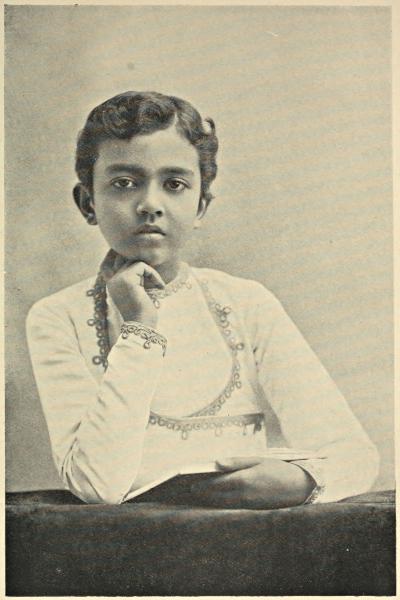
Rajey’s education was at first entrusted to
governesses, but in Lord Lansdowne’s time, when
he was about eleven, we had to settle where he should
go to school. There is a college in Rajputana, founded
by Lord Mayo and known as Mayo College, where
only the Rajput and up-country Princes were educated;
no Bengal Prince had the privilege of going
there, whether the Maharajahs in that part did not
wish it or whether there was any caste prejudice I cannot
say. However, Lord Lansdowne kindly arranged
that Rajey should be sent there, and Colonel William
Lock, the principal, gave my son a cordial welcome.
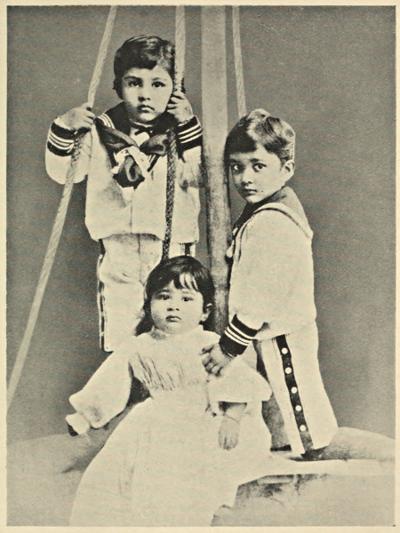
MY THREE YOUNGER SONS.
Jit, Victor, and Hitty.
Mr. B. Ghose was appointed Rajey’s private
tutor. Oh, how I felt that first parting! I knew
that Rajey must be trained for the duties of his
position, yet I dreaded giving him over to others.
As I bade him farewell at the Calcutta railway
station, I was amazed to see how “grown-up” he
had suddenly become. He was self-possessed and
quiet, yet how loving. As I kissed him, trying to
be calm and cheerful, I felt the child was taking his
first real step in life. I see him now, the dear face,
the loving eyes. There was such perfect understanding
between us that a look was sufficient to tell
me of what Rajey was thinking, and it is the mother’s
triumph over death that the love between us still
exists and that he is nearer than ever to me now.
I heard that on the night of his arrival Rajey felt the
cold exceedingly and was quite ill. “Won’t you go to
bed?” asked Mr. Sen, the late Dewan who went with
him. “No … no …,” replied the child firmly, “it
might hurt Colonel Lock’s feelings.” Rajey was so considerate.
He never liked to inflict pain upon any one.
Rajey was very popular at Mayo College. He
studied well, and entered into all kinds of sports with
zest. His hobby was engines and engineering. He
was wonderfully clever in anything connected with
mechanics; he used to say: “When I am grown up,
I will be an engine-driver. I will get Rs.20 pay and
I will give Rs.18 to Hookmi (a favourite servant)
because he is so much older than I, and I will keep
Rs.2 for myself.” He was also very fond of playing
at fighting and building forts. He built one in our
Calcutta Palace garden and another in the Cooch
Behar Palace garden which still exists.
In 1894, Rajey was removed from Mayo College,
and I knew I had to face a longer separation from
my first-born. It was very difficult at the time of
my son’s education to know how the young Kumars
and future rulers of India were to be trained and
where. Some said an English education would not
be good for these boys. Others said everybody
under the British Empire should learn English and
be educated in England if possible, as it fitted them
for work of any sort in life. There was much discussion
on the subject. The Maharajah decided on
education in England, because he had great faith in
the discipline of the great English public schools.
When I heard that it was decided Rajey should
go to England to complete his education, I thought I
would speak about it to the Lieutenant-Governor Sir
Charles Elliott. I opened my heart to him and said
that it was not right to take young Raj-Kumars away
from their country and people. “I believe in
home influence. I do not like the idea of Rajey’s
going such a great distance away from all of us;
and he such a homely boy.”
But Sir Charles Elliott told me: “There is no
college in India like an English public school; it will
do your son good, and you will not regret having
sent him.” I told him: “It will be very hard for
the boy when he returns from England to be content
with the people of Cooch Behar, who are so backward.”
And I also said: “How can you expect the boy to
keep well in the Cooch Behar climate after being out of
it for so many years? It may not agree with him
when he comes back.”
Somehow nobody took much notice of my remarks
and suggestions. But strangely enough when Lord
Curzon was Viceroy I heard remarks made by him
“that the Cooch Behar boys were too English,
and it was hard on them to have been sent away from
Cooch Behar when they were so young.”
It was disappointing that such a remark should
have come from a clever Viceroy like Lord Curzon.
If he had made inquiries he would have found it was
from a Lieutenant-Governor that the advice had come.
I have often thought what a pity it is we have no
Indian Eton, where our boys could be educated without
being cut off from their home life. For our
boys love their homes and can have no home-life in
England. Many Indian mothers have a horror of
an English education and think that ruin is bound to
overtake their children once they set foot in London.
I am of opinion that my people do not require a
Western education. People seem to forget that
thousands of years ago India produced astronomers,
poets, and sages, when most of the European races of
to-day were cave-dwellers. I feel hurt when I
hear or read remarks about the bad taste we are
supposed to display in our rush after English ideas.
Boys who are educated in England do not always get
the chance of seeing the right and bright side of
English Society, and perhaps get married to girls
who are not of their class. I do not blame either the
Indian students or the Government for the troubles
that have arisen, but as a mother I beg of the English
people to go thoroughly into the whole matter before
they judge the students.
Rajey was, I think, the first Maharajah’s son
to receive an English education. “I want my sons
to be brought up just as ordinary boys, not as Indian
Princes,” was my husband’s often-repeated wish,
and I think he imagined that England would do the
best for them. In May, 1894, Rajey and his father left
India and I did not see my son again for nearly four
years. On their arrival in England, the boy was sent
to Mr. Carter’s Preparatory School at Farnborough.
If Rajey was home-sick he did not say so, and I
was happy to know that he made some very nice
friends, amongst them Prince Arthur of Connaught.
The Duke and Duchess were most kind to the little
exile, and often invited him to spend his holidays
with their Royal Highnesses at Bagshot. From there
Rajey wrote: “I have a room to myself, a table of
my own, a penknife, a pen and pencil on the table.”
I shall always be indebted to them for their kindness.
Rajey entered Eton in 1897, and was in Mr.
Durnford’s[1] house. He became very popular with
the boys. An old Etonian told me that my son
possessed the most beautiful character, and that
“no boy was ever more beloved than Rajey.”
From the age of twelve till he was sixteen my son
was separated from me. I think it was most unkind
the way in which the State officials prevented me
from going to England to be with my boy. Every
time the question was raised, they made the excuse
of money difficulties, which I know for certain did
not exist. I beg of all Maharani mothers in India
that, if ever they are confronted with the same
trouble, they will be firm, uphold their own judgment,
and not allow the officials to interfere with their
home-life. It is cruel to part the heirs when they
are so young from their mothers. Now I think it
was perhaps a waste of time to educate a ruler’s
heir in England. The Maharajah did what he and
the Government thought best at the time by sending
our boys to England for a thorough English education,
but afterwards the boys felt their lack of knowledge
of the Indian languages very much. They returned
home knowing Greek and French, but they did not
know Sanscrit or Urdu and found it difficult to
speak freely and fluently in the Cooch Behar language.
I think there should be Sanscrit teachers in England
as well as teachers of Urdu and Bengali; Sanscrit
is the most ancient language, and with a knowledge
of it one can read and learn much that is most helpful.
The heir to a State should have a more general
education than the other sons; he should have some
knowledge of law, engineering, accountancy, and
agriculture, otherwise he cannot improve his State
nor help the officials. The education of a Maharajah’s
younger sons, too, is a difficulty. A Maharajah is
not allowed to buy any lands in British districts.
I do not know what the reason of this is, but I think
I once heard that if the sons of a ruler or his servants
commit any crime they cannot be tried by British
law because of the Maharajah’s own laws, which may
account for it. This comes very hard on the younger
sons; they can never make themselves rich nor independent.
They have to live on their father’s estate
on whatever allowance the heir is pleased to give
them after their father’s death. I do not see why a
Maharajah’s younger sons cannot buy lands in British
districts and be independent.
We lost our dear mother in 1898, and I do not
think she was sorry to go. The time of separation
from my father had been a period of continual sorrow
to her, and Death was a friend who re-united them.
Her beautiful face wore a smile and she looked like
one asleep dreaming of happiness. We could not
wish her back again, although our hearts were aching
at her loss.
After my mother had passed away my unmarried
sisters lived with my brother Saral at Lily Cottage.
Saral said: “Unless my sisters marry I shall remain
single, and I shall not accept any post that will take
me away from them.” Although he was younger
than my third sister he took care of them like a guardian.
He simply lived for his sisters and they one
and all adored him. Eventually he married a Miss
Sen of Rangoon and built a little house in the grounds
of Lily Cottage. This brother of mine nursed my
husband in his last illness, for which I shall ever be
grateful to him.
The question of Girlie’s marriage came up in 1899,
and we realised for the first time what difficulties
might arise over it. No Maharajah except my
husband was a professed Brahmo, and as our rulers
have more than one wife, it was impossible to find a
husband of her own rank for our daughter. But
Mr. Jyotsna Ghosal, of the I.C.S., a member of one of
our best Bengali families and a grandson of Maharshi
Tagore, proposed for her and was accepted.
As Jyotsna is a civilian, he could not get leave
long enough to go to Cooch Behar, so, to the great
disappointment of the State people, the wedding had
to be at Woodlands, our Calcutta house. Invitations
for the wedding were sent to a great number of
English officials and friends, and the ceremony took
place on the 29th November, 1899, in an enormous
tent in the grounds of Woodlands, and three of our
missionaries married the young couple. Girlie wore
a red and gold sari and was literally covered in jewels
from head to foot. She was nearly sixteen, a lovely
young girl with the sweetest disposition; the bridesmaids
wore white and gold, and my husband and
the boys looked splendid in their national costumes.
Jyotsna looked very nice in eau-de-nil Benares
silk, and every one remarked how picturesque Girlie
looked, and what a happy future seemed in store for
her. Cooch Behar was illuminated in honour of
the wedding; prisoners were released; life pensions
were granted, and remissions of revenue. In the
tent there were thousands of seats and hundreds of
our English friends sat there, while on the raised
platforms the bride and bridegroom, the three
missionaries, the Maharajah, and the boys were seated.
Girlie had numerous wedding presents; hundreds
of beautiful saris, English and Indian silver sets
for dinner, tea, and toilet, and lovely jewels from the
Maharajah and friends. After the wedding was over
about eight hundred guests had dinner together, even
the drivers of the carriages each and all had dinner
given to them in an earthenware pot tied up with
muslin, and next day Girlie went to her father-in-law’s
house. The parting was sad, but she was so
young and pretty we all expected her to be happy in
her new home. On the third evening was the flower
ceremony and we sent presents, carried by about
five hundred men. Girlie’s mother-in-law had been
one of the most beautiful girls in India; she is very
clever and is one of the younger daughters of the
Maharshi Tagore and sister to Sir Rabindra Nath
Tagore. Girlie has two sisters-in-law, but Jyotsna is
the only son and adored by his parents. They welcomed
Girlie with great rejoicings and all her new relations
are very proud of her. We knew Jyotsna to be
absolutely trustworthy, and after twenty-two years I
can still say that I could not wish for a better son-in-law.
In 1900 Rajey was at Oxford, and the younger
boys at Eton and Farnborough. All my boys, while
in England, made numerous friends. Had it not
been for the kindness of these friends, I should have
been more unhappy and anxious about my boys being
so far away from their home. Rajey was much
admired, and had he not been so reserved in character
he might have been quite spoiled.
Those who knew them at the Preparatory School
and Eton have been their best friends. I can never
express my gratitude to some of these friends. Long
before I had the pleasure of knowing any of them,
they used to ask my Rajey to go and spend the
holidays with them. Mrs. Nicholas Wood is one of
these friends, she has been kind to all my boys.
Jit once said: “She is my adopted mother.”
Lady Amir Ali, whose husband was a judge out
here, asked Rajey once to come from Eton to lunch
with her in London. Rajey had leave to go, dressed
himself nicely, and came up to town; but when he
arrived in the street, he found he had forgotten the
number. He walked up and down the street several
times, stopped at several houses, but in vain, and had
to return to Eton, disappointed and hungry.
After a short time at Oxford Rajey returned to
India; he was growing up and the Maharajah was
anxious to have his son with him, to help in administrative
work and to take a prominent position in
the State. It was a splendid idea. It would have
brought father and son together in close comradeship
with a common interest, and Rajey could have
assumed a definite position in Cooch Behar. To
my great disappointment, I found that the Viceroy
wished Rajey to join the Cadet Corps. This Cadet
Corps was started by Lord Curzon; no commissions,
no prospects, and no position were attached to it;
it could not even be called the Army. The Maharajahs’
sons lived in some ordinary buildings like a barrack.
One day Rajey, who had been thus forced to join,
was out walking when he passed the General and
the Commanding Officer. Afterwards the C.O.
was much annoyed with him because he had not
made a proper salute to the General. Rajey answered:
“But, sir, I could not make a military salute because
the General was not in uniform.” The C.O. was,
I believe, in a rage, but he was wrong and my son
was right; evidently the C.O. did not know the Army
regulations. Later, Jit and Victor followed Rajey
into this corps.
Most unwise remarks were made by the Dewan
and Superintendent about Rajey learning administrative
work. The Dewan said bluntly that there
was nothing for the Maharaj Kumar to learn. The
Superintendent told me the Viceroy wished Rajey to
devote himself to the Cadet Corps until he was
twenty-six years of age, and then he might return
to the State. I was amazed and could not understand
why the heir should be made to stay away
from his State and parents so long! But the State
people seemed to know more about it. They
thought: “The Maharaj Kumar is too clever to
be with his father, who is surrounded with such
officials as we.” One day a major remarked to me:
“Well, Maharani, you’ve sent Rajey into the Cadet
Corps. What will he learn? Nothing. You might
as well send me.” This outspoken comment was the
opinion of many.
I wonder why no Viceroy of India has ever
given any of our young Princes a place on his staff.
It would appeal tremendously to our people and
prove that the much-discussed English training
meets with its reward. Our Princes mix on terms of
equality with Englishmen at the public schools
and universities. Yet, in their own land, they are
denied positions of honour!
Queen Victoria was loved by the Indians more
than people in England have any idea of, and we
often expressed the belief that our happiness was
due to the reign of a Queen. She was known, and
will ever be known, as the “Good Queen.” Indian
women appreciated the fact that she was a good
wife, a good mother, and a good woman all round.
When the news of her illness came every one spoke
of it with grief. “What shall we do if anything
happens to Queen Victoria?” Although they never
had the honour of seeing their Queen, all Indian
women admired and respected our late Empress,
and I well remember when the news came and the
guns were fired, how all the ladies said: “We have
lost our Mother.” How I wished I had seen her once
more! My dear friend, Miss Minnie Cochrane, told
me that Her Majesty had several times expressed a
wish to see me again, and my great regret is that
I did not have the honour and pleasure of showing
my Victor to his godmother. When I came over in
1902 I went to see her mausoleum at Frognal, and
I wrote a few lines in Bengali, tied them to a wreath,
and presented it. I had brought the children with
me on this visit, and first of all rented Moor Hall,
a country house between Battle and Bexhill; but
the place disagreed with us, and the slow train service
completed our disenchantment. We came up to
town, and in the winter I went to Switzerland with
the girls. We stayed at Territet and Villeneuve.
The latter I thought was pretty, and some of the
old villages were rather like India with their brick
buildings and stone steps; but no scenery in Europe
ever appeals to me like that of my own country.
As the Maharajah was coming over shortly for
King Edward’s Coronation, we returned to London
viâ Paris, and I rented Ditton Park, a lovely place
between Slough and Datchet. The King had given
a house in Lancaster Gate to my husband as his
guest and aide-de-camp. That summer is one of
my happiest recollections. The children were all
growing up. Two of the boys were at Eton, and
the youngest at Farnborough. Rajey was the dearest
companion, and most devoted son that ever gladdened
a mother’s heart. What more had I to wish for?
I remember a wonderful toy railway, lines,
tunnels, hills, and everything in miniature, which
the boys constructed in the park, and I opened this
“Ditton Park Route” with great ceremony. Then
came the mania for cricket, when every one played
most of the day, and a cart conveyed lunch to the
teams. The boys’ friends often came from Eton
without leave on Sundays—luckily they were not
expelled—and revelled in curry teas. It was all
light-hearted merriment and one perpetual romp.
They had to fly back to college; sometimes it got
late and my third brother had to drive them back,
and they always sang: “Good-bye, Sally, I must
leave you.” How happy Jit and Victor were! How
I had struggled to avoid parting with the boys when
they first went to school, but seeing them so happy
with so many nice little friends my heart bowed down
with gratitude that they should be Eton boys. Even
now when they meet their Eton friends they speak
happily of their college days. My poor darling little
Hitty was the one who most wished to stay at
home; not that he was unhappy at school, but he
loved being with me. When he came home for
the week-ends, every time I saw him off in the
train big tears would roll down his cheeks and make
my heart ache till I saw him again. And now he
has gone and left me to weep over those days of my
happy past.
When news came that, owing to the King’s
illness, there would be no Coronation, London wore
a most miserable aspect; I don’t think I have ever
seen anything to equal it. But when our beloved
Monarch rallied and recovered, the sad time of
doubt and danger through which the nation had
passed, was quickly forgotten.
When I was having my hair dressed to attend
the Coronation ceremonies the attendant said to
me: “Perhaps some day the Kaiser will be King
of England.” I asked her why, and she said:
“Because he is the son of the Queen’s eldest child,
and ought to be the heir.” I could not help laughing
at the idea, and said: “England can’t be Germany;
it will always be England.”
I went to the Coronation with Rajey, who had
a very unsuitable seat among the tradespeople,
owing to some regrettable oversight. He looked
beautiful in white with many jewels. My husband
rode in the procession as one of King Edward’s
A.D.C.’s. We were invited to the party at the
Foreign Office, and Rajey was in attendance on the
present King, and wore British uniform. His complexion
was fair, and I remember some of my lady
friends in the gallery did not at first recognise him.
He had recently been appointed to a commission in
the Westminster Dragoons.
I stood between Princess Frederica of Hanover and
Princess Henry of Pless, and people remarked on
the contrast between us, as Princess Frederica had
the loveliest grey hair and Princess Henry of Pless
beautiful fair hair, and my locks were raven black.
I heard that my tiara was voted the prettiest there.
The review held at Buckingham Palace was a
wonderful sight. Three times a message was sent
that I should take a position near Her Majesty. I
hesitated, thinking there must be some mistake.
As we waited on the terrace, the King came up and
shook hands with me, and Queen Alexandra asked
me to follow her to the tent in the grounds. When
we entered I was directed to sit near His Majesty,
and felt most nervous all the time. I was thinking
somebody had made a mistake when they put me
in that seat of honour.
After the presentation of medals to the troops,
His Majesty rose and handed me something, saying
a few words as graciously as he alone knew how to
speak. The “something” was the Coronation Medal,
and as I was the only lady to whom one was given,
I was touched and very much overcome, as I curtsied
and expressed my gratitude. I remember how
amused the Prince of Wales (now our King) was
when the colour came off the red-covered boxes of
Coronation Medals which he was giving away. At
the finish his white gloves were stained vivid crimson,
and he and the Grand Duke of Hesse regarded the
effect of the faulty dye as a huge joke.
The Court was gorgeous. I had a handsome
dress made by a French milliner for the occasion.
The heavy gold embroidery was unique; it was very
like the Delhi embroidery and was much admired.
I believe I looked rather nice, as an old friend said:
“The Maharani looked her best.” The Princess
of Wales, our present Queen, liked the dress very
much, and thought it was a piece of Indian work.
Both Their Majesties spoke graciously to me when
I made my deep curtsies. A message was sent
from Lady Lansdowne, who was next the King,
that Their Majesties wished me to stand in the front
line so that I might have a good view of the ladies
passing. I was most grateful and impressed by the
kind thought of Their Majesties. I often wondered how
their royal minds remembered so many little things.
At the grand State Ball after King Edward’s
Coronation one of the ladies, very handsomely dressed,
had forgotten to fasten her waistband; I felt most
uncomfortable seeing this, and longed to tell her
but did not like to. Her appearance was magnificent,
but to my mind quite spoiled by the two strips of
ribbon with hooks hanging down.
We lunched with Their Royal Highnesses, the
Connaughts. It was one of the most enjoyable
parties to which I have been asked.
I went to a party at Lady Warwick’s and stayed
the night, and I found her as clever as she is handsome
and a most charming hostess.
We went to one review, at which we had seats
somewhere right away. I was touched when some of
the Princes saluted me in the distance. It pleased my
Rajey. I also went to the Duke of Westminster’s dance.
Shortly after, a polo team was to go from England
to Trouville. My husband could not get away from
his duties as the King’s A.D.C. and Rajey was to
play for his father in the team. I am not usually
superstitious, but I had misgivings about this journey.
The morning Rajey was leaving for Trouville it was
cold and foggy. When he came to say good-bye I
told him that perhaps the crossing would be very
rough and unsafe. He only laughed. Within a
short time after he had started I heard his voice on
the stairs, and he came in and said: “Mother, I
just missed the train.” Then I exclaimed: “Oh,
darling, don’t go; your missing the train shows you
are not to go to-day.” But he would not listen to
this. He started by a later train. And that day’s
dark fog brought him ill luck and from that trip his
health was never the same.
One day, when I was walking in the garden at
Ditton, I received a telegram from a friend who was
at Trouville that Rajey was “getting better.” Why!
I did not even know that Rajey was ill. What did
the telegram mean? Then my husband broke the
alarming news that my son had had a dreadful fall
at polo, but luckily the pony stood still and he had
escaped worse injury.
I shall always be grateful to our kind friends, the
Hays, for all they did for my Rajey while he was at
Trouville.
The French doctors’ treatment has always been
incomprehensible to me. For days during Rajey’s
period of unconsciousness they kept him on nothing
but champagne. When he was able to be moved,
my son was brought to London, and the specialists
whom we consulted gave their opinion that he had
not sustained any injury to his head, but my husband
was not satisfied and felt something was wrong.
We went to Lowther Castle to stay with Lord and
Lady Lonsdale. It is a fine castle with very pretty
gardens. I admired the rock gardens. One thing
I saw there which I shall never forget and I am
grateful to Lord Lonsdale for having shown it to me,
and that is the blue lotus. It blooms in the evening
and closes in the day. It is an extraordinary thing
that in the Hindu mythology it is written that when
Ram Chandra went to Ceylon he worshipped his
goddess with the blue lotus, and since then it has
never been seen or heard of in India. When I told
my people in India that I had seen the blue lotus
they were so interested and begged me to try and
bring it to them. Lord Lonsdale said he got it from
America, and promised to send me a plant, but it
has not yet come. Rajey, who was with us, was too
ill to enjoy the visit, and our friends declared that his
proper place was a darkened room and a rest cure.
After a stay of a few weeks I had to return to
India for the arrival of my first grandchild, and to
make preparations to take part in the great Durbar
at Delhi. When I arrived in Calcutta I found
Girlie suffering from a very high fever; Woodlands
looked like a nursing home; nurses and doctors
were everywhere, and it was a depressing atmosphere.
I watched my child, and instead of getting better she
grew worse. One day, I do not know what made
me think of it, but I suddenly determined to take
my child away to the hills. It was very cold, and
the doctors were horrified at my suggestion, but I
took Girlie, first to Kurseong, which is not so high, and
afterwards to Darjeeling, which was quite deserted,
and I am thankful to say within a few days she got
better.
I now began to think about the Durbar. I heard
that all the Maharanis present were to be in purdah,
and I decided to follow their example, but my husband
told me, unless I was given my rightful position by
his side, he would not take me.
Rajey, who was seriously injured internally, had
such a wonderful constitution that he looked neither
ill nor sad, although he was in the hot sun for hours
at the Durbar. It was a magnificent sight, and I
shall never forget the display of jewels worn by our
Princes. There were emeralds of a wonderful deep
green, priceless pearls, rubies like blood, and diamonds
dazzling in their brightness; in fact there were
jewels everywhere, even the elephants were decorated
with them. I saw a Maharajah whose gold fan was
fringed with beautiful pearls. I shall never forget
the elephant procession; it would have been a
perfectly joyful occasion but for a misfortune.
Mrs. H. M⸺ was staying with me in our camp
at the time, and as I had not received a card
the Maharajah did not wish me to go. Mrs.
M⸺, on hearing this, said she would make it all
right for me, she was certain to be able to get a card
from Sir H. Barnes, who was an old friend of hers, and
I must go. When the morning came, however,
there was still no card and I said I would not go,
but Mrs. M⸺ pressed me hard; she was bent
upon my going, and against the Maharajah’s wishes
I set out with her. The result was that in the end
we made quite a sensation among the crowd. My
coachman was directed by Mrs. M⸺, and we
drove on and on and turned from one road to another
and often drove back, as after a time on certain
roads no carriage was allowed to pass. Mrs. M⸺
stopped the carriage dozens of times to ask the
mounted policemen where Sir H. Barnes was, but
no one gave her satisfactory answers; we went past
the same places over and over again. Many of my
friends, relations, and acquaintances saw me and
wondered what had happened. It got late and the
policemen said we must alight as carriages were no
longer allowed to be there. Several times I told
Mrs. M⸺ I wished to return to camp, but she
would not hear of it. We went near the Masjid—the
place where English ladies gathered to see the procession.
Mrs. M⸺ wanted me to wait till she
found Sir H. Barnes. The sun was hot, and I felt
frightfully insulted and hurt. Some people who
were there asked me to go up the steps, which I did.
When I got inside I tried to smile, but I felt more
like crying. I met some of the Viceroy’s A.D.C.s
and told them that I had gone there without a card
and felt nervous. Instead of offering me a chair or
saying something to ease my mind they walked away.
Thus that most enjoyable sight, the elephant procession,
is stamped on my mind as “a sad experience.”
Lady Curzon looked very handsome in her
splendid dress. The cheers with which Their Royal
Highnesses the Duke and Duchess of Connaught
were greeted can never be forgotten. Lord Curzon
made a grand speech, really I felt that I could scarcely
tire of listening to him, he is such an eloquent speaker.
In 1904 Rajey was taken ill. Our own doctor
diagnosed the complaint as remittant malaria, a
complaint of which I had not heard. He became
rapidly worse, and in despair I wrote to my husband,
who was in Darjeeling, and told him that I thought
Rajey ought to have the best advice in Calcutta.
When consulted, the Calcutta physicians declared
that the opinion of a London specialist was necessary,
as Rajey’s heart was affected. He was ordered to
England at once, but needless to say he was not
allowed to go until he had received leave from the
Cadet Corps. It was monsoon time and my poor
boy went alone. Afterwards I found out to my
intense annoyance that our Superintendent had
written privately to the Calcutta doctors, asking if
the Maharaj-Kumar were actually ill, or merely gone
to England to enjoy himself. The doctors were
furious at this, and did not mind telling the Superintendent
so. One of them said: “Does he think I’m
open to a bribe?” This trivial incident shows
what used to happen when our personal affairs were
in question, but I am happy to say this state of things
is gradually being changed. My darling son was
not allowed to go in search of health without being
exposed to the insult of suspicion, and mud thrown
in this manner sticks. It is impossible not to feel
some bitterness over the many cruel rumours which are
entirely without foundation. Let a ruler or prince
have but the slightest failing, it is instantly magnified
fourfold and discussed unmercifully, without a single
attempt to counterbalance it by any remembrance
of the victim’s better qualities.
I have been obliged to sit and listen to falsehoods
about princes who were our friends which almost
took my breath away, as I realised their cruelty and
injustice. I remember one Maharajah in particular
who was a very kind man, very “English” and
very sporting. He knew us well, and I remember
my husband telling me how this Maharajah once
saved the honour of an officer. The latter had had
a bad day at the races and was thousands of rupees
in debt. He was a hard-up, smart Army man, and
could not lay his hand on such an amount. What
was he to do? The honour of a British officer was
at stake. Suddenly he remembered the Prince and
sent a despairing message telling him of his plight.
The kind Prince paid the debt of honour without a
moment’s hesitation. When the Prince died later
people spoke of him most unkindly and hailed his
death as the best thing that could have happened
to him.
I always think of that poor Prince in connection
with a certain old Sudan legend:
A little village far away in the jungle was smitten
with cholera, and the panic-stricken people wanted
to put the great stone image of their god into the
Ganges until the plague was over. One of the
villagers dreamt that the god appeared and told him
that his image could only be moved by a man who was
pure in heart and loved God. The villager related
his dream to the priests, and orders were issued that
the people should assemble on the morrow and try
to find a man who could carry out the instructions
of the god. All tried, the so-called best men, the holy,
the strongest, the bravest. But to no avail! The
stone image smiled its inscrutable smile in the scented
gloom of the temple, and the priests were in despair.
At last a thick voice broke the stillness, and the
villagers saw a man, whom they all knew to be a
hopeless drunkard, come reeling unsteadily into the
sacred precincts of the temple. “What’s all this
I hear about the dream?” he demanded, propping
himself up against a worshipper’s unwilling shoulder.
“I tell you it is quite true. The great god knows
who loves him and who loves him not. There’s
none here who loves him better than I do. So
mine shall be the hands to give him to the care of
Mother Ganges.” He swayed towards the huge
image as he spoke, and the horrified crowd thought
that some dreadful punishment would fall upon him
for such sacrilege.
The drunkard approached slowly; for an instant
he pressed his drink-swollen face against the marigold-wreathed
breast of the image; then clasping it in his
arms, he lifted the idol from its recess as if it were
light as a feather, and carried it forth to the bank
of the river.
The awe-stricken throng were speechless with
amazement that a poor drunkard should be chosen
to show them how, under the cloak of failings and
frailties, there existed a heart which remained pure,
and wherein was to be found “the invisible kingdom
of God,” which is all truth and all love.