Footnotes have been collected at the end of the text, and are
linked for ease of reference.
Minor errors, attributable to the printer, have been corrected. Please
see the transcriber’s note at the end of this text
for details regarding the handling of any textual issues encountered
during its preparation.
Any corrections are indicated using an underline
highlight. Placing the cursor over the correction will produce the
original text in a small popup.
Any corrections are indicated as hyperlinks, which will navigate the
reader to the corresponding entry in the corrections table in the
note at the end of the text.
LONDON
PRINTED BY SPOTTISWOODE AND CO.
NEW-STREET SQUARE
I
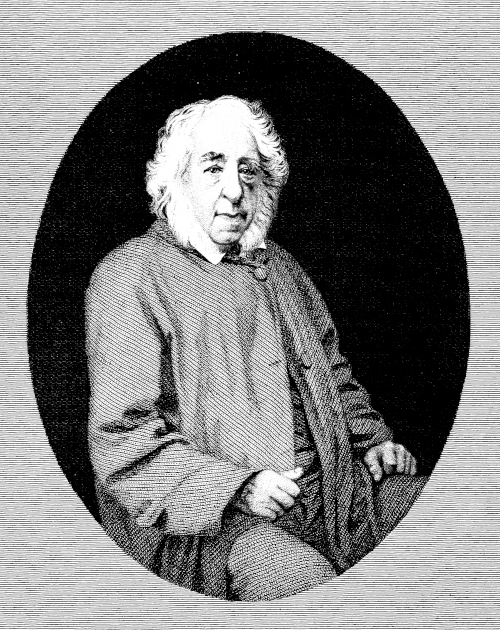
From a Photo: Joseph Brown.
THOMAS, TENTH EARL OF DUNDONALD, G.C.B.
Admiral of the Red, Rear Admiral of the Fleet &c.
London. Richard Bentley 1861.
IITHE
AUTOBIOGRAPHY OF A SEAMAN.
BY
THOMAS, TENTH EARL OF DUNDONALD, G.C.B.
ADMIRAL OF THE RED, REAR-ADMIRAL OF THE FLEET,
ETC. ETC.
VOLUME THE FIRST.
Second Edition.
LONDON:
RICHARD BENTLEY, NEW BURLINGTON STREET,
Publisher in Ordinary to Her Majesty.
1861.
The right of translation is reserved.
IIITO
THE ELECTORS OF WESTMINSTER,
BY WHOSE GENEROUS SUPPORT, NEARLY HALF A CENTURY AGO,
I WAS RESCUED FROM DESPAIR,
THE RESULT OF UNMERITED INJURIES INFLICTED
BY HOSTILE POLITICAL FACTION
IN RETALIATION FOR
MY ADVOCACY OF NAVAL AND ADMINISTRATIVE REFORMS;
AND TO WHOSE HONOUR BE IT RECORDED
THAT IN NO INSTANCE
DURING OUR LONG POLITICAL CONNEXION
DID ANY OF THEIR BODY EVER ASK ME
TO PROCURE FOR HIM PLACE, BENEFIT, OR EMOLUMENT,
This Volume is Inscribed
BY THEIR FAITHFUL SERVANT,
DUNDONALD.
PREFACE.
vii
The present Volume narrates my services in the
British Navy, from my entrance into it, and including
the action in Aix Roads, on the 11th, 12th, and 13th
of April, 1809. The result of that action, viz., the
court-martial on Lord Gambier—virtually a prosecution
of myself; my non-employment thenceforward
in the navy; the unscrupulous plot by which
I was driven from that noble service; my restoration
to rank by his late Majesty William IV., and to the
honours which had accompanied that rank by my present
most gracious Sovereign Queen Victoria; form
subjects, which, together with many others, will be
concisely set forth in the succeeding portion of this
Work.
To one of these points I shall, however, here
briefly allude,—my restoration to the naval service;
not for the purpose of pre-judging the subject, but
viiiwith the intention of embracing the first opportunity
which has been afforded me, of paying a tribute of
thanks to those who, convinced of the injustice of the
sentence, were mainly instrumental in procuring its
reversal.
Amongst these I am proud to rank one, the soundness
of whose judgment, and the disinterestedness of
whose patriotism, have throughout a long life never
failed to secure the highest respect amongst men of
every shade of political party—the Marquis of
Lansdowne; who, from the commencement of my
unmerited troubles, has to this day manifested the
most generous confidence in my honour, and has as
generously supported my cause when my character
has been called in question. If proof were wanted
of my entire innocence of the accusation laid to my
charge forty-five years ago, no prouder testimony of
incapability to have committed the imputed offence
could be adduced than the unabated friendship of
the Marquis of Lansdowne; simply because no man
with a stain on his character could have retained
any place in that illustrious nobleman’s consideration.
To another nobleman, whose name will descend
to the remotest posterity as the promoter of everything
rationally liberal in politics, and the untiring
advocate of measures calculated to promote social
advancement, my warmest thanks are no less due.
ixFirst my counsel, and for half a century my friend,—to
the long-continued esteem of Lord Brougham,
I owe no small portion of that consolation which for
so many years formed my only support under a
weight of persecution enough to have bowed any man,
not so supported, to the earth; into which, had it not
been for the disinterested countenance thus afforded
by men above reproach I must have prematurelyprematurely
sunk.
One testimony of my venerated friend I may be
allowed to adduce[1]:—
“I must be distinctly understood to deny the accuracy of
the opinion which Lord Ellenborough appears to have formed
in Lord Cochrane’s case, and deeply to lament the verdict of
Guilty, which the jury returned after three hours’ consulting
and hesitation.
“Our own complaint was his Lordship’s refusal to adjourn
after the prosecutor’s case closed, and his requiring us to
enter upon our defence at so late an hour—past nine o’clock—so
that the adjournment took place at midnight and before we
had called our witnesses. I speak of the trial at Guildhall
only. Lord Ellenborough was equally to blame with his
brethren in the Court of King’s Bench for that most cruel and
unjustifiable sentence which at once secured Lord Cochrane’s
re-election for Westminster.
x“In 1833 the Government of which I was a member
restored this great warrior to his rank of admiral in our
navy. The country, therefore, in the event of hostilities,
would now have the inestimable benefit of his services, whom
none perhaps ever equalled in heroic courage, and whose
fertility of resources, military as well as naval, places him high
among the very first of commanders. That his honours of
knighthood, so gloriously won, should still be withholden, is
a stain, not upon him, but upon the councils of his country;
and after his restoration to the service, it is as inconsistent
and incomprehensible as it is cruel and unjust.”[2]
To many others, high in public estimation and in
the councils of their Sovereign, I have been equally
indebted for countenance and support, but as it has
been my lot to outlive them, they are beyond the
reach of thanks. Amongst these may be mentioned
the late Duke of Hamilton, the Earl of Auckland,
Sir Francis Burdett,—my late warm-hearted friend
and colleague; Mr. Whitbread, Mr. Hume, and others
whose names have escaped my memory rather than
my gratitude.
Last, though foremost in estimation, is another
friend, found where man will seldom look for a
xifriend in vain,—at home; the Countess of Dundonald,
my wife. Knowing the opinion of her Sovereign
with regard to the persecution which had entailed
on me so many years of misery, and equally well
aware that in the first years of his Majesty’s reign
the non-reversal of that unjust sentence was owing
to the influence of some in his Majesty’s councils,
whose political animosity sixteen years before had
no small share in its infliction,—that ardent and
heroic lady determined to penetrate to the foot of
the throne, and learn from the lips of the Sovereign
himself whether it was consistent with the dignity
of his crown, that its attribute of mercy should be
the sport of an almost extinct political faction.
The step was a bold one; but the ardour which
had conceived it to be necessary lacked not the energy
to carry out its resolve. In spite of the coolness of
some about the court, and the positive rudeness of
others whose names it is not worth while to resuscitate,
this devoted lady gained an interview with
her Sovereign, and with the greatest respect besought
His Majesty not to permit the benevolence of his disposition,
and his own belief in the innocence of her
unjustly maligned husband, to be thwarted by those
whose office it was to advise, but not to control, his
better judgment.
His Majesty graciously listened, and his reply was
xiikingly, that “he would no longer allow the reparation
which was her husband’s due, to be withheld.”
A change of Ministry shortly afterwards followed,
and, as already quoted in an extract from the
writings of Lord Brougham, my restoration to rank
rewarded the heroic efforts of my devoted wife.
Nevertheless, a leaven of former political malice
remained, sufficiently powerful to prevent my restoration
to the honours with which a previous Sovereign
had invested me, but of which I had been
despoiled with every mark of degradation which
political animosity could invent.[3]
This gracious act of restoring my honours
was reserved for Her present Majesty, who with
the delicacy which is one of Her Majesty’s
noblest characteristics, gave back the boon of
which I had for so many years been wrongfully
deprived; and subsequently conferred upon me, at
the age of seventy-three, my first command of a
British fleet. For both marks of Her Majesty’s kindness
and appreciation of my former services, I am
deeply grateful. But alas! reparation came too late
to compensate for the early hopes and just expectations
xiiiof a life forcibly wasted as regarded myself or
my country.
The moral—to use an old-fashioned phrase—of
my chequered career, is this:—That they who, in
political matters, propose to themselves a strict and
rigid adherence to the truth of their convictions,
irrespective of personal consequences, must expect
obloquy rather than reward; and that they who
obstinately pursue their professional duty in the face
of routine and official prejudice, may think themselves
lucky if they escape persecution. Such a
moral may be derogatory in a national point of view,
but it is the result of my own bitter experience:
notwithstanding which, were my life to begin anew,
I would pursue the same unflinching course with
regard to naval abuses, of following out my own
convictions,—a course which would produce the same
result to myself, the consolation of my own rectitude,
even though I might be deprived of all other reward.
Still all is not dark. I have survived malignity,
and its chief cause, viz. the enmity arising from my
zealous advocacy of departmental and political
reform. The latter has been achieved to a greater
extent than the early political reformers, amongst
whose ranks I was enrolled, ever dreamed of; and
even departmental reform has become fashionable,
though it may not have advanced far beyond that point.
xivIn one respect I will boldly assert that this narrative
of my life is worthy of example. It will show
the young officer that, in spite of obstacles, warm
attachment and untiring devotion to my noble profession
enabled me to render some services to my
country upon which I may be allowed to reflect with
satisfaction, even though this be accompanied with
bitter reflection as to what the all-powerful enmity
of my political opponents cruelly deprived me of
further opportunity to accomplish.
In conclusion, I must express my thanks to Mr.
Earp, whose zeal has exhumed from documents
almost, in my own estimation, beyond comprehension
or arrangement[4], the mass of facts condensed within
the compass of this volume.
In the succeeding portion of this work, should God
spare me to see its completion, I trust to render
additional service, by an attempt to deduce from past
xvnaval experience the best means of preserving unimpaired
our future maritime efficiency. Should
the attempt be the means of awakening national
attention, the gratification will be mine of having
left no unworthy legacy to my country.
DUNDONALD.
December 14, 1859.
CONTENTS OF THE FIRST VOLUME.
xvii
INTRODUCTORY.
SOME ACCOUNT OF THE DUNDONALD FAMILY.
CHAPTER I.
MY BOYHOOD, AND ENTRANCE INTO THE NAVY.
Younger Branch succeeds to Earldom.—Alienation of Family Estates.—My Father’s scientific Pursuits.—His ruinous manufacturing Projects.—A neglected Discovery.—Communicated to James Watt.—Lord Dundonald’s Agricultural Works still held in Estimation.—Early Reminiscences.—My first Visit to London.—My Father destines me for the Army.—A Commission procured.—My Aversion to the Military Profession.—Our Return to Scotland.—I am permitted to enter the Navy
A Lieutenant of the Old School.—His Ideas on Sea-chests.—Dockyards sixty Years ago.—Prize-money, the leading Motive of Seamen.—Voyage to Norway.—Norwegian Customs.—A Midshipman’s Grievances.—A Parrot turned Boatswain.—Ineffective Armaments.—Men before Dockyards.—Training of Officers
Voyage in the Thetis.—Icebergs.—I am made Acting Lieutenant.—I am ordered to join the Thetis.—Pass Examination for Lieutenant.—Captain Cochrane’s Capture of French Store-ships.—My Appointment to the Resolution.—Admiral winters in the Chesapeake.—An undignified Encounter.—A Dinner ashore.—Harsh Treatment of the Americans.—Their Complaints.—Return of the Thetis to England
I join Lord Keith’s Ship.—An unpleasant Altercation, ending in a Court-Martial.—The Blockade of Cadiz.—French Fleet in the Offing.—Pursued by Lord Keith.—Enemy’s Vessels burnt at Toulon.—Lord Keith recalled by Lord St. Vincent.—Lord St. Vincent resigns the Command.—Lord Keith pursues the French Fleet to Brest, and from thence to the Mediterranean.—State of the French Marine.—Lord Keith appoints me to the Généreux.—Burning of the Queen Charlotte.—Action with Privateers off Cabritta Point.—Recommended for Promotion
My Appointment to the Speedy.—My first Prize.—Capitulation of Genoa.—More Captures.—Join Lord Keith at Leghorn.—Cruise on the Spanish Coast.—Nearly caught by a Spanish Frigate.—How she was evaded.—Our Cruise renewed.—We proceed to Malta.—Foolish Fracas in a Ball-room.—A Duel.—Capture of a French Store-ship.—Chased by another Spanish Frigate.—Cruise off Barcelona.—An Attempt to entrap us.—Attack on the El Gamo Frigate.—Carried by Boarding.—Trifling Loss of the Speedy.—A Device practised during the Action.—We proceed with our Prize to Mahon.—Postponement of my Post Rank.—Official Despatch
The Speedy sent to Algiers.—Interview with the Dey.—Speedy returns to Minorca.—Attack on Oropesa.—Enemy’s Vessels destroyed.—Letter of Thanks from Lord Keith.—Speedy sent in Convoy of a Packet.—Captured by three French line-of-battle Ships, and taken to Algesiras.—Attack by Sir J. Saumarez’s Squadron.—Loss of the Hannibal.—Capture of Dockyard Artificers.—Gallantry of Captain Keats
Letter from Sir Alexander Cochrane.—Second Letter from Sir Alexander.—Both written unknown to me.—Reluctance of Lord St. Vincent to promote me.—Letter from my Father to Lord St. Vincent, urging my right to Promotion.—Lord St. Vincent’s Reply.—Its Fallacy.—His Lordship’s Reasoning a Subterfuge.—Promotion of my First Lieutenant refused.—My imprudent Remark to Lord St. Vincent, who becomes my Enemy.—Further Effort to promote Lieutenant Parker.—Admiralty Refusal also.—Lieutenant Parker’s eventual Promotion, and subsequent shameful Treatment
Political Favouritism.—Refusal of further Employment.—Naval Corruption.—Dockyard Practices.—Shameful Treatment of Prisoners of War.—Economy the Remedy.—Results of Medical Economy.—Empty Physic Bottles.—Seamen’s Aversion to the Service.—A Post Captain at College
Appointment to the Arab.—Projected Invasion by Napoleon.—The Arab ordered to watch the French Coast.—Then to cruise in the North Sea.—Retirement of Lord St. Vincent
Orders of the Pallas embargoed.—Capture of the Carolina.—Arrival of the Prizes.—Capture of Papal Bulls.—A Chase.—Admiral Young.—Election for Honiton.—Novel Election Tactics.—Become a Reformer.—Painful Results
Services in the Pallas.—The Pallas at Halifax.—Clamour of Shipowners.—Sail from the Downs.—Capture a Vessel.—The Pomone sent to England.—Capture of the Tapageuse.—The French run ashore.—Chase of the Corvettes.—Off Chasseron.—Cold Approval of Lord St. Vincent.—Cruise of the Pallas.—Sight the French Squadron.—French Signal Houses.—The Isle of Aix.—Engage the French Squadron.—Joined by the Kingfisher.—Details of the Action.—Construction of Kites
My Entrance into Parliament.—Enthusiastic Reception.—Seek Promotion for Haswell.—Cutting out Le Cæsar.—Gross Instance of Partiality.—Claret against Small Beer.—Story of Mr. Croker.—Mr. Croker’s Revenge.—Command the Impérieuse.—Drift towards Ushant.—Join the Squadron in the Basque Roads.—Anchor off Cordovan.—Supply the Atalante
Dissolution of Parliament.—Westminster Election.—Reply to Mr. Sheridan.—I am elected.—Virulent Recriminations.—Opening of the House.—Move for an Account of Sinecures.—Opposition to the Motion.—Mr. Perceval’s Proposition.—My Motion evaded.—Naval Abuses.—Details of Abuses.—Naval Hospitals.—Speech in the Commons.—Join Lord Collingwood’s fleet.
Cruise of the Impérieuse.—Engagement with the King George.—Off Toulon.—Fall in with Thirteen Merchantmen.—Am recalled by Lord Collingwood.—Russian Declaration of War.—Capture a Vessel from Corfu.—Run into Valencia.—Clear for Action.—Death of Lieut. Caulfield.—Chase round Cape Negretti.—Blow up a Tower at Minorca.—Capture of Spanish Wine.—Fall in with the Leonidas.—Capture a Xebec.—Chase three Ships.—Capture a Xebec.—Cape Palos.—Gale at Sea.—Joseph proclaimed King of Spain.—Spain declares War against France
Assist the Spaniards.—Off Barcelona.—Spanish Kindness.—The French in Mataro.—Cruise on the Spanish Coast.—Embark the Enemies' Guns.—Give the Spaniards a Lesson.—Siege of Gerona.—Contest at Mongat.—Irritation of the Spaniards.—Excesses of the French.—Spirit of the Catalans.—Anchor off San Felin.—Guerilla Troops.—Fortress of Figueras.—Chase two Vessels.—Anchor in Gulf Dumet.—Destroy a Signal Station.—Storming a Battery.—The Tables turned.
The French Fleet.—The Mole of Ciotat.—The Gulf of Foz.—Take Possession of the Battery.—Silence other Batteries.—Anchor off Cette.—Despatch the Prizes.—How we obtained Fresh Water.—Demolish a Telegraph.—Frigates to leeward.—Ordered to Gibraltar.—Ingratitude of Government.—Letter of Lord Collingwood.—Letter of Lord Cochrane
xxiiCapture a Settee.—Get under Sail.—Fight between the Patriots and French.—Make sail for Rosas.—Fort Trinidad.—Gallantry of Captain West.—Bravery of the Catalans.—Repulse of the French.—Attack of the Impérieuse.—The French redouble their Efforts.—Occupation of Catalonia.—The Castle of Trinidad.—Nature of our Position.—Nature of our Operations.—Manufacture of a Man-trap.—Lose my Nose.—The French assault Rosas.—Practice of the French.—Presentiment.—The French Attack.—The Attack repulsed.—Bravery of a French Soldier.—Heavy Gale of Wind.—Unfortunate Accident.—Evacuate the Fortress.—Stand towards Scalla.—Letter from Lord Collingwood.—Despatch to Lord Collingwood.—Letter to the Admiralty.—Testimony of the Spaniards.—Sir Walter Scott.—Official Gratitude.
Defeat of the Spaniards.—Attack some French Vessels.—French Operations.—Letter of Lord Cochrane.—Lord Collingwood.—Operations of the Enemy.—Fall in with the Cyrene.—Sail for Minorca.—Apply for leave.—Motives for leaving.—Apathy of the Government.—Reproached for Service.—Neglect of the Admiralty
Undertaking against Rochefort.—Hopes excited.—Present myself at the Admiralty.—Am consulted by Lord Mulgrave.—Lord Gardner’s Statement.—Anxiety of Government.—My Plan of Action.—Decline the Command.—The Command pressed upon me.—Return to the Impérieuse.—Preparations for Attack.—Lord Gambier obtains the Laurels, but dissuades the Attack.—The Isle d’Aix.—Lord Gambier’s Statement
Sail for the Basque Roads.—My awkward Position.—Ill-humour of the Fleet.—Admiral Harvey.—Imprudence of Admiral Harvey.—Complains of Lord Gambier.—Inaccurate Soundings.—Lord Gambier’s Tracts.—Cobbett’s Comments on the Tracts.—Dissensions in the Fleet.—Letter to Lord Mulgrave.—My Principles of Warfare.—Night-work.—My Principles of Action.—The Isle d’Aix.—Explosion-vessels.
Press for an Attack.—Results of Delay.—The French Preparations.—French Admiral’s Account.—Insult to the English Fleet.—State of Preparations.—Start for the Attack.—The Attack.—The Explosion.—Failure of the Attack.—Terror of the French.—The French aground.—Apathy of Lord Gambier.—The Aix Roads.—The French Fleet permitted to escape.—Drift towards the Enemy.—Attack the French Fleet.—The Calcutta strikes.—The Attack.—Failure of Fireships.—Singular Incident.—Signal of Recall.—Captain Seymour.—Lord Gambier’s Evasiveness.—Am recalled.—Remonstrate with Lord Gambier.—Am sent Home.—Lord Gambier’s Despatch.—The French Despatch.—Destruction of the Boom.—The Mediator
Intended Vote of Thanks to Lord Gambier.—Resolve to oppose it.—Interview with Lord Mulgrave.—Lord Gambier demands a Court-Martial.—He is directed to make a fresh Report of the Action in Basque Roads.—Injustice of this second Despatch.—Attempt to entrap me into the Position of Prosecutor.—Composition and Proceedings of the Court-Martial.—The Admiral’s Point of Justification.—Disposed of by Captain Broughton’s Evidence, and by that of Captains Malcolm, Newcombe, and Seymour.—Sir Harry Neale’s Evidence stopped by Admiral Young
Its Omissions and Suppressions.—Motive for Lord Gambier’s Mis-statements.—Mr. Fairfax reports that the Mediator went in fifth, not first.—Reason of the contrary Assertion.—Napoleon attributes the Escape of his Fleet to the Imbecility of Lord Gambier.—Mismanagement of the Fireships.—Lord Gambier’s Delay and Misdirection.—His Perversion of Fact.—His misplaced Praise.—The Despatch fails to satisfy the Public.—Criticised by the Press.—Admiral Gravière’s Account of the Termination of the Action
INTRODUCTORY. SOME ACCOUNT OF THE DUNDONALD FAMILY.
Tradition has assigned to the Cochranes a derivation
from one of the Scandinavian sea-rovers, who, in a
remote age, settled on the lands of Renfrew and Ayr.
There is reason to believe the tradition well founded;
but to trace its authenticity would be foreign to the
purpose of the present work.
In later times, incidents of historic interest connected
with the family, justify allusion, as forming contributions
not only to the national annals of Scotland, but to
those of England also. The earliest authentic record
of our house is contained in the subjoined extract from
Crawfurd’s “Peerage of Scotland.”
“This family, which originally took its surname from the
Barony of Cochran, in Renfrewshire[5], is of great antiquity;
2and though none of the family arrived to the dignity of
peerage till the reign of King Charles I., yet it is undeniable
that they were barons of special account for many ages
before, and endowed with large possessions in these parts
and elsewhere.
“The first of whom I have found upon record is Waldenus
de Coveran, i.e. Cochran, who, in 1262, is witness to the
grant whichwhich Dungal, the son of Suayn, made to Walter
Stewart Earl of Monteith of sundry lands in the county of
Argyle, which came in aftertimes to be transmitted to
Forrester of Carden. Another William de Coveran is
mentioned by Pryn, as a person of account in this county,
who makes his submission to King Edward I. Anno Dom.
1296, in the Ragman Roll; also John de Coveran is witness
in the regular election of James, Abbot of Paisley, 17th of
David II. Anno 1346.
“The next remarkable person of the family is Gosiline de
Cochran, who flourished under King David Bruce; he is
witness to several grants made by Robert II. when Earl of
Strathern, to the religious of Paisley, an abbacy he assumed
into his particular patronage, wherein his ancestors’ donations
being made to the glory of God are particularly narrated.
He left issue, William de Cochran, of that Ilk, his son, who
obtained from King Robert II. a charter of the lands of
Cochran, to be held in as ample a manner as any of his progenitors
held the same of the Lord High Steward of Scotland,
dated on the 22nd of September 1389. As he stood in
special favour with this king, so was he in no less with
Robert III. his son, to whom it seems he had been serviceable;
for when he came to the crown he had so grateful a
sense thereof, that in the second year of his reign, Anno 1392,
he made him a grant of forty shillings sterling in annuity,
arising out of the profits of the Burgh of Rutherglen. He
3was succeeded by Robert his son who, in 1456, resigned his
estates in favour of Allan his son.”
This surrender of his estate appears to have been made
for no other purpose than to devote himself to the study
and practice of architecture, in which, as an art, Scotland
was, at that time, behind other nations. In the
exercise of his self-imposed profession, Robert Cochran
is said to have displayed great skill in the erection of
several edifices[6], and when, by the favour of the King
James III. he afterwards rose to power, his architectural
eminence procured for him, amongst the host of enemies
created by his elevation, the contemptuous appellation
of the “mason chiel.”
It was not, however, his architectural skill alone which
gave him a place in his sovereign’s estimation, but his
good broadsword and powerful arm, the efficacy of
which having been displayed in a combat in the king’s
presence[7] attracted his Majesty’s attention; so much so,
that the king, finding him to be of good family, and
possessed of great talent, placed him near his person;
4the result being that in a brief space of time he became
his chief adviser, and the great opponent of the Scottish
nobility, who sought to hold the king in their power.
In short, Robert Cochran appears to have become to
James something like what Wolsey subsequently was
to Henry VIII. not in power only, but also in ostentation.
In the latter respect, Lindsay says of him, that
“even his pavilions were of silk, and the fastening
chains thereof richly gilt.” Pinkerton says he “became
the fountain of royal favour, and was elevated to a giddy
and invidious height of power—this being the earldom
of Mar.”[8]
This advancement to the earldom of Mar, says
Buchanan, “was the chief source of the hatred of the
nobility, who were disgusted with James, partly by
5reason of his familiarity with that rascally sort of
people, but chiefly because he slighted the nobility, and
chose mean persons to be his counsellors and advisers,
the chief of these being Thomas Preston, one of a good
family, and Robert Cochran, a man endued with great
strength of body and equal audacity of mind.”
In classing Thomas Preston and Robert Cochran
amongst “that rascally sort of people,” Buchanan contradicts
himself, for he admits that Preston was of
good family, and he must have known that Cochran’s
family was still more ancient, so that the historian
only gives evidence of his own tufthunting tendencies.
What were the feelings of the nobility towards Robert
Cochran, may be gathered from the titles to the chapters
of a scurrilous book subsequently written in their
interest for the purpose of denouncing his memory.
1. “This minister’s (Robert Cochran) raising himself, first
by his impudence, and next by his alliance with a noble lord,
whom he wormed out of power.”
2. “His poor condition when he first came to court.”
5. “His buildings and passion for hunting.”
7. “His working the disgrace of all the great men,” &c.
This last head, “working the disgrace of all the great
men,” appears to form the key to their whole hatred,
but it implies patriotism towards a monarch and a
country whom the “great men” had previously oppressed.
I am quite content to rest the reputation of
my ancestor upon the libellous evidence of his adversaries,
or the showing of the Scottish historians, that he
attempted to abridge the power of the nobles, and succeeded
to such an extent as to secure his own murder.
6To enter at length into such matters would, however,
be to substitute my ancestor’s biography for my own,
and therefore it will only be necessary to abridge from
Pinkerton a few interesting extracts relative to this
romance of Scottish history.
“The new Earl of Mar, unconscious that his extreme
elevation was an infallible step to the deepest ruin, continued
to abuse his power, and that of his sovereign. The
nobles beheld the places, formerly given to their sons, now
sold (?) to Mar’s followers. The prelates and other dignitaries
of the church sighed at the increase of simony! &c.
&c. In short, the whole honour and welfare of the king and
kingdom were sacrificed on the domestic altar of this base
and covetous minion!
“Some of the peers assembled, and consulted upon the
means of delivering the realm from the disgrace and destruction
inflicted by Cochran and the other royal favourites. A
noble deputation had even been sent to the king, requesting
that he would dismiss these pernicious councillors, and restore
the confidence placed by his ancestors in the loyalty of the
nobility. The answer of James was far from satisfactory,
but the peers assented to delay, and dissembled till some
decisive occasion should arise.
“The Scottish array, amounting to about fifty thousand,
had crowded to the royal banner at Burrough-muir, near
Edinburgh, whence they marched to Sontray and to Lauder,
at which place they encamped between the church and the
village. Cochran, Earl of Mar, conducted the artillery, and
his presence and pomp were additional insults. On the
morning after their arrival at Lauder, the peers assembled in
a secret council, in the church, and deliberated upon their
designs of revenge. The Earls of Angus, Argyle, Huntley,
Orkney or Caithness, Crawford, the Lords Home, Fleming,
Gray, Drummond, Hales, and Seton, are chiefly mentioned
upon this occasion; and the discontent must have spread far
7when we find Evandale the chancellor, and some bishops
united to the above names.
“In the course of the debate Gray took occasion to introduce
an apologue: ‘The mice consulted upon the means of deliverance
from their tyrannic enemy the cat, and agreed that
a bell should be suspended about her neck, to notify her
approach and their danger; but what mouse has courage
sufficient to fasten the bell?’ ‘I shall bell the cat,’ exclaimed
the impatience of Angus, in whom a current of the blood
of Douglas flowed; and the homely times conferred upon
him the appellation of Archibald Bell the Cat. It was concluded
that the king should be put in a gentle imprisonment
in the castle of Edinburgh, and that all his favourites should
be instantly hanged over the bridge of Lauder.
“Cochran, ignorant of their designs, at length left the
royal presence to proceed to the council. The earl was
attended by three hundred men, armed with light battle-axes,
and distinguished by his livery of white with black
fillets. He was clothed in a riding cloak of black velvet, and
wore a large chain of gold around his neck; his horn of the
chase, or of battle, was adorned with gold and precious stones;
and his helmet, overlaid with the same valuable metal, was
borne before him. Approaching the door of the church, he
commanded an attendant to knock with authority; and Sir
Robert Douglas of Lochleven, who guarded the passage, inquiring
the name, was answered, ‘’Tis I, the Earl of Mar.’
Cochran and some of his friends were admitted. Angus
advanced to him, and pulling the golden chain from his neck,
said, ‘A rope will become thee better;’ while Douglas of
Lochleven seized his hunting-horn, declaring that he had been
too long a hunter of mischief. Rather astonished than
alarmed, Cochran said: ‘My lords, is it jest or earnest?’ To
which it was replied, ‘It is good earnest, and so thou shalt
find it, for thou and thy accomplices have too long abused
our prince’s favour; but no longer expect such advantage,
for thou and thy followers shall now reap the deserved
reward.’
8“Having secured Mar, the lords dispatched some men-at-arms
to the king’s pavilion, conducted by two or three
moderate leaders, who amused James while their followers
seized the favourites. Sir William Roger, the English
musician; Preston, a gentleman, Hommil, Torphichan,
Leonard, and others, were instantly hanged over the bridge
at Lauder. John Ramsay of Balmain having clasped the
king’s person, was alone spared. Cochran was now brought
out, his hands bound with a rope, and thus conducted to the
bridge, and hanged above his companions.”
Even the privilege of being hanged with one of the
silken cords of his pavilion was denied him; and his
making such a request Pinkerton attributes to “weak
pride,” though it certainly looked more like “cool
pride,” which would not condescend to beg life, and
only asked to die like a gentleman.
Much in the same spirit, but showing the abilities of
the man, are the following extracts from “A Detection
of the Falsehood, Abuse, and Misrepresentations in a
late Libel, entitled, The Life of Sir Robert Cochrane,
Prime Minister in Scotland to James the Third.”
“This Cochran, [Sir Robert] according to the greatest of
the Scottish Writers, lived at a Time when a Faction in
England made War on their lawful Sovereign, and imposed
it on the King by Force of Arms, that he should bear the
Name and Ensigns, or Badges of a King, but the Power of
the Government should be in the heads of their Faction,
against which Violence and Tyranny the Queen drew the
Sword for her Husband’s (Henry the 6th) Deliverance with
such Vigour and Success, as rescued him from his Enemies,
slew their Chiefs in Battle, destroyed two Armies, gaining
two compleat Victories; and even when Fortune deserted
9this masculine Princess, in her final Overthrow Six and thirty
thousand men were slain before she lost the Field.
“These were the Times when Cochran became the Minion
of the King of Scotland, who departing from the Counsels of
his ancient Servants, and withdrawing Himself from the
Nobility, chose mean and infamous Persons to be the Companions
of his Pleasures, and the Advisers of his Reign.
“Of these one Preston was Chief, though born of a better
Family than any of his Comrades, who abandoned himself to
indulge the King’s Humour in all Things. And Cochran
came next, who, of a Builder was instantly made Courtier!
History describes Him as a Man of great Bodily Strength,
and of equal Impudence! who, making Himself known to the
King by a Duel which He fought, was admitted at Court with
great Expectations of Advancement. Having been employ’d
in Matters of small Concern, which He performed with great
Application, and insinuating Himself into the King’s Favour
by constant Assiduity, He became immediately advised with
in the most important and the most intimate Councils of the
Kingdom. Preston upon this made Him his Son, by giving
him his Daughter in Marriage[9]....”
To return to the descendants of the murdered minister:—
“This Allan (son of the murdered Robert), in 1452, is
witness to the mortification which Robert Lord Lyle made to
10the abbot and conventual brethren of the monastery of Paisley,
of the fishing on the river of Clyde, at the place called
Crokatshot, for the help of their prayers to advance his
spiritual estate, in which deed he is designated Allanus
Cochran, Armiger, his father being then alive, and to whom
he succeeded before the 1480. He married ...,
daughter of ..., by whom he had Robert, a son,
who was father of John Cochran of that Ilk, who immediately
succeeded his grandfather upon his death.
“Which John, for some consideration I know not, obtained
a licence from his sovereign Lord King James IV. under the
Great Seal, impouring him to dispose of either his lands of
Easter Cochran in Renfrewshire, or his lands of Pitfour in
Perthshire. Accordingly, he alienated a part of his lands of
Cochran to James Archbishop of Glasgow, Anno 1519; to
which deed he appends his seal, the impression bearing three
Boars’ Heads eraz’d, and circumscribed Sigillum Johannis
de Cochran. His wife was Elizabeth, daughter of John
Simple of Fullwood, who bore him a son, John, who was
served and retourned heir to his father on the 12th of May,
1539; he, dying in the 1557, left issue by Mary, his wife,
daughter of Lindsay of Dunrod, in Vicecomitatu de Renfrew,
a son,
“William, who succeeded him. In 1593, he erected from
the foundation at Cochran, the ancient seat of his family, a
very high tower of free-stone, and adorned it with large plantations;
he marrying Margaret, daughter of Robert Montgomery
of Skelmurly, in Vicecomitatu de Air, by Mary, his
wife, daughter of Robert, Lord Semple, had a daughter
Elizabeth, his sole heir.
“He wisely considering the proper way of supporting his
family was to settle his daughter in his own time, and declining
to marry her into a richer family than his son, he
made a prudent and discreet match for her with Alexander
Blair, a younger son of an ancient and genteel family in
Airshire, whose ancestors had been seated in the country
aforesaid for many ages before, so that beside a noble alliance,
11and a competent patrimony, he yielded to change his name
to Cochran, which was almost the only condition the old
gentleman required. This Alexander, so taking upon him
the surname of Cochran, was a virtuous and frugal man, and
studied as much the good of the family as if he himself had
been born the heir thereof. In 1622, he acquired the lands
of Cowdoun with an intention to unite them to the ancient
patrimonial inheritance of Cochran; but he afterwards sold
them to Sir William, his second son, as a fund to provide his
younger children; for, besides Sir John, his eldest son, he had
six other sons, and two daughters:
“Sir William Cochran of Cowdoun.
“Alexander, a colonel in the king’s service, in the wars of
Ireland, which commenced in 1641, with the murder of upwards
of fifty thousand Scots and English by the native Irish.
“Hugh, author of the branch of Fergusly; he was a colonel,
first under the renoun’d Gustavus Adolphus King of Sweden,
and afterward to King Charles I. in the time of the Civil
War in Ireland.
“Bryse, a colonel in the time of the Civil War, who lost
his life in the king’s service, Anno 1650.
“Captain Ochter Cochran.
“Gavin Cochran of Craigmure, was the seventh and
youngest son.
“Elizabeth, married to John Lennox of Woodhead in Stirlingshire.
“Grisel, to Thomas Dunlop of Housle.
“Which Sir John, in the time of the unhappy Civil War in
Britain, firmly adhered to the interest of King Charles I. and
had a colonel’s commission in the army. In the year 1644,
he was sent ambassador to several princes to solicit their
assistance in his Majesty’s behalf, which he performed with
such diligence and conduct, that in the treaty of peace which
was set on foot betwixt the king and the Parliament of
England and the Estates of Scotland, Anno 1646, he was,
together with the Marquis of Huntly and Montrose, the Earls
of Nithsdale, Crawfurd, Traquair, &c. proposed to be excepted
12from the king’s pardon, which his Majesty generously refused.
Upon the murder of the king, he attended King
Charles II. into foreign parts, and in the 1650 was sent
into Poland to crave aid of the Scots merchants there; but
before his return the king and the Scots army were defeated
at Worcester; he continuing with the king during his exile,
dyed about the time of the Restoration, without issue; so
that his next brother, Sir William, became his heir.
“Which Sir William was very carefully educated in grammar
learning in his youth, whence he was removed to the university;
where having applied himself indefatigably to his
studies, and highly improved his natural endowments with
academical learning, he removed from thence after he had
taken the degree of Master of Arts, and studied our laws; in
which profession he attained to an uncommon perfection. Soon
after his entering on the stage of business, he became much
famed for his prudent management and conduct, by which he
acquired a fair estate, both in the shires of Renfrew and Air,
for the last of which he had the honour to serve as a member
in the Parliament, 1647, wherein his abilities were soon discovered
by the great and leading men of the House, and he
showed himself, thro' the course of the sitting of that Parliament,
a good and even patriot, wholly intent upon the
honour and safety of the king, whose interest he did visibly
advance, and the welfare and tranquillity of the nation then
in no small ferment.”
On the visit of Charles I. to his Scottish dominions in
1641, for the purpose of allaying the hostile feelings
which his arbitrary acts had there excited, Sir William
Cochrane of Cowden had sufficient influence to be instrumental
in reconciling the monarch and his angry
subjects; together with sufficient substance and loyalty
to minister to the necessities of his sovereign. For
these and other services Sir William was at this
time elevated to the peerage under the title of Lord
13Cochrane of Cowden; the gratitude of Charles, however,
not being openly manifested until some years
afterwards a prisoner in Carisbrook Castle.[10]
As this circumstance is, to the best of my knowledge,
unique, and is at variance with the statements
of some Scottish genealogists, who give the date of the
letters-patent as at Scarborough, Dec. 27, 1647, an
extract from the “Acts” of the Privy Council in
Edinburgh, confirming the original patent, may be gratifying
to the historian.
“At Edinburgh, the 1st day of April, 1648.
“The which day and year of our Lord, at his Majesty’s
Privy Council, John Earl of Crafurd and Lindsay produced
a patent under his Majesty’s Great Seal, dated at Carisbrook,
the 26th day of December, 1647—by which his Majesty,
considering the faithfulness and good affection of Sir William
Cochran of Cowden towards his Majesty’s service—and his
Majesty being willing, for his further encouragement to continue
therein, to bestow some token of his royal favor on him,
hath given and granted to the said Sir William Cochrane and
his heirs male lawfully begotten, the title and dignity of a
Lord of Parliament within this kingdom, to be called in all
time coming Lord Cochrane of Dundonald, and to have
exercise, and enjoy all the privileges, liberties, and pre-eminences
belonging thereto, &c. &c. In token whereof,
Archibald Marquis of Argyll, President of the Council at
14this time deliberate—in the name of Lord Cochrane—received
the same on his knees,” &c. &c.—Extractum de Libris
Actorum.
It is not my intention to dilate upon the course pursued
by Lord Cochrane, in promoting the reconciliation
of Charles and his hereditary liegemen. Suffice it to
say that, whilst his lordship’s predilections and services
were in favour of the constitutional power of the
king, he made a firm stand against his despotic tendencies,
especially when meditating the subversion of
the Scottish Church, under the guise of ecclesiastical
reform.[11]
In the national struggle which ensued after the
death of Charles I. Lord Cochrane was amongst the
most active in raising troops to assert the right of
Charles II. to the throne. The subjoined letter from
that monarch, divested of its antique orthography, will
show the nature of the services rendered.
CHARLES R.
“Right trusty and well-beloved—we greet you well. We
have seen your letter to the Duke of Hamilton, whom you
give no encouragement; so hope that sometime you, with
the horse raised upon the baronies of Ayr and Renfrew, shall
soon be in arms.
“Having been engaged to give to General-Major Vandrosk
the first regiment of horse raised within our kingdom of
Scotland, we could not possibly break our promise to so
deserving a person. But seeing your brother was appointed
15to have the command of one of the regiments of foot before
they were converted into horse, he will now be disappointed,
as likewise will Col. Cunninghame, of their expectations.
We have, therefore, thought fit to desire you to shift your
brother up to the army to us, and we do oblige ourselves to
take him into our particular favor, and to give him the command
of a regiment either of horse or foot.
“We likewise find you desire the removing of the garrison
from Newark, but having advised twice with our Committee
of Estate, we find it is not for the good of the service to
remove the said garrison; but we are content that the
strength be reduced to the number of threttie soldiers only.
“We shall desire that you would be assisted in hasting
these levies, and continue in your barony all public despatch,
so as you may be in continual receipt of our respects to you.
“So we bid you now heartily farewell, from our Camp
Royal at Woodhend, the fifth of August, 1651.
“To our right trusty and well-beloved,
the Lord Cocorane.”
The preceding letter marks the dawn of that ingratitude
towards his tried adherents of which Charles
has been, not without reason, accused. Lord Cochrane’s
reward for raising “the first regiment of horse
in Scotland” was the displacement of his brother from
the command, in favour of a Dutchman; notwithstanding
that the whole expenditure had been borne
by his lordship, whose fate it subsequently was that the
Stuarts should draw largely upon resources which, to
the injury of his descendants, his loyalty ungrudgingly
supplied.
Passing over the defeat which followed, I select from
others a letter addressed by Charles, when in exile, to
Lord Cochrane, under the assumed name of “Lenos and
Richmond;” its purport being to show that the unfortunate
16royal family depended upon Lord Cochrane’s
management not only for advice, but, what was more
to the purpose, for the means of subsistence.
“February 2nd, 1657.
“My Lord,—I find myself very much obliged to your
lordship by your great care of my dear son’s interests and
mine, and have seen your letter concerning the gentleman
recommended for a commissioner, who, though a stranger to
me—yet, since it is the opinion of your lordship that he be
added to the number of the commissioners, I do in this, as in
all other things, hearken to your lordship’s advice; relying
on your lordship’s favour to me, and therefore do hereby
invite him, if he will accept the trouble, with many thanks
to your lordship and to him.
“I must further beseech of your lordship to intend the
raising five thousand pounds upon Glasgow, and to labour
the sale of Methuen and Killmorocate, both with all possible
expedition.[12]
“I hope to have the happiness of seeing your lordship in
these parts ere long, that I may have a larger conveniency of
making my acknowledgments to your lordship for your
eminent favour to
“Your lordship’s most humble servant,
“C. R. Lenos and Richmond.
“For my Lord Cochrane.”
Whether Lord Cochrane visited the exiled court or
not, I have no documents to decide; nor is it at all
material; these letters being adduced to show the
nature of his connection with the Stuarts in their day
of humiliation, which only appeared to add to his zeal
for their welfare.
17The “son” alluded to in the preceding letter was the
Duke of Monmouth[13], for espousing whose cause, in the
subsequent reign of James II., the Cochrane family
suffered severely.
Soon after the Restoration in 1660, Lord Cochrane
was sworn a privy councillor; and by his Majesty’s
special choice was constituted one of the Commissioners
of the Treasury and Exchequer, which great
and weighty employment, says Crawfurd, “he discharged
with admirable prudence and integrity, to the
general satisfaction of the whole nation. Increasing
still more in wealth and honour, he acquired the lordship
of Paisley, where he fixed his seat, and lived with
great splendour and hospitality for many years. After
the barbarous murder of the late king, his lordship
contributed his best and hearty endeavours towards
bringing home Charles II. to inherit the rightful possession
of the throne of these realms; which, no doubt,
was the cause, when Oliver Cromwell came to be
called protector, why he fined my Lord Cochrane,
among other royalists, in 5000l. sterling, by special
ordinance of the Commonwealth of England, dated
April 12th, 1654.”
18The following letters from the Dukes of Lennox and
Monmouth are still in my possession, and from historic
interest alone require no apology for their introduction
in this place.
“London, Dec. 27, 1662.
“My Lord,—I received a discharge from your lordship,
which being ill-drawn, I have forborne to sign it; but shall
readily perform it so soon as it comes to my hands corrected
by Mr. Graham.
“I must intreat of your lordship’s endeavours to raise
fifteen hundred pounds upon the two years’ rent of Jyla
and my other lands for the year 1661; with which I would
desire your lordship to discharge the six hundred pounds
you borrowed for me when I was at Edinburgh, and the
seven hundred pounds I borrowed of Sir James Stuart at the
same time. The rest to be returned to me, who am
“Your lordship’s humble servant,
“Lenos and Richmond.
“For my Lord Cochrane.”
“P.S.—I desire your lordship to excuse my own writing,
for nothing but illness should make me make use of another.”
“London, Feb. 26th, 1663.
“My Lord,—Give me leave to add this trouble to your
lordship’s favours, in desiring that you will be pleased to send
me a full account of all you know of the condition of my
affairs in Scotland. And wherein and how you conceive any
part of my estate proper or casual may be better improved
to my advantage, with your lordship’s advice for the management
thereof for the future. If you know of any grants
made by me to any person in Scotland when I was there,
which may be prejudicial to or on my estates, you will be
pleased to acquaint me with it; for I am resolved to repose
all my confidence upon your lordship’s directions, and to take
measures of all the management of my affairs from them.
19“I shall wholly trust to your lordship, and therefore
entreat you will not impart this to anybody, but conceal the
request of
“Your lordship’s very humble servant,
“Lenos and Richmond.
“For my Lord Cochrane.”
“Whitehall, Aug. 25th, 1663.
“My Lord,—I must desire your lordship to give yourself
the trouble of sending me word how my engagements stand
to my estate mortgaged in Scotland, that I may know
whether it be convenient that the several persons to whom it
is mortgaged should receive the profits of the lands mortgaged
to them till both principal and interest is satisfied.
Or whether it be convenient if one person, in the name of the
rest, should receive the whole profits of the estate, and
engage to pay all the debts, both principal and interest, in so
many years, and then to return the estate to me again. I
must beg your lordship’s faithful advice in this, having found
it so formerly. And, good my lord, let me know in how
many years my estate will pay the debt upon it, both principal
and interest. I cannot believe anybody will be so
warm in my concerns as yourself, and therefore wholly repose
this trust in you, desiring you to send me in writing a conveyance
of my estate to yourself for the payment of the debt
in the aforesaid years, with the return of the estate into my
hands, who am, my lord,
“Your lordship’s most obliged servant,
“Lenos and Richmond.”
The following letter, written to Lord Cochrane after
the removal of the Court to Oxford on account of the
plague raging in London, will show the straits to which
even the wealthiest of the Scottish nobility had been
reduced.
20
“Oxford, November 11th, 1665.
“My Lord,—I had written to your lordship before this had
I not an intention of coming to Scotland myself. But being
now prevented by other affairs, I must desire your lordship
to make all the possible speed that may be to return me
five hundred pounds out of the thousand pounds that are
due to me.
“My lord, I never was in a greater strait in my life, the
plague having prevented my tenants’ payment. If you ever
did intend to oblige me, I am sure you could never have a
better opportunity than making me a present payment.
“Good, my lord, do not fail me, who am,
“Your most humble servant,
“Richmond and Lenos.
“For my Lord Cochrane.”
“P.S.—My uncle Aubigny is very sick at Paris, and we
expect to hear he is dead by every post,—the last letters assuring
that he was past recovery.”
“July 1666.
“My Lord,—I need not acquaint your lordship how great
a confidence I have of your lordship’s friendship and assistance.
Having now sent Boreman into Scotland to attend
and follow your lordship’s directions, and my Lord Newburgh’s,
for the completing and settling the whole affairs of
the Admiralty. If my Lord Macdonnel goes on in his intended
bargain, I shall expect 6000l. to be paid and returned
to me by Michaelmas. Please to remember the 100l. you
reserved till Boreman’s coming. I shall trouble your lordship
with nothing more at present, but the assurance of being,
“Your lordship’s very humble servant,
“Richmond and Lenos.
“For my Lord Cochrane.”
“London, 18th Sept. 1666.
“My Lord,—Though I consider that 5000l. is too small a
sum for so considerable and convenient an estate to my Lord
21Macdonald, yet I am satisfied to be ruled by the market and
the exigency of my own affairs, but especially by your lordship’s
judgment and kindness, of which I have had so good
experience.
“My lord, the sad accident of fire which hath lately happened
in London hath almost ruined us all. I must therefore
earnestly entreat you to return me what money you have
in your hands of mine, with all possible speed, not knowing
which way to turn myself at present, there being no such
thing as money here. Pray, likewise hasten Boreman in returning
what money is due to me on the prizes, in doing all
which, you will very much oblige
“Your lordship’s humble servant,
“Richmond and Lenos.
“For my Lord Cochrane, at Edinburgh.”
I have purposely refrained from comment on these
letters, as being foreign to the purpose of this introductory
chapter, which is not to dilate on immaterial
subjects, but simply to point out the connection of
the Cochrane family with the Stuarts, and their faithful
adherents. The subjoined, from the Duke of Monmouth,
is also curious, as alluding to the disaster of
invasion, in addition to those of plague and fire.
“June 28th, 1667.
“My Lord,—So soon as I received your lordship’s of the
26th of May I was commanded by the king for Harwich, and
have ever since been so hurried about in this confusion upon
the arrival of the Dutch, that I have not had time to answer
your lordship, to whom I do acknowledge myself very much
obliged for your care of my affairs; and if it lies in my power
to acknowledge it otherwise than in words, your lordship
shall ever find me really to be, my lord,
22On the 12th of May, 1669, Lord Cochrane was
created Earl of Dundonald. The annexed is his Majesty’s
order for the patent:—
“Our sovereign Lord, considering that it hath been always
the ancient, constant, and worthy practice of all kings to confer
titles and degrees of honour and dignity upon such of
those subjects whose good services and worth have so deserved,
and that his Majestie’s father of blessed memory did, in the
year 1641, dignify and confer upon his right trusty and well-beloved
William Lord Cochrane, the title of Lord Cochrane.
And now his Majesty—in consideration of his faithful services,
and for the better encouragement of him and his family
to continue in their constant and affectionate adhering to his
interest and service for the future—being graciously pleased
to confer a further mark of his royal favour upon him, doth
therefore, of his royal and princely power, ordain a letter
patent to be made and decreed under the great seal of his
ancient kingdom of Scotland, in due form, making, constituting,
and creating the said William Lord Cochrane, and his
heirs male, which failing, the oldest heirs female, without
division, already procreate or to be procreate, of the body of
the said William Lord Cochrane, &c. &c. &c., to be called
and designed now and for ever hereafter Earl of Dundonald,
Lord Cochrane of Paisley and Ochiltree, &c. &c. (Then follow
the usual technical formalities.)
“May it please your Majesty.—This contains your Majesty’s
warrant for a patent to be passed under the great
seal of Scotland, for creating William Lord Cochrane Earl
of Dundonald, Lord Cochrane of Paisley and Ochiltree, with
power, &c. &c. &c. For subscription.
“Lauderdaill.”
“Sit supra scribitur,
“Charles R.”
The subjoined letters from the Duke and Duchess of
23Monmouth, the latter the heiress of Buccleuch[14], are not
without historical interest.
“Whitehall, May 2nd, 1671.
“My Lord,—This is expressly to beg your lordship’s
pardon, that I writ not to you by the person that brought
you my commission concerning my lands, in which I was
confident to put your lordship’s and Lord Cochrane’s names;
being assured that neither yourself nor any of your family
would deny me the favour of your assistance in the management
of my estate, which I have now taken into my own
possession, and hope to see the good effects of it. I beseech
your lordship to give my service and excuse to my Lord
Cochrane, and tell him I hope he will be no worse a friend
to me than you have been, who, I must acknowledge, have
obliged me ever to be, my lord,
“Your very humble servant,
“Monmouth and Buccleuch.
“For Lord Dundonald.”
“Whitehall, May 25, 1671.
“My Lord,—I know not how to express my thanks to
your lordship for the trouble I have put upon you in your
journey to Branxholme, where your presence hath been of that
advantage to my affairs, as could not, without you, have been
expected. I thank your lordship most heartily for this and
all other your kindnesses to me, and particularly your advice
concerning Orkney, &c. and to refraine the signing of anything
but what shall be most maturely advised by your lordship,
and such other my friends to whose counsel and advice,
24as always faithful to me, I shall firmly adhere, and constantly
remain, my lord,
“Your very affectionate friend and humble servant,
“Monmouth and Buccleuch.
“For the Right Hon. the Earl of Dundonald.”
“Oct. 31, 1671.
“My Lord,—Being very sensible of your constant care and
industry to promote and advance all our interests in Scotland,
and receiving daily demonstrations of your particular kindness
and friendship to us, we are the more confident on all occasions
to depend wholly upon you, for resolution in doubtful,
and assistance in difficult cases, and do entreat your lordship
to take them seriously into your consideration, and weighing
all circumstances deal freely and candidly with us, and declare
truly to us your opinion what you do conceive fit for us to do
to extricate ourselves out of those dangers both we and our
estate lie under.
“We are now both of us so near the time of our majority,
and are told that it is very necessary for us to undertake a
journey to Scotland this next spring. If your lordship be of
the same judgment, we must (if possible) find out some
expedient to effect it.
“My lord, we are informed that many of our late chamberlains
are resolved to stand trial with us for 3000l. yet remaining
in their hands upon the balance of their accounts, unless
they may have such discharge as they please.
“We do, therefore, very earnestly recommend it to your
lordship’s care to proceed vigorously against them, not only
for that, but also for the great waste and destruction they
have made of the woods. A letter is also written to the
Lord President Stair and the rest of the lords of the session’s
favour for a speedy dispatch of our concerns before them.
We shall have the satisfaction that in the place where we
have received so great obligations from your lordship and the
25rest of our friends—even there we shall express with much
sincerity that we are, my lord,
“Your lordship’s very affectionate and humble servants,
“Buccleuch and Monmouth.
“Anna Buccleuch and Monmouth.
“For the Right Hon. the Earl of Dundonald.”
“March 14th, 1674.
“My Lord,—The great assurance we have had of your
affection and kindness to us, which upon all occasions you
have given sufficient testimonies of in your adherence to and
promoting our interest in Scotland, encourages us to entreat
and, indeed, earnestlie to desire your continuance thereof,
but especially at this time, when we find our tenants like to
be ruined and undone by the severity of continued frost and
snow. How mischievous the consequences thereof may be to
us, we are not able at this distance to conjecture, only we
have just reason to fear the worst.
“But we, depending very much if not solely upon your
lordship’s wisdom and good conduct at this juncture, and very
well knowing how prevalent your countenance and authority
will be among our tenants, and what encouragement they
will receive from your presence, must needs desire and
entreat your lordship that you will not fail to be at the next
land settling, for it is your discretion and prudence that shall
be our guide and measure in the regulation of our own
interests, or that of any of our tenants who shall be held fit
objects of our consideration and favour in so general a
calamity, if they be recommended by your lordship unto my
lord,
“Your lordship’s most affectionate friends and servants,
“Buccleuch and Monmouth.
“Anna Buccleuch and Monmouth.
“For Lord Dundonald.”
26
“September 29th, 1674.
“My Lord,—Upon all occasions my wife and I do receive
new testimonies and proofs of your continued kindness to us,
and of your unwearied care and industry to do all good offices
which may any wise conduce to our profit and advantage.
And, in truth, the great pains you have taken about our
affairs, and the trouble you took upon you of an inconvenient
journey to be at our land settling, are sufficient assurances of
your zeal and affection for our welfare and prosperity, for
which we owe you a particular acknowledgment. And I do
assure your lordship, I am so extremely sensible of these and
all other the kindnesses which you have done for us, that it
shall never be my fault if I do not make it appear how
much I am, my lord,
“Your lordship’s most affectionate friend and servant,
“Buccleuch and Monmouth.
“For Lord Dundonald.”
“Whitehall, March 19th, 1676.
“My Lord,—We are truly sorry to understand by your
letter that you are unable to ride by reason of your age and
weakness, and that you cannot go all the way in your coach
to our land settling. We know very well, and have had long
and great experience, how useful you have been in that
affair for many years together; and we may have just reason
to fear that we may suffer very much by your absence from
that service, so many of our lands lying at this time waste.
The tenants will be apt to be discouraged, when they want
your countenance to whom they are so well known. But,
my lord, we do not think it reasonable to press you with
arguments to undertake anything, how necessary soever it
may be for our service, if it be in the least prejudicial to your
health and safety.
“Therefore, if your infirmities cannot well dispense with
your own going that journey, we do entreat your lordship to
prevail with your son, my Lord Cochrane, to supply your
place. For we are very sure that there is not one related
27to you, but will have a great influence on our tenants; and,
next to yourself, we can desire none more considerable than
your son.
“We need not tell you how much the present necessity of
our affairs requires all the prudence, all the countenance and
authority, and all the diligence of ourselves, and of my lords,
our commissioners, to bring our estate out of that waste,
ruinous, and scandalous condition under which it hath lain,
and we do know that your lordship will contribute as much
pains, and be as instrumental to bring this to pass as any
person whatsoever. And in this assurance we do subscribe
ourselves, as in truth we are, my lord,
“Your lordship’s most affectionate friends and servants,
“Buccleuch and Monmouth.
“Anna Buccleuch and Monmouth.
“For Lord Dundonald.”
The Earl of Dundonald was subsequently appointed by
James the Second one of the Privy Council of Scotland.
As the place from which the patent was dated, viz.
Hounslow Heath, is of historical significance, I shall
give the document entire:—
“James R.
“Right trusty and right entirely-beloved cousin and councillor!
Right trusty and right well-beloved cousin and councillor!
Right trusty and entirely-beloved cousins and councillors!
Right trusty and right well-beloved cousins and councillors!
Right trusty and well-beloved cousins and councillors!
Right trusty and well-beloved councillors, and trusty and
well-beloved councillors!
“We greet you well.
“Whereas we are fully satisfied of the loyalty, abilities,
and dutiful affection to our service, of our right trusty and
well-beloved Earl of Dundonald, we have therefore thought
fit to add him to our Privy Council of that our ancient kingdom,
28and do authorise and require you to admit him accordingly.
“And we do hereby dispense with him from taking the
test, oath of allegiance, or any other oath, except that of
Privy Councillor only. For doing whereof this shall be your
warrant, and to him a full and ample security.
“Given at our camp on Hounslow Heath, the 10th day of
June 1686, and of our reign the second year.
“By His Majesty’s command,
“Melfort.”
In the subsequent rebellions of Argyle and Monmouth
the Cochranes again suffered severely: John,
the second son of the Earl of Dundonald, being deeply
implicated therein, and only escaping with his life
by the earl satisfying, first, the greed of James the
Second’s popish priests, and secondly, that of James
himself.
The annexed extracts from Burnet will show all that
needs be said on this head:—
“Cochran, another of those who had been concerned in
this treaty [as to an insurrection in Scotland], was complained
of, as having talked very freely of the duke’s government
of Scotland. Upon which the Scottish secretary sent a
note to him, desiring him to come to him; for it was intended
only to give him a reprimand, and to have ordered him to
go to Scotland. But he knew his own secret; so he left
his lodgings, and got beyond sea. This shewed the court
had not yet got full evidence, otherwise he would have been
taken up, as well as others were.”—Vol. i. folio, p. 548.
“The deliberations in Holland, among the English and
Scotch that fled thither, came to ripen faster than was
expected. Lord Argile had been quiet ever since the disappointment
in the year eighty-three. He had lived for
29most part in Frizeland, but came oft to Amsterdam, and
met with the rest of his countrymen that lay concealed there;
the chief of whom were the Lord Melvill, Sir Patrick Hume,
and Sir John Cochran. [The first of these (Melvill) was a
fearful and mean-spirited man, a zealous presbyterian, but
more zealous in preserving his person and estate. Hume
was a hot and eager man, full of passion and resentment;
and instead of minding the business then in hand, he was
always forming schemes about the modelling of matters, when
they should prevail, in which he was so earnest, that he fell
into perpetual disputes and quarrels about it; Cochran was
more tractable.[15]] With these Lord Argile communicated all
the advices that were sent to him.”—On margin, “Argile
designed to invade Scotland.”—Vol. iii. 27; fol. vol. i. 632.
Argile landed in the Isle of Bute with his adherents. “He
had left his arms in a castle, with such a guard as he could
spare; but they were routed by a party of the king’s forces.
And with this he lost both heart and hope. And then,
apprehending that all was gone, he put himself in a disguise,
and had almost escaped; but he was taken. A body of
gentlemen that had followed him stood better to it, and forced
their way through, so that the greater part of them escaped.
Some of these were taken; the chief of them were Sir John
Cochran, Ailoffe, and Rumbold. These last two were
Englishmen; but I knew not upon what motive it was that
they chose rather to run fortunes with Argile than with the
Duke of Monmouth. Thus was this rebellion brought to a
speedy end, with the effusion of very little blood.”—Vol. i.
fol. p. 629.
“Cochran had a rich father, the Earl of Dundonald, and
he offered the priests 5000l. to save his son. They wanted
a stock of money for managing their designs, so they interposed
so effectually that the bargain was made. But to
30cover it, Cochran petitioned the council that he might be
sent to the king; for he had some secrets of great importance
which were not fit to be communicated to any but to the king
himself. He was upon that brought up to London; and
after he had been for some time in private with the king,
the matters he had discovered were said to be of such importance,
that in consideration of that the king pardoned
him. It was said he had discovered all their negotiations
with the Elector of Brandenburg and the Prince of Orange.
But this was a pretence only, given out to conceal the bargain;
for the prince told me he had never once seen him.
The secret of this came to be known soon after.”—Vol. i.
fol. 634.
Lord Macaulay’s account of the same event as regarded
my ancestor, for it is from this Sir John Cochrane
that the present branch of our family is descended,
will complete all which is necessary to be alluded to in
this place.
“With Hume (Sir Patrick) was connected another Scottish
exile of great note, Sir John Cochrane, second son of the
Earl of Dundonald. The great question was, whether the
Highlands or the Lowlands should be the seat of war. The
Earl (Argyle) wished to establish his authority over his own
domains, and to take possession of the ancient seat of his
family, at Inverary. But Hume and Cochrane were impracticable,
seeing that amongst his own mountains and lakes,
and at the head of an army of his own tribe, he would be able
to bear down their opposition, and to exercise the full authority
of a general. They said that the Campbells took up
arms neither for liberty nor for the Church of God, but for
Mac Callum More alone. Cochrane declared he would go to
Ayrshire, if he went by himself, and with nothing but a pitch-fork
in his hand. Argyle, after long resistance, consented,
and Cochrane and Hume were at the head of a force to invade
the Lowlands.
31“Ayrshire was Cochrane’s object, and the coast was guarded
by English frigates. A party of militia lay at Greenock, but
Cochrane, who wanted provisions, was determined to land.
Hume objected, but Cochrane was peremptory. Cochrane
entered Greenock, and procured a supply of meal, but found
no disposition to insurrection.
“Cochrane having found it impossible to raise the population
on the south of the Clyde, rejoined Argyle in Bute. The
Earl again proposed to make an attempt on Inverary, and
again encountered pertinacious opposition. The seamen sided
with Hume and Cochrane. The Highlanders were absolutely
at the command of their chieftain.
* * * * * * * *
“Cochrane was taken and sent to London.... He held
amongst the Scotch rebels the same rank which had been
held by Grey in the West of England. That Cochrane should
be forgiven by a prince vindictive beyond all example seemed
incredible. But Cochrane was the younger son of a rich
family; it was, therefore, only by sparing him that money
could be made out of him. His father, Lord Dundonald,
offered a bribe to the priests of the royal household, and a
pardon was granted.”
The history of the succeeding Earls of Dundonald,
down to the failure of issue in the first branch, is thus
detailed by Crawfurd.
“William, first Earl of Dundonald, married Euphemie,
daughter of Sir William Scot of Ardross, in comitatu de Fife,
by whom he had two sons and a daughter.
“1. William Lord Cochran, who dyed in the flower of his
Age, Anno 1680, leaving Issue by the Lady Catherine his
Wife, Daughter of John Earl of Cassils, John who succeeded
his Grand-father in the Honour, William Cochran, of Kilmaronock,
a Member of Parliament for the Burgh of Wigtoun,
and the other towns in that District and one of the Commissioners
for keeping her Majesty’s Signet, Sir Alexander
32Erskin, Lord Lyon, and John Pringle, of Haining, being
joined in Commission with him. He married Grisel, Daughter
of James, second Marquis of Montrose, and has issue;
Thomas Cochran of Polkely, third Son, dyed without children;
Alexander Cochran, of Bonshaw, the youngest; also three
Daughters; 1st. Margaret, married to Alexander Earl of
Eglintoun. 2nd. Helen, to John Earl of Sutherland. 3rd.
Jean, to John Viscount of Dundee, and afterward to William
Viscount of Kilsyth.
“2nd. son, Sir John Cochran of Ochiltree, in Air-shire,
Likewise a Daughter Grisel, married to George Lord Ross.
“This Earl gave way to Nature in the spring of the Year
1686, and was by his own Direction interr’d in the Paroch
Church of Dundonald, without any Funeral Monument, but
upon his Escutcheon I find the Arms of these noble and
ancient Families.
“PATERNAL SIDE.
“Cochran of that Ilk.
“Lord Semple.
“Cunningham of Glengarnock.
“Lord Cairlyle of Torthorald.
“MATERNAL SIDE.
“Cochran of that Ilk.
“Montgomery of Skelmurly.
“Lindsay of Dunrod.
“Lord Semple.
“To William Earl of Dundonald succeeded John his
Grandson and Heir, a nobleman of great Goodness and excellent
Parts; he dyed in the prime of his Years, Anno
1691, regrated by all those who knew him, leaving Issue
by the Lady Susanna his Wife, Daughter of William Duke
of Hamilton, two Sons, William who succeeded in the
Honours, but dyed unmarried the 19th of November 1705.
And
“John married Anne Daughter of Charles Earl of Dunmore,
33a Lady who wanted no Vertue to make her an acceptable
Wife; she dyed in 1711, universally lamented, whose
Conduct in all Conditions of Life render’d her Loss a lasting
Grief to her Relations, he had by her a Son and three
Daughters.
“William Lord Cochran,
“Lady Anne,
“Lady Catherine,
“Lady Susanne.
“ARMS.
“Argent, a chiveron; Gules, betwixt three Boars Heads,
Azure, supported by two Ratch Hounds of the first; Crest, a
Horse, Argent, Motto, Virtute et Labore.”
CHAPTER I. MY BOYHOOD, AND ENTRANCE INTO THE NAVY.
34
YOUNGER BRANCH SUCCEEDS TO EARLDOM.—ALIENATION OF FAMILY
ESTATES.—MY FATHER’S SCIENTIFIC PURSUITS.—HIS RUINOUS MANUFACTURING
PROJECTS.—A NEGLECTED DISCOVERY.—COMMUNICATED
TO JAMES WATT.—LORD DUNDONALD’S AGRICULTURAL WORKS STILL
HELD IN ESTIMATION.—EARLY REMINISCENCES.—MY FIRST VISIT
TO LONDON.—MY FATHER DESTINES ME FOR THE ARMY.—A COMMISSION
PROCURED.—MY AVERSION TO THE MILITARY PROFESSION.—OUR
RETURN TO SCOTLAND.—I AM PERMITTED TO ENTER THE NAVY.
My birth is recorded as having taken place on the
14th of December, 1775, at Annsfield in Lanarkshire.
My father was Archibald, ninth Earl of Dundonald;
my mother, Anna Gilchrist, daughter of Captain Gilchrist,
a distinguished officer of the Royal Navy.[16]
My father was descended from John, the younger
son of the first earl—noticed in the introductory
chapter as the compatriot of Argyll. On default of
issue in the elder branch of the family the title devolved
35on my grandfather, Thomas, who married the daughter
of Archibald Stuart, Esq., of Torrence, in Lanarkshire,
and had issue one daughter and twelve sons, the most
distinguished amongst whom, in a public capacity, was
Admiral the Honourable Sir Alexander, father of the
present Admiral Sir Thomas Cochrane.[17]
Some of my father’s earlier years were spent in the
Navy, in which he became acting lieutenant. A
cruise on the coast of Guinea gave him a distaste for
36the naval profession, which, in after years, postponed
my entrance therein far beyond the usual period. On
his return home he quitted the navy for a commission
in the army, which was, after a time, also relinquished.
Of our once extensive ancestral domains I never inherited
a foot. In the course of a century, and before
the title descended to our branch, nearly the whole of
the family estates had been alienated by losses incurred
in support of one generation of the Stuarts, rebellion
against another, and mortgages, or other equally
destructive process,—the consequence of both. A
remnant may latterly have fallen into other hands from
my father’s negligence in not looking after it, and his
unentailed estates were absorbed by expensive scientific
pursuits presently to be noticed. So that my outset in
life was that of heir to a peerage, without other expectations
than those arising from my own exertions.
My father’s day was that of Cavendish, Black,
Priestley, Watt, and others, now become historical as
the forerunners of modern practical science. Imbued
with like spirit, and in intimate communication with
these distinguished men, he emulated their example
with no mean success, as the philosophical records of
that period testify. But whilst they prudently confined
their attention to their laboratories, my father’s
sanguine expectations of retrieving the family estates
37by his discoveries led him to embark in a multitude of
manufacturing projects. The motive was excellent;
but his pecuniary means being incommensurate with
the magnitude of his transactions, its object was frustrated,
and our remaining patrimony melted like the
flux in his crucibles; his scientific knowledge, as often
happens, being unaccompanied by the self-knowledge
which would have taught him that he was not, either
by habit or inclination, a “man of business.” Many
who were so, knew how to profit by his inventions
without the trouble of discovery, whilst their originator
was occupied in developing new practical facts to be
turned to their advantage, and his consequent loss.
An enumeration of some of my father’s manufacturing
transactions, extensively and simultaneously carried
on, will leave no doubt as to their failure in a pecuniary
sense. First, the preparation of soda from common
salt, as a substitute for barilla,—till then the only alkali
available for soap and glass making. Secondly, a
manufactory for improvement in the production of alumina,
as a mordant for silk and calico printers. Thirdly,
an establishment for preparing British gum as a substitute
for gum Senegal, these products being in use
amongst calico-printers to the present day; the latter
especially being at that distant period of great utility,
as the foreign gum was scarce and expensive. A
fourth manufactory had for its object the preparation
of sal ammoniac. At a fifth was carried on the manufacture
of white lead, by a process then new to productive
science. A sixth establishment, on a ruinous
scale as compared with his resources, was for a new
38process of extracting tar and other products from pit-coal;
the former as an effective agent in protecting
timber from decay, whilst the refuse coke was in request
amongst ironfounders, whose previous operations
for its manufacture were wasteful and unsatisfactory.[18]
After this enumeration, it is unnecessary to dilate on
its ruinous results. It is simply the old adage of “too
many irons in the fire.” One by one his inventions
fell into other hands, some by fair sale, but most of
them by piracy, when it became known that he had
nothing left wherewith to maintain his rights. In short,
with seven children to provide for, he found himself
a ruined man.
In the present state of manufacturing science, by which
the above objects are accomplished through improved
means, the mention of such matters may, at first sight,
appear unnecessary. Yet, seventy years ago they bore
the same relation to the manufacturing processes of our
time as at that period did the crude attempts at the steam
engine to its modern perfection. In this point of view—which
39is the true one—reference to my father’s patents,
though now superseded by improvements, will fairly
entitle him to no mean place amongst other inventors
of his day, who deservedly rank as benefactors to their
country.
One of my father’s scientific achievements must not
be passed over. Cavendish had some time previously
ascertained the existence of hydrogen. Priestley had
become acquainted with its inflammable character; but
the Earl of Dundonald may fairly lay claim to the
practical application of its illuminating power in a
carburetted form.
In prosecution of his coal-tar patent, my father went
to reside at the family estate of Culross Abbey, the
better to superintend the works on his own collieries,
as well as others on the adjoining estates of Valleyfield
and Kincardine. In addition to these works, an experimental
tar-kiln was erected near the Abbey, and here
coal-gas became accidentally employed in illumination.
Having noticed the inflammable nature of a vapour
arising during the distillation of tar, the Earl, by way
of experiment, fitted a gun-barrel to the eduction pipe
leading from the condenser. On applying fire to the
muzzle, a vivid light blazed forth across the waters of
the Frith, becoming, as was afterwards ascertained,
distinctly visible on the opposite shore.
Strangely enough, though quick in appreciating a
new fact, Lord Dundonald lightly passed over the only
practical product which might have realised his expectations
of retrieving the dilapidated fortunes of our house;
considering tar and coke to constitute the legitimate
40objects of his experiments, and regarding the illuminating
property of gas merely as a curious natural phenomenon.
Like Columbus, he had the egg before him,
but, unlike Columbus, he did not hit upon the right
method of setting it on end.
The incident just narrated took place about the
year 1782 and the circumstances attending it are the
more vividly impressed on my memory from an event
which occurred during a subsequent journey with my
father to London. On our way we paid a visit to James
Watt, then residing at Handsworth, near Birmingham,
and amongst other scientific subjects discussed during
our stay were the various products of coal, including
the gas-light phenomenon of the Culross Abbey tar-kiln.
This gave rise to some interesting conversation, which,
however, ended without further result.
Many years afterwards, Mr. Murdoch, then one of
Watt’s assistants at Soho, applied coal-gas to the illumination
of that establishment, though even with this
practical demonstration its adoption for purposes of
general public utility did not keep pace with the importance
of the fact thus successfully developed, until,
by the persevering endeavours of Mr. Winsor, its
advantages overcame prejudice.[19]
41It is no detraction from Mr. Murdoch’s merit of
having been the first to turn coal-gas to useful account,
to infer that Watt might, at some period during the
interval, have narrated to him the incident just mentioned,
and that the fact accidentally developed by my
father had thus become the subject of long and careful
experiment; for this must have been the case before
the complete achievement shone forth in perfection.
Mr. Murdoch, so far as I am aware, never laid claim
to a discovery of the illuminating property of coal-gas,
but to its useful application only, to which his right
is indisputable. As it is not generally known to whom
an earlier practical appreciation of gas-light was in
reality due, I have placed these facts on record.
One notice more of my father’s investigations may be
permissible. To Sir Humphry Davy is usually ascribed
the honour of first pointing out the relation between
Agriculture and Chemistry. Reference to a work
published in 1795, entitled “A Treatise showing the
intimate connection between Agriculture and Chemistry,
by the Earl of Dundonald,” will decide the priority.
Davy’s work may in a theoretical point of view surpass
that of my father, inasmuch as the analytical chemical
science of a more modern date is more minute than
that of the last century; but in point of patient investigation
from countless practical experiments, my father’s
work is more than equal to that of his distinguished
successor in the same field, and is, indeed, held in no
small estimation at the present time.[20]
42The reader will readily pardon me for thus devoting
a few pages by way of a tribute to a parent, whose
memory still exists amongst my most cherished recollections;
even though his discoveries, now of national
utility, ruined him, and deprived his posterity of their
remaining paternal inheritance.
During boyhood we had the misfortune to lose our
mother[21], and as our domestic fortunes were even then
at a low ebb, great difficulty was experienced in providing
us with the means of education—four of us being
then at an age to profit by more ample opportunities.
In this emergency, temporary assistance was volunteered
by Mr. Rolland, the minister of Culross, who thus
evinced his gratitude for favours received in the more
auspicious days of the family. Highly as was the offer
appreciated, family pride prevented our reaping from
it the advantage contemplated by a learned and truly
excellent man.
Perceiving our education imperilled, the devotedness
of my maternal grandmother, Mrs. Gilchrist, prompted
her to apply her small income to the exigencies of her
grandchildren. By the aid thus opportunely afforded,
43a tutor was provided, of whom my most vivid recollection
is a stinging box on the ear, in reply to a query
as to the difference between an interjection and a conjunction;
this solution of the difficulty effectually repressing
further philological inquiry on my part.
We were, after a time, temporarily provided with a
French tutor, a Monsieur Durand, who, being a Papist,
was regarded with no complacent eye by our not very
tolerant Presbyterian neighbours. I recollect this gentleman
getting into a scrape, which, but for my father’s
countenance, might have ended in a Kirk Session.
As a matter of course, Monsieur Durand did not attend
church. On one side of the churchyard was the Culross
Abbey cherry-garden, full of fine fruit, of which he was
very fond, as were also the magpies, which swarmed in
the district. One Sunday, whilst the people were at
church, the magpies, aware no doubt of their advantage,
made a vigorous onslaught on the cherries—provoking
the Frenchman, who was on the watch, to open
fire on the intruders from a fowling-piece. The effect
of this reached farther than the magpies. To fire a gun
on the Sabbath was an abomination which could only
have emanated from a disciple of the Scarlet Lady, and
neither before nor after did I witness such a hubbub
in the parish. Whatever pains and penalties were to
be found in Scottish church law were eagerly demanded
for Monsieur Durand’s benefit, and it was only by my
father’s influence that he was permitted to escape the
threatened martyrdom. Annoyed at the ill-feeling thus
created, he relinquished his engagement before we had
acquired the rudiments of the French language.
44Even this inadequate tuition was abruptly ended
by my father taking me with him to London. His
object in visiting the metropolis was to induce the
Government to make use of coal-tar for protecting the
bottoms of inferior ships of war—for in those days copper
sheathing was unknown. The best substitute—by
no means a general one—was to drive large-headed iron
nails over the whole ship’s bottom, which had thus the
appearance of being “hobnailed.” Even this indifferent
covering was accorded to superior vessels only, the
smaller class being entirely left to the ravages of the
worm. It was for the protection of these small vessels
that my father hoped to get his application adopted,
and there is no doubt of the benefit which would have
resulted had the experiment been permitted.
But this was an innovation, and the Board of Admiralty
being then, as too often since, opposed to everything
inconsistent with ancient routine, refused to entertain
his proposal. It was only by means of political
influence that he at length induced the Navy Board to
permit him, at his own expense, to cover with his composition
one side of the buoy at the Nore. The result
was satisfactory, but he was not allowed to repeat the
process. As compared with the exposure at that time
of ships’ bottoms to rapid destruction, without any
effort to protect them, my father’s plan was even a
greater improvement than is the modern substitution of
copper-sheathing for the “hobnail” surface which it
tardily superseded.
Failing to induce the Government to protect their
ships of war, he applied to the mercantile interest,
45but with no better success. I remember going with
my father to Limehouse, in the hope of inducing a
large shipbuilder there to patronise his composition;
but the shipbuilder had even a greater horror of innovation
than the Admiralty authorities. His reply was
remarkable. “My Lord,” said he, “we live by repairing
ships as well as by building them, and the worm is our
best friend. Rather than use your preparation, I would
cover ships’ bottoms with honey to attract worms!”
Foiled in London, my father set on foot agencies at
the outports, in the hope of inducing provincial shipbuilders
to adopt his preservative. Prejudice, however,
was not confined to the metropolis, and the objection
of the Limehouse man was everywhere encountered.
Neither they, nor any artisans in wood, would patronise
a plan to render their work durable.
Unsuccessful everywhere, my father turned his attention
to myself. My destination was originally the army,
whether accordant with my taste or not—for he was not
one of those who considered it necessary to consult the
inclinations of his children in the choice of a profession;
but rather how he could best bring family influence to
bear upon their future interests. Unfortunately for his
passive obedience theory, my penchant was for the sea;
any hint, however, to this effect was peremptorily
silenced by parental authority, against which it was useless
to contend.
My uncle, the Hon. Captain, afterwards Admiral,
Sir Alexander Cochrane, had the sagacity to perceive,
that as inclination became more rooted with
my growth, passive obedience on this point might
46one day come to an end. Still further, he was kind
enough to provide against such contingency, should it
arise. Unknown to my father, he had entered my
name on the books of various vessels under his command;
so that, nominally, I had formed part of the
complement of the Vesuvius, Carolina, La Sophie, and
Hind; the object—common in those days—being, to
give me a few years’ standing in the service, should it
become my profession in reality.
Having, however, a relative in the army, who possessed
influence at the Horse Guards, a military commission
was also procured for me; so that I had
simultaneously the honour of being an officer in his
Majesty’s 104th Regiment, and a nominal seaman on
board my uncle’s ship.
By way of initiation into the mysteries of the military
profession, I was placed under the tuition of an old
sergeant, whose first lessons well accorded with his instructions,
not to pay attention to my foibles. My hair,
cherished with boyish pride, was formally cut, and
plastered back with a vile composition of candle-grease
and flour, to which was added the torture incident to
the cultivation of an incipient queue. My neck, from
childhood open to the lowland breeze, was encased in
an inflexible leathern collar or stock, selected according
to my preceptor’s notions of military propriety; these
almost verging on strangulation. A blue semi-military
tunic, with red collar and cuffs, in imitation of the
Windsor uniform, was provided, and to complete the
tout ensemble, my father, who was a determined Whig
partisan, insisted on my wearing yellow waistcoat and
47breeches; yellow being the Whig colour, of which I
was admonished never to be ashamed. A more certain
mode of calling into action the dormant obstinacy of a
sensitive, high-spirited lad, could not have been devised
than that of converting him into a caricature, hateful to
himself, and ridiculous to others.
As may be imagined, my costume was calculated to
attract attention, the more so from being accompanied
by a stature beyond my years. Passing one day near
the Duke of Northumberland’s palace at Charing-Cross,
I was beset by a troop of ragged boys, evidently bent
on amusing themselves at the expense of my personal
appearance, and, in their peculiar slang, indulging in
comments thereon far more critical than complimentary.
Stung to the quick, I made my escape from them,
and rushing home, begged my father to let me go to sea
with my uncle, in order to save me from the degradation
of floured head, pigtail, and yellow breeches. This
burst of despair aroused the indignation of the parent
and the Whig, and the reply was a sound cuffing. Remonstrance
was useless; but my dislike to everything
military became confirmed; and the events of that day
certainly cost His Majesty’s 104th Regiment an officer,
notwithstanding that my military training proceeded
with redoubled severity.
At this juncture, my father’s circumstances became
somewhat improved by a second marriage[22], so that my
48brother Basil and myself were sent to Mr. Chauvet’s
academy in Kensington Square, in order to perfect our
military education—Basil, like myself, being destined
for the army. At this excellent school we only remained
six months; for with slightly increased resources
my father resumed his ruinous manufacturing pursuits,
so that we were compelled by the “res angusta domi”
to return to Scotland.[23]
Four years and a half were now wasted without
further attempt to secure for us any regular training.
We had, however, during the short advantage enjoyed at
Kensington, studied diligently, and were thus enabled to
make some progress by self-tuition, our tutor’s acquirements
extending only to teaching the rudiments to
the younger branches of the family. Knowing that my
future career depended on my own efforts, and more than
ever determined not to take up my military commission,
I worked assiduously at the meagre elements of knowledge
49within my reach, in the hope that by unremitting
industry my father might be convinced that opposition
to his views was no idle whim, but the result of conviction
that I should not excel in an obnoxious profession.
Pleased with my progress, and finding my resolution
in favour of the naval service unalterable, he at length
consented that my commission should be cancelled, and
that the renewed offer of my uncle to receive me on
board his frigate should be accepted.
The difficulty was to equip me for sea, but it was
obviated by the Earl of Hopetoun considerately advancing
100l. for the purpose. With this sum the
requisite outfit was procured, and a few days placed
me in a position to seek my fortune, with my father’s
gold watch as a keepsake—the only patrimony I ever
inherited.
The Dowager Countess of Dundonald, then meditating
a journey to London, offered to take me with
her. On our arrival in the metropolis, after what was
at that time the formidable achievement of a tour
through Wales, her ladyship went to reside with her
brother, General James Stuart, in Grosvenor Street;
but, anxious to become initiated in the mysteries of my
profession, I preferred going on board the Hind at
Sheerness; joining that ship on the 27th of June 1793,
at the mature age, for a midshipman, of seventeen years
and a half.
CHAP. II. CRUISE OF THE HIND .
50
A LIEUTENANT OF THE OLD SCHOOL.—HIS IDEAS ON SEA-CHESTS.—DOCKYARDS
SIXTY YEARS AGO.—PRIZE-MONEY, THE LEADING MOTIVE
OF SEAMEN.—VOYAGE TO NORWAY.—NORWEGIAN CUSTOMS.—A
MIDSHIPMAN’S GRIEVANCES.—A PARROT TURNED BOATSWAIN.—INEFFECTIVE
ARMAMENTS.—MEN BEFORE DOCKYARDS.—TRAINING OF
OFFICERS.
My kind uncle, the Hon. John Cochrane, accompanied
me on board the Hind for the purpose of introducing me
to my future superior officer, Lieutenant Larmour, or,
as he was more familiarly known in the service, Jack
Larmour—a specimen of the old British seaman, little
calculated to inspire exalted ideas of the gentility of
the naval profession, though presenting at a glance a
personification of its efficiency. Jack was, in fact, one
of a not very numerous class, whom, for their superior
seamanship, the Admiralty was glad to promote from
the forecastle to the quarter-deck, in order that they
might mould into ship-shape the questionable materials
supplied by parliamentary influence—even then paramount
in the Navy to a degree which might otherwise
have led to disaster. Lucky was the commander who
could secure such an officer for his quarter-deck.
On my introduction, Jack was dressed in the garb
51of a seaman, with marlinspike slung round his neck,
and a lump of grease in his hand, and was busily
employed in setting up the rigging. His reception of
me was anything but gracious. Indeed, a tall fellow,
over six feet high, the nephew of his captain, and
a lord to boot, were not very promising recommendations
for a midshipman. It is not impossible that he
might have learned from my uncle something about
a military commission of several years’ standing; and
this, coupled with my age and stature, might easily
have impressed him with the idea that he had caught
a scapegrace with whom the family did not know what
to do, and that he was hence to be saddled with a
“hard bargain.”
After a little constrained civility on the part of the
first lieutenant, who was evidently not very well pleased
with the interruption to his avocation, he ordered me
to “get my traps below.” Scarcely was the order
complied with, and myself introduced to the midshipman’s
berth, than I overheard Jack grumbling at the
magnitude of my equipments. “This Lord Cochrane’s
chest? Does Lord Cochrane think he is going to bring
a cabin aboard? The service is going to the devil!
Get it up on the main-deck.”
The order being promptly obeyed, amidst a running
fire of similar objurgations, the key of the chest was
sent for, and shortly afterwards the sound of sawing
became audible. It was now high time to follow
my property, which, to my astonishment, had been
turned out on the deck—Jack superintending the
process of sawing off one end of the chest just beyond
52the keyhole, and accompanying the operation
by sundry uncomplimentary observations on midshipmen
in general, and on myself in particular.
The metamorphose being completed to the lieutenant’s
satisfaction, though not at all to mine, for
my neat chest had become an unshapely piece of
lumber, he pointed out the “lubberliness of shore-going
people in not making keyholes where they could
be most easily got at,” viz. at the end of a chest instead
of the middle! The observation was, perhaps, made
to test my temper, but, if so, it failed in its object. I
thanked him for his kindness in imparting so useful a
lesson, and left him evidently puzzled as to whether I
was a cool hand or a simple one.
Poor Jack! his limited acquaintance with the world—which,
in his estimation, was bounded by the taffrail
and the bowsprit—rendered him an indifferent judge of
character, or he might have seen in me nothing but an
ardent desire diligently to apply myself to my chosen
profession—with no more pride in my heart than money
in my pocket. A short time, however, developed this.
Finding me anxious to learn my duty, Jack warmly
took me by the hand, and as his only ideas of relaxation
were to throw off the lieutenant and resume the
functions of the able seaman, my improvement speedily
rewarded my kind though rough teacher, by converting
into a useful adjunct one whom he had, perhaps
not unjustifiably, regarded as a nuisance. We soon became
fast friends, and throughout life few more kindly
recollections are impressed on my memory than those
of my first naval instructor, honest Jack Larmour.
53Another good friend in need was Lieutenant Murray,
a son of Lord Dunmore, who observing that my kit
had been selected rather with a regard to economy
than fitness, kindly lent me a sum of money to remedy
the deficiency.
The period at which I joined the service was that
during which events consequent on the first French revolution
reached a crisis, inaugurating the series of wars
which for twenty years afterwards devastated Europe.
Whatever might have been the faults of the British
Government in those days, that of being unprepared
for the movements of revolutionary neighbours was not
amongst them, for the energy of the Government kept
pace with the patriotism of the nation. That fearful
system of naval jobbery, which unhappily characterised
the subsequent progress of the war, crowding the seas
with worthless vessels, purchased into the service in
exchange for borough influence—had not as yet begun
to thwart the unity of purpose and action by which
the whole realm was at first roused into action.
With few of those costly appliances in the dockyards
which at the present day absorb vast sums voted by
the nation for the support of the navy, to the exclusion
of its real strength—trained men—the naval ports presented
a scene of activity in every way commensurate
with the occasion by which it had been called into
existence. Their streets abounded with seamen eager
to share in anticipated prize-money—for whatever may
be the ideas of modern statesmen on this subject, prize-money
formed then, as it will ever form, the principal
motive of seamen to encounter the perils of war.
54On this point there is, at the present day, a tendency
to dangerous doctrine; and a word respecting it will
not be out of place. I have seen it openly proclaimed
that seamen will fight for fighting’s sake, and without
expectation of reward. If the propounders of such an
opinion were to ask themselves the question, whether
they engage in professional or commercial pursuits
from pure patriotism, and without hope of further
remuneration, their own reply would show them the
fallacy of ascribing to seamen a want of those motives
which impel all men to adventure and exertion.
Human nature is the same in all its grades, and will
remain so, despite romantic notions of its disinterestedness
and patriotism. The result of my own experience
is, that seamen fight from two leading motives: 1st.
Prize-money; 2nd. From a well-grounded belief in
their own physical and disciplinary superiority, which
refuses to be beaten, and is not satisfied with less than
conquest. Take away the first motive, and we may
find difficulty, on an emergency, in getting men to
accomplish the second.
The bounty system, which has superseded the press-gang,
is a direct proof of money being admitted as the
seaman’s inciting motive to engage in war. The press-gang
itself was a no less decisive proof, for it rarely
had to be resorted to, except in case of unpopular
officers, inefficient vessels, or out-of-the-way stations,
where the chances of prize-money were few. For ships
commanded by well-known officers, and with a favourable
chance of making prizes, the press-gang was unnecessary.
This circumstance forms no indifferent
55comment on the real motives which induce seamen
voluntarily to enter the service. On this most important
subject more will be said hereafter.
To return to our cruise. The destination of the Hind
was the coast of Norway, to the fiords of which country
the Government had reason to suspect that French privateers
might resort, as lurking-places whence to annoy
our North Sea and Baltic commerce. To ascertain this
was our primary object. The second was to look out
for an enemy’s convoy, shortly expected from the West
Indies by the northern route round the Orkneys.
We had not, however, the luck to fall in with either
convoy or privateers, though for the latter every inlet
was diligently searched. The voyage was, therefore,
without incident, further than the gratifying experience
of Norse hospitality and simplicity; qualities which, it
is to be feared, may have vanished before the influence
of modern rapidity of communication, without being
replaced by others equally satisfactory.
To us youngsters, this Norwegian trip was a perpetual
holiday, for my uncle, though a strict disciplinarian,
omitted no opportunity of gratifying those under his
command, so that we spent nearly as much time on
shore as on board; whilst the few hours occupied in
running along the coast from one inlet to another supplied
us with a moving panorama, scarcely less to our
taste than were the hospitalities on shore.
Our great amusement was sleighing at racing
speed, to the musical jingling of bells, without a sound
from the catlike fall of the horse’s feet on the snow.
Other variations in the routine of pleasure, were
56shooting and fishing, though these soon became secondary
objects, as the abundance of fish and game
rendered their capture uninteresting.
But the principal charm was the primitive aspect of
a people apparently sprung from the same stock as ourselves,
and presenting much the same appearance as
our ancestors may be supposed to have done a few centuries
before, without any symptoms of that feudal
attachment which then prevailed in Britain. I have
never seen a people more contented and happy; not
because their wants were few, for even luxuries were
abundant, and in common use.
Much, however, cannot be said for Norwegian gallantry
at that period. On one occasion my uncle took me to
a formal dinner at the house of a magnate named Da
Capa. The table literally groaned beneath the feast;
but a great drawback to our enjoyment of the good
things set before us, was that, during a five hours’ succession
of dishes, the lady of the house stood at the
head of the table, and performed the laborious duty of
carver throughout the tedious repast. Her flushed countenance
after the intervals between the various removes,
moreover, warranted the suspicion that the very excellent
cookery was the result of her supervision. It is to
be hoped that the march of civilisation has altered this
custom for the better.
It is possible that these remarks may be considered
somewhat profound for a midshipman of three months’
standing; but it must be remembered that, from previous
hard necessity, no less than maturity, they are those of a
reflective midshipman. At any rate, the remarks were
57duly jotted down, and to this day their reperusal calls
forth somewhat of the freshness of boyhood to a mind
worn down, not so much with age as with unmerited injuries,
which have embittered a long life, and rendered
even the failings of age premature.
From boyish impressions to a midshipman’s grievances
is but a step. At the first moment of my setting
foot on board the Hind it had been my determination
never to commit an act worthy of punishment; but it was
equally the determination of Jack Larmour to punish
me for my resolution the first time he caught me tripping.
This was certain, for Jack was open and above
board, and declared that “he never heard of such a
thing as a faultless midshipman!” For a long time he
watched in vain, but nothing occurred more than to
warrant his swearing twice as much at me as at any
other of my messmates, Jack never troubling himself
to swear at a waister. To use his own words, it “was
expending wind for nothing.”
One day, when his back was turned, I had stolen off
deck for a few minutes, but only to hear on my return
the ominous words, “Mast-head, youngster!” There
was no alternative but to obey. Certainly not cheerfully—for
the day was bitterly cold, with the thermometer
below zero. Once caught, I knew my
punishment would be severe, as indeed it was, for my
sojourn at the mast-head was protracted almost to
the limit of human endurance, my tormentor being
evidently engaged in calculating this to a nicety. He
never mast-headed me again.
By way of return for the hospitality of the Norwegian
58people, the frigate was freely thrown open to their inspection.
On one of their frequent visits, an incident
occurred not unworthy of record.
On board most ships there is a pet animal of some
kind. Ours was a parrot, which was Jack Larmour’s
aversion, from the exactness with which the bird had
learned to imitate the calls of the boatswain’s whistle.
Sometimes the parrot would pipe an order so correctly
as to throw the ship into momentary confusion, and the
first lieutenant into a volley of imprecations, consigning
Poll to a warmer latitude than his native tropical forests.
Indeed, it was only by my uncle’s countenance that the
bird was tolerated.
One day a party of ladies paid us a visit aboard, and
several had been hoisted on deck by the usual means of
a “whip” on the mainyard. The chair had descended
for another “whip,” but scarcely had its fair freight
been lifted out of the boat alongside, than the unlucky
parrot piped “Let go!” The order being instantly
obeyed, the unfortunate lady, instead of being comfortably
seated on deck, as had been those who preceded
her, was soused overhead in the sea! Luckily for Poll,
Jack Larmour was on shore at the time, or this unseasonable
assumption of the boatswain’s functions might
have ended tragically.
On the return of the Hind from Norway, my uncle
was appointed to the Thetis, a more powerful frigate;
for though the Hind carried 28 guns, they were only
9-pounders; an armament truly ridiculous as compared
with that of frigates of the present day. It may almost
be said, that the use of such an armament consisted in
59rendering it necessary to resort to the cutlass and
boarding-pike—weapons to be relied on. Had such
been the object of the Board of Admiralty as regarded
the smaller class of frigates, it could not have
been better carried out. The lighter class of vessels
were even worse provided for. Seven years later a
sloop was placed under my command, armed with
4-pounders only. One day, by way of burlesque on
such an equipment, I walked the quarter-deck with a
whole broadside of shot in my coat pockets.
The Thetis was ordered to equip at Sheerness, and
knowing that her first lieutenant, instead of indulging
himself ashore, would pursue his customary relaxation of
working hard aboard, I begged permission to remain
and profit by his example. This was graciously conceded,
on condition that, like himself, I would put off
the officer and assume the garb of a seaman. Nothing
could be more to my taste; so, with knife in belt and
marlinspike in hand, the captain of the forecastle
undertook my improvement in the arts of knotting and
splicing; Larmour himself taking charge of gammoning
and rigging the bowsprit, which, as the frigate lay in
dock, overhung the common highway. So little attention
was then paid to the niceties of dockyard arrangement.
Dockyards in those days were secondary objects.
At Sheerness the people lived, like rabbits in a warren,
in old hulks, hauled up high and dry; yet everything was
well done, and the supervision perfect. It would be folly
to advocate the continuance of such a state of things,
yet it may be doubted whether the naval efficiency
60of the present day keeps pace with the enormous outlay
on modern dockyards, almost (as it appears to me)
to ignoring the training of men. I would rather see a
mistake in the opposite extreme—men before dockyard
conveniences; and am confident that had such been
our practice, we should not have recently heard humiliating
explanations, that we were without adequate
naval protection, and that our nationalnational safety depended
on the forbearance of a neighbouring state.
Precision in stone and mortar is no more naval efficiency,
than are the absurd coast fortifications (to which
there is an evident leaning) national safety. The true
fortification of England is, always to be in a position to
strike the first blow at sea the moment it may become
necessary. To wait for it would, under any circumstances,
be folly—to be unprepared for it, national
suicide.
The service now seems to savour too much of the
dockyard, and too little of the seaman. Formerly, both
officers and men had to lend a hand in everything, and
few were the operations which, unaided by artificers,
they could not perfectly accomplish. On two occasions
my own personal skill at pump-work has saved ships
and crews when other assistance was not available.
The modern practice is to place ships in commission,
with everything perfect to the hands of the officers and
crew, little being required of them beyond keeping the
ship in order whilst at sea. The practice is to a certain
extent praiseworthy; but it has the disadvantage of
impressing officers with the belief that handicraft skill
on their part is unnecessary, though in the absence of
61practically acquired knowledge it is impossible even to
direct any operation efficiently.
Without a certain amount of this skill, as forming an
important part of training, no man can become an efficient
naval officer. It would be gratifying to me should
these remarks lead to inquiry on the subject. I must
confess my inability to peruse the accounts of inexperience
in the fleet at the outbreak of the late war with
Russia, without grave misgivings that the supervision of
the navy in the present day is not that of old time.
CHAP. III. THE VOYAGE OF THE THETIS .
62
VOYAGE IN THE THETIS.—ICEBERGS.—I AM MADE ACTING LIEUTENANT.—I
AM ORDERED TO JOIN THE THETIS.—PASS EXAMINATION FOR
LIEUTENANT.—CAPT. COCHRANE’S CAPTURE OF FRENCH STORE-SHIPS.—MY
APPOINTMENT TO THE RESOLUTION.—ADMIRAL WINTERS IN
THE CHESAPEAKE.—AN UNDIGNIFIED ENCOUNTER.—A DINNER ASHORE.—HARSH
TREATMENT OF THE AMERICANS.—THEIR COMPLAINTS.—RETURN
OF THE THETIS TO ENGLAND.
As soon as the Thetis had obtained her complement, she
was ordered to join the squadron of Admiral Murray,
which was being fitted out for North America; whither,
soon after the declaration of war against England by
the French Convention, the Government had despatched
orders to seize the islands of St. Pierre and Miguilon,
previously captured from the French in 1778, but
restored at the termination of the American war.
It was in order to regain these islands, and for the
protection of our commerce and fisheries generally,
that a stronger force on the Nova Scotia station was
deemed essential. The conduct of the American people
was doubtful, as, from the assistance rendered by the
French in the War of Independence, and still more
from the democratic institutions recently established
in France, little doubt existed that their leaning
would be upon the side of the enemy. The United
States Government, however, did all in its power to
63preserve neutrality by proclamations and addresses, but
as its authority was little more than nominal throughout
the various states, a disposition on the part of American
shipowners to assist the French in providing stores of
every kind was manifested very soon after the declaration
of war. On our return from Leith to Plymouth
to join the admiral, we detained several American
vessels laden with corn and other provisions for French
ports; one of the objects of Admiral Murray’s squadron
being to intercept traffic of this nature.
The squadron sailed from Plymouth; and when
about midway across the Atlantic an incident occurred
worth relating, as bearing upon a conjecture made a few
years ago, by the master and passengers of a merchant
vessel, regarding some vessels, supposed, though erroneously,
to form part of Sir John Franklin’s expedition.
One night, finding the temperature of the atmosphere
rapidly decreasing, the squadron was proceeding under
easy sail, with a vigilant look-out for icebergs. At
dawn we were close to a block of these, extending right
across our path as far as the eye could reach. The
only alternative was to alter our course and pass to leeward
of the group, to which, from the unwonted sublimity
of the sight, we approached as nearly as seemed
consistent with safety. The appearance of icebergs is
now so well known that it would be superfluous to
describe them. I shall only remark that on passing one
field of great extent we were astonished at discovering
on its sides three vessels, the one nearest to us being a
polacca-rigged ship, elevated at least a hundred feet;
the berg having rolled round or been lightened by
64melting, so that the vessel had the appearance of being
on a hill forming the southern portion of the floe.
The story of two vessels answering the description
of Sir John Franklin’s ships having a few years ago
been seen on an iceberg was scarcely credited at the
time, but may receive corroboration from the above
incident.
Nothing can exceed the extraordinary aspect of
these floating islands of ice, either as regards variety of
form, or the wonderful display of reflected light which
they present. But, however they may attract curiosity,
ships should always give them a wide berth, the in-draught
of water on their weather side being very dangerous.
A singular effect was experienced as we passed
to leeward of the field; first, the intense cold of the
wind passing over it, and occasionally, the heat caused
by the reflection of the sun’s rays from the ice whenever
the ship came within the angle of incidence.
On our arrival at Halifax we found many American
vessels which had been detained, laden with corn and provisions.
These had been seized by our predecessors on
the station, the act by no means tending to increase our
popularity on subsequent visits along the United States
coast. Another practice which was pursued has always
appeared to me a questionable stretch of authority
towards a neutral nation, viz. the forcible detention of
English seamen whenever found navigating American
ships. Of this the Government of the United States
justly complained, as inflicting severe losses on their
citizens, whose vessels were thus delayed or imperilled
for want of hands.
65The practice was defended by the British Government,
but on what grounds I am not jurist enough to
comprehend. Certain it is, that should another Continental
war arise, such a course would be impracticable;
for as American ships, whether of war or commerce,
are now for the most part manned by British seamen,
driven from the service of their country by an unwise
abrogation of that portion of the navigation laws which
fostered our own nursery for the Navy—the effect of such
an order would be to unman American ships; and it is
questionable whether the United States Government
would submit to such a regulation, even if we were
inclined to put it in execution.
On the 14th of January 1795, Admiral Murray
appointed me acting third lieutenant of the Thetis,
though not eighteen months had elapsed since my
entrance into the service. Thanks to my worthy friend
Jack Larmour, and to my own industry, it may be
stated, without vanity, that I was not incompetent to
fill the station to which the admiral had promoted me.
This unlooked-for reward redoubled my zeal, and on
the 13th of April following, I was made acting lieutenant
of the Africa, Captain Rodham Home, who applied
to the admiral for my services. This additional
promotion was followed on the 6th of July by a provisional
commission confirming my rank.
The Africa was sent to scour the seaboard of the
States in search of enemy’s vessels, but not falling in
with any, we ran on to Florida, with similar ill-success.
An accident here occurred to me which left its mark
through life. I had contrived a ball of lead studded with
66barbed prongs, for the purpose of catching porpoises.
One day the doctor laid me a wager against hurling the
missile to a certain distance, and in the attempt a hook
nearly tore off the fore-finger of my right hand. A perhaps
not very judicious course of reading had at that
time led me to imbibe the notion of a current spurious
philosophy, that there was no such thing as pain, and few
opportunities were lost of parading arguments on the
subject. As the doctor was dressing my hand, the pain
was so intense that my crotchet was sadly scandalised
by an involuntary exclamation of agony. “What!”
said the doctor, “I thought there was no such thing as
pain!” Not liking to have a favourite theory so palpably
demolished, the ready reply was that “my exclamation
was not one of pain, but mental only, arising
from the sight of my own blood!” He laughed, whilst
I writhed on, but the lesson knocked some foolish
notions out of my head.
On the 5th of January 1796, the first lieutenant of
the Thetis having been promoted, an order was transmitted
for me to quit the Africa, and rejoin my uncle’s
ship, which I did in the Lynx, Captain Skene. An incident
occurred during the passage worth relating.
The Lynx one day overhauled an American vessel
from France to New York, professedly in ballast. At
first, nothing was found to warrant her detention, but
a more minute search brought to light from amongst
the shingle ballast, a number of casks filled with costly
church plate; this being amongst the means adopted by
the French Convention to raise supplies, an intention in
this case thwarted by the vigilance of Captain Skene.
67The sagacity of Captain Skene was exemplified in
another instance. Observing one day a quantity of
stable litter on the surface of the sea, it was obvious
that it could only arise from the transport of animals.
Tracking the refuse to the southward, we overtook and
captured a vessel laden with mules for the use of one of
the French possessions.
The period having arrived at which the Admiralty
regulations permitted young officers to offer themselves
for examination—on rejoining the Thetis I was ordered
up, and passed for lieutenant accordingly; my time as
a midshipman being made up from my nominal rating
on board the Vesuvius, &c., as narrated in a former
chapter.
The mention of this practice will, perhaps, shock the
purists of the present day, who may further regard me
as a stickler for corruption, for pronouncing its effect to
have been beneficial. First, because—from the scarcity
of lieutenants—encouragement was often necessary;
secondly, because it gave an admiral a power
which he does not now possess, viz. that of selecting
for commissions those who exerted themselves, and on
whom he could rely, in place of having forced upon
him young men appointed by parliamentary or other
influence; of whom he could know nothing, except
that they did not owe their commissions to practical
merit.
In my own subsequent career as captain of a man-of-war,
there never was the slightest difficulty as regarded
men; yet no commander could, in this respect, be
more particular; but of many officers furnished to me
68through parliamentary influence, it can only be said
that they were seldom trusted, as I considered it preferable,
on pressing occasions, to do their duty myself;
and this, as some of them had powerful influence, no
doubt made me many enemies amongst their patrons.
It is all very well to talk of the inordinate power exercised
by commanding officers in former times, but whilst
the Admiralty, even in our day, appears to extend a
system in which influence has everything and experience
nothing to do, the so-called corruption of old,
which was never made use of but to promote merit,
had its advantages; no instance in which the power
then indirectly pertaining to admirals commanding
having, to my knowledge, been abused.[24]
During my absence in the Africa, I lost the chance
of participating in a gallant attack made by the Hon.
Captain Cochrane, in the Thetis, and Captain Beresford,
in the Hussar, on five French ships, which they had
been watching near the mouth of the Chesapeake. These
ships were fallen in with at sea off Cape Henry, and
on the approach of the Thetis and Hussar formed in line
to receive them. The Hussar, being the smaller vessel,
encountered the two leading ships, whilst the Thetis
opened her broadside on the centre vessel, and the two
69in the rear. In half an hour, the French commodore
and the second in the line gave up the combat, and
made sail, leaving the others to the mercy of the two
English frigates, which in another half hour compelled
them to surrender, one of them, however, contriving to
escape. Two, the Prévoyant, 36, and the Raison, 18,
were secured and taken to Halifax, where they were
fitted out as cruisers, and afterwards returned with the
squadron to England. This action was the only one of
any importance which occurred during the dreary five
years that we were employed on the North American
coast, and is here mentioned because it has been said
I was present, which was not the case.
In the year 1797, Admiral Murray was succeeded in
the command by Admiral Vandeput, who, on the 21st
of June, appointed me lieutenant in his flag-ship, the
Resolution. On joining this ship a few days afterwards,
my reception was anything but encouraging.
Being seated near the admiral at dinner, he inquired
what dish was before me. Mentioning its nature, I
asked if he would permit me to help him. The uncourteous
reply was—that whenever he wished for anything
he was in the habit of asking for it. Not knowing
what to make of a rebuff of this nature, it was
met by an inquiry if he would allow me the honour
of taking wine with him. “I never take wine with
any man, my lord,” was the unexpected reply, from
which it struck me that my lot was cast among Goths,
if no worse.
Never were first impressions more ill-founded. Admiral
Vandeput had merely a habit of showing his
70worst features first, or rather of assuming those which
were contrary to his nature. A very short time developed
his true character,—that of a perfect gentleman,
and one of the kindest commanders living. In
place of the hornet’s nest figured to my imagination,
there was not a happier ship afloat, nor one in which
officers lived in more perfect harmony.
The only drawback was that of wanting something
better to do than cruise among the fogs of Newfoundland
and Nova Scotia,—an inglorious pursuit, the more
severely felt, from the fact that each succeeding packet
brought accounts of brilliant naval victories achieved
in European waters. The French, after my uncle’s
capture of their store-ships, gave up all attempts to get
supplies from America by means of their own vessels;
and the United States Government concluded a treaty
with England, in which both sides disclaimed all wish
to pass the bounds observed by neutral nations, so that
the squadron was without beneficial employment.
Tired of the monotony of Halifax, Admiral Vandeput
determined to winter in the Chesapeake, where he
resided ashore. As it was his practice to invite his
officers by turns to remain a week with him, our time
was agreeably spent, the more so that there were
several families in the vicinity which retained their
affection for England, her habits, and customs. Even
the innkeeper of the place contrived to muster a
tolerable pack of hounds which, if not brought under
the perfect discipline of their British progenitors, often
led us into more danger than is encountered in an
English field, in consequence of our runs frequently
71taking us amongst thick forests, the overhanging
branches of which compelled us to lay ourselves flat on
the horses’ backs, in order to avoid the fate intended
for the objects of the chase.
Another of our amusements was shooting; and one
day a circumstance took place of which I did not for a
long time hear the last. Being invited to pass a week
with the admiral, who was about to give a dinner to
his neighbours, it was my wish to add a delicacy to his
table; and having heard that a particular locality
abounded with wild hogs, it seemed practicable that a
boar’s head might grace the feast. On reaching the
forest, nearly the first object encountered was a huge
wild-looking sow with a farrow of young pigs, and as
the transition from boar’s head to sucking pig was not
great, a shot from my rifle speedily placed one in a preliminary
condition for roasting. But porcine maternal
affection had not entered into my calculations. The
sow charged me with such ferocity that prompt retreat,
however undignified, became necessary, for my weapon
was now harmless. In short, so vigorous was the onslaught
of the enemy, that it became necessary to shelter
myself in the fork of a tree, my gun being of necessity
left at the bottom. The enraged animal mounted
guard, and for at least a couple of hours waited for my
descent; when, finding no symptoms of unconditional
surrender, she at length moved slowly off with the remainder
of her family. As the coast was now clear, I
came down and shouldered the defunct pig, hoping to
be in time to add it to the admiral’s table, for which,
however, it was too late.
72Having told the story with great simplicity, I found
myself at dinner roasted instead of the pig; the changes
on this theme being rung till it became rather annoying.
By way of variation the admiral asked me for a
toast, and on my pleading ignorance of such customs
insisted on my giving a sentiment; whereupon I gave
“the Misses Tabbs,”—the point consisting in the fact
that these ladies were each over six feet high, and in the
gossip of the place were understood to be favourites of
the admiral. For a moment Admiral Vandeput looked
grave, but thinking, no doubt, the retort a fair one, he
joined in the laughter against himself; though from
that day he never asked me for a toast.
Those were days when even gentlemen did not consider
it a demerit to drink hard. It was then, as it is
now, a boast with me never in my life to have been
inebriated, and the revenge was that my boast should
be at an end. Rapid circulation of the bottle accordingly
set in; but this I managed to evade by resting my
head on my left hand, and pouring the wine down the
sleeve of my uniform coat. The trick was detected, and
the penalty of drinking off a whole bottle was about to
be enforced when I darted from the room, pursued by
some of the company, who at length got tired of the
chase, and I passed the night at a farm-house.
Having paid so lengthened a visit to the United
States at a period almost immediately following their
achievement of independence, a few remarks relative
to the temper and disposition of the American people
at that period may not be uninteresting. Thoroughly
English in their habits and customs, but exasperated
73by the contumely with which they had been treated
by former British governments, their civility to us
was somewhat constrained, yet so thoroughly English
as to convince us that a little more forbearance and
common sense on the part of the home authorities
might have averted the final separation of these fine
provinces from the mother country. There is every
reason to believe that the declaration of the Confederation
of the United Colonies in 1775 was sincere;
viz. that on the concession of their just demands, “the
colonies are to return to their former connections and
friendship with Great Britain; but on failure thereof
this Confederation is to be perpetual.”[25]
In vain, however, did the more far-sighted of the
English public remonstrate with the Government, and
in vain did the City of London by their chief magistrate
urge the wrongs and loyalty of the colonists, even to
memorialising the king to dismiss from his councils
those who were misleading him. A deaf ear was
turned to all remonstrance, and a determination to
put down by force what could not at first be called
rebellion was the only reply vouchsafed; it was not
till all conciliatory means had failed that the first Congress
of Philadelphia asserted the cause and necessity
of taking up arms in the defence of freedom; the
second Congress of the same place confederating the
provinces under the title of the “United States of
America.”
The failure of those employed in conciliation to induce
74the colonists to return to their allegiance—the co-operation
of the King of France in aid of the revolt—the
discreditable war which followed—and the singular
recoil of his own principles on the head of Louis XVI.
himself, are matters of history and need not here be
further alluded to.
When the Thetis was first on the coast, the American
republic was universally recognised, and it must be
admitted that our treatment of its citizens was scarcely
in accordance with the national privileges to which the
young republic had become entitled. There were, no
doubt, many individuals amongst the American people
who, caring little for the Federal government, considered
it more profitable to break than to keep the laws of
nations, by aiding and supporting our enemy, and it was
against such that the efforts of the squadron had been
chiefly directed; but the way in which the object was
carried out was scarcely less an infraction of those international
laws which we were professedly enforcing.
The practice of taking English seamen out of American
vessels, without regard to the safety of navigating
them when thus deprived of their hands, has been
already mentioned. To this may be added, the detention
of vessels against which nothing contrary to international
neutrality could be established, whereby their
cargoes became damaged; the compelling them, on suspicion
only, to proceed to ports other than those to
which they were destined, and generally treating them
as though they were engaged in contraband trade.
Of these transactions the Americans had a right to
complain; but in other respects their complaints were indefensible;
75such as that of our not permitting them
to send corn and provisions to France, a violation of
neutrality into which, after declaration of blockade,
none but an inexperienced government could have
fallen; though there was perhaps something in the
collateral grievance that American ships were not
permitted to quit English ports without giving security
for the discharge of their cargoes in some other British
or neutral port.
It would be wearisome to enter into further details
respecting the operations of a squadron so ingloriously
employed, or to notice the subordinate part which a
junior lieutenant could take in its proceedings. Suffice
it to say, that after remaining five years on the North
American station, the Thetis returned to England.
CHAP. IV. SERVICES IN THE MEDITERRANEAN.
76
I JOIN LORD KEITH’S SHIP.—AN UNPLEASANT ALTERCATION, ENDING
IN A COURT-MARTIAL.—THE BLOCKADE OF CADIZ.—FRENCH FLEET
IN THE OFFING.—PURSUED BY LORD KEITH.—ENEMY’S VESSELS
BURNT AT TOULON.—LORD KEITH RECALLED BY LORD ST. VINCENT.—LORD
ST. VINCENT RESIGNS THE COMMAND.—LORD KEITH PURSUES
THE FRENCH FLEET TO BREST, AND FROM THENCE TO THE
MEDITERRANEAN.—STATE OF THE FRENCH MARINE.—LORD KEITH
APPOINTS ME TO THE GÉNÉREUX.—BURNING OF THE QUEEN CHARLOTTE.—ACTION
WITH PRIVATEERS OFF CABRITTA POINT.—RECOMMENDED
FOR PROMOTION.
Towards the close of the autumn of 1798, Lord Keith
was appointed to relieve Lord St. Vincent in the command
of the Mediterranean fleet, and kindly offered to
take me with him as a supernumerary. I therefore
embarked, by his lordship’s invitation, in the flag-ship.
We arrived at Gibraltar on the 14th of December,
and found Lord St. Vincent residing on shore, his flag
flying on board the Souverain sheerhulk.
His lordship’s reception of me was very kind, and
on the 24th of December, at Lord Keith’s request, he
gave an order for my appointment to the Barfleur, to
which ship Lord Keith had shifted his flag. This
appointment, from a certain dissatisfaction at my having
received such a commission after being so short a time
at sea, afterwards brought me into trouble.
77Lord St. Vincent did not, as was expected, immediately
transfer to Lord Keith the command of the
Mediterranean fleet, but remained at Gibraltar, giving
orders to his lordship to blockade the Spanish fleet in
Cadiz.
The first part of the year was spent in this employment,
Lord Keith’s force varying from eleven to fifteen
sail of the line, but without frigates, though the commander-in-chief
had a considerable number under his
orders. The omission was the more remarkable, as
the blockaded Spanish force numbered upwards of
twenty ships of the line, with frigates and smaller
vessels in proportion.
The British force, for upwards of four months, was
anchored some seven or eight miles from Cadiz, but
without rousing the national spirit of the Spaniards,
who manifested no disposition to quit their shelter,
even though we were compelled from time to time to
leave our anchorage for the purpose of procuring water
and cattle from the neighbouring coast of Africa. It
was during one of these trips in the Barfleur that an
absurd affair involved me in serious disaster.
Our first lieutenant, Beaver, was an officer who carried
etiquette in the wardroom and on deck almost to
despotism. He was laudably particular in all matters
visible to the eye of the admiral, but permitted an
honest penny to be turned elsewhere by a practice as
reprehensible as revolting. On our frequent visits to
Tetuan, we purchased and killed bullocks on board the
Barfleur, for the use of the whole squadron. The
reason was, that raw hides, being valuable, could be
78stowed away in her hold in empty beef-casks, as especial
perquisites to certain persons connected with the flagship;
a natural result being, that, as the fleshy parts
of the hides decomposed, putrid liquor oozed out of
the casks, and rendered the hold of the vessel so intolerable,
that she acquired the name of “The stinking
Scotch ship.”
As junior lieutenant, much of the unpleasantness of
this fell to my share, and as I always had a habit of
speaking my mind without much reserve, it followed
that those interested in the raw hide speculation were
not very friendly disposed towards me.
One day, when at Tetuan, having obtained leave
to go ashore and amuse myself with shooting wild-fowl,
my dress became so covered with mud, as to induce
me not to come off with other officers in the
pinnace which took me on shore, preferring to wait for
the launch, in which the filthy state of my apparel
would be less apparent. The launch being delayed
longer than had been anticipated, my leave of absence
expired shortly before my arrival on board—not without
attracting the attention of Lieutenant Beaver, who was
looking over the gangway.
Thinking it disrespectful to report myself on the
quarter deck in so dirty a condition, I hastened to put
on clean uniform, an operation scarcely completed when
Lieutenant Beaver came into the wardroom, and in a
very harsh tone demanded the reason of my not having
reported myself. My reply was, that as he saw me
come up the side, he must be aware that my dress was
not in a fit condition to appear on the quarter deck,
79and that it had been necessary to change my clothes
before formally reporting myself.
Lieutenant Beaver replied to this explanation in a manner
so offensive that it was clear he wanted to surprise
me into some act of insubordination. As it would have
been impossible to be long cool in opposition to marked
invective, I respectfully reminded him that by attacking
me in the wardroom he was breaking a rule which he
had himself laid down; viz. that “Matters connected
with the service were not there to be spoken of.” The
remark increased his violence, which, at length, became
so marked as to call forth the reply, “Lieutenant
Beaver, we will, if you please, talk of this in another
place.” He then went on deck, and reported to Captain
Elphinstone that in reply to his remarks on a violation
of duty, he had received a challenge!
On being sent for to answer the charge, an explanation
of what had really taken place was given to
Captain Elphinstone, who was kindly desirous that the
first lieutenant should accept an apology, and let so disagreeable
a matter drop. This was declined on my
part, on the ground that, in the conversation which
had passed, I had not been in the wrong, and had
therefore no apology to make. The effect was, that
Beaver demanded a court-martial on me, and this, after
manifest reluctance on the part of Lord Keith, was
ordered accordingly; the decision of which was an
admonition to be “more careful in future”—a clear
proof that the court thought great provocation had been
given by my accuser, or their opinion would have been
more marked.
80The Judge-Advocate on this occasion was the admiral’s
secretary, one of those who had taken offence
about the raw hides before mentioned! After the
business of the court was concluded, Lord Keith, who
was much vexed with the whole affair, said to me
privately: “Now, Lord Cochrane, pray avoid for the
future all flippancy towards superior officers.” His
secretary overheard and embodied the remark in the
sentence of the court-martial; so that shortly afterwards
his officiousness or malice formed an impediment
to my promotion, though the court had actually
awarded no censure.
Lord Keith, who had in vain used every endeavour
to induce the Spaniards to risk an engagement, began
to get tired of so fruitless an operation as that of watching
an enemy at anchor under their batteries, and
resolved to try if he could not entice or force them to
quit their moorings. With this view, the British force,
though then consisting of twelve ships only, without a
single frigate to watch the enemy meanwhile, proceeded
to water, as usual, at Tetuan, so as to be in readiness
for any contingencies that might arise. As the events
which followed have been incorrectly represented by
naval historians, if not in one instance misrepresented,
it is necessary, in order to do justice to Lord Keith, to
detail them at some length.
Immediately after our return from Tetuan, the
Childers arrived with intelligence that five Spanish sail
of the line had got out of Ferrol, and she was followed on
the same day by the Success frigate, which had been
chased by a French fleet off Oporto. Lord Keith at
81once despatched the Childers to Gibraltar, to inform
Lord St. Vincent, as was understood in the squadron,
that he intended, if the French fleet came to Cadiz, to
engage them, notwithstanding the disparity of numbers.
Lord Keith’s force, by the arrival of three additional
ships of the line and one frigate, now amounted to sixteen
sail; viz. one 112-gun ship, four 98's, one 90, two
80's, seven 74's, and one frigate, and these were immediately
got under weigh and formed in order of battle,
standing off and on in front of the harbour.
About 8 A.M. on the 6th of May the French fleet was
signalled in the offing, and was made out to consist of
thirty-three sail, which with the twenty-two sail of
Spaniards in Cadiz made fifty-five, besides frigates, to
be encountered by the comparatively small British
force. The French fleet was on the larboard tack, and
our ships immediately formed on the same tack to
receive them. To our surprise they soon afterwards
wore and stood away to the south-west; though from
our position between them and the Spaniards they had
a fair chance of victory had the combined fleets acted
in concert. According to Lord Keith’s pithily expressed
opinion, we lay between “the devil and the deep sea.”
Yet there was nothing rash. Lord Keith calculated
that the Spaniards would not move unless the French
succeeded in breaking through the British line, and this
he had no doubt of preventing. Besides which, the
wind, though not dead on shore, as has been said, was
unfavourable for the Spaniards coming out with the
necessary rapidity. The great point to be gained was
to prevent the junction of the enemies’ fleets, as was
82doubtless intended; the attempt was however completely
frustrated by the bold interposition of Lord
Keith, who, strange to say, never received for this signal
service the acknowledgment of merit which was his
due.
It has been inferred by naval historians that a gale
of wind, which was blowing on the first appearance of
the French fleet, was the cause of their standing away.
A better reason was their disinclination to encounter
damage, which they knew would defeat their ultimate
object of forming a junction with the Spanish fleet
elsewhere.
At daylight on the 7th we were still standing off and
on before Cadiz, expecting the enemy to return; when
shortly afterwards four of their ships were seen to windward
of the British force, which immediately gave chase;
but the enemy outstripping us, we returned to the coast,
to guard every point by which they might get into Cadiz.
Seeing no symptoms of the main body of the French
fleet, Lord Keith concluded that the four ships just
noticed had been left as a decoy to draw his attention
from their real object of running for Toulon, now that
they had been foiled in their expectation of carrying
with them the Spanish fleet. We accordingly made all
sail for Gibraltar.
From the intelligence forwarded by the Childers, there
was reason to suppose that Lord St. Vincent would
have prepared for instant pursuit. To our surprise, the
signal was made to anchor and obtain water and provision.
Three entire days were consumed in this operation;
with what effect as regarded the other ships I do
83not know, but so far as the Barfleur was concerned, and
as far as I know of the other ships, the delay was unnecessary.
The fleet was greatly disappointed at being
thus detained, as the enemy would thereby reach Toulon
without molestation, and for any good which could be
effected we might as well remain where we lay.
This impatience was, after a lapse of three days,
ended by Lord St. Vincent hoisting his flag on board
the Ville de Paris; when, reinforced by the Edgar, 74,
the fleet shaped its course up the Mediterranean.
After we had proceeded as far as the Bay of Rosas,
Lord St. Vincent, having communicated with Lord
Keith, parted company in the Ville de Paris for Minorca,
leaving Lord Keith to pursue the enemy with
the remaining ships. We now made straight for
Toulon, where we learned from some fishing boats
that the enemy’s fleet had embarked spars, cordage,
anchors, and other heavy articles for the equipment
of their ships of war built or building at Spezzia—and
had sailed to the eastward.
After burning some merchant vessels working into
Toulon, we again started in chase. It was now of even
greater importance to overtake the French fleet, in order
to frustrate a double mischief; first, their escape; and
secondly, their getting to Spezzia with the materials for
so important an addition to their force. With this
object the British ships crowded all sail in the direction
the enemy had taken, and at length came in sight of
their look-out frigates between Corsica and Genoa.
Just as we were upon the point of seeing the fleet
also, a fast sailing transport arrived from Lord St. Vincent,
84with orders to return to Port Mahon; intelligence
of the sailing of the French fleet having reached that
port, which, Lord St. Vincent feared, might become the
object of attack. Lord Keith, however, knowing exactly
the position of the enemy, within reach of whom
we now virtually were, persevered in the pursuit.
Shortly afterwards another fast sailing transport hove
in sight, firing guns for Lord Keith to bring to, which
having done, he received peremptory orders to repair
immediately to Minorca; Lord St. Vincent still imagining
that as the enemy had left Toulon they might catch
him in Port Mahon; the fact of their having gone to
Spezzia, though known to us, being unknown to him.
Compliance with this unseasonable order was therefore
compulsory, and Lord Keith made the signal for all
captains, when, as reported by those officers, his lordship
explained that the bearing up was no act of his,
and the captains having returned on board their respective
ships, reluctantly changed the course for
Minorca, leaving the French fleet to proceed unmolested
to Spezzia.
On Lord Keith receiving this order, I never saw a
man more irritated. When annoyed, his lordship had
a habit of talking aloud to himself. On this occasion,
as officer of the watch, I happened to be in close proximity,
and thereby became an involuntary listener to
some very strong expressions, imputing jealousy on the
part of Lord St. Vincent as constituting the motive for
recalling him. The actual words of Lord Keith not being
meant for the ear of any one, I do not think proper
to record them. The above facts are stated as coming
85within my own personal knowledge, and are here introduced
in consequence of blame being cast on Lord
Keith to this day by naval historians, who could only
derive their authority from data which are certainly
untrue—even if official. Had the command been surrendered
to Lord Keith on his arrival in the Mediterranean,
or had his lordship been permitted promptly to
pursue the enemy, they could not have escaped.
The French fleet, after we were compelled to relinquish
the chase (when in sight of their look-out frigates),
were reported to have landed 1000 men at Savona, and
convoyed a supply of wheat to Genoa, as well as having
landed their naval stores at Spezzia, not one of which
services could have been effected had it not been for
the unfortunate delay at Gibraltar and the before-mentioned
recall of the pursuing fleet.
Immediately after our departure from Gibraltar, the
Spanish fleet quitted Cadiz for the Mediterranean, and
as no force remained to watch the Straits, they were
enabled to pass with impunity, the whole, after suffering
great damage by a gale of wind, succeeded in
reaching Carthagena.
On our arrival at Minorca, Lord St. Vincent resumed
the command, and proceeded for some distance towards
Toulon. On the 2nd of June, his lordship again
quitted the fleet for Mahon, in the Ville de Paris. On
the 14th Lord Keith shifted his flag from the Barfleur
to the Queen Charlotte, a much finer ship, to which I
had the honour to accompany him.
We once more proceeded in quest of the French
fleet, and on the 19th the advance ships captured
86three frigates and two brigs of war on their way from
Egypt to Toulon, but learned nothing of the fleet we
were in search of. On the 23rd of June, Lord St.
Vincent at length resigned the Mediterranean command
and sailed for England, so that Lord Keith had
no alternative but to return to Port Mahon to make
the necessary arrangements.
Scarcely had we come to an anchor when we received
intelligence that the French fleet had passed to the
westward to join the Spanish fleet at Carthagena!
Without even losing time to fill up with water, every
exertion was made for immediate pursuit, and on the
10th we started for Carthagena, but finding the enemy
gone, again made sail, and on the 26th reached Tetuan,
where we completed our water. On the 29th Lord
Keith communicated with Gibraltar, but as nothing was
heard of the combined fleets, it was evident they had
gone through the Straits in the dark; we therefore followed
and examined Cadiz, where they were not. Pursuing
our course without effect along the Spanish and
Portuguese coasts—on the 8th of August we fell in
with a Danish brig off Cape Finisterre, and received
from her information that she had two days before
passed through the combined French and Spanish fleets.
We then directed our course for Brest, hoping to be
in time to intercept them, but found that on the day
before our arrival they had effected their object, and
were then safely moored within the harbour. We now
shaped our course for Torbay, and there found the
Channel fleet under Sir Alan Gardner—the united force
being nearly fifty ships of the line.
87On our arrival at Torbay, Lord Keith sent me with
despatches on board the commander-in-chief’s ship,
where, after executing my commission, it was imperiously
demanded by her captain whether I was aware
that my coming on board was an infringement of
quarantine regulations? Nettled at the over-bearing
manner of an uncalled-for reprimand to an inferior
officer, my reply was that, having been directed by
Lord Keith to deliver his despatches, his lordship’s
orders had been executed accordingly; at the same
time, however, assuring my interrogator that we had
no sickness in the fleet, nor had we been in any
contagious localities. From the captain’s manner, it
was almost evident that, for being thus plain spoken,
he intended to put me under arrest, and I was not sorry
to get back to the Queen Charlotte; even a show of
resistance to an excess of authority being in those days
fatal to many an officer’s prospects.
I shall not enter into detail as to what occurred in
the Channel; suffice it to say that despite the imposing
force lying at Torbay, the combined French and
Spanish fleets found no difficulty in getting out of Brest,
and that on the 6th of December Lord Keith returned
in pursuit to Gibraltar, where he resumed the Mediterranean
command, administered by Lord Nelson during
his absence.
It is beyond the province of this work to notice the
effectual measures taken by Lord Nelson in the Mediterranean
during our absence, as they are matters in which
I bore no part. But whilst Nelson and Lord Keith had
88been doing their best there, little appeared to be done
at home to check the enemy’s operations.
From Gibraltar we proceeded to Sicily, where we
found Lord Nelson surrounded by the élite of Neapolitan
society, amongst whom he was justly regarded as
a deliverer. It was never my good fortune to serve
under his lordship, either at that or any subsequent
period. During our stay at Palermo, I had, however,
opportunities of personal conversation with him, and
from one of his frequent injunctions, “Never mind
manœuvres, always go at them,” I subsequently had
reason to consider myself indebted for successful attacks
under apparently difficult circumstances.
The impression left on my mind during these opportunities
of association with Nelson was that of his being
an embodiment of dashing courage, which would not
take much trouble to circumvent an enemy, but being
confronted with one would regard victory so much a
matter of course as hardly to deem the chance of
defeat worth consideration.
This was in fact the case; for though the enemy’s
ships were for the most part superior to ours in build,
the discipline and seamanship of their crews was in
that day so inferior as to leave little room for doubt of
victory on our part. It was probably with the object
of improving his crews that Admiral Bruix had risked
a run from the Mediterranean to Brest and back, as
just now detailed. Had not Lord Keith been delayed
at Gibraltar, and afterwards recalled to Minorca, the
disparity of numbers on our side would not have been
of any great consequence.
89Trafalgar itself is an illustration of Nelson’s peculiar
clash. It has been remarked that Trafalgar was a rash
action, and that had Nelson lost it and lived he would
have been brought to a court-martial for the way in
which that action was conducted. But such cavillers forget
that, from previous experience, he had calculated
both the nature and amount of resistance to be expected;
such calculation forming as essential a part of his plan
of attack as even his own means for making it. The
result justified his expectations of victory, which were
not only well founded but certain.
The fact is, that many commanders in those days
committed the error of overrating the French navy, just
as, in the present day, we are nationally falling into the
still more dangerous extreme of underrating it. Steam
has, indeed, gone far towards equalising seamanship;
and the strenuous exertions of the French department of
Marine have perhaps rendered discipline in their navy
as good as in ours. They moreover keep their trained
men, whilst we thoughtlessly turn ours adrift whenever
ships are paid off—to be replaced by raw hands in case
of emergency!
To return from this digression. After quitting Palermo,
and when passing the Straits of Messina, Lord
Keith placed me as prize-master in command of the
Généreux, 74—shortly before captured by Lord Nelson’s
squadron—with orders to carry her to Port Mahon. A
crew was hastily made up of sick and invalided men
drafted from the ships of the fleet, and with these we
proceeded on our voyage, but only to find ourselves in
imminent danger from a gale of wind. The rigging
90not having been properly set up, the masts swayed
with every roll of the ship to such a degree that it
became dangerous to go aloft; the shrouds alternately
straining almost to breaking, or hanging in festoons,
as the masts jerked from side to side with the roll
of the vessel. It was only by going aloft myself
together with my brother Archibald, whom Lord Keith
had permitted to accompany me, that the men could be
induced to furl the mainsail. Fortunately the weather
moderated, or the safety of the ship might have been
compromised; but by dint of hard work, as far as the
ill-health of the crew would allow, we managed, before
reaching Mahon, to put the Généreux into tolerable
order.
It has been stated that Lord Keith permitted my
brother to accompany me in the Généreux. By this
unexpected incident both he and myself were, in all
probability, saved from a fate which soon afterwards
befel most of our gallant shipmates. On our quitting
the Queen Charlotte, Lord Keith steered for Leghorn,
where he landed, and ordered Captain Todd to reconnoitre
the island of Cabrera, then in possession of the
French. Whilst on his way, some hay, hastily embarked
and placed under the half-deck, became ignited,
and the flame communicating with the mainsail set the
ship on fire aloft and below. All exertions to save her
proved in vain, and though some of the officers and
crew escaped, more than three-fourths miserably perished,
including Captain Todd, his first lieutenant,
Bainbridge, three other lieutenants, the captain of
marines, surgeon, more than twenty master’s mates
91and petty officers, and upwards of 600 marines and
seamen.
On our return from England to Gibraltar I had been
associated with poor Bainbridge in an affair which—except
as a tribute to his memory—would not have
been worth mentioning. On the evening of the 21st of
September, 1799, we observed from the Queen Charlotte,
lying in Gibraltar Bay, the 10-gun cutter Lady Nelson,
chased by some gun-vessels and privateers, all of which
simultaneously commenced an attack upon her. Lord
Keith instantly ordered out boats, Bainbridge taking
command of the barge, whilst another of the boats was
put under my orders. Lord Keith’s intention was, by
this prompt aid, to induce the Lady Nelson to make a
running fight of it, so as to get within range of the
garrison guns; but before the boats could come up she
had been captured; Lieutenant Bainbridge, though with
sixteen men only, dashed at her, boarded, and retook
her, killing several and taking prisoners seven French
officers and twenty-seven men; but not without himself
receiving a severe sabre cut on the head and several
other wounds.
The boat under my command was the cutter with
thirteen men. Seeing two privateers which had chiefly
been engaged in the attack on the Lady Nelson running
for Algesiras, we made at the nearest, and came
up with her at dark. On laying the cutter alongside, I
jumped on board, but the boat’s crew did not follow, this
being the only time I ever saw British seamen betray
symptoms of hesitation. Regaining the cutter, I upbraided
them with the shamefulness of their conduct, for
92the privateer’s crew had run below, the helmsman alone
being at his post. Their excuse was that there were
indications of the privateer’s men having there fortified
themselves. No reasoning could prevail on them to
board. If this boat’s crew perished in the Queen
Charlotte, their fate is not nationally to be regretted.
On the destruction of the Queen Charlotte Lord Keith
hoisted his flag in the Audacious. His lordship was
so well satisfied with my conduct of the Généreux as to
write home to the Admiralty recommending my promotion,
at the same time appointing me to the command
of the Speedy, then lying at Port Mahon.
The vessel originally intended for me by Lord Keith
was the Bonne Citoyenne, a fine corvette of eighteen
guns; but the brother of his lordship’s secretary happening
at the time to arrive from Gibraltar, where he
had been superseded in the command of the sheer
hulk, that functionary managed to place his brother in
one of the finest sloops then in the service, leaving to
me the least efficient craft on the station.
CHAP. V. CRUISE OF THE SPEEDY .
93
MY APPOINTMENT TO THE SPEEDY.—MY FIRST PRIZE.—CAPITULATION
OF GENOA.—MORE CAPTURES.—JOIN LORD KEITH AT LEGHORN.—CRUISE
ON THE SPANISH COAST.—NEARLY CAUGHT BY A SPANISH
FRIGATE.—HOW SHE WAS EVADED.—OUR CRUISE RENEWED.—WE
PROCEED TO MALTA.—FOOLISH FRACAS IN A BALL-ROOM.—A DUEL.—CAPTURE
OF A FRENCH STORE-SHIP.—CHASED BY ANOTHER
SPANISH FRIGATE.—CRUISE OFF BARCELONA.—AN ATTEMPT TO ENTRAP
US.—ATTACK ON THE EL GAMO FRIGATE.—CARRIED BY
BOARDING.—TRIFLING LOSS OF THE SPEEDY.—A DEVICE PRACTISED
DURING THE ACTION.—WE PROCEED WITH OUR PRIZE TO MAHON.—POSTPONEMENT
OF MY POST RANK.—OFFICIAL DESPATCH.
The Speedy was little more than a burlesque on a
vessel of war, even sixty years ago. She was about
the size of an average coasting brig, her burden being
158 tons. She was crowded, rather than manned, with
a crew of eighty-four men and six officers, myself included.
Her armament consisted of fourteen 4-pounders!
a species of gun little larger than a blunderbuss, and
formerly known in the service under the name of
“miñion,” an appellation which it certainly merited.
Being dissatisfied with her armament, I applied for
and obtained a couple of 12-pounders, intending them
as bow and stern chasers, but was compelled to return
them to the ordnance wharf, there not being room on
deck to work them; besides which, the timbers of the
little craft were found on trial to be too weak to
94withstand the concussion of anything heavier than the
guns with which she was previously armed.
With her rig I was more fortunate. Having carried
away her mainyard, it became necessary to apply for
another to the senior officer, who, examining the list
of spare spars, ordered the foretopgallant-yard of the
Généreux to be hauled out as a mainyard for the
Speedy!
The spar was accordingly sent on board and rigged,
but even this appearing too large for the vessel, an order
was issued to cut off the yard-arms and thus reduce it to
its proper dimensions. This order was neutralised by
getting down and planing the yard-arms as though they
had been cut, an evasion which, with some alteration in
the rigging, passed undetected on its being again swayed
up; and thus a greater spread of canvas was secured.
The fact of the foretopgallant-yard of a second-rate
ship being considered too large for the mainyard of
my “man-of-war” will give a tolerable idea of her
insignificance.
Despite her unformidable character, and the personal
discomfort to which all on board were subjected, I was
very proud of my little vessel, caring nothing for her
want of accommodation, though in this respect her cabin
merits passing notice. It had not so much as room
for a chair, the floor being entirely occupied by a small
table surrounded with lockers, answering the double
purpose of storechests and seats. The difficulty was to
get seated, the ceiling being only five feet high, so
that the object could only be accomplished by rolling
on the locker, a movement sometimes attended with
95unpleasant failure. The most singular discomfort, however,
was that my only practicable mode of shaving
consisted in removing the skylight and putting my
head through to make a toilet-table of the quarter-deck.
In the following enumeration of the various cruises
in which the Speedy was engaged, the boarding and
searching innumerable neutral vessels will be passed
over, and the narrative will be strictly confined—as in
most cases throughout this work—to log extracts, where
captures were made, or other occurrences took place
worthy of record.
“May 10.—Sailed from Cagliari, from which port we had
been ordered to convoy fourteen sail of merchantmen to
Leghorn. At 9 A.M. observed a strange sail take possession
of a Danish brig under our escort. At 11:30 A.M. rescued
the brig, and captured the assailant. This prize—my first
piece of luck—was the Intrépide, French privateer of six
guns and forty-eight men.
“May 14.—Saw five armed boats pulling towards us from
Monte Cristo. Out sweeps to protect convoy. At 4 P.M.
the boats boarded and took possession of the two sternmost
ships. A light breeze springing up, made all sail
towards the captured vessels, ordering the remainder of the
convoy to make the best of their way to Longona. The
breeze freshening we came up with and recaptured the vessels
with the prize crews on board, but during the operation the
armed boats escaped.
“May 21.—At anchor in Leghorn Roads. Convoy all safe.
25.—Off Genoa. Joined Lord Keith’s squadron of five
sail of the line, four frigates and a brig.
“26, 27, 28.—Ordered by his lordship to cruise in the
offing, to intercept supplies destined for the French army
under Massena, then in possession of Genoa.
“29.—At Genoa some of the gun-boats bombarded the
town for two hours.
96“30.—All the gun-boats bombarded the town. A partial
bombardment had been going on for an hour a day, during
the past fortnight, Lord Keith humanely refraining from continued
bombardment, out of consideration for the inhabitants,
who were in a state of absolute famine.”
This was one of the crises of the war. The French,
about a month previous, had defeated the Austrians
with great slaughter in an attempt, on the part of the
latter, to retake Genoa; but the Austrians, being in
possession of Savona, were nevertheless able to intercept
provisions on the land side, whilst the vigilance of
Lord Keith rendered it impossible to obtain supplies
by sea.
It having come to Lord Keith’s knowledge that the
French in Genoa had consumed their last horses and
dogs, whilst the Genoese themselves were perishing by
famine, and on the eve of revolt against the usurping
force—in order to save the carnage which would ensue,
his lordship caused it to be intimated to Massena that
a defence so heroic would command honourable terms
of capitulation. Massena was said to have replied that
if the word “capitulation” were mentioned his army
should perish with the city; but, as he could no longer
defend himself, he had no objection to “treat.” Lord
Keith, therefore, proposed a treaty, viz. that the army
might return to France, but that Massena himself must
remain a prisoner in his hands. To this the French
general demurred; but Lord Keith insisting—with the
complimentary observation to Massena that “he was
worth 20,000 men”—the latter reluctantly gave in, and
on the 4th of June 1800 a definite treaty to the
97above effect was agreed upon, and ratified on the 5th,
when the Austrians took possession of the city, and
Lord Keith of the harbour, the squadron anchoring
within the mole.
This affair being ended, his lordship ordered the
Speedy to cruise off the Spanish coast, and on the
14th of June we parted company with the squadron.
“June 16.—Captured a tartan off Elba. Sent her to
Leghorn, in the charge of an officer and four men.
“22.—Off Bastia. Chased a French privateer with a prize
in tow. The Frenchman abandoned the prize, a Sardinian
vessel laden with oil and wool, and we took possession. Made
all sail in chase of the privateer; but on our commencing to
fire, she ran under the fort of Caprea, where we did not think
proper to pursue her. Took prize in tow, and on the following
day left her at Leghorn, where we found Lord Nelson, and
several ships at anchor.
“25.—Quitted Leghorn, and on the 26th were again off
Bastia, in chase of a ship which ran for that place, and
anchored under a fort three miles to the southward. Made at
and brought her away. Proved to be the Spanish letter of
marque Assuncion, of ten guns and thirty-three men, bound
from Tunis to Barcelona. On taking possession, five gun-boats
left Bastia in chase of us; took the prize in tow, and kept up
a running fight with the gun-boats till after midnight, when
they left us.
“29.—Cast off the prize in chase of a French privateer off
Sardinia. On commencing our fire she set all sail and ran off.
Returned and took the prize in tow; and the 4th of July
anchored with her in Port Mahon.
“July 9—Off Cape Sebastian. Gave chase to two Spanish
ships standing along shore. They anchored under the protection
of the forts. Saw another vessel lying just within range
of the forts;—out boats and cut her out, the forts firing on the
boats without inflicting damage.
98“19.—Off Caprea. Several French privateers in
sight. Chased, and on the following morning captured one,
the Constitution, of one gun and nineteen men. Whilst we
were securing the privateer, a prize which she had taken made
sail in the direction of Gorgona and escaped.
“27.—Off Planosa, in chase of a privateer. On the following
morning saw three others lying in a small creek.
On making preparations to cut them out, a military force
made its appearance, and commenced a heavy fire of musketry,
to which it would have answered no purpose to reply.
Fired several broadsides at one of the privateers, and sunk
her.her.
“31.—Off Porto Ferraio in chase of a French privateer,
with a prize in tow. The Frenchman abandoned his prize,
of which we took possession, and whilst so doing the privateer
got away.
“August 3.—Anchored with our prizes in Leghorn Roads,
where we found Lord Keith in the Minotaur.”
Lord Keith received me very kindly, and directed the
Speedy to run down the Spanish coast, pointing out the
importance of harassing the enemy there as much as
possible, but cautioning me against engaging anything
beyond our capacity. During our stay at Leghorn, his
lordship frequently invited me ashore to participate in
the gaieties of the place.
Having filled up with provisions and water, we sailed
on the 16th of August, and on the 21st captured a
French privateer bound from Corsica to Toulon.
Shortly afterwards we fell in with H.M.S. ships Mutine
and Salamine, which, to suit their convenience, gave
into our charge a number of French prisoners, with
whom and our prize we consequently returned to
Leghorn.
99On the 14th of September we again put to sea, the
interval being occupied by a thorough overhaul of the
sloop. On the 22nd, when off Caprea, fell in with a
Neapolitan vessel having a French prize crew on board.
Recaptured the vessel, and took the crew prisoners.
On the 5th of October, the Speedy anchored in Port
Mahon, where information was received that the Spaniards
had several armed vessels on the look-out for us, should
we again appear on their coast. I therefore applied to
the authorities to exchange our 4-pounders for 6-pounders,
but the latter being too large for the Speedy’s
ports, we were again compelled to forego the change as
impracticable.
“October 12.—Sailed from Port Mahon, cruising for some
time off Cape Sebastian, Villa Nova, Oropesa, and Barcelona;
occasionally visiting the enemy’s coast for water, of which the
Speedy carried only ten tons. Nothing material occurred till
November 18th, when we narrowly escaped being swamped in
a gale of wind, the sea breaking over our quarter, and clearing
our deck, spars, &c., otherwise inflicting such damage as to
compel our return to Port Mahon, where we were detained till
the 12th of December.
“December 15.—Off Majorca. Several strange vessels
being in sight, singled out the largest and made sail in chase;
shortly after which a French bombard bore up, hoisting the
national colours. We now cleared for action, altering our course
to meet her, when she bore up between Dragon Island and the
Main. Commenced firing at the bombard, which returned our
fire; but shortly afterwards getting closer in shore she drove on
the rocks. Three other vessels being in the passage, we left
her, and captured one of them, the La Liza of ten guns
and thirty-three men, bound from Alicant to Marseilles.
Took nineteen of our prisoners on board the Speedy. As it
100was evident that the bombard would become a wreck, we
paid no further attention to her, but made all sail after the
others.
“December 18.—Suspecting the passage between Dragon
Island and the Main to be a lurking-place for privateers, we
ran in again, but found nothing. Seeing a number of
troops lining the beach, we opened fire and dispersed them,
afterwards engaging a tower, which fired upon us. The
prisoners we had taken proving an incumbrance, we put them
on shore.
“December 19.—Stood off and on the harbour of Palamos,
where we saw several vessels at anchor. Hoisted Danish
colours, and made the signal for a pilot. Our real character
being evidently known, none came off, and we did not think it
prudent to venture in.”
It has been said that the Speedy had become the
marked object of the Spanish naval authorities. Not
that there was much danger of being caught, for they
confined their search to the coast only, and that in the
daytime, when we were usually away in the offing; it
being our practice to keep out of sight during the day,
and run in before dawn on the next morning.
On the 21st, however, when off Plane Island, we
were very near “catching a Tartar.” Seeing a large
ship in shore, having all the appearance of a well-laden
merchantman, we forthwith gave chase. On nearing
her she raised her ports, which had been closed to
deceive us, the act discovering a heavy broadside, a
clear demonstration that we had fallen into the jaws
of a formidable Spanish frigate, now crowded with men,
who had before remained concealed below.
That the frigate was in search of us there could be
no doubt, from the deception practised. To have encountered
101her with our insignificant armament would
have been exceedingly imprudent, whilst escape was
out of the question, for she would have outsailed us,
and could have run us down by her mere weight.
There was, therefore, nothing left, but to try the effect
of a ruse, prepared beforehand for such an emergency.
After receiving at Mahon information that unusual
measures were about to be taken by the Spaniards for
our capture, I had the Speedy painted in imitation of
the Danish brig Clomer; the appearance of this vessel
being well known on the Spanish coast. We also
shipped a Danish quartermaster, taking the further precaution
of providing him with the uniform of an
officer of that nation.
On discovering the real character of our neighbour,
the Speedy hoisted Danish colours, and spoke her. At
first this failed to satisfy the Spaniard, who sent a boat
to board us. It was now time to bring the Danish
quartermaster into play in his officer’s uniform; and
to add force to his explanations, we ran the quarantine
flag up to the fore, calculating on the Spanish horror of
the plague, then prevalent along the Barbary coast.
On the boat coming within hail,—for the yellow flag
effectually repressed the enemy’s desire to board us—our
mock officer informed the Spaniards that we were
two days from Algiers, where at the time the plague was
violently raging. This was enough. The boat returned
to the frigate, which, wishing us a good voyage, filled,
and made sail, whilst we did the same.
I have noted this circumstance more minutely than
it merits, because it has been misrepresented. By some
102of my officers blame was cast on me for not attacking
the frigate after she had been put off her guard by
our false colours, as her hands—being then employed
at their ordinary avocations in the rigging and elsewhere—presented
a prominent mark for our shot. There is
no doubt but that we might have poured in a murderous
fire before the crew could have recovered from their
confusion, and perhaps have taken her, but feeling
averse to so cruel a destruction of human life, I chose
to refrain from an attack, which might not, even with
that advantage in our favour, have been successful.
It has been stated by some naval writers that this
frigate was the Gamo, which we subsequently captured.
To the best of my knowledge this is an error.
“December 24.—Off Carthagena. At daylight fell in with
a convoy in charge of two Spanish privateers, which came up
and fired at us; but being to windward we ran for the convoy,
and singling out two, captured the nearest, laden with
wine. The other ran in shore under the fort of Port Genoese,
where we left her.
“25.—Stood for Cape St. Martin, in hope of intercepting
the privateers. At 8 A.M. saw a privateer and one of the convoy
under Cape Lanar. Made sail in chase. They parted company;
when, on our singling out the nearest privateer, she
took refuge under a battery, on which we left off pursuit.
“30.—Off Cape Oropesa. Seeing some vessels in shore,
out boats in chase. At noon they returned pursued by two
Spanish gun-boats, which kept up a smart fire on them.
Made sail to intercept the gun-boats, on which they ran in
under the batteries.
“January 10, 1801.—Anchored in Port Mahon, and
having refitted, sailed again on the 12th.
“16.—Off Barcelona. Just before daylight chased two
vessels standing towards that port. Seeing themselves pursued,
103they made for the battery at the entrance. Bore up and
set steering sails in chase. The wind falling calm, one of the
chase drifted in shore, and took the ground under Castel De
Ferro. On commencing our fire, the crew abandoned her,
and we sent boats with anchors and hawsers to warp her off,
in which they succeeded. She proved to be the Genoese
ship Ns. Señora de Gratia, of ten guns.
“22.—Before daylight, stood in again for Barcelona. Saw
several sail close in with the land. Out boats and boarded
one, which turned out a Dane. Cruising off the port till
3 A.M., we saw two strange vessels coming from the westward.
Made sail to cut them off. At 6 P.M. one of them hoisted
Spanish colours and the other French. At 9 P.M. came up
with them, when after an engagement of half an hour both
struck. The Spaniard was the Ecce Homo of eight guns and
nineteen men, the Frenchman L’Amitié of one gun and
thirty-one men. Took all the prisoners on board the Speedy.
“23.—Still off Barcelona. Having sent most of our crew
to man the prizes, the number of prisoners on board the
Speedy became dangerous; we therefore put twenty-five of
the Frenchmen into one of their own launches, and told them
to make the best of their way to Barcelona. As the prizes
were a good deal cut up about the rigging, repaired their
damages and made sail for Port Mahon, where we arrived on
the 24th, with our convoy in company.
“28.—Quitted Port Mahon for Malta, not being able to
procure at Minorca various things of which we stood in need;
and on the 1st of February, came to an anchor at Valetta,
where we obtained anchors and sweeps.”
An absurd affair took place during our short stay
at Malta, which would not have been worthy of notice,
had it not been made the subject of comment.
The officers of a French royalist regiment, then at
Malta, patronised a fancy ball, for which I amongst
others purchased a ticket. The dress chosen was that
104of a sailor—in fact, my costume was a tolerable imitation
of that of my worthy friend, Jack Larmour, in one
of his relaxing moods, and personated in my estimation
as honourable a character as were Greek, Turkish, or
other kinds of Oriental disguises in vogue at such reunions.
My costume was, however, too much to the life
to please French royalist taste, not even the marlinspike
and the lump of grease in the hat being omitted.
On entering the ball-room, further passage was immediately
barred, with an intimation that my presence
could not be permitted in such a dress. Good humouredly
expostulating that, as the choice of costume was
left to the wearer, my own taste—which was decidedly
nautical—had selected that of a British seaman, a
character which, though by no means imaginary, was
quite as picturesque as were the habiliments of an
Arcadian shepherd; further insisting that as no rule
had been infringed, I must be permitted to exercise my
discretion. Expostulation being of no avail, a brusque
answer was returned that such a dress was not admissible,
whereupon I as brusquely replied that having
purchased my ticket, and chosen my own costume in
accordance with the regulations, no one had any right
to prevent me from sustaining the character assumed.
Upon this a French officer, who appeared to act as
master of the ceremonies, came up, and without waiting
for further explanation, rudely seized me by the
collar with the intention of putting me out; in return
for which insult he received a substantial mark of
British indignation, and at the same time an uncomplimentary
remark in his own language. In an instant
105all was uproar; a French picket was called, which in
a short time overpowered and carried me off to the
guard-house of the regiment.
I was, however, promptly freed from detention on
announcing my name, but the officer who had collared
me demanded an apology for the portion of the fracas
concerning him personally. This being of course refused,
a challenge was the consequence; and on the
following morning we met behind the ramparts and
exchanged shots, my ball passing through the poor
fellow’s thigh and dropping him. My escape, too, was
a narrow one—his ball perforating my coat, waistcoat,
and shirt, and bruising my side. Seeing my adversary
fall, I stepped up to him—imagining his wound to be
serious—and expressed a hope that he had not been
hit in a vital part. His reply—uttered with all the
politeness of his nation—was, that “he was not materially
hurt.” I, however, was not at ease, for it was
impossible not to regret this, to him, serious dénouement
of a trumpery affair, though arising from his own
intemperate conduct. It was a lesson to me in future
never to do anything in frolic which might give even
unintentional offence.
On the 3rd of February we sailed under orders for
Tripoli, to make arrangements for fresh provisions for
the fleet. This being effected, the Speedy returned to
Malta, and on the 20th again left port in charge of a
convoy for Tunis.
24th.—At the entrance of Tunis Bay we gave chase to
a strange sail, which wore and stood in towards the town,
anchoring at about the distance of three miles. Suspecting
106some reason for this movement, I despatched an
officer to examine her, when the suspicion was confirmed
by his ascertaining her to be La Belle Caroline,
French brig of four guns, bound for Alexandria with
field-pieces, ammunition, and wine for the use of the
French army in Egypt.
Our position was one of delicacy, the vessel being
in a neutral port, where, if we remained to watch her,
she might prolong our stay for an indefinite period or
escape in the night; whilst, from the warlike nature of
the cargo, it was an object of national importance to
effect her capture. The latter appearing the most
beneficial course under all circumstances, we neared
her so as to prevent escape, and soon after midnight
boarded her, and having weighed her anchor, brought
her close to the Speedy, before she had an opportunity
of holding any communication with the shore.
The following day was employed in examining her
stores, a portion of her ammunition being transferred to
our magazine, to replace some damaged by leakage.
Her crew, now on board the Speedy as prisoners, becoming
clamorous at what they considered an illegal
seizure, and being, moreover, in our way, an expedient
was adopted to get rid of them, by purposely leaving
their own launch within reach during the following
night, with a caution to the watch not to prevent their
desertion should they attempt it. The hint was taken,
for before daylight on the 27th they seized the boat,
and pulled out of the bay without molestation, not
venturing to go to Tunis lest they should be retaken.
We thus got rid of the prisoners, and at the same time
107of what might have turned out their reasonable complaint
to the Tunisian authorities, for that we had
exceeded the bounds of neutrality there could be no
doubt.
On the 28th we weighed anchor, and proceeded to
sea with our prize. After cruising for some days off
Cape Bon we made sail for Cagliari, where we arrived
on the 8th of March, and put to sea on the 11th with
the prize in tow. On the 16th, anchored in Port
Mahon.
On the 18th we again put to sea, and towards evening
observed a large frigate in chase of us. As she did
not answer the private signal, it was evident that the
stranger was one of our Spanish friends on the look-out.
To cope with a vessel of her size and armament would
have been folly, so we made all sail away from her, but
she gave instant chase, and evidently gained upon us.
To add to our embarrassment, the Speedy sprung her
maintopgallant-yard, and lost ground whilst fishing it.
At daylight the following morning the strange frigate
was still in chase, though by crowding all sail during
the night we had gained a little upon her; but during
the day she again recovered her advantage, the more so
as the breeze freshening, we were compelled to take in
our royals, whilst she was still carrying on with everything
set. After dark, we lowered a tub overboard
with a light in it, and altering our course thus fortunately
evaded her. On the 1st of April we returned
to Port Mahon, and again put to sea on the 6th.
“April 11.—Observing a vessel near the shoal of Tortosa,
gave chase. On the following morning her crew deserted her,
108and we took possession. In the evening anchored under the
land.
“13.—Saw three vessels at anchor in a bay to the westward
of Oropesa. Made sail up to them and anchored on the
flank of a ten-gun fort. Whilst the firing was going on, the
boats were sent in to board and bring out the vessels, which
immediately weighed and got under the fort. At 5:30 P.M.
the boats returned with one of them; the other two being
hauled close in shore, we did not make any further attempt
to capture them. As the prize, the Ave Maria, of four guns,
was in ballast, we took the sails and spars out of her, and set
her on fire.
“On the following morning at daybreak, several vessels
appeared to the eastward. Made all sail to intercept them,
but before we could come up, they succeeded in anchoring
under a fort. On standing towards them, they turned out to
be Spanish gun-boats, which commenced firing at us. At 10
A.M. anchored within musket-shot, so as to keep an angle of
the tower on our beam, thus neutralising its effect. Commenced
firing broadsides alternately at the tower and the
gun-boats, with visible advantage. Shortly before noon made
preparation to cut out the gun-boats, but a fresh breeze setting
in dead on shore, rendered it impossible to get at them without
placing ourselves in peril. We thereupon worked out of
the bay.
“15.—Two strange sail in sight. Gave chase, and in a couple
of hours came up with and captured them. Made sail after a
convoy in the offing, but the wind falling light at dusk, lost
sight of them.
“On the 26th we anchored in Mahon, remaining a week
to refit and procure fresh hands, many having been sent
away in prizes. On the 2nd of May put to sea with a reduced
crew, some of whom had to be taken out of H.M.’s
prison.”
We again ran along the Spanish coast, and on the 4th
of May were off Barcelona, where the Speedy captured
109a vessel which reported herself as Ragusan, though in
reality a Spanish four-gun tartan. Soon after detaining
her we heard firing in the W. N.-W., and steering for
that quarter fell in with a Spanish privateer, which
we also captured, the San Carlos, of seven guns. On
this a swarm of gun-boats came out of Barcelona,
seven of them giving chase to us and the prizes, with
which we made off shore, the gun-boats returning to
Barcelona.
On the following morning the prizes were sent to
Port Mahon, and keeping out of sight for the rest of
the day, the Speedy returned at midnight off Barcelona,
where we found the gun-boats on the watch; but on our
approach they ran in shore, firing at us occasionally.
Suspecting that the object was to decoy us within
reach of some larger vessel, we singled out one of them
and made at her, the others, however, supporting her so
well that some of our rigging being shot away, we
made off shore to repair, the gun-boats following.
Having thus got them to some distance, and repaired
damages, we set all sail, and again ran in shore, in the
hope of getting between them and the land, so as to
cut off some of their number. Perceiving our intention,
they all made for the port as before, keeping up a
smart fight, in which our foretopgallant-yard was so
much injured, that we had to shift it, and were thus left
astern. The remainder of the day was employed in
repairing damages, and the gun-boats not venturing out
again, at 9 P.M. we again made off shore.
Convinced that something more than ordinary had
actuated the gun-boats to decoy us—just before daylight
110on the 6th we again ran in for Barcelona, when
the trap manifested itself in the form of a large ship,
running under the land, and bearing E. S.-E. On
hauling towards her, she changed her course in chase
of us, and was shortly made out to be a Spanish xebec
frigate.
As some of my officers had expressed dissatisfaction
at not having been permitted to attack the frigate
fallen in with on the 21st of December, after her suspicions
had been lulled by our device of hoisting Danish
colours, &c., I told them they should now have a fair
fight, notwithstanding that, by manning the two prizes
sent to Mahon, our numbers had been reduced to fifty-four,
officers and boys included. Orders were then given
to pipe all hands, and prepare for action.
Accordingly we made towards the frigate, which was
now coming down under steering sails. At 9·30 A.M.,
she fired a gun and hoisted Spanish colours, which the
Speedy acknowledged by hoisting American colours,
our object being, as we were now exposed to her full
broadside, to puzzle her, till we got on the other tack,
when we ran up the English ensign, and immediately
afterwards encountered her broadside without damage.
Shortly afterwards she gave us another broadside,
also without effect. My orders were not to fire a gun till
we were close to her; when, running under her lee,
we locked our yards amongst her rigging, and in this
position returned our broadside, such as it was.
To have fired our popgun 4-pounders at a distance
would have been to throw away the ammunition; but
the guns being doubly, and, as I afterwards learned,
111trebly, shotted, and being elevated, they told admirably
upon her main deck; the first discharge, as was subsequently
ascertained, killing the Spanish captain and the
boatswain.
My reason for locking our small craft in the enemy’s
rigging was the one upon which I mainly relied for
victory, viz. that from the height of the frigate out of
the water, the whole of her shot must necessarily go
over our heads, whilst our guns, being elevated, would
blow up her main-deck.
The Spaniards speedily found out the disadvantage
under which they were fighting, and gave the order to
board the Speedy; but as this order was as distinctly
heard by us as by them, we avoided it at the moment
of execution by sheering off sufficiently to prevent the
movement, giving them a volley of musketry and a
broadside before they could recover themselves.
Twice was this manœuvre repeated, and twice thus
averted. The Spaniards finding that they were only
punishing themselves, gave up further attempts to board,
and stood to their guns, which were cutting up our
rigging from stem to stern, but doing little farther
damage; for after the lapse of an hour the loss to the
Speedy was only two men killed and four wounded.
This kind of combat, however, could not last. Our
rigging being cut up and the Speedy’s sails riddled with
shot, I told the men that they must either take the
frigate or be themselves taken, in which case the
Spaniards would give no quarter—whilst a few minutes
energetically employed on their part would decide the
matter in their own favour.
112The doctor, Mr. Guthrie, who, I am happy to say, is
still living to peruse this record of his gallantry, volunteered
to take the helm; leaving him therefore for
the time both commander and crew of the Speedy, the
order was given to board, and in a few seconds every
man was on the enemy’s deck—a feat rendered the
more easy as the doctor placed the Speedy close alongside
with admirable skill.
For a moment the Spaniards seemed taken by surprise,
as though unwilling to believe that so small a
crew would have the audacity to board them; but soon
recovering themselves, they made a rush to the waist
of the frigate, where the fight was for some minutes
gallantly carried on. Observing the enemy’s colours
still flying, I directed one of our men immediately to
haul them down, when the Spanish crew, without
pausing to consider by whose orders the colours had
been struck, and naturally believing it the act of their
own officers, gave in, and we were in possession of the
Gamo frigate, of thirty-two heavy guns and 319 men,
who an hour and a half before had looked upon us as
a certain if not an easy prey.
Our loss in boarding was Lieutenant Parker, severely
wounded in several places, one seaman killed and three
wounded, which with those previously killed and
wounded gave a total of three seamen killed, and one
officer and seventeen men wounded.
The Gamo’s loss was Captain de Torres—the boatswain—and
thirteen seamen killed, together with forty-one
wounded; her casualties thus exceeding the whole
number of officers and crew on board the Speedy.
113Some time after the surrender of the Gamo, and
when we were in quiet possession, the officer who had
succeeded the deceased Captain Don Francisco de
Torres, not in command, but in rank, applied to me
for a certificate that he had done his duty during the
action! whereupon he received from me a certificate
that he had “conducted himself like a true Spaniard,”
with which document he appeared highly gratified, and
I had afterwards the satisfaction of learning that it
procured him further promotion in the Spanish service!
Shortly before boarding an incident occurred which,
by those who have never been placed in similar circumstances,
may be thought too absurd for notice. Knowing
that the final struggle would be a desperate one, and
calculating on the superstitious wonder which forms an
element in the Spanish character, a portion of our crew
were ordered to blacken their faces, and what with this
and the excitement of combat, more ferocious looking
objects could scarcely be imagined. The fellows thus
disguised were directed to board by the head, and the
effect produced was precisely that calculated on. The
greater portion of the Spaniard’s crew was prepared to
repel boarders in that direction, but stood for a few
moments as it were transfixed to the deck by the apparition
of so many diabolical looking figures emerging
from the white smoke of the bow guns; whilst our
other men, who boarded by the waist, rushed on them
from behind, before they could recover from their
surprise at the unexpected phenomenon.
In difficult or doubtful attacks by sea,—and the odds
of 50 men to 320 comes within this description,—no
114device can be too minute, even if apparently absurd,
provided it have the effect of diverting the enemy’s attention
whilst you are concentrating your own. In this,
and other successes against odds, I have no hesitation
in saying that success in no slight degree depended on
out-of-the-way devices, which the enemy not suspecting,
were in some measure thrown off their guard.
The subjoined tabular view of the respective force of
the two vessels will best show the nature of the contest.
Gamo.
Speedy.
Main-deck guns.—Twenty-two long 12-pounders.
Fourteen 4-pounders.
Quarter-deck.—Eight long 8-pounders, and two 24-pounder carronades.
None.
No. of crew, 319.
No. of crew, 54.
Broadside weight of shot, 190 lbs.
Broadside weight of shot, 28 lbs.
Tonnage, 600 and upwards.
Tonnage, 158.
It became a puzzle what to do with 263 unhurt prisoners
now we had taken them, the Speedy having only
forty-two men left. Promptness was however necessary;
so driving the prisoners into the hold, with guns pointing
down the hatchway, and leaving thirty of our men
on board the prize—which was placed under the command
of my brother, the Hon. Archibald Cochrane, then
a midshipman—we shaped our course to Port Mahon—not
Gibraltar, as has been recorded—and arrived
there in safety; the Barcelona gun-boats, though spectators
of the action, not venturing to rescue the frigate.
Had they made the attempt, we should have had some
difficulty in evading them and securing the prize, the
115prisoners manifesting every disposition to rescue themselves,
and only being deterred by their own main deck
guns loaded with cannister, and pointing down the
hatchways, whilst our men stood over them with
lighted matches.
The subjoined is Lord Keith’s letter in reply to my
official announcement of our success.
“Foudroyant, off Arab’s Tower,
“9th June, 1801.
“My Lord,—I have received your lordship’s letter of the
13th ult., enclosing a copy of your letter to Captain Dixon,
detailing your engagement with and capture of the Spanish
xebec of 32 guns; and cannot fail to be extremely gratified
with the communication of an event so honourable to the
naval service, and so highly creditable to your lordship’s professional
reputation, and to the intrepidity and discipline of
the Speedy’s officers and men, to all of whom I request your
lordship will make my perfect satisfaction and approbation
known.
“I have the honour to be, My Lord,
“Your Lordship’s most obedient servant,
(Signed) “Keith.
“The Right Hon. Lord Cochrane,
“Speedy.”
As a matter of course, my report of the capture of
the Gamo was, in the first instance, made to the commandant
at Port Mahon, the commander-in-chief being
in Egypt. It should have been forwarded by him to
the Secretary of the Admiralty, but was delayed for
upwards of a month, thus affording a pretence for not
promoting me to post rank, according to the recognised
rules of the service.
116From information on the affair being thus delayed,
it was generally believed at home, that the Gamo had
been taken by surprise, instead of after a close engagement,
deliberately decided on, and announced to the
officers and crew of the Speedy at five o’clock in the
morning, the hands being turned up for the purpose.
The consequence of the delay was a postponement of
my post commission for upwards of three months, viz.
from the 6th of May to the 8th of August; and what
was of more consequence, a misunderstanding with
Lord St. Vincent, which bore most unfavourably upon
all my future prospects. Upon this subject much will
have to be said in a subsequent chapter.
The subjoined is a copy of my official report to the
senior officer commanding at Port Mahon; and also of
his remarkably concise comment thereon, when tardily
transmitting the same to the Secretary of the Admiralty.
Copy of a letter from Capt. M. Dixon, of H.M.S. Genereux, toE. Nepean, Esq., Secretary of the Admiralty, dated Port Mahon,
9th June, 1800.
“Sir,—I have the pleasure to transmit a copy of Lord
Cochrane’s letter relative to the very spirited and brilliant
action with a Spanish xebec frigate.
“I have the honour, &c.
“Manley Dixon.
“E. Nepean, Esq.”
“H. M. Sloop Speedy, off Barcelona,
“6th May, 1800.
“Sir,—I have the pleasure to inform you, that the sloop
I have the honour to command, after a mutual chase and
warm action, has captured a Spanish xebec frigate of 32
guns, 22 long 12-pounders, 8 nines, and 2 heavy carronades,
117viz. the Gamo, commanded by Don Francisco de Torres,
manned by 319 officers, seamen, and marines.
“The great disparity of force rendered it necessary to
adopt some measure that might prove decisive. I resolved
to board, and with Lieut. Parker, the Hon. A. Cochrane, the
boatswain and crew, did so, when, by the impetuosity of the
attack, we forced them to strike. I have to lament, in
boarding, the loss of one man only; the severe wounds received
by Lieut. Parker, both from musketry and the sword,
one wound received by the boatswain, and one seaman.
“I must be permitted to say that there could not be
greater regularity, nor more cool determined conduct shown
by men, than by the crew of the Speedy. Lieut. Parker,
whom I beg leave to recommend to their Lordships’ notice,
as well as the Hon. Mr. Cochrane, deserve all the approbation
that can be bestowed. The exertions and good conduct of
the boatswain, carpenter, and petty officers, I acknowledge
with pleasure, as well as the skill and attention of Mr.
Guthrie, the surgeon.
“I have the honour to be, &c.
“Cochrane.
“M. Dixon, Esq.”
Speedy’s force at commencement of action.
Fifty-four officers, men, and boys, 14 4-pounders. Three
killed and 8 wounded.
Gamo’s force at commencement of action.
Two hundred and seventy-four officers, seamen, and supernumeraries.
Forty-five marines. Guns, 32. Don Francisco
de Torres, the boatswain, and 13 men killed, 41 wounded.
CHAP. VI. CRUISE OF THE SPEEDY CONTINUED.
118
THE SPEEDY SENT TO ALGIERS.—INTERVIEW WITH THE DEY.—SPEEDY
RETURNS TO MINORCA.—ATTACK ON OROPESA.—ENEMY’S VESSELS
DESTROYED.—LETTER OF THANKS FROM LORD KEITH.—SPEEDY SENT
IN CONVOY OF A PACKET.—CAPTURED BY THREE FRENCH LINE OF
BATTLE SHIPS, AND TAKEN TO ALGESIRAS.—ATTACK BY SIR J.
SAUMAREZ’S SQUADRON.—LOSS OF THE HANNIBAL.—CAPTURE OF
DOCKYARD ARTIFICERS.—GALLANTRY OF CAPTAIN KEATS.
Our success hitherto had procured us some prize money,
notwithstanding the peculations of the Mediterranean
Admiralty Courts, by which the greater portion of our
captures was absorbed.
Despite this drawback, which generally disinclined
officers and crews from making extraordinary exertions,
my own share of the twelvemonth’s zealous endeavours
in our little sloop was considerable, and even the crew
were in receipt of larger sums than those constituting
the ordinary pay of officers; a result chiefly owing
to our nocturnal mode of warfare, together with our
refraining from meddling with vessels ascertained to be
loading in the Spanish ports, and then lying in wait
for them as they proceeded on their voyage.
One effect of our success was no slight amount of ill
concealed jealousy on the part of officers senior to myself,
though there were some amongst these who, being
119in command of small squadrons instead of single vessels,
might, had they adopted the same means, have effected
far more than the Speedy, with an armament so insignificant,
was calculated to accomplish.
After remaining some days at Port Mahon to refit,
we prepared to return to our cruising ground, where,
from private information, we knew that other prizes
were at hand. In place of being permitted so to do,
the Speedy received an order to proceed to Algiers,
for the purpose of representing to the Dey the illegality
of his cruisers having taken a British vessel in retaliation
for an Algerine captured whilst violating the law
of blockade.
The mission was a singular one to be entrusted to
the captain of one of the smallest and worst armed
vessels in the British service. Remonstrance, to be
effectual with a piratical government, ought to have
been committed to an officer armed with sufficient force
at least to induce respect. There was, however, no
alternative but to obey, and a short time saw us at
anchor off the mole of the predatory potentate.
The request for an interview with his highness occasioned
no little dissatisfaction amongst his ministers, if
those who were quite as much his masters as his subordinates
could be so termed. After some consultation,
the interview was, however, granted, and a day was
appointed to deliver my message.
The invariable Moslem preliminary of taking coffee
having been gone through, I was ushered through a
series of galleries lined with men, each bearing on his
shoulder a formidable looking axe, and eyeing me with
120an insolent scowl, evidently meant to convey the satisfaction
with which they would apply its edge to my
vertebræ, should the caprice of their chief so will.
On reaching the presence of the Dey—a dignified
looking and gorgeously attired person, seated cross-legged
on an elevated couch in one corner of the gallery
and surrounded by armed people of most unprepossessing
appearance—I was marched up between two
janizaries, and ordered to make three salaams to his
highness.
This formality being complied with, he rudely demanded,
through the medium of an interpreter, “What
brought me there?” The reply was that “I was the
commander of an English vessel of war in the roads,
and had been deputed, on behalf of my government,
respectfully to remonstrate with his highness concerning
a vessel which his cruisers had taken contrary to the
laws of nations.” On this being interpreted, the ferocious
scowls of the bystanders were exchanged for expressions
of injured innocence, but the Dey got in a
great passion, and told the interpreter to inform me
that “remonstrance came with an ill grace from us,
the British vessels being the greatest pirates in the
world, and mine one of the worst amongst them,”
which complimentary statement was acknowledged by
me with a formal bow.
“If I did right,” continued the Dey, through his
interpreter,—“I should put you and your crew in
prison, till (naming a captured Algerine vessel) she was
restored; and but for my great respect for the English
government, and my impression that her seizure was
121unauthorised, you should go there. However, you
may go, with a demand from me that the vessel unjustly
taken from us shall be immediately restored.”
This decision appeared to be anything but satisfactory
to the oligarchy of which his court was composed,
as savouring of a clemency to which they were
little inclined. From the boisterous conversation which
ensued, they were evidently desirous of prolonging my
stay to an indefinite period, or perhaps of terminating
it summarily through the instrumentality of the axemen
who lined the galleries, as a few years afterwards
they terminated the existence of the Dey himself.
To confess the truth, there was some room for self-congratulation
on quitting the presence of such barbarians,
to whom I was not fairly accredited for such
a mission. However, the remonstrance confided to me
being duly delivered, we returned to Minorca, to report
progress, though not without being chased by an
Algerine cruiser on our way. As the Speedy outsailed
her, and as there was no beneficial object to be gained
by interfering with her, we stood on without further
notice.
On arriving at our former cruising ground, we encountered
a Spanish privateer of six guns, which was
captured. This vessel was fitted out at my own private
expense, and my brother appointed to command her, as
a tender to the Speedy; several enemy’s vessels having
previously escaped for want of such aid.
In a few days after this, we fell in with the Kangaroo,
Captain Pulling, who, being senior to me, was therefore
my commanding officer. Running down the
122coast in company, we attacked the fort of Almanara,
and after silencing it, brought off a Spanish privateer of
seven guns.
On the 8th of June, the Speedy ran into Oropesa,
where, on the 13th and 14th of April, we had the
previous action with the fort and gun-boats. Perceiving
several vessels at anchor under the fort, it was
deemed advisable to make off shore, with the intention
of running in again at midnight, and cutting some of
them out.
We had not proceeded far, before we again fell in
with the Kangaroo, when informing Captain Pulling of
what we had seen, he declined the night attack, preferring
to postpone operations till the following day.
Accordingly, at noon on the 9th, we went in, and made
out a twenty-gun xebec and three gun-boats, with ten
sail of merchantmen under their convoy. It was determined
to attack them as they lay; the Kangaroo
anchoring well up to and engaging the fort, whilst the
Speedy and her tender under my brother’s orders, encountered
the xebec and the gun-boats—the Speedy
anchoring in a line between those vessels and the Kangaroo.
For some hours an incessant cannonade was kept up
on both sides, the Kangaroo’s fire flanking the fort,
whilst the slackened fire of the Spanish vessels showed
that our shot had told. At this juncture, a twelve-gun
felucca, and two more gun-boats having arrived
from Valentia to their assistance, the Spaniards took
heart, and the action became nearly as brisk as before.
The felucca and the newly arrived gun-boats were,
123however, for a time beat off, and after an hour’s additional
firing, the xebec, two gun-boats, and some of the
convoy were sunk; the remaining gun-boats shortly
afterwards sharing the same fate.
The action had now continued for upwards of nine
hours; during which the Speedy had expended nearly
all her ammunition, viz. 1400 shot, and the Kangaroo
was much in the same predicament. As the
felucca and gun-boats had again come up, it was necessary
to effect something decisive. Captain Pulling,
therefore, slipping his cable, shifted close to the fort,
which was soon afterwards abandoned, and the Speedy
closed with the felucca and her consorts, which forthwith
fled. Had they remained, we had not half a
dozen rounds left to continue the action.
Both vessels now hoisted our boats, and made for
the merchantmen. Three of these had been sunk,
and four others driven on shore; we, however, brought
away the three still afloat. By this time a number of
Spanish troops lined the beach for the protection of the
vessels ashore, and as we had scarcely a shot left, it
was impracticable to reply to the musketry, within range
of which the boats must necessarily have been placed
had the attempt been made. We therefore relinquished
the endeavour to get off the stranded vessels.
It may be useful here to remark that on board the
Kangaroo were some guns fitted on the non-recoil principle,
and that during the action these broke from their
breechings; one, if not more, endangering the vessel by
bounding down the hatchways into the hold.
The subjoined letter of thanks for this affair was forwarded
124to Captain Pulling by Lord Keith, who was then
at Alexandria, watching the movements of the French
in Egypt.
“Foudroyant, Bay of Aboukir,
“10th July, 1801.
“Sir,—I have received your letter of the 10th of June,
detailing the attack made by the Kangaroo and Speedy upon
the fort of Oropesa and the enemy’s armed vessels at anchor
under its protection, on 9th of that month; as well as upon
the tower of Almanara on a former day: and while I offer
my congratulations upon the successful issue of your enterprise,
I cannot withhold my approbation of the persevering
and determined conduct manifested by you and by Captain
Lord Cochrane, as well as by the officers and companies of
both the sloops on these occasions, and I request that my
satisfaction may be communicated by you to his lordship,
and that you and he will make the same known to the officers
and companies of the Kangaroo and the Speedy.
“I am, &c. &c.
“Keith.
“Capt. Pulling, Kangaroo.”
On our return to Port Mahon with the prizes, the
Gamo had not been purchased by the Government;
but, to my regret, this useful cruiser had been sold for
a trifle to the Algerines, whilst I was condemned to
continue in the pigmy and now battered craft by which
she had been taken. To have obtained command of
the Gamo, even as a means of deception on the enemy’s
coast, I would scarcely have changed place with an
admiral.
But a more cruel thing still was in store for me.
The commandant lived in the house of a Spanish merchant
who had a contract for carrying the mails to
125Gibraltar. The vessel employed for this purpose was a
notoriously bad sailer, and when the Speedy was ready
for sea, instead of being permitted to return to our
cruising ground, she was ordered to convoy this tub of
a packet to Gibraltar, with further instructions to take
the letter-bag on board the Speedy, protect the packet,
put the mail on board her as soon as we arrived off
the Rock, and return without holding any communication
with the shore! the evident object of the last
injunction being that the service which had been thrust
upon us should not become known!
The expectation of the packet-master, doubtless, was
that we should put to sea out of privateer reach. In
place of this, we ran along the Spanish coast, our superior
sailing enabling us, without delay, to scrutinise
every creek as we passed. Nothing, however, occurred,
till we were close in with a bay, or rather indentation
of the shore near Alicant, where seeing some vessels at
anchor, we made towards them, on which they weighed
and deliberately ran ashore. To have stopped to get
them off would have been in excess of our instructions.
To set fire to them was not, and as one was laden with
oil, and the night following very dark, the result was a
blaze which illumined the sky for many miles round.
Unluckily for us, three French line-of-battle ships,
which afterwards turned out to be the Indomitable, the
Dessaix, and the Formidable, were in the vicinity, and
being attracted by the light of the burning vessels,
ran in shore to see what was the matter.
At daybreak, on the morning of July 3rd, these
large ships were observed in the distance, calling up to
126our imaginations visions of Spanish galleons from South
America, and accordingly the Speedy prepared for
chase. It was not till day dawned that we found out
our mistake, the vessels between us and the offing being
clearly line-of-battle ships, forbidding all reasonable
hope of escape.
It was about four o’clock in the morning when we
made out the French ships, which immediately on
discovering us gave chase. Being to windward, we
endeavoured to escape by making all sail, and, as the
wind fell light, by using our sweeps. This proving unavailing,
we threw the guns overboard, and put the
brig before the wind; but notwithstanding every effort,
the enemy gained fast upon us, and, in order to
prevent our slipping past, separated on different tacks,
so as to keep us constantly within reach of one or the
other; the Dessaix, being nearest, firing broadsides
at us as she passed when tacking, at other times firing
from her bow chasers, and cutting up our rigging.
For upwards of three hours we were thus within
gunshot of the Dessaix, when finding it impossible to
escape by the wind, I ordered all the stores to be
thrown overboard, in the hope of being able, when
thus further lightened, to run the gauntlet between
the ships, which continued to gain upon us.
Watching an opportunity, when the nearest line-of-battle
ship was before our beam, we bore up, set the
studding sails, and attempted to run between them, the
French honouring us with a broadside for this unexpected
movement. The Dessaix, however, immediately
tacked in pursuit, and in less than an hour got within
127musket shot. At this short distance, she let fly at us a
complete broadside of round and grape, the object evidently
being to sink us at a blow, in retaliation for thus
attempting to slip past, though almost without hope
of escape.
Fortunately for us, in yawing to bring her broadside
to bear, the rapidity with which she answered her helm
carried her a little too far, and her round shot plunged
in the water under our bows, or the discharge must have
sunk us; the scattered grape, however, took effect in the
rigging, cutting up a great part of it, riddling the sails,
and doing material damage to the masts and yards,
though not a man was hurt. To have delayed for another
broadside would have been to expose all on board
to certain destruction, and as further effort to escape
was impotent, the Speedy’s colours were hauled down.
On going aboard the Dessaix, and presenting my
sword to the captain, Christie Pallière, he politely declined
taking it, with the complimentary remark that
“he would not accept the sword of an officer who had
for so many hours struggled against impossibility,” at
the same time paying me the further compliment of
requesting that “I would continue to wear my sword,
though a prisoner”—a request with which I complied;
Capt. Pallière at the same time good-naturedly expressing
his satisfaction at having terminated our exploits in
the cruising line, they having, in fact, special instructions
to look out for us. After this reception it is
scarcely necessary to add that I was treated with great
kindness by my captors.
Thus ended the thirteen months’ cruise of the Speedy,
128during which we had taken and retaken upwards of
50 vessels, 122 guns, and 534 prisoners.
After the capture of the Speedy, the French line-of-battle
ships stood along the coast, and proceeded
with her, and the unlucky packet which had been the
primary cause of the disaster, to Algesiras. During
this passage I had ample opportunity of observing the
superior manner in which the sails of the Dessaix
were cut, and the consequent flat surface exposed to
the wind; this contrasting strongly with the bag reefs,
bellying sails, and breadbag canvass of English ships of
war at that period.
As there was no force at Gibraltar adequate to an
attack of the French squadron, the authorities lost no
time in transmitting intelligence of their arrival to Sir
James Saumarez, then blockading the Spanish squadron
in Cadiz. The French meanwhile proceeded to water
and refit, evidently with the intention of passing the
Straits with the first fair wind.
Quitting Cadiz, Sir James Saumarez immediately
sailed for Algesiras with his squadron, consisting of the
Cæsar, Venerable, Audacious, Hannibal, Superb, Pompée,
Spencer, Calpe, and Thames, these reaching the bay
on the 6th of July.
At the time of their first appearance I was conversing
with Captain Pallière in his cabin, when a lieutenant reported
a British flag over Cabritta point, and soon afterwards
the top-gallant masts and pendants of a British
squadron became visible. We at once adjourned to the
poop, when the surprise of the French, at the sight of
a more numerous squadron, became not unreasonably
129apparent; Captain Pallière asked me “if I thought an
attack would be made, or whether the British force
would anchor off Gibraltar?” My reply was “that an
attack would certainly be made, and that before night
both British and French ships would be at Gibraltar,”
at the same time adding that when there, it would
give me great pleasure to make him and his officers a
return for the kindness I had experienced on board
the Dessaix!
The French admiral, however, determined that his
ships should not be carried across the bay if he could
help it. Before the British squadron had rounded the
point, the French out boats, with kedges and stream
anchors, for the purpose of warping in shore, so as to
prevent the approaching squadron from cutting them
out; but the order was so hurriedly executed, that all
three ships were hauled aground, with their sterns presented
to the approaching British force; a position
which could not have been taken by choice, for nothing
could apparently be more easy than to destroy the
French ships, which, lying aground stern on, could only
use their stern chasers.
To employ their consequently useless hands to some
purpose, the French landed a considerable portion of
their crews to man the Spanish batteries on the island,
as the ship’s guns could not be brought to bear. Two
of the British ships anchored, and opened upon the
French ships aground, but being exposed to the fire
of some of the newly manned forts higher up the bay,
the heavy guns of which were admirably handled by
the French seamen, both the British vessels slipped
130their cables, and together with the remainder of the
squadron, which did not anchor at all, backed their
main-top-sails for the purpose of maintaining their position.
The wind, however, blowing from the westward,
with a rapid current sweeping round the bay, thwarted
this intention, and the British squadron quickly drifted
past the enemy, firing as they went.
Perhaps I ought previously to have mentioned an
incident demonstrative of the sang froid of my captor.
After having satisfied himself that an action with a
superior force was inevitable, Capt. Pallière remarked,
“that it should not spoil our breakfast,” in which he
had invited me to join him. Before the meal was ended,
a round shot crashed through the stern of the Dessaix,
driving before it a shower of broken glass, the debrís of
a wine bin under the sofa.
We forthwith jumped up from table, and went on
the quarter-deck, but a raking shot from Sir James
Saumarez’s ship sweeping a file of marines from the
poop, not far from me, I considered further exposure on
my part unnecessary, and went below to a position
whence I could nevertheless, at times, see what wasgoing on.
The Hannibal, having with the others forged past the
enemy, gallantly filled and tacked with a view to get
between the French ships and the shore, being evidently
unaware of their having been hauled aground. The
consequence was that she ran upon a shoal, and remained
fast, nearly bow on to the broadsides of the
French line-of-battle ships, which with the shore batteries
and several gunboats opened upon her a concentrated
131fire. This, from her position, she was unable
to return. The result was that her guns were speedily
dismounted, her rigging shot away, and a third of her
crew killed or wounded; Captain Ferris, who commanded
her, having now no alternative but to strike
his colours—though not before he had displayed an
amount of endurance which excited the admiration of
the enemy.
A circumstance now occurred which is entitled to
rank amongst the curiosities of war. On the French
taking possession of the Hannibal, they had neglected
to provide themselves with their national ensign, and
either from necessity or bravado rehoisted the English
flag upside down. This being a well-known signal of
distress, was so understood by the authorities at Gibraltar,
who, manning all government and other boats with
dockyard artificers and seamen, sent them, as it was
mistakenly considered, to the assistance of the Hannibal.
On the approach of the launches I was summoned on
deck by the captain of the Dessaix, who seemed doubtful
what measures to adopt as regarded the boats now
approaching to board the Hannibal, and asked my
opinion as to whether they would attempt to retake the
ship. As there could be no doubt in my mind about
the nature of their mission or its result, it was evident
that if they were allowed to board, nothing could prevent
the seizure of the whole. My advice, therefore,
to Captain Pallière was to warn them off by a shot—hoping
they would thereby be driven back and saved
from capture. Captain Pallière seemed at first inclined
to take the advice, but on reflection—either doubting its
132sincerity, or seeing the real state of the case—he decided
to capture the whole by permitting them to board unmolested.
Thus boat by boat was captured until all
the artificers necessary for the repair of the British
squadron, and nearly all the sailors at that time in
Gibraltar, were taken prisoners!
In this action the French and Spaniards suffered
severely both as regarded ships and men, their masts
and hulls being much knocked about, whilst several
Spanish gunboats were sunk. The wonder to me was
that the British squadron did not anchor, for the French
ships being aground, stern on, could have offered little
resistance, and must have been destroyed. It is true
that the batteries on shore were admirably served, and
thus constituted a formidable obstacle; but had not the
squadron drifted past the French ships, the latter might
have been interposed between the batteries and the
British force, when the fire of the former would have
been neutralised, and the enemy’s ships aground destroyed
with comparatively little loss. It is not, however,
my purpose or province to criticise the action,
but simply to give the details, as personally witnessed
from that extraordinary place, for a British officer, the
deck of a French ship!
Neither the imprisonment of the captured crews, nor
my own, was of long duration. The day after the
action, Sir J. Saumarez sent Capt. Brenton into Algesiras
Bay with a flag of truce, to endeavour to effect an
exchange of the gallant Capt. Ferris, his officers, and
crew. At that time there was no regulated system of
exchange between the belligerent powers, but Capt.
133Brenton succeeded in procuring the release of the crew
of the Hannibal and the entrapped artificers, together
with the officers and men of the Speedy. Admiral
Linois would not at first give me up, but, on further
consideration, allowed me to go with the other officers
to Gibraltar on parole. My complete release was eventually
effected for the second captain of the St. Antonio,
taken shortly afterwards.
The French ships having lost no time in communicating
with the Spanish admiral at Cadiz, he promptly
appeared off Algesiras with a reinforcement of six ships
of the line, several frigates, and gunboats. The enemy
having by this time warped off their grounded ships, as
well as the Hannibal, and having by the 12th got them
in sea-going order, the whole sailed from Algesiras,
followed by the British squadron, which, by great exertions,
had been got in readiness for pursuit.
Of the action which subsequently took place I have
no personal knowledge, other than that of a scene
witnessed by myself from the garden of the commissioner’s
house, in which I was staying.
The enemy were overtaken at dusk, soon after leaving
the bay, and when it had become dark, Captain
Keats, in the Superb, gallantly dashed in between the
two sternmost ships, firing right and left, and passed on.
Of course I do not assert myself to have been personally
cognisant of the way in which the attack was
made, the firing only being visible from the Rock, but
that this is the correct version of the affair rests upon
indisputable authority. The movement was so rapidly
executed, that the Superb shot ahead before the smoke
134cleared away, and the Spanish ships, the Real Carlos,
112, and the San Hermenegildo, 112, mistaking each
other for the aggressor, began a mutual attack, resulting
in the Real Carlos losing her foretop-mast, the
sails of which—falling over her own guns—caught
fire. While in this condition the Hermenegildo—still
engaging the Real Carlos as an enemy—in the confusion
fell on board her and caught fire also. Both
ships burned till they blew up, and nearly all on board
perished; a few survivors only escaping on board the
Superb as Captain Keats was taking possession of a
third Spanish line-of-battle ship, the San Antonio—for
whose second captain, as has been said, I was
exchanged.
The remainder of the combined squadron got safely
back to Cadiz after an encounter between the Formidable
and Venerable. I am aware that the preceding
account of the action with the French ships at Algesiras
differs in some respects from that compiled by naval
historians from the despatches; but this circumstance
will not prevent me from giving my own version of a
conflict in which it was my misfortune to be a reluctant
spectator. The Real Carlos, one of the ships blown up,
bore the flag of the Spanish Admiral, Moreno, who with
Admiral Linois was said to be at the time on board a
Spanish frigate.
CHAP. VII. ADMIRALTY RELUCTANCE TO PROMOTE ME.
135
LETTER FROM SIR ALEXANDER COCHRANE.—SECOND LETTER FROM SIR
ALEXANDER.—BOTH WRITTEN UNKNOWN TO ME.—RELUCTANCE OF
LORD ST. VINCENT TO PROMOTE ME.—LETTER FROM MY FATHER TO
LORD ST. VINCENT, URGING MY RIGHT TO PROMOTION.—LORD ST.
VINCENT’S REPLY.—ITS FALLACY.—HIS LORDSHIP’S REASONING A
SUBTERFUGE.—PROMOTION OF MY FIRST LIEUTENANT REFUSED.
MY IMPRUDENT REMARK TO LORD ST. VINCENT, WHO BECOMES MY
ENEMY.—FURTHER EFFORT TO PROMOTE LIEUTENANT PARKER.—ADMIRALTY
REFUSAL ALSO.—LIEUTENANT PARKER’S EVENTUAL PROMOTION,
AND SUBSEQUENT SHAMEFUL TREATMENT.
It has been already stated that not only was the action
with the Gamo for some time unnoticed in the customary
manner, but the post rank to which the rule
of the service entitled me from the result of the
action, was withheld. My friends, being naturally surprised
at the retention of what was no favour on the
part of Lord St. Vincent, but my unquestionable right,
respectfully pointed out to his lordship the nature of
the services rendered.
The subjoined letter addressed to Lord St. Vincent
by my kind uncle Sir Alexander Cochrane, in reference
to the Speedy’s escape from a Spanish frigate (see
page 100), was written previous to that relating to the
capture of the Gamo, but is worthy of record on
grounds generally connected with the naval service.
136
“My Lord,—Yesterday we received accounts of your Lordship’s
being placed at the head of the Admiralty, on which
occasion I beg to offer my congratulations. I never subscribed
to the opinion that a naval officer ought not to be
First Lord of the Admiralty, and from your Lordship’s
thorough knowledge of the service, we may now hope for
that support on many occasions which we could not look for
from those who—not having borne the brunt of the day, or
being bred to the Navy—could be but bad judges either of
officers’ characters, or the motives which on many occasions
actuate them.
“Doubtless your Lordship has already received numerous
weighty applications for the promotion of young men in the
service, nor would I presume to add to their number but
from the obliging expressions your Lordship once made me
in favour of Lord Cochrane, had you remained longer on this
station. I have the less reserve on this occasion, as I think
his Lordship has a claim to be made post, from the presence
of mind by which he lately saved H.M.’s sloop Speedy, which
he at present commands. This I beg leave to recount.
“He had taken several prizes off Carthagena, when, one
morning, he found himself close under the guns of a Spanish
frigate.
“His only chance of escape was, either to board the frigate,
in the hope of finding her unprepared, or to pass off the
Speedy as a Danish sloop of war.
“With one of these objects he stood towards her under
Danish colours, but, on a near approach, found her too formidable
to be carried by the few hands he had on board. On
being hailed to know what brig it was, he gave, through the
medium of a Danish quartermaster, the name of a Danish
brig lately arrived on the station. On being ordered to come
on board the frigate with his commission, he informed the
Spaniards that his orders from the court of Denmark were
not to send a boat on board any foreign man of war, but that
if they had any doubts of his not being a Danish sloop of war,
they were at liberty to board him.
137“On this a boat left the frigate, but just as they were
almost alongside the Speedy, they were informed that she
was in quarantine, being only a few days from Algiers, where
the plague at that time existed. On this the Spanish officers
in the boat refused to touch a rope, and returned to the
frigate, when her captain told Lord Cochrane that he knew
his brig, and wished him a pleasant voyage.[26]
“I have ever been of opinion that rewards for bold services
cannot be too great, and I must confess, that where
one of his Majesty’s ships is saved by presence of mind
similar to what I have related, great praise is due to her
commander.
“Your Lordship will, I hope, excuse me for trespassing a
little longer in favour of my nephew, who is now twenty-five
years old, a time of life that promotion can only be of use.
His father has expended his whole fortune in discoveries
which will be of great use to the public—but the real sufferer
is Lord Cochrane. The liberality of your Lordship’s mind
will see this in its true light, and also plead my excuse for
the liberty I have taken.
“Hoping that your Lordship’s health is reinstated, &c. &c.
“I am, your Lordship’s, &c. &c.
“Alexander Cochrane.
“The Right Hon. Lord St. Vincent.”
I was not aware till recently that Sir Alexander had
kindly made this application on my behalf. At the
time the preceding letter was written he did not know
of the capture of the Gamo; the Ajax, which he commanded,
being then before Alexandria. On learning
our success, he again wrote to Lord St. Vincent as
follows:—
138
“Ajax, off Alexandria, June 10th, 1801.
“My Lord,—I some time ago wrote your Lordship in
favour of my nephew Lord Cochrane, recommending his
being made post.
“I hope your Lordship received my letter, and that you
viewed Lord Cochrane’s conduct in the light I did. But if my
persuasions were not then judged of sufficient weight, I may
now with much confidence come forward and claim for my
nephew the palm of victory in both ways, by an act hardly
equalled in this war of naval miracles, considering the great
inequality of force between the Speedy with fifty-four men,
and a xebec frigate of thirty-two guns and 319 men.
“Well knowing that nothing gives your Lordship more
pleasure than having an opportunity of rewarding merit, let
the rank of the person be what it may, I am confident your
Lordship will, on the present occasion, do every justice to
Lord Cochrane, though should his promotion have arisen from
his former exploits it would be more grateful to my feelings,
more especially as his subsequent conduct will do honour to
your Lordship’s appointment.
“I believe I told your Lordship, in my former letter, that
Lord Cochrane has the world before him. He has three
younger brothers to take care of, one of whom boarded at his
side[27] when the Spaniard was carried. Unfortunately he has
not served his time; if he had I dare say your Lordship would
think him worthy of promotion for his conduct on that occasion.
“It will give me much pleasure to hear that your Lordship’s
health is quite re-established, and that you may long live to
enjoy it, is the sincere wish of
“Your Lordship’s
“Most obedient and humble servant,
“A. Cochrane.
“P.S. I wish I could give your Lordship any pleasing
intelligence from this quarter; but ever since the death of
139Sir R. Abercromby, procrastination has been the order of the
day. Never was a gallant army so lost as the present. God
grant some man of sense may come out to command them,
and save the remnant from destruction. Delay in this climate
is worse than death; five men fall a sacrifice to disease for
one in the field, and yet I don’t think it unhealthy; our troops
suffer from being encamped on burning sands.”
Even this request from a distinguished officer—preferred
unknown to me—failed to obtain what was no
favour, but my right according to the invariable rule of
the service. There was even then clearly some sinister
influence at work, of the real cause for which I am to
this day ignorant, and can only surmise that it might
have arisen from my, no doubt, freely expressed opinions
on being appointed to convoy the wretched packet
which led to my capture; or perhaps from the still more
indiscreet plainness with which I had spoken of the
manner in which the French fleet had been unfortunately
permitted to escape Lord Keith.
Brenton, in his Life of Lord St. Vincent, thus alludes
to the delay in my promotion: “Lord St. Vincent was
so much pressed on the subject of Lord Cochrane’s promotion
for taking the Gamo, that it became almost a
point of etiquette with the earl not to make him a
captain! An illustrious person is reported to have
said, ‘My Lord, we must make Lord Cochrane “post;”’
to which Lord St. Vincent replied, ‘The First Lord of
the Admiralty knows no must.’”
There is no doubt that Captain Brenton received this
account from Lord St. Vincent himself, and as the
object of his book was to shield his lordship in questionable
140matters, we may receive this version as it was
given to his biographer.
The only direct application that I was at the time
aware of having been made was a letter from my father
to Lord St. Vincent, after the post rank had been reluctantly
conceded by placing me at the bottom of the
list, below others previously my juniors in the service!
My father’s letter and Lord St. Vincent’s reply are
subjoined.
“No. 14, Mortimer Street, Sept. 23, 1801.
“My Lord,—I beg leave, in behalf of my son, Lord
Cochrane, who is now in Scotland, to bring under your Lordship’s
view, for your consideration, some facts and circumstances
which may not hitherto officially have come to your
Lordship’s knowledge, from the perusal of which I flatter
myself it will appear to your Lordship that there are few
instances of as much being performed by one individual in
the like space of time, and with a force so inferior.
“When I first heard of Lord Cochrane’s engagement with
the Gamo, I reckoned it as a matter not admitting of a doubt
that your Lordship would reward him by immediately appointing
him to a post ship, and I was the more confirmed in
this belief from the circumstance that the Gamo was not
taken by surprise, but at noonday, after an action of an hour
and ten minutes; during all of which time the Gamo’s yards
were locked with the Speedy’s rigging. The determination
of the two vessels to engage was mutual; Lord Cochrane
turned up his ship’s company at five in the morning, and
informed them of his intention to engage the Spanish
frigate.
“The anxiety I must naturally feel for whatever concerns
the honour and rank of my son, led me, on Wednesday last,
to inquire at the Admiralty how his name stood on the post
captains’ list. And I must be allowed to state the surprise
and disappointment I felt on finding several masters and
141commanders on the Mediterranean station—his juniors long
before, and for several months after, the taking of the Gamo—now
placed before him on that list.
“I beg leave to call your Lordship’s attention to what
Lord Cochrane’s feelings must be, and what the situation
he will be placed in on service from this supersession; and
whether his being thus postponed in rank will not have a
tendency to detract from the merit of one of the most gallant
actions during this or any other war? And whether it may
not induce the public at large, or the Navy in particular, to
believe that your Lordships have had cause to disapprove of
some part of Lord Cochrane’s conduct?
“If all the circumstances of the engagement had come to
your Lordship’s knowledge in due time, I am persuaded you
would have shown an additional mark of your approbation of
Lord Cochrane by making him post from the date of the
capture of the Gamo, or, at least, that you would not have
put over him a number of masters and commanders on the
Mediterranean station, who, perhaps equally capable as he of
distinguishing themselves, have not been equally fortunate in
similar opportunities. I am likewise convinced, my Lord,
that those individual officers, who have thus been preferred
to him, would not think it any matter of injustice that Lord
Cochrane should retain, as post captain, the same seniority
he held over them, both before and after his engagement, as
master and commander.
“Allow me therefore to request that your Lordship will be
pleased to give Lord Cochrane that rank in the navy which
it is presumed he would have held if the circumstantial
accounts of his engagements had reached your Lordship at
an earlier date, or that he had not been so unfortunate as to
have been taken by three French line-of-battle ships. I
cannot suppose any censure is intended to attach to his conduct
on that point; for, in the narrative of his capture, your
Lordship will see that during a chase of several hours upon a
wind, he received the broadside and bow-chasers of a seventy-four
gun ship, and did not strike until, at the distance of
142musket shot, he received a full broadside of round and grape
from the Dessaix.
“I do not, however, my Lord, rest my son’s claim for
seniority in promotion solely upon the capture of the Gamo.[28]
Although these particulars, from their being stated in Lord
Cochrane’s letters to Captain Dixon of the Généreux, are
known to your Lordship, yet I cannot help here repeating
them, as from their not being published in the Gazette a very
erroneous opinion generally prevails that the Gamo was taken
by surprise, and not after so long and close an engagement
as was really the case.
“But perhaps, my Lord, I may in the whole of this letter
have been impelled, by the ardour and anxiety of my own
feelings, to urge that which your Lordship’s good intentions
may have wholly anticipated towards Lord Cochrane. If so,
my Lord, I have only to entreat your excuse for a zeal on my
part for the honour and character of my son, for which I hope
parental sensations will plead a forcible apology.
“I have the honour, &c. &c.
“Dundonald.
“The Right Hon. Lord St. Vincent.”
To this letter Lord St, Vincent next day replied as
follows:—
“Admiralty, Sept. 24, 1801.
“My Lord,—I can have no difficulty in acknowledging
that the capture of the Gamo reflects the highest degree of
credit on Lord Cochrane and the officers and crew of the
Speedy.
“The first account of that brilliant action reached the
Admiralty very early in the month of August (it was
fought on the 6th of May), previously to which intelligence
had been received of the capture of the Speedy, by which
Lord Cochrane was made prisoner.
143“Until his exchange could be effected, and the necessary
inquiry into the cause and circumstances of the loss of that
sloop had taken place, it was impossible for the Board, consistently
with its usual forms, to mark its approbation of his
Lordship’s conduct. Lord Cochrane was promoted to the
rank of post captain on the 8th of August, the day on which
the sentence of acquittal for the loss of the Speedy was received—which
was all that could under existing circumstances
be done.
“Having entered into this explanation with your Lordship,
it remains for me only to add that, however disposed the
Board might be to pay attention to the merits of his Lordship,
it could not, consistent with its public duty, give him
rank from the time of the capture of the Gamo—a measure
quite unprecedented—without doing an act of injustice to
other deserving officers.
“I have the honour, &c. &c.
“St. Vincent.
“The Earl of Dundonald.”
I shall not shrink from canvassing this matter, the
less because Lord St. Vincent has been represented as
considering himself bored on the subject. An account
of the capture of the Gamo did reach the Admiralty,
though later than it ought to have done, and was unjustifiably
laid aside. Little that I effected was allowed
to find its way into the Gazette! Even the log extracts
given in the two last chapters, though relating
to matters which occurred sixty years ago, are, for the
most part, news to the public of the present generation.
But supposing that information relative to the capture
of the Gamo had not reached the Admiralty before
the news of my being made prisoner, even then it
144clearly entitled me to post rank from the date of my
acquittal. Lord St. Vincent asserted that it entitled
me to promotion only from the date on which news
of my acquittal was received! Reference to the Navy
List at the time will show that the postponement of my
rank was rather owing to the bane of the Admiralty—family
influence, and that some of my former juniors
were put over my head because it was politically imperative
on the Board to promote others before me.
That my promotion to post rank for a previous
action was impossible, because I had some time afterwards
the misfortune, whilst in a trumpery sloop, to be
captured by three French ships of the line; and therefore
could not be promoted “until my exchange could be
effected,” was a subterfuge unworthy of Lord St. Vincent.
Had this been the rule of the Admiralty, officers taken
prisoners by the French could neither have been tried
nor promoted, for there was no system of exchange, so
that the reward of their services would not depend
upon the discretion of the Admiralty or the generosity
of their country, but on the will of the enemy’s Minister
of Marine, who might detain them prisoners till the
close of the war.
By Lord St. Vincent’s interpretation of the Admiralty
rule, I should not have been promoted at all, or even
tried for the loss of the Speedy, if, as Lord St. Vincent
asserted, no promotion could be given till “my exchange
was effected.” The fact is, that I never was
exchanged, in the Admiralty sense of the term; for at
that period, as has been said, there was no exchange
of prisoners with France, nor had any previously taken
145place for many years. The Hannibal and Speedy’s
prisoners owed their liberation to the fact that the
French did not know what to do with them; and I
owed mine to the fact of Captain Keats having, a few
days after I had been liberated on parole, taken a ship
of the line, the San Antonio; for whose second captain,
by courtesy of Admiral Linois towards that officer,
my liberation was effected.
Still it was not so much the neglect to promote me,
of which proper complaint was made, as the injustice
of placing over my head especially, a younger man
and a junior officer, gazetted on the same day for a
subsequent service, to the success of which he in no
degree contributed.[29] Further discussion is unnecessary,
my object being to show the principle, or rather
want of it, which prevailed at the Admiralty where
influence was concerned.
It must, however, be explained, that these remarks
in no way apply to the officer promoted, but to the act
of promotion. That officer was my former messmate
Lieutenant—afterwards Admiral—Dundas, a truly
honourable man, whom, in later years, I was proud
to call my friend. Strangely enough, the Admiralty
which had placed him before me on the list, killed
him in the end through grief at his inability to reform
abuses; he having been called to the Board,
where he worked so assiduously in the vain endeavour
to purge the corruption around him, that his health
146became undermined, and he was one day found dead
in a retiring room of the Augean establishment at
Whitehall.
Before quitting the Mediterranean, a letter was addressed
by me to Lord St. Vincent, requesting him to
promote my gallant First Lieutenant Parker, who, as
stated in my despatch, was severely wounded in boarding
the Gamo. No answer being returned to this application,
up to the period of my arrival in England,
another letter was forwarded to his lordship, which met
with the same reception, and afterwards a third, which
produced from Lord St. Vincent the reply that my
application could not be entertained, for that “it was
unusual to promote two officers for such a service,—besides
which the small number of men killed on board
the Speedy did not warrant the application.”
It was impossible not to feel nettled at a reply so
unexpected: that because few men had been killed on
board the Speedy, her first lieutenant was considered
unworthy of promotion, though terribly cut up. To
argue with a First Lord is no doubt an imprudent
thing for a naval officer to attempt, and my remonstrance
in this instance had such an effect as to get my
name placed on the black list of the Admiralty, never
again to be erased.
In my letter to Lord St. Vincent, the following incautious
observations were made, viz. that “his reasons
for not promoting Lieutenant Parker, because there
were only three men killed on board the Speedy, were
in opposition to his lordship’s own promotion to an earldom,
as well as that of his flag-captain to knighthood,
147and his other officers to increased rank and honours:
for that in the battle from which his lordship derived
his title there was only one man killed on board his
own flagship, so that there were more casualties in my
sloop than in his line-of-battle ship.”
From the receipt of that letter Lord St. Vincent
became my bitter enemy, and not he only, but his
successors thought it incumbent on them to perpetuate
his lordship’s displeasure. My reply was no doubt
keenly felt at the time, when it was a common remark
in the Navy that the battle of St. Vincent was gained
by the inshore squadron, under Nelson, the commander-in-chief
being merely a spectator, at a distance
which involved only the loss of one man in his own
ship.
Notwithstanding this refusal of the First Lord to
promote my lieutenant, my determination was to persevere
with the Board collectively, and accordingly I
addressed an official letter to the Secretary of the Admiralty,
Mr. Nepean, embodying Lord St. Vincent’s
reply, and concluding, that “if their Lordships judge
by the small number killed, I have only to say that it
was fortunate the enemy did not point their guns
better:” indeed, had I not taken care to place the
Speedy in a position where the Spanish guns went
over her, many would have swelled the list whom it
was my happiness to have saved.
This letter was dated May 12th, 1802, and, receiving
no reply, the annexed official letter was addressed to
their Lordships on the same subject:—
148
“14 Old Cavendish-street, May 17, 1802.
“My Lords,—The anxiety I feel for the promotion of a
meritorious officer, Lieutenant Parker, late of the Speedy,
whose name I have not seen in the recent list of commanders,
even though a very extensive promotion has taken place,
induces me to address your Lordships.
“Lieutenant Parker served as sole lieutenant of the Speedy
at the capture of the Gamo, of 32 guns and 319 men, carried
by boarding, after an action of upwards of an hour; during
the greatest part of which time the yards and rigging of the
vessels were locked together. In boarding and carrying the
Spanish vessel he was severely wounded by a sword, run
through his thigh, and a musket-ball lodged in his chest.
“I have always understood it to be an invariable rule
with the Board of Admiralty, to promote officers of unimpeachable
character who have distinguished themselves in
action, or who have been first lieutenants of His Majesty’s
ships of war at the capture of vessels of superior force—especially
of a force so very superior as that of the Gamo to
the Speedy; the latter, as your Lordships know, mounting
14 4-pounders, having on board only 54 men, whilst the
force of the Gamo was 32 guns, with a complement of men
six times greater than that of the Speedy.
“When these circumstances are brought to your Lordships’
recollection, I am fully convinced that you will see proper to
reward Lieutenant Parker by appointing him to the rank of
commander in His Majesty’s service, which will tend to
cherish and promote that spirit of exertion among the lieutenants,
subordinate officers, and crew, without whose zealous
co-operation the endeavours of the captain alone would prove
of small avail.
“I have the honour to be, &c. &c.
(Signed) “Cochrane.
“To the Right Hon. the Lords Commissioners
of the Admiralty.”
149On the 26th of May the following reply was received
from the Secretary:—
“Admiralty Office, 26th May, 1802.
“My Lord,—I have received and read to my Lords Commissioners
of the Admiralty your Lordship’s letter to me of
the 17th inst., and the representation which accompanied it,
and am commanded by their Lordships to acquaint you that
your application to me is perfectly regular, but that it is not
so for officers to correspond with the Board.
“I am, &c. &c.
“E. Nepean.
“Captain Lord Cochrane.”
Determined not to be foiled in what I conceived to
be the right of Lieutenant Parker, I replied to the
Secretary as follows:—
“Old Cavendish-street, May 27th, 1802.
“Sir,—I have been favoured with your letter acknowledging
that you had received and read to the Lords Commissioners
of the Admiralty my letter of the 17th inst., and
that you are commanded by their Lordships to acquaint me
that my application to you was perfectly regular, but that it
is not so for officers to correspond with the Board.
“I have, therefore, to request that you will inform the
Lords Commissioners of the Admiralty, that, although I have
received your letter, still I wait in expectation to be favoured
with an answer to the representation which, through you, I
had the honour to transmit to their Lordships.
“I am, &c. &c.
“Cochrane.
“E. Nepean, Esq., Sec. to the Admiralty.”
The reply to this necessarily cut short all further
correspondence.
150
“Admiralty Office, 29th May, 1802.
“My Lord,—I have received and read to my Lords Commissioners
of the Admiralty your letter of the 27th inst., and
have nothing in command from their Lordships to communicate
to you.
“I am, &c. &c.
“Evan Nepean.
“Captain Lord Cochrane.”
In spite of this rebuff, I nevertheless continued to
persevere, but it was not till some years afterwards
that the promotion of Lieutenant Parker was obtained,
with a result to that able and gallant officer which
proved his ruin, and eventually caused his death.
The circumstances under which this took place were
positively diabolical. Despairing of promotion, Lieutenant
Parker had retired to a little farm near Kinsale,
by the cultivation of which, in addition to his half-pay,
he was realising an existence for his family. From
my determined perseverance on his behalf, he was at
length made commander, and ordered to join the Rainbow
sloop, represented to be stationed in the West Indies.
Selling off everything, even to his household furniture,
he proceeded to Barbadoes, and reported himself to
Sir Alexander Cochrane; but, as the vessel could not
be found, Sir Alexander furnished him with a passage
to look for her at the Bermudas, where he supposed
she might be fitting for sea. Not finding her there,
Lieutenant Parker returned to Barbadoes, when it
became evident that no such vessel was on the North
American station.
On ascertaining this, poor Parker returned to England
151a ruined man. Lord Melville, who had succeeded as
First Lord, expressed his surprise and regret that such
a circumstance should have occurred, and promised the
unhappy man that he should not only be amply compensated
for the loss and expense attending his outfit
and fruitless voyage to the West Indies, but that he
should have another command on the first opportunity.
This generous intention was however counteracted, for
he never received either the one or the other.
Lieutenant Parker’s loss, consequent to the sale of
his property, the expense attendant on settling his family,
together with his outfit and voyage, amounted to upwards
of 1000l. His prospects ruined, his domestic
arrangements destroyed, and his pride wounded, his
spirit and constitution gradually gave way, and at
length overwhelmed with sorrow he sank into a premature
grave, leaving a wife and four daughters to
deplore the loss of their only protector.
I never could find out who had thus imposed on one
of the most gallant officers in the Navy this infamous
deception, concocted, doubtless, out of pure malevolence
to myself. Be he whom he may, I am very sorry that
it is not in my power to hold up his name to the execration
of posterity. It is even at the present day
the duty of the Admiralty to remedy the injury inflicted
on his destitute family—for he had left four
daughters unprovided for, who had no opportunity to
escape from indigence.
CHAP. VIII. NAVAL ADMINISTRATION SIXTY YEARS AGO.
152
POLITICAL FAVOURITISM.—REFUSAL OF FURTHER EMPLOYMENT.—NAVAL
CORRUPTION.—DOCKYARD PRACTICES.—SHAMEFUL TREATMENT OF
PRISONERS OF WAR.—ECONOMY THE REMEDY.—RESULTS OF MEDICAL
ECONOMY.—EMPTY PHYSIC BOTTLES.—SEAMEN’S AVERSION TO THE
SERVICE.—A POST CAPTAIN AT COLLEGE.
It will be evident on a perusal of the previous chapter,
that there was no fixed principle for the promotion of
officers who had distinguished themselves, but that
however desirous the Board might be to reward their
services, it was in the power of persons holding inferior
offices to thwart the intentions of the Board itself.
Were such a principle admitted, nothing could be
more detrimental to the service. Let every officer
know the regulated reward for a national service, with
the certainty that he cannot be deprived of it, and rely
upon it, that whenever opportunity presents itself, the
service will be performed. There is nothing mercenary,
or even selfish about this; but, on the contrary, an
ambition which should be carefully fostered.
In my own case, I can conscientiously avow my
leading motive to have been that of exerting myself to
the utmost in the hope of thereby attaining promotion
in my profession, to which promotion the capture of
153an enemy’s frigate, as well as of a large number of
privateers and other vessels, had entitled me, according
to a judicious rule for the encouragement of efforts useful
to the nation—to a place on the list, from which
I conceived myself unjustly excluded by the promotion
of a younger man, a junior commander too, for no great
apparent reason than that of his father being a personal
and political friend of the First Lord of the Admiralty.
To those who may think my conduct towards the
First Lord and the Board disrespectful, I can only
say, that were my life to begin anew, with my present
experience of consequences, I would again pursue the
same course. I cannot imagine anything more detrimental
to the interests of the Navy and the nation,
than political favouritism on the part of the Admiralty—of
itself sufficient to damp that ardour which
should form one of the first requisites for future
command. I would rather say to the young officer—“If
you have, in the exercise of your profession, acquired
a right which is wrongfully withheld—demand
it, stick to it with unshaken pertinacity;—none but a
corrupt body can possibly think the worse of you for
it; even though you may be treated like myself—you
are doing your country good service by exposing
favouritism, which is only another term for corruption.”
Favouritism on the part of the Admiralty must ever
be the bane of the Navy, and may prove its ruin.
Either let it be understood that the institution is a
parliamentary vote market, or that it is what it ought
to be—an institution for the promotion of zeal by the
reward of merit. Only let it not sustain both characters,
154or between the two stools the country may one day go
to the ground.
Such was the offence taken by the authorities at my
persistence in my own right, and in that of the officers
under my command, that an application to the Board
for another ship met with refusal; and as it was clear
that Lord St. Vincent’s administration did not again
intend to employ me, the time on my hands was devoted
to an investigation of those abuses which were paralysing
the Navy; not that this was entered upon from
any spirit of retaliation on the Admiralty, but as
preparatory to the more ambitious aim of getting
into Parliament, and exposing them.
One of the most crying evils of our then naval administration
had fallen heavily upon me, though so
young in command—viz. the Admiralty Courts; but
for the peculations consequent on which, the cruise of
the Speedy ought to have sent home myself, officers,
and crew, with competence. As it was, we got all the
fighting, whilst the Admiralty Court and its hungry
parasites monopolised the greater portion of our hard-won
prize-money. In many cases they took the whole!
and in one case brought me in debt, though the prize
was worth several thousand pounds!
Hitherto no naval officer had ventured to expose, in
Parliament or out of it, this or indeed any other gross
abuse of the naval service; and having nothing better
to do, want of employment appeared to offer a fitting
opportunity for constituting myself the Quixote of the
profession; sparing no pains to qualify for the task,
though well aware of its arduous, if not hopeless nature—as
155directed against a mass of corruption, such as—it
is to be hoped—may never again strike at the
noblest arm of our national safety a blow worse than
any enemy can inflict.
After what has been stated with regard to my unpleasant
relations with Lord St. Vincent and his Board
of Admiralty, it will perhaps be better not personally
to enter on the subject of then existing naval abuses,
lest I might be suspected of exaggerating their extent.
Some such explanation is necessary in justification of
the course which I subsequently thought it my duty to
pursue, but it will answer every purpose to have recourse
to the experience of a contemporary officer—Captain
Brenton, the biographer of Lord St. Vincent—in justification
of my self-imposed task:—
“In the first edition of the Naval History, I have commented
on the profligate system of hired vessels and transports.
In this—borough influence reigned paramount, and
the most solid information was disregarded when the perpetrator
of the greatest frauds was a supporter of Government.”—(Brenton’s
Life of Lord St. Vincent, p. 167.)
“A ship purchased by a man of influence was a certain
fortune to him. He cleared his money in the first year at
the rate of 400l. per month, and if the ship were coppered at
7500l. per annum. About twenty copper-bottomed transports
were lying for three years in the harbour of Messina,
without being employed in any duty.”—(p. 169.)
The expense of these alone, no doubt all owned by
“men of influence” as Captain Brenton terms them,
was for the three years 270,000l. As these transports
formed only a trifling illustration of the system, there
156is little wonder at the enormous accumulation of the
national debt, for results so inadequate.
Captain Brenton might have gone farther, and stated
with great truth, that not only were transports hired
from men of influence, but that vessels utterly worthless
were purchased by the Government from their
political supporters, and then patched up into ships
of war! It was my misfortune to be subsequently
appointed to a collier so converted—with what result
will appear in the sequel.
From the ships let us follow Captain Brenton into
the dockyards:—
“When Mr. Colquhoun, in his celebrated police reports,
stated that the Government was plundered from the dockyards
at the rate of a million a year, he was supposed to
have exceeded all probability. I am satisfied he was under
the mark, and if the consequences of these frauds are added
to the amount of peculation, the aggregate will be frightful.
The manner in which the villany was carried on was dreadful
indeed. Whole ships’ crews were destroyed at one fell
swoop. Every ship was supposed to have a certain number
of bolts driven to secure her fabric. The tops and points of
the bolts only were driven, and the rest was carried away.
It is probable that the loss of the York of 64 guns, and the
Blenheim of 74 guns, was the consequence. The Albion, 74,
we know to have been nearly lost by this hellish fraud.”—(Brenton,
pp. 159, 160.)
“I can remember what our slop clothing was, for which
the poor seamen were charged an extravagant price; the
contract being always given as a matter of favour for electioneering
purposes.”—(p. 156.)
“Not only were the grossest impositions practised in the
supply of the most important stores, by sending in damaged
157goods, but even the raw materials were again sold before
they reached their destination.”—(p. 157.)
“At the cooperage of Deptford, 1020l. 10s. 5d. was charged
for work proved to be worth only 37l. 2s. 3d. At the
cooperage at Plymouth, the king’s casks were stolen, and sixty-four
of them were found in one brewery.”—(p. 183.)
“It was a common expression with the receiving clerks
that they ‘had not been hampered,—’ when they refused to
receive articles into store. The ‘hampering’ meant a bribe
in the shape of wine or other articles, as the price of their
certificates.”—(p. 155.)
“It would scarcely be believed to what extent peculation
was carried on in every department.”—(p. 155.)
“Hampers of wine and ale were liberally supplied to the
inspectors of timber, and I conclude that the same treatment
was applied to the measuring clerks of the dockyard.”—(p. 179.)
“From the foregoing it may be inferred that the dockyards
were the most fruitful sources of plunder and national ruin.”—(p. 180.)
“Report No. 6 relates to the dockyards, wherein a shameful
system of plunder had long existed.”
“Reports 10 and 11 state other abuses to an enormous
extent, so that Lord St. Vincent used the elegant expression
that ‘our dockyards stank of corruption.’”—(p. 190.)
From this disgraceful picture let us pass on to
another still more revolting:—
“The victualling establishment at home was not less corrupt.
The charge for the supply of prisoners of war was
ample, but three-fourths of the amount was pilfered. The
same nefarious system pursued in the hospitals abroad was
followed at home in a more guarded manner, and fortunes
were made by cheating the sick and wounded seamen out of
the comforts and necessaries allowed them by a grateful
country. Lord Cochrane endeavoured to procure better
158rations and treatment for the French prisoners, but the charge
of sick and wounded prisoners of war fell in its administration
into the hands of a set of villains whose seared consciences
were proof against the silent but eloquent pleadings of their
fellow-creatures.”—(p. 165.)
“Report No. 7 relates to the hospitals, beginning with
Stonehouse at Devonport. Here was discovered waste, corruption,
fraud, extravagance, and villany to a disgusting extent.
Four thousand gallons of porter were consumed in six
months, being more than four times the proportion used in
Haslar. On board the Calne hulk, appropriated to sick prisoners
of war, the surgeon’s chief assistant kept a table for the
officers at the cost of 1500l. or 2000l. a year. He could afford
the purser a large salary, in lieu of his share of the profit of
the concern. The worst and most scandalous feature was,
that when the wretches in the wardroom were rioting in
luxury they were consuming the necessaries which the
Government had liberally supplied for the use of the sick
prisoners of war.
“I hope there is sufficient virtue in Parliament to punish
great delinquents, if not the country will not stagger long
under the practice of these blood-sucking leeches.”—(Letter
of Lord St. Vincent, quoted by Brenton.)
Abroad the condition of affairs was infinitely worse,
both as regarded the navy and army. The following
extract from the “Annual Register,” at a period when
the press hardly dared to speak truth, will serve as a
sample of the practices prevailing wherever an official
staff was to be found:—
“The abuses committed in the West Indies are said to exceed
everything that was ever stated in romance. The commissioners
are stated to have discovered that forged bills and
receipts, for articles never purchased, and bills drawn on
Government indorsed under forged and fictitious names, were
159common and notorious. They found a most base collusion
between the officers of Government and the merchants and
contractors, by which the latter were allowed to charge stores
at a much higher rate than they might have been obtained
for in the market. In one instance it was discovered, that to
conceal this iniquity, a bribe of 18,000l. had been given; in
another a bribe of 35,000l. Vessels, houses, stores, &c. were
usually hired at most extravagant rates, in consequence of
fraudulent contracts, where others might have been obtained
much cheaper. But worse than either of these iniquities was
the diabolical fraud of suffering the merchants and contractors
to furnish His Majesty’s troops with inferior and bad rum,
and other articles, at an extravagant rate, by which the lives
of the troops were endangered, as well as the country defrauded.
And, for the purpose of committing these practices,
all free competition for the supply of articles was prevented;
and every obstacle was put in the way, even of the purchase
of bills on the Treasury. They were dated in one island and
negotiated in another; and they were sold at a much more
advantageous exchange than that at which the officers debited
themselves in their accounts.”
There is no doubt but that Lord St. Vincent was
desirous of putting a stop to this national plunder, and
the wholesale destruction of sick, wounded, and prisoners,
which was its direct consequence; but the means
he took were inadequate. His lordship’s remedy was
“economy!” leaving the influential delinquents in quiet
possession of their places. The most extravagant contracts
and profuse expenditure of the public money
were thus to be cured by no expenditure at all on
necessary objects.
One of Lord St. Vincent’s agents in this notable
scheme, was a Dr. Baird, who possessed his lordship’s
highest confidence. To this person was confided the
160task of regenerating the hospitals. As may be supposed,
from his profession, economy in medicine was
the first step. An order was issued that blue ointment
and pills, requisite only for complaints that might be
avoided, were doled out in minimum quantity. The
consequence was, that the captains and surgeons of
ships of war had to purchase these essential medicines
out of their own pockets! more especially as a subsequent
order was issued that no such complaints, should
be treated in the hospitals!
A more barbarous regulation was enforced, viz, that
from the expense of lint in dressing wounds, sponge
should be substituted, as it might be used over again!
The result was that even slight cases became infected
by the application of sponges which had been used on
putrescent sores, and this shameful practice cost the
lives or limbs of many. I was myself on a survey at
the Devonport hospital, where seven persons had lost
limbs from this cause! and proposed to the other
surveying captains to draw up a representation to the
Admiralty on the consequences of applying infected
sponge; but the advice was not followed for fear of
giving offence.
One of the unfortunate sufferers, amongst others, was
a son of the boatswain or gunner of the then flagship,
the Salvador del Mundo. The poor boy had bruised
his shin, to which an infected sponge was applied,
and he lost his leg! Persons so mutilated had no
claim on the service for pension or reward. It was
this very hospital to which Captain Brenton, in the
preceding extracts, applied the terms “waste, corruption,
161fraud, extravagance, and villany to a disgusting
extent.” The remedy was the application of infected
sponge!!
Dr. Baird had the oddest possible notions of the
mission with which he was entrusted. As to striking
at the root of an evil he had not the most remote
conception, otherwise than by saving. He one day
said to me; “The extravagance of this place is incredible.
I have to-day found what will save one thousand
pounds.” “Ah, Doctor,” said I, “what is that?” “Why,”
replied he, “would you believe it, in the cellars under
the hospital I have found tens of thousands of empty
physic bottles! Did you ever hear of such waste!”
And the doctor set busily to work to dispose of the
empty bottles in order to pay for his medicines,—this
being his idea of correcting the most crying evil of
the hospital.
A still more absurd instance of the doctor’s economy
gave rise at the time to considerable amusement. Everybody
knows that a sailor requires as much looking after
as a child. It was Jack’s practice when sick in hospital,
to get out and scale a wall for the purpose of smuggling
in spirits, these of course undoing the little that medical
treatment could effect. To put an end to the practice,
the authorities had ordered the wall to be raised, but
Dr. Baird stopped the work, because a coating of broken
glass-bottles on the top of the old wall would be more
economical to the nation and equally effectual! A
chevaux de frise of broken glass was accordingly put
on, but, to the doctor’s annoyance, Jack, with a brickbat,
pounded up the broken glass, and got to the
162spirit shop as before. Whereupon the doctor declared
his belief that “sailors were as far gone in wickedness
as the hospital authorities themselves.”
These were the kinds of reform adopted, the ultimate
result being that Lord St. Vincent was more blamed
than had been any of his predecessors, and was, on
quitting the Admiralty, driven to the undignified alternative
of filing a string of affidavits in the King’s Bench
in defence of his character![30]
Much has been said about the difficulty of manning
the Navy, by persons who had not a knowledge of the
arbitrary and cruel practices above mentioned, and of
many others on which it would be tedious to dilate, but
which, under pretence of zeal for the promotion of the
service, rendered the service at that time almost intolerable.
No man acquainted with the facts can
wonder that interminable cruises, prohibition to land
in port, constant confinement without salutary change
of food, and consequent disease engendering total debility,
should have excited disgust, and even terror of a
sailor’s life; to which may be added, the condemnation
of invalids to harbour-duty, far more severe than duty
afloat, with no chance of escape but by a return to
actual service, where, strange to say, though unfit, such
men were again received!
The instances of abuses just given form but a brief
outline of the state of the Navy at that period. From
these the reader may imagine the rest. Suffice it to
say, that I used all diligence to store both my memory
163and note-book with facts, to be used when I might
be able to expose them with effect.
No opportunity, however, immediately occurring, I
betook myself to the College of Edinburgh, then distinguished
by possessing some of the most eminent
professors in the kingdom. In the early part of this
volume the desultory and imperfect education which
fell to my lot has been noticed. It had, nevertheless,
sufficed to convince me of the truth of the axiom that
“knowledge is power,” and also to decide that in my
case power if proportioned to knowledge could be of
no very high order. It was therefore my determination
to increase both to the best of my ability.
It was, perhaps, an unusual spectacle for a post-captain
fresh from the quarter-deck, to enter himself as
a student among boys. For my self-imposed position
I cared nothing, and was only anxious to employ
myself to the best advantage. With what success may
be judged from the fact of my never being but once
absent from lectures, and that to attend the funeral of
a near relative.
Whilst at Edinburgh, I made few acquaintances,
preferring secluded lodgings and study without interruption
to the gaiety of my contemporaries. Besides
which, if my object of getting into Parliament were
to be accomplished, it was necessary to be economical,
since all that the Admiralty Court had been pleased to
leave me of my prize-money would not more than
suffice to satisfy the yearnings of a small borough, for
which the only hope of election was by outbribing my
antagonists.
164Amongst my contemporaries at the Edinburgh College
was Lord Palmerston, who resided with the most
eminent of the then Scotch professors, Dugald Stewart,
and attended the classes at the same time with myself.
I might also mention others, of whose society in after
life I should have been proud, had not the shameful
treatment which it was afterwards my lot to experience
from a corrupt faction, driven me from society at a time
when it ought to have afforded me a welcome relaxation
from hard and unintermitting exertions in the service
of my country.
CHAP. IX. EMPLOYMENT IN THE ARAB .
165
APPOINTMENT TO THE ARAB.—PROJECTED INVASION BY NAPOLEON.—THE
ARAB ORDERED TO WATCH THE FRENCH COAST.—THEN TO
CRUISE IN THE NORTH SEA.—RETIREMENT OF LORD ST. VINCENT.
On the renewal of war with France in 1803, application
was made by me to the Admiralty for a ship, first taking
the precaution to visit the various dockyards to see what
vessels were ready, or in preparation. My object was
to obtain a suitable vessel, which should enable me to
operate inshore and harass the French coast in the
Atlantic, as the Speedy had done the Spanish coast in
the Mediterranean. My success there formed sufficient
warrant for such an application, as, previous to the Peace
of Amiens, the enemy’s coasting trade from Bayonne to
Boulogne had been carried on almost with impunity.
My application was made to Lord St. Vincent, who
informed me that at present there was no vessel available.
Having ascertained beforehand what vessels
were in preparation for sea, I began to enumerate
several, all of which his lordship assured me were promised
to others. On mentioning the names of some in
a less forward state, an objection was raised by his
166lordship that they were too large. This was met by a
fresh list, but these his lordship said were not in progress.
In short, it became clear that the British Navy
contained no ship of war for me.
I frankly told his lordship as much, remarking that
as “the Board was evidently of opinion that my services
were not required, it would be better for me to go
back to the College of Edinburgh and pursue my studies,
with a view of occupying myself in some other employment.”
His lordship eyed me keenly, to see whether
I really meant what I said, and observing no signs of
flinching,—for beyond doubt my countenance showed
signs of disgust at such unmerited treatment,—he said,
“Well, you shall have a ship. Go down to Plymouth,
and there await the orders of the Admiralty.”
Thanking his lordship, I left him, and repairing to
Plymouth, found myself appointed to the Arab. There
was some difficulty in finding her, for my sanguine
imagination had depicted a rakish craft, ready to run
over to the French coast, and return with a goodly
batch of well-laden coasters. In place of this, a dockyard
attendant showed me the bare ribs of a collier,
which had been purchased into the service in the
manner described by Captain Brenton, as quoted in
the last chapter. I would not have cared for this,
but a single glance at the naked timbers showed me
that, to use a seaman’s phrase, “she would sail like a
haystack.” It was not my wish however to complain,
but rather to make the best of the wretched craft provided
for me; and therefore there was nothing to be
done but to wait patiently whilst she was completed,—for
167the most part with old timber from broken-up
vessels.
As soon as the Arab was ready for sea, instead of
being permitted to make a foray on the French coast—for
which, however, she was ill-adapted—orders were
given to take a cruise round the Land’s End, into St.
George’s Channel, and return to Plymouth.
This experimental service being accomplished, without
result of any kind, although we sighted several
suspicious vessels, which from our bad sailing qualities
we could not examine; on our return, the Arab was
ordered to join the force then lying in the Downs,
quietly watching the movements of the enemy on the
opposite coast.
Though Napoleon had not a marine capable of competing
with ours, he had, during the last war, become
aware that any number of French gun-boats could sail
along their own coasts under the protection of the numerous
batteries, and hence he conceived the project of
uniting these with others at Boulogne, so as to form
collectively a flotilla capable of effecting an invasion of
England, whose attention was to be divided by an attempt
on Ireland, for which purpose an army and fleet
were assembled at Brest.
The means by which this invasion of the Kentish or
Sussex coast was to be effected is worth adverting to.
The various towns of France were invited to construct
flat-bottomed boats, to be distinguished by the names
of the towns and departments which furnished them.
They were divided into three classes, and transported
to the nearest port-town, thence coastwise to Boulogne,
168there to be filled with troops, and convoyed to the
English shores by ships of war. It has been the custom
to deride this armament, but had it not been for Nelson’s
subsequent victory at Trafalgar, I see no cause to
doubt that sooner or later it might have been successful.
In our day of steam-ships the way to prevent the success
of a similar project is by the maintenance of a
navy more efficiently manned than modern governments
appear to think necessary for national safety.
I do not mean efficiency as to the number of vessels
of war—for in my early day the number was very
great, but their efficiency, from causes already mentioned,
very trifling. I mean, rather, that every care
should be taken to keep a sufficient number in a high
state of discipline; but above all, that the stimulus of
reward for merit should be so applied, as that parliamentary
influence should not interfere with officers, nor
a paltry hankering after saving with the crews.
The Arab was sent to watch the enemy in Boulogne.
To those acquainted with the collier build, even
as they appear in the Thames to this day, it is scarcely
necessary to say that she would not work to windward.
With a fair wind it was not difficult to get off
Boulogne, but to get back with the same wind was—in
such a craft—all but impossible. Our only way
of effecting this was, by watching the tide, to drift off
as well as we could. A gale of wind anywhere from
N.E. to N.W. would infallibly have driven us on shore
on the French coast.
Under such circumstances, the idea of effectively
watching the port, as understood by me,—viz. to look
169out for troop-boats inshore,—was out of the question,
our whole attention being necessarily directed to the
vessel’s safety. Considering this compromised, I wrote
to the admiral commanding, that the Arab was of no
use for the service required, as she would not work to
windward, and that her employment in such a service
could only result in our loss by shipwreck on the French
coast.
My letter was no doubt forwarded to the Admiralty,
for shortly afterwards an order arrived for the Arab to
convoy the Greenland ships from Shetland, and then to
cruise in the North Sea, to protect the fisheries. The
order was, in fact, to cruise to the N. E. of the Orkneys,
where no vessel fished, and where consequently there were
no fisheries to protect!!! Not so much as a single
whaler was seen from the mast-head during the whole
of that lonely cruise, though it was as light by night as
by day.
The Board had fairly caught me, but a more cruel
order could not have been devised by official malevolence.
It was literally naval exile in a tub, regardless
of expense to the nation. To me it was literally a
period of despair, from the useless inactivity into which
I was forced, without object or purpose, beyond that of
visiting me with the weight of official displeasure.
I will not trouble the reader with any reminiscences
of this degrading command, or rather dreary punishment,
for such it was no doubt intended to be, as depriving
me of the opportunity of exerting or distinguishing
myself; and this for no better reason, than my having
most truly, though perhaps inconsiderately, urged, in
170justification of the promotion of the gallant lieutenant
of the Speedy, that all Lord St. Vincent’s chief officers
had been promoted for an action in which fewer men
fell in a three-decker than in my brig.
Of this protracted cruise it is sufficient to state that
my appointment to the Arab was dated October 5th,
1803, and that she returned to England on the 1st of
December, 1804, a period which formed a blank in my
life.
On my arrival, Lord St. Vincent, fortunately for me,
had quitted, or rather had been compelled to retire
from the Admiralty. The late Duke of Hamilton, the
premier peer of Scotland, and my excellent friend, was
so indignant at my ignominious expulsion from active
service, where alone it would be beneficial to the
country, that, unsolicited by any one, he strongly impressed
upon Lord Melville, the successor of Lord St.
Vincent, the necessity of relieving me from that penal
hulk, the Arab, and repairing the injustice which had
been inflicted on me, by employing me on more important
service. Lord Melville admitted the injustice,
and promptly responded to the appeal, by transferring
me from the wretched craft in which I had been for
fifteen months in exile—to the Pallas, a new fir-built
frigate of 32 guns.
CHAP. X. CRUISE OF THE PALLAS .
171
ORDERS OF THE PALLAS EMBARGOED.—CAPTURE OF THE CAROLINA.—ARRIVAL
OF THE PRIZES.—CAPTURE OF PAPAL BULLS.—A CHASE.—ADMIRAL
YOUNG.—ELECTION FOR HONITON.—NOVEL ELECTION
TACTICS.—BECOME A REFORMER.—PAINFUL RESULTS.
On my appointment to the Pallas, Lord Melville considerately
gave me permission to cruise for a month off
the Azores under Admiralty orders. The favour—the
object of which was to give me an opportunity of trying
my luck against the enemy, independent of superior
command—was no doubt granted in consideration of
the lengthened, not to say malevolent, punishment to
which I had been condemned in the Arab.
My orders were to join my ship at Plymouth, with
a promise that my instructions should be forwarded.
In place of this, and in disregard of Lord Melville’s
intention, the Admiralty orders were embargoed by
the Port Admiral, Sir W. Young, who had taken upon
himself to recopy them, and thus to convert them into
orders issued under his authority. The effect was, to
enable him to lay claim to the admiral’s share of any
prize-money that we might make, even though captured
out of his jurisdiction, which extended no further than
the Sound.
172The mention of this circumstance requires brief comment,
in order to account for the result which followed.
Perhaps the most lucid explanation that can be given
will be an extract from a letter of Lord St. Vincent to
the Admiralty when in command of the Channel fleet.
“I do not know,” says Lord St. Vincent, “what I shall
do if you feel a difficulty to give orders to despatch such
ships as you may judge necessary to place under my command.
I have a notion that he (Admiral Young) wishes
to have the power of issuing orders for their sailing, in
order to entitle him to share prize-money!!” (Brenton,
vol. ii. p. 249.) From this extract from Lord St. Vincent,
it is evident that if Admiral Young, according to
the system then prevailing, had the power—as on his
Lordship’s authority unquestionably appears—of paralysing
the operations of a whole fleet, on the question of
sharing prize-money, remonstrance on my part against
the violation of Admiralty promises, made by Lord
Melville himself, would have been disregarded. Nothing
was therefore left but to submit.
The first object was to equip the Pallas with all
speed; and for this we were obliged to resort to impressment,
so much had my do-nothing cruise in the
Arab operated against me in the minds of the seamen.
Having, however, succeeded in impressing some good
men, to whom the matter was explained, they turned
to with great alacrity to impress others; so that in
a short time we had an excellent crew. This was
the only time I ever found it necessary to impress
men.
As the cruise off the Western Islands—when arrived
173there—was restricted to a month, it was matter of consideration
how to turn such orders to the best account,
without infringing on the letter of my instructions.
We therefore crossed the Bay of Biscay, and having
run to the westward of Cape Finisterre, worked up
towards the Azores, so as to fall in with any vessels
which might be bound from the Spanish West Indies
to Cadiz.
Scarcely had we altered our course, when, on the
6th of February, we fell in with and captured a large
ship, the Carolina, bound from the Havannah to Cadiz,
and laden with a valuable cargo. After taking out the
crew, we despatched her to Plymouth.
Having learned from the prisoners that the captured
ship was part of a convoy bound from the Havannah
to Spain, we proceeded on our course, and on the 13th
captured a second vessel, which was still more valuable,
containing, in addition to the usual cargo, some diamonds,
and ingots of gold and silver. This vessel was
sent to Plymouth as before.
On the 15th, we fell in with another, La Fortuna,
which proved the richest of all, as, besides her cargo,
she had on board a large quantity of dollars, which we
shifted into the Pallas, and sent the ship to England.
On the 16th, we captured a fine Spanish letter-of-marque,
with more dollars on board; but as a heavy sea
then running prevented us from taking them on board
the Pallas, these were therefore despatched with her
to Plymouth.
Whilst securing the latter vessel, we observed at
sunset an English privateer take possession of a large
174ship. On seeing us—evidently knowing that we were
an English man-of-war, and therefore entitled to share
in her capture—the privateer crowded all sail and made
off with her prize in company. Unluckily for this calculation,
the prize was subsequently taken by a French
squadron, when it turned out that the captured vessel—the
Preciosa—was the richest of the whole Spanish
convoy, having, in addition to her cargo, no less than
a million dollars on board. Singularly enough, the
privateer belonged to my agent Mr. Teed, from whom
I afterwards learned the value of the vessel which his
captain’s mistaken greed had sacrificed.
The sensation created on the arrival of the prizes at
Plymouth was immense, as the following curious extracts
from a local paper will show.
“February 24.—Came in the Caroline from Havanah
with sugar and logwood. Captured off the coast of Spain
by the Pallas, Captain Lord Cochrane. The Pallas was in
pursuit of another with a very valuable cargo when the
Caroline left. His Lordship sent word to Plymouth, that if
ever it was in his power, he would fulfil his public advertisement
(stuck up here) for entering seamen, of filling their
pockets with Spanish ‘pewter’ and ‘cobs,’ nicknames given
by seamen to ingots and dollars.
“March 7.—Came in a rich Spanish prize, with jewels,
gold, silver, ingots, and a valuable cargo, taken by the
Pallas, Captain Lord Cochrane. Another Spanish ship, the
Fortuna, from Vera Cruz, had been taken by the Pallas,
laden with mahogany and logwood. She had 432,000 dollars
on board, but has not yet arrived.
“March 23.—Came in a most beautiful Spanish letter-of-marque
of fourteen guns, said to be a very rich and valuable
prize to the Pallas, Captain Lord Cochrane.”
175A still greater sensation was excited by the arrival
of the Pallas herself, with three large golden candlesticks,
each about five feet high, placed upon the mast
heads. The history of these is not a little curious.
They had been presented by the good people of Mexico,
together with other valuable plate, to some celebrated
church in Spain, the name of whose patron saint I
forget, and had been shipped on board one of the most
seaworthy vessels.
Their ultimate destination was, however, less propitious.
It was my wish to possess them, and with
this view an arrangement had been made with the
officers and crew of the Pallas. On presenting the
candlesticks at the Custom-house, the authorities refused
to permit them to pass without paying the full
duty, which amounted to a heavier sum than I was willing
to disburse. Consequently, although of exquisite
workmanship, they were broken in pieces, and thus
suffered to pass as old gold.
The following incident relating to the capture of one
of the vessels had escaped my recollection, till pointed
out in the Naval Chronicle for 1805. It is substantially
correct.
“Lord Cochrane, in his late cruise off the coasts of Spain
and Portugal, fell in with, and took, La Fortuna, a Spanish
ship bound to Corunna, and richly laden with gold and silver
to the amount of 450,000 dollars (132,000l.), and about the
same sum in valuable goods and merchandise. When the
Spanish captain and his supercargo came on board the Pallas,
they appeared much dejected, as their private property on
board amounted to the value of 30,000 dollars each. The
captain said he had lost, in the war of 1779, a similar fortune,
176having then been taken by a British cruiser, so that
now, as then, he had to begin the world again. Lord
Cochrane, feeling for the dejected condition of the Spaniards,
consulted his officers as to their willingness to give them
back 5,000 dollars each in specie. This being immediately
agreed to, his lordship ordered the boatswain to pipe all
hands, and addressing the men to the like purpose, the
gallant fellows sung out, ‘Aye, aye, my lord, with all our
hearts,’ and gave the unfortunate Spaniards three cheers.”
Another curious circumstance must not be passed
over. In one of the captured vessels was a number of
bales, marked “invendebles.” Making sure of some rich
prize, we opened the bales, which to our chagrin consisted
of pope’s bulls, dispensations for eating meat on
Fridays, and indulgences for peccadilloes of all kinds,
with the price affixed. They had evidently formed a
venture from Spain to the Mexican sin market, but the
supply exceeding the demand, had been reconsigned to
the manufacturers. We consigned them to the waves.
On our way home we were very near losing our
suddenly acquired wealth and the frigate too. Whilst
between the Azores and Portugal, one of those hazes
common in semi-tropical climates, had for some time
prevailed on the surface of the sea, the mast-heads of
the ship being above the haze, with a clear sky. One
day the look-out reported three large ships steering for
us, and on going aloft I made them out to be line-of-battle
ships in chase of the Pallas. As they did not
show any colours, it was impossible to ascertain their
national character, but, from the equality of the fore
and maintopgallant masts, there was little doubt they
were French.
177The course of the frigate was immediately altered,
and the weather changing, it began to blow hard, with
a heavy sea.
The Pallas was crank to such a degree, that the
lee main-deck guns, though housed, were under water,
and even the lee quarter-deck carronades were at times
immerged.
As the strange ships were coming up with us hand
over hand, the necessity of carrying more sail became
indispensable, notwithstanding the immersion of the
hull.
To do this with safety was the question. However,
I ordered all the hawsers in the ship to be got up to
the mast-heads and hove taut. The masts being thus
secured, every possible stitch of sail was set, the frigate
plunging forecastle under, as was also the case with
our pursuers, which could not fire a gun—though as
the haze cleared away we saw them repeatedly flashing
the priming. After some time the line-of-battle
ships came up with us, one keeping on our lee-beam,
another to windward, each within half a mile, whilst
the third was a little more distant.
Seeing it impossible to escape by superior sailing, it
appeared practicable to try a manœuvre, which might
be successful if the masts would stand. Having, as
stated, secured these by every available rope in the
frigate, the order was given to prepare to clew up and
haul down every sail at the same instant. The manœuvre
being executed with great precision,—and the
helm being put hard a-weather, so as to wear the ship
as speedily as possible,—the Pallas, thus suddenly
178brought up, shook from stem to stern, in crossing the
trough of the sea. As our pursuers were unprepared
for this manœuvre, still less to counteract it, they
shot past at full speed, and ran on several miles before
they could shorten sail, or trim on the opposite tack.
Indeed, under the heavy gale that was now blowing,
even this was no easy matter, without endangering their
own masts.
There was no time for consideration on our part,
so having rapidly sheeted home, we spread all sail
on the opposite tack. The hawsers being still fast to
the masts, we went away from our pursuers at the rate
of thirteen knots and upwards; so that a considerable
distance was soon interposed between us and them;
and this was greatly increased ere they were in a condition
to follow. Before they had fairly renewed the
chase night was rapidly setting in, and when quite
dark, we lowered a ballasted cask overboard with a
lantern, to induce them to believe that we had altered
our course, though we held on in the same direction
during the whole night. The trick was successful, for,
as had been calculated, the next morning, to our great
satisfaction, we saw nothing of them, and were all
much relieved on finding our dollars and his Majesty’s
ship once more in safety. The expedient was a desperate
one, but so was the condition which induced us
to resort to it.
Of the proceeds of the above-mentioned captures—all
made within ten days—Sir William Young, on the
strength of having recopied my orders from the Admiralty,
claimed and received half my share of the
179captures. No wonder that Lord St. Vincent said of
him, that he wished to “have the power of giving orders,
and so share prize-money.”
Being then young and ardent, my portion appeared
inexhaustible. What could I want with more? The
sum claimed and received by Admiral Young was not
worth notice.
On our return to Plymouth the country was on the
eve of a general election, and the time appeared a
fitting one to carry out my long cherished scheme of
getting into Parliament. The nearest borough in
which there was a chance was Honiton, and accordingly
I applied to the port admiral for leave of absence
to contest that “independent” constituency. The
prize-money procured it without scruple.
My opponent was a Mr. Bradshaw, who had the
advantage of a previous canvass. From the amount of
prize-money which was known to have fallen to my
share, that gentleman’s popularity was for a moment
in danger, it being anticipated that I should spend my
money sailor fashion, so that it became unmistakably
manifest that the seat in Parliament would be at my
service, if my opponent were outbid! To use the words
of “an independent elector” during my canvass: “You
need not ask me, my lord, who I votes for, I always
votes for Mister Most.”
To the intense disgust of the majority of the electors,
I refused to bribe at all, announcing my determination
to “stand on patriotic principles,” which, in the electioneering
parlance of those days, meant “no bribery.” To
my astonishment, however, a considerable number of
180the respectable inhabitants voted in my favour, and
my agent assured me that a judicious application of no
very considerable sum, would beat my opponent out of
the market. This, however, being resolutely refused,
the majority voted in favour of his five pound notes,
and saved my friends of the Admiralty Court and
other naval departments from an exhibition of misplaced
zeal, which, as subsequently proved, could only have
ended in my parliamentary discomfiture.
To be beaten, even at an election, is one thing; to
turn a beating to account is another. Having had
decisive proof as to the nature of Honiton politics, I
made up my mind that the next time there was a vacancy
in the borough, the seat should be mine without
bribery. Accordingly, immediately after my defeat, I
sent the bellman round the town, having first primed
him with an appropriate speech, intimating that “all
who had voted for me, might repair to my agent,
J. Townsend, Esq., and receive ten pounds ten!”
The novelty of a defeated candidate paying double
the current price expended by the successful one—or,
indeed, paying anything—made a great sensation.
Even my agent assured me that he could have secured
my return for less money, for that the popular voice
being in my favour, a trifling judicious expenditure
would have turned the scale.
I told Mr. Townsend that such payment would have
been bribery, which would not accord with my character
as a reformer of abuses—a declaration which
seemed highly to amuse him. Notwithstanding the
explanation that the ten guineas was paid as a reward
181for having withstood the influence of bribery, the impression
produced on the electoral mind by such unlooked-for
liberality was simply this—that if I gave
ten guineas for being beaten, my opponent had not
paid half enough for being elected; a conclusion which,
by a similar process of reasoning, was magnified into
the conviction that each of his voters had been cheated
out of five pounds ten.
The result was what had been foreseen. My opponent,
though successful, was regarded with anything
but a favourable eye; I, though defeated, had suddenly
become most popular. The effect at the next election,
must be reserved for its place in a future chapter.
It was this election that first induced me to become
a parliamentary Reformer, or as any one holding popular
opinions was called in those days, a “Radical,” i. e. a
member of a political class holding views not half so
extreme as those which form the parliamentary capital
of reformers in the present day, and even less democratic
than were the measures brought in during the
last session of parliament by a Tory Government, whose
predecessors consigned to gaol all who, fifty years ago,
ventured to express opinions conferring political rights
on the people.
It is strange that, after having suffered more for my
political faith than any man now living, I should have
survived to see former Radical yearnings become modern
Tory doctrines. Stranger still, they should now form
stepping-stones to place and power, instead of to the
bar of a criminal court, where even the counsel defending
182those who were prosecuted for holding them became
marked men.
Still it is something worth living for—even with the
remembrance of my own bitter sufferings, for no greater
offence than the advocacy of popular rights, and the
abolition of naval abuses.
CHAP. XI. SERVICES IN THE PALLAS CONTINUED.
183
SERVICES IN THE PALLAS.—THE PALLAS AT HALIFAX.—CLAMOUR OF
SHIPOWNERS.—SAIL FROM THE DOWNS.—CAPTURE A VESSEL.—THE
POMONE SENT TO ENGLAND.—CAPTURE OF THE TAPAGEUSE.—THE
FRENCH RUN ASHORE.—CHASE OF THE CORVETTES.—OFF CHASSERON.—COLD
APPROVAL OF LORD ST. VINCENT.—CRUISE OF THE PALLAS.—SIGHT
THE FRENCH SQUADRON.—FRENCH SIGNAL HOUSES.—THE
ISLE OF AIX.—ENGAGE THE FRENCH SQUADRON.—JOINED BY THE
KINGFISHER.—DETAILS OF THE ACTION.—CONSTRUCTION OF KITES.
On the 28th of May 1805, the Pallas again sailed from
Portsmouth in charge of a convoy for Quebec. On
this voyage little occurred worthy of note, beyond the
fact that when we made the American coast we were,
from a cause presently to be mentioned, no less than
thirteen degrees and a half out in our dead reckoning!
The reader must not imagine that we were 800 miles
out of our course, for that was corrected whenever
observations of the sun or stars could be obtained; but
as these might at any time be rendered uncertain from
the fogs prevalent on the banks, the most vigilant care
was necessary to prevent the ship and convoy from
being wrecked.
In my former voyage in the Thetis we had the advantage
of a very clever man on board—a Mr. Garrard—who
not being able to subsist on his salary as assistant
astronomer and calculator at Greenwich, was glad to
accept the berth of schoolmaster on board my uncle’s
184frigate. From the instructions of this gentleman, I had
formerly profited considerably, and was not a little
pleased when he applied to me for a similar berth on
board the Pallas. With so skilful an observer, there
could be no mistake about the error just mentioned;
which arose from this circumstance, that for the sake
of economy, the Navy Board or the dockyard authorities
had surrounded the binnacle of the Pallas with
iron instead of copper bolts; so that the compass was
not to be depended upon. Fortunately the atmosphere
was tolerably clear, so that no danger was incurred.
As, however, I had no inclination to risk either the
ship or my own reputation amongst the fogs of Canada
for the sake of false economy, the course of the Pallas
and her convoy was directed to Halifax, there to
free the compass from the attraction of iron. On
demanding copper bolts from the dockyard officers,
they were refused, on the ground that permission must
be first obtained from the authorities in London! To
this I replied, that if such were the case, the Pallas
should wait with the convoy at Halifax whilst they
communicated with the Admiralty in England! for that
on no account should she enter the Gulf of St. Lawrence
till our compass was right. The absurdity of detaining
a convoy for six months, on account of a hundred weight
of copper bolts was too much even for dockyard routine,
and the demand was with some difficulty conceded.
It would be wearisome to detail the uninteresting
routine of attending the convoy to Quebec, or of my
taking charge of another for the homeward voyage;
further than to state, that from the defect of having no
185proper lights for the guidance of the convoy by night,
the whole lost sight of us before reaching the Lizard;
where we arrived with only one vessel, and that in tow.
The carelessness of merchant captains when following
a convoy can only be estimated by those who have
to deal with them. Not only was this manifested by
day, but at night their stern cabins glittered with
lights, equally intense with the convoy light, which
therefore was not distinguishable. The separation of
the convoy on the following day was thus rather a
matter of course than of surprise.
This want of proper distinguishing lights, and the consequent
dispersion of convoys, were thus frequent causes
of the capture of our merchantmen, and to remedy this
I constructed a lamp powerful enough to serve as a
guide in following the protecting frigate by night. The
Admiralty, however, neglected its application, or even
to inspect my plan.
Some few years afterwards, the clamour of shipowners
compelled the Board to direct its attention to
the subject, and, passing over my communications, they
offered a reward of fifty pounds to the inventor of the
most suitable lamp for the purpose. On this I directed
my agent, Mr. Brooks, to offer my lamp in his own
name, feeling convinced that my connection with it
would, if known, ensure its rejection. He did so, and
after repeated trials against others at Sheerness, Spithead,
and St. Helen’s, the fifty pound prize was adjudged
to Mr. Brooks for my lamp!! The fact afterwards
becoming known, not a lamp was ever ordered, and the
merchantmen were left to the mercy of privateers as
186before. I do not relate this anecdote as telling against
the directing powers of the Admiralty, but with the administrative
powers, it was then and afterwards clearly
a fixed rule that no invention of mine should be carried
into effect.
On our way home, we one day made an experiment
which even now I believe might occasionally be turned
to account; viz. the construction of gigantic kites to
give additional impetus to ships. With this view a
studdingsailboom was lashed across a spare flying
jibboom to form the framework, and over this a large
spread of canvass was sewn in the usual boy’s fashion.
My spars were, however, of unequal dimensions throughout,
and this and our launching the kite caused it to
roll greatly. Possibly too I might not have been sufficiently
experienced in the mysteries of “wings and
tail,” for though the kite pulled with a will, it made
such occasional lurches as gave reason to fear for the
too sudden expenditure of His Majesty’s stores. The
power of such machines, properly constructed, would be
very great; and in the case of a constant wind, might
be useful. The experiment, however, showed that
kites of smaller dimensions would have answered better.
On our return to England in December, the Pallas
was ordered to join the squadron of Admiral Thornborough,
appointed to operate on the French and
Spanish coasts. Instructions were, however, given to
cruise for a few days off Boulogne before finally proceeding
to Plymouth.
We sailed from the Downs on the 23rd of January
1806, and on the 31st seeing a French merchant vessel
187at anchor near the mouth of the river Somme, the
boats were sent inshore to cut her out. On nearing
her, a battery opened fire on them, when we wore and
engaged the battery, whilst the boats brought off the
vessel, with which we anchored in Dover roads on the
following morning.
On the 8th of February, the Pallas sailed from
Dover, and stood over towards the French coast, where
we captured a fast sailing lugger, having on board a
number of letters addressed to various persons in
London. Shortly after this we were ordered to join
the Admiral.
On the 22nd the Pallas sailed with Vice Admiral
Thornborough’s squadron from Plymouth, and remained
in company till the 24th of March, when seeing some
vessels off Isle Dieu, the boats went in chase, and returned
with seven French fishing smacks; to the surprise
of whose crews we bought their fish, and let
them go.
From information communicated by the fishing boats
the Pallas ran off shore, and in the night following,
returned and captured a vessel freighted with wine,
which was taken on board the frigate. The next
night the boats again went in, and brought off another
vessel similarly laden. On the following morning we
made sail with our two prizes, but observing a brig
at anchor off Sable d’Olonne, ran in again after dark,
and sent the boats to cut her out. A fire being opened
on the boats from the town, we discharged several
broadsides, on which the townspeople desisted, and the
brig was brought off. Whilst engaged in this operation,
188another brig was seen to run ashore for safety.
On the morning of the 28th, the boats were again
despatched to get her off, when, the people mustering
along shore to attack them, we fired several shotted
guns to warn them from interfering, and the brig was
safely brought out.
This propensity of French crews thus to run their
vessels ashore—on being chased by boats—was principally
caused by a galley which had been constructed at
my own expense by the Deal boatbuilders, and shipped
on board the Pallas. She rowed double banked, and
required eighteen hands at the oars, and this together
with her beautiful build rendered her perhaps the fastest
boat afloat. Escape from such a craft being hopeless,
she became so notorious, that the enemy’s coasters ran
their vessels ashore, and jumping into their boats, thus
saved themselves from being made prisoners.
On the 29th, we manned the largest prize, the
Pomone, and sent her to England in charge of the
others. On the same day we fell in with the admiral,
and supplied the squadron with prize wine, of which a
large quantity had been taken, most of the vessels
captured being laden with wine of fine quality, on its
way to Havre for the Parisian market.
On quitting the squadron, we proceeded to the southward
in chase of a convoy, one of which we captured,
and on the 5th of April ran for the Garonne, having
received intelligence that some French corvettes were
lurking in the river and its vicinity, one of which vessels
was reported to be lying some miles up the river as a
guardship. Keeping out of sight for the remainder of
189the day, I determined on making an attempt to cut her
out on the following night.
After dark the Pallas came to an anchor off the
Cordovan lighthouse, and the boats, manned with the
whole crew of the frigate, except about forty men,
pulled for the corvette, under the command of their
gallant First Lieutenant Haswell, who found her at
3 A.M. on the morning of the 6th, anchored near two
batteries. As the weather was thick when the attack
was made, the boats came upon the enemy unawares,
and after a short but gallant resistance, the corvette was
carried, proving to be the Tapageuse of 14 guns.
No sooner was this effected, than two others, whose
presence was unexpected, came to her rescue. Lieutenant
Haswell, however, promptly manned the guns of
the captured vessel, and beat off his assailants, the tide
rendering it imprudent for the prize or the boats to
follow in pursuit.
Whilst this was going on, the Pallas remained at
single anchor waiting for the boats, and soon after daylight
three strange sail appeared to windward, making
for the river. As the private signal was unanswered,
there could be no doubt but that they were enemies, to
oppose whom we had only forty hands on board, the
remainder of the crew, as previously stated, being in
the prize brig.
There was no time to be lost, and as it was of the
first importance to make a show of strength, though
we possessed none, I immediately set the few hands
we had to fasten the furled sails with rope yarns; the
object being to cut the yarns all at once, let fall the
190sails, and thus impress the enemy with an idea that
from such celerity in making sail we had a numerous
and highly disciplined crew.
The manœuvre succeeded to a marvel. No sooner
was our cloud of canvass thus suddenly let fall than
the approaching vessels hauled the wind, and ran off
along shore, with the Pallas in chase, our handful of
men straining every nerve to sheet home, though it is
surprising that the French officers did not observe the
necessary slowness of the operation.
By superior sailing we were soon well up with one of
them, and commenced firing our bow guns—the only
guns, in fact, we were able to man. Scarcely had we
fired half a dozen shots, when the French captain deliberately
ran his ship ashore as the only way of saving
himself and crew. The corvette was dismasted by the
shock and immediately abandoned by the crew, who
got ashore in their boats; though had they pulled on
board the Pallas instead, we were literally incapable of
resistance.
After the crew had abandoned the wreck, we ran
nearly close, and fired several broadsides into her hull,
to prevent her floating again with the tide. Whilst
thus engaged, the other corvettes, which had previously
run out of sight, again made their appearance to the
S. S. W. under a press of sail, evidently coming up fast
to the assistance of their consort.
As it was necessary once more to take the initiative,
we quitted the wreck, ran up our colours, and gave chase,
firing our bow guns at the nearest, which soon afterwards
followed the example of the first, and ran ashore
191too,—with the same result of being dismasted—the
crew escaping as in the case of the other.
Of the remaining corvette we for a time took no
notice, and made sail towards the mouth of the Garonne
to pick up our crew, which had necessarily been left on
board the vessel captured on the river. As the Pallas
neared the Cordovan lighthouse, we observed the third
corvette making for the river. Finding herself intercepted
she also ran on shore, and was abandoned in
like manner.
The chase of these corvettes forms one of my most
singular recollections, all three being deliberately
abandoned and wrecked in presence of a British frigate
with only forty men on board! Had any one of the
three known our real condition, or had we not put a
bold face on the matter, we might have been taken.
The mere semblance of strength saved us, and the panic
thereby inspired destroyed the enemy.
Having joined our prize—the Tapageuse—the prisoners
were shifted on board the Pallas, which made
sail in quest of the squadron, rejoining it on the 10th,
when, by order of Admiral Thornborough, the prisoners
were distributed among different ships.
The subjoined despatches will afford further explanation
of the events just narrated.
“Pallas, off Chasseron, 8th April, 1806.
“Sir,—Having received information—which proved correct—of
the situation of the corvettes in the river of Bordeaux,
a little after dark on the evening of the 5th, the Pallas
was anchored close to the shoal of Cordovan, and it gives me
satisfaction to state that about 3 o’clock on the following
192morning the French national corvette, La Tapageuse, of
14 long 12-pounders and 95 men, who had the guard, was
boarded, carried, and cut out, about twenty miles above the
shoal, and within two heavy batteries, in spite of all resistance,
by the first lieutenant of the Pallas, Mr. Haswell,
the master, Mr. Sutherland, Messrs. Perkyns, Crawford, and
Thompson, together with the quartermasters and such of the
seamen and crew as were fortunate enough to find places in
the boats.
“The tide of flood ran strong at daylight. La Tapageuse
made sail. A general alarm was given. A sloop-of-war
followed, and an action continued—often within hail—till
by the same bravery by which the Tapageuse was carried,
the sloop-of-war, which before had been saved by the rapidity
of the current alone, was compelled to sheer off, having
suffered as much in the hull as the Tapageuse in the rigging.
“The conduct of the officers and men will be justly appreciated.
With confidence I shall now beg leave to recommend
them to the notice of the Lord Commissioners of the
Admiralty.
“It is necessary to add, that the same morning, when at
anchor waiting for the boats (which, by the by, did not
return till this morning), three ships were observed bearing
down towards the Pallas, making many signals, and were
soon perceived to be enemies. In a few minutes the anchor
of the Pallas was weighed, and with the remainder of the
officers and crew we chased, drove on shore, and wrecked one
national 24-gun ship, one of 22 guns, and the Malicieuse, a
beautiful corvette of 18 guns. Their masts went by the
board, and they were involved in a sheet of spray.
“All in this ship showed great zeal for his Majesty’s service.
The warrant officers and Mr. Tattnall, midshipman, supplied
the place of commissioned officers. The absence of
Lieutenant Mapleton is much to be regretted. He would
have gloried in the expedition with the boats. The assistance
rendered by Mr. Drummond of the Royal Marines was
such as might have been expected. Subjoined is the list of
193wounded, together with that of vessels captured and destroyed
since the 26th ult.
“I am, &c. &c. Cochrane.
“To Vice-Admiral Thornborough.”
“Prince of Wales, off Rochefort, 9th April, 1806.
“My Lord,—I have the honour to transmit to your lordship
a copy of a letter I have this day received from Captain
Lord Cochrane of H. M. S. Pallas, under my orders. It will
not be necessary for me, my Lord, to comment on the intrepidity
and good conduct displayed by Lord Cochrane, his
officers and men, in the execution of a very hazardous enterprise
in the Garonne, a river, the most difficult, perhaps, in
its navigation, of any on the coast. The complete success
that attended the enterprise, as well as the destruction of the
vessels of war mentioned in the said letter on the coast of
Arcasson, speaks their merits more fully than is in my power
to do. To which may be fairly added, that nothing can show
more clearly the high state of discipline of the crew of the
Pallas than the humanity shown by them in the conflict.
“I have the honour, &c. &c.
“Edward Thornborough.
“The Right Hon. the Earl St. Vincent.”
“Hibernia, off Ushant, April 14th, 1806.
“Sir,—I yesterday received from Admiral Thornborough
a letter with its enclosure from Captain Lord Cochrane, of
which copies are herewith transmitted for the information of
my Lord Commissioner of the Admiralty.
“The gallant and successful exertions of the Pallas therein
detailed, reflect very high honour on her captain, officers and
crew, and call for my warmest approbation.
“I am, &c. &c. St. Vincent.
“W. Marsden, Esq.”
The cold, reluctant praise bestowed by this letter,
was no doubt intended by Lord St. Vincent as a wet
blanket on the whole affair, and contrasts strongly
194with the warm-hearted sailor-like frankness of Admiral
Thornborough. It had its full effect; not a word of
approbation did I receive from the Admiralty. The
Tapageuse was not bought into the navy, though a
similar vessel, subsequently captured by another officer
at the same place, was purchased. My First Lieutenant,
Haswell, was not promoted. In short, if we
had done something worthy of disapprobation, it could
scarcely have been more marked. On this subject
further comment will presently become necessary.
To return to our cruise. On the 14th of April we
again quitted the squadron, and made for the corvettes
run on shore on the 7th. The French had erected a
battery for the protection of one of them which was still
sound in the hull; but we silenced the battery and set
fire to the corvette. After this the Pallas proceeded
towards the wreck of the northermost vessel stranded,
but as strong breezes came on, and she was evidently
breaking up in the surf, we deemed it prudent to work
off shore, and in so doing captured another vessel,
which turned out to be a French packet.
On the 20th the Pallas ran down abreast of the
remaining corvette, and out boats for the purpose of
burning her; but these being exposed to the fire of
another battery which had been thrown up to protect
the wreck, and the Pallas not being able, on account
of the shoaliness of the water, to get near enough
to fire with effect, we desisted from the attempt, and
again made sail.
On the 23rd we came to an anchor off the Malmaison
passage, and on the following day reconnoitred
the French squadron inside Isle Rhe. Whilst thus engaged,
195the British squadron appeared to windward, and
shortly afterwards came to an anchor.
On the 24th we worked up to windward to join the
admiral, and on the following day stood into Basque
Roads to reconnoitre the enemy’s squadron. On approaching
within gunshot, a frigate and three brigs got
under weigh, and we made sail to meet them, endeavouring
to bring them to action by firing several broadsides
at them. On this they tacked after returning the fire,
and stood in under their batteries. Having completed
our reconnoissance, we beat out again and rejoined the
admiral, to whom I made the annexed report.
“H. M. S. Pallas, off Isle d’Aix, April 25th, 1806.
“Sir,—Having stood within gunshot of the French squadron
this morning, I find it to consist of the following vessels.
“One of three decks, 16 ports below; one of 80 guns, 15
ports; three of 74, 14 ports; two heavy frigates, of 40 guns;
three light frigates, 13 ports on main-deck, and three brigs
of from 14 to 16 guns.
“The Calcutta[31] is not among them. Neither are there
any corvettes, unless a very clumsy 20-gun ship can be called
one. The ships of the line have all their topmasts struck
and topgallant yards across. They are all very deep, more
so than vessels are in general for common voyages.
“They may be easily burned, or they may be taken by
sending here eight or ten thousand men, as if intended for the
Mediterranean. If people at home would hold their tongues
about it[32], possession might thus be gained of the Isle
d’Oleron, upon which all the enemy’s vessels may be driven
by sending fire vessels to the eastward of Isle d’Aix.
196“A frigate and the three brigs were ordered to get under
weigh. These stood towards the Pallas and exchanged a
few broadsides. After waiting from ten o’clock till past two,
close to Isle d’Aix, we were obliged to come out no better
than we went in. They could not be persuaded to stand
from under their batteries.
“I have the honour, &c. &c.
“Cochrane.
“Edw. Thornborough, Esq.,
“Vice-Admiral of the Blue.”
Having found by experience that the French had
organised a system of signal-houses, by means of which
they were able to indicate the exact position of an
enemy, so as to warn their coasters from impending
danger, I resolved on destroying one of their principal
stations on Isle Rhe, at the town of St. Martin. The
result will be gathered from the subjoined despatch to
Admiral Thornborough.
“Pallas, St. Martin’s Road, Isle Rhe, May 10th, 1806.
“Sir,—The French trade having been kept in port of
late, in a great measure by their knowledge of the exact
position of his Majesty’s cruisers, constantly announced at
the signal-posts; it appeared to me to be some object, as there
was nothing better to do, to endeavour to stop this practice.
“Accordingly, the two posts at Point Delaroche were
demolished, next that of Caliola. Then two in L’Anse de
Repos, one of which Lieutenant Haswell and Mr. Hillier
the gunner took in a neat style from upwards of 100 militia.
The marines and boats’ crews behaved exceedingly well. All
the flags have been brought off, and the houses built by
government burnt to the ground.
“Yesterday too the zeal of Lieutenant Norton of the
Frisk cutter, and Lieutenant Gregory of the Contest gun-brig,
induced them to volunteer to flank the battery on
Point d’Equillon, whilst we should attack in the rear by
land; but it was carried at once, and one of fifty men who
197were stationed to three 36-pounders was made prisoner—the
rest escaped. The battery is laid in ruins—guns spiked—carriages
burnt—barrack and magazine blown up, and
all the shells thrown into the sea. The convoy got into a
river beyond our reach. Lieutenant Mapleton, Mr. Sutherland,
master, and Mr. Hillier were with me, and as they do
on all occasions so they did at this time whatever was in their
power for his Majesty’s service. The petty officers, seamen,
and marines failed not to justify the opinion that there was
before reason to form; yet it would be inexcusable were not
the names of the quartermasters Barden and Casey particularly
mentioned, as men highly deserving any favour that can
be shown in the line to which they aspire.
“I have the honour, &c. &c.
“Cochrane.
“Edw. Thornborough, Esq.,
“Vice-Admiral of the Blue.”
Early in the morning on the 14th of May, the Pallas
again stood in close to the Isle of Aix, to renew her
reconnoissance of the French squadron under Admiral
Allemand, then anchored at the entrance of the Antioche
passage, and also in the hope of once more
getting within range of the vessels which we had failed
to bring to an action on the 25th ultimo. In order to
prevent their again taking shelter under the batteries
on Isle d’Aix, we cleared for action and ran within
range of the latter; the frigate shortly afterwards
getting under weigh to meet us.
Scarcely had she done so, than the three brigs also
got under weigh to support her, making a formidable
addition to the force to be encountered, the frigate alone
showing a broadside superior to ours. We however
remained under our topsails by the wind to await them,
and when, the brigs came within point-blank shot, a
broadside from the Pallas dismantled one of them. We
198then veered and engaged the frigate and the other brig—the
batteries on Isle d’Aix meanwhile firing at us.
After an hour’s fighting, we observed that considerable
damage had been done by the fire of the Pallas to
the frigate and another of the brigs, the maintopsail yard
of the latter being cut through, and the aftersails of the
frigate shot away, though the action was not continuous,
owing to the frequent necessity on our part of tacking
to avoid shoals.
About one o’clock we managed to gain the wind of
the frigate, and running between her and the batteries,
gave her two or three smart broadsides, on which her
fire slackened, and she showed signs of meditating a
retreat. Perceiving this, I directed Mr. Sutherland, the
master, to lay us aboard, which at 1.40 P.M. was gallantly
but rather too eagerly effected.
Just at this moment, unobserved by us, the French
frigate grounded on a shoal, so that on coming in contact,
the spars and rigging of both vessels were dismantled.
The concussion drove our guns back into the ports, in
which position the broadside was again discharged, and
the shot tore through her sides with crushing effect,
her men taking refuge below, so that the only return to
this broadside was three pistol shots fired at random.
The French captain was the only man who gallantly
remained on deck.
To clear away our own wreck was one object; to
board the frigate the next; but two more frigates were
observed to quit the enemy’s squadron, and crowd all
sail to her assistance. This, in our crippled condition,
was too much; there was, therefore, nothing for it but
to quit the grounded ship and save ourselves. Accordingly
199we bore up, and made what sail was possible,
cutting away and repairing the wreck as we best could;
the two frigates following in chase.
Fortunately the sloop Kingfisher, commanded by the
gallant Captain, now Admiral, Seymour, seeing our disabled
condition, promptly ran down and took us in tow[33];
on which the enemy desisted from the pursuit, turning
their attention to their disabled consort. The subjoined
report to Admiral Thornborough details a few other
particulars of the action, though at that time we neither
knew the names nor the strength of our opponents.
“His Majesty’s Ship Pallas, 14th May,
“Off the Island of Oleron, May 15th, 1806.
“Sir,—This morning when close to Isle d’Aix, reconnoitring
the French squadron, it gave me great joy to find our late
200opponent, the black frigate, and her companions the three
brigs, getting under sail; we formed high expectations that
the long wished-for opportunity was at last arrived.
“The Pallas remained under topsails by the wind to await
them; at half-past eleven a smart point blank firing commenced
on both sides, which was severely felt by the enemy.
The maintopsailyard of one of the brigs was cut through,
and the frigate lost her aftersails. The batteries on l’Isle
d’Aix opened on the Pallas, and a cannonade continued,
interrupted on our part only by the necessity we were under
to make various tacks to avoid the shoals, till one o’clock,
when our endeavour to gain the wind of the enemy and get
between him and the batteries proved successful; an effectual
distance was now chosen, a few broadsides were poured in,
the enemy’s fire slackened. I ordered ours to cease, and
directed Mr. Sutherland, the master, to run the frigate on
board, with intention effectually to prevent her retreat.
“The enemy’s side thrust our guns back into the ports, the
whole were then discharged, the effect and crash were dreadful;
their decks were deserted; three pistol shots were the
unequal return.
“With confidence I say that the frigate was lost to France
had not the unequal collision tore away our foretopmast,
jibboom, fore and maintopsailyards, spritsailyards, bumpkin,
cathead, chain plates, forerigging, foresail, and bower anchor,
with which last I intended to hook on, but all proved insufficient.
She was yet lost to France had not the French admiral,
seeing his frigate’s foreyard gone, her rigging ruined, and
the danger she was in, sent two others to her assistance.
“The Pallas being a wreck, we came out with what sail
could be set, and his Majesty’s sloop the Kingfisher afterwards
took us in tow.
“The officers and ship’s company behaved as usual; to the
names of Lieutenants Haswell and Mapleton, whom I have
mentioned on other occasions, I have to add that of Lieutenant
Robins, who had just joined.
“I have the honour to be, &c. &c.
“Cochrane.”
201“Killed.—David Thompson, marine.
“Wounded.—Mr. Andrews, midshipman, very badly;
John Coger, and three other seamen, slightly.
“Edw. Thornborough, Esq., Vice-Admiral of the Blue.”
On the 17th, being still ignorant of the name of the
frigate we had engaged, we landed some French prisoners
under a flag of truce, and thus learned that she
was the 40-gun frigate La Minerve. The brigs were
ascertained to be the Lynx, Sylphe, and Palinure, each
carrying 16 guns.
On the 18th, the Pallas was ordered to Plymouth
in charge of a convoy of transports, and arrived on the
27th without any other occurrence worthy of notice.
A device practised by us when, at various times, running
close in to the French shore, must not be omitted.
A number of printed proclamations, addressed to the
French people, had been put on board, with instructions
to embrace every opportunity of getting them
distributed. The opportunities for this were, of course,
few, being chiefly confined to the crews of boats or
small fishing craft, who would scarcely have ventured
on their distribution, had the proclamation been entrusted
to them.
The device resorted to was the construction of small
kites, to which a number of proclamations were attached.
To the string which held the kite, a match
was appended in such a way, that when the kite was
flown over the land, the retaining string became burned
through, and dispersed the proclamations, which, to the
great annoyance of the French government, thus became
widely distributed over the country.
CHAP. XII. MY ENTRANCE INTO PARLIAMENT.
202
MY ENTRANCE INTO PARLIAMENT.—ENTHUSIASTIC RECEPTION.—SEEK
PROMOTION FOR HASWELL.—CUTTING OUT LE CÆSAR.—GROSS INSTANCE
OF PARTIALITY.—CLARET AGAINST SMALL BEER.—STORY OF MR. CROKER.—MR.
CROKER’S REVENGE.—COMMAND THE IMPÉRIEUSE.—DRIFT
TOWARDS USHANT.—JOIN THE SQUADRON IN THE BASQUE ROADS.—ANCHOR
OFF CORDOVAN.—SUPPLY THE ATALANTE.
On the termination of the cruise, the Pallas was
thoroughly refitted, the interval thus occupied affording
me time for relaxation, but nothing occurred worthy
of record till, in the July following, the electors of
Honiton chose me as their representative in parliament.
The story of this election is worth relating. My
former discomfiture at Honiton, and the ten guineas
a head paid to those who had voted for me on the
previous occasion, will be fresh in the recollection of
the reader. A general election being at hand, no time
was lost in proceeding to Honiton, where considerable
sensation was created by my entrance into the town in
a vis-à-vis and six, followed by several carriages and
four filled with officers and seamen of the Pallas, who
volunteered to accompany me on the occasion.
Our reception by the townspeople was enthusiastic,
the more so, perhaps, from the general belief that my
203capture of the Spanish galleons—as they were termed—had
endowed me with untold wealth; whilst an
equally fabulous amount was believed to have resulted
from our recent cruise, during which my supporters
would have been not a little surprised to learn that
neither myself, officers, nor crew, had gained anything
but a quantity of wine, which nobody would buy;
whilst for the destruction of three French corvettes
we never received a shilling!
Aware of my previous objection to bribery, not a
word was asked by my partisans as to the price expected
in exchange for their suffrages. It was enough
that my former friends had received ten guineas each
after my defeat, and it was judged best to leave the
cost of success to my discretion.
My return was triumphant, and this effected, it was
then plainly asked, what ex post facto consideration was
to be expected by those who had supported me in so
delicate a manner.
“Not one farthing!” was the reply.
“But, my Lord, you gave ten guineas a head to the
minority at the last election, and the majority have
been calculating on something handsome on the present
occasion.”
“No doubt. The former gift was for their disinterested
conduct in not taking the bribe of five pounds
from the agents of my opponent. For me now to pay
them would be a violation of my own previously
expressed principles.”
Finding nothing could be got from me in the way
of money payment for their support, it was put to my
204generosity whether I would not, at least, give my
constituents a public supper.
“By all means,” was my reply, “and it will give me
great satisfaction to know that so rational a display of
patriotism has superseded a system of bribery, which
reflects even less credit on the donor than the recipients.”
Alas! for the vanity of good intentions. The permission
thus given was converted into a public treat;
not only for my partisans, but for my opponents, their
wives, children, and friends; in short, for the whole
town! The result showed itself in a bill for some
twelve hundred pounds! which I refused to pay, but
was eventually compelled to liquidate, in a way which
will form a very curious episode hereafter.
One of my first steps, subsequent to the election, was
to apply to the Admiralty for the promotion of my first
lieutenant, Haswell, who had so gallantly cut out the
Tapageuse from the Bordeaux river; and also for that
of poor Parker, whose case has been notified in connection
with the Speedy, though it was not till after
my becoming a member of the House of Commons that
he was promoted after the fashion previously narrated.
It is unnecessary to recapitulate the services of these
gallant officers, further than to state briefly, that on the
6th of April, 1806, Lieutenant Haswell, with the boats
of the Pallas alone, acting under my orders, cut out
the French guardship, La Tapageuse, from the river
Garonne, and brought off his prize, in the face of heavy
batteries, and despite the endeavours of two vessels of
war—each of equal force to the captured corvette.
205For this service Lieutenant Haswell remained unpromoted.
On the 15th of July, in the same year, the boats of
Sir Samuel Hood’s squadron, under the orders of Lieutenant
Sibley, performed the somewhat similar, though
certainly not superior exploit, of cutting out Le Cæsar,
of 16 guns and 86 men, from the same anchorage.
Within three weeks after the performance of this service,
Lieutenant Sibley was promoted to the rank of
commander, and so palpable an instance of favouritism
determined me to urge afresh the neglected claims of
both Parker and Haswell.
My renewed application being met with evasion in
the case of both officers, I plainly intimated to the
Admiralty authorities that it would be my duty to bring
before the House of Commons a partiality so detrimental
to the interests of the navy. The threat produced
what justice refused to concede, and these deserving
officers were both made Commanders on the
15th of August, 1806; Parker, for a service performed
upwards of five years before, and Haswell for one four
months previously. Notwithstanding this lapse of time,
Haswell’s promotion was dated eleven days after that
of Lieutenant Sibley! though the former officer had
effected with the boats of a small frigate, and against
three ships of war, as much as Lieutenant Sibley had
accomplished against only one, though with the boats of a
whole squadron! viz. the boats of the Centaur, Conqueror,
Revenge, Achilles, Prince of Wales, Polyphemus,
Monarch, Iris, and Indefatigable. Lieut. Sibley’s exploit
with this overwhelming force had a medal awarded,
206and appears in the Navy List to this day; Lieut. Haswell’s
capture of the Tapageuse under my directions
was unnoticed in any way.
The fact is, that neither of my highly meritorious
officers would have been promoted, but that, after
Lieutenant Sibley’s promotion for a less distinguished
service, it was impossible to evade their claims if
brought under the notice of the legislature; and it was
only by this threatened exposure of such palpable injustice
that the promotion of either officer was obtained.
Another gross instance of partiality in the course
pursued by the Admiralty towards my officers and
crews, consisted in the refusal to purchase the Tapageuse
into the navy; though the Cæsar—prize to Sir
Samuel Hood’s squadron—was so purchased. For the
four vessels of war, viz. the Tapageuse, 14 guns; the
Malicieuse, 18 guns; the Garonne, 22; and the Gloire,
24,—total, 78 guns, driven on shore by the Pallas, in
one day, no remuneration was awarded: the pretence
for withholding it being, that as there were no proceeds
there could be no reward; whilst, as the enemy’s crews
escaped, head money was denied, though the Act of
Parliament conferring it, was expressly framed to meet
such cases, the nonpayment practically deciding, that
it was not worth a commander’s while to expose himself
and ship in destroying enemy’s vessels! Supposing it
to have been necessary to adhere stringently to the
Admiralty regulation, the rule itself rendered it the
more incumbent on the Board to give remuneration
for the Tapageuse, by purchasing that vessel into the
service, as was done to Lieutenant Sibley and his men
207in the case of the Cæsar. Such remuneration was,
however, wholly withheld.[35]
Another curious circumstance connected with the
Pallas may be here mentioned. As the reader is aware,
that ship—on her last cruise—had taken a number of
chasse-marées, some of which were laden with the
finest vintages of the south of France. Independently
of the wine gratuitously supplied by the Pallas to the
squadron of Admiral Thornborough, a large quantity
of the finest had been reserved to be sold for the benefit
of the captors; so much, in fact, that in an easily glutted
market, like that of Plymouth, it was not saleable for
anything beyond the duty.
An offer was made to the Victualling Board to accept,
for our claret, the price of the villanous small beer
then served out to ships’ companies, so that Jack
might have a treat without additional expense to the
nation. The offer was unwisely refused, despite the
benefit to the health of the men.
As customs officers were placed on board the prize-vessels
containing the wine, considerable expense was
incurred. We therefore found it imperative that something
should be done with it, and as the Victualling
208Board refused to take it, there was no alternative but
to knock out the bungs of the casks, and empty the
wine overboard.
My agent had, however, orders to pay duty on two
pipes, and to forward them, on my account, to my
uncle the Honourable Basil Cochrane, who had kindly
offered to stow them in his cellars in Portman Square.
Knowing the quality of the wine, the agent took upon
himself to forward seven pipes instead of two, and on
these duty was paid. As it was impossible to consume
such a quantity, the whole was bottled, in order to
await opportunity for its disposal.
On this wine hangs a curious story. My residence
in town was in Old Palace Yard, and one of my constant
visitors was the late Mr. Croker, of the Admiralty, then
on the look-out for political employment. This gentleman
had an invitation to my table as often as he might
think proper, and of this—from a similarity of taste
and habit, as I was willing to believe—he so far
availed himself as to become my daily guest; receiving
a cordial reception, from friendship towards a person of
ardent mind, who had to struggle as I had done to
gain a position.
Croker was one day dining with me, when some of
the Pallas wine was placed on the table. Expressing
his admiration of my “superb claret,” for such it really
was, notwithstanding that the Victualling Board had
rejected wine of a similar quality for the use of seamen,
though offered at the price of small beer, he asked me
to let him have some of it. The reply was, that he
should have as much as he pleased, at the cost of duty
209and bottling, taking the wine as I had done from the
French, for nothing: jocosely remarking, that the
claret would be all the better for coming from a friend
instead of an enemy, he stated his intention to avail
himself of my offer.
Shortly after this incident, Croker, who had previously
been in parliament, was appointed secretary to
the Admiralty, and from that day forward he never
presented himself at my apartments; nor did I, by any
chance, meet him till some time afterwards, we encountered
each other, by accident, near Whitehall.
Recognising me in a way meant to convey the idea,
that as he was now my master, our relations were
slightly altered, I asked him why he had not sent
for his wine? His reply was, “Why, really I have no
use for it, my friends having supplied me more liberally
than I have occasion for!” Well knowing the
meaning of this, I made him a reply expressive of my
appreciation of his conduct towards me personally, as
well as of the wine sources from which he had been so
liberally supplied. This, of course, was conclusive as
to any future acquaintance, and we parted without one
additional word.
This incident converted into a foe one who had
been regarded by me in the spirit of sincere and disinterested
friendship. He was, moreover, in a position
to make his enmity felt, and when I was hunted down
by that infamous trial which blasted at a blow my
hopes and reputation, the weight of official vengeance
was all the more keenly felt, as being the return of
former hospitality.
210In my previous attempts to call the attention of the
House to naval abuses, Croker was my constant opponent;
and as, in our days of friendship, I had unreservedly
unbosomed to him my views and plans of
action, he was in a condition to fight me with my own
weapons, which thus became employed in continuance
of the corrupt system at which they were aimed. If,
at that period, there were any naval abuses requiring
reformation, Mr. Croker was certainly the greatest
stumbling-block to their removal, for no better reason
than that plans for their remedy emanated from me,
though in the days of our friendship, he had not only
approved those plans, but even suggested others.
On the 23rd of August, 1806, I was appointed to
the command of the Impérieuse frigate, which was
commissioned on the 2nd of September following, the
crew of the Pallas being turned over to her.
We left Plymouth on the 17th of November, but in
a very unfit condition for sea.
The alacrity of the port authorities to obtain praise
for despatching vessels to sea before they were in fit
condition, was reprehensible. It was a point in those
days for port admirals to hurry off ships, regardless of
consequences, immediately after orders for their sailing
were received; this “despatch,” as it was incorrectly
termed, securing the commendation of the Admiralty,
whom no officer dared to inform of the danger to
which both ships and crews were thereby exposed.
The case of the Impérieuse was very near proving
the fallacy of the system. She was ordered to put to
sea, the moment the rudder—which was being hung—would
211steer the ship. The order was of necessity
obeyed. We were therefore compelled to leave port
with a lighter full of provisions on one side, a second
with ordnance stores on the other, and a third filled
with gunpowder towing astern. We had not even
opportunity to secure the guns; the quarter-deck cannonades
were not shipped on their slides; and all was
in the utmost confusion.
The result of this precipitation was—for it had no
object—that as soon as the land was out of sight, we
were obliged to heave-to, in mid-channel, to unstow the
after hold, get down the ballast, and clear the decks.
Worse still—the rigging had not been effectually set
up, so that had a gale of wind come on, the safety of
the frigate might have been compromised; or had we
been attacked by an enemy—even a gun-boat—we could
not have fired a shot in return, as, from the powder
coming on board last, we had not a cartridge filled.
The weather becoming thick on the following day,
no observation could be taken. The consequence was,
that from the current and unknown drift of the frigate
whilst hove-to, to set up the new rigging, secure the
masts, and stow the hold, we drifted toward Ushant,
and in the night struck heavily three or four times
on a shelf, but fortunately forged over into a deep
pool, in which, as it was blowing hard, we had to let
go three anchors to hold the ship till the following
morning.
As soon as it became daylight, it was found that the
Impérieuse was inside of Ushant, instead of outside, to
the manifest peril of the frigate. As it was, we
212sounded our way out with difficulty, and happily without
material injury.
I afterwards demanded a court-martial on my conduct
in this affair, but it was not granted; because it
was known that the blame would have fallen on others,
not on me. This unwise and arbitrary conduct, in
hastily and prematurely forcing vessels to sea, was mistaken
by the public as a manifestation of official zeal
in carrying on the service!
It would be easy to mention numerous instances of
the like nature, but this being my own case, I can
vouch for its authenticity.
In a future chapter it will be necessary again to
advert to these and other evils to which men and ships
were not only exposed, but actually sacrificed, by hurry
or neglect of equipment.
On the 29th we joined the blockading squadron in
Basque Roads, and were ordered by the admiral to
cruise off shore in the vicinity, but without effect, till
the 19th of December, when we captured two vessels
off Sable d’Olonne, and on the 31st a third at the
entrance of the Garonne.
On the 4th of January we gave chase to several
vessels which ran in the direction of Arcassan. On
the following day the boats were sent in chase of a
galliot and another vessel in shore, but the cutter being
swamped in the surf, both escaped into the creek or
basin, and ran ashore. We then anchored about three
miles from the entrance.
On the 6th we again hoisted out boats and sent them
with the stream anchors to warp off the vessels, in
213which operation they were successfully obstructed by a
battery on an island at the entrance of the creek. As
the water was too shoal for the frigate to approach
with safety, the boats were manned, and before daylight
on the 7th we carried the battery by assault,
spiking or otherwise destroying the guns, which consisted
of four 36-pounders, two field pieces, and a
13-inch mortar; this done, we collected their carriages,
and what wood we could find, with which we set fire
to the fort. Several gunboats being at anchor in the
rear of the island, we burned them, as well as the
vessels previously chased, not thinking it prudent to
remain and get them off, as a general alarm had been
excited along the coast.
Having destroyed this battery, we again sailed for
the Garonne, and on the 9th anchored off Cordovan, in
the hope of intercepting any vessels entering or quitting
the river; but notwithstanding we remained here
till the 19th, none showed themselves, nor was any
attempt made by the enemy to dislodge us from our
position. Our anchorage was, however, exposed, and
heavy gales coming on, we were compelled to make sail
on the 19th.
Shortly after this the Impérieuse was ordered home,
arriving at Plymouth on the 11th of February, without
further incident. Indeed the cruise would not be
worthy of record, except to preserve the order of time
in this narrative of my services unbroken.
On the 26th we chased some vessels off Isle Dieu,
but they ran under the protection of a battery with
which we exchanged some shots, and then made sail in
214the direction of Sable d’Olonne. On the 29th joined
the squadron, and were ordered to supply the Atalante
with provisions and water. A further notice respecting
this operation will be found in the parliamentary debate
in the next chapter.
CHAP. XIII. DISSOLUTION OF PARLIAMENT.
215
DISSOLUTION OF PARLIAMENT.—WESTMINSTER ELECTION.— REPLY TO
MR. SHERIDAN.—I AM ELECTED.—VIRULENT RECRIMINATIONS.—OPENING
OF THE HOUSE.—MOVE FOR AN ACCOUNT OF SINECURES.—OPPOSITION
TO THE MOTION.—MR. PERCEVAL’S PROPOSITION.—MY MOTION
EVADED.—NAVAL ABUSES.— DETAILS OF ABUSES.—NAVAL HOSPITALS.—SPEECH
IN THE COMMONS.—JOIN LORD COLLINGWOOD’S FLEET.
On the 27th of April, 1807, the short but busy parliament
was dissolved, “his Majesty being anxious to
recur to the sense of his people.” In other words, it
was dissolved for political reasons not within the scope
of the present work to enter.
In the following month of May writs were issued for
a general election, and as my Honiton constituents,
even during the short period I had been ashore, had
heartily sickened me of further connection with them,
by the incessant cry for places with which they had
assailed me, I made up my mind to become a candidate
for Westminster, with the object of adding the weight
of an important constituency to my own representations
on naval or other abuses whenever opportunity might
occur. Or, as I told the electors of Westminster at a
meeting convened at the St. Alban’s Tavern, my motive
for soliciting their suffrages was, that “a man representing
a rotten borough could not feel himself of equal
216consequence in the House with one representing such a
city as Westminster—that disclaiming all attachment to
parties or factions, it was not only my wish to be independent,
but to be placed in a position where I could
become so with effect, and that as this was impossible
with no more efficient backers than my late constituents,
my connection with them had ceased, and I had taken
the liberty of soliciting the suffrages of the electors for
Westminster.”
The candidates for Westminster were, the Right Hon.
Brinsley Sheridan, Mr. Elliot, Mr. Paul, and myself.
It was not till the poll had commenced, that Sir Francis
Burdett—at that time confined to his bed by a dangerous
wound received in a duel with Mr. Paul—was put
in nomination, without his knowledge, the nature of his
wound not permitting any person to communicate with
him, except his medical attendant.
I was regarded as the opponent of Mr. Sheridan, and
for want of better argument that gentleman’s partisans
in the press sought to depreciate me in the estimation
of the electors by representations of the most unjust
character, a far more reprehensible act than that of
pointing out to them the advantage of retaining an
eminent and tried man in preference to one of whose
political tendencies they could practically know nothing.
In electioneering all devices are considered fair, so
in place of resenting or retaliating, they were met by
my declaration, that—
“Whatever gentlemen might say of their long political
services—to the electors belonged the privilege of judging
for themselves, and that in looking for security for the performance
217of pledges, they should also consider the character of
those who gave them. I was not a mere professed reformer,
but the zealous friend of reform, earnestly desiring to see
it thoroughly carried out as regarded many abuses which had
crept into our constitution. Much had been said of profligacy
and profusion of public money. But what was to be
said of a Commander-in-chief of the Navy, who would give
away those commissions which formed the stimulus, and
should be the reward of honourable merit, in exchange for
borough interests? If I had the honour of being returned
for Westminster, I should feel confident in rising to arraign
such abuses. But in representing a rotten borough, I was
under restriction.”
This explanation was favourably received, and the
result was, that on the 10th of May I was at the head
of the poll, whilst my detractors were at the bottom;
Sir Francis Burdett being third, and Mr. Sheridan fourth,—a
circumstance which called forth from the latter
gentleman one of those diatribes for which he had
become famous.
To this I replied as follows:—
“I perfectly approved of the sentiments professed by the
right honourable gentleman, that ‘with respect to his own
principles, he would prefer the approbation of his country
before the favour of any administration, or other set of men.’
It had, however, been said, that naval officers were unfit for
representatives of the people in parliament. But how were
abuses in the Navy to be pointed out or redressed by parliament,
without the presence of men competent to point them
out, give accurate information, and suggest remedies?
“For six years past, such abuses had prevailed as were
paralysing the Navy. It was not the place to enter into
details, but a few of the more prominent points might be
218mentioned. Under what was called the system of economy,
adopted in the fleet, ships were kept at sea month after
month, and in such a crazy state of repair, as scarcely to be
in a condition to float. The system was, that when such
vessels came into harbour for repair, the Admiralty artificers
were sent on board to examine them. These men were
afraid to tell the truth, if they considered it unpalatable
to their employers, lest they should lose their places. They
therefore reported, that such ships would do awhile longer,
with some slight repairs.
“The vessels received those repairs, without coming into
dock, and were sent to sea, where they were wrecked or
foundered! This was the case with the Atalante, ship of
war, which was four months off Rochefort last winter. I
was ordered to victual that ship for a long voyage, and remonstrated—declaring
my opinion that she was unfit to go
to sea, and that, if she were sent, the first intelligence from
her would be, that she had foundered. The result was exactly
as I had foretold. In spite of remonstrance, she was
sent to sea, and ship, crew, and all went to the bottom (loud
laughter). It was no laughing matter. Like the fable of
the frogs, it might be fun to some, though anything but fun
for brave men, whose lives were so valuable to their families
and their country. A similar fate attended the Felix schooner,
which was compelled to proceed to sea in a like condition,
and went down with officers and crew, of whom one man only
was saved.
“Another point might be mentioned. What could be
said of a man at the head of the Navy, who would lavishly
grant away, in exchange for rotten borough interests, naval
commissions which ought to be the reward of those brave
officers who had for years devoted their lives at every hazard
in the service of their country? Yet it was notorious such
things were done.
“It had been asserted, that naval and military officers
were ineligible to seats in parliament, because they might at
any time be called away by their professional duty. But such
219men might—and often did—effect more for their country
in a few days—sometimes in a few hours—than half those
gentlemen who continued for seven years, sitting on their
cushions in the House of Commons, without speaking a word
for the public good,—nay, very often voting against it
(laughter and applause).
“With regard to reform, it would be my wish to bring
back the constitution to its ancient purity—to exclude
altogether from parliament those placemen and pensioners
who, by ancient laws, were excluded from it, but whom
modern practice had deemed it expedient to place in the
Legislature. What had the Committee of Reform done—of
whose labours and intentions so much had been said?
When the dissolution came, they were found sitting where
they began their task, without having effected anything
whatever.”
At the final close of the poll, Sir Francis Burdett
and myself, being at the head, were declared elected,
and I had the honour of representing a body of constituents
whose subsequent support, under the most
trying events of my life, forms one of my most gratifying
recollections. I must also record it, to the honour
of my Westminster friends, that during my long connection
with them, no elector ever asked me to procure
for himself or relatives a place under Government,
whilst the multitude of applications for place from my
late constituents formed, as has been said, a source of
intolerable annoyance.
This election was remarkable as being the first in
which public opinion firmly opposed itself to party
faction. It had become unmistakeably manifest that
the two great factions into which politicians were
divided had no other object than to share in the general
220plunder, and, as a first step to this, to embarrass the
government of the “ins” by the factious opposition of
the “outs.” Indeed, so obvious had this become, that
the appellations of Whig and Tory were laid aside by
common consent, and the more descriptive names of
“outs” and “ins” substituted in their stead. My
election had no doubt been secured by the emphatic
declaration, that I would belong to neither party, supporting
or opposing either as in my judgment might
seem conducive to the national good.
The animosity of these respective parties against each
other was favourable to such a course. Each accused
the other of grasping at offices for the sake of personal
or dependent advantage, and averred that the aim of
their opponents was neither the administration of government—which,
as has been seen, was left to administer
itself in its own way—nor the good of the country,
but the possession and distribution of the public money.
So virulent did these mutual recriminations become, that
it cannot be wondered at if people took the disputants
at their word; the more so as the moment either party
was in power they threw aside the principles which had
gained momentary ascendency, and devoted their sole
attention to their former practices, knowing that, as their
possession of office might be short, a tenure so uncertain
must be made the most of. Statesmanship amongst
such people was out of the question. Neither party
could even foresee that the very disgust which their
scramble for office was exciting in the public mind,
must one day overthrow both factions.
221It was at this very Westminster election that the
patriotism of the electors made itself felt throughout the
length and breadth of the land, and laid the foundation
of that reform which has been obtained by the present
generation. To the error which had been committed
both factions became speedily alive, and each in turn
persecuted the expression of public opinion whenever
opportunity offered. The press, as far as possible,
was gagged; public writers and speakers heavily fined,
and sentenced to lengthened imprisonment; and, where
the rank or position of the offender rendered this impracticable,
both parties joined in the most uncompromising
hostility to him, as afterwards I had but too
much reason to know to my cost.
On the 24th of June, the electors of Westminster
insisted on carrying Sir Francis Burdett from his house
in Piccadilly to a magnificent entertainment at the
Crown and Anchor Tavern in the Strand. A triumphal
car was provided, which on its passage through immense
crowds of spectators was enthusiastically greeted,
the illustrious occupant reclining with his wounded
leg on a cushion, whilst the other was placed on a
figure, inscribed with the words “VENALITY AND CORRUPTION,”
which were thus emblematically trampled
under foot.
On the 26th the House was formally opened by the
delivery of his Majesty’s speech, through the instrumentality
of commissioners, viz. Lord Chancellor Eldon,
and the Earls of Aylesford and Dartmouth. In the
course of the debate on the address, during which
222much party recrimination took place, I excited great
animosity by expressing a hope that, “as each party
charged the other with making jobs in order to influence
the elections, the conduct of both might in this
respect be inquired into, and that hence, some third
party would arise, which would stand aloof from selfish
interests, and sinecure places, for that, as parties were
at present constituted, I would not support either
unless they were prepared to act on other principles
than those by which them present course appeared to
be guided.”
On the 7th of July, pursuant to notice, I brought
forward a motion to the following effect:—
“That a committee be appointed to inquire into, and
report upon, to this House, an account of all offices, posts,
places, sinecures, pensions, situations, fees, perquisites, and
emoluments of every description, paid out of or arising from
the public revenues, or fees of any courts of law, equity,
admiralty, ecclesiastical, or other courts, held or enjoyed
by, or in trust for, any member of this House, his wife, or
any of his descendants for him, or either of them, in reversion
of any present interest; with an account of the annual amount
of such, distinguishing whether the same arises from a certain
salary or from an average amount; that this inquiry extend
to the whole of his Majesty’s dominions, and that the said
committee be empowered to send for persons, papers, and
records.”
My argument was. “that if this motion were granted,
the result would prove whether there was any possibility
of making those who had lived on, and enriched
themselves by the public money, feel for the extraordinary
burthens under which the people laboured. The
223late plan of finance proved that as much as could be
exacted had been drawn from the people, and that it
was not possible to extract more—ingenuity having
exhausted itself in devising new sources of taxation; so
that it was necessary to satisfy the greed of dependents
on the public purse by the expedient of profligate advertisements,
offering for sale the public patronage, and
even seats in a certain assembly. It was proper to
show the public that there was nothing in the character
or habits of those composing that House which they
desired to conceal.”
There was nothing factious in this, but the fear of
the Government was, that were such a motion agreed
to, the country would perceive that the vast accumulation
of the national debt did not arise so much from
warlike expenditure, defensive or aggressive, as from
political profligacy. The motion was, therefore, opposed
by one of the leading members of the House, on
the ground that it was invidious and improper to convey
to the public an insinuation that members of parliament
were influenced by considerations of private advantage
for themselves or their dependents; and that it was most
essential, at this critical period, the character of the
House of Commons should not be degraded or depreciated.
In this view both factions joined con amore, for the
question as to which it was aimed at was only that of
being in or out of office. That there was any chance of
such a motion being passed was not expected by any
one, and least of all by myself; but the predicament in
which it had placed the House was that of either assenting
224to the correctness of its principle, or of asserting
boldly that there were no grounds for the inquiry.
The latter course was too high to be taken with safety.
Mr. Whitbread, a most excellent man, and a great
peacemaker when practicable, came to the rescue, by
stating that though he concurred in principle with my
motion, yet it might be sufficient to refer it to a committee
of finance, with instructions to inquire into and
report upon the matters therein contained. Such a
course would be useful without being invidious, and a
report based upon such alteration would probably be
attended with beneficial results.
Mr. Perceval caught at the alternative thus presented,
and immediately proposed that the motion
should be thus altered:—
“That there should be an instruction to the committee of
public expenditure, to procure a list of all places, pensions,
&c., specifying by whom they were held, with the exception
of those belonging to the Army and Navy, and officers below
200l. a year in the revenue, and that they should cause this
list to be laid on the table.”
To this compromise I demurred, stating that “my
motive had not been made in expectation of pecuniary
saving, but because a general feeling existed in the
country regarding the corruption of the House of Commons!
It was notorious that commissions in the Army
and Navy had been given for votes in that House, and
to such an extent was the system carried, that the best
way to preferment was considered to be by the purchase
of a house or two in usually contested boroughs.
I could not accept as a substitute for my motion an
225alphabetical list of pensions and places, though it would
be an object of great curiosity, and though many
might be ashamed of holding such offices if their
names were exposed to public view. On these grounds
I would press my motion to a division,”—which was
carried against me by a majority of 29.
Mr. Perceval then moved his amendment, which
elicited from Mr. Whitbread a declaration, that “it was
unquestionably Lord Cochrane’s meaning that there
should be exhibited, during the present session of parliament,
a list of all the members of that House holding
sinecure offices, places, &c., under Government, and
in that way liable to have their conduct influenced. If
such a return were not made, the House would disgrace
itself. Those who at present respected the House
would suspect that all was not right; whilst those who
already suspected it would have their suspicions confirmed.”
Mr. Sheridan also pronounced Mr. Perceval’s amendment
“to be nothing but an evasion of my motion,
intended to overwhelm the inquiry, and thus to suffocate
the object Lord Cochrane had in view.” The
House, however, was not inclined to publish its own
shame, and Mr Perceval’s amendment was carried by
a large majority. So far as the production of the
general pension list was concerned, my first essay in
the House was thus a success.
The ill-feeling, however, engendered towards myself
amongst men of both parties, the greater portion of
whom were either implicated in, or recipients of, the
corruption denounced by a few servants of the crown,
226cannot at the present day be conveyed to the imagination
of the reader. To appreciate it he must have been
conversant with such matters fifty years ago, and have
witnessed the first onslaught made upon them from a
quarter so unexpected.
On the 10th of July, I brought forward a motion on
naval abuses. As in the present day any discussion of
a matter so remote would be tedious, it will suffice for
the continuation of the narrative to transcribe from the
pages of Hansard all that need be said on the subject.
“Lord Cochrane rose and said,—‘Sir,—A wish to avert
part of the impending dangers of my country has made me resolve
to move for certain papers relative to the Naval Service,
not with a retrospective view to blame individuals, but that
unnecessary hardships may cease to exist. I am willing to
believe that members of this House, whose talents are capable
to do justice to the cause, are ignorant of circumstances which
for years have embittered the lives of seamen employed in
His Majesty’s Service; and that as to the gentlemen of the
naval profession who have seats here, I suppose that the
diffidence occasioned by the awe which this House at first
inspires, has prevented them from performing this important
duty.
“‘I shall be as brief as possible, but as the nature of some
of the papers for which I am about to move is unknown to
many members of this House, it will be necessary that I
should give some explanation. The first motion is, “That
there be laid before this House copies of all letters or representations
made by Commanders of H.M.’s sloop Atalante
and schooner Felix, addressed to Captain Keats (commanding
off Rochefort), respecting the state and condition of those
vessels, and the sick therein.”
“‘The object of this motion is to prove that vessels, under
the present system, are kept at sea in a dangerous state, and
227that the lives of many officers and men are in constant peril.
Lieutenant Cameron, who commanded the Felix, and since
lost in that vessel, was one of the best and ablest officers I
ever knew. He found it incumbent on him to report that
the Felix ought to be sent into port to repair. I shall read
part of two letters from the surgeon, dated three months
before they all perished, and previous to Lieutenant Cameron’s
being appointed to command that vessel. The other
dated eight days before that melancholy event. On the 14th
of November, he says,—“Our noble commander has been
very active in his endeavours to get confirmed to this vessel,
much more than I should be: she sails worse and worse, and
I think the chances are against our ever bringing her into
an English port.” On the 14th of January, 1807, the surgeon
says,—“Every endeavour has been put in force by
Cameron and myself to get her into port, but without success.
He attacked the commodore with most miserable
epistles of distress throughout, and I attacked him with a
very formidable sick list, but all, my friend, would not do.”
“‘I may be told that there is danger in agitating such subjects;
but there can be none at any time in bringing to the
knowledge of the Legislature, for redress, that which is notorious
to those who have a right to claim it. No, Sir, let
grievances be redressed in time, and complaints will cease.
When the Impérieuse, the ship I command, was about to
leave Rochefort, I was ordered to revictual the Atalante for
six weeks, though she had then been out eight months—a
period sufficient to ruin the health, break the energy, and
weary the spirit of all employed in such a vessel. The
Atalante was hauled alongside, the commander and several
officers came on board, and informed me of the bad condition
of their sloop. They said she was wholly unfit to keep the
sea, and that a gale of wind would cause her inevitable loss.
I think they said the fore-mast, and bowsprit, and fore-yard,
were all sprung; besides, the vessel made twenty inches of
water per hour. I thought it well to mention the circumstances,
thus reported, to the commanding officer off Rochefort—for
228I well knew that the minds of subordinate officers
ordered to survey were impressed with terror, lest any
vessel surveyed should not be found, on arriving in port,
quite so bad as represented. Their usual plan therefore is,
to say such a vessel can keep the sea a while longer—knowing
that if any accident occurs it will be ascribed to
zeal for the good of His Majesty’s service! So much impressed
was I with the bad state of this vessel, that I said to
the builder of Plymouth-yard, in the presence of Admiral
Sutton, on my arrival there, that the first news we should
have from Rochefort, if there should happen to be a gale of
wind, would be the loss of the Atalante. Under the harassing
system of eight or nine months’ cruises, men get
tired of their lives, and even indifferent as to the choice
between a French prison and their present misery.
“‘The next document I propose to move for is—“An
abstract of the weekly accounts of H. M.’s ships and frigates
employed off Brest and Rochefort, from the 1st of March,
1806, until the 1st of March, 1807.” From this the number
of men employed, the number of sick, the time the ships
have been kept at sea, and the time they have been allowed
in harbour to refit the vessels and recruit the crews, will appear.
The Plantagenet, for instance, was eight months
within four hours’ sail of England. She was then forced, by
stress of weather, into Falmouth, where she remained twelve
days wind-bound; but an order existed (which I shall presently
make the subject of a motion,) by which neither officer
nor man could stretch his legs on the gravel beach within
fifty yards of the ship! In order to show how little benefit
has been derived from supplies at sea, as a substitute for
refreshment and recreation which the crews were formerly
suffered to enjoy, I shall next move—“That there be laid
before this House an account of the quantity of fresh provisions,
expressed in day’s allowance, received at sea by
each of H. M.’s ships off Rochefort and Brest, from the 1st of
March, 1806, to the 1st of March, 1807.” Formerly, when
the four months’ provisions were expended, the return of
229a ship to port was a matter of course; but now they are
victualled and revictualled at sea; so that an East India
voyage is performed with more refreshment than a Channel
cruise. Lime-juice is the substitute for fresh provisions, a
debilitating antidote to the scurvy—unfit to re-establish the
strength of the body impaired by the constant use of salt
provisions.
“‘The next motion (which I shall propose) is—“That
there be laid before this House all orders issued and acted on
between the 1st of March, 1806, and March, 1807, respecting
leave to be granted or withheld from officers or men, distinguishing
who was Commander-in-chief at the times of
issuing such orders.” It is a hard case that in harbour neither
officer nor men shall be permitted to go on shore; these
orders I do not hesitate to condemn; and the injustice appears
the more striking, when it is remembered that the
Commander-in-chief resided in London, enjoying not only
the salary of his office, but claiming the emolument of prize-money
gained by the toil of those in active service. I shall
not be surprised to find the office of Commander-in-chief bestowed
on some favourite as a sinecure by some future
minister.
“‘With respect to the sick, I feel it necessary to say a few
words, but I shall first read my motion on that subject—“That
there be laid before this House all orders issued and
acted on between the 1st of March, 1805, and the 1st of
March, 1807, by, or by the authority of the Commander-in-chief
of H.M.’s ships and vessels in the Channel, allowing or
restraining commanding officers from sending men to the
naval hospitals, or restricting their admission to such hospitals.”
In consequence of regulations established in these
institutions, men are frequently refused admittance. No
man, whatever may be his state of health, can be sent to an
hospital from any of the ships in the Channel fleet, unless
previously examined by the surgeon of the Commander-in-chief.
Deaths, amputations, and total loss of health, were
the consequences of the impossibility of this officer going from
230ship to ship, in bad weather, when opportunity offered to convey
the sick to port. So pertinaciously were such regulations
adhered to, that although I sent a sick lieutenant and a man
ruptured to the hospital, they were not admitted. The disease
of the one (who was under salivation) was declared to be contrary
to the order regulating admission, and he was returned
through sleet and rain: the other was refused because everything
possible had not been done to reduce the rupture, as he
had not been hung up by the heels, in a rolling sea, which
might have proved his death!
“‘The system of naval hospitals is thoroughly bad. Mistaken
economy has even reduced the quantity of lint for the
purpose of dressing wounds. To the ships there is not half
enough allowed. Unworthy savings have been unworthily
made, endangering the lives of officers and seamen. Indeed
the grievances of the Navy have been, and are so severe,
through rigour and mistaken economy, that I can see nothing
more meritorious than the patience with which these grievances
have been endured.’
“Sir Samuel Hood, Admiral Harvey, Admiral Markham, the
Chancellor of the Exchequer, Mr. Windham, and others, spoke
against the motion.
“Lord Cochrane rose in reply, and said, ‘I disclaim, Sir,
any motive whatever, except a regard for the real interests of
my country, though I confess that I cannot help feeling in
common with others the treatment received. Improper motives
have been imputed to me, and I might reply to one of
those gentlemen who has denied facts which I can prove,
that he was one of those who established this abominable
system. What his abilities may be, in matters not connected
with the naval service, I know not; but it is a known fact
that his noble patron, the Earl of St. Vincent, sent the master
of the Ville de Paris to put his ship in some tolerable order.
(Here there was a cry of order, order, from Admiral Harvey
and others.)
“‘With respect to the assertion made by the same gentleman,
that the health of the men is increased by long cruises
231at sea, and that of the Commander-in-chief is improved by
being on shore, he may reconcile that if he can. I shall not
follow the example of imputing improper motives (looking
at Captain Sir Samuel Hood); but another complaint is, that
under this obnoxious system of favouritism, captains have
been appointed to large commands of six and seven sail of
the line, as many frigates and as many sloops of war, the
right of admirals who have served, and can serve their country,
and who have bled in its cause. But perhaps, for such times,
their ranks did not afford a prospect of their being sufficiently
subservient.
“‘This House, I believe, need not be told that from this
cause there are admirals of ability who have lingered in
neglect. (A cry of order, order, from Admiral Harvey and
others.) Sir, two parts of the statement of the Honourable
Knight are especially worthy of notice, so far as they were
meant as a reply to my statement. He said he had an hundred
men killed and wounded in his ship, and no complaint,
no inconvenience arose from want of lint, or anything else.
First, this occurred when surgeons supplied their own necessaries,
and next, the wounded men were sent on the day
following to Gibraltar Hospital.
“‘Now, Sir, with respect to the blame said to be attributed
by me to Lord St. Vincent for the loss of the Felix and
Atalante—I have to say, that it is of the general system and
its consequences of which I complain—of endless cruises,
rendering surveys at sea a substitute for a proper examination
of the state of ships in port. The Honourable Knight
is a little unfortunate in the comparison he has made—saying,
that Lord St. Vincent was no more to blame in the
case of these vessels, than for my getting the Impérieuse on
shore on the coast of France. Now, since this subject has
been touched on, I must state, that I made application for a
court-martial on my conduct; but it was not granted, because
the blame would have fallen where it ought—on the
person whose repeated positive commands sent the ship to
sea in an unfit condition. The people of the yard had not
232finished the work, all was in confusion. The quarter-deck
guns lay unfitted, forty tons of ballast, besides provisions of
all kinds, remained on deck. The powder (allowed to be
taken on board only when the ship is out of harbour) was
received when the ship was in that condition, and the Impérieuse
was hurried to sea without a cartridge filled or a
gun loaded! The order issued was, to quit the port the
instant the ship would steer, regardless of every other material
circumstance. (Another cry of order, order, from the
same gentlemen. The Speaker said the Noble Lord must
confine himself to the motion before the House.)
“‘Well, Sir, it is asserted that a profusion of oranges is
supplied to the fleet at Lisbon, in reply to my statement,
that none are allowed in the hospitals at home. I have not
heard from any of those who have so zealously spoken on the
other side, a defence of the obnoxious order to keep all
officers and men on board. All such grievances may seem
slight and matter of indifference to those who are here at
their ease; but I view them in another light, and if no one
better qualified will represent subjects of great complaint, I
will do so, independent of every personal consideration.
“‘In the course of the debate it has been asserted, that I
said lime-juice was a bad cure for the scurvy—no, it is a
cure, and almost a certain cure, but debilitating—it destroys
the disease, but ruins the constitution. An Hon.
member (Mr. Sheridan) has said, that all this should have
been represented to the Admiralty, that this House is an
improper place for such discussions, and he has threatened
to call for all letters from me to the Board. To the first, I
answer, that Boards pay no attention to the representations
of individuals whom they consider under their command;
next, that if the Right Honourable gentleman calls for my
letters, he will find some that will not suit his purpose.
“‘Sir, besides the public abuses, the oppression and scandalous
persecution of individuals, often on anonymous information,
has been, and is matter of great complaint. Sir, if
the present Admiralty shall increase the sum allowed for the
233refreshment of crews in port, instead of corrupting their bodies
by salt provisions, and then drenching them with lime-juice,
they will deserve the gratitude and thanks of all employed.
In the Navy, we have had to lament the system that makes
the Admiralty an appendage of the minister of the day, and
that just as a Board begin to see, and perhaps to plan reform,
they are removed from office. I trust, Sir, that I shall not
be denied the papers moved for, and that my motion will not
be got rid of by a blind vote of confidence, or the subterfuge
of the previous question.’
“The motion was negatived without a division.”[36]
From the preceding extract it will have been seen
that my motion produced no effect upon the House. It
however produced a cessation of my legislative functions!
for immediately afterwards I was ordered to join
Lord Collingwood’s fleet in the Mediterranean; it being
perhaps anticipated that I should vacate my seat in
consequence; but this the electors of Westminster prevented,
by giving me unlimited leave of absence from
my parliamentary duties.
CHAP. XIV. CRUISE OF THE IMPÉRIEUSE .
234
CRUISE OF THE IMPÉRIEUSE.—ENGAGEMENT WITH THE KING GEORGE.—OFF
TOULON.—FALL IN WITH THIRTEEN MERCHANTMEN.—AM RECALLED
BY LORD COLLINGWOOD.—RUSSIAN DECLARATION OF WAR.—CAPTURE
A VESSEL FROM CORFU.—RUN INTO VALENCIA.—CLEAR FOR
ACTION.—DEATH OF LIEUT. CAULFIELD.—CHASE ROUND CAPE NEGRETTI.—BLOW
UP A TOWER AT MINORCA.—CAPTURE OF SPANISH
WINE.—FALL IN WITH THE LEONIDAS.—CAPTURE A XEBEC.—CHASE
THREE SHIPS.—CAPTURE A XEBEC.—CAPE PALOS.—GALE AT SEA.—JOSEPH
PROCLAIMED KING OF SPAIN.—SPAIN DECLARES WAR AGAINST
FRANCE.
On the 12th of September, 1807, the Impérieuse
sailed from Portsmouth to join Lord Collingwood’s fleet
in the Mediterranean, having in charge a convoy of
thirty-eight sail of merchantmen destined for Gibraltar
and Malta. We reached Malta on the 31st of October,
and finding that Lord Collingwood was cruising off
Palermo, sailed on the 5th of November to join his
fleet.
On the 14th, under the land of Corsica, two strange
sail were discovered, and it being calm, the boats were
manned and gave chase, the larger of the vessels showing
English colours. Finding that this ruse did not
check the progress of the boats, she hove to, and when
they had advanced within musket shot, hauled in her
colours and commenced firing with musketry and long
guns; the boats, however, dashed alongside, and in five
minutes, after considerable slaughter, were in possession.
235She proved to be a Maltese privateer of 10 guns;
her crew, however, consisting of Russians, Italians, and
Sclavonians, the captain only being a Maltese. In this
affair we lost one man killed, and two officers and
thirteen men wounded. The loss of the privateer was
far more considerable, her treachery being severely
punished.
I was much vexed at this affair, for the vessel, though
hailing from Malta, was in reality a pirate, and ought
to have been treated as such. After despatching her to
Malta, I addressed the following letter on the subject to
Lord Collingwood:—
“H. M. S. Impérieuse, off Corsica,
14th Nov. 1807.
“My Lord,—I am sorry to inform your Lordship of a circumstance
which has already been fatal to two of our best
men, and I fear of thirteen others wounded two will not survive.
These wounds they received in an engagement with a
set of desperate savages collected in a privateer, said to be
the King George, of Malta, wherein the only subjects of his
Britannic Majesty were three Maltese boys, one Gibraltar man,
and a naturalised captain; the others being renegadoes from
all countries, and great part of them belonging to nations at
war with Great Britain.
“This vessel, my Lord, was close to the Corsican shore. On
the near approach of our boats a union-jack was hung over
her gunwale. One boat of the three, which had no gun,
went within hail, and told them that we were English. The
boats then approached, but when close alongside, the colours
of the stranger were taken in, and a volley of grape and musketry
discharged in the most barbarous and savage manner,
their muskets and blunderbusses being pointed from beneath
the netting close to the people’s breasts.
“The rest of the men and officers then boarded and
236carried the vessel in the most gallant manner. The bravery
shown and exertion used on this occasion were worthy of a
better cause.
“I have the honour, &c.
“Cochrane.
“The Right Hon. Lord Collingwood.”
This pirate, for the capture of which, as was subsequently
learned, 500l. had been offered, was after much
trouble condemned as a droit of Admiralty! it being
evidently hoped that by this course such influence might
be brought to bear as would eventually procure her
restoration: for it was currently reported at Malta that
certain persons connected with the Admiralty Court
had a share in her! Be this as it may, we never obtained
the premium for her capture, but in place thereof
were condemned by the Court of Admiralty to pay five
hundred double sequins! After this, the Maltese court
always threw every obstacle in the way of condemning
our prizes, and, when this was effected, with such costs
as to render the term “prize” almost a misnomer; a
subject on which some strange stories will have to be
told in another place.
On the 19th we joined Lord Collingwood’s fleet off
Toulon, consisting of the Ocean, Malta, Montague,
Tiger, Repulse, Canopus, and Espoir. The Impérieuse
was forthwith ordered to Malta, to land the wounded,
after which we were directed by Lord Collingwood to
proceed to the Archipelago, his Lordship giving me an
order to supersede the officer in command of the
blockading squadron there.
On the 26th we again fell in with the fleet off Sardinia,
237and on the 29th anchored in Valetta, our pirate prize
having arrived on the preceding evening. On the 6th
of December, the Impérieuse sailed for the Archipelago,
and on the 8th passed between Zante and Cephalonia.
On the 11th we joined the blockading squadron in the
Adriatic, consisting of the Unité, Thames, Porcupine,
and Weasel, which were then watching some French
frigates in Corfu. On the 12th, the Impérieuse overhauled
three Russian vessels, one of which threw overboard
three bundles of letters. By prompt exertion
we were lucky enough to rescue these, and found them
to contain important intelligence.
On arriving off Corfu, and pending the necessary
arrangements for transferring the command of the
blockading squadron to myself, I asked leave of the
senior officer still in command to take a run to the
north end of the island. This being granted, we sailed
forthwith, and to our surprise soon afterwards fell in
with thirteen merchantmen, as leisurely proceeding
along the blockaded coast as though we had belonged
to their own nation! Singling out the three nearest to
us, we took possession of them, and to our astonishment
found that each had a pass from the officer I was
ordered to supersede!
Despite this unlooked-for protection, I sent them to
Malta for adjudication, and they were, I believe, condemned.
The immediate result to myself, however—as
Lord Collingwood long afterwards told me—was the
withdrawal of my appointment to the command of the
blockading squadron! The commanding officer, whose
passes I had intercepted, promptly took the initiative,
238and without apprising me, despatched one of his vessels
to Lord Collingwood, with a letter stating generally that,
“from my want of discretion I was unfit to be entrusted
with a single ship, much less with the command of a squadron!”
Lord Collingwood acted on the representation
without making inquiry into its cause, and the consequence
was my recall to receive further orders from his
Lordship, this amounting to my deposition from the only
command of a squadron that was ever offered to me.
I was, of course, ignorant of Lord Collingwood’s
reasons for recalling me, though greatly disappointed
at such a result. It was not till some time afterwards,
when too late to remedy the injury, that I ventured
to ask his Lordship the reason of such a proceeding.
He frankly told me, when I as frankly informed him
of the intercepted passes, and that my senior officer had
traduced me to his Lordship, by way of first blow in a
serious scrape. Lord Collingwood was very indignant,
but from the lapse of time, and probably from having
neglected to investigate the matter at the time, he
thought it better not to reopen it, and thus my traducer
continued his pass trade with impunity.
I give the above incident as it occurred. Those to
whom such a statement may appear incredible, will find,
on consulting the pages of Captain Brenton, that it was
not an isolated instance.
I shall add, that on my return from the Mediterranean,
in 1809, an officer, who shall be nameless, waited on
me at Portsmouth, and begged me not to make official
or public mention of the preceding circumstance, or it
would be his ruin. I made him no promise, but having
239then the preparation for the Basque Roads attack on
my hands, there was no time to attend to the matter,
and as the circumstance had not been officially reported
by me at the time—as indeed it did not come
within my province to report it—I never afterwards
troubled myself about it, though this shameless proceeding
had deprived me of the only chance I ever
had to command more than a single ship![37]
On the 17th we fell in with a brig bound from
Trieste to Lord Collingwood with despatches, announcing
that Russia had declared hostilities against England.
This intelligence was fortunate, as there were several
Russian ships of war in the Gulf, with one of which—a
line-of-battle ship—we had fallen in only two days
previous.
The professed origin of the declaration of Russia
against England was our questionable conduct at
Copenhagen. But, notwithstanding the assumption by
Russia, that she had endeavoured to serve our cause at
Tilsit, there is no doubt but that she was secretly
leagued with Napoleon against us. I never knew what
was in the letters we rescued, as they were sent to Lord
Collingwood; but no doubt they contained important
intelligence for the French squadron then in the
Archipelago, and, coming from a Russian source, there
was little question as to the nature of their contents,
240which appeared to be conclusive in the estimation of
the British authorities.
On the 22nd the Impérieuse stood into the Gulf of
Valona under French colours, and saw some vessels
close in under the batteries. As soon as it became
dark, we manned the boats and brought out a Turkish
vessel under the fire of a battery. On the 30th again
joined the squadron, and learned that the Russian fleet,
consisting of five sail of the line and three frigates, had
left Corfu and gone up the Adriatic.
On the 2nd of January, 1808, we joined Lord
Collingwood, the fleet then bearing up in the direction
of Syracuse. On the 8th gave chase to some vessels off
the south point of Cephalonia, sending the boats after
them into the bay; but the enemy being on the alert,
and the vessels being run on shore, it became necessary
to recall the boats. On the 12th, when off Otranto,
we captured a vessel from Corfu to that place, laden
with clothing and iron.
On the 23rd we again joined Lord Collingwood off
Corfu, and were dispatched to Malta with sealed orders,
arriving there on the 28th. Having filled up our water
and provisions, the Impérieuse was then ordered to
Gibraltar, for which port we sailed on the 31st, my
expectations of increased command, thanks to the
adroit turn given to my seizure of the intercepted
passes, being thus at an end.
The instructions now given me by Lord Collingwood
were to harass the Spanish and French coast as opportunity
served. These instructions, though forming a
poor equivalent for the command of a squadron, were
241nevertheless considered by me complimentary, as acknowledging
the good effected by my former cruises
in the Speedy. Consequently, I determined to make
every exertion to merit his lordship’s approbation in
the present instance.
On the 9th of February we made the high land of
Spain to the eastward of Barcelona, and at daylight on
the following morning fell in with two vessels bound
from Carthagena to Marseilles, both of which were
captured and sent to Malta with the prisoners.
On the 11th looked into Barcelona, where a considerable
number of vessels lay at anchor, but knowing the
fortifications to be too strong to warrant success in an
attempt to cut any of them out, the Impérieuse again
made sail. On the 18th we ran in close to Valencia,
and having on the previous day perceived some vessels
anchored within a mile of the town, the boats were
sent off after dark to capture them, but as they unfortunately
proved to be American, our labour was abortive.
On the 15th we arrived off Alicant, and at daylight
stood close to the town under American colours. Two
boats came out, but finding their mistake when within
gunshot, they immediately made for the shore, and the
batteries opened fire upon us. As there was no purpose
to be answered in returning this, we passed by Cape
Palos, where four gunboats showing Russian colours
were observed at anchor under the protection of one
of the numerous batteries with which the Spanish coast
was studded.
On the 17th entered a bay about eight miles to the
westward of Carthagena to intercept some vessels observed
242running along shore. After a long chase with
the boats, we succeeded in capturing two. As I had
made up my mind to get possession of the gunboats
seen two days previously, we stood off out of sight of
land in order to lull suspicion, and at sunset on the
19th again steered for the bay in which they were at
anchor. At 9 P.M. we distinctly saw them quit their
anchorage, on which we cleared for action, remaining
undiscovered till they had passed the point which forms
one extremity of the bay. They now attempted to
return, but too late. Running in amongst them, we
opened both our broadsides with effect, and dashing at
them with the boats, took one, armed with a 32-pounder,
a brass howitzer, and two smaller guns. Another sank
with all hands, just as the boats were alongside, and a
third sank shortly afterwards. A fourth escaped by
running for Carthagena, where we did not think it
politic to follow her, lest we might bring upon us the
Spanish fleet at anchor there. A brig with a valuable
cargo also fell into our hands.
Having received information from the prisoners
taken in the gunboats that a large French ship, laden
with lead and other munitions of war, was at anchor
in the Bay of Almeria, I determined on cutting her
out, and the night being dark, it became necessary to
bring to. At daylight on the 21st, we found ourselves
within a few miles of the town, and having hoisted
American colours, had the satisfaction to perceive that
no alarm was excited on shore.
The boats having been previously got in readiness,
were forthwith hoisted out, and the large pinnace, under
243the command of Lieutenant Caulfield, dashed at the
French ship, which, as the pinnace approached, commenced
a heavy fire, in the midst of which the ship
was gallantly boarded, but with the loss of poor Caulfield,
who was shot on entering the vessel. The other
pinnace coming up almost at the same moment completed
the capture, and the cable being cut, sail was
made on the prize.
Some smaller vessels were also secured, but before
we could get clear the wind died away; and the Impérieuse
and her prizes were becalmed,—the batteries
of the town and citadel opening upon us a heavy fire,
which lasted till 11 A.M., when a light breeze carried
us out of gun-shot.
Of these batteries our most formidable opponent was
a four-gun tower, situated on an eminence above us;
but by exercising great care in laying our guns, we
contrived to keep this battery from doing mischief,
except that now and then they managed to hull the
prize, which had been placed between the battery and
the frigate. By mid-day, however, we were clear of the
batteries, with the prize safe. It was fortunate for us
that a breeze sprang up, for had it continued calm, we
could not have brought a vessel out in the face of such
batteries, not more than half a mile distant.
Neither, perhaps, should we ourselves have so easily
escaped, on another account,—for about four o’clock
in the afternoon a Spanish ship of the line suddenly
appeared in the offing, no doubt with the intention of
ascertaining the cause of the firing. We, however, kept
close to the wind, and got clear off with the French
244ship, mounting 10 guns, and two brigs laden with
cordage. The scene must have been an interesting
one to the people of Almeria, great numbers of the
inhabitants lining the shore, though at some risk, as
from our position many shots from the Impérieuse
must have passed over them.
On the 23rd the frigate arrived at Gibraltar, with
the prizes in company, and on the following day we
attended the remains of Lieutenant Caulfield to the
grave.
On the 2nd of March, we received orders again
to proceed up the Mediterranean together with the
Hydra, with which vessel we sailed in company on the
4th. Heavy weather setting in, prevented our return
to Almeria, as had been intended; but on the 12th we
stood close in to the entrance of Carthagena, where only
the guardship and a sloop of war were at anchor under
strong fortifications. As nothing could be done here,
we anchored about two miles to the eastward of the
port, in the hope of catching vessels running along
shore. At daylight the next morning we gave chase
to a ship rounding Cape Negretti, but she escaped into
a bay in the vicinity, under the protection of a powerful
battery and several gunboats. As we knew nothing
of the anchorage we did not attempt to molest them.
On the 13th the Impérieuse steered in the direction
of Majorca, near which, on the 19th, we captured a
vessel bound to Port Mahon. At daylight on the 21st
went in close to the entrance of Mahon, where we found
the Spanish fleet at anchor, and captured a brig within
three miles of the shore, sending her on the following
245day to Gibraltar, with some prisoners taken out of
another brig on the previous evening by the Hydra.
On the 23rd fell in with the Renommé, to which we
reported that the Spanish fleet was in Mahon harbour.
After supplying us with water, she parted company for
Gibraltar. On the 26th we again made Port Mahon,
where six sail of the Spanish fleet appeared to be in
readiness for sea. Seeing a sloop to leeward, we made
sail in chase, and captured her in the evening; she was
bound from Port Mahon to Sardinia.
On the 28th at daylight, having observed some vessels
in Alcudia Bay, we sent in the boats; these soon afterwards
returning with a tartan laden with wine, which
we sent to Gibraltar; soon afterwards we captured
another partly laden with wine, which we took out and
set her adrift. On the 29th gave chase to two vessels
rounding an island; one succeeded in getting in safe,
the other, under Moorish colours, we took, notwithstanding
the fire of the forts, and sent her to Malta;
she had several male and female passengers on board,
who were highly delighted when, two days afterwards,
we put them on shore.
On the 2nd of April the Impérieuse was again close
to Minorca, when reconnoitring a small bay we observed
a strong tower, apparently just built. Landed, and
blew it up without molestation from the inhabitants.
Though ready for an armament, none had been placed
upon it.
On the 5th at daylight, passed close to Cittadella in
chase of a vessel which escaped; made sail after a
brig coming from the direction of Majorca; at 3 P.M.246she ran in shore, and anchored under a small fort,
which opened a smart fire upon us, but was soon
silenced. The crew then abandoned the brig, which
was brought off and sent to Gibraltar.
On the 6th, again reconnoitred Port Mahon, and saw
three sail of the line at the entrance of the harbour,
ready for sea. On the 8th captured a French brig,
laden with 163 pipes of wine for the use of the Spanish
fleet at Port Mahon; sent her to Gibraltar, and put the
prisoners on shore.
On the 11th, off Cittadella, we captured another
vessel, sailing under Moorish colours, but laden with
Spanish wine; took out the wine, and as she belonged
to the unfortunate Moors who manned her, to their
great gratification we gave them back the vessel.
On the 13th it blew so hard, that we were compelled
to anchor within range of a pile of barracks placed
upon a high cliff—a position certainly not taken by
choice. The troops commenced firing, which we returned,
and by 4 P.M. had pretty well demolished the
barracks. I then dispatched an officer in the gig with
a barrel of powder to complete the work, but just as
they had got up, a large reinforcement of troops came
upon them and compelled them to make a retreat, leaving
the powder behind them. After this we got under
weigh.
On the 18th fell in with the Leonidas, which on the
previous day had left Lord Collingwood with 16 sail of
the fine. Parted company in quest of the fleet, but did
not fall in with it.
On the 22nd we re-entered Alcudia Bay, and sent the
247pinnace ashore, when she captured some sheep. On
the following day another boat’s crew managed to
procure some bullocks and pigs, which were very acceptable,
but all their efforts to obtain water failed.
A few days previous to this, when close to Majorca,
we had been fired upon from the small battery of
Jacemal, and having subsequently reconnoitred it more
closely, it appeared practicable to destroy it by a night
attack. Accordingly, we again ran in, and soon reaching
the tower, blew it up, dismounting three guns. A
guard-house near the battery was set on fire, after
which we returned to the frigate without loss. At
daylight on the following morning we had the gratification
to perceive that our work had been effectual,
the whole being in ruins. As the place stood on an
eminence very difficult of access, and commanding two
bays, its demolition was desirable.
On the 26th fell in with the Leonidas, which had
been in quest of, but had not succeeded in falling in with,
Lord Collingwood’s fleet. From her we learnt that the
French fleet was at anchor in Corfu. On ascertaining
this, I determined on paying another visit to the
Spanish coast, and accordingly parted company with the
Leonidas.
At daylight on the 27th, observing a brig and a
smaller vessel in shore, made sail in chase. The brig
got safe into Palamos Bay, where there were several
other vessels deeply laden, but well protected by forts
and gunboats. The smaller vessel was boarded by
Mr. Harrison in the gig, before she had time to get
under the forts, but perceiving a large galley full of
248men in pursuit of him, he was obliged to relinquish
the prize, and make for the frigate; the galley pressed
him hard, but on perceiving the Impérieuse bringing
to for her reception, she gave up the chase, and the gig
returned in safety.
We were now in great distress from want of water,
and as it could only be obtained from the enemy’s
coast, we sent a boat on shore to the westward of
Blanes, but she returned without success, having been
fired upon from a fortification on an eminence in the
vicinity. As a supply of this essential fluid had become
essentially necessary, even if it had to be fought for, we
made every preparation for a second attempt on a
sandy beach, between Blanes and Calella, where a
large river was found, on which the frigate was brought
to an anchor about a quarter of a mile from the place,
and, thanks to our bold front, we obtained an abundant
supply without molestation; though, as we came off,
a considerable body of troops showed themselves, and
a fire of musketry was opened upon us, but the frigate
promptly replying with round shot, our assailants retreated
into the woods as hastily as they had emerged
from them, and we again made sail.
On the 5th of May observing a vessel under Moorish
colours to leeward, we made all sail in chase, and by ten
o’clock she was in our possession, proving to be a
xebec from Marseilles to Tripoli, laden with lead.
Her crew were Genoese, and having given us information
that on the preceding evening they were in
company with a large French ship also laden with lead,
and other munitions of war, destined for the use of
249the French fleet, we despatched the prize to Gibraltar,
and made sail for the mainland, in order to intercept
the Frenchman.
On nearing the coast, we observed several vessels
running along shore, and singling out the one which
most nearly answered the description given us by the
Genoese, she struck after a few shots; the information
thus proving correct. She was bound from Almeria to
Marseilles, laden with lead and barilla. Despatched her
after the other to Gibraltar.
At daylight on the 6th, gave chase to three ships,
running under the land. On observing us they parted
company, one going round a shoal near Oliva, and
another running into a small harbour. The third, a
line vessel, we chased into Valencia, but she escaped,
as we did not venture after her. Retracing our course,
we saw on the following morning one of the others
anchored close in shore, and sent the boats to bring her
off. On nearing her she opened a smart fire, which
being steadily returned by our men, her crew abandoned
her, and we took possession without loss. As soon as
she was boarded it was found that she had just touched
the ground, but the boats promptly taking her in tow,
succeeded in getting her afloat, and brought her safely
off despite the fire of two towers close to the town of
Cullera, in the neighbourhood of Valencia. A considerable
number of people assembled to witness the attack
from the neighbouring hills.
On the 8th, perceived a vessel rounding Cape St.
Antonio. On seeing us, she made sail, as we also did
in chase. At sunset lost sight of her, and despatching
250our prize to Gibraltar, altered our course so as to cut
her off from Marseilles, whither we suspected she was
bound. At daylight we again caught sight of her, and
by ten o’clock had gained upon her considerably, when
to our disappointment she sent a boat on board, proving
to be a Gibraltar privateer instead of a Spaniard.
At daylight the following morning we ran close to
Tarragona, and captured a large xebec under Moorish
colours. At twelve o’clock observed a fine vessel coming
round the shoals of Fangalo, and knowing that she
could not have witnessed the capture of the xebec we
immediately furled all sail in order to escape observation.
An alarm was, however, promptly raised along
the coast, and this causing her to alter her course, we
immediately started in pursuit. At sunset it fell calm,
the ship being then distant about twelve miles. At
3 A.M. she was discovered close in shore, when we
hoisted out boats and pulled smartly for her, but on
arriving almost within gun-shot, she caught a breeze,
and went away from us, endeavouring to get into a
creek; but the boats being in a position to cut her off,
and making every effort to head her, she bore up, and
at 7 A.M. anchored under a two-gun battery, which
kept up a constant fire on the boats.
The Impérieuse now rapidly approaching, gave the
tower a gun and recalled the boats, in order to send
other crews, those engaged in the chase being necessarily
much fatigued. About 3 P.M. we were joined
by the Gibraltar privateer, which bore up to engage
the tower, keeping up a smart fire, as did also the ship.
The Impérieuse now came to an anchor, and opened
251her broadside on the tower, which was soon silenced.
The boats were once more manned, as were also those
of the privateer, and the prize towed out, proving to
be a large Spanish ship—the same as we had chased
into Valencia—bound from Alicant to Marseilles. We
learned from her the unpleasant news of one of our
lieutenants, Mr. Harrison, having been captured by
some gunboats, and taken into Denia; this intelligence
being subsequently confirmed by a fishing-boat boarded
off Denia on the 17th.
On the 20th passed close to Cape Palos, the forts on
which fired several shots at us, but without damage.
At 9 o’clock on the 21st, observed twelve vessels
coming round the Cape, four of which were evidently
gunboats. We at once made all sail in chase, and as
we tacked, the gunboats opened a smart fire upon us,
continuing this till we again tacked and stood towards
them, when they made off, with the exception of one
which stood towards the Cape; the other three running
aground on the beach. As we were now very close to
the gunboats, the Impérieuse, whilst in stays, also took
the ground, but luckily got off again, and opened a
fire of musketry upon them, which, in about twenty
minutes, obliged two crews to quit the vessels, the third
keeping her colours flying till her captain was mortally
wounded.
It now came on to blow hard, and as there was no
probability of saving the prizes, we set fire to the two
gunboats and a large vessel laden with barilla, the crews
having all escaped on shore. The other gunboat, which
had gallantly kept her colours flying to the last, we got
252off, bringing her wounded captain and two other officers
on board the frigate. About 6 P.M. both gunboats
blew up with great explosion.
Our own situation was at this time critical, as we
were in only four fathom water, and it was blowing
a gale of wind. By nine o’clock the wind fortunately
came off the land, which enabled us to run out a couple
of miles and anchor for the night. We learned from
the officers, that the convoy was bound from Carthagena
to Barcelona, and that each gunboat had a long
gun in the bow, and two aft, with a complement of 50
men.
Two other vessels having run on shore on the morning
of the 22nd, we again despatched the boats to bring
them off if possible, as well as to recover our anchor and
cable, which had been slipped when getting the Impérieuse
afloat. They succeeded in bringing off one of
the vessels which was laden with barilla, but the other
vessel, being immovable, was set fire to. This done
we put to sea with our prizes in tow.
In the course of the night the Spanish captain died,
his wounds having been from the first hopeless. Every
attention possible was paid to the poor fellow, from
admiration of his gallantry, but anything beyond this
was out of our power. On the following morning we
committed his remains to the deep, with the honours of
war.
We now made sail for Gibraltar with our prizes, one
of which was with difficulty kept afloat. On the 25th
passed Malaga, and on the 31st arrived at Gibraltar
with all the prizes except one, which had been placed
253in charge of the Hon. Mr. Napier (the late Lord
Napier), then a midshipman.[38]
On the 1st of June, the Trident arrived from England
with convoy, and the intelligence of a revolution in
Spain, which, being shortly afterwards confirmed by
proclamation, a friendly communication was opened
between the garrison and the Spaniards, and on the
8th Lord Collingwood arrived at Gibraltar in the
Ocean, to be in readiness to act as circumstances might
require.
A few words on our altered relations with Spain,
though coming rather within the province of the historian
than the biographer, may here be necessary, in
order to account for so sudden a change in my own
personal operations.
On the 6th of June 1808, Napoleon issued a decree,
notifying that, as it had been represented to him by the
Spanish authorities that the well-being of Spain required
a speedy stop to be put to the provisional government,
he had proclaimed his brother Joseph, King of Spain
and the Indies!
To this extraordinary proclamation the Supreme
Junta, on the same day, replied by another, accusing
Napoleon of violating the most sacred compacts,
forcing the Spanish monarch to abdication, occupying
the country with troops, everywhere committing the
most horrible excesses, exhibiting the most enormous
ingratitude for services rendered by the Spanish nation
to France, and generally treating the Spanish people
with perfidy and treachery, such as was never before
254committed by any nation or monarch against the most
barbarous people.
On these and other accounts the Junta declared war
against France by land and sea, at the same time proclaiming
durable and lasting peace with England, and
commanding that no further molestation be offered to
English ships or property, whilst, by the same proclamation,
an embargo was laid on all French ships and
property.
Another proclamation, more immediately concerning
the ensuing chapters, is an order of the Junta, forming
the Spaniards generally into an organised national
militia for the defence of the country. The French,
pretending to consider this militia in the light of noncombatants,
having no right to engage in war, committed
amongst them the most barbarous atrocities, in
retaliation for which many of the succeeding operations
of the Impérieuse were undertaken, in pursuance of
orders from Lord Collingwood to assist the Spaniards
by every means in my power.
CHAP. XV. CRUISE OF THE IMPÉRIEUSE CONTINUED.
255
ASSIST THE SPANIARDS.—OFF BARCELONA.—SPANISH KINDNESS.—THE
FRENCH IN MATARO.—CRUISE ON THE SPANISH COAST.—EMBARK THE
ENEMY’S GUNS.—GIVE THE SPANIARDS A LESSON.—SIEGE OF GERONA.—CONTEST
AT MONGAT.—IRRITATION OF THE SPANIARDS.—EXCESSES
OF THE FRENCH.—SPIRIT OF THE CATALANS.—ANCHOR OFF SAN FELIN.—GUERILLA
TROOPS.—FORTRESS OF FIGUERAS.—CHASE TWO VESSELS.—ANCHOR
IN GULF DUMET.—DESTROY A SIGNAL STATION.—STORMING
A BATTERY.—THE TABLES TURNED.
Shortly after Lord Collingwood’s arrival at Gibraltar,
his lordship ran down to Cadiz, to watch events, and
wait instructions from the government. On the 18th
of June the Impérieuse sailed from Gibraltar to join
Lord Collingwood’s fleet before Cadiz, and on the 21st
was ordered by his lordship to cruise in the Mediterranean,
and render every possible assistance to the
Spaniards against the French. On the 22nd we returned
to Gibraltar for our prize tender, which had been fitted
as a gunboat, and manned with twenty men, under the
command of a lieutenant.
At daylight on the 23rd we passed close to Almeria,
with English and Spanish colours flying at the main,
and on the evening of the 25th came to an anchor
in the outer road of Carthagena. On the following
morning a number of Spanish officers came off to
256bid us welcome, and at noon we paid a visit to the
Governor, by whom, as well as by the populace, we
were received with every mark of friendship, notwithstanding
our recent hostile visits in the vicinity. Indeed,
our whole passage along the coast was one continued
expression of good feeling.
On the 2nd of July the Impérieuse arrived off Majorca.
The inhabitants were at first shy, apparently
fearing some deception, but as we were bearers of the
good news that the English and Spaniards were now
friends, confidence was soon restored, and presents of
all kinds were sent off to the ship, payment being
resolutely refused. We had also the satisfaction of
here recovering our lost midshipmen, Harrison, and
the late Lord Napier, who, whilst in charge of prizes,
had been taken and carried into Port Mahon.
On the 5th the Impérieuse passed close to Barcelona,
and hoisting English and Spanish colours at the main,
fired a salute of 21 guns! The French, who were in
possession of the place[39], to our great amusement resented
the affront by firing at us from all their batteries,
257but their shot fell short. We could distinctly see the
inhabitants crowding the house-tops and public places
of the city by thousands, and the French cavalry and
infantry meanwhile patrolling the streets. Knowing
that the French held their own with difficulty, especially
in the adjacent towns, we again hove-to and displayed
English colours over French, and then Spanish over
French, firing an additional salute, which increased the
cannonade from the batteries, but to no purpose.
We then bore up along the coast, and when clear of
the enemy’s lines, a number of boats came off complaining
bitterly of the French troops who were burning
their towns on the least resistance, or even pretended
resistance, and were permitted by their officers to plunder
and kill the inhabitants with impunity. Perhaps
it would be more in accordance with military justice
to say, that with the ideas of equality and fraternity
then prevalent amongst the soldiers, their officers had
no control over them.
On the 6th, the Impérieuse came to an anchor between
the towns of Blanes and Mataro, in nearly the
same position as that taken up on the last cruise.
Great numbers of people came off, and the frigate was
speedily filled with visitors of both sexes, bringing with
them all kinds of presents; being most politely oblivious
of all the mischief we had been effecting in their
vicinity for months past. On the 7th, after paying a
visit to Blanes, we got under weigh, the Spaniards
having sent us word that the French had entered the
town of Mataro, at the same time requesting our co-operation
against them.
258On the 8th we were becalmed close to several villages,
one of which had been nearly destroyed by the
French on pretence of some trifling resistance. A deputation
from the inhabitants of one village came off,
and informed us that their church had been plundered
of everything, and that forty-five houses had been
burned to the ground. A wretched policy truly, and
one which did the French great harm by the animosity
thus created amongst the people, who were treated as
rebels, rather than in the light of honourable adversaries.
The Impérieuse could effect nothing against the
French in Mataro, from its unassailable position, but
having received intelligence that a considerable force
under General Duhesme was advancing towards Barcelona,
it occurred to me that their progress might be
checked. Landing accordingly with a party of seamen,
we blew down the overhanging rocks and destroyed
the bridges so effectually as to prevent the passage
either of cavalry or artillery, at the same time pointing
out to the Spaniards how they might impede the enemy’s
movements elsewhere along the coast by cutting up the
roads,—an operation on which they entered with great
alacrity, after being shown how to set about their work.
The nature of these operations will be readily comprehended
by the statement that a considerable portion
of the main road ran along the face of the precipitous
rocks nearest the sea. By blowing up the roads themselves
in some places, and the overhanging rocks in
others, so as to bury the road beneath the débris, it was
rendered impassable for cavalry or artillery, whilst
259removal of the obstructions within reasonable time was
out of the question—indeed, so long as the frigate remained
in the vicinity, impossible, as any operation of
the kind would have been within reach of our guns.
Having effected all the damage possible, and there
being no beneficial end to be answered by longer stay
in the vicinity of Mataro, we again made sail, and on
the 17th the Impérieuse arrived at Port Mahon, where
we found a squadron embarking Spanish troops for
Catalonia, the crews of the six ships of the line in harbour
taking their places in manning the batteries. On
the 19th the troops sailed under convoy of some English
frigates, as did others destined for Tortosa.
Having filled up with provisions and water, we
quitted Port Mahon for another cruise on the Spanish
coast, and on the 22nd were close to San Felin, when
the whole of the convoy entered the harbour to the
great delight of the inhabitants, who reported that,
despite the obstacles created, the French had, in the
absence of the Impérieuse, forced the pass from Mataro,
and marched for Gerona, to which place the Spanish
troops, just disembarked, were next day despatched,
together with 1200 militia, raised from amongst the
peasantry in the neighbourhood. Heavy firing was
heard shortly afterwards in the interior, and at night
it was ascertained that the French had made an attack
on Hostalrich and were beaten back. This place was
about nine miles from San Felin.
On the 24th we again anchored about four miles
from Mataro, and there learned the mode in which the
French had surmounted the obstacles interposed by the
260Spaniards in cutting up the roads, viz. by compelling
the inhabitants to fill up the gaps with everything
movable, even to their agricultural implements, furniture,
and clothes. After this, the French, by way of
deterring the Spaniards from again interfering with the
highways, sacked and burned all the dwelling-houses in
the neighbourhood.
Taking a party of marines on shore, we again blew
up additional portions of the road to the eastward, and
as the gaps made on our last visit had been chiefly
filled up with wood, and other inflammable articles just
mentioned, we set fire to them, and thus not only
renewed the obstacles, but created fresh ones, in the
assurance that as everything movable was now destroyed,
the obstruction must become permanent. Whilst
this was going on the seamen and marines of the Impérieuse
destroyed a battery completed by the French,
and threw over the cliff the four brass 24-pounders.
These were next day recovered.
On the 26th we dropped down to the town of Cañette,
and embarked some more brass guns which the enemy
had placed in position on the top of a high cliff. These
guns were got on board by means of hawsers carried
from the frigate to the cliff, one end being made fast to
the masthead. By the application of the capstan and
tackles, the guns were thus hopped on board. After
these had been secured, I again took a party of seamen
and marines on shore, and broke down or blew up the
road in six different places. On paying a visit to the
town, there was scarcely a house which the French had
not sacked, carrying off everything that was valuable,
261and wantonly destroying the remainder. The inhabitants
were in a miserable condition.
The two next days were employed in blowing down
rocks, and otherwise destroying roads in every direction
which the French were likely to take, the people
aiding heart and soul, anxiously listening to every
suggestion for retarding the enemy’s movements, and
evincing the greatest alacrity to put them in practice.
In short, I had taken on myself the duties of an
engineer officer, though occupation of this kind was,
perhaps, out of my sphere as commander of a frigate;
and there is no doubt that I might have better consulted
my personal interests by looking after prizes at
sea, for, except from Lord Collingwood, not so much
as an acknowledgment of my persevering exertions was
vouchsafed. I was, however, indignant at seeing the
wanton devastation committed by a military power,
pretending to high notions of civilisation, and on that
account spared no pains to instruct the persecuted
inhabitants how to turn the tables on their spoilers;
making—as throughout life I have ever done—common
cause with the oppressed.
Having effected all the mischief possible, we weighed
for Mongat, ten miles from Barcelona, and anchored off
the place at sunset. I had previously received intelligence
that General Duhesme was approaching Barcelona
with a strong force to relieve the French garrison
in possession, and my object was to destroy the fort at
Mongat before Duhesme’s force came up. For this,
however, we were too late, the advanced guard having
occupied the fort before our arrival. The people,
262however, came off with an assurance that, if we would
attack the French, 800 Spaniards were ready to assist
us. As the destruction of the fort was my principal
object, I at once assented, and we commenced blowing
up the road between Barcelona and Mongat, so that the
communication on that side was effectively cut off,
whilst the guns of General Duhesme’s force were rendered
immovable on the other; these he afterwards
abandoned.
On the 30th it fell calm, and having weighed anchor
we drifted down as far as Mataro, but too distant from
the shore to attempt anything. Having received intelligence
of the continued advance of General Duhesme,
we again returned, and anchored within five miles of
Mongat, the inhabitants coming off to beg for assistance,
as the French in the fort were keeping up a constant
fire on their party in the woods, though without venturing
to dislodge them.
It is, perhaps, here necessary to explain that General
Duhesme had on the 26th of July been compelled by a
well-executed movement on the part of the Count de
Caldagues, to raise the siege of Gerona, in which he
had been employed for upwards of a fortnight, his
force being driven to Sarria, where they were protected
by their cavalry. During the night they separated into
two divisions, one retreating towards Figueras, and the
other in the direction of Barcelona.
It was to the latter division that my attention was
directed. To reach Barcelona with heavy guns, the
enemy must of necessity proceed by way of Mongat,
the castle or fort of which place commanded a pass on
263their way. By breaking up the roads, the passage
of the guns was impeded, as has been described;
but, as the French had possession of the castle, it
was essential that they should be dislodged as speedily
as possible. The Spanish militia, being eager to
second our efforts, I determined to make the attack
forthwith.
At 8 A.M. on the 31st the Impérieuse got under weigh,
and stood towards the castle, whilst I landed in the
gig, and mounted the hills overhanging the position,
for the purpose of reconnoitring; finding an attack
practicable, I returned on board, and we cleared for
action.
The Spaniards, seeing the Impérieuse stand in, and
being eager for the onset, gallantly dashed up a hill
where the French had established an outpost, and either
killed or took the whole prisoners; upon which the
garrison in the fort opened a heavy fire to dislodge the
victorious Spaniards, but without effect. By this time I
had got the Impérieuse well in, and had given the castle
a couple of well-directed broadsides when the enemy
hung out flags of truce.
On this I landed with a party of marines, but the
exasperated Spaniards, elated by their recent victory,
paid no attention to the flags of truce, and were advancing
up the hill to storm the place, the French still
firing to keep them in check. I was immediately conducted
to the castle, where the French troops were
drawn up on each side of the gate. On entering, the
commandant requested me not to allow the peasantry
to follow, as they would only surrender to me, and not
264to the Spaniards, of whose vengeance they were evidently
afraid.
After giving the commandant a lecture on the barbarities
that had been committed on the coast, and
pointing out the folly of such a course, inasmuch as, had
his troops fallen into the hands of the Spanish peasantry,
not a man would have escaped with life, I acceded to
the request to surrender to us alone, and promised the
escort of our marines to the frigate.
The commandant then gave me his sword, and his
troops forthwith laid down their arms. We had, however,
even after this surrender, some trouble in keeping
out the irritated Spaniards, who were actuated rather
by the excitement of vengeance than by the rules of
war; and it was not without a few blows, and forcing
some of the assailants over the parapet, that we succeeded
in keeping them off.
The Spaniards were with some difficulty made to
understand that, however exasperated they might be at
the conduct of the French, the latter were British
prisoners, and not a hair of their heads should be hurt.
When we were somewhat assured of their safety, the
prisoners were marched down to the boats; and glad
enough they were to get there, for the Spaniards accompanied
them with volleys of abuse, declaring that they
might thank the English for their lives, which, had the
Spanish party succeeded in storming the fort, should
have been sacrificed.
What became of the men forming the captured
outpost I never knew, and was not anxious to inquire.
Having placed the troops on board, we took off four
265brass field-pieces with their appendages, and threw the
iron guns over the parapet; after which the Spaniards
were allowed to ransack the fort. At 6 P.M. we laid a
train to the French ammunition, and soon after the
whole blew up. Spanish colours were then hoisted on
the ruins, amidst the hearty cheers of thousands with
arms in their hands, who had by this time flocked to
the spot, though when we landed not a single inhabitant
was to be seen. Soon after we gained possession,
men, women, and children came from their hiding-places
in abundance, expressing grateful satisfaction at
the capture of the enemy.
It would have been well if the leaders of the French
army in other parts of Spain could have seen the exasperation
produced by the barbarous propensities of
these detachments of troops, who appeared to be under
no moral discipline. Except, perhaps, in actual fight,
their officers had no control over them, so that their
path was marked by excesses of every kind. This is a
fatal mistake in armies, as the French afterwards found
elsewhere—it degrades war into extermination. Our
prisoners did not even deny that the Spaniards would
only have exercised a just retaliation by immolating
them, but contented themselves by saying that they
would never have given in to the Spaniards whilst a
man remained alive.
After we had blown up the castle, the Cambrian
arrived, and to her, by permission of her captain, we
transferred half our prisoners. On the following morning
we sailed from Mongat, having first presented the
chief commanding the Spaniards with two of the field-pieces
266taken the day before, together with a sufficient
supply of powder and ammunition.
General Duhesme reached Barcelona by making a
détour into the interior, after an absence of about a
month, during which the destruction of the roads had
been going on. He was highly exasperated with the unfortunate
inhabitants, though for no better reason than
that all his plans had been thwarted, and, pointing the
guns of the citadel on the town, he threatened it with
destruction, unless his force was supplied with 12,000
rations daily, with wine and brandy in proportion;
following up this injustice by seizing the most respectable
inhabitants for the purpose of extorting
ransoms for their liberation.
Great credit is due to the Catalans for the spirit
thus manifested at a time when all the more important
strongholds of Catalonia were in the hands of the
enemy. I say Catalonia, as being concerned with that
province only, though there was reason to know that
the like patriotism was manifested in the western
provinces, though, from the preponderance of the enemy,
with less effect.
Even when Duhesme had reached Barcelona, he had
great difficulty in maintaining himself, as the activity of
the patriots in cutting off his supplies by land was
worthy of their cause, and the Impérieuse and other
English vessels of war took care that he got no supplies
by sea.
On the 31st of July I addressed the subjoined despatch
to Lord Collingwood:—
267
“H. M. S. Impérieuse, off Mongat, Catalonia,
“31 July, 1808.
“My Lord,—The castle of Mongat, an important post,
completely commanding a pass on the road from Gerona to
Barcelona, which the French are now besieging, and the only
post between these towns occupied by the enemy, surrendered
this morning to his Majesty’s ship under my command.
“The Spanish militia behaved admirably in carrying an
outpost on a neighbouring hill. Lieutenant Hore of the
marines took possession of the castle, which, by means of
powder, is now levelled with the ground, and the pending
rocks are blown down into the road, which in many other
places is also rendered impassable to artillery, without a very
heavy loss of men if the French resolve to repair them.
“I enclose to your Lordship a list of the prisoners, and of
the material part of the military stores, all of which that
could be useful to the Spaniards have been delivered to them.
“I have the honour, &c.
“Cochrane.
“The Rt. Hon. Lord Collingwood.”
Having effected everything possible at Mongat, we
made sail on the 4th of August, and anchored off San
Felin, where,—whilst the ship was employed in filling
up water—I rode five miles into the country to inspect
a battery which the Spaniards had erected to prevent
the French from marching on the town. It was situated
on an eminence, commanding the road to Gerona and
Mataro, and was completely surrounded by high trees,
so as not to be visible from the road. If properly defended,
it would have presented a formidable obstacle,
but as it was, the French infantry would have taken it
in a few minutes. I gave the Spaniards instructions how
to strengthen the position, but as they told me they
268could in a short time collect 3000 armed peasantry, I
bid them rather rely on these by maintaining a guerilla
warfare, which, if conducted with their usual judgment
and activity, would harass the enemy more than the
battery.
The Catalans made capital guerilla troops, possessing
considerable skill in the use of their weapons, though
previously untrained. A character for turbulence was
often attributed to them; but, in a country groaning
under priestcraft and bad government, the sturdy spirit
of independence, which prompted them to set the
example of heroic defence of their country, might be,
either mistakenly or purposely—the latter the more
probable—set down for discontent and sedition. At
any rate, the descendants of men who, in a former age,
formed the outposts of the Christian world against
Mahomedism, in no way disgraced their ancestors,
and became in the end the terror of their enemies.
One quality they pre-eminently possess, viz. patience
and endurance under privation; and this added to their
hardy habits and adventurous disposition, contributed
to form an enemy not to be despised—the less so that
they were in every way disposed to repay the barbarities
of the French with interest.
At 8 A.M. on the 6th, the Impérieuse got under sail
from San Felin, and passing close to Palamos, arrived
in the afternoon at Rosas, where we found the Montague
and Hind, to the latter of which we transferred
the prisoners. The Hind was bound for Port Mahon
with the Governor of Figueras and his family, who had
to be escorted to the ship by the marines of the
269Montague, in order to protect him from popular vengeance,
so exasperated were the Spaniards on account
of the governor’s cowardice or treachery in allowing
the French to enter the fortress he had commanded,
though from its position and strength he could easily
have held out.
The fortress of Figueras was about twelve miles from
Rosas, and was a place of amazing strength, having been
constructed for the defence of one of the principal passes
on the borders of Spain, and being well garrisoned and
provisioned, it ought certainly to have withstood a considerable
force. The Rosas people had a right to be
indignant at its pusillanimous surrender, for not only
did this expose their town, but it formed a marked
contrast to one of their own exploits, when, being
attacked by a large French force, they drove them
back with the loss of 300 men.
On the 7th we filled up with water at a wretched
place on the opposite side of the Bay of Rosas, and on the
8th sailed for San Felin, where we arrived on the 9th.
On the 10th we were again off Barcelona, when a flag
of truce was sent by the French to ask what had become
of the troops we had taken at Mongat. On the 11th,
we bore up for San Felin and were joined by our gunboat,
after which we proceeded to see what was being
done on the French coast, and bore up for Marseilles.
My object in proceeding in this direction was, that
as the French troops kept out of our reach, there was
no beneficial object to be gained by remaining on the
Spanish coast; and it occurred to me, that by giving
the French, in the neighbourhood of Marseilles, a taste
of the evils they were inflicting on their Spanish neighbours,
270it would be possible to create an amount of
alarm, which would have the effect of diverting troops
intended for Catalonia, by the necessity of remaining
to guard their own seaboard. It is wonderful what an
amount of terrorism a small frigate is able to inspire
on an enemy’s coast. Actions between line-of-battle
ships are, no doubt, very imposing; but for real effect, I
would prefer a score or two of small vessels, well
handled, to any fleet of line-of-battle ships.
On the 15th we stood into the Bay of Marseilles, and
anchored off the mouth of the Rhone, which was distant
about eight miles. Sent the gun-boat in chase of
a small vessel, but the crew ran her on shore, and
escaped. The gun-boat burned her, and joined us
again on the following morning, when we anchored
abreast of a telegraph employed in signalising our appearance
on the coast. Here was a hint, the beneficial
nature of which could not be doubted, and at once I
decided on destroying the enemy’s communications
along shore. As a commencement, this telegraph was
demolished without opposition.
On the 16th sent the gun-boat in chase of two
vessels, close to Cette. They escaped, but she brought
back a boat with four men, who gave such information
as induced me to send her on a cruise.
On the 17th, there being nothing in sight, we made
preparations for destroying the signal-station on the
island of Boni, which commands the entrance to the
Rhone. Landing ninety men in the boats, we were just
in time to see the troops in charge of the station
abandon it; and having possessed ourselves of the
271signals, we blew up the place and returned to the
ship.
We then got under weigh, and by 4 o’clock were
close to Montpelier, firing on a fort as we passed.
Perceiving another signal-station in the vicinity, we
again out boats, and proceeded to destroy it, but
found this not so easy a matter as on the last occasion,
for we had two rivers to ford, each midleg in mud,
and had moreover to encounter a fire of musketry, but
at a distance which did no harm, so that with some
difficulty we accomplished our object. This station
was called Frontignan, the one last blown up being
named La Pinede. At 8 P.M. we returned to the Impérieuse,
with no other damage than being thoroughly
encased in mud.
In the night we ran out about ten miles, having no
confidence in the anchorage, and at daylight on the
19th again went in shore, carefully feeling our way by
the lead, which showed us that the soundings were
highly dangerous. We, nevertheless, came to an anchor
off a place called Dumet, when we again out boats and
destroyed another signal tower, together with four
houses connected with it. At 2 P.M. we got under sail
and bore up, joining the gun-boat to leeward. Supplying
her with a new yard and bowsprit, her former spars
being carried away, we sent her in shore.
On the 21st it fell so calm, that the Impérieuse had
to be brought to an anchor in Gulf Dumet. At 3 A.M.
the boats were manned to destroy a building which we
had been informed was a custom-house. This having
been set fire to, they returned on board, and were
272shortly afterwards despatched to destroy another signal-station;
but as troops were now perceived on the lookout,
it was not worth while to risk the men, and the
boats were recalled. We then got under sail, passing
once more close to Montpelier and Cette, where we
again joined the gun-boat, and stood into the Bay of
Perpignan—forming the west portion of Marseilles Bay—where
we destroyed another signal-station called
Cañet.
At 3 A.M., on the 24th, the morning being still dark,
we manned three boats to destroy another signal-station
called St. Maguire, about three miles distant, and at
about half-past four, when within ten yards of the beach,
were saluted by two heavy guns with grape, which,
passing over the boats, luckily did no damage. Fearing
an ambuscade, we pulled out of reach of musketry,
but calculating that the French would not venture
far in the dark—my favourite time for attacks of any
kind—instead of returning to the ship, we made
straight for the signal-station, and blew it up amidst a
dropping fire of musketry, which, as we could not be
distinguished, failed in its direction, and consequently
did no harm. Having completed our work, we next
marched along the beach in line towards a battery,
observed on the previous evening, skirmishing as we
proceeded, our boats meanwhile covering us with their
9-pounders; the French also keeping up a constant
fire with their guns, but in a wrong direction.
On storming the battery, with the usual British cheer,
the enemy rushed out in an opposite direction, firing as
they went, but without effect. We then took possession
273of two brass 24-pounders, but whilst making preparations
to get them off were alarmed by recall guns from the
frigate, from the masthead of which, as day was now
beginning to break, a force of cavalry had been seen
making for us over the crest of a hill.
We had already had one narrow escape, for on taking
possession of the battery it was found that the magazine
was prepared for blowing us up, but fortunately, in the
hurry of its late occupants to escape, the match had
not caught fire. There was, however, now no time to be
lost, so placing a barrel of powder under each gun and
setting fire to the matches, both were blown up, as was
also the battery itself by lighting the match attached to
the magazine.
This somewhat staggered the cavalry in pursuit, but
they soon recovered, and some smart skirmishing took
place on our retreat to the boats, which all the time
maintained a well-directed fire on the enemy, keeping
them in check, so that we got clear off with the loss of
one seaman only—a gallant fellow named Hogan—who
was blown up and terribly shattered, in consequence
of a cartouch box buckled round his waist having exploded
while setting fire to the trains. We otherwise
arrived safe on board about 7 A.M., somewhat fatigued
by the night’s adventure.
We now got under sail, passing close to Perpignan,
and were fired upon from Point Vendré, where a French
brig of war lay at anchor under the fortification, and
therefore was too well protected to be safely interfered
with.
In this cruise against the French signal stations, the
274precaution of obtaining their signal books before destroying
the semaphores was adopted; and in order to
make the enemy believe that the books also were destroyed,
all the papers found were scattered about in
a half-burnt condition. The trick was successful, and
the French authorities, considering that the signal
books had been destroyed also, did not deem it necessary
to alter their signals, which were forwarded
by me to Lord Collingwood, who was thus informed
by the French semaphores, when re-established, of all
the movements of their own ships, as well as of the
British ships from the promontory of Italy northward!
CHAP. XVI. CRUISE OF THE IMPÉRIEUSE —CONTINUED.
275
THE FRENCH FLEET.—THE MOLE OF CIOTAT.—THE GULF OF FOZ.—TAKE
POSSESSION OF THE BATTERY.—SILENCE THE BATTERIES.—ANCHOR
OFF CETTE.—DESPATCH THE PRIZES.—HOW WE OBTAINED FRESH
WATER.—DEMOLISH A TELEGRAPH.—FRIGATE TO LEEWARD.—ORDERED
TO GIBRALTAR.—INGRATITUDE OF GOVERNMENT.—LETTER OF LORD
COLLINGWOOD.—LETTER OF LORD COCHRANE.
On the 2nd of September the Impérieuse rejoined
the fleet off Toulon, and received orders from Lord
Collingwood to renew operations on the enemy’s coasts.
As the French, though by our previous operations, and
by the spirit thereby inspired amongst the inhabitants,
were disinclined to advance into Catalonia, they were
nevertheless in considerable force in the neighbourhood
of Figueras and Rosas, we therefore leisurely
sailed in the direction of the latter port.
Keeping well in with the French coast, some gunboats
were observed at 8 A.M. on the following morning
close in with the town of Ciotat, between Toulon and
Marseilles. One of these being somewhat detached, we
hoisted out all boats in chase, but on the remaining gunboats
and a battery on shore opening a heavy fire on
them, they were recalled, and we cleared for action.
At 10 A.M. six sail of French line-of-battle ships were
276observed to quit Toulon, but as they were far to
leeward, there was nothing to apprehend from their
interference; indeed after manœuvring for a short time,
they returned to port, no doubt satisfied that the firing
which had taken place was of little importance.
At 11 A.M. we anchored under an island, within range
of our main deck guns, but in such a position as to
shelter us from the fire of the battery, which, finding
that their guns could not be brought to bear, commenced
a constant discharge of shells; but as no accurate
aim could be taken, these inflicted no damage, though
occasionally dropping near us. Taking no notice of
these, we out boats, and sending them to a point out
of sight of the battery, commenced throwing rockets
into the town, which was twice set on fire; but as the
houses were for the most part built of stone, the conflagration
was confined to the spot where it had
broken out. Our reason for molesting the town was
that the inhabitants everywhere showed themselves in
arms to oppose us.
Finding the place impervious to rockets, and the
ship being too far out for a successful cannonade, we
got under weigh, and took up a position within range
of the fort, on which we continued firing till 8 P.M.,
almost every shot falling in the place. As it now came
on to blow hard from the N.W., we were obliged to
anchor.
During the night the enemy had got up a large gun
close to the lighthouse, and by 10 o’clock on the following
morning, a squadron consisting of four line-of-battle
ships and three frigates left Toulon and commenced
277beating up towards us. We therefore did not
again open fire, being unwilling to excite the squadron
to pursue us.
However, at 3 P.M., as a large settee was running
into the mole of Ciotat, we discharged two shots at
her, which went over and fell in the town. Upon this
the mortar battery, seeing their squadron approaching,
again opened fire, but, as before, without effect. We
took no notice of this, but seeing the enemy manning
the gun at the lighthouse, we beat to quarters, and prepared
everything in case they should fire upon us, which
was done at 4 P.M.
We again opened a heavy fire upon the town, every
shot telling upon the houses, from which the inhabitants
fled, no person being anywhere visible. At the expiration
of an hour the lighthouse people left off firing,
and the gun was pointed eastward to show that they
did not intend to renew the conflict, upon which we
ceased also, my object being not to batter the town,
but to get possession of some of the numerous vessels
anchored within the mole.
This purpose was, however, defeated by the perseverance
of the Toulon squadron, the headmost ship of
which—a fine frigate—was now within six miles of us,
and coming up fast, supported by the others. We
therefore thought best to get under weigh, and did so
under the fire of batteries and mortars, none of which
touched us. As soon as the enemy’s fleet saw us under
sail, they bore up and again ran into Toulon.
On the 6th at midday, we anchored in the Bay of
278Marseilles, within half a mile from the shore, just out
of range of the strongly fortified islands in the bay.
Our appearance created the greatest alarm on the
coast, from which people were hurrying with their
movables beyond the reach of shot. We had, however,
no intention to molest them.
The Impérieuse was now becalmed till midday on
the 7th, when a breeze springing up, we again got
under sail, and exchanged signals with the Spartan,
which shortly afterwards joined company. Having
discovered three vessels lying in a small cove, we out
boats, and brought out two of them, setting fire to the
other. As the enemy had numerous troops ashore,
they opened a brisk fire on the boats, and would probably
have defeated our intention, had not the ships
kept up a fire upon them whenever they approached.
Thus aided, the boats lost only one man, with another
wounded.
On the 8th the Spartan and Impérieuse stood towards
the Gulf of Foz, where, seeing a number of
troops placed for the defence of a signal telegraph, both
ships manned boats, and in addition to the seamen,
the marines of the Impérieuse were sent with a nine-pounder
field piece—one of our prizes from Duhesme’s
army. On effecting a landing, the enemy’s troops retired
to the interior, when, firing two volleys after
them, the telegraph named Tignes was taken and
blown up, the signals being secured as before.
On the 9th we passed close to Port Vendre, Spartan
in company, and anchored about a mile from
the shore; but an alarm having been raised, and the
279troops on shore having got our range, we were at 3 A.M.
on the 10th, compelled to shift our position.
Before daylight the boats of both ships were manned,
and pulled on shore, a battery firing at us, but as the
shot went over, no mischief was done. Our seamen
and marines having landed to the right of the battery,
the enemy’s troops fled, and we took possession, spiking
the guns, destroying their carriages, and blowing
up the barracks. These operations were scarcely completed,
when a considerable body of troops made their
appearance in the distance, and by the time we returned
on board, a number of cavalry and artillery had assembled
on the site of their demolished battery.
We now passed close to a small fishing town, where
other guns were observed in position, both on the right
and on the left, these being manned by regular troops
and backed by hundreds of armed peasantry, who
showed a bolder front than had the garrison of the
battery recently destroyed. By way of feint, to draw
off the attention of the cavalry, both Spartan and
Impérieuse manned their small boats and the rocket
boats with the ships’ boys, dressed in marines’ scarlet
jackets, despatching these at some distance towards the
right, as though an attack were there intended. The
device was successful, and a body of cavalry, as we
anticipated, promptly set off to receive them.
Meanwhile the ships stood towards the town, under
a smart fire from the batteries, the shot from which
several times took effect. When close in, the Impérieuse
opened her broadside, and the Spartan following,
an incessant fire was kept up for an hour, at the expiration
280of which the marines of both ships were landed.
As soon as the boats touched the shore, the enemy fled
from the battery, the guns of which were immediately
spiked.
The cavalry, which had gone off to repel the sham
attack to the right, having found out the trick which
had been played upon them, were now seen galloping
back to save the battery, which had just been rendered
useless, and from which our marines were now re-embarking.
So intent were they on rescuing their
guns, that they did not appear to have noticed the altered
position of the ships, which, as soon as the horsemen
approached within musket shot, opened upon
them with grape so effectually, that all who were not
knocked out of their saddles rode off as fast as they
could, and the marines leisurely returned to their respective
ships.
As the French troops had now taken shelter in the
town, and the people were everywhere armed, I returned
to the Impérieuse for the large boats, in each of
which a gun was mounted, with the object of clearing
the beach and silencing the other battery. By 6 o’clock
this was accomplished, not only the battery, but many
of the houses and vessels being destroyed. As our
boats neared the town, a numerous body of troops
again began a brisk fire with musketry; and by the
time one of the largest vessels, which yet remained
undemolished, could be blown up, the fire became so
warm that it was advisable to cease from further operations,
and we returned to the frigate.
In this affair a considerable number of people must
281have been killed ashore during the five hours and a
half continued firing; the cavalry and infantry engaged
amounting to several hundreds, whilst the armed
inhabitants mustered in equal, if not superior numbers.
Neither Spartan nor Impérieuse had any killed, and
only a few wounded, though, from their proximity to
the shore, the rigging of both ships was a good deal
cut up, and several shots passed through their hulls.
Besides the seamen, we had only fifty marines engaged,
thirty from the Impérieuse, and twenty from the
Spartan.
On the 11th at 8 P.M. we anchored off the town of
Cette, just out of gunshot, the batteries on shore however
maintaining a brisk fire, which was consequently
thrown away.
At midnight two boats were despatched from the
Impérieuse and one from the Spartan, to throw rockets
into the town, the batteries continuing their fire in all
directions till daylight, but doing no damage.
At 4 A.M. on the 12th we got under weigh, and
when within a mile of the shore, between Cette and
Montpellier, sent the boats to burn two large pontoons,
close to the signal station, which the Impérieuse had
attempted to destroy on the 18th ultimo. One of the
pontoons was burned, and the other blown up without
opposition, together with the signal station and other
public buildings which we had not been able to destroy
on the former occasion. A number of troops showed
themselves, but were contented with firing at a harmless
distance. As nothing more remained to be done,
we again made sail.
282On the morning of the 13th a convoy was discovered
in shore. As soon as they saw us, the vessels composing
it altered their course, and by 12 o’clock had
taken refuge in a deep bay in the vicinity, it being,
no doubt, calculated that we should not venture to pass
over an extensive shoal, which almost closed up the
entrance of the bay. By careful sounding we, however,
managed to effect a passage, and three of the smaller
vessels perceiving that we should attain our object,
passed over the opposite end of the shoal and got
away.
About midday it blew a hurricane, and both ships
were rapidly driving towards shore, but by letting go
another anchor they were brought up. In about a
couple of hours the wind abated, when we weighed
and anchored close to the remaining vessels, taking
possession of the whole that remained, viz. a ship,
two brigs, a bombard, a xebec, and a settee, but all
aground. We, however, succeeded in getting off the
ship, one brig, the bombard, and settee. The remainder
were burned. During these operations a
body of French troops lined the beach; we did not,
however, attempt to molest them, as it was still
blowing so hard that the prizes were with difficulty
got off.
On the 16th we despatched some of the prizes to
Gibraltar, and the remainder to Rosas. The Spartan
now parted company with us to rejoin the Toulon
fleet, and the Impérieuse held on her course for Rosas
with the prize brig in tow, she having been so much
damaged by beating on the shoals before she was
283captured, as to require the greatest exertion to keep
her afloat.
On the 18th we came to an anchor off Rosas, and
on the 23rd, having patched up our prize, she was
sent to Gibraltar in charge of Lieutenant Mapleton.
On the 24th the Impérieuse again sailed for the
French coast, and passing Cette, stood into the Gulf of
Foz.
In these cruises our greatest difficulty was to
procure fresh water, which was only to be obtained
on the enemy’s coast, so that the men had frequently
to be placed on short allowance. As we were now
destitute of this necessary, I determined to run for the
entrance of the Rhone, and fill up with water by a
novel expedient. Our foretopmast studding-sails were
sewn up and converted into huge bags nearly watertight,
these—as the water at the river’s mouth was
brackish—were sent in the boats higher up the stream
where it was pure. The bags being there filled, were
towed alongside the ship, and the water pumped as
quickly as possible into the hold by means of the fire
engine, the operation being repeated till we had
obtained a sufficient supply.
Having thus replenished our water, we made an
attempt to obtain fresh meat also at the enemy’s expense.
Whilst engaged in watering, a number of cattle had
been observed grazing on the banks of the river, and
a party was taken on shore to secure some. But this
time circumstances were against us. The lowlands
on the banks of the river having been flooded, we
found on landing a complete morass; the men nevertheless
284gave chase to the cattle, but they were so
wild, that after a run of three miles, often up to the
middle in water, nothing was caught but the herdsman,
a poor wretch, who no doubt believing, according
to current report in France, that the English killed
all their prisoners, began to prepare for death in the
most exemplary manner, scarcely crediting the evidence
of his senses on being liberated.
In this excursion we had perceived a new telegraph
station, about three miles from Foz, the building being
complete with the exception of the machine. We set
fire to the building, but the destruction not being
fully accomplished, the boats were again sent on shore
to blow it up, which was done in the presence of about
a hundred troops assembled for its protection. A
shot from the ship was so well aimed that it fell right
amongst the party, killing one man and wounding
several. A few more shots completely dispersed them
in such haste as to compel them to relinquish their
dead comrade.
On inspecting the abandoned body through a glass,
it evidently appeared to be that of an officer, and hence
it occurred to me that he might have papers about him
which would prove useful. In order to secure them, if
there were any, the frigate’s barge was again despatched
on shore, but before the men could land, a horse was
brought from the interior, and the body being laid
across him, a shot was fired from the ship over the
heads of the party in charge of the horse, which becoming
restive, the body was again abandoned. The
boat’s crew having by this time landed, found it to be
285that of an officer, as I had conjectured, the poor fellow
having been nearly cut in two by a round shot. As no
papers of any consequence were found, our men wrapped
him in a sheet which the troops had brought with
the horse, and again returned on board.
The Impérieuse continued her course along the
coast, and on the 3Oth, seeing some small vessels at
anchor near Boni, the boats were sent to destroy
them. This being effected in the face of a detachment
of troops and the armed population of a small fishing
town, the latter also shared the same fate. Passing
close to Boni, we saw several vessels at anchor, and
made preparations to attack them, but it coming on
to blow hard from the westward, we held on our
course towards Marseilles, off which a large polacca-rigged
ship passed astern of the Impérieuse, out of
gunshot. The boats were lowered, but the wind increasing,
they had to be taken on board again, and
the polacca got into Marseilles, which was then distant
about eight miles.
On the 1st of October we again passed close to
Ciotat, but saw nothing to attract our attention. On
the 2nd some French ships were discovered at anchor
near the land to the westward of Toulon, and several
guns were fired at us from four batteries on the coast,
but without damage, as we were not within reach of
shot.
Seeing a frigate to leeward, we exchanged numbers,
and found her to be our former consort the Spartan,
which had been engaged in reconnoitring the enemy’s
port. Shortly afterwards she bore up and made all
286sail, the French line-of-battle ships quitting port in
pursuit. When within about four miles of these we
came to the wind, and the Spartan signalled that,
since the previous evening, five of the enemy’s frigates
and a storeship had sailed from Toulon.
As the Spartan again signalled for us to pass within
hail, I went on board, and from the information communicated,
bore up in search of the admiral. Not
finding him where we expected to fall in with him,
we ran with a fair wind for Minorca, arriving off Port
Mahon on the 5th.
As there was only a Spanish ship of the line in
harbour, we again proceeded in quest of the flagship,
and soon after midday fell in with her on
her way to Minorca. On communicating to Lord
Collingwood intelligence of the escape of the five
frigates from Toulon, his lordship ordered the Impérieuse
to Gibraltar with despatches. We therefore
wore ship and made sail for that port, where we
arrived without further incident.
For these operations on the coast of France I never
received the slightest acknowledgment from the Admiralty,
though, regardless of prize-money, I had completely
disorganised the telegraphic communication
of the enemy, from the seat of war in Catalonia to
one of the principal naval arsenals of France; and
had created an amount of terrorism on the French
coast, which, from inculcating the belief that it was
intended to be followed up, prevented the French
Government from further attempts at throwing a military
force on the Mediterranean coast of Spain. This,
287as has been said, was my object, as the Spaniards were
now in alliance with us. For the panic thus created
on the French coast, and its consequences, French
writers have given me credit, but the British Government
none!
By people of narrow views it has been said that
such operations formed no business of mine, and that
my zeal exceeded my discretion, which I deny. The
commander-in-chief, Lord Collingwood—confiding in
my discretion—had sent me to do what I could to
assist the Spaniards and annoy the French—and I am
proud to say that both objects were effected to his
lordship’s satisfaction, as will appear from his letters.
What damage can I do to the enemy? was my
guiding principle, and the excitement of accomplishing
the mischief was my only reward,—for I got no
other.
To the disgrace of the then corrupt British administration,
which withheld not only reward, but praise,
because I had connected myself with a radical constituency,
and had set up as a reformer of naval
abuses, nothing was manifested in return for these
services but hatred. I am proud, however, to make
known the subjoined testimony of Lord Collingwood,
who gave me the credit of paralysing the enemy’s
operations by the panic which the Impérieuse created
on the coast of France; thus neutralising military expeditions
intended to act against Catalonia, or, in other
words, preventing, by means of a single frigate, the
march of an army into the Mediterranean provinces
of Spain, where it could at the time have operated
288with complete effect. Posterity may not believe the
effect of these exertions as narrated by myself. To
Lord Collingwood they must give credit.
“Admiralty Office, Jan. 7th, 1809.
“Copy of a Letter from Vice-Admiral Lord Collingwood, Commander-in-Chief
of His Majesty’s ships and vessels in the Mediterranean,
to the Hon. Wellesley Pole, dated on board the
Ocean, off Toulon, the 19th of October, 1808.
“Sir,—I enclose a letter which I have just received from the
Right Honourable Lord Cochrane, captain of the Impérieuse,
stating the services in which he has been employed on the
coast of Languedoc. Nothing can exceed the zeal and activity
with which his lordship pursues the enemy. The success
which attends his enterprises clearly indicates with what
skill and ability they are conducted, besides keeping the
coast in constant alarm—causing a general suspension of
the trade, and harassing a body of troops employed in opposing
him. He has probably prevented these troops which
were intended for Figueras from advancing into Spain,
by giving them employment in the defence of their own
coasts.
* * * * * * * *
“I have the honour to be, &c.
“Collingwood.”
(Enclosure.)
“Impérieuse, Gulf of Lyons, 28th Sept. 1808.
“My Lord,—With varying opposition, but with unvaried
success, the newly constructed semaphoric telegraphs—which
are of the utmost consequence to the safety of the
numerous convoys that pass along the coast of France—at
Bourdique, La Pinede, St. Maguire, Frontignan, Canet, and
Fay, have been blown up and completely demolished, together
with their telegraph houses, fourteen barracks of gens
289d’armes, one battery, and the strong tower on the lake of
Frontignan.
“Mr. Mapleton, first lieutenant, had command of these
expeditions. Lieutenant Johnson had charge of the field
pieces, and Lieutenant Hore of the Royal Marines. To them,
and to Mr. Gilbert, assistant-surgeon, Mr. Burney, gunner,
Messrs. Houston Stewart[40] and Stoven, midshipmen, is due
whatever credit may arise from such mischief, and for having,
with so small a force, drawn about 2000 troops from the
important fortress of Figueras in Spain, for the defence of
their own coasts.
“The conduct of Lieutenants Mapleton, Johnston, and
Hore, deserves my praise, as well as that of the other officers,
Royal Marines, and seamen.
“I have the honour to be, my Lord,
“Your obedient servant, &c.
“Cochrane.
“Vice-Admiral Lord Collingwood.”
Impérieuse.—None killed, none wounded, one singed in
blowing up the battery.
French.—One commanding officer of troops killed. How
many others unknown.
CHAP. XVII. CRUISE OF THE IMPÉRIEUSE CONTINUED.
290
CAPTURE A SETTEE.—GET UNDER SAIL.—FIGHT BETWEEN THE PATRIOTS
AND FRENCH.—MAKE SAIL FOR ROSAS.—FORT TRINIDAD.—GALLANTRY
OF CAPTAIN WEST.—BRAVERY OF THE CATALAN.—REPULSE OF THE
FRENCH.—ATTACK OF THE IMPÉRIEUSE.—THE FRENCH REDOUBLE THEIR
EFFORTS.—OCCUPATION OF CATALONIA.—THE CASTLE OF TRINIDAD.—NATURE
OF OUR POSITION.—NATURE OF OUR OPERATIONS.—MANUFACTURE
OF A MAN-TRAP.—LOSE MY NOSE.—THE FRENCH ASSAULT
ROSAS.—PRACTICE OF THE FRENCH.—PRESENTIMENT.—THE FRENCH
ATTACK.—THE ATTACK REPULSED.—BRAVERY OF A FRENCH SOLDIER.—HEAVY
GALE OF WIND.—UNFORTUNATE ACCIDENT.—EVACUATE THE
FORTRESS.—STAND TOWARDS LA ESCALA.—LETTER FROM LORD COLLINGWOOD.—DESPATCH
TO LORD COLLINGWOOD.—LETTER TO THE ADMIRALTY.—TESTIMONY
OF THE SPANIARDS.—SIR WALTER SCOTT.—OFFICIAL
GRATITUDE.
On the 19th of October we again quitted Gibraltar for
the eastward, having learned that the French frigates
which had succeeded in getting out of Toulon were at
anchor in St. Fiorenzo bay, in the island of Corsica.
After leaving Gibraltar, we stood over towards the
Spanish possessions on the Barbary coast, and finding
everything right there, passed on to the Zaffarine Islands,
inside of which we anchored for the purpose of
painting and refitting the ship, which stood much in
need of renovation.
This being accomplished, we again sailed on the
29th, and on the 31st arrived in the harbour of Carthagena,
291where we found the Russian ambassador to
Austria on his way to Trieste. No English man-of-war
having been here since our former visit, we were
received with great hospitality and attention by the
authorities and inhabitants, who unanimously expressed
their delight at being at peace with England; though,
as a Spanish fleet lay dismantled in the harbour, it
struck me that they might aid England to better purpose
by looking after the enemy. Even their convoys
had to be protected by English ships, for whilst we lay
at Carthagena, the Myrtle arrived from Tarragona, with
twelve sail of transports which she had convoyed thither
with Spanish troops from Lisbon, and again returned
for more.
The Impérieuse left Carthagena on the 10th of
November, and rounding Cape Palos, passed between
Majorca and the mainland, where, on the 11th, we
captured a settee. On the 12th we anchored off Barcelona,
which place was still in possession of the French.
The Cambrian was at anchor in the roads.
At night we sent the boats of the Impérieuse to
throw rockets into the fort, and at daylight on the following
morning got under weigh, but perceiving two
boats full of men in chase of some Spanish settees,
we lowered ours, and pulled for the boats, which on
seeing our intention, abandoned their prey, and ran in
under the forts for protection.
On our arrival at Barcelona the Cambrian went out
for a run, leaving the Impérieuse to watch the enemy.
On her return we again out boats, and proceeded to
blow up a fort close to the entrance of Llogrebat
292river, and succeeded in so far shattering its foundations,
as to render it useless.useless. On the 14th the Impérieuse
anchored near the mouth of this river for the
purpose of watering, sending at the same time a boat
to throw rockets into the barracks, in order to divert
the attention of the Barcelona garrison.
Having completed watering on the 15th, we again
got under sail, and resumed our position before the
town, shortly after which we observed about 2000 of
the French army march out and ascend the hills, where
they soon became engaged with a large body of
Spanish peasantry. The ships followed, keeping as far
as practicable in shore; but still at too great a distance
to render any material assistance to the patriots, who
were at last forced from their position. As soon as
this action was over, the batteries commenced firing
shells at us. In place of replying to this, both ships
opened a heavy fire on the portion of the town occupied
by French troops, amongst whom, as we afterwards
learned from the Spaniards, our shot told with
great effect.
Irritated by this unexpected movement, the whole of
the batteries ashore began to ply us with shot and
shell, the latter of which were thrown with excellent
precision as regarded their direction, but fell either
over or short of us, two only bursting near the Impérieuse,
but without doing us any harm. The Cambrian,
lying a little farther out, escaped with similar
impunity. With round shot the batteries were in
our case more lucky, one of these passing through the
barge and galley, and another striking the muzzle of a
293brass 32-pounder on the forecastle, in such a way as
to render it useless, though without injury to the men
who were at the time working the guns.
The circumstances under which the destruction of
this gun was effected, are too curious to be passed
over.
By an extraordinary coincidence the enemy’s shot
entered the muzzle at the moment our men were firing
it, so that the two shots met in the bore! The consequence
was, that the gun was blown up nearly in the
middle, the exterior being forced into a globular form—to
our great annoyance, for this gun was one of our
most useful weapons.
On the 17th another action took place between the
mountaineers and a French force on the hills, the
object of the patriots being to get possession of the
heights, where the French had established a battery,
but which on every side annoyed the cordon of irregular
troops employed in intercepting provisions, from
which the Spaniards could not dislodge them, though
they appeared to make their attacks with so much
judgment and vigour as to compel the enemy to remain
on the defensive. In the present case the attack was
unsuccessful, the patriots being compelled to retire
without accomplishing their object.
After this affair was concluded, several Spanish
officers came on board the Impérieuse, and spoke confidently
of being able to drive in the French advanced
force as soon as General Reding’s force joined. They
informed me that the presence of the Impérieuse and
Cambrian had been of great use, by compelling the
294French to keep a considerable portion of their troops
in the town, and to employ others in manning the
coast batteries, so that few were available for operations
elsewhere; but beyond this we had no opportunity
of assisting the patriots, as the heights to which
the enemy clung so tenaciously were beyond the reach
of shot or shell from the ships.
On the 19th I received information of the French
having invested Rosas, and knowing that Lord Collingwood
attached considerable importance to this
place, I considered it my duty, in accordance with his
lordship’s instructions, to proceed in that direction,
hoping that the Impérieuse might there render substantial
service; we therefore left the Cambrian before
Barcelona, and made sail for Rosas, where we arrived
on the following day. As it fell calm, the ship was
compelled to anchor ten miles from the fortress.
On our arrival a heavy cannonade was going on
between the ships and a French battery thrown up on
the cliff above Fort Trinidad. The Impérieuse, as has
been said, being out of range, I took the gig and landed
in the town, to ascertain how we might best employ
ourselves. Having satisfied myself on this point, I
sent back the gig with orders for the frigate to make
every effort to get within range of the French troops
surrounding the town, so as to enfilade them. As the
calm continued, she was, however, unable to approach
till the following day, I meanwhile remaining in Rosas,
to encourage the Spanish troops, whose spirit was
beginning to give way.
Previous to our arrival the marines of the Excellent,
295together with some Spanish troops, had occupied the
citadel. Many of these having been wounded, the
Excellent took upwards of forty on board and sailed,
leaving the Fame to watch the place, and her commander
withdrew some thirty marines, who, with sixty
or seventy Spaniards, occupied Fort Trinidad. The
departure of the Excellent in the first place, and the
withdrawal of the marines in the second, greatly dispirited
the Spaniards, who on the evening of the 21st
began to quit the town in boats.
A brief outline of what had occurred previous to my
arrival in the Impérieuse, will here be requisite, in order
to comprehend the events which followed. On the
6th of November a body of 6000 French, or rather
Italians, coming from Figueras, had taken possession of
the town and the heights commanding the roads.
The inhabitants forthwith fled; but the Excellent and
Meteor, then lying in the harbour, speedily drove out
the invaders.
On the assault of the town some of the inhabitants
had fled to the citadel, which was in a wretched condition,
one of its bastions having been blown down
during the last war; and such had been the negligence
of the Spanish military authorities, that it had received
no better repair than a few planks and loose stones;
whilst the stores were even in a more wretched condition
than the works. It was, however, necessary to
put it, as far as possible, in a defensible condition, and
to this Captain West, of the Excellent, energetically
applied himself.
To the eastward of the town, on an eminence commanding
296the harbour, stood Fort Trinidad, of which a
description will presently be given. In this fortress
Captain West placed five-and-twenty of the Excellent’s
marines, in addition to the Spaniards who manned the
fort; and, at the same time, sent fifty seamen into the
citadel to support the garrison.
The Spanish governor, O’Daly, now sent a request to
the Junta of Gerona for reinforcements; but the
French, managing to intercept his despatches, caused it
to be reported to the Junta that the English had taken
forcible possession of the fortress, and deposed the
governor; whereupon, in place of sending reinforcements,
the Junta wrote to Captain West, demanding an
explanation of conduct so extraordinary, and, till this
explanation revealed the trick, it remained undiscovered.
On the 9th the citadel was attacked by General
Reille, and a breach effected; but Captain West, placing
the Meteor in a position to flank the breach, and sending
some boats to enfilade the shore, prevented the
assault, and despatching more seamen to the citadel,
the next day it was again in a tolerably defensive state,
so much so that Captain West had sallied out with the
seamen and effected the rescue of a party of Catalonian
militia.
The French commander, thus foiled by the gallantry
and judgment of Captain West, now deemed it necessary
to proceed against Rosas by regular siege, but first
made an attempt to storm Fort Trinidad, in which he
was repulsed with considerable loss; but the fort was
so much in danger that, in order to prevent surprise,
Captain West reinforced it with thirty additional
marines, who entered by means of rope ladders.
297The French now, despite opposition from the ships,
began to erect batteries on the heights for the demolition
of Fort Trinidad, and threw up an entrenchment 300
yards from the citadel, for the purpose of breaching
that also. A 3-gun battery opened against the town
walls, and the joint effect of these being occasionally
directed against the ships compelled them to retire
out of range.
Captain West was now superseded by Captain Bennett
of the Fame, and, as a breach had nearly been effected
in the lower bomb proof of Fort Trinidad, Captain
Bennett withdrew the marines. At this juncture I
arrived at Rosas in the Impérieuse, having, indeed,
come there to render what assistance I could to the
Spaniards, and, knowing the endurance, as well as indomitable
bravery of the Catalan or Michelet[41] character;
feeling, moreover, assured that the Junta of Gerona
would supply early assistance, I determined to replace
the marines which Captain Bennett had withdrawn,
with others from my own frigate. As it was generally
known amongst vessels on the Mediterranean station
that I was acting under discretionary orders from Lord
Collingwood, Captain Bennett, though he had withdrawn
his own men, and notwithstanding that he was my
senior officer, did not attempt to thwart my resolution,
298probably because he considered that by so doing he
might be interfering with the instructions given me by
Lord Collingwood.
On the 22nd, after having given further instructions
on board the Impérieuse for annoying the enemy
during my absence, I again went on shore to the
citadel, into which the French were incessantly throwing
shells, but without much effect; for although every
shell fell within the place, the shelter was excellent,
and no great damage was done.
Having ascertained the position of the enemy’s entrenchments,
I returned on board, and despatched a
party from the frigate to fire upon them at the distance
of about 600 yards, as well as to harass the batteries
in course of construction. The work was so well performed
by our men as to embarrass the troops in the
batteries, and thus lessen their fire on the citadel, the
preservation of which, till further assistance should
arrive, was my principal object. A battery of 24-pounders
on the top of a cliff, and therefore inaccessible
to our fire, kept up, however, an unremitting fire
on Fort Trinidad, every shot striking; but the fort
being bomb-proof, without injury to the little garrison,
which, like that of the citadel, was well sheltered, but
had no means of returning the fire except occasionally
by musketry.
After pounding away at the fort for several days, the
French made up their minds to storm, but on coming
within range of musket-shot, they got such a reception
from the garrison as to render a hasty retreat imperative.
As their discomfiture was visible from the
299ship, we fired a salute of twenty-one guns by way of
sarcastic compliment, but the enemy had not the politeness
to return the courtesy.
The Impérieuse now got under weigh, and cleared
for action, taking up a position to the left of the citadel,
and within musket-shot of the French lines, into which
we poured such a storm of shot as to drive out the
enemy. Satisfied with the success, I went on shore at
Rosas, and got 700 Spaniards to embark in the boats,
afterwards putting them on board a light vessel, with
the intention of landing them at the back of Fort
Trinidad, so as to dislodge the troops from the battery
on the cliff, and throw the guns over. The movement
was, however, detected by the French commander, and
a force which had just been engaged at a distance was
hastily recalled, and rushed on, driving the Spaniards
and some Germans before them. Manning the batteries,
the French instantly turned their attention to
the Impérieuse, against which they directed such a well-aimed
shower of shells as rendered it imperative to get
under sail and anchor out of range.
The firing between the batteries and the citadel was
kept up during the night without intermission, and at
daylight the Spaniards we had landed for the attack on
the cliff battery appeared in such confusion, that it became
necessary to despatch the boats to bring off a
party of marines, who had been put on shore with
them. Our men reported that the Spaniards had unaccountably
refused to follow them to the attack,
and, as is usual in such cases, had suffered far more
severely than they would have done had they persevered
300in the attempt to capture the battery. On
sending boats to bring off the Spaniards we only got
300 out of the 700, the remainder being either killed
or made prisoners.
On the 23rd we again ran in under Fort Trinidad,
but this time on the opposite side to the battery on
the cliff, where we could effect considerable mischief,
without receiving much in return. It now fell dead
calm, so that it was lucky we had not taken up our
former position, where we might have been terribly
annoyed.
The French, without paying much attention to us,
now appeared to redouble their efforts against both
castle and citadel, whilst their troops mustered strongly
on the hills, with the evident intention of an attack on
both, the moment a breach became practicable.
Finding this to be the case, the Fame withdrew her
marines from Fort Trinidad, upon which I went ashore,
and after careful inspection of the breach in course of
formation, considering it still capable of prolonged defence,
begged the commandant to hold out till next
day, when he should be reinforced with marines from
the Impérieuse, promising at the same time to remain
myself in the fortress with the men. With some difficulty
he was induced to consent to this arrangement,
after telling me that it had been his intention to capitulate
on the same evening.
Nor was the Spanish governor at all to blame for his
intention to surrender the fortress. Captain Bennett
had withdrawn his men, thinking, no doubt, that it
was untenable, and that therefore nothing was to be
301gained by their exposure; so that the Spanish governor
might fairly plead that further resistance had
been deemed unavailing by the English themselves.
Lord Collingwood had, however, entrusted me with
discretionary orders to assist the Spaniards, and it appeared
to me that the present was an instance where
those orders might be carried into effect, for I had no
doubt, if assistance arrived promptly, that the French
would be compelled to raise the siege of Rosas, as
they had done that of Gerona. In which case they
would find themselves isolated at Barcelona; and being
cut off, as they already were by land, and exposed to
bombardment by sea, must surrender. The occupation
of Catalonia, in short, turned on two points; 1st,
whether the Junta of Gerona supplied an adequate reinforcement;
and, 2ndly, whether I could hold Fort
Trinidad till it arrived. Neither do I blame Captain
Bennett for withdrawing his men. It was simply
matter of opinion, his being that neither fort nor
citadel would long hold out—mine, formed on actual
inspection of the fort, that it was still in a condition to
maintain itself, and being so, that its retention was essential
for the preservation of the town and citadel. And
had there been a little more alacrity on the part of the
Gerona Junta in supplying reinforcements, that opinion
would have been justified. Captain Bennett perhaps
knew the dilatory habits of the Spaniards better than
I did; but although my senior officer, he was disinterested
enough not in any way to interfere with my
plans.
Before daylight on the 24th we landed fifty men,
302ordering all the marines to follow after sunset. Our
first object was to effect such repairs as would put the
fort in a better state of defence, and this was accomplished
without any great difficulty, as the French were
confining their attention to one particular spot, where,
by a constant succession of quick firing, they hoped to
make a practicable breach. This we could not prevent,
having no artillery to reply to theirs.
My principal ground for a belief in the practicability
of holding the fort arose from the peculiar form and
thickness of the walls, to penetrate which was no easy
matter, if resolutely defended. Even if eventually successful,
it would not be difficult to evacuate the fort
by the lower portion, before the enemy could establish
themselves in the upper, whilst a well constructed
mine would involve both them and the castle in one
common ruin.
The Castle of Trinidad stood on the side of a hill,
having by no means a difficult descent to the sea, but
this hill was again commanded by a higher and more
precipitous cliff, which would have enabled an enemy
to drive out the occupants with ease, but for the peculiar
construction of the fortress.
Next to the sea was a fort constructed with strong
walls some 50 feet high. Behind this and joined to it,
rose another fort to the height of 30 or 40 feet more,
and behind this again was a tower rising some 20 or
30 feet still higher, the whole presenting the appearance
of a large church with a tower 110 feet high, a
nave 90 feet high, and a chancel 50 feet. The tower,
having its back to the cliff, as a matter of course sheltered
303the middle and lower portions of the fortress
from a fire of the battery above it. Nothing, in short,
for a fortress commanded by adjacent heights could
have been better adapted for holding out against
offensive operations, or worse adapted for replying to
them; this on our part being out of the question, as
the French battery was too much elevated on the cliff
for artillery to reach, whilst the tower which prevented
their shot from annoying us, would also have prevented
our firing at them, even had we possessed artillery.
It was to this tower therefore that the French chiefly
directed their attention, as a practicable breach therein,
followed by a successful assault, would in their estimation
place the fortress at their mercy, so that we must
either be driven out or forced to surrender. In consequence
of the elevated position of the enemy’s battery
on the cliff, they could however only breach the
central portion of the tower, the lowest part of the
breach being nearly sixty feet above its base, so that
when practicable, it could only be reached by long
scaling ladders.
A pretty correct idea of our relative positions may
be formed if the unnautical reader will imagine our
small force to be placed in the nave of Westminster
Abbey, with the enemy attacking the great western
tower from the summit of a cliff 100 feet higher than
the tower, so that the breach in course of formation
nearly corresponded to the great west window of the
abbey. It will hence be clear that, in the face of a
determined opposition, it would be no easy matter to
scale the external wall of the tower up to the great
304west window, and more difficult still to overcome impediments
presently to be mentioned, so as to get down
into the body of the church. These were the points I
had to provide against, for we could neither prevent the
French from breaching nor storming.
It so happened, that just at the spot where the
breach was in process of formation, there was a lofty
bomb proof interior arch, upwards of fifty feet in
height. This arch, reaching from the lower part of
the breach to the interior base of the tower, was without
much difficulty converted into an obstacle, of
which the French little dreamed; viz. into a chasm,
down which they must have plunged headlong had
they attempted to penetrate an inch beyond the outer
wall, even after they had gained it.
The only operation necessary was to break in the
crown of the arch, so that all who on an assault ventured
on penetrating farther than the outer wall of the
breach, must of necessity be hurled to the bottom. But
as the fall of a portion of the enemy might not deter
the rest from holding possession of the outer wall till
they were provided with the means of overcoming the
obstacle, I got together all the timber at hand, and constructed
a huge wooden case, exactly resembling the
hopper of a mill—the upper part being kept well
greased with cooks’ slush from the Impérieuse, so that
to retain a hold upon it was impossible. Down this,
with the slightest pressure from behind, the storming
party must have fallen to a depth of fifty feet, and all
they could have done, if not killed, would have been
to remain prisoners at the bottom of the bomb proof.
305The mantrap being thus completed,—and to do the
Spaniards justice, they entered with ardour into the
work,—the next object was to prepare trains for the
explosion of the magazines, in case evacuation of the
fort became compulsory. This was done in two places;
the first deposit of powder being placed underneath
the breach, with the portfire so arranged, as to go off
in about ten minutes; the other beneath the remaining
part of the fortress, with a portfire calculated
to burn until we ourselves were safe on board the
frigate.
The French were highly exasperated on finding that
the castle had been reinforced from the Impérieuse, of
which ship they had by this time not a few unpleasant
reminiscences; they therefore adopted additional measures
to put a stop to our co-operation.
In addition to the previously mentioned battery,
another was erected on the cliff commanding the fortress;
and on the 25th, upwards of 300 shots were
directed at the tower, the result being a hole, which
speedily widened into a tolerable breach. Our men
were now engaged in blocking it up as fast as it
was made, and working as they did under cover, no
loss was sustained, though every shot brought down
large masses of stone within the fortress; the French
thus supplying us with materials for repair, though
rendering a sharp look-out against splinters necessary.
On this day I received a wound, which caused me
intolerable agony. Being anxious, during an ominous
pause, to see what the enemy were about, I incautiously
looked round an angle of the tower towards the battery
306overhead, and was struck by a stone splinter in the
face; the splinter flattening my nose and then penetrating
my mouth. By the skill of our excellent
doctor, Mr. Guthrie, my nose was after a time rendered
serviceable.
Whilst the enemy were breaching the tower, the
boats of the Impérieuse inflicted on them such severe
chastisement, that detachments of infantry were stationed
on the hills to drive off the boats with musketry;
but our people managed to keep out of harm’s way,
whilst directing a destructive fire upon the nearer portion
of our opponents.
On the 26th the French renewed their fire; but as
during the previous night we had filled up the breach
with loose rubble, their progress was by no means
rapid, the rubble forming almost as great an obstacle
as did the wall itself. It was, however, evident that
the breach must sooner or later become practicable,
so that we turned our attention to the erection of
interior barricades, in case of a sudden attempt to
storm. In addition to these barricades festoons of top
chains were brought from the ship, and suspended
over the hopper and elsewhere; the chains being moreover
armed with large fishhooks, so securely fastened,
that there was little danger of those who were caught,
getting away before they were shot.
The barricades constituted what may be termed a
rampart within the breach, constructed of palisades,
barrels, bags of earth, &c., these supplying the place
of walls, whilst the descent from the crown of the bombproof
307to the bottom, constituted a formidable substitute
for a ditch.
We got to-day a trifling though welcome reinforcement
of sixty regular Spanish, or rather Irish troops
in the Spanish service, and sent an equal number of
peasants to Rosas; for though these men were brave, as
are all Catalans, and ready enough, yet their want of
military skill rendered them ill adapted to the work
in hand. As soon as the Irish comprehended our
means of defence, and the reception prepared for the
enemy, their delight at the prospective mischief was
highly characteristic, and could not have been exceeded
had they been preparing for a “scrimmage” in their
native country.
At midnight the French made a general assault on
the town of Rosas, and after several hours’ hard fighting
obtained possession. The Impérieuse and Fame
now approached, and commenced a fire which must
have caused great loss to the besiegers, but which
failed to dispossess them. Towards morning—when
too late—a detachment of 2000 Spanish troops arrived
from Gerona! Six hours earlier would have saved the
town, the preservation of which was the only object in
retaining the fortress.
The practice of the French when breaching the walls
of Rosas, was beautiful. So skilfully was their artillery
conducted, that, to use a schoolboy similitude,
every discharge “ruled a straight line” along the lower
part of the walls; this being repeated till the upper
portion was without support, as a matter of course, the
whole fell in the ditch, forming a breach of easy ascent.
308This operation constituted an object of great interest to
us in the fortress, from which the whole proceedings
were clearly visible.
Having secured the town, the French redoubled
their efforts against the castle, and had they continued
with the same vigour, we must have been driven out.
Two of our marines were killed by shot, as was a third
by a stone splinter, so that with all my desire to hold
out, I began to doubt the propriety of sacrificing men
to the preservation of a place which could not be long
tenable.
The French being also heartily tired of the loss they
were sustaining from the fire of the ships and boats,
sent us a flag of truce, with the offer of honourable
capitulation. This being declined on our part, the
firing recommenced more heavily than before.
On the 28th the fire of the enemy slackened, their
troops being engaged in throwing up intrenchments and
constructing batteries in the town, a second detachment
of Spanish troops being on its way now that the
place had fallen. Soon after midday they sent a small
party with another flag of truce. As it was, however,
evident that their object was this time to spy out the
state of our defences, we threw some hand grenades
towards them, to show that we would not hold any
parley, on which they retired, and the firing was again
renewed.
On the 29th the French opened upon the castle from
five different batteries on the hills, but without damage
to life, as our men were now kept close. The ships
and bombs, however, directed upon them a destructive
309fire with shot and shell, which considerably damped
their ardour. To-day all access to the citadel was cut
off, the French having succeeded in erecting batteries
on both sides the sea gates, so that all communication
with the boats was rendered impossible.
The dawn of the 30th might have been our last, but
from the interposition of what some persons may call
presentiment. Long before daylight I was awoke with
an impression that the enemy were in possession of the
castle, though the stillness which prevailed showed this
to be a delusion. Still I could not recompose myself to
sleep, and after lying for some time tossing about, I left
my couch, and hastily went on the esplanade of the
fortress. All was perfectly still, and I felt half ashamed
of having given way to such fancies.
A loaded mortar, however, stood before me, pointed,
during the day, in such a direction that the shell should
fall on the path over the hill which the French must
necessarily take whenever they might make an attempt
to storm. Without other object than that of diverting
my mind from the unpleasant feeling which had taken
possession of it, I fired the mortar. Before the echo
had died away, a volley of musketry from the advancing
column of the enemy showed that the shell had
fallen amongst them, just as they were on the point of
storming.
Rushing on, their bullets pattered like hail on the
walls of the fort. To man these was the work of a
moment; for, as may be supposed, our fellows did not
wait for another summons, and the first things barely
discernible amidst the darkness were the French scaling
310ladders ready to be placed at the foot of the breach,
with an attendant body of troops waiting to ascend, but
hesitating, as though the unexpected shell from our
mortar rendered them uncertain as to our preparations
for defence. To the purposeless discharge of that piece
of ordnance we owed our safety, for otherwise they
would have been upon us before we even suspected
their presence; and so exasperated were they at our
obstinate defence, that very little attention would have
been paid to any demand for quarter. The French
deserved great credit for a silence in their movements
which had not even attracted the attention of the
sentries on the tower.
Whilst the enemy were hesitating, we became better
prepared, our men being ready at every point which
commanded the breach. It was not in the nature of
the French to slink off on being detected. In a few
minutes on they came up the ladders, to the certainty
of getting either into the mantrap, or of being hurled
from the walls as fast as they came up, retreat
being for a short time impossible, on account of the
pressure from behind. There was now just light enough
for them to see the chasm before them, and the wall
was crowded with hesitating men. About forty had
gained the summit of the breach, all of whom were
swept off with our fire; whilst a crowd was waiting
below for the chance of sharing the same fate. Giving
them no time for deliberation, several shells which
had been suspended by ropes half-way down the
wall, were ignited, our hand grenades were got to
work, and these, together with the musketry, told
311fearfully on the mass—which wavered for a few moments,
and then retreated amidst the loud huzzas of
our fellows. The French, however, gallantly carried off
their wounded, though they were compelled to leave
the dead, who, till the following morning, lay in a heap
close to the foot of the tower.
Scarcely had we got rid of our assailants, when a
numerous body of troops came down from the hills
with muskets firing and drums beating, nothing doubting
that their comrades were in possession of the
fortress. Our lads, having their hands now free, returned
their fire with excellent effect, dropping some
at every discharge; when at length, finding that the
assault had failed, and that we were able to offer
effectual resistance, the detachment retreated up the
hills as fast as they could, amidst the derisive cheering
of our men.
The force which formed the storming party, consisted,
as we afterwards learned from our prisoners,
of one company of grenadiers, two of carabineers, and
four of the voltigeurs of the 1st Light Regiment of
Italy, in all about 1200 men. They were gallantly led,
two of the officers attracting my especial attention.
The first was dropped by a shot, which precipitated
him from the walls, but whether he was killed or only
wounded, I do not know, probably wounded only, as his
body was not seen by us amongst the dead. The other
was the last man to quit the walls, and before he could
do so, I had covered him with my musket. Finding
escape impossible, he stood like a hero to receive the
bullet, without condescending to lower his sword in
312token of surrender. I never saw a braver or a prouder
man. Lowering my musket, I paid him the compliment
of remarking, that so fine a fellow was not born
to be shot down like a dog, and that, so far as I was
concerned, he was at liberty to make the best of his
way down the ladder; upon which intimation he bowed
as politely as though on parade, and retired just as
leisurely.
In this affair we had only three men killed—one of
the marines and two Spaniards, another Spaniard being
shot through the thigh and the Spanish governor of
the fortress through the hand; there were, however,
a few minor casualties. The total loss of the enemy,
judging from the dead left behind—upwards of fifty—must
have been severe. My determination not to quit
the fortress was therefore increased, as there was every
reason to be satisfied with the efficacy of my hopper
trap and fish-hook chains. In short, it was impossible
for any one to get over the one or through the other.
Not a Frenchman had advanced beyond the outer wall.
After this the enemy did not molest us much, except
with musketry, which did no damage, as our men were
well under cover. They, however, turned their attention
to the citadel, the Spanish garrison replying
smartly to their fire. The Spaniards with us in the
castle likewise behaved with great gallantry, as did
the soldiers of the Irish brigades in the Spanish service,
by whom the peasants before mentioned had been
supplanted. Had the latter remained, the repulse of
our assailants might have been more difficult, though
equally certain.
313On the 1st of December we passed a tolerably quiet
day, the French being engaged in erecting a new
battery, to annoy our boats when coming on shore,
with which they appeared to content themselves.
The 2nd passed over in the same quiet way.
On the 3rd the troops in the citadel made a sortie,
apparently in the hope of dislodging the French from
their intrenchments, and an obstinate engagement
ensued, with considerable loss on both sides. By the
time this was over, our friends on the hill had nearly
completed another new battery, and were trying its
effect on us somewhat unpleasantly, every shot knocking
down great quantities of stone. A still more unpleasant
circumstance was, that a heavy gale of wind
had arisen, before which the Impérieuse was visibly
dragging her anchors, and might be compelled to go to
sea, leaving us to defend ourselves till her return.
On the 4th, the French opened all their batteries on
the citadel, eleven of their guns being brought to bear
upon the old breach elsewhere mentioned as never
having been properly repaired. At this point an immense
number of shot and shell were directed, and
towards night a breach was nearly practicable. This
operation against the citadel seeming decisive, the new
battery on the hill began upon us in the castle with
redoubled vengeance, and every shot told with effect;
the object no doubt being to storm both fortresses
simultaneously on the following day.
An unfortunate accident occurred in the castle
to-day. Five of our men were loading a gun, intended
for employment against a body of French troops, who
314were throwing up an intrenchment below us, with
the evident object of cutting us off from retreat or communication
with the frigate; by some mischance the
gun exploded, blowing off the arms of a marine, who
died soon after, and knocking a seaman over the castle
wall, a depth of fifty feet. The poor fellow was taken
up by the boat’s crew, and carried on board in a
dreadfully shattered condition.
At daylight on the 5th, the French again opened
their batteries on the citadel, and by 8 A.M. the breach
was quite practicable. A large body of troops had
assembled for the assault, but the firing suddenly ceased
on both sides, and from the number of men lounging
about the breach, it was clear that a capitulation was in
progress. Under these circumstances it became my
duty not to sacrifice our marines and seamen to the
mere excitement of fighting a whole army which could
now pay us undivided attention. We therefore began
to think of taking our departure, and getting our
baggage collected, we made signals to the Impérieuse
for all boats to be in readiness to take us off, if the
garrison in the citadel should capitulate. The battery,
however, continued firing upon us as usual, and with
decisive effect on the tower. Without taking any notice
of this, we laid trains ready for blowing up the fort.
Soon after our signals were made, the Fame and
Magnificent—the latter of which had recently come into
the anchorage—got under weigh and beat towards the
landing-place. Our signals having been also understood
by the French, the batteries overhead ceased firing,
and a number of troops approached to take possession.
315At 11 A.M. we made the signal for the boats—the
Impérieuse attending them close in shore.
We now commenced evacuating the fortress, sending
down the troops of the Bourbon regiment first; the
Irish brigade next, and our marines and seamen last.
On the boats pulling in, the ships opened fire with shot
and shell upon the French. We did not, however,
receive any molestation from the latter, whilst our men
went down the rope ladders out of the fort, and by one
o’clock all were out of the castle except the gunner
and myself, we having remained to light the portfires
attached to the trains.
After this we got into the boats also unopposed, but
the moment they pulled off from the shore the French
opened upon us with musketry and round shot, fortunately
without injury to any one. A stiff breeze
now blowing, enabled the Impérieuse to get close in,
so that we were soon on board.
The French having become practically acquainted
with some of our devices were on their guard, and did
not take possession of the castle immediately on our
quitting it, and it was lucky for them that they did not,
for shortly after we got on board the first explosion
took place, blowing up the portion of the fortress
which they had been breaching; but the second train
failed, owing, no doubt, to the first shock disarranging
the portfire. Had not this been the case, scarcely one
stone of the castle would have remained on another.
In the evening I directed the Impérieuse to get under
weigh and stand towards La Escala, where we landed
the Spanish troops. On the following morning the
316Fame parted company for Lord Collingwood’s fleet;
and leaving the Magnificent at anchor with the bombs,
we stood towards San Felin, having the mortification of
seeing the French flag flying over what remained of
the Castle of Trinidad, which we had so pertinaciously
endeavoured to defend, and failing in this, should have
wholly destroyed but for the accident of the second
portfire becoming out of order.
In the defence of this fortress, we lost only three
killed and seven wounded; the loss of the Spaniards
amounting to two killed and five wounded. Next to
the thorough accomplishment of the work in hand
my care was for the lives of the men. Indeed, it is
matter of congratulation to me that no commander
having gone through such service ever had fewer men
killed. Lord St. Vincent on a former occasion gave
this as a reason for not promoting my officers, but
even a rebuff so unworthy failed to induce me to depart
from my system of taking care of the men, the
death of one of whom would have affected me more
than the death of a hundred enemies, because it would,
in my estimation, have been attributable to my own
want of foresight.
The destruction of the French must have been very
great. We who were cooped up in the fortress had
only one collision with them, but in that they suffered
fearfully, whilst we escaped scot free. But the fire
of the ships must have told upon them to a great
extent.
The subjoined letters from Lord Collingwood to the
Secretary of the Admiralty constitute the only commendations
317I received for the services detailed in the preceding
chapters.
Extract of a letter fromVice-Admiral Lord Collingwoodto theHon. W. W. Pole, dated on board the Ocean, Dec. 14, 1808.
“My letter of the 1st instant would inform you of the
enemy having laid siege to the castle of Rosas, and of the
measures taken by the British ships in that bay in aid of the
Spaniards for its defence. The Scout joined the squadron off
Toulon on the 7th, and by her I received further accounts
from Captain Bennett, of the Fame, of the progress the
enemy was making against that important fortress.
“Captain Lord Cochrane has maintained himself in the
possession of Trinity castle with great ability and heroism.
Although the fort is laid open by the breach in its works, he
has sustained and repelled several assaults, having formed
a sort of rampart within the breach with his ship’s hammock
cloths, awnings, &c., filled with sand and rubbish. The zeal
and energy with which he has maintained that fortress
excites the highest admiration. His resources for every
exigency have no end. The Spanish governor of the castle
is wounded and on board the Meteor.
“Collingwood.”
This expression of opinion on the part of Lord
Collingwood should have procured me some commendation
from the Naval authorities at home; the more
so as it was spontaneous on his lordship’s part, no official
despatch from me on the subject having at that time
reached him. I was, however, a black sheep at the
Admiralty, and, had it been my good fortune to have
been instrumental in raising the siege of Rosas, the only
care taken by the Tory Government at home would, in
all probability, have been how to conceal a knowledge
318of the fact from the public. After the evacuation and
destruction of the fortress I addressed to Lord Collingwood
the subjoined despatch.
“H. M. Ship Impérieuse, Bay of Rosas,
5th Dec. 1808.
“My Lord,—The fortress of Rosas being attacked by an
army of Italians in the service of France (in pursuance of discretionary
orders which your lordship gave me, to assist the
Spaniards whenever it could be done with most effect), I
hastened here. The citadel on the 22nd instant was already half
invested, and the enemy was making his approaches towards
the south-west bastion, which your lordship knows was blown
down last war by the explosion of a magazine and tumbled
into the ditch; a few thin planks and dry stones had been
put up by the Spanish engineers, perhaps to hide the defect;
all things were in the most deplorable state without and
within; even measures for their powder and saws for their
fuses were not to be had, and mats and axes supplied their
place. The castle of Trinity, situated on an eminence, but
commanded by heights, was also invested. Three 24-pounders
battered in breach, to which a fourth was afterwards added,
and a passage through the wall to the lower bomb-proof
being nearly effected on the 23rd, the marines of the Fame
were withdrawn. I went to examine the state of the castle,
and, as the senior officer in the bay had not officially altered
the orders I received from your lordship, I thought this a
good opportunity, by occupying a post on which the acknowledged
safety of the citadel depended, to render them an
effectual service. The remaining garrison consisted of about
eighty Spaniards, who were on the point of surrendering;
accordingly, I threw myself into the fort with fifty seamen
and thirty marines of the Impérieuse. The arrangements I
made need not be detailed to your lordship; suffice it to say,
that about a thousand bags (made of old sails), besides barrels
and palisades, supplied the place of walls and ditches, and
319that the enemy, who assaulted the castle on the 30th with
full 1000 picked men, were repulsed with the loss of their
commanding officer, storming equipage, and all who had
attempted to mount the breach. The Spanish garrison
having been changed, gave good assistance. As to the
officers, seamen, and marines of this ship, the fatigues they
underwent, and the gallant manner in which they behaved,
deserve every praise. I must, however, particularly mention
Lieutenant Johnson, of the navy, Lieutenant Hoare, of the
marines, Mr. Burney, the gunner, Mr. Lodowick, the carpenter,
and Messrs. Stewart, Sloven, and Marryat, midshipmen.
“Captain Hall, of the Lucifer, at all times and in every
way gave his zealous assistance. I feel also indebted to
Captain Collens, of the Meteor, for his aid.
“The citadel of Rosas capitulated at twelve o’clock this
day. Seeing, my lord, farther resistance in the castle of
Trinity useless, and impracticable against the whole army,
the attention of which had naturally turned to its reduction;
after firing the trains for exploding the magazines, we embarked
in the boats of the Magnificent, Impérieuse, and
Fame.
“I have the honour to be, &c.
(Signed) “Cochrane.
“The Right Hon. Lord Collingwood.”
Lord Collingwood’sLetter to the Admiralty.
“H.M. Ship Ocean, Jan. 7. 1809.
“Sir,—The Impérieuse having with other ships been
employed in the Bay of Rosas, to assist the Spaniards in defending
that fortress, and Captain Lord Cochrane having
taken on himself the defence of Trinity Castle, an outwork of
that garrison, I have received from him a letter, dated the
5th of December, a copy of which is enclosed, stating the
surrender of Rosas by the Spaniards on that day, and of his
having embarked the garrison of Trinity Castle on board his
ship from the castle destroyed.
320“The heroic spirit and ability which have been evinced by
Lord Cochrane in defending this castle, although so shattered
in its works, against the repeated attacks of the enemy, is an
admirable instance of his lordship’s zeal; and the distinguished
conduct of Lieutenants Johnson and Hoare, of the
Royal Marines, and the officers and men employed in this
affair under his lordship, will, doubtless, be very gratifying to
my Lords Commissioners of the Admiralty.
(Signed, &c.) “Collingwood.
“To the Secretary of the Admiralty.”
To these despatches I may be pardoned for appending
the following extract from the Gerona Gazette, as it
appeared in the Naval Chronicle of 1809.
Lord Cochrane.
The Spanish Gerona Gazette, when inserting a letter from
Lord Cochrane, January 1, 1809, subjoins the following
liberal testimony to his noble conduct:—
“This gallant Englishman has been entitled to the admiration
and gratitude of this country from the first moment
of its political resurrection. His generosity in co-operating
with our earliest efforts, the encouragement we received from
the interest he took with the commanders of the Balearic
islands, to induce them to succour us with troops and ammunition,
can never be erased from our recollection. The
extraordinary services which we owe to his indefatigable
activity, particularly this city and the adjacent coast, in protecting
us from the attempts of the enemy, are too well
known to be repeated here. It is a sufficient eulogium upon
his character to mention, that in the defence of the castle of
Trinidad, when the Spanish flag, hoisted on the wall, fell
into the ditch, under a most dreadful fire from the enemy,
his lordship was the only person who, regardless of the shower
of balls flying about him, descended into the ditch, returned
321with the flag, and happily succeeded in placing it where it
was.”
Without any degree of egotism, I may—considering
that no praise beyond Lord Collingwood’s was ever
awarded to me for my defence of Trinidad—be
excused from adducing the following remarks, known
to be from the pen of Sir Walter Scott.
“Thus, in consequence of our cooperation, were the French
detained a whole month before a neglected and ill-provided
fortress, which, without that cooperation, could not have resisted
the first attack. The event might have been different
had there been a floating army off the coast—the whole of
the besieging force might then have been cut off. Of the
errors which the English Government committed in the conduct
of the Spanish war, the neglect of this obvious and most
important means of annoying the enemy, and advantaging
our allies, is the most extraordinary. Five thousand men,
at the disposal of Lord Cochrane or Sir Sidney Smith, or any
of those numerous officers in the British Navy who have
given undoubted proofs of their genius as well as courage,
would have rendered more service to the common cause than
five times that number on shore, because they could at all
times choose their points of attack, and the enemy, never
knowing where to expect them, would everywhere be in fear,
and everywhere in reach of the shore in danger.
“Lord Cochrane, during the month of September 1808,
with his single ship the Impérieuse, kept the whole coast of
Languedoc in alarm,—destroyed the numerous semaphoric
telegraphs, which were of the utmost consequence to the
numerous coasting convoys of the French, and not only prevented
any troops from being sent from that province into
Spain, but even excited such dismay that 2000 men were
withdrawn from Figueras to oppose him, when they would
otherwise have been marching farther into the peninsula.
The coasting trade was entirely suspended during this alarm;
322yet with such consummate prudence were all Lord Cochrane’s
enterprises planned and executed, that not one of his men
were either killed or hurt, except one, who was singed in
blowing up a battery.”
For none of the services detailed in the last two
chapters did I ever receive praise or reward from the
Admiralty authorities! though from the nature of the
services they were necessarily accompanied by the deprivation
of all chance of prize-money, either to myself,
officers, or crew. The check opposed to the advance
of the French in Catalonia—as testified by Lord Collingwood—was
therefore made at my expense, without
costing a farthing to the nation beyond the expenditure
of ammunition; a strange contrast to some of the
costly expeditions of the period for less results, and one
which ought to have secured for me anything but the
political animosity with which all my services were
regarded.
CHAP. XVIII. CRUISE OF THE IMPÉRIEUSE CONTINUED.
323
DEFEAT OF THE SPANIARDS.—ATTACK SOME FRENCH VESSELS.—FRENCH
OPERATIONS.—LETTER OF LORD COCHRANE.—LORD COLLINGWOOD.—OPERATIONS
OF THE ENEMY.—FALL IN WITH THE CYRENE.—SAIL
FOR MINORCA.—APPLY FOR LEAVE.—MOTIVES FOR LEAVING.—APATHY
OF THE GOVERNMENT.—REPROACHED FOR SERVICE.—NEGLECT
OF THE ADMIRALTY.
When in the roads of San Felin, on the 7th of December,
a boat came off with a request from the Spanish
commandant that I would reconnoitre the enemy’s position
in the direction of Gerona. I had, at first, considerable
doubts whether compliance with a request to
act in a military capacity came within the sphere of a
naval officer’s duty; but considering that Lord Collingwood’s
instructions were to aid the Spaniards by
any means within my power, I resolved for once to
forego my reluctance to leave the frigate, and accordingly
accompanied the commandant and his staff in the
direction of the enemy, whom we found assembled in
such numbers as to render successful opposition out of
the question.
Being unable to advise the Spaniards in this locality
to adopt any beneficial course, or indeed how to act in
324any effective way against the enemy, we again sailed
in the direction of Barcelona, where a Spanish force of
40,000 men, under General Vives, was closely investing
the town, so as to cut off supplies from the French
garrison. As the consequent scarcity of provisions
affected the inhabitants also, all who could afford to
hire boats were quitting the place with their families;
the garrison offering no obstacle.
On the 17th, a body of French—or rather Italian
troops embodied in the French army—made their
appearance for the purpose of relieving the garrison.
As they numbered only about 10,000, and the Spaniards
fully 40,000, posted on the top of a hill, with every
advantage in their favour, the defeat of the Franco-Italians
appeared so much a matter of course as to
induce me to go on shore to witness the engagement.
To my surprise, Vives allowed his flank to be turned,
and the French attacking in front and rear at the same
time the Spaniards became panic-struck, and fairly ran
away. The rout was complete; and it was with difficulty
that I managed to get on board the frigate.
Shortly after gaining the ship, a boat full of officers
was seen to put off from the shore and make for the
Impérieuse. On coming alongside, it was reported to
me that General Vives was amongst their number, on
which I returned a message expressive of disbelief;
adding that it could not be the general, for that to my
certain knowledge he was on shore, driving back the
French who were attempting to relieve Barcelona.
After some hesitation, General Vives personally avowed
himself, and demanded a conveyance for himself,
325officers, and 1000 men to Tarragona; which demand
being flatly refused, they left for the Cambrian, which
lay at anchor not far off.
On the 19th we got under weigh, and soon after
fell in with a vessel bound for Palamos, and crowded
with families escaping from Barcelona, all of whom
bitterly complained of the shameful treatment they had
experienced at the hands of the French soldiery. On
the 21st we came to off St. Philou, which had just been
plundered of everything.
Nothing material occurred till the 30th, when, beating
up towards Caldagues Bay, we received intelligence
that several French vessels, bound to Barcelona with
provisions for the relief of the French army, were at
anchor there. To attack these, as we had reason to
believe that there was a considerable body of the enemy
at Caldagues, and as the harbour was not more than
half a mile broad, was a dangerous affair, on account
of the necessity of anchoring within point-blank range
of musketry. It was, however, of great importance
that the provisions should not reach their destination,
and, in place of waiting for them to proceed on their
voyage, I decided on attacking them as the convoy lay
at anchor.
At mid-day we were close to the entrance of the
harbour, and made out the convoy and two vessels of
war in charge of them, the whole being protected by
a battery and a number of French troops on the
hills. Bringing the Impérieuse to an anchor we commenced
firing on the vessels of war, one of which
shortly afterwards sank; when directing our attack on
326her consort, she also sank and fell on her broadside,
the crew escaping on shore.
The protecting vessels being thus disposed of, we
warped closer in shore for the purpose of silencing
some guns which whilst engaged in sinking them had
repeatedly struck us. In order to divide the enemy’s
attention, a party of marines was despatched to make
a feint of landing near the town, whilst with the other
marines and the blue jackets we dashed on shore between
the former and the French who were still firing
on us from the battery. The latter, seeing the double
attack and afraid of being cut off from their comrades
in the town, ran off to the hills, abandoning their guns,
which, on landing, we threw over the cliff, with the
exception of four brass 18-pounders and one 24-pounder,
which were taken on board the Impérieuse.
We then blew up the magazine.
The coast being now clear, all boats were sent in
to bring out eleven vessels laden with provisions, and
by dark they were all close alongside, with our marines
safely on board. They had, indeed, met with no opposition,
the French troops in the town having run
away and joined their comrades on the hills, the
whole shortly afterwards marching in the direction of
Rosas. During this affair the inhabitants remained
quiet spectators on the hills—afraid to assist us, lest the
French, who were certain to return on our departure,
should retaliate after their usual fashion.
On the 31st we made an effort to raise the vessels of
war which had sunk in shallow water near the shore,
327and after some time, succeeded in stopping the leak
of the one which had fallen over on her broadside,
and was full of water, which being pumped out she
floated and was towed alongside the frigate.
By this time a number of Spanish boats from the
neighbouring coast came in, and without ceremony set
to work plundering our prizes! It was not till after
some rough treatment from a party of marines sent for
the protection of the captured vessels, that the Spaniards
were made to comprehend that the prizes belonged to
us and not to them!
Towards midnight the Spaniards gave us information
that the French, with reinforcements from Rosas, were
on the point of re-entering the town. We therefore
sent a party of marines on board the brig-of-war to
protect her from recapture.
Early in the morning of the 1st of January 1809,
the enemy opened upon the brig with a smart fire of
musketry, which the marines as smartly returned,—the
frigate and a gun in the pinnace meanwhile plying
the assailants with grape so effectually that they immediately
abandoned their position, and marching
round a hill, commenced firing from the other side,
where, as the movement was anticipated by the frigate,
they met with a similar reception immediately on showing
themselves. Finding us fully prepared at all points,
they followed the example of their predecessors, and
retreated to the hills, offering no further opposition,
whilst we were engaged in weighing the other vessel of
war, in which we succeeded also. As soon as the French
328saw that they could not save either of these vessels,
they abandoned the victuallers, and again marched off
in the direction of Rosas.
The 2nd was employed in repairing our prizes, and
in getting off other brass guns found on shore. On
the 3rd we blew up the barrack and another magazine
close to the town, without any further interference
on the part of the enemy. Our operations
being now completed, the smallest vessel of war was
despatched to Lord Collingwood, off Toulon, with the
following account of our success.
“His Majesty’s Ship Impérieuse, Caldagues,
2nd January, 1809.
“My Lord,—Having received information of two French
vessels of war, and a convoy of victuallers for Barcelona being
in this port, I have the honour to inform your lordship,
that they are all—amounting to thirteen sail—in our
possession.
“The French have been driven from the tower of Caldagues
with the loss of nine cannon, which they had mounted or
were mounting on the batteries.
“I have the honour, &c.
“Cochrane.
“The Right Hon. Lord Collingwood.”
“La Gauloise, cutter, 7 guns and 46 men, commanded by
Mr. Avanet, Member of the Legion of Honour.
“La Julie, lugger, 5 guns, 4 swivels, 44 men, commanded
by Mr. Chassereau.
“And eleven victuallers.”
In consequence of which his lordship was pleased to
write to the Admiralty as follows:—
329“Copy of a Letter from Vice-Admiral Lord Collingwood, Commander-in-Chief
of His Majesty’s ships and vessels in the Mediterranean,
to the Hon. W. W. Pole, dated on board the Ocean,
at sea, the 6th of May 1809.
“Sir,—I inclose—to be laid before their Lordships—a
letter I have received from Lord Cochrane, captain of his
Majesty’s ship Impérieuse, who has been for some time past
employed on the coast of Catalonia, and where the good
services of his lordship in aid of the Spaniards and in annoyance
of the enemy could not be exceeded.
“I have, &c.
“Collingwood.”
Having put to sea with our prizes, except the
smallest, which we gave to the Spaniards,—the Impérieuse
stood, on the 9th of January, towards Silva,
anchoring in that port at 4 P.M. Observing a battery
of ten guns mounted ashore, we landed, rolled them
into the sea, and afterwards demolished the battery
without opposition.
On the 10th, the Spaniards gave us intelligence of
a large detachment of French troops being on their
march from Rosas. Anticipating much the same kind
of opposition as we had experienced at Caldagues,
the marines were directed to take possession of the hill
on which the demolished battery had been placed, and
soon afterwards the enemy was seen advancing in
three divisions. Shortly before reaching the hill, they
halted and reconnoitred, after which they filed off
towards the opposite mountain, and piled their arms in
sight of the ship.
About noon they were reinforced by great numbers,
and the whole advanced down the hill, their
330skirmishers keeping up a brisk fire upon our marines.
As it was impossible for these to hold their position
against such numbers, and as there was no particular
object in so doing, it became necessary to embark
them, for which purpose the boats had been placed in
readiness. On the first appearance of the reinforcement,
the French reentered their battery, but only to find the
iron guns thrown in the sea and the brass ones in our
possession. Exasperated at this, they opened upon us
so heavy a fire of musketry that we were glad to get
off as fast as we could, with the loss of three men.
Scarcely had we pushed off, when they manned a
lower battery, which we had not had time to destroy—but
though they fired very smartly, we had only two
men wounded. It was fortunate we took precautions
to reembark the marines in time—five minutes later
would have lost us half their number, and we might
have been compelled to leave some of the wounded.
It was no less fortunate that, from the entrance being
high and narrow, I had, before anchoring in a passage
so exposed, taken the precaution of laying out a kedge
to seaward, with something like a mile of coir rope
attached, to be used in case of emergency. Hauling
on this, we were quickly out of reach of the battery,
but again anchored just within our own range of the
enemy, when the frigate reopened her fire with shot
and shell, keeping up an intermitting cannonade till
after nightfall.
We learned in a curious way that the principal
portion of the troops who attacked us were Swiss!
About midnight a boat was reported alongside with a
331letter from the commandant of the troops with which
we had been engaged. Wondering what he could want
with me, I opened the letter, and found it to contain
a rigmarole account of himself and the extraordinary
achievements of his regiment, which belonged to some
canton whose name I forget; the letter concluding with
a request for a few bottles of rum!! I sent him the
rum, together with a reply not very complimentary to
his country or present occupation.
On the 11th some of our missing men got on board,
and reported that the French had received still larger
reinforcements, with heavy artillery, of which, indeed,
we had ample proof, they having this morning got their
guns to bear so accurately, that almost every shot struck
us, so that it became necessary to display the better
part of valour, and be off. The wind, unluckily for us,
had died away, but a southerly air at length springing
up, we put our prisoners ashore, and stood out of the
bay, anchoring on the following day at Caldagues.
It would be tedious to narrate the remainder of our
cruise, which chiefly consisted in sailing along the
Spanish coast, and firing upon French troops wherever
they came within reach, this being principally in the
vicinity of Barcelona.
On one occasion only did we make much havoc
amongst them, viz. on the 22nd. On the previous
day we had been reconnoitring Barcelona, and fell
in with the Cyrene. Whilst rounding a small promontory
in company, we observed a foraging expedition of
at least 5000 troops, with immense numbers of mules
laden with provisions,—the spoil of the surrounding
332country,—coming along a road close to the sea. Both
ships immediately beat to quarters, and running well
within shot and shell range, commenced a heavy fire,
which told admirably on the troops and convoy, as was
evident from the disorder into which they were thrown.
After about two hours persevering—though not continuous
fire,—as from the strong breeze blowing, we
were occasionally carried past the enemy, and lost time
in regaining our position; the French abandoned their
line of march, and filed off into the interior, the ships
harassing their retreat with shells till they were out of
range. The loss of the enemy on this occasion must
necessarily have been very severe.
On the 30th we joined Admiral Thornborough’s
squadron of thirteen sail at Minorca. On the following
day we received the unwelcome intelligence of Lieutenant
Harrison’s having been taken prisoner by the
French. I had placed this excellent officer in command
of the man-of-war cutter taken with the French convoy
at Caldagues, and when off Tarragona he imprudently
went on shore with only two hands, to gain information
about us. On landing he was immediately surrounded
by French troops, a body of whom was embarked in
boats to regain possession of his cutter, but by promptly
making sail she escaped.
Some time previous to this period I had applied to
the Admiralty for permission to return to England.
My reasons for the application were various, the ostensible
ground being the state of my health, which had
in reality suffered severely from the incessant wear
and tear of body and mind to which for nearly two
333years I had been exposed. A more urgent reason was
to get back to my place in the House of Commons,
in order to expose the robberies of the Admiralty
Courts in the Mediterranean, the officials of which
were reaping colossal fortunes at the expense of naval
officers and seamen, who were wasting their lives and
blood for official gain! The barefaced peculations of
these courts would be almost incredible, especially as
regarded the Maltese Court, were there not some living
at the present time who can testify to their enormity.
To such an extent was this now carried, that a
ship captured without cargo never yielded a penny to
the captors, the whole proceeds being swallowed up by
the Admiralty Court. With cargo, some trifling surplus
might remain, but what between pilfering and official
fees, the award was hardly worth the trouble of
capture.
The effect of this upon the Navy generally was most
disastrous, and not upon the Navy only, but upon the
nation also, which had upwards of 1000 ships in commission
without any result at all commensurable with
the expenditure. Captains were naturally disinclined
to harass themselves and crews for nothing, and avoided
making prizes certain to yield nothing but the risk
and trouble of capture, and which, in addition, might
bring them in debt, as was the result in my own case.
It will now be evident why I preferred harassing
the French army in Spain to making prizes for the
enrichment of the officials of the Maltese and other
Admiralty courts. It was always my aim to serve my
country before my own interests, and in this case I
334judged it better to do so where the service could be
most effectual. Prizes, of which the proceeds were
monopolised by a body of corrupt officials, neither
under the eye nor control of the government, were not
worth troubling ourselves about; so I determined on
a course of service where there were no prizes to take,
but abundance of highly interesting operations to be
undertaken. The frigate’s officers and crew willingly
seconding my views, I now—more on their account
than my own—put on record that none of the services
previously narrated, though lauded by the admirals
commanding them, and by historians subsequently,
were ever rewarded, either as regarded myself,
or any one under my command, even promotion
to the officers being shamefully withheld; their fault,
or rather misfortune, consisting in having served under
my command.
My chief motive, however, for wishing to return to
England was, that during our operations against the
French on the Spanish coast, I had seen so much of
them as to convince me, that if with a single frigate I
could paralyse the movements of their armies in the
Mediterranean—with three or four ships it would not
be difficult so to spread terror on their Atlantic shores,
as to render it impossible for them to send an army
into Western Spain. My object then was—as from
long and unceasing experience I considered myself entitled
to the command of more than one ship—to
propose to the Government to take possession of the
French islands in the Bay of Biscay, and to let me
with a small squadron operate against the enemy’s sea-board
335there, as I had previously done with the Speedy
and Impérieuse, from Montpellier to Barcelona.
Had this permission been granted, I do not hesitate
to stake my professional reputation that neither the
Peninsular war, nor its enormous cost to the nation, from
1809 onwards, would ever have been heard of. It
would have been easy—as it will always be easy in
case of future wars—that is, provided those who have
the direction of national affairs have the sagacity to
foresee disaster, and, foreseeing it, to take the initiative,
so to harass the French coast as to find full employment
for their troops at home, and thus to render any
operations in Western Spain, or even in foreign countries,
next to impossible.
By members not aware of this power of harassing an
enemy’s coast by means of a few frigates, the ministry
was greatly blamed for not having sent a military force
to Catalonia, instead of despatching the very inadequate
force under Sir John Moore to the western shores of
the Peninsula. That the latter step was a great mistake,
likely only to end in disaster, is now admitted. But
what I contend for is, that no military force was at all
needed in Spain, had the government seized and held,
by a comparatively small military force, the isles on the
coast of France, viz., Isles Dieu, Rhe, Oléron, and a few
others; following up or preceding this seizure by a
limited number of active frigates harassing the whole
western coast of France, which, in consequence, would
not have been able to send a single regiment into
Spain, and hence, as has been said, we should have
had no Peninsular war with its hundreds of millions of
336national debt. Had the French been thus employed in
the defence of their own coasts, the Spaniards on the
west coast would have been a match for their enemies,
as, with the assistance of a few small British frigates,
they were rendered a match for them on the east coast.
This was the work I was prepared to recommend to
the British Government; considering, moreover, that
from the part the Impérieuse had taken in harassing
the enemy on the east coast of Spain, I was fairly entitled
to ask that any small squadron of frigates, appointed
for the purpose of operating on the west coast
of France, should be placed under my command.
How my plans for this end, and together with them,
my own career as a naval officer, were sacrificed by an
occurrence which forms the subject of the next chapters,
will there be seen.
The reader will by this time have gathered some
idea of what the Impérieuse had effected, as testified
by the warmly expressed satisfaction of Lord Collingwood;
yet it will scarcely be believed that, in place of
approbation, I was reproached for the expenditure of
more sails, stores, gunpowder, and shot than had been
used by any other captain in the service!
Attention to saving ropes and sails, though without
other results, was praised. Expending them, though
in energetic service, remarked with displeasure. Nothing
that I had done was deemed worthy of notice
at home, whilst officers who brought back them ships
in as good condition as they left port, were honoured
with praise and substantially rewarded; but no mark
of approbation or reward was ever conferred on me till
337upwards of thirty years afterwards, the late Earl of
Minto generously remedied the injustice by conferring
upon me the ordinary good service pension. A comparison
of my services with the services of those who
were rewarded with pensions of 1000l. and 1200l.
a year, will show the actuating principle of the Admiralties
of those days, which bestowed on me nothing
but marked neglect.
CHAP. XIX. APPOINTMENT TO COMMAND FIRE-SHIPS IN BASQUE
338
ROADS.
UNDERTAKING AGAINST ROCHEFORT.—HOPES EXCITED.—PRESENT MYSELF
AT THE ADMIRALTY.—AM CONSULTED BY LORD MULGRAVE.—LORD
GAMBIER’S STATEMENT.—ANXIETY OF GOVERNMENT.—MY PLAN OF
ACTION.—DECLINE THE COMMAND.—THE COMMAND PRESSED UPON
ME.—RETURN TO THE IMPÉRIEUSE.—PREPARATIONS FOR ATTACK.—LORD
GAMBIER OBTAINS THE LAURELS,—BUT DISSUADES THE ATTACK.—THE
ISLE D’AIX.—LORD GAMBIER’S STATEMENT.
Almost immediately after arrival of the Impérieuse at
Plymouth, I received the subjoined letter from the
Hon. Johnstone Hope, Second Lord of the Board of
Admiralty:—
“Admiralty, March 21, 1809.
“My Dear Lord,—I congratulate you on your safe arrival
after the fatigues you underwent at Trinity. Be assured
your exertions there were highly applauded by the Board,
and were done most ample justice to by Lord Collingwood in
all his despatches.
“There is an undertaking of great moment in agitation
against Rochefort, and the Board thinks that your local
knowledge and services on the occasion might be of the
utmost consequence, and, I believe, it is intended to send
you there with all expedition; I have ventured to say, that
if you are in health, you will readily give your aid on this
business.
“Before you can answer this I shall be out of office, and
on my way to Scotland, as I found I could not continue
339here and keep my health. But if you will write to Sir R.
Brotherton in reply, and state your sentiments on the getting
at the enemy at Rochefort, I am sure it will be kindly
taken.
“I am, my dear Lord, your’s faithfully,
“W. Johnstone Hope.
“Captain Lord Cochrane.”
On the receipt of this letter hope appeared to dawn.
The St. Vincent or any other official animus against me
had evidently been satisfied with the punishments with
which I had in one shape or other been visited. I was
now to be consulted and employed on matters in which
my experience and services were to be fully recognised,
and my ambition of being ranked amongst those brave
defenders of my country, to whose example I had
looked up, was about to be fulfilled! Alas, for the
simplicity of my ideas! Nothing could be further
from the intention of those who wanted to consult me!
Scarcely had the letter reached me, when a telegraphic
message was transmitted from the Admiralty,
requiring my immediate presence at Whitehall. A
brief narrative of recent events will show the reason
for the summons.
Early in the year Lord Gambier had been appointed
to blockade the French fleet at Brest. Towards the
end of February they, however, contrived to elude his
vigilance, and got out without leaving a trace as to
the direction taken. Despatching Admiral Duckworth
in pursuit, his lordship returned to Plymouth.
Admiral Duckworth meanwhile reached Cadiz, where
he ascertained that the Brest fleet had not entered the
340Mediterranean. He thenthen ran for Madeira, in the hope
of obtaining intelligence of them, should they, as was
feared in England, have made for the West Indies.
The fact was that the French squadron, consisting of
eight sail of the line and two frigates, had gone to
L’Orient, and liberated the ships there blockaded. They
next made for Isle d’Aix, intending further to reinforce
themselves with the ships at that anchorage, and thence
proceed to harass our West India colonies. By the
vigilance of Admiral Stopford they were, however, discovered
and thwarted as to their ultimate purpose,
though successful in forming a junction with the
Rochefort squadron. On finding Admiral Stopford in
their vicinity, though with four ships of the line only,
they put into Basque Roads, subsequently withdrawing
into Aix Roads, where Admiral Stopford having been
reinforced, blockaded them with seven ships of the line.
On the 7th of March Lord Gambier arrived in Basque
Roads with an additional five sail, several frigates and
small vessels, the British squadron being now numerically
superior to that of the enemy.
On presenting myself at the Admiralty, the First
Lord (Mulgrave) did me the honour to consult me
confidentially as to the practicability of destroying or
disabling the French squadron as it lay at anchor under
the protection of the batteries of Isle d’Aix, where, as
his lordship told me, the commander-in-chief did not
consider it prudent to attack them. Lord Mulgrave
further stated that the Board of Admiralty, fearing that
“the French fleet might again slip out, as it had done
at Brest, were extremely desirous that it should forthwith
341be destroyed. With that view they had already
consulted various naval officers on the practicability of
accomplishing the object by means of fire-ships; but
that their opinions were discouraging.”
“Now,” added his lordship, “you were some years
ago employed on the Rochefort station, and must, to a
great extent, be practically acquainted with the difficulties
to be surmounted. Besides which, I am told that
you then pointed out to Admiral Thornborough some
plan of attack, which in your estimation would be successful.
Will you be good enough again to detail that
or any other plan, which your further experience may
suggest. But first let me tell you what Lord Gambier
has written to the Admiralty on the subject.”
Lord Mulgrave then read me an extract from Lord
Gambier’s letter, to the following effect, that “an
attack by means of fire-ships was hazardous, if not
desperate;” but that “if the Board of Admiralty wished
to order such an attack, it should be done secretly and
quickly.”
I respectfully reminded his lordship that he was asking
me to suggest means for an attack which the admiral
commanding considered “hazardous, if not desperate;”
and which other naval officers, no doubt my
seniors in the service, had pronounced impracticable.
On both these accounts there was reason to fear that if
means suggested by me were adopted, the consequence
would be an amount of ill-feeling on the part of those
officers, which any naval officer in my position should
feel reluctant to provoke.
Lord Mulgrave replied that “the present was no
342time for professional etiquette. The Board was, if possible,
bent on striking some decisive blow before
the French squadron had an opportunity of slipping
out; for if their sailing were not prevented they might
get off to the West Indies, and do our commerce an
immense amount of mischief.mischief. However,” added his
lordship, “there is Lord Gambier’s letter. Give me
your opinion on it.”
As this letter was afterwards made public, there can
be no reason for withholding it.
“Caledonia, off the Nertuis d’Antioche,
“11th March, 1809.
“My dear Lord,—The advanced work between the Isles
of Aix and Oleron, which I mentioned in my last letter, I
find was injured in its foundation, and is in no state of progress;
it is, therefore, no obstacle to our bombarding the
enemy’s fleet, if you should be disposed to attempt to destroy
it.
“A trial was made six years ago, when a Spanish squadron
lay at the same anchorage, but without effect. The report of
it you will find in the Admiralty. It was made by Sir C.
Pole.
“The enemy’s ships lie much exposed to the operation of
fire-ships, it is a horrible mode of warfare, and the attempt
hazardous, if not desperate; but we should have plenty
of volunteers for the service. If you mean to do anything
of the kind, it should be with secrecy and quickly, and the
ships used should not be less than those built for the purpose—at
least a dozen, and some smaller ones.
“Yours, my dear Lord, most faithfully,
“Gambier..nf-
“The Right Hon. Lord Mulgrave.”
“You see,” said Lord Mulgrave, “that Lord Gambier
will not take upon himself the responsibility of attack,
343and the Admiralty is not disposed to bear the onus of
failure by means of an attack by fire-ships, however desirous
they may be that such attack should be made.”
It was now clear to me why I had been sent for to
the Admiralty, where not a word of approbation of my
previous services was uttered. The Channel fleet had
been doing worse than nothing. The nation was dissatisfied,
and even the existence of the ministry was
at stake. They wanted a victory, and the admiral
commanding plainly told them he would not willingly
risk a defeat. Other naval officers had been consulted,
who had disapproved of the use of fire-ships, and, as a
last resource, I had been sent for, in the hope that
I would undertake the enterprise. If this were successful,
the fleet would get the credit, which would
be thus reflected on the ministry; and if it failed,
the consequence would be the loss of my individual
reputation, as both ministry and commander-in-chief
would lay the blame on me.
I had, however, no fear of failure in the plans at that
moment uppermost in my mind, but from the way in
which my co-operation was asked, I determined to have
nothing to do with the execution of the plans, believing
that I should have to deal with some who would
rather rejoice at their failure than their success.
My reply to Lord Mulgrave, therefore, was, that, “the
opinion of Lord Gambier, and the naval officers consulted
by the Admiralty, as to the use of fire-ships, coincided
with my own; for if any such attempt were
made upon the enemy’s squadron, the result would in
all probability be, that the fire-ships would be boarded
344by the numerous row-boats on guard,—the crews murdered,—and
the vessels turned in a harmless direction.
But that if, together with the fire-ships, a plan were
combined which I would propose for his Lordship’s
consideration, it would not be difficult to sink or scatter
the guard-boats, and afterwards destroy the enemy’s
squadron, despite any amount of opposition that might
be offered. I further told Lord Mulgrave that my
opinion agreed with the expression of Lord Gambier,
that the fortifications on Isle d’Aix were “no obstacle;”
though this opinion on my part was expressed for
different reasons to the one assigned by his lordship,
my own previous knowledge of the anchorage satisfying
me that the channel was of sufficient breadth to enable
an attacking force to interpose the enemy’s fleet
between itself and Isle d’Aix, as well as to keep out of
reach of the fortifications on Aix, even though those
fortifications might be in a state of efficiency, in place
of being “no obstacle,” from their dilapidated condition,
as Lord Gambier had, no doubt, correctly described
them.
I then briefly recapitulated to his lordship the outline
of my plan, which, if seconded by the fleet, must certainly
result in the total destruction of the French
squadron. His lordship appeared very much gratified
by the communication, and after praising its novelty and
completeness, frankly expressed his entire confidence in
the result, requesting me to put the substance of my
suggestion in writing, so that he might at once lay it
before the Board of Admiralty, which was then sitting.
The request was immediately complied with, and the
345letter placed in the hands of Lord Mulgrave, who
shortly afterwards personally communicated to me his
own satisfaction, and the entire concurrence of the
Board in my plan. His lordship at the same time
asked me “if I would undertake to put it in execution?”
I told him that “for reasons before assigned I would
rather not do so, as being a junior officer, it would excite
against me a great amount of jealousy. Besides
which, Lord Gambier might consider it presumptuous
on my part to undertake what he had not hesitated to
describe as ‘hazardous, if not desperate.’ It was, moreover,
by no means certain that Lord Gambier would be
satisfied to put my plans in execution, as it was not impossible
that he might deem them still more ‘desperate’
and ‘horrible’ than those to which he had already
objected. I, however, assured his lordship that the
plans were at the service of the Admiralty, and Lord
Gambier also, irrespective of any share in their execution
to which I might be considered entitled.”
“But,” objected his lordship, “all the officers who
have been consulted deem an attack with fire-ships impracticable,
and after such an expression of opinion, it
is not likely they would be offended by the conduct of
fire-ships being given to another officer who approved
of their use.”
My answer was, “that the plan submitted to his
lordship was not an attack with fire-ships alone, and
when its details became known to the service,
it would be seen that there was no risk of failure
whatever, if made with a fair wind and flowing tide.
346On the contrary, its success on inspection must be
evident to any experienced officer, who would see
that as the enemy’s squadron could not escape up the
Charente, their destruction would not only be certain,
but, in fact, easy. The batteries on Isle d’Aix were
scarcely worth notice, not so much from their dilapidated
condition, though that was rightly estimated
in Lord Gambier’s letter, as from there being plenty of
room to steer clear of them, as well as from the ease
with which the enemy’s ships might be brought between
the fortifications and the ships attacking; the channel
being sufficient for this purpose, as well as for their
passage without any exposure to shot likely to be detrimental.
As all this would be apparent to the officers
of the fleet whenever the plan submitted should be
communicated to them, I must emphatically repeat my
objection to undertake its execution, not only on this
ground, but for the additional reason that my health
had been so much shattered by recent exertions as to
require repose.
Lord Mulgrave did not deny the reasonableness of
my objections, admitting that “although he did not
believe Lord Gambier would feel hurt at my undertaking
to put my own plan in execution, other officers
might not be well pleased that its superintendence
should be committed to a junior officer. On this
ground he would reconsider the matter, and endeavour
to find some one else to put it in execution.
I then took leave of Lord Mulgrave, who, next day,
again sent for me, when he said, “My lord, you must
go. The Board cannot listen to further refusal or delay.
347Rejoin your frigate at once. I will make you all
right with Lord Gambier. Your own confidence in the
result has, I must confess, taken me by surprise, but it
has increased my belief that all you anticipate will be
accomplished. Make yourself easy about the jealous
feeling of senior officers; I will so manage it with Lord
Gambier that the amour propre of the fleet shall be
satisfied.”
On this I requested a short time for final consideration,
and before its expiration sent a letter to his lordship
again declining the command; but at the same
time informing him that it had ever been a maxim with
me not to shrink from duty to my country under any
circumstances, however disadvantageous to myself, and
that if officers my seniors could not be found to put
the project in execution, I would then waive further
objection.
The immediate result was the following letter from
Lord Mulgrave, who, contrary to the tenour of mine,
had construed it into an unqualified acceptance of the
command.
[Private.]
“Admiralty, March 25, 1809.
“My Dear Lord,—The letter I have just received from
your lordship is truly characteristic of the whole tenour of
your professional life. If your health will admit of your
undertaking the important service referred to, I am fully
persuaded that I cannot so well commit it to any other
hands.
“I have the honour to be, with the highest esteem,
“Your lordship’s most faithful servant,
“Mulgrave.
“The Lord Cochrane.”
348“P.S. I think the sooner you go to Plymouth the better.
You will there receive an order to join Lord Gambier, to
whom a secret letter will be written, directing him to employ
your Lordship on the service which we have settled against
the Rochefort fleet.”
I have been thus minute in detailing the circumstances
connected with my acceptance of a command so unusual,
because it has been said, and for anything that
has appeared to the contrary, may still be considered,
that I thrust myself into the position, which, as my own
foresight had anticipated, became eventually a very
serious one for me, as bringing upon my head an amount
of enmity, such as even my own misgivings had not
considered possible.
Having made the requisite suggestions to Lord Mulgrave
relative to the contents and mode of fitting up
the explosion vessels, the fire-ships to be employed being
of the usual description, I returned on board the Impérieuse
at Plymouth, there to await further orders from
the Admiralty.
Such was the despatch used, that by the 19th of
March the Board was in a position to apprise Lord
Gambier of the steps taken, by the following letter
addressed to his lordship by the Board of Admiralty.
“Admiralty Office, March 19th, 1809.
“My Lord,—I am commanded by my Lords Commissioners
of the Admiralty to acquaint your lordship, that they
have ordered twelve transports to be fitted as fire-ships, and
to proceed and join you off Rochefort; and that Mr. Congreve
(afterwards Sir W. Congreve) is under orders to proceed
to your lordship in a coppered transport (the Cleveland),
349containing a large assortment of rockets, and supplied with
a detachment of marine artillery, instructed in the use of
them, and placed under Mr. Congreve’s orders.
“That the vessels named in the margin (Etna, Thunder,
Vesuvius, Hound, and Fury), are likewise under orders to
fit for sea with all possible expedition, and to join you as
soon as they may be ready. That all preparations are
making with a view to enable your lordship to make an
attack upon the French fleet at their anchorage off Isle d’Aix,
if practicable; and I am further commanded to signify their
Lordships’ directions to you, to take into your consideration
the possibility of making an attack upon the enemy, either
conjointly with your line-of-battle ships, frigates, and small
craft, fire-ships, bombs, and rockets—or separately by any
of the above-named means.
“It is their Lordships’ further direction, that you state
to me for their information, whether any further augmentation
of force of any description is in your opinion necessary
to enable you to perform this service with full effect,
that it may be prepared and forwarded to you without a
moment’s delay—their Lordships having come to a determination
to leave no means untried to destroy the enemy’s
squadron.
(Signed) “W. W. Pole.
“The Right Hon. Lord Gambier.”
Lord Gambier’s reply to this intimation, that on the
receipt of the above-mentioned appliances he would be
expected to attack the French squadron, was, that “if
the Board deemed an attack practicable, he would obey
any orders with which they might honour him, however
great might be the loss of men and ships.” A
plain declaration that he still declined to take upon himself
the responsibility of attack.
It will be necessary to bear this fact in mind, as after
350the attack was made, Lord Gambier, in his first despatch
to the Admiralty, gave me credit for everything
but the success of my plan, and in his second despatch
omitted my name altogether as having had anything
to do with either planning or executing it!!! and in
the vote of thanks subsequently given to his lordship
in parliament, the officers under my orders were
thanked, but no mention whatever was made of me,
either as having conducted, or even taken any part
in the attack, the whole merit of which was ascribed to
Lord Gambier, who was never nearer than nine miles
to the scene of action, as will subsequently appear.
Lord Gambier’s answer to the previous letter from
the Board is, however, so material to the right understanding
of the events which followed, that it will be
better to subjoin the whole of it.
“Caledonia, in Basque Roads,
“March 26th, 1809.
“Sir,—In obedience to their Lordships’ directions to me,
contained in your letter of the 19th instant, I beg leave to
state that it is advisable that I should be furnished with six
gun-brigs in addition to those I may be able to collect of
such as are under my command; at present there are only
two at this anchorage. I shall, however, order the Insolent
and Contest to join me from Quiberon Bay; and I should
hope that the Martial and Fervent will shortly return from
Plymouth.
“It is proper I should state for their Lordships’ information,
the position in which the French fleet is at present anchored
under the Isle d’Aix, that their Lordships may be able to
form a judgment of the success that may be expected to
attend an attack upon the enemy’s fleet, in either of the
modes directed by their Lordships in your letter above-mentioned.
351“The enemy’s ships are anchored in two lines, very near
each other, in a direction due south from the Isle d’Aix,
and the ships in each line not further apart than their own
length; by which it appears, as I imagined, that the space
for their anchorage is so confined by the shoaliness of the
water, as not to admit of ships to run in and anchor clear
of each other. The most distant ships of their two lines are
within point-blank shot of the works on the Isle d’Aix;
such ships, therefore, as might attack the enemy would be
exposed to be raked by red-hot shot, &c. from the island,
and should the ships be disabled in their masts, they must
remain within range of the enemy’s fire until they are
destroyed—there not being sufficient depth of water to
allow them to move to the southward out of distance.
“The enemy having taken up their position apparently with
the view not only to be protected by the strong works on the
Isle d’Aix, but also to have the entrance of the Charente
open to them, that in case of being attacked by fire-ships
and other engines of the kind, they can run up the river
beyond the reach of them. The tide and wind that are
favourable to convey this kind of annoyance to the enemy,
serve equally to carry them up the river.
“With respect to the attempt that may be made to destroy
the enemy’s ships with shells, &c., I am not competent
to give an opinion until it is ascertained whether the booms
can be placed within the reach of their mortars from the
enemy’s ships, without being exposed to the fire of the Isle
d’Aix.
“I beg leave to add that, if their Lordships are of
opinion that an attack on the enemy’s ships by those of the
fleet under my command is practicable, I am ready to obey
any orders they may be pleased to honour me with, however
great the risk may be of the loss of men and ships.
“I have the honour, &c.
“Gambier.
“The Hon. W. W. Pole.”
I have marked some passages of this singular letter
352in italics, for the purpose of showing their important
bearing on subsequent events. On the 11th Lord
Gambier had informed the Board of Admiralty—as to
my own personal knowledge was the fact—that “the
advanced work on the Isle d’Aix was no obstacle to
bombardment.” “Now,” says his lordship, “the ships
attacking would, from the fire of this fort, be exposed to be
raked by red-hot shot, and if disabled in their masts, must
be destroyed.” In the former letter his lordship stated
that the fort was “injured in its foundations, and in no
state of progress.” It is now characterised as “the
strong works” on the Isle d’Aix.
That there was really little damage to be feared from
these fortifications, either to ships or bombs, was afterwards
corroborated by the fact, that when a partial
attack only was reluctantly made, neither suffered from
their fire, the result proving that these works had from
the first been rightly characterised by Lord Gambier as
“forming no obstacle,” though magnified into “strong
works.”
In my interview with Lord Mulgrave, I had stated to
his lordship, that the works on the Isle d’Aix were no
impediment, because of the facility with which the
enemy’s ships could be brought between the attacking
British force and the fortifications, so as completely to
interpose between the fire of the latter. Lord Gambier
does not appear to have taken this view, but he completely
proved its soundness by stating that the enemy’s
ships lay within point-blank shot of their own works,
so as to expose them to the fire of their own forts on
Aix, if these fired at all, whilst my previous knowledge
353of the anchorage made it a matter of certainty to me,
that it was not difficult for the British fleet to place the
enemy in such a position. Lord Gambier’s assertion
was one of the main points relied on in the subsequent
court-martial, and his lordship’s own letter just quoted
is in direct contradiction to the evidence upon which
he relied for acquittal.
A more singular declaration is made by his lordship,
that if the enemy were attacked by “fire-ships and
other engines of the kind, they could run up the river
beyond their reach.” In place of this the result, as
will presently be seen, proved that the attempt to do so
only ended in all running ashore, with the exception of
two, and they ultimately escaped up the river because
they were not attacked at all! But we must not
anticipate.
Had Lord Gambier been, as I was, from having previously
blockaded Rochefort in the Pallas, practically
acquainted with the soundings, he must have taken the
same views that I had laid before Lord Mulgrave, and
in place of writing to the Admiralty all sorts of evil
forebodings to “men and ships,” he would have seen
that the attack, with the means indicated, was certain
in effect, and easy of accomplishment.
CHAP. XX.
354
SAIL FOR THE BASQUE ROADS.—MY AWKWARD POSITION.—ILL-HUMOUR
OF THE FLEET.—ADMIRAL HARVEY.—IMPRUDENCE OF ADMIRAL HARVEY.—COMPLAINS
OF LORD GAMBIER.—INACCURATE SOUNDINGS.—LORD
GAMBIER’S TRACTS.—COBBETT’S COMMENTS ON THE TRACTS.—DISSENSIONS
IN THE FLEET.—LETTER TO LORD MULGRAVE.—MY PRINCIPLES
OF WARFARE.—NIGHT-WORK.—MY PRINCIPLES OF ACTION.—THE
ISLE D’AIX.—EXPLOSION VESSELS.
Without waiting to convoy the fire-ships and explosion
vessels, the Impérieuse sailed forthwith for Basque
Roads in order to expedite the necessary arrangements,
so that on their arrival no time might be lost
in putting the project in execution; a point on which
the Board of Admiralty was most urgent, not more
in a belligerent than a political point of view, for as
has been stated, the public was dissatisfied that the
enemy had been permitted to escape from Brest; whilst
our West Indian merchants were in a state of panic lest
the French squadron, which had escaped the vigilance
of the blockading force before Brest, might again slip
out, and inflict irretrievable disaster on their colonial
interests, then the most important branch of our maritime
commerce.
The Impérieuse arrived in Basque Roads on the 3rd
of April, when I was received with great urbanity by
355the commander-in-chief; his lordship without reserve
communicating to me the following order from the
Admiralty:—
“Admiralty Office, 25th March, 1809.
“My Lord,—My Lords Commissioners of the Admiralty
having thought fit to select Captain Lord Cochrane for the
purpose of conducting, under your lordship’s direction, the
fire-ships to be employed in the projected attack on the
enemy’s squadron off Isle d’Aix, I have their Lordships’ commands
to signify their direction to you to employ Lord
Cochrane in the above-mentioned service accordingly, whenever
the attack shall take place; and I am to acquaint you
that the twelve fire-ships, of which you already had notice,
are now in the Downs in readiness, and detained only by contrary
winds, and that Mr. Congreve is also at that anchorage,
with an assortment of rockets, ready to proceed with the
fire-ships.
“I am also to acquaint you that the composition for the
six transports, sent to your lordship by Admiral Young, and
1000 carcases for 18-pounders, will sail in the course of
three or four days from Woolwich, to join you off Rochefort.
“I have, &c. &c.
“W. W. Pole.
“Admiral Lord Gambier.”
Whatever might have been the good feeling manifested
by Lord Gambier, it did not, however, extend to
the officers of the fleet, whose amour propre Lord
Mulgrave had either not attempted, or had failed to
satisfy. Every captain was my senior, and the moment
my plans were made known, all regarded me as an
interloper, sent to take the credit from those to whom it
was now considered legitimately to belong. “Why
356could we not have done this as well as Lord Cochrane?”
was the general cry of the fleet, and the question was
reasonable; for the means once devised, there could
be no difficulty in effectually carrying them out. Others
asked, “Why did not Lord Gambier permit us to do
this before?” the second query taking much of the
sting from the first, as regarded myself, by laying the
blame on the commander-in-chief.
The ill-humour of the fleet found an exponent in
the person of Admiral Harvey, a brave Trafalgar officer,
whose abuse of Lord Gambier to his face was such as
I had never before witnessed from a subordinate. I
should even now hesitate to record it as incredible,
were it not officially known by the minutes of the court-martial
in which it some time afterwards resulted.[42]
On ascertaining the nature of my mission, and that
the conduct of the attack had been committed to me
by the Board of Admiralty, Admiral Harvey came on
board the flag-ship with a list of officers and men who
volunteered, under his direction, to perform the service
which had been thrust upon me. On Lord Gambier
informing him that the Board had fixed upon me for
the purpose, he said, “he did not care; if he were
passed by, and Lord Cochrane or any other junior officer
was appointed in preference, he would immediately
strike his flag, and resign his commission!”
Lord Gambier said he “should be sorry to see him
resort to such an extremity, but that the Lords of the
357Admiralty having fixed on Lord Cochrane to conduct
the service, he could not deviate from their Lordships’
orders.”
On this explanation being good-naturedly made by
Lord Gambier, Admiral Harvey broke out into invectives
of a most extraordinary kind, openly avowing
that “he never saw a man so unfit for the command of
the fleet as Lord Gambier, who instead of sending
boats to sound the channels, which he (Admiral
Harvey) considered the best preparation for an attack
on the enemy, he had been employing, or rather
amusing himself with mustering the ships’ companies,
and had not even taken the pains to ascertain whether
the enemy had placed any mortars in front of their
lines; concluding by saying, that had Lord Nelson
been there, he would not have anchored in Basque
Roads at all, but would have dashed at the enemy at
once.”
Admiral Harvey then came into Sir Harry Neale’s
cabin, and shook hands with me, assuring me that “he
should have been very happy to see me on any other
occasion than the present. He begged me to consider
that nothing personal to myself was intended, for he
had a high opinion of me; but that my having been
ordered to execute such a service, could only be regarded
as an insult to the fleet, and that on this account
he would strike his flag so soon as the service was
executed.” Admiral Harvey further assured me, that
“he had volunteered his services, which had been refused.”
To these remarks I replied: “Admiral Harvey, the
358service on which the Admiralty has sent me was none
of my seeking. I went to Whitehall in obedience
to a summons from Lord Mulgrave, and at his lordship’s
request gave the Board a plan of attack, the
execution of which has been thrust upon me, contrary
to my inclination, as well knowing the invidious position
in which I should be placed.”
“Well,” said Admiral Harvey, “this is not the first
time I have been lightly treated, and that my services
have not been attended to in the way they deserved;
because I am no canting methodist, no hypocrite, no
psalm-singer, and do not cheat old women out of
their estates by hypocrisy and canting! I have volunteered
to perform the service you came on, and should
have been happy to see you on any other occasion, but
am very sorry to have a junior officer placed over
my head.”
“You must not blame me for that,” replied I; “but
permit me to remark that you are using very strong
expressions relative to the commander-in-chief.”
“I can assure you, Lord Cochrane,” replied Admiral
Harvey, “that I have spoken to Lord Gambier with the
same degree of prudence as I have now done to you in
the presence of Captain Sir H. Neale.”
“Well, admiral,” replied I, “considering that I have
been an unwilling listener to what you really did say to
his lordship, I can only remark that you have a strange
notion of prudence.”
We then went on the quarter-deck, where Admiral
Harvey again commenced a running commentary on
Lord Gambier’s conduct, in so loud a tone as to attract
359the attention of every officer within hearing, his observations
being to the effect that “Lord Gambier had
received him coldly after the battle of Trafalgar, that
he had used him ill, and that his having forwarded the
master of the Tonnant’s letter for a court-martial on
him, was a proof of his methodistical, jesuitical conduct,
and of his vindictive disposition; that Lord Gambier’s
conduct, since he took the command of the fleet, was
deserving of reprobation, and that his employing officers
in mustering the ships’ companies, instead of in gaining
information about the soundings, showed himself to be
unequal to the command of the fleet.” Then turning
to Captain Bedford, he said, “You know you are of the
same opinion.”
Admiral Harvey then left the ship, first asking Captain
Bedford “whether he had made his offer of service on
any duty known to the commander-in-chief?” To
which Captain Bedford replied in the affirmative.
My reason for detailing this extraordinary scene, the
whole of which, and much more to the same effect,
will be found in the minutes of the court-martial
previously referred to—is to show into what a hornets’
nest my plans had involuntarily brought me. It may
readily be imagined that I bitterly regretted not having
persisted in my refusal to have anything to do with
carrying them into execution, for now they were known,
all believed,—and, being my senior officers, had no
doubt a right to believe—that they could execute them
better than myself.
So far as regarded the neglect to take soundings of
even the approaches to the channel leading to the
360enemy’s fleet, Admiral Harvey was quite right in his
statement. Nothing of the kind had been attempted
beyond some soundings on that part of the Boyart
shoal, farthest from the French fleet! Had not my
previous knowledge of the anchorage, as ascertained in
the Pallas a few years before, supplied all the information
necessary for my conduct of the plans proposed, this
neglect would in all probability have been fatal to their
execution. Unlike Admiral Harvey, I am not, however,
prepared to blame Lord Gambier for the neglect,
as a slight acquaintance with the masters, whose
duty it was to have made the examination, showed me
that they were quite capable of misleading the commander-in-chief,
by substituting their own surmises for
realities. Certain it was, that although no soundings
whatever of the approaches to the enemy’s fleet had
been taken, those whose duty it was to have made them,
as far as practicable, pretended to know more of the
anchorage than I did![43] and had, no doubt, impressed
the commander-in-chief that their reports were founded
on actual observations.
How far Admiral Harvey was justified in his intemperate
allusions to the “musters” and quasi religious
practices on board the fleet, is a point upon which I
do not care to enter, further than to state that these
“musters” were found to relate to catechetical examinations
361of the men, and that I had not been many
days in the fleet before the commander-in-chief sent a
number of tracts on board the Impérieuse, with an
injunction for their distribution amongst the crew.
Having by this time ascertained that, rightly or
wrongly, the fleet was in a state of great disorganisation
on account of the orders given to various officers for
the distribution of tracts, and being naturally desirous
of learning the kind of instruction thereby imparted,
I found some of them of a most silly and injudicious
character, and therefore declined to distribute them,
but imprudently selected some, and sent them to my
friend Cobbett, together with a description of the state
of the fleet, in consequence of the tract controversy.
It was a false step, though I did not at the time
contemplate the virulent animosity which might be
excited at home from Cobbett’s hard-hitting comments,
nor the consequent amount of enmity to myself,
which only ceased with my eventual removal from the
Navy!
The fact was, that the fleet was divided into two
factions, as bitter against each other as were the
Cavaliers and Roundheads in the days of Charles I. The
above-mentioned imprudent step incurred the ill will of
both parties. The tractarian faction, consisting for the
most part of officers appointed by Tory influence or
favour of the Admiral, and knowing my connection
with Burdett and Cobbett, avoided me; whilst the
opposite faction, believing that from the affair of the
tracts I should incur the irreconcilable displeasure of
Lord Gambier, lost no opportunity of denouncing me
362as a concocter of novel devices to advance my own
interests at the expense of my seniors in the service.
Strange as it may appear, almost the only persons
who treated me with consideration were Lord Gambier,
his second in command, Admiral Stopford, and his flag-captain,
Sir H. Neale.
For this urbanity Lord Gambier had to incur the
bitter sarcasm of the fleet—that when the Admiralty
wanted to attack the enemy with fire-ships, he had
denounced the operation as a “horrible and anti-Christian
mode of warfare;” but that now he saw my
plan of explosion vessels, in addition to fire-ships, was
likely to be crowned with success, he no longer regarded
it in the same light.
It was evident that amidst these contending factions,
so fatal in a fleet where all ought to be zeal and unity
of action—I should have to depend on myself. Disregarding,
therefore, the disunion prevalent, and, indeed,
increased four-fold by the further division of opinion
with respect to Admiral Harvey’s disrespectful expressions
to the commander-in-chief, I determined to reconnoitre
for myself the position of the French ships,
especially as regarded their protection by the batteries
on Isle d’Aix, and for this purpose made as minute a
reconnaissance as was practicable.
Perhaps it ought to have been previously mentioned,
that on the evening of our arrival, I had gone close in
to the island, and had embodied the result of my observations
in the following letter to Lord Mulgrave, to
whom I considered myself more immediately responsible.
363
“Impérieuse, Basque Roads, 3rd April.
“My Lord,—Having been very close to the Isle d’Aix,
I find that the western sea wall has been pulled down to
build a better. At present the fort is quite open, and may
be taken as soon as the French fleet is driven on shore or
burned, which will be as soon as the fire-ships arrive. The
wind continues favourable for the attack. If your lordship
can prevail on the ministry to send a military force here, you
will do great and lasting good to our country.
“Could ministers see things with their own eyes, how
differently would they act; but they cannot be everywhere
present, and on their opinion of the judgment of others must
depend the success of war—possibly the fate of England and
all Europe.
“No diversion which the whole force of Great Britain is
capable of making in Portugal or Spain, would so much
shake the French government as the capture of the islands
on this coast. A few men would take Oleron; but to render
the capture effective, send twenty thousand men, who,
without risk, would find occupation for a French army of
a hundred thousand.
“The batteries on Oleron are all open, except two of no
importance. Isle Gros would also be of infinite use to our
cruisers in the destruction of the French trade.
“The commerce on this coast—and indeed on all the
French coasts—is not inferior to that of England in number
of vessels and men employed, though not in size of coasting
craft.
“The coasting trade is the great nursery of English seamen,
and yet we strangely affect to despise the French coasting
trade. Must not the corn of the French northern provinces
give food to the south? Are the oil and wine of the south
of no consequence to those who grow none for themselves?
I do not state these matters to your lordship but as an
answer to the opinions generally current in England, and,
indeed, too much entertained in the naval service also.
“Ships filled with stones would ruin for ever the anchorage
364of Aix, and some old vessels of the line well loaded would be
excellent for the purpose.
“I hope your lordship will excuse the way in which I
have jumbled these thoughts together. My intentions are
good, and if they can be of any use, I shall feel happy.
“I have the honour to be, my Lord,
“Your most obedient servant,
“Cochrane.
“The Right Hon. Lord Mulgrave.”
In this hurried letter the reader will readily recognise
the principles laid down by me in a former
chapter, for the most advantageous mode of warfare,
viz. by harassing the enemy on his own coast, and by
a perpetual threat of a descent thereon at any moment,
to prevent his employing his forces elsewhere.
In place of the advice being even taken in good
part, I had afterwards reason to know, that the views
briefly expressed in this letter were regarded by the
government as an act of impertinence. Yet nothing
could be more sound. The French islands captured,
and occupied by an adequate force, protected
by a few ships, would have kept the enemy’s coasts
in a constant state of alarm, so that it would have
been impossible for the enemy to detach armies to
the Spanish peninsula; had this policy been pursued,
the Peninsular war, as has been stated in a former
chapter, and its millions of National Debt, would never
have been heard of. So much does the useful or useless
expenditure of war depend on the decision of a
cabinet, which can practically know little of the matter.
As it was—the French laughed at the clouds of
cruisers intent on watching their coasting trade, which
365was carried on almost without interruption; our vessels
going in shore in the day time, when the French
coasters kept close under their batteries, and going off
shore in the night, when they pursued their course unmolested.
Provisions and stores were thus moved as
wanted from one part of the enemy’s coast to another,
with absolute safety. The great number of prizes
which had fallen to the lot of the Speedy, Pallas, and
Impérieuse was almost solely owing to our working in
shore at night, when the enemy’s coasters were on the
move. In the day time we are usually out of sight
of land, with the men fast asleep in their hammocks.
The constant readiness at sea for an enemy who
never willingly left port, was, in those days, a great
evil, though it was the one point inculcated by the
Admiralty. It would have been far more to the purpose
to have inculcated the necessity of damaging and
alarming the limited seaboard of France, by means of
small frigates capable of running in-shore, and to have
left the French fleets, whenever they ventured out, to
the supervision of squadrons composed of large ships,
and specially appointed for the purpose. From the
hundreds of ships then in commission, traversing the
seas with no advantage to themselves or the country,
such an arrangement would have annihilated the commerce,
and with it the naval power of France. In
place of this, attention to the condition of ships was the
most certain way to reward. As the men could not
always be employed in exercising guns and furling
sails, a system of cleaning and polishing was enforced,
till it became positive cruelty to the crews.
366If the reader will refer to a previous letter of Lord
Collingwood to the Board of Admiralty, he will fully
comprehend my meaning. His lordship states that
Lord Cochrane’s services on the coast of Languedoc
in the Impérieuse “kept the French coast in constant
alarm, causing a total suspension of trade, and
harassing a body of troops employed to oppose him;
he has probably prevented those troops, which were
intended for Figueras, from advancing into Spain, by
giving them employment in the defence of their own
coasts.” For “Figueras” read “Corunna,” and it will be
evident, that had the same course been generally pursued
on the Atlantic coasts of France, by order, or even
under the countenance of the Admiralty, Sir John
Moore would neither have retreated nor fallen; because,
from the occupation which the French army
would have found on its own coasts, he could not have
encountered one on the Spanish soil.
One of my principal objects in returning to England,
as has been said in a former chapter, was to impress
upon the government the efficiency of this mode of
proceeding on the Atlantic coasts of France, so as to
prevent reinforcements from being sent to their army
in the Peninsula. The success of the Impérieuse, I
again repeat, warranted such an application on my
part to the Board of Admiralty, in the expectation of
being appointed to the command of an expedition to
be carried into effect on this principle.
To return from this digression to the reconnaissance
of the enemy’s works on Isle d’Aix.
The opinion which I had expressed to Lord Mulgrave
367respecting the trifling importance of these works,
was strengthened on actual inspection; indeed any
opposition which they could have offered was too
insignificant for notice, as was afterwards proved when
a partial attack took place.
I could not say as much to Lord Gambier, after the
opinion he had expressed in his letter to the Admiralty,
for this would have amounted to a flat contradiction of
his judgment, even though, as was afterwards known,
such opinion had been formed on the reports of others,
who gave his lordship their surmises as ascertained
facts, an assertion which will be hereafter fully demonstrated.
In place, therefore, of officially reporting the result
of my reconnaissance, I urged upon his lordship not to
wait the arrival of the fire-ships from England, but as
the fleet had abundance of materials, rather to fit up,
as fire-ships and explosion vessels, some transports
which happened to be present.
With this request Lord Gambier promptly complied,
manifesting his anxious desire that my project should
be put in execution without delay. Several vessels
were, therefore, chosen for the purpose; the fire-ships
being prepared by the fleet, whilst I worked hard at
the explosion vessels, two, at least, of which I determined
to conduct personally; not because I deemed
myself more competent to conduct them than others,
but because, being novel engines of warfare, other
officers could not have given that attention to their
effect which long deliberation on my part had led me
to anticipate, if directed according to the method on
368which their efficacy depended; it being certain, even
from the novelty of such a mode of attack, that the
officers and crews of the line-of-battle ships would be
impressed with the idea that every fire-ship was an
explosion vessel, and that in place of offering opposition,
they would, in all probability, be driven ashore in their
attempt to escape from such diabolical engines of warfare,
and thus become an easy prey. The creation of
this terrorism amongst the enemy’s ships was indeed a
main feature of the plan, the destruction or intimidation
of the guard-boats being secondary, or rather
preparatory.
The nature of the explosion vessels will be best
understood from the subjoined description of the
manner in which one was prepared under my own
directions. The floor of the vessel was rendered as
firm as possible, by means of logs placed in close contact,
into every crevice of which other substances were
firmly wedged, so as to afford the greatest amount of
resistance to the explosion. On this foundation were
placed a large number of spirit and water casks, into
which 1500 barrels of powder were emptied. These
casks were set on end, and the whole bound round
with hempen cables, so as to resemble a gigantic mortar,
thus causing the explosion to take an upward
course. In addition to the powder casks were placed
several hundred shells, and over these again nearly
three thousand hand grenades; the whole, by means
of wedges and sand, being compressed as nearly as
possible into a solid mass.
This was the vessel in which I subsequently led on
369the attack. A more striking comment on the “red-hot
shot,” &c., of which Lord Gambier made so much in
one of his letters to the Admiralty, could scarcely be
found. Of course, had a red-hot shot from the batteries
on Aix reached us—and they were not half a mile
distant[44]—nothing could have prevented our being
“hoist with our own petard.” I can, however, safely
say, that such a catastrophe never entered into my
calculations, for the simple reason, that from previous
employment on the spot, on several occasions, I well
knew there was plenty of room in the channel to keep
out of the way of red-hot shot from the Aix batteries,
even if, by means of blue lights or other devices, they
had discovered us.
The explosion vessels were simply naval mines, the
effect of which depended quite as much on their novelty
as engines of war, as upon their destructiveness. It
was calculated that, independently of any mischief they
might do, they would cause such an amount of terror,
as to induce the enemy to run their ships ashore as the
only way to avoid them and save the crews. This
expectation was fully answered, but no adequate attack
on the part of the British force following up the effect
of the explosion vessels, the stranded ships were permitted
to heave off, and thus escaped, for the most
part, as will be detailed in the succeeding chapter.
CHAP. XXI.
370
PRESS FOR AN ATTACK.—RESULTS OF DELAY.—THE FRENCH PREPARATIONS.—FRENCH
ADMIRAL’S ACCOUNT. INSULT TO THE ENGLISH
FLEET.—STATE OF PREPARATIONS. START FOR THE ATTACK.—THE
ATTACK.—THE EXPLOSION.—FAILURE OF THE ATTACK.—TERROR
OF THE FRENCH.—THE FRENCH AGROUND.—APATHY OF LORD GAMBIER.—THE
AIX ROADS.—THE FRENCH FLEET PERMITTED TO ESCAPE.—DRIFT
TOWARDS THE ENEMY.—ATTACK THE FRENCH FLEET.—THE
CALCUTTA STRIKES.—THE ATTACK.—FAILURE OF FIRESHIPS.—SINGULAR
INCIDENT.—SIGNAL OF RECALL.—CAPTAIN SEYMOUR.—LORD
GAMBIER’S EVASIVENESS.—AM RECALLED.—REMONSTRATE
WITH LORD GAMBIER.—AM SENT HOME.—LORD GAMBIER’S DESPATCH.—THE
FRENCH DESPATCH.—DESTRUCTION OF THE BOOM.—THE
MEDIATOR.
On the 10th of April, the Beagle, having arrived from
England with the fireships in company, I pressed Lord
Gambier to permit an attack to be made on the
same night; but, notwithstanding that the weather
was favourable, his lordship saw fit to refuse. My
reason for pressing an immediate attack was, that as
the enemy could not remain in ignorance of the character
of the newly arrived vessels, they might have
less time to make additional preparations for their
reception.
Notwithstanding the importance of prompt action in
this respect, argument was unavailing. His lordship
371urged that the fireships might be boarded, and the
crews murdered, though there was more danger of
this from delay than from attacking unawares. There
was in reality no danger; but I urged in vain that
it was an essential part of my plan personally to embark
in an explosion vessel, preceding the fireships,
so that in conducting and firing her all risk would fall
on myself and the volunteer crew which would accompany
me; it not being probable that after the explosion
the enemy’s guard-boats would board the fireships
which might follow, as every one would certainly be
taken for a mine similarly charged. Under that impression,
however gallant the enemy, there was little
chance of the fireships being boarded.
His lordship replied, that “if I chose to rush on self-destruction
that was my own affair, but that it was his
duty to take care of the lives of others, and he would
not place the crews of the fireships in palpable
danger.”
To this I rejoined, that there could not be any danger,
for the use of explosion-vessels being new to naval
warfare, it was unlikely that, after witnessing the effect
of the first explosion, the enemy’s officers and men
would board a single fireship. I further told his lordship
that my brother, the Hon. Basil Cochrane, and
Lieut. Bissel were on board the Impérieuse as my
guests, and so well satisfied were both of the little danger
to be apprehended that they had volunteered to
accompany me. Lord Gambier, however, remained
firm, and further remonstrance being useless, I had no
alternative but to delay, whilst the French, who quickly
372became aware of the character of the newly arrived
vessels, adopted all necessary precautions.[45]
A most favourable opportunity was thus thrown
away. The French admiral, however, lost no time in
turning the delay to account, by altering the positions
of his fleet, so as to expose it to the smallest possible
amount of danger.
The enemy’s ships of the line struck their topmasts,
got their topgallant yards on deck, and unbent sails, so
as to expose as little inflammable matter aloft as possible;
the frigates only being left in sailing trim, ready
to act as occasion might require; whilst the boats and
launches of the fleet, to the number of seventy-three,
were armed and stationed in five divisions for the purpose
of boarding and towing off the fireships.[46]
The French admiral, Allemand, disposed his force in
the following manner:—The ten sail of the line, which
before the arrival of the fireships had been moored in
two lines overlapping each other, were formed afresh
373in a double line, nearly north and south; the outer line
comprising five, and the inner six ships, including the
Calcutta; the inner fine being so anchored as to face
the openings between the ships of the outer line, the
extremity of which was somewhat more than a mile
from the batteries on the Isle of Aix. About half a
mile in advance of the whole lay the four frigates, and
immediately in front of these was a boom of extraordinary
dimensions. As this boom will form an important
feature in the narrative, I subjoin the French
admiral’s description, first premising that, although
there was reason to expect that an obstacle of the kind
would have to be encountered, its exact nature was not
known till the attack was made[47]:—
“Notre armée étoit sur deux lignes de bataille, endentées,
très-serrées, gisant au nord, un quart nord-ouest et sud, un
quart sud-est du monde, afin de présenter moins de surface à
l’envoi des brûlots.
“Elle étoit flanquée d’une estacade à quatre cents toises
au large, qui avoit huit cents toises de long, le bout nord
étoit à une encablure et demie des roches de l’île.
“Au coucher du soleil il ventoit encore très-gros frais.
Je laissai chaque capitan libre de sa manœuvre pour la
sûreté de son vaisseau.
“J’envoyai un officier prévenir le général Bronard, commandant
à l’île d’Aix, que l’ennemi, par sa manœuvre, annonçoit
vouloir profiter du gros vent et de la marée pour
374entreprendre un coup de main. Il me fit dire qu’il l’attendoit
de pied ferme, et qu’il répondoit de la terre.”—Vice-Admiral
Allemand’s Despatch of the 12th of April.
The French, no doubt, considered their position
secure against fireships, having no expectation of other
means of attack; and so it undoubtedly was, from the
protection afforded by the boom, which, from its peculiar
construction, could neither be destroyed nor burned by
fireships—as well as further defended by the guard-boats,
which were judged sufficient to divert the course
of such fireships as might drift past the boom. Their
fleet was anchored so as to expose the smallest possible
front; and what added no little to their sense of security
was the delay which had taken place on the part of
the British admiral without attack of any kind. On
such grounds, therefore, they not unreasonably felt confident
that, if the fireships failed, as from the judicious
preparations made, Admiral Allemand had every reason
to anticipate, no attack on the part of the British fleet
would follow. In this belief, on altering their position,
the French dressed their fleet with flags, and, by way of
contempt for their assailants, hung out the English ensign
of the Calcutta—which, as has been said, was a captured
English vessel—under her quarter gallery! The
peculiar nature of the insult needs not to be explained—to
naval men it is the most atrocious imaginable.
The fortifications on Isle d’Aix, alluded to by Admiral
Allemand, were, as Lord Gambier had reported to
the Admiralty in his letter of the 11th of March, insignificant,
or, as his Lordship at first expressed it, “no
obstacle;” a dozen guns being the utmost number
375mounted on the batteries commanding the roads,
though these were afterwards characterised by his
Lordship as the “strong works on the Isle of Aix.”[48]
The nearest of the batteries on Oleron was out of gunshot,
and therefore of no account.
As narratives of the attack on the French fleet in
Basque Roads have been often, though in some of the
main points incorrectly, written from the contradictory,
and in many instances incomprehensible, evidence on
the subsequent court-martial, as compared with the no
less contradictory despatches of Lord Gambier, I shall
in the following account strictly confine myself to what
took place under my own personal conduct and observation.[49]
On the 11th of April, it blew hard with a high sea.
As all preparations were complete, I did not consider
the state of the weather a justifiable impediment to
the attack, to which Lord Gambier had now consented;
376so that after nightfall, the officers who volunteered to
command the fireships were assembled on board the
Caledonia, and supplied with instructions according to
the plan previously laid down by myself.
The Impérieuse had proceeded to the edge of the
Boyart shoal, close to which she anchored with an explosion
vessel made fast to her stern, it being my intention,
after firing the one of which I was about to
take charge, to return to her for the other, to be employed
as circumstances might require. At a short
distance from the Impérieuse were anchored the frigates
Aigle, Unicorn, and Pallas, for the purpose of receiving
the crews of the fireships on their return, as well as to
support the boats of the fleet assembled alongside the
Cæsar, to assist the fireships. The boats of the fleet
were not, however, for some reason or other, made use
of at all.
The enemy had calculated on the impending attack,
and, as was afterwards ascertained, by way of precaution
against fireships, sent two divisions of their guard-boats,
with orders to lie under the boom till two in the morning;
but wind and tide being against them, they were
compelled to put back, without effecting their orders.
Both wind and tide, however, though dead against the
French boats, were favourable for the boats of the
British fleet, had they been employed as arranged; and
they would have been of great use to the less efficient
boats of the fireships, some of which, in returning,
were nearly swamped. For want of such assistance, as
will presently be seen, most of the fireships were kindled
377too soon, no doubt to save the men the terrible pull
back, against a gale of wind and a high sea.
Having myself embarked on board the largest explosion
vessel, accompanied by Lieut. Bissel and a
volunteer crew of four men only, we led the way to
the attack; the Impérieuse afterwards, in accordance
with my instructions, signalising the fireships to “proceed
on service.”
The night was dark, and as the wind was fair, though
blowing hard, we soon neared the estimated position of
the advanced French ships, for it was too dark to discern
them. Judging our distance, therefore, as well as we
could, with regard to the time the fuse was calculated
to burn, the crew of four men entered the gig, under
the direction of Lieut. Bissel, whilst I kindled the port
fires; and then, descending into the boat, urged the
men to pull for their lives, which they did with a
will, though, as wind and sea were strong against us,
without making the progress calculated.
To our consternation, the fuses, which had been constructed
to burn fifteen minutes, lasted little more than
half that time, when the vessel blew up, filling the air
with shells, grenades, and rockets; whilst the downward
and lateral force of the explosion raised a solitary mountain
of water, from the breaking of which in all directions
our little boat narrowly escaped being swamped. In
one respect it was, perhaps, fortunate for us that the
fuses did not burn the time calculated, as, from the
little way we had made against the strong head wind
and tide, the rockets and shells from the exploded
378vessel went over us. Had we been in the line of their
descent, at the moment of explosion, our destruction,
from the shower of broken shells and other missiles,
would have been inevitable.
The explosion vessel did her work well, the effect
constituting one of the grandest artificial spectacles
imaginable. For a moment, the sky was red with the
lurid glare arising from the simultaneous ignition of
1500 barrels of powder. On this gigantic flash subsiding,
the air seemed alive with shells, grenades,
rockets, and masses of timber, the wreck of the
shattered vessel; whilst the water was strewn with
spars, shaken out of the enormous boom, on which,
according to the subsequent testimony of Captain
Proteau, whose frigate lay just within the boom, the
vessel had brought up, before she exploded. The sea
was convulsed as by an earthquake, rising, as has been
said, in a huge wave, on whose crest our boat was
lifted like a cork, and as suddenly dropped into a vast
trough, out of which, as it closed upon us with a rush
of a whirlpool, none expected to emerge. The skill
of the boat’s crew, however, overcame the threatened
danger, which passed away as suddenly as it had
arisen, and in a few minutes nothing but a heavy rolling
sea had to be encountered, all having again become
silence and darkness.
This danger surmounted, we pulled in the direction
of the Impérieuse, whose lights could be distinguished
at about three miles’ distance. On our way we had
the satisfaction of seeing two fireships pass over the
spot where the boom had been moored. Shortly afterwards
379we met the Mediator steering in the direction
of the enemy, whose ships of the line were now firing
towards the spot where the explosion had taken place,
and consequently on their own advanced frigates!
which, as was afterwards learned, cut their cables, and
shifted their berths to a position in the rear of the
larger ships.
On reaching the Impérieuse, I found, to my great
mortification, that the second explosion vessel, which,
by my orders, had been made fast to the frigate’s stern,
had been cut away, and thus set adrift: a fireship in
flames having come down on her instead of the enemy!
The Impérieuse herself had a narrow escape of being
burned, and was only saved by veering cable; the
fireship which caused the disaster drifting harmlessly
away on the Boyart Shoal. This clumsy occurrence
completely frustrated the intention with which I had
reserved her, viz. for further personal operations
amongst the enemy’s fleet, now that the first explosion
vessel had cleared the way.
Of all the fireships, upwards of twenty in number,
four only reached the enemy’s position, and not one did
any damage! The way in which they were managed
was grievous. The Impérieuse, as has been said, lay
three miles from the enemy, so that the one which was
near setting fire to her became useless at the outset;
whilst several others were kindled a mile and a half to
windward of this, or four miles and a half from the
enemy. Of the remainder, many were at once rendered
harmless, from being brought to on the wrong tack.
Six passed a mile to windward of the French fleet, and
380one grounded on Oleron. I could scarcely credit my
own vision when I saw the way in which they were
handled; most of them being fired and abandoned
before they were abreast of the vessels anchored as
guides.
The fear of the fireships operated strongly enough,
but, notwithstanding the actual effect attributed to them
by naval historians, they did no damage whatever. A
matter of little consequence, had the British fleet, or
even a portion thereof, subsequently taken advantage of
the panic created amongst the enemy.
As the fireships began to light up the roads, we could
observe the enemy’s fleet in great confusion. Without
doubt, taking every fireship for an explosion vessel, and
being deceived as to their distance, not only did the
French make no attempt to divert them from their
course, but some of their ships cut their cables and were
seen drifting away broadside on to the wind and tide—whilst
others made sail, as the only alternative to escape
from what they evidently considered certain destruction
from explosive missiles!
Had the commander-in-chief witnessed this scene, he
would never again have deemed such extraordinary
precaution on his part requisite to guard against fireships
being boarded when preceded by explosion
vessels. In place of becoming the aggressors, as his
Lordship had anticipated, the only care of the
enemy was how to get out of the way, even at the
risk of running their ships ashore. Unfortunately the
commander-in-chief was with the fleet, fourteen miles
distant.
381At daylight on the morning of the 12th not a spar
of the boom was anywhere visible, and with the exception
of the Foudroyant and Cassard, the whole of the
enemy’s vessels were helplessly aground. The former of
these ships lying out of the sweep of the tide, and
being therefore out of danger from the fireships, appeared
not to have cut her cable, and the Cassard,
which had at first done so, again brought up about
two cables’ length from the Foudroyant.
With these exceptions, every vessel of the enemy’s
fleet was ashore. The flag-ship of Admiral Allemand,
L’Océan, three-decker, drawing the most water, lay
outermost on the north-west edge of the Palles Shoal,
nearest the deep water, where she was most exposed
to attack; whilst all, by the fall of the tide, were lying
on their bilge, with their bottoms completely exposed
to shot, and therefore beyond the possibility of resistance.
The account given by the captain of the Indienne,
French frigate, Captain Proteau, of the position of the
grounded ships, will not be called in question. It is
as follows:—“The Indienne aground on Point Aiguille,
near the fort; the Pallas off Barques; the Elbe and
Hortense on the Fontenelles; the Tourville, Patriote,
and Tonnerre, as seen from the Indienne, in a line on
the Palles Shoal; the Calcutta, Regulus, Jemappes on
the extremity of that shoal; the Varsovie and Aquilon
aground on Charenton; and the Océan, three-decker,
close to the edge of the Palles.”
We did not reach the Impérieuse till after midnight.
At daylight observing seven of the nearest enemy’s
382ships ashore, amongst which was the admiral’s ship
L’Océan, and a group of four others lying near her, in
a most favourable position for attack, without the
possibility of returning it, at 6 A.M. we signalised the
admiral to that effect. As the Impérieuse at this time
lay just within range of the batteries on Aix, which
had commenced to fire upon us, we weighed, and stood
in the direction of the fleet, letting go our anchor as
soon as the ship was out of range. At 7 A.M. we signalised
again, “All the enemy’s ships, except two, are
on shore;” this signal, as well as the former one, being
merely acknowledged by the answering pennant; but,
to our surprise, no movement was visible in any part of
the fleet indicating an intention to take advantage of
the success gained.
Reflecting that, from the distance of the British force
from the stranded enemy’s ships, viz. from twelve to
fourteen miles, the Commander-in-chief could not clearly
be acquainted with their helpless condition, I directed
the signal to be run up, “The enemy’s ships can be
destroyed;” this also meeting with the same cool acknowledgment
of the answering pennant.
Not knowing what to make of such a reply, another
signal was hoisted, “Half the fleet can destroy the
enemy.” This signal was again acknowledged by the
answering pennant, the whole fleet still remaining
motionless as before. On this I made several telegraph
signals, one of which was probably regarded as
impertinent, viz. “The frigates alone can destroy the
enemy,” though it was true enough, their ships aground
being perfectly helpless. To my astonishment the answering
pennant was still the only reply vouchsafed!
383Eight and nine o’clock passed without any indication
of movement on the part of the fleet, though the
tide was now fast rising, so that any ships sent to the
attack of the stranded vessels would have had the
flood-tide to go in and the ebb to return, after having
accomplished their destruction; whilst it was evident
that if not attacked, the same flood-tide would enable
the French ships aground to float and escape, with
which view some were heaving their guns and stores
over board. On ascertaining this, I again signalised,
“The enemy is preparing to heave off;” and entertaining
no doubt that the Commander-in-chief would not permit
such a catastrophe, the Impérieuse dropped her
anchor close to the Boyart Shoal, in readiness for any
service that might be required.
As much has been said respecting the alleged narrowness
of the channel leading to Aix Roads, by way
of excuse for the British fleet not having followed up
the advantage gained by the panic created on the previous
night, from terror of the explosion vessels, I may
here mention, that on our coming to an anchor, a fort
on Isle d’Oleron commenced firing shells at us. As not
one of these reached us, the French gunners adopted
the expedient of loading their mortars to the muzzle,
this being evident from the fact that they now discharged
them by means of portfires, the men gaining a place of
security before the mortars exploded. Not a shell,
even thus fired, reached our position, a clear proof that
had the British fleet come to the attack, it could have
been in no danger from Oleron, though even these
distant batteries were afterwards brought forward as
an obstacle, in default of stronger argument.
384At 11 A.M. the British fleet weighed, and stood towards
Aix Roads. By this time the Océan, three-decker,
and nearest ships aground were busily employed
in heaving off, with a view of making sail for
the Charente!! The advance of our fleet had been too
long delayed; nevertheless, as the bulk of the enemy’s
ships were still aground, good service might have been
rendered. To our amazement, the British fleet, after
approaching within seven or eight miles of the grounded
ships, again came to anchor about three and a half
miles distant from Aix, i. e. just out of range.
There was no mistaking; the admiral’s intention in
again bringing the fleet to an anchor. Notwithstanding
that the enemy had been four hours at our mercy, and
to a considerable extent was still so, it was now evident
that no attack was intended[50], and that every enemy’s
ship would be permitted to float away unmolested and
unassailed! I frankly admit that this was too much to
be endured. The words of Lord Mulgrave rang in my
ears, “The Admiralty is bent on destroying that fleet
before it can get out to the West Indies.”
The motive of Lord Gambier in bringing the ships
to an anchor being beyond doubt, I made up my
mind, if possible, to force him into action by attacking
the enemy with the Impérieuse, whatever might be
the consequence. It was, however, a step not to be
taken without consideration, and for some time I hesitated
to carry out this resolution, in the hope that a
385portion, at least, of the British fleet would again weigh
and stand in.
Noon passed. The Océan, three-decker, had now got
afloat, and the group of four others on shore near her,
seeing the British fleet anchor, proceeded with additional
energy to heave off. From her position the
three-decker, lying as she did on the edge of the shoal,
nearest the deep water, ought to have been the easiest
prize of the whole; for whilst she lay on her bilge,
close to the most accessible part of the channel, even
a single gunboat might have so riddled her bottom as
to have prevented her from floating off with the rising
tide!
The surprise of the enemy at seeing the fleet anchor
was probably greater than my own. Before that, they
had been making great exertions to lighten and heave
off, but no sooner had the fleet brought up, than, seeing
the possibility of escape, they strained every nerve to
hasten the operation.
In place of the fleet, or even the frigates, a single
bomb, which, being armed with a 13-inch mortar, could
project her shells to a great distance, without being exposed
to danger from shot, was ordered in to shell the
ships aground. On my asking her commander, “what
attack was going to be made on the enemy by the fleet?”
he replied, that “he knew nothing further than that he
was ordered to bombard the ships ashore.” This was
proof enough that no intention of attacking with the
fleet, or any part of it, existed.
In despair, lest the ships still aground should also
effect their escape, at 1 P.M. I ordered the anchor of
386the Impérieuse to be hove atrip, and thus we drifted
stern foremost towards the enemy. I say “drifted,”
for I did not venture to make sail, lest the movement
might be seen from the flagship, and a signal of recall
should defeat my purpose of making an attack with the
Impérieuse; the object of this being to compel the
commander-in-chief to send vessels to our assistance, in
which case I knew their captains would at once attack
the ships which had not been allowed to heave off
and escape.
Had this means not been resorted to, not a single
enemy’s ship would have been destroyed, for all could
have hove off almost without damage, and that, to all
appearance, without the slightest attempt at molestation
on the part of the British fleet. It was better to risk
the frigate, or even my commission, than to suffer such
a disgraceful termination to the expectations of the
Admiralty, after having driven ashore the enemy’s
fleet; and therefore we drifted by the wind and tide
slowly past the fortifications on Isle d’Aix, about which
the commander-in-chief had expressed so many fears
in his last letter to the Board; but though they fired
at us with every gun that could be brought to bear,
the distance was too great to inflict damage.
Proceeding thus till 1.30 P.M., and then suddenly
making sail after the nearest of the enemy’s vessels
escaping, at 1.40 P.M. the signal was run up to the
peak of the Impérieuse, “Enemy superior to chasing
ship, but inferior to the fleet.” No attention being paid
to this signal, at 1.45 P.M. I again signalled, “In want of
assistance,” which was true enough, being in a single
frigate, close to several enemy’s ships of the line.
387As this signal, according to the code then in use,
was coupled with the one signifying “In distress,” the
signal officer on board the flagship thus interpreted it
to the commander-in-chief; a circumstance which will
require brief explanation.
In order to divert our attention from the vessels we
were pursuing, these having thrown their guns overboard,
the Calcutta, which was still aground, broadside
on, began firing at us. Before proceeding further, it
became, therefore, necessary to attack her, and at 1.50
we shortened sail, and returned the fire. At 2 the
Impérieuse came to an anchor in five fathoms; and
veering to half a cable, kept fast the spring, firing
upon the Calcutta with our broadside, and at the same
time upon the Aquilon and Ville de Varsovie with
our forecastle and bow guns, both these ships being
aground stern on, in an opposite direction.
This proceeding—though there could be no doubt
of our being “In want of assistance,” seeing that our
single frigate, unaided, was engaging three line-of-battle
ships—did not look much like being “In distress,” as
the signal officer of the Caledonia had interpreted the
signal; the nature of which could not, however, have
deceived the commander-in-chief, who must have witnessed
the circumstances under which the signal had
been made by the Impérieuse.
After engaging the Calcutta for some time, and
simultaneously firing into the sterns of the two
grounded line-of-battle ships, we had at length the
satisfaction of observing several ships sent to our assistance,
viz. Emerald, Unicorn, Indefatigable, Valiant,
388Revenge, Pallas, and Aigle. On seeing this, the captain
and crew of the Calcutta abandoned their vessel, of
which the boats of the Impérieuse took possession before
the vessels sent to our “assistance” came down.
On the subsequent court-martial, it was declared
that the Calcutta did not strike to the Impérieuse,
but to the ships sent to her assistance. This was
deliberately untrue; as proved beyond question by
the fact that the French government ordered a court-martial
on the captain of the Calcutta, Lafon, and
condemned him to be shot, clearly for having abandoned
his ship to inferior force. The French did not
shoot any of the other captains for abandoning their
ships, and would not have shot Captain Lafon for
fighting his vessel as long as he could, and then
abandoning her to two line-of-battle ships and five
frigates. On the contrary, they would have highly
rewarded him, for saving his crew against such odds.
There cannot be a stronger proof, if proof in addition
to my word be wanted, that Captain Lafon abandoned
the Calcutta to the Impérieuse, and not to the line-of-battle
ships which came up afterwards, as was subsequently
asserted.
On the arrival of the two line-of-battle ships and the
frigates, the Impérieuse hailed them to anchor, or they
would run aground on the Palles Shoal, on the very
edge of which the Impérieuse had taken up her berth.
They anchored immediately and commenced firing on
the Calcutta, Aquilon, and Ville de Varsovie. On this
I signalled the Revenge and others to desist from
firing, as the Calcutta had already struck to the Impérieuse,
389and we had at that time a boat’s crew on
board her.
On this they desisted, and turned their fire wholly
on the other two vessels. At 3.30 P.M. the Impérieuse
ceased firing, the crew being thoroughly exhausted by
fatigue; whilst I was so much so, as to be almost
unable to stand. My reason, however, for ordering
the Impérieuse to cease firing was, that the ships sent
to our assistance were more than sufficient to destroy
the enemy which remained, and had they been sent in
time—not to our “assistance,” but for the more legitimate
object of attacking the grounded ships—they
would have been abundantly sufficient, had they not
been recalled, to have destroyed all those that got
away.[51]
At 5.30 P.M. the Aquilon and Ville de Varsovie
struck.
Shortly afterwards, the Calcutta was set on fire, and
in half an hour was burning furiously. At 6.0 P.M. the
crew of the Tonnerre, which was not attacked, set fire
to her, escaping in their boats. At 7.0 the Tonnerre
blew up, and at 9.0 the Calcutta also, with an effect,
from the large quantity of ammunition on board,
almost equalling that of the explosion-vessels the night
before. The Calcutta was the storeship of the French
fleet.
It has been said, that my having rushed single-handed
390amongst the enemy’s ships, and then hoisted the signal
“In want of assistance,” was unjustifiable, as forcing
the commander-in-chief to attack against his judgment.
My answer to this is, that the expectations entertained
by the Admiralty of destroying the enemy’s fleet would
not have been in any way carried out, had not this
means been adopted; because, as has been said, not a
ship belonging to the enemy would have sustained even
the slightest damage from the measures of the commander-in-chief.
The fire-ships entrusted to my command had failed,
not from any fault of mine, but of those who were
entrusted with them. It was, then, a question with
me, whether I should disappoint the expectations of
my country; be set down as a charlatan by the
Admiralty, whose hopes had been raised by my plan;
have my future prospects destroyed; or force on an
action which some had induced an easy commander-in-chief
to believe impracticable.
Some proof has been given of the jealousy of a portion
of the fleet towards me. Another instance of this
occurred even after the two line-of-battle ships and the
frigates came down. Perceiving that the shot from two
sloops, or rather brigs, ordered to protect the Etna
bomb, did not reach the enemy, from the long range at
which she had anchored, I made the signal for them to
close. As no signal was at hand to express brigs only, to
the exclusion of frigates or larger vessels, I endeavoured
to explain my meaning that the signal was intended
for the brigs, by firing towards them from the main-deck
of the Impérieuse, the object of this being to
391avoid giving offence to my senior officers in command
of the frigates and line-of-battle ships now present.
The signal “to close” in the same defective code expressing
also “to close the Admiral,” it was construed
by my seniors into an insult to them, as arrogating to
myself the position of chief-in-command, which was
simply absurd; as, being my seniors, I had no power
to order them, nor was I so ignorant of my duty as
wantonly to usurp the functions of the commander-in-chief.
Yet this at the time gave great offence, though
afterwards satisfactorily explained, to Lord Gambier.
I may here mention a singular incident which occurred
some time after the Aquilon and Ville de Varsovie
had struck, and after their officers and crews had been
removed on board the British ships. The captain of
the Aquilon having informed me that he had left his
personal effects behind, I volunteered to take him on
board in my boat and procure them. As we left the
Aquilon a shot from a heated gun on board one of the
vessels to which the French had set fire—the Tonnerre,
if I recollect rightly—struck the stern sheets of the
boat on which both he and I were sitting, and lacerated
the lower part of the gallant officer’s body so severely
that he shortly afterwards expired.
Before daybreak on the following morning the officer
of the watch called me, and reported that three
lights were hoisted in the squadron outside. This
proved to be a signal, afterwards reported to have
been made by Admiral Stopford, for the recall of the
ships that had been sent in on the previous evening!
In obedience to this signal, they, at 4 A.M., got under
392weigh, having previously kindled the French line-of-battle
ships Aquilon and Ville de Varsovie; an act for
which there was not the slightest necessity, as they
could easily have been got off. Fatigued, and mentally
harassed as I was, I had neither time nor opportunity
to protest against this wanton destruction; besides
which, not knowing that the magazines of the burning
ships had been drowned, my attention was directed to
the preservation of the Impérieuse, which was in close
proximity.
The two ships Foudroyant and Cassard, had cut
their cables and made sail, when on the previous
evening the British fleet stood towards Aix Roads, but
afterwards so unaccountably came to an anchor. On
seeing this they shortened sail, but run aground in the
middle of the channel leading to the Charente.
It being clear to me that these ships were not in a
fighting condition, I determined, notwithstanding the
recall of the British vessels, to remain and attack them;
considering the signal of recall to be addressed only to
the ships sent to our assistance, which, in obedience to
that signal, were working out of the inner anchorage
without any attempt to destroy other ships which were
clearly at their mercy. As they were passing out I
hailed the Indefatigable, and asked the captain if he
would go on one quarter of the three-decker (l’Océan),
whilst the Impérieuse engaged the other? The reply
was that “he would not, and that they were going out
to join the fleet.”
To his infinite credit, Captain Seymour, of the Pallas
(the present distinguished admiral, Sir George Seymour),
393hailed us to know “if he should remain with
the Impérieuse?” he being evidently as reluctant as
myself to give up advantages so manifest. I replied,
that if no orders had been given him to the contrary,
I should be obliged to him so to do; whereupon
the Pallas anchored, and four brigs, the Beagle,
Growler, Conflict, and Encounter, followed her
example.
We now commenced clearing the decks for further
action, throwing overboard a boat which had been
shot to pieces. The carpenters were then set to stop
shot holes in the sides and decks, and the seamen to
repair the rigging, and shift the fore-topmast, which
had been shot through. The brave, but unfortunate,
captain of the Calcutta had, in our short action, inflicted
on us an amount of damage which the forts on
Aix and Oleron had in vain attempted to effect;
neither the one nor the other having once touched us.
Whilst the refitting of the frigate was going on, I
ordered our only bomb, the Etna, protected by the
brigs, to fire on the enemy’s Vice- and Rear-Admiral’s
ships, as well as on the Foudroyant and Cassard,
which, having thrown all overboard, were now pressing
sail to get up the Charente, thus taking on myself
to commence the action anew, after the auxiliary line-of-battle
ships and frigates had retired!
To my regret, a signal of recall was immediately
hoisted on board the Caledonia! To this I replied by
another, “The enemy can be destroyed;” of which no
notice was taken. Shortly afterwards a boat brought
me the following letter from Lord Gambier:—
394
“Caledonia, 13th of April.
“My dear Lord,—You have done your part so admirably
that I will not suffer you to tarnish it by attempting impossibilities[52],
which I think, as well as those captains who have
come from you, any further effort to destroy those ships
would be. You must, therefore, join as soon as you can, with
the bombs, &c., as I wish for some information, which you
allude to, before I close my despatches.
“Yours, my dear Lord, most sincerely,
“Gambier.
“Capt. Lord Cochrane.
“P.S.—I have ordered three brigs and two rocket-vessels
to join you, with which, and the bomb, you may make an
attempt on the ship that is aground on the Palles, or towards
Ile Madame, but I do not think you will succeed; and I am
anxious that you should come to me, as I wish to send you to
England as soon as possible. You must, therefore, come as
soon as the tide turns.”
I felt deep regret at what must be considered as the
evasions of this letter. First, Lord Gambier ordered
me to come out of the anchorage and join the fleet!
but evidently not choosing to take upon himself the
responsibility of ordering me out, in opposition to my
own views, he told me he would send some brigs with
which I might attack vessels which his own neglect
had permitted to escape up the Charente! and thirdly,
I was ordered, to come out as soon as the tide
turned!
As the commander-in-chief’s letter was thus indecisive,
395I chose to construe it as giving me the option of
remaining, and returned his lordship the following
answer:—
“Impérieuse, 13th April.
“My Lord,—I have just had the honour to receive your
Lordship’s letter. We can destroy the ships that are on shore,
which I hope your Lordship will approve of.
“I have the honour, &c.
“Cochrane.
“The Right Hon. Lord Gambier.”
At daylight on the 14th the enemy were still in the
same condition, but with a number of chasse-marées
quietly taking out their stores. Three of them were
getting out their guns, evidently in expectation of certain
destruction from the small vessels which remained
after the line-of-battle ships and heavy frigates were
recalled; and, had we been permitted to attack them
even now, their destruction would have been inevitable.
In place of this the recall signal was once more
hoisted on board the Caledonia, to which I replied by
the interrogatory signal “Shall we unmoor?” considering
that his lordship would understand the signal
as a request to be permitted to resume the attack.
I did not repeat the signal that the enemy could be
destroyed, because, having conveyed to him by letter
my opinion on that subject the day before, I thought
a repetition of that opinion unnecessary,—the more
so, as, from the enemy heaving overboard them guns,
its soundness was more than ever confirmed.
In place of being ordered to attack, as from his
lordship’s previous letter I had every reason to expect,
396the recall signal was repeated, and shortly afterwards
came the following letter:—
“Caledonia, 13th (14th) April.
“My dear Lord,—It is necessary I should have some communication
with you before I close my despatches to the
Admiralty. I have, therefore, ordered Captain Wolfe to
relieve you in the services you are engaged in. I wish you
to join me as soon as possible, that you may convey Sir Harry
Neale to England, who will be charged with my despatches,
or you may return to carry on the service where you are. I
expect two bombs to arrive every moment, they will be useful
in it.
Yours, my dear Lord, most sincerely,
“Gambier.
“Capt. Lord Cochrane.”
Here was a repetition of the same thing. I was ordered
away from the attack, to “convey Sir H. Neale
to England,” or I “might return to carry on the service
where I was,” viz. after the enemy had got clear off,
and after being formally superseded in the service to
which the Board of Admiralty had appointed me, by a
senior officer whom I could not again supersede!!!
There was, however, no evading Lord Gambier’s
letter this time without positive disobedience to orders,
and that was not lightly to be risked, even with the
Board’s instructions to back me. I therefore returned
to the Caledonia, and at once told Lord Gambier
that the extraordinary hesitation which had been displayed
in attacking ships helplessly on shore, could only
have arisen from my being employed in the attack, in
preference to senior officers. I begged his lordship, by
397way of preventing the ill-feeling of the fleet from
becoming detrimental to the honour of the service, to
set me altogether aside, and send in Admiral Stopford,
with the frigates or other vessels, as with regard to him
there could be no ill-feeling; further declaring my
confidence that from Admiral Stopford’s zeal for the
service, he would, being backed by his officers, accomplish
results more creditable than anything that had yet
been done. I apologised for the freedom I used, stating
that I took the liberty as a friend, for it would be impossible,
as matters stood, to prevent a noise being made
in England.
His lordship appeared much displeased; and making
no remark, I repeated, “My Lord, you have before desired
me to ‘speak candidly to you,’ and I have now
used that freedom.”
Lord Gambier then replied, “If you throw blame
upon what has been done, it will appear like arrogantly
claiming all the merit to yourself.”
I assured his lordship that I had no such intention,
for that no merit was due, and told him that I had no
wish to carry the despatches, or to go to London with
Sir Harry Neale on the occasion, my object being alone
that which had been entrusted to me by the Admiralty,
viz. to destroy the vessels of the enemy.
His lordship, however, cut the matter short by giving
me written orders immediately to convey Sir Harry
Neale to England with despatches. In obedience to
this order we quitted Basque Roads for Plymouth on
the following morning.
398These matters are officially on record, and therefore
do not admit of dispute. I will not comment further
upon them, but will leave them to the judgment of posterity.
I will even go further, and acquit Lord Gambier
of all blame up to this period, except that of an
easy disposition, which yielded to the advice of officers
interested in my failure, that calm judgment which
should characterise a commander-in-chief, and which,
had it been exercised, would have rendered, as Napoleon
afterwards said, the whole French fleet an easy prey.
As much misrepresentation was made at the time
relative to the damage inflicted by the explosion-vessel
under my immediate command, and as the same misrepresentation
has been adopted by all English historians,
it will be necessary particularly to advert to this.
As mere assertion on my part may be deemed egotistical,
if not partial, I will adduce the testimony of Captain
Proteau, who commanded the enemy’s frigate Indienne,
and was close to the boom at the time it was destroyed by
the explosion-vessel. The point here alluded to is the
statement of the commander of the Mediator, that HIS
VESSEL BROKE THE BOOM BY HER WEIGHT!! and Lord
Gambier, without any personal knowledge of the fact,
was thereby led to endorse his statement.
The captain of the Indienne, on the other hand, states
that when the explosion-vessel blew up she was “at the
boom,” or, nautically speaking, “brought up by the boom.”
His words, are “flottant à l’estacade.”
It will be best, however, to extract the passage
entire:—
399
“Nous distinguâmes, à 9 heures et demie, sous notre boussoir
de tribord, un corps flottant à l’estacade. L’explosion
s’en fit tout-à-coup, et vomit quantité de fusées artificielles,
grenades et obus, qui éclatèrent en l’air sans nous faire le
moindre mal, cependant nous n’en étions qu’à une demie
encâblure.”—Captain Proteau’s Journal.
As the Indienne was only half a cable’s length from
the boom when the explosion took place, the testimony
of her captain on this point ought to be decisive.
Lord Gambier stated in his despatch, and afterwards
in his defence, that the explosion-vessel blew up at
half-past nine, whilst at three-quarters past nine (a
quarter of an hour later), the Mediator and other
vessels came up, and were fired on by the French
ships!
Lord Gambier, being himself more than a dozen miles
from the scene of action, made this statement on the
authority of Captain Wooldridge, who commanded the
Mediator, and who reiterated in his evidence on the
court-martial the statement he had previously made
to Lord Gambier, viz. that his ship, and not the explosion-vessel,
broke the boom: of the truth of which
statement the nautical reader shall judge on professional
grounds.
Admiral Allemand, who commanded in Aix Roads,
thus describes, in his despatch to the French Government,
the boom which had been laid down by his
directions:—“Elle (the French fleet) étoit flanquée
d’une estacade à quatre cents toises au large, qui avoit
huits cents toises de long.”
400The boom formed two sides of a triangle, with the
apex towards the British fleet, thus,—
That is to say, each wing of the boom was more than
half a mile long, and the distance between the extremities
of the base was nearly a mile. This formidable
obstacle was composed of large spars, bound by chains,
and moored along its whole double line with heavy
anchors at appropriate intervals, forming the most
stupendous structure of the kind on record.
The statement of Captain Wooldridge to Lord Gambier,
therefore, amounts to this,—that his ship, the
Mediator, an Indiaman of 800 tons, broke up a double
boom, each side of which was upwards of half a mile in
length; tore up, by pressure on one point only, a double
line of heavy anchors more than a mile in extent; and
snapped many miles of iron chains and lashings connecting
the spars together!!!—though her contact
could not have been more than a few feet, the collision
necessarily taking place on one wing of the boom only.
This was Captain Wooldridge’s own version to Lord
Gambier. To the nautical reader it is unnecessary to
write one word of comment; so much so, indeed, that
401I will not insult the common sense even of the unprofessional
reader by any attempt at further explanation.
Yet this statement was made by Captain Wooldridge,
not only to Lord Gambier but to the officers composing
the subsequent court-martial; more strangely still,
it was accepted by those officers, though every one present
must have known that the Mediator would either have
been brought up on her first contact with the boom,
or, if she were weighty enough to overcome the obstacle,
must have passed over it, by pressing it beneath her
bow into the water.
It was not even pretended by those on board the
Mediator that any shock was felt! a pretty clear proof
that, when she passed over the place where the boom
had been, no such obstacle existed. That a vessel
could have broken up a boom of such magnitude is
too absurd for reflection. Nor, had not this version of
the matter appeared in every naval history since 1809,
should I have deemed a statement so truly incredible
worthy of notice.[53]
Even the explosion-vessel did not break the boom
by actual contact. It was the combined effect of the
explosion upon the boom and upon the surface of the
sea that shook it to pieces. The huge waves caused by
the explosion lifted the boom along its entire length,
and the strain so loosened the chains which bound the
402spars together, that the latter floated out of the fastenings,
and were carried away with the tide, the chains
sinking as a matter of course. It is certain that at
daylight the next morning not a vestige of this formidable
boom was to be seen; no one pretended to have
seen so much as a single spar of it; though, had the
Mediator broken through it, as falsely alleged, the whole
length of the boom, except the part ruptured, must necessarily
have remained at anchor!!
CHAP. XXII. ARRIVAL IN ENGLAND.
403
INTENDED VOTE OF THANKS TO LORD GAMBIER.—RESOLVE TO OPPOSE
IT.—INTERVIEW WITH LORD MULGRAVE.—LORD GAMBIER DEMANDS
A COURT-MARTIAL.—HE IS DIRECTED TO MAKE A FRESH REPORT OF
THE ACTION IN BASQUE ROADS.—INJUSTICE OF THIS SECOND DESPATCH.—ATTEMPT
TO ENTRAP ME INTO THE POSITION OF PROSECUTOR.—COMPOSITION
AND PROCEEDINGS OF THE COURT-MARTIAL.—THE
ADMIRAL’S POINTS OF JUSTIFICATION.—DISPOSED OF BY CAPTAIN
BROUGHTON’S EVIDENCE, AND BY THAT OF CAPTAINS MALCOLM, NEWCOMBE,
AND SEYMOUR.—SIR HARRY NEALE’S EVIDENCE STOPPED BY
ADMIRAL YOUNG.
On the 26th of April, His Majesty was pleased to
confer on me the Knighthood of the Order of the
Bath.
Soon after Lord Gambier’s arrival in England, Lord
Mulgrave informed me that a vote of thanks to the
commander-in-chief would be proposed in the House
of Commons. Whereupon I told Lord Mulgrave that
it was my duty to apprise him that in my capacity as
one of the members for Westminster, I would oppose
the motion, on the ground that the commander-in-chief
had not only done nothing to merit a vote of thanks,
but had neglected to destroy the French fleet in Aix
Roads, when it was clearly in his power to do so.
Lord Mulgrave entreated me not to persist in this
determination, as such a course would not only prove
404injurious to the Government, but highly detrimental to
myself, by raising up against me a host of enemies.
The public, said his lordship, was satisfied with what
had been done, and gave me full credit for my share
therein, so that as I should be included in the vote of
thanks, the recognition of Lord Gambier’s services
could do me no harm.
I told his lordship that, speaking as a member of the
House of Commons, I did not recognise Lord Gambier’s
services at all, for that none had been rendered; and
as for any thanks to myself, I would rather be without
them, feeling conscious that I had not been enabled
satisfactorily to carry out the earnest wishes of the
Admiralty by the destruction of the enemy’s fleet, as
impressed on me by his lordship before accepting the
command with which I had been entrusted. I nevertheless
begged his lordship to consider that in my professional
capacity as a naval officer, I neither did offer
nor had offered, any opinion whatever on Lord Gambier’s
conduct, but that my position as member of
Parliament for Westminster forbade my acquiescence
in a public misrepresentation.
Lord Mulgrave replied, that I was even now accusing
Lord Gambier in my professional capacity; the
public would not draw the distinction between my
professional and parliamentary conduct. I expressed
my regret for the public want of discrimination, but
told his lordship that this would not alter my determination.
Soon after this conversation Lord Mulgrave sent for
me, and again entreated me, for my own sake, to reconsider
405my resolution, saying that he had reported
our former conversation to the Government, which was
highly dissatisfied therewith. His lordship further
assured me that he was anxious about the matter on
my account, as the course intimated would certainly
bring me under high displeasure. To this I replied,
that the displeasure of the Government would not for
a moment influence my Parliamentary conduct, for
which I held myself answerable to my constituents.
His lordship then said, “If you are on service, you
cannot be in your place in Parliament. Now, my lord,
I will make you a proposal. I will put under your
orders three frigates, with carte blanche to do whatever
you please on the enemy’s coasts in the Mediterranean.
I will further get you permission to go to Sicily, and
embark on board your squadron my own regiment,
which is stationed there. You know how to make use
of such advantages.”
I thanked Lord Mulgrave for the offer, at the same
time expressing my gratitude for his anxiety to preserve
me from the evils of acting contrary to the
wishes of the Government; but told his lordship that,
were I to accept this offer, the country would regard
my acquiescence as a bribe to hold my peace, whilst I
could not regard it in any other light. Self-respect
must, therefore, be my excuse for declining the proposal.
The anxiety of the then Government was, no doubt,
to convert what had been effected in Aix Roads
into political capital, as a victory which merited the
thanks of parliament. My tacit aquiescence in the
406object of Government would have subjected me, and
rightly, to a total loss of political confidence in the
estimation of those with whom I acted. No man with
the slightest pretensions to personal honesty or political
consistency could, therefore, have decided otherwise
than I did, even with the kind warning of Lord Mulgrave,
that evil consequences to myself would follow—a
prediction subsequently verified to the letter.
The upshot of the matter was, that on Lord Mulgrave
communicating my determination to Lord Gambier,
the latter demanded a court-martial.
As soon as my fixed resolution of opposing the vote
of thanks became known to the Government, the Board
of Admiralty directed Lord Gambier to make a fresh
report of the action in Basque Roads! requiring his
lordship to call upon various officers for further reports
as to the part they took therein!
Accordingly, on the 10th of May, Lord Gambier
forwarded a new despatch to the Admiralty, in which
my services were altogether passed over!!! notwithstanding
that, in Lord Gambier’s previous report, he
had written as follows:—“I cannot speak in sufficient
terms of admiration and applause of the vigorous and
gallant attack made by Lord Cochrane upon the French
line-of-battle ships which were on shore; as well as of
his judicious manner of approaching them, and placing
his ship in a position most advantageous to annoy the
enemy and preserve his own ship, which could not be
exceeded by any feat of valour hitherto achieved by
the British navy.”
Still more singularly, in the second despatch, which
407is too long for insertion[54], Lord Gambier inadvertently
confirms the fact that no attack on the French fleet
would have been made at all, had it not been for my
having commenced an attack with the Impérieuse
alone, which movement, as has been said, was executed
literally by stealth, under the fear that the signal
of recall would be hoisted by the commander-in-chief!
It having, for reasons described in a former chapter,
become imperative on Lord Gambier to send us assistance,
he, nevertheless, construed this into an intention
on his part to attack the enemy. “Observing the Impérieuse
to advance, and the time of flood nearly done
running, the Indefatigable, &c. &c. were ordered to
the attack!” It is not very probable that, had Lord
Gambier intended an attack, he would have let the
flood-tide go by, without taking advantage of it in a
channel which was afterwards declared unsafe from
want of water!
This passage alone of Lord Gambier’s second despatch
ought to have decided the result of any court-martial.
The Board of Admiralty would not, however,
see anything inculpatory of their former colleague;
but, on the 29th of May, ordered me, through their
secretary, to become the accuser of the commander-in-chief;
“I am commanded by their Lordships to
signify their directions that you state fully to me, for
their information, the grounds on which your lordship
408objects to the vote of thanks being moved to Lord
Gambier, to the end that them Lordships’ objections
may be of a nature to justify the suspension of the
intended motion in Parliament, or to call for any
further information.”—(Signed) “W. W. Pole.”
This command was manifestly intended to entrap me
into the position of Lord Gambier’s prosecutor, and
was, moreover, an improper interference with my Parliamentary
capacity, in which alone I had declared my
intention to oppose an uncalled-for vote of thanks
to the commander-in-chief. I therefore wrote to the
Secretary of the Admiralty the subjoined reply.
“Portman Square, 30th May, 1809.
“Sir,—I have to request that you will submit to their
Lordships that I shall, at all times, entertain a due sense
of the honour they will confer by any directions they may
be pleased to give me; that in pursuing the object of these
directions, my exertions will invariably go hand in hand
with my duty; and that, to satisfy their Lordships’ minds in
the present instance, I beg leave to state that the log and
signal log-books of the fleet in Basque Roads contain all particulars,
and furnish premises whence accurate conclusions
may be drawn; that, as these books are authentic public
documents, and as I cannot myself refer to them, anything I
could offer to their Lordships on the subject would be altogether
superfluous, and would appear presumptuous interruptions
to their Lordships’ judgment, which will, doubtless,
always found itself upon those grounds only that cannot be
disputed.
“I have, &c. &c.
“Cochrane.
“The Hon. W. W. Pole,
Secretary to the Admiralty.”
409This reply, though plain, was respectful; but, as I
had afterwards good reason to know, was deemed very
offensive; the result being that, after two months’
delay to enable Lord Gambier to get up his defence,
a court-martial was assembled on the 26th of July, on
board the Gladiator, at Portsmouth, the court being
composed of the following members:—
President—Sir Roger Curtis, Port-Admiral.
Admirals—Young, Stanhope, Campbell, Douglas,
Duckworth, and Sutton.
Captains—Irwin, Dickson, Hall, and Dunn.
It may perhaps be asked in what way a court-martial
on Lord Gambier can so far concern me as
to occupy a prominent place in this autobiography?
The reply is, that, notwithstanding my repudiation, I
was regarded at the court-martial as his accuser, though
not permitted to be present so as to cross-examine
witnesses; the whole proceeding being conducted in
my absence, rather as a prosecution against me than
Lord Gambier; and that the result was injurious to
myself, as Lord Mulgrave had predicted, involving the
punishment of not being employed with my frigate at
Flushing, there to put in execution plans for the
certain destruction of the French fleet in the Scheldt;
so that, in order to punish me, the enemy’s fleet was
suffered to remain in security, when it might easily
have been destroyed.
The reader must not imagine that I am about to
inflict on him the evidence of a nine days’ trial; but
without some extracts therefrom, it is impossible to
comprehend the matter. Let him bear in mind that
410Lord Gambier relied for justification on three points:—1st,
That, had he sent in the fleet, its safety would
have been endangered by the fortifications of Aix
(which he had previously spoken of as being dismantled);
2nd, Want of water to navigate the fleet
in safety; and 3rdly, From the fire of the enemy’s
vessels driven ashore (though lightened of their guns
and stores).
Captain Broughton (of the Illustrious).—“I was in Basque
Roads, in the Amelia, on the 17th of March, and when within
gunshot of the Isle of Aix observed the fortifications as being
under repair, from the quantity of rubbish thrown up. I
thought the fortifications on the island were not so strong as
we supposed, and so reported to Lord Gambier. This was on
the 1st of April. I did not notice any furnaces for heating
red-hot shot. We were just out of gunshot,—they fired at
us from both sides, but none reached us.”
In reply to the question, “whether everything was
done that could be done to effect the destruction of
the enemy’s ships?” Captain Broughton said:—
“It would have been more advantageous if the line-of-battle
ships, frigates, and small vessels had gone in at half-flood,
about 11 o’clock. There were nine sail ashore, and
if the British ships had been ordered in, it would have been
more advantageous. There were only two of the enemy’s
ships at anchor, and the fleet, had it gone in, would have
been exposed to their fire; but I conceived they were panic-struck,
and on the appearance of a force might have been
induced to cut their cables, and escape up the river. A ship
or two might have been placed, in my opinion, against the
batteries on the southern part of Isle d’Aix so as to take off
their fire, and silence them. I told Sir Henry Neale, on
board the Caledonia, when the signal was made for all captains
411in the mooring, that ‘they were attackable from the
confused way in which the French ships were at the time;’
viz. from having run ashore in the night, in order to escape
from the fire-ships, which they imagined would explode.
“As the wind was north-westerly and northerly, ships
might have found safe anchorage in what is called, in my
French chart, le Grand Trousse, where there is thirty or
forty feet of water out of range of shot or shells in any
direction. When we first came into Basque Roads, if the
charts were to be believed, there appeared to be water enough
in that position. I do not know anything of any shoal
water. I sounded from the wreck of the Varsovie to that
anchorage, and found no shoal there. Two ships of the line
would have been sufficient to have silenced the batteries on
Aix, and five or six of the least draught of water to attack
the enemy’s ships. The discomfited French squadron would
have made very little resistance. The loss would have been
very little, as few of their ships were in a situation to fight
their guns.”
Here a distinguished officer shows that two ships
could have silenced the batteries; that, in case of
damage, there was plenty of water for them to retire
to out of reach; and that the French ships, being
ashore, could not use their guns.
Captain Pulteney Malcolm (of the Donegal).—“I saw the
enemy’s three-decker on shore. Till about noon she was
heeling over considerably, and appeared to me to be heaving
her guns overboard. She got off about two o’clock; all the
ships got off, except those that were destroyed. Had it appeared
to me that there was no other chance of destroying
those ships but by such an attack, I certainly think it
ought to have been made. Had they been attacked by the
British ships, in my opinion they could not have been
warped off from the shore, as it was necessary so to do, to
lay out anchors to heave them off.”
412Question.—“Would you, had you commanded the British
fleet, have sent in ships to attack the enemy’s ships on shore?”
Answer.—“The moment the two ships quitted their defensive
position, the risk was then small, and of course I
would have sent them in instantly.”
This evidence is pretty decisive, but its plain tendency
was attempted to be neutralised by the question
whether there would have been risk of damage, had
the British fleet been sent in to attack the enemy’s
ships when ashore! The great point of defence
throughout was risk to the ships, as though the chief
use of ships of war was to save them from injury.
Captain F. Newcombe (of the Beagle).—“Can you state
any instance of neglect, misconduct, or inattention in the
proceedings of the Commander-in-chief, between the 11th
and the 18th?”
Answer.—“None; save and except, had the Commander-in-chief
thought proper, from his situation, TO HAVE SENT IN
VESSELS EARLIER THAN THEY WERE SENT, though there might
be a great risk in so doing, there was a possibility of annoying
the enemy more than they were annoyed.”
Captain George Francis Seymour (of the Pallas.)—“I
saw the Impérieuse inform the Commander-in-chief, by signal,
that if allowed to remain he could destroy the enemy:
there was every prospect of preventing them from getting off,
as it would prevent their carrying out hawsers to heave off by.
From what I afterwards saw, I think the ships might have
floated in sooner—they might have come in with the last
half of the flood-tide.”
President.—“How much sooner would that have been
than the time they actually did join?”
Answer.—“At eleven o’clock.”
Question.—“What time did the line-of-battle ships join?”
Answer.—“Within a short time after two o’clock.”
413Question.—“Is your opinion formed from information obtained
since the 12th of April, or on that day?”
Answer.—“It was formed from the depth of water we
foundON GOING IN.”
This evidence, coming from an officer of Captain
Seymour’s character and standing, was so decisive, that
it was subjected to a severe cross-examination, of
which the subjoined is the substance:—
“It is impossible for me to foretell the event of such an
attack, it so much depending on fortuitous circumstances. I
cannot say that the line-of-battle ships should have gone in;
I was not in possession of the Commander-in-chief’s information.
I state the fact, and leave the Court to judge. I
mean to say, there would have been water enough for the
line-of-battle ships to have floated in. As to the opposition
they would have met with, the Court has as much before them
as I have.”
If the reader will refer to Lord Gambier’s expression,
in his second despatch of the 10th of May (see
page 407), it will be evident that no attack whatever
was intended; “but observing the Impérieuse to advance,”
it became imperative to support her, i.e. when
the flood-tide “had nearly done running.” This is the
true explanation of the British ships having been sent
in at all. I repeat, that the advance of the Impérieuse
thus forced on the little that was done. Had an attack
been seriously intended, the time at which the
British fleet should have gone in was that pointed out
by the preceding officers, viz. when the French ships
were aground, and the whole within reach of destruction;
instead of when the few, which were unable to
414get off by any exertions, were assailed. To have
rested a case upon the danger to the British fleet from
the fire of the ships ashore, with their guns thrown
overboard to lighten them, was a course of defence
which, for the honour of the British navy, is elsewhere
unparalleled.
There is no necessity to adduce further extracts on
this head; and I have purposely refrained from introducing
my own evidence; but the animus by which
the Court was actuated in the case must not be lightly
passed over.
One of the principal witnesses was, as a matter of
course, the Captain of the Fleet, Sir Harry Neale.
This officer, though thoroughly conversant with both
the acts and intentions of the commander-in-chief, was
directed by the President openly, not to state the
opinions he had given to Lord Gambier on public services!
By Admiral Young Sir Harry Neale was told
to say nothing but what he was directed to detail! This
would be incredible were it not printed in “Minutes of
the Court-Martial, revised by Lord Gambier!”
Sir H. Neale (Captain of the Fleet).—“There were continued
conversations between the Commander-in-chief and me.
I have given him my opinion on different services; some of
those he may have approved, and some he may not have
approved.”
President.—“I apprehend these are not to be stated!”
Yet Sir H. Neale carefully marked the distinction
between private conversation and the public service, by
using the term “different services;” he being evidently
ready to tell all he knew as regarded the public service.
415He was, however, stopped by Admiral Young
in one of the strangest injunctions which ever fell from
the lips of a judge.
Admiral Young.—“If you are directed to detail any circumstances,
you are then to say all you know of the circumstances
you are directed to detail; but if you are asked a
specific question, your oath, I imagine, will only oblige you to
answer SPECIFICALLY and directly, and as fully as you can, the
question which is proposed to you!”
So that Sir Harry Neale was cautioned that, if he
was not directed to detail circumstances, he was not to
relate them, however important they might be! And
if asked only a specific question, he was merely to
answer specifically; though the Court could know
nothing of the facts, unless they permitted the witnesses
to tell the truth, and the whole truth, in the very words
of the oath.
But as Sir Harry Neale was known to be a man not
likely to be thus peremptorily silenced, half a dozen
insignificant questions were, therefore, only put to him
by the Court, with the exception of one or two leading
questions from Lord Gambier.
CHAP. XXIII. LORD GAMBIER’S DESPATCH.
416
ITS OMISSIONS AND SUPPRESSIONS.—MOTIVE FOR LORD GAMBIER’s MISSTATEMENTS.—MR.
FAIRFAX REPORTS THAT THE MEDIATOR WENT IN FIFTH, NOT FIRST.—REASON
OF THE CONTRARY ASSERTION.—NAPOLEON
ATTRIBUTES THE ESCAPE OF HIS FLEET TO THE IMBECILITY OF LORD
GAMBIER.—MISMANAGEMENT OF THE FIRESHIPS.—LORD GAMBIER’s
DELAY AND MISDIRECTION.—HIS PERVERSION OF FACT.—HIS MISPLACED
PRAISE.—THE DESPATCH FAILS TO SATISFY THE PUBLIC.—CRITICISED
BY THE PRESS.—ADMIRAL GRAVIÈRE’s ACCOUNT OF THE TERMINATION
OF THE ACTION.
The despatch brought to England by Sir Harry Neale
set out with the perversion, that the fireships, “arranged
according to my plan,” were “led on in the
most undaunted and determined manner by Captain
Wooldridge in the Mediator, preceded by some vessels
filled with powder and shells, as proposed by Lord
Cochrane, with a view to explosion!”
The omission of the fact that before Captain
Wooldridge “led the fireships” I had myself preceded
them in the explosion vessel, and that, even
before the Mediator proceeded on service in obedience
to the signals made by my order from the Impérieuse,
the explosion vessel under my personal command
was half-way towards the French fleet; the
417suppression of my name as having anything at all
to do with the attack by means of the explosion
vessels, notwithstanding that by going first I ran all the
risk of being boarded by the French guard-boats, and
myself and crew murdered, as would have been the
case had we been captured, showed that the object of
the commander-in-chief was to suppress all mention of
me, my plans, or their execution, as entitled to any
credit for the mischief done to the enemy.
The despatch leads the reader to infer that the success
subsequently obtained arose from the “undaunted and
determined manner in which Captain Wooldridge led
the fireships,” from “Admiral Stopford’s zealous co-operation
with the boats,” though not one of these ever
stirred from alongside the Cæsar, anchored full four
miles from the scene of action, and from the plans of
the commander-in-chief himself.
That this suppression of all mention of the success of
my plans in driving the whole enemy’s fleet ashore
with the exception of two ships of the line, was deliberately
intended by the commander-in-chief, is placed
beyond question by the contemptuous manner in which
he speaks of the means which really effected the mischief,—“some
vessels filled with powder and shells, with
a view to explosion.” That these means, conducted by
myself, not Captain Wooldridge, did drive the French
ships ashore, has been admitted by every French and
English historian since that period; and that this was
done by my personal presence and instrumentality is
a historical fact which nothing can shake or pervert.
The only person ignoring the fact was the commander-in-chief
418of the British force, who not only gives me no
credit for what had been done, but does not even
mention my name, as having, by the above means,
contributed to the result!
The sole conceivable motive for such a suppression
of the success of my plans must have been that, having
neglected to take advantage of the helpless condition of
the French ships driven ashore, it was desirable to
conceal the whole of the facts from the British public,
by ascribing the success gained to other, and totally
different causes, and thus to convert a deep discredit
into a great victory!
The despatch goes on to state that, “the Mediator,
by breaking the boom!” opened the way for the fireships,
“but, owing to the darkness of the night, several
mistook their course and failed.”
At the conclusion of the last chapter, such reasons
have, I think, been given why the Mediator could
not have broken a double boom nearly a mile in
extent as ought to have set the question for ever
at rest. But as that statement, notwithstanding its
impossibility, is endorsed by the commander-in-chief
as the groundwork of his despatch, it will be necessary
to refute his lordship’s statement also, and that
from the evidence of an officer upon whose testimony
he must necessarily rely, viz. Mr. Fairfax, the master
of the fleet, who was deputed in the Lyra to observe
the effect produced by the fireships, and, as a matter
of course, reported to the commander-in-chief the
result of his observations, which were as follows:—
“When the explosion-vessel blew up, she was about two
cables’ length from the Lyra. The Lyra, as well as the other
419explosion-vessel, is marked in the chart produced by me.
When she blew up, the fire vessels all seemed to steer for that
point. I hailed four of them, and the Mediator, and desired
the Mediator to steer south-east, or else she would miss the
French fleet.”—Minutes, p. 177.
In another place Mr. Fairfax states that the night
was so dark that it was difficult to make out exact
positions; but the testimony of Captain Proteau, of the
Indienne, that the explosion took place at the boom,
“à l’estacade,” is indisputable, as the Indienne, by Captain
Proteau’s testimony, was lying so close to the boom
and the explosion-vessel also, as only to escape the
effect of the latter by her shells going over. The spot,
therefore, where the explosion took place is historically
beyond doubt.
The testimony of Mr. Fairfax, then—and it must be
borne in mind that I had no worse enemy in the fleet
than that person—is this:—1st, The explosion took
place; 2ndly, all the fireships steered for the point
where it had taken place; 3rdly, Mr. Fairfax hailed
four of them; 4thly, the Mediator then came up, steering
in a wrong direction, so that in place of “leading
the fireships in the most undaunted and determined
manner,” as vouched for by the commander-in-chief,
the master of the fleet, who was on the spot, vouches
that she was the fifth fireship which came up, and that
had he not set her right in her course she would have
“missed the French fleet;” i.e. she was behind the
other fireships, and steering outside the boom, which lay
in front of the French fleet!
It would, I think, be superfluous to say another word
420about this extraordinary story of the boom, nor should
I have condescended to notice it at all in connection
with the despatch, but that the commander-in-chief
makes it the groundwork of his report to the Government,
for the unworthy purpose of altogether omitting
my name as connected with the explosion-vessels, and
for leading the public to infer that these produced no
effect whatever, either on the boom or the French fleet!
which is indeed the main object of the despatch.
It was, however, necessary to give some reason why
the French fleet ran ashore; and as it was not considered
expedient to give me the credit of causing it to
do so by the terror created from the explosion, the
commander-in-chief, despite his own judgment as a seaman,
appears to have caught at Captain Wooldridge’s
story of breaking the boom, and other subsequent
exploits just as unfounded; though the master of the
fleet must have reported that some time after the
explosion-vessel had done its work he fell in with the
Mediator, steering in a wrong direction, and set her right
in her course!!!
I forbear to speak of having myself encountered the
Mediator after passing several other fireships, as that
would be assertion only. Of the effect produced, and
by what means it was produced, the subjoined extract
from the Times newspaper of May 4th, 1809, will
furnish some idea, as coming from French sources:—
“Some letters have been received from the French coast,
which bear testimony to the destructive result of the late
attack an the enemy’s fleet in Basque Roads. ‘Your infernal
machines,’ says one of the letters, ‘have not only destroyed
421several of our ships, but they have rendered almost all the
remainder unfit to put to sea again. They have proved the
destruction of more than 2000 of our people, (?) and petrified
the rest with fear. The mouth of the Charente river is completely
blocked up with wreck.’”[55]
Yet two days after the departure of the Impérieuse,
the commander-in-chief addressed another despatch to
the Admiralty, from which the subjoined is an extract:—
“Caledonia, April 16, 1809.
“It has blown violently from the southward and westward
ever since the departure of the Impérieuse, which has rendered
it impracticable to act in any way with the small vessels or
boats of the fleet against the enemy. I have the satisfaction
to observe this morning, that the enemy have set fire to their
frigate L’Indienne, and that the ship of the line which is
aground at the entrance of the river—supposed to be the
Regulus—there is every reason to believe will be wrecked.”
The Emperor Napoleon himself is, moreover, an
authority on the subject, not to be passed over.
“Some conversation now took place about Lord Cochrane,
and the attempt which his lordship had made to capture or
destroy the ships in the Charente.
“I said it was the opinion of a very distinguished officer,
whom I named, and who was well known to him (Napoleon),
that if Cochrane had been properly supported, he would have
destroyed the whole of the French ships.
“‘He would not only have destroyed them,’ replied Napoleon,
‘but he might and would have taken them out, had your
admiral supported him as he ought to have done. For, in
consequence of the signal made by L’Allemand’ (I think he
422said) ‘to the ships to do the best in their power to save themselves—sauve
qui peut, in fact—they became panic-struck,
and cut their cables. The terror of the brûlots[56] was so great,
that they actually threw their powder overboard, so that
they could have offered very little resistance.’
“‘The French admiral,’admiral,’ continued Napoleon, ‘was an
imbecile, but yours was just as bad. I assure you, that if
Cochrane had been supported, he would have taken every
one of the ships. They ought not to have been alarmed by
your brûlots, but fear deprived them of their senses, and they
no longer knew how to act in their own defence.’”—O’Meara’s
Napoleon, vol. ii. p. 291.
Were it worth while, numerous testimonies of the
like character could be gathered from French official
sources, but it is necessary to mention some other
points of the despatch.
The commander-in-chief’s assertion, that, “owing to
the darkness of the night, several fireships mistook their
course and failed,” was true enough, but not the whole
truth, which was, that, from their clumsy management—neither
going in the right direction, nor being kindled
at the right time or place—not one out of the twenty-three
fireships took effect!
The despatch goes on to state, that at daylight Lord
Cochrane signaling that seven of the enemy’s ships
were on shore, and might be destroyed, the commander-in-chief
“immediately”[57] ordered the fleet to
unmoor and weigh, intending to proceed with it to
their destruction; but the wind blowing fresh from
423the northward[58], and the flood-tide running[59], rendered
it too hazardous to enter Aix Roads, wherefore the
fleet again anchored about three miles from the forts
on Isle d’Aix.
This was, indeed, all that the fleet collectively did,
or that the commander-in-chief intended it to do. Seeing,
however, the “enemy warping off their ships” and
that, whilst the fleet was unmooring and anchoring
again, “they had succeeded in getting off all but five
of the line!” the commander-in-chief “gave orders
to Capt. Bligh of the Valiant, with the Revenge, frigates,
bombs, &c.,”—to attack those that remained
aground? Nothing of the kind, but—“to anchor
near the Boyart Shoal, in readiness for an attack!!”
An odd way truly of preventing the five remaining
enemy’s ships, then throwing their guns overboard for
the purpose of lightening themselves, from warping off!!
“At twenty minutes past two, P.M.,” continues the
commander-in-chief, “Lord Cochrane advanced in the
Impérieuse, with his accustomed gallantry and spirit,
and opened a well-directed fire on the Calcutta, which
struck her colours to the Impérieuse.” Lord Gambier
afterwards denied this, though almost the only part of
the action which he was near enough to see with his
own eyes! Indeed, the terms of the despatch are
decisive of having been detailed from his own personal
observations!
But now comes the monstrous part of the assertion;
viz. “The ships and vessels above-mentioned soon
424after joined in the attack on the Ville de Varsovie
and Aquilon, and obliged them to strike their colours,”
&c. Instead of “soon after,” the Valiant, Revenge,
&c., remained at anchor near the Boyart, till my signal
“In want of assistance,” had been wrongly interpreted
as a signal of “distress.” But for this, it is clear that
not an anchor would have been weighed. Yet the
commander-in-chief made the act of sending in these
ships, when it could no longer be avoided, appear part
of a previous plan to attack the Ville de Varsovie and
Aquilon, and that they were sent for this purpose soon
after my attack on the Calcutta and them simultaneously!
This is not only a perversion of fact, but a suppression
of it; for the commander-in-chief must have seen
that the Impérieuse was engaged with the Aquilon and
Ville de Varsovie, as well as with the Calcutta, before
the Valiant, Revenge, &c., were ordered in to our assistance,
as requested by my signal. And here it must be
distinctly understood, that had not a portion of the fleet
been compelled by this justifiable device of my signaling
“In want of assistance,” to come to our supposed aid,
no attack would have been made. To avert this disgrace,
I resolved, if necessary, to sacrifice my ship.
Throughout the whole despatch, there is not a word
to indicate that the terror caused by the explosion-vessels
had anything to do with the success gained.
On the contrary, the success is attributed to causes
purely imaginary. Great credit is given to me “for
the vigorous and gallant attack on the French line-of-battle
ships ashore,” and for “my judicious manner of
approaching them, and placing my ship in a position
425most advantageous to annoy the enemy, and preserve
my own ship! which,” continued his Lordship, “could
not be exceeded by any feat of valour hitherto achieved
by the British navy!”
The plain fact is, and it will by this time be evident
to others besides nautical men, that the just quoted
piece of claptrap was considered in the light of a sop
to my supposed vanity, sufficient to insure my holding
my peace on the subject of the fleet not having even
contemplated an attack till forced into it by my signal
being mistaken for being “in distress.”
Instead of being praised for what my plans really
effected, I was praised for what was neither done nor
intended to be done. Instead of adopting “a judicious
manner of approaching the enemy, so as to preserve
my ship,” I drifted the Impérieuse in like a log
with the tide, and stern foremost, for fear of being
recalled, and then went at the enemy with a determination,
not to preserve, but to lose my ship, if
the commander-in-chief did not relieve her before she
was riddled with shot; this being my only hope of
forcing on an attack of any kind. My motive was, no
doubt, fathomed from seeing me attack three line-of-battle
ships simultaneously. Not a moment was to be
lost, and for the first time, since the French ran their
ships ashore in terror, two British line-of-battle ships,
and some frigates, approached the spot where the
enemy’s vessels had been lying aground ever since the
previous midnight, helpless, and, as every French
authority admits, hopeless of escape, had the slightest
effort been made to prevent it.
426In place, then, of attacking these with a single
frigate, in such a way as to “preserve my ship,” I here
avow that I rushed at the enemy in the bitterness
of despair, determined that if a portion of the fleet
was not sent in, the Impérieuse should never again float
out; for rather than incur the stigma which would
have awaited me in England, from no fault of mine,
but because it was not expedient that plans which had
been partially successful should be fully accomplished,
she should have been destroyed.
This despatch, inexplicable as it was felt to be, naturally
suggested to the public mind in England, that,
despite its assumption of a great victory, the result of
the victory was by no means commensurate with the
tone of exultation assumed. The French fleet was not
destroyed; and it was equally manifest, that if but little
had been effected, it was owing to the time which had
been suffered to elapse between my first signals and the
tardy aid reluctantly yielded in support of them. By
that kind of intuitive perception characteristic of the
British press, it was agreed that there had been mismanagement
somewhere, but where was not to be
gathered from the commander-in-chief’s despatch, in
which everything “by favour of the Almighty,”[60] as
the despatch most reprehensibly set forth, had succeeded.
It is not surprising, then, that the press began to
427criticise the despatch on its own merits. The following
remarks are extracted from a Times leading article
in the paper of April 25th, 1809, by way of specimen:—
“None felt more joy than ourselves at the destruction of
four French vessels in Basque (Aix) Roads. We have, however,
been given to understand that there are some people
conversant in these things, whose satisfaction is not quite so
complete as was our own on the result of the action.
* * * * * * * *
“Lord Cochrane’s first signal, as we learn from the Gazette,
to the admiral of the fleet, was that ‘seven of the enemy’s
ships were on shore, and might be destroyed.’ The question
which hereupon naturally suggests itself to the mind is,
‘Why, then, if seven might be destroyed, were there only
four?’
“The despatch proceeds. ‘I immediately made the signal
for the fleet to unmoor and weigh.’ Indeed! Had Admiral
Lord Gambier to unmoor at the time he received this intelligence?
Did he not expect this might be the case? Or with
what view was Lord Cochrane sent up the Roads? We are
not much acquainted with naval matters, and therefore ask
for information. To reason by analogy, if a military commander,
knowing the enemy to be near, should send forward
a detachment to reconnoitre and to attack, if possible, he
would at least keep the rest of his troops under arms, that he
428might be ready to advance at a moment’s warning, and to
sustain his own party when necessary.”
* * * * * * * *
The most honest account I have ever seen of the
termination of the action, is written by the venerable
and gallant Admiral Gravière, who was present at the
attack. It will be found in the Revue des Deux Mondes
for 1858. From this, though incorrect in stating that
I commanded a division, I make the subjoined extract,
which shall close the subject:—
“Un esprit de vertige semblait s’être emparé, dans cette
affreuse nuit, et dans les journées qui suivirent, des plus
braves capitaines. Des vaisseaux que l’ennemi n’avait pas
même attaqués furent abandonnés par leurs équipages, et des
hommes héroïques partagèrent la faiblesse commune.
“La mollesse de Lord Gambier, le courage et le sang froid
de quelques-uns de nos officiers, préservèrent seuls l’escadre
française d’une ruine totale.”
END OF THE FIRST VOLUME.
LONDON
PRINTED BY SPOTTISWOODE AND CO.
NEW-STREET SQUARE
1. See Lord Brougham’s “Historic Sketches of Statesmen of the
Reign of George III.”
2. On the accession of Her present Most Gracious Majesty those
honours were restored; every attempt to obtain their restoration
during the reign of His late Majesty having failed, from causes
which will be stated in the next Volume; and notwithstanding that
His Majesty himself warmly espoused my cause.
3. Viz., a forcible intrusion into my apartments in the King’s
Bench Prison in the dead of night, with a demand for the immediate
surrender of the Insignia.
4. In the great earthquake at Valparaiso in 1822 my house shared
the common destruction, and from the torrents of rain which accompanied
the unusual atmospheric disturbance, my papers were
saturated with water, to such an extent that it became necessary to
lay them to dry in the sun. Whilst undergoing this process one
of the whirlwinds common on the Chilian coast suddenly came on,
and scattered them in all directions. Many were lost, but more
torn, and rendered almost undecipherable; whilst all that remained
have been ever since in confusion. The labour of accurate
compilation from such materials may be imagined.
5. “Opposite to Johnstoun, upon the east side of the river, lye
the house and barony of Cochran, the principal manour of the
Cochrans, a family of great antiquity in this shire, whose ancestors
have possessed these lands well nigh 500 years, and, without doubt,
have taken appellation from their hereditary lands, when fixed surnames
came to be used.”—Crawfurd’s Description of Renfrew, p. 82.
7. “He came to be known to the king by a duel which he fought
with another; and presently from an architect came to be made a
courtier, and was put in a fair way of rising to some greater advancement;
for, having performed some lighter matters, intrusted
to him, with diligence, and also accommodating himself to the
king’s humour, he was soon admitted to advise concerning the grand
affairs of the kingdom; insomuch that Preston chose him to be his
son-in-law.”—Buchanan, vol. ii. p. 301. “But that which made
Cochran most envied was his earldom of March; which country
the king had either given to him, or at least committed to his trust,
upon the death of the king’s younger brother.”—Buchanan, vol. ii.
p. 309.
8. The following extract from Crawfurd shows that the title and
revenues of the earldom of Mar were in the hands of James at
this time:—
“Erskine Earl of Mar.
“Which Thomas [Erskine Earl of Mar,] did prosecute his father’s
claim to the earldom of Mar with all the vigour imaginable, but
having a powerful party, the king, to deal with, at length a final
sentence was given against him in parliament, on the 5th November
1457, which he was obliged to acquiesce in; but notwithstanding
the hard measure he had undergone from the king, and which might
have been thought would have made him ready to have taken all
occasions of being severe of it, yet he was a person of so much
honour and virtue that in the succeeding reign of James III., when
he had a very fair opportunity to be revenged, yet he no sooner
saw the ways of duty towards the king decline, and his power envied
by a strong party of the nobility, than out of pure conscience to serve
his Majesty when he was in distress he fairly engaged in his quarrel,
and when the war broke out accepted a command in the army, in
which he continued till the very end that the king was miserably
killed in the field of Stirling on the 11th of June 1488.”
9. Buchanan speaks of Preston’s alliance with Cochran as “one
solicited to strengthen himself, which was not the cause but the
effect of Cochran’s power at Court.... Again, the immediate
Acquisition of Crown Lands which rendered Cochran most odious, is
highly spoken of, notwithstanding that he obtained a Grant of the
Lands belonging to a Prince of the Blood, even the Revenue of an
Earl! and by such Grants outvied the Splendour of the ancient
Nobility! who beheld Persons of the meanest extraction eclipse
them in Lustre!”
10. That the peerage was considered to have been conferred in
1641, appears from a subsequent order of Charles II. for the elevation
of Lord Cochrane to the Earldom of Dundonald (see p. 22);
but for some cause or other the making out of the patent had been
neglected or omitted till 1647. It would almost seem that Charles,
whilst a prisoner at Carisbrook had some presentiment of his approaching
fate, and had hastened to remedy the neglect before it
was too late.
11. “Charles and Laud determined to force on the Scots the
English Liturgy—or rather a liturgy which, whenever it differed
from that of England, differed, in the judgment of all rigid Protestants,
for the worse.”—Lord Macaulay.
12. This letter appears to mix up the affairs of Charles and the
Duke, probably with a view to avert danger to Lord Cochrane, if
intercepted.
13. “Charles, when a wanderer on the Continent, had fallen in at
the Hague with Lucy Walters, a Welsh girl of great beauty, but of
weak understanding. She became his mistress, and presented him
with a son, upon whom he poured forth such an overflowing fondness
as seemed hardly to belong to his cool and careless nature.
Soon after the Restoration the young favourite made his appearance
at Whitehall, where he was lodged in the palace and permitted to
enjoy distinctions till then confined to princes of the blood royal.”
Lord Macaulay.
14. “Monmouth was married, while still in tender youth, to Anna
Scott, heiress of the noble house of Buccleuch. He took her name,
and received with her hand possession of her ample domains. The
estate which he acquired by this match was popularly estimated at
not less than 10,000l. a-year.”—Lord Macaulay.
16. One action of my maternal grandfather is worthy of record.
On March 28th, 1758, upwards of a century ago, he commanded the
Southampton, 32, and when in company with the Melampe, 24,
Captain Hotham, fell in with two French frigates off Yarmouth.
The Melampe, being the faster sailer, came up first, and was so disabled
that she fell astern before the Southampton got within range.
On the Melampe falling off, one of the frigates made sail, and got
away. The Southampton then engaged the other, and after a six
hours’ contest, carried on with equal bravery on both sides, she
boarded and captured the Danaë, of 40 guns and 340 men, commanded
by one of the bravest officers in the French navy.
The loss of the Danaë was her first and second captains, and
eighty men killed. The Southampton had only one killed and ten
wounded; amongst whom was my grandfather, whose shoulder was
shattered by a grape-shot.
17. Thomas Cochrane, eighth Earl of Dundonald, was a major in
the army, and M.P. for Renfrewshire. He died in 1778, at the age
of eighty-seven, and was married, first, to Elizabeth, daughter of
James Kerr, Esq. of Moris Town, Berwickshire, by whom he had
two children, Thomas, who died young, and a daughter, Grizel, who
died unmarried.
By his second countess, he had issue—1. Argyle, died in infancy;
2. Archibald, my father, died in 1823; 3. Charles, a colonel in
the army, killed in 1781, at York Town, in Virginia, during the
American war of Independence; 4. John, died in 1802; 5. James
Athol, rector of Mansfield in Yorkshire; 6. Basil, in the civil service
of the East India Company; 7. and 8. Thomas and George,
died young; 9. Alexander Forrester, Knight of the Bath, and rear-admiral
in the navy; 10. ——, died young; 11. George Augustus
Frederick, M.P. for Grampound; 12. Andrew, also M.P. for
Grampound, who, on his marriage, assumed the surname of Johnstone,
and was the father of the present dowager Lady Napier, relict
of the late Lord Napier; 13. Elizabeth, married to Patrick Heron,
Esq. of Heron.
The issue of my father, Archibald, ninth Earl of Dundonald, was
as follows: 1. myself; 2. a daughter, died young; 3. James, died
young; 4. Basil, lieutenant-colonel of the 36th Regiment; 5.
William Erskine, major in the 15th Light Dragoons, my only surviving
brother; 6. Archibald, captain in the Royal Navy; 7.
Charles, died young.
18. Whilst serving on the west coast of Africa, my father remarked
the destructive ravages made on ships’ bottoms by worms, and, from
his chemical knowledge, it occurred to him that an extract from pit-coal,
in the form of tar, might be employed as a preventive of the
evil. On his return home, the experiment was tried, and found to
answer perfectly. Notwithstanding the subsequent refusal of the
Admiralty to make use of his preservative, it was at once adopted
by the Dutch and elsewhere in the North, and in the case of
small coasting vessels is to this day used in our own country, as
less expensive than coppering. Had not the coppering of vessels
become common shortly afterwards, the discovery must have proved
of incalculable value.
19. A paper on the “Utility and Advantages of Gas-lights,” written
by Mr. Murdoch, and transmitted by him to Sir Joseph Banks, was
read before the Royal Society on the 25th of February 1808,
detailing the lighting of Messrs. Phillips and Lee’s manufactory at
Manchester, and describing the process of gas-manufacture. In this
paper Mr. Murdoch alludes to a memorial presented by Mr. Winsor
to George III., pointing out the utility of gas for lighting the public
streets, &c.
20. I may mention three points contained in this work, to the discovery
of which claim has been laid by modern writers, viz. the
malting of grain for the purpose of feeding cattle, the converting of
peat moss into good soil, and the benefit of a judicious use of salt
refuse as a manure; the latter suggestion being made by my father
in a treatise published in 1785, nearly seventy-five years ago. Other
discoveries might be enumerated, but from those adduced it will be
seen that most of my father’s experiments were far in advance of the
age in which he lived. With slight modifications only not a few
rank as modern discoveries, though little more than plagiarisms
without acknowledgment.
21. Anna, Countess of Dundonald, died at Brompton on the 13th
of November 1784.
22. My father’s second countess was Mary, daughter of Samuel
Raymond, Esq., and relict of the Rev. Mr. Mayne. This lady died,
without issue, in December 1808.
23. Lord Dundonald about this time entered upon a series of experiments
which, as usual, were productive of more benefit to his country
than himself, viz. an improved mode of preparing hemp and flax for
the manufacture of sailcloth. For this he subsequently took out
a patent, and submitted his process, together with samples of the
manufacture, to the Admiralty. So sensible was the Board of the
advantages of the plan, that it was subsequently stipulated in every
contract that hemp should be steeped and boiled in the way recommended
in his lordship’s patent. Since that period, the use of sailcloth
so manufactured has become general. Formerly, it was sold by
weight, the worthless material of which it was composed being saturated
with a composition of flour and whitening, so that the first
shower of rain on a new sail completely white washed the decks. Of
so flimsy a nature were the sails when this composition was washed
out, that I have taken an observation of the sun through the foretopsail,
and brought it to a horizon through the foresail.
24. This adoption, for political purposes, of a baneful system may,
in an unforeseen emergency, tend to the overthrow of the state;
and nothing, in my opinion, can be more injurious to the Navy than
the usurpation of all distributive power by a ministry in exchange
for parliamentary votes. In civil offices this may be merely obstructive—in
the Navy it is destructive. Systems like these are
such as no state can long exist under securely, and history warns
us that from perversion of patronage great states have fallen.
25. “Articles of Confederation between New Hampshire, Massachusetts,”
&c. &c., May 20th, 1775.
26. As the reader is aware, we had previously painted the Speedy
in imitation of the Danish brig.
28. “He has,” &c. &c. [Here follows a recapitulation of particulars,
with which the reader is already acquainted.]
29. The action in the Straits of Gibraltar, alluded to at page 128,
when Captain Keats destroyed two line-of-battle ships, and captured
a third, the remainder of the squadron being witnesses only.
31. An Indiaman, recently captured by the French off St. Helena.
32. It is a curious fact, that there being no such thing as confidence
or secrecy in official quarters in England, the French were as well
advised as to our movements as were our own commanders, and
were consequently prepared at all points.
33. “Since the publication of the first edition, Admiral Seymour has
kindly supplied me with the following interesting particulars, which
had escaped my recollection:
“I remember that on the 14th, the morning in question, the Kingfisher being
off the Chaperon Lighthouse, within which I had directions from Admiral
Thornborough not to go, in consequence of his having thought I had risked the
Kingfisher two days before by too near an approach to the French squadron—that
the Pallas passed in towards Basque Roads (as I supposed, to reconnoitre the
enemy), and when I saw you exchanging shots with the enemy’s guard frigate, I
had no idea you would have attempted to carry her when so near the squadron.
“The moment, however, I saw that you had run on board the Minerve, and
that, on separating, you had lost your foretopmast and topsailyards, I immediately
stood in to assist you, and as we had a leading wind, and the distance
from the Pertuis d’Antioche not being, I think, above six miles, I have a clear
recollection that within the hour, we gave you the end of a hawser.
“Perhaps I may be able to recall to your recollection that when we took you
in tow, the wind had drawn more westerly, and that we could not weather Isle
Rhe on the port tack, so were obliged to go about and stand towards the two
fresh French frigates and brigs which were standing towards us. On our approach
they backed their maintopsails, when they might have brought the Pallas
and Kingfisher to action. You then desired me to go round, and we fetched
out on the port tack, the French offering no molestation, although their squadron
was apparently ready for sea.
“In going into this old story, I may add that I have already seen that there
can be no disposition to undervalue the assistance I afforded you in 1806, when
you so handsomely acknowledge that which I desired to afford you on another
occasion in 1809.[34]
35. If a vessel were captured and destroyed, head money was awarded,
as in the case of the Calcutta, which surrendered to the Impérieuse
in the subsequent affair of Basque Roads. It was sworn to by others
that she surrendered to the squadron; but that this was not the case
is proved by the French government having shot her captain for
surrendering to me alone; a sentence which was not likely to have
been passed had he surrendered to eight or ten ships. In this case
head money was awarded to Lord Gambier’s fleet, on which account
I declined to touch a shilling of it.
37. The excuse offered to me was, that the purser had been making
use of the captain’s name, for his own purposes! A very improbable
story, as in such a case it would not have been difficult to convict
the purser and exonerate himself. The disgraceful letter to Lord
Collingwood, however, clearly pointed out the delinquent.
38. Afterwards ambassador to China, where his lordship died.
39. Barcelona had been seized by General Duhesme just before
Buonaparte announced his intention of placing his brother on the
throne of Spain. Having arrived in the vicinity of the city on the
15th of February, he requested permission to halt and refresh his
troops for a few days, before going on to Valencia. The gates were
forthwith opened, and the French treated as friends and allies. On
the 16th, the générale was beat, as though they were about to proceed
on their march, and the townspeople came out to bid them
farewell. To the surprise of the latter, the French general ordered
one part of his force to the citadel, and the other to Fort Monjui,
possessing himself of both. Pampeluna was occupied on the same
day by similar treachery.
40. The present gallant Admiral Sir Houston Stewart, commanding
Her Britannic Majesty’s squadron on the North American station.
41. A name given at this period to the irregular Catalonian troops,
as well as to other Spaniards embodied with them, from one of their
old leaders, MicheletMichelet de Prato, the companion of Cæsar Borgia, and
the principal agent in many of his atrocities. In the old wars of
Arragon, they were called Almogavares, and at the period of which
I write had lost little of their traditional daring, or that ready ingenuity
in difficulties, which supplied the want of a more efficient
warlike equipment.
42. Minutes of a court-martial on Admiral Harvey, on board
H. M. S. Gladiator, at Portsmouth, May 22nd, 1809.
43. In the subsequent court-martial, one of these men constructed
a chart of the soundings, as from his own personal knowledge, and
in his verbal evidence said that he had never sounded at all! His
chart was, nevertheless, made the basis of the trial, to the exclusion
of the official charts!
44. Admiral Allemand had given instructions to the commandant
on the Isle d’Aix to use every precaution in case of the anticipated
attack.
45. “Le 10 il arriva 16 batimens, qui me parurent des transports
ou brulôts. Je fis dégréer les mâts de perroquets, et caler ceux de
hune,” &c.—Vice-Admiral Allemand’s Despatch, of the 12th of
April.
46. The subjoined was the French force at anchor in Aix roads:—
Ships of the Line: L’Océan, 120, bearing the flag of Vice-Admiral
Allemand; Foudroyant, 80, bearing the flag of Rear-Admiral
Gourdon; Cassard, 74; Tourville, 74; Regulus, 74;
Patriote, 74; Jemappes, 74; Tonnerre, 74; Aquilon, 74; Ville de
Varsovie, 74. Total, 10.
Frigates: Indienne, Elbe, Pallas, and Hortense. Total, 4.
Storeship: Calcutta, 56, armed en flûte. This vessel had been
a British East Indiaman, captured some time before off St. Helena.
Total, 15.
47. A better proof of the subsequent untruths uttered by the
masters of the fleet and the flagship, as to their pretended knowledge
of the soundings in the vicinity of the enemy, could not be
afforded, than their ignorance of the existence of this boom, which
must from its magnitude have occupied a considerable time in its
construction, and laying down the necessary moorings.
48. Two ships of the line would have been quite sufficient to
silence “the batteries on Aix.”—Captain Broughton’s Evidence on
the Court Martial.
49. The British force present in Basque Roads was as follows:—
Ships of the Line: Caledonia, 120, bearing the flag of Lord
Gambier; Cæsar, 80, bearing the flag of Rear-Admiral Stopford;
Gibraltar, 80; Revenge, 74; Donegal, 74; Heron, 74; Illustrious, 74;
Valiant, 74; Bellona, 74; Resolution, 74; Theseus, 74. Total, 11.
Gun-brigs: Insolent, Conflict, Contest, Encounter, Fervent, and
Growler. Total, 6.
Other Vessels: Whiting, Nimrod, King George, and 23 fire-ships
and explosion vessels. Total, 55.
50. Lord Gambier afterwards admitted, that as the object of their
destruction seemed to be attained, there was no occasion to risk any
part of the fleet!!!
51. The Valiant line-of-battle ship even signalled to this effect, as
appears from the log of the Caledonia, Lord Gambier’s flagship.
Valiant signalled to flag, “No doubt five more may be destroyed to-night.”
The reply was a signal of recall.
52. In spite of this and other declarations arising from acts personally
witnessed, though at many miles’ distance, yet still within ken
of the telescope, Lord Gambier, on his court-martial, stated that “I
had done little beyond mischief!!”
53. The Mediator’s log, now amongst the Admiralty records, is
conclusive on the point. It is carried up to midnight on the 11th,
two hours and a half after notifying that the ship was set on fire at
9.30 P.M., but does not say a word about breaking or even feeling a
shock from any boom.
54. The letter in question will be found at p. 7 of “Minutes of a
Court-Martial on Lord Gambier, taken in short-hand by W. B.
Gurney,” and, as therein stated, revised by his lordship.
55. That is, of the boom, for no ship had been wrecked at the
mouth of the Charente.
56. Napoleon, like other French writers, includes the explosion
vessels under the general term brûlot.
59. Consequently favourable for the fleet to enter Aix Roads.
60. There is something very revolting to a truly religious mind in
these derogatory phrases, which couple the beneficent Author of
our being with the butcheries of war. Under no circumstances
are they defensible. But when the name of the great and merciful
Creator is made subservient to an attempt to palm off as a great victory
that which, in reality, was a great disgrace even to the human means
available, there is something shocking in the perversion of language
which should only be uttered with the profoundest reverence, and
on occasions in strict coincidence with the attributes of the sacred
name invoked. In this case fireships had been denounced as horrible
and antichristian, yet explosion vessels—engines of destruction
tenfold more diabolical—had, “by favour of the Almighty,” succeeded!
Transcriber’s Note
A simple diagram of a French defensive boom, on p. 400, seems geometrically suspect.
A triangle with two ‘400 toise’ sides, cannot have an ‘800 toise’ opposing side.
(A ‘toise’ is a French measure slightly less than two meters.) The French description
the obstacle is on p. 381, beginning with ‘Elle étoit flanquée...’.
Footnote 41 (297.28 refers to Michelot de Prato, which
appears in the text as Michelet. These are references to Micheletto Corella,
a Catalan soldier who served as Cesar Borgia’s executioner.
Errors deemed most likely to be the printer’s have been corrected, and
are noted here. The references are to the page and line in the original.