THAT was the great clown era in
America. Clowning reached a golden
age which passed away, never to return
again. You may not think so, but we
clowns have as much pride in our profession
as the most finished Shakespearian
actor has in his. It thrills me now to think
of the giants of those days, at whose feet I
worshiped, and from whose art I drew
inspiration. They were all white-faced
clowns, but the drollest fun-makers the
world ever saw.
The greatest clown America ever saw was
Dan Rice. His very name brings back
memories of notable sawdust triumphs. He
began by running a puppet show in Reading,
Pa. Then he had a trained pig. With
this he took up clowning. He was a wonderful
rider and was equaled in daring by
one man only, and that man was James
Robinson, perhaps the most marvelous
equestrian that the United States has yet
produced. Dan was a real character in and
out of the ring. At one time he had what
was known in those days as a “river show.”
He was a good negro minstrel, and took
part in the performance. It was given in
a “Palace Boat,” fitted up as an opera
house. It was towed by a big tug, in which
the performers ate and slept. Many of
the circuses traveled in this way, making
fast at the levees each day to give their performances.
They were very popular up
and down the Mississippi. Rice could do
everything that went to amuse the circus
crowd. At one time he earned $1,000 a
week, and for one season Adam Forepaugh
paid him a salary of $27,000. He rose to
great affluence, for at one time he owned
the Walnut Street Theater in Philadelphia.
He had a big tent circus on the road, too.
He was of a generous and noble nature;
his courage was Spartan, and he was greatly
beloved. He would face an angry crowd
without flinching, and his name was a household
word for young and old. Yet he died
in poverty, in a little house on Twenty-third
Street in New York. With him perished
part of our art.
A close rival to Dan Rice was George L.
Fox, who was called the “Grimaldi of
America.” Grimaldi was the great English
clown. With Fox the art of pantomime
reached its greatest perfection in this
country. He was the original “Humpty
Dumpty,” and played this part nearly two
thousand times in New York alone. His
drollery was irresistible, and he counted
among his admirers the Booths and
all the other great tragedians of the
day.
Then there was “Daddy” Rice, who was
no kin to Dan, and such great clowns as
Joe Pentland, Johnny Patterson, Billy
Wallett, Dan Gardner, John Gossin,
Charles Seeley, John Lalow, Billy Burke,
father of Billie Burke the actress, “Whimsical”
Walker, and last, but not least, Al
Miaco, who is still traveling with us. He
was a real king’s jester, and wore cap and
bells. He knows more lines of Shakespeare
than most students, and to-day he reads
Ben Jonson and Byron under the tent flaps,
while waiting for his turn. He is one of the
few survivals of the good old days, for he
was, and still is, a real artist. In pantomime
he is to-day unexcelled. Miaco is
nearly seventy, yet he can twist his foot
around his neck with the ease and agility
of a youngster. With all his wealth of
learning and his remarkable knowledge of
books, he is a white-faced clown; he makes
grimaces at the people every day, and he is
glad he is doing it.
The great clowns of that day were also
great comedians. If you had put them on
the stage of regular theaters—“hall shows,”
as we call them—they would have succeeded,
simply because they knew how to make fun
in a simple, natural way. Transplant a
stage comedian to the circus, and the
chances are that he will fail. He creates
a fun that is artificial.
It makes me laugh now to think of the
successful clown tricks of those old days.
One of the best known was called the
“Peter Jenkins Act,” so named because a
clown named Peter Jenkins first did it.
The ringmaster and the clown came into the
ring and faced the crowd. The former then
made this announcement:
“Ladies and gentlemen: I have the great
pleasure to announce the appearance of
Mademoiselle La Blanche, the world’s most
daring and renowned equestrienne, in her
marvelous and sensational bareback act as
performed before all the crowned heads of
Europe.”
A magnificent horse was led in by a
groom. He was always a superb animal, a
real leader of the “resin back” herd. The
horses used for bareback riding are called
“resin backs,” because you spread resin on
their backs in order to hold the rider’s feet
firmly. After the horse had pranced around
the ring several times a commotion was
heard in the “pad room,” the tent where the
trappings are put on the horses. It is just
outside the main tent. An attendant rushed
in and whispered something in the ringmaster’s
ear. He seemed much shocked,
and then, with some hesitation, proceeded to
make the following statement:
“I am very sorry, ladies and gentlemen,
to be obliged to announce that Mademoiselle
La Blanche has been kicked by
a horse on her way to the arena, and is so
badly hurt that she is unable to appear.”
Of course a murmur of disappointment always
ran around through the crowd. A
moment later a seedily dressed man arose
from a seat among the spectators. He
seemed to be partially under the influence of
liquor. He shouted:
“This show is a fake. I came here to
see that lady ride, and I won’t be humbugged.”
With this, he started for the ring, reeling
as he made his precarious way down the
blue seats. At the same time he carried on
a running conversation with the ringmaster.
Everybody in the big tent became interested
in the little drama that developed, for
they thought it was the real thing.
As the drunken man crossed the hippodrome
track, and neared the ringmaster,
he again upbraided him. Then the ringmaster
said:
“You seem to be so smart, I suppose
you think you can ride.” The horse had
remained in the ring all the while.
“You bet I can,” replied the stranger,
and started for the horse.
The ringmaster tried to restrain him,
saying:
“That horse is dangerous. I warn you
that you will be hurt.”
But the man ignored the warning. He
took off his coat, still giving every appearance
of intoxication. Then he laboriously
climbed on the back of the horse. The
crowd watched the performance with growing
intensity. Many stood on their seats;
all thought some accident would ensue.
Nearly every person who goes to a circus
expects something to happen that is not
down on the bills. They want the lion
tamer to be bitten by a fierce beast, or to
see an acrobat fall to the ground. I suppose
it is human nature.
At any rate, the drunken man finally
got on the horse, pulled a bottle from his
pocket, took a farewell swig, and then
lurched forward as if he only maintained
his position with the greatest effort. Meanwhile
the horse had started. As he trotted
the man’s clothes began to fall away from
him. In a moment he stood revealed,
clad in tights and spangles, and a noble
and commanding figure. The ringmaster’s
whip cracked, the horse began to gallop
and lo, the erstwhile drunkard proved himself
to be a graceful and accomplished
rider. Then the crowd saw that it had been
tricked, but it was so well done that it
invariably burst into applause, and the act
became a great success. It took a good
clown to do this, because he had to be, first
of all, a fine bareback rider. I was the
second clown in this many times. It was
my job to play with the horse while the
ringmaster and the rider were having their
conversation.
There was still another very successful
clown trick then. It was called the “January
Act.” From the beginning of the
American circus, the mule driven by the
clown has been called “January.” I never
knew just why or how he got this peculiar
name, save that the animal looked like the
dead of winter, and always got his tail
tied up in the reins. The trick was
this:
The clown drove into the ring in a red
cart drawn by the mule. He drew up with
a clatter, saying:
“Whoa, January!”
The magic in this very exclamation was
amazing. No matter where spoken, in
town or in country, before great and small,
it always drew tumultuous applause. After
his noisy entrance the clown got into an
argument with the ringmaster, who had a
fine horse at his side. The clown wanted
to make a trade, which was agreed upon,
but no sooner did the ringmaster try to
move the mule than the animal became
balky, and would not budge. Meanwhile
the clown drove off in triumph with his
horse. The ringmaster, failing to move the
mule, called to the clown to come back, but
the funny man treated his plea with contempt,
while the crowd roared with laughter.
The ringmaster, in a last entreaty,
yelled that the clown could have a cash
bonus if he would only take his mule away.
This, of course, brought the clown back.
In a moment old January was hitched up
to the clown wagon, and the clown drove
off, waving his money and saying:
“It’s easy when you know how.”
This always caught the crowd, for everybody
is interested in a horse trade, and
especially a trade in which one of the
parties gets much the worst of the deal.
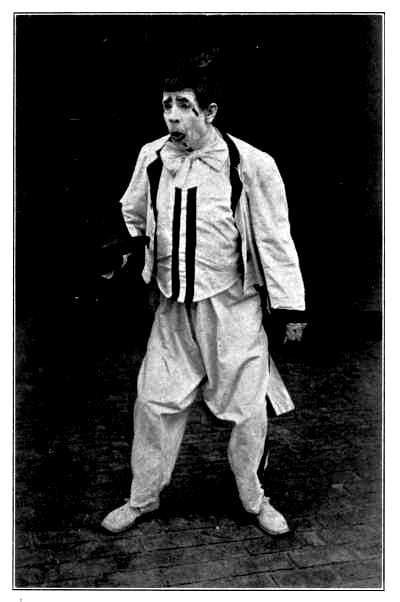
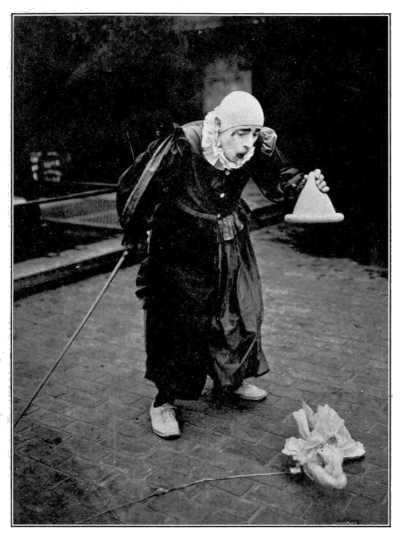
“TO BE A SUCCESSFUL CLOWN YOU HAD ALSO TO BE A
GOOD PANTOMIMIST.”
In 1889 I went with the Ringling circus,
and I have been with it ever since. It was
their last year as a wagon show, for the next
year it became a railroad show, and went
from town to town on trains. Somehow I
did not like the change at first. I had
become so accustomed to the wagon traveling
at night, to the wild, free, clean
abandon of the life, that I did not fancy
the idea of sleeping on a stuffy train, with
smoke and cinders to bother me. Many of
the other circus people felt the same way
about it. The wagon life may have been
hard traveling, but it was in the open.
God’s air and sunshine were about you always,
and although it rained and blew
sometimes, the discomfort was not for
long. It kept everybody sound and
healthy. Many a millionaire would envy
the appetites and health we enjoyed. And
yet, in a way, our life was one of more
or less constant hazard.
There was one big satisfaction about the
change to the railroad shows. The circus
remained under canvas. Strange as it may
seem to an outsider, we can work better
under canvas than any other place. This
is true all up and down the circus line, from
the highest priced “kinker,” as the performers
are called, down to the cheapest
“rough neck,” as the canvas men are
known. They would rather get soaked to
the skin under the “big canvas top” out
on a North Dakota prairie than be dry
under the roof of Madison Square Garden
in New York City.
Of course the circus had been getting
bigger all the time. Originally it was a
one-ring affair. But the competition in the
show business stimulated the various showmen
to get new and greater attractions.
The one-ring show became a two-ring show,
and this in turn became the “monster three-ring
aggregation of mastodonic amusement
creations,” such as is now billed throughout
the length and breadth of the
land.
As the circus grew bigger, the talking
clown ceased to exist. It was only natural
that this end of his work should be eliminated.
The tents became so large, the
arena area so extended, that it was with difficulty
that anyone could be heard in the
seats. Besides, so many things were going
on at the same time that the clown had to
perform with his hands and legs in order to
attract any attention at all.
With all the innovations that have come
to the aid of the modern circus, such
monstrosities as “the dip of death” in a
somersaulting automobile, and various other
freakish inventions calculated to divert the
mind and thrill the young, the clown remains,
and always will remain, the really
picturesque and permanent feature of the
circus business. Like the brook in the
poem that the English poet wrote about,
he shall go on forever.
But the clown has had to keep pace with
the development of the circus. The average
person who watches a group of clowns disporting
themselves in the ring, and is
amused at their grotesque antics, may think
it is silly and easy work. Let him try it,
and he will soon find out what hard work
it is, and what careful thought is necessary
for each act. Every act that is done must
be carefully rehearsed. I have practiced
on a trick fall for a whole month.
You may have noticed that clowns travel
in pairs and trios. This is due to the fact
that every clown act, no matter how ludicrous,
or how simple, must tell a story. It
is really a small comedy or a slight drama.
We must not only have action, but something
to suggest an incident or a series of
incidents. If the clowns, for example, wear
soldier uniforms, their act must give a hint
of a camp, a battlefield, or some other
definite martial picture. It may be hugely
grotesque, but it must be a concrete picture
just the same.
Like everything else in this busy world,
clowning must be timely. We play on
vogues. It may be Salome, or The Merry
Widow, or Roosevelt’s trip to Africa, or
the airship. The good clown must make his
act a perfect piece of mimicry. This is
the first and foremost requirement. This
is why so many good clowns are such fine
pantomimists. We must, in short, first see
ourselves as others see us.
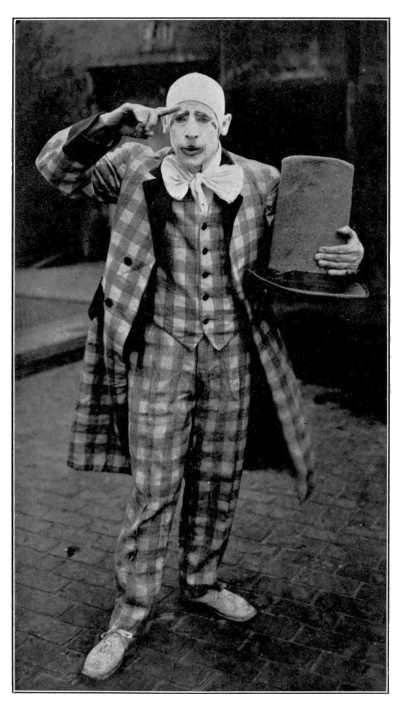
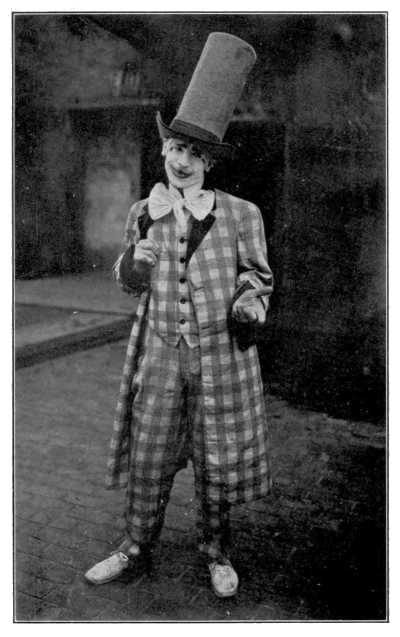
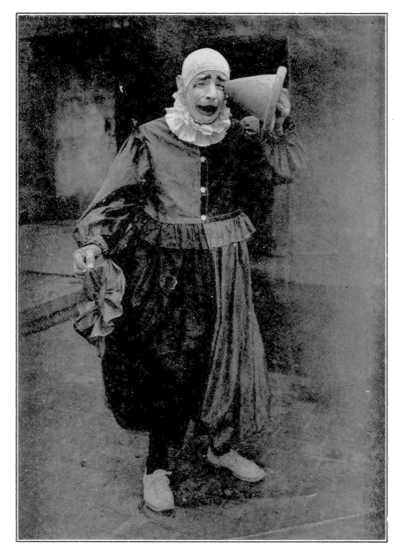
Many people wonder why we keep the
white make-up. This is the traditional
clown face, and has been so for many generations
of clowns. Both the costume and
the face have undergone little change
within my lifetime. It is perhaps the
only amusement that has maintained its
physical integrity through many years.
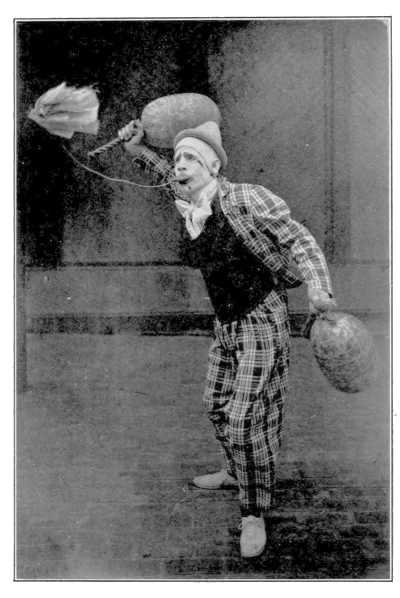
Take the slap-stick, the bladder, and the
funny fall, and you have the clown’s sole
stock in trade for decades. Unless I am
much mistaken, they will remain so for another
hundred years.
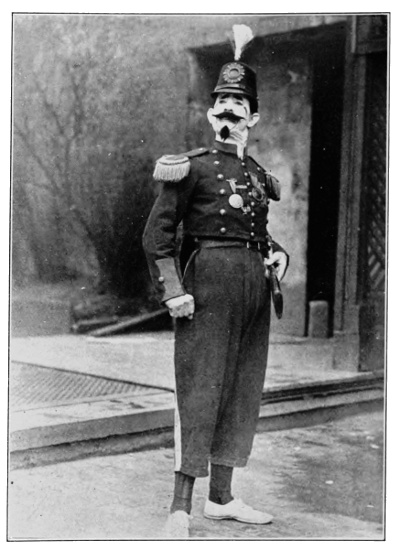
“EVERY CLOWN ACT MUST TELL A STORY.”
Some very successful clown tricks are
mere accidents. You start out to do an
act, stump your toe or slip up. Then
everybody laughs, for they think it is part
of the show. Thereafter, every time you
go out to do this act you stump your toe
or slip up. With all these aids, some men
work for years at clowning, and never become
clowns. Good clowns are born, not
made.
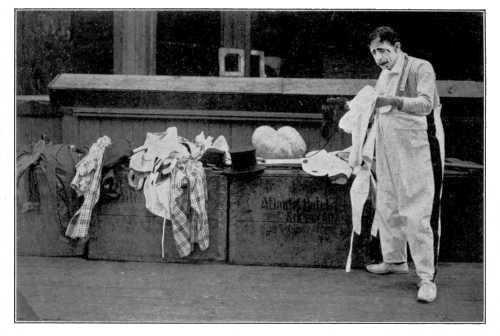
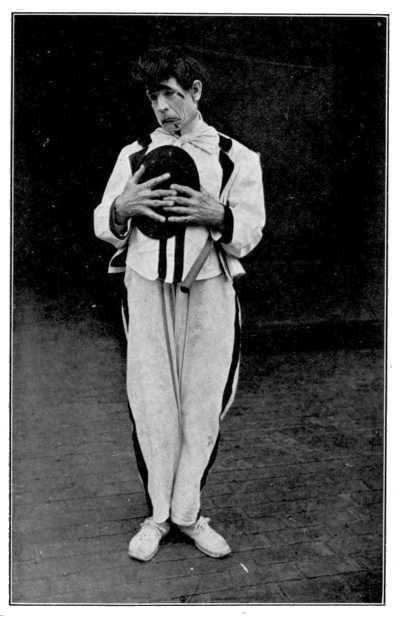
The clown’s costume requires much
thought and study. Although most clowns
look alike to you, if you will watch their
attire carefully you will see that each one
is slightly different from the other. I
have little patience with the many contrivances
that some modern clowns use, such as
guns, electrical appliances, and all that sort
of thing. To be a real clown you only
need your wits and a few simple things.
The dullard clown seeks to make up for
his mental deficiencies with mechanical contrivances.
Perhaps I am prejudiced in
favor of the old ways, just as I cling to the
memory of the old days. But they are the
best.