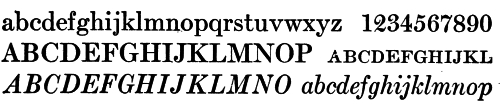
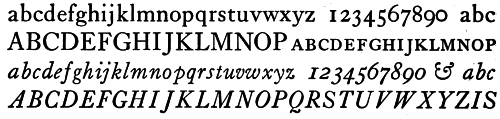
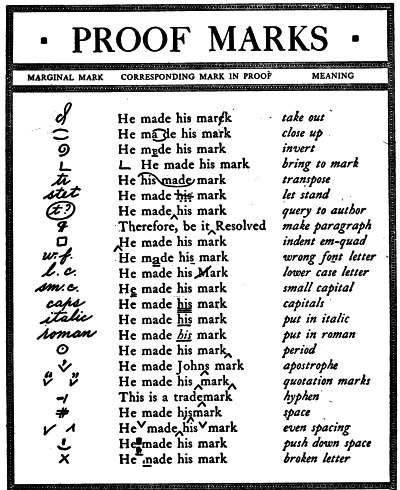
Accents (g).—Small marks placed over, under, or through
particular letters, used to indicate pronunciation.
Adams Press (p).—A large platen printing-machine, used for
bookwork.
Agate (c).—A small size of type equal to 5½ points. See Point.
Alignment (c).—The arrangement of type in straight lines, also
the adjustment of the lines of type so that their ends appear in
line, vertically.
All-along (b).—In sewing a book, when the thread is passed from
kettle-stitch to kettle-stitch, or from end to end in each sheet,
it is sewed all-along.
Alley (c).—The floor space between stands where compositors
work.
American Russia (b).—See Cowhide.
Antique Type (c).—Fonts of type of an old or medieval character.
The lines of all the characters are nearly uniform as to thickness;
the corners square and bold.
Aquatint (e).—A peculiar style of etching on copper or steel in
imitation of drawings in sepia or India ink.
Arabic Numbers (c).—The numeral figures as distinguished from
Roman characters.
Art Canvas (b).—A book cloth known both as Art Canvas and
Buckram.
Art Work (e).—See Retouching.
Ascending Letters (c).—Letters that ascend to the upper shoulder
of the type body; as, b, d, f, h, l, etc.
Author's Proof (c).—Proof sent to the author for inspection and
approval.
Azure Tools (b).—Used in binding, where the heavy and wide
marks, instead of being a solid mass, are made with horizontal
lines.
Backing (b).—The process of forming the back in preparing the
book for the cover or case, commonly called Rounding and Backing.
It is done in three ways; viz. (1) by hand with a hammer,
(2) by a hand rounding-and-backing machine, (3) by a steam-
or electric-driven machine.
Backing Up (p).—Printing the second side of a sheet.
Band Driver and Nippers (b).—Tools used in forwarding, to correct
irregularities in the bands of flexible backs.
Bands (b).—The cords on which the sheets of a volume are sewed.
When sewed "flexible," the bands show on the back of the book;
when bands are let in the back by sawing grooves, narrow strips
of leather are glued across the back to look like raised bands.
Bank (c).—A high table or bench with a sloping top; when used
for type only it is called a standing galley.
Basket Cloth (b).—This is a fancy weave of cloth, of construction
similar to the weaving of wickerwork baskets. It is a novelty
binding.
Bastard-Title (c).—The title of a book printed upon a page by
itself and preceding the regular title-page.
Battered (c).—Type, electrotype, or engraving accidentally
injured.
Bead (b).—An old-time term meaning the head-band, q. v.
Bearers (p).—Strips of metal or wood, type-high, made up with
type to sustain impression while proving, or to bear off the impression
on light parts, and to carry the rollers evenly over a
form in printing.
(c).—Type-high pieces of metal placed around pages or forms
to be electrotyped, to prevent injury to the face of the type or the
plates in the subsequent processes, and cut away from the plates
before printing.
Bed (p).—The flat part of a press upon which the type or form
is placed. The part on which the sheet is placed is called the
platen, or the cylinder.
Benday Plates (e).—Plates made by laying shaded tints on copper
or zinc, and etching them to produce colors or combination of
colors when printed.
Beveled Sticks (c).—Strips of furniture wider at one end than
the other; they are used with wooden quoins in locking up on
galleys and in chases.
Bible India Paper (g).—The thinnest paper made for books, formerly
only made in England and Italy; now made in America. A very high-grade
stock. See Oxford Bible Paper.
Binder (b).—A temporary cover for periodicals and pamphlets,
usually arranged so that it may be taken off and attached to
subsequent copies of a publication. A bookbinder.
Black Letters (c).—A style of letter or type characterized by
black face and angular outlines. It was designed by the early
printers from a current form of manuscript letter.
Blank (g).—A page upon which no printing appears.
Blank Books (b).—Applied to a large variety of books which are
bound with blank leaves, or leaves having ruled lines and little
or no printing: account books, memorandum books, ledgers, etc.
Blanking (b).—Term employed in reference to stamping. Impression
made on cloth or leather by heated brass die.
Bleed (b).—When the margins of a book or a pad of printed sheets
have been trimmed so as to cut into the printing, they are said
to bleed.
Blind Tooling or Stamping (b).—Impressions of finisher's tools or
book-dies without ink or gold-leaf. Sometimes called antique.
Blocking Press (b).—A stamping press for impressing blocks or
dies on covers.
Blocks (c).—The wood or metal bases on which electrotypes and
engravings are mounted.
(p).—Mechanical devices used on printing-presses for the
purpose of holding plates in their proper positions in the
form.
Board Papers (b).—The part of the end-papers pasted on the board
covers.
Boards (b).—Applied generally to many kinds of heavy cardboard.
A book with stiff sides covered with paper of any color
is said to be bound in paper boards.
Bock Morocco (b).—A term given to a leather made of Persian
sheepskin, finished in imitation of morocco.
Bodkin (c).—A sharp tool, like an awl, used for picking out letters
from a body of set type, when making corrections.
Body (c).—The shank of a type as determining its size.
Bold-face (c).—A heavy-faced type, used for contrast. It is
also known as Full-face.
Bolt (b).—The closed ends of leaves of an uncut book which presents
a double or quadruple fold.
Book Cloth (b).—Cloth used for making covers or cases for books.
It is made by special processes and in many different grades
and patterns. See also Cloths.
Borders (c).—Ornamental characters cast in type, the pieces being
adjustable in lines, or designs to surround pages, panels, etc.
Bourgeois (c).—The old-style name of a size of type equal to
9-point.
Boxes (c).—The small compartments of a type case.
Box-head (c).—A column heading in a ruled table. Any heading
enclosed in rules.
Brass Rule (c).—Thin strips of brass, type-high, of different
thicknesses and many styles of face—used for straight lines,
column rules, etc.
Brasses or Brass Boards (b).—Boards made for pressing books,
called by these names because of the narrow brass strips on the
edges by which the grooves are formed at the joints or hinges
of the cases.
Brayer Roller (c).—A small hand roller for distributing ink.
Break-line (c).—A short line—the last line of a paragraph.
Brevier (c).—The old-style name of a size of type equal to 8-point.
Brochure (b).—A pamphlet, an unbound book of which the sheets
are held together by sewing only.
Buckrams (b).—These are the heavier weaves of cloth finished like
Linens. They should be used whenever the books will receive
more than ordinary wear.
Buffing (b).—The layer of cowhide taken off in buffing or splitting
the hide.
Bulk (g).—The thickness of a book before the covers are put on.
Bundling (b).—The process of pressing and tying together signatures
or folded-and-gathered books for the purpose of (1) ejecting
air and making them solid, (2) for convenience in handling.
Burnished Edges (b).—Edges which, after being colored, are made
smooth and bright by a tool especially made for polishing the
surface.
C Pattern (b).—Embossing on book cloth of small, pebble-shaped
figures, scarcely larger than the head of a pin.
Cabinet (c).—A frame for holding type cases.
Calendered Paper (g).—See Super-calendered Paper.
Calf (b).—Leather made of the skin of a calf. It has a smooth,
uniform surface.
Cameo Paper (p).—A dull-surface coated paper on which most artistic
effects may be secured in printing from halftone plates.
Canceled Matter (c).—Set-up type or plates which have been
suppressed or killed.
Cancels (b).—Printed leaves containing errors, which have to
be cut out and replaced with corrected pages.
Cap (c).—An abbreviation of Capital. Caps and Small Caps are
contained in the upper case, and are called upper-case letters.
Caps (b).—Paper coverings used to protect the edges while a book
is being covered and finished. Also the leather covering the
headband.
Caption (g).—The title-line placed below an illustration.
Caret (c).—A sign or mark used in proofreading and writing to
show that a letter or word has been omitted.
Case (b).—The cover of a cloth-bound book.
(c).—A shallow, open wooden tray, divided into small compartments, in which the types are placed.
Case Binding (b).—A method of binding books in which the case
or cover is made separately and afterwards fastened upon the
book.
Cast Proof (c).—See Foundry Proof.
Catch Word (c).—A word placed under the end of the last line
on the page of some old-time books, the word being the same as
the first word on the next page; a "carry over" or direction word.
Center Tools (b).—Tools cut for ornamentation of center of panels
and sides of book covers.
Chase (c).—The iron frame in which type and other matter is
locked up for the press, or for sending to foundry.
Chased Edges (b).—See Goffered Edges.
Circuit Edges (b).—Bibles and prayer-books are sometimes bound
with projecting covers turned over to protect the edges. These
are circuit or divinity edges.
Clarendon Type (c).—A bold-faced, condensed antique with a bold
bracketed serif, used in display work.
Clasp (b).—A hook or catch for fastening the covers of a book
together, usually at the fore-edge.
Cloth (b).—A stiffly sized and glazed variety of cotton or linen
cloth—usually colored and decoratively embossed.
Cloth Boards (b).—Stiff cloth covers.
Coated Paper (p).—An art paper coated or covered with some
mineral substance such as china clay, etc., on which halftone
cuts are printed.
Collating (b).—Examining the signatures after a book is gathered,
to see that they are arranged in correct order.
Colophon (g).—An emblematic device, or a note, especially one
relating to the circumstances of production, as the printer's or
scribe's name, place, and date, put at the conclusion of a book or
manuscript.
Column Rules (c).—Strips of brass rule used to divide columns of
type.
Combination Plates (e).—Black only—Plates made by the use
of two or more halftone or line negatives, the films stripped
together and printed and etched on one copper or zinc plate.
Color—Plates made by the use of a key-plate and color
plates, either halftone or line, to be printed in two or more colors.
Combs (b).—Instruments with wire teeth used in marbling. The
colors being upon the surface, the comb is drawn across a portion
in such a way that a new pattern is developed.
Common Cloths (b).—Before receiving the final coat of color this
cloth is dyed. The thready appearance so noticeable in the linen-finished
cloths is less apparent in Commons on account of the
dye and extra coloring.
Composing Stick (c).—A flat, oblong tool, made of polished steel,
in which the compositor places the type as he takes it from the
case.
Composition (c).—That part of the work of printing which relates
to typesetting, and making up.
Compositor (c).—One who sets type.
Copper-thin Spaces (c).—Very thin spaces made of copper, used
in the spacing and the justification of type.
Copy (c).—The matter or manuscript to be set up in type by the printer.
(e).—Subjects to be reproduced by the engraver.
Corners (b).—(1) The material covering the corners of "half-bound"
books, (2) the triangular tools used in gold- or blind-tooling.
Correcting (c).—Changing wrong words, letters, types, etc., or
adding new matter in type that has been set.
Cowhide (b).—A thick, coarse leather made from the skin of a
cow, commonly known as "American Russia" or "imitation
Russia." It has a slight grain, and is tough and strong.
Cropped (b).—When a book has been trimmed down too much,
it is said to be cropped.
Cross-bars (c).—The bars which divide a large chase into sections.
Crushed Levant (b).—Levant morocco with the grain crushed
down till the surface is smooth and polished.
Cut (g).—An obsolete term for an engraving. See Engraving.
Cut-in Side Note (c).—A note set into the side of a page of printed
matter.
Cylinder Press (p).—A printing-machine which gives the impression
by means of a cylinder instead of a platen.
Dandy (g).—A roller affixed to paper-making machines. The wet
web of paper carried on the endless wire of the machine passes under
this roller and is pressed by it. It gives the laid or wove appearance
to the sheet, and when letters, figures, or other devices
are worked in fine wire on its surface it produces the effect known
as water-marking.
De Luxe (g).—A term applied to books manufactured with superior
materials, and with unusual care and expense.
Dead Matter (g).—Type or plates for which there is no further
use.
Deckle-edges (g).—The rough, natural edges of hand-made paper.
Deckle-edges are also formed on two edges of machine-made
paper. They are poorly imitated by cutting or tearing paper.
Dedication (g).—An address prefixed to a literary composition,
inscribed to a patron or a friend as a mark of respect or affection.
Deep Etching (e).—Additional etching made necessary to secure
proper printing depth where this cannot be accomplished by
routing, and usually caused by the use of dense black lines, or
line negatives and halftone negatives being combined in one
plate.
Dentelle (b).—A fine, tooled border resembling lacework.
Descending Letters (c).—Letters that descend below the type
body, as g, p, q, etc.
Devil (g).—The printer's errand boy or apprentice.
Dies (b).—Brass, zinc, or heavy electro plates used for embossing
or stamping on covers the lettering and ornamental designs.
Display (c).—Composition in which different styles or sizes of
type are used, such as on a title-page.
Distributing (c).—Returning types to their respective boxes.
Divinity Calf (b).—A dark-brown calf binding, decorated with
blind-stamping and without gilding.
Divinity Edges (b).—See Circuit Edges.
Doublé (b).—The ornamented inside of the cover of a book, made
with tooled leather, silk, or other material. Also termed doublure.
Doubletone Ink (p).—An ink in which the linseed oil medium, ordinarily
transparent, is tinted with a lighter shade of the color. When
this sinks into the paper, it automatically prints a second shade.
Drop-folio (c).—A page number, placed at the bottom of a page.
Duck (b).—Often called Canvas. A heavy cotton cloth, firmly
woven and smooth. It is a desirable cloth for heavy books.
Dummy (g).—Pages of a book put together so as to show the
general format of the finished book.
Duodecimo (g).—When a sheet of book paper is folded in twelve
leaves it is called a duodecimo or 12mo.
Duograph (e).—Two halftone plates made from one copy, and
usually printed in black and one tint, or two shades of the same
color, the two plates made with different screen angles.
Duotype (e).—Two halftone plates made from one copy, both from
the same negative and etched differently.
Edition Work (b).—Books bound in large numbers, as distinguished
from single books or jobbing.
Electrotype (el).—A replica of composed type, plates, etc., forming
a printing surface. This is produced by covering an impression
made from the set type, etc., in wax or similar substance,
with a galvanic coating of copper which is afterwards backed up
by an alloy.
Em (c).—The square of any type body.
Embossing (g).—The process of stamping leather, cloth, or paper
with a plate for the purpose of producing a raised or relief effect.
Embossing Plate (e).—A plate cut or etched below the surface
for the purpose of raising the image of the printed surface.
En (c).—One half the width of an em body.
Enameled Paper (g).—See Super-calendered Paper.
End-papers (b).—Usually known to the public as fly-leaves. The
white or colored sheets placed by the binder at the beginning
and end of a volume, one-half being pasted down upon the inside
of the cover.
English (c).—The old-style name of a size of type equal to 14-point.
English Finish Paper (g).—A finished-surface paper, with a duller
surface than super-calendered.
English Linen or Low Buckram (b).—A linen cloth, highly polished,
well colored and durable.
Engraving (g).—A picture or design cut or etched on metal or
wood.
Etching (e).—A process of engraving in which the plate after being
varnished is smoked, and the design or drawing is then cut through
the varnish, afterwards being treated with acid which eats into
the exposed parts of the metal.
Extra Binding (b).—A trade name for the hand-sewed and hand-bound
book.
Extra Cloths (b).—These in the plain finish and the various patterns
are largely used for binding works of fiction, and are among
the most expensive grades of book cloth. The fabric is heavily
coated with color, entirely concealing the weave, producing a
solid color surface.
Extract (g).—A passage taken from a book or work; a quotation,
excerpt, citation.
Fanfare (b).—A style of binding in which there is great profusion
and repetition of flowers, foliage, and other small ornaments.
Figure (b).—A cut or diagram inserted in printed text.
Fillet (b).—A cylindrical instrument upon which simple lines are engraved, used in finishing.
(c).—A rule with broad or broad and narrow lines.
Finisher (el).—A workman who performs the final operations in plate-making.
(b).—The workman who does hand-tooling, and performs the
final operation or finishing on extra-bound books.
Finishing (b).—The part of a binder's work which consists in
lettering and ornamenting the cover.
FL Pattern (b).—Embossing known as Fancy Line. A special
design and very popular for diaries, blank books, and other
similar lines.
Flexible (b).—When a book is sewed on raised bands and the sewing
thread passed entirely around each band. A term applied
also to the covers of the book, as for example, full flexible or
entirely limp or semi-flexible, when a thin board or heavy paper
is used in making the cover.
Floret (c).—A flower or leaf-shaped ornament.
Fly-Leaves (b).—The leaves at the beginning and end of a book.
See End-papers.
Foil (b).—A special product, neither gold nor ink, used in stamping
the lettering and ornamentation on covers.
Folder (b).—A mechanism for folding book and periodical sheets.
A small flat piece of bone or ivory used in folding and
in other ways. The first is more properly called a folding
machine.
Folio (g).—A sheet of book paper of approximately 18 × 24 inches
size when folded in two leaves is called a folio.
(c).—A page number.
Follow Copy (c).—Means that the compositor should follow exactly
the copy supplied by the author or publisher as regards punctuation,
capitals, etc.
Font (c).—A complete assortment of types of one size.
Footnote (g).—A reference or explanation at the bottom of a page.
As a rule this is set in type several sizes smaller than that of the
text.
Fore-Edge (b).—The outer side of a book.
Form (g).—A page or number of pages or plates locked up in a
chase ready for the press.
Format (g).—The bibliographical term for the physical size, shape,
and appearance of a book.
Forwarding (b)—An expression covering the operations performed
in binding a book by hand up to the time when it is sent
to the finisher for tooling, etc.
Foul Case (c).—When the type is badly mixed up in the case by
distributing, the case is called foul or dirty.
Foul Proof (c).—A proof-sheet containing the author's corrections.
Foundry (el).—The department where the electrotypes are made
from the types set in page form.
Foundry Proof (c).—A proof of the type page after it has been
corrected and is ready for an electrotype cast to be made from
it. Sometimes called Cast Proof.
Four-color Process Plates (e).—Same as the three-color process
(q.v.), with the addition of a gray or black plate.
Frame (c).—A stand to support the type cases when used by the
compositor.
French Morocco (b).—A quality of Levant Morocco, having
usually a less prominent grain.
Front Matter (g).—That which precedes the main text of a printed
book; e.g., Bastard-title, title-page, contents, preface, etc.
Full Binding (b).—A book which is entirely covered with leather
is said to be full-bound.
Full Face (c).—See Bold Face.
Full Gilt (b).—A book having the edges of the leaves gilded on
head, front, and tail is said to be full gilt.
Furniture (g).—Pieces of wood and metal for filling blank spaces in
pages, and between and around pages in a form, etc.
Galley (c).—The shallow tray, either all brass, or wood, brass, or
zinc, made in many sizes, used to hold type after the lines have
been taken from the composing stick; usually has a thin brass
bottom with three perpendicular sides a little more than half an
inch high.
Galley Press (c).—A roller apparatus for taking proofs of type
while on the galley.
Galley Proof (c).—An impression from the type while still in the
galley.
Galley Rack (c).—A receptacle for galleys when filled with set type.
Gathering (b).—Collecting the folded sheets of a book according
to the order of the signatures and pagination.
Gauge (c).—A piece of wood or metal to determine the length of
pages. Also a piece of wood, card, or metal (usually a quad)
pasted to the tympan sheet as a guide to feed sheets to; a feed-guide.
Get In (c).—To take a word or syllable into the line by thin-spacing.
Glair (b).—The whites of eggs beaten up and used in finishing and
gilding the edges of the leaves.
Goffered Edge (b).—An indented, decorative design on the edges
of a book. An old fashion in bookbinding, applied to gilded or
silvered edges.
Gordon Press (p).—A small, platen printing-machine used for job
printing.
Gothic (c).—The simplest of all styles of type. It is without serif
and evidently an imitation of the old lapidary characters of the
Greeks and Romans.
Grain (b).—The outer side of a piece of leather from which the
hair has been removed.
Great Primer (c).—The old-style name of a size of type equal to
18-point.
Grippers (p).—On a job press, the iron fingers attached to the
platen which take the sheet off the form after each impression;
on printing cylinders, the apparatus which catches and carries
the sheet around to the impression.
Guarded Signatures (b).—Signatures with cambric pasted around
the outside back edge for the purpose of strengthening the paper
and binding. Often done on the first and last signatures of a
book because of the extra strain at those points.
Guard-line Proof (c).—See Foundry Proof.
Guinea Edge (b).—The edge of a book rolled with a pattern
similar to the milled edge of an old guinea coin.
Gutters (p).—The inside back margin of a book; opposite of front
margin.
H Pattern (b).—Embossing on book cloth of small diamond-shaped
figures.
Hair-space (c).—Any space thinner than one-fifth of an em.
Half-binding (b).—When a book is covered with leather on the
back and corners, and the sides covered with cloth or paper, it
is said to be half-bound, half-morocco, half-russia, half-calf, etc.
Half-leather Binding.—A binding which consists of leather back
and paper sides.
Half-title (g).—The title of a volume, appearing above the text
on the first page, or on a separate leaf immediately preceding
the first page of text. Sometimes wrongly used synonymously
with Bastard-title (q.v.).
Half-tone (e).—A style of engraving, made by etching a plate of
polished copper.
Halftone, Direct (e).—A halftone to produce which the screen
negative is made by direct exposure from the article itself, and
not from a photograph or drawing.
Halftone, Highlight (e).—A halftone plate in which the elimination
of the dots in the highlights is accomplished by a photo-chemical
process instead of by cutting them out with a tool.
Halftone, Outlined (e).—A halftone with the background outside
of the object entirely cut away, leaving a definite edge without
shading or vignetting.
Halftone, Outlined and Vignetted (e).—A halftone in which part
of the background is cut away and part vignetted.
Halftone, Square Plate (e).—A halftone in which the outside edges
are rectangular and parallel, may be with or without single black line
border.
Halftone, Two-color (e).—Two halftone plates, either or both
plates an etched plate containing parts or all of the design, to
be printed in two contrasting colors.
Halftone, Vignetted (e).—A halftone in which one or more of the
edges of the object are shaded from dark tones to pure white.
Hand Letters (b).—Letters made usually of brass, so that they
may be heated, and affixed singly in a handle, for lettering covers,
etc.
Hand-Tooling (e).—Any work done by use of a tool upon the plate
to increase the contrast of the etched plate.
Hanging Indention (c).—Where the first line of the matter is the
full width of the measure, and indents one or more ems on the
left all the lines following. Sometimes called "Reverse Indention."
Head and Tail (b).—Top and bottom of a book.
Head-band (b).—A small ornamental accessory fixed to the head
and tail of a volume inside the back to give it greater strength
and a more finished appearance. It was originally part of the
sewing.
Head-piece (g).—A decorative engraving placed at the top of the
first page of text in a book, or at beginning of each chapter.
Height to Paper (c).—The extreme length of a type from its face
to its foot.
Hub (b).—A thick band on the back of a large blank book.
Imitation Russia (b).—See Cowhide.
Imposing Stone (c).—The flat surface upon which forms are locked
up for the press; usually of polished stone, but now often made
of iron.
Imposition (c).—Arranging pages in a chase and preparing them
in a form for the press.
Imprint (g).—The name of the printer or publisher affixed to his
work.
In Boards (b).—When a book is cut after the boards are in place
to form the sides, it is cut in boards. When cut before the boards
are affixed it is out of boards, with projecting covers. Most
books are bound in the latter manner.
Indent (c).—To put a quad at the beginning of a line, as at the
first line of a paragraph.
Indention (c).—Indention is the leaving of a blank space at the
beginning of a line to mark a change in the subject, or the importance
of a particular portion of the matter, thus forming a
paragraph.
India Paper (g).—A thin, soft, absorbent paper, made in China and
Japan, and imitated in England and the United States, used for
the finest impressions of engravings. See also Bible India
Paper.
India Proof (e).—An early choice impression of an engraving taken
on India Paper.
Inferior Letters or Figures (c).—Small characters cast on the bottom
of the line or for footnote references.
Ink Fountain (p).—A reservoir for holding ink, and attached to
the press.
Inlay (b).—Cloth, paper, or leather set into the cover of a book
flush with the surface.
Insert (g).—An illustration or map, printed separately from the
text, but pasted in the book.
Inset (b).—When one sheet is placed inside of another, both being
folded, the first sheet is said to be inset. Also, a picture set into
the front cover of a book is said to be an inset.
Intaglio (g).—A word adapted from the Italian, signifying an image
engraved into and sunken below the surface containing it; for
example, a seal, having its design cut into its surface so that,
when impressed in wax, the design will be in relief.
Italic (c).—A style of type, designed by Aldus Manutius, said to
be in imitation of the handwriting of Petrarch.
J Pattern (b).—Embossing on book cloth of pebble design larger
than C pattern. The figure is slightly elongated.
Jackets (g).—The printed or unprinted wrappers folded around a
bound book for protection.
Jansen (b).—Without line or ornament in blank or gold. Ornamentation
is allowed on the inside of the cover, but absolute
plainness is demanded on the outside, except lettering.
Japan Paper (g).—Paper made in Japan from the bark of the paper-mulberry.
Jogger (p).—An attachment to the delivery table of a press to
straighten up sheets as they are printed. To jog up sheets is
to straighten them up in an even pile.
Joints (b).—The part of the cover where it joins the back on the
inside, forming a kind of hinge.
Justify (c).—To space out lines to the proper length and tightness.
Keratol or Buffinette (b).—A water-proof cloth made in imitation
of leather. It is excellent for the sides of books when there is
much wear, as it does not show water or finger marks. It outwears
the majority of cloths.
Kerned Letters (c).—Those which have part of the face projecting
over the body.
Kettle-stitch (b).—The stitch made at the head and tail of a book,
a chain-stitch.
Kip Calf (b).—Made from the skin of a heifer, and stronger than
ordinary calf.
L Pattern (b).—Embossing on book cloth known as Levant and
somewhat resembling Leather.
Laced In (b).—When the boards are fastened in a book by means
of the bands being passed through holes in the boards, they are
laced in.
Laid Paper (g).—A book paper having lines water-marked or
running through it at equal distances, the lines being made by
the pressure of the wire screen during manufacture.
Law Binding (b).—A plain style of leather binding used for law
books; also called law calf.
Law Calf (b).—Calf leather that is uncolored, in the natural state,
pale brown.
Law Sheep (b).—Sheepskin left wholly uncolored, used for binding
law books.
Leaders (c).—Dots or short dashes set at intervals in lines to guide
the eye across to figures, etc., as in a table of contents.
Leads (c).—Thin strips of metal, cast in various thicknesses
(2-point is most common) and less than the height of type, to
separate lines, etc.
Leatherette (b).—Cloth or paper prepared in imitation of leather.
Legend (g).—See Caption.
Letterpress Printing (p).—That done from type, as distinguished
from presswork from plates, engravings, etc.
Levant Morocco (b).—Morocco leather made from the skin of the
Levant goat, having a larger grain than Turkish morocco leather.
See Morocco.
Library Buckram (b).—Is a special heavy weave suitable for law
book and library bookbinding. It is dyed and covered with a
light coat of color.
Ligatures (c).—Two letters tied together and cast on one body,
fi, fl, ff, etc.
Limit Page (g).—A special page to indicate that the edition is
limited.
Limp (b).—Leather or cloth bindings which are flexible and bend
easily, in distinction from boards or stiff covers.
Line-plates (g).—Etchings in relief on plates of zinc or copper, reproduced
from pen-and-ink drawings by photo-mechanical process.
Linen Cloths (b).—Styles X and B are known as Linens. The
fabric receives a light coat of color, not enough to conceal the
weave. Their popularity is largely due to the thready appearance.
Lining (b).—A term applied to cased books to indicate the re-enforcement
of head-band, super or crash, and paper which are
applied with glue and paste to the back of books before they are
put into covers.
Linotype (c).—A machine for setting type, casting it in lines instead
of single characters.
Lithograph (c).—A print from a lithographic stone.
Live Matter (c).—Type or other matter in preparation or ready
for printing.
Locking Up (c) (p).—Tightening, by means of quoins, the type
and material in a form, so that it will lift in a solid mass.
Logotypes (c).—Two or more separate letters or a complete word
cast as one piece.
Long Primer (c).—The old-style name of a size of type equal to
10-point.
Lower Case (c).—The case that contains the small letters, figures,
points, and spaces.
Maiole (b).—A binding generally composed of a framework of
shields or medallions with a scroll design flowing through it.
Make-up (g).—(1) The quantity of signatures or illustrations or
books needed to complete an order or edition. (2) The layout
of the book showing the order of pages and illustrations.
(c).—To arrange lines of type into pages of proper length,
with page numbers, head-lines, etc.
Making Margins (p).—Putting furniture and other material
around and between pages in a form, so that when printed they
will be properly imposed upon the sheet.
Making Ready (p).—Preparing a form on the press for printing,
by giving each part the proper impression, making overlays,
setting gauges, etc.
Marbled Calf (b).—Calfskin so treated with acid that it resembles
marble.
Marbling (b).—A process of decorating sheets of paper and edges
of books with variegated colors in irregular patterns.
Matrix (c).—A plate of metal, usually of copper, suitably formed
to mold the face of a type.
Matter (c).—Composed type. Open matter is wide-leaded, or
has many break-lines; when set by piecework it is fat. Solid
matter is without leads; with few or no break-lines is lean in
piecework.
Measure (c).—The length of the type line; the width to which the
composing stick is set.
Metzograph (e).—A halftone made by the use of a grained screen
instead of a cross-line screen.
Mezzotint (g).—A copperplate engraving in which the entire surface
of the plate is slightly roughened, after which the drawing is
traced, and then the portions intended to show the high-lights
and middle-lights are scraped and burnished, while the shadows
are strengthened.
Mill Board (b).—A thick, heavy card, used for making book covers.
Minion.—The old-style name of a size of type equal to 7-point.
Miter (c).—To chamfer or bevel the ends of rules in order that
they may join closely in forming a border.
Mitered (b).—When the cover of a book is ornamented with
straight lines which meet each other without overrunning, it is
said to be mitered.
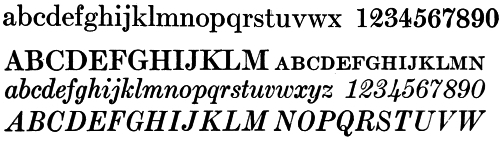
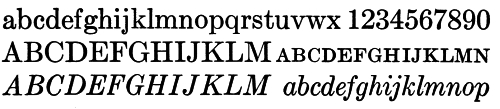
Modern Type (c).—A class of Roman type, of which the leading
forms are: broad-face, Scotch-face, French-face, thin-face, bold-face.
Molders (p).—The set of electrotype plates kept in reserve, from
which to mold new plates as the workers become worn on press.
Monotype Caster (c).—A machine for automatically casting type
in single characters.
Monotype Keyboard (c).—A machine for setting type.
Morocco (b).—A leather made from goatskins; it is tanned with
sumac. The texture is very firm though flexible. The grain,
of which there are many varieties, is produced by rolling and
folding; this process is called graining; genuine morocco makes
the most durable bookbinding.
Mosaic (b).—A design inlaid with different colors.
Mottled Calf (b).—A light-brown calfskin, mottled by treatment
with acid.
Negative Etching (e).—A plate from which the blacks of the original
copy will print white and the whites will print black.
News-tone (e).—A name sometimes given to coarse-screen halftones,
always etched on zinc and used mostly for newspaper
work. Also known as "quartertone."
Nonpareil (c).—The old-style name of a size of type equal to 6-point.
Octavo (g).—A sheet of book paper about 18 × 24 when folded in
eight leaves is an octavo or 8vo.
Off (p).—Signifies that all the sheets for a form have been printed.
Off its Feet (c).—When type does not stand squarely on its
base.
Offset (g).—A transfer of ink or color to another page or sheet of
paper.
Offset Printing (g).—A method of putting ink on paper through the
process of chemical or surface printing, rather than through the process
of relief or impressional printing. It is based, like lithography, upon
the principle that oil and water will not mix. The design is transferred
to a thin zinc or aluminum plate, which takes the place of the stone in
lithography. The transfer ink is of a greasy consistency, having an
affinity for zinc or aluminum, and a repellent attitude toward water.
In the operation of the press, the plate is clamped around the cylinder,
and two sets of rollers pass over it. The first set is moistened with
water, and its function is to dampen the entire surface of the plate except
where the design appears, the greasy consistency of which repels
the water. Inking rollers pass over the plate immediately following the
water rollers. The dampness on all parts of the plate except at the
design points repels the greasy consistency of the ink, and allows a
deposit of surplus ink upon the design, due to the similar consistency
of the two ingredients. The design is then printed onto a rubber
blanket, which is clamped around a second cylinder, and is reprinted
or "offset" onto the paper, which passes between this second cylinder
and a third cylinder.
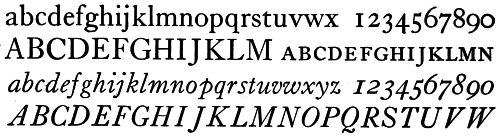
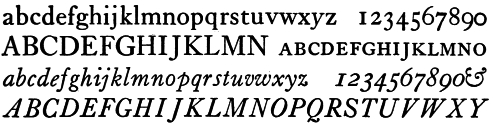
Old-style Type (c).—Reproductions of the styles of early printers:
the Caslon, Baskerville, French, Elzevir and Basle.
Out (c).—A word or more omitted by mistake in composing.
Out of Boards (b).—See In Boards.
Out Page (b).—The first or signature page of a sheet.
Outset (b).—A four-page sheet folded round a signature.
Overlay (p).—A piece of paper put on the tympan to give more
impression to a letter, line, or part of an engraving.
Overrun (c).—To take words backward or forward from one line
to another in correcting.
(p).—To print beyond the number ordered.
Oversheets (g).—The signatures or sheets remaining after an
edition is completely bound.
Oxford Bible Paper (g).—A thin, strong, opaque printing paper,
made in England, on which Bibles and other large volumes are
printed when a small bulk is desired. See also Bible India
Paper.
Packing (p).—The sheets of paper, card, etc., used to make the
tympan; this term is applied to the covering for cylinders.
Page (g).—One side of a written or printed leaf.
(c).—Type, or type and illustration properly arranged for
printing on one side of the leaf of a book.
Page-cord (c).—Twine used to tie up pages.
Page-Proof (c).—An impression of the type after it has been made
up into page form.
Parchment (g).—A paper-like sheet made from the skins of sheep
or goat. The skins are first soaked in lime to remove the hair,
and then are shaved, washed, dried, stretched, and ground with
fine chalk, or lime and pumice-stone. Paper parchment, or
vegetable parchment, is made by chemically treating ordinary
paper. See also Vellum.
Persian Morocco (b).—A kind of morocco made from the skins of
hairy sheep called Persian goats.
Photo-engraving (g).—The reproduction of engraved plates by
means of photography, for use in printing.
Photogravure (g).—Intaglio plates on copper for the reproduction
of paintings, etc., in monochrome. "Photo-Intaglio" and
"Photogravure" are essentially synonymous terms, the latter
being the French equivalent of the former. Technically, however,
"photo-intaglio" means a halftone engraving, the design of
which is etched into the plate, leaving the ground (i.e., the whites)
of the picture on the surface, instead of in relief with the whites
etched down below the surface. The term "photogravure"
is applied to a similar engraving in which the effects of light and
shade are produced not by dots and stipples produced through
a halftone screen, but by variations in depth of the depressions
in the form of grain. In printing these plates the ink is run
into the depressions, and the surface then wiped clean before
being impressed upon the paper.
Pi (c).—Type mixed up and in confusion.
Pica (c).—A size of type equal to 12-point. It is the standard
of measurement for leads, rules, furniture, and also for width and
length of pages. Six picas equal, approximately, one inch.
Picking for Sorts (c).—Taking type out of one page to use in
another, when type is scarce.
Pigskin (b).—Leather made from the skin of the pig. It is very
tough and wears well.
Planer (p).—The smooth-faced block used to level down the face
of a form.
Planogravure (e).—A form of engraving printed from a flat surface.
Plate (b).—Any full-page illustration printed on paper different
from the book is termed a plate.
(el).—An electrotype.
Platen Press (p).—That style of press which gives the impression
from a flat surface—the hand press, Adams press, and nearly
all small job presses; distinctive from the cylinder machine.
Point (c).—The unit of measurement of type, approximately
1/72
of an inch.
Point Folder (b).—A machine for folding sheets. The accuracy
of the register is obtained by placing the perforated point holder
of the printed sheet on the projecting pins of the folding machine.
Points (p).—Small holes made in the sheets by the printer, which
serve as guides in registering and folding.
(p).—Sharp metal pins placed in the form when it is imposed,
to pierce the sheets as they are printed so that they can be
folded on the point-folding machine.
Polished Buckram (b).—Its special qualities are uniformity of
color, finish, and fabric, tensile strength and easy application of
decoration.
Press Proof (p).—The final proof passed for press.
Publisher's Binding (b).—Commonly understood as ordinary
cloth binding.
Quadruple Imposition (p).—The imposition of the plates for
printing so that when folded on the Quadruple Folding Machine
the pages will follow in rotation.
Quads (c).—Brief form of quadrat; large metal blanks used to
fill lines and other spaces.
Quarter-binding (b).—A binding in leather or cloth backs, with
board sides cut flush.
Quarto (g).—A sheet of book paper approximately 18 × 24 inches
in size, when folded in four leaves, is called a quarto or 4to.
Quoins (c) (p).—Wedges used in locking up forms; formerly
made of wood and used with beveled sidesticks, but now made
of iron in several styles.
Quotations (c).—Large hollow quads for filling blank spaces;
hollow metal furniture.
Recto (b).—The right-hand page of a book. The recto of a cover
is the front.
Register (p).—To adjust the form, feed-guides, etc., so that the
printing will be properly located on the sheet; to strike the
different forms of a colored job; to make pages on both sides of
a sheet back each other.
(c).—The exact imposition of the type pages of a book so
that when printed they back one another precisely, and are
truly square.
(b).—When two or more adjacent colors meet without infringing,
they are said to be in register, otherwise out of register.
Reglet (c).—Thin strips of wood similar to leads, 6-point and
thicker, used as substitute for leads and slugs in large spaces.
Relief (e).—Processes of engraving in which the dots or lines of
the design are made to stand out so that it can be used for printing
as if from type.
Retouching (e).—(1) The act of going over a plate with a graver,
deepening the lines which have become worn. (2) The correcting
of defects on a photographic negative or print by means of a
pencil or fine camel's-hair brush.
Reverse Indention (c).—See Hanging Indention.
Revise (c).—A proof taken after corrections have been made; to
compare a proof so taken to see that the marked errors have
been corrected.
Ribbon Marker (b).—A small ribbon placed in a book as a marker.
Roan (b).—Unsplit sheepskin.
Roller (p).—An iron rod covered with an elastic composition, to
spread ink on the type or other printing surface.
Roman (c).—The class of type in general use as distinguished
from italic or fancy types.
Roman Figures (g).—Numerals expressed by letters as distinguished
from those expressed by Arabic characters, e.g., I, II,
III, etc.
Rotary Press (p).—A printing press in which the types or plates
are fastened on a rotating cylinder, and are impressed on a continuous
roll of paper.
Rotogravure (g).—A recent photo-intaglio process, now coming
into use for illustrations in newspaper magazines. It is a combination
of the intaglio and the gravure processes, producing
sunken engravings on copper rollers, which are then printed from
on the principle of calico printing.
Rounding (b).—See Backing.
Routing (e).—The operation of gouging out from an electrotype
plate that portion of the metal which is not required.
Roxburgh Binding (b) (pronounced Roxboro).—A book bound
with leather back, cloth or paper sides, no leather corners, with
gold stamping on the shelf back, with gilt top, is said to be bound
in Roxburgh binding.
Rule (c).—A plain strip of metal type-high, used for printing rules
and lines.
Running Head or Title (g).—The title of a book or subject placed
at top of each page.
Russia Leather (b).—A fine leather prepared in Russia. Its
preparation consists in carefully tanning with willow-bark,
dyeing with sandal wood, and soaking in birch oil. It is of a
brownish red color and has a characteristic odor.
S Pattern (b).—Embossing of small diagonal lines finer than T
pattern, giving the cloth a silky appearance, commonly known
as Silk Pattern.
Score (g).—To crease cardboard or heavy paper so that it will
fold neatly at the desired place. This is often done with rules
locked in the form, or put on afterward, running the sheets
through the press without ink.
Script (c).—A style of type in imitation of handwriting.
Sheepskin (b).—Leather made from the skin of a sheep.
Sheet (g).—A separate piece of paper of definite size; a twenty-fourth
part of a quire. In printing, a sheet is defined by its size;
in binding, by its fold.
Sheet-wise (p).—Presswork in which the two sides of the sheets
are printed from different forms.
Shooting Stick (c).—An implement made of wood, steel, or other
hard material, used with a mallet, to tighten up the wooden
quoins.
Shoulder (c).—The blank space above and below the face of a
letter on the end of a type.
Signature (b).—A sheet after it has been folded and is ready to
be gathered. It usually consists of 16 pages, but may comprise
4, 8, 16, 32, or 64 pages.
Silk Pattern (b).—See S Pattern.
Skiver (b).—The outer or grainside of sheepskin which has been
split; much used for binding.
Slug (c).—A thick lead.
Slur (p).—A blurred impression.
Small Caps (c).—Capitals of a smaller size than the regular capitals
of a font.
Small Pica (c).—The old name of a size of type equal to
11-point.
Smooth Calf (b).—Plain or undecorated calf.
Sorts (c).—The letters in the boxes of a case; out of sorts, to be out
of any needed letter or character; runs on sorts, when copy calls
for more than the usual number of any particular letter.
Spaces (c).—The small blanks used to separate words, etc.
Split Leather (b).—Leather split by machinery.
Sprinkled Calf (b).—Calfskin treated with acid so as to look as if
it had been sprinkled with a dye.
Sprinkled Edges (b).—Edges of books that are decorated with
small dots or specks of color, sprinkled on from a brush.
Stained Edges (b).—Edges which are colored by a process of coating
or covering which combines with the paper to be colored.
Stamping Die (e).—A relief plate engraved on brass or zinc for
stamping book covers or similar surfaces.
Stand (c).—The common wooden frame with sloping top upon which
type cases are placed; the lower part usually has a rack for holding
extra cases.
Steel or Copperplate Engraving (c).—A method of making plates
for printing by cutting, scratching or corroding a plate.
Stereotype (g).—The duplicate, cast in one piece of type metal,
of the face of types or cuts composed for printing. There are
three processes: (a) The plaster process; (b) the clay process;
(c) the papier-maché process.
Stipple (e).—A method of engraving by which dots or punctures
are used instead of lines.
Stone Hand (c).—One who is chiefly employed in imposing, and
other work done on the stone.
Stone Proof (e).—(1) An impression taken from an engraved plate
or lithographic stone, to prove the condition and progress of the
engraving. (2) An impression taken from types or cuts, made
up for electrotyping.
Super (b).—A thin, loosely woven cotton cloth, glued and starched,
which is used for gluing onto the backs of books, to hold the
signatures by extending over to the inside of the cover, to hold
the book and cover together.
Super-calendered Paper (g).—A class of paper to which a glazed
surface is given by rolling or calendering.
Superior Letters or Figures (c).—Small characters cast on the top
of the line, used for footnote references, etc.
Swash Letters (c).—The name given to a style of italic capital
letters with tails and flourishes, much used in the seventeenth
century.
T Pattern (b).—Embossing of transverse parallel lines. This is a
favorite pattern, and is used more than any other.
Tail-piece (c).—An ornament placed in a short page at the end
of a chapter, article, or volume.
Take (c).—When copy is divided among several compositors,
each part is a take.
Tapes (b).—Strips of tape extending over the back and onto the
boards to strengthen the binding. (2) Strips of cloth placed
between the covers and ends of a stitched book to strengthen
the book and give it flexibility.
Text (c).—The type used in the main part of a page; also applied
to some kinds of black-letter. The main body of matter in a
book or manuscript in distinction from notes or other matter
associated with it.
Three-color Process Plates (e).—Printing plates, produced from
colored copy or objects, to reproduce the picture or object in
its original colors by a photo-chemical separation of the primary
colors, and etched halftone plates to reproduce each separate
color, usually printed in yellow, red, and blue. An approximate
result may be obtained from one-color copy by using the skill
of the workman in securing the color-values on the etched plates.
Three-quarter Leather Binding (b).—A binding which consists of a
leather back of extra width, with leather corners and paper or
cloth sides.
Three to Em (c).—A space one-third of an em in thickness.
Token (p).—A measure or unit of presswork. The New York
token is 250 impressions of one form; the Boston token is 500
impressions.
Tooled Edges (b).—See Goffered Edges.
Tooling (b).—To ornament or give a final shape by means of a
special tool, especially when the mark of the tool is intentionally
left visible.
Tree Calf (b).—Calfskin so treated as to resemble the trunk and
branches of a tree.
Turkey Morocco (b).—Made of goatskin from Turkey. Strong,
durable, and expensive.
Turn for Sorts (c).—To put another type of the same size face
downward (so that its foot will show a black spot on proof) in the
place of a character that is missing.
Two to Em (c).—The half of an em quad, known as the en quad.
Tympan (p).—The sheets, cards, etc., that cover the platen or
cylinder, on which the paper is placed for printing. The cloth-covered
frame attached to the bed of a hand-press.
Type-high (e).—Type of the standard of height.
Type-high to Paper (c).—Type above the standard of height.
Underlay (p).—A piece of paper or card placed under the type,
electro, or engraved block, to increase the impression.
Upper Case (c).—The case in which the capitals, small capitals,
signs, and "peculiars" are placed.
Uterine Vellum (g).—A vellum made from the very thin skins of
still-born or unborn calves.
Vellum (g).—The skins of calves prepared by long exposure in a
lime-bath and by repeated rubbings with a burnisher. See also
Parchment.
Vellum Finish (b).—The smooth natural surface of an unembossed
cloth.
Verso (b).—The left-hand page of a book. Of a cover, the back
or reverse side.
Vignette (g).—(1) In old manuscripts an initial letter decorated with
leaves. (2) A head-or tail-piece of a book. (3) (e).—A drawing
or other illustration having a background that gradually
shades off and merges into the ground on which the print is made.
Water-mark (p).—See Dandy.
Web Machine (p).—(1) A cylindrical printing-press in which the
paper is carried forward to the impression cylinder by means
of tapes. (2) A printing-machine in which the paper is carried
forward in a continuous roll or web.
Whipstitch (b).—To sew with an over-and-over stitch.
Work-and-Turn (p).—When all the pages on a sheet are imposed
in one form, or half-sheetwise, the sheet is turned and printed on
the second side, thus giving two copies of the work when the sheet
is cut.
Workers (p).—The set of electrotype plates from which editions
are printed.
Wove Paper (g).—Paper which does not show the wire mark as in
laid paper. The screen is woven in like cloth.
Wrappers (g).—See Jackets.
Wrong-font (c).—A letter or character of wrong size or style used
in composition; in proofreading written w.f.
Zinc Plate (g).—A style of engraving etched with strong acid on
a sheet of polished zinc.