The great Hindenburg system, by which name it has come
to be known to English readers, or the "Siegfried Line,"
as it is called by the Germans, was brought into existence during
the winter of 1916 and early spring of 1917 in order to fulfil a
very definite strategic purpose. This was to put into effect, on a
stupendous scale, a very elementary principle of minor tactics,
namely, that field works are constructed for the purpose of reducing
the number of men required to defend a given front or
locality.
In themselves, field fortifications have, of course, no offensive
value whatever, but their use permits a reduced number of men
to defend one place, in order that a greater number of men may be
available to attack another place.
The German High Command proceeded to make use of this
principle on a scale previously unknown in history. The whole
of the Western front, in Belgium and France, was to be held
defensively throughout 1917. The military resources required
to defend that front were to be reduced to a minimum, by the
provision of a line of defences protected by powerful field works,
believed to be impregnable. This would liberate the greatest
possible resources for the Eastern front, where an end could be
made of the Russians and Roumanians there. As soon as these
were disposed of, those troops, guns and aeroplanes could again be
transferred to the West, in order similarly to dispose of the remainder
of our Alliance.
This great strategic plan was carried out in its entirety until
the middle of 1918. It was the great Hindenburg line which had
been the kernel of the whole conception, and, until the days which
we are now approaching, it had remained, practically over its
whole length, an impregnable barrier against the assaults of the
French and British.
It is to be remembered that the very basis which justified the
expenditure of such enormous labour on the creation of these
defences was the saving in man-power. It is an accepted principle
of tactics that in any given battle the advantage always
rests heavily on the side of the defence. Where numbers, resources
and moral are equal, no attack can hope to succeed.
If, in the teachings before the war, it was correct to say that
a Commander should hesitate to attack unless he had a preponderance
of men and guns of at least two to one, such a dictum
assuredly did not take into account field defences of the permanent
and elaborate character of the Hindenburg Line. I
should hardly venture to fix a ratio of relative strength appropriate
in such circumstances.
But this much is clear. The Germans had once already relied
successfully upon the impregnability of this great work. They
had every justification for believing that it would once again
serve them to keep us at bay for just a few weeks longer. Winter
was very near, and the Entente peoples might not have been able
to hold together to face another year of war.
We, on our part also, had as much justification for the resolve
that every sacrifice must be made to overthrow these defences
before the end of 1918, and for believing that it would require a
great, concerted and intense effort to succeed in this.
It is quite necessary, for a due appreciation of the magnitude
of the effort which was actually made, and of the wonderful
success with which it was rewarded, that the nature of the
defences of the Hindenburg Line should be clearly understood.
This can best be done, I think, by making an endeavour to realize
the sense of security which the possession of such a line of defence
must have afforded to the enemy. We are here interested only
in that portion of the line which extends from St. Quentin northwards
towards Cambrai.
Between these two cities the country is higher than that adjoining
it on the north and the south. It forms, therefore, a
watershed, dividing the basin of the Somme from that of the
Scheldt. Early in the nineteenth century, Napoleon realized
the ambitious project of connecting these two river systems by a
great Canal scheme, cutting right through this high country from
south to north.
The canal is called, in its southern reaches, Canal de St.
Quentin. Before Cambrai is reached it merges into the Canal
de l'Escaut. Throughout the whole of that portion which
concerns us, it runs in a deep cutting, reaching, for great stretches,
a depth of 50 to 60 feet. In certain places where the ground
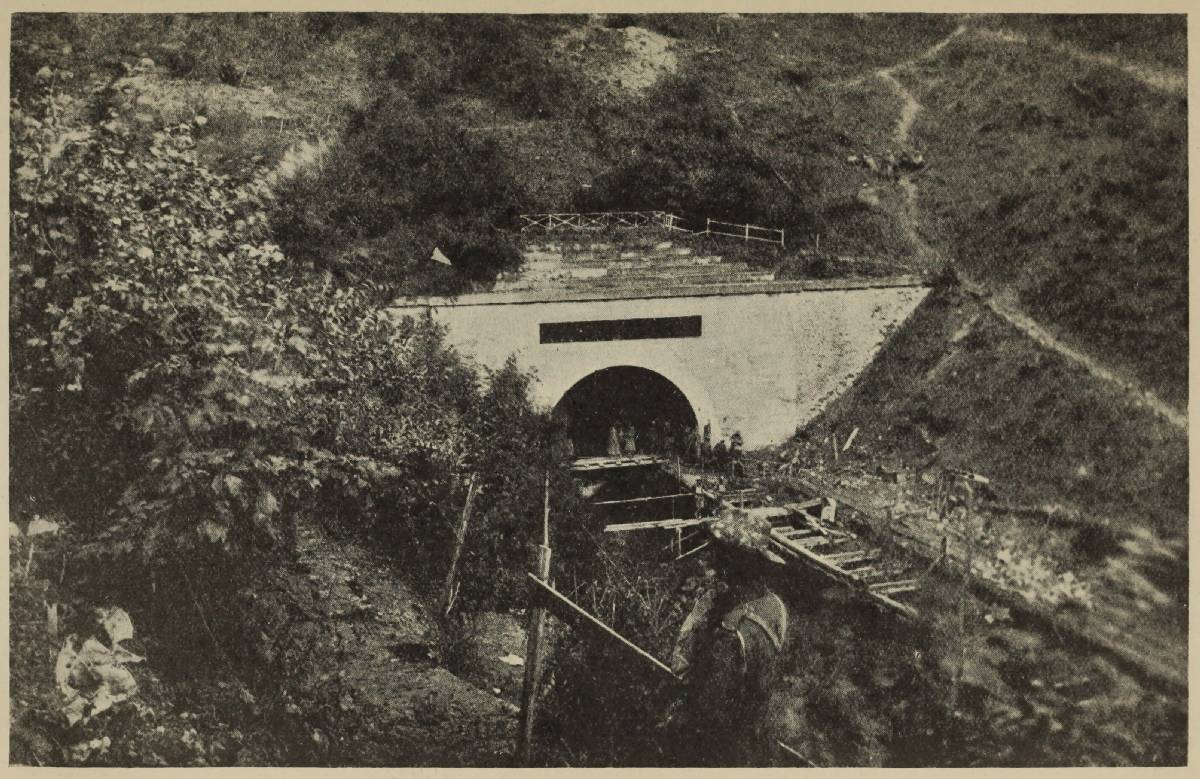
rises still higher, the canal passes through in great tunnels. The
southernmost, or Le Tronquoy Tunnel, near St. Quentin, is but
short; the northern boasts of the imposing length of 6,000 yards,
and extends from Bellicourt,[19] at its southern portal, to Le Catelet
at its northern one. From that point northwards the canal
flows in "open cut" which gradually becomes shallower as
Cambrai is approached.
The canal excavation—except where the tunnels occur—itself
affords an excellent military obstacle, the passage of which
could be stoutly contested by resolute troops well dug in on its
eastern banks, for the descent and ascent of the slopes could be
obstructed by wire entanglements, and swept with fire. The
water alone, which is too deep to be waded, would seriously impede
infantry, while the passage of tanks, guns and vehicles would
be impossible once the few high level bridges over the canal had
been destroyed.
Such an obstacle would not, however, of itself fulfil the requirements
of modern war, with its searching and destructive Artillery
fire. It was to be regarded more as the foundation upon which
a complete system of defences could be built, and as a last line of
resistance à outrance.
The canal had been, naturally, located by its engineers, in the
lowest ground available, so that its course closely follows the
lines of the minor valleys and depressions of the ground. On
both sides, therefore, the canal is flanked by somewhat higher
ground, from which its immediate banks can be overlooked. On
the western side particularly, there is a regular line of such higher
plateaux on which the villages of Villeret, Hargicourt and
Ronssoy once stood.
It was clearly desirable both to deprive a besieger of such
vantage ground, and also to provide the canal defences with a
stout outpost defence. For these reasons, the Germans had constructed
an elaborate system of trenches on a line generally parallel
to and on the average a full mile west of the canal. These
trenches had been perfected with dug-outs, concrete machine
gun and mortar emplacements, and underground shelters. They
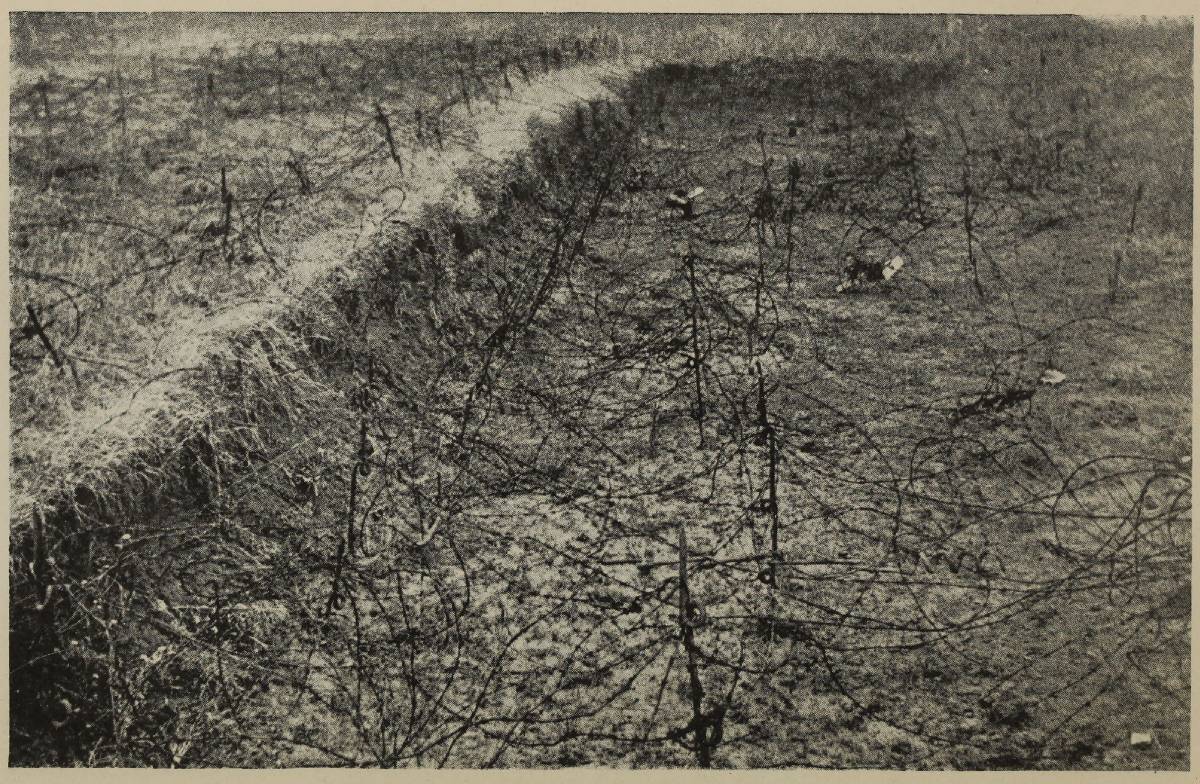
were protected by belt after belt of barbed wire entanglements,
in a fashion which no one understood better, or achieved more
thoroughly, than the Germans.
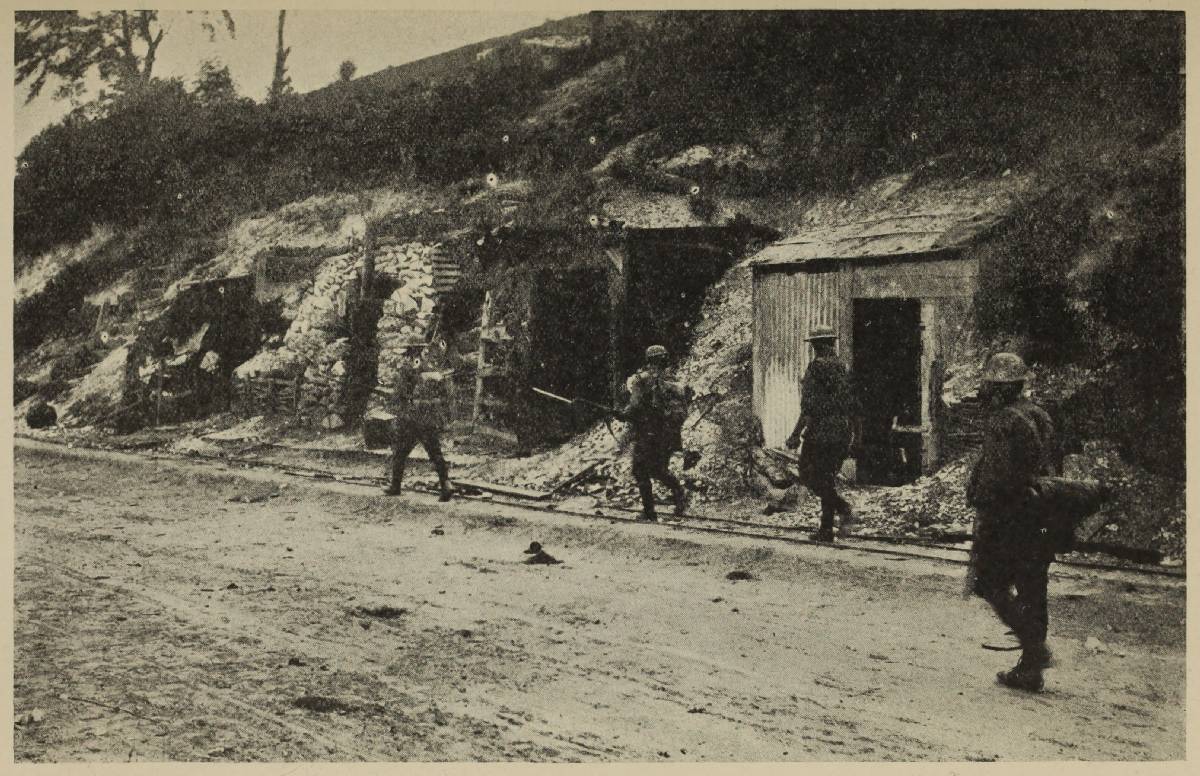
But much more remained. Deep communication trenches
led back to the canal banks, in the sides of which tier upon tier
of comfortable living quarters for the troops had been tunnelled
out. Here support and reserve troops could live in safety and
defy our heaviest bombardments. They could be secretly hurried
to the front trenches whenever danger threatened.
There was, indeed, a perfect tangle of underground shelters
and passages. Roomy dug-outs were provided with tunnelled
ways which led to cunningly hidden machine-gun posts, and the
best of care was taken to provide numerous exits, so that the
occupants should not be imprisoned by the blocking of one or
other of them by our bombardment. But it was the barbed wire
which formed the groundwork of the defence. It was everywhere,
and ran in all directions, cleverly disposed so as to herd the
attackers into the very jaws of the machine guns.
The stretch of 6,000 yards of the canal which had been
tunnelled was, however, both a hindrance and a benefit to the
perfection of the scheme. On the one hand, the advantage of
the open cut, as a last obstacle, was lost. Its place had to be
taken by a second complete system of trench and wire defences,
roughly following the line of the tunnel, but of course far above
the latter. On the other hand, the tunnel itself afforded secure
living accommodation for a substantial garrison.
The Germans had collected large numbers of canal barges,
and had towed them into the interior of the tunnel, mooring
them end to end. They served as living quarters and as depots
for stores and munitions. It was no great business to provide
electric lighting for the tunnel. Indeed, the leads for this
purpose had been in existence before the war. Here, again,
underground shafts and ways were cut to enable the troops
rapidly to man the trenches and machine guns, and as rapidly to
seek a safe asylum from the heaviest shell fire.
The whole scheme produced, in fact, a veritable fortress—not
one, in the popular acceptation of the term, consisting of massive
walls and battlements, which, as was proved in the early days of
the war at Liége and Namur, can speedily be blown to pieces
by modern heavy artillery—but one defying destruction by any
powers of gunnery, and presenting the most formidable difficulties
to the bravest of Infantry.
Even this was not all. On the east side of the St. Quentin
Canal and parallel to it were built still two further trench lines,
both fully protected by wire entanglements, and capable of determined
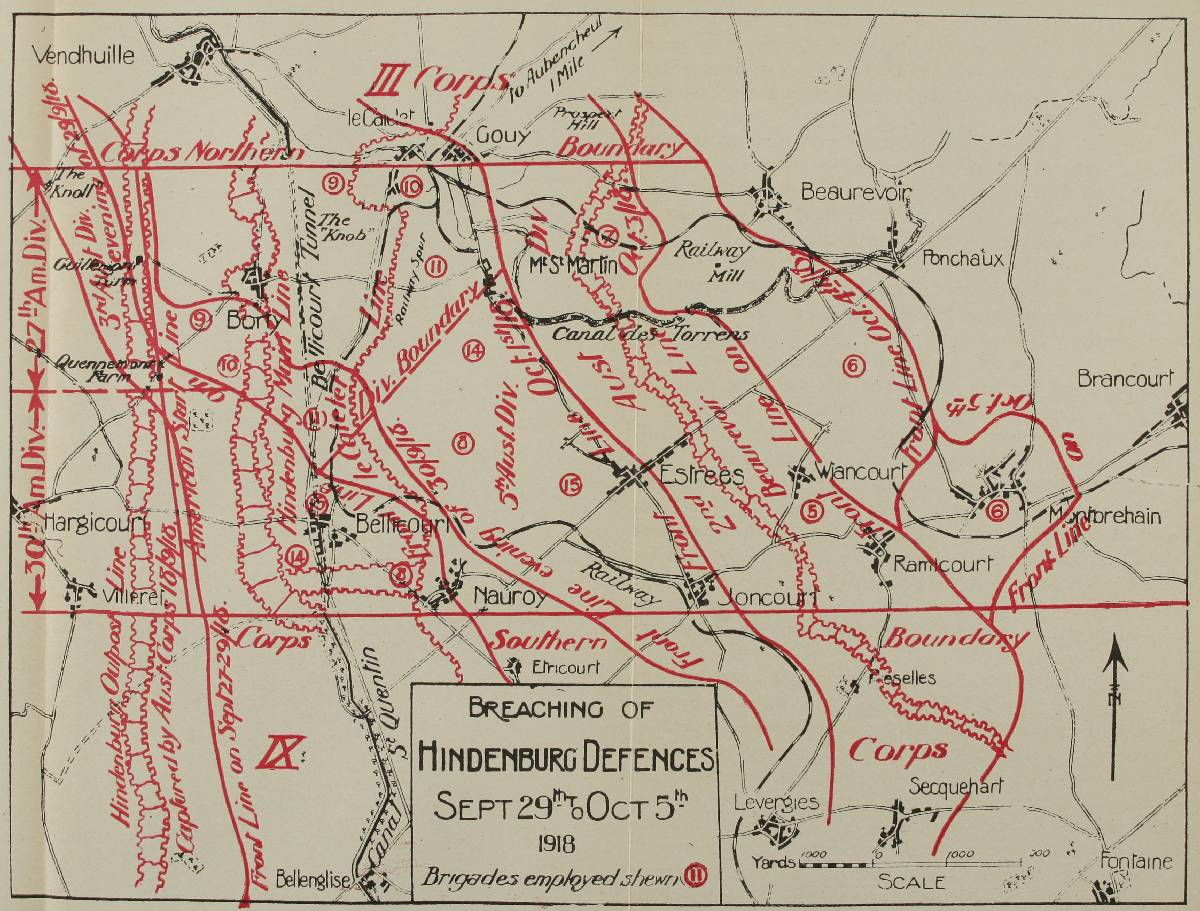
defence. The first of these is the Le Catelet line, about
one mile distant from the canal. It skirts and embraces the villages
of Nauroy and Le Catelet, while two miles still further east
is the Beaurevoir line, the last or most easterly of all the prepared
defences which the Germans had in France.
Neither of these latter trench systems was nearly so formidably
prepared as the main systems previously described, but together
with them they go to make up the whole Hindenburg defensive
system. In this region that system runs generally due north
and south, with many minor convolutions in its line. It is altogether
some 4½ miles across from west to east.
As its overthrow could not be attempted in a single operation,
it is necessary for clearness of description to give definite names
to each of the successive lines of trenches which go to form the
whole defence system. Taking them in the order in which we
attacked them, from west to east, they will be referred to as:
The Hindenburg Outpost line (known also in this part of the field as the Hargicourt line).
The Hindenburg main line (i.e., the Canal and Tunnel line).
The Le Catelet line.
The Beaurevoir line.
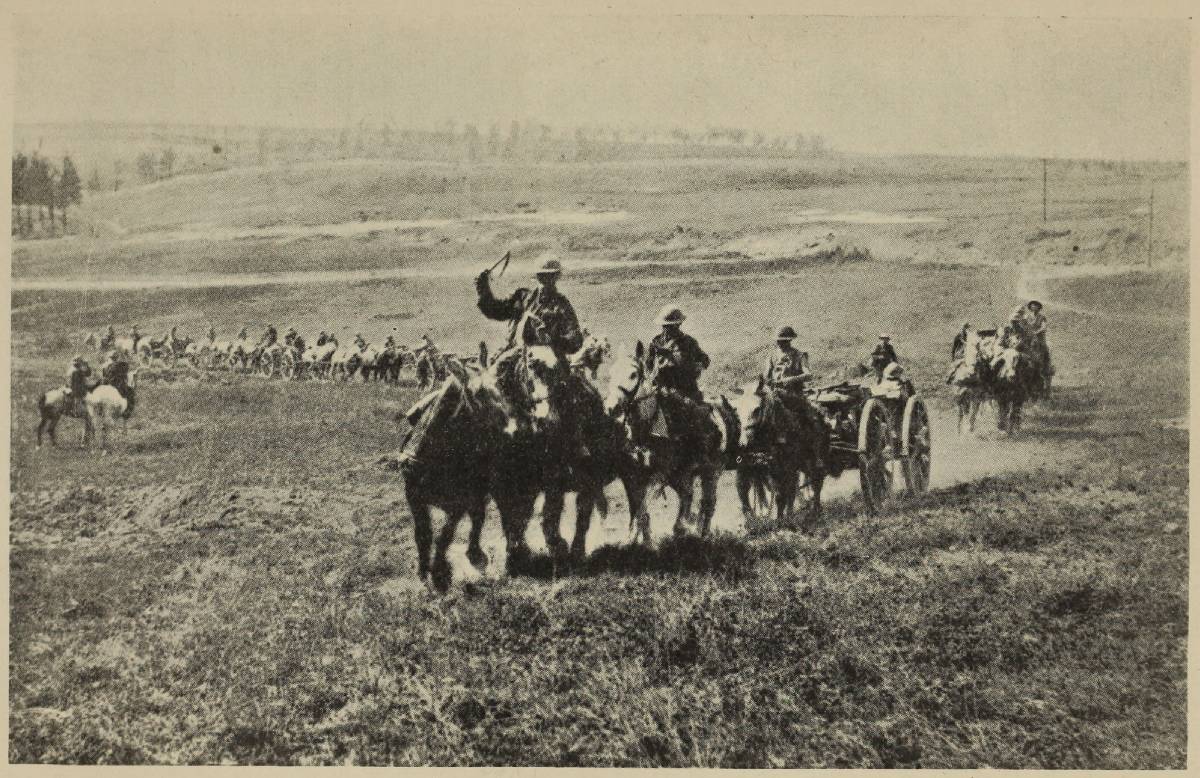
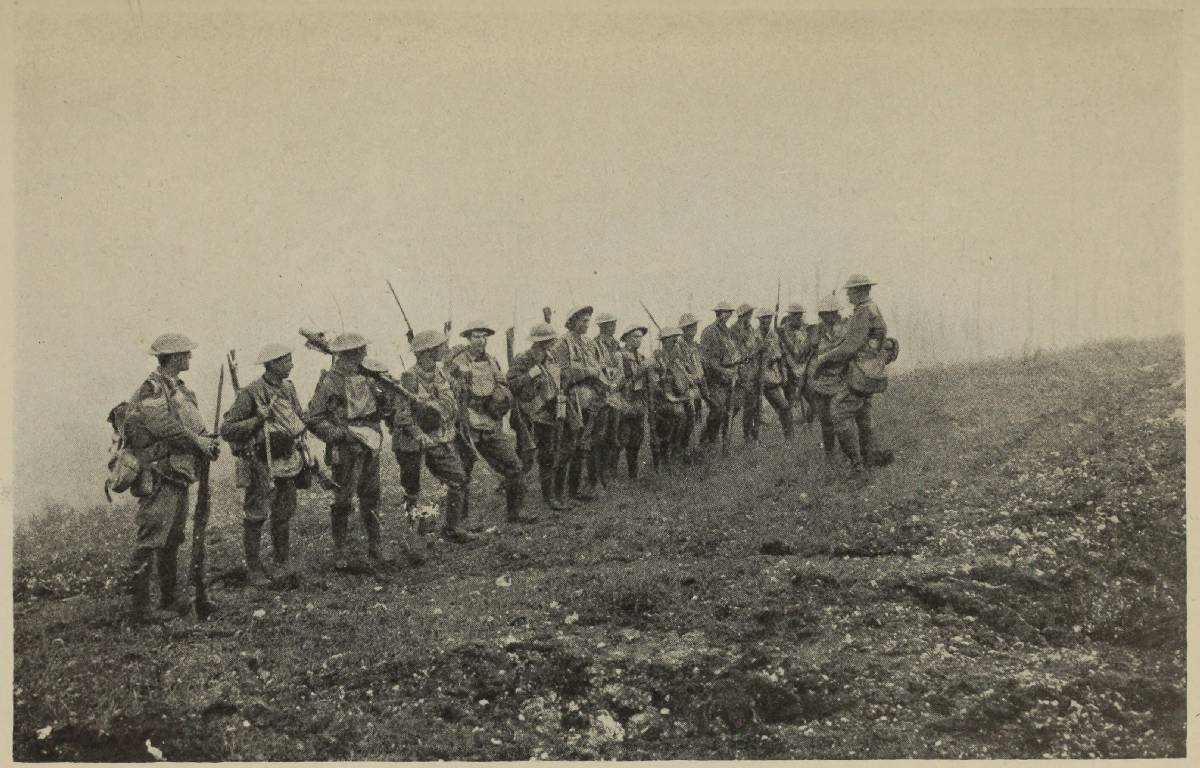
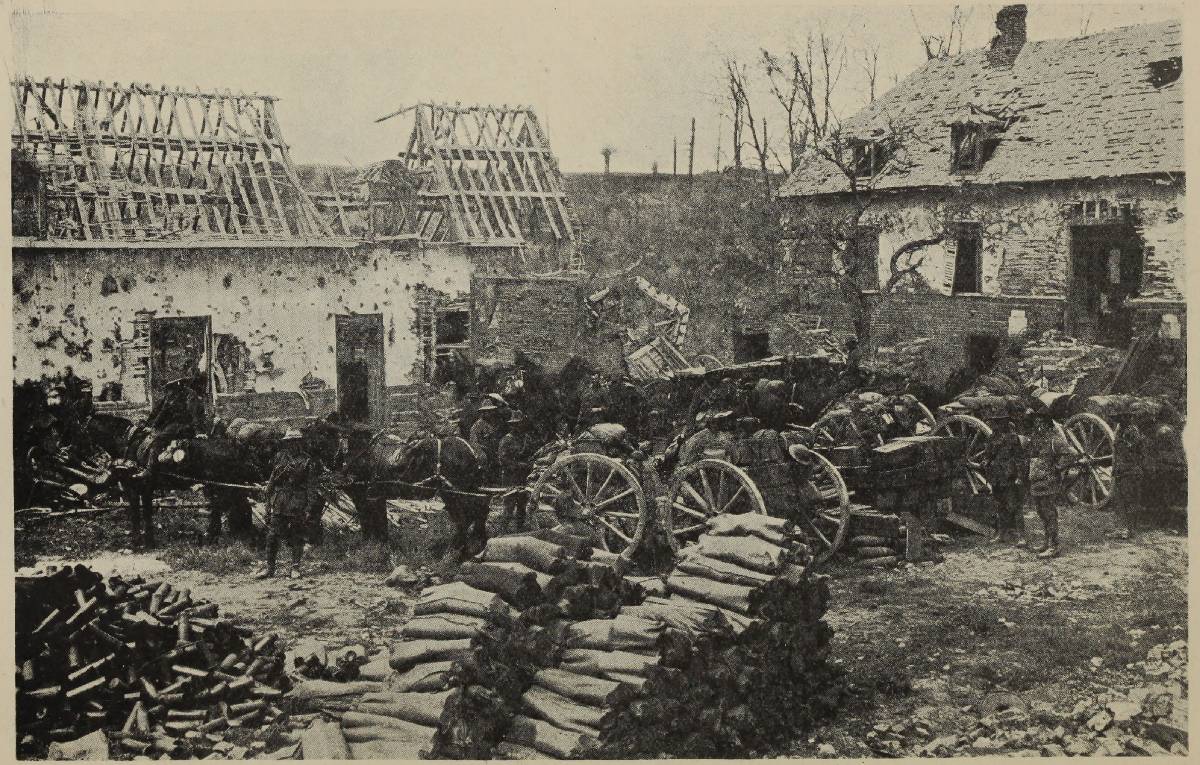
Australian Artillery—going into action at Cressaire Wood.
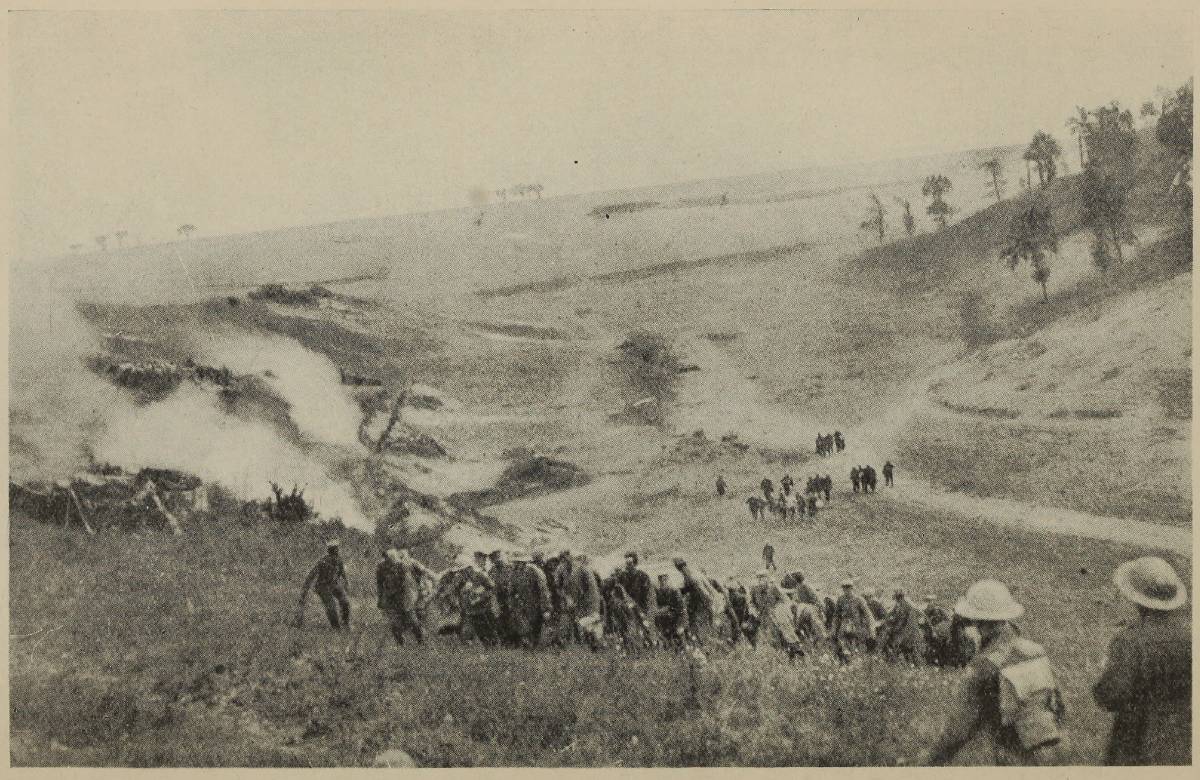
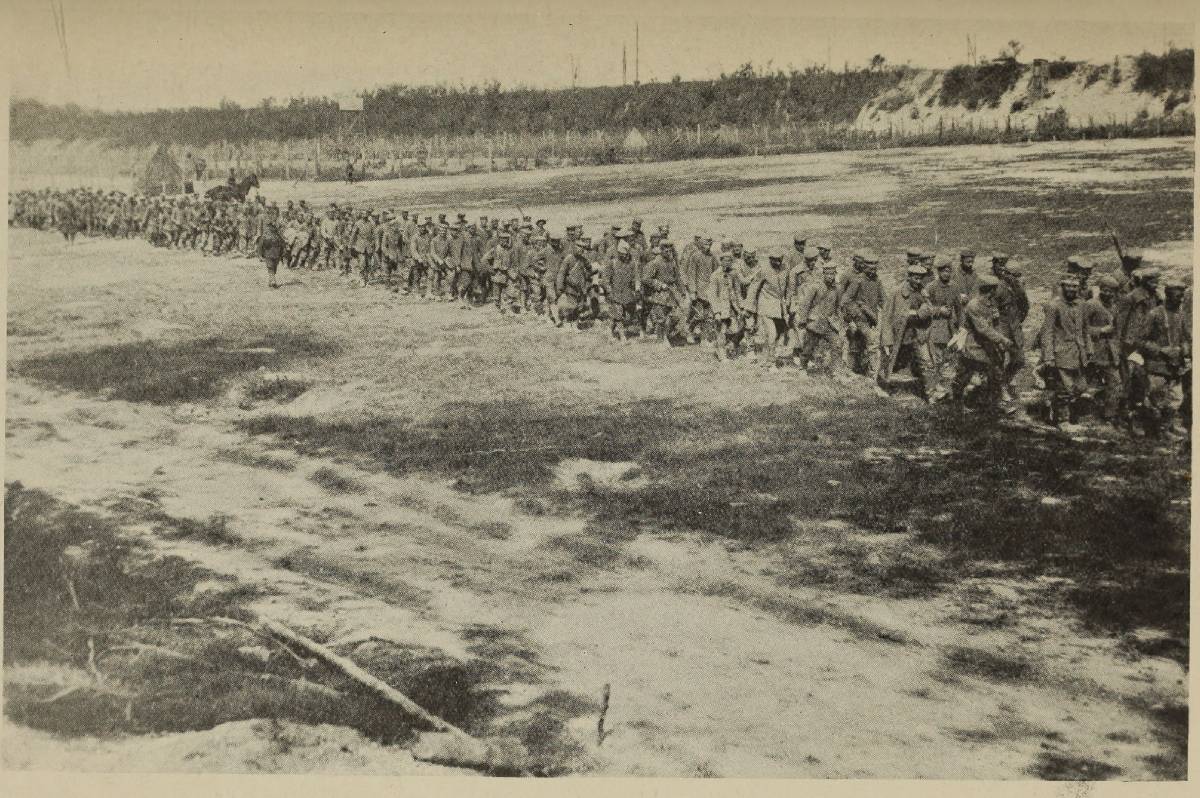
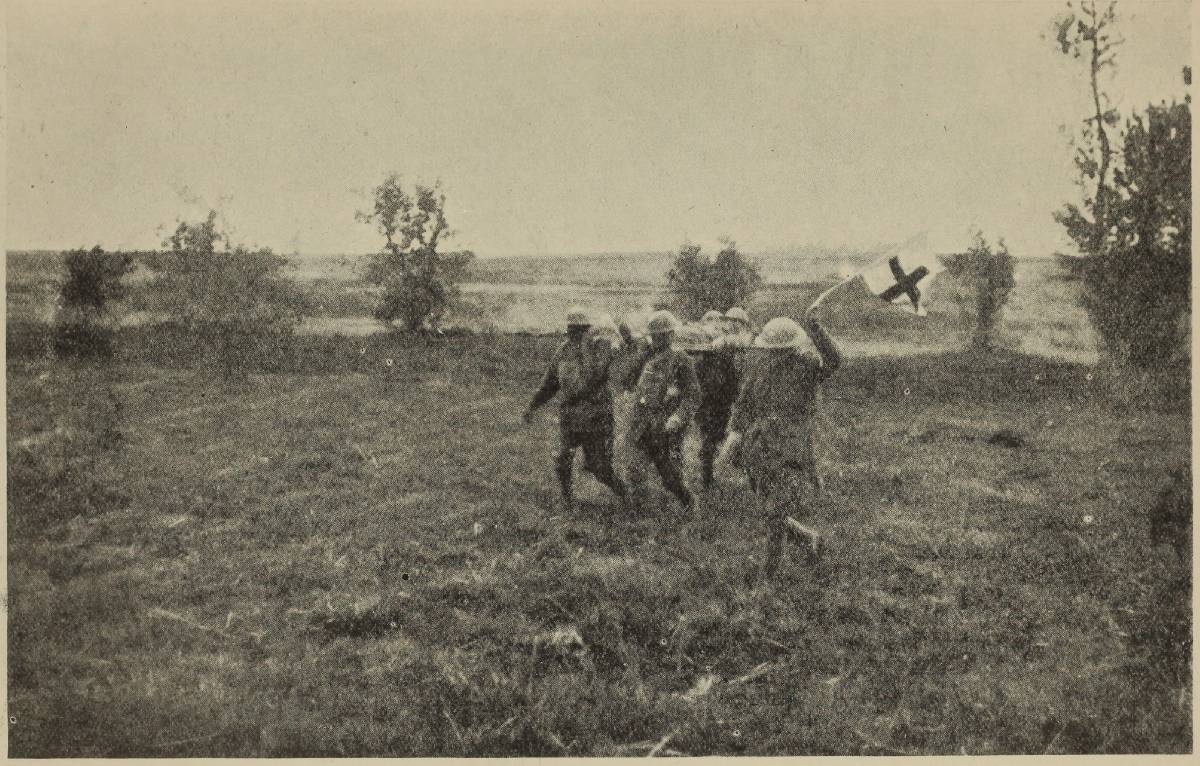
Battle of August 8th, 1918—German prisoners being brought out of the battle under the fire of their own artillery.
During the winter of 1917-1918 the British Fifth Army and
the Germans had faced each other in this region for many
months. On our side, also, a system of field defences had been
developed. They fell far short, indeed, of the completeness and
ingenuity of the German works, because the latter had been
constructed at leisure, long before, while ours had been built
under the very fire of the German guns.
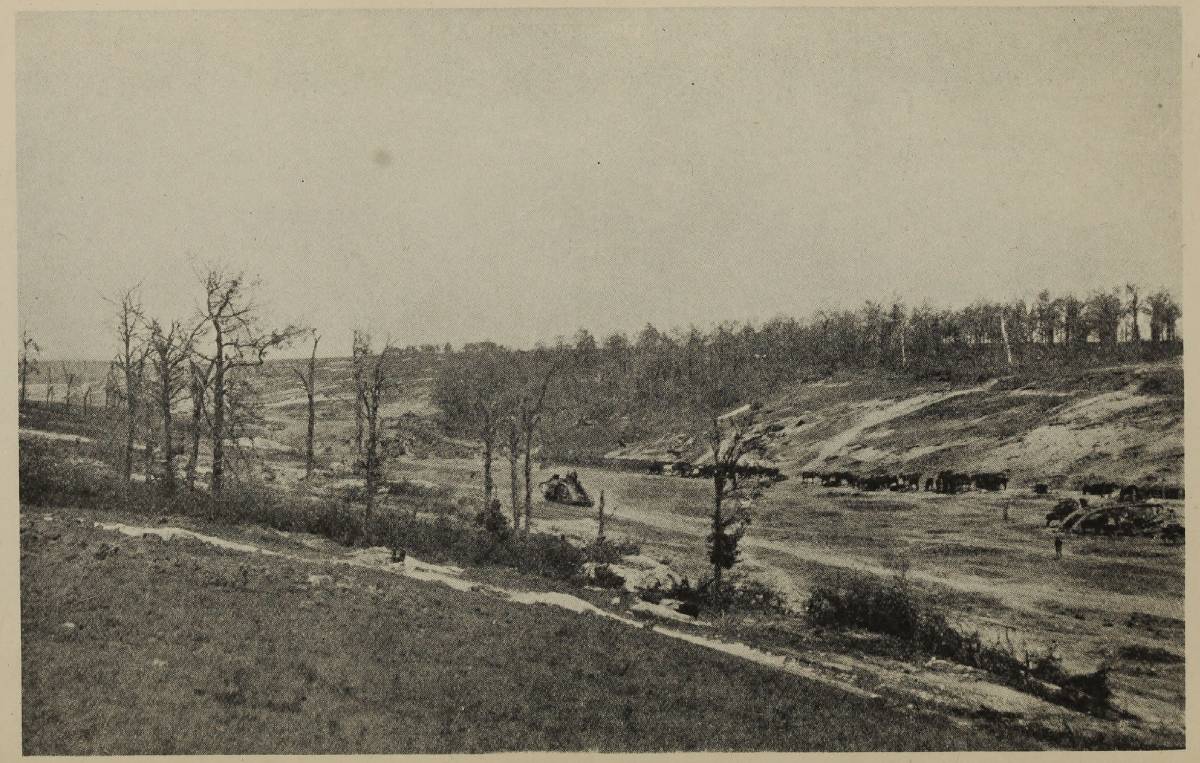
For months the opposing Artilleries had pounded the country
to pieces, effaced every sign of civilization, and churned up the
ground in all directions over a belt some three miles wide.
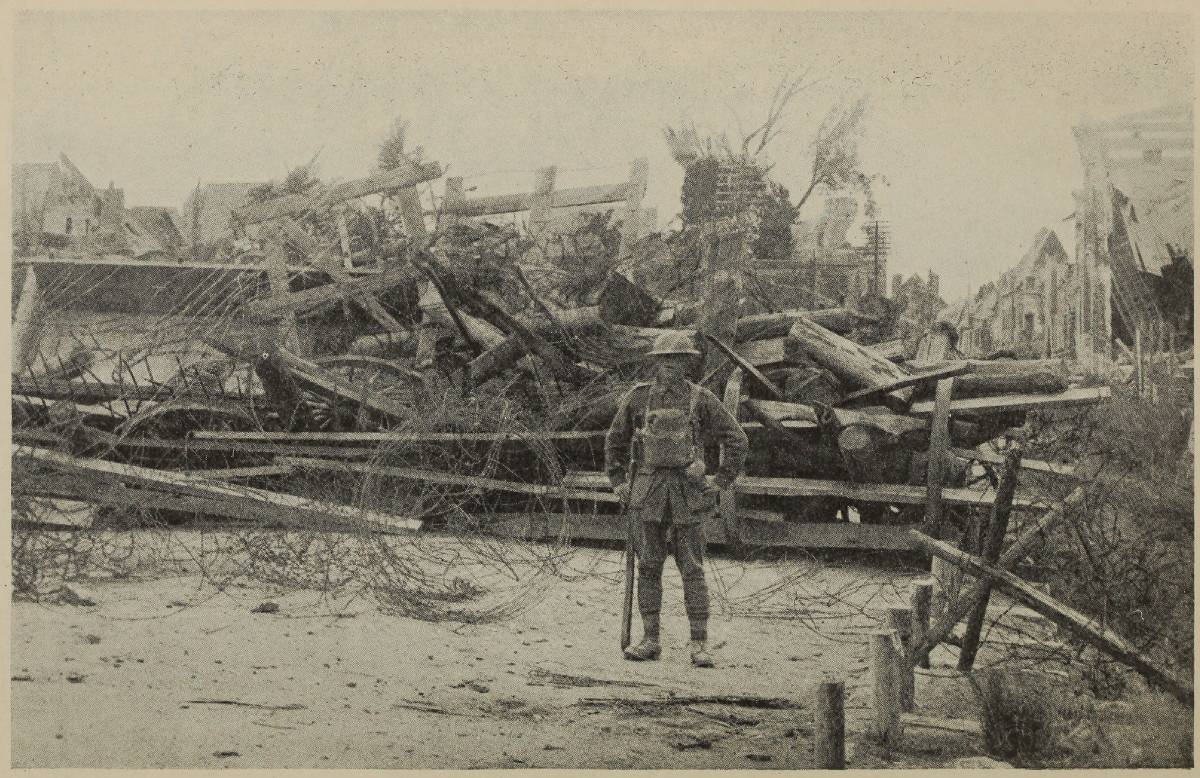
Heaps of broken bricks marked the sites of once prosperous
villages. Broken telegraph poles, charred tree trunks, twisted
rails, a chaos of mangled machinery, were the only remains of
what had once been gardens, orchards, railways and factories.
The whole territory presented the aspect of a rolling, tumbled
desert from which life itself had been banished.
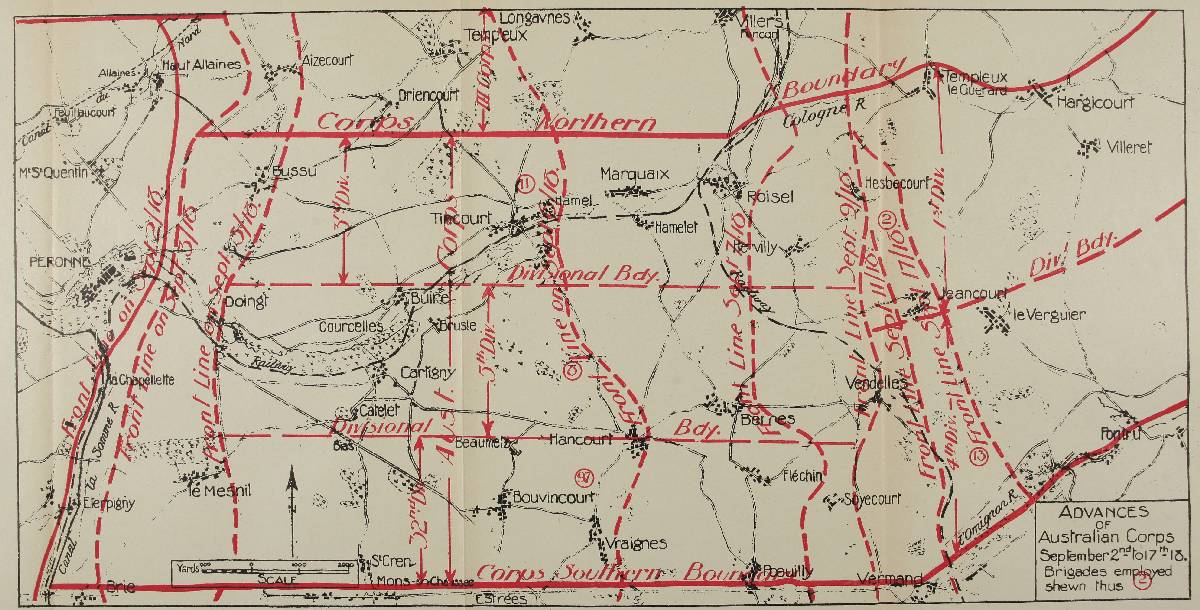
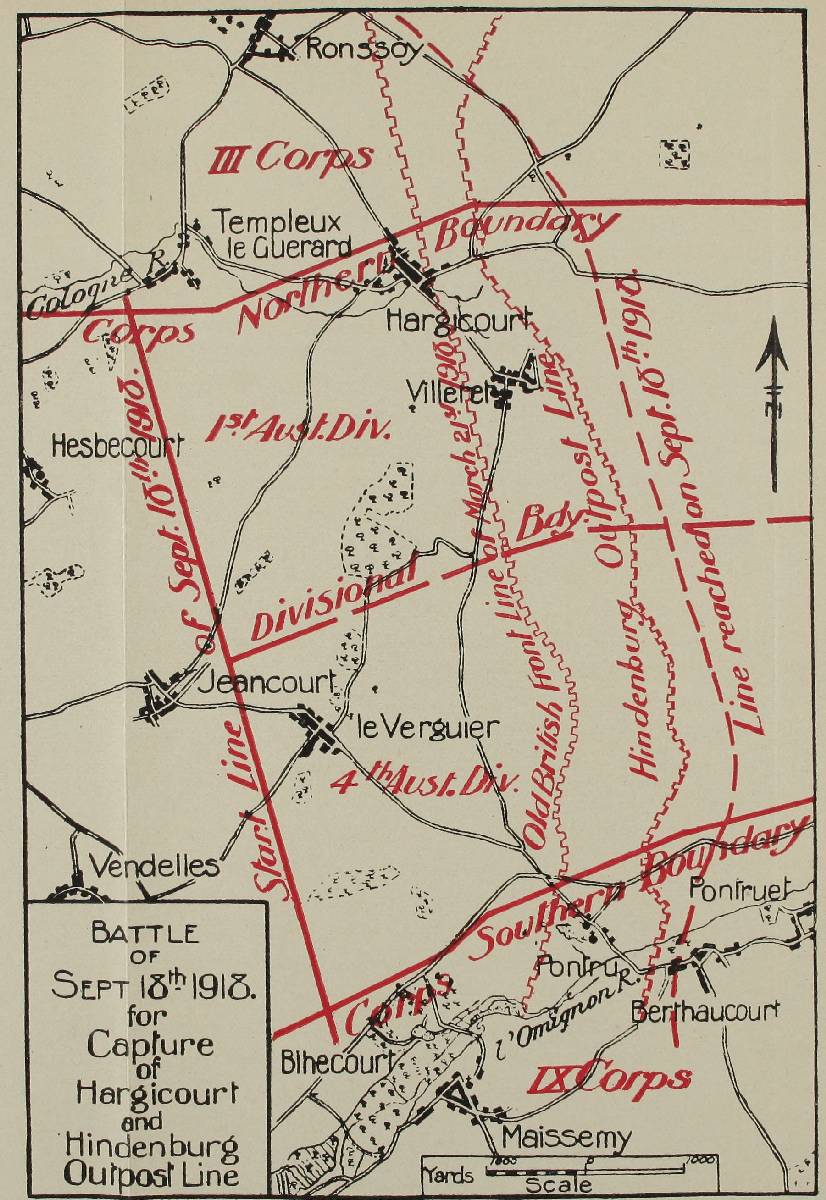
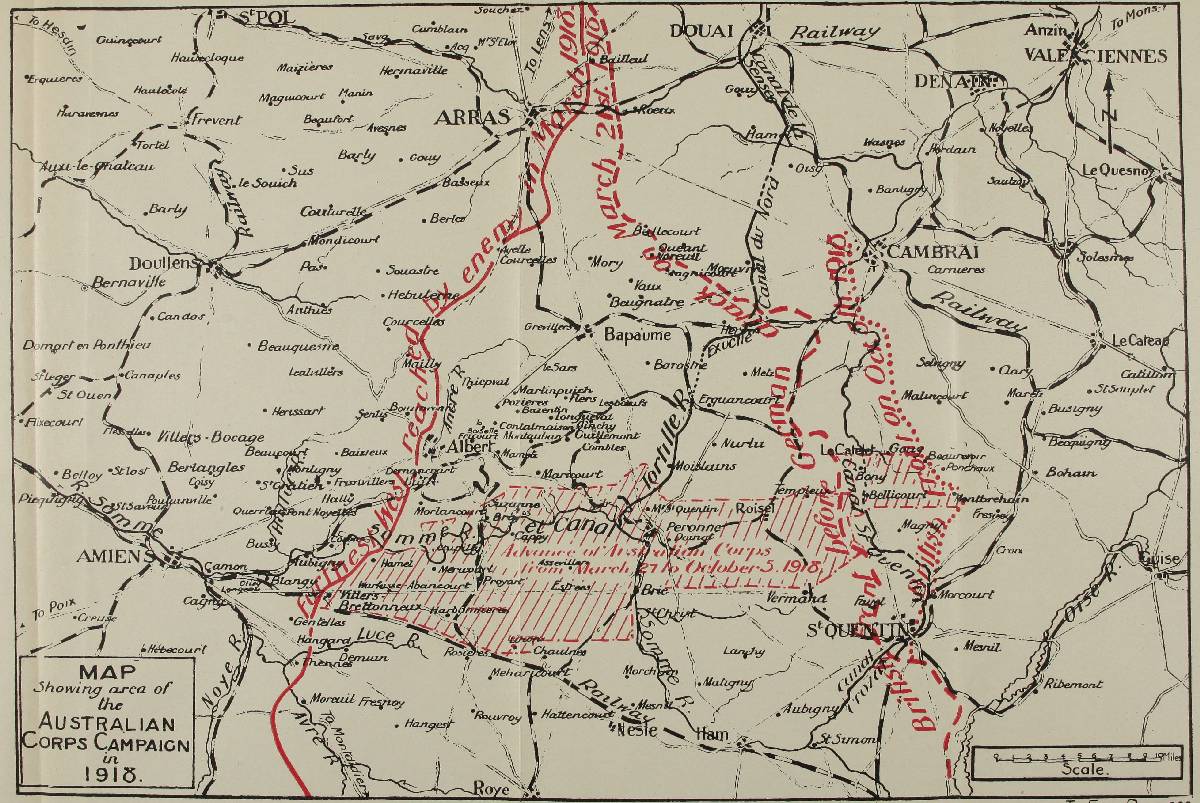
This was the region whose western verge the vanguard of the
Australian advance approached on September 11th, on a frontage
of about 8,000 yards, the northern extremity directed on Bellicourt,
the southern on Bellenglise. That is to say, if our further
advance had but continued unimpeded in the same due easterly
direction, it would have brought us square upon the open
excavation of the canal, and just clear and to the south of the
Bellicourt—Le Catelet tunnel. Some significance attached to this
circumstance, as will later appear.
Now, some little time before, an event of peculiar interest had
occurred. This was the capture, on another front, of a very
ordinary-looking transport vehicle loaded high with miscellaneous
baggage. Little escaped the inquisitive eyes of the
British Intelligence Service, which speedily discovered that
among this baggage there safely reposed a large collection of
maps and documents. On examination these proved to be
nothing less than the complete Defence Scheme of the whole
"Siegfried" system, in that very sector which now lay before
the Australian Corps.
These papers were carefully overhauled and arranged. There
were dozens of accurately drawn detailed maps, and minute
descriptions of every tactical feature of the defences. The
position of every gun emplacement was given; every searchlight,
machine-gun pit, observation post, telephone exchange,
command station and mortar emplacement was clearly marked;
the topographical and tactical features of the ground were discussed
in minute detail, and plans for the action of every
individual unit of the garrisons were fully displayed.
Naturally, an army of translators and copying clerks was
set to work upon this precious find, and my Intelligence Service
was kept busy for many days in making for me digests of those
items likely to prove of special interest. It had, of course, to
be remembered that the Defence Scheme had been brought into
operation for the campaign of 1917, and it remained to be seen
to what extent it might by now have become obsolete.
It was hardly to be expected that the enemy would adhere
to it in its entirety, especially if he were aware, as I was bound
to assume that he was, that all this information had fallen into
our hands. But the Scheme contained a full exposition of many
important topographical facts which it was in any case beyond
his power to alter, and which it was of priceless value for me to
know.
Although I had to devote hour upon hour to a concentrated
study of these papers, it proved to be in greater part labour in
vain so far as the Australian Corps was concerned, because it
ultimately came about that although I did carry out the attack
upon the Hindenburg outpost line in my present sector, the
attack upon the Hindenburg main line, which I was, later,
called upon to make, took place in the next adjoining sector to
the north, i.e., the Bellicourt tunnel sector, to which these
captured documents only incidentally referred. Nevertheless,
the Ninth Corps, under Braithwaite, ultimately got the full benefit
of these discoveries.
The production of these documents on September 10th formed
the starting point of the discussions which were now initiated in
the Fourth Army upon the question of the series of operations
necessary to overthrow the Hindenburg defences. General
Rawlinson, on September 13th, asked his three Corps Commanders
(Butler, now restored to health and back at duty, Braithwaite
and myself) to meet him at my newly-installed hutted camp
at Assevillers. There, quite informally, over a cup of afternoon
tea, the great series of operations took birth which so directly
helped to finish the war.
It was decided that the operation must necessarily be divided
into two main phases—separated in point of time by an interval
of several days for further preparation. All of us recognized the
impossibility of overrunning, in a single day, so deep and formidable
a system of defences, in such tortured country, and in
weather which was already becoming unsettled.
The first phase was to be an attempt to capture the Hindenburg
outpost line, along the whole Army front. The French and
the Third British Armies were to be asked to make a synchronized
attack on the same objective. The three Corps of the Fourth
Army were to attack upon the frontages and in the sectors on
which they then stood. The date was left undecided, but all
were to be ready at three days' notice.
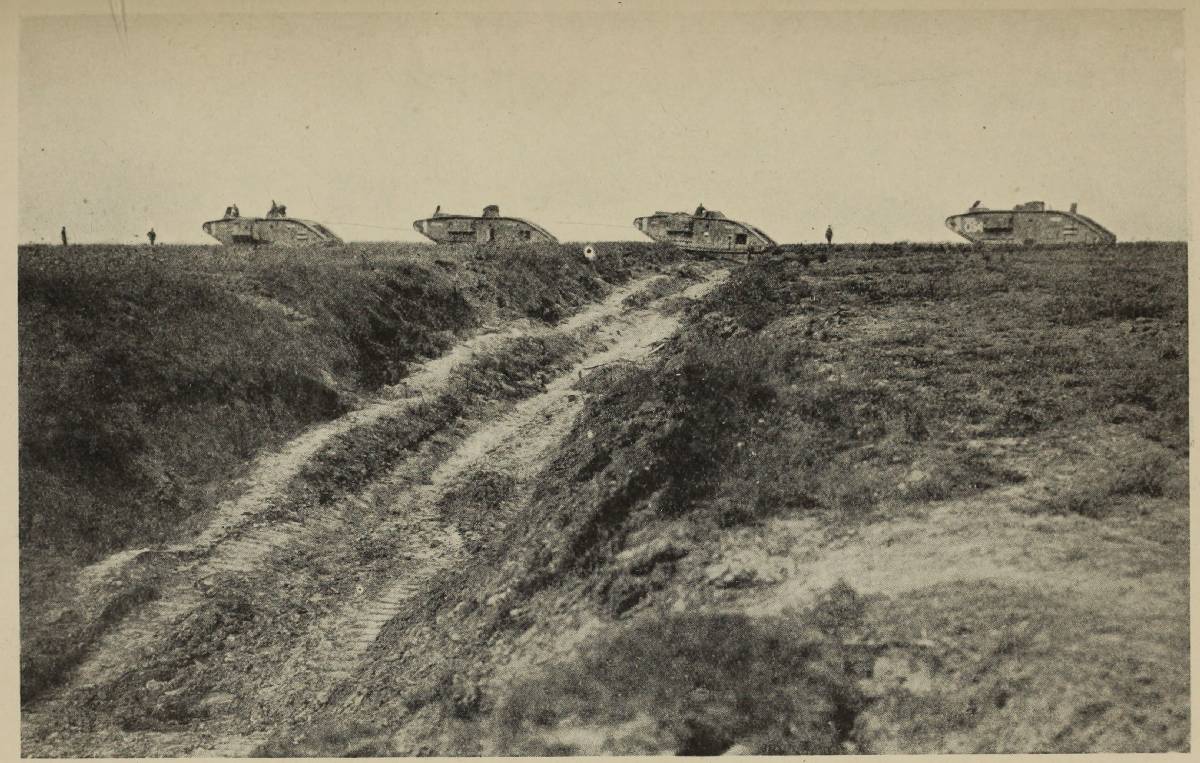
One important consideration was the meagre supply of Tanks
available. The operations of August had been costly, not to say
extravagant, in Tanks, and General Elles' repair workshops,
manned largely by very competent Chinese coolie mechanics,
had been working night and day ever since to repair the minor
damages, and new Tanks were steadily arriving from England
to replace those damaged beyond repair. But no large contingent
of Tanks was to be expected until towards the end of
the month. The upshot was that I was to be content with only
eight Tanks for use in the contemplated operation.
Late the same afternoon I communicated to Generals Maclagan
and Glasgow an outline of the probable rôle of their respective
Divisions in the very near future.
In the meantime, the front-line troops had not been idle.
My orders were that the First and Fourth Divisions were to
carry the line forward as far as possible towards the Hindenburg
outpost line, without committing the Corps to an organized
attack. They were to operate by vigorous patrol action against
enemy points of resistance, for the enemy had evidently no
intention of quietly giving up the ground which lay between us
and the Hindenburg outpost line. On the contrary, he had
posted strong rearguards on every point of tactical value, and
did his best to keep us as long as possible at arm's length, and
beyond striking distance of his first great line of defence.
These orders were entirely to the taste of the two Divisions now
in the line. The First Division had served its apprenticeship
to that very kind of fighting in the Merris area in the previous
spring, and the Fourth Division did not mean to be a second
best. Each Division stood on a one-Brigade front, being ordered
to keep its other two Brigades well out of harm's way and
resting, for any great effort that might be required.
The next few days witnessed some daring exploits on the
part of the 13th Brigade of the Fourth Division and the 2nd
Brigade of the First Division in the capture of tactical points,
and in the bloody repulse of all attempts by the enemy to
recapture them. In this way our line was carried up to and a
little beyond what had been the old British reserve line of
trenches of March, 1918, which lay within 5,000 yards of the
final objective of the first phase of the contemplated operations.
On September 16th I called together the whole of the Commanders
who were to participate in the next great battle,
Maclagan (Fourth Division), Glasgow (First Division), Courage
(Tanks), Chamier (Air Force), Fraser (Heavy Artillery), and the
four Generals of my own Staff. The conference took place in a
Y.M.C.A. marquee erected near Maclagan's Headquarters, and
I was able to announce that the date had been fixed for September
18th.
The contemplated battle presented only a few novel features.
The methods of the Corps were becoming stereotyped, and by this
time we all began to understand each other so well that most of
what I had to say could almost be taken for granted. Each
Commander was ready to anticipate the action that would be
required of him, almost as soon as I had unfolded the general
plan.
The shortage of Tanks was a source of much anxiety to me.
I felt that it would mean a heavier risk to the Infantry, and the
contemplation of losses among our splendid men, which might
be lessened by the more liberal use of mechanical aids, always
sorely troubled me. I endeavoured to meet the situation by
adopting two unusual expedients.
The first was to double the machine-gun resources of the two
battle Divisions. This was effected by bringing up the complete
machine-gun battalions of the Third and Fifth Divisions, and
adding them to those of the line Divisions. This gave me a
total of 256 Vickers Machine Guns on a frontage now reduced
to 7,000 yards. It enabled me to deliver so dense a machine-gun
barrage, advancing 300 yards ahead of the infantry, that to
quote the words of a German Battalion Commander who was
captured on September 18th: "The small-arms fire was absolutely
too terrible for words. There was nothing to be done but
to crouch down in our trenches and wait for you to come and
take us."
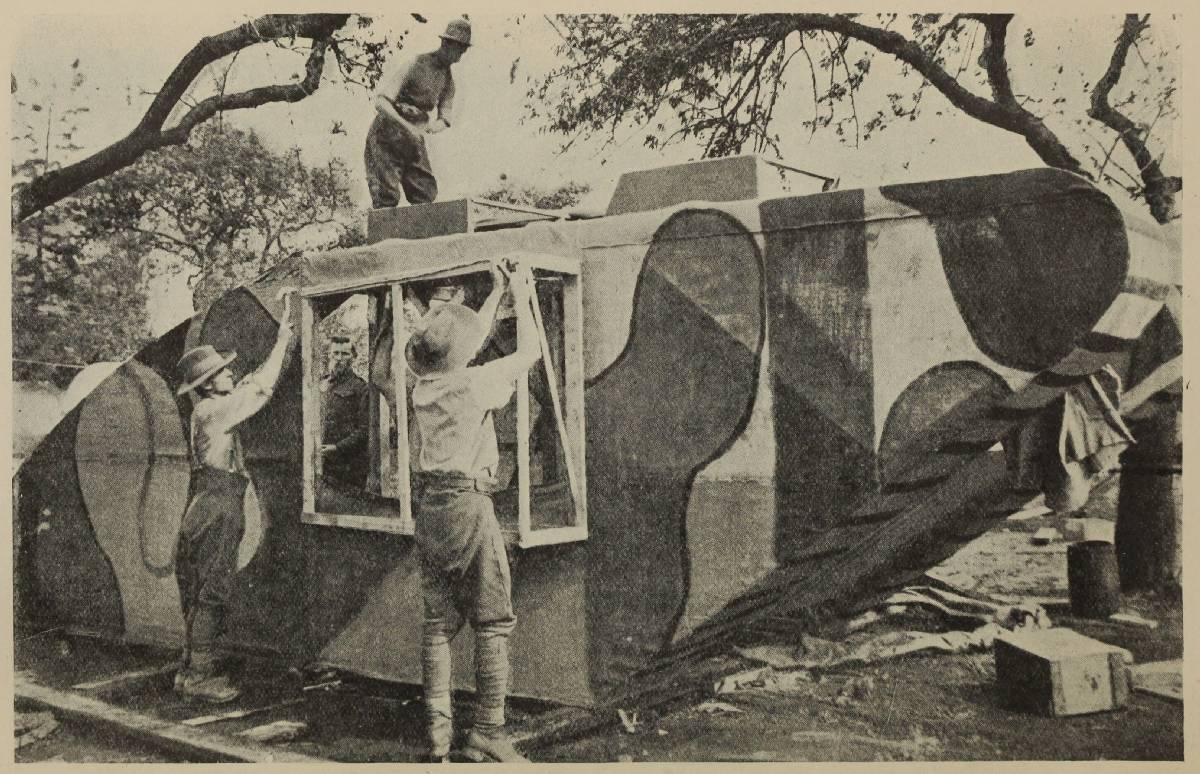
The other expedient was amusing, although no less effective.
This was to make up for the shortage of real Tanks by fabricating
a number of dummy ones. As soon as the word went
round Engineers and Pioneers vied with each other in rapid
"Tank" manufacture. Dumps and stores were clandestinely
robbed of hessian, paint, wire nails, and battens, and some
weird monstrosities were produced. The best and most plausible
of them were selected, and actually used on the day of the battle.
Four men dragged out each dummy, before dawn, into a position
from which it was bound to be seen by the enemy and there
abandoned it. There is little doubt that this trick contributed
its share to the day's astonishing success.
Once again, also, I put into practice the principle of an Artillery
barrage plan reduced to the utmost simplicity. This, as already
described, consisted in having the line, on which were to fall
the shells from the whole of the barrage guns employed, perfectly
straight across the whole front, so as to avoid all complexities
in fire direction.
The first line on which the barrage fell was called the Artillery
"Start Line," and from such a line the barrage advanced, by
regular leaps or "lifts" of 100 yards at a time, in perfectly parallel
lines, until the final objective was reached. Now, experience had
shown that such a start line for the Artillery should be at least
200 yards in advance of the line on which the Infantry were to
form up ready for the assault. A liberal margin of space had to
be allowed, in order to minimize the risks to our own Infantry.
The Artillery "Start Line" was defined on our fighting maps.
The guns were laid upon it by methods which depended upon
accurate surveys, on the ground, of the exact position of every
gun. When that had been determined, the map and compass
helped to decide the range and alignment upon which the gun
should open fire.
On the map, also, was drawn another line 200 yards short of,
or on our side of the Artillery "Start Line," and this was called
the Infantry "Start Line." It then became necessary to determine,
upon the actual ground, the position of this Infantry
Start Line, and to mark it in such a way that the Infantry would
be enabled to take up their correct positions. This would ensure
that the Infantry would know that the fall of our opening barrage
would be 200 yards in advance of the line so marked.
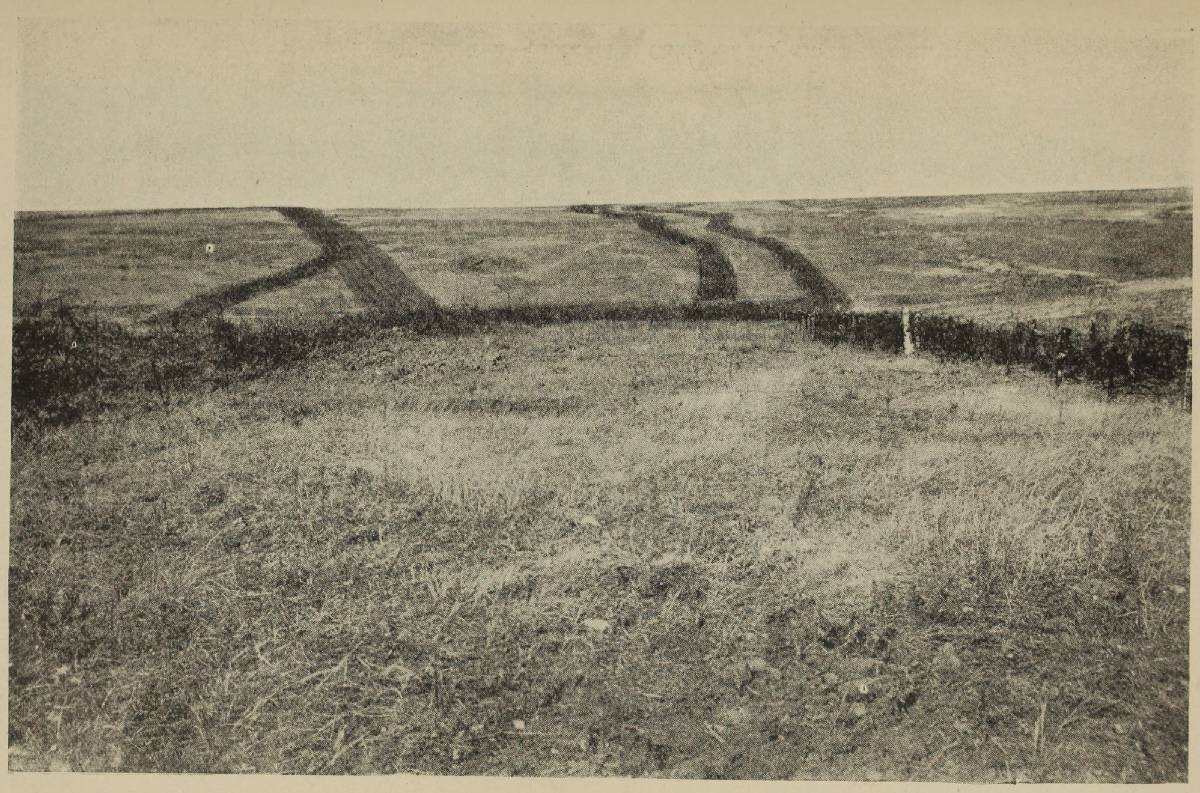
This delicate work of marking out of the Infantry Start Line
on the ground was invariably entrusted to the Engineers attached
to the Brigades co-operating in the attack. The marking was
done by laying out and pegging down broad tapes of white linen,
which could be recognized in the dim light of early dawn. The
whole work, had, of course, to be done unobserved by the enemy,
and it was always a dangerous task.
Only the fact that we were in possession of reliable large scale
maps, recording every feature of the ground, made it possible
for the Engineers, resourceful as they were, to do this delicate
work with reasonable accuracy. The battered condition of the
country was always a difficulty; for it was never easy to recognize,
on the ground, reference points, such as a road intersection, or
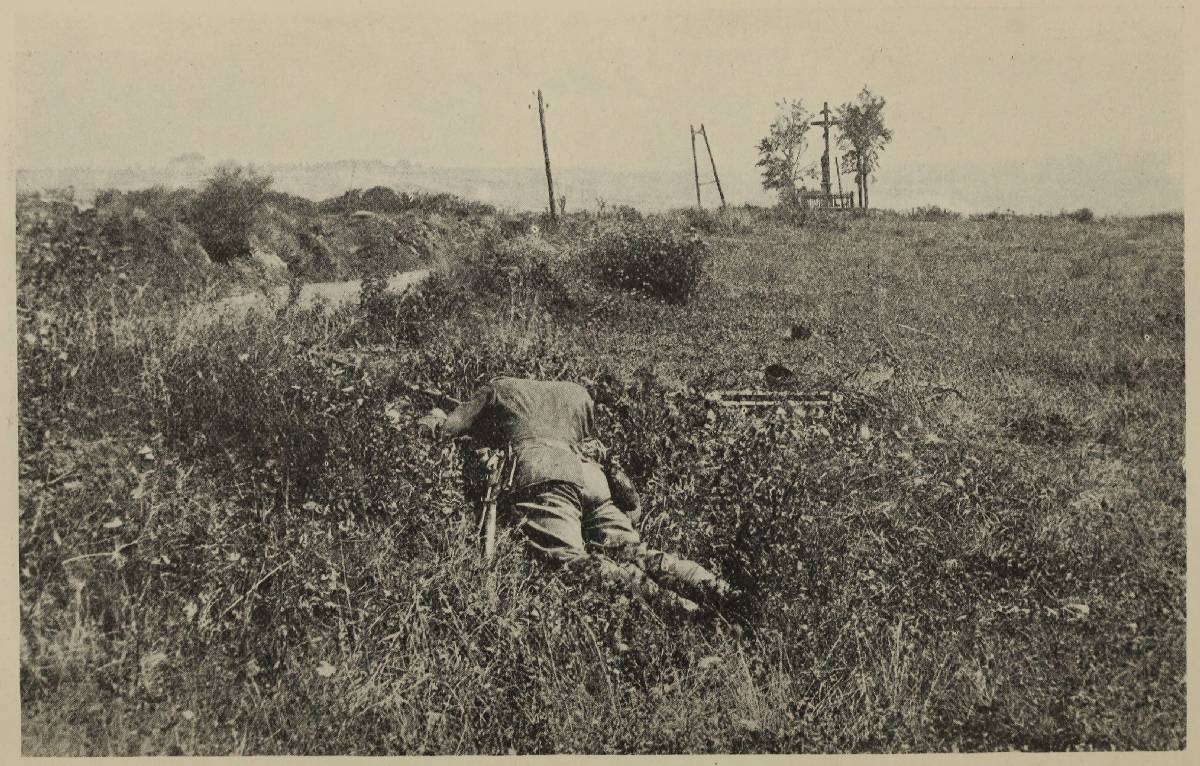
the corner of a field, or a crucifix or similar land mark, which might
aid the surveyors in getting their bearings.
The Infantry Start Line had, naturally, to be located so that
the ground upon which the tapes were to be pegged down was
ground which was already within our possession, or accessible
to us without coming dangerously near the enemy. It was
a necessary consequence that portions of our always irregular
front line of posts or trenches would lie beyond or on the
enemy's side of the tape line.
It was always a rule of our practice, therefore, that any Infantry
posted in advance of the taped line should be withdrawn, behind
the tapes, an hour before the time of Zero. It was also customary
to order that all assaulting troops should be spread, in their
appropriate dispositions, along the tape line, also one hour
before Zero.
The result of these arrangements was that for the last hour
before the actual opening of the battle, all Infantry intended to
take part in the assault was deployed along the tapes in a perfectly
straight line, all along the battle front, while no troops
previously in occupation of posts or trenches in advance of the
tapes were left out in front, exposed to the risk of either being
hit by our own Artillery, or mistaken, in the half light of dawn, for
enemies by our own Infantry.
Complex and difficult as these arrangements may appear
from this description, they worked out in actual practice with
the utmost smoothness. The resulting simplification of the
Artillery plans, in this as in similar previous battles, more than
justified their adoption.
A liberal use was also made of direction boards, which marked
the routes by which each separate body of assaulting Infantry
should, during the last night, march from its place of assembly
to the taped line or "jumping off" line, and also to mark the position
which it was to take up upon that line. Each board had
painted upon it the name of the unit to which it referred. Such
preparatory measures, troublesome as they were, greatly reduced
the risk of any confusion or mistake, and lessened the fatigue of
the assaulting troops.
The moon would set, on the morning of the battle, at 3.37 a.m.,
and the sun would rise at 6.27 a.m. Zero hour, for the opening
of the attack, was therefore fixed for twenty minutes past five.
Operations began inauspiciously. A soaking rain set in some
two hours before, and made movement over the broken, clayey
surface anything but pleasant. Although the troops were soon
drenched to the skin, this did not in any way damp their spirits.
It probably added much to the misery of the enemy, who could
hardly fail to realize that, on any morning, a fresh attack might
break upon him.
Modern war is in many ways unlike the wars of previous days,
but in nothing so much as in the employment of what I have
more than once referred to as "set-piece" operations. The term
is one which should convey its own meaning. It is the direct
result of the great extension, which this war has introduced,
of mechanical warfare. It is a "set-piece" because the stage
is elaborately set, parts are written for all the performers, and
carefully rehearsed by many of them. The whole performance
is controlled by a time-table, and, so long as all goes according to
plan, there is no likelihood of unexpected happenings, or of
interesting developments.
The Artillery barrage advances from line to line, in regular
leaps, at regulated intervals of time, determined beforehand,
and incapable of alteration once the battle has begun. Should
the rate prove too slow and the Infantry could have advanced
more quickly, it cannot be helped, and no great harm is done.
On the other hand, if there be any risk of the barrage rate being
too fast, one or two halts of ten or fifteen minutes are often
introduced into the time-table to allow the infantry line, or any
part of it which may be hung up for any reason, to catch up.
Following the barrage, comes line upon line of infantry in
skirmishing order, together with the line of Tanks when such are
used. The foremost lines advance to capture and hold the
ground, the lines in rear to "mop up" and deal with the enemy
either showing fight or hiding underground, the rearmost lines
collect prisoners or our own wounded, or carry supplies, tools
and ammunition.
In a well-planned battle of this nature, fully organized, powerfully
covered by Artillery and Machine Gun barrages, given a resolute
Infantry and that the enemy's guns are kept successfully
silenced by our own counter-battery Artillery, nothing happens,
nothing can happen, except the regular progress of the advance
according to the plan arranged. The whole battle sweeps relentlessly
and methodically across the ground until it reaches the line
laid down as the final objective.
Such a set-piece battle lasts usually, from first to last, for
80 to 100 minutes; seldom for more. When the Artillery
programme is ended the battle is either completely won, or
to all intents and purposes completely lost. If the barrage
for any reason gets away from our Infantry, and they are relegated
to hand to hand fighting in order to complete their advance,
the battle immediately assumes a totally different character,
and is no longer a set-piece affair.
It will be obvious, therefore, that the more nearly such a
battle proceeds according to plan, the more free it is from any
incidents awakening any human interest. Only the externals
and only the large aspects of such battles can be successfully
recorded. It is for this reason that no stirring accounts exist
of the more intimate details of such great set-pieces as Messines,
Vimy, Hamel and many others. They will never be written, for
there is no material upon which to base them. The story of what
did take place on the day of battle would be a mere paraphrase
of the battle orders prescribing all that was to take
place.
On the other hand battles such as the second phase of August
8th, the battle for Mont St. Quentin, and the later battles of
Bony and Beaurevoir were not set-piece operations. Therefore
the developments from hour to hour, and even from moment
to moment, are full of intense human interest, and replete with
tales of individual courage and initiative. Some day, when all
the material has been gathered, an abler pen than mine will
write their story.
If the reader will bear in mind all these considerations, with
special reference to the battle of Hargicourt on September 18th
he will realize that, in describing the dispositions, the objectives,
the time-table and the preparations for the battle, I have told
practically all that there is to tell of the course it took, except only
as regards the results actually achieved, in ground won and
prisoners taken.
It has been difficult, nevertheless, to refrain from dwelling in
detail upon the performances and experiences in battle of the
individual fighting men. Any attempt to do so would, however,
prove hopelessly inadequate. The numbers engaged were always
so large, their activities so varied, the conditions of each battle
so different in detail, that to do adequate justice and avoid
unfair discrimination would make impossible demands upon the
space available to me.
Popular interest naturally centres upon the Infantry, not only
because they are the most numerous, but also because they are
invariably in the forefront of the battle and often in immediate
contact with the enemy. Without the slightest disparagement
to the important rôle of the Infantryman and to the valour
which its performance demands, it must never be forgotten that
the work of the Artillery, Engineers, Pioneers, Machine Gunners,
Trench Mortars, Air Service and Tanks is in every way equally
important and essential to the success of any battle operation.
Yet it is equally true that no battle can be won without the
Infantry.
In a deliberately prepared battle it is not too much to say that
the rôle of the Infantry is not, as a rule, the paramount one,
provided that all goes well and that there is no breakdown in any
part of the battle plan. That does not, however, imply that the
Infantry task makes no high demand upon courage and resolution.
On the contrary, these are the essentials upon which
the success of the Infantry rôle and therefore of the whole battle
depends.
The primary duty of the Infantry, in an assault covered by an
Artillery barrage, is to follow up the barrage closely. The
barrage is nothing more nor less than a steady shower of shells,
bursting over the very heads of the leading lines of Infantry, and
striking the ground some 80 to 120 yards in front of them. This
shower is usually so dense that three to four shells per minute
fall on every twenty yards of frontage. It is so intense a fire that
no enemy, however courageous, could remain exposed to it. It
falls on one line for three or four minutes, while the Infantry lie
down flat. Suddenly, the barrage "lifts" or advances 100 yards.
At a signal from the platoon or company commander the whole
line rises and rushes at top speed to catch up to the barrage, again
to throw itself flat upon the ground.
So long as no enemy are encountered, these successive rushes
may go on without check for hundreds of yards. If during the
course of any rush, trenches or strong points are met with and
they contain enemy who do not immediately surrender, prompt
use must be made of rifle and bayonet. But it is the primary
business of the leading line of Infantry to push on and not to
delay by engaging in close combat. The second and third lines
of Infantry are there to "mop up," that is, to dispose, by destruction
or capture, of any enemy overrun or ignored by the
leading line. Where Tanks co-operate that is also their special
business, and when it has been attended to they go forward at
top speed to rejoin the leading line.
In such a methodical way the advance continues until the
final objective is reached. This event can be recognized by the
Infantry in any of three ways, firstly by reference to the clock
time; for the arrival of the barrage at any line on the map or
ground occurs in pursuance of a definite time-table; secondly by
the topographical features, and thirdly by the expedient of
maintaining the barrage stationary at the final objective for
fifteen to thirty minutes. In some battles, I also adopted the
device of firing from every gun in the barrage, three rounds of
smoke shell in rapid succession, as a signal to the Commanders
of the leading line of Infantry to call the final halt, to select a good
line for trenches, and to dig-in rapidly, a process technically
called "consolidation."
It would be too much to hope that in an attack covering
a front of four or five miles, every part of the line should be able
to advance without any check whatever up to the final halting
place. But the expectation always is that by far the greater
part of the whole line will be able to do so. If, here and there
along the front, platoons or even whole companies were to be
held up or delayed by special difficulties or obstacles such as
thickets, or copses strongly manned by the enemy, or by belts
of wire, or village ruins, such breaks in the general line of advance
would matter but little to the success of the operations as
a whole. The gaps discovered in the leading line of Infantry,
when it had come to a halt at the final objective, would be
speedily filled by supporting troops from both flanks of the gap,
and thereby the enemy holding out further back, would be completely
enveloped. His surrender would follow as soon as he
realized his position, and that he had been cut off from any
contact with his friends in his rear.
Such is the normal course of the Infantry action in a pitched
battle. It makes great demands upon the iron resolution of
the Infantryman to push on vigorously against all obstacles, and
to put forth his utmost physical powers to keep up with the
barrage, especially when the ground is wet and sticky, or when
uncut wire has to be crawled through. All this he must do,
utterly regardless of the enemy fire which may be directed against
him, whether from Artillery or machine guns. His best hope
of immunity is always to make his rush rapidly and determinedly,
and to get to ground immediately that he reaches the halting
place, close up to the barrage, when signalled by his officer.
Very different from such a stereotyped procedure is the action
of the Infantry in any operation or any part of an operation
which partakes of the character of open warfare. The main
tactical purpose is still, as before, to advance to the seizure of an
appointed objective, but there is no barrage, no time-table, no
fixity of route, no prescribed formation or procedure. Everything
must be left to the judgment, initiative and enterprise of
the leader on the spot.
The tactical unit of Infantry is the platoon. The action of a
whole battalion is compounded merely of the separate actions of
its sixteen platoons, each performing the separate rôle, in a
general plan, that may be laid down by the Battalion Commanders,
some to advance and fight, some to act in support, some to lie
in reserve, some to engage in a flank attack, others to fetch and
carry food, water and munitions.
The platoon is commanded by a Lieutenant and comprises
four sections, each under a Sergeant or Corporal. There are two
sections of riflemen, a Lewis gun section and a section of rifle
grenadiers. Each section may consist of from five to eight
men. Let it be supposed that it is the business of the platoon to
capture a small farmhouse which the enemy has fortified and in
which he is holding out. Always supposing that the enemy
garrison is not of a strength requiring more than one platoon
for its capture the normal action of the attacking platoon would
be somewhat as follows. The Lewis gun section would, from a
concealed position, on one flank, keep the place under steady
fire. The rifle grenadiers from the same or another flank would
fire smoke grenades to make a smoke screen. One section of
riflemen would endeavour to sneak up depressions and ditches
or along hedges, so as to get well behind the farm and threaten
it by fire from the rear. The other section of riflemen would
choose some direct line of attack, over ground which offered concealment
to them until they were close enough to take the objective
with a rush.
Such in very bare outline is merely an imaginary example,
but it is sufficient to show the amount of skill, resource and
energy required on the part not only of the leader, but also of
every man in the platoon. The secret of success of the Australian
open fighting lay in the extraordinary vigour, judgment and team-work
which characterized the many hundreds of little platoon
battles which were fought on just such lines as I have tried to
suggest in this example.
It will be readily seen that no comprehensive description
is possible which would present an adequate picture of the widely
varying activities of the Australian Infantryman in this campaign.
There is only one source from which reliable narratives of individual
fighting can be gathered, and that source is so voluminous
that space forbids any but a meagre attempt to supply extracts
from it. I refer to the recommendations made by Commanders
for honours and rewards for individual acts of gallantry. A
very small selection of these has been made and is presented in an
appendix to this book.[20]
But to return to my narrative of September 18th. On that
day each Division attacked on a frontage of two Brigades. No
serious opposition was encountered except at La Verguier, which
was not far from our start line. Nevertheless, the whole of the
"red" line, which was the objective of the "set-piece" phase of
the day's battle, was in our possession, throughout the whole
length of the Corps front, well before 10 o'clock.
This gave us complete possession of the old British front line
of March, 1918; but the Hindenburg outpost line yet lay before
us, still distant another 1,500 to 2,000 yards. This latter line
was to be the ultimate or exploitation objective of the day's
operations, and I could hardly have dared to hope that a trench
system of such considerable strength, which had defied the Fifth
Army for so long, would fall into our hands so easily as it did.
Glasgow's Division pushed on without pause, and before
nightfall had overwhelmed the garrison of the Hindenburg
outpost line along its front. Maclagan's Division also fought
its way forward to within 500 yards of that line. But the troops
were by then very exhausted; all movement was in full view
of the enemy; and the ground was very difficult. After a
consultation with Maclagan I decided to rest the troops, and to
make an attempt to reach the final objective (blue line) that same
night.
Advantage was taken of this pause to advance the Artillery,
so that the enemy's defences could be thoroughly bombarded
before the final assault. At 11 o'clock the same night, the
Fourth Division again attacked, and after severe fighting also
captured the whole of the objective trench system.
It was a great victory. The Hindenburg outpost line had been
vanquished. From it we could now look down upon the St.
Quentin Canal, and sweep with fire the whole of the sloping
ground which lay between us and the Canal, denying the use of
that ground to the enemy, and making it impossible for him to
withdraw the guns and stores which littered the area.
The overwhelming nature of the success can best be realized
by the following almost incredible analysis of the material results
of the day's fighting. The First Division attacked with a total
strength of 2,854 Infantry. They suffered only 490 casualties
(killed and wounded). They captured 1,700 prisoners, apart
from the large numbers who were killed, and the wounded enemy
who made good their escape.
The Fourth Division had a total assaulting strength of 3,048
of all ranks, of whom 532 became casualties. Their captures
of live prisoners amounted to 2,543.
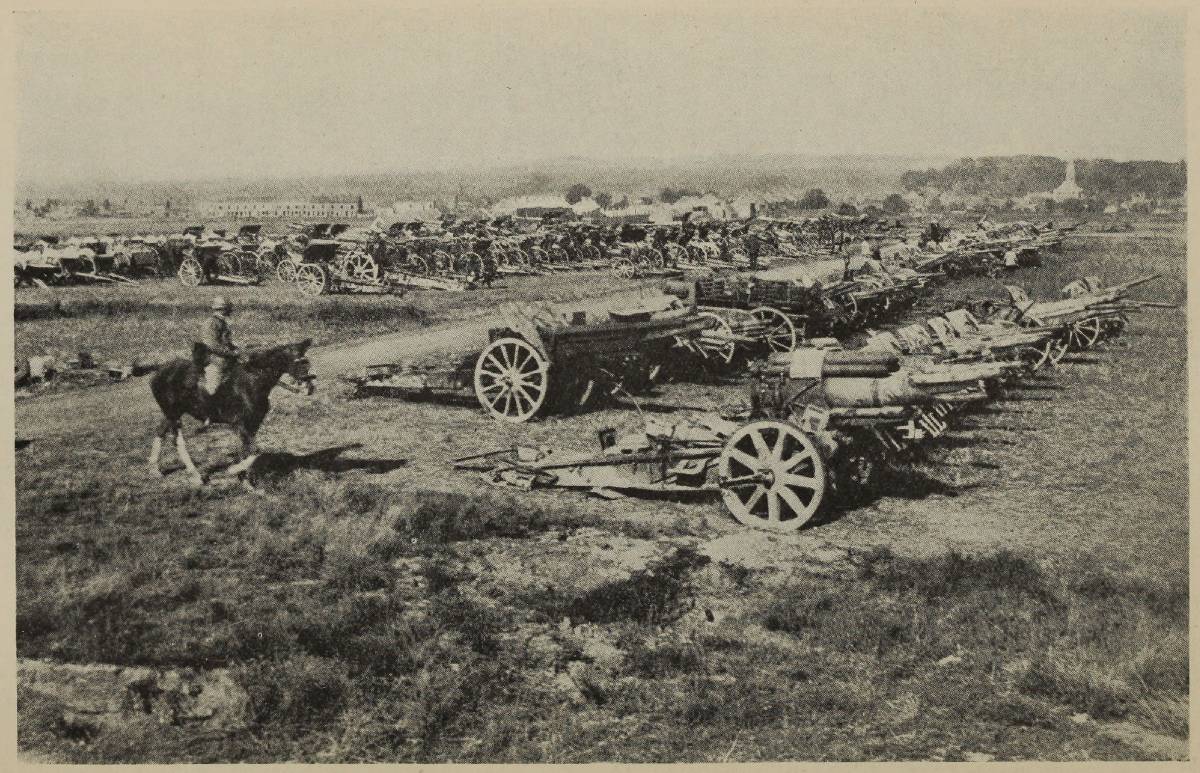
In addition, the Corps gathered in upwards of 80 guns, which
had been overrun, and had to be abandoned by the enemy.
There is no record in this war of any previous success on such
a scale, won with so little loss.
The Corps on either flank of me had successes of varying
quality. The Ninth Corps on the south had reached the red line,
but the exploitation phase of the operation was not pressed
until a later day. The Third Corps, on my left, however, made
indifferent progress. Their line still bent back sharply from my
left flank, and none of the enemy's outpost system had been
gained. This portion of the Army front was that which lay
square opposite the Bellicourt tunnel, and the fact that in this
part of the field the Fourth Army had not yet mastered the
Hindenburg outpost system was to be fraught with very serious
difficulties for me, not many days later.
The general plan propounded by General Rawlinson on
September 13th had been realized in part, although not in its
entirety. The successes gained on September 18th were nevertheless
sufficiently important and decisive to justify immediate
preparations for working out the plan for a great, combined and
final effort to sweep the enemy out of the remainder of the last
lines of defence which he had established in France.
The First and Fourth Australian Divisions had, however,
as it turned out, fought their last fight in the war. Their long
and brilliant fighting career, which had been opened three and a
half years before, the one on the cliffs of Gallipoli, and the other
in the desert of Egypt, thus ended in a blaze of glory. Although
a number of the officers and non-commissioned officers of both
these Divisions were called upon, very shortly after, to render
one more valuable service to the Australian Corps, the Divisions
themselves were destined, because of the termination of hostilities,
not again to make their appearance on any battle front. Their
labours ended, the troops were taken by motor bus and railway
to a coastal district lying to the south-west of Amiens, there to
rest and recuperate in the contemplation of a noble past devoted
to the service of the Empire.