THE RED CROSS WORK: ITS VALUE AND LIMITATIONS—ORIGIN
IN AUSTRALIA—REPORT OF EXECUTIVE
OFFICER IN EGYPT—RED CROSS POLICY—DEFECTS
OF CIVIL AND THE ADVANTAGES OF
MILITARY ADMINISTRATION—WHAT WAS ACTUALLY
DONE IN EGYPT.
CHAPTER IX
The British Red Cross Society, Australian Branch,
was founded by Her Excellency Lady Helen
Munro Ferguson, wife of the Governor-General of
Australia, on the outbreak of war. On previous
occasions unsuccessful attempts had been made to
found an Australian Red Cross Society. On this
occasion the movement was most successful, although
many people then (like some people now)
were quite unable to understand the distinction
between the Red Cross movement and military
administration.
The Red Cross Society in Australia undertook
the collection of funds for immediate
transmission to the British Red Cross Society for
prompt use in the field. Branches were formed in
each State and committees were formed by the
wives of the various governors. Thus a rough-and-ready
arrangement was made prior to the
adoption of a constitution. It was considered far
more important to do the work than to waste
time holding meetings and devising a constitution.
Those who could not afford to give money were
invited to make clothing or to contribute articles
of various kinds. Specifications of the clothing
requisite were given, and patterns furnished so
that it might be readily made on approved
design. It is not too much to say that the
majority of the inhabitants of the Continent were
soon engaged in some way or other in helping
the Red Cross movement. The ball-rooms of
the respective Government Houses were used as
depots. The depot at Federal Government House,
Melbourne, was an excellent model. People were
invited to send their donations irrespective of
their number or their kind. These were received
and receipted, and were then sorted into
bundles of similar articles by lady volunteers.
They were then placed in cases by volunteer
packers, mostly experienced men from various
warehouses, and were finally dispatched to Europe
as opportunity offered.
The arrangement of these details fell largely on
the Council and Secretary of the Branch (one of
us, J. W. B.) in Australia acting under the direction
of the President, Her Excellency Lady Helen Munro
Ferguson. Very great difficulty was experienced in
finding space in merchant ships for the conveyance
of the goods. Space was found on the transports,
but there was not the same security for delivery.
In addition the hospitals of the transports were
provided with such equipment as the officers
commanding desired.
When, however, the Lines of Communication
Units were ordered to Egypt, another problem
arose, and the Australian Red Cross Society decided
to properly equip these units both with money
and goods. For this purpose £10,000 was set aside
and forwarded to London. It was handed to the
British Red Cross Society and kept available for the
officers commanding the five hospitals, the requisite
sum of money to be allotted to them by Surgeon-General
Williams, C.B., the Director of Medical
Services in Australia, who had proceeded to Europe.
At the time it was supposed that these five hospitals
were proceeding to France. In addition large quantities
of goods were available at the British Red Cross
Society in London, and large quantities of goods
were given to the several hospitals for dispatch with
their equipment. When, however, the hospitals
were sent to Egypt a new situation arose. There
were many other medical units in Egypt besides the
hospitals. There were the Field Ambulances and
the Regimental Medical Officers, and Surgeon-General
Williams regarded them as equally worthy of
assistance. On his arrival in Egypt at first, in
December, and subsequently in the middle of February,
the scope of the British Red Cross, Australian
Branch, in relation to Australian troops had extended
far beyond the original intention. The action taken
is described in the following report sent to the
President and members of the Council, British Red
Cross Society, Australian Branch, on my resignation
(Lieut.-Col. Barrett) from that body on
September 9, 1915. I did not at any time receive
any instructions from Australia, and acted in the
manner which seemed best after consultation with
local authorities.
REPORT ON THE WORK OF THE AUSTRALIAN
BRANCH BRITISH RED CROSS IN
EGYPT, FROM MARCH TO SEPTEMBER 3,
1915
By James W. Barrett, Lieut.-Colonel, Lately
Executive Officer, Australian Branch British Red
Cross Society
Report presented to the President and
Members of the Council of the Australian
Branch British Red Cross Society
The First Australian General Hospital arrived in
Egypt in January 1915. I was associated with it as
Registrar and Oculist and had nothing to do with the
Red Cross movement beyond assuming responsibility
for any Red Cross goods which belonged to the
Hospital.
When leaving Melbourne Colonel Ramsay Smith
was informed that there would be room for 100 tons
of Red Cross goods in the Kyarra. When, however,
the Kyarra reached Melbourne her holds were
full and no Red Cross goods were taken on board.
There were consequently not any Red Cross goods
available at No. 1 Australian General Hospital for
some considerable time after arrival in Egypt.
Surgeon-General Williams, C.B., arrived in Egypt
in the middle of February, and at once proceeded to
organise the Red Cross movement. He had been entrusted
with £10,000 which was to be expended by the
officers commanding medical units according to the
plan set out later. He at once took action, and money
was distributed to a number of hospitals and medical
units. This distribution was of the utmost service.
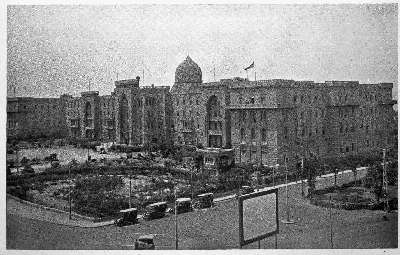 Heliopolis Palace Hotel.
To face page 141
When Red Cross goods began to arrive in Egypt he
sought a suitable store. Finding nothing in Cairo
at a reasonable price, he established a store in the
basement of the Heliopolis Palace Hotel, No. 1
Australian General Hospital, for which, of course,
no rental was charged. The store was placed under
the immediate charge of the Orderly Medical Officer,
Captain Max Yuille, and under my general direction.
The distribution of money and collection of goods
from ships was effected by General Williams through
his own office in Cairo.
General Williams left for London on duty on
April 25, leaving me in charge of the Red Cross work,
and leaving his Warrant Officer, Mr. Drummond, in
his office to continue the collection of goods and the
clerical work.
Soon after he had left, the crisis of May and June
took place. Wounded and sick were poured into
Cairo on a scale probably never known or equalled
before. There have been occasions on which a
much larger number of men have been wounded,
but probably never any occasion in history in which
so many wounded men have been handled in so
limited a space. Fortunately preparation had been
made by the D.M.S. Egypt, Surgeon-General Ford,
D.S.O., and the D.M.S. A.I.F., Surgeon-General
Williams, C.B., who instructed the O.C. First Australian
General Hospital, Colonel Ramsay Smith, and
myself as registrar to take over extra buildings and
provide equipment. It was this action which prevented
a disaster, and whilst not strictly a Red Cross
matter was greatly aided by Red Cross equipment.
During this crisis I was instructed by the D.M.S.
Egypt, Surgeon-General Ford, and the O.C. Australian
Intermediate Base, Colonel Sellheim, to visit various
hospitals in Egypt—both in Alexandria and the
provinces—to interview the Australian wounded and
supply all reasonable comforts. In accordance with
this order, money and goods, either or both, were sent
to various hospitals as set out in the various tables.
It so happened that the British Red Cross Society
possessed neither money nor goods at the inception
of the crisis, and the authorities were profoundly
grateful for the help which the Australian Branch
afforded. The British Red Cross, Egyptian Branch,
at a later stage received large supplies of money and
goods which were freely distributed. The fact that
goods could be obtained from the British Red Cross
Society, Australian Branch, soon became known,
and many requisitions were received. The list of
goods available was widely circulated and in no
instance was the requisition of any Officer Commanding
not complied with. It was always completed to
the extent of our resources. Periodical reports of
the work done were prepared and forwarded to the
President of the Australian Branch British Red
Cross Society, Melbourne.
Whilst the work was at its height a message from
Australia reached His Excellency Sir Henry MacMahon,
in consequence of which two Committees
were formed on June 3, 1915—a General Egyptian
Committee and an Executive Committee.
The members were:
| | { President, His Excellency Sir Henry MacMahon. |
| General | { Lord Edward Cecil. |
| Committee | { Sir Alexander Baird. |
| | { Sir Courtauld Thomson. |
| | { Sir John Rogers. |
| Executive | { Dr. Ruffer. |
| Committee | { Surgeon-General Williams. |
| | { Lieut.-Colonel Barrett. |
Sir Courtauld Thomson is the Commissioner in
the Mediterranean for the British Red Cross Society,
and Sir John Rogers and Dr. Ruffer Deputy Commissioners
in Egypt.
Surgeon-General Williams and Lieut.-Col. Barrett
were appointed members of the Executive Committee
of the British Red Cross Society in Egypt.
There was no amalgamation of the two branches,
but by this arrangement each was kept informed
of the activity of the other and wasteful overlapping
was avoided.
Members of the General Committee investigated the
work of the Australian Branch, were consulted in
matters of policy, and received and investigated any
complaints. They were most helpful.
General Williams returned to Egypt on June 21,
made a tour of inspection, and visited the Australian
wounded. He reported to the Government, and
finally left for London on duty on June 29. On this
occasion he took with him his office staff, and consequently
the administration fell largely into my hands.
On July 13, however, I learned by cable from
Australia that two Commissioners had been appointed
in terms which seemed to place them in
entire control of the Red Cross movement.
As it was desirable that other medical officers
should be associated with the movement. Colonel
Ryan, Colonel Martin, and Lieut.-Col. Springthorpe
were invited by His Excellency Sir Henry MacMahon
to join the Executive Committee.
Mr. Adrian Knox, K. C., the first of the Commissioners,
arrived in Cairo on August 11, and
the second Commissioner, Mr. Brookes, reported on
August 27. I endeavoured to help them in every way
that was possible, and finally asked to be relieved of
the work on September 9, expressing my willingness,
however, to continue to aid in any way they desired.
My relationship to them has been cordial, and I am
very glad if I have been able to be of any assistance.
I now propose to deal with the operations of the
Society under various headings:
1. Finance.—The original fund in the hands of
Surgeon-General Williams was operated upon by
him in London, in Malta, and in Egypt. It was
only in Egypt that I was concerned with it, and
to a limited extent. It was most helpful, and
great service was rendered during the crisis by
the prompt distribution of money.
When the General Committee, of which His Excellency
Sir Henry MacMahon is President, was
formed, separate funds were forwarded to him in
response to a cable from me indicating that more
money was wanted. I suggested the supply of
another £10,000, but when, on July 9, £18,000 had
been received it became obvious that operations
were contemplated on a more extensive scale than
had hitherto been thought necessary. I have prepared
a summary of the amounts distributed to
medical units from both funds, and given an
account of the method adopted.
The Red Cross Society originally intended that
£10,000 was to be expended by the officers commanding
medical units, and General Williams embodied
the direction in the following circular, to which
I subsequently added a memorandum in further
explanation of new conditions which had arisen.
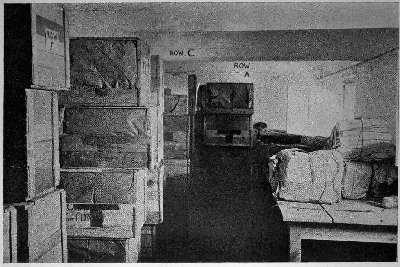 Interior of Red Cross Store: Utilisation of Cases for Shelving.
To face page 144
Australian Imperial Force
Received from Surgeon-General W. D. C. Williams,
Director Medical Service, A.I.F., the sum of
———— stg.
to be utilised and accounted for by me in terms of
Circular Letter No. E 1/15, dated 13-2-15.
———————— O.C.
Place ————————
Date ————————
Australian Imperial Force
Circular Letter No. E 1/15.
O.C.,
1. Forwarded herewith the sum of ————————
stg.
to be expended by your authority and direction on
such articles as you may consider requisite for the
general improvement of equipment, stores, or other
items which in your opinion will conduce to the
general well-being and comfort of the patients in
hospital under your command.
2. Attached receipt forms to be signed in duplicate
and returned to me.
3. When three-fourths of the amount allocated to
you has been expended, you will furnish this office
with expenditure vouchers in duplicate. This will
enable me to keep the High Commissioner informed
as to how the moneys are being spent, and to arrange
for further grants if considered necessary.
Surgeon-General,
Director Medical Services, A.I.F.
[Copy]
May 20, 1915.
O.C.
Govt. Hospt.
Tanta, Damanhour and Shebin el Kom.
1. I enclose herewith cheque for {£50 £25 £25} to be expended
in terms of the Circular Letter attached.
Will you please sign the accompanying receipt in duplicate
and oblige.
2. It is not desired that the expenditure of the
money should be restricted to Australians, as such a
course would, I think, in a hospital be impracticable
and undesirable. If, however, this is used for all the
Allied troops under your care, then the next instalment
which may become necessary might well be
provided from the "Military Hospitals Fund" or the
"Egyptian Red Cross Fund."
3. I shall be glad if you will communicate to the
men in the Hospital the fact that comforts are being
supplied from the Fund of the British Red Cross
Society (Australian Branch), the administration of
which fund is in the hands of Surgeon-General
W. D. C. Williams, C.B.
(Signed)
James W. Barrett,
Major,
for W. D. C. Williams,
Surgeon-General.
Grants of Money made to Various Hospitals
from Red Cross Funds
| Hospital or Medical Unit, etc. | Amount in |
| | Egyptian pounds. |
| First Australian General Hospital and Auxiliaries | 1376,42.5 |
| Second Australian General Hospital | 682,50 |
| Share of Rent of Luna Park for three months | 117,00 |
| Y.M.C.A. (including stationery, building |
| fund, Soldiers' Café, and sundry accounts) | 982,08.6 |
| Venereal Hospital, Abbassia | 48,75 |
| Deaconess Hospital, Alexandria | 78,00 |
| European Hospital, Alexandria | 48,75 |
| Government Hospital, Tanta | 53,62.5 |
| No. 21 General Hospital, Alexandria | 97,50 |
| Convalescent Home, Al Hayat, Helouan | 341,25 |
| Convalescent Home, Ras el Tin, Alexandria | 97,50 |
| A.D.M.S., First Australian Division | 292,50 |
| First Stationary Hospital | 195,00 |
| Second Australian Stationary Hospital | 196,24.7 |
| First Casualty Clearing Station | 146,25 |
| Fourth Field Ambulance | 290,00.2 |
| First Light Horse Field Ambulance | 97,50 |
| Second Light Horse Field Ambulance | 195,00 |
| Third Light Horse Field Ambulance | 48,75 |
| Fifth General Hospital | 97,50 |
| Fifteenth Stationary Hospital | 97,50 |
| 17th General Hospital | 146,25 |
| Bombay Presidency Hospital | 58,50 |
| Government Hospital, Alexandria | 48,75 |
| Convalescent Camp, Mustapha | 48,75 |
| Government Hospital, Damanhour | 24,37.5 |
| Government Hospital, Shebin el Kom | 34,12.5 |
| 5th Indian General Hospital, Alexandria | 48,75 |
| Government Hospital, Benha | 5,00 |
| Greek Hospital, Alexandria | 29,25 |
| Government Hospital, Suez | 24,37.5 |
| Red Cross Depot, Suez | 48,75 |
| Ras el Tin Hospital, Alexandria | 195,00 |
| 15th General Hospital, Alexandria | 48,75 |
| | ————— |
| | £E.6340,26 |
| | ========= |
The Egyptian pound is to the British pound
sterling as 100:97·5.
In addition, a considerable amount of money had
been spent in other countries. There was, however,
no knowledge in Egypt of the sum which
would be ultimately available. Furthermore, in
the absence of instructions from Australia, no
serious departure had been made from the policy
originally laid down. In fact I am doubtful to a
degree whether any Red Cross movement should in
normal conditions go beyond the successful policy
adopted.
2. Red Cross Store.—Goods received were passed
into the Red Cross store, the contents of the cases
ascertained as far as possible, and entered in books
kept for that purpose. They were issued on requisition
signed by the Officer Commanding any medical
unit. Corresponding entry was made in the book
of issue, and the difference between the stock received
and that issued from day to day was shown in the
form of a stock sheet. Stock-taking was effected
from time to time.
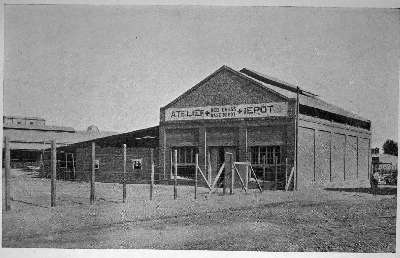 Red Cross Base Depot, Heliopolis.
To face page 148
The store was staffed at first by two nurses and
three orderlies, later it was staffed by a sergeant and
six or seven orderlies who were approved by the
military authorities. The staff therefore consisted
of myself, with my own clerical staff, the orderly
officer of the hospital, Captain Max Yuille (latterly
Captain Dunn), the sergeant and seven orderlies,
together with extra helpers at times. The store
was connected by telephone with the hospital,
and every effort made, compatible with the excessive
demands on the time of all, to manage it in a
methodical manner.
3. Receipt of Goods.—The receipt of goods has,
owing to the peculiarities of Egypt and the circumstances
of the war, given a good deal of trouble, and
I am making it the subject of a separate memorandum.
It may suffice here to say that it will never
be satisfactory until the Red Cross Society in
Australia cables, when the ship leaves Fremantle,
precisely the number of packages on board, the port
of destination, and the probable time of arrival of
the ship; and also accurately informs the officers
commanding the ship of the nature of the Red Cross goods
on board. In this connection it may be interesting
to note the following letter from Colonel Onslow,
who has just arrived by the Runic in Egypt, and
who, but for the printed instructions drawn up by
me and conveyed to him at Suez, would not have
known that any Red Cross goods were on board:
Continental Hotel, Cairo,
September 13, 1915.
Lieut.-Colonel Barrett,
A.A.M.C.
My Dear Sir,
You will remember that on Saturday last you
asked me to write to you regarding the Red Cross
Stores on the Transport A 54 Runic of which I was in
military command.
When I took command on August 9 in Sydney
I had no information as to there being any Red
Cross Stores on board except that one of the ladies
of the Red Cross Committee had told me that a few
stores were to be put on board and would be at my
disposal if needed for the troops under my command.
Subsequently I saw some half a dozen cases which
I assumed to be those to which she had alluded.
On arrival at Suez, September 9, the printed instructions
as to disposal of Red Cross Stores were
handed to me. This caused me to make inquiries.
The ship's purser knew nothing of any such stores
and they were not shown in the manifest.
But from the Chief Officer I learned that a large
number of which he had an incomplete list had been
placed in one of the holds. It was even then too late
for me to ascertain their number or nature, as I was
in the midst of disembarking returning ship stores,
etc. They were therefore landed without the required
list.
But if either a wireless had been sent to me a day
or two beforehand, or if the persons responsible for
shipping had informed me in Sydney, there would
have been no difficulty whatever. Under the lack
of system which would seem to prevail in shipping
these stores from Australia it would not be surprising
if they were overcarried and lost.
Yours faithfully,
(Signed) J. Macarthur Onslow,
Colonel.
I publish this letter simply to show the difficulties
and to indicate the magnitude of the task. I do not
think any one is to blame, but rectification is wanted.
A huge commercial concern has gradually grown up
and now requires firm paid commercial management.
The Australian Red Cross has become a gigantic
Commercial Institution with attendant advantages
and disadvantages.
It should be remembered that goods are shipped
in Australia from at least six different ports separated
by distances of hundreds of miles, that nearly the
whole of the work has been amateur, and that it
is difficult to inaugurate a proper business system
rapidly.
The following are the printed directions referred
to by Colonel Onslow:
Headquarters, Cairo.
From A.D.M.S., Australian Force,
Headquarters, Cairo.
To O.C. Troopship——
1. Will you please instruct a Medical Officer to
make a list in duplicate of the surplus medical
stores and Red Cross goods, including ambulances,
on the ship. He will hand one list to the representative
of Australian Intermediate Base (Captain
Clayton) and retain the other.
2. Will you please detail a Medical Officer, or if
that be impossible another Commissioned Officer, who
will see that these goods are put on the train, and
travel with them to their point of destination.
3. At the place of destination he will hand them
over with an inventory to a representative of
A.D.M.S. Australian Force (Lieut.-Colonel Barrett),
from whom he will obtain a receipt. He will not,
under any circumstances, hand them over to any one
else, or take any verbal receipt.
4. If it be impossible to send the goods by passenger
train they may proceed by goods train, in
which case an N.C.O. or orderly must be detailed
to travel in the brake van; and deliver the
goods to a representative of A.D.M.S. Australian
Force (Lieut.-Colonel Barrett) in precisely the same
way.
5. You will please detail a fatigue party of sufficient
strength for unloading the goods from the
transport and placing them on the train, and in
addition supply any guard that is necessary to
protect them until this work is completed.
6. It is undesirable in any circumstances to send
goods by troop train. It is much better to send
them by goods train.
7. Will you please convey these orders in writing
to the Medical Officer or Officer concerned. If any
conflicting orders be issued he can then produce
this authority.
A.D.M.S. Australian Force.
4. Distribution of Goods.—The distribution of
goods was effected on requisition signed by the O.C.
of the medical unit requiring them, transport was
provided by the Red Cross Society to the railway
station (usually by motor lorries) and at public
expense on the railways. I soon learnt that in
Egypt in time of war there is no certainty of the
delivery of the goods to the proper quarter unless
some one is sent with them. The railway officials
will frequently hand over goods to a military officer
without obtaining a receipt. Accordingly one or
more orderlies were sent with every train conveying
Red Cross goods. They handed the goods to the
consignee and brought back the receipt.
In the Australian hospitals the distribution of goods
was effected by two methods. Anything wanted
from the central store could be obtained by requisition
signed by the O.C. of the hospital, and
countersigned by myself as Red Cross officer. Very
large quantities of goods were thus transferred
from the central store to the quartermaster's department.
They were then issued in the ordinary
way by requisition of the sisters or medical officers,
and those receiving them were not aware whether
they were receiving Red Cross goods or Ordnance
goods. The system had the merit of extreme simplicity,
and was very speedy in its operation. It
certainly seemed at the time far less important
that patients should know where the goods came
from than that they should obtain them promptly.
Later on the expediency of putting a Red Cross
label on everything supplied became obvious and
was adopted as a policy.
5. Scope of Operations.—At first the operations of
the Society were confined to Egypt, but soon, in
conjunction with the British Red Cross, goods
were forwarded to the Dardanelles and elsewhere.
The tables show the quantity of goods sent to
transports in the Mediterranean and transports
leaving for Australia. No request was ever refused.
When dispatching goods to the Dardanelles it was
considered better to act, as far as possible, through
the British Red Cross Society.
On July 5 I wrote to General Birdwood, Commanding
Officer A. and N.Z. Army Corps, asking
him whether I could establish a Red Cross store
at Anzac. He replied that it was impossible, but
at his suggestion a Red Cross store at Mudros in
the island of Lemnos was organised in conjunction
with the British Red Cross Society. The Army
Medical Corps at Anzac was then advised to
requisition on Mudros. The difficulties, however,
of landing goods at Mudros were very great—so
great that the British Red Cross Society was
compelled to buy launches and lighters. The
Australian Red Cross Commissioners are about to
supplement the purchase. The tables show the
quantity and character of the goods sent forward in
spite of many difficulties. It was often necessary
to send an orderly in the hospital ship to Mudros
and Anzac to ensure delivery.
6. Other Activities.—The British Red Cross Australian
Branch arranged through the Y.M.C.A. for the
free distribution of stationery to the soldiers in hospitals
in Egypt. With the assistance of the Y.M.C.A.
and some English ladies in Cairo a number of committees
were formed to entertain the sick and
wounded in various ways. A cinema was purchased,
a small orchestra was engaged to visit the hospitals,
bands of ladies agreed to take flowers and the like
to the hospitals, and everything was done that
could be done to render the tedium of convalescence
less objectionable.
Large recreation huts were built at many of the
hospitals at the expense of the Australian Branch.
This phase of the work should not be passed over
without the most handsome acknowledgment to
the English ladies in Cairo. These public-spirited
ladies, headed by Mrs. Elgood, thoroughly organised
what I may call the lighter side of hospital
work, and not only by their personal attention,
but also by their tactful skill, succeeded in making
the conditions of the sick and wounded much more
comfortable. Furthermore although we left Australia
knowing that the Y.M.C.A. did good work in camps,
yet the practical experience of the Y.M.C.A. work
in Egypt has left an indelible impression on our
minds. Headed by Mr. Jessop, their secretary,
there was no service in connection with the sick
and wounded which they failed to render when
provided with the proper means. We felt the
utmost confidence in entrusting them with any
undertaking, provided that the position was clearly
defined and provided that they were not hampered
in their activities.
In passing it may be said that until June 15 the
shortage of nurses and medical officers was considerable.
Of lay helpers there were few in Cairo
during the summer, and the principle was invariably
adopted of using all existing agencies to cover
the ground, the necessary support being given by
the Red Cross Society. It was on this principle
that Mrs. Elgood acted, it was on this principle that
the Y.M.C.A. acted, and it is on this principle that
all great organisations can be most successfully conducted.
If it had become necessary to create an independent
organisation to provide cinemas and bands,
to disburse stationery in Egypt and at the Dardanelles,
distribute flowers, fruit, games, etc., a very
large number of soldiers would have been employed
who were much better employed otherwise. Furthermore,
they would not have done the work as well
as Mrs. Elgood's staff or the Y.M.C.A.
7. Issue of Purchased Goods.—As the fund grew
in volume it was decided to spend some of it in the
purchase of articles desired by the men. A vote
was taken at No. 1 Auxiliary Convalescent Depot
(Luna Park) to ascertain the articles the men most
desired—see appendix. Boxes containing a number
of articles were issued to every patient on admission.
This has involved an expenditure rising to £500 per
month. A sample box has already been sent to
Australia. In each box the following note was
placed:
"The object of the Australian Red Cross Society
is to provide comfort and help to the wounded and
sick soldiers, such as hospital clothing, invalid comforts,
tobacco, toilet necessaries, books, magazines,
newspapers, and the like, and also recreation huts for
entertainment, etc.
"These comforts are supplied over and above the
hospital necessaries which the Commonwealth of
Australia furnishes on so liberal a scale.
"The Society hopes that your stay in the hospital
will be short and pleasant, and that your convalescence
will be rapid so that you can speedily serve your
country again. The Society asks you to accept the
contents of this box as an indication of Australia's
desire to help you."
8. Convalescent Home at Montazah.—The Montazah
palace, which was owned by the late Khedive,
was offered to Lady Graham by H.H. the Sultan
as a Convalescent Home for soldiers. The British
Red Cross Society and the Australian Branch combined
and agreed to find £3,500 to equip it. This
beautiful hospital consists of a number of buildings
situated on the shore of the Mediterranean, with
artificial harbours and provision for bathing, fishing,
and boating. It is now in excellent order and is
most successful.
While I think it was right to take a share in
the erection of this convalescent home, which indeed
could not have been obtained as a military
hospital, it immediately raised in mind the consideration
of the propriety of the Red Cross conducting
hospitals in any circumstances. It is of course the
English practice, and the special circumstances of
Great Britain may make it necessary to erect Red
Cross hospitals. The Commonwealth of Australia
has never prevented the establishment of as many
hospitals as may be considered necessary in the field.
In my judgment it is better to limit the conduct
of military hospitals and convalescent hospitals to
official authority, leaving the Red Cross to supplement
the work in the way already indicated. Otherwise
the Red Cross is simply doing Governmental
work. The Red Cross may do the work very well
indeed, but the advantage is not obvious.
9. Motor Transport.—The motor ambulances presented
by the Australian Branch have been housed
in two garages, one at Heliopolis and the other at
Gezira. They were both designed by Surgeon-General
Williams and provided from Red Cross Funds. It
is not too much to say that the organisation of the
motor transport assisted materially in saving the
position. For a long time, with the exception of
some New Zealand ambulances, there were no other
ambulances in Egypt. At Heliopolis a repairing
plant was installed at Red Cross expense in order
to reduce the cost of repairs.
There is no doubt that the British Red Cross
Australian Branch was at the outset of exceptional
service because it possessed on the spot stores,
money, and motor transport.
10. Bureau of Inquiry.—The British Red Cross
Society instituted a bureau of inquiry in order to
obtain supplemental information about the sick and
wounded. Inquiries on an elaborate scale are made
at the office of the Commonwealth Government, but
certain supplementary and private inquiries can be
made with profit. The British Red Cross Society
was requested to undertake such inquiries and to
charge Australian Red Cross for the extra assistance
necessitated.
11. Hospital Trains.—At an early stage steps
were taken to equip hospital trains running from
Alexandria to Cairo with everything the officers in
charge required.
Furthermore, arrangements were made at Red
Cross expense to provide a restaurant car on all
trains conveying sick and wounded to Suez. For
detailed arrangements see page 166. This arrangement
has proved of great benefit. The men obtained
free lime juice and water and their rations. They
could purchase in addition comforts at bed-rock
prices. The innovation may seem a small one, but it
was not effected without considerable trouble owing
to shortage of rolling stock.
List of Red Cross Goods issued to Units from
end of March to September 3, 1915
Prepared by Staff-Sergeant Hudson
| Unit. | Articles. | Cases. | Pkgs. |
| First Australian General Hospital | 76,350 | 462 | 39 |
| No. 1 Auxiliary Convalescent Depot | 3,377 | 22 |
| No. 2 Auxiliary Convalescent Depot | 11,340 | 78 | 7 |
| No. 3 Auxiliary Convalescent Depot | 6,393 | 74 | 13 |
| Infectious Diseases Hospital, Choubra | 6,303 | 7 |
| Ras el Tin Convalescent Home | 19,562 | 65 | 8 |
| Al Hayat Convalescent Home | 36,050 | 92 | 2 |
| No. 2 Australian General Hospital, Ghezira | 25,437 | 75 | 4 |
| Mena Australian Hospital | 2,705 | 4 | 2 |
| Venereal Diseases Hospital, Abbassia | 7,626 | 22 | 2 |
| Hospital ships and transports | 46,350 | 19 |
| Imbros Rest Camp Hospital | 650 | 70 |
| Kasr el Aini | 13,372 | 11 |
| Greek Hospital, Alexandria | 1,381 |
| Colonel Bryant, Lemnos | 23,236 | 127 | 8 | sacks |
| 4th Field Ambulance, Dardanelles | 8,472 | 2 |
| 1st Stationary Hospital, Lemnos | 42,333 | 107 | 12 | sacks |
| 2nd Stationary Hospital, Lemnos | 187 | 107 | 13 | sacks |
| 7th Field Ambulance, Polygon Camp, Cairo | 4 | 2 |
| 2nd Light Horse Field Ambulance, Maadi, Cairo | 6,056 | 2 |
| 2nd Light Horse, Lemnos | 7,985 | 2 |
| Captain Dunlop, 18th Battalion | 37 |
| Captain Williams, Hqrs. 2nd Austr. Division | 30 |
| No. 4 Auxiliary Convalescent Depot | 754 |
| Heliopolis Dairy Company for 1st A.G.H. | 800 |
| Zeitoun Convalescent Camp | 2,250 | 13 |
| 6th Light Horse | 560 |
| Dr. Hastings | 500 |
| No. 17 General Hospital, Alexandria | 3,532 |
| Deaconess Hospital, Alexandria | 1,733 | 6 |
| Egyptian Army Hospital, Abbassia | 708 | 6 |
| 2nd Indian General Hospital | 6,486 |
| Dr. Oulton, Tanta Hospital | 3,899 |
| Mustapha Barracks, Alexandria | 4,585 |
| New Zealand Mounted Rifles | 736 | 1 |
| Lancashire Fusiliers | 1,116 |
| No. 15 General Hospital, Alexandria | 4,199 |
| Military Hospital, Cairo | 244 | 1 |
| School Hospital, Port Said | 700 |
| Red Cross Hospital, Saideh School | 3,456 | 2 |
| No. 4 Base, Medical Depot, Alexandria | 13,032 |
| Convalescent Hospital, Ismailia | 1,904 |
| French Convalescent Hospital, Alexandria | 2,294 |
| Ordnance Office Base, Alexandria | 9,528 |
| European Hospital, Alexandria | 740 |
| 4th Field Ambulance | 1,250 |
| | ———— | ——— | —— |
| Total | 411,974 | 1,357 | 110 |
| | ======= | ====== | ==== |
List of Red Cross Goods supplied from Store
apart from Other Goods purchased and supplied
| Aprons (surgical) | 260 |
| Blankets | 5,875 |
| Cholera belts | 7,400 |
| Hot-water bottles | 407 |
| Bandages | 51 | cases |
| " | 200 |
| Books | 87 | pkgs. |
| Caps | 2,010 |
| Caps (surgical) | 266 |
| Dressing-gowns | 184 |
| Handkerchiefs | 46,298 |
| Housewives | 776 |
| Cardigan jackets | 3,483 |
| Hospital jackets | 269 |
| Pneumonia jackets | 341 |
| Old linen | 90 | cases |
| Mufflers | 3,662 |
| Masks (surgical) | 24 |
| Nightingales | 495 |
| Overalls (surgeons') | 243 |
| Pillows | 2,945 |
| Pillowslips | 24,501 |
| Pyjamas | 17,300 |
| Pyjama trousers | 881 |
| Pipes | 1,570 |
| Quilts | 43 |
| Sheets | 7,240 |
| Draw sheets | 4,032 |
| Shirts (flannel) | 24,876 |
| Shirts (cotton) | 9,913 |
| Hospital shirts | 4,725 |
| Socks | 70,725 |
| Bed socks | 1,018 |
| Toilet soap | 2,789 | cakes |
| " | 4 | cases |
| Slippers | 5,878 |
| Towels | 43,914 |
| Medical towels | 4,183 |
| Undershirts (flannel) | 12,333 |
| Underpants (flannel) | 5,588 |
| Vaseline | 284 |
| Face washers | 37,665 |
| Binders | 200 |
| Hospital bags | 334 |
| Soldiers' kit bags | 4,710 |
| Air cushions | 17 |
| Tooth brushes | 6,885 |
| Tooth paste | 1,552 |
| Sea kit bags | 717 |
| Hair brushes | 1,047 |
| Hair combs | 1,081 |
| Ointment | 208 |
| Playing cards | 723 |
| Pencils | 176 |
| Safety pins | 380 |
| Rubber sheets | 6 |
| Mosquito nets | 1,251 |
| Insect powder | 314 | pkts. |
| Sponges | 2,756 |
| Tobacco | 2,379 | plugs |
| " | 16 | cases |
| Cigarettes | 3,741 | pkts. |
| " | 1 | case |
| Biscuits | 64 | cases |
| Extract of beef | 45 | " |
| Soap | 1,120 | bars |
| " | 70 | cases |
| Gooseberries | 66 | " |
| Glaxo | 38 | " |
| Milk | 36 | " |
| Beans | 20 | sacks |
| Peas | 13 | " |
| Jam | 172 | cases |
| Syrup | 54 | " |
| Tomatoes | 51 | cases |
| Milk and cocoa | 5 | " |
| " | 69 | tins |
| Pineapples | 98 | cases |
| Apricots | 49 | " |
| Honey | 8 | " |
| Dried apples | 47 | " |
| Dried peaches | 115 | " |
| Pears | 43 | " |
| Foodstuffs | 77 | " |
| " | 55 | pots |
| Malted milk | 6 | cases |
| Chocolate and sweets | 2 | " |
| " " | 634 | " |
| Extract of malt | 3 | " |
| Rolled oats | 1 | case |
| Lactogen | 7 | cases |
| Ground sheets | 22 |
| Cloth caps | 2,984 |
| Games | 65 |
| Walking-sticks | 16 | bundles |
| " | 687 | loose |
| Writing-pads | 1,206 |
| Envelopes | 28,470 | pkts. |
| Lemons | 15 | cases |
| Glass towels | 325 |
| Sun glasses | 108 |
| Hot-water bottle covers | 260 |
| Dusters | 773 |
| Mattresses | 9 |
| Swabs | 7 | cases |
| " | 500 |
| Candles | 1 | case |
| Cane chairs | 70 |
| Toilet paper | 45 | cases |
| Puddings | 1 | case |
| Preserved fruit | 47 | cases |
| Linen coats | 388 |
| Cushions | 115 |
| " | 3 | cases |
| Fly whisks | 725 |
| " | 2 | cases |
| Knives | 30 |
| Spoons | 95 |
| Wine | 8 | cases |
| Deck chairs and camp stools | 340 |
| Bales of clothing | 25 |
| Brassards | 200 |
| Shaving-brushes | 1,801 |
| Skin coats | 10 |
| Cotton thread | 50 | reels |
| Toilet paper | 100 |
| Nail brushes | 24 |
| Jug covers | 100 |
| Mittens | 673 |
Goods sent to Lemnos
| | Articles. | Cases. | Sack. |
| 1st Stationary Hospital, Lemnos | 42,333 | 107 | 12 |
| 2nd " " " | 187 | 107 | 13 |
| Imbros Rest Camp | 650 | 70 |
| Col. Bryant, for Distribution, Dardanelles | 23,236 | 127 | 8 |
| 2nd Light Horse, Lemnos | 7,985 | 2 |
Agreement made for Provision of Refreshments
to Soldiers on Invalid Trains
1. The Restaurant Car can be placed on the train
and the cost of same, £7 10s., guaranteed by Lieut. Colonel
Barrett.
2. Meals will be provided for Commissioned
Officers, P.T. 20 lunch or dinner, P.T. 5 afternoon
tea, at stated times.
3. Meals and afternoon tea will be provided for
N.C.O.s in the Restaurant Car at half price.
4. Sandwiches, P.T. 1, and non-alcoholic drinks
(soda water, lemonade, etc.), P.T. 1, will be served in
the cars by the attendants of the Restaurant Car
to soldiers who desire to purchase them.
5. In addition, water will be provided in each
carriage for the use of soldiers in fantasses, and lime
juice will be supplied, two bottles in each carriage,
free.
Notice to this effect will be posted in every carriage
on the troop train.
July 1, 1915.
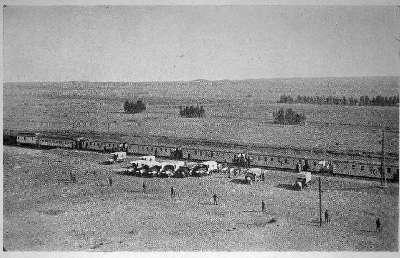 Heliopolis Siding: Arrival of Wounded.
To face page 166
12. Soldiers' Clubs.—Reference has been made in
the chapter on Venereal Diseases to the damage
done to Australian troops in Egypt by venereal
disease. Reference has also been made to the establishment
of soldiers' clubs and recreation huts in
various places to provide a counter-attraction to those
entertainments furnished by the prostitute and her degraded
male attendants. After the various repressive
steps already referred to had been taken, an earnest
attempt was made to organise this constructive
work. The valuable assistance of Mr. Jessop and
the Y.M.C.A. was again invited. The Y.M.C.A.
proposed to build in Alexandria on the sea front a
large building to be used as a central soldiers' club,
and to be available for convalescents and the healthy.
The Y.M.C.A. had only £250 available and required
£1,000. The British Red Cross Society was
appealed to and hesitated. A cable was dispatched
to London, and an expenditure of £250 authorised.
Surgeon-General Williams, after consultation with
His Excellency Sir Henry MacMahon, the G.O.C.-in-Chief,
Sir John Maxwell, and the D.M.S. Egypt,
General Ford, decided to make a grant of £500 in
addition for the purpose. The club was opened on
September 12, and from its opening was a pronounced
success. The soldier on leave, tramping about the
streets of Alexandria, gets leg-weary and falls an easy
victim to the wiles of the various agents abroad. He
now can visit his own club, where the entry is free to
all men in uniform. He there receives war telegrams,
stationery, cheap and excellent meals, and enjoys
various forms of entertainment. He meets his friends,
and can spend the time under the most pleasant conditions.
The building already requires extension,
as the pressure on the accommodation is so great.
Similar action was taken in Cairo, where after many
unsuccessful attempts the Rink Theatre in the beautiful
Esbekieh gardens was obtained, owing to the
sympathetic help given by His Excellency Sir Henry
MacMahon and other authorities. This open-air
theatre is a little over an acre in extent, and is a
valuable property. It had been leased to a restaurant
keeper in the vicinity. Arrangements were made for
the supply of light refreshments at bed-rock prices
in the theatre, and other meals at low prices at the
restaurant which is about fifty yards away. In
addition a soldiers' club, managed by ladies, is equidistant,
and at this comfortable resort refreshments
are supplied in quiet rooms at low rates. Naturally the
club has become a resort for all the soldiers in Cairo.
Major Harvey, Commissioner of Police, has cleared
the surrounding gardens of undesirable characters.
The club was placed under the management of a joint
committee of which Her Excellency Lady MacMahon
is Patroness, and Lady Maxwell is President. The
executive committee consists of three members of
the Y.M.C.A., and the expenses of managing the
club were provided by the British Red Cross Society,
Australian Branch, for the first three months. It
was soon found that in order to make the club successful
the athletic element must be developed, and
splendid programmes were arranged—boxing, fencing,
skating contests, and the like. The club provides
writing-paper, games, war telegrams, Australian and
other newspapers, shower baths, and other conveniences.
As many as 1,500 soldiers are present on
some of these occasions, and the club is visited by
officers who periodically drop in amongst the men.
Altogether the success has exceeded even the sanguine
expectations of those who founded it.
The British Red Cross Society, Australian Branch,
was most fortunate in securing such a site, as any
one acquainted with the conditions of Cairo is fully
aware.
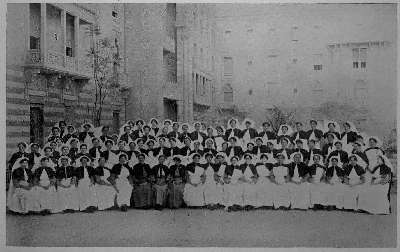 Matrons and Nurses, No. 1 Australian General Hospital.
To face page 169
The exact extent to which these clubs have contributed
to the limitation of venereal disease cannot be
accurately measured, but there is no doubt whatever
in the minds of any one acquainted with the
facts respecting their salutary and healthy influence.
Under the new constitution of the Australian Red
Cross money cannot be devoted to their maintenance,
because it is not being used exclusively for the sick
and wounded. Such is the ruling, although many
convalescents use the clubs. It is regrettable that
such a rigid ruling should have been established.
It is absurd to permit men to become infected and
then to assist them by doles of chocolate and tobacco,
and yet to refuse to provide the necessary funds which
assist so materially in preventing infection.
13. Nurses' Rest Homes.—The nurses in the hospitals
had done excellent work under trying conditions, and
it became obvious that many of them would break
down unless holidays and rest were provided.
The British and Australian Red Cross Branches
combined under the Presidency of Her Excellency
Lady MacMahon, and opened two rest homes—one
in Ramleh near the beach, and the other at Aboukir
Bay, the site of Nelson's victory.
They were furnished by the Red Cross Societies
and have been maintained by the Commonwealth
Government so far as the Australian nurses are concerned.
They have met a great want and have
proved a boon and a blessing.
Conclusion.—The work has been very heavy and
the circumstances far from easy. Taking everything
into consideration and realising the pressure at
both ends, the result can only be regarded as more
than satisfactory. The policy of the Red Cross
Society requires, however, some consideration.
The policy adopted until lately was that reasonable
intimation should be given to the Red Cross
Society of the requirements of those who want
help. Under public pressure another policy may
make its appearance—that of compelling the Red
Cross Society to find out what people want. A
word of caution is necessary. This policy will
almost certainly result in the creation of an extensive
business organisation and in the Red Cross
undertaking much work which the Government
should do. In my opinion the Red Cross Society
is entirely ancillary, its functions being to provide
comforts and other things which the Government
cannot supply, and to act decisively at critical
moments. It should, however, refrain from embarking
on great national undertakings.
Every one will endeavour to help the Commissioners
in their extensive and difficult task, and
will look forward to the Australian Red Cross maintaining
the high reputation which it has already
gained amongst responsible officers in Egypt.
In conclusion it should be pointed out that during
the whole period under review all necessary services
were provided by the military authorities and the
Red Cross was administered on military principles.
Consequently there were no large expenses, no one
received any money in payment for services, and the
storage of goods was free.
If the Red Cross is to be administered on non-military
lines many charges must be properly made
and met, but the efficiency of the system instituted
and now set aside must be judged largely from the
standpoint of economic administration.
James W. Barrett,
Lieut.-Colonel.
(In this volume the original report forwarded to
Melbourne has been expanded and amplified.)
Appendixes
1. Directions for the Conduct of the Red Cross Depot
Depot—conduct of.
1. The Depot is placed under
the charge of a Medical
Officer who will have at
his disposal nurses and
orderlies in such numbers
as the work from time to
time may necessitate.
Storage of goods.
2. All goods consigned to the
Red Cross Depot shall be
placed in store at once
and rendered secure under
lock and key at other
than business hours.
Receipt Book.
3. All goods received will be
entered in the Goods Receipt
Book.
Requisitions—how dealt with
4. On receipt of requisitions
signed by the Officer Commanding
any unit, and
countersigned by the
Officer Commanding
First Australian General
Hospital, goods will be
issued, and if necessary
transport provided. Two
clear lists shall be prepared
on forms provided
for the purpose, one to be
receipted and returned to
Red Cross Depot by the
consignee and duplicate
to be filed in Office.
Stock-taking.
5. A Stock Book is to be kept
showing the nature and
quantity of material received,
and the quantity
distributed, so that at
any time the stock remaining
can be ascertained.
This book to be
checked once a month by
stock-taking of the contents
of the store and
certified to by the M.O.
in charge.
2. Result of Vote at No. 1 Auxiliary
Convalescent Depot
The following items represent the wishes of 840
patients at Luna Park on July 29, 1915, ascertained
by the O.C., Major Brown.
Four hundred and forty papers were received, a
great number of patients failing to vote.
The patients were asked to make a list of twenty
to thirty articles that would add to their comfort
during their stay in hospital, and which could be
supplied by a small fund at his disposal.
The average items on collected lists were 8.
| Razors | 249 |
| Shaving-sticks | 244 |
| Razor strops | 241 |
| Toothpaste | 221 |
| Cigarette | 194 |
| Toilet soap | 188 |
| Matches | 170 |
| Mirrors | 177 |
| Shaving-brushes | 163 |
| Tooth-brushes | 148 |
| Handkerchiefs | 131 |
| Tobacco | 121 |
| Pipes | 106 |
| Hairbrushes | 99 |
| Writing material | 98 |
| Haircombs | 96 |
| Fruit | 63 |
| Chocolate | 54 |
| Socks | 37 |
| Sweets | 32 |
| Pocket knives | 30 |
| Playing cards | 21 |
| Lead pencils | 19 |
| Housewives | 14 |
| Cigars | 11 |
| Biscuits | 10 |
| Walking-sticks | 8 |
| Shirts | 8 |
| Singlets | 7 |
| Belts | 6 |
| Tobacco pouches | 4 |
| Fountain pens | 3 |
| Bottles of ink | 3 |
| Nail brushes | 3 |
| Boot laces | 3 |
| Post cards | 3 |
| Mouth organs | 3 |
| Cigarette holder | 1 |
| Cigarette lighter | 1 |
| " papers | 1 |
| Sponge | 1 |
| Pair scissors | 1 |
| Soap box | 1 |
| Nuts | 1 |
| Dark eye-glasses | 1 | pair |
| Blades for safety razors | 1 | set |
| Notebook | 1 |
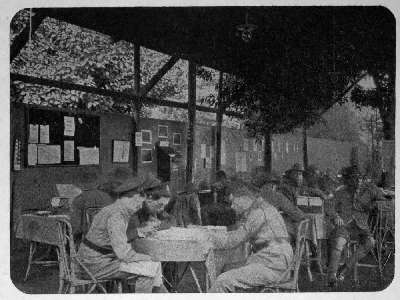 Soldiers' Club, Esbekieh, Cairo.
To face page 174
3. Fence or Ambulance?
Some critics have objected to the Red Cross
assisting Soldiers' Clubs. The following lines are
commended to their notice. But for the Australian
Branch British Red Cross there would have been
no such Soldiers' Clubs as those provided at
Esbekieh and Alexandria.
'Twas a dangerous cliff, as they freely confessed,
Though to walk near its crest was so pleasant;
But over its terrible edge there had slipped
A duke, and full many a peasant.
So the people said something would have to be done,
But their projects did not at all tally:
Some said, "Put a fence round the edge of the cliff";
Some, "an ambulance down in the valley."
But the cry for the ambulance carried the day,
For it spread through the neighbouring city,
A fence may be useful or not, it is true,
But each heart became brimful of pity
For those who had slipped over that dangerous cliff;
And the dwellers in highway and alley
Gave pounds or gave pence, not to put up a fence,
But an ambulance down in the valley.
"For the cliff is all right if you're careful," they said,
"And if folks even slip and are dropping,
It isn't the slipping that hurts them so much
As the shock down below when they're stopping."
So day after day, as those mishaps occurred,
Quick forth would these rescuers sally
To pick up the victims who fell off the cliff,
With the ambulance down in the valley.
Then an old sage remarked, "It's a marvel to me
That people give far more attention
To repairing results than to stopping the cause
When they'd much better aim at prevention.
Let us stop at its source all this mischief," cried he,
"Come, neighbours and friends, let us rally!
If the cliff we will fence we might almost dispense
With the ambulance down in the valley."
"Oh, he's a fanatic," the others rejoined.
"Dispense with the ambulance? Never!
He'd dispense with all charities, too, if he could!
No, no! We'll support them for ever!
Aren't we picking folks up just as fast as they fall?
And shall this man dictate to us? Shall he?
Why should people of sense stop to put up a fence
While their ambulance works in the valley?"
But a sensible few, who are practical too,
Will not bear with such nonsense much longer;
They believe that prevention is better than cure,
And their party will soon be the stronger.
Encourage them, then, with your purse, voice, and pen,
And (while other philanthropists dally)
They will scorn all pretence, and put a stout fence
On the cliff that hangs over the valley.
Better guide well the young than reclaim them when old,
For the voice of true wisdom is calling:
"To rescue the fallen is good, but 'tis best
To prevent other people from falling.
Better close up the course of temptation and crime
Than deliver from dungeon or galley;
Better put a strong fence round the top of the cliff,
Than an ambulance down in the valley."
Joseph Malines.
Before leaving consideration of the details of the
Red Cross question, attention should be directed to
the numerous changes in the policy adopted by
the British Red Cross Society, Australian Branch.
No less than three different types of administration
were rapidly adopted. It was first placed in the
hands of Surgeon-General Williams and the High
Commissioner for Australia, in London; then it
was placed under a committee in Egypt formed
by the High Commissioner for Egypt, Sir Henry
MacMahon, and six weeks later two Commissioners
were appointed to take the work over. Nothing
more clearly illustrates the state of mental instability
in which a first experience of war had thrown
the population of Australia. The policy which was
adopted by Surgeon-General Williams in connection
with the Red Cross administration is that which
we believe to be sound.
When acting as A.D.M.S. to the Australian Force
in Egypt it became my duty (Lieut.-Col. Barrett) to
sanction or modify the requisitions of medical stores
for the various hospitals and units, and the instructions
conveyed to me were that I could sanction any
requisition provided that it was reasonable. If,
however, it represented a new departure it must
be authorised by the D.M.S. Egypt. This meant
practically that everything could be obtained from
Ordnance, and many of the Red Cross supplies
became superfluous. That is to say, any necessary
goods in the Red Cross store were utilised, but if
they had not been there the Government would
have purchased them. In fact, it reduced the field
in which the Red Cross could operate to comparatively
small proportions. There is no doubt that,
had it become necessary, I should have authorised
the erection of shelter sheds and recreation huts in
the various hospitals as a medical necessity. There
was one advantage, and one advantage alone, in
effecting these changes with the aid of the Red Cross.
The action if sanctioned by superior officers could not
be challenged by any one else at the time, and could
be effected with extraordinary speed.
I took the view that it was the business of the
Officer Commanding the hospital, with the aid of the
matron, sisters, and medical officers, to let me know
what was thought necessary, and unless the requirement
was outrageous it was immediately supplied.
As a matter of fact no single request for money or
goods was ever refused or seriously modified. Owing
to pressure of public criticism another policy began
to make its appearance. It was asserted that it
was the duty of the Red Cross officer to visit the
various hospitals to find out what the patients
ought to receive. It will be seen that such a policy
removed from the O.C.s of the hospitals, or any
one to whom they may have delegated their powers,
the responsibility for determining what patients
should receive. Such a policy sooner or later must
result in the creation of an army of people who
are worrying to find out what they can do instead
of being properly instructed by those responsible
for the welfare of the patients.
It further tended to place in the hands of irresponsible
people some control over the medical
management of hospital cases. If lay visitors can
enter a hospital and provide food for patients,
they may next wish to provide drugs, etc. It
seemed that the policy laid down in the first
instance was sound, useful, and healthy.
When the Commissioners took office they made a
number of changes in detail. They shifted the
position of the store; they printed different forms of
requisition, and they took the goods out of the
quartermaster's store and placed them in a store in the
hospital, presided over by a volunteer. The goods
were then obtained by requisition from the sisters and
the matron. But as the President of the Red Cross
Inquiry Court pointed out, with one trifling exception
the method was not really altered. The control had
simply ceased to be military, and had become civil.
Consequently a large staff of capable people were withdrawn
from their ordinary occupations in Australia,
and devoted themselves to an administration which
had been hitherto effected entirely by the soldiers.
We do not think that the change was right or
desirable. It resulted in the creation of another body,
not responsible directly to the military authorities, to
do what is after all subsidiary work. The inevitable
tendency will be for the Red Cross to take on
function after function which should be undertaken
by military authorities. The Red Cross is already
supplying many articles which should be, and can
be, supplied by Ordnance. For there is nothing
that the Red Cross can supply that Ordnance cannot
still more easily supply. It is quite true that the
British Red Cross is managed on civil lines, and
the British Red Cross supplies goods and does not
supply money. But with a full knowledge of both
systems we are strongly of opinion that the military
method of management is in every respect preferable.
During the Red Cross Inquiry recently finished, to
which allusion will be made elsewhere, day after day
was necessarily spent by the Court in endeavouring
to decide what Red Cross should supply and what
Ordnance should supply. What does it matter so
long as the patient receives the articles? It does not
concern him where they come from, and if the whole
is under military control there is no need for this sharp
and artificial line of demarcation. We are of opinion
that in general the functions of the Red Cross should
be to supply those additional comforts and accessories
which make sick life more tolerable, to supply any
goods which may be donated, and to make helpful
donations of money in the way already indicated.
The presence in the store at Heliopolis of large
quantities of goods—sheets, blankets, pillows, and
the like—which could have been supplied by
Ordnance, enabled us to rapidly tide over a great
emergency. There is no doubt that the possession of
money and goods by the Red Cross will prove of vast
service in every campaign by reason of its emergency
value. In fact the rapid expansion of No. 1 General
Hospital during the crisis of May and June would
not have proceeded with such smooth expedition
had it not been for the large quantities of Red Cross
stores which lay to hand and were instantly passed
into the Quartermaster's department. If, however, the
supply had been under lay control, we can quite imagine
circumstances in which argument, requisitions, forms,
etc., might have seriously delayed operations.
Whilst on this subject reference must be made to
the help afforded to the hospitals by Red Cross
workers. Two schools of thought existed. Some
Commanding Officers preferred to have no helpers,
because of the trouble some of them gave. Others
passed to the other extreme. Our own experience
was that the workers organised by Mrs. Elgood were
most helpful for the functions they undertook, with
one or two exceptions, but those exceptional people
gave a certain amount of trouble. They came not
to help, but to criticise, and they carried their criticisms
not to the Commanding Officer, but to the
Australian public, and so caused trouble.
We are convinced that the Japanese method of
organising the Red Cross is sound. It is organised
and disciplined in time of peace, and when war is
declared it becomes part of the army medical reserve
and is mobilised for service. Every one is under
military control, and consequently these crudities
are avoided. If we were to repeat our experience we
should have welcomed the visitors, but insisted that
they should be under some measure of discipline, and
that a serious breach of regulations should be followed
by their withdrawal. In some instances visitors
wrote to the Commander-in-Chief, and complained
of the food the patients were getting. The Commander-in-Chief
sent the letters on to us, and we
then brought the visitor in contact with the Commanding
Officer of the hospital, and the complaint
was investigated. How much more direct and
simple it would have been if the visitor who saw
something he believed to be wrong had immediately
asked for the Officer Commanding! But the
"secret and confidential" candid friend is apt to
become somewhat of a pest.
There is another and more serious aspect of the
matter. The medical officer is alone competent to
judge what food should be issued to patients.
Visitors who criticise the diet of the patient
are assuming a function which they are obviously
unable to discharge. Diet sheets are provided for
each ward, and on these is entered the number of
different diets prescribed by the medical officer.
These diet sheets should be the only and the final
authority of what should be issued to the patient in
the way of eatables. As it happened, ladies sometimes
brought into the different wards of the hospital
foods which constituted an added danger to
the patient. On one occasion green melons were
issued to a large number of sick men by kind-hearted
visitors. The men became so ill that the medical
officer confiscated the melons, made inquiries,
and only then ascertained the source of supply.
A strong-looking soldier on a milk diet might evoke
the sympathies of a lady visitor, who lodged
a complaint regarding the supply of food, but the
nature of his disease and the method of treatment
adopted by his medical officer are surely the
principal consideration. As everything conceivable
in the nature of food and drink can be supplied
through these diet sheets, the obvious course is to
pass all Red Cross foodstuffs directly into the
Quartermaster's department to be distributed in the
ordinary, and the only safe, channel. This was the
practice followed at Heliopolis.
The following articles were supplied in this way at
the time of expansion, and show what assistance a
properly controlled Red Cross system can render.
QUARTERMASTER'S REPORT
BY LIEUTENANT P. E. DEANE
Assistance rendered the First Australian
General Hospital by Red Cross in Hospital
Expansion
April
Skating Rink opened.
Abbassia Venereal Diseases Hospital opened.
Casino Infectious " " "
The following were obtained immediately on
requisition on Red Cross:
| Sheets | 1,684 |
| Pillowslips | 2,300 |
| Face washers | 1,600 |
| Towels | 2,622 |
| Handkerchiefs | 1,000 |
| Blankets | 61 |
| Pyjamas | 489 |
| Cotton shirts | 701 |
| Underpants | 400 |
| Socks | 600 |
| Flannel shirts | 400 |
| Slippers | 67 |
| Draw sheets | 500 |
| Pillows | 69 |
| Quilts | 12 |
| Old linen cases | 2 |
May
Great rush of patients—Luna Park expanded,
Palace Hotel expanded.
| Patients admitted in four days from |
| April 29 to May 2 | 1,543 |
| Patients admitted during May | 2,650 |
Red Cross Supplies
| Sheets | 1,381 |
| Blankets | 1,038 |
| Towels | 4,394 |
| Pyjamas | 1,176 |
| Shirts | 238 |
| Handkerchiefs | 500 |
| Face washers | 1,000 |
June
Rush of wounded continues. Atelier occupied,
Sporting Club commenced.
| Patients admitted during June | 2,862 |
Red Cross Supplies
| Pyjamas | 790 |
| Face washers | 1,000 |
| Sheets | 900 |
| Towels | 1,500 |
| Sponges | 1,500 |
| Handkerchiefs | 1,500 |
| Cotton shirts | 950 |
| Socks | 1,000 |
| Slippers | 500 |
| Pillowslips | 1,000 |
Special hospital organised hurriedly by the department
on June 17. Ras el Tin Convalescent
Home, Alexandria.
Red Cross Supplies
| Socks | 1,000 |
| Shirts | 1,500 |
| Pyjamas | 750 |
| Sheets | 750 |
| Blankets | 750 |
| Pillowslips | 750 |
| Face washers | 1,500 |
July
Wounded still pour in. Sporting Club increased
by addition of tennis court wards, Atelier and Luna
Park accommodation increased.
| Patients admitted in July | 2,194 |
Red Cross Supplies
| Sheets | 2,000 |
| Slippers | 1,000 |
| Pillowslips | 3,400 |
| Blankets | 1,900 |
| Shirts | 2,000 |
| Handkerchiefs | 2,000 |
| Towels | 3,000 |
| Socks | 3,400 |
| Face washers | 3,000 |
August
Choubra Infectious Hospital hurriedly established
and equipped by the department; 400-bed tent
hospital added to Sporting Club.
Red Cross Supplies
| Blankets | 2,000 |
| Cotton sheets | 1,800 |
| Towels | 1,700 |
| Handkerchiefs | 2,400 |
| Face washers | 2,300 |
| Socks | 2,800 |
| Pillowslips | 214 |