Entered as second-class mail matter in the Post Office at Boston, Mass.
“Acceptance for mailing at special rate of postage provided for in
Section 1103, Act of October 3, 1917, authorized on September 23, 1918.”
‘THE AUK,’ published quarterly as the Organ of the
American Ornithologists’ Union, is edited,
beginning with volume for 1912, by Dr. Witmer Stone.
Terms:—$3.00 a year, including postage,
strictly in advance. Single numbers, 75 cents. Free to Honorary
Fellows, and to Fellows, Members, and Associates of the A. O. U. not in
arrears for dues.
The Office of Publication is at 30 Boylston St.,
Cambridge, Boston, Mass.
Subscriptions may also be addressed to Dr.
Jonathan Dwight, Business Manager, 134,
W. 71st St., New York, N. Y.Foreign Subscribers
may obtain ‘The Auk’ through Witherby & Co., 326, High Holborn, London, W. C.
All articles and communications intended for publication and
all books and publications for notice, may be sent to DR. WITMER
STONE, Academy of Natural Sciences, Logan Square,
Philadelphia, Pa.
Manuscripts for general articles must await their turn for
publication if others are already on file but they must be in the
editor’s hands at least six weeks, before the date of issue of the
number for which they are intended, and manuscripts for ‘General
Notes’, ‘Recent Literature’, etc., not later than the first of the
month preceding the date of the number in which it is desired they
shall appear.
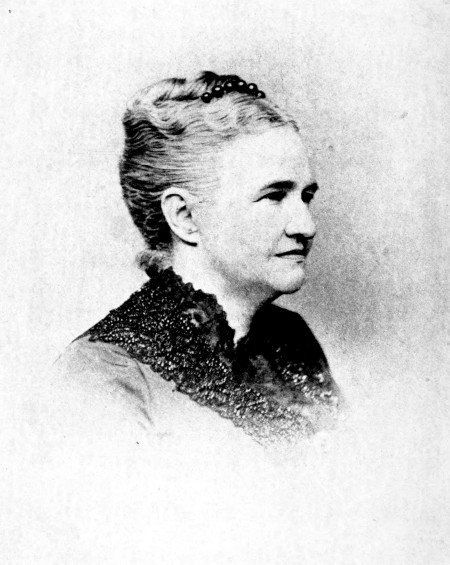
Little more than a month after the last meeting of the A. O. U., at
which greetings were sent from the Council to Mrs. Miller as the oldest
living member of the Union, came the announcement of her death, on
December 26, 1918. Born on June 25, 1831, she had indeed been allotted
a full span, and for thirty-one of her eighty-seven years she had been
associated with the American Ornithologists’ Union joining four years
after it was founded and being made Member in 1901 when that class was
established.
Harriet Mann—for the more familiar name of Olive Thorne Miller was
the pen name adopted after her marriage—was born at Auburn, New York,
where her father, Seth Hunt, was a banker; but she was of New England
ancestry on both sides of the family, her paternal grandfather being
an importing merchant of Boston, and her great-grandfather, Captain
Benjamin Mann, having organized a company during the revolution of
which he was in command at Bunker Hill.
From Auburn the family moved to Ohio when she was eleven years old,
making the journey, in lieu of railroads, by “packet” on the canal
through the Mohawk Valley, by steamer across Lake Erie, and finally
by an old-fashioned thoroughbrace coach for twenty-five miles through
Ohio—a journey full of romance to an imaginative child, and described
entertainingly in one of Mrs. Miller’s delightful and in this case
largely autobiographical child stories, ‘What Happened to Barbara.’
In Ohio she spent five years in a small college town where she
attended private schools, among them one of the Select Schools of that
generation, with an enrollment of some forty or fifty girls. At the
age of nine, as she says, she “grappled with the problems of Watts on
the Mind!” To offset the dreariness of such work, she and half a dozen
of her intimate friends formed a secret society for writing stories,
two members of the circle afterwards becoming well known writers.
For writing and reading even then were her greatest pleasures. The
strongest influence in her young life, she tells us, was from books.
“Loving them above everything, adoring the very odor of a freshly
printed volume, and regarding a library as nearest heaven of any spot
on earth, she devoured everything she could lay her hands upon.” As she
grew older the shyness from which she had always suffered increased
painfully, and coupled with a morbid sensitiveness as to what she
considered her personal defects made people a terror to her; but
solitary and reticent, she had the writer’s passion for self expression
and it is easy to understand her when she says, “To shut myself up
where no one could see me, and speak with my pen, was my greatest
happiness.”
In 1854, she married Watts Todd Miller, like herself a member of a well
known family of northern New York, and in her conscientious effort to
be a model wife and to master domestic arts to which she had never been
trained, she sacrificed herself unnecessarily. “Many years I denied
myself the joy of my life—the use of my pen,” she tells us, “and it
was not until my children were well out of the nursery that I grew wise
enough to return to it.”
The history of the vicissitudes of her literary life is at once
touching and enlightening. Full of ardor to reform the world, to
prevent needless unhappiness and to set people on the right path, her
first literary attempt was the essay, but as she expressed it, “the
editorial world did not seem to be suffering for any effusions of
mine,” and her manuscripts were so systematically returned that she
was about giving up, concluding during very black days that she had
mistaken her calling; when a practical friend gave her a new point of
view. What did the public care for the opinions of an unknown writer?
she asked. Let her give what it wanted—attractively put information on
matters of fact. Then when her reputation was established, people might
be glad to listen to her views of life.
Philosophically accepting the suggestion, she calmly burned up her
accumulated “sentiments and opinions,” and set about writing what she
termed “sugar-coated pills of knowledge” for children. The first, the
facts of china-making in the guise of a story, she sent to a religious
weekly which had a children’s page, and to her surprise and delight
received a check for it—her first—two dollars! This was apparently
in 1870, and for twelve years, she worked in what she terms that
“Gradgrind field” in which during that period she published some three
hundred and seventy-five articles in religious weeklies, ‘Our Young
Folks,’ ‘The Youth’s Companion,’ ‘The Independent,’ ‘St. Nicholas,’
‘The Chicago Tribune,’ ‘Harper’s,’ ‘Scribner’s,’ and other papers and
magazines, on subjects ranging from the manufacture of various familiar
articles, as needles, thread, and china to sea cucumbers, spiders,
monkeys, and oyster farms; and during those twelve years, in addition
she published five books, the best known of which were perhaps ‘Little
Folks in Feathers and Fur,’ 1873, ‘Queer Pets at Marcy’s,’ 1880, and
‘Little People of Asia,’ 1882.
About this time, having lived in Chicago nearly twenty years, the
Millers, with their two sons and two daughters, moved to Brooklyn,
where they lived until Mr. Miller’s death. Not long after settling
in Brooklyn, when she had spent twelve years mainly on miscellaneous
juvenile work, Mrs. Miller was visited by a friend who gave her a new
subject, completely changing the course of her life. The friend was
none less than Mrs. Sara A. Hubbard, whom she had known as a book
reviewer in Chicago, but who was also an enthusiastic bird woman—later
an Associate of the A. O. U.—and whose greatest desire in coming to
New York had been to see the birds.
As Mrs. Miller naïvely remarks, “of course I could do no less than
to take her to our park, where were birds in plenty.” And here, in
Prospect Park when she was nearly fifty years old—incredible as it
seems in view of her later work—Mrs. Miller got her first introduction
to birds. “I knew absolutely nothing about ornithology,” she confesses;
“indeed, I knew by sight not more than two birds, the English Sparrow
and the Robin, and I was not very sure of a Robin either! I must say
in excuse for myself,” she adds, “that I had never spent any time in
the country and had been absorbed all my life in books. My friend was
an enthusiast, and I found her enthusiasm contagious. She taught me to
know a few birds, a Vireo, the charming Catbird, and the beautiful Wood
Thrush, and indeed before she left me I became so interested in the
Catbird and Thrush that I continued to visit the park to see them, and
after about two summers’ study the thought one day came to me that I
had seen some things that other people might be interested in. I wrote
what I had observed and sent an article to the ‘Atlantic Monthly’ and
it was accepted with a very precious letter from Mr. Scudder, who was
then editor. All this time my love of birds and my interest in them had
been growing, and soon I cared for no other study. I set up a bird-room
in my house to study them winters and I began to go to their country
haunts in the summer.”
Of the bird-room described so interestingly in ‘Bird Ways’ it is only
necessary to say that first and last Mrs. Miller had about thirty-five
species of birds which she bought from the bird stores in winter and
allowed to fly about in her bird room, where she could study them
unobtrusively at her desk by means of skillfully arranged mirrors.
For twenty summers, from 1883 to 1903, she spent from one to three
months in the country studying the wild birds, visiting among other
sections, Maine, Massachusetts, Vermont, New Hampshire, New York,
Ohio, North Carolina, Michigan, Colorado, Utah, and California, taking
careful notes in the field and writing them up for publication at
the end of the season. To one who has not known her, the method may
sound deliberate and commercial, but to one who has worked joyfully
by her side, each year’s journey is known to have meant escape from
the world, to the ministering beneficence of Nature. Let her speak for
herself.—“To a brain wearied by the din of the city ... how refreshing
is the heavenly stillness of the country! To the soul tortured by the
sights of ills it cannot cure, wrongs it cannot right, and sufferings
it cannot relieve, how blessed to be alone with nature, with trees
living free, unfettered lives, and flowers content each in its native
spot, with brooks singing of joy and good cheer, with mountains
preaching divine peace and rest!”[1]
Freed from city life and the tortures imposed by her profound human
sympathy, each gift of fancy and imagination, each rare quality of
spirit, joined in the celebration of the new excursion into fields
elysian. But while each sight she saw was given glamour and charm by
her imagination and enthusiasm, her New England conscience ruled her
every word and note, and not one jot or tittle was let by, no word was
set down, that could not pass muster before the bar of scientific truth.
Mrs. Miller’s first bird book was published in 1885 and the others
followed in quick succession although they were interlarded with
magazine articles and books on other subjects—as ‘The Woman’s Club,’
1890, ‘Our Home Pets,’ 1894, ‘Four Handed Folk,’ 1896, and a series
of children’s stories, 1904 to 1907. Her eleven bird books, published
by the Houghton, Mifflin Company, were ‘Bird Ways,’ 1885, ‘In Nesting
Time,’ 1887, ‘Little Brothers of the Air,’ 1892, ‘A Bird Lover in the
West,’ 1894, ‘Upon the Tree Tops,’ 1897, ‘The First Book of Birds,’
1899, ‘The Second Book of Birds,’ 1901, ‘True Bird Stories from my
Note-Books,’ 1902, ‘With the Birds in Maine,’ 1903, ‘The Bird our
Brother,’ 1908, and her last book, ‘The Children’s Book of Birds’—a
juvenile form of the First and Second Book of Birds—1915.
The newspaper and magazine articles of this second period of Mrs.
Miller’s literary work, beginning with the time when she first began
to study birds, were published not only in the principal religious
weeklies and others of the former channels, but by various syndicates,
in ‘Harper’s Bazar,’ and the ‘Atlantic Monthly.’ They included not
only a large number of bird papers, some of which appeared later in
her books, but also articles on general subjects, proving her friend’s
statement, for now that her reputation had become established on a
basis of fact, the public was ready to profit by her “sentiments and
opinions.”
Her last book of field notes—‘With the Birds in Maine’—was published
in 1903, when she was seventy-two, after which time she was able to do
very little active field work and her writing was confined mainly to
children’s books.
In 1902 Mrs. Miller had visited her oldest son, Charles W. Miller,
in California, and fascinated by the outdoor life and the birds and
flowers of southern California, she would have returned to live,
without delay, had it not been that her married daughter, Mrs.
Smith, and her grandchildren lived in Brooklyn. In 1904, however,
accompanied by her younger daughter, Mary Mann Miller, she did return
to California, where her daughter built a cottage on the outskirts of
Los Angeles on the edge of a bird-filled arroyo where rare fruits and
flowers ran riot and the cottage—El Nido—became embowered in vines
and trees.
From 1870-1915, as nearly as can be determined by her manuscript lists,
Mrs. Miller published about seven hundred and eighty articles, one
booklet on birds and twenty-four books—eleven of them on birds, her
books being published mainly by the Houghton Mifflin Company and E. P.
Dutton. When we stop to consider that her real work did not begin until
she was fifty-four, after which four hundred and five of her articles
and nineteen of her books were written, and moreover that during her
later years, by remarkable self-conquest, she became a lecturer and
devoted much of her time to lecturing on birds in New York, Brooklyn,
Philadelphia, and other towns, we come to a realization of her tireless
industry and her astonishing accomplishment.
When living in Brooklyn she was a member of some of the leading
women’s clubs of New York and Brooklyn, giving her time to them with
the earnest purpose that underlay all her work. In the midst of her
busy life, it is good to recall as an example of her devotion to her
friends, that for years Mrs. Miller gave up one day a week to visiting
an old friend who had been crippled by an accident; and after she
had gone to California took time to make for her a calendar of three
hundred and sixty-five personally selected quotations from the best in
literature.
Among Mrs. Miller’s pleasures during her later years in the East
were the meetings of the Linnæan Society held in the American Museum
of Natural History in New York, and the A. O. U. meetings which she
attended in New York, Philadelphia, Boston, and Washington, enjoying
not only the papers of other workers, but the rare opportunity to meet
those interested in her beloved work. In a letter written after one of
the meetings she exclaimed—“You don’t know what a good time we have
always. We had a real ‘love feast’ this time. Not only all the old
standbys—Mr. Brewster, Mr. Sage, Dr. Allen, Dr. Merriam and the rest,
but a lot of Audubonites and John Burroughs. I went over and stayed
with Mrs. May Riley Smith and attended every session.” In this same
letter she speaks of her promotion to the new class of membership and
says, “It is a great pleasure to have honest work recognized, and
encourages one to keep at it.”
When Mr. Brewster, in view of a discovery made by Mrs. Miller, wrote in
‘The Auk,’ regretting that one “gifted with rare powers of observation”
should not record at least the more important of her discoveries in
a scientific journal, Mrs. Miller replied in another note to ‘The
Auk,’ confessing that she would not know what was a discovery; adding
with the enthusiasm that vitalized her work—“to me everything is a
discovery; each bird, on first sight, is a new creation; his manners
and habits are a revelation, as fresh and as interesting to me as
though they had never been observed before.” Explaining her choice of
a literary rather than a scientific channel of expression, she gives
the key to her nature work, one of the underlying principles of all
her work—“my great desire is to bring into the lives of others the
delights to be found in the study of Nature.”
Looking over the bookshelf where the names of Burroughs, Torrey,
Miller, and Bolles call up each its own rare associations, I am
reminded of a bit of advice that came long years ago from Mr.
Burroughs’ kindly pen—“Put your bird in its landscape”—as this seems
the secret of the richness and charm of this rare company of writers,
for while beguiling us with the story of the bird, they have set it in
its landscape, they have brought home to us “the river and sky,” they
have enabled us to see Nature in its entirety.
Remembering this great boon which we owe Mrs. Miller, it seems rarely
fitting that when her three score years and ten were accomplished, her
last days should have been spent in the sunshine surrounded by the
birds and flowers which brought her happiness in beautiful California.
AN EXPERIENCE WITH HORNED GREBES ( COLYMBUS AURITUS ).
BY ALEXANDER D. DUBOIS.
Plates VIII-X
The southeastern portion of Teton County, Montana, lying in the
prairie region east of the Rocky Mountains, comprises flat and rolling
bench-lands, traversed at frequent intervals by coulees which are
tributary to the Teton and Sun Rivers. On these benches are occasional
shallow depressions which have no natural drainage. They form transient
“prairie sloughs” which may be dry at one season and wet meadows or
ponds of water at another.
The slough which afforded the present observations is a crescent-shaped
depression, not more than ten or twelve acres in extent, curving about
a knoll upon which stands a homesteader’s cabin. There are no lakes
or water courses in the immediate vicinity. During the last few years
the region has been rapidly transformed into grain farms. At the time
these notes were made the meadow in question was bordered on three
sides by plowed fields. The spring of 1917 was an extremely rainy one,
following a winter of much more than normal snowfall. In consequence,
the crescent-shaped meadow became a marshy sheet of water.
On the open water of this pond two Grebes were seen on several days
in May. On the third of June, while walking around the pond scanning
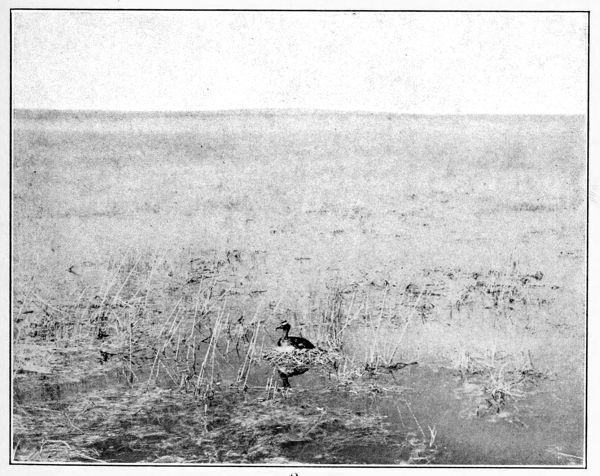
its surface with a field-glass, I was suddenly amazed to see a Grebe
sitting upon a nest which protruded above the water amid the scant
vegetation. Careful examination showed the bird to be Colymbus
auritus. She slipped from the nest, as I slowly waded toward her, and
swam about in the open water, anxiously watching my every movement. The
interest was mutual. After watching the bird for some time I went up to
the nest and found that it contained two eggs. Subsequent visits showed
that the eggs were deposited at intervals of two days; the dates of the
visits and number of eggs found at each visit being as follows: June 3
(2); June 5 (3); June 7 (4); June 9 (5); June 12 (6); June 13 (6).
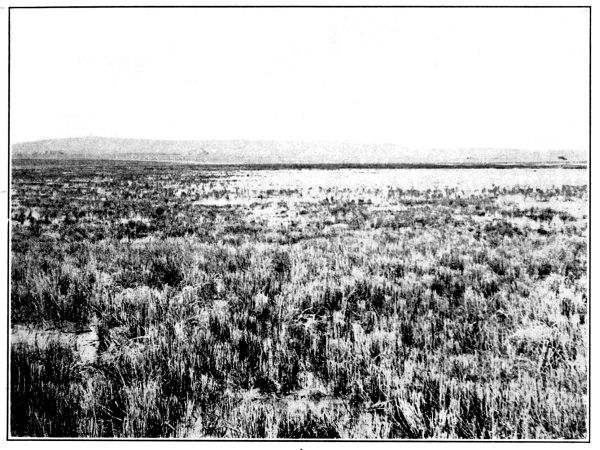
Plate VIII.
1.
Nesting Site of Horned Grebe in a Flooded Meadow.
Nest beyond Open Water. Wheat Stubble in Foreground.
2.
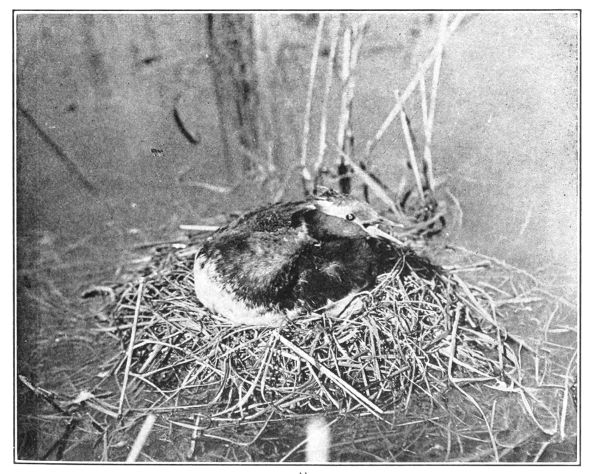
Horned Grebe on her Nest,
showing Scant Surrounding Vegetation.
Whenever I appeared at the edge of the slough, it was the custom of
the two Grebes to float about upon the area of open water with an air
of supreme unconcern. They busied themselves constantly with their
toilets, preening the feathers of all parts of their bodies and very
frequently tipping or rolling themselves in the water to reach their
under parts with their bills. In this half-capsized posture they would
float for several seconds, exposing to view the strikingly prominent
white area that is normally below the water-line. This preening and
floating in different positions, on the part of both birds, proceeded
without interruption during my entire stay, each day that I visited
them. It became very evident that it was practiced as a ruse to hold
the attention of the intruder and thus divert him from their nest.
On the morning of June 12, a camera was taken to the nest-site with
the purpose of making photographs of the nest and eggs. On the land to
the south, a homesteader with eight horses to his plow, was turning
over the virgin sod. His furrows ended at the edge of the slough
southwest from the nesting site of the Grebes. Upon wading to the nest
I found the six eggs shielded on the southwest side, by a partial
covering of vegetation which had been pulled up on that side only. The
general character of the country and location of the nest are shown in
the photograph on Plate VIII. After making
a photograph, and remaining for a time near the nest to observe the
parent birds, I left the tripod and camera in position and went away.
The female was continually gaining either confidence or bravery and had
been swimming about in an agitated manner, not far from me, as I stood
quietly by the camera. Before I had gotten out of sight of the nest I
saw her go to it and change the covering or shielding material to its
opposite edge, thus sheltering the eggs from the too inquisitive gaze
of the camera’s eye. When I returned from the cabin the bird was on the
nest, incubating. She took to the water as I came up, but continued to
swim back and forth among the scant, neighboring tufts of marsh grass.
As I stood very quietly for some time behind the camera her boldness
gradually increased, until at length I was able to photograph her near
the nest, with the aid of only ten feet of rubber tubing attached to
the shutter release. The making of these photographs consumed much
time and continually the Grebe was growing bolder. She swam almost
under the camera, and when I came close to the nest she made a dash
at me, shooting entirely out of the water. This show of force was
afterward repeated frequently, and it sometimes ended with a violent,
splashing dive which sent a shower of spray over the camera outfit
and the photographer. Meanwhile her spouse drifted quietly at a safe
and respectful distance. Although one photograph of the bird on her
nest was secured by means of a very long thread, the result was rather
unsatisfactory.
On the following day, June 13, I donned the hip boots again and
stationed myself with the camera outfit, determined to see if patience
would be rewarded by an opportunity to photograph the bird on her nest
at close range. It was a wearisome experiment, but not without result,
for eventually the Grebes became remarkably bold. The female was the
first to approach. She swam around the nest repeatedly, but for a long
time refused to venture upon it. For the most part the male witnessed
her adventures from a discreet distance. Occasionally however, he came
up; and finally, while the female was showing her agitation by swimming
hurriedly about, the male swam deliberately to the nest, climbed up
its side, and sat on the eggs, facing me. A plate was exposed on
this unexpected sitter but unfortunately was ruined by an accident
before development. He became alarmed by my activities in changing
plate-holders, or perhaps by the removal of my head from beneath the
focusing cloth, and suddenly slipped off the nest into the water. Both
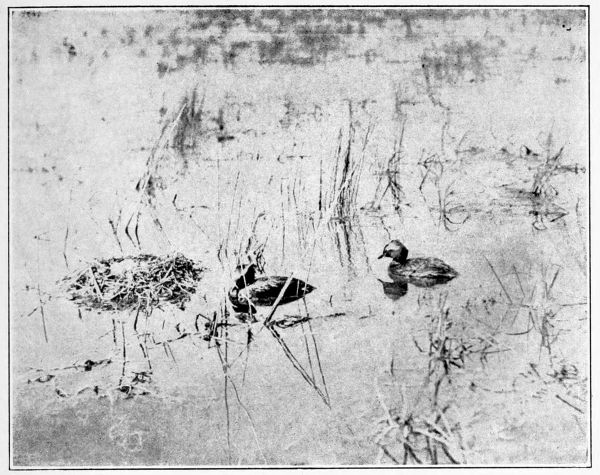
birds were subsequently photographed together, near the nest.
I cautiously moved the camera somewhat closer and waited. The female
frequently shot out of the water at me with a rush accompanied by a
harsh cry, and sometimes ended her attack with a dive and a great
splash. Eventually she went upon the nest, and once in contact with her
eggs, she became invincible. I photographed her thus; then moved the
tripod toward her, slowly and cautiously, keeping my head beneath the
cloth. In this way the camera was placed within arm’s length of the
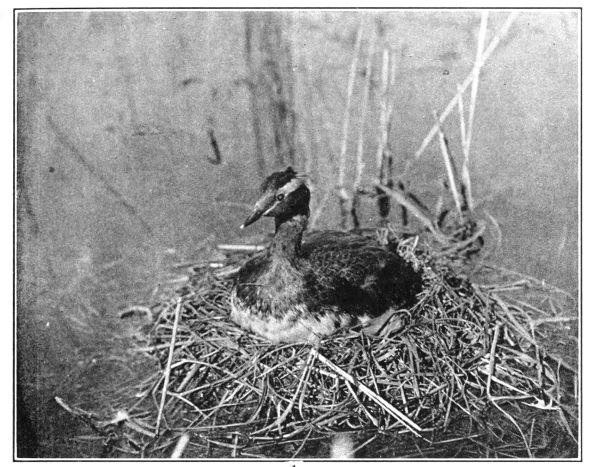
bird and another exposure made, which resulted in the intimate portrait
of Plate X, fig. 1. I uncovered my head, but she remained firm, and when
I extended my hand toward her she reached out her long neck and
delivered a vicious, stinging stab with her sharp bill. The threatening
attitude of the bird, just previous to striking, is shown in
Plate X, fig. 2.
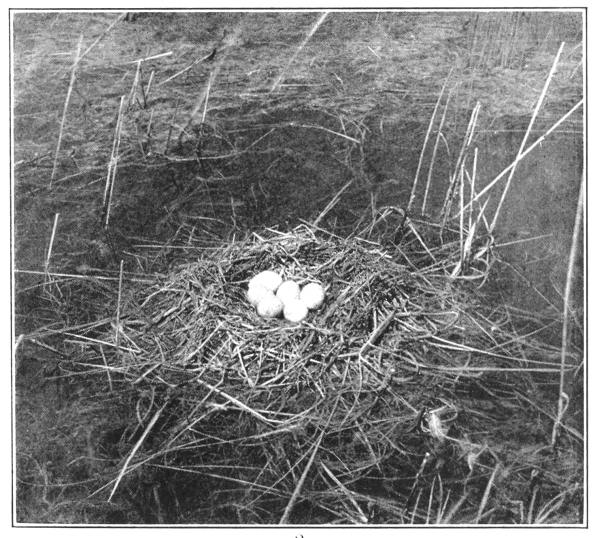
The exposed situation of this nest is shown in several of the
photographs. It consisted of a mass of coarse grasses, many of them
fresh and green, floating in about a foot of water, the body of the
nest below the water line being of such bulk as to almost touch the
muddy bottom. The nest-lining, in the bottom of the well hollowed
cavity, was very wet and soggy, being only slightly above the water
surface when the nest was unoccupied, and probably below it when the
weight of the bird was added to that of the nest. This lining was
composed of decaying vegetation which was decidedly warm to the touch,
in the sunshine, while the wet rim of the nest was cold.
The eggs of this set were taken. They were of course in various stages
of incubation, from fresh in the last, to well begun in the first-laid
egg. For some time after I had left the empty nest, taking the camera
with me, the two Grebes swam to and fro beside it, or circled around
it, frequently going to the nest and climbing part way up. Occasionally
one of the birds, presumably the female, sat upon the nest for a brief
period, shifting herself in a restless manner, and then returned to the
water.
For several days I stayed away. Would these birds nest again in this
small and rapidly diminishing slough at so late a season? Would they
leave the slough and go elsewhere to nest? Or would they abandon the
duty of reproduction altogether? These questions seemed of sufficient
interest to demand further observations, but not wishing to further
inject the factor of the human menace into their already complicated
affairs, I left the birds entirely to themselves. Meanwhile extremely
dry warm weather was causing rapid evaporation and the slough was
shrinking very perceptibly.
My next visit, on the eighteenth of June, disclosed the fact that the
Grebes were not only present but were building a new nest not far from
the old one. The nest seemed nearly completed. The two birds were
floating near each other on the open water, preening their plumage in
the ostentatious manner previously described.
At seven-thirty on the morning of June 21,
the new nest contained two eggs, partially covered, especially on the
northwest side, which was the direction from which I approached the
slough. There was a striking difference in the coloring of the two
eggs, in view of the slight difference in their ages. One egg was a
drab-tinted cream; the other a beautiful greenish tint with a freshness
and delicacy which is difficult to describe, and which marked it as
having just been deposited by the bird. A schedule of the subsequent
visits to this nest is given in the accompanying table:
Visit
Date
Time of
# of
Were eggs
Was either
No.
day
eggs
covered?
bird seen?
1
June,
18
0
Both on open water
2
"
21
7:30 A.M
2
Partially covered
3
"
22
8:00 A.M.
2
Sparsely covered
4
"
23
7:30 A.M.
3
Not seen
5
"
24
9:00 A.M.
4
Covered
Bird seen on nest
6
"
25
7:30 A.M.
4
Lightly covered
Not seen
7
"
25
Sunset
4
Covered on E. side
Not seen
8
"
26
7:30 A.M.
5
Covered
One on open water
9
"
27
7:00 A.M.
5
Not covered
Saw bird leave nest
10
"
28
7:30 A.M.
5
Chiefly on E. side
Not seen
11
"
29
Evening
5
Covered
Not seen
12
July,
4
5
Covered on top
Not seen
13
"
8
5
Covered
Yes; in water-lane
14
"
9
5
Covered
Not seen
15
"
10
8:00 P.M.
5
Not covered
One bird seen
16
"
11
6:00 P.M.
5
Not covered
Not seen
17
"
12
5:00 P.M.
5
Partially covered
One on open water
18
"
13
6:00 P.M.
4
Not covered
Not seen
19
"
14
4
Lightly covered
Not seen
20
"
15
Evening
3
Bird on nest
21
"
16
10:00 A.M.
3
Not covered
Not seen
22
"
17
10:00 A.M.
3
Not covered
One seen with young
23
"
18
7:30 P.M.
2
Not covered
Not seen
24
"
20
6:00 A.M.
2
Not covered
Not seen
25
"
22
7:30 P.M.
2
Not covered
Not seen
26
"
23
9:00 A.M.
2
Not covered
Not seen
27
"
24
Evening
2
Not covered
Not seen
Plate IX.
1.
A Pair of Horned Grebes at Home. Female at Right.
2.
Nest and Eggs of Horned Grebe.
When I approached on the morning of June 24, the Grebe was on her nest.
She made herself as inconspicuous as possible by holding her head down,
close to the nest rim. As I came within twenty-five or thirty yards
of the nest the bird hastily pulled a covering of green-stuff over
the eggs and slid silently into the water, disappearing completely.
Although I watched for some time I did not succeed in catching even a
glimpse of either of the birds.
On the occasion of the sixth visit (June 26) I found the nest lightly
covered with fresh green stems and blades which had been plucked by the
bird. At that time I made the notation in my field book: “Never see the
birds on the open water any more.” However, on the next day, some time
after I had left the nest, I did see one of the Grebes floating on the
open water. The eggs had again been covered with fresh vegetation.
On the morning of June 27, I approached by a circuitous route, passing
by the nest with my interest ostensibly concentrated elsewhere. But as
I passed too near her the bird slipped quickly off the nest without
stopping to cover the eggs; and I could not find her afterward. It will
be noted from the tabulated schedule that neither of the birds was seen
at the tenth, eleventh, or twelfth visits. The thirteenth visit was
more successful for I saw a Grebe sitting perfectly motionless, at the
edge of a water-lane which traversed some of the thickest vegetation,
its bright red eyes appearing as its only conspicuous feature. The next
day (fourteenth visit), I could not find the birds, and the fifteenth
visit gave me only a fleeting glimpse of a Grebe. The eggs were not
covered but were slightly shielded on the side from which I had come.
On the evening of July 12, one of the birds was observed floating,
silent and solemn, with head toward me, at the farthest side of the
open water. It was evident at this time that the birds had changed
their dress since my acquaintance with them at their first nest, for no
yellow “horns” were now visible.
On July 13, finding only four eggs in the nest, and pieces of egg shell
both there and in the water, I searched carefully in the vicinity of
the nest but without result. I could neither find the newly hatched
young nor catch any glimpse of either parent. On the next day the
conditions were the same except that the eggs were slightly covered and
a few small feathers had been left on the nest, showing that the bird
had been upon it.
The twentieth visit, on the evening of July 15, gave me an opportunity
to examine the bird at close range. She was on the nest and allowed me
to approach, cautiously, to a point twenty or thirty feet from her.
She was considerably changed in appearance. The yellowish-white tip
of the bill remained unaltered and the light line through the lower
margin of the lore was observed to still persist, but the plumage of
the head was much subdued, the yellow plumes having been exchanged for
mere inconspicuous grayish streaks on the sides of the head. As I came
up I could see a young bird poking its head through her wing. She soon
left the nest, with a startling rush, and swam rapidly away, leaving
three eggs in the nest and two tiny youngsters in the water. The newly
hatched downy young can both swim and dive in a feeble way. As I
approached them they tried to escape by diving. When I held them in my
hands they gave utterance to a little cry not greatly different from
that of domestic chicks.
The downy young are very striking in appearance. They are striped
longitudinally with black and white stripes; the white however is
rather a “soiled” or grayish white. There are two narrow white stripes
on the head which converge to a point at the base of the bill. Between
these stripes, on the forehead, is a small slightly raised bare spot,
of a bright red color, back of which is a white elongated blotch, or
median stripe. The bill is pink and has on both mandibles a white tip
which resembles white porcelain. This is larger on the upper mandible
than on the lower. On the upper mandible between the nostrils there
is a black spot. The iris is brown, not red like that of the adults.
The lobate feet are remarkably well developed, but the wings are
rudimentary.
On the following day, July 16, I failed to find either the parent or
the young at the nest. The three remaining eggs were not covered.
Again on the morning of the seventeenth, the nest held only the three
uncovered eggs; but when I skirted the east end of the slough to
examine a Sora’s nest, I was startled by the parent Grebe taking wing
not far from me. She flew over the farthest part of the slough, but
soon returned, after circling a time or two, to the small area of open
water, where she alighted with a splashing glide. When on the wing this
bird shows very prominent white markings. The white secondaries cause
the posterior portion of the wing to show as a prominent white area,
and of course the entire under surface of the body, being white, is
very conspicuous when the bird wheels. The flight is so duck-like that
the flying Grebe might readily be mistaken, at a distance, for a duck.
I waded to the spot whence this bird had taken flight and presently saw
the water agitated by some small creature beneath the surface. It was
one of the diminutive downy Grebes, floating submerged, head downward,
with its forward parts thrust into a mass of filamentous vegetation
(algae), while its legs, stretched to their full extent posteriorly,
were pointed vertically upward toward the surface of the water. I
easily took it up in my hand.
The next day, July 18, at 7:30 P. M., another egg had hatched. The nest
was not covered. It contained two eggs and nearly all of the opened
shell of the other, which last circumstance was of course unusual. I
heard the young bird, and by following the faint sound of its voice
found it, in the water, about six or eight feet from the nest. It was
small enough to have just emerged from the shell. Its bill was very
pink and the naked red spot, or comb, on its forehead very bright,
though only slightly raised above the surrounding skin. By the merest
chance I discovered a downy young duck within a few feet of the Grebe’s
nest. It was not identified. Perhaps it had been attracted by the cry
of the little Grebe. The adult Grebes were not seen, either on this
visit or on July 20, when I looked for them early in the morning. On
the latter date the two eggs and the nest were cold and the orphan
above mentioned was dead, on the slope of the nest just above the
surface of the water. There was an opening in the top of its skull
through which its brain had been removed by some small creature. This
nestling had probably never seen its parents but had taken to the water
wholly by instinct.
On the evening of July 22, the two eggs were cold and had not been
disturbed since my previous visit, at which time their positions had
been carefully noted. However one of them was “pipped” and I could
distinctly hear the voice of the bird within the shell. A search for
the parent Grebes was without avail. A faint voice, at the other side
of the water, was detected and was followed several times, but when its
author was finally located it proved to be not a Grebe but a recently
hatched Sora Rail.
The next morning, although the sun shone upon the nest, the eggs were
cold and the fetuses in both of them were dead. No birds were seen. My
last visit, on the evening of July 24, yielded no further result. But
I noted now, that there was no water around the nest. It was stranded
upon a mud-bar. This was undoubtedly the cause of forced abandonment of
the nest. The Grebes were unable to reach it by a water route, and no
other mode of travel was possible to them. A search around the water
area, now very small and shallow, gave no further evidence. The Grebes
were never seen again.
In reviewing the account of these observations certain groups of data
suggest themselves for summarization:
It is interesting to note that only six days elapsed between the
removal of the first set of eggs and the deposition of the first egg in
a new nest.
The period of incubation is twenty-four or twenty-five days, as shown
in the following table of dates, noted at the second nest:
Egg No.
Date Laid
Date Hatched
Incubation Period in days
1
June 19 (?)
July 13
24
2
June 21
July 15
24
3
June 22 or 23
July 17 or 18
25
4
June 24
July 22, (Pipped)
Fetus died
5
June 26
Fetus died
It will be observed that the fourth egg was alive and on the point of
hatching, twenty-eight days after it was deposited, but this cannot be
considered normal, since the egg had been deprived of the parent heat for
several days. It seems remarkable that the fetus survived the cool nights.
Plate X.
1.
Horned Grebe within Arm’s Length of the Camera.
2.
2. Female, Hissing and Ready to Strike in Defense of Nest.
The change of color which these eggs undergo, is also worthy of
note. I do not refer to the nest-stains caused by contact with the
fermenting vegetation of the nest lining, but to a uniform color change
of the surface layer of the shell, which is brought about presumably
by exposure to light and atmosphere. Referring to the eggs of the
second nest by numbers it will be noted that egg number two, when
first observed at 7:30 A. M., had apparently just been deposited. As
previously stated, its color was a very delicate bluish-green. Egg
number one had already attained its final color; a sort of drab-tinted
buff, which rendered it less conspicuous in the nest. Twenty-four hours
later, egg number two had changed to the same color as egg number one.
No data were recorded for egg number three in this respect. Egg number
four, after thirty-six hours, was “nearly but not quite the same color
as the others.” After it had been in the nest forty-eight hours it
was noted as, “same color as other eggs.” But egg number five could
scarcely be recorded as fully changed after eighty-four hours had
elapsed. These notes would seem to indicate that the first-laid eggs
change color more rapidly than the later ones. It may be noted in this
connection that the first eggs are slightly richer in the light green
pigment; possibly, also, they receive less shelter from the parent bird
than the later eggs.
The usual vocal performance of these Grebes, so far as I was able
to determine, is a sort of “ko-wee, ko-wee,” repeated at regular
intervals. It might be compared to the squeak of a dry wheelbarrow
producing one double squeak at each revolution of the wheel. It is
however of a clearer quality than this comparison might indicate. Each
“ko-wee” has rising inflection and its two syllables are run closely
together, with the accent on the last syllable.
The remarkable change of manner which came over these birds as the
moult began will be appreciated by reference to the tabulated schedule
of visits. The pugnacious bravery of the female at her first nest is
amply attested by the photographs, while the records of the second nest
show that the birds rarely permitted themselves to be observed, even at
a distance, although they had eggs as before.
These Horned Grebes were absolutely isolated so far as concerns other
individuals of the species.[2]
There were certainly no other Grebes in the slough. Their nesting
associates were as follows: Red-winged Blackbird (Agelaius phœniceus
fortis), about three pairs nesting; Sora Rail (Porzana carolina),
three or four pairs nesting; Wilson’s Phalarope (Steganopus
tricolor), several pairs; Killdeer (Oxyechus vociferus), one pair
in evidence; Savannah Sparrows (Passerculus sandwichensis alaudinus)
were present at the slough all summer; and a pair of Pintails (Dafila
acuta) were believed to have a nest in an adjoining field. The
adjoining prairie was monopolized, as usual, by the Horned Larks
(Otocoris alpestris leucolæma) and Longspurs (Calcarius ornatus
and Rhynchophanes mccowni).
At the present writing this slough is dry; the road which passes
through it is traveled every day by automobiles; and the spot where
the Grebes established their home a year ago has now been plowed and
planted.
HISTORICAL NOTES ON HARRIS’S SPARROW ( ZONOTRICHIA QUERULA ) .
BY HARRY HARRIS.
During the early decades of the nineteenth century when those pioneer
ornithological enthusiasts, whose names and discoveries are familiar to
all students of the science, were pushing beyond the frontiers in quest
of new objects of study, the Kansas City region was the gateway to the
wilderness and the very outpost of civilization. In this immediate
neighborhood where the down-rushing Missouri is joined by the less
turbulent Kaw, and where the great river bends finally to the east,
were situated the frontier settlements of Independence, Fort Osage
(Fort Clark, of Lewis and Clark), Westport, and the great Konzas Indian
village, while a short distance up-stream were three other landmarks
frequently mentioned by travelers. Fort Leavenworth, the mouth of
Little Platte River, and the Black Snake Hills.
These names bring to mind several notable ornithologists and
botanists whose published journals and narratives are at once fruitful
sources of information to the working student and delightful reading
to any person. Of all the young scientists who passed this way in
their eagerness to explore the unknown beyond and gather its treasures
to science, perhaps none are of more interest, though others may be
more widely known, than John K. Townsend and Thomas Nuttall. Nuttall’s
discovery here of the bird now known as Harris’s Sparrow (Zonotrichia
querula), together with the fact that two other eminent ornithological
explorers, at later periods, each believed he had discovered the bird
in this same region, renders the tradition of peculiar and obvious
local interest.
A long entertained hope of being able to determine the actual
locality in Jackson County, Missouri, where Nuttall took the original
specimen of this Sparrow, has led the writer to bring together the
widely scattered data bearing on the early history of the bird.
The facts in question, which do not appear to have been previously
assembled, present several interesting features.
Nuttall and Townsend had outfitted in St. Louis in late March, 1834,
preparatory to a leisurely pedestrian journey of some three
hundred miles across the state to Independence, where they were to join the
large caravan under Captain Nathaniel J. Wyeth, bound for the Columbia
River country. On April 28th the party left Independence over the
frontier trail to Westport, distant approximately fourteen miles. Some
time during the day Nuttall, who was primarily a botanist and is said
to have carried no gun, took, or had taken for him by some member of
the party, the type specimen of Harris’s Sparrow which he named the
Mourning Finch (Fringilla querula). Nuttall writes: “We observed
this species, which we at first took for the preceding [White-crowned
Sparrow], a few miles to the west of Independence, in Missouri, towards
the close of April. It frequents thickets, uttering in the morning, and
occasionally at other times, a long, drawling, monotonous and solemn
note te de de de. We heard it again on the 5th of May, not far from
the banks of the Little Vermilion, of the Kansa.”[3]
The information contained in this short paragraph is the
only guide the writer has had in a search for the spot where the species was
first met with. Not a little difficulty has been experienced in tracing the
road between Independence and Westport in use in the early thirties,
since but meager graphic record of its course has been preserved. The
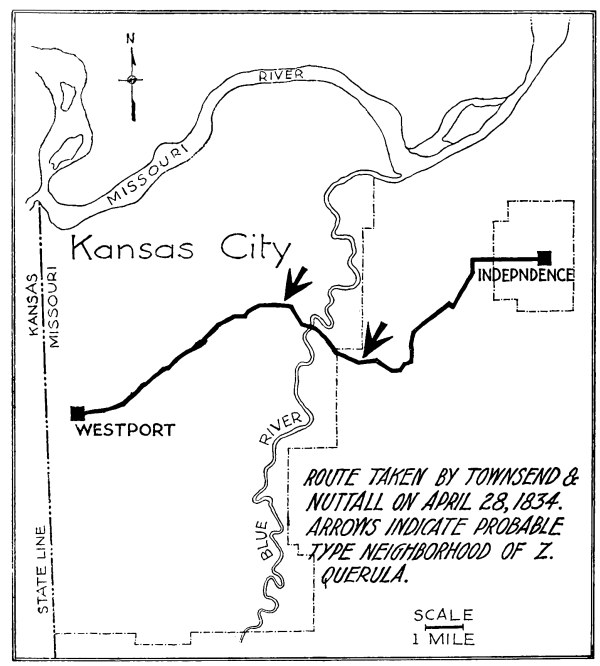
accompanying sketch map is in the main authentic, authorities differing
as to only a short stretch about three miles from old Westport. Many
years association with the birds of this region leads the writer to the
conclusion that these scientists would have had difficulty in crossing
the Blue Valley at this season of the year without seeing or hearing
troops of these striking Sparrows. That part of the road lying within
the valley is indicated on the map by arrows.
Townsend’s frame of mind on this momentous day is best described in his
own words. “On the 28th of April, at 10 o’clock in the morning, our
caravan, consisting of seventy men, and two hundred and fifty horses,
began its march; Captain Wyeth and Milton Sublette took the lead, Mr.
N.[uttall] and myself rode beside them; then the men in double file,
each leading, with a line, two horses heavily laden, and Captain Thing
[Captain W.’s assistant] brought up the rear. The band of missionaries,
with their horned cattle, rode along the flanks.
“I frequently sallied out from my station to look at and admire the
appearance of the cavalcade, and as we rode out from the encampment,
our horses prancing, and neighing, and pawing the ground, it was
altogether so exciting that I could scarcely contain myself. Every man
in the company seemed to feel a portion of the same kind of enthusiasm;
uproarious bursts of merriment, and gay and lively songs, were
constantly echoing along the line. We were certainly a most merry and
happy company. What cared we for the future? We had reason to expect
ere long difficulties and dangers, in various shapes, would assail us,
but no anticipation of reverses could check the happy exuberance of our
spirits.
“Our road lay over a vast rolling prairie, with occasional small spots
of timber at the distance of several miles apart, and this will no
doubt be the complexion of the track for some weeks.
“In the afternoon we crossed the Big Blue River at a shallow ford. Here
we saw a number of the beautiful Yellow-headed Troopials, (Icterus
zanthrocephalus) feeding upon the prairie in company with large flocks
of Blackbirds, and like these, they often alight upon the backs of our
horses.”[4]
Here is a vivid picture of a situation well calculated to stir the
imagination and excite the enthusiasm of this twenty-five year old
easterner on his first visit to the virgin West, and thoughts of
ornithological discoveries were no doubt reserved for the future.
Nuttall could not have been so distracted by the excitement incident to
the departure of this wild cavalcade, since he had had several previous
experiences of the wilderness, was an older man, and was by nature
“shy, solitary, contemplative, and of abstract manner.” At all events
he set the ornithological pace immediately at the start of the journey
by discovering a new bird. Townsend’s silence in his ‘Narrative’
regarding this important event was of course due to courtesy to the
discoverer who had not yet given his species to science.
In my account of Nuttall’s discovery of his “Mourning Finch,” I have
assumed that the specimen he took in Jackson County is the type.
Perhaps it would be more accurate to say that in the absence of any
definite knowledge regarding the type specimen it is presumed from his
description that the specimen here taken was the type. The description
referred to was published in the second edition of his Manual (the
volume on water birds being a reprint of the first edition) which did
not appear until 1840. It will thus be seen that this important species
was allowed to remain in obscurity for six years while twenty-four
other new species subsequently discovered on the trip had been
described, as well as sixteen figured by Audubon in the Great Work,
prior to the appearance of Townsend’s Narrative in 1839. Nuttall’s
published description of the bird is merely the briefest possible outline
of salient specific characters, no measurements whatever being given.
On his return to the East, two years in advance of Townsend, Nuttall
had in his possession a quantity of the latter’s material for delivery
to the Philadelphia Academy of Sciences, which Institution had helped
substantially in financing the travelers. It was this material that
Audubon sought so eagerly to possess, that his great work then nearing
completion might not lack the new species.[5]
Audubon had called on Nuttall, in Boston, in the hope of assistance
from that quarter, and was promised duplicates of all the new species
in his possession. It is said that five species were here secured,
but the Mourning Finch was not included. Nuttall had reserved this
discovery for his own book, and not only was posterity thereby deprived
of an Havell engraving of the largest and handsomest of our Sparrows,
but Audubon, being kept in the dark, was himself to later publish the
bird as the discovery of his friend Edward Harris.[6]
On the same day that Townsend and Nuttall were so picturesquely
entering the Indian country, Maximilian, Prince of Wied, who had spent
the previous year on the upper Missouri, was making his way down-stream
on his return to civilization. On May 13, 1834, when but a few miles
from the northern boundary of Missouri, his hunters took specimens of a
bird new to him. In the second volume of his published journal,[7]
he says: “It was toward eight o’clock in the cool morning of May 13 (1834)
that we stopped on the right bank of the river and landed on a fine,
green prairie, beset with bushes and high isolated trees.... We found
many beautiful birds, among which Icteria viridis and the handsome
Grosbeak with red breast Fringilla ludoviciana.... At noon we
reached Belle-Vue, Major Dougherty’s Agency.... To the naturalist the
surroundings of Belle-Vue were highly attractive. The beautiful wooded
hills had shady ravines and small wild valleys.... Many, and some of
them beautiful, birds animated these lovely thickets, the Cuckoo, the
Carolina Dove, the Red-breasted Grosbeak, Sialia wilsoni, several
Finches, among which Fringilla cyanea and erythropthalma, and of
about the same size a new species which at least in Audubon’s Synopsis
of the year 1839 is not enumerated and which I called Fringilla
comata (2)”[8]
The (2) in the text refers to a note at the end of the chapter where a
description of the Harris’s Sparrow is given in great detail, and where
the statement is made that “this bird nests in thickets along the shore
of the Missouri River in the neighborhood of the mouth of La Platte
River.” The first volume of Maximilian’s journal, containing the record
of his trip up the Missouri, was published in 1839, while volume
two, covering the period when the Sparrow was taken, did not appear
until 1841. Had he published both volumes simultaneously in 1839, his
specific name comata would of course be current. It is interesting
to note that though he took his first specimen just fifteen days after
Nuttall had taken the type, and at a time when the bulk of the migrants
had passed north, he had overlooked an opportunity of being the actual
discoverer during the previous April, when he had been in the direct
migratory path of the Sparrow at the season of its greatest abundance there.
Nuttall himself had overlooked an opportunity of discovering the
bird twenty-four years earlier, and had his attention at that time
been directed to birds as well as plants, he would no doubt have
become acquainted with the species. Referring to the Journal of his
companion,[9]
John Bradbury, an English botanist, it is found that they passed
through this region during the spring migration of 1810, and while
Nuttall’s absent-minded preoccupation in collecting plants was a
standing joke among the voyageurs, Bradbury was somewhat more alive to
ornithological possibilities, and has left many entertaining, and a few
valuable notes on the better known birds. They had spent April 8th and
9th at Fort Osage, now Sibley, Jackson County, Missouri; and the writer
knows of no more certain place to find Harris’s Sparrows in early April
than in the timber and thickets of this bottom land.
The Lewis and Clark party had passed through this region in June,
1804, and again early in September, 1806, and Thomas Say of the Long
Expedition had been here in August, 1819. Maximilian was therefore the
first ornithologist to enter the range of this species while the birds
were in transit.
The last “discoverer” was Edward Harris, in whose honor Audubon gave
the bird its vernacular name. The memorable voyage of Audubon and
Harris, together with Bell, Sprague, and Squires, up the Missouri River
in 1843 is too well known to require comment. A few quotations will
serve in connection with the story of the Sparrow. On May 2 the party
passed the point in Jackson County, Missouri, where Nuttall and
Townsend had left the river nine years previously. Early the next
morning they reached Fort Leavenworth. After leaving this post the
boat was stranded on a sand-bar from 5 o’clock in the evening until
10 the next morning, giving the naturalists considerable time to do
some collecting in the neighborhood. In his famous journal[10]
of the voyage, Audubon says under date of May 4: “Friend Harris shot two
or three birds which we have not yet fully established.... Caught ...
a new Finch.” And on the next day he states: “On examination of the
Finch killed by Harris yesterday, I find it to be a new species, and
I have taken its measurements across this sheet of paper.” In volume
seven of the octavo edition of his ‘Birds of America,’ where the new
species taken on the trip are described, the remarks under the Sparrow
are as follows: “The discovery of this beautiful bird is due to my
excellent and constant friend Edward Harris, who accompanied me on my
late journey to the upper Missouri River, &c., and after whom I have
named it, as a memento of the grateful feelings I will always entertain
towards one ever kind and generous to me.”
“The first specimen seen was procured May 4, 1843, a short distance
below the Black Snake Hills. I afterwards had the pleasure of seeing
another whilst the steamer Omega was fastened to the shore, and the
crew engaged in cutting wood.
“As I was on the look-out for novelties, I soon espied one of these
Finches, which, starting from the ground only a few feet from me,
darted on, and passed through the low tangled brushwood too swiftly
for me to shoot on the wing. I saw it alight at a great distance, on
the top of a high tree, and my several attempts to approach it proved
ineffectual; it flew from one to another treetop as I advanced, and
at last rose in the air and disappeared. During our journey up stream
my friend Harris, however, shot two others, one of which proved a
female, and another specimen was procured by Mr. J. G. Bell, who was
also one of my party. Upon our return voyage, my friend Harris had the
good fortune to shoot a young one, supposed to be a female, near Fort
Crogan, on the fifth of October, which I have figured along with a fine
male. The female differing in nothing from the latter.
“All our exertions to discover the nest of this species were fruitless,
and I concluded by thinking that it proceeds further northward to breed.”
The work in which this supposed discovery was announced was published
in 1844, four years after the second edition of Nuttall’s ‘Manual’
appeared. Since this manual was the first American work on ornithology,
excepting Wilson’s, to go into a second edition, it was presumably
widely known among ornithologists, and it is not easy to understand why
Audubon and his coworkers were in ignorance of their lack of claim to
Nuttall’s Mourning Finch.
During the twenty-five or thirty years following Audubon’s visit to
the Missouri haunts of the Sparrow, practically nothing was learned of
its life-history or distribution, and the few scattered specimens that
were taken were all from the same general region. A specimen furnished
by Lieut. Couch, taken at Fort Leavenworth on October 21, 1854, formed
part of the material used by Prof. Baird in his epochal work in 1858,
as did another taken at the same point on April 21, 1856, by Dr.
Hayden, of Lieut. Warren’s Pacific Coast Surveys party. Dr. Hayden took
three other specimens further up the river in the same year. Dr. P. R.
Hoy, who collected in the type region in 1854, took a specimen on May
7, and on May 13 met with a troop of fifteen or twenty. There are a few
other records from the Missouri Valley and one from Texas (Dresser,
Ibis, 1865) prior to the numerous ornithological activities of the
early seventies. Dr. J. A. Allen, collecting in the interest of the
Museum of Comparative Zoölogy, had his headquarters at Fort Leavenworth
during the first ten days of May, 1871, and found Harris’s Sparrows
exceedingly abundant in the bottom timber on the Missouri side of the
river. He added a few field notes on behavior, appearance, etc, and
took a series of specimens. Baird, Brewer, and Ridgway state that from
the time of its discovery in 1834 up to 1872 but little information
had been obtained in regard to the Sparrow’s general habits, its
geographical distribution, or its mode of breeding, single specimens
only having been taken at considerable intervals in the valley of the
Missouri and elsewhere. In 1874 Dr. Coues brought together all the
available data in his interesting article on the bird in ‘Birds of the
Northwest,’ but was able to add nothing in determining the bounds of
its habitat, which he gave as “Region of the Missouri. East to Eastern Iowa.”
It was not until ten years later that enough information had
accumulated to warrant an attempt at defining the limits of its range
and the periods of its migration. This was done by the painstaking and
accurate Wells W. Cooke in the first volume of ‘The Auk,’ in 1884. In
this article, ‘Distribution and Migration of Zonotrichia querula,’
he was able only in a very general and indefinite way to give the
western and southern extent of the range, but the eastern limits remain
practically as he defined them.
In 1913 Professor Cooke noted the interesting peculiarity of the
migration of the Harris’s Sparrow in the interval that elapses after
the first spring advance. He states[11]
that the birds become common along the Missouri River in northwestern
Iowa soon after the middle of March and yet it is not until early May
that they are noted a few miles further north in southeastern South
Dakota and southwestern Minnesota. He adds that the dates suggest the
probability that these March birds have wintered unnoticed in the thick
bushes of the bottomlands not far distant, and have been attracted to
the open country by the first warm days of spring. This theory is borne
out by the facts as observed by the writer in the Kansas City region.
The birds are present in this vicinity during even the most severe
winters, but keep to the dense shelter of the Missouri bottoms. During
mild and open winters a few scattered flocks may even spend the entire
season until spring in the hedges and weed patches of the prairie country.
This Sparrow has always attracted attention in the field by its large
size and conspicuously handsome appearance, as well as by its sprightly
and vivacious manner and querulous notes, but it has seldom been the
subject of special notice in the literature of American birds. Its
bibliography is chiefly confined to diagnostic listing in formal works
on ornithology, brief annotations in faunal lists, and occasional
mention in published field notes.
During the thirty-four years that have elapsed since Prof. Cooke’s
article of 1884, the Sparrow, as a migrant, has become well known to
ornithologists. Its narrow migration path, the center of which in the
United States is approximately down the 96th meridian, has been worked
out; the wide extent of territory covered by stragglers has been fully
reported;[12]
the food habits of the bird while on migration have been thoroughly
investigated and the results published;[13]
the nest has been seen once,[14]
and young just out of the nest have been collected,[15]
and the general region of the breeding ground itself is known to be
where barren tundra meets the edge of the timber between Hudson Bay
and Great Bear Lake. But the eggs yet remain to be discovered.
NOTES ON THE STRUCTURE OF THE PALATE IN THE ICTERIDÆ.
BY ALEXANDER WETMORE.
The curious keel-like, angular projection found
on the palate in the North American Grackles of the genus Quiscalus,
recognized as one of the prominent characters distinguishing that group
of Blackbirds, is a structure that can hardly fail to attract attention
when the mouth is examined in freshly killed specimens, or in birds
preserved in spirits. Recently, certain observations made in the field
on these birds, which will be recounted later, recalled this structure
to mind and the writer was led to make a somewhat detailed study of the
palatal keel in the Grackles, and finally to examine the appearance of
the palate in other members of the family Icteridæ. In these studies,
carried on in the United States National Museum, there have been
available suitable specimens representing all of the leading genera
with the exception of Clypeicterus, Ocyalus, Lampropsar and
Macragelæus. In all, one hundred and thirteen species belonging to
thirty-one genera have been examined.
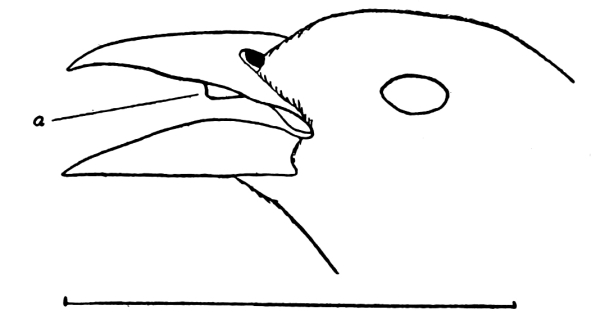
Fig. 1. Head of Quiscalus quiscula æneus.
a. Palatal keel (about natural size.)
Study of skins of the genus Quiscalus shows that the palatal keel
is developed as a compressed projection from the roof of the mouth,
slightly behind the center of the commissure (Fig. 1). Viewed from
the side it is truncated in front, forming an angular projection that
has a tendency to become toothed at the tip. Posteriorly it lowers to
merge finally into the level of the palate. The anterior margin is
sharp, and the posterior portion is thicker and stronger. The entire
ridge is developed as a fold in the horny sheathing of the palate, and
the surface of the premaxilla underneath is smooth and flat with no
indication of a bony ridge to support the keel.
From the examination of museum skins it appears that the palatal ridge
begins to develop in juvenile birds a short time before they leave the
nest, at a stage when the body is well covered with feathers, and the
incoming tail feathers have attained a length of 20 to 25 millimeters.
In such birds the keel appears as a very slightly raised ridge that
forms a distinct line on the palate. The bill at this time has reached
about three-fourths of the length attained when the bird is adult, so
that the beginning of this ridge appears to be located far forward,
though it occupies the same position in relation to the external nasal
opening that the fully developed keel does in the adult. In the dried
skins the ridge is somewhat indistinct, but it is possible that it may
be more readily apparent in living or recently killed specimens.
In birds that are almost fully feathered and that are about ready to
leave the nest the bill has become stronger, the raised palatal line is
heavier, and has a rounded anterior end that forms a marked projection
and then continues to merge with the palate in front. In older
specimens, able to fly but with the rectrices only 95 to 105 mm. long,
the palatal ridge was better marked, being broad and strong basally and
more slender toward the point. In a few of the specimens of this stage
examined the cutting angle seemed well developed, but in others it was
less strongly indicated. In birds that were fully grown but still in
juvenal plumage the ridge was well developed but not so prominent as in
adults. In some the basal portion was broad and rounded, verging toward
the formation of palate found in the genus Megaquiscalus. In others
the anterior cutting angle was more prominent but the entire ridge had
only attained from one-half to three-fourths of its full height.
No one apparently has raised the question of the possible function
of this keel, developed as described above, so that it seems proper
to record here certain field observations made by the writer that
indicate the use of this structure. As might be expected it serves in
securing and preparing certain parts of the food. In December 1917,
near Stuttgart in eastern Arkansas, during a time when the ground was
covered by a light fall of snow, flocks of Bronzed Grackles were found
feeding among small groves of a pin oak (Quercus pagodaefolia). The
ground under these trees was nearly bare and the birds were working
about searching for the small acorns that had fallen and were partly
concealed under leaves and low plant growth beneath the oaks. The
Grackles were tame and with a pair of binoculars it was an easy
matter to watch them at close range. The acorns were picked up, held
in the bill and pressed firmly against the keel on the palate, then
released, turned slightly by means of mandibles and tongue, and then
again gripped strongly. In this way the acorn was rotated until a line
had been impressed entirely around the shell. With a little further
manipulation the shell dropped off in two halves and the kernel was
swallowed entire without further preparation, though frequently it was
gulped down only after some effort. After watching one feeding flock
for some time I clapped my hands sharply to startle them and then
examined the ground where they had been at work. Scattered among the
leaves were many acorn shells, most of which had been cut in two in
a line transverse to the longitudinal axis. Some had fairly smooth,
clean-cut margins, while others were roughened and jagged. In searching
through the leaves I picked up one acorn still intact that had been
dropped by one of the birds, perhaps when the flock was frightened up,
in which a line had been impressed entirely around the center. In this
the impressions of the palatal keel were distinctly visible.
When attention was once attracted to this manner of feeding other
incidents were noted in which the palatal keel was brought in play.
On one occasion on the streets of Washington a Purple Grackle was
observed attempting to split open a kernel of corn dropped from some
passing dray. The bird held this grain in the slight notch near the
center of the bill and pressed it against the angular keel. The grain
proved refractory, as it snapped out several times, dropping 8 or 10
inches away, to be seized and again compressed. Watching until it had
been dropped I frightened the bird and secured the kernel of corn. On
one side four grooves impressed in the hard outer surface were visible
showing where, and with what force, the sharp keel had been applied.
Apparently the palatal ridge develops with the gradual growth of the
bill, and becomes fully functional shortly after the immature bird is
left by its parents to its own resources in securing food. It seems
to be fully grown in all by the middle of September. In many adult
specimens the ridge shows signs of heavy wear from the nearly constant
use to which it is put. In some the cutting angle was well rounded in
front from constant abrasion, while in others the anterior margin had
become irregular and broken. In one specimen the thin lower margin
of the compressed keel was entirely worn away, leaving a low rounded
projection in which the two sides of the fold by which the keel had
been formed were clearly visible, with a line of separation between
them. It was interesting to note that the palatal ridge was usually
well worn in old adults, taken in late fall or early spring, belonging
to the northern races (Quiscalus q. quiscula and Q. q. æneus)
while little or no wear was apparent in similar specimens of the southern
form (Q. q. aglæus) from South Carolina and Florida. The data
available from the examination of a small number of stomachs of this
form from Florida show a preponderance of insects and fruits with very
little mast or grain, a fact of interest, but one that is not fully
substantiated as the material available is small.
Among near relatives of Quiscalus quiscula a slightly developed
palatal ridge was encountered in Megaquiscalus macrourus, where the
projection was broad and well rounded posteriorly, and narrow in front
with the lower margin acute, forming a sharp keel. In some specimens
seen this keel was slowly reduced until it merged smoothly with the
palatal surface in front. In others the anterior margin was obtusely
declivous. The obtuse anterior cutting angle projected below the
margins of the tomia for nearly a millimeter in a few individuals, and
in these occasional specimens the resemblance was striking to those
bills of Quiscalus in which the ridge was most poorly developed.
Juvenile specimens of Megaquiscalus m. macrourus from Fort Clark,
Texas, that had been collected just after they had left the nest, had
the palatal ridge already well indicated though only about one-half
developed. In the slender-billed forms known as Megaquiscalus
tenuirostris and M. nicaraguensis the palatal keel was much
as in M. major though slighter and less pronounced.
In Blackbirds belonging to the West Indian group known as
Holoquiscalus a raised line was also more or less developed. In
general the growth was similar to that in Megaquiscalus as the
posterior portion was broad and rounded, while anteriorly the ridge was
narrowed and the lower margin became acute. There is some variation
in the size of this anterior portion; in a few the crest is obtusely
declivous in front, approaching the condition found in Quiscalus,
but never with the keel produced so that it projects below the plane
subtended by the cutting edges of the tomia.
The discovery of a peculiar knoblike process
on the palate of the mexican orioles belonging to the species Icterus
gularis was one of the really surprising discoveries made during a
more or less cursory examination of the palate in various species and
genera of Icteridæ picked out at random, and it was the finding of
this structure in an Oriole that led to a detailed examination of all
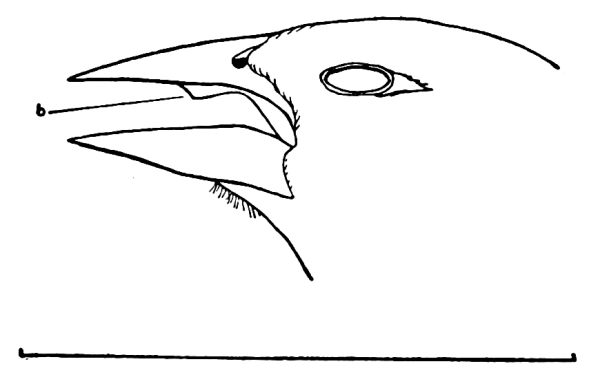
of the material available. In Icterus gularis the palatal ridge is
from 1.2 to 1.5 millimeters high at its anterior end (Fig. 2). The
entire structure is broad and somewhat flattened. The ventral surface
is slightly rounded, the sides slightly sloping, the sides and lower
surface joining at a sharp angle. In front the ridge is abruptly
truncated at its ventral margin where there is sometimes a slight tooth
or projection. Below this point the anterior surface slopes abruptly,
and then passes over into the roof of the palate. The ridge is about
two millimeters broad, and there is a slightly indicated raised line
on the ventral surface for three-quarters of its length behind. From
this description it may be seen that this blunt projection is entirely
different from the sharply keeled ridge found in Quiscalus.
Fig. 2. Head of Icterus gularis yucatanensis.
b. Palatal knob (about natural size.)
Examination of other orioles shows that Icterus gularis stands alone
in respect to this development as there is nothing found in other
species that approaches it save for a broad, low, rounded projection,
slight but distinct, that is found on the palate in Icterus
xanthornus. In Icterus laudabilis and I. prosthemelas there is
a very slightly raised median ridge developed on the posterior part
of the roof of the mouth. In twenty-eight other species belonging to
this genus the palate exhibits no peculiarities worthy of mention.
This structure in the bill in Icterus gularis is constant in its
presence, and serves as a trenchant character distinguishing it from
other orioles, or in fact from any other members of the Icteridæ that
have been available for examination. The differences pointed out above,
together with others of lesser importance, seem to be of generic value.
It is therefore proposed to recognize for this species the genus name
Diagnosis.—Medium-sized Icteridæ with short, heavy bill;
a prominent knoblike projection on the posterior median portion of the
palate, broad and somewhat flattened in general form, with abrupt
sides, truncated in front, sometimes with a tooth or notch at the
anterior ventral angle, about 2 millimeters broad and from 1.2 to
1.5 millimeters high in front; depth of culmen at base nearly equal
to one-half length of culmen (varying from slightly more to slightly
less); tarsus slightly longer than culmen from base; middle toe with
claw equal to two-thirds, or slightly more, of length of tarsus.
One species in which three subspecies have been described is at present
known to belong in this genus. These will stand as follows:
Andriopsar gularis gularis (Wagler)
Andriopsar gularis tamaulipensis (Ridgway)
Andriopsar gularis yucatanensis (Berlepsch)
At present there is no information on the feeding
habits of these orioles available but it seems certain that they will
show some striking peculiarity in choice of food or in manner of securing
and handling it when the life history of the species is better known.
In conclusion I desire to give a brief summary of the condition of the
palate in other Icteridæ where comment is necessary. In Euphagus
carolinus and E. cyanocephalus there is a slight elongate ridge
of low elevation, rounded posteriorly more acute in front, and not
projecting as far as the level of the tomia. This raised line is
slightly more pronounced in E. carolinus than in E. cyanocephalus
in spite of the fact that the latter has a heavier, stronger bill. The
species known as Ptiloxena atroviolacea has an elongate, narrow,
slightly elevated ridge on the posterior portion of the palate, rounded
behind and more or less acute in front, but with too low an elevation
to be considered a highly specialized structure. Sumichrast’s Blackbird
(Dives dives) has a palatal structure somewhat resembling that of the
genus Holoquiscalus save that the entire ridge is shorter.
With regard to others, Tangavius æneus has a slight ridge, that
becomes stronger behind, extending for two-thirds the length of the
palate. A similar ridge in Molothrus badius is less developed at its
anterior end than in the preceding genus. In Molothrus fringillarius
(one specimen only examined) this ridge is still less in development.
In Molothrus ater, the cutting edges of the tomia do not extend below
the level of the palate, and there is a rounded swelling behind the
center; in Molothrus atronitens only a very slight ridge is present,
and finally in M. rufo-axillaris there is no peculiarity worthy of
mention. Nesopsar nigerrimus shows a well marked rounded ridge on
the posterior part of the palate that merges into the anterior surface
without becoming produced as an angle. Xanthopsar imthurmi shows a
slightly developed posterior ridge, while in Agelaius phœniceus
(including gubernator) there is a very faint swelling at the
posterior end of the palate, that becomes much more pronounced in A.
tricolor. Agelaius thilius and A. icterocephalus show a faintly
raised median line, that in the latter species is broadened and rounded
posteriorly. Amblyrhamphus holosericeus has a long, low, keeled
median ridge, and in the three species of Sturnella there is an
elongate keel, that is rounded behind and acute in front. In Curæus
aterrimus the palate is on a level with the edge of the tomia, and has
a low rounded bulge on its posterior surface. Trupialis militaris and
T. falklandicus have a slight rounded posterior ridge, that is absent
in T. bellicosa and T. defillipi, and finally in Gymnomystax
melanicterus there is a low, narrow, keeled ridge on the posterior
part of the palate, that merges gradually into the surrounding level in
front. None of the other species seen present any marked peculiarities.
THE CROW IN COLORADO. — Résumé. — Bibliography.
BY W. H. BERGTOLD.
A study of the technical status, and distribution of the Crow
in Colorado discloses, at once, an interesting, and a peculiar
situation.[17]
The Crow was first recorded in Colorado, so far as I am able to learn,
by Aiken (1), who reported it in this State in 1872 under the name
Corvus americanus; thereafter several other writers mentioned the
bird, as having been found in Colorado:—Ridgway in 1877 (2), Stephens
in 1878 (3), and Drew in 1881 and 1885 (4), all using the same name
employed by Aiken.
Ridgway (5) erected the subspecies hesperis in 1887, at that time
giving its range substantially as outlined today by the A. O. U.
‘Check-List’; the validity of this subspecies was not admitted by the
A. O. U. Committee until July, 1908 (6). In his original description
of the new subspecies (hesperis) Ridgway did not state how many
skins he examined nor whence they came, but gave as the eastern limit
of the new subspecies “east to the Rocky Mountains,” while in his
later account (7) of hesperis, for which he utilized twenty-three
skins for study purposes, he carefully qualifies the eastern limit by
adding “from the Eastern portion of the arid region?” It is to be noted
that he did not definitely mention Colorado as being included within
the hesperis area; in his coincidental review of the literature
possibly related to the new subspecies, however, all citations of
previous records of Colorado Crows are grouped under the literature of
subspecies hesperis. This probably was done because he did not have
time to sift out the records relating to the eastern slope from those
of the western slope so as to place them under the literature relating
to the individual subspecies. So far as Colorado is concerned in this
question, Ridgway probably did not take this matter up in detail because
there is not a single Crow skin in either the National Museum, or in
the Biological Survey Collections, which came from Colorado.
Most, if not all, of the writers who thereafter, directly or
indirectly, touched on the Crow’s position in Colorado, made their
diagnoses as to subspecies on regional grounds alone.
In the interval between Ridgway’s erection of subspecies hesperis,
and its admittance to the A. O. U. ‘Check List’ (1887 to 1908)
Morrison (8) and Drew (19) were, so far as I know, the only writers to
record the Crow in Colorado, Morrison mentioning it first, as Corvus
frugivorus and the second time (9) as Corvus americanus, while
Drew entered his record under the latter name.
Cooke’s ‘List of the Birds of Colorado’ was published in March
1897, and in it he grouped all of the previous Colorado Crow
records, regardless of region, under the name Corvus americanus;
notwithstanding that Ridgway had ten years previously separated the
eastern and the western Crows, Cooke (22) logically disregarded this
action, because he followed the A. O. U. ‘Check-List’ in assembling his
‘List of Colorado Birds.’ In all the various supplements which Cooke
published to his list (the last being in ‘The Auk’ of October 1909) he
did not change his early naming of the Colorado Crows, allowing them
to stand as Corvus americanus or its synonym. I am confident that
he recognized the probability of there being two subspecies in the State,
but wisely refrained from opening the question because of lack of
material available for definite determination. Furthermore I am given
to understand that there are no Crow skins in the collections of the
State Agriculture College at Fort Collins, where Cooke was located when
he compiled his ‘List,’ which fact would lend support to the idea that
his omission to mention the possibility of both the Eastern and the
Western Crows being found in Colorado was due to his unwillingness to
pass judgment on a question without the support of definite material or data.
In his ‘The Present Status of the Colorado Check-List of Birds’
(10), Cooke again was silent as to the presence of subspecies
brachyrhynchos or of hesperis or of both within the confines
of Colorado, though at least three writers (11), (12), (13), had
previously mentioned the Colorado Crow in their respective papers, as
being hesperis; Cooke was too careful and experienced an ornithologist
to have overlooked these records and I am sure his silence was
judiciously intentional and premeditated.
It thus appears that between 1887 and 1912 the Crows of Colorado had
been recorded by some observers, so far as subspecies were concerned,
as brachyrhynchos, and by others as hesperis, but so far as I
know and am able to learn, none suggested or recorded that these two
subspecies coexisted in the State.
I am inclined to believe that Sclater’s (13) designating the Colorado
Crow as hesperis was made on purely geographical grounds, because the
collection then at his command, (that at Colorado College, Colorado
Springs) contains but one crow skin, a partial albino, which proves to
be, under examination, subspecies brachyrhynchos. E. R. Warren allows
me to state that he has no Crow skins in his collection, and that he
made his subspecific diagnosis of hesperis, for the birds seen near
Bulah, Colorado, on geographic grounds only. In later records Warren
(14) wisely refrains from trying to decide as to the subspecies, when
listing the Crows seen in Montrose County, and in northern Colorado,
mentioning the birds merely as Corvus brachyrhynchos, and Henderson
(18) did likewise in his Boulder County List.
I do not know on what grounds Hersey and Rockwell (11) made their
statement that subspecies hesperis was to be found on the eastern
slope of the Rockies.
Since Cooke’s last word on our Colorado avifauna, two more writers have
given the Crow as a species found within the State, each listing it as
hesperis, and both records are for the Atlantic slope. I am permitted
by F. C. Lincoln (15), the first of these two writers, to say that he
did not take any Crows in Yuma County, and that he made his subspecific
diagnosis on geographic grounds alone. It is now, unhappily, impossible
to determine what led Betts (16), the second of these two writers, to
conclude that the Boulder County Crow was hesperis. I do not know
whether he collected specimens in Boulder County; but Junius Henderson
informs me that Betts sent crow eggs to the National Museum. But he
probably did not send skins for, as has already been said, there is
not a Crow skin in the National Museum collection, from Colorado. The
internal evidence (18) points to the belief that Betts too, recorded
the Boulder County Crow as hesperis, on geographic grounds alone.
Crows seen by Warren (17 and 20) in other parts of the State are given as
subspecies brachyrhynchos, but again named on regional grounds only.
From the foregoing it appears that the Crows of Colorado were
listed, principally as Corvus americanus up to the acceptance of
subspecies hesperis in the A. O. U. ‘Check-List,’ and since then
variously listed as Corvus brachyrhynchos, Corvus brachyrhynchos
brachyrhynchos, or Corvus brachyrhynchos hesperis, but, to repeat,
so far as I can learn, in no instance have any of the last two kinds
of records been made on skin determinations. This statement is based
on a study of the published records, and on a considerable relevant
correspondence with my associates throughout the State; if I err the
statement is open and subject to correction.
The western third of Colorado lies on the Pacific slope, and the
eastern two-thirds on the Atlantic and on both of these slopes the
Crow has been detected, and variously recorded as to subspecies. The
A. O. U. ‘Check-List’ does not speak of hesperis actually extending
eastward to the Rocky Mountains, but Mr. Ridgway, in a recent
communication said to me “I feel quite sure that any Crow found west
of the Divide in Colorado would be C. b. hesperis. On the other
hand, those found on the eastern side would almost certainly be C. b.
brachyrhynchos.”
I am fortunate, not only in having material in my own collection, which
substantiates Ridgway’s belief, but in also having had access, thanks
to my obliging friends, to specimens and data which also show that his
belief is essentially correct.
I have been able to study fourteen Crow skins from the eastern side
of the Rockies in Colorado, six males and eight females; of the males
three are typical brachyrhynchos, two are clearly hesperis, and the
last is mainly brachyrhynchos, but with weaker bill and tarsus than
is ordinarily found with that subspecies. It is of interest to note
that this last specimen was taken in Weld County close to the locality
whence came the two previously mentioned hesperis skins. It is much
more difficult to allocate the females of this group of skins; however
four are more typically subspecies brachyrhynchos than is another
female in my collection which I collected many years ago in New York,
and another female is also of this subspecies, but with a weak bill,
while the remaining three are too near the dividing line to be
definitely located as to subspecies, all showing characters of one
or of the other of the two forms under study, in varying degrees of
intensity.
I have been able to study but one Crow skin from the western slope in
Colorado, to-wit, a skin in my collection, which was taken at Ignacio,
Colorado, in October, 1917, by my friend and colleague, Dr. Walter
L. Mattick; fortunately it is the skin of a male, and is typical
hesperis.
We are now on firm ground; those skins from the eastern slope which are
most likely to be characteristic of a given subspecies, to-wit, males,
show that both brachyrhynchos and hesperis are to be found on
that slope, and the Ignacio skin proves that hesperis occurs on the
western slope.
Hence one can say now that both Corvus brachyrhynchos brachyrhynchos
and Corvus brachyrhynchos hesperis are to be included in future lists
of Colorado birds.
The common Crow is normally a bird of moderately large and fairly dense
timber, a growth found in Colorado only along the larger streams and
in the mountains; if one plot the Crow stations of Colorado on a map,
it at once becomes patent that most, if not all, of these stations are
to be found along the courses and headwaters of the State’s larger
streams. This fact seems to lend color and support to the idea that
subspecies brachyrhynchos probably penetrated Colorado from the
east by following the larger streams towards the mountains, for it is
along these rivers that one finds trees to the Crow’s liking, and too,
Crows are increasingly more common as one travels eastward along these
watercourses. It would seem reasonable to believe that along similar
natural “crow” highways hesperis would find its way eastward from the
Pacific side into Colorado.
The smaller size, alone, of hesperis, often makes it distinguishable
in the field, a fact which first came to my attention while in the
“hills” on the Gila River in New Mexico, in 1906. During the same year
I saw a considerable flock of Crows immediately south of Antonito,
Colorado; I was then again impressed by the smaller size of these
southern Colorado and New Mexico Crows. I now believe these Antonito
Crows were subspecies hesperis; Antonito is on (or very close) to the
Rio Grande River, which drains part of the Atlantic-Gulf of Mexico
watershed, part of which watershed forms the western portion of Texas,
an area included in the present known range of hesperis. It does
not seem unreasonable to believe that hesperis works its way from
western Texas, up along the Rio Grande, finally reaching the vicinity
of Antonito, and also the San Luis Valley. In support of this latter
view I am permitted to say that Mrs. Jesse Stevenson of Monte Vista,
Colorado, recently saw a Crow for the first time in twenty-five years
in this valley, and was at once impressed with its small size as
compared with those she formerly studied in the East.
As mentioned above, it is clear that hesperis occurs on both sides
of the Rocky Mountains in Colorado. Now one must ask if subspecies
brachyrhynchos occurs on the western slope as well as on the eastern
slope.
I cannot even inferentially decide whether or not subspecies
brachyrhynchos reaches the west side of the Rockies in Colorado;
there is but one reference to it in literature, known to me, as
occurring on the western slope of Colorado, to-wit, that by Warren (20)
who listed the Crows of Gunnison County as subspecies brachyrhynchos,
doing it, however, as a matter of expediency only, as he took no
specimens. If this subspecies does range to the west side of the Rocky
Mountains in Colorado, I believe it will be found in northwestern
Colorado, coming in as a straggler from Wyoming. Records of the Crow
from northwestern Colorado and southwestern Wyoming are lacking (21),
or at least unknown to me.
One can hazard the guess that the Crows of southeastern Colorado are
subspecies brachyrhynchos, but hesperis may also be found in
that area, coming in as an infiltration from Texas. I am convinced that
hesperis works its way up from the Lower Rio Grande Valley, along the
eastern foothills, finally reaching, as we now know, as far north as
Weld County.
It is highly desirable that a considerable series of Crow skins be
collected from Colorado, embracing specimens especially from the
western portions of the State, and also from the southern border, to
the end that the exact distribution of subspecies brachyrhynchos and
hesperis be definitely delimited for Colorado.
I.—It can now be said categorically that the Crow occurs in Colorado
in the guise of two subspecies, viz., brachyrhynchos and hesperis,
both being found on the eastern slope, and only the latter on the
western slope of the Rocky Mountains.
II.—The above conclusion stands if my
determinations of the skins I have studied be correct; if my
determinations be incorrect they show that the criteria by which these
two subspecies are differentiated, are too subtile and refined for an
ordinary ornithologist like myself to grasp and apply, or that the
described differences between these two subspecies break down with the
Crows found in Weld County.
Measurements of hesperis skins (8: millimeters).
Bill
┌─────┴─────┐
│
│
Locality
Sex
Wing
Tail
Length
Depth
Tarsus
Weld Co.
♂
303
172
49
18
57
" "
♂
312
178
45
17
56
Ignacio
♂
317
183
44
17
53
1. Aiken: Proc. Boston Soc. Nat. Hist., XV, p. 193 et seq.
2. Ridgway: Field and Forest, June 1877, p. 208.
3. Stephens: Bull. Nutt. Ornith. Club, iii (1878), p. 94.
4. Drew: Bull. Nutt. Ornith. Club, vi (1881), p. 143,
and Auk, Jan., 1885, p. 16.
5. Ridgway: Man. N. A. Birds, 1887, p. 362.
6. Auk: July, 1908, p. 348.
7. Ridgway: Birds No. and Mid. America, vol. iii, p. 270 et seq.
8. Morrison: Ornith. and Oölogist, July, 1888, p. 107.
9. Morrison: Ornith. and Oölogist, xiv (1889), p. 147.
10. Cooke: Condor, July, 1912, p. 147.
11. Hersey and Rockwell: Condor, xi (July-Aug. 1909), p. 118.
12. Warren: Condor, Jan. 1910, p. 34.
13. Sclater: Birds of Colo., 1912.
14. Warren: Condor, Jan. 1909, p. 15.
15. Lincoln: Birds of Yuma Co.,
Proc. Colo. Mus. Nat. Hist., Dec. 1915, p. 9.
18. Henderson: Annot. List Birds Boulder Co.,
Univ. Colo. Studies, Vol. vi. No. 3, p. 233.
19. Drew et al.: Ornith. and Oölogist, Oct., 1889, p. 147.
20. Warren: Auk, July, 1916, p. 306.
21. Knight: Birds of Wyoming,
Univ. Wyo., Bull. No. 55, 1902, p. 109.
22. Cooke: Birds of Colorado,
Colo. State Agric. Col. Bull. No. 37, March, 1897.
23. Warren: Condor, May, 1912, p. 97.
WINTER ROBINS IN NOVA SCOTIA.
BY HARRISON F. LEWIS.
Nearly every winter a few stray Robins are observed in Nova Scotia,
and occasionally a small flock has been noted as present at that
season, although my personal observations here during the six winters
immediately previous to that of 1917-18 do not include a half dozen
individuals of this species. During the winter of 1917-18, however,
Robins were reported in such large numbers and over so great an area as
to constitute an occurrence quite unique in the recorded ornithology of
the province.
One Robin was seen by me about December 20, 1917, but unfortunately,
the exact date of the observation was not recorded. In the last week
of January several reports of Robins seen near Halifax were noted, and
in the first two or three days of February numerous additional reports
were received and I saw a few birds of this species myself. It quickly
became evident that Robins were being observed near Halifax, at least,
in numbers very extraordinary for the season.
As soon as it was realized that the occurrence was of an unusual
character, steps were taken to secure a record of it. It is much to be
regretted that, owing to the fact of the casual appearance of Robins
here in ordinary winters, this realization was not reached a few days
sooner, for, in that case, attempts to obtain records from others
would, no doubt, have been more successful, and my own observations
would in all probability have been more extensive. It so happened that,
during the time when the Robins were most abundant in this immediate
vicinity, military duties, always exacting, became unusually strenuous,
and for a while little thought or effort could be given by me to the
birds. Nevertheless, as many observations as possible were made, and
the observations of those with whom I came in contact were recorded. At
the same time, I endeavored to obtain information from other parts of
the province, and to that end sent numerous inquiries to those whom I
knew to be interested in birds or who were likely to be interested.
Here I was greatly hindered by the present condition of the observation
and study of birds in Nova Scotia. I was forced to realize that there
are less than a dozen active bird students in the province, and,
although there are doubtless many more than that who would note with
spontaneous interest the occurrence of Robins here in midwinter, there
is no organization by which I could learn of the identity of such
individuals when personally unknown to me, or through which I could
get into communication with them. I was forced to depend very largely
upon blind guess, while following up every clue which I found, and
the resulting observations, though fairly numerous, are no doubt but
a small part of what might have been obtained had there been, for
instance, even one trained and active observer in each county. This
fact should be kept in mind when considering the records obtained as
evidence of the degree of abundance of the robins.
To all who contributed observations or information concerning the
Robins I wish to express my thanks. I am also under obligation to
the Amherst ‘News-Sentinel,’ the Truro ‘Daily News,’ and the Glace
Bay ‘Gazette’ for publishing, on the initiative of their respective
editors, requests that information concerning winter Robins be
sent to me. These requests were the means of providing me with no
inconsiderable amount of valuable data.
It may be argued that observations learned of in this way are
untrustworthy and therefore valueless, for, of necessity, I am not
personally acquainted with many of those who so kindly furnished me
with information, and I cannot definitely vouch for the skill in bird
observation of each and every one of them. It was considered, however,
that, in a case of this kind, such observations might be accepted, at
least as evidence tending to show a certain general condition, for
nearly every intelligent adult is able to identify a Robin. Certainly,
no species here is capable of more accurate popular identification, for
even the well-known Crow is confused with the common Northern Raven by
all but a few.
The observations obtained are summarized in the
following list, which shows, in each case, the date of the observation,
the locality in which it was made, the name of the observer or source
of information, and the exact or approximate number of birds seen.
Care has been taken to indicate any indefiniteness, so that no data
are recorded as definite which were not so reported to me or observed
by me. Every endeavor has been made to have the observations here
recorded as definite as possible, but a number of somewhat indefinite
observations are included because they are important, either
geographically or temporally, in a report of this nature. With the
exception of those observations where names of newspapers are quoted,
and of one observation reported by Prof. H. G. Perry and one reported
by Mr. W. Archibald, the name of the actual observer accompanies each
observation.
December 20 (about). Bedford, N. S. (H. F. Lewis) 1.
December 27. Sydney Mines, N. S. (Miss Dawe) 1.
January 1. Ohio, Yarmouth Co., N. S. (Mr. Cann) about 12.
January 1. Yarmouth, N. S. (Mr. H. B. Vickery) 1.
January 5 (about). Upper Musquodoboit, Halifax Co., N. S. (Miss Leslie) “large flock.”
January 16. Glace Bay, N. S. (Mr. A. A. McDonald) 12.
“January.” Bridgetown, N. S. (Mr. H. F. Williams) “several.”
Daily January 20-February 6. Brookfield, Colchester Co., N. S. (Mr. Frank Little) 2.
January 24. Dutch Village Road, Halifax, N. S. (Mr. A. E. Brooks) 1.
“Last of January.” Belmont, Colchester Co., N. S. (Miss Ruth Lear) 4.
January 26. Sydney, N. S. (Rev. T. A. Rodger) 12.
January 26. Dartmouth, N. S. (Mr. J. E. Smallman) 12.
January 27 (about). Yarmouth, N. S. (‘Yarmouth Herald’ of January 29) “several flocks.”
January 27. Dartmouth, N. S. (Sgt. R. Smallman) about 8.
January 27 or February 3. Pugwash, N. S. (Miss B. Fullerton) 1.
January 27. Point Pleasant Park, Halifax, N. S. (Sgt. A. Cossham) 1.
January 27. William St., Halifax, N. S. (Miss H. Paul) 1.
Daily, January 27-February 8. Truro, N. S. (Prof. L. A. DeWolfe) 2.
January 28 (about). Sydney, N. S. (Mr. Geo. McLeod) “several.”
January 28. Sydney, N. S. (Rev. T. A. Rodger) 20.
January 28. Amherst, N. S. (Miss D. Hurtley) 1.
January 31. Truro, N. S. (Miss E. Waller) 1.
Through January and first half of February. Truro, N. S. (Miss L. Schurman) 3-4.
February 1 (about). Pugwash, N. S. (Mrs. McIvor) 2.
February 1 (about). Carleton, Yarmouth Co., N. S. (Miss Mary Wyman) 1.
February 1. Yarmouth, N. S. (‘Yarmouth Telegram’ of February 1) several (killed by owl).
February 1. Dartmouth, N. S. (H. F. Lewis) 2.
February 2. Bedford, N. S. (H. F. Lewis) 1.
February 3. Jubilee Road, Halifax, N. S. (Sgt. W. J. Alsop) 3.
February 3. Young Av., Halifax, N. S. (Sgt. H. P. Eisner) 1.
February 3. “Africville,” Halifax, N. S. (Sgt. A. G. Cossham) 1.
February 3. Ocean Terminals, Halifax, N. S. (Mr. C. Churchill) 25-30.
February 3. Kempt Road, Halifax, N. S. (H. F. Lewis) 1.
February 3. “The Common,” Halifax, N. S. (Sgt. J. A. Fraser) 1.
February 3. Dartmouth, N. S. (H. F. Lewis) 1.
February 4. Dartmouth, N. S. (H. F. Lewis) 1.
February 5 (about). Wolfville, N. S. (reported by Prof. H. G. Perry) 12-18.
February 5. Gottingen St., Halifax, N. S. (‘Evening Mail’ of February 14) 1.
February 6. Truro, N. S. (Prof. E. C. Allen) 2.
February 8. Loganville, Pictou Co., N. S. (Mr. Wm. McNeil) 4-5.
February 8. South End, Halifax, N. S. (H. F. Lewis) 5.
February 9. Truro, N. S. (Prof. E. C. Allen) 1.
February 11. Truro, N. S. (Prof. E. C. Allen) 1.
February 12. Dartmouth, N. S. (H. F. Lewis) 1.
February 13 (about). Glenwood, Yarmouth Co., N. S., (Mr. R. M. Sargent) about 12.
February 13 and for some time previously. Pictou, N. S. (Mr. A. Scott Dawson) 30-40.
February 16. Amherst, N. S. (Mrs. H. T. Holmes) 2.
February 18. Dartmouth, N. S. (H. F. Lewis) 1. “All winter,” previous to February 19.
Wolfville, N. S.(Mr. Gormley) “a few.”
February 21. Antigonish, N. S. (Mr. R. Archibald) 1.
February 24. Pictou, N. S. (reported by Mr. W. Archibald) “several.”
February 25. ‘The Common,’ Halifax, N. S. (Mr. H. B. Vickery) 1.
It will be noted that the points from which
Robins are reported are scattered throughout the province, from Sydney
and Glace Bay in the east to Yarmouth in the west, and from Amherst,
on the New Brunswick boundary, to places such as Halifax and Glenwood,
on the south shore. The intervening parts of the province are fairly
well represented in the observations, so that these may be held to
indicate a condition general in Nova Scotia. I am persuaded that the
fact that there are considerable areas, such as the three counties
of Shelburne, Queens, and Lunenburg, from which no observations are
recorded, is due to the absence of observers there, or to my failure
to get into communication with any who may have been there, rather
than to the absence of winter Robins from those regions. This belief
is strengthened by the fact that, in every place in the province
where trained observers were known to be situated, winter Robins were
reported by them.
In the case of observations made in Halifax I have recorded the
street or part of the city where the birds were seen, so as to show
that the distribution in the Halifax area was general, and that it is
improbable that the same few birds were being recorded repeatedly by
different observers. This is particularly important in connection with
the observations made on February 3, on which date many observers saw
Robins in and near Halifax. No two of the observations recorded for
that day are from the same part of the city. It should be borne in
mind, also, when considering these records, that Dartmouth and Halifax
are really parts of one area, for they are on opposite sides of Halifax
Harbor, less than a mile apart.
With reference to the observations made in Halifax and Dartmouth, I
wish to add that the number of indefinite observations received or
learned of was very great. In the presence of a very considerable
number of definite observations from that area, it was not thought best
to make use of these indefinite ones, but a very fair idea of their
nature and extent was gained through conversations, intentional and
accidental, and through newspaper reports. After considering the matter
carefully, I am of the opinion that a conservative estimate would place
the number of adults who, during the winter of 1917-18, saw Robins in
Dartmouth or Halifax at forty per cent of the resident adult population
of all classes in the two communities. As scarcely any of these people
were intentionally looking for Robins, this would indicate a degree of
abundance extremely high for the time of year.
Mr. A. Scott Dawson, in his letter of February 13 concerning the
large flock of Robins reported by him as remaining for some time near
his residence at Pictou, says, “They spend the most of their time on
the willows, and are picking at the bark; no doubt they are getting
insects, etc., there. They also visit the haw bushes and the holly,
as they eat both haws and berries.” Those seen by Mr. Wm. McNeil at
Loganville on February 8 are said to have been seeking food on a manure
pile. Mrs. H. T. Holmes reports that the two Robins seen by her at
Amherst on February 16 “were busily picking among some hay in search of
food.” Rev. T. A. Rodger states that those seen by him in Sydney were
fed by his children with crumbs, and Mr. Frank Little, writing from
Brookfield on March 25, says, “ ... this one [winter] between January 20
and February 6 we fed from our back door two Robins and a flock of nine
Pine Grosbeaks. It was very cold here then and both came daily between
those dates.” Several of the birds seen by me were in hawthorn trees,
and were feeding on the fruit, which hung on the trees in considerable
quantities. The two Robins seen by me at Dartmouth on February 1 were
hunting along the upper edge of a low, sandy bank, where some plants of
the upland cranberry remained uncovered by the snow. When I examined
these plants, a few minutes later, I could find no fruit upon them.
On February 12 I saw one Robin in a mountain ash tree, planted for
ornamental purposes, but it flew from the tree at my approach. There
was no fruit remaining on that tree.
In several instances it was reported that the Robins were as bright and
as lively as in the springtime, but the birds seen by other observers
were stated to be slow and stupid, as though weak or numb. Miss Dorothy
Hurtley, in a letter dated February 20, says of a Robin seen in Amherst
on January 28, “I thought I could catch it, as it was stupid with cold,
but it evaded me by flying a little way ahead of me.” Nearly all the
Robins which I saw appeared to be very loth to move, and when finally
“flushed” their flight was slow, short, and uncertain. Besides the
killing of some Robins at Yarmouth by an owl, two instances of Robins
dying were reported. In a letter dated February 19, Mrs. H. T. Holmes
says of Robins recently seen by her at Amherst, “One, while flying,
seemed to falter and flutter to the ground. Hoping to revive it, it was
brought in, but soon died, possibly starved.” Miss Bertha Fullerton, of
Pugwash, states, in a letter dated February 26, “My sister is one of
the teachers here, and one morning when she went to school there was a
frozen Robin on her desk. Likely some of the boys had put it there.”
In order to present as clearly and briefly as possible the fluctuations
in the number of Robins reported as observed at different times
during the past winter, and to facilitate comparison with the local
meteorological conditions at any part of that season, I have prepared
three graphs, which are shown herewith. They cover the time from
December 2, 1917, to March 16, 1918. The upper graph indicates, as
closely as possible, the number of Robins reported to me as seen in
Nova Scotia in each week of that period. The second graph shows the
total number of inches of snowfall at Halifax for each week of the
time considered, and the third graph presents the weekly averages
of the daily minimum temperatures (Fahr.) at Halifax. To facilitate
comparison, this last graph has been inverted, so that lower
temperature is represented in the same way as is heavier snowfall
or a greater abundance of Robins. For the data used in preparing
the two lower graphs I am indebted to Mr. Fred P. Ronnan, official
meteorological observer at Halifax.
From the first graph it is readily apparent that few Robins were noted
in the province prior to the middle of January. After that time the
number seen increased rapidly, reaching its maximum about February
1, and decreasing a little more gradually until about February 20,
after which date few Robins were seen. On account of the scarcity of
observers, before mentioned, this line does not show the total number
of Robins which were present about the inhabited parts of Nova Scotia
in any week, nor can its relation to such total numbers be readily
determined. It does serve, however, as a moderately correct indicator
of the relative abundance of the Robins about the inhabited parts of
the province in one week as compared with another.
The graph indicating the weekly snowfall appears as a line of abrupt
changes and sharp angles, showing that the variation in the snowfall
from week to week was very marked. Somewhat contrary to expectation, no
relation between this line and the Robin graph appears to be traceable.
It is possible that, if the average depth of snow on the ground in
each week could be depicted graphically, the line thus formed would
show more direct relation to the weekly abundance of Robins, but,
unfortunately, no data from which such a graph could be prepared are
available.
The temperature graph appears to correspond very well with the slopes
of the Robin graph, especially in the part of the winter prior to
February 20. A period of low temperature in the week ending January
5 is found to correspond with a noticeable increase in the number
of Robins reported, while higher temperature during the week ending
January 12 accompanies a decrease in the number of Robins seen. From
January 12 to February 2 increasingly lower average temperatures are
contemporaneous with an increasing abundance of Robins observed, and
the extremes of both graphs are reached in the same week. In the week
ending February 9 both lines fall slightly lower, and in the next week
there is a very considerable decline in both. From that time on the
relationship appears less close, for a reason hereinafter stated. Such
a close correspondence between the two lines as has been pointed out,
however, seems most unlikely to be wholly fortuitous, and would appear
to indicate that temperature is a greater factor than had been supposed
in causing these birds to seek the neighborhood of man.
The question as to why these Robins were so commonly observed in
Nova Scotia last winter is one which at present does not seem to be
capable of definite answer, for too many of the possible contributory
causes are unknown. Some efforts toward a solution of the problem are,
however, here submitted.
In the first place, it would appear fair to presume that these Robins
were not, as was popularly supposed, misguided arrivals from the south
at an unusually early date. It seems probable that they had remained
in Nova Scotia, or in regions still further north, from the time of
the fall migration until the time when they were seen here. The fact
that few were seen between December 1 and the middle of January is
explainable by the supposition that during that time they were living
in the deep woods, miles from any human being except an occasional
Indian or a gang of lumbermen, and that they were then more widely
scattered. In the woods at that time large quantities of juniper berries
and mountain ash berries would be available for their food supply.
Whether more Robins than usual remained in Nova Scotia in this way
last fall seems an open question. Mr. R. W. Tufts, of Wolfville, N.
S., in a letter dated February 13, 1918, which was published in the
Halifax “Morning Chronicle” of February 15, gives it as his opinion
that there was no unusual number of Robins in the province last winter.
He attributes the great number of Robins seen in the province at that
season solely to the fact that the snowfall was heavier than usual,
which, he says, covered the juniper bushes which supplied the Robins
with most of their usual winter food, and so forced them to seek
sustenance in the inhabited areas of the province, where they were more
easily observed. In opposition to this theory it should be noted that
the snowfall of last winter, though heavy, was not of a record-breaking
character, while I am informed by Mr. Harry Piers, Curator of the Nova
Scotia Provincial Museum, and a veteran Nova Scotian ornithologist,
that the abundance of Robin observations during the winter of 1917-18
is, so far as is shown by his records or memory, absolutely without
parallel. I have experienced some difficulty in obtaining records of
snowfall for years other than the more recent ones, but the monthly
snowfalls at Halifax for the winter of 1904-05, for instance, compare
with those of the winter of 1917-18 as follows.
December
January
February
March
Total
Total snowfall
1904-05
26.3
45.9
37.4
11.6
121.2
(in inches)
1917-18
33.4
15.1
42.8
30.2
121.5
Although the totals for the two winters are practically alike, yet it
will be observed that by February 1, 1918, after a snowfall of 48.5
inches in December, 1917, and January, 1918, Robins were observed as
fairly common throughout Nova Scotia, whereas a snowfall of 72.2 inches
in December, 1904, and January, 1905, appears to have caused no unusual
observations of Robins in the province, nor is there record, so far as
I can discover, of any larger number of these birds than usual being
seen here at any time that winter. These facts would seem to tend to
show either that in the winter of 1917-18 an unusual number of Robins
did remain in this part of Canada, or that their appearance in the
settled parts of the country was due to other causes than the heavy
snowfall, or that both of these hypotheses are true.
It has been suggested to me by Prof. E. C. Allen, of Truro, N. S., that
many of the Robins seen in Nova Scotia this winter may have spent the
first part of the winter outside of this province, in the neighboring,
wilder regions to the northward. In proposing this theory he says,
“Granting that scattered Robins do remain [in winter] in regions north
of Nova Scotia (a fact concerning which I have no evidence), would not
the continued cold weather tend to drive them south, and, owing to the
contour of the coast, might they not hesitate to cross the water south
of us in winter, and therefore be more or less congested here?... It
might be argued that Robins would not hesitate to cross the Atlantic
strip of water south of us, as many thousands do cross in the fall. On
the other hand, might it not be possible that in winter the migratory
instinct might not be sufficiently strong to carry them straight out to
sea over rough water?” There is need of data from New Brunswick, Prince
Edward Island, and Newfoundland concerning winter Robins to throw
additional light on this interesting theory.
If the number of Robins which remained here last winter was greater
than usual, the cause of this condition is wholly problematical. I have
not had such opportunities as I desire for observing the abundance of
juniper berries and mountain ash berries in the wilder parts of Nova
Scotia last fall or this spring, but no unusual abundance or scarcity
of Robin food has been revealed by such observations as I have been
able to make. It may be that the migratory instinct failed last fall
in a greater number of Robins than usual, and thus more of them were
influenced to remain here, or it may be that subtle meteorological
forces caused a change in the migration of some of these birds.
It has already been noted that low temperatures seem to have
accompanied the appearance of the Robins. In what way the temperature
may have caused the Robins to seek the inhabited districts I cannot
say, unless it might be by temporarily congealing the surface of swampy
and springy areas, which ordinarily remain open in winter weather,
and from which the Robins may have obtained food when the rest of the
country was covered with snow. Further investigation appears to be
much needed here. While considering temperature, it is worthy of note
that the past winter was exceptional for one other thing besides the
unusual numbers of Robins seen—that is, for its long, unbroken periods
of low temperature. A direct relation between these two phenomena
may be suggested. In other parts of northern North America this low
temperature seems to have caused an unusual scarcity of winter birds,
but that was not the case here.
After February 25, although the weather remained severe, there
appear to have been no observations of Robins in the province until
the arrival of the first spring migrants, noted at Halifax on March
26. This may be due to the birds’ having finally left us for a more
congenial climate, but I am strongly inclined to believe that it
was caused by the destruction of practically all the Robins in the
province, their last available supplies of food having been exhausted.
This would account for the disagreement between the Robin graph and the
temperature graph after February 20. Although only two dead Robins,
other than those killed by an owl, were reported, yet scarcely more
than this would be expected, since most of the birds would probably die
in out-of-the-way places, and would soon be covered by snow or devoured
by animals.
It is hoped that the facts and suggestions here presented may throw
some light on the subject of winter Robins and perhaps help to point
out some new lines of inquiry, so that before long additional
observations and investigations may make the full truth of the matter
clear. The observations of the winter of 1917-18 were unusual, but it
is often by a study of the unusual that the usual is understood.
REMARKS ON BEEBE’S ‘TROPICAL WILD LIFE.’
BY THOMAS E. PENARD.
In a previous number of ‘The Auk’ (1918, XXXV, p. 91), Dr. Witmer
Stone reviewed briefly this interesting volume published by the New
York Zoölogical Society, presenting the first season’s work at the
tropical research station, established in British Guiana under the
direction of Mr. William Beebe. The results obtained by Mr. Beebe
and his associates are of such interest and importance, and the work
in general so deserving of the reviewer’s praise, that I feel rather
reluctant in offering a few slight corrections. My observations are not
intended as criticisms, and I would hardly have thought it worth while
to express them, were it not for the fact that the very excellence and
authoritative character of Mr. Beebe’s book might perhaps have the
effect of creating a few misleading impressions in regard to some minor
matters with which it deals.
In Chapter VIII Mr. Beebe gives a list of the birds of the Bartica
District, in which, for the sake of completeness, he includes some
species collected by Whitely at the same place, and listed by Salvin
in ‘The Ibis’ for 1885 and 1886. Twenty-two species are starred to
indicate that they are new to the Colony of British Guiana. Of this
number, however, at least eighteen have been previously recorded from
various localities in the Colony as follows:
Columba plumbea plumbeaVieillot.
Listed by Salvin (Ibis, 1886, p. 173) from Bartica Grove and Camacusa.
Percival (Birds of the Botanic Gardens, 1893, Argosy reprint,
p. 6) says that it is “unfrequent in Gardens, though a
common species.” Dawson (Hand-list of the Birds of British Guiana,
1916, p. 51) lists it as a Colonial species. Some of these records
may, however, apply to Œnœnas purpureotincta (Ridgway). The form
inhabiting British Guiana is Œnœnas plumbea locutrix (Max.).
Ibycter americanus (Boddaert).
Bonson (P. Z. S., 1851, p. 56) records it from Br. Guiana under the
name of “Red-headed Carracarra.” It is listed by Salvin (l. c., 1886,
p. 77) from Bartica Grove and Camacusa; by Quelch (Timehri, 1890,
p. 102 and p. 334) from Demerara Falls and Upper Berbice; by Chubb
(The Birds of British Guiana, 1916, i., p. 216, McConnell coll.) from
Kamakabra River, etc., giving range in Br. Guiana; and by Dawson (l.
c., p. 7).
Urochroma batavica (Boddaert).
—Lloyd (Timehri, 1895, p. 272, sub nom. Urochroma cingulata) mentions
it as formerly very plentiful in the neighborhood of “Groete Creek,”
and (l. c., p. 278) gives local range as Essequibo River and N.
W. District; F. P. and A. P. Penard (De Vögels van Guyana, 1908, i,
p. 523) say these birds are not unfrequently seen in Surinam and
Demerara during the Dry Season; Chubb (l. c., p. 336, sub nom. Touit
batavica) records specimens from Supenaam River and other localities,
and gives range in Br. Guiana; and Dawson (l. c., p. 20) lists it as
the “Black-winged Parakeet.”
Ceryle americana americana (Gmelin).
Recorded by Salvin (l. c., 1886, p. 60) from Bartica Grove and other
localities; by Sharpe (Cat. Birds Br. Mus., 1892, xvii, p. 139) from
Demerara River; by Chubb (l. c., p. 348) from Bonasika River, etc.,
giving range in Br. Guiana; and by Dawson (l. c., p. 16).
Cypseloides fumigatusStreubel.
—F. P. and A. P. Penard (l. c., 1910, ii, p. 95) state that there are
specimens in the Georgetown Museum, and Dawson (l. c., p. 34) lists
it as a Colonial species.
Tapera nævia (Linné).—Schomburgk
(Reis. 1848, iii., p. 713, sub nom. Diplopterus galeritus) says that
it is abundant in coast regions. Quelch (Timehri, 1891, p. 95; Reprint,
p. 27) speaks of it as common in Georgetown; and Percival (l. c., p.
9) states that its frequent plaintive note “Wife-sick” is one of the
most familiar garden sounds. It has also been recorded by Salvin (l.
c., 1886, p. 64) from Bartica Grove and Roraima; by Shelley (Cat.
Birds Br. Mus., 1891, xix, p. 423) from Georgetown; by Chubb (l. c.,
p. 443) from Ituribisi River, etc., giving range in Br. Guiana; and by
Dawson (l. c., p. 23). The Br. Guiana form stands, Tapera nævia
nævia (Linné).
Pteroglossus aracari aracari (Linné).
—Schomburgk (l. c., p. 720) states that the species is tolerably
abundant in Br. Guiana. It has been recorded by Salvin (l. c.,
1886, p. 65) from Bartica Grove; by Sclater (Cat. Birds Br. Mus.
1891, xix, p. 138) from Demerara; by Chubb (l. c., p. 458, sub nom.
Pteroglossus roraimæ) from Roraima etc., giving range in Br.
Guiana; and by Dawson (l. c., p. 22). The form inhabiting Br. Guiana
is P. a. atricollis (P. L. S. Müller)—see Bangs and Penard (Bull.
M. C. Z., 1918, p. 55).
Chloronerpes rubiginosus (Swainson).
—Schomburgk (l. c., p. 715) says he found it throughout Br. Guiana.
It has been recorded by Salvin (l. c., 1886, p. 59) from Bartica
Grove, Merumé Mountains, and Roraima; by Chubb (l. c., p. 483) from
Anarika River, etc., giving range in Br. Guiana; and by Dawson (l.
c., p. 24).
Thamnophilus amazonicusSclater.
—Schomburgk (l. c., p. 687) states that it inhabits the low bushes of
the coast woods. It has been recorded by Salvin (l. c., 1885, p. 423)
from Bartica Grove and Camacusa; by Sclater (Cat. Birds Br. Mus., 1890,
xv, p. 199) from Takutu River (Salvin-Godman coll.); by Quelch (Animal
Life in Br. Guiana, 1901, p. 182); and by Dawson (l. c., p. 26), who
stars the species, indicating that there are no representatives in the
Museum at Georgetown. All these authors, except Sclater, refer to this
species as Thamnophilus ruficollis [= amazonicus ♀].
Dysithamnus schistaceus (d’Orbigny). F. P. and A. P. Penard (l. c., 1910,
ii, p. 308) state that there are specimens in the Museum at Georgetown.
Dawson (l. c., p. 26)lists it as a Colonial species.
Automolus infuscatusSclater.
—Recorded by Salvin (l. c., 1885, p. 420, sub nom. Automolus
sclateri), from Bartica Grove, stating that the specimens are rather
smaller than those from the type locality, with faint indication of
striation on the throat; and by Sclater (Cat. Birds Br. Mus. 1890,
xv, p. 95, sub nom. Automolus sclateri) from Camacusa and Bartica
Grove. Automolus sclateri (Pelzeln) is a pure synonym of Automolus
infuscatus Sclater, having been proposed by Pelzeln (Orn. Bras.,
1867, i. p. 41) on the assumption that the name Automolus infuscatus
was preoccupied by Anabates infuscatus Bonaparte, which, however,
proves to be a nomen nudum (Cf. Hellmayr, Nov. Zool., 1905,
xii, p. 279). Mr. Beebe lists both infuscatus and cervicalis,
apparently considering them two distinct species, the former only being
starred as new to the Colony. Hellmayr (Nov. Zool., 1906, xiii, p.
335) says that “the specimens of Automolus sclateri from British
Guiana in the British Museum are absolutely identical with the type
of P. cervicalis,” and states that the type of P. cervicalis is
an immature bird. He lists the Guiana form, which differs from true
infuscatus, as Automolus infuscatus cervicalis (Sclater), type
locality “Camacusa and Bartica Grove.”
Apparently, then, records of A. infuscatus, A. sclateri,
and A. cervicalis, in Br. Guiana, apply to the same bird.
Sclerurus rufigularisPelzeln.
—Hellmayr (Nov. Zool., 1906, xiii, p. 364) mentions an immature bird
from Takutu River, Br. Guiana, and says (l. c., p. 365) that there
is a specimen in the British Museum collected by Whitely at Bartica
Grove. He also says that the Br. Guiana Museum has a ♂ from
Ourumee.
Xiphorhynchus guttatoides (Lafresnaye).
The form guttatoides of Colombia, is a subspecies of Xiphorhynchus
guttatus Lichtenstein, of which the race inhabiting Br. Guiana is X.
g. sororius (Berlepsch and Hartert), type locality Perico, Orinoco
River. Berlepsch and Hartert (Nov. Zool., 1902, ix, p. 63), who
originally described this form as Dendrornis rostripallens sororia,
mention a specimen from Quonja, Br. Guiana, coll. Whitely, agreeing
with birds from Perico. Schomburgk (l. c., p. 690, sub nom.
Dendrocolaptes guttatus) says he found it throughout Br. Guiana;
Salvin (l. c., 1885, p. 422), referring to it as Dendrornis
guttatoides, records a specimen from Bartica Grove; and Dawson (l.
c., p. 29) lists it under the same name. Quelch (Animal Life in
Br. Guiana, 1901, p. 177), speaking of Dendrornis pardalotus and
Dendrornis guttatoides, says that one or both of these species
will invariably be found in collections made in the forest districts.
Elænia guianensisBerlepsch.—The
type locality of this species is Camacusa, British Guiana. It has been
recorded by Salvin (l. c., 1885, p. 295) as Elainea elegans,
from Bartica Grove, Camacusa, etc.; by Sclater (Cat. Birds Br. Mus., 1888,
xiv, p. 150) as Elainea gaimardi, from Roraima; and by Dawson (l.
c., p. 13) as Myiopagis gaimardi. The Br. Guiana form now
stands, Myiopagis gaimardii guianensis (Berlepsch).
Empidochanes fuscatus cabanisiLéotaud.
—Recorded by Salvin (l. c., 1885, p. 297, sub nom. Empidochanes
olivus) from Bartica Grove; and by Sclater (Cat. Birds Br. Mus., 1888,
xiv, p. 224, sub nom. Empidonax oliva), who states that this is the
northern form of E. bimaculatus (d’Orb. and Lafr.), adding that he
was doubtful whether it was really entitled to the name oliva. The
type locality of cabanisi is Trinidad. The form inhabiting Cayenne
is Empidochanes fuscatus fumosus Berlepsch, to which we suppose the
Surinam bird also belongs.
Riparia riparia (Linné).
-Recorded by Salvin (l. c., 1885, p. 206) as Cotile riparia, from
Bartica Grove.
Sporophila bouvronides (Lesson).
—Brabourne and Chubb (Birds of South America, 1912, i, p. 367) refer
S. ocellata (Scl. and Salv.) to this species, and give the type
locality Trinidad. References to S. ocellata in Guiana probably apply
to the same bird which Mr. Beebe had in hand. Mr. Beebe also lists S.
lineola (Linn.). Sharpe (Cat. Birds Br. Mus., 1888, xii, p. 130) lists
S. ocellata from Carimang River, Br. Guiana. Dawson (l. c., p. 48)
mentions both ocellata and lineola.
Thraupis palmarum palmarum (Wied).
Schomburgk (l. c., p. 670, sub nom. Tanagra olivascens) states that
it is abundant at the coast. It has been recorded by Salvin (l. c.,
1885, p. 210) from Bartica Grove and Roraima; by Quelch (Timehri, 1891,
p. 81; Reprint, p. 13) who says it is common in Georgetown, mentioning
the species again later (Animal Life in Br. Guiana, 1901, p. 113); by
Price (Timehri, 1891, p. 63) who describes the eggs; by Percival (l.
c., p. 16) who states that it is “not very often seen in the Gardens,
though common among the innumerable cocoanut palms in and about town,”
where the writer also has seen it; and by Dawson (l. c., p. 46; and
Timehri, 1911, p. 272). The type locality of palmarum is Bahia, and
judging from material examined, I would say that birds from Cayenne,
Surinam, and Br. Guiana, differ distinctly from true palmarum, and
are more nearly allied to, if not indistinguishable from, the Eastern
Peruvian race, Thraupis palmarum melanoptera (Sclater).
Saucerottia erythronota (Lesson).
—With reference to this species also marked with a star, we do not find
in Mr. Beebe’s list Agyrtrina fimbriata fimbriata (Gmelin), which
is common in Br. Guiana, and which has been recorded from Bartica by
Chubb (l. c., p. 395). This bird has sometimes been confused with
Saucerottia erythronota (Cf. Salvin, Cat. Birds Br. Mus., 1892,
xvi, p. 187) and has been listed from Bartica by Salvin (Ibis, 1885,
p. 435) under the name Agyrtrina tobaci of which erythronota, type
locality Trinidad, is a subspecies.
A longer stay at Bartica, no doubt would have
augmented Mr. Beebe’s list considerably. For instance, Mr. Chubb, in
his work on the birds of British Guiana, records twenty-seven species
in the McConnell Collection, which are not included in Mr. Beebe’s
list.
In Chapter XIII we find an account of the
author’s ornithological discoveries, pertaining mostly to nests
and eggs, with excellent photographic illustrations. Some of these
discoveries, however, are by no means entirely new, reliable
information on nests and eggs having been published in regard to at
least twelve of the seventeen species discussed. Attention is called to
the following records:
Chæmepelia talpacoti (Temminck and Knip).
—Dalgleish (Proc. Roy. Phys. Soc. Edinburgh, 1889, x, p. 86) describes
two nests, each containing two eggs, found Nov. 20, 1886, in Paraguay.
Nehrkorn (Kat. Eiersamm, 1899, p. 184) lists eggs from Paraguay, 23
× 18 mm. Euler (Rev. Mus. Paulista, 1900, iv, p. 98) describes nests
and eggs, 22.5 × 18 mm. Ihering (Rev. Mus. Paulista, 1900, iv, p. 282)
describes nest and eggs, and says that he found a nest built upon the
deserted nest of another bird, containing two eggs, 22 × 17 mm. F. P.
and A. P. Penard (l. c., 1908, i, p. 340) describe habits, nests,
and eggs under C. rufipennis, assuming talpacoti and rufipennis
identical in Surinam, judging from specimens which had been identified
for them in England as rufipennis. Apparently there is some confusion
here, and the bird identified as rufipennis was probably the newly
described Chæmepelia arthuri Bangs and Penard, (Bull. M. C. Z. 1917,
p. 45).
Geotrygon [= Oreopelia] montana (Linné).
—Eggs listed by Nehrkorn (l. c., p. 186) from Rio Grande, Mexico,
and Porto Rico, brownish, 27 × 21 mm. F. P. and A. P. Penard (l.
c., 1908, i, p. 347) say that the nest is very much like that of
Leptoptila, placed on low branches of trees and in bushes; eggs,
short-elliptical, brownish cream-color, 27 × 21.5 mm.; breeds in the
Dry Season. Site, nest, and eggs, have also been described by Lawrence
(Proc. U. S. N. M., 1879, i, p. 276), by Wells (Ibid., 1887, p. 625),
and by Scott (Auk, 1892, ix, p. 124, quoting Taylor).
Porzana albicollis (Vieillot).
—Nehrkorn (l. c., p. 202) describes eggs from Surinam, meas. 35 ×
26 mm. Ihering (l. c., p. 286) describes eggs received from Iguape,
meas. 35-26 × 27-28; he says that the eggs described by Euler (l. c.,
p. 102) undoubtedly belong to another species. F. P. and A. P. Penard
(l. c., 1908, i, p. 206) describe habits, site, nest, and eggs, meas.
35 × 27 mm.
Creciscus viridis (P. L. S. Müller).
—Nehrkorn (l. c., p. 203) describes eggs from “Guyana,” meas. 32 × 23
mm. F. P. and A. P. Penard (l. c., 1908, i, p. 210) describe habits,
nest, and site fully; eggs two, rarely three, usually oval, pure white,
almost without gloss, meas. 32 × 26 mm.; they say further that the eggs
do not vary much, some having a few black-brown spots at the large end;
in the nests are often found infertile and abnormal eggs.
Caprimulgus [= Nyctipolus] nigrescensCabanis.—Nehrkorn (l. c., p. 156) lists
eggs from Amazonia, meas. 23.5 × 18.5 mm. F. P. and A. P. Penard
(l. c., 1910, ii, p. 78) describe eggs, one or two, barely glossy,
elliptical, pale yellowish-rose, distinctly spotted and blotched
with chocolate-brown and purple-gray, meas. 25 × 18.5 mm. The eggs
described by Schomburgk (l. c., p. 711) must have belonged to another
species.
Empidonomus varius varius (Vieillot).
—Mr. Beebe (l. c., p. 225) states that “although the eggs of this
species have been collected no description of the nest has been given.”
We would call attention to description of a nest by Ihering (Rev. Mus.
Paulista, 1914, ix, p. 443 and p. 482); the nest was collected by Garbe
near Joazeiro, Bahia, in November, 1913.
Pipra aureola aureola (Linné).
—F. P. and A. P. Penard (l. c., 1910, ii, p. 188) describe site and
nest fully, giving measurements; the eggs are described as two, dull
brownish gray, with numerous dark-brown spots, streaks, and dots,
over the entire surface, but usually, on one of the eggs of a clutch,
forming a wreath at the middle; meas. 21 × 15.5 mm.
Cyanerpes cyaneus cyaneus (Linné).
—F. P. and A. P. Penard (l. c., 1910, ii, p. 475) say that the
nests and eggs, 20 × 14 mm., do not differ much from those of C.
cærulea, under which name they give full descriptions of nests and
eggs. The eggs are described as two in number, oval, almost without
gloss, black or purplish black-brown. The nest is described as made of
little black roots, pear-shaped or shoe-shaped, with entrance low down
at the side, measuring 16 cm. high and 9 cm. across, suspended like
the nest of Todirostrum from twigs two to five feet from ground. J.
A. Allen (Bull. Am. Mus. Nat. Hist., 1891, iii, p. 348) under the name
Arbelorhina cyanea describes an egg collected by H. H. Smith, “taken
with parents, Oct. 13, 1882,” in Matto Grosso, Brazil, but judging from
the description, it must have belonged to some other species.
Under the general heading of “Seed eaters” Mr. Beebe (l. c., p.
237), speaking of Oryzoborus angolensis brevirostris, Oryzoborus
crassirostris, and Sporophila castaneiventris, says, “Familiarity
breeds contempt. There could be no truer saying than where these little
finches were concerned. In spite of diligent search through all the few
reports and excerpts on the subject, no description of the home or eggs
of these birds could be found, and yet, in April and May, their nests
were everywhere.” H. Lloyd Price, in his paper on “The Nests and Eggs
of some common Guiana Birds” (Timehri, 1891, p. 64), says in a general
way, “Various species of small finches or grass birds (Spermophila,
etc.), build tiny nests in the long grass growing at the sides of the
trenches; they are generally made of dry grass, and occasionally of dry
sticks. The eggs, two in number, are of a grayish white spotted with
either red, brown or grey, and of various sizes.” Much more definite
information in regard to the breeding habits, nests, and eggs of the
seed-eaters will be found in the works of F. P. and A. P. Penard,
Ihering, Euler, and Nehrkorn. We would call attention to the following
accounts pertaining to the species mentioned by Mr. Beebe:
Oryzoborus angolensis brevirostrisBerlepsch.
—Nehrkorn (l. c., p. 105) describes eggs from Brazil. Ihering (Rev.
Mus. Paulista, 1900, iv, p. 213) describes nest and eggs. F. P. and A.
P. Penard (l. c., 1910, ii, p. 388) says that the nest is smaller
than that of O. crassirostris; the eggs are fully described. All
these authors deal with this species under the name O. torridus.
Sporophila castaneiventrisCabanis.
—Nehrkorn (l. c., p. 105) describes eggs from Amazonia. F. P. and A.
P. Penard (l. c., 1910, ii, p. 389) describe habits, nest, and eggs
fully. They add the following interesting remarks (translated): “The
examples vary very much in form and color as well as in measurements.
In many the markings form a distinct wreath about the larger end,
others being uniformly covered with gray-brown or brown. Those with
wreathed ends are usually of a more oval shape than the evenly covered
eggs, but both types are often found together in the same nest. It is
thought [by the natives] that the more pointed egg hatches the male,
and the browner egg the female. Eggs of a more spherical shape are less
common with this species than with the next [S. minuta].”
Oryzoborus crassirostris crassirostris (Gmelin).
—F. P. and A. P. Penard (l. c., 1910, ii, p. 387) describe habits,
nest, and eggs fully, with similar remarks in regard to variations in
shape and coloration of eggs, both types sometimes being found in the
same nest.
Sporophila bouvronides (Lesson).
F. P. and A. P. Penard (l. c., 1910, ii, p. 392, sub nom. S.
ocellata) compare nest to that of S. minuta, and eggs with those of
S. castaneiventris, but say that the eggs of this species average a
little longer and also a little grayer, with remarks in regard to the
two types of eggs.
In another chapter the author gives much interesting information
regarding the habits of Tinamous. By an ingenious experiment he is led
to the discovery that birds of the genus Tinamus sleep at night in
trees, while those of the genus Crypturus always pass the night upon
the ground. He accordingly correlates this difference in habits to the
character of the back of the tarsus, which in Tinamus is rough, and
in Crypturus quite smooth. He goes on to say (l. c., p. 255):
“These two distinctions have been recognized
for many years—Tinamus for more than one hundred and thirty, and
Crypturus for a hundred and six years, and during all this time
ornithologists have accepted this character without thought or
question.”
I may say that the roosting habits of Tinamous are well known to
hunters in Surinam, and according to Mr. Beebe himself they were not
unknown to his Akawai hunter, Nupee, in whose statements, however,
Mr. Beebe seemed disposed to place less confidence than in his own
experiment, notwithstanding the fact that in either case conclusive
evidence could only be sought in actual observation in the field.
Nearly one hundred years ago Charles Waterton (Wanderings in South
America, 1825, p. 286) called attention to these habits and suggested
that the state of the tarsus might have some bearing upon them. These
are his words:
“There is something remarkable in the great
Tinamou, which I suspect has hitherto escaped notice. It invariably
roosts in trees; but the feet are so very small in proportion to the
body of this bulky bird, that they can be of no use to it in grasping
the branch; and, moreover, the hind toe is so short, that it does not
touch the ground when the bird is walking. The back part of the leg,
just below the knee, is quite flat, and somewhat concave. On it are
strong pointed scales, which are very rough, and catch your finger as
you move it along from the knee to the toe. Now, by means of these
scales, and the particular flatness of that part of the leg, the bird
is enabled to sleep in safety upon the branch of a tree.”
In regard to the “small Tinamou,” Waterton (Ibid., p. 287) says, “The
foot of this bird is very small in proportion, but the back part of the
leg bears no resemblance to that of the larger Tinamou; hence one might
conclude that it sleeps on the ground.”
Here then, we have at least one naturalist to whom “the casual, nominal
affair between Hermann and Illiger versus Tinamus and Crypturus”
was not all.
But Waterton was not the only writer who has mentioned these
things. Schomburgk, (l. c., p. 749) under the name Trachypelmus
subcristatus [= Tinamus major (Gmel.)], speaks of the relation of
the rough tarsus to the bird’s habit of roosting in trees, but under
Crypturus variegatus (Wagler) (Ibid., p. 748) says that he does
not know whether that species also passes the night in trees. More
recently F. P. and A. P. Penard, under the names Tinamus subcristatus
(l. c. 1908, i, p. 318) and Crypturus variegatus (Ibid., p. 322)
definitely state the bearing of the construction of the tarsi in these
two genera upon the dissimilarity in roosting habits.
Mr. Beebe’s discoveries in regard to the homes of Toucans, also, are
extremely interesting, although the state of affairs regarding our
knowledge of the life history of Toucans was really not so scanty as
conveyed by the few words of Levaillant which the author quotes. It may
be of interest to call attention here to a Toucan egg said to be of
Ramphastos ariel Vigors, collected by Krone at Iguape, and recorded
by Ihering (Rev. Mus. Paulista, 1900, iv, p. 262). It is described as
oval, measuring 37 × 28 mm., white, with deep pits on the surface.
Schomburgk, Burmeister, and others from time to time, have mentioned
Toucan eggs, but beyond saying that the eggs were white, two in number,
laid in holes in trees, they did not give much information.
In concluding I wish to emphasize that I appreciate fully Mr. Beebe’s
good work at the research station in British Guiana, and my remarks
should not be construed as having been made with the purpose of
depreciating the excellent publication, of which I have discussed,
after all, only some very unimportant details.
PROBLEMS SUGGESTED BY NESTS OF WARBLERS OF THE GENUS DENDROICA .
BY JOHN TREADWELL NICHOLS.
The genus Dendroica with center of abundance in eastern North
America, containing numerous closely related birds, inhabiting in a
general way the same region and boldly contrasted the one from the
other in plumage, constitutes a striking natural phenomenon calling for
explanation.[18]
First what advantage to the race can there be in the evolution of so
many species of similar habits? Probably though in the main not unlike,
a careful comparative study of the species will show that sufficient
difference of habit accompanies each to make it fit a slightly
different niche in the environment. I mention a single phase, the
construction of the nest. For my data on warbler nests I am indebted to
Mr. P. B. Philipp of New York, who possesses a very complete personally
collected series of these. In his collection we have together verified
interesting points that he has learned, and also worked out other matters.
The nests of different species of Dendroica, even when found in the
same country, are remarkably distinct and can usually be recognized
at a glance. In Northumberland County, New Brunswick, a locality
with which Mr. Philipp is particularly familiar, Cape May, Yellow,
Black-throated Blue, Myrtle, Magnolia, Baybreasted, Blackpoll,
Blackburnian, Black-throated Green, and Yellow Palm Warblers all breed,
and he has found the nests of all but the Blackburnian placed in
spruces at different heights. The nest of the Blackburnian has not been
found here, but doubtless is placed high up in the spruces, as he has
found it in such situations in Pennsylvania. The Yellow Palm Warbler
usually nests on the ground in moss or dead ferns, but one nest was
placed a few inches from the ground in a small spruce. Though a single
nest of the Yellow Warbler was found in a spruce, that species may
nest more commonly in the willows. Cape May, Myrtle, and Blackburnian
Warblers nest high, the other species low.
The nest of the Black-throated Blue has a characteristically pale
exterior, weed stems, pale bark, and rotten wood-chips being favorite
materials for the bird to use in its construction. It is lined with
black, hair-like, slightly crinkly substance, much used for that
purpose by Warblers, the stem of a woodland ground-moss (the Cape
May has been seen gathering this material). Occasionally horse-hair is
substituted for it. In the Black-throated Green, spruce twigs and
birch-bark whorls are characteristic of the exterior; hair and an
occasional feather, of the interior. The Myrtle and Blackpoll both line
the nest heavily with feathers; but the exterior is very different in
the two,—in the Myrtle compact, of spruce twigs and fine dry grass, in
the Blackpoll loose and bulky, rotten wood-chips, mosses, and a few
twigs being used. The Magnolia lines its nest with horse-hair if it can
get it, this material being present in Pennsylvania nests taken where
it was obtainable, but will use other hair or “moss-stems.” One half or
more of Mr. Phillipp’s nests are lined with horse-hair. The Magnolia’s
nest is composed outside entirely or almost entirely of spruce twigs or
grass and is a ragged looking nest. The Baybreast builds a ragged nest
that looks like that of the Magnolia but is much larger; for lining it
uses fine roots or “moss-stems.” The Cape May’s nest is thick-walled,
rather flat, with fine sticks, a little grass and characteristic dried
green moss on the outside, feathers and usually light colored hairs
neatly molded down inside. A few “moss-stems” are used in construction,
and outside, here and there are specks of very adhesive down. Mr.
Phillipp has seen a Cape May gathering fur from a dead rabbit, and also
apparently picking hair out of a brush-pile.
As regards other species, the Blackburnian builds a nest resembling the
Magnolia’s but more compact and placed higher. The nest of the Yellow
Warbler is smooth, very pale, of plant-down without, and fern-down
within. The Yellow Palm Warbler’s nest, usually placed on the ground in
moss at the foot of a small spruce, is bulky, fairly thick-walled, of
grass lined with fine rootlets often combined with some porcupine and
at times other hair, and with usually only a few feathers.
There is some variation in the typical location of the nests by
species, and in general the nest is very inconspicuous in its location.
The dried moss on the Cape May’s nest may be especially adapted
to conceal it (from below) in the spruce tops from its enemy, the
Red-Squirrel. The Baybreasts’ ragged nest, well out on a low limb, is
almost transparent. The pale Black-throated Blue nest in New Brunswick
spruces is placed close to the trunk where it is well concealed;
nesting in the rhododendrons in Pennsylvania, the Black-throated Blue
nest is well concealed by the glint of light on the rhododendron leaves.
The nest of a bird is one of the most notable products of its instinct.
Obviously much precision is necessary in selecting the appropriate
materials and fitting them together, for the attainment of a successful
product. That to obtain the right materials is a problem to the
individual bird is evidenced by the adoption of horse-hair by the
Magnolia Warbler to supplant the very similar “moss-stems” which
doubtless were its original material. The Chipping Sparrow must have
substituted horse-hair for some pre-civilization material, and its
habits are such that horse-hair is almost always obtainable by it and
now almost the invariable nest-lining for the species. It is clear that
to be successful the nest-building instinct of a given species must be
pretty well fixed, that a bird must know what material it will use,
also were all the Dendroicas dependent on,—let us say, feathers,
horse-hair, or rabbit fur, there would be less of it for each, and
specific differentiation is thus an advantage to the Dendroicine
population as a whole.
Secondly, what advantage to the species is there in their contrasted
plumages—in the writer’s opinion the colors of each act as a uniform,
facilitating the recognition by a bird of its own kind just as they
facilitate its recognition by a bird
student.[19]
A varicolored group of animals such as Dendroica, where many
related species occupy the same locality,—other such groups come to
the writer’s mind, notably among tropical reef fishes,—should be
considered in formulating or accepting theories on species formation.
In many cases isolation and reinvasion are doubtless the succeeding
steps in speciation, a process clearly indicated by work recently
done by Taylor on the mammals of California.[20]
There is no inherent impossibility of the many Dendroicas of eastern
North America having been similarly evolved, but with them it would
seem to have been a difficult and complicated process instead of a
simple and easy one, as with sedentary mammals in a broken country, and
may not the forms have arisen for biological advantage without these steps?
ON THE POPULAR NAMES OF BIRDS.
BY ERNEST THOMPSON SETON.
Everyone who has studied the subject knows the enormous projectile
power of the exact right name when one wishes to secure popular
acceptation of any idea. The amount of effort and ability, devoted
by men in commerce to securing the right name is evidence of the
experienced view in dealing with the problem. Thousands of dollars in
prizes are offered for a good name to be given to some new article,
picture, idea, hotel or town. Because these experts know that the
happy name makes all the difference between failure and nation-wide
acceptation.
We have precisely the same problem offered us in dealing with our
birds. The scientific names must, of course, be left to the scientific
experts, who, we must admit, take them very seriously; but the popular
names have been treated in a most casual or contemptuous way, in many
cases ignored altogether.
The attitude of the scientists recalls that of the pedantic classical
scholars of the early Queen Anne period. They had imbibed such a
contempt for the English language of the day that they set about
seriously to rewrite the King James Bible “in dignified English.”
The first phrase of the Prodigal Son, for example, in the authorized
version is as follows: “A certain man had two sons and the younger
of them said to his father,” etc. Such simple language, they said,
“savored of the nursery and stank of the gutter,” so they rewrote
it, in their “dignified English” as follows:—“In remote antiquity,
antedating the meticulous epoch of precise chronology, there was an
opulent and distinguished gentleman who resided in the agricultural
district of the Orient, and was the progenitor of two adult descendants
of the masculine gender. Having attained to majority and, presumably,
the years of discretion, the junior scion addressed his immediate
ancestral paternal relative and thus expressed the result of a
prolonged, solitary and introspective cogitation.”
This attitude of the Johnsonian school exactly parallels that of our
book ornithologists toward bird names evolved by the common people. And
when I remind you that the so-called classical product is remorselessly
scrapped now, and, further, that Skeat, the greatest modern authority
on English, has warned us that, rules or no rules, grammar or no
grammar, classics or no classics, the street language of London today
will inevitably become the university language of England tomorrow;
and the street language of modern New York, the university language
of America, just as surely as the street language of Elizabeth’s time
devoured alike the Norman French, and the Anglo-Saxon as well as the
bastard classic of the pedants, and became at last the language of
Oxford and Cambridge.
Now to apply this to our bird names.
If it is the aim of ornithology to spread a nation-wide knowledge of
birds, then the popular names are at least as important as the Latin names.
In 1885, I wrote to ‘The Auk’ on the same subject, (Vol. 2, p. 316) and
have no reason to change the views therein expressed.
The scientist, as such, has no more to do with the popular names of the
birds than he has with the conjugation of the verb “to be,” for these
are a growing part of the living language. And yet, the scientists have
arrogated the sole right to dictate the popular names, even while they
frankly and openly despise them; sometimes ignoring them altogether;
sometimes condescendingly translating the scientific name into alleged
English, saying that it was good enough. How far all this is wrong and
harmful to bird study, I hope you will allow me to point out.
The popular name of a bird must always be produced by the genius
of the language, speaking usually through some personal genius who
makes a happy hit. The name must be simple, easily said, descriptive,
short, and is much stronger if in some way it ties up the bird’s
characteristics with familiar ideas.
For example, “Kingbird” is a success; is short, is of familiar
elements, and describes the bird’s character. Every farm boy in its
region knows the Kingbird, and by that name, except in a few localities
where the rival name ‘Bee-martin’ still fogs the issue.
If we pretend that the name of that species is “Tyrant Flycatcher,” as
our scientists once insisted, our popular knowledge of the bird would
disappear and with that all popular interest in it.
Another example, “Bronzed Grackle.” For a hundred years, the scientists
have been trying to force the people into believing that Bronzed
Grackle was the English name of the bird, and have met with the
unanswerable response of dumb silence; readers of the scientific bird
books use the name, but the public do not. Everywhere to the farm boys
the “Bronzed Grackle” is simply a “Big Blackbird.” This is descriptive
but far from satisfactory. Scores of times I have handed out this name
“Bronzed Grackle” to inquiring boys, to find that it never reached
their consciousness as a name; it had no appeal to ear or memory; it
was hard to say; it was not backed by the genius of the language.
I doubt if the word “Bronzed” ever could be; its really acceptable
English representative is “Copper”; but the bird doesn’t look coppery
to ordinary view; and the word “Grackle” is impossible, hard to say,
meaningless, not striking any familiar chord in the memory.
“Blackbird” is the popular name. But a local genius in the northwest,
a boy with instincts and eyes to see, described it and named it as
a “Fantail Blackbird.” Here was a real English name, descriptive,
acceptable; and instantly it was a success. Everyone who heard it once
remembered the name and remembered the bird.
Perhaps the best illustration of all is the name of the common American
Robin. The scientists scolded the colonists fiercely for calling it
a “Robin.” It was not a “Robin,” they maintained, it was a Thrush of
the Merula section of the family; and they refused to use, print or
sanction any English name for the bird except “Migratory Thrush.” After
a century of irascible attack, which was received in silent, ponderous
apathy, the scientists were beaten. The cause of English triumphed and
today actually even the scientific lists give the bird as the “American
Robin,” by which name it is known to every child in America, and loved
because it is known.
For a hundred years, scientists had been trying to make us believe that
Rice Troupial, Yellow-bellied Woodpecker, Carolina Nightjar, Virginia
Goatsucker, Black-throated Bunting, Vociferous Plover, Golden-winged
Woodpecker, Virginia Quail, Polyglot Thrush, Ferrugineous Thrush and
Black-capped Titmouse, were the English names of certain American
birds; but the genius of the language was unconquerable, and at last
it is admitted by the defeated scientists that the trivial names
(as they called them) of these birds are really Bobolink, Sapsucker,
Whippoorwill, Nighthawk, Dickcissel, Killdeer, Flicker, Bobwhite,
Mockingbird, Thrasher and Chickadee; and with that admission public
interest in these particular birds takes on a great and enduring growth.
A similar struggle is now going on between the Black-billed Cuckoo vs.
Rain Crow, Snowflake vs. Snow Bird, Passenger Pigeon vs. Wild Pigeon,
Goldfinch vs. Wild Canary, Junco vs. Slaty Snowbird or Tip, Cardinal
vs. Redbird, Sand Martin vs. Bank Swallow, Spotted Sandpiper vs. Tip-up
or Peetweet, Barred Owl vs. Hoot Owl, Virginia Horned Owl vs. Cat Owl,
Acadian Owl vs. Saw-whet, Carolina Rail vs. Sora, Phalarope vs. Sea
Goose, Vulture vs. Turkey-Buzzard, Pectoral Sandpiper vs. Jack Snipe,
Gallinule vs. Mud Hen, Osprey vs. Fish Hawk, Peregrine Falcon vs. Duck
Hawk, American Kestrel vs. Sparrowhawk.
A few names such as Bluebird, Crossbill, Chat, Wagtail, Sandpiper,
etc., have long been such a success that one knows instinctively that
they did not originate with the scientists.
Such clumsy names as White-throated Sparrow, Black-and-White Warbler,
Red-shouldered Hawk, are, of course, not names at all, but cumbrous
descriptions and doomed to failure, while absurd pedantries like
Pileolated Warbler, Protonotary Warbler, Plumbeous Gnatcatcher, are
worthy of the afore-mentioned pedants of the Jacobean classical epoch.
Names like Blackburnian Warbler, Nashville Warbler, Clay-colored
Sparrow, Townsend’s Solitaire, are utterly impossible. They are clumsy,
meaningless, un-English and detrimental. I was showing the first of
these birds to a group of lively children and said it was called
Blackburnian Warbler. A bright boy, speaking wiser than he knew, said,
“If it was ‘Flaming Warbler’ I’d remember it.” ‘Nashville Warbler’ is,
of course, utterly misleading. We are told that the “Nashville” is
a mere fortuitous word added for distinction. Then I say drop it as
soon as possible, since it is no more a Nashville Warbler than it is a
Virginia or Minnesota Warbler; while the word “Warbler” itself is open
to grave suspicion. I wonder the clumsiness of “Clay-colored Sparrow”
has not put it out long ago. I suppose the reason is it never was in.
Take the name “Western Grebe.” Of course, it isn’t a Western Grebe any
more than several others; and, viewed from some standpoints, it is
an Eastern Grebe, a Southern Grebe, a Northern Grebe, a Northeastern
Grebe, a South-southwestern Grebe, or any other compass point you like
to give it. But what popular ear, tongue, or imagination is ready to
seize on such a name?
It has no point, power or appeal. How much better, for the present, the
descriptive “Swan-Grebe,” that does, in a small measure, do justice to
the superb creature in question.
I suppose, if we are to be candid, the word “Grebe” has never taken
root in America. I do not know why. It is, indeed, of French origin;
but it has been thoroughly Englished in form. It is short, angular and
individual. But the fact is that in the popular mind all “Grebes” are
“Hell-divers,” and we may as well admit it; although I do not see the
word at all in the scientific list of popular names.
I can imagine some hearer objecting here that his ten-year-old boy or
girl has all the names at his tongue’s end—far better than grown-ups.
Yes; I know you can teach a child to talk Latin if you do it at the
language learning age and make it interesting; but you cannot thereby
make it the language of the nation.
To sum up—I take it that the business of ornithology is, first, to
accumulate correct information about birds and then to diffuse it among
the people.
If the ornithologists had set out definitely to
build an eternal barrier to popular interest in birds, they could not
have done it better than by establishing such impossible names as are
cited above. They never were, and never could be, English names.
The puzzle has been set forth; now what is the answer? I admit
that scientists, describing a new bird, may suggest a name in
pseudo-English. That seems necessary. But let them receive fair
warning, that it is a temporary makeshift; tolerated, but barely
respectable.
How are we to discover the acceptable name? Only by looking out for
it, as a precious thing to be found, tested when found and accepted
when proven. I shall never forget the little thrill that I got when I
learned that, in some good and old writings, a Woodpecker was called a
“Wood-wale.” How gloriously that name would fit the so-called Pileated
Woodpecker (whatever ‘pileated’ means; I don’t know). How rhythmic—how
simple! How beautifully descriptive. Doesn’t it make you hear that
long, eerie wail in the woods?
Doctor Elliott Coues, with his usual far-sight, insight and literary
appreciation, sensed this question, I think; and, in the last edition
of the Key, made a move toward the solution by offering every name
he could find or invent for each of our birds. Take Woodthrush for
instance; he calls it Woodthrush, Wood Robin, Bell bird and Geraldine.
Why “Geraldine”? I do not know, unless it is an imitation of its nore,
which is, of course, good. But all of these names seem to me of good
origin and sound structure. At a guess, I would venture to say that,
given equal publicity, “Bell bird” would win over all the others, even
granting the already considerable success of the word “Woodthrush”;
because it is so descriptive, so alliterative, so easy to say, so easy
to remember and so rhythmic; in other words, it is good English.
At once, I hear the objection that that name belongs by priority to a
wholly different bird in South America; and I reply that the genius of
language does not know of the existence of South America or concern
itself with priority, or with anything but getting the idea into the
mind and the memory. As to priority, if that spectre be allowed to
walk, it will surely eliminate every popular name on every list that
ever was given to the public.
I would encourage all who meet them, to collect and send in the names
that appear locally under pressure of the growing popular interest.
I would ask bird men of literary instinct to gather, make up, or invent
good names to be submitted to the great test.
Last, for suggestions, I would ransack the pages of those outdoor
poets and writers who have the two-fold gift—love of the birds and
language-sense.
Thus I would gather the continual product of the popular attempts,
until some day, for each bird, is discovered a happy solution that can
stand the great and final tests:—Does it describe the bird? Is it
short and pat? Is it a monosyllable? Or, if more than one syllable, is
the accent on the first? Is it different from other names? Is it easily
said? Does it tie up the bird with existing ideas? Can it be used in
writing verse? Does it win the popular attention and put both the bird
and name in the memories of the children and of the farmers? If it
does all these, it will have back of it all the power of the genius
of English to fix it, make it nation-wide and carry with it clear
knowledge of the bird.
This, it seems to me, is one of the greatest needs for the spread of
bird knowledge in America today.
THE REALITY OF BIRD SPECIES.
BY LEVERETT MILLS LOOMIS.
In 1858, in volume IX of the ‘Reports of Explorations and Surveys ...
from the Mississippi River to the Pacific Ocean,’ Ammodromus samuelis
Baird and Melospiza fallax Baird appear as full-fledged species.
In 1874, in ‘A History of North American Birds,’ Land Birds, volume
II, these so-called species are reduced in rank, being designated
respectively Melospiza melodia, var. samuelis, Baird and Melospiza
melodia, var. fallax, Baird. In 1886, in the first edition of the A.
O. U. ‘Check-List,’ these names are altered, in accordance with earlier
lists by Mr. Ridgway and Dr. Coues, to Melospiza fasciata samuelis
(Baird) and Melospiza fasciata fallax (Baird), pure trinomials and
the term subspecies having come into vogue. In 1910, in the third
edition of the A. O. U. ‘Check-List,’ the two names are amended to
Melospiza melodia samuelis (Baird) and Melospiza melodia fallax
(Baird).
Owing to his lack of knowledge of geographic variation, Professor
Baird gave to each of these geographic variations of the Song Sparrow
an entity which they did not possess, and this entity, having gained
a foothold in the literature, is perpetuated today in the subspecies
(‘incipient species’). As no one can foresee the future of these
variations of the Song Sparrow, it is not known whether they are the
beginnings of species or not. Nevertheless, it may be urged that bird
history repeats itself, and that the record of past events warrants
the conclusion that bird species are now in process of evolution
through geographic variation. Theorize as we may, the fact remains
that we do not know what part geographic variation or other agencies
played, or did not play, in the origin of existing bird species, the
modus operandi of the evolution being unknown. But we do know that
geographic variation is one of the common variations occurring within
the bounds of a bird species of today, and that it is not the only
variation in which geography is a factor.
Independent of individualism, age, sex, season, or climatic conditions,
there exists a type of variation known as dichromatism, which perhaps
originated in mutations. It is well exemplified in the Jaegers,
Albatrosses and Petrels, Herons, Hawks, and Owls. In some species there
is a difference in the geographic range of the phases, but it does not
correlate with environment as in geographic variation. Instances to the
point are found in the Wedge-tailed Shearwater, Red-tailed Hawk, and
Screech Owl.
More than thirty years ago, when our knowledge of variation was far
less than it is now, Dr. Stejneger had the discernment to interpret
Colaptes auratus (Linnæus), Colaptes cafer (Gmelin), and Colaptes
hybridus (Baird) to be dichromatic or trichromatic phases of one
species, and not two species that hybridize on a gigantic
scale.[21]
None of the characteristics of dichromatism are wanting in these
extremes and intermediates. They are similar in general character to
the extremes and intermediates of well-known dichromatic species, of
the Wedge-tailed Shearwater, Neglected Petrel, and Rough-legged Hawk
for example. They are not individual and are not dependent upon age,
sex, season, or environmental conditions. Moreover, intermediates crop
out sporadically in the Eastern States, where the auratus phase is
dominant. It is well to bear in mind that these variations of the
Flicker are not greater than certain other normal variations; as the
age variation of the Western Gull, the sexual variation of Williamson’s
Sapsucker, the seasonal variation of the Marbled Murrelet, and the
dichromatic variation of the Parasitic Jaeger.
The question naturally arises, whether dichromatism has often been
misinterpreted and made the basis of apocryphal species and their
supposed hybridization on a grand scale. In the alleged Junco species,
for instance, possibly dichromatism or polychromatism, originating in
mutations, obtains along with geographic variation.
Vermivora leucobronchialis (Brewster) and Vermivora lawrencei
(Herrick) are not overlooked in this discussion. The evidence thus far
presented tends to prove that they are hybrids between two species
rather than intermediates of one dichromatic species.[22]
Be this as it may, hybridization between unquestionable species of
birds is an abnormal and relatively rare occurrence.
To affirm that bird species are concepts, is to ignore the facts in
the case. Ammodromus samuelis Baird and Melospiza fallax Baird are
concepts, but Melospiza melodia with all its geographic variations
is a reality. It is absolutely separated from Melospiza lincolni and
Melospiza georgiana and all other existing bird species. Colaptes
auratus is likewise a reality. In spite of its great dichromatic
variation, it does not intergrade with any other woodpecker. It is
confidently stated that the great majority of the A. O. U. ‘Check-List’
species are also realities, and the remainder time-honored concepts
based on inconstant variations, like Fulmarus rodgersi Cassin, which
is merely an extreme white phase of Fulmarus glacialis
(Linnæus).[23]
In a word, absence of intergradation among birds results in a definite
entity, the existing bird species.
GEOGRAPHICAL VARIATION IN THE BLACK-THROATED LOONS.
BY A. C. BENT.
Dr. Jonathan Dwight’s interesting paper in ‘The Auk’ for April, 1918,
describing a new species of Loon from northeastern Siberia, has opened
up a subject to which I have given considerable study without having
been able to come to any satisfactory conclusion. After examining
directly or indirectly some seventy specimens of Black-throated Loons,
including the entire series in several of the largest collections in
this country, I came to the conclusion that the necessary material was
still lacking to settle satisfactorily the true status of this group.
I have long recognized the existence of a large, Green-throated Loon
in the Bering Sea region; but I have postponed publishing anything on
it until I could obtain enough breeding birds from somewhere in that
region, to establish a more or less definite breeding range in which
a more or less constant form is to be found. Now that Dr. Dwight has
seen fit to open up the subject, I feel called upon to publish what
incomplete data I have on the whole group.
It seems to me that there are only two alternative theories into which
the known facts may be made to fit. The first and most likely theory
is that there is but one circumpolar species, divided into three,
or possibly four, subspecies, as hereinafter designated. To support
this theory we need more material from Siberia and eastern Europe to
show complete intergradation between the two intermediate subspecies,
arctica and suschkini, though what material we have seems to
indicate that such intergradation exists. An argument against this
theory is the fact that the two extreme subspecies, viridigularis and
pacifica, apparently breed side by side in northeastern Siberia and
northwestern Alaska.
The second theory is that there are two species, arctica in Europe,
with viridigularis as a Siberian subspecies occupying a subarctic
area, and pacifica in North America, with suschkini as a Siberian
subspecies occupying the Arctic coast. This theory would explain the
breeding of the two extreme forms in the same or in contiguous areas;
but it would be upset by the discovery of more complete intergradation,
unless such intergrades could be regarded as hybrids. A final choice
between these two theories cannot be made until more material is
available showing the distribution and relationships of the forms to be
found in Siberia, a vast and little known region.
I will now attempt to state, roughly and in general terms, the main
known facts in this complicated case and let the reader judge for
himself how they fit in with the above theories. There are apparently
three or four fairly well marked subspecies of Black-throated Loons, as
follows:—
1. Gavia arctica pacifica (Lawrence), the smallest of all, in which
the hind neck or nape is much lighter gray than the crown or forehead,
nearly white in some cases, the black throat patch terminates below
in a straight line and the metallic reflections of this patch almost
always appear purplish in any light. This form occupies a breeding area
which includes the whole of northern North America (which need not be
more definitely outlined here), the Arctic Islands west of Greenland
and the Arctic coast of Siberia for our unknown distance westward.
2. Gavia arctica suschkini (Sarudny), intermediate in size between
arctica and pacifica, but nearer the latter, in which the colors
are nearly as in pacifica, but with a slight tendency towards
arctica. This form probably has a breeding range somewhere on the
northern coast of Asia, but is known only from specimens taken in
winter or on migrations in the Ural and Turkestan regions.
3. Gavia arctica arctica (Linnæus), intermediate in size, but nearer
viridigularis than pacifica, in which the crown and nape are
uniform dark gray, the black throat patch terminates below in a point
and the reflections of this patch appear either purplish when held away
from the light and greenish when held towards it, or wholly purplish in
any light, with considerable individual variation. This form inhabits
northern Europe, and northern Asia for an unknown distance eastward and
southward in Siberia.
4. Gavia arctica viridigularis (Dwight), the largest of all, but
intergrading perfectly with arctica, in which the crown and nape are
colored as in arctica, the black throat patch terminates below in a
point and the reflections of the throat are usually more greenish than
in the others. I have yet to see a specimen in which more or less
purple reflections could not be found. Even Dr. Dwight’s type shows
“slight purplish tints.” This form, if it is a good subspecies, has
no well defined habitat; but what specimens I have seen would seem to
indicate a breeding range on both sides of Bering Sea, which may extend
for a considerable distance westward into the interior of Siberia.
The above arrangement may appear satisfactory to the casual observer,
but the trouble with it is that all of the above characters,
particularly those on which Dr. Dwight bases his new species, are
decidedly variable and inconstant. Size is the most satisfactory
character but even this shows intergradation or overlapping and greater
individual variation in each group than the differences in averages
between the groups. The measurements, in inches, of the four forms,
which I have taken or had sent to me, are as follows:—
Gavia arctica pacifica (Lawrence)
12 males from North America, east of the Mackenzie River,
average,
bill
2.14
wing
11.65
largest,
"
2.32
"
12.42
smallest,
"
1.93
"
10.80
13 males from North America, west of the Mackenzie River,
average,
bill
2.06
wing
11.66
largest,
"
2.20
"
12.50
smallest,
"
1.87
"
10.50
Gavia arctica suschkini (Sarudny)
5 males from Turkestan,
average,
bill
2.35
wing
12.40
largest,
"
2.60
"
13.35
smallest,
"
2.20
"
11.80
Gavia arctica arctica (Linnæus)
6 males from Europe,
average,
bill
2.44
wing
12.24
largest,
"
2.62
"
12.75
smallest,
"
2.30
"
12.
Gavia arctica viridigularis (Dwight)
4 males from Bering Sea region,
average,
bill
2.63
wing
12.69
largest,
"
2.87
"
13.
smallest,
"
2.50
"
12.
The other characters are equally confusing.
The nape is lightest and almost constantly so in North American
pacifica; it is darkest in viridigularis and more or less
intermediate in many specimens of the other two forms.
The black throat patch terminates below in a straight line almost
invariably in North American pacifica; I have seen but one exception
to this rule; but in Siberian pacifica this character is less
constant. In viridigularis this patch terminates below in a decided
point, in all specimens that I have seen. In European arctica about
half of the specimens I have seen have the patch decidedly pointed
below and the others have it nearly straight or only slightly pointed.
The colored reflections of the black throat-patch are the most variable
and inconstant of all the characters. In viridigularis three of the
specimens examined show mainly greenish colors but even these show
some signs of purple; and in one, a bird in my own collection, the
colors are about equally divided. In European arctica about half of
the specimens show mainly purplish reflections, while fully half show
both purplish and greenish. In North American pacifica the purplish
reflections predominate, but five specimens out of twenty-two show
more or less greenish in certain lights. Mr. Waldron DeWitt Miller,
in sending me descriptions of Pacific Loons in the American Museum,
used the following terms in designating the colors of the throats;
greenish-blue, bluish-green, dark greenish-blue, violaceous and dark
violet. It can be easily seen from the above that the colors are very
variable.
Dr. Dwight says, in his diagnosis of viridigularis:—“The green
coloration of the throat is the essential character that sets this
species apart from arctica and its races, which all have purple
throats.” In the light of the facts stated above this “essential
character” disappears and his new species must be reduced to the rank
of a subspecies at least. Even a subspecies must prove to be fairly
constant in a more or less definite range. The range of viridigularis
is very imperfectly known; the four specimens, referable to this form,
that I have seen were taken at Nijni Kolymsk, Siberia, St. George
Island, Bering Sea, Nome and Saint Michael, Alaska; Dr. Dwight’s
specimens all came from northeastern Siberia. The Nijni Kolymsk bird,
referred to above, is somewhat intermediate between viridigularis and
arctica; if it had been taken in Europe it would probably be referred
to the latter. I also have a perfectly typical pacifica from the
Kolyma River, Siberia.
I have seen birds from Victoria, B. C., from Finland and from Norway
which closely approach this new form, viridigularis, in size and
color characters. If we had a larger series of arctica from Europe
and Asia available for comparison, we could perhaps match these birds
exactly and we could certainly show, if I have not already demonstrated
it, that viridigularis is merely a subspecies of arctica. To use
Dr. Dwight’s own terms, the green throat seems to be a quantitative
rather than a qualitative character.
REASONS FOR DISCARDING A PROPOSED RACE OF THE GLAUCOUS GULL ( LARUS HYPERBOREUS ) .
BY JONATHAN DWIGHT, M. D.
In discussing the moults and plumages of the Glaucous Gull, a dozen
years ago I took occasion to bury “Larus barrovianus” among the
synonyms of Larus hyperboreus (then known as glaucus) because
the alleged characters seemed to me to afford insufficient grounds
for recognizing even a subspecies (Auk, XXIII, 1906, p. 29). Later,
in the 1910 edition of the A. O. U. ‘Check-List,’ the Committee on
Nomenclature and Classification adopted my view of the case and
discarded “barrovianus”; but recently Dr. H. C. Oberholser has
seen fit to dig it up and it is revived, somewhat impressively, as a
subspecies of hyperboreus (Auk, XXXV, 1918, p. 472).
If it were not for certain aspects of the matter I would merely
reaffirm my convictions of 1906; for it is a question whether Dr.
Oberholser has added anything new to the original claims made by the
describer, Mr. R. Ridgway (Auk, III, 1886, p. 330). This does not seem
to be the case, for his diagnosis is virtually a restatement of Mr.
Ridgway’s, except that a supposed character of the bill is discarded
on evidence I submitted in 1906. My measurements had shown that this
character, namely, “depth through the angle never less and usually
decidedly greater than through the base,” was not diagnostic, but this
was not my only “evident reason” then for rejecting “barrovianus”
as Dr. Oberholser now wrongly assumes. What I said was that this form
“is scarcely 3% smaller [than glaucus] in size and 4% smaller in
bill” and furthermore, I said; “It is true that the largest specimens
of barrovianus never quite reach the dimensions of the largest
glaucus, but overlapping of size is so considerable even when careful
comparison of sexes is made that without first reading the labels
one cannot, except in a very few cases, tell whether a bird is from
Greenland or Alaska. The variation in the size and shape of the bill in
gulls is very great and a few millimeters difference in wings that are
as long as one’s arm is hardly ground on which to rest a subspecies,
much less a full species.”
These conclusions may be contrasted with Dr. Oberholser’s recent
diagnosis which reads, “Similar to Larus hyperboreus hyperboreus, but
smaller, the bill particularly so and relatively as well as actually
more slender; mantle decidedly darker; and the line of demarcation
between the white tips to the primaries and the pale grayish basal
portions usually more evident.” I would here call attention to the
fact that the “line of demarcation” is not a distinct character but
a corollary of the preceding, for the color of the mantle in the
Glaucous Gull regularly runs over, so to speak, into the wings, and a
darker mantle would mean darker bases of the primaries and therefore
greater contrast as a matter of course. Consequently, in the final
analysis there are two characters and only two on which “barrovianus”
rests,—(1) darker mantle and (2) smaller size, especially of the bill.
I will invite attention to a new estimate of the value of these characters.
Fig. 1. Diagrams showing relative
measurements in millimeters of 31 adult specimens of Larus
hyperboreus and its alleged race. Top line shows actual length in
largest birds, middle line shows average, and bottom line shows
smallest of the series.
1. As for the color of the mantle, which Mr. Ridgway calls “somewhat”
and Dr. Oberholser “decidedly” darker, I can only say that my series
fails to support either of these statements. I find that if comparison
of like stages of plumage be made, birds from Greenland are quite as
dark as Alaska specimens and conversely Alaska birds are as pale as
those from Greenland. It is, perhaps, a matter of more than passing
interest that the majority of adult Greenland birds in the collections
I have seen are in worn faded plumage while most of the Alaska material
is in fresh dark plumage. One might easily get the impression that the
darker birds represent a race unless due allowance is made.
It may not be generally known that the adult Glaucous Gull moults twice
in the year, a complete postnuptial moult beginning toward the last of
July and extending over nearly two months and a prenuptial in March and
April which involves most of the body feathers but not the wings nor
the tail. Between moults the mantle fades and looks even paler than
it is in color because of the worn and whitened feather edges. There
is some individual variation in the depth of color in freshly moulted
specimens, whether from Greenland or Alaska, but both may be equally
dark and they may become equally pale after the lapse of a few months.
I have examined birds taken nearly every month in the year and I am at
a loss to understand how Dr. Oberholser finds a “decidedly darker” race
unless he has unwittingly compared birds of unlike stages of plumage.
2. As for size, this is a question of relative dimensions that permits
some latitude of opinion, so that a new presentation of the facts seems
desirable.
My early table of measurements (Auk, XXIII, 1906, p. 28) based on 31
adults (14 of them males and 17 females) is accepted by Dr. Oberholser
“except for dimensions of the bill which have been remeasured for
the present use.” I have reproduced all of these measurements by the
graphic method (Fig. 1) and anyone may see, almost at a glance,
what the variations of size in the Glaucous Gull actually are. The diagrams
are drawn to scale, the upper horizontal line representing the actual
size of the largest specimens, males and females, the middle line
the mean or average size and the lower line the smallest specimens.
The oblique solid lines represent hyperboreus, the broken lines
“barrovianus” and the dotted lines Dr. Oberholser’s remeasurements of
the bill. His “depth of bill” for “barrovianus” is the same as mine
and therefore cannot be separately plotted. He does not tell us from
what series he made the remeasurements that do not tally with mine,
but the figures suggest that it may have been a small one and with an
unusual proportion of very large and very small birds, possibly wrongly
sexed in some cases.
The original series that I measured was composed of breeding birds
from Greenland and from Alaska which formed a small part of the 200
specimens I had then gathered together for comparison. Although they
are now widely scattered, some of them (as well as new specimens)
are still either in my collection or in that of the American Museum
of Natural History. A reëxamination and remeasurement of them (68
in all, 39 being adults) confirms to a surprising degree my earlier
measurements and conclusions. Individual variation is greater than the
supposed subspecific values and the overlapping of size is marked.
Birds as large as these Gulls, it must be remembered, may not be
measured with unfailing accuracy, especially when different persons
attempt it, for specimens are often greatly worn, the wings or tail
are sometimes not quite grown and often the feathers are bent and
broken. It is not unusual to find a variation of five to ten or more
millimeters between the right and left wing of the same bird, due to
the make-up of the skin, while tarsi and toes of opposite legs may be
bent very much out of shape in drying. Where such variation exists, one
may to advantage measure each wing or foot separately and strike an
average as I have done in many cases.
Turning finally to the bill, I would call attention to the sketch (Fig. 2)
which shows the average adult bill of the male of hyperboreus
contrasted with that of “barrovianus.” When one realizes that the
variation in the bills of all female gulls is much greater than that
of the males and that young birds only very slowly acquire adult
dimensions, it becomes evident that “barrovianus” is not “very
readily recognizable by its usually smaller size and particularly
smaller bill.” One may guess cleverly that large birds belong to one
race and small ones to another, but without reference to the labels the
guesses may be astray by a continent’s width.
Fig. 2. Bill of average Larus
hyperboreus, male, life size, drawn to scale. The broken line shows
the bill of the alleged race.
So far as I can see the case of barrovianus stands where it did in
1906 and it is a pity that there should have been any need of reopening
it. Fortunately the merits of this and similar cases do not rest upon
individual bias, but they are determined by the A. O. U. Committee
which, as far as North American birds are concerned, acts somewhat as
a supreme court rendering verdicts according to evidence presented.
Let us hope they will give us “safe and sane” subspecies rather than
the shadowy indefinite groups of averages that too often are named
as geographical races. It should be remembered that while a name is
a handle to a fact, too many handles would make a door or a basket
perfectly useless. Ornithology will become a wilderness of handles if
every difference is named at sight,—a wilderness of subspecies founded
more on hasty opinions than on digested facts. A step farther and we
shall have the psychological subspecies in which the expectant mental
attitude of the subspecialist (if I may be pardoned the word) will
play the most important rôle. In our gropings after the truth it is
wasteful of too much time to spend so much of it stumbling over names
of groups so poorly defined that they convey only a vague meaning to a
few specialists and none at all to everybody else. Decking the
subspecies in all the glittering panoply of diagnosis, dimension, and
distribution makes of it an impressive spectacle, but this does not
necessarily make of it a good subspecies.
Since the first part of this paper went to press, I am in receipt of a
series of notes from F. L. Farley, now of Camrose but formerly of Red
Deer. His observations extend from 1892 to 1906 at the former locality
and from then to date at the latter. They consist chiefly of lists
of spring arrivals but have been supplemented by further details in
correspondence. I have also received some comments upon the list as
published from J. H. Fleming. The pertinent new information is embodied
in the following continuation and the Addenda at the end.
80. Ceryle alcyon.Belted Kingfisher.—We
found the species rather scarce on the river. This is probably
accounted for by the cloudiness of the water which hides the fish.
One bird was seen near Camp 4 near Nevis and Young recorded two at
Camp 11 at Little Sandhill Creek. We have three birds taken by Geo.
Sternberg at Morrin, August and September, 1915. Horsbrough records
the Kingfisher nesting at Red Deer and Farley notes it occasionally at
Camrose.
81. Dryobates villosus.Hairy Woodpecker.—Not
very common anywhere but more seen in the upper parts of the
river in the wooded sections than lower down. Singles or pairs seen
at camps 1, 4, 6 and 8½. Specimen from Camp 1 also one from Rumsey,
September 24, 1915, taken by Geo. Sternberg and another from Buffalo
Lake, November 9, 1914, by Horsbrough who reports nest at Sylvan Lake.
I ascribe them all by their large size to leucomelas. One specimen
in Fleming’s collection lately examined by me overmeasures any D. v.
leucomelas I have previously seen, having a wing 140 mm. Our next
largest specimen is but 132.
82. Dryobates pubescens.Downy Woodpecker.—Not
seen by us but both Horsbrough and Farley report it as a common
resident and a breeder. The former refers the local form to D. p.
nelsoni, probably on geographical grounds for we have an Edmonton
specimen, August 13, 1886, that has been identified by Oberholser as
homorus. A female, Red Deer, April 19, 1916 in Fleming’s collection
agrees so closely with larger specimens from New Brunswick and eastern
Ontario that I see no grounds for separating it from them and following
Oberholser’s determination of a Banff bird August 13, 1891, ascribe it
to D. p. medianus.
83. Picoides arcticus.Arctic Three-toed
Woodpecker.—Under the subspecific designation, P. a.
arcticus, Bangs lists five specimens, without date (collections of
Wm. Brewster, and E. A. and O. Bangs) from Red Deer, Auk, XVII, 1900,
—139.
84. Picoides americanus.American Three-toed
Woodpecker.—Mr. Farley reports taking a specimen in winter at
Red Deer. He makes no subspecific determination. Geographically P. a.
fasciatus is the probability.
85.★ Sphyrapicus varius.Yellow-bellied
Sapsucker.—Quite common on the upper parts of the river but
as the country grew more arid it became scarcer and none were seen
below Camp 5. One specimen, a female with black cap, Camp 1, June 30.
Horsbrough records it breeding.
86. Phlœotomus pileatus.Pileated Woodpecker.—Farley
says he knows of a few having been killed at Red Deer in winter.
87.★ Colaptes auratus.Flicker.
Common throughout the river as far as we travelled. Of the four
birds taken by us and by Geo. Sternberg at Morrin but one is a pure
auratus, the remaining specimens all having slight to strong traces
of cafer blood indicated by the color of the large shafts, the
graying of the throat or red in the black moustache. Near Camp 1, Young
saw what he thought to be a red-shafted Flicker and doubtless birds
that are more strongly cafer exist in the region, though auratus
seems to be the predominating influence. Two birds, May 2 and July 17
Red Deer in Fleming’s collection are pure auratus. Farley says he
has seen nothing at either Red Deer or Camrose that he can ascribe to
cafer. It would seem that the cafer influence is farther reaching
on the lower than the upper parts of the river. Horsbrough on a guarded
suggestion from Fleming refers his specimens to C. a. borealis.
88.★ Chordeiles virginianus.Nighthawk.—Though
rather rare at Camp 1, the Nighthawk became more abundant as we
descended the river. None could be collected however, until Camp 11 was
reached, where breeding birds were also noted. Our single bird, July
30, is considerably lighter even than several hesperis as identified
by Dr. Oberholser. I therefore tentatively refer it to sennetti.
I suspect that this is the form of the arid southern sections, as
a Red Deer Bird collected by Sternberg, June 4, 1915, is evidently
virginianus, as is another from Banff determined by Oberholser.
89. Archilochus or Selasphorus. Hummingbird.—Mr.
Farley reports having seen one Hummingbird at Red Deer the summer
of 1892. He thought it a Ruby-throat at the time, but this requires
confirmation by specimens for confident acceptance.
90.★ Tyrannus tyrannus.Kingbird.—Rather
scarce on the upper parts of the river. At Camp 1, we noted
but a single bird, and until Camp 4 but occasional individuals were
glimpsed in the distance. Below Camp 4, near Nevis, however, Kingbirds
became common. The last one seen was September 7. Two specimens, Camps
4½ and 11.
91.★ Tyrannus verticalis.Arkansas Kingbird.—Only
seen at Camp 11 after I left. Young says “Not as common as the
Kingbird.” Three taken July 31. Not listed by either Horsbrough or
Farley. Probably an inhabitant of the more southern sections of the river.
92.★ Sayornis phœbe.Phœbe.—Not
uncommon as far down the river as Camp 6, Tolman’s Ferry, but not
noted below. One specimen, Camp 2.
93.★ Sayornis sayus.Say’s Phœbe.—One
pair were nesting near the top of a cliff near Camp 2, and seen
again the next day while en route. At Camp 6, Tolman’s Ferry, Young
found it nesting in the adjoining hills and took a specimen. From then
on they were seen almost daily and at Camp 11, Little Sandhill Creek,
they were quite common. It nests on small ledges on the cliff faces and
seems rather more common in the arid than the humid country. Specimens
from Camps 6, 8 and 11, the last being September 14. Not mentioned by
either Farley or Horsbrough.
94. Nuttallornis borealis.Olive-sided Flycatcher.—Farley
reports this species at Red Deer, May 22, 1905.
95.★ Myochanes richardsoni.Western Wood Pewee.—Wood
Pewee-like notes were heard constantly about Camp 1, but the
birds were so shy that one was collected with difficulty. The notes
were much like those of our eastern Wood Pewee but different enough in
quality to be distinctive. They were not noted often thereafter but
from August 6 to 25, Young took several at Camp 11, on Little Sandhill Creek.
96.★ Empidonax trailli.Traill’s Flycatcher.—On
the uplands about Camp 1, in the thickets adjoining sloughs,
this species was recognized a number of times. Thereafter we were
seldom in proper country for it. At Camp 11 on the Little Sandhill
Creek, Young collected specimens, August 9 and 11, probably early
migrants. Both are referable to E. t. alnorum. Farley lists
it at Red Deer and Camrose.
97.★ Empidonax minimus.Least Flycatcher.—Common
all along the river. Specimens taken at Camps 3, 3½, 5 and 11.
98.★ Otocoris alpestris.Horned Lark.—We
saw no Horned Larks until Camp 11 on the Little Sandhill Creek was
reached, where Young reports that he found them common on the flats
of the north side of the river feeding on wild buckwheat. Fourteen
specimens were taken between July 26 and September 20. These are all
leucolœma as recognized by the A. O. U. or enthemia according to
Oberholser and Ridgway.
99.★ Pica pica.Magpie.—One
of the pleasures of the trip was acquaintanceship with this bird.
We heard of occasional Magpies being seen about Camp 1, but did not
meet with them personally until between Camp 5 and 6 when we found a
family party of partially fledged birds discussing the world and things
in general in the Saskatoon bushes. “Chattering like a Magpie” hardly
gives a clear idea of the performances. They keep it up continually in
season and out, but the talk is deliberate rather than “chattering.”
They are never still for a minute and their curiosity is insatiable.
Every morning our camp was the center of interest and conversation to a
group of these long-tailed clowns, uniting the gravity of judges with
the talkativeness of a debating society. At Camp 11 a nearby creek bed
cut down some twelve feet below the general level and dry and parched
in the sun was the repository of our empty cans and table scraps.
Magpies were always in attendance and no sooner had the falling can
ceased its noisy rattling and come to rest than a “Pie” was on hand
to glean what it might from its depths. They seemed to go in small
companies, probably original families though perhaps in some cases more
than one brood had joined together and haunted the brush in the wooded
river edges or the low dense tangle on hill tops sailing from clump to
clump and furtively following one another from cover to cover. Their
nests were conspicuous objects in the heavier bush. Great oval masses
of sticks four or five feet high and two or three feet through with the
nest in the center reached by openings in opposite sides for ingress
and egress. The fact that we invariably found them in the neighborhood
or not more than a hundred yards or so from nests of Red-tail or
Swainson’s Hawks may or may not have a meaning; nor is it clear, if
it is more than accidental, which—the “Pie” or the hawk—was first to
choose the locality. Specimens were obtained at Camps 5½ and 11 while
we have others from Rumsey and Morrin collected by Geo. Sternberg.
Farley, Horsbrough and Dr. George of Red Deer, all declare that this
species is increasing. Farley writes,—“No one knew this bird ten years
ago and for the past few years a month does not pass that some one does
not ask about it. I think this about its limit line as I never saw or
heard of one farther north than ten miles from Camrose.”
100.★ Cyanocitta cristata.Blue Jay.—Fairly
common on the upper parts of the river but not seen below Camp
4, near Nevis. One specimen, Camp 1. Reported nesting by Horsbrough.
101. Perisoreus canadensis.Canada Jay.
—Spreadborough’s hypothetical record of this species at Red Deer is
substantiated by Farley who says he found two nests of the Canada
Jay ten miles east of Red Deer, the eggs from which he sent to W. E.
Saunders of London, Ont. According to Oberholser’s determinations these
birds should probably be referred to P. c. canadensis.
102. Corvus corax.Raven.—Farley
says,—“The Raven is seen nearly every November at Red Deer. I
have never seen them brought in except in early winter.”
103.★ Corvus brachyrhynchos.American Crow.—Only
fairly common in the narrow parts of the valley where the river
is in closer proximity to cultivation. Below, where the valley is wide,
and more arid conditions prevail, it was but occasionally seen. Young
reports, at Camp 11 on the Little Sandhill Creek after the middle
of September, that they appeared in large flocks. The farmers about
Camp 1 did not regard the crow as dangerous to crops but complained
of the number of small chickens they kill and the duck nests they
rob. Specimens from Camp 8½ and 11, also Morrin, October, 1916, Geo.
Sternberg and Alix, April 24, 1914, Horsbrough. Amongst our prairie
province specimens I can find little to substantiate the Western Crow,
hesperis. The birds of smallest measurement in our collections come
from Ottawa and Point Pelee, Ontario; Red Deer, Alberta; and Lillooet,
British Columbia, whilst our largest specimens are from Ottawa
and Indian Head, Saskatchewan. Even the averages from eastern and
western Canadian specimens are too similar for the recognition of any
subspecies. I therefore prefer to class these birds with the type form
brachyrhynchos.
104.★ Molothrus ater.Cowbird.—Rather
scarce. We saw but two at Camp 1. Young took a specimen at
Camp 11 on the Little Sandhill Creek, August 2. We also have one bird
from Morrin, July 1916, taken by Geo. Sternberg. The bird from Camp
11 is a juvenile but extraordinarily heavily striped below, almost
as conspicuously so as a juvenile Red-wing. Above, every feather
is bordered with sharp buffy edges. The Morrin bird is similar but
does not depart from normal in so marked a degree. As these are both
juveniles their measurements are not satisfactory for subspecific
comparison. Examining our series of western Cowbird specimens I can
only see that they average slightly larger than eastern ones. The bills
are comparatively a little longer but the concave character shown by
Grinnell as characteristic of artemisiæ is not recognizable even
though the sage brush Artemisia tridentata with which its range is
supposed to coincide extends far north of here to the Peace River
Valley. Without further data I can only regard these Red River birds as
abnormal ater.
105. Xanthocephalus xanthocephalus.Yellow-headed Blackbird.—Not seen by us
owing probably to the absence of extensive marshes in the localities
visited. Geo. Sternberg reports having seen one at Camp 11 before our
arrival. Mr. Farley lists it at Red Deer and Camrose.
106.★ Agelaius phœniceus.Red-winged Blackbird.—Not
very common but occurring in most of the suitable localities
visited by us. More common on the prairie level where sloughs are
more numerous than in the valley. Specimens from Camp 1 and 4. After
comparing these and other prairie specimens with eastern birds I
can only say that there is a larger percentage of oversized birds
amongst them than in the East. I can see no constant difference in
the bills and hence am not justified in referring them to anything
but phœniceus. Horsbrough refers his, probably on geographical
considerations to P. a. fortis.
107.★ Sturnella neglecta.Western Meadow Lark.—We
did not find this bird very common in the river valley and not
overly numerous upon the prairie levels when they were visited. Later
in the season, Young reports that they were common at Camp 11 in early
morning when they came down from the Prairie level to drink at the
river. Specimens from Camp 1 and 11, also two Morrin birds, August and
July, Geo. Sternberg.
108. Icterus galbula.Baltimore Oriole.—Horsbrough
records the nesting of the Baltimore Oriole at Red Deer
and Farley pronounces it common. Neither seem to be acquainted with
Bullock’s. In our collections are specimens of galbula from Edmonton
and bullocki from Medicine Hat where, however, Spreadborough also
noted the former. Possibly the division between the two occurs somewhere
between the two cities and the Baltimore is the form at Red Deer.
109.★ Icterus bullocki.Bullock’s Oriole.—Only
two orioles seen and those two of this species. Taken at Camp 11,
Little Sandhill Creek, August 29.
110.★ Euphagus carolinus.Rusty Blackbird.—One
specimen, Alix, Alberta, April 22, 1914, by Horsbrough who infers
in his annotations that it is only a migrant at Red Deer though Farley
reports it as with Brewer’s,—“a very common spring and fall migrant
and quite plentiful breeding along the streams in the willows.” I was
hardly prepared to regard this as a breeder in this locality.
111.★ Euphagus cyanocephalus.Brewer’s Blackbird.—Generally
distributed throughout the river valley but nowhere
exceedingly common. Young noted a large migrant flock at Camp 11,
Little Sandhill Creek, the middle of September. Specimens, Camp 1 and
11. Farley reports it breeding along the streams in the willows.
112.★ Quiscalus quiscula.Crow Blackbird.—Only
a few seen at Camp 1, about Brock’s Lake where they were nesting
in Flicker holes. One specimen, Camp 1, another Buffalo Lake, August,
1915.—Horsbrough. Regarded as common by all correspondents.
113. Hesperiphona vespertina.Evening Grosbeak.—Farley
says,—“The Evening Grosbeak is not regular in winter. It comes
for about a month about every other winter, always feeding on the
seeds of the Manitoba Maple.” Red Deer Specimens, May 6, in Fleming’s
collection.
114. Pinicola enucleator.Pine Grosbeak.—Farley
says,—“Pine Grosbeaks are fairly common all winter especially
along the rivers in the spruce,—never saw them after May 1.” Horsbrough
lists them under P. e. leucura on J. H. Fleming’s determination based
upon a bird with an imperfect bill. I have examined this bird but the
subspecific characters are so faintly indicated in our comparative
series that I prefer to withhold judgment upon the determination.
115.★ Carpodacus purpureus.Purple Finch.—Not
seen on the upper river at all and at Camp 11, Little Sandhill
Creek, only after I left. Young reports that beginning August 18, he
noted one to five daily to September 7. He observes that they were
feeding on the seeds of the black birch. One specimen, Camp 11, August
18. Listed by Farley as common at Red Deer though Horsbrough gives only
individual records.
116.★ Loxia curvirostra.American Crossbill.—One
specimen taken at Camp 11, Little Sandhill Creek, July 21. It is
a juvenile with clear skull but with the red beginning to replace the
yellow plumage. About the face and throat is a powder deposit similar
to that on a Jasper Park bird that was feeding upon woolly aphides
suggesting that this bird was subsisting upon a similar diet. Farley
regards it as common all winter, and I infer regular, but “never noted
after May.”
117. Leucosticte tephrocotis.Rosy Finch.—Farley
says,—“I have seen the Leucosticte in November around the coal
mines in the Red Deer valley where you go under the C. P. R. bridge.
They were the tamest birds I ever saw and I suppose had just blown
down from the tops of the mountains.” He later informed me that he
sent a specimen to W. E. Saunders, London, Ont., who pronounced it
Gray-crowned L. t. tephrocotis.
118. Acanthis linaria.Redpoll.—Both
Horsbrough and Farley report Redpolls in winter. The former
identifies them as A. l. linaria and the latter says he “cannot say
that he has been sure of more than one kind,” he thinks, “the smaller one.”
119.★ Astragalinus tristis.American Goldfinch.—Seen
in limited numbers all along the river. At Camp 11, Little
Sandhill Creek, Young reports large flocks feeding on the seeds of the
wild sunflower Helianthis petiolaris in early September. One specimen
from Camp 1 and four from Camp 11. All these birds are of a slightly
deeper and richer yellow than eastern ones. The difference, however,
is very little and only appreciable when numbers are massed together.
I do not think that individual specimens can be recognized. In size
there are more large birds in the western series, but the extremes in
size, east and west, exhibit little, if any, difference. Under such
circumstances I cannot see that it is worth while recognizing the
Pale Goldfinch, pallidus in these specimens. Horsbrough refers his
specimen to “A. t. tristis. Pale Goldfinch” (sic). With this conflict
between scientific and vernacular terminology, it is left to surmise
which he intends.
120.★ Spinus pinus.Pine Siskin.—A
small flock seen at Camp 3. One at Camp 11, Little Sandhill Creek,
August 15 and 22. Specimens, Camp 3 and 11. Given as winter visitor by
both Horsbrough and Farley.
121.★ Calcarius lapponicus.Lapland Longspur.—Seen
at Camp 11, Little Sandhill Creek, between September 10 and 15.
Specimens, September, 13 and 15. Farley gives many April dates for both
Red Deer and Camrose.
122.★ Calcarius ornatus.Chestnut-collared Longspur.—One
seen, July 26 at Camp 11, Little Sandhill Creek, becoming fairly
common September 10 to 13 then no more until the 20th when two were
noted. Specimens Camp 11, July 26 and September 13. Farley reports them
very common in May and in autumn but does not remember them in summer.
123.★ Poœcetes gramineus.Vesper Sparrow.—Rare
along the river valley but common whenever we visited the upper
levels. Young reports it common up on the prairie and along the creek
beds at Camp 11, Little Sandhill Creek. Nine specimens from Camps 1, 6,
8 and 11. They are obviously referable to P. g. confinis.
124.★ Passerculus sandwichensis.Savannah Sparrow.—Quite
common in the more cultivated sections but scarce or absent
over much of the river valley. At Camp 11, Little Sandhill Creek, very
scarce at first, only two seen in August, but began to be numerous late
in September. 13 specimens, Camps 1 and 11. Two types of coloration
are exhibited in these specimens. Those from Camp 1 are all yellow
eyebrowed birds, while amongst those from Camp 11 occur yellow and
white eyebrows. Until a detailed study is made of Canadian Savannah
Sparrows I do not care to make subspecific determination. P. s.
alaudinus is the generally accepted form in Canada west of Ontario.
125.★ Passerherbulus lecontei.Leconte’s Sparrow.—But
one recognized near Camp 1, in a dry slough. Young found
occasional scattered individuals at Camp 11, Little Sandhill Creek,
two of which were in marshes on the upper levels, the remainder being
in the desert lowlands. It is evident from the specimens obtained that
the species has a distinct juvenile plumage composed of soft golden
stripings quite different from the first winter plumage which is
similar to that of the adult spring coloration. Specimens from Camp 1
and 11. Farley knows the species and does not regard it as rare.
126. Passerherbulus nelsoni.Nelson’s Sharp-tail.—Farley
reports shooting this species for identification and finding it
quite common in the open country around large flat sloughs.
127.★ Chondestes grammacus.Lark Sparrow.
—Fairly common at Camp 11, Little Sandhill Creek, not seen elsewhere
or after August 17. Specimens from Camp 11. I am not prepared with
eastern specimens to differentiate between the two races grammacus
and strigatus. Neither Farley nor Horsbrough mentions this species at
Red Deer and it probably does not occur there regularly.
128.★ Zonotrichia leucophrys.White-crowned Sparrow.—Not
noted until September 3, Camp 11 on the Little Sandhill Creek.
Young reports them quite common then along the river feeding on dogwood
seeds and Buffalo berries. Four specimens Camp 11, September 3 to 12.
Only one of these is in high plumage. It is obviously Z. l. gambeli
and all are inferentially included under the same subspecies. Listed as
a common migrant by Farley.
129.★ Zonotrichia albicollis.White-throated Sparrow.—Quite
common and evidently breeding on the upper part of the river,
but not noted below Camp 4 near Nevis, until they put in an appearance
at Camp 11, on the Little Sandhill Creek, August 22, when Young met
limited numbers with fair regularity. Specimens from Camp 1 and 11.
130. Spizella monticola.Tree Sparrow.—Listed
as a common migrant by Farley at Red Deer and Camrose.
Horsbrough records spring birds under title of S. m. ochracea.
131.★ Spizella passerina.Chipping Sparrow.—Unexpectedly
absent from the upper parts of the river. Young reported
one at Camp 4 but it was not until we reached Camp 11 on the Little
Sandhill Creek that we met them again. Here they were quite common and
remained so until the first week in September. Four specimens from Camp
11, July 20, 27 and 28. I refer them to S. p. arizonæ.
132.★ Spizella pallida.Clay-colored Sparrow.—Common
everywhere along the river,—the only generally common sparrow.
Specimens from Camps 1, 5 and 11.
133.★ Junco hyemalis.Slate-colored Junco.—Fairly
common and breeding as far down the river as Camp 4, near
Nevis. Below, they became less numerous and none were seen below Camp 6
at Tolman’s Ferry, until the migrants came in September 17. Specimens
from Camps 1 and 11. These birds show no tendency towards either pink
sides or red backs and can only be referred to J. h. hyemalis.
134.★ Melospiza melodia.Song Sparrow.—Common
throughout the entire trip. 15 specimens from Camps 1, 2, 3,
4, 5, 6, 8 and 11; also one July 20, Morrin,—Geo. Sternberg. Though
much more worn and hardly comparable with other material on hand,
these specimens are just what would be expected from much abraded
juddi. Specimens from Camps 5, 8 and 11 and Morrin are considerably
darker than the others, reversing the expectation that light not dark
birds would be found in the more arid sections. Horsbrough lists his
specimens as M. m. melodia. It is not evident whether he has
considered juddi or not.
135.★ Melospiza lincolni.Lincoln’s Sparrow.—Not
seen until August 25 at Camp 11 on the Little Sandhill Creek. They
gradually grew more common until September 5 when they became very
numerous in open woods and low lands and especially so on the prairie
level. One specimen from Camp 11. Though not mentioned by Horsbrough,
Farley regards Lincoln’s Sparrow as a not uncommon breeder at both Red
Deer and Camrose, saying,—“It appears to be regularly distributed but
not thickly. I can always depend on hearing at least one every few
miles in scrubby country and have watched a pair all through the summer
in the same brush so am sure they breed.”
136. Melospiza georgiana.Swamp Sparrow.—Reported
by Farley from Red Deer as not common.
137.★ Passerella iliaca.Fox Sparrow.—Reported
by W. E. Saunders at Red Deer in June 1906, in ‘Catalogue
Canadian Birds,’—J. and J. M. Macoun, 1909, not seen by us. Farley
says,—“The Fox Sparrow is a regular breeder in localities. Have known
several places where they breed regularly,—as many as a dozen pairs on
a mile square. In such places their song is the commonest of any bird.”
These are probably P. i. iliaca.
138.★ Pipilo maculatus.Spotted Towhee.—Towhees
were not observed until we reached Camp 5, Ross’s Ranch, where
they suddenly became quite common, thus putting in an appearance with
the first decidedly arid conditions. They remained common the rest of
the trip. The spotted Towhee has a varied vocal repertoire. While many
of its notes are strongly reminiscent of the Chewink, none are exactly
similar and it has many peculiar to itself. The familiar Che-week
was not heard but the “ya-ree-ee-e” song was quite recognizable with
slight but obvious variation. Six specimens from Camps 5, 6, 8 and
11. Naturally all are referable to P. m. arcticus. Towhees are not
mentioned by either Horsbrough or Farley. Probably this is another
species whose limit is south of Red Deer.
139.★ Zamelodia ludoviciana.Rose-breasted Grosbeak.—One
seen and taken at Camp 1 but not noted again until August 19 and
20 at Camp 11 on the Little Sandhill Creek when singles were observed.
Juveniles and females seem to differ from those of the Black-headed
Grosbeak only in the absence of traces of lemon yellow on the under
parts. The Camp 1 specimen is peculiar in having a large bright
red throat patch in addition to the usual breast spot. I have seen
indications or suggestion of this in other specimens but in none others
examined has it been entire and pronounced. Specimens from Camps 1 and
11. Reported nesting at Red Deer by Horsbrough.
140.★ Zamelodia melanocephala.Black-headed Grosbeak.—Only
seen at Camp 11 during August where Young reports it as being not
uncommon. Specimens from Camp 11, August 11. Not mentioned by any Red
Deer correspondent, probably of more southern distribution.
141.★ Piranga ludoviciana.Western Tanager.—Only
a few seen by Young at Camp 11, on the Little Sandhill Creek the
last of August and first of September. Specimens August 21 and 25.
Dippie reports skins and eggs from Red Deer and Horsbrough records
nests at the same place.
142. Progne subis.Purple Martin.—Horsbrough
records occasional birds between Mirror and Buffalo Lake
and nests in rotten stumps near Sylvan Lake but says they are not
common. Specimen in Fleming collection.
143.★ Petrochelidon lunifrons.Cliff Swallow.—Very
abundant along the whole river, nesting in large colonies under
the overhangs of cliff ledges. In places the cliff face is covered
solidly over many square yards with nests. Not all of these colonies
are occupied, and I presume that they are used but a single season and
that the colony seeks new location yearly until the old nests gradually
weather away and make room for new ones. It was interesting to note
that though many colonies seemed to be built in exposed situations,
when rain came, all we observed remained dry while the surrounding
cliff face was soaked with wet that would have instantly dissolved the
frail clay structures. There is obviously more method in their choice
of site than is evident on a casual survey. As it was, we noted
many colonies that seemed to have been in situ for several years,
illustrating the discrimination of their judgment. In one such colony
I found old swallow nests doing new service for House Wrens that had
filled them with sticks and were rearing families within them. Rather
unexpectedly we found many occupied nests in the immediate vicinity
of Duck Hawk and Prairie Falcon eyries. See antea plate opp. p.
11. We often found them plastered right up to and on the very ledges
so occupied and the swallows coming and going without the slightest
hesitation in the presence of the Falcons. So often did we observe
this, that it suggested that such vicinities were matters of choice
rather than the accident of indifference. Specimens from Camp 2 and 11,
none seen after August 11.
144. Hirundo erythrogastra.Barn Swallow.—Not
noted on the upper parts of the river but a few were seen at Camp
6, Tolman’s Ferry. At Camp 11, Little Sandhill Creek, Young observed
a few each day until September 25. Reported from Red Deer by both
Horsbrough and Farley but apparently not common.
145. Iridoprocne bicolor.Tree Swallow.—But
two individuals noted at Camp 1, July 1 and 2. Farley seems to
regard it as common and Horsbrough records nests at Buffalo and Haunted Lakes.
146. Riparia riparia.Bank Swallow.—Seen
constantly all the way down the river and at Camp 11, Little
Sandhill Creek, until the end of July after which none were noted. They
nest in the many banks lining the river. As these are constantly caving
in and sliding into the river, great numbers of birds and nests must be
annually destroyed. They show less foresight in the choice of nesting
sites than do the Cliff Swallows. Horsbrough records only a single nest
and Farley refers to but a few. It probably keeps close to the river
banks where it is not seen by the general observer.
147. Bombycilla garrula.Bohemian Waxwing.—Horsbrough
records this species as—“During the summer this species was
common throughout the Alix district.” He records nests on the authority
of Dr. George of Red Deer and Mr. Cook of Buffalo Lake. These observers
seem perfectly familiar with the Cedar bird so this rather unexpected
record can not be altogether disregarded on the grounds of confusion
between similar appearing species.
148.★ Bombycilla cedrorum.Cedar Waxwing.—Fairly
common throughout the river. Specimens, Camp 11, July 20 and
August 14.
149. Lanius borealis.Northern Shrike.—Farley
notes the Northern Shrike at Camrose in November and December.
150.★ Lanius ludovicianus.Loggerhead Shrike.—Only
seen at Camp 11 where one or perhaps two families were reared
and I took a female with accompanying young and later Young took a
single adult female. Specimens, July 21 and 28. Only one of these is
subspecifically determinable, it has the extensive white rump typical
of L. l. excubitorides. Farley gives spring dates for the species at
both Red Deer and Camrose.
151.★ Vireosylva olivacea.Red-eyed
Vireo.—Seen fairly constantly all the way down the river but
less common below than above where the banks are more wooded. At Camp
11, Young did not meet it until August 20 nor after September 1; and
never in any numbers. Specimens from Camps 1, 8 and 11.
152.★ Vireosylva Philadelphia.Philadelphia Vireo.—Taken
at Camps 1 and 3 but not recognized again. At Camp 11, Young saw
a few small vireos but no Philadelphias were recognized. At Camp 1, a
male and female were taken June 30 and July 3. The abdomens of both
showed indications of incubations and doubtless it was an original pair
of breeding birds. Horsbrough records a nest at Sylvan Lake he supposes
to be of this species.
153.★ Vireosylva gilva.Warbling Vireo.—Small
Vireos were not common anywhere on the river. The only ones
positively identified by capture proved to be Philadelphias until
August 16 when Young took a Warbling at Camp 11 on the Little Sandhill
Creek. Occasional specimens were seen that he took to be the same
species until September 5. I refer this specimen to V. g. gilva.
154.★ Lanivireo solitarius.Solitary Vireo.—One
seen and collected at Camp 11, Little Sandhill Creek, and six were
noted the same place, September 1.
155.★ Mniotilta varia.Black and White Warbler.—Only
seen at Camp 11, Little Sandhill Creek, between August 13 and
September 1. Two specimens taken.
156.★ Vermivora celata.Orange-crowned Warbler.—One
adult male taken at Camp 2. Its song was slightly reminiscent
of a wren and I suspect it was nesting nearby. Occasional birds were
seen and taken at Camp 11, Little Sandhill Creek, between August 25
and September 17. This specimen is colored light enough for V. c.
orestera, its size is small for any race but V. c. lutescens, under
which confliction of characters I prefer to leave its subspecific identity
open, together with the four Camp 11 juveniles that accompany it.
157.★ Vermivora peregrina.Tennessee Warbler.—Seen
at Camp 1, where I suspected it was nesting but received no
corroborative evidence other than season and its uneasy actions. Seen
for a few days after the middle of August at Camp 11 on the Little
Sandhill Creek. Specimens from Camp 1 and 11, August 13, 15 and 21.
From Farley’s notes this appears to be quite a common species at both
Red Deer and Camrose,—at least in spring.
158.★ Dendroica æstiva.Yellow Warbler.—Not
abundant but a few seen at nearly every camp. Not common at Camp
11, Little Sandhill Creek, except from August 9 to September 8, after
which they decreased, disappearing altogether September 17. Specimens,
Camp 2, 5, 7½, 8 and 11.
159.★ Dendroica coronata.Myrtle Warbler.—One
seen at Camp 2 was the only one observed until August 23 after
which they gradually increased in numbers during Young’s stay.
Specimens from Camp 11, August 23 and September 8 and 18. The first one
is in striped juvenile plumage and was probably raised nearby.
160.★ Dendroica magnolia.Magnolia Warbler.—Two
seen and taken, September 1, at Camp 11, Little Sandhill Creek.
161.★ Dendroica striata.Black-polled Warbler.—Only
seen at Camp 11, Little Sandhill Creek, August 28 and September 1.
Two specimens, the latter date.
162.★ Dendroica virens.Black-throated Green Warbler.—But
one seen and collected at Camp 11, Little Sandhill Creek, August 17.
163. Dendroica palmarum.Palm Warbler.—Two
birds seen by Young at Camp 11, Little Sandhill Creek, September 1.
164.★ Seiurus aurocapillus.Ovenbird.—Heard
nearly every day about Camp 1, but none noted again until Young
secured two at Camp 11, Little Sandhill Creek, August 27 and September 1.
165.★ Seiurus noveboracensis.Northern Water-Thrush.—One
or two seen nearly every day the last week in August at Camp 11,
Little Sandhill Creek, specimens, August 20 and 21. These are referable
to S. n. notabilis.
166.★ Oporoenis philadelphia.Mourning Warbler.—At
Camp 1, where warblers were scarce, this was the species most often
met with. A mated pair were taken just below Camp 4 near Nevis. In all
these birds the abdomen was bare and thickened so they were undoubtedly
breeding. Young took another at Camp 11, Little Sandhill Creek,
August 17. The male of the Camp 4 pair, is typical philadelphia
but the female has the eyelid spots as pronounced as in many female
Macgillivray’s Warblers. It is evident that females of the two species
may be difficult of separation. This specimen unaccompanied by its
mate would almost unhesitatingly be referred to O. tolmiei. The Camp
11 specimen is also interesting. By skull structure it is a juvenile
but is very different in coloration from any other specimen in our
collection. It is Empire Yellow below warming to Primuline
Yellow,[25]
instead of Lemon Chrome changing to Sulphur Yellow on neck and throat
as is shown by comparable August and September material from Point
Pelee, Ontario. However, fall specimens of this species are scarce in
collections and I have no fall juveniles of tolmiei for comparison
and include it under philadelphia on the strength of accompanying specimens.
167.★ Geothlypis trichas.Maryland Yellow-throat.—Sparingly
distributed but seen practically throughout the trip and
becoming a little more common as we descended. The last week in August
they were fairly common at Camp 11 on the Little Sandhill Creek but
thinned out after the first of September. Specimens from Camps 4½,
8 and 11. In harmony with the findings of the A. O. U. Committee as
indicated in the ‘Check-list,’ I am inclined to refer our Canadian
prairie Yellow-throats to occidentalis rather than to trichas, of
brachydactyla, as some of them have been designated by Oberholser. In
fact I find them easily distinguishable from birds of eastern Canada
and almost if not quite inseparable from B. C. specimens determined as
arizela by the same authority. For the present, I prefer to regard
these birds as G. t. occidentalis.
168.★ Wilsonia pusilla.Wilson Warbler.—Not
seen until August 21 at Camp 11 on the Little Sandhill Creek
after which one or two were seen every other day until September 18.
Specimens, August 21 to September 18. These were well marked W. p.
pileolata. Some are rather small for this form but the colors are
distinctive.
169. Wilsonia canadensis.Canadian Warbler.—Reported
by Young at Camp 1, but not noted again.
170.★ Setophaga ruticilla.Redstart.—Only
seen at Camp 11 on the Little Sandhill Creek between August 26
and September 6. Specimen, Camp 11, August 27.
171.★ Anthus rubescens.American Pipit.—Pipits
appeared in large flocks on the prairie level near Camp 11,
Little Sandhill Creek, September 12, but were not noted after the 17th.
172.★ Anthus spraguei.Sprague’s Pipit.—Only
seen once by Young at Camp 11, Little Sandhill Creek, September
13. He says it hid in the holes made by the feet of horses and cattle,
allowed close approach, flushing like a grouse. Specimen Camp 11,
September 13. From Farley’s notes it evidently occurs at Red Deer but
is more common in the vicinity of Camrose.
173.★ Dumetella carolinensis.Catbird.—Fairly
common along the whole river. At Camp 11, Little Sandhill
Creek, they fed upon Buffalo berries. None were noted after September 7.
Specimens, Camp 2 and 11.
174.★ Toxostoma rufum.Brown Thrasher.—Only
seen occasionally at Camp 11 on the Little Sandhill Creek. None
observed after September 1. Specimen, Camp 11, August 6.
175.★ Salpinctes obsoletus.Rock Wren.—Not
seen until we reached Camp 11, on the Little Sandhill Creek. There
they appeared fairly common, the greatest numbers being observed about
the first of August, when fifteen were noted. The last was observed
September 5. Specimens July 20 to 31.
176.★ Troglodytes aëdon.House Wren.—Fairly
common everywhere but very shy. I do not think the song of the
western birds is such a spontaneous bubbling over as is the case of our
eastern ones. It is thinner and more restrained. At Camp 2 we found it
occupying old Cliff Swallow nests. Common at Camp 11, Little Sandhill
Creek until after the first of September when it gradually became less
numerous. Specimens 6, from Camps 1, 8, 11 all T. a. parkmani.
177. Telmatodytes palustris.Long-billed Marsh Wren.—Farley
lists it in May and June at Red Deer and Horsbrough reports
numerous nests around Buffalo Lake.
178. Sitta canadensis.Red-breasted Nuthatch.—About
Camp 1, we several times heard Nuthatch voices but were unable
to trace them to their origin and we cannot be certain of the species.
Young took one at Camp 11 on the Little Sandhill Creek, August 21,
feeding on woolly aphides on the cottonwoods. Neither Farley or
Horsbrough report this species in the breeding season though Fleming
has Red Deer specimens taken June 10.
179.★ Penthestes atricapillus.Black-capped Chickadee.—Chickadees
were fairly common all along the river. In most cases
they seemed to be cruising about in family groups not yet separated.
Five specimens all juvenile, from Camps 1, 3, 8 and all have
the extreme white feather marginations and long tails of P. a.
septentrionalis.
180. Penthestes hudsonicus.Hudsonian Chickadee.—Under
P. hudsonicus, Horsbrough lists this species as a common
resident and reports a nest. I have no further records for the vicinity.
181.★ Regulus calendula.Ruby-crowned Kinglet.—Occasional
birds seen at Camp 11 on the Little Sandhill Creek from the
end of August to the end of Young’s stay becoming more common latterly.
Specimen, Camp 11, August 29.
182.★ Hylocichla fuscescens.Wilson’s Thrush.—Fairly
common as far down the river as Camp 9 below Rosedale Mines.
Most of the records are based upon their notes as all thrushes were
exceedingly shy. Two specimens, Camp 7½. These are rather more
richly colored than other birds from about Edmonton, less olive and
more nearly like eastern specimens. I am doubtful as to the exact
subspecific status of these specimens but refer them to H. s.
salicicola with reservations.
183.★ Hylocichla ustulata.Olive-backed Thrush.—Thrushes
though common enough were very difficult to identify as they
were very shy and only fleeting glimpses were caught of them as they
slunk away through the brush. One Olive-back was taken at Camp 11,
Little Sandhill Creek, September 17. Horsbrough reports nests at Sylvan Lake.
184.★ Hylocichla guttata.Hermit Thrush.—For
the above reasons I only care to specifically pronounce upon the
one bird taken at Camp 11, Little Sandhill Creek, September 22.
185.★ Planesticus migratorius.American Robin.—Common
all along the river. At Camp 11, Little Sandhill Creek, Young
says they fed extensively upon Buffalo berries. Specimens, Camp 11,
September 7 to 21. Horsbrough refers his birds to the western form
P. m. propinquus, a rather questionable decision.
186.★ Sialia currucoides.Mountain Bluebird.—Some
Bluebirds glimpsed in the outskirts of the city of Red Deer and
whilst driving from the river to Nevis, Camp 4, we attributed to this
species. Several times below Camp 4 we noted individuals amongst the
eroded cliffs and hills but could not get close enough to identify them
satisfactorily. It was not until we reached Camp 11, on the Little
Sandhill Creek that the species was certainly recognized. Here we
found them common, feeding upon Saskatoon berries, and later according
to Young on Buffalo berries. They remained common up to the time he
left and he noted a flock of one hundred birds, September 8. Seven
specimens Little Sandhill Creek, July 20 to September 8. Both Farley
and Horsbrough report it common at Red Deer.
ADDENDA.
We have received in addition to the specimens already cited the
following, collected by Dr. R. M. Anderson, Western Grebe, Æchmophorus
occidentalis, Dried Meat Lake, near Camrose, September 20, 1918.
Horned Grebe, Colymbus auritus; Greater and Lesser Yellow-legs,
Totanus melanoleucus and T. flavipes; Ruffed Grouse, Bonasa
umbellus from Miquelon Lake, near Camrose, September 29, 1918.
The following species and notes should be added to the previous list:
187.★ Larus Philadelphia.Bonaparte’s Gull.—Farley
reports this species May 1, 1900 at Red Deer and
May 13 and 16, 1917 at Camrose. Anderson took a specimen,
September 29, 1918 at Miquelon Lake.
(12). Phalacrocorax auritus.Double-crested Cormorant.—Farley
reports that for many years this species bred on Miquelon Lake
some 24 miles southeast of Edmonton where Anderson found evidence in
September, 1918 of the current year’s nesting in the form of nests said
to be Cormorant’s.
(13). Pelecanus erythrorhynchos.White Pelican.—Said
by Farley to have nested in numbers at Miquelon Lake until of
late years and it is not known as yet where they have removed to. At
the height of their nesting from 300 to 500 nests were to be seen on an
island of not three acres extent.
(25). Clangula clangula.Goldeneye.—Farley
reports that for the past eight years Goldeneyes have nested
in a blind brick chimney on the R. B. Price house in Camrose, about
five feet down. The young clamber up the flue to the top, tumble off
and roll down the roof to the ground where they are gathered up and
conveyed to the water by human friends, where the mother invariably
awaits to receive them. Every spring ducks visit many chimneys in town
as if prospecting for nesting sites. My informant queries, “Would these
be the young that have remembered a similar nesting home?” The facts
suggest the affirmative.
(29). Chen hyperboreus.Snow Goose.—Fleming
informs me that he has examined the head of one of Horsbrough
specimens, probably one of those he cites, and declares it to be the
Lesser, C. h. hyperboreus.
(35). Ardea herodias.Great Blue Heron.—Anderson
on an island in Miquelon Lake, September, 1918 found nests
of this species together with those of Cormorants on the ground. The
specific identity was supplied by Mr. Farley and other good report.
(36). Grus mexicana.Sandhill Crane.—Farley
reports finding a crane nest on Spotted Lake near Buffalo Lake
in May 1895. Dr. George of Red Deer also informs me that he
took crane eggs on a small pond near Innisfail May 24, 1896.
Undoubtedly these were G. mexicana.
188. Grus americana.Whooping Crane.—Dr.
George of Red Deer informs me that he has not seen Whooping Cranes
near Red Deer for some years, inferring their former presence but
stating that he never found them breeding.
189. Coturnicops noveboracensis.Yellow Rail.—Mr.
Farley says,—“I know of a swamp at Red Deer where a pair nested
several years. Their note is just like two stones knocked together
quickly. There is also a pair in a swamp just off our farm (Camrose)
where I can depend upon hearing them every June.”
(42). Macrorhamphus griseus.Dowitcher.—In
the previously published part of the list, antea, p. 12, under
this species heading I made an unfortunate slip of the pen when I said
that Horsbrough ascribes this “probably incorrectly to the western
race, M. g. scolopaceus.” It should have read “the eastern race,
M. g. griseus”, which makes my implied criticism more intelligible.
Fleming sends me measurements of a Buffalo Lake bird, August 1915,
which he refers to griseus though he says the color characters tend
towards scolopaceus. I infer from his remarks that this is an adult
and not a juvenile bird.
190.★ Pisobia bairdi.Baird’s Sandpiper.—We
have a specimen taken by Anderson, Many Island Lake, September 18, 1918.
191. Pelidna alpina.Red-backed Sandpiper.—Mr.
Farley reports “Black-heart Plover” May 11, 1899 at Red Deer. This
is an old South Ontario name for this species.
(47). Bartramia longicauda.Upland Plover.—Farley
notes that this species is rapidly disappearing from this
section, a condition he called attention to in the Ottawa Naturalist
XXVII, 1913, p. 63. He now lays the blame upon the boys who find it a
too easy object of sport through the summer.
(50). Numenius longicauda.Long-billed Curlew.—Farley
substantiates the hypothetical identity of this species
reported by Horsbrough and Sternberg, recording it from both Red Deer
and Camrose.
(51). Squatarola squatarola.Black-bellied Plover.—Charadrius
dominicus.Golden Plover.—J. H. Fleming writes me that he has the
specimens that Horsbrough records as Golden Plover and that they prove to be Black-bellies. Thus
the Golden should be replaced by the Black-bellied in the authenticated list.
192. Buteo platypterus.Broad-winged Hawk.—Fleming
informs me he has a specimen, Little Hay Lake, (near Camrose)
September 2, 1918.
Falco rusticolus.Gyrfalcon.—J. H.
Fleming tells me he has the specimen reported under this head by
Horsbrough which he regards as rusticolus.
193. Aquila chrysaëtos.Golden Eagle.—Farley
reports,—“seen nearly every November at Red Deer.”
(78). Bubo virginianus.Great Horned Owl.—Sonema,
5th line second paragraph should be “Lousana.”
194. Nyctea nyctea.Snowy Owl.—Farley
remarks in letter of November 18, 1918, from Camrose,—“A friend
saw a Snowy Owl yesterday,” thus giving evidence for the inclusion of
this species of undoubted occurrence.
FOURTH ANNUAL LIST OF PROPOSED CHANGES IN THE A. O. U. CHECK LIST OF NORTH AMERICAN BIRDS. — Additions [27] and Changes in Names. — Rejections and Eliminations. [28]
BY HARRY C. OBERHOLSER.
This is the Fourth Annual List of proposed A. O. U. Check-List
additions and changes in the names of North American birds. Like
the First, Second, and Third,[26]
the present list comprises only ornithological cases—i. e., such
as require specimens or the identification of descriptions for their
determination—and consists of additions, eliminations, rejections, and
changes of names due to various causes. However, only changes known to
be the result of revisionary work are included; therefore no mention
is here made of changes involved in names in local lists or elsewhere,
used without sufficient explanation or not known to be based on
original research, of changes or additions queried or but tentatively
made, or of the elimination of subspecies by authors who, on general
principles, recognize no subspecies.
This list is intended to include everything pertinent up to December
31, 1918, and nothing after that date has been taken. In view of
the volume and widely scattered character of current ornithological
literature, it is not at all unlikely that some names or changes have
been overlooked, and the writer would be very thankful for reference
to any omissions, in order that such may be duly given a place in next
year’s list.
Gavia arctica (Linnæus) becomes, so far as North American
specimens are concerned, Gavia viridigularis Dwight, ‘The Auk,’
XXXV, No. 2, April, 1918, p. 198 (Gichega, northeastern Siberia).
(Cf. Dwight, ‘The Auk,’ XXXV, No. 2, April, 1918, pp. 196-199.)
Gavia pacifica (Lawrence) becomes Gavia arctica
pacifica (Lawrence). (Cf. Dwight, ‘The Auk.’ XXXV, No. 2,
April, 1918, pp. 198-199.)
†Larus hyperboreus barrovianus Ridgway. Larus barrovianus
Ridgway, ‘The Auk,’ III, No. 3, July, 1886, p. 330 (Point Barrow,
Alaska). Reinstated as a subspecies. (Cf. Oberholser, ‘The Auk,’
XXXV, No. 4, Oct., 1918, p. 472.) Range: northwestern North America,
south in winter to California.
Thalassogeron Ridgway becomes Thalassarche Reichenbach
(Natürl. Syst. Vögel, 1852, p. V), because not considered generically
separable. (Cf. Loomis, Proc. Calif. Acad. Sci., ser. 4, II, pt. II,
No. 12, April 22, 1918, p. 44.)
Thalassogeron chrysostomus culminatus (Gould) becomes
Thalassarche culminata culminata (Gould), because Diomedea
chrysostoma Forster is considered not with certainty identifiable.
(Cf. Loomis, Proc. Calif. Acad. Sci., ser. 4, II, pt. II, No. 12,
April 22, 1918, p. 85.)
Fulmarus rodgersi Cassin becomes Fulmarus glacialis
rodgersii Cassin, because not specifically distinct from Fulmarus
glacialis. (Cf. Loomis, Proc. Calif. Acad. Sci., ser. 4, II, pt. II,
No. 12, April 22, 1918, pp. 88-90.)
Thyellodroma cuneata (Salvin) becomes Thyellodroma
chlororhyncha (Lesson) (Puffinus chlororhynchus Lesson, Traité
d’Ornith., 1831, p. 613, no locality), because it is only a light color
phase of the latter. (Cf. Loomis, Proc. Calif. Acad. Sci., ser. 4,
II, pt. II, No. 12, April 22, 1918, pp. 141-145.)
†Priofinus Hombron and Jacquinot. Recognized as a genus.
(Cf. Loomis, Proc. Calif. Acad. Sci., ser. 4, II, pt. II, No. 12,
April 22, 1918, pp. 59, 108.) The only species therefore should be
called Priofinus cinereus (Gmelin).
†Pterodroma gularis (Peale). Procellaria gularis Peale, U.
S. Explor. Exped., VIII, 1848, p. 299 (Atlantic Ocean, lat. 68° S.,
long. 95° W.). Recorded from Alaska. (Cf. Bent, ‘The Auk,’ XXXV, No.
2, April, 1918, p. 221.)
Æstrelata gularis Peale becomes Pterodroma inexpectata
(Forster) (Procellaria inexpectata Forster, Descript. Anim.,
1844, p. 204, Antarctic Ocean), because the latter is identical
and of earlier date. (Cf. Loomis, Proc. Calif. Acad. Sci.,
ser. 4, II, pt. II, No. 12, April 22, 1918, pp. 104-105.)
Pelecanus californicus Ridgway becomes Pelecanus
occidentalis californicus Ridgway. (Cf. Oberholser,
‘The Auk,’ XXXV, No. 1, Jan., 1918, p. 62.)
Aristonetta Baird, Rep. Expl. & Surv. R. R. Pac., IX,
1858, p. 793 (type, Anas valisineria Wilson). Raised to generic rank.
(Cf. Oberholser, Proc. Biol. Soc. Wash., XXXI, June 29, 1918, p. 98.)
The only species therefore becomes Aristonetta valisineria (Wilson).
†Numenius americanus occidentalis Woodhouse. Numeniusoccidentalis Woodhouse, Proc. Acad. Nat. Sci. Phila., 1852, p.
194 (near Albuquerque, New Mexico). Revived as a subspecies. (Cf.
Oberholser, ‘The Auk,’ XXXV, No. 2, April, 1918, p. 191.) Range:
southwestern Canada and the northwestern United States, south in winter
to Mexico and Jamaica.
Ectopistes migratorius (Linnæus) becomes Ectopistes
canadensis (Linnæus) (Columba canadensis Linnæus, Syst. Nat., ed.
12, I, 1766, p. 284, Canada), because the latter has been identified as
the same species, and has anteriority. (Cf. Oberholser, Science, N.
S., XLVIII, No. 1244, Nov. 1, 1918, p. 445.)
Polyborus cheriway (Jacquin) becomes Polyborus cheriway
auduboni Cassin (Polyborus auduboni Cassin, Proc. Acad. Nat.
Sci. Phila., 1865, p. 2; Florida), because the North American bird is
subspecifically distinct. (Cf. Bangs and Noble, ‘The Auk,’ XXXV,
No.4, Oct., 1918, p. 443.)
Streptoceryle Bonaparte becomes Megaceryle Kaup,
because not regarded as generically distinct. (Megaceryle Kaup, Verh.
Naturhist. Vereins Hessen, II, 1848, p. 68; type, Alcedo guttatus
Vigors = Alcedo lugubris Temminck). (Cf. Miller, ‘The Auk,’ XXXV,
No. 3, July, 1918, p. 352.)
†Cyanolæmus clemenciæ bessophilus Oberholser. New subspecies.
Oberholser, Condor, XX, No. 5, Sept. 27, 1918, p. 181 (Fly Park,
Chiricahua Mts., Arizona). Range: southwestern border of United States
to northern Mexico; in winter to southeastern Mexico.
†Otocoris alpestris enertera Oberholser, Proc. Biol. Soc.
Wash., XX, March 27, 1907, p. 41 (Llano de Yrais, Lower California,
Mexico). Revived as a subspecies. (Cf. Oberholser, Bird-Lore, XX,
No. 5, pp. 346-347.) Range: central and southern Lower California.
†Otocoris alpestris ammophila Oberholser, Proc. U. S.
Nat. Mus., XXIV, June 9, 1902, pp. 806, 849 (Coso Valley,
southeastern California). Revived as a subspecies. (Cf.
Oberholser, Bird-Lore, XX, No. 5, Oct. 1, 1918, pp. 346-347.)
Range: Mojave Desert to Owens Valley, southern California.
†Otocoris alpestris leucansiptila Oberholser, Proc. U. S.
Nat. Mus., XXIV, June 9, 1902, pp. 806, 864 (Yuma, Arizona). Revived as
a subspecies. (Cf. Oberholser, Bird-Lore, XX, No. 5, Oct. 1, 1918,
pp. 346-347.) Range: western edge of Arizona, southeastern border of
California, southern Nevada, and northeastern Lower California.
†Otocoris alpestris aphrasta Oberholser, Proc. U. S. Nat.
Mus., XXIV, June 9, 1902, pp. 806, 860 (Casas Grandes, Chihuahua,
Mexico). Revived as a subspecies. (Cf. Oberholser, Bird-Lore, XX, No.
5, Oct. 1, 1918, pp. 346-347.) Range: central northern Mexico, north to
southeastern Arizona and southwestern New Mexico.
†Otocoris alpestris enthymia Oberholser, Proc. U. S. Nat.
Mus., XXIV, June 9, 1902, pp. 807, 817 (St. Louis, Saskatchewan,
Canada). Revived as a subspecies. (Cf. Oberholser, Bird-Lore, XX,
No. 5, Oct. 1, 1918, pp. 345-346.) Range: Great Plains region from
northwestern Texas to Saskatchewan.
†Aphelocoma californica oöcleptica Swarth. New subspecies.
Swarth, Univ. Calif. Publ. Zool., XVII, No. 13, Feb. 23, 1918, p. 413
(Nicasio, Calif.). Range: coast region of northern California.
†Sieberocitta Coues, Key to North Amer. Birds, 5th ed., I,
1903, pp. 497, 499 (type, Cyanocitta ultramarina var. arizonæ
Ridgway). Recognized as a subgenus. (Cf. Swarth, Univ. Calif.
Pub. Zool., XVII, No. 13, Feb. 23, 1918, pp. 406-407.) Includes the
following North American forms:
Aphelocoma sieberi arizonæ (Ridgway).
Aphelocoma sieberi couchii (Baird).
†Corvus corax europhilus Oberholser. New subspecies.
Oberholser, Ohio Journ. Sci., XVIII, No. 6, April, 1918 (published, May
6, 1918), p. 215 (Ardell, Alabama). Range: eastern United States and
southeastern Canada.
†Agelaius phœniceus arctolegus Oberholser, ‘The Auk,’ XXIV,
No. 3, July, 1907, p. 332 (Fort Simpson, Mackenzie, Canada). Reinstated
as a subspecies. (Cf. Oberholser, ‘The Auk,’ XXXV, No. 1, Jan.,
1918, p. 64.) Range: middle Canada and central northern United States,
wintering in the southeastern United States.
†Icterus icterus (Linnæus). Oriolus icterus Linnæus, Syst.
Nat., ed. 12, I, 1766, p. 161 (warmer parts of America). Recorded from
a specimen taken at Santa Barbara, Calif. (Cf. Bowles, ‘The Auk,’
XXVIII, No. 3, July, 1911, pp. 368-369.)
Quiscalus quiscula quiscula (Linnæus) becomes Quiscalus
quiscula versicolor Vieillot (Quiscalusversicolor Vieillot,
Nouv. Dict. d’Hist. Nat., XXVIII, 1819, p. 488, North America), because
Quiscalus quiscula quiscula is applicable only to Quiscalus quiscula
aglæus Baird. (Cf. Wayne, ‘The Auk,’ XXXV, No. 4, Oct., 1918, p.
440.)
Quiscalus quiscula aglæus Baird becomes Quiscalus quiscula
quiscula (Linnæus) because the latter is based on the same bird.
(Cf. Wayne, ‘The Auk,’ XXXV, No. 4, Oct., 1918, p. 440.)
†Passerculus sandwichensis bradburyi Figgins. New subspecies.
Figgins, Proc. Colorado Mus. Nat. Hist., April, 1918, p. 2 (James
Island, South Carolina).
†Nemospiza henslowii susurrans (Brewster). New subspecies.
Passerherbulus henslowi susurrans Brewster, Proc. New Engl. Zoöl.
Club, VI, Feb. 6, 1918, p. 78 (Falls Church, Va,). Range: United States
east of the Allegheny Mountains.
Junco oreganus shufeldti Coale becomes Junco oreganus
couesi Dwight (Junco oreganus couesi Dwight, Bull. Amer. Mus.
Nat. Hist., XXXVIII, June 1, 1918, p. 291; Okanagan, British Columbia),
because Junco oreganus shufeldti Coale is regarded as a synonym of
Junco oreganus oreganus (Townsend). (Cf. Dwight, Bull. Amer. Mus.
Nat. Hist., XXXVIII, June 1, 1918, pp. 289-295.)
Junco oreganus mearnsi Ridgway becomes Junco mearnsi
mearnsi Ridgway, because a distinct species. (Cf. Dwight, Bull.
Amer. Mus. Nat, Hist., XXXVIII, June 1, 1918, pp. 296-298.)
Junco oreganus townsendi Anthony becomes Junco mearnsi
townsendi Anthony, because regarded a subspecies of Junco mearnsi
instead of Junco oreganus. (Cf. Dwight, Bull. Amer. Mus. Nat,
Hist., XXXVIII, June 1, 1918, pp. 296-297.)
Junco insularis Ridgway becomes Junco mearnsi
insularis Ridgway, because regarded as a subspecies. (Cf. Dwight,
Bull. Amer. Mus. Nat. Hist., XXXVIII, June 1, 1918, pp. 296-297.)
†Passerella iliaca canescens Swarth. New subspecies. Swarth,
Proc. Biol. Soc. Wash., XXXI, Dec. 30, 1918, p. 163 (Wyman Creek, White
Mts., Inyo Co., Calif.). Range: White Mountains, California, south in
winter to southern California.
†Passerella iliaca fulva Swarth. New subspecies. Swarth,
Proc. Biol. Soc. Wash., XXXI, Dec. 30, 1918, p. 162 (Warner Mts.,
Calif.). Range: Warner Mountains, California.
†Passerella iliaca mariposæ Swarth. New subspecies. Swarth,
Proc. Biol. Soc. Wash., XXXI, Dec. 30, 1918, p. 161 (near Chinquapin,
Yosemite Park, Calif.). Range: central and northern Sierra Nevada,
California; south in winter to southwestern California.
†Passerella iliaca brevicauda Mailliard. New subspecies.
Mailliard, Condor, XX, No. 4, July 22, 1918, p. 139 (one-half mile
south of South Yolla Bolly Mountain, Trinity Co., Calif.). Range: Yolla
Bolly Mountains, California; south in winter to southern California.
†Lanius ludovicianus nelsoni Oberholser. New subspecies.
Oberholser, Condor, XX, No. 6, December 12, 1918, p. 209 (Todos Santos,
Lower Calif., Mexico). Range: southern two-thirds of Lower California,
including adjacent islands.
†Dendroica æstiva amnicola Batchelder. New subspecies.
Batchelder, Proc. New Engl. Zoöl. Club, VI, Feb. 6, 1918, p. 82
(Curslet, Newfoundland). Range: Newfoundland.
†Dendroica virens waynei Bangs. New subspecies. Bangs, Proc.
New Engl. Zoöl. Club, VI, Oct. 31, 1918, p. 94 (near Mount Pleasant,
South Carolina). Range: eastern South Carolina.
†Seiurus aurocapillus furvior Batchelder. New subspecies.
Batchelder, Proc. New Engl. Zoöl. Club, VI, Feb. 6, 1918, p. 81 (Deer
Pond, Newfoundland). Range: Newfoundland.
†Toxostoma redivivum helvum Thayer and Bangs. Toxostoma
rediviva helva Thayer and Bangs, Proc. New Engl. Zoöl. Club, IV,
April 30, 1907, p. 17 (Rosario, Lower Calif.). Revived as a subspecies.
(Cf. Oberholser, ‘The Auk,’ XXXV, No. 1, Jan., 1918, p. 60.) Range:
northwestern Lower California.
†Sitta carolinensis tenuissima Grinnell. New subspecies.
Grinnell, Condor, XX, No. 2, March 20, 1918, p. 88 (Hanaupah Canyon,
Panamint Mts., Inyo Co., Calif.). Range: Panamint Mountains and White
Mountains, California.
†Penthestes gambeli abbreviatus Grinnell. New subspecies.
Grinnell, Univ. Calif. Publ. Zool., XVII, No. 17, May 4, 1918, p. 510
(Horse Creek, Siskiyou Mts., Calif.). Range: central California to
southern Oregon and northwestern Nevada.
†Penthestes gambeli inyoensis Grinnell. New subspecies.
Grinnell, Univ. Calif. Publ. Zool, XVII, No. 17, May 4, 1918, p. 509
(three miles east of Jackass Spring, Panamint Mts., Inyo Co., Calif.)
Range: mountains of southeastern California, from Mono County to Inyo
County.
†Hylocichla guttata polionota Grinnell. New subspecies.
Grinnell, Condor, XX, No. 2, March 20, 1918, p. 89 (Wyman Creek, White
Mts., Inyo Co., Calif.). Range: White Mountains, California.
Gavia arctica (Linnæus) vs. Gavia arctica suschkini
Sarudny (cf. Hersey, ‘The Auk,’ XXXIV, No. 3, July, 1917, pp. 289-290).
Change of name rejected. (Cf. Dwight, ‘The Auk,’ XXXV, No. 2, April,
1918, pp. 196-199.)
★Fulmarus glacialis glupischa Stejneger = Fulmarus
glacialis rodgersii Cassin, because the latter is merely a color
phase of the species. (Cf. Loomis, Proc. Calif. Acad. Sci., ser. 4,
II, pt. II, No. 12, April 22, 1918, pp. 87-90.)
★Æstrelata scalaris Brewster = Pterodroma inexpectata
(Forster). (Cf. Loomis, Proc. Calif. Acad. Sci., ser. 4, II, pt. II,
No. 12, April 22, 1918, p. 106.)
★Æstrelata fisheri Ridgway = Pterodroma inexpectata
(Forster). (Cf. Loomis, Proc. Calif. Acad. Sci., ser. 4, II,
pt. II, No. 12, April 22, 1918, p. 106.)
Thrasaetos harpyia (Linnæus). The recent Colorado record
(cf. Lowe, ‘The Auk,’ XXXIV, No. 4, Oct., 1917, p. 454) proves to be
a misidentification of Haliæetus leucocephalus. (Cf. Lincoln, ‘The
Auk,’ XXXV, No. 1, Jan., 1918, pp. 78-79.)
Tyto alba pratincola (Bonaparte) vs. Tyto perlata
pratincola (Bonaparte). Proposed change (cf. Ridgway, Bull. U.
S. Nat. Mus., No. 50, pt. VI, 1914, pp. 601, 605) rejected. (Cf.
Oberholser, ‘The Auk,’ XXXV, No. 4, Oct., 1918, p. 464.)
Streptoceryle alcyon caurina (Grinnell) vs. Streptoceryle
alcyon (Linnæus). Proposed elimination (cf. Taverner, Summary
Rep. Geol. Surv. Dept. Mines Canada for 1916 (1917), p. 361) rejected.
(Cf. Oberholser, ‘The Auk,’ XXXV, No. 4, Oct., 1918, p. 463.)
Aphelocoma californica woodhouseii (Baird) vs. Aphelocoma
woodhouseii (Baird). Proposed change to full species (cf. Swarth,
Univ. Calif. Pub. Zool., XVII, No. 13, Feb. 23, 1918, pp. 406-408,
416-418) rejected. (Cf. Oberholser, Science, N. S., XLVIII, No. 1233,
Aug. 16, 1918, pp. 165-167).
Spizella monticola (Gmelin) vs. Spizella canadensis
(Boddaert). Proposed change of name (cf. Mathews and Iredale, Austral
Avian Record, III, No. 2, Nov. 19, 1915, p. 41) rejected because
Spizella canadensis (Boddaert) (Fringilla canadensis Boddaert,
Tabl. Planch. Enlum., 783, p. 13) is a synonym of Zonotrichia
leucophrys. (Cf. Oberholser, Proc. Biol. Soc. Wash., XXXI, June 29,
1918, p. 98.)
★Junco oreganus montanus Ridgway. Regarded as a hybrid
between Junco oreganus and Junco mearnsi. (Cf. Dwight, Bull.
Amer. Mus. Nat. Hist., XXXVIII, June 1, 1918, p. 295; 297-298.)
★Junco oreganus annectens Baird. Regarded as a hybrid between
Junco mearnsi and Junco caniceps. (Cf. Dwight,
Bull. Amer. Mus. Nat. Hist., XXXVIII, June 1, 1918, p. 298.)
★Junco phæonotus dorsalis Henry. Regarded as a hybrid between
Junco caniceps and Junco phæonotus. (Cf. Dwight, Bull. Amer. Mus.
Nat. Hist., XXXVIII, June 1, 1918, pp. 299-300.)
Dendroica coronata hooveri McGregor vs. Dendroica coronata
coronata (Linnæus). Proposed elimination as a subspecies (cf.
Riley, Canadian Alpine Journal, Special Number, 1912 [February 17,
1913] pp. 70-71) rejected. (Cf. Oberholser, ‘The Auk,’ XXXV, No. 4,
Oct., 1918, pp. 465-466.)
Certhia familiaris americana Bonaparte vs. Certhia
brachydactyla americana Bonaparte. Change of status (cf.
Hellmayr, Genera Avium, XV, 1911, p. 8) rejected. (Cf. Oberholser,
‘The Auk,’ XXXV, No. 4, Oct., 1918, pp. 464-465.)
Penthestes carolinensis (Audubon) vs. Penthestes
atricapillus carolinensis (Audubon). Proposed change (cf.
Hellmayr, Genera Avium, XVIII, 1911, p. 34) rejected. (Cf.
Oberholser, ‘The Auk,’ XXXV, No. 4, Oct., 1918, p. 465.)
NEW FORMS OF SOUTH AMERICAN BIRDS AND PROPOSED NEW SUBGENERA. [29]
BY CHARLES B. CORY.
Xenicopsoides subgenus nov.
Characters.—Similar to Xenicopsis Cabanis, but with much less
graduated and relatively shorter tail (tail less than ⅚ of wing),
relatively shorter tarsus and plain under parts. (Type Anabazenops
variegaticeps Sclater).
This new subgenus includes the following: Anabazenops
variegaticeps Sclater; Anabales temporalis Sclater; Philydor
montanus Tschudi; Anabates striaticollis Sclater; Xenicopsis
anxius Bangs and Philydor venezuelensis Hellmayr.
Euphilydor subgenus nov.
Characters.—Similar to Philydor Spix, but shape of bill different,
the terminal half of under mandible (gonys) being decidedly elevated
(nearly as in Xenicopsis) and the end of the culmen more curved.
(Type Philydor lichtensteini Cabanis and Heine).
This group comprises the following forms: Philydor lichtensteini
Cabanis and Heine; Anabates amaurotis Temminck and Anabates
dimidiatus Pelzeln.
Synallaxis frontalis juæ subsp. nov.
Type from Jua, near Iguatu, Ceara, Brazil. Adult male, No. 45618,
Field Museum of Natural History. Collected by R. H. Becker, September
2, 1913.
Characters.—Similar to S. f. frontalis Pelzeln, but differs
chiefly in the brighter and more cinnamon rufous coloration of the
crown, wings and tail. The primaries have the outer webs bright
cinnamon rufous nearly to the tips, quite different than in S. f.
frontalis.
Measurements.—Wing, 55; tail, 80 mm.
Synallaxis gujanensis huallagæ subsp. nov.
Type from Lagunas, Lower Huallaga River, Peru. Adult male, No.
50561, Field Museum of Natural History. Collected by M. P. Anderson,
October 12, 1912.
Characters.—Similar to S. gujanensis inornata Pelzeln from the
Rio Madeira region, Brazil, but differs in having the upper parts and
most of under parts (chest and sides) darker (less buffy brown and
more grayish brown), and sides of head and sides of throat brownish
gray (not pale buffy as in allied forms); coloration of wings and tail
darker and more chestnut brown, wing averaging longer.
Measurements.—Wing, 65; tail, 70; culmen, 14 mm.
Synallaxis peruviana sp. nov.
Type from Moyobamba, northern Peru. Female, No. 50564, Field
Museum of Natural History. Collected by W. H. Osgood and M. P.
Anderson, July 15, 1912.
Characters.—Back and rump grayish olive brown, the feathers of the
nape and upper back with narrow whitish shafts; crown feathers with
tawny shaft streaks (giving a streaked appearance to the crown) most
pronounced on the forehead; under parts tawny buff shading into olive
buff on the belly and flanks; breast feathers with blackish streaks and
dots; sides of the head streaked with tawny buff and blackish; remiges
with outer webs and greater portion of inner webs rufous; terminal
third of the inner webs blackish; tail chestnut rufous; under wing
coverts bright ochraceous tawny.
Measurements.—Wing, 64; tail, 55; culmen, 13 mm.
Remarks.—This new form is apparently not very closely allied to any
known species. It somewhat resembles S. stictothorax from Ecuador and
extreme northwestern Peru in size and in having the sides of the neck,
and breast, streaked with blackish, but it is otherwise very different.
Synallaxis semicinerea pallidiceps subsp. nov.
Type from Serra Baturite, Ceara, N. E. Brazil. Adult male, No.
45627, Field Museum of Natural History. Collected by R. H. Becker, July
16, 1913.
Characters.—Similar to S. s. semicinerea (Reichenbach) from
Bahia, but differs in having the general plumage decidedly paler; crown
between drab gray and light drab becoming olive drab on the nape; back
cinnamon rufous; wings and tail cinnamon rufous, but somewhat more
distinctly rufous and slightly less cinnamon than the back; under parts
like S. s. semicinerea, but more tinged with isabella color; flanks
and under tail coverts more tinged with olive buff.
Measurements.—Wing, 67; tail, 77; culmen, 14 mm.
Synallaxis scutata neglecta subsp. nov.
Type from Jua, near Iguatu, Ceara, Brazil. Adult female, No.
50562, Field Museum of Natural History. Collected by R. H. Becker,
August 28, 1913.
Characters.—Similar to S. s. scutata Sclater from Bahia, Goyaz
and Matto Grosso (Chapada), but differs in having the rufous coloration
very much paler (cinnamon rufous, not chestnut rufous as in scutata
scutata); crown brownish gray, superciliary stripe behind whitish (not
tawny buff); sides of throat, bordering the black patch, buffy white
(not rufous buff); under parts much more whitish; wings and tail near
cinnamon rufous.
Type from Quito, Ecuador. Adult male, No. 30945, United States
National Museum, Washington, D. C. Collected by C. R. Buckalew.
Characters.—Similar to P. b. boissoneautii (Lafresnaye) from
Bogota, but differs in having the throat and ear tufts quite white and
the “scale” marking on the breast larger and more pronounced; belly
and flanks more olive rusty; tail darker and more brownish chestnut
rufous.
Measurements.—Wing, 107; tail, 99; bill, 20 mm.
Remarks.—An immature specimen from Nanegal, Ecuador, in the
collection of the Museum of Comparative Zoölogy has the whole top of
the head blackish and the belly and flanks bright rusty rufous. A
specimen labelled Guayaquil (locality probably not correct) in the U.
S. National Museum, agrees fairly well with the type, but has the sides
of the belly and flanks more olive rufous. I have dedicated this new
form to Dr. Harry C. Oberholser.
GENERAL NOTES.
Procellariidæ versus Hydrobatidæ.—The discovery that the
generic name Procellaria Linnæus belongs to the group commonly
called Majaqueus Reichenbach (cf. Mathews, Novit. Zool., XVII,
December, 1910, p. 497) makes necessary a change in the family name
Procellariidæ. On account of the adoption of Thalassidroma Vigors
for Procellaria auct. nec Linnæus, the family name Thalassidromidæ
has been used (Committee of Brit. Ornith. Union, List Brit. Birds, ed.
2, 1915, p. 281). Since, however, the generic name Thalassidroma
has been properly retired in favor of Hydrobates Boie, the family
name Thalassidromidæ must accordingly be altered to Hydrobatidæ,
as has already been done by Mr. Mathews in his ‘Birds of Australia,’
(Vol. 2, No. 1, May 30, 1912, p. 9).—Harry C.
Oberholser, Washington, D. C.
Long-tailed Jaeger in Indiana.—A beautiful specimen of the
Long-tailed Jaeger (Stercorarius longicaudus), taken at Millers,
Ind., November 30, 1918, was seen by me in a Chicago taxidermist’s
shop. Knowing of only three previous records of the bird’s appearance
in the Chicago area, I purchased the bird and it is now in my
collection. The first record was made by Mr. Stoddard of the Field
Museum and the other two by Mr. Woodruff of the Chicago Academy of
Sciences (Auk, Vol. 35, p. 234). Mr. Cory of the Field Museum kindly
verified its identity and as this forms the fourth instance of the
bird’s occurrence within our boundaries it should be of interest.
It is in the immature plumage with the tail-feathers only partially
developed.—Nathan F. Leopold Jr., Chicago,
Ill.
Larus canus brachyrhynchus in Wyoming.—A Wyoming specimen
of Larus canus brachyrhynchus, a male in juvenal plumage, has for
many years been in the collection of the Biological Survey, in the
United States National Museum. It is No. 141395, U. S. Nat. Mus., and
was taken on Lake Fork, a tributary of the Green River, at an altitude
of 10,000 feet in the Wind River Mountains, Wyoming, on August 28,
1893, by Mr. Vernon Bailey. It has already been recorded incidentally
(Cooke, Bull. U. S. Dept. Agric, No. 292, October 25, 1915, p. 47),
but owing to its importance it seems worthy of special notice in a
place more accessible to ornithologists generally. It represents the
easternmost record of Larus canus brachyrhynchus, and the only really
interior occurrence of the species in the United States. For the
change of the name of this bird from Larus brachyrhynchus to Larus
canus brachyrhynchus see ‘The Auk,’ XXXVI, No. 1, January, 1919, p.
83.—Harry C. Oberholser, Washington, D.
C.
PolystictaEyton versusStelleriaBonaparte.—Mr.
G. M. Mathews has recently (Austral Avian Record, III, No. 5, December
28, 1917, p. 123) advocated the use of the generic name Stellaria
Bonaparte for the species now known as Polysticta stelleri (Pallas).
The term Stelleria is, of course, as he shows, not debarred from
employment in zoölogy by the previous use of Stellaria in botany;
but he has apparently overlooked the fact that Polysticta is not
preoccupied, since Polysticte Smith (Illust. South Afr. Zoöl.), June
[or later], 1836, does not invalidate Polysticta Eyton (Catal. Brit.
Birds), April, 1836, a fact to which Dr. C. W. Richmond long ago (Proc.
Biol. Soc. Wash. XVI, September 30, 1903, p. 128) called attention.
It is evident, therefore, that the name of Steller’s Eider should
remain Polysticta stelleri (Pallas).—Harry C.
Oberholser, Washington, D. C.
Further Record of the European Widgeon at Madison, Wis.—On
April 14, 1918, in the wide-water at the head of Lake Waubesa, four
miles south of Madison, I was able to identify unmistakably a typical
specimen of the European Widgeon (Mareca penelope) that was in the
company of seventeen Baldpates (Mareca americana). The bird was drawn
so close by my 40-power telescope that it covered one-third of the
field and allowed close study.
It may be of further interest to restate the substance of a note
submitted by Mr. A. W. Schorger to the January, 1918 issue of ‘The
Auk’ in regard to the recent appearance of the European Widgeon in
the vicinity of Madison. On April 22, 1917, a specimen was discovered
by Mr. Schorger on the Hammersley Marsh in company with about thirty
Baldpates and a few other ducks. It remained at least four days and
was seen by me at close range on three occasions; the last being on
the 26th. On the 28th Mr. George H. Jenkins observed a specimen,
perhaps the same, among a flock of Baldpates on the Yahara Marshes ten
miles distant.—Warner Taylor, Madison,
Wisconsin.
A Late Record forRallus elegansfor
Maine.—November 22, 1909, Mr. A. G. Dorr, Bucksport, Me., collected
and sent me in the flesh a fine male specimen of the King Rail. It
measured as follows: length, 16.30; wing, 6.75; tail, 2.10; tarsus,
2.34 and bill, 2.40 inches. It was marked above with brownish-black
and olive-brown feather edging; light throat and rufous-cinnamon,
breast and flanks fuscous, distinctly barred with white. It
was in good physical condition and apparently well able to join the
majority of its species in the South had it so chosen.
Mr. Dorr considered this a rare bird for Maine, especially so in the
fall. There are a number of fall and winter records for Massachusetts
and Maine, but I consider the occurrence sufficiently unusual to be
worth recording.—C. L. Phillips, Taunton, Mass.
The Proper Generic Name of the Ruff.—The generic name now
used for the European Ruff is Machetes Cuvier (Regne Animal, I, 1817,
p. 490; type by monotypy, Tringa pugnax Linnæus). This name has been
preferred over Pavoncella Leach (Syst. Cat. Indig. Mamm. and Birds
Brit. Mus., 1816, p. 29), because the latter was supposed to be a
nomen nudum. It was introduced by Leach, however, in combination with
the specific term pugnax, which is, of course, readily identifiable
and of undoubted application to the Ruff. The name is on exactly the
same basis as Spatula Boie (Isis, X, 1822, col. 564) and several
other names proposed by him and by other authors at various times. All
these names have hitherto been accepted without question as entirely
warranted by both the International and A. O. U. Codes of Nomenclature;
and there is no more reason for rejecting Pavoncella than any of
the other names.
The name Pavoncella, however, will not become the generic name of
the Ruff, as Dr. C. W. Richmond has already shown (Proc. U. S. Nat.
Mus., LIII, August 16, 1917, p. 581), and Mr. G. M. Mathews emphasized
(Austral Avian Record, III, No. 5, Dec. 28, 1917, p. 117). There is
an earlier name, Philomachus, proposed by an anonymous reviewer
of Bechstein’s Ornithologische Taschenbuch (Allgem. Lit.-Zeitung,
1804, Vol. II, No. 168, June 8, 1804, col. 542), the type of which
is, by monotypy, Tringa pugnax Linnæus. This name is proposed in a
perfectly legitimate way with a diagnosis and citation of species, and
is, of course, not to be rejected because anonymous. The name of the
Ruff will, therefore, become Philomachus pugnax (Linnæus).
—Harry C. Oberholser, Washington, D. C.
HeteractitisversusHeteroscelus.—The generic name now in
use for the Wandering Tattler is Heteractitis Stejneger.[30]
This term was proposed as a substitute for Heteroscelus Baird,[31]
because the latter was considered invalid on account of the prior
Heteroscelis Latreille, instituted in 1829 for a genus of Coleoptera.
According to our present rules of nomenclature, however, Heteroscelis
does not preoccupy Heteroscelus, since the two words differ not
merely in grammatical termination, but have different classical
endings. Mr. G. M. Mathews a few years ago called attention[32]
to the desirability of using Heteroscelus, but other authors seem
generally to have overlooked the matter. In view of the facts in this
case it will apparently now be necessary to reinstate Baird’s name
Heteroscelus as the generic designation of the Wandering Tattler. The
two species of the genus will therefore stand as follows:
Heteroscelus brevipes (Vieillot).
Heteroscelus incanus (Gmelin).
Harry C. Oberholser, Washington, D. C.
The Status ofCharadrius rubricollisGmelin.—A good
service has been performed by Mr. G. M. Mathews in the identification
of Charadrius rubricollis Gmelin. Unfortunately, however, he neglects
to employ this name for the species to which he has shown that it
belongs (Birds of Australia, III, pt. 2, May 2, 1913, pp. 130-132). It
was originally based by Gmelin (Syst. Nat., I, pt. 2, 1789, p. 687)
on the “Red-necked Plover” of Latham, from Adventure Bay, Tasmania.
As Mr. Mathews has proved, Latham’s description (Syn. Birds, III, pt.
1, p. 212, No. 19) was taken from the Ellis drawings in the British
Museum, and is found to fit the species currently called Charadrius
cucullatus Vieillot, except for the statement that there is “on each
side of the neck a large square chestnut spot, the size of a silver
penny, almost meeting together at the back part,” and “a little mixture
of white about the bastard wing,” which two characters evidently were
taken by mistake from the drawing of Steganopus tricolor. This is,
therefore, a case of two species confused under the same name; or of
a species described with partly erroneous characters; or, in fact, of
both, according to the point of view. If we consider only that the
characters given have been taken from two species, the name Charadrius
rubricollis must be used for one of the species involved if the
name can be identified, and that it can, Mr. Mathews has shown. Such
adoption is sanctioned by both the International and A. O. U. Codes
of Nomenclature, and by common usage as well. The name, therefore,
should apply to the species to which the greater or most pertinent
part of the description refers, which in this case is, of course,
Charadrius cucullatus. If, however, we take the view that it is
erroneously described, neither current usage nor the commonly accepted
codes of nomenclature allow its rejection because of indefinite or even
erroneous characters, if the description can be positively determined
as pertaining to a certain species. Thus, in any case, we should call
the species ordinarily known as Charadrius cucullatus Vieillot
by the name Charadrius rubricollis Gmelin. Its two forms will,
therefore, stand as Charadrius rubricollis rubricollis Gmelin and
Charadrius rubricollis tregellasi Mathews.—Harry
C. Oberholser, Washington, D. C.
A Self-tamed Ruffed Grouse.—The following is an account of
a tame Ruffed Grouse: the first statement is by Miss Torrey. In the
spring of 1914, probably in April, as I was driving back and forth to
the village to High School, I first noticed a rustling in the leaves
and bushes by the side of the road and watched until I found out that
it was caused by a Partridge or Ruffed Grouse. After that I always let
the horse walk past the spot, and the bird would walk under cover of
the trees for about a hundred yards or more, but never would go any
farther. I never tried to tame the bird, only keeping quiet as I liked
to have it follow me. It seemed as if it was always watching for me
night and morning.
My father first noticed the Partridge in May, when he was plowing,
which was on the opposite side of the road, quite a distance from where
the bird followed me. As my father is fond of all animals he quickly
made a pet of this one and, if I remember rightly, fed it. The bird
would follow him while he was plowing but never went with him to the
barn.
I think this Partridge must have been left alone, as at that time
there were no others about. I should say it was lonely and finding that
I did not hurt it, it followed me, until it made friends with others.
We never knew of anyone having a tame Partridge or being able to tame
one before. The continuation of the account of this bird is by Miss
Knight as follows: On returning to Deer Isle, Maine, my home town, to
spend the summer of 1914, I heard the neighbors talking about a tame
Partridge. They told me that Miss Torrey, as she drove through the
woods during the latter part of the winter and early spring, had often
seen a Partridge following the team.
My own experience with the bird began a few days later when we
went into the woods after strawberries. As we walked along the road a
Partridge followed us closely, possibly three or four rods away, in the
edge of the wood. We crossed the road and went into the woods on the
other side and I forgot all about the bird until suddenly he flew out
from under my very feet. When I came home the Partridge walked down the
wood road, flew across the highway road, and followed me fifteen or
twenty rods on the side on which I had first seen him.
A few days after this, when father and I were driving to the village
we saw the bird again following us for a few rods.
Accidentally we discovered that we could call him at any time
we wished by going to the section of wood which he frequented, and
whistling. After we had whistled a few minutes he always appeared,
never on the wing but walking, coming from various directions but
always on the same side of the road, although later if we crossed the
road he crossed also. As the summer passed he became more and more
friendly, often hopping up into our laps. As he strutted around us he
frequently made a soft cooing sound in his throat. He never liked to
be caught and held, but would allow himself to be petted. He would
feed from our hands. He did not care for corn, but enjoyed berries,
especially huckleberries. During the summer he shed out all his long
tail feathers, as may be seen in some of the photographs, and we kept
several of these feathers as souvenirs.
The bird seemed to have a fondness for the color blue, for he would
hop up into the lap of anyone dressed in that color. One day I tested
this several times as follows. I wore a blue skirt under a pink skirt.
So long as the pink skirt was prominent he would not come into my lap.
As soon as I folded that back he came up onto the blue skirt.
Throughout the summer we showed the bird to many of our friends.
In the fall, father talked of taking him home; but I, thinking that
he might be unhappy if confined, urged that he be left in his natural
surroundings. Late in the fall some workmen who did not know the story
of the tame Partridge were driving through the woods and the bird flew
on the horse’s back and then down into the road. One of the workmen
seized a tool from his kit and threw it, striking the bird and killing
him.—Ruth M. Torrey and Martha G. Knight,
Deer Isle, Maine.
Unusual Contents of a Mourning Dove’s Nest.—On May 5, 1917
while passing a clump of thorns, a Mourning Dove flushed from her nest
therein, and was almost immediately followed by a young bird, nearly
full grown and able to fly fairly well, which awkwardly alighted near
by. As it was rainy and cold, and had been so for a week past, I would
have passed on without further disturbing them had I not noticed that
another young bird remained in the nest and seemed to be very wet and
apparently dead with head hanging over the rim. I determined to remove
it, as the other bird might wish to return.
The bush was very thorny and I had trouble in forcing my head and
shoulders up through the tangle for the few feet necessary. I found
that the bird was alive but very wet and weak as though the old bird
had not been able to protect both young through such a long stretch
of bad weather. My surprise came, however, when I discovered that the
nest also contained three eggs, which, held to the light, seemed well
along in incubation. They could not have been placed there by boys as
the nest situation was such that had it been tampered with, broken
twigs would have told the story, for I had to break and force a passage
through to the base of the tree as well as to break one for my head as
I climbed up a few feet. Returning on May 8 I found the nest deserted,
the young bird dead and one of the eggs broken. I have heard before of
sets of three of the Mourning Dove, but never heard of them being laid
before the first brood had left the nest.
This clump of thorn was on a river flat, several acres of which
is thickly grown up with several varieties of haws, wild crab, and
wild apples and is used by Robins, Cowbirds, Grackles and Mourning
Doves as a roost. Some 2000 Robins use this roost, the males and
non-breeders even resorting to it nightly during the nesting season.
During the migrations and after the Blackbirds flock it is also used
by about 1000 Bronzed Grackles and several hundred Cowbirds. The
Mourning Doves use it not only as a roost, but also as a nesting place.
Their numbers, however, are comparatively small; probably not over
150 after the breeding season is over. About ten days after finding
the nest described in this note, I made a survey of the thicket and
found twenty-two occupied nests of the Mourning Dove,—and one of them
contained three eggs.—E. A. Doolittle,
Painesville, Ohio.
Mourning Dove wintering in Vermont.—I have never known of a
Mourning Dove wintering in this state, but on January 8, 1919, one
was taken alive in Shaftsbury, Vt. It died the following day but was
mounted and is now in the collection of Henry Bradford, Bennington, Vt.
Robins, Meadow Larks, and Sparrow Hawks are wintering in Bennington—a
very unusual thing—due, I suppose, to the mildness of the winter and
to the lack of snow.—Lucretius H. Ross, Bennington, Vt.
Thrasaetos versus Harpia.—The generic name currently used
for the Harpy Eagle is Thrasaetos Gray, because Harpyia Vieillot
is preoccupied by Harpyia Illiger (Prod. Syst. Mamm. et Avium, 1811,
pp. 118-119) for a mammal. Vieillot’s name, however, was first spelled
Harpia (Analyse Nouv. Ornith. Elém., 1816, p. 24; type by monotypy,
Vultur harpyja Linnæus), in which form, with one less syllable, it is
according to the International Code of Nomenclature, not invalidated by
Harpyia. Furthermore, the original spelling of the specific name of
this species is harpyja (Vultur harpyja Linnæus, Syst. Nat., ed.
10, I, 1758, p. 86; Mexico); and the Harpy Eagle should, therefore, now
stand as Harpia harpyja (Linnæus).
It may be worth while also to call attention to the fact that
Swainson in 1827 spelled this generic name Harpya (Philos. Mag.,
new ser. I, No. V, May, 1827, p. 366); and that the generic name
Thrasaetos, commonly attributed to G. R. Gray, is merely a manuscript
name of Gray’s, originally published by Bonaparte (Thrasaetos
Bonaparte, Proc. Zool. Soc. Lond., 1837 (June 14, 1838), p. 108 [ex
G. R. Gray MS.], type by monotypy, Vultur harpyja Linnæus).—Harry C. Oberholser, Washington, D. C.
The Status of the Generic NameArchibuteo.—The generic name
Archibuteo Brehm has for long been in use for the Rough-legged Hawks.
This name, proposed in 1828 by Brehm (Isis, XXI, No. 12, December,
1828, col. 1269), was based solely on the “Rauchfussbussard” and two
nomina nuda, Archibuteo planiceps Brehm and Archibuteo alticeps
Brehm; hence Falco lagopus Brünnich, to which from Brehm’s later
publications all these evidently must be referred, has been commonly
considered the type of Archibuteo. In the original description,
however, aside from the two pure nomina nuda, only the vernacular name
without citation of authority or anything else that would serve to
identify it, is given. The generic term Archibuteo is, therefore,
certainly a nomen nudum at this place, as is clearly indicated by the
International Code of Nomenclature and current practice. The earliest
tenable citation for Archibuteo is in 1831 (Brehm, Handb. Naturg.
Vog. Deutschlands, 1831, p. 38), when Brehm gives as the two included
species, Archibuteo planiceps Brehm and Archibuteo alticeps Brehm,
here fully described, both of which are synonyms of Falco lagopus
Brünnich. Meanwhile, however, two other names were introduced for the
group—Triorchis Kaup (Skizz. Entw.-Gesch. Natürl. Syst. Eur. Thierw.,
1829, p. 84; type by monotypy, Falco lagopus Brünnich); and
Butaetes Lesson (Traité d’Ornith., May 8, 1830, p. 83; type, by
monotypy, Falco lagopus Gmelin). The first of these becomes,
therefore, the tenable name for the Rough-legged Hawks, since it is not
preoccupied by Triorches Leach (Syst. Cat. Indig. Mamm. and Birds
Brit. Mus., 1816, p. 10; type, by monotypy, Pandion fluvialis Savigny
= Falco haliaetus Linnæus), for the latter must be regarded as a
different word from a nomenclatural standpoint because of its different
classical ending. By reason of this the two forms of the Rough-legged
Hawk will stand as follows:
Triorchis lagopus lagopus (Brünnich).
Triorchis lagopus sanctijohannis (Gmelin).
Harry C. Oberholser, Washington, D. C.
Harris’s Hawk (Parabuteo unicinctus harrisi) in
Kansas.—A fine specimen of a female Harris’s Hawk was killed seven
and one half miles southwest of Lawrence, Kansas, December 25, 1918,
by Fred Hastie and is now in the skin collection of the University of
Kansas Museum.
So far as I know this Hawk has not been reported before from the
state.—C. D. Bunker, Lawrence, Kansas.
The Proper Name for the Texas Barred Owl.—Some time ago (‘The
Auk,’ XXV, No. 3, July, 1908, page 316) Mr. Outram Bangs renamed his
Syrnium nebulosum helveolum (Proc. New Engl. Zool. Club, I, March
31, 1899, page 31) because, when transferred to the genus Strix,
it was supposedly preoccupied by Strix helvola Lichtenstein (Verz.
Samml. Säugeth. und Vögeln Kaffernlande, 1842, page 11). Since,
however, both helveola and helvola are classical Latin adjectives
differing in the possession of an additional syllable, they are to be
regarded as different words, and therefore by neither the International
Code of Nomenclature nor the A. O. U. Code would they conflict when
employed in the same genus. It thus becomes necessary to return to
the earlier name for the Texas Barred Owl, and it will consequently
stand as Strix varia helveola (Bangs).—Harry C.
Oberholser, Washington, D. C.
Concerning a Note of the Long-eared Owl (Asio
wilsonianus).—I was interested in the note of Mr. G. Clyde Fisher in
the last number of ‘The Auk,’ with similar heading to the above. I can
furnish information which will help to verify the conclusions which
Mr. Fisher reached as to the source of the sound he heard. On August
9, 1914, while camped near Red Eagle Lake, in the Glacier National
Park, I heard a sound of some night bird, which was very similar to the
sound described by Mr. Fisher, and for which I could give no better
description than the phrase he uses, I tried to investigate the source
of the sound, and soon found several owls, at least four being seen at
once. It was moonlight at the time. The country consisted of a mountain
meadow, dotted with clumps of fir trees, and the Owls were easily seen
as they flew from one clump to another at my approach. I followed, and
soon got a good view of one silhouetted against the sky, as it sat in
the top of a fir. The bird was evidently watching my approach, and its
ear tufts could be plainly seen. From their position, rising from the
center of the head, rather than the sides, as well as from the size of
the bird, I felt sure that it was a Long-eared Owl. I believe that the
birds were a family containing both adults and young, and that they
had been attracted by the light of our camp fire. This is the third
time that I have known these Owls to be attracted by the light of a
camp fire in the mountains of Montana.—Aretas A.
Saunders, Norwalk, Conn.
The Short-eared Owl Breeding on Nantucket.—In ‘The Auk’ for
January, 1919, Mr. Francis H. Allen, reporting the occurrence of the
Short-eared Owl (Asio flammeus) at Nantucket in August, 1918, speaks
of the somewhat doubtful status of this Owl as a breeding bird in
Massachusetts, and quotes the opinion of Mr. George H. Mackay that at
one time it doubtless bred quite regularly on Nantucket and more rarely
on Muskeget Island.
There is, I think, good reason to believe that this Owl has nested
on Nantucket in recent years not less regularly than in the past. In
the years 1908 to 1912 when, in the month of June, I explored the
island intent on its plants, but always with a side eye to birds,
the Short-eared Owl was frequently met with, this and the Marsh Hawk
appearing to be the only raptorial birds of the island at that season.
In 1912 it was more numerous than at any time before, or else chance
made it so appear, and between June 27 and July 14 not less than
twelve were observed. On June 10, 1908, a nest containing two eggs,
evidently fresh, was found in Trot’s swamp on the western side of the
island. The locality was a dryish open part of the swamp less than an
acre in extent hemmed about on all sides by thickets that were in many
places swampy and impassable. The nest, a slight structure of grasses
and other light material, was set in a cluster of hay-scented fern
(Denntstædtia punctilobula) whose delicate fronds rising around the
margin of the nest gave less protection than concealment and, indeed,
little concealment from above, for down within the encircling ferns the
eggs were in open view. At this spot the ground was slightly raised
above the level of the swamp, and the unrestrained growth of this
fern attested that here, even in a wet season, the soil must be free
from saturation. The sitting bird left the nest at my near approach,
when its mate almost immediately appeared, both birds ranging widely
about well in the air at no time coming very near and, at intervals,
almost pausing in their flight directly overhead. One or both birds
continually repeated a weak and expressionless guttural note—as memory
now recalls it. The eggs, measured at the nest and replaced, were 1.37
and 1.44 inches in length—small for the species according to published
measurements.
South of Nantucket the Short-eared Owl has not often been reported
in its breeding season. There are several records of its having nested
along the New Jersey coast, even as far south as the Cape May region,
but I do not know that it has ever been found breeding on Long Island.
There would seem to be little doubt, however, that it has recently
nested there at Long Beach. At that place, on May 25, 1917, I watched
a pair of these owls, evidently, from the disparity in their size, a
male and female, repeatedly attacking a single Crow. The birds were
flying about over a tract of dunes and thickets flanking a salt marsh
inaccessible to me across a broad creek. The Crow, perhaps to escape
the Owls, perhaps intent on depredation of their nest, several times
swept down to the ground about a certain spot, the Owls pursuing it
or awaiting its return into the air when attack and counter-attack
were renewed. The following year at the same place a pair were
observed on February 22, attacking a Marsh Hawk, one was seen on
April 12, a pair on May 17, and again a single one on August 9.—Eugene P. Bicknell, New York City.
Early Occurrence of the Snowy Owl and the Pine Grosbeak in Monroe
County, New York.—On November 3, 1918, while riding on a trolley
car toward the lake, my attention was called by the motorman, to a
large Snowy Owl (Nyctea nyctea) which was sitting on the top of a
wooden pole in a gravel bed and about 150 feet from the tracks.
He also informed me that the bird had been in the same place while
on a previous trip an hour and a half before. Later it was seen to fly
into a nearby vineyard. The locality was in the town of Irondequoit,
a mile and a half from Lake Ontario. On the same afternoon at 3.30
o’clock, while walking along the border of the woods at Durand-Eastman
Park, near the lake, I observed three Pine Grosbeaks (Pinicola
enucleator leucura). There were two females and one male, they were
feeding in some bushes close to the roadway and were very tame,
allowing me to approach within ten feet of them, when they would fly
into the nearby bushes. This is the earliest record that I can find
of their occurrence in Monroe County.—Lucius H.
Paul, Rochester, N. Y.
The Deep Plantar Tendons in the Puff-birds, Jacamars and their
Allies.—One of the most distinct and peculiar types of the
deep plantar tendons in birds is that known as the antiopelmous,
characterizing certain zygodactyl groups such as the Woodpeckers,
Toucans and their allies. In this arrangement of the simple flexor
perforans digitorum runs to the third toe, while the trifurcate
flexor longus hallucis supplies the first, second and fourth toes.
The two tendons are connected by a vinculum which runs from the flexor
longus to the flexor perforans.
The nature of these tendons in the Puff-birds (Bucconidæ) and
Jacamars (Galbulidæ) is of special importance in determining the
systematic position of these families. Both are commonly given as
antiopelmous, perhaps on the sole authority of Garrod (cf. P. Z. S.,
1875, p. 345; also Sclater’s Monograph of the Jacamars and Puff-birds,
p. XXVIII). The following species were examined by Garrod: Galbula rufoviridis,
G. albirostris, and Urogalba paradisea of the Galbulidæ, and
Monasa flavirostris, Malacoptila fusca and Bucco maculatus of the
Bucconidæ. Of allied groups the following were determined: Ramphastos
ariel (Ramphastidæ), Megalœma asiatica (Capitonidæ), Gecinus
viridis and Tiga javanensis (Picidæ).
Descriptions of the plantar tendons in other groups have so often
proven erroneous that the verification of all such statements is
desirable. This is my excuse for the present note which merely confirms
the observations of Garrod; however the species, with one exception,
and three of the genera are different and I am able to point out one or
two minor variations.
I have made careful dissections of specimens of Monasa grandior
and Malacoptila inornata (Bucconidæ), Galbula melanogenia
(Galbulidæ), Ramphastos ariel (Ramphastidæ), Chloronerpes
yucatanensis, Dryobates villosus and Campephilus malherbii
(Picidæ). The essential antiopelmous arrangement is the same in all,
but several variations occur that are worthy of note.
In Chloronerpes, Megalaima, Ramphastos, Malacoptila
and probably Monasa, the distance between the first and second
bifurcations of the flexor longus is much greater than in Dryobates
and Galbula; in Campephilus, on the other hand, the three slips
spring from practically the same point. The position of the vinculum is
somewhat variable. In Ramphastos, Megalœma (Garrod), Dryobates,
and Campephilus the vinculum leaves the flexor longus decidedly above
the primary bifurcation of the latter; in Malacoptila, Galbula and
Chloronerpes at the extreme lower end of the main tendon, just as it
divides, while in Monasa (as recorded by Garrod also) it originates
from the upper ends of the two branches.
Stejneger states (on what authority I do not know) that the Honey
Guides (Indicatoridæ) are antiopelmous. There is every reason to
believe this statement correct and also to assume that the Wrynecks
(Jyngidæ) and Piculets (Picumnidæ) have the same arrangement.
This close agreement in the deep plantar tendons is, as remarked
by Dr. Stejneger, strong evidence of the mutual relationships of the
families possessing this unique arrangement. As this character is not
neutralized or overbalanced by any of equal or greater value we may
regard these families as forming a natural group, an order or suborder,
characterized essentially by their antiopelmous, zygodactyl feet.
In other zygodactyl birds, the Parrots and Cuckoos, the tendons are
of the wholly different desmopelmous type, and moreover the ambiens
muscle, absent in the antiopelmous group, is here present.—W. DeW. Miller, American Museum of Natural
History, New York City.
The Status of the GenusHypocentorCabanis.—The
genus Hypocentor was originally instituted by Cabanis (Mus. Hein, I,
1851, p. 131) for three species of Buntings, Emberiza aureola Pallas,
Emberiza fucata Pallas, and Emberiza rustica Pallas. Its type was
soon afterward designated by Gray (Cat. Gen. and Subgen. Birds Brit.
Mus., 1855, p. 79) as Emberiza aureola Pallas. Modern authors have
commonly synonymized it with Emberiza Brisson, but an examination
of its type and comparison with typical species of Emberiza shows
that it is well differentiated as a generic group. It differs from
Emberiza Brisson (type, by tautonymy, Emberiza citrinella Linnæus)
as follows; bill slenderer, more compressed, more sharply pointed, thus
less conical; basal two-thirds of culmen straight or even somewhat
concave, instead of convex; maxillar and mandibular tomia vertically
not so strongly concave, thus not giving the closed commissure the
somewhat open appearance that it has in typical species of Emberiza;
palatal surface of maxilla lacking the peculiar rounded protuberances
of Emberiza; mandible more rounded (less squarish) basally; gonys
very long, its length much more than the height of the bill at base
(instead of about equal to that dimension), and not strongly ascending,
the gonydeal angle therefore not so prominent; tertials and tail much
shorter.
The species to be included in this genus are at least the three
originally indicated by Cabanis, the last one of which is North
American by reason of its accidental occurrence on Kiska Island in the
Aleutian Islands, Alaska. These are:
Hypocentor aureolus (Pallas).
Hypocentor fucatus (Pallas).
Hypocentor rusticus (Pallas).
Harry C. Oberholser, Washington, D. C.
A Correction Involving Some Juncos.—An error that may be
explained as due to oversight, inadvertence, plain stupidity or all
three combined, crept into my paper on the Juncos (Bull. Am. Mus. Nat.
Hist. XXXVIII, 1918, p. 296) and Mr. Todd has called my attention to
it. In placing insularis under mearnsi as a race, I quite forgot
that the former name has many years priority. Therefore the Pink-sided
Juncos should stand as follows:—
Junco insularis mearnsi
Junco insularis insularis
Junco insularis townsendi
Jonathan Dwight, M. D., New York City.
An Additional Record ofAmmodramus savannarum bimaculutusin Eastern Washington.—Although the breeding range of the Western
Grasshopper Sparrow is stated by the Check List (A. O. U. Check-List of
North American Birds, 1910, p. 257) to embrace “Transition and Austral
zones from southeastern British Columbia, northwestern Montana, and
southern Minnesota south to southern California and southern Texas,” it
appears that only one actual record of occurrence in eastern Washington
has been published to date. Dr. Lee R. Dice took two adult males in
breeding plumage in a wheat field in the Touchet Valley, near Prescott,
Walla Walla County, on June 16, 1908 (Auk, Vol. XXVII, 1910, p. 217).
On May 29, 1918, a bird which I am practically certain was of this
species was encountered in a grassy swale not far from Pullman, Whitman
County. When first sighted it was perched on a grassy tussock near
the bottom of the swale. When flushed it flew to a grass clump some
distance up a gentle hill slope, disappearing from view in the usual
slinking fashion. Too much reliance cannot, of course, be placed on
this record, since the bird was not secured.
On June 13 I noted the song of a Grasshopper Sparrow in a grain
field near Six Mile Ranch, six miles south of Sprague, just over the
line in Adams County. The bird was pursued for some time before it
was finally taken. Its actions were as usually described, the bird
characteristically dropping behind a grass tussock, ledge of earth or
pile of brush, and then, with bill low, body in crouching position, and
tail drooping, sneaking off through the grassy vegetation, refusing to
flush until one was too close to shoot.
The bird is now No. 262090, U. S. National Museum, Biological Survey
Collection. It is a male in much worn plumage.
These experiences during the past field season indicate that the
Grasshopper Sparrow is probably more common in eastern Washington
than has previously been supposed.—Walter P.
Taylor, Biological Survey, Washington, D. C.
The Dickcissel in New Hampshire.—At Concord, New Hampshire,
on October 13, 1918 I shot a male Dickcissel (Spiza americana) in
immature plumage. It was alone at the moment, in birches at the edge of
woods that bordered extensive fields of corn and stubble, the autumnal
resort of sparrows of several kinds, which were then swarming there
among the weeds. The only records of the bird from north and east of
Massachusetts with which I am acquainted are as follows:
Maine, September 29, 1884. C. W. Townsend (Auk, 1885, p. 106)
Maine, October 10, 1888. A. H. Norton (Auk, 1893, p. 302).
Nova Scotia, September 13, 1902. J. Dwight, Jr. (Auk, 1903, p. 440).
Francis Beach White, Concord, N. H.
Early Nesting of the Loggerhead Shrike (Lanius ludovicianus
ludovicianus) at Savannah, Ga.—I am indebted to Mr. Gilbert
R. Rossignol, of Savannah, Ga., for the privilege of announcing the
taking by him on February 15, 1919, at Savannah, of a nest and five
eggs of the Loggerhead Shrike. Mr. Rossignol first discovered the birds
building the nest in a live oak tree, among a cluster of vertical
shoots, on January 16. The eggs were all fresh and the nest was
approximately twenty feet from the ground.
In the vicinity of Charleston, S. C., the earliest dates upon which
I have found eggs were on March 24, 1916, six eggs almost hatched,
and March 13, 1917, five fresh eggs, both nests being found in the
same live oak tree and doubtless belonging to the same pair of
birds.—Arthur T. Wayne, Mt. Pleasant, S. C.
A Note on the Decrease of the Carolina Wren near
Washington.—The winter of 1917-1918 in the vicinity of Washington,
D. C., with its prolonged cold and unusual fall of snow, was a severe
one for many birds, a fact that was manifested especially in the case
of the Carolina Wren (Thryothorus l. ludovicianus). Near Washington
Carolina Wrens increased steadily in numbers in the period extending
from 1912 to 1917, and during the last two years of this time were
common. Their abundance at Plummer’s Island, Maryland, was noticeable,
and birds were seen or heard on practically every visit to that
vicinity. Through December, 1917, and January, 1918 they remained in
their usual numbers. February 1, during a visit made to Plummer’s
Island immediately after a heavy snowfall I found that the snow in the
woods where it had not been drifted was sixteen inches deep. Several
Carolina Wrens were seen on this day. One was observed climbing up the
trunk of a red birch, where the bird broke open the curling rolls of
bark, in search for food, making a rattling, rustling noise audible for
some distance. Another was clambering about the eaves of the cabin.
Both of these feeding habits were more or less unusual. This heavy
snow covered the ground for a considerable period after this and must
have rendered food difficult to find. Immediately after February 1 the
Carolina Wrens in the area under consideration disappeared, and the
supposition was that the greater part of them had perished. Only three
of four pairs were known to remain in the region between the end of the
carline at Cabin John’s Bridge and Plummer’s Island, while none were
left on the island property. The same decrease in number among these
birds was observed throughout the entire Washington region and when
spring opened it was found that there were only scattered pairs in a
few areas.
In a former note (published in ‘The Condor,’ 1913, pp. 120-121) I
have called attention to a similar occurrence in eastern Kansas,
where other species of birds in addition to Carolina Wrens were
concerned. These observations and others of a similar nature seem to
show that the Carolina Wren is a bird that may be considered resident
in the strictest sense of the word in regions where it is found. In
many so-called resident species, though the species as a whole is
represented at all seasons individuals are migratory and perform
regular journeys each year. With the Carolina Wren however, this does
not seem to be true, as adult individuals (in pairs) frequent certain
restricted areas throughout the year without reference to season. The
immature birds that have not yet become settled, wander somewhat during
spring and fall, and individuals may occur at this time in cities or
elsewhere outside of their normal haunts. These movements however,
are irregular, and seem at most to be restricted to short distances
when compared with the regular spring and fall movement found among
other birds of recognized migratory habits. It is by these restricted
movements that these Wrens extend their local range.
At Plummer’s Island one of these wanderers visited the island and
adjacent parts of the mainland on April 7 and worked restlessly about,
singing loudly. No others were observed during the spring and summer
months and the species did not occur again until December 8 when
one was observed skulking in a brush pile below the cabin. One bird
(presumably the same one) is still present on the island at present
writing (January 12, 1919).
The instances given here are indications of the conditions limiting
the range of the Carolina Wren, in one direction at least and show,
too, how readily a species apparently common may be reduced or even
exterminated in a given region in a very short period of time. In the
case of the Carolina Wren the heavy blanket of snow covering the food
supply would seem to be the direct cause of extermination rather than
prolonged cold, as here at Washington these birds were able to survive
a low temperature for a considerable period but were killed when deep
snow covered the greater part of their normal feeding ground. It is to
the comparatively few that are able to survive that we must look for
the perpetuation of the species. The increase in numbers however, seems
to be a slow process, as following their decrease in 1912, I found the
species still comparatively rare near Lawrence, Kansas, in 1914, 1916
and as late as November, 1918.—Alexander Wetmore,
Biological Survey, Washington, D. C.
The Affinities ofChamæthlypis.—As generic distinctions
become more and more refined the need of a supergeneric group
intermediate between the family or subfamily and the genus, corresponding
approximately to the former genus, becomes increasingly evident.
In his great work on the ‘Birds of North and Middle America’ Mr.
Ridgway has supplied this want in many families. In the Warblers
(Mniotiltidæ) the grouping does not appear to be so successful as in
most cases. Not only is the old genus Geothlypis broken up into
three genera but these are distributed in as many supergeneric groups.
Oporornis is banded with Dendroica and its allies in the
Dendroicæ, while Chamæthlypis is placed in the Icteriæ.
We cannot help feeling that this arrangement is artificial, and that
too much importance has been placed on the length of the wing-tip
(easily modified by habits and migration), and insufficient weight
given to coloration, nesting and even song.
Also, the distinctions are partially invalidated by exceptions. Thus
the sections including Geothlypis and Chamæthlypis are separated
by differences in the length of the tail and form of the bill; but
Geothlypis nelsoni agrees with Chamæthlypis in having the tail
longer than the wing. Again the Geothlypeæ are separated from the
Dendroiceæ by having the rictal bristles obsolete and the wing-tip
shorter, but in Geothlypis æquinoctialis and G. cucullata,
at least, the rictal bristles are well-developed.
The particular point of criticism is in regard to the affinities of
Chamæthlypis which is distinguished from Geothlypis by its stouter
bill, with strongly curved culmen, and its longer, graduated tail.
Mr. Ridgway expresses the opinion that while “this genus is very much
like Geothlypis as to its general appearance” it is “quite distinct
structurally, in which respect it comes much nearer to Icteria.” I
have carefully tabulated the structural differences between these three
genera, and the result to my mind unquestionably indicates a nearer
relationship of Chamæthlypis with Geothlypis.
Sharpe (Hand-List of Birds) while recognizing Chamæthlypis,
included in this genus two South American species of Geothlypis,
G. æquinoctialis and G. auricularis. These two species and G.
cucullata are intermediate between Chamæthlypis and the typical
species of Geothlypis in coloration and in the form of the bill and
have well developed rictal bristles as in Chamæthlypis. They do not,
however, approach the latter genus in the length of the tail, as do
certain Mexican species of Geothlypis, notably G. nelsoni.
While in Nicaragua in the spring of 1917 I had the opportunity of
hearing the song of the ‘Ground-chat’ on several occasions. It is a
highly musical warble resembling that of Geothlypis semiflava bairdi
but even superior; the songs of both these species much excel that of
G. trichas. The song of Chamæthlypis possesses nothing whatever
of the eccentric qualities of the Yellow-breasted Chat’s vocal performance.
In conclusion, the evidence of size, coloration, external structure
and song, strongly indicate the near relationship of Chamæthlypis
with Geothlypis and the more remote affinity of the former with
Icteria. The first two genera are, in fact, practically connected by
intermediate species.—W. DeW. Miller, American Museum
of Natural History, New York City.
Blue-winged Warbler Feeding a Young Field Sparrow.—On June
16, 1918, I was passing through a brushy area near Norwalk, Conn.,
when my attention was attracted by a Blue-winged Warbler (Vermivora
pinus) evidently much excited at my presence as though it had a nest
or young in the vicinity. It carried a green caterpillar about with
it, as though wishing to feed young, so I sat down to watch it. A
Field Sparrow (Spizella pusilla) soon appeared and also manifested
excitement at my presence. After some waiting the Blue-wing approached
a certain point in the bushes so frequently, that I got suspicious and
searched it, finding to my surprise a young Field Sparrow, evidently
just out of the nest and unable to fly. I waited some time longer,
hoping to find the young of the Blue-wing, and finally the latter got
over its fear, and approached the young Field Sparrow, and fed it the
caterpillar it had been carrying. The adult Field Sparrow remained
nearby but would not go to the young bird.
This incident seems rather surprising, but I believe it is explained
by supposing that the two species nested near each other; that the
young of the Blue-wing were destroyed by a natural enemy just as they
were about to leave the nest; and that the adult Blue-wing, finding
a young Field Sparrow of about the same age nearby, fed it, perhaps
not realizing that it was not its own offspring, and in any event,
satisfying its natural instinct to feed and care for young at that
time.—Aretas A. Saunders, Norwalk, Conn.
The Blue-winged Warbler near Boston.—Walking in dry, scrubby
woods in the town of Brookline, Mass., May 19, 1918, Dr. Charles W.
Townsend and I found a Blue-winged Warbler (Vermivora pinus) singing
the typical song of the Golden-winged Warbler (V. chrysoptera).
The bird had the bright-yellow throat, breast, belly, and crown and the
black line through the eye, and we had no hesitation in pronouncing
it a Blue-winged Warbler. As this species is regarded as extremely
rare in Massachusetts (see note by Mr. Horace W. Wright, Auk, 1917,
pp. 482, 483), the bird was afterwards visited by other observers,
some of whom saw it to better advantage than we did and discovered
that its wing-bars were yellow, not white as in typical examples of
the species. Among these observers were Mr. Charles J. Maynard, Judge
Charles F. Jenney, Dr. John B. Brainerd, Mr. Barron Brainerd, and Mr.
Henry S. Shaw. Mr. Maynard, who visited the locality June 15 in company
with Judge Jenney and Mr. Shaw, wrote me under date of July 31, 1918:
“I saw the bird very distinctly a number of times and clearly saw
that it had decidedly yellow wing-bands, not as yellow as those of
the Golden-winged, yet decidedly yellow, and we heard no other song
than the one indistinguishable from that of the Golden-wing.... I was
interested in trying to find whether the bird was mated, but we did
not succeed in finding any mate.” None of the observers saw anything
of a mate, and none heard any other song from the bird than the
Golden-winged Warbler song. Illness in my family prevented my visiting
the locality again until July 10, when the bird was not to be found,
and the Golden-winged Warblers, two of which had been found there
before had also stopped singing.
Forms of the Blue-winged Warbler with yellow or yellowish wing-bars are
not very rare in collections, and Dr. Louis B. Bishop, who has a large
series of this species, makes particular mention of them in his paper
on ‘The Status of Helminthophila leucobronchialis and Helminthophila
lawrencei’ in ‘The Auk,’ 1905, XXII, p. 21-24. In the light, however,
of Dr. Walter Faxon’s discovery of the hybrid nature of Brewster’s
Warbler it seems probable that these non-typical examples are really of
mixed ancestry and possess a modicum of chrysoptera blood. This seems
the more likely in the case of our Brookline bird because it sang the
chrysoptera song, as do most, if not all, of the leucobronchialis
found in this region. Mr. William Brewster permits me to cite him in
support of this theory, and Dr. Bishop writes me, “I think it quite
possible your bird had a ‘lawrencei’ as a more or less remote
ancestor, which means chrysoptera of course farther back, added to
its predominant pinus blood.”
Though our bird was found, as I have stated, in the town of Brookline,
the cities of Boston and Newton also corner near by and, as Judge
Jenney has pointed out to me, it doubtless had in its daily range not
only these three municipalities but also the three counties of Norfolk,
Suffolk, and Middlesex to which they severally belong.
—Francis H. Allen, West Roxbury, Mass.
Nashville Warbler (Vermivora ruficapilla) in New York in
Winter.—This is not merely a winter record for New York City but
for a backyard garden on Broadway. This bird was first seen by Mrs.
Chubb on December 16, 1918. It was feeding on aphids which were still
very abundant on some brussels sprouts in a very small garden patch.
Up to the present date, January 9, I have seen the bird frequently.
Apparently it visits the garden daily where the aphids still survive
the mild winter. The bird is in perfect flight and apparently normal in
every way. It was also identified today by Mr. W. DeW. Miller.
—S. Harmsted Chubb, New York City.
Four Rare Birds in Sussex County, New Jersey.—In the fall of
1918 the American Museum of Natural History received in the flesh a
female Northern Pileated Woodpecker (Phlœotomus pileatus abieticola)
shot in the Kittatinny Mountains, three miles southwest of Culver’s
Gap, Sussex Co., New Jersey, on Oct. 12, and an adult female Golden
Eagle (Aquila chrysaëtos) killed in the same locality on November 23.
On a visit to this region from October 19 to November 3, I was
gratified to find that the Pileated Woodpecker still exists in the
larger woodlands of Sussex County. Many characteristic examples of
their work, both old and fresh, were found and several birds were seen.
Through the kindness of Mr. Justus von Lengerke, I am able to record a
Raven (Corvus corax europhilus) also from the vicinity of Culver’s
Gap. This bird, which was accompanied by another individual of the same
species, was secured by this gentleman on September 21 and is now in
his possession.
Mr. von Lengerke tells me that the Goshawk (Astur atricapillus
atricapillus) is a regular winter visitor in northwestern New Jersey,
but usually rare. In the fall and winter of 1916-17 and again in
1917-18 there were, for the first time in his experience, large flights
of the Goshawk two years in succession. In the former season Mr. von
Lengerke, who makes special efforts to kill these destructive birds,
secured about nine Goshawks; in the latter he personally killed sixteen
(fifteen at Stag Lake, Sussex Co., and one about ten miles from this
locality), and knows of two more shot in the same county. In the fall
of 1918 he handled eight individuals, five of which were killed by
himself and his son.—W. DeW. Miller, American
Museum of Natural History, New York City.
Notes from a Connecticut Pine Swamp.—The pine swamp of which I
write is situated in the township of Ledyard, Connecticut, two miles
east of Gales Ferry and the Thames River, and about eight miles north
of Fisher’s Island sound. It runs north and south for about half a
mile, and is three hundred feet above sea level. In it grow tall
white pines, though many which formerly grew along the edges of the
swamp have been cut down. It is a wild place, containing the usual
“Bottomless Pit,” the old time farmers, with their longest poles, being
unable to find a bottom. Once upon a time, also, a wildcat inhabited
it—so sayeth tradition! The native Rhododendron (R. maximum) grows
here in profusion attaining a height of twenty-five, or more, feet,
and is a wonderful sight when in blossom in July. There is also much
laurel and many hardwood trees on the edge of the swamp. On July 5,
1918, walking here among the Rhododendrons, listening to the songs of
the Hooded Warbler, I made a discovery. The Hooded Warbler is quite
common in this locality and sings freely. I heard the two songs on
this day—one of which seems to say “you’re it, you’re it, you’re
it, you’re it yourself” sung rapidly and varying in the number of
“you’re its.” The other song seems to say “Nobody can touch me-ë.” a
rising inflection on the end. They made me think of children playing
tag. Suddenly a strange distant song drew my attention and I hastened
along listening intently—then as I stood on a rock surrounded by
Rhododendrons out flew a beautiful Black-throated Blue Warbler, which
alighted on a tree and sang. It flew about from tree to tree quite near
and sang over and over again, and was answered by the same song from
a more distant bird. The song was much finer than the books lead one
to suppose. About six zees—the first three seeming to have a sort of
double resonance and the last longer drawn out and higher. Of course
the birds were nesting here, but although I visited the spot every few
days and heard and saw the bud near the same locality, I could never
locate the nest, in the wild tangle of growth. The last time that I
heard the song was on August 1. In Dr. Bishop’s ‘List of Connecticut
Birds’ the Black-throated Blue is given as nesting at Eastford in 1874
and 1881, in Kent in 1905 and in Litchfield in 1905. Near this same
place some Broad-winged Hawks were nesting and every time I visited
the spot one of them would perch in a tall tree and whistle—a shrill
penetrating whistle, although at times they could do it quite softly.
They seemed to be unafraid and it was amusing to see one of them
watching my dog as he ran among the bushes; it would stretch its neck
and twist its head from side to side in a very funny way. For two years
now the Solitary Vireo has nested in this vicinity and delighted us
with its song all summer.
Still another rarity has been found nesting in this swamp, the Canada
Warbler. Dr. Graves found it there on June 25, 1884, and again thirteen
years later on July 17, 1897; at this later date he saw and heard a
number of them singing. Although looking for it here for the last ten
years I have yet to find it nesting.—Frances Miner Graves,
New London, Conn.
The Name “erythrogaster.”—I have been interested in the
discussion about erythrogaster, erythrogastra, erythrogastris,
etc. in recent numbers of ‘The Auk.’ From analogy, both in the Greek
and Latin tongues, I make no question of this being an adjective. Thus
in Latin, from longus and manus comes the adjective longimanus-a, -um, long-handed. In Greek form (using the Roman alphabet)
leukos and lithos, leukolithos, -on. The older naturalists, as
many botanists still do, printed specific names that are nouns with an
initial capital, those that are adjectives with a lower-case initial.
Linnæus, for instance, who observed this distinction, wrote Anas
erythropus, Hirundo fissipes, Fringilla erythrophthalma, Parus
atricapillus, etc., showing that he rightly considered these specific
names to be adjectives.
From erythros and melas comes the adjective erythromelas,
fem. erythromelaena, neut. erythromelan, red and black. Now if
Piranga is considered feminine, as it is (Piranga rubra), the
Scarlet Tanager’s name is Piranga erythromelaena. There is no
escape from this except for those who refuse to make an adjectival
specific name conform in gender to the generic name with which it is
associated.[33]
—Walter Faxon, Lexington, Mass.
Constant Difference in Relative Proportions of Parts as a
Specific Character.—In the oft-recurring discussions of what
constitutes a species and the difference between subspecies and
species, one interesting kind of intergradation which might be termed
“pseudo-intergradation” had not been mentioned.
This is well illustrated by certain of the Guadalupe Island forms,
notably the Rock Wren (Salpinctes) which has at times been regarded
as a species and again as a subspecies even by the same authority.
The Guadalupe bird, together with its near ally of San Martin Island,
differs from its relatives of other islands and the mainland in
its longer bill, relatively shorter wing and darker coloration.
The difference in proportions is constant so far as known; only
exceptionally short-billed specimens agree in the length of this member
with the longest billed individuals of other forms, while only very
long-winged examples fail to differ from short-winged birds of the
related races. This, however, has been held to be intergradation and
on these grounds the Guadalupe bird, S. guadeloupensis, was degraded
to subspecific rank by Ridgway in 1904, even before the somewhat
intermediate race S. g. proximus was discovered.
Individuals agreeing in the length of the bill, however, naturally
exhibit the maximum difference in the length of the wing, while those
agreeing in the wing can be distinguished by the length of the bill.
In other words the ratio of bill to wing length in the two species
S. obsoletus and S. guadeloupensis is constantly different and
furnishes a diagnostic character by which the species may always be
distinguished. In the former the wing is more than three and a half
times the length of the bill, in the latter less than three and a half.
In addition there is a well-marked difference in color.
It seems reasonable to consider such differentiation in proportions
when developed to the point where there is constant difference in ratio
as of specific value. Measurements appear to indicate that this point
has been reached in the Rock Wrens, and that the dark, long-billed
forms should therefore be regarded as specifically distinct from the
paler, shorter billed races. The same conclusion was arrived at by
Swarth in 1914 (Condor, XVI, p. 216).
The Guadalupe Junco (Junco insularis) easily fulfills the above
requirements of a species. Indeed as it averages 10 mm. less in
length of wing than its nearest relative J. townsendi, and its bill
is nearly 2 mm. longer, there is small likelihood even of ordinary
intergradation. There are also well-defined color characters.
In Dr. Dwight’s recent paper on the Juncos (Bull. Amer. Mus. Nat.
Hist., XXXVIII, 1918, p. 269) he has reduced this Junco as well as
Junco townsendi to subspecies, on the grounds that their characters
are quantitative rather than qualitative. But are their
peculiarities merely quantitative, and do not the differences
exhibited by these forms more nearly approach the characters
commonly regarded as of generic value than do the “qualitative”
color differences between the forms regarded by Dr. Dwight as
species?—W. DeW. Miller, American Museum
of Natural History, New York City.
“Off” Flavors of Wildfowl.—Following is an extract from a
letter on this subject by Dr. L. C. Jones of Falmouth, Mass., who has
been quoted in a previous article[34]
on this subject. It will be noted that one of Dr. Jones’ theories is much the
same as that advanced by the writer in the last sentence of his first communication on fishy
flavor.[35]
“I would like to advance a new theory which I think may explain the
cause in many cases. I refer to the possibility of “fatigue toxins”
in the flesh of birds which have taken long flights and are thin or
emaciated and obviously out of condition. The same might hold in those
birds which have been shot previously but not wholly disabled. Many of
these have intestines agglutinated with peritonitis, local abscesses,
or suppurating wounds in the skin or muscles where shot has entered.
Unpleasant as it may be to think of this, practically all of these
birds reach the market and are undoubtedly eaten, chiefly of course by
those who do not dress their own game.
“The more you consider this explanation, the more points you will find
to support it. For instance, I have eaten many ducks in the beginning
of the season, Redheads, Bluebills and Black Ducks, birds which have
just arrived from the north and I think without question that most of
them have been comparatively unpalatable. Birds from the same flocks,
shot a fortnight or so later, even when the diet has consisted almost
entirely of eelgrass seed from the salt water bays and estuaries, have
been plump and delicious. May not fatigue with starvation, or rest with
repletion, be the great determining factors in the flavor of migrating
fowl? You may readily conceive that in certain instances of excessive
fatigue or when the abdominal organs were badly infected, the flesh
of such birds might be distinctly poisonous....”
L. C. Jones, M. D.—W. L. McAtee,
U. S. Biological Survey, Washington, D. C.
RECENT LITERATURE.
‘The Game Birds of California.’—One of the most notable of
recent American bird books is the handsome work on ‘The Game Birds of
California’[36]
by Grinnell, Bryant and Storer issued by the University of California,
as one of its Semicentennial publications. The life histories of
game birds have never been so well studied and written up as those
of certain other species, because those who have had the best
opportunities have been more interested in killing the birds than in
studying them. We may search the columns of the sporting journals and
while we find an abundance of information on how to shoot game birds,
how they act in reference to the gunner, and what fine times the
gunner had when shooting them, there is a lamentable lack of careful
observation on the life and habits of the birds. State Game Commissions
are usually made up of hunters rather than of trained ornithologists
and consequently their activities are directed along the same lines
and their publications are mainly of the same nature though there are
notable exceptions. The supervision of the enforcement of the Migratory
Bird Law and the succeeding Treaty with Canada, by a committee of the
Biological Survey at Washington, has opened the eyes of the public to
the importance of entrusting this sort of work to trained experts and
the present volume is an example of a state game publication prepared
by just such experts. We have had some similar publications by state or
local authorities, notably Mr. E. H. Forbush’s admirable ‘History of
the Game Birds, Wild Fowl and Shore Birds of Massachusetts and Adjacent
States,’ issued by the Massachusetts State Board of Agriculture, but
they are few, and some State Boards unfortunately adopt an attitude of
hostility to the Biological Survey and to scientific research, which is
unfortunate and deplorable.
The attitude of the University of California, through its Museum of
Vertebrate Zoölogy, in turning to practical advantage the information
accumulated through the researches of its trained experts is most
commendable. We go to the universities for expert information on all
sorts of subjects and why not go to their zoölogical departments or to
the great museums for information on wild life and its preservation?
Dr. Grinnell and his associates have had the advantage of Mr. Forbush
inasmuch as they have been engaged in the personal study of game birds
along with their other field work for many years, and consequently have
accumulated a vast store of original information, while he was forced
to compile a large part of his data in a very short period of time.
Their report is therefore an advance over his and is undoubtedly the
best work on game birds that has yet appeared in America.
The preliminary chapters treat of the decrease of game, natural enemies
of game, gun clubs, introduction of non-native game, game propagation
and legislation. From these we learn that the serious decrease in game
birds, especially the waterfowl, in California, was first noticed about
1880, since which time it has increased at an alarming rate. In the
Fresno region in 1912 flocks of geese were still to be seen in certain
sections but ten to twenty years earlier the whole San Joaquin Valley
literally swarmed with wild geese during midwinter. “From the windows
of a moving train myriads of geese were to be observed, reaching as
far as the eye could see on either side of the railroad from Fresno to
Stockton—certainly a thousand fold more geese than can be seen today
along the same route.” The number of ducks sold in the markets of San
Francisco according to careful estimates has decreased from 350,000 in
1911-12 to 125,000 in 1915-16. These are but a couple of illustrations
from the many facts collected by the authors of this work. Their
conclusions are set forth as follows: “The causes of this decrease are
many and diverse but all are due in last analysis to the settlement of
the state by the white man. Some of these factors, such as excessive
hunting and sale of game, are subject to control; but others such as
reclamation of land, and overhead wires are inevitable.... The game
supply of the future must rely upon correct inductions based upon
careful study of the entire problem, and final adoption of those means
which it is found feasible to employ.”
What will be the eventual outcome of the game situation it is hard
to foretell. Certainly in our Eastern States the outlook is not
encouraging. With the constant decrease in wild land and the issuing
of innumerable hunters’ licenses, 295,000 in Pennsylvania last year,
the native-bred game will surely disappear—indeed even now Quail have
to be imported and many states restocked. When the same conditions
prevail in the states from which Quail are now obtainable the species
will be practically extinct. And so with the game that comes to us from
breeding grounds far to the north. When these grounds are all reclaimed
the supply will end and in future we shall be dependent upon game
propagated especially for liberation on the shooting grounds, as is the
case in England.
It is well worth while to have this matter placed before us in all its
seriousness as has been done in the present volume, so that the public
may realize with what sort of a problem they have to deal and see the
necessity of securing expert advice.
In speaking of gun clubs the authors give due credit to the importance
of the preserves which they establish and the care that is taken to
limit shooting days and stop illegal gunning on the grounds. At the
same time they point out that the preserves prove so attractive to
the birds that practically all individuals normally scattered over
large areas are congregated there, where they are exposed to regular
slaughter by the most skilful shots and the ultimate destruction is
probably hastened. As to the introduction of non-native species the
author’s verdict is strongly opposed to the practice. They rightly
assert that the native species are better adapted to our country and it
is our duty to use all our efforts toward their conservation.
The systematic account of the various species naturally occupies most
of the text and is admirably done. Under each heading come paragraphs
on: other names; description; marks for field identification; voice;
nest; eggs; general distribution; and distribution in California. Then
follows in larger type a general account of the habits and history
of the species and its relative importance as a game bird. The birds
included are the Geese, Ducks and Swan; Spoonbill and Ibises; Cranes,
Rail, Gallinules and Coots; Shorebirds; Quail and Grouse; Pigeons and
Doves, 108 species in all. The technical nomenclature follows the A. O.
U. ‘Check-List’ and so do the vernacular names except where they are
not in accord with Californian usage. This is perfectly proper in a
work of this kind especially as the other names are usually mentioned
as well. It is rather amusing however to the eastern ornithologist to
read of the Mud-hen “known in booklore as the Coot.” The authors would
find that along the Atlantic Coast “Mud-hen” means the Clapper Rail
while “Coot” is by no means a book name in the Eastern States. A little
further information on this point might save some of their readers no
little trouble, especially as they refer in one place to the “Mud Hen
in the east, meaning the Coot.” Twelve of the colored plates are by
Fuertes and represent that artist at his best while four are by Major
Allan Brooks. They form a valuable addition to the published portraits
of American birds and add materially to the attractiveness of this well
printed volume.
This work will prove of great importance to many different classes of
readers: the sportsman will learn more about the game birds of the
state than can be found in any other volume and will find the important
recognition characters of each species clearly set forth; the bird
student, be he amateur or professional, will find it an invaluable work
of reference and the conservationist will find in it the facts and
suggestions for which he has been seeking. The bibliographies will also
prove of the greatest help to those who wish to carry their studies
farther and to consult the other works on the subject.
It is encouraging to know that one of the authors of this work, Dr.
Bryant, was called, before his task was completed, to fill an important
position in the California Fish and Game Commission, and we wish that
all the State Game Commissions might be induced to seek men of this
type to carry on their activities—surely that is a most important
point in game conservation.—W. S.
Mathews’ ‘The Birds of Australia.’—Part IV of Vol. VII of Mr.
Mathews’ great work[37]
brings us almost to the end of the Cuckoos, only a portion of the text of
the Coucal remaining to be completed, so that the next part after considering
the Lyre Bird will begin the Passeres.
The present number treats of the genera Cacomantis, Vidgenia,
Owenavis, Chalcites, Lamprococcyx, Eudynamis, Scythrops
and Polophilus. The most interesting species among these is the giant
“Channel-bill,” Scythrops, which lays its eggs in the nests of Crows
and Crow-Shrikes, birds of about its own size. It has a remarkably
loud call and is often active at night, resembling in the latter
particular our American Black-billed Cuckoo, while curiously enough
its appearance is considered to indicate approaching storms and it
is known as “Stormbird” and “Rainbird” just as our own Cuckoos are
named “Rain Crows.” Further investigation of the origin of this belief
would be well worth while for those interested in the “folk-lore” of
ornithology. There are eleven plates of the various species and one of
the tails of Bronze Cuckoos, all by Grönvold, and among the best that
have appeared.
We notice one new genus, Vidgenia (p. 327), type Cuculus
castaneiventris Gould, and one new race Cacomantis pyrrhophanus
vidgeni (p. 326).—W. S.
De Fenis on Bird Song in its Relation to Music.—This
paper[38]
is one of the most important and carefully prepared contributions to
the study of bird song that has recently appeared. M. de Fenis has
considered his subject systematically, under various headings and the
results of his investigations are summed up in his conclusion that “The
laws of musical development are the same for the music of man as for
the song of birds,” which corresponds essentially with Mr. Henry Oldys’
views on the subject.
The topics which are discussed in the paper are: song of birds in
its relation to habits and habitat; difficulties encountered in the
notation of bird song; birds which repeat their song regularly; birds
which vary their melody but preserve the same rhythm; birds which
imitate; birds which improvise.
Many musical and syllabic representations of songs are presented
showing some original methods of notation, and illustrating the
variation in the song of a single species, especially of the Wren and
the Nightingale. An interesting table also shows the relative pitch of
the songs of various species of birds in comparison with the range of
the human voice and other sounds. In this there seems to be a fairly
regular correspondence between the weight of the bird and the pitch of
the voice; the highest notes belonging to the smallest and lightest birds.
Those interested in this fascinating subject, which demands
considerable musical as well as ornithological knowledge, will do well
to read M. de Fenis’ valuable paper.—W. S.
Dwight on a New Gull.[39]
—In an examination of a series of upwards of fifty specimens of the
Western Gull (Larus occidentalis) Dr. Dwight shows that the species
is clearly divisible into two races, the typical bird of Audubon
ranging south at least to Trinidad, California, and a darker mantled
form with less gray on the primaries, ranging along both coasts of
Lower California north to the Farallon Islands. This latter race Dr.
Dwight describes as Larus occidentalis livens (p. 11).—W. S.
McAtee on the Food Habits of the Mallard Ducks.—The latest
‘Bulletin’ issuing from Biological Survey treats of the food of the
Mallard and Black Ducks.[40]
A very large amount of data is presented showing what a great variety of
animal and vegetable species go to make up the bill of fare of these birds.
Ninety per cent of the Mallard’s food we learn consists of vegetable
matter, more than a third of which is made up of the seeds, roots,
leaves and tubers of sedges and grasses, and about a fifth, of similar
portions of smart-weeds and pond weeds. Of the ten per cent of animal
matter mollusks contribute 5.73 and insects 2.67.
The food of the Black Duck differs materially from that of the Mallard,
largely owing to its frequenting the salt marshes and bays along the
coast. Only about three fourths of its food is vegetable and fully half
of this consists of pond weeds and other submerged plants. Half of
the animal food is composed of mollusks, the edible mussel being the
favorite, while crustacea furnish eight per cent.
The Southern Black Duck (Anas fulvigula) living in a region where
the food supply is not affected by cold winters, feeds more largely upon
animal matter, forty per cent of its food being of this nature, the
greater portion consisting of mollusks. Its vegetable food is largely
grasses and smart-weeds.
This report is of especial interest on account of the extensive
propagation of these ducks in a semi-domesticated condition and it is
another illustration of the thoroughness of Mr. McAtee’s researches
along these lines. A half-tone plate of the Mallard and Black Duck
from a drawing by Fuertes illustrates the pamphlet. In connection with
duck food attention should be called to a recent note by Mr. Alex.
Wetmore[41]
on lead poisoning among water fowl, in which he states that the shot
gathered up by ducks in the neighborhood of shooting stands proves
fatal to many individuals. It is ground up in the stomachs by the
pebbles therein contained and causes severe diarrhœa followed by slow
paralysis. By experiment it was found that six number six shot, when
swallowed, were fatal in every case.—W. S.
Stone on Birds of the Canal Zone.—In ‘The Auk’ for 1913, pp.
422-429, there was published a list of North American birds observed
in the Panama Canal Zone by Lindsey L. Jewel. Mr. Jewel died before he
was able to prepare a report on the main portion of his collection. His
birds later became the property of the Academy of Natural Sciences of
Philadelphia and have been identified by Dr. Stone, who has reported
upon them in the present paper.[42]
In order to make the list of more general use he has added the names
of all other species which had been reported from the Zone by previous
writers. The list therefore includes 432 species of which 236 are
represented in Mr. Jewel’s collection.
An introduction calls attention to the collections which had been made
in the Zone in previous years, while the list proper contains numerous
field notes on the various birds, taken from Mr. Jewel’s manuscript
memoranda, including accounts of the nest and eggs of a number of
species. The South American Swift Chætura chapmani Hellmayr, is
recorded from the isthmus for the first time on the basis of two
specimens secured at Gatun, July 9, 1911, while the capture of a
specimen of Stelgidopteryx serripennis (Aud.) Gatun, December 18,
1910, would seem to extend its range somewhat to the southward.
Under the note on Reiffer’s Hummingbird, Dr. Stone presents reasons for
reverting to the name Amazilia for this and other species recently
called Amizilis and designates Ornismia cinnamomea Less, as the
type of the former genus. Besides containing much original data the paper
will be a convenient hand list for future students of Panama bird life.—S. T.
Shufeldt on the Young Hoatzin.—Dr. Shufeldt[43]
has studied the skeleton and pterylosis of some young Hoatzins
submitted to him by Mr. Robert C. Murphy. While his observations seem
simply to confirm those of previous writers he has presented some good
photographs of both the external appearance of the young bird and the
skeleton and has compiled a useful bibliography of papers relating to
this interesting species.—W. S.
Riley on Celebes Birds.—In studying a collection of Celebes
birds obtained by Mr. H. C. Raven in the north peninsula and the
mountains of the middle part of the Island, and presented to the
National Museum by Dr. W. L. Abbott, Mr. Riley[44]
found a number of new forms which are described in the present paper in
advance of the complete catalogue of the collection.
A Thickhead apparently allied to Pachycephala is regarded as
representing a new genus is described as Coracornis raveni (p. 157),
while a Cuckoo Shrike related to Malindangia of the Philippines also
becomes the type of a new genus and is named Celebesia abbotti (p.
158). The other new forms are, Caprimulgus affinis propinquus (p.
155); Collocalia vestita aenigma (p. 156); Rhamphococcyx centralis
(p. 156); Lophozosterops striaticeps (p. 157); Cataponera abditiva
(p. 158); and Cryptolopha nesophila (p. 158).—W. S.
Oberholser’s ‘Mutanda Ornithologica V.’—This[45]
is the fifth of a series of papers which Dr. Oberholser has been
issuing calling attention to necessary changes in the nomenclature
of birds in various parts of the world. The species here treated are
all Woodpeckers. Iyngipicus pygmæeus (Vig.) he shows must hereafter
be known as Yungipicus mitchellii (Mahl.), the specific name
being preoccupied and the generic name not following the original
spelling. I. auritus (Eyton) becomes Y. moluccensis (Gmel.), the
latter specific name being earlier. Dendropicos minutus (Temm.)
is preoccupied and is renamed D. elachus (p. 8) while Campethera
punctata (Valencien.) becomes C. punctuligera (Wagl.), for the same
reason. Gecinus striolatus (Blyth) is in like case and becomes Picus
xanthopygius (Bonap.), Gecinus giving way to Picus as explained by
Hartert (Vögel Palaarkt. Fauna VII, p. 889).—W. S.
Miller’s ‘Birds of Lewiston-Auburn and Vicinity.’—Well prepared
local lists have a very definite value and when they are prepared in
a way to help the bird student their value is doubled. Such a list is
Miss Miller’s well printed brochure on the birds of Lewiston-Auburn,
Maine.[46]
It consists of notes on 161 species which have been observed in recent
times in the region covered, together with 40 additional species of
water birds seen by others in the vicinity. Not only is the nature
of the occurrence and relative abundance of each species in the main
list given, but there are interesting accounts of their habits from
personal observation and appropriate quotations from standard works
and popular writings on nature, which make the text attractive and
readable. Preliminary pages treat of the bird-life of the four seasons
and there are some supplementary suggestions to bird students and a
table of migrants in the order of their spring arrival. The dedication
is to Prof. J. Y. Stanton at whose suggestion the list was prepared and
who “was the author’s inspiration in all her bird study.” His death
occurred while the work was in press and the addition of the portraits
makes it in a measure a memorial to him. We might call attention to the
fact that this excellent list does not contain a scientific name except
in a reference to the origin of the domestic pigeon. The A. O. U.
numbers are given in parentheses and the A. O. U. vernacular names are
used with the addition of others when necessary. Thus is a matter that
seems to trouble many bird students, easily disposed of! If the use of
scientific names were limited to scientific publications there would be
far less criticism of the changes in them. Miss Miller’s little book
is an excellent model for a present day local list for the use of the
amateur bird student who wishes a reliable and helpful hand book.—W. S.
Recent Papers by Bangs.—In ‘The Auk’ 1918, p. 441, Mr. Arthur
T. Wayne states that on two occasions he saw Black-throated Green
Warblers, in the maritime region of South Carolina, building a nest and
carrying nesting materials during April. Mr. Bangs[47]
now describes one of these April birds as a new subspecies and states
that Mr. Wayne sent him a series of seven specimens all of which
differed from northern birds in the same way—i. e., in duller
coloration and smaller bill. The new form is named D. virens waynei
(p. 94). In another paper[48]
he discusses the species of the genus Paecilonitta as it is now to
be spelled, following the original publication. He recognizes P.
bahamensis bahamensis (Linn.), Florida to Brazil; P. b. rubrirostris
(Vieill.), from southern South America; P. galapagensis Ridgw.,
Galapagos Isls.; P. spinicauda (Vieill.), southern South America; and
P. erythrorhyncha (Gmel.), Madagascar and Africa.
Peles (p. 92) is proposed[49]
by Mr. Bangs as a new genus for Caprimulgus binotatus Bp.—A review of the South American Short-eared
Owls[50]
leads him to recognize three neotropical races. These are Asio f.
breviauris (Schlegel) from southern South America; A. f. bogotensis
Chapman, from the Bogota Savanna, and A. f. sanfordi (p. 97) subsp.
nov., from the Falkland Islands.
Another paper[51]
deals with the races of Dendroica vitellina Cory, and a new form is
described from Swan Island which Mr. Bangs names D. v. nelsoni (p.
494). It is somewhat intermediate between the other forms—the typical
race of Grand Cayman and D. v. crawfordi Nicoll, from Little Cayman
and Cayman Brac.—W. S.
Economic Ornithology in Recent Entomological Publications.
—Items pertaining to this subject continue to accumulate slowly.
Those on hand pertain to the following insects:
Larch bark-beetles and borers.—In a general account of insects
affecting the larch in Erie County, N. Y., is the following interesting
information, relating to the work of woodpeckers.[52]
“The work of woodpeckers is much in evidence and seems to be an
efficient agency in reducing to some extent the numbers of the brood
of several of the more numerous bark-boring insects. The birds seem
to work in two ways—first by making small conical holes through the
bark into the sapwood to obtain the larvæ of the larger species of
beetles which have gone there to hibernate or to pupate, and secondly
by removing practically all of the bark on large areas of the trunk to
uncover the brood (larvæ, pupæ and young adults) of the bark beetles.
“In some cases this work reached an unusual degree of efficiency.
For instance one particular tree forty or fifty feet high and about
14 inches in diameter, had had nearly all of the bark removed from
the ground to the very tip. This tree had been heavily infested with
Dendroctonus simplex, Polygraphus rufipennis and other borers,
but only a small per cent of the original infestation had survived the
woodpeckers’ thorough search for food. Of course all of the infested
trees had not been so thoroughly gone over by the birds and a number of
such trees had apparently not been found by them at all. However, it
is safe to say that the woodpeckers were an efficient force, working
toward the return of the normal balance of nature which had been upset
by the breeding of certain species of insects above the danger level,
due to the girdling, season after season, of a number of the larches by
farmers. It is not believed that the woodpeckers will be able unaided
to reduce the numbers below the danger level, as long as more trees
are girdled each year, but should this practice cease it is possible
that they would be able eventually to obtain the upper hand and that
conditions would return to normal.”
Lepidopterous root-borers.—The grape root-borer (Memythrus
polistiformis) for which no parasites are known was seen to be eaten
in the adult stage by the Crested Flycatcher (Myiarchus crinitus).[53]
Two other Flycatchers, the Kingbird and Phoebe, are recorded as
enemies of both the greater and lesser peach-tree borers (Sannenoidea
exitiosa and Synanthedon pictipes).[54]
All of these insects are not only seriously destructive, but from their
secluded habits in the larval stage, have few parasite enemies and
are difficult to control by man. They belong to a family of moths all
of which in the adult condition more or less closely mimic wasps and
other hymenoptera and which have been supposed, probably mistakenly,
to derive some advantage from this resemblance, in the way of immunity
from predatory enemies.
Cankerworms.—An investigation of the relation of birds to cankerworms
near Lawrence, Kansas, has had the same result as those made by
several previous students, among whom were Riley, Forbes and Forbush.
The following summary of the matter is quoted and abstracted from a
report[55]
by Mr. Walter H. Wellhouse.
“Next to unfavorable weather, the birds are the most important natural
enemies of the cankerworms. Probably no insect is a favorite food of
more species of birds than the cankerworm larva. It lives exposed on
the outside of twigs and leaves where the birds can easily secure it,
and is without distasteful hairs or spines on its integument. The
English Sparrow, which is said to have been imported into America
to check the ravages of this insect, is no doubt our most efficient
cankerworm eater in the cities. We have watched these much-despised
birds picking larvæ from the elms at all hours of the day from early
morning to twilight, and even during rains. The Robin is also an
efficient destroyer of cankerworms, especially of the moths which are
found at the base of the tree. The writer has seen flocks of Bronzed
Grackles alight in the tall elms in Lawrence, and, moving from branch
to branch, noisily devour great numbers of larvæ. Having exhausted the
supply on one tree they moved in concert to another tree to continue
the feast.
“Many of the more timid birds which are not found in the cities so
commonly as the English Sparrow and Robin are just as efficient enemies
in the country.
“Mr. C. D. Bunker, curator of mammals in the Dyche Museum, secured
a hundred birds from a grove four miles from Lawrence and carefully
estimated the percentage of cankerworm larvæ found in their stomachs.
They were taken near the edge of the timber where they could easily
have returned from the surrounding fields with other food, and the
grove is composed of several species of trees, only a small per cent
being elms infested with cankerworms.”
The hundred bird stomachs reported upon represent 39 species of birds,
all but three of which had eaten cankerworms. Eighteen of the species
had at least one individual which had eaten 100% cankerworms. Including
birds previously mentioned in the literature as enemies of cankerworms
the list now totals 75 species.
White Grubs.—Mr. Norman Criddle has an extremely interesting note on
the bird enemies of white grubs (larvæ of Phyllophaga spp.) in a
recent article[56]
on these pests in Manitoba. He notes that
“Robins are eager seekers after White Grubs, and have been known to
frequent infested fields for weeks. Crows, apart from their habit of
following the plough, are also very useful as grub searchers; the same
may be said of Flickers.”
The following extract contains a specific recommendation that farm
practice be planned chiefly with a view of best utilizing the services
of birds in destroying white grubs; a remarkable tribute to the
effectiveness of practical economic ornithology:
“Birds are most persistent followers of the plough during their
breeding season or while migrating; gulls and terns from May 16th to
June 22d, and for a short time late in July; crows and blackbirds,
including grackles, from the time grubs appear in May until July 1st.
“From the foregoing we reach the conclusion that to attain the best
possible results under conditions existing in Manitoba, ploughing
should be done between May 14th and July 1st, and at an average depth
of five inches. The idea is, of course, to turn up as many grubs, eggs,
or pupæ as possible, a majority of which will, in all probability, be
picked up by birds. Many eggs will be destroyed by the plough alone,
but it is advisable to harrow as soon as possible after ploughing,
as by this means numerous egg cells will be broken, causing a large
percentage of deaths among the eggs and newly-hatched young, besides
exposing them to attack by birds. Exposed pupæ will also be destroyed
by this method.
“So far as the interests of farming is concerned, it will be observed
that the above recommendations do not in any way clash with the best
cultural methods. There is good reason for believing, too, that they
will prove of value in the destruction of wireworms.
“With reference to the large part birds are expected to play in this
work, it may be claimed that birds are not always present in sufficient
numbers, and that their capacity is, after all, limited. Granting
this to be true in certain districts, we must remember that white
grubs are only found within comparatively close range of trees, and
that their principal habitats coincide with the haunts of Crows, the
most persistent of all plough followers. Thus, if there are no Crows
present the farmer and sportsman are probably largely to blame, and the
question then resolves itself into the economic one as to which does
most harm, the Crows or the white grubs. We do not think there can be
much doubt on this point in grub-infested localities. The writer has
personally seen fully ninety per cent of white grubs exposed picked up
by Crows when he was himself the ploughman.
“Blackbirds are more dependent upon water than Crows, hence are not
so evenly distributed, but when present prove very efficient grub
destroyers. Cowbirds (Molothrus ater) are also extremely useful in this
respect, and probably largely compensate for their parasitic habits by
this means.”—W. L. M.
The Ornithological Journals.
Bird-Lore. XXI, No. 1. January-February, 1919.
When the North Wind Blows. By A. A. Allen.—Excellent photographs of
winter birds and account of the actions of the White-breasted Nuthatch.
Our Responsibility. By Mabel Osgood Wright.—Another admirable account
of winter bird life, in Connecticut.
Notes from a Traveller in the Tropics. Cuba to Panama. By Frank M. Chapman.
An Evening with Birds in Florida. By J. W. Lippincott.
The Great Horned Owl. By F. N. Whitman.—Account of nest and young.
Under ‘Migration and Plumages of North American Birds’ the Ravens are
considered, and there is the usual large collection of Christmas lists.
The Condor. XX, No. 6. November-December, 1918.
Nesting of the Rocky Mountain Jay. By W. C. Bradbury.—A valuable
account with numerous illustrations of the bird, its nest, eggs, and
haunts.
Description of a new Lanius from Lower California. By Harry C.
Oberholser.—Lanius ludovicianus nelsoni (p. 209), Todos Santos.
Mr. P. A. Taverner has a letter explaining his practice of employing
only binomial nomenclature until the necessary specimens and
comparisons are available to ensure beyond a doubt to which race the
bird in question belongs (see beyond p. 316).
The Condor. XXI, No. 1. January-February, 1919.
A Return to the Dakota Lake Region. By Florence Merriam Bailey.—A
continuation of this delightful article.
The Solitaires of Shasta. By W. Leon Dawson.—Good account of the
bird and its nesting, with illustrations from photographs.
Nesting of the Short-eared Owl in Western Washington. By E. A.
Kitchin.—Good illustrations of nest and young.
Problem: Do Birds Mate for Life? By J. Eugene Law.—The same suggestion
is made, among others, as is offered in ‘The Auk,’ p. 138, in comment
on a paper of similar title by F. C. Willard. A further extended
comment on the same paper follows Mr. Law’s, which is by N. K.
Carpenter and supports Mr. Willard, although the evidence except in one
instance is no more convincing than was his.
Parasitism of Nestling Birds by Fly Larvæ. By O. E. Plath.—This is a
valuable account of the same parasites referred to in a letter of Dr.
W. W. Arnold in ‘The Auk’ for January, 1919, p. 147, giving a much
fuller history of the insect.
Wilson Bulletin. XXX, No. 4. December, 1918.
Finding the Nest of the Knot. By W. Elmer Erkblaw.—On the Crocker Land
Expedition, in 1916. Eggs now in the American Museum of Natural History.
Migration Records for Kansas Birds. By Bessie P. Douthitt.—This
instalment covers the water birds only. The nomenclature does not
follow the A. O. U. List but seems to be a compilation from various
authors who have ideas of their own on this subject. The result is
rather startling. In the Cranes for instance, the author divides our
three species, which everyone has regarded as congeneric, into two
groups Limnogeranus and Grus, names which by the way are synonyms.
As we have stated before we can see no result but confusion in
departing from the generally recognized A. O. U. names in local lists
of North American species.
Revisory Notes on the List of the Birds of Nebraska. By Myron W.
Swenk.—In this list too we find names which have not been authorized
by the A. O. U. ‘Check-List.’
The Oölogist. XXXV, No. 12. December, 1918.
Observations on a Family of Winter Wrens. By Alex. D. McGrew.—Data on
the feeding of the young, with photographs of the female, at Endeavor,
Pa.
The Oölogist. XXXVI, No. 1. January, 1919.
Some Nesting Birds of the Palisades Interstate Park. By P. M. Silloway.
The Ibis. (XI Series), I, No. 1. January, 1919.
Notes on Collections of Birds in the British Museum, from Ecuador,
Peru, Bolivia, and Argentina. Part I. Tinamidæ—Rallidæ. By Charles
Chubb.—This report covers collections made by Perry O. Simonds in the
countries mentioned which have been presented to the Museum by Mr.
Oldfield Thomas; as well as the Goodfellow Ecuador Collection and one
made by the late Lord Brabourne in northwestern Peru.
The following new forms are described. Crypturus garleppi affinis
(p. 8), Rio Blanca, Bolivia; Chamœpetes goudotii antioquiana (p.
22), Valdivia, Antioquia, Colombia; Odontophorus guianensis simonsi
(p. 26), San Ernesto, Mapiri, Bolivia; O. g. panamensis (p. 26),
Panama; O. g. buckleyi (p. 27), Sarayacu, eastern Ecuador; Zenaida
auriculata noronha (p. 36), Fernando Noronha Island; Leptoptila
verreauxi brevipennis (p. 45), Trinidad; Pardirallus rityrhynchus
tschudii (p. 50), Junin, central Peru; Aramides cajanea grahami
(p. 53); Para.
Birds from the North of France. By Capt. A. W. Boyd.—An annotated list
covering a year’s service in the British Army in the departments of Pas
de Calais, Somme and Nord.
On One of the Four Original Pictures from Life of the Reunion or White
Dodo. By Lord Rothschild.—An interesting historical sketch with
reproduction of the picture.
A Note on Capt. Beebe’s Monograph of the Pheasants. By H. J. Elwes.—A
tribute to the work, with some important criticism on the value of
certain races there recognized.
On the Eclipse Plumage of Sporophila pileata. By F. E. Blaauw.—Has
distinct winter and summer plumages.
List of the Birds of the Canary Islands, with Detailed Reference
to the Migratory Species and the Accidental Visitors.—Part I.
Corvidæ-Sylviidæ. By David A. Bannerman.—This is a remarkably complete
treatment of the subject, the author having made an exhaustive study of
the literature and taken a number of trips to the islands. The present
publication is preliminary to a proposed book on the subject.
In the reviews the editor of ‘The Ibis’ honors us by crediting ‘The
Auk’ with some 300 more pages than actually appeared in the 1918 volume;
we hope however that ere long we may be able to live up to his generous
allowance!
Bulletin of the British Ornithologists’ Club. CCXXXVII. November 30, 1918.
This number contains the annual review of ornithological activities by
the Chairman, Mr. W. L. Sclater.
There are also descriptions of a number of new species, as follows:
By W. L. Sclater; Buteo jakal archeri (p. 17), Waghar, Somaliland.
By E. C. Stuart Baker; Bhringa remifer peracensis (p. 18), Telom,
Malay Peninsula; Picus canus gyldenstolpei (p. 19); Sadiya, Assam;
Thereiceryx lineatus intermedius (p. 19), Pahpoon, Burmah; Cyanops
duvaceli robinsoni (p. 20), Klang, Malay Peninsula; Pitta cærulea
hosei (p. 20), Mt. Dulit, Borneo. By Dr. Hartert; Corvus rhipidurus
as a substitute for Corvus affinis Ruppell (p. 210). By Charles
Chubb; Gampsonyx swainsonii magnus (p. 21), Amotape, Peru; G. s.
leonæ (p. 22), Leon, Nicaragua; Falco rufigularis petoensis (p.
22), Peto, Yucatan; F. r. pax (p. 22), Charuplaya, Bolivia. By G.
M. Mathews: Diomedia exulans westralis (p. 23), W. Australia, off
Albany; Acanthiza pusilla peroni (p. 23), Peron Peninsula, Australia;
Leggeornis lamberti hartogi (p. 24), Dirk Hartog Island, Australia;
Urodynamis taitensis belli (p. 24); Norfolk Island.
Bulletin of the British Ornithologists’ Club. CCXXXVIII.
January 3, 1919.
Mr. Chas. Oldham gave an extended account of the breeding of the
Black-necked Grebe (Podiceps nigricollis).
Mr. E. C. Stuart Baker discusses the races of Alcedo meninting of
which he recognizes six. A. m. coltarti (p. 39), from Saddya, Assam
and A. m. scintillans (p. 38), Bankasoon, are described as new.
Dr. Hartert proposed Aegithalos caudatus pyrenaicus for a new race
recently described in ‘Novitates Zoölogicæ’ but inadvertently not named.
Mr. Chas. Chubb described: Sclerurus mexicanus certus (p. 41)
Guatemala, Volcan de Agua; S. m. macconnelli (p. 41), Ituribisi
River, British Guiana; S. m. peruvianus (p. 41), Yurimaguas,
east Peru; S. m. bahiæ (p. 42), Bahia, Brazil; and the new genus
Poliolæma (p. 42), for Myrmotherula cinereiventris (Scl. & Salv.).
Bulletin of the British Ornithologists’ Club. CCXXXIX. January 29, 1919.
Mr. Stuart Baker described as new, Penthoceryx sonnerati waiti (p.
47), Ceylon. Dr. Hartert; Serinus buchanani (p. 50), Maktan, East
Africa. Mr. Chas. Chubb; Dendrocincla bartletti (p. 50), Chamicuros,
east Peru; D. fuliginosa wallacei (p. 52), Para, Brazil; Xenops
genibarbis cayoensis (p. 52), Cayo, British Honduras.
British Birds. XII, No. 7. December, 1918.
The Moults and Sequence of Plumages of the British Waders. By Annie C.
Jackson.—Northern Phalarope, Stilt, Avocet and Godwit. Concluded in
the next number, which contains the Curlew, Snipe and Woodchuck.
Avicultural Magazine. X, No. 3. January, 1919.
Colour Change in the Plumage of Birds. By Dr. V. G. L. Van Someren.—A
most important reply to a paper by Dr. A. G. Butler which claimed color
change in a Weaver Bird (Pyromelana) and referred to Turacus as
a good illustration of the passing of pigment up the vanes of fully
formed feathers. The author states that numerous experiments with
the crimson feathers of the latter genus from both skins and living
birds failed to show any loss of color. Similar experiments in the
Philadelphia Zoölogical Garden, it might be added, resulted in the same
way. In regard to the Weaver, all Dr. Van Someren’s birds effected
the change by molt as might be expected, and they ate many of the
feathers which accounts for the lack of cast feathers in many accounts
of supposed color change. These observations should settle this vexed
question.
Avicultural Magazine. X, No. 2. December, 1918.
The Pigeons of the Gambia. By E. Hopkinson.
The Emu. XVIII, Part III. January, 1919.
Haunts of the Letter-winged Kite (Elanus scriptus Gould). By Sidney
W. Jackson.
An interesting account of a trip through Western Queensland with a list
of the birds observed. Illustrations of the nest, eggs and young of the Kite.
Notes on Birds from the Gouldian-Gilbert Type Locality, North
Australia. By A. J. Campbell.—This paper is an account of a collection
made by Wm. McLennan near Port Essington, the spot where Gilbert
collected so many of the birds described by Gould. In commenting on the
type localities quoted by Mr. Mathews, the author calls attention to
the fact that they do not always agree with those given by Gould in his
original descriptions, in the ‘Proceedings’ of the Zoölogical Society.
Mr. Campbell would do well to consult the paper prepared by Mr. Mathews
and the editor of ‘The Auk.’ (Austral Avian Record, Vol. I, No. 6-7),
in which the history of the Gould collection is given and individual
specimens selected as the types. The collection is not at Washington,
as Mr. Campbell supposes, but at Philadelphia, in the museum of the
Academy of Natural Sciences, where it has been ever since it left
Europe. The fact that Gould described a few birds from the northwest
coast of Australia, before Gilbert reached Pt. Essington, as stated by
Mr. Campbell, is interesting and would seem to indicate that the latter
should not be quoted as the type locality. In such cases, when all the
specimens were labelled Pt. Essington, we selected one of them as the
type, as it seemed likely that the labelling might be inaccurate and no
other possible types seemed to be in existence.
Four Ornithological Trips to the Nullabor Plains. By Capt. S. A.
White.—An interesting account of travel in this region with many
illustrations.
Revue Française d’Ornithologie. X., No. 114. October 7, 1918.
[In French.]
Contribution to a Study of the Storm Petrels of the Mediterranean. By L. Lauden.
Researches on the Group of Saxicola aurita and S. stapazina. By M.
Bede (concluded in the next number).
Study of a Collection of Birds made by M. E. Wagner in the Provence of
Misiones, Argentina. By A. Menegaux (continued in the next number).
Revue Française d’Ornithologie. X., No. 115. November 7, 1918.
Two Character Indices and Differentials of the Passeres, Waders and
Gallinaceous Birds. By Maurice Boubier.—Comparisons of the relative
length of the first and middle digits, and between the length and
breadth of the bill.
The December number consists of an index to the volume.
Ornithological Articles in Other Journals.
Oberholser, H. C. Description of a New Iole from the Anumba
Islands. (Proc. Biol. Soc. Washington XXXI, December 30, 1918.—I.
olivacea crypta p. 197).
Oberholser, H. C. Status of the Genus Orchilus. Cabanis.
(Ibid.)—Nothorchilus, gen. nov. (p. 204) type Platyrhynchus
auricularis Vieill.
Hartert, Ernst. Notes on Starlings. (Novitates Zoöl., XXV, No.
2, November, 1918.)—A review of the races of Sturnus vulgaris, of
which 19 are recognized, S. v. zetlandicus (p. 329) North Yell,
Shetland Isls., is described as new.
Hartert, Ernst and Goodson, A. T. Notes on Pigeons.
(Ibid.)—Revisions of various species. The following new forms are
proposed: Ptilinopus rivolii buruanus (p. 347), Buru; Treron calva
poensis (p. 350), Fernando Po; T. c. brevicera (p. 353), Moschi, E.
Africa; T. c. sejuncta (p. 353), Portuguese Guinea; T. curvirostra
hainana (p. 356), Hainan; Geopelia maugeus audacis (p. 358) Tenimber.
Hartert, Ernst. Some Nomenclatorial Notes. (Ibid.)—Reference
to Navás’ ‘Ornithologia de Aragón (1907)’ and new names proposed
therein. Also the following changes. Corvus affinis Rupp. becomes
C. brachyrhynchos Brehm; Oriolus melanocephalus L. 1766 becomes
O. luteolus (L.) 1758; Muscicapa grisola (L.) becomes M. striata
(Pall.); Carpophaga becomes Muscadivora Schl., Muscidivores Gray
being rejected. There is finally a strong protect against changing
names on the basis of one letter (or other slight) difference.
Hartert, Ernst. A New Race of Long-tailed Titmouse.
(Ibid.)—Pyrenees form described but not named (see antea p. 310).
Hartert, Ernst. Garrulus bispecularis and its allies with List
of all Forms of Garrulus. (Ibid.)—G. b. persaturatus (p. 430)
Khasia Hills, G. b. interstinctus Darjiling.
Hartert, Ernst. Further Notes on Pigeons. (Ibid.)—Phlegœnas
crinigera basilanica (p. 434), Basilan; P. c. leytensis (p. 434),
Leyte.
Wait, W. E. Notes on Ceylon Water Birds. Part II. (Spolia
Zeylanica, X, Part 39.) October, 1917.
Wait, W. E. Rough Draft of Ceylon Pigeons and Game Birds. (Ibid.)
Oberholser, H. C. Spizixidæ, a new Family of Pycnonotine
Passeriformes. (Jour. Washington Acad. Sciences, IX. January 4,
1919.)—Spizixidæ (p. 14) also Cophixus gen. nov. type
Spizixus semitorquus (p. 15).
Iverson, L. Moth. An Essay Comparing some Mammals and Birds of
North Central Europe with Related Species native in Northern United
States. (Trans. Utah Acad. Sci., I, 1918.)—A rather unfortunate
effort, as the vernacular names used for American species sometimes
leave one in doubt as to what bird the author has in mind; the Coots of
the two countries are said to be quite differently colored!
Anonymous. Protection of Insect-eating Birds in St. Vincent
[West Indies]. (The Agricultural News, XVIII, January, 1919.)
Slonaker, J. R. A Physiological Study of the Anatomy of the Eye
and its Accessory Parts, of the English Sparrow (Passer domesticus).
(Jour. of Morphology, XXXI, pp. 351-434, 1918.)
Johnson, C. E. The Origin of the Ultimobranchial Body and its
Relation to the Fifth Pouch in Birds. (Ibid., pp. 583-592.)
Robinson, Herbert C. Two Abnormal Specimens of Ducks in the
Collection of the Zoölogical Survey of India. (Records of the Indian
Museum, XV, pp. 41-48, 1918.)—Eunetta falcata × Chaulelasmus
streperus; and Anas boschas × Querquedula crecca.
Philpott, Alfred. Notes on Certain Introduced Birds in
South-land (New Zealand). (The New Zealand Jour. of Sci., I, No. 6,
1918.)—Twelve species of English birds have been introduced, many of
these have increased and spread widely while others have not.
White, S. A. Results of the South Australian Museum Expedition
to Strzelecki and Cooper Creeks, September and October, 1916. (Trans.
and Proc. Royal Soc. South Australia, XLI, pp. 441-466, 1917.)
Van Sommeren, V. G. L. Pitta angolensis longipennis
(Reichenow). (Jour. East African-Uganda Nat. Hist. Soc. No. 18, pp.
279-280.)
Lletget, Augusto Gil. Two New Passeres from the Collection of
the Pacific Expedition. (Bol. Real. Soc. Espan. Hist. Nat., XVIII,
No. 7-8, pp. 340-341.)—Icterus xantholemus (p. 340), Ecuador, and
Cercomacra tyranina atrogularis (p. 341); the Icterus is not compared
with other forms. [In Spanish.]
San Martin, Julio. On the Turkey Vulture. (Mem. Soc. Cubana,
Hist. Nat. Felipe Poey, II, pp. 29-38.) 1916. [In Spanish.]
Sanches, y Roig, Mario. The Naturalist William S. MacLeay.
(Ibid., pp. 73-78.). [In Spanish.]
Ramsden, C. T. Life and Zoölogical Explorations of Dr. Juan
Gundlach in Cuba. (Ibid., III, pp. 146-168.) [In Spanish.]
Ramsden, C. T. The Turkey Vulture (Cathartes aura). Results
of Experiments Concerning the Transmission of Disease through their
Digestive Organs (Ibid., pp. 174-178) [In Spanish.]
Rodrigues y Toralbas, Victor J. A New Species for the Ornis of
Cuba. (Ibid., pp. 22, 223-224.) Cinnamon Teal, (Querquedula cyanoptera).
[In Spanish.]
Heikertinger, Franz. An Attempt to Solve the Problem: How can
the Native Country and Geographic Distribution of a Species be Indicated
through a brief addition to its Specific Name? (Zoöl. Anzeiger, L. pp.
41-54. 1918.)—This paper should prove of interest to students of nomenclature,
who find their field of activity narrowing through the gradual
settling of the older points of dispute. Without attempting to explain
the meaning of the various prefixes and suffixes proposed, we may say that
the Puffin, Fratercula arctica appears, as “Dufraterclus oarcticus.”
[In German.]
Lebedinsky, N. G. On the Form of the Under Mandible in Birds.
(Ibid., pp. 31-36.) [In German.]
Publications Received.
Bangs, Outram. (1) Notes on the Species and Subspecies of
Pœcilonitta Eyton. (Proc. N. E. Zoöl. Club, VI, pp. 87-89. October
31, 1918.) (2) A New Genus of Caprimulgidæ. (Ibid., pp. 91-92.) (3) A
New Race of the Black-throated Green Warbler. (Ibid., pp. 93-94) (4)
Notes on South American Short-eared Owls. (Ibid., pp. 95-98.) (5) The
Races of Dendroica vitellina Cory. (Bull. Mus. Comp. Zoöl., LXII, No.
11, January, 1919.) (6) Types of Pachycephala littayei Layard. (Ibis,
October, 1918.)
De Fenis, M. F. Contribution a l’Etude des Cris et du Chant
des Oiseaux dans ses Rapports avec la Musique. (Bull. l’Inst. Gen.
Psychologique. Juillet-Décembre?, 1917, pp. 87-130.)
Dwight, Jonathan. Description of a New Race of the Western Gull.
(Proc. Biol. Soc. Wash., 32, pp. 11-14, February 14, 1919.)
Grinnell, Joseph, Bryant, H. C., and Storer,
Tracy L. The Game Birds of California. University of California Press,
Berkeley, 1918. Large 8vo, pp. i-x + 1-642, 16 colored plates, 94 text
figures. Cloth, $6.00 net.
McAtee, W. L. Food Habits of the Mallard Ducks of the United
States. (Bull. 720 U. S. Dept. Agric., pp. 1-35, December 23, 1918.)
Mathews, Gregory M. The Birds of Australia, VII, Pt. IV,
December 19, 1918.
Miller, Carrie Ella. Birds of Lewiston-Auburn and Vicinity. pp.
1-80, Lewiston Journal Co., Lewiston, Maine. Price 50 cents paper,
$1.00 cloth.
Oberholser, H. C. Mutanda Ornithologica, V. (Proc. Biol. Soc.
Wash., 32, pp. 7-8, February 14, 1919.)
Riley, J. H. Two New Genera and Eight New Birds from Celebes.
(Ibid., 31, pp. 155-160, December 30, 1918.)
Shufeldt, R. W. Notes on the Osteology of the Young of the
Hoatzin (Opisthocomus cristatus) and Other Points on its Morphology.
(Journ. Morphology, 31, No. 3, December, 1918.)
Stone, Witmer. Birds of the Panama Canal Zone, with Special
Reference to a Collection made by Mr. Lindsey L. Jewel. (Proc. Acad.
Nat. Sci. Phila., 1918, pp. 239-280, November 30, 1918.)
Wetmore, Alexander. (1) Birds Observed near Minco, Central
Oklahoma. (Wilson Bull., March, 1918.) (2) Lead Poisoning in Waterfowl.
(Jour. Wash. Acad. Sci., VIII, No. 11, June 4, 1918.)
Zimmer, John T. A Few Rare Birds from Luzon, Mindanao and
Mindoro. (Philipp. Jour. of Sci., XIII, No. 5, Sect. D., Sept., 1918.)
American Museum Journal, XVIII, No. 8, December, 1918.
Avicultural Magazine, (3), X, Nos. 2 and 3, December, 1918 and
January, 1919.
Bird-Lore, XXI, No. 1, January-February, 1919.
Bird Notes and News, VIII, No. 4, Winter, 1918.
British Birds, XII, Nos. 7 and 8, December, 1918 and January, 1919.
Bulletin American Game Protective Association, 7,
No. 4, October, 1918.
Bulletin British Ornithologists’ Club, Nos. CCXXXVII-CCXXXIX,
November 30, 1918, January 3 and 29, 1919.
We are between two horns of a dilemma. On the one hand, vide Dr.
Dwight, how can we verify a specimen as subspecies “x” unless it
carries the distinguishing marks by which “x” is characterized?
Subspecific and other similar distributions must be founded upon
observed differences in specimens; to reverse the process and identify
specimens geographically without regard to characters neither adds to
nor verifies existing knowledge and is reasoning in a vicious circle.
It can confirm error but never correct it.
On the other hand, as Dr. Grinnell points out, taxonomic relationship
descends genetically. An individual is form “y” because it comes of
“y” parentage, not because it happens to show certain peculiarities of
form or color. Just as distribution maps must be based upon exhibited
characters, so genesis is more fundamental than appearance or form
which manifestations may at any time be obscured by atavism, mutation
or migration. The very fact that a certain subspecies exists in some
part of a specific range is indicative that it is a possible variation
in that species and suggests a certain tendency in that direction
latent in every individual of that specific form. We can therefore
expect, every now and then, to find individuals of pure “x” blood
resembling, in varying degree, “y” of the same species. To name such
a specimen “y” is as logical as calling a Viceroy butterfly a Monarch
because it superficially resembles one. On these points, Dr. Grinnell
is as sound as Dr. Dwight is on his.
The flaw in Dr. Grinnell’s reasoning is however in his advising the
geographical identification of aberrant specimens on the assumption
that genetic and geographical relationship are synonymous. Dealing with
stationary forms of life, such as plants, proximity of station is only
strong presumptive evidence of genetic affinity. With mobile birds such
probability is tremendously reduced. With Scissor-tailed Flycatchers
from Hudson Bay and Black-capped Petrels from the Mississippi Valley
it is evident that community of association is only presumptive of
community of descent and that geography is an uncertain guide to
identification.
Dr. Grinnell pleads for the exercise of “the judgment based upon
experience—just as is needed in any other advanced field of
knowledge.” No one will quarrel with him over the value of this
necessary qualification of decision. The only question is where shall
it be used? Is not the first duty of the scientific investigator the
elimination of the human equation in the statement of fact? In the
deductions drawn therefrom full scope must be allowed for the genius
of skilled intuition but a sharp dividing line must always be drawn
between ascertained demonstrable facts and hypotheses.
The truth is, we cannot with absolute certainty identify every specimen
we study. Why then deceive ourselves and mislead others by making a
bluff at doing the impossible? Why not own up honestly and admit that
we cannot name such material? We may state that we think it is so and
so and where necessary give reasons for the conclusion, but to pass
as fact what is only opinion is not the spirit of modern science.
The logical solution of the problem is to name subspecifically only
such specimens as are humanly demonstrable and use the binomial for
the rest. In other words reverse usual practice and instead of using
the trinomial regularly and the binomial on occasion use the binomial
generally and the trinomial only where necessity or the facts justify its use.
P. A. Taverner.
Museum Geological Survey, Ottawa, Ont., Dec. 27, 1918.
[While there are some points in favor of Mr. Taverner’s plan, which by
the way he has put into practice in his article on ‘The Birds of the
Red Deer River’ in this and the preceding numbers of ‘The Auk,’ there
are others which count against it.
First of all we must realize that the practice of duplicating the
specific name when referring to the earliest subspecies of a group—i.
e. Melospiza melodia melodia—is by no means universally adopted,
and in very many recent papers and all of those of earlier date the
binomial Melospiza melodia is used for the first described race and
trinomials for the others. Now Mr. Taverner would use this binomial for
some one race (seen but not positively determined) of M. melodia.
In the A. O. U. ‘Check-List’ the same binomial is used to indicate the
whole group of subspecies of Song Sparrows collectively. Hence we have
three different concepts which we try to denote by one expression.
In an index these are hopelessly confused and we are likely to miss
valuable information about some form that we are investigating because
it is masquerading under some specific name where we would never think
of looking for it.
Now as we have in current use a form of name to indicate just what Mr.
Taverner has in mind, why not stick to it—i. e. Melospiza melodia
subsp.? This would avoid all ambiguity. As his practice stands I find
it is quite misunderstood, as all of those of whom I inquired, and who
had not read Mr. Taverner’s published views on the subject, thought
that he was simply following Mr. Leverett M. Loomis in abandoning
subspecies entirely.
Another difficulty presents itself when we try to follow out Mr.
Taverner’s plan in the matter of closely related species. There are
many species that so closely resemble one another that differentiation
would be impossible in the field should they happen to occur together.
Now Mr. Taverner in his efforts to avoid every possible mistake refuses
to designate the subspecies of the American Magpie because there are
European races of the bird which would be indistinguishable from
it should they happen to occur here. At the same time he does not
hesitate to name the Titlark, Anthus rubescens, although he would
find it equally difficult to distinguish it from the European A.
spinoletta—of which indeed Dr. Oberholser considers it a subspecies.
So with the Bittern, Solitary Sandpiper, Spotted Sandpiper, etc.,
etc., which closely resemble species in other parts of the world. Now
if it is permissible to “guess” at these species why not guess the
subspecies also, where we are reasonably certain of them, and use the
form I have indicated above in cases where we are on the borderland
between races or where winter flocks may contain more than one subspecies?
If we should collect several specimens of a bird that was widely
distributed over the region we were exploring it would seem absurd not
to infer that all were the same form, and record them as common—though we
should really be absolutely certain of only the few that had been shot.
As a matter of fact it is possible to make a misidentification in the
case of almost any sight record and we also make misidentifications
when we have specimens actually in hand, while every reviser of a group
has a different opinion as to the disposition of specimens from certain
regions. Therefore it should be clear that no system of names will
ensure absolute accuracy.
In view of all this why not follow previous custom and make our
identifications generic, specific and subspecific where the evidence
points with reasonable clearness; using “sp.?” or “subsp.?” where there
is a real doubt?
Nomenclature is now bearing about all the burdens it will stand and
with the excessive multiplication of genera, the establishment of
several different kinds of intergradation, the proposed revision in
the forms of names according as they are regarded as adjectives or
nouns—it is rapidly weakening both in utility and stability, and
ere long we may be in danger of a collapse of the whole cumbersome
system!—Witmer Stone.]
NOTES AND NEWS.
Dr. Frederick DuCane Godman, one of the original
Honorary Fellows of the American Ornithologists’ Union, a past
president of the British Ornithologists’ Union and famous as one of
the authors of the ‘Biologia Centrali Americana,’ died at his home in
England on February 19, 1919, aged 85 years.
Dr. Godman was born on January 15, 1834, and was educated at Eton and
Trinity College, Cambridge. At college he met Osbert Salvin and the
two developed an intimate friendship which was broken only by Salvin’s
death in 1898. There were other college friends too, all of them
interested in ornithology and they used to meet for comparison of notes
and specimens. This led to the formation in 1857 in the rooms of Alfred
Newton, of the British Ornithologists’ Union.
Entomology and Botany also engaged Godman’s attention and a trip
with Salvin to Jamaica, Belize and Guatemala, in 1861, resulted in
the collecting of a large amount of natural history material. They
united their collections and began preparations for the great work on
the natural history of Central America which has been ever closely
associated with their names—the ‘Biologia Centrali Americana’ the
first parts of which appeared in 1878. Godman with a corps of expert
collectors visited Mexico in 1888 in the interests of this work,
while at various times he made trips to different parts of Europe,
and North Africa. He published a work on the Azores in which islands
he had travelled extensively and was also author of numerous articles
in ‘The Ibis’ and other scientific journals. During his later life he
was more interested in entomology, pursuing extensive studies in the
Lepidoptera, but joined with Dr. Bowdler Sharpe in 1907 in getting out
a Monograph of the Petrels, a work which his friend Salvin had always
had in mind.
Dr. Godman was deeply interested in hunting and fishing and his great
diversion from his more serious work was horticulture. He served both
as Secretary and President of the B. O. U. and was a trustee of the
British Museum. His death leaves but one of the original Honorary
Fellows of the A. O. U., Count Salvadori.—W. S.
Robert Day Hoyt, a pioneer naturalist and
bird collector in Florida, died at his home at Seven Oaks, near
Clearwater, Florida, on November 23, 1918. Although never a member
of the American Ornithologists’ Union, he possessed a wide knowledge
of Florida birds and through his collections contributed much to the
advancement of ornithology in that State.
Mr. Hoyt was born in New York City, November 18, 1857. When he was
about eighteen years of age, his parents moved to Madison, New Jersey.
He early developed a love for the outdoors and the living creatures
about him. When still quite young he became acquainted with David
Dickenson, of Chatham, New Jersey, and from him learned the art of
taxidermy. He then went to Florida on a collecting trip and spent
several weeks camping with his father on the St. Johns River, the
Oklawaha, and Silver Springs. He continued to visit the State every
winter thereafter until 1881, when he moved to Clearwater and bought
the place at Seven Oaks where he lived the rest of his life.
He improved every opportunity to collect natural history material and
amassed a considerable collection of mounted birds, birds’ skins, and
birds’ eggs, which is now in the Florida State Museum at Gainesville.
He was a skilled taxidermist and his services were always in demand
for such work. He mounted a large number of birds for Mr. John Lewis
Childs, of Floral Park, New York, most of which are now in the Brooklyn
(N. Y.) Museum.
Unfortunately, Mr. Hoyt found little time or inclination to publish the
results of his observations. Following is a list of the only papers by
him known to the writer:
1905.
Nesting of the
Ivory-billed Woodpecker in Florida (Campephilus principalis).
The Warbler (2nd Series), I, No. 2, pp. 52-55, 1 plate. Nesting of Ward’s Heron
(Ardea herodias wardi). Ibid., I, No. 4, pp. 114-115.
1906.
Nesting of the Roseate
Spoonbill in Florida. Ibid., II, No. 3, pp. 58-59.
1918.
The American Robin
in its northern migration, Feb. 15, 1915, in Pinellas County, Fla. The Oölogist,
XXXV, pp. 6, 9; 2 plates.
Mr. Hoyt is survived
by his widow, two sons, and two daughters.
A. H. H.
The Museum of the California Academy of
Sciences has recently acquired by gift the entire ornithological and
oölogical collection of Messrs. Joseph and John W. Mailliard, prominent
business men of San Francisco, and Fellow and Member respectively of
the American Ornithologists’ Union.
The collection contains close to 25,000 specimens, and is primarily a
research collection. Of bird skins there are more than 11,000 specimens
representing 777 species; of nests and eggs there are upwards of 13,000
specimens representing more than 600 species.
The Mailliard brothers have been interested in birds from their
boyhood days, and these collections are the result of more than forty
years of careful, painstaking field work. There are perhaps few, if
any, collections that have been made with greater care or in which a
greater percentage of the specimens have real scientific value. In the
ornithological collection are some of the first reliable records of
several species of California birds, as well as the only specimens of
other species from localities where they are now unknown. There are
also many albino specimens of unusual interest, and several remarkable
hybrids. Of certain forms the series are the most complete of any
collection in America. In the oölogical collection there are large,
carefully selected series of species now difficult or impossible to obtain.
The Messrs. Mailliard are members of the Cooper Ornithological Club
and are both actively interested in the California Academy, John W.
Mailliard being a trustee and Joseph Mailliard honorary curator of
birds in the Academy’s Museum.
The Academy is certainly to be congratulated upon securing this
valuable collection, which, added to those already in its possession
puts this institution in the front rank in the field of ornithology and
oölogy in western America.
Now that the war is over and travelling becomes
possible again a number of collectors are in the field. Roy Chapman Andrews
of the American Museum of Natural History has returned to China to continue
his work there, and Mr. Klages, the well-known bird collector, is
making a trip through French Guiana to the Amazon. On February 26,
Capt. William Beebe left New York with a party, which will establish
themselves at the Tropical Research Station of the New York Zoölogical
Society in British Guiana, where work of much importance will be
carried on.
In view of the constantly increasing interest in
ornithology and the increasing difficulty in obtaining specimens, it seems
highly desirable that more information should be accessible regarding the
extent and character of the larger collections of the United States and
Canada. The student would thus have a better idea as to what material
is available while museums and individual collectors by making known
their desiderata would perhaps be enabled to fill their gaps.
One important collection has just been completely checked up and at our
request the owner, Mr. J. H. Fleming of Toronto, has kindly given us
his figures. This is one of the largest private collections and covers
the birds of the entire world—a most commendable feature. We learn
that it comprises about 25,000 specimens representing 5,377 species
and 1,925 genera, as recognized in Sharpe’s ‘Hand List.’ When we note
that there are, according to this authority, some 17,000 species of
birds and 2,647 genera, we realize that Mr. Fleming has about one third
of the known species and three fourths of the genera represented, the
latter being evidence of the painstaking care that he has exercised in
bringing together this notable series of specimens.
In the Philadelphia Zoölogical Garden at the present
time is a Naked-throated Bell-bird in full “song” if its peculiar calls may be so
termed. These vocal efforts resemble exactly the strokes of a hammer on
an anvil, the peculiar resonance of the ringing metal being perfectly reproduced.
There is also a specimen of the curious Kagu (Rhinochetus jubatus) of
New Caledonia, the original type of which was sent to the Colonial
Exhibition at Paris in 1860 by Mons. Latour, and described by Jules
Verreaux. We do not know whether there are any specimens of this bird
in any American Museum but there are none in either the U. S. National
Museum or the Philadelphia Academy of Natural Sciences.
The Kagu is closely related to the Sun Bittern (Eurypyga helias)
though in appearance it looks more like a small pale gray heron. It is
regarded as a very ancient and generalized type, with relationship to
the Rails and Trumpeters.
We understand that another specimen is living in the New York
Zoölogical Park.
We learn from ‘The Emu’ that the annual meeting
of the Royal Australasian Ornithologists’ Union was held in Melbourne, December
4, 1918, and was attended by eighteen members, exactly as many as
were present at the business meeting of the A. O. U. in November. The
officers elected were A. F. Basset Hull of Sydney, President; W. H.
D. Le Soeuf, Hon. Secretary; Z. Gray, Hon. Treasurer; and Dr. J. A.
Leach, Hon. Editor of ‘The Emu.’ The R. A. O. U. has had 39 members
in military service of whom 5 lost their lives during the past year.
The Union maintains a room at Temple Court in Melbourne where it keeps
its library and collections including the celebrated White and Austin
collections of Australian birds’ eggs. Well attended conversaziones are
held at its room on the first Wednesday in each month and quarterly
meetings at the National Museum. The report of the treasurer shows that
the assets of the Union amount to over $9000.
The collection of birds in the U. S. National
Museum has recently passed the 200,000 mark. This collection has doubled
since 1884 when the number of specimens reached 100,000 (see ‘The Auk,’
1884, p. 403). In this connection it is interesting to recall that the
British Museum collection was said to have contained 500,000 specimens
ten years ago (Ibis, 9th ser., II. Jub. Suppl. p. 4, 1909).
The Treasurer reports that less than
forty copies of the last edition of the ‘Check-List of North American
Birds,’ published in 1910, now remain on hand. Members who have not
secured copies should do so at once as libraries are constantly
ordering the book and the stock will doubtless soon be exhausted.
It will probably be several years before another edition of the
‘Check-List’ is issued.
At the recent session of Congress two new National
Parks were established on areas previously set aside as National Monuments.
These parks are the Grand Canyon in Arizona and the Lafayette National Park
on Mt. Desert Island on the coast of Maine. The latter reservation was
previously known as the Sieur de Monts National Monument. This action
will insure greater protection of the wild life and we hope will result
in the publication at an early date of information concerning the birds
of these interesting regions.
Geographic Distribution of A. O. U. Membership.
—As shown by the list published in this number of ‘The Auk’ the A.
O. U. now has members in all of the states except three (Arkansas,
Delaware and Mississippi), and also in Alaska, Hawaii, the Philippines
and Samoa, as well as in all of the provinces of Canada except Alberta
and Nova Scotia.
The foreign members, known as Honorary and Corresponding Fellows,
number 85 and are widely distributed in all parts of the world. In
America they are located in Cuba, Mexico, Costa Rica, Colombia, Brazil,
and Argentina; in Europe in all of the principal countries except
Norway, Portugal, Spain, Switzerland, Turkey and the Balkan States;
and in Africa in South Rhodesia and Transvaal. The Union also has
representatives in Ceylon, Japan, the Federated Malay States, British
Papua, South Australia, Tasmania and Victoria.—T. S. P.
The American Game Protective Association, the
sportsmen’s national organization, has done excellent work in branding as
erroneous an Associated Press Dispatch to the effect that the Supreme
Court at Washington has declared the Federal Migratory bird law
unconstitutional. From their statement the country has been informed
that “the so-called Federal Migratory bird law was repealed on July 3,
1917, when the President signed the Canadian treaty enabling act.” The
new measure which superseded the old one is a better and bigger law
with exactly the same object in view. It provides what the former law
lacked, an efficient machinery for its enforcement, and the governments
of this country and Canada are now squarely united in the protection of
all the birds of the continent north of the Rio Grande.
“What happened at Washington was that the solicitor-general asked to
have dismissed his own motion before the Supreme Court, which was to
test the constitutionality of the original migratory bird law. It was
no use arguing the case, because there is no longer any Weeks-McLean law.
“The federal regulations, therefore, which absolutely protect in this
country the birds which are valuable to agriculture and which make open
seasons for the migratory birds which are shot for sport, are still in
effect and the Federal Department of Justice will vigorously prosecute
any violations of these regulations.”
The
Delaware Valley Ornithological Club is endeavoring to collect all
existing data bearing upon the birds of Eastern Pennsylvania, New
Jersey and Delaware. Information relative to any manuscript lists of
early migration records, or published matter in out of the way places,
will be gratefully received.
W. L. McAtee wishes to announce that he has
undertaken as a hobby the preparation of a dictionary of vernacular
names applied to A. O. U. checklist birds. As the project involves
the examination of practically the whole ornithological literature of
America, the main purpose of this announcement is to elicit information
as to whether the field is clear. It would be a great waste of time to
have the same ground covered by more than one person.
Mr. McAtee has been collecting data of this nature for many years,
and has published two glossaries of unusual bird names. He has also
recently had the good fortune to receive for examination, through the
courtesy of Mrs. Gurdon Trumbull and Mr. Samuel Scoville, Jr., the
manuscript notes prepared by Gurdon Trumbull, for a second edition
of his “Names and Portraits of Birds.” Still more recently, Mrs.
Trumbull has with the greatest generosity turned over to him this book
together with all of Mr. Trumbull’s miscellaneous notes on the habits
and names of birds. This material will eventually be deposited in
the Manuscript Division of the Library of Congress. Mr. McAtee will
welcome suggestions relating to the whole project, and contributions,
especially of unusual local names of birds.
The Delaware Valley Ornithological Club
held its twenty-ninth annual meeting at the Academy of Natural Sciences
in Philadelphia in January, 1919. Officers elected were President, J.
Fletcher Street, Vice-President, George H. Stuart 3d, Secretary Julian
K. Potter and Treasurer, Samuel C. Palmer. Thirteen meetings were held
during the year with an average attendance of twenty-two. Twenty-seven
members entered the National Service during the war and one, Archibald
Benners, 1st Lieut. Marines, was killed July 3, 1918.
American Ornithologists’ Union
Check-List of North American Birds
Last Edition, 1910
Cloth, 8vo, pp. 430 and two maps of North America, one a colored,
faunal zone map, and one a locality map.
The first authoritative and complete list of North American Birds
published since the second edition of the Check-List in 1895. The
ranges of species and geographical races have been carefully revised
and greatly extended, and the names conform to the latest rulings of
the A. O. U. Committee on Nomenclature. The numbering of the species is
the same as in the second edition. Price, including postage, $3.00.
POCKET EDITION
A pocket Check-List (3¼ by 5¾ inches) of North American Birds with
only the numbers and the scientific and popular names. Alternate pages
blank for the insertion of notes. Flexible covers. Price, including
postage, 30 cents.
Address JONATHAN DWIGHT
134 W. 71st St.New York, N. Y.
PUBLICATIONS OF THE
AMERICAN ORNITHOLOGISTS’ UNION
FOR SALE AT THE FOLLOWING PRICES:
The Auk. Complete set, Volumes I-XXXV,
(1884-1918) in original covers, $117.00. Volumes I-VI are sold only
with complete sets, other volumes, $3.00 each; 75 cents for single numbers.
Index to The Auk (Vols. I-XXVII,
1884-1900) and Bulletin of the Nuttall Ornithological Club (Vols.
I-VIII, 1876-1883), 8vo, pp. vii + 426, 1908. Cloth, $3.75 post-paid;
paper, $3.25.
Index to The Auk (Vols. XXVIII-XXXVII,
1901-1910), 8vo, pp. xviii + 250, 1915. Cloth, $3.00; paper, $2.00.
Check-List of North American Birds. Third
edition, revised, 1910. Cloth, 8vo, pp. 426, and 2 maps. $3.00. Second
edition, revised, 1895. Cloth, 8vo, pp. xi + 372. $1.15. Original
edition, 1886. Out of print.
Abridged Check-List of North American
Birds. 1889. (Abridgedand revised from the original edition).
Paper, 8vo, pp. 71, printed on one side of the page. 25 cents.
Pocket Check-List of North American Birds.
(Abridged fromthe third edition). Flexible cover, 3¼ × 5¾ inches.
30 cents.
Code of Nomenclature. Revised edition,
1908. Paper, 8vo, pp. lxxxv. 50 cents.
Original edition, 1892. Paper, 8vo, pp. iv + 72. 25 cents.
A. O. U. Official Badge. An attractive
gold and blue enamel pin, with Auk design, for use at meetings or on
other occasions. Post-paid 50 cents.
[2]
Mr. A. A. Saunders advises me that so far as he is aware this is the
only record of nesting of the Horned Grebe in Montana, although he
has found two previous records of occurrence of the species in the state.
[3]
A Manual of the Ornithology of the United States and of Canada, by
Thomas Nuttall. Second edition of the volume on Land Birds. Boston,
1840.
[4]
Narrative of a Journey Across The Rocky Mountains, to the Columbia
River and a Visit to the Sandwich Islands, Chili, &c. With a
Scientific Appendix. By John K. Townsend. Philadelphia, 1839.
[5]
An unbiased account of Audubon’s efforts to secure these specimens is
given in Chapter XXXI, Vol. 2, of Dr. Herrick’s recent historical study
‘Audubon The Naturalist.’ Further light on the subject may be found in
a letter from Audubon to Harris under date of Oct. 26. 1837, published
in the Auk, Vol. XX, p. 370, by S. N. Rhoads. Audubon has left a full
account of his activities at this time in the Introduction to Vol. 4 of
the ‘Ornithological Biography.’
[6]
Notes from a letter of Edward Harris, Auk, 1895, p. 227, Geo. Spencer Morris.
[7]
Reis im Innern Nord-Amerika. 2 Vols. Coblentz, 1839-1841.
[8]
Having access only to a reprint of this rare work in which the
ornithological matter is largely deleted, I am indebted to Mr. Otto
Widmann for this extract which he translated from the original
publication.
[9]
Travels in the Interior of America in the Years 1809, 1810, & 1811
&c. By J. Bradbury. Liverpool, 1817.
[10]
Audubon and His Journals. By Maria R. Audubon. With Zoölogical and
other Notes by Elliott Coues. 2 Vols. N. Y., 1900.
[11]
The Migration of North American Sparrows. Compiled by Prof. W. W.
Cooke, chiefly from data in the Biological Survey. Bird Lore, 1913, p.
301.
[12]
The Status of the Harris’s Sparrow in Wisconsin and Neighboring States.
By Alvin R. Cahn. Bull. Wis. Nat. Hist. Soc., Vol. XIII, No. 2, pp.
102-108. Also in numerous lists and field notes published in ‘The Auk,’
‘Wilson Bull.’ and the other bird journals.
[13]
The Relation of Sparrows to Agriculture. By Sylvester A. Judd. Bull. Biol. Surv. No. 15, 1901.
[14]
Bird Records from Great Slave Lake Region. By E. T. Seton. The Auk, 1908, p. 72.
[15]
Biological Investigation of Hudson Bay Region. By E. A. Preble. N. A. Fauna No. 22. Washington, 1901.
[16]
Proc. Acad. Nat. Sci. Philadelphia, Vol. XIX, 1867, p. 49.
[17]
My thanks are due to the following friends who made it possible for
me to study crow skins from parts of the State not covered by my own
collection; L. A. Adams, A. H. Felger, J. D. Figgins, F. C. Lincoln, E.
R. Warren, Witmer Stone, and to my various friends for permitting me to
quote them in the body of this paper.
[18]
Nichols, J. T., American Naturalist. September, 1916; pp. 565-574.
[23]
Cf. Proc. Calif. Acad. Sci., 4th Ser., Vol. II, Pt. II, 1918, p. 88.
[24]
Published by permission of the Geological Survey, Ottawa, Ont.
[25]
Ridgway’s Color Standards and Nomenclature. 1912.
[26]
For the three previous lists see, ‘The Auk,’ XXXIII, October, 1916,
pp. 425-431; XXXIV, April, 1917, pp. 198-205; XXXV, April, 1918, pp. 200-217.
[27]
Additions to the A. O. U. Check-List, the Sixteenth Supplement, and
the First, Second, and Third Annual Lists, are marked with a dagger (†).
[28]
Eliminations of forms already in the A. O. U. Check-List, the Sixteenth
Supplement, the First, Second or Third Annual Lists, are designated by
a star (★).
[29]
The writer does not sympathize with the increasing tendency to elevate
subgenera (which are often based largely on color characters) to
genera, unless diagnostic structural characters are also indicated.
A well-marked and useful subgenus may represent a questionablegenus.
[31]
Rep. Expl. and Surv. R. R. Pac., IX, 1858, p. 734 (type by monotypy,
Totanus brevipes Vieillot).
[32]
Birds of Australia, III, part 3, 1913, p. 206.
[33]
It is interesting in this connection to note that Ridgway (Bird N.
and Mid. Amer., II, p. 101) rejects P. erythromelœna Salv. 1868
because of P. erythromelas Vieill. 1819 but does not alter the latter!—Ed.
[34]
Auk, Vol. 36, No. 1, Jan., 1919, pp. 101-102.
[36]
The Game Birds of California. Contributions from the University of
California Museum of Vertebrate Zoölogy. By Joseph Grinnell, Harold
Child Bryant and Tracy Irwin Storer. University of California Press,
Berkeley, 1918. Large 8vo., pp. i-x + 1-642, 16 colored plates and 94
text figures. Price cloth $6.00 net.
[37]
The Birds of Australia. By Gregory M. Mathews. Vol. VII, Part IV, December 19, 1918, pp. 321-384.
[38]
Contribution a l’Etude des Cris et Chant des Oiseux dans ses
Rapports avec la Musique. par M. F. de Fenis. Bull. Institut General
Psychologique July-December, 1917, pp. 87-130. Paris, at the Office of
the Society, 143 Boulevard St. Michel.
[39]
Description of a New Race of the Western Gull. By Jonathan Dwight,
M. D. Proc. Biol. Soc. Washington, Vol. 32, pp. 11-13. February 14, 1919.
[40]
Food Habits of the Mallard Ducks of the United States. By W. L. McAtee,
U. S. Dept. of Agriculture, Bulletin No. 720, pp. 1-35 and one plate.
December 23, 1918.
[41]
Journal Washington Acad. Sci., Vol. VIII, No. 11, pp. 375-376, June 4, 1918.
[42]
Birds of the Panama Canal Zone, with Special Reference to a Collection
Made by Mr. Lindsey L. Jewel. By Witmer Stone. Proc. Acad. Nat.
Sciences Philadelphia, 1918, pp. 239-280, November 30, 1918.
[43]
Notes on the Osteology of the Young of the Hoatzin (Opisthocomus
cristatus) and other Points on its Morphology. By R. W. Shufeldt.
Jour. of Morphology, Vol. 31, No. 3, December, 1918, pp. 599-606, plates 1-4.
[44]
Two New Genera and eight New Birds from Celebes. By J. H. Riley.
Proc. Biol. Soc. Washington, Vol. 31, pp. 155-159, December 30, 1918.
[45]
Mutanda Ornithologica V. By Harry C. Oberholser. Proc. Biol. Soc.
Washington, Vol. 32, pp. 7-8, February 14, 1919.
[46]
Birds of Lewiston-Auburn and Vicinity, by Carrie Ella Miller. With
an Introduction by Professor J. Y. Stanton. Lewiston Journal Co.,
Lewiston, Maine [Spring, 1918], pp. 1-80 and two portraits of Prof.
Stanton. Paper cover 50 cts., cloth $1.
[47]
A New Race of the Black-throated Wood Warbler. By Outram Bangs. Proc.
N. E. Zool. Club., Vol. VI, pp. 93-94, October 31, 1918.
[48]
Notes on the Species and Subspecies of Pæcitonitta Eyton. By Outram
Bangs. Ibid., pp. 87-89. October 31, 1918.
[49]
A New Genus of Caprimulgidæ. By Outram Bangs. Ibid., pp. 91-92. October 31, 1918.
[50]
Notes on South American Short-eared Owls. By Outram Bangs. Ibid., pp. 95-98.
February 8, 1919.
[51]
The Races of Dendroica vitellina Cory. By Outram Bangs. Bull. Mus.
Compar. Zoöl. Vol. LXII, No. 11, pp. 493-495. January, 1919.
[52]
Blackman, M. W. and Stage, Harry H. Tech. Publ. No. 10, N. Y. State
College of Forestry, May, 1918, pp. 16-17.
[53]
Brooks, L. E. Bull. 730, U. S. Dept. Agr., Dec. 24, 1918, p. 27.
[54]
Gossard, H. A. and King, J. L., Bull. 329, Ohio Agr. Exp. Sta. Sept., 1918, p. 70.
[55]
Bull. Univ. Kans. Vol. 18, No. 1, Oct., 1917, pp. 301-302, Wellhouse, Walter H.
[56]
Agr. Gaz. Can. Vol. 5, No. 5, May, 1918, pp. 449-454.
Transcriber's Notes:
The cover image is in the public domain.
The illustrations have been moved so that they do not break up paragraphs
Typographical errors have been silently corrected but other variations
in spelling and punctuation remain unaltered.