A DESCRIPTION OF THE STAGE AND THEATRE
OF THE ATHENIANS, AND OF THE DRAMATIC
PERFORMANCES AT ATHENS
BY
A. E. HAIGH LATE FELLOW OF CORPUS CHRISTI COLLEGE, OXFORD
THIRD EDITION REVISED AND IN PART RE-WRITTEN
BY
A. W. PICKARD-CAMBRIDGE, M.A. FELLOW OF BALLIOL COLLEGE
WITH ILLUSTRATIONS
OXFORD
AT THE CLARENDON PRESS
MCMVII
HENRY FROWDE, M.A.
PUBLISHER TO THE UNIVERSITY OF OXFORD
LONDON, EDINBURGH
NEW YORK AND TORONTO
Made and Printed in Great Britain
PREFACE TO THE FIRST EDITION
My purpose in this book has been to collect and piece
together all the available information concerning the outward
features and surroundings of the old Athenian dramatic performances;
in other words, to write a history of the Attic drama
from the theatrical, as opposed to the literary, point of view.
The subject is one which has been practically revolutionized
during the last half-century, partly through the labours of
various scholars in interpreting the notices of the old grammarians,
but more especially owing to the rich discoveries of
inscriptions relating to theatrical affairs, and the information
supplied by excavations in the old Greek theatres. But in spite
of the copious accession of fresh materials, it is now more than
fifty years since any work has appeared in English, in which
this particular department of Greek dramatic history has been
treated in a comprehensive manner. The neglect is all the
more remarkable, as the subject is undeniably of great interest
and importance, and this for two reasons. In the first place it
is difficult to understand and appreciate the peculiar qualities
of the existing Greek plays, without acquiring some knowledge
of the circumstances under which they were produced, and the
limitations within which the ancient dramatic poets had to work.
In the second place, as the Attic drama was essentially a public
institution, and formed one of the most conspicuous elements
in the national life, the various details connected with its
management are incidentally most instructive, because of the
light which they throw upon the habits, feelings, and tastes of
the old Athenians. It is owing to these several considerations
that the present work has been undertaken.
Unfortunately, with the exception of a list of names and
definitions in Pollux, and a few observations upon the theatre
in Vitruvius, none of the ancient treatises, which dealt with
the various portions of the subject, have been preserved. The
materials have in consequence to be collected from the most
multifarious sources—from casual remarks in ancient authors,
from incidental references in the Greek dramas, from obscure
and often contradictory notices in the scholiasts and grammarians,
from old inscriptions, and the ruins of Greek theatres,
from vases, statuettes, wall-paintings, and other works of art.
In the treatment of questions which depend upon evidence of
this intricate and complex character, it is inevitable that there
should be much diversity of opinion, and that numberless
opportunities should be afforded for ingenious conjectures and
fanciful combinations. As a matter of fact the whole history
of the Attic drama has been to a certain extent obscured by
the mass of controversy and hypothesis to which it has given
rise. My purpose throughout the following pages has been
to keep close to the original sources of information, to restrict
myself to such facts as seem to be fairly well established by
the evidence, and to clear the subject of all those fine-drawn
theories and conjectures which have no definite foundation to
depend upon. For every statement concerning the Attic drama
I have been careful to quote the ultimate authority, and the plan
which I have adopted, in the citation of evidence, has been as
follows. Where a passage is appealed to in support of some
mere matter of fact, about which there could be no particular
difference of opinion, I have been content to simply give the
reference. But in cases where the inference is more dubious,
I have quoted the original authorities in full, so as to enable the
reader to judge for himself as to the validity of the views
adopted in the text. It would have been impossible, within the
limits of a single volume, to discuss in detail all the points
concerning which controversies have been raised. The more
important questions I have treated at considerable length; but
as regards matters of minute detail and trivial interest, I have
merely given my own opinion in the text, and appended a
statement of the evidence in the notes.
The various books, articles, monographs, and dissertations,
which have been written on the subject of the Attic theatre and
dramatic performances, are numerous enough in themselves to
constitute a considerable literature. It will be sufficient in the
present place to mention those to which I have been principally
indebted. Of writings in which the subject is treated as a
whole the most important is Albert Müller’s Lehrbuch der
Griechischen Bühnenalterthümer (Freiburg, 1886)—a work which
is conspicuous for the industry, learning, and sound judgement
displayed in its compilation, and for the lucid manner in which
an immense amount of information is compressed into a comparatively
limited space. The exhaustive account which it
contains of the bibliography of the subject is especially valuable.
Another book which I have found of the greatest help is
Schneider’s Das Attische Theaterwesen (Weimar, 1835). It
consists mainly of a citation in full of all the ancient passages
which refer to performances in the theatre; and although
Schneider’s own views and inferences are now mostly antiquated,
and his collection of ‘Quellen’ requires to be supplemented,
the work will always be most interesting and
serviceable to students of the Attic drama. The description of
the Greek dramatic performances in the third volume of Bergk’s
Griechische Literaturgeschichte (Berlin, 1884) has been exceedingly
useful and suggestive; and considerable assistance has
been derived from the similar account in vol. ii. pt. 2 of Bernhardy’s
Grundriss der Griechischen Litteratur (Halle, 1880).
As regards the separate portions of the subject, the following
is a list of the treatises which I have found of most assistance.
For the Dionysiac festivals: Böckh’s dissertation, Vom Unterschiede
der Lenäen, Anthesterien, und ländlichen Dionysien, Berlin,
1816; A. Mommsen’s Heortologie, Leipzig, 1864. For the arrangements
connected with the dramatic contests and the production
of a play: Rohde’s article on the Proagon in Rhein. Museum,
xxxviii. p. 251 ff.; Sauppe’s paper, Ueber die Wahl
der Richter, &c., in Sächs. Gesellschaft der Wissensch. zu
Leipzig, 1855; Petersen’s Preisrichter der grossen Dionysien,
Progr. Dorpat, 1878; Lipsius, Ueber die dramatische Choregie,
in Sächs. Gesell. der Wissensch., 1885. For the structure and
arrangement of the theatre: Kawerau’s article Theatergebäude,
in vol. iii. of Baumeister’s Denkmäler des klassischen Alterthums,
1888; Vischer’s Die Entdeckungen im Dionysostheater (Neues
Schweizerisches Museum, 1863); Julius’s article, Das Theater des
Dionysos (Zeitschrift für bild. Kunst, 1878); J. R. Wheeler’s
Theatre of Dionysus (Papers of the American School of Classical
Studies at Athens, vol. i); Kabbadias, on the theatre at Epidaurus,
in Πρακτικὰ τῆς ἐν Ἀθήναις ἀρχαιολογικῆς ἑταιρίας, 1881 and
1883; the account of the Greek theatre by Wieseler in vol. 83
of Ersch and Gruber’s Allgemeine Encyklopädie, 1866; Wieseler’s
Theatergebäude und Denkmäler des Bühnenwesens bei Griechen
und Römern, 1851; and Strack’s Das altgriechische Theatergebäude,
Potsdam, 1843. On the question of the scenery:
Niejahr’s Quaestiones Aristophaneae Scaenicae (Greifswald, 1877);
Sommerbrodt’s De Aeschyli re scenica (in Scenica, Berlin,
1876). On the actors in the Greek drama, their costume, style,
and mode of delivery: Grysar, De Graecorum tragoedia, &c.
(Cöln, 1830); K. F. Hermann, De distributione personarum
inter histriones in tragoediis graecis (Marburg, 1840); Beer,
Ueber die Zahl der Schauspieler bei Aristophanes (Leipzig, 1844);
Sommerbrodt’s two articles De Histrionibus and De Arte
Histrionum, in his Scenica; Wieseler’s Das Satyrspiel (Göttingen,
1848); Dierk’s two dissertations, De tragicorum histrionum
habitu scaenico apud Graecos (Göttingen, 1883), Ueber das
Costüm der griechischen Schauspieler in der alten Komödie
(Archaeol. Zeitung, xliii); Christ’s Metrik der Griechen und
Römer (Leipzig, 1879). On the subject of the chorus: K. O.
Müller’s Dissertations on the Eumenides (Engl. transl., London,
1853); G. Hermann’s De choro Eumenidum (Opusc. ii. p. 129 ff.);
Schultze’s De chori Graecorum tragici habitu externo (Berlin,
1857); Sommerbrodt’s De chori tragici principibus, in Scenica;
and Arnoldt’s Die Chorpartieen bei Aristophanes (Leipzig, 1873).
In conclusion I wish to express my obligations to Professor
Gardner for his assistance in various questions connected with
archaeology, and to Mr. Evelyn Abbott for many valuable
suggestions and criticisms. I have to thank the Council of the
Hellenic Society for their permission to reproduce the illustration
of a chorus of birds from the Hellenic Journal. I desire
at the same time to acknowledge the great courtesy with
which Dr. Dörpfeld, of the German Archaeological Institute,
has supplied me with the latest information concerning his
excavations in the theatre of Dionysus, and his views on Greek
theatres in general.
Oxford, June, 1889.
PREFACE TO THE SECOND EDITION
Since the first edition of this book was published many
important additions have been made to our knowledge of the
Greek stage. Various theatres have been excavated for the
first time; fresh inscriptions have been discovered; and the
evidence of the ancient authorities has been examined and
sifted with the minutest care. The effect has been to throw
a new light on many points which were previously obscure.
In order to incorporate these results in the present edition, it
was found necessary to make considerable alterations in the
book. The third and fourth chapters—those dealing with the
Theatre and the Scenery—have been entirely re-written. The
first chapter, on the Dramatic Contests at Athens, has been
re-written in parts. The other chapters have been carefully
revised throughout, and numerous corrections and additions
have been inserted, especially on such subjects as the choregia,
the theoric fund, the theatre-tickets, and the costume of the
actors and the chorus. Eleven new illustrations have been added.
The old ones have been mostly retained, with the exception of
the ground-plan and the two views of the theatre at Athens,
which have been replaced by more accurate representations.
The number of books, treatises, and articles which have been
written on the subject during the last few years is so great
that it would be impossible to mention them all. I propose
in the following list to specify only those which I have found
most useful, and to which I am chiefly indebted. Many others
will be referred to in the notes. The most important work of
recent years on the Greek theatre is Dörpfeld and Reisch’s
Das griechische Theater (Athens, 1896). The admirable and
exhaustive account of the Theatre of Dionysus at Athens,
which is given in this book, has superseded all previous descriptions.
Dörpfeld appears to have now proved conclusively
that the stone theatre at Athens was not earlier than the fourth
century B.C., and his views on the subject have been followed
in the present edition. The book also contains a valuable
summary of the chief points of interest in other theatres
recently excavated, and a complete exposition of Dörpfeld’s
theory about the Greek stage. Some further developments
and modifications of this theory will be found in two articles
lately published by Dörpfeld in the Bulletin de Correspondance
Hellénique, 1896, p. 563 ff., and in Athenische Mittheilungen,
1897, p. 439 ff. After reading through Dörpfeld’s arguments,
and those of other scholars who support his views, I am still
of opinion that the old theory is the right one, and that the
Greek actors performed on a stage from the first; though no
doubt the stage of the fifth century was much lower than that
of later times. Among other writings which deal with the
subject of the Greek theatre as a whole I may mention the
following:—Oehmichen, Das Bühnenwesen der Griechen und
Römer, München, 1890; Navarre, Dionysos, Paris, 1895 (a lucid
and well-written summary); the valuable articles by Prof. Jebb
in Smith’s Dictionary of Antiquities (v. Theatrum), and by Prof.
P. Gardner in Jevons and Gardner’s Manual of Greek and
Roman Antiquities; and Bethe’s Prolegomena zur Geschichte des
Theaters im Alterthum, Leipzig, 1896. This last book, though
often rather fanciful in its conclusions, is full of useful information
and interesting suggestions.
To turn to the treatises on special portions of the subject.
The point which has been most discussed in recent years is
the question of the stage. The following are among the more
important articles which have been written in favour of Dörpfeld’s
views:—White, The Stage in Aristophanes (Harvard Studies,
ii. pp. 159-205); Bodensteiner, Scenische Fragen im griechischen
Drama (Leipzig, 1893); Capps, The Chorus in the later Greek
Drama (American Journal of Archaeology, x. 3. pp. 287-325),
The Stage in the Greek Theatre (New Haven, 1891), Vitruvius
and the Greek Stage (Studies in Classical Philology, Chicago,
1893, p. 3 ff). The opposite side of the question has been
defended by Todt, Noch einmal die Bühne des Aeschylos (Philologus,
1889, p. 505 ff.); Curtius, Orchestra und Bühne (Berliner
Philolog. Wochenschrift, 1893, p. 97 ff.); Prof. E. Gardner,
A Plea for Vitruvius (Supplementary Papers of the Hellenic
Journal, 1892, p. 92 ff.); Lechat, Épidaure (Paris, 1895,
p. 215 ff.); Zacher, Die erhöhte Bühne bei Aristophanes (Philologus,
1896, p. 181 ff.); Chamonard, Bulletin de Corr. Hellénique,
1896, p. 294 ff. (an admirable criticism); and also in various
reviews of Dörpfeld’s book, and especially by Bethe (Göttingische
gelehrte Anzeigen, 1897, pp. 701-28), and by A. Müller (Berl.
Philolog. Wochenschrift, 1897, pp. 1121-31). Special views,
which may be regarded as a sort of compromise between the
ordinary theory and that of Dörpfeld, are advocated by Weismann
in Die scenische Aufführung der griechischen Dramen (München,
1893), Zur Thymele-frage (Jahrb. für classische Philologie, 1895,
pp. 673-9), Scenische Anweisungen, &c. (Bamberg, 1896); and
by Christ in Jahrb. für classische Philologie, 1894, p. 27 ff.,
p. 157 ff., and Sitzungsberichte der bayer. Akad. der Wissenschaften,
1894, pp. 1-52. All these articles, together with others which
might be mentioned, have been of great service in the preparation
of the present edition. Opinions may differ as to the
soundness of the views which they respectively advocate. But
there can be no doubt that this exhaustive discussion of the
subject has brought to light many new facts, and cleared up
many difficulties.
As regards the theatres which have been recently explored
and excavated, I have consulted (in addition to Dörpfeld’s
book) the following sources:—Hermann, Bohn, and Fränkel,
Ausgrabungen zu Pergamon, Berlin, 1888, p. 40 ff. (theatre
at Pergamon); Athen. Mittheilungen, 1894, p. 65 ff. (theatre
at Magnesia); Papers of the American School of Archaeological
Studies at Athens, 1888, pp. 1-34 (Thoricus); American Journal
of Archaeology, 1891, p. 253 ff., 1895, p. 331 ff. (Eretria); Ibid.
1889, p. 267 ff., 1893, p. 388 ff. (Sicyon); Defrasse and Lechat,
Épidaure, Paris, 1895 (Epidaurus); Schultz, Gardner, and
Loring in Excavations at Megalopolis, Supplement to Hellenic
Journal, 1892 (Megalopolis); Chamonard, Bulletin de Corr.
Hellénique, 1896, p. 256 ff. (Delos); Athen. Mittheilungen, 1893,
p. 404 ff. (Tralles); Lanckoronski, Städte Pamphyliens und
Pisidiens, Wien, 1892 (contains a very valuable account, with
excellent plans and illustrations, of certain Asia Minor theatres
hitherto but little known); Schrader, Berl. Philolog. Wochenschrift,
April 16, 1898, pp. 508, 509 (a brief preliminary notice
of the interesting theatre at Priene, lately excavated).
The subject of the choregic arrangements has been ably
treated by Capps in his Dramatic Synchoregia at Athens (American
Journal of Philology, xvii. 3. pp. 319-28), which I have followed
in most points. For certain questions connected with the
Dionysiac festivals I have consulted with advantage Körte’s
article Zu Dionysos-Festen (Rhein. Museum, 1897, pp. 168-74),
and Wachsmuth, Das Thukydideische Urathen (Abhandl. der
Sächs. Gesellschaft der Wissenschaften, xviii. pp. 1-56). As
for the costume of actors and chorus, the most valuable and
instructive of recent treatises are Körte’s Studien zur alten
Komödie (Jahrb. des archaeol. Instituts, 1893, pp. 61-93), and
his articles in Athen. Mittheilungen, 1894, p. 346 ff., and in
Bethe’s Prolegomena, p. 339 ff.; Crusius, in Philologus, xlviii.
p. 696 ff.; Poppelreuter, De Comoediae Atticae Primordiis, Berlin,
1893; Loeschcke, Athen. Mittheilungen, 1894, p. 519 ff.; and
Bethe’s Prolegomena, p. 35 ff. Other articles on special points
from which I have taken various suggestions are—Neckel,
Das Ekkyklema (Friedland, 1890); Cook, The Thymele in Greek
Theatres (Classical Review, Oct. 1895); Reisch, Griechische
Weihgeschenke (Wien, 1890); and Svoronos, Περὶ τῶν Εἰσιτηρίων
(Journal International d’ Archéologie Numismatique, 1898, i. pp.
37-120). I should also mention Albert Müller’s Die neueren
Arbeiten auf dem Gebiete des griech. Bühnenwesens (Philologus,
Suppl. vi. 1891)—an interesting and judicious criticism of the
various writings about the Greek stage which had appeared
shortly before the publication of the article.
It will be seen that many of the authorities mentioned in
the preface to the first edition have been superseded, at any
rate in part, by these more recent investigations. But I have
thought it best to reprint the earlier list, since there are few
of the old authorities which are not still worth consulting on
some point or another.
I gladly take this opportunity of expressing my obligations
to various friends for the corrections and suggestions which
they have sent to me. I have derived many valuable hints from
the reviews and notices of the first edition, and especially from
the very friendly and useful criticism by Mr. L. C. Purser in
Hermathena, and from that by Mr. H. Richards in the Academy.
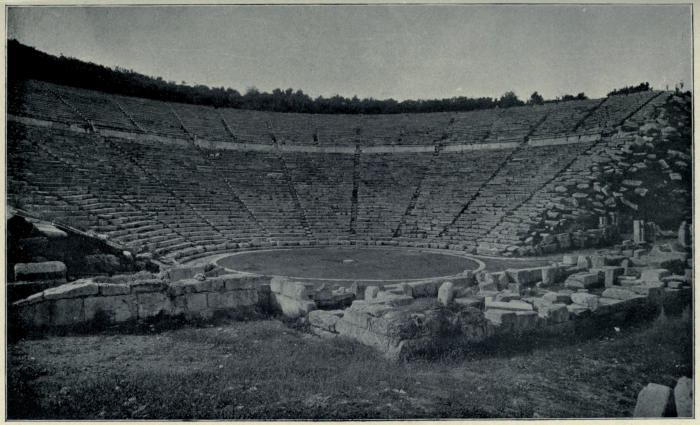
I am greatly indebted to Professor E. Gardner for the photograph
of the Epidaurian theatre which is reproduced in Fig. 7;
and to the Council of the Hellenic Society for their permission
to copy from the Hellenic Journal the illustration of a satyric
chorus. I have to thank the Provost of Oriel, Professor P.
Gardner, Mr. F. Madan, Rev. G. C. Richards, and other friends
for their help and advice in various matters; and Dr. Albert
Müller, Professor White, and Mr. Capps for their kindness in
sending me writings of theirs on the subject of the Greek stage
which have proved of very great service.
Oxford, July, 1898.
PREFACE TO THE THIRD EDITION
After the lamented death of Mr. Haigh, the Delegates of
the Clarendon Press entrusted me with the revision of his book
for a third edition, and his relatives kindly supplied me with the
materials which he had collected for a revision. I have tried
to follow as far as possible such indications as I could find of
his own intentions in regard to the new edition. He had re-written
parts of Chapters I and II, and his review of Puchstein’s
Die griechische Bühne showed sufficiently what view he
took of that work. He also left careful analyses of many papers
which had appeared in periodicals since the second edition,
with occasional criticisms. It is clear from the manner in which
the portions of the book referred to were re-written that he intended
to cut out many of the repetitions, both of matter and
expression, which had been allowed to remain in the second
edition. I have therefore felt at liberty to follow him in this
respect; but the space gained has been almost all filled by the
new matter which it has been necessary to insert, either at the
suggestion of his own notes, or in consequence of important
writings on the subject since the last edition.
Since 1898 the inscriptions bearing upon the Greek drama
have been the subject of thorough investigation at the hands of
Prof. Edward Capps, Dr. Adolph Wilhelm, and others. The
complete treatment of all the inscriptional evidence in the
latter’s Urkunden dramatischer Aufführungen in Athen, just
published, is an invaluable contribution to the history of the
Greek theatre and drama, and I have made as much use of it
as the time of its publication allowed, the revision of the present
volume having been almost completed by that date. It was
beyond the scope of the present work to embark on a full discussion
of the points of detail on which the chief authorities on
the inscriptions differ; but I have re-written many of the notes
on these points, and have tried to give sufficient indications of
the character of the evidence. Further, in re-writing Appendix
B, as it was necessary to do in the light of recent work on the
subject, I have thought it best to give the reader access to considerably
more of the inscriptional material, though still omitting
many fragments whose readings, date, or meaning were too
uncertain to allow them to be of value to the ordinary student.
Puchstein’s book, Die griechische Bühne, above referred to,
is the other work of first-rate importance in connexion with the
Greek theatre which has appeared since 1898. There has been
much controversy in regard to the theories contained in it, and
Dr. Dörpfeld has published a reply to most of Puchstein’s contentions
(Athenische Mittheilungen, 1903, 383 ff.). But though in
several points of detail Puchstein’s position seems to be open to
criticism, it is very difficult to believe that Dr. Dörpfeld has
improved his case for his own theory; and I have followed both
Mr. Haigh’s view and my own conviction, in not modifying in
any essential point the opinions expressed in the last edition.
I have, however, altered the expressions ‘Lycurgean’ and
‘Hellenistic’ in most cases where they were applied in the last
edition to the stage-buildings of different periods, since Puchstein’s
work makes it at least an open question whether some of
the ‘Lycurgean’ work is not to be ascribed to an earlier period,
and some of the ‘Hellenistic’ work to Lycurgus. Mr. Haigh’s
manuscript notes show, I think, that he would have approved of
this. The new section on Puchstein’s theory follows in most
points the lines of Mr. Haigh’s article on the subject in the
Classical Review. I have inserted a number of references to
the writings of Puchstein, Dörpfeld, and others who have taken
part in the controversy as to the stage-buildings; and I have in
many cases written fresh notes upon these and other points
which have come into dispute since 1898, or upon which fresh
light has been thrown. In cases where I could find no warrant
in Mr. Haigh’s own notes or writings for the views expressed,
I have included these notes in square brackets, and I have, so
far as I could, avoided inserting in the text anything with which
I had reason to think he would have disagreed.
On one point on which there has recently been much controversy,
the site of the Lenaeum, I have thought it best to
relegate the discussion to a new Appendix; partly owing to its
complicated character, and partly because I am not sure that
Mr. Haigh would have entirely agreed with my views. He had
not of course seen Miss Harrison’s Primitive Athens, and I do
not think he had read some other recent writings on the subject,
when he began to rewrite Chapter I; in particular, he seems
not to have been acquainted with Nilsson’s Studia de Dionysiis
Atticis—the most valuable contribution of recent years to discussions
on the festivals. I have therefore allowed myself
a fairly free hand in dealing with this topic. I am much indebted
to Mr. W. H. Forbes of Balliol College for his kind
criticisms on this part of my work.
The following are the principal writings which have been
published since the last edition, and which I have been able to
consult, besides those already named: E. Capps, papers in the
American Journal of Philology, American Journal of Archaeology,
and Chicago Decennial Publications, vol. vi; Miss Harrison,
Prolegomena to the Study of Greek Religion; E. A. Gardner,
Ancient Athens; Roberts and Gardner, Greek Epigraphy, vol. ii;
Mazon, Sur le Proagon (Rev. de Philologie, 1903); A. Müller,
Untersuchungen zu den Bühnenalterthümern, and papers in Philologus
and Berlin. Philolog. Wochenschrift; Noack, Das Proskenion
in der Theaterfrage (Philologus, lviii); Exon, A New
Theory of the Eccyclema (Hermathena, xxvi); Dörpfeld, papers
in Hermes and Athenische Mittheilungen; Frei, De certaminibus
Thymelicis; Hampel, Was lehrt Aischylos’ Orestie für die
Theaterfrage?; Flickinger, The meaning of ἐπὶ τῆς σκηνῆς in the
Fourth Century B.C.; Engelmann, Archäologische Studien zu den
Tragikern; P. Gardner, The Scenery of the Greek Stage (J. Hell.
Stud., 1899); Devrient, Das Kind auf der antiken Bühne;
Dignan, The Idle Actor in Aeschylus; Völker, Berühmte Schauspieler
im griechischen Alterthum; J. W. White, An Unrecognized
Actor in Greek Comedy (Harvard Stud. Class. Phil., 1906);
Hense, Die Modificirung der Maske in der griechischen Tragödie;
Körte, Das Fortleben des Chors im griechischen Drama (Neue
Jahrb. für Philol., 1900); Navarre, Utrum Mulieres Athenienses
scenicos ludos spectaverint; Römer, Über den litterarisch-aesthetischen
Bildungsstand des attischen Theaterpublikums; Foucart,
Le Culte de Dionysos en Attique; besides the reviews of many
of these works, and the introductions and notes to Starkie’s,
Rogers’s, Sharpley’s, and van Leeuwen’s editions of a number
of plays of Aristophanes, and various articles in Pauly-Wissowa,
Real-Encyclopädie.
CHAPTER I DRAMATIC CONTESTS AT ATHENS — § 1. General Character of the Contests. — § 2. Earliest history of Dramatic Competitions. — § 3. The City Dionysia. — § 4. Tragedy at the City Dionysia. — § 5. Comedy at the City Dionysia. — § 6. Order of Contests at the City Dionysia. — § 7. The Lenaea. — § 8. Rural Dionysia and Anthesteria. — § 9. The Judges. — § 10. The Prizes. — § 11. Contests between actors. — § 12. Records of dramatic contests.
The Attic drama, like most ancient forms of art and poetry,
was originally the offspring of religious enthusiasm. It was
developed out of the songs and dances in honour of Dionysus,
the god of wine and vegetation. In course of time, as it
assumed a regular dramatic shape, its range of subject was
extended far beyond the limits of the Bacchic mythology.
Its religious significance was also gradually diminished, and
it began to be written more and more from the purely human
point of view. But in spite of these changes, its outward
connexion with the Bacchic worship was preserved unimpaired
throughout the whole period of its history. Dramatic representations
at Athens were confined, from first to last, to the
great festivals of Dionysus. They were regarded as a religious
ceremonial, as an act of homage to the god. They never
became, as with us, an ordinary amusement of everyday life.
During the greater part of the year the Athenians had to be
content with other forms of entertainment. It was only when
the annual festivals of Dionysus came round that they were
able to gratify their passion for the stage. On such occasions
their eagerness and enthusiasm were proportionately great.
The whole city kept holiday, and gave itself up to pleasure,
and to the worship of the wine-god. Business was abandoned;
the law-courts were closed; distraints for debt were forbidden
during the continuance of the festival; even prisoners were
released from gaol, to enable them to share in the common
festivities.[1] The theatre, the chief centre of attraction, was
thronged with spectators; and the number of plays provided
was large enough to compensate for their scarcity at other
periods. Several days in succession were devoted to the
drama. Tragedies and comedies followed one another without
intermission from morning till evening. In the midst of these
pleasures the religious aspect of the performance, as a ceremony
in honour of Dionysus, established in obedience to the direct
commands of the oracle,[2] was not forgotten. The audience
came with garlands on their heads, as to a sacred gathering.
The statue of Dionysus was brought to the theatre, and placed
in front of the stage, so that the god might enjoy the spectacle
along with his worshippers.[3] The chief seats in the theatre
were mostly occupied by priests, and the central seat of all
was reserved for the priest of Dionysus.[4] The performance
of plays was preceded by the sacrifice of a victim to the god
of the festival. The poets who wrote the plays, the choregi
who paid for them, and the actors and singers who performed
them, were all looked upon as ministers of religion, and their
persons were sacred and inviolable. The theatre itself possessed
all the sanctity attaching to a divine temple. Any form of
outrage committed there was treated, not merely as an offence
against the ordinary laws, but as a sacrilegious act, and was
punished with corresponding severity. The ordinary course
of law was not considered sufficient, and they were dealt with
under an exceptional process at a special meeting of the
Assembly.[5] It is recorded that on one occasion a certain
Ctesicles was put to death for merely striking a personal enemy
during the procession.[6] Merely to eject a man from a seat
which he had taken wrongfully was a piece of sacrilege
punishable with death.[7] These various characteristics of the
Attic drama—its limitation to certain annual festivals, and its
religious associations—have no parallel on the modern stage,
apart from isolated survivals like the performance at Ober-Ammergau.
The modern theatre has long since been divorced
from ecclesiastical influence, and is unrestricted as to season.
But its original surroundings were not dissimilar. The Mysteries
and Miracle Plays from which it is descended, and which were
performed year by year for the instruction of the people on
the great Feast-days of the Church, suggest many points of
comparison with the exhibitions at the Attic Dionysia.
Another remarkable feature of the ancient theatre is the fact
that almost all the dramatic representations were arranged
in the form of a contest. Prizes were offered by the managers
of the festival, and poets and actors exhibited their plays
in competition with one another. The victory was awarded
by the decision of a carefully selected jury. It is curious to
notice how strongly implanted in the Greek nature was this
passion for anything in the shape of a contest. It was not
peculiar to the drama, or to the Athenian festivals, but prevailed
throughout Greece in all festal gatherings where music
and poetry were performed. Every Greek city of any importance
had its annual meetings, with a long list of competitions.
There were contests in choral singing of various kinds; contests
in original poetry, and in the recitation of ancient epics;
contests between harp-players, flute-players, trumpeters, and
heralds. In this respect a Greek festival was not unlike
a Welsh Eisteddfod, with its rival bards and choruses. In
the case of the drama the element of competition must have
added largely to the interest of the entertainment, and must
have acted as a powerful stimulus upon the minds of poets
and performers alike. The fertility of the old Attic dramatists,
and the energy which enabled them to produce, in extreme old
age, such masterpieces as the Agamemnon of Aeschylus, the
Oedipus Coloneus of Sophocles, and the Bacchae of Euripides,
may have been partly due to the invigorating influence of
the contests, and the rivalry which they engendered.
The management of the dramatic performances was in the
hands of the State, and was entrusted to the same official who
had the general control of the festival. The superintendence
which he exercised was not merely a formal one. His duties
were important and carefully defined. He had to select
the poets who took part in the competitions, and the plays
which they exhibited. He had to choose the actors, and distribute
them among the different poets. He was also responsible for
seeing that the work of preparation was carefully carried out.
The expense of the performance was one of the regular public
burdens, and was imposed in turn upon the richer citizens.
In modern times there is no example of a theatre so entirely
dependent upon the State. In England the drama is left solely
to private enterprise. In countries like France and Germany,
though certain theatres receive subventions from the State, and
are subject to a code of rules, the government takes little part
in the direction of their affairs. But the Athenian drama stood
on a different footing. As a sacred ceremonial, closely connected
with the religious worship of the State, it was naturally placed
under public control. Even from the secular point of view
it was considered a fitting object for the attention of statesmen.
To provide for the amusement and instruction of the people
was, according to the Greeks, one of the regular duties of
a government; and they would have thought it unwise to
abandon to private venturers an institution which possessed
the educational value and wide popularity of the drama. For
the audience to which the Athenian poet addressed himself was
in reality a gathering of the whole body of his fellow countrymen.
The theatre of Dionysus was capable of containing nearly twenty
thousand people. Books were not plentiful, and their use was
confined to a limited class. The ordinary Athenian depended
for his literary pleasures upon the various public performances
and recitations of poetical compositions. The drama was,
therefore, much more to him than to a modern playgoer. At
the present day, when continual supplies of fresh literature
are accessible to every one, it is hard to realize the excitement
and expectancy with which an Athenian looked forward to the
annual exhibition of dramas at the Dionysia. It was here that
his taste for novelty in literature was gratified. It was here
that he found an equivalent for the books, magazines, and
newspapers of modern civilization. Hence he was able to sit
day after day, from morning to evening, listening to tragedy
and comedy, without any feeling of satiety. The enthusiasm
with which the drama was regarded, and the direct manner
in which the author was brought into contact with the whole
body of his countrymen, contributed to make the vocation of
the dramatic writer one of the very greatest importance. The
leading tragic poets especially exercised a most profound
influence upon the national mind and character. They were
the teachers of the people. Their writings were invested with
an almost Homeric sanctity, and appealed to as authorities
on questions of science and morality. Maxims and quotations
from their plays were upon every one’s lips. Many passages
in Aristophanes and Plato prove the enormous influence for
good and evil which was exercised by the Greek tragic poets,
and there is probably no other instance in history of a drama
which was so thoroughly popular, and formed so essential a part
of the national life.[8]
The establishment of these dramatic contests under State
management dates, not from the earliest period of the drama,
but from the time when it had begun to assume a fixed and
definite shape. Originally there were no public competitions.
The various innovations upon the old hymns to Dionysus, out
of which the drama was evolved, were carried out at first by
voluntary effort. Thespis is said to have introduced tragedy
into Athens. But his earliest exhibitions were given on his
own responsibility, and as a private speculation.[9] The development
of comedy was also the result of individual enterprise.
The performance was for a long time left to amateurs, and
regarded as of no importance. It was only when the drama
had attained a certain pitch of excellence, and become widely
popular, that it was taken in hand by the State, and annual
contests introduced.[10] The date of their institution cannot always
be determined exactly. It differed in the case of different
festivals, and in the case of tragedy as compared with comedy.
But there is sufficient evidence to show that no contest was
earlier in date than the latter half of the sixth century.
All these competitions, as we have seen, were confined to the
festivals of Dionysus.[11] In Attica these were of four kinds.
There were the Rural Dionysia, celebrated in the various Attic
denies; and there were the feasts held in Athens itself, the
Anthesteria, the City Dionysia, and the Lenaea.[12] The importance
of these gatherings from the theatrical point of view varied
considerably. The Anthesteria seems at no time to have had
much connexion with the drama. The Rural Dionysia were
merely provincial celebrations, and depended almost entirely
for their supply of plays upon the Athenian theatre. The City
Dionysia and the Lenaea were the really significant festivals
in the history of the ancient stage. It was here that the great
Attic poets exhibited their works, and it was here that the drama
was first brought to perfection. Each festival had its peculiar
character. At the City Dionysia tragedy held the chief place;
at the Lenaea comedy was of most importance. Various
indications show that this was the case. In the list of proceedings
at the City Dionysia tragedy is placed last of all,
as being the chief attraction; while in the list referring to the
Lenaea the same place is assigned to comedy, and for the same
reason.[13] Again, the dithyramb, the original source of tragedy,
was from the first a prominent feature at the City Dionysia,
though unknown at the Lenaea till a late period.[14] On the other
hand the comic actors’ contest was introduced into the Lenaea
long before it was extended to the City Dionysia. This difference
between the two festivals, as regards the type of drama preferred
by each, was probably due to some original difference in the cult
of the two deities, Dionysus Eleuthereus and Dionysus Lenaeus,
to whom they were respectively consecrated.[15]
The City Dionysia, the feast of Dionysus Eleuthereus,[16] was
the most famous and magnificent of all the Bacchic festivals, and
was therefore also called the Great Dionysia, or simply the
Dionysia, without any further epithet.[17] It was held from the
first inside the city, at the sacred enclosure of Eleuthereus[18]
on the south of the Acropolis. Hence the name City Dionysia,
to distinguish it from the Anthesteria and the Lenaea, which, at
any rate in early times, were celebrated outside the walls.
A poet who brought out his plays at this festival was said
to exhibit them ‘in the city’; if successful, he was said to
have won ‘a city victory’.[19] The feast lasted for at least five
days, and possibly for six. It took place in the month
Elaphebolion, at a date corresponding to the end of March.[20]
The spring was then just beginning, and the sea had again
become navigable.[21] Consequently the city was crowded with
visitors from all parts of Greece. It was at this season that the
allies came to Athens to pay the annual tribute. Ambassadors
from foreign states often chose this time for the transaction
of diplomatic business. Large numbers of strangers were
attracted by mere pleasure, and the celebrity of the festival.
Aeschines, in his rhetorical language, describes the audience
in the theatre at the City Dionysia as consisting of the ‘whole
Greek nation’.[22] The presence of so many strangers gave
a lively appearance to the streets, in marked contrast to the
quietness which prevailed at the winter festival of the Lenaea.[23]
The Athenians gladly seized this opportunity of displaying
before foreign Greeks the glories of their city. The various
spectacles provided, the religious ceremonial, the trains of
sacrificial victims, the choral songs and dances, the tragedies
and comedies exhibited before countless multitudes in the vast
open-air theatre, were all calculated to impress strangers with
the wealth, public spirit, and artistic supremacy of Athens.
The first day of the festival was devoted to a grand religious
procession, in which the ancient image of Dionysus Eleuthereus,
preserved in one of his temples at the foot of the Acropolis,
played a prominent part.[24] There was a tradition that this statue,
together with the cult of the deity, had been originally brought
to Athens from Eleutherae, a border town between Attica and
Boeotia. The procession was instituted to commemorate this
sacred event. The statue was taken out of its shrine, and
carried along the road to Eleutherae as far as a certain temple
near the Academy. It was then brought back again, following
on its return the actual route traversed on its first entrance into
Athens.[25] As a spectacle, this procession was the most magnificent
part of the whole festival. Athenians of every class,
men, women, and even girls, came out to witness or take part in
it. The casual encounters which took place on these occasions
might serve as a foundation for the plots of the New Comedy.[26]
The members of the procession were dressed in brilliantly coloured
garments. Some of them wore ornaments of gold, and had masks
upon their faces. The rich drove in chariots; the poorer classes
walked on foot.[27] In front came the archon, the manager of the
festival, attended by various magistrates and priests. The ephebi,
equipped with shields and spears, acted as escort to the sacred
image.[28] A long train of victims followed, partly provided by the
State, partly offered by individuals, or by different classes of the
population.[29] The canephori, young virgins bearing upon their
heads the baskets containing the sacrificial implements, formed
one of the most picturesque features in the show. The choregi
were also there, attended by their respective choruses, all dressed
in striking costume. When Demosthenes served as choregus to
his tribe, he had a gold crown and embroidered mantle made
specially for use at the procession. Alcibiades on a similar
occasion was dressed in purple, and excited much admiration by
his beauty.[30] From these few details, which happen to have been
recorded, we may form some notion of the general splendour of
the spectacle. The route followed by the procession was as
follows. On leaving the Temple of Dionysus it came first to the
market-place, where a halt was made, and a chorus danced and
sang before the statues of the twelve gods.[31] It then marched
out through the city gates along the road to Eleutherae. When
it reached the Academy the statue of the god was placed on
a pedestal, and the different victims were sacrificed. The rest
of the day was spent in feasting and merriment.[32] At nightfall
they returned to Athens by torchlight. But the sacred image,
instead of being restored to its shrine, was carried to the theatre
by the ephebi, and set up in the orchestra, so as to be present at
the entertainments given on the following days.[33]
These entertainments were of two kinds. There were the
dramatic contests, in tragedy, comedy, and satyric drama; and
there were the lyrical contests, at which dithyrambs were performed.[34]
The dithyramb was a hymn in honour of Dionysus,
sung to the accompaniment of the flute by a chorus of fifty
members. The chorus stood in a circular form round the
altar, and was therefore called a ‘cyclic’ chorus. At the City
Dionysia there were two of these lyrical contests, one between
five choruses of boys, and the other between five choruses of
men.[35] The first contest of men took place in B.C. 509-508, in
the Archonship of Lysagoras, though the system of choregia
was probably not introduced till a few years later.[36] Each chorus
was provided by one of the ten Attic tribes. Hence all ten tribes
took part in one or other of the two competitions.[37] The contest
was essentially a tribal one. The members of each chorus,
together with the choregus, were selected exclusively from the
tribe which they represented.[38] The victory of the chorus was
a victory for the tribe. The prize of victory, the tripod, though
given to the choregus, and erected in some public place at his
expense, was regarded as equally the property of the tribe.[39] In
the records of dithyrambic competitions the name of the victorious
tribe was always placed in the most prominent position.
The dramatic contests, on the other hand, had no connexion
with the tribes. Actors, choruses, and choregi were chosen
indiscriminately from the whole population.[40] The performers
competed in their own interest solely, and not as representatives
of any other body. The records of dramatic victories give merely
the names of the choregus, the poet, and the principal actor.[41]
It is important to keep this difference between the two kinds of
contest clearly in view, since many mistakes have been caused
by attributing to the dramatic kind features which belong
exclusively to the dithyrambic.
Of the dramatic performances at the City Dionysia, which
we have next to consider, the tragic were the most important.
The City Dionysia was specially connected with the growth of
the tragic drama, and it was here that the earliest public contests
in tragedy were established. The first competition was held in
B.C. 535, and was rendered doubly memorable by the fact that
Thespis, now an old man, took part in the performance, and
won the prize of victory.[42] Shortly before this time Pisistratus,
who was a great patron of art and literature, had returned from
exile, and begun his last tyranny. It must have been under his
auspices, therefore, that tragedy was first officially recognized
by the State, and made an annual institution. As to the
character of these early contests, and the arrangements concerning
the number of poets and plays, nothing has been
recorded.[43] It is uncertain whether the regulations were the
same as those which afterwards prevailed during the fifth
century. But we are told that the tragic poet Choerilus, who
began to exhibit in 523, composed no less than a hundred and
sixty plays.[44] The largeness of the number would seem to show
that even in the sixth century it was the custom for each
competing poet to bring out several plays at each festival.
When we turn to the fifth century, the information is fairly
complete. Several records have been preserved, referring
chiefly to the three great tragic poets, and giving a more or
less detailed account of the results of the competitions. It
may be interesting to mention some of these records. The
earliest refers to the year 499, and tells us that three poets—Aeschylus,
Choerilus, and Pratinas—took part in the tragic
contest.[45] From the next we learn that in 472 Aeschylus won
the first prize, and that the plays he exhibited were the
Phineus, Persae, Glaucus, and the satyric drama Prometheus.[46]
In 467, Aeschylus was first with the Laius, Oedipus, Septem
contra Thebas, and the satyric play Sphinx; Aristias was
second with the Perseus, Tantalus, and the satyric play Palaestae,
written by his father Pratinas; Polyphradmon was third with
the Lycurgean tetralogy.[47] The name of one of the plays of
Aristias has doubtless dropped out accidentally, as there is no
other instance of poets competing at the same festival with a
different number of plays. A very interesting record is that
for the year 458, when Aeschylus was again victorious, this
time with the Orestean group of plays, the Agamemnon,
Choephori, Eumenides, and satyric Proteus.[48] In 438 Sophocles
was first; Euripides was second with the Cressae, Alcmaeon in
Psophis, Telephus, and Alcestis. In 431 Euphorion was first,
Sophocles second, and Euripides third with the Medea,
Philoctetes, Dictys, and satyric play Theristae. In 428 Euripides
was first (the Hippolytus being one of his plays), Iophon second,
Ion third.[49] Among the last of the notices is that for the year
415, when Euripides, who produced the Alexander, Palamedes,
Troades, and satyric drama Sisyphus, was defeated for the first
prize by an obscure poet called Xenocles, who produced the
Oedipus, Lycaon, Bacchae and satyric play Athamas. After
Euripides’ death, in B.C. 406, his Iphigenia in Aulis, Alcmaeon,
and Bacchae were produced by his son at the City Dionysia.[50]
The evidence of these various records, when compared with one
another, proves conclusively that during the whole, or almost
the whole, of the fifth century there was no variation in the
arrangement of the tragic contests at the City Dionysia. The
rule as to the number of poets and plays was as follows. At
each festival three poets appeared as competitors,[51] and each
poet was required to exhibit four plays, consisting of three
tragedies and a satyric drama.[52] If the number seems surprising,
we should remember that an ancient drama was only about half
the length of a modern one, and that four plays of this type
could easily have been got through in a single day. On one
occasion the rule just mentioned appears to have been partially
relaxed. In 438 Euripides was allowed to substitute the
Alcestis, a tragedy with a slightly comic tinge, for the usual
satyric drama. Whether this practice ever became common in
the fifth century is uncertain. The records give no further
instance. In all other cases where they mention the names
of the four plays produced, the last is a satyric play. It was
this custom of concluding the three tragedies with the licentious
merriment of the satyrs which suggested to Ion of Chios
his well-known remark, that virtue, like a tragic poet’s group of
plays, should always contain a satyric element.[53]
The four plays exhibited by each poet might be composed on
two different systems. They might form independent works of
art, and have no inner connexion with one another; or they
might deal with successive phases of the same legend, and be
fused into a single artistic whole. The general name for the
group of plays was ‘didascalia’, or a ‘teaching’[54], because
in ancient times the author had to teach them to the actors.
But when they were connected together by unity of subject,
they were denoted by a special term. The four plays were
called a ‘tetralogy’;[55] the three tragedies, regarded apart
from the satyric drama, were called a ‘trilogy’. As applied to
the drama, however, both words first occur at a comparatively
late date:[56] and as, to judge from their etymology, they seem
properly to denote groups of speeches rather than groups of
plays, it is possible that their dramatic application is a secondary
one, and that the grammarians applied to the drama the word
‘tetralogy’ which properly denoted such groups of four speeches
about fictitious cases as those of Antiphon, and afterwards
formed the word ‘trilogy’ by analogy to denote three plays
connected in subject with each other but not with the satyric
play. In earlier times such collective titles as Lycurgeia,
Oresteia, and the like were used.[57] The practice of writing plays
in trilogies and tetralogies is chiefly associated with the name
of Aeschylus. Whether it was invented by him, or inherited
from his predecessors, is uncertain. We have no information
as to the manner in which the poets of the sixth century were
accustomed to combine their plays together. But whatever the
origin of the system may have been, it was undoubtedly
Aeschylus who first perceived the various developments of
which it was capable, and brought it to perfection. In his
hands it became a mighty instrument for the inculcation of
religious truths. The central idea in the moral system of
Aeschylus was the disastrous effect of sin, not only upon the
sinner himself, but also upon his remote descendants. The
curse entailed in the sinful act clung to a family from one
generation to another. In the trilogy, with its wide range of
time and subject, he was able to trace the whole course of this
hereditary evil, and to follow the crime from its original commission
down to the period of its final expiation. The Orestean
trilogy, which has fortunately been preserved, is a magnificent
example of his method. The Agamemnon depicts the murder
of the returning chieftain by his adulterous wife. In the
Choephori vengeance is taken on the murderess, after years
of waiting, by her own son. In the Eumenides the matricide,
a prey to remorse, is hunted from place to place by the Furies
of his mother, until their rage is at length appeased by divine
intervention. These successive pictures of crime and vengeance
form a series of unapproachable grandeur. The general effect
of the whole may be appreciated even by a modern reader. But
in the ancient theatre the impression produced must have been
far more vivid, as one play followed another upon the stage, and
the dark scenes of guilt were unfolded in due sequence before
the very eyes of the audience.
Apart from the Oresteia, very little is recorded about the
tetralogies written by Aeschylus. He is known to have composed
a Lycurgeia, on the fate of Lycurgus, the Thracian king
and opponent of Bacchus; and an Oedipodeia, on the fortunes
of the house of Oedipus. It is also fairly certain that he treated
the legends about Hector, Ajax, Prometheus, and the daughters
of Danaus in trilogic form. But these are the only instances
for which there is clear evidence. No doubt most of his plays
were written as tetralogies. Still, he does not seem to have
adhered to the system on every occasion. The plays which he
exhibited in 472—the Phineus, Persae, Glaucus, and satyric
drama Prometheus—had apparently no connexion with one
another.[58] There are also, among the titles of his lost dramas,
several, such as the Sisyphus and the Atalanta, which seem
to stand in an isolated position, and to be hardly capable of
combination. In some cases, again, he may have adopted the
tetralogic form only in part. The three tragedies may have
formed a trilogy, while the concluding satyric drama was on
a different subject. Thus the satyric Prometheus was produced,
not with the Promethean trilogy, as we should have expected,
but in a different combination altogether. There is no less
uncertainty as to the structure of the lost tetralogies. It
would be a mistake to assume that they were all as perfect
in arrangement as the Oresteia. Even from the few remains
and notices preserved we can see that the tetralogy was a
flexible form of art, and could be treated in various ways. The
connexion between the parts might be tightened or relaxed at
will. In the Theban trilogy—the Laius, Oedipus, and Septem
contra Thebas—there was a long lapse of years between the
separate plays. In the Oresteia the intervals of time are much
shorter. In the Lycurgeia, which described the invasion of
Thrace by Dionysus, his defeat, capture, and final victory, the
three plays followed so closely in point of time, that they must
have been like successive acts in a single drama. Again, the
trilogies might differ in respect of artistic completeness. The
Oresteia forms a perfect whole. The legend is traced to its
conclusion, and ends satisfactorily with the purification of Orestes.
But the Theban trilogy was treated more in the chronicle
fashion. It closed abruptly at a point where the course of
events was still unfinished. The final scene of the Septem is
full of forebodings of impending calamity. So marked is this
feature, that before the discovery in recent years of the record
which proves that the Septem was the last play of the three,
all critics were agreed that it must have been followed by
another tragedy.[59] This example shows us the necessity of
caution in dealing with the whole subject of tetralogies.
Since there is so much uncertainty as to the number of
them written by Aeschylus, and the manner in which he wrote
them, it is dangerous to go beyond the limits of direct evidence.
Various schemes have been propounded by scholars, in which
the titles of the lost plays are all arranged in tetralogic groups.
But these systems must be regarded as entirely conjectural.
The satyric drama, by which the three tragedies were followed,
was a survival from the primitive period of the Bacchic worship.
With its strange medley of incongruous elements, of valour and
cowardice, passion and merriment, heroic dignity and coarse
indecency, it reproduced the various qualities of the ancient
dithyramb. The chorus was always composed of satyrs. The
leading characters consisted partly of heroes from the tragic
stage, partly of semi-ludicrous personages, such as Silenus,
Autolycus, and Polyphemus. The presence of the tragic kings
and heroes in the midst of these disreputable associates and
undignified surroundings was one of the most curious features
in the performance. It had to be managed with great tact by
the poet. The dignity of the heroes was not to be unduly
lowered, and yet they must not seem too exalted for their
company.[60] In the case of a tetralogy the awkwardness of the
situation would be greatly intensified. Here the satyric drama
dealt with the same legend as the preceding tragedies, but from
a humorous point of view. It often happened that the very
same hero whose disastrous fate had just been exhibited in the
trilogy was reintroduced under a sportive aspect. In the satyric
play Lycurgus, which concluded the Lycurgean tetralogy, the
chief part must have been taken by Lycurgus himself. In the
Sphinx, the last play of the Oedipodeia, Oedipus must have
appeared in person. This practice of concluding the tragic
spectacle with a burlesque representation of the same or similar
characters and incidents seems a questionable proceeding to
modern taste. It would be difficult to defend it on artistic
grounds. It originated not so much in the desire to provide
a comic relief after the tragedies as in religious conservatism.
The dramatic performances were part of a Bacchic festival.
But the Bacchic element had long been discarded by tragedy.
The satyric play, which still remained true to the primitive
type, was therefore retained in the programme, in order to
appease the god and to keep up the religious associations of
the drama.
During the earlier part of the fifth century the practice
of writing plays in tetralogies seems to have been generally
adopted, not only by Aeschylus, but by all other tragic poets.
One such tetralogy, the Lycurgeia of Polyphradmon, happens
to have been recorded. It was Sophocles who first gave up
the system, and regularly composed his four plays on independent
subjects.[61] The example set by Sophocles was followed
by the younger generation. Even as early as 467, when
Aeschylus brought out his Oedipodeia, and Polyphradmon
his Lycurgeia, the third poet, Aristias, competed with a group
of disconnected plays. After the death of Aeschylus the tetralogy
speedily went out of fashion. It was never attempted by
Euripides. In fact during the latter half of the fifth century
only three tetralogies are mentioned. A Pandionis was written
by Philocles, the nephew of Aeschylus, who naturally followed
in his uncle’s footsteps. An Oedipodeia was composed by
Meletus, the prosecutor of Socrates. Plato is also said to have
written a tetralogy before he abandoned poetry for philosophy.[62]
After the end of the fifth century all traces of the tetralogy
disappear. One reason for its decline in popularity and rapid
discontinuance may have been the increased length of plays.
A tragedy of the later poets was considerably longer, and
contained much more incident, than a tragedy of Aeschylus.
A trilogy composed of dramas of this bulk would have been
a vast and laborious undertaking. Another reason may have
been the gradual change in religious sentiment. The doctrine
of the hereditary curse in families, which the trilogy was
admirably adapted to exemplify, no longer held a prominent
place in the moral ideas of post-Aeschylean poets. The chief
motive of their tragedy was human passion rather than religious
truth. In such circumstances the trilogy, as a form of art,
had no advantages sufficient to compensate for the unwieldiness
of its size.
It has been worth while to discuss in some detail the arrangement
of the tragic contests at the City Dionysia during the fifth
century, because this was the great period of Attic tragedy.
The fourth century is of less importance. For the first half of
the century there is a complete blank in our information on the
subject. But when we come to the latter half, we have the
evidence of an interesting inscription, which contains a full
record of the tragic performances at the City Dionysia for the
years 341 and 340.[63] From this record it appears that considerable
changes had now been made in the annual programme. The
old system, by which each of the three poets was required to
exhibit a satyric play, had been abandoned. A single specimen
of this type of drama was now considered sufficient, and was
produced at the commencement of the proceedings. The satyric
drama, with its primitive coarseness, had little attraction for
the more refined taste of the fourth century; and it was only
religious scruples which caused it to be retained at all. The
satyric play was followed by an old tragedy, written by one of
the three great tragic poets. In 341 the play chosen was the
Iphigeneia of Euripides, in 340 it was the Orestes. This
practice was also a new departure.[64] In the fifth century the
exhibition of old tragedies was, with rare exceptions, unknown
at the City Dionysia. After these two preliminary performances
came the contest with original plays. The number of poets was
still there, as in former times. But the number of plays was
diminished, and seems to have varied from year to year. In
341 each poet exhibited three tragedies; in 340 each poet
exhibited two. Theodectes, who flourished in the middle of
the fourth century, wrote fifty tragedies and engaged in thirteen
contests.[65] Aphareus wrote thirty-five admittedly genuine
tragedies, and engaged in eight contests, between 368 and 341.[66]
This seems to imply that in most of the contests they produced
four plays; but the conclusion is not certain, for they may have
written plays which were never intended for the stage, as their
contemporary Chaeremon did.[67] The reduction in the number
of original plays points to a gradual decline in the vitality of the
tragic drama at Athens. These various changes must have
been made in the course of the sixty years preceding the period
of the inscription. But the exact date of their introduction
cannot be determined.
With the close of the fourth century the famous period of
Athenian tragedy came to an end. After this date the only
tragic poets of any celebrity were those who flourished at
Alexandria. But though the genius of the Attic poets was
exhausted, there was no immediate cessation in the production
of new plays. The contests were still maintained. A long
series of inscriptions shows that, down even to the Christian
era, ‘original tragedies’ continued to be the chief ornament of
the City Dionysia. The names of several Athenian tragic
poets belonging to this period have been preserved in theatrical
records. One of them was a descendant of Sophocles. As
to the character of the contests, and the proportion of old
tragedies to new ones, nothing is known. After the first
century A.D. the composition of original tragic dramas for
the stage was finally discontinued in all parts of Greece, and
must therefore have been abandoned at the City Dionysia.
But the festival itself still continued to flourish; and the
reproduction of old plays may have lasted, there as elsewhere,
for one or two centuries later.[68]
Very little is known about the early history of the comic
contests at the City Dionysia. The date of their first institution
can only be fixed approximately. Aristotle tells us that they
were of later origin than those in tragedy.[69] This being so,
they cannot have reached back further than about 500 B.C.
On the other hand, there is an inscription which proves that
they were already in existence in 463.[70] Their establishment
must therefore be assigned to some period within the first four
decades of the century. The number of poets who were allowed
to compete differed at different epochs. In the fifth century
it was always three, as in tragedy.[71] But early in the fourth
century it was raised to five, both at the City Dionysia and
at the Lenaea, and this continued ever afterwards to be the
regulation number.[72] The increase was probably due, partly
to the growing popularity of the comic drama, partly also to the
fact that, owing to the curtailment of the chorus, comedies were
now less expensive to produce, and took less time to perform.
Each poet competed with a single play. This was the invariable
practice on the comic stage, both at the City Dionysia and at
the Lenaea. The exhibition of groups of plays, after the
manner of the tragic poets, was unknown in the history of
comedy. Still, in spite of this rule, an author was sometimes
enabled to bring out two plays at the same festival. But in
order to do so he had to take the place of two poets, and to
compete as it were against himself. The number of comedies
remained the same. Thus in 422 Aristophanes made a double
appearance, and was first with the Prelude, and second with
the Wasps. Leucon, his sole antagonist, was third with the
Ambassadors.[73] In 288 Diodorus was second with the Corpse,
and third with the Madman.[74] Such cases, however, were
apparently very rare, and must have been due either to some
exceptional dearth in the supply of dramatists, or to the marked
inferiority of the other poets who had applied for permission to
compete.
We have seen that comedy was much later than tragedy in
obtaining official recognition from the State. It also continued
to grow and develop much longer. A sure symptom of decline,
both in tragedy and comedy, was the tendency to fall back
upon the past, and to reproduce old plays, instead of striking
out new developments. In the case of tragedy this custom had
already begun to prevail as early as the middle of the fourth
century. But comedy was still at that time in the height of its
career. A fresh direction was being given to the art, under the
leadership of Menander and Philemon, by the evolution of
the New Comedy, a comedy of manners and everyday life.
There was no desire as yet to have recourse to the ancient
poets. In a record of comic contests for the year 288,[75] the plays
exhibited are all new ones. But when we reach the second
century the custom of performing old comedies is found to
have been fully established. Numerous records of the comic
performances during that period have been preserved, and
in every case the five new comedies are preceded by an old one.[76]
There had been occasional revivals before this, for instance
in the year 340, but these seem to have been exceptional.[77]
Among the plays reproduced are Menander’s Ghost and
Misogynist, Philemon’s Phocians, and Posidippus’ Outcast.
It is noticeable that all these revivals were limited to the New
Comedy. There is no trace of a reproduction of plays from
the Middle and the Old. Nor is this surprising. The comedy
of early times was so local and personal in its allusions, and
depended so much for its interest upon contemporary events,
that it could not be expected to attract the ordinary public
of a later generation.
From the records just referred to it is evident that during
the second century B.C. comedy still flourished as vigorously
as ever at the City Dionysia. The festival had sometimes
to be abandoned, owing to the pressure of war and other
calamities. But whenever there was a contest, five new plays
were exhibited. After the second century the notices about
this festival come to an end. But it is well known that in other
parts of Greece original comedies continued to form a part
of the programme at various festal gatherings down to the first
century of the Christian era.[78] We may therefore conclude
without much doubt that they were retained at the City Dionysia
for an equally long period.
Before leaving the subject of the City Dionysia, it may be
interesting to say a few words about the performances as
a whole, and the order in which they took place. The programme
to be gone through was a long one. In the fifth
century it consisted of five choruses of boys, five choruses
of men, three comedies, and three groups of tragedies, each
containing four plays. As to the arrangement of these various
items there is not much information.[79] But one thing seems
certain, that the three groups of tragedies must have been
exhibited on three successive days. It is difficult to see what
other system was possible. Two groups, consisting of eight
dramas, would have been far too much for a single day.[80] Nor
can we suppose that plays belonging to the same group were
performed on different days. If this had been the case, the
value of the tetralogic form of composition would have been
almost entirely destroyed. Further than this, there is a passage
in Aristophanes which seems to prove that tragedies and
comedies were produced on the same day. In the Birds,[81]
which was brought out at the City Dionysia, the chorus remark
that it would be a delightful thing to have wings. They say
that if one of the spectators was tired with the tragic choruses,
he might fly away home, have his dinner, and fly back again
in time for the comic choruses. It appears to follow from this
that the comedies were performed after the tragedies. As there
were three comedies during the fifth century, and three groups
of tragedies, the arrangement must have been that each tragic
group was performed in the morning of three successive days,
and was followed in the afternoon by a comedy. The festival
as a whole lasted for five or six days. The first day was taken
up by the procession. Three more were taken up by the
tragedies and comedies. The remaining one or two days would
be devoted to the dithyrambs. Such was the system during
the life-time of Aeschylus and Sophocles. In the fourth century,
when the number of comedies had been raised to five, the
number of tragedies diminished, and a satyric drama and an
old tragedy placed at the head of the tragic contests, various
rearrangements would be necessary. But there is nothing
to show how they were carried out.[82]
The Lenaea was a festival in honour of Dionysus Lenaeus.[83]
It was celebrated, at any rate, during the earliest times, in
a sacred enclosure called the Lenaeum.[84] Hence the feast was
also termed the ‘Contest at the Lenaeum’, or the ‘Epilenaean
Dionysia’; and the poet who won a prize there was said to
have been ‘victorious at the Lenaeum’.[85] The site of the
Lenaeum is unfortunately a matter in much dispute, and no
certain conclusion has been arrived at. Except that it was in
or close to the market-place, the site of which is itself uncertain,
nothing definite can be said about it.
The Lenaea was a winter gathering. It was held in the month
of Gamelion, at a time corresponding to the end of January.[86]
The weather was still often stormy, and the sea was not yet
considered safe for voyagers.[87] Consequently there were few
visitors in Athens. The festival was a domestic sort of
holiday, confined to the Athenians themselves. The proceedings
were simple and unpretentious, as compared with the
splendid ceremonial and vast audiences at the City Dionysia.
Aristophanes, in the Acharnians, which was produced at
the Lenaea, says he can now abuse Athens as much as he
likes, without being accused of degrading her in the eyes of
foreign Greeks.[88] The entertainments at the Lenaea consisted
of a procession, and of contests in tragedy and comedy.[89] The
procession was not an impressive spectacle, like that at the City
Dionysia, but was conducted in primitive fashion by men who
drove about in wagons, and assailed the bystanders with abuse
and ridicule.[90] The festival as a whole was much shorter than
the City Dionysia.
The early history of tragedy at the Lenaea is veiled in
obscurity. The first piece of information on the subject which
we possess belongs to the latter part of the fifth century. It
consists of a record of the tragic performances at the Lenaea
for the years 419 and 418.[91] In both these years the number
of poets who competed was two, and each of them exhibited
three tragedies.[92] There is no mention of a satyric play. Again,
we are told that in 416 Agathon won a tragic victory at the
Lenaea.[93] These two notices comprise all that is known about
tragedy at this festival during the fifth century. They appear
to prove that towards the close of the century the tragic contests
had become a regular institution, though the number of poets
and plays was much smaller than at the City Dionysia. Whether
the contests were of recent origin, or reached back for many
years, cannot be ascertained. During the fourth century new
tragedies continued to be produced at the Lenaea without any
cessation. In 367 Dionysius, the tyrant of Syracuse, won the
tragic prize there. Aphareus, who flourished about 350,
exhibited there on two occasions. Theodectes, the pupil of
Aristotle, obtained one victory at the Lenaea; Astydamas, his
contemporary, obtained seven.[94] As to the arrangement of the
contest during this period, and the number of plays produced,
there is no information. But it is probable that the new
tragedies were preceded by an old one, as at the City Dionysia.
After the fourth century nothing further is known about the
connexion of the Lenaea with the tragic drama.[95] The
festival continued to be celebrated down to the second
century A.D., and possibly later.[96] But whether tragedies,
either old or new, were still included in the programme, is
quite uncertain.
Comedy was the special product of the Lenaea, and was
regarded as of more importance than tragedy. It was doubtless
at this festival that comic contests were first regularly organized.
The date is not recorded. But they must have been in existence
at any rate as early as 463,[97] since at that time they were
already included in the City Dionysia. There is also another
piece of evidence. Chionides, one of the early comic poets, is
said to have begun to exhibit plays in 487. It is unlikely that
the exact year of his first appearance would have been remembered,
unless it had referred to a regular public contest.
Hence we may probably assume that comic contests had been
established as early as 487; and if so, they may have been
established at the Lenaea.[98] But they cannot go back beyond
about 500, since comedy in general was a later institution than
tragedy. The first definite and dated record of a comic contest
at the Lenaea is for the year 425, when Aristophanes produced
his Acharnians.[99] From this time forward the history of comedy
at the Lenaea is much the same as its history at the City
Dionysia. During the fifth century there were three competing
poets, and each brought out a single play.[100] In the fourth
century the number of poets was varied to five.[101] The practice
of exhibiting an old comedy as a prelude to the new ones was
introduced in the course of the next hundred years.[102] In the
second century original comedy was still flourishing as vigorously
as ever at Athens, though none of the records so far dated
with certainty refer to the Lenaea.[103] There is no evidence as to
its later course.
A few remarks may be made here on the relative importance
of the Lenaea and the City Dionysia from the theatrical point
of view. The City Dionysia was much the most splendid and
imposing gathering of the two. It was attended by larger
crowds of people, and was subjected to stricter regulations.
Aliens were not allowed to take part in the choruses; metics
were forbidden to serve as choregi.[104] No such prohibitions
existed at the Lenaea. It must obviously have been a much
greater honour for a poet to produce his plays at the City
Dionysia, before the vast concourse of citizens and strangers,
than in the comparative privacy of the Lenaea. In tragedy this
was more particularly the case. The great tragic poets, after
their fame had been once established, seem to have mostly
confined themselves to the City Dionysia. Sophocles, for
instance, won eighteen victories there, and only two or six
at the Lenaea.[105] The Lenaea would be generally reserved for
inferior poets, or for youthful authors who had still their
reputation to make. Thus in 418 one of the competitors was
an obscure poet called Callistratus.[106] In 416 the victor was
Agathon, who had never yet obtained a tragic prize.[107] Foreign
poets may also have been generally confined to this festival.
It was here that Dionysius, the tyrant of Syracuse, won his
solitary success.[108] The circumstances were rather different in
regard to comedy. The leading comic poets seem to have
made little distinction between the two festivals. Aristophanes
produced his plays indifferently at both.[109] Cratinus won six
Lenaean victories as opposed to three in the City, Teleclides
five as opposed to three.[110] In explanation of this fact we should
remember that comedy was the chief feature at the Lenaea,
tragedy an appendage. Also, as the competitors in comedy
only produced one play at a time, a poet of a fertile mind would
need two contests in the year in order to exhibit what he had
written. Still, in spite of the more equal distribution of the
comic poets between the two festivals, there can be little doubt
that even in comedy a ‘City victory’ was always the highest
distinction.[111]
The Rural Dionysia were provincial festivals, held about the
end of December[112] in the country districts of Attica. Originally
they were very simple in character.[113] The villagers, holding
aloft the phallus, marched in procession to the altar of Dionysus,
where a goat was sacrificed, and songs and dances performed in
honour of the god. Then came various country sports; and
the day ended in drinking and merriment. Later on, as the
people advanced in wealth and refinement, the dignity of many
of these festivals was much increased. Dramatic contests began
to be introduced, in imitation of those already established in
Athens. Eventually, by the end of the fifth century, all the
larger Attic towns appear to have provided themselves with
theatres and annual theatrical exhibitions. The most important
of these local gatherings was that in the Peiraeeus, which was
supported by contributions of money from the state treasury,
and attended by large crowds from Athens and the neighbouring
districts. The procession, with which the proceedings commenced,
must have been a striking spectacle. The whole body
of the ephebi took part in it. Then there were contests in
tragedy and comedy. The fame of these contests is shown by
the fact that even distinguished poets, such as Euripides,
occasionally appeared as competitors; and that foreign ambassadors,
if present in Athens at the time, were invited to
attend as a matter of course.[114] Among other festivals which
seem to have acquired more than a local celebrity, we may
mention those of Collytus where Aeschines acted the part of
Oenomaus in the play of Sophocles,[115] Eleusis,[116] Salamis,[117] and
Icaria, and at these proclamation was made of crowns which had
been bestowed on deserving citizens.[118] At Aixone there were
performances of comedies, but tragedies are not mentioned.[119]
At Phlya there were dramatic performances, probably of both
kinds.[120] The remains of a theatre have been found at Thoricus.[121]
The plays produced at these rustic Dionysia were mostly
old ones, which had already been successful on the Athenian
stage. The exhibition of new and original dramas was
exceptional, and confined to a few important towns.[122] Usually
the proceedings took the form of a contest between troupes of
actors, who competed with plays of established reputation.
Prizes were offered by the different demes, and companies were
formed in Athens for the purpose of touring the country, and
contending against one another. Aeschines in his youth served
as tritagonist in a troupe of this kind, having been hired for
a provincial tour by ‘the ranters’, Simylus and Socrates.[123]
These constant revivals of old plays at the Rural Dionysia
are a fact of some importance in the history of the Attic drama.
It was in this way that the Athenian audience was familiarized
with the masterpieces of the past, which might otherwise have
been forgotten. In Athens itself there were not many opportunities
of seeing them acted. There were only two dramatic
festivals in the year, and these were mostly given up to original
compositions. Yet the audience was obviously well acquainted
with the older dramas. The frequent parodies and allusions in
Aristophanes prove that this was the case.[124] It was at the Rural
Dionysia that they acquired their knowledge. The spectators
in the Athenian theatre consisted partly of natives of Athens,
partly of citizens from the country districts. For the natives
there were the festivals of the adjoining demes, such as
Collytus and the Peiraeeus; for the provincials there were
their own local gatherings. Both classes therefore would have
many chances of witnessing the reproduction of celebrated
plays.
The Anthesteria had so little connexion with the drama
that it is unnecessary to describe the manner in which it was
celebrated.[125] Regular performances of plays were apparently
unknown there during the classical period. The only trace
of anything theatrical is a certain contest between comic actors,
which took place on the Chytri, the last day of the festival.
The victor at this contest was allowed the undisputed right
of acting at the forthcoming City Dionysia a month later.[126]
Probably the performance consisted in the recitation of selected
portions of a comedy by the different competitors. The contest
had fallen into disuse during the latter part of the fourth century,
but was restored by the orator Lycurgus. In much later times,
during the first century A.D., we hear of ‘tragic monodies’ and
‘comic parabases’ being performed at the Anthesteria.[127] But
the notice is too slight and vague to enable us to judge as to
the general character of the exhibition.
The institution of the dramatic contests at the different Attic
festivals has now been described in detail. As regards the
management of the competition many points still remain to be
considered, viz. the selection of the judges, the mode of giving
the verdict, the prizes for poets and actors, and the public
records of the results. First as to the judges. The number
of the judges in the comic contests was five.[128] The number in
the tragic contests was probably the same, but there is no
direct evidence upon the subject. The process of selection
seems to have been as follows.[129] Several days before the actual
commencement of the festival the Council, assisted by the
choregi, elected by vote a preliminary list of judges. A certain
number of names were selected from each of the ten tribes
of Attica. The different choregi, as was natural, endeavoured
to get their own partisans upon the list. The names of the
persons chosen were then inscribed upon tablets, and the tablets
were placed in ten urns, each urn containing the names
belonging to a single tribe. The urns were then carefully
locked up and sealed in the presence of the prytanes and
choregi, handed over to the custody of the treasurers, and
deposited in the Acropolis. The preliminary list of judges
was kept a secret from every one except the Council and the
choregi, in order that no improper influence might be brought
to bear upon them. The penalty for tampering with the urns
was death. It is not known from what class the nominees
were selected, or whether any property qualification was necessary.
Obviously the judges in the dramatic and dithyrambic
contests had a very delicate office to perform. If their verdict
was to be of value, it was necessary that they should be men
of culture and discernment. It is most likely therefore that
there was some limitation upon the number of persons qualified
to act in this capacity.
Until the time of the festival the preliminary list of citizens
remained sealed up in urns in the Acropolis. On the first day
of the competitions the ten urns were produced in the theatre,
and placed in some prominent position. The persons whose
names were contained in the urns were all present in the
theatre. Probably they received a special summons from
the archon shortly before the festival. At the commencement
of the contest the archon proceeded to draw a single name
from all the urns in succession. The ten persons whose names
were drawn constituted the second list of judges, and each
of them represented one of the ten tribes of Attica. After
being selected by lot in the manner described, they were called
forward by the archon, and took a solemn oath that they would
give an impartial verdict.[130] They were then conducted to seats
specially appointed for them, and the contest began.[131] At the
end of the performances each of them gave his vote, writing
upon a tablet the names of the competitors in order of merit.[132]
These tablets, ten in number, were then placed in an urn, and
the archon proceeded to draw forth five of them at random.
The result of the competition was decided in accordance with
these five lists, and the persons whose tablets were drawn from
the urn constituted the ultimate body of five judges. It thus
appears that up to the very last the judges who recorded their
votes were not sure whether the votes would eventually have
effect, or turn out to be so much waste paper. This uncertainty
was of course a great obstacle to intimidation and bribery.
After the competition was over, and the verdict announced, the
names of the five judges, whose votes had decided the day, were
not kept secret. It was known how each of them had voted.
But the other votes, which had been recorded but not drawn
from the urn, were destroyed without being made public.[133] It
was naturally considered a much greater honour to win a victory
by the unanimous vote of all five judges than by a mere
majority of one.[134] But it is very doubtful whether any public
record was kept of the number of votes by which a victory
was gained.
Whether the decision of the judges was generally given with
discernment, and how far it corresponded with the ultimate
verdict of posterity, is a question of some interest. Both
Aeschylus and Sophocles were usually successful, and this
speaks highly for the taste of the judges. Aeschylus won
thirteen victories; and as he produced four plays on each
occasion, it follows that no less than fifty-two of his plays
obtained the first prize. Whether the total number of his
plays was seventy or ninety, the proportion of victories was very
large.[135] Sophocles was equally fortunate. He won eighteen
victories at the City Dionysia, and at least two at the Lenaea.[136]
The number of his plays, as given by different authorities,
varies from a hundred-and-four to a hundred-and-thirty.[137] Thus
on the lowest estimate considerably more than half his plays
gained the first position. Euripides was not so successful.
He only won five victories, though he wrote between ninety
and a hundred plays.[138] His failure was partly due to
the fact that he often had the misfortune to contend against
Sophocles. He was beaten by Sophocles in 438 and 431, and
probably on many other occasions of which no record has been
preserved.[139] But at other times he was defeated by very inferior
poets. In 415 he was beaten by Xenocles, and on another
occasion by the obscure poet Nicomachus.[140] But the most
surprising verdict of which there is any record is the defeat of
the Oedipus Tyrannus of Sophocles by Philocles, the nephew
of Aeschylus.[141] Of course the other three plays, along with
which the Oedipus Tyrannus was produced, may not have been
of equal merit. Still it must always seem an extraordinary fact,
and a proof of the fallibility of Athenian judges, that a play
which is generally allowed to be one of the greatest dramas
of antiquity should have been defeated by a third-rate poet
such as Philocles.
Verdicts of this indefensible character might be due to various
causes. The judges might be corrupt, or might be intimidated.
The spirit of emulation ran very high at these contests, and
men were often not very particular as to the means by which
they obtained the victory. There is an instance in one of the
speeches of Lysias. The defendant is showing that the prosecutor
had been on very friendly terms with him a short time
before. The proof he brings forward is that when he was
choregus at the City Dionysia he got the prosecutor appointed
on the preliminary list of judges for the express purpose of
voting for his own chorus. The prosecutor was pledged to
vote for the chorus of the defendant, whether it was good or
bad. He appears to have actually done so; but unfortunately,
at the final drawing, his name was not selected, and his vote
was therefore of no value.[142] Another example of the use of
corruption is afforded by the case of Meidias, who is said to
have won the victory with his chorus of men at the City
Dionysia by bribing or intimidating the judges.[143] Similarly at
a contest of boys’ choruses, Alcibiades, in spite of his outrageous
conduct in assaulting a rival choregus, won the first prize, because
some of the judges were afraid to vote against him, and others
had been bought over to his side.[144] The verdict of each
individual judge was made public. Hence it is easy to see
that judges might often be afraid to incur the hostility of rich
and unscrupulous citizens by voting against them. The above
instances all refer to dithyrambic contests. No doubt in these
cases, as the whole tribe was concerned with the result, party
feeling ran exceptionally high. In the dramatic competitions
only individuals were engaged, and there was less general
excitement about the result. Yet even here corrupt influences
were sometimes employed. Menander, the greatest comic poet
of his time, was often defeated by Philemon owing to jobbery
and intrigue similar to that described above.[145]
One not unfrequent cause then of unfair verdicts must have
been corruption and intimidation. There is also another point
to be kept in view in estimating the value of the decisions
of the ancient judges. The plays of Sophocles and Euripides
were no doubt immeasurably superior, as literary works, to the
plays of Philocles, Xenocles, and Nicomachus, by which they
were defeated. And yet in these and similar instances the
verdicts of the judges may perhaps have had some justification.
One is apt to forget the importance of the manner in which
the play was presented upon the stage. Even in modern times
an inferior play, if well mounted and acted, is more impressive
than a good play badly performed. This must have been still
more the case in the ancient drama, where the singing and
dancing of the chorus formed such an important element in the
success of the performance. It can easily be seen that, however
well a play was written, if it was ill-mounted, and if the chorus
was badly trained, this would greatly diminish the chances
of success. Now the ancient poet was dependent upon his
choregus for the mounting of the piece and for the selection
of the chorus. If the choregus was rich and generous the
play was put upon the stage in the very best manner, with all
the advantages of fine dresses and a well-trained chorus. An
ambitious choregus spared no pains to do his part of the work
thoroughly. But if the choregus was a miserly man he tried
to do the thing as cheaply as possible. He hired inferior
singers, and cut down the prices of the dresses and other
accessories. Hence the success of a play depended nearly as
much upon the choregus as upon the poet. Several examples
illustrate this fact. Demosthenes, shortly before his death,
is said to have dreamt that he was acting in a tragedy in
a contest with Archias; but although he was highly successful,
and produced a great impression upon the audience, he was
defeated in the contest because of the wretched manner in
which the play was mounted upon the stage.[146] Then there
is the case of Nicias. He was a man of great wealth, but not
of commanding talents. Accordingly he tried to win popularity
by the magnificence with which he performed his duties as
choregus. The result was that he obtained the victory in every
competition in which he engaged.[147] Antisthenes is another
instance of a rich choregus who, although he knew nothing
about music and poetry, was always successful in his contests,
because he spared no expense in the preparations.[148] There
is an example of a different kind of choregus in one of the
speeches of Isaeus. A certain Dicaeogenes regarded his office
of choregus merely as a burden, and tried to perform it in
the most economical manner. The consequence was that he
was always unsuccessful. He engaged in a dithyrambic and
tragic contest, and in a contest of pyrrhic dancers. On the first
occasion he was last but one, on the other two occasions he
was last.[149] Obviously the tragic poet who had the misfortune
to be associated with Dicaeogenes would have a very small
chance of success. The above examples show very clearly
that the money of the choregus was almost as important
towards securing victory as the genius of the poet.
The best critics would attend mainly to the merits of the
piece in itself, apart from the splendour of the accompaniments.
But the mass of the spectators would be dazzled by gorgeous
dresses and effective singing and dancing. And the mass of
the spectators had a great deal to do with the verdict. If
they were strongly in favour of a particular poet, it was difficult
for the judges to act in opposition to their wishes. The judges
were liable to prosecution and imprisonment if their verdict
was supposed to be unjust; and the case would be tried before
a jury chosen from the very audience which they had thwarted.[150]
That the multitude on occasions made their wishes known most
emphatically, and brought great pressure to bear upon the
judges, is shown by Aelian’s account of the first performance
of the Clouds. The story is a fable, but is interesting as an
illustration of the occasional behaviour of an Athenian audience.
It is said that the people were so delighted with the Clouds, that
they applauded the poet more than they had ever done before,
and insisted on the judges placing the name of Aristophanes
first upon the list.[151] Plato laments on several occasions the
despotism exercised by the audience in the theatre. In former
times, he says, the verdict was not decided by ‘hisses and
unmusical shouts, as at the present day, nor by applause
and clapping of hands’, but the rabble were compelled by
the attendants to keep quiet. In another place he says that
the judge should be the instructor, not the pupil, of the
audience, and should refuse to be intimidated by their shouts
into giving a false verdict. But at the present day, he adds,
the decision rests with the multitude, and is practically decided
by public vote, and the result is the degeneracy of poets and
spectators alike.[152] These passages of Plato prove how much
the judges were under the dominion of the audience; and
a general audience would be especially likely to be carried
away by the splendour of the choregic part of the exhibition,
by the music, dancing, and scenery. But on the whole, in
spite of occasional cases of corruption, and in spite of the
despotism of the multitude, one would be inclined to say,
arguing from results, that the judges performed their duties
well. The best proof of their fairness lies in the continued
success of Aeschylus and Sophocles.[153]
When the contest was ended, and the decision of the judges
had been announced, the names of the victorious poet and of
his choregus were publicly proclaimed by the herald, and they
were crowned with garlands of ivy in the presence of the
spectators. The crowning probably took place upon the stage,
and was performed by the archon.[154] There is no mention of
any special prize for the choregus, in addition to the honour
of the crown and the public proclamation of his victory. It is
often stated that the successful choregus received a tripod from
the State, which he was expected to erect upon a monument
in some public place, with an inscription recording his victory.
But this was only the case in the dithyrambic contests. In
these contests each choregus appeared as the representative
of one of the ten tribes of Attica; the tripod which he received
belonged really to the tribe, and was intended to serve as
a tribal monument.[155] The dramatic choregi had no such representative
character, nor were they provided with any memorial
of victory by the State.
As to the rewards for the poets, the tradition was that in
the earliest times the prize for tragedy was a goat, the prize
for comedy a basket of figs and a jar of wine.[156] After the
dramatic contests had been regularly organized, each of the
competing poets received a payment of money from the State,
differing no doubt in amount, according to the place he gained
in the competition.[157] Nothing is known as to the value of these
prizes. But as the ancient dramatist had not only to write his
plays, but also to superintend their production, the demands
upon his time and energy must have been very great, and the
rewards would be correspondingly large. Some idea of the
scale on which the amounts were graduated, according to
the place of each poet in the competition, may be gathered
from the analogy of the dithyrambic contests instituted by
Lycurgus in the Peiraeeus. In these contests not less than
three choruses were to take part, and the prizes were to be
ten minae for the first chorus, eight for the second, and six
for the third.[158] The payment of the dramatic poets was
probably arranged in a somewhat similar proportion. Towards
the end of the fifth century the prizes were reduced in amount
by certain commissioners of the Treasury, named Archinus and
Agyrrhius. Accordingly in the Frogs of Aristophanes these
two statesmen are placed in the list of bad men who are not
allowed to join the chorus of the initiated.[159] The fact that all
of the competing poets received a reward of money need cause
no astonishment. They were the poets chosen, after selection,
to provide the entertainment at the annual festivals. They were
not selected until their plays had been carefully examined by
the archon and found to be of the requisite merit. To be
allowed to exhibit at all was a considerable distinction. There
was nothing dishonourable for an ordinary poet in being placed
last in the competition. No doubt for one of the great dramatic
writers such a position was regarded as a disgrace. When
Aristophanes was third it is spoken of as a distinct rebuff.[160]
But to obtain the second place was always creditable. It is
mentioned as a proof of the greatness of Sophocles that he
‘obtained twenty victories and was often second’. When he
was defeated for the first place by Philocles, the disgrace
consisted, not in his being second, but in his being beaten by
such an inferior poet.[161] At the same time to be second was
never regarded as a ‘victory’. The title of victor was reserved
for the first poet. This is proved by the passage about
Sophocles just quoted, and also by the fact that in the list
of victors at the City Dionysia only the names of the first poets
in the tragic and comic contests are enumerated.[162] It is clearly
owing to an error that the second poet is sometimes spoken
of as a victor.[163]
In addition to the rewards just mentioned, prizes for acting
were instituted in later times. At first the principal competitors
in the dramatic contests were the choregus and the poet.
Upon their efforts the success of a play mainly depended.
It was to them that the rewards of victory were assigned, and it
was their names which were recorded in the public monuments.
But as time went on the profession of the actor gradually
increased in importance. Eventually the success of a play came
to depend principally upon the actors. The competition was
extended to them. A prize was offered for the most successful
actor as well as for the most successful poet. The name of the
victorious actors began to be recorded in the official lists. As
regards the date of these innovations the following facts may
be gathered from existing monuments. At the City Dionysia
contests between tragic actors were established for the first time
about the year 446 B.C.[164] Contests between comic actors at
this festival are not mentioned in the inscriptional records of
performances during the fifth and fourth centuries.[165] In the
second century they seem to have become a regular institution,
but nothing certain can be ascertained concerning the intervening
period.[166] At the Lenaea, contests between tragic actors can be
traced back as far as 420 B.C.,[167] and contests between comic
actors as far as about 289 with certainty,[168] and considerably
earlier with fair probability.[169]
These contests were limited to the principal actors or protagonists
in each play. The subordinate actors, the deuteragonist
and tritagonist, had nothing to do with them. The
principal actor in a Greek play was a much more important
personage than even the ‘star’ in a modern company. The
actors in a Greek play were limited to three in number, and
each of them had to play several parts in succession, by means
of changes in dress and mask. Hence the protagonist had to
perform not only the principal part, but also several of the
subordinate ones. Besides this, the composition of most Greek
tragedies was designed with the express purpose of bringing
out into strong relief the character of the principal personage.
The incidents were intended to draw forth his different emotions:
the subordinate characters were so many foils to him.
As a consequence, the success of a Greek play depended almost
wholly upon the protagonist. In the ordinary language of the
times he was said to ‘act the play’, as if the other performers
were of no importance. To take an example from existing
inscriptions, it is recorded that in 340 ‘Astydamas was victorious
with the Parthenopaeus, acted by Thessalus, and the Lycaon,
acted by Neoptolemus’.[170] This is the regular form of the old
records both in tragedy and comedy. Demosthenes uses
similar language. Referring to the Phoenix of Euripides, he
says that ‘Theodorus and Aristodemus never acted this play’.
The form of the language is proof of the overwhelming importance
of the protagonist.[171] The only other point to be noticed is
that the success of the actor was quite independent of the
success of the play in which he was performing. Thus in
one of the comic contests of the second century the prize for
acting was won by Onesimus. But the play in which he acted,
the Shipwrecked Mariner, only won the second place. The
successful comedy, the Ephesians, was acted by Sophilus.
Similarly in the tragic contests of the year 418 the prize for
acting was won by Callippides; but the poet Callistratus, whose
three tragedies he performed, was only second. The tragedies
of the successful poet were acted by Lysicrates.[172]
The actors’ contests which we have hitherto been describing
took place at the performance of new tragedies and comedies,
and existed side by side with contests between poets and
choregi. But there were other occasions in which actors met
in competition. The reproduction of old plays generally took
the form of contests between actors. These contests were of
two kinds. In the first kind each actor performed a different
play. At the same time the victory was decided, not by the
merits of the play, but by the skill of the actor. There are
several references to competitions of this sort. For instance,
before the battle of Arginusae, Thrasyllus is said to have
dreamt that he was engaged in a contest in the theatre at
Athens, and that he and his fellow generals were acting the
Phoenissae of Euripides, while their opponents were acting the
Supplices.[173] The most frequent occasion for reproductions of
old plays in this manner must have been afforded by the Rural
Dionysia in the different townships of Attica. The dramatic
performances at these festivals were mostly confined, as we
have already seen, to the exhibition of old tragedies and
comedies. The town offered a prize for acting, and the leading
Athenian actors came down with their companies and took part
in the contest, each performing a different play. But at the
great Athenian festivals, the Lenaea and the City Dionysia,
there are no traces of such competitions to be found in the
records. They may have been introduced in late times; but
during the more flourishing period of the drama, when the
older poets were reproduced at these festivals, one play seems
to have been considered sufficient.[174]
The second kind of competition with old plays differed from
the first in this respect, that each actor performed the same
play. For instance, Licymnius, the tragic actor, is said to have
defeated Critias and Hippasus in the Propompi of Aeschylus.
Andronicus, another tragic actor, was successful in the Epigoni
on one occasion; and it is implied that his opponents acted the
same play.[175] In contests of this description it is not probable
that the whole play was acted by each of the competitors, but
only special portions of it. The contest would be useful for
purposes of selection. When the custom arose of prefacing
the performances of new tragedies and new comedies by the
reproduction of an ancient drama, it would be necessary for
the state to choose the actor who was to manage the reproduction.
Very probably the selection was made by a competition of the
kind we are describing, in which a portion of an old play was
performed by each of the candidates. The contests between
comic actors at the Chytri have already been referred to.[176]
Most likely they were of the same description.
It is difficult in modern times to realize fully the keenness
of the interest with which the various dramatic contests were
regarded by the old Athenians, and the value which was
attached to victories obtained in them. The greatest statesman
was proud to be successful with a chorus in tragedy or comedy.
It was a proof both of his taste and of his munificence. The
tragic poet held as high a place in the popular estimation as
the orator or the general. Victorious competitors were not
content with the mere temporary glory they obtained. Every
care was taken to perpetuate the memory of their success
in a permanent form. Elaborate records were also erected by
the state. A description of the various kinds of memorials, of
which fragments have been preserved, will be a convincing
proof of the enthusiasm with which the drama was regarded
in ancient times.
First, as to the private monuments. These were erected
by the victorious choregi, and appear to have differed widely
in style and costliness, according to the wealth and taste of
the individuals. Thus the mean man in Theophrastus, when
he had been successful with a tragic chorus, was content to
erect a mere wooden scroll in commemoration of his victory.[177]
Another cheap device was to dedicate some article of theatrical
costume, such as an actor’s mask.[178] But the ordinary form of
memorial, in the case of the dramatic contests, consisted
of a marble tablet, containing a painting or sculptured relief.[179]
At first, no doubt, these tablets were of small size and simple
workmanship; but in course of time, with the growth of
luxurious habits, they began to assume a more elaborate form.
For instance, the monument set up by Xenocles in 306 was about
fourteen feet high, the tablet being enclosed in a magnificent
architectural structure, with columns and entablature.[180] The
paintings and reliefs upon the tablets were no less variable.
Some of them depicted masks, or crowns of victory, or similar
emblems; others contained representations of Dionysus or
Silenus. Sometimes groups of figures were portrayed, such
as a chorus of singers with the choregus in the centre. Sometimes
a scene was inserted from the tragedy or comedy in
which the victory had been obtained.[181] But though the tablets
differed in magnificence, the inscriptions upon them were
generally simple and concise, and consisted merely of the
names of the poet and choregus, and of the archon for the year,
with the addition in later times of the name of the actor.
The record inscribed by Themistocles in honour of his tragic
victory in 476 ran as follows:[182]—
Choregus, Themistocles of Phrearria:
Poet, Phrynichus:
Archon, Adeimantus.
As regards public memorials, we can hardly doubt that from the
earliest period records of the different contests were preserved
in the official archives. But in addition to these documentary
registers, elaborate monuments of stone were erected by the
state in or near to the theatre of Dionysus. Considerable
fragments of these monuments have been discovered by recent
excavations. They may be divided into three classes. The
first class consisted of records of all the contests at some one
particular festival. Such records were of the most general
description, and contained merely a list of victors’ names.
Fragments have been discovered of the records of the contests
at the City Dionysia during the fifth and fourth centuries.[183]
The style is the same throughout. The boys’ choruses are
mentioned first, then the choruses of men, then comedy, and
tragedy last of all. In the dithyrambic contests the names of
the victorious tribe and choregus are given; in the dramatic
contests the names of the victorious choregus and poet. The
only difference between the earlier and later portions of the
record is that towards the middle of the fifth century the name
of the tragic actor begins to be appended.
The second class of public monuments was devoted to the
record of one particular kind of contest at a particular festival.
Records are extant of tragedy at the Lenaea in the fifth century,
and at the City Dionysia in the fourth; also of comedy at
the Lenaea in the third century, and at the City Dionysia in
the second.[184] The names of all the competing poets are given,
together with the titles of the plays they produced, and the
names of the actors who performed them. At the end comes
the name of the actor who won the prize for acting. If there
was any reproduction of an old tragedy or comedy, the name
of the play is given, together with the name of the actor.
The third class of monument consisted of lists of tragic and
comic actors, and tragic and comic poets, with numerals after
each of them, denoting the number of victories they had won
in the course of their career. There were separate lists for the
City Dionysia and the Lenaea. There were consequently eight
lists in all, four for each festival. Numerous fragments have
been discovered, but unfortunately the most interesting parts
are not always the best preserved.[185] Still, they throw light upon
several small points in connexion with the drama. One fragment
confirms the statement of Diodorus, that the number of Sophocles’
victories was eighteen. At any rate that is proved to have been
the number of his victories at the City Dionysia. Cratinus is
represented as having won three victories at the City Dionysia
and six at the Lenaea. This tallies exactly with the account
of Suidas, who gives the total number of his victories
as nine.[186]
None of the public monuments, of which fragments have been
recovered, appear to have been erected before the third century,
or, at the earliest, the latter part of the fourth century B.C.
But there can be no doubt that similar monuments existed
at a much earlier period. These earlier records, together with
the choregic inscriptions and the documents in the public
archives, must have been the source from which Aristotle
derived the information contained in his two books about the
contests at the Dionysia. Of these two books the first was
called ‘Dionysiac Victories’, and though it is never quoted by
ancient writers, it probably contained the same sort of information
as the first and third classes of public monuments. The
other book was called the ‘Didascaliae’, and is very frequently
referred to and quoted from.[187] It contained lists of the poets
who competed at each festival, together with the names of
the plays they produced. It was therefore similar to the second
class of monuments. ‘Didascalia,’ in its dramatic sense, meant
originally the teaching and training of a chorus. It then came
to denote the play or group of plays produced by a poet at
a single festival.[188] Lastly, it was used to denote a record concerning
the production of a play or group of plays. It is in this
sense that Aristotle used it as the title of his book. The work
would not be a mere compilation from existing records and
monuments. It must have required some care and research.
For instance, when a poet had his plays brought out vicariously,
we cannot doubt that the name of the nominal author was
entered in the public records, and not that of the real poet.
Aristophanes usually brought out his plays in this manner.
Then again a poet’s plays were sometimes brought out after
his death in the name of his son. In these and similar cases
it would be the duty of the compiler of a work like Aristotle’s
to correct the mistakes of the public records, and to substitute
where necessary the name of the real author of the play.
Corrections of this kind were no doubt made by Aristotle and
his successors. The Didascaliae of Aristotle is the ultimate
source of our information as to the production and the success
of the plays of the great Athenian dramatists. Callimachus,
the grammarian of Alexandria, wrote a book of a similar kind,
based upon Aristotle’s work.[189] It was from Callimachus that
Aristophanes, the grammarian, derived the information which
he incorporated in his Arguments to the Greek plays.[190] The
existing Arguments are mainly fragments of the work of
Aristophanes.[191] Thus the process of derivation from Aristotle
can be traced step by step. The list of victors at the City
Dionysia for the year 458, which was dug up at Athens a few
years ago, tallies in every particular with the facts recorded
in the Argument to the Agamemnon of Aeschylus.[192]
CHAPTER II THE PREPARATION FOR THE CONTESTS — § 1. The Poets. — § 2. The Choregi. — § 3. Selection of the Actors. — § 4. The Training of the Chorus. — § 5. The Expenses of the Choregia. — § 6. The Performances in the Theatre. — § 7. Reproduction of Old Plays.
Dramatic performances at Athens, as was pointed out, were
entirely in the hands of the state. They were sacred institutions
in honour of Dionysus, and their regulation was as much the
duty of the government as the management of any other religious
ceremonial. Of the two festivals to which they were confined,
the City Dionysia was superintended by the archon eponymus,
the Lenaea by the archon basileus. These two archons were
therefore responsible for the dramatic exhibitions at their respective
festivals.[193] They had not much to do with the details
of preparation. Their function was rather one of general
supervision. They had to select the proper persons, set them
to work, and see that they performed their work efficiently. At
Athens this was a complex matter, and required a good deal
of arrangement. The requisite number of poets had to be
chosen and their plays approved. Choregi had to be appointed
to pay the expenses of the different choruses. Actors had then
to be engaged and distributed among the poets. It was the
duty of the archon to make all these selections, and to bring
poets, actors, and choregi together. In the present chapter we
shall explain in detail the manner in which these various arrangements
were carried out.
When a poet wished to compete at one of the festivals, he
sent in his application to the archon, together with copies of the
plays he proposed to exhibit. As it was a great honour to be
allowed to take part in the competitions, there was usually no
lack of applicants. The archon then read through the plays
submitted to him, and proceeded to select, from among the
various candidates, the number of poets required by the particular
festival. If it was tragedy at the City Dionysia which he
was providing for, he would choose three poets; if it was tragedy
at the Lenaea, he would choose two. In comedy the number of
poets was originally three, and in later times five. When the
archon accepted a poet’s application, and placed him on the
official list of competitors, he was said to ‘grant him a chorus’,
because the next step was to provide him with a choregus, who
paid the expenses of his chorus. In the same way, when a poet
applied for permission to exhibit, he was said to ‘ask for
a chorus’.[194] The task imposed upon the archon of deciding
between the rival claims of the dramatic poets must have been
a very difficult and a very invidious one. Even if he acted with
the best intentions, he could hardly avoid giving offence. Sometimes
there were manifest cases of jobbery and favouritism. One
archon refused a chorus to the great comic poet Cratinus;
another gave a chorus to a certain Cleomachus in preference to
Sophocles.[195] But it is unlikely that instances of this kind were
very common. Probably in most years the poets of the highest
reputation were chosen. In a city like Athens, where the
magistrates were entirely at the mercy of the people, it would
be impossible for them to disregard popular opinion in a very
flagrant manner.
Some of the old scholiasts say that a poet was not allowed to
exhibit till he had reached the age of thirty or forty.[196] But this
is clearly a mistake. The only limit of age in any of these
Bacchic contests was that which prohibited a man under forty
from serving as choregus to a chorus of boys. As for the
dramatic poets, they were free to compete as soon as they had
reached twenty, passed their dokimasia, and been enrolled as
full citizens. Most of the great poets seem to have begun their
career at a very early age. Aeschylus was only twenty-five
when he made his first appearance. Sophocles began to exhibit
at twenty-eight, Euripides at twenty-six,[197] while Aristophanes
must have been even younger when he brought out the Knights.[198]
It was not uncommon at Athens for a poet to have his plays
produced by a friend, instead of coming forward in his own
person. Various motives might lead him to do so. A young
poet, feeling diffident about his powers, might wish to make his
first experiments anonymously. This was apparently the reason
why the first three plays of Aristophanes—the Banqueters,
Babylonians, and Acharnians—were brought out by Callistratus.[199]
It was not till 424, when the Knights was exhibited, that
Aristophanes applied for a chorus in his own name. In the
parabasis to this play he explains that the reasons which made
him keep in the background at first were caution and timidity,
and a feeling that one ought to proceed warily in the business
of comic writing, and advance by slow degrees, just as a steersman
begins by serving as a rower.[200] Sometimes, again, a poet
wrote a play for his son, and allowed him to bring it out and
get the credit of the authorship, so as to give him a successful
start in his dramatic career. Aristophanes for this reason
entrusted his two last comedies to his son Araros; and Sophocles
is said to have entrusted his son Iophon with tragedies.[201]
It occasionally happened also that a wealthy citizen, with
literary ambitions, bought a play from a clever but needy author
and exhibited it as his own. Plato, the poet of the Old Comedy,
is said to have made an income by sales of this kind.[202] Probably,
however, the commonest reason for vicarious production was
the mere desire to escape trouble and responsibility. The older
poets had superintended in person everything connected with
the bringing out of a play. In later times, as play-writing
became more and more a purely literary pursuit, it was natural
for authors occasionally to transfer the theatrical part of the
business to other shoulders. They hired stage-managers to
look after the rehearsals, and they got theatrical friends to make
the necessary arrangements with the archon. Aristophanes,
in the middle of his career, entrusted many of his comedies to
Philonides and Callistratus.[203] The Autolycus of Eupolis was
brought out by Demostratus; Philippus, son of Aristophanes,
is said to have competed frequently with plays of Eubulus.[204]
Aphareus, the rhetorician and tragic poet of the fourth century,
though he exhibited in eight contests, never brought out a play
in his own name.[205] In these and similar cases it is difficult to
suggest any other motive than love of ease.
As regards the relationship between the poet and the friend
who produced his plays for him, there are one or two points
which deserve notice. It was the nominal poet who applied to
the archon, received the chorus, and undertook the whole
responsibility. At the same time the name of the real poet
was often quite well known. Of course, if secrecy was an
object, this would not be so. When a father wrote plays for
his son, or a needy author sold plays to a literary aspirant, the
real authorship must have been concealed, at any rate for a time.
But in other cases it seems to have been an open secret from
the first. Aristophanes, in the Knights, says that many people
had been asking him why he gave his plays to Callistratus
instead of applying for a chorus in person.[206] In the Wasps,
which is generally supposed not to have been brought out by
himself, he refers to the author of the play in terms only
applicable to himself.[207] Here, then, there was no attempt at
concealment. At the same time the nominal author must have
been the one officially recognized by the state. It must have
been he who received the rewards of victory, and whose name
was stated as victor in the public records. It is true that in the
records which have been preserved the practice is to give the
name of the real author, and to add as a note that the play was
actually brought out by such and such a person. But this can
hardly have been the original form of the entry. It must be
due to the corrections of the grammarians who collected and
edited the notices.
The next point to consider is the nomination of the choregi,
who provided the choruses. In the case of the dithyrambic
contests, which were tribal in character, the choregi were
appointed by the separate tribes, the appointment taking place
one month after the last festival.[208] But as the drama had no
connexion with the tribal system, the dramatic choregi were
taken indiscriminately from the general mass of citizens. They
were nominated by the archon in charge of each festival immediately
after his accession to office in July.[209] This, at any rate,
was the original system. But about the middle of the fourth
century a change was made in the case of the comic choregi.
Their appointment was transferred from the archon to the
tribes.[210] Ten choregi were required every year, and each tribe
had to supply one. By this innovation the election of the comic
choregi was assimilated to that of the dithyrambic. But the
change was a mere piece of administrative detail, and had no
further significance. The comic contests remained, as before,
independent of the tribal arrangement, and the name of the
tribe never appears in the records of the contests.[211]
The choregia was one of the public burdens which had to be
undertaken in turn by the richer citizens. Any man of sufficient
wealth might be called upon after he had reached the age of
twenty, though no one under the age of forty could be choregus
to a boys’ chorus.[212] The order was fixed by law. But a citizen
of unusual generosity and ambition might volunteer for the office
out of his proper turn. The defendant in one of the speeches
of Lysias tries to favourably impress the jury by explaining to
them that he has supplied eight choruses in nine years, in addition
to such burdens as the war-tax and the trierarchy.[213] Sometimes,
however, there was a difficulty in finding, even among
those who were liable, a sufficient number of rich men to fill the
office. This was especially the case towards the end of the
Peloponnesian War, when there had been long and heavy drains
upon the resources of the state.[214] Accordingly in 406 it was
found necessary to lighten the burden. A law was passed that,
each dramatic chorus at the City Dionysia should be provided
by two choregi instead of one, thus diminishing the cost to
individuals by half. This law was only intended as a temporary
expedient. It was not applied to the Lenaea[215]; and even at the
City Dionysia it was repealed in the course of the next fifty
years.[216]
The institution of the choregia lasted till nearly the end of the
fourth century.[217] But about the year 318 it was abolished, and
a new system adopted in its place.[218] The providing of the
choruses was now undertaken by the state, and an officer called
the Agonothetes was elected annually to carry out the arrangements.
This official had the general management of the musical
and dramatic contests, and had to perform all the duties which
had previously fallen to the choregi, and even to erect the tripods
and other memorials of victory.[219] Though assisted by contributions
from the state, he had to bear the greater part of the
expenses himself, and was always chosen on account of his
wealth.[220] At this time the cost of the tragic and comic choruses
would not be very great, as the choral part of the drama had
begun to disappear. But there were other expenses connected
with the dramatic choregia, all of which he would have to meet.
The change of system was no doubt rendered necessary by the
circumstances of the time and the dearth of rich citizens. But
it must have robbed the festivals of much of their interest. In
former days the keenness of the rivalry between the individual
choregi had contributed largely to the vitality of the contests.
All this source of excitement was now lost by the substitution of
a single all-powerful official. The name of the Agonothetes
occurs frequently in inscriptions during the third century.
After this date there is no mention of any further changes till
about the first century A.D., when there seems to have been
a sort of antiquarian revival, and an attempt was made to
reintroduce the old choregi.[221] But the Agonothetes was still
retained as general manager of the competitions.
When the archon had selected the poets who were to exhibit,
and had made up his list of the choregi who were to supply the
choruses, the next thing necessary was to arrange choregi and
poets together in pairs. Each choregus had one poet assigned
to him, for whose chorus (or choruses) he was responsible. The
process of pairing was a matter of great importance to the competitors.
A choregus who obtained an inferior poet would be
severely handicapped in the contest; and a poet who was joined
to a mean and parsimonious choregus would be equally unfortunate.
If the arrangement had been left to the magistrate, it
would have given numerous opportunities for corruption and
favouritism. The Athenians, as usual, evaded this difficulty by
the use of the lot.
There is, indeed, no definite information as to the manner in
which the assignment was carried out in the case of tragic and
comic choruses. But in the case of the dithyrambic choruses
there are full accounts of the manner in which similar arrangements
were made; and it will not be difficult, from the analogy
of these proceedings, to form a fairly clear conception of the
proceedings in regard to tragedy and comedy. Some time
before the festival a meeting of the ecclesia was held, at which
the distribution took place under the superintendence of the
archon. The proceedings were quite public, and any Athenian
citizen who wished could be present. The choregi first drew
lots for order of choice, and then each chose his own flute-player.
The choregus who had obtained the privilege of choosing first
selected the flute-player whom he considered to be the best of
the ten. So they went on till all the flute-players were chosen.
The scene was a lively one. The success of the choregus, and
in consequence the success of his tribe, depended to a certain
extent upon his luck in getting a good or bad flute-player.
Hence the whole process was followed with the greatest interest
by the crowds of spectators present. As each lot was drawn,
the result was greeted with expressions of triumph or disappointment
by the partisans of the different choregi.[222] The
above information is derived from the account given by
Demosthenes, in the speech against Meidias, of the preliminary
arrangements for the dithyrambic contests. Nothing is there
said about the choice or assignation of the poets. Probably in
this contest only old dithyrambs were reproduced, and there
were no poets to be assigned. That such was often the case is
proved by inscriptions.[223] But when the contest was with original
dithyrambs, and poets were required, they seem to have been
allotted to the choregi in much the same manner as the flute-players.
The defendant in one of the speeches of Antiphon
says that, when he was choregus to a chorus of boys at the
Thargelia, the poet Pantacles was assigned to him by lot[224].
Poets and choregi having been associated together in pairs,
there still remained the selection and appointment of the actors.
The manner in which they were appointed differed very considerably
at different periods. To take the case of tragic actors
first. Before the time of Aeschylus, when tragedy was more
a lyrical than a dramatic performance, consisting of long choral
odes interspersed with recitatives, actors did not exist as a
separate class. Only one actor was required in each play, and
his part was taken by the poet.[225] But when Aeschylus increased
the number of actors to two, and converted tragedy from a
lyrical into a dramatic form of art, the poets ceased to perform
in their own plays, and the actor’s profession came into existence.
For the next fifty years or so it does not appear that the
state took any part in the selection of the actors. It left the
matter in the hands of the poets. Particular actors are found
to have been permanently connected with particular poets.
Aeschylus is said to have first employed Cleander as his actor,
and to have afterwards associated a second actor with him
in the person of Mynniscus.[226] Tlepolemus acted continuously
for Sophocles.[227] It is stated, on the authority of Ister, that
Sophocles was accustomed to write his plays with a view to
the capacities of his actors.[228] This story, whether true or
not, shows that he chose his actors himself, at any rate during
the earlier part of his career. But as the actors grew in
importance, their selection was no longer left to the choice of
individual poets, but was undertaken by the state. Henceforth
we cease to hear of particular poets and actors being permanently
associated together. The statement of Thomas Magister,
that Cephisophon was the actor of Euripides, appears to be
a mere conjecture, as Cephisophon is nowhere else described
in that way.[229] The change in the method of selection was
probably introduced about the middle of the fifth century, when
the contests in acting were established, and the position of the
actors received its first official recognition. Under the new
arrangement, three protagonists were first of all selected by
the archon. There is no information as to the way in which
they were selected. They may have been chosen by means of
a small competition, similar to that between comic actors at the
Chytri. The subordinate actors were apparently not chosen
by the state, but each protagonist was allowed to provide his
own deuteragonist and tritagonist.[230] When the three leading
actors had been chosen they were assigned to the three competing
tragic poets by lot. Probably the system was the same
as in the assignation of the flute-players to the dithyrambic
choruses. The poets would first draw lots for order of choice,
and then each poet would choose his actor. The actor performed
all the tragedies of the poet to whom he was allotted.
Thus in 418 the three tragedies of Callistratus were acted by
Callippides; the three tragedies of his rival were acted by
Lysicrates.[231] The actor who won the prize for acting was
permitted to compete as a matter of course at the next festival
without having to submit to the process of selection by the
archon. Such was the system adopted during the latter half
of the fifth century.[232] How long it lasted cannot be determined;
but when we come to the middle of the fourth century, a further
alteration is found to have been introduced. By this time the
importance of the actors had increased to a still greater extent.
In fact, Aristotle says that in his day the success of a play
depended much more upon the actor than the poet.[233] It was
probably felt that under the old arrangement the poet who
obtained by lot the greatest actor had an unfair advantage over
his rivals. A new system was therefore introduced, by which
the talents of the actors were divided with perfect equality
among the poets. Each tragedy was performed by a separate
actor. All the actors appeared in turn in the service of each of
the poets. Thus in 341 Astydamas exhibited three tragedies.
His Achilles was acted by Thessalus, his Athamas by Neoptolemus,
his Antigone by Athenodorus. The three tragedies of
each of his competitors were performed by the same three
actors.[234] By this arrangement no poet had any advantage over
his rivals, but as far as the excellence of the actors was concerned
all were on exactly the same level. The system just
described appears to have been retained without alteration
during the remaining period of Attic tragedy.
The mode of distributing the actors in comedy was much the
same as that in tragedy. During the earlier part of the fifth
century the poets were left to choose their own actors. Thus
the comic poet Crates is said to have begun his career as actor
to Cratinus. But in later times no instances are to be found
of comic actors being permanently connected with particular
poets. The story that Philonides and Callistratus were actors
of Aristophanes is a mere fiction of one of the old commentators,
based upon a misunderstanding.[235] It is evident, therefore, that
the state began to undertake the selection and appointment of
the comic actors about the same time that a corresponding
change was made in regard to tragedy. No doubt the mode of
distribution was identical. The actors were first appointed by
the state, and the poets then drew lots for them. As the comic
poets competed with single plays, only one method of distribution
was possible, and there was no need of the further alteration
which was afterwards made in tragedy. The number of
poets in the comic contests was originally three, and in later
times five. A corresponding number of actors would be required.
Sometimes, however, a smaller number was selected, and one
actor appeared in two comedies. In 288 Aristomachus was the
actor assigned both to Simylus and Diodorus. About B.C. 160
Damon is found occasionally acting in two comedies at the same
competition.[236] It is not likely that such a course was adopted
except on occasions when it was impossible to obtain five comic
actors of fairly equal merit.
The archon had now for the present finished his part of the
business. He had seen that the proper number of poets, actors,
and choregi had been chosen. He had seen that each choregus
was provided with his own poet and actor. It was now the
duty of choregus and poet to attend to the subsequent preparations.
The choregus was responsible for the selection and
payment of the chorus. He had also to provide a room for
them to rehearse in.[237] Very little is known concerning the
relations between the choregus and his chorus. Such few
details as have been recorded refer rather to the dithyramb
than to the drama. The dithyrambic choruses were selected
exclusively from the tribes which they represented in the
competition. Each tribe had a specially appointed agent, who
was employed by the choregus to collect his chorus for him.[238]
But the drama having nothing to do with the tribes, there was
no limitation upon the selection of the dramatic choruses.
Aristotle happens in one place to remark that a tragic and
a comic chorus often consisted of much the same individual
members.[239] It is quite clear, therefore, that the dramatic
choruses were chosen from the general body of citizens, and
that a man might serve in two of them at the same time.
There was probably a class of professional singers who made
their livelihood by serving in these choruses. A rich choregus
would have a great advantage over his rivals by offering higher
pay, and so securing better singers. The stories about the
boarding and lodging of the choreutae also refer mainly to
the dithyrambic choruses. The choregus in Antiphon’s speech
lodged his chorus in his own house, and gave special directions
that every delicacy which was ordered by the trainer should be
provided for them.[240] But this was a chorus of boys. The
professionals who served in the dramatic choruses are not
likely to have been lodged in the house of the choregus,
especially as they were often in the service of two choregi at
the same time. However, it seems that the diet of the choruses
was well attended to, so that the members should appear in
the best possible condition on the day of the contests. Plutarch
mentions eels, lettuce, garlic, and cheese as delicacies provided
for this purpose. The appetite of the Attic choreutae passed
into a proverb.[241]
During the earlier period of the Athenian drama the principal
part in the training and instruction of the chorus was undertaken
by the poet himself. In fact, the regular name at Athens
for a dramatic or dithyrambic poet was didaskalos, or ‘the
teacher’, owing to the part he took in teaching his play or
poem to the chorus. In the same way, when a poet brought
out a tragedy or a comedy, the technical expression was that
he ‘taught’ such and such a play. The play, or group of
plays, exhibited by a single poet was called a ‘teaching’[242]. In
addition to the evidence supplied by these expressions, there
is also no lack of direct testimony as to the important part taken
by the older poets in the production of their plays. In fact,
they were quite as much stage-managers as poets. The older
dramatic writers, such as Thespis, Pratinas, Cratinus, and
Phrynichus, were called ‘dancers’, not only because of the
prominent part which the chorus and the dancing filled in
their plays, but also because they gave instruction in choric
dancing.[243] Aeschylus is said to have superintended personally
the whole of the training of his choruses, and to have invented
many new dances and movements for them. His innovations
in regard to the scenery and the dresses of the actors entirely
transformed the outward appearance of the drama.[244] This
intimate connexion between the poet and the stage, between
the literary and the theatrical part of dramatic production,
continued to exist during the great period of Athenian drama.
Sophocles appeared personally in some of his plays. In the
Thamyris he played the harp. In the Nausicaa he won great
applause by the skill with which he played ball in the scene
where Nausicaa is sporting with her maidens.[245] Euripides also
seems to have superintended the training of his choruses in
person, as there is a story in Plutarch which represents him
as singing over one of his odes to the choreutae.[246]
The poet was assisted in his task by a subordinate, who
looked after the routine part of the work, and was called
a hypodidaskalos, or ‘assistant teacher’. This was the proper
term to denote the professional trainer, as opposed to the
didaskalos, or poet.[247] But towards the end of the fifth and the
beginning of the fourth century the practice in these matters
underwent a change. Poetry and stage-management began to
be sharply discriminated from one another. A class of literary
dramatic writers arose, such as Theodectes and Aphareus, who
were quite as much rhetoricians as poets. They knew nothing
about the details of training a chorus, or preparing a play for
representation. In these circumstances the greater part of
the management was undertaken by the professional instructor.
The term didaskalos, which had originally been confined to
the poet, was now applied to these hired trainers.[248] A class
of men came into existence who made choral instruction their
regular business. One of these, named Sannio, is mentioned
by Demosthenes, and was celebrated for his skill in training
tragic choruses.[249] These professional teachers were hired and
paid by the choregus. A rich choregus had a great advantage
in being able to secure the best assistance. Xenophon mentions
the case of a certain choregus called Antisthenes, who knew
little or nothing about music and choruses himself, but was
always successful in his competitions, because he took care to
provide himself with the most skilful trainers procurable.[250] It
is obvious that in these later times, when the poets ceased to
attend to the details of stage-management, the importance of
the professional trainers must have been very much increased.
The hiring of a good trainer would be one of the first conditions
of success.
It will now be possible to form some conception of the
expenses which the choregus had to meet. The principal
item was the hire of the chorus during the whole period of
training. This part of the expenditure was borne entirely by
the choregus without any assistance from the state.[251] Then
again, he had to provide an instructor for his chorus. As the
competition between rich choregi was of the keenest character,
the services of a really good instructor must have been expensive.
In the third place, a flute-player was required. In
the dithyrambic choruses the flute-players were selected by the
state, and assigned by lot to the choregi. But in the dramatic
choruses they appear to have been chosen by the choregus
himself, who would therefore have to pay their salary.[252]
Fourthly, the various mute characters that appeared upon the
stage, such as the attendants upon kings and queens, were
supplied by the choregus. This is proved by the story in
Plutarch of a tragedian at Athens who was going to act the
part of a queen, and who refused to perform unless the
choregus would provide him with a train of female attendants
dressed in expensive fashion.[253] The number and splendour of
the mute characters would add greatly to the magnificence
of the spectacle, and form a considerable item in the expenses
of a wealthy choregus. It is also probable that in early times,
when the actors were chosen by the poets, their salary was
paid by the choregus. But later the selection and payment
of the actors were undertaken entirely by the state.[254] The
principal part then of the expenditure of the choregus consisted
in paying the salaries of the various persons just mentioned.
In addition to this, he had to provide the dresses of the chorus,
which were often very magnificent. For example, the comic
poet Antiphanes mentions the case of a choregus who ruined
himself by dressing his chorus in gold. Demosthenes supplied
his chorus of men with golden crowns.[255] Sometimes the love
of splendour degenerated into mere vulgar ostentation. Unnecessary
magnificence in the appointments of a comic chorus
is mentioned by Aristotle as a proof of vulgarity. On the
other hand, economical choregi saved expense by hiring second-hand
dresses from the dealers in theatrical costumes.[256] Another
item in the expenses of the choregia was the supply of dresses
for the various mute characters and subordinate personages.
With the dresses of the actors themselves the choregus had
probably nothing to do. As for the ordinary kinds of scenery,
they were part of the permanent fixtures of the theatre, and
would be provided by the lessee. But when anything very
special in the way of scenery was required by the necessities
of a particular play, it is most probable that the expenses
were borne by the choregus. As far, then, as can be
gathered from ancient notices, the expenses of the choregia
consisted in the hire of the chorus, the instructor, the flute-player,
and the mute characters; in providing dresses for the
chorus and the mute characters; and in supplying such
exceptional scenery as the theatre did not possess.
A choregus who was anxious for victory, and who was ready
to spend money over the production of the play, would easily
be put to very considerable expense. The defendant in one
of the speeches of Lysias tells us that a tragic chorus cost
him thirty minae, a comic chorus sixteen, a chorus of boys
fifteen. It follows that a comic chorus was only about half as
expensive as a tragic one, and cost about the same as a chorus
of boys. On the other hand, a chorus of men at the City
Dionysia cost fifty minae. These figures bear out the statement
of Demosthenes, that a chorus of men was much more
expensive than a tragic chorus. The chorus of men consisted
of fifty members; and the payment of so large a number,
together with the dresses and crowns which the choregi used
to provide them with, would easily account for the expense.
A tragic chorus consisted of only fifteen members, and yet it
cost about twice as much as a comic chorus, which consisted
of twenty-four. But we must remember that the tragic chorus
had to perform in several plays, the comic chorus in only one.
Also it does not appear to have been customary to spend very
much money upon a comedy. In another speech of Lysias,
a certain Aristophanes is said to have expended fifty minae
over two tragic choruses. He was therefore rather more
economical than the person mentioned above, who spent thirty
minae over one.[257] It would be very interesting to be able to
form some conception of the amount which these sums would
represent at the present day. It appears that in the time of
Aristophanes the daily wages for common and unskilled labour
were three obols.[258] If we take as a modern equivalent the case
of the agricultural labourer who gets ten shillings a week, or
one shilling and eightpence per day, it follows that three obols
in ancient Attica were equivalent to about one shilling and
eightpence at the present time. If this calculation is anywhere
near the mark, then a choregus who spent thirty minae
on a tragic chorus would be spending a sum equivalent to
about £500 of our money. The sixteen minae paid for a comic
chorus would represent about £266. Comparisons of this kind
are very conjectural; but they enable one to form some idea
of the immense sums of money which must have been spent
at Athens in the course of a single year upon dramatic and
choral performances. There were eight dramatic and ten
dithyrambic choruses at the City Dionysia. There were seven
or eight dramatic choruses at the Lenaea. Besides this there
were dithyrambic choruses at the Thargelia, Prometheia, and
Hephaesteia; and dithyrambic and pyrrhic choruses at the
Panathenaea. The expenses of all these choruses were drawn
from a single small state, about the size of an English county,
in which wealth was by no means abundant. It is easy therefore
to see that there was not much exaggeration in the
complaint of Demosthenes, that the Athenians spent more upon
their festivals than they ever spent upon a naval expedition.[259]
If the choregi neglected their duties, and were careless about
the efficiency of their choruses, it was the duty of the archon to
bring pressure to bear upon them.[260] But such interference was
not often necessary. On the contrary the rivalry between the
choregi was so keen, and their desire for victory so great, that
it often led them into expenses which they could not afford.
Demosthenes says that men frequently spent all their property
upon these competitions.[261] The choregus in Antiphanes has
already been referred to, who reduced himself to beggary by
his extravagance in providing golden dresses for his chorus.
Besides the mere spirit of emulation there was another inducement
to lavish vast sums upon these choregic displays. For
a wealthy politician it was an easy means of gaining popularity,
and increasing his influence in the state. Nicias is said to
have owed a great deal of his power to the splendour of his
choruses, upon which he spent more money than any of his
contemporaries or predecessors.[262] With the double motives of
ambition and emulation at work, it was natural that considerable
jealousy should be excited between the rival choregi, the ‘anti-choregi’,
as they were called. Sometimes this hostility ended
in blows. When Taureas and Alcibiades were competitors with
choruses of boys, a dispute having arisen as to the parentage
of one of the boys in Alcibiades’ chorus, the matter ended in
a personal conflict in the orchestra.[263] Demosthenes, in his
speech against Meidias, cites many examples of the bitterness
and animosity with which choregi regarded one another. He
adds that there would have been some excuse for the assault
of Meidias upon himself if it had been caused by the jealousy of
a rival choregus.[264]
When the preparations were all completed, a few days before
the actual festival there was a preliminary ceremony called
the Proagon. It took place in the Odeum, a sort of smaller
theatre to the south of the Acropolis, not far from the theatre
of Dionysus. The Proagon was a kind of show or spectacle,
and served as an introduction to the actual performances at the
festival. Each of the tragic poets who were about to compete
in the approaching contest appeared upon the stage in the
presence of the people, accompanied by his choregus, his actors,
and the members of the chorus. All of them wore crowns upon
their heads; but the actors were without their masks and their
stage dresses. As they paraded upon the stage some announcement
was made to the people, of which the exact nature is not
known. But it is very likely that this occasion was taken for
making known to the people the names of the poet and his
actors, together with the titles of the tragedies shortly to be
performed, and other information of a similar character. At the
same time the people would have an opportunity of becoming
acquainted with poets and actors who were making their first
appearance. The splendour of the dresses of choruses and
choregi, upon which great sums of money were spent, would
make a spectacle of some magnificence, and appeal to the
popular taste. At the Proagon which followed shortly after
the death of Euripides, it is said that Sophocles appeared upon
the stage in a dark-coloured dress, and introduced his actors
and chorus without the usual crowns. It is nowhere definitely
stated that the comic and dithyrambic poets and choruses took
part in the Proagon. But the whole of our information about
the ceremony is derived from one or two brief and casual
notices, in which very few details are given. It is hardly
probable that only tragedy was represented. The magnificence
of the spectacle would be very much increased by the large and
gorgeously-dressed choruses of boys and men.[265]
During the period of the actual contests the audience met in
the theatre every morning soon after daybreak. Considering
the number of plays which had to be produced, it was necessary
that the proceedings should begin at an early hour.[266] The vast
gathering of spectators, like all public meetings at Athens, was
first of all purified by the offer of a small sacrifice. Then libations
were poured in front of the statue of the god Dionysus.[267]
If the festival was the City Dionysia, before the tragedies began
the opportunity was taken to proclaim the names of citizens
upon whom crowns had been bestowed, together with the
services for which they had been granted. The proclamation
before such a vast multitude of citizens was naturally considered
a very great honour.[268] During the period of Athenian supremacy
another striking ceremony preceded the tragedies at the City
Dionysia. The tribute collected from the dependent states was
divided into talents, and solemnly deposited in the orchestra.[269]
Then the orphans whose fathers had been killed in battle, and
who had been educated by the state, and had now reached the
age of manhood, were brought forward upon the stage equipped
in complete armour. The herald made a proclamation, recounting
what the state had done for them, and they were then
publicly discharged from state control to take their place as
ordinary citizens.[270] After these preliminaries had been gone
through the dramatic performances commenced. The order in
which the different plays were to be performed was determined
by lot.[271] Each poet, as his turn came, was summoned by name
by the public herald and ordered to produce his play.[272] The
summons to each poet was accompanied in later times by the
blowing of a trumpet, a custom which originated as follows.
On one occasion an actor called Hermon had left the building,
expecting that his comedy would come on late. But as it was
called for sooner than he expected, there was a hitch in the
proceedings owing to his absence. The blowing of the trumpet
was therefore instituted to mark the commencement of each
new performance, and let people in the neighbourhood of the
theatre know at what rate the contest was progressing.[273] The
order in which the poets competed was determined by lot, as
stated above. It was considered an advantage to be drawn last,
as the latest performance left the most vivid impression upon
the minds of the judges. This would be especially the case in
such competitions as lasted over three days. The Ecclesiazusae
of Aristophanes was drawn first for performance. The poet
therefore, in the course of this play, implores the judges not
to let the ballot damage his chances, but to judge the choruses
on their merits, unlike the courtesans, who forget all except
their latest lovers.[274]
At the end of each competition the judges wrote their
verdicts upon tablets. Five of these tablets were drawn by
lot, and decided the result. The names of the victorious poet
and choregus were then proclaimed by the herald, and they
were crowned with a chaplet of ivy in the presence of the
spectators. At the conclusion of the festival the successful
poet celebrated his victory by a solemn sacrifice, followed by
a grand banquet, at which most of his friends were present.
The members of the chorus were also there, and probably
the choregus and the actors. The scene of Plato’s Symposium
is laid in Agathon’s house the day after the banquet in honour
of his first tragic victory. Socrates had avoided the banquet
itself, because of the crush of people, but came next day to
a more private gathering.[275] A victory, especially at the City
Dionysia, was regarded as a splendid distinction. On one
occasion Ion of Chios, after winning the first prize in both
the tragic and the dithyrambic contests at the same festival,
showed the extent of his joy by making a present of a jar of
Chian wine to every Athenian citizen.[276]
The next day but one after the conclusion of the City
Dionysia a special assembly of the people was convened in
the theatre of Dionysus to discuss matters connected with
the festival. No doubt a similar assembly was held after the
Lenaea, though the fact is nowhere actually stated. At this
assembly the conduct of the archon, who had had the management
of the festival which was just over, was taken into consideration.
Any neglect of his duties, or any unfairness in the
choice of poets and actors, would be punished. At the same
time crowns and other distinctions were voted in honour of
officials who had performed their duties in connexion with the
festival satisfactorily. It has been pointed out that the judges
in the dramatic and dithyrambic contests were liable to prosecution
and punishment if they were suspected of dishonesty in
their verdicts. Probably such charges were brought forward
and decided at this assembly in the theatre. Then came the
hearing of complaints as to any violation of the sanctity of the
festival.[277] The aggrieved person stated his charges before the
assembled people: the defendant made his reply: the people
then proceeded to vote. If they acquitted the defendant there
was an end of the matter. But if they voted against him the
prosecutor then carried the case before the ordinary law-courts,
where, of course, the previous verdict of the people weighed
very much in his favour.[278]
At Athens, during the fifth century, when the drama was in
its most flourishing state, plays were usually exhibited once, and
once only. There were only two festivals in the whole year
at which regular theatrical performances could be held. Consequently,
as long as the creative period of the drama lasted, the
few days given up to them barely sufficed even for a single
performance of the various new compositions. Nor were repetitions
necessary. The theatre at Athens was of enormous size,
so that every man had a chance of seeing a play when it was
first brought out. If it was successful, and he wished to see
it again, he had numerous opportunities of doing so at the
Rural Dionysia, where reproductions were the rule. For these
reasons the Athenian stage of the fifth century was confined
almost exclusively to original works. When a play had once
been performed, it was never seen again, as far as Athens was
concerned, unless it happened to be of extraordinary merit. It
is stated on the authority of Dicaearchus that the Frogs of
Aristophanes ‘was so much admired on account of its parabasis
that it was actually repeated’.[279] The language here used
implies that such a repetition was a very unusual circumstance.
It is true that when the Capture of Miletus, the historical play
of Phrynichus, caused so much commotion in the theatre the
Athenians are said to have passed a law that ‘for the future
no one should exhibit this drama’.[280] But the law must have
referred to its reproduction at the Rural Dionysia.
At Athens then during the fifth century even successful plays
were only exhibited once. But if a play was unsuccessful, the
poet was allowed to revise and rewrite it, and to compete with
it again in its improved shape.[281] The revision of unsuccessful
plays seems to have been a common practice with the Athenian
dramatic writers. It is mentioned as rather a peculiarity in the
comic poet Anaxandrides, that when one of his comedies was
unsuccessful, he used to destroy it at once, without taking the
trouble to emend it and try his fortunes with it a second time.[282]
Many plays were revised and re-exhibited in this manner, and
in consequence many plays existed in ancient times in a double
form. Such was the case with the Lemnian Women of Sophocles,
and the Autolycus and Phrixus of Euripides.[283] The Hippolytus
of Euripides which we at present possess is a revised edition
pruned of its original defects.[284] The Clouds of Aristophanes
on its first appearance was very unsuccessful, and was altered
in many important particulars before it reached the form in
which it has come down to us.[285] Among the other plays of
Aristophanes, the Peace, the Plutus, and the Thesmophoriazusae
were brought out a second time in a corrected form.[286]
Instances of the revision of plays are not uncommon among
the writers of the Middle and New Comedy. Sometimes the
original title was retained in the revised version, as for instance
in the Heiress of Menander. Sometimes a new title was
adopted. Thus the Braggart Captain of Diphilus appeared
subsequently as the Eunuch.[287]
One remarkable exception to the general practice demands
notice. In the Life of Aeschylus it is said that the Athenians
felt such an admiration for him, that they passed a decree after
his death that any one who offered to exhibit his plays should
receive a chorus from the archon. This does not mean that his
plays were to be performed as a mere isolated exhibition, apart
from the regular contests, but that any person might be allowed
to compete at the ordinary tragic contests with plays of Aeschylus
instead of new plays of his own. If any one offered to do so,
the archon was bound to give him a chorus. He would then
take his place as one of the three competing poets; but while
his rivals exhibited new and original tragedies, he would confine
himself to reproducing tragedies of Aeschylus. Probably the
men who undertook these revivals were in most cases celebrated
actors. In this way the plays of Aeschylus were often brought
into competition with the plays of later writers, and appear
to have been generally successful. Philostratus refers to the
custom.[288] He says that the Athenians invited Aeschylus after
his death to the festivals of Dionysus, and that his plays were
acted over again, and were victorious a second time. This
passage makes it quite clear that the tragedies of Aeschylus
were exhibited in the ordinary contests, and not as a separate
performance by themselves. There is a reference in the beginning
of the Acharnians to a competition of this kind. Dicaeopolis
had come to the theatre to see the tragic contests.[289] He
was expecting that the performance would commence with plays
of Aeschylus; but to his disgust the frigid Theognis was the
first to be called upon.[290] Here then is a picture of a contest
in which the tragic poet Theognis was opposed by a competitor
who exhibited, not plays of his own, but plays of Aeschylus.
It is to the practice of reproducing his plays after his death that
Aeschylus alludes in the Frogs, when he remarks that his
poetry has not died with him, like that of Euripides.[291] Quintilian
refers to the same custom, though his language is not quite
accurate. He says that the tragedies of Aeschylus were sublime,
but rough and unfinished; and therefore the Athenians permitted
subsequent poets to polish and revise them, and exhibit
them at the competitions in their amended form; and in this
way many of them won the prize.[292] This story, however, of the
revision of the plays of Aeschylus by subsequent poets (as
distinct from their corruption by actors) is not otherwise
supported.[293]
From this reproduction of old plays of Aeschylus must be
carefully distinguished those instances where plays, which
Aeschylus had left unpublished at his death, were produced
for the first time by his son Euphorion. It is said that
Euphorion won four victories with his father’s unpublished
tragedies. In a similar manner the Oedipus Coloneus of
Sophocles was produced for the first time by his grandson
four years after the poet’s death. And after the death of
Euripides, his Iphigeneia in Aulis, Alcmaeon, and Bacchae were
brought out by his son at the City Dionysia.[294] On such occasions
as these, although no doubt the real authorship of the
plays was perfectly well known at the time, the relative appeared
as the nominal author. He asked for a chorus from the archon
in his own name. The plays he produced were new ones.
There is therefore no similarity between instances of this kind
and those occasions when a man asked for a chorus, not in his
own name, but in order to produce old plays of Aeschylus.
It was not till the fourth century that the reproduction of
old plays developed into a regular custom. The practice
was at first confined to tragedy. This branch of the drama
had passed beyond the period of healthy growth, and already
showed symptoms of decay. The three great tragic poets of
the fifth century had in their several lines exhausted the
capabilities of Attic tragedy. Their successors were mostly
feeble imitators of Euripides. Under such circumstances
the tendency to fall back upon the early drama naturally
became more prevalent. In the records of the City Dionysia
during the latter half of the fourth century it is found that
the series of new tragedies was invariably preceded by the
performance of an old one.[295] The same practice was also
no doubt adopted at the Lenaea. The actors who had the
privilege of conducting these revivals would be selected by
the archon, probably after a small preliminary competition
of the kind described in the previous chapter.[296] It appears
that these actors, in preparing the old plays for reproduction,
were sometimes inclined to tamper with the text, and to introduce
what they considered improvements, just as the plays
of Shakespeare were adapted for the stage by Garrick in the
last century. A law was passed by the orator Lycurgus to put a
stop to this practice. It was enacted that a public copy should
be made of the works of Aeschylus, Sophocles, and Euripides,
and deposited in the state archives; and that the actors, in
their performances, should not be allowed to deviate from the
text of the copy.[297] It is very probable that this authorized
version eventually found its way to Alexandria. Ptolemy the
Third was a great collector of manuscripts. He borrowed from
the Athenians an old copy of the works of Aeschylus, Sophocles,
and Euripides, promising to return it after he had made a
transcript, and depositing fifteen talents as security. The
transcript was made in the best possible style. Ptolemy then
proceeded to keep the original manuscript for himself, and sent
back merely the transcript to Athens. The Athenians had to
console themselves with the fifteen talents which were forfeited.
This old copy of the tragic writers was most probably that made
in accordance with the law of Lycurgus.[298]
Athenian comedy, as was previously pointed out, continued
to grow and develop long after tragedy had been reduced to
a state of stagnation. The need for the reproduction of old
comedies was therefore not felt until a much later epoch. The
first recorded instances of revivals of this kind belong to the
second century B.C. The system which was then introduced
appears to have been identical with that adopted in the case
of tragedy. A single old comedy was exhibited at each festival
as a prelude to the new ones. As far as our information goes
the specimen selected was taken in every case from the works
of Menander and his contemporaries.[299]
To turn once more to tragedy. The fourth century was an
age of great actors, just as the fifth century had been an age
of great poets. The principal actors of the fourth century filled
a more important place in the history of tragedy than the
dramatic poets themselves. Their fame was chiefly derived
from their impersonations of characters out of the great
tragedies of the past. A novel interpretation of a celebrated
rôle, such as that of Antigone or Medea, was a much greater
event in dramatic circles, and excited far more discussion, than
the production of a new play. In exactly the same way the
great English actors of the last hundred years or so are
remembered, not so much for the new dramas which they
brought out, as for their impersonation of parts like Hamlet
and Othello. From the numerous references to Athenian actors
of the fourth century, and to the old tragedies which they
exhibited, it is possible to glean some interesting facts in
regard to these revivals. We are able to trace the course of
the popular taste, and to discover who were the favourite poets,
and which were the plays in most demand. The three great
masters of tragedy, Aeschylus, Sophocles, and Euripides,
occupied a position by themselves in popular estimation, and
quite overshadowed all other poets. This is proved by the law
of Lycurgus. But though the existence of the law shows that
the tragedies of Aeschylus were occasionally reproduced, and
were therefore liable to corruption, it does not appear that in
this later age Aeschylus was very popular upon the stage. The
only allusion to a particular revival of his plays is that which
occurs in one of the letters of Alciphron, where the tragic actor
Licymnius is said to have been victorious in the Propompi of
Aeschylus.[300] On the other hand, the reproductions of plays of
Sophocles and Euripides are very frequently referred to. And
it is a significant fact that when the actor Satyrus was consoling
Demosthenes for the ill-success of his first speech before the
assembly, and wished to point out to him the defectiveness
of his elocution, he asked him to repeat ‘a speech out of
Sophocles or Euripides’, implying that these were the two
poets whom every one knew.[301] In the Poetics of Aristotle
the laws of the drama are based upon the plays of Sophocles
and Euripides, while Aeschylus is comparatively disregarded.
The simplicity of his plots and the elevation and occasional
obscurity of his language were distasteful to an age which
looked for ingenuity in the management of the incidents, and
rhetorical facility in the style. These qualities were found to
perfection in Euripides, and there can be no doubt that he
was the favourite poet of the fourth century. The records of
the tragic performances at the City Dionysia for the years
341-339 B.C. show that in each of these years the old tragedy
selected for exhibition was one by Euripides. In 341 it was
the Iphigeneia, in 340 it was the Orestes. The title of the play
produced in 339 is lost, but the author was Euripides.[302] Other
plays of his which were favourites at this time were the Cresphontes,
the Oenomaus, and the Hecuba, in all of which
Aeschines is said to have played the part of tritagonist. The
Oenomaus and the Hecuba are also mentioned as plays in
which the great actor Theodorus was especially effective. In
the dream of Thrasyllus before the battle of Arginusae the plays
which were being acted were the Phoenissae and the Supplices
of Euripides.[303] Though the story of the dream is apocryphal,
these two tragedies were doubtless popular ones during the
fourth century. As to the plays of Sophocles, it is said that
Polus, the contemporary of Demosthenes, and the greatest
actor of his time, was celebrated for his performance of the
leading parts in the Oedipus Tyrannus, the Oedipus Coloneus,
and the Electra. The Antigone of Sophocles was often acted
by Theodorus and by Aristodemus. A certain Timotheus used
to make a great impression in the part of Ajax. Lastly, the
Epigoni of Sophocles is mentioned in connexion with Andronicus,
another contemporary of Demosthenes.[304] It is interesting
to observe that of the plays which the popular taste of the
fourth century had begun to select for revival by far the greater
number are among those which are still extant.
CHAPTER III THE THEATRE — § 1. Introductory. — § 2. The old Wooden Theatres at Athens. — § 3. The Stone Theatre. — § 4. The Auditorium. — § 5. The Orchestra. — § 6. Ruins of the Stage-buildings at Athens. — § 7. The Earlier Stage-buildings. — § 8. The later Stage-buildings of the pre-Roman period. — § 9. Puchstein’s Theory of the Stage-buildings. — § 10. The Stage-buildings in Roman Times. — § 11. Exceptional Stage-buildings. — § 12. Wieseler’s Theory of the Greek Stage. — § 13. Dörpfeld’s Theory of the Greek Stage. — § 14. Various Details.
The theatre at Athens, whether regarded from the historical
or the architectural point of view, is one of the most interesting
buildings in the world.[305] It was apparently the first stone
theatre erected in Greece, and may therefore be regarded as
the prototype of all other ancient theatres, both Greek and
Roman. It cannot indeed claim to have been contemporary
with the most glorious period of the Attic drama. Recent
investigations have shown that the greater part of it cannot
be dated before the middle of the fourth century with any
certainty. Still, it occupied almost exactly the same site as
the old wooden theatre in which the plays of Aeschylus,
Sophocles, and Euripides were first exhibited. It no doubt
reproduced in a more permanent form the main features and
characteristics of that ancient theatre. It was itself the scene
of those great revivals of Attic tragedy in the fourth century
to which we have already alluded. In connexion with a building
of such importance the smallest details are not without interest.
The object of the chapter will be, firstly, to give an account
of the existing remains and present condition of this theatre;
secondly, to determine what must have been its original form
and appearance, before the primitive design had been obscured
by later alterations; thirdly, from the evidence thus collected,
and from other sources, to draw such inferences as seem
possible concerning the older theatre of the fifth century. It
will be necessary at the same time to make occasional references
to various other Greek theatres, both for the purpose of illustration
and comparison, and also in order to fill up the gaps
in our information caused by the ruinous condition of the
Athenian theatre. Many of these other theatres have lately
been excavated in a thorough and systematic manner, at
Epidaurus, Megalopolis, Delos, Eretria, and elsewhere. The
discoveries made in the course of the excavations have added
greatly to our knowledge of the Greek stage.
To face p. 78.
Fig. 2. Theatre
at Athens, from the North.
The construction and general arrangement of a Greek theatre
differed widely from any form of theatre to be found at the
present day. The Greek theatre was exposed to the open air,
and had no roof or covering of any kind. It was generally
built upon the slope of a hill in or near the city. It was of
enormous magnitude, compared with a modern theatre, being
intended to contain at one and the same time the whole theatre-going
population of the city. The largest part of it consisted
of the auditorium, or tiers of seats for the spectators. These
seats rose one above the other like a flight of steps, and
were arranged in the form of a semicircle with the two ends
prolonged. The flat space at the bottom of the auditorium,
corresponding to the stalls and pit in a modern theatre, was
called the orchestra or ‘dancing-place’, and was used by the
chorus only, the spectators being entirely excluded from it.
At the further end of the orchestra, facing the tiers of seats,
rose the stage and the stage-buildings. The stage was a long
platform, much narrower than a modern stage, and was reserved
for the actors, as opposed to the chorus. The open-air building,
the performance in broad daylight, the vast crowds of spectators,
the chorus grouped together in the centre, the actors standing
on the narrow stage behind them—all these characteristics of
a Greek theatrical exhibition must have combined to produce
a scene to which there is no exact parallel at the present day.
This fact should be kept clearly in view, in discussing all
questions connected with the Greek stage. Many errors have
been caused, and many unnecessary difficulties have been
raised, owing to the failure to realize the essential difference
between the external features of the ancient and the modern
drama.
The type of theatre described above was of course only
developed very gradually by the Athenians. It came into
existence side by side with the growth of their drama. At
first there was no permanent theatre. Attic tragedy grew
out of the dithyrambs performed by choruses in honour of
Dionysus. For such exhibitions all that was required was an
orchestra, or circular dancing-place. The chorus performed
in the middle, the spectators ranged themselves all round the
ring. The first innovation was the introduction of a dialogue
between the coryphaeus and the choreutae in the intervals
of the choral odes. For the purpose of carrying on this
dialogue the coryphaeus used to mount upon the sacrificial
table which stood beside the altar in the centre of the orchestra.[306]
Such sacrificial tables are often found in ancient vase paintings
by the side of the regular altars, and were used for cutting up
the victims, or for receiving various bloodless offerings such
as cakes and vegetables.[307] Both the table and the altar were
called by the same name, Thymele.[308] This table, on which
the coryphaeus took his stand, surrounded by the choristers,
was the prototype of the stage in the later Greek theatre.
The next step in the development of the drama and of
the theatre was the introduction of a single actor by Thespis.
This actor took the part in the dialogue previously played
by the coryphaeus. But the part was now much expanded
and developed. The actor, instead of remaining in the centre
of the orchestra throughout the performance, used to come and
go, and appear in many roles in succession, using a different
costume on each occasion. A booth was erected just outside
the orchestra, for him to change his dress and mask in. The
platform on which he stood during the delivery of the dialogue
was removed from the centre of the orchestra, and placed
immediately in front of the booth, to facilitate his exits and
entrances. This change led inevitably to others. The chorus,
which had previously stood in a circle round the coryphaeus,
now drew themselves up in lines facing the actor’s platform, so
as to converse with him in a natural manner. The spectators,
instead of being ranged all round the orchestra, were confined
to two-thirds of it. The remaining portion was taken up by
the stage.
Such then was the arrangement of the theatre in the latter
part of the sixth century. There was a booth with a small
platform for the actor. In front of it lay the orchestra, occupied
by the chorus. The audience sat in rows round the orchestra,
facing the platform. At this early period the seats provided
for the audience were only temporary erections. They were
called ‘ikria’, and consisted of wooden benches rising in tiers
one above the other, and resting on wooden supports.[309] The
booth and platform were also mere temporary constructions
of wood. But in these rude erections, hastily put up each
year for the annual performances, were already to be found
all the essential parts of the later Greek theatres. Nothing
more was required than to change the material from wood to
stone, and to introduce greater elaboration into the design.
In course of time the old wooden benches developed into the
magnificent amphitheatres of which the remains still survive.
The booth and platform were converted into imposing stage-buildings.
The recollection of their origin was preserved in
their name. Even in the latest times, when the stage-buildings
of a Greek theatre had come to be elaborate structures of stone,
they were still called by the name ‘skene’, which means
properly a booth or tent.
In this sketch of the early history of the Greek theatre one
point deserves especial notice. The most important part of
the whole building, and that which formed the starting-point
in the process of development, was the orchestra, or place for
the chorus. The auditorium and the stage-buildings were
only later additions. In all theatres of purely Greek origin
the orchestra continued to maintain its prominent position.
All other parts were subordinated to it. The general conception
of a Greek theatre was that of a building with a circular
dancing-place in the centre, and with tiers of seats arranged
round two-thirds of the ring, while the remaining side was
occupied by the stage. The result was that all the spectators
had an equally good view of the orchestra, while many of
them had only a very poor view of the stage. This arrangement
was no doubt quite natural at first, when the chorus
was still the most conspicuous feature in the drama. But
it may seem remarkable that it should have been retained
in later times. We should remember, however, that ancient
theatres were built, not only for the drama, but also for choral
and musical competitions of the most various kinds. Among
the Greeks these latter were held solely in the orchestra,
and had nothing to do with the stage. As they far exceeded
the dramatic performances in number, it was essential in
a Greek theatre that every member of the audience should
have a clear and direct view of the orchestra; the view on to
the stage was a matter of secondary importance. In Roman
theatres the case was different. Here all performances, choral,
musical, and dramatic, were transferred to the stage; the
orchestra was given up to the spectators. The arrangements
were, therefore, considerably modified. The orchestra and
auditorium were reduced in size to a semicircle.[310] The consequence
was that the stage became a much more prominent
object, and that all the spectators had a fairly good view of it.
To return to the wooden theatres of the sixth century. As
regards the place in which they were erected, there is some
difficulty. The remains of an old orchestra belonging to
the sixth century were discovered not many years ago in
the enclosure of Dionysus Eleuthereus at the foot of the
Acropolis. It follows, therefore, as a matter of practical certainty
that the dramatic performances at the City Dionysia must have
been given from the first in this orchestra, within the enclosure
of the god of the festival. No doubt in the same way the
Lenaeum was the original site of the performances at the
Lenaea;[311] but the site of the Lenaeum itself is much disputed.
The most probable view is that it was in or adjoining the
market-place: but it is not certain where the market-place itself
lay.[312] There was an old proverb in use at Athens, by which
a bad seat at any spectacle was called the ‘view from the poplar’.
The grammarians, who apparently follow Eratosthenes, give the
following explanation. They say that at the old dramatic
exhibitions the wooden benches for the spectators reached as
far as a certain poplar; and that the people who could not
get seats on the benches used to scramble up the poplar.[313] It is
possible that the story is an attempt to account by conjecture
for a current proverbial expression; but it may represent a
genuine tradition.
Till the end of the sixth century the Athenians were
contented with the rough temporary erections just described.
But in 499, the year in which Aeschylus made his first appearance,
there was an accident at one of their dramatic performances.
The wooden benches on which the spectators were
sitting collapsed. In consequence of this accident, as Suidas
tells us, they resolved to build a more permanent theatre.[314] It
was generally supposed, until quite recent times, that the theatre
here mentioned was the great stone theatre still in existence.
But Dörpfeld has made it certain that at least a great part of
this building is not earlier than the middle of the fourth century;
and though Puchstein is possibly right in seeing traces of a stone
theatre dating from the end of the fifth century, this does not
take us back to the time of Aeschylus.[315] What then was the
building to which Suidas refers? The answer to this question
has been supplied by a recent discovery of a very interesting
kind. On digging down into the earth foundations of the
present auditorium it has been ascertained that these foundations
consist of two layers. The upper one belongs to the
fourth century, as is shown by the fragments of pottery
embedded in it; the lower one is proved by similar evidence
to be not later than the fifth.[316] It follows, therefore, that the
Athenians must have built earth embankments for the support
of the auditorium as early as the fifth century, and it is doubtless
to this work that Suidas alludes. The innovation adopted in
499, in consequence of the accident, was not the erection of
a stone theatre, but the substitution of solid earth foundations
for the ‘ikria’ or wooden supports on which the seats had
previously rested. The new theatre still resembled the old one,
in that the benches and the stage-buildings were made of wood;
but greater security and permanence were afforded by the
erection of the embankments. The site chosen for this new
theatre was the enclosure of Eleuthereus, where the City
Dionysia, the most important of the dramatic festivals, was
held. From this time forward all theatrical performances were
transferred to the same enclosure. The Lenaeum was abandoned
as a place of dramatic entertainment. The contrary opinion,
that the old wooden theatre at the Lenaeum continued to be
used for the Lenaean festival until the erection of the stone
theatre in the fourth century,[317] is most improbable. The need
for a secure auditorium in place of the previous ‘ikria’ would
be felt just as much at the Lenaea as at the City Dionysia. But
there is no trace or record of a permanent theatre at the
Lenaeum. The recurrence of the expression ‘contests at the
Lenaeum’ down to the latter part of the fourth century proves
nothing.[318] The phrase might easily have been retained, after its
local significance was gone, by a kind of survival common in all
languages. In just the same way the performances at the City
Dionysia were still distinguished from all others as performances
‘in the city’, when the reason for the distinction had long
since disappeared.
A few faint traces of this theatre of the fifth century are
still to be discerned amid the remains of the later building,
and will be found indicated in the plan (Fig. 3).[319] The orchestra
was the same as that which had already existed in the sixth
century. Its position is determined by two fragments of
the border, marked q and r, and by some excavations in the
rock at i. It lay a few yards to the south-east of the later
orchestra. One peculiarity of this orchestra of the sixth and
fifth centuries is that, when it was originally constructed, its
southern portion stood about six feet above the level of the
adjacent ground. It was, therefore, supported and enclosed on
this side by a wall of the same height, to which the fragments
q and r belong. Later on the inequality of level was removed
by piling up earth along the border-wall. Probably
this alteration was made towards the end of the sixth century,
when stage-buildings began to be erected; though it is
possible that at first the gap between the orchestra and the
stage-buildings was merely covered over with a wooden flooring.
A similar instance of an orchestra built on a slope, and
ending on one side in a raised terrace, has been found at
Thoricus.[320] But in this case, as there were no stage-buildings,
the inequality was allowed to remain. Very likely the theatre
was not used for dramatic purposes. As regards the auditorium
of the fifth century, the earth embankments for the reception
of the seats have already been described. Three pieces of
ancient masonry, marked k, l, and m in the plan, may perhaps
be regarded as parts of the supporting walls which terminated
these embankments on each wing. The stage-buildings, being
made of wood, have left no trace behind them of any kind.
Their probable character will be discussed later on.
It is evident, from the above description, that the theatre
of the fifth century was a far less imposing structure than
was once supposed. The result of recent excavations has
been to modify largely all our previous notions as to the
great period of the Athenian drama. In place of the majestic
stone theatre, in which it was once thought that the plays of
Sophocles and Euripides were produced, we have now to
picture to ourselves a simple wooden building, resting on
earth foundations, and devoid of all architectural ornament.
The difference is no doubt a great one. Still, it is not perhaps
so great as might appear at first sight. The impressiveness
of the old Greek drama, regarded as a spectacle, depended
on other considerations than the magnificence of the building
in which it was exhibited. When the vast roofless amphitheatre
was filled from end to end with the concourse of
citizens and strangers, it would make little difference in the
significance of the scene whether the benches were of wood
or stone. The orchestra of a Greek theatre was always much
the same in character, in the grandest as well as in the simplest
theatres; and the graceful evolutions of the chorus under the
open sky would be equally effective in both. The long scenic
background, with its painted decorations, cannot have varied
much in appearance, whether it rested on a wall of stone or
on a wall of timber. Although, therefore, the theatre of the
great Athenian dramatists was an unpretentious structure, as
compared with those which were erected in after times, it
is unnecessary to suppose that there was any corresponding
inferiority in the outward splendour of the performances.
The stone theatre, which we have now to describe, is ascribed
by Dörpfeld to about the middle of the fourth century. His
reasons for assigning this date to it are as follows.[321] In all the
older portions of the building, which belong to the original
plan, there is a certain similarity in the style of the workmanship,
and in the nature of the materials employed, which points
to the fourth century as the date of erection. We have seen,
too, that the upper foundations of the auditorium are proved
to be not earlier than the fourth century by the fragments of
pottery which they contain. Further than this, various minute
pieces of evidence, leading to the same conclusion, have been
discovered in different parts of the building. One of the stones
used in the western wing of the auditorium bears, as a mason’s
mark, the Ionic letter Omega—a letter which was not introduced
into Athens before the year 403 B.C. (It must, however, be
admitted that the argument drawn from this stone is not quite
conclusive, as it is probable that the Ionic alphabet was in
private use before the archonship of Euclides in 403.[322]) Another
stone in the same wing contains an inscription, and has been
built into the wall with the inscription inverted.[323] As the
inscription itself is not earlier than the middle or end of the
fifth century, the wall for which the stone was employed must
obviously belong to a later period. Again, part of the basis of
a statue has been found in the theatre, inscribed with the first
half of the name ‘Astydamas’. The basis is shown by its shape
to have fitted on to the inside corner of the west wing of the
auditorium. As it is known that a statue of Astydamas was
erected in the theatre about the year 340, it follows that this
portion of the auditorium must have been finished at that
date.[324] These archaeological indications are supported by
literary evidence. A decree of the people has been preserved,
belonging to the year 330 B.C., in which a vote of thanks is
passed to a certain Eudemus of Plataea for lending a thousand
yoke of oxen for ‘the construction of the Panathenaic race-course
and the theatre’.[325] There is also the series of decrees
and notices, referring to the finance administration of the
orator Lycurgus, and ascribing to him, among other things, the
‘completion of the theatre’.[326] Lycurgus was finance minister
between 338 and 326, and died about 325. The evidence shows
beyond doubt that Lycurgus did important work in connexion
with the theatre, and that the theatre was considerably changed,
in the third quarter of the fourth century B.C.[327] But it has been
recently argued by Puchstein that there are traces of a stone
theatre of earlier date, which he assigns to the last years of the
fifth century. He would throw back to this date a great part of
the work generally termed Lycurgean, and would ascribe to
Lycurgus the construction of the stage-buildings generally
termed Hellenistic and assigned to the first or second century
B.C. The evidence for this must be considered later. The
theory is not improbable, and would solve some difficulties;
but at the same time it is not so certain as to justify the definite
rejection of the older view, and it will be more convenient to
discuss it separately.[328]
In the so-called Hellenistic reconstruction of the stage-buildings
which has been referred to, the essential feature was the
building of a stone-columned proscenium or stage front, and it is
this which Puchstein now refers to Lycurgus. In the first
century A.D. the stage-buildings were again reconstructed.
Part of the frieze still remains, with an inscription dedicating
the work to the Emperor Nero.[329] About two centuries later
a certain Phaedrus erected a new stage, and commemorated
the fact by some verses on one of the steps.[330] At this point all
traces of the history of the theatre are lost. During the Middle
Ages it disappeared so completely from view that its very site
was forgotten. For a long time modern travellers knew nothing
upon the subject. The true site was first pointed out by
Chandler in 1765. In 1862 excavations were commenced by
the German architect Strack, and continued for three years.
The theatre was again exposed to view, and large portions of it
were found to have been preserved. Some further discoveries
were made in 1877. Lastly, in 1886, 1889, and 1895 new
excavations have been carried on under the direction of
Dörpfeld, acting for the German Archaeological Institute.
The result of these latest investigations has been to clear up
many doubtful points in the history of the building, and the
arrangement of its various parts.
The new theatre, like the old one, was erected in the
enclosure of Dionysus Eleuthereus. This enclosure lay at the
foot of the Acropolis, by which it was bounded on the northern
side. Its southern boundary may possibly be identical with
certain fragments of an old wall, marked x in the plan.
Within the enclosure were two temples of Dionysus, of which
the foundations have recently been discovered. The oldest,
marked t, was the nearest to the Acropolis, and is assigned by
Dörpfeld to the sixth century. It contained the ancient image
of Dionysus Eleuthereus which was carried in the annual
procession at the City Dionysia. The more recent temple (u)
lay a few yards to the south of the old one. In it stood a gold
and ivory statue of Dionysus made by Alcamenes towards the
end of the fifth century. The temple itself was probably of
the same date.[331] Near this temple are the remains of a square
foundation (w), also of the fifth century, which possibly served
as the basis for an altar.[332] The site chosen for the new theatre
was almost identical with that of the old one, but lay a few
yards further to the north-west. The reasons for this change
were apparently twofold. By bringing the auditorium closer
to the Acropolis, it was possible to make a more extensive use
of the slope of the hill as a support for the tiers of seats. At
the same time a larger space was left between the orchestra
and the old temple of Dionysus, and so afforded more room for
the stage-buildings. In one respect the position of the theatre
differed from that usually adopted in later times. The auditorium
faced almost directly towards the south. This arrangement
was generally avoided by the Greeks, and Vitruvius
expressly warns architects against the danger of adopting it,
because of the terrible heat caused by the midday sun glaring
into the concavity of the theatre.[333] But at Athens there were
special reasons on the other side. If the theatre was to be
built in the enclosure of Eleuthereus, the only natural position
was along the slopes of the Acropolis, and facing towards the
south. The rising ground supplied an excellent foundation
for the central portion of the auditorium. The choice of any
other situation would have involved the erection of costly and
elaborate substructures. The Athenians, therefore, from motives
of economy, preferred the southern aspect, in spite of its obvious
disadvantages. The same course was also adopted in the
theatres of Eretria and Syracuse.
In proceeding to describe in detail the form and construction
of the theatre it will be convenient to take the different portions
in succession. A Greek theatre is naturally divided into three
parts, the auditorium, the orchestra, and the stage-buildings.
In the following description the auditorium will be considered
first, the orchestra next. The stage-buildings, as forming the
most difficult part of the whole subject, will be reserved for
the last.
The auditorium, or the portion of the theatre containing the
seats for the spectators, was called the ‘cavea’ in Latin; but
there was no technical name for it in Greek. In almost all
Greek theatres it was built upon the side of a hill, so that the
natural slope of the ground might serve as a foundation for the
tiers of seats. At Athens, as we have seen, the rising ground
at the foot of the Acropolis was utilized for this purpose, and
supported the central part of the building. It was only at the
two wings, on the east and west, that artificial substructures
were necessary, in order to bring the back seats up to the
proper height. The walls by which the auditorium was bounded
on the outside have been preserved to a certain extent, and
suffice to mark clearly the original shape of the building. On
the western side of the theatre, from a to b in the plan (Fig. 3)[334],
where a strong support was required for the embankment,
a device was adopted which is still commonly employed at
the present day. If a single wall had been erected, it must
have been of enormous width. As a substitute two narrow
walls were built in parallel lines, with cross-walls at intervals,
and the intervening space was filled up with earth. Thus the
same result was obtained at a less expense. Along the north-western
curve of the theatre, between b and c, a single wall
proved sufficient, owing to the diminishing size of the embankment.
At the point c the rock of the Acropolis abutted upon
the theatre, and was hollowed out into a regular curve. This
is without doubt the portion of the theatre referred to by the
ancients as Katatome, or ‘the Cutting’.[335] In the rock at this
place is a natural grotto enlarged by artificial means, and 34 ft.
long by 20 ft. broad. Here Thrasyllus erected an elaborate
monument to commemorate his victory with a chorus of men
in 319 B.C. In front of the grotto stood three columns
supporting an entablature, and surmounted by a statue of
Dionysus. On the architrave was an inscription recording the
victory of Thrasyllus. Inside the grotto were statues of Apollo
and Artemis destroying the children of Niobe. In modern
times the grotto has been converted into a chapel of Our Lady.
The columns and entablature were in excellent preservation
when Stuart visited Athens, but they were shattered by a mine
during the Greek revolution. Above the grotto are two columns,
which were erected to commemorate victories with dithyrambic
choruses. On the capitals can still be seen the holes made
to receive the legs of the tripods.[336] After the Katatome the
eastern boundary wall, from f to g, is very peculiar in shape.
But the reason of the irregularity has not yet been explained,
owing to the scantiness of the remains in this part of the theatre.
The two wings of the auditorium are terminated on the south
by the walls marked a-a and g-g. These walls are of unequal
length, the eastern wall being about 111 ft., the western only
88 ft. They are not in the same straight line, but if continued
inwards would meet in an obtuse angle in the orchestra. This
arrangement was the one generally adopted by the Greeks.
Fig. 3. Ground-plan of Theatre at Athens.
The above description, together with the plan, will give a fair
idea of the general outline of the auditorium. If we compare it
with the theatre of Epidaurus (Fig. 6), which was built at the
end of the fourth century, and designed on one harmonious plan,
we shall perceive at once the great inferiority of the Athenian
theatre in point of grace and symmetry of outline. In most
Greek theatres the auditorium was of the same width from one
end to the other, and was shaped in a symmetrical curve.
In the theatre at Athens the two wings of the auditorium are
narrowed so considerably towards the south as to be less than
half the depth of the central part. The outside boundary does
not run in a regular curve, but is very much flattened where
it encounters the rock of the Acropolis, and terminates in a
straight line at each of the southern corners. But the strangest
point of all is that the eastern wing, at its termination, is several
yards wider than the western wing—an arrangement utterly
destructive of symmetry of design. The theatre at Athens was
built for use rather than for show. Its shape was determined
by the conformation of the ground and by the situation of the
adjoining rocks. Although, therefore, it is the most interesting
of Greek theatres on account of its historical associations, in
point of mere beauty it cannot take the highest rank.
We now come to the interior of the auditorium. The boundary
between the auditorium and the orchestra is denoted by the
dark line in the plan. It will be observed that in the theatre
of Dionysus the inside boundary of the auditorium consists of a
semicircle with the two ends prolonged in parallel straight lines.
This was not the plan usually followed in Greek theatres. In most
of the later theatres the two ends of the semicircle were prolonged
in the same curve as before, so that the inside boundary of the
auditorium formed about two-thirds of a regular circle. The
effect of this arrangement was that the spectators sitting at the
extremities of the two wings faced towards the centre of the
orchestra, and away from the stage. Nor is this surprising. It
was previously pointed out that in Greek theatres, where the
choral and musical contests greatly outnumbered the dramatic,
the orchestra was always the most important part of the whole
building. But the arrangement adopted at Athens, of prolonging
the two ends of the semicircle in a straight line, had the advantage
of giving the spectators in the wings a much better view of the
stage. The same plan was also adopted in the theatre of the
Peiraeeus, and in the theatres of Assos, Acrae, and Termessos.
At Epidaurus and Magnesia a third plan was pursued, differing
from both the above. The two ends of the semicircle were
prolonged, not in a straight line, nor yet in the same curve
as before, but from a new centre, and with a longer radius, so
that while they converged to a certain extent, they did not
converge so much as in the ordinary Greek theatres. This
arrangement, which may be regarded as a compromise between
the other two, is perhaps the most beautiful of them all. It is
apparently recommended by Vitruvius, though the passage in
which he refers to it is extremely ambiguous and has been
interpreted in various other ways.[337]
The interior of the auditorium consisted of a series of stone
seats rising tier above tier in a gentle slope from the boundary
of the orchestra to the outside extremities of the building.
Immediately under the cliff of the Acropolis the seats were
carved out of the living rock. With this exception they were
made of Peiraic limestone. In some of the upper portions of
the theatre they were fixed upon conglomerate foundations.
But in most parts they were placed directly upon the bare
earth, and were therefore easily capable of being removed.
For this reason the greater number of them have disappeared,
having been taken away during the Middle Ages for building
purposes. All that remain are from twenty to thirty rows in
the bottom of the theatre, and portions of a few rows at the
top. From these, however, it is possible to obtain a clear
conception of the style and arrangement of the auditorium.
In order to make the following description more intelligible, an
illustration is here inserted, consisting of a restoration of the
extremity of the eastern wing (Fig. 4). In this illustration a is
the orchestra, b the eastern entrance into the orchestra, c the
southern boundary wall of the east wing of the auditorium.[338]
Fig. 4.
To proceed with the description of the seats. The lowest
step of the auditorium rose about ten inches above the level of
the orchestra, and then sloped gently upward towards the front
row of seats, where it reached a height of fourteen inches. It
was built of large slabs of stone, and formed a sort of passage
between the orchestra and the seats. The curve of the seats
did not coincide exactly with the curve of the orchestra, but
was drawn from a centre rather more to the south, and receded
slightly on the two wings. As a consequence the passage was
wider at the sides than in the centre, the width at the sides
being about eight feet, the width at the centre only four. The
same variety of curve is found in the theatre at the Peiraeeus;
and Dörpfeld supposes that it was adopted in order to give
more room at the entrances of the passage, where the press
of people would be the greatest.[339] The first row of seats was
far superior to the others, and consisted of marble thrones
with backs to them. Each throne was about 25 inches wide
and 23 inches deep. In the centre was the throne of the priest
of Dionysus, slightly larger than the others, and elaborately
and beautifully carved. This throne, unlike the rest, was provided
with a canopy resting on wooden posts, the holes for
which are still visible. Many of the thrones, including that
of the chief priest, had receptacles in front of them in which
footstools might be placed. The thrones were originally sixty-seven
in number, but only sixty of them are now preserved.
Fourteen of these were no longer standing in their proper
position at the time of the first excavations. Some of them
had been designedly removed in Roman times, when certain
alterations were made in the front row; others had been
accidentally displaced. Most of them have now been restored
to their original sites. That the thrones were erected at the
latest by the time of Lycurgus appears to be proved by the
excellence of the workmanship. Each of them has an inscription
in the front, recording the title of the priest or official for
whom the seat was reserved. These inscriptions are all of the
Hellenistic or Roman period; but behind them are faint traces
of older inscriptions, which may possibly go back to the fourth
century. The practice of erecting superior seats in the first
row for people of distinction was a common one in Greek
theatres. At Megalopolis, for example, the front bench was
provided with a back, though it was not divided into separate
seats, as at Athens. In the theatre of Epidaurus there were
three rows of superior workmanship, one at the bottom of the
auditorium and two others half-way up the slope, one on each
side of the longitudinal passage. But the most peculiar arrangement
was that adopted at Oropus and Priene. At Oropus five
magnificent thrones were placed inside the ring of the orchestra
itself, and well in front of the lowest tier of seats, each throne
standing a few yards distant from the other. At Priene
a long stone bench with a back was erected in the same
position, and in this bench five thrones were inserted at regular
intervals.[340]
Immediately behind the line of thrones there was a vacant
space about 33 inches wide. Then came what appears to be
a small step. But Dörpfeld has shown that this step is
merely the back part of an ordinary seat, of which the front
portion has been removed. In the original theatre there was
a regular tier of seats following closely on the thrones. But
in later times the front half of this tier was taken away.
The object of the change, as Dörpfeld thinks, was to open out
a wide space for the reception of a row of wooden thrones,
which might serve as a supplement to the marble ones.[341]
After the step, which we have just described, began the first
of the ordinary tiers of seats, which were continued in exactly
the same style from this point up to the top of the building.
The shape of the seats is very much the same as in other
Greek theatres. Their dimensions are as follows. Each seat
was 13 inches high, and was hollowed out slightly in front,
so that the person sitting on it might have more freedom
for his legs. The surface of the seat was 33 inches across,
and was divided into three distinct portions. The first part
was for sitting upon, and was 13 inches deep. The second
part was 2 inches lower, and was intended to receive the feet
of the persons upon the seat above. It was 16 inches across.
The third part was merely a narrow edge, of the same level
as the first part, and 4 inches deep. The height of the tiers,
as we have seen, was 13 inches. If we add to this the 2 inches
of the depression in front, it raises the height of the actual
seat to 15 inches. A seat of this kind would be rather low
for a man of average size. But it was the practice of the
Greek spectator to provide himself with a cushion, which
would raise the surface to a more comfortable level. The
structure of the tiers in the manner described appears to
have been due to a desire for economy in the use of space.
In a Greek theatre, where an immense number of people had
to be accommodated with seats in tolerable proximity to the
orchestra and stage, it was necessary to place them as close
together as possible. If the surface of each tier had been
perfectly flat from front to back, the distance between the
successive tiers must have been considerably increased, in
order to obtain a height of 15 inches. The depression in the
tiers provided the requisite height, while allowing a much
smaller interval. Along the front of the rows of seats were
two sets of vertical lines engraved in the stone. The lines
in the first set were 13 inches apart; the lines in the second,
which are rather fainter, were at intervals of 16 inches.
Probably the second series of lines was intended to mark off
the separate seats. In the first series the intervals are too
narrow for this purpose, and can only have served as general
measures of distance.
For the purpose of giving access to the different parts of
the auditorium a series of passages ran in divergent lines,
like the spokes of a wheel, from the orchestra up to the
outside boundary. The passages were fourteen in number,
and the two upon the extreme south at each side adjoined
immediately upon the boundary walls. In theatres of large
size, such as those of Epidaurus and Aspendos, it was usual
to insert extra passages in the upper part of the auditorium.
The manner in which they were arranged will be seen by
looking at the plan of the Epidaurus theatre (Fig. 6). At
Athens the upper portion of the building has so entirely
disappeared that it is impossible to say whether it ever contained
additional passages of this kind. But the great size
of the theatre makes it probable that such was the case.
These vertical passages were always very narrow, in order
to save room. At Athens they were only about 27 inches in
width, the result being that not more than one person could
ascend at a time. The arrangement of the steps along the
passages in the Athenian theatre was altogether exceptional,
and is only paralleled at the Peiraeeus. In all other Greek
theatres each tier of seats had two steps corresponding to it
in the vertical passages. But at Athens, and also at the
Peiraeeus, there was only one step for each tier of seats.
As the seats were 13 inches high, while the steps were only 8½,
it was necessary to make up the difference by building the
steps with a sloping surface. The surface was furrowed over,
to make the ascent more easy. The fourteen passages divided
the auditorium into thirteen blocks. Such blocks were called
‘cunei’ or ‘wedges’ in Latin, because of their shape. In
Greek they were called ‘kerkides’, from their resemblance to
the ‘kerkis’, a tapering rod used in weaving.[342] The front row
in each ‘kerkis’ contained five marble thrones, with the
exception of the two ‘kerkides’ on the extreme south of each
wing, which contained six thrones each; so that the total
number of marble thrones was sixty-seven.
In addition to the vertical passages all Greek theatres of
any size were also intersected by one or two longitudinal
passages, called ‘praecinctiones’ in Latin. These passages
divided the auditorium into sections, called ‘belts’ or ‘girdles’
in Greek technical terminology.[343] A passage of this kind may
still be traced in the upper part of the theatre of Dionysus.
Its course is determined by the foundations at d, by certain
excavations in the rock at e, and by the two entrances at
b and f. The great width of the passage—about 15 feet—is
explained by the fact that it was also intended to serve as
a road. From ancient times there had been a road at the
foot of the Acropolis, running from east to west. Traces of
this old road have been discovered during the excavations
of 1889, and lie about 26 feet below the level of the present
auditorium. When its course was intercepted by the erection
of the theatre, this passage was constructed on a larger scale
than usual, to serve as a substitute. On ordinary occasions,
when the theatre was empty, it would be used as a public
highway.[344] That it formed a conspicuous object in the midst
of the auditorium is shown by a coin in the British Museum
(Fig. 5), which contains on one side a rude representation
of the theatre at Athens.[345] On this coin, in spite of the roughness
of the design, the passage stands out very prominently.
Whether there was a second longitudinal passage in the
Athenian theatre is uncertain. But the space to the north
of the existing passage is so small when compared with the
space to the south of it, that it seems reasonable to infer that
there was another passage lower down, dividing the under part
of the auditorium into two sections. It was the fashion in
Roman theatres to erect a portico along the top of the
auditorium, following the line of the uppermost tier of seats.[346]
But there are no traces of such a portico in the theatre at
Athens, or in any other theatre of purely Greek origin.
Fig. 5.
The following facts and measurements will give some idea
of the size and capacity of the Athenian theatre. The distance
between the inside corners of the auditorium was 72 feet. The
distance between the outside corners was 288 feet. In the
centre of the auditorium, from north to south, it is calculated
that there must have been 78 tiers of seats. Of course on each
of the two wings the number of tiers would be considerably less
than half that amount. The arrangements throughout were
designed with the view of bringing together the largest possible
number of people within the smallest possible compass. The
vertical passages were little over 2 feet in width. The seats
were constructed in such a manner that the spectators could
be packed tightly together, without any space being wasted.
As the theatre was in the open air the close crowding of the
audience was no doubt much less intolerable than it would have
been in a covered building. At the same time the situation
of the spectator cannot have been a very comfortable one.
He had to remain cramped up in one position, with no back
to lean against, and with very little opportunity of moving his
limbs. That the Athenians were willing to put up with such
inconveniences for several days in succession is a proof of
their enthusiastic devotion to music and the drama. The total
number of people who could be accommodated in the theatre
at Athens is shown by recent calculations to have been about
17,000.[347] The theatres at Epidaurus and Megalopolis held
nearly the same number.[348] Plato, referring to the wooden
theatre of his own time, speaks of ‘more than thirty thousand
spectators’.[349] But this must have been an exaggeration. The
old theatre of the fifth century is not likely to have been larger
and more capacious than the theatre of Lycurgus.
The auditorium, unlike the rest of the building, was subjected
to very little alteration in later times. The parts of it which are
still preserved remain in much the same state as in the age
of Lycurgus. The various successive changes in the style of
the dramatic performances, while they led to corresponding
changes in the orchestra and the stage-buildings, had naturally
no effect upon the structure of the auditorium. A few innovations
were introduced in the Roman period, mostly for the
purpose of increasing the comfort of the more distinguished
spectators. We have seen that in the old theatre the only person
provided with a canopy was the priest of Dionysus. The same
luxury was now extended to all the people in the front benches.
An awning was erected on wooden posts to protect them from
the sun. Three lines of holes for the reception of the posts
may still be traced in the stone-work, one in front of the
thrones, one behind, and one in the second row of ordinary
seats. It seems that about this date there was an increase in
the number of people for whom seats of honour were required.
The front row of the ordinary benches was removed, in the
way already described, to supply the necessary space. Single
marble thrones were also set up here and there in the rows
further back. Another change, which involved some disfigurement
of the building, was made about the same time. A large
stone basis, approached by steps, was erected in front of the
sixth vertical passage, thus closing the approach to that passage,
and also necessitating the removal of four of the marble thrones,
which were placed elsewhere. The basis was probably intended
as a sort of royal box, and held a special throne reserved for
people of imperial rank. A similar basis was also erected,
probably for the same purpose, behind the seat of the priest
of Dionysus.
After the auditorium the next great division of the theatre
is the orchestra. This was the name given to the flat surface
enclosed between the stage-buildings and the inside boundary
of the auditorium. It was called the orchestra, or dancing-place’,
because in Greek theatres it was reserved for the
performances of the chorus.[350] In later times it was also called
the Sigma, because its shape resembled the semicircular figure
which was adopted in the fourth century as the symbol of the
letter sigma.[351] In one place the word ‘konistra’ is employed
to denote the orchestra.[352] Konistra means properly the arena
of a wrestling-school. It would hardly be applicable as a term
for the early Greek orchestras, which were used for music and
dancing, but not for gymnastic contests. Probably therefore
this meaning of the word was of late origin, and first arose
in the Roman period, when Greek theatres occasionally became
the scene of gladiatorial contests. Among the Romans the
orchestra was given up to the spectators, and the performances
of singers and dancers took place upon the stage. Hence the
later Greek commentators and grammarians often used the word
‘orchestra’ improperly to denote the stage, which in Roman
theatres had now become the actual dancing-place. This later
signification of the term has given rise to much confusion.
When a Greek scholiast speaks of the orchestra, it is necessary
to look carefully to the context, to see whether he means the
stage, or the orchestra in its proper sense.[353]
The orchestra in the Athenian theatre is mostly of very late
date, and contains but few traces of the original structure.
Our knowledge of the early Greek orchestra has to be derived
from other sources. Before proceeding to discuss this part of
the subject, it will be convenient in the first place to give a brief
description of the existing remains in the theatre at Athens.
The only portion of the old orchestra of Lycurgus which has
been preserved is the gutter. This gutter, which was intended
to drain off the water from the tiers of seats, ran immediately
inside the border-line of the auditorium. It was made of
limestone, and was about a yard in width. At the western
corner it was 31 inches deep, but increased in depth all the
way round to the eastern corner, where the depth was 43
inches. Here it made a sudden drop of about a yard, and
then ran off in a south-easterly direction underneath the stage-buildings.
It had no covering, except opposite the vertical
passages, where it was bridged over with slabs of limestone.
Apart from this gutter the greater part of the present orchestra
belongs to the time of Nero. At this date considerable changes
were made. The stage was probably pushed forward as far
as the two corners of the auditorium. The orchestra, having
been thus largely reduced in size, was covered over with the
marble pavement which still remains. This pavement consists
for the most part of rectangular slabs, placed in lines parallel
to the stage. But in the centre there is a large rhombus-shaped
figure, bordered with two strips, and paved with small slabs
also of a rhombus shape. In the middle of the figure is a block
containing a small circular depression, which was probably
intended to receive an altar of Dionysus. At the time when
the pavement was constructed, the gutter was also covered over
entirely with slabs of marble, with rosette-shaped openings at
intervals. Some of these openings have been preserved, and
are indicated in the plan. At the same time a marble balustrade
was erected in front of the first step of the auditorium.
It is marked by the dark line in the plan. Most of it is still
standing, and consists of marble slabs bound together by iron
clamps, and 43 inches high. The purpose of the balustrade
must have been to serve as a protection to the spectators in
the front rows, when the orchestra was given up to gladiatorial
combats or similar exhibitions. After these innovations of the
Neronian period the orchestra seems to have been untouched
until about the end of the third century A.D., when Phaedrus
erected his new stage. It was then made water-tight, for the
purpose of holding mimic sea-fights in it. The gutter was filled
up, and the rosette-shaped openings closed. Traces of the pipes
used for letting on and letting off the water for the sea-fight
have been discovered in various parts of the building.
In the course of recent excavations underneath the orchestra
two discoveries have been made. It appears that at some
unknown period certain tunnels of irregular shape, and too
small to serve as passages, were bored through the rock, but
filled up again as soon as made. Also, just in front of the
Roman stage, the rock was cut away in a straight line, and the
cutting was continued as far as the stage-buildings, the interval
being filled up with earth. The purpose of both these works is
quite uncertain.[354]
It will be seen, from the above description, that the remains of
the Athenian theatre throw very little light upon the character
of the ancient orchestra. Fortunately, during the last ten or
fifteen years, a large number of other theatres have been excavated,
which suffered less from reconstruction, and in which
the orchestras have been left more or less in their original
condition. The finest and best preserved of these is the theatre
of Epidaurus, which was built at the end of the fourth century.[355]
It is described by Pausanias as the most beautiful theatre in
the world.[356] A plan of the building (Fig. 6) is here inserted,
together with a view taken from the north-east (Fig. 7).[357] The
evidence derived from this and other theatres will enable us
to clear up many questions in connexion with the orchestra, to
which the Athenian theatre supplies no answer.
Fig. 6.
In the early Greek theatres, as already pointed out, the seats
of the spectators were so arranged that every one had an
excellent view of the orchestra, while the view of the stage was
in many cases a very poor one. When the Romans gave up the
orchestra to the spectators, and transferred all the performances
to the stage, they made various alterations in the arrangement
and proportions of the theatre. They largely diminished the
size of the orchestra by bringing the stage several yards forward;
and at the same time they cut off considerable portions
from the two ends of the auditorium. In this way they were
enabled to make the stage much deeper, so as to accommodate
a larger number of performers. By shortening the wings of the
auditorium they abolished those seats which looked away from
the stage. Vitruvius gives some interesting directions for determining
the proper proportions of a Greek and Roman theatre.[358]
According to his figures the orchestra in a Roman theatre
constituted an exact semicircle. The front line of the stage
coincided precisely with the diameter of the orchestra. In
a Greek theatre the stage was placed much further back. The
distance between the central point of the front line of the stage
and the central point in the opposite circumference of the orchestra
was six-sevenths of the diameter of the orchestra. In a Greek
theatre therefore, according to this statement, if the circumference
of the orchestra was prolonged so as to form a complete
circle, it would be found that the front line of the stage only
intersected a very small portion of that circle. None of the
existing theatres coincide exactly with the rules laid down by
Vitruvius. Sometimes the stage stands further back than he
directs, as at the Peiraeeus. Sometimes it reaches further
forward, as at Megalopolis. But in most cases the deviation is
very slight, and his description, taken as a general statement,
may be regarded as approximately true. The fact is instructive.
The largeness of the space allotted to the orchestra by the
arrangement above described enables us to realize very clearly
the subordinate position of the stage in Greek theatres.
To face p. 104.
Fig. 7. Theatre at Epidaurus, from the North-East.
Vitruvius in the above account uses the word ‘orchestra’ in
its ordinary sense, to denote the whole space included within
the border-line of the auditorium. But we may limit the meaning
of the word, and confine it to the actual dancing-place,
excluding the gutter which usually ran inside the auditorium.
If this is done, it will be found that in many Greek theatres
the circumference of the orchestra, when prolonged, forms
a complete circle, without touching the stage. The theatre of
Epidaurus (Fig. 6) offers a good example.[359] The dancing-place
is here surrounded by a circular kerbstone, fifteen inches
wide, which only reaches within a yard of the stage-buildings.
It has been contended that all Greek theatres were constructed
on this principle; that the stage was pushed back sufficiently
far to allow the orchestra, in its narrower sense, to form a
complete circle. The line of the orchestra might be marked
out in stone, or it might not; but there was always room for
it.[360] This, however, is an exaggeration. There are many Greek
theatres, such as those of Delos, Assos, and Sicyon, in which
the circle of the actual dancing-place could not be completed
without encroaching upon the stage.[361] At Megalopolis (Fig. 11),
if such a circle was completed, about a third of it would be
intersected. Here the orchestra was unusually large, and the
stage was therefore brought further forward, in order to be
within a reasonable distance of the auditorium. These examples
show that the Greeks had no pedantic feeling on the subject
of the orchestra circle. No doubt in ancient times, before the
development of the drama, their orchestras formed complete
circles; and possibly they were enclosed all round with a kerbstone.
The old orchestra at Athens seems to have been
so encircled. But when regular theatres with stage-buildings
began to be erected the architects appear to have discarded
the stone border, and with it the imaginary circle, and to
have contented themselves with allowing a sufficient space for
the chorus, according to the requirements of each particular
theatre. In many cases, as it happened, they left room enough
for a full circle. At Epidaurus such a circle was actually
marked out in stone. But this is the only known example; and
there are several theatres in which the stage was so placed as
to make a complete circle impossible.
At Athens, as we have seen, there was an interval of
several feet between the front row of benches and the circuit
of the orchestra. The interval was filled by a broad sloping
step, which served as a passage to the auditorium. A similar
passage is found at the Peiraeeus. But in most Greek theatres
there was no passage of this kind, and the line of seats bordered
immediately on the orchestra and the gutter by which it was
encircled. The gutter was a regular feature in Greek orchestras,
and was constructed in various styles. The Athenian type,
with its broad and deep channel, and bridges at intervals,
seems to have been exceptional and antique, and is not found
elsewhere except at Sicyon and the Peiraeeus. In some places,
such as Megalopolis, the gutter was much narrower, so as to
need no bridges. At Epidaurus and Eretria, on the other hand,
it was very broad and very shallow, and might be used as a passage
to the auditorium in dry weather. The gutter at Epidaurus
is no less than 7 feet across, and only 8 inches deep.
The surface of the orchestra was in most cases, as at Athens,
a few inches below the level of the front row of seats. It used
often to be asserted that the surface was boarded over with
planks. But this is an error, due to the fact that the Greek
grammarians often used the word ‘orchestra’ to denote the
stage.[362] The evidence of the theatres lately excavated shows
that in almost every case the Greek orchestra consisted simply
of earth beaten down hard and flat. It is true that the orchestra
at Eretria was paved with slabs of limestone, and that at Delos,
which lay on the rock, was covered with a ‘coating’ of some kind
or another.[363] But in all other instances, as far as we know, the
surface was merely of earth. Marble pavements are never found
in Greek theatres, except when they had been built or reconstructed
in the Roman fashion. Lines were sometimes marked
on the floor of the orchestra, to assist the chorus in their
evolutions.[364] Similar lines are used on the modern stage when
complicated ballets are produced. Aristotle mentions cases of
orchestras being strewed with chaff, and remarks that when this
was done the choruses were not heard so well. But it is uncertain
to what theatres or to what occasions he is referring.[365]
In every Greek orchestra there was an altar of Dionysus.
The fact is proved by the express testimony of ancient writers,
and also by the circumstance that the dramatic performances
were preceded by a sacrifice.[366] However, there is only one
theatre, that of Priene, in which any remains of an altar have
been discovered. In this theatre, which was excavated for the
first time in the year 1897, the altar is still found standing
in its original position. It is placed just in front of the first
row of seats, and exactly opposite the centre of the stage.[367]
Whether this was the usual position of the altar in a Greek
theatre seems doubtful. In the earliest period, when the drama
was still a purely lyrical performance, the altar stood in the
centre of the orchestra, and the chorus danced round about
it. The evidence supplied by the remains at Athens and
Epidaurus rather favours the view that in these theatres it still
occupied the same position. In the middle of the theatre at
Epidaurus there is a round stone, 28 inches in diameter,
let into the ground, so as to be on the same level with the
surrounding surface. In the middle of the stone is a circular hole.
A similar hole, as we have seen, is found in the later Athenian
orchestra. The only plausible explanation of these holes is
that they were intended for the reception of small stone altars.
It is probable, therefore, that the practice varied in regard to
the situation of the altar. In some theatres, such as those of
Athens and Epidaurus, it may have been placed in the middle
of the orchestra, after the ancient fashion. In others, such
as that of Priene, it may have been drawn further back towards
the auditorium, so as to leave a clear space for the evolutions
of the chorus. The altar of the theatre was called the Thymele,
because of the sacrifices offered upon it. It is called by this
name in a fragment of Pratinas.[368] In later times the use of the
word was extended, so as to denote, not only the altar, but
also the space round about it; and ‘thymele’ became a regular
name for an orchestra.[369] Later still, when the Romans substituted
the stage for the orchestra, the word ‘thymele’, having
become identical in meaning with the word ‘orchestra’, was
employed in similar fashion to signify the ‘stage’.[370]
In one or two Greek theatres subterranean passages have
been discovered, leading from the stage-buildings to the middle
of the orchestra. These passages are generally rather more
than six feet in height, and from two to three feet wide. There
is one in the theatre of Eretria, with a flight of steps leading
down to it at each end.[371] Another has been found at Magnesia;
but as only a small portion of it still remains, it is impossible
to say where it began and where it ended, or whether it had
any exit into the orchestra.[372] The passage at Sicyon is rather
peculiar. A small drain runs underground from the auditorium
to the centre of the orchestra, where it falls into a square tank.
From the tank onwards there is a regular vaulted passage,
which is continued as far as the back of the stage-buildings,
and finally ends in a tunnel in the rock. Where it passes
under the stage, a flight of steps leads down to it; but no traces
of an entrance from the orchestra can be detected.[373] These
three passages, when first discovered, were thought to have
some connexion with the dramatic performances; and it was
supposed that they might be used to enable ghosts to appear
suddenly in the middle of the orchestra. But this theory seems
to be untenable, for the following reasons. In the first place,
no traces of such passages have been found at Athens, and
Epidaurus, and other theatres where excavations have been
carried on. But if they had been a regular contrivance in
dramatic exhibitions, it is impossible to suppose that the
Athenians would not have made use of them. Secondly, the
passage at Sicyon not only reaches as far as the stage, but
also runs right on to the back of the stage-buildings, where it
would have been of no use for the purpose suggested. Thirdly,
there is no decisive evidence that the passages at Sicyon and
Magnesia opened out into the orchestra. Fourthly, similar
passages of Roman workmanship have been discovered at
Tralles and at Magnesia, the passage in the latter place having
been substituted for the previous Greek one. But these Roman
passages had no exit into the orchestra, as the remains clearly
show. After running from the stage-buildings to the middle
of the orchestra, they branched off to right and left like the
letter T, and then stopped.[374] The fact then that the Romans
built tunnels of this kind, which had no connexion with performances
in the orchestra, is a strong reason for assuming
that the Greeks might do the same. What the purpose of the
tunnels was, whether Greek or Roman, has not yet been
explained, and remains very mysterious.[375]
Fig. 8.
In all Greek theatres the front of the stage-buildings was
separated from the wings of the auditorium by a vacant space
several feet in width. Two open passages, one on the right
and one on the left, led into the orchestra. The passages
were closed on the outside by large gates, and these gates
formed the only architectural connexion between the auditorium
and the stage-buildings.[376] In some theatres, such as those
of Epidaurus and Assos, the gates which led into the orchestra
stood side by side with other gates leading into the stage-buildings.[377]
Sufficient remains of the gates at Epidaurus have
been preserved to admit of a complete restoration of them.
The present illustration represents the two gates on the
western side of the theatre (Fig. 8). The gate to the right leads
into the orchestra; that to the left leads into the stage-buildings.[378]
In the Athenian theatre, owing to the defective
character of the remains in this part, it is impossible to
determine whether there were two gates on each side or
only one. The passages at Athens measured nine feet across
on the outside. But they grew gradually wider, as one
approached the orchestra, because of the oblique position of
the boundary walls of the auditorium. These orchestral
passages answered a double purpose. In the first place, they
formed the principal entrance to the theatre for the general
public. In many theatres they were the only entrances. In
Athens there were two others at the upper end of the auditorium;
but the main approaches in all theatres were those
between the auditorium and the stage-buildings. The spectators
came in by the orchestra, and then ascended the vertical
passages to their proper seats. In the second place, it was
by these passages that the chorus entered the orchestra at
the commencement of each play. The technical name for
the passages was ‘parodoi’ or ‘eisodoi’.[379] In Roman theatres
they were of course done away with, as the Roman stage was
brought much more forward than the Greek, and the two
ends coalesced with the wings of the auditorium. In place
of the old open passages the Romans built vaulted entrances
underneath the auditorium, and parallel with the stage. Later
Greek writers, misled by the analogy of the Roman theatres,
sometimes apply the terms ‘vault’ and ‘archway’ to the open
side-entrances of the Greek theatre. But such language is
inaccurate.[380]
The third and last division of the theatre consists of the
stage-buildings, the ‘skene’, as they were called. This word
has a curious history in connexion with the drama. Originally
it meant the booth or tent in which the single actor of the
Thespian period used to change his costume. Then as this
booth gradually developed into a large and elaborate structure,
the word ‘skene’ extended its meaning at the same time, and
came to be the regular term for the stage-buildings of a theatre.[381]
Later on it began to be applied not only to the whole of the
buildings, but also to the more important parts of them. It
was used to denote the stage or platform on which the actors
performed[382]; and also the back-scene, with its painted decoration,
in front of which they stood.[383] Eventually it was employed
as a general term for the scene of action, or for the portions
or scenes into which a play was divided.[384] These last three
meanings of the word are still retained in its English
derivative.
The question as to the structure of the stage-buildings in
a Greek theatre is one of the greatest interest, because of its
intimate connexion with many disputed points of dramatic
history. Unfortunately, it is a subject upon which the information
supplied by the existing ruins is very defective.
In all the remaining theatres of purely Greek origin little has
been left of the stage-buildings beyond the mere foundations,
and it is impossible from such evidence to go very far in the
process of conjectural reconstruction. Our knowledge of the
upper part of the building has to be derived mainly from
casual notices in the old grammarians. In treating this
question it will be best to follow the same arrangement as
in the case of the orchestra, and to begin by giving a short
account of the ruins in the theatre of Dionysus at Athens.
The stage-buildings at Athens were very frequently altered
and reconstructed in the course of their history, and the task
of distinguishing between the confused remains of the different
periods has been by no means an easy one. The recent
investigations of Dörpfeld have for the first time placed the
matter in a fairly clear light. The results of his discoveries
are indicated in the plan of the theatre already given.
The oldest stage-buildings, which Dörpfeld dates soon after
the middle of the fourth century and Puchstein at the end of the
fifth, are marked by cross-shading in the plan, and denoted by
the letter n. They consisted, as will be seen, of a long and
narrow rectangular structure. In the front, towards each end,
were two projecting side-wings. The length of the building was
152 feet, and its depth, measured between the wings, 21 feet.
The wings themselves were 25 feet wide, and projected about
17 feet on the inside. The roof of the building was originally
supported by a line of columns running along the centre, of
which some traces still remain. At the back of the building
there was a low narrow wall, running immediately in front of
the supporting wall, and fitted with square holes at regular
intervals. The purpose of the wall is very obscure; but
Dörpfeld conjectures that the upper story was of wood, and
not of stone, and that it rested on wooden beams which were
placed in these holes. Puchstein, on the other hand, believes
that there was an upper story of stone. The evidence is not
sufficiently clear to render a decision possible.[385] As regards
the appearance of the building in the front nothing can be
ascertained with certainty. The space between the side-wings
evidently contained the stage, but no traces of it are to be
found. It must therefore have been a temporary erection of
wood. Dörpfeld supposes that the front of the two side-wings,
and the front of the wall between them, were decorated with
columns and entablatures about thirteen feet high.[386] But the
evidence for this opinion is far from conclusive. It is founded
on the fact that the stylobates used in the later side-wings were
not originally designed for that position, but had obviously
been used somewhere else before. Dörpfeld supposes, perhaps
correctly, that they stood at first in front of the Lycurgean
side-wings.[387] But this is no justification for assuming that
the wall between the wings in the Lycurgean building was
also decorated in the same way. The stylobate used for this
part of the later building was a new one, and not an old one
rearranged; and this fact seems to show that there was no such
stylobate in the building of Lycurgus. Otherwise there would
have been just as much reason for using it, as for using the two
stylobates from the wings. On the whole then it is clear that
we know very little about the old stage-building of the fourth or
late fifth century beyond the shape of its ground-plan. As to its
height, the material used in its upper stories, and the manner in
which its front was embellished, there is no certain evidence.
The history of the stage-buildings during the next two
hundred years or so is a blank. Nothing can be ascertained
on this subject from the ruins. The first great alteration of
which traces remain was carried out in the course of the
first or second century B.C. according to Dörpfeld, the fourth
century according to Puchstein. A permanent stone proscenium
was then erected in the space between the wings.
It is marked o in the plan. The front of this proscenium
consisted of a row of columns supporting an entablature. Its
height, as may be calculated from the traces of the columns,
was about 13 feet; its depth between 9 and 10 feet. It was
covered on the top with a wooden platform, resting on beams,
the holes for which are still visible in fragments of the architrave.
In the centre of the front part of the proscenium was
a door leading out into the orchestra. This door varied in
width at different periods from 4½ to 5½ feet, but there is
nothing to show which was the earlier and which the later
of the two widths. Traces of a smaller door, to the west of
the central one, have also been discovered; but there are no
traces of a door to the east. As this new stage was only
about ten feet deep, smaller side-wings were required. The
old wings of the earlier theatre were therefore thrown back
about 5½ feet, thus adding several feet to the width of the
‘parodoi’. Beyond the construction of the stone proscenium
no further remains of new erections belonging to this reconstruction
have been discovered; but it is probable that the upper
part of the building was considerably altered at the same time.
The second great reconstruction of the stage-buildings took
place in the reign of Nero, after a lapse of perhaps two hundred
years. The whole of this part of the theatre was then adapted
to the Roman fashion. An elaborate architectural façade, consisting
of columns and entablatures, was erected at the back of
the stage, the old Lycurgean wall n being used as a foundation.
A portion of the frieze from this façade is still in existence,
and contains the dedication to Nero which has already been
referred to.[388] Two of the columns are also preserved in
part. Behind the columns and frieze a wall was erected,
according to the Roman custom; and at the same time new
side-wings were built, slightly diminishing the length of the
whole structure. The foundations of these erections are marked
p in the plan. In Roman theatres, as we have seen, the stage
projected much further forward than in the Greek. It was also
reduced in height to five feet, so that the spectators in the
orchestra might be able to see over the top. A stage of this
type was doubtless erected in the Athenian theatre at the time
of these reconstructions, though it has now entirely disappeared.
But part of it seems to have been used for the existing stage,
that of Phaedrus, by which it was replaced in the third century
A.D. This stage, which is four feet three inches high, is adorned
in front with a bas-relief. The bas-relief has obviously been
constructed out of old materials, and has been much cut about,
and curtailed several inches in height, before being placed in its
present situation. It seems clear that it was intended originally
for the Neronian stage, which must therefore have been about
five feet high. The position of the front-wall in the Neronian
stage cannot be determined from the ruins, but was probably
much the same as in the stage of Phaedrus (h-h). One
peculiarity of the Neronian reconstruction is the fact that the
old Greek side-wings, with their rows of columns, were
allowed to remain. But how they harmonized with the new
Roman wings and columns it is difficult to conjecture.[389]
The last change of which we have any trace or record was that
effected by Phaedrus about two centuries later. The stage was
then lowered several inches, and the front-wall erected in its
present position. Half of it still remains, together with a flight
of steps leading down from stage to orchestra. Such steps were
common in Roman theatres, and had no doubt existed previously
in the Neronian theatre. The bas-relief, which had formerly
been a continuous one, was cut into sections, and arranged with
recesses at intervals, the recesses being filled with stone figures.
One of these—a kneeling Silenus—has been preserved. As to
the purpose of this reconstruction by Phaedrus there is much
uncertainty. But Dörpfeld conjectures that it may have been
due, partly to the ruinous condition of the old Neronian stage,
partly to a desire to make the orchestra water-tight for the
purpose of holding mimic sea-fights in the manner already
described.[390]
We have now described the various traces of stage-buildings
in the Athenian theatre down to the time of Phaedrus. It
remains to consider the subject from a more general point of
view, and to supplement and illustrate the previous narrative
by evidence derived from other sources. The first and most
interesting question concerns the structure of the stage-buildings
during the great period of the Attic drama from Aeschylus to
Aristophanes. On this point the existing remains throw very
little light. Still there are a few general conclusions which
seem to be fairly well established. It is evident, in the first
place, that the stage-buildings from the fifth down to the middle
of the fourth century, if Dörpfeld’s dates are adopted—those of
the greater part of the fifth century, according to Puchstein—must
have been made of wood, and not of stone. If they had
been made of stone, it is difficult to believe that they would
have left no traces behind them. As regards their shape,
they probably resembled in general outline the earliest stone
structure, and consisted of an oblong building with projecting
side-wings. These side-wings were called ‘paraskenia’, because
they lay on each side of the ‘skene’ or stage, and are actually
mentioned by Demosthenes in his speech against Meidias as
forming a part of the theatre at that time.[391] But though the
stage-buildings of the fifth century were constructed of wood
only, they must have been firm and substantial erections, and
at least two stories in height. The use of such contrivances
as the ‘mechane’ and the ‘theologeion’, by which gods were
exhibited high up in air, would require buildings of not less
than two stories, and of considerable solidity. Hence we may
also conclude that they were permanent structures, and that
they were not put up and taken down at each festival. No
doubt, in the course of a century and a half, they were often
renewed, and often changed and modified in detail, as experience
suggested. During the first years of the fifth century, when there
was only one actor, they must have been much smaller than
they afterwards became, when the number of the actors had
been raised to three. But after the middle of the fifth century,
when they had reached their full size, it is unlikely that they
should have been pulled down and re-erected more often
than was rendered necessary by the mere process of decay.
Whether the stage in these early buildings was protected by
a roof or covering, running from one side-wing to the other, is
uncertain. But a roof of this kind would have been a distinct
advantage, for the purpose of concealing the crane-like mechanism
by which the deus ex machina was exhibited.
To consider next the character of the early stage. The stage
in Greek was called ‘skene’, for the reason already mentioned[392];
and ‘okribas’, because it consisted originally of a wooden platform.[393]
It was also called ‘logeion’, or the ‘speaking-place’,
because the actors stood there and carried on the dialogue. It
was opposed to the orchestra, or dancing-place, in which the
chorus went through their performances.[394] Another name for
it was the ‘proskenion’, from its position in front of the ‘skene’,
or back-wall.[395] As regards the shape of the early stage, there
is even less archaeological evidence than in the case of the
stage-buildings. The stage continued to be constructed of
wood long after the rest of the building had begun to be made
of stone. As a result, all traces of it have disappeared. But
certain inferences may be drawn from the structure of the
earliest stage-buildings represented in the ruins. If we look
at the outline of these buildings (n-n), we shall see that the
side-wings project about seventeen feet. But in the reconstruction
which Dörpfeld assigns to the Hellenistic period, Puchstein
to the fourth century, when a stone stage (o-o) was erected, the
wings were drawn back about five feet on each side. It follows
almost as a matter of certainty that the wooden stage of the
earlier theatre must have been about fifteen feet deep, so as to
fill up the space between the wings.[396] This conclusion is confirmed
by the remains of the original stage-buildings at Eretria,
which are the oldest hitherto found outside Athens, and which
apparently belong to the same period as the earliest ruins found
at Athens.[397] Here too we find the same outline and dimensions.
There is a long narrow building, with wings projecting about
seventeen feet on each side.[398] From this evidence we are justified
in assuming that the early Greek stage was considerably deeper
than the later one, and was not less than about fifteen feet
across. As to its height, we have no information beyond that
which is supplied by the existing dramas. These dramas however
show that in the theatre of the fifth century it was easy for
the actors on the stage to converse with the chorus in the
orchestra; and that there was nothing to prevent actors and
chorus from passing from stage to orchestra and from orchestra
to stage whenever they desired. Hence the stage of the fifth
century cannot have been raised many feet above the level of
the orchestra. The object of the stage was to place the actors
in a prominent position, and to ensure that they should not be
hidden from view by the chorus in front of them. This purpose
would easily be effected by a stage of only a few feet in height.
Some easy means of communication between stage and orchestra
must have been provided, to enable actors and chorus to pass to
and fro. A long flight of steps, or a sloping ascent, may have
been used for the purpose.
Such then, as far as we can tell, was the character of the
stage and stage-buildings during the early period of the Greek
drama. The stage-buildings consisted of a long and narrow
rectangular structure, made entirely of wood, not less than two
stories high, and with side-wings at each end. Between the
wings was a platform about fifteen feet deep, and a few feet in
height, connected with the orchestra by a flight of steps or in some
similar way. This type of building lasted till the end of the fifth or
middle of the fourth century. A new departure was then made.
Stage-buildings began to be constructed of stone, at any rate in
the lower stories. The earliest known examples are those at
Athens and Eretria. But the stage itself still remained
a wooden one.[399] Its depth was still about fifteen feet. As to
its height we have no information.[400] The fourth century was
a period of transition and development in the history of the
Greek theatre; and it was probably during this century that
various new experiments were made in the structure and arrangement
of the stage and stage-buildings. But the first steps in the
process cannot be traced in detail, owing to the lack of evidence.
The final results of the various experiments, as exemplified in
the theatres of a later period, will be discussed in the next
section.
In describing the ruins of the stage-buildings in the Athenian
theatre we showed that the first great alteration made in the
older structure was the erection of a stone stage. This stage
was about thirteen feet high, and from nine to ten feet deep,
and was enclosed between shallower side-wings. The change
effected at Athens is a type of similar changes which were
carried out in most of the other Greek theatres with which
we are acquainted. The recent excavations at Megalopolis,
Delos, Eretria, and many other places, show that from the
beginning of the second century onwards, and probably earlier,
stone proscenia of the kind just described became a regular
feature in ordinary Greek theatres.[401] Moreover there is evidence
to prove that as early as the beginning of the third century
proscenia made of wood, but resembling the later stone ones in
height and depth, had begun to be erected in various cities. The
theatre at Sicyon was built about this period, and the stage-buildings
were to a large extent excavated out of the rock. The
slopes which led up to the stage on each side, being cut out of
the rock, still remain, and prove that the stage was about eleven
feet above the level of the orchestra. The old wall which served
as a foundation for the wooden proscenium is also partly preserved,
and runs along the line of the later stone erection. In
it are holes for the posts on which the wooden stage was
supported.[402] At Eretria, again, the theatre was reconstructed
about the beginning of the third century, and the orchestra
was sunk about eleven feet into the rock, but the stage-buildings
were left at their original level. Hence the wooden stage
built in front of them must have been eleven feet high.[403] The
theatre at Priene is somewhat exceptional. Here there are
the remains of a proscenium belonging to the third century,
but built of stone like those of later times. This, however, is
the only instance yet discovered of a stone proscenium which
can be ascribed with certainty to such an early period.[404] From
these various indications it seems probable that the tall and
narrow stage of the later type began to become general at the
close of the fourth century, though at first it was usually made
of wood. In the course of the second and first centuries this
wooden stage was replaced in most theatres by a permanent one
of stone. The evidence derived from the ruins as to the size
and shape of the later stage corresponds, in most cases, with
the statement of Vitruvius, the Roman architect, who wrote
about the end of the first century B.C. In his account of the
Greek theatre of his own time he lays it down as a rule that
the proscenium should be from ten to twelve feet high, and
about ten feet deep.[405]
Fig. 8 a.
From the numerous remains of these later stone proscenia
which have been excavated during the last few years it is
possible to obtain a fairly accurate conception of their general
character. The upper surface, or stage proper, was made of
wood. The front seems to have consisted in every case of a
series of stone columns supporting an entablature. The spaces
between the columns were filled in with painted boards or
‘pinakes’, these, like the stage, being made of wood for acoustic
reasons.[406] The columns themselves were adapted sometimes
more and sometimes less carefully, to the purpose for which
they were required.[407] In some cases, as at Athens and Sicyon,
they consisted simply of entire columns. In others, the columns
were provided with rims running down the centre of each side,
to hold the pinakes, as at Megalopolis and Eretria. In others,
the place of the columns was taken by half-columns resting
against pillars, as more convenient for holding the pinakes.
These pillars were in some cases without grooves or projections
for the pinakes, as at Epidaurus; in others, as at Priene, New
Pleuron, and Delos, they were regularly provided with them.[408]
A diagram is here given (Fig. 8 A, after Puchstein) representing
the shapes of these supports. The row of pillars would not only
serve as a support to the stage, but would serve as a background
for the choral performances in the orchestra so far
as one was needed.[409] Dörpfeld, who believes that the dramatic
performances also took place entirely in the orchestra, supposes
that the pinakes were painted in scenic fashion so as to serve as
a background to the actors. There is not a particle of evidence
to support this view.[410] Not only would a back-scene interrupted
by columns be peculiar; but the accounts of the theatre of Delos
in the third century B.C. appear to demonstrate that the pinakes
were not used for this purpose. We find there that the joiner
who made a single pinax received 30 drachmae, while the painter
who painted two only received 3 drachmae 1 obol.[411] The smallness
of the latter sum seems a clear proof that the painting was
not of the artistic kind we should expect in a back-scene, but
a very simple affair, suitable to the supporting wall of a stage.
It is very probable that the pinakes were painted in imitation of
folding-doors, or of wood-work divided into panels. Puchstein
conjectures that the stone structures found at Priene and Termessos,
made to resemble such doors or panelled work, are
reminiscences of the earlier pinakes, and similar instances of
vacant spaces made to imitate doors are common on Lycian
grave[412] monuments and Pompeian wall-paintings. This architectural
front was called the ‘hyposkenion’, from its position
beneath the ‘skene’ or stage. Pollux says it was adorned
with ‘columns and small statues’.[413] Statues, however, were not
used as a decoration during the pre-Roman period. In Roman
times they appear to have been sometimes inserted in the
intercolumnia, in place of the painted boards. At Epidaurus,
for instance, the space between the columns in the side-wings
was filled in at some late period with groups of sculpture. At
Delos, statues and other votive erections were placed along the
front of the proscenium.[414] Possibly Pollux may be referring to
these later customs; or he may have been thinking of the
Roman stage, which was sometimes decorated in front with
a sculptured frieze, like that of Phaedrus in the Athenian
theatre. It is evident from the ruins that there was no permanent
means of communication between the orchestra and the
top of the stage. As regards the connexion with the interior
of the stage the custom seems to have varied. At Priene there
were three doors leading out into the orchestra.[415] At Athens
the proscenium had one door in the centre, and another smaller
one on the western side. But in most theatres there was only
a single door, that in the centre; and this door varied in width
from 3 feet 3 inches at Delos to 4 feet at Epidaurus.[416] At
Megalopolis, however, and also at Thespiae, there is no door
of any kind leading out from the front of the proscenium into
the orchestra.[417] Probably most theatres had doors leading from
the end of the stage-buildings into the ‘parodoi’ or side-entrances,
though they cannot always be traced, owing to the scantiness of
the remains. Their position would no doubt vary, according
to the structure of the different theatres. At Epidaurus doors
of this kind were placed immediately beyond the side-wings, at
each extremity of the proscenium. The illustration which is
here inserted (Fig. 9) will give a clear idea of the appearance
of these proscenia. It represents a restoration of one end of
the hyposkenion at Epidaurus. The front of the proscenium is
denoted by the letter a, the side-wing by b, while c marks the
door leading out into the parodos.[418]
Fig. 9.
In size these proscenia usually conformed to the rules of
Vitruvius, and were about ten feet deep, and from ten to twelve
feet high. But sometimes they were much lower than he
directs. The proscenium at Oropus was only 8 ft. 2 in.
in height, that at Priene only 8 ft. 8 in.[419] The proscenium at
Delos is given variously as 8 ft. 3 in. and 9 ft. 2 in.[420] On
the other hand, the stages at Athens and at the Peiraeeus
were thirteen feet above the level of the orchestra.[421] The wings
by which the stage was enclosed on each side sometimes
projected a few feet beyond the front line of the proscenium,
as at Athens. Sometimes, as at Eretria, there was no projection,
and the front of the wings was continuous with that of
the stage. In many theatres, again, such as those of Megalopolis
and Sicyon, there were no permanent side-wings, and the
stage was terminated at each end by a mere wall.[422] In such
cases it is probable that during the dramatic performances
temporary side-wings of wood were erected. The theatres of
Epidaurus, Oropus, Sicyon, and the later buildings at Eretria
exhibit a peculiar feature in the shape of certain ramps or
sloping passages visible to the audience and leading up from
the parodos and the outside of the stage-buildings to the door
in the walls terminating the ends of the stage. The position of
those ramps is clearly shown in the plan of the Epidaurian
theatre (Fig. 6). It is possible that they were used by the
chorus for the purpose of descending from the first floor of
the stage-buildings to the entrance of the parodos. But probably
they served mainly for the entrance of actors who represented
persons supposed to be coming from a distance. The objection
of Robert and Dörpfeld[423] that the actor would have to come up
the ramps and wait at the door of the side-wings in view of the
audience for his cue, before he could enter—which they justly
say would be a ridiculous sight—assumes what it is quite
unnecessary to assume, namely, that plays were performed
without practice or proper stage-management. Very little
rehearsal would be required in order that the actor’s arrival
might be duly timed. A different device for the entrance of
such actors is found at Priene and Assos. There are no
side-wings, but the stage is rather longer than the back-scene
or the buildings of which the back-scene formed the face, and
is continued for some distance down each side of the buildings.
The ends of the stage are terminated by a wall containing no
door. The idea seems to have been that the persons supposed
to come from a distance should make their way down one of the
passages on each side of the skene, and so come round the
corner of the stage. The theatres at Delos, Termessos, and
Ephesus seem to have employed variations of this device.[424]
When we turn from the stage to the stage-buildings of this
period, our information is very incomplete owing to the scanty
nature of the ruins. But it is probable that the stage-buildings
began about this period to assume a more imposing appearance
than in former times. We have seen that in the case of the
earlier buildings there is some doubt whether the upper stories
were made of wood or of stone. After the beginning of the
third century it is probable that stone began to be used for
all stories alike.[425] The buildings must also have been of a
considerable height, to allow of a suitable back-scene above the
tall proscenium.[426] As to the decoration of the wall at the back of
the stage nothing is known. In the later Greek theatres,
built in the Roman fashion, this wall was constructed in an
elaborate architectural design. It usually consisted of two
or three rows of columns, rising one above the other, and
each surmounted with appropriate entablatures and pediments.
Its height was often as great at the top of the auditorium—an
arrangement which was found to improve the acoustic properties
of the theatre. Back-walls of this sumptuous character are still
in part preserved in the Graeco-Roman theatres of Aspendos,
Tauromenium, and various other cities. But it is uncertain
how far they can be traced back into or beyond the Hellenistic
period.[427] It is still keenly disputed whether the supporting
walls for the stage-buildings, found in the ruins of different
theatres, are really strong enough to bear the weight of two
stories. As regards the doors which led from the back-wall
on to the stage there is no positive evidence to be obtained from
the existing ruins. But Pollux and Vitruvius state that they
were three in number.[428]
The most essential difference between the theatre which we
are considering and that of the fifth century lay in the substitution
of a tall and narrow stage for a low and comparatively deep
one. This change was far more important than a mere change
of material from wood to stone. The question naturally arises,
what was the reason for the alteration? The answer is to be
found in the fact that the Greek drama itself passed through
a no less radical transformation at the same time. In the
course of the fourth century it was gradually transformed from
a choral to a non-choral drama. When we come to the third
century we find that the chorus, which once played the chief
part both in tragedy and comedy, had sunk into insignificance.
It was often discarded altogether. When retained, it had
nothing to do but to sing interludes between the successive
acts. Its presence no more implied that the play was a choral
play than the presence of the band in a modern theatre implies
that the performance is an opera. The old intercourse between
actors and chorus was a thing of the past.[429] The low deep stage
was no longer necessary, to enable actors and chorus to converse
together, or to supply room, when required, for the presence of
the chorus by the side of the actors. Under these circumstances
it would obviously be an advantage to make the stage as high as
possible, in order to improve the view of the upper rows of
spectators. The ancient theatres were of enormous size. At
Athens, for example, the topmost tier of seats was 300 feet
distant from the stage, and 100 feet above the level of the
orchestra. In such a theatre, the higher the stage, the better
would be the view of the majority of the audience. It was
doubtless for this reason that the stage was raised to about
ten or twelve feet in the course of the third century. At the
same time its depth was necessarily diminished, in order that
the spectators in the lowest rows might be able to see down to
the end of it. The loss of depth was of no importance in the
acting of a play, because of the practical exclusion of the chorus
from the stage.
In connexion with this subject a difficulty has been raised by
some scholars which deserves consideration. It is generally
admitted that the Vitruvian stage was well adapted for the later
kind of drama. But from the fourth century down to Roman
times the theatre was used quite as much for the revival of old
plays as for the representation of new ones. It is contended
that the ancient plays, with their intimate connexion between
actors and chorus, could not possibly have been exhibited on
a stage which was raised twelve feet above the level of the
orchestra. In answer to this objection it may be pointed out
that the only ancient plays which were ever revived during the
period with which we are now dealing were those of Sophocles
and Euripides. Aeschylus and Aristophanes had gone out of
fashion. The plays of Sophocles and Euripides could easily
have been adapted for the Vitruvian stage by excisions and
modifications in the choral part. If the chorus, as sometimes
happened, took an important share in the dialogue, its part
on such occasions might be given to extra characters on the
stage. That the old plays were revised and adapted in this
manner at a later period is proved by the express testimony of
Dion Chrysostomus,[430] and there is no improbability in assuming
that the same practice had begun to prevail as early as the third
century B.C. It might, however, sometimes be necessary,
during the revival of the ancient dramas, to provide a means
of communication between stage and orchestra. In such cases
temporary wooden steps were placed in front of the proscenium.
There is ample evidence for the use of this contrivance. Pollux
tells us that when the players entered by the orchestra they
ascended the stage by means of steps.[431] Athenaeus, the writer
on military engines, speaks of the steps which were placed in
front of the stage for the use of the actors.[432] Steps of this kind
are depicted in several vase-paintings from Magna Graecia,
belonging to the third century B.C., and representing theatrical
scenes.[433] There is also a wall-painting at Herculaneum, which
shows us one of these flights of steps standing by itself, with an
actor’s mask at the top.[434] From these indications we see that,
although there was no permanent means of communication
between stage and orchestra in the Hellenistic theatres, a temporary
connexion could always be supplied when necessary.
The theory of Puchstein, already so often alluded to, ascribes
to Lycurgus the construction of the proscenium consisting of
stone columns and pinakes, and throws back to the end of the
fifth century the Lycurgean structures usually so called. His
principal ground for this change of date lies in the development
which he traces in the form of the columns in question.[435] He
thinks it certain that the use of full columns must have preceded
that of half-columns, and that columns without special contrivances
for holding pinakes must be earlier than simple ones.
Thus the full columns of the proscenia of Athens, Sicyon, and
the Peiraeeus, which have no such contrivances, will belong
to the earliest period of stone proscenia; they will be earlier
than those of Megalopolis and Eretria, which have rims for
holding the pinakes, and still earlier than the plain half-columns
of Epidaurus and the grooved half-columns of Priene, Assos,
Delos, Pleuron, Oropus, &c. The proscenia of Priene, Pleuron,
and Delos appear to belong to the third century B.C.; and
Puchstein accordingly throws back the Athenian columned
proscenium to the latter half of the fourth century, the time of
Lycurgus. The theory is at least plausible; but it is not certain.
Development is not always in a straight line or in logical
order, and does not always require intervals of many years
between one stage and another; different experiments may be
tried simultaneously in different cases, and recurrence to old
types, or preservation of them after new ones have been invented,
is a common thing in the history of architecture. The form
of the proscenium, therefore, cannot be used with certainty
as a chronological criterion, though it may be very suggestive.
It follows, in Puchstein’s view, from the earlier dating of the
stone proscenium, that the so-called Lycurgean stage-building,
with its deep side-wings, must have been erected some time
before Lycurgus, towards the end of the fifth or beginning of
the fourth century. The date which Puchstein suggests for
the stone proscenium at Athens is certainly more probable on
a priori grounds than that given by Dörpfeld. According to
Dörpfeld’s chronology, the earliest stage-buildings at Athens
were apparently later than those at Eretria and other Greek
cities. Dörpfeld has conceded that the old skene at Eretria
is of the fourth or fifth century, and may be older than the
Lycurgean.[436] But it is hard to believe that the city in which
the drama was first developed should not have been the first
also to provide itself with a permanent stage.
Professor E. A. Gardner also shows reasons of a technical
character in favour of the earlier date.[437] The foundations of
the chryselephantine statue of Dionysus by Alcamenes are
of conglomerate and breccia. Alcamenes was at work during
the latter half of the fifth century; and the later temple in
the precinct below the theatre was built to contain this statue.
Now, as Professor Gardner points out, it is unlikely that the
Athenians would have undertaken so costly a work in the later
part of the Peloponnesian war. On the other hand, there is no
trace of the use of breccia in foundations in the Periclean age.
The temple probably therefore dates from the time between the
Peace of Nicias in 421 B.C. and the Sicilian expedition in 415 B.C.
And if the temple was built then, it is not unlikely that the theatre
may have been begun at the same time. The fact that the architectural
technique of the theatre, particularly in the use of conglomerate
blocks, is the same as that of the temple points the same way.
The work may have begun about B.C. 420, and progressed gradually
and continuously up to the time of Lycurgus. The exact year
in which the higher stage was erected cannot, of course, be fixed.[438]
Puchstein also doubts whether the whole of the existing
auditorium was built in the time of Lycurgus.[439] There is a fragment
of a wall (not marked) in front of a—a in the plan,
which Dörpfeld does not mention in his text, though he marks
it in one of his plans.[440] This, Puchstein suggests, is the supporting
wall of an auditorium older than the Lycurgean. Besides
this he finds evidence of stone seats in the fifth century. It has
already been mentioned that a stone built into the western wing
of the auditorium contains a fifth-century inscription.[441] This inscription
consists of the words βολῆς ὑπηρετῶν, and was probably
part of a seat-step, reserved for the servants of the βουλή.
If so, there must have been a stone auditorium before the time
of Lycurgus.
A further point in Puchstein’s theory concerns the height of
the stage in the building which he assigns to the fifth century.[442]
The only possible purpose of the deep side-wings was to enclose
a stage. The analogy of later theatres of the same type,
such as those of Tyndaris and Segesta, where traces of the
stage still remain, render any other conclusion indefensible.
No other hypothesis has any support from any monuments
whatever. This stage may have been of wood, proscenium
and all, and this would account for its disappearance; or it may
have had slight stone supports, which might easily have left
no trace. The height of this old stage at Athens may be
determined approximately by a comparison with the almost
contemporary stage-buildings at Eretria, where there is evidence
to show that the stage must have been not less than nine or ten
feet from the ground. But this does not mean that still earlier
the stage was not, as previously contended,[443] a comparatively
low one, such as would be suitable for the plays of Aeschylus
and the earlier plays of Aristophanes. Nor is the existence
of a high stage about 400 B.C. inconsistent with the presence
of a chorus, as Dörpfeld thinks.[444] The decision depends not
on the presence of a chorus, but on the intimacy of the connexion
between the chorus and the actors. As long as they
freely commingled together, the stage must have been moderately
low. But when the chorus ceased to take any active part in
the play, the raising of the stage would do no harm, and would
be an advantage, as giving the audience a better view of the
actors. Now it was precisely towards the end of the fifth
century that the chorus began to lose its old significance, and
to assume the functions of mere singers of interludes.[445] Hence
there would be nothing surprising if it were proved, and not
merely rendered likely, as by Puchstein, that at this date
the stage began to be of a greater height than formerly.
We have now followed the development of the stage-buildings
from the old wooden erections of the fifth century to the more
solid and elaborate structures of the Hellenistic period. All
that remains is to trace their history during the later ages of
Roman supremacy. We have shown that at Athens the stage-buildings
were practically reconstructed after the Roman fashion
in the time of Nero. The same tendency had already become
prevalent in other places at a much earlier period. After the
middle of the first century B.C. most of the new theatres built
by the Greeks were constructed in the Roman style. The
majority of the old ones began about the same time to be
altered and modified under Roman influence. This latter process,
however, was never carried out universally. It was confined
mainly to the more outlying parts of the Hellenic world,
such as Sicily and Asia Minor. In Greece proper it was a
comparatively rare occurrence. Athens and Argos are the only
cities on the Greek mainland which are known to have Romanized
their theatres. Still, looking at the Greek world as a whole,
it may be said that from the time of the Christian era the great
majority of Hellenic theatres were adapted to the Roman model.
It was at this period that the stage-buildings began to be constructed
on a more lofty scale, and their front adorned with the
gorgeous architectural embellishments which we have previously
described. Some idea of their magnificence may be obtained
from the existing remains, and especially from those of the
theatre at Aspendos, which is well preserved. A restoration of
part of the interior of this theatre (Fig. 10) is here inserted.[446]
The back-wall erected at Athens in the time of Nero was of the
same type, though smaller in size. Façades of this imposing
character may perhaps be thought too elaborate for the back-wall
of a theatre. When dramas were being performed, and
they were covered with painted scenery, their architectural
beauty would be concealed from the eyes of the spectators.
But ancient theatres were regularly used, not only for dramatic
performances, but also for various other purposes, both artistic
and political. On such occasions, when the stage was without
scenic decoration, the architectural grandeur of the back-wall
would add greatly to the beauty of the stage-buildings, and
form a pleasing object to the eye. Probably, too, at many of the
dramatic exhibitions, when the action was laid before a temple or
palace, painted scenery was dispensed with, and the architectural
façade supplied an appropriate background.
Fig. 10.
It will be seen from the illustration that in the theatre of
Aspendos there were five doors at the back of the stage. There
was a large door in the centre, and two smaller ones on each
side. The same arrangement was generally adopted in Graeco-Roman
theatres. But Pollux and Vitruvius speak of three doors
as the regulation number.[447] Possibly, therefore, the five doors of
the later theatres were not all used during the dramatic representations.
When the stage was prepared for the performance
of a play, the two doors on the outside may have been covered
up with scenery; or temporary side-wings may have been
erected in front of them. Another noticeable feature in the
theatre of Aspendos is the roof over the stage. Traces of
a similar roof are also found at Orange, and justify the conclusion
that in most theatres of the Roman type the stage
was covered over.[448] Whether the same practice prevailed in
the Hellenistic theatres there is no evidence to show. But
the convenience of the arrangement is so obvious, that we can
hardly doubt that it began to be employed at a comparatively
early period.
In a large number of cases the process of Romanizing
the Greek theatres was not carried out completely. Many
theatres, whether built or reconstructed on the new model,
still retained features which were essentially Greek. This was
the case at Athens. The Greek stage was usually the same
length as one diameter of the orchestra. The Roman stage
was twice as long, and extended some distance into the wings
of the auditorium on each side. There was no open space
between the auditorium and the side-wings; the place of the old
Greek ‘parodoi’ was supplied by vaulted subways. But at
Athens, when the Neronian alterations were made, the stage
was not prolonged in the Roman style, but remained of the
same length as before. The entrances into the orchestra at
a and g were thus left open (Fig. 3). In many other places,
especially in Asia Minor, the Romanization was of a still
more partial kind. In theatres such as those of Termessos,
Perge, and Sagalassos the general outline of the building was
hardly affected by the change. The front line of the stage
was not pushed forward; the orchestra still remained nearly
a complete circle; open passages were left between the auditorium
and the stage-buildings. The only important alteration
was in the size of the stage, which was lengthened at each end,
and deepened by throwing the front of the stage-buildings
farther back. The height of the stage was but slightly
diminished. In a Roman theatre it was usually five feet.
But the stages at Termessos, Sagalassos, and Patara vary
from eight feet to nine, and were therefore very little lower
than the ordinary stage of the Vitruvian type.[449]
These examples show how trifling in many cases was the
difference between the Graeco-Roman theatres and those of
the purely Greek type. They also throw some light on another
question of considerable interest. In Roman theatres all performances
were confined to the stage; the orchestra was given
up to spectators of distinguished rank. It may be asked whether
the Greeks, when they built their theatres in the Roman style,
adopted the same custom. The answer seems to be that they
did not. It is most improbable that theatres should have been
constructed in Asia Minor with the old full-sized orchestra,
unless this orchestra had been intended as a place for choral
performances. The fact that in many of these theatres the stage
was eight or nine feet high proves the same thing. If the
spectators had been placed immediately in front of it, their view
would have been very much obstructed. We know, too, that in
the Athenian theatre, even after the Roman stage had been
introduced, the marble thrones round the orchestra continued
to be the chief seats of honour. Hence it is evident that the
orchestra must have been still a place for the performers, and
not a place for distinguished spectators. The chief purpose of
the Greeks, in Romanizing their theatres, was to provide a deep
and capacious stage for spectacles of the Roman type, such as
pantomimes and pyrrhic ballets. The old Greek performances
were given as before in the orchestra. As far as the drama is
concerned, the orchestra would seldom be required at this
period, the lyrical part of tragedy and comedy having now
practically disappeared. But the choral and musical competitions
still flourished as vigorously as ever, and these were kept to
their original place, and not transferred to the stage.
The stage-buildings which we have hitherto described have
been those of the normal type. But there are several places
in which peculiar and exceptional structures were erected, either
for reasons connected with the nature of the ground, or for
mere love of variety. Some of these may be worth mentioning.
The theatre at Pergamon was apparently built about the beginning
of the second century B.C.[450] But the stage-buildings,
instead of being made of stone, as was usual at that period,
consisted of temporary wooden erections, which were put up
and taken down at each festival. Stone blocks were let into
the ground, with holes for the reception of the beams by which
the building was supported. When the performances were
over, the whole apparatus might be removed in a short time.
It was only at a later period that permanent stage-buildings
were constructed. The reason for this curious arrangement,
according to Dörpfeld, was to leave the way open to a temple
in the neighbourhood. As the auditorium lay on a terrace, with
not much room in front of it, permanent stage-buildings would
have filled up the whole space, and blocked the passage to the
temple.
Another remarkable instance of deviation from the ordinary
practice is supplied by the theatre at Megalopolis.[451] In this
theatre (Fig. 11) the place of the stage-buildings was taken
by a vast council-chamber, called the Thersilion, which faced
towards the auditorium. Its façade consisted of a vestibule,
26 feet high, and resting on a flight of five steps. Originally,
when dramas were to be performed, a temporary wooden stage
was erected in front of the Thersilion. The foundation-wall
for a stage of this kind has been discovered, and lies at a
distance of 24 feet from the columns of the vestibule. It is
obvious therefore that the vestibule cannot itself have formed
the background. A stage 24 feet across would have been far
too deep for a Greek theatre. Temporary scenic decorations
must have been erected some feet in front of the council-chamber.
In later times a stone proscenium of the ordinary
type was erected on the site of the old wooden one. But
when this was done, it is probable that the Thersilion had
fallen into ruins. Otherwise the beauty of its appearance
would have been altogether marred by the stone structure
in front of it.
Fig. 11.
But the most peculiar of the stage-buildings which have
hitherto been discovered is that at Delos. A representation of
the ground-plan (Fig. 12) is inserted on the next page.[452] This
building consisted of a single oblong room. In front of it
was an ordinary proscenium, about ten feet deep, and eight or
nine feet high, resting on half-columns. The spaces between the
columns were filled, as usual, with painted boards. The curious
feature is that this same proscenium was continued in a modified
form round the rest of the building, so as to serve as a portico.
On the sides and in the rear it rested on rectangular pillars instead
of on columns. The spaces between the pillars were considerably
wider than the spaces between the columns, and were left open,
instead of being filled up with boards. Porticoes of this kind
were often erected close to the stage-buildings, as a shelter from
the rain; but the position of the one at Delos is altogether
exceptional. Another remarkable feature in this building is
the fact that the proscenium was open at each end, and was
not even enclosed with a wall. When dramas were being
performed, wooden side-wings must have been put up for the
occasion.[453]
Fig. 12.
In a Greek dramatic performance the relative position occupied
by actors and chorus was quite unlike anything to be seen in a
modern theatre. The actors appeared upon a raised platform,
the chorus performed in the orchestra underneath. When the
actors were present, and the dialogue was proceeding, the chorus
stood with their backs towards the audience, and their faces
towards the stage.[454] In the early period the stage was only
of moderate height, and communication between stage and
orchestra was therefore a matter of no difficulty. Later on,
when the chorus began to be excluded from all share in
the action, the stage was raised several feet, and the actors
were thus placed some distance above the heads of the chorus.
But both in the earlier and the later period, and whether the stage
was a high or a low one, there was always a clearly marked
distinction between the normal position of actors and chorus
respectively. This fact places prominently before us the radical
difference between a Greek chorus and that of a modern opera.
It shows us that in the groupings of actors and chorus in a
Greek theatre there could be none of that realistic imitation of
ordinary life which is sometimes seen upon the modern stage.
To produce effects of this kind would be impossible, where the
chorus was standing beneath the actors, and with their backs
towards the audience. This position of the chorus in the Greek
theatre, which seems peculiar to our modern notions, was not
due to any abstract considerations of propriety, but was merely
the result of the peculiar circumstances under which the Greek
drama was developed. Originally the performance was almost
entirely lyrical, and the stage and the actors were a mere
appendage. The chorus, being the principal performers, and
the most prominent object of attention, occupied the central
position in the orchestra. The actors were placed on a stage
behind them, so as to be visible to the spectators. Eventually
the dialogue between the actors completely overshadowed the
songs of the chorus, and the lyrical element in the performance
was treated as a kind of interlude. But the chorus still continued
to occupy that prominent position in the theatre which
its original importance had assigned to it.
Since the beginning of the last century various difficulties
have been raised in connexion with this subject, and various
theories have been invented for the purpose of removing the
supposed difficulties. All this speculation appears to have
had its origin in the same source. Until quite recent years
it was assumed by every scholar that the stage of the fifth
century must have been of the same height and structure as
the later stage described by Vitruvius. But it was felt that
the dramas of the fifth century could not possibly have been
written for a theatre in which the actors were raised about twelve
feet above the level of the chorus. The relationship between
actors and chorus in these early dramas is far too close to
allow it to be supposed that they were separated by a barrier of
this kind. Still, there was the testimony of Vitruvius, who said
the stage was about twelve feet high, and whose measurements
were supposed to apply to all theatres, early as well as late.
The first attempt to meet the difficulty was made by Hermann,
at the beginning of the century; and his theory was afterwards
adopted and developed by Wieseler. According to this view
the chorus did not stand upon the level of the orchestra, but
upon a sort of subsidiary platform, erected immediately in
front of the twelve-foot stage. The height of the platform, they
said, was so arranged as to bring the chorus into moderate
proximity to the actors, without concealing them from the view
of the audience. This platform for the chorus was generally
accepted by writers upon the Greek drama until about ten
years ago. Its existence was defended, partly on general
grounds, partly by an appeal to certain passages in ancient
authors. To take the ancient authorities first. Hermann
supposed that the platform was called ‘orchestra’ in a narrower
sense. He cited a passage in Suidas, where the orchestra is
described as coming next to the ‘skene’, and as being a wooden
erection on which mimes performed. But in this passage
the context clearly proves that the word ‘orchestra’ is used
in its later sense as the ‘stage’.[455] Wieseler endeavoured to
prove that the platform for the chorus was denoted by the
word ‘thymele’. Now ‘thymele’, as we have seen, was a
word which had a great many meanings in connexion with
the theatre. It denoted, first, the altar of Dionysus; secondly,
the orchestra; thirdly, the stage.[456] If the passages are carefully
examined in which it is asserted that ‘thymele’ denotes a
platform for the chorus in front of the stage, it will be found
that in the majority of them the word is much more naturally
explained as meaning the stage itself, or the orchestra. In
one or two cases the language used is apparently due to
a confusion between the different meanings of the term. In
no case is there a clear and definite description of a platform
standing half-way up between the orchestra and the stage.[457]
If such a platform had really existed, it seems incredible
that there should have been no mention of it. As far, then,
as ancient authorities are concerned, the theory as to the
existence of a platform for the chorus finds no support.
On general grounds there are several fatal objections to
the theory. In the first place, if it were correct, we should
have to believe that the Greeks first of all constructed an
orchestra for the chorus to perform in; then built a stage
twelve feet high; then, finding they had made their stage a great
deal too lofty, got out of the difficulty by erecting a platform
each year, to bring the chorus within reach of the actors.
To suppose that the Greeks acted in this way would be to
suppose that they were altogether deficient in common sense.
In the second place, it must not be forgotten that the performances
at the City Dionysia consisted of dithyrambs as
well as dramas. The dithyrambic chorus consisted of fifty
members, and stood in a circular position. They must
therefore have required a very considerable space for their
performances. The oblong platform in front of the stage
would not have been large enough to accommodate them, but
would have been large enough to encroach very extensively
upon the orchestra, and to drive the dithyrambic choruses into
one end of it. That such was the case is most improbable.
In the third place, in the recently excavated Greek theatres
there are no traces of any appliances for the erection of the
supposed platform. We should have expected to find holes
in the floor of the orchestra, and sockets in the hyposkenion,
for the reception of the beams by which the platform was
supported. But there is no theatre in which any such traces
are to be found. Fourthly, on the floor of the orchestra at
Epidaurus a large circle is marked out with a stone border
immediately in front of the stage (Fig. 6). It is difficult to
resist the conclusion that this circle was intended for the
performances of the chorus. For these reasons, combined
with the silence of ancient writers, there appears to be no
doubt that the platform for the chorus in front of the stage
must be regarded as a fiction of modern times.
All the difficulties which this platform was invented to explain
will disappear, if we assume that the stage of the fifth century
was considerably lower than that of later times. It was
only in the earlier period of the drama that a close communication
between actors and chorus was required. In the subsequent
epoch the existence of a lofty stage presents no difficulty.
And the assumption of a low stage for the period of Aeschylus
and his immediate successors is on general grounds the
most natural one. We are told that originally, when the drama
was still a lyrical performance, the coryphaeus used to mount
upon a small table, in the intervals between the odes, in order
to converse with the rest of the chorus. Later on, an actor
was substituted for the coryphaeus. Later still, in the course
of the fifth century, a second and a third actor were introduced.
Now it is absurd to suppose that, while the coryphaeus was
replaced in this tentative way by a gradually increasing number
of actors, the old table on which he performed should have
been suddenly converted into a complete Vitruvian stage,
twelve feet high, and fifty feet long. It is much more natural
to imagine that the development of the stage was also a slow
and experimental process, and that in the fifth century its
size was intermediate between the low table of the sixth
century and the tall proscenium of later times. The few traces
of archaeological evidence which we possess concerning the
early stage are distinctly in favour of this view. It is also
supported by the well-known description in Horace. Horace,
in his account of the development of Greek tragedy, tells
us that Aeschylus ‘erected a stage on beams of moderate
size’.[458] Horace’s information, as we know, was derived from
Greek sources. Hence it appears that the ordinary Greek
tradition favoured the belief that the early stage was a low
one, and that it contrasted in this respect with the stage of
later times.
Another theory of a far more revolutionary kind has been
propounded in recent years by Höpken[459], and amplified and
developed by Dörpfeld. Dörpfeld assumes, like Wieseler,
that the proscenium of the fifth century must have been of
the same height as that described by Vitruvius. But he
gets out of the consequent difficulty by supposing that the
proscenium was intended, not as a stage for the actors, but
as a background. He denies the existence of a stage in
purely Greek theatres either of the earlier or of the later
period. He believes that in all Greek theatres the actors
and the chorus performed together in the orchestra. The
proscenium represented the palace or other building before
which the action took place. The front-wall of the stage-buildings
immediately behind the proscenium represented merely
the sky. This theory has been the subject of much discussion
and controversy during the last twenty years. As it has been
accepted by several scholars, it will be necessary to consider
it in detail. I propose in the present section to explain the
grounds on which, as it seems to me, it must be regarded as
untenable; and to discuss at length the evidence on which
the belief in the existence of a Greek stage is founded. In
dealing with this subject it will be convenient to divide the
period covered by the Greek drama into two parts, and to
consider first the later part, from about 300 B.C. onwards;
and then to return to the earlier period, that of the fourth
and fifth centuries. The evidence in the two cases is somewhat
different, and will be more clearly understood if taken
separately.
1. The Later Stage.—First, then, as to the later or
‘Hellenistic’ period. Recent excavations, as was previously
pointed out, have now given us a fairly clear idea as to the
shape and structure of the stage-buildings during this period.
We now know that from the beginning of the third century
onwards, or, if Puchstein is right, from a considerably earlier
date, the stage-buildings in an ordinary Greek theatre, though
varying in detail, conformed to the same general type. They
consisted of a long rectangular structure, in front of which was
a narrow platform, usually about twelve feet high and ten feet
deep. This platform was called the ‘proskenion’. In the third
century it appears to have been generally made of wood. But
in the course of the second and first centuries, or in the fourth
century, if Puchstein is right, a stone proscenium was substituted
for the old wooden ones in almost every theatre. What
then was the purpose of this proscenium, this long platform,
twelve feet high and ten feet deep, which we find in all Greek
theatres after the fourth century? For an answer to this
question we naturally turn to Vitruvius, who wrote a book
about architecture towards the end of the first century B.C.,
and in the course of it gave a detailed description of Greek
and Roman theatres. Vitruvius tells us that every Greek
theatre has a stage, and that this stage is from ten to twelve
feet high and about ten feet deep. Its narrowness is due to the
fact that it is only used by the actors in tragedy and comedy;
all other performers appear in the orchestra.[460] He adds that
the Roman stage is much lower and much deeper, and this for
two reasons. It had to be deeper, because all the performers
appeared upon it. It had to be lower, because in a Roman
theatre the spectators sat in the orchestra, and would not
therefore have been able to see over the top of a twelve-foot
stage.[461] Here then we seem to have a clear and final answer
to our question. The proscenium which we find in all Greek
theatres after about 300 B.C., and in some perhaps a century
earlier, answers exactly to the description of Vitruvius. It must
therefore have been intended to serve as a stage.
Dörpfeld, it is well known, refuses to accept this conclusion.
But his method of dealing with the testimony of Vitruvius has
changed since he wrote his book on the Greek theatre. He
then supposed that Vitruvius had been guilty of an error.
While admitting that he was correct in his measurements of
the Greek proscenium, he asserted that he had made a mistake
as to its purpose; that he had confused the background
of the Hellenistic theatre with the stage of the Roman.[462]
But this explanation is one which it is impossible to accept.
It is absurd to suppose that Vitruvius was mistaken. He
was a professional architect, writing about his own special
subject, and writing at the very time when many of these
Greek proscenia were being erected. His remark about
the Greek stage is not introduced as an obiter dictum, but
is made the basis of the distinction which he draws between
Greek and Roman theatres. He had evidently therefore
thought about the subject. But even if we suppose that he
could make a mistake of this kind, even if we suppose that
he had never been in Greece, and never seen a Greek play
acted there, still it is incredible that such an absurd error
should have remained uncorrected in his book. The connexion
between Greece and Rome was so intimate, that there
must have been thousands of people in Rome who had seen
Greek plays performed in a Greek theatre, and knew how
it was done. If Vitruvius had made this absurd blunder,
some one would have been sure to point it out to him, and
he would have had it corrected.
Since the publication of his book Dörpfeld has shifted his
ground on this question.[463] He now suggests a new method of
explaining away the testimony of Vitruvius. He supposes that
Vitruvius, when speaking of the stage in the Greek theatre,
was referring, not to the ordinary Greek theatre, but to the
peculiar type of Graeco-Roman theatre found in various cities
of Asia Minor, such as Termessos and Sagalassos. These
theatres, as we have shown, exhibited a sort of transition
between the Greek and the Roman model. While their
general design was Greek, their stages were partially lowered
and deepened, so as to come nearer to the Roman practice.[464]
In theatres of this kind Dörpfeld admits that the actors performed
upon the stage; and he contends that it is to them
that Vitruvius refers, and not to the regular Greek theatres,
in which the actors always appeared in the orchestra. But
in the first place it is difficult to believe that Vitruvius, when
he speaks of the ‘Greek’ theatre, should mean something
quite different. Why should he describe as ‘Greek’ a type
of building which was not found in Greece proper, and which
was essentially a combination of Greek and Roman attributes?
In the second place, the evidence of the existing remains is
inconsistent with the new hypothesis. Vitruvius says that the
proscenium in the Greek theatre should be from ten to twelve
feet high, and in ordinary cases about ten feet deep. Now what
do we find in the remains of the regular Greek theatres? We
find that in the great majority of cases the height and depth
answer exactly to this description. But when we turn to the
Asia Minor theatres what do we find? The average height is
from eight to nine feet, the average depth from twelve to eighteen.
In the face of these measurements it is useless to contend that
Vitruvius is alluding to the Asia Minor theatres. The type
which he describes is the ordinary Hellenistic type.[465]
The two facts already mentioned—first, the fact that Vitruvius
tells us that every Greek theatre should possess a stage of
a certain height, and secondly, the fact that all Greek theatres
after about 300 B.C. are found to possess a stage corresponding
to his description—these two facts appear sufficient in themselves
to decide the whole question. But there is no lack
of further evidence. Various ancient writers may be cited as
witnesses. Pollux, in his description of the Greek theatre,
says that ‘the stage is appropriated to the actors, the orchestra
to the chorus’.[466] Later on he says that the actors, when they
‘enter by the orchestra, ascend the stage by means of steps’.[467]
The scholiasts to the extant dramas often speak of the performance
in a Greek theatre as being partly in the orchestra and
partly on the stage. The commentator on the Frogs asserts
that the scene with Charon and the ferry-boat must be ‘either
upon the logeion, or in the orchestra’. Later on he says that
Dionysus here appears ‘not on the logeion, but in the orchestra’.
The scholiast on the Knights discusses the question
why the sausage-seller should ‘ascend from the parodos on
to the logeion’. There are other scholia to the same effect,
which it would be tedious to quote.[468] In these passages from
the scholiasts and from Pollux the point to notice is the
following. They do not merely say that there was a stage
in Greek theatres, but they describe the performance as one
partly on the stage, and partly in the orchestra. Dörpfeld
says they are all mistaken; that they lived after the Christian
era, and were confusing the Greek theatre with the Roman.
But this would not account for their mistake, if mistake there
were. In Roman theatres all performances were confined
to the stage; the orchestra was occupied by senators and
other distinguished persons. How then can Pollux and the
scholiasts have got this notion of a performance in which stage
and orchestra were used at the same time? There was nothing
in the Roman practice to suggest it. It can only have been
derived from the Greek theatre. But apart from this, the
suggestion that Pollux and the scholiasts were misled by their
recollection of Roman customs is not a fortunate one. It
implies that their writings were the result of personal observation.
But no one can read a page of them without perceiving
that they were merely compilations from Alexandrian sources.
The scholiasts in many cases mention their authorities, and
these authorities often go back as far as Aristophanes and
Aristarchus, and even beyond. They do indeed confuse the
evidence a good deal, when they try to reconcile different
statements, or when they misapply statements of earlier
authorities to particular passages, and explain the passages
wrongly; but the statements themselves are due to Alexandrian
tradition, not to their own observations. When they say that
Greek dramas were performed partly on the stage and partly
in the orchestra, it is evident that the Alexandrians thought the
same. The testimony of Pollux and the scholiasts is really
testimony of the third century B.C.
Another writer whose words appear to be decisive on this
question is Horace. His statement about Aeschylus, to the
effect that he ‘erected a stage on beams (or posts) of moderate
size’, has already been quoted.[469] It is true that Horace is
often inaccurate in his description of the early Greek drama.
It may be contended, therefore, that his account of the reforms
of Aeschylus is only of doubtful authority. But one thing is
certain, that Horace, in describing the development of the
Greek theatre, would never have mentioned the erection of
a stage, unless a stage had been a regular part of the Greek
theatres of his own day. Dörpfeld, in dealing with this passage,
offers two alternatives. He first suggests that ‘pulpitum’ means
the ‘stage-buildings’. But he cites no authority for such a
meaning, and none is to be found. The word ‘pulpitum’ in
Latin always means a stage or platform. Then, if the first
alternative seems unsatisfactory, he suggests that Horace has
made a slip, and that he was confusing the Greek stage with
the Roman.[470] But Horace, as we know, was for a long time
in Athens, and must have often seen Greek plays performed.
It is hardly conceivable, therefore, that he should have made
a mistake on such a simple matter as the presence or absence of
a stage.
To turn next to the archaeological evidence. Excavations
have brought to light several facts which bear closely upon
this subject of the stage. The evidence derived from this
source appears to be even more fatal to the new theory than
the literary testimony. One of the most convincing proofs
is that afforded by the structure of the stage-buildings at
Sicyon, Eretria, and Oropus.[471] We have seen that, according
to Dörpfeld’s view, the proscenium was the background,
and the action of the drama took place in front of it, in
the orchestra. Obviously, if this was so, the most important
part of the stage-buildings must have been the rooms
immediately behind the proscenium, or in other words,
behind the back-scene. Now what do we find at Sicyon?
We find that one-third of the space behind the proscenium
consisted of solid rock. The Sicyonians, in order to save the
expense of erecting a lofty auditorium, excavated their theatre
out of the rock to a depth of about twelve feet. But they
attached so little importance to the rooms behind the proscenium,
that they did not take the trouble to excavate the
whole of this part. They left one-third of it as it was. It was
only when they came to the first floor of the stage-building,
the floor on a level with the top of the proscenium, that they
provided clear room from end to end of the structure. Their
conduct, on Dörpfeld’s theory, was very peculiar.[472] But the
people of Eretria acted in a still stranger manner. They too
excavated their theatre out of the rock. But they left the whole
of the space behind the proscenium unexcavated. Consequently
at Eretria the ground-floor of the stage-buildings was on a level,
not with the floor of the orchestra, but with the top of the proscenium.
There could hardly be a more decisive proof that
at Eretria the actors appeared, not in front of the proscenium,
but on the top of it. Then there is the case of Oropus. Here
the stage-buildings were built upon the ground, and the rooms
behind the proscenium were originally open from end to end.
But later on the Oropians proceeded to fill up the greater
part of the space with earth, and left only a narrow passage
immediately behind the proscenium. Such conduct is irreconcilable
with the supposition that the proscenium was the
back-scene.[473]
Another proof is afforded by the height of the proscenium.
The normal height, as already shown, was about twelve feet.
But some proscenia, such as those at Athens and the Peiraeeus,
were as much as thirteen feet. On the other hand others were
considerably less. That of Oropus, for instance, was only about
eight feet high; and the columns which supported the entablature
were only six feet six inches.[474] On Dörpfeld’s view these
proscenia, with their architectural front, represented the palace
or other building before which the action took place. What then
are we to think of a palace about fifty feet long, and only eight feet
in height? The background at Oropus during the performance
of a tragedy must have been a most peculiar one. We should
remember that the Greek tragic actor walked upon ‘cothurni’,
which added about six inches to his stature. He also wore
a mask with a lofty ‘onkos’, which raised his height by another
six inches. Consequently the Greek tragic actor, when equipped
for the stage, can hardly have stood less than about six feet six.
This being so, if Dörpfeld’s view is correct, it follows that the
actor who took the part of the king at Oropus must have been
just about the same height as the columns which supported
the roof of his own palace. When he made his entrance
through the central door of the palace, he would have to bend
his head, in order to avoid knocking it against the cross-beams.
Surely the theory is a weak one which involves such ridiculous
consequences. If the Greeks had adopted a background of
this absurdly diminutive height, without any reason for doing
so, this fact alone would have been strange enough. But it
must appear stranger still that, having once adopted it, they
should proceed to add about twelve inches to the stature of their
actors, in order to make the disproportion between the size of
the actors and the size of the palace still more preposterous.[475]
The reason which Dörpfeld gives for the lowness of the
proscenium—the background, as he calls it—is as follows. He
says that such proscenia were first erected at Athens in the
fifth century, and were intended to represent an ordinary house
of that period. But the ordinary Athenian house of the fifth
century was, he asserts, about twelve feet high.[476] To this theory
there are several answers. In the first place, as we have seen,
some proscenia were only about eight or nine feet in height;
which is far lower than any ordinary Greek house, either at
Athens or elsewhere. In the second place there is no clear
evidence to show that the Athenian house of the fifth century
was twelve feet high. From the remains lately discovered at
Delos it appears that in the better class of houses there even the
first story was more than twelve feet.[477] But granting, for the
sake of argument, that an Athenian house of the fifth century
was of the size which Dörpfeld supposes, it is difficult to see
what this has got to do with the height of the scenic background.
The Athenian theatre, we should remember, was developed
originally as a place for tragedy rather than as a place for comedy.
The background therefore must have been intended to represent,
in most cases, a palace or a temple. But why should this palace
or temple have been made the same height as an ordinary
house? Moreover, the proportions must have appeared extraordinary.
A structure about fifty feet long, and twelve feet high,
would be altogether unlike any palace or temple. Dörpfeld replies
to this that it is impossible on the stage to represent buildings
as large as they really are; that in modern scene-paintings
the representations of palaces and temples are much reduced
in size as compared with the originals.[478] This is quite true.
But they are reduced to scale, and in a proper proportion.
A modern scene-painter, in representing St. Paul’s, would no
doubt have to make his representation much smaller than the
actual St. Paul’s. But in diminishing the height he would
diminish the width at the same time. No modern scene-painter
would produce a temple fifty feet long and twelve feet high; nor
can we suppose that the ancients would have put up with a
similar disproportion.
Again, there is the question as to the doors in the proscenium.
If it was the background, it ought to have had three
doors, the usual number in a Greek back-scene, as Pollux and
Vitruvius tell us. But in most of the proscenia discovered
there is only one door. In two of the proscenia, those at
Megalopolis and Thespiae, there is no door of any kind.
Even the single door, when it is found, is very narrow for
the central door of the back-scene. At Epidaurus it is only
four feet wide, at Oropus only 3 feet 8 inches, at Delos only
3 feet 3 inches.[479] A door so narrow as this would be altogether
unsuitable as the central door of the palace, and quite inconsistent
with the use of the ekkyklema. When we come to
the Graeco-Roman theatres, where the wall at the back of
the stage has in many cases been preserved, there we find
everything corresponding closely with the descriptions of the
grammarians. There is always the requisite number of doors,
and the central door is of considerable width. At Termessos
it is about seven feet.[480] As regards the absence of the three
doors in the proscenium Dörpfeld gives the following explanation.
These Hellenistic proscenia, as we see from the remains,
consisted of an entablature resting on columns. The spaces
between the columns were filled in with wooden boards.
Dörpfeld suggests that when doors were required they might
be provided ad libitum by removing the intervening boards.[481]
But if three doors were regularly required in the dramatic
performances, it is most improbable that they should not have
been provided as a permanent fixture in the proscenium. It
is most improbable that the Greeks should have put themselves
to the trouble of opening out these temporary doors
at each festival. In any case we can hardly doubt that, if
the proscenium had been the back-scene, the Greeks would
always have provided at least one permanent door, and
would not, as at Megalopolis and Thespiae, have erected
proscenia in which there was no door of any kind. The
absence of a door in these two places seems to prove
conclusively that communication between the orchestra and
the space behind the proscenium was a matter of no
importance.
Fig. 13.
Another piece of archaeological evidence is supplied by the
vase-paintings found in the Greek cities of South Italy.[482] Two
specimens are here inserted.[483] These paintings, which have
already been briefly referred to, belong to the third century B.C.
They represent comic scenes acted by the Phlyakes. The
Phlyakes were a sort of farcical comedians, whose performances
were not unlike those of the oldest Attic comedy. In many
of these paintings they are represented as acting on a stage.[484]
The stage, in most cases, is obviously made of wood, and
varies in character from a rude and simple platform to an
erection of some solidity. In one or two instances, however,
it is a tall and elaborate structure, apparently built of stone,
and adorned with columns in front, just like the proscenia
we have been discussing.[485] Often there is a flight of steps
leading down to the orchestra.[486] In one case the action is
taking place partly on the stage and partly in the orchestra.
One of the actors is represented as actually ascending the
steps to the stage.[487] This evidence seems to prove beyond
a doubt that in the Greek cities of South Italy, during the
third century B.C., performances were sometimes given in
theatres with a tall stage, and that both stage and orchestra
were employed for the purpose, and were connected by steps.
Fig. 14.
Dörpfeld now admits that this was the case. But he contends
that the arrangement was an exceptional one, intended only
for the farces of the Phlyakes. For these performances, he
allows, wooden stages were erected, and the exhibition took
place partly on the stage and partly in the orchestra. But
the regular dramas—the tragedies, and the comedies—were
performed solely in the orchestra.[488] All this, however, is the
purest assumption.[489] There is not a particle of evidence to
support it. It is altogether improbable that a different arrangement
should have been adopted in the case of these farces,
and in the case of the regular drama. Besides this, as we have
already pointed out, in one or two of the paintings the stage
on which the Phlyakes are performing is apparently a permanent
stone erection, and not a mere temporary platform
of wood. It seems certain, therefore, that the Greeks of South
Italy during the third century B.C. provided a stage for their
actors in all dramatic performances; and, this being so, we
can hardly doubt that the same was the case in Greece
generally.
One or two further objections to the new theory may be
briefly mentioned. If we look at the plan of the theatre at
Epidaurus (Figs. 6 and 7), it will be found that the stone
border of the circular orchestra reaches to within two or three
feet of the proscenium. If the actors had performed in front of
the proscenium, they would have been sometimes inside the
stone border, and sometimes outside of it; and the whole
arrangement strikes one as awkward and unsymmetrical. Again,
in the theatre at Delos (Fig. 12), statues and other votive offerings
were erected immediately in front of the columns of the proscenium.
The bases on which they rested still remain.[490] But,
if the proscenium had been the background, it is difficult to
suppose that this place would have been chosen for such
erections. When the proscenium was uncovered by scenery,
and represented an ancient palace, these votive offerings and
statues would have been altogether inappropriate as a part of
the back-scene. When painted decorations were to be set up,
they would have formed an inconvenient obstacle in the way of
the mechanical arrangements. And if they were required to
serve as scenery, why were they only employed at Delos?
The probability therefore is that they were a mere architectural
decoration of the stage-front.[491]
We have now gone through the principal arguments, literary
and archaeological, which demonstrate the existence of a stage
during the Hellenistic period. It remains to consider the
reasons which induce Dörpfeld, in spite of this apparently
overwhelming evidence, to deny the existence of such a stage.
And in judging this question we must remember the fact already
mentioned, that the chorus, at this time, had ceased to take an
active share in the play, and that its functions were hardly more
important than those of a band of musicians in a modern theatre.
To turn now to Dörpfeld’s reasons. He says, in the first place,
that these proscenia of the Vitruvian type would have been too
narrow for the performance of a play.[492] But their narrowness
has often been exaggerated, owing to inaccurate calculations.
None of them, as it now appears, were less than from nine to
ten feet in depth.[493] But a stage about ten feet deep, and from
fifty to sixty feet long, would be amply sufficient for the performance
of a Greek play, when the chorus was confined to the
orchestra. The fact has been proved by actual experiment.
Most English scholars have probably seen the Greek plays
produced in the open-air theatre at Bradfield. The stage there
is only ten feet deep and thirty feet long. Yet every one who
has been present at one of these performances must admit that
there was plenty of room upon the stage. I am informed that
on one occasion, in the funeral procession in the Alcestis, as
many as sixty people were brought upon the stage at the same
time, and without any inconvenient crowding.[494] It is clear then
that the Vitruvian stage, which was just as deep and twice as
long as that at Bradfield, would have been large enough to
accommodate the chorus as well as the actors in an ancient
Greek drama, and would have been more than large enough for
the performance of a play in which the chorus was practically
confined to the orchestra.
Dörpfeld further objects that these Hellenistic proscenia were
too high to have served as a stage, since the spectators in the
front rows would have been too far below the actors to see the
latter properly.[495] It is only in the Asiatic theatres, where the front
seats of the auditorium were raised so as to give a good view of
the actors, that he will allow that the actors appeared on the high
stage; in such cases the height of the seats would make a ten-foot
stage virtually equivalent to a five-foot one, such as the Romans
employed. But in the first place, we find that at Mantinea also
the lowest seats were raised four feet above the orchestra, so that
this is not a peculiarity of Asiatic theatres.[496] In the second place,
if these proscenia were too high for a stage, they would have been
much too low for a background. Their height varied from eight
to thirteen feet; and a stage of thirteen feet would be far less of
an anomaly than a back-scene of eight feet. Further, it has been
shown by Maass[497] that the height of the proscenium varies very
regularly with the distance of the proscenium from the central
point of the circle of the auditorium. The nearer this point,
the lower the stage. The object of this can only have been to
accommodate the height of the stage to the view of the audience.
It would be inexplicable unless the actors were on the top of the
proscenium. It seems also to be proved that in most cases the
greater part of the actor’s person would easily be visible from
the greater number of seats,[498] including the lowest or front rows.
When it was necessary, as it was through the greater part of
the fifth century, for chorus and actors to communicate more or
less intimately with one another, the stage was lower, and the view
from some seats therefore less good; but when the chorus ceased
to take a share in the dialogue, it became both possible and
natural to raise the height of the stage and so improve the view.
Another objection of Dörpfeld’s is that in the existing proscenia
there is no trace of any means of communication between
the stage and the orchestra.[499] But we have shown that such
communication was seldom required at this time, owing to the
insignificance of the chorus; and that, when it was wanted, it
was supplied by temporary wooden steps. Dörpfeld replies
that, if the stage was thirteen feet high, the steps must have
been so large as to project a long way into the orchestra, and
produce an unsightly appearance. But this result could have
been avoided without difficulty. Where the stage was exceptionally
lofty, the steps might have been placed in a parallel
line to it. At Tralles, where there is a proscenium of the
Graeco-Roman type, and nearly ten feet high, such steps are
actually found, lying parallel to the stage, and on each side
of the door which leads out from the front wall of the stage
into the orchestra.[500] A similar arrangement might easily have
been adopted, when necessary, in the Hellenistic theatres.
In support of his theory Dörpfeld brings forward an argument
based on the theatre at Megalopolis (Fig. 11). We have
already described the peculiar construction of this theatre, in
which the Thersilion took the place of the ordinary stage-buildings.
In front of the Thersilion, and twenty-four feet
distant from it, is the foundation-wall of a wooden proscenium.
This proscenium, however, appears to have been of later date
than the original theatre. Dörpfeld supposes that, before its
erection, the actors performed their parts immediately in front
of the Thersilion, and on the level of the orchestra. He bases
his belief on the following grounds. The façade of the Thersilion
rested on a flight of five steps, each about thirteen inches
high. To one side of the Thersilion was a building, apparently
called the Skanotheka, and probably used for storing the scenic
decorations. In this building are the remains of a low wall,
running in the same straight line as the bottom of the flight of
steps, and about the same length as the stage must have been.
Dörpfeld supposes that this wall was used, in the original state
of the theatre, for working a ‘scaena ductilis’. He supposes
that, when dramas were to be performed, a wooden scene-painting
was pushed out along this wall immediately in front of
the lowest step of the Thersilion, and served as a background.
The actors in front of it must have been on the floor of the
orchestra.[501] But this arrangement appears to be impossible.
If the back-scene had been placed in the position he supposes,
immediately in front of the steep flight of steps, the
representation of dramas would have been little short of
ridiculous. The actor entering from the back-scene would
have had to come down these steps to reach the threshold of
the door. At first little more than his legs would have been
seen, at any rate by the spectators in the upper part of the
theatre. His whole person would hardly have become visible
until he reached the lowest step. For a tragic actor to make
his entrance in this way would have been far from dignified.
Also, in plays like the Hippolytus and the Alcestis, when a sick
woman on a couch had to be carried out, it would have been
extremely awkward to have to carry her down a flight of steps
as steep as those at Megalopolis. The ekkyklema would, of
course, have been quite impossible to work. Again, it seems
certain that the supposed ‘scaena ductilis’ would itself be quite
unworkable. Is it likely that a huge painted board, more than a
hundred feet long and more than twenty-five feet high, was pulled
out in front of the Thersilion to serve as a back-scene? The
‘scaena ductilis’ (cf. Serv. ad Verg. Georg. iii. 24), which Dörpfeld
thinks was such as has been described, was not a contrivance of
this sort, but was a small affair, a variety of the ‘scaena versilis’
or periaktos; it was drawn apart, to disclose a new scene behind,
and was not drawn across the stage. Moreover, the construction
of ancient theatres, even of those with side-wings, shows that there
was no room and no opportunity for the hauling to and fro of huge
boards such as Dörpfeld imagines. It is true that much remains
obscure in regard to the theatre at Megalopolis; but this solution
at least is out of the question.[502] Although, therefore, the
Skanotheka at Megalopolis may very likely have been used for
the storage of scenery, it is clear that this scenery, when used,
cannot have been put up in the place which Dörpfeld suggests.
Another argument against the ordinary theory is based by
Dörpfeld on the remains of the theatre at Delos (Fig. 12).
We have shown that at Delos the proscenium was continued,
though in a different form, round the sides and back of the
stage-buildings.[503] Dörpfeld argues that it cannot have been
a stage, as it would be absurd to erect a stage all round the
stage-buildings.[504] If this is so, we might reply that it cannot
have been a background either, since it would be equally absurd
to construct a background in the same position. But as a
matter of fact there is nothing in the arrangement at Delos
which conflicts in any way with the ordinary opinion about
the Greek stage. The erection at the sides and the back of the
stage-buildings, though of the same height as the erection in
front, was different in structure, and formed an open portico.
The erection in front was like the usual Hellenistic proscenium,
and must have been designed for the same purpose. If the
proscenium in other theatres was intended for a stage, it must
have been intended for a stage at Delos.
Dörpfeld has a theory about the origin of the Roman stage,
which he brings forward as a strong argument in favour of his
other views. According to Vitruvius the Roman stage was
developed out of the Greek. The difference in size was due to
the following reasons. The Romans preferred to give up the
orchestra to the spectators and to transfer all performances to
the stage. It was necessary, therefore, to deepen the stage,
in order to find room for the additional performers. It was
also necessary to lower it, in order to allow the spectators in
the orchestra to have a clear view.[505] Dörpfeld says that this
account of the matter is erroneous. According to his theory the
Roman stage was discovered by accident rather than by design.
The Romans, when they first began to adapt the Greek theatre
to their own purposes, found the orchestra too large, and consequently
divided it in two. The half nearest the auditorium
they dug out to a depth of five feet, and placed spectators there.
The other half they used for theatrical and other performances,
just as it had been used by the Greeks. In this way they found
that they had got what was practically a stage five feet high;
and for the future, instead of digging out the nearer half of the
orchestra, they started on the level, and built a raised stage.
The Roman stage therefore represents, not the Greek proscenium,
but the further half of the Greek orchestra; and
this fact proves that it was in the orchestra that the Greek
actors performed.[506] This theory is no doubt extremely ingenious.
But unfortunately it appears to be inconsistent with the facts
of the case. If it was true, we should expect to find the
stage in all Roman theatres occupying the site of one half
of the Greek orchestra, and the back of the Roman stage
corresponding to the front of the Greek proscenium. Now
in the normal Roman theatre this is more or less the case.
The Romans eventually reduced their orchestra to a semicircle,
and brought their stage forward to the position described by
Dörpfeld. But the Graeco-Roman theatres of Asia Minor, to
which we have already referred, fail entirely to correspond to
his hypothesis. These theatres were among the earliest to be
built in the Roman fashion, and might therefore be expected,
more than any others, to exemplify the process of transition
which he describes. But what do we find? We find that the
stage, so far from occupying one half of the orchestra, stands
in exactly the same position as the old Greek proscenium.
The orchestra in these theatres still forms nearly a complete
circle. The stage is deepened by pushing the back-scene more
into the rear. Further than this, the height of the stage is
not five feet, as it ought to be, but from eight to nine feet.[507]
These examples seem to prove that Vitruvius is more correct
than Dörpfeld in his view of the matter; and that the Roman
stage was really a modification of the Greek. When we find
in these Asia Minor theatres a Roman stage standing in exactly
the same position as the proscenium in the Greek theatres, and
differing only in being longer and deeper, and two or three
feet lower, we can hardly resist the conclusion that the Greek
proscenium was the prototype of the Roman, and that it was
intended for the same purpose.
The proscenium in a Greek theatre was called, among other
names, the ‘logeion’ or ‘speaking-place’. It is so called by
Vitruvius, and the word ‘logeion’ occurs in Delian inscriptions
as early as the third century B.C.[508]. This being so, we are
naturally led to ask how this fact is to be reconciled with
Dörpfeld’s theory. If the proscenium was the background,
and not the stage, why should it have been called ‘logeion’ or
the speaking-place? Dörpfeld gives the following answer. He
says that in Greek tragedies the gods, when exhibited in a supernatural
manner, used to make their appearance on the palace
roof, or, in other words, on the proscenium; and that it was
therefore called the ‘theologeion’, or for shortness the ‘logeion’.[509]
But this statement will not bear examination. The usual device
for revealing gods in supernatural splendour was the mechane,
and not the theologeion. Even when the theologeion was
employed, there is no evidence to show that it was identical
with the palace roof.[510] The contrivance for enabling actors to
stand on the roof of a palace or other building was called the
‘distegia’. Instances of its employment are rare. In the
extant dramas there are only eight or nine certain examples.[511]
If, therefore, the proscenium really represented the building
in the background, the top of it cannot have been called the
‘speaking-place’ because the actors spoke from it. Eight or
nine instances out of forty-four dramas are insufficient to justify
us in regarding it as a regular speaking-place. The plain
statement of Vitruvius, that the ‘pulpitum’ of the actors was in
Greek called ‘logeion’, Dörpfeld attempts to get round by
supposing that the place which had been the ‘theologeion’, or,
more shortly, ‘logeion’—the speaking-place of gods—retained
its name by a natural conservatism when employed by actors.
This is ingenious; but it is surely far more natural to suppose
that it was called ‘logeion’ all along because it was the regular
speaking-place for all actors, and not only for occasional gods.[512]
We have now considered the principal arguments which
can be brought forward on either side concerning this stage
question, as far as it relates to the later period. Some minor
points have been omitted; but they would not affect the question
very much either way. The result appears to show that, at any
rate as far as the later period is concerned, the evidence in
favour of a stage altogether outweighs any considerations which
can be adduced on the other side.
2. The Earlier Stage. We now come to the earlier and
more important period, the period of the fifth century, when the
drama was still in reality a choral drama, and the fourth century,
during which the chorus was rapidly declining in importance, but
was still commonly employed.
For the fourth century we have the testimony of Aristotle.
Aristotle in many places speaks of the songs of the actors as
τὰ ἀπὸ τῆς σκηνῆς, in opposition to the songs of the chorus, τὰ τοῦ
χοροῦ.[513] Further he speaks of the actor’s part as being played
ἐπὶ τῆς σκηνῆς.[514] According to the usual interpretation of these
passages, he means that the actors played their part ‘upon the
stage’, and sang their songs ‘from the stage’. Dörpfeld, however,
proposes in these cases to translate the word σκηνή as the
‘background’, and not as the ‘stage’. He supposes Aristotle
to mean that the actors performed ‘at the background’, and
sang their songs ‘from the background’. He denies that the
two expressions imply the existence of a stage.[515] Now the
translations which he suggests may be possible, as far as
the Greek is concerned. But it is very difficult to believe
that they are the right translations in these particular passages
of Aristotle. Aristotle’s words seem to clearly imply that there
was some essential and conspicuous difference between the
position of the actors and that of the chorus.[516] But if, as
Dörpfeld thinks, they all performed together in the orchestra,
there would be no such distinguishing mark. It is true that
the actors might, for the most part, be rather nearer to the
stage-buildings; and the chorus might, for the most part, be
rather more distant from them. But practically they would
be standing in the same place; there would be no pronounced
difference. Aristotle’s words appear to be explicable only on
the supposition that the actors appeared upon a stage, the
chorus in the orchestra.
For the fifth century we have the evidence supplied by the
use of certain words in Aristophanes. In three places, where
an actor is approaching the back-scene, he is said to ‘mount
up’ (ἀναβαίνειν).[517] In two other places, where he is leaving the
back-scene, he is said to ‘go down’ (καταβαίνειν).[518] In all these
passages there is nothing in the circumstances of the drama to
suggest that the action was taking place on raised ground.
The expressions can only refer, as the scholiast says, to the
stage. It has been proposed to translate the two words as
‘come on’ and ‘depart’ respectively.[519] But such a usage of
the terms is otherwise unknown in Greek. Moreover, in one
place—the scene in the Knights—this translation is proved to
be impossible. Here Demosthenes calls out to the sausage-seller,
‘mount up here’ (ἀνάβαινε δεῦρο). He then shows him the
people, the markets, and the harbours; and tells him that he
will be lord of all. But this is not enough. He says, ‘you have
not seen all yet’, and bids him ‘mount up on to this table
also’; and then proceeds to show him the islands round about.[520]
These words show conclusively that ἀναβαίνειν must mean ‘mount
up’ in the previous passage, and likewise determine the meaning
of this word, and of καταβαίνειν, in the parallel passages.
The extant dramas have been carefully ransacked during the
last few years,[521] and it is not likely that many new points will
now be discovered. Much of the evidence that has been brought
forward on both sides of the question is really of little value. It
depends upon a too scrupulous and literal interpretation of the
text, or upon a forgetfulness of the fact that there is much that
is conventional in all dramatic performances. For instance,
when old men are approaching the palace, and complain of the
steepness of the way, this fact is supposed to be a proof of
the existence of a stage.[522] It is suggested that they enter by the
orchestra, and that the ascent of which they complain is the
ascent on to the stage. But, if this was so, these old men must
have timed their entrance very exactly, so as to reach the foot
of the stage just when they came to the verses in which they
began to grumble about the ascent. And this, combined with
the obvious inadequacy of the ascent on to the stage to represent
a really fatiguing road, would make the whole proceeding rather
ludicrous. It seems more natural to assume that their remarks
had no reference to the stage, and that the steepness of which
they complain was left to the imagination of the spectators.
Then again, the appearances of ghosts and spectres are cited
as evidence in favour of a stage. It is said that they could not
be made to appear from underground, unless there was a raised
platform out of which they ascended. Now there is no doubt
that in the later theatre ghosts were made to arise from beneath
the earth. Pollux gives a description of the mechanism by
which it was done. But there is no certain proof that they
made their appearance in this way during the fifth century.
It would be unsafe, therefore, to infer anything from these
spectral apparitions concerning the structure of the early theatre.
Again, there are those scenes in which the chorus might be
expected to enter the palace, but fail to do so. For instance,
when Medea’s children are being murdered, and call out for
help, the chorus, after proposing to rush to their assistance,
eventually remain where they are and sing an ode.[523] But it is
unnecessary, in this and in similar cases, to explain their inaction
by supposing that there was any difficulty in passing from the
orchestra to the palace because of the stage which lay between.
A sufficient reason is to be found in the fact that, if they had
gone into the palace, the scene of action would have been left
empty.
It will be best to disregard all evidence of this inconclusive
kind, and to confine our attention to those points which really
throw light upon the question as to the relative position of
actors and chorus during the fifth century. The following
facts seem to be established. It is evident that the chorus
sometimes entered and sometimes departed through the back-scene.
Instances are not very common; there are only about
six in the extant dramas.[524] Still, they undoubtedly occur. It is
evident, too, that the actors sometimes entered by the orchestra.
They must have done so when they entered along with the
chorus, and they probably did so when they entered in chariots
or wagons.[525] This gives us about seven instances where the
actors came in by the orchestra. They may have done so much
more frequently. This is a point which will be considered later
on. But these seven cases are the only ones for which there is
any convincing evidence. On the other hand, it was a common
thing for actors and chorus to depart together through the
orchestra. Many plays end in this way, such as the Eumenides
and the Septem. In Aristophanes it is a favourite form of
conclusion for actors and chorus to go off through the orchestra
in a joyful procession.[526] The general result then is this, that it
was plainly permissible in the fifth century for the chorus to
enter or leave by the back-scene, and for the actors to enter
or leave by the orchestra; though the last of these practices
is the only one of which there are many certain examples. But
when we pass on from these entrances and exits, and look at
the rest of the play, we find that it is very unusual, during the
course of the action, for the chorus to come on the stage, or for
the actors to go into the orchestra. The instances in which,
apart from entrances and exits, the actors and the chorus can
be shown to have come into close physical contact with one
another, are remarkably few. We may mention, as examples,
the scene in which the chorus tries to prevent Creon from seizing
Antigone, and the scene where the farmers mount the stage to
draw the statue of Peace out of the well. Opinions may differ
as to individual cases, but the total number of instances of this
kind does not amount, at the outside, to more than about fifteen.[527]
The conclusion we may draw from this evidence is as follows.
There was nothing in the fifth century theatre to prevent the
actors from moving into the place occupied by the chorus, and
there was nothing to prevent the chorus moving into the place
occupied by the actors. But, except when they were entering
or leaving the scene of action, they do not appear to have
done so usually, but to have kept apart from one another.
What then does all this prove as regards the stage? On
the one hand, it proves conclusively that the stage of the fifth
century cannot have been as high as the ordinary later or
Hellenistic stage. If the fifth-century stage had been twelve
feet above the level of the orchestra, there would have been
the greatest awkwardness in actors and chorus passing from
one place to the other. But, on the other hand, it does not in
any way exclude the possibility of there having been a stage
of some kind or another. If we suppose that the fifth-century
stage was lower and deeper than that of later times, and that it
was connected with the orchestra by a long flight of steps, or
by a sloping ascent, all difficulties about the performance of the
extant dramas disappear. Actors and chorus could easily pass
from stage to orchestra, or vice versa. The fact that they so
seldom came into contact with one another, except when entering
or leaving the theatre, is a strong confirmation of the view that
there was a stage of some kind, and that it was reserved in most
cases for the actors, while the usual place for the chorus was in
the orchestra.
The main reason for the employment of a stage must have
been to make the actors clearly visible to the audience, and
to prevent the view of them being impeded by the chorus in
the orchestra. A few feet of elevation would be sufficient to
produce this result. Dörpfeld, it is true, denies that any such
precaution was necessary. He denies that the actors, even
without a stage, would have been hidden from view by the
chorus.[528] But if we look at the plan of a Greek theatre, it
is clear that if the actors were in the orchestra, and the chorus
stood in front of them, the chorus must have obstructed the
view of a great many of the spectators. In fact we have
ancient testimony to that effect. The tragic chorus stood in
three rows. We are told that the worst and most ungainly
choristers (the ‘laurostatae’, as they were called) were placed
in the middle row, because they were not clearly seen by the
spectators.[529] But, however the chorus stood, there could only
have been one row between these ‘laurostatae’ and the audience.
If, then, the actors had been in the orchestra, with three rows
of choristers in front of them, the obstruction to the view would
obviously have been very much greater. And it is important
to remember that the spectators who would have suffered most
by this arrangement would have been the occupants of the
lowest tiers of seats. Now these seats were reserved as seats
of honour, and were confined to high officials and distinguished
citizens. Hence, if Dörpfeld’s theory is correct, the distinction
which the Athenians bestowed upon their leading citizens cannot
have been one of very much value. The benches which they
assigned to them must have been the worst seats for view in the
whole theatre.[530]
Dörpfeld further objects that, if we suppose a low stage at
Athens in the fifth century, the history of the Greek stage
becomes a very fantastic and peculiar affair. We have first
a stage of five or six feet, then in the next period it rises to
about twelve feet, then later on in the Roman period it suddenly
drops to five again. His own theory, he says, is much simpler.
There was no stage at all till the Roman period, and then a
stage of five feet was erected.[531] But the figures given by Dörpfeld
are quite fallacious. There was no sudden rise and fall of the
kind he describes. We have no means of determining the
exact height of the stage during the fifth century. But when
we come to the later period we find that it was not fixed at
twelve feet, but varied from eight to thirteen. There was no
settled rule. Architects naturally tried new experiments.
Different heights were adopted in different places. Probably
there was just the same variety and love of experiment in the
early period. Again, when we come to the Roman period, we
do not find that the height of the stage was suddenly fixed
at five feet. In many places it was as much as eight or nine.
Wherever we look in the history of the Greek theatre, we
perceive a gradual transition from one type of stage to another;
and the reasons for the successive changes are generally to
be explained by the varying circumstances of the contemporary
drama.
The archaeological evidence on the subject of the early stage
has already been discussed.[532] Unfortunately it amounts to very
little. The oldest stage-buildings, being made of wood, have
disappeared without leaving any trace behind them. However,
such evidence as can be obtained tends to confirm the testimony
of the dramas themselves, and to show that the stage of the
fifth century was lower and deeper than that of subsequent
times. There is also this point to be taken into consideration.
The existence of a lofty stage during the Hellenistic period and
perhaps from the fourth century onwards appears to be now
proved by irresistible testimony. This being so, it is altogether
improbable on general grounds that there should have been no
stage at all during the preceding period. To suppose that the
Greeks began without any stage of any kind, and then after so
long a time suddenly erected a stage about twelve feet high, is
a most unlikely hypothesis. But if we imagine that a stage
existed from the first, and that it was a low one in the fifth
century, and was then gradually raised in consequence of the
changed character of the drama, the process becomes much more
intelligible. The presence of a stage during the later period is
strong presumptive evidence in favour of an earlier one.[533]
The last few years have been prolific in new theories on
the subject of the stage. Most of them may be regarded as
developments or modifications of Dörpfeld’s views. Before
leaving this subject it may be well to give a brief account of
the more important of them. Bethe considers that there can
no longer be any doubt as to the existence of the Hellenistic
stage. He also agrees that the passages in Aristophanes prove
the use of a low stage at the time when Aristophanes wrote.
But for the greater part of the fifth century he denies its
existence. He considers that the first Greek stage was erected
in 427 or in 426, and that this date was an important epoch in
the development of the theatre. He founds his belief on the
fact that after this date there is no further instance of the use
of the ekkyklema, while before this date there is no example of
the use of the mechane, the theologeion, and the drop-scene.[534]
But, in the first place, it is by no means clear why the presence
or absence of these contrivances should involve the existence
or non-existence of a stage. In the second place, his dates are
open to question. There is no proof, as we shall see later on,
that the machinery which he mentions was introduced or
discontinued at the time specified. Another theory has been
put forward by Weissmann. He, too, accepts the Hellenistic
stage, but agrees with Dörpfeld that in the fifth century actors
and chorus performed on the same level. However, he thinks
that the passages in which old men complain of the steepness
of the road prove that there must have been a raised platform
which they had to ascend. As one of these passages—that
in the Hercules Furens—is spoken by the chorus, he comes
to the conclusion that there was a large platform for actors
and chorus combined. This platform extended from the back-scene
over a considerable part of the orchestra, and on it stood
the actors and chorus, both on the same level.[535] To this it may
be answered, that the evidence on which he relies is far too
slight a justification for such a sweeping hypothesis. Also on
general grounds it is inconceivable that the Greeks, when they
already possessed an orchestra which was admirably adapted
for choral performances, should have taken the trouble to erect
a huge platform on the top of it. Christ agrees in the main
with Weissmann. He accepts the Hellenistic stage for the
later period, and also the platform for the chorus in the
orchestra during the fifth century. But he thinks the passages
in Aristophanes prove that the actors even then stood higher
than the chorus. He therefore supposes two stages: one
immediately before the back-scene, for the actors; and another
larger and lower one in the orchestra, for the use of the
chorus.[536] He thus eventually comes round to the same conclusion
as Wieseler, though by a very different process. His
theory, however, is open to the same objections as that of
Weissmann. This orchestral platform is utterly improbable in
itself, and is unsupported by any sufficient evidence. Lastly,
there is Robert’s hypothesis. Robert denies the existence of
a stage during the fifth century; but supposes that one was
erected in the course of the fourth century for the performance
of new plays, in which there was practically no chorus. Henceforth
new plays were acted on the stage, old plays in front of
it, in the orchestra.[537] But it is impossible to suppose that in
the same theatre, and at the same festival, the proscenium should
have served at one time as a stage, and at another time as
a background. Nor is there anything in the ancient authorities
to support such a view.
To return to the subject of the construction of the theatre
in general. It is obvious that, considering the enormous size
of the building, and the immense numbers of spectators which
it was intended to accommodate, the greatest attention must
have been bestowed upon its acoustic properties. Vitruvius
is most emphatic upon the necessity of keeping this object
in view, when choosing a site for a theatre. The situation
against the side of a hill, and the gentle and symmetrical
upward slope of the tiers of seats, are mentioned as qualities
by which acoustic excellence was ensured. The height of the
stage-buildings was also of great importance. It was found
that the best results were obtained by making them exactly
the same height as the uppermost parts of the auditorium.[538]
That this was the ordinary practice during the Roman period
is proved by the remains of various theatres, such as those
of Aspendos and Orange. But whether, at any time during
the Greek period, stage-buildings were constructed on this
enormous scale is very doubtful. Another matter on which
the ancient architects insisted was the wooden flooring of the
stage, which tended to make the voices of the actors more
audible. When Alexander the Great wished to have a stage
built entirely of bronze, it was pointed out to him that this
material would be fatal from the acoustic point of view.[539]
Vitruvius mentions a peculiar practice which was adopted for
the purpose of adding resonance to the voices of the actors.
Hollow vessels of bronze, of different tones, were suspended
in niches in various parts of the auditorium. When a sound
was uttered of the same tone as that of any of the vessels,
its resonance was increased. He states that this custom,
though not adopted in Rome, existed in many Greek and
Italian theatres; and that Mummius, after his capture of
Corinth, brought back several of these vessels from the theatre
there.[540] In the remains of the existing theatres no traces are
to be found of the niches he describes. It is probable that
the whole plan was merely an experiment adopted in a few
special cases. As far as Athens was concerned, no such extraneous
assistance to the voice was necessary. Experiments at
the present day have shown that the acoustic properties of the
theatre of Dionysus are excellent; and this must have been
still more the case when the stage-buildings were standing.
Probably therefore, in spite of the vast numbers of the audience,
the persons in the back rows could hear the words spoken in
the orchestra and upon the stage much more clearly than might
at first have been supposed.
Another point mentioned by Vitruvius in connexion with
the theatre is the advantage of erecting porticoes in the rear
of the stage-buildings, to serve as a shelter for the people
in case of a sudden shower of rain, and also for the convenience
of the choregi. He adds that at Athens there were
three buildings close to the theatre, which served admirably
for this purpose. These were the Odeion, the temple of
Dionysus, and the Portico of Eumenes.[541] The Odeion here
referred to was that built by Pericles, which probably stood
on the eastern side of the theatre, though its exact site has
not yet been determined with certainty.[542] The temple of
Dionysus mentioned by Vitruvius is apparently the older of
the two temples, marked t in the plan, and lying to the
south-west of the stage-buildings. The Portico of Eumenes
is supposed to have been built by Eumenes II, in the beginning
of the second century, and it is thought that traces of it are
to be found stretching westwards from the theatre.[543] Immediately
to the south of the stage-buildings are the foundations
of a long rectangular erection, belonging to the same date
as the stage-buildings themselves, and marked s in the plan.
This erection was no doubt a portico, built in the fourth
century for the purpose described by Vitruvius. In the theatre
itself there was no protection for the general mass of the
people either from the sun or from the rain. The huge canvas
awnings, suspended upon masts, which the Latin writers refer
to, were an invention of the Italians, and were only adopted
in Greek theatres at a very late period.[544]
The interior of the theatre at Athens was decorated with
the statues of various public persons, some distinguished, others
not. In the time of Lycurgus bronze statues were erected in
honour of Aeschylus, Sophocles, and Euripides.[545] Pausanias
mentions that in his time there were several statues of dramatic
poets in the theatre, but, with the exception of Sophocles,
Euripides, and Menander, they were all very obscure individuals.[546]
The base of Menander’s statue, with an inscription
recording his name and the name of the sculptor, has been
discovered near the western parodos. Its original site, however,
is unknown.[547] Astydamas, the tragic poet, was voted a statue
in the theatre on account of the excellence of his tragedy
called Parthenopaeus. He wrote an epigram to be inscribed
upon the base, regretting that he had not been born in the
time of the great tragic writers, so as to be able to compete
with worthy antagonists. The Athenians were so disgusted
with his conceit, that they refused to allow the epigram to
be inscribed, and the expression, ‘to praise one’s self like
Astydamas,’ passed into a proverb.[548] The statue of Astydamas
originally stood at the inside corner of the auditorium on the
western side, and there was probably a corresponding statue
on the eastern side.[549] One of the grammarians says that there
were also statues of Themistocles and Miltiades in the theatre,
each with a captured Persian standing beside him. But his
statement is probably a fiction, invented to explain the passage
on which he was commenting, and which he misunderstood.[550]
In later times, it is stated, a statue of Eurycleides the
conjuror was erected in the theatre.[551] It is probable that
during the reign of Hadrian thirteen statues of him were
placed in the thirteen different blocks of the auditorium. The
inscriptions on the bases of four of these statues have been
found in the existing remains of the theatre.[552] In addition
to the statues, various votive offerings were erected in the
two side-entrances. Many of the bases were still in their
original position when the theatre was first excavated, but
they have now mostly disappeared. Four of them, however,
still remain. One of them supported the memorial erected by
Xenocles in 306, to commemorate his services as Agonothetes.
The other three belong to the Roman period.[553] There were
also various inscriptions and tablets connected with theatrical
affairs. A copy of the decree of the Amphictyonic Council,
conferring certain privileges upon the Athenian actors, was
inscribed on stone and put up in the theatre.[554] Numerous
records of dramatic and dithyrambic contests were erected
either in the theatre or in the immediate neighbourhood.
There were lists of the victors in all the competitions at the
Lenaea and the City Dionysia. There were lists of all the
tragedies and comedies ever produced in the theatre at Athens.
There were lists of all the poets and actors who had competed
there, with the number of their victories appended to each
name. An account of these various records has already been
given at the end of the first chapter.
Before concluding this description of the theatre of Dionysus
it may be interesting to give some account of the various other
purposes for which it was used at different times, in addition
to its primary object as a place for dramatic representations
and contests of dithyrambic choruses. The recitations of the
rhapsodists, and the competitions between the harp-players,
were also transferred to the same place from the Odeion, in
which they had been held previously.[555] Besides this, various
ceremonies unconnected with art took place in the theatre
during the festivals of Dionysus. Those which took place at
the commencement of the City Dionysia have already been
mentioned.[556] The annual cock-fight in commemoration of the
Persian invasion was also held in the theatre.[557] But the most
important of the non-dramatic purposes for which the theatre
came to be used was that of a meeting-place for the assemblies
of the people. In the fifth and fourth centuries the regular
place of assembly was the Pnyx. But already at a very early
period special assemblies used to be held in the theatre after
each festival of Dionysus, to discuss matters connected with
the festival.[558] These semi-religious meetings probably paved
the way for the later practice of holding ordinary meetings
there. As early as the year 411, on the occasion of the overthrow
of the Four Hundred, Thucydides mentions that an
assembly of the people was held in the theatre.[559] It was in
the theatre that the meeting was convened which condemned
Phocion and his friends to death in 317 B.C.[560] In 295 Demetrius,
after capturing the city, summoned a gathering of the people
in the theatre.[561] These meetings were all of a special character,
and were not regular assemblies of the people; but they served
as precedents for the use of the theatre for political, as opposed
to religious and artistic, purposes. Similarly, we are told on
the authority of Aristotle that the Ephebi received their shields
and spears from the state at assemblies of the people in the
theatre.[562] After the middle of the third century the theatre
became the regular meeting-place. The Pnyx henceforward
was only used for assemblies for the election of magistrates.[563]
In this later period the theatre was also used for various exhibitions
which seemed unworthy of its character as a temple
of Dionysus. Sword-swallowers, conjurors, and exhibitors of
puppet-shows are mentioned among the entertainers who occupied
the stage which had formerly been dignified by Euripides.[564]
But the greatest degradation which the theatre at Athens ever
suffered was when, under the influence of Roman custom, it
was given up to gladiatorial combats. This was a pollution
which called forth indignant protests from writers such as
Philostratus and Dion Chrysostom.[565]
CHAPTER IV THE SCENERY — § 1. General Character of the Scenery. — § 2. Mechanical Arrangements for the Scenery. — § 3. The Entrances to the Stage. — § 4. Changes of Scene. — § 5. Stage Properties, &c. — § 6. The Ekkyklema. — § 7. The Mechane and Theologeion. — § 8. Other Mechanical Contrivances.
In the production of a play the chief objects on which care
and money were bestowed were the training of the chorus, the
payment of the actors, and the supply of suitable dresses. The
scenery was never made a prominent feature of the exhibition.
All that was required was an appropriate background to show
off to advantage the figures of the performers. The simplicity
in the character of the ancient scenery was a necessary result of
the peculiar construction of the stage. The Attic stage, though
from sixty to seventy feet long, was apparently never more than
about fifteen feet in depth, and was still further contracted in
after times. On a long and narrow platform of this kind, any
representation of the interior of a building would be out of the
question. All those elaborate spectacular illusions, which are
rendered practicable by the great depth of the modern stage,
were impossible. Nothing more was required than to cover
over the wall at the back with a suitable view. Again, not only
were the mechanical arrangements simple, but the number of
scenes in use upon the Attic stage was very limited. Not only
was a change of scene in the course of the same play practically
unknown, but there was often very little difference between one
play and another as regards the character of the scenery required.
Each of the three great branches of the drama had a background
of a conventional type, specially appropriated to itself, and this
typical background was the one usually adopted. When therefore
a series of tragedies was being exhibited, or a series of
comedies, it must often have happened that the same scenery
would do duty for several plays in succession.
The use of painted scenery, natural as it appears to us, was
only invented very gradually by the Athenians. For a long
time the erection at the back of the stage continued to retain its
original character. It was regarded, not as a back-scene, but
merely as a retiring-place for the actors. The notion of
covering it over with painted scenery, in such a way as to
make it represent the supposed scene of action in the play,
was a development of comparatively late times. The old drama
had no scenic background. The action was supposed to take
place in some open region; the decorations were confined
to such properties as could be put up on the stage; the wooden
hoarding in the rear was nothing more than the front of the
actors’ room. Things were still in this primitive condition
when Aeschylus wrote his four earlier plays. The progress
of the art of scenic decoration can be traced very distinctly
by comparing these plays with his later tragedies. In the first
four there is no mention of any scenery, no clear definition
of the exact spot where the action is taking place. The scenic
appliances are limited to properties erected in front of the
hoarding. In the Supplices the scene is laid in an open
district at some distance from the city. In the centre is an
altar of the gods, at which the suppliants take refuge.[566] Otherwise
there is a total absence of local colouring. In the Persae,
the next in order of his plays, the action is also laid at
a distance from the palace. The only object mentioned as
actually in sight is the tomb of Darius.[567] In the Septem the
performers are gathered together within the walls of Thebes
beside an altar on some rising ground, from which the towers
of the city are visible.[568] But there is no clear definition of
the scene, and no mention of any palace or other building
from which the actors make their entrance. In the Prometheus
the action takes place in a rocky region of Scythia.
But in all probability the cliff to which Prometheus is chained
was merely built up upon the stage. There is nothing in
the play to suggest an elaborate representation of the view.
In these four plays the background was still a bare wall with
doors for the actors. It had no scenic significance. But
when we come to the Oresteia, the last dramatic production
of Aeschylus, a great change is noticeable. The scene is
now laid in front of a building which is clearly defined and
frequently referred to. In the first two tragedies it is the
palace of Agamemnon at Argos; in the third it is the temple
of Apollo at Delphi, and later on the temple of Athene at
Athens.[569] The contrast between these plays and the earlier
ones, as regards local colour and allusions to the scene of
action, is very marked and conspicuous, and denotes a considerable
advance in the art of mounting a play. The old
actors’ booth had now become a regular scenic background.[570]
The bare hoarding was covered with painting, to represent
a palace, or a temple, or whatever else might be required.
This conclusion, which may be deduced from the extant dramas
themselves, is confirmed by the ancient traditions as to the
introduction of scene-painting. Aristotle says it was invented
by Sophocles; Vitruvius apparently ascribes it to Aeschylus.[571]
Whichever statement be correct, it is clear, from the fact
of its being attributed to both poets, that it must have been
introduced at that particular period when both were exhibiting
upon the stage. It cannot be placed earlier than the first
appearance of Sophocles in 468, or later than the last appearance
of Aeschylus in 458. Moreover Sophocles, if he really
invented it, is not likely to have done so immediately on
his first appearance. The most probable date, therefore, is
some period not very long before the production of the
Oresteia, and subsequent to the production of the four early
plays of Aeschylus.
By the middle of the fifth century, then, we may regard the
use of painted scenery as fully established. Taking this date
as our starting-point, it will be interesting to consider the
question as to the number and character of the scenes most
in use upon the Attic stage. Our principal authority will be
the Greek plays still in existence. Vitruvius divides scenery
into three classes—tragic, comic, and satyric. According to
his description, the salient features in a tragic scene were
columns, pediments, statues, and other signs of regal magnificence.
In comedy the scene represented a private house, with
projecting balconies, and windows looking out upon the stage.
The scenery in the satyric drama consisted of a rustic region,
with trees, caverns, mountains, and other objects of the same
kind.[572] The above list is not intended to be an exhaustive
one. It merely describes in general outline the type of scene
which was most characteristic of each of the three great
branches of the drama. At the same time, it is more exhaustive
than might at first sight be supposed. If the extant Greek
dramas are examined, it will be found that in the great majority
of cases the scenery conforms to the general type described
by Vitruvius. To take the tragic poets first. Twenty-five
tragedies by Sophocles and Euripides have been preserved.
In no less than seventeen out of the twenty-five the scene
is laid in front of a palace or temple.[573] In all these cases
the general character of the scenery would be exactly such
as Vitruvius describes. The prominent feature would be a
magnificent building, with columns, pediments, and statues. Of
the remaining eight tragedies, there are four in which the
scene consists of an encampment, with tents in the background.[574]
The other four all require special scenery. In the Philoctetes
the scene is laid in front of a cavern in a desert island. In
the Ajax it is laid partly before the tent of Ajax, partly in
a solitary quarter by the sea-shore. The background in the
Oedipus Coloneus consists of a country region, with the sacred
enclosure of the Eumenides in the centre. Finally, the Electra
of Euripides is altogether exceptional in having its scene laid
before a humble country cottage. On the whole, the evidence
of the extant tragedies tends to confirm the statement of
Vitruvius, and exemplifies the conventional character of Greek
tragic scenery. In the great majority of instances the background
would be an imposing pile of buildings, adorned with
various architectural embellishments. As to the satyric drama,
the Cyclops of Euripides is the only specimen of this class
of composition which has been preserved. The scene there
corresponds exactly to the descriptions of Vitruvius, and consists
of a country region, with the cave of Polyphemus in
the centre. There can be little doubt that in most satyric
dramas the background was of much the same character. As
the chorus always consisted of satyrs, whose dwelling was in
the forest, the scene of the play would naturally be laid in
some deserted country district. The scene in the New Comedy
was almost invariably laid in front of an ordinary private house,
as is proved by the adaptations of Plautus and Terence. As to
the Old Comedy, in six out of the eleven comedies of Aristophanes,
the background consists merely of a house, or of houses
standing side by side.[575] In four others the principal part of the
action takes place before a house. In the Thesmophoriazusae
the scene consists of a house and a temple standing side by
side. In the Lysistrata there is a private house, and near it
the entrance to the Acropolis. In the Acharnians the opening
scene takes place in the Pnyx; the rest of the action is carried
on before the houses of Dicaeopolis, Euripides, and Lamachus.
The scene in the Knights is laid partly before the house of
Demos, and partly in the Pnyx. The only comedy in which
the scenery is of an altogether exceptional character is the
Birds, in which the background consists of a wild country
region, filled with rocks, and trees, and bushes. It appears,
therefore, that even in the Old Comedy there was not much
variety in the scenery.
As regards the style of the ancient scene-painting, and the
degree of perfection to which it was eventually brought, it is
difficult to speak with any certainty. But in the fifth century,
at any rate, there can be little doubt that the scenery was of
the simplest description. Landscape-painting was still in its
infancy, and altogether subordinated to the painting of the human
figure. When landscapes were introduced into a picture, they
were suggested rather than worked out in detail.[576] A city was
represented by a few houses, a forest by a few trees, and so on.
The paintings for the stage were probably of the same general
type. The scenes most in use were front views of temples,
palaces, and dwelling-houses. In such cases a rough indication
of the different buildings would be considered sufficient. That
they were depicted with any completeness and realism is far
from likely, though the newly discovered art of perspective
was undoubtedly applied to architecture and the painting of
architectural scenes much earlier than to landscape.[577] It is true
that the personages in the extant dramas often use words which
seem to imply an elaborate architectural background. They
speak of columns, triglyphs, cornices, and pediments.[578] In the
Ion they even admire in detail the bas-reliefs with which the
temple front was decorated.[579] But it is not certain that the
objects mentioned were all of them actually represented upon
the stage. Many of them may have been left to the imagination.
As for natural scenery, there was probably very little of
this in the early theatre. If the action was laid in a country
region, as in the Philoctetes and the Oedipus Coloneus, and in
the generality of satyric plays, the necessary effect might be
produced by a few rocks, and trees, and other similar objects.
In later times it was customary, when the background represented
a palace or temple, to insert a landscape on either side.[580]
Even in the plays of the fifth century there are occasional references
to such landscapes. Helen, standing before the palace
of the Egyptian king, points to the ‘streams of the Nile’ as
flowing close by. The old man in the Electra, when he reaches
the palace of the Atreidae, shows Orestes the country round
about, with Argos and Mycenae in the distance. The Trojan
captives descry, from the Greek encampment, the smoke and
flames of burning Troy.[581] But here again we may doubt whether,
on the contemporary stage, these places were really visible to
the spectators. At any rate, if they were delineated at all, it
was probably in a slight and symbolical fashion. As time went
on the art of scenic decoration was much improved and elaborated.
In the Hellenistic period it seems to have reached
a fairly high degree of development. Natural phenomena
were now depicted with more realism. Seas and rivers, earth
and sky, are mentioned among the objects delineated. Even
regions in Hades and Tartarus were represented upon the
stage.[582] The progress of landscape-painting in general among
the later Greeks naturally produced its effect upon the work of
the scenic artists. But it would be an anachronism to attribute
efforts of this ambitious kind to the contemporaries of Sophocles
and Euripides.
The introduction of magnificent decorations appears to be
always a later development in the history of the drama. On
the Elizabethan stage the back-scene consisted of a bare wall,
and anything in the way of spectacular effect was provided by
the movements and groupings of the actors. To produce an
impression by scenic means would have been alien to the taste
of the Athenians of the fifth century. In the dramatic performances
of that period the conspicuous feature was the chorus in
the foreground, with its graceful arrangement and picturesque
dresses. Above the chorus, on the narrow stage, stood the
actors and mute figures, arranged in line, and dressed in
brilliant colours. The long scene in the rear was so far decorated
as to form a pleasing background, and show off the
persons of the actors to advantage. But no attempt was made
to produce a realistic landscape, or to convey the ideas of
depth and distance. In its general effect the scene upon
the stage resembled a long frieze or bas-relief, with the figures
painted in brilliant colours, rather than a picture with a distant
perspective.
The scenery consisted of painted curtains or boards, attached
to the wall at the back of the stage.[583] As the mechanical
arrangements for fixing them up have not been described by
any of the ancient writers, a detailed account of the matter
is impossible. But some facts can be deduced from the
testimony of the existing dramas. In every Greek play
the action was supposed to take place in the open air. The
scene was generally laid before some building or tent, or in
a country district with a rock or cavern in the background.
The upper portion of the painted scene represented merely
the sky, and was probably the same in all dramas. The lower
portion delineated the building or landscape which the particular
play required. It used to be commonly supposed that this
lower portion projected two or three feet in front of the upper;
that the back-scene was not a flat surface from top to bottom,
but that a narrow ledge or platform ran across from wing
to wing about half-way up.[584] The object of this hypothesis was
to provide room for the ‘distegia’. The distegia was a contrivance
which enabled actors to take their stand upon the roof
of a palace or private house.[585] Eight or nine instances of
its use are to be found in the existing Greek plays. Thus
the Agamemnon of Aeschylus opens with the watchman sitting
upon the roof of the palace at Argos, and waiting for the
beacon’s signal. In the Phoenissae of Euripides Antigone
and the attendant mount upon the roof to get a view of the
army encamped outside the city. In the concluding scene of
the Orestes Hermione, Orestes, and Pylades are seen standing
upon the roof of the palace. Examples also occur in comedy.
In the Acharnians the wife of Dicaeopolis views the procession
from the roof of the house. At the commencement of the
Wasps Bdelycleon is seen sleeping upon the roof, and later
on his father Philocleon tries to escape through the chimney.
At the end of the Clouds Strepsiades climbs up a ladder to
the roof of the phrontisterion, in order to set it on fire. In
the Lysistrata Myrrhina and Lysistrata are seen upon the
battlements of the Acropolis. The distegia may also have
been used in that scene of the Supplices where Evadne appears
upon the summit of a cliff, and then flings herself down.[586] In
all these cases it used to be imagined that the standing-room
for the actor was provided in the way described; that the
lower part of the scene projected two or three feet, and so
furnished a permanent platform in the background. But
this theory is improbable on several grounds. We have seen
that the distegia was only employed in comparatively few
instances. It seems unlikely, therefore, that an elaborate structure
of this kind should have been erected merely to meet these
occasional requirements. Further than this, if the scene had
been divided in half by a horizontal line, and the lower half
had protruded several feet, this arrangement, though suitable
enough when the background was a palace, would have been
absurdly inappropriate when a country district was to be
represented. It is also questionable whether the ancient stage
was wide enough to permit the arrangement. If may have
been possible in early times; but the Vitruvian stage, which
was only ten feet across, can hardly have been encroached
upon to the extent of two or three feet. It is far more
probable that the back-scene was flat from top to bottom. This
supposition is more in harmony with the simple style of the
ancient scenery. As for the distegia, it was provided most
likely by a projecting balcony or upper story, which might be
introduced when required, without encroaching upon the
narrow stage. Such balconies were not uncommon in Greek
and Roman houses.[587] And that they were used in the theatre
is expressly stated by Vitruvius, who tells us that the houses
in comedy were of the type called ‘Maeniana’, or houses with
projecting galleries.[588] In ordinary cases the distegia would
resemble a structure of this kind. But where the surroundings
were exceptional, as in the Lysistrata, it might easily be
decorated in such a way as to conform to the rest of the
scenery.
If the scene represented a dwelling-house, there were windows
in the upper story, out of which the characters could peer
upon the stage. Such windows are mentioned by Vitruvius,
and instances of their use occur in the extant comedies. For
example, Philocleon, in the Wasps, tries to escape out of an
upper window, and in the Ecclesiazusae the old woman and
the young girl are seen looking out of one.[589] It need hardly
be remarked that the doors of the building represented by
the painted scenery would correspond more or less closely
with the permanent doors in the back-wall, so as to admit
of easy ingress and egress to the actors. In the same way,
if the scene was a cavern in a country region, the entrance
to the cavern would be made to correspond with the central
door in the wall at the back. Concerning the manner in
which the scenery was finished off at the top nothing can
be laid down for certain. It is not even known whether
the stage was covered with a roof or not. But the analogy
of Roman theatres, and the general convenience of the arrangement,
are in favour of such a covering.[590]
The question as to the number and the character of the
entrances leading upon the stage is of some importance in
connexion with the Greek drama. In order to avoid confusion
in dealing with this subject, it is necessary to distinguish
carefully between the permanent doors in the walls surrounding
the stage, and the temporary doors or entrances which were
left when the scenery had been put up. First, as to the
permanent doors. We have shown already that the remains
of the purely Greek theatres are so defective, that it is impossible,
from the evidence which they supply, to come to any
conclusion as to the number of these doors. But it is evident,
from the statements of Pollux, that the Hellenistic type of
theatre, which is the one he describes, must have possessed
at least five such doors. It must have had three doors in the
wall at the back of the stage, and two doors at the sides,
one leading from each of the wings. Probably the same plan
was adopted in the older buildings of the fourth and fifth centuries,
whether of stone or wood. In later times, when the
Graeco-Roman theatres were erected, the stage was considerably
lengthened, and in consequence the number of the
doors in the wall at the back was raised to five. But it has
been pointed out in the last chapter that in all probability only
three of these doors were used in the course of the actual
performances, and that the two outer ones were either covered
over by the scenery, or concealed by temporary side-wings
of wood.[591]
The next point to be considered is the number of the
entrances which had to be provided when the scenery was
erected, and the stage was made ready for a dramatic performance.
Pollux and Vitruvius, in speaking of the scenery
and stage decorations, agree in saying that there were three
doors at the back of the stage.[592] But this statement is much
too universal. In the majority of cases, no doubt, there were
three such doors. When the scene represented a palace, or
temple, or dwelling-house, three doors appear to have been
always used. But when the scene was of an exceptional
character, the number of the entrances from the back of the
stage would vary according to the requirements of the play.
For instance, in the Philoctetes there would only be a single
entrance, that from the cavern. In the first part of the Ajax
the only entrance would be that leading out of the tent; in
the second part there would be no entrance at all, the background
consisting merely of a solitary region by the sea-shore.
In the Cyclops, the only opening at the back of the stage
was the mouth of Polyphemus’ cave. In such plays as the
Prometheus of Aeschylus, and the Andromeda of Euripides,
the background consisted of rocks and cliffs, and there was
no entrance from that quarter. It is clear, therefore, that
the statement that a Greek scene was provided with three doors
or entrances at the back is not universally true, but only
applies to the majority of cases.
Some details concerning the character of the three doors
may be gathered from the statements in Pollux and Vitruvius.[593]
When the scene was a palace, the central door was decorated
with regal grandeur. The side-doors were supposed to lead
to the guest-chambers. Occasionally one of the side-doors
led to a guest-chamber, the other to a slaves’ prison. In
comedy, the character and arrangement of the doors would
vary considerably, according as the scene was laid in front
of one, or two, or three dwelling-houses. In the last case,
of which an example is supplied by the Acharnians, there
would be one door for each of the three houses. Sometimes
one of the side-doors represented the way into an outhouse,
or workshop, or stable. Sometimes it led into a temple, as
in the Thesmophoriazusae. In comedy, no doubt, there was
much greater diversity as to scenic details than in tragedy.
A curious regulation concerning the usage of these three
doors is mentioned by Pollux.[594] He says that the central
door was reserved for the principal character, the door to
the right for the secondary characters, the door to the left
for those of least significance. It is plain that this statement
must be taken with very considerable deductions. In the first
place, it only applies to tragedy, and only to those plays in
which the background represented a palace or similar building.
Even then it cannot have been by any means universal. In
fact it only applies to dramas of the type of the Oedipus
Tyrannus, in which the principal character is at the same time
a person of the highest rank. In such cases it is very likely
that his rule about the doors was observed. It would be in
harmony with the statuesque and conventional character of
Greek tragedy. But there are many plays in which it would
be absurd to suppose that any such regulation was adopted.
For instance, in the Antigone it can hardly be imagined that
the tyrant Creon entered only by a side-door, while the central
door, with its regal splendour, was reserved for the oppressed
heroine Antigone. Similarly, in the Electra, it is ridiculous to
suppose that Clytaemnestra entered from the inferior part of
the palace, Electra from the more magnificent. There can
be no doubt that Pollux, in his statement about the doors,
has been following his favourite practice, and has made a
general rule out of a few special instances.
The openings at the back of the stage always led out of
some building, tent, cavern, or other dwelling-place. They
could only therefore be used by persons who were supposed
to be inside the dwelling-place. People coming from the
neighbourhood, or from a distance, had to enter the stage
in a different way. For this purpose doors in the side-wings
were provided.[595] The subject of these side-entrances on to
the stage has been much discussed in recent years.[596] Many
scholars have endeavoured to prove that they were a late
invention, confined to the Hellenistic theatre, and that they
never existed in the fifth century. They suppose that in the
old Athenian theatre the only side-entrances were those in
the orchestra, and that the actors who entered or departed
otherwise than through the back-scene always used the orchestra
for this purpose. Now it is no doubt true, as we have already
shown, that they used it sometimes. There are about twenty
cases in which actors and chorus leave together in a sort of
procession, chiefly at the end of a play[597]; and there are two
cases in which they enter together.[598] There are also those
scenes—about five in number—when the actors enter in
chariots.[599] On all these occasions it can hardly be doubted
that the actors entered and departed through the orchestra.
But the other examples which have been brought forward are
entirely conjectural. It is said that, when the actors and the
chorus were supposed to come from the same place, they must
always have used the same entrance. In the Philoctetes, for
example, Odysseus, Neoptolemus, and the chorus all come from
the ship. If, therefore, the sailors entered by the orchestra,
the two heroes must have done the same. But there is no
necessity for such an assumption. It would be absurd to
demand this minute accuracy in the representation of a play.
Then there are cases where an actor on the stage sees another
from a distance; but about ten lines intervene before the
second actor comes near enough to enter into conversation with
the first.[600] It is argued that he must have had a long way to go,
and must therefore have come round by the parodos. But in
all these places there is nothing to show that the person
approaching was seen by the audience as soon as he was
descried from the stage. He may have received his ‘cue’
some time after his advent was announced. It is common
enough on the modern stage, when the scene is in the open air,
for an actor’s approach to be announced some time before he
actually appears. Also, there are several cases in the ancient
dramas when an actor begins to converse with the people on
the stage only two or three lines after he is first seen.[601] These
passages might be cited to prove that he had only a short way
to go, and must therefore have come in by the stage. But in
reality all inferences of this kind are far too subtle to be of any
value. We can hardly imagine the ancient dramatists counting
the number of yards to be walked before they settled the number
of verses to be spoken. Another set of instances are those in
which a character, after coming into sight, takes a long time to
reach the point he is aiming at. Euelpides and Peisthetaerus
stumble about during the delivery of fifty-three lines before they
reach the hoopoe’s dwelling-place. Dionysus and Xanthias
converse for thirty-five lines before coming to the house of
Hercules.[602] They too, it is said, must have entered by the
orchestra, otherwise they would have reached their destination
much sooner. But there is no need to suppose, in these and
similar cases, that the characters were moving straight forward
all the time. Any actors of ordinary experience would know
how to arrange their progress in such a way as to come to the
right place at the right moment. Lastly, there are scenes in
which an actor, on making his entrance, fails to perceive at
once another actor on the stage; or addresses the chorus before
the actor; or is seen by the chorus before he is seen by the
actor.[603] All this is said to prove that he must have come in by
the parodos, and that the other actor was at first concealed from
view by the intervening side-wings. But in the first place the
ancient stage was so low and narrow that, as soon as an actor
had fairly entered the orchestra, he could not fail to see the
persons on the stage just as well as those in the orchestra.
In the second place these arguments all depend on the same
fallacy. They assume that in a dramatic performance, when
an actor comes in, the question as to whom he shall see first,
and which person he shall address first, is decided, not by
the convenience of the poet, but by the science of optics. The
experience of the modern stage is sufficient to prove that this is
not the case.
It would be unsafe then to lay any stress on the instances
just cited. The cases in which there are adequate grounds for
supposing that the actors entered or departed by the orchestra
amount to no more than about thirty. The question is whether
these cases are sufficient to justify a wider inference. Are we to
assume that, because the actors sometimes used the parodoi,
they did so always? On the one hand it may be said that in
the early theatre, with its low stage and easy communication
between stage and orchestra, there was nothing to stand in the
way of such a practice. On the other hand there is the fact
that in the later Greek theatre the actors, when coming from
a distance, usually entered by the side-wings.[604] Of course in
this later theatre, with its twelve-foot stage, there were obvious
reasons for doing so. Still, the existence of the practice in late
times is a presumption in favour of its existence previously.
Moreover, when side-wings had once been introduced, nothing
could be more natural than to use them as entrances. The
convenience to the actors would be very great. It is difficult to
see why they should have been compelled to go all round by
the parodoi when there was an easier mode of entrance close at
hand. On the whole, therefore, it seems most probable that
the side-entrances were generally used by the actors even as
early as the fifth century, and that the orchestra was only
employed in special cases, such as processions with the chorus.
As regards the use of these side-entrances the Athenians
had a special regulation which was due entirely to local causes.
The theatre at Athens was situated in such a position that
the western side looked towards the city and the harbour, the
eastern side towards the open country. In consequence of this
fact the side-entrances upon the Athenian stage came to acquire
a peculiar significance. If a man entered by the western side,
it was understood that he was coming from the city where the
scene of the action was laid, or from the immediate neighbourhood;
or else that he had arrived from distant parts by sea,
and was coming from the harbour. The eastern entrance was
reserved for people who had journeyed from a distance by land.
The same regulation was applied to the entrances to the
orchestra. If a chorus came from the city, or the harbour, or
the suburbs, it used the western parodos; if it came by land
from a distance, it used the eastern.[605] It is obvious that at
Athens, where play-bills were unknown, a conventional arrangement
of this kind would be of great assistance to the audience,
and would enable them to follow the action of the piece with
greater ease and intelligence than they could otherwise have
done. The custom originated in the topographical situation of
the Athenian theatre, but was afterwards adopted in all other
Greek theatres, and became a conventional rule of the Greek
stage. The entrances to the right of the audience were used by
persons from the neighbourhood; the entrances to the left
by persons from a distance.
A change of scene during the actual progress of a play was
a practice almost unknown upon the Greek stage during the
classical period. In the extant tragedies only two instances are
to be found, one in the Eumenides of Aeschylus, the other in
the Ajax of Sophocles. It does not appear that in either case
very much alteration in the scenery was required. In the
Eumenides the earlier part of the action takes place in front
of the temple of Apollo at Delphi, the latter part before the
temple of Athene at Athens.[606] All that was here necessary was
to change the statue in front of the temple. The background
doubtless remained the same during both portions of the play.
There is no reason to suppose that any attempt was made
to depict the actual scenery of Delphi or of Athens. Such
a supposition would be inconsistent with the rude and undeveloped
state of scenic decoration during the Aeschylean
period, and moreover minute accuracy of that kind was foreign
to the Athenian taste. In the Ajax the play begins in front of
the tent of Ajax, but ends in a solitary region by the sea-shore.
Here again a very slight alteration in the scenery would have
been sufficient. Probably in the opening scene the tent of Ajax
was represented in the centre, and there may have been some
slight suggestion of a coast view on either side. During the
latter part of the play the tent would be made to disappear,
leaving only the coast view behind. A change of this kind
might have been easily carried out, without much mechanical
elaboration. It is to be noticed that in each of the above cases,
while the scenery was being changed, both orchestra and stage
were deserted by the performers. In the Eumenides it was
not until Apollo had retired into the temple, and the Furies had
set out in pursuit of Orestes, that the change from Delphi to
Athens took place. Similarly in the Ajax both Tecmessa and
the chorus had disappeared in search of Ajax before the scene
was transferred to the sea-shore.
The Old Comedy was a creation of the wildest fancy, utterly
unfettered by any limitations of fact or probability. The scene
of the action in the plays shifts about from one place to another
in the most irregular fashion. All considerations of time and
space are disregarded. But it may be taken for certain that on
the actual stage no attempt was made to represent these changes
of scene in a realistic manner. The scenery was no doubt of
the simplest and most unpretending character, corresponding to
the economical manner in which comedies were put upon the
stage. In all the extant plays of Aristophanes a single background
would have been sufficient. For instance, in the Frogs
the action takes place partly before the house of Hercules,
partly in Hades before the house of Pluto. The background
probably represented the houses standing side by side, or
a single house may have done duty for that of Hercules and
that of Pluto in turn. The opening scene of the Acharnians
takes place in the Pnyx; the rest of the play is carried on
before the houses of Dicaeopolis, Euripides, and Lamachus.
Most likely the three houses stood in a row, the Pnyx being
sufficiently represented by a few benches upon the stage. The
fact that the house of Dicaeopolis was supposed to be sometimes
in the town, and sometimes in the country, would be of very
little moment in a performance like the Old Comedy, where
the realities of existence were totally disregarded. In the
Lysistrata the action is rapidly transferred from the front of a
house to the front of the Acropolis. In the Thesmophoriazusae
it takes place partly before a house, partly before the temple
of Demeter. It is not necessary, in either of these plays, to
suppose any change in the scenery. The house and the Acropolis
in the one case, and the house and temple in the other,
would be depicted as standing side by side. In the Knights
the background throughout the play consisted of the house of
Demos; and the Pnyx, as in the Acharnians, was represented
by a few benches. As far then as the Old Comedy is
concerned it is probable that changes of scenery in the course
of a play were seldom or never resorted to. In the New
Comedy, to judge from the adaptations of Plautus and Terence,
they appear to have been equally infrequent.
The only appliances for changing scenery that are mentioned
by the ancient Greek writers are the ‘periaktoi’.[607] These were
huge triangular prisms, revolving on a socket at the base.
Each of the three sides of the prism consisted of a large flat
surface, shaped like an upright parallelogram. One of these
prisms was placed at each end of the stage, in such a manner
as to fit in exactly with the scene at the back, and continue it
in the direction of the side-wings. Each of the three sides was
painted to represent a different view, but care was taken that in
every case the painting should coincide exactly with the painting
in the back-scene.[608] As the periaktos was turned round, it presented
a different surface to the spectators. Accordingly it was
possible, by revolving both the periaktoi, to make a change in
the character of the scenery at each end of the stage, while the
scene in the background remained the same as before. The
periaktos to the right of the audience depicted views in the
immediate neighbourhood of the city where the action was
taking place. The periaktos to the left represented a more
remote country. This fact corresponds exactly with the regulation
already referred to, that the entrances to the right of the
audience were reserved for people from the immediate neighbourhood,
while people from a distance came in by the left.
The principal use of the periaktoi must have been to produce
a change of scene in cases where the prominent feature of the
background remained the same. For instance, if the action had
been taking place in front of a temple or palace, and was to be
transferred to a temple or palace in a different country, the
requisite alteration might easily be carried out by means of the
periaktoi. The building in the background would remain the
same, but the scenery on each side would be altered. Occasions
for using the periaktoi might sometimes occur during the course of
a single play. But such cases, as we have seen, were extremely
rare. It must have been chiefly in the intervals between successive
plays that the periaktoi were employed. Most Greek
tragedies and comedies took place before a temple, a palace, or a
private house. If therefore a series of plays was being exhibited,
it might be convenient to retain the same scene in the background,
and produce the necessary distinction between the different plays
by altering the scenery at each side. The usage of the periaktoi
was regulated by a curious conventional custom. If only one
periaktos was turned round, the alteration in the scenery was, of
course, confined to one end of the stage. This was done when the
change of scene was supposed to be a slight one, and was merely
from one part of the same district to another. But when the action
was transferred to an entirely new district, then both the periaktoi
were turned round, and the scenery was changed at each end.
The representation of scenery on the periaktoi was probably of
the simple and symbolical character which marked Greek stage
scenery in general; a rock would stand for a mountainous district,
a waved blue line and a dolphin for the sea, a river god
perhaps, holding a vessel of water, for a river.[609] Besides their
use in effecting a change of scene, the periaktoi were also
employed to introduce sea-gods and objects too heavy for
the mechane. It is not said how this was managed. But it is
possible that, of the two sides of the periaktos which were out
of sight of the audience, one contained a small ledge or balcony,
on which the sea-god took his stand. As the machine rolled
round, he would come suddenly into view.[610]
It is difficult to say when the periaktoi were first introduced,
and whether they were used at all during the classical period
of the Greek drama. They are mentioned by one grammarian
among a list of stage appliances which might be ascribed to
Aeschylus,[611] and it is true that they might have been used in
producing the change of scene in the Eumenides from the
temple at Delphi to the temple at Athens. But they could have
been easily dispensed with. In fact, as far as the extant Greek
dramas are concerned, there are no occasions on which it is
necessary to suppose that they were used, and there are no
passages in which they are referred to.[612]
The periaktoi, as stated above, are the only appliances for
changing scenery that are mentioned in Greek writings. Servius
describes another kind of contrivance, by means of which the
scene was parted asunder in the middle, and then drawn aside
in both directions, so as to disclose a new scene behind.[613] But
it is probable that this invention dated from comparatively late
times. There is nothing in the existing Greek dramas to suggest
that such a contrivance was in use during the classical period.
In addition to the scenery in the background, the stage was
of course decorated with such objects and properties as were
required by the particular play. Aeschylus is said to have
been the first to adorn the stage in this manner.[614] If the
scene was a palace or temple, statues of the gods were
generally placed in front of it, and are frequently referred
to in the course of the drama. For instance, there was the
statue of Athene in front of her temple in the Eumenides,
and the statues of the tutelary deities before the palace of
the Atreidae in the Electra of Sophocles. In the Hippolytus
there were two statues in front of the palace of Theseus, one
of Artemis the huntress, and the other of Cypris, the goddess
of love. When Hippolytus returns from the hunt, he offers
a garland of flowers to the statue of Artemis, but refuses to
pay any homage to the statue of Cypris, in spite of the remonstrances
of his attendant. Again, in the country region depicted
in the Oedipus Coloneus the statue of the hero Colonus stood
in a conspicuous position.[615] Other examples of the practice
of decorating the stage with statues are often to be met
with both in tragedy and in comedy. Altars, again, were very
common objects upon the Greek stage. In the Supplices of
Aeschylus the fugitive maidens take refuge round an altar.
The Oedipus Tyrannus opens with the spectacle of a group
of Thebans kneeling in supplication before the altar of Apollo.[616]
Another constant feature in the stage decoration was the stone
obelisk in honour of Apollo of the Highways. It was an
ordinary practice among the Greeks to place such obelisks
in front of their houses. Their presence upon the stage is
often referred to by the dramatic poets.[617] Various other objects
were occasionally required by particular plays. There was the
tomb of Darius in the Persae, and the tomb of Agamemnon
in the Choephori. In the Oedipus Coloneus a rocky ledge was
needed for Oedipus to rest himself upon. In the Acharnians
and the Knights a few benches must have been erected upon
the stage to serve as a rude imitation of the Pnyx. Walls,
watch-towers, and beacon-towers are mentioned by Pollux;
and the presence of other similar decorations and erections can
be inferred from the extant tragedies and comedies.[618]
There was one piece of realism which the Greeks were not
averse to, and that was the presence of horses and chariots
in the theatre. We have already referred to the instances in
tragedy where persons from a distance arrive in chariots drawn
by horses or mules. The vast size of the Greek theatre made
it peculiarly suitable for displays of this character. In the
Agamemnon of Aeschylus, Agamemnon and Cassandra approach
the palace in a chariot; Agamemnon remains seated there for
a considerable time, while he converses with Clytaemnestra;
he then dismounts and enters the palace, leaving Cassandra
still in the chariot. In the Electra of Euripides, when Clytaemnestra
comes to visit her daughter at the country cottage, she
arrives in a chariot, accompanied by Trojan maidens, who assist
her to dismount.[619] Animals for riding were also occasionally
introduced. In the Prometheus there is the winged steed upon
which Oceanus makes his entrance; and in the Frogs of
Aristophanes Xanthias rides in upon a donkey.[620]
Several mechanical contrivances are mentioned in connexion
with the Greek stage. The most peculiar of these, and the one
most alien to all our modern notions of stage illusion, is the
ekkyklema.[621] We have seen that in a Greek theatre the action
always took place in the open air, before some temple or
dwelling-place. It was impossible to transfer the scene to the
inside of the building because of the continual presence of
the chorus in the orchestra. Still, it might sometimes happen
that a powerful dramatic effect could be produced, if a deed
accomplished indoors was exposed to view. The most natural
way of doing this would have been to draw aside the back-scene,
and reveal a portion of the interior. But in the Greek
theatre, owing to the narrowness of the stage-buildings, such
a device was hardly practicable. Even if the stage-buildings
had been made deeper, there were obvious objections in the
way. The relative position of the auditorium and the stage
was such that, if a room had been opened out behind the
back-scene, a large part of the audience would not have been
able to see into it. In any case, the back part of the room would
have been almost in the dark. Further than this, the whole
arrangement was far too elaborate for the simple notions of
the ancient stage-managers. For these reasons a more primitive
device was adopted. Scenes inside the house or palace
were revealed by means of the ekkyklema. This was a small
wooden platform, rolling upon wheels, which was kept inside
the stage-buildings. When it was required to be used, one
of the doors in the background was thrown open, and it was
pushed forward on to the stage. Upon it was arranged a group
of figures, representing in a sort of tableau the deed or occurrence
which had just taken place inside the building. It was
mostly used in cases where a murder had been committed.
The ekkyklema was rolled out upon the stage, and on it were
seen the corpses of the murdered persons, the murderers
standing beside them with the bloody weapons in their hands.
It might be rolled through any of the three doors at the back
of the stage. The contrivance was of course a purely conventional
one, due to the necessities of the Greek theatre.
All pretence of realism and illusion was abandoned. But
this was a point on which the Greeks did not lay very much
stress. In such matters custom is everything. To a modern
spectator, used to elaborate stage effects, the device would
appear intolerable. But the Greeks, living at a time when
stage decoration was in its infancy, were less exacting in
their demands. And when they had once accepted the ekkyklema
as a conventional contrivance for exhibiting interiors
their plastic genius would enable them to use it to the best
advantage. The sudden spectacle of the murderer standing
beside his victim’s body, with the instrument of death in
his hands, might easily be formed into a most impressive
tableau.
The ekkyklema was probably invented towards the middle of
the fifth century, about the time when the actor’s booth was
first converted into a regular back-scene. It is used twice in
the Oresteia. In the Agamemnon, after the murder has been
committed, the platform rolls out, and reveals the person of
Clytaemnestra, standing over the dead bodies of Agamemnon
and Cassandra. In the Choephori there is a parallel scene.
Orestes is brought into view standing beside the bodies of
Aegisthus and Clytaemnestra, and pointing to the net in which his
father had been entangled and slaughtered many years ago. He
is seized with frenzy, descends from the ekkyklema, and hastens
away to the temple of Apollo at Delphi. The platform is then
withdrawn into the palace.[622] During the rest of the century
there are many instances of the use of the ekkyklema in
tragedy. In the Ajax the interior of the tent is exposed to view
by this contrivance; and at the end of the Antigone the body
of Eurydice is exhibited, lying beside the altar at which she has
stabbed herself. In the Hippolytus, after the suicide of Phaedra,
her dead body is displayed upon the ekkyklema, and Theseus
takes from it the letter in which she makes her charge against
Hippolytus. In the Electra of Sophocles the door is thrown
open at the command of Aegisthus, and the platform rolls out
and exhibits Orestes and Pylades standing beside the corpse of
Clytaemnestra, which is covered with a cloth. Aegisthus himself
removes the cloth, and then Orestes and Pylades descend
to the stage, and the platform is drawn back again. In the
Hecuba the sons of Polymestor, who have been slaughtered
inside the tent, are made visible to the spectators by means of
the ekkyklema. In the Hercules Furens Hercules is exhibited
lying prostrate between the bodies of his wife and children, with
his face covered up, and his limbs chained to the broken column
which he had thrown down in his frenzy. Amphitryon then
comes out of the palace, and loosens his chains. Later on
Theseus arrives, and uncovers his face and helps him to rise.
He then descends to the stage, and the ekkyklema is rolled back
into the palace. Lastly, in the Electra of Euripides, the bodies
of Aegisthus and Clytaemnestra are shown to the audience by
means of this device.[623]
The ekkyklema is also occasionally used in Comedy. Aristophanes,
on two occasions, employs it in a burlesque sort of way,
when he is introducing tragic poets on the stage. In the
Thesmophoriazusae, Euripides and Mnesilochus call at the house
of Agathon to borrow some female clothing. Agathon is rolled
out on the ekkyklema, lends them some articles which are
brought to him from inside the house, and then, when he is
tired of their importunity, orders himself to be ‘rolled in again
as fast as possible’. In the Acharnians Dicaeopolis goes to the
house of Euripides to borrow a tragic dress. Euripides is
upstairs in his study writing tragedies, and cannot come down,
but allows himself to be rolled out, and supplies the necessary
dresses.[624] These two passages in Aristophanes, where the
mechanism of the apparatus is carefully emphasized in order to
add to the ridicule, are very valuable as evidence concerning
the structure of the ekkyklema. The device is also used in the
Clouds to show the inside of the phrontisterion. The disciples
of Socrates are seen hard at work on their studies, with globes,
diagrams, black-boards, and other scholastic materials round
about them. In the Knights, when the Propylaea is thrown
open, and reveals a vision of ancient Athens, with Demos
dressed up in the antique style, the spectacle may possibly have
been produced by means of the ekkyklema.[625]
From the examples of the use of the ekkyklema which
have just been cited we may gather some further particulars
as to its character and construction. It appears that persons
upon the ekkyklema could easily descend to the stage, and
that persons on the stage could easily touch those on the
ekkyklema. It follows that it must have been a low platform,
not much above the level of the stage. As regards its length
and breadth, it was evidently large enough to support several
persons. At the same time it cannot have been of any very
great size. Its width must have been less than the width of
the doors in the background, to permit of its being rolled
through them. Its depth cannot have been very great, because
of the narrowness of the Greek stage. In the Acharnians,
when Euripides is rolled out, he is represented as still sitting
in his room upstairs. But it is unlikely, as some suppose, that
in this case the platform was made taller than usual, to produce
the effect of an upper story. As Euripides has to hand various
articles to Dicaeopolis, who is standing on the stage, there
cannot have been much difference of level between the two.
The exact mechanism of the ekkyklema, however, remains
uncertain. It is practically undisputed that the grooves or rails
found at Eretria, running on to the later stage straight from its
back-scene were intended for some such contrivance to run on.[626]
On the other hand it has been argued from the use of certain
words in the scholiast’s descriptions that the ekkyklema must
have revolved on a pivot,[627] and it has been suggested that the
mechanism was like that of which a diagram is given in the
accompanying figure, where ss is the stage, ww the back-scene,
a shows the ekkyklema at rest and not in use, b shows it in
process of being rolled round for use, c shows it after being
rolled out. This, however, finds no confirmation in anything in
the ruins; the straight rails at Eretria are against it, and the
words referred to may be explained by the use of a windlass or
similar mechanism used in rolling out the ekkyklema. Judging
from the width of the rails at Eretria, the width of the ekkyklema
may have been about ten feet, and the doors must
therefore have been rather larger. The suggested revolving
ekkyklema might afford more standing room, but there is not
sufficient evidence of its existence.
Fig. 14 a.
In addition to the passages already mentioned, there are two
other places in the extant dramas where the scholiasts say
that the ekkyklema was employed. But they appear to have
been mistaken in both cases. The first instance is in the
Thesmophoriazusae. The action of this play begins before
Agathon’s house, but after about three hundred lines is
transferred to the front of Demeter’s temple, where the
women hold their assembly. At this point there is a stage-direction
to say that ‘the Thesmophorion is rolled out’.[628] If
these words mean that the scene was laid in the interior of
the temple, and that the ekkyklema was rolled out in order
to represent it, the suggestion is undoubtedly wrong. It would
be absurd to imagine that the rest of the play was transacted
on a small platform like the ekkyklema. But possibly the
author of the note was referring, not to the ekkyklema, but
to some mechanism by which he believed that the necessary
change of scene was brought about. The second place is the
well-known scene at the beginning of the Eumenides.[629] The
play opens with the speech of the priestess, delivered in front of
the temple. Then, when she departs, the interior of the temple
is suddenly brought into view, and shows us Orestes kneeling
before the altar, with the sleeping Furies round about him,
and Apollo and Hermes standing close by. To suppose, as
the scholiast suggests, that this effect was produced by the
ekkyklema, is hardly possible. The platform would have been
far too small to accommodate a whole tragic chorus, together
with three actors. At the same time, though the explanation
of the scholiast appears impracticable, it is difficult to suggest
any other way in which the scene might have been acted.
We cannot assume that the back-scene was drawn apart, and
disclosed the inside of the temple in a set-piece, after the
modern fashion. This mode of revealing interiors was apparently
never used on the Greek stage. If it had been possible,
there would have been no need to invent the ekkyklema.
It has been suggested that the spectacle was not really exhibited
to the audience; that Apollo, Hermes, and Orestes
appeared alone in front of the temple; that the ghost of
Clytaemnestra called to the Furies through the temple door;
and that it was not until then that the Furies came into sight,
rushing out in obedience to her summons. But the general
character of the scene, and the expressions used in the course
of the dialogue, appear to be fatal to this supposition.[630] In
fact, the difficulty is one for which no satisfactory solution
has yet been found.
The ekkyklema seems to our notions such a rude device,
that many critics have been led to deny its existence, at any
rate during the classical period. They allow that it must have
been used in later times, as it is described in detail by Pollux:
but they refuse to believe that it could have been tolerated by
the Athenians of the fifth century.[631] The evidence, however,
in its favour is too strong to be set aside in this way. The
passages in which it is parodied by Aristophanes correspond
so closely with the descriptions of Pollux that they must
obviously refer to the same mechanical device.[632] There are
also the numerous other scenes in which an interior is revealed.
It is difficult to see how the Greeks, with their peculiar stage
arrangements, could have acted these scenes, except by some
such contrivance as the ekkyklema. Those who deny its
existence explain away these passages in various ways. They
say that in many cases the bodies might have been carried
out on to the stage, or arranged just outside the door, so as
to be visible to the spectators. On other occasions they
suppose that the back-scene was drawn aside, and showed
the interior of the building. But there are several scenes to
which none of these explanations would apply. In the Hercules
Furens Hercules is shown chained to the broken column, and
we cannot suppose that the column was carried out on to the
stage. Nor can the spectacle have been exhibited inside the
palace front. It must have been outside; since Amphitryon,
as soon as Hercules begins to rouse himself, proposes to fly
within the palace for refuge.[633] In the same way the scholars
of Socrates cannot have been carried out, along with their
globes and diagrams. Yet they too must have appeared upon
the stage, and not inside the building; for it is explained to
Strepsiades that they cannot remain long ‘in the open air
outside’.[634] It is impossible, therefore, to account for these and
other scenes in the way suggested.[635] They must have been
effected by the ekkyklema. As for the objection that the
ekkyklema was a device too clumsy for the refined taste of
the fifth century, though admissible in later times, this is
a kind of argument which is not supported by experience.
The history of the drama in many countries shows that the
greatest literary and dramatic excellence may coexist with
the utmost simplicity and clumsiness in the stage arrangements.
It was so in England and it was so in France. The drama
of these two countries reached its highest point at a period
when the art of stage decoration was in a most primitive
condition. On general grounds it would be more reasonable
to assume that the ekkyklema was impossible to the
Hellenistic Greeks, than that it was impossible to the Greeks
of the time of Sophocles. If the former could tolerate it,
the latter are not likely to have made any difficulty.
A contrivance called the exostra is occasionally referred to
by the grammarians, and is mentioned in a Delian inscription
of the third century B.C. The name implies that it was
something which was ‘pushed out’ upon the stage. The
metaphorical use of the word in Polybius and Cicero proves
it to have been a platform on which objects were exhibited
in a conspicuous manner. It is probable, therefore, that the
statement of the ancient writers is correct, and that the exostra
was merely the ekkyklema under another name.[636]
Another appliance of even greater importance than the
ekkyklema, and one very frequently employed upon the Greek
stage, was the ‘mechane’ or Machine.[637] It consisted of a sort
of crane with a pulley attached, by which weights could be
raised or lowered. It was placed in the left or western corner
of the stage, at the very top of the back-scene. It was
used when the characters of a play had to appear or disappear
in a supernatural manner. By its means a god or
hero could be lowered from heaven down to earth, or raised
up from earth to heaven, or exhibited motionless in mid-air.
Sometimes the god was represented as sitting in a chariot,
or on a winged steed; but in most cases he was simply suspended
from the rope by means of a hook and bands fastened
round his body. The strength of the mechane must have been
considerable, since it was powerful enough to support two
or three people at the same time. As to the way in which
it was worked, and the manner in which the actors were
made to disappear from view at the top of the stage, there is
no information. Unfortunately the construction of the upper
part of the stage-buildings is a subject about which we are
entirely ignorant. It is useless therefore to hazard conjectures
concerning the exact nature of the arrangements adopted. The
grammarians also speak of two other contrivances, the Crane
and the Fig-branch, as used for moving people through the
air. But whether they were really distinct from the mechane
is far from certain. The Fig-branch is said to have been
designed specially for comedy. It appears, however, from the
description to have been much the same as the mechane, and
was probably only a comic name for it.[638] The Crane is
described as an instrument for conveying the bodies of dead
heroes up into the sky. Possibly the Crane also was merely
another name for the mechane; or it may have been a separate
contrivance, placed at the other end of the back-scene, and
used exclusively for the removal of dead bodies. In any case
it cannot have differed very much from the mechane in structure.[639]
There are one or two passages in the ancient writers
where the mechane is described as a ‘kind of ekkyklema’,
and persons are said to have been rolled out by means of
it.[640] It is uncertain in these cases whether the grammarians
are confusing the two machines; or whether they are thinking
of the theologeion, which, as we shall see later on, may have
been worked by mechanism similar to that of the ekkyklema.
Examples of the use of the mechane are fairly common both
in the extant dramas and in the records of the grammarians.
At the same time there is often a doubt, when a personage
makes his appearance on high, whether he was exhibited by
means of this device or in some other way. For the present,
therefore, we will confine ourselves to those cases where the
person is described as moving through the air, and where
it seems clear that, if any machinery was employed, it must
have been the mechane. The earliest instance is probably
that in the Prometheus. Oceanus descends on a ‘winged
quadruped’, converses some time with Prometheus, and then
rides away again, saying as he goes that his steed yearns to
‘skim with its wings the smooth paths of air’. We are told
also that in the Psychostasia, the lost play of Aeschylus, the
body of Memnon was carried by Dawn into the sky.[641] Both
these instances have been doubted, but merely on general
grounds, and without adequate reason. But there are two other
supposed examples in Aeschylus which are far more open to
question. There is the scene in the Eumenides where Athene
arrives from Troas, and where it is thought that she descends
from the sky. The language, however, in which she describes her
journey is ambiguous and full of difficulty. In three successive
lines she appears to say that she has walked, flown, and
driven in a chariot.[642] It would be unsafe in a case like this
to draw any inference as to the exact manner in which she
made her entrance on to the stage. There is also the
scene in the Prometheus where the Oceanides enter in a
‘winged car’, halt in front of Prometheus for about a hundred
and fifty lines, and then, at his bidding, dismount from their
‘swift-rushing seat’ and descend into the orchestra.[643] Here, too,
the mechane has been suggested. But it is scarcely credible
that a whole tragic chorus should have been suspended in front
of Prometheus during the delivery of a hundred and fifty lines.
Even if the machinery had been strong enough to support
twelve or fifteen choristers, the spectacle would have been
ludicrous.[644] It is much better to suppose that the car was
rolled in along the stage, its previous flight being left to the
imagination of the spectators. After the time of Aeschylus
there are many instances of the use of the mechane. Euripides
often employs it to wind up his plays. At the end of the
Andromache Thetis comes into view ‘voyaging through the
bright air’. At the end of the Electra the Dioscuri arrive by
a ‘path impossible to mortals’, and depart later on ‘through
the regions of the sky’. Medea’s appearance with her children
in the aerial car may be safely regarded as a further example,
though there is no mention in this case of any ascent or descent.[645]
The device is also introduced in other parts of a play. In
the Hercules Furens Iris and Lyssa come down from heaven
in a chariot; then Iris re-ascends, while Lyssa goes on into
the palace. In the Bellerophon the hero rode up to heaven on
the winged steed Pegasus; and in the Andromeda Perseus
flew down through the air to the foot of the cliff where the
heroine was chained.[646] The mechane is also parodied in many
places by Aristophanes. In the Clouds, Socrates is seen
hanging in a basket in mid-air, and studying astronomy. Iris,
in the Birds, comes floating down from the sky in such an
irregular and eccentric fashion that Peisthetaerus has the
greatest difficulty in bringing her to a standstill. In a fragment
of the Daedalus the actor who is going to ascend entreats the
man in charge of the machinery to give him warning, before he
begins to haul up the rope, by exclaiming ‘hail, light of the
sun’. The ascent of Trygaeus upon a beetle in the Peace was
intended as a parody upon the Bellerophon of Euripides. The
speech of Trygaeus, in the course of his aerial journey, consists
of a ludicrous mixture of phrases from the Bellerophon, shouts
to the beetle to keep his head straight, and terrified appeals
to the stage-manager to look after the security of the pulley.[647]
In addition to the mechane there was also another appliance
in use upon the Greek stage for the purpose of exhibiting gods
in a supernatural manner. It was called the theologeion, and
represented the gods as stationary in heaven, and not as moving
through the air. It consisted, apparently, of a narrow platform
in the upper part of the back-scene.[648] Probably it was similar
in construction to the ekkyklema, and was usually invisible,
but was pushed forward through an opening at the back when
required. It has been suggested that the theologeion was in
reality nothing more than the palace roof. But this theory
is hardly a plausible one. When the gods were to be exhibited
in celestial splendour in the sky, it would have been undignified
and incongruous to place them on the roof of a human habitation.
Also the position of the theologeion is expressly described
as being high up above the stage.[649] As regards its usage, the
only recorded instance is that in the Psychostasia of Aeschylus.
Zeus was there represented as sitting in heaven, holding scales
in his hands, in which were placed the destinies of Achilles and
Memnon respectively. On each side of him stood Thetis and
Dawn, supplicating for the lives of their sons. The scene was
in imitation of that in the Iliad, where Zeus weighs the fates of
Achilles and Hector.[650] It is probable that the theologeion was also
used in the Peace, in the scene where Trygaeus ascends to heaven,
and converses with Hermes in front of the palace of Zeus.[651]
The relationship between the theologeion and the mechane
has been much discussed during the last few years, and various
theories have been brought forward on the subject. Some of
the critics think the mechane was the older and more primitive
device, and that the theologeion was invented towards the end of
the fifth century, to serve as a substitute, and avoid the awkwardness
of the previous arrangement.[652] Others take exactly the
opposite view, and regard the theologeion as the simple contrivance
of the early drama, and the mechane as a later and
more picturesque piece of machinery.[653] Neither of these views
can be maintained except by a somewhat arbitrary treatment
of the evidence. We have clear testimony as to the existence
both of the mechane and of the theologeion in the time of
Aeschylus; and it seems uncritical to reject this testimony in
the one case, and accept it in the other. As regards the question
of priority, it is impossible to come to any decision, owing to
the paucity of the early dramas which have been preserved.
But there is one point which deserves consideration. We have
seen that there are several cases at the close of a play in which
the mechane was unquestionably used to introduce the god who
solved the difficulties of the plot. The god’s arrival is described
in language which leaves no doubt upon the subject. But there
are many other cases in which he appears for a similar purpose,
and in which he is simply described as standing in some elevated
position, and nothing is said about any flight through the air.[654]
There are also several plays at the end of which the god appears
abruptly, without any notice as to his standing-place, or the
manner in which he arrived; but in which it is evident, from
the analogy of the other dramas, that he appeared above the
heads of the ordinary actors.[655] In both these latter classes
of play there is some uncertainty as to the nature of the
machinery employed. The question may be raised whether,
when there is no mention of any movement through the air,
the god was introduced by the mechane or by the theologeion.
Was he floated down from the sky, or pushed out through
the back-scene? Some scholars maintain that the theologeion
was the device used in these particular cases; and the supposition
is no doubt possible. But, on the other hand, the
fact that there is no allusion to the mechane in the course of
the dialogue proves nothing as to its presence or its absence.
There are many places in which, though the ekkyklema was
obviously employed, the text contains no reference to it. Also
it is clear that from the beginning of the fourth century the
mechane became the regular contrivance for introducing gods
at the close of a drama. Plato remarks that the tragedians,
when in a difficulty, ‘have recourse to the mechane, and suspend
their gods in mid-air.’ Antiphanes, the comic poet,
ridicules the practice of hanging out the mechane at the end
of a tragedy. Aristotle speaks of the mechane as the invariable
device on such occasions. The phrase ‘deus ex machina’
appears already in the fourth century as a proverbial expression
for an unexpected benefactor.[656] It seems more probable, therefore,
that the mechane was regularly used, even in the fifth century,
for the same purpose. We have several cases in which it
must have been so employed, and none in which it is necessary
to introduce the theologeion. The only known example of the use
of the theologeion is that in the Psychostasia. Any further cases
in which its presence is assumed must be purely conjectural.
Before leaving this subject a few remarks may be made on
the general question of the appearances of the gods in tragedy.
In the early drama the gods often played an important part
in the action of the piece. They came down to earth and
mixed with mankind after the old Homeric fashion. Their
arrivals and departures might be conducted in a supernatural
manner, but when they were once on the stage they moved
about like ordinary human beings. Such is still the case in
plays like the Eumenides of Aeschylus. But later on, as the
tone of the drama became more entirely human, the gods
began to be excluded more and more from any real share in
the plot. Their occasional presence at the scene of action
was managed with more dignity and splendour. It is rare
to find them appearing side by side with human beings, as
Athene apparently does in the Rhesus and in the opening
scene of the Ajax.[657] The Bacchae is an exceptional case, since
Dionysus is there disguised as a young man. But usually,
in the later drama, the intervention of the gods was restricted
to the beginning and the end of the play, when they came
forward to speak the prologue and the epilogue. In such
cases they no longer join with mortal men in the free and
easy intercourse of the Homeric period. Their movements
are more dignified and celestial. It is true that in the prologues,
when they are alone, and no human beings have
yet intruded on the stage, they make their entrance on foot,
and walk the earth like ordinary men.[658] But at the end of
the play, when the stage is occupied by mortals, they disdain
to tread the same ground with them, and are exhibited in the
sky by means of the mechane. Even in the prologues it
appears that the same practice was introduced in the course
of the fourth century, and that henceforth all apparitions of
the gods, both at the beginning and the end of a play, were
made equally supernatural.[659] This formal introduction of deities
at the beginning and the close, which was now practically the
sole survivor of the old divine participation in the drama, is
the subject of a well-known criticism by Aristotle. He allows
that it is perfectly legitimate, when the gods are carefully
excluded from the action, and are brought in merely to give
information about the past, or to predict the future. But he
strongly censures the later practice of employing them at the
end of a tragedy to solve the difficulties of the plot. He says
that in a well-constructed play the conclusions should be the
natural result of the preceding incidents, and there should be
no need of any supernatural agency.[660] Euripides has generally
been regarded as the chief offender against his rule, and as
the author of the custom which he condemns. But it will be
found, on examining his plays, that there are very few of them
in which the god is really used as a last resort. There are
only two instances in which he can be said to solve the problems
of the situation. In the other cases he is introduced, not so
much to set matters right, as to inform the characters of the
destiny which awaits them. His function is confined to
announcing the future course of events.[661] These, therefore,
are what Aristotle would call permissible uses of the ‘deus
ex machina’.
Several other devices in use upon the Attic stage are briefly
mentioned by Pollux, but his descriptions are so meagre and
obscure that little can be inferred as to their exact character.
Charon’s Steps was a contrivance for bringing ghosts and
spectres up from the other world. It can hardly have been
anything else than a flight of steps leading out upon the stage
from underneath. The ‘anapiesma’ was used by river-gods,
Furies, and other subterranean beings for the purpose of
appearing above ground. The word ‘anapiesma’ seems to mean
something which was pushed back. It is probable, therefore,
that the contrivance was merely the ordinary trap-door of the
modern theatre, through which the spectral being was raised
on to the stage.[662] Whether these two devices were used as
early as the fifth century is somewhat doubtful. There are few
occasions in the extant plays and fragments where they would
have been serviceable, and none where they are absolutely
necessary. The ghost of Darius in the Persae arises out of
his tomb, and the ghost of Achilles in the lost Polyxena of
Sophocles apparently revealed himself in the same way.[663] In
these two cases it is needless to suppose any special apparatus
beyond the tomb itself. The ghost of Clytaemnestra in the
Eumenides, and that of Polydorus in the Hecuba, may possibly
have risen from underground. But there is nothing in the text
of the plays to show that this was the case, and an entrance
in the ordinary manner would have satisfied all requirements.
Some critics suppose that in the Prometheus the punishment
which had been threatened by Hermes was actually carried out
before the eyes of the spectators, and that the tragedy ended
with the disappearance of Prometheus beneath the stage. But
a melodramatic conclusion of this kind seems far from probable,
and out of keeping with the character of the ancient drama.
It is more likely that when the play was over the actor simply
walked off the stage, or was concealed from view by a curtain.
Or he may have remained in position until the beginning of
the next piece, the Prometheus Unbound, in which he was again
represented as chained to a cliff. The ‘bronteion’ was a device
for imitating the noise of thunder behind the scenes, and was
of a very simple character. Pebbles were poured out of a jar
into a large brazen vessel; bags were filled with stones and
flung against a metal surface; or leaden balls were dropped
upon a sheet of leather stretched tight.[664] The ‘keraunoskopeion’
was obviously intended to imitate lightning, though the description
in Pollux is unintelligible. But Heron, the mathematician,
speaks of a device used in automaton theatres, by which a plank,
with a flash of lightning painted on a dark background, was
shot out of a box into a receptacle below. Possibly Pollux may
be alluding to an arrangement of this kind.[665] The ‘stropheion’
was some sort of revolving machinery, by which heroes were
exhibited in heaven, or deaths at sea or in battle were represented.
The ‘hemikyklion’ was semicircular in shape, and
gave a distant view of a city, or of a person swimming in the
sea. The ‘hemistrophion’ is merely mentioned by name, and
no description of it is appended.[666]
The question whether a drop-scene was used in the Athenian
theatre during the great period of the drama is one which has
not yet been satisfactorily settled. In Roman theatres a drop-scene
was invariably used between the different plays, the
mechanism being exactly the reverse of that employed in modern
times. When a play was going to begin, the curtain was let
down into a narrow crevice in front of the stage, and at the end
of the performance was drawn up again.[667] There can be no doubt
that similar curtains were used in Greek theatres at a later
period; but the question is whether they were used at Athens
during the fifth and fourth centuries. There are no references
to anything of the kind in the extant Greek dramas, and there
are no passages in ancient writers which can be held to prove
the existence of a drop-scene in the early Athenian theatre.[668]
The question must therefore be discussed on general grounds.
To our modern notions a drop-scene appears to be almost a
necessity in the case of plays which commence with the actors
already in position upon the stage. In the Greek drama such
plays are not infrequent. For instance, in the opening scene of
the Oedipus Tyrannus the Thebans are discovered kneeling at
the altar before the palace of the king. In the Troades, when
Poseidon comes forward to speak the prologue, he sees Hecuba
stretched upon the ground in an attitude of despair. The Orestes
of Euripides opens with Orestes stretched upon a bed in front of
the palace, and his sister Electra watching beside him. Many
other examples might be cited of plays which begin with the
actors already in a fixed position. Unless, therefore, a drop-scene
was used between the plays, it would have to be supposed that
the actors came on the stage in full view of the people, took up
the required position, and then began the dialogue. There
would be a great sacrifice of illusion in such a mode of commencement.
Besides this, the drop-scene would of course be
a natural and obvious mode of concealing the stage from view
while the scenery was being altered between the different plays.
For these reasons it has been inferred that the Athenians cannot
have done without one. But, on the other hand, it has already
been pointed out that it is a great mistake to apply our modern
notions of propriety to an ancient dramatic performance. The
Greeks did not lay very much stress upon realism and illusion
in their scenic arrangements. They were satisfied with simple
and conventional methods of representing events upon the
stage. Such devices as the ekkyklema and the periaktoi would
never have been tolerated by them, if their aim had been to
produce an illusion by the accurate imitation of real objects.
Hence it is possible that in the dramas just referred to they
were quite content for the actors to come forward and take up
their position in full view of the audience, before the play actually
commenced. That such a supposition is not inadmissible is
proved by the custom of the early English drama. On the
Elizabethan stage we know for a fact that there was no drop-scene,
and that in many cases a tableau had to be arranged
before the eyes of the spectators before the action could begin.
Yet the audience of those days was not dissatisfied. The Athenians
may have been equally indifferent in the matter of the
drop-scene. At the same time there is no evidence to prove
that such was the case. And the drop-scene is a very convenient
device, and one that would naturally suggest itself. On the
whole therefore it seems safest, until further evidence is forthcoming,
to regard the question as an open one.[669]
CHAPTER V THE ACTORS — § 1. Rise of the Actor’s Profession. — § 2. The distribution of the Parts among the Actors. — § 3. Extra Performers. — § 4. Costume of the Tragic Actors. — § 5. Costume of Satyric Actors. — § 6. Costume of Comic Actors. — § 7. Speech, Song, and Recitative. — § 8. Importance of the Voice in Greek Acting. — § 9. Style of Greek Acting. — § 10. The Actors’ Guild. — § 11. Social Position of Actors. — § 12. Celebrated Athenian Actors.
Before proceeding to give an account of the actors in the
ancient Greek drama, there are one or two points which ought
to be made clear, in order to avoid possible misconceptions. In
the first place the actors and the chorus were entirely distinct
from one another. The chorus was chosen and paid by the
choregus, and performed in the orchestra. The actors were
hired by the state, and their proper place was upon the stage.
The term ‘hypokrites’, or ‘actor’, was never applied to the
members of the chorus. It was not even applied to all the
performers upon the stage, but only to such of them as took a
prominent part in the dialogue. The various mute characters,
such as the soldiers and attendants, and also the subordinate
characters who had only a few words to say, were not dignified
with the title of ‘actor’. In the second place it should be remembered
that the Greek actors invariably wore masks, and
were consequently able to appear in several parts in the course
of the same performance. When, therefore, it is said that in
the early history of Greek tragedy only a single actor was
employed in each play, this does not imply that the number of
characters was limited to one. All it implies is that only one
character could appear at a time. The number of actors in
a Greek play never exceeded three, even in the latest period.
But the effect of this regulation upon the capacities of the Greek
drama was less cramping and restrictive than might have
been supposed. There was no limitation to the number of
mute and subordinate characters which might be introduced
at any time upon the stage. There was no restriction upon the
number of the more prominent characters, provided they were
not brought upon the stage simultaneously. The only limitation
was this—that not more than three of the more prominent
characters could take part in the dialogue in the course of the
same scene.
The principal function of the actors was to carry on the
dialogue and work out the action of the play. The principal
function of the chorus was to sing the odes which filled up the
pauses in the action. Of course very frequently the chorus took
part in the dialogue; but, speaking in general terms, the dialogue
was the business of the actors. Such was the condition of
things during the best period of the Attic drama. But in former
times the case had been very different. At first the whole
performance was a choral one, and consisted simply of the
songs and hymns chanted at the festivals of Dionysus. There
were no actors and there was no dialogue. The history of the
early development of the drama is in other words the history
of the gradual introduction of actors and dialogue into a choral
entertainment, and the gradual increase in the importance of
the dialogue, until eventually it overshadowed the choral part
altogether. The first step in the process by which a lyrical
performance was converted into a dramatic one was as follows.
The custom arose of filling up the intervals between the different
portions of the choral songs with recitations by the leader of the
chorus, and dialogues between him and the other members.
For this purpose the leader of the chorus used to mount upon
a small table. The subject of the recitations and the dialogues
would be the same as the subject of the ode, and would
in most cases refer to the adventures of the god Dionysus.
In these interludes by the leader of the chorus lay the germ
of the drama. The performance as a whole was still essentially
lyrical, but the practice of inserting dialogue had been
established.[670] In the case of tragedy the next step forward
was taken by Thespis. He introduced a single actor, who took
the part which had previously been taken by the leader of the
chorus, and filled up the pauses in the choral odes either with
monologues or with dialogues between himself and the leader.[671]
Not much is known about the drama of Thespis except that it
was still essentially lyrical. But as he is said to have employed
masks, it is clear that the single actor might appear in different
characters in successive scenes, and in this way some approach
might be made to a dramatic representation of a story.[672] The
decisive innovation was due to Aeschylus. He introduced a
second actor, and effected a total change in the character of
the performance. Henceforward the intervals between the
choral odes were filled with dialogues between the two actors
upon the stage, instead of dialogues between the single actor
and the leader of the chorus. At the same time Aeschylus
cut down the length of the choral odes, and made the dialogue
the essential and prominent feature of the performance.[673] The
result was a radical change in the nature of tragedy: it became
a dramatic instead of a lyrical form of art. During the greater
part of his career Aeschylus was contented with two actors.
Three at least out of his seven extant plays are written for
performance by two actors only.[674] This limitation upon the
number of the performers necessitated great simplicity in the
construction of the play, since it was impossible for more than
two personages to take part in the dialogue at the same time.
Hence the earlier plays of Aeschylus, though essentially
dramatic in comparison with anything which preceded them,
are simple in plot and lyrical in tone when compared with the
tragedies of his successors. The different scenes rather serve
to unfold a series of pictures than to develop a complicated plot.
Descriptive speeches take the place of animated dialogue.
Sophocles added greatly to the capacities of the drama by
introducing a third actor.[675] He was thus enabled to give much
greater variety and spirit to the dialogue. In his hands for the
first time tragedy became completely dramatic, and the lyrical
element was thrust still further into the background. The
innovation of Sophocles was adopted by Aeschylus in his later
years, and the Orestean trilogy—the last and most elaborate
of his works—requires three actors. Under Sophocles tragedy
received its full development. The number of actors in tragedy
was henceforward limited to three.
The satyric drama was intimately connected with tragedy,
and the number of actors was apparently the same. Thus the
Cyclops of Euripides, the only extant satyric play, requires
three actors. In the Naples vase-painting, which represents
the performers in a satyric play, three actors are depicted.[676]
It is true that the Alcestis of Euripides, which was performed
in place of the usual satyric drama, only requires two actors.
But the number in this case was probably due to the choice
of the poet, and not to any official regulation. In regard to
comedy, very little is known as to the steps by which it was
developed. The source of comedy lay in the phallic songs
performed at the festivals of Dionysus. The dramatic element
originated in the interludes by the leader of the chorus. The
process of development must have been much the same as in
tragedy; but the names of the persons who introduced actors
and dialogue into comedy were forgotten even in Aristotle’s
time. The only piece of information upon the subject is to
the effect that Cratinus was the first to limit the number of
actors to three, and that before his time there was no regulation
as to the number of persons introduced upon the stage. After
the time of Cratinus there were no further innovations, and
the number of the actors in comedy was permanently fixed
at three.[677]
This number was never exceeded either in comedy or in
tragedy. All the extant Greek plays could be performed by
three actors. It is sometimes said that the Oedipus Coloneus
of Sophocles requires four actors; but this is not the case.
Although there are several occasions on which Ismene appears
upon the stage simultaneously with three other personages, still
on each of these occasions she does not say a word, but is
merely a mute figure. It is evident therefore that during this
portion of the play her part was taken by a ‘super’, while at
the beginning and end of the play, where she had speeches to
make, the part was acted by the tritagonist.[678] It might at first
sight appear that the comedies of Aristophanes require more
than three actors; but investigations have shown that there is
not one of his plays which could not be performed by this
number, assisted by a supply of ‘supers’.[679]
The smallness of the number of the actors necessarily limited
the capacities of the Greek drama. The realistic effect produced
by a promiscuous conversation between a large group of
persons was impossible upon the Greek stage. Sometimes
a certain awkwardness was caused by the limitation in the
number of the performers. For instance, at the end of the
Orestes of Euripides, Orestes is seen upon the roof of the
palace threatening to kill Hermione, and Pylades is standing
beside him. Menelaus from below makes a piteous appeal to
Pylades, but Pylades says not a single word in reply, but leaves
Orestes to answer for him. His silence is very unnatural, and
is only to be accounted for by the fact that there was no actor
to spare, and therefore the poet could not put any words in his
mouth. Two of the actors were already employed in playing
the parts of Orestes and Menelaus, and the third was required
for Apollo, who comes on the scene immediately afterwards.
Consequently the part of Pylades had to be taken by a mute
personage. Again there is the scene at the end of the Electra
of Euripides. Orestes has heard his fate, and as he leaves the
stage he bids farewell to Pylades, and urges him to marry his
sister Electra. Pylades maintains a stolid silence, and the
Dioscuri reply on his behalf. Here again his silence is due to
the necessities of the case. The three actors with whom the
poet was supplied were all employed, and Pylades was merely
a dumb figure. Similar instances of awkward and almost
ludicrous silence on the part of certain characters will occur to
all readers of the Greek drama. But they are not so numerous
as might have been expected, and it is astonishing to find how
successfully the Greek drama, keeping within its own peculiar
limits, was able to accomplish its ends with three actors
only.
There were several advantages in the smallness of the
number. In the first place the dialogue gained in clearness
and simplicity, owing to the fewness of the persons taking
part in it. This simplicity was especially well suited to the
severe and statuesque character of Greek tragedy, in which
the rapid movement of a dialogue between a large number of
persons would have been altogether inappropriate. In the
extant Greek tragedies even the three actors permitted by
custom are used with considerable reserve. In most cases one
of them stands by in silence, while the other two carry on the
dialogue. The two change from time to time, but it is only on
rare occasions and for brief periods that all three converse
promiscuously together. There was another obvious advantage
in the restriction. As only three actors were needed, it was
easy to ensure that they should all be performers of first-rate
excellence. In modern times the large number of actors required
constitutes a great difficulty. It is rare to see the subordinate
characters in a play of Shakespeare even tolerably performed.
The effect of the piece is spoiled by the feebleness of the princes,
dukes, lords, and ladies who crowd the stage. In the Greek
drama, owing to the limitation upon the number of the performers,
this difficulty was avoided, and a high standard of
excellence maintained throughout the play. It was all the more
necessary, among the Greeks, to take some precaution of this
kind, since the size of the theatre demanded unusual powers in
the actor. In a modern theatre an actor, however poor, can at
any rate usually be heard. But in the vast open-air theatre at
Athens it required a man with an exceptionally clear and powerful
voice to make himself audible to the vast multitude of
spectators. It cannot have been an easy task to find actors who
combined histrionic talent with voices of sufficient power, and
if a large number had been required, there would have been
great difficulty in meeting the demand.
The original Greek word for an actor was ‘hypokrites’.
Etymologically the word seems to have meant ‘one who
answers’.[680] In the times before Aeschylus, when there was only
one actor, all the dialogue was necessarily carried on between
the actor and the chorus. It is therefore not improbable that
the duty of replying to the questions and remarks of the chorus
may have been regarded as the salient feature in the performance
of the actor, and have given rise to his name, as the old grammarians
assert. In the course of the fourth century the old
Attic word for an actor went out of use, and a new one was
substituted. Henceforward actors were generally called ‘artists’,
or ‘artists of Dionysus’.[681]
As far as tragedy is concerned, the art of acting may be said
to have commenced in the time of Thespis. But actors did not
come into existence as a separate class until many years afterwards.
Before the period of Aeschylus, when only a single
actor was required, his part was taken by the poet. It is
expressly said that Thespis was ‘himself acting, according to
ancient custom’, at that performance which excited the disapproval
of Solon.[682] But when a second actor was introduced
by Aeschylus, then the actor’s profession became of necessity
distinct from that of the poet. For some time afterwards the
poets continued to act occasionally in their own tragedies, side
by side with the professional actors. But the practice went
gradually out of fashion in the course of the earlier part of the
fifth century. Aeschylus appears, from the statement in his
Life, to have abandoned the stage even before the introduction
of a second actor.[683] Sophocles was prevented from appearing
as an actor by the weakness of his voice. It is true that he
sometimes performed in public. In the Thamyris he played
the harp, and in the Nausicaa he delighted the spectators by
his skill with the ball. But it is not likely that on either of
these occasions he took a regular actor’s part. He probably
appeared upon the scene merely as a mute character, in order
to show his skill with the harp and the ball.[684] After the time
of Sophocles there are no further instances of tragic poets
performing in their own plays.[685] As to the early history of
comic acting very little is known. Cratinus is mentioned as
one of the old poets who were called ‘dancers’, and it is therefore
probable that he acted in his own comedies. Crates is
said to have begun his career as an actor of Cratinus.[686] But
after his time there is no certain instance of a comic poet
appearing upon the stage. The professional actor was universally
employed. The statement that Aristophanes acted the
part of Cleon in the Knights is due to a misconception on the
part of the scholiast.[687]
It appears then that it was in the beginning of the fifth century
that the profession of the actor came into existence as a distinct
occupation. It grew very rapidly in importance. At first the
actors who took part in the competitions were regarded as
mere subordinates, and had no share in the honours and
rewards. But towards the middle of the century a change was
made, and prizes began to be instituted for the best actors, as
well as for the best poets. The names of the actors began to be
recorded in the official lists of victors, side by side with those
of the poets and choregi.[688] In the fourth century the actors
sprang into still greater prominence. The art of acting tended
to outshine the art of dramatic writing. An age of great actors
succeeded to an age of great poets. The same phenomenon is
not uncommon in the theatrical history of other nations. In
England, for instance, a period of dramatic productiveness
was followed by a period of sterility and insignificance, and
from the time of Garrick downwards the names of the great
actors, who have made themselves famous by interpreting the
masterpieces of Shakespeare, are more conspicuous than the
names of dramatic authors. In Athens the fourth century was
the period when acting was brought to the greatest perfection.
To such an extent had the importance of the actor’s profession
increased, that in Aristotle’s time a play depended more for
its success upon the skill of the actor than upon the genius of
the poet. The effect upon dramatic writing was most pernicious.
The poets began to write their plays with a view to exhibiting
the capacities of the actors. Scenes which had no connexion
with the plot were introduced for the sole purpose of enabling
an actor to make a display of his talents.[689] Sophocles is said
by one of the old grammarians to have been guilty of the same
sort of practice. But if there is any truth in the statement,
the evil effects are not very apparent in the extant tragedies.[690]
The charge might be brought with more plausibility against the
monodies of Euripides, which are often feeble from a literary
point of view, but would enable an actor with a fine voice to
make a great impression. However, it was not until the fourth
century that the influence of the actors became so universal
as to inflict distinct injury upon the art of dramatic writing.
The selection of the necessary number of actors for each
dramatic performance was, except in very early times, undertaken
by the state. The details in connexion with this arrangement
have already been discussed in a previous chapter.[691]
The main points may be recapitulated here. During the early
part of the fifth century the poets chose their own actors.
Certain poets and certain actors were permanently associated
together. But as the actors increased in importance, they
were placed on the same footing as the poets and choregi,
and were appointed by the state. They were then distributed
among the poets by lot. In the course of the fourth century
the use of the lot was discontinued in the case of tragedy,
and a new arrangement was adopted, which was rendered
possible by the fact that each tragic poet exhibited several
tragedies at the same time. Under the new system each
tragedy was performed by a different actor, and in this way
all the competing poets enjoyed in turn the services of all
the actors. In comedy, as each poet exhibited only a single
play, the old system of distribution by lot was retained. If
an actor was engaged for one of the great Athenian festivals,
and failed to put in an appearance, he was fined by the state.
On one occasion Athenodorus, the great tragic actor, was hired
to perform at the City Dionysia. But he failed to keep his
engagement, as he preferred to be present and perform at the
festivities held by Alexander the Great in Phoenicia, after his
return from Egypt. A heavy fine was inflicted upon him in
consequence, and was paid by Alexander.[692]
It has been shown that the number of the actors in a Greek
play was limited to three. The principal actor was called the
protagonist; next in importance came the deuteragonist; the
tritagonist played the inferior characters.[693] The importance
of the protagonist on the Greek stage has been pointed out
already.[694] In the ordinary theatrical language of the time a
play was said to be ‘acted by’ the protagonist, as if the other
actors were of no account. The protagonist was publicly appointed
by the state, but was allowed to choose the second and
third actors at his own discretion. In the same way the prize
for acting at each festival was confined to the protagonists.
In tragedy more especially the protagonist was a person of the
greatest importance. The whole structure of a Greek tragedy
was designed with the object of fixing the interest upon some
grand central figure. The significance of the other characters
consisted mainly in their capacity to excite the passions and
draw forth the sentiments of the leading personage. This
being so, it was essential that the protagonist should concentrate
the interest upon himself; otherwise the harmony and balance
of the play would have been destroyed. Hence the subordinate
actors were strictly forbidden to attempt to outshine the protagonist.
Even if they had finer voices than the protagonist,
they were made to moderate and restrain their powers, so as to
allow the protagonist to retain the superiority, and rivet the
attention of the spectators upon the central character.[695] The
jealousy of protagonists towards their fellow-actors is well
exemplified by the story about Theodorus, who had a theory
that the first speaker in a play always attracted the sympathies
of the audience, and therefore would never allow any
other actor, however inferior, to appear upon the stage before
himself.[696]
The distribution of the different parts among the actors was
undertaken by the poet if the play was a new one.[697] But if an
old play was being reproduced, the matter would be arranged
by the protagonist who had the management of the performance.
The three actors between them filled all the parts in
a play, appearing in various characters successively. Such a
practice was rendered possible by the use of masks. An actor
had only to change his mask and his dress, and he could then
reappear in a new character. Changes of this kind could be
effected in a very few moments, as is shown by the one or
two traditions on the subject which have been preserved by
the ancient scholiasts. For example, in the opening scene
of the Phoenissae Jocasta speaks the prologue, and then
leaves the stage. Thereupon Antigone and an old attendant
mount by a staircase on to the roof of the palace, in order to
view the Argive army encamped outside the walls. The scholiast
tells us that the protagonist played the parts both of
Jocasta and of Antigone. It was necessary, therefore, after
Jocasta had left the stage, that there should be a slight interval
before Antigone appeared upon the palace roof, to give the
actor time to change his mask and dress. Euripides managed
this by making the attendant come out alone upon the roof
at first, and look about him to see that the coast is clear, while
he addresses a few words to Antigone, who is still inside the
palace. When he sees that all is safe, he calls on Antigone to
follow after him, and she thereupon mounts the staircase, and
appears to the spectators. The speech of the attendant, while
he is looking about upon the roof, consists of only fifteen iambic
lines. Thus the space of time required to speak fifteen lines
was enough to enable an actor to change from one character to
another.[698] There is a further instance which shows that even
less time was necessary. In the Choephori, when Aegisthus is
murdered, a servant rushes out upon the stage and calls to
Clytaemnestra. As Clytaemnestra comes out, he apparently
runs back into the palace. Clytaemnestra speaks five lines, and
then Orestes hastens out of the palace, followed by Pylades.
In the scene which ensues Pylades has three lines to
speak; and the scholiast says that his part was taken by the
servant who had just left the stage, so as to avoid the necessity
of four actors. The servant must therefore have changed his
mask in a very few moments.[699]
In the distribution of parts the protagonist took the principal
character. The parts of Oedipus, Electra, and Antigone, in
the plays of the same name by Sophocles, are specially
mentioned as having been acted by celebrated protagonists.
Orestes in the play of Euripides is also described as the part
of the protagonist.[700] Usually, as in the above instances, the
chief personage gave the name to the piece. But this was
not always the case. In the Oenomaus of Sophocles the part
of Oenomaus was played by the tritagonist Aeschines. In the
Cresphontes of Euripides the principal character was Merope,
and was taken by Theodorus. The part of Cresphontes fell
to Aeschines as tritagonist.[701] In the Agamemnon of Aeschylus
most likely the protagonist played the part of Clytaemnestra, as
this is certainly the most impressive character in the play,
though not the one with which the spectators are in sympathy.
The protagonist had also to take his share of the subordinate
characters when he could be spared. It has already been mentioned
that in the Phoenissae of Euripides the protagonist
appeared in the part of Antigone as well as in that of Jocasta.
At times he took even the smallest characters if the necessities
of the play demanded it. Plutarch states that the protagonist,
in the part of a messenger or an attendant, often gained more
applause than the actor who bore the sceptre and the crown.[702]
It was, in fact, the chief advantage of the Greek system that
even the subordinate characters were played with as much
excellence as the more important ones. The tritagonist took
what in modern times would be called the ‘heavy’ parts. It
was his special privilege, as Demosthenes remarks, to play the
tyrant and the sceptred monarch.[703] Aeschines, in his career as
tritagonist, often had to act gloomy tyrants of this kind, such as
Creon, Cresphontes, and Oenomaus. Such characters did not
require great powers in the actor. There was no pathos to be
excited, no play of conflicting emotions to be exhibited. All
that was necessary was a powerful voice, and a capacity for
declaiming verses. Most likely for the same reason the tritagonist
usually spoke the prologues, which also did not require
much more in the actor than good powers of elocution. Thus
the ghost of Polydorus, which speaks the prologue in the
Hecuba of Euripides, was acted by Aeschines as tritagonist.[704]
The deuteragonist took the parts which, in point of interest,
were intermediate between the leading characters and the heavy
parts which fell to the tritagonist. There are not, however, any
traditions as to particular characters having been played by
the deuteragonist. Attempts have been made in modern times
to assign the characters in the extant Greek dramas to the
protagonist, deuteragonist, and tritagonist respectively.[705] Such
speculations are interesting, in so far as they show that all the
existing plays could be perfectly well performed by three actors.
Otherwise they are not of very great value. There is generally
no difficulty in deciding which was the leading character. But
it is obvious that the subordinate parts might be distributed in
various ways; and no doubt the arrangement differed at different
periods. There are no traditions on the subject in addition to
those already mentioned. Any attempt, therefore, to reproduce
the exact arrangement adopted at a particular period must
depend more or less upon conjecture.
For every Greek play a chorus was provided by the choregus,
and three actors were supplied by the state. But in most
plays a certain number of additional performers was required.
The parts which these extra performers had to fill may be
divided, roughly speaking, into three classes. In the first
place there were the various mute personages, who simply
appeared upon the stage, and did nothing more. The second
class consisted of minor characters with only a few words to
say. In these cases extra performers were required, either
because the regular actors were already occupied, or because
the part was that of a boy or girl, which the regular actor would
be unable to take. Thirdly, in many cases a small subordinate
chorus was required, in addition to the ordinary one. The
general name for the persons who undertook these parts was
‘parachoregemata’.[706] This word obviously means something
which is supplied by the choregus in addition to his ordinary
expenditure. It follows, therefore, that the cost of the extra
performers was borne by the choregus. Properly he was only
responsible for the chorus; but if additional men were required,
he had to supply them. This conclusion is confirmed by
Plutarch’s story of a certain tragic actor who was going to
appear as a queen, but refused to proceed with the part, unless
the choregus provided him with a train of female attendants.[707]
Extra performers were especially necessary in the Old Comedy,
in which a great number of characters appear upon the stage.
It remains to consider more in detail the three classes of
‘parachoregemata’[708]. The mute personages appeared most frequently
in the shape of attendants, body-guards, crowds of
people, and so on. The Oedipus Rex opens with a number of
suppliants kneeling at the altar before the palace of the king.
In the Choephori Orestes and Pylades are accompanied by
attendants. The judgement scene in the Eumenides requires
twelve performers to play the parts of the members of the
Areopagus. In the Agamemnon, when the king and Cassandra
arrive in the chariot, servants stand ready to spread carpets
beneath their feet.[709] Probably in many other instances great
personages were accompanied by attendants, although there is
no special reference to them in the play. Not infrequently more
prominent characters appeared upon the stage as mute figures.
Pylades says nothing throughout the Electra of Sophocles and
the Electra of Euripides. In the latter play one of the Dioscuri
must also have been a dumb figure, since two actors were already
upon the stage when the Dioscuri make their appearance. The
person of Force in the Prometheus Vinctus is another example.
A very frequent occasion for the employment of mute characters
was in pathetic scenes between parents and their
children. The children appear as silent figures, but give
occasion for touching speeches by their parents. There is
an example in the Ajax of Sophocles, where Ajax addresses
his son Eurysaces. But the instances in Euripides are much
more frequent. There is the celebrated scene in the Medea,
where Medea half relents at the sight of her children. There
is the address of Megara to her children in the Hercules
Furens. Other examples are to be found in the introduction
of Manto, the daughter of Teiresias, in the Phoenissae, and of
Polymestor’s children in the Hecuba.[710] Mute figures were
also very useful in occasionally personating one of the regular
characters of the play, when the actor of the character was temporarily
required for another purpose. It has already been
pointed out that in the middle of the Oedipus Coloneus the part
of Ismene is played by a dumb personage, to enable the previous
actor of the part to appear in another character. In the final
scene of Orestes, most of the prominent characters are brought
upon the stage together, after the fashion of a modern drama.
But only three of them can speak: Helen, Hermione, Electra,
and Pylades are all mute figures. The silence of Pylades is
especially unnatural. In cases of this kind an attempt is made
to produce effects which were hardly compatible with the limited
resources of Greek tragedy.
The second class of extra performers took all those minor
parts in which there was a certain amount of speaking or
singing, but which it was impossible for the regular actors to
take. In tragedy such performers were mostly required for
the boys’ parts, which were unsuitable for grown-up actors.
Euripides was especially fond of introducing boys upon the
stage. In the Alcestis Eumelus bewails his mother’s death in a
short ode. Another example is the mournful dialogue between
Andromache and her little son Molossus.[711] In the Old Comedy
these additional actors were frequently needed to perform small
parts at times when the three regular actors were already
on the stage. Examples are very numerous. There are the
daughters of Trygaeus in the Peace, and the daughters of the
Megarian in the Acharnians. The herald and Pseudartabas
are additional examples from the Acharnians.[712]
In the third place an extra chorus was sometimes required.
The Propompi in the Eumenides, and the chorus of boys in the
Wasps, both appear side by side with the regular chorus, and
must therefore have been personated by extra performers.
An additional chorus, consisting of shepherds, was also required
in the Alexander of Euripides.[713] Sometimes the extra
chorus was not visible to the spectators, but sang behind the
scenes. In such cases the singing might be done by members
of the regular chorus, if they had not yet entered the orchestra.
Examples are to be found in the chorus of frogs in the Frogs
of Aristophanes, and Agathon’s chorus in the Thesmophoriazusae.[714]
Their part would be taken by members of the regular
chorus. In the opening scene of the Hippolytus a band of
huntsmen sing a short ode to Artemis upon the stage. Immediately
after their disappearance the regular chorus, consisting
of women of Troezen, enters the orchestra. In this case the
huntsmen cannot have been personated by members of the
regular chorus; but it is possible that the singing was done by
the chorus behind the scenes, while the huntsmen were represented
by mute figures.[715]
The dress of the actors in tragedy was always entirely distinct
from that of the chorus. The chorus consisted originally of satyrs,
the half-human followers of Dionysus. Later on it came to be
composed in most cases of ordinary citizens, and was dressed
accordingly. But the actors represented from the first the gods
and heroes of the old mythology. For them a different costume
was required. The practice of the Greeks in regard to this
costume was totally opposed to all modern notions upon the
subject. Historical accuracy and archaeological minuteness in
the mounting of a play were matters of complete indifference to
the Greeks. Accordingly, when bringing these heroic characters
upon the stage, they never made any attempt to produce an
accurate imitation of the costume of the Homeric period. At
the same time they were not content that the heroes and gods
of their tragedy should appear upon the scene in the garments
of ordinary life. Such an arrangement would have been inconsistent
with the ideal character of Greek tragedy. A special
dress was therefore employed, similar to that of common life,
but more flowing and dignified. The garments were dyed
with every variety of brilliant colour. The bulk of the actor
was increased by padding his chest and limbs, and placing
huge wooden soles under his feet. Masks were employed in
which every feature was exaggerated, to give superhuman
dignity and terror to the expression. In this way a conventional
costume was elaborated, which continued for centuries
to be the regular dress of the tragic actors. All the leading
characters in a Greek tragedy were dressed in this fashion,
with only such slight variations and additions as the particular
case required.
The origin of this tragic costume is a subject about which very
little is known. According to the later Greek tradition it was
invented almost entirely by Aeschylus.[716] But this is probably
an exaggeration. Aeschylus was no doubt mainly instrumental
in developing and improving the costume, and giving it a definite
shape. But that the whole idea of it was his own creation is
hardly credible. Most likely it had existed, though in a less
elaborate form, long before his time. As for its origin, the
most plausible view seems to be that it was derived from the
old traditional garb of the Bacchic cultus, worn by Dionysus
himself and by his chief attendants.[717] Several indications point
in this direction. In early works of art Dionysus and his
followers often appear in a long flowing robe, not unlike that
of the tragic stage. They also wear a tall hunting boot, which
was sometimes called the cothurnus, and which may have been
the prototype from which the tragic cothurnus was developed.
The custom of disguising the features with a mask or some
similar device was always a regular institution in the mummeries
connected with the Bacchic worship. The old comic
actors, before the invention of the theatrical mask, used to smear
their faces with wine, or cover them with fig-leaves. Masks
were regularly worn in the processions of Dionysus down to the
latest times. The Latin peasantry, at their Bacchic festivals,
used to cover their faces with masks made out of the bark of
trees.[718] All these facts are in favour of the conclusion that the
tragic dress, with its mask, its cothurnus, and its flowing robe,
was not so much the invention of the fifth century as a development
from the old festal costume.[719] This theory has also the
advantage of ascribing a parallel origin to the dresses of the
chorus and those of the actors. While the chorus, in the older
drama, appeared in the guise of satyrs or rustic votaries of
Dionysus, the actors, whose part was more dignified, assumed
the garb of Dionysus himself and of his chief attendants. One
ancient tradition asserts that the tragic dress was copied in
later times by the hierophants and torch-bearers at the
Eleusinian mysteries.[720] Some scholars have twisted this
tradition round, and suggested that it was from the hierophants
and torch-bearers that the first notion of the tragic dress was
borrowed. But neither view can be regarded as probable.
That the two costumes were not dissimilar seems to be proved
by the existence of the tradition referred to. But it is unlikely
that the garb used at the performances in honour of one deity
should have been borrowed from the cultus of another. The
resemblance may be better explained by the supposition that
both costumes were ancient religious dresses, used in the
worship of Dionysus and Demeter respectively.
Fig. 15.
Whatever may have been the origin of the tragic costume,
there is no doubt that the form of it which eventually prevailed
upon the Greek stage dates from the time of Aeschylus. His
creative genius revolutionized every department of Greek
tragedy. It was he who transformed it into an essentially
dramatic species of art, and gave it the characteristics of
grandeur and terror. It was necessary to make a corresponding
improvement in the dresses of the actors, and this reform
also was effected by Aeschylus. The type of costume which
he gradually developed was so well adapted to its purpose, that
it continued unchanged in its principal characteristics throughout
the remaining history of Greek tragedy. Subsequent
generations, while making various small additions and alterations,
never altogether abandoned the original design. Our
knowledge of the subject is derived partly from the descriptions
of Pollux and others, partly from works of art. Few of these
works, unfortunately, are of early date. There is the Naples
vase, belonging to the end of the fifth century, and depicting
the performers in a satyric play. The two actors who take the
heroic parts in this performance (Fig. 22) are dressed more or
less closely in the tragic style. There is also a votive relief
(Fig. 15) from the Peiraeeus, of the early fourth century, in which
three tragic actors are depicted in stage costume, two of them
with their masks in their hands.[721] But the work in this relief is
so bare and devoid of detail, that it adds little to our knowledge.
The Andromeda vase, of the same date, exhibits Andromeda
chained to a rock, with Perseus and other figures on each side
of her, and dressed in a costume which was evidently suggested
by that of tragedy, though it is not a complete theatrical dress.[722]
Numerous vases from Magna Graecia, belonging mostly to the
fourth century, represent scenes out of tragedies.[723] But these
too are not portrayed as theatrical scenes; and the costumes
of the characters, though often resembling those of the tragic
stage, cannot be regarded as regular actors’ costumes. Still,
all these paintings are valuable, as exhibiting in a general way
some of the main features of the tragic dress. Apart from
examples of the above kind, the works of art on which we have
to depend are all of late date, and mostly of Italian origin.[724]
But Greek tragedies were commonly performed in Italy even in
imperial times; and Roman tragedy was in all respects a mere
reproduction of the Greek. Hence delineations of tragic scenes
and figures, though Italian in origin, present the characteristics
of the Greek stage. It would be unsafe to depend upon them
for points of minute detail. But they correspond in the main
with the descriptions of Pollux, and it is possible to obtain from
them a fairly trustworthy picture of the general appearance of
the Greek actors. The accompanying figure of a tragic actor
(Fig. 16) is copied from an ivory statuette found in the ruins
of a villa near Rieti.[725] On comparing together these various
representations, which range in date over a period of five or six
hundred years, it is interesting to find that they all bear a strong
family resemblance to one another. The pictures of the tragic
actor, whether found on Greek vases, Etruscan mosaics, or
wall-paintings of Cyrene and Pompeii, obviously belong to one
common type. In spite of considerable differences in point of
detail they portray the same general conception. This fact
confirms the ancient tradition, that the costume of the tragic
stage, in all its more important features, was definitely settled
by Aeschylus in the course of the fifth century.
The contrast between the ancient and the modern actor is
marked by nothing so conspicuously as by the use of masks.
These masks, or similar devices, were a regular feature in the
old Dionysiac worship, and were probably inherited as such
by the tragic stage, and not invented of set purpose. With the
growth of tragedy they soon acquired a new character. Thespis,
the earliest of tragic actors, is said at the commencement of
his career to have merely painted his face with white lead
or purslane. Later on he employed masks; but these were
of a very simple character, consisting merely of linen, without
paint or colouring. Choerilus introduced certain improvements
which are not specified. Phrynichus set the example of using
female masks.[726] Aeschylus was the first to employ painted
masks, and to portray features of a dreadful and awe-inspiring
character. Though not the inventor of the tragic mask, as
some ancient writers assert, he was the first to give it that
distinctive character from which in later times it never varied
except in detail.[727] After the time of Aeschylus there is no
further mention of any radical alterations or improvements in
the manufacture of masks.
The use of masks is indissolubly connected with the style
and character of Greek tragedy. It is said to have added
resonance to the actor’s voice; and this was a point of great
importance in the vast theatres of the ancients.[728] Also without
masks it would have been impossible for one actor to play
several parts, or for men to play the parts of women. At the
same time the practice had its inconvenient side. The Greek
actor was deprived of any opportunity for displaying those
powers of facial expression which are one of the chief excellences
in modern acting. It was only by his gestures that he
could emphasize the meaning of what he had to say: his
features remained immovable. But niceties of facial expression
would have been scarcely visible in the huge expanse of
a Greek theatre. The tragic mask, on which were depicted in
bold and striking lines the main traits in the character represented,
was really much more effective, and could be seen by
the most distant spectator. Then again it must have been
difficult, if not impossible, for a Greek actor to delineate finely
drawn shades of individual character. The masks necessarily
ran in general types, such as that of the brutal tyrant, the
crafty statesman, the suffering maiden, and so on. The acting
would have to correspond. It would be difficult to imagine the
part of Hamlet acted in a mask. But the characters of Greek
tragedy were mostly types rather than individuals. The heroes
and heroines were drawn in broad general outlines, and there
was little attempt at delicate strokes of character-painting. The
use of masks no doubt helped to give this particular bent to
Greek tragedy.
Fig. 16.
Masks were generally made of linen. Cork and wood were
occasionally used.[729] The mask covered the whole of the head,
both in front and behind.[730] Caps were often worn underneath,
to serve as a protection.[731] The white of the eye was painted on
the mask, but the place for the pupil was left hollow, to enable
the actor to see.[732] The expression of the tragic mask was
gloomy and often fierce; the mouth was opened wide, to give a
clear outlet to the actor’s voice. One of the most characteristic
features of the tragic mask was the onkos,[733] a cone-shaped
prolongation of the upper part of the mask above the forehead,
intended to give size and impressiveness to the face, and used
where dignity was to be imparted. It varied in size according
to the character of the personage. The onkos of the tyrant was
especially large; that of women was less than that of men.
A character was not necessarily represented by the same mask
throughout the piece. The effects of misfortune or of accident
had often to be depicted by a fresh mask. For instance, in the
Helen of Euripides Helen returns upon the stage with her hair
shorn off, and her cheeks pale with weeping. Oedipus, at the
end of the Oedipus Tyrannus of Sophocles, is seen with blinded
eyes and blood-stained face. In such cases a change of mask
must have been necessary. There are a few occasions in the
extant tragedies where a change of facial expression seems to
be demanded by the circumstances, but was rendered impossible
by the mask. Thus in the Electra of Sophocles, the heroine is
unable to show her joy at her brother’s return, and the poet has
to get over this as best he can. He makes Orestes bid her
show no signs of joy for fear of arousing suspicion, while she
declares that there is no risk of this, for hatred of her mother
has become too engrained in her for her expression to change
suddenly, and her joy itself will bring tears and not laughter.[734]
The number and variety of the masks used in tragedy
may be seen from the accounts in Pollux. For the ordinary
tragic personages there were regular masks of a stereotyped
character. Pollux enumerates twenty-eight kinds.[735] His information
was derived from Alexandrian sources, and his list
represents the number of masks which were employed on
the later Greek stage for the ordinary characters of tragedy.
It is not likely that in the time of Sophocles or Euripides the
use of masks was reduced so completely to a system as in
the later period; but the descriptions in Pollux will give an
adequate idea of the style of the masks used in earlier times.
Of the twenty-eight masks described by Pollux six are for old
men, eight for young men, three for attendants, and eleven for
women. The principal features by which the different masks
are discriminated from one another are the style of the hair,
the colour of the complexion, the height of the onkos, and the
expression of the eyes. To take a few examples. The strong
and powerful man, such as the tyrant, has thick black hair and
beard, a tall onkos, and a frown upon his brow. The man
wasted by disease has fair hair, a pale complexion, and a smaller
onkos. The handsome youth has fair ringlets, a light complexion,
and bright eyes. The lover is distinguished by black
hair and a pale complexion. The maiden in misfortune has her
hair cut short in token of sorrow. The aged lady has white
hair and a small onkos, and her complexion is rather pale.
Attendants and messengers are marked by special characteristics.
One of them wears a cap, another has a peaked beard,
a third has a snub nose and hair drawn back. One sees from
these examples how completely Greek tragedy was dominated
by conventional rules, in this as in all other respects. As soon
as a personage entered the stage, his mask alone was enough
to give the spectators a very fair conception of his character
and position.
Fig. 17.
The twenty-eight tragic masks enumerated by Pollux were
used for the ordinary characters of tragedy, and formed a
regular part of the stock of the Greek stage-manager. But
special masks were required when any unusual character was
introduced. Pollux gives a long list of such masks.[736] In the
first place there were numbers of mythological beings with
strange attributes. Actaeon had to be represented with horns,
Argo with a multitude of eyes. Evippe in the play of Euripides
had the head of a mare. A special mask of this kind must have
been required to depict Io with the ox-horns in the Prometheus
Vinctus of Aeschylus. A second class of special masks was
needed to represent allegorical figures such as Justice, Persuasion,
Deceit, Jealousy. Of this kind are the figures of
Death in the Alcestis of Euripides, and Frenzy in the Hercules
Furens. Lastly, there were personifications of cities, rivers,
and mountains. Five specimens of ancient tragic masks are
given in figs. 17, 18. The first is the mask of a youth,
the fifth that of a man; the second and third are probably
masks of women. The fourth is an example of one of the
special masks, and depicts Perseus with the cap of darkness
upon his head.[737]
Fig. 18.
We come now to the dress of the tragic actors. Nothing
is known as to the appearance of this dress in the time of
Thespis and his immediate successors. Our information refers
solely to the tragic costume as modified and developed by
Aeschylus in the course of the fifth century. The object of
Aeschylus in these innovations was to add fresh splendour
to the costume, and make it worthy of the colossal beings
by which his stage was peopled. For this purpose he
employed various devices. Among these was the cothurnus, or
tragic boot, which was intended to increase the stature of the
actors, and to give them an appearance of superhuman grandeur.
It was a boot with a wooden sole of enormous thickness attached
to it. The wooden sole was painted in various colours.[738] According
to some grammarians Aeschylus invented the boot
altogether;[739] others say his innovation consisted merely in
giving increased thickness to the sole, and so raising the height
of the actors.[740] This latter view is probably the correct one.
The original of the cothurnus, as already remarked, may very
likely have been the hunting boot of the same name worn by
Dionysius, which was a boot reaching high up the calf, but with
soles of ordinary size. After the time of Aeschylus the tragic
cothurnus continued to be a regular feature in theatrical costume
down to the latest period of Greek and Roman tragedy.[741] It
varied in height according to the dignity and position of the
wearers, a king, for instance, being provided with a larger
cothurnus than a mere attendant. In this way the physical
stature of the persons upon the stage was made to correspond
to their social position. In the accompanying illustration
(Fig. 19), representing a tragic scene, the difference between
the cothurnus of the servant and that of the hero is very
conspicuous.[742] Whether the cothurnus was worn by all the
characters in a tragedy, or only by the more important ones, is
uncertain. There was another tragic boot called the ‘krepis’,
of a white colour, which was introduced by Sophocles, and used
by the chorus as well as by the actors. Possibly this may have
been a boot more like those of ordinary life than the cothurnus,
and may have been worn by the subordinate characters.[743] The
illustrations show that the cothurnus was rather a clumsy
contrivance, and that it must have been somewhat inconvenient
to walk with. The tragic actor had to be very careful to
avoid stumbling upon the stage. Lucian says that accidents
were not infrequent. Aeschines met with a misfortune of this
kind as he was acting the part of Oenomaus at Collytus. In
the scene where Oenomaus pursues Pelops he tripped up and
fell, and had to be lifted up again by the chorus-trainer Sannio.[744]
The use of the cothurnus, combined with the onkos, or prolongation
of the crown of the mask, added greatly to the stature
of the tragic actor. To prevent his seeming thin in comparison
with his height, it was found necessary to increase his bulk
by padding. His figure was thus made to appear of uniformly
large proportions.[745]
Fig. 19.
The garments of the tragic actor were the same as the
ordinary Greek dress, but their style and colour were more
magnificent. They consisted of an under-garment or tunic, and
an over-garment or mantle. The tunic was brilliantly variegated
in colour. Sometimes it was adorned with stripes, at other
times with the figures of animals and flowers, or similar ornamentation.
A special tunic of purple was worn by queens.
The ordinary tragic tunic reached down to the feet. But
the tunics worn by females upon the stage were sometimes
longer than those worn by men, and trailed upon the ground,
as the name ‘syrtos’ implies. On the other hand, it appears
from various illustrations that shorter ones were occasionally
provided for attendants and other minor characters. The
tunic of the tragic actor was fastened with a broad girdle high
up under the breast, and flowed down in long and graceful
folds, giving an appearance of height and dignity. It was also
supplied with long sleeves reaching to the waist. In ordinary
life sleeves of this kind were considered effeminate by the
European Greeks, and were mostly confined to the Greeks of
Asia. The general character and appearance of the tragic tunic
is well exemplified in the illustrations already given.[746]
The over-garments were the same in shape as those worn
off the stage, and consisted of two varieties. The ‘himation’
was a long mantle passing round the right shoulder, and
covering the greater part of the body. The ‘chlamys’ was
a short cloak flung across the left shoulder. As far as shape
was concerned all the tragic mantles belonged to one or the
other of these two classes, but they differed in colour and
material. Pollux gives a list of several of them, but does
not append any description.[747] The mere names prove that
they were very gorgeous in colour. There were mantles of
saffron, of frog-green, of gold, and of purple. Queens wore
a white mantle with purple borders. These were the colours
worn by tragic personages under ordinary circumstances. But
if they were in misfortune or in exile, the fact was signified
to the spectators from the very first by dressing them in the
garb of mourning. In such cases the colours used were black,
dun, grey, yellow, or dirty white.
Coverings for the head were not usually worn by the Greeks
except when they were on a journey. The same practice was
observed upon the stage. Thus in the Oedipus Coloneus,
Ismene arrives from Thebes wearing a ‘Thessalian hat’.
Ladies also wore a ‘mitra’, or band for binding the hair. In
the scene in the Bacchae, where Pentheus is dressed up as
a female, one of the articles mentioned is the hair-band.[748]
Such was the tragic costume as settled by Aeschylus, and
universally adopted upon the Greek stage. No stress was laid
upon historical accuracy; no attempt was made to discriminate
one rank from another by marked variety in the dress. The
same garb in its main features was worn by nearly all the
characters of a Greek tragedy. In some instances special
costumes were invented for particular classes of men. Soothsayers
such as Teiresias always wore a woollen garment of
network, which covered the whole of the body. Shepherds
were provided with a short leathern tunic. Occasionally also
heroes in great misfortune, such as Telephus and Philoctetes,
were dressed in rags.[749] But the majority of the characters
wore the regular tragic costume, with slight additions and
variations; and the only means by which the spectators were
enabled to identify the well-known personages of mythology,
and to discriminate between the different ranks of the characters,
was by the presence of small conventional emblems.
For instance, the gods and goddesses always appeared with
the particular weapon or article of dress with which their
names were associated. Apollo carried his bow, and Hermes
his magic wand. Athene wore the aegis.[750] In the same way
the well-known heroes of antiquity had generally some speciality
in their costume which enabled the spectators to recognize
them as soon as they came upon the stage. Hercules was
always conspicuous by means of his club and lion’s skin;
Perseus wore the cap of darkness, as depicted in the illustration
already given.[751] Kings in a similar manner were distinguished
by the crown upon their head, and the sceptre in their hand.
They also had a special article of dress, consisting of a short
tunic with a swelling bosom, worn over the ordinary tunic.[752]
Foreigners were discriminated by some one particular attribute,
rather than by a complete variety in their costume. For
example, Darius wore the Persian turban; otherwise he was
probably dressed in the ordinary tragic style.[753] Warriors were
equipped with complete armour, and occasionally had a short
cloak of scarlet or purple wrapped round the hand and elbow
for protection.[754] Old men usually carried a staff in their hands.
The staff with a curved handle, which occurs not infrequently in
ancient works of art, was said to be an invention of Sophocles.[755]
Crowns of olive or laurel were worn by messengers who brought
good tidings; crowns of myrtle were a sign of festivity.[756] The
above examples illustrate the mode in which the different
characters and classes were discriminated upon the Greek stage
by small varieties in their equipment. But in its main features
the dress of the majority of the characters was the same, and
consisted of the elaborate Aeschylean costume.
Fig. 20.
Fig. 21.
The tragic costume, after having been once elaborated, was
retained for centuries without any important innovation. The
tragic actor must have been an impressive, though rather unnatural,
figure, upon the stage. His large stature and bulky
limbs, his harsh and strongly-marked features, his tunic with its
long folds and brilliantly variegated pattern, his mantle with its
gorgeous colours, must have combined to produce a spectacle
of some magnificence. We must remember that he was intended
to be seen in theatres of vast dimensions, in which even the
front rows of spectators were a considerable distance from the
stage, while the more distant part of the audience could only
discern general effects. For such theatres the tragic costume
of the Greeks was admirably adapted, however unwieldy and
unnatural it may have appeared on a closer inspection. Its
magnificence and dignity were especially appropriate to the ideal
figures which move in the dramas of Aeschylus and Sophocles.
In the Frogs of Aristophanes Aeschylus is humorously made
to declare that it was only right that the demigods of tragedy
should wear finer clothes, and use longer words, than ordinary
mortals. The tragedy of Euripides was altogether more human in
tone, and a more ordinary costume would have been better suited
to it. But the Greeks, with their strong feeling of conservatism
in matters of art, clung to the form of dress already established.
The result was not altogether satisfactory. The attempt to
exhibit human nature pure and simple upon the Greek stage
was bound to appear somewhat incongruous. It often happened
that the speeches and actions of the heroes in Euripides were
highly inconsistent with the superhuman grandeur of their personal
appearance. In any case the step from the sublime to
the ridiculous was a very short one in the case of the Greek
tragic actor. The play had to be elevated in tone, and the
performance of a high standard, to carry off the magnificence
of the actor’s appearance. Otherwise his unwieldy bulk and
gloomy features excited laughter rather than tears. Lucian is
especially fond of ridiculing the tragic actors of the time. He
laughs at their ‘chest-paddings and stomach-paddings’, ‘their
cavernous mouths that look as if they were going to swallow up
the spectators’, and the ‘huge boots on which they are mounted’.
He wonders how they can walk across the stage in safety.[757] In
Philostratus there is an amusing story of the extraordinary effect
produced upon a country audience in Spain by the appearance
of a tragic actor before them for the first time. It is said that as
soon as he came upon the stage they began to be rather alarmed
at his wide mouth, his long strides, his huge figure, and his unearthly
dress. But when he lifted up his voice and commenced
his speech in the loud and sonorous clang of the tragic stage,
there was a general panic, and they all fled out of the theatre
as if he had been a demon.[758] In order to give an idea of the
style and character of Greek tragic acting, two representations
of tragic scenes (Figs. 20 and 21) are inserted, the first of which
obviously represents Medea hesitating about the murder of her
children.[759]
Fig. 22.
Tragedy and the satyric drama were sister forms of art, descended
from the same original. But while tragedy advanced in
dignity and magnificence, the satyric drama retained all the wild
licence and merriment which in early times had characterized
the dithyrambic performances in honour of Dionysus. Its
chorus invariably consisted of satyrs. Of the characters upon
the stage, with which we are at present concerned, one was
always Silenus, the drunken old follower of Dionysus; the rest
were mainly heroes out of mythology, or other legendary beings.
In the Cyclops of Euripides, the only extant specimen of
a satyric play, the characters consist of Silenus, Odysseus, and
the Cyclops. Concerning the costume of the actors the notices
of Pollux are exceedingly brief. But it is possible to obtain
fairly clear conceptions on the subject from several works of
art, and more especially from the well-known vase-painting at
Naples.[760] From this painting we see that the characters in a
satyric drama, with the exception of Silenus, were dressed in
much the same way as in tragedy. Their masks exhibit the
same features, and their garments are of the same general description.
The tunic appears to have been rather shorter, to
facilitate ease of movement, as the acting in a satyric play was
no doubt less dignified and statuesque than in tragedy. For the
same reason the tall cothurnus of tragedy does not appear to
have been worn. It is not depicted in the works of art; and
although this fact in itself is perhaps hardly decisive, since even
in representations of tragic scenes the cothurnus is occasionally
left out, still on general grounds it appears to be most improbable
that the cothurnus should have been worn in the satyric
drama. But, on the whole, the heroic characters in satyric plays
were dressed in much the same fashion as in tragedy. As to
Silenus, his mask always represents a drunken old man, with
a half-bestial expression. His under-garments, as depicted in
works of art, are of two kinds. Sometimes he wears a tight-fitting
dress, encasing the whole of his body with the exception
of his head, hands, and feet. At other times he wears close-fitting
trousers, and a tunic reaching to the knees. All these
garments are made of shaggy materials, to resemble the hide of
animals.[761] Certain over-garments are also mentioned by Pollux
as having been worn by Silenus, such as fawn-skins, goat-skins,
imitation panther-skins, mantles of purple, and mantles inwoven
with flowers or animals.[762] The figures in the illustration
(Fig. 22), which is taken from the vase-painting already referred
to, represent the three actors in a satyric drama. The first is
playing the part of some unknown hero of mythology. His
tunic is rather short, and he has no cothurnus; otherwise he
exhibits the usual features of the tragic actor. The second
figure represents Hercules. His tunic is still shorter, and
barely reaches to the knees. The third figure is that of Silenus.
His body is covered with a single close-fitting garment, and he
carries a panther-skin over his shoulders. All these figures are
holding their masks in their hands.
Fig. 23.
The Old Comedy was essentially the product of a particular
time and place. With its local allusions and personal satire it
was unsuited for reproduction or imitation among later generations.
Consequently very few traditions were preserved concerning
the style of the masks and dresses used in it. The
literary evidence is extremely scanty, and we have to depend
almost entirely on works of art for our knowledge of the
subject. We have already referred to the vase-paintings
from Magna Graecia (Figs. 13 and 14), depicting comic scenes
acted by the Phlyakes. These Phlyakes represented one branch
of the old Doric comedy, and their performances evidently
originated in the same phallic exhibitions out of which Attic
comedy was developed. There are many points in common
between the two. In both the phallus was regularly worn. In
both a frequent source of ridicule was found in parodies of
tragic dramas, or of legendary fables.[763] On these grounds it
was long since suspected that the costume of the Phlyakes
might resemble that of the old Attic comedy, and might be used
to illustrate it. This opinion has been confirmed by recent
investigations.[764] An Attic vase (Fig. 23) of the early fourth century,
previously overlooked, throws much light upon the subject.
It gives us a picture of three comic actors dressed in their
stage costume, and holding their masks in their hands.[765]
There are also a number of terra cotta statuettes, of Attic workmanship,
and belonging to the end of the fifth and the beginning
of the fourth centuries, which apparently represent figures from
the comic stage. Copies of two of these statuettes (Fig. 24) are
here inserted.[766] The costume found on the vase and in the
statuettes is much the same as that depicted in the Phlyakes
paintings. It seems certain, therefore, that the dress of the
Phlyakes was akin to that used in the old Athenian comedy;
and it is now possible, from the sources just enumerated, to
determine the general character of this latter costume.
Fig. 24.
The Old Comedy was the direct descendant of the boisterous
phallic performances at the festivals of Dionysus. Coarseness
and indecency were an essential part of it. The actors therefore
regularly wore the phallus.[767] This fact, which is expressly
stated by the grammarians, is confirmed by the evidence of the
paintings and statuettes. It is true that Aristophanes in the
Clouds takes credit to himself for having discarded this piece
of indecency, and for having introduced a more refined style
of wit into his comedy. But whatever he may have done in
the Clouds—and it is doubtful how far his words are to be
taken in the literal sense—there are numerous passages to
show that in most of his other plays he followed the ordinary
custom.[768] Another constant feature in the old comic dress
was the grotesque padding of the body in front and behind.
The figures of the actors, women as well as men, were stuffed
out into an extravagant and ludicrous shape. The padding,
as we see from the works of art, was enclosed in a tight-fitting
under-garment, which covered the whole of the actor’s person
except his head, hands, and feet.[769] This under-garment was
made of some elastic knitted material, so as to fit close to
the figure. In most cases it was dyed a flesh colour and
represented the skin. But in some of the Phlyakes vases
(e.g. Fig. 14) the arms and legs of the actors were ornamented
with stripes, and a tight jersey was worn over the body, and
painted in imitation of the naked figure. Apart from the
under-garment the clothes worn by the actors were the tunic
and mantle of ordinary life. References to various kinds of
mantles and tunics are common in the plays of Aristophanes.[770]
But it appears from the paintings and statuettes that in most
cases these garments were cut shorter than those of real life, so
as to display the phallus.
The masks of the Old Comedy fall into two classes, those
for real characters, and those for fictitious ones. When real
individuals were introduced upon the stage, such as Socrates
and Euripides, the masks were portraits of the actual persons.
Before a word was spoken the character was recognized by the
audience. When Aristophanes brought out the Knights, the
general terror inspired by Cleon was so great, that the mask-makers
refused to make a portrait-mask of him, and an ordinary
mask had to be worn. Socrates, during the performance of
the Clouds, is said to have stood up in his place in the theatre,
to enable the strangers present to identify him with the character
upon the stage.[771] The fictitious masks, as we learn from
the grammarians, were grotesque and extravagant in type.[772]
They are represented as such in the works of art. The mouth
is large and wide open, and the features twisted into a grimace.
At the same time the masks in the Attic representations are
less distorted and unnatural than those of the Phlyakes vases.
The expression on the masks is mostly of a cheerful and festive
kind; but sometimes crafty, thoughtful, or angry features are
portrayed. Not infrequently in the Old Comedy figures of
a fanciful and absurd character were introduced upon the
stage. Thus Pseudartabas, the King’s Eye, had a mask with
one huge eye in the centre of it. The trochilus in the Birds
created laughter by its immense beak. The epops was provided
with a ridiculously long crest, but seems otherwise to
have been dressed like a human figure. Iris in the Birds came
on the stage with outspread wings, swelling tunic, and a head-covering
of enormous size, so as to cause Peisthetaerus to ask
her whether she was a ship or a hat. Prometheus, with his
umbrella, and Lamachus with his nodding crests, are further
examples of grotesque costume.[773] The covering for the feet
was not, as in the later comedy, of one conventional type,
but varied according to the sex and position of the character.
Several kinds of boot and shoe are referred to in Aristophanes.[774]
As regards the origin of the actor’s costume which we have
been describing nothing is known from tradition. But Körte
has a very plausible conjecture on the subject.[775] He points
out that in the early Attic representations of Bacchic scenes
there are no traces of figures resembling those of the old comic
actors. The followers of Dionysus consist of Sileni and (later
on) of satyrs. On the other hand, in the numerous Bacchic
vases found at Corinth there are no satyrs and Sileni; their
place is taken by a group of curious beings who resemble the
old comic actors in these two respects—the phallus and the
exaggerated bulk of the lower part of the body. These figures
have no generic name; but their individual names are inserted
on one of the vases, and show that they were not human
beings, but creatures of the goblin type.[776] Similar figures are
also found in vases from the Kabeirion at Thebes, but in this
case they appear as burlesque actors taking part in Bacchic
festivities.[777] Körte suggests that these goblin followers of
Dionysus were the prototype of the actors in the Old Comedy;
that it was in the neighbourhood of Corinth that they were
first transformed into performers of farce and burlesque;
and that this species of comedy, together with the ludicrous
garb of the actors, then spread over various other parts of
Greece, such as Athens, Thebes, and Magna Graecia. That
the old Attic comedy was largely indebted to that of the
northern Peloponnese is shown by various traditions; and
the debt may very well have consisted in the introduction
of these farcical comedians, and their combination with the
old Attic choruses. If this theory is correct—and there is
much to be said in its favour—it points to a curious antithesis
between the early history of tragedy and comedy. The satyrs
and the Corinthian goblins were both of them semi-human
votaries of Dionysus, and both of them played an important
part in the development of the drama. But while the satyrs
became the chorus of tragedy, the goblins changed into the
actors of the comic stage.
The New Comedy was of much longer duration than the
Old Comedy, and was much more widely spread. It continued
to flourish at Athens itself as late as the imperial epoch, and
was transferred to Rome in the translations of Plautus and
Terence and the other comic writers. There is no lack of
information as to the costumes generally in use.[778] In the first
place all the actors wore masks, just as in the other branches
of the Greek drama. As far as abstract fitness goes, the masks
might well have been dispensed with. As the New Comedy
was essentially a comedy of manners and everyday life, and
its chief excellence lay in the accurate delineation of ordinary
human character, it is probable that a style of representation
after the fashion of the modern stage would have been much
more appropriate to it. In a theatre of moderate size, with
actors untrammelled by the use of masks, all the finer shades
in the character-painting might have been exhibited clearly
to the spectators. But in ancient times such a thing was
impossible. To the Greek mind the use of masks was inseparably
associated with the stage; and the Greeks were in
such matters extremely tenacious of ancient custom. It is also
very questionable whether in their enormous theatres masks
could possibly have been dispensed with. At any rate they
were invariably retained in the New Comedy. But it is a
strange thing that, although in all other respects the New
Comedy was a faithful representation of ordinary life and
manners, the masks employed should have been of the most
ludicrous and grotesque character. The fact is expressly
stated by Platonius, and is borne out by the evidence of
numerous works of art.[779] There was a total disregard for
realism and fidelity to nature. The exaggerated eyebrows
and distorted mouths gave an utterly unnatural expression
to the features. Such masks were perfectly in keeping with
the tone of the Old Comedy, in which parody and caricature
predominated. But it is strange that they should have been
adopted in the New Comedy, which otherwise was praised
for holding the mirror up to nature. The reason probably
lay in the size of the theatres. The excellence and humour of
a finely-drawn mask would have been lost upon an audience
seated at a great distance from the stage. Of course the statement
of Platonius has to be taken with some qualification.
The masks were not invariably distorted. Some of the young
men and women were depicted with handsome, though strongly-marked,
features, as in tragedy. But the comic characters
always wore masks of the grotesque kind just referred to.
Copies of four comic masks (Figs. 25 and 26) are given on
the next page.[780]
Pollux supplies a long list of the masks in ordinary use in
the New Comedy, with accurate descriptions of each of them.[781]
His list comprises masks for nine old men, eleven young men,
seven slaves, three old women, and fourteen young women.
In this list are included all the stock characters of the New
Comedy, such as the harsh father, the benevolent old man, the
prodigal son, the rustic youth, the heiress, the bully, the pimp,
the procuress, and the courtesan. For all these characters
there are regular masks with strongly characteristic features.
In the plays of the New Comedy, as each personage stepped
upon the stage, he must have been recognized at once by the
audience as an old friend. Constant repetition must have
rendered them familiar with the typical features of each sort
of character. Certain kinds of complexion, and certain styles
of hair and eyebrow, were appropriated to particular classes.
White or grey hair was of course the regular sign of old age.
Red hair was the mark of a roguish slave. Thick curly hair
denoted strength and vigour. Miserly old men wore their
hair close-cropped, while soldiers were distinguished by great
shaggy manes. The hair of the courtesans was bound up with
golden ornaments, or brilliantly-coloured bands. Beards were
distinctive of manhood or middle age, and were not used in
the masks of youths or old men. The complexion was always
a prominent feature in the mask. A dark sun-burnt complexion
was the sign of rude health, and was given to soldiers, country
youths, or young men who frequented the palaestra. A white
complexion denoted effeminacy; pallor was the result of love
or ill-health. Red cheeks, as well as red hair, were given to
rogues. The eyebrows were strongly marked and highly characteristic.
When drawn up they denoted pride or impudence,
and were used in the masks of young men and of parasites.
The hot-tempered old father, who alternated between fits of
passion and fits of affection, had one eyebrow drawn up and
the other in its natural position, and he used to turn that side
of his face to the audience which was best in keeping with his
temper at the moment. Noses were generally of the straight
Greek type; but old men and ‘parasites’ occasionally had hook
noses, and the country youth was provided with a snub nose.
Sometimes the ears showed signs of bruises, to denote that
the person had frequented the boxing-school. The modern
equivalent would be a broken nose, but among Greek boxers
the ear was the part principally aimed at. The above abstract
of the account in Pollux, together with the illustrations on the
previous page, will give some idea of the different styles of
mask employed in the later comedy.
Fig. 25.
Fig. 26.
Fig. 27.
The costume of the actors in the New Comedy was copied
from that of ordinary life. The covering for the foot was the
same for all the characters, and consisted of a light sort of
shoe, which was merely drawn on, without being tied in any
way.[782] Pollux gives a short account of the dresses used in
the New Comedy, from which it appears that particular colours
were appropriated to particular classes.[783] White was worn by
old men and slaves, purple by young men, black or grey by
parasites. Pimps had a bright-coloured tunic, and a variegated
mantle. Old women were dressed in green or light blue, young
women and priestesses in white. Procuresses wore a purple
band round the head. The above statements are to a certain
extent corroborated by the testimony of the works of art, but
there are numerous exceptions. They cannot therefore be
regarded as an exhaustive account of the subject. Other
details of dress and costume are mentioned by Pollux. Old
men carried a staff with a bent handle. Rustics were dressed
in a leather tunic, and bore a wallet and staff, and occasionally
a hunting-net. Pimps had a straight staff, and carried an oil
flask and a flesh-scraper. Heiresses were distinguished by
fringes to their dress. Considered as a whole the costume
of the New Comedy seems to have been even more conventional
than that of tragedy. The colour of a person’s dress,
the features of his mask, and small details in his equipment,
would tell the spectators at once what sort of a character he
was intended to represent. A scene from a wall-painting
(Fig. 27) is here inserted, as a specimen of the style and
outward appearance of the New Comedy.[784]
The profession of acting in ancient times required a great
variety of accomplishments. The words of a play were partly
spoken and partly sung, and it was necessary that the actor
should have a knowledge of music, and a carefully cultivated
voice. He had to combine the qualities of a modern actor with
those of an operatic singer. In fact the Greek drama was not
unlike a modern comic opera in this particular respect, that it
consisted of a mixture of speaking and of singing. The question
as to the mode in which the different portions of the dialogue
were delivered, and the proportion which speech bore to song
in the parts of the actors, is a matter of very great interest.
In the first place there can be little doubt that, with few
exceptions, all that portion of the dialogue which was written
in the ordinary iambic trimeter was merely spoken or declaimed,
with no musical accompaniment whatsoever. This of course
constituted by far the larger part of the dialogue. Some
remarks of Aristotle in the Poetics may be cited in proof of
the above statement. Aristotle expressly says that in certain
portions of the drama there was no music at all. In another
place he remarks that when dialogue was introduced into
tragedy, the iambic trimeter was naturally adopted as the most
suitable metre, since it is ‘better adapted for being spoken’
than any other.[785] A second argument is to be found in the
practice of the Roman stage. In two of the manuscripts of
Plautus there are marks in the margin to discriminate between
the portions of the play which were spoken, and the portions
which were sung. The result is to show that, while the rest of
the play was sung, the iambic trimeters were always spoken.[786]
As Roman comedy was a close and faithful imitation of the
Greek, it follows almost as a matter of certainty that the
iambic trimeters were spoken in the Greek drama also. It is
true that in one place Lucian contemptuously remarks about
the tragic actor, that he ‘occasionally even sings the iambic
lines’.[787] But this statement, at the very most, cannot be held
to prove more than that in Lucian’s time iambic passages were
sometimes sung or chanted. It is no proof that such a practice
ever existed in the classical period. It is quite possible that
in the second century A.D., when the chorus had either disappeared
from tragedy, or been very much curtailed, some
of the more emotional portions of the iambic dialogue were
sung or chanted as a sort of equivalent. But Lucian himself
speaks of the practice with disapproval, as a sign of
bad taste and degeneracy. In the best period of the drama
there can be little doubt that the ordinary iambics were
spoken. The only exception was in cases where iambic lines
occurred in close connexion with lyrical metres. For instance,
iambics are sometimes inserted in the midst of a lyrical passage.
At other times speeches in iambics alternate with speeches in
a lyrical metre, and the pairs of speeches are bound up into
one metrical system. In such cases the iambics were probably
given in song or recitative. But the regular iambic dialogue,
and in consequence the greater part of the play, was spoken
without musical accompaniment.
The lyrical portions of a Greek play were almost always
sung. In an actor’s part the lyrical passages consisted either
of solos, or of duets and trios between the characters on the
stage, or of joint performances in which actors and chorus
took part alternately. These musical passages were in tragedy
confined mainly to lamentations and outbursts of grief.[788] In
general it may be said that, both in tragedy and comedy, song
was substituted for speech in those scenes where the emotions
were deeply roused, and found their fittest expression in music.
In addition to the declamation of the ordinary dialogue, and
the singing of the lyrical passages, there was also a third mode
of enunciation in use upon the Greek stage. It was called
‘parakataloge’, and came half-way between speech on the one
hand, and song on the other. Its name was due to the fact
that it was allied in character to ‘kataloge’, or ordinary declamation.
It corresponded closely to what is called recitative
in modern music, and consisted in delivering the words in
a sort of chant, to the accompaniment of a musical instrument.
On account of its intermediate character it was sometimes
called ‘speech’, and sometimes ‘song’. It was first invented
by Archilochus, and employed by him in the delivery of his
iambics, which were partly sung, and partly given in recitative.
A special kind of harp, called the klepsiambos, was originally
employed for the purpose of the accompaniment. Recitative
was subsequently introduced into the drama, as Plutarch
expressly states.[789] It is not easy to determine, by means
of the slight and hazy notices upon the subject, what were
the particular portions of a play in which recitative was
employed. But there are certain indications which seem to
show that it was used in the delivery of iambic, trochaic, and
anapaestic tetrameters, and of regular anapaestic dimeters.
Thus it is distinctly recorded of the actor Nicostratus that he
gave trochaic tetrameters in recitative to the accompaniment
of the flute.[790] Then again, the two sets of trochaic tetrameters,
which came at the end of the parabasis, cannot have been
sung, as their very name implies. The probability therefore
is that they were given in recitative.[791] Thirdly, there is a
passage in the Peace where the metre changes abruptly from
lyrics to trochaic tetrameters without any break in the sentence.[792]
It is difficult to suppose that in such a case a transition
was made suddenly from song to mere speech. But the transition
from song to recitative would have been quite feasible.
Fourthly, it is asserted that on those occasions when the
speech of an actor was accompanied by dancing on the part
of the chorus, the metres employed were mostly iambic and
anapaestic tetrameters.[793] But as it is impossible, in the case
of Greek performers, to imagine dancing without a musical
accompaniment, the verses must have been given in recitative.
Fifthly, in the parabasis to the Birds the nightingale is asked
to lead off the anapaests with the flute; and the scholiast
remarks that ‘the parabasis was often spoken to the accompaniment
of the flute’.[794] This statement means that the
anapaestic tetrameters, which constitute the parabasis proper,
were given in recitative. Lastly, there is the fact that the
terms ‘speech’ and ‘song’ are both used of anapaests, implying
that they occupied an intermediate position.[795] For these
and other similar reasons it appears probable that recitative
was employed in passages written in the metres already
specified, that is to say, in iambic, trochaic, and anapaestic
tetrameters and in regular anapaestic dimeters. It seems
too that on certain rare occasions it was used in lyrical
passages.[796]
It may be interesting to collect together in this place such
information as we possess concerning the musicians and musical
instruments employed in the Greek drama. The instrument
generally used for the accompaniment both of the singing and
of the recitative was the flute.[797] The harp had formerly been
employed very frequently. But it was found that the flute,
being a wind instrument, harmonized better with the human
voice.[798] However, the harp was occasionally introduced. In
the Frogs Aeschylus calls for the harp, when he is going to
give a specimen of the lyrics of Euripides. Similarly, in the
parody of the choruses of Aeschylus, the recurrence of the
refrain ‘phlattothrat’ points to an accompaniment on the harp.
A harpist is depicted on the Naples vase, side by side with
the flute-player.[799] In the beginning of the Birds, when the
chorus makes its entrance, the regular chorus of twenty-four
birds is preceded by four others, the flamingo, cock, hoopoe,
and gobbler. These were apparently musicians; and the
instrument which they played must have been the harp;
since later on, when the parabasis is going to begin, Procne
has to be sent for specially to play the flute-accompaniment.[800]
As regards the number of musicians and instruments, the
ordinary provision for a tragedy or comedy was a single
flute-player. In the Delphic inscriptions of the third century,
which give the names of the performers in the various contests
at the Soteria, we find that in every dramatic exhibition only
one flute-player was provided. Works of art never depict
more than one; and one is the number mentioned by the
grammarians.[801] But extra music might be supplied in special
cases. Harpists, as we have seen, were occasionally employed,
and as many as four of them seem to have been used in the
Birds. Probably in the same way, when a special effect was
to be produced, the number of the flute-players might be
augmented. As to the costume of the musicians very little is
known. In works of art they never appear in masks. But
in the Birds it is clear that the flute-player and the four
harpists were disguised as birds, and wore masks of an
appropriate kind. Possibly in the Old Comedy the musicians
were often arrayed in the same fashion as the chorus. But
in tragedy and satyric drama the evidence of the vase-paintings
would seem to show that they had no masks, but were dressed
either in ordinary costume or in the long and ornamental
tunic of the actors.[802] Their position during the performance
was naturally in the orchestra, close to the chorus. In the
Birds Procne has to come down from the stage to the
orchestra, in order to accompany the parabasis. We are
told also that at the end of a drama the flute-player marched
out at the head of the chorus.[803] Hence we may conclude
that he entered in front of them at the beginning of a play;
and this supposition is confirmed by the manner in which
the four harpists make their entrance in the Birds. Very
probably the usual place for the musicians was near the altar
of Dionysus.
In ancient acting the possession of a fine musical voice was
a matter of absolute necessity. Several considerations will
make it evident that the voice of the actor, upon the Greek
stage, must have been far more important than it is at present.
In the first place a considerable portion of the words in every
Greek play was either sung or delivered in recitative. In the
second place each actor had to play several parts in succession,
and to appear sometimes as a man, and sometimes as a woman.
It would be essential, therefore, to mark the difference between
the various personages by a corresponding variety in the tone
of voice employed; and for this purpose an organ of great
flexibility and compass must have been required. In the third
place the whole character of Greek acting was largely modified
by the costume of the performers. A modern actor adds force
and emphasis to his speeches by means of the variety of his
facial expression. A single glance, a slight movement of the
features, is often enough to produce a very great effect. But
to the Greek actor this mode of impressing the spectators was
denied, owing to the use of masks. His features bore the same
settled expression throughout the play. Even his gestures, in
the case of tragedy, must have been much more restricted
than in modern times, owing to the nature of the dress which
he had to wear. On account of these limitations he was
compelled to rely mainly upon his voice for the purpose of
expressing all the fleeting emotions of the character he represented.
Great skill and variety in the modulation of his tones
were needed to counterbalance the absence of facial movement.
Lastly, the Greek actor required a voice of enormous power,
in order to make himself heard. When it is remembered
that the theatre of Dionysus was in the open air, and was
capable of holding nearly twenty thousand spectators, it will
easily be seen that, in spite of the excellence of the acoustic
arrangements, the demands upon the actor’s voice must have
been excessively great.
For these various reasons the first and most essential requisite
in a Greek actor was a powerful and expressive voice.
As a matter of fact, whenever an actor is mentioned by an
ancient author, he is referred to in language which at the
present day would seem much more appropriate to a notice
of an operatic singer. It is always the excellence of the voice
which is emphasized, little regard being paid to other accomplishments.
And it is not so much the quality as the strength
of the voice which is commended. The highest merit, on the
Greek stage, was to have a voice that could fill the whole
theatre. Numberless passages from ancient authors might be
quoted in proof of this assertion, but a few specimens will
suffice. Of Neoptolemus, the great tragic actor, it is said that
‘his powerful voice’ had raised him to the head of his profession.[804]
Licymnius, the actor mentioned in one of the letters
of Alciphron, won the prize for acting at a tragic contest on
account of ‘his clear and resonant utterance’.[805] Dionysius, the
tyrant of Syracuse, on a certain occasion, being covetous of
distinction as a dramatic writer, dispatched a company of
actors to the Olympic festival, to give a performance of one
of his tragedies. As he wished to ensure that the exhibition
should be of the highest excellence, he was careful to choose
‘actors with the best voices’.[806] In a similar manner the
emperor Nero prided himself on his talents as an actor. He
instituted a tragic contest at the Isthmian festival, in order
to display his powers. At this contest the actor Epeirotes
‘was in splendid voice, and as his tones were more magnificent
than ever, he won the greatest applause’.[807] The above
passages are in reference to particular actors. Remarks
about acting in general are of the same type. Demosthenes
is reported to have said that ‘actors should be judged by
their voices, politicians by their wisdom’. According to Zeno
an actor was bound to have ‘a powerful voice and great
strength’. Aristotle defines the science of acting as being
‘concerned with the voice, and the mode of adapting it to
the expression of the different passions’. Lucian remarks
that the actor is ‘responsible for his voice only’. Plato
would expel ‘the actors with their beautiful voices’ from his
ideal state.[808] Finally, there is the curious fact recorded by
Cicero, that in the performance of a Greek play, when the
actors of the second and third parts ‘had louder voices’
than the protagonist, they used to moderate and restrain
their tones, in order to leave him the pre-eminence.[809] These
passages, and others of the same kind which might be quoted,
read like notices about operatic singers and musical performances,
and prove conclusively the supreme importance of the
voice among the ancient Greek actors.
Such being the requirements of the Greek stage, it was
necessary that the actors should receive a musical education
as elaborate as that of a professional singer in modern times.
Cicero informs us that the Greek tragic actors spent many
years in the training of their voices, and used to test them,
before each performance, by running over all their notes from
the highest to the lowest.[810] They had to be careful and abstemious
in their diet, as excess in eating and drinking was
found to be inconsistent with the possession of a good voice.[811]
The importance attached to this particular quality in the actor’s
art was not always beneficial in its results. Actors were sometimes
inclined to violate good taste by intruding into their
performances mere exhibitions of skill in the manipulation of
the voice. They were ready to catch the applause of the
populace by startling effects, such as imitations of the rushing
of streams, the roaring of seas, and the cries of animals.[812]
Moreover, it was a common fault among the ancient actors
that, as a result of excessive training, their voices sounded
artificial and unnatural. There was a special term to denote
the forced tone of voice which was caused by too much
exercise. Aristotle remarks that one of the principal excellences
of the tragic actor Theodorus was the thoroughly
natural character of his delivery. Unlike other actors, he
seemed to speak with his own voice.[813]
Both in tragic and comic acting a loud and exceedingly
distinct utterance must have been a matter of necessity. But
in comedy the tone of voice adopted appears, as was only
natural, to have been much less sonorous than that of the
tragic actors, and to have approached far more closely to
the style of ordinary conversation.[814] In tragedy, on the other
hand, it was the conventional practice to declaim the verses
with a loud and ringing intonation, and to fill the theatre
with a deep volume of sound. Ancient authors often refer
to the sonorous utterances of the tragic stage.[815] With bad
actors the practice would easily degenerate into mere bombast.
Pollux mentions a series of epithets, such as ‘booming’ and
‘bellowing’, which were applied to actors guilty of such
exaggeration. Socrates and Simylus, the tragic actors with
whom Aeschines went on tour in the country districts of
Attica, derived their nickname of ‘the Ranters’ from a fault
of this kind.[816]
Another point which was required from ancient actors was
great distinctness in the articulation of the separate words, and
a careful observance of the rhythm and metre of the verses.
In this respect the Athenians were a most exacting audience.
Cicero speaks of their ‘refined and scrupulous ear’, their
‘sound and uncorrupted taste’.[817] Ancient audiences in general
had a much keener ear for the melody of verse than is to
be found in a modern theatre. A slovenly recitation of
poetry, and a failure to emphasize the metre, would not have
been tolerated by them. Cicero remarks on the fact that,
though the mass of the people knew nothing about the theory
of versification, their instinctive feeling for rhythmical utterance
was wonderfully keen. He says that if an actor should
spoil the metre in the slightest degree, by making a mistake
about a quantity, or by dropping or inserting a syllable, there
would be a storm of disapproval from the audience.[818] No
such sensitiveness is to be found in modern theatres. It is
common enough at the present day to hear blank verse declaimed
as if it were prose. But among the ancient Greeks
the feeling for correctness of rhythm in poetical recitations
was just as instinctive as is the feeling for correctness of tune
among ordinary musical audiences at the present time. If an
actor in a Greek theatre made a slip in the metre of his
verses, it was regarded in much the same way as a note out
of tune would be regarded in a modern concert-room. As a
consequence the mode of declamation practised on the ancient
stage must have been much more rhythmical than anything we
are now accustomed to, and the pauses and movements of the
metre must have been much more clearly emphasized.
The use of appropriate gesture, in the case of Greek acting,
was especially important, since facial expression was prevented
by the mask, and the actor had to depend solely on the tones of
his voice, and the effectiveness of his movements. In comedy,
as might be expected, the gesticulation was of a free and unconstrained
character, and is exemplified in numerous works
of art. In tragedy, on the other hand, a more dignified style
was adopted. The nature of the tragic actor’s dress was
sufficient in itself to make a realistic type of acting impossible.
Of course it is easy to exaggerate the cumbersomeness of the
ancient costume. It would be a mistake to suppose that it
hampered the actor’s limbs to such an extent as to prevent
him moving about like an ordinary human being. Many
passages in the ancient dramas prove that this was not the
case. Actors could walk rapidly off the stage, or fly for
refuge to an altar, or kneel down in supplication, without
any difficulty.[819] They could even fall flat on the ground.
Philoctetes sinks to the earth in a fainting-fit, overcome by
the pain of his wound. Iolaus is knocked down by the Argive
herald, while trying to protect the children of Hercules.
Ajax throws himself on his sword, and Evadne flings herself
from a rock on to the funeral pyre beneath. Hecuba, at
the beginning of the Troades, lies stretched upon the earth
in an agony of grief; and later on, when she hears the doom
of Cassandra, she again falls prostrate.[820] But although, as we
see from these examples, the tragic actor was not debarred
from the ordinary use of his limbs, still the character of his
dress must have made violent and impetuous movements a
matter of great difficulty. Even if they had been easy, they
would have been inconsistent with the tone of the tragic stage.
The world of Greek tragedy was an ideal world of heroes
and demigods, whose nature was grander and nobler than
that of human beings. The realistic portrayal of ordinary
human passions was foreign to the purpose of Greek tragedy.
Scenes of physical violence or of abject prostration, such as
those which have just been mentioned, are of rare occurrence.
To be in harmony with this elevation of tone it was necessary
that the acting should be dignified and self-restrained. Violent
movements were usually avoided. A certain statuesque simplicity
and gracefulness of pose accompanied the gestures of the tragic
actor. On the long and narrow stage the figures were arranged
in picturesque and striking groups, and the successive scenes
in the play presented to the eye of the spectator a series of
artistic tableaux. The representations of tragic scenes and
personages in ancient works of art are characterized by a
dignity and a repose which call to mind the creations of
the sculptor. This sober and restrained style of acting was
developed under the influence of Aeschylus and Sophocles
during the great period of Attic tragedy. In later times a
tendency towards realism and exaggeration in the gestures
and the movements began to show itself. The actors of the
fourth century were censured by many critics for having degraded
the art of acting from its former high level, and for
having introduced a style which was unworthy of the dignity
of the tragic stage. Callippides was called an ape by the old
actor Mynniscus because of the exaggerated vehemence of
his manner.[821] But as the tragic costume, with its burdensome
accompaniments, was retained with little alteration, it must
have prevented any great advance in the direction of realism
and violent gesticulation. The statuesque style of acting continued
on the whole to be characteristic of the tragic stage, and
was indeed the only proper style for Greek tragedy.
In the course of the fourth century the members of the
theatrical profession at Athens, together with the performers
in the various lyric and musical contests, formed themselves
into a guild, for the purpose of protecting their interests and
increasing their importance. The members of the guild were
called The Artists of Dionysus. Poets, actors, and chorus-singers,
trainers, and musicians all belonged to the guild.
When it first came into existence is not known for certain.
Sophocles is said to have formed a sort of literary club,
which may have been the prototype of the guild; but it is
possible that there was no connexion between the two. At any
rate it was fully established in the time of Aristotle, by whom
it is mentioned.[822]
The guild was of great value in maintaining and enforcing
the various privileges of the members. These were very considerable.
Musical and dramatic contests among the Greeks
were confined almost entirely to the great religious festivals,
and regarded as celebrations in honour of the gods. The
professionals who took part in them were ministers engaged
in the service of the gods, and their presence was necessary
for the due performance of the various observances. To
enable them to fulfil their engagements, many of the ordinary
laws and regulations were relaxed. In the first place actors
and musicians were permitted to travel through foreign and
hostile states for the purpose of attending the festivals. Even
in time of war their persons and property were ensured from
violation. Owing to this custom the actors Aristodemus and
Neoptolemus were able to travel frequently to and fro between
Athens and Macedonia during the height of the war, and to
assist materially in the negotiation of the peace.[823] In the second
place actors and musicians claimed to be exempt from naval
and military service, in order to pursue their professional avocations
in Athens and elsewhere. In the time of Demosthenes
this immunity from service was occasionally granted, but had
not yet hardened into an invariable custom. Demosthenes
mentions the cases of two musicians who were severely punished
for avoiding military service. One of them was Sannio the
chorus-trainer, and the other was Aristides the chorus-singer.
Meidias also is said to have used the most strenuous exertions
to prevent the chorus of Demosthenes from being exempted
from service.[824] At this time, therefore, it seems that such immunity
was sometimes granted and sometimes not. Later on
the Guild of Artists of Dionysus succeeded in getting the
Amphictyonic Council to pass a decree, by which the Athenians
were bound as a religious obligation to grant exemption from
military service to all members of the dramatic and musical
profession. In the same decree the duty of allowing them
a safe passage through their territories was enforced upon
the Greek nation generally. This decree was renewed towards
the beginning of the third century at the request of the Guild.
A copy of the decree was engraved on stone and erected in
the theatre at Athens, and has fortunately been preserved.[825]
A translation of the more important passages will be of interest,
as throwing light upon the position of the theatrical profession
at Athens. It ran as follows: ‘It was resolved by the
Amphictyonic Council that security of person and property,
and exemption from arrest during peace and war, be ensured
to the artists of Dionysus at Athens; ... that they enjoy
that exemption from military service and that personal security
which have previously been granted to them by the whole
Greek nation; that the artists of Dionysus be exempt from
naval and military service, in order that they may hold the
appointed celebrations in honour of the gods at the proper
seasons, and be released from other business, and consecrated
to the service of the gods; that it be unlawful to arrest or seize
an artist of Dionysus in time of war or peace, unless for debt
due to a city or a private person; that, if an artist be arrested in
violation of these conditions, the person who arrests him, and
the city in which the violation of the law occurs, be brought to
account before the Amphictyonic Council; that the immunity
from service and personal security which are granted by the
Amphictyonic Council to the artists of Dionysus at Athens be
perpetual; that the secretaries cause a copy of this decree to
be engraved on a stone pillar and erected in the temple, and
another sealed copy of the same to be sent to Athens, in
order to show the Athenians that the Amphictyonic Council
is deeply concerned in the observance of religious duties at
Athens, and is ready to accede to the requests of the artists
of Dionysus, and to ratify their present privileges, and confer
such other benefits upon them as may be possible.’ In this
decree it is very noticeable that dramatic and musical performances
are treated throughout as divine observances in
honour of the gods, and the actors and other professionals are
described as ministers consecrated to the service of religion.
The maintenance of their privileges is therefore a sacred obligation
in which the Amphictyonic Council is deeply interested.
Another inscription has been preserved referring to the
Athenian Guild of Artists of Dionysus.[826] It appears that the
Guild had a sacred enclosure and altar at Eleusis, where they
were accustomed to offer libations to Demeter and Kore at the
time of the Eleusinian mysteries. During the disturbances of
the Sullan campaigns the altar was dismantled, and the yearly
celebrations discontinued. The inscription is a decree of the
Guild thanking a certain Philemon for his exertions in restoring
the altar and renewing the annual ceremonies.
From the time of the fourth century onwards guilds of
actors similar to that at Athens were rapidly formed in various
places throughout the Greek-speaking world. In this way the
masterpieces of Greek tragedy were made familiar to the most
remote districts to which Greek civilization had penetrated.
But it is beyond the scope of the present work to trace the
progress of the Greek drama outside the limits of Athens and
Attica.[827]
In Greece the profession of the actor was an honourable one,
and there was no suspicion of degradation about it, as there
was in Rome.[828] Actors and other dramatic performers were
regarded as ministers of religion. In the dramatic exhibitions
at Athens the actors were placed on the same level as the
poets and choregi. Their names were recorded in the public
archives, and in commemorative tablets; and competitions in
acting were established side by side with the competitions
between the poets. It is true that Aeschines is very frequently
taunted by Demosthenes with his theatrical career, but the
taunts are due to the fact, not that he was an actor, but that
he was an unsuccessful one. Actors at the head of their profession
occupied a very distinguished position. Aristodemus,
the tragic actor, was on two occasions sent as ambassador to
Macedon by the Athenians, and was largely instrumental in
negotiating the peace.[829] The great Athenian actors were much
sought after by the monarchs of the time. Aristodemus and
Neoptolemus were frequently at the court of Philip, and
Thessalus and Athenodorus at the court of Alexander.[830]
Thessalus was a great favourite with Alexander, and was
employed by him on delicate missions.[831] The leading actors
seem to have made large incomes. For instance, Polus told
Demosthenes that he was paid a talent for acting during two
days, only.[832] It is not stated whether the performance to which
he refers took place at Athens, or elsewhere; but in all
probability it was in some foreign state. There is no evidence
to show what salaries were paid to the actors at the great
Athenian festivals.
As for the lower ranks of the profession, the tritagonists,
chorus-singers, musicians, and so on, though there was nothing
dishonourable about their calling, their reputation does not
seem to have been very high. Their strolling and uncertain
manner of life seems to have had a bad effect upon their
character. Aristotle, in his Problems, asks the question why
it is that the artists of Dionysus are generally men of bad
character. He thinks the reason is partly due to the vicissitudes
in their fortunes, and the rapid alternations between
luxury and poverty, partly to the fact that their professional
duties left them no time for general culture.[833] His remarks of
course apply mainly to the lower grades of the profession.
Before concluding this account of Greek acting some notice
of the principal Greek actors may not be out of place. Unfortunately
in most cases little more is known about them than
their names. Several tragic actors of the fifth century are
referred to by ancient writers, such as Cleander and Mynniscus,
the actors of Aeschylus, and Cleidemides and Tlepolemus, the
actors of Sophocles.[834] But no details are recorded as to their
individual characteristics and different styles. One interesting
fact is known about Mynniscus, to the effect that he considered
the acting of his successors as deficient in dignity and over-realistic.
He was especially severe upon Callippides, the
representative of the younger generation of actors.[835] This
Callippides was notorious for his conceit. On one occasion,
when he was giving himself airs in the presence of Agesilaus
the Spartan, he was considerably disconcerted by being asked
by the latter whether he was ‘Callippides the pantaloon’.[836]
Another tragic actor of the same period was Nicostratus, who
was especially excellent in his delivery of the long narrative
speeches of the messengers. His style was so perfect that
to ‘do a thing like Nicostratus’ came to be a proverbial
expression for doing it rightly.[837]
But it was in the age of Demosthenes that the most celebrated
group of tragic actors flourished. Among them was
Polus of Aegina, who was considered to be the greatest actor
of his time, and whose name is very frequently referred to by
later writers. He was one of the actors who had the credit
of having taught elocution to Demosthenes.[838] At the age of
seventy, and shortly before his death, he performed the feat
of acting eight tragedies in four days.[839] A well-known story
is told about him to the following effect. Soon after the
death of a favourite son, he happened to be acting the part
of Electra in the play of Sophocles. In the scene in which
Electra takes in her hands the urn supposed to contain the
ashes of Orestes, and pours forth a lamentation over his
death, Polus came upon the stage with the urn containing the
ashes of his own son, and holding it in his hands proceeded
to act the scene with such profound depth of feeling as to
produce the greatest impression upon the audience. As
Gellius remarks, the acting in this case was no fiction, but
a reality.[840] Another of the great actors of this time was
Theodorus, about whom a few facts are recorded. The exceedingly
natural tone of his delivery, and his habit of never
permitting any of the subordinate actors to appear upon the
stage before himself, have already been referred to. He
considered that tragedy was much more difficult to act in
than comedy, and once told the comic actor Satyrus that it
was easy enough to make an audience laugh, but to make
them weep was the difficulty.[841] His own powers in this
respect were very great. Once when acting in Thessaly he
produced such an effect upon the brutal tyrant Alexander of
Pherae that Alexander was compelled to leave the theatre,
because, as he afterwards told Theodorus, he was ashamed to
be seen weeping over the sufferings of an actor, while he was
perfectly callous about those of his countrymen.[842] The tomb
of Theodorus, close to the banks of the Cephisus, was still to
be seen in the time of Pausanias.[843]
The other leading tragic actors of this period were Aristodemus,
Neoptolemus, Thessalus, and Athenodorus. The two
former were frequently at the court of Philip, and took a
large part in bringing about the peace of Philocrates. They
are therefore denounced by Demosthenes as traitors to their
country, and advocates of Philip’s interests.[844] Neoptolemus
was the actor who, at the banquet held in Philip’s palace
on the day before his assassination, recited a passage out
of a tragedy bearing upon the uncertainty of human fortune,
and the inexorable power of death. The fact was afterwards
remembered as an ominous coincidence.[845] Thessalus and
Athenodorus were often rivals. At Tyre, after the return of
Alexander from Egypt, they were the principal competitors
in the great tragic contest, in which the kings of Cyprus
were the choregi, and the chief generals of the army acted
as judges. On this occasion Athenodorus won, to the great
grief of Alexander, who said he would have given a part of
his kingdom to have ensured the victory of Thessalus.[846] The
same two actors were also competitors at the City Dionysia
in the year 341, but both of them were then beaten by
Neoptolemus.[847]
Among the Greeks the distinction between the tragic and
the comic actors was as complete as that between the tragic
and comic poets.[848] There are no instances during the classical
period of an actor attempting both branches of the profession.
Still less is recorded about the great comic actors than about
the actors of tragedy. A few names are mentioned, but there
is almost a total absence of details concerning their style and
mannerisms. We are told that one of Hermon’s jests was to
knock the heads of his fellow-actors with a stick, and that
Parmenon was celebrated for his skill in imitating the grunting
of a hog.[849] Interesting criticisms on the acting and the actors
in comedy are unfortunately nowhere to be found.
CHAPTER VI THE CHORUS — § 1. History of the Chorus. — § 2. Size of the Chorus. — § 3. Costume of the Chorus. — § 4. Arrangement of the Chorus. — § 5. The Delivery of the Choral Part. — § 6. The Dancing. — § 7. The Music.
The history of the chorus in the Greek drama is a history
of gradual decay. In the earliest period, when both tragedy
and comedy were mainly lyrical, the members of the chorus
were the sole performers. After the introduction of actors
and dialogue the chorus still continued for a time to play
the leading part. But from the beginning of the fifth century
it began slowly to dwindle in importance, until at length it
either disappeared altogether, or sank to the position of
the band in a modern theatre. As far as tragedy is concerned
the process of decline can be traced with clearness in
the existing dramas. It takes various forms. In the first
place there is a gradual diminution in the length of the part
assigned to the chorus. In the Supplices, the oldest of existing
Greek tragedies, the choral part forms no less than three-fifths
of the whole composition. In the other plays of Aeschylus,
with the exception of the Prometheus, it amounts on the
average to about a half. In the tragedies of Sophocles and
Euripides the size is very much reduced. The choral part
in Sophocles varies from about a quarter of the whole in the
Ajax and the Antigone to about a seventh in the Electra and
the Philoctetes. In Euripides it varies from about a quarter in
such plays as the Bacchae and Alcestis to about a ninth in
the Orestes. It appears therefore that in the fifth century the
part of the chorus was gradually but continuously diminished
in size. Then again there is a constant tendency throughout
the century to reduce the importance of the chorus by severing
its connexion with the plot. In the lyrical tragedies of
the earliest period the chorus was no doubt on most occasions
the principal object of interest, and took the leading part in
the play. This is still the case in some of the extant tragedies
of Aeschylus. In the Supplices, for instance, the whole subject
of the plot is the destiny of the fugitive maidens who
form the chorus. It is their adventures which excite the
sympathy of the audience; the other characters are of very
little significance. In the Eumenides the interest centres
chiefly round the conduct and feelings of the Furies. Even
in the Septem and the Persae, though the chorus play a less
prominent part, their connexion with the plot is still a very
close one. Their destiny is involved in that of the principal
characters. But in the other plays of Aeschylus the chorus
begins to take much the same position as it occupies in
Sophocles, and in the earlier plays of Euripides. It was at
this period that Attic tragedy reached its highest perfection,
and the question as to the proper place of the chorus in the
plot was solved in the manner most consistent with the genius
of Greek drama. The chorus is now thrown much further
into the background, and appears in most plays, not as a
participant in the action, but merely as a sympathetic witness.
While the dialogue is proceeding, it follows the course of
events with the keenest interest, but seldom actively interferes.
In the pauses between the action it moralizes on the
significance of the incidents which have just occurred. Such
is its position during the middle of the century. It has been
removed from the stress and turmoil of the action into a calmer
and more remote region, though it still preserves its interest
in the events upon the stage. But in the later plays of
Euripides a further development is noticeable. The chorus
begins to lose even its interest in the action. In the pauses
between the dialogue it sings odes of a mythological character,
which have only the remotest connexion with the incidents
of the plot. In the course of the dialogue itself it converses
less frequently with the actors than it had done hitherto.
There is also a tendency to transfer much of the music from
the orchestra to the stage. The old duets between actors
and chorus are reduced both in size and number, and their
place is taken by solos and duets sung exclusively upon the
stage. This tendency to exclude the chorus from the play
was carried still further by Agathon, who gave up all pretence
of connexion between the plot and the songs of the chorus,
and converted his odes into professed interludes. In the time
of Aristotle this practice had become universal. The choral
odes were now regarded in much the same light as the pieces
of music performed between the acts in a modern theatre.[850]
Whether the chorus still took any part in the dialogue is not
stated. But we can hardly doubt that the tendency already
strongly marked in Euripides had been developed to its
natural results, and that the tragic chorus of the later fourth
century was practically excluded from all share in the conduct
of the play. After the fourth century very little is known
about its history. But the evidence seems to show that it
was sometimes discarded even as early as the third century;
and in later times this came to be more and more the ordinary
custom. Even when retained, its functions were merely those
of the modern band.[851]
The history of the comic chorus is very similar. If we
look at the extant plays of Aristophanes, we find that in the
first nine, which were all produced in the fifth century, the
chorus is an important and conspicuous element. But in
the tenth, the Ecclesiazusae, which was brought out in 392,
there is a great change. The parabasis has disappeared, and
the functions of the chorus are mainly confined to the singing
of three or four odes, of no great length. In the Plutus,
produced in 388, the decline of the chorus is still more marked.
It has only about forty lines assigned to it in the course of
the dialogue; and in the pauses between the dialogue it sang
interludes unconnected with the plot.[852] During the rest of
the century the comic chorus seems to have still lingered on
in a position similar to that which it holds in the Plutus. The
grammarians who say that it was abolished entirely by the
Middle Comedy apparently exaggerate the state of affairs.[853]
There was still a comic chorus in the time of Aristotle.[854] Even
in the New Comedy the earlier poets, such as Menander
and Philemon, appear to have retained it in some of their
plays, though merely for the purpose of providing interludes.[855]
After the fourth century there are few traces of its presence.
It is true that it was regularly used in the comedies at the
Delphic Soteria during the third century.[856] It is mentioned in
the accounts of the Hieropoioi at Delos in 279 B.C.[857] It is found
also in one comedy of Plautus, the Rudens. But in Terence
there are no signs of it. This fact, combined with the statement
of the grammarians that the New Comedy had no chorus,
makes it certain that after the third century it had practically
disappeared.[858]
The tragic chorus, being a direct descendant of the old dithyrambic
choruses, originally consisted of fifty members.[859] After
all connexion between tragedy and the dithyramb had been
severed, the number of the choreutae in a tragic chorus was
reduced to twelve. It has been suggested that this number
was due to the practice of each poet exhibiting four tragedies
at a time. It is supposed that the original chorus of fifty was
divided as equally as possible among the four tragedies, so
that each chorus came to consist of twelve members. The
conjecture is a plausible one, but cannot be regarded as certain,
owing to the scantiness of our information concerning the early
history of tragedy. The size of the tragic chorus remained
unaltered until the time of Sophocles, and in all the earlier
plays of Aeschylus twelve choreutae are employed. Sophocles
raised the number from twelve to fifteen.[860] After his time
there was no further change during the great period of the
Attic drama. The tragic chorus was always composed of
fifteen persons. The various technical terms which refer to
the arrangement of the tragic chorus are all based on the
supposition that it is a chorus of fifteen. It is not quite certain
whether the innovation of Sophocles was adopted by Aeschylus
in his later plays. The Oresteia of Aeschylus was brought
out ten years after the first appearance of Sophocles; and it
has been contended that the chorus in this trilogy contained
fifteen members. There is hardly sufficient evidence to determine
the matter with any certainty.[861] On general grounds
it seems probable that Aeschylus should have followed the
example of Sophocles. At any rate there is no doubt that
after the middle of the fifth century the number of the choreutae
was fixed at fifteen.[862] The satyric chorus was of the same size
as the tragic—a natural result of the intimate connexion between
tragedy and the satyric drama.[863] The comic chorus, as long
as it continued to be an integral part of the play, invariably
consisted of twenty-four members. All the authorities are
unanimous on the subject.[864] These were the numbers adopted
in the various kinds of drama throughout the classical period
of Greek literature. But in later times, after the dramatic
choruses had been reduced to insignificance, and merely
provided the music between the successive acts, their size,
at any rate in some theatres, appears to have been diminished.
Thus the comic chorus at the Delphic Soteria contained only
seven members; and the tragic chorus depicted on the wall-painting
at Cyrene is also a chorus of seven.[865] Whether these
cases were exceptional, or whether seven had now come to be
the usual number of a theatrical chorus, there is no evidence
to show.
The size of the chorus in the Greek drama was regulated
by conventional rules, and no change was made to suit the
requirements of a particular play. For instance, in the Supplices
of Aeschylus the number of the Danaides was fifty, but
the chorus probably consisted of twelve maidens who did duty
for the fifty. In the Supplices of Euripides the actual suppliants
were the seven wives of the slaughtered chieftains, but the
chorus was raised to its proper number by the addition of female
attendants. It has sometimes been suggested that in the
Eumenides, where the Furies are twelve or fifteen instead of
three, legendary tradition was sacrificed to theatrical requirements.
But, as there is no evidence to show that the number
of the Furies had been settled at three as early as the time
of Aeschylus, it is quite possible that in this case the usual
size of the chorus was not inappropriate.
The costume of the chorus, as already pointed out, was
entirely distinct from that of the actors. The tragic, comic, and
satyric choruses all wore masks, in accordance with the usual
Bacchic tradition.[866] In other respects their costume had
nothing in common, but was designed in accordance with
the spirit of the respective types of drama. The tragic chorus
was usually composed of old men, or women, or maidens.
In such cases they wore the ordinary Greek dress, consisting
of a tunic and a mantle. No attempt was made to give them
an impressive appearance by the use of strange and magnificent
costumes, similar to those worn by the actors. Such costumes
were perfectly appropriate to the heroes and gods upon the
stage, but would have been out of place in the chorus, which
was generally supposed to represent the ordinary public.
The masks of the tragic chorus would of course be suitable
to the age and sex of the persons represented. A special
kind of white shoe, said to be the invention of Sophocles, was
worn by the tragic chorus.[867] Old men usually carried a staff.[868]
Various little details in dress and equipment would be added
according to circumstances. Thus the chorus of bereaved
matrons in the Supplices of Euripides were dressed in black
garments, and had their hair cut short, as a sign of mourning;
and carried branches twined with wool, the symbol of supplication,
in their hands. The chorus of maidens in the
Choephori, who had come to offer libations at the tomb of
Agamemnon, were also dressed in black.[869] In some cases
the tragic chorus was altogether of an exceptional character,
and required a special costume. In the Supplices of Aeschylus
the daughters of the Egyptian Danaus appear to have been
dressed as foreigners. Probably the same was the case with
the Persian Elders in the Persae. The Bacchantes in the
play of Euripides carried tambourines in their hands, and
were doubtless also provided with fawn-skins and wands of
ivy.[870] But no tragic chorus ever caused a greater sensation
than the chorus of Furies in the Eumenides of Aeschylus.
Their costume was designed by Aeschylus himself, and the
snakes in the hair, which afterwards became one of their
regular attributes, were specially invented for the occasion.
As they rushed into the orchestra, their black dresses, distorted
features, and snaky locks are said to have inspired the spectators
with terror.[871] But this chorus was of a very unusual
kind. In most cases the tragic chorus was composed of
ordinary men and women, and their dress was that of everyday
life.
Fig. 28.
The choruses of goat-like satyrs who sang the dithyrambs
in honour of Dionysus were the original source both of
tragedy and of the satyric drama. These satyrs appear to
have been an importation from the Peloponnesus. They are
unknown to the oldest Ionic traditions. Among the primitive
Ionians their place is taken by the Sileni—beings of a similar
type, but resembling horses rather than goats.[872] Thus in the
Homeric hymns it is the Sileni who are mentioned as companions
of Dionysus, and there is no reference to the satyrs.[873]
In the earliest Attic vases satyrs are never depicted, but only
the horse-like Sileni. That the satyrs, with their goatish
horns and tails, were a Doric conception is proved by various
indications. In a fragment of Hesiod, where they are mentioned
for the first time, the account of their genealogy
which is given connects them with Argos.[874] We hear of ‘goat
choruses’ as an ancient institution at Sicyon.[875] Pratinas, the
first celebrated writer of satyric drama, was a native of Phlius.
As for the costume of the satyrs who formed the chorus of the
primitive drama there is not very much evidence of an early
date. Vases depicting Bacchic scenes are sufficiently common,
but few of them can be shown to have any connexion with
a dramatic performance. The earliest reliable testimony is that
supplied by the Pandora vase.[876] This vase, which belongs to
the middle of the fifth century, contains a scene from the
Pandora myth, and also a representation of a group of masked
satyrs (Fig. 28) dancing round a flute-player. The satyrs are
portrayed as half men and half goats. They have goat’s horns
upon their heads, and goat’s hoofs instead of feet; and their
tails are those of goats. Such seems to have been the appearance
of a satyric chorus at the time the vase was painted. The
next representation in point of date is that of the Naples
vase (Fig. 29), which is about fifty years later. Here there
is a considerable change in the make-up of the satyrs. The
goatish element is less conspicuous. The goat’s horns and
hoofs have disappeared, and the tail is more like that of a
horse. In fact the type begins to approximate to that of
the old Ionic Sileni, or horse-deities. The only part which
resembles a goat is the shaggy skin round the loins. The
style of satyr here depicted is the one which eventually prevailed
in the theatre. Later representations of satyric choruses
portray them in much the same way as the Naples vase, with
goat’s loins and horse’s tails, but without hoofs or horns.[877]
This evidence shows us that the satyr of the fourth and
subsequent centuries was a modification of the original conception.
The earliest stage satyrs were genuine goat-deities
of the Doric type. But in the course of the fifth century
there was a reaction in favour of the indigenous Sileni or
horse-deities. The two types were mixed together, and so
produced the conventional satyr of the later theatre.[878] Some
scholars maintain that the type was the same from the first,
and that the old dancers in the tragic and satyric drama
resembled Sileni more than satyrs.[879] But this theory is
scarcely compatible with the evidence of the Pandora vase.
The fact, too, that tragedy was called the ‘goat-song’ seems
to prove decisively that the oldest choruses were composed
of goat-like beings.[880] There is also a fragment of a satyric
play by Aeschylus in which one of the chorus-singers is
actually addressed as a goat.[881] With this evidence before us
we can hardly doubt that the Doric satyrs were the original
performers in Attic tragedy and satyric drama, and that the
Ionic element was introduced later on.
Fig. 29.
Some other points in connexion with the satyr’s costume
have still to be mentioned. The phallus, the regular symbol
of Dionysiac worship, was invariably worn. The goat-skin
round the loins was often replaced by a conventional substitute,
consisting of drawers of some woven material, to which the
tail and phallus were attached. Drawers of this kind are worn
by all the satyrs in the Pandora vase, and by one satyr in the
Naples vase, and are also found in a later painting.[882] Apart
from the drawers and the goat-skin, the satyrs are represented
in the works of art as perfectly naked.[883] But probably in the
theatre they had flesh-coloured tights, similar to those used by
the comic actors. Slippers were no doubt also used, and may
in early times have been made in imitation of a hoof, as in the
Pandora vase. In addition to the regular satyric costume the
satyrs occasionally wore other clothes, suited to the part they
played in the particular drama. Thus the satyrs in the Cyclops
of Euripides, being servants of Polyphemus, were dressed in
the ordinary leather jerkin of the serving-man.[884] Silenus, the
head of the troop, was not a member of the chorus, but appeared
upon the stage with the other actors. His dress has been
described already. He was a sort of elderly satyr, and is to
be distinguished from the old Ionic Sileni, whose appearance
was entirely different. His origin is rather obscure; but he
may perhaps have been a later development, suggested by the
requirements of the satyric drama.
The chorus in the Old Comedy, unlike that of the satyric
drama, was of the most varied and fanciful character, and was
drawn from every possible source. All classes and professions
were introduced at some time or another.[885] There were
choruses of Poets, Sophists, Athletes, Trades-women, Sorcerers,
Knights, Drummers, and so on. Foreign nations were often
represented, such as Persians, Macedonians, and Thracian
women. Even individuals were multiplied into a species, and
produced choruses of Hesiodi and Archilochi. When the
members consisted of human beings, they were dressed in
the tunic and mantle of ordinary life, with such slight additions
as were necessary to mark the different professions
and nationalities. The mantle was laid aside for the purpose
of dancing, as the dances of the Old Comedy were of a wild
and energetic character, and required freedom of action.[886]
The masks were of a ludicrous type, with the features
distorted.[887] In addition to the human choruses there were
also those composed of mythological beings, such as Furies,
Amazons, Sphinxes, and Sirens. These would be dressed no
doubt in the traditional costume. Many choruses consisted of
fanciful and ridiculous personifications. There were choruses
of Towns, Islands, and Merchant ships; of Clouds and Seasons;
of Dramas and Epistles. In all these cases the dress and
general make-up appear to have been of a grotesque character,
and only in a remote degree emblematic of the ideas and
objects personified. For instance, the Clouds of Aristophanes
appeared as women dressed in gaily coloured garments, and
wore masks of a ridiculous type, with long noses and other
exaggerations. The only resemblance to Clouds was in the
colours of the dresses.[888] Probably in other similar cases the
personification was carried out in the same rough-and-ready
manner. Another class of choruses was composed of various
kinds of animals. We have the Birds and Wasps of Aristophanes;
and we hear of other poets introducing Goats, Frogs,
Vultures, Storks, Ants, Fishes, Bees, Nightingales, and so on.
Choruses of this kind appear to have been a favourite institution
among the Athenians, quite apart from the drama. A theory
has been propounded that they were survivals of an old theriomorphic
form of worship, and that they were the original source
of the comic chorus.[889] As for their connexion with a primitive
type of religion, this is a speculative subject with which we have
no concern. But the notion that they were the prototype of
the comic chorus is not sufficiently supported by evidence.
This chorus consisted originally of the ‘comus’, or band of
revellers, who led the phallic processions in honour of Dionysus;
and there is no reason to suppose that these revellers were
dressed otherwise than as men. The varied character of
the later chorus was due to the fancy and imagination of the
Attic poets, who introduced all kinds of eccentric beings upon
the stage, and among them choruses of animals. These latter,
however, were only a small proportion of the whole, and it seems
hardly justifiable to choose them out from the rest as specially
connected with the origin of comedy. As regards the costume
of these animal choruses, it would be highly interesting to
know how it was managed. There are five vase-paintings of
the early fifth century which depict such choruses dancing
to the accompaniment of a flute-player; though it is doubtful
whether in any case the performance is of a dramatic kind.
One of these choruses consists of men disguised as horses, with
knights riding on their shoulders; and it has been suggested
that the chorus of Knights in Aristophanes was represented in
this way.[890] Two others depict men riding on ostriches or on
dolphins.[891] In these pictures, however, the whole conception
is far too fanciful and unreal to throw any light on the question
of the costume actually used in the theatre. In another vase
the dancers are tall figures, with heads like those of a cock,
and bodies enveloped in long cloaks.[892] A dress of this kind
might have been employed upon the stage; but unfortunately
the cloaks conceal so much of the dancer’s person that the
evidence of the vase is not very instructive. The best painting
for our present purpose is one which represents a chorus
of birds, and which is here reproduced (Fig. 30).[893] The
costume is clearly delineated. The bodies of the choreutae
are covered with a close-fitting dress, made in rough imitation
of feathers. Two long ends hang down from each side of
the waist, and a bunch of feathers is affixed to each knee.
The arms are provided with wings. A row of upright feathers
is attached to the crown of the head, and the mask is made
with a long and pointed nose, suggestive of the beak of a bird.
From this painting we may obtain a fairly clear idea of the
manner in which animals were imitated in the Old Comedy.
We see that there was none of the realism one meets with in
a modern pantomime. The imitation was only carried so far
as to be generally suggestive of the animal intended. The
body and legs were left unfettered, to allow of free movement
in the dance. At the same time, to judge from the specimen
before us, the costumes seem to have been designed with a
great deal of spirit and humour, and to have been extremely
well adapted to the purpose for which they were intended.
Fig. 30.
Except on rare occasions the dramatic choruses were drawn
up in formations of military regularity, both on their first
entrance, and during the progress of the play. They presented
a perfectly symmetrical appearance in the orchestra. In this
respect they offer a contrast to the choruses in a modern opera,
and to the crowds which are introduced upon the modern stage.
As a rule no attempt was made to imitate the fluctuating movements
and haphazard grouping of an ordinary crowd. The
chorus marched into the orchestra, and took up its position
before the stage, with the regularity and precision of a body of
soldiers. In all dramatic choruses—tragic, comic, and satyric—the
rectangular formation was invariably adopted, as opposed to
the circular arrangement of the dithyrambic choruses.[894] This
quadrangular formation was probably of Doric origin.[895] Every
dramatic chorus, when drawn up in this way, consisted of a
certain number of ‘ranks’, and a certain number of ‘files’. For
instance, the tragic chorus, with its fifteen members, contained
five ranks of three men each, and three files of five men each.
Similarly the comic chorus, which was composed of twenty-four
persons, contained six ranks of four men each, and four files
of six men each. According to the Attic phraseology a chorus
was said to be drawn up ‘by ranks’ when the different members
of the same rank stood one behind the other. It was said to be
drawn up ‘by files’ when the members of the same file were
one behind the other. Accordingly, when a tragic chorus was
drawn up ‘by ranks’, the men stood five abreast and three
deep. When it was drawn up ‘by files’, they stood three
abreast and five deep. The same regulations applied to the
comic chorus. It might be arranged ‘by ranks’, with the men
six abreast and four deep; or ‘by files’, with the men four
abreast and six deep.[896] The arrangements throughout were of
this military character. In fact the training of a choreutes was
considered by many of the ancient writers to be an excellent
preparation for warlike service.[897]
Fig. 31.
In the great majority of cases the chorus was supposed to
consist of persons from the neighbourhood, and therefore entered
the orchestra by the western passage. Their right side was
towards the stage, and their left side towards the spectators.
As a consequence, the left side of the chorus was much the
most conspicuous and important, and the best-trained choreutae
were placed there.[898] The tragic chorus might enter five abreast
and three deep, or three abreast and five deep, according as
the formation was by ranks or by files. As a matter of fact the
arrangement by files was the one almost invariably adopted.
There are several technical terms in connexion with the tragic
chorus, and they all refer to a chorus which is supposed to
be entering from the western side, and to be drawn up three
abreast and five deep. An oblong formation of this kind would
evidently be more convenient in the narrow side-entrances, and
would present a broader surface to the spectators and to the
stage. The diagram (Fig. 31) represents a tragic chorus entering
three abreast from the western parodos. The members
of the first file were called ‘aristerostatae’, or ‘men on the left’,
and consisted of the handsomest and most skilful of the
choreutae. The middle file was the least important of the
three, as it was most out of sight of the spectators. The worst
choreutae were placed in this file, and were called ‘laurostatae’,
or ‘men in the passage’. The third file was the one nearest to
the stage. Occasionally, if the chorus wheeled completely
round, it came in full view of the spectators. It was therefore
of more importance than the middle file, and a better class of
choreutae were placed in it. They were called the ‘dexiostatae’,
or ‘men on the right’.[899] The six men who composed the front
and hindmost ranks—nos. 1, 6, 11, 5, 10, and 15 in the diagram—were
styled ‘kraspeditae’, or ‘fringe-men’.[900] Finally, the three
files had different names, according to their relative proximity
to the spectators. The members of the left file were called
‘front-line men’; the members of the middle and right-hand
files were called ‘second-line men’ and ‘third-line men’ respectively.[901]
The central position, no. 3 in the diagram, was occupied
by the coryphaeus, or leader of the chorus.[902] The post of
the leader was an extremely arduous one. While the dialogue
was in progress, he had to carry on conversations with the
actors upon the stage. During the choral odes he had to
give the note to the choreutae, and superintend the dances
and manœuvres. At the same time his own dancing and
mimetic gestures were supposed to be a conspicuous feature
in the performance. Demosthenes, speaking of dithyrambic
choruses, says that the loss of the coryphaeus means the
ruin of the chorus; and this must have been still more the
case in a dramatic performance.[903] On the other hand the
possession of a skilful leader would contribute very largely
to the success of the chorus and of the drama. The choreutae
on each side of the leader, nos. 2 and 4 in the diagram, were
called his ‘parastatae’, or ‘assistants’, and were next in importance
to the leader himself. The two choreutae on the
outside, nos. 1 and 5 in the diagram, were called the ‘third
men’.[904] As already remarked, the coryphaeus, together with
the other four members of the left file, constituted the pick
of the whole chorus.
Concerning the formation in which the comic chorus entered
the orchestra there is not much information. Like the tragic
chorus, it might enter either by ranks or by files; that is to
say, it might come in six abreast and four deep, or four
abreast and six deep. There can be no doubt that the oblong
formation of four abreast and six deep was the one usually
adopted. It would be more suitable from every point of view.
Both the tragic and the comic choruses were probably preceded
into the orchestra by the flute-player.[905] On certain rare
occasions the formal entrance in a rectangular body was dispensed
with, and an irregular mode of entrance was adopted,
in order to produce a dramatic effect. The best example is in
the Eumenides of Aeschylus. When the Furies made their
second appearance, they came rushing into the orchestra one
by one, in hot pursuit of Orestes, and created a profound
sensation by their movements and appearance.[906] There is
another instance in the Birds of Aristophanes. The birds
begin by entering one by one. The flamingo comes first, and
its appearance is criticized by the actors upon the stage. The
cock follows, and is similarly criticized. Then comes the
hoopoe, and after it the glutton-bird. These, as we have
seen, were probably musicians. Finally, the chorus of twenty-four
birds come fluttering in together, so as to block up the
side-entrances.[907] In the Lysistrata the chorus is divided into
two halves, one consisting of men, the other of women. The
chorus of men enters first; the chorus of women follows after
an interval.[908] But instances of this kind were very rare and
exceptional. Usually the chorus entered in a rectangular body,
with the precision of a troop of soldiers.
In most cases the entrance of the chorus took place at the
conclusion of the ‘prologue’ or introductory scene upon the
stage; and the march in was accompanied by a chant, which
was called the ‘parodos’, or entrance-song.[909] However, in
a considerable number of plays there was no parodos at all,
but the chorus entered the orchestra in silence, while the first
act of the drama was in progress, and then commenced a musical
dialogue with the actors upon the stage. Instances of this
mode of entrance are to be found in such tragedies as the
Electra of Sophocles and the Orestes of Euripides.[910] A few
plays do not conform to either of these two conventional types.
Occasionally, for instance, there is no prologue, and the play
begins with the parodos, as in the Supplices and Persae of
Aeschylus. This was no doubt the old-fashioned mode of
commencement, derived from the times when the drama was
still entirely lyrical. Then again, in the Eumenides the
parodos is sung on the second entrance of the Furies, after
their arrival at Athens. In the Supplices of Euripides the
chorus are seen kneeling upon the stage in supplication when
the play commences. There they remain in silence during the
performance of the prologue, and then proceed to sing an ode,
in place of the usual parodos, from their position on the stage.
In the Clouds it appears that the chorus chant the first two
odes behind the scenes, and then enter the orchestra silently.
The Rhesus commences with a dialogue in anapaests between
Hector and the chorus.
The next point to be considered is the position taken up by
the chorus after entering the orchestra. On most occasions,
as already stated, the chorus came in by the western side,
drawn up in rectangular formation, with the stage on its right
hand and the spectators on its left. It advanced half-way
into the orchestra, then came to a halt, and each member of
the chorus turned round to the right, so as to face the stage.
By this manœuvre the whole chorus was made to look towards
the stage, and the arrangement by files was converted into
one by ranks. For instance, the tragic chorus, which had
entered three abreast and five deep, now stood before the stage
five abreast and three deep. The coryphaeus and principal
choreutae stood in the back line, and retained their position
nearest to the spectators, and furthest away from the stage.
This position they kept throughout the performance.[911] In a
similar manner the comic chorus, after entering the orchestra
four abreast and six deep, would halt in front of the stage, go
through the manœuvre just described, and convert itself into
a body standing six abreast and four deep. There is no information
as to the position of the coryphaeus in the comic chorus.
But there can be no doubt that, like the tragic coryphaeus, he
stood in the back row, as near as possible to the spectators.
While the actors were upon the stage, and the dialogue was
in progress, the chorus continued to stand with their backs
towards the spectators, and their faces towards the stage,
so as to follow the course of the action.[912] This was their
normal position during the play, and, although it may seem
strange to our modern ideas, it was a necessary consequence
of the peculiar circumstances under which the Greek drama
was developed. When the stage was empty, the pauses
between the acts were filled up by the choral odes called
stasima. There is no reliable information as to the position
and movements of the chorus during the performance of
the stasima. As the singing was accompanied by dancing, the
choreutae must have been moving to and fro. But in the
absence of evidence it seems useless to venture on conjectures
as to the exact nature of the evolutions. One thing may be
regarded as certain, that during the performance of the stasima
the chorus did not continue to face towards the empty stage,
and turn their backs upon the audience. Such a position
would have been quite unnatural and unmeaning. In the
Old Comedy there was a peculiar sort of interlude called
the parabasis, which came during a pause in the action, and
consisted of a series of lyrics and addresses, delivered by
the chorus, and dealing with ordinary topics of the day.
While reciting the first part of the parabasis the chorus
wheeled completely round so as to face the spectators. Hence
the name ‘parabasis’, which means ‘a turning aside’. The
latter part was antistrophical in form, and during its delivery
the chorus separated into two divisions, which stood facing one
another. The different portions of the parabasis were then
given by each division in turn.[913]
Sometimes, though not often, in the course of a play the
chorus left the orchestra for a short period, and made a second
entrance later on.[914] The instances of the practice which occur
in the Eumenides and the Ajax were necessitated by the
change of scene in those plays.[915] There is another example
in the Helena of Euripides. Helen and the chorus retire
into the palace, to inquire about the fate of Menelaus from
Theonoe. In their absence Menelaus enters the stage, and
recounts his adventures to the audience. Then Helen and
the chorus return, and the recognition gradually takes place.[916]
Similar temporary departures of the chorus are to be found
in the Alcestis and the Ecclesiazusae; but they seem to have
been of very rare occurrence.[917] At the end of the play the
chorus retired by the passage from which it had entered, and
was preceded by the flute-player.[918] In the Seven against
Thebes the chorus leave the orchestra in two divisions, one
following the body of Polyneices, the other that of Eteocles.
But in most cases they probably marched but in the same
rectangular formation in which they had entered.
As regards the delivery of the words, the chorus, like the
actors, was not confined to one manner only, but used song,
speech, and recitative by turns, according to the varying
character of the metre. The lyrical portions of the drama
were almost invariably sung. The ordinary iambic trimeters
were spoken. The systems of anapaestic dimeters, and the
iambic, trochaic, and anapaestic tetrameters were delivered in
recitative to the accompaniment of the flute.[919] A question now
arises which is of great interest and importance in connexion
with the choral part of the performance. It is obvious to any
reader of a Greek play that many of the speeches and songs
assigned to the chorus were not intended to be delivered by
the whole of the chorus, but by individual members. This
fact is patent to every one. But when any attempt is made
to settle the exact character of the distribution the greatest
diversity of opinion prevails. Attempts have been made to
portion out the choral odes between different members and
sections of the chorus on the strength of indications supplied
by the metre, or by the sense of the words.[920] But it
is plain that inferences based on evidence of this kind must
be very uncertain in character. As a matter of fact different
investigators have arrived at the most contradictory conclusions.
Hence in the present state of our knowledge any
detailed account of the matter is out of the question. It will
be necessary to be content with certain general conclusions,
which are based on actual evidence, or are so plausible in
themselves as to be very widely accepted.
First, then, as to the part taken by the chorus as a whole.
In ordinary circumstances the parodos and the stasima appear
to have been sung by the whole chorus together. The parodos,
as already explained, was the song of the chorus on its first
entrance. The stasima were the long and important odes
inserted between the successive divisions of the play, in order
to fill up the pauses in the action. It is natural in itself to
suppose that these portions should have been sung by the
whole chorus, and the supposition is borne out by the statements
of Aristotle.[921] Sometimes there were exceptions. For
example, the chorus in the Alcestis, on its first entrance, is
divided into two half-choruses, which sing successive passages
of the parodos alternately. In the Ion the parodos is obviously
sung by subdivisions or by individuals, and not by the
whole chorus. In the Frogs a long speech by the coryphaeus
is inserted in the middle of the parodos. In the Lysistrata the
chorus is divided throughout the play into two half-choruses,
one of men, the other of women.[922] But in the majority of cases
the parodos and the stasima were given by the whole body of
the chorus. Not infrequently, in the middle of the dialogue,
small odes were inserted which resembled stasima in their
general character, but differed from them in point of brevity,
and from the fact that they came in the course of the dialogue,
and not during a pause in the action. They were often songs
of triumph or exultation, occasioned by sudden developments
in the plot; and were accompanied by a lively dance.[923] These
short odes were no doubt sung by the whole chorus, in the
same manner as the stasima. It has been suggested that the
strophes and antistrophes in the stasima were delivered by
half-choruses in succession, and that the epode was given by
the whole chorus. But there is no real evidence in support
of this hypothesis, and epodes are only rarely to be met with
in dramatic choruses.
In the second place some of the words assigned to the
chorus were actually delivered by the coryphaeus. There is
no direct testimony to this effect, but the matter hardly admits
of doubt. On a great many occasions the chorus drops the
tone of lyrical exaltation, and converses with the persons on
the stage in an easy and familiar manner. It plays the part
of an ordinary actor. In all such cases it is evident that the
chorus must have been represented by the coryphaeus alone.
The dialogues between the actors and the coryphaeus were a
peculiar and distinctive feature of the old Greek drama. They
were, in fact, a direct survival from the early period, when
there was only a single actor upon the stage, and when the
dramatic element in a play was necessarily confined to conversations
between the actor and the chorus. In addition to
the dialogues just mentioned, there are several other portions
of the chorus which may be assigned to the coryphaeus with
a fair amount of certainty. Such are the anapaests with which
the approach of a new personage is announced at the end of
a choral ode in tragedy. These anapaests, being delivered in
recitative, would make a gentle transition from the song of the
chorus to the speech of the actors. Then again, it is probable
that in comedy all the anapaestic tetrameters were spoken by
the coryphaeus, including the speech to the people at the commencement
of the parabasis, and speeches such as that which
is inserted in the parodos of the Frogs.[924] In comedy also the
coryphaeus had frequently to address words of exhortation
and remonstrance to the rest of the chorus.[925] As regards the
anapaests at the beginning and the end of a play, the question
is far more doubtful. It was the old fashion in tragedy for
the entrance song of the chorus to commence with a series of
anapaests. The custom is retained in the Persae, Supplices,
and Agamemnon of Aeschylus, and the Ajax of Sophocles.
Most Greek plays also conclude with a few anapaests. It has
been suggested that the verses in each case were delivered by
the coryphaeus alone; but the suggestion is hardly a plausible
one. If chanted in combination by the whole body of the
chorus they would make its entrance and departure much
more impressive. It need hardly be remarked that, when the
chorus was divided into half-choruses, the part generally taken
by the coryphaeus was in this case taken by the leaders of
the two halves. For example, throughout the Lysistrata the
chorus of men and the chorus of women were represented
in the dialogue by their respective leaders. In the Seven
against Thebes the concluding anapaests would be spoken by
the leaders of the hemichoria. It is also highly probable that
the two sets of trochaic tetrameters, which come at the end
of the parabasis, were recited, not by the half-choruses, but by
their leaders.
Thirdly, certain portions of the chorus were occasionally
spoken or sung by individual choreutae. The best known
example is in the Agamemnon, during the murder of the king,
when the chorus stands outside the palace, debating helplessly
as to what it ought to do, and each of the old men pronounces
his opinion in turn. There is another instance in the lyrical
ode at the commencement of the Eumenides. The Furies wake
up, find that Orestes is gone, and reproach Apollo in a series
of brief, detached sentences, each being sung by one member of
the chorus.[926] The above examples admit of no doubt. Whether
the practice was a common one, and whether the choral parts
were frequently distributed among individual choreutae, is a
matter of great uncertainty. It is manifestly unsafe to infer
that it was done in all cases where the choral passage is full
of mutual exhortations and addresses, and the language is
broken up into disconnected sentences. For example, in the
parodoi in Aristophanes the members of the chorus often
address one another by name, and exhort one another to
greater activity. But it does not therefore follow, as has been
supposed, that these passages were delivered in portions by
individuals. A chorus might be perfectly well chanted by the
whole body, though written in vivid and dramatic style.[927] It
is hardly safe therefore to distribute choral passages among
individual choreutae except on very strong evidence. The
extent to which the practice prevailed in the ancient drama
must be regarded as an open question.
Fourthly, the division into half-choruses was not infrequent.[928]
It might be done in two ways. In the first place the chorus
throughout the whole play might be composed of two separate
divisions, differing from one another in point of age, sex, or
position. The chorus in the Lysistrata, consisting of one body
of men, and one body of women, is an example. In the second
place the chorus might be divided temporarily into half-choruses,
either because of the special requirements of the
play, or merely for purposes of singing and recitation. There
are several certain examples in tragedy. In the Ajax of Sophocles
the sailors hasten off, some to the east and some to the
west, in search of Ajax. They return after a time from opposite
sides of the orchestra, bringing word that they have not found
him. In the Orestes, while Helen is being attacked within
the palace, Electra keeps watch outside, and posts the chorus
in two divisions at each end of the orchestra, to guard against
surprise.[929] The examples in the Alcestis and the Seven against
Thebes have already been referred to. In comedy the practice
was not at all uncommon, if the testimony of certain manuscripts
is to be accepted. Various choral passages in the comedies of
Aristophanes are distributed between half-choruses, including
the two odes at the end of the parabasis, and other lyrical
pieces of an antistrophic character.[930]
A suggestion has been made that the divisions into ranks and
files were utilized for musical purposes; that in tragedy, for
instance, successive passages were delivered in turns by ranks
of three men, or files of five men; and that the ranks and files
of the comic chorus were used in the same manner. This is
pure conjecture. It may or may not have been the case; but
there is no evidence one way or the other. As to the musical
duets it is impossible to speak with certainty. Whether they
were mostly given by the whole chorus, or by halves, or smaller
subdivisions, or by individual choreutae, or by the coryphaeus,
is a matter concerning which there is no trustworthy information.[931]
Such indications as are supplied by varieties in metre,
grammar, or subject, are too vague and uncertain to lead to
any definite conclusion. Unless, therefore, further evidence of
a distinct character is discovered, this particular question will
have to be regarded as an unsettled problem.
In the ancient Greek drama, as in modern opera, the three
sister arts of Music, Poetry, and Dancing were all brought into
requisition. But there was this difference—in the Greek drama
the poetry was the principal feature of the performance; the
music and the dancing were subordinate. Moreover, dancing
was seldom introduced by itself as a mere spectacle; it was
mainly used in combination with singing, to interpret and add
vividness to the words of the song. The music, the poetry,
and the dancing were blended together into one harmonious
whole, each part gaining an advantage by its combination with
the other two. Most, if not all, of the choral songs were
accompanied by dances of one sort or another. To the Greek
mind there was an inseparable connexion between song and
dance, and the notion of choral singing unaccompanied by
dancing would have appeared strange and unusual. The
two arts had grown and developed simultaneously, as appears
from the fact that many of the technical terms in metrical
phraseology referred originally to the movements of the dance.
For instance, the smallest division of a verse was called a
‘foot’. A verse of two feet was styled a ‘basis’, or ‘stepping’.
The words ‘arsis’ and ‘thesis’, which denoted the varying stress
of the voice in singing, originally referred to the raising up
and placing down of the foot in marching and dancing. These
terms show how closely the two arts of dancing and singing
were associated together in ancient Greece. A choreutes
who was unable to accompany a song with expressive dance-movements
was looked down upon as an inferior performer.[932]
Dancing therefore, as might have been expected, played a
most important part in tragedy, comedy, and the satyric drama.
It was held among the Greeks in the greatest estimation, and
there was none of that feeling of degradation about it which was
common among the Romans. A man might dance in public
without any loss of dignity, provided the dance was of a graceful
and becoming character. Sophocles himself, the great tragic
poet and fellow general of Pericles, was not ashamed to appear
in a dance in one of his own tragedies.[933]
At the same time it should be remembered that dancing in
ancient Greece was a very different thing from dancing in
modern times. It included a great deal more. The word
‘dancing’ in English necessarily implies movement with the
feet. It would be impossible in English to say that a man was
dancing, if he continued to stand in the same position. But in
Greek dancing this was not necessarily the case. The word
‘orchesis’, which we translate as ‘dancing’, had in reality a
much wider meaning. Greek dancing originated, according to
Plato, in the instinctive tendency of mankind to accompany
speech and song with explanatory movements of the body.[934]
It was essentially a mimetic performance. It included, not
only all such motions as are denoted by dancing in the
modern sense of the word, but also every kind of gesture and
posture by which various objects and events can be represented
in dumb show. Its principal function was to interpret
and illustrate the words of poetry. For this purpose nothing
could be more important than appropriate gesticulation.
Hence in Greek dancing the movements of the hands and
arms played a larger part than the movements of the feet.
The same was the case in Roman dancing also. A few
quotations will illustrate this fact. Telestes, the celebrated
dancer employed by Aeschylus, was said to be able to ‘depict
events with his hands in the most skilful manner’.[935] Demetrius
the Cynic, after witnessing the performance of a celebrated
dancer, exclaimed that he ‘spoke with his hands’.[936] Ovid, in
his Art of Love, when advising a lover to show off his best
qualities before his mistress, tells him to sing if he has a good
voice, to dance ‘if his arms are flexible’.[937] The flourishes
and gesticulations with which a professional carver cut out
a hare were called ‘dancing’ by the ancients.[938] Quintilian,
speaking of the gestures used in oratory, gravely says that there
ought to be a considerable difference between the orator and
the dancer; that the gestures of the orator should represent
the general sense of the words, rather than the particular
objects mentioned.[939] The bare fact of his comparing an orator
with a dancer is a proof of the vital difference between ancient
and modern dancing, and the importance of mere gesticulation
in the former.
The purpose, then, of ancient dancing was to represent
various objects and events by means of gestures, postures,
and attitudes. In this kind of mimicry the nations of southern
Europe are particularly skilful, as may be seen at the present
day. The art was carried by the Greeks to the highest perfection,
and a good dancer was able to accompany a song with
such expressive pantomime as to create a visible picture of
the things described. Aristotle defines dancing as an imitation
of ‘actions, characters, and passions by means of postures and
rhythmical movements’.[940] His language indicates very clearly
the unlimited capabilities of Greek dancing. Its general
character will be well exemplified by the following account
from Plutarch’s Symposiaca. Dancing, it is there stated,
might be divided into Motions, Postures, and Indications.
Motions were of the greatest use in depicting actions and
passions. Postures were the attitudes in which each motion
terminated. For example, a dancer might halt in such a posture
as to suggest Apollo, or Pan, or a Bacchante. Indications
were not mimetic at all, but consisted in merely pointing
out certain objects, such as the heaven, the earth, the bystanders.
Dancing might be defined as poetry without words.
The combination of poetry and dancing, of words and gestures,
produced a perfect imitation.[941] In the above account from
Plutarch we have a clear exposition of the Greek conception
of dancing as the handmaid of poetry. Its function was to
delineate and to emphasize the creations of the poet. This
was the part which it played in the Greek drama. It is most
important, therefore, when speaking of dancing in connexion
with the old dramatic performances, to remember the essential
difference between the ancient and modern meaning of the
words.
Some few facts have been recorded concerning the history of
dancing in connexion with the drama. In the earliest times it
consisted mainly of movements with the feet. The use of the
hands and arms in dancing, and the introduction of elaborate
gesticulation, was a development due to a later period.[942] In
the old-fashioned dramas of Thespis and his immediate successors
dancing necessarily played a very important part. Both
tragedy and comedy were at that time mainly lyrical, and the
long choral odes were accompanied throughout by dances.
The early dramatists, such as Thespis, Phrynichus, Pratinas,
and Cratinus, were called ‘dancers’ as well as poets, because
one of their principal duties consisted in training their choruses
in the art of dancing.[943] Phrynichus, in an epigram of which
two verses are still preserved, boasts of having discovered
more figures in dancing than there are waves in a stormy
sea.[944] The tragic dance of the sixth century, to judge from
the specimens given by Philocleon at the end of the Wasps,
was of a wild and lively character.[945] The tone of solemnity,
by which it was afterwards distinguished, was due to the innovations
of Aeschylus. It was probably in the time of Aeschylus
that dancing in tragedy reached its highest pitch of excellence.
His long choruses gave ample opportunities for the display of
the dancer’s skill. Moreover, the training of the chorus was
personally superintended by Aeschylus, and he is said to have
himself invented a great number of postures and attitudes to
be used in dancing.[946] Towards the end of the fifth century
the art appears to have declined in significance, along with
the general decrease in the importance of the chorus. It
began to lose something of its mimetic character. Plato, the
comic poet, who flourished at the end of the fifth century,
contrasts the mediocrity of the choral dancing in his day with
the excellence of that of a former period. In old times, he says,
a good dancer was a sight worth seeing; but the choreutae of
the present day stand in a row, like so many cripples, and bawl
out their songs, without any attempt at appropriate motions and
gestures.[947] This deterioration was a necessary consequence
of the tendency to thrust the chorus more and more into the
background.
The general character of the dancing in the Greek drama has
already been described. As far as details are concerned our
information is very defective, and only slight indications are
to be obtained from the existing plays. It is probable that,
when the parodoi commenced with a series of anapaests, the
chorus only marched in, without dancing. But all parodoi
written in lyrical metres were undoubtedly accompanied with
a dance. The iambic and trochaic tetrameters, in which many
of the parodoi in Aristophanes are written, seem to have been
generally intended for choruses which entered running, and
with an appearance of great haste.[948] The stasima, or long
choral odes between the acts, are said by many of the scholiasts
to have been unaccompanied by dancing, and to have been delivered
by the chorus standing perfectly still.[949] The statement
is no doubt an error, due to false etymology. The stasima, or
‘stationary songs’, were so called, not because the chorus stood
still during their delivery, but because it remained all the time
in the orchestra. They were therefore opposed to the parodoi,
which were delivered while the chorus was coming in, and to
the exodoi, which were delivered while it was going out.[950] That
the stasima were accompanied by dancing is proved by several
references to dancing which they contain.[951] A tradition has been
preserved by one scholiast concerning the manœuvres of the
chorus in the stasima. It is said that during the strophe they
moved to the right, during the antistrophe to the left; and
that during the epode they remained standing in the same
position as at first.[952] This description, however, has probably
been applied to the drama by mistake. A manœuvre of the
kind mentioned, though suitable to the circular chorus of the
dithyramb, would be out of place in the rectangular formations
of the dramatic choruses. Also it is comparatively rare to find
epodes in the stasima. As for the incidental odes, which occur
in the middle of the dialogue, many of those were written in
the lively hyporchematic style, to mark the joy of the chorus
at an unexpected turn of fortune. Some of the regular stasima
were of the same type.[953] The dances by which these odes were
accompanied were extremely brisk and energetic, in tragedy as
well as in comedy.[954] The exodoi, or concluding utterances of
the chorus, were not usually attended with dancing, but were
delivered in recitative as the chorus marched out. There is
an exception in the Wasps and the Ecclesiazusae, which are
terminated by the chorus dancing out of the orchestra. But
Aristophanes himself remarks that this was an innovation.[955]
There is no reason to suppose that in tragedy the kommoi,
or musical dialogues between actors and chorus, were unaccompanied
with dancing. But naturally, if this was the case,
the dance would be of a quiet and sober kind, consisting more
of appropriate gestures and motions than of dancing in the
modern sense of the word.
During a large part of every Greek play the chorus had
nothing to say or sing, but merely stood watching the actors,
and listening to the dialogue. It would be absurd to imagine
that they remained stolid and indifferent during all this period.
Chorus and actors were supposed to form one harmonious
group, and no doubt the chorus followed the events upon the
stage with a keen appearance of interest, and expressed their
sympathy with the different characters by every kind of gesture
and by-play. Occasionally the long descriptive speeches delivered
from the stage were accompanied with a mimetic dance
on the part of the chorus.[956] The events described by the actor
were represented in dumb show by the choreutae. In comedy
it was a regular practice to introduce descriptive speeches of
this sort, the metres used being iambic or anapaestic tetrameters,
which were especially suitable for dancing to. There
is an example in the Clouds, where Strepsiades describes his
quarrel with Pheidippides. The various phases of the quarrel
were represented in dumb show by the chorus, keeping time
with the recitative of the actor.[957] Again, we are told that
Telestes, the dancer employed by Aeschylus, ‘danced the
Seven against Thebes’ so successfully as to bring the
various events before the very eyes of the spectators. The
statement no doubt refers to the dumb show with which he
accompanied the long descriptive speeches that abound in that
play.[958]
Each of the three different species of the drama had its own
special kind of dance. The tragic dance was called the ‘emmeleia’.
It was grave and majestic in its motions, and was one
of the two dances approved of by Plato, and admitted into his
ideal republic.[959] Some of the postures or figures in the tragic
dance are mentioned by the ancient writers. One of them
represented a man in the act of thrusting with the sword;
another depicted a man in an attitude of menace, with clenched
fist. The rest are a mere list of names, of which the meaning
is uncertain. But it is plain from the existence of such lists
that the art of tragic dancing was reduced to a regular system,
and that the various attitudes and postures were taught in a
methodical manner.[960] We can hardly be mistaken in assuming
that as a rule the movements of the tragic dance were slow
and deliberate, and more like walking than dancing in the
modern sense. The odes called ‘hyporchemata’, with their
lively motions, were only adopted in tragedy on special
occasions, to show the excessive joy of the choreutae.[961] The
kommos at the conclusion of the Persae gives us a vivid
picture of the general style of a tragic dance. The Persian
Elders follow Xerxes on his way to the palace, bewailing
the ruin of the empire in mournful strains. At each fresh
exclamation of grief they fall into some new posture, first
beating their breasts, then plucking their beards, then rending
their garments, then tearing their hair; and in this manner
they gradually make their exit from the orchestra.[962]
The comic dance was called the ‘kordax’. Its movements
were coarse and lascivious, and its general style was suggestive
of the phallic songs out of which comedy had been developed.
It was a dance for drunken people, and no one but a man without
any sense of shame would dance it when he was sober. It
was considered vulgar and disgraceful by Plato, and excluded
from his commonwealth.[963] Aristophanes, in the Clouds, takes
credit to himself for having abandoned it in that play; but, as
the scholiast remarks, he frequently introduces it elsewhere.[964]
In the comic dances the wildest movements were admissible.
The chorus, at the end of the Wasps, when encouraging the
sons of Carcinus to fresh exertions, bid them ‘whirl round
like tops, and fling their legs up into the sky’. Occasionally
the circular dance of the dithyrambic chorus was adopted in
comedy.[965]
The dance used in the satyric drama was called the ‘sikinnis’.
It was mainly a parody and caricature of noble and graceful
dances, and was very violent and rapid in its movements. One
of the postures used in the satyric dance was called the owl,
and is variously explained by the old grammarians as having
consisted in shading the eyes with the hands, or in turning
the head to and fro like an owl.[966]
The music of a Greek play was simple in its character, and
altogether subordinate to the poetry. As Plutarch remarks, it
was a sort of seasoning or relish, the words being the main
attraction.[967] Any comparison therefore between a Greek play
and a modern opera, as far as the music is concerned, must be
entirely illusive. In the first place all Greek choral singing was
in unison. The use of harmony in choral compositions was apparently
unknown to the Greeks. Even in modern times Greek
Church Music has retained the practice of chanting in unison.
Consequently the general style of the music in a Greek drama
must have been exceedingly simple and severe compared with
the intricate combinations of modern music. In the second
place, the music was fitted to the words, instead of the words
being subordinated to the music. Each note of the music
corresponded, in most cases, to a separate syllable of the verse,
and the time of the music was determined entirely by the metre
of the verse. The ode was chanted in unison, syllable after
syllable, by the whole body of the choreutae. The modern
practice of adapting the words to the exigences of the music,
and making different parts of the chorus sing different words
at the same time, was altogether unknown. Hence it is probable
that the words of a Greek chorus were heard with considerable
distinctness by the whole audience. When all the singing was
in unison, and the notes of the music corresponded to the
syllables of the verse, there was no reason why this should not
be the case. In modern choral singing the poetry is so far
sacrificed to the music that even the general drift of the words
cannot usually be distinguished with much clearness. But this
could never have been the case in the ancient drama, where
the lyrical portions of the play often contained the finest poetry
and the profoundest thoughts of the whole composition. The
choreutae were doubtless made to sing with great precision and
distinctness of utterance; and this training, combined with the
simple character of the music, would make it possible for the
words of an ancient chorus to be heard without difficulty. In
the third place, the instrumental accompaniment was limited
in amount, and was never allowed to predominate. As a rule it
was given by a single flute or harp, and was the same, note for
note, as the melody. In lyrical, as opposed to dramatic, poetry
there was a tendency for the flute to overpower the voices.
Pratinas, in a lyrical fragment still preserved, complains of this
practice, saying that ‘the Muse has made Poetry the mistress:
let the flute play the second part; it is but the servant of Poetry’.[968]
These words, which only refer to a tendency in the lyrical poets
of the time, are significant as showing the Greek conception of
the relative position of instrument and voice in choral singing.
In the Greek drama, as already remarked, the instrumental
portion of the music was altogether subordinate; and the
music as a whole was made subservient to the words and
the poetry.
Greek music was written in various Modes, as they were
called, concerning the nature of which there has been much
conflict of opinion. It is uncertain whether the Modes were
distinguished from one another, like the modern major and
minor scales, by the order of the intervals in the octave, or
whether the difference was one of pitch, like the difference
between the keys in modern music.[969] These Modes, whatever
their exact character, were each of them associated with a
particular kind of music. Every Mode had a special kind of
metre and of melody appropriated to itself, and a composition
in a given Mode was necessarily of a certain well-defined
character. The difference between the music of the several
Modes was very much the same as that between various
kinds of national music in modern times. For example, an
air in the Phrygian Mode bore the same sort of relation
to one in the Lydian as a lively Swiss song bears to a
plaintive Irish melody. Of the various Modes used in Greek
music the tragic poets selected those which were most suited
to their purpose. The Dorian and the Mixolydian Modes were
the two most commonly employed in tragedy. The Dorian
was majestic and dignified in style; the Mixolydian was pathetic.
The one was used in the solemn and profound choral odes,
the other in cases where deep emotion had to be expressed.[970]
Besides these two principal Modes, certain others were occasionally
employed. The old Ionic Mode was severe and
sober, before the degeneracy of the Ionic nation had altered
its character. It was therefore well adapted to tragedy, and
was used by Aeschylus.[971] The music of the Phrygian Mode
was passionate and enthusiastic, and was first introduced into
tragedy by Sophocles.[972] The Hypodorian and the Hypophrygian
Modes were only employed in the songs of the actors upon
the stage, and not in choral odes. The reason was that the
style of their music was better suited to realistic acting than
to choral singing.[973] Sometimes a few notes of instrumental
music were inserted by themselves, at intervals in the choral
songs, as a sort of refrain. The ‘phlattothrat’, which recurs
in the parody of Aeschylus’s lyrics in the Frogs, is an instance
of such a refrain, the instrument used being the harp. The
flute was also employed in the same way. Such refrains were
called ‘diaulia’.[974]
During the latter part of the fifth century the character of
Greek music underwent a considerable change. The severity
and simplicity of the music of the Aeschylean period were succeeded
by a style in which softness, variety, and flexibility were
the prominent features. The author of the movement was
the celebrated musician Timotheus.[975] His innovations were
regarded by the philosophers and old-fashioned critics as so
many corruptions of the art of music, and as a proof of the
growing effeminacy of the age.[976] In one of the comedies of
Pherecrates the person of Music is made to complain of the
treatment she has received at the hands of various composers,
and ends her complaint by charging Timotheus with having
outraged and insulted her more than any one else had done,
and compares his florid melodies to the ‘intricate movements of
ants in a nest’.[977] The new kind of music was very generally
adopted by the later tragic poets, such as Euripides and Agathon,
and is frequently ridiculed by Aristophanes.[978] Euripides
appears to have foreseen from the first that the new style would
soon become popular. On a certain occasion, when a novel
composition by Timotheus was loudly hissed in the theatre,
he told him not to be discouraged by his temporary want of
success, as in a few years he would be sure to have every
audience at his feet.[979] The prediction was verified by the
result.
CHAPTER VII THE AUDIENCE — § 1. Composition of the Audience. — § 2. Price of Admission. — § 3. The Distribution of the Seats. — § 4. Various Arrangements in connexion with the Audience. — § 5. Character of Attic Audiences.
The theatre of Dionysus at Athens, during the period of
the Lenaea and the City Dionysia, presented a spectacle
which for interest and significance has few parallels in the
ancient or the modern world. The city kept universal holiday.
The various proceedings were in reality so many religious
celebrations. But there was nothing of an austere character
about the worship of Dionysus. To give freedom from care
was his special attribute, and the sincerest mode of paying
homage to his power was by a genial enjoyment of the
various pleasures of life. At this time of universal merriment
the dramatic performances formed the principal attraction.
Each day soon after sunrise the great majority of the citizens
made their way to the southern slopes of the Acropolis,
where the theatre of Dionysus was situated. The tiers of
seats rising up the side of the hill were speedily filled with
a crowd of nearly twenty thousand persons. The sight of
such a vast multitude of people, gathered together at daybreak
in the huge open amphitheatre, and dressed for the
most part in white, or in red, brown, yellow, and other rich
colours, must have been exceedingly striking and picturesque.
The performances which brought them together were not unworthy
of the occasion. The plays exhibited at the festivals
of Dionysus rank among the very noblest achievements of
Greek genius. For beauty of form, depth of meaning, and
poetical inspiration they have never been surpassed. It would
be difficult to point to any similar example of the whole
population of a city meeting together each year to enjoy
works of the highest artistic beauty. It is seldom that art
and poetry have penetrated so deeply into the life of the
ordinary citizens. Our curiosity is naturally excited in regard
to the tone and composition of the audiences before which a
drama of such an exceptional character was exhibited. The
object of the following chapter will be to bring together and
present in one view all the available information upon this
subject.
At the Lenaea, which was held in the winter, when travelling
was difficult, the audience consisted almost exclusively of
natives of Athens. The City Dionysia came about two
months later, at the commencement of the spring, and attracted
great crowds of strangers from various parts of Greece.
Representatives from the allied states came to pay the annual
tribute at this season of the year. It was also a favourite time
for the arrival of ambassadors from foreign cities; and it was
considered a mere matter of politeness to provide them with
front seats in the theatre, if they happened to be in Athens
during the celebration of the City Dionysia.[980] In addition to
these visitors of a representative character, there were also
great numbers of private individuals, attracted to Athens from
all parts of Greece by the magnificence of the festival, and
the fame of the dramatic exhibitions. Altogether the visitors
formed a considerable portion of the audience at the City
Dionysia. One of the great aggravations of the offence of
Meidias was that his assault upon Demosthenes was committed
in the presence of ‘large multitudes of strangers’.[981]
Apparently the natives of foreign states were not allowed to
purchase tickets for the theatre in their own name, but had
to get them through an Athenian citizen.[982]
The composition of the purely Athenian part of the audience
is a subject upon which a great deal has been written, the
principal difficulty being the question as to the admittance of
boys and women to the dramatic performances. In the treatment
of this matter scholars appear to have been unduly
biassed by a preconceived opinion as to what was right and
proper. Undoubtedly Athenian women were kept in a state
of almost Oriental seclusion. And the old Attic comedy was
pervaded by a coarseness which seems to make it utterly
unfit for boys and women. For these reasons some writers
have gone so far as to assert that they were never present
at any dramatic performances whatsoever.[983] Others, while
not excluding them from tragedy, have declared that it was
an impossibility that they should have been present at the
performances of comedy.[984] But the attempt to draw a distinction
between tragedy and comedy, in regard to the
admission of boys and women to the theatre, will not bear
examination. If they were present at one, they must have
been present at both. The tragic and the comic competitions
frequently took place upon the same days, and succeeded one
another without any interval; and it is difficult to suppose
that, after the tragedies were over, a large part of the audience
had to be turned out before the comedies could begin. Moreover,
if women and boys had been present at the tragedies,
they would of necessity have been spectators of the satyric
dramas, which were nearly as coarse as the comedies. It is
useless therefore to endeavour to separate tragedy from
comedy in the consideration of this question.
As a matter of fact the evidence upon the subject, if considered
without prejudice, makes it practically certain that there
were no restrictions of the kind suggested. The audience at
the dramatic performances, whether tragic or comic, was drawn
from every class of the population. Men, women, boys, and
slaves were all allowed to be present. The evidence from
ancient authors is too copious to be accounted for on any
other supposition. There are three passages in Plato which
in themselves are almost enough to decide the question. In
one place, speaking of poetry in general, and more especially
of tragedy, Plato says it is a kind of rhetoric addressed to
‘boys, women, and men, slaves, and free citizens without
distinction’. In another place, where he is treating of the
management of his ideal republic, he says there will be no
great readiness to allow the tragic poets to ‘erect their stages
in the market-place, and perform before women and children,
and the general public’. A passage of this kind would have
very little point, unless it was intended as a condemnation of
the prevailing practice. In a third place he declares that if
there was a general exhibition of all kinds of public amusements,
and the audience were called upon to state what they
were most pleased with, the little children would vote for the
conjuror, the boys for the comic poet, the young men and
the more refined sort of women for the tragic poet.[985] These
three passages of Plato are hardly consistent with the supposition
that the drama was a spectacle which boys and
women were never allowed to witness.
In addition to the above evidence there are also several
places in Aristophanes where boys and women are referred
to as forming part of the audience. For instance, in the
Clouds Aristophanes prides himself on having refrained from
introducing the phallus ‘to make the boys laugh’. In the
Peace he says that ‘both the boys and the men’ ought to
wish for his victory in the contest, because of his boldness
in attacking Cleon. In another part of the Peace, when some
barley is thrown among the male part of the spectators,
Trygaeus remarks that the women have not got any.[986] Other
passages of the same kind might be quoted. That women
were present at the New Comedy is proved conclusively
by a letter of Alciphron, in which Menander is supposed
to be writing to his mistress Glycera. In this letter he
says that nothing is dearer to him than to be crowned with
the ivy of Dionysus, as victor in the comic contest, ‘while
Glycera is sitting in the theatre and looking on.’[987] Other
pieces of evidence are as follows. In Lucian’s dialogue Solon
tells Anacharsis that the Athenians educate their sons by
taking them to tragedies and comedies, and showing them
examples of virtue and vice, so as to teach them what to
imitate and what to avoid.[988] In the Frogs there is the well-known
passage in which Aeschylus taunts Euripides with the
immorality of his plays, which have caused women of refinement
to commit suicide from very shame. If women were
never present at the performance of the tragedies of Euripides,
there would be very little meaning in the reproach.[989] Then
again we are told that when Alcibiades was choregus, and
‘entered the theatre’ dressed in a splendid purple robe, he
was admired ‘not only by the men, but also by the women’.[990]
The shameless person in Theophrastus smuggles his sons
into the theatre with a ticket which belongs to some one else.
The miser never takes his sons to the theatre except when
the entrance is free.[991] The regulation of Sphyromachus, providing
that men, women, and courtesans should sit apart from
one another, can hardly have referred to any place but the
theatre.[992] The cumulative effect of all these passages is difficult
to resist. It is impossible to explain them all away by far-fetched
interpretations. Even the story of the effect produced
by the Eumenides of Aeschylus upon the audience—of the
boys dying of fright and the women having miscarriages—such
a story, though in itself a foolish invention, could hardly
have originated unless women and boys had been regularly
present at the theatre.[993] That they were admitted at a later
period is proved by the direct evidence of inscriptions in the
theatre of Dionysus, which show that in Hadrian’s time
seats were specially reserved for priestesses and other
women.[994] This fact would not of course be conclusive evidence
as to the custom which prevailed in the classical period
of Athenian history. But, as far as it goes, it tends to
confirm the conclusions based upon the evidence of ancient
authors.
No doubt at first sight it appears a very startling fact that
women and boys should have been spectators of the Old
Comedy. But it should always be remembered that the
comedies performed at the festivals of Dionysus were a portion
of a religious celebration, which it was a pious duty to take
part in. Ribaldry and coarseness were a traditional element
in the worship of Dionysus, handed down from rude and
primitive times, and were not lightly to be dispensed with.
The Greeks in such matters were thoroughly conservative.
It was a feeling of this kind which caused the satyric drama
to be developed side by side with tragedy, in order that the
old licentious merriment of the satyrs might not be utterly
forgotten. The coarseness of the Old Comedy, being a regular
part of the celebrations in honour of Dionysus, might be
witnessed by boys and women without degradation, though
their presence at similar scenes in real life would have been
regarded in a very different manner. Where the worship of
the gods was concerned, the practice of keeping women in
strict seclusion was allowed to drop into abeyance. Women
and even girls were present at the phallic processions in
honour of Dionysus.[995] Their appearance on such occasions
was regarded as a mere matter of course. It need not therefore
surprise us that women and boys should have been present
in the theatre at the performances of the Old Comedy.
Whether they were ever present in large numbers is a further
question. Even those writers who admit that their presence
was not prohibited by law, generally add that the more respectable
women would in all probability keep away.[996] But the only
authority for such a notion is to be found in a couple of
passages in Aristophanes, which represent the husband as
present in the theatre, while the wife was at home.[997] There is
nothing so unusual in an occurrence of this kind as to warrant
any sweeping conclusions. Some people must necessarily have
remained at home, from the mere fact that the theatre would
not have been large enough to contain the whole population
of Athens, if men, women, and children had all been present.
But it is hardly probable, for the reasons already stated, that
there was anything disreputable in a woman visiting the theatre.
Reformers like Aristotle were in advance of ordinary public
opinion in their feelings about such matters. Aristotle expresses
a strong opinion that boys should be prevented from
seeing or hearing any piece of coarseness or indecency.[998] Even
if such ribaldry is an essential feature in the worship of any
particular deity, he says that only men should be allowed to be
present. The men should pay the proper homage to gods of
this character on behalf of themselves, their wives, and their
children; but boys should not be permitted to be witnesses of
comedies and similar spectacles. This passage, in which Aristotle
is combating the prevailing practice of the times, is an
additional proof that boys were present at the performance of
comedies, and shows clearly that when the worship of the gods
was concerned ordinary public opinion did not consider such
spectacles improper.[999]
Besides women and children it appears that slaves were occasionally
present at the theatre. Plato in the Gorgias mentions
slaves as one of the classes before which the tragic poets will
not be allowed to perform in his ideal commonwealth.[1000] The
shameless man described by Theophrastus takes the ‘paedagogus’
to the theatre, along with his sons, and crowds them
all into seats which did not really belong to him.[1001] It is not,
however, probable that the number of slaves among the audience
was ever very great. Their presence would depend upon the
kindness of their masters. But the two passages just quoted
prove that there was no law to prevent their attendance.
The dramatic entertainments at Athens were provided by the
state for the benefit of the whole people. The entrance was
originally free, and every man was allowed to get the best seat
he could. But, as the drama was extremely popular from the
very first, the struggle for seats caused great disturbances.
People used to come and secure places the night before the performance
began; citizens complained that they were crowded
out of the theatre by foreigners; blows and fights were of frequent
occurrence. It was therefore decided to charge a small
entrance fee, and to sell all the seats in advance. In this way
the crush of people was avoided, and, as each man’s seat was
secured for him, he was able to go to the theatre at a more
reasonable hour.[1002] The price of a seat for one day’s performance
was two obols. The same price appears to have been
charged for all the different parts of the theatre, with the exception
of the reserved seats for priests, officials, and other distinguished
persons.[1003] A gradation of prices, according to the
goodness and badness of the seat, would probably not have been
tolerated by the democracy, as giving the rich too great an
advantage over the poor.
Until the close of the fifth century every man had to pay
for his place, although the charge was a small one. But the
poorer classes began to complain that the expense was too
great for them, and that the rich citizens bought up all the
seats. Accordingly, a measure was framed directing that every
citizen who cared to apply should have the price of the entrance
paid to him by the state. The sum given in this way was
called ‘theoric’ money. It used formerly to be supposed, on
the strength of statements in Plutarch and Ulpian, that this
theoric system was introduced by Pericles.[1004] But the recently
discovered Constitution of Athens has now shown that it was
of much later date. The originator of the grant was the
demagogue Cleophon, who succeeded Cleon in the leadership
of the democracy. The year in which he introduced it
is not given; but it must have been in the interval between
the death of Cleon in 422 and his own death in 404. The
amount of the payment was two obols, the price of a single
seat. It is said that soon afterwards Callicrates, another
demagogue, promised to raise the grant to three obols, the
object apparently being to provide an extra obol for refreshments.[1005]
But this promise was probably never carried out,
as two obols is the sum usually mentioned in later times as
the theoric grant for a single day.[1006] Of course if the festival
lasted for several days, and there were performances in the
theatre on each of them, the amount given by the state would
be increased in proportion. Thus certain authors speak of
a grant of four obols, or of six; but they are referring no
doubt to the sum given for the whole festival.[1007] The theoric
money was distributed in the different townships. Every man
whose name was entered on the town lists as a full citizen
might claim his share.[1008] But it is probable that at first only the
poorer classes applied. No one was allowed to obtain the
grant unless he made his application in person. A certain
Conon, who succeeded in getting the money in the name of
his son, who was absent at the time, was fined a talent for the
offence.[1009] In its original form this theoric system may seem
not altogether indefensible. The theatrical performances were
a sort of religious celebration, provided by the state; and it
was unreasonable that any citizen should be debarred from
attending them by poverty. But in the course of the fourth century
the system was expanded and developed until it became a
scandalous abuse. Grants were given, not only for the Dionysia,
but for all the other Athenian festivals, to provide the citizens
with banquets and means of enjoyment. The rich began to
claim the money with quite as much eagerness as the poor.
The military revenues were impoverished in order to supply
the Theoric Fund, which had now grown to huge proportions.
A law was passed making it a capital offence even to propose
to divert this theoric money to any other purpose. As a consequence
the resources of the state were crippled, and the
people demoralized. The theoric question became one of the
chief difficulties which Demosthenes had to deal with, in
his efforts to rouse the Athenian people to action against
Philip.[1010]
Fig. 32.
The tickets of admission in the ancient theatre appear to have
generally consisted of small leaden coins stamped with some
theatrical emblem.[1011] Such coins could easily be renewed
and stamped afresh for the different festivals. Many of them
have been discovered in modern times, both in Attica and
elsewhere, and date from the fifth century down to the Christian
era. The specimen which is here given (Fig. 32) contains
a representation of three comic masks, with the name of the
play, the Prophetess, inscribed above, and the name of the
poet, Menander, underneath.[1012] In addition to these leaden
coins certain tickets made of ivory or bone, and apparently
connected with the theatre, have also been preserved. But
they are far fewer in number than the leaden coins, and
only date from the Christian era. They are found solely in
Graeco-Roman districts. They are too elaborate and permanent
in workmanship to have served as ordinary tickets, and were
probably intended for the occupants of the reserved seats in
the front rows. They usually contain some figure or emblem
on the one side, and a description of the emblem in Greek
on the other, together with a number in Greek and Latin.
The specimen in the text (Fig. 33) exhibits the head of Kronos
on the obverse, with the inscription ‘Kronos’ and the number
thirteen on the reverse.[1013] The numbers never rise higher than
fifteen, and cannot therefore refer to the individual seats in the
different rows. Probably both the numbers and the emblems
denote particular blocks of seats. We know that in the theatre
at Syracuse certain blocks were called after the names of gods
and princes, such as Hieron, Zeus, and Hercules; and that
in the Roman theatre Germanicus gave his name to a particular
block.[1014] It is a very plausible conjecture, therefore, that emblems
like that of Kronos refer to some similar method of
designation.
Fig. 33.
Besides the two kinds of ticket just described, a large number
of bronze coins have been found in Athens and Attica, of which
the exact significance is uncertain. But Svoronos, the latest
writer on the subject, is inclined to think that they too were
intended as marks of admission to the theatre.[1015] These coins
date from the fourth to the second century B.C. On the obverse
they are generally stamped with an image of Athene, or
a lion’s head, or a group of owls. On the reverse there is
a letter of the alphabet, either single, or repeated more than
once (Fig. 34). Sometimes there is no symbol on the coin,
but both the obverse and the reverse contain the same
alphabetical letter or letters. It is possible, as Svoronos thinks,
that these coins were theatrical tickets, and that the letters,
of which there are at least fifty-two varieties, referred to various
divisions of seats in the auditorium.
Fig. 34.
The receipts from the sale of places in the theatre went to the
lessee. The arrangement in this matter was a peculiar one.
The lessee was a person who entered into a contract with the
state, by which he undertook to keep the fabric of the theatre in
good repair, and in return was allowed to take all the entrance
money. If he failed to keep the theatre in good condition, the
state did the necessary repairs itself, and made him pay the
expenses. He had to provide reserved seats in the front rows
for distinguished persons, and it is uncertain whether the state
paid him for these seats or not. For all the other portions of
the theatre he was allowed to charge two obols and no more.[1016]
Occasionally, towards the end of a performance, he seems to
have allowed the people free admittance, if there was any room
to spare.[1017]
When the theatre was full the audience numbered nearly
twenty thousand persons. As to the arrangement of this
enormous mass of people some few facts are known, and some
inferences may be made; but the information is not very complete.
The great distinction was between the dignitaries who
had reserved seats in the front, and the occupants of the ordinary
two-obol seats at the back. A gradation of seats with descending
prices was, as previously stated, unknown to the ancient Athenians.
The privilege of having a reserved seat in the theatre
was called ‘proedria’, and was conferred by the state.[1018] From
the large number of persons who enjoyed the distinction it is
clear that several of the front rows must have been reserved;
and this conclusion is confirmed by the inscriptions in the
theatre, which show that seats were assigned to particular individuals
as far back as the twenty-fourth tier from the front.[1019]
The recipients of the honour, or at any rate the more prominent
of them, were conducted in a solemn procession to the theatre
each morning by one of the state officials.[1020]
Foremost among the persons who had seats in the front
rows were the priests and religious officers connected with
the different divinities. That they should be distinguished in
this manner was only in keeping with the essentially religious
character of the ancient Greek drama. An inscription referring
to the theatre at the Peiraeeus, and belonging to the third or
fourth century B.C., mentions the priests specially by name
as the most conspicuous members of the class who had the
‘proedria’.[1021] The inscriptions upon the seats in the theatre
at Athens, which represent for the most part the arrangement
that existed during the reign of Hadrian, place the matter in a
very clear light. They enable us to determine the occupants
of sixty out of sixty-seven seats in the front row; and it is
found that of these sixty persons no less than fifty were priests,
or ministers connected with religion. Similarly, in the rows
immediately behind the front row, a large number of places were
set apart for the different priests and priestesses.[1022] Such was
the arrangement in the time of Hadrian, and there can be little
doubt that it was much the same in its general character during
the period of the Athenian democracy.
Among state officials the nine archons and the ten generals
had distinguished places in the theatre. In Hadrian’s time the
archons occupied seats in the front row, and it is probable that
this position was assigned to them from the earliest period.[1023]
The generals were in some prominent part of the theatre, but
the exact place is not known. The snob in Theophrastus was
always anxious to sit as near to them as possible.[1024] Ambassadors
from foreign states, as was previously pointed out, were generally
provided with front seats, on the motion of some member of the
Council. Demosthenes is taunted by Aeschines for the excessive
politeness which he showed to Philip’s ambassadors
on an occasion of this kind. The lessee of the theatre at
the Peiraeeus, as appears from an inscription still extant,
was ordered to provide the ambassadors from Colophon with
reserved places at the Dionysia. The Spartan ambassadors
were sitting in ‘a most distinguished part of the theatre’ when
they considerately gave up a place to an old man for whom
no one else would make room.[1025] The judges of the various
contests sat together in a body, and would naturally be provided
with one of the best places in the theatre.[1026] The orphan sons
of men who had fallen in battle received from the state, in
addition to other honours, the distinction of ‘proedria’. The
same privilege was frequently conferred by decree upon great
public benefactors, and was generally made hereditary in the
family, descending by succession to the eldest male representative.
An honour of this kind was bestowed upon Demosthenes.[1027]
With the exception of the reserved places in the front rows,
the rest of the auditorium consisted of the ordinary two-obol
seats. Concerning the arrangements adopted in this part of
the theatre a few details have been recorded. It appears that
special portions of the auditorium were set apart for the different
classes of the community. There was a particular place for the
members of the Council of Five Hundred, and another place for
the Ephebi, or youths between the age of eighteen and twenty.[1028]
The women were separated from the men, and the courtesans
sat apart from the other women.[1029] It is probable that all the
women sat at the back of the theatre, at a long distance from
the stage. Foreigners also seem usually to have had a special
place.[1030] The amphitheatre of seats was divided into thirteen
blocks by the passages which ran upwards from the orchestra.
It is very probable that in the arrangement of the audience each
tribe had a special block assigned to it. The blocks of seats were
thirteen from the first. The tribes were originally ten, though
they were raised in later times to twelve and thirteen. It is possible
that the three unappropriated blocks were assigned respectively
to the Council, the Ephebi, and Foreigners.[1031] But the
excavations in the theatre afford grounds for inferring that there
was a connexion between certain blocks and certain tribes, and
the thing is not improbable in itself.[1032] The tribal divisions
played a large part in the various details of Attic administration,
and an arrangement by tribes would have greatly facilitated the
process of distributing the enormous mass of spectators among
their proper seats.
Fig. 35.
Before leaving this part of the subject it may be useful to
give a complete list of the priests and officials for whom the
front row was reserved in later times. It is still possible, as
already stated, to determine the occupants of sixty out of the
sixty-seven seats; and the arrangement, with a few exceptions,
is that of Hadrian’s time.[1033] The list of names is not without
interest, as it enables us, better than any description, to form
a general conception of the sort of arrangement which was
probably adopted at an earlier period. It also affords a curious
glimpse into the religious side of the old Athenian life, and
helps us to realize the variety and multiplicity of priests, deities,
and ceremonials. In the very centre of the front row, in the
best place in the whole theatre, sat the priest of Dionysus
Eleuthereus, on a throne of elaborate workmanship. A representation
of the throne (Fig. 35) is inserted on the previous page.[1034]
As the theatre was regarded as a temple of Dionysus, and the
drama was a celebration in his honour, it was only fitting that
his priest should occupy the most conspicuous and distinguished
position. There is a reference to the arrangement in the Frogs
of Aristophanes, in the scene where Dionysus is terrified by
the goblins of Hades, and desperately appeals to his own priest
for protection.[1035] Of the thirty-three seats to the left of the
priest of Dionysus the occupants of twenty-six are still known,
and were as follows:—
The priests enumerated here were the principal dignitaries
in the Athenian hierarchy. Behind them sat a large gathering
of inferior priests and priestesses. Their presence in such numbers
at performances like the Old and Middle Comedy affords
a curious illustration of the religious sentiment of the Athenians,
and indicates clearly that the coarseness of the early comedy,
and its burlesque representations of the gods and their adventures,
did not constitute any offence against religion, but
formed an appropriate element in the worship of Dionysus.
The performance of plays began soon after sunrise, and
continued all day long without intermission. There was no
such thing as an interval for refreshments; one play followed
another in rapid succession.[1045] Apart from direct evidence upon
the subject, it is manifest that, considering the large number of
plays which had to be gone through in the time, any delay would
have been out of the question. Consequently the spectators
were careful to have a good meal before starting for the theatre.[1046]
There was also a plentiful consumption of wine and various
light refreshments in the course of the actual performances.
The time for such an indulgence was during the tedious portions
of a play, but when one of the great actors came upon the
stage the provisions were laid aside, and the audience became
all attention.[1047]
The theatre must have presented a bright and festive appearance.
Crowns were worn in honour of Dionysus by the express
command of the oracle.[1048] The gaily-coloured dresses of the
spectators would add greatly to the brilliancy of the scene. At
the same time the comfort of the audience was not very much
consulted. The seats were of wood, or in later times of stone,
and had no backs; the people had to sit there all day long,
packed together as closely as was possible. Many men brought
cushions and carpets with them. Aeschines draws a contemptuous
picture of Demosthenes escorting Philip’s ambassadors
to the theatre in person, and arranging their cushions
and spreading their carpets with his own hands. The toady
in Theophrastus, when he accompanies a wealthy man to the
theatre, is careful to take the cushion out of the slave’s hands,
and to insist upon placing it ready for his patron.[1049] There
was no shelter from the sun. The theatre faced towards the
south, and was entirely uncovered. But as the dramatic performances
took place at the end of the winter, or early in the
spring, the heat would not usually be excessive. Probably
the sun was in many cases very welcome. If, however, any
shelter was required, hats appear to have been worn, though
the Athenians generally went bare-headed except upon a journey.[1050]
It has been suggested that small awnings were sometimes
erected upon rods by individual spectators for their own
convenience, and that the ‘purple cloths’ which Demosthenes
spread out for Philip’s ambassadors were awnings of this description.[1051]
It is true that an awning was provided for the priest
of Dionysus, as the chief dignitary of the meeting. But it is
improbable that the same convenience was extended to any
other members of the audience, at any rate in the period of
the democracy. In Roman times awnings were erected for
the front rows of spectators; but this was a late innovation.[1052]
To keep order among a gathering of about twenty thousand
persons, crowded together in a comparatively small space, must
have been a matter of some difficulty. Certain officers called
‘staffbearers’ were stationed in the theatre for the purpose.[1053]
Superintendents were also appointed to maintain discipline
among the numerous chorus-singers.[1054] Disturbances were not
infrequent, and arose from various causes. Sometimes the
rivalry between two choregi resulted in actual violence. For
example, on one occasion, when Taureas and Alcibiades were
competitors in a dithyrambic contest, a fight broke out between
them, in the course of which Alcibiades, being the stronger
man of the two, drove Taureas out of the orchestra.[1055] That
the feeling between the choregi often ran very high has already
been pointed out in a previous chapter. Disputes about seats
were another fertile source of disturbance. With the exception
of the front row, the individual places were not separated from
one another, but the people sat together on the long benches.
Such an arrangement was very likely to cause confusion.
Demosthenes mentions the case of a highly distinguished
citizen, who ran great risk of being put to death, owing to
his having forcibly ejected a man from his seat. Personal
violence in the theatre was regarded as a crime against religion,
and was strictly prohibited. If any dispute arose, the proper
course was to appeal to the officers; and the man who took
the law into his own hands was guilty of a capital offence.[1056]
The Athenians were a lively audience, and gave expression
to their feelings in the most unmistakable manner. The noise
and uproar produced by an excited crowd of twenty thousand
persons must have been of a deafening character, and is described
in the most uncomplimentary language by Plato.[1057] It
was exceedingly difficult for the judges to resist such demonstrations,
and to vote in accordance with their own private judgement.
The ordinary modes of signifying pleasure or disgust were
much the same in ancient as in modern times, and consisted
of hisses and groans on the one hand, and shouts and clapping
of hands on the other.[1058] The Athenians had also a peculiar
way of marking their disapproval of a performance by kicking
with the heels of their sandals against the front of the stone
benches on which they were sitting.[1059] Stones were occasionally
thrown by an irate audience. Aeschines was hissed off
the stage, and ‘almost stoned to death’, in the course of his
theatrical career. There is an allusion to the practice in the
story of the second-rate musician, who borrowed a supply of
stone from a friend in order to build a house, and promised
to repay him with the stones he collected from his next performance
in public.[1060] Country audiences in the Attic demes
used figs and olives, and similar missiles, for pelting unpopular
actors.[1061] On the other hand, encores were not unknown, if
particular passages took the fancy of the audience. Socrates
is said to have encored the first three lines of the Orestes
of Euripides.[1062]
If the Athenians were dissatisfied with an actor or a play,
they had no hesitation about revealing the fact, but promptly
put a stop to the performance by means of hisses and groans
and stamping with the heels. They were able to do so with
greater readiness, as several plays were always performed in
succession, and they could call for the next play, without
bringing the entertainment to a close. In this way they sometimes
got through the programme very rapidly. There is an
instance of such an occurrence in the story of the comic
actor Hermon, whose play should naturally have come on late
in the day; but, as all the previous performers were promptly
hissed off the stage one after another, he was called upon
much sooner than he expected, and in consequence was not
ready to appear.[1063] If the tale about the comic poet Diphilus
is true, it would seem that even the authors of very unsuccessful
plays were sometimes forcibly ejected from the
theatre.[1064]
A few scattered notices and descriptions, referring to the
spectators in the Athenian theatre, show that human nature
was very much the same in ancient times as at the present
day. Certain types of character, which were generally to be
met with among an Attic audience, will easily be recognized
as familiar figures. There was the man of taste, who prided
himself upon his superior discernment, and used to hiss when
every one else was applauding, and clap when every one else was
silent.[1065] There was the person who made himself objectionable
to his neighbours by whistling an accompaniment to tunes
which happened to please him.[1066] There were the ‘young men
of the town’, who took a malign pleasure in hissing a play off
the stage.[1067] There were the people who brought out their
provisions during the less exciting parts of the entertainment.[1068]
There was the somnolent individual who slept peacefully
through tragedies and comedies, and was not even waked up
by the noise of the audience going away.[1069] Certain indications
show that the employment of the clâque was not unknown to
Greek actors and poets. The parasite Philaporus, who had
recently taken up the profession of an actor, and was anxious
about the result of his first public appearance, writes to a friend
to ask him to come with a large body of supporters, and
drown with their applause the hisses of the critical part of
the audience. Philemon, in spite of his inferior talents as
a comic writer, is said to have frequently won victories from
Menander by practices of this kind.[1070]
The character of the Athenian audience as a whole is well
exemplified by the stories of their treatment of individual
poets. Although they were willing to tolerate the utmost
ribaldry upon the stage, and to allow the gods and sacred
legends to be burlesqued in the most ridiculous fashion, they
were at the same time extremely orthodox in regard to the
national religion. Any atheistical sentiments, and any violations
of their religious law, were liable to provoke an outburst
of the greatest violence. Aeschylus on one occasion was
nearly killed in the theatre itself, because he was supposed
to have revealed part of the mysteries in the course of a
tragedy. He was only saved by flying for refuge to the altar
of Dionysus in the orchestra.[1071] Euripides also caused a great
uproar by beginning his Melanippe with the line, ‘Zeus,
whoever Zeus be, for I know not save by report,’ &c. In
a subsequent production of a revised version of the play he
altered the line to ‘Zeus, as is reported by truth’,[1072] &c. In
the same way sentiments which violated the moral feeling of
the audience were received with intense indignation, and
sometimes resulted in the stoppage of the play. The Danaë
of Euripides is said to have been nearly hissed off the stage
because of a passage in praise of money.[1073] On the other
hand, wise and noble sentiments excited great enthusiasm.
Aristophanes was rewarded with a chaplet from the sacred
olive because of the splendid passage in which he counsels
mercy to the disfranchised citizens. Sophocles is said to have
been appointed one of the generals in the Samian expedition
on account of the excellent political wisdom shown in certain
passages of the Antigone.[1074] The partiality of the Athenians
for idealism in art is shown by the reception which they gave
to Phrynichus’s tragedy of the Capture of Miletus, an historical
drama in which the misfortunes of the Ionians were forcibly
portrayed. So far from admiring the skill of the poet, they
fined him a thousand drachmas for reminding them of the
miseries of their kinsfolk, and passed a law forbidding the
reproduction of this particular play.[1075]
The enthusiasm of the Athenians for the drama was unbounded.
Nowhere was the theatre more crowded. In the
words of one of the old historians, they ‘spent the public
revenues on their festivals, were more familiar with the stage
than with the camp, and paid more regard to verse-makers
than to generals’.[1076] The speeches of Demosthenes are full of
complaints in the same strain. The eagerness with which
dramatic victories were coveted, and the elaborate monuments
erected to commemorate them, have already been referred to
in a previous chapter. It was not, however, till the middle of
the fourth century that the devotion to this and similar amusements
grew to such a height as to become a positive vice, and
to sap the military energies of the people. The Athenians of
the fifth century showed that enthusiasm for art and music
and the drama was not inconsistent with energy of character.
As a matter of fact the very greatest period of the Attic drama
is also the period of the political supremacy of Athens.
As far as intelligence and discrimination are concerned, the
Athenian audiences were probably superior to any audience
of the same size which has ever been brought together. Their
keen and rapid intellect was a subject of frequent praise among
the ancients, and was ascribed to the exhilarating influence
of the Attic climate.[1077] They were especially distinguished for
the refinement of their taste in matters of art and literature,
and for the soberness of judgement with which they rejected
any sort of florid exuberance. That they were keenly alive
to the attractions of beauty of form and chastened simplicity
of style is proved by the fact that Sophocles was by far the
most successful of their tragic poets. Though Euripides
became more popular among the later Greeks, Sophocles in
his own life-time obtained far more victories than any other
tragic writer.[1078] At the same time it is easy to form an
exaggerated idea of the refinement of an Attic audience. They
were drawn from all classes of the people, and a large proportion
were ignorant and uncultured. Plato speaks in the
most disparaging terms of them, and charges them with having
corrupted the dramatic poets, and brought them down to
their own level.[1079] His evidence is perhaps rather prejudiced.
But Aristotle, who had much greater faith in popular judgement,
is not very complimentary. He divides the theatrical audience
into two classes, the refined and cultured class on the one
hand, and the mass of rough and ignorant artisans on the
other. One of his objections to the profession of an actor or
musician is that he must accommodate himself to the level
of the ignorant part of his audience.[1080] He mentions examples
in the Poetics of the low level of popular taste, from which
it appears that the average spectator in ancient times was,
like his modern counterpart, fond of ‘happy terminations’.
He cared little for the artistic requirements of the composition;
his desire was to see virtue rewarded, and vice punished, at
the end of a play. Then again, a large part of the audience,
Aristotle remarks, were so ignorant as to be unacquainted
with the ordinary facts of mythology, which formed the basis
of most tragedies. In judging a play, they paid more regard
to the actor’s voice than to the poet’s genius.[1081] At the same
time, in spite of depreciatory criticisms, it must be remembered
that the true criterion of a people’s taste is to be found in
the character of the popular favourites. The victorious career
of Sophocles, lasting over more than fifty years, is a convincing
proof of the fact that, at any rate during the fifth century,
the dramatic taste of the Athenians was altogether higher
than that of an ordinary popular audience.[1082]
APPENDIX A
The information concerning the dates at which the plays of the
great Attic dramatists were produced, and the success which they
met with in the competitions, is derived from various brief notices,
which occur mostly in the Arguments prefixed to the different plays,
and which were ultimately derived from Aristotle’s Didascaliae, or
from other collections of the same kind (see chap. i. p. 47). A list
of these notices is here appended:—
APPENDIX B — I. List of victors in the City Dionysia (C. I. A. ii. 971, iv. 971). — II. Record of Comic Contests at the Lenaea (C. I. A. ii. 972, Col. I). — III. Record of Tragic Contests at the Lenaea (C. I. A. ii. 972, Col. II). — IV. Record of Tragic Contests at the City Dionysia (C. I. A. ii. 973). — V. Record of Comic Contests (festival uncertain). — VI. Record of Comic Contests at the City Dionysia (C. I. A. ii. 975). — VII. Lists of tragic and comic poets and actors, and the number of their victories (C. I. A. ii. 977, iv. 977). — 1. Tragic poets. — 2. Comic poets. — 3. Tragic actors. — 4. Comic actors. — VIII. The following inscriptions are also of interest:—
The Athenian inscriptions bearing upon the drama and dramatic contests
are to be found, edited by Köhler, in the Corpus Inscriptionum
Atticarum, ii. 2. pp. 394 ff., iv. 2. pp. 218 ff. Since their publication in
this form much work has been done in reference to them by Wilhelm,
Capps, and others. The following selection gives the most important
inscriptions, with the conclusions which seem to be best warranted,
omitting portions the restoration of which seems too uncertain to be
useful.
The conjectural dates are inserted and conjectural supplements
marked off by square brackets where the evidence is reasonably good:
letters enclosed in round brackets simply expand the abbreviations
contained in the inscription.
The fragments have been arranged on the hypothesis that they
formed part of an inscription in 15 columns of 140 or 142 lines each:
Columns 1, 2, 7-12 and 16 have been lost, as well as the greater part
of the remainder. Capps conjectures that the inscription began in
502-501, and that this date was that of the beginning of choregia in
tragedy and dithyramb (Capps, Introd. of Comedy into the City Dionysia,
p. 29). The heading, of which at present only twelve letters
remain (more widely spaced than the rest of the inscription), seems to
have extended over the head of the first 6 columns, and probably ran
(Capps, l.c., p. 29)—
We next have fragments of Cols. III, IV, V (971 a, f).
Col. III.
Col. IV.
Col. V.
B.C. 473-2
B.C. 460-59
Ξ]ενοκλείδης ἐχορήγε[ι
Πανδιονὶ[ς ἀνδρῶν
Μ]άγνης ἐδίδασκεν.
Κλεαίνετ[ος ἐχορήγει
τραγῳδῶν
κωμῳδῶν
Περικλῆς Χολαρ(γεὺς) ἐχορή(γει)
Θαρ[.. ἐχορήγει
B.C. 447-6
Αἰσχύλος ἐδίδασκεν.
............
......
5
[ἐπὶ Χάρητος]
(B.C. 472-1)
[τραγῳδῶν]
......
............
......... ἐχορή(γει)
......
............
..... ἐδίδασκεν.
Βίω[ν ἐχορήγει
............
ἐπὶ Φιλ]οκλεόυς
(B.C. 459-8)
κωμ[ῳδῶν
............
Οἰ]νηὶς παίδων,
Ἀνδ[.... ἐχορήγει
10
............
Δημόδοκος ἐχορήγε[ι
Καλ[λίας ἐδίδασκε
...... ἐχ]ορήγει
Ἱπποθωντὶς ἀνδρῶν
τρα[γῳδῶν
... ς ἐδίδ]ασκεν.
Εὐκτήμων Ἐλευ(σίνιος) ἐχορή(γει)
Θα[...... ἐχορήγει
[τραγῳδῶν]
κωμῳδῶν
Κα[ρκίνος ἐδίδασκεν
...... ἐχ]ορήγει
Εὐρυκλείδης ἐχορήγει,
ὑπ[οκριτὴς ....
15
Πολυφράσμω]ν ἐδίδασ(κεν).
Εὐφρόνιος ἐδίδασκε.
ἐπ[ὶ Καλλιμάχου
(B.C. 446-5)
ἐπὶ Πραξιέργο]υ
(B.C. 471-0)
τραγῳδῶν,
Ἱπποθωντὶς πα]ίδων
Ξενοκλῆς Ἀφιδαν(ῖος) ἐχορή(γει)
..... ἐχο]ρήγει
Αἰσχύλος ἐδίδασκεν.
...... ων
ἐπὶ Ἅβρωνος
(B.C. 458-7)
20
... ἐχ]ορήγ[ει
Ἐρεχθηὶς παίδων,
[κωμῳδῶν] ...
Χαρίας Ἀγρυλῆ(θεν) ἐχορή[γει
... ἐχορήγ]ει
Λεωντὶς ἀνδρῶν
Δεινόστρατος ἐχο[ρήγει
κωμῳδῶν
25
.... ἐχ]ορήγ[ει.
The next fragment (971 b) belongs to the years B.C. 423-1, and to
Col. VII.
[κωμῳδῶν]
...... Παια[νιεὺς ἐχορήγει.
Ἕρμιππ]ος ἐδ[ίδασκε
τραγῳ]δῶν
... ω]ν Παιανιε[ὺς ἐχορή]γει,
Με]νεκράτης ἐδί[δασκεν
ὑπ]οκριτὴς Μυνν[ίσκος.
ἐ]πὶ Αλκαίου
(B.C. 422-1)
Ἱπποθωντὶς παίδων
Ἀρίσταρχος Δεκε(λεεὺς) ἐχορή(γει)
Αἰαντὶς ἀνδρῶν,
Δημοσθένης ἐχορήγει.
κ]ωμῳδ[ῶν
..... ἐχορ]ήγ[ει
We next come to Col. XIII (fr. 971 g), B.C. 348-6.
[κωμῳδῶν]
..... [ἐχορήγει
Ἄ]λεξις ἐδ[ίδασκεν.
τραγῳδῶν
Κλ]εόμαχος Ἀχα[ρν(εὺς) ἐχορήγει,
Ἀ[σ]τυδάμ[α]ς ἐδ[ίδασκεν,
ὑ[πο]κριτὴς Θ[ετταλός.
ἐ]πὶ Θεμιστοκλέους
(B.C. 347-6)
Ἐρεχθηὶς παίδων.
Διονυσ ....
The position of fr. 971 d is uncertain; Capps places it B.C. 344-3,
Wilhelm, 336-5 B.C. It belongs in any case to the latter half of the
fourth century.
Κεκροπ[ὶς παίδων
Διόφαν[τος ... ἐχορήγει
Κεκροπὶς [ἀνδρῶν
Ὀνήτωρ [ἐχορήγει
κωμῳδ[ῶν
Διοπείθ[ης .... ἐχορήγει
Προκλεί[δης ἐδίδασκεν
τραγῳδῶν
We next have two passages at the bottom of Cols. XIII, XIV (971 e),
the years in the former being 343-1, and in the second 331-0.
Col. XIII.
Col. XIV.
.........
l. 126
.........
ἐ]πὶ Ἀριστ[ο]φάνους
(B.C. 331-0)
.........
Οἰνηὶς παίδω[ν
[τραγῳδῶν]
.... τος [Ἀχ]αρν[(εὺς) ἐχορή(γει)
..... ἐ]χορή(γει)
Ἱπποθωντὶς ἀνδρ[ῶν
l. 130
.... ἐ]δίδ[ασ]κε
...... ος [Π]ει[ρ]αιε[ὺς ἐχορή(γει)
ὑποκριτὴς Ἀ]θηνόδωρος.
κωμ]ῳδ[ῶν
ἐπὶ Σωσιγένους
(B.C. 342-1)
...............
Αἰγηὶς παίδ]ων
...............
..... Δι]ομε[εὺς ἐχορ]ή(γει)
τραγ]ῳ[δῶν
l. 135
Ἱπποθωντὶς] ἀνδρῶν
.... ἐκ Κοί]λης ἐχορή(γει)
[κωμῳδῶν]
........ ης [ἐχορήγει
...............
l. 140
[τραγῳδῶν]
........ ἐχ]ορ[ήγει
Ἀστυδάμας ἐδί]δ[ασκεν
Finally, from near the top of Cols. XIV, XV (971 h) we have fragments
from 341-0 and 330-28 respectively. Col. XIV includes a
fragment first printed by Wilhelm, op. cit., p. 27.
Col. XIV.
Col. XV.
............
... ς Κε[....
τρ]αγῳδῶν
ἐ[χορήγ]ει
Ἀρρενείδης Παιανι(εὺς) ἐχο[ρήγει
Θεόφιλος ἐδίδ[ασκεν]
Ἀστυδάμας ἐδίδα]σκεν
τραγῳδῶν
ὑποκριτὴς Θεττα]λὸς
Θ]ηραμένης Κηφισι[εὺς
Ἐ]πὶ Θεοφράστο[υ
(B.C. 340-39)
ἐχορ]ή[γει
[πα]λαιὸν δρᾶμ[α .....
.... κ]λης ἐδίδασ[κεν
π]αρεδίδαξα[ν οἱ] κ[ω]μ[ῳδοί
ὑπο]κριτὴς
Ἀ]ντιοχὶς παί[δων ....
Ἀθηνόδωρος
ἐπὶ Κηφισοφῶντος,
(B.C. 329-8)
Ἱπποθωντὶς παί[δων
The inscription of which this forms a part consists of two columns,
the first containing records of comic contests, the second of tragic
contests, at the Lenaea. The date of the contests recorded in the first
column has been generally taken to be B.C. 354-2: but Capps (The
Dating of some Didascalic Inscriptions, Amer. Journ. of Archaeology,
1900, pp. 74 ff.) has shown almost conclusively that the true date is
B.C. 290-8 (it is possibly a year or two later, see Wilhelm, Urkunden
dramatischer Aufführungen in Athen, p. 52, as the date of Diotimus’
archonship is not absolutely certain). This column must have contained
the last records of comic contests at the Lenaea which came within the
plan of this inscription, as the next column begins the records of tragic
contests. It would appear, therefore, that the date of the transcribing of
this series of didascaliae upon stone was in all probability circ. B.C. 287.
Capps conjectures (with much reason) that C. I. A. ii. 972 formed part of
one great didascalic inscription arranged in the order (1) Tragedy at
the Dionysia, (2) Comedy at the Dionysia, (3) Comedy at the Lenaea,
(4) Tragedy at the Lenaea. The extant fragments, therefore, mark
the junction of parts (3) and (4). The original stone is now lost, and
the record depends on the copies of Fourmont and Le Bas, the latter
being apparently the more trustworthy.
..... τέ(ταρτος) ....]στίδι
ὑπε(κρίνετο) Ἀριστόμ]αχος.
.... ης πέμ(πτος) Ἀνασῳζο(μένοις),
ὑπε(κρίνετο) Ἀντ]ιφάνης.
ὑπο(κριτὴς) Ἱερ]ώνυμος ἐνίκα.
ἐπὶ Δι]οτίμου Σιμύλος
(B.C. 289-8)
... σίᾳ ὑπε(κρίνετο) Ἀριστόμαχος.
Διόδωρος δεύ(τερος) Νεκρῷ
ὑπε(κρίνετο) Ἀριστόμαχος.
Διόδωρος τρί(τος) Μαινομένῳ
ὑπε(κρίνετο) Κηφίσιος.
Φο]ινικ[ίδ]ης τέ(ταρτος) Ποητεῖ
ὑπε(κρίνετο) .....]ης
The second column of the fragment to which the last quoted list
belongs; Köhler has fixed the date beyond question.
Π]ειρ[ιθόῳ .....
ὑπε(κρίνετο) .....
ὑπο(κριτὴς) [.... ἐνίκα
ἐπὶ [Ἀστυφίλου .......
(B.C. 420-19)
Ἀγα[μέμνονι ......
ὑπ[ε(κρίνετο) ......
Ἡρα[κ ......
Θησ[εῖ, ......,
ὑπ[ε(κρίνετο) ...
ὑπο(κριτὴς) [..... ἐνίκα
ἐπὶ Ἀρχ[ίου ......
(B.C. 419-8)
Τυροῖ, Τ .........,
ὑπε(κρίνετο) Λυσικράτ(ης).
Καλλίστρατος ......
Ἀμφιλόχῳ, Ἰξίονι
ὑπε(κρίνετο) Καλλιππί[δης
ὑπ]ο(κριτὴς) Καλλιππί[δης ἐνίκα
ἐπ Ἀ]ντ[ι]φ[ῶ]ντος Σ .....
(B.C. 418-7)
....... π ......
παλαιᾷ.] Νε[οπτόλεμος
Ἰφιγε]νείᾳ Εὐ[ριπί]δο[υ
ποη(ταί)·] Ἀστυδάμας
Ἀχι]λλεῖ, ὑπε(κρίνετο) Θετταλός,
Ἀθάμαντι, ὑπε(κρίνετο) Νεοπτόλ[εμος,
Ἀν]τιγόνῃ, ὑπε(κρίνετο) Ἀθηνόδω[ρος.
Εὐ]άρετος [δεύ(τερος)] Τεύκρῳ,
ὑπ]ε(κρίνετο) Ἀθηνόδωρος·
Ἀχι]λ[λ]εῖ, [ὑπε(κρίνετο)] Θετταλός·
..... εῖ], ὑ[πε(κρίνετο) Νε]οπτόλεμος·
...... τ]ρί(τος) [Π]ελιάσιν,
ὑπε(κρίνετο) Νεοπτ]όλεμος·
Ὀρέστη[ι, ὑπε(κρίνετο) Ἀθη]ν[όδωρος·
Αὔ[γῃ] ὑπε(κρίνετο) Θεττ[αλό]ς·
ὑπο(κριτὴς) Νεοπτόλεμος ἐνίκ[α.
ἐπὶ Νικομάχου· σατυρι(κῷ)·
(B.C. 341-0)
Τιμοκλῆς Λυκούργῳ·
παλαιᾷ· Νεοπτόλεμ[ος
Ὀρέστῃ Εὐριπίδου·
π]οη(ταί)· Ἀστυδάμας
Παρθενοπαίῳ, ὑπε(κρίνετο) Θετ[ταλός·
Λυκά]ονι, ὑπε(κρίνετο) Νεοπτόλε[μος
...... οκλῆς δεύ(τερος) Φρίξῳ,
ὑπε(κρίνετο)] Θετταλός·
Οἰδί]ποδι, ὑπε(κρίνετο) Νεοπτόλ[εμος·
ὑπο(κριτὴς) Θε]τταλὸς ἐνίκα.
ἐπὶ Θεο]φράστου· σατυ[ρι(κῷ)·
(B.C. 340-39)
..... Φορκίσ[ι.
παλαιᾷ .... ό]στρ[ατος
....... Εὐ]ριπί[δου.
This inscription (which he numbers 974 c) was found in 1901,
and is published (with restorations) by Wilhelm, op. cit., pp. 43 ff.;
it is a record of the years B.C. 313-11. Col. I only is printed
below; the second column being too fragmentary.
ὑπε(κρίνετο) Ἀσκληπιόδ]ωρο[ς
Μένανδρος] πέμ(πτος) Ἡνιόχῳ
ὑπε(κρίνετο) Κάλ]λιππος πρεσβύτ(ερος)
ὑπο(κριτὴς) Κάλλι]ππος νεώ(τερος) ἐνίκ[α
ἐπὶ Πολέμ]ωνος παλαιᾷ
(B.C. 312-11)
....... Θ]ησαυρῷ Ἀναξαν(δρίδου)
ποη(τὴς) Φιλιπ]πίδης Μύστιδι
ὑπε(κρίνετο) Ἀσκ]ληπιόδωρος
Νικόστ]ρατος δεύ(τερος)
.....]οσκόπῳ
ὑπε(κρίνετο) Κ]άλλιππος νεώτε(ρος)
Ἀμεινί]ας τρί(τος) Ἀπολειπούσει
οὗτος ἔ]φηβος ὢν ἐνεμήθη
ὑπε(κρίνετο) Ἀσκ]ληπιόδωρος
Θεόφιλο]ς (?) τέταρτος Παγκρατιασ(τῇ)
ὑπε(κρίνετο) ... ιπ]πος
........ πέμ(πτος) Π]αιδίῳ
[ὑπε(κρίνετο) ....]
ὑπο(κριτὴς) Ἀσκληπιόδωρο]ς ἐνίκ[α.
The inscription consists of a number of fragments. The date of
those numbered a-e is tolerably certain; they range from about B.C.
190-160. The others, f-i, have been dated by Capps from about
B.C. 308-260; but these dates and the restorations suggested by
him are disputed by Wilhelm, who places the date of f, with a good
deal of reason, only shortly before that of a, and also dates g-i
(not included in the present selection) much later. The first part of
fragment f is as follows:—
Fragments a-e are arranged as forming an inscription in five
columns by Köhler (C. I. A.) as follows:—
Col. I.
Col. II.
Col. III.
Col. IV.
Col. V.
1st col. of a
2nd col. of a
—
—
—
1st col. of b
2nd col. of b
c
d
1st col. of e
2nd col. of e
Wilhelm arranges them as follows, op. cit., pp. 68 ff.:—
Col. I.
Col. II.
Col. III.
Col. IV.
1st col. of a
2nd col. of a
—
—
1st col. of b
2nd col. of b
c
d
1st col. of e
2nd col. of e
—
It is impossible at present to decide with certainty between the
two arrangements. The former is here followed, but indications of
Wilhelm’s arrangement are also given.
Col. I is too fragmentary to be intelligible. (It includes the
1st col. of a.)
Col. II (the 2nd col. of a).
Τιμ]όσ[τρατος] Λυτ[ρουμένῳ
ὑπε(κρίνετο) Διογείτων·
ὑπο(κριτὴς) Κράτης ἐνίκα
ἐπὶ Συμμάχου οὐκ ἐγ[ένετο
(B.C. 188-7)
ἐπὶ Θεοξένου οὐκ [ἐγένετο
(B.C. 187-6)
ἐπὶ Ζωπύρου· [παλαιᾷ·
(B.C. 186-5)
Ἐράτων Με[γαρικῇ Σιμύλου (?)
ποη(ταὶ) Λαίν[ης ...
ὑπε(κρίνετο) .....
Then after an interval the 1st col. of b (Wilhelm makes this
a continuation of Col. I of a, and accordingly dates it before the
portion just given).
...... Ἐφήβοις
ὑπε(κρίνετο) .....]
ὑπο(κριτὴς) ..... ἐ]νίκα
ἐπὶ ...... οὐ]κ ἐγένετο
ἐπὶ ...... ο]υ· παλαιᾷ·
...... Μισογ]ύνει Μενάνδρου·
ποη(ταὶ) ....]νης Ἀδελφαῖς
ὑπε(κρίνετο) ....]ς
........ Δακτυλίῳ
ὑπε(κρίνετο) .....]ων
..... Φιλ]αθην[αίῳ.
Col. III (2nd col. of b; according to Wilhelm, a continuation of
Col. II, i.e. of the 2nd col. of a).
ποη(ταὶ) Κρίτων Ἐφεσίοις,
ὑ]πε(κρίνετο) Σώφιλος·
Παράμονος Ναυαγῷ,
ὑπε(κρίνετο) Ὀνήσιμος
Τιμόστρατος Φιλοικείῳ,
ὑπε(κρίνετο) Καλλίστρατος·
Σωγένης Φιλοδεσπότῳ,
ὑπε(κρίνετο) Ἑκαταῖος·
Φιλήμων νεώ(τερος) Μιλησίᾳ,
ὑπε(κρίνετο) Κράτης.
ὑπο(κριτὴς) Ὀνήσιμος ἐνίκ[α·
ἐπὶ Ἑρμογένου οὐκ [ἐγέ]νετο.
(B.C. 183-2)
ἐπὶ Τιμησιάν[ακτος· π]αλαιᾷ·
(B.C. 182-1)
Φιλόστρατο[ς Ἀποκλε]ιομένει Ποσει(δίππου)·
ποη(ταὶ) [Ἀρχικλῆς (?) Ναυ]κλῆρῳ,
ὑπε(κρίνετο) ......
........ σ]ιν
[ὑπε(κρίνετο) .....]
...... Διαδικ]αζομένοις,
[ὑπε(κρίνετο) ......]
...... μ]ένοις
[ὑπε(κρίνετο) ......]
........ υ]μένῳ
Then an interval in which only a few letters are legible, the 1st col.
of fragment e.
...... εὐ]εργετοῦντι
[ὑπε(κρίνετο) ......]
....... ἐξ]απατῶντι,
[ὑπε(κρίνετο) ......]
... ω]ν Συντ ....
ὑπε(κρίνετο) .....]ης
..... Συναγωνι ...
ὑπε(κρίνετο) ...]ίδης.
ὑπο(κριτὴς) ... ξέ]νος ἐνί[κα
ἐπὶ ... παλαι]ᾷ Προ ...
Col. IV (according to Wilhelm, Col. III), fragment c.
..... Μονοτ]ρόπῳ
.............
ποη(ταὶ) .... Ἀν]ασῳζομέ-
[νοις, ὑπε(κρίνετο) ...]
...... υμένῳ
ὑπε(κρίνετο) ....]ος
...... Ἀγνοοῦντι,
ὑπε(κρίνετο) Κριτόδ]ημος
...... Νε]μέσει,
ὑπε(κρίνετο) Σώ]νικος·
Παρά]μονος Χορηγοῦντι,
ὑπε(κρίνετο)] Μόνιμος
ὑπ]ο(κριτὴς) Κριτόδημος ἐνίκα.
ἐ]πὶ Εὐνίκου οὐκ ἐγένε[το.
(B.C. 169-8)
ἐπὶ Ξενοκλέους· παλαι[ᾷ·
(B.C. 168-7)
Μόνιμος Φάσματι Μεν[άνδρου.
ποη(ταί)· Παράμονος τεθνηκὼς ..... ις
ὑπε(κρίνετο) Δάμων·
Κρίτων Αἰτωλῷ,
ὑπε(κρίνετο) Μόνιμος·
Βίοττος Ποητεῖ,
ὑπε(κρίνετο) Δάμων·
Λάμπυτος ....
ὑπε(κρίνετο) Κα[βείριχος (?)
Ἐπικ[ράτης .....
Then after an interval 2nd col. of e.
ἐπὶ] Εὐερ[γ ..... οὐκ ἐγένετο
(B.C. 164-3)
ἐ]πὶ Ἐράστο[υ οὐκ ἐγένετο
(B.C. 163-2)
ἐπὶ Ποσει[δωνίου οὐκ ἐγένετο.
(B.C. 162-1)
.........
ἐπὶ Ἀρισ[τόλα· παλαιᾷ
(B.C. 161-0)
Ἡρακ[λε ....
πο[η(ταί) .....
Col. V (according to Wilhelm, Col. IV), fragment d.
ὑπε(κρίνετο) Καβεί]ριχος·
Ἐπ]ιγέ[ν]ης Λυτρουμένῳ
ὑπε(κρίνετο) Καβείριχος·
ὑπο(κριτὴς) Νικόλαος ἐνίκα·
ἐπὶ Ἀνθεστηρίου οὐκ ἐγένε[το.
(soon after B.C. 160)
ἐπὶ Καλλιστράτου οὐκ ἐγένε[το.
ἐπὶ Μνησιθέου· παλαιᾷ·
Δάμων Φιλαθηναίῳ Φιλιππ[ίδου·
πο(ηταί)· Φιλοκλῆς Τραυματίᾳ,
ὑπε(κρίνετο) Καλλικράτης·
Χαιρίων Αὑτοῦ καταψευδομέ[νῳ.
ὑπε(κρίνετο) Δάμων·
Βίοττος Ἀγνοοῦντι,
ὑπε(κρίνετο) Δάμων·
Τιμόξενος Συνκρύπτον[τι,
ὑπε(κρίνετο) Καλλικράτης·
Ἀγαθοκλῆς Ὁμονοίᾳ,
ὑπεκρίνετο Νικόλ[αος.
This inscription was no doubt based on the Νῖκαι τραγικαὶ καὶ κωμικαί
of Aristotle, and afterwards carried on by additions into the second
century B.C.; the order of the names is that of the first victory of each
poet or actor at the contest in question, and each column of the inscription
contained seventeen names. There are over thirty fragments,
and it is not always possible to say whether the lists given in them refer
to the Lenaea or the City Dionysia. The following selection of the
fragments is based on Capps’s paper on this inscription in the Amer.
Journal of Philology, xx. pp. 388 ff.: and on the fuller study by
Wilhelm, op. cit., pp. 89 ff.
(a) At the City Dionysia.
Fragment a.
Αἰ]σχύλ[ος ..
Εὐ]έτης Ι
Πο]λυφράσμ[ων ...
Νόθ]ιππος Ι
Σοφ]οκλῆς ΔΠΙΙΙ
..... τος ΙΙ
Ἀριστ]ίας
Fragment b.
..... ας ..
Καρκί]νος ΔΙ
Ἀστ]υδάμας Π[ΙΙ]Ι
Θεο]δέκτας ΠΙΙ
Ἀφαρ]εὺς ΙΙ
.... ν . Ι
.... ΙΙ
(b) Festival uncertain.
Fragment c.
...... ας Ι
.... δης Ι
..... ράτης Ι
Ἀστυδ]άμας ..
.... ΙΙ
(a) At the City Dionysia.
Fragments i and k, together with two fragments first published
by Wilhelm, l.c., p. 106, and arranged by him in three columns as
follows:—
[ἀστικαὶ ποητῶν]
Τηλεκλεί]δης ΙΙΙ
Νικοφῶ[ν ...
[κωμικῶν]
.......]ς Ι
Θεόπομπ[ος
[Χιωνίδης ...]
—
Κη]φισό[δοτος
—
—
...] ι [...
—
Φερ[εκράτης ..
—
]ς Ι
Ἕρμ[ιππος ..
—
Ἀρι[στομένης ..
Μάγνη]ς ΔΙ
Εὔ[πολις ...
...... ο]ς Ι
Κα[λλίστρατος ..
Ἀλκιμέ]νη[ς] Ι
Φρύ[νιχος ..
.....]ς Ι
Ἀμ[ειψίας ..
Εὐφρόν]ιος Ι
Πλά[των ...
Ἐκφαν]τίδης ΙΙΙΙ
Φιλ[ωνίδης ..
Κρατῖ]νος ΠΙ
Λύκ[ις
Διοπ]είθης ΙΙ
Λεύ[κων
Κρά]της ΙΙΙ
Καλλία]ς ΙΙ
The following new fragment is published by Wilhelm, p. 118.
Πο]σείδιππος ΙΙΙΙ
....
Σατυρίων Ι
Νίκαρχος Ι
Πο ...
Ἀ]πολλόδωρος ΙΙ
Νικόμαχος Ι
Ὀ ...
Φιλ]ήμων ΠΙ
Ἀριστοκράτης Ι ...
Δαμ]όξενος Ι
Λαίνης ΙΙΙ
Φοινικ]ίδης ΙΙ
Φιλήμω[ν
(b) At the Lenaea.
This list at present consists of fragments d-h, which have been
arranged in four columns; one column must have preceded them in
the original, and over the head of the lost column and the present
first column the title of the list ran, of which only one or two traces
remain. It probably (according to Capps) read thus:—οἵδε ἐνίκων τὰ
Λήναια ποητῶν κωμικῶν (or τῶν κωμικῶν). The extant portions run as
follows (including conjectural restorations; cf. Wilhelm, op. cit.,
p. 123). See addendum to p. 27, n. 1. According to Wilhelm the
heading was Ληναικαὶ ποητῶν κωμικῶν.
I.
II.
III.
IV.
Τὰ Λῆναι]α πο[ητῶν
Πο ..... Ι
Φίλιπ[πος ..] ΙΙ
Θ ....
κωμι]κῶν
Με[ταγέ]νης ΙΙ
Χορη[γός ..
Δι .... ος Ι
Ξ]ενόφιλος Ι
Θεό[πομπ]ος ΙΙ
Ἀναξα[νδρί]δης ΙΙΙ.
Κλέα[ρχ]ος ..
Τ]ηλεκλείδης Π
Πολ[ύζηλο]ς ΙΙΙΙ
Φιλέτα[ιρο]ς ΙΙ
Ἀθηνοκλῆς ..
5
Ἀριστομένης ΙΙ
Νικοφ[ῶν ..
Εὔβουλος ΙΙΙ
Πῦρ[ων] Ι
Κρατῖνος ΙΙΙ
Ἀπολ[λοφάν]ης Ι
Ἔφιππος Ι
Ἀλκ[ήν]ωρ Ι
Φερεκράτης ΙΙ
Ἀμ[ειψίας
Ἀ]ντιφάνη[ς ΠΙΙΙ
Τιμοκλῆς Ι
Ἕρμιππος ΙΙΙΙ
Νι[κοχάρης ..
Μ]νησίμα[χος] Ι. ΙΙ
Προκλείδης Ι
Φρύνιχος ΙΙ
Ξεν[οφ]ῶν Ι
Ναυσ[ικράτ]ης ΙΙΙ.
Μ[έν]ανδρος Ι..
10
Μυρτίλος Ι
Φιλύλλιος Ι
Ευφάνη[ς ..
Φ[ιλ]ήμων ΙΙΙ.
Εὔ]πολις ΙΙΙ
Φιλόνικος Ι
Ἄλεξις ΙΙ ...
Ἀπολλόδωρο[ς ..
.....ς Ι
Ἀρ]ιστο[φῶν ..
Δίφιλος ΙΙΙ.
.....
Φιλιππίδης ΙΙ
.....
Νικόστρατος ..
.....
Καλλιάδης Ι
.....
Ἀμειν[ία]ς Ι
Κηφισόδω]ρος Ι.
.....
(Διονυσόδωρος or Ἀσκληπιόδωρος, Wilhelm).
(a) At the City Dionysia.
Fragment e′.
ὑποκριτῶν τ[ραγικῶν
......
Ἡρακλεί[δης ..
......
Νικόμαχο[ς ..
......
Μυ[ν]νίσκος ..
Ν ......
Σαώνδας ...
Θε ......
Ανδ[ρων ΙΙ
Α]σ ...
Χ]αι[ρ]έ[σ]τρατος Ι.
Ἀθην[όδωρος
Μενεκ]ράτης ..
Ἀρι[στόδημος ..
Λεπ]τίν[ης ...
(b) At the Lenaea.
Fragments o, z, x and b′, and two fragments published by Wilhelm,
who puts all together as follows, op. cit., p. 144.
ὑποκριτῶν τραγικῶν
Χαρίδημος ..
. . . . .
. . . . .
Χαιρέσ[τ]ρατος Ι
Φίλιππος ...
. . . . .
Ε[
Με]ν[εκρά]της Ι
Φύτιος ΙΙ
..... μ]ος ΙΙ
Βάκχ[...
Λεπτίν]ης ΙΙΙ
Εὐπόλεμο[ς
..... ]ς ΙΙ
Στεμφ[ύλιος
. . . . .
Θρασύβο[υλος] Ι
Ἐ[......]ς Ι
Ξένων Ι
Μυννίσκ]ος ΙΙ
Ἀριστόδ[ημος] ΙΙ
Ἀρ[ιστοφ]ῶν Ι
Χαρίας [
Ἡρακλεί]δης Π
Μίρων ΙΙ
Πο .....
Ἀντιμέ[νης
Νικόστρα]τος ΙΙΙ
Κλ]εο[δάμα]ς Ι
Ν ......
Τεισίλα[ς
Θεόδωρος ΙΙΙ
Ἀρχίας ...
Γο[ργ ...
Ἵππαρχος ΠΙ
Πραξία[ς ..
Νίκων ΙΙ ..
Ἀμεινίας Ι
Ἱερομν[ήμων] ΙΙΙ
Ἀριστόνι[κος
Ἀν]δροσθένης Ι
Φιλ[...
Πύρριχος [..
Νεο]πτόλεμος Ι
Νικ[...
Ἀγήτωρ
Θεττα]λός ΙΙ
Ἀρι[...
Θηραμέν[ης
.....]ς ΙΙ
. . . . .
Κλεῖτος
Ἀριστ]ίων Ι
..... άδ]ης Ι
Fragment l (previously assigned to the list of poets; but see
Wilhelm, op. cit., pp. 161, 253, who dates the fragment before B.C. 375).
Σάτ]υρος ΠΙ
Φι]λήμων ΙΙ
Κα]λλίστρατ[ος ..
Fragments u, v (probably Lenaean, of the third century B.C.).
Ἀρισταγόρας Ι
Πολυ[κλῆς ..
Κάλλιππος ΙΙΙΙ
Λυκίσ[κος
Ἀ]σκληπιόδωρος Π
Σωσικλ[ῆς.
Π]ολύευκτος Ι
Πολύζηλ[ος
Π]υρραλεύς Ι
Πυθάρατος Ι
Μ]οσχίων ΙΙ
Καλλίας ΙΙΙ
.. μ ... ν ΙΙ
Μενεκ[λῆ]ς Ι
Ἱ]ερώνυμος ΙΙΙΙ
Δ[ημήτρ]ιος ΙΙ
Ἀ]ριστόμαχος ΙΙΙ
Πιτθεύς Ι
Δέ]ρκετος Ι ..
Ἡρακλείδης Ι[Ι.]
. . . . .
. . . .
Φιλοκ[λῆς
... ρος ΙΙ
Ἀριστοκράτης Ι
. . . .
Ἐμμενίδης Ι
.... ΙΙ
Αὐτόλυκος Ι
Δ[ημο]κράτης Ι
Φιλωνίδης Ι
Φιλ[ο]στέφανος Ι
Σωκράτης Ι
Ἑρμόφαντος Ι
There are a good many other fragments, containing in some cases
(fragments f′, w, p, and possibly d′, g′) the names of comic actors,
while in other cases the nature of the list and its place in the inscription
is uncertain: but the above will serve as specimens.
1. C. I. A. ii. 1289. (Wilhelm, op. cit., p. 209; Capps, Am.
Journ. Arch. iv. p. 76.)
2. Fragments (found in Rome) of a list of comic poets with their
victories at each festival arranged according to the places they won
(see Wilhelm, pp. 195 ff.).
(a) I. G. xiv. 1097.
ἐ]πὶ Ἀντιοχίδου Κύ[κλωψιν (?) ἐπὶ
(B.C. 434)
......]ς κωμῳδίᾳ. δʹ ἐν ἄ[στει ἐπὶ
...... κω]μῳδίᾳ· ἐπὶ Τιμοκλέ[ους ...
(B.C. 440)
.....] ἐπὶ Θεοδώρου Σατύροις [ἐπὶ ....
(B.C. 437)
..... Ὑπ]έροις σιδηροῖς· ἐπὶ Πυ[θοδώρου ...
(B.C. 431)
....]οις. εʹ ἐπὶ Ἀντιοχίδου [....
(B.C. 434)
Λ]ύσιππος ἐνίκα μὲν [ἐν ἄστει ἐπὶ
Γλαυκίπ]που
}
Καταχήναις [ἐπὶ ....
(B.C. 409 or 410)
or Θεοπόμ]που
}
....]αις· αὗται μόναι σῶ[αι·
.... ἐ]πὶ Διοφάντου Διονυ[σ .....
(B.C. 394)
γʹ ἐν ἄσ]τει ἐπὶ Νικοτέλους
(B.C. 390)
δʹ ἐν ἄστ]ε[ι] ἐπὶ Λυσιμάχου [......
(B.C. 435)
εʹ ἐν ἄστε]ι ἐπὶ Μορυχίδου [.... ἐπὶ
(B.C. 439)
....... ο]υς Κολεοφόροις
(b) All but the last two lines probably refer to the comic poet
Anaxandrides, as the plays named show. I. G. xiv. 1098.
..... ἐπὶ Χιώνος Μαι[νομένῳ (?)
(B.C. 364)
ἐπὶ Μόλωνος] Διονύσου γονα[ῖς, ἐπὶ
(B.C. 361)
Νικοφήμου] Ἀμπρακιώτιδι· γʹ ἐν [ἄστει
(B.C. 360)
ἐπὶ Φανο]στράτου Ἐρεχθεῖ, ἐ[πὶ ....
(B.C. 382)
......]λεῖ, ἐπὶ Χαρισάνδρ[ου
(B.C. 375)
.... ἐπὶ ἱπ]ποδάμαντος Ἰοῖ· ἐ[πὶ Φρασι-
(B.C. 374, 370)
κλείδου] Ὀδυσσεῖ· ἐπὶ Κηφισοδ[ώρου
(B.C. 365)
.....] ἐπὶ Ἀπολλοδώρου Ἀγ[ροίκοις (?)
(B.C. 349)
......]ξίππου· Λήναια ἐπ[ὶ
..... π]οιῷ, ἐπὶ Ναυσιγένους [....
(B.C. 367)
...... δʹ ἐ]ν ἄστει· ἐπὶ Χίωνος [
(B.C. 364)
... εʹ ἐν ἄστ]ει ἐπὶ Ἀγαθοκλέ[ους
(B.C. 356)
........ ἐ]πὶ Θουδήμου Ἀ[....
(B.C. 352)
]ου Ἀντέρωτι [......
...... ἐ]νίκα Λήναι[α ....
.... βʹ ἦν] ἐν ἄστ[ει ...
APPENDIX C THE ORIGINAL PLACE OF THE LENAEA
The question where the Lenaean contests took place before the
building of the great theatre of Dionysus has been unfortunately complicated
with other problems, of which no final solution can be given.
For it has been customary to assume that the Lenaeum was identical
with the temple of Dionysus ἐν Λίμναις, or at least that the latter was
included in the Lenaeum; and thus all the disputes respecting the
site of the temple ἐν Λίμναις have been regarded as applying also to
the site of the Lenaeum. Hence the discussion of the evidence for
the site of the Lenaeum is more difficult than it need be.
I. It is to be noticed in the first place, as Miss Harrison points
out (Primitive Athens, pp. 96-7), that, on the one hand, none of those
writers who themselves saw the temple ἐν Λίμναις (and indeed hardly
any writers, the possible exceptions being considered below) speak of
it as the Lenaeum or in connexion with the Lenaeum; while on the
other hand, contemporary (and nearly all later) mentions of the dramatic
contest at the Lenaea fail to connect it with the Λίμναι. And it
is obvious that, as the precinct ἐν Λίμναις was only open once a year,
on the 12th of Anthesterion (pseudo-Dem. in Neaer. § 76, see below),
the Lenaeum cannot (any more than the temple or precinct of Dionysus
Eleuthereus) have been absolutely identical with it, though the
possibility is not thereby excluded that the Lenaeum may have been
a larger precinct in a part of which the temple ἐν Λίμναις stood.
The passages referring to the ἐν Λίμναις, without reference to the
Lenaeum, are Thuc. ii. 15; Aristoph. Ran. 211 sqq.; pseudo-Dem. in
Neaer. § 76; and Phanodemus ap. Athen. xi. p. 465 a: there can also be
little doubt that Paus. i. 20. 3 refers to the temple ἐν Λίμναις, though he
does not name it. I make only such comments on these passages as
are necessary for showing that they afford no ground for the identification
of the Lenaeum and the ἐν Λίμναις.
This passage can only be used to prove the ἐν Λίμναις identical
with the Lenaeum (or closely connected) if we can identify the ἀρχαιότερα
Διονύσια with the Lenaean festival or part of it. Gilbert, Dörpfeld,
and others have attempted to do this. (It should be noted that, in the
case of Dörpfeld and his followers, this attempt is secondary to an
attempt to fix the temple ἐν Λίμναις at a particular spot, where he has
discovered the remains of a precinct of Dionysus, containing a wine-press,
ληνός.) They argue that the use of the comparative ἀρχαιότερα by
Thucydides implies that he knew only of two Dionysia, one the older,
the other the later. The later must obviously be the Great or City
Dionysia; and therefore the earlier, it is argued, must be the Anthesteria,
Lenaea and Rural Dionysia, all regarded as one and the same festival;
the place of the Anthesteria must therefore be the place of the Lenaea;
and as a comparison of Thucydides with the pseudo-Dem. in Neaeram
(below) proves that the place of at least one part of the Anthesteria—that
which was celebrated on the 12th Anthesterion—was the ἐν Λίμναις,
it follows that the Lenaea must also have taken place ἐν Λίμναις, not
of course in the actual sanctuary of Dionysus, but close to it.
Now it can be shown (1) that the stress laid on the comparative is
unwarranted, (2) that there are other grounds for refusing to identify
the Anthesteria and the Lenaea.
(1) There are other passages in classical Greek literature in which
the comparative of words denoting age, &c., is used of the oldest, not
of two, but of several. Nilsson (Studia de Dionysiis Atticis, p. 54)
collects the following, in addition to Homeric instances noted by
Kühner-Gerth (Griech. Gramm. § 349, p. 3).
Xen. Cyr. v. 1. 6: ὡς δ’ ἡμῶν ὁ γεραίτερος εἶπε (where the context
shows that a good many people were concerned. The reading
γεραίτερος is far better supported than γεραίτατος).
Theocr. xv. 139: οὔθ’ Ἕκτωρ, Ἑκάβας ὁ γεραίτερος εἴκατι παίδων.
Other instances could probably be found, in spite of the tendency of
grammarians and editors to force these cases into the supposed
orthodox form, by emending the comparative to the superlative (as
e.g. they have done in Aelian, Var. H. ii. 41).
All that the comparative really implies is that one individual case is
separated off from the rest, and the rest treated as a single combined
group. On this view the ἀρχαιότερα Διονύσια will be the older ceremony,
the Anthesteria, as contrasted with the group well known to
be recent, viz. the great popular festivals, the City Dionysia and the
Lenaea. If πρεσβύτερος and γεραίτερος can be used of one brother as
opposed to the rest, why not ἀρχαιότερα of one festival as opposed to
the rest, these latter being grouped together in thought as recent in
comparison with the one?
There is, further, a note by Prof. Capps in the Trans. Amer. Philol.
Assoc. vol. xxxii, summarizing a paper in which he claims to distinguish
the meaning of ἀρχαιότερα from that of παλαιότερα, to show that
previous critics of Thucydides have confused them, and that on the
true view of ἀρχαιότερα the view of Gilbert, Dörpfeld, &c., is impossible.
But the paper has not been published as a whole.
(2) The Lenaea was celebrated in the month Gamelion, which in
other places was called Lenaeon; the Anthesteria in Anthesterion.
Gilbert’s attempt to prove that the names of the months were changed
and the festivals transferred from one month to another breaks down
entirely (Nilsson, l.c., pp. 1-37, disproves it completely), nor would
the attempt have been made but for the necessity of providing some
such explanation, if the two festivals were to be identified. The separation
in time of the festivals is sufficient to disprove their identity.
Again, in C. I. A. ii. 834 b (pp. 516 ff.) we have the accounts of
certain officials called ἐπιστάται Ἐλευσινόθεν καὶ ταμίαι τοῖν θεοῖν in the
year B.C. 329-8. Col. II, containing the accounts ἐπὶ τῆς Πανδιονίδος
ἕκτης πρυτανείας, includes in l. 46 ἐπιστάταις Ἐπιλήναια εἰς Διονύσια θῦσαι
ΔΔ∸, and in l. 68 εἰς Χόας δημοσίοις ἱερεῖον ΔΔ𐅂𐅂𐅂. This proves
that the Epilenaea (the same form occurs in Ath. Pol. ch. lvii, though
it is altered by editors, and probably also in C. I. A. ii. 741) was
a distinct festival from the Anthesteria, of which the Choes formed
a part. (This was shown by Körte, Rhein. Mus. lii. pp. 168 ff., and
Wachsmuth, Abh. der Sächs. Ges. der Wiss. xviii. pp. 40 ff.) A later
inscription, C. I. A. iii. 1160, date c. B.C. 193-2, separates equally
clearly the Lenaea from the Χύτροι (vide Nilsson, l.c., pp. 42-4): and
Nilsson gives other passages quite as conclusive (l.c., p. 143), of which
one is worth quoting, a gloss found in Photius, Suidas, &c., s.v. τὰ ἐκ
τῶν ἁμαξῶν σκώμματα· ἐπὶ τῶν ἀπαρακαλύπτως σκωπτόντων. Ἀθήνησι γὰρ ἐν
τῇ τῶν Χοῶν ἑορτῇ οἱ κωμάζοντες ἐπὶ τῶν ἁμαξῶν τοὺς ἀπαντῶντας ἔσκωπτόν τε
καὶ ἐλοιδόρουν. τὸ δ’ αὐτὸ καὶ τοῖς Ληναίοις ὕστερον ἐποίουν.
It follows, therefore, that the Anthesteria, the ἀρχαιότερα Διονύσια of
Thucydides, cannot be identified with the Lenaea, and that whatever
may be proved from Thucydides as to the site of the temple ἐν Λίμναις,
in which the former were partly celebrated, nothing follows in reference
to the Lenaeum.
(B) Aristoph. Ran. 211 sqq.:
λιμναῖα κρηνῶν τέκνα,
ξύναυλον ὕμνων βοὰν
φθεγξώμεθ’, εὔγηρυν ἐμὰν ἀοιδάν,
κοὰξ κοάξ,
ἣν ἀμφὶ Νυσήιον
Διὸς Διόνυσον ἐν
Λίμναισιν ἰαχήσαμεν,
ἡνίχ’ ὁ κραιπαλόκωμος
τοῖς ἱεροῖσι Χύτροισι
χωρεῖ κατ’ ἐμὸν τέμενος λαῶν ὄχλος.
The fact that the play was produced at the Lenaea (B.C. 405) cannot
possibly be used to prove that the Lenaea and the Chutroi, at which
the ‘Frogs’ profess to have raised their hymn to Dionysus (in the
past, it is to be noticed), were the same festival.
Now it is clear that none of the above passages gives us any assistance
towards the localization of the Lenaeum. Nor do the references
to the Lenaic performances themselves. The festival is called Λήναια
(Aristoph. Ach. 1155; Athen. p. 130 d, &c.): ἐπὶ Ληναίῳ ἀγών (Aristoph.
Ach. 504): ἐπιλήναια Διονύσια (Ath. Pol. c. 57; C. I. A. ii. 834 b and
probably 731), and we have such phrases as ἐπὶ Ληναίῳ νικᾶν, διδάσκειν,
&c.: but in none of these cases is there any hint of the Λίμναι (e.g.
Plat. Prot. 327 d; Dem. Meid. § 10).
For what reasons, then, drawn from literary evidence, has it been
assumed that the Lenaea and the Anthesteria (partly held ἐν Λίμναις)
were identical?
(1) The passage of Athenaeus above quoted has been compared
with Anon. de Comoed. αʹ. l. 6 ff. (Kaibel. Fr. Com. p. 7) τὴν αὐτὴν
(sc. τὴν κωμῳδίαν) δὲ καὶ τρυγῳδίαν φασὶ διὰ τὸ τοῖς εὐδοκιμοῦσιν ἐπὶ τῷ
Ληναίῳ γλεῦκος δίδοσθαι, ὅπερ ἐκάλουν τρύγα, ἢ ὅτι μήπω προσωπείων ηὑρημένων
τρυγὶ διαχρίοντες τὰ πρόσωπα ὑπεκρίνοντο. But the two passages
refer to entirely different ceremonies. That of which Athenaeus
speaks was part of the Choes, the first drinking of the new wine at the
Anthesteria. The second refers to the prize of a bottle of new wine
given to successful poets at the Lenaea; it is a conjectural explanation
of the name τρυγῳδία. There is nothing whatever to show that the
passages refer to ceremonies in any way connected, except the use of
the word γλεῦκος in both.
(2) Hesychius: λίμναι· ἐν Ἀθήναις [ἇς] τόπος ἀνειμένος Διονύσῳ, ὅπου τὰ
λαία ἤγετο. Editors generally, following Musurus, emend to Λήναια,
but this is not proof. The true reading may be Λιμναῖα.
(3) The one passage which can be treated seriously is a Schol. on
Aristoph. Ach. 961, explaining the origin of the Choes: εἰς τὴν ἑορτὴν
τῶν Χοῶν· ἐπετελεῖτο δὲ Πυανεψιῶνος ὀγδόῃ· οἱ δὲ Ἀνθεστηριῶνος ⟨δω⟩δεκάτῃ.
φησὶ δὲ Ἀπολλόδωρος Ἀνθεστήρια καλεῖσθαι κοινῶς τὴν ὅλην ἑορτὴν Διονύσῳ
ἀγομένην, κατὰ μέρος δὲ Πιθοιγίαν Χόας Χύτραν. καὶ αὖθις. ὅτι Ὀρέστης
μετὰ τὸν φόνον εἰς Ἀθήνας ἀφικόμενος (ἦν δὲ ἑορτὴ Διονύσου Ληναίου), ὡς μὴ
γένοιτο ὁμόσπονδος ἀπεκτονὼς τὴν μητέρα ἐμηχανήσατο τοιόνδε τι Πανδίων ...
καὶ ἀπ’ ἐκείνου Ἀθηναίοις ἑορτὴ ἐνομίσθη οἱ Χόες. This passage as it
stands undoubtedly represents the Choes as instituted to form part of
a festival of Dionysus Lenaeus. But our suspicions are aroused when
we find that the other versions of the same story make no allusion to
Dionysus Lenaeus. The corresponding expression in Schol. ad
Aristoph. Eq. 95 (which Rutherford transfers to Ach. 961) is κατέλαβεν
δὲ αὐτὸν (sc. τὸν Πανδίονα) εὐωχίαν τινα δημοτελῆ ποιοῦντα. (Other versions
are Athen. x. p. 437 b; Plut. Quaest Symp. p. 613 b and p. 643 a;
Schol. Tzetzae ad Lycophr. 1374; Suidas s.v. Χόες.) It is at least
probable, therefore, that the parenthesis ἦν δὲ ἑορτὴ Διονύσου Ληναίου is
an erroneous gloss by the compiler of the first-quoted scholium, whose
state of mind in regard to the facts concerning the festivals mentioned
is sufficiently indicated by the early part of the scholium. Rutherford
has made plain the unreliability of the scholiasts on Aristophanes, and
this single passage is of no value when compared with the weight of
evidence against the identification of the two festivals. Nilsson (l.c.,
p. 57) may be right in his suggestion that Ληναίου is an error for
Λιμναίου. ΛΗΝΑΙΟΥ and ΛΙΜΝΑΙΟΥ are very much alike, and the latter,
being less familiar, might easily be changed into the former. Athen.
xi. 465 a (quoted above), quoting Phanodemus, mentions Λιμναῖος as
a name of Dionysus, especially connected with the Anthesteria. But
in fact the emendation, though highly probable, is needless so far as
the case against identifying the festivals is concerned. I do not
notice some other passages cited by Gilbert in support of the identification,
because so far as I can discover no one does or would now
so use them: in any case Nilsson’s reply is sufficient.
II. With regard to the archaeological evidence adduced by Dörpfeld
(Ath. Mitth. 1895, Griech. Theat. p. 7) and Miss Harrison, it seems
enough to say that though the precinct discovered by the former, and
identified by them with the precinct ἐν Λίμναις, contains the remains of
a ληνός, this does not itself prove that it was a precinct of Dionysus
Lenaeus, much less that it was the Lenaeum for which we are looking.
If it were the precinct of Dionysus Lenaeus it might contain a ληνός
(though this is not necessary); but to argue the converse is quite
fallacious. Nor does the existence of other ληνοί in the neighbourhood
help the argument. There is some plausibility, indeed, in the idea that
the Lenaeum may have been a place or district in which there were
many ληνοί, but (1) it is certainly not proved that Dörpfeld’s precinct
was the temple ἐν Λίμναις, and so, even if it were the Lenaeum, the two
temples would not necessarily be identified, and (2) it is very probable
that the title Λήναιος is not derived from ληνός at all. We will first deal
with these two points before discussing such positive evidence as there
is for the site of the Lenaeum.
(1) As to the temple ἐν Λίμναις, the first important piece of evidence
as to the site is the passage of Thucydides, and next the passages of
pseudo-Dem. in Neaeram and Pausanias, all quoted above. To take
Thucydides first. The most natural and obvious interpretation, the
one which a reader would assume if not on the look out for difficulties,
would take πρὸς τοῦτο τὸ μέρος as = πρὸς τὸ ὑπ’ αὐτὴν πρὸς νότον μάλιστα
τετραμμένον. It cannot indeed be said that it would be impossible for it
to mean ‘near this original city’ (including the acropolis and the land
south of it); but, as Prof. E. Gardner points out (Ancient Athens,
p. 144), one would expect πρὸς νότῳ (or πρὸς τούτῳ τῷ μέρει) in such
a case; and such an interpretation gives us no reason why Thucydides
should have mentioned the south at all. On the most natural interpretation
then of Thucydides the temple ἐν Λίμναις was to the south of
the acropolis (or SW.), not, like Dörpfeld’s precinct, on the WNW.
Pausanias, moreover, says that the ἀρχαιότατον ἱερόν of Dionysus was
πρὸς τῷ θεάτρῳ. (ἱερόν as Carroll points out (Class. Rev. July, 1905)
often means the whole precinct, and not merely the shrine or sanctuary;
several shrines may be included in one precinct.) Carroll reminds us
(l.c.) that ‘Fischbach (Wiener Stud. xv. pp. 161-91) has shown
conclusively that Pausanias was thoroughly acquainted with Thucydides,
and made extensive use of the historian in his description of
Athens; so much that he appropriates words, phrases, and terms of
expression found in Thucydides. These stylistic resemblances exclude
the acceptance of an intermediate channel. Pausanias had also the
benefit of a tradition handed down by local guides respecting important
sites. Hence when he makes a statement manifestly based on
Thucydides, the presumption is that he understood his authority and
interpreted him correctly.’ Now in the present case it is admitted
that Pausanias had Thucydides before him; and when Thucydides
speaks of the ἀρχαιότερα Διονύσια as celebrated at the temple ἐν Λίμναις,
and when the pseudo-Demosthenes (l.c.), a connecting link, speaks
of the ἐν Λίμναις as the ἀρχαιότατον ἱερόν of Dionysus, it is infinitely more
natural to suppose that Pausanias also, speaking of the ἀρχαιότατον ἱερόν,
refers to the precinct ἐν Λίμναις, and that therefore the temple ἐν Λίμναις
was πρὸς τῷ θεάτρῳ, than with Wilamowitz (Hermes, xxi) to construct
a theory of clumsy mistakes on Pausanias’ part. Of course, for the
reasons given by Wilamowitz, the ἐν Λίμναις was not the same as the
theatre or temple of Dionysus Eleuthereus, but it may well have been
within the same ἱερόν, the same sacred precinct, or quite close to it, on
the SW. of the acropolis.
Now Miss Harrison (l.c., p. 83) writes that ‘Thucydides himself
seems to warn us. He seems to say, “not that precinct which you all
know so well and think so much of, not that theatre where year by
year you all go, but an earlier and more venerable place, and, that
there be no mistake, the place where you go on the 12th day of
Anthesterion, &c.”’: and she concludes that Pausanias was wrong in
saying that the oldest sanctuary of Dionysus was πρὸς τῷ θεάτρῳ.
Thucydides, she seems to argue, would not have been at such pains to
distinguish the two ‘hiera’ if they had been close to each other. But
(if he is really intending to distinguish them) this may just as well
have been because they were close to each other and might be confused.
However, so far as this passage goes, the theatre may or may
not have been near the oldest sanctuary; Thucydides would not
have any reason to think of the theatre in either case, for the simple
reason that it was not old enough to add anything to his argument,
and any mention of it would have been irrelevant and confusing.
The most natural conclusion then from the words of Thucydides
and Pausanias is that the temple ἐν Λίμναις was near the theatre, and
not in Dörpfeld’s precinct to the WNW. of the acropolis. (In spite
of Miss Harrison it seems that the other temples mentioned by Thucydides
can be accommodated with sites at least as well on the view here
taken as on that taken by Dörpfeld, and I should say very much better.
See Bates (Trans. Amer. Phil. Assoc, vol. 30); E. Gardner (l.c.);
Farnell (Class. Rev. 1900, &c.).)
I pass on to the attempt to identify the ἐν Λίμναις with Dörpfeld’s
precinct on the evidence of pseudo-Demosthenes. The passage
gives the oath taken by the γεραραί or attendants at the ceremony on
the 12th of Anthesterion. They swear that they celebrate (or will
celebrate, though I cannot find any authority for the reading γεραρῶ)
the Theoinia and Iobaccheia in the customary manner and at the
customary times. Therefore, Miss Harrison seems to wish us to argue,
the Iobaccheia took place like the ceremony on the 12th of Anthesterion
in the ἐν Λίμναις, and the Iobacchic inscription discovered in
Dörpfeld’s precinct proves this precinct to be the place of the Iobaccheia,
and therefore to be the ἐν Λίμναις. This is simply a case of non sequitur.
Suppose a ceremony of the English Church which required of its
attendants a solemn declaration, ‘I am (or, I will be) a regular communicant,’
it could not be inferred that the Communion Service was
part of the ceremony, or took place at the same spot. Even, therefore,
if a Baccheion has been found, guaranteed by the inscription (and of
this there is no doubt), there is nothing to prove either that it, or any
older building beneath it, is the temple ἐν Λίμναις, or that the third-century
inscription on the pillar by the altar is the representative of
the far older στήλη by the altar ἐν Λίμναις mentioned by the pseudo-Demosthenes.
Prof. Ernest Gardner also points out (l.c., p. 113) that
the Iobaccheia mentioned in the oath cannot be the same as the rites
of the Iobacchi of the inscription, for ‘the one is a state ceremony, the
other a private one; and, moreover, the Iobaccheia are not among the
festivals which the Iobacchi celebrate, and of which we have a complete
list’ (see Roberts and Gardner, Greek Epigraphy, ii. pp. 236 ff.). The
fact that the lower building contains a wine-press and places for an
altar and stelae does not prove that it was the ἐν Λίμναις: it proves at
most that it was an old Βακχεῖον, like the one above it. There is no
proof at all of the crucial point—that the Iobaccheia were celebrated
only, or celebrated at all, in the temple ἐν Λίμναις: Dörpfeld’s precinct
is probably only one of the many Βακχεῖα which (as Prof. E. Gardner,
l.c., notes) must have existed in Athens, and the practice of setting up
stelae was too general to allow of any argument being drawn from the
one found. On the whole, the statement ‘I celebrate (or, will celebrate)
the Iobaccheia at the proper times’ suggests that the reference
is to some time not the present, and that the Iobaccheia are quite
distinct from the ceremony of the 12th of Anthesterion. The nature
of the enclosure surrounding Dörpfeld’s precinct also admits of many
explanations besides the one Miss Harrison offers. Perhaps if it was
the ἐν Λίμναις, only open once a year and kept strictly secret, it would
be carefully enclosed, and would have only a small door, and would
contain no votive offerings; but to argue the converse is simply bad
reasoning. Since then Dörpfeld’s precinct was probably not the temple
ἐν Λίμναις, the place of the Anthesteria, it gives us no ground for
identifying the sites or the ceremonies of the Anthesteria and the
Lenaea; and we have seen that the fact that it contains a ληνός is quite
insufficient to prove that the precinct was the Lenaeum. So that the
discovery of the precinct, interesting as it is in itself, throws no light
whatever on the problem before us—the site of the Lenaeum.
(2) As regards the derivation of the title Λήναιος, the form of the
word suggests derivation from a feminine λήνη, not a masculine ληνός,
and this view finds support on other grounds from Ribbeck (Anfänge
und Entwickelung des Dionysos-Kult in Attika, p. 13); Farnell (Class.
Rev. 1900), and Nilsson (l.c., pp. 111 ff.). Shortly, the reasons for the
derivation from λήνη are as follows. Hesychius gives us λῆναι· βάκχαι·
Ἀρκάδες: and Ribbeck, comparing this with Odyssey xix. 230 ὁ μὲν
(sc. κύων) λάε νεβρὸν ἀπάγχων, suggests that the root is λαϝ, ‘tear,’ and
that the λῆναι were bacchants of the mountains who rent a fawn in
their ecstasy. We find also the verb ληναΐζειν. If this is so, the Lenaea
probably at first included orgiastic rites, and it is significant in this
connexion that there were mysteries connected with Lenaea at Myconos;
and it may be added that in C. I. A. 834 b the fact that expenditure
for the Lenaea appears in the accounts of the ἐπιστάται Ἐλευσινόθεν
has by some been interpreted as pointing in the same direction, and
suggesting in connexion with the Lenaea mystic rites having reference
to the fertility of the ground. If so, the derivation from ληνός must
give way; it is in any case uncertain, though perhaps it was the
popular derivation in ancient times. It does not, however, seem to
me to follow necessarily (as Dr. Farnell appears to think) that because
both the Anthesteria and the Lenaea involved secret rites, they were
even probably the same festival. The arguments given by Nilsson
and others, and partly reproduced above, are a sufficient reply.
III. Finally, we have to ask, what positive evidence have we for the
site of the Lenaeum?
(1) It was in the ἀγορά. This seems to be a legitimate inference
from two passages of Photius, viz. ληναῖον· περίβολος μέγας Ἀθήνησιν
ἐν ᾧ τοὺς ἀγῶνας ἦγον πρὸ τοῦ τὸ θέατρον οἰκοδομηθῆναι ὀνομάζοντες ἐπὶ Ληναίῳ.
ἔστιν δὲ ἐν αὐτῷ καὶ ἱερὸν Διονύσου Ληναίου (so practically Hesych. s.v.
ἐπὶ Ληναίῳ ἀγών), and ἴκρια· τὰ ἐν τῇ ἀγορᾷ ἀφ’ ὧν ἐθεῶντο τοὺς Διονυσιακοὺς
ἀγῶνας πρὶν ἢ κατασκευασθῆναι τὸ ἐν Διονύσου θέατρον. Again, Schol. ad
Dem. de Cor. § 129 describes τὸ κλίσιον τὸ πρὸς τῷ καλαμίτῃ ἥρωϊ as ἐν
ἀγορᾷ, while the ἱερόν of the hero is said to be πρὸς τῷ Ληναίῳ. Whatever
is to be said about the hero, he at any rate serves to connect the Ληναῖον
and the ἀγορά. That there was anciently an orchestra in the market-place
at Athens appears also from Photius, ὀρχήστρα· πρῶτον ἐκλήθη ἐν τῇ
ἀγορᾷ, and Plato, Laws 817 c, speaks of stages erected in the market-place
by tragic poets. Socrates speaks of book-shops in the orchestra
(Plato, Apol. 26 E). But the site of the ἀγορά itself is still so much disputed
that we are left in uncertainty. The statement of Timaeus, Lex.
Plat., ὀρχήστρα τόπος ἐπιφάνης εἰς πανήγυριν ἔνθα Ἁρμοδίου καὶ Ἀριστογείτονος
εἰκόνες, does not really help, as the position of these statues is itself
disputed. It may have been at the NE. or the NW. corner of the
acropolis. We have to be content therefore with the information that
the old Lenaic performances took place in a temporary wooden theatre
in (or by) the market-place—wherever this was, and that the particular
spot in (or by) the market-place was the Lenaeum, a περίβολος μέγας.
(2) The Scholia on Aristophanes twice over state that the Lenaea
took place ἐν ἀγροῖς. Schol. ad Aristoph. Ach. 504 reads οὑπὶ Ληναίῳ
τ’ ἀγών· ὁ τῶν Διονυσίων ἀγὼν ἐτελεῖτο δὶς τοῦ ἔτους, τὸ μὲν πρῶτον ἔαρος ἐν
ἄστει, ὅτε καὶ οἱ φόροι Ἀθήνησιν ἐφέροντο, τὸ δὲ δεύτερον ἐν ἀγροῖς ὁ ἐπὶ
Ληναίῳ λεγόμενος, ὅτε ξένοι οὐ παρῆσαν Ἀθήνησι· χειμὼν γὰρ λοιπὸν ἦν: and
Schol. id. 202 ἄξω τὰ καὶ ἀγρούς· τὰ Λήναια λεγόμενα. ἔνθεν τὰ Λήναια καὶ
ὁ ἐπιλήναιος ἀγὼν τελεῖται τῷ Διονύσῳ· Λήναιον γάρ ἐστιν ἐν ἀγροῖς ἱερὸν τοῦ
Διονύσου· διὰ τὸ πλεκτοὺς ἐνταῦθα γεγονέναι, ἢ διὰ τὸ πρῶτον ἐν τούτῳ τῷ τόπῳ
ληνὸν τεθῆναι. Μένανδρος· τραγῳδὸς ἦν ἀγών, Διονύσια. So also Steph.
Byz. Λήναιος· ἀγὼν Διονύσου ἐν ἀγροῖς ἀπὸ τῆς ληνοῦ· Ἀπολλόδωρος ἐν τρίτῳ
χρονικῶν. But the confusion of these remarks is plain (see Nilsson,
l.c. 78), and when the Scholia on Aristophanes which comment on the
Dionysiac festivals are taken altogether, it is clear that no consistent
view is to be found in them and no confidence is to be placed in them.
It is enough to note that Schol. ad Ar. Ach. 378 places the Lenaea
in autumn. The Scholiasts’ ἐν ἀγροῖς is no doubt due to the need of
distinguishing the Lenaea from the Dionysia ἐν ἄστει, properly so
called in opposition, not to the Lenaea, but to the rural Dionysia.
Religious nomenclature is not so consistent that we can assume that
all the Dionysia except the festival named ἐν ἄστει were once ἐν ἀγροῖς,
but it is still possible that the Lenaeum was once outside the walls, and
afterwards came to be included in their circuit. Hesychius (s.v. ἐπὶ
Ληναίῳ ἀγών) describes it as ἐν τῷ ἄστει.
M. Foucart (Le Culte de Dionysos en Attique, p. 105) thinks that
he has found an indication of the site in C. I. A. IV. i. p. 66, in part
of an inscription which runs, τὸ δὲ ψήφισμα τόδε ... ἀναγράψας ὁ γραμματεὺς
ὁ τῆς βουλῆς ἐν στήλῃ λιθίνῃ καταθέτω ἐν τῷ Νηλείῳ παρὰ τὰ ἴκρια,
and he attempts (l.c., p. 109) to fix the site of this Neleion. But his
proof that παρὰ τὰ ἴκρια means ‘by the Lenaean theatre’ is very weak.
APPENDIX D
The following extracts are from a series of inscriptions containing
the accounts of the priests of Apollo at Delos. These priests had
charge of the various public buildings in the island, including the
theatre. The part of their accounts which refers to the theatre is of
great interest, because of the light which it throws on the theatrical
architecture of the time. A collection of the notices concerning the
theatre is given by Homolle in Bulletin de Correspondance Hellénique,
1894, pp. 161 ff. The most important passages are given below.
The earliest notices refer to the old wooden structure. The erection
of a stone theatre was apparently begun about 275 B.C., and completed
in the course of the third century. A large part of this theatre
still remains. But the stone proscenium of the Vitruvian type, of
which the foundations are preserved, was probably a later work
constructed in the second century B.C. This proscenium is not enclosed
by side-wings (παρασκήνια), but open at both ends (see Fig. 12). But
the inscription for 269 B.C. expressly mentions τῆς λιθείας τῆς εἰς τὸ
παρασκήνιον. Hence it is probable that in the stage-buildings erected
in the middle of the third century the stage was of wood, and was
terminated at each end by stone side-wings. In the second century,
when a regular stone proscenium was erected, these side-wings were
removed (see Dörpfeld, Griech. Theater, p. 148).
The word σκηνή is used in the inscriptions in two senses. It denotes
(1) the stage-buildings as a whole, e.g. τοὺς κρουνοὺς τοὺς ἐν τῇ σκηνῇ,
(2) the wall at the rear of the stage, or the boards by which that wall
was covered, e.g. τὴν σκηνὴν τὴν μέσην καὶ τὰ παρασκήνια, τὰς σκηνὰς καὶ
τὰ παρασκήνια. This wall or boarding is called ἡ μέση σκηνή as opposed
to the παρασκήνια on each side, and αἱ ἐπάνω σκηναί in opposition to
the προσκήνιον underneath (so Homolle, l.c., p. 165). Apparently the
whole building was only two stories, and the back-scene rose one
story above the stage. Bethe, however (Prolegomena, p. 234), suggests
that there were three stories; that ἡ μέση σκηνή denoted the middle
story, and αἱ ἐπάνω σκηναί the top story, of the back-scene; the bottom
story being concealed behind the προσκήνιον. But as only two stories
are mentioned in connexion with the side-wings (τὰ παρασκήνια τά τε
ἐπάνω καὶ τὰ ὑποκάτω), it seems unlikely that the central part of the
building should have had more than two.
Some of the technical terms are new. The lines of seats in the
early theatre are called ὁλκοί, as resembling furrows dug in the slope
of the auditorium. The horizontal passage dividing the upper belt
(διάζωμα) of seats from the lower is the δίοδος. The word περιοικοδομία
seems to denote the wall by which the outside of the auditorium was
enclosed and supported where necessary. The ἐπιθέατρον must have
been the upper belt of seats. The ὀρθοστάτης and καταληπτήρ are
explained by Homolle as a sort of balustrade and coping by which
the top of the auditorium was finished off. The κλῖμαξ and κλιμακτῆρες
may have been the steps leading up from orchestra to stage; but this
is not certain. See on these points Homolle, l.c., pp. 163 ff.
FOOTNOTES
[1] Dem. Androt. § 68, and schol. ad loc.; Meid. § 10, &c.
[11] For dramatic exhibitions in other parts of Greece, see The
Tragic Drama of the Greeks, p. 436.
[12] Gilbert (Die Festzeiten der attischen Dionysien, 1872) and
more recently Dörpfeld (Das griechische Theater, p. 9) have attempted to
show that the Lenaea was only a part of the Anthesteria, and that the
Anthesteria was only the Athenian counterpart of the Rural Dionysia.
Gilbert was refuted by Schömann, Alterth. ii. 579-99. Wachsmuth, Abhandl.
der Sächs. Gesell. der Wissensch. xviii. p. 33 ff., and Körte, Rhein.
Mus., 1897, p. 168 ff., show that an inscription C. I. A. ii. 834 b
proves that there must have been a considerable interval between the
Lenaea and Anthesteria. It is an account of the sums expended by the
ἐπιστάται Ἐλευσινόθεν in B.C. 329-328. In col. ii. 46 we read
ἐπιστάταις ἐπιλήναια εἰς Διονύσια θῦσαι ΔΔ; in ii. 68, twenty-two lines
later, εἰς Χοὰς δημοσίοις ἱερεῖον κτλ. (The adjective ἐπιλήναιος is also
found in the papyrus of Ath. Pol. c. 57, and the inscription confirms
the reading ἐπιληναίων, which editors alter to ἐπὶ Ληναίῳ). [The whole
subject of the Dionysiac festivals has been investigated afresh by
Nilsson (Studia de Dionysiis Atticis, 1900), who proves at length the
separateness of the four festivals.]
[17] Διονύσια τὰ ἐν ἄστει C. I. A. ii. 341, 402, 404; Διονύσια
τὰ ἀστικά Thuc. v. 20; Διονύσια τὰ μεγάλα Athen. Pol. c. 56, C. I. A. ii.
312, 331; Διονύσια Athen. Pol. c. 56.
[18] This is proved by the inscription on the chief seat at the
theatre, Ἱερέως Διονύσου Ἐλευθερέως (C. I. A. iii. 240).
[19] νίκη ἀστική Diog. Laërt. viii. 90. To produce plays at the
City Dionysia was ἐν ἄστει διδάσκειν Schol. Aristoph. Ran. 67, or εἰς
ἄστυ καθιέναι Arg. ii. Aristoph. Aves: cf. διδασκαλία ἀστική Plut. X
Orat. 839 D.
[20] The feast of Asclepius and the Proagon were on the 8th
of Elaphebolion, Aeschin. Ctesiph. § 67; the Proagon took place ‘a few
days’ before the City Dionysia, Schol. ibid.: the City Dionysia cannot
therefore have begun before the 10th. The festival must have terminated
on the 15th, since after it came the Pandia, the next day the ἐκκλησία
ἐν Διονύσου, and the next day, when the first assembly mentioned by
Aeschines and Demosthenes took place, was the 18th. See Aeschin. Ctes. §
68; Fals. Leg. § 61; Dem. Meid. § 8.
[21] Stormy weather sometimes interfered with the proceedings.
In the time of Demetrius a snowfall prevented the procession. Theophr.
Char. 3; Plut. Demetr. p. 894 B.
[24] The procession must have been on the first day, for (1) in
Dem. Meid. § 10 it comes first in the list of proceedings, (2) it was
not till after the procession was over that the statue was placed in the
theatre to witness the dramatic and dithyrambic contests.
[25] Paus. i. 29. 2, 38. 8; Philostrat. Vit. Soph. p. 549.
[33] C. I. A. ii. 470, 471. Hence Aristophanes in the Frogs
selects Dionysus as the most experienced of dramatic critics. Cf.
also Aristoph. Eq. 536 θεᾶσθαι λιπαρὸν παρὰ τῷ Διονύσῳ. Late writers
(Philostrat. Vit. Apoll. p. 161; Dio Chrys., orat. 31, p. 631 R) protest
against shedding human blood in gladiatorial combats in the very
orchestra visited by the god Dionysus.
[34] In the lists of victors at the City Dionysia (C. I. A.
ii. 971 a-e, iv. 971 f-h) the contests enumerated are always the same,
viz. παίδων, ἀνδρῶν, κωμῳδῶν, τραγῳδῶν. Cp. Athen. Pol. c. 56 χορηγοὺς
τραγῳδοῖς καθίστησι τρεῖς ... ἔπειτα παραλαβὼν τοὺς χορηγοὺς τοὺς
ἐνηνεγμένους ὑπὸ τῶν φυλῶν εἰς Διονύσια ἀνδράσιν καὶ παισὶν καὶ κωμῳδοῖς
κτλ. Dem. Meid. § 10 καὶ τοῖς ἐν ἄστει Διονυσίοις ἡ πομπὴ καὶ οἱ παῖδες
⟨καὶ οἱ ἄνδρες⟩ καὶ ὁ κῶμος καὶ οἱ κωμῳδοὶ καὶ οἱ τραγῳδοί. (The words
καὶ οἱ ἄνδρες have obviously fallen out.) Cp. also C. I. A. ii. 553 (list
of victors παισὶν ἢ ἀνδράσιν).
[35] Dem. Meid. § 156 loosely calls the choruses of men αὐληταὶ
ἄνδρες, and the author of the first Argument to the speech, misled by
this, states that there were αὐλητῶν χοροί at the City Dionysia. But
other passages in the speech, e.g. §§ 15, 17, show that the expression
means not that the men were flute-players, but that they sang dithyrambs
accompanied by the flute. See Wieseler, Das Satyrspiel, pp. 46-8.
[36] [Marmor Par. ep. 46. For the archon v. Munro, Class. Rev.
xv. p. 357. For choregia v. Capps, Introduction of Comedy to the City
Dionysia, p. 27 ff.]
[39] Lysias xxi. § 2; Dem. Meid. § 5 τῆς φυλῆς ἀδίκως
ἀφαιρεθείσης τὸν τρίποδα. The choregus of a dithyrambic chorus was said
χορηγεῖν τῇ φυλῇ. Plut. X orat. 835 B ἐχορήγησε κυκλίῳ χορῷ τῇ αὑτοῦ φυλῇ
ἀγωνιζομένῃ διθυράμβῳ: Isaeus v. § 36 οὗτος γὰρ τῇ μὲν φυλῇ εἰς Διονύσια
χορηγήσας τέταρτος ἐγένετο, τραγῳδοῖς δὲ καὶ πυρριχισταῖς ὕστατος.
(Bentley’s emendation, τέταρτος ἐγένετο τραγῳδοῖς, καὶ πυρριχισταῖς
ὕστατος makes Dicaeogenes fourth in the tragic contest, in which there
were never more than three competitors.)
[40] In the time of Aristotle the choregi in comedy were
appointed by the tribes. But this was a late innovation, and produced no
change in the character of the contest. See chap. ii. § 2.
[41] C. I. A. ii. 971 (printed in Appendix B). Ibid. ii. 1234
ff.
[42] Marm. Par. ep. 43 ἀφ’ οὗ Θέσπις ὁ ποιητὴς [ἐφάνη], πρῶτος
ὃς ἐδίδαξε [δρ]ᾶ[μα ἐν ἄ]στ[ει, καὶ ἐ]τέθη ὁ [τ]ράγος [ἆθλον], ἔτη....
The date is mutilated, but must have fallen between 542 and 520, the
preceding and subsequent epochs. Suidas s.v. Θέσπις (ἐδίδαξε δὲ ἐπὶ τῆς
πρώτης καὶ ξʹ ὀλυμπιάδος) doubtless refers to the same contest, which may
therefore be assigned to B.C. 536-5.
[43] [Capps (The Introduction of Comedy into the City Dionysia)
renders it highly probable that choregia was not introduced until about
B.C. 502.]
[44] Suidas s.v. Χοιρίλος. The same lexicon, s.v. Πρατίνας, says
that Pratinas composed fifty plays, of which thirty-two were satyric: but
it is unsafe to draw inferences from this as to relative proportion of
satyric plays and tragedies in these early days, since the numbers may
refer merely to the plays which happened to be preserved in the time of
the grammarians.
[50] Aelian Var. Hist. ii. 8; Schol. Aristoph. Ran. 67.
[51] Athen. Pol. c. 56; C. I. A. ii. 972, 973, 975.
[52] Cp. Diog. Laërt. iii. 56. Θρασύλλος δέ φησι καὶ κατὰ τὴν
τραγικὴν τετραλογίαν ἐκδοῦναι αὐτὸν (sc. τὸν Πλάτωνα) τοὺς διαλόγους,
οἷον ἐκεῖνοι τέτρασι δράμασιν ἠγωνίζοντο, Διονυσίοις, Ληναίοις,
Παναθηναίοις, Χύτροις, ὧν τὸ τέταρτον ἦν σατυρικόν· τὰ δὲ τέτταρα
δράματα ἐκαλεῖτο τετραλογία. Thrasyllus was a philosopher of the time
of Tiberius. The passage οἷον ... τετραλογία is probably an explanatory
interpolation by Diogenes himself. The statement that the four plays of a
tetralogy were performed at four different festivals is absurd in itself,
and abundantly disproved by inscriptions and other evidence (e.g. Schol.
Aristoph. Ran. 67).
[54] Plut. l.c.; Id. X orat. 839 D διδασκαλίας ἀστικὰς καθῆκεν
ἓξ ... καὶ ἑτέρας δύο Ληναϊκάς; Anthol. Pal. vii. 37 ἡ δ’ ἐνὶ χερσὶν |
κούριμος, ἐκ ποίης ἥδε διδασκαλίης;
[55] That the word τετραλογία was applied only to a group of
four plays connected in subject is proved by the statement of Suidas
(s.v. Σοφοκλῆς) that Sophocles abandoned the practice of exhibiting
‘tetralogies’, though we know that he exhibited four plays at a time;
and also by the application of the word by Greek writers to the Oresteia
of Aeschylus (Schol. Aristoph. Ran. 1155), the Pandionis of Philocles
(Schol. Aristoph. Av. 282), the Lycurgeia of Aeschylus (Schol. Aristoph.
Thesm. 135), and the Lycurgeia of Polyphradmon (Arg. Aesch. Sept. c.
Theb.). All these were groups of plays on a single subject.
[56] Schol. Aristoph. Ran. 1155 τετραλογίαν φέρουσι τὴν
Ὀρεστείαν αἱ Διδασκαλίαι (i.e. the Διδασκαλίαι of Aristotle). The other
passages where τετραλογία occurs in a dramatic sense are Diog. Laërt.
iii. 56, ix. 45; Schol. Plat. Apol. p. 330; Schol. Aristoph. Ran.
1155, where it is said that the grammarians Aristarchus and Apollonius
disregarded the satyric plays and spoke only of trilogies; Schol. Av.
282, Thesm. 142; Arg. Aesch. Sept. c. Theb. τριλογία is found only in
Schol. Aristoph. Ran. 1155; Diog. Laërt. iii. 61; Suidas s.v. Νικόμαχος.
[57] Aristoph. Thesm. 135, Ran. 1124. See, on these titles, The
Tragic Drama of the Greeks, p. 114.
[58] [Donaldson, Theatre of the Greeks, p. 118, suggests
possible connexions; but they are highly conjectural.]
[59] [Other critics, however, suppose that the final scene was
added in some later revision of the play, after Sophocles’ Antigone had
been written, or when it became customary to present single plays of
Aeschylus (see below, p. 74), which would often be shorter than those
of other poets, and might therefore be lengthened by the addition of a
scene.]
[61] Suidas s.v. Σοφοκλῆς· καὶ αὐτὸς ἦρξε τοῦ δρᾶμα πρὸς δρᾶμα
ἀγωνίζεσθαι, ἀλλὰ μὴ τετραλογίαν. The words seem to imply that he
exhibited only one play at each festival: but the didascalic records
show that this cannot have been the case. Probably, therefore, Suidas
has misunderstood and misquoted his authority, who meant to say that
Sophocles exhibited not single plays but groups of plays unconnected in
subject. The suggestion of Oehmichen (Philol. Wochenschr., 1887, p. 1058)
that after the reform of Sophocles each poet exhibited one of his plays
on each successive day of the competition, and that this is what Suidas
means, is rendered most improbable by the fact that tetralogies were
still occasionally written; and that Sophocles would have no power, as
poet, to make such a change in the arrangement of the festival.
[62] Schol. Aristoph. Av. 282; Schol. Plat. Apol. p. 330
(Bekk.); Aelian Var. Hist. ii. 30.
[64] [If the inscription C. I. A. ii. 971 c recorded by Pittakis,
L’ancienne Athènes, p. 168, is reliable, an old tragedy was performed
in B.C. 387-386. The phrase used is παλαιὸν δρᾶμα παρεδίδαξαν
οἱ τραγῳδοί: but the interpretation of this fragment is full of
difficulties, see Wilhelm, Urkunden dramat. Aufführungen in Athen, p. 22
ff. The use of the expression παρεδίδαξαν (cf. παραχορήγημα) seems to
show that at this date the performance of an old tragedy was exceptional;
while in the inscription recording the years 341, &c., it would seem to
be treated as a regular part of the festival.]
[68] See The Tragic Drama of the Greeks, p. 444 ff.: and (for
the City Dionysia in the second century A.D.) cp. C. I. A. iii.
78; Philostr. Vit. Soph. p. 549; Paus. i. 29, ii. 38, 8.
[70] C. I. A. ii. 971 a (quoted, Appendix B) [B.C. 463
is the latest possible date of the events referred to in this part of
this inscription. Capps (Introduction of Comedy into City Dionysia) with
great probability dates them 473-472; he fixes the date of the granting
of a comic chorus (whether at the Lenaea or City Dionysia is uncertain)
by the archon at 487, when, according to Suidas s.v. Χιωνίδης, Chionides
began to exhibit; and the date of the first choregia in tragedy at about
502. This would justify sufficiently Aristotle’s ὀψέ ποτε. Suidas’
date for Chionides’ first exhibition is not really inconsistent with
the Dorian tradition recorded by Aristotle that Epicharmus was πολλῷ
πρότερος Χιωνίδου καὶ Μάγνητος, since the generally recorded date of the
former, B.C. 488 onwards, is most probably a ‘floruit’ date,
based on the time of his first performances at Syracuse, not the date
of the beginning of his career at Megara Hyblaea, which may have been a
good deal earlier. Capps shows ground for believing that Aristotle and
Suidas—the former directly, the latter perhaps indirectly—obtained
their knowledge from the official records, and are therefore quite
reliable. At the head of the inscription, C. I. A. ii. 971 a, are the
words πρῶ]τον κῶμοι ἦσαν τ[ῶν ..., which must originally have formed part
of the general heading of the whole inscription, whose earlier columns
are lost. Capps conjectures (with some reason) that it originally ran
ἀπὸ (name of archon) ἐφ’ οὗ πρῶτον κῶμοι ἦσαν τῶν ἐν ἄστει Διονυσίων
οἵδε ἐνίκων. But κῶμοι cannot mean ‘comedies’, as Köhler and Wilamowitz
assumed when they dated the beginning of choregia in comedy by this
inscription. Cf. Wilhelm, Urkunden dramatischer Aufführungen in Athen,
pp. 11 ff, 241 ff.]
[72] Arg. Aristoph. Plutus (festival uncertain); Ath. Pol. c. 56
(City Dionysia); C. I. A. ii. 972 (Lenaea), 975 (City Dionysia). [If C.
I. G. xiv. 1097 is rightly restored and interpreted by Wilhelm, l.c.,
p. 195 ff., it would seem as if there were five competitors as early as
B.C. 434 at the Dionysia; this is very difficult to reconcile
with the consistent mention by the Arguments of three only.]
[73] Arg. Aristoph. Vespae. [The passage, however, is almost
certainly corrupt, and most editors are now agreed that in its existing
form, according to which Philonides brought out both the Προάγων and the
Σφῆκες, it cannot stand; and that even if both plays can have been the
work of Aristophanes, they cannot both have been produced by Philonides.
For the various emendations, vide Kanngiesser, Über die alte komische
Bühne, p. 270; Petersen, Fleck. Jahrb. lxxxv. p. 662; Leo, Rhein. Mus.
xxxiii. p. 404; the introductions to Rogers and van Leeuwen’s editions of
the Wasps; and a brief summary in Excursus I of Starkie’s edition. It is
very doubtful whether there is good evidence for the practice alluded to,
as regards the fifth century B.C.]
[74] C. I. A. ii. 972. [The inscription leaves no room for doubt
here, except for the remote possibility that there may have been two
poets of the name Diodorus. Capps, Amer. Journ. Archaeol., 1900, argues
almost conclusively that the inscription is to be dated 290-288, and not
353, the date given by Mr. Haigh, and generally accepted until recently.]
[76] C. I. A. ii. 975 (quoted, Appendix B). [If Capps is right
in dating the fragment 975 f between B.C. 308 and 290, the
practice must have been begun by that date; see Amer. Journ. Arch., 1900,
p. 89 ff., but Wilhelm, Urkunden dramat. Aufführungen in Athen, p. 68,
disputes the date, and with some reason. See also Wilhelm, ibid., p.
149. The practice is proved for the early part of the second century by
fragment a.]
[77] [The evidence for this is a fragment of an inscription
published by Wilhelm, loc. cit., p. 27 ff., and connecting with C. I. A.
ii. 971 h. See Appendix B. The expression used παλαιὸν δρᾶμα παρεδίδαξαν
οἱ κωμῳδοί (cp. παραχορήγημα), when compared with the expressions used in
975 a, &c., shows that the performance was exceptional, and the play is
not mentioned; cp. the parallel expressions in the case of tragedy, p.
19, supra, n. 1.]
[78] C. I. G. 1585, 1587, 2759; Athen. Mitth., 1894, pp. 96, 97;
Ἐφημ. Ἀρχαιολ., 1884, pp. 120, 124, 126; Rangabé, Antiq. Hellén., vol.
ii. no. 965.
[79] The fact that inscriptions (C. I. A. 971 a-e, iv. 971 f-h)
and the law of Evegorus, quoted Dem. Meid. § 10, all mention first chorus
of boys, then choruses of men, then comedy, then tragedy, proves nothing,
as there is nothing to show that the contests are being spoken of in
order of performance, rather than in order of relative importance.
[80] Arist. Poet. ch. xxiv. suggests that an epic poem should
be shorter than the old epics, and about equal to that of the tragedies
offered at one hearing (τὸ πλῆθος τῶν τραγῳδιῶν τῶν εἰς μίαν ἀκρόασιν
τιθεμένων). A performance of four tragedies a day would give about 6,000
lines of tragedy (including satyric drama), while the Iliad contains
about 15,000 lines, and the Odyssey about 12,000.
[81] Aristoph. Av. 785 ff. οὐδέν ἐστ’ ἄμεινον οὐδ’ ἥδιον ἢ
φῦσαι πτερά. | αὐτίχ’ ὑμῶν τῶν θεατῶν εἴ τις ἦν ὑπόπτερος, | εἶτα πεινῶν
τοῖς χοροῖσι τῶν τραγῳδῶν ἤχθετο, | ἐκπτόμενος ἂν οὗτος ἠρίστησεν ἐλθὼν
οἴκαδε, | κᾆτ’ ἂν ἐμπλησθεὶς ἐφ’ ἡμᾶς αὖθις αὖ κατέπτετο. Müller (Griech.
Bühn., p. 322) and others take ἐφ’ ἡμᾶς to mean generally ‘to us in the
theatre’. But in that case there would be no point in the sentence. There
is obviously a contrast between ὑμεῖς, the spectators, and ἡμεῖς the
comic chorus. The same contrast is emphasized in the previous group of
trochaics, vv. 753-68. Lipsius accepts the change of τραγῳδῶν to τρυγῳδῶν
(‘the other comic choruses’ as opposed to ἡμεῖς, the Birds), and infers
that all the comedies were performed in one day by themselves (Ber. der
K. S. Ges. der Wiss. zu Leipzig, philol.-histor. Classe, 1885, p. 417).
But the change is quite gratuitous and makes the whole passage feeble and
obscure.
[86] Bekk. Anecd. p. 235, 6; C. I. A. ii. 834 b, col. 2, where
the expenditure on the Lenaea is placed about the middle of the sixth
prytany, i.e. in Gamelion. [Nilsson, Studia de Dionysiis Atticis, pp.
1-37, confirms the date here given, after a very full discussion.]
[89] Dem. Meid. § 10 καὶ ἡ ἐπὶ Ληναίῳ πομπὴ καὶ οἱ τραγῳδοὶ καὶ
οἱ κωμῳδοί. That there were no dithyrambs at the Lenaea is proved by this
passage, and by C. I. A. ii. 553, which enumerates the festivals at which
dithyrambic choruses competed, viz. City Dionysia, Thargelia, Prometheia,
Hephaesteia. C. I. A. ii. 1367, recording a dithyrambic victory at the
Lenaea, is of comparatively late date.
[92] Hence in Diod. Sic. xv. 74 δεδιδαχότος Ληναίοις τραγῳδίαν
(of Dionysius’ victory in 367), the expression διδάσκειν τραγῳδίαν
probably means ‘to compete in the tragic contests’, and implies nothing
as to the number of plays presented. Cf. Plat. Symp. 173 A ὅτε τῇ πρώτῃ
τραγῳδίᾳ ἐνίκησεν Ἀγάθων, ‘won his first tragic victory’.
[94] Diod. Sic. xv. 74; Plut. X Orat. 839 D; C. I. A. ii. 977
b, c (see Appendix B).
[95] [C. I. A. ii. 1289 shows that tragedy was still performed
in B.C. 307-306. This is the last mention of it. (Capps, Amer.
Journ. Arch., iv. p. 76.)]
[98] [Capps (Introduction of Comedy into the City Dionysia,
p. 25) shows that whether the victory of Chionides recorded by Suidas
was won at the Dionysia or Lenaea, there is no reason for doubting
the existence of contests in 487 B.C., on the evidence of
inscriptions. C. I. A. ii. 977 d as it stands must have been preceded by
another column of names of victors, which would almost certainly take us
back as far; and there was room for the name of Chionides above that of
Magnes in 977 i (Dionysian victors) in a position which would imply an
early date for his first victory; cp. also Amer. Journ. Philol. xx. pp.
396, 397.]
[102] [If Capps is right, C. I. A. ii. 975 f proves that old
comedies were acted at the City Dionysia at a date between 308 and 290,
but this date is very uncertain; see p. 22, note. C. I. A. ii. 972, col.
1, which Capps, followed by Wilhelm, dates soon after B.C. 290,
does not show any sign of the practice; it may have begun at the City
Dionysia, and have been afterwards extended to the Lenaea; but it is not
easy to believe this without confirmatory evidence; and the difficulty is
avoided if Capps’ date for 975 f is not accepted.]
[103] [C. I. A. ii. 977 gives lists of tragic and comic poets
and actors. In the case of the comic poets and actors, some names (those
of Agathocles and Biottus) are known from 975 d to belong to the middle
of the second century; but it is not certain to what festival the part of
this inscription in which their names occur (fragm. m) belongs.]
[104] Schol. Aristoph. Plut 954; Plut. Phoc. c. 30.
[105] See The Tragic Drama of the Greeks, p. 128, note 4.
[111] [See Capps, Amer. Journ. Philol. xx. p. 396, who remarks
that Aristophanes (Equit. 517 ff.) referring to the great poets of the
past, omits Teleclides and Hermippus, who had been very successful at
the Lenaea, and was especially disappointed at failing to obtain a ‘City
victory’ with the Nubes in 423, after his two Lenaean victories. The
reason suggested, however, for the omission of these two poets can hardly
be correct, as Cratinus, who is mentioned, was also especially successful
at the Lenaea.]
[112] [Nilsson (Studia de Dionysiis Atticis, p. 108) shows that
the festival was probably not celebrated in all the demes at precisely
the same time, though it always took place after the autumn sowing, being
in fact in origin a ceremony designed to secure the fertility of the
new-sown seed. Cf. Plat. Rep. v. p. 475 D ὥσπερ δὲ ἀπομεμισθωκότες τὰ ὦτα
ἐπακοῦσαι πάντων χορῶν περιθέουσι τοῖς Διονυσίοις οὔτε τῶν κατὰ πόλεις
οὔτε τῶν κατὰ κώμας ἀπολειπόμενοι. There must also have been time for the
troupes of actors to move from one place to another.]
[113] See Aristoph. Ach. 69, 241 ff. Also Plut. de Cup. div. p.
527 D; id. Non suav. viv. sec. Epic. p. 1098 B; Heraclitus fr. 127 Byw.
[114] Dem. Meid. § 10; C. I. A. ii. 164, 467, 468, 589, 741; iv.
2, 834 b; Aelian Var. Hist. ii. 13.
[115] Dem. de Cor. § 180; Aeschin. Timarch. § 157.
[120] Isaeus viii. § 15. We also hear of such celebrations at
Brauron (Ar. Pax 874, with Schol.; Schol. in Dem. Conon. § 35; Suidas
s.v. Βραύρων); and at Myrrhinus (C. I. A. ii. 575, 578).
[121] Dörpfeld u. Reisch, Griech. Theat. p. 109 ff.
[122] In addition to the instance at the Peiraeeus recorded
above, the only known example is at Salamis, C. I. A. ii. 470 Διονυσίων
τῶν ἐν Σαλαμῖνι τραγῳδῶν τ[ῷ καινῷ ἀγ]ῶνι, if the restoration be correct.
[124] [It must be admitted that it is not easy to reconcile
this with Aristot. Poet. ix, where it is said that even the well-known
plays or legends are well known only to few, ἐπεὶ καὶ τὰ γνώριμα ὀλίγοις
γνώριμά ἐστιν, ἀλλ’ ὅμως εὐφραίνει πάντας. Aristotle may be speaking
particularly of his own day, when probably few poets or plays had the
celebrity enjoyed by the plays of the three great tragedians of the
previous century.]
[125] [Vid. J. E. Harrison, Proleg. to the Study of Greek
Religion, c. i.]
[126] This seems to be the meaning of Plut. x orat. 841 F
εἰσήνεγκε δὲ καὶ νόμους (sc. Lycurgus), τὸν περὶ τῶν κωμῳδῶν ἀγῶνα τοῖς
Χύτροις ἐπιτελεῖν ἐφάμιλλον ἐν τῷ θεάτρῳ, καὶ τὸν νικήσαντα εἰς ἄστυ
καταλέγεσθαι, πρότερον οὐκ ἐξόν, ἀναλαμβάνων τὸν ἀγῶνα ἐκλελοιπότα. The
contest must be the same as the ἀγῶνες Χύτρινοι quoted from Philochorus
by Schol. ad Aristoph. Ran. 220. [See Nilsson, Studia de Dionysiis
Atticis, p. 57.]
[129] There is no consecutive account in any ancient writer of
the mode of selecting the judges and of voting. Our knowledge of the
subject has to be pieced together from the three following passages:
(1) Plut. Cim. p. 483 E ἔθεντο δ’ εἰς μνήμην αὐτοῦ καὶ τὴν τῶν τραγῳδῶν
κρίσιν ὀνομαστὴν γενομένην. πρώτην γὰρ διδασκαλίαν τοῦ Σοφοκλέους
ἔτι νέου καθέντος, Ἀψεφίων ὁ ἄρχων, φιλονεικίας οὔσης καὶ παρατάξεως
τῶν θεατῶν, κριτὰς μὲν οὐκ ἐκλήρωσε τοῦ ἀγῶνος, ὡς δὲ Κίμων μετὰ τῶν
συστρατήγων προελθὼν εἰς τὸ θέατρον ἐποιήσατο τῷ θεῷ τὰς νενομισμένας
σπονδάς, οὐκ ἀφῆκεν αὐτοὺς ἀπελθεῖν, ἀλλ’ ὁρκώσας ἠνάγκασε καθίσαι
καὶ κρῖναι δέκα ὄντας, ἀπὸ φυλῆς μιᾶς ἕκαστον. (2) Isocrat. xvii. § 43
Πυθόδωρον γὰρ τὸν σκηνίτην καλούμενον, ὃς ὑπὲρ Πασίωνος ἅπαντα καὶ λέγει
καὶ πράττει, τίς οὐκ οἶδεν ὑμῶν πέρυσιν ἀνοίξαντα τὰς ὑδρίας καὶ τοὺς
κριτὰς ἐξελόντα τοὺς ὑπὸ τῆς βουλῆς εἰσβληθέντας; καίτοι ὅστις μικρῶν
ἕνεκα καὶ περὶ τοῦ σώματος κινδυνεύων ταύτας ὑπανοίγειν ἐτόλμησεν, αἳ
σεσημασμέναι μὲν ἦσαν ὑπὸ τῶν πρυτάνεων, κατεσφραγισμέναι δ’ ὑπὸ τῶν
χορηγῶν, ἐφυλάττοντο δ’ ὑπὸ τῶν ταμιῶν, ἔκειντο δ’ ἐν ἀκροπόλει, τί δεῖ
θαυμάζειν εἰ κτλ. (3) Lysias iv. § 3 ἐβουλόμην δ’ ἂν μὴ ἀπολαχεῖν αὐτὸν
κριτὴν Διονυσίοις, ἵν’ ὑμῖν φανερὸς ἐγένετο ἐμοὶ διηλλαγμένος, κρίνας τὴν
ἐμὴν φυλὴν νικᾶν. νῦν δὲ ἔγραψε μὲν ταῦτα εἰς τὸ γραμματεῖον, ἀπέλαχε δέ.
καὶ ὅτι ἀληθῆ ταῦτα λέγω Φιλῖνος καὶ Διοκλῆς ἴσασιν. ἀλλ’ οὐκ ἔστ’ αὐτοῖς
μαρτυρῆσαι μὴ διομοσαμένοις περὶ τῆς αἰτίας ἧς ἐγὼ φεύγω, ἐπεὶ σαφῶς
ἔγνωτ’ ἂν ὅτι ἡμεῖς ἦμεν αὐτὸν οἱ κριτὴν ἐμβαλόντες, καὶ ἡμῶν εἵνεκα
ἐκαθέζετο. The first of these passages refers to a dramatic contest, the
third to a dithyrambic one. It is uncertain to which the second refers.
But there is no reason to suppose (with Oehmichen, Bühnenwesen, p. 206)
that the mode of selecting the judges was different in the dramatic and
the dithyrambic contests. That there were ten urns for the names on
the preliminary list of judges is inferred from the plural ὑδρίαι in
Isocrates. That a second list of judges was appointed by lot from the
larger list before the commencement of each contest, and that this
second list consisted of ten persons, one from each of the ten tribes,
seems to be proved by the words of Plutarch, κριτὰς μὲν οὐκ ἐκλήρωσε τοῦ
ἀγῶνος ... ἀπὸ φυλῆς μιᾶς ἕκαστον. That there was another selection of
judges by lot after the contest, and that the number of judges
who actually decided the result was smaller than the number of those who
sat through the performance and voted, is proved by two expressions in
the above passages: (1) ἔγραψε μὲν ταῦτα εἰς τὸ γραμματεῖον, ἀπέλαχε δέ,
i.e. he voted in my favour, but his vote was not drawn; (2) ἡμῶν εἵνεκα
ἐκαθέζετο. Καθίζειν and καθέζεσθαι were the regular words used of a judge
at a contest. It is clear therefore that the person here referred to sat
through the performance as a judge, but that after the performance was
over his vote was not drawn by lot.
The above conclusions are those of Petersen (Preisrichter der grossen
Dionysien). Mommsen (Bursian’s Jahresbericht, lii. pp. 354-8) raises some
objections. He suggests (1) that the plural ὑδρίαι is merely rhetorical,
and that there was only one urn for all the names, (2) that the selection
of a second list of judges before the contest is not mentioned
by Lysias, and was probably a fiction of Plutarch’s. It may be replied
that Lysias had no occasion to refer to this preliminary ballot. He was
not giving an account of the entire system of judging, and therefore
only mentioned the points which enforced his argument. Still, it must be
confessed that the evidence about the judges is very fragmentary, and
that Petersen’s scheme depends largely on conjecture.
[131] Special seats were assigned to the judges at Alexandria,
and no doubt the Attic custom was followed there: cp. Vitruv. vii. praef.
§ 5 cum secretae sedes iudicibus essent distributae.
[132] Aelian Var. Hist. ii. 13 καὶ προσέταττον τοῖς κριταῖς
ἄνωθεν Ἀριστοφάνην ἀλλὰ μὴ ἄλλον γράφειν. Lysias iv. § 3 ἔγραψε μὲν ταῦτα
ἐς τὸ γραμματεῖον.
[154] Alciphron ii. 3; Plut. An seni &c. p. 785 B; Athen. p. 217
A στεφανοῦται Ληναίοις; Aristid. vol. ii. p. 2 (Dindf.) τοῦτον στεφανοῦν
καὶ πρῶτον ἀναγορεύειν.
[155] Dem. Meid. § 5; Lysias xxi. § 2; Schol. Aeschin. Timarch.
§ 11; Isaeus vii. § 40; 2nd Arg. to Dem. Meid. p. 510. The monuments of
Lysicrates and Thrasyllus, which were surmounted with tripods (Stuart and
Revett, Antiquities of Athens, vol. i. chap. iv. pt. 3, vol. ii. p. 31),
were in honour of victories with dithyrambic choruses; cp. C. I. A. ii.
1242, 1247.
[157] Schol. Aristoph. Ran. 367 τὸν μισθὸν τῶν κωμῳδῶν ἐμείωσαν;
Eccles. 102 τὸν μισθὸν τῶν ποιητῶν συνέτεμε; Hesych. s.v. μισθός· τὸ
ἔπαθλον τῶν κωμικῶν ... ἔμμισθοι δὲ πέντε ἦσαν. As the competitors in
comedy were five, this last passage proves that all the competing
poets received a reward of money.
[165] C. I. A. ii. 971 a-e, iv. 971 f-h. Hence Rose’s ingenious
emendation of the conclusion to the first Arg. to the Pax—τὸ δὲ δρᾶμα
ὑπεκρίνατο Ἀπολλόδωρος, ἡνίκα ἑρμῆν λοιοκρότης [ἐνίκα Ἕρμων ὁ ὑποκριτής
Rose]—must be regarded as very doubtful, as the Pax was produced at the
City Dionysia.
[166] C. I. A. ii. 975 a-e: see also note 6 below.
[167] C. I. A. ii. 972, col. ii. The mention of the victorious
actor’s name shows that the comic list in this inscription, like the
tragic, must refer to the Lenaea.
[168] [C. I. A. ii. 972, col. i, as dated by Capps (Amer.
Journ. Arch. xx. p. 74 ff.), who shows almost conclusive grounds for
substituting this date for the date 354 hitherto generally accepted, and
is followed by Wilhelm.]
[169] [Circ. B.C. 330, according to Capps, l.c. p. 84.
The date depends upon the conjectural restoration of some fragments of C.
I. A. ii. 977, especially fragment u. If Wilhelm’s restoration of C. I.
A. ii. 1289 is correct (Urkunden dramat. Aufführungen in Athen, pp. 149,
209 ff.) there is evidence of contests of comic actors in B.C.
307-6; and the inscription 974 c, elucidated by Wilhelm, l.c., p. 43,
shows that there were contests in 313-312; but it is not certain to
which festival this inscription belongs. Wilhelm, l.c., p. 253, even
infers, from a restoration of C. I. A. ii. 977 l (i′ according to his
numbering), that these contests existed as early as the beginning of the
fourth or end of the fifth century: the restoration is highly probable,
and if it is correct, contests of comic actors can be traced back nearly
as far as contests of tragic actors; but again it is uncertain to which
festival the inscription refers, and it is going too far to use the
combined evidence of this inscription, and the Arg. to the Pax, as
emended, to prove the existence of contests at the City Dionysia in 421
B.C.]
[191] Trendelenburg, Gramm. Graec. de Arte Tragica Iudiciorum
Reliquiae, p. 3 foll.
[192] C. I. A. iv. 971 f. See above, p. 20, note 3. [It is not
at all improbable that the extant inscriptions which have been described
in this section were to a great extent based on the work of Aristotle
himself, this work being itself based on earlier records now lost. It
would only be natural that the theatre officials would take advantage
of so important a compilation as the Διδασκαλίαι and Νῖκαι Διονυσιακαί
of Aristotle, and might well have extracts from it engraved on stone in
the theatre. The fact that the last record in C. I. A. ii. 971 belongs
to the year 328 B.C. has also led some writers to conjecture
that this whole inscription represents the work of Aristotle. This view
is confirmed by the fact that Aristotle, with Callisthenes, prepared a
record of Pythian victors for the temple of Delphi, which was engraved
on stone at the public cost, B.C. 331. (Homolle, Bull. de
Corr. Hell. xxii. 261, 631; Bourguet, ibid. xxiv. 504; Dittenberger,
Sylloge Inscr. Gr. 915.) Cp. Reisch in Pauly-Wissowa, Real-Encycl.,
Art. Didaskaliai; Wilhelm, Urkunden dramatischer Aufführungen in Athen,
pp. 13-15. The latter work gives a very complete account of the extant
inscriptions.]
[193] Ath. Pol. cc. 56, 57. The archons superintended the
various contests themselves, but were assisted by curators in the
organization of the processions. These ἐπιμεληταὶ τῆς πομπῆς were ten in
number at the City Dionysia. Until 352 they were elected by the people
from the general mass of the citizens, and paid the expenses of the
procession themselves. After 352 they were chosen by lot, one from each
tribe, and received 100 minae from the state to cover expenses. In the
third century the system of election was reintroduced. The curators at
the Lenaea were also curators of the Eleusinian mysteries (ἐπιμεληταὶ τῶν
μυστηρίων), four in number, and elected by the state, two from the people
generally, one each from the Κήρυκες and Εὐμολπίδαι. See Sandys’ notes ad
loc.
[214] In the time of Demosthenes the tribe Pandionis was for
three years unable to supply a dithyrambic choregus. Dem. Meid. § 13.
[215] Schol. Aristoph. Ran. 406, who suggests that the system
was also extended to the Lenaea. But this is disproved by Lysias xxi. §
4, where the defendant says he was choregus (not synchoregus) to a comic
chorus in B.C. 402. The synchoregia cannot, therefore, have been
applied to both festivals.
[216] C. I. A. ii. 971 c (tragic choregus at City Dionysia for
387) [but the interpretation of this fragment is very difficult]. Tragic
synchoregi occur twice in inscriptions at the beginning of the fourth
century (C. I. A. ii. 1280, iv. 1280 b); and are mentioned by Isaeus v. §
36 (B.C. 389) and Lysias xix., § 29 (B.C. 394-389); but
as the festival is not mentioned by either author, it may have been the
Lenaea, and so no inference can be drawn as to the discontinuance of the
synchoregia. In C. I. A. iv. 971 h we find a comic choregus in 329; in C.
I. A. iv. 1280 b (beginning of fourth century) and ii. 1280 b (middle of
fourth century) we find comic synchoregi, but as the latter inscription
was found at a distance from Athens, it may refer to the Rural Dionysia,
at which joint choregi were sometimes appointed; e.g. C. I. A. iv. 1282 b
mentions three tragic choregi in partnership at Icaria.
[217] The statement of Schol. Aristoph. Ran. 406, that soon
after the institution of synchoregi the choregia as a whole was abolished
by Cinesias is disproved by Ath. Pol. c. 56, which shows that choregi were
a regular institution in the latter half of the fourth century. Capps
(Am. J. Arch. 1895, p. 316) conjectures that the scholiast’s error arose
from his misunderstanding of the epithet χοροκτόνος, applied to Cinesias
as a bad poet, not as a legislator against choruses.
[220] C. I. A. ii. 314, καὶ εἰς ταῦτα πάντα ἐκ τῶν ἰδίων
ἀναλώσας πολλὰ χρήματα. This phrase, however, does not imply that he paid
the whole of the expenses; and the formula ὁ δῆμος ἐχορήγει, constantly
found in agonothetic inscriptions, seems to show that the people bore a
part [e.g. C. I. A. ii. 1289, quoted App. B].
[221] C. I. A. iii. 78 (Agonothetes and choregus together);
ibid. 79, 83, 84 (choregi alone); ibid. 1, 10, 121, 457, 613, 721, 810,
1091 (Agonothetes alone).
[222] Demosth. Meid. §§ 13, 14; 2nd Arg. to Meidias, p. 510.
[223] C. I. A. ii. 1246 Νικίας Νικοδήμου Ξυπεταίων ἀνέθηκε
νικήσας χορηγῶν Κεκροπίδι παίδων· Πανταλέων Σικυώνιος ηὔλει· ᾆσμα Ἐλπήνωρ
Τιμοθέου· Νέαιχμος ἦρχεν. In this case the dithyramb performed was the
Elpenor of the celebrated poet Timotheus. When old dithyrambs were
performed, and no poet was necessary, a professional trainer was hired to
look after the chorus. Such was the διδάσκαλος mentioned by Demosthenes
(Meid. § 17).
[224] Antiphon, orat. vi. § 11 ἐπειδὴ χορηγὸς κατεστάθην εἰς
Θαργήλια καὶ ἔλαχον Παντακλέα διδάσκαλον κτλ. Pantacles was a poet,
and not a mere trainer of choruses, like the διδάσκαλος hired by
Demosthenes. This is proved by a passage in Etym. Mag. v. διδάσκαλος·
ἰδίως διδασκάλους λέγουσιν οἱ Ἀττικοὶ τοὺς ποιητὰς τῶν διθυράμβων ἢ τῶν
κωμῳδιῶν ἢ τῶν τραγῳδιῶν. Ἀντίφων ἐν τῷ περὶ τοῦ χορευτοῦ· ἔλαχόν, φησι,
Παντακλέα διδάσκαλον· ὅτι γὰρ ὁ Παντακλῆς ποιητής, δεδήλωκεν Ἀριστοτέλης
ἐν ταῖς Διδασκαλίαις. When there was a poet, a professional trainer was
not usually required. The poet undertook the training of the chorus.
[232] Suidas s.v. νεμήσεις ὑποκριτῶν· οἱ ποιηταὶ ἐλάμβανον
τρεῖς ὑποκριτὰς κλήρῳ νεμηθέντας, ὑποκρινομένους (? ὑποκρινουμένους) τὰ
δράματα· ὧν ὁ νικήσας εἰς τοὐπιὸν ἄκριτος παραλαμβάνεται. Obviously ὁ
νικήσας denotes, not the victorious poet, nor yet the actor who acted
for him, but the actor who won the prize for acting. Τοὐπιόν apparently
means ‘the next festival’. The victorious actor was allowed to act at
the next festival as a matter of course. The ‘three actors’ are the
three protagonists required at each tragic contest, and not the three
actors required by each poet. This is proved by the words ὧν ὁ νικήσας,
which imply that the three actors mentioned all took part in the actors’
contest. But the actors’ contest was limited to the protagonists; the
subordinate actors had nothing to do with it. See above, p. 42.
[235] Schol. Aristoph. Equit. 534; Vita Aristoph. (Dindf.
Prolegom. de Comoed. p. 36). The commentator, misunderstanding the
expression that certain plays of Aristophanes were brought out by
Philonides and Callistratus (ἐδιδάχθη διὰ Φιλωνίδου κτλ.), concluded that
these persons were actors.
[237] Xen. Hiero ix. 4, Resp. Athen. i. 13. The training-room
was called διδασκαλεῖον (Antiphon orat. vi. § 11), or χορηγεῖον (Bekk.
Anecd. p. 72, 17; Pollux iv. 106, ix. 42).
[238] Antiphon orat. vi. §§ 11-13; Pollux iv. 106. The agent was
called χορολέκτης.
[251] Xen. Resp. Athen. i. 13 χορηγοῦσι μὲν οἱ πλούσιοι,
χορηγεῖται δὲ ὁ δῆμος ... ἀξιοῖ οὖν ἀργύριον λαμβάνειν ὁ δῆμος καὶ ᾄδων
καὶ τρέχων καὶ ὀρχούμενος ... ἵνα αὐτός τε ἔχῃ καὶ οἱ πλούσιοι πενέστεροι
γίγνωνται. First Arg. to Dem. Meid., p. 509 χορηγὸς ... ὁ τὰ ἀναλώματα
παρέχων τὰ περὶ τὸν χορόν. Plut. Glor. Athen. 349 B. The statement of the
Scholiast on Dionysius Thrax (Bekk. Anecd. p. 746), that every comic and
tragic poet was supplied with a chorus ‘supported by the state’, appears
to be merely a loose way of saying that the dramatic choruses were
provided by choregi appointed by the state. The author of the 2nd Arg.
to the Meidias says that the choregus ‘received sums of money for the
support of the chorus’. But his authority is of the weakest description.
He is quite mistaken as to the Dionysiac festivals, imagining that the
Great Dionysia was a triennial affair, as opposed to the Small or annual
celebration. Hence his testimony is of no value in the face of other
authorities.
[252] The name of the flute-player is inserted in all
dithyrambic records except the earliest, but never in the dramatic
records. This seems to show that their status was different, and that the
dramatic flute-player was not appointed officially.
[254] The actors were assigned by the state to the poets, and
not to the choregi: hence it is quite clear that in later times the
choregi did not pay for them. See Suidas s.v. νεμήσεις ὑποκριτῶν.
[255] Antiphanes apud Athen. p. 103 E; Dem. Meid. § 16.
[265] Our knowledge of the Proagon is derived from the following
passages:—Aeschin. Ctesiph. §§ 66, 67 ὁ γὰρ μισαλέξανδρος νυνὶ φάσκων
εἶναι ... γράφει ψήφισμα ... ἐκκλησίαν ποιεῖν τοὺς πρυτάνεις τῇ ὀγδόῃ
ἱσταμένου τοῦ ἐλαφηβολιῶνος μηνός, ὅτ’ ἦν τῷ Ἀσκληπιῷ ἡ θυσία καὶ
ὁ προάγων. Schol. Aeschin. Ctesiph. § 67 ἐγίγνοντο πρὸ τῶν μεγάλων
Διονυσίων ἡμέραις ὀλίγαις ἔμπροσθεν ἐν τῷ ᾠδείῳ καλουμένῳ τῶν τραγῳδῶν
ἀγὼν καὶ ἐπίδειξις ὧν μέλλουσι δραμάτων ἀγωνίζεσθαι ἐν τῷ θεάτρῳ· δι’ ὃ
ἐτύμως προάγων καλεῖται. εἰσίασι δὲ δίχα προσώπων οἱ ὑποκριταὶ γυμνοί.
Vita Euripid. λέγουσι δὲ καὶ Σοφοκλέα, ἀκούσαντα ὅτι ἐτελεύτησε, αὐτὸν
μὲν ἱματίῳ φαιῷ ἤτοι πορφυρῷ προελθεῖν, τὸν δὲ χορὸν καὶ τοὺς ὑποκριτὰς
ἀστεφανώτους εἰσαγαγεῖν ἐν τῷ προάγωνι, καὶ δακρῦσαι τὸν δῆμον. Schol.
Aristoph. Wasps 1104 οἱ δ’ ἐν ᾠδείῳ· ἔστι τόπος θεατροειδής, ἐν ᾧ
εἰώθασι τὰ ποιήματα ἀπαγγέλλειν πρὶν τῆς εἰς τὸ θέατρον ἀπαγγελίας.
That the Proagon was a contest is out of the question. The contest was
to follow some days later. Nor can it have been a dress rehearsal, as
part of one day would not have sufficed for the rehearsal of twelve
tragedies and five comedies. Προάγων denotes ‘the ceremony before the
contest’, just as πρόγαμος means ‘the ceremony before the marriage’.
The expression of the Schol. on Aeschines τῶν τραγῳδῶν ἀγών is probably
due to a misunderstanding of the word προάγων. The passage in Plato’s
Symposium 194 A (ἐπιλήσμων μεντἂν εἴην, ὦ Ἀγάθων, ... εἰ ἰδὼν τὴν σὴν
ἀνδρείαν καὶ μεγαλοφροσύνην ἀναβαίνοντος ἐπὶ τὸν ὀκρίβαντα μετὰ τῶν
ὑποκριτῶν καὶ βλέψαντος ἐναντία τοσούτῳ θεάτρῳ, μέλλοντος ἐπιδείξεσθαι
σαυτοῦ λόγους, καὶ οὐδ’ ὁπωστιοῦν ἐκπλαγέντος κτλ.) probably refers to
the Proagon. If so ἀπαγγέλλειν in the Schol. and ἐπιδείξεσθαι λόγους both
probably refer to an announcement of the plots or subjects of the plays
(λόγος is so used, Aristoph. Vesp. 54, Pax 50, and Hesych. λόγος· ἡ τοῦ
δράματος ὑπόθεσις). See Mazon, Revue de Philologie, 1903, pp. 263 ff.
That there was a Proagon before the Lenaea as well as the City Dionysia
seems natural in itself, and is implied by the use of the plural in such
inscriptions as C. I. A. ii. 307 ἐπετέλεσε δὲ καὶ τοὺς προάγωνας τοὺς ἐν
τοῖς ἱεροῖς κτλ.
[271] Aristid. περὶ ῥητορικῆς, vol. ii. p. 2 (Dindf.).
[272] The passage from Philochorus (Athen. p. 464 E καὶ τοῖς
χοροῖς εἰσιοῦσιν ἐνέχεον πίνειν καὶ διηγωνισμένοις ὅτ’ ἐξεπορεύοντο
ἐνέχεον πάλιν) affords no warrant for assuming, with Müller (Griech.
Bühnen, p. 373), that before the commencement of each play the poet and
his chorus entered the orchestra and offered a libation to Dionysus.
[Aristoph. Ach. 11 ἀλλ’ ὠδυνήθην ἕτερον αὖ τραγῳδικόν, | ὅτε δὴ ’κεχήνη
προσδοκῶν τὸν Αἰσχύλον, | ὁ δ’ ἀνεῖπεν, εἴσαγ’, ὦ Θέογνι, τὸν χορόν, is
generally taken to refer to this point in the proceedings. But it is
not likely that the names, &c., of the poets would be unknown to the
spectators, when the Proagon had taken place only a few days before; see
p. 66; and Mazon is probably right (Rev. de Philologie, 1903, p. 264) in
making the lines refer to the Proagon itself.]
[286] Arg. Aristoph. Pax; Meineke, Frag. Com. Graec. i. pp.
1074, 1130.
[287] Meineke, iv. 116, 377. Additional instances of revision
of plays are to be found in the Autolycus of Eupolis, the Synoris of
Diphilus, and the Phryx of Alexis. The Demetrius of Alexis appeared
subsequently as the Philetaerus, the Ἄγροικοι of Antiphanes as the
Butalion. See Meineke, ii. 440; iii. 36, 403, 500; iv. 412.
[297] Plut. X orat. 841 F εἰσήνεγκε δὲ καὶ νόμους ... τὸν δέ, ὡς
χαλκᾶς εἰκόνας ἀναθεῖναι τῶν ποιητῶν, Αἰσχύλου, Σοφοκλέους, Εὐριπίδου,
καὶ τὰς τραγῳδίας αὐτῶν ἐν κοινῷ γραψαμένους φυλάττειν, καὶ τὸν τῆς
πόλεως γραμματέα παραναγιγνώσκειν τοῖς ὑποκρινομένοις· οὐκ ἐξεῖναι γὰρ
αὐτὰς ὑποκρίνεσθαι. The general meaning of the passage is clear, though
the text is corrupt. Various emendations have been proposed, e.g. παρ’
αὐτὰς ὑποκρίνεσθαι, Wyttenbach; αὐτὰς ἄλλως ὑποκρίνεσθαι, Grysar: ἄλλως
ὑποκρίνεσθαι, Dübner.
[298] Galen Comm. ii. on Hippocrat. Epidem. iii. (p. 607 Kühn).
[303] Demosth. de Cor. §§ 180, 267; Aelian Var. Hist. xiv. 40;
Plut. Fort. Alexand. 333 F; Diod. Sic. xiii. 97.
[304] Aul. Gell. vii. 5; Stob. Flor. 97, 28 (ii. p. 211
Meineke); Demosth. Fals. Leg. § 246; Schol. Soph. Ajax 865; Athen. p. 584
D.
[305] Throughout the present chapter my account of the existing
remains of the Athenian theatre has been taken almost entirely from
Dörpfeld and Reisch, Das griechische Theater, 1896. Dörpfeld’s minute
and admirable description of the theatre has superseded all previous
treatises on the subject. For the old authorities see Preface to the
First Edition, p. viii.
[306] Pollux iv. 123 ἐλεὸς δ’ ἦν τράπεζα ἀρχαία, ἐφ’ ἣν πρὸ
Θέσπιδος εἷς τις ἀναβὰς τοῖς χορευταῖς ἀπεκρίνατο. Etym. Mag. s.v.
θυμέλη· τράπεζα δὲ ἦν ἐφ’ ἧς ἑστῶτες ἐν τοῖς ἀγροῖς ᾖδον, μήπω τάξιν
λαβούσης τραγῳδίας. Dörpfeld (Griechische Theater, pp. 34, 278) thinks
the ἐλεός was the altar step, which in some cases was of great size. Cp.
the specimen he gives on p. 34. He quotes Pollux iv. 123 θυμέλη, εἴτε
βῆμά τι οὖσα, εἴτε βωμός. But this passage does not mean that Pollux
thought the thymele was partly an altar and partly a platform. It means
that he was uncertain which of the two it was. Probably he was thinking
of the later sense of θυμέλη = ‘the stage’.
[307] Cp. Cook on the Thymele in Greek Theatres, Classical
Review, October 1895, p. 371, and below, p. 108, with notes.
[327] [Aristoph. Thesm. 395 (B.C. 411) and Cratinus,
Frag. Incert. 51 (before B.C. 422) call the spectators’ seats
ἴκρια, ‘benches’: but the name might survive after the material had been
changed from wood to stone; and Puchstein may be right in dating this
before the end of the fifth century. See below, p. 131.]
[336] Paus. i. 21. 5; C. I. A. ii. 1247; Stuart and Revett’s
Antiquities of Athens, ii. 8. For a detailed description of the
Thrasyllus monument see Harrison and Verrall, Mythology and Monuments of
Ancient Athens, pp. 266 ff.; E. Gardner, Ancient Athens, p. 403.
[337] See Griech. Theater, pp. 169 ff.; Capps, Vitruvius and the
Greek Stage, pp. 18 ff.
[338] The illustration is copied, with a few alterations, from
Zeitschrift für bildende Kunst, xiii. p. 197.
[340] Gardner and Loring, Excavations at Megalopolis, p. 74;
Griech. Theater, pp. 101, 121; Schrader, Berl. Phil. Wochenschrift, April
16, 1898, p. 508.
[343] διαζώματα, C. I. G. 4283; ζῶναι, Malal. p. 222. The
longitudinal passages are called δίοδοι in the Delian inscription for
269 B.C. The upper belt of seats is called ἐπιθέατρον in the
inscription for 250 B.C. See Bull. Corr. Hell., 1894, pp. 162
ff.
[347] Griech. Theater, p. 45. Dörpfeld obtains this result by
allowing for each person a space of 16 inches—the distance between the
vertical lines already mentioned (p. 97). If 19 inches is allowed, he
calculates that the theatre would have held about 14,000 people.
[348] Megalopolis held about 17,000 (Gardner), or 18,700
(Schultz); Epidaurus about 17,000 (Gardner). These calculations, however,
should be slightly reduced, as they are based on an allowance of only 13
inches for each person (see above, p. 97), which is certainly too small,
though the experience of modern theatre managers shows that, where the
seats have no dividing arms, 14 inches is sufficient and 16 inches ample.
(See Gardner, Ancient Athens, p. 439.) See Excavations at Megalopolis, p.
69.
[351] Bekk. Anecd. p. 270. 21 ἡ ὀρχήστρα ἡ νῦν σίγμα λεγομένη.
Ibid. p. 286. 16.
[352] Suidas s.v. σκηνή ... ἡ κονίστρα, τουτέστι τὸ κάτω ἔδαφος
τοῦ θεάτρου. The same scholium is repeated in Schol. Gregor. Nazianz.
laud. patr. 355 B.
[353] e.g. Schol. Aristoph. Equit. 505 (of the chorus) ἑστᾶσι
μὲν γὰρ κατὰ στοῖχον οἱ πρὸς τὴν ὀρχήστραν ἀποβλέποντες· ὅταν δὲ
παραβῶσιν, ἐφεξῆς ἑστῶτες καὶ πρὸς τοὺς θεατὰς βλέποντες τὸν λόγον
ποιοῦνται. Here ὀρχήστρα obviously = λογεῖον. Cp. Suidas s.v. σκηνή;
Isidor. Origg. xviii. 44 ‘orchestra autem pulpitum erat scaenae’.
[A full history of the meanings of the word is given in A. Müller’s
Untersuchungen zu den Bühnenalterthümern, pp. 77-88.]
[357] The view is copied from a photograph taken by Prof. Ernest
Gardner, and kindly lent for reproduction. The plan is from Baumeister’s
Denkmäler, iii. p. 1735.
[370] Bekk. Anecd. p. 292 σκηνὴ δ’ ἐστὶν ἡ νῦν λεγομένη θυμέλη.
Schol. Arist. Equit. 149 ὡς ἐν θυμέλῃ δὲ τὸ ἀνάβαινε. [Cp. Robert,
Hermes xxxii. p. 441; Bethe, ibid. xxxvi. p. 597, and Dörpfeld, ibid.
xxxvii. p. 249 for more recent discussions of the meaning of θυμέλη.
Dörpfeld may be right in explaining the various meanings of the word by
its having originally included not only the altar, but the broad base
or stone platform on which the altar stood, e.g. in front of a temple.
But Robert’s connexion of the word with θεμέλιον and τιθέναι instead
of with θύω is more than doubtful. See also Müller, Unters. zu den
Bühnenalterth., pp. 93-108.]
[373] Amer. Journ. Arch., 1891, p. 281; 1893, p. 404.
[374] Athen. Mittheil., 1893, p. 407; Griech. Theater, p. 157.
[375] [Sharpley (Aristoph. Pax Introd., p. 27) thinks that
it is ‘trifling with words’ to say that the purpose has not been
explained. He thinks it certain that these tunnels were used for the
appearance of actors in the orchestra, and constructs a theory of
the scenic arrangements of the Pax on this hypothesis, assuming the
correctness of Dörpfeld’s theory of the stage. But if Dörpfeld’s theory
of the stage is to be rejected, owing to a balance of considerations
against it (see below), then these tunnels do remain unexplained and
their purpose mysterious. The fact that at Eretria they could
be used as Sharpley suggests proves nothing as to the manner in which
they were used, unless the theory of their use fits in with
other evidence as to theatrical performances. We know nothing of the
performances in the theatre at Eretria; there are no such tunnels at
Athens, and there are other ways of explaining the Pax.]
[376] Remains of such gateways are to be found at Sicyon, Delos,
and Pergamon. See the plans in Griech. Theater, pp. 117, 144, 151.
[378] The illustration is taken from Πρακτικὰ τῆς ἐν Ἀθήν.
ἀρχαιολ. ἑταιρίας for 1883.
[379] Πάροδοι in Schol. Arist. Equit. 149; Poll. iv. 126;
εἴσοδοι in Arist. Nub. 326, Av. 296. The word πάροδος was also used to
denote the entrances on to the stage, e.g. in Plut. Demetr. 905 B; Poll.
iv. 128; Athen. 622 D.
[380] Vitruv. v. 6. The side-entrances are called ψαλίς in Poll.
iv. 123; ἁψίς in Vit. Aristoph. (Dindf. Prolegom. de Comoed. p. 36).
[381] e.g. τῆς σκηνῆς τὸ τέγος καταλείψαντι ... εἰς τὸ λογεῖον
τῆς σκηνῆς (Delian inscription, 279 B.C., in Bull. Corr. Hell.
1894, pp. 162 ff.).
[383] Plut. Demetr. 900 D ἔλεγε νῦν πρῶτον ἑωρακέναι πόρνην
προερχομένην ἐκ τραγικῆς σκηνῆς. So ἡ σκηνὴ ἡ μέση, τὰς ἐπάνω σκηνὰς
καινὰς ποιῆσαι, γράψαι τὰς σκηνάς, κ.τ.λ. (Delian inscription,
274 B.C., in Bull. Corr. Hell. l.c.). Hence σκηνογραφία
= scene-painting (Aristot. Poet. c. 4). [Müller, Unters. zu den
Bühnenalterth., pp. 1 ff., gives fully the history of the various
meanings of σκηνή.]
[384] Arg. Aesch. Pers. καὶ ἔστιν ἡ μὲν σκηνὴ τοῦ δράματος περὶ
τῷ τάφῳ Δαρείου. Bekk. Anecd. iii. p. 1461 εἰς πέντε σκηνὰς διαιρεῖ τὸ
δρᾶμα.
[387] Puchstein, l.c., p. 102, denies this, on the ground that
these stylobates are not long enough for the foundation walls of the
Lycurgean building, and cannot therefore have been originally made for
them.
[389] [Dörpfeld has, since the publication of his book, changed
his mind, and now thinks that the Neronian stage was higher, and belonged
to the Vitruvian Graeco-Roman, not to the Roman type (Ath. Mitth. 1897,
p. 459; 1898, pp. 330, 347). Puchstein is inclined to agree (die griech.
Bühne, p. 101). But, in fact, the evidence is insufficient to prove
anything as to the height of the stage.]
[391] Harpocrat. (s.v. παρασκήνια) quotes Theophrastus for the
definition of paraskenia as places on one side of the stage, used for
storage purposes. The παρασκήνια τά τε ἐπάνω καὶ τὰ ὑποκάτω mentioned
along with the σκηναί in the Delian inscription of 274 B.C.
(Bull. Corr. Hell. 1894, pp. 162 ff.) were doubtless side-wings.
Demosthenes (Meid. § 17) accuses Meidias of ‘nailing up the paraskenia’,
and so preventing his dithyrambic chorus from making its appearance.
Probably he nailed up the doors out of the side-wings into the parodoi.
The word is also explained by the commentators as = (1) the entrances to
the orchestra (Didymus quoted by Harpocrat. l.c.), or (2) the entrances
to the stage (Phot. and Etym. Mag. s.v.; Bekk. Anecd. p. 292; Ulpian on
Dem. Meid. § 17), or (3) the doors on each side of the main door in the
back-scene (Suidas s.v. σκηνή). But these explanations are probably false
inferences from the passage in Demosthenes, or from some other source.
Cp. Müller, Unters. zu den Bühnenalt., pp. 57-62, for the history of the
word παρασκήνια.
[393] Hesych. s.v. ὀκρίβας· τὸ λογεῖον ἐφ’ οὗ οἱ τραγῳδοὶ
ἠγωνίζοντο. Plat. Symp. 194 A ἀναβαίνοντος ἐπὶ τὸν ὀκρίβαντα μετὰ τῶν
ὑποκριτῶν. The stage referred to in this latter passage was probably in
the Odeion. See above, p. 68, and Mazon, Rev. de Philologie, 1903, p.
265.
[394] Delian inscription of 279 B.C. εἰς τὸ [λογε]ῖον
τῆς σκηνῆς; 180 B.C. τῶν πινάκων τῶν ἐπὶ τὸ λογεῖον (Bull.
Corr. Hell. 1894, pp. 162 ff.). Phryn. p. 163 (Lob.) σὺ μέντοι, ἔνθα μὲν
κωμῳδοὶ καὶ τραγῳδοὶ ἀγωνίζονται, λογεῖον ἐρεῖς. Cp. Müller, l.c., pp.
49-57, for the history of this and similar words.
[395] Delian inscription of 290 B.C. τὴν σκηνὴν
ἐργολαβήσασι καὶ τὸ προσκήνιον; 282 B.C. εἰς τὸ προσκήνιον
γράψαντι πίνακας (Bull. Corr. Hell. l.c.). Inscription on architrave of
proscenium at Oropus (Griech. Theater, p. 103) ἀγωνοθετήσας τὸ προσκήνιον
καὶ τοὺς πίνακας. Polyb. xxx. 13 τούτους δὲ στήσας ἐπὶ τὸ προσκήνιον
μετὰ τοῦ χοροῦ. The word προσκήνιον also denoted (1) the painted scenery
at the back of the stage. Cp. Suidas s.v. προσκήνιον· τὸ πρὸ τῆς σκηνῆς
παραπέτασμα. Nannio the courtesan (fourth century B.C.) was
called ‘proskenion’ because of the deceptive character of her beauty
(Athen. p. 587 B). A representation of Demetrius (third century
B.C.) was painted ἐπὶ τοῦ προσκηνίου. (2) The drop-scene (in
late Greek). Cp. Synesius (about 400 A.D.), Aegypt. 128 C εἰ δέ
τις ... κυνοφθαλμίζοιτο διὰ τοῦ προσκηνίου. Cp. Müller, l.c., pp. 35 ff.,
for history of the meanings of the word.
[396] Dörpfeld (p. 69) denies that there was ever a wooden stage
between the wings of the Lycurgean building. He thinks the space was
originally filled up with a wooden proscenium, of the same height as the
later Hellenistic one of stone; and that both these proscenia served as
backgrounds, and not as stages. He argues that if there had been a stage,
it must have been made of stone. But if he is justified in assuming the
existence of an early wooden proscenium, we are surely justified in
assuming the existence of a stage of the same material.
[397] The theatres of Epidaurus and Megalopolis were formerly
assigned to about the middle of the fourth century. But it now appears
probable that they were not earlier than the end of that century. See
Dörpfeld, Griech. Theater, pp. 129 ff., 140.
[399] This was probably for acoustic reasons; see below, p. 122.
[400] Dörpfeld (p. 69) argues that the original erection put up
between the wings of the Lycurgean building must have been 13 ft. high,
since the back-wall was adorned with columns and entablature of that
height. But there is no proof of the existence of these columns and this
entablature. In fact, the evidence is all the other way. See above, p.
114. Prof. E. Gardner (Excavations at Megalopolis, p. 84) thinks there
is actual proof of the existence of a low wooden stage at Megalopolis in
early times. The question really depends on the date of the three lower
steps of the Thersilion, which he supposes to be considerably later
than the stone auditorium. Dörpfeld, however (Griech. Theater, p. 140),
assigns them to the same period.
[401] Griech. Theater, pp. 100, 102, 113, 120, 143, 147,
150, 156. Puchstein in many cases assigns an earlier date, e.g. at
Megalopolis. (Die Griech. Bühne, p. 90.)
[403] Ibid., p. 115. There is the foundation-wall of a wooden
proscenium at Megalopolis, apparently of the third century, and running
on the same line as the later stone proscenium. But whether it was of the
same height is unknown. See Excavations at Megalopolis, p. 85.
[404] Schrader, Berl. Philolog. Wochenschrift, 1898, April 16,
p. 508. The stone proscenium at Epidaurus has sometimes been assigned to
the end of the fourth century, when the rest of the theatre was built.
Dörpfeld thinks it more probable that it was a later structure (Griech.
Theater, p. 232). Puchstein, however, dates the stone proscenium at
Megalopolis in the third or even the fourth century.
[408] See (besides Puchstein, l.c.) Excavations at Megalopolis,
p. 87; Griech. Theater, p. 116. Cp. ibid., pp. 103, 150, for similar
traces at Assos and Oropus. The architrave of the proscenium at Oropus
bore the inscription ἀγωνοθετήσας τὸ προσκήνιον καὶ τοὺς πίνακας
(ibid., p. 102). The Delian inscriptions of 282 B.C. and 180
B.C. mention πίνακες εἰς τὸ προσκήνιον, πίνακες ἐπὶ τὸ λογεῖον
(Bull. Corr. Hell. 1894, p. 162).
[409] [See Bethe, Jahrb. Arch. Inst. 1900, p. 79. There is
nothing absurd, as Dörpfeld seems to think (ibid. 1901, p. 22), in the
proscenium thus serving two purposes in the two different types of
performance. Why should it not?]
[413] Poll. iv. 124 τὸ δὲ ὑποσκήνιον κίοσι καὶ ἀγαλματίοις
κεκόσμητο πρὸς τὸ θέατρον τετραμμένοις, ὑπὸ τὸ λογεῖον κείμενον. When
Athenaeus (631 E) speaks of a flute-player waiting in the hyposkenion
till his turn came to perform, it is uncertain whether the word there
denotes a room under the stage, or is used generally for the whole of the
stage-buildings. See Müller, Unters. zu den Bühnenalt., pp. 62-5.
[415] Schrader, Berl. Philolog. Wochenschrift, 1898, April 16,
p. 509; Puchstein, l.c., pp. 19, 50.
[416] Griech. Theater, pp. 99, 102, 115, 125, 147, 150, 384.
Dörpfeld now thinks that there may have been three doors at Delos, but
the matter is very doubtful (Bull. Corr. Hell. 1896, p. 570).
[417] Excavations at Megalopolis, p. 86. Chamonard, Bull. Corr.
Hell. 1896, p. 296.
[418] The illustration is taken from Baumeister’s Denkmäler,
iii. plate lxv.
[419] Griech. Theater, 103. Bull. Corr. Hell. 1896, p. 595.
[420] Chamonard (Bull. Corr. Hell. 1896, p. 296), judging
from the width of the supporting columns, makes the height of the
Delian proscenium 8 ft. 2 in. Dörpfeld (ibid., p. 564), arguing that
these columns must have been the same height as the pillars at the
side-entrance, supposes the proscenium to have been 9 ft. 2 in.
[423] [Robert, Gött. Gel. Anz. 1902, p. 425; Dörpfeld, Ath.
Mitth. 1903, p. 407. The latter’s suggestion (l.c. 1898, p. 351) that
they were used to bring stage machinery into the θεολογεῖον, which he
identifies with the stage or λογεῖον, is met by the rejection of this
identification; see below, p. 164.]
[425] The remains at Sicyon and Eretria show that at any rate
the first story—that above the proscenium—was made of stone.
[426] The phrase αἱ ἐπάνω σκηναί in the Delian inscription of
274 B.C. appears to show that the back-scene of that time must
have been two stories high (Bull. Corr. Hell. 1894, p. 162), [and the
large sum of 2,500 drachmae paid for painting the σκηναί and παρασκήνια,
when compared with the 6 drachmae 2 obols for painting the four πίνακες
ἐς τὸ προσκήνιον suggests that the former was elaborate and artistic
decoration, the latter something much simpler. See above, p. 123, and
Bethe, Jahrb. Arch. Inst. 1900, p. 64; P. Gardner, J. Hell. Stud. 1899,
p. 259, shows reason for thinking that the painting on the σκηναί
represented architectural decoration, perhaps of an elaborate kind.]
[427] [Vitruvius, vii. 5. 5, says that Apaturius of Alabanda,
about the middle of the first century B.C., treated the
architectural back-scene in a fantastic manner, and it is therefore
probable, though the inference is not certain, that the style in a
simpler form had been in vogue for some time previously. A terra-cotta
from the S. Angelo collection, belonging to the first or second century
B.C., presents a back-scene of two stories (Röm. Mitth.
xii. p. 140; Bethe, Jahrb. Arch. Inst. 1900, p. 61). There is also a
vase-painting from Magna Graecia in Madrid by Assteas, representing the
Mad Heracles murdering his child (Baumeister, Denkm. 732; Bethe, l.c.,
p. 60), with an architectural background of two stories enclosed on
both sides, and with a roof. As Assteas painted in the fourth century
B.C. (Robert, art. Assteas, in Pauly-Wiss. Encycl.), Bethe,
l.c., argues that the architectural back-scene was known in Magna
Graecia, and probably therefore in Greece proper, at that date. But it
is uncertain whether the scene represents an actual stage performance.
The murder, so far as we know, was never presented on the stage: it took
place in a room. The scene depicted may therefore represent the scene
as narrated by a messenger, and the buildings cannot be assumed to be
a stage background. The inferences from the terra-cotta are equally
disputed. (Dörpfeld, Jahrb. Arch. Inst. 1901, pp. 27 ff.; Graef., Hermes
1901, pp. 81 ff.) Cp. note on p. 172.]
[429] The point of course is not, as Dörpfeld seems to imply
(Jahrb. Arch. Inst. 1901, p. 25; Ath. Mitth. 1903, pp. 389, 406), whether
there was ever a chorus or not at this time; but that there was no longer
a chorus in close communication with the actors, as in some plays of
Aeschylus, and therefore requiring a low stage. Bethe is, however, not
justified in assuming that there was no stage in Aeschylus’ time
(see below, p. 172). A low one would allow sufficient intercourse between
chorus and actors.
[432] Athen. de Mach., p. 29 (Wesch.) κατεσκεύασαν δέ τινες
ἐν πολιορκίᾳ κλιμάκων γένη παραπλήσια τοῖς τιθεμένοις ἐν τοῖς θεάτροις
πρὸς τὰ προσκήνια τοῖς ὑποκριταῖς. The meaning of this passage has been
much disputed. But Weissmann (Scenische Anweis. pp. 49 ff.) has shown
conclusively, as it seems to me, from a parallel passage in Apollodorus
περὶ κλιμάκων, that Athenaeus is referring, not to ladders used on the
stage for mounting the back-scene, but to steps about 12 feet high,
placed in front of the stage.
[433] See Fig. 13. Other specimens are given in Baumeister,
Denkmäler, ii. pp. 819, 820; Griechische Theater, pp. 322-324.
[441] Cp. p. 87. Dörpfeld’s objection that the shape is not that
of such seat-steps is disposed of by a comparison with other seat-steps
elsewhere; Puchstein, l.c., p. 139. The inscription is C. I. A. i. 499.
[449] See Lanckoronski, Städte Pamphyliens und Pisidiens, vol.
i. pp. 51 ff., and plate 14 (Perge), vol. ii. pp. 92 ff., and plates
10-13 (Termessos), pp. 152 ff., and plate 26 (Sagalassos); Texier,
Description de l’Asie Mineure, vol. iii. plates 181 and 182 (Patara),
plate 215 (Myra). The stage at Termessos was 8 feet high, that at Patara
8½ feet, that at Sagalassos 9 feet. At Magnesia and at Tralles, where in
other respects the theatres were more completely Romanized, the height
of the stages was 7 ft. 6 in. and 9 ft. 10 in. respectively (Griech.
Theater, p. 156). See also Puchstein, Griech. Bühne, on all these
theatres.
[451] See Excavations at Megalopolis, Supplementary Paper
published by the Society for the Promotion of Hellenic Studies, 1892;
Puchstein, Griech. Bühne, pp. 88 ff. The plan is copied from Griech.
Theater, p. 134.
[452] From Griech. Theater, p. 144. For the description of the
theatre, see ibid., pp. 144 ff.; Chamonard, Bull. Corr. Hell., 1896, pp.
256 ff.; Puchstein, l.c., pp. 53 ff.
[453] Side-wings (παρασκήνια) are mentioned not infrequently in
the Delian inscriptions for 274 and 269 B.C. (Bull. Corr. Hell.,
1894, p. 162) as forming part of the theatre. But the present proscenium
was probably erected in the second century. At that date the permanent
side-wings must have been abolished.
[455] G. Hermann, Opusc. vi. 2, pp. 152 ff. The passage occurs
in Suidas and Etym. Mag., s.v. σκηνή; and in a more complete form
in Schol. Gregor. Nazianz. 355 B. The last version runs as
follows:—μετὰ τὴν σκηνὴν εὐθὺς καὶ τὰ παρασκήνια ἡ ὀρχήστρα. αὕτη δέ
ἐστιν ὁ τόπος ὁ ἐκ σανίδων ἔχων τὸ ἔδαφος, ἐφ’ οὗ θεατρίζουσιν οἱ μῖμοι.
εἶτα μετὰ τὴν ὀρχήστραν βωμὸς ἦν τοῦ Διονύσου, τετράγωνον οἰκοδόμημα
κενὸν ἐπὶ τοῦ μέσου, ὃ καλεῖται θυμέλη παρὰ τοῦ θύειν. μετὰ τὴν θυμέλην
ἡ κονίστρα, τουτέστι τὸ κάτω ἔδαφος τοῦ θεάτρου. It is clear that
ὀρχήστρα here means the stage. This appears not only from the context,
but also from the fact that it is said to have been the place for the
μῖμοι. Wieseler bases upon the above passage his peculiar theory that
the ‘thymele’ was the platform for the chorus, and not an altar at all.
He relies on the words τετράγωνον οἰκοδόμημα κενόν. It is true that the
passage is obscure. But if it proves one thing more than another, it
proves that the ‘thymele’ was the altar of Dionysus, and stood in the
orchestra.
[457] In addition to the scholium quoted in the preceding
note, the following passages are cited to prove that θυμέλη sometimes
= the special platform for the chorus, between the orchestra and the
stage:—(1) Anthol. Pal. vii. 21 πολλάκις ἐν θυμέλῃσι καὶ ἐν σκηνῇσι
τεθηλὼς | βλαισὸς Ἀχαρνίτης κισσὸς κ.τ.λ. (2) Corp. Ins. Gr. 6750 δόξαν
φωνήεσσαν ἐνὶ σκηναῖσι λαβοῦσαν | παντοίης ἀρετῆς ἐν μείμοις, εἶτα
χοροῖσι | πολλάκις ἐν θυμέλαις. (3) Schol. Aristid. iii, p. 536 (Dindf.)
ὁ χορὸς ὅτε εἰσῄει ἐν τῇ ὀρχήστρᾳ ᾗ (MS. ἣ) ἐστι θυμέλη. (4) Poll. iv.
123 ἡ δὲ ὀρχήστρα τοῦ χοροῦ, ἐν ᾗ καὶ ἡ θυμέλη, εἴτε βῆμά τι οὖσα εἴτε
βωμός. (5) Isidor. Origg. xviii. 47 ‘et dicti thymelici, quod olim in
orchestra stantes cantabant super pulpitum quod thymele vocabatur.’ In
the first and second passages θυμέλη obviously = ὀρχήστρα. In the third
passage it = ὀρχήστρα or βωμὸς Διονύσου, according as ἥ or ᾗ is read. In
the fourth passage there is apparently a confusion of the two meanings of
θυμέλη as ‘a stage’ and ‘an altar’. In the fifth passage the two meanings
of ‘orchestra’ and ‘stage’ are confused. [Cp. p. 108, n.]
[458] Horace, Ars Poet. 278-80 ‘post hunc personae pallaeque
repertor honestae | Aeschylus et modicis instravit pulpita tignis | et
docuit magnumque loqui nitique cothurno.’ [The passage becomes still more
significant if we translate ‘tignis’ ‘posts’, i.e. uprights. It bears
this sense in Caes. B. G. iv. 17, 3. ‘Tigna bina sesquipedalia paulum ab
imo praeacuta ... in flumen defixerat.’ See P. Gardner, J. Hell. Stud.
1899, p. 257.]
[460] Vitruv. v. 7 ‘ita a tribus centris hac descriptione
ampliorem habent orchestram Graeci et scaenam recessiorem minoreque
latitudine pulpitum, quod λογεῖον appellant, ideo quod eo tragici et
comici actores in scaena peragunt, reliqui autem artifices suas per
orchestram praestant actiones, itaque ex eo scaenici et thymelici graece
separatim nominantur. Eius logei altitudo non minus debet esse pedum
decem, non plus duodecim.’ Whether under ‘reliqui artifices’ Vitruvius
included the dramatic chorus is very doubtful. The dramatic chorus
had almost disappeared in his day. Moreover ‘thymelici’ as opposed to
‘scaenici’ generally means the competitors in musical and literary
contests, as opposed to the competitors in dramatic contests. But the
words of Vitruvius about the position of the actors upon the stage
are free from all ambiguity. [Cp. Frei, de Certaminibus Thymelicis.
Dörpfeld’s suggestion (Deutsche Littztg. 1901, p. 1816) that dramatic
actors were called σκηνικοί because they were nearer the σκηνή, and
musical performers θυμελικοί as being in the centre of the orchestra,
round the θυμέλη, forces the words to fit his theory, but gives a far
less natural meaning to the distinction. According to this, the members
of the chorus in the drama also ought to be called θυμελικοί.]
[465] [The discussion is continued by Bethe, Hermes, 1898, pp.
313 ff., and Dörpfeld, Ath. Mitth. 1898, pp. 326 ff.; 1903, pp. 424
ff. The latter admits that the Hellenistic stage corresponds better in
depth with Vitruvius’ rule, and his further arguments in support of
his theory are very unconvincing. (As regards some of them, see pp.
158 ff.) In various other details the Hellenistic and Asiatic theatres
nearly all deviate from the exact figures given by Vitruvius, though the
approximations are in most cases close. One theatre corresponds in one
point with the figures given, one in another, as one would expect: and in
most points, other than those above mentioned, neither the Hellenistic
nor the Asiatic type has much advantage over the other in respect of
precise correspondence. (See Noack, Philologus, lviii, pp. 9 ff.) The
clearest result of Dörpfeld’s controversy with Bethe, and later with
Puchstein, is that theatres of both types varied much more than most
writers have allowed. Why should they not have done so? At the same time,
Vitruvius’ rules are as nearly in accordance with the general features of
the Hellenistic type as general rules can be reasonably expected to be.]
[466] Poll. iv. 123 καὶ σκηνὴ μὲν ὑποκριτῶν ἴδιον, ἡ δὲ ὀρχήστρα
τοῦ χοροῦ. Dörpfeld (p. 347, and Ath. Mitth. 1903, p. 419) says that
σκηνή here = ‘the stage-buildings’. But the mention of the λογεῖον in the
previous line of Pollux, and the description of the ὑποσκήνιον, almost
immediately afterwards, as ὑπὸ τὸ λογεῖον κείμενον, clearly show that the
type of theatre described by Pollux was one which possessed a stage. If
so, this stage must have been used by the actors.
[467] Poll. iv. 127 εἰσελθόντες δὲ κατὰ τὴν ὀρχήστραν ἐπὶ τὴν
σκηνὴν ἀναβαίνουσι διὰ κλιμάκων. Here too Dörpfeld (p. 347, and Ath.
Mitth. 1903, p. 406) thinks σκηνή = the house in the background, and that
the sentence refers to cases like Aristoph. Nub. 1486, where Strepsiades
climbs on to the roof. But why should the actors have used steps to mount
the house only when they entered the theatre by the orchestra? They would
need them just as much if they entered by the doors in the back-scene.
[472] [Noack (Philologus, lviii. p. 6) argues that the reason
was that at the north end, where the rock is not cut away, it is much
higher, and the cutting and removal would be very expensive. But we know
nothing of the willingness or unwillingness of the Sicyonians to spend
money on public and religious objects, and the simpler theory seems to
be that the space was not wanted. The same remark applies to Noack’s
explanation of the case of Eretria by considerations of expense.]
[473] [Noack, l.c., contends that the division of the skene and
filling of half the space with earth is later work, and throws no light
on the scheme of the Hellenistic theatre. This is very doubtful; but even
if it were proved the other cases quoted would be sufficient for the
argument in the text.]
[480] Lanckoronski, Städte Pamphyliens, &c., vol. ii. plate 10.
[481] Griech. Theater, p. 380. [Also Noack, Philologus, lviii.
pp. 2 ff.; to whom Puchstein, Griech. Bühne, pp. 30 ff., replies
sufficiently. The evidence of the vases (see below), where actors are
shown acting on a stage with columns in front, is conclusive
against his contention that the only proper support for a stage
is a wall, and that therefore the columns of the proscenium can only
represent a back-scene.]
[482] On the subject of these vase-paintings see especially
Heydemann, Die Phlyakendarstellungen auf bemalten Vasen, Jahrb. Kais.
Deutsch. Archäol. Inst. 1886, pp. 260 ff. Bethe, Prolegomena zur
Geschichte des Theaters, pp. 278 ff. Reisch, in Griech. Theater, pp. 311
ff.
[483] They are taken from Wieseler’s Denkmäler, ix. 14 and 15 (=
Baumeister, figs. 1828 and 1830).
[484]Fig. 13. Cp. the specimens in Wieseler’s Denkmäl. ix. 8;
Griech. Theater, pp. 315, 322, and 323; Baumeister’s Denkmäl., figs. 902,
903, 1826, 1827, 1829.
[485]Fig. 14. Cp. also the specimen in Griech. Theater, p. 318.
[486]Fig. 13. Cp. also Griech. Theater, pp. 322-4; Baumeister,
figs. 902, 903.
[487] Baumeister, fig. 903. Griech. Theater, p. 322.
[489] [The same must be said of his later suggestion (Jahrb.
Arch. Inst. 1901, p. 36) that the columns on the Phlyakes vases are not
really curtailed, and do not therefore point to a taller stage, but are
complete and imply a stage between three and four feet high.]
[493] The stage at Athens was about 9 ft. 3 in.; at Epidaurus
about 10½ ft. (Griech. Theater, pp. 78, 128). That at Delos was about 10
ft. (Chamonard, Bull. Corr. Hell. 1896, p. 306). As Lechat (Épidaure,
p. 208) points out, it is necessary, in calculating the depth, not to
measure from wall to wall, but to take into account the projecting
cornice. In some cases, as he also remarks, the wall of the back-scene
may have been narrower than the wall beneath, on which it rested; and
this would add slightly to the depth of the stage.
[494] These facts and measurements have been kindly supplied to
me by Dr. Gray.
[495] Griech. Theater, p. 342; Ath. Mitth. 1898, pp. 337, 345,
&c.
[496] Fougères, Mantinée et l’Arcadie, pp. 165 ff. According to
Dörpfeld’s theory that the proscenium was the back-scene, these lowest
seats would be on a level with the roof of the back-scene, which is
absurd. His argument that in cases where a removal of the lower rows
or steps of seats is certain (as at Assos, Pergamon, and Delphi), we
may assume that the theatre was converted from the supposed stageless
Hellenistic type to the Asiatic, is most unconvincing. Why were the rows
not similarly removed at Priene and Magnesia, though the high stage was
erected there? If he can suppose that in these cases seats were allowed
to remain which were bad for dramatic performances, why not in other
cases?
[498] [For controversy on this point, cf. A. Müller, Unters. zu
den Bühnenalt., pp. 108 ff.; Dörpfeld, Ath. Mitth. 1899, p. 310; Müller,
Philologus, lix. p. 330. Müller accepts Maass’ conclusions, though he
corrects some of his figures. Both Müller and Dörpfeld calculate how
much of the orchestra or of the actor on the stage could be seen by the
spectators in different parts of different theatres. But any conclusions
drawn from such calculations are precarious; we have no reason to suppose
that there was a larger proportion of good seats in ancient theatres than
in modern; still less that the front seats were all necessarily better
for seeing the actors, any more than front seats or other seats of honour
are in many cases in modern theatres.]
[509] Griech. Theater, p. 365. Ath. Mitth. 1903, p. 395.
[510] On these points see below, pp. 209-15. Even if we suppose
that the theologeion was used in the cases mentioned on p. 213 to exhibit
the deus ex machina, the text of the plays shows that the god appeared
above the roof, and not upon it. Cp. Ion. 1549 ὑπερτελὴς οἴκων,
Orest. 1631 ἐν αἰθέρος πτυχαῖς.
[512] [It is also argued (Noack, Philologus, 1899, 1; Robert,
Gött. Gel. Anz. 1902, 418; Dörpfeld, Ath. Mitth. 1903, p. 403) that,
because in all the Roman and Graeco-Roman theatres, where the actors
stood on the logeion, the back-scene which formed their background was
decorated with columns, while the proscenium was not so decorated, it
follows that when the proscenium was so decorated, i.e. in the
earlier periods, it and not the wall above and behind the logeion must
have been the actors’ background, and the actors must have played in
front of the proscenium. But this is no proof at all, unless it is
assumed that decorations were only employed to make backgrounds
for actors, and only disused because not wanted for this purpose.
This is neither likely in itself, nor is it confirmed by anything in the
evidence.
Dörpfeld also argues (Ath. Mitth. 1903, p. 396) that the grooves for
wheels, of which traces are found leading out of the door in the
back-scene on to the logeion at Eretria, prove that the logeion was used
by gods only, as ordinary personages in chariots came only through the
side entrances into the orchestra. But all that can be argued from these
grooves is that the logeion was used for something on wheels, whether
chariots or the ekkyklema, which Dörpfeld rejects. There is nothing to
show who used the vehicle, whatever it may have been. If an actor could
do so when representing a god, he could do so when representing a mortal.
Cp. Fossum, Amer. J. Arch. 1898, p. 187; cp. P. Gardner, J. Hell. Stud.
1899, p. 252.]
[516] [Flickinger (The Meaning of ἐπὶ τῆς σκηνῆς in Writers of
the Fourth Century, Chicago, 1902) tries to show that ἐπὶ τῆς σκηνῆς in
Aristotle and Demosthenes does not mean ‘on the stage’ in any sense which
would imply an elevated stage, but simply ‘at the performance’, ‘as part
of a play’, &c., like ἐπὶ θέατρον later. He succeeds in interpreting
the passages consistently with this, and in showing that in later
writers the words often bore this meaning. But the changed application
of many technical terms, e.g. ὀρχήστρα, θυμέλη, &c., in later writers
shows that no reliance is to be placed on the supposed analogy; and
the other meaning still seems by far the most natural in Aristotle.
Dörpfeld (Deutsch. Littztg. 1901, p. 1817) thinks that the absence of
the expression ἀπὸ τῆς ὀρχήστρας to balance ἀπὸ τῆς σκηνῆς is very
significant as proving that all performers alike were in the orchestra.
It needs only the most elementary logic to dispose of this argument. Cp.
Müller, Unters. zu den Bühnenalt., for the full history of the words
σκηνή, &c.]
[518] Eccles. 1151 τί δῆτα διατρίβεις ἔχων, ἀλλ’ οὐκ ἄγεις |
τασδὶ λαβών; ἐν ὅσῳ δὲ καταβαίνεις, ἐγὼ | ἐπᾴσομαι κ.τ.λ. Vesp. 1514 ἀτὰρ
καταβατέον γ’ ἐπ’ αὐτούς. In the last passage καταβατέον might perhaps
mean ‘I must contend with them’. But it is more probable that the meaning
here is the same as in the other passage.
[519] Bodensteiner, Scenische Fragen, pp. 699, 700. Capps, The
Stage in the Greek Theatre, pp. 67, 68.
[520] Equit. 169 ἀλλ’ ἐπανάβηθι κἀπὶ τοὐλεὸν τοδί. The
significance of this line, as regards the present question, was first
pointed out by Zacher. Philologus, 1896, p. 181. Cp. Müller, l.c., pp. 1
ff.
[521] Harzmann, Quaestiones Scenicae, 1889. White, The Stage
in Aristophanes, 1891. Capps, The Stage in the Greek Theatre, 1891.
Bodensteiner, Scenische Fragen, 1893. Weissmann, Die scenische Aufführung
der griechischen Dramen, 1893. Hampel, Was lehrt Aeschylos’ Orestie
für die Theaterfrage? 1899. Engelmann, Archäologische Studien zu den
Tragikern, 1900. Krause, Quaestiones Aristophaneae Scenicae, 1903.
[522] Eur. El. 489, Ion 727, Herc. Fur. 119. In the last passage
it is the chorus which makes the complaint; so that in this case, if
there was any visible ascent, it cannot have been the ascent on to the
stage.
[524] Aesch. Choeph. 22, 1063; Eum. 140. Eur. Troad. 176; Hel.
385, 517. In Aristoph. Av. 667 Procne (the flute-player of the chorus)
enters from the back-scene, and then descends into the orchestra. Several
other instances are given by Capps, pp. 9, 10; but they are all very
doubtful.
[527] The following instances appear to be certain—Aesch.
Suppl. 208, 832; Choeph. 22 ff. Soph. Oed. Col. 826 ff. Eur. Suppl. 1,
815: Hel. 1627 ff.: Rhesus 681; Iph. Aul. 599. Aristoph. Pax 246 ff. Many
other examples will be found in the treatises already mentioned; but the
evidence for most of them appears to be very slight.
[533] [Frei, De certaminibus thymelicis, traces back to the
second half of the fourth century the distinction of θυμελικοὶ and
σκηνικοὶ ἀγῶνες, and so proves the existence of a stage at that time.
Engelmann, Archäol. Stud. zu den Tragikern, supports Dörpfeld’s view by
reference to vase paintings, which he thinks were suggested by theatrical
scenes, and represent actions taking place in the orchestra, with the
columnar προσκήνιον as background. But the background could in most
cases be equally well the back of the stage; and it is not certain that
the vases in question present dramatic scenes at all. Columns, &c.,
are common on all vases to indicate a house or a temple, where there
is no reference to a stage; and in black-figured vases, where all such
reference is out of the question, we find Prometheus and Odysseus tied to
columns instead of to a rock or a mast. See E. A. Gardner, Class. Rev.
1901, p. 432.]
[534] Bethe, Prolegomena zur Geschichte des Theaters, pp. 205
ff.
[535] Scenische Aufführung, p. 37. Jahrb. für classische
Philologie, 1895, pp. 673 ff. See above, p. 167.
[536] Jahrb. für class. Philologie, 1894, pp. 161 ff.
[550] Schol. Aristid. iii. p. 535, Dindf. So Wilamowitz,
Aristoteles und Athen, i. p. 263. Christ, however (Sitzungs. bayer.
Akad. der Wissen. 1894, p. 3), thinks the statement about the statues is
true, though the scholiast was mistaken in applying it to the passage in
Aristides.
[557] Aelian. Var. Hist. ii. 28. On the outside of the arms,
in the throne of the priest of Dionysus, there are two bas-reliefs, in
which kneeling Cupids are depicted in the act of setting cocks to fight.
The significance of the reliefs is explained by the fact that the annual
cock-fight was held in the theatre.
[561] Id. Demetr. 905 A. Müller (Bühnenalt. p. 74) is mistaken
in stating, on the authority of Diod. xvi. 84, that on the news of the
capture of Elatea in 339 the Athenians hastily assembled in the theatre.
That they met in the Pnyx is proved by the passage in Dem. de Cor. § 169.
Diodorus is merely using the language of his own time, when the theatre
was the regular meeting-place.
[567] Pers. 659. The palace is often referred to (159, 230, 524,
849, 1038); but this does not show that it was supposed to be visible.
And the fact that Atossa made her first entrance on a chariot (159, 607),
though coming from the palace, seems to prove that it was out of sight.
[570] Reisch (Griech. Theater, pp. 194, 200) thinks the actors’
booth was originally in the side-entrance to the orchestra. He thinks
the first stage-buildings were erected about 465, when scenery was
introduced; and that these buildings were henceforth used for actors’
rooms. But it is much simpler to suppose that the actors’ booth stood
fronting the spectators from the first, and that it was gradually
converted into a stage-building.
[571] Aristot. Poet. c. 4 τρεῖς δὲ καὶ σκηνογραφίαν Σοφοκλῆς.
Vitruv. vii. praef. § 11 primum Agatharchus Athenis Aeschylo docente
tragoediam scaenam fecit et de ea commentarium reliquit. Prof. Jebb
(Dict. Antiq. ii. p. 816) thinks the two statements may be reconciled
by supposing that the words ‘Aeschylo docente tragoediam’ merely fix
the date, without implying that Aeschylus had anything to do with the
innovation. [Prof. P. Gardner (J. Hell. Stud. 1899, p. 253) points
out that, according to Vitruvius, Agatharchus, like Democritus and
Anaxagoras, seems to have studied perspective theoretically; and the
story that he was enticed by Alcibiades into his house, and not released
till he had painted its interior, combined with Vitruvius’ notice,
suggests that he was precisely the kind of painter for a stage; while the
date suggested has nothing chronologically against it.]
[575] Viz. the Wasps, Peace, Clouds, Frogs, Ecclesiazusae,
Plutus.
[576] [This was so not only in vase paintings, but in such
elaborate works as those of Polygnotus at Delphi: cp. P. Gardner, J.
Hell. Stud. 1899, p. 254.]
[577] [See P. Gardner, J. Hell. Stud. 1899, pp. 255 ff.]
[579] Ion 190 ff. [It is noticeable that the occurrence of the
technical terms of architecture and other arts is particularly common
in Euripides, who shows special acquaintance with the arts and their
processes. This may perhaps confirm the otherwise uncertain tradition
(Vit. Eur.) that he was once a painter: cp. Huddilston, The Attitude of
the Greek Tragedians towards Art.]
[580] Such scenes were depicted on the periaktoi, Poll. iv. 126,
131. See below, p. 197.
[595] Poll. iv. 126 παρ’ ἑκάτερα δὲ τῶν δύο θυρῶν τῶν περὶ
τὴν μέσην ἄλλαι δύο εἶεν ἄν, μία ἑκατέρωθεν, πρὸς ἃς αἱ περίακτοι
συμπεπήγασιν. Vitruv. v. 6 ‘secundum ea loca versurae sunt procurrentes,
quae efficiunt una a foro, altera a peregre, aditus in scaenam’. Phot.
s.v. παρασκήνια· αἱ εἴσοδοι αἱ εἰς τὴν σκηνήν. Schol. Aristoph. Lysist.
321 νῦν ἐστιν ἡμιχόριον τὸ λέγον ἐκ γυναικῶν εἰσερχομένων ἄνωθεν ... τὸ
δὲ ἄλλο ἡμιχόριον ἐξ ἀνδρῶν κάτωθεν ἐπερχομένων.
[596] See Harzmann, Quaestiones Scenicae, pp. 43 ff.;
Bodensteiner, Scenische Fragen, pp. 703 ff.; Capps, The Stage in the
Greek Theatre, pp. 12 ff.; Weissmann, Scenische Aufführung, pp. 25 ff.,
76.
[597] Cf. Aesch. Suppl. 1018; Pers. 1076. Eur. Suppl. 1231; Alc.
741. Aristoph. Acharn. 1231; Vesp. 1535; Pax 1357; Ran. 1524. For other
instances see Bodensteiner, p. 690. Only one of these cases—the funeral
procession in the Alcestis—occurs in the middle of a play.
[598] Alcestis 861; Plutus 253. Capps (pp. 20 ff.) gives some
additional instances; but for these there is no clear evidence.
[603] E.g. Bacch. 1216 ff.; Hec. 484 ff.; Aj. 1040 ff. See, for
other instances, Harzmann, pp. 45 ff.; Bodensteiner, pp. 716 ff.
[604] See above, pp. 125, 126, for the various devices for such
entrances.
[605] Vitruv. v. 6 ‘secundum ea loca versurae sunt procurrentes,
quae efficiunt una a foro, altera a peregre, aditus in scaenam’. Vit.
Aristoph. (Dindf. Prolegom. de Comoed. p. 36) ὁ κωμικὸς χορὸς συνέστηκεν
ἐξ ἀνδρῶν κδʹ. καὶ εἰ μὲν ὡς ἀπὸ τῆς πόλεως ἤρχετο ἐπὶ τὸ θέατρον, διὰ
τῆς ἀριστερᾶς ἁψῖδος εἰσῄει, εἰ δὲ ὡς ἀπὸ ἀγροῦ, διὰ τῆς δεξιᾶς. Poll.
iv. 126 τῶν μέντοι παρόδων ἡ μὲν δεξιὰ ἀγρόθεν ἢ ἐκ λιμένος ἢ ἐκ πόλεως
ἄγει· οἱ δὲ ἀλλαχόθεν πεζοὶ ἀφικνούμενοι κατὰ τὴν ἑτέραν εἰσίασιν. In
the Life the words ἀπὸ ἀγροῦ denote ‘from a distance’. In Pollux ἀγρόθεν
apparently means ‘from the country in the suburbs’; but the word is
obscure, and possibly corrupt. As applied to the stage the words
‘right’ and ‘left’ were always used from the point of view of the actors:
cp. the account of the periaktoi in Poll. iv. 126. But as applied to the
orchestra they were sometimes used from the point of view of the actors,
sometimes from that of the audience. Hence the eastern parodos might be
called the right or the left parodos, according to the point of view from
which it was regarded. This is the reason of the apparent discrepancy
between the statements in the Life and in Pollux. The author of the Life
is looking at the orchestra from the point of view of the actors, Pollux
from the point of view of the audience.
[606] At line 566 the scene of action is transferred in reality
to the Areopagus (cf. 685 πάγον δ’ Ἄρειον τόνδε). But this change must
have been imagined, and not represented. After Orestes and the Furies
arrive in front of the temple of Athene, they remain continuously on the
stage till the end of the trial.
[607] Poll. iv. 126 παρ’ ἑκάτερα δὲ τῶν δύο θυρῶν τῶν περὶ
τὴν μέσην ἄλλαι δύο εἶεν ἄν, μία ἑκατέρωθεν, πρὸς ἅς αἱ περίακτοι
συμπεπήγασιν, ἡ μὲν δεξιὰ τὰ ἔξω πόλεως δηλοῦσα, ἡ δ’ ἑτέρα τὰ ἐκ
πόλεως, μάλιστα τὰ ἐκ λιμένος· καὶ θεούς τε θαλαττίους ἐπάγει, καὶ πάνθ’
ὅσα ἐπαχθέστερα ὄντα ἡ μηχανὴ φέρειν ἀδυνατεῖ. εἰ δ’ ἐπιστραφεῖεν αἱ
περίακτοι, ἡ δεξιὰ μὲν ἀμείβει τόπον (a. l. τὸ πᾶν) ἀμφότεραι δὲ χώραν
ὑπαλλάττουσιν. Vitruv. v. 6 ‘secundum autem spatia ad ornatus comparata,
quae loca Graeci περιάκτους dicunt, ab eo quod machinae sunt in his
locis versatiles trigonoe habentes singulae tres species ornationis,
quae, cum aut fabularum mutationes sunt futurae, seu deorum adventus cum
tonitribus repentinis, versentur mutentque speciem ornationis in fronte’,
&c. Serv. on Verg. Georg. iii. 24 ‘scaena quae fiebat aut versilis erat
aut ductilis erat. Versilis tum erat cum subito tota machinis quibusdam
convertebatur, et aliam picturae faciem ostendebat’. A change of τόπος
means a change from one part of the same district to another; a change
of χώρα means an entire change of district. Niejahr (Comment. Scaen. pp.
1 ff.), Oehmichen (Bühnenwesen, p. 241), and P. Gardner, J. Hell. Stud.
1899, p. 262, think the passage ἡ μὲν δεξιὰ ... ἀδυνατεῖ refers, not to
the periaktoi, but to the side-doors. But (1) the run of the passage
is against this view, (2) δηλοῦσα could hardly be used of a door, (3)
Vitruvius says the periaktoi were used for introducing gods, and thus
proves that θεοὺς ἐπάγει in Pollux also refers to the periaktoi.
[608] [P. Gardner, J. Hell. Stud. 1899, p. 260, disputes the
view that the periaktoi stood in line with a painted background and
altered a small part of it. He thinks that before the existence of a
painted background the periaktoi stood alone and indicated a change of
scene in a merely symbolical way.]
[609] [Cp. P. Gardner, J. Hell. Stud. 1899, p. 261. He
interprets in this sense Pollux iv. 131 καταβλήματα δὲ ὑφάσματα ἢ πίνακες
ἦσαν ἔχοντες γραφὰς τῇ χρείᾳ τῶν δραμάτων προσφόρους· κατεβάλλετο δ’ ἐπὶ
τὰς περιάκτους ὄρος δεικνύντα ἢ θάλατταν ἢ ποταμὸν ἢ ἄλλο τι τοιοῦτον.]
[610] The suggestion is due to Navarre, Dionysos, p. 137. [Cf.
Holwerda, Ath. Mitth. 1898, p. 386.] Possibly Plutarch may be referring
to this contrivance when he says (de Esu Carn. 996 B) μηχανὴν αἱρεῖ
ποιητικὸς ἀνὴρ σκηνῆς περιφερομένης.
[612] [P. Gardner, l.c. p. 260, thinks that so simple,
conventional, and yet effective an arrangement is quite in the manner of
the fifth century, and belongs to the same class as the ekkyklema and the
mask, which were certainly Aeschylean.]
[613] Serv. on Verg. Georg. iii. 24 ‘scaena quae fiebat aut
versilis erat aut ductilis erat ... ductilis tum cum tractis tabulatis
huc atque illuc species picturae nudabatur interior’.
[619] Aesch. Agam. 782 ff. Eur. El. 988 ff. Other instances
occur in Pers. 159 (cp. 607), Troad. 569, Iph. Aul. 600. But there is no
reason to infer from Aesch. Suppl. 181 and Pers. 1000 that chariots were
actually introduced in these two places.
[620] Prom. 286, 395; Ran. 27. As for the horse on which Ismene
is riding (Oed. Col. 312), or the captured horses of Rhesus (Rhes. 671),
or the flocks of Polyphemus (Cycl. 82), it is most improbable that these
were brought into the theatre.
[621] The ekkyklema is described in the following
passages:—Poll. iv. 128. καὶ τὸ μὲν ἐκκύκλημα ἐπὶ ξύλων ὑψηλὸν βάθρον,
ᾧ ἐπίκειται θρόνος· δείκνυσι δὲ τὰ ὑπὸ σκηνὴν ἐν ταῖς οἰκίαις ἀπόρρητα
πραχθέντα, καὶ τὸ ῥῆμα τοῦ ἔργου καλεῖται ἐκκυκλεῖν. ἐφ’ οὗ δὲ εἰσάγεται
τὸ ἐκκύκλημα, εἰσκύκλημα ὀνομάζεται, καὶ χρὴ τοῦτο νοεῖσθαι καθ’ ἑκάστην
θύραν, οἱονεὶ καθ’ ἑκάστην οἰκίαν. (The θρόνος mentioned by Pollux must
be derived from some particular instance of the use of the ekkyklema. The
epithet ὑψηλόν is not strictly correct: cf. p. 232.) Eustath. Il. 976. 15
τὸ ἐγκύκλημα, ὃ καὶ ἐγκύκληθρον λέγεται, μηχάνημα ἦν ὑπότροχον, ὑφ’ οὗ
ἐδείκνυτο τὰ ἐν τῇ σκευῇ ἢ σκηνῇ. Schol. Aesch. Choeph. 973 ἀνοίγεται ἡ
σκηνὴ καὶ ἐπὶ ἐκκυκλήματος ὁρᾶται τὰ σώματα. Schol. Arist. Thesm. 96 ἐπὶ
ἐκκυκλήματος γὰρ φαίνεται. Schol. Arist. Acharn. 408 ἐκκύκλημα δὲ λέγεται
μηχάνημα ξύλινον τροχοὺς ἔχον, ὅπερ περιστρεφόμενον τὰ δοκοῦντα ἔνδον ὡς
ἐν οἰκίᾳ πράττεσθαι καὶ τοῖς ἔξω ἐδείκνυε, λέγω δὴ τοῖς θεαταῖς. Schol.
Aesch. Eum. 64 καὶ δευτέρα δὲ γίγνεται φαντασία· στραφέντα γὰρ μηχανήματα
ἔνδηλα ποιεῖ τὰ κατὰ τὸ μαντεῖον ὡς ἔχει. Schol. Arist. Nub. 184 ὁρᾷ δὲ
ὡς φιλοσόφους κομῶντας, στραφέντος τοῦ ἐγκυκλήματος. Schol. Clem. Alex.
iv. 97 σκεῦός τι ὑπότροχον ἐκτὸς τῆς σκηνῆς, οὗ στρεφομένου ἐδόκει τὰ
ἔσω τοῖς ἔξω φανερὰ γίνεσθαι. Reisch (Griech. Theater, p. 236) thinks
the last four passages, in which the word στρέφειν is used, refer to a
different kind of machine, by which the back-scene was rolled apart, and
disclosed the interior. But this is to lay too much stress on the exact
words of the grammarians. They are all obviously referring to the same
device. See below, p. 206.
[624] Thesm. 95, 96 ΕΥ. σίγα. ΜΝ. τί δ’ έστιν; ΕΥ. Ἁγάθων
ἐξέρχεται. | ΜΝ. καὶ ποῖός ἐστιν; ΕΥ. οὗτος οὑκκυκλούμενος, 238 ἐνεγκάτω
τις ἔνδοθεν δᾷδ’ ἢ λύχνον, 265 εἴσω τις ὡς τάχιστά μ’ εἰσκυκλησάτω. Id.
Acharn. 399 αὐτὸς δ’ ἔνδον ἀναβάδην ποιεῖ, 408, 409 ΔΙ. ἀλλ’ ἐκκυκλήθητ’.
ΕΥ. ἀλλ’ ἀδύνατον. ΔΙ. ἀλλ’ ὅμως. | ΕΥ. ἀλλ’ ἐκκυκλήσομαι· καταβαίνειν δ’
οὐ σχολή. The word ἀναβάδην usually means ‘with one’s feet up’, and is so
taken by many scholars in the present passage. But καταβαίνειν in l. 409
seems to prove that here at least it must mean ‘upstairs’.
[626] [Fossum, Am. J. Arch. 1898, p. 188; Dörpfeld, Ath. Mitth.
1903, p. 396. See above, p. 165 n.]
[627] [Exon, Hermathena, 1900, pp. 132 ff.; Navarre, Revue des
Études Anciennes, 1901, p. 102. The words are περιστρεφόμενον, στραφέντα,
and the variant ἐγκύκλημα (compared with ἐγκύκλιος, &c., of rotatory
movement): see above, p. 201. Exon also doubts if ἀνοίγεται ἡ σκηνή
could be used of opening a door for the ἐκκύκλημα to pass, and thinks
that the portion of the back-scene which formed part of the ἐκκύκλημα
on his theory was by the side of the door, and that there was a similar
apparatus by each door. But this is pressing the meaning of ἀνοίγεται
ἡ σκηνή too closely. The words of Pollux, however, do suggest that the
ἐκκύκλημα could be adapted to any of the three doors.]
[628] Schol. Thesm. 284 παρεπιγραφή. ἐκκυκλεῖται ἐπὶ τὸ ἔξω τὸ
θεσμοφόριον. The words ὠθεῖται τὸ ἱερόν are inserted in the text. These
παρεπιγραφαί were stage-directions appended to the text of the plays; but
when and by whom they were written is unknown.
[630] When Apollo (l. 67) says καὶ νῦν ἁλούσας τάσδε τὰς μάργους
ὁρᾷς, it is hardly conceivable that the Furies should not have been
visible to the audience. Also l. 179 ἔξω, κελεύω, τῶνδε δωμάτων τάχος |
χωρεῖτε implies that they were still inside the temple: but according to
the theory in the text they had come out of the temple at l. 140.
[631] Reisch, Griech. Theater, pp. 234 ff.; Capps, The Stage
in the Greek Theatre, pp. 237 ff. Neckel (Das Ekkyklema, pp. 7 ff.)
thinks the ekkyklema was too rude a device for the taste of Aeschylus and
Sophocles, and that it was first introduced in the time of Euripides.
Bethe (Prolegomena, pp. 104 ff.) thinks it was used by Aeschylus and
Sophocles, but gradually dropped by Euripides.
[632] Reisch (pp. 237 ff.) explains the two scenes in the
Thesmophoriazusae and the Acharnians by supposing that Agathon and
Euripides were rolled out on couches. But this theory destroys all the
point and humour of the scenes.
[635] Additional proofs that the bodies were not carried
out are (1) Agam. 1379, where Clytaemnestra says she is standing on ‘the
very spot where she struck the blow’, (2) Antig. 1301, where Eurydice is
seen lying beside the altar at which she had stabbed herself. That the
ekkyklema-scenes were outside the building, and on the stage, is
also proved by Eur. El. 1245, 1276, where the Dioscuri, though standing
above the palace roof, can see the bodies of Clytaemnestra and Aegisthus.
[636] Poll. iv. 129 τὴν δὲ ἐξώστραν ταὐτὸν τῷ ἐκκυκλήματι
νομίζουσιν. Hesych. s.v. ἐξώστρα· ἐπὶ τῆς σκηνῆς τὸ ἐκκύκλημα. Delian
inscription of 274 B.C. (Bull. Corr. Hell. 1894, p. 162) τὰς
ἐξώστρας ... ἐπισκευάσαι. Polyb. xi. 6. 8 τῆς τύχης ὥσπερ ἐπίτηδες ἐπὶ
τὴν ἐξώστραν ἀναβιβαζούσης τὴν ὑμετέραν ἄγνοιαν. Cic. de Prov. Cons. § 14
iam in exostra helluatur, antea post siparium solebat.
[637] Poll. iv. 128 ἡ μηχανὴ δὲ θεοὺς δείκνυσι καὶ ἥρως τοὺς ἐν
ἀέρι, Βελλεροφόντας ἢ Περσέας, καὶ κεῖται κατὰ τὴν ἀριστερὰν πάροδον,
ὑπὲρ τὴν σκηνὴν τὸ ὕψος. Schol. Luc. Philops. vii. p. 375 (Lehmann)
ἄνωθεν ὑπὲρ τὰς παρ’ ἑκάτερα τῆς μέσης τοῦ θεάτρου θύρας ... μηχανῶν
δύο μετεωριζομένων ἡ ἐξ ἀριστερῶν θεοὺς καὶ ἥρωας ἐνεφάνιζε παρευθύ,
ὥσπερ λύσιν φέροντας τῶν ἀμηχάνων. Aristoph. Daedal. fr. 9 (Meineke)
ὁ μηχανοποιός, ὁπότε βούλει τὸν τροχὸν | ἐλᾶν ἀνεκάς, λέγε, χαῖρε
φέγγος ἡλίου. The μηχανή was also called ἐώρημα, Suidas. s.v. [This
should probably be αἰώρημα.] The ropes to which the actor was suspended
were called αἰῶραι; Poll. iv. 131 αἰώρας δ’ ἂν εἴποις τοὺς κάλως οἳ
κατήρτηνται ἐξ ὕψους ἀνέχειν τοὺς ἐπὶ τοῦ ἀέρος φέρεσθαι δοκοῦντας ἥρως
ἢ θεούς. The hook by which he was fastened was ἅρπαξ or ἀγκυρίς;
Bekk. Anecd. i. 232 (of the Crane) ἅρπαξ ... ἐξ οὗ ὁ ἐσκευασμένος
ὑποκριτὴς τραγῳδεῖ. Plut. Prov. 116 (of the Fig-Branch) ἀγκυρίς, ἀφ’ ἧς
οἱ ὑποκριταὶ ... ἐξαρτῶνται ... ζωστῆρσι καὶ ταινίαις κατειλημμένοι.
[638] Plut. Prov. 116 κράδης ῥαγείσης· νῦν οὐχ ὁ σύκινος κλάδος,
ἀλλ’ ἡ ἀγκυρίς, ἀφ’ ἧς οἱ ὑποκριταὶ ἐν ταῖς τραγικαῖς σκηναῖς ἐξαρτῶνται
θεοῦ μιμούμενοι ἐπιφάνειαν. So Hesych. s.v. κράδη. Pollux (iv. 128)
makes the κράδη the comic counterpart of the μηχανή, which is utterly
improbable. Crusius (Philologus, 1889, p. 698) suggests very plausibly
that κράδης ῥαγείσης was the beginning of a line in some comic poet, who
applied the name ‘fig-branch’ contemptuously to the hook of the μηχανή.
[639] Poll. iv. 130 ἡ δέ γέρανος μηχάνημά ἐστιν ἐκ μετεώρου
καταφερόμενον ἐφ’ ἁρπαγῇ σώματος, ᾧ κέχρηται Ἠὼς ἁρπάζουσα τὸ σῶμα
τὸ Μέμνονος. The scholiast on Lucian (quoted on p. 209) speaks of
two μηχαναί, one at each end of the back-scene; and then proceeds to
describe the ordinary μηχανή, but says nothing about the other one. Hence
Oehmichen (Bühnenwesen, p. 247) conjectures that this other μηχανή was
the γέρανος.
[644] That the capacities of the μηχανή were not unlimited
is proved by Pollux, iv. 126 θεοὺς θαλαττίους ἐπάγει, καὶ πάνθ’ ὅσα
ἐπαχθέστερα ὄντα ἡ μηχανὴ φέρειν ἀδυνατεῖ.
[645] Androm. 1229, Eur. El. 1235, 1349, Med. 1317 ff.
[648] A supposed representation of a theologeion on a medallion
of the Roman period, found at Orange, is given in Baumeister, fig. 1832,
and Griech. Theater, p. 335. Jupiter, Minerva, and Victoria are depicted
as sitting on a tall and narrow stage, while Mars and Hercules confront
one another underneath. But there is nothing to show that the scene
represents a theatrical performance.
[651] Niejahr, however (Quaest. Scaen. pp. 20 ff.), suggests
that Trygaeus only rose a short distance upon the beetle, then descended
to earth again, and that his own house then did duty as the house of
Zeus. [Cp. Sharpley’s edition of the Peace, Introduction.]
[653] Reisch, Griech. Theater, pp. 227 ff. Bodensteiner,
Scenische Fragen, pp. 665 ff. Bethe (Prolegomena, p. 133) thinks neither
the mechane nor the theologeion were used before about 427, when he
supposes there was a great reorganization of the scenic arrangements (see
above, p. 172).
[658] Cp. Hipp. 53 ἔξω τῶνδε βήσομαι τόπων. Ion 76 ἐς δαφνώδη
γύαλα βήσομαι τάδε. In the Troades, though Hecuba is on the stage during
the speech of Poseidon and his colloquy with Athene, she is lying
prostrate on the ground, overcome with grief, and is unconscious of their
presence.
[659] Aristot. Poet. c. 15 ἀλλὰ μηχανῇ χρηστέον ἐπὶ τὰ ἔξω τοῦ
δράματος, ἢ ὅσα πρὸ τοῦ γέγονεν ἃ οὐχ οἷόν τε ἄνθρωπον εἰδέναι, ἢ ὅσα
ὕστερον ἃ δεῖται προαγορεύσεως καὶ ἀγγελίας. Here ὅσα πρὸ τοῦ γέγονεν
apparently refers to the prologue. For the practice of later times cp.
Evanthius de Commedia, p. 6 Reif. (quoted by Bethe, Prolegom. p. 133)
‘deinde θεοὺς ἀπὸ μηχανῆς, id est, deos narrandis argumentis machinatos,
ceteri Latini ad instar Graecorum habent’.
[664] Schol. Nub. 292; Poll. iv. 130; Heron (in Thevenot,
Mathematici Veteres, p. 263). See Weismann, Scen. Anweis. pp. 45 ff.
[665] Poll. iv. 130 κεραυνοσκοπεῖον ... περίακτος ὑψηλή. Heron,
l.c. p. 265. Weismann (l.c. p. 48), who was the first to draw attention
to the passage in Heron, supposes that there was a periaktos high up in
the back-scene, and that an apparatus like that of Heron’s was fastened
to all three sides of it, so that by revolving the periaktos three
successive flashes might be exhibited.
[668] The following passages are cited in proof of the existence
of a drop-scene:—(1) Athen. 536 A γενομένων δὲ τῶν Δημητρίων Ἀθήνησιν
ἐγράφετο ἐπὶ τοῦ προσκηνίου (ὁ Δημήτριος) ἐπὶ τῆς οἰκουμένης ὀχούμενος.
Here προσκήνιον more probably denotes the scene at the back of the
stage. (2) Suid. s.v. προσκήνιον· τὸ πρὸ τῆς σκηνῆς παραπέτασμα· ἡ δὲ
τύχη παρελκομένη τὴν πρόφασιν καθάπερ ἐπὶ προσκήνιον παρεγύμνωσε τὰς
ἀληθεῖς ἐπινοίας. Suidas has here mistaken the meaning of the passage
he quotes, in which προσκήνιον = ‘the stage’. (3) Synesius (flor. about
400 A.D.) Aegypt. p. 128 C εἰ δέ τις ... κυνοφθαλμίζοιτο διὰ
τοῦ προσκηνίου. Even if προσκήνιον means the drop-scene in this passage,
it would be no proof of the existence of a drop-scene in classical
times. (4) Poll. iv. 122 (speaking of the theatre) ἔξεστι δὲ καὶ τὸ
παραπέτασμα αὐλαίαν καλεῖν, Ὑπερείδου εἰπόντος ἐν τῷ κατὰ Πατροκλέους·
οἱ δὲ ἐννέα ἄρχοντες εἱστιῶντο ἐν τῇ στοᾷ, περιφραξάμενοί τι μέρος αὐτῆς
αὐλαίᾳ. Suidas s.v. αὐλαία, and Bekk. Anecd. p. 463 αὐλαία τὸ τῆς σκηνῆς
παραπέτασμα· κέχρηται δὲ αὐτῷ Ὑπερείδης ἐν τῷ κατὰ Πατροκλέους. Hesych.
s.ν. αὐλαία ... τὸ τῆς σκηνῆς παραπέτασμα. Et. Mag. p. 170 λέγονται
δὲ αὐλαῖαι καὶ τὰ παραπετάσματα τῆς σκηνῆς, ὡς παρὰ τῷ θεολόγῳ. It is
obvious that the grammarians here cited were thinking of a drop-scene.
But the passage they refer to in Hypereides has nothing to do with a
drop-scene. It is doubtful, therefore, whether this testimony is of any
value except for the practice of later times. It can hardly be considered
decisive for the classical period.
[669] Bethe (Prolegomena, pp. 198 ff.) thinks the drop-scene
was introduced into the Greek theatre about 427 B.C., at the
same time as the raised stage. His reason is that none of the plays which
begin with a tableau are previous to 427 in date. But the Agamemnon
commences with the watchman reclining on the palace roof. The Heracleidae
(probably anterior to 427) opens with a group of suppliants at an altar.
The Oedipus Rex, which also begins with a tableau, is of unknown date,
and there is nothing to show that it was later than 427.
[674] Viz. the Supplices, Persae, and Seven against Thebes.
In the concluding scene of the Seven the part of Ismene would not be
taken by a regular actor. Apparently the opening scene of the Prometheus
requires three actors, unless we are to adopt the very improbable
supposition that the person of Prometheus was represented by a wooden
figure, which was nailed to the rock, and from behind which the
protagonist spoke the part. [In favour of the lay figure, see Wecklein’s
Edition of the Prometheus, Introd. p. 54; Navarre, Annales de la Faculté
des Lettres de Bordeaux, Rev. des Études Anciennes, 1901; against it,
Bodensteiner, Jahrb. für class. Philol., Suppl.-bd. xix. p. 674; Bethe,
Proleg. p. 180, &c.]
[675] Aristot. Poet. c. 4; Diog. Laërt. iii. 56; vit. Soph.;
Suidas s.v. Σοφοκλῆς. The Life of Aeschylus assigns the introduction of
the third actor to Aeschylus, but adds that Dicaearchus ascribed it to
Sophocles. The passage in Themistius (xxvi. p. 316 D) καὶ οὐ προσέχομεν
Ἀριστοτέλει ὅτι τὸ μὲν πρῶτον ὁ χορὸς εἰσιὼν ᾖδεν εἰς τοὺς θεούς, Θέσπις
δὲ πρόλογόν τε καὶ ῥῆσιν ἐξεῦρεν, Αἰσχύλος δὲ τρίτον ὑποκριτήν (a. l.
τρίτον ὑποκριτάς) is doubtful, and cannot weigh against Aristotle’s
definite statement in the Poetics. The balance of evidence is distinctly
in favour of the conclusion that the third actor was first introduced by
Sophocles.
[682] Plut. Solon p. 95 C; Aristot. Rhet. iii. 1 ὑπεκρίνοντο γὰρ
αὐτοὶ τὰς τραγῳδίας οἱ ποιηταὶ τὸ πρῶτον.
[683] The words in the Life are ἐχρήσατο δ’ ὑποκριτῇ πρώτῳ μὲν
Κλεάνδρῳ, ἔπειτα καὶ τὸν δεύτερον αὐτῷ προσῆψε Μυννίσκον τὸν Χαλκιδέα·
τὸν δὲ τρίτον ὑποκριτὴν αὐτὸς ἐξεῦρεν, ὡς δὲ Δικαίαρχος ὁ Μεσσήνιος,
Σοφοκλῆς. These words imply that he employed Mynniscus for the first
time on the occasion of his introduction of a second actor; and that
previously to this innovation, when only one actor was required, he had
been accustomed to employ Cleander, instead of acting himself. He must,
therefore, have given up acting before the production of the Supplices,
and considerably before the first appearance of Sophocles. The statement
that Sophocles was the first dramatic poet to abandon acting in
person can only be true to the extent that he was the first poet who
never acted at all.
[685] Müller (Griech. Bühnenalt. p. 184) states, on the
authority of Zenob. Prov. v. 100, that Astydamas the Elder acted in his
own tragedy, the Parthenopaeus. The words in Zenobius are εὐημερήσας
ἐν τῇ ὑποκρίσει Παρθενοπαίου. But this is merely a carelessness of
expression, on which no stress can be laid. In the account given by
Suidas (s.v. σαυτὴν ἐπαινεῖς) of the same occurrence the expression is
εὐημερήσαντι ἐπὶ τραγῳδίας διδασκαλίᾳ Παρθενοπαίου. The Parthenopaeus
was really written by Astydamas the Younger. See the Tragic Drama of the
Greeks, p. 430.
[686] Athen. p. 22 A; Schol. Aristoph. Equit. 534.
[687] Vit. Aristoph. p. 34 Dindf.; Arg. ii. Equit. The story
arose from a misunderstanding of the phrase καθιέναι τὸ δρᾶμα δι’ ἑαυτοῦ.
The Knights was the first play Aristophanes produced in his own name.
See Meineke, Frag. Com. Gr. ii. 928 ff. Antiphanes is said (Müller,
Die griech. Bühnen, p. 184) to have acted one of his own comedies, the
evidence being the inscription in Corp. Ins. Att. ii. 972 [Ἀντιφάνη]ς
πέμ(πτος) Ἀνασῳζο(μένοις)· [ὑπεκρίνετο Ἀντ]ιφάνης. But it is by no means
certain that the name of the poet is rightly filled in as Antiphanes.
Even if it is, it does not follow that the actor Antiphanes was the same
person.
[695] Cic. Div. in Caecil. § 48 ‘ut in actoribus Graecis fieri
videmus, saepe illum, qui est secundarum aut tertiarum partium, cum
possit aliquanto clarius dicere quam ipse primarum, multum summittere, ut
ille princeps quam maxime excellat,’ &c.
[696] Aristot. Pol. vii. 17. The story about Theodorus has
caused some difficulty. Does it mean that Theodorus, besides taking the
principal character, also played the part of the person who made the
first speech in the tragedy? If so, he would have been debarred from
acting some of the most popular tragedies of the time. For instance, the
actor who took the part of Electra in the play of Sophocles could not act
the part of the paedagogus, since Electra comes on the stage as soon as
the paedagogus leaves it. There would be the same difficulty about the
Orestes, the Medea, and many other plays. It has been suggested that the
reference is to some preliminary announcement of the title of the play,
which Theodorus preferred to make himself, instead of leaving it to a
subordinate. Such announcements were made in Greek theatres in later
times (cp. Lucian, Pseudolog. 19; Heliod. Aethiop. viii. 17; Synesius,
περὶ προνοίας, p. 128 D), and may have been customary in Athens, or in
other parts of Greece, in the time of Theodorus. But it is extremely
improbable that the reference is to any such practice. The audience would
hardly pay much attention to the voice of the person who announced the
name of the coming play. The meaning is probably that Theodorus used
to take the part of the character which spoke first, whenever it was
possible to do so. In such plays as the Electra it would be impossible.
[704] Dem. l.c., de Cor. §§ 180, 267. [Devrient, Das Kind auf
der antiken Bühne, thinks that the words spoken by children in the
Alcestis, Andromache, &c., were declaimed by the tritagonist from behind
the stage, while a real child appeared on the stage and went through the
gestures.]
[705] K. F. Hermann, De distributione personarum in trag.
graec., 1842; Richter, Die Vertheilung der Rollen der griech. Tragödie,
1842; Croiset, Histoire de la Litt. grecq., iii. passim.
[706] As there is some doubt about the meaning of the word
παραχορήγημα, it will be well to quote the passages where it occurs. They
are (1) Schol. Aesch. Prom. 12 ἐν παραχορηγήματι αὐτῷ εἰδωλοποιηθεῖσα
Βία. (2) Schol. Aesch. Eum. 573 ἐν παραχορηγήματι αὐτῷ εἰσιν οἱ
Ἀρεοπαγῖται μηδαμοῦ διαλεγόμενοι. (3) Schol. Aristoph. Ran. 211 ταῦτα
καλεῖται παραχορηγήματα, ἐπειδὴ οὐχ ὁρῶνται ἐν τῷ θεάτρῳ οἱ βάτραχοι,
οὐδὲ ὁ χορός, ἀλλ’ ἔσωθεν μιμοῦνται τοὺς βατράχους· ὁ δὲ ἀληθῶς χορὸς ἐκ
τῶν εὐσεβῶν νεκρῶν συνέστηκεν. (4) Schol. Aristoph. Pax 113 τὰ τοιαῦτα
παραχορηγήματα καλοῦσιν, οἷα νῦν τὰ παιδία ποιεῖ καλοῦντα τὸν πατέρα·
εἶτα πρὸς οὐδὲν ἔτι τούτοις χρήσεται. (5) Poll. iv. 109 ὁπότε μὴν ἀντὶ
τετάρτου ὑποκριτοῦ δέοι τινὰ τῶν χορευτῶν εἰπεῖν ἐν ᾠδῇ, παρασκήνιον
καλεῖται τὸ πρᾶγμα, ὡς ἐν Ἀγαμέμνονι Αἰσχύλου· εἰ δὲ τέταρτος ὑποκριτής
τι παραφθέγξαιτο, τοῦτο παραχορήγημα ὀνομάζεται, καὶ πεπρᾶχθαί φασιν
αὐτὸ ἐν Μέμνονι Αἰσχύλου. The first and second instances refer to mute
personages, the third instance refers to an extra chorus, the fourth
to extra performers who say only a few words upon the stage. It is
therefore quite clear that the word παραχορήγημα included all classes
of extra performers, as distinct from the actors and the chorus. There
are no grounds for excluding the mute personages from the class of
παραχορηγήματα, as Müller (Griech. Bühnenalt. p. 179) and others have
done. Pollux appears to make the distinction between παρασκήνιον and
παραχορήγημα lie in the fact that the former sang, the latter spoke. The
distinction is a foolish one, and was probably due to Pollux’s habit of
generalizing from one particular instance. The word παρασκήνιον, in its
present sense, only occurs in the passage of Pollux. To judge from the
etymology of the word, it may have denoted performers behind the scenes.
The words ἐν Ἀγαμέμνονι Αἰσχύλου in the passage of Pollux are corrupt,
the corruption arising from the words ἐν Μέμνονι Αἰσχύλου which follow.
There is no παρασκήνιον in the Agamemnon. The reference cannot be to
the speech of Pylades in the Choephori (vv. 900-902), because (1) the
Choephori could not be called the Agamemnon, (2) the part of Pylades was
taken by one of the regular actors, as the scholiast ad loc. informs us.
[716] Athen. p. 21 E; Hor. A. P. 278; Philostrat. vit. Apoll.
vi. 11; Cramer, Anecd. Par. i. p. 19; Evanth. de trag. et com. (Gronov.
Thesaur. viii. p. 1683); Suidas s.v. Αἰσχύλος.
[719] Bethe (Prolegomena, pp. 35-46) finds an additional proof
of this theory in the Bologna vase (cp. Dümmler, Rhein. Museum, 1888, p.
355). In this vase Dionysus is represented sitting in a boat-shaped car,
with a satyr playing a flute on each side of him. The car is drawn by two
satyrs, and two others are leading an ox. A boy and four women follow
behind. Bethe thinks this scene was part of an old tragic performance;
that the single actor of the period always played the part of Dionysus,
and therefore naturally wore his costume. He also thinks the car was
the prototype of the later stage, and is identical with the wagons in
which Thespis is said to have carried about his tragedies (Hor. A. P.
276). Unfortunately for these theories there is nothing to show that
the procession depicted on the vase had any connexion with a dramatic
performance. Such processions with Dionysus in a boat-shaped car are
known to have existed in other parts of Greece (Philostrat. vit. Soph.
i. 25; cp. Crusius, Philologus, 1889, p. 209); and though interesting as
illustrations of the Bacchic mythology, they throw no light on the early
history of the drama.
[721] See, on the subject of this relief, Robert, Athen.
Mittheil. 1882, pp. 389 ff.
[722] See Bethe, Jahrb. des Archaeol. Instituts, 1896, pp. 292
ff., and pl. 2.
[723] See especially the Medea vase (Baumeister, Denkmäler, no.
980). Copies of many of these vases are given by Huddilston, in Greek
Tragedy in the Light of Vase-Paintings, 1898.
[724] A list of them will be found in Müller, Griech. Bühnenalt.
p. 226.
[734] [Soph. El. 1296 ff. Other cases are Aesch. Eum. 968,
990, and Eur. Orest. 1317. Cf. Hense, Die Modificirung der Maske in der
griech. Tragödie, ed. ii (1905), where the various cases in which a
change of mask is certain or suspected are discussed.]
[736] Poll. iv. 141, 142. Special masks were called ἔκσκευα
πρόσωπα.
[737] The masks in fig. 17 are copied from Wieseler, Denkmäler,
v. 20, 24, 26. The first is a marble, the second and third are from
wall-paintings at Herculaneum. The masks in fig. 18 are copied from the
Archaeol. Zeitung for 1878. They are from wall-paintings at Pompeii. For
a list of the various works of art illustrating the subject see Müller,
Griech. Bühnenalt. p. 273.
[738] The name for the tragic boot in Greek was ἐμβάτης (Suid.
s.v. Αἰσχύλος), ὀκρίβας (Lucian, Nero c. 9), or κόθορνος (vit. Aesch.).
Cothurnus was the regular name in Latin. Pollux (iv. 115) appears to be
mistaken in calling ἐμβάτης the comic boot, in opposition to the notices
in other grammarians. The sole of the cothurnus was of wood, as appears
from Schol. Lucian, Epist. Saturn. 19. Works of art show that it was
painted: see Wieseler, Denkmäler, vii, viii; and cp. Ovid. Am. ii. 18. 15
‘risit Amor pallamque meam pictosque cothurnos’.
[739] Suidas s.v. Αἰσχύλος; Aristot. apud Themist. or. xxvi. p.
316; Philostrat., vit. Apoll. vi. 11; Porphyr. on Hor. A. P. 278.
[746] For the general account of the χιτών or tunic see Pollux
iv. 115-18. The epithet ποικίλον shows that it was brilliantly coloured.
As to the length of the tunic see Lucian, Iupp. Trag. c. 41, Eustath. II.
p. 954. 47, and the works of art referred to on pp. 240, 241. For the
ornamentation and the girdle see the same works of art. The sleeves were
called χειρίδες (vit. Aesch. p. 6 Dindf.; Lucian, Iupp. Trag. c. 41).
[759] The illustrations are taken from Monumenti Inediti, xi.
31, 32. The originals are wall-paintings at Pompeii.
[760] Baumeister, Denkmäler, nos. 422 (the Naples vase), 424,
1631; Wieseler, Denkmäler, vi. 1, 2 (the Naples vase), 3-10. See above,
p. 240.
[761] Specimens of the first kind of dress are to be found in
Wieseler, vi. 2 (= Baumeister, 422), 6, 7, 10; specimens of the second
kind in vi. 8 (= Baum. 1631), 9. The tunic was called χιτὼν χορταῖος,
μαλλωτός, ἀμφίμαλλος, and was apparently made of wool: cp. Poll. iv. 118;
Hesych. and Suid. s.v. χορταῖος; Dion. Hal. A. R. vii. 72; Ael. Var.
Hist. iii. 40.
[762] Poll. iv. 118. These articles are part of the dress of
Silenus. The other actors were dressed quite differently. The dress of
the chorus is described in the next chapter.
[763] There does not appear, however, to be any instance of an
old Attic comedy being acted by the Phlyakes. The scene in Baumeister no.
904, where Hercules is knocking against a door, and a slave on a donkey
follows behind, was formerly supposed to be the opening scene of the
Frogs. But this is very doubtful. The character in the vase-painting is
the real Hercules, and not Dionysus disguised.
[764] Körte, Studien zur Alten Komödie, Jahrbuch des archaeol.
Instituts, 1893, pp. 61-93.
[765] The illustration is taken from Compte Rendu de la
Commission Impériale Archéologique, 1870-1, plate iv. 1. The vase was
found in the Crimea, but is now at St. Petersburg. In the original there
are two other figures (not actors), one on each side of the group. These
have been omitted from the copy.
[766] The two figures are from Körte, l.c. pp. 78 and 80. Both
were found at Athens. For a complete list of these statuettes see Körte,
pp. 77-86.
[768] Aristoph. Nub. 538 οὐδὲν ἦλθε ῥαψαμένη σκύτινον
καθειμένον κ.τ.λ. Possibly Aristophanes only means that he used the
φαλλὸς ἀναδεδεμένος instead of the more indecent καθειμένος. Nub. 734
seems to show that the φαλλός was used even in the Clouds. For its
employment in the other plays cp. Acharn. 156 ff., 1216 ff., Vesp. 1342,
Pax 1349, Lysist. 928, 937, 987 ff., 1073 ff., Thesm. 59, 141, 239,
643, 1114. [Willems, Le Nu dans la Comédie Ancienne, tries to show that
Aristophanes’ use of the phallus was exceptional, but without success.
He also argues that in Vesp. 1342, Pax 886, Thesm. 1181, Ach. 1198, Ran.
1308 mute parts were played by ἑταῖραι absolutely nude; but the evidence
is quite insufficient, and can be otherwise explained.]
[769] The padding was called σωμάτιον. Cp. Phot. σωμάτια, τὰ
ἀναπλάσματα οἷς οἱ ὑποκριταὶ διασάττουσιν αὑτούς. Luc. Iupp. Trag. 41
προγαστρίδια καὶ σωμάτια. The name of the under-garment is uncertain.
Müller (Bühnenalt. p. 230) thinks it too was called σωμάτιον, on the
strength of Poll. iv. 115 καὶ σκευὴ μὲν ἡ τῶν ὑποκριτῶν στολὴ (ἡ δ’ αὐτὴ
καὶ σωμάτιον ἐκαλεῖτο). But this is very doubtful.
[770] For the references see Müller, Bühnenalt. pp. 249 ff.
[771] Poll. iv. 143; Platon. de Comoed. (Dindf. p. 21);
Aristoph. Equit. 230; Ael. Var. Hist. ii. 13.
[772] Poll. iv. 143 ἐπὶ τὸ γελοιότερον ἐσχημάτιστο.
[773] Schol. Aristoph. Acharn. 97; Aristoph. Av. 62, 94, 104,
1203 (with Schol. ad loc.), 1508, Acharn. 575 ff.
[780]Fig. 25 is taken from Archaeol. Zeitung, 1878, Taf.
4, and represents the masks of a girl and a slave. The original is a
wall-painting at Pompeii. Fig. 26, which is taken from Monumenti Inediti,
xi. 32, contains two copies of terra cottas found at Pompeii. It will be
seen that the mask of the girl is not unlike a tragic mask in general
character.
[781] Poll. iv. 143-54. Cp. Quint. Inst. xi. 3. 74.
[782] This shoe was called ἐμβάς in Greek, and soccus in Latin:
see Ammon. de diff. vocab. p. 49; Aristoph. Nub. 858.
[786] The mark C (canticum) denotes the part which was sung, D
V (diverbium) the part which was spoken. These marks are found in cod.
vetus (B), and cod. decurtatus (C), and the plays in which they occur are
the Trinummus, Poenulus, Pseudolus, Truculentus, and parts of others. See
Christ, Metrik, pp. 677 ff.
[787] Lucian, de Salt. 27 ἐνίοτε καὶ περιᾴδων τὰ ἰαμβεῖα.
[788] Songs by the actors were called τὰ ἀπὸ τῆς σκηνῆς. The
solos (in tragedy) were called μονῳδίαι, the duets and trios had no
special name. Musical duets between actors and chorus were in tragedy
called κόμμοι. Suidas s.vv. μονῳδεῖν, μονῳδία; Aristot. Poet. c. 12.
[794] Aristoph. Av. 682-4 ἀλλ’, ὦ καλλιβόαν κρέκουσ’ | αὐλὸν
φθέγμασιν ἠρινοῖς, | ἄρχου τῶν ἀναπαίστων, and Schol. ad loc. πολλάκις
πρὸς αὐλὸν λέγουσι τὰς παραβάσεις.
[795] The exodos, mostly consisting of anapaests, is described
as ἅπερ ἐπὶ τῇ ἐξόδῳ τοῦ δράματος ᾄδεται in Schol. Arist. Vesp. 270, and
as ὃ ἐξιόντες ᾖδον in Poll. iv. 108. But in Dindf. Proll. de Com. p. 37
it is called τὸ ἐπὶ τέλει λεγόμενον τοῦ χοροῦ. As far as the anapaestic
tetrameters are concerned, the word ᾄδοντας in Aristoph. Plut. 1209, and
Hesych.’s definition of ἀνάπαιστα as τὰ ἐν ταῖς παραβάσεσι τῶν χορῶν
ᾄσματα, show that they were not merely spoken: the expression λέξοντας
ἔπη in Aristoph. Equit. 508 proves that they were not sung. See Christ,
Metrik, pp. 680 ff.
[820] Phil. 819, Heraclid. 75, Ajax 865, Eur. Suppl. 1070,
Troad. 36, 462. Polymestor (Hec. 1058) and the Delphic priestess
(Eum. 34) speak of themselves as crawling out on all fours. But it is
unnecessary to suppose that they actually made their entrance from the
back-scene in this way.
[827] For a complete account of these guilds see Lüders, Die
dionysischen Künstler; Foucart, Les Associations religieuses chez les
Grecs.
[828] Corn. Nep. praef. 5 ‘in scaenam vero prodire et populo
esse spectaculo nemini in iisdem gentibus fuit turpitudini’. Livy xxiv.
24 (of Ariston the tragic actor) ‘huic genus et fortuna honesta erant;
nec ars, quia nihil tale apud Graecos pudori est, ea deformabat’.
[849] Schol. Aristoph. Nub. 542; Plut. Aud. Poet. 18 B. [For an
account of all that is known of the celebrated Greek actors see Völker,
Berühmte Schauspieler im griech. Alterthum, 1899.]
[851] For details see the Tragic Drama of the Greeks, pp. 452
ff.
[852] Vit. Aristoph. p. 36 Dindf. The places for the interludes
are marked χοροῦ in the text (ll. 321, 626, 801, 958).
[853] Platon. de Comoed. p. 21 Dindf. οἱ δὲ τῆς μέσης κωμῳδίας
ποιηταὶ ... τὰ χορικὰ μέλη παρέλιπον. Platon. p. 20 says the Aeolosicon
of Aristophanes had no chorus; but frag. 8 seems to show that it had.
Similarly the statement of Anon. de Comoed. p. 27 Dindf., that the Plutus
χορῶν ἐστέρηται, is not entirely true.
[854] Aristot. Pol. iii. 3 ὥσπερ γε καὶ χορὸν ὁτὲ μὲν κωμικὸν
ὁτὲ δὲ τραγικὸν ἕτερον εἶναί φαμεν, τῶν αὐτῶν πολλάκις ἀνθρώπων ὄντων.
Eth. Nic. iv. 6 κωμῳδοῖς χορηγῶν ἐν τῇ παρόδῳ πορφύραν εἰσφέρων. Athen.
Pol. c. 56, where the appointment of χορηγοὶ κωμῳδοῖς is described. This
probably implies a chorus; though not necessarily, as a choregus would
be required to meet the other expenses of a play. [Cp. Aeschin. in Tim.
§ 157 πρῴην ἐν τοῖς κατ’ ἀγροὺς Διονυσίοις κωμῳδῶν ὄντων ἐν Κολλυτῷ καὶ
Παρμένωνος τοῦ ὑποκριτοῦ εἰπόντος τι πρὸς τὸν χορὸν ἀνάπαιστον (345
B.C.).] The substitution of an agonothetes for the choregi at
the end of the fourth century may have been connected with the decline of
the chorus. See above, p. 55.
[859] Poll. iv. 110. Pollux further states that the number
continued to be fifty until the Eumenides of Aeschylus was produced; and
that the people were so alarmed at the sight of the fifty Furies that
they passed a law reducing the number of the tragic chorus. The story
is of course a fiction, on a par with the statement in the Life, that
Aeschylus was banished to Sicily as a punishment for terrifying the
people with his Eumenides.
[861] The decision of the question depends on the passage in
the Agamemnon, s.vv. 1344-71. There is no doubt that the twelve iambic
couplets, 1348-71, were delivered by twelve choreutae. The difficulty is
to decide whether the three trochaic tetrameters, 1344, 1346, and 1347,
were delivered by three additional choreutae, or by the coryphaeus.
Either view is plausible, and it seems impossible to determine the matter
without further evidence. The statement of Schol. Arist. Equit. 586, that
the chorus in the Agamemnon was fifteen in number, is merely an inference
from the passage just referred to. The statement of Schol. Aesch. Eum.
585, that the chorus in the Eumenides consisted of fifteen persons, is
simply grounded on the assumption that the number was the same as in
later times. In neither case is the evidence of any independent value.
[862] Fifteen is the number given in Poll. iv. 109; Suid. s.v.
χορός; Schol. Arist. Av. 298, Equit. 586; Schol. Aesch. Eum. 585. The
number is given as fourteen in Vit. Aesch.; Bekk. Anecd. p. 746; Tzetzes,
Prolegom. ad Lycophr. p. 254 M. The explanation of the discrepancy lies
in the fact that when the chorus is said to consist of fourteen members
the coryphaeus is not included.
[863] Tzetzes, l.c., τὴν δὲ τραγῳδίαν καὶ τοὺς σατύρους ἐπίσης
μὲν ἔχειν χορευτὰς ιαʹ (? ιδʹ). Id. apud Dübner, Prolegom. de Com. p.
xxiv. ἑκκαίδεκα δὲ σατύρων, τραγῳδίας. Though the numbers are wrong in
both passages, it is plain that the tragic and satyric choruses were of
the same size.
[864] Poll. iv. 109; Schol. Arist Av. 298, Acharn. 219; Bekk.
Anecd. p. 746, &c.
[865] Lüders, l.c. pp. 187 ff. Wieseler, Denkmäler, xiii. 2.
[876] Journal of Hellenic Studies, xi. plate xi, from which
the present illustration is taken by permission of the Council of the
Hellenic Society.
[877] Wieseler, Denkmäler, vi. 3. Baumeister, Denkmäler, no.
424. In the latter painting the tail and phallus are not visible; but
this appears to be merely owing to the position of the two satyrs. It can
hardly be taken as evidence that the tail and phallus had been discarded
at this time.
[878] See Körte, in Bethe’s Prolegomena, pp. 339 ff.
[879] So Loeschcke, Athen. Mittheil. 1894, p. 522; Bethe,
Prolegomena, p. 38.
[880] [Miss Harrison, Proleg. to the Study of Greek Religion,
p. 421, derives τραγῳδία from τράγος in the sense of ‘spelt’; but the
derivation is more than doubtful.]
[889] Poppelreuter, De Comoed. Atticae Primordiis, 1893, p.
15. Loeschcke, Athen. Mittheil. 1894, p. 519. Cook, Journal of Hellenic
Studies, 1894, pp. 165 ff.
[890] So Poppelreuter, l.c. pp. 9-11. A copy of the vase is
given on p. 8.
[891] Bollettino Archeologico Napolitano, Nuova Serie, v. tav.
7.
[892] Journal of Hellenic Studies, ii. plate xiv A.
[893] The illustration is taken, by permission of the Council of
the Hellenic Society, from the Journal of Hellenic Studies, ii. plate xiv
B. See Mr. Cecil Smith’s interesting article on the subject.
[894] Tzetzes, Prolegom. ad Lycophr. p. 254 M, τραγικῶν δὲ καὶ
σατυρικῶν καὶ κωμικῶν ποιητῶν κοινὸν μὲν τὸ τετραγώνως ἔχειν ἱστάμενον
τὸν χορόν: Bekk. Anecd. p. 746; Et. Mag. s.v. τραγῳδία; vit. Aristoph.
(Dindf. Prolegom. de Com. p. 36).
[908] Arist. Lysist. 254, 319. In the Ecclesiazusae the chorus
probably entered together at l. 285. The extra women in the first scene
were not members of the chorus, but παραχορηγήματα.
[909] Arg. Aesch. Pers. τῶν δὲ χορῶν τὰ μέν ἐστι παροδικά, ὡς
ὅτε λέγει δι’ ἣν αἰτίαν πάρεστιν, ὡς τὸ “Τύριον οἶδμα λιποῦσα”. Schol.
Eur. Phoen. πάροδος δέ ἐστιν ᾠδὴ χοροῦ βαδίζοντος ᾀδομένη ἅμα τῇ εἰσόδῳ,
ὡς τὸ “Σῖγα σῖγα λεπτὸν ἴχνος ἀρβύλης τίθετε”. Aristot. Poet. c. 12
defines the parodos as ἡ πρώτη λέξις ὅλου χοροῦ. He thus extends the
meaning of the word so as to include, not only entrance-songs in the
proper sense, but also those cases where the chorus enter in silence,
and sing their odes later on. [Masqueray, Théorie des formes lyriques de
la tragédie grecque, c. ii, analyses in detail the parodoi of the extant
plays.]
[910] Other examples are the Prom. Vinct. of Aeschylus; the
Philoctetes of Sophocles; the Medea, Heracleidae, Troades, and Electra of
Euripides.
[911] Müller (Die griech. Bühnenalt. p. 214), following Hermann
(Opusc. vi. 2, p. 144) supposes the whole chorus to have wheeled
completely round, so that the left file came to be nearest to the stage.
He thinks it more natural for the coryphaeus to have been immediately in
front of the stage, where he would be in a position to converse with the
actors. But he could do so equally well from the centre of the back row.
And it seems most improbable that care should have been taken, during the
entrance into the orchestra, to place the coryphaeus and best choreutae
in the line most conspicuous to the spectators, but that throughout the
rest of the performance they should have been stationed in a position
where the majority of the spectators would hardly have been able to see
them.
[912] Anon. de Com. (Dindf. Prolegom. de Com. p. 29); Vit.
Aristoph. (ibid. p. 36); Schol. Arist. Equit. 505.
[913] Schol. Arist. Equit. 505, Pax 733. As to the formation
during the latter part of the parabasis, it is almost certain that the
chorus was then divided into ἡμιχόρια. Two MSS. assign the strophe and
antistrophe to ἡμιχόρια in Nubes 563, 595, Vespae 1060, 1091, Aves 737,
769, and the epirrhema and antepirrhema in Ranae 686, 717. See Arnoldt,
Die Chorpartieen bei Aristoph. pp. 180 ff. That the half-choruses stood
facing one another seems to be indicated by Hephaest. 14, p. 131, ἔστι
δέ τις ἐν ταῖς κωμῳδίαις καὶ ἡ καλουμένη παράβασις, ἐπειδὰν εἰσελθόντες
εἰς τὸ θέατρον καὶ ἀντιπρόσωπον ἀλλήλοις στάντες οἱ χορευταὶ παρέβαινον:
Anon. de Comoed. (Dübner, Prolegom. de Com. p. xx) ἀπελθόντων δὲ τῶν
ὑποκριτῶν πρὸς ἀμφότερα τὰ μέρη τοῦ δήμου ὁρῶν ἐκ τετραμέτρου δεκαὲξ
στίχους ἀναπαίστους ἐφθέγγετο, καὶ τοῦτο ἐκαλεῖτο στροφή.
[914] Poll. iv. 108. The temporary departure was called
μετάστασις, the return ἐπιπάροδος.
[920] See especially Arnoldt, Die Chorpartieen bei Aristophanes
(Leipzig, 1873), Die chorische Technik des Euripides (Halle, 1878), Der
Chor im Agamemnon des Aeschylos (Halle, 1881); Christ, Theilung des
Chors im attischen Drama (München, 1877); Muff, Die chorische Technik
des Sophokles (Halle, 1877), De choro Persarum (Halle, 1878), Der Chor
in den Sieben des Aeschylos (Halle, 1882); Hense, Der Chor des Sophokles
(Berlin, 1877), Ueber die Vortragsweise Soph. Stasima (Rhein. Museum,
xxxii); Zielinski, Die Gliederung der altattischen Komödie (Leipzig,
1885).
[921] In Poet. c. 12 he defines the πάροδος as ἡ πρώτη λέξις
ὅλου χοροῦ, implying that other odes were also sung by the whole chorus.
If so, the στάσιμα, which were far the most important of the other odes,
must have been so sung. Whether the expression ὅλα χορικὰ μέλη, applied
to the στάσιμα, means ‘sung by the whole chorus’, or merely ‘unbroken’,
as opposed to the κόμμοι, is uncertain.
[922] Schol. Eur. Alc. 79 ἐκ γερόντων Φεραίων ὁ χορός,
διαιρεῖται δὲ εἰς δύο ἡμιχόρια. That the anapaests in Ranae 354-71, which
come in the middle of the parodos, were spoken by the coryphaeus is
proved by the concluding lines (ὑμεῖς δ’ ἀνεγείρετε μολπὴν κ.τ.λ.), in
which the rest of the chorus is commanded to begin.
[923] When these short odes were of a lively character, they
were apparently called ὑπορχήματα by the grammarians, and regarded as a
separate class. But even stasima might be composed in the hyporchematic
style. It seems better, therefore, to regard ὑπόρχημα as a term
applicable, not to short lyrics only, but to any lyrics of a lively and
dance-like metre. See the Tragic Drama of the Greeks, pp. 357, 359.
[925] e.g. Arist. Ran. 382, Vesp. 1516, Thesmoph. 655, &c.
[926] Aesch. Agam. 1344 ff., Eum. 140 ff., Schol. ad loc.
ἀναστήσει αὐτὰς οὐκ ἀθρόως, μιμούμενος ἐμφατικῶς τὴν ἀλήθειαν, ἀλλ’
ἐγείρεταί τις πρώτη, ὥστε μὴ ἀθρόως τὸν χορὸν φθέγξασθαι. Müller (Griech.
Bühnenalt. p. 218) is mistaken in citing the passage in the Lysistrata,
727-80, as an example of the delivery of words by individual choreutae.
The three women who take part in the dialogue are not members of the
chorus, but performers upon the stage.
[927] Cp. the sensible remarks of the Schol. on Arist. Ran. 375
ἐντεῦθεν Ἀρίσταρχος ὑπενόησε μὴ ὅλου τοῦ χοροῦ εἶναι τὰ πρῶτα· τοῦτο δὲ
οὐκ ἀξιόπιστον. πολλάκις γὰρ ἀλλήλοις οὕτω παρακελεύονται οἱ περὶ τὸν
χορόν.
[928] Poll. iv. 107 καὶ ἡμιχόριον δὲ καὶ διχορία καὶ ἀντιχόρια.
ἔοικε δὲ ταὐτὸν εἶναι ταυτὶ τὰ τρία ὀνόματα· ὁπόταν γὰρ ὁ χορὸς εἰς δύο
μέρη τμηθῇ, τὸ μὲν πρᾶγμα καλεῖται διχορία, ἑκατέρα δὲ ἡ μοῖρα ἡμιχόριον,
ἃ δ’ ἀντᾴδουσιν, ἀντιχόρια. The Schol. on Arist. Equit. 589 has a curious
note to the effect that, when the chorus was divided into two halves of
different sex or age, the older or stronger half was always slightly more
numerous. In a comic chorus there would be 13 men to 11 women, 13 women
to 11 boys, and so on.
[930] See Arnoldt, Die Chorpartieen bei Aristophanes, pp.
180 ff., where a list is given of the passages which are assigned to
half-choruses by Rav. and Ven., e.g. Acharn. 1150, 1162, Nub. 563, 595.
Vesp. 1060, 1091, Av. 737, 769, 1058, 1088, Eccles. 290, 301, Thesmoph.
659, Lysist. 321. [J. W. White, Harvard Stud, in Class. Phil. vol. xvii,
assigns a more important part to the leader of the second semi-chorus
in comedy than has usually been recognized, but the evidence is not
conclusive.]
[931] Bergk’s notion (Griech. Lit. iii. p. 131) that in Arist.
Poet. c. 12 (κοινὰ μὲν ἁπάντων ταῦτα, ἴδια δὲ τὰ ἀπὸ τῆς σκηνῆς καὶ
κόμμοι) ἴδια = ‘sung by individuals or sections’ is clearly wrong. ἴδια
= ‘not found in all plays’, and the word to be supplied with ἁπάντων is
δραμάτων, not χορευτῶν.
[932] Athen. p. 628 E εἰ δέ τις ... ταῖς ᾠδαῖς ἐπιτυγχάνων μηδὲν
λέγοι κατὰ τὴν ὄρχησιν, οὗτος δ’ ἦν ἀδόκιμος.
[950] On the use of ἔξοδος in this sense see the Tragic Drama
of the Greeks, p. 352. The word was also applied to the whole of the
concluding scene of a tragedy.
[951] Aesch. Eum. 307 ἄγε δὴ καὶ χορὸν ἅψωμεν. Eur. Herc. Fur.
761 πρὸς χοροὺς τραπώμεθα. Arist. Thesmoph. 953 ὅρμα, χώρει | κοῦφα
ποσίν, ἄγ’ ἐς κύκλον, | χειρὶ σύναπτε χεῖρα. Other passages of the same
kind are not infrequent.
[954] The liveliness of these dances, even in tragedy, is proved
by such expressions as the following: Soph. Ajax 693 ἔφριξ’ ἔρωτι,
περιχαρὴς δ’ ἀνεπτόμαν. Eur. Orest. 1353 ἰὼ ἰὼ φίλαι, κτύπον ἐγείρετε,
κτύπον καὶ βοάν. El. 859 θὲς ἐς χορόν, ὦ φίλα, ἴχνος, | ὡς νεβρὸς
οὐράνιον | πήδημα κουφίζουσα σὺν ἀγλαΐᾳ.
[986] Aristoph. Nub. 537-9, Pax 765, 766, 962-7. Cp. also
Eupolis, Προσπάλτιοι, fr. 244 (Kock) Ἡράκλεις, τοῦτ’ ἔστι σοι | τὸ
σκῶμμ’ ἀσελγὲς καὶ Μεγαρικὸν καὶ σφόδρα | ψυχρόν. γελῶσιν, ὡς ὁρᾷς, τὰ
παιδία. Arist. Pax 50-3 ἐγὼ δὲ τὸν λόγον γε τοῖσι παιδίοις | καὶ τοῖσιν
ἀνδρίοισι καὶ τοῖς ἀνδράσι | καὶ τοῖς ὑπερτάτοισιν ἀνδράσιν φράσω | καὶ
τοῖς ὑπερηνορέουσιν. [Rogers, Introd. to the Ecclesiazusae, takes this
passage, in which women are not mentioned, to prove that they were not
present. But the point of the jest is in the enumeration of men in an
ascending scale of manliness, and to mention women, even if they were
present, would have spoiled it. The other passages which he quotes,
Eccles. 165 ff., 435 ff., 1144 ff., and the situation in the Thesmoph.,
are satisfied if we suppose a large preponderance of men; but they do not
require us to assume the exclusion of women.]
[987] Alciphron, Epist. ii. 3. [Rogers, l.c. quotes a sentence
of Glycera’s supposed reply, where she speaks of herself as standing
in the wings and watching the performance, to prove that ὁρώσης καὶ
καθημένης ἐν τῷ θεάτρῳ does not imply that women were in the audience.
But καθημένης ἐν τῷ θεάτρῳ naturally and almost technically means this;
and the two passages need not be taken to refer to the same point in
Glycera’s supposed proceedings.]
[999] [Navarre, Utrum mulieres Athenienses scenicos ludos
spectaverint, 1900, discusses the evidence in detail, and comes to the
same conclusions as those which are stated in the text.]
[1003] Dem. de Cor. § 28 ἀλλ’ ἐν τοῖν δυοῖν ὀβολοῖν ἐθεώρουν ἄν.
This passage shows that there cannot have been any alternative between
the reserved seats for distinguished persons and the ordinary two-obol
seats. Two obols is also the sum mentioned by Phot., Suid., and Etym.
Mag. s. vv. θεωρικόν; Etym. Mag. θεωρικά; Liban. Hyp. to Dem. Olynth.
i; Schol. Aristoph. Vesp. 1184. The entrance fee is given as one obol
by Ulpian on Dem. Olynth. i. § 1; and as three obols by Schol. Dem. de
Cor. § 28. But both are no doubt mistaken. It is given as a drachma by
Schol. Lucian, Tim. 49; Phot. and Suid. s. vv. θεωρικά; Philochorus apud
Harp. s.v. θεωρικά. But the drachma probably denotes the aggregate fees
for successive days at one festival. Plat. Apol. 26 D has most likely no
reference to the theatre. See Appendix C.
[1004] Plut. Pericl. 157 A; Ulpian on Dem. Olynth. i. § 1.
[1005] Ath. Pol. c. 28 (see Kenyon’s and Sandys’s notes).
[1006] Dem. de Contrib. § 169; Phot., Suid., Etym. Mag. s. vv.
θεωρικόν; Etym. Mag. s.v. θεωρικά; Liban. and Ulpian, ll. cc. It was
called διωβολία (Aristot. Pol. ii. 7) or διωβελία (Ath. Pol. c. 28; Bekk.
Anecd. 237, 15).
[1007] Four are mentioned in [Dem.] Prooem. 53; six in Schol.
Lucian, Tim. 49; Lucian, Encom. Dem. 36; Suid. δραχμὴ χαλαζῶσα; Suid.,
Harp., and Phot. θεωρικά.
[1015] Svoronos, περὶ τῶν Εἰσιτηρίων τῶν ἀρχαίων, in Journal
International d’Archéologie Numismatique, 1898, vol. i, pt. 1, pp.
37-120. The illustration in the text (Fig. 34) is taken from this
article.
[1016] The lessee was generally called ἀρχιτέκτων (Dem. de Cor.
§ 28), because part of his contract was to look after the buildings of
the theatre. He was also called θεατροπώλης (Poll. vii. 199), from the
fact of his selling seats; and θεατρώνης (Theophrast. Char. 11), from
the fact of his having taken the theatre on lease. The nature of the
arrangement with the lessee may be gathered from (1) C. I. A. ii. 573,
in which the lessees of the theatre at the Peiraeeus engage to keep
the fabric in good repair; (2) Dem. de Cor. § 28 ἢ θέαν μὴ κατανεῖμαι
τὸν ἀρχιτέκτονα αὐτοῖς κελεῦσαι; (3) Ulpian on Dem. Olynth. i. § 1
ὥστε λαμβάνειν ... δύο ὀβολούς, ἵνα ... τὸν δ’ ἄλλον παρέχειν ἔχωσι τῷ
ἀρχιτέκτονι τοῦ θεάτρου.
[1018] Schol. Aristoph. Equit. 572. Pollux, iv. 121, states
rather doubtfully that the προεδρία in the theatre might also be called
πρῶτον ξύλον. If the expression was really used, it must have dated from
the time when the theatre was still a wooden one.
[1020] C. I. A. ii. 589 shows that in the Peiraeeus the demarch
used to conduct the persons honoured with proedria to the theatre. A
similar practice was no doubt observed at Athens.
[1021] C. I. A. ii. 589 καὶ εἰσαγέτω αὐτὸν ὁ δήμαρχος εἰς τὸ
θέατρον καθάπερ ἱερεῖς καὶ τοὺς ἄλλους οἷς δέδοται ἡ προεδρία παρὰ
Πειραιέων. Cp. also Hesych. s.v. νεμήσεις θέας· Ἀθηναῖοι τὰς ἐν τῷ θεάτρῳ
καθέδρας, ψηφίσματι νενεμημένας προεδρίας ἱερεῦσιν.
[1022] C. I. A. iii. 240-384. Dörpfeld, Griech. Theater, p. 47.
[1023] The thrones of seven of the archons are still preserved
(C. I. A. iii. 254-60). Those of two of the Thesmothetae are missing, but
no doubt stood in the front row with the others.
[1030] Aristoph. Pax 962-6 ΤΡ. καὶ τοῖς θεαταῖς ῥῖπτε τῶν
κριθῶν. ΟΙ. ἰδού. | ΤΡ. ἔδωκας ἤδη; ΟΙ. νὴ τὸν Ἑρμῆν, ὥστε γε | ... οὐκ
ἔστιν οὐδεὶς ὅστις οὐ κριθὴν ἔχει. | ΤΡ. οὐχ αἱ γυναῖκές γ’ ἔλαβον.
Alexis, Γυναικοκρατία, fr. 1 (Meineke, Frag. Com. Gr. iii. p. 402)
ἐνταῦθα περὶ τὴν ἐσχάτην δεῖ κερκίδα | ὑμᾶς καθιζούσας θεωρεῖν ὡς ξένας
[this must mean that foreigners were in one of the extreme side
kerkides (see p. 98), not at the back of the theatre].
[1031] [Willems, Le Nu dans la Comédie Ancienne, 1901, places
the Council in the central block, the foreigners at one side of the
auditorium, the Ephebi on the other, while the tribes occupied the other
ten. A clay theatre ticket found at Megalopolis proves that blocks were
assigned to special tribes in that theatre (Castrioles, Ἐφημ. Διέθνης τῆς
Νομισμ. Ἀρχαιολ. 1900, p. 55). See also Svoronos, quoted p. 333 n.]
[1032] In the central block, on the third step, was a statue
of Hadrian, of which the base is still preserved, erected in 112
A.D. by the Areopagus, the Council of Six Hundred, and the
people of Athens (C. I. A. ii. 464). Besides this, the bases of three
other statues of Hadrian, erected by different tribes, are still in
existence. They are all on the second step. The first, erected by
the tribe Erectheis, is in the first block from the eastern end; the
second, erected by the tribe Acamantis, is in the sixth block from the
eastern end; the third, erected by the tribe Oeneis, is in the sixth
block from the western end (C. I. A. iii. 466-8). Thus the place of
each statue in the series of blocks corresponded exactly with the place
of the tribe in the official list of tribes. It is therefore a highly
plausible conjecture that, in addition to the statue of Hadrian in the
central block, there were twelve other statues erected by the twelve
tribes in the remaining blocks; and that each tribe had a special block
appropriated to itself. See Benndorf, Beiträge zur Kenntniss des att.
Theaters, pp. 4 ff.
[1033] Fourteen of the thrones were out of place when the
theatre was first excavated (see p. 95). The position of some of them is
rather conjectural. In the list given in the text Dörpfeld’s arrangement
has been followed (Griech. Theater, p. 47). For the inscriptions see C.
I. A. iii. 240-302. There is a very full account of the inscriptions on
the thrones in Wheeler’s article on the Theatre of Dionysus, in Papers of
the American School of Classical Studies at Athens, vol. i. pp. 152 ff.
[1034] The illustration is taken from Zeitschrift für bildende
Kunst, vol. xiii. p. 196. On the back of the chair are depicted two
Satyrs, holding a bunch of grapes. In the front, underneath the seat,
are two Oriental figures, engaged in a fight with winged lions. On
the arms of the throne are figures of Cupids, setting cocks to fight.
The appropriateness of the Satyrs, as a decoration in the theatre of
Dionysus, is obvious. The cocks, no doubt, refer to the annual cock-fight
held in the theatre (see above, chap. iii. p. 177). The significance of
the Oriental figures has not yet been explained.
[1036] i.e. the representative of Athens at the Amphictyonic
Council.
[1037] A Macedonian commander of the third century, who restored
Athens to freedom after the death of Demetrius.
[1038] i.e. the priest who carried the Iacchus, or sacred statue
of Dionysus, at the Eleusinian procession.
[1039] i.e. the priest who looked after the sacrificial fire in
the temple of Athene on the Acropolis.
[1040] He was one of the three Exegetae, or Interpreters of
sacred law, and was appointed by the Pythian oracle. A second was chosen
by the people from the Eupatridae, and also had a seat in the front row.
[1041] They were the guardians of the βουλή, and their altars
were in the βουλευτήριον.
[1042] This Antinous was a favourite of Hadrian’s, and was
drowned in the Nile, and afterwards deified.
[1076] Justin. 17. 9. The passage was very likely from
Theopompus.
[1077] Dem. Olynth. iii. § 15 καὶ γνῶναι πάντων ὑμεῖς ὀξύτατοι
τὰ ῥηθέντα. Cic. de Fato § 7 ‘Athenis tenue caelum, ex quo acutiores
etiam putantur Attici’.
[1078] Cic. Orat. § 25 ‘(Athenienses) quorum semper fuit prudens
sincerumque iudicium, nihil ut possent nisi incorruptum audire et
elegans’; § 27 ‘ad Atticorum igitur aures teretes et religiosas qui se
accommodant, ii sunt existimandi Attice dicere’.
Page 26, l. 25, for It was doubtless.... But they must read It is therefore
possible that it was at this festival that comic contests were first regularly
organized. If so, they must
Page 27, note 1, add: Wilhelm, however (p. 123), does not believe that the
first extant column of 977d was preceded by a lost column; and if he is
right, the list of victorious poets at the Lenaea only takes us back at most
to about 450 B.C. The question turns partly on the reconstruction of the
original heading of this part of the inscription; it must, I think, be
regarded as still an open one, and with it, the question of the date of the
first comic contests at the Lenaea.
Page 48, note 4, add: According to Wilhelm, p. 257, Körte has proved that the
Νῖκαι of Aristotle is the direct source, not of C. I. A. ii. 971, but only of
C. I. A. ii. 977. I have not yet been able to obtain Körte’s paper: but I see
no reason to doubt that 971 also has an Aristotelian basis, even if that basis
be not the Νῖκαι.
Page 51, note 2, add: Menander also ἐδίδαξε πρῶτον ἔφηβος ὤν (Anon. de
Com.: Kaibel, Com. Fr. p. 9).
Page 54, note 5, add: [Capps, however, points out (Amer. Journ. Arch. iv.
p. 85) that Plutarch does not date precisely Nicanor’s acceptance of
the office: and that C. I. A. iv. 2. 584 b mentions choregi in the year
317-316.]
Printed wholly in England for the Muston
Company.
By Lowe & Brydone, Printers, Ltd.,
Park Street, Camden Town, London, N.W.1