1.—Method of Studying the Record
There are three incidents recorded in Holy Scripture which may fairly,
if with no great exactness, be termed astronomical miracles;—the "long
day" on the occasion of Joshua's victory at Beth-horon; the turning back
of the shadow on the dial of Ahaz, as a sign of king Hezekiah's recovery
from sickness; and the star which guided the wise men from the east to
the birthplace of the Holy Child at Bethlehem.
As astronomy has some bearing on each of these three remarkable events,
it will be of some interest to examine each of them from the point of
view of our present astronomical knowledge. It does not follow that this
will throw any new light upon the narratives, for we must always bear in
mind that the Scriptures were not intended to teach us the physical
sciences; consequently we may find that the very details have been
omitted which an astronomer, if he were writing an account of an
astronomical observation, would be careful to preserve. And we must
further remember that we have not the slightest reason to suppose that
the sacred historians received any supernatural instruction in
scientific matters. Their knowledge of astronomy therefore was that
which they had themselves acquired from education and research, and
nothing more. In other words, the astronomy of the narrative must be
read strictly in the terms of the scientific advancement of the writers.
But there is another thing that has also to be remembered. The narrative
which we have before us, being the only one that we have, must be
accepted exactly as it stands. That is the foundation of our inquiry; we
have no right to first cut it about at our will, to omit this, to alter
that, to find traces of two, three, or more original documents, and so
to split up the narrative as it stands into a number of imperfect
fragments, which by their very imperfection may seem to be more or less
in conflict.
The scientific attitude with regard to the record of an observation
cannot be too clearly defined. If that record be the only one, then we
may accept it, we may reject it, we may be obliged to say, "We do not
understand it," or "It is imperfect, and we can make no use of it," but
we must not alter it. A moment's reflection will show that a man who
would permit himself to tamper with the sole evidence upon which he
purports to work, no matter how profoundly convinced he may be that his
proposed corrections are sound, is one who does not understand the
spirit of science, and is not going the way to arrive at scientific
truth.
There is no need then to inquire as to whether the tenth chapter of the
Book of Joshua comes from two or more sources; we take the narrative as
it stands. And it is one which has, for the astronomer, an interest
quite irrespective of any interpretation which he may place upon the
account of the miracle which forms its central incident. For Joshua's
exclamation:—
"Sun, stand thou still upon Gibeon;
And thou, Moon, in the valley of Ajalon,"
implies that, at the moment of his speaking, the two heavenly bodies
appeared to him to be, the one upon or over Gibeon, the other over the
valley of Ajalon. We have therefore, in effect, a definite astronomical
observation; interesting in itself, as being one of the oldest that has
been preserved to us; doubly interesting in the conclusions that we are
able to deduce from it.
The idea which has been most generally formed of the meaning of Joshua's
command, is, that he saw Gibeon in the distance on the horizon in one
direction with the sun low down in the sky immediately above it, and the
valley of Ajalon in the distance, on the horizon in another direction,
with the moon low down in the sky above it.
It would be quite natural to associate the sun and moon with distant
objects if they were only some five or six degrees high; it would be
rather straining the point to do so if they were more than ten degrees
high; and if they were fifteen or more degrees high, it would be quite
impossible.
They could not be both in the same quarter of the sky; both rising or
both setting. For this would mean that the moon was not only very near
the sun in the sky, but was very near to conjunction—in other words, to
new moon. She could, therefore, have only shown a slender thread of
light, and it is perfectly certain that Joshua, facing the sun in such a
country as southern Palestine could not possibly have perceived the thin
pale arch of light, which would have been all that the moon could then
have presented to him. Therefore the one must have been rising and the
other setting, and Joshua must have been standing between Gibeon and the
valley of Ajalon, so that the two places were nearly in opposite
directions from him. The moon must have been in the west and the sun in
the east, for the valley of Ajalon is west of Gibeon. That is to say, it
cannot have been more than an hour after sunrise, and it cannot have
been more than an hour before moonset. Adopting therefore the usual
explanation of Joshua's words, we see at once that the common idea of
the reason for Joshua's command to the sun, namely, that the day was
nearly over, and that he desired the daylight to be prolonged, is quite
mistaken. If the sun was low down in the sky, he would have had
practically the whole of the day still before him.
2.—Before the Battle
Before attempting to examine further into the nature of the miracle, it
will be well to summarize once again the familiar history of the early
days of the Hebrew invasion of Canaan. We are told that the passage of
the Jordan took place on the tenth day of the first month; and that the
Feast of the Passover was held on the fourteenth day of that month.
These are the only two positive dates given us. The week of the Pascal
celebrations would have occupied the time until the moon's last quarter.
Then preparations were made for the siege of Jericho, and another week
passed in the daily processions round the city before the moment came
for its destruction, which must have been very nearly at the beginning
of the second month of the year. Jericho having been destroyed, Joshua
next ordered a reconnaissance of Aï, a small fortified town, some twenty
miles distant, and some 3400 feet above the Israelite camp at Gilgal,
and commanding the upper end of the valley of Achor, the chief ravine
leading up from the valley of the Jordan. The reconnaissance was
followed by an attack on the town, which resulted in defeat. From the
dejection into which this reverse had thrown him Joshua was roused by
the information that the command to devote the spoil of Jericho to utter
destruction had been disobeyed. A searching investigation was held; it
was found that Achan, one of the Israelite soldiers, had seized for
himself a royal robe and an ingot of gold; he was tried, condemned and
executed, and the army of Israel was absolved from his guilt. A second
attack was made upon Aï; the town was taken; and the road was made
clear for Israel to march into the heart of the country, in order to
hold the great religious ceremony of the reading of the law upon the
mountains of Ebal and Gerizim, which had been commanded them long
before. No note is given of the date when this ceremony took place, but
bearing in mind that the second month of the year must have begun at the
time of the first reconnaissance of Aï, and that the original giving of
the Law upon Mount Sinai had taken place upon the third day of the third
month, it seems most likely that that anniversary would be chosen for a
solemnity which was intended to recall the original promulgation in the
most effective manner. If this were so, it would account for the
circumstance, which would otherwise have seemed so strange, that Joshua
should have attacked two cities only, Jericho and Aï, and then for a
time have held his hand. It was the necessity of keeping the great
national anniversary on the proper day which compelled him to desist
from his military operations after Aï was taken.
We are not told how long the religious celebrations at Shechem lasted,
but in any case the Israelites can hardly have been back in their camp
at Gilgal before the third moon of the year was at the full. But after
their return, events must have succeeded each other with great rapidity.
The Amorites must have regarded the pilgrimage of Israel to Shechem as
an unhoped-for respite, and they took advantage of it to organize a
great confederacy. Whilst this confederacy was being formed, the rulers
of a small state of "Hivites"—by which we must understand a community
differing either in race or habits from the generality of their Amorite
neighbours—had been much exercised by the course of events. They had
indeed reason to be. Aï, the last conquest of Israel, was less than four
miles, as the crow flies, from Bireh, which is usually identified with
Beeroth, one of the four cities of the Hivite State; and the Beerothites
had, without doubt, watched the cloud of smoke go up from the burning
town when it was sacked; and the mound which now covered what had been
so recently their neighbour city, was visible almost from their gates.
That was an object-lesson which required no enforcement. The Hivites,
sure that otherwise their turn would come next, resolved to make peace
with Israel before they were attacked.
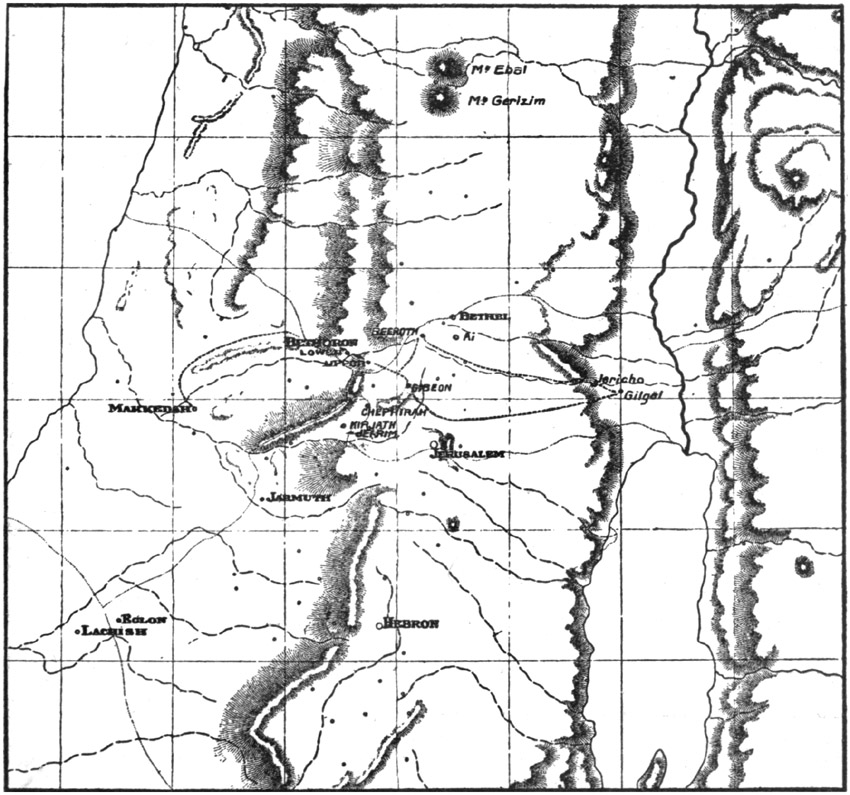
MAP OF SOUTHERN PALESTINE.ToList
Amorite Cities, thus: Hebron. Hivite Cities: BEEROTH.
Places taken by the Israelites: Jericho.
Conjectural line of march of Joshua: ...................
To do this they had to deceive the Israelites into believing that they
were inhabitants of some land far from Canaan, and this they must do,
not only before Joshua actually attacked them, but before he sent out
another scouting party. For Beeroth would inevitably have been the very
first town which it would have approached, and once Joshua's spies had
surveyed it, all chance of the Hivites successfully imposing upon him
would have vanished.
But they were exposed to another danger, if possible more urgent still.
The headquarters of the newly formed Amorite league was at Jerusalem, on
the same plateau as Gibeon, the Hivite capital, and distant from it less
than six miles. A single spy, a single traitor, during the anxious time
that their defection was being planned, and Adoni-zedec, the king of
Jerusalem, would have heard of it in less than a couple of hours; and
the Gibeonites would have been overwhelmed before Joshua had any inkling
that they were anxious to treat with him. Whoever was dilatory, whoever
was slow, the Gibeonites dared not be. It can, therefore, have been, at
most, only a matter of hours after Joshua's return to Gilgal, before
their wily embassy set forth.
But their defection had an instant result. Adoni-zedec recognized in a
moment the urgency of the situation. With Joshua in possession of Gibeon
and its dependencies, the Israelites would be firmly established on the
plateau at his very gates, and the states of southern Palestine would be
cut off from their brethren in the north.
Adoni-zedec lost no time; he sought and obtained the aid of four
neighbouring kings and marched upon Gibeon. The Gibeonites sent at once
the most urgent message to acquaint Joshua with their danger, and Joshua
as promptly replied. He made a forced march with picked troops all that
night up from Gilgal, and next day he was at their gates.
Counterblow had followed blow, swift as the clash of rapiers in a duel
of fencers. All three of the parties concerned—Hivite, Amorite and
Israelite—had moved with the utmost rapidity. And no wonder; the stake
for which they were playing was very existence, and the forfeit, which
would be exacted on failure, was extinction.
3.—Day, Hour, and Place of the Miracle
The foregoing considerations enable us somewhat to narrow down the time
of the year at which Joshua's miracle can have taken place, and from an
astronomical point of view this is very important. The Israelites had
entered the land of Canaan on the 10th day of the first month, that is
to say, very shortly after the spring equinox—March 21 of our present
calendar. Seven weeks after that equinox—May 11—the sun attains a
declination of 18° north. From this time its declination increases day
by day until the summer solstice, when, in Joshua's time, it was nearly
24° north. After that it slowly diminishes, and on August 4 it is 18°
again. For twelve weeks, therefore—very nearly a quarter of the entire
year—the sun's northern declination is never less than 18°. The date of
the battle must have fallen somewhere within this period. It cannot have
fallen earlier; the events recorded could not possibly have all been
included in the seven weeks following the equinox. Nor, in view of the
promptitude with which all the contending parties acted, and were bound
to act, can we postpone the battle to a later date than the end of this
midsummer period.
We thus know, roughly speaking, what was the declination of the
sun—that is to say, its distance from the equator of the heavens—at
the time of the battle; it was not less than 18° north of the equator,
it could not have been more than 24°.
But, if we adopt the idea most generally formed of the meaning of
Joshua's command, namely, that he saw the sun low down over Gibeon in
one direction, and the moon low down over the valley of Ajalon in
another, we can judge of the apparent bearing of those two heavenly
bodies from an examination of the map. And since, if we may judge from
the map of the Palestine Exploration Fund, the valley of Ajalon lies
about 17° north of west from Gibeon, and runs nearly in that direction
from it, the moon must, to Joshua, have seemed about 17° north of west,
and the sun 17° south of east.
But for any date within the three summer months, the sun in the
latitude of Gibeon, when it bears 17° south of east, must be at least
56° high. At this height it would seem overhead, and would not give the
slightest idea of association with any distant terrestrial object. Not
until some weeks after the autumnal equinox could the sun be seen low
down on the horizon in the direction 17° south of east, and at the same
time the moon be as much as 17° north of the west point. And, as this
would mean that the different combatants had remained so close to each
other, some four or five months without moving, it is clearly
inadmissible. We are forced therefore to the unexpected conclusion that
it is practically impossible that Joshua could have been in any place
from whence he could have seen, at one and the name moment; the sun low
down in the sky over Gibeon, and the moon over the valley of Ajalon.
Is the narrative in error, then? Or have we been reading into it our own
erroneous impression? Is there any other sense in which a man would
naturally speak of a celestial body as being "over" some locality on the
earth, except when both were together on his horizon?
Most certainly. There is another position which the sun can hold in
which it may naturally be said to be "over," or "upon" a given place;
far more naturally and accurately than when it chances to lie in the
same direction as some object on the horizon. We have no experience of
that position in these northern latitudes, and hence perhaps our
commentators have, as a rule, not taken it into account. But those who,
in tropical or sub-tropical countries, have been in the open at high
noon, when a man's foot can almost cover his shadow, will recognize how
definite, how significant such a position is. In southern Palestine,
during the three summer months, the sun is always so near the zenith at
noon that it could never occur to any one to speak of it as anything but
"overhead."
And the prose narrative expressly tells us that this was the case. It is
intimated that when Joshua spoke it was noon, by the expression that the
sun "hasted not to go down about a whole day," implying that the change
in the rate in its apparent motion occurred only in the afternoon, and
that it had reached its culmination. Further, as not a few commentators
have pointed out, the expression,—"the sun stood still in the midst of
heaven,"—is literally "in the bisection of heaven"; a phrase applicable
indeed to any position on the meridian, but especially appropriate to
the meridian close to the zenith.
This, then, is what Joshua meant by his command to the sun. Its glowing
orb blazed almost in the centre of the whole celestial vault—"in the
midst of heaven"—and poured down its vertical rays straight on his
head. It stood over him—it stood over the place where he was—Gibeon.
We have, therefore, been able to find that the narrative gives us, by
implication, two very important particulars, the place where Joshua was,
and the time of the day. He was at Gibeon, and it was high noon.
The expression, "Thou, Moon, in the valley of Ajalon," has now a very
definite signification. As we have already seen, the valley of Ajalon
bears 17° north of west from Gibeon, according to the map of the
Palestine Exploration Fund, so that this is the azimuth which the moon
had at the given moment. In other words, it was almost exactly midway
between the two "points of the compass," W.b.N. and W.N.W. It was also
in its "last quarter" or nearly so; that is, it was half-full, and
waning. With the sun on the meridian it could not have been much more
than half-full, for in that case it would have already set; nor much
less than half-full, or it would have been too faint to be seen in full
daylight. It was therefore almost exactly half-full, and the day was
probably the 21st day of the month in the Jewish reckoning.
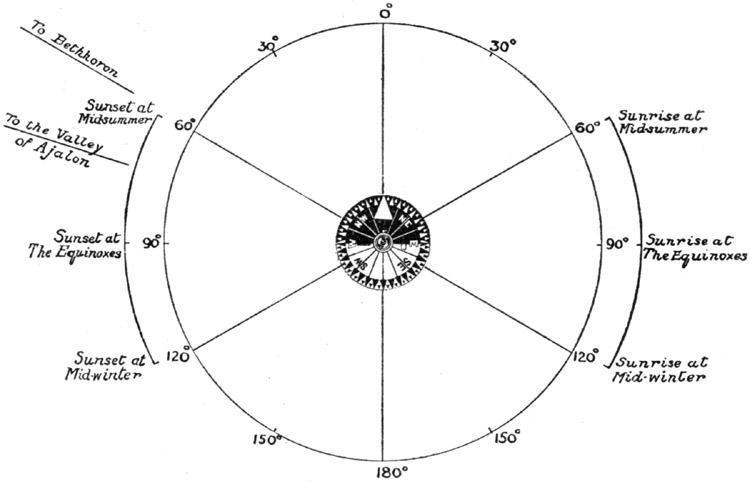
BEARINGS OF THE RISING AND SETTING POINTS OF THE SUN FROM GIBEON.ToList
But the moon cannot be as far as 17° north of west in latitude 31° 51´
N. on the 21st day of the month earlier than the fourth month of the
Jewish year, or later than the eighth month. Now the 21st day of the
fourth month is about seven weeks after the 3rd day of the third month;
the 21st day of the fifth month is eleven weeks. Remembering how close
Gilgal, Gibeon and Jerusalem were to each other, and how important was
the need for promptitude to Israelite and Amorite alike, it can scarcely
be disputed that eleven weeks is an inadmissible length of time to
interpose between the reading of the Law and the battle; and that seven
weeks is the utmost that can be allowed.
The battle took place, then, on or about the 21st day of the fourth
month. But it could only have done so if that particular year began
late. If the year had begun earlier than April 1st of our present
calendar, the moon could not have been so far north on the day named.
For the Jewish calendar is a natural one and regulated both by the sun
and the moon. It begins with the new moon, and it also begins as nearly
as possible with the spring equinox. But as twelve natural months fall
short of a solar year by eleven days, a thirteenth month has to be
intercalated from time to time; in every nineteen years, seven are years
having an extra month. Now the 21st day of the fourth month must have
fallen on or about July 22 according to our present reckoning, in order
that the moon might have sufficient northing, and that involves a year
beginning after April 1; so that the year of the battle of Beth-horon
must have been an ordinary year, one of twelve months, but must have
followed a year of thirteen months.
Summarizing all the conclusions at which we have now arrived, Joshua's
observation was made at Gibeon itself, almost precisely at the moment of
noon, on or about the 21st day of the fourth month, which day fell late
in July according to our present reckoning; probably on or about the
22nd. The sun's declination must have been about 20° north; probably, if
anything, a little more. The sun rose therefore almost exactly at five
in the morning, and set almost exactly at seven in the evening, the day
being just fourteen hours long. The moon had not yet passed her third
quarter, but was very near it; that is to say, she was about half full.
Her declination did not differ greatly from 16° north; she was probably
about 5° above the horizon, and was due to set in about half an hour.
She had risen soon after eleven o'clock the previous evening, and had
lighted the Israelites during more than half of their night march up
from Gilgal.
4.—Joshua's Strategy
These conclusions, as to the place and time of day, entirely sweep away
the impression, so often formed, that Joshua's victory was practically
in the nature of a night surprise. Had it been so, and had the Amorites
been put to flight at daybreak, there would have seemed no conceivable
reason why, with fourteen hours of daylight before him, Joshua should
have been filled with anxiety for the day to have been prolonged. Nor is
it possible to conceive that he would still have been at Gibeon at noon,
seven hours after he had made his victorious attack upon his enemy.
The fact is that, in all probability, Joshua had no wish to make a
night surprise. His attitude was like that of Nelson before the battle
of Trafalgar; he had not the slightest doubt but that he would gain the
victory, but he was most anxious that it should be a complete one. The
great difficulty in the campaign which lay before him was the number of
fortified places in the hands of the enemy, and the costliness, both in
time and lives, of all siege operations at that epoch. His enemies
having taken the field gave him the prospect of overcoming this
difficulty, if, now that they were in the open, he could succeed in
annihilating them there; to have simply scattered them would have
brought him but little advantage. That this was the point to which he
gave chief attention is apparent from one most significant circumstance
in the history; the Amorites fled by the road to Beth-horon.
There have been several battles of Beth-horon since the days of Joshua,
and the defeated army has, on more than one occasion, fled by the route
now taken by the Amorites. Two of these are recorded by Josephus; the
one in which Judas Maccabæus defeated and slew Nicanor, and the other
when Cestius Gallus retreated from Jerusalem. It is probable that
Beth-horon was also the scene of one, if not two, battles with the
Philistines, at the commencement of David's reign. In all these cases
the defeated foe fled by this road because it had been their line of
advance, and was their shortest way back to safety.
But the conditions were entirely reversed in the case of Joshua's
battle. The Amorites fled away from their cities. Jerusalem, the
capital of Adoni-zedec and the chief city of the confederation, lay in
precisely the opposite direction. The other cities of their league lay
beyond Jerusalem, further still to the south.
A reference to the map shows that Gilgal, the headquarters of the army
of Israel, was on the plain of Jericho, close to the banks of the
Jordan, at the bottom of that extraordinary ravine through which the
river runs. Due west, at a distance of about sixteen or seventeen miles
as the crow flies, but three thousand four hundred feet above the level
of the Jordan, rises the Ridge of the Watershed, the backbone of the
structure of Palestine. On this ridge are the cities of Jerusalem and
Gibeon, and on it, leading down to the Maritime Plain, runs in a
north-westerly direction, the road through the two Beth-horons.
The two Beth-horons are one and a half miles apart, with a descent of
700 feet from the Upper to the Lower.
The flight of the Amorites towards Beth-horon proves, beyond a doubt,
that Joshua had possessed himself of the road from Gibeon to Jerusalem.
It is equally clear that this could not have been done by accident, but
that it must have been the deliberate purpose of his generalship.
Jerusalem was a city so strong that it was not until the reign of David
that the Israelites obtained possession of the whole of it, and to take
it was evidently a matter beyond Joshua's ability. But to have defeated
the Amorites at Gibeon, and to have left open to them the way to
Jerusalem—less than six miles distant—would have been a perfectly
futile proceeding. We may be sure, therefore, that from the moment when
he learned that Adoni-zedek was besieging Gibeon, Joshua's first aim was
to cut off the Amorite king from his capital.
The fact that the Amorites fled, not towards their cities but away from
them, shows clearly that Joshua had specially manœuvred so as to cut
them off from Jerusalem. How he did it, we are not told, and any
explanation offered must necessarily be merely of the nature of surmise.
Yet a considerable amount of probability may attach to it. The
geographical conditions are perfectly well known, and we can, to some
degree, infer the course which the battle must have taken from these,
just as we could infer the main lines of the strategy employed by the
Germans in their war with the French in 1870, simply by noting the
places where the successive battles occurred. The positions of the
battlefields of Mars-la-Tour, Gravelotte, and Sedan would show clearly
that the object of the Germans had been, first, to shut Bazaine up in
Metz, and then to hinder MacMahon from coming to his relief. So in the
present case, the fact that the Amorites fled by the way of the two
Beth-horons, shows, first, that Joshua had completely cut them off from
the road to Jerusalem, and next, that somehow or other when they took
flight they were a long way to the north of him. Had they not been so,
they could not have had any long start in their flight, and the
hailstorm which occasioned them such heavy loss would have injured the
Israelites almost as much.
How can these two circumstances be accounted for? I think we can make a
very plausible guess at the details of Joshua's strategy from noting
what he is recorded to have done in the case of Aï. On that occasion, as
on this, he had felt his inability to deal with an enemy behind
fortifications. His tactics therefore had consisted in making a feigned
attack, followed by a feigned retreat, by which he drew his enemies
completely away from their base, which he then seized by means of a
detachment which he had previously placed in ambush near. Then, when the
men of Aï were hopelessly cut off from their city, he brought all his
forces together, surrounded his enemies in the open, and destroyed them.
It was a far more difficult task which lay before him at Gibeon, but we
may suppose that he still acted on the same general principles. There
were two points on the ridge of the watershed which, for very different
reasons, it was important that he should seize. The one was Beeroth, one
of the cities of the Hivites, his allies, close to his latest victory of
Aï, and commanding the highest point on the ridge of the watershed. It
is distant from Jerusalem some ten miles—a day's journey. Tradition
therefore gives it as the place where the Virgin Mary and St. Joseph
turned back sorrowing, seeking Jesus. For "they, supposing Him to have
been in the company, went a day's journey," and Beeroth still forms the
first halting-place for pilgrims from the north on their return journey.
Beeroth also was the city of the two sons of Rimmon who murdered
Ishbosheth, the son of Saul. When it is remembered how Saul had
attempted to extirpate the Gibeonites, and how bitter a blood feud the
latter entertained against his house in consequence, it becomes very
significant that the murderers of his son were men of this Gibeonite
town.
Beeroth also commanded the exit from the principal ravine by which
Joshua could march upwards to the ridge—the valley of Achor. The
Israelites marching by this route would have the great advantage that
Beeroth, in the possession of their allies, the Gibeonites, would act as
a cover to them whilst in the ravines, and give them security whilst
taking up a position on the plateau.
But Beeroth had one fatal disadvantage as a sole line of advance. From
Beeroth Joshua would come down to Gibeon from the north, and the
Amorites, if defeated, would have a line of retreat, clear and easy, to
Jerusalem. It was absolutely essential that somewhere or other he should
cut the Jerusalem road.
This would be a matter of great difficulty and danger, as, if his
advance were detected whilst he was still in the ravines, he would have
been taken at almost hopeless disadvantage. The fearful losses which the
Israelites sustained in the intertribal war with Benjamin near this very
place, show what Joshua might reasonably have expected had he tried to
make his sole advance on the ridge near Jerusalem.
Is it not probable that he would have endeavoured, under these
circumstances, to entice the Amorites as far away to the north as
possible before he ventured to bring his main force out on the ridge? If
so, we may imagine that he first sent a strong force by the valley of
Achor to Beeroth; that they were instructed there to take up a strong
position, and when firmly established, to challenge the Amorites to
attack them. Then, when the Israelite general in command at Beeroth
perceived that he had before him practically the whole Amorite
force—for it would seem clear that the five kings themselves, together
with the greater part of their army, were thus drawn away—he would
signal to Joshua that the time had come for his advance. Just as Joshua
himself had signalled with his spear at the taking of Aï, so the firing
of a beacon placed on the summit of the ridge would suffice for the
purpose. Joshua would then lead up the main body, seize the Jerusalem
road, and press on to Gibeon at the utmost speed. If this were so, the
small detachment of Amorites left to continue the blockade was speedily
crushed, but perhaps was aware of Joshua's approach soon enough to send
swift runners urging the five kings to return. The news would brook no
delay; the kings would turn south immediately; but for all their haste
they never reached Gibeon. They probably had but advanced as far as the
ridge leading to Beth-horon, when they perceived that not only had
Joshua relieved Gibeon and destroyed the force which they had left
before it, but that his line, stretched out far to the right and left,
already cut them off, not merely from the road to Jerusalem and Hebron,
but also from the valley of Ajalon, a shorter road to the Maritime Plain
than the one they actually took. East there was no escape; north was the
Israelite army from Beeroth; south and west was the army of Joshua.
Out-manœuvred and out-generalled, they were in the most imminent
danger of being caught between the two Israelite armies, and of being
ground, like wheat, between the upper and nether millstones. They had no
heart for further fight; the promise made to Joshua,—"there shall not a
man of them stand before thee,"—was fulfilled; they broke and fled by
the one way open to them, the way of the two Beth-horons.
Whilst this conjectural strategy attributes to Joshua a ready grasp of
the essential features of the military position and skill in dealing
with them, it certainly does not attribute to him any greater skill than
it is reasonable to suppose he possessed. The Hebrews have repeatedly
proved, not merely their valour in battle, but their mastery of the art
of war, and, as Marcel Dieulafoy has recently shown,[372:1] the earliest
general of whom we have record as introducing turning tactics in the
field, is David in the battle of the valley of Rephaim, recorded in 2
Sam. v. 22-25 and 1 Chron. xiv. 13-17.
"The several evolutions of a complicated and hazardous nature
which decided the fate of the battle would betoken, even at
the present day, when successfully conducted, a consummate
general, experienced lieutenants, troops well accustomed to
manœuvres, mobile, and, above all, disciplined almost into
unconsciousness, so contrary is it to our instincts not to
meet peril face to face. . . . In point of fact, the Israelites
had just effected in the face of the Philistines a turning
and enveloping movement—that is to say, an operation of war
considered to be one of the boldest, most skilful, and
difficult attempted by forces similar in number to those of
the Hebrews, but, at the same time, very efficacious and
brilliant when successful. It was the favourite manœuvre
of Frederick II, and the one on which his military reputation
rests."
But though the Amorites had been discomfited by Joshua, they had not
been completely surrounded; one way of escape was left open. More than
this, it appears that they obtained a very ample start in the race along
the north-western road. We infer this from the incident of the
hailstorm which fell upon them whilst rushing down the precipitous road
between the Beth-horons; a storm so sudden and so violent that more of
the Amorites died by the hailstones than had fallen in the contest at
Gibeon. It does not appear that the Israelites suffered from the storm;
they must consequently have, at the time, been much in the rear of their
foes. Probably they were still "in the way that goeth up to Beth-horon";
that is to say, in the ascent some two miles long from Gibeon till the
summit of the road is reached. There would be a special appropriateness
in this case in the phrasing of the record that "the Lord discomfited
the Amorites before Israel, and slew them with a great slaughter at
Gibeon, and chased them along the way that goeth up to Beth-horon, and
smote them to Azekah and unto Makkedah." There was no slaughter on the
road between Gibeon and Beth-horon. It was a simple chase; a pursuit
with the enemy far in advance.
The Israelites, general and soldiers alike, had done their best. The
forced march all night up the steep ravines, the plan of the battle, and
the way in which it had been carried out were alike admirable. Yet when
the Israelites had done their best, and the heat and their long
exertions had nearly overpowered them, Joshua was compelled to recognize
that he had been but partly successful. He had relieved Gibeon; the
Amorites were in headlong flight; he had cut them off from the direct
road to safety, but he had failed in one most important point. He had
not succeeded in surrounding them, and the greater portion of their
force was escaping.
5.—The Miracle.
It was at this moment, when his scouts announced to him the frustration
of his hopes, that Joshua in the anxiety lest the full fruits of his
victory should be denied him, and in the supremest faith that the Lord
God, in Whose hand are all the powers of the universe, was with him,
exclaimed:
"Sun, stand thou still upon Gibeon,
And thou, Moon, in the valley of Ajalon!"
So his exclamation stands in our Authorized Version, but, as the
marginal reading shows, the word translated "stand still" is more
literally "be silent." There can be no doubt that this expression, so
unusual in this connection, must have been employed with intention. What
was it that Joshua is likely to have had in his mind when he thus spoke?
The common idea is that he simply wished for more time; for the day to
be prolonged. But as we have seen, it was midday when he spoke, and he
had full seven hours of daylight before him. There was a need which he
must have felt more pressing. His men had now been seventeen hours on
the march, for they had started at sunset—7 p.m.—on the previous
evening, and it was now noon, the noon of a sub-tropical midsummer. They
had marched at least twenty miles in the time, possibly considerably
more according to the route which they had followed, and the march had
been along the roughest of roads, and had included an ascent of 3400
feet—about the height of the summit of Snowdon above the sea-level.
They must have been weary, and have felt sorely the heat of the sun,
now blazing right overhead. Surely it requires no words to labour this
point. Joshua's one pressing need at that moment was something to temper
the fierce oppression of the sun, and to refresh his men. This was what
he prayed for; this was what was granted him. For the moment the sun
seemed fighting on the side of his enemies, and he bade it "Be silent."
Instantly, in answer to his command, a mighty rush of dark storm-clouds
came sweeping up from the sea.
Refreshed by the sudden coolness, the Israelites set out at once in the
pursuit of their enemies. It is probable that for the first six miles
they saw no trace of them, but when they reached Beth-horon the Upper,
and stood at the top of its steep descent, they saw the Amorites again.
As it had been with their fathers at the Red Sea, when the pillar of
cloud had been a defence to them but the means of discomfiture to the
Egyptians, so now the storm-clouds which had so revived them and
restored their their strength, had brought death and destruction to
their enemies. All down the rocky descent lay the wounded, the dying,
the dead. For "the Lord cast down great stones from heaven upon them,
unto Azekah, and they died: they were more which died with hailstones
than they whom the children of Israel slew with the sword."
"The might of the Gentile, unsmote by the sword,
Had melted like snow in the glance of the Lord."
Far below them the panic-stricken remnants of the Amorite host were
fleeing for safety to the cities of the Maritime Plain. The battle
proper was over; the one duty left to the army of Israel was to overtake
and destroy those remnants before they could gain shelter.
But the narrative continues. "The sun stayed in the midst of heaven, and
hasted not to go down about a whole day." This statement evidently
implies much more than the mere darkening of the sun by storm-clouds.
For its interpretation we must return to the remaining incidents of the
day.
These are soon told. Joshua pursued the Amorites to Makkedah,
twenty-seven miles from Gibeon by the route taken. There the five kings
had hidden themselves in a cave. A guard was placed to watch the cave;
the Israelites continued the pursuit for an undefined distance farther;
returned to Makkedah and took it by assault; brought the kings out of
their cave, and hanged them.
"And it came to pass at the time of the going down of the
sun, that Joshua commanded, and they took them down off the
trees, and cast them into the cave wherein they had hidden
themselves, and laid great stones on the mouth of the cave,
unto this very day."
All these events—the pursuit for twenty-seven miles and more, the
taking of Makkedah and the hanging of the kings—took place between noon
and the going down of the sun, an interval whose normal length, for that
latitude and at that time of the year, was about seven hours.
This is an abnormal feat. It is true that a single trained pedestrian
might traverse the twenty-seven and odd miles, and still have time to
take part in an assault on a town and to watch an execution. But it is
an altogether different thing when we come to a large army. It is well
known that the speed with which a body of men can move diminishes with
the number. A company can march faster than a regiment; a regiment than
a brigade; a brigade than an army corps. But for a large force thirty
miles in the entire day is heavy work. "Thus Sir Archibald Hunter's
division, in its march through Bechuanaland to the relief of Mafeking,
starting at four in the morning, went on till seven or eight at night,
covering as many as thirty miles a day at times." Joshua's achievement
was a march fully as long as any of General Hunter's, but it was
accomplished in less than seven hours instead of from fifteen to
sixteen, and it followed straight on from a march seventeen hours in
length which had ended in a battle. In all, between one sunset and the
next he had marched between fifty and sixty miles besides fighting a
battle and taking a town.
If we turn to the records of other battles fought in this neighbourhood,
we find that they agree as closely as we could expect, not with Joshua's
achievement, but with General Hunter's. In the case of the great victory
secured by Jonathan, the gallant son of Saul, the Israelites smote the
Philistines from Michmash to Ajalon;—not quite twenty miles. In the
defeat of Cestius Gallus, the Jews followed him from Beth-horon to
Antipatris, a little over twenty miles, the pursuit beginning at
daybreak, and being evidently continued nearly till sundown. The pursuit
of the Syrians under Nicanor by Judas Maccabæus seems also to have
covered about the same distance, for Nicanor was killed at the first
onslaught and his troops took to flight.
It is not at all unusual to read in comments on the Book of Joshua that
the "miracle" is simply the result of the dulness of the prose
chronicler in accepting as literal fact an expression that originated in
the poetic exuberance of an old bard. The latter, so it is urged, simply
meaning to add a figure of dignity and importance to his song
commemorating a great national victory, had written:—
"And the sun stood still, and the moon stayed,
Until the nation had avenged themselves of their enemies,"
but with no more expectation that the stay of the moon would be accepted
literally, than the singers, who welcomed David after the slaying of
Goliath, imagined that any one would seriously suppose that Saul had
actually with his own hand killed two thousand Philistines, and David
twenty thousand. But, say they, the later prose chronicler, quoting from
the ballad, and accepting a piece of poetic hyperbole as actual fact,
reproduced the statement in his own words, and added, "the sun stayed in
the midst of heaven, and hasted not to go down about a whole day."
Not so. The poem and the prose chronicle make one coherent whole.
Working from the poem alone, treating the expressions in the first two
lines merely as astronomical indications of time and place, and without
the slightest reference to any miraculous interpretation, they lead to
the inevitable conclusion that the time was noonday. This result
certainly does not lie on the surface of the poem, and it was wholly
beyond the power of the prose chronicler to have computed it, yet it is
just in the supposed stupid gloss of the prose chronicler, and nowhere
else, that we find this fact definitely stated: whilst the "miracle"
recorded both by poem and prose narrative completely accords with the
extraordinary distance traversed between noon and sunset.
Any man, however ignorant of science, if he be but careful and
conscientious, can truthfully record an observation without any
difficulty. But to successfully invent even the simplest astronomical
observation requires very full knowledge, and is difficult even then.
Every astronomer knows that there is hardly a single novelist, no matter
how learned or painstaking, who can at this present day introduce a
simple astronomical relation into his story, without falling into
egregious error.
We are therefore quite sure that Joshua did use the words attributed to
him; that the "moon" and "the valley of Ajalon" were not merely inserted
in order to complete the parallelism by a bard putting a legend into
poetic form. Nor was the prose narrative the result of an editor
combining two or three narratives all written much after the date. The
original records must have been made at the time.
All astronomers know well how absolutely essential it is to commit an
observation to writing on the spot. Illustrations of this necessity
could be made to any extent. One may suffice. In vol. ii. of the Life
of Sir Richard Burton, by his wife, p. 244, Lady Burton says:—
"On the 6th December, 1882 . . . we were walking on the Karso
(Opçona) alone; the sky was clear, and all of a sudden my
niece said to me, 'Oh, look up, there is a star walking into
the moon!' 'Glorious!' I answered. 'We are looking at the
Transit of Venus, which crowds of scientists have gone to the
end of the world to see.'"
The Transit of Venus did take place on December 6, 1882; and though
Venus could have been seen without telescopic aid as a black spot on the
sun's disc, nothing can be more unlike Venus in transit than "a star
walking into the moon." The moon was not visible on that evening, and
Venus was only visible when on the sun's disc, and appeared then, not as
a star, but as a black dot.
No doubt Lady Burton's niece did make the exclamation attributed to her,
but it must have been, not on December 6, 1882, but on some other
occasion. Lady Burton may indeed have told her niece that this was the
Transit of Venus, but that was simply because she did not know what a
transit was, nor that it occurred in the daytime, not at night. Lady
Burton's narrative was therefore not written at the time. So if the
facts of the tenth chapter of Joshua, as we have it, had not been
written at the time of the battle, some gross astronomical discordance
would inevitably have crept in.
Let us suppose that the sun and moon did actually stand still in the sky
for so long a time that between noon and sunset was equal to the full
length of an ordinary day. What effect would have resulted that the
Israelites could have perceived? This, and this only, that they would
have marched twice as far between noon and sunset as they could have
done in any ordinary afternoon. And this as we have seen, is exactly
what they are recorded to have done.
The only measure of time, available to the Israelites, independent of
the apparent motion of the sun, was the number of miles marched. Indeed,
with the Babylonians, the same word (kasbu) was used to indicate three
distinct, but related measures. It was a measure of time—the double
hour; of celestial arc—the twelfth part of a great circle, thirty
degrees, that is to say the space traversed by the sun in two hours; and
it was a measure of distance on the surface of the earth—six or seven
miles, or a two hours' march.
If, for the sake of illustration, we may suppose that the sun were to
stand still for us, we should recognize it neither by sundial nor by
shadow, but we should see that whereas our clocks had indicated that the
sun had risen (we will say) at six in the morning, and had southed at
twelve of noon; it had not set until twelve of the night. The register
of work done, shown by all our clocks and watches, would be double for
the afternoon what it had been for the morning. And if all our clocks
and watches did thus register upon some occasion twice the interval
between noon and sunset that they had registered between sunrise and
noon, we should be justified in recording, as the writer of the book of
Joshua has recorded, "The sun stood still in the midst of heaven, and
hasted not to go down about a whole day."
The real difficulty to the understanding of this narrative has lain in
the failure of commentators to put themselves back into the conditions
of the Israelites. The Israelites had no time-measurers, could have had
no time-measurers. A sundial, if any such were in existence, would only
indicate the position of the sun, and therefore could give no evidence
in the matter. Beside, a sundial is not a portable instrument, and
Joshua and his men had something more pressing to do than to loiter
round it. Clepsydræ or clocks are of later date, and no more than a
sundial are they portable. Many comments, one might almost say most
comments on the narrative, read as if the writers supposed that Joshua
and his men carried stop-watches, and that their chief interest in the
whole campaign was to see how fast the sun was moving. Since they had no
such methods of measuring time, since it is not possible to suppose that
over and above any material miracle that was wrought, the mental miracle
was added of acquainting the Israelites for this occasion only with the
Copernican system of astronomy, all that the words of the narrative can
possibly mean is, that—
"the sun stood still in the midst of heaven, and hasted not
to go down about a whole day,"
according to the only means which the Israelites had for testing the
matter. In short, it simply states in other words, what, it is clear
from other parts of the narrative, was actually the case, that the
length of the march made between noon and sunset was equal to an
ordinary march taking the whole of a day.
If we suppose—as has been generally done, and as it is quite legitimate
to do, for all things are possible to God—that the miracle consisted in
the slackening of the rotation of the earth, what effect would have
been perceived by the Hebrews? This, and only this, that they would have
accomplished a full day's march in the course of the afternoon. And what
would have been the effects produced on all the neighbouring nations?
Simply that they had managed to do more work than usual in the course of
that afternoon, and that they felt more than usually tired and hungry in
the evening.
But would it have helped the Israelites for the day to have been thus
actually lengthened? Scarcely so, unless they had been, at the same
time, endowed with supernatural, or at all events, with unusual
strength. The Israelites had already been 31 hours without sleep or
rest, they had made a remarkable march, their enemies had several miles
start of them; would not a longer day have simply given the latter a
better chance to make good their flight, unless the Israelites were
enabled to pursue them with unusual speed? And if the Israelites were so
enabled, then no further miracle is required; for them the sun would
have "hasted not to go down about a whole day."
Leaving the question as to whether the sun appeared to stand still
through the temporary arrest of the earth's rotation, or through some
exaltation of the physical powers of the Israelites, it seems clear,
from the foregoing analysis of the narrative, that both the prose
account and the poem were written by eye-witnesses, who recorded what
they had themselves seen and heard whilst every detail was fresh in
their memory. Simple as the astronomical references are, they are very
stringent, and can only have been supplied by those who were actually
present.
Nothing can be more unlike poetic hyperbole than the sum of actual
miles marched to the men who trod them; and these very concrete miles
were the gauge of the lapse of time. For just as "nail," and "span," and
"foot," and "cubit," and "pace" were the early measures of small
distance, so the average day's march was the early measure of long
distance. The human frame, in its proportions and in its abilities, is
sufficiently uniform to have furnished the primitive standards of
length. But the relation established between time and distance as in the
case of a day's march, works either way, and is employed in either
direction, even at the present day. When the Israelites at the end of
their campaign returned from Makkedah to Gibeon, and found the march,
though wholly unobstructed, was still a heavy performance for the whole
of a long day, what could they think, how could they express themselves,
concerning that same march made between noon and sundown? Whatever
construction we put upon the incident, whatever explanation we may offer
for it, to all the men of Israel, judging the events of the afternoon by
the only standard within their reach, the eminently practical standard
of the miles they had marched, the only conclusion at which they could
arrive was the one they so justly drew—
"The sun stayed in the midst of heaven and hasted not to go
down about a whole day. And there was no day like that before
it or after it, that the Lord hearkened unto the voice of a
man: for the Lord fought for Israel."


