Its Antiquity.—The Trésor de Guarrazar.—The Merovingian and
Carlovingian Periods.—Ecclesiastical Jewellery.—Pre-eminence of
the Byzantine Goldsmiths.—Progress of the Art consequent on the
Crusades.—The Gold and Enamels of Limoges.—Jewellery ceases to be
restricted to Purposes of Religion.—Transparent Enamels.—Jean of
Pisa, Agnolo of Sienna, Ghiberti.—Great Painters and Sculptors
from the Goldsmiths’ Workshops.—Benvenuto Cellini.—The Goldsmiths
of Paris.
 N the remarks upon furniture, we were compelled to trespass on the
domain which we now again approach; for, having to trace the history of
secular and religious luxury, we cannot but frequently encounter the
goldsmiths and their splendid works. It will thus happen more than once
that we shall have to indicate briefly certain important facts already
described, in some details, in preceding chapters.
It is known that in old times, even the most remote, the goldsmith’s art
flourished. There is scarcely any ancient narrative which does not
allude to jewels; and every day the discovery of precious objects, found
in ruins and in tombs, still attests the high state of perfection the
art of gold and silver work had attained among races long since extinct.
The Gauls, when under Roman dominion, applied themselves successfully to
the business of the gold-worker. We may again say that the triumph of
the Christian religion, under Constantine the Great, while encouraging
the interior decoration of places of worship, added a fresh impulse to
the development of this beautiful art.
The popes succeeding St. Sylvester (who had stimulated the liberality of
Constantine) continued to accumulate, in the churches at Rome, the most
costly and massive articles of gold-work. Symmachus (498 to 514) alone,
according to a calculation made by Seroux d’Agincourt, enriched the
treasures of the basilicas to the amount of 130 pounds weight of gold,
and 1,700 of silver, forming the material of objects most finely
wrought. It was from the very court of the Greek emperors that the
examples of this magnificence were derived; for we hear St. John
Chrysostom exclaiming, “All our admiration is at present reserved for
the goldsmiths and the weavers;” and it is well known that in
consequence of his bold indiscretion in rebuking the extravagance of the
Empress Eudoxia, this eloquent Father of the Church expiated in exile
and persecutions his ardent zeal and his sincerity.
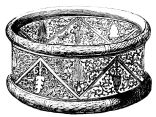
Fig. 85.—Gallic Bracelet, from a Cabinet of Antiquities.
(Imp. Library, Paris.)
The brilliant specimens of the gold-work of the Visigoths, which, in
1858, were exhumed in the field of Guarrazar, near Toledo, and which
have been obtained for the Cluny Museum, throw a new light on the
monuments of that period. Far from indicating any original style, they
afford further proof that the barbarians who came from the North became
subjected, in the arts, to Byzantine influence. The most remarkable, not
only in its dimensions and extreme richness, but in the peculiarity of
its ornaments, is a votive crown, intended to be hung, according to the
custom of those times, in a sacred place—that of Recesvinthe, who
reigned over the Goths of Spain from 653 to 672. It is composed of a
large fillet, jointed, and formed of a double plate of the finest gold.
Thirty uncut sapphires and as many pearls, regularly alternating,
arranged in three rows and in quincunxes,[14] are seen on its exterior
circle. Chased ornaments occupy the spaces between the stones. The
votive crown of King Suintila, which we here reproduce (Fig. 86), is
fully as rich, and about thirty years older.
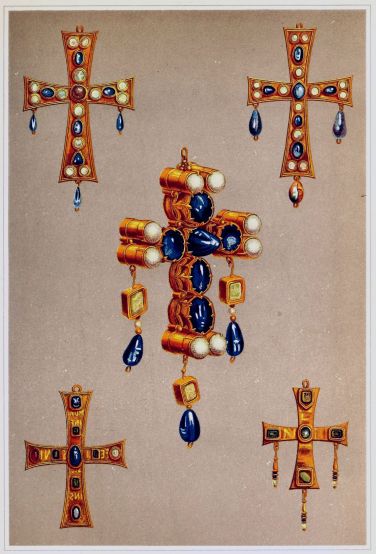
GOLD CROSSES OF A KING OF THE GOTHS.
Found at Guarrazar. Seventh Century. (Museum of the Hotel Cluny) (Taken
from the work of M. Ferdinand de Lasteyrie.)
It is of massive gold, ornamented with sapphires and pearls arranged in
rose-pattern, and set off by two borders similarly set with delicate
stones. But the originality of this precious gem consists in the letters
hanging as pendants from its lower border. These letters, open-worked,
are filled with small pieces of red glass set in gold; their combination
presents the following inscription:—“Suintilanus Rex offeret”
(offering of the King Suintila). Each of them is suspended from the
fillet by a chain with double links, sustaining a pendant of violet
sapphire, pear-shaped. Finally, the crown is suspended by four chains
attached to a circular top of rock-crystal.
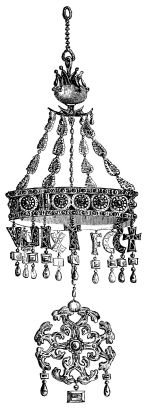
Fig. 86.—Votive Crown of Suintila, King of the Visigoths
from 621 to 631. (Armoury Real, Madrid.)
“Five of the crowns so fortunately discovered at Guarrazar,” says M. de
Lasteyrie, “have crosses. These, attached by a chain to the same
circular top, were evidently intended to remain suspended across the
circle of the crown.” The cross belonging to the crown of Recesvinthe is
by far the richest; eight large pearls and six sapphires, all mounted in
open-work, adorn the front. The four other crosses are of the form which
in heraldry is called croix patée; but they differ in size and in the
ornaments with which they are enriched.
We have already stated that the kings and grandees of the Merovingian
period displayed in their plate and in some of their state-furniture a
richness of gold-work the profuseness of which was ordinarily opposed to
good taste. We have seen at his work the celebrated Saint Eloi,
bishop-goldsmith; and we have mentioned not only his remarkable
productions, but also the enduring influence he exercised over a whole
historical period of art. Finally, we have observed that
Charlemagne—whose object seems to have been not only to imitate
Constantine, but to surpass him—endowed the churches magnificently with
works of art, without prejudice to the numberless splendours which his
palaces contained.
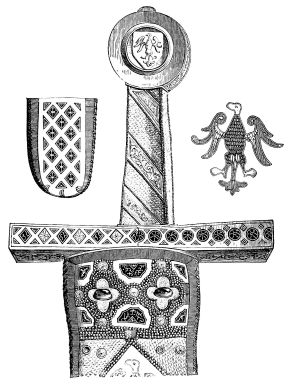
Fig. 87.—The Sword of Charlemagne. Preserved in the
Imperial Treasury at Vienna.
According to a tradition, the loss of most of the beautiful objects of
gold-work belonging to that monarch may have been owing to the
circumstance that they were disposed around him in the sepulchral
chamber where the body was deposited after death; and the emperors of
Germany, his successors, may not have scrupled to appropriate those
riches, of which some rare specimens, particularly his diadem and sword,
are still preserved in the Museum of Vienna (Figs. 87 and 88).
Ecclesiastical display, notably extinct during the period of trouble and
suffering through which the Church passed in the seventh and eighth
centuries, and to which the power of Charlemagne was to put an end,
manifested itself in an extraordinary degree from that time. For
example, it was calculated that under Leo III., who occupied the
pontifical chair from 795 to 816, the weight of the plate which the Pope
gave to enrich the churches, amounted to not less than 1,075 pounds of
gold and 24,744 pounds of silver!
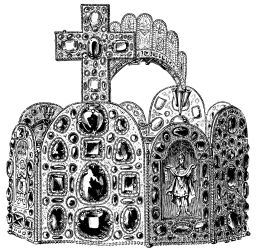
Fig. 88.—Diadem of Charlemagne. Preserved in the
Imperial Treasury at Vienna.
To that period belongs the famous gold altar of the basilica of St.
Ambrose of Milan, executed in 835, by order of Archbishop Angilbert, by
Volvinius; and which, notwithstanding its immense intrinsic value, has
come down to our time. “The four sides of this monument,” says M.
Labarte, “are of extreme richness. The front, entirely of gold, is
divided into three panels by a border of enamel. The centre panel
represents a cross of four equal projections, formed by fillets of
ornaments in enamel, alternating with precious stones uncut but
polished. Christ is seated in the centre of the cross. The symbols of
the Evangelists occupy its branches. Three of the Apostles are placed in
each angle. All these figures are in relief. The right and left panels
contain each six bas-reliefs, the subjects of which are taken from the
life of Christ; they are encircled by borders of enamels and precious
stones alternately disposed. The two sides, in silver relieved with
gold, exhibit very rich crosses, treated in the same style as the
borders. The back, which is also of silver relieved with gold, is
likewise divided in three large panels; that in the centre contains four
medallions, and each of the others six bas-reliefs, of which the life of
St. Ambrose supplied the subjects. In one of the medallions of the
centre panel is seen St. Ambrose receiving the gold altar from the hands
of Archbishop Angilbert; in the other, St. Ambrose is giving his
benediction to Volvinius, the master goldsmith (magister faber), as he
is designated in the inscription transmitting to us the name of the
author of this work, of which no description can give an exact idea.”
It was not Italy alone which possessed skilful goldsmiths, and
encouraged them. We have in particular, among other enlightened and
active supporters of ecclesiastical gold-work, a succession of the
bishops of Auxerre, to whom must be added Hincmar, bishop of Rheims, who
caused a splendid shrine to be made for the relics of the illustrious
patron of his church. It was cased in plates of silver, and statues of
twelve bishops adorned its borders.
But, notwithstanding all its artistic magnificence, the jewellery of the
West could only appear to be the reflex of the wonders produced at the
same epoch by the goldsmiths of the East, or the Byzantines, to adopt a
term generally sanctioned.
One of the most curious specimens of Byzantine art, preserved in Russia,
is a gold reliquary lined with a plate of silver, in the centre of which
is an embossed representation of the Crucifixion. Above the head, on a
gilt nimbus, is an inscription in Greek, “Jesus Christ, King of Glory.”
This treasure, remarkable for its extreme finish, is covered with a
mosaic of precious stones of different colours, in partitions of gold;
the cross being quartered in enamel, with silver filigree. At the back
the names of the archimandrite Nicolos are engraved. It is a work of the
tenth century, and was found in the Iberian monastery on Mount Athos.
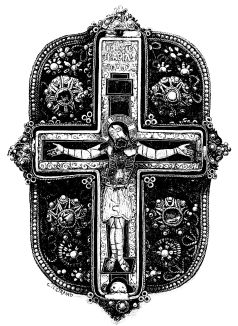
Fig. 89.—Byzantine Reliquary, in Enamel, brought from
Mount Athos. Tenth Century. (Collection of M. Sebastianof.)
If rare specimens only of jewellery have come down to us of a date prior
to the eleventh century, this may be accounted for not merely by their
intrinsic value having indicated them to the uncivilised as fit objects
of plunder during the invasions which took place after the reign of
Charlemagne, but also, as we have elsewhere remarked, by the
re-introduction of church furniture, which was in some measure a
necessary result of renovated architecture. It was right to adapt the
style of plate to that of the edifice it was to adorn. The forms which
were then employed for various objects of church-service showed the
influence of the severe style derived from the original Byzantine type;
the latter, moreover, explained itself by the repute, especially in
metallurgy, enjoyed by the city of Constantine, to which the East
generally had recourse when taking in hand any work of importance.
The German school particularly would acquire a Byzantine character,
owing to the marriage of the Emperor Otho II. with the Greek princess
Theophania (972)—an alliance which naturally bound the two empires in
closer ties, and attracted a considerable number of artists and artisans
to Germany from the East. Of the works of that period still in
existence, one of the most remarkable is the rich gold cover of the book
of the Gospels, now in the Royal Library, Munich; on which are executed,
in the embossed style, various bas-reliefs of great delicacy, and
designed with the purity at that time distinguishing the Greek school.
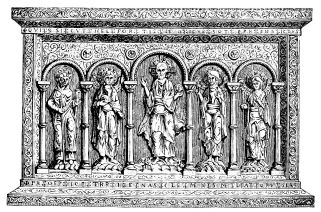
Fig. 90.—Altar of Gold, presented to the ancient
Cathedral of Basle by the Emperor Henry II., now in the Cluny Museum.
The Emperor Henry II. was therefore welcomed (bien-venu), and, if one
may say so, well served by the condition of art in Germany, when,
elevated to the throne in 1002, and inspired by ardent piety, he sought,
by princely liberality to the churches, to surpass even Constantine and
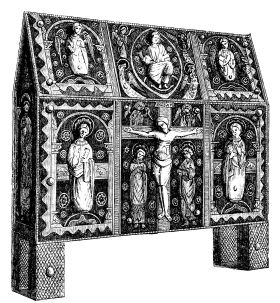
Fig. 91.—Enamelled Shrine, in Limoges Work of the
Twelfth Century. (Museum of Cluny.)
Charlemagne. It is to Henry that the Cathedral of Basle owes the
decorations of the altar, to which none can be compared for richness,
except that of Milan; yet without recalling it by its style, which has
lost every trace of the antique, and is a clearly-pronounced type of the
art which the Middle Ages were to create as their own. It is right to
mention also the crown of the sainted emperor, and that of his wife, now
preserved in the Treasury of the King of Bavaria; both are in six
jointed parts, making a circle; the former bears figures of winged
angels; the other, stalks with four leaves designed with correctness and
grace, and executed in a manner which evinces the greatest dexterity.
“Moreover,” says M. Labarte, “the taste for jewellery was then generally
diffused throughout Germany; and many prelates followed the example set
by the emperor. Willigis, the first Archbishop of Mayence, may be cited;
he endowed his church with a crucifix weighing 600 pounds, the several
parts of which were adjusted with such art that each could be detached
at the joints; and Bernward, Bishop of Hildesheim, who, like St. Eloi,
was himself a celebrated goldsmith, and to whom is ascribed a crucifix
enriched with precious stones and filigrees, and two magnificent
candelabra, which still constitute a portion of the treasures of the
church whereof he was the pastor.”
About the same period—that is, in the early days of the eleventh
century—a monk of Dreux, named Odorain, who had made himself famous in
France by his works in precious metals, executed a large number of
objects for King Robert, intended for the churches the monarch had
founded.
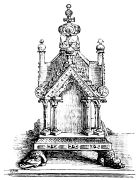
Fig. 92.—Shrine in Copper Gilt. (End of the Twelfth
Century.)
It has been remarked in the preceding chapter, that the Crusades gave a
great impulse to the goldsmith’s art in Europe, in consequence of the
great demand for shrines and reliquaries intended for the reception of
the venerated remains of saints which the soldiers of the faith brought
back from their distant expeditions (Figs. 91 and 92). The offerings of
consecrated vessels and of altar-fronts were also multiplied. The Holy
Scriptures received cases and coverings which were so many splendid
works entrusted to the goldsmiths. To speak truly, had it not been for
the essentially religious direction which, at that period, certain
departments of luxury acquired by the Crusaders in the East had taken,
we might perhaps have seen the arts, that only in the West recommenced
a real existence, become extinguished, and in a manner perish in the
first burst of their revival.
It is chiefly to the minister of Louis le Gros, Suger, Abbot of
Saint-Denis, who died in 1152, that the honour of this consecration of
arts is due, for he distinctively proclaimed himself their protector; he
endeavoured to render legitimate their position in the State, by
opposing their pious aims to the too exclusive censures of St. Bernard
and his disciples.
Conjointly with the powerful abbot, there is deserving of special
mention a simple monk, Theophilus, an eminent artist who wrote in Latin
a description of the Industrial Arts of his time (Diversarum Artium
Schedula), and devoted seventy-nine chapters of his book to that of the
goldsmith. This valuable treatise shows us, in the most unmistakable
manner, that the goldsmiths of the twelfth century must have possessed a
comprehensiveness of knowledge and manipulation, the mere enumeration of
which surprises us the more now that we see industry everywhere tending
to an almost infinite division of labour. At that time the goldsmith was
required to be at once modeller, sculptor, smelter, enameller,
jewel-mounter, and inlay-worker. He had to cast his own models in wax,
as well as to labour with his hammer or embellish with his graver: he
had to make the chalice, the vases, and the pyx, for the metropolitan
churches, on which were lavished all the resources of art; and to
produce, by the ordinary process of punching, the open-work or the
designs of copper intended to ornament the books of the poor (libri
pauperum), &c.
The treasury of the Abbey of Saint-Denis still possessed, at the time of
the Revolution, several chefs-d’œuvre produced by the artists whose
processes are described by Theophilus; especially the rich mounting of a
cup of Oriental agate, bearing the name of Suger, which it is believed
he used for the service of mass; and the mounting of an ancient sardonyx
vase, known as the cup of the Ptolemies, which Charles the Simple had
given to the abbey. Having been deposited, in 1793, in the Cabinet of
Medals, Paris, the mounting of the cup of the Ptolemies and the chalice
of Suger remained there until they were stolen in 1804.
Among the examples of that period still existing, and which,
conditionally, every one is permitted to inspect, we may distinguish,
with M. Labarte,—in addition to “the great crown of lights” suspended
under the cupola in the cathedral of Aix-la-Chapelle, and the
magnificent shrine in which Frederick I. collected the bones of
Charlemagne,—in the Museum of the Louvre, a vase of rock-crystal
mounted in gold and embellished with gems, presented to Louis VII. by
his wife Eleanora; in the Cluny Museum, several candelabra; in the
Imperial Library in Paris, the covering of a Latin manuscript, numbered
622; a cup of agate onyx (Fig. 93), bordered with a belt of precious
stones raised on a groundwork of filigree; and the beautiful gold
chalice of St. Remy (Fig. 94), which, after having appeared in the
Cabinet of Antiquities, was restored in 1861 to the treasury of the
church of Notre-Dame, Rheims.
Severe forms and an elevated style were the characteristics of the
jewelled works of the eleventh and twelfth centuries; and, for the
principal elements of accessory embellishment, we most frequently see
pearls, precious stones, with enamelled divisions which, according to
the minute description of Theophilus, are only delicate mosaics whose
various coloured segments are separated by plates of gold.
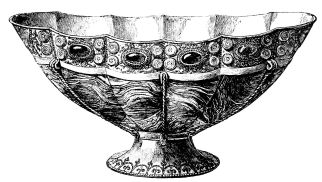
Fig. 93.—A Drinking Cup, called Gondole, of Agate; from
the Treasury of the Abbey of Saint-Denis. (Cabinet of Antiquities, Imp.
Library, Paris.)
In the days of St. Louis, a period of active and generous piety, there
was (an assertion which may appear hazardous after what we have said of
the zeal of preceding centuries) a remarkable accession to the number
and the splendour of the gifts and offerings of jewellery to the
churches. For instance, it was then that Bonnard, Parisian goldsmith,
assisted by the ablest artisans, devoted two years to the manufacture of
the shrine of
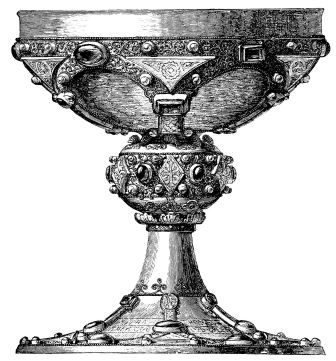
Fig. 94.—Chalice, said to be of St. Remy. (Treasury of
the Cathedral of Rheims.)
St. Geneviève, on which he expended one hundred and ninety-three marks
of silver and seven and a half marks of gold; the mark weighing eight
ounces. The shrine, consecrated in 1212, was in the form of a little
church, with statuettes and bas-reliefs enriched with precious stones.
It was deposited in the French mint in 1793; but the spoil realised only
twenty-three thousand eight hundred and thirty livres. Half a century
earlier, the most celebrated German goldsmiths were engaged during
seventeen years upon the famous reliquary in silver gilt, called the
“Great Relics,” which the cathedral at Aix-la-Chapelle still possesses;
it was fabricated from the gifts deposited in that space of time by the
faithful in the poors’-box of the porch; an edict of the Emperor
Barbarossa having appropriated all the offerings to that object, “so
long as it remained unfinished.”
Moreover, that period, which may be regarded as denoting the zenith of
the goldsmith’s art for sacred purposes, is also that wherein occurred
the important transition which was to introduce into domestic life the
same lavishness so long devoted only to objects applicable to
ecclesiastical use. But, before entering upon that new phase, we ought
to mention, not without much commendation, the enamelled gold-work of
Limoges, which was greatly celebrated for several centuries. From the
Gallo-Romano period Limoges had acquired a reputation for the works of
its goldsmiths. St. Eloi, the great goldsmith in the time of the
Merovingian kings (Fig. 95), was originally from that country, and he
was working under Alban, a goldsmith, and master of the mint at Limoges,
when his reputation led to his being called to the court of Clotaire II.
The ancient Roman colony had retained its industrial speciality, and
during the Middle Ages was remarkable for the production of works of a
peculiar character, which are supposed to have been fabricated there
prior to the third century, if we may judge from a passage in
Philostratus, a Greek writer of that period.
This work consisted of a mixed style, inasmuch as the material forming
the ground of the work is copper; and, moreover, the principal effects
are due not less to the skill of the enameller than to the talent of the
worker in metal. The process of fabrication is very simple—that is, in
the way of description—yet the execution must have been extremely
protracted and minute.
“After having prepared and polished a plate of copper,” says M. Labarte,
whose account we transfer to our own pages, “the artist marked on it all
the parts which were to rise to the surface of the metal, in order to
produce the outlines of the drawing or of the figure he wanted to
represent; then, with gravers and scrapers, he dug deeply in the copper
all the space which the various metals were to cover. In the hollows
thus champlevés (a word sometimes used to signify the mode of
producing this kind of work), he placed the material to be vitrified,
which was afterwards melted in a furnace. When the enamelled piece was
cold, he polished it by various means, so as to bring to the surface of
the enamel all the lines of the drawing produced by the copper. Gilding
was afterwards applied to the parts
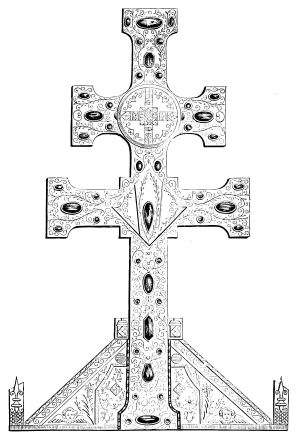
Fig. 95.—Cross of an Altar, ascribed to St. Eloi.
of the metal thus preserved. Until the twelfth century, only the
outlines of the drawing ordinarily rose to the surface of the enamel,
and the tints of the flesh, as well as the dresses, were produced by
coloured enamel; in the thirteenth century enamel was no longer used but
to colour the ground-work. The figures were entirely preserved on the
plate of copper, and the outlines of the drawing were then shown by a
delicate engraving on the metal.”
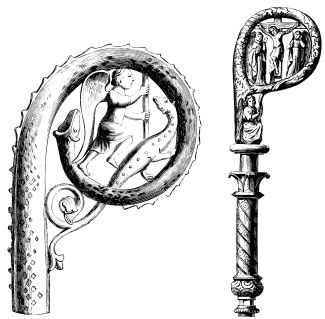
Fig. 96.—An Abbot’s Enamelled Crozier, made at Limoges.
(Thirteenth Century.)
Fig. 97.—A Bishop’s Crozier, which appears to be of
Italian manufacture. (Fourteenth Century. Cathedral of Metz.)
Between the enamels partitioned (cloisonnés) and the enamels
champlevés the difference, as we can see, is only the first
arrangement of the divisions to receive the several vitrifiable
compositions. Making allowances for the influence of fashion, these two
styles of analogous works were held in almost equal estimation.
Nevertheless, it seems that the preference ought to be assigned to the
goldsmith’s art in Limoges, which, at a time when there was manifested a
demand for private reliquaries and collective offerings to the churches,
had this advantage over the other, that it was much less costly, and
consequently more accessible to all classes (Fig. 96). In the present
day there is scarcely a museum, or even a private collection, that does
not contain some specimen of the ancient Limousine[15] industry.
With the fourteenth century the splendour of the goldsmith’s art ceases
to display, as its exclusive object, ecclesiastical decoration and
embellishment; but it suddenly became so developed among the laity that
King John (of France) desiring, or pretending to desire, to restore it
to the exclusive line it had till then retained, prohibited by an
ordinance, in 1356, the goldsmiths from “working (fabricating) gold or
silver plate, vases, or silver jewellery, of more than one mark of gold
or silver, excepting for the churches.”
But it is possible to issue ordinances in order to show the advantage of
evading them, and to benefit exclusively by the exception. This is what
appears to have then occurred; for, in the inventory of the treasury of
Charles V., son and successor of the king who signed the sumptuary edict
of 1356, the value of the various objects of the goldsmith’s art is
estimated at not less than nineteen millions. This document, in which
the greater number of the articles are described to the minutest detail,
would suffice in itself to exhibit a truthful historical view of the art
at that period; and, at all events, it affords a striking idea of the
artistic progress made in that direction, and of the extravagance to
which the trade was subservient.
When considering the subject of furniture in domestic life, we indicated
the names and the uses of several articles which were displayed on the
tables or sideboards—plateholders, ewers, urns, goblets, &c.; we also
adverted to the numerous and capricious forms they assumed—flowers,
animals, grotesque images; we need not, therefore, recur to the matter;
but we ought not to overlook the jewellery, of all sorts—insignia, or
ornaments of the head-dress, gems, clasps, chains and necklaces, antique
cameos (Fig. 98), which appear in the treasury of the King of France.
In treating of ecclesiastical furniture we, moreover, observed that the
goldsmith’s art, although devoting itself to secular ornaments,
nevertheless continued to work marvels in the production of objects for
ecclesiastical use; it would be mere repetition to support this
assertion by other examples.
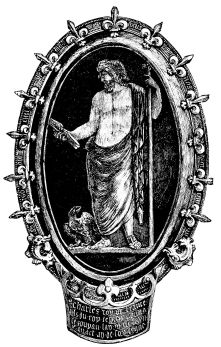
Fig. 98.—An Ancient Cameo-setting of the time of Charles
V. (Cab. of Ant., Bibl. Imp., Paris.)
But, dismissing those two questions, let a contemporary poet raise a
third, which deserves a place here. Eustache Deschamps, who died in
1422, equerry and usher-at-arms to Charles V. and Charles VI.,
enumerates the jewels and gems which the female nobility of the time
aspired to possess. “It was indispensable,” he says—
“Aux matrones,
Nobles palais et riches trônes;
Et à celles qui se marient
Qui moult tôt (bientôt) leurs pensers varient,
Elles veulent tenir d’usaige ...
Vestements d’or, de draps de soye,
Couronne, chapel et courroye
De fin or, espingle d’argent ...
Puis couvrechiefs à or batus,
A pierres et perles dessus ...
Encor vois-je que leurs maris,
Quand ils reviennent de Paris,
De Reims, de Rouen et de Troyes,
Leur rapportent gants et courroyes ...
Tasses d’argent ou gobelets ...
Bourse de pierreries,
Coulteaux à imagineries,
Espingliers (étuis) taillés à émaux.”
They desired, moreover, and said that they ought to have given to them—
“Pigne (peigne) et miroir d’ivoire ...
Et l’estui qui soit noble et gent (riche et beau),
Pendu à chaines d’argent;
Heures (livres de piété) me fault de Notre-Dame,
Qui soient de soutil (delicat) ouvraige,
D’or et d’azur, riches et cointes (jolies),
Bien ordonnés et bien pointes (peintes),
De fin drap d’or très-bien couvertes,
Et quand elles seront ouvertes,
Deux fermaux (agrafes) d’or qui fermeront.”
We thus see that, according to the above programme, the jewel-box of a
princess, or of a lady of rank, must have been really splendid.
Unfortunately for us, the specimens of these female ornaments of the
fourteenth and fifteenth centuries are still more rare in collections
than objects of massive plate; and one is almost left to imagine their
appearance and their richness from the entries in inventories, that
chief source of information regarding the times of which the memorials
have disappeared.
It is there we see the costliness of the fermails, or clasps of cloaks
and copes, called also pectoraux, because they fastened the garments
across the breast; girdles, chaplets (head-dresses), portable
reliquaries, and other “little jewels (Fig. 99) pendants et à pendre,”
the fashion of which we have restored under the name of breloques, and
which represent every variety of object more or less whimsical. We see,
for instance, gold clasps representing a peacock, a fleur-de-lis, two
hands “clasped.” This one is embellished with six sapphires, sixty
pearls, and other large gems; that one with eighteen rubies, and four
emeralds. From a girdle of Charles V., which is made “of scarlet silk
adorned with eight gold mountings,” are suspended “a knife, scissors,
and a pen-knife,” ornamented in gold; the trinkets (pendants) represent
“a man on horseback, a cock holding a mirror in the form of a trefoil,”
or “a stag of pearls with enamelled horns;” or, again, a man mounted on
a double-headed serpent, “playing on a Saracenic horn” (of Saracen
origin). Finally, we remark that in reliquaries a fashion long
established was maintained, which consisted of forming them of a
statuette representing a saint (Fig. 100), or of a subject that
comprised his image, and to which were attached, by a small chain,
relics inlaid in a little tabernacle of gold or silver, preciously
wrought.

Fig. 99.—Scent-box in Chased Gold. (A French Work of the
Fifteenth Century.)
But now the fifteenth century opens out, and with it a period of tumult.
France suddenly beheld that impulse to industry paralyzed, which, to
prosper, requires a condition of affairs very different from sanguinary
civil dissensions and foreign invasion. Not only were the workshops
closed, but princes and nobles were more than once constrained to
appropriate the gorgeous decorations of their tables and their
collections of gems, to pay and arm warriors under their command, or
even to redeem themselves from captivity.
At that time the goldsmith’s art flourished in the neighbouring country
of Flanders, then quietly submissive to the powerful house of Burgundy,
which, with equal taste and liberality, encouraged the art, which had
installed itself in the principal cities. This was also an epoch of
magnificent productions
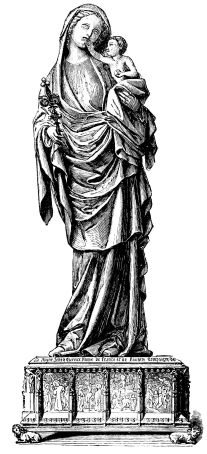
Fig. 100.—Reliquary, Silver-gilt, surmounted by a
Statuette of the Virgin with the Infant Jesus, representing Jeanne
d’Evreux, Queen of France. (Museum of Sovereigns, in the Louvre.)
in that country, but not more than one or two examples remain; these are
attributed to Corneille de Bonte, who worked at Ghent, and was
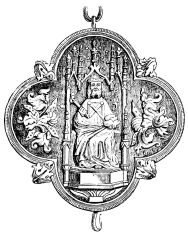
Fig. 101.—The Ensign of the Collar of the Goldsmiths of
Ghent. (Fifteenth Century.)
generally considered the most skilful goldsmith of his time (Figs. 101
and 102). However that may be, the style of the goldsmith’s art of the
fifteenth century continued, as in the two or three preceding centuries,
conformable to the contemporaneous style of architecture. For instance,
the shrine of Saint-Germain-des-Près, which was of that period, had the
form of a small ogivale[16] church; and some specimens still existing in
Berlin are of the Gothic character, the prevailing style of the edifices
of those times. But an influence was making itself felt that was not
long in entirely modifying the general aspect of the productions of the
trade we are considering. That transformation must have been promoted by
Italy; in the midst of which, in spite of intestine troubles and serious
contentions with other nations, a luxury and opulence prevailed. Genoa,
Venice, Florence, Rome, had long been so many centres where the Fine
Arts struggled for pre-eminence and inspiration. Among the majority of
the wealthy merchants who had
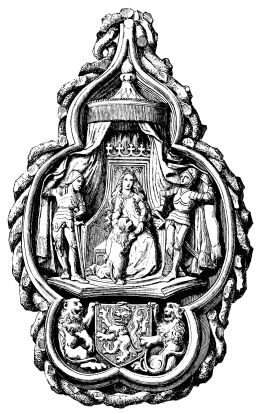
Fig. 102.—Escutcheon in Silver-gilt, executed by
Corneille de Bonte, in the Fifteenth Century. (Museum of the Hôtel de
Ville, Ghent.)
become patricians of those gorgeous republics were found so many
Mæcenases, under whose patronage flourished great artists whom popes and
princes emulously countenanced. “From the moment,” says M. Labarte,
“when the Nicolases, the Jeans of Pisa, and the Giottos, throwing off
the Byzantine yoke, caused Art to emerge from languor and supineness,
that of the goldsmith could no longer find favour in Italy but by
maintaining itself on a level with the progress of sculpture, whose
daughter it was.[17] When we know that the great Donatello,—Philip
Brunelleschi, the bold architect of the dome of Florence,—Ghiberti, the
author of the marvellous doors of the Baptistery, had goldsmiths for
their earliest masters, we may judge what artists the Italian goldsmiths
of that period must have been.” The first in date is the celebrated Jean
of Pisa, son of Nicolas, who, brought from Arezzo in 1286, to sculpture
the marble table of the high-altar, and a group of the Virgin between
St. Gregory and St. Donato, desired to pay tribute to the taste of the
time by ornamenting the altar with those fine chasings on silver
coloured with enamels to which we give the name of translucid enamels in
relief; and also by designing a clasp or jewel with which he decorated
the breast of the Virgin. Both chasings and clasp are now lost.
To Jean (Giovanni) of Pisa succeeded his pupils Agostino and Agnolo of
Siena.
In 1316 Andrea of Ognibene executed, for the Cathedral of Pistoia, an
altar-front, which has come down to us, and must have been followed by
more important works. Then come Pietro and Paulo of Arezzo, Ugolino of
Siena, and finally Master Cione,[18] the author of the two silver
bas-reliefs still to be seen on the altar of the Baptistery of Florence.
Master Cione, whose school was numerous, had for his principal pupils
Forzane of Arezzo and Leonardo of Florence, who worked on the two most
noted monuments of the goldsmith’s art which time and depredations have
respected—the altar of Saint-Jacques at Pistoia, and that same altar of
the Baptistery to which the bas-reliefs of Cione were afterwards
adapted. During more than a hundred and fifty years the ornamentation of
these two altars, of which no description can give an idea, was, if we
may so say, the arena wherein all the most famous goldsmiths met.
At the end of the fourteenth century Luca della Robbia, who, as we have
seen, distinguished himself in ceramic art, and afterwards Brunelleschi,
no less great as an architect than as a sculptor, came forth from the
studio of a goldsmith. At the same period shone Baccioforte and Mazzano
of Placentia, Arditi the Florentine, and Bartoluccio, master of the
famous sculptor Ghiberti, to whom we owe those doors of the Baptistery,
which Michael Angelo pronounced worthy of being placed at the entrance
to Paradise.
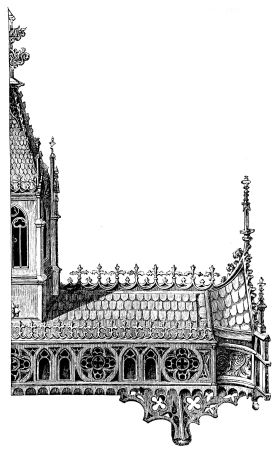
Fig. 103.—Shrine of the Fifteenth Century. (Collection
of Prince Soltykoff.)
It is well known that the execution of these doors was, in 1400,
submitted to competition; and it may be said, in honour of the
goldsmith’s art, that Ghiberti, vying with the most celebrated
competitors—for among them were Donatello and Brunelleschi—owed his
triumph, perhaps, to the simple fact that he had treated, as it were by
habit, his model with all the delicacy of the goldsmith’s art. And it
must be added, and to the praise of the great artist, that although in
great reputation for sculptured works of the highest importance, he
adhered faithfully all his life to his first profession, and considered
it not derogatory even to manufacture jewellery. Thus, for example, in
1428 he mounted as a signet for Jean de Medicis, a cornelian said to
have belonged to the treasury of Nero, and he set it as a winged-dragon
emerging from a cluster of ivy leaves; in 1429, for Pope Martin V., a
button of the cope, and a mitre; and in 1439, for Pope Eugene IV., a
golden mitre, embellished with five and a half pounds weight of precious
stones,—its front representing Christ surrounded by numerous cherubs,
and at the back the Virgin in the midst of the four Evangelists.
During the forty years employed in the execution of the doors of the
Baptistery, Ghiberti continued to derive assistance from several
goldsmiths, who, so guided, could not fail in their turn to become
skilful masters.
The list would be long of goldsmiths who, by the single force of their
talents, or under the direction of renowned sculptors, competed during
two centuries in the production of the marvellous works with which the
churches of Italy are still crowded; and in fact it would be only a
monotonous detail, the interest of which can scarcely be enhanced by any
description we could give of their works. Nevertheless, we may cite the
most illustrious of them: for instance, Andrea Verrochio, in whose
studio Perugino and Leonardo da Vinci passed their time; Domenichino
Ghirlandajo, so called because when a goldsmith he had invented an
ornament in the form of garlands, of which the ladies of Florence were
passionately fond; he afterwards relinquished the hammer and the graver
for the painter’s pencil; Maso Finiguerra, who, reputed to be the
cleverest niello-worker of his time, engraved a pax, or paten, still
preserved in the cabinet of bronzes in Florence; it is acknowledged to
be the plate of the first engraving printed,—the Imperial Library of
Paris possesses the only early proof of it.
In 1500 was born Benvenuto Cellini, who was to be the embodiment of the
genius of the goldsmith’s art, and who raised it to the zenith of its
power. “Cellini, a Florentine citizen, now a sculptor,” as his
contemporary Vasari relates, “had no equal in the goldsmith’s art when
devoting himself to it in his youth, and was perhaps for many years
without a rival, as well as in the execution of small figures in full
relief and in bas-relief, and all works of that nature. He mounted
precious stones so skilfully, and decked them in such marvellous
settings, with small figures so perfect, and sometimes so original and
with such fanciful taste, that one could not imagine anything better;
nor can we adequately praise the medals which, when he was young, he
engraved with incredible care in gold and silver. At Rome he executed,
for Pope Clement VII., a fastening for the cope, in which he represented
with admirable workmanship the Eternal Father. He also mounted with rare
talent a diamond, cut to a point, and surrounded by several young
children carved in gold. Clement VII. having ordered a gold chalice with
its cup supported by the theological attributes, Benvenuto executed the
work in a surprising manner. Of all the artists who, in his own time,
tried their hands at engraving medals of the Pope, no one succeeded
better, as those well know who possess them or have seen them. Also to
him was entrusted the execution of the coins of Rome; and finer pieces
were never struck. After the death of Clement VII., Benvenuto returned
to Florence, where he engraved the head of Duke Alexander on the coins,
which are so beautiful that to this day several specimens are preserved
as precious antique medals; and rightly so, for in them Benvenuto
surpassed himself. At length he devoted himself to sculpture and to the
art of casting statues. He executed in France, where he was in the
service of Francis I., many works in bronze, silver, and in gold.
Returning to his native country, he was employed by the Duke Cosmo de
Medicis, who at once required of him several works in jewellery, and
afterwards some sculptures.”
Thus, Benvenuto is at the same time goldsmith (Fig. 104), engraver in
medals, and sculptor, and he excels in these three branches of the art,
as the productions which have survived him attest. Nevertheless,
unfortunately, the greater part of his works in the goldsmith’s art have
been destroyed, or are now confounded with those of his contemporaries,
upon whom Italian taste, combined with his original genius, had
exercised a powerful influence. In France there remains of his works
only a magnificent salt-cellar, which he executed for Francis I.; in
Florence is preserved the mounting of a cup in lapis-lazuli,
representing three anchors in gold enamelled, heightened by diamonds;
also the cover, in gold enamelled, of another cup of rock-crystal. But,
besides the bronze bust of Cosmo I., we may still admire, with the group
of Perseus and Medusa, which ranks among grand sculptures, the reduced
form, or rather the model of that group, which in size approaches
goldsmith’s work; and the bronze pedestal, decorated with statuettes, on
which Perseus is placed; works that enable us to see of what Cellini
was capable as a goldsmith. And, let us repeat, the influence which he
exercised over his contemporaries was immense, as well in Florence as in
Rome, as well in France as in Germany; and, had his work been thought
utterly worthless, he would remain not less justly celebrated for giving
an impulse to his time by imprinting on the art which he professed a
movement as fertile as it was bold.
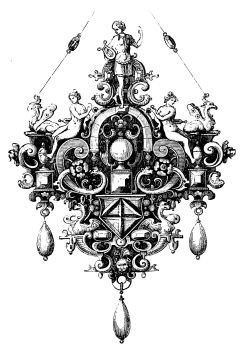
Fig. 104.—A Pendant, after a design by Benvenuto
Cellini. Sixteenth Century. (Cabinet of Antiquities, Bibl. Imp.,
Paris.)
Moreover, in imitation of the monk Theophilus, his predecessor of the
twelfth century, Benvenuto Cellini, after having given practical
example, desired that the theories he had found prevailing, and those
which were due to his faculty for originating, should be preserved for
posterity. A treatise (“Trattato intorno alle otto principali Arti dell
‘Orificeria”), in which he describes and teaches all the best processes
of working in gold, remains one of the most valuable works on the
subject; and even in our days goldsmiths who wish to refer back to the
true sources of their art do not neglect to consult it.
The artistic style of the celebrated Florentine goldsmith is that of a
period when, by an earnest return to antiquity, the mythological element
was introduced everywhere, even in the Christian sanctuaries. The
character, which we may call autochthone,[19] of the pious and severe
Middle Ages, ceased to influence the production of plastic works, when
the models were taken from the glorious remains of idolatrous Greece and
Rome. The art which the religion of Christ had awakened and upheld
suddenly became again Pagan, and Cellini proved himself one of the
enthusiasts of the ancient temples raised in honour of the gods and
goddesses of Paganism; that is to say, under the impulse given by him,
and in imitation of him, the phalanx of artists, of which he is in a
manner the chief, could not fail to go far on the new road by which he
had travelled among the first.
When Cellini came to France he found, as he himself says in his book,
that the work consisted “more than elsewhere in grosserie” (the
grosserie comprised the church plate, vessels, and silver images),
“and that the works there executed with the hammer had attained a degree
of perfection nowhere else to be met with.”
The inventory of the plate and jewels of Henry II., among which were
many by Benvenuto Cellini—the inventory prepared at Fontainebleau in
1560—shows us that, after the departure of the Florentine artist, the
French goldsmiths continued to deserve that eulogium; and to comprehend
of what they were capable in the time of Charles IX., it is sufficient
to recall the description, preserved in the archives of Paris, of a
piece of plate which the city had caused to be made to offer as a
present to the king on the occasion of his entry into his capital in
1571.
“It was,” says that document, “a large pedestal, supported on four
dolphins, and having seated on it Cybele, mother of the gods,
representing the mother of the king, accompanied by the gods Neptune and
Pluto, and the goddess Juno, as Messeigneurs the brothers, and Madame
the sister, of the king. This Cybele was contemplating Jupiter, who
represented our king, and was raised on two columns, the one of gold,
the other of silver, having his device inscribed—‘Pietate et Justitia.’
Upon this was a large imperial crown, on one side held in the beak of an
eagle perched on the croup of a horse on which Jupiter was mounted; and
on the other side supported by the sceptre he held—thus being, as it
were, deified. At the four corners of the pedestal were the figures of
four kings, his predecessors, all of the same name—that is, Charles the
Great, Charles V., Charles VII., and Charles VIII., who in their time
fulfilled their missions, and their reigns were happy, as we hope will
be that of our king. In the frieze of that pedestal were the battles and
the victories, of all kinds, in which he was engaged; the whole made of
fine silver, gilt with ducat gold, chased, engraved, and in workmanship
so executed that the style surpassed the material.”
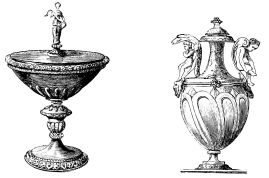
Fig. 105.—Cup of Lapis-lazuli, mounted in Gold enriched
with Rubies, and a Figure in Gold enamelled. (Italian Work of the 16th
Century.)
Fig. 106.—Vase of Rock-crystal, mounted in Silver-gilt
and enamelled. (Italian Work of the 16th Century.)
That rare piece was the work of Jean Regnard, a Parisian goldsmith; and
the period when such works were produced was precisely that during which
religious wars were about to cause the annihilation of a great number of
the chefs-d’œuvre, ancient and modern, of the goldsmith’s art. The new
iconoclasts, the Huguenots, shattered and melted down, wherever they
triumphed, the sacred vessels, the shrines, the reliquaries. Then were
lost the most precious gold-wrought memorials of the times of St. Eloi,
of Charlemagne, of Suger, and of St. Louis.
At the same period Germany, where the influence of the Italian school
had made itself felt less directly, but which could not escape from its
impulse, possessed also, especially at Nuremburg and Augsburg,
goldsmiths’ workshops of high character; these furnished the empire, and
even foreign countries, with remarkable works. A new career opened to
the German goldsmiths when the cabinet-makers of their country had
invented those cabinets, whereof we have already said something
(vide Furniture), and in the intricate decoration of which appear
statuettes, silver bas-reliefs, and inlay-work of gold and precious
stones.
The treasuries and the museums of Germany have succeeded in preserving
many rich objects of that period; but one of the most rare collections
of the kind is that in Berlin, where, in substitution for the originals
in silver which have been melted down, are gathered a great number of
beautiful bas-reliefs in lead, and several vases in tin,—copies of
pieces of plate supposed to be of the sixteenth and seventeenth
centuries. And on this point it may be remarked that the high price of
the material, together with the sumptuary laws, not always admitting of
the possession of gold or silver vases by the citizens, it sometimes
happened that the goldsmiths manufactured a table-service of tin, on
which they bestowed so much pains that these articles were transferred
from the sideboards of citizens to those of princes. The inventory of
the Count d’Angoulême, father of Francis I., alludes to a considerable
table-service of tin. Indeed, several goldsmiths devoted themselves
exclusively to this description of work; and, to this day, the tins of
François Briot, who flourished in the time of Henry II., are regarded as
the most perfect specimens of plate of the sixteenth century.
However that may be, after Cellini, and until the reign of Louis XIV.,
the goldsmith’s art did but follow faithfully in the footsteps of the
Italian master. Elevated by the impulse of the Renaissance, the art
succeeded in maintaining itself in that high position without, however,
any striking individuality discovering itself, until, in a century not
less illustrious than the sixteenth, new masters appeared and imparted
to it additional lustre and magnificence. These are named Ballin,
Delaunay, Julien Defontaine, Labarre, Vincent Petit, Roussel, goldsmiths
and jewellers of Louis XIV., who retained them in his pay, and lodged
them in the Louvre. It was for that prince they produced an imposing
collection of admirable works, for which Le Brun often furnished the
designs, and under an inspiration altogether French, abandoned the
graceful, though rather fluette forms of the Renaissance, and gave to
them a character more diffuse and grand. Then, for a short time, every
article of royal furniture proceeded from the hands of the goldsmith.
But, alas! once more the majority of these marvels must disappear, as
happened to so many others. Even the monarch who had ordered them
despatched his acquisitions to the crucibles of the mint, when, the war
having exhausted the public treasury, he found himself compelled, at
least for example’s sake, to sacrifice his silver plate and to deck his
table with earthenware.
Having finished this sketch of the goldsmith’s art in general, it may
not be inappropriate to add a brief notice of the more special history
of the French goldsmiths, of which the wealthy corporation may be
considered not only as the most ancient, but as the model of all those
that were formed among us in the Middle Ages. But first, since we have
already referred to the exceptional part taken by the goldsmiths of
Limoges in the industrial movement of that period, we cannot proceed
further without noting another description of works, which, although
derived from the oldest examples, nevertheless gave, and with justice, a
kind of new lustre to the ancient city where the first goldsmiths of
France had distinguished themselves.
“Towards the end of the fourteenth century,” says M. Labarte, “the taste
for gold and silver articles having led to the disuse of plate of
enamelled copper, the Limousine enamellers endeavoured to discover a new
mode of applying enamel to the reproduction of graphic subjects. Their
researches led them to dispense with the chaser for delineating the
outlines of designs; the metal was entirely concealed under the enamel,
which, spread by the brush, formed altogether both the drawing and the
colouring. The first attempts at this novel painting on copper were
necessarily very imperfect; but the processes gradually improved, until
at length, in 1540, they attained perfection. Prior to that period, the
enamels of Limoges were almost exclusively devoted to the reproduction
of sacred subjects, of which the German school furnished the designs.
But the arrival of Italian artists at the court of Francis I., and the
publication of engravings of the works of Raphael and other great
masters of Italy, gave a new direction to the school of Limoges, which
adopted the style of that of Italy. Il Rosso and Primaticcio painted
cartoons for the Limousine enamellers; and then
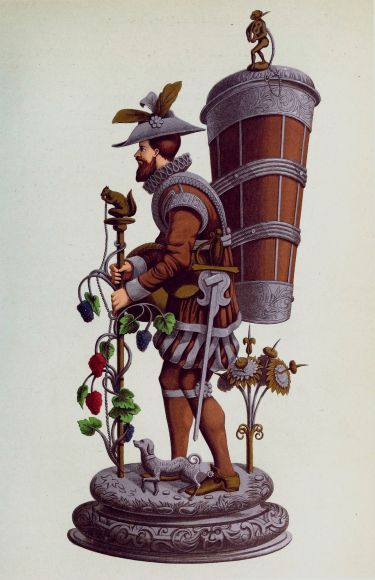
DRAGEOIR, OR TABLE ORNAMENT
Of Enamelled and Gilt Copper. German, latter part of Sixteenth
Century.
they who had previously worked only on plates intended to be set in
diptychs, on caskets, created a new species of goldsmith’s art. Basins,
ewers, cups, salt-cellars, vases, and utensils of all sorts,
manufactured with thin sheet-copper in the most elegant forms were
decorated with their rich and brilliant paintings.”
In the highest rank of artists who have rendered this attractive work
illustrious we must place Léonard (Limousin), painter to Francis I., who
was the first director of the royal manufacture of enamels founded by
that king at Limoges. Then followed Pierre Raymond (Figs. 107 to 110),
whose works date from 1534 to 1578, the Penicauds, Courteys, Martial
Raymond, Mercier, and Jean Limousin, enameller to Anne of Austria.
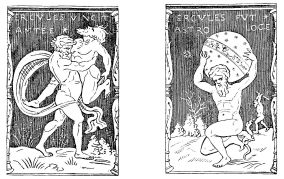
Figs. 107 and 108.—Faces of an Hexagonal Enamelled
Salt-cellar, representing the Labours of Hercules. Executed at Limoges,
for Francis I., by Pierre Raymond.
With the remark that, at the end of the sixteenth century, Venice,
doubtless imitating Limoges, also manufactured pieces of plate in
enamelled copper, we return to our national goldsmiths.
This celebrated corporation could, without much trouble, be traced back
in Gaul to the epoch of the Roman occupation; but it is unnecessary to
search for its origin beyond St. Eloi, who is still its patron, after
having been its founder and protector. Eloi, become prime-minister to
Dagobert I.—thanks in some measure to his merits as a goldsmith, which
distinguished him above all, and gained him the honour of royal
friendship—continued to work no less at his forge as a simple artisan.
“He made for the king,” says the chronicle, “a great number of gold
vases enriched with precious stones, and he worked incessantly, seated
with his servant Thillon, a Saxon by birth, at his side, who followed
the lessons of his master.”
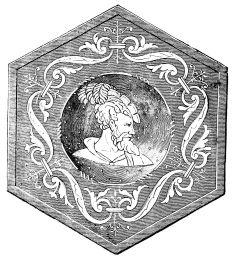
Fig. 109.—Interior base of a Salt-cellar, executed at
Limoges; with a Portrait of Francis I.
This extract seems to indicate that already the goldsmith’s art was
organised as a corporation, and that it comprised three ranks of
artisans—the masters, the journeymen, and the apprentices. Besides, it
is clear that St. Eloi founded two distinct corporations of
goldsmiths—one for secular, the other for religious works, in order
that the objects sacred to worship should not be manufactured by the
same hands that executed those designed for profane uses or worldly
state. The seat of the former in Paris was first the Cité, near the very
abode of St. Eloi long known as the maison au fèvre, and surrounding
the monastery of St. Martial. Within the jurisdiction of that monastery
was the space comprised between the streets of La Barillerie, of La
Calandre, Aux Fèves, and of La Vieille Draperie, under the denomination
of “St. Eloi’s Enclosure.” A raging fire destroyed the entire quarter
inhabited by the goldsmiths, excepting the monastery; and the lay
goldsmiths went forth and established themselves as a colony, still
under the auspices of their patron saint, in the shadow of the Church of
St. Paul des Champs, which he had caused to be constructed on the right
bank of the Seine. The assemblage of forges and shops of these artisans
soon formed a sort of suburb, which was called Clôture, or Culture
St. Eloi. Subsequently some of the goldsmiths returned to the Cité; but
they remained on the Grand-Pont, and returned no more to the streets,
where the cobblers had established themselves. Moreover, the monastery
of St. Martial had become, under the administration of its first abbess,
St. Anne, a branch of the goldsmith’s school which the “Seigneur Eloi”
had established in 631 in the Abbey of Solignac, in the environs of
Limoges. That abbey, whose first abbot, Thillon or Théau—a pupil, or,
as the chronicle expresses it, a servant of St. Eloi—was also a skilful
goldsmith, preserved during several centuries the traditions of its
founder, and furnished not only models, but also skilful workmen, to all
the monastic ateliers of Christendom which exclusively manufactured for
the churches jewelled and enamelled plate.
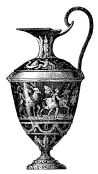
Fig. 110.—Ewer in Enamel, of Limoges, by Pierre
Raymond.
However, the goldsmiths of Paris engaged in secular works continued to
maintain themselves as a corporation; and their privileges, which they
ascribed to the special regard of Dagobert for St. Eloi, were
recognised, it is said, in 768 by a royal charter, and confirmed in 846
in a capitulary of Charles the Bald. These goldsmiths worked in gold and
silver only for kings and nobles, whom the strictness of the sumptuary
laws did not reach. The Dictionary of Jean de Garlande informs us that,
in the eleventh century, there were in Paris four classes of workmen in
the goldsmith’s trade—those who coined money (nummularii), the
clasp-makers (firmacularii), the manufacturers of drinking-goblets
(cipharii), and the goldsmiths, properly so called (aurifabri). The
ateliers and the shop-windows of these last were on the Pont-au-Change
(Fig. 111), in competition with the money-changers, who for the most
part were Lombards or Italians. From that epoch a rivalry commenced
between these two trade guilds, which only ceased on the complete
downfall of the money-changers.
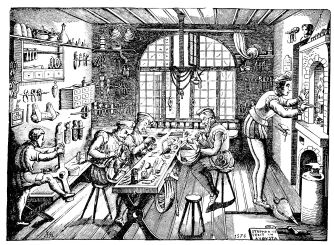
Fig. 111.—Interior of the Atelier of Etienne Delaulne, a
celebrated goldsmith of Paris, in the Sixteenth Century. Designed and
engraved by himself.
When Etienne Boileau, Provost of Paris in the reign of Louis IX., wrote
in obedience to the legislative designs of the king, his famous “Livre
des Métiers,” to establish the existence of guilds on permanent
foundations, he had scarcely more to do than to transcribe the statutes
of the goldsmiths almost the same as those instituted by St. Eloi, with
the modifications consequent on the new order of things. By the terms of
the ordinances drawn up by Louis, the goldsmiths of Paris were exempt
from the watch, and from all other feudal services; they elected, every
three years, two or three anciens (seniors) “for the protection of
the trade,” and these anciens exercised permanent vigilance over the
works of their colleagues, and over the quality of the gold and silver
material used by them. An apprentice was not admitted as a master until
after ten years’ apprenticeship; and no master could have more than one
apprentice, in addition to those belonging to his own family. The
corporation, so far as concerned the fraternity with respect to works
for charitable and devotional purposes, had a seal (Fig. 116) which
placed it under the patronage of St. Eloi; but, with regard to its
industrial association, it imprinted on manufactured articles a seing,
or stamp, which guaranteed the value of the metal. The corporation soon
obtained, from Philip of Valois, a coat-of-arms, which conferred on it a
sort of professional nobility; and acquired, owing to the distinguished
protection extended to it by that king, a position which nevertheless it
did not succeed in preserving in the united constitution of the six
mercantile bodies; for, although it laid claim to the first rank on
account of its antiquity, it was forced, notwithstanding the undeniable
superiority of its works, to be contented with the second, and even to
descend to the third rank.
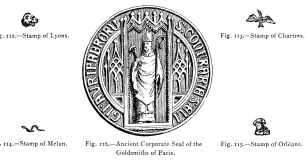
Fig. 112.—Stamp of Lyons. | | Fig. 113.—Stamp of Chartres. |
Fig. 114.—Stamp of Melun. | Fig. 115.—Stamp of Orléans. | Fig. 116.—Ancient Corporate Seal of the Goldsmiths of
Paris. |
The goldsmiths, at the time of the compilation of the code of
professions by Etienne Boileau, were already separated, voluntarily or
otherwise, from several trades which had long appeared in their train;
the cristalliers, or lapidaries; the gold and silver beaters; the
embroiderers in orfroi (gold-fringe); the patenôtriers
(bead-stringers) in precious stones lived under their own regulations;
the monétaires (bullion-dealers) remained under the control of the
king and his mint; the hanapiers (drinking-cup makers), the
fermailleurs (makers of clasps), the pewterers, boxmakers, inferior
artisans and others who worked in common metals, had no longer any
connection with the goldsmiths of Paris. But in the provinces, in towns
where the masters of a trade were insufficient to constitute a community
or fraternity having its chiefs and its own administration, it was
indispensable to reunite under the same banner the trades between which
there was the most agreement, or rather the least contrariety. Thus, in
certain localities in France and the Low Countries, the goldsmiths,
proud as they might be of the nobility of their origin, sometimes found
themselves united as equals with the
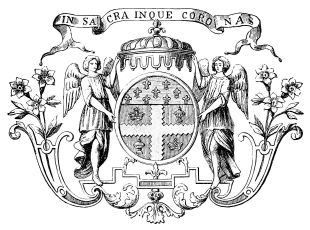
Fig. 117.—Arms of the Corporation of Goldsmiths of
Paris, with this device: “Vases Sacrés et Couronnes, voilà notre
Œuvre.”
pewterers, the mercers, the braziers, and even the grocers; and thus it
came to pass that they combined on their banners of fleurs-de-lis the
proper arms of each of these several trades. Thus, for instance, we see
the banner of the goldsmiths of Castellane (Fig. 118) united with the
retail mercers and tailors—it shows a pair of scissors, scales, and an
ell measure; at Chauny (Fig. 119), a ladder, a hammer, and a vase,
indicate that the goldsmiths had for compeers the pewterers and the
slaters; at Guise (Fig. 120), the association of farriers, coppersmiths,
and locksmiths, is allied with the goldsmiths by a horse-shoe, a mallet,
and a key; the brewers of Harfleur (Fig. 121) quartered in their arms
four barrels between the bars of the cross gules charged with a goblet
of gold, which was the emblem of their associates the goldsmiths; at
Maringues (Fig. 122), the gold cup on a field gules surmounts the
grocer’s candles.
These banners were displayed only on great public ceremonies, in solemn
processions, receptions, marriages, the obsequies of kings, queens,
princes, and princesses. Exempted from military service, the goldsmiths,
unlike other trade corporations, had not the opportunity of
distinguishing themselves in the militia of the communes. They,
nevertheless, occupied the first place in the state processions of
trades, and frequently filled posts of honour. Thus in Paris they had
the custody of the gold and silver plate when the good city entertained
some illustrious guest at a banquet; they carried the canopy above the
head of the king on his joyful accession; or, crowned with roses, walked
bearing on their shoulders the venerated shrine of St. Geneviève (Fig.
123).

Fig. 118.
Fig. 119.
Fig. 120.
In the wealthy cities of Belgium, where the corporations were queens
(reines), the goldsmiths, by virtue of their privileges, dictated the
law and swayed the people. No doubt in France they were far from
enjoying the same political influence; nevertheless, one of them was
that provost of merchants, Etienne Marcel, who, from 1356 to 1358,
played so bold a part during the regency of the Dauphin Charles. But it
was especially in periods of peace and prosperity that the goldsmith’s
art in Paris shone in all its splendour; then its banners incessantly
waved in the breeze for the festivals and processions of its numerous
and wealthy brotherhoods to the churches of Notre-Dame, St. Martial, St.
Paul, and St. Denis of Montmartre.

Fig. 123.—The Corporation of the Goldsmiths of Paris
carrying the Shrine of St. Geneviève. (From an engraving of the
Seventeenth Century.)
In 1337 the number of the wardens of the goldsmith’s guild in Paris had
increased from three to six. They had their names engraved and their
marks stamped on tablets of copper, which were preserved as archives in
the town-hall. Every French goldsmith, admitted a master after the
production of his principal work, left the impression of his sign
manual, or private mark, on similar tablets of copper deposited in the
office of the guild; while the stamp of the community itself was
required to be engraved at the mint to authorise its being used. Every
corporation thus had its mark, which the wardens set on the articles
after having assayed and weighed the metal. These marks, at least in the
later centuries, represented in general the special arms or emblems of
the cities; for Lyons, it is a lion; for Melun, an eel; for Chartres, a
partridge; for Orleans, the head of Joan of Arc, &c. (Figs. 112 to 115).

Fig. 124.—Gold Cross, chased. (A French Work of the
Seventeenth Century.)
The goldsmiths of France manifested, and with reason, a jealousy of
their privileges, it being more indispensable for them than for any
other artisans to inspire that confidence without which the trade would
have been lost; for their works were required to bear as authentic and
legal a value as that of money. Therefore, it may be understood that
they exercised keen vigilance over all gold or silver objects which were
in any way under their warranty: hence the frequent visits of the sworn
masters to the ateliers and shops of the goldsmiths; hence the perpetual
lawsuits against all instances of negligence or fraud; hence those
quarrels with other trades which arrogated to themselves the right of
working in precious metals without having qualified for it. Confiscation
of goods, the whip, the pillory, were penalties inflicted on goldsmiths
in contraband trade who altered the standard, concealed copper beneath
the gold, or substituted false for precious stones.
It, indeed, seems remarkable that while for the most part other trades
were subject to the control of the goldsmiths, the latter were
responsible only to themselves for the aggressions which they constantly
committed within the domain of rival industries. Whenever the object to
be manufactured was of gold, it belonged to the goldsmith’s trade. The
goldsmith made, by turns, spurs as the spur-maker; armour and arms, as
the armourer; girdles and clasps, as the belt-maker and the clasp-maker.
However, there is reason to believe that in the fabrication of these
various objects, the goldsmith had recourse to the assistance of special
artisans, who could scarcely fail to derive all possible advantage from
such fortuitous association. Thus, when the gold-wrought sword which
Dunois carried when Charles VII. entered Lyons in 1449, mounted in
diamonds and rubies, and valued at more than fifteen thousand crowns,
was to be made, the work of the goldsmiths probably consisted only of
the fashioning and chasing the hilt, while the sword-cutler had to forge
and temper the blade. In the same manner, when it was required to work a
jewelled robe, such as Marie de Medicis wore at the baptism of her son
in 1606, the robe being covered with thirty-two thousand precious stones
and three thousand diamonds, the goldsmith had only to mount the stones
and furnish the design for fixing them on the gold or silk tissue.

Fig. 125.—Pendant, adorned with Diamonds and Precious
Stones. (Seventeenth Century.)
Long before Benvenuto and other skilful Italian goldsmiths were summoned
by Francis I. to his court, the French goldsmiths had proved that they
needed only a little encouragement to range themselves on a level with
foreign artists. But that patronage having failed them, they left the
country and established themselves elsewhere; thus at the court of
Flanders, Antoine of Bordeaux, Margerie of Avignon, and Jean of Rouen,
distinguished themselves. It is true that in the reign of Louis XII.,
whose exchequer had been exhausted in the Italian expeditions, gold and
silver had become so scarce in France, that the king was obliged to
prohibit the manufacture of all sorts of large plate (grosserie). But
the discovery of America having brought with it an abundance of the
precious metals, Louis XII. recalled his ordinance in 1510; and
thenceforth the corporations of goldsmiths were seen to increase and
prosper, as luxuriousness, diffused by the example of the great,
descended to the lower ranks of society. Silver plate soon displaced
that of tin; and before long personal display had attained such a
height, “that the wife of a merchant wore on her person more jewels than
were seen on the image of the Virgin.” The number of the goldsmiths then
became so great that in the city of Rouen alone there were in 1563 two
hundred and sixty-five masters having the right of stamp!
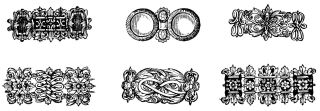
Figs. 126 to 131.—Chains.
To sum up this chapter. Until the middle of the fourteenth century it is
the religious art which prevails; the goldsmiths are engaged only in
executing shrines, reliquaries, and church ornaments. At the end of that
century, and during the one following, they manufactured gold and
silver

plate, enriching with their works the treasuries of kings and nobles,
and imparting brilliant display to the adornment of dress. In the
sixteenth and seventeenth centuries the goldsmiths applied themselves
more to chasing, enamelling, and inlay-work. Everywhere are to be seen
marvellous trinkets—necklaces, rings, buckles, chains, seals (Figs. 124
to 142). The weight of metal is no longer the principal merit; the skill
of the workman is especially appreciated, and the goldsmith executes in
gold, in silver, and in precious stones, the beautiful productions of
painters and engravers. Nevertheless, the demand for delicate objects
had the disadvantage of requiring much solder and alloy, which
deteriorated the standard of metal. Then a desperate struggle commenced
between the goldsmiths and the mint—a struggle which was prosecuted
through a maze of legal proceedings, petitions, and ordinances, until
the middle of the reign of Louis XV. At the same time the Italian and
German goldsmiths making an irruption into France and introducing
materials of a low standard, the old professional integrity became
suspected and was soon disregarded. At the end of the sixteenth century
very little plate was ornamented: there is a return to massive plate,
the weight and standard of which could be easily verified. Gold is
scarcely any longer employed, except for jewels; and silver in a
thousand forms creeps into the manufacture of furniture. After
cabinets, covered and ornamented with carving in silver, came the
articles of silver furniture invented by Claude Ballin. But the mass of
precious metal withdrawn from circulation was soon returned to it, and
the fashion passed away. The goldsmiths found themselves reduced to
manufacture only objects of small size; and for the most part they
limited themselves to works of jewellery, which subjected them to less
annoyance from the mint. Besides, the art of the lapidary had almost
changed its character, as well as the trade in precious stones. Pierre
de Montarsy, jeweller to the king, effected a kind of revolution in his
art, which the travels of Chardin, of Bernier, and of Tavernier, in the
East had, so to say, enlarged. The cutting and mounting of precious
stones has not since been excelled. It may be said that Montarsy was the
first jeweller, as Ballin was the last goldsmith.
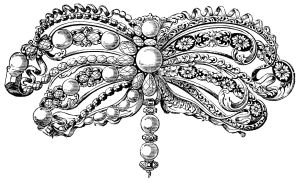
Fig. 142.—Chased and Enamelled Brooch, embellished with
Pearls and Diamonds. (Seventeenth Century.)


