Our earliest intelligence respecting textile fabrics
of old Spain derives almost exclusively from
Moorish sources, and shows, together with the
silence of Saint Isidore, that until the subjugation
of the Visigoths, the occupants of the Peninsula
attached no great importance to this industry.
Under the Moors, the south and east of Spain
grew rapidly famous for the manufacture of all
kinds of textile stuffs, and in particular those of
silk. The origin of these silks, or of the most
luxurious and artistic of them, may be traced to
Almería. According to Al-Makkari, what made
this Andalusian capital superior to all other cities
of the world was her “various manufactures of
silks and other dress materials, such as the dibaj,
a silken fabric of many colours, surpassing, both
in quality and durability, all other products made
elsewhere, and also the tiraz, a costly stuff whereon
are inscribed the names of sultans, princes, and
other personages, and for making which there used
to be no fewer than eight hundred looms. Inferior
fabrics were the holol (a kind of striped silk), and
brocades woven upon a thousand looms, while as
many more were employed continually in making
the scarlet stuffs called iskalaton. Another
thousand produced the robes called al jorjani (or
‘the Georgian’), and yet another thousand the
Isbahani robes, from Isfahan, and yet another
thousand the robes of Atabi. The making of
damask for gay-coloured curtains and turbans for
the women kept busy as many persons as the
articles above-mentioned.”
Edrisi, a chronicler of the twelfth century, says
of the same capital that she was the principal city
belonging to the Moors in the time of the Moravides.
In fact, she was then a great and prosperous
industrial centre, possessing, together with other
kinds of looms, eight hundred which produced the
fabrics known as holla, debady, siglaton, espahani,
and djordjani, curtains with a flowered decoration,
cloths of a smaller size, and the stuffs which were
denominated attabi and mi djar.
A similar notice is contained in the Chronicle
of Rassis the Moor. Referring to the end of the
tenth century, this author wrote that “Almería is
the key of profit and of all prosperity. Within
her walls dwell cunning weavers who produce
in quantities magnificent silken cloths inwoven
with gold thread.” Other important centres of
this trade and craft were Málaga, Baeza, Alicante,
Seville, and Granada. Rassis wrote of Málaga:
“She has a fertile territory, wherein is made
the finest sirgo in the world. From here they
trade in it with every part of Spain. Here too
is made the finest of all linens, and that which the
women best esteem.” Of Baeza he wrote: “She
manufactures excellent and famous silken cloths
of the kind which are called tapetes”; and of
Alicante, “This city lies in the Sierra de Benalcatil,
which in its turn is situated in the midst of
other ranges containing prosperous towns where
silken cloths of finest quality were made in other
days; and the weavers of these cloths were skilled
exceedingly.”
Málaga is described by the Cordovese historian
Ash Shakandi (thirteenth century) as “famous for
its manufactures of silks of every colour and design,
some of them so costly that a suit is sold for
thousands; such are the brocades of beautiful
pattern, inwoven with the names of caliphs, emirs
and other wealthy personages…. As at Málaga
and Almería, there are at Murcia several manufactories
of silken cloth called al washiu thalathat,
or ‘the variegated.’ This town is also celebrated
for the carpets called tantili, which are exported
to all countries of the east and west, as well as for
a sort of bright-coloured mat with which the
Murcians cover the walls of their houses.”
The ancient Illiberia or Illiberis, believed to
have been situated not far from where is nowadays
Granada, is described in Rassis' chronicle as “a
city great and flourishing by reason of the quantity
of silk that she exports to every part of Spain.
She lies at sixty thousand paces distance from,
and on the southward side of Cordova, and six
thousand paces from, and to the north of the
Frozen Sierra” (i.e. the Sierra Nevada).
Another chronicle—that of El Nubiense, who
visited Spain towards the twelfth century—states
that in the kingdom of Jaen alone were six
hundred towns which produced and carried on a
trade in silk.
The foregoing extracts show that under the
Spanish Moors the manufacture of textile fabrics
attained in mediæval times a very great importance.
It is also certain that during the same
period the textile fabrics in use among the Christian
Spaniards were strongly and continually influenced,
and even to a large extent produced, by Spanish
Moors, while, as the Moorish cities fell into the
power of the enemy, the Christian rulers encouraged
their newly-sworn Mohammedan lieges
to prosecute this industry with unabated zeal. A
privilege is extant which was granted by Jayme
the Conqueror in the year 1273, to a Moor named
Ali and his sons Mohammed and Bocaron, empowering
these artificers to manufacture silk and
cloth of gold at Jativa, in the kingdom of
Valencia. The fabrics produced by Mussulman
weavers such as these, found ready purchase with
the wealthier classes of the Christian Spaniards.
The dress and other materials thus elaborated
possessed a great variety of names, whose meaning
cannot always be determined at the present
day. Among the fabrics most in vogue were
those denominated samit (also xamed or examitum),
ciclaton, tabis or atabi, zarzahan, fustian or
fustan, cendal or sendat, camelote (also chamelote
or xamellot), drap imperial, and bougran (also
bouckram, buckram), stated by Dr Bock to be
derived from Bokhara, and which was of a quality
far superior to the buckram of more modern
times. These Saracenic or semi-Saracenic stuffs
were manufactured from an early period, but
modern experts are not agreed as to their character.
Miquel y Badía and some other authorities
believe that samit was a costly material which was
sometimes coloured green, and shot with gold or
silver thread. Others believe it to have been a
kind of velvet. In either case it is known to have
been used for shrouding the bodies of the wealthy.
Ciclaton was a strong though flexible material used
for robes and also for wall-hangings. Tabis or
atabi was a kind of taffeta, and probably consisted,
as a general rule, of silk, though sometimes it
was mixed with cotton. Chamelot was an oriental
fabric of rich silk, coloured white, black, or grey.
It is mentioned, together with velvets, taffetas,
and cendal or sendat (another silken stuff) in a law
passed by the Cortes of Monzón in 1375, and
which is quoted in Capmany's Memorias.[1] Fustian
is thought to have been first produced in Egypt.
It was woven of thread or cotton, and was
largely used in England from at least as early as
the twelfth century. From about the same time
buckram was also popular in northern countries.
Early in the fourteenth century a number of
other costly stuffs began to be made in various
quarters of the civilized world, including Spain.
Among these fabrics were zatonin or zatony
(perhaps the same as zetani, aceituni, or aceytoni—that
is, satin), several kinds of drap d'aur or cloth
of gold, several kinds of velvet, sarga or serge,
and camocas, which is stated by Miquel y Badía
to have been a strong material used for lining
curtains, coats of mail, etc. The same writer
observes that the stuff called by the name zatonin
and its variations is the same as the Castilian raso
and the Catalan setí or satí, a favourite though
expensive and luxurious fabric in the fourteenth
and succeeding centuries. Under the name
aceytoni it is mentioned in a work in the Catalan
language titled Croniques d'Espanya, by Pedro
Miguel Carbonell, in which we read that at
the coronation of Don Martin of Aragon this
monarch's consort, Doña María, was “dressed in
white cloth of gold and a long mantle … and
rode upon a white horse covered with trappings
of white aceytoni.”
Miquel y Badía has discovered the names of
other fabrics which are known from documentary
evidence to have been used in older Spain, and
which were called aducar, alama, tela de nacar,
primavera or primavert, almexia, picote, and
velillo. It is probable that alama and tela de
nacar had silver interwoven with their texture.
The primavera or “spring fabric” was so named
from the flowers which adorned it. Almexía is
mentioned in the Chronicle of the Cid. It was a
costly and elaborate stuff, and is believed by
Miquel to have taken its title from the city of
Almería. Picote was a kind of satin manufactured
in the island of Majorca, and velillo a thin, delicate
fabric decorated with flowers and with silver thread.
The devices on all these stuffs were very varied.
Prominent types among them were the pallia
rotata, containing circles which are commonly combined
with other ornament, the pallia aquilinata,
in which the dominant motive was the eagle, and
the pallia leonata, in which it was the lion. Other
beasts, birds, and monsters were also figured with
great frequency, such as griffins, peacocks, swans,
crows, bulls, tigers, or dogs; but the emblem
most in favour, especially throughout the tenth,
eleventh, and twelfth centuries, was the eagle,
owing to the numerous and illustrious qualities
attributed to it, such as majesty, victory, valour,
and good omen. These creatures, too, were
frequently represented face to face or back to
back, in pairs; nor were they so disposed in textile
fabrics only, but on ivory, wood, or silver caskets,
and on numerous other objects, as well as on the
painted friezes of a place of worship.[2]
The colours of these fabrics also varied very
greatly. That which was most admired was probably
red, crimson, or carmine, used by preference
as a ground, with the pattern inwoven or super-woven
in gold, silver, or otherwise. Velvets, too,
were not invariably in monochrome, but would contain
two or three colours such as purple, crimson,
blue, or yellow, besides gold and silver. Miquel
y Badía mentions a magnificent velvet pluvial in
gold and three colours, belonging to a church in
Cataluña. The following observations are by the
same authority, who himself possesses a valuable
collection of early textile fabrics, many of which
are Spanish. “The same prevailing colours are
found in the Mudejar textile fabrics as in those
of the Spanish Moors—the same ground of red
inclining to carmine, of dark blue, or of bluish
green, with a pattern in yellow, green, blue, or
red, according to the colour which combines with
it. I have seen copies of Mudejar stuffs in which
there is no white, because this was wanting in the
fragments which the copying artist had before
him. And it is a fact that from some cause,
which we cannot now determine, white silk is that
which disappears soonest from among the textile
fabrics of the Spanish Moors and Mudejares, so
that by far the greater part of them contain no
white at all, or only traces of it.”
In Spain these handsome stuffs were used by all
the wealthier classes, and some idea of their prevalence
and popularity may be formed from the
voluminous mass of sumptuary laws which deal
with them at almost every stage of Spanish history.
Thus, an edict of Jayme the First of Aragon
established, in the year 1234, that neither the
monarch nor any of his subjects were to decorate
their clothes with gold and silver, or fasten their
cloaks with gold or silver clasps. The Ordenamiento
of Alfonso the Tenth, subscribed at Seville,
February 27th, 1256, provides that no woman is
to carry aljofar-work, trim her dress with gold or
silver, or wear a toca decorated with those metals,
but only a plain white one, the price of which is
not to exceed three maravedis. It is also provided
by this edict that on the celebration of a
wedding, the cost of the bridal clothes must not
exceed sixty maravedis, nor may the number of
guests who sit down to the marriage banquet
exceed five women and five men, besides the
witnesses of the ceremony and relatives of the
bride and bridegroom. This absurd law was so
extensively neglected that two years later the
Cortes of Valladolid took up the matter afresh,
and even resolved that the expenses of the king's
table, without the cost of his invited guests, were
not to exceed a daily total of a hundred and fifty
maravedis.
In a.d. 1286 the Council of Cordova decreed
that knights and squires, upon the celebration of
their marriage, were not to present their brides
with more than two dresses, one of these to be of
scarlet, without trimming of ermine or grey fur, or
decoration of gold, silver, or aljofar. A law of
Alfonso the Eleventh, dated May 6th, 1338, proclaimed
that the women of the upper classes were
not to clothe themselves in any silken fabric decorated
with gold thread. Similar restrictions
were laid upon the other sex. “No man, whatever
be his condition (excepting only Us, the
King), shall wear cloth of gold, or silk, or any
stuff adorned with gold lace, aljofar, or any other
trimming, or with enamel: only his cloak may
bear aljofar pearl-work, or fillets without pearls.”
Other dispositions signed by the same monarch
show that the Spaniards of his time were in the
habit of wearing costly cloth adorned with gold
and silver, pearls, gold buttons, enamel, and other
ornament, while even the squires wore furs and
gilded shoes. The ricos-hombres loaded their
saddles with gold and with aljofar-work, and their
wives were licensed to bear on each of their
dresses the same aljofar-work or strings of tiny
pearls, to the value of four thousand maravedis.
Provisions of the same tenor are contained in
the prolix sumptuary pragmatic of Pedro the
Cruel, signed in the year 1351 at Valladolid, as
well as in that of Juan the First, a.d. 1385, which
ordained, together with other vexatious prohibitions,
that “neither man nor woman, whatever be
their condition or estate, shall wear cloth of gold
or any silk-stuff, gold or silver aljofar, or other
precious stones, excepting the Infante and Infantas,
who may wear whatever pleases them.”
The extravagance of Isabella the Catholic in
dress and personal adornment generally, was illustrated
in an earlier chapter of this work. A
further instance is recorded by Clemencin. According
to this chronicler, in 1476 and 1477,
upon her reception at Alcalá of two embassies
from France, the queen was dressed in a magnificent
robe, which drew upon her a sharp rebuke
from her confessor, the virtuous and austere
Hernando de Talavera. From this charge Isabella
defended herself with more spirit than truthfulness.
“Neither myself nor my ladies,” she
wrote in her letter of reply, “were dressed in new
apparel. All that I wore on this occasion I had
already worn in Aragon, and the French themselves
had seen me wearing it. I only used one
robe at all, and that of silk with three marks
of gold, the plainest I could find: in this was all
my festival. I say this much in that my clothing
was not new; nor did we deem that error could
dwell therein.”[3]
Although their own extravagance is past all
question, on September 30th, 1499, Ferdinand
and his consort issued a proclamation at Granada,
in which it was commanded that “no persons shall
wear clothing of brocade, or silk, or silk chamelote,
or zarzahan, or taffeta, or carry linings of the same
upon the trappings of their horses, or upon hoods,
or the straps and scabbards of their swords, or
bits, or saddles, or alcorques[4] … nor shall they
wear embroidered silk-stuffs decorated with gold
plates, whether such gold be drawn or hammered,
spun to a thread, or interwoven with the fabric.”
These prohibitions, or others of their import,
were ratified by Doña Juana at the Cortes of
Burgos, and, in 1533, by Charles the Fifth at
Valladolid. In 1551 the Emperor again prohibited
“all brocaded stuffs, or gold or silver cloth,
whether embroidered or enriched with gold or
silver thread, or bound with cord or edging of
the same;” and a royal edict of January 12th,
1611, forbade the wearing of brocade and every
other costly stuff to all except the clergy and the
military.
The clergy, indeed, had always been notorious
for extravagance, and not a few of all these
sumptuary laws are aimed specifically at them.
In a.d. 1228 the Council of Valladolid prohibited
the use by priests of sleeved robes, or gilded
saddles, bits, spurs, or poitrels. In 1267 the
Synod of León repeated these prohibitions, further
insisting that the garments of the clergy, besides
being sleeveless, were not to be red or green, and
were to have a moderate length (“non muy largas,
non muy cortas”), and that their cloaks were not
to fasten with a clasp or cord; these regulations
to be rigidly adhered to en sennal de honestidat—“as
a sign of honesty.”
We also know that at this time (thirteenth
century) the shirts of many of the wealthier
Spaniards were woven of finest linen imported from
the East, embroidered and picked out with gold and
silver thread, and that the clergy were at least the
equals of the laity in their craze for costly clothing.
In a.d. 1273, an inventory was made of the effects
belonging to Don Gonzalo Palomeque, on his
election to the bishopric of Cuenca. It mentions
almadraques and Murcian tapetes, carpitas viadas
from Tlemcen, fine Murcian blankets (alhamares),
silk xamedes, Murcian matting for covering walls
and daïses (“para paret et para estrado”), and
stuffs from Syria. Another inventory, that of Don
Gonzalo Gudiel, archbishop of Toledo, is dated
a.d. 1280, and mentions, as included with his
property, quantities of oriental fabrics which are
designated by the general name tartaricas.[5]
Among them were “unus pannus operatus ad
aves de auro et campus de serica viridi, item unus
alius pannus tartaricus cum campo de seta alba et
vite aurea, item unus pannus tartaricus de seta
rubea cum pinis aureis, item unus pannus tartaricus
de seta viridi.”[6]
A number of mediæval textile fabrics, some in
fragments, some intact, have been preserved in
Spanish private collections or museums. It is,
however, seldom easy to determine whether they
were made in this Peninsula, or whether in Sicily,
Byzantium, Venice, or the East. Among the
most remarkable of all these interesting specimens
are, a strip which was extracted from the
mausoleum of a Spanish bishop, Don Bernardo
Calbó, a native of Vich in Cataluña, and which is
now in the museum of that town; other fragments
in the same collection, including one of holosericum
or pure silk, which was formerly in the neighbouring
church of San Juan de las Abadesas, and is
commonly known as the pallium or altar front “of
the witches” (owing to certain beasts or monsters
figuring in the design), a Moorish tiraz, now in
the Academy of History at Madrid, the celebrated
Moorish “banner of the battle of Las
Navas,” now in the Monastery of Santa María la
Real de las Huelgas at Burgos, the banner (also
Moorish) of the battle of the River Salado, the
chasubles “of the Constable” and of Chiriana, preserved
respectively at Burgos and at Caravaca,
a fragment, preserved in the Royal Armoury at
Madrid, of the shroud of Ferdinand the Third, and
the Moorish clothing of the son of the same King
Ferdinand, the Infante Don Felipe, and of Felipe's
second wife, Doña Leonor Ruiz de Castro.
The strip of woven material found in the
sepulchre of Bishop Calbó, who is said to have
accompanied Don Jayme the Conqueror in the
conquest of Valencia (a.d. 1238), is described by
Miquel y Badía as belonging to the class denominated
pallia rotata—that is, with circles forming
part of their design,—and dates most probably
from the twelfth century; but it is impossible to
say whether it was manufactured in the East, or
whether at Valencia or some other Spanish town.
The same remark applies to other fragments which
are also, as I stated, in the Vich Museum. The
one discovered in the tomb of Bishop Calbó contains,
coloured in green, grey, and black upon a
carmine ground, a decorative scheme of circles,
flowers, and gryphons or other monsters in pairs,
affrontés, and also, within the circles, the figure of
a man grappling with two lions, tigers, dogs, or
other beasts, and who is believed to represent
Samson or Daniel—more probably the latter.
Miquel y Badía points out that in this fragment
the figure of the man recalls Egyptian art, suggested
by his curious head-dress, and by the
crossing of his clothes upon his breast.
Another textile fragment in the same collection
is coloured black, red, and grey upon a yellowish
ground. It is decorated with long-tailed birds
resembling peacocks, and with sphinxes which fill
the circles or medallions. A third fragment, also
in the Vich Museum, belongs to the type of pallia
cum aquilis et bestiolis. The design consists of a
double-headed eagle with half-extended wings,
holding in the claws of either foot some kind of
quadruped—perhaps a bull. The colour of the
ground resembles carmine, and on it the design is
wrought in greenish black—that may have been
originally green—relieved at intervals with yellow.
The “witches'” pallium in the same collection
is decorated with the series of extraordinary
beasts or monsters that have won for it this title
with the vulgar, depicted in yellow, white, black,
and dark green upon a red ground. Miquel
believes this fabric to proceed from Byzantium,
and to date from not much earlier than the
eleventh century. The devices are disposed in
two rows, the lower containing peacocks affrontés,
and the upper a series of fantastic monsters, each
of which possesses a head, two bodies, and four
feet—the head being semi-human, semi-bestial, the
double body that of a bird, and the claws those
of a lion or some other formidable quadruped.
The Royal Academy of History at Madrid
possesses a fragment of the costly fabric known as
tiraz, an eastern word (corrupted by the Spaniards
into taracea, i.e. embroidery on clothing), which
means the bordering for a royal robe. Such
bordering, which contained inscriptions, or the
sultan's name, or both together, is said to have
been first used in Spain by Abderrahman the
Second, who ruled from a.d. 825 to 852. “The
caliphs of Cordova,” says Riaño, “had a place set
apart in their palaces where this stuff was kept:
this custom lasted until the eleventh century, when
it disappeared, and was re-established in the thirteenth
century with the kings of Granada.” Tiraz,
in fact, was both produced and stored in special
departments of the Sultan's palaces[7]; or so we
must infer from the following passage by Ibn-Khaldun.
“The places (almedinas) where these
stuffs were woven were situated within the palaces
of the caliphs, and were known as the ‘pavilions
of the tiraz.’ The person at the head of these
workshops was called the superintendent of the
tiraz: he had charge of both the weavers and the
looms, administered the salaries, and looked to the
quality of the work. This post was entrusted by
the princes to one of the foremost officers of their
kingdom, or else to some freedman who thoroughly
deserved their confidence.” The same historian
adds that the manufacture of tiraz was conducted
in Spain in the same manner as in the East
under the dynasty of the Ommeyades. It is,
however, certain that among the Spanish Moors
tiraz was not produced exclusively in royal
factories. Al-Makkari states that in the time of
the Somadies and the Almoravides there were
looms at Nerja (and possibly at Almería) for
weaving this luxurious fabric, as well as holas, a
fine brocade, heavily embroidered, and adorned
with figures representing the caliphs and other
personages. In the time of the Almoravides
there were at Almería as many as a thousand
factories for making holas.
The piece of tiraz which belongs to the Spanish
Academy of History measures about a yard and a
half in length by eighteen inches wide. Riaño
describes it as of wool, embroidered in silks with
“seated figures which appear to be a king, a lady,
lions, birds, and quadrupeds”; but after carefully
examining it I cannot but agree with Miquel y
Badía that this fabric is woven throughout of pure
silk, without the slightest trace of hand-embroidery.
It has two borders containing these inscriptions in
Cufic letters: “In the name of God, the clement,
the merciful. (May) the blessing of God and
happiness (be) for the Caliph Iman Abdallah
Hixem, the favoured of God and prince of believers.”
This monarch, second of the name,
reigned at the end of the tenth century and early
in the eleventh, and the tiraz we are noticing was
found in a casket on the altar of a church at San
Esteban de Gormaz, in the province of Soria.
As Riaño suggests, it was very probably a war
trophy.
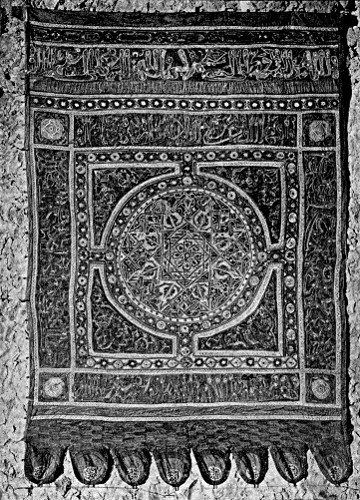
I
THE “BANNER OF LAS NAVAS”
(Monastery of Santa Maria la Real de las Huelgas, Burgos)
Another most interesting example of Saracenic
textile work is the so-called “banner of Las Navas”
(Plate i.), which popular tradition affirms to
have been captured (a.d. 1212) in the memorable
battle of Las Navas de Tolosa, between the
Almohades and the Spanish Christians. Most
experts now consider that this object is not a
military ensign, but a curtain or some other
hanging for a tent or doorway. The material is
sirgo or silken serge, and both the decoration
and the workmanship are purely Moorish. The
design is rich and intricate throughout, consisting
of scrolls, leaves, stems, and inscriptions from
the Koran, disposed with exquisite effect about
the principal and central motive, formed by a
large eight-pointed star within a circle, and
which contains, so as to form the angles of the
star, eight repetitions of the words in Arabic, “The
Empire.” The dominant colour is carmine, and
the fabric terminates in eight farpas or scallops
with red and yellow edges, and bearing a series
of inscriptions in the African character.
The “pendon of the Rio Salado,” a trophy which
seems to have really been a war-flag, belongs to
the cathedral of Toledo. It measures at this day
about nine feet two inches by seven feet four
inches, but is believed to have been originally of a
square form, with scalloped edges. The dominant
colours are red, green, and gold. The decorative
scheme consists of tastefully combined circles and
inscriptions in the Cufic character, and the lower
end concludes in the following sentences, now
rendered incomplete through the loss of nearly
two feet of the material:—“ … the wise, the
victorious, the assiduous, the generous, the sultan,
the caliph, the famous emir of the Muslims and
representative of the Lord of the Universe, Abu-Said
Otsmin, son of our lord and master …
the worshipper of (Allah), the modest, the warlike,
the emir of the Mussulmans Nassir-li-Din
(defender of the law), Abu Yusuf Yacub, son
of Abd-il-Hac. In the Alcázar of Fez (God
bless it. Praised be God), in the Moon of
Moharran of the year twelve and seven hundred”
(712 of the Hegira, or May 9th–June 7th, a.d.
1312).
Tastefully disposed in white Cufic characters,
within four rows of circles woven in gold, are the
words which sum the Mussulman religion,—“There
is no God but God: Mahoma is His Messenger”;
and on other parts of the flag are inscribed these
sentences:—
“The prophet believes in the purpose for which
he was sent by his Lord, and all the faithful believe
in God, in His angels, in His writings, and in His
messengers. We make no distinction between
any of His messengers. And these declare:
‘We hear and do obey. Pardon us, O Lord.’
“…. And unto Thee we shall return. God
will not lay on any soul but such a weight as it
can bear; for it or against it shall be the deeds
it may have done. O Lord, chastise not our
forgetfulness or errors. O Lord, lay not upon us
the burden Thou hadst laid on those that were
before us.
“…. O Lord, burden us not too heavily.
Blot out our faults, and pardon them to us, and
have mercy on us. Thou art our Lord. Grant
us victory over the infidel. There came to us a
glorious prophet that was born among us.
“On him rests the weight of your faults, and
full of goodness and of clemency he longs ardently
for you to believe. If you should be forsaken,
exclaim, ‘God is sufficient for me. There is no
God but He. I trust in Him, because He is
Lord of the throne that is on high.’”
Miquel y Badía considers that when it was
intact this object must have measured eleven feet
square. Attention was first drawn to its merit
and antiquity when it was shown at the Exposición
Histórico Europea of 1892.
The chasubles of Chirinos (Caravaca) and of
the Chapel of the Constable in Burgos cathedral
are both considered to be of Spanish-Moorish
workmanship. The former is woven of silk of
various colours, but without admixture of gold
thread, and bears an inscription in Arabic which
Amador de los Ríos has interpreted as, “Glory to
our Sultan Abul-Hachach.” The same authority
deduces that the fabric dates from the fourteenth
or the fifteenth century—that is, from the time of
the Sultan Abul-Hachach (Yusuf the First) or of
his immediate successors.
The chasuble preserved at Burgos is also woven
of variegated silk without gold thread, and may
originally have been a tiraz, since it bears, in African
letters, the inscription, “Glory to our lord the
Sultan.” The date is probably the fifteenth or
sixteenth century. Fragments of similar material
are in the collections of Señores Osma and Miquel
y Badía.
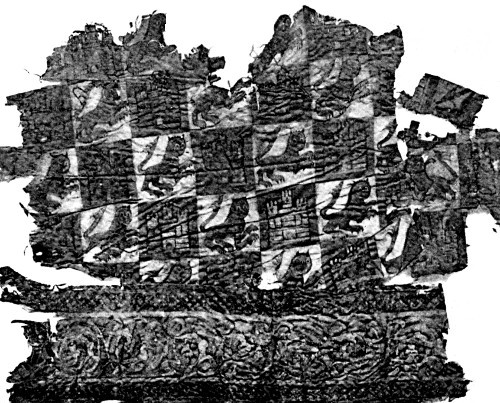
II
FRAGMENT OF THE BURIAL MANTLE OF FERDINAND THE THIRD
(Royal Armoury, Madrid)
The object represented in Plate ii. is described
in the Catalogue of the Royal Armoury at Madrid
as A fragment of the royal mantle in which was
buried the king and saint, Ferdinand the Third
of Castile (a.d. 1217–1252). Gestoso, in the course
of his researches into the history of old Seville, has
found that in the year 1579 Philip the Second
caused an examination to be made at that city of
the remains, enshrined in her cathedral, of Saint
Ferdinand. The body was found “with a ring
with a blue stone on a finger of the right hand,
and wearing sword and spurs.” In 1677 Charles
the Second sent for the ring in question, and
eleven years later a fresh examination was made,
when the mummy of the saint was stated to
be wrapped in “clothing of a stuff the nature of
which cannot now be recognised, but which is
chequered all over with the royal arms of Castile,
and with lions.” A third examination was made
in 1729, when the “holy body of Señor San
Fernando” was reported to be “covered, the
greater part, with a royal mantle, of a stuff
which could not be recognised for its decay: only it
was seen to be embroidered with castles and lions.”
Probably, therefore, this fragment was taken to
Madrid at the same time as the ring—that is, in
the year 1677. It has an irregular shape, and
measures eighteen inches long by thirteen and a
half in breadth. The material is a woven mixture
of silk and gold thread, and the decoration consists
of castles and lions in gold and red respectively,
upon a ground of carmine and dirty white. Count
Valencia de Don Juan points out that this strip
belonged to the lower end of the mantle, since it
includes a portion of the border, formed by a series
of horizontal stripes, blue, yellow, red, and gold.
The character of the whole fragment is decidedly
Mohammedan, and indicates a Mudejar fabric,
made at Seville in the thirteenth century.
I find that in the Book of Chess of Alfonso the
Learned (an illuminated Spanish manuscript executed
in the thirteenth century, and now preserved
at the Escorial), Alfonso himself is represented
(Plate iii.) as wearing a mantle with this very
pattern of lions and castles contained in squares.
Therefore it seems extremely probable, either
that this device was not uncommon on the robes
of Spanish kings, or else that at some time the
body of San Fernando was enveloped in a mantle
belonging to, and which perhaps had been inherited
by, his son.
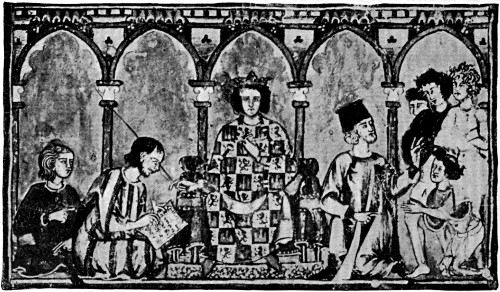
III
KING ALFONSO THE LEARNED
(From “The Book of Chess”; MS. in the Escorial Library)
The clothing of the Infante Don Felipe and of
Doña Leonor, his wife, consists of the prince's
cloak, which is nearly intact, a piece of his aljuba,
his cap, and a strip of silken cloth inwoven with
gold. The latter fragment is thought to have
belonged to the robe of the Infanta.
These objects, discovered in 1848, in the tomb
of Don Felipe and Doña Leonor, at Villalcazar
de Sirga, near Palencia, are now in the National
Museum. The cloak or mantle is richly wrought
in silk and gold, and bears the word Blessing,
woven in Cufic characters upon the ground.
The aljuba is also of silk and gold, showing a
delicate combination of blue and yellow, and the
style and workmanship of all these fragments are
unmistakably Mohammedan.
Therefore, in textile crafts, the Spanish Moors
supplied the wants and the caprices both of themselves
and of their enemies the Christians.
The relationship between certain under-garments
of the two peoples is evident from the very
titles of those garments. Thus, the Spanish
joquejo or soquejo, a scarf for winding round a
woman's body, is obviously derived, or merely
corrupted, from the Arabic jocob; the Spanish
arrede or arrelde, a kind of cloak, from the Arabic
arrida, and the Spanish shirt or tunic for ordinary
wear, called the casot, quesote, or quizote (which
was sometimes white and sometimes coloured)
from the Arabic al-kuesnat. The Chronicle of
Juan the Second (a.d. 1410) tells of a mountain
covered with Moorish troops, “and all of them
had red quesotes.”
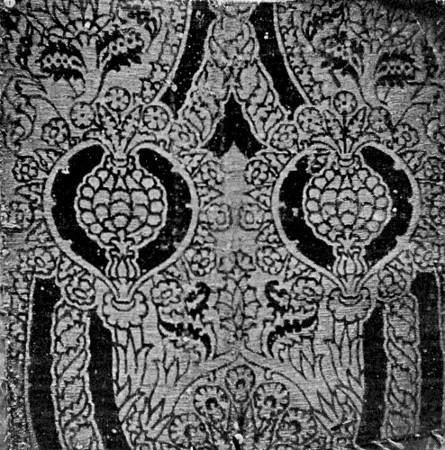
IV
SPANISH VELVET
(Red upon Gold Ground. About A.D. 1500)
Among the cities of Moorish Spain, Almería and
Granada were undoubtedly those which produced
the handsomest stuffs—Almería from comparatively
early in the days of Muslim domination,
Granada from a somewhat later time.[8] Notices
are extant of Christian princes who directly ordered
these materials from Granada; e.g. in 1392 Don
Juan the First caused to be purchased there, as
a present to his daughter on her marriage, “una
cambra de saya orlada ab son dozer e cobertor de
color vermella, blaua, ó vert, ù otro que fuera de
buena vista” (Archives of the Crown of Aragon).
The manufacture of velvet was probably introduced
into Aragon in the reign of Pedro the Fourth.
Excellent silks and cloth of gold were also made
at Málaga, Seville, Toledo, and Valencia. Indeed,
no better source exists for studying the character
of this important industry in older Spain than the
Ordinances of the cities I have just enumerated.[9]
We learn from these municipal provisions, most of
which were framed or ratified in the reign of Ferdinand
and Isabella, that the mingling of fine with
base material was forbidden in the strictest terms,
and that the styles and classes of even the luxurious
and elaborate stuffs, which bore an infinite variety
of devices, were very numerous. Thus, there
were satins, taffetas, azeytunis, double and single
velvets (Plates iv. and vii.), brocades, and silken
serges; as well as fabrics interwoven with gold and
silver thread, including the gorgoranes, restaños,
sargas, and jergas de filigrana de plata. The
Ordinances of Toledo mention the following fabrics
as manufactured in that city in the reigns of
Ferdinand and Isabella, and of Charles the Fifth:—
“Stuffs of gold and silver made in the same manner as satin.
“Satins woven with gold.
“Satins brocaded with silk and gold, or silver
flowers.
“Silver serges with double filigree.
“Silver and gold materials, which are made
like gorgoran or serge.
“Silver and gold stuffs which are made like
taffetas, or in silver with silk flowers.
“Embroidered stuffs.
“Embroidered stuffs called silver serge, or
berguilla.
“Lama, cloth of silver, shaded with watering
in silver.
“Plain silk-stuffs woven with silver or gold,
and called restaño.
“Silk-stuffs woven with gold or silver, and
called relampagos.
“Serges woven with gold and silver for church
vestments.
“Plain filigree serges.
“Velillo of silver.
“Satin woven with gold and silver.
“Brocades of different kinds.
“Church vestments.
“Silver primaveras.
“Serges for church vestments.”
It was usual for ladies of the Christian-Spanish
aristocracy to trim their clothes, in Moorish fashion,
with strings of larger pearls or of aljofar-work—a
custom which continued until the extinction
of the House of Austria. The Alburquerque
inventory includes “a marlota of crimson satin,
trimmed with pearls and with aljofar, as to
the hem, the sleeves, and the hood; with twelve
buttons of aljofar-pearls in the front thereof, that
on a time were thirteen; but one is missing which
was ground up for the said Duchess when she was
sick, and six buttons on each sleeve, and the same
where each sleeve meets the shoulder.”
Early in the seventeenth century, Pinheiro da
Veiga mentions the same fashion at Valladolid:—“At
the sale of the Marchioness of Mondejar, I
saw twelve of her sayas with long trains to them,
and satin bodices, all of embroidered silk, and
some with aljofar-work, besides a number of all
kinds of diabluras.”
It is stated by Ibn-Said, Al-Makkari, Al-Kattib,
and Ibn-Khaldun, that the Moors of Granada
occasionally adopted Christian clothing, and we
know that the Sultan Mohammed, a contemporary
of Alfonso the Learned of Castile, was assassinated
by Abrahim and Abomet, the sons of Osmin,
because he was so clothed, and because he had
further violated the precepts of the Koran by
eating at Alfonso's table.[10] But as a rule the
costume of the Spanish Moors was almost wholly
that of orientals. Where they were tolerated in a
city under Christian rule, a certain dress was
sometimes forced upon them by their subjugators,
as by the Ordenamiento (a.d. 1408) of Doña
Catalina, issued on behalf of her son, Juan the
Second, and which prescribed for the Moorish men
a capuz of yellow cloth with a mark upon it in the
form of a blue half-moon measuring an inch from
point to point, and which was to be worn on the
right shoulder. The garments of the women were
to be similarly marked, on pain of fifty lashes
administered publicly, together with the forfeiture
of all such clothes as lacked this necessary and
humiliating token.
But where the Spanish Moors were in possession
of the soil, their clothes were similar in most
respects to those of eastern peoples. Detailed
notices of these costumes are furnished us by Ibn-Said
and other writers. Fray Pedro de Alcalá
explains in his Vocabulary that, among the
Granadinos, the use of one garment in particular
was limited to royalty, or nobles of high rank.
This was the libas (or, in the Granadino dialect,
libis), shaped like roomy breeches, and greatly
resembling the zaragüelles worn until this hour
by the peasants of the Huerta of Valencia. Ibn-Said,
quoted by Al-Makkari (see Gayangos,
History of the Mohammedan Dynasties in Spain,
Vol. I., p. 116) says that the dress of the Moors
of Andalusia was not identical with that of the
Asiatic Mussulman. The former, he declares,
would often discard the turban; especially those
who lived towards the eastern frontier. In the
western region the turban continued to be generally
worn by the upper classes and by the leading
State officials. Thus, at Cordova and Seville
every cadi and alfaqui would wear a turban, while
at Valencia and Murcia even the nobles went
without it, and among the lower classes it had
fallen into absolute disuse. Neither officers nor
soldiers of the army wore the turban.
We learn from Casiri (Bibl. Arabico-Hispana,
II., p. 258) that the imama[11] was the only form of
head-dress used by the cheiks, cadis, and ulemas of
Granada. At this capital red was the distinctive
colour of the sovereigns of the Alahmar dynasty,
who took their very title from this circumstance,
the Arabic word alahmar meaning “red.” The
distinctive colour of the Nasrite sultans was purple,
which was replaced by black in time of mourning.
In this last fashion the sultans were probably
influenced by the Christian usage, for Ibn-Khaldun
remarks that black was not a colour approved of
by the orientals, who considered it to be related
with the spirits of evil. However this may be,
the manuscript History of the House of Cordova
quoted by Eguilaz Yanguas, says that when
Boabdil el Chico entered that city as a prisoner,
“the captive monarch was dressed in black velvet,
in token of his adverse fortune and defeat. He
rode a richly caparisoned charger, whose coat was
black and glossy.”
The Moors regarded green or white as pleasant
and well-omened colours, symbolic of the angels
and of all good fortune. Perhaps this preference
was suggested to them by the cool oasis in the
desert. Nevertheless, when Ibn-Hud became ruler
of Andalusia, his shields and banners were black,
as well as his costume. Black, too, was the
colour adopted by the Abbaside Sultans, to whom
Ibn-Hud was subject. Under the Beni-Nasr and
Beni-Alahmar, this gloomy hue was changed, as
we have seen, to purple or to scarlet, though black
continued to be used in sign of mourning.
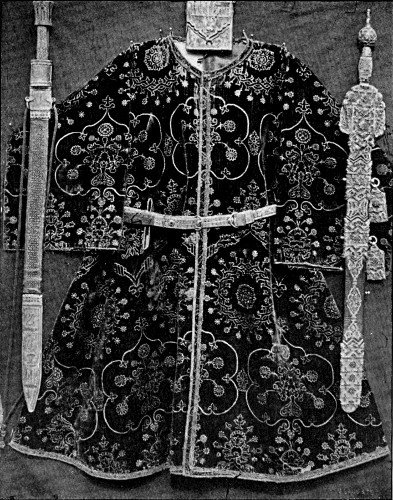
V
THE TUNIC OF BOABDIL EL CHICO
(National Museum of Artillery, Madrid)
The chronicle says that Abu-Said, “the Red,”
who was assassinated at Tablada, under the walls
of Seville, by Pedro the Cruel, was clothed in
scarlet at the time of that atrocious deed. Boabdil
was also clothed in red at the battle of Lucena.
The History of the House of Cordova, from which
I have already quoted, says: “Il était armé d'une
forte cuirasse à clous dorés, doublée de velours
cramoisi, d'un morion teint de grenat et doré….
Sur sa cuirasse était passé un caban de brocart
et de velours cramoisi” (Plate v.). Eguilaz
quotes a further passage from Hurtado de Mendoza,
to prove that red continued to be the official
colour of the Moorish rulers of Granada; for when
the Moriscos had risen in the Alpujarra, and met
together to invest their leaders, Aben-Abu and
Aben-Humeya, with the insignia of royalty, they
clothed the former in a red costume and the latter
in purple, “passing about his neck and shoulders
a red token in the form of a scarf.”[12]
As I remarked in speaking of the tiraz, the
clothing of the Moorish kings of Spain was of
the richest quality obtainable, massively wrought,
embroidered in colours and in gold, and bearing
“sometimes a prince's name, sometimes his device
or motto, or even a portrait of himself embroidered
on the right breast of his caban or robe, thus
following the fashion of the monarchs of Assyria
and Persia.”
A very fair idea of the magnitude of the craft
and trade of Spanish silk in bygone epochs may
be formed by tracing chronologically the production
and treatment of the raw material in
various parts of the Peninsula. During the
centuries of Moorish rule, Spain's principal silk-producing
centre was the kingdom of Granada,
which then embraced a large extent of coast,
together with Málaga and other thriving ports.
In proof of this, and in his interesting memorial
on the silk factories of Seville,[13] Ulloa quotes
old Spanish ordinances of the weavers, stating
that quantities of this substance were exported
from “tierra de Moros” for use by Christian
craftsmen, and also the Chronology of the Kings
of Granada, concluded by Al-Khattib in the year
1364. A fragment of this chronicle is preserved
at the Escorial, and states, in the well-known
version of Casiri, that the silk produced at
Granada was both abundant and of excellent
quality, surpassing even the Assyrian.
The growing of mulberry trees and rearing
of silkworms was also busily pursued in the
kingdom of Aragon, which formerly included
Cataluña, Valencia, and the Balearic Islands.
Hence, though somewhat gradually, it seems to
have spread to Seville. In the ordinances of this
town relating to her weavers of silks and velvets,
and which are dated 1492, it is stated that her
oficiales de texer sedas were so few that, as a
stimulus to augment their number, all who wished
might join them in the practice of this craft
without examination. Between that year and
1502 they evidently multiplied, since subjects of
examination of no easy character are formulated
in the ordinances of this later date, examined and
confirmed by Ferdinand and Isabella. Nevertheless,
it is impossible to credit the assertion of some
authors that by the year 1519 Seville possessed
no less than sixteen thousand looms, affording
occupation to one hundred and fifty thousand
persons. As Ulloa suggests, it is far more
reasonable to suppose that her silk trade grew in
proportion as the Spaniards continued to discover,
and to open up to commerce, new regions of
America; and that it reached the maximum of its
development in the reigns of Charles the Fifth
and Philip the Second. The same writer attributes
its decline and downfall to the “piracies
and insults” of Spain's foreign enemies and rivals.
The price of Seville silks was also raised and
the trade injuriously affected, by the imposition, at
the close of the reign of Philip the Second, of the
onerous millones tax, as well as of the minor dues
denominated alcavalas and cientos; while finally,
when Philip the Third was on the throne, the expulsion
of the Moriscos precipitated the utter ruin
of this industry.
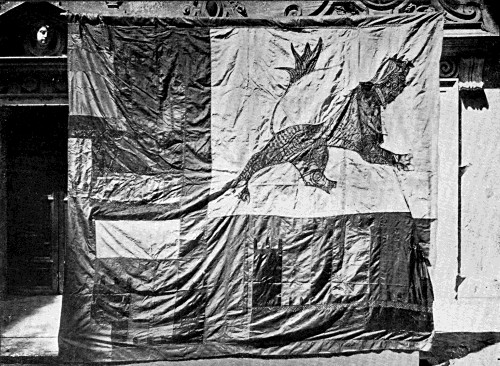
VI
THE “BANNER OF SAINT FERDINAND”
(Seville Cathedral)
The Spanish government proved quite incapable
of grappling with these wrongs and difficulties.
There were, however, numerous attempts to legislate
in the direction of reform. Measures forbidding
the introduction of silk proceeding from abroad
received the royal signature in 1500, 1514, 1525,
1532, and 1552. A petition to the same effect,
framed by the procurators of the Cortes, was presented
to the king in 1618, urging that no skein or
twisted silk proceeding from the Portuguese Indies,
China, or Persia should be imported into Spain in
view of the damage thus inflicted on the silk-producing
regions of Granada, Murcia, and Valencia.
At the same time the petitioners suggested that if
it should be found impracticable to suppress such
importation altogether, the foreign silk should be
required to be in the form of stuffs already woven.
Matters grew steadily worse all through the
reign of Philip the Fourth. The principal cause
of this additional decline lay in the constant depreciation
of the national currency, which kept at
an intolerable pitch of dearness the price of home-grown
silk, and enabled foreign traders to undersell
the Spaniard. This will be better understood
if we consider that the composition of the copper
and silver coinage was often tampered with by
Crown and Parliament in such a way as to allow
the foreigner to rid the country of nearly all her
gold and silver, leaving in exchange only the baser
metal. At intervals of a few years, proclamations
were issued altering the values of the coinage in the
most capricious and disastrous terms, and Ulloa
mentions as still in circulation in the eighteenth
century, ochavos of Philip the Third which bore
inscribed the value of twelve maravedis in Roman
numerals, and also (owing to the restamping of
the coins by order of the Crown), the second and
successive value of eight maravedis, marked in
ordinary numerals. In fact, so grave were these
abuses, that the arbitrary value imposed upon the
coins in question grew to be six times that of the
actual value of the metal.
At the close of the seventeenth century, when
Charles the Second was on the throne, a couple
of well-meant and not completely ineffectual
attempts were made to bring about a fresh revival
in the growth of Spanish silk. On November
18th, 1683, the silk-makers of Toledo, Seville,
Granada, and Valencia were summoned to a
council at Madrid, and the dispositions they then
agreed upon received the royal signature and
became law on January 30th of the following year,
the pragmatic which embodied them being issued
to the public ten days later. It was commanded
by this document that all the silk produced
at the above-named towns should be examined
and approved by the veedores or mayorales, and
bear the official stamp which guaranteed their
quality. The effect of these ordinances was
further strengthened by a Crown cedula of July
15th, 1692, confirming other dispositions dated
1635; and later still, in June of 1699, a law was
passed prohibiting the exportation of all home-made
silks to other countries.
The accession of the Bourbon kings heralded
a further slight improvement. Philip the Fifth
had barely mounted the throne when the Junta de
Comercio was revived by his command, and drafted
various laws for bettering this and other industries.
Royal decrees of June 20th and September 17th,
1718, renewed in June of 1728 and in April and
August of 1734, forbade the introduction of silk
and certain other stuffs from China and the rest
of Asia—a measure which was made more strict as
time went on, the prohibition being extended to
linens and cottons produced and printed in Africa
or Asia or imitated in Europe. In the meantime
another cedula, signed at the Escorial on November
10th, 1726, had ordered that every Spanish
citizen of either sex should dress exclusively in
silks or cloths of Spanish manufacture.
These laws, though founded on mistaken principles,
undoubtedly restored the national silk trade
for a while. In 1713 the silk looms of Seville had
increased to four hundred and five, and by 1732—in
which year the Court resided at that capital—to
a thousand; but on the return of the royal
family to Madrid, and the declaration of war
against England in 1739, the number dropped to
a hundred and forty. In 1743 an effort was made
to remedy this by exempting Seville silks from
payment of the alcabalas and cientos, and further
support was rendered in 1749 by Ferdinand the
Sixth, who lowered to eighty maravedis per pound
weight the tax on Spanish silks exported from
the kingdom, and issued, in 1752, 1753, and 1756,
additional decrees intended to encourage and
protect this industry. In 1748 the same ruler
established the celebrated silk factories of Talavera
de la Reina, sparing no pains to bring their
products to a level with the best in Europe, and
choosing as director of the works a thoroughly
proficient Frenchman named Jean Roulière, a
native of Nîmes, who was assisted by a carefully
selected staff of experts, also principally foreigners.
About the end of the century Laborde described
this enterprise as follows:—“The manufactures
of silks, gildings, and galloons are highly useful
and important…. There has also been raised
at Cervera, a village two leagues from Talavera,
another large edifice, in which are twelve mills
for twisting the silk, four large windles for winding
it, and six machines for doubling it. This
complicated machinery is put in motion by four
oxen, and the various processes of twisting, winding,
and doubling seven thousand and seventy-two
threads of silk are thus performed at once.
“This establishment was rapidly augmented
under the direction of Roulière and the other
French mechanics who succeeded him in its superintendence.
So successful were their labours that,
in a short time, stuffs were fabricated in Spain not
unworthy of competition with those of France, the
demand for which was found to diminish. In
1762, Roulière being obliged to withdraw from
this manufactory, the care of it was committed
to a company to the exclusion of almost all
the French who had previously assisted in its
establishment. The consequences of this change
were soon discovered; the manufacture declined,
the stuffs deteriorated, and the consumption
diminished; the artisans were discharged from
the loom, and everything threatened the total
subversion of the establishment, when the king
interposed, and again extended to it his care and
protection, It has since been yielded to the incorporated
society of the Gremios at Madrid, but
has never recovered its former splendour and
prosperity.
“Taffetas, satins, silk cloths, and serges are
fabricated here, as are silk ribbons, plain and
figured velvets, stuffs of silk and silver, stuffs of
silk and gold, galloons, gold and silver fringes,
and silk stockings. The factory employs three
hundred and sixty-six looms, and affords occupation
to two thousand persons. There are annually
consumed in it about a hundred thousand pounds
of silk, four thousand marks of silver, and seventy
marks of gold.
“Some of the stuffs issuing from the manufactory
are beautiful and good, but they want the
gloss and lustre of the French stuffs; and as
they are dearer than those, with all the contingent
expense of commission and transportation, they
are far from being able to maintain a competition
with them. The stockings are of the vilest
quality, being thin, shaggy, and ill-dressed. The
greater part of these articles are exported to the
Spanish colonies.”
Further efforts to improve the quality of Spanish
silk were made by Charles the Third, in whose
reign the silk looms of Seville increased to four
hundred and sixty-two for weaving larger pieces,
sixty-two for silver and gold galloons, three
hundred and fifty-four for finely-worked ribbons,
twenty-three for small pieces of gold and silver
stuffs, eight for fringes and cintas de rizo, sixty-three
for stockings, sixty-five for redecillas, three
for caps, and one thousand three hundred and
ninety-one for ordinary ribbon. At the same time,
according to Ulloa, one hundred thousand pounds
of silk required to be annually brought to Seville
to supply these factories.
“In its fortunate days,” wrote Alexander de
Laborde, “Seville had many splendid manufactures;
it wove silks of every kind, gold and silver
tissues, linens, and cottons.[14] A memoir presented
in 1601 by the seventeen companies of arts and
trades of this city gives us an idea of the brilliant
state of those manufactures: the amount of the
silk looms is there stated to be 16,000, and the
persons of both sexes employed at them, 130,000.
These manufactures had greatly declined even
in the last century. We learn from Francisco
Martínez de la Mata, in his Discursos, published
in 1659, according to a memoir presented to the
king by an alcalde of the silk manufactures of
Seville, that there were no more, at that time,
than sixty-five looms, that a great number of
persons having no work had quitted the town,
that the population had decreased a third, and
that many houses were shut up, uninhabited, and
going to ruin. The silk manufactures began to
look up again in the eighteenth century, but they
are very far below the brilliant state they formerly
displayed: in 1779 there were 2318 silk looms in
Seville, including those for stockings, slight stuffs,
and ribbons.”[15]
Turning our attention from Seville to Granada,
we find that the fame of the silks produced in this
latter city, or rather kingdom (for silk was raised
in great quantities throughout the entire region)
extended as far abroad as Constantinople, and
that they were used in Greece in the reign of
Comnenus. The Muzarabs, who petitioned Alfonso
el Batallador to bring an expedition to their rescue
and wrest Granada from her Mussulman lords,
reported to him in enthusiastic terms the quality
and abundance of the silk of that locality, and
many a document and chronicle record its vogue
among the Spanish Christians of the Middle
Ages.
The Alcaicería or silk-market of Granada is referred
to by various of the older writers, including
Marineus Siculus, Navagiero, Lalaing, Bertaut de
Rouen, and Alvarez de Colmenar. The name
itself is stated in Fray Pedro de Alcalá's Vocabulario
to be derived from the Arabic al-aqqisariya,
meaning “an exchange for merchants.” Buildings,
or groups of buildings, of this kind existed both
in Spain and in Morocco. Early in the eighteenth
century a Spanish friar wrote of Fez; “The
Moorish portion of this city is the Alcaicería. It
stands nearly in the centre of the level part of the
town, and near the principal mosque, resembling
a town in itself, with solid walls and doors, and
chains across it to keep out the horses. It consists
of fifteen streets of wealthy shops, stretching without
a break, and what is sold in them—whether
of linen, silk, or cloth—is of the richest and the
noblest quality.”
Very similar are the descriptions relative to the
Alcaicería of Granada in the olden time. Bertaut
de Rouen wrote of it, and of the adjoining Zacatin;
“En retournant devers la porte d'Elvire est le
Zacatin, qui est une rue paralelle au Canal du
Darro, longue et assez estroite, qui vient de la
place de la Chancellerie à la place de Vivarambla.
Dans cette rue sont tous les orfévres, les marchands
de soie, de rubans, de vermillon, qui croist assez
prés de Grenade, dont on fait là grand trafic.
C'est une plante semblable à celle du Safran, dont
il y a beaucoup dans ces quartiers-là.
“Dans cette mesme rue du Zacatin donne d'un
costé l'Alcayzerie, qui est une espèce de Halle
couverte à la manière de la Foire Saint Germain,
où sont plusieurs boutiques remplies des Marchandises
les plus curieuses. Ils disent que cette place,
aussi bien que beaucoup d'autres des autres Villes
d'Andalousie, se nomme ainsi à cause d'un privilege
que donnerent les Cesars aux Arabes de travailler
en Soye.”
Alvarez de Colmenar wrote of the same edifice,
a few years later than Bertaut; “Vis-à-vis de la
Chancellerie on voit une maison fort longue,
nommée Alcacéria (sic), partagée en près de deux
cent boutiques, où les Marchands ètalent tout sorte
de marchandises, particulièrement des étoffes en
soie.” On the authority of the same writer, the
makers and the dyers of silk-stuffs inhabited
another quarter of the town. “Le dernier quartier
de la Ville, nommé Antiqueruela, est dans une
plaine, peuplé de gens venus d'Antechera, d'où lui
vient le nom qu'il porte. Ses habitants sont pour
la plupart ouvriers en soie, tisseurs de satin, de
tafetas, de damas; teinturiers qui teignent en
pourpre, en écarlate, et autres ouvriers semblables.”
He adds; “Il s'y fait grand commerce d'étoffe de
soie; et la Ville et les environs sont pour cet effet
plantés d'un si grand nombre de meuriers, que le
seul impôt sur les feuilles de ces arbres vaut
annuellement trente mille écus au Roi.”
About the beginning of the nineteenth century
Laborde wrote: “The Alcaicería is in the Bivarambla:
it is merely an immense edifice, without
ornament, covering a considerable extent of
ground. The Moors used it as a bazaar, and a
good many tradesmen still carry on their business
there. It contains about two hundred shops.”
It remained, in fact, in much the same condition
as when the Moors possessed it, until the year
1843, when a fire, which broke out on the night of
July 20th of that year, reduced it almost totally to
ashes. To-day the historic silk trade is no more;
but the Alcaicería, consisting of a chapel and a
street which call to mind the graceful and effective
decoration of its predecessor, has been rebuilt with
taste and accuracy from the model of the old.
The Ordenanzas of Granada city, the first
edition of which was published in 1552, and the
second in 1678, inform us very closely of the silk
trade of that region in the times immediately succeeding
the reconquest. Having regard to the
fact that the silk was now spun in skeins in an imperfect
manner, “with much deceit and trickery,”
and that its quality was of the worst (Ordinance of
a.d. 1535), nobody was allowed henceforth to spin
silk in or about Granada without being qualified
through examination by the veedores or inspectors
appointed for this purpose by the corporation.
The inspector might charge for this examination a
fee of twenty-five maravedis, and if the candidate
were successful he was permitted to set up his
loom forthwith, and engage two lads or girls, not
less than twelve years old, to fetch and carry at
his wheel, “so that the work may be continued all
day long.”
Minute instructions follow as to the method of
spinning the silk, wages, the treatment of apprentices,
and other detail. Many of these narrow
points of city law were troublesome and senseless,
and must have tended to destroy the trade. For
instance, the earnings of a master-spinner, after
paying the lads or girls who worked for him, were
limited to a maximum of two reales and a half
per day. Women were allowed to spin upon the
following conditions: “Also, seeing that there be
some honest women here who have no access to
a public wheel, but work within their dwellings
only, we (i.e. the city councillors) command that
these may spin per thousand of cocoons, or at a
daily wage, not to exceed two reales and a half.”
The silk was not to be spun with an escobilla or
brush, but with the hand, obedient to the rhyming
Spanish proverb which says, or used to say, con
escobilla el paño, y la seda con la mano (“brush
cloth with a brush, and silk with the hand”).
The laws affecting the dyers of silk contain the
following provisions. They were not to dye with
pomegranate or sumach, and if the rind of the
former fruit were found in their houses, they were
liable to a fine of six thousand maravedis and
thirty days' imprisonment. Dyeing with Brazil-wood
was also prohibited in the case of silks of
finer quality exposed for sale in the Alcaicería.
Elaborate directions follow as to the manner of
applying the dye. In the case of silks dyed blue
or purple, the dyer, before he drew the fabric from
the vat, was required to show it to the alamin or
inspector of the silk, or else to one of the veedores
nominated by the city councillors. The fines
imposed upon the dyers who were found to contravene
these regulations were distributed in the
following proportion: one-third towards repairing
the ramparts or adarves of Granada; another
third between the alamin, the veedores, and the
other officials who discovered and denounced the
culprit; and the remaining third between the
magistrates and other authorities who tried and
sentenced him.
Further, each silk-dyer was to have six tinajas,
or large jars (see Vol. II., pp. 120 et seq.), kept continually
full of dye, well settled, and liable at any
hour to be analyzed by the veedores. In dyeing
fabrics black, each pound of silk was to be treated
with ten ounces of foreign galls of fine quality,
two ounces of copperas, and two ounces of gum-arabic.
It is evident that nearly all this legislation was
of a mischievous character, nor can it cause
surprise that certain of the silk-makers of this
locality should have been in the habit of committing
many kinds of fraud, such as mixing salt
or oil with the raw material, in order to increase
its weight. Thus, at the same time that the laws
themselves were made more numerous and stringent,
the more elaborate and various were the
shifts invented by the citizens as a means to violate
those laws. The inspectors were empowered to
enter a shop and examine its contents at any hour.
Sometimes, we read, such ingress was denied
them, and the door was kept closed, or slammed in
their faces. The penalty for this resistance was a
fine of two thousand maravedis and twenty days
imprisonment. No silk-spinner was allowed to
possess more than two spinning-wheels (Ordinance
of November 18th, 1501), or to keep these
working after midnight, for we are told that in
this way the veedores were impeded from paying
their official visit in the small hours of the morning,
and much “deceit and insult” was the consequence.
This Ordinance was confirmed by a
royal rescript of 1542.
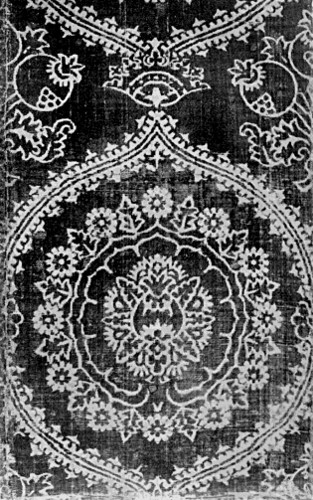
VII
VELVET MADE AT GRANADA
(Late 15th Century)
Another group of Ordenanzas concerns the
weavers and the silk-merchants of the Alcaicería,
determining that no silk was to be imported
from the kingdoms of Valencia or Murcia, and
that no merchant was to buy the raw material in
order to resell it at a profit, but might only trade
in the productions of his own factory. Minute
instructions are appended for weaving the various
stuffs which had a silk foundation, such as several
kinds of damask, scarlet velvet[16] many kinds of
satin, velvet dyed with Brazil-wood, taffeta of
four leishes, taffeta of two leishes, and sargas, or
silken serge. Other fabrics mentioned in the
Ordinances are tocas called “San Juanes,” campuses
moriscos (elsewhere “las tocas moriscas que se
llaman campuzas”), “las tocas moriscas labradas
que se dizen coninos,” quinales and alfardillas,
alcaydias, tocas de Reyna, and espumillas. Most of
these names are of obscure meaning at the present
day; but I find that espumillas were silken crape,
while alfardillas are defined in the old dictionary
of Fathers Connelly and Higgins as “an ancient
kind of silken ribbon, or tape.”
No weaver was allowed to be the owner of
more than four looms for making velvet, satin,
damask, taffeta, or silken serges. The apprentice
to a satin-maker required to be bound for a
minimum term of three years, the apprentice to
a damask-maker for five years, the apprentice to
a taffeta-maker for three years. No weaver was
to have more than three apprentices at one time,
except in the case of the damask-makers, who
might have four. No weaver might dismiss his
apprentice without deponing to the cause before
the city officers, nor might he accept money,
or anything in lieu of money, from an apprentice.
Master-weavers were required to pass
their examinations in Granada; no other city
would suffice.
We further learn that many of the apprentices
were “of evil character,” and damaged velvet
stuffs “maliciously, though knowing perfectly
how to weave the same.” If any worker at this
craft fell sick, the guild or oficio was to defray the
expenses of his cure, including physic “until he
be recovered, provided his be not a venereal
ailment, or a wound inflicted with a knife.” If
he succumbed, the guild was to bury him; and
when a master-weaver died, his apprentices were
compelled to serve out the rest of their indentures
with his widow, or his sons. No slave might
learn to weave, even though he should be made
a horro or freedman.
Other ordinances refer to the officers known as
Xelizes and Almotalefes of the silk, the privilege
of appointing whom had been conferred upon the
town-council by Ferdinand and Isabella. It was
the business of the almotalefe or motalefe to
collect silk throughout the alcarias or villages of
the surrounding districts, and convey it, on behalf
of the owner, to a xeliz or “superintendent of the
market,” attached to one or other of the three
Alcaicerías of the kingdom of Granada. The
xeliz, in his turn, was required to see that the
parcel was put up for sale by public auction and
disposed of to the highest bidder, after which he
handed to the motalefe a certificate of the price
obtained, together with the corresponding cash,
less certain fees deducted for himself and calculated
on a reasonable scale. The number of motalefes
throughout this region was evidently large, because
in the year 1520 the town-council resolved to
appoint as many as “one or two in every town
and district.”
Ordinances to the above effect were notified to
the city of Almuñecar, and the towns of Motril,
Salobreña, and the Alpujarras; from which we
must infer that, though subordinated to the capital
herself, these places also were silk-producing
centres of no slight importance.
Further laws relating to the Xelizes were passed
in 1535. On August 13th, the mayor of Granada
(described as the “very magnificent” Señor Hernan
Darias de Saavedra) summoned before him these
officials in order to admonish them respecting certain
fresh decisions that had been adopted by the councillors.
The said Xelizes were six in all, known
severally as Juan Ximenez, Hernando el Comarxi,
Juan Infante Zaybona, Juan de Granada, Lorenzo
el Mombatan, and Francisco Hernandez Almorox—names
which are of interest, as showing that the
Morisco element was still of weight among the
manufacturers and merchants of Granada. From
this time forth, and by the resolution of the town
authorities, the Xelizes in question were called
upon to lodge a deposit of one thousand ducats as
security for the value of the silk entrusted them
for sale. Besides this, the silk was to be sold in
the Zaguaque—that is, by public auction “as in
the time of the Moors,” from two in the afternoon
onward. The buyer was required to settle his
account before ten in the morning of the day next
following his purchase. Failing this, the silk was
to be again put up for sale, and the costs of this
new operation were charged to the defaulting first
purchaser, who was further obliged to pay a daily
compensation of two reales to the motalefe who
had brought the silk to market. Xelizes were
strictly forbidden to traffic on their own account,
and the fines for infringing any of these laws were
heavy. If the infraction were repeated once, the
fine was doubled; if twice, in addition to the
same amount in money, the transgressor was
banished for all his lifetime from Granada.
All pieces of stuff which measured ten yards
long and upwards, and which it was desired to
sell within the capital or district of Granada,
required to be marked with the weaver's stamp.
If three pieces were sold together, or sent abroad
to other places to be sold, they required to be
stamped with the city seal at a fee for stamping
of two maravedis the piece. This was to be
performed by the veedores, who were also to
keep a register of all the city looms, and pay
them a visit of inspection once at least in every
month.
Finally, one of the most ridiculous and noxious
of these ordinances forbade the planting of more
mulberry-trees in or about Granada; notwithstanding
that it was also forbidden to deal in
silk imported from Valencia or Murcia, as the
merchants were said to mingle these foreign silks
with that of Granada herself, to the detriment of
the latter.
Throughout the sixteenth and seventeenth
centuries the silk-trade of this capital remained
in much the same condition. In 1747 a company
was formed at Granada titled the “Compañía
Real de Comercio y Fábricas de Granada,” and
the formal prospectus of this society, of which
document a printed copy is in my possession,
was embodied in a royal cedula dated in the same
year. The preliminary remarks attached to this
certificate explain that the people of Granada
were now reduced to “the most unhappy state of
poverty, insomuch that nowhere is there memory
of a greater horde of mendicants.” The principal
cause of this distress is stated to be the ruin of
the silk-trade, in which disaster may be recognised
the consequences of the senseless legislation
I have instanced in the foregoing paragraphs.
The fifteen thousand looms which once upon a
time existed there had dwindled to six hundred,
and the production of raw silk, from one million
pounds a year to one hundred thousand. The
new Company was floated with the professed
ambition of restoring Granada to a measure of
her old prosperity. The capital was half a
million pesos, divided into shares of two hundred
pesos each; but silk and woven fabrics generally,
whose value had been suitably appraised by the
authorities, were admissible in payment of a
share. The holder of each five shares enjoyed
one vote, except in the case of founders, who
were privileged, as “instruments of this important
establishment,” to vote upon possession of a
single share. If a shareholder wished to sell his
interest, the Company was to have the first
refusal. It further possessed initially in cash a
sum exceeding one hundred and twenty thousand
pesos—sufficient to construct and work three
thousand looms in all; and it engaged, in return
for certain favours and exemptions under royal
warrant, to set up twenty looms for making
serges of fine quality, and eight more in each
year, for the space of ten years, for making
carros de oro, medios carros, anascotes finos,
christales, “and every other kind of stuff that is
not manufactured in this kingdom.”
The favours and exemptions thus solicited
were of a very mischievous character; for the
political mind of Spain was not yet shrewd
enough to grasp the fact that where all competition
is removed, quality cannot but decline.
The products of the Company were freed from
paying taxes for ten, or in the case of stuffs whose
price amounted to six reales per yard, for twenty
years. Similarly, all of its merchandise exported
to America “in flotas, galeones, registros, or other
craft of those that are permitted,” was freed
from all except the royal dues on loading, although
if shipped to other parts it was to pay a tax
of fifty maravedis for each Castilian pound of
sixteen ounces. All the materials and ingredients
required by the Company in the preparation of
its fabrics were exempted from customs and other
dues. The Company enjoyed a preferential right
to purchase silk throughout the kingdom of
Granada, and such as it abstained from purchasing
was to be sold by public auction in the Alcaicerías
of Granada and Málaga, that of Almería being
henceforth suppressed. The Company was also
empowered to introduce silk from Murcia and
Valencia, and the determination to crush all
private enterprise is clearly expressed by the
twenty-second heading of this document, which
says; “All manufacturers and traders who do not
associate themselves with this body shall pay the
full tariff of dues at present established.” The
Company was further empowered to compel the
inhabitants of this locality to plant new lots of
mulberry-trees, “in view of the notorious fact
that not the one-hundredth part remains of all
that were delivered by the Royal Census to the
occupants of the kingdom of Granada at the time
of the reconquest.” The Company might further
open shops and erect warehouses wherever it
chose. Its assets were to enjoy perpetual immunity
from seizure by the city council, whether
as a loan or otherwise, and none of its servants
might be called upon to serve the Crown in the
event of war.
Very shortly after its foundation, this Company
united (each bringing half the capital) with another
powerful association titled the Commercial Company
of Estremadura, with a view to securing a
conjoint Crown monopoly or “exclusive privilege”
for Portugal, “to the effect that only these two
companies may traffic there in silk, and none other
of my vassals or the inhabitants of my dominions
may do business, whether in pure silk, or silk
mixed with silver or with gold, in the kingdom of
Portugal aforesaid.”
The privilege was granted in these terms, and
bears the royal signature, attached at Aranjuez, June
17th, 1747. Its provisions were to last for ten
years, and, in return for their concession, the two
Companies engaged for a like term of ten years to
set up fifty silk-looms annually at Toledo, “over and
above the looms at present working in that city.”
I have not been able to trace, in writing or in
print, the subsequent records of the Royal Commercial
and Manufacturing Company of Granada,
although I have been told that it existed for some
time, and that on one occasion there was a riot
among the townsfolk in opposition to its tyranny.[17]
In 1776 Swinburne wrote of the same region:
“The annual produce of silk in this province,
before the year 1726, seldom fell short of two
millions six hundred thousand pounds weight,
whereas now it does not exceed one hundred
thousand.” Judging from this, the Company does
not appear to have prospered. In 1775 the same
author wrote of other and more fertile silk-producing
districts: “The manufacturers of silk are the
cause of a population (i.e. in Valencia) that may be
reckoned considerable, if compared to that of other
provinces of Spain. The produce of this article
came this year to one million pounds, but one year
with another the average quantity is about nine
hundred thousand pounds, worth a doubloon a
pound in the country. The crop of silk this last
season was very abundant. Government has prohibited
the exportation of Valencian raw silk, in
order to lay in a stock to keep the artificers constantly
employed in bad years; for it has happened
in some, that half the workmen have been laid
idle for want of materials. As they are not so
strict about Murcian silk, which is of an inferior
quality, I am told that some from Valencia is sent
out of Spain under that denomination. The great
nurseries of mulberry-plants in this plain (the
Huerta of Valencia) are produced from seed obtained
by rubbing a rope of esparto over heaps of
ripe mulberries, and then burying the rope two
inches under ground. As the young plants come
up, they are drawn and transplanted. The trees,
which are all of the white kind, are afterwards set
out in rows in the fields, and pruned every second
year; in Murcia, only every third year, and in
Granada never. The Granadine silk is esteemed
the best of all; and the trees are all of the black
sort of mulberry.”
According to Laborde, who wrote some twenty-five
years later; “The cultivation of silk was
formerly very flourishing in Andalusia; the kingdoms
of Granada, Seville, and Jaen produced
immense quantities of it, but after the conquest of
those countries it was burdened with heavy taxes:
silk was made subject to ecclesiastical tithes payable
in kind; the royal tenth it paid under the
Moors was retained, estimated at three reales
vellon each pound of silk. To these were added
a duty of tartil of seventeen maravedis per pound
and duties of alcabalas and cientos, fixed at eleven
reales thirty-two maravedís. There accrued from
it a tax of fifteen reales fifteen maravedís for the
king, and six reales, or thereabouts, for the
ecclesiastical tithe, making together twenty-one
reales fifteen maravedís, or about four shillings
and sixpence the pound, which at that time sold
only for thirty reales, or six shillings and three
pence English. The speculators were consequently
discouraged, most of them relinquished
a labour from which they derived so little profit,
and this branch of industry entirely failed in the
kingdoms of Cordova and Seville, and afterwards
in those of Granada and Jaen. For some time
it has been looking up in the two latter kingdoms,
but it is very far from what it was under the
Moors. The mulberries of Granada and Jaen are
black; they are suffered to grow without any care
or management, are never lopped or dressed, and
look as if they were planted by chance.”
Of Murcia he wrote; “This province has the
raw materials of other manufactures no less
important. In the first place, it has a prodigious
quantity of silkworms, which are not turned to
advantage; most of the raw silks are sold to the
neighbouring provinces, and manufactured silk is
imported from foreign looms, though the inhabitants
might manufacture their own materials, and
make it an article of considerable exportation.
The town of Murcia is the only place where they
work some small quantity; there they manufacture
a few slight silks, chiefly taffetas and velvets, but of
an inferior quality; and the whole is confined to a
small number of looms. They make a much
greater quantity of ribbons, in which twelve
hundred looms are employed; but they are badly
dyed, and have not a good gloss. The Murcians
likewise prepare the raw silk, spin, and twist it;
they have even a warden, and a great number of
masters in this business, and, in spite of its
importance, they carry it on without being subject
to any superintendence, everyone doing as he
pleases. The consequence is that the silk is badly
prepared and spun unequally. The threads are
collected without any method, sometimes more,
sometimes less, and then twisted unequally.
They are of course unfit to make fine stuffs, and
the trade of Murcia is therefore declining….
Silk stuffs, satins, velvets, and taffetas are made
here, but there is no great manufactory of them.
They are wrought at private houses, and are but
of a middling quality.”
Toledo silk, including the delicate and costly
cendal (see pp. 5, 6) which is mentioned in the
sumptuary law, dated 1348, of Alfonso the
Eleventh, was largely in demand from early in
the Middle Ages till about the sixteenth century.
The statements of the older writers as to this
neighbourhood are contradictory. According
to Damián de Olivares, himself a native of
Toledo, this city in the sixteenth century possessed
between five thousand five hundred and
six thousand looms, consuming annually more
than six hundred thousand pounds of raw silk.
Other authors estimate the number of her looms
at twenty, thirty, or even forty thousand. Writing
in our own time, Count Cedillo is responsible
for declaring that after the revolt of the Communities,
the persons occupied in weaving silk
amounted to fifty thousand, all of whom were
natives of Toledo and the neighbouring villages;
and he adds, perhaps a little rashly, that the velvets,
damasks, satins, and taffetas of this locality were
“unrivalled, even in comparison with the admirable
products of Seville, Cordova, and Granada.”[18]
Certainly, the silk stockings of Toledo enjoyed
a wide-spread fame, and were used, among other
distinguished patrons, by the Duke of Guise and
by Philip the Second. They were also exported in
quantities to America. Banners, altar-fronts, and
vestments for religious worship were also made
here in large numbers, and of excellent quality,
both in silk alone, and in this substance mixed
with gold and silver.
Laborde wrote of all these manufactures at
the time of their decline; “It is easy to estimate
their former importance from the loss they sustained
by the introduction of foreign merchandise.
The memorial states that the consumption of silk
was materially diminished, and computes the loss
sustained by thirty-eight thousand artisans, from
the interruption of their occupation, at 1,937,727
ducats. Symptoms of decay continued to increase
till the middle of the sixteenth century, when
every vestige of commerce was effaced.
“Toledo remained in this state of listless
despondence till the present archbishop made a
noble effort to revive the love of industry, and to
open an asylum for the tribes of mendicants,
accustomed from infancy to subsist on precarious
bounty. The measure adopted by this prelate
was to establish in the Alcazar various branches
of manufacture, such as linen, ribbons, cloths,
serges, woollen stuffs, and silk stuffs of every
description. He introduced also another branch
of occupation, appropriated solely to the production
of sacerdotal ornaments. In 1791 there were a
hundred and twelve manufactories in Toledo, ten
for lawns and canvas, twelve for ribbons, fifty-five
for silk, and seven for sacerdotal ornaments. At
this period the indigent class employed in them
amounted to six hundred people, who were instructed
in various processes, and were led insensibly
to acquire the useful habits of industry.
They were taught to draw, to prepare the
materials, and to perform the manufacture; and
each was destined to pursue some occupation suitable
to his age, his inclination, and his abilities.”
In 1786 Townsend, himself a clergyman, had
written of Toledo in far less hopeful terms.
“This city, which contained two hundred thousand
souls, is now reduced to less than twenty-five
thousand. The citizens are fled; the monks
remain. Here we find twenty-six parish churches,
thirty-eight convents, seventeen hospitals, four
colleges, twelve chapels, and nineteen hermitages,
the monuments of its former opulence.” Townsend's
good taste, unusual for a traveller of that
time, was horrified at the profanation of the
Alcazar, whose “magnificent apartments are now
occupied with spinning-wheels and looms, and
instead of princes they are filled with beggars.
The good archbishop here feeds seven hundred
persons, who are employed in the silk manufactory;
but unfortunately, with the best intentions, he has
completed the ruin of the city; for by his weight
of capital, he has raised the price both of labour
and of the raw material, whilst, by carrying a
greater quantity of goods to the common market,
he has sunk the price of the commodity so much,
that the manufacturers, who employed from forty
to sixty workmen, now employ only two or three,
and many who were in affluence are now reduced
to penury.
“These people are so far from earning their
own maintenance, that over and above the produce
of their labour they require forty thousand ducats
a year for their support.”
Alvarez de Colmenar, Ricord, Bourgoing,
Laborde, and other writers, Spanish and non-Spanish,
of the eighteenth century, inserted full
descriptions of the silk trade of Valencia and
Barcelona. “On y fait,” wrote Alvarez de
Colmenar of the former of these towns, “de très
bonnes draperies, fortes, d'un bon et long usage,
et propres à résister à la pluie, et grande quantité
d'étoffes de soie; delà vient que les meuriers,
dont les feuilles servent à nourrir les vers à soie,
y font d'un fort gros revenu pour les habitans.”
Ricord, in his scarce pamphlet, printed at Valencia
in 1793, gives valuable statistics relating to this
industry and locality, prefacing his figures arranged
in tabular form by the following remarks:
“The silk factories of this province form the
principal basis of her commerce. They not only
consume all the silk which is raised in the kingdom
(of Valencia), and which, in 1791, amounted to
581,688 pounds of fine silk, 93,800 of that of
Alducar, and 26,115 of hiladillo, but they also
require to provide themselves from Aragon and
other parts of Spain, or even from abroad, seeing
that in the year aforesaid more than 37,000 pounds
were imported from foreign countries.” The
tabular statement appended to these observations
tells us that in the region of Valencia the looms
for making fine and silken fabrics such as velvets,
anascotes, stockings, handkerchiefs, scarves, garters,
and ribbons, gave employment to a total of 9,668
workmen, and were distributed among the towns
or villages of Valencia, Alcira, San Felipe, Alcoy,
Vilanesa, Denia, Ruzafa, Alicante, Peniscola,
Beniganim, Pego, Olivo, Liria, Asuevar, Orihuela,
Gandia, Elche, Castellon, and Vall de Almonacid.
Riaño admits, however, that this manufacture
might have prospered even more, if means had
been adopted to suppress certain acts committed
by the weavers, spinners, and twisters of the silk.
More curious and instructive is the description
of the same industry by Jean-François Bourgoing,
whose observations, evidently secured at first-hand,
are worth translating in extenso:—
“What attracted us still more than the fine-art
works were the stuffs produced at the silk-factories,
which constitute the principal glory of Valencia
and contribute to her prosperous condition. We
followed all the process of this manufacture, from
the cultivation of the mulberry-tree to the weaving
of the richest fabrics. I will try, therefore, to
give a comprehensive account of them.
“Spain, and particularly the kingdom of
Valencia, could well export her silk to foreign
parts, even after setting apart a quantity sufficient
for her factories. Government, however, does not
appear to be convinced of this, because it offers
constant hindrance to such exportation, or else,
when it consents to it, imposes heavy dues.
These dues consist of nine reales and a quartillo,
or nearly two livres seven francs per each
Valencian pound of silk, which only weighs twelve
ounces, and is worth at least fifteen livres when it
is in the raw state. When the silk harvest has
been scanty, as in the year 1784, it has been
known to fetch eighty reales or twenty livres.
This year, too, the yield of silk has been so small
that the manufacturers of Valencia petitioned
Government to allow the introduction, duty-free,
of two hundred thousand pounds of it from Italy
and France.
“In ordinary years, the pound of (raw) silk
costs eight reales for twisting and three reales for
dyeing in green, blue or other common colours;
so that this material, ready to use, costs altogether
about seventy-one reales the pound, or seventeen
to eighteen francs of our money.
“Of course this price varies according to circumstances.
One of the causes which exercise
the greatest influence on this fluctuation is the
harvest of the mulberry. These valuable trees
are thickly planted over the champaign of
Valencia, and all of them are of the white-leaved
kind. This distinction, which would be superfluous
in France, is by no means so in Spain,
where, in several provinces, as, for instance, the
kingdom of Granada, the leaves of the black
mulberry are used to nourish the silkworms, and
yield almost as handsome a silk as those of the
white.[19]
“The leaves to these mulberry-trees are sold
by the load of ten arrobas; and the Valencian
arroba, which is about equal to twenty-seven
French pounds, cost, in 1783, about thirty sols
tournois.
“The mulberry leaves are gathered once, twice,
or, at most, three times in each year; but it is not
often that the two last crops are of as fine a quality
or as abundant as the first. The greater part of
the year is suited for harvesting the leaves, and this
harvesting is carried out progressively as the silkworms
copulate, steadily increasing in quantity up
to the moment when they build their cocoons.
As a rule only the leaves are plucked, the
branches being spared as far as possible. Thus
despoiled of its verdure in the middle of the finest
times of year, although surrounded by a dazzling
vegetation, the tree looks like a dry log floating
on a green expanse of waters, while the mass of
naked trunks which seem to be completely sterile,
and which grow more numerous as the season
advances, combine to render cheerless a prospect
otherwise so fertile and so smiling. Still worse
becomes their state when the trees are pruned
entirely of their branches—an operation which is
performed upon them at least once in every three
years.
“In the space of ten years the kingdom of
Valencia has yielded six million pounds of silk,
which makes a yearly average of six hundred
thousand pounds; and as the whole of Spain produces
a million pounds per annum, we see from
this that Valencia alone supplies more than half
of the entire quantity. The silks of Valencia are
the finest of the whole Peninsula, and fit to be
compared with the best of Europe generally, but
the spinning is still imperfect, because in Spain
there are not, as in France and elsewhere, houses
where the women who spin are gathered together
under the eye of an inspector to see that all the
silk is spun evenly. In the kingdom of Valencia
the spinning is distributed among several thousand
hands, who introduce six, seven, eight, or even
more ends in a thread of silk which should always
have the same number; hence the unevennesses in
the fabrics which are woven from them, while for
the same reason we do not utilize for any delicate
work the raw material which we import from
Spain. The silk we employ for our costlier
fabrics is of the kind which we import from
Piedmont and the southern provinces of France.
Also, for the last few years we have felt less need
of the Valencian silk. The laws prohibiting the
exportation of this Spanish silk have stimulated
the cultivation of mulberry-trees in Languedoc,
where the peasantry, alive to the profit which
these trees could render them, have preferred
them to other kinds for planting round their
property. This is why, in the year 1783, French
silk could be bought for a lower price than the
Valencian silk purchased in that region, plus the
dues levied upon its exportation. I know of a
merchant who at this time enjoyed the privilege
of exporting for six years a hundred thousand
pounds free of all dues, but who throughout the
year 1783 was unable to find a purchaser in
France. Spain could perhaps remedy the egress
of her raw material by further increasing (as,
indeed, she daily does) the number of her looms,
and by exporting a greater number of her products
to her American possessions; but her silk-stuffs
will never be perfected until she markets
them in foreign countries, where the taste of her
customers may tend to better that of her
manufacturers.
“The silk raised in the kingdom of Valencia is
estimated, during an average year, to be worth
six or seven millions of piastres (nineteen to
twenty-two millions of livres.) At the time of
my visit to this city, she only employed one half
this quantity, although her looms of every size
amounted to four thousand. The rest, in spite
of the prohibitions laid upon its extraction, is
smuggled off to foreign countries, escaping,
sometimes to France by way of Barcelona, and
sometimes to Portugal by way of Seville and
Extremadura. Nevertheless, there is probably
more silk in Spain to-day than formerly, and
measures have been earnestly adopted to encourage
the industries which make use of it. For
some time past, silk-looms have been scattered
over the whole of Cataluña, and in the kingdoms
of Granada, Cordova, Seville, etc., producing
handkerchiefs, ribbons, and other stuffs in
sufficient quantity to supply, or nearly so, the
national market: nevertheless this still left
a large market for our stocking-factories of
Languedoc. The Spanish Government, by the
law of 1778, limited itself to excluding these
stockings from forming part of the foreign cargoes
to the Colonies, but as they continued to be
imported into Spain, this law was readily evaded,
since it sufficed to stamp the French article with
the mark of a Spanish factory. It would have
required an excessive vigilance, almost a positive
inquisition, to guard against a fraud of this kind,
prompted by the avarice of traders. The Spanish
Government next sought, by the law of 1785, to
put a stop to it by totally excluding our silk
stockings, and this measure, together with the
establishment of a number of new looms in Spain,
has produced an almost absolute stagnation in the
market which our factories of Languedoc had
formerly enjoyed in the Peninsula. But let me
return now to the Valencian factories.
“This city has no one building in which might
be performed the whole of the processes through
which the silk must pass. Any person who
wishes to examine them, must visit several
workshops; and this was the course which we
adopted, under the guidance of a manufacturer
as intelligent as he is amiable, named Don Manuel
Foz, a gentleman who has travelled extensively
in order to perfect his knowledge of handling
silk, and who, among other secrets, has brought
from Constantinople the art of watering silken
stuffs. As a reward for his activity, he has been
appointed Intendente of all the factories of
Valencia.
“There are hardly any merchants at Valencia
who are not more or less concerned in silk-making:
indeed, they look upon this industry as quite a
point d'honneur. Some of them supply with silk
no more than four or five looms, which work at
their expense, while others have under their control
as many as several hundred.
“After the silkworm has cleverly built its cell,
the first thing to be done is to stifle it before it
can pierce the cocoon in search of a new existence.
For this purpose the cocoons are thrown into a
moderately heated oven; and then, when once
the worm is killed, they can be kept without being
spun for as long as may be needed.
“In order to strip them of their covering of
silk, they are thrown into hot water, after which
the women workers pick up, and with surprising
quickness, the threads of several of them, join
them, and deal them out, thus joined, on wheels
constructed for this object. On the design of
the wheels depends the degree of thoroughness
with which the silk is spun; but those which
are employed in Spain are generally the most
imperfect, as I shall presently explain.
“I have already said that the slip of silk should
be drawn from at least four cocoons, and even then
it only serves for making slender fabrics, such as
taffeta or ribbon. We were shown, indeed, a
skein which was assured to contain no more than
two cocoons; but so slight a slip is of no use at
all. Most of them are made from seven or eight
cocoons, and two of the former are joined in order
to form a thread sufficient to be placed upon the
loom.
“My readers are sure to know that all woven
fabrics consist of two distinct parts, the woof and
the warp. The woof is that which is passed by
the shuttle from one side of the loom to the other,
and which is enchased between the two surfaces
formed by the warp. As the woof is subjected to
more wear and tear than the warp, it should be
stouter. For this reason each of the two ends
of which it is composed is twisted separately
before the two are twisted together, while for the
warp the latter of these processes is sufficient.
The result of this difference is that, when looked
at beneath the microscope, the thread of the
woof has an uneven look, as though it were a
small cable, while that of the warp looks flat and
smooth, and is therefore adapted to reflect the
light, receiving the shiny look which makes a
silk-stuff so attractive.
“But the beauty of these fabrics depends, above
all else, upon the way in which the silk is divided
as it is drawn from the cocoon. This first stage
of the spinning is performed in one or other of
three ways, according to the kind of wheel which is
employed for it. The method which the Spaniards
have adopted from an early period has the following
drawback; that the small threads of six, seven,
and eight cocoons which are stripped at the same
time, go to form a single thread, and are deposited
upon a small spindle without the thread rubbing
against another one, which friction serves to
lay the little hairs which bristle up, so that
the slip of silk thus formed retains a hairy
nap and is easily frayed. In the Piedmontese
method, on the other hand, each slip is joined to
another, and is not drawn apart until it has been
twisted round it four or five times.
“The third method, known as that of Vaucanson,
is more expensive than the one last mentioned.
In the wheel invented by Vaucanson, the two silk-slips
are reunited after the first twisting, in order
to be twisted once again. This operation is called
the ‘double croissade.’
“If these threads, thus placed on bobbins, are
intended for the woof, they are enchased perpendicularly
in a machine consisting of several compartments,
in which they are twisted separately.
Thence they are transferred to another machine,
in which they are twisted all together; after which
they are ready for the loom. Those which are
destined for the web are not twisted (as I have
explained above) until the moment when they are
united. Both at Valencia and at Talavera de la
Reina these machines, so precious to the weaver's
craft, and which economise manual toil, are not
unknown.[20]
“At the latter of these towns I had already
seen a single toothed-wheel, which set in motion
up to a thousand of these tiny bobbins on
which are wound the twisted slips of silk. The
wheels I saw at Valencia were smaller, because in
this city there is not, as there is at Talavera, a
royal factory self-contained within a single building.
At Valencia each manufacturer, in order to
carry out these various processes, requires to deal
with workmen and machines distributed through
several quarters of the town, and chooses from
among them such as he best prefers.
“Nothing can be simpler than the working
of these silk-twisting machines, when once the
toothed-wheel has set them going. The perpendicular
movement of all these little bobbins
is looked after by women, and even children.[21]
“If they should happen to clog, a touch of the
finger disengages them. If one of the slips should
break, the harm is mended in a trice: the practised
fingers of the machinist pick up the broken ends
with marvellous despatch, tie them together by
an imperceptible knot, and the bobbin which was
thus delayed loses no time in overtaking its
neighbours.
“The slips of silk, before being twisted two by
two, are put through another process which I
ought to mention. When they are still in skeins
they are spread upon a large tub in which is a
quantity of viscous substances heated to boiling
point, the gases from which tend to make them
adhere to one another. This is termed passer à
la brève.
“Thence they are removed to the machine for
twisting them. The silk, on issuing from this
machine, is called organzine; and it is only when
it is in this state that it can be exported from
Piedmont, where the twisting process was better
executed than elsewhere, until the time when it
was rendered yet more perfect by Vaucanson.[22]
This clever mechanic has combined all possible
advantages relating to the business of the silk-weaver.
His system, and no other, is practised in
the Lyons factories; but these wheels à double
croissade are only available for silk produced in
France; since that which is exported from abroad
and which is principally used in these factories,
requires to be reduced to organzine before it can
again be taken out of the country.
“In this respect Spain possesses a sensible
advantage over other manufacturing nations;
since she raises a greater quantity of silk than
she is able to consume, and could easily put it
through the most advanced and perfect processes;
in spite of which she has clung for ages to her
faulty method. The present government has
attacked this method by the only means efficient
to bring about a change; that is, the slow but certain
influence of persuasion. In 1781 the Count of
Floridablanca contracted with a French merchant
settled in Madrid, that he should supply a hundred
tours of the Vaucanson pattern for spinning silk,
first to the Murcian factories (of which province
the Count was a native), next to the Valencian,
and subsequently to any others that might wish
for them; and with this object he granted to the
merchant in question the privilege of exporting,
free of duty, six hundred thousand pounds of silk
in six years. Nevertheless, it is possible that this
measure may yet remain fruitless for many years
owing to the apathy of the Spanish manufacturers,
who were loth to use a finer, closer quality of silk,
because it must be woven with greater care owing
to its containing three ends instead of two, the
work being greater on this account without a
corresponding increase in the gain. It has also
been found necessary to employ Frenchmen in
the earliest trials made in Spain of this new
method.
“The success of the Spaniards should not be
counted on, if we are to judge of it by a factory,
which was founded some years since at La
Milanesa, a league's distance from Valencia, by an
intelligent man named La Payessa.[23]
“He introduced the method of Vaucanson, but
when I went to see his factory he had not seen his
way to recover the money which this improvement
had cost him. He employed barely two hundred
persons for the most important work; nothing
more was done than to spin the silk, divide it,
and convert it into organzine. Thus treated, it
cost from fifty to sixty reales more per pound than
that which is prepared according to the Spanish
method, so that its success was but small.
“I shall not describe in detail either the method
of dyeing the silk, or that of weaving it. The first
of these operations is readily imagined; the second
is hard to understand, and still more so to explain,
unless one is assisted by engravings. I will
merely observe that all silk is dyed in skeins, just
before it enters the loom. If it be required
occasionally to dye it after it is woven, this is
only when the silk is spotted, or when the dyeing
of the skeins has proved a failure. At the time
of my visit to Valencia, there were a hundred and
seventeen master-dyers in that city, but not all of
them were working.
“The stuffs in which the factories of Valencia
are most successful are principally of the smooth
sort; they also make there handsome damask
brochés with large flowers for wall-hangings; but
generally all that is undertaken is by order of the
Court, Madrid, and the provinces. The Valencians
follow as closely as possible the rapidity
with which the French designs are changed, and
those who profess to invent new ones are but
copying the French ones in a greater or less
degree. Notwithstanding, the Valencian Fine-Arts
Academy is taking serious steps to form
designers, and a school has been founded which
has already developed able pupils—amongst
others, a young man called Ferrers, who had died
a short while before our arrival at the city, and
some of whose designs of flowers we had occasion
to admire.
“But the process in which the Valencians
particularly excel is that of watering stuffs, which
M. Foz has rendered absolutely perfect. He gave
us a clear account of this process, which consists
in passing a cylinder over the stuff to be watered,
this cylinder being pressed upon by a heavy mass
moved to and fro by a mule which draws a lever
round and round. The stuff is folded in the
manner of a closed jalousie, and these folds require
to be often varied so as to distribute the undulations
evenly. M. Foz admitted that the shape
and the arrangement of these undulations are
more or less a matter of chance, but he proved to
us that it is possible to influence them to some
extent by moistening the stuff in a certain manner
and direction, and this is the particular secret
which he alone possesses in the whole of Spain.
The excellence of this method is demonstrated by
the beauty of the watered silk which issues from
these presses. M. Foz himself set us to judge of
this by asking us to compare the blue ribbon of
the Order of Charles the Third, watered by himself,
with those of the Order of the Holy Spirit.
The comparison, I must admit, was far from
advantageous to these last.”
The subsequent vicissitudes of the Valencian silk
trade are indicated by Laborde, who wrote, some
few years later than the conscientious and observant
author of the Nouveau Voyage en Espagne:—
“The mulberry-trees are of great importance;
the fields of Valencia are covered with them,
particularly in the environs of that town, in the
dale of Elda, in the county of Carlet, in almost
all the places situated on the sea coast, etc.
There are white mulberry-trees, which are lopped
every two years.
“The leaves of these trees serve as nourishment
to silkworms, which are raised almost everywhere
in the kingdom of Valencia. Algemesi,
Alcira, Carcagente, Castillo of San Felipe, the
county of Carlet, Undasuar, Gandia, Denia,
Orihuela, and all the villages near the sea are
places which produce the greatest quantity.
“The silk made from them is the finest in
Spain. It would be equal to the best and finest
silks of Europe, if the Valencians, in spite of the
vivacity of their imagination, did not obstinately
persist in their old routine in the skeining; for in
the skein they put an undetermined number of
threads. The government has hired a man who
has the most experience in this kind of work;
but in vain does he endeavour to instruct them,
since the manufacturers continue their bad custom
just the same. The quantity of silk wound
annually is, on an average, about 1,500,000 pounds
of twelve Valencian ounces (1,312,500 pounds
of sixteen ounces avoirdupois). It is commonly
sold raw for fifty reals of vellon a Valencian pound,
which gives a total of 75,000,000 reals of vellon
(£731,250)….
“Silk is twisted in different places in the kingdom
of Valencia, for which purpose machines and
mills are established at Gandia, San Felipe,
Carcagente, Orihuela, and Valencia. The most
important establishment of this kind is at La
Milanesa, near the last mentioned town. Nevertheless,
these machines are not able to furnish as
much as the manufactures of the country require.
Part of the silk is sent to Priego and Toledo in
Andalusia, whence it is returned into the kingdom
of Valencia to be worked….
“A great many impediments are thrown in the
way of the exportation of silk, which is only
allowed for six months after the harvest. If in
that period the national manufacturers want it,
they are at liberty to take it from the merchants
who have bought it, on reimbursing them the
purchase-money together with six per cent. interest.
The consequence is that the merchants,
uncertain whether they will be allowed to export
the silk which they have purchased, no longer
take any foreign commissions for it, and so this
branch of exportation has fallen. Besides this, a
duty has been laid upon the silk sent out of the
kingdom, of nine reals of vellon and one quartillo
(1s. 11¼d. sterling) on every pound of twelve
Valencian ounces, which is almost a fifth of its
value. This is another obstacle to the exportation
of it. A very small quantity, twisted and dyed,
is sent into Portugal.
“Generally 1,500,000 pounds of silk are made
annually, of which 1,100,000 are consumed in the
province, and 400,000 pounds are exported to
Talavera de la Reina, Requeña, Toledo, Granada,
Seville, Priego, and Cataluña. From this results
a product of 20,000,000 reals (£208,333, 6s.).”
Of the city of Valencia, Laborde wrote:—
“The manufactories of silk are the most considerable.
They employ nearly 25,000 persons,
and make taffetas, serges, silks, satins, plain
damasks, striped, printed, of one colour and of
mixed colours, full velvets, flowered velvets, plain
and of various colours. The plain stuffs are those
in which they succeed best. There are also fine
damasks made and worked with large flowers.”
According to the same writer, the manufacture
at Valencia of silk stockings, galloons, silk ribbon,
handkerchiefs, and sashes revived to such an
extent, that in the year 1799 the looms for producing
these articles were 423 more than they had
been in 1769. “There are 3618 silk looms, which
work about 800,000 pounds of silk annually; the
handkerchiefs, sashes, and other little articles of
lace consume 100,000 pounds.”
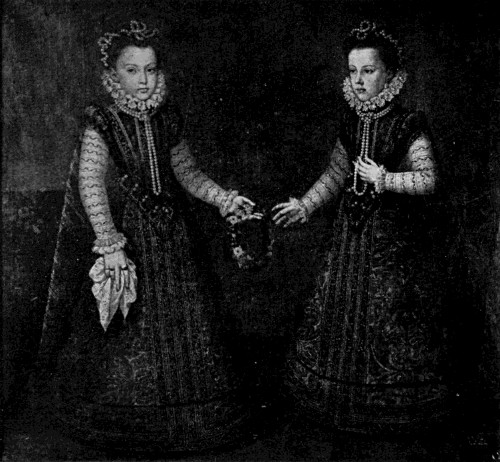
VIII
THE DAUGHTERS OF PHILIP THE SECOND
(By Sanchez Coello. Prado Gallery)
Equally as instructive is Laborde's account of
Barcelona.[24] After remarking that the decay in
her manufactures lasted from the end of the
sixteenth century till the middle of the eighteenth,
he continues:—“They are at present in a very
flourishing state, and are more numerous and
varied than ever…. There are 524 looms of
silk stuffs, and 2700 of ribbons and silk galloon.
The silk works consist of taffetas, twilled and
common silks, satins, and velvets of every kind
and colour. These are mixed with gold and silver.
Gold cloths and brocades are also made there.[25]
The manufactures are not carried on by companies,
but dispersed among the workmen themselves, by
which perhaps the qualities may in some degree
be injured. It is remarked that the stuffs would
be better if they were closer, for their texture is
commonly loose; they are also different in the
gloss, which is seldom fine, and is never equal to
that in the manufactures of France. Another
fault in all these stuffs is the imperfect preparation
of the silk, which leaves it nearly always shaggy:
the cause of this is the silk being spun or twisted
in an uneven manner. The same unpleasant
effect is observed in the silk stockings. They
cannot be fine, their stitches being uneven, and
often large and shaggy. They do not last long,
and are as dear as the French stockings after the
duty on their entrance into Spain has been paid.
“At Barcelona, laces, blonds, net-work, and
tapes employ about twelve thousand persons.
Galloons, laces, and gold and silver fringes, are
likewise made here; but these are of no great
importance. Silk, gold, and silver embroideries
are very common, and the embroiderers are so
numerous that they are to be found in every street.
“Silk Stuffs.—These are manufactured at
Manresa, Cardona, and Mataró, which has forty-eight
looms; but principally at Barcelona, where
there are five hundred and twenty-four. There
they make velvets, satins, damasks, silks, taffetas,
and gold and silver stuffs. The town of Barcelona
alone uses annually 300,000 pounds of raw silk.
“Taffetas, Handkerchiefs, and silk sashes.—They
make a great quantity of these at Barcelona,
where there are a good many little manufactories
of this kind. There are a hundred and
fifty looms at Reus, and six hundred at Manresa.
At the last place sixty thousand dozen handkerchiefs
are made, which take about seventy
thousand pounds of raw silk.
“Silk twisters.—There are some of these in
several towns, and a great many in Barcelona.
There are eighteen frames at Mataró, which
twist, one year with another, one hundred and
twenty-four quintals of silk; and thirty-seven at
Tarragona, which twist eleven thousand quintals.”
Elsewhere in the course of his exhaustive
tomes, Laborde sums up the general revival of
the Spanish silk-trade in the following terms:—
“Silk stockings are woven at Málaga, Zaragoza,
Valencia, and at various other places in the
kingdom of Valencia; at Valdemoro, and at
Talavera de la Reina in New Castile; also in
different parts of Cataluña, more especially at
Mataró, Arenys del Mar, and Barcelona. The
most extensive manufacture is carried on at the
latter city, where the number of frames amounts
to nine hundred. In the city of Mataró are fifty-two,
in Valencia one hundred and fifty, and nearly
as many in Talavera. The stockings made in
Spain are of a loose texture; owing to the improper
method in which silk-throwsting is conducted,
they are badly dressed and worse glossed.
The Spanish people themselves prefer French
stockings, and most of those manufactured in the
country are exported to America.
“Ribbons hold a distinguished place among
the manufactured articles of Spain. Some few
are woven at Jaen, Granada, and Cordova; but
more at Talavera. Cadiz has but twenty ribbon-looms,
Manresa five hundred, Mataró eighty, Vich
twenty-two, Requeña two hundred, Valencia four
hundred, Murcia twelve hundred, and Barcelona
nearly three thousand. These looms are not in
factories, but individually dispersed. The Spanish
ribbons are in general thin and flimsy, have little
lustre, and their colours are neither brilliant nor
permanent. Ribbons are made of floss-silk at
Toledo, where there are about twelve looms, and
at Manresa, where there is a greater number.[26]
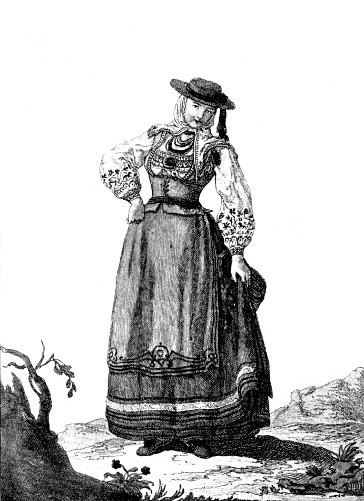
IX
A CHARRA OR PEASANT WOMAN
(Salamanca, A.D. 1777)
“Silk taffetas, serges, and other articles, such
as common and figured satins, damasks, and plain
and flowered velvets, are made at Jaen, Granada,
Murcia, Valencia, and the adjacent villages; at
Málaga, Zaragoza, Toledo, Requeña, Talavera
de la Reina, Mataró, Manresa, Cardona, and
Barcelona. The silk-trade of Jaen and Granada
is at present in a very languishing state; the
manufacture of Murcia is dwindled to a few
individual looms. At Toledo are fifty looms,
fifty at Mataró, forty at Málaga, six hundred at
Requeña, four hundred at Talavera, which
consume annually two hundred thousand pounds
of silk; five hundred at Barcelona, which annually
manufacture, in conjunction with those of Cardona
and Manresa, about three thousand pounds
weight of silk; and in the city of Valencia are
three thousand, whose annual demand of silk is
eight hundred thousand pounds, while twenty-two
thousand persons are employed in the trade. In
Zaragoza are sixty looms, which consume fifty
thousand pounds of silk; but taffetas only are
manufactured there. The cities of Toledo and
Talavera de la Reina are the only places where
the looms are collected together in factories:
in all other places they are separated, and are
found individually at the houses of the respective
weavers.
“A great portion of the silks manufactured
in Spain are stout and excellent, but they are
destitute of the brilliancy observable in French
silks. The damasks made at Valencia are
extremely beautiful, and in that city they excel
in the art of mixing silk and mohair, and produce
mohair stuffs which appear to be superior to those
of France and England.
“Quantities of silk handkerchiefs and bands
are manufactured at Reus, Manresa, and Barcelona.
Reus had five hundred looms, Manresa
six hundred, and annually made sixty thousand
dozen handkerchiefs; Barcelona, a much larger
quantity.
“At Barcelona is a very considerable manufacture
of white, coloured, plain, and figured gauzes.
“The art of silk-throwsting tends greatly to
improve the silk manufactures in Spain. Machines
invented in other countries have been adopted
here, and in many places profitable changes and
corrections have taken place in the trade. Silk
is principally thrown at Priego, Toledo in Andalusia,
at Murcia in the kingdom of the same name,
at Cervera near Talavera de la Reina in New
Castile, at Valencia, at Milanesa near that city,
at Gandia, San Felipe, and Carcagente in the
kingdom of Valencia. The silk-throwsters, who
work at their own houses, and are paid in the
great, that is, according to the quantity of work
they perform, are very numerous in Murcia; but
they perform the business there in a very slovenly
way. In the city of Murcia a factory is established,
where silk is thrown in an excellent manner
by means of an ingenious machine, which has
been already described. The establishment at
La Milanesa is a very important one, and well
administered. At Cervera are a dozen silk-mills,
each having four large dividers, and six machines
for doubling and twisting, by which seven thousand
and seventy-two threads are divided, doubled,
and twisted at the same time.”
Although the history of Spanish cloths and
woollens is not of great importance, I think it
well to briefly sketch their history. Sails and
other fabrics of the coarsest kind are said to have
been made, almost in prehistoric times, at Sætabi
(the modern Játiva) and at Saguntum (Murviedro).
From the thirteenth century cloths of good
quality were made at Barcelona, Lerida, San
Daniel, Bañolas, Valls, and other towns of
Cataluña. A privilege of Alfonso the Learned,
dated May 18th, 1283, contains the following
technical disposition relative to the cloth-looms of
the city of Soria: “Que la trenza cuando sea
ordida que haya 88 varas, que pese una aranzada
é 5 libras de estambre; é cualquier que la fallare
menor, que peche 5 sueldos. Que todos los
tejedores é tejedoras de la dicha cibdad é de su
tierra, que pongan en las telas de lino 42 linnuelos
é en las de estopazo 32 linnuelos; é en las de
marga é de sayal 32 linnuelos.”
Segovia was another ancient centre of this
manufacture, which Larruga considers to have
been transferred hither upon the extinction of the
factories of Cameros, Burgos, and Palencia.
However this may be, the fuero of Sepúlveda,
signed by Alfonso the Sixth, tells us that clothworks
existed here as early as the eleventh
century. Towards the end of the fourteenth,
when Catherine of Lancaster was married to the
Infante Don Enrique, the English princess
brought over, as part of her dowry, a flock of
merino sheep. These are believed to have pastured
near Segovia—a city where Catherine made
her home for many years. In any case, Segovian
cloths improved considerably from about this time,
and by the reigns of Charles the Fifth and Philip
the Second, when thirty-four thousand persons
were employed in the manufacture and twenty-five
thousand pieces of cloth were produced
annually, were thought (especially the baizes and
the serges) to be unsurpassed in Europe.[27] Sovereigns,
including Charles the Second and Charles
the Fifth of Spain, and Henry the Eighth of
England, were among the patrons of these fabrics,
while as late as the year 1700 the Franciscan
friars engaged in redeeming captives from the
Turks, reported that “at Constantinople, whither
they had carried Segovian cloths as presents to
the principal rulers of that country, those cloths
were spoken of in terms of high approval.”
Early in the seventeenth century, and owing to
a series of causes such as impertinent or improvident
legislation, heavy taxes, and the importation
of foreign cloths, the trade showed
symptoms of decay.[28] Bertaut de Rouen wrote in
1659, referring to the Spanish character at this
time: “Bien souvent le pain leur manque, comme
j'ay veu dans Almagro, petite ville située dans le
meilleur pays d'Andalousie, et dans Segovie, qui
est une des grandes villes d'Espagne, et où il y
avoit autrefois des plus riches marchands à cause
des draps et des chapeaux que l'on y faisoit, qui a
esté longtemps le sejour des Roys de Castille, et
qui n'est qu'environ à douze ou quatorze lieuës de
Madrid, où il n'y avoit point de pain dans toute la
ville le jour que j'y arrivay, et il n'y en eut qu'à
quatre heures après midy, que l'on le distribua par
ordre du Corregidor, aussi bien qu'à Almagro.”
The rise, decay, and subsequent revival of the
Spanish cloth industries, and particularly the
Segovian, are well described by Laborde, Bourgoing,
and Townsend. According to the first of
these authorities, “at so early a period as 1629
the merchants (of Segovia) complained that there
was every year a reduction in the fabrication of
cloth, to the amount of five thousand five hundred
pieces; and that there resulted from this deficiency
an annual loss of 2,424,818 ducats and 2 reals,
or about £274,000 sterling. In the eighteenth
century it appeared, from the observations of the
Economical Society, that the fabrication of stuffs
and cloths employed but one hundred and twenty
looms, in which only four thousand three hundred
and eighteen quintals of washed wool were consumed.
“About forty years ago these manufactures
began to revive, the looms were multiplied, and
the consumption of wool considerably augmented.
A single individual, Don Lorenzo Ortiz, has
for some years accelerated their progress. In
1790 there was an addition of sixty-three looms,
which employed eight or nine hundred quintals
of wool, and afforded occupation to two thousand
four hundred manufacturers.”
The same author wrote that early in the
nineteenth century, “the woollen manufactures of
New Castile are the most numerous and important.
Cloths are made at Toledo, Chinchon,
Brihuega, Guadalajara; serges, stuffs, and flannels
at Toledo and Cuenca. The cloths of Brihuega
are of an excellent quality, but those of Guadalajara
are still superior to them; in particular, the
cloth of Vigonia. There are twenty-eight looms
at Toledo, forty at Guasmenia, a hundred at
Brihuega, and six hundred and fifty-six at Guadalajara.”
Bourgoing wrote, a dozen years or so before
the close of the eighteenth century: “Spanish
wool is eagerly demanded by manufacturing
peoples of the rest of Europe. Nevertheless, it
is not turned to so much advantage as it might be.
French, Dutch, and English come to Spain to
purchase the wools of Segovia and León at the
ports of Bilbao and Santander.[29] Not even so
much as the commission on their sale is left in
power of the Spaniards, for the foreigners buy
up the wool straight from the shepherd, and wash
it on their own account. Out of one million of
arrobas[30] of fine wool which Spain produces
annually, she exports more than half in washed
wool, and a lesser quantity, by far, of unwashed.
It has been estimated that the export duties on this
wool and which it has not been hitherto thought
prudent to curtail, produce a sum of close upon five
millions for the King of Spain. Here, therefore,
is another reason for not suppressing the ‘abusive
measure’ of which the patriotic Spaniards complain
so loudly; since it is far from easy to do
away with so appreciable a source of revenue
unless one has at hand a swift and sure alternative
measure by which it may be substituted. All the
same, government is endeavouring to derive a
greater fiscal profit from the exportation of these
wools, and at the same time to bring about a
greater use of them in the Peninsula. For a long
time past, all kinds of common woollen fabrics,
such as clothing for the soldiery and lower classes,
have been made in Spain. The exportation of
these fabrics is prohibited. As for the finer
wools, these also are employed in several places,
but more than anywhere else at Guadalajara,
where I visited the factories towards the end of
the year 1783. I was surprised to remark that
in several respects the manufacture had reached
a great pitch of perfection. I say I was surprised,
because I had heard, times without number,
that the Spaniards were completely ignorant of
these processes, and did not know how to card,
or spin, or weave, or dye, or full, or calender;
that their stuffs grew loose and wore badly; that
the price was exorbitant, etc. How many prejudices
of this nature was I able to throw aside
after fair and deliberate examination of the stuffs
in question! I will only quote a single point to
prove that the censures which are aimed at the
Spaniards respecting the quality of their cloths
are not applicable to them all, and that they are
well upon the road to being entirely undeserving
of them. I was shown at Guadalajara a piece of
scarlet cloth, which, both for its excellent quality
and for its skilful dyeing, seemed to me to be quite
comparable with the best cloths of Julienne.
These latter cost at their place of manufacture as
much as thirty-nine livres the ell. At Guadalajara,
I noted from the tariff established in the
factory, that the price of the finest scarlet cloth
was only from thirty-one to thirty-two livres the
ell. Comparing these and other figures on the
tariff, I came to the conclusion that there was
about the same difference in price between
Spanish cloths and French cloths, in favour of
the former. What seems more singular still is
that the factories which work at the King's
expense are generally administered in a thriftless
fashion, and that the factory of Guadalajara was
being greatly mismanaged at the time in question.
However, subsequently to my visit, changes for
the better have been introduced, which will
improve the quality of, as well as cheapen, its
products, though, even when I saw it, this
factory was one of the most perfect to be seen
anywhere. Within a space by no means large, it
contained all the machines and apparatus required
for clothmaking, except the thin, polished pasteboards
which are placed between the folds of a
piece of cloth as it is passed through the press.
These were still brought from England; but
everything else was prepared upon the spot, even
to the large scissors used in the shearing. There
were eighty looms for the finest cloths, whose
proper name is cloths of San Fernando, from
the town where they were first produced; a
hundred for cloths of the second quality; and five
hundred and six for making serges, in which, in
course of time, hopes are entertained of excelling
those of England.[31] All these looms were contained
in two buildings, and kept employed three thousand
eight hundred and twenty-five persons, all of them
paid by the King,[32] without counting some forty
thousand more dispersed all over the Castilian and
Manchegan tableland, engaged in spinning the
wool which is made up into stuffs at Guadalajara.
It would be difficult, I am sure, to find a factory
better organized. Even the town in which it is,
presents a striking contrast with others of that
neighbourhood. I did not see one single mendicant
or idler among all its fifteen or sixteen
thousand inhabitants. Such are the good results
of its manufactures, and, above all, those of cloth,
including many small and detailed processes which
women, children, aged people, or even the sick
are able to perform. Here, where Nature
seemed to have condemned these ailing folk to a
tedious and useless existence, art, as it were, steps
in and finds employment and relief for them.
Nevertheless, it must be owned that the Spaniards
(as they themselves admit) are still a little behindhand
in the method of dyeing and fulling their
cloths, though when a people possess (as they)
the raw materials needed, both for making and
for dyeing, a few men skilled in these processes
are all that is wanted to perfect several branches
of this industry; especially when, as is the case
in Spain, government spares no effort to achieve
this end. Guadalajara is further the only
place in Spain which produces the celebrated
Vicuña cloth; an admirable fabric for which the
rest of the world has cause to envy Spanish
America.[33] As the use of this cloth has not as yet
become general, it is not continually manufactured,
nor is it easy to obtain a few ells of it without
ordering them several months in advance.
This stuff is also manufactured for the King of
Spain, who makes presents of it to various other
monarchs. In the year 1782, after concluding a
treaty with the Porte, he sent twenty pieces of
it to the Sultan of Turkey. They gave great
satisfaction. It has been imagined from this circumstance
that Spain would not be loth to supply
the Turkish market with her cloths; and other of
the manufacturing nations have felt some measure
of alarm, perhaps unnecessarily. The Spanish
government has too much sense to enter upon
such a competition with other peoples as long as
Spain does not supply the whole of the two and
twenty million citizens who live beneath her rule.
The same government, too, is well aware how
remote is this degree of prosperity. The clothworks
of Guadalajara have a kind of branch
factory at Brihuega, four leagues distant. At
Brihuega there are a hundred looms, all used for
making fabrics of the finest quality.
“Segovia, famous at all periods for the excellence
of her wool, was formerly not less so for
the number and perfection of her clothworks.
Now, every patriotic Spaniard must lament to
see how she has fallen. In the year 1785
the number of her looms did not exceed two
hundred and fifty. The most important factory
was that of Ortiz, founded in 1779 under the title
of Real Fábrica: the King possessed an interest
in it. In 1785 Ortiz was still employing three
thousand workers in and about Segovia, and
manufactured every quality of cloth in sixty-three
looms, from the pieces which contained the two
thousand threads prescribed by the Ordenanzas, to
those which should contain four thousand. His
energy was only hampered by the indolent character
of the Segovians. The privileges wherewith
the government has sought to stimulate his first
experiments in this craft are not at all injurious to
the other manufacturers. They all concur to sell
their goods, and at a reasonable price. In
September of 1785, the most expensive cloths
cost only ninety reals the vara; that is to say,
about thirty-one livres and ten sols the ell.”
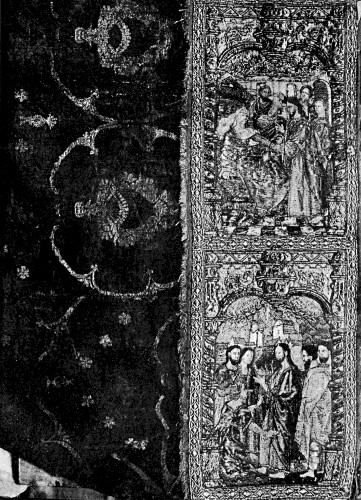
X
PRIEST'S ROBE; SPANISH
(Embroidered in Gold on Green Velvet. About A.D. 1500)
Townsend wrote, precisely at the same time as
Bourgoing: “Segovia was once famous for its
cloth, made on the King's account; but other
nations have since become rivals in this branch,
and the manufacture in this city has been gradually
declining. When the King gave it up to a private
company, he left about three thousand pounds in
trade; but now he is no longer a partner in the
business.[34] In the year 1612 were made here
twenty-five thousand five hundred pieces of cloth,
which consumed forty-four thousand six hundred
and twenty-five quintals of wool, and employed
thirty-four thousand one hundred and eighty-nine
persons; but at present they make only about four
thousand pieces. The principal imperfections of
this cloth are, that the thread is not even, and
that much grease remains in it when it is delivered
to the dyer; in consequence of which the colour
is apt to fail. Yet, independently of imperfections,
so many are the disadvantages under which the
manufacture labours, that foreigners can afford to
pay three pounds for the arroba of fine wool, for
which the Spaniard gives no more than twenty
shillings, and after all his charges can command
the market even in the ports of Spain.
“In the year 1525, the city contained five
thousand families, but now they do not surpass
two thousand—a scanty population this for twenty-five
parishes; yet, besides the twenty-five churches,
together with the cathedral, they have one and
twenty convents. When the canal is finished,
and the communication opened to the Bay of
Biscay at Santander, the trade and manufactures
of Segovia may revive; but, previous to that event,
there can be nothing to inspire them with hope.”
Swinburne had written of the same city ten
years earlier (1776): “The inhabitants do not
appear much the richer for their cloth manufactory.
Indeed, it is not in a very flourishing
condition; but what cloth they make is very
fine.”
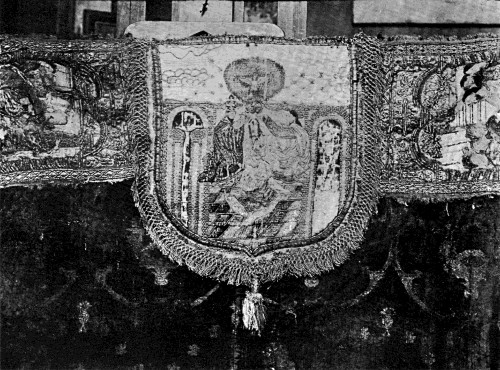
XI
PRIEST'S ROBE; SPANISH
(Embroidered in Gold on Green Velvet. About A.D. 1500)
The Ordinances of Granada (a.d. 1532), from
which we learn that cloth was also manufactured
at that capital, contain the usual dispositions relative
to the stamping of this product by the city
officers. The stamps were in a box which was kept
in a corner of the cathedral and closed by two keys,
guarded severally by a councillor and an inspector
of the trade, or veedor. On every day except a
public festival, between the hours of ten and
eleven of the morning, and three and four of the
afternoon, it was the duty of these two authorities
to proceed to the Alcaicería, and ascertain if any
cloth required stamping. If so, the stamps were
fetched forthwith from the cathedral, the cloth
was marked, and the stamps were solemnly restored
to their chest beneath the double key.
Among the woven fabrics other than those of
silk, and which are specified in the Ordinances of
Granada relative to the tundidores or shearers,
are cloths of Florence, Flanders, London, Valencia,
Zaragoza, Onteniente, Segovia, and Perpignan;
velarte (a fine cloth manufactured at Granada),
red burel (kersey) of Baeza, black kersey of
Villanueva and La Mancha, ruan (Roan linen),
fustians, friezes, and cordellate (grogram) of
Granada, Valencia, Toledo, Segovia, and Cuenca.
According to Capmany, cloths of the commoner
kind, and which were popular about this time,
were the granas treintenas and black cloths of
Valencia, the white or yellow veintiseiseno cloths
of Toledo, the white cloths of Ciudad Real, the
green palmillas of Cuenca, and green dieciochenos
of Segovia, the contrayes of Cazalla, and the
pardillos of Aragon. Spanish cloth was also
manufactured at Vergara, Cordova, Jaen, Murcia,
Palencia, Tavira de Durango, and Medina del
Campo.
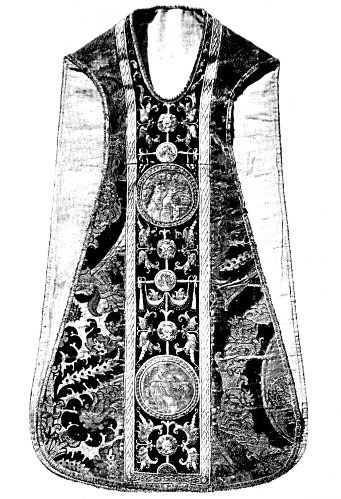
XII
EMBROIDERED CHASUBLE
(Palencia Cathedral)
Laborde says: “In the archives of the Crowns
of Aragon and Castile there is a notice of the
duties paid from the thirteenth to the end of the
seventeenth century for foreign cloths sold in
Spain, and for other articles of consumption coming
from abroad. The principal cloths came from
Bruges, Montpellier, and London; the velvets
from Malines, Courtrai, Ypres, and Florence.
This trade became so injurious to Spain, that
Ferdinand and Isabella thought themselves bound
to limit it entirely to the stuffs required for ornaments
of the church, which of itself was a considerable
quantity. Their prohibition is the
subject of the rescript of September 2nd, 1494,
for the provinces of the Crown of Castile. Even
so far back as the Ordinances of Barcelona in
1271, mention is made of the taxes levied on the
cloths of Flanders, Arras, Lannoy, Paris, Saint
Denis, Chalons, Beziers, and Reims.”[35]
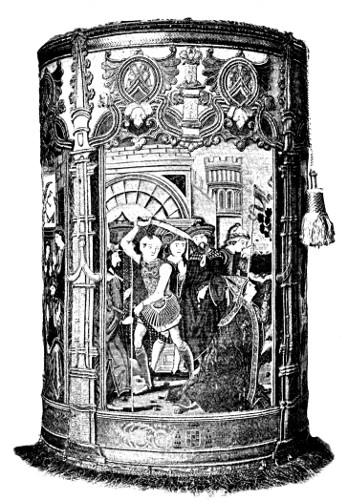
XIII
EMBROIDERED MANGA OR CASE OF PROCESSIONAL CROSS
(Early 16th Century; Toledo Cathedral)
In 1809 the same author remarked: “The
kingdom of Valencia produces little wool, yet
there are five manufactories of woollens and
coarse and fine cloths: they are at Morella,
Enguera, Bocairente, Onteniente, and Alcoy.
The small woollen stuffs are principally made
at Enguera; nothing but the coarsest cloths are
made at Morella, Bocairente, and Onteniente.
The manufactory at Alcoy is the most considerable:
the cloths, though finer, are generally of
an inferior quality. The woof of them is thick,
with little nap upon it. The finest are scarcely
superior to the beautiful cloths of Carcassonne.”
The art of embroidering, and especially of embroidering
with the aid of gold and silver thread,
was communicated to the Spaniards by the
Spanish Moors, who doubtless had derived it from
the East. By about the thirteenth century, the
needle of the Spanish embroiderer had become, in
the picturesque phrase of one of his compatriots,
“a veritable painter's brush, describing facile outlines
on luxurious fabrics, and filling in the spaces,
sometimes with brilliant hues, or sometimes with
harmonious, softly-graduated tones which imitate
the entire colour-scheme of Nature.” Nevertheless,
it was not until the fifteenth and the sixteenth
centuries that this art attained, in the Peninsula,
its topmost summit of perfection.
It is not at all surprising that embroidery should
have made great progress among a people so devoted
to the outward and spectacular forms of worship
as the Spaniards; nor have the chasubles,
copes, and other vestments of the Spanish prelacy
and priesthood ever been surpassed for costly
splendour[36] (Plates x., xi., xii.). But generally
where the Spanish embroiderer excelled was in
the mere manipulation of the needle. In fertility
of design he was far outdistanced by the Germans
and Italians, and was even to a large extent their
imitator; for Spanish embroidery, as occurred with
Spanish painting, was influenced, almost to an
overwhelming degree, firstly by northern art, and
subsequently by the art of the Renaissance.
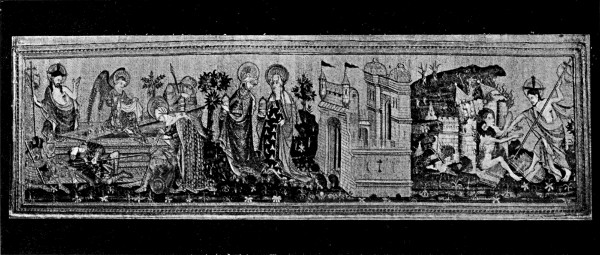
XIV
EMBROIDERED ALTAR-FRONT
These tendencies or characteristics will be found
in nearly all the masterpieces of Spanish embroidery
that have been preserved until to-day,
of which perhaps the most remarkable specimens
are the manga or case of the great processional
cross presented by Cardinal Cisneros to Toledo
cathedral, and the “Tanto Monta” embroidered
tapestry belonging to the same temple. The
manga grande, known as that of the Corpus
(Plate xiii.), is in the Gothic style, with reminiscences
of German art, and consists of the
following four scenes arranged in panels thirty-seven
inches high, and hung successively about
the handle of the cross:—
(1) The Ascension of the Virgin Mary, who is
supported by six angels.
(2) The Adoration of the Magi.
(3) San Ildefonso in the act of cutting off a
piece of the veil of Santa Leocadia, patron
of Toledo.
(4) The Martyrdom of San Eugenio, another
patron of the city of Toledo.
The ground of this elaborate “sleeve” is a
fabric of rich silk, on which the embroidery is
worked in gold and silver thread and coloured
silks, principally blue and red, combined in delicate,
harmonious tones. The figures are outlined with
fine gold cord, which forms a kind of frame or
fencing to confine the stretches of smooth silk.
The careful copying of architectural detail is
stated by Serrano Fatigati to be strongly
characteristic of Spanish industrial art in the
fourteenth, fifteenth, and even sixteenth centuries.
The same writer considers that this “sleeve”
was executed towards the year 1514, when
embroiderers of great renown, such as Alonso
Hernández, Juan de Talavera, Martin Ruiz,
Hernando de la Rica, Pedro de Burgos, and
Marcos de Covarrubias were engaged on similar
work in the venerable city of the Tagus. Two
out of the four panels, says Serrano Fatigati, may
possibly be from the hand of Covarrubias, who
was a famous craftsman of his time, and held the
post of master-embroiderer in Toledo cathedral.
In any case, the four panels are evidently not all
by the same artist, nor do they appear to have
been executed at precisely the same period.
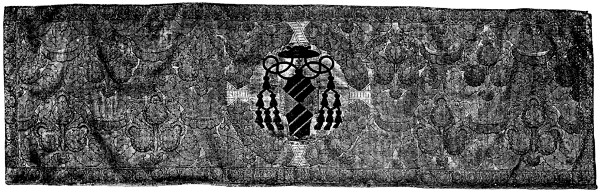
XV
EMBROIDERED ALTAR-FRONT, WITH THE ARMS OF CARDINAL MENDOZA
(15th Century. Toledo Cathedral)
The gorgeous embroidered tapestry which also
belongs to this cathedral (where it serves as a
hanging or colgadura for the altar on the day of
Corpus Christi), and which is known as the “Tanto
Monta” tapiz, is stated by some authorities to
have been the dosel or bed canopy of Ferdinand
and Isabella, and to have been purchased,
in the year 1517, for 900,000 maravedis by
Alonso Fernández de Tendilla, steward of those
sovereigns. Riaño gives the following account of
the same object:—
“As a fine specimen of embroidery on a large
scale, must be mentioned the dosel or canopy called
the tent of Ferdinand and Isabella, which was
used in the reception of the English envoys,
Thomas Salvaige and Richard Nanfan, who were
sent in 1488 to Spain to arrange the marriage of
Prince Henry with the Infanta Doña Catalina.”
The ambassadors describe it in the following
manner: “After the tilting was over, the kings
returned to the palace, and took the ambassadors
with them, and entered a large room; and there
they sat under a rich cloth of state of rich crimson
velvet, richly embroidered with the arms of Castile
and Aragon, and covered with the device of the
King which is a … (blank in original),[37] and
his motto, written at length, which is ‘Tanto
Monta.’” (“Memorials of King Henry the
Seventh,” Gairdner, London, 1858, p. 348).
Riaño also describes the mantle of the Virgen
del Sagrario at Toledo. “It is completely covered
with pearls and jewels forming a most effective
ornamentation. This embroidery was made in
the beginning of the seventeenth century, during
the lifetime of Cardinal Sandoval, who presented
it to the church.” Señor Parro, in his exhaustive
work Toledo en la Mano (Vol. I., p. 574), gives
the following account of it: “It is made of twelve
yards of silver lama, or cloth of silver, which is
entirely covered with gold and precious stones.
In the centre there is a jewel of amethysts and
diamonds. Eight other jewels appear on each
side, of enamelled gold, emeralds, and large
rubies. A variety of other jewels are placed at
intervals round the mantle, and at the lower part
are the arms of Cardinal Sandoval enamelled on
gold and studded with sapphires and rubies. The
centre of this mantle is covered with flowers
and pomegranates embroidered in seed-pearls of
different sizes. Round the borders are rows of
large pearls. Besides the gems which are employed
in this superb work of art, no less than two
hundred and fifty-seven ounces of pearls of different
sizes were used, three hundred ounces of gold
thread, a hundred and sixty ounces of small pieces
of enamelled gold, and eight ounces of emeralds.”
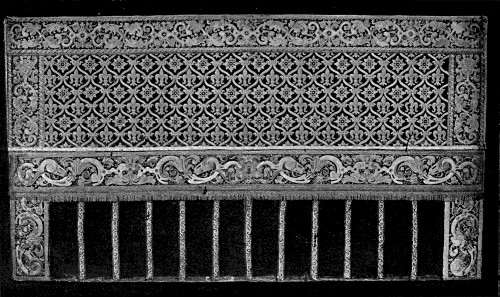
XVI
EMBROIDERED ALTAR-FRONT
(Palencia Cathedral)
As in other countries, embroidery in Spain
was executed in the bygone time, both by paid
embroiderers, and as a domestic occupation by
the ladies of the aristocracy. The work of the
professional embroiderer consisted principally of
paraments or altar-fronts (Plates xiv., xv., xvi.,
xviixvii.), and ecclesiastical vestments. Among the
former of this class of objects, nothing is finer than
the frontal of the Chapel of Saint George in the
Audiencia of Barcelona. It is believed to have
been wrought by Antonio Sadurni, a Catalan
embroiderer who flourished in the middle of the
fifteenth century. The scene represented is the
combat between Saint George (patron of Cataluña)
and the dragon. The saint has rescued a
damsel from the monster's claws, and her parents
are looking on from a mirador of their palace.
This central episode is surrounded with borders
and arabesques of extraordinary richness.
Riaño gives a list, compiled from Cean, Martinez,
Suarez de Figueroa, and other authors, of forty-seven
Spanish embroiderers of the fifteenth, sixteenth,
seventeenth, and eighteenth centuries.
More recently, Ramírez de Arellano has discovered,
among the municipal archives of Cordova,
the names of sixteen others, who resided at
that city towards, or early in, the seventeenth
century. The craftsmen in question were Diego
de Aguilar, Juan Bautista, Bernardo Carrillo,
Luis Carrillo de Quijana, Andrés Fernández de
Montemayor, Hernán Gómez del Río, Diego
Fabián de Herrera, Diego del Hierro, Diego
López de Herrera, Diego López de Valenzuela,
Antonio de Morales, Gonzalo de Ocaña, Mateo
Sanguino, Manuel Torralbo, Cristóbal de Valenzuela,
and Martin de la Vega.
Documents in the same archive contain additional
particulars respecting two or three of these
artificers. Thus, on February 10th, 1607, Hernán
Gómez del Río engaged himself to embroider for
the convent of the Trinity at Cordova, “a
bordering for a chasuble and four faldones for
dalmatics, with their collars and sabastros and
bocas mangas. The said bocas mangas to be four
in number, and the collars two; also the collaretes
which may be necessary for the two dalmatics,
and which I am to embroider in silk and gold
upon white satin. The collaretes also to be embroidered
by me in silk and gold to match a
bordering of white satin for a cloak in possession
of the said convent.” Further, the convent was to
supply the artist with the quantity of white satin
required, and pay him two hundred and ten ducats,
secured by certain of the convent's revenues, for
the gold, the silk, and the workmanship.
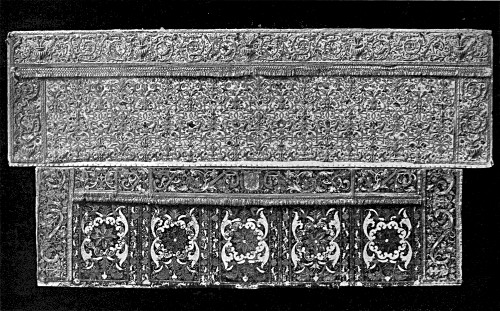
XVII
EMBROIDERED ALTAR-FRONTS
(Palencia Cathedral)
Manuel Torralbo contracted to embroider a
velvet altar-front and its corresponding fronteleras
for the parish church of Luque, at a price of three
hundred reales; and Cristóbal de Valenzuela (on
September 25th, 1604) to embroider two frontals
for the altar of the church of Obejo. One of them
was to be of purple velvet worked in gold, and
the other of “black velvet, with borders and
caidas embroidered in yellow satin and white satin,
with skulls and bones embroidered in gold.”[38]
Turning our attention to the embroidery which
was executed, principally as a recreation, by highborn
Spanish ladies of some centuries ago, the
romance of El Compte Arnau, quoted by Miquel y
Badía and written in Catalan and Provençal,
contains the following lines:—
| “¿ |
Ahout teniu las vostras fillas—muller leal? |
| ¿ |
Ahout teniu las vostras fillas—viudeta igual? |
| |
A la cambra son que brodan—Compte l'Arnau |
| |
A la cambra son que brodan—seda y estam.” |
Isabella the Catholic presented to the Chapel
Royal of the cathedral of Granada an ecclesiastical
robe embroidered by her own hands for the festival
of Corpus Christi. The material was black
satin brocade, with a fringe of white silk, and the
letters IHS in white damask.[39]
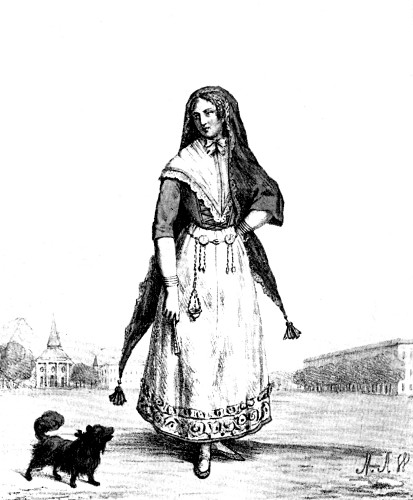
XVIII
WIFE OF WELL-TO-DO MERCHANT
(Palma, Balearic Islands. About A.D. 1810)
The same usage continued in the seventeenth
century. Countess d'Aulnoy says: “Young ladies
of great beauty and of noble blood engage themselves
to wait on ladies of the aristocracy, and
spend most of their time embroidering the collars
and sleeves of shirts in gold, silver, and coloured
silk, although, if they be suffered to follow their
liking, they work but little, and gossip a great
deal.” The same writer refers repeatedly to the
sumptuous embroideries in use among the upper
classes of the Spaniards of that time. Thus, the
bed-pillows of the Princess of Monteleón were
embroidered with gold. The sleeves of the coat
of Charles the Second were of white silk, very
large, opening towards the wrist, and embroidered
with blue silk and jet, the rest of his costume
being embroidered in white and blue silk. In the
palace of the same monarch, the daïs of the throne-room
was covered with “a wondrous carpet, and
the throne and its canopy were embroidered with
pearls, diamonds, rubies, emeralds, and other
precious stones.” The cloaks of the chevaliers
who belonged to the Military Orders of Santiago,
Calatrava, and Alcántara were embroidered with
gold. The gentlemen of Madrid covered their
horses with silver gauze, and trappings embroidered
with gold and pearls.[40] The same gentlemen wore
coats whose sleeves were of coloured satin, embroidered
with silk and jet, and even their lackeys,
when they attended their masters in a procession,
wore uniforms of cloth embroidered with gold and
silver. Unmarried girls and brides wore gold-embroidered
bodices. The chairs in which the ladies of
Madrid paid visits were made of cloth embroidered
in gold and silver, stretched upon the wooden
frame. In the train of the Duchess of Terranova
went six litters covered with embroidered velvet.
“In the parish church of San Sebastián,” wrote
Countess d'Aulnoy, “I have seen a hand-chair
made by order of the queen-mother, for carrying
the Sacrament to sick persons in bad weather. It
is lined with crimson velvet embroidered in gold
and covered with hide studded with gilt nails: it
has large window-glasses, and a kind of small
belfry full of golden bells.”
With the succession of a French line of
sovereigns to the throne of Spain, a taste for French
embroideries passed into the Peninsula, and these,
in course of time, were imitated by the Spanish
craftsmen.[41] “We find,” says Riaño, “that Madrid
was the principal centre of this industry, and that
French designs were universally copied, as was
the case in the whole of Europe. The splendid
curtains and embroidered hangings for apartments
which exist at the royal palaces of Madrid, the
Escorial, and Aranjuez, are admirable specimens.”
I may mention here the embroidery, often of
a rich and highly ornate character, which is, or
used to be, applied to the regional costumes of
Spain. Plate ix. is reproduced from a rare print
in my possession, showing the gala dress, as it
existed in the year 1777, of the charra of Salamanca,
with full, white sleeves ornamented in
black embroidery with animals and other devices.
A similar costume is still worn in that neighbourhood.
Plate xviii., also copied from a print in my
collection, dating from about the year 1810, shows
the costume worn by the women of the well-to-do
middle class of the island of Majorca. “Le jupon
ou guardapies,” says the manuscript description
prefixed to this series of plates, “en mousseline,
complete le costume de cette insulaire: il est orné
au bas de riches broderies, mais assez court pour
laisser voir un joli petit pied chaussé d'un bas de
coton ou de soie et d'un élégant soulier de satin.”
There is a dim tradition, derived from or supported
by a Latin poet (“Tunc operosa suis
Hispana tapetia villis”) that carpets or tapestries
of some kind were made in the Spanish Peninsula
in the time of the Romans. Undoubtedly this
craft was practised by the Spanish-Moors, particularly
in the regions of Valencia, Alicante, Cuenca,
and Granada. This statement is confirmed by two
laconic notices which occur in the Description of
Africa and Spain of Edrisi, a Mohammedan
geographer of the twelfth century. Of the town
of Chinchilla, in Alicante province, he wrote,—“woollen
carpets are made here, such as could
not be manufactured anywhere else, owing to the
qualities of the air and water”; and of Cuenca,
“excellent woollen carpets are manufactured at
this town.”
“En Espagne,” says Müntz, “l'industrie textile
ne tarda pas à prendre également le plus brilliant
essor, grâce à la conquête maure. Les étoffes
d'Almeria acquirent rapidement une réputation
européenne; il est vrai que c'étaient des brocarts,
des damas, et autres tissus analogues, non des
tapisseries: l'influence qu'elles furent appelées à
exercer au dehors se borna donc au domaine de
l'ornementation.”
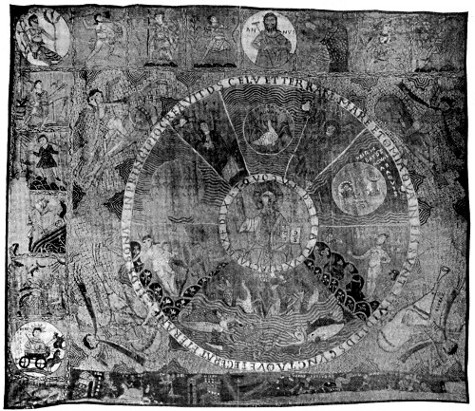
XIX
THE “GENESIS TAPESTRY”
(12th Century; Gerona Cathedral)
Of a similar composition to the foregoing
fabrics specified by Müntz—that is to say, not
genuine tapestries, although requiring for several
reasons to be classed with these—is the celebrated
“Genesis” (Plate xix.) of the cathedral of
Gerona. This primitive yet complicated work
of art, dating from the twelfth century, is embroidered
in crewels upon linen, and represents
the creation of the world. Its dimensions are
about four yards high by four and a half yards
wide; but the bordering has been torn away in
places. The design is thus described by Riaño:—“In
the centre is a geometrical figure formed by
two concentric circles. In the lesser circle is a
figure of Christ holding an open book, on which
appear the words Sanctus Deus, and on each side
Rex fortis, surrounded by the inscription, Dixit
quoque Deus, Fiat lux, Et facta est lux. In the
larger circle are the words, In principio creavit
Deus coelum et terram, mare et omnia quæ in eis
sunt, et vidit Deus cuncta quæ egerat et erant
valde bona.
“The space between the two circles is divided
by radiating lines into eight portions, in which
are represented the Mystic Dove, the angels of
light and darkness: the division of land from
water, the creation of sun, moon, and stars, of
birds, fishes, and beasts, and of Adam and Eve.
In the angles outside the larger circle are the four
winds, and the whole is surrounded by a border,
imperfect in parts, containing representations of
the months, and apparently of certain scriptural
incidents, too much defaced to be clearly made out.”
The royal palaces of Spain and many of her
noble houses have possessed, from about the
fifteenth century, splendid collections of the
costliest tapestries, consisting principally of paños
de Ras, or “Arras cloths” (as they were called
among the Spaniards, and especially in Aragon).
Until a later period all, or very nearly all, these
objects were imported from the Flemish workshops.[42]
At the palace of a nobleman in Madrid,
Bertaut de Rouen observed “les plus belles
tapisseries du monde.” The same author tells us
that in the seventeenth century, when he visited
Spain and wrote his entertaining Journal, it was
customary for the walls of the royal palace to
be hung with tapestry in winter, these hangings
being removed for greater coolness in the summer
months. In reading descriptions of Spanish life
referring to the same period, one is struck by the
craze which prevailed among the Spaniards for
displaying tapestries and other gay-coloured fabrics
in all kinds of places and on every possible occasion.
Thus, Bertaut de Rouen relates that when he saw
a play performed in the Alcázar, “le long de ces
deux costez de la salle estoient seulement deux
grands bancs couverts de tapis de Perse”; that
the boxes at the bull-fights, both at Madrid and
in the country, were “tapissées de brocatelle de
soye”; and that the lower part of the dome in
one of the chapels of Seville cathedral was
decorated with the same material. At the haunted
castle of Quebaro, on the road from Galareta
to Vitoria, Countess d'Aulnoy saw upon the
walls of a large chamber, some tapestries representing
the amours of Don Pedro the Cruel and
of Doña María de Padilla. “This lady was
depicted seated, like a queen, among various other
ladies, while the king crowned her with a chaplet of
flowers. Elsewhere Doña María was reposing in
a forest, as the king offered her a falcon. I also
saw her dressed as a warrior while the king, in
armour, offered her a sword. This set me thinking
whether she had ever accompanied Don Pedro
in one of his campaigns. All the figures in these
tapestries were badly drawn, but Don Fernando
assured me that all well-executed likenesses of
Doña María de Padilla represented her to be a
woman of rare charm, the loveliest of her century.”
Pinheiro da Veiga says that at Valladolid in
1605, a banquet was celebrated in “a large gallery,
completely covered with the richest silk brocade, as
were most of the other apartments.” He also says
that cloths of similar richness were employed as
street-awnings. “Upon the ninth was the Corpus
procession, at which the king was to assist; and
a proclamation was issued that none should
promenade on horseback or in coaches. I found
nothing remarkable in this procession, unless it
were the hangings and the awnings to keep off
the sun, which were of the richest damask and
brocade.” Of the same fiesta Countess d'Aulnoy
wrote in 1679: “The streets through which the
procession has to pass are adorned with the finest
tapestries in all the world, since in addition to
those belonging to the Crown, many of the greatest
beauty are displayed by private persons. The
celosías of all the balconies are replaced by
elaborate canopies and hangings, and the whole
roadway is covered with an awning to ward off the
sun, and which, for the sake of greater freshness,
is moistened with a little water.” Nearly identical
with this account is that of Alexander de Laborde,
who wrote, a century and a quarter later than the
Countess; “On Corpus Christi day there is a
grand procession composed of the regular and
secular clergy of Madrid, followed by the king,
his ministers, and court, each bearing in his hand
a wax taper. Magnificent awnings of tapestry are
raised in the streets through which the procession
is to pass; the balconies are decorated with
splendid hangings; the seats are covered with
cushions, and occasionally surmounted with a daïs;
in some of the streets the face of day is darkened
by canopies which stretch from one side to the
other. Altars are placed at regular intervals; the
balconies are thronged with ladies superbly
dressed, who sprinkle scented water, or scatter
fragrant flowers on the passing multitudes.”
Pinheiro da Veiga also describes a set of remarkable
tapestries, evidently Flemish, which he saw
in the Chapter-room of the Convent of Cármen
Calzado at Valladolid. “It was hung with the
richest tapestry, silk, and paintings that had
belonged to the Duke of Lerma. I greatly
admired some cloths of green velvet, worked all
over with the Bucolics of Virgil, in tarjas embroidered
in silk and gold, as though they were
sebastos[43] of ecclesiastical vestments, but these
were old, of great value, and extraordinary merit.
Finer still were certain cloths of recent workmanship,
such as I had never seen equalled, of a
white material painted in tempera, with the borders,
dresses, and faces of the personages on them
wrought in twisted gold. I never saw anything
so brilliant or so novel. The cloths were eight
in number, with four embroidered guardapuertas.
The persons figured upon them wore belts of
real pearls, rings set with diamonds and rubies
on their fingers, and gold chains and medals
studded with precious stones, just as living people
wear them.”
The fashion of collecting foreign tapestries seems
to have reached its height at the Spanish capital
in the first half of the seventeenth century.
“Nowadays,” wrote Fernandez de Navarrete, in
his Conservacion de Monarquías, published in
1626, “gentlemen are not contented with hangings
which a few years ago were considered good
enough to adorn a prince's palace. The Spanish
taffetas and guadamecíes, so highly esteemed in
other provinces, are held of no account in this one
(Madrid). The sargas and arãbeles wherewith the
moderation of the Spanish people was satisfied in
former days, must now be turned into injurious
telas rizas of Florence and Milan, and into costliest
Brussels tapestry.”
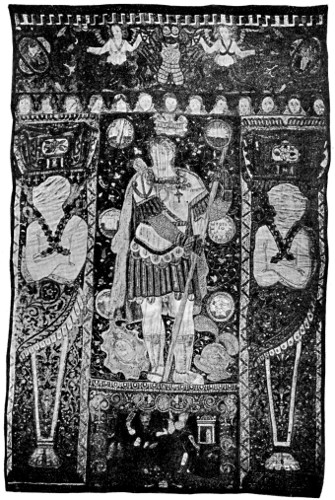
XX
TAPIZ OF CRIMSON VELVET WORKED IN GOLD TISSUE
(16th Century. Monastery of Las Huelgas, Burgos)
It is perhaps allowable to include among the
oldest makers of Spanish tapestry the names of
Gonzalo de Mesa and Diego Roman, who, in
the year 1331, were paid respectively one thousand
maravedis and eighteen hundred maravedis, for
decorating the tents of King Sancho the Fourth.
There also exists the following entry, dating from
the same period; “To Boançibre, master of the
tents; XXX maravedis for his food, for fifteen
days.”[44]
Far clearer than these laconic excerpts is a
document preserved in the library of the Academy
of History at Madrid, in the form of a memorial
presented to Philip the Second by a Spanish
tapestry-maker of Salamanca, named Pedro
Gutierrez,[45] and setting forth, in pessimistic
language, the unhappy condition of this craft in
the Peninsula. Pedro relates of himself that in
twenty-four days he made for the Cardinal-archduke
no less than a hundred and twenty reposteros;
and that in order to exhibit his cleverness as a
tapestry-weaver, he set up a loom in the royal
palace (being officially the tapicero to the Crown),
and worked for forty days where all might criticise
the product of his toil. Gutierrez also states that
the township of Madrid had provided him with
six hundred ducats to enable him to establish
there a tapestry-factory for the space of ten years,
together with six hundred and fifty ducats from
the Cortes for supporting his apprentices, and a
thousand ducats from the king to defray the cost
of certain voyages he had made to Lisbon,
Monzón, and Barcelona, and of removing his residence
from Salamanca to the capital of Spain. He
complains, however, that the house he dwells in
at Madrid is not large enough to contain his loom,
and replies to the objections of such persons as
opposed his opening the tapestry-works at all (on
the ground that this craft was practised better and
more cheaply in Flanders), by asserting that
Spanish makers of reposteros were now accustomed
to receive a daily wage of no more than three
reales and “a miserable meal.” This, he urges,
should render Spanish tapestries at least as inexpensive
to produce as those of Flanders; although,
upon the other hand, he admits that the colouring
of the former is likely to prove inferior to the
Flemish cloths in purity and durability. “Common
tapestry,” he says, “seldom keeps its colour upward
of a couple of years, so that, if such were
used in open sunlight on the backs of beasts of
burden, or to cover carts, exposed to sun, wind,
dust, and mire, or else for cleaning shoes upon,
as now is practised with the reposteros, their
imperfections would become apparent all the
sooner.”
Mention of these typically Spanish objects
known as reposteros,[46] induces me to quote an
interesting notice relating to the visit of Philip the
Second to Cordova, in the year 1570. The train
of the Duke of Medina Sidonia, who journeyed
to this city in order to receive his sovereign,
consisted of a hundred and three mules covered
with “new reposteros of wool, and of six mules
covered with reposteros of purple velvet, embroidered
with silver and gold, and bearing the
duke's arms.”
If, as seems most likely, the woollen reposteros
above referred to were of woven work containing
a device, this passage would demonstrate that the
manufacture of the cloths in question was sometimes
the province of the tapestry-maker and
sometimes that of the embroiderer. Ramírez de
Arellano, from whose instructive studies on the
craftsmen of older Spain I quote the foregoing
extract, says that the making of reposteros
constitutes a branch of craftsmanship distinct
from embroidery of the common class, and that
the men who produced them deserve to be
included among artists of real merit. He gives
the names of two, Hernán Gonzalez and Juan
Ramos, who worked at Cordova in the middle of
the sixteenth century. A document relating to the
former of these men tells us that in those days the
price of a repostero de estambre measuring sixteen
palms square, with a coat-of-arms worked in the
centre, and a decorative border, was ninety reales.
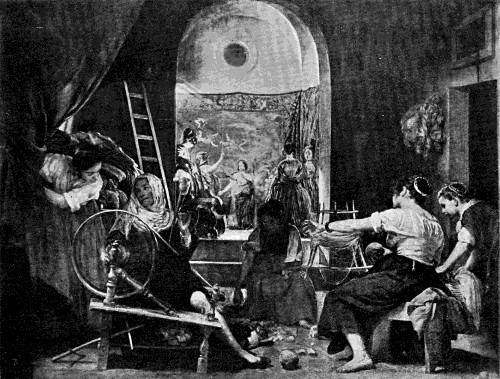
XXI
THE SPINNERS
(By Velazquez. Prado Gallery)
Riaño says: “I do not find any information of
a later date which suggests the existence of the
manufacture of tapestries in Spain during the
Middle Ages.” Davillier, however, affirms that
in the year 1411 two master-makers of tapestry
were living at the court of the King of Navarre,
and that other craftsmen, holding the same title,
were established at Barcelona in 1391 and 1433.
This notice is accepted by Müntz: “A la fin du
XIVe et au commencement du XVe siècle, les
Espagnols tentèrent de fonder dans leur patrie
quelques ateliers de haute lisse. A Barcelone, en
1391 et en 1433, plusieurs tapissiers (maestros de
tapices) firent partie du grand Conseil. Mais ces
tentaves ne semblent pas avoir eu de résultats
durables. Il était plus commode de recourir
aux manufactures flamandes, si merveilleusement
organisées. Peut-être même ce système était-il
plus économique. Ne voyons-nous pas aujourd'hui
jusqu'à l'extrême Orient tirer, pour raison
d'économie, des fabriques de Manchester et de
Birmingham les tissus courants dont il a besoin?”
The history of tapestry-making at Madrid may
be said to date from the establishment in this
town of a small factory by Pedro Gutierrez, whose
petition to Philip the Second I have already
quoted, and who received protection both from
that monarch and from the queen, Doña Ana.
In 1625 Gutierrez was succeeded by Antonio
Ceron, who formally styled himself “tapicero de
nuevo, sucesor de Pedro Gutierrez” (“maker of
new tapestries, successor to Pedro Gutierrez”),
and petitioned the king for the grant of a meal a
day, “in recompense of having taught his trade
to eight lads, and of having mounted eight looms
in (the factory of) Santa Isabel.” This factory of
Santa Isabel was so called from the street in which
it lay, and part of it is represented in the celebrated
painting by Velazquez called Las Hilanderas
(“The Spinners,” not, as it is translated in
Riaño's handbook, “The Weavers.” Plate xxi.).
This factory was unsuccessful, and declined by
degrees until it ceased completely, in spite of the
efforts made to revive it in 1694 by a Belgian
named Metler, and in 1707 by a Salamanquino,
Nicholas Hernández.
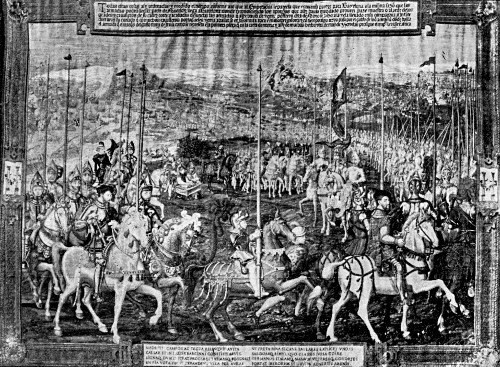
XXII
TAPESTRY MADE AT BRUSSELS FROM GRANADA SILK
(16th Century. Spanish Crown Collection)
A new tapestry-factory—that of Santa Barbara—was
founded shortly afterwards in a building
known as the Casa del Abreviador. The first
director, engaged in 1720 by order of Philip the
Fifth, was Jacob Van der Goten, a native of
Antwerp,[47] who died in 1724, and was succeeded
at the factory by his sons, Francisco, Jacobo,
Cornelius, and Adrian. These craftsmen worked
with basse lisse looms till 1729, in which year a
haute lisse loom was mounted by a Frenchman,
Antoine Lenger.
In 1730, when the court removed to Seville, a
tapestry-factory was established at this city also.
The director was Jacob Van der Goten the
younger, assisted by the painter Procaccini. At
the end of three years this factory closed its
doors, and Van der Goten and Procaccini, returning
to Madrid, established themselves at the old
factory of Santa Isabel, from which, in 1744, they
again removed to the factory of Santa Barbara.[48]
In 1774, when, with the exception of Cornelius,
who was considered the most skilful of them all, the
family of the Van der Gotens had died out, the
direction of the Santa Barbara factory was entrusted
to several Spanish artists, named Manuel
Sanchez, Antonio Moreno, Tomás del Castillo,
and Domingo Galan. Sanchez, who acted as
general superintendent of the works, died in 1786,
and was succeeded in this office by his nephew,
Livinio Stuck, whose son resumed the directorship
in 1815, after the factory had been paralysed
by the invasion of the Peninsula, and destroyed
by the French in 1808. Since then it has never
ceased working, and descendants of the Stucks
continue to superintend it at the present day.
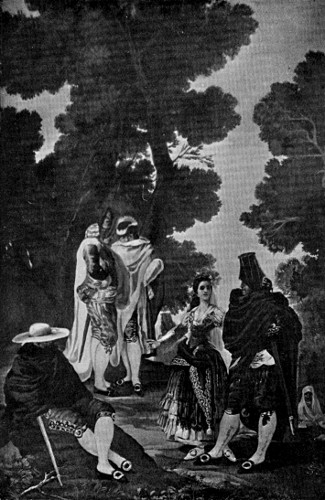
XXIII
A PROMENADE IN ANDALUSIA
(Cartoon for Tapestry. By Goya)
The collection of tapestry belonging to the
Crown of Spain is probably the finest in the
world. As far back as the reign of Ferdinand
and Isabella the walls of the royal palace were
hung with decorative textile cloths or paños de
Ras, and among the officers in the household of
their son, the youthful Prince Don Juan, we find
included a keeper of the tapestry and reposteros.
But it was not until the reigns of Charles the
Fifth and Philip the Second that the royal collection
was enriched with numerous sets of celebrated
tapestries produced in Italy and Flanders—countries
which were then subjected to the yoke
of Spain. Frequent additions were also made
throughout the seventeenth and eighteenth centuries,
both from abroad and subsequently (when
the Brussels industry declined) from the Spanish
factories of Santa Isabel and Santa Barbara.
As early as the year 1600 a Spaniard wrote
enthusiastically of “the rich and cunning tapestries
belonging to His Majesty, to whom it would be
easier to win a kingdom than to get them made
anew.”[49] At the present day it is impossible to
estimate with any certainty the number of these
tapestries, the greater part of which are locked
away. Only on certain festivals, such as the days
of Corpus Christi and the Candelaria (Purification),
a few are unfolded and displayed in the upper
galleries of the palace at Madrid. Their total
number is believed to be not far short of one
thousand pieces;[50] but Señor Tormo calculates
that were they no more than five hundred, they
would, if placed end to end, cover more than two
miles of ground.
Among the sets which form this wonderful
collection, distributed between the palaces of
Madrid, the Prado, and the Escorial, none is of
greater merit or magnificence than the series of
twelve cloths depicting the Conquest of Tunis
(Plate xxii.), designed for Charles the Fifth by
his Court painter, Jan Vermay or Vermeyen,
of Beverwyck, near Haarlem, and executed by
William Pannemaker, of Brussels. It was agreed
by Pannemaker in 1549 that the materials employed
upon this tapestry should consist of the finest
wool, Granada silk, and, for the woof, the choicest
Lyons fillet—the very best that money could procure.
The Emperor himself was to provide the
gold and silver thread. Accordingly, Pannemaker
was supplied with five hundred and fifty-nine
pounds and one ounce of silk, dyed and spun in
the city of Granada, where one of Charles' agents
resided for two years seven months and twenty-five
days, for the purpose of superintending its
preparation. The cost of this silk, exclusive of
the agent's expenses, amounted to 6,637 florins.
Nineteen colours were employed in the dyeing,
each colour consisting of from three to seven
shades, and a hundred and sixty pounds of the
finest silk were consumed in trying to obtain a
special shade of blue.
After receiving these materials, Pannemaker
kept seven workmen constantly engaged upon
each paño of this tapestry, or eighty-four workmen
in all. As soon as any one of the pieces was concluded,
he submitted it to experts who pointed out
such details as they recommended for correction.
The entire work required a little more than five
years, and was therefore terminated in 1554. The
price paid for it was twelve florins per ell, and
the number of these was 1246, representing a
total cost of 14,952 florins, while Pannemaker,
subject to the Emperor's being satisfied with the
work, was further promised a yearly pension of a
hundred florins.[51]
Equally remarkable are the spirited design and
the flawless execution of this series of elaborate
cloths, recalling, in their swarms of armed figures
and the lofty point of view, which reduces the sky
to a mere strip, the vivacious war and camp pictures
of Snyders. The titles of the subjects, forming,
as it were, a pictured epitome of the expedition
led by Charles in person against the Barbary
pirates, are as follows: (1) A map of the Spanish
coast; (2) The review of the troops at Barcelona;
(3) The landing of the forces; (4) A skirmish;
(5) The camp; (6) Foraging; (7) The capture of
La Goleta; (8) The battle of Los Pozos, Tunis;
(9) A sortie of the besieged; (10) The sack of
Tunis; (11) The victors returning to the harbour;
(12) The forces embarking.
According to Müntz, this tapestry has been
copied at least on two occasions; once in the
eighteenth century by Josse de Vos, of Brussels,
and also, in the same century, in Spain, partly at
Seville, and partly at the factories of Santa Isabel
and Santa Barbara.
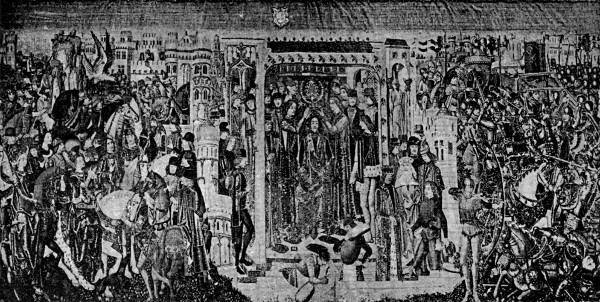
XXIV
TAPESTRY. ARRAS WORK, FROM ITALIAN CARTOONS
(First half of 15th Century. Zamora Cathedral)
Other most valuable and beautiful tapestries
belonging to the Spanish Crown are the series
titled The History of the Virgin, believed to be
from cartoons by Van Eyk, The Passion, from
cartoons attributed to Van der Weyden, the
History of David and History of Saint John the
Baptist, the Mass of Saint Gregory, and the
Founding of Rome. All of these series date from
the fifteenth century and early in the sixteenth.
Belonging to a later period are the reproductions
of rustic scenes and hunting subjects by Teniers
and others, executed in Spain between 1721 and
1724, the Scenes from Don Quixote, made at Santa
Barbara from Procaccini's cartoons, and the eminently
national series produced at the same factory
from designs by Francisco Goya y Lucientes.
This latter group amounts to several dozen pieces,
including the well-known Blind Man's Buff,
A Promenade in Andalusia (Plate xxiii.), The
Crockery-seller, The Grape-Gatherers (Frontispiece),
and other spirited and charming scenes
of popular Spanish life—“tout cela,” as Lefort
describes it, “spirituel, vif, pittoresque, très mouvementé,
bien groupé, s'élevant sur des fonds champêtres
ou baignant gaiement en pleine lumière.”
Other tapestry collections of great merit belong
to the cathedrals of Burgos, Zamora (where they
line the walls of the Sacristy; Plate xxiv.), Zaragoza,
Toledo, Tarragona, and Santiago. The
first of these temples possesses the following sets,
which are displayed to decorate the cloisters on
the feast of Corpus Christi:—
(1) The History of Cleopatra and Mark Antony.
(2) The History of David.
(3) The Creation.
(4) An Historical Subject.
(5) The Theological and Cardinal Virtues.
(6) A series of five Gothic tapestries, which
represent some mystery or allegory, and
seem to be of Flemish manufacture.
One other paño, of a similar character,
accompanies them.
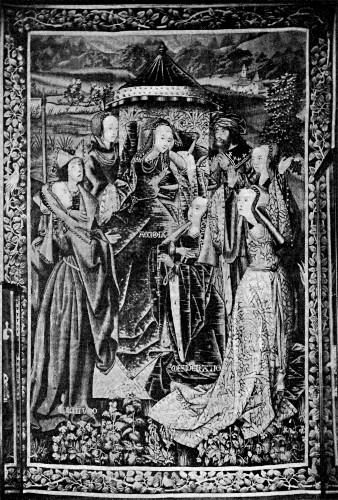
XXV
FLEMISH TAPESTRY
(Late 15th Century. Collection of the late Count of Valencia de Don Juan)
All but the last of the above sets are marked
with two B's separated by a shield, denoting
Brussels workmanship. The Theological and
Cardinal Virtues were presented to the cathedral
about the end of the sixteenth century. They
are evidently executed from Italian cartoons, and
the haute-lisse craftsman who made them, in or
towards the year 1571, was named Francis
Greubels.[52]
The tapestries which belong to the cathedral of
Zaragoza number some sixty or seventy pieces,
including a series (fifteenth century) representing
The Life of Saint John the Baptist, from designs
by Lucas of Holland. Good tapestries were also
the property of Valencia cathedral, but have been
dispersed and sold in recent years. The convent
of the Descalzas Reales at Madrid possesses a
set from designs by Rubens. Ten pieces of this
series formerly belonged to the Count-Duke of
Olivares, who sent them to his town of Loeches;
four passing subsequently to the Duke of Westminster's
collection. The small though valuable
collection formed by the late Count of Valencia
de Don Juan (Plate xxv.), passed at this nobleman's
death to his daughter, Señora de Osma, who
has presented part of it to the Archæological
Museum at Madrid. Another collector resident
in Spain, Mons. Mersmann, of Granada, possesses
a series of fine Brussels cloths representing scenes
from Don Quixote, by Van den Hecke.
Although the Spaniards have enjoyed, and still
enjoy, a widespread fame for lace-making, their
written records of this craft are unsubstantial.
Originally, perhaps, they borrowed it from the
Arabs or Venetians. Certainly, the earliest
Spanish lace was such as is made with a needle,
that is, point, not pillow lace. In this form, à la
aguja, and in the sixteenth century, the Spaniards
possibly conveyed the secrets of its manufacture
to the Netherlands, receiving from the natives of
this country, in exchange, the art of making lace
by means of bobbins, including the characteristic
“Flemish net,” or red flandés.
Towards the sixteenth century the parts of
Spain where lace was manufactured in the largest
quantity were some of the Manchegan towns and
villages, the coast of Finisterre, and nearly the
whole of Cataluña. In La Mancha lace was made,
and still is so, at Manzanares, Granatula, Almagro,
and other places. That of Almagro (the celebrated
punto de Almagro, resembling the lace of
Cataluña), is mentioned by nearly all the older
travellers. In Don Quixote, Teresa writes to
Sancho Panza that their daughter Sanchita was
engaged in making bobbin-lace at a daily wage of
eight sueldos.
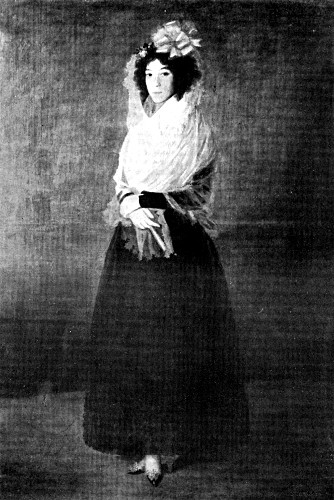
XXVI
THE MARCHIONESS OF LA SOLANA
(By Goya)
In 1877, at the Exhibition of Sumptuary Arts
which was held in Barcelona, a magnificent lace
toca was shown, which was affirmed by its possessor,
Señor Parcerisa, to be the work of a Spaniard of
the later part of the fifteenth century, and to have
belonged to Isabella the Catholic. The cathedral
of the same city owns three thread-lace albs of
sixteenth century workmanship, and the South
Kensington Museum other pieces of Spanish lace
of a comparatively early date, probably made by
nuns and subtracted from the convents during the
stormy scenes of 1835.
Dating from the sixteenth and seventeenth
centuries, we have a number of notices, though
scrappy and inexplicit as a rule, relating to
Spanish lace. One of the more complete and interesting
is quoted by Riaño from the Microcosmia
y Gobierno Universal del Hombre Cristiano
(Barcelona, 1592) of Father Marcos Antonio de
Campos. “I will not be silent,” wrote this
austere padre, “and fail to mention the time lost
these last years in the manufacture of cadenetas,
a work of thread combined with gold and silver;
this extravagance and excess reached such a point
that 100 and 1000 ducats were spent in this work,
in which, besides destroying the eyesight, wasting
away the lives, and rendering consumptive the
women who worked it, and preventing them from
spending their time with more advantage to their
souls, a few ounces of thread and years of time
were wasted with so unsatisfactory a result. I
ask myself, after this fancy shall have passed
away, will the lady or gentleman find that the
chemises that cost them 50 ducats, or the basquiña
(petticoat) that cost them 300, are worth half their
price, which certainly is the case with other objects
in which the material itself is worth more?”
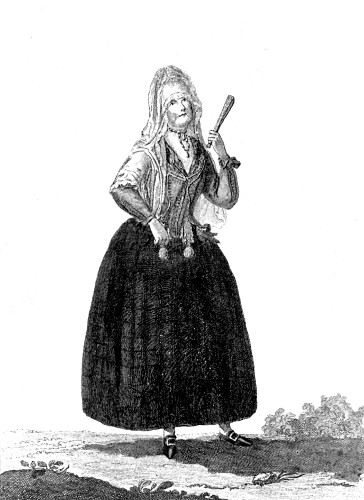
XXVII
A SPANISH MAJA
(A.D. 1777)
Several of the other notices relating to the
lace-makers' craft are from the pen of Countess
d'Aulnoy. Of the Countess of Lemos this writer
says: “Her hair was white, but she carefully
concealed it beneath a black blonde”; and of
another Spanish lady, Doña Leonor de Toledo,
that she wore “a green velvet skirt trimmed with
Spanish blonde.” In the apartments of the young
Princess of Monteleón the countess saw “a bed
of green and gold damask, decorated with silver
brocade and Spanish blonde. The sheets were
fringed with English point-lace, extremely broad
and handsome.” The countess also says that the
petticoats of the Spanish ladies were of English
point-lace,[53] and that these ladies, when they
visited each other, wore on their heads “a toca
of the richest English black point-lace, half a yard
broad, forming points like the antique laces,
beautiful to look at, and very dear. This head-dress
suits them rarely.”
According to Balsa de la Vega, whose interesting
articles on Spanish lace (published in the
newspaper El Liberal) are worth perusal by all
who are interested in this craft, about the middle
of the seventeenth century the custom originated
in Spain of making lace in broader pieces, dividing
the pattern into a number of strips or fajas which
were subsequently sewn together. In Belgium,
on the contrary, the design was cut out, following
the contour of the floral or other decoration.
In former ages gold and silver lace was made
in France, and also at Genoa. I think it possible
that Genoese merchants, many of whom are known
to have settled in Granada and other Spanish
cities, may first have introduced this branch of
lace-making among the Spaniards. The sumptuary
laws of Aragon, Castile, León, and Navarre
would seem to show that lace of these materials,
known as punto or redecilla de oro (or plata) was
manufactured by the Spanish Jews between
the twelfth and fifteenth centuries. During the
seventeenth century and part of the eighteenth,
the quantity produced in the Peninsula was very
large. In his Fenix de Cataluña, a work which
was published at Barcelona in 1683, Feliu de la
Peña says that Spanish randa or réseuil, of gold
and silver, silk, thread, and aloe fibre, was better
made in Spain than in the Netherlands. The
journal of Bertaut de Rouen contains the following
notice of this silver lace: “Le Roy y envoya le
Lieutenant du Maistre des Postes, avec huit
postillons, couverts de clinquant, et quarante
chevaux de poste, dont il y en avoit huit avec des
selles et des brides du Roy où il y avoit de la
dentelle d'argent, que Monsieur le Mareschal fit
distribuer à environ autant de gens que nous
estions, sur une liste qu'il avoit envoyée quelques
jours auparavant.”
XXVIII
MAJA
(By Goya)
It is impossible to mention Spanish lace without
recalling that most graceful article of headwear,
the mantilla, the use of which is gradually
dying out. At present we understand by this
word a black or white head-covering of lace alone
(the white being more conspicuous and dressy),
but about a hundred years ago the mantilla was
made of a variety of fabrics. Also, it was worn
in an easier and more negligé manner than nowadays,
retaining a closer likeness to the velo or
manto with which the Spanish women of the
seventeenth century were able, at their pleasure,
to completely mask their faces (Plates xxvi. and
xxvii.). Indeed, as late as the early part of the
nineteenth century the mantilla was sometimes
thrown over the face (Plates xxviii. and xxix.).
The same usage is referred to by Townsend, who
describes the mantilla as “serving the double purpose
of a cloak and veil.”[54] To-day it is worn, not
hanging loose and open, but a good deal bunched
up at the bosom. The hair, too, is dressed to an
unusual height, with a tall comb, and over this
the delicate lace covering should droop a little to
one side. A flower or two (roses or carnations by
preference) may be worn at one side of the head,
and where the mantilla is caught up at the breast.
The manuscript account of Spanish costumes
early in the nineteenth century, and which is prefixed
to my copy of Pigal's coloured lithographs,
contains some excellent descriptions of the older
Spanish mantilla. We learn, for instance, that
at Palma the women of the well-to-do middle class
wore a mantilla of black taffeta, trimmed with
blonde (Plate xviii.).[55] In La Mancha, and among
the peasants, it was of white muslin; at Cordova,
in cold weather, “en flanelle ou en bayette fine:
elle est garnie de rubans à l'extrémité desquels il
y a deux gros noeuds: en été elle est en mousseline.”
The small mantilla or “mantellina” of
the wife of the smuggler of Tarifa was “en flanelle
blanche, ou noire, ou rose, brodée d'un ruban:
elle en fait três souvent un usage différent des
autres femmes espagnoles, car au lieu de la mettre
sur la tête attachée avec des épingles, elle s'en
sert de schal: quelque fois elle la met en baudrier
laissant flotter derrière elle les deux extrémités
qui sont ornées d'un noeud en ruban.” The
servant-girl of Madrid wore a white mantilla in
summer, and a black one in winter. The same
author describes in greater detail the mantillas of
the fine ladies. “La mantille et la basquigne,” he
says, “voila de quoi se compose principalement
le costume du beau sexe en Espagne. Ce costume,
quoique national, est susceptible de recevoir aussi
bien que tout autre les divers degrés de luxe que
les femmes d'une riche classe et celles du plus
haut rang peuvent apporter dans leur parure: la
classe la moins aisée porte la mantille en laine
noire ou blanche et la basquigne en serge ou autre
étoffe de laine noire. Pendant le jour, lorsque les
dames espagnoles se présentent en public, c'est
toujours avec la mantille et la basquigne, mais le
soir si elles vont au spectacle ou ailleurs, elles
sortent três souvent habillées à la française.”
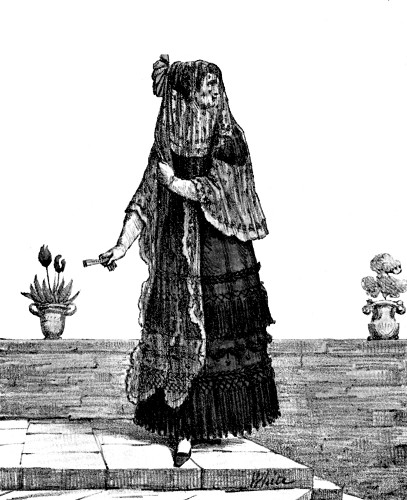
XXIX
A LADY OF SORIA
(About A.D. 1810)
Elsewhere he says: “Nous avons déjà dit qu'un
simple ruban, un peigne, ou une fleur, est la
coiffure adoptée par les dames espagnoles, pour
faire usage de la mantille: celle-ci est dans l'hiver
quelquefois en serge de soie, taffetas, etc., noir,
garnie en outre de blondes, ou d'un large ruban
de velours noir en échiquier (cinta de terciopelo à
tablero), mais ce ruban est toujours noir. Il y
eut un temps où la mode, qui ne fut pas de longue
durée, prescrivait que les bouts de la mantille se
terminassent en trois pointes ornées chacune d'une
houppe (borla) noire, ou d'un lacet de ruban noir.
Jamais les mantilles ne sont doublées.”
The same author remarks of the lady of Madrid;
“La mantille de tulle brodé ne se porte que dans
la belle saison … elle ne dépasse jamais la
ceinture”[56]; and of the lady of Granada: “si la
mantille est blanche, elle est en tulle parsemé de
petits bouquets et garnie de larges et riches
dentelles. Si elle est noire, comme cela arrive
plus ordinairement, elle est alors en blonde: il y
a de ces mantilles qui coutent cinq cent, mille, et
jusqu'à deux mille francs.”
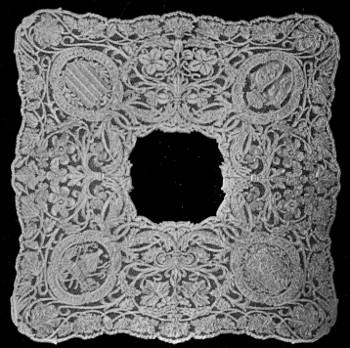
XXX
HANDKERCHIEF OF CATALAN LACE
(Presented to Queen Victoria of Spain, on her marriage)
A good deal of lace, principally of the less
elaborate and cheaper kinds, was formerly manufactured
in the kingdom of Valencia. Cabanillas
wrote in 1797 that at Novelda, a small town of
this region, more than two thousand women and
children worked at making laces, which were
hawked about the country by others of the townspeople.
Swinburne remarks upon the same
industry, and Ricord tells us in his pamphlet
(1791) that cotton lace was made in six factories
at Torrente, Alicante, and Orihuela.[57] The total
product of these factories for the said year was
1,636,100 yards, which sold at from nine to twelve
reales the yard. Laborde wrote some years later,
in the first volume of his book, that lace, and gold
and silver fringes were then made at Valencia,
and in the fourth volume; “Gold and silver laced
stuffs, and velvets of all colours brocaded and
flowered with the same metals, are made at Toledo,
Barcelona, Valencia, and Talavera de la Reina;
and the manufacture at the last-named city
annually consumes four thousand marks of silver,
and seventy marks of gold.
“At Barcelona, Talavera de la Reina, and
Valencia are also manufactured gold and silver
edgings, lace, and fringes, though not in a
sufficient quantity to answer the demands of
Spain; and the gold is very badly prepared,
having too red a cast.”
Lace-making was an ancient and important
industry of every part of Cataluña. Lace articles
for ladies' headwear are known to have been
made throughout this region at least as far back as
the fifteenth century, and Capmany reminds us that
by a cedula dated from the Cortes of Monzón,
December 16th, 1538, the Emperor Charles the
Fifth confirmed the Ordinances of the guild,
established long before, of the tejedores de velos
of Barcelona. Technical provisions are embodied
in this code, concerning various articles of lace employed
as headwear, such as alfardillas, quiñales,
and espumilla, all of which were largely exported
to America.
The attention of foreigners who travelled in
Cataluña towards the eighteenth century was
constantly attracted by the lace-makers. Swinburne
mentions “Martorell, a large town, where
much black lace is manufactured,” and “Espalungera
(Esparraguera?), a long village, full of
cloth and lace manufacturers,” and wrote of Sarriá
and its surroundings, close to Barcelona: “The
women in the little hamlets were busy with their
bobbins making black lace, some of which, of the
coarser kind, is spun out of the leaf of the aloe.
It is curious, but of little use, for it grows
mucilaginous with washing.”
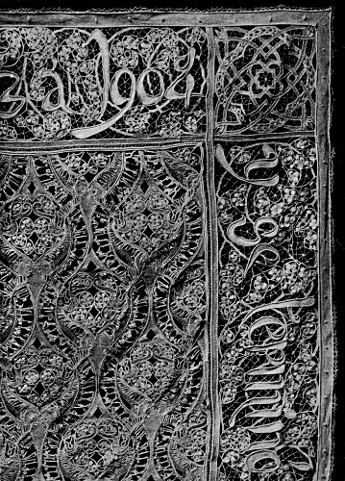
XXXI
CURTAIN OF SPANISH LACE
(Point and Pillow Work. Modern)
“Martorell,” wrote Townsend in 1786, “is one
long, narrow street, in which poverty, industry,
and filth, although seldom seen together, have
agreed to take up their abode. The inhabitants
make lace, and even the little children of three
and four years old are engaged in this employment.”
Laborde wrote that at the beginning of
the eighteenth century seventeen manufactories
of blondes were established at Mataró, and adds
of Barcelona province generally at that time:
“Laces and blondes constitute the employment of
women and children. The work is principally
done at Pineda, Malgrat, San Celoni, Tosa,
Canet, Arenys, Callela, San-Pol, Mataró, Esparraguera,
Martorell, and Barcelona…. The laces
are almost all shipped for the New World.”
The most observant and most entertaining of
all these tourists was Arthur Young, who wrote, in
1787, of the towns upon the coast of Cataluña:
“The appearance of industry is as great as it can
be: great numbers of fishing-boats and nets, with
rows of good white houses on the sea-side; and
while the men are active in their fisheries, the
women are equally busy making lace.” Of
Mataró he says: “It appears exceedingly industrious;
some stocking-frames; lace-makers at
every door…. I am sorry to add that here also
the industry of catching lice in each other's heads
is well understood.
“Pass Arrengs (Arenys), a large town …
making thread lace universal here. They have
thread from France; women earn ten to sixteen
sous at it. Great industry, and in consequence a
flourishing appearance. Canet, another large
town, employed also in ship-building, fishing, and
making lace…. Pass Malgrat, which is not
so well built as the other towns, but much lace
made in it…. Reach Figueras, whose inhabitants
seem industrious and active. They make
lace, cordage, and mats, and have many potteries
of a common sort.”[58]
Lace-making prevails to-day all through this
region of north-eastern Spain, particularly in the
strip or zone of it including the valley of the
Llobregat as far as Martorell, and which extends
from Palamós to Barcelona. The towns which
produce the greatest quantities of lace are Arenys
de Mar, Malgrat, San Pol, Canet, and Arenys de
Munt. In the last of these places an important
Regional Exhibition of Lace was held in July of
last year, the number of exhibitors amounting to
one hundred and twenty-five. Due to the increasing
production of underlinen and woven
fabrics generally, or to other causes, lace-making
has declined at Blanes, Pineda, Calella, and one
or two other places. At San Celoni, Vallgorguina,
San Vicente, San Andrés de Llevaneras, Argentona,
Caldeta, and San Acisclo de Vilalta, lace is
made by women who combine this work with
dirtier and rougher labour in the field. Most of
the lace made in these towns is therefore black.
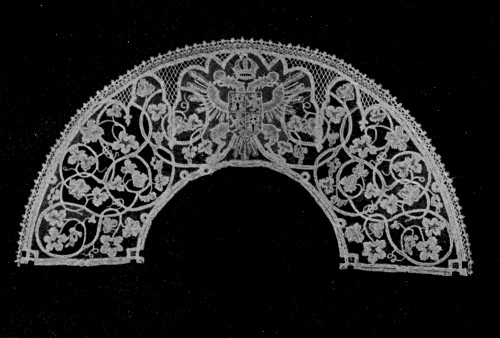
XXXII
POINT LACE FAN, OF MUDEJAR DESIGN
(Modern)
In the spring of last year, an elaborate lace
pocket-handkerchief (Plate xxx.), designed by
Señor Riquer, and executed in a traditional style
of Cataluña, denominated locally the ret Catalá,
was made in the old-established lace-factory of the
widow of Mariano Castells in the town of Arenys
de Mar, and offered by the Agricultural Institute
of San Isidro as a wedding-present to Princess
Ena of Battenberg. Two encajeras worked at
this handkerchief under the personal direction of
the widow Castells, and the time employed by
them in making it was two months.
Plate xxxi. represents a small portion of a
very original and beautiful lace curtain, ten feet
high, designed by Señor Aguado, and executed,
partly by Señorita Pilar Huguet (who superintended
the work throughout), and partly by
seventeen of this lady's pupils, at the School of
Arts and Industries, Toledo. Although it is a
hackneyed trope to declare that the ornamentation
of the Spanish-Moors, whether in ivory, wood or
metal, stone or plaster, was “delicate enough to
seem of lacework,” I believe this to be the first
occasion when such intricate and graceful
motives have been actually reproduced in lace.
The result of the experiment has proved surprisingly
effective. The design is Spanish-Arabic
in its purest form, recalling various arabesques
upon the walls of the Alhambra, and includes
thirty-three medallions which constitute the principal
decorative scheme, a hundred and forty-eight
palms or alharacas, and the Arabic expression
“God is all-powerful,” repeated sixty-six times.
The centre of the curtain consists in all of four
hundred and forty-eight pieces. The broad cenefa
or bordering, which runs right round the whole,
contains, in Arabic, the following inscription:
“This curtain was begun in the curso (course or
series of classes) of the year 1903–1904, and
terminated in the curso following, (Art) School
of Toledo.” The style adopted throughout is that
of Brussels, known erroneously as English point,
although upon a coarser scale than is considered
to be proper to this lace, the ground being executed
by the needle, or in point-work, and the
rest by bobbins.
Plate xxxii. represents a covering for a fan,
also executed by Señorita Huguet, and also in
the Brussels style. The design is a combination
of Mudejar motives, such as conventional
foliage and geometrical bordering, with a Spanish
scutcheon and the double-headed eagle of the
Emperor Charles the Fifth.
At the present day, and largely owing to the
initiative and the skilled tuition of Señor Salvi,
excellent lace is manufactured at Madrid, including
reproductions—which have been generally admired
in Great Britain and elsewhere—of the finest
point or bobbin work of Malines, Manchester, and
Venice.