Quantities of ancient common pottery have been,
and are continually being found in many parts of
Spain. Prehistoric cups, shaped with the fingers
and dried and hardened by the sun, are preserved
in the Museum of History at Barcelona. They
were discovered at Argar. Similar objects have
been extracted from the caves of Segóbriga,
Lóbrega in Old Castile, and El Tesoro in the
province of Málaga. Those which were found at
Segóbriga are divided by Capelle into six groups,
one of which includes a vessel resembling the
ordinary Spanish pitcher of to-day.
Villa-amil y Castro has described in the Museo
Español de Antigüedades pieces of prehistoric
sun-dried ware discovered in Galicia, roughly
decorated with patterns imprinted by the finger.
In other instances a double spiral has been described
with a pointed instrument about the
vessel's neck. Similar fragments have been
found by Góngora in Andalusia. Celtic pottery
was found in 1862 by Captain Brome on Windmill
Hill at Gibraltar, in 1866 by M. Lartet in
the caves of Torrecilla de Cameros, and by
Casiano de Prado in a cave near Pedraza, as well
as at Navares de Ayuso and elsewhere. In
central Spain, vessels of the Celtiberian era have
been found in tombs at Prádena, and pieces of
red Saguntine ware, with dark red decoration, at
Otero de Herreros, close to vestiges of a Roman
mine. Lecea y García describes in his work on
Old Segovian Industries a Celtiberian plate of
reddish clay covered with black varnish, which
was dug up some years ago in a garden at that
town. This plate, measuring no less than four
feet in diameter, and containing two inscriptions
in characters believed to be Celtiberian, as well
as the figure of a warrior armed with a lance and
three javelins, was submitted to Heiss, who wrote
of it in the Gazette Archéologique and pronounced
it to be genuine. I have not seen the plate in
question. I have, however, met with cleverly
executed forgeries, also varnished black, of
primitive Spanish pottery.
In 1899 quantities of Celtic ware, believed to
date from the time of the Phœnicians, or even
earlier, were unearthed by M. Bonsor from tumuli
in the Guadalquivir valley. These objects are
ornamented in relief with complicated patterns
paler than the ground, obtained by using lighter-coloured
clay. “As similar Celtic pottery has
been found in Portugal, it will be understood that
the Celtic influence, having crossed the Pyrenees,
reached the south by the western seaboard. It
will thus be seen that long before the arrival of
the Romans a relatively high degree of civilisation
had been reached at least in the south of
Spain.”[60]
In the summer of 1905 two German archæologists,
Messrs. Schulten and Könen, who had
obtained permission from the Spanish Government
to explore the site of old Numancia, filled four
large cases with the Celtiberian pottery they
extracted from the ruins. These cases were forwarded
to the University of Göttingen. I understand,
however, that they have been returned,
or are to be returned immediately, to Spain.
Long before the Christian era, Greek colonies
existed on the Spanish coast at Rhodas, Denia,
Emporium (Ampurias), Saguntum (Murviedro),
and elsewhere. Pottery of good design and workmanship
was manufactured at these towns, and
strongly influenced native art. Bowls and other
objects showing such an influence were discovered
by M. Bonsor in his recent excavations. Another
powerful influence was that of Rome. Roman
potteries existed in the suburb of Seville called
Triana, and in the provinces of Cáceres and
Badajoz. Mérida was also an important centre
of this industry, and vessels which were used in
sacred rites, such as the aquiminarium, the
prefericulum, the simpulum, and the urnula, were
discovered here not long ago. The name
“Saguntine ware” was given by the Romans to a
kind of pottery which seems to have been made
along the Spanish littoral extending southward
from Saguntum. Fragments of this pottery,
which closely resembles the Arezzo ware,[61] are
found in shoals upon the sites of Roman towns,
particularly Tarragona. These barros saguntinos,
or (as Hübner prefers to call them) barros
tarraconenses, have been divided into four classes,
namely, white, grey, red (covered with a dark red
varnish),[62] and yellow striped with red. This ware
is commonly adorned with garlands, animals,
hunting-scenes, divinities, games, or religious
ceremonies, and also bears, in nearly every case, the
potter's name or mark; e.g. ALBINVS F (“Albinus
fecit”) or OF. ALBIN (“officina Albini”). More
than two hundred marks have been discovered
which were used by potters of Ampurias alone.
There seems to be no doubt that Saguntum
and Emporium were principal centres of this
industry, and possibly, since these towns were
old Greek settlements, the barros saguntinos were
of Grecian origin. Pella y Forgas, describing in
his History of the Ampurdan the fine red ware
of this locality, says that parts of the decoration
were fashioned on the wheel, others directly by
the potter's hand, and others from a mould, while
the ornament of dotted lines was made by the
wheeled roulette.
Among the commoner objects dating from
this time are amphoræ and small earthen lamps
(Pl. xlvii.). These lamps have been discovered in
great numbers, and, owing to the dryness of the
Spanish soil, in excellent preservation. They
measure about the size of the hand, and have two
holes, one in the spout or beak, to hold the wick,
and the other at the top, for pouring in the oil.
The top, which as a rule is slightly concave, is
often ornamented with devices in relief, such as a
chariot and its driver, or the emblem of a deity.
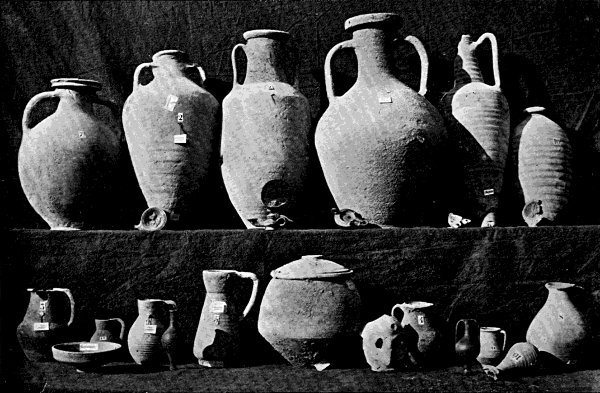
XLVII
AMPHORAIC VASES AND OTHER POTTERY
(Museum of Tarragona)
The typical amphora was a long, narrow vessel
(usually of earthenware; less frequently of brass
or glass), with an elongated handle at either side
of the neck, and tapering nearly to a point. It
served for storing honey, oil, or wine, and in order
to keep it upright the pointed lower end was
stuck into the soil, or rested on a perforated
wooden stand. In the spring of 1893 some fishermen
drew up in their nets, just off the coast of
Alicante, three large intact amphoræ thickly cased
with shells, and sold them for eight dollars each.
Other fine amphoræ, now in the collection of the
Marquis of Cerralbo, were washed upon the
beach at Torrevieja, and many more are in
museums. Vessels of this kind are known to
have been made at Rhodas (Rosas) and Saguntum,
and their use continued in Spain until the downfall
of the second empire.
The statements of Saint Isidore, confirmed
by one or two discoveries in southern Spain,
prove that the pottery in use among the Visigoths
was principally Roman. Probably in this, as in so
many of her arts, the Moorish conquest brought
about a radical and rapid change. Remains of
pottery dating from this period are extremely
rare. The provincial museum of Granada contains
some bowls and plates, all more or less imperfect,
which are ascribed by experts to about the
year 1000. These objects, which were dug up in
1878 on the slopes of the Sierra Elvira, a few
miles from Granada, are coloured black and green
upon a white or whitish ground. The most important
is a dish which measures fourteen inches
in diameter, and is decorated with a falcon on a
horse's back (Plate xlviii.).[63] All of this pottery
shows the double influence of Byzantium and the
East. Among the designs upon the other pieces
are hares and stags surrounded by a bordering of
primitive arabesques. Riaño remarks that “it is
almost impossible to assert whether this pottery
was made in or imported into Spain.” Nevertheless,
Persians are stated to have settled in this
region early in the days of Muslim rule, while
these dilapidated specimens of ancient ware are
greatly similar in colouring and substance to the
common dishes and barreños which are still produced
throughout the province of Granada.
Moorish potteries producing lustred or non-lustred
ware existed from an early date at Málaga,
Valencia, Toledo, Calatayud, Murviedro, Murcia,
and Barcelona. Another centre of this craft was
probably Granada; for though she is not mentioned
in this sense by any of the Moorish authors, the
late Señor Contreras discovered here the vestiges
of two ancient potteries, while one of the old
entrances was known as Bab Alfajjarin, or “the
potters' gate.”
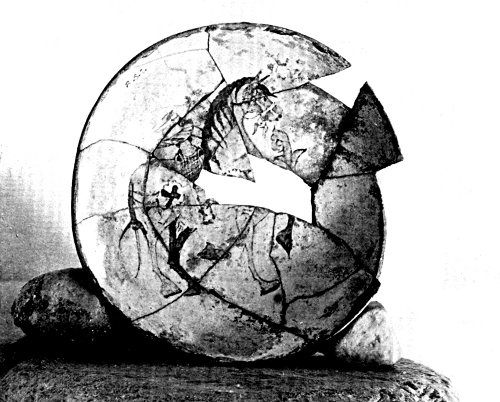
XLVIII
DISH
(About A.D. 1000. Museum of Granada)
The Ordinances of Granada contain provisions
which were evidently copied from the Spanish
Moors, relating to the almadraveros or tilemakers,
the tinajeros or makers of tinajas, and the olleros
or potters generally. The Ordinances which
concern the tilemakers are dated between 1528
and 1540. The restrictions imposed upon these
craftsmen were irksome, foolish, and unnecessary.
All bricks and tiles were to be stamped in three
places with the city mark, and were only permitted
to be made between the first of April and the
thirty-first of October in each year, “since what
is made at other seasons is not good or perfect,
owing to the rain, and cold, and frost.”
Another Ordinance, illustrating the lawlessness
prevailing at Granada in the times succeeding the
reconquest, complains that “many persons, including
labourers and hodmen, go forth into the
roads and streets, and seize the tiles and bricks
by violence from those who are conveying them,
and bear them to their houses, or to the work
which they are paid to do.”
A picturesque, though cheap and unluxurious,
vessel of a thoroughly eastern character, and
which was very largely manufactured by the
Spanish Moors, is the terra-cotta tinaja or
gigantic jar for storing wine, or olive oil, or grain
(Plate xlix.). The use of these receptacles extended
through the whole Peninsula, and has continued
undiminished to this day. The principal
centres of tinaja-making were Toledo, Seville,
and Granada. The Ordinances of the latter town
embody Moorish rules relating to this branch
of pottery. These laws, revived in 1526, provide
that all tinajas must contain two kinds of earth,
one red, the other white, thoroughly compounded
in a trough of water. Before the potter removes
the clay from the trough, he must call the city
supervisor or veedor to look into the quality and
mixing of the mass. The vessel as it leaves the
oven must be white; otherwise, even although it
have no flaw, the inspector is to break it. The
potter is forbidden to coat his tinajas with a glaze
composed of eggs, blood, chalk, and other strange
ingredients; nor may he fire the glaze with
torches, “because the smell of the smoke clings
to the tinaja, and the wine or stum deposited
therein grows redolent of it, and it stays within
the jar perpetually.”
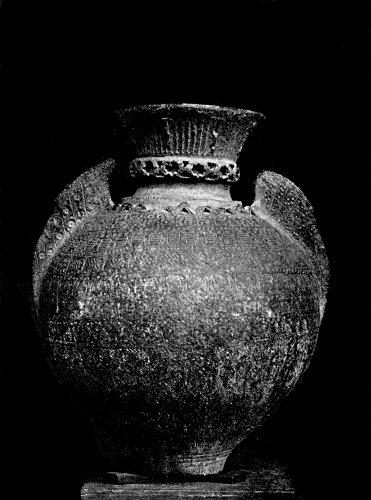
XLIX
HISPANO-MORESQUE TINAJA
Owing doubtless to their plain, domestic purpose
and their trifling market cost, early tinajas are
not often met with. A fine example in excellent
preservation is at South Kensington, and is
described by Riaño as “a wine jar, amphora-shaped,
and ornamented with an incised pattern
of vine leaves, and stamped diaper of a Gothic
character.” Several good tinajas have been discovered
of late years at Seville. Gestoso mentions
six, five of which are glazed. The first of these
was found in 1893, and has a bright green glaze
upon a ground of reddish earth. Both handles
and nearly all the neck are wanting. The decoration
consists of various bands or fajas round the
body of the jar, a series of archways, another of
leaves, and a central band of stars, three deep,
strongly imprinted from a mould. In every
ninth arch are stamped symbolic hands, such as
we see upon the Gate of Justice of the Alhambra.
The second tinaja is similar to the one just
mentioned, except that it has the neck. It
was discovered in 1895, and is now in Seville
museum.
The third tinaja is also in this museum, and
was discovered in 1901. It is in a very poor condition,
and Gestoso believes that it was originally
covered with a honey-coloured glaze.
The fourth tinaja was found in a drain, in the
same year as the preceding one, and is inscribed
with words, including Blessing and Felicity, in
Cufic characters. Gestoso is unable to decide
whether this vessel was made at Seville or elsewhere.
The fifth tinaja is in the collection of Don José
Morón, and possesses greater interest than the
others, both because it is in excellent condition,
and also because the decoration is entirely in the
Spanish-Christian style, without a trace of Saracenic
ornament. Small Gothic-looking shields surround
the body of this vessel, which is stamped
with pomegranates, and with the arms and emblems
of the Ponce de León and other families.
Between each pair of shields is an oval-shaped
medallion containing human figures.
The sixth tinaja is unglazed. It was found in
June of 1893, and is adorned with repetitions of
the words Prosperity and Blessing, as well as with
a series of deer and other animals in the act of
running; some of them with birds upon their
backs. These designs are very uncommon, and
Gestoso has seen no other tinaja, proceeding from
this region, similarly decorated.
Tinajas are still made in large quantities at
Toboso, Lucena, Colmenar de Oreja, and other
Spanish towns and villages.
Other large objects of a thoroughly oriental
character were earthenware glazed brocales or
brims of wells, which, like the tinajas, were largely
manufactured at Seville and Toledo. Specimens
of these brocales exist in the museums of Toledo
and Cordova. Riaño describes one which is at
South Kensington. “It was bought at Toledo
for three guineas at a shoemaker's shop. It is
made of glazed white and green earthenware,
with ornamental Cufic characters in high relief
all round, which appear to be of the fourteenth
century. The inscription, which is repeated, is
imperfect, and all that I can decipher are the
words ‘the power, the excellence, and the peace.’”
Gestoso describes two brocales and the fragments
of a third. All these objects were found
at Seville. The two which are intact, or nearly
so, are cylindrical, and of a white ware. One of
them has a simple leaf decoration, and seems to
have been covered with a green glaze. The
other, which was discovered in 1894, is surrounded
by a triple band of inscription in African characters
which are illegible.
Gestoso also describes some interesting baptismal
fonts, a class of object which he pronounces
to have been the most important of all that were
produced in the potteries of Triana, by reason
both of their large dimensions and of their elaborate
ornamentation. He states that three methods
were employed to decorate these fonts. The first
consisted in attaching to their surface small
moulded plates which bore the likeness of a saint,
flowers, monograms, or other devices. By the
second method the decoration was moulded directly
on the font; while the third method consisted in
a combination of the other two.
Splendid examples of these Spanish fonts exist
in various churches of Andalusia and in private
collections. One of the finest is in the parish
church of Nuestra Señora de la Concepción, at
Laguna, Tenerife. It is suggested by Gestoso
that this pila of Laguna was made at Seville and
sent to the Canaries in the year 1479, when orders
were issued by Ferdinand and Isabella for the
completion of the monasteries in those islands.
Pilas were also manufactured at Toledo,
although Gestoso says that the workmanship of
those produced at Seville was in every way
superior. Nevertheless, he has only found the
maker's name upon a single font, which is inscribed
with that of Juan Sanchez Vachero, and is now
preserved in the church of San Pedro at Carmona.
Another remarkable pila is that of the hospital of
San Lázaro at Seville.
In course of time the Spanish Church forbade
the use of pilas made of glazed earthenware, and
ordered their substitution by fonts of stone or
marble. One of these dispositions, included
among the Constituciones Sinodales of the bishopric
of Málaga, and dated 1671, is quoted by
Gestoso. It enacts that the pila be of stone and
not of earthenware, and that if any of this latter
class remain, they are to be “consumed” (i.e.
destroyed) within two months.
Returning to the Ordinances of Granada, those
which concern the potters or olleros generally are
dated 1530, and inform us of the price of glazed
and unglazed articles in common use, such as
ollas or pots (with and without glaze), cazuelas or
earthen vessels for cooking meat, plates of many
colours and dimensions, jarros (jugs), alcuzas
(vials), cantaros castellanos (Castilian water-pitchers),
cantaros moriscos (Moorish water-pitchers[64]),
morteros (mortars), lebrillos (earthen
tubs), candiles (lamps with a green, white or
yellow glaze), orzas (gally pots), botijas (narrow-necked
jars), and salseras (saucers).
The shape and colouring of many of these
common articles have been continued till to-day,
especially in Andalusia. I reproduce a photograph
of some (Plate l.), in which the influence of the
East is unmistakable. The smaller of the two
unglazed jars is used for carrying and cooling
water, and is made at Loja. The other, which is
often used for storing honey, is from Guadalajara.
The spherical vessel is a kind of bottle for aguardiente.
It is glazed a brightish green, and is made
in various parts of Andalusia, as are the gourd-shaped
calabazas, which have a yellow glaze.
The smallest vessel, or that which has a funnel-shaped
and bulging mouth, is coated with a coarse
metallic glaze coloured in white and blue, and
proceeds from Granada.
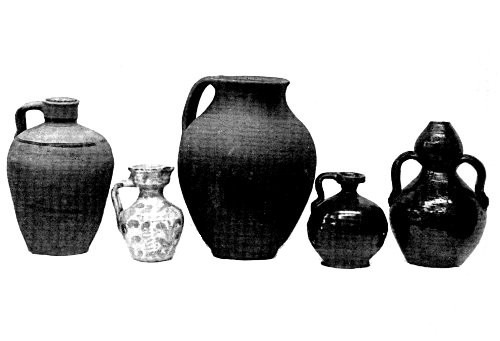
L
COARSE SPANISH POTTERY
(Modern)
So is the influence of the Spanish Moors, linking
the present intimately to the past, and
handed down by early craftsmen to the moderns,
and from Mussulmans to Christian Spaniards,
maintained and kept alive, not only by the city
ordinances I have quoted, but also by the more
occult yet no less permanent and cogent force of
local and unchronicled tradition. In the historic
quarter of Granada which is called the Albaycin,
survive a few alfarerías to this hour (Plate lxix.).
Here, on the potter's wheel or ranged about his
yard, may yet be seen the red Granada earth that is
believed to have inspired the vase of the Alhambra,
applied to-day to common crockery that notwithstanding
has a subtle, unfamiliar charm. And
towards the time of sundown, when the master
turns indoors to supper and his workmen have gone
home, when the last of the red light is colouring the
ancient city wall until it too looks like a mammoth
monument of the potter's art of old Granada, it is
a strange experience to wander through these
desolate yards, among the files of ruddy Granadino
ware kindling with vivid memories of the vanished
Mussulmans of Spain, and bringing back to us
that spirited old poet of the East who also sang of
pottery:—
“Listen again. One Evening at the Close
Of Ramazan, ere the better Moon arose,
In that old Potter's Shop I stood alone
With the clay Population round in Rows.
And strange to tell, among that Earthen Lot
Some could articulate, while others not:
And suddenly one more impatient cried—
‘Who is the Potter, pray, and who the Pot?’
Then said another—‘Surely not in vain
My substance from the common Earth was ta'en,
That He who subtly wrought me into Shape
Should stamp me back to common Earth again.’”
The art of colouring and glazing earthenware
was practised by various peoples of the ancient
eastern world, and passed, in course of time,
through Egypt to Phœnicia, Greece, and Rome,
and, later still, to Mussulman peoples of north-western
Africa.
Glazed earthenware was possibly produced in
Roman Spain, although the specimens of it which
have been discovered are singularly and, indeed,
significantly few. Their colour is commonly green
or lightish yellow. Gestoso makes particular
mention of a small jar now preserved in the
museum of Seville, describing it as “of an
ordinary shape, but finely made.” He admits,
however, that no trace of glaze exists in any of
the broken Visigothic vessels (copied, as Saint
Isidore tells us, from the Roman-Spanish pottery)
that were found some years ago among the ruins
of Italica. Thus it is not decided whether the
Spanish potters learned to glaze, or whether this
development of their craft remained familiar to
the Spaniards of that period through imported
objects merely.
As with glazed earthenware, the origin of
mosaic must be looked for in the East. Greece,
who had doubtless borrowed it from Egypt,
communicated it to Rome at least two centuries
before the Christian era, and from this time the
Romans used it freely in the decoration of their
buildings. The Greek mosaic was composed exclusively
of stone. The Romans modified this
usage by the introduction of diminutive cubes of
clay, painted and baked like porcelain; and later,
in the reign of Claudius, dyed these cubes with
various colours.
Roman mosaic-work (commonly in the tessellated
style and not the opus sectile) has been unearthed
in many parts of the Peninsula. Such are the
two “mosaics of the Muses,” discovered at Italica
on December 12th, 1799, and June 12th, 1839;[65]
other mosaics, to the number of some thirty,
discovered from time to time among the same
ruins; another, discovered at Majorca in 1833;
that of the Calle Batitales at Lugo (the Roman
Lucus Augusti), discovered in 1842; those of
Palencia, Gerona, Merida, Milla del Rio (near
León), Rielves (near Toledo), Duratón, Aguilafuente,
and Paradinas (near Segovia), and Carabanchel,
three miles from Madrid. The mosaic
found at Lugo is believed to have formed part of
a temple dedicated to Diana. The decoration is
partly geometrical, and consists of the head of
a man between two dolphins, with other fishes
swimming along the border. Laborde describes
another mosaic which existed, early in the nineteenth
century, in a hall of the archbishop's palace
at Valencia. “The pavement of this hall demands
particular attention; it is formed of antique pavements,
discovered in the month of February,
1777, three hundred paces north-east of the town
of Puch, between Valencia and Murviedro; some
were entire, others were only fragments. They
were separated with care, and placed on the floor
of this hall, where they are carefully preserved.
They are different mosaics, formed by little stones
of three or four lines in diameter, curiously enchased.
They are distributed into seven squares
in each of which medallions and divers designs
have been drawn: their compartments are of blue
on a white ground. We observe in one of these
squares an imitation of the pavement of Bacchus,
discovered at Murviedro, and of which there remained
but very few vestiges; it was copied in
a drawing-book which a priest of this town had
preserved; it is executed with such art and exactness,
that no difference can be observed between
this modern work and that of the Romans. In
another we see Neptune seated in a car, in one
hand holding a whip, and in the other a trident
and the reins of the horses by which his car is
drawn: these appear to be galloping.”
“In the same hall are also seen other pavements,
of which only fragments could be preserved.
Some serve for borders and ornaments to the
preceding pavements. On these are represented a
tiger, fishes, birds, houses, flowers, and garlands,
well executed. There are particularly five stuck
on wood and shut up in a closet; on these are
birds, fruits, and flowers, figured in different
colours, the execution of which is very curious;
they are perhaps the most precious of the
whole.”
The same author says elsewhere: “In digging
to make a road from Valencia to Murviedro in
1755, at the entrance of the latter town a mosaic
pavement was discovered; it was entire, and of
such beauty that it was thought worthy of preservation.
Ferdinand the Sixth caused it to be
surrounded with walls; but the king's intentions
were not properly fulfilled; the gates were suffered
to remain open, and every one carried away some
part of the pavement, which consequently soon became
despoiled; it was rectangular, and measured
twenty-four feet by fourteen. There are still
some fragments of it in several houses at
Murviedro. A priest of that town, Don Diego
Puch, an antiquarian, took a drawing of it, which
he afterwards had painted at Valencia on the tiles
fabricated there, and paved an apartment of his
house with them. It was likewise copied with
the greatest exactness, with small stones perfectly
similar, in an apartment of the library belonging
to the archiepiscopal palace, as we have already
stated.”
Swinburne also mentions a mosaic pavement
which he saw at Barcelona, upon the site of what
he believed to have been a temple of Neptune.
In it were represented “two large green figures
of tritons, holding a shell in each hand; between
them a sea-horse, and on the sides a serpent and
a dolphin.”
In October of 1901 a very important and
beautiful mosaic was discovered at Italica. It is
known as “the mosaic of Bacchus,” the worship
of which deity, says Señor Quintero, was probably
general in Andalusia, owing to her wealth of
vines. This mosaic was found at a depth of six
feet six inches below the surface of the soil, and
measures twenty-one feet square. It is believed
to have formed the pavement of a Roman dining-chamber.
Mosaic in the manner of the Greeks and
Romans seems in Spain to have disappeared with
the Visigoths. That it was known to these is
told us by Saint Isidore:—“Pavimenta originem
apud graecos habent elaboratae arte picturae,
litostrata parvulis crustis ac tesselis tinctis in
varios colores.”[66]
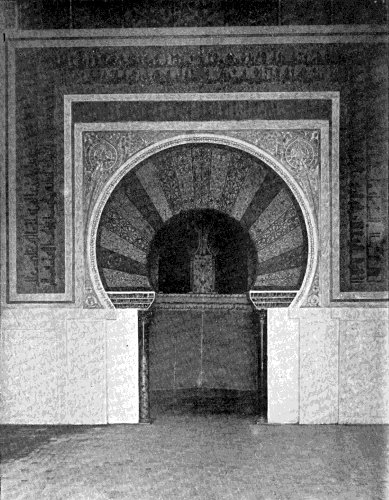
LI
DOOR OF THE MIHRAB
(Showing mosaic-work. Cordova Cathedral)
It is impossible to affirm with any confidence
that glazed earthenware, whether in the form of
tiles or other objects, was manufactured by the
Spanish Moors during the Cordovese Caliphate,
or the period of the kinglings of Taifa. No trace
of it has been discovered among the scanty ruins
of Medina Az-zahará[67] and Az-zahira—ancient
palaces of Cordova—or in the marvellous mosque.
We know, however, that towards the seventh
century the Arabs borrowed from Byzantium
the mosaic-work of tessons known as psephosis
fsefysa, and this, or something similar, was used,
though probably to a small extent, among the
Muslims of the Spanish Caliphate. Although,
towards the middle of the thirteenth century,
the historian Aben-Said, a native of Granada,
recorded that in Al-Andalus “is made a kind of
mofassass which is called in the East alfoseifesa,”
remains of this elaborate product only exist to-day
at Cordova, where patches may yet be seen lining
the dome of the mirhab in the vast aljama
(Plate li.). The mosaic in question is stated to
have been a gift from the Byzantine emperor to
the sultan Al-Hakem, and was set in place by a
skilled workman, a Greek, who, like the offering
itself, proceeded from Constantinople.
During his stay at Cordova this Greek was
helped by certain of the Sultan's slaves, who thus
acquired the secrets of the craft, and practised it
thereafter.[68]
Rodrigo Amador de los Rios contends, however,
that this decoration is in no sense a true mosaic,
but just a tempera painting executed on the wall
and overlaid with cubes of glass. In any case, no
other specimen of such work has been discovered
in any part of the Peninsula.
By the time of the Almohade invasion or very
shortly after—that is, towards the twelfth century,—the
Spanish Moors had grown acquainted
with glazed earthenware. Indeed, the Almohades
are believed by some authorities to have actually
introduced it. Gestoso, on the contrary, suggests
that Spain may have transmitted it to Africa.
However this may be, the Almohades used it
largely in the decoration of their homes and public
buildings in Andalusia; first as aliceres or bands
composed of smallish pieces running round a room,
and subsequently in the more effective and more
useful form of azulejos proper. The Spanish Moors
employed the word almofassass to designate both
aliceres and azulejos. Nevertheless, the two were
not identical, although Riaño takes them to be so.
He says: “The earliest tiles or azulejos made in
Spain are composed of small pieces let into the
wall, forming geometrical patterns.” These, in
fact, were aliceres. It is not so easy to define
an azulejo. We read in Aben-Said, quoted by
Al-Makkari: “There is another kind of work
employed for paving houses. It is called azzulechí
and resembles mofassass. It has wonderful
colouring, and replaces the coloured marble
used by the people of the East to decorate their
chambers.”
This definition is not completely clear. Those
of the Christian-Spanish writers are not more
satisfactory. Covarrubias calls these objects
“small bricks, square and of other shapes, used
for lining chambers in the mansions of the wealthy,
or in garden paths.” Nebrija calls them tessela
pavimenticia, adding that they bear the name of
azulejos because the earliest ones were of a blue
colour—a statement which Dozy supports by
instancing the Persian-Arabic zaward or “blue
stone.”
Gestoso resolves the question sufficiently for
our purpose by showing that the term azulejo is
usually applied to square tiles of a largish size,
the length of whose sides varies between eleven
centimetres and eighteen centimetres, aliceres
being properly the smaller strips or pieces
(technically known as cintas or verduguillos) used
in a bordering or frieze. Other decorative pieces
of small dimensions, invented in the fifteenth
century, were called olambres or olambrillas, and
served to lend variety to the red or yellow brickwork
of a pavement or a floor.
The production of azulejos in Spain may thus
be traced to as far back as the twelfth century.
By far the most important centre of the craft
was Seville. Here, from the twelfth until the
fourteenth century, was made the glazed and
decorative tiling which consisted of small pieces
of monochrome earthenware—black, white, green,
blue, or yellow—cut one by one, and pieced
together in the manner of a true mosaic. This
process, says Gestoso, was lengthy, difficult, and
dear. In the fourteenth and fifteenth centuries the
same mosaic would often take the form of a series
of narrow, white, ribbon-like strips, with coloured
interspaces. Specimens of this “ribbon-work
tiling” exist to-day in the Patio de Las Doncellas
of the Alcázar (Plate lii.). Towards the sixteenth
century the Sevillano potters discovered a simpler
way of making effective and artistic azulejos, which
they called the cuerda seca process. This novel
method consisted in pressing a wood or metal
mould upon the unbaked tile, in such a manner
that the outline of the pattern remained in slight
relief. This outline was next brushed over with
a mixture of manganese and grease, which turns,
in baking, very nearly black. The body of the
pattern was then filled in with the various colours,
which the greasy line completely separated, and
thus prepared, the tile was rendered permanent
by firing.
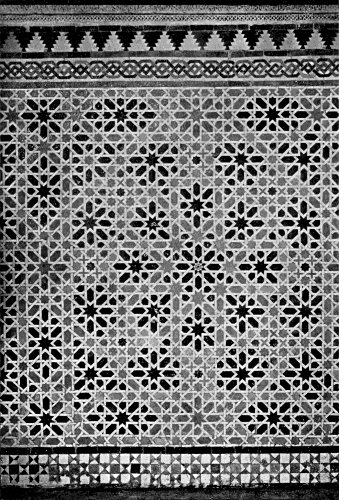
LII
MOSAIC OF THE PATIO DE LAS DONCELLAS
(Alcázar of Seville)
This process, in which the patterns are nearly
always geometrical, remained in general use until
about the year 1550, when it began to be superseded
by two others, known respectively as the
processes of “cuenca” and “Pisano”.
The cuenca tile was simple and of excellent
effect. The pattern, stamped from a metal
mould, remained in bas-relief,—a characteristic
which caused these objects to be also known as
azulejos “de relieve”. The shelving border of
each hollow stamped into the tile thus formed
a kind of natural barrier which kept the colour
there deposited from mingling with its neighbours.
When of a larger size, and joined in pairs to form
between each two a single motive (ladrillo por
tabla), these azulejos were often employed for
decorating roofs and ceilings.
The tiles which bear the name of their inventor,
Francesco Niculoso Pisano the Italian, who lived
and worked for many years at Seville, date from
about the same time as the “cuenca” azulejos. In
the case of the Pisano tile, there is no indentation
caused by the imprint of a mould, the surface
being merely coated with a monochrome glaze,
painted upon and fired, the decoration thus
remaining flat all over. Commonly the ground
is white or yellow, with the colour of the pattern
shaded blue, or black, or deepish purple. This
process, which lent itself to most elaborate and
effective schemes of ornament, remained in vogue
until the eighteenth century, and was practised,
not only by Pisano himself, but by a long succession
of his pupils, followers, and imitators.
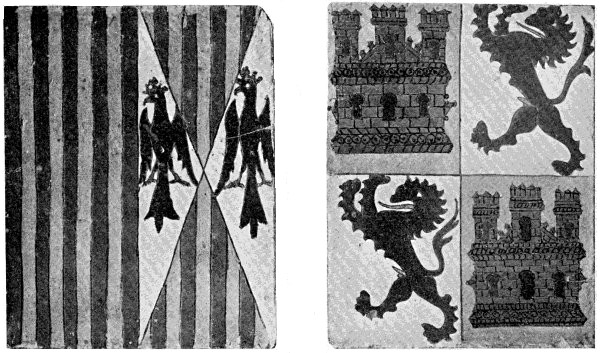
LIII
ANDALUSIAN NON-LUSTRED WARE
(A.D. 1480–1495. Osma Collection)
Such were the processes in use among the
azulejo-makers of old Seville. Specimens of
their craftsmanship which yet survive and illustrate
the various styles and epochs may be thus
enumerated:—
(1) Mosaic tile-work, such as appears in Seville
at the time of the Almohade invasion. A fragment
of this kind of work forms part of the collection of
Señor Osma, and proceeds from the church of
San Andrés. Tiles and smaller pieces of mosaic-work,
coloured in malachite green and white,
were also found in 1899 and 1900, in the upper
walls of the renowned Torre del Oro, or “Golden
Tower,” erected in the year 1220, and which is
popularly thought to derive its venerable title
from the sparkle of the sun upon its azulejos.
Another piece of primitive mosaic, measuring
rather less than a yard square, and containing
star-shaped geometrical devices, was found in 1890
beneath the floor of the cathedral; while mosaics
of a later age, including the more elaborate lacería
patterns that resemble ribbon, are preserved in
the Patio de las Doncellas of the Alcázar, in the
Casa de Olea, and in the parish churches of San
Estéban, San Gil, and Omnium Sanctorum.
(2) A small group of curious tiles, believed to
be anterior to the reign of Pedro the First, has
come to light some years ago, in the churches of
San Andrés and Santa Marina, and in the Claustro
del Lagarto of the cathedral. Those of San
Andrés are of white earthenware, glazed in the
same colour and stamped from a mould with the
figures of two wolves in fairly bold relief (see
tailpiece to this chapter). Traces of a glaze of
malachite green are on the bodies of these wolves.
The azulejos of the church of Santa Marina, also
discovered recently, are examined by Señor Osma
in his pamphlet Azulejos sevillanos del siglo xiii
(Madrid, 1902). They measure about three and
a half inches square, and bear devices of a castle
and an eagle, stamped in the diagonal direction
of the tile, showing that this was fixed upon the
wall in lozenge fashion. The tiles are bathed
upon their surface with what is termed by Osma
“the semi-transparent, caramel-coloured glaze
peculiar to the pottery of Moorish Spain.”[69] Upon
this ground is stamped the decoration,—the eagles
in the blackish purple of baked manganese, the
castles without additional colour, so as to be
distinguished only by their outline from the
yellowish surface of the tile.
The azulejos of the Claustro del Lagarto of the
cathedral are three in number, and were found in
1888. Two of them are stamped with a castle of
a single tower described within a shield, and the
third with a Greek cross. These are considered
by Osma to be the only tiles existing at this
moment which date from the latter third of the
thirteenth century. In fact, he places their manufacture
between the years 1252 and 1269.
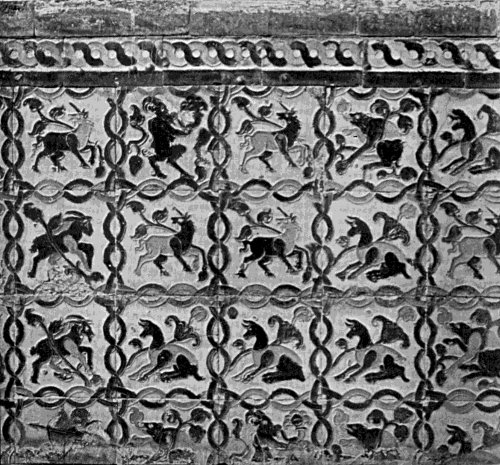
LIV
CUENCA TILES
(Alcázar of Seville)
(3) Cuerda seca tiles. Handsome zocalos or
dadoes of these tiles are in the Casa de los
Pinelos, and in the chapels of the palaces of the
Dukes of Alba and Medinaceli. Gestoso attributes
them to the end of the fifteenth century
or the beginning of the sixteenth. Detached
cuerda seca tiles are preserved in the municipal
museum of archæology, while a fine pair (Plate liii.)
of this class of azulejos belongs to Señor Osma,
who considers they were made between 1480 and
1495. They are thus coeval with the no less interesting
dish of the time of Ferdinand and Isabella,
of which a reproduction is given opposite page 190.
(4) Cuenca tiles. Quantities of these, dating
from the sixteenth and seventeenth centuries, may
yet be seen in many parts of Seville; for instance,
in her churches or her convents, in her superb
Alcázar, or in the mansions of her old nobility.
Probably the most remarkable of all are those in
the gardens of the Alcázar, and lining the walls of
the Pavilion of Charles the Fifth. The devices
on these polychrome azulejos (16th century;
Plate liv.) are very numerous, including men and
animals, centaurs and other monsters, the Pillars of
Hercules, and imitations of elaborate dress fabrics.
(5) Pisano tiles. Although some facts have
been unearthed concerning the Italian Francesco
Niculoso Pisano, we do not know precisely
in what year he came to Seville, or in what
year he died. Davillier thought it probable that
he had studied at Faenza or at Caffagiolo. At
all events, it was Pisano who broadly launched the
art of the Sevillian potters on the stream of the
Renaissance.[70] I have stated that the tiles which
bear his name are painted on a white or yellow
ground. Consequently their surface is flat,
without the ridges and depressions of the cuenca or
the cuerda seca methods. We find Pisano tiles
applied to various objects, such as tombs, altars,
friezes, and archivolts. This artist, says Gestoso,
further introduced the use of two new colours,—violet
and rose. Several of his best productions
are still intact, including the doorway of the church
of the monastery of Santa Paula (in which he was
assisted by a Spanish master, Pedro Millan), and
the altar of the Catholic Sovereigns in the Alcázar.
Both these masterpieces were executed in the
year 1504, and bear Pisano's signature. The
doorway of Santa Paula is described by Gestoso
as consisting of a single body of masonry,
distinct from that of the building itself, though
resting against it, and constructed of bricks of
uniform size, which show us, by their perfect
symmetry, how skilful were the masons of that
time, with whom the Moorish craftsmanship was
yet a living power. The doorway is formed by a
series of concentric Gothic arches resting on
slender pillars. The space which forms the outer
archivolt is most remarkable. Upon a ground
of azulejos which copy the colour of the brickwork,
we see a number of Plateresque designs of exquisite
beauty, painted in white and blue, with
occasional touches of other colours. Among
the devices are chimeras, war-trophies, volutes,
chaplets, parapegms, antelopes, masks, and others
which are characteristic of the Florentine Renaissance.
Upon this ground, and enclosed by circular
garlands in high relief, consisting of polychrome
fruits and flowers, are seven medallions containing
figures of male and female saints, except the one
which is upon the keystone, and which represents
the birth of Christ. In this medallion the figures
are enamelled in white upon a cobalt-blue ground,
recalling, as also do the garlands, the work of the
celebrated della Robbia.[71] In the rest of the
medallions the figures are glazed in brilliant
colours. In the three medallions upon the left,
beginning with the lowest one, we see, upon the
first, Saint Helen; upon the second, two saints
in monkish dress; and upon the third, Saint Peter
and Saint Paul. On the medallions of the other
side are another saint dressed as a monk, San
Cosmé, San Damián, and San Roque. The
spaces on either side of the archivolt are covered
with tiles which represent a landscape. In each
of the upper angles is an angel holding a large
tablet with IHS in ornamental Gothic character
upon a black ground. These letters, and also
the angels and the frames of the tablets, are
enamelled in gold. Beneath each tablet is an
angel standing with extended wings upon a
bracket of lustred earthenware, and holding an
open book. The brickwork of the door is closed
by a plain impost supporting a small battlement
covered with cuenca tiles, and crowned with a
cornice of flamboyant ornaments alternating with
the heads of cherubs glazed in white, and with a
white marble cross in the centre. The tympanum
is embellished by a superb shield carved in high
relief upon white marble with the arms of Castile,
León, Aragon, and Sicily, surmounted by a royal
crown and the eagle with the nimbus. Beside this
shield are two smaller ones of azulejos painted with
the yoke and sheaf of arrows, and the motto TĀTO
MŌTA. The ground on which are executed these
three shields occupies the whole tympanum, and
is covered with Plateresque devices including two
tablets, on one of which we read the letters S.P.Q.R.,
and on the other, PISANO. Above the first of these
tablets is another of an oval shape, bearing the word
NICULOSO. Lastly, at the base of the archivolt,
and on the left-hand side of the spectator, is a very
small rectangular tablet with this inscription:—
NICVLOSO
FRANCISCO-I-
TALIANO-MEF
ECIT INELAGNO DEI
· 154 ·
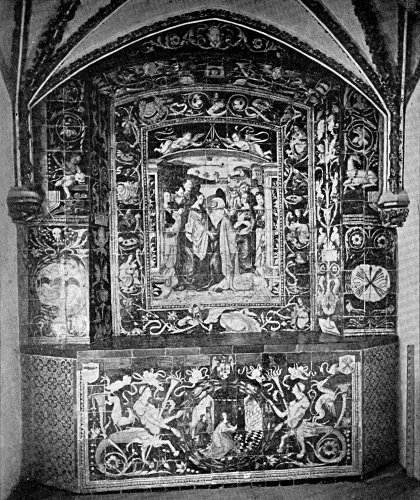
The altar in the Alcázar of the same city, and
which is known as that of the Catholic Sovereigns
(Plate lv.), is entirely covered with “Pisano”
azulejos measuring sixteen centimetres square.
Imbedded in the centre is a picture, also of painted
tiles, representing the visit of the Virgin to Saint
Elizabeth. This picture measures five feet in
height by three feet eight inches in breadth. Beneath
it is the figure of a patriarch resting his head
upon his hand. Boughs with large flowers issue
from his breast, and among the flowers are half-length
figures of the prophets, together with those
of Jesus and the Virgin, the whole of this decoration
forming a frame to the central picture. The rest
of the altar is profusely decorated with designs in
the Renaissance style, consisting of vases, animals,
genii, and the emblems of Ferdinand and Isabella.
In the centre of the tiling which forms the altar-front
is a circular picture made of azulejos surrounded
by a garland of fruits and laurel leaves,
and representing the Annunciation, garland and
picture being supported by two monsters with the
tails of dragons and the upper parts of women.
Large flaming torches rest between the out-stretched
arms of the monsters, and round about
or springing from them are flowers, animals,
cornucopias, and other decoration. The entire
retablo is painted lightish blue and white upon a
yellow ground, except the larger picture and its
decorative border, which is of a deeper blue. A
small tablet beneath the Virgin's feet contains the
words NICULOSO FRANCESCO ITALIANO ME FECIT, and
on the pilaster represented on the left hand of the
same picture is added the date, 1504. As Gestoso,
Davillier, and others have remarked, it is evident
that while the rest of the altar is pure Renaissance-Plateresque,
the pictures copied on the tiles are of
a northern school. Probably they were designed
for Niculoso by one of the various German or
Flemish masters who at that time were resident
in Seville.
LV
ALTAR OF THE CATHOLIC SOVEREIGNS
(Alcázar of Seville)
Another altar which was formerly in the same
palace, but which has disappeared, was also
painted by this craftsman. It was described by
Cean Bermudez as containing scenes from the
life of the Virgin, the Trinity, and the two Saints
John, and bore the same date as the altar which
is yet existing, namely, 1504.
Among the other works of Niculoso are the
altar of the church of Tentudia, the tomb of
Iñigo Lopez in the church of Santa Ana in the
quarter of Triana, and a tile-picture representing,
similarly to the one which forms the centre of the
altar in the Alcázar, the Virgin's visit to Saint
Elizabeth. This picture formerly belonged to
the kings of Portugal, and is now in the museum
of Amsterdam.[72]
Such were the decorative azulejos which made
the potteries of Seville famous throughout Europe,
and which are known to have been exported to
Italy, Portugal, and even England.[73] The names
of several hundred mediæval and post-mediæval
makers of these Seville tiles have been exhumed
and published by Gestoso.
The general title of the Spanish potter was
ollero, a comprehensive term which reaches from
the most ambitious azulejero to the maker of the
meanest kitchen-ware. The olleros of older
Seville produced for centuries, not only glazed
and coloured tiling by the processes already
indicated, but countless other objects such as
brims of wells, apothecary's jars, baptismal fonts,
and dishes of every shape and size. They used a
general mark (the tower of the Giralda) to stamp
their pottery; but private marks are nearly
always absent. The facts that have appeared in
recent years concerning these artificers are seldom
interesting. The mere mention of a name is
meaningless, or even perplexing, seeing that a
Moor or Mudejar would frequently assume the
name and surname of a Christian. Nevertheless,
Gestoso has brought to light important notices
concerning one or two, and in particular a document
dating from the reign of Ferdinand and
Isabella, relating to a celebrated potter of that
period named Fernan Martinez Guijarro. This
document, which is dated 1479, describes Martinez
as “a very great master in the art of making
azulejos, fonts, and all the things pertaining to
his trade, insomuch that none other in all this
kingdom is like unto him,” and subsequently,
“considering him to be so excellent a craftsman
that persons come hither from Portugal and other
parts to purchase and to carry off his ware.” It
is further stated that Martinez Guijarro was in
wealthy circumstances (“hombre rrico e de mucha
rrenta e fasyenda”). His talleres or workshops
were in the barrio of Triana, and included (as we
learn from one of the documents copied by the
same investigator) a separate department for the
manufacture or storage of lustred ware.
Unfortunately, even Gestoso is unable to point
to any piece of tiling or other pottery now existing,
as being unquestionably executed by this master.
Another Sevillian potter of exceptional merit
was Cristóbal de Augusta, who worked in the
latter half of the sixteenth century, and left his
name upon the azulejo dadoes of the Halls of
Charles the Fifth in the Alcázar. The style of
these most brilliant tiles is pure Renaissance, and
forms a worthy continuation of the splendid work
of Niculoso. Augusta, indeed, is termed in the
Archives of the Alcázar “master of making tiles
in the Pisano manner” (del pisano).[74] Some tilemakers
of little note succeeded him, but even the
names of these are carefully recorded by Gestoso.
Seville was thus the principal centre of the
craft of decorative tile-making. Azulejos were
also made at Barcelona and other towns in Cataluña,
at Talavera de la Reina, Burgos, Toledo,
Granada, and Valencia, in several towns of
Aragon, and probably at Cordova. Riaño quotes
a letter written about the year 1422, from the wife
of the Admiral of Castile to the abbess of the
nunnery of Santo Domingo at Toledo, requesting
that a number of azulejos be sent to her. “She
alludes, in the same letter, to painted tiles, and
says she was expecting a master potter from
Seville to place the tiles in their proper places.
This shows us” (continues Riaño) “that it was
only in the province of Andalusia that the art was
known of cutting these tiles into geometrical sections
and mosaic patterns.”
The meaning of this passage is obscure. Riaño
speaks of painted tiles and azulejos as though they
were distinct objects, and yet they are essentially
the same. Again, if only Andalusia was able to
produce such tiles, why did the Almirante's wife
order them from Toledo? Perhaps the faulty
English of Riaño's handbook is responsible, but,
as it stands, this passage tells us practically nothing.
In any case, abundant evidence exists to show
that large quantities of Mudejar and Renaissance
tiles were manufactured at Toledo. In general
appearance, they are similar to those of Seville.
Ramírez de Arellano believes that decorative
tiles were manufactured at Cordova in the fourteenth
and fifteenth centuries, and quotes, in proof
of this, the names of “maestros de hacer vidriado”
or makers of glazed ware, who resided at this
ancient capital. One of these craftsmen was
Alonso Rodriguez the younger, who, on June 7th,
1574, sold to a canon of the cathedral ten
thousand white and green tiles of a common kind
(ladrillos), probably employed for roofing. The
price was three ducats the thousand. On April
10th, 1598, Juan Sanchez engaged to supply the
same temple with the same quantity of glazed
tiles (tejas) for roofing, coloured white, green, and
yellow, at sixteen maravedis each tile.
Azulejos were certainly made at Granada in the
sixteenth and seventeenth centuries, and probably
earlier.
LVI
THE GATE OF WINE
(Showing polychrome tiling. Alhambra, Granada)
In a passage of the Alhambra palace leading
from the Patio de la Alberca to the Cuarto Dorado,
a space was laid bare not many years ago,
containing the original mostagueras or small tiles
used for flooring, glazed in two colours; and in the
same building, although in constantly diminishing
quantities, are large numbers of tiles which date
from the time of the Spanish Moors. There has
been a good deal of discussion as to whether the
roofs of the Alhambra were originally covered with
decorative tiles. Swinburne (who must not, however,
be taken as the safest of authorities) wrote
that “in Moorish times the building was covered
with large painted and glazed tiles, of which some
few are yet to be seen.”
Indifferent Renaissance tiles, made in the reign
of Philip the Fifth, are still preserved in parts of
the Alhambra.
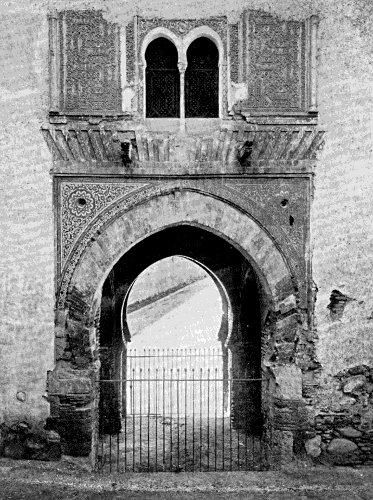
Excellent polychrome cuerda seca tiles (fourteenth
century), in white, green, yellow, blue, and
black, are over the horseshoe archway of the Gate
of Wine of the Alhambra (Plate lvi.). According
to Gómez Moreno,[75] they were manufactured here,
as were the Moorish azulejos, yellow, black, white,
violet, and sky-blue, in the Mirador de Daraxa.[76]
The archives of the Moorish palace also state
that towards the close of the sixteenth century
Antonio Tenorio, whose pottery was situated
in the Secano, and consequently within a stone's-throw
of the Casa Real, made several sets of
azulejos for the Hall of the Abencerrajes. Good
Morisco tiles, dating from the same period and
wrought by craftsmen such as Gaspar Hernandez,
Pedro Tenorio, and the members of the Robles
family, are in the Sala de Comares, and in one of
the rooms of the Casa de los Tiros.
From the thirteenth century until the eighteenth,
excellent azulejos were made in Cataluña. Specimens
of every period exist in the collections of
Don Francisco Rogent and Don José Font y
Gumá, of Barcelona, and Don Luis Santacana,
of Martorell. The tiles belonging to these
gentlemen proceed from the cathedral and other
temples of Barcelona, and from the monasteries
or castles of Poblet, Santas Creus, Montserrat,
Marmellá, San Miguel de Ervol, Centellas, Torre
Pallaresa, San Miguel del Fay, and Vallpellach.[77]
Another region which has long been celebrated
for its azulejeria is the kingdom of Valencia.
Even in the eighteenth century, when this craft
was generally in a state of great decadence,
Valencian tiles were thoroughly well made,
although the patterns on them were defective.
Laborde pronounced them “the best executed
and most elegant in Europe,” and further said
of this locality; “the painted earthenware tiles
or azulejos are used in the country, but only a
small part of them; a great many are sent into
the interior of Spain as well as to Cadiz, where
they are shipped for Spanish America, and to
Marseilles, whence they are conveyed into Africa.”
The same writer inserts an interesting account
of the manufacture of these azulejos. “It is at
Valencia that the tiles of earthenware are made,
with which they incrust walls and pave apartments:
those tiles are of a clayey earth, which is
found in the territories of Quarte near Valencia;
they harden the earth long after soaking it in
water; the tiles are formed in moulds, and are
dried in the sun; they are then beaten with a
piece of square wood of the dimensions of which
they are wanted. They are then put into the oven,
where they undergo a slight baking. As soon as
they are done they are glazed, and are afterwards
painted in water colours with whatever subject
is intended to be represented. The tiles are
then replaced in the oven so as not to touch one
another, and that the action of the fire may
penetrate them all equally: as the colours change
by baking, the workmen apply them anew in
proportion to the changes that take place; the
red alone alters entirely. The varnish with
which they are glazed is made with lead, tin, and
white sand. These three substances are ground
in a mill to powder, which is mixed with water,
to form a paste, and baked in the oven; it is
again pounded and put into the oven, where it
crystallises: being once more reduced to powder
and diluted with water, it becomes varnish.
There are two kinds of it; one is whiter than
the other, though the same materials are used:
the mode of mixing alone makes the difference;
the whiter, the clearer the tiles. It takes a certain
number of tiles to form a picture: they are of
different dimensions; the smallest are three inches
nine lines, the largest seven inches nine lines.
The price varies according to the size of the
tile, the beauty of the varnish, and the variety of
the drawings: the lowest price is eight pesos
(25s.) a thousand, and the highest 100 pesos or
£15, 12s. 6d. There is a considerable demand
for them; they are superior both in beauty and
strength to those used in Holland.”
LVII
TILES OF THE DECADENT PERIOD
Bourgoing, author of the Nouveau Voyage en
Espagne, described, in 1789, the same product in
the following terms: “L'industrie des Valenciens
tire d'ailleurs parti de toutes les productions de
leur sol. Il contient une espèce de terre dont ils
font ces carreaux de faïence colorée, connus sous
le nom d'Azulejos, et qu'on ne fabrique qu'à
Valence. On en pave les appartements, et on en
revêt leurs lambris; on y peint les sujets les plus
compliqués, tels par exemple qu'un bal masqué,
une fête de taureaux. La couleur rouge est la
seule qui ne puisse être fixée sur cette espèce de
faïence; elle s'altere entièrement par la cuisson.”[78]
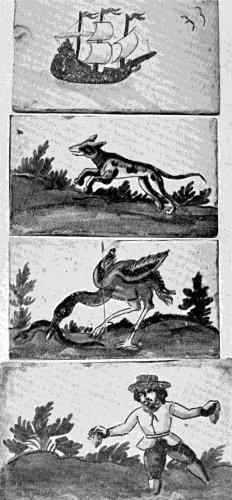
For the amusement of my readers, I insert an
illustration of common Spanish tiles of the decadent
period (Plate lvii.), displaying considerable
liveliness combined with reckless ignorance of
draughtsmanship. A class of these degenerate
tiles, made in large quantities at Seville in the
eighteenth century, is known as azulejos de
montería or “hunting-tiles,” since episodes of the
chase form one of the favourite themes of their
design.
Although it passed through a long period of
prostration, embracing the greater part of the
seventeenth and eighteenth centuries, at no time
has the manufacture of decorative Spanish tiles
succumbed completely. Of recent years it has
revived surprisingly at Seville, Barcelona, and
Segovia; and at the first of these cities the older
azulejos, and particularly those in the cuenca style,
are imitated to perfection.
In the cheapest kinds of modern tiling, such as
is used for corridors and kitchens, a common device
is a series of repeated curves and dots which
evidently has its source in Arabic lettering.
Indeed, the ornamental and attractive written
characters of the Spanish Moors, rendered familiar
to their rivals through long centuries of intercourse,
seem to have constantly found favour with the
Christian Spaniards. The fuero of Jaca, dated
a.d. 1064, tells us that a Christian prince of Spain,
Don Sancho Ramirez, was accustomed to write
his signature in Arabic lettering. Meaningless
inscriptions in the same language, and evidently
executed by a Christian hand, are engraved on
objects in the Royal Armoury; and Señor Osma
describes in an interesting pamphlet (Los letreros
ornamentales en la cerámica morisca del Siglo XV.)
how, in the pottery of older Spain, a word in Arabic
such as alafia (“prosperity” or “blessing”) would
often be corrupted by Morisco craftsmen into a
motive of a purely ornamental character, and
which would only in this sense be comprehended
and appreciated by the Christian.[79]
Probably no pottery in the world possesses
greater loveliness or interest than the celebrated,
yet even to this day mysterious, lustred ware of
Moorish Spain. Our knowledge of the early
history of this ware is still imperfect. In modern
times, attention was first drawn to the lustre
process by M. Riocreux, of the Sèvres Museum.
In spite, however, of the subsequent monographs
and researches of Davillier and other authorities,
the origin of lustred pottery is yet a problem which
awaits solution. Until some years ago it was
believed to have had its source in Persia, where
many specimens have been discovered in the form
of tiles and other objects; but this belief was
afterwards shaken by Fouquet, who unearthed at
Fostat in Egypt, in the year 1884, specimens of
lustred ware which are known to date from the
eleventh century. Saladin, too, affirms that he
has seen upon the mosque of Kairuan lustred
plaques with inscriptions recording them to have
been presented, between a.d. 864 and 875, by the
emir Ibrahim Ahmed-ibn-el-Aglab.
Whatever these facts may signify, it appears
from a statement by the geographer Edrisi that
lustred ware was made in Spain as early as the
twelfth century. “Here,” said the writer, speaking
of Calatayud, “is produced the gold-coloured
pottery which is exported to all countries.” The
next allusion to it is by the traveller Ibn-Batutah,
who visited certain parts of Spain in the middle
of the fourteenth century. “At Málaga,” he
wrote, “is made the beautiful golden pottery which
is exported to the farthest countries.” These
passages refer respectively to Aragon and Andalusia.
The same ware was produced in Murcia.
Ibn-Said, quoted by Al-Makkari, mentions the
“glazed and gilded porcelain” of Murcia, Málaga,
and Almería, calling it “strange and admirable.”
It was also manufactured, probably in larger
quantities than in any other part of Spain, in many
towns and villages of the kingdom of Valencia,
such as Carcer, Alaquaz, Moncada, Quarte, Villalonga,
Traiguera, and Manises. In the Excellencies
of the Kingdom of Valencia, written by Eximenes
and published in 1499, we find it stated that
“surpassing everything else is the ware of Manises,
gilded and painted with such mastery that all the
world is enamoured thereof, insomuch that the
pope, the cardinals, and princes send for it,
astonished that objects of such excellence can be
made of earth.”[80]
Other writers on the same locality, such as Diago
and Escolano, author of the Historia de la insigne
y coronada ciudad y reino de Valencia (Valencia,
1610, 1611), confirm this eulogy of Eximenes.
According to Escolano, Valencian ware was “of
such loveliness that in return for that which the
Italians send us from Pisa, we send them boatloads
of it from Manises.” One of the most recent of
authorities on lustred ware remarks that “in the
fifteenth century ornamental vases in the (Spanish-Moorish)
wares appear to have been commanded
from Spain by wealthy Florentines, as is evident
from the Medici arms and impresa in fig. 40;
others bearing the Florentine lily (fig. 41) seem
to have been ordered from the same city.” The
illustrations to which the author of this monograph[81]
refers, depict a vase and a boccale, both
in lustred ware, and which it is extremely probable
were manufactured at Manises.
The same ware was also possibly made in
Cataluña, where pieces of it have been found
among the ruins of the village of Las Casas. La
Alhambra, a small magazine which is published
at Granada, contains, in the number dated
September 30th, 1901, an account of these fragments
by their finder, Joaquín Vilaplana.
Some years ago the Balearic Islands were also
thought to have produced this pottery. One of
the earliest and most fervent champions of this
theory, now definitely shown to be erroneous,
was Baron Davillier. This gentleman, in some
respects an excellent authority on Spanish ceramics,
relied too strongly on certain assurances
made him by a Señor Bover, and ended by declaring
that in the museums of Paris and London
he had himself seen lustred plates which bore the
arms of Ynca in the Balearics, proving them to
have been manufactured at that town.
However, a Majorcan archæologist, named Alvaro
Campaner, refuted one by one Davillier's
points of argument, and showed beyond all
question that both the plates of Ynca and the
arms which decorated them were simply nonexistent,
and that the term Majolica, deriving
from Majorica, applies to pottery in general,
and not with any preference to lustred ware.
Campaner also suggested very ingeniously that
the word Majolica was probably applied by the
Italians to Catalan or Valencian pottery conveyed
to Italy in vessels themselves belonging to the
Balearics, and which were in the habit of completing
their cargoes in the ports of Barcelona
and Valencia, and he added that this suggestion
is supported by the fact that specimens of lustred
ware are far more often met with on the Balearic
coast than in the towns and villages of the interior.
It is only fair to state that Davillier frankly and
fully recognized the value of Campaner's refutation.
As to the methods of producing lustred pottery,
the chemical investigations practised by Riocreux,
Brogniart, Carand, and others, have shown that
the metals used to produce the characteristic reflex
which gives the ware its name were copper and
silver, entering into the composition of an extremely
thin glaze extended over the surface of
the pottery, and employed, sometimes together,
and sometimes separately. It is obvious that the
lustre produced by copper would be deeper, redder,
and less delicate than that produced by silver,
while varying gradations would be obtainable by
the mixture of both metals. It is also beyond
doubt that the oldest specimens of this pottery
extant to-day are those which contain the palest
and most pearly lustre, and consequently the
largest quantity of the costlier metal. In those
of later date there is an evident inferiority, both
in colour, lustre, and design. In fact, two
separate, or nearly separate, epochs of this
branch of Spanish pottery are pointed out by
Señor Mélida, who gives the name of Mudejar
to lustred objects manufactured at an earlier time
by Moorish artists working in the cities captured
by the Christians, and that of Morisco to the
second or inferior class produced by Morisco
craftsmen after the reconquest, and distinguished
by the coarser and degenerate lustre, colouring,
and draughtsmanship.
The rarest and most beautiful examples of this
ware are naturally those which belong to the
former class, and consist of various kinds of plates
and other objects in which elaborate devices such
as lions, antelopes, and shields of heraldry, often
combined with foliage and inscriptions in Gothic
lettering, are coloured in bistre or pale blue,[82] and
rendered doubly beautiful by the delicate nacreous
lustre.
In nearly every case it is extremely difficult to
determine with any certainty the date of manufacture
of these objects, as well as the locality.
Wallis says he is aware of “no example of Spanish
lustre pottery antecedent to those in the class to
which the large Palermo jar belongs, and they
are not likely to be much earlier than the end of
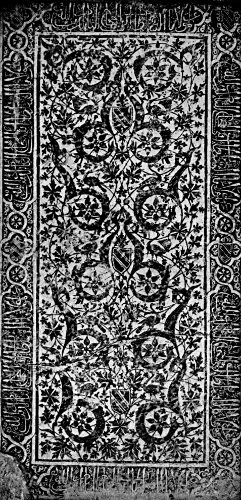
the fourteenth century. Happily the celebrated
plaque (Plate lviii.) formerly belonging to Fortuny,
and now in the possession of Excmo Sr. Don G. J.
de Osma, furnishes an early date, which,
according to its owner, is between May 1408
and November 1417. Those who know the
original will remember that it is no less remarkable
for the quality of its golden lustre than for
the grace and elegance of its fanciful Oriental
design.” It is also believed by Señor Osma that
this plaque was manufactured in the kingdom of
Granada; i.e. either at Granada or Málaga.
LVIII
HISPANO-MORESQUE LUSTRED PLAQUE
(Early 15th Century. Osma Collection)
A specimen of Spanish lustred ware more
celebrated even than Fortuny's plaque is the
“vase of the Alhambra” (Plate lix.), which rests
to-day in a corner of the Sala de las Dos Hermanas.
The history of this mighty jar is
interesting. Popular superstition affirms it to
have been discovered, filled to the brim with
gold, by the Marquis of Mondejar, first of the
Christian governors of the fortress of Granada.
Exposed for many years to every stress of weather
and to every mutilation at the hands of passers-by,
it stood, in company with other vases of
enormous size, upon a rampart which is now the
garden terrace known as the Adarves. Several
of the older travellers have described these vessels
or alluded to them. Marmol wrote of them as
far back as the sixteenth century, while the
journal of Bertaut de Rouen contains the following
notice;—“Sur la première terrasse par où l'on
entre, et d'où l'on a de la peine à regarder en
bas sans estre ébloüy, il y a deux fontaines jaillissantes,
et tout du long des murs du chasteau, des
espaliers d'orangers et de grenadiers, avec de
grands vases de terre peinte, aussi belle que la
porcelaine, où il n'y avoit pour lors, sinon quelques
fleurs en quelques-uns: mais où l'on dit que le
Marquis de Mondejar trouva quantité d'or que les
Mores avaient caché dans la terre, quand il y fût
estably par Ferdinand.” The priest Echeverría,
who forged the relics of the ancient Alcazaba of
Granada,[83] was careful to repeat this fable in the
twenty-sixth chapter of his Paseos por Granada.
The first edition of this work was published in
1764, under the assumed name of Joseph Romero
Yranzo. There were then two vases and part of
a third, all “lacerated, peeled, and maltreated.”
The Englishman Swinburne wrote in 1776 that
below the Towers of the Bell, “on the south-side,
on a slip of terrace, is the governor's garden, a
very pleasant walk, full of fine orange and cypress
trees and myrtle hedges, but quite abandoned.
The view it commands is incomparable. Two
large vases enamelled with gold and azure foliages
and characters are the only ornaments left: these
were taken out of the vaults under the royal apartments.”
In the second edition of Echeverría's
Paseos, which was republished in 1814, it is
added in a footnote that only a single vase
remained, “in a room that overlooks the Court of
Myrtles.” Lozano, however, in his Antigüedades
Arabes, mentions two vases as existing at the
same period. Argote de Molina (Nuevos Paseos
por Granada, published about 1808) describes,
together with the wretchedly executed marble
statues in the Sala de las Ninfas, the “two or
three great porcelain jars whereof some pieces
only now remain,” and reminds us that according
to the old tradition these statues looked continually
towards the vases, which were full of treasure.
Argote, nevertheless, takes Echeverría sharply to
task for his absurdities upon this theme; and
Washington Irving, a diligent gleaner in Echeverría's
somewhat scanty field, makes use of the
same material for his well-known story.
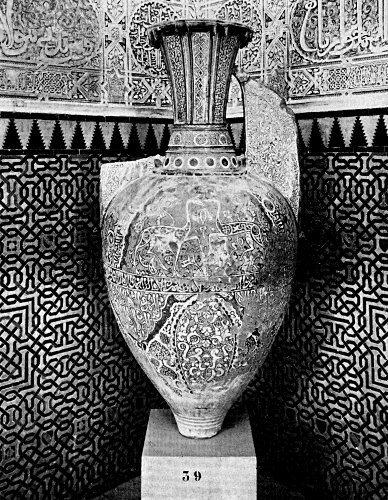
LIX
HISPANO-MORESQUE LUSTRED VASE
(Alhambra, Granada)
In the time of Owen Jones the one surviving
vase, now standing with a wooden rail before it
in a corner of the Hall of the Two Sisters, still
occupied the “room that looks upon the Court of
Myrtles.” Jones wrote of it in 1842:—“This
beautiful vase was discovered, it is said, full of
gold in one of the subterranean chambers of the
Casa Real. It is at present to be seen in a small
chamber of the Court of the Fish-pond, in which
are deposited the archives of the palace. It is
engraved in the Spanish work by Lozano,
Antigüedades Arabes de España, with another of
the same size, which was broken a few years ago,
and the pieces sold to a passing traveller. The
vase is executed in baked clay, with enamelled
colours and gold similar to the mosaics.”
A more precise description is the following.
The vase, which measures four feet six inches in
height by eight feet two inches and a half in
circumference, is of common earthenware painted
with intricate devices fired after painting. This
was a difficult operation in a vessel of such size;
and here, in consequence, the colours have slightly
run and mingled. Besides these technical flaws,
the belly of the vase is broken clean in half, and
one of the handles is missing. The shape is
amphoraic, with a moderate downward curve.
About the middle, surrounded by leaf and stem
and geometrical devices effectively intertwined,
are two antelopes. The vase is coloured blue
and caramel upon a delicate yellow ground, and
has a faint metallic lustre.[84] An Arabic inscription
is repeated several times, and consists of the
words “Felicity” and “Welcome.”
This vase is believed to date from the fourteenth
century; and if we judge from the colour
and composition of the earth employed, it appears
probable that it was made at Granada. Together
with the other vases which have disappeared,[85] it
was doubtless meant to serve as a receptacle for
water, and for decorating the chambers of the
palace, where it would rest in amphora-fashion
on a perforated stand, while smaller vases containing
flowers would fill the niches which may
yet be seen in various inner walls of the Alhambra.
The belief of Argote[86] and many other writers
that these niches were intended to receive the
slippers of the Moors is utterly unfounded.
Until quite recently all published illustrations
of the great jarrón de la Alhambra were inaccurate,
and as a rule grotesquely so. Among
the very worst are those inserted in the handbooks
of Riaño and Contreras. I am glad to be
able to reproduce an excellent photograph, which
both corrects the atrocious cuts I have observed
elsewhere, and relieves me from giving a prolix
and possibly a wearisome description of the
decoration on the vase.
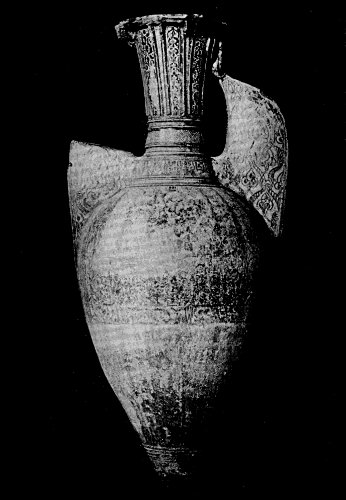
LX
HISPANO-MORESQUE LUSTRED VASE
(Madrid Museum)
Several other lustred vases of large size are
still preserved in Spain and other countries. One,
proceeding from a Sicilian church, is in the
museum of Palermo. Wallis, who inserts an
illustration, describes it as “amphora-shaped, with
two large flat handles; pear-shaped body, long
neck, ribbed at lower part, canellated above,
moulded lip. Whitish body, tin glaze. Ornament
painted in gold lustre on white ground,
the pattern in parts almost obliterated. Hispano-Moresque.
Height, one metre, seventeen centimetres.”
Another of these great vases belonged to the
painter Fortuny, and was sold at his death to
Prince Basilewsky, for thirty thousand francs. It
was found by Fortuny at the village of Salar,
near Granada, and purchased by him at a low
price. “The neck and mouth resemble those of
the Alhambra vase. The ornamentation is distributed
about the body of the vase in four zones;
one of the two central zones has tangent circles,
and the other an inscription.”
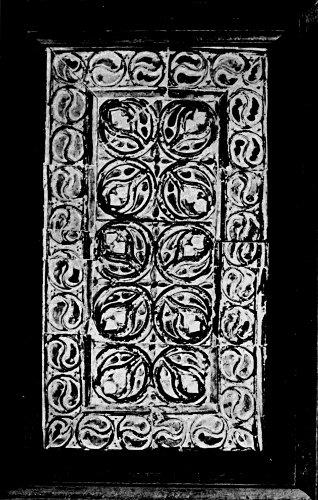
LXI
LUSTRED TILES
(Osma Collection)
Another large lustred vase is in the museum of
Madrid (Plate lx.). It was found by a labourer
at Hornos in the province of Jaen, and passed
into the hands of the village priest, who placed it
in his church to support the font of holy water.
In course of time a dealer in antiquities, by name
Amat, happened to pass that way, observed the
vase, and made an offer for it to the padre. This
latter at first refused, but subsequently, stimulated
by an ignorant though well-intentioned and disinterested
zeal for bettering the temple, he stipulated
that if the dealer provided a new support
of marble for the font, and paid for white washing
the church, he might bear off the coveted
jarrón. Fulfilling these conditions at all speed, he
mounted the precious vessel on an ass, and briskly
strode away. When he had gone a little distance
the villagers, missing their cherished vase, though
unaware, of course, of its artistic worth, swarmed
angrily about the purchaser, flourished their knives
and sticks at him, and pelted him with stones. At
this he called upon the mayor for protection; the
mayor provided him with two armed men for bodyguard,
and, thus defended, the indomitable dealer
reached Madrid and sold his jar to government
for fifteen hundred dollars. Its present value is
estimated at not less than thirty thousand.[87]
One of the earliest and most interesting notices
relating to the preparation of this lustred ware is
contained in a description by one of the royal
archers, named Henry Cock, of the progress,
performed in 1585, of Philip the Second from the
court of Spain to Zaragoza.[88] Cock wrote of Muel,
in Aragon:—“Almost all the inhabitants of this
village are potters, and all the earthenware sold
at Zaragoza is made in the following manner.
The vessels are first fashioned to the required
shape from a certain substance extracted from the
earth of this locality. They are next baked in a
specially constructed oven, and when removed
from this are varnished with white varnish and
polished, after which they are washed with a
mixture of twenty-five pounds of lead, three or
four pounds of tin, and as many pounds of a
certain sand which is found there. All these
ingredients are mixed into a paste resembling ice,
which is broken small, pounded like flour, and
kept in powder. This powder is mixed with
water, the dishes are passed through it, and after
being rebaked they keep their lustre. Next, in
order to gild the pottery, they take the strongest
vinegar mixed with about two reales of powdered
silver, vermilion, and red ochre, and a little wire.
When all is thoroughly mixed they paint the
patterns on the dishes with a feather, bake them
again, and their gold colour is now quite permanent.
I was told all this by the potters
themselves.”[89]
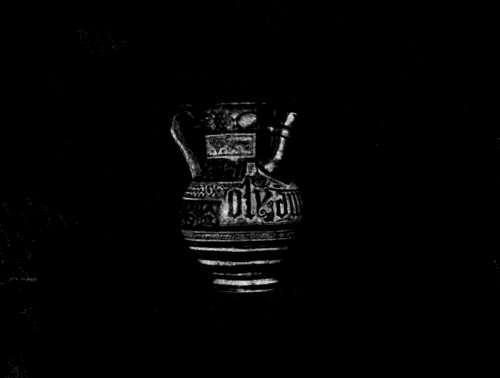
LXII
HISPANO-MORESQUE LUSTRED WARE
(A.D. 1460–1480. Osma Collection)
Another most interesting account of the manufacture
of lustred ware was discovered in manuscript
by Riaño in the British Museum, and,
although it belongs to a later date (1785), is well
worth quoting fully. It consists of a report upon
the later gilded pottery of Manises, and was drawn
up by order of the Count of Floridablanca:—
“After the pottery is baked, it is varnished with
white and blue, the only colours used besides the
gold lustre; the vessels are again baked; if the
objects are to be painted with gold colour, this
can only be put on the white varnish, after they
have gone twice through the oven. The vessels
are then painted with the said gold colour and
are baked a third time, with only dry rosemary
for fuel.
“The white varnish used is composed of lead
and tin, which are melted together in an oven
made on purpose; after these materials are
sufficiently melted, they become like earth, and
when in this state the mixture is removed and
mixed with an equal quantity in weight of sand:
fine salt is added to it, it is boiled again, and when
cold, pounded into powder. The only sand which
can be used is from a cave at Benalguacil, three
leagues from Manises. In order that the varnish
should be fine, for every arroba, twenty-five pounds
of lead, six to twelve ounces of tin must be added,
and half a bushel of finely-powdered salt: if a
coarse kind is required, it is sufficient to add a very
small quantity of tin, and three or four cuartos
worth of salt, which in this case must be added
when the ingredient is ready for varnishing the
vessel.
“Five ingredients enter into the composition of
the gold colour: copper, which is better the older
it is; silver, as old as possible; sulphur; red
ochre; and strong vinegar, which are mixed in
the following proportions: of copper three ounces,
of red ochre twelve ounces, of silver one peseta
(about a shilling), sulphur three ounces, vinegar
a quart; three pounds (of twelve ounces) of the
earth or scoriæ, which is left after this pottery is
painted with the gold colour, is added to the
other ingredients.
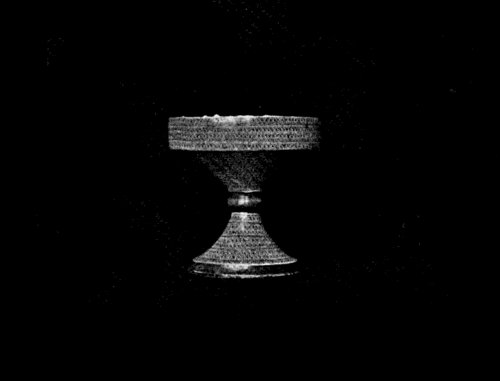
LXIII
HISPANO-MORESQUE LUSTRED WARE
(A.D. 1460-1480. Osma Collection)
“They are mixed in the following manner: a
small portion of sulphur in powder is put into a
casserole with two small bits of copper, between
them a coin of one silver peseta; the rest of the
sulphur and copper is then added to it. When
this casserole is ready, it is placed on the fire, and
is made to boil until the sulphur is consumed,
which is evident when no flame issues from it.
The preparation is then taken from the fire, and
when cold is pounded very fine; the red ochre
and scoriæ are then added to it; it is mixed up
by hand and again pounded into powder. The
preparation is placed in a basin and mixed with
enough water to make a sufficient paste to stick
on the sides of the basin; the mixture is then
rubbed on the vessel with a stick; it is therefore
indispensable that the water should be added very
gradually until the mixture is in the proper state.
“The basin ready prepared must be placed in
an oven for six hours. At Manises it is customary
to do so when the vessels of common pottery are
baked; after this the mixture is scratched off
the sides of the basin with some iron instrument;
it is then removed from there and broken up into
small pieces, which are pounded fine in a hand-mortar
with the quantity of vinegar already
mentioned, and after having been well ground
and pounded together for two hours the mixture
is ready for decorating. It is well to observe
that the quantity of varnish and gold-coloured
mixture which is required for every object can
only be ascertained by practice.”
Nevertheless, the gilded ware of the kingdom
of Valencia had by this time deteriorated very
greatly. Formerly, from as far back as the reign
of Jayme the Conqueror, the other towns or
villages of this region which produced the lustred
and non-lustred pottery were Játiva, Paterna,
Quarte, Villalonga, Alaqua, Carcer, and Moncada.
Early in the fourteenth century fourteen potteries
were working in the town of Biar, and twenty-three
at Traiguera. Manises, however, maintained
the lead for many years. The notices of
Eximenes and other writers concerning the pottery
of this town have been already quoted. The
same ware is mentioned in the sixteenth and
seventeenth centuries by Diago (1613), Francisco
Jávier Borrell, Beuter, and Martin de Viciana.
Marineus Siculus, the chronicler of Ferdinand
and Isabella, adds that similar or identical pottery
(“desta misma arte”) was made in Murcia, whose
manufacture of it had been praised in earlier
times by Ibn-Said. Toledo also manufactured
gilded ware with blue or bistre colouring. García
Llansó says that in the sixteenth century this
capital produced plates which contain the arms of
Spain in the centre, the rest of the plate being
completely covered with minute geometrical or
floral ornamentation.
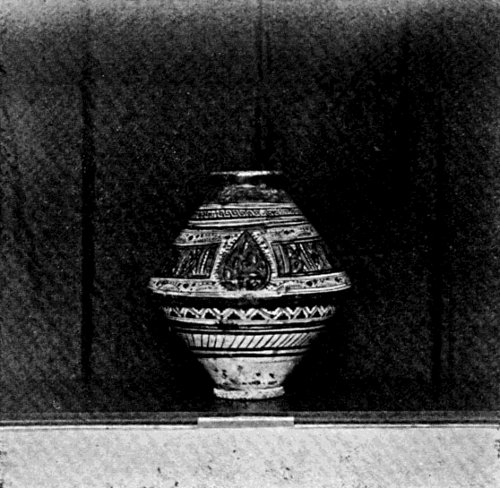
LXIV
HISPANO-MORESQUE LUSTRED WARE
(A.D. 1460-1480. Osma Collection)
It is certain that during the fourteenth and
fifteenth centuries large quantities of lustred
pottery were produced in many parts of Andalusia,
Castile, Aragon, and Valencia. The oldest and
most valuable specimens of this pottery are those
which have the palest and most purely golden
lustre, combined with blue or bluish decoration in
the form of animals, coats of arms, or foliage.
The lustred ware of Manises began to deteriorate
about the time of the expulsion of the Moriscos,
when the leaves and fronds of a clean gold tone
upon a lightish ground are replaced by commoner
and coarser patterns, and the gold itself by the
coppery lustre which is still employed.
After the seventeenth century the further decline
of this once famous industry may be traced
from the accounts of travellers. Towards the
middle of this century Bowles wrote that “two
leagues from the capital (Valencia) is a fair-looking
town of only four streets, whose occupants are
nearly all potters. They make a copper-coloured
ware of great beauty, used for common purposes and
for decorating the houses of the working-people
of the province. They make this ware of an
argillaceous earth resembling in its colour and
composition that portion of the soil of Valencia
which produces native mercury…. The objects
they fashion of this earth possess a glitter and are
very inexpensive, since I purchased half a dozen
plates for a real. Nevertheless, this is not the
ware which has the highest reputation in the kingdom
of Valencia. The factory which the Count of
Aranda has established at Alcora is not surpassed
in Europe, and is ahead of many in fineness of
substance, hardness of the varnish, and elegance
of form. It would be perfect of its kind if the
varnish did not crack and peel off so easily.”
According to Laborde, early in the nineteenth
century Manises contained two potteries “of considerable
extent, which employ seventy workmen.
The people occupied in these possess the art of
producing a gold bronze colour which they carefully
keep a secret, never communicating it to any
person.” Elsewhere in the same book Laborde
is more explicit. “Manises is a village situated a
league and a quarter north of Valencia. It is
seen on the left coming from New Castile. It is
noted for its manufactories of earthen ware, which
employ thirty kilns, and occupy a great part of the
inhabitants. The women are employed in forming
the designs and applying the colours. There are
two large manufactories of a superior kind, the
earthen ware of which is tolerably fine, of a beautiful
white, and a moderate price. They also make
here vases worked with a great degree of delicacy.”
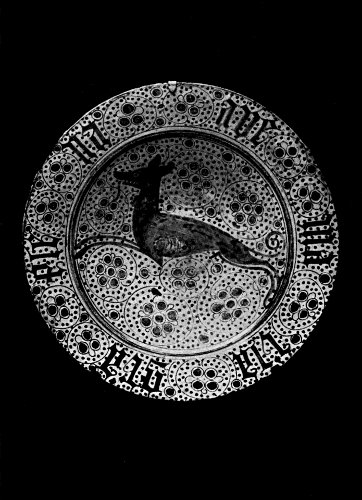
LXV
HISPANO-MORESQUE LUSTRED WARE
(Late 15th Century. Osma Collection)
“The society of these workmen possess the
secret of the composition of a colour which in the
fire takes the tint and brightness of a beautiful
gilt bronze. It has been unsuccessfully attempted
to be imitated; the heads of the society compose
the colour themselves, and distribute it to the
masters who take care of it; it is a liquid of the
colour of Spanish tobacco, but a little deeper.”
The quantity of Hispano-Moresque lustred
pottery preserved in the public and private collections
of various countries is far from small, although
to classify it according to the place and date of its
production is nearly always a matter of extreme
difficulty.
Among the earliest specimens are the vase
of the Alhambra, those which are now in the
museums of Palermo and Madrid, that which
belonged to Fortuny, and the plaque which once
was also his, and now forms part of the Osma
collection. Lustred Spanish tiles are scarce. A
few exist at Seville[90] and Granada, chiefly in altar-fronts,
along the archivolts of doorways, or, with
heraldic motives, on the inner walls of houses
of the aristocracy. Invariably, says Gestoso,
such tiles are coloured with combinations of white,
blue, and gold, since in the lustre process other
colours—black, or green, or deepish yellow—proved
unsatisfactory. Other lustred tiles of
exquisite beauty are owned by Señor Osma,
(Plate lxi.), and seem to have even gained in
brilliance by the centuries that have passed over
them. Riaño gives a list of the specimens of this
pottery which are at South Kensington, consisting
of bowls, vases, and plates. One of the vases is
particularly beautiful. It dates from the fifteenth
century, and is described by Fortnum as having
“a spherical body on a trumpet-shaped base, with
a neck of elongated funnel form, flanked by two
large wing-shaped handles perforated with circular
holes. The surface, except the mouldings,
is entirely covered with a diaper-pattern of ivy
or briony leaves, tendrils, and small flowers in
brownish lustre and blue on the white ground.”
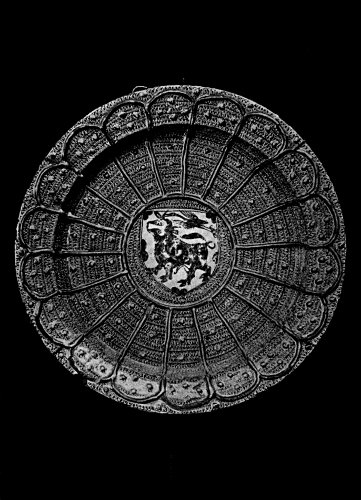
LXVI
HISPANO-MORESQUE LUSTRED WARE
(Late 15th Century. Osma Collection)
Through the courtesy of Señor Osma I am
able to give illustrations of a few of the finest
specimens of lustred ware in his magnificent
collection (Plates lxii.–lxvi.). The three small
vessels facing pages 176, 178, and 180 are of
Valencian workmanship, and date, according to
their owner, from between 1460 and 1480. The
two plates are also Valencian. The one with a
bull in the centre dates from between 1480 and
1500; and that which has a greyhound from
slightly earlier—say 1470 to 1490.
We have seen that Seville was an early and
important centre of the potter's craft in Spain.
Her potteries were celebrated even with the
Romans, and probably have at no moment been
inactive. Fifty, established in the suburb of
Triana, were mentioned in the sixteenth century
by Pedro de Medina, and documents which tell
of many more have recently been discovered by
Gestoso. The excellence of the Seville tiles has
been described in a preceding section of this
chapter. Their production still continues upon
a large scale; and the ware of the Cartuja factory,
which reached the zenith of its fame towards the
end of the eighteenth century, is considered by
Jacquemart and other authorities to rival with the
Italian wares of Savona.
Pottery made in other parts of the Peninsula—particularly
that of Talavera de la Reina—is
known to have been imitated by the Seville potters
with embarrassing perfection. In the case of the
so-called “loza de Puente del Arzobispo,” it is
the Seville ware itself which seems to have been
imitated. Puente del Arzobispo is a small village
near Toledo. Mendez wrote of it in the seventeenth
century:—“Fine pottery is manufactured in
about eight kilns, which produce more than 40,000
ducats yearly.” “In 1755,” says Riaño, “thirteen
pottery kilns existed at this place; they still
worked in 1791, but their productions were very
inferior in artistic merit.”
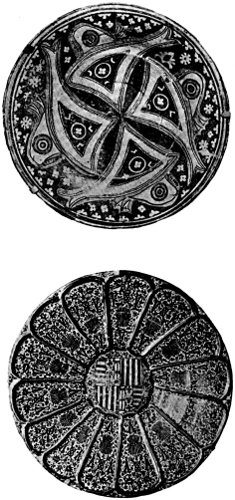
LXVII
HISPANO-MORESQUE LUSTRED WARE
Not many years ago the name of Puente del
Arzobispo was connected by Baron Davillier with
certain polychrome non-lustred plates and other
vessels which are greatly esteemed for their rarity,
and of which a few specimens exist in the South
Kensington and other museums, as well as in one
or two private collections, such as that of Señor
Osma.
Gestoso says that the usual diameter of these
plates is either twenty-three centimetres or forty-two
centimetres. “Their decoration, betraying
at a glance the Saracenic influence, consists of
leaves and flowers, together with animals of a
more or less fantastic character: lions, rabbits,
and birds. In other specimens the centre is
occupied by a heart, fleurs-de-lis, or other fancy
devices, or yet, in some few cases, with the head
of a man or woman. These central designs are
surrounded with leaves and flowers. The draughtsmanship
upon these plates is of the rudest, and
the process of their colouring was as follows.
The figures were drawn upon the unfired surface
in manganese ink mixed with a greasy substance;
and after this the aqueous enamel or glaze was
allowed to drop from a hogshair brush into the
spaces which the black had outlined.”
This will be recognized as the cuerda seca process,
so extensively employed in making Seville
tiles. Nevertheless, judging by certain marks upon
this pottery, Baron Davillier declared it to proceed
from Puente del Arzobispo. The marks in
question consist in one or two examples of what
appears to be the letters A.P. or P.A.[91] Davillier,
however, affirmed that he had seen a plate fully
inscribed as follows:—
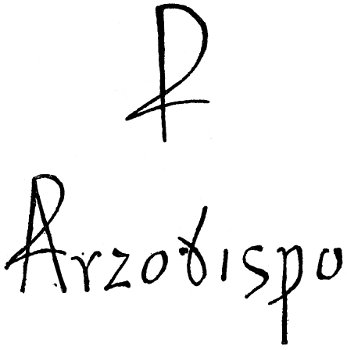
The existence of this plate is now discredited; at
least, no trace of it can be discovered at this day.
Upon the other hand, Gestoso points to various
objects manufactured by the cuerda seca method,
and which undoubtedly proceed from Seville.
Among them are three shields, one of which,
containing the arms of Ferdinand and Isabella,
is of exceptional interest, for it is accompanied by
an inscribed slab, evidently coeval with the shield
itself, recording it to have been made in the year
1503, and by Jerónimo Suarez. This shield and
slab were removed from a courtyard of the old
Alhóndiga to Seville Museum, where they now
remain. Of the two other shields, one belongs
to Señor Osma, and the second, which is still at
Seville, adorns the tomb of Don León Enriquez
in the church of Santa Paula; and since it is unquestionable
that all these cuerda seca shields,
as well as quantities of cuerda seca tiles, were
made at Seville, Gestoso prudently suggests that
we should designate as “cuerda seca ware” that
pottery which has hitherto passed as specially
belonging to Puente del Arzobispo. In fact,
towards the end of the fifteenth century this
pottery is found extending northward from Seville
to Toledo, and Señor Osma assures me that Toledo
specimens are of a somewhat later manufacture
than those which were produced at Seville. One
of the rarest and most interesting cuerda seca
plates in this gentleman's collection is reproduced
herewith (lxviii.). No other plate of similar
pattern is known to exist. Its date may be
placed between 1480 and 1495, and it gives a
curious illustration of the masculine headdress and
headwear in the reign of Ferdinand and Isabella.
The pottery of Talavera de la Reina was at
one time much esteemed. The earliest mention
of it, says Riaño, occurs in 1560, in a manuscript
history of this town, while another notice, dated
1576, says that here was produced “fine white
glazed earthenware and other pottery, which
supplied the country, part of Portugal, and India.”
More explicit are the observations of Father
Alonso de Ajofrín, who wrote, in 1651, a history
of Talavera. He says that “her pottery is as
good as that of Pisa, while quantities of azulejos
are made here to adorn the front of altars,
churches, gardens, alcoves, saloons, and bowers,
and large and small specimens of every kind.
Two hundred workmen work at eight separate
kilns. Four other kilns produce the commoner
kinds of ware. Red porous clay vessels and
drinking-cups are baked in two other kilns in
a thousand shapes to imitate birds and other
creatures; also brinquiños for the use of ladies, so
deliciously flavoured that after drinking the water
they contained, they eat the cup in which it was
brought them.”
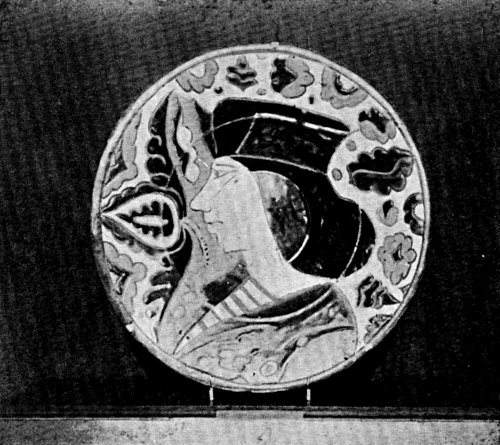
LXVIII
DISH
(Andalusian non-lustred ware in the Cuerda seca style.
A.D. 1480-1495. Osma Collection)
The following most interesting notice relating
to this town is also quoted by Riaño: “The
earthenware pottery made here has reached a
great perfection; it is formed of white and red
clay. Vases, cups, bucaros and brinquiños are
made of different kinds, dishes and table centres,
and imitations of snails, owls, dogs, and every
kind of fruits, olives, and almonds. These objects
are painted with great perfection, and the imitations
of porcelain brought from the Portuguese
Indies are most excellent. Everyone is surprised
that in so small a town such excellent things
should be made. The varnish used for the
white pottery is made with tin and sand, and
is now found to be more acceptable than coloured
earthenware; so much so, that persons of importance
who pass by this town, although they
have in their houses dinner-services of silver,
buy earthenware made at Talavera, on account
of its excellence. The sand which was used
to make the white varnish was brought from
Hita, and is now found at Mejorada, near
Talavera. This sand is as fine and soft as
silk.
“The red pottery made at Talavera is much
to be commended, for besides the great variety of
objects, and the different medals which they place
upon them, they have invented some small
brinquiños of so small and delicate a kind, that
the ladies wear them. Rosaries are also made of
the same material. A certain scent is added in
the manufacture of this pottery which excites the
appetite and taste of the women, who eat the
pottery so frequently that it gives great trouble to
their confessors to check this custom.”
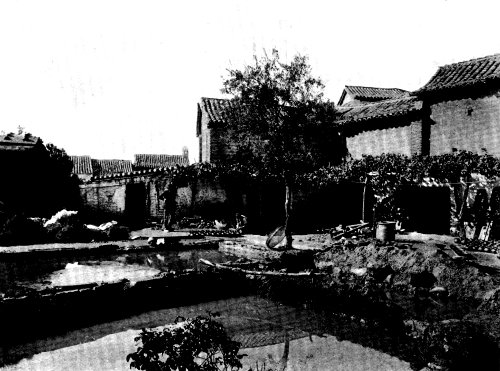
LXIX
AN ALFARERÍA OR POTTER'S YARD
(Granada)
This porous pottery for keeping water cool
had been imported from America, and was chiefly
made in Andalusia, Portugal, and Extremadura.
It is still produced at Andujar and elsewhere.
Nearly all travellers in Spain describe it, and insist
upon the curious circumstance that it was eaten
by the Spanish women. “I have mentioned elsewhere,”
wrote Countess d'Aulnoy, “the longing
many women feel to chew this clay, which often
obstructs their bodies internally. Their stomachs
swell, and grow as hard as stone, while their
skin turns yellow as a quince. I also felt a
curiosity to taste this ware, that is so highly yet
so undeservedly esteemed; but I would devour a
grindstone rather than put it in my mouth again.
Nevertheless, if one wants to be agreeable to the
Spanish ladies, one has to present them with some
bucaros, which they themselves call barros, and
which, as many deem, possess such numerous and
admirable qualities, since they claim for the clay
that it cures sickness, and that a drinking vessel
made of it betrays the presence of a poison. I
possess one which spoils the taste of wine, but
greatly improves water. This liquid seems to
boil and tremble when it is thrown into the cup in
question; but after a little while the vessel
empties—so porous is the clay of which it is
composed—and then it has a fragrant odour.”
Similar accounts are given by travellers of a
later time. “I wish,” wrote Swinburne, “I could
contrive a method of carrying you some of the
fine earthen jars, called buxaros, which are made
in Andalusia. They are remarkably convenient
for water-drinkers, as they are light, smooth, and
handy; being not more than half-baked, they are
very porous, and the outside is kept moist by the
water's filtering through; though placed in the sun,
the water in the pots remains as cold as ice. The
most disagreeable circumstance attending them is,
that they emit a smell of earth refreshed by a
sudden shower after a long drought.”[92]
Laborde, who wrote a few years later, seems to
have copied some of his information from Bowles.
“The Murcians,” he said, “use in their houses
little jars called Bucaros, the same as those which
in some parts of Andalusia are called Alcarrazas.[93]
They have handles open at the top, are smaller at
the bottom than above, and bulge in the middle;
they are slight, porous, smooth, and half-baked;
they are made of a peculiar kind of clay. When
water is put into them, they emit a smell like that
sent up by the earth after a shower of rain in
summer. The water makes its way very slowly
through the pores, and keeps them constantly
moist on the outside; they are used to cool water
for drinking. The windows and balconies of all
the houses have large iron rings, with a flat surface,
on which they are placed at night, and the water,
oozing incessantly, becomes very cool.[94] In Andalusia
some of these jars are white, and others red;
in Murcia they have only white ones. They appear
to be in every respect of the same nature as
the evaporating vases of Africa, Egypt, Syria,
and India, of which so much has been said by
travellers, and on which the learned have made so
many dissertations.”
The same vessels are noticed by Ford in his
description of a Spanish posada. “Near the staircase
downstairs, and always in a visible place, is
a gibbous jar, tinaja, of the ancient classical
amphora shape, filled with fresh water; and by
it is a tin or copper utensil to take water out with,
and often a row of small pipkins, made of a red
porous clay,[95] which are kept ready filled with
water, on, or rather in, a shelf fixed to the wall,
and called la tallada, el taller. These pots,
alcarrazas, from the constant evaporation, keep
the water extremely cool. They are of various
shapes, many, especially in Valencia and Andalusia,
being of the unchanged identical form of
those similar clay drinking-vessels discovered at
Pompeii. They are the precise trulla. Martial
speaks both of the colour and the material of
those made at Saguntum, where they still are
prepared in great quantities; they are not unlike
the ckool'lehs of Egypt, which are made of the
same material and for the same purposes, and
represent the ancient Canobic κστατικα. They are
seldom destined to be placed on the table; their
bottoms being pointed and conical, they could not
stand upright. This singular form was given to
the vasa futilia, or cups used at the sacrifices of
Vesta, which would have been defiled had they
touched the ground. As soon, therefore, as they
are drunk off, they are refilled and replaced in
their holes on the shelf, as is done with decanters
in our butlers' pantries.”[96]
I am only aware of one author who derides the
statement that this porous clay was eaten by the
Spanish women. According to Bowles, who certainly
describes and comments on it with intelligence
and scholarship, the neighbourhood of
Andujar contains “large quantities of the white
argil of which are made the jars or alcarrazas
which serve in many parts of Spain for cooling
water in the summer-time. In other parts of
Andalusia is found a red variety of this clay, employed
in making the vessels known as búcaros,
which serve to freshen the water as well as for
drinking it out of—a thing the Spanish ladies
love greatly. Both the white alcarrazas and
the búcaros as red as the blood of a bull are
thin, porous, smooth, and half-baked. When
filled with water they emit a pleasant smell like
that of dry earth rained upon in summer, and as
the water filters through the outer surface, remain
continually damp.” The same writer adds that
at that time (1752) the búcaros proceeding from
the Indies were of finer workmanship, and had
a more agreeable smell than those of Spanish
manufacture. “In the Encyclopædia,” he continues,
“and in the Dictionary of Natural History,
we read that Spanish ladies are for ever chewing
búcaro, and that the hardest penance their confessors
can inflict upon them is to deprive them
for a single day of this enjoyment.” Bowles,
however, quotes these observations in a scornful
tone, and deprecates the habit of “believing writers
who without inquiring into things, concoct and
publish novels to divert the populace and rid them
of their money.”
Turning our attention once again to the finer
kinds of Talavera ware, Gestoso adduces proofs
that this as well as Chinese porcelain was faultlessly
and freely imitated in the potteries of Seville.
Here, therefore, is a source of fresh confusion; and
probably a great proportion of the polychrome
ware which goes by the name of Talaveran is
really of Sevillian origin. It is further known that
at one period, which seems to begin with the second
half of the sixteenth century, potters who were
natives of Talavera were hired to work in Seville.
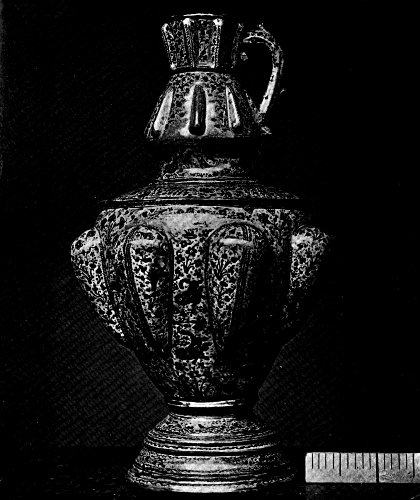
LXX
TALAVERA VASE
It has not been ascertained when Talavera herself
grew celebrated for this industry. García
Llansó supposes that at first, before it felt the
influence of Italy and France, her pottery was
partly Mudejar, and vestiges of oriental art survive
in fairly late examples. The characteristic colour-scheme
was either blue on white, or else the
decoration is more variegated. Riaño says:—“Although
we find by the remarks we have quoted
from contemporary authors that earthenware of
every description was made at Talavera, the
specimens which are more generally met with may
be divided into two groups, which are painted on
a white ground, either in blue, or in colours, in the
manner of Italian maiolica. The most important
examples which have reached us consist of bowls
of different sizes, dishes, vases (Plate lxx.), tinajas,
holy-water vessels, medicine jars, and wall decoration.
Blue oriental china was imitated to a vast
extent: the colouring was successful, but the design
was an imitation of the baroque school of the time,
and the figures, landscapes, and decoration follow
the bad taste so general in Spain in the eighteenth
century. The imitations of Italian maiolica are
effective. The colours most commonly used are
manganese, orange, blue, and green.”
Talavera maintained her reputation for pottery
till nearly the middle of the eighteenth century,
supporting more than six hundred workmen
employed in eight large potteries.[97] From then
onwards the trade declined, and by the close of the
same century was practically dead, owing, Larruga
tells us, to the constantly increasing cost of prime
materials. Nevertheless, the Crown made efforts
to revive the craft, and met with some success till
1777, in which year four establishments (locally
known as barrerías) for making common pottery
were opened in the same town, and speedily
crushed their rivals. “The potteries of Talavera,”
wrote Laborde soon after this, “were greatly
celebrated for many years, and supplied a lucrative
and important branch of commerce. They are
evidently on the decline. The manufactories are
reduced to seven or eight. These productions no
longer exhibit the same delicacy of execution.
Their designs are also lamentably defective. The
material employed in them is a certain earth
which is found near Calera, three leagues from
Talavera.”
The older Talavera ware, decorated, as a rule,
with horses, birds, hunting-scenes, or coats of
arms, is seldom met with nowadays. Although
it is not particularly choice, the drawing is firm,
and the colouring vigorous and agreeable.
I have said that pottery continued to be made
in Aragon, at Muel, Villafeliche, and other places.
In course of time these local industries were also
suffered to decay. Laborde says that early in the
nineteenth century the Villafeliche factory employed
thirty-eight workmen. “The ware is of a
very inferior sort. This article might be carried
to a greater extent. In several parts of the
province, earth is found of an excellent quality
for earthenware, particularly in Zaragoza and in
Tauste; the latter affords the best, which is very
fine, and of three colours, and would answer for
the making of porcelain.”
In the eighteenth century Toledo, upon the
initiative of Don Ignacio Velasco, produced good
imitations of Genoese ware, while other kinds of
pottery were made at Teruel, Valladolid, Jaen,
Zamora, Segovia, Puente del Arzobispo, and in
the Balearic Islands. Another region which continued
to be a most important centre of the potter's
craft was Cataluña, where it had always been
encouraged by this thrifty and art-loving people.
As early as the year 1257 two potters occupied
a place upon the municipal council of Barcelona,
while the potters' guild was strictly regulated from
the beginning of the fourteenth century.[98] At the
same time two whole streets in the centre of the
town, as well as others in the suburbs, were
occupied by potters. The ancient names of these
streets are yet retained in the Calles Escudillers,
Escudillers Blancs (white varnished pottery),
Obradors (where many of the potteries were
situated), and Tallers (i.e. the potteries for producing
common ware).
The pottery of Cataluña generally was largely
exported to Sicily, Alexandria, and other parts.
Among the places in this region which produced
it were Tarragona, Tortosa, and Villafranca. In
1528 the municipal council of the capital herself
forbade, as a protective measure, the introduction
into Barcelona of local pottery made at Malgrat,
La Selva, and other towns and villages of this
neighbourhood. In 1546 the Portuguese Barreyros
declared in his work Chorografía de algunos
lugares that the Barcelona ware surpassed all
other classes made in Spain, including the Valencian.
She continued to produce good pottery all
through the sixteenth century, and excellent common
ware until considerably later.[99]
About the beginning of the eighteenth century
Laborde mentioned as working centres of this
craft “manufactories of delf-ware at Avilés, Gijón,
Oviedo, Nava, and Cangas de Onis, in the Asturias;
at Segovia in Old Castile; at Puente del Arzobispo
and Talavera de la Reina in New Castile; at
Seville in the kingdom of that name; at Villafeliche
in Aragon; at Onda, Alcora, and Manises, in the
kingdom of Valencia; at San Andero in Biscay;
and at Tortosa in Cataluña…. The most
important of these potteries is the one at Alcora,
the delf of which is tolerably fine, though not of
the first quality. No china is made, except at
Alcora and Madrid: that of the former place is
very common, and inconsiderable as to quantity.
The china manufactured at Madrid is beautiful,
and without exaggeration may be considered as
equalling that of Sèvres. It is a royal pottery;
but it is impossible to give any description of its
state, because admission to the interior of the
manufactory is strictly prohibited.”
Ricord states in his pamphlet relative to
Valencian industries that in 1791 factories of
high-class pottery were working in the kingdom
of Valencia, at Onda, Alcora, Ribesalves, Manises,
Eslida, and Bechí; and of common ware at San
Felipe, Morella, Manises, Murviedro, Alicante,
Moncada, Orihuela, Segorbe, and other towns
and villages of this locality. In all, there were
throughout the province eighty-seven of these
latter potteries, besides two hundred and twenty
tileries, and four factories of artistic tiles or
azulejos established at Valencia. The yearly
output of these azulejerias was 150,000 tiles,
20,000 of which were exported to Andalusia and
Castile.
Although the pottery of Alcora only achieved
distinction at a later age, this craft had long been
practised in the neighbourhood. This circumstance
induced the Count of Aranda to found
here, in 1726, a large factory for producing costly
and artistic ware. Riaño obtained permission
to examine the archives of the family of Aranda,
with their mass of documents relating to this
enterprise. His notice of Alcora ware is therefore
most complete and valuable, and has been
copied, frequently without acknowledgment, by
almost every writer on the subject.
It appears from these archives that the cost
of building and opening the factory of Alcora
amounted to about £10,000. The works were
placed beneath the supervision of Don Joaquín
Joseph de Sayas, at the same time that a Frenchman
named Ollery was engaged at a good salary
and brought from Moustiers to act as principal
draughtsman. A couple of years later Count
Aranda paid Ollery the high compliment of saying
that “the fine and numerous models which he
has designed, have contributed to make my manufacture
the first in Spain.” He seems to have
retired in 1737, when the Count rewarded him
with a yearly pension of five hundred francs
besides the amount of his salary, “for his especial
zeal in the improvement of the manufactory, and
his great skill in directing the construction of every
kind of work.” Riaño adds that from this date
until the manufacture of porcelain in 1764, only
Spanish artists worked at Alcora.
The products of this factory continued to
improve, and reached, in course of time, a yearly
total of about three hundred thousand objects.
The ordinances, which are dated between 1732
and 1733, tell us that “in these works of ours no
pottery should be made except the very finest,
similar to the Chinese, and of as fine an earth.
The models and wheels should be perfect, the
drawing first-rate, the varnish and colours excellent,
and the pottery light and of the highest
quality, for it is our express wish that the best
pottery should only be distinguished from that of
an inferior kind by the greater or less amount of
painting which covers it.”
Not less interesting are certain communications,
copied by Riaño, which passed in 1746 between
the Spanish Tribunal of Commerce and
the Count of Aranda, in which it is stated that
“the perfection of the earthenware of Alcora
consists in the excellent models which have been
made by competent foreign artists, as well as in
the quality of the earth and the recipes brought
at great cost from abroad.” We learn from the
same document that “from the earliest period of
the manufacture, pyramids with figures of children,
holding garlands of flowers and baskets of fruits
on their heads, were made with great perfection;
also brackets, centre and three-cornered tables,
large objects, some as large as five feet high, to
be placed upon them, chandeliers, cornucopias,
statues of different kinds, and animals of different
sorts and sizes. The entire ornamentation of a
room has also been made here; the work is so
perfect that nothing in Spain, France, Italy, or
Holland could equal it in merit.”
It is not necessary to follow in close detail
all the modifications and vicissitudes (extending
over quite a hundred years) which affected the
Alcora factory. I therefore only take some
general notices from Riaño. In 1750 Count
Aranda transferred the works to a private company,
which remained in possession of them until
1766. In 1741 a Frenchman named François
Haly was engaged for ten years, and with a
yearly salary of rather more than a thousand
francs, under the following conditions:—
“That the travelling expenses of his wife and
children should be given him, and that his salary
should be paid as soon as he made before the
Director and two competent judges the different
kinds of porcelain which he had undertaken to
make.” Haly agreed to surrender his recipes,
and it was promised him that he should have two
modellers and one painter working by his side,
and that if in one year his porcelain were satisfactory,
the Count would make him a present of a
thousand tornoises.[100]
Porcelain was first produced at Alcora towards
the middle of the eighteenth century. A contract
was drawn up on March 24th, 1764, with
a German called John Christian Knipfer, who
had already worked there in the pottery section.
By the original agreement, which exists in the
archives, we find he was to prepare works of
“porcelain and painting similar to those made at
Dresden, during a period of six years, under the
following conditions:—
“That the said Knipfer obliges himself to
make and teach the apprentices the composition
and perfection of porcelain paste, its varnishes,
and colours, and whatever he may know at the
present time, or discover during this period of six
years; he is not to prevent the Director of the
Works from being present at all the essays made.
“The said Knipfer offers to make and varnish
porcelain, and to employ gold and silver in its
decoration, and in that of the ordinary wares;
likewise the colours of crimson, purple, violet,
blues of different shades, yellow, greens, browns,
reds, and black.
“That Knipfer will give up an account of his
secrets, and the management and manner of using
them, in order that in all times the truth of what
he has asserted may be verified.”
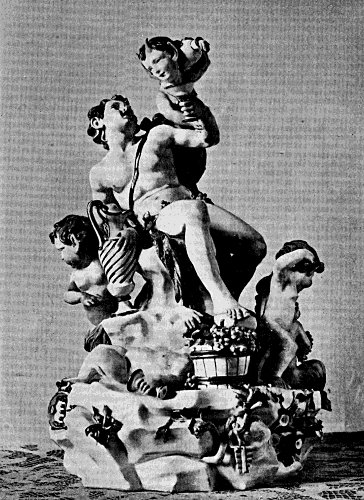
LXXI
ORNAMENT IN PORCELAIN OF THE BUEN RETIRO
In 1774 a Frenchman named François Martin
was engaged to make “hard paste porcelain,
Japanese faïence, English paste (pipeclay), and likewise
to mould and bake it: the necessary materials
to be provided by the Count of Aranda.” Riaño
says that the combined assistance of Knipfer and
Martin went far to better the products of the factory.
Martin died in 1786, and Knipfer left soon afterwards.
A Frenchman was now engaged, whose
services proved also beneficial to the works.
This was Pierre Cloostermans, “a skilful man,
well versed in the manufacture of porcelain pastes,
as well as in painting and decorating them.”
Cloostermans, however, was much molested by
the envy of the Spanish workmen at Alcora, as
well as by their typical intolerance in matters of
religion, although the Count, his master, behaved
towards him with the utmost kindness. Under
his supervision, the quality of Alcora ware was
notably improved. Figures and groups of many
kinds were attempted, and even Wedgwood jasper
ware was creditably imitated. In 1789, among
other pottery that was sent to Madrid were “two
hard paste porcelain cups, adorned with low relief
in the English style.” The most important one
was moulded by Francisco Garcés, the garlands
and low reliefs by Joaquín Ferrer, sculptor, the
flowers on the covers by an apprentice, helped
by Cloostermans.
Dated in the same year (1789), Riaño quotes an
interesting letter from the Count of Aranda to Don
Pedro Abadia, his steward. “I wish,” he said,
“to export the porcelain of my manufactory, but
chiefly in common objects, such as cups of different
kinds, tea and coffee services, etc. These may be
varied in form and colour, the principal point being
that the paste should bear hot liquids, for we
Spaniards above everything wish that nothing we
buy should ever break. By no means let time be
wasted in making anything that requires much
loss of time. The chief object is that the pastes
should be of first-rate excellence and durability.”
In 1793 Cloostermans was driven from the
country by political disturbances; but he was
allowed to return in 1795, and resumed his duties
at the factory. All through these years Alcora
continued to make most excellent pottery. Essays
were made with foreign earths, as well as with the
best that could be found in Spain. About this
time kaolin was discovered in Cataluña, and the
Count was particularly anxious that this native
product should be utilised at Alcora. “The
kaolin of Cataluña,” he wrote in 1790, “may be
good or bad, but it is acknowledged to be kaolin,
and if we do not employ it I must close my works.”
The Count of Aranda and Pierre Cloostermans
both died in 1798, and in 1800 the Duke of Hijar
became the manager and proprietor of the potteries.
“Two hundred workmen were employed, and
pottery of every description was made, common
earthenware, pipeclays in imitation of the English
ones, and porcelain in small quantities; common
wares were made in large quantities; the pipeclays
were pronounced superior to the English in
brilliancy, but were so porous that they were easily
stained. A large number of snuff-boxes and other
small objects belong to this period.”—(Riaño.)
In the early years of the nineteenth century
Alcora ware deteriorated not a little. This decline
was further aggravated by the French invasion;
and although an attempt was subsequently made
to revive the industry by bringing craftsmen from
the porcelain factory of Madrid, it suffered fresh
relapses and produced henceforward little but the
commonest kinds of ware. “This system,” says
Riaño, “continued until 1858, when the Duke
of Hijar sold the manufactory to Don Ramón
Girona, who brought over English workmen from
Staffordshire in order to improve the wares.
Many imitations of the older styles have also been
made at Alcora of late years.”
Riaño appends instructive tables, which I copy
in Appendix I, of every kind of pottery manufactured
at Alcora. He also believes that a great
deal of pottery which was formerly thought to
proceed from French or English factories is really
of Alcora make, including “a great quantity of
objects of white pipeclay porcelain which have
been found of late years in Spain. They have
hitherto been classified by amateurs as Leeds
pottery. We find, in papers relating to Alcora,
that a decided distinction is made between white
and straw-coloured pottery. This indication may
be sufficient to distinguish it from English wares.”
The celebrated Royal Porcelain Factory of the
Buen Retiro at Madrid, formerly situated in the
public gardens of that name and popularly known
as the “Fabrica de la China,” was founded in
1759 by Charles the Third, who erected a vast
edifice for this purpose, and filled it with a multitude
of workmen and their families, including two
hundred and twenty-five persons whom he brought
over from his other factory of Capo-di-Monte in
Italy. He also transferred a great part of the
material.[101] The cost of the new works amounted
to eleven and a half millions of reales, and they
were terminated in 1764. The cost of keeping
up the factory is stated by Larruga to have
amounted to three millions of reales yearly. The
first directors were Juan Tomás Bonicelli and
Domingo Bonicelli, and the first modellers-in-chief
and superintendents, possessing the secrets
of the fabrication (secretistas), were Cayetano
Schepers and Carlos Gricci.
Riaño says that every kind of porcelain was made
at the Buen Retiro, “hard and soft paste, white
china, glazed or unglazed, or painted and modelled
in the style of Capo-di-Monte.” A great many
objects existed imitating the blue jasper ware of
Wedgwood, and they also made flowers, coloured
and biscuit, groups (Pl. lxxi.), and single figures,
and painted porcelain of different kinds. Great
quantities of tiles for pavements were also made
there, which may still be seen at the Casa del
Labrador at Aranjuez: they are mentioned in the
accounts which exist at the Ministry of Finance for
1807 and 1808. We find in these same accounts
interesting details of the objects made monthly.
In January, 1808, a large number of figures were
made, including 151 heads for the table centre
which was made for the king, 306 objects ornamented
with paintings, 2506 tiles, 577 objects of
less artistic importance, such as dishes, plates,
etc. The finest specimens which exist are in the
Neapolitan style, and are two rooms at the palaces
of Madrid and Aranjuez, of which the walls are
completely covered with China plaques and looking-glasses,
modelled in the most admirable manner
with figures, fruits, and flowers. The room at
Aranjuez is covered with a bold ornamentation of
figures in the Japanese style, in high relief, painted
with colours and gold with the most exquisite
details. The figures unite the fine Italian modelling
with the Japanese decoration. The chandelier
is in the same style (Plate lxxii.). Upon a vase
on the wainscot to the right of the entrance door
is the following inscription:—
JOSEPH
GRICCI
DELINEAVit
ET
SCULit
1763.
This same date is repeated in the angles, and in
some shields near the roof we find,
“AÑO
1765;
probably the year the work was terminated.”
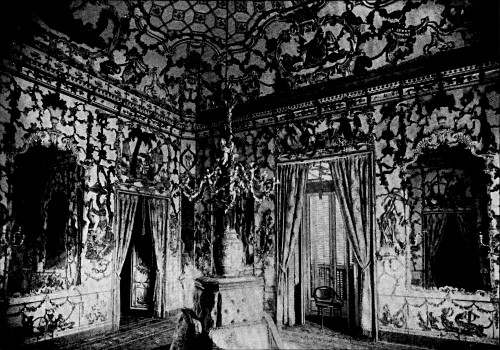
LXXII
ROOM DECORATED WITH PORCELAIN OF THE BUEN RETIRO
(Royal Palace of Aranjuez)
The earliest mark upon the Buen Retiro porcelain
was a blue fleur-de-lis, to which were subsequently
added the letter M and a royal crown. Still later,
in the reign of Charles the Fourth, the mark used
was a fleur-de-lis with two crossed C's.
The object of the Buen Retiro Factory was
almost wholly to supply the Crown with costly
ware, and would-be visitors were jealously excluded.
Townsend wrote in 1786: “I tried to
obtain admission to the china manufacture, which
is likewise administered on the king's account, but
his Majesty's injunctions are so severe, that I
could neither get introduced to see it, nor meet
with anyone who had ever been able to procure
that favour for himself. I was the less mortified
upon this occasion, because from the specimens
which I have seen, both in the palace at Madrid
and in the provinces, it resembles the manufacture
of Sèvres, which I had formerly visited in a tour
through France.”
Laborde also complained that the factory was
“wholly inaccessible: all entrance to it is interdicted,
and its existence is only ascertained by
the exhibition which is made of its productions
in the royal palace.” The same writer refers to
another class of work which was produced here,
namely, stone mosaic. “The process by which
stone is wrought into pictures is as delicate
as it is curious: a selection is made from marble
fragments of various shades and dimensions,
which are found, by judicious assimilation, to
produce no bad resemblance to painting.” Jean
François de Bourgoing, French Minister at
Madrid, was lucky enough, in 1782, to penetrate
into the factory and view the process. “Le
Monarque actuel,” he wrote, “a établi dans leur
intérieur une fabrique de porcelaine, dont l'entrée
est jusqu'à présent interdite à tout le monde.
On veut sans doute que ses essais se perfectionnent
dans le silence, avant de les exposer aux
regards des curieux. Ses productions ne peuvent
encore se voir que dans les Palais du Souverain,
ou dans quelques Cours d'Italie, auxquelles il
les envoie en présens. On travaille dans le même
édifice à certains ouvrages de marqueterie, qui
sont encore peu connus en Europe. J'y pénétrai
un jour, sous les auspices d'un étranger distingué
en faveur duquel le Roi avoit levé la prohibition
rigoureuse, qui en exclut tout le monde. Je suis
témoin de la patience and de l'adresse avec
lesquelles on taille and on rapproche divers petits
morceaux de marbre coloré, pour en former des
tableaux assez compliqués, qui en faisant à-peu-près
le même effet que la peinture, ont sur elle
l'avantage de braver par leur couleur immortelles
les ravages du temps, qui n'épargnent pas les
plus belles productions de cet art.”[102]
This factory was not long-lived. Until 1803
it followed the styles of the older establishment at
Capo-di-Monte, uniting neo-classic motives with
the manner of Baroque. In that year it began
to produce porcelain imitating that of Sèvres,
and two Frenchmen, Vivien and Victor Perche,
were brought from Paris to superintend this
change. “Among the finest specimens of this
period,” says Riaño, “are a splendid clock and
four vases, two mètres high, with porcelain flowers,
which exist in one of the state rooms of the Palace
of Madrid. The vases are placed in the four
corners of the room. The clock is ornamented
with large biscuit figures. A large number of
vases of Retiro china exist at the royal palaces of
Madrid, Aranjuez, and the Escorial. They are
often finely mounted in gilt bronze with muslin or
porcelain flowers. The blue of the imitations of
Wedgwood is not so pure, nor is the biscuit work
so fine as the English. Gold is often added to
these specimens.”
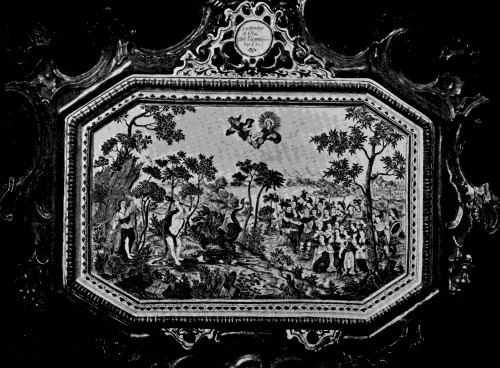
LXXIII
PORCELAIN OF THE MONCLOA FACTORY
Nevertheless, this manufacture was by now
decadent. It had suffered severely from the death
of Charles the Third, and upon the French invasion
in 1808 was seized by the enemy and occupied
by them for several months. During the
reign of the “intruso,” Joseph Buonaparte, porcelain
was still produced to some extent; but by the
time of the Peninsular campaign the works had
practically ceased. “Near this quarter,” wrote
Ford, describing the Retiro gardens, towards the
middle of last century, “was La China, or the royal
porcelain manufactory, that was destroyed by the
invaders, and made by them into a fortification,
which surrendered, with two hundred cannon,
August 14th, 1812, to the Duke. It was blown
up October 30th, by Lord Hill, when the misconduct
of Ballesteros compelled him to evacuate
Madrid. Now La China is one of the standing
Spanish and afrancesado calumnies against us, as
it is stated that we, the English, destroyed this
manufactory from commercial jealousy, because it
was a rival to our potteries. ‘What can be done
(as the Duke said) with such libels but despise
them. There is no end of the calumnies against
me and the army, and I should have no time to do
anything else if I were to begin either to refute
or even to notice them?’ (Disp., Oct. 16, 1813.)
These china potsherds and similar inventions of
the enemy shivered against his iron power of
conscious superiority.
“The real plain truth is this. The French
broke the ollas, and converted this Sèvres of
Madrid into a Bastile, which, and not the pipkins,
was destroyed by the English, who now, so far
from dreading any Spanish competition, have
actually introduced their system of pottery; and
accordingly very fair china is now made at Madrid
and Seville, and by English workmen. At the
latter place a convent, also converted by Soult
into a citadel, is now made a hardware manufactory
by our countryman, Mr Pickman. Ferdinand
the Seventh, on his restoration, re-created
La China, removing the workshops and warerooms
to La Moncloa, once a villa of the Alva family
on the Manzanares.”
This factory of La Moncloa was founded in
1816, and it continued working until 1849. A
specimen of the Moncloa ware is reproduced in
Plate lxxiii.
Outside the royal palaces of Spain, the Buen
Retiro porcelain is scarce. The choicest collections
which are not the property of the Crown
belong, or have belonged till recently, to the
Marquis of Arcicollar, the Count of Valencia de
Don Juan, and Don Francisco Laiglesia.
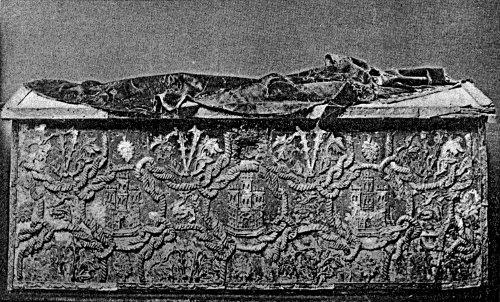
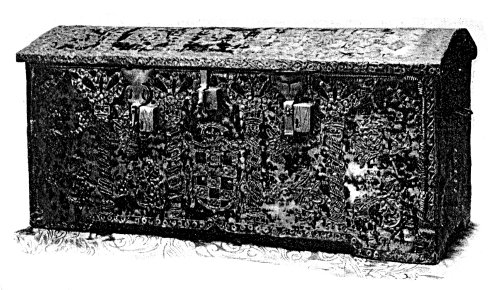
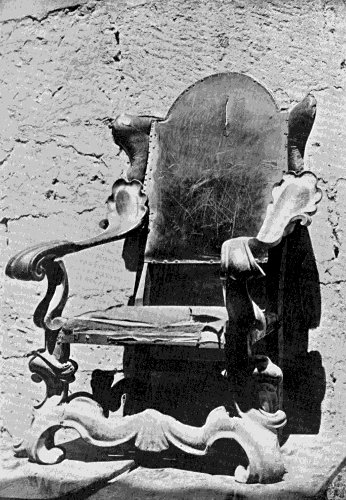
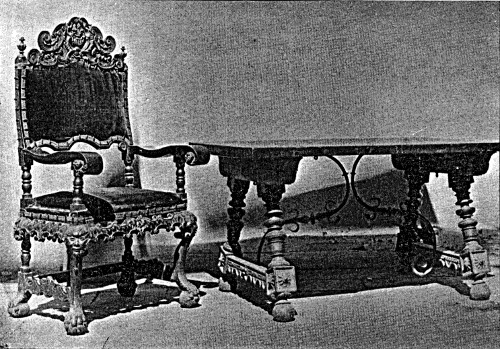
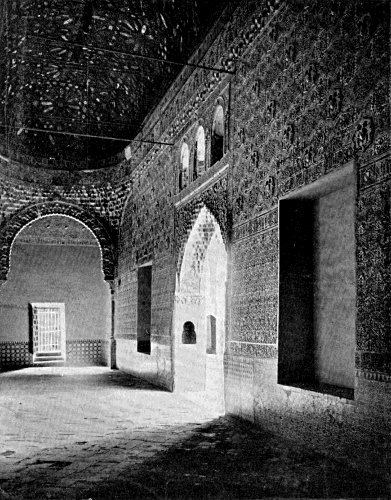
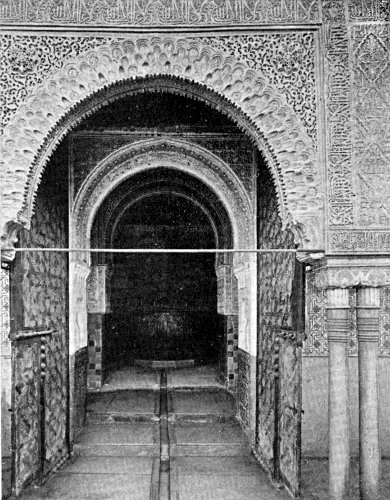
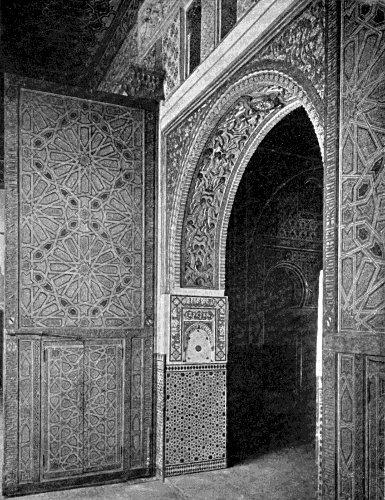
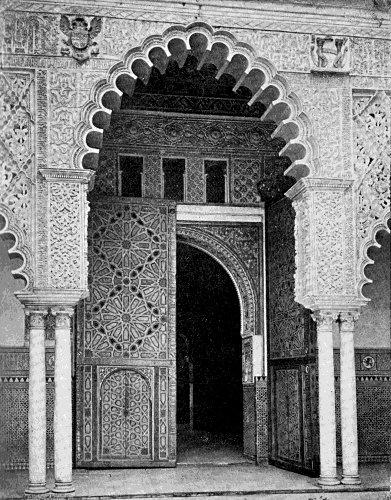
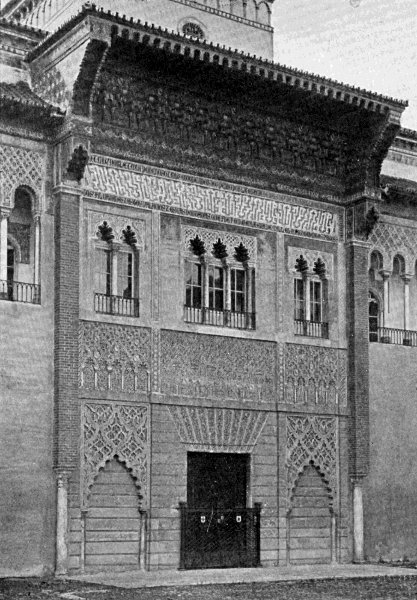
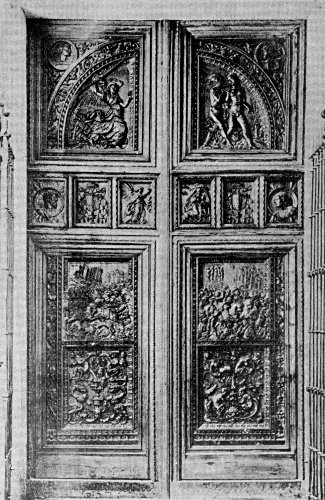
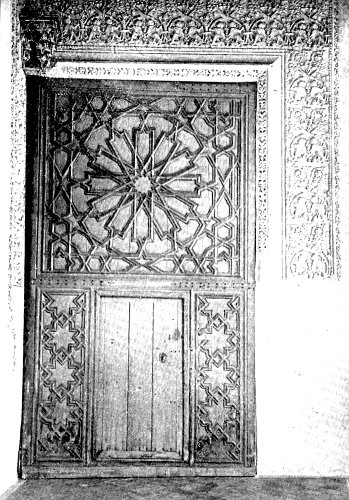
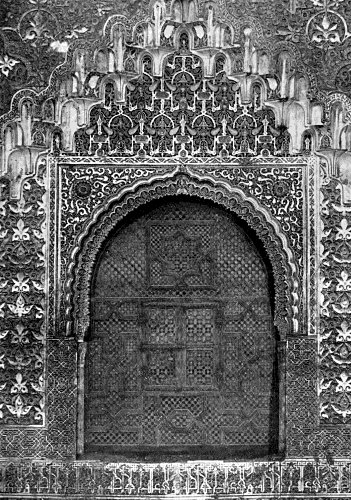
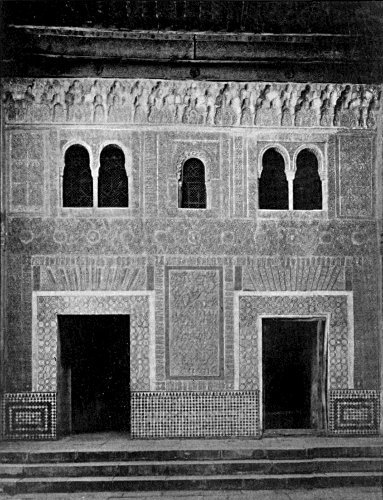
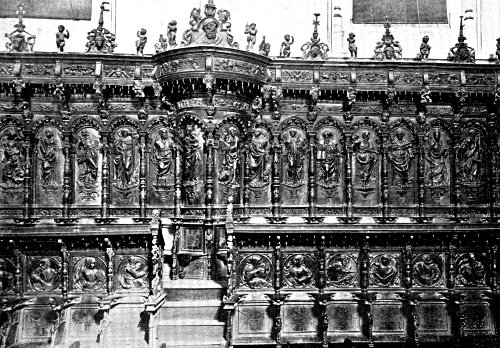
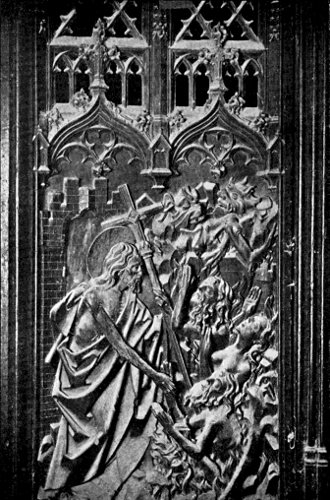
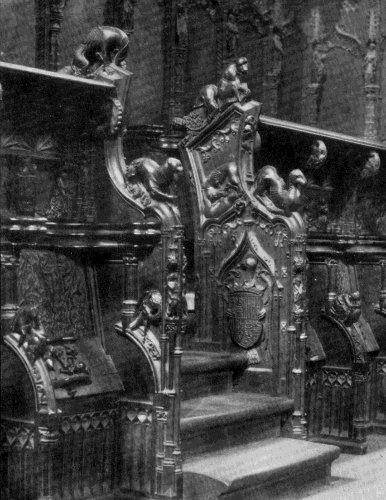
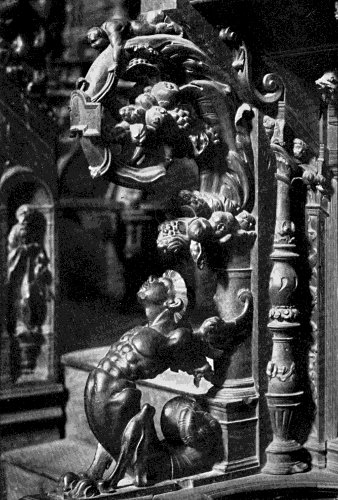


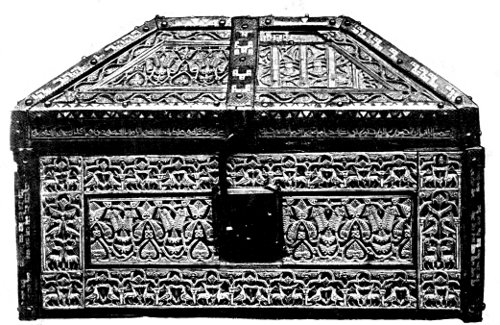
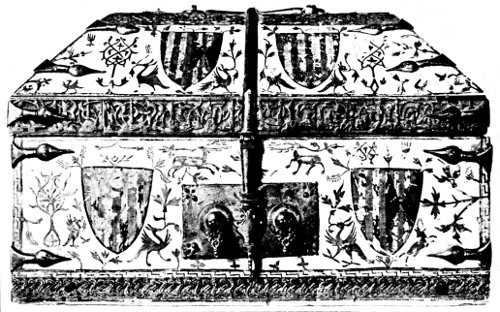
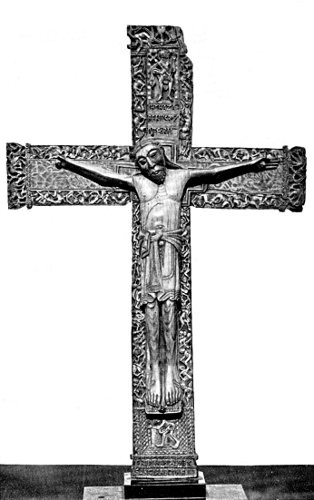
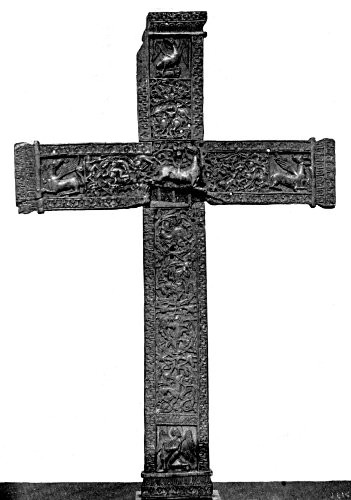

 , which word, says
Señor Osma, by suppressing the diacritical points and prolonging
some of the lines, was converted by the potter into the conventional
and exclusively decorative device:—
, which word, says
Señor Osma, by suppressing the diacritical points and prolonging
some of the lines, was converted by the potter into the conventional
and exclusively decorative device:—
 , and
another
, and
another  .
.