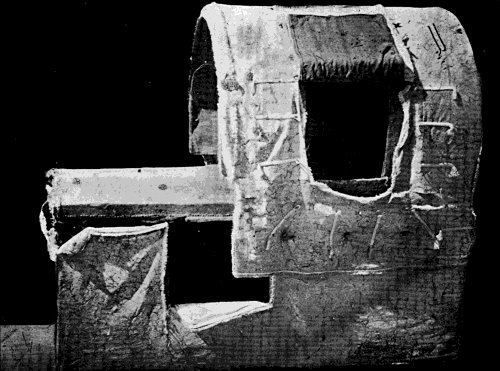
The hyperbolic language of the ancients spoke
of Spain as filled throughout, upon her surface and
beneath her soil, with precious stones and precious
metals. Old writers—Strabo, Pliny, Aristoteles,
Pomponius Mela, and Diodorus Siculus—declare
that once upon a time a mountain fire, lighted
by shepherds in the Pyrenees and fanned into a
conflagration by the wind, heated the earth until
the ore within her entrails came bubbling to the
top and ran away in rivulets of molten gold and
silver, spreading all over Spain. The indigens
of Lusitania as they dug their fields were said to
strike their implements on nuggets half a pound
in weight. The heart of the Peninsula, between
the Bœtis and the Annas rivers—that is, the
country of the Oretani and the Bastitani—was
fabled to abound in mines of gold. The traders
from Phœnicia, we are told, discovered silver to
be so abundant with the Turdetani that “the
vilest utensils of this people were composed
thereof, even to their barrels and their pots.”
Accordingly these shrewd Phœnicians, offering
worthless trinkets in exchange, loaded their ships
with silver to the water's edge, and even, when
their cargo was complete, fashioned their chains
and anchors of the residue.
In spite of their extravagance, upon the whole
these legends are not utterly devoid of truth.
“Tradition,” said so careful an authority as
Symonds, “when not positively disproved should
be allowed to have its full value; and a sounder
historic sense is exercised in adopting its testimony
with due caution, than in recklessly rejecting it
and substituting guesses which the lack of
knowledge renders insubstantial.” So with the
legends of the gold and silver treasure of the old-time
Spaniards. Besides, it seems unquestionable
that those fanciful assertions had their origin in
fact. Spain stood upon the western border of the
ancient world. Year in, year out, the sanguine
sun went seething down into the waters at her
western marge. Mariners from distant countries
viewed those sunsets and associated them with
Spain herself. Thus, hereabouts in the unclouded
south, would gold and silver be suggested by the
solar orb; or emerald and jacinth, pearl and
amethyst and ruby, by the matchless colours of
the seldom-failing sunset.
Then, too, though not of course in fabulous
amount, the precious metals actually existed in
this land. Various of her rivers, such as the
Calom or Darro of Granada, the Tagus, the
Agneda, and the Sil, rolled down, together with
their current, grains of gold. “Les Mores,”
wrote Bertaut de Rouen of the first of these
rivers, “en tiroient beaucoup autrefois; mais cela
a esté discontinué depuis à cause de la trop
grande dépense qu'il y faloit faire. Il est certain
que souvent on prend dans le Darro de petits
morceaux d'or, et il y a des gens qui sont
accoûtumez d'y en chercher.”
Centuries before this abbot wrote his book, the
Arab author of the geographical dictionary known
as the Marasid Ithila had made a similar remark
upon this gold-producing stream; and in the
sixteenth century I find an Ordinance of Granada
city prohibiting the townspeople from digging up
the river-bed unless it were to look for gold.[1]
Probably, however, and in spite of what some
chroniclers suppose, the title Darro is not in
any way connected with the Latin words dat
aurum.
“Two leagues from Guadarrama,” wrote the
mineralogist William Bowles, about the middle of
the eighteenth century, “opposite the town and
in the direction of San Ildefonso, is a deep valley
where one notices a vein of common quartz containing
some iron. Here, without the use of
glasses, I perceived a good many grains of
gold…. In Galicia grains of gold are found
on sandy hills, and one is astonished to observe
the wonderful works carried out by the Romans
to bring the sands together, wash them, and
extract the precious metal. Local tradition
affirms that this precious sand was destined for
the purses of three Roman empresses—Livia,
Agrippina, and Faustina…. I know a German
minister who employed his spare time in washing
these sands and collecting the gold.”
The Romans, it is true, profited very greatly
by the native wealth of the Peninsula. Helvius
enriched the treasury with 14,732 pounds of
Spanish silver bars and 17,023 pounds of silver
money; Cornelius Lentulus, with 1515 pounds of
gold, 20,000 pounds of bar-silver, and 34,550
pounds in coin. Cato came back from his pro-consulship
with five-and-twenty thousand pounds
of silver bars, twelve thousand pounds of silver
money, and four hundred pounds of gold.
Seventy thousand pounds of coined silver fell to
the share of Flaccus, while Minutius exhibited
at his triumph eight thousand pounds of silver
bars, and three hundred thousand pounds of
silver coin.
Mines of silver,[2] gold, and precious stones
were also fairly numerous in Spain. Moorish
authors wrote enthusiastically of the mines of
precious metals in or close to the Sierra Nevada.
“Even at this day,” said Bowles, “the Moorish
mines may be distinguished from the Roman.
The Romans made the towers of their fortresses
of a round shape, in order to avoid as far as
possible the blows of the battering-ram; and
their miners, whether from habit or intentionally,
made the mouths of their mines round also. The
Moors, as strangers to this engine, built their
towers square and gave a square shape also to
the mouths of their mines. The round mouths of
Roman mines are yet to be seen at Riotinto and
other places, and the square mouths of Moorish
mines in the neighbourhood of Linares.”
Emeralds were formerly extracted from a
mine at Moron, in the Sierra de Leyta; white
sapphires and agates at Cape de Gata,[3] at the
eastern extremity of the Gulf of Almeria;
amethysts at Monte de las Guardas, near the
port of Plata, “in a precipice (sic) about twenty
feet in depth.” According to Laborde, garnets
have been discovered down to modern times “in
a plain half-way on the road from Almeria to
Motril. They are very abundant there, particularly
in the bed of a ravine, formed by
rain-torrents, at the foot of a little hill, upon
which a great number of them are likewise
found. The emeralds are in the kingdom
of Seville, all the others in that of Granada.
It has been said for some time that a pit in
the mountain of Bujo, at Cape de Gata, contains
a great many precious stones; but none
could be found there, notwithstanding the prolonged
and careful searches that were lately
made.”
Silver mines exist, or have existed, at Benasque,
Calzena, and Bielza, in Aragon; at Cuevas, near
Almeria; at Almodovar del Campo; at Zalamea,
in Extremadura; at Puerto Blanco, in Seville
province; in the Sierra de Guadalupe; at Fuente
de la Mina, near Constantina; and near Almazarron,
in the province of Carthagena. Not far
from this latter city was another mine, that sent
to Rome a daily yield of five-and-twenty thousand
drachmas, and was worked by forty thousand men.
Twenty thousand pounds in weight of pure silver
proceeded yearly from Asturias, Lusitania, and
Galicia. Hannibal extracted from a Pyrenean
mine three hundred pounds a day. The fair
Himilca, wife of Hasdrubal, was owner of a silver
mine at two leagues' distance from Linares.
Laborde wrote of this mine: “It was reopened
in the seventeenth century, when a vein five feet
in breadth was found, from which many pieces
of silver were taken; the working of it, however,
has been neglected. It belongs to the town of
Baeza.”
The same author, who wrote about one hundred
years ago, gives curious and instructive notices
of several other Spanish silver mines. “The
mountains of the kingdom of Seville, on the
confines of Extremadura, towards Guadalcanal,
Alanis, Puerto Blanco, and Cazalla, which form a
part of the extremity of the chain of Sierra Morena,
contain several silver mines, which have been
worked. There is one of these in the Sierra
Morena, three miles from Guadalcanal, which to
all appearance must have been very rich: there
were three shafts for descending, the mouths of
which are still to be seen: it was worked in the
seventeenth century, and given up in 1653. It is
believed that it was inundated by the workmen,
in revenge for a new tax that was laid upon them.
Another silver mine was also worked formerly, a
league and a half from the other; it has a shaft,
and a gallery of ancient construction; the vein is
six feet in circumference, and is composed of spar
and quartz. There is also a third mine, a league
and a half from Guadalcanal, and half a league
south-east of the village of Alanis, in the middle
of a field; it is two feet wide; the Romans constructed
a gallery in it, from south to north; a
branch of it running eastward has been worked
since their time: it originally contained pyrites
and quartz, but it is by no means rich; there is
lead at the bottom.”
Gold mines, or traces of them, have been found
in the neighbourhood of Molina in Aragon,
San Ildefonso in Old Castile, and Alocer in
Extremadura; in the Sierra de Leyta; in the
valley of Hecho in Aragon; and at Paradeseca
and Ponferrada—this latter town the Interamnium
Flavium of the Romans.
It is said that the chieftains of the ancient
Spaniards adorned their robes with rude embroidery
worked in gold, and that the men and
women of all ranks wore gold and silver bracelets.
These statements cannot now be either proved
or controverted. Gold or silver objects older
than the Roman domination have not been found
abundantly in Spain. Riaño describes a silver
bowl, conical in shape and evidently fashioned
on the wheel, engraved with Iberian characters
on one of its sides. A similar bowl was found
in Andalusia in the seventeenth century, full
of Iberian coins and weighing ten ounces. Gold
ornaments, such as earrings, and torques or collars
for the neck, have been discovered in Galicia
less infrequently than in the other Spanish regions,
and may be seen to-day in private collections,
in the Royal Academy of History at Madrid,
and in the National Museum of Archæology.[4]
Villa-amil y Castro has written fully of these
torques (Museo Español de Antigüedades, Adornos
de oro encontrados en Galicia). In nearly every
case, he says, they consist of a plain gold bar,
C-shaped and therefore not completely closed
into a ring, and with a knob at each extremity, as
though their pattern were suggested by the yoke
of cattle. One or two are decorated with a somewhat
rude design extending through a portion of
their length.
On one of these occasions a pair of curious,
kidney-shaped earrings was found, together with a
torque. These earrings, apparently of later workmanship
than the other ornament, are decorated
over all their surface, partly with a filigree design,
and partly with a fine, beadlike pattern executed
with a small chisel or graving tool in the manner
known in French as fusé, guilloché, or hachié.
Their material is hollow gold, and when discovered
they were filled with a substance resembling
powdered charcoal, mixed with a metallic
clay.
These ornaments are ascribed by most authorities
to an undetermined period somewhere
previous to the Roman domination. I think,
however, that less improbably they were produced
by Spanish craftsmen in imitation of the Roman
manner, and during the time of Roman rule in
the Peninsula. This would account for their
deficiencies of execution, and also for certain
characteristics which they evidently share with
Roman work.
We know that Rome imposed her usages on all
the peoples whom she subjugated. Consequently,
following this universal law, the Spaniards would
adopt, together with the lavish luxury of Rome,
the Roman ornaments and articles of jewellery.
Such were the annulus or finger-ring; the fibula,
a brooch or clasp for securing the cloak; the
torgues or neck-ring, more or less resembling
those in use among the Persians; and the phalera,
a round plate of gold, silver, or other metal,
engraved with any one of a variety of emblems,
worn upon the breast or stomach by the persons
of either sex, and very commonly bestowed upon
the Roman soldiers in reward of military service.
Then there were several kinds of earrings—the
variously-designed stalagmium or pendant, the
inaures, or the crotalium, hung with pearls that
brushed together as their wearer walked, and
gratified her vanity by their rustling; and also
several kinds of bracelets—the gold or bronze
armilla, principally worn by men; the periscelis,
the spathalium, and the dextrale, worn round
the fleshy part of the right arm.[5]
Discoveries of Roman jewellery and gold and
silver work have occurred from time to time in the
Peninsula; for example, at Espinosa de Henares
and (in 1840) near Atarfe, on the southern side
of the volcanic-looking Sierra Elvira, a few miles
from Granada. Riaño describes a Roman silver
dish found in a stone quarry at Otañez, in the
north of Spain. “It weighs thirty-three ounces,
and is covered with an ornamentation of figures
in relief, some of which are gilt, representing
an allegorical subject of the source of medicinal
waters. In the upper part is a nymph who pours
water from an urn over rocks; a youth collects
it in a vessel; another gives a cup of it to a sick
man; another fills with it a barrel which is placed
in a four-wheeled car to which are yoked two
mules. On each side of the fountain are altars on
which sacrifices and libations are offered. Round
it is the inscription: SALVS VMERITANA, and at the
back are engraved, in confused characters, the
words: L. P. CORNELIANI. PIII….”
The same author is of opinion that in the time
of the Romans “objects of all kinds in gold and
silver were used in Spain to a very great extent,
for, notwithstanding the destruction of ages, we
still possess inscriptions which allude to silver
statues, and a large number of objects in the
precious metals exist in museums and private
collections.” Doubtless, in the case of articles
and household utensils of smaller size—bowls,
dishes, and the like, or ornaments for the person—the
precious metals were made use of freely; but
when we hear of mighty objects as also made of
silver, e.g. principal portions of a building, we
might do well to bear in mind a couple of old
columns that were standing once not far from Cadiz,
on a spot where in the days preceding history a
temple sacred to the Spanish Hercules is rumoured
to have been. Philostratus affirmed these columns
to be wrought of solid gold and silver, mixed
together yet in themselves without alloy. Strabo
reduced them modestly to brass; but it was reserved
for a curious Frenchman, the Père Labat,
who travelled in Spain in 1705, to warn us what
they really were. “Elles sont sur cette langue de
terre, qui joint l'Isle de Léon à celle de Cadix;
car il faut se souvenir que c'est ainsi qu'on appelle
la partie Orientale, et la partie Occidentale de la
même Isle. Il y a environ une lieue de la porte
de Terre à ces vénérables restes de l'antiquité.
Nous nous en approchames, croyant justifier les
contes que les Espagnols en débitent. Mais nous
fûmes étrangement surpris de ne pas rencontrer
la moindre chose qui pût nous faire seulement
soupçonner qu'elles fussent d'une antiquité un peu
considérable. Nous vimes que ces deux tours
rondes, qui n'ont à présent qu'environ vingt pieds
de hauteur sur douze à quinze pieds de diamètre,
étoient d'une maçonnerie fort commune. Leurs
portes étoient bouchées, et nous convinmes tous
qu'elles avoient été dans leur jeune tems des
moulins à vent qu'on avoit abandonnés; il n'y a
ni inscriptions, ni bas-reliefs, ni reste de figures
quelconques. En un mot, rien qui méritât notre
attention, ni qui recompensât la moindre partie de
la peine que nous avions prise pour les aller voir
de près. Car je les avois vue plus d'une fois du
grand chemin, où j'avois passé, et je devois me
contenter. Mais que ne fait-on pas quand on est
curieux, et aussi desœuvré que je l'étois alors.”
Many of the usages of Roman Spain descended
to the Visigoths. The jewels of this people
manifest the double influence of Rome and of
Byzantium, and the latter influenced in its turn
from Eastern sources. We learn from that extraordinary
encyclopædia of early mediæval Spanish
lore—the Etymologies of Isidore of Beja—that the
Visigothic women decked themselves with earrings,
necklaces, and bracelets, set with precious stones
of fabulous price. Leovigild is stated by the same
writer to have been the first of the Visigothic
princes to use the insignia of royalty. One of
his coins (engraved in Florez) represents him
with an imperial crown surmounted by a cross
resembling that of the Byzantines. Coins of a
similar design, and also bearing the imperial crown,
were minted at Toledo, Cordova, or Merida, in
the reigns of Chindaswint, Wamba, Ervigius, and
Egica.
But the true fountain-head of all our modern
knowledge respecting the jewellery of Visigothic
Spain is in the wonderful crosses, crowns, and
other ornaments discovered in 1858 upon the site
of some old Christian temple, two leagues distant
from Toledo. These objects, known collectively
as “the treasure of Guarrazar,” were stumbled
on by certain peasants after a heavy storm had
washed away a quantity of earth. Some were
destroyed upon the spot; others were sold to the
Toledo silversmiths and melted down by these
barbarians of our day; but fortunately the greater
part remained intact, or very nearly so. There
were in all, composed exclusively of gold and
precious stones, eleven crowns, two crosses containing
legible inscriptions, fragments such as the
arms of a processional cross, and many single
stones which time had doubtless separated from
the crosses or the crowns.[6]
Part of this treasure passed in some mysterious
way to France, and is now in the Cluny Museum
at Paris. The rest is in the Royal Armoury at
Madrid. Paris can boast possession of nine of the
crowns; Madrid, of two, together with a fragment
of a third—this latter of a balustrade or basket
pattern. Five of the nine crowns preserved at
Paris are fashioned of simple hoops of gold. The
most important of the five, the crown of Recceswinth,
who ruled in Spain from 650 to 672 A.D.,
consists of two hinged semicircles of hollow gold,
about a finger's-breadth across the interspace. It
measures just over eight inches in diameter and
four inches in depth. Both the upper and the
lower rims are decorated to the depth of nearly
half an inch with a design of four-pointed floral
or semi-floral figures within minute circles.
Amador de los Ríos has recognized this same
design in the frieze of certain buildings at
Toledo, and in the edges of mosaic discovered
at Italica and Lugo, as well as in the Balearic
Islands. The interstices of this design upon the
crown are filled with a kind of red enamel or
glaze, the true nature of which has not been
definitely ascertained. Riaño calls it “a delicate
ornamentation of cloisonné work, which encloses
a substance resembling red glass.” The centre
of the crown is filled with three rows of large
stones, principally pearls and sapphires. There are
also several onyxes, a stone which in those days
was held in great esteem. The spaces between
the rows of stones are ornamented with a somewhat
rudimentary design of palm branches, the leaves
of which appear to have been filled or outlined
with the kind of red enamel I have spoken of.
This crown is suspended by four gold chains
containing each of them five leaf-shaped links,
percées à jour. The chains unite at a gold rosette
in the form of a double lily, terminated by a stoutish
capital of rock-crystal. This in its turn is capped
by another piece of crystal holding the final stem
of gold which served as a hook for hanging up
the crown. Suspended from the gold rosette by
a long chain is a handsome cross, undoubtedly of
more elaborate workmanship, studded with union
pearls and monster sapphires. Amador believed
this ornament to be a brooch. If this were so it
is, of course, improperly appended here. Twenty-four
gold chains hang from the lower border of
the crown, concluding in pyriform sapphires of
large size. Each sapphire is surmounted by a
small, square frame of gold containing coloured
glass, and above this, in each of three-and-twenty
of the chains, is one of the golden letters forming
the inscription, ☩ RECCESVINTHVS REX OFFERET.
Besides this crown there are at Paris—
(1) A similar though slighter crown, the body
of which is studded with fifty-four magnificent
stones. A cross, now kept apart in the same
collection, is thought by Spanish experts to have
once been pendent from the crown. If so, the
latter was perhaps presented to the sanctuary by
one Sonnica, probably a Visigothic magnate, and
not a woman, as the termination of the name
induced some foreign antiquaries to suppose.
The cross is thus inscribed:—
| |
IN DI |
|
| |
NOM |
|
| |
INE |
|
| OFFERET |
|
SONNICA |
| |
SCE |
|
| |
MA |
|
| |
RIE |
|
| |
INS |
|
| |
ORBA |
|
| |
CES[7] |
|
(2) Three crowns of plain design consisting of
hoops of gold with primitive repoussé decoration,
and, in the case of one, with precious stones.
(3) Four crowns, each with a pendent cross.
The pattern is a basket-work or set of balustrades
of thin gold hollow plates (not, as Riaño stated,
massive) with precious stones about the intersections
of the bars or meshes, and others hanging
from the lower rim. Three of these crowns have
three rows or tiers of what I call the balustrade;
the other crown has four.
The custom of offering votive crowns to
Christian temples was taken by the emperors of
Constantinople from heathen peoples of the
eastern world. In Spain this custom, introduced
by Recared, outlived by many years the ruin of
the Visigothic monarchy—survived, in fact, until
the twelfth and thirteenth centuries. Thus in 891
Alfonso the Third presented to the monastery
of San Adrian and Santa Natalia four crowns of
gold and three of silver, while just a hundred
years afterwards Ordoño the Second presented
three silver crowns to the monastery of Samos.
Other crowns were offered by the prelates and
the secular nobility.
Returning to the crowns of Guarrazar, there
has been great controversy as to whether these
were worn upon the head. Some experts think
they must have been so worn; and in this case
the rings upon the rim, through which the chains
are passed, would seem to have been added on
the presentation of these objects to the sanctuary.
Lasteyrie, on the other hand, considered that the
crowns were merely votive and were never meant
for personal use, arguing that the rings were
fixed about the border from the very moment
when the crowns were made;[8] but Amador
ingeniously replied to this by pointing out that
in a few of the old Castilian coins—for instance,
one of Sancho the Third—the crown, with rings
about its rim, is actually upon the monarch's
head. It is possible, adds the same authority,
that these were old votive crowns proceeding
from some church, although he thinks it still
more likely that they were fashioned with the
rings attached to them. We should remember,
too, the hinge which serves to open and close the
body of these crowns. It is difficult to guess
the purpose of this hinge, unless it were to fit the
crown more comfortably on the head.
Of that portion of the treasure of Guarrazar
which has remained at Madrid (Plate i.), the
most important object is the votive crown of King
Swinthila, son of Recared, and described as “one
of the most illustrious and unlucky princes that ever
occupied the throne of Atawulf.” This crown
measures nine inches in diameter by two and a
half in height. It consists of thin gold plates
united at the edge, leaving, between the inner and
the outer side, a hollow space about a quarter
of an inch across. The exterior is divided into
a central horizontal hoop or band between two
others, somewhat narrower, at the top and bottom,
these last being slightly raised above the level of the
third. A triple row of precious stones, amounting
to one hundred and twenty-five pearls and
sapphires in the entire crown, surrounds the outer
surface of the same, the central band or zone of
which contains besides, wrought in repoussé on
the hoop, a simple circular device wherein each
centre is a sapphire or a pearl, though many of
these have fallen from their setting. The spaces
which describe these circles are superposed on
what looks like a red enamel retaining at this
moment all or nearly all its pristine brightness of
twelve hundred years ago. This substance was
believed by French investigators to be a coloured
glass or paste,[9] but Amador, after protracted
chemical experiments, declared it to be layers of
cornelian. Some of these layers have fallen from
their grip, and if the crown be stirred are heard
to move within. It is worth remarking, too, that
the fillets which form the setting of the precious
stones were made apart and welded afterwards;
nor are these settings uniform in shape, but tally
in each instance with the outline of the gem.
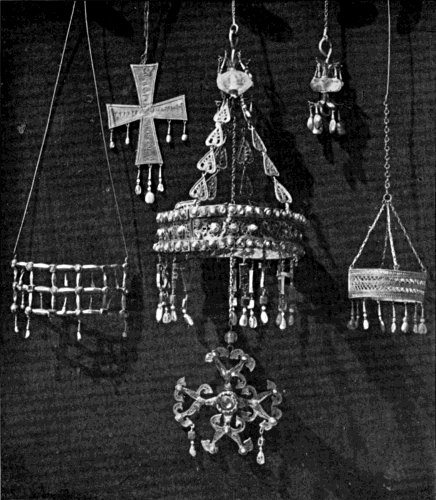
TREASURE OF GUARRAZAR
(Royal Armoury, Madrid)
The chains which served for hanging up the
crown are four in number. As in the crown of
Recceswinth, each of them is composed of four
repoussé cinquefoil links adorned along their edge
with small gold beads minutely threaded on a
wire and fastened on by fusing. The chains converge
into an ornament shaped like two lilies
pointing stem to stem, so that the lower is inverted,
although they are divided by a piece of
faceted rock crystal.[10] Four gems are hung from
either lily, and issuing from the uppermost of
these a strong gold hook attaches to the final
length of chain.
Possibly the chain and cross now hanging
through the circuit of the crown were not originally
part of it. This cross is most remarkable.
It has four arms of equal length, gracefully curved,
and is wrought of plates of gold in duplicate,
fastened back to back by straps of gold along the
edges. The centre holds a piece of crystal in
the midst of pearls and gold bead work threaded
on a wire of the same metal and attached by
fusion. Several fairly large stones are hung from
the lateral and lower arms of the cross by small
gold chains.
The letters hanging from Swinthila's crown are
cut and punched from thin gold plates. Their
decoration is a zigzag ornament backed by the
same mysterious crimson substance as the circular
devices on the hoop. Hanging from the letters
are pearls, sapphires, and several imitation stones—particularly
imitation emeralds—in paste.
The cross before the letters points to a custom
of that period. We find it also on Swinthila's
coins, and those of other Visigothic kings. Of the
letters themselves twelve have been recovered,
thus:—
☩ SV TI NV REX OFF T
The chains, however, or fragments of them,
amount to twenty-three—precisely (if we count
the cross) the number needed to complete the
dedication.[11]
The Royal Armoury contains another crown, a
great deal smaller and less ornamented than
Swinthila's. The body of this crown, which was
presented by the finder to the late Queen Isabella
the Second, is just a hoop of gold, two inches
deep and five across, hinged like the more
elaborate and larger crowns, but merely decorated
with a fine gold spiral at the rims, a zigzag
pattern in repoussé, and a rudely executed scale-work.
The dedication on this cross is in the
centre of the hoop, and says—
☩ OFFERET MVNVSCVLVM SCO STEFANO
THEODOSIVS ABBA
We do not know who Theodosius was, but
Amador, judging from the simple decoration of
this crown, believes him to have been a priest
of lower rank, and by no means a dignitary of
the Visigothic church.
A votive cross also forms part of this collection,
which has a simple sunk device along the edges
and seven pendent stones, two of these hanging
from each of the lateral arms, and three, a little
larger, from the lower arm. The inscription,
which is rough in the extreme, appears to be the
work of some illiterate craftsman, and has been
interpreted with difficulty:—
IN NOMINE DEI: IN NOMINE SCI OFFERET
LUCETIUS E
This reading gives an extra letter at the end,
which may be construed as Episcopus—or anything
else, according to the student's fancy.
I may close my notice of this collection in the
Royal Armoury at Madrid by drawing attention
to a greenish, semi-opaque stone, three-quarters
of an inch in height. It is engraved en creux
upon two facets with the scene of the Annunciation.
The gem itself is commonly taken for an
emerald, of which, referring to the glyptic art
among the Visigoths, the learned Isidore remarked
that “Sculpentibus quoque gemmas nulla gratior
oculorum refectio est.” I shall insert a sketch of
the cutting on this stone as a tailpiece to the
chapter, and here append a full description.
“The Virgin listens standing to the Archangel
Gabriel, who communicates to her the will of
the Almighty. Before her is a jar, from which
projects the stem of a lily, emblematic of the
chaste and pure, that reaches to her breast.
Her figure is completely out of measurement.
Upon her head appears to be a nimbus or
amiculum; her breast is covered with a broad and
folded fascia, enveloping her arms, while her
tunic, reaching to the ground, conceals one of her
feet. The angel in the cutting on the stone is at
the Virgin's right. His attitude is that of one
who is conveying tidings. Large wings folded
upon his shoulders and extending nearly to the
ground are fitted to his form, better drawn and
livelier than the Virgin's. He executes his holy
mission with his right hand lifted. His dress is
a tunic in small folds, over which is a cloak
fastened by a brooch and fitting closely. Upon
his head he wears a kind of helmet.”[12]
The drawing of this design upon the stone is
most bizarre and barbarous; for the Virgin's head
is so completely disproportioned that it forms the
one-third part of her entire person.
The merit of all this Visigothic gem or gold and
silver work has been extolled too highly by the
French and Spanish archæologists.[13] It is, however,
greatly interesting. Rudely and ponderously
magnificent, it tells us of a people who as yet
were almost wholly strangers to the true artistic
sense. Such were the Visigoths and the Spaniards
of the Visigothic era, of all of whom I have
observed elsewhere that “serfdom was the distinguishing
mark of the commons; arrogance, of
the nobility; avarice, and ambition of temporal and
political power, of the clergy; regicide and tumult,
of the crown.”[14] These crowns of Guarrazar proclaim
to us in plainest language that the volume of
the stones, and showiness and glitter of the precious
metal were accorded preference of every other
factor—the pondus auri preference of the manus
artificis. We gather, too, from documents and
chronicles and popular tradition, that the Visigothic
princes, as they set apart their stores of treasure in
secluded caves or in the strong rooms of their
palaces, were ever captivated and corrupted by the
mere intrinsic worth in opposition to the nobler
and æsthetic value of the craftsmanship.
Thus we are told that Sisenand owned a plate
of gold (no word is said of its design or style)
five hundred pounds in weight, proceeding from
the royal treasure of his race, and which, long
years before, had been presented by the nobleman
Accio to King Turismund. When Sisenand was
conspiring to dethrone Swinthila, he called on
Dagobert the king of France to come to his
support, and promised him, as recompense, this
golden plate. The French king lent his help
forthwith, and then, as soon as Turismund was
seated on the throne of Spain, despatched an
embassy to bring the coveted vessel to his court.
Sisenand fulfilled his word and placed the envoys
in possession of the plate, but since his subjects,
rising in rebellion, wrenched it from their power
and kept it under custody, he compensated
Dagobert by a money payment of two hundred
thousand sueldos.[15]
Innumerable narratives and legends dwell
upon the treasure taken by the Moors on entering
Spain. Such as relate the battle of the
Guadalete, or the Lake of Janda (as it is also
called by some authorities), agree that when the
fatal day was at an end the riderless steed of
Roderick was found imbedded in the mire,
wearing a saddle of massive gold adorned with
emeralds and rubies. According to Al-Makkari,
that luckless monarch's boots were also made of
gold studded with precious stones, while the
Muslim victors, stripping the Visigothic dead,
identified the nobles by the golden rings upon
their fingers, those of a less exalted rank by
their silver rings, and the slaves by their rings
of copper. The widow of the fallen king was
also famous for her stores of jewellery. Her
name was Eila or Egilona (Umm-Asim of the
Moors), but she was known besides as “the
lady of the beautiful necklaces.” After being
made a prisoner she was given in marriage to
the young prince Abd-al-Azis, who grew to love
her very greatly, and received from her, “seeing
that she still retained sufficient of her royal
wealth,” the present of a crown.
Muza, on returning to the East, is said to
have drawn near to Damascus with a train of
thirty waggons full of Spanish silver, gold, and
precious stones. Tarik ben Ziyed, marching in
triumph through the land, secured at Cordova,
Amaya, and other towns and capitals, enormous
store of “pearls, arms, dishes, silver, gold, and
other jewels in unprecedented number.” One
object, in particular, is mentioned with insistency
by nearly all the chronicles, both Mussulman
and Christian. Quoting from the Pearl of
Marvels of Ibn Alwardi, this was “the table
which had belonged to God's prophet, Solomon
(health be to both of them). It was of green
emeralds, and nothing fairer had been ever seen
before. Its cups were golden and its plates of
precious jewels, one of them specked with black
and white.” All manner of strange things are
said about this table, though most accounts
describe it as consisting of a single emerald.
Perhaps it was of malachite, or of the bright
green serpentine stone extracted formerly as well
as nowadays from the Barranco de San Juan
at Granada, and several other spots in Spain.
Bayan Almoghreb says it was of gold mixed
with a little silver and surrounded by three gold
rings or collars; the first containing pearls, the
second rubies, and the third emeralds. Al-Makkari
describes it as “green, with its 365 feet and
borders of a single emerald.” Nor is it known
for certain where this “table” fell into the hands
of Tarik. Probably he found it in the principal
Christian temple at Toledo—that is to say, the
Basilica of Santa María. Ibn Alwardi says that
in the aula regia, or palace of the Visigothic kings,
the lancers of the Moorish general broke down
a certain door, discovering “a matchless quantity
of gold and silver plate,” together with the
“table.” Doubtless this strong room was the same
referred to in the following lines. “It was for
ever closed; and each time that a Christian king
began to reign he added to its door a new and
powerful fastening. In this way as many as
four and twenty padlocks were gathered on the
door.”
However, the most explicit and informative of
all these ancient authors is Ibn Hayyan, who says;
“The table had its origin in the days of Christian
rulers. It was the custom in those times that
when a rich man died he should bequeath a legacy
to the churches. Proceeding from the value of
these gifts were fashioned tables, thrones, and
other articles of gold and silver, whereon the
clergy bore the volumes of their gospel when
they showed them at their ceremonies. These
objects they would also set upon their altars to
invest them with a further splendour by the
ornament thereof. For this cause was the table
at Toledo, and the [Visigothic] monarchs vied
with one another in enriching it, each of them
adding somewhat to the offerings of his predecessor,
till it surpassed all other jewels of its
kind and grew to be renowned exceedingly. It
was of fine gold studded with emeralds, pearls,
and rubies, in such wise that nothing similar had
ever been beheld. So did the kings endeavour
to increase its richness, seeing that this city was
their capital, nor did they wish another to contain
more splendid ornaments or furniture. Thus was
the table resting on an altar of the church, and
here the Muslims came upon it, and the fame of
its magnificence spread far abroad.”
Another chronicle affirms that Tarik found the
“table” at a city called Almeida, now perhaps
Olmedo. “He reached Toledo, and leaving a
detachment there, advanced to Guadalajara and
the [Guadarrama] mountains. These he crossed
by the pass which took his name, and reached,
upon the other side, a city called Almeida or The
Table, for there had been discovered the table of
Solomon the son of David, and the feet and
borders of it, numbering three hundred and sixty-five,
were of green emerald.”
In any case this venerated jewel gave considerable
trouble to its captors. When envious Muza
followed up the march of Tarik, his lieutenant,
he demanded from him all the spoil, and in
particular the ever-famous table. Tarik surrendered
this forthwith, but after slyly wrenching
off a leg. Muza perceived the breakage, and
inquired for the missing piece. “I know not,”
said the other; “'twas thus that I discovered it.”
Muza then ordered a new leg of gold to be made
for the table, as well as a box of palm leaves, in
which it was deposited. “This,” says Ibn Hayyan,
“is known to be one of the reasons why Tarik
worsted Muza in the dispute they had before
the Caliph as to their respective conquests.”
So it proved. Ibn Abdo-l-Haquem[16] relates that
Muza appeared before the Caliph Al-Walid and
produced the table. Tarik interposed and said
that he himself had taken it, and not the other
leader. “Give it into my hands,” the Caliph
answered, “that I may see if any piece of it be
wanting,” and found, indeed, that one of its feet
was different from the rest. “Ask Muza,” interrupted
Tarik, “for the missing foot, and if he
answer from his heart, then shall his words be
truth.” Accordingly Al-Walid inquired for the
foot, and Muza made reply that he had found
the table as it now appeared; but Tarik with
an air of triumph drew forth the missing piece
which he himself had broken off, and said: “By
this shall the Emir of the Faithful recognize that
I am speaking truth; that I it was who found
the table.” And thereupon Al-Walid credited his
words and loaded him with gifts.
Comparing the statements of these writers, we
may be certain that the “table” was a kind of
desk of Visigothic or, more probably, Byzantine
workmanship, for holding the gospels on the
feast-days of the national church. Probably, too,
seeing that a palm-leaf box was strong enough to
keep it in, its size was inconsiderable. Its value,
on the statement of Ibn Abdo-l-Haquem, was
two hundred thousand dinares.
The sum of my remarks upon the Visigothic
jewel-work is this. Distinguished by a coarse
though costly splendour, we find in it a mingled
Roman and Byzantine source, although it was
upon the whole inferior to these styles, being
essentially, as Amador observes, “an imitative
and decadent art.” Yet it did not succumb before
the Moors, but lurked for refuge in the small
Asturian monarchy, and later, issuing thence, extended
through the kingdom of León into Castile.
We find its clearest characteristics in such objects
as the Cross of Angels and the Cross of Victory.
Then, later still, it is affected and regenerated by the
purely oriental art of the invader; and lastly, till the
wave of the Renaissance floods the western world,
by Gothic influences from across the Pyrenees.
A similar sketch may be applied to other arts
and crafts of Spain—particularly furniture and
architecture.
THE CROSS OF ANGELS
(Oviedo Cathedral)
The pious or superstitious kings and magnates
of this land have always taken pride in adding (at
the instigation of the clergy) to the treasure of her
churches and cathedrals. Such gifts include all
kinds of sumptuous apparel for the priesthood;
chasubles and dalmatics heavily embroidered with
the precious metals, gold or silver crowns and
crosses, paxes,[17] chalices and patines, paraments
and baldaquinos, reliquaries in every shape and
style and size, and figures of the Virgin—such
as those of Lugo, Seville, Astorga, and Pamplona—consisting
of elaborate silver-work upon a
wooden frame. Visitors to Spain, from leisurely
Rosmithal five hundred years ago to time-economizing
tourists of our century, have been
continually astonished at the prodigal richness
of her sanctuaries. Upon this point I quote
a typical extract from the narrative of Bertaut de
Rouen. “The treasure of this church,” he said
of Montserrat, “is wonderfully precious, and particularly
so by reason of two objects that belong
to it. The first is a crown of massive gold of
twenty pounds in weight, covered with pearls,
with ten stars radiating from it also loaded with
large pearls and diamonds of extraordinary value.
This crown took forty years to make, and is valued
at two millions of gold money. The second
object is a gold crown entirely covered with
emeralds, most of them of an amazing size. Many
are worth five thousand crowns apiece. The
reliquary, too, is of extraordinary richness, as also
a service of gold plate studded with pearls,
donated by the late emperor for use in celebrating
Mass.”
Similar accounts to the above exist in quantities,
relating to every part of Spain and every period
of her history.
Reverting to the earlier Middle Ages, a few
conspicuous objects thus presented to the Spanish
Church require to be briefly noted here. Famous
chalices are those of Santo Domingo de Silos
(eleventh century), made to the order of Abbot
Domingo in honour of San Sebastian, and
showing the characteristic Asturian filigree-work;
and of San Isidoro of León, made in 1101 by
order of Urraca Fernandez, sister of the fourth
Alfonso. The latter vessel, inscribed with the
dedication of Urraca Fredinandi, has an agate
cup and foot. A remarkably handsome silver-gilt
chalice and patine (thirteenth century) belong
to Toledo cathedral. The height of this chalice
is thirteen inches, and the diameter of its bowl,
which has a conical shape, eight and a half inches.
Inside and out the bowl is smooth, but midway
between the bowl and the foot is a massive knot
or swelling in the stem, and on the knot the
emblematic lion, eagle, bull, and angel are
chiselled in high relief. Below the knot is a ring
of graceful rosettes. The patine which accompanies
this chalice measures twelve inches in
diameter. It has upon it, thinly engraved within
a slightly sunk centre with a scalloped edge, the
figure of Christ upon the cross, between the
Virgin and St John. This central group of
figures and the border of the plate are each
surrounded with a narrow strip of decoration.
The cathedral of Valencia has a beautiful and
early cup asserted to be the veritable Holy Grail
(greal, garal, or gradal, in the old Castilian), “of
which,” wrote Ford with his accustomed irony, “so
many are shown in different orthodox relicarios.”
However this may be, the chalice of Valencia is
particularly handsome. According to Riaño it
consists of “a fine brown sardonyx which is tastefully
moulded round the lip. The base is formed
of another inverted sardonyx. These are united
by straps of pure gold. The stem is flanked by
handles, which are inlaid with delicate arabesque
in black enamel. Oriental pearls are set round
the base and stem, which alternate with rubies,
sapphires, and emeralds. This chalice is a work
of the Roman imperial epoch, and the mounts
are of a later date.”
A series of Spanish chalices, beginning chronologically
with specimens which date from the
early Middle Ages, and terminating with the
chalice, made in 1712, of Santa María la Blanca
of Seville, was shown in 1892 at the Exposición
Histórico-Europea of Madrid. Among the finer
or most curious were chalices proceeding from the
parish church of Játiva, Las Huelgas, and Seville
cathedral, and the Plateresque chalices of Calatayud,
Granada, and Alcalá de Henares. Another
chalice which is greatly interesting because of
the date inscribed on it, is one which was presented
to Lugo cathedral by a bishop of that diocese,
Don Garcia Martinez de Bahamonde (1441–1470).
The workmanship, though prior to the sixteenth
century, is partly Gothic. An article by José
Villa-amil y Castro, dealing with all these chalices,
will be found in the Boletín de la Sociedad
Española de Excursiones for April, 1893.
A small exhibition was held at Lugo in August
1896. Here were shown sixteen chalices, nearly
all of them of merit from the point of view of
history or art. Such are the chalice of San
Rosendo, proceeding from the old monastery
of Celanova; the Gothic chalices of Tuy
cathedral, Lugo cathedral, Santa María del
Lucio, Santa Eulalia de Guilfrei, San Pedro
de Puertomarín, and the Franciscan friars of
Santiago; and the chalice and patine of Cebrero
(twelfth century), in which it is said that on a
certain occasion in the fifteenth century the wine
miraculously turned to actual blood, and the Host
to actual flesh, in order to convince a doubting
priest who celebrated service.
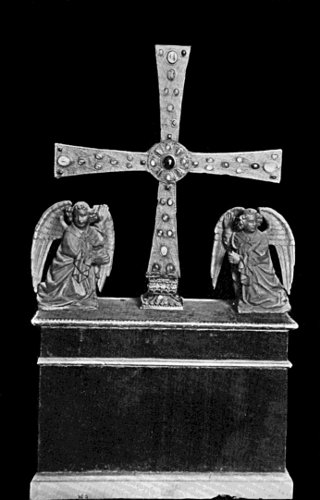
The Cross of Angels and the Cross of Victory—presents,
respectively, from Alfonso the Chaste
and Alfonso the Great—are now preserved at
Oviedo, in the Camara Santa of that stately
temple. The former of these crosses, fancied by
credulous people to be the handiwork of angels—whence
its title[18]—was made in A.D. 808. It consists
of four arms of equal length, radiating from
a central rosette (Pl. ii.). The core or alma is of
wood covered with a double plate of richly decorated
gold, chased in the finest filigree (indicative
already of the influence of Cordova) and thickly
strewn with sapphires, amethysts, topazes, and
cornelians. Other stones hung formerly from six
small rings upon the lower border of the arms.
The cross is thus inscribed:—
“Susceptum placide maneat hoc in honore Dei
Offeret Adefonsus humilis servus Xti
Hoc signo tuetur pius
Hoc signo vincitur inimicus.
Quisquis auferre presumpserit mihi
Fulmine divino intereat ipse
Nisi libens ubi voluntas dederit mea
Hoc opus perfectum est in Era DCCXLVI.”
THE CROSS OF VICTORY
(Oviedo Cathedral)
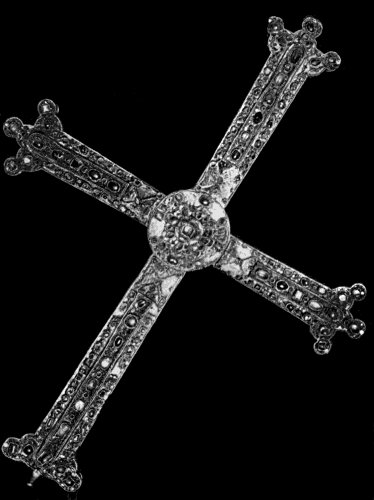
The other cross (Pl. iii.) is more than twice as
large, and measures just one yard in height by two
feet four and a half inches in width. Tradition
says that the primitive, undecorated wooden core of
this cross was carried against the Moors by King
Pelayo. The ornate casing, similar to that upon
the Cross of Angels, was added later, and contains
152 gems and imitation gems. The following
inscription tells us that this casing was made
at the Castle of Gauzon in Asturias, in the year
828:—
“Susceptum placide maneat hoc in honore Dei, quod offerent
Famuli Christi Adefonsus princeps et Scemaena Regina;
Quisquis auferre hoc donoria nostra presumpserit
Fulmine divino intereat ipse.
Hoc opus perfectum et concessum est
Santo Salvatori Oventense sedis.
Hoc signo tuetur pius, hoc vincitur inimicus
Et operatum est in castello Gauzon anno regni nostri.
XLII. discurrente Era DCCCLXVI.”
These crosses are processional. Others which
were used for the same purpose are those of San
Sebastián de Serrano (Galicia), San Munio de
Veiga, Santa María de Guillar (Lugo), San Mamed
de Fisteos, and Santa María de Arcos. The five
preceding crosses are of bronze; those of Baamorto
and San Adriano de Lorenzana are respectively
of silver, and of wood covered with silver plates,
and all were shown at the Lugo exhibition I have
spoken of.
Besides the Cross of Victory or Pelayo, and the
Cross of Angels, interesting objects preserved at
Oviedo are a small diptych presented by Bishop
Don Gonzalo (A.D. 1162–1175), and the Arca Santa
used for storing saintly relics. This beautiful
chest, measuring three feet nine inches and a half
in length by twenty-eight inches and a half in
height, is considered by Riaño to be of Italian
origin, and to date from between the tenth and
twelfth centuries.
Another handsome box belonging to the cathedral
of Astorga was once upon a time the
property of Alfonso the Third and his queen
Jimena, whose names it bears—ADEFONSVS REX:
SCEMENA REGINA. The workmanship is consequently
of the close of the ninth or the beginning
of the tenth century. The material is wood
covered with repoussé silver plates on which are
figured angels and birds, together with the eagle
and the ox as emblems of the evangelists John
and Luke, whose names are also to be read upon
the casket.
Next to the sword, no object in the history of
mediæval Spain was more profoundly popular or
venerated than the relicario. This in its primitive
form was just a small receptacle, such as a vase or
urn of gold or silver, ivory or crystal, used by the
laity or clergy for treasuring bones, or hairs, or
other relics of the Virgin, or the Saviour, or the
saints. In private families a holy tooth, or toe,
or finger thus preserved would often, as though
it were some Eastern talisman, accompany its
credulous possessor to the battlefield.
As time went on, the urn or vase was commonly
replaced by chests or caskets made by Moorish
captives, or by tranquil and respected Moorish
residents within the territory of the Christian,[19]
or wrested from the infidel in war and offered
by the Spanish kings or nobles to their churches.
Here they were kept on brackets, or suspended
near the altar by a chain[20] of silver, gold, or iron.
Among the Moors themselves such chests and
caskets served, according to their richness or
capacity, for storing perfumes, clothes, or jewels,
or as a present from a bridegroom to his bride;
and since the sparsely-furnished Oriental room
contains no kind of wardrobe, cabinet, or chest
of drawers, their use in Moorish parts of Spain
was universal.
A typical Moorish casket of this kind (Plate iv.)
is now in the cathedral of Gerona. It measures
fifteen inches in length by nine across, fastens
with a finely ornamented band and clasp of
bronze, and is covered with thin silver-gilt plates
profusely decorated with a bead and floral pattern
superposed upon a box of non-decaying wood—possibly
larch or cedar. A Cufic inscription along
the lower part of the lid was formerly interpreted
as follows:—
“In the name of God. (May) the blessing of
God, prosperity and fortune and perpetual felicity
be (destined) for the servant of God, Alhakem,
Emir of the Faithful, because he ordered (this
casket) to be made for Abdul Walid Hischem,
heir to the throne of the Muslims. It was finished
by the hands of Hudzen, son of Bothla.”
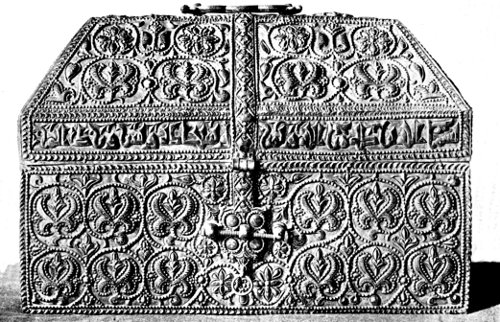
MOORISH CASKET
(Gerona Cathedral)
It is supposed, however, that the part of this
inscription which contains the maker's name was
rendered incorrectly by Riaño, who followed, on
this point, Saavedra, Fita, and other archæologists;
and that the casket was made to the order
of Djaudar, as a gift to the heir to the throne,
Abulwalid Hischem, the actual workmen being
two slaves, Bedr and Tarif. That is to say, the
name Hudzen is now replaced by Djaudar, whom
Dozy mentions in his history of the Mussulman
domination in Spain, and who is known to have
been a eunuch high in favour with Alhakem,
Hischem's father. These princes ruled at Cordova
in the latter half of the tenth century and the
beginning of the eleventh.
Spanish-Moorish caskets (arquetas) of ivory,
silver, or inlaid work, are also preserved in the
South Kensington Museum, the Archæological
Museum at Madrid, and the cathedrals of Braga,
Tortosa, and Oviedo. There is no reason to
doubt that all these boxes were made in Spain,
although an Eastern and particularly Persian
influence is very noticeable in their scheme of
decoration.
Two silver caskets which were once in the
church of San Isidoro at León are now in the
Madrid Museum. The smaller and plainer of
the two, elliptical in shape and measuring five
inches in length by two inches and a half in depth,
is covered with a leaf and stem device outlined in
black enamel. A Cufic inscription of a private
and domestic import, also picked out with black
enamel, runs along the top. The lid is ornamented,
like the body of the box, with leaves and stems
surrounded by a Grecian border, and fastens with
a heart-shaped clasp secured by a ring.
The other, more elaborate, and larger box
measures eight inches long by five in height. In
shape it is a parallelogram, with a deeply bevelled
rather than—as Amador describes it—a five-sided
top. Bands of a simple winding pattern outlined
in black enamel on a ground of delicate niello-work
run round the top and body of the casket.
The central band upon the lower part contains a
Cufic inscription of slight interest. Some of the
letters terminate in leaves. The bevelled lid is
covered with groups of peacocks—symbolic, among
Mohammedans, of eternal life—outlined in black
enamel. These birds are eight in all, gathered in
two groups of four about the large and overlapping
hinges. Four leaves, trifoliate, in repoussé, one
beneath the other, decorate the clasp, which opens
out into a heart containing, also in repoussé, two
inverted peacocks looking face to face. Between
the birds this heart extremity is pierced for the
passage of a ring.
Amador de los Ríos considers that both caskets
were made between the years 1048 and 1089.
The use of coloured enamel in the manufacture
of these boxes dates, or generally so, from somewhat
later. Although the history of enamelling
in Spain is nebulous and contradictory in the
extreme, we know that caskets in champlevé enamel
on a copper ground, with figures either flat or
hammered in a bold relief, became abundant here.
Two, from the convent of San Marcos at León, and
dating from the thirteenth century, are now in the
Madrid Museum. Labarte says that the lids of
these enamelled reliquaries were flat until the
twelfth century, and of a gable form thenceforward.
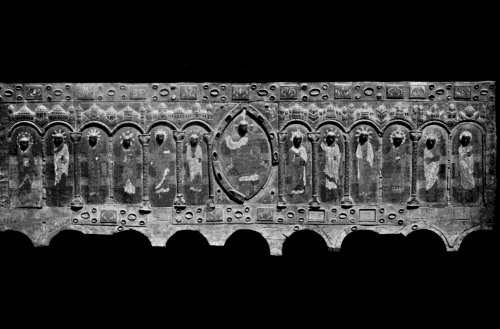
ALTAR-FRONT IN ENAMELLED BRONZE
(11th Century. Museum of Burgos)
Other old objects—boxes, triptyches, statuettes,
incensories, book-covers, crucifixes, and processional
crosses—partly or wholly covered with
enamel, belong or recently belonged to the
Marquises of Castrillo and Casa-Torres, the Count
of Valencia de Don Juan, and Señor Escanciano.
All, or nearly all, of these are thought to have proceeded
from Limoges (Pl. v.). Champlevé enamel
is also on the tiny “Crucifix of the Cid” (Pl. vi.) at
Salamanca, as well as on the Virgin's throne in
the gilt bronze statuette of the Virgin de la Vega
at San Esteban in the same city.[21] Of this image,
although it properly belongs to another heading of
my book, I think it well to give a reproduction here
(Plate vii.). I will also mention, in spite of its
presumably foreign origin, the enamelled altar-front
of San Miguel de Excelsis in Navarre—a
small sanctuary constructed by a mediæval cavalier
who, by an accident occasioned by the dark,
murdered his father and mother in lieu of his
wife.[22] This altar-front, conspicuously Byzantine
in its style, measures four feet three inches high
by seven feet five inches long, and is now employed
as the retablo of the little church which
stands in solitary picturesqueness on the lofty
mountain-top of Aralar. The figures, coloured in
relief upon a yellowish enamel ground, are those
of saints, and of a monarch and his queen—possibly
King Sancho the Great, who is believed to have
been the donor of the ornament. If this surmise
be accurate, the front would date from the eleventh
century.
I have said that the history of Spanish enamel-work
is both confused and scanty. The subject
in its general aspects has been studied by M.
Roulin, whose judgments will be found in the
Revue de l'Art Ancien et Moderne, and in his
article, “Mobilier liturgique d'Espagne,” published
in the Revue de l'Art Chrétien for 1903. M.
Roulin believes the altar-front of San Miguel in
Excelsis to be a Limoges product, not earlier than
the first half of the thirteenth century.
Ramírez de Arellano declares that no enamelling
at all was done in Spain before the invasion of the
Almohades. López Ferreiro, who as a priest had
access to the jealously secreted archives of Santiago
cathedral, gives us the names of Arias Perez,
Pedro Martinez, Fernan Perez, and Pedro Pelaez,
Galician enamellers who worked at Santiago in
the twelfth and thirteenth centuries. Martin
Minguez says that enamelling was done at Gerona
in the fourteenth century, and Moorish enamels
were certainly produced at Cordova and Cuenca
from comparatively early in the Middle Ages.
A few obscure workers in enamel are mentioned
by Gestoso, in his Diccionario de Artistas Sevillanos,
as living at Seville in the fifteenth century,
though, in the entries which refer to them, little
is told us of their lives and nothing of their labours.
In the sixteenth century we obtain a glimpse of
two enamellers of Toledo—Lorenzo Marqués and
Andrés Ordoñez, and dating from the same
period the Chapter of the Military Orders of
Ciudad Real possesses a silver-gilt porta-paz
with enamelling done at Cuenca. However, our
notices of this branch of Spanish art have yet
to be completed.
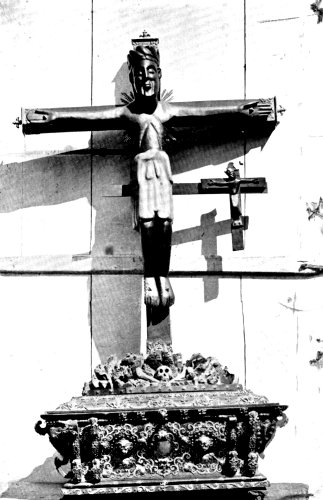
“THE CRUCIFIX OF THE CID”
(Salamanca Cathedral)
A long array of royal gifts caused, in the
olden time, the treasure of Santiago cathedral
to be the richest and most varied in the
whole Peninsula, although at first this see was
merely suffragan to Merida. But early in the
twelfth century a scheming bishop, by name
Diego Gelmirez, intrigued at Rome to raise his
diocese to the dignity of an archbishopric. The
means by which he proved successful in the
end were far from irreproachable. “Gelmirez,”
says Ford (vol. ii. p. 666) “was a cunning
prelate, and well knew how to carry his point; he
put Santiago's images and plate into the crucible,
and sent the ingots to the Pope.”
The original altar-front or parament (aurea
tabula) was made of solid gold. This altar-front
Gelmirez melted down to steal from it some
hundred ounces of the precious metal for the
Pope, donating in its stead another front of gold
and silver mixed, wrought from the remaining
treasure of the sanctuary. Aymerich tells us
that the primitive frontal bore the figure of the
Saviour seated on a throne supported by the four
evangelists, blessing with his right hand, and
holding in his left the Book of Life. The four-and-twenty
elders (called by quaint Morales “gentlemen”)
of the apocalypse were also gathered round
the throne, with musical instruments in their hands,
and golden goblets filled with fragrant essences.
At either end of the frontal were six of the apostles,
three above and three beneath, separated by
“beautiful columns” and surrounded by floral decoration.
The upper part was thus inscribed:—
HANC TABULAM DIDACUS PRÆSUL JACOBITA
SECUNDUS
TEMPORE QUINQUENNI FECIT EPISCOPI
MARCAS ARGENTI DE THESAURO JACOBENSI
HIC OCTOGINTA QUINQUE MINUS NUMERA.
And the lower part:—
REX ERAT ANFONSUS GENER EJUS DUX RAIMUNDUS
PRÆSUL PRÆFATUS QUANDO PEREGIT OPUS.
This early altar-front has disappeared like its predecessor;
it is not known precisely at what time;
but both Morales and Medina saw and wrote
about it in the sixteenth century.
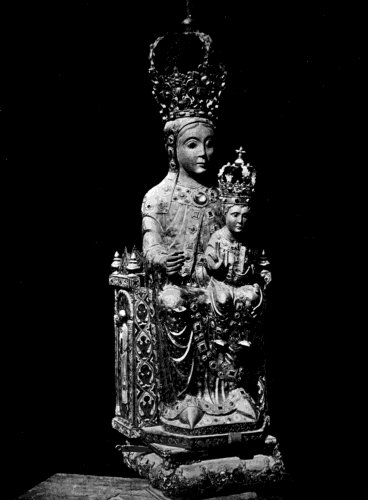
THE “VIRGEN DE LA VEGA”
(Salamanca)
Another ornament which Aymerich describes,
namely, the baldaquino or cimborius, has likewise
faded from the eyes of the profane, together with
three bronze caskets covered with enamel, and
stated by Morales to have contained the bones of
Saints Silvestre, Cucufate, and Fructuoso. One
of these caskets was existing in the seventeenth
century.
The silver lamps were greatly celebrated.
Ambrosio de Morales counted “twenty or
more”; but Zepedano made their total mount to
fifty-one. The French invasion brought their
number down to three. Three of the oldest
of these lamps had been of huge dimensions,
particularly one, a present from Alfonso of
Aragon, which occupied the centre. The shape
of it, says Aymerich, was “like a mighty mortar.”
Seven was the number of its beaks, symbolic of
the seven gifts of the Holy Ghost; and each
beak contained a lamplet fed with oil of myrtles,
acorns, or olives.
All kinds of robberies and pilferings have thus
been perpetrated with the once abundant wealth
of Santiago.[23] The jealous care which keeps the
copious archives inaccessible to all the outside
world is in itself of sinister significance. It has
transpired, furthermore, that many of the bishops
have “exchanged,” or simply stolen, portions of the
holy property. Besides these clerical dilapidations,
a cartload, weighing half a ton, was carried
off by Marshal Ney, though some was subsequently
handed back, “because the spoilers feared the
hostility of the Plateros, the silversmiths who live
close to the cathedral, and by whom many workmen
were employed in making little graven
images, teraphims and lares, as well as medallions
of Santiago, which pilgrims purchase.”[24]
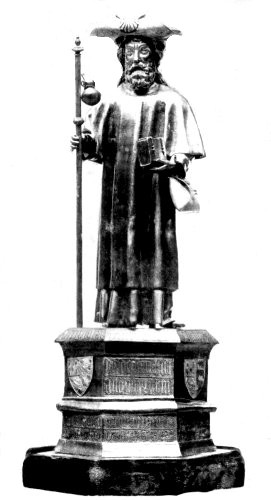
SAINT JAMES IN PILGRIM'S DRESS
(Silver-gilt statuette; 15th Century.
Santiago Cathedral)
Among the gifts of value which this temple yet
preserves are the ancient processional cross presented
by the third Alfonso in the year of grace
874,[25] and the hideous fourteenth-century reliquary
shaped to represent the head of James Alfeo, and
containing (as it is believed) this very relic (Pl. viii.).
I make a reservation here, because the Chapter
have forbidden the reliquary to be opened. In
either case, whether the head be there or not,
heads of the same apostle are affirmed to be at
Chartres, Toulouse, and other places. Similarly,
discussing these Hydra-headed beings of the Bible
and the hagiology, Villa-amil y Castro (El Tesoro
de la Catedral de Santiago, published in the
Museo Español de Antigüedades) recalls to us the
ten authenticated and indubitable mazzards of
Saint John the Baptist.
The head-shaped reliquary is of beaten silver
with enamelled visage, and the hair and beard gilt.[26]
The workmanship is French. The cross, which
hung till recently above the altar of the Relicario,
but which now requires to be placed upon the
lengthy list of stolen wealth, was not unlike the
Cross of Angels in the Camara Santa at Oviedo,
and had a wooden body covered with gold plates
in finely executed filigree, studded with precious
stones and cameos. Not many days ago, the
wooden core, divested of the precious metal and
the precious stones, was found abandoned in a field.
Visitors to the shrine of Santiago seldom fail
to have their curiosity excited by the monster
“smoke-thrower” (bota-fumeiro) or incensory,
lowered (much like the deadly sword in Poe's exciting
tale) on each fiesta by a batch of vigorous
Gallegos from an iron frame fixed into the pendentives
of the dome. “The calmest heart,” says
Villa-amil, “grows agitated to behold this giant
vessel descending from the apex of the nave until
it almost sweeps the ground, wreathed in dense
smoke and spewing flame.” Ford seems to have
been unaware that the real purpose of this metal
monster was not to simply scent the holy precincts,
but to cover up the pestilential atmosphere created
by a horde of verminous, diseased, and evil-smelling
pilgrims, who, by a usage which is now suppressed,
were authorized to pass the night before the
services within the actual cathedral wall.
The original bota-fumeiro, resembling, in Oxea's
words, “a silver boiler of gigantic bulk,” was lost
or stolen in the War of Spanish Independence.
It was replaced by another of iron, and this, in
1851, by the present apparatus of white metal.
Striking objects of ecclesiastical orfebrería were
produced in Spain throughout the thirteenth and
the fourteenth centuries. Among the finest are the
triptych-reliquary of Seville cathedral known as
the Alfonsine Tables; the retablo and baldaquino
of the cathedral of Gerona; the silver throne,
preserved in Barcelona cathedral, of Don Martin
of Aragon; and the guión, at Toledo, of Cardinal
Mendoza.
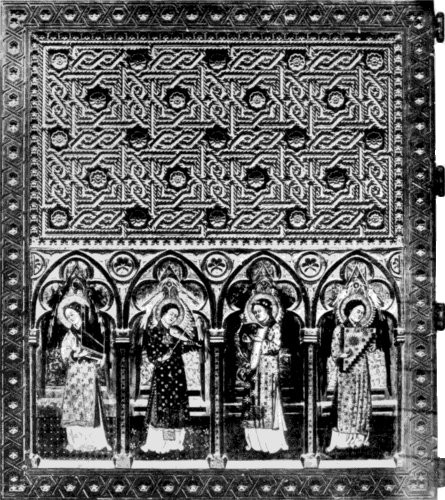
MUDEJAR TRIPTYCH
(Interior of one leaf of the door. 14th Century.
Royal Academy of History, Madrid)
Triptych-reliquaries, which had gradually expanded
from the diptych form—three leaves or
panels thus replacing two,—were generally used in
Spain from the eleventh century, and varied in
dimensions from a few inches in height and width
to several yards. We find them in the Gothic,
Mudejar,[27] Romanic, or Renaissance styles—wrought
either in a single style of these, or in
effective combination of some two or more. The
Academy of History at Madrid possesses a richly
ornamented Mudejar triptych (Plate ix.) proceeding
from the Monasterio de Piedra. It is inferior,
notwithstanding, to the Tablas Alfonsinas,[28] “a
specimen of Spanish silversmiths' work which
illustrates the transition to the new style, and the
progress in the design of the figures owing to the
Italian Renaissance.”[29] In or about the year 1274,
this splendid piece of sacred furniture was made
by order of the learned king, to hold the relics of
certain saints and of the Virgin Mary. The
maker is thought by Amador to have been
one “Master George,” a craftsman held in
high esteem by the father of Alfonso and the
conqueror of Seville, Ferdinand the Third.
Romanic influence is abundant in this triptych,
showing that, although exposed to constant
changes from abroad, the Spanish mediæval
crafts adhered upon the whole with singular
tenacity to primitive tradition.
The triptych is of larch, or some such undecaying
wood, and measures, when the leaves are
opened wide, forty inches over its entire breadth,
by twenty-two in height. Linen is stretched upon
the wood, and over that the silver-gilt repoussé
plates which form the principal adornment of the
reliquary. “The outside is decorated with twelve
medallions containing the arms of Castile and
Aragon, and forty-eight others in which are
repeated alternately the subjects of the Adoration
of the Magi and the Annunciation of the Virgin,
also in repoussé. In the centres are eagles,
allusive, it is possible, to Don Alfonso's claim
to be crowned Emperor…. The ornamentation
which surrounds the panels belongs to the
sixteenth century” (Riaño). The arms here
spoken of contain the crowned lion and the castle
of three towers; and the interesting fact is pointed
out by Amador that the diminutive doors and
windows of these castles show a strongly pointed
Gothic arch. The sixteenth-century bordering to
the panels is in the manner known as Plateresque.[30]
The clasps are also Plateresque, and prove,
together with the border, that the triptych was
restored about this time.
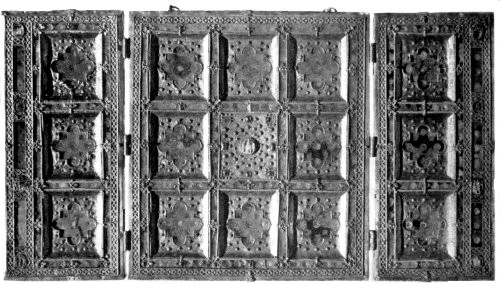
THE “TABLAS ALFONSINAS”
(View of Interior; 13th Century. Seville Cathedral)
Inside (Plate x.), it consists of fifteen compartments,
“full of minute ornamentation, among which
are set a large number of capsules covered with rock
crystal containing relics, each one with an inscription
of enamelled gold, cloisonné. Several good
cameos with sacred subjects appear near the edge
of the side leaves” (Riaño). These cameos, handsomely
engraved with figures of the Virgin and
other subjects of religious character, are fairly well
preserved; but the designs upon enamel are almost
obliterated. Eight precious stones, set in as rude
a style as those upon the ancient crowns and
crosses of the Visigoths, have also fallen out, or
been removed, from the interior.
The retablo of Gerona cathedral and its
baldachin date from the fourteenth century.
“The Retablo is of wood entirely covered with
silver plates, and divided vertically into three
series of niches and canopies; each division has a
subject, and a good deal of enamelling is introduced
in various parts of the canopies and grounds
of the panels. Each panel has a cinq-foiled arch
with a crocketed gablet and pinnacles on either
side. The straight line of the top is broken by
three niches, which rise in the centre and at either
end. In the centre is the Blessed Virgin with
our Lord; on the right, San Narciso; and on the
left, St Filia. The three tiers of subjects contain
figures of saints, subjects from the life of the
Blessed Virgin, and subjects from the life of our
Lord.”[31]
San Narciso is patron of the city of Gerona;
which explains the presence of his image here.
From the treasury of the same cathedral was
stolen, during the War of Spanish Independence,
a magnificent altar-front of wrought gold and
mosaic, a gift of Countess Gisla, wife of Ramón
Berenguer, count-king of Barcelona. It had in
the centre a bas-relief medallion representing the
Virgin, another medallion with a portrait of the
donor, and various saints in niches, interworked
with precious stones.
The great armchair of Don Martin, called by
Baron Davillier a “beau faudesteuil gothique,”
which possibly served that monarch as a throne, and
was presented by him to the cathedral of Barcelona,
dates from the year 1410. The wooden frame is
covered with elaborately chiselled plates in silver-gilt.
This most imposing object is carried in
procession through the streets upon the yearly
festival of Corpus Christi.
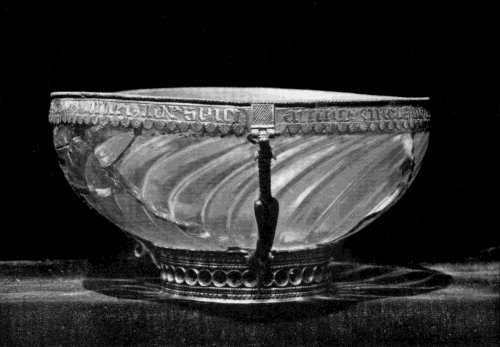
“THE CUP OF SAN FERNANDO”
(13th Century. Seville Cathedral)
SHIP
(15th Century. Zaragoza Cathedral)
The guión de Mendoza, now in Toledo cathedral,
is a handsome later-Gothic silver-gilt cross, and is
the same which was raised upon the Torre de la
Vela at Granada on January 2nd, 1492, when the
fairest and most storied city in all Spain surrendered
formally to Ferdinand and Isabella. Many other
interesting crosses, of the character known as processional,
are still preserved in various parts of
the Peninsula, at South Kensington, and elsewhere.
The more remarkable are noticed under
various headings of this book. Their workmanship
is generally of the fifteenth or the sixteenth
century.
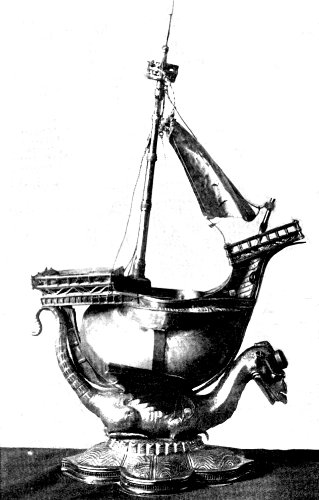
The Seo or cathedral of Zaragoza possesses a
handsome ship (Plate xii.), presented to this temple,
towards the end of the fifteenth century, by the
Valencian corsair, Mosén Juan de Torrellas. The
hull is a large shell resting on a silver-gilt dragon of
good design, with a large emerald set in the middle
of its forehead, and a ruby for each eye. Ships of
this kind were not uncommon on a Spanish dining
table of the time, or in the treasuries of churches
and cathedrals. Toledo owns another of these
vessels (in both senses of the word), which once
belonged to Doña Juana, daughter of Ferdinand
and Isabella.
Hitherto I have confined my notice almost
wholly to the treasure of the Spanish temples.
Turning from ecclesiastical to secular life, we find,
all through the Middle Ages, the humbler classes
kept by constant penury and war aloof from every
form of luxury. Jewellery and gold and silver
work were thus essentially the perquisite or, so to
speak, the privilege of princes, nobles, and the
Church. The mediæval kings and magnates of
this land were smitten inveterately with a passion
for display, and chronicles and inventories of the
time contain instructive details of the quantities of
gems and precious metals employed by them to
decorate their persons and their palaces. The
richness of their bedsteads will be noticed under
Furniture. Quantities of jewellery and plate belonged
to every noble household. For instance, the
testament of the Countess of Castañeda (A.D. 1443)
includes the mention of “a gilded cup and cover to
the same; a silver vessel and its lid, the edges gilt,
and in the centre of both lid and vessel the arms
of the said count, my lord; a silver vessel with a
foot to it; a diamond ring; a silver vessel with
gilt edges and the arms of the count, companion
to the other vessels; a jasper sweetmeat-tray with
silver-gilt handles and feet; four coral spoons; a
gilt enamelled cup and lid; a small gilt cup and
lid; two large silver porringers; two French cups
of white silver; two large plates of eight marks
apiece; two middling-sized silver vessels; two
silver-gilt barrels with silver-gilt chains.”[32]
On each occasion of a court or national festivity,
the apparel of the great was ponderous with gold
and silver fringe, or thickly strewn with pearls—the
characteristic aljofar or aljofar-work (Arabic
chawar, small pearls), for which the Moors were
widely famed. Towards the thirteenth century
unmarried Spanish women of high rank possessed
abundant stores of bracelets, earrings, necklaces,
gold chains, rings, and gem-embroidered pouches
for their money. Their waist-belts, too, were
heavy with gold and silver, and aljofar.[33] The
poem of the Archpriest of Hita (1343) mentions two
articles of jewellery for female wear called the
broncha and the pancha. The former was an ornament
for the throat; the other, a plate or medal
which hung to below the waist. An Arabic document
quoted by Casiri, and dating from the reign
of Henry the First of Castile, specifies as belonging
to an aristocratic lady of that time, “Egyptian
shirts of silk and linen, embroidered shirts, Persian
shirts with silk embroidery, Murcian gold necklaces,
ear-pendants of the same metal, set with
gems; finger-rings and bracelets, waist-belts of
skins, embroidered with silk and precious stones;
cloaks of cloth of gold, embroidered mantles of
the same, coverings for the head, and kerchiefs.”
For all the frequency with which they framed
and iterated sterile and exasperating sumptuary
pragmatics for their people, the Spanish kings
themselves went even beyond the nobles in their
craze for ostentatious luxury. Upon the day when
he was crowned at Burgos, Alfonso the Eleventh
“arrayed himself in gold and silver cloth bearing
devices of the castle and the lion, in which was
much aljofar-work, as well as precious stones
innumerable; rubies, emeralds, and sapphires.”
Even the bit and saddle of the monarch's charger
were “exceeding precious on this day, for gems
and gold and silver covered all the saddle-bows,
and the sides of the saddle and its girths, together
with the headstall, were curiously wrought of gold
and silver thread.”
Similar relations may be found at every moment
of the history of mediæval Spain. Another instance
may be quoted from the reign of Ferdinand
and Isabella. When these sovereigns visited
Barcelona in 1481, the queen was dressed as
follows:—“She advanced riding upon a fine mule,
and seated on cushions covered with brocade,
rising high above the saddle. Her robe was of gold
thread and jewel-work, with a rich brocade skirt.
Upon her head she wore a crown of gold adorned
with richest diamonds, pearls, rubies, balas rubies,
and other stones of passing price.” During the
same visit, a royal tournament was given in
the Plaza del Born, in presence of the aristocracy
and wealthy townspeople, “the counts, viscounts,
deputies, councillors, caballeros, gentiles hombres,
burgesses, and others without number.” Ferdinand,
who “with virtue and benignity” had
deigned to break a lance or two in tourneying
with the Duke of Alburquerque, the Count of
Benavente, and several gentlemen of Cataluña,
was wearing “over his harness a jacket all of gold
brocade. His horse's coverings and poitral also
were of thread of gold, richly devised and wrought,
and of exceeding majesty and beauty. And on
his helm he wore a crown of gold, embellished
with many pearls and other stones; and above
the crown a figure of a large gold bat, which is
the emblem of the kings of Aragon and counts of
Barcelona, with white and sanguine bars upon the
scutcheon.[34] The queen and the cardinal of Spain
were in a window of the house of Mossen Guillem
Pujades, conservator of the realm of Sicily. Her
highness wore a robe of rich gold thread with a
collar of beautiful pearls; and the trappings of
her mule were of brocade.”[35]
Eleven years later the youthful prince, Don Juan,
son of these rulers, appeared before the citizens of
Barcelona dressed in “a robe of beautiful brocade
that almost swept the ground, and a doublet of the
same material; the sleeves of the robe thickly
adorned with fine pearls of large size.” He carried,
too, “a gold collar of great size and beauty, wrought
of large diamonds, pearls, and other stones.”[36]
It was an ancient usage with the people of
Barcelona to present a silver service to any
member of the royal family who paid a visit to
their capital. The service so presented to Ferdinand
the Catholic cost the corporation a sum of
more than twelve hundred pounds of Catalan
money, and included “a saltcellar made upon a
rock. Upon the rock is a castle, the tower of
which contains the salt…. Two silver ewers,
gilt within and containing on the outside various
enamelled devices in the centre, together with the
city arms. Also a silver-gilt lion upon a rustic
palisade of tree-trunks, holding an inscription in
his right paw, with the arms of the city, a flag,
and a crown upon his head. This object weighs
thirty-four marks.”[37] The service offered on the
same occasion to Isabella, though less in weight,
was more elaborately wrought, and cost on this
account considerably more. It included “two
silver ewers, gilt within and enamelled without,
bearing the city arms, and chiselled in the centre
with various designs of foliage. Also a silver
saltcellar, with six small towers, containing at the
foot three pieces of enamel-work with the arms of
the city in relief. This saltcellar has its lid and
case, with a pinnacle upon the lid, and is of silver-gilt
inside and out.”[38]
From about the fifteenth century the goldsmiths
and the silversmiths of Barcelona enjoyed considerable
fame. Among their names are those of
Lobarolla, Roig, Berni, Belloch, Planes, Mellar,
Corda, Fábregues, Farrán, Perot Ximenis, Rafel
Ximenis, Balagué, and Antonio de Valdés. Riaño
quotes the names of many more from Cean's dictionary.
The most important facts relating to these
artists were brought to light some years ago by
Baron Davillier, who based the greater part of
his research upon the Libros de Pasantía or silversmiths'
examination-books (filled with excellent
designs for jewel-work) of Barcelona. These
volumes, formerly kept in the college of San
Eloy, are now the property of the Provincial
Deputation of this city.
The goldsmiths' and the silversmiths' guild of
Seville also possesses four of its old examination-books,
of which the earliest dates from 1600.
Gestoso, in his Dictionary of Sevillian Artificers
describes the actual ceremony of examination for
a silversmith or goldsmith. Once in every year
the members of the guild assembled in their
chapel of the convent of San Francisco. Here
and upon this day the candidate was closely
questioned, to begin with, as to his “purity of
blood”—that is, his freedom from contamination
by relationship with any Moor or Hebrew.
When it was duly and precisely ascertained that
he, his parents, and his grandparents were uniformly
“old Christians,” untainted with the
“wicked race of Moors, Jews, heretics, mulattoes,
and renegades,” and that neither he nor his ancestors
had ever been put on trial by the Inquisition
or by any other tribunal, “whether publicly
or secretly,” he was permitted to proceed to his
examination proper.[39] The formula of this was
simple. The candidate was summoned before the
board of examiners, consisting of the Padre Mayor
or patriarch of the guild, and the two veedores or inspectors,
the one of gold-work, the other of silver-work.
The book of drawings was then placed
upon the table, and a ruler was thrust at haphazard
among its leaves. Where the ruler chanced to fall,
the candidate was called upon to execute the corresponding
drawing to the satisfaction of his judges.
Riaño lays too slight a stress upon the Moorish
and Morisco jewellery of Spain. Although the
use of gold and silver ornaments is forbidden
by the Koran, the Muslim, wherever his vanity
or his bodily comfort is involved, tramples his
Bible underfoot almost as regularly, tranquilly,
and radically as the Christians do their own.
The Moors of Spain were not at all behind their
oriental brethren in displaying precious stones
and metals on their persons or about their homes.
Al-Jattib tells us that the third Mohammed
offered to the mosque of the Alhambra columns
with capitals and bases of pure silver. Or who
does not recall the Caliphate of Cordova; the
silver lamp that measured fifty palms across, fitted
with a thousand and fifty-four glass lamplets, and
swinging by a golden chain from the cupola of
the entrance to the mirhab in the vast mezquita;
the silver candlesticks and perfume-burners in the
same extraordinary temple; the precious stones
and metals employed in mighty quantities to decorate
the palaces of Az-zahyra and Az-zahra?—
“A wilderness of building, sinking far
And self-withdrawn into a wondrous depth,
Far sinking into splendour without end!
Fabric it seemed of diamond and of gold,
With alabaster domes and silver spires,
And blazing terrace upon terrace, high
Uplifted.”
In brief, just as the prelates of the Christian
Church habitually precede the Christian laity in
trampling underfoot the elemental doctrine of Our
Lord, so were the most exalted and responsible
of all the Mussulmans—that is, their sultans—indefatigably
foremost in neglect of the Koranic
law.
The Spanish sultans wore a ring of gold containing
one large stone (such as an emerald, or
ruby, or turquoise), on which was cut the royal
seal and signature. Such was the ring belonging
to Boabdil el Chico, worn by him on the very
day of the surrender of his capital, and by his hand
presented to a Spanish nobleman, the Count of
Tendilla, governor-elect of the Alhambra. According
to Rodriguez de Ardila, the following
inscription was upon the stone:—“La Ala ile
Ala, abahu Tabiu. Aben Abi Abdalá,” meaning,
“There is no God but God; this is the seal
of Aben Abi Abdalá.” Ardila, who was the
author of a history of the Counts of Tendilla
(which still remains in manuscript), adds that he
saw the ring, although, as Eguilaz observes,
two words of the inscription are inaccurately
rendered.
Among the Moors of Spain the use of signet
rings was general. The stone employed was
commonly cornelian, richly mounted and inscribed
in various ways, as with the owner's name, his
name together with a date, or the name of the
town of which he was a native. In other instances
we meet with pious phrases or quotations from
the Koran; or perhaps a talismanic figure, such
as the open eye to guard the wearer from the
dreaded mal de ojo; or the open hand that still
surmounts the gateway of the Tower of Justice at
Granada.[40]
Undoubtedly, too, the Moorish sultans of this
country owned enormous hoards of silver, gold,
and precious stones. Al-Makkari says that the
treasure of the Nasrite rulers of Granada included
quantities of pearls, turquoises, and rubies;
pearl necklets; earrings “surpassing those of
Mary the Copt” (Mohammed's concubine); swords
of the finest temper, embellished with pure gold;
helmets with gilded borders, studded with emeralds,
pearls, and rubies; and silvered and enamelled
belts.
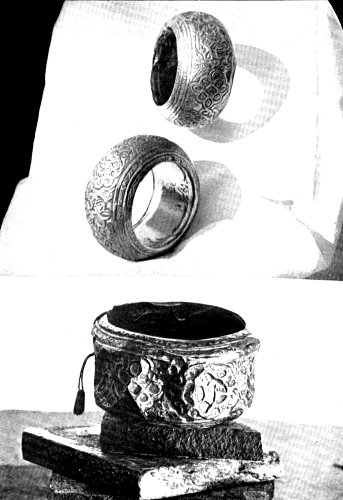
MOORISH BRACELETS
The Moorish women of this country, and in
particular the Granadinas,[41] were passionately fond
of jewellery. Ornaments which once belonged to
them are sometimes brought to light in Andalusia,
Murcia, or Valencia, including pendants,
rings, necklaces, and axorcas or bangles for the
ankle or the wrist, and bracelets for the upper
portion of the arm. The National Museum contains
a small collection of these objects, dating from
the time of the Moriscos, and including a handsome
necklace terminating in a double chain, with ball
and pyramid shaped ornaments about the centre,
a square-headed finger-ring with four green stones
and a garnet, and a hollow bracelet filled with a
substance that appears to be mastic, similar to
those which are reproduced in Plate xiii.
These jewels, I repeat, are of Morisco workmanship,
and therefore date from later than the
independent empire of the Spanish Moors.
Nevertheless, the geometrical or filigree design
was common both to Moorish and Morisco art.
As I observed in my description of the casket-reliquaries,
we note continually the influence of
these motives on the arts of Christian Spain.
The Ordinances relative to the goldsmiths and the
silversmiths of Granada, cried at various times
between 1529 and 1538, whether “in the silversmiths'
street of the Alcaycería, that has its
opening over against the scriveners'”; or in “the
street of the Puente del Carbon, before the goldsmiths'
shops”; or “in the street of the Zacatin,
where dwell the silversmiths,” prove also that for
many years after the Reconquest the character
and nomenclature of this kind of work continued
to be principally and traditionally Moorish.
Firstly, the Ordinances complain that the
goldsmiths of Granada now employ a base
and detrimental standard of the precious metals,
especially in the bracelets or manillas of the
women. The goldsmiths answer in their vindication
that equally as poor a standard is employed at
Seville, Cordova, and Toledo. These city laws
herewith establish twenty carats as a minimum
fineness for the gold employed in making ornaments.
The makers, also, are ordered to impress
their private stamp or seal on every article, or in
default to pay a fine of ten thousand maravedis. A
copy of each stamp or seal to be deposited in the
city chest. The alamín or inspector of this trade
to test and weigh all gold and silver work before
it is exposed for sale.
We learn from the same source that the gold
bracelets were sometimes smooth, and sometimes
“covered over with devices” (cubiertos de estampas
por cima). The technical name of these was
albordados. The silver bracelets were also either
smooth, or stamped, or twisted in a cord (encordados).
Bangles for the ankle, upper arm, and
wrist are mentioned as continuing to be generally
worn, while one of the Ordinances complains that
“Moorish axorcas are often sold that are hollow,
and filled with chalk and mastic, so that before
they can be weighed it is necessary to rid them
of such substances by submitting them to fire,
albeit the fire turns them black.”
The weapons and war-harness of the Spanish
Moors were often exquisitely decorated with the
precious stones or metals. Splendid objects of
this kind have been preserved, and will be noticed
in their proper chapter.
The ruinous and reckless measure known to
Spain's eternal shame as the Expulsion of the
Moriscos, deprived this country of a great—perhaps
the greatest—part of her resources.
Fonseca estimates this loss, solely in the quantity
of coin conveyed away, at two million and eight
hundred thousand escudos, adding that a single
Morisco, Alami Delascar de Aberique, bore off
with him one hundred thousand ducats.[42] To
make this matter worse, the Moriscos, just before
they went on board their ships, fashioned from
scraps of tin, old nails, and other refuse, enormous
stores of counterfeit coin, and slyly sold
this rubbish to the simple Spaniards in return
for lawful money of the land. In the course of
a few days, and in a single quarter of Valencia,
more than three hundred thousand ducats of false
coin were thus passed off upon the Christians.
Besides this exportation of good Spanish money,
the cunning fugitives removed huge quantities
of jewellery and plate. Chains, axorcas, rings,
zarcillos, and gold escudos were taken from the
bodies of many of the Morisco women who were
murdered by the Spanish soldiery; but the greater
part of all this treasure found its way to Africa.
In his work Expulsión justificada de los Moriscos
(1612), Aznar de Cardona says that the Morisco
women carried “divers plates upon the breast,
together with necklaces and collars, earrings and
bracelets.” It is recorded, too, that the Moriscos,
as they struggled in the country regions to avenge
themselves upon their persecutors, did unlimited
damage to the ornaments and fittings of the
churches. “This people,” says Fonseca, “respected
not our temples or the holy images
that in them were; nor yet the chalices and
other objects they encountered in our sacristies.
Upon the contrary, they smashed the crosses,
burned the saints, profaned the sacred vestments,
and committed such acts of sacrilege as
though they had been Algerian Moors, or Turks
of Constantinople.”
Legends of hidden Moorish and Morisco
wealth are still extant in many parts of Spain.
The Abbé Bertaut de Rouen[43] and Swinburne
among foreigners, or Spaniards such as the gossiping
priest Echeverría, who provided Washington
Irving with the pick of his Tales of the Alhambra,
have treated copiously of this fascinating and
mysterious theme. The Siete Suelos Tower at
Granada is particularly favoured with traditions of
this kind. Peasants of the Alpujarras still declare
that piles of Moorish money lie secreted in the
lofty buttresses of Mulhacen and the Veleta, while
yet another summit of this snowy range bears the
suggestive title of the Cerro del Tesoro, where,
almost within the memory of living men, a
numerous party, fitted and commissioned by the
State, explored with feverish though unlucky zeal
the naked cliffs and sterile crannies of the lonely
mountain.[44]
Reducing all these fables to the terms of truth,
Moorish and Morisco jewellery and coin are sometimes
brought to light on Spanish soil. Such
finds occur, less seldom than elsewhere, within
the provinces of Seville, Cordova, Granada, and
Almeria (Plate xiv.), but since they are neither
frequent nor considerable, although the likeliest
ground for them is being disturbed continually,
we may conclude that nearly all the Muslim
wealth accumulated here slipped from the clumsy
if ferocious fingers of the mother-country, and
found its way, concealed upon the bodies of her
persecuted offspring, to the shores of Africa.[45]
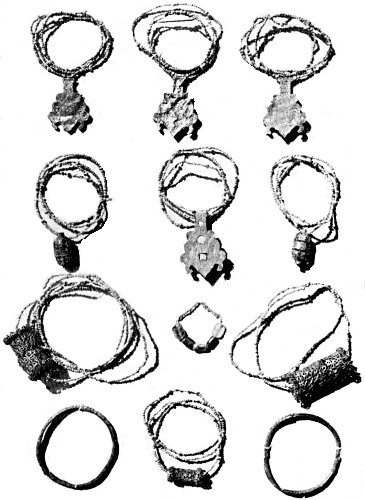
MORISCO JEWELLERY
(Found in the Province of Granada)
Sometimes, too, an early gold or silver object
would be melted down and modernized into
another and a newer piece of plate. This was a
fairly common usage with the silversmiths themselves,
or with an ignorant or stingy brotherhood
or chapter. Thus, the following entry occurs in
the Libro de Visita de Fábrica belonging to the
parish church of Santa Ana, Triana, Seville. In
the year 1599 “the large cross of silver-gilt,
together with its mançana and all the silver attaching
thereto, was taken to the house of Zubieta the
silversmith, and pulled to pieces. It weighed 25
marks and 4 ochavas of silver, besides 5 marks and
2 ounces and 4 ochavas of silver which was the
weight of the three lamps delivered to Zubieta in
the time of Juan de Mirando, aforetime steward
of this church. It is now made into a silver-gilt
cross.”[46]
A similar instance may be quoted from a
document of Cordova, published by Ramírez de
Arellano in his relation of a visit to the monastery
of San Jerónimo de Valparaiso. In the year
1607 Gerónimo de la Cruz, a Cordovese silversmith,
agreed with the prior of this monastery to
make for the community a silver-gilt custodia. For
this purpose he received from the prior, doubtless
a man of parsimonious spirit and a boor in his
appreciativeness of art, eight pairs of vinegar
cruets, four of whose tops were missing; a silver-gilt
chalice and its patine; a viril with two angels
and four pieces on the crown of it; a small
communion cup; some silver candlesticks; four
spoons and a fork, also of silver; and a silver-gilt
salt-cellar. The total value of these objects was 1826
reales; and all of them were tossed, in Ford's indignant
phrase, into the “sacrilegious melting-pot,”
in order to provide material for the new custodia.
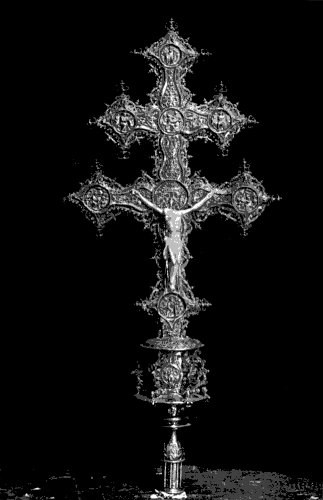
SILVER-GILT PROCESSIONAL CROSS
(Made by Juan de Arfe in 1592. Burgos Cathedral)
The gold and silver work of Christian Spain
attained, throughout the fifteenth and the sixteenth
centuries, a high degree of excellence
(Plates xv., xvi., etc.). The best of it was
made at Seville, Barcelona, Toledo, and Valladolid.
Objects of great artistic worth were also
produced at Burgos, Palencia, León, Cuenca,
Cordova, and Salamanca. I have already mentioned
some of the principal orfebreros of Barcelona.
Juan Ruiz of Cordova, whom Juan de Arfe applauds
as “the first silversmith who taught the way to do
good work in Andalusia,” was also, in this region,
the first to turn the precious metals on the lathe.
A famous silversmith of Seville was Diego de
Vozmediano, whom we find living there in 1525.
Toledo, too, could boast, among an army of distinguished
gold and silver smiths (Riaño gives the
names of no fewer than seventy-seven), Cristóbal
de Ordas, Juan Rodríguez de Babria, and Pedro
Hernandez, plateros, respectively, to Charles the
Fifth, to Philip the Second, and to the queen-dowager
of Portugal; and also the silversmith
and engraver upon metals, Pedro Angel, whose
praise is sung by Lope de Vega in the prologue to
his auto called The Voyage of the Soul:—
“Y es hoy Pedro Angel un divino artífice
con el buril en oro, plata, ó cobre.”
By far the greater part of all Toledo's gold and
silver work was made for service in her mighty
temple. Such were the statue of Saint Helen,
presented by Philip the Second; the crown of
the Virgen del Sagrario, wrought by Hernando de
Carrión and Alejo de Montoya; the bracelets or
ajorcas made for the image of the same Madonna
by Julián Honrado; and the exquisite chests
carved in 1569 and 1598 by Francisco Merino
from designs by the two Vergaras, father and son,
as reliquaries for the bones of San Eugenio and
Santa Leocadia, patrons of this ancient capital.[47]
A magnificent silver lamp was also, in 1565, offered
by the chapter of the cathedral to the church of
Saint Denis in France, in gratitude for the surrender
of the bones of San Eugenio to the city of
his birth. These and other objects of Toledan
gold and silver work are stated to be “worthy of
comparison with the very best of what was then
produced in Germany, Italy, and France.”[48]
Baron Davillier also held a high opinion of the
Spanish orfebreros of this time. After remarking
that the Italian influence was powerful among the
Spaniards in the sixteenth century, and more particularly
for some fifty years at Barcelona, he says:
“A cette époque les plateros espagnols pouvaient
rivaliser sans désavantage avec les Italiens, les
Français, les Flamands, et les Allemands.”
The same authority also says that the Spanish
plateros of this period were skilled enamellers on
gold and silver, and quotes some entries from
French inventories of the time in which we read
of cups, salt-cellars, washing-basins, and other
objects executed or enamelled “à la mode
d'Espagne.”[49]
As we have seen, the exodus of the Moriscos
lost to Spain a great proportion of her total wealth,
although, conjointly with this loss, new wealth
flowed into her in marvellous abundance from the
New World.[50] Thus, the silver-mines of Potosi,
discovered in 1545, sent over to the mother-country,
between that year and 1633, no less than eight
hundred and forty-five millions of pesos. And yet
this mighty influx of new riches cannot be said,
except in the artistic sense, to have enriched the
nation. She had renounced the service of the
most industrious and, in many instances, the most
ingenious of her native craftsmen; while on the
other hand the Christians, with but limited exceptions,
were far too proud and far too indolent to
set their hand to any form of manual exercise;
just as (I much regret to add) a great proportion of
them are this very day. Foreign artificers in consequence
(particularly after the royal pragmatic
of 1623 encouraging their immigration), attracted
by the treasure fleets that anchored in the bay of
Cadiz, came trooping into Spain and filled their
pockets from the national purse, fashioning, in
return for money which they husbanded and sent
abroad, luxurious gold and silver objects that were
merely destined to stagnate within her churches
and cathedrals.
Riaño and Baron de la Vega de Hoz extract
from Cean Bermudez a copious list of silversmiths
who worked in Spain all through the Middle
Ages. This long array of isolated names and
dates is neither interesting nor informative.
Newer and more attractive notices have been
discovered subsequently. Thus, in the National
Library at Madrid, Don Manuel G. Simancas has
disinterred quite recently the copy made by a
Jesuit of a series of thirteenth-century accounts
relating to various craftsmen of the reign of
Sancho the Fourth (“the Brave”). Two of them
are concerning early orfebreros:—
“Juan Yanez. By letters of the king and
queen to Johan Yanez, goldsmith, brother of
Ferran García, scrivener to the king; for three
chalices received from him by the king,
CCCCLXXVIII maravedis.”
The second entry says:—
“Bartolomé Rinalt. And he paid Bartolomé
Rinalt for jewels which the queen bought from
him to present to Doña Marina Suarez, nurse of
the Infante Don Pedro, MCCCL maravedis.”[51]
Among Spain's gold and silver craftsmen of
the fifteenth century we find the names of Juan
de Castelnou, together with his son Jaime, who
worked at Valencia; of Lope Rodríguez de
Villareal, Ruby, and Juan Gonzalez, all three of
whom worked at Toledo; and of Juan de Segovia,
a friar of Guadalupe. Papers concerning Juan
Gonzalez, and dated 1425, 1427, and 1431, are
published among the Documentos Inéditos of
Zarco del Valle. One of Segovia's masterpieces
was a silver salt-cellar in the form of a lion tearing
open a pomegranate—clearly allusive to the conquest
of Granada from the Moors. Upon their
visiting the monastery, Ferdinand and Isabella
saw and, as was natural, conceived a fancy for
this salt-cellar; and so, whether from inclination
or necessity, the brotherhood induced them to
accept it.
Sixteenth-century plateros of renown were Juan
Donante, Mateo and Nicolás (whose surnames
are unknown)—all three of whom worked at
Seville; and Duarte Rodríguez and Fernando
Ballesteros, natives of that city. In or about the
year 1524 were working at Toledo the silversmiths
Pedro Herreros and Hernando de Valles,
together with Diego Vazquez, Andres Ordoñez,
Hernando de Carrión, Diego de Valdivieso, Juan
Domingo de Villanueva, Diego Abedo de Villandrando,
Juan Tello de Morata, Francisco de
Reinalte, Hans Belta, and Francisco Merino.
Several of these men were natives of Toledo.
Among the silversmiths of sixteenth-century
Cordova were Diego de Alfaro and his son Francisco,
Francisco de Baena, Alonso Casas, Alonso del
Castillo, Luis de Cordoba, Sebastián de Cordoba,
Cristóbal de Escalante, Juan Gonzalez, Diego
Fernandez, Diego Hernandez Rubio (son of
Sebastián de Cordoba), Rodrigo de León, Gómez
Luque, Ginés Martinez, Melchor de los Reyes
(silversmith and enameller), Andrés de Roa,
Pedro de Roa, Alonso Sanchez, Jerónimo Sanchez
de la Cruz, Martin Sanchez de la Cruz (Jerónimo's
son), Pedro Sanchez de Luque, Alonso de Sevilla,
Juan Urbano, and Lucas de Valdés.
Not much is told us of the lives and labours of
these artists. The best reputed of them as a
craftsman was Rodrigo de León, who stood next
after Juan Ruiz, el Sandolino. Ramírez de
Arellano, from whom I have collected these data,
publishes a number of León's agreements or
contracts, which from their length and dryness I
do not here repeat. In 1603 we find him official
silversmith to the cathedral, under the title of
“platero de martillo (“silversmith of hammered
work”) de la obra de la catedral desta ciudad.”
Francisco de Alfaro, although a Cordovese by
birth, resided commonly at Seville. In 1578 he
received 446,163 maravedis for making four silver
candlesticks for use in celebrating divine service.
These candlesticks are still in the cathedral.
Sebastián de Cordoba was one of the foremost
artists of his age. He died in 1587, leaving,
together with other children, a son, Diego, who
also won some reputation as a silversmith.
Ramírez de Arellano publishes a full relation
of the property which Sebastián de Cordoba
bequeathed at his decease, as well as of the money
which was owing to him. Among the former, or
the “movable effects,” we read of “Isabel, a
Morisco woman, native of the kingdom of Granada;
her age thirty-four years, a little less or more.”
The same inventory includes a curious and
complete account of all the tools and apparatus in
Sebastián's workshop.
But the quaintest notice of them all, though it
does not apprise us of his merit as a silversmith,
is that concerning Cristóbal de Escalante.
Cristóbal suffered, we are told, from “certain sores
produced by humours in his left leg; wherefore
the said leg undergoes a change and swells.” He
therefore makes a contract with one Juan Jiménez,
“servant in the Royal Stables of His Majesty
the King,” and duly examined as a herbalist
(“licensed,” in the actual phrase, “to remedy this
kind of ailments”), who is to heal his leg “by
means of the divine will of the cure.” As soon as
Cristóbal shall be thoroughly well, “in so much
that his ailing leg shall be the other's equal in the
fatness and the form thereof,” he is to pay Jiménez
five-and-fifty reales, “having already given him ten
reales on account.”
Probably, as Señor Ramírez de Arellano facetiously
supposes, Cristóbal, after such a course of
treatment, would be lame for all his life. At
any rate, he died in 1605, though whether from
the gentle handling of the stableman and herbalist
is not recorded in these entries.
Still keeping to the sixteenth century, in other
parts of Spain we find the silversmiths Baltasar
Alvarez and Juan de Benavente, working at Palencia;
Alonso de Dueñas at Salamanca; and
Juan de Orna at Burgos, about the same time that
the foreigners Jacomi de Trezzo and Leo Leoni
were engaged at the Escorial. Cuenca, too,
boasted three excellent silver-workers in the
family of Becerril, mentioned by Juan de Arfe in
company with other craftsmen of the time of the
Renaissance.[52] Stirling says of Cuenca and the
Becerriles: “They made for the cathedral its
great custodia, which was one of the most costly
and celebrated pieces of church plate in Spain.
They began it in 1528, and, though ready for use
in 1546, it was not finished till 1573. It was a
three-storied edifice, of a florid classical design,
crowned with a dome, and enriched with numberless
groups and statues, and an inner shrine of
jewelled gold; it contained 616 marks of silver,
and cost 17,725½ ducats, a sum which can barely
have paid the ingenious artists for the labour of
forty-five years. In the War of Independence,
this splendid prize fell into the hands of the
French General Caulaincourt, by whom it was
forthwith turned into five-franc pieces, bearing the
image and superscription of Napoleon.”[53]
A more reliable notice says that this custodia
was begun by Alonso Becerril and finished by
his brother Francisco. The third member of
this family of artists, Cristóbal, who flourished
towards the end of the sixteenth century, was
Francisco's son.
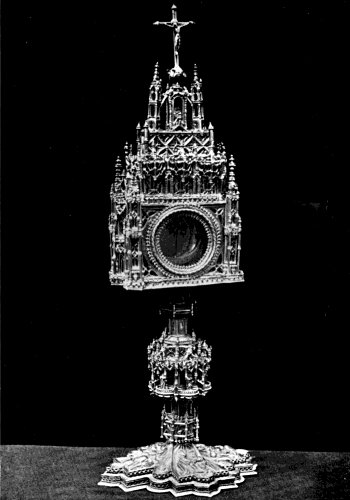
GOTHIC CUSTODIA
(15th Century)
Towards the close of the Gothic and during the
earlier phases of the Renaissance movement in
this country, enormous quantities of gold and
silver began to be employed in making these
custodias or monstrances of her temples; so that
the fifteenth century may well be called, in
Spanish craftsmanship, the “age of the custodia.”
A century ago the reverend Townsend, loyal to
the Low Church prejudices of his day, spoke of
this object with something of a sneer as “the
depository of the Host, or, according to the ideas
of a Catholic, the throne of the Most High, when,
upon solemn festivals, He appears to command
the adoration of mankind.” Riaño's description is
more technical. “The name of custodia,” he says,
“is given in Spain, not only to the monstrance
or ostensoir where the Blessed Sacrament is
exposed, but also to a sort of temple or tabernacle,
of large size, made also of silver, inside which
is placed the monstrance, which is carried in procession
on Corpus Christi day (Plate xvi.). In
order to distinguish these objects one from another,
the name of viril is given to the object which
holds the consecrated Host; it is generally made
of rock crystal, with a gold stem and mount
ornamented with precious stones. The small
tabernacles are generally objects of the greatest
importance, both from their artistic and intrinsic
value.” A third description of the monstrance,
written in quaint and antiquated Spanish verse
by Juan de Arfe, is truthfully if not melodiously
translated into English rhyme by Stirling:—
“Custodia is a temple of rich plate,
Wrought for the glory of our Saviour true,
Where, into wafer transubstantiate,
He shows his Godhead and his Manhood too,
That holiest ark of old to imitate,
Fashioned by Bezaleel, the cunning Jew,
Chosen of God to work His sov'ran will,
And greatly gifted with celestial skill.”[54]
Notwithstanding that the monstrance of Toledo,
surmounted by a cross of solid gold, turns the
scale at ten thousand nine hundred ounces, and
that of Avila at one hundred and forty pounds,
the weight of nearly all of these custodias is far exceeded
by the value of their workmanship. The
style employed in their construction is the Gothic,
the Renaissance, or the two combined. Custodias
of the eastern parts of Spain are more affected
than the others by Italian influence, noticeable
both in decorative motives which recall the
Florentine, and in the use, together with the
silver-work, of painting and enamels. In other
parts of Spain the dominating influence is the
later Gothic. Among the former or Levantine
class of monstrances, the most important are those
of Barcelona, Vich, Gerona, and Palma de Mallorca;
and of the others, those of Cordova, Cadiz,
Sahagún, Zamora, Salamanca, and Toledo—this
last, according to Bertaut de Rouen, “à la
manière d'un clocher percé à jour, d'ouvrage de
filigrane, et plein de figures.” Custodias in the
purest classic or Renaissance style are those of
Seville, Valladolid, Palencia, Avila, Jaen, Madrid,
Segovia, Zaragoza, Santiago, and Orense.
Juan de Arfe y Villafañe, who may be called
the Cellini of Spain's custodia-makers, was born
at León in 1535. He was the son of Antonio de
Arfe, and grandson of Enrique de Arfe, a German
who had married a Spanish wife and made his
home in Spain. The family of Juan, including
his brother Antonio, were all distinguished craftsmen,
and he himself informs us that his grandfather
excelled in Gothic platería, as may be
judged from the custodias, by Enrique's hand, of
Cordova, León, Toledo, and Sahagún, and many
smaller objects, such as incensories, crosiers, and
paxes.
The father of Juan, Antonio de Arfe, worked
in silver in the Renaissance or Plateresque styles,
and executed in the florid manner the custodias of
Santiago de Galicia and Medina de Rioseco; but
the training and tastes of Juan himself were sternly
classical. His work in consequence has a certain
coldness, largely atoned for by its exquisite correctness
of design and unimpeachable proportions.
Arfe's ideal in these matters may readily be judged
of from his written verdict on the Greco-Roman
architecture. “The Escorial,” he says, in the
preface to his description of the custodia of Seville
cathedral, “because it follows the rules of ancient
art, competes in general perfection, size, or splendour
with the most distinguished buildings of
the Asiatics, Greeks, and Romans, and displays
magnificence and truth in all its detail.”
In point of versatility Juan de Arfe was a kind
of Spanish Leonardo. His book, De Varia Conmensuración,
etc., published in 1585, is divided
into four parts, and deals, the first part with the
practice of geometry, the second with human
anatomy, the third with animals, and the fourth
with architecture and silver-work for use in
churches.
This book is prefaced by the portrait of the
author, given above. It shows us—what he
really was—a quiet, cultured, gentle-hearted
man. Indeed, while Arfe was studying anatomy
at Salamanca, it gave him pain to lacerate the
bodies even of the dead. “I was witness,” he
records, “to the flaying of several pauper men
and women whom the law had executed; but
these experiments, besides being horrible and
cruel, I saw to be of little service to my studies
in anatomy.”
Arfe's workmanship of the custodia of Avila
cathedral, which he began in 1564 and terminated
in 1571, won for him an early and extended fame.
He also made the custodia of Burgos (brutally
melted during the Spanish War of Independence),
and those of Valladolid (finished in 1590), Lugo,
Osma, and the Hermandad del Santísimo at
Madrid. The custodia of Palencia is also thought
by some to be his handiwork.
But Arfe's crowning labour was the Greco-Roman
custodia of Seville cathedral (Plate xvii.).
The chapter of this temple selected his design in
1580, and nominated the licentiate Pacheco to assist
him with the statuettes. Pacheco also carried out
his portion of the task with skill and judgment. A
rare pamphlet, written by Arfe and published at
Seville in 1587, gives a minute description of the
whole custodia. In Appendix C, I render this
description into English, together with a similarly
detailed notice of the custodia (1513 A.D.) of
Cordova. This last, which we have seen to be
the work of Juan de Arfe's grandfather, Enrique,
is not to be surpassed for fairy grace and lightness,
seeming, in the eloquent metaphor of a modern
writer, “to have been conceived in a dream, and
executed with the breath.”
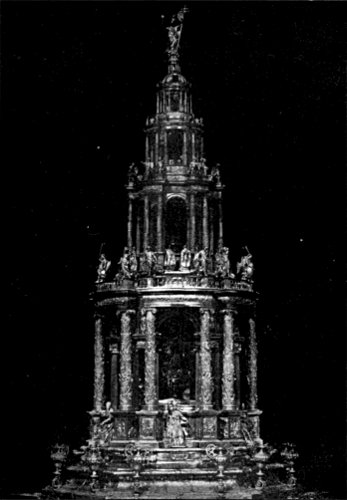
CUSTODIA OF SEVILLE CATHEDRAL
(By Juan de Arfe. Late 16th Century)
Spain in the seventeenth century had reached
the lowest depth of her decadence and impoverishment;
and yet we find that century an age—to
quote a Spanish term—of “gallantries and pearls,”
in which a craze for reckless luxury continued to
prevail in every quarter. Narratives innumerable
inform us of the life and doings of that prodigal
court and prodigal aristocracy; their ruinous and
incessant festivals; the fortunes that were thrown
away on furniture, and jewels, and costume. True,
we are told by Bertaut de Rouen that, except
upon their numerous holidays, the costume of the
Spanish men was plain enough. This author, who
calls them otherwise “debauched and ignorant,”
says that their clothes were all of “méchante frise,”
and adds that they continually took snuff, “dont
ils ont toujours les narines pleines, ce qui fait qu'ils
n'ont que des mouchoirs de laine, de toile grise, et
peinte comme de la toile de la Chine.” The same
traveller, attending an ordinary reception in the
royal palace at Madrid, was unable to distinguish
the nobles from the lower orders, except that, by
the privilege peculiar to this country, the former
kept their hats on in the presence of the sovereign.
Even of Philip himself he says: “Le Roy d'Espagne
estoit debout avec un habit fort simple et fort
ressemblant à tous ses portraits”; alluding, probably,
to those of Philip the Fourth by Velazquez,
in which the monarch wears a plain cloth
doublet.
But when the Spaniard dressed himself for any
scene of gala show, his spendthrift inclinations
swelled into a positive disease. The women, too,
squandered enormous sums on finery. The
Marchioness of Liche, said to have been the
loveliest Española of that day, is spoken of by
Bertaut as wearing “un corps de brocard d'argent
avec de grandes basques à leur mode, la jupe
d'une autre étoffe avec grand nombre de pierreries,
et cela luy fetoit fort bien.” An anonymous
manuscript of the period, published by Gayangos
in the Revista de España for 1884, describes the
fiestas celebrated at Valladolid in 1605, in honour
of the English ambassador and his retinue. In
this relation the Duke of Lerma is quoted as
possessing a yearly income of three hundred
thousand cruzados, besides “as much again in
jewellery and furniture, and gold and silver services.”
At the state banquets which were given
at that wasteful court, even the pies and tarts
were washed with gold or silver; and at a single
feast the dishes of various kinds of fare amounted
to two thousand and two hundred. At the banquet
given by the Duke of Lerma, three special
sideboards were constructed to sustain the weight
of four hundred pieces of silver, “all of them of
delicate design and exquisitely wrought of silver,
gold, and enamel, together with innumerable objects
of glass and crystal of capricious form, with
handles, lids, and feet of finest gold.”
The whole of Spain's nobility was congregated
at these festivals, “richly attired with quantities
of pearls and oriental gems,” while everybody,
young and old alike, wore “diamond buttons and
brooches on cloaks and doublets,” feather plumes
with costly medals, gold chains with emeralds,
and other ornaments. The ladies of the aristocracy
were also “clothed in costliest style, as
well as loaded with diamonds and pearls and
hair-ornaments of pearls and gold, such as the
women of Castile lay by for these solemnities.”
The Spanish churches, too, continued to be
veritable storehouses of treasure. The manuscript
published by Gayangos says that in 1605 the
church of La Merced at Valladolid had its altars
“covered with beautiful gold and silver vessels,
of which there are a great many in the whole of
Castilla la Vieja, and particularly here at Valladolid.”
Bertaut de Rouen's notice of the shrine
of Montserrat in Cataluña has been inserted
previously. In 1775 Swinburne wrote of the
same temple:—“In the sacristy and passages
leading to it are presses and cupboards full of
relics and ornaments of gold, silver, and precious
stones; they pointed out to us, as the most remarkable,
two crowns for the Virgin and her Son,
of inestimable value, some large diamond rings,
an excellent cameo of Medusa's head, the Roman
emperors in alabaster, the sword of Saint Ignatius,
and the chest that contains the ashes of a famous
brother, John Guarin, of whom they relate the
same story as that given in the Spectator of a
Turkish santon and the Sultan's daughter….
Immense is the quantity of votive offerings to this
miraculous statue; and as nothing can be rejected
or otherwise disposed of, the shelves are crowded
with the most whimsical ex votos, viz., silver legs,
fingers, breasts, earrings, watches, two-wheeled
chaises, boats, carts, and such-like trumpery.”
Many pragmatics from the Crown vainly
endeavoured to suppress or mitigate the popular
extravagance. Such was the royal letter of 1611,
which forbade, among the laity, the wearing of
“gold jewels with decoration or enamel in relief,
or points with pearls or other stones.” Smaller
jewels, of the kind known as joyeles and brincos,[55]
were limited to a single stone, together with its
pearl pendant. The jewellery of the women was
exempted from these laws, though even here were
certain limitations. Rings for the finger might,
however, bear enamel-work, or any kind of stone.
Enamel was also allowed in gold buttons and
chains for the men's caps, as well as in the badges
worn by the knights of the military orders.
“It is forbidden,” continues this pragmatic, “to
make any object of gold, silver, or other metal
with work in relief, or the likeness of a person;
nor shall any object be gilt, excepting drinking
vessels, and the weight of these shall not exceed
three marks. All other silver shall be flat and
plain, without gilding; but this does not apply to
objects intended for religious worship.”
“All niello-work is prohibited, as are silver
brasiers and buffets.”[56]
What I may call the private jewel-work of
Spain, largely retains throughout its history the
characteristic lack of finish of all the Visigothic
treasure found at Guarrazar. From first to last,
until extinguished or absorbed by foreign influences
two centuries ago, it strives to compensate in
ponderous and bulky splendour for what it lacks
in delicacy, elegance, and taste. It is just the
jewellery we should expect to find among a military
people who once upon a time possessed great
riches simultaneously with little education, and
who, from this and other causes, such as the
strenuous opposition of the national church to
pagan sentiments expressed in fleshly form, were
never genuinely or profoundly art-loving. Long
residence and observation in their midst induce
me to affirm that as a race the Spaniards are and
always have been hostile, or at least indifferent, to
the arts; and that their most illustrious artists
have made their power manifest and raised themselves
to eminence despite the people—not, as in
Italy, on the supporting shoulders of the people.
Dazzle and show monopolized, and to a great
extent monopolize still, the preference of this
race. The Spanish breast-ornaments of the
seventeenth century, preserved at South Kensington
and reproduced by Riaño on pages 37 and 39
of his handbook, are strongly reminiscent of the
Visigothic ornaments. Who would imagine that
a thousand years had come and gone between the
execution of the new and of the old? As late as
the reign of Charles the Second the culture of a
Spanish lady of high birth was little, if at all,
superior to a savage's. “False stones enchant
them,” wrote Countess d'Aulnoy. “Although
they possess many jewels of considerable value
and the finest quality, it is their whim to carry on
their person wretched bits of glass cut in the
coarsest fashion, just like those which pedlars in
my country sell to country girls who have seen
nobody but the village curate, and nothing but
their flocks of sheep. Dames of the aristocracy
adorn themselves with these pieces of glass, that
are worth nothing at all; yet they purchase them
at high prices. When I asked them why they
like false diamonds, they told me they prefer them
to the genuine as being larger. Indeed, they
sometimes wear them of the bigness of an egg.”
Even where the stones were real, the Spanish
taste in setting and in wearing them was no less
execrable. The Countess says: “the ladies here
possess great stores of beautiful precious stones,
and do not wear, like Frenchwomen, a single
article of jewellery, but nine or ten together, some
of diamonds, others of rubies, pearls, emeralds,
and turquoises, wretchedly mounted, since they are
almost wholly covered with the gold. When I
inquired the cause of this, they told me the jewels
were so made because the gold was as beautiful
as the gems. I suppose, however, the real reason
is the backwardness of the craftsmen, who can do
no better work than this, excepting Verbec, who
has no lack of skill, and would turn out excellent
jewels if he took the trouble to finish them.”
“In the neck of their bodices the ladies fasten
pins profusely set with precious stones. Hanging
from the pin, and fastened at the lower end to
the side of their dress, is a string of pearls or
diamonds. They wear no necklace, but bracelets
on their wrists and rings on their fingers, as well
as long earrings of so great a weight that I know
not how they can support them. Hanging from
these earrings they display whatever finery they
may fancy. I have seen some ladies who wore
good-sized watches hanging from their ears, strings
of precious stones, English keys of dainty make,
and little bells. They also wear the agnus, together
with little images about their neck and
arms, or in their hair. They dress their hair in
various ways, and always go with it uncovered,
using many hairpins in the form of coloured
flies or butterflies of diamonds, emeralds, and
rubies.”
Book-worm authorities, addicted to “dry bones”
of letters, are prone just now to doubt this visit of
Countess d'Aulnoy to the capital of Spain. But
if such patient doubters will compare her narrative
with those of other foreigners, e.g. Bertaut de
Rouen, or the manuscript description of Valladolid,
written by a Portuguese, and now in the British
Museum library, their scepticism will—or should—be
done away with on the moment. The letters
of the countess make it plain by copious inner
testimony that she actually performed her Spanish
visit; and though from time to time she over-colours
or misreads the truth, it was the very
usages of Spain that were absurd and out of
joint, and not, except in isolated instances, the
sprightly and observant Frenchwoman's account
of them.[57]
Elsewhere the Countess says: “Utensils of
common metal are not employed here, but only
those of silver or of ware. I hear that a little
while ago, upon the death of the Duke of Alburquerque,
six weeks were needed to make out an
inventory of his gold and silver services. His
house contained fourteen hundred dozen plates,
five hundred large dishes, and seven hundred of a
smaller size, with all the other pieces in proportion,
and forty silver ladders for climbing his sideboard,
made in grades like an altar in a spacious hall.”
These statements have been proved in later
years. Dating from 1560, an inventory of the
ducal house of Alburquerque was found not many
years ago. In it we find the detailed list of gold
and silver; cups and dishes, bowls and basins,
plates and salt-cellars, trenchers, wine and water
flagons, sauce-spoons, salad-spoons, conserve-spoons,
and innumerable other articles. Here,
too, we find, upon the mighty sideboard mounted
by its forty silver stairs, such objects as the
following:—
“A gold cup with festoon-work above and
beneath, wrought with leaves in relief. At
the top of the foot there issue some leaves
that fall down over a small gold staple, and
below this, about the narrowest part of the foot,
are leaves in relief and several dolphins. The
broad part of the foot is decorated with festoons.
The lid of this cup is wrought with leaves
in relief, and on the crest thereof is a lion,
crowned. The cup weighs three hundred and
fifty-one castellanos and a half.”
“A Castilian jar from which my lord the duke
was wont to drink, weighing two marks and five
ounces.”[58]
“A cup with a high foot, gilt all over, with the
figure of a woman in its midst, and decorated in
four places in the Roman manner.”
“A flagon of white silver, flat beneath the stem,
with a screw-top surmounted by a small lion; for
cooling water.”
“A small silver dish, of the kind they call meat-warmers.”
“A large silver seal for sealing provisions, with
the arms of my lord the duke, Don Francisco.”
“A large silver vessel, embossed, with a savage
on top.”
“A gold horse, enamelled in white upon a gold
plate enamelled in green and open at the top;
also a wolf, upon another gold plate enamelled in
green, with lettering round about it; also a green
enamelled lizard upon blue enamel; and a gold
toothpick with four pieces enamelled in green,
white, and rose; also a small gold column enamelled
in black and rose.”
“A silver lemon-squeezer, gilt and chiselled,
with white scroll-work about the mesh thereof,
through which the lemon-juice is strained.”
“A large round silver salt-cellar, in two halves,
gilt all over, with scales about the body, and two
thick twisted threads about the flat part. One
side of it is perforated.”
Among the property of the duchess, Doña
Mencía Enriquez, we find “a small gold padlock,
which opens and closes by means of letters”; two
gold bangles; a gold necklace consisting of forty-two
pieces “enamelled with some B's”;[59] a gold
signet ring with the duchess's arms; and “a gold
and niello box with relics, for wearing round the
neck.” Also, resting on a table covered with silver
plates, “a box of combs; the said box wrought in
gold upon blue leather, containing five combs, a
looking-glass, a little brush, and other fittings;
girt with a cord in gold and blue silk.”
The seventeenth century and a race of native
Spanish kings declined and passed away together.
A dynasty of France succeeded to the throne
of Spain, and with the foreigner came a fresh
reactionary movement towards the neo-classic art,
coupled with the canons of French taste. Henceforth
a century of slow political reform goes
hand in hand with slow suppression of the salient
parts of Spanish character. Madrid transforms or
travesties herself into a miniature Versailles, and
national arts and crafts belong henceforward to a
Frenchified society which found its painter in
Goya, just as the preceding and eminently Spanish
society had found its painter in Velazquez.
Another of the causes of the falling-off in
Spanish orfebrería at this time, is stated to have
been the craftsmen's overwhelming tendency to
substitute the slighter though venerable and
beautiful gold or silver filigree (Plate xviii.), for
more artistic and ambitious, if less showy work
in massive metal. Thus, in 1699, a supplementary
chapter of the Ordinances of Seville
complained in bitter phrases of this tendency,
denouncing it as “a source of fraud and
detriment to the republic,” and deploring that
“of the last few years we have forsaken our
goodly usages of older times, in the matter of the
drawings entrusted to the candidates who come
before us for examination.”
In the same year the goldsmiths' and the
silversmiths' guild of Seville enacted that none
of its members were to work in filigree, unless
they were qualified to execute the other work as
well. Such efforts to suppress this evil were not
new. More than a century before, on April 15th,
1567, the inspectors of the guild had entered the
shop of Luis de Alvarado, silversmith, and seized
some filigree earrings “of the work that is forbidden,”
breaking these objects on the spot, and
imposing a fine of half-a-dozen ducats on the
peccant of obvious Alvarado.[60]
The modern gold and silver work of Spain is
thus exempted from a lengthy notice, seeing that
its typical and national characteristics have succumbed,
or very nearly so. I may, however,
mention the giant silver candelabra in the
cathedral of Palma de Mallorca, which were made
at Barcelona, between 1704 and 1718, by Juan
Matons and three of his assistants. They measure
eight feet high by four feet and a quarter across,
weigh more than eight thousand ounces, and cost
21,942 pounds, 15 sueldos, and 11 dineros of
Majorcan money. The State seized them during
the Napoleonic wars, in order to melt them down
for money; but the chapter of the cathedral bought
them back for eleven thousand dollars.
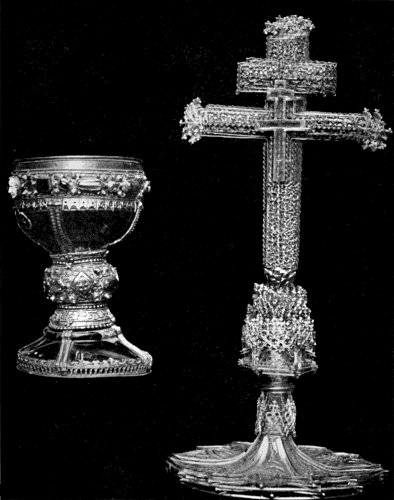
EARLY CHALICE AND CROSS IN FILIGREE GOLD-WORK
(Church of Saint Isidore, León)
During this century Riaño mentions several
factories of silver articles established at Madrid,
including that of Isaac and Michael Naudin (1772)
and the Escuela de Platería (1778), protected by
Charles the Third; but since the work of these was
purely in the French or English manner, they call
for no particular notice. The principal objects they
produced were “inkstands, dishes, dinner-services,
chocolate-stands, cruets, knives and forks, together
with buckles, needle-cases, brooches, snuff-boxes,
frames for miniatures, and similar trinkets.”
Early in the nineteenth century Laborde wrote
that “the fabrication of articles of gold and silver
might become an important object in a country
where these metals abound; but it is neglected,
and the demand is almost entirely supplied from
foreign markets. What little they do in this branch
at home is usually very ill executed, and exorbitantly
dear. Madrid, however, begins to possess
some good workmen; encouragement would
increase their number and facilitate the means
of improvement; but manual labour is there
excessively dear. Hence the Spaniards prefer
foreign articles of this kind, which, notwithstanding
the expense of carriage, the enormous duties that
they pay, and the profits of the merchants, are
still cheaper than those made at home.”
Several of the inherent characteristics of the
national orfebrería may yet be noticed somewhat
faintly in the ornaments and jewels of the
Spanish peasants, though even these are being
discarded. A century ago Laborde described the
dress of the Mauregata women, near Astorga,
in the kingdom of León. “They wear large
earrings, a kind of white turban, flat and widened
like a hat, and their hair parted on the forehead.
They have a chemise closed over the chest, and
a brown corset buttoned, with large sleeves opening
behind. Their petticoats and veils are also
brown. Over all they wear immense coral necklaces,
which descend from the neck to the knee;
they twist them several times round the neck,
pass them over the shoulders, where a row is
fastened, forming a kind of bandage over the
bosom. Then another row lower than this; in
short, a third and fourth row at some distance
from each other. The last falls over the knee,
with a large cross on the right side. These
necklaces or chaplets are ornamented with a great
many silver medals, stamped with the figure of
saints. They only wear these decorations when
not working, or on festivals.”
I have a manuscript account in French of
Spanish regional costumes at the same period.
The dress of the peasant women of Valencia is
thus described: “Elle se coiffe toujours en
cheveux, de la manière appelée castaña, et elle y
passe une aiguille en argent que l'on nomme
rascamoño; quelque fois elle se pare d'un grand
peigne (peineta) en argent doré. Son cou este
orné d'une chaine d'or ou d'argent (cadena del
cuello) à laquelle est suspendue une croix ou un
reliquaire.” This was the Valencian peasant's
dress for every day. On festivals the same
woman would adorn her ears with “pendants
(arracadas) de pierres fausses; mais lorsque la
jardinière est riche, elles sont fines. Une relique
(relicario) dans un petit médaillon en argent,
est suspendue à son cou; ainsi qu'un chapelet
très mince (rosario) en argent doré.”
The peasant women of Iviza, in the Balearics,
are described in the same manuscript as wearing
“un collier en verre, quelque fois en argent, et
rarement en or”; while Laborde wrote of Minorca,
another of these islands, that “the ladies are
always elegantly adorned; their ornaments consist
of necklaces, earrings, bracelets, rings, and chaplets.
The peasants wear these also.” Of the women of
Barcelona he said: “Silk stockings are very
common in every class; and their shoes are
embroidered with silk, gold, silver, pearls, and
spangles.”
But Spain, like Italy or Switzerland, or many
another country, is throwing off her regional
costumes, of which these various jewels form a
prominent and even an essential feature. More
rarely now we come across the gold and seed-pearl
necklaces of Salamanca, the Moorish filigree
silver-work of Cordova, the silver-gilt necklaces
of Santiago, and the heavy arracadas, hung with
emeralds and sapphires, of Cataluña. Murcia,
nevertheless, retains her Platería, a street of
venerable aspect and associations, where to this
hour the oriental-looking silver pendants of the
neighbourhood are made and trafficked in.
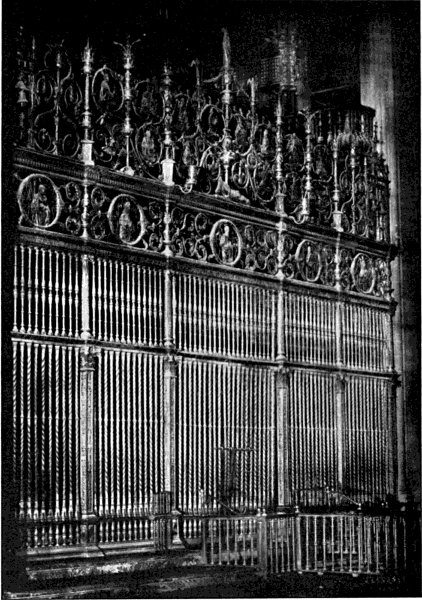
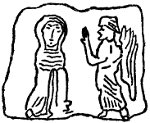

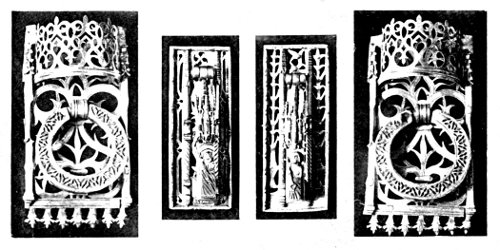
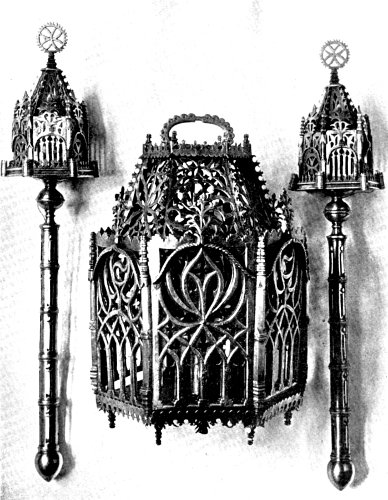
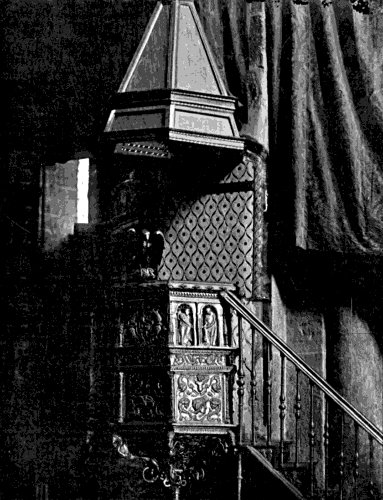
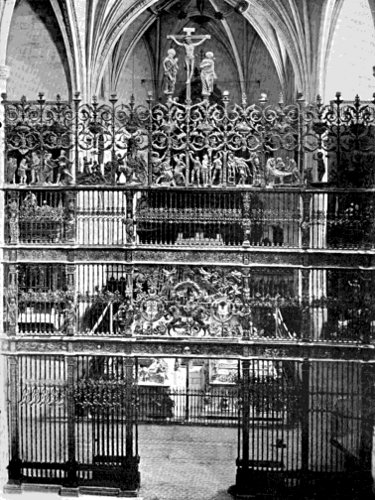
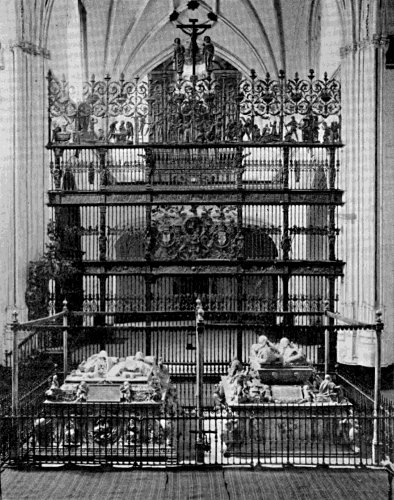
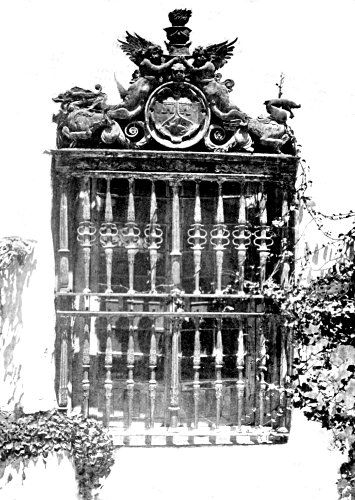
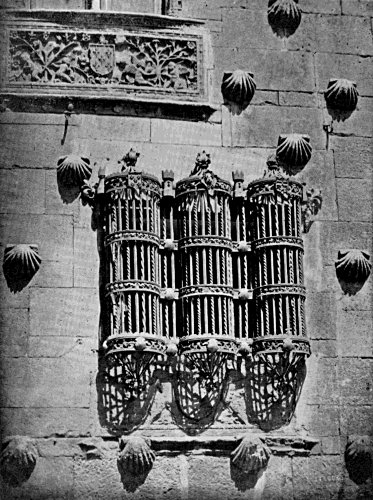
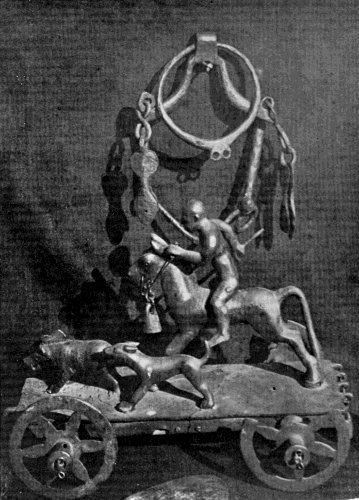
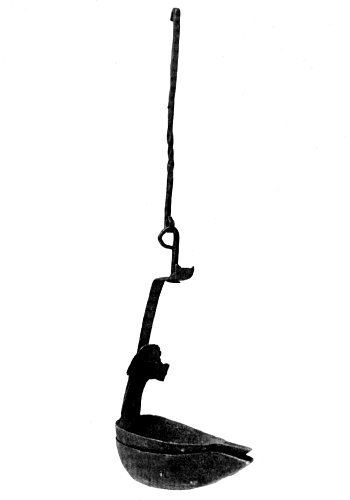
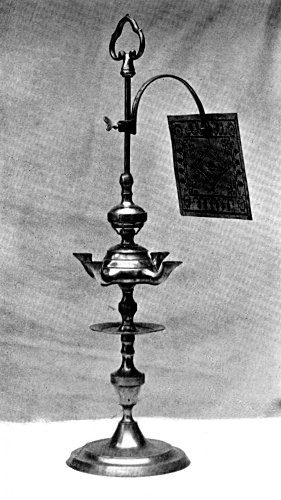
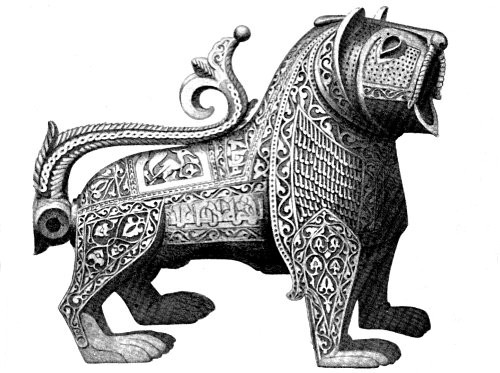
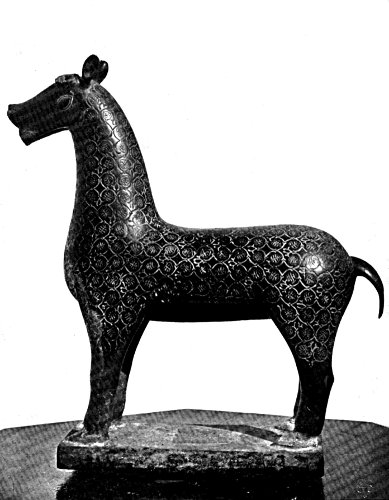
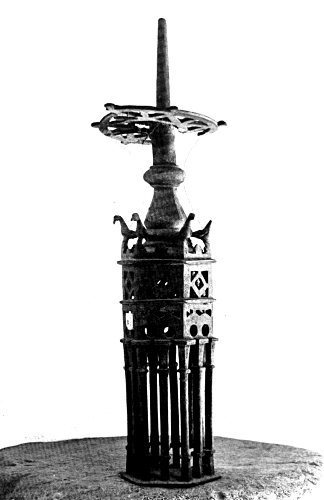
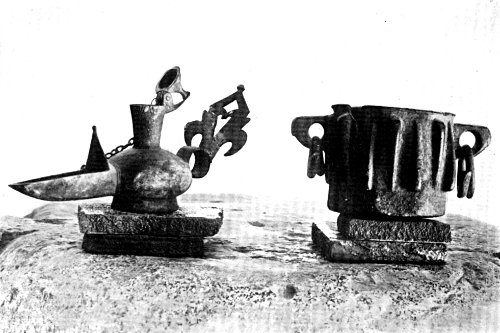
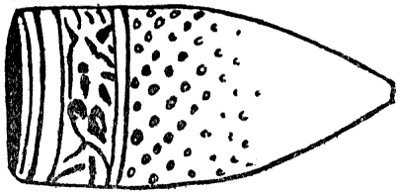
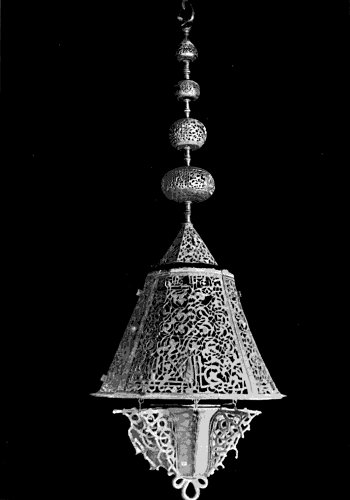
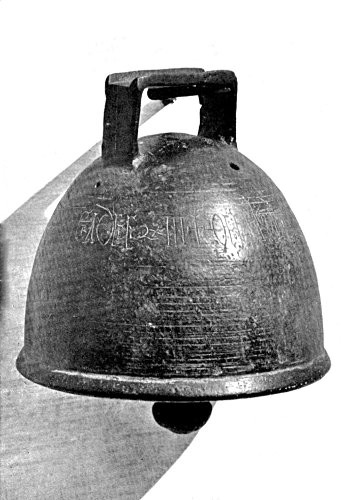
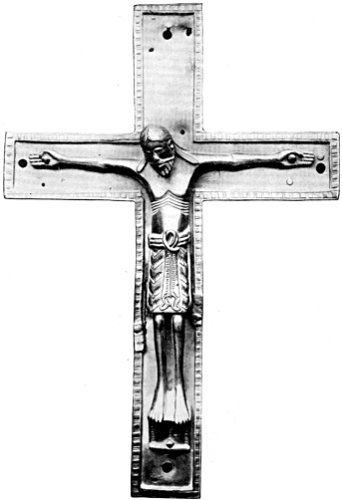
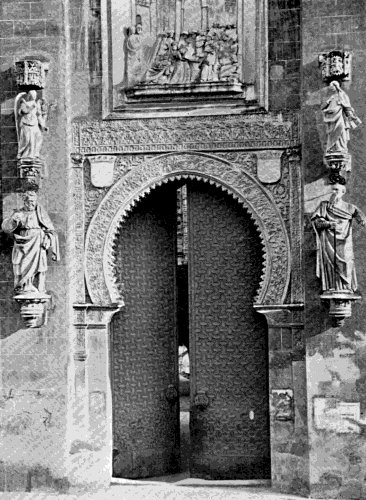
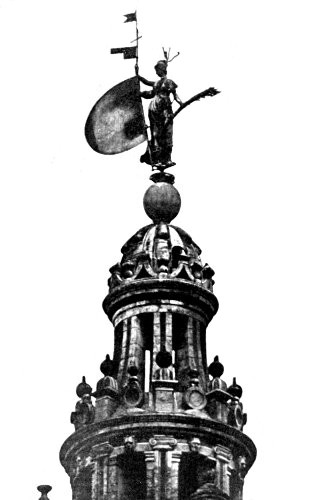
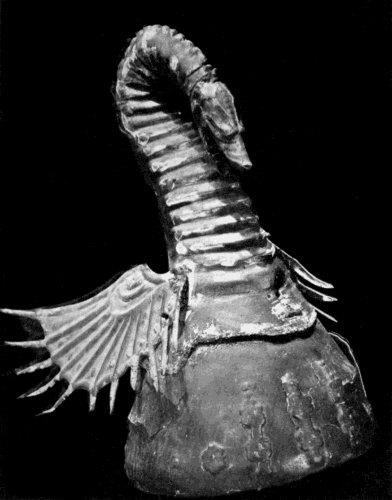
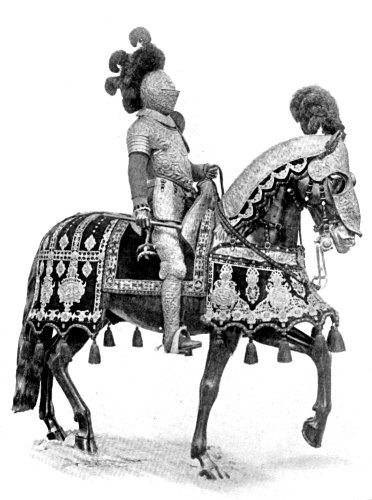
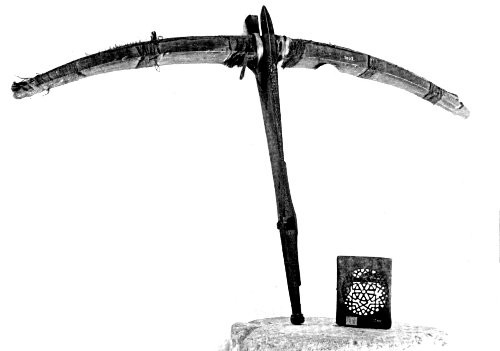
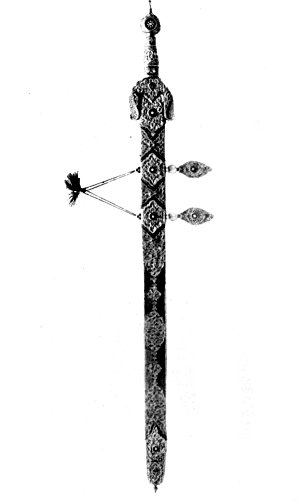
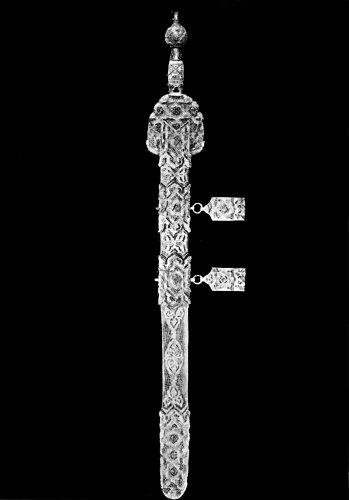
 ·,
for Juan de la Fuente, the name of a celebrated
maker of these parts of a crossbow. The shaft
(tablero), ornamented in bone and iron, is from
the hand of another master, Juan Hernandez,
whose signature is
·,
for Juan de la Fuente, the name of a celebrated
maker of these parts of a crossbow. The shaft
(tablero), ornamented in bone and iron, is from
the hand of another master, Juan Hernandez,
whose signature is