Figures in the round are the earliest mode of modelling,
and remain the most important, as they are
less conditioned than reliefs, and give full scope to
ability and knowledge. The earliest human figures
are found in the second stage of the prehistoric age,
immediately after the white-lined pottery. They
are of ivory, limestone, slate, pottery, or of stick and
paste. Such figures did not continue to be made
after the middle of the prehistoric civilisation. The
ivory figures usually end in a mere peg below, with
wide hips and shoulders, but no arms. The eyes
are marked, though often the mouth and nose are
omitted (fig. 15). The limestone or cement figures
have the division of the legs lined out; some are
standing, as fig. 16, with tatu marks painted on
the stone; others are of the armless form, seated,
and clearly of the steatopygous Bushman type. The
slate figures are always of men, with pointed beards,
and white beads inserted for eyes. The pottery
figures are roughly modelled, but with the legs separated.
The stick and paste figures are made by
modelling a vegetable paste over a stick; the legs
are marked, sometimes arms are added, or else there
are merely shoulder stumps. In one case the head
is modelled bald, painted red, and has a black wig
modelled over it, showing that separate wigs are
as old as the prehistoric time. Some ivory tusks
are carved with a much more advanced style of
heads (fig. 17), which give the best idea that we
have of the type of the people. The animal figures
are rudely cut, but have a certain ferocious air
(fig. 18).
Some much more advanced figures in ivory have
the legs and arms separate, and a passable amount
of modelling in the head and body. Though quite
of prehistoric style, they are probably influenced by
the school of highly developed ivory-work of the
Ist dynasty, and may shortly precede that time.
PREHISTORIC
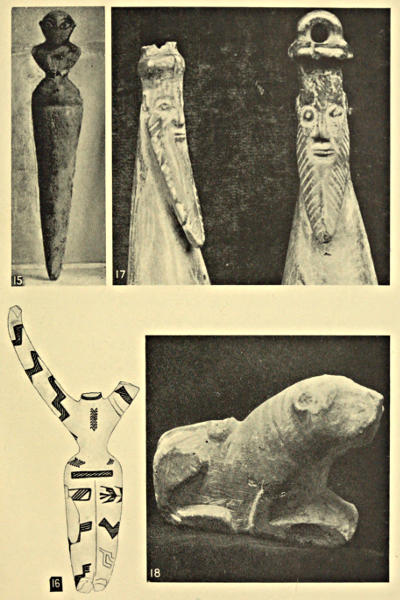
15, 16, 17, 18. Prehistoric figures in the round
The early dynastic age brought in entirely new
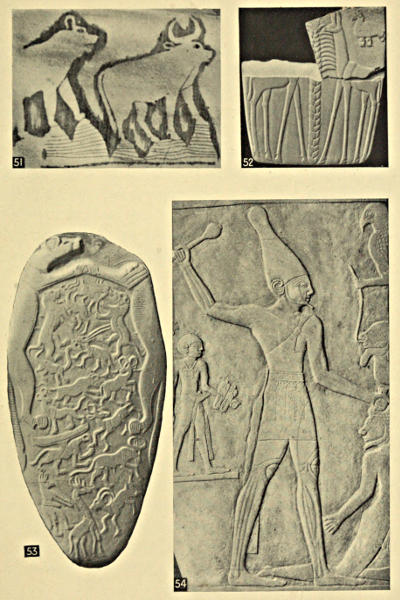
ideals. The oldest figures of this time are the colossal
statues of the god Min from Koptos. These
are of much the same work as the prehistoric human
figures, but have spirited drawings of animals incised
on them (see fig. 51). Just before the Ist
dynasty there came a finely developed style of ivory-carving,
which is known to us by the many figures
of men and women found at Hierakonpolis. The
finest stone-work of that age is a study in limestone
of a king’s head (figs. 19, 20), which is so closely
like Narmer (fig. 54) that it must be just at the
beginning of the Ist dynasty. It is a sculptor’s
study of a king preparatory to making his statue,
and, as Professor A. Michaelis says, “it renders the
race-type with astounding keenness, and shows an
excellent power of observation in the exact representation
of the eyes.” The delicacy of the facial
curves should be noticed, and the entire absence
of any conventions in the modelling of the mouth
as well as the eyes. The widely prominent ears are
a characteristic of the earliest historic figures; such
a feature belongs to a hunting race who need to
catch sounds, and suggests that they always slept
on their backs. This is unlike the prehistoric folk,
who were always buried contracted and lying on
the side, as being their natural attitude; but it agrees
with the modern Egyptian, who sleeps in the mummy
posture, lying on the back.
A large number of ivory figures were found at
Abydos, fully developed in style, beyond those
of Hierakonpolis. They comprise figures of girls,
boys, dogs, apes, a bear, and many lions. They are
admirably easy in their pose, and perfectly natural
in form with a simplicity and truthfulness better
than any later work. The figure of an old king (fig.
21) was with these; notice the subtle expression
of the face, the droop of the head forward, and
the natural air. This is probably early in the Ist
dynasty.
Rather later is the hard limestone head of King
Kha-sekhem, of the IInd dynasty (fig. 22). Fine
as the modelling is about the mouth, yet convention
has already crept in; the edges of the lips are sharpened,
and the extended line at the outer corner
of the eye has been introduced. We see then under
the earliest dynasties the observation of Nature free
from any artificial trammels, unconscious, simple and
dignified, on a higher plane of truthfulness and precision
than is found in later art.
EARLIEST DYNASTIES
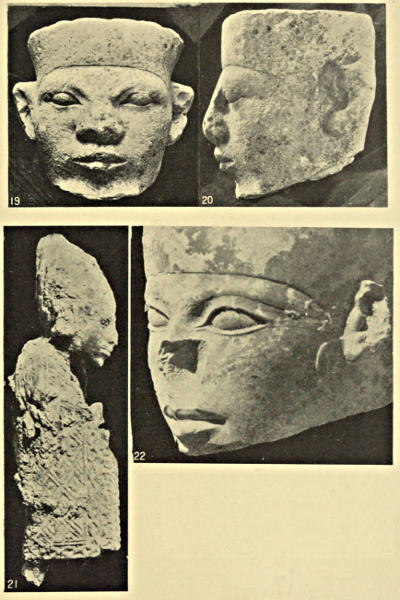
19, 20. Ist dynasty king, limestone
21. Ist dynasty king, ivory
22. Kha-sekhem (IInd dynasty)
In the pyramid age we will first observe the
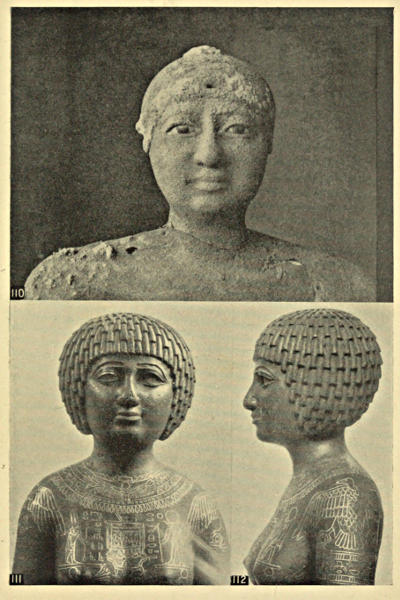
earlier private figures (23 to 26). Queen Mertitefs
(fig. 23) was the wife of Seneferu, at the close of
the IIIrd dynasty. In her type of face, and the
treatment of it, we see an earlier race and earlier
work than that of the pyramid times. The large,
staring eyes, the mouth turning down, the natural
hair cut short and brushed straight down over the
forehead beneath the wig,—all these details disappear
after this. When we compare this with the
head of Nofert (fig. 24), who was of the next generation,
the change of type and work is at once seen.
In Nofert the eyes are admirably placed, the brow is
perfectly natural, and the modelling of the features
is irreproachable. Yet there is less absolute naturalism
than in the older work of the Ist dynasty.
The hair is evidently kept complete beneath the
wig, and is laid out smoothly over the forehead.
OLD KINGDOM SCULPTURE
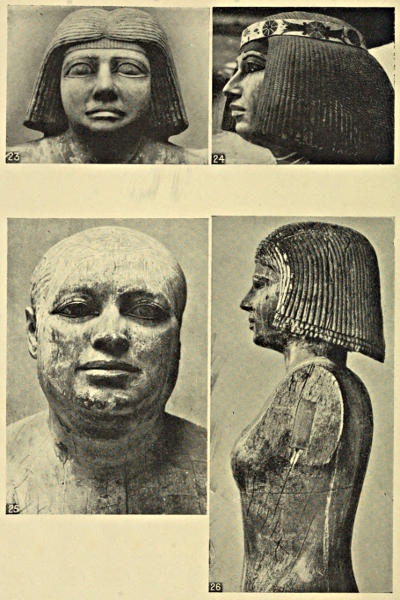
23. Mertitefs
24. Nofert
25. Ka-aper
26. Unknown
The celebrated figure of Ka-aper, or the “Sheykh
el Beled,” belongs to the same period. The figure
is so well known that it need not appear here, but
the full face is less familiar (fig. 25). The mouth
and chin are perhaps the most truthful part, and
seem entirely free from convention. The eyes are
excellent in form, but affected by the technical detail
of inserting the eyeball of stone and crystal in
a copper frame. The similar eyes in the head of
Nofert are more carefully inserted, so that the frame
is not obvious. The hair is represented as closely
cut, so as to allow the wig to be put over it. We
can, however, hardly judge of this figure as it is,
stripped of the coat of coloured stucco which covered
such work. The portions of similar wooden
figures in the temple of Abydos had all been thus
painted. Such a coat would modify the eye setting,
and leave only the dark line visible which imitated
the kohl on the eyelids.
Another work of the same age is the best for the
pose of the figure (fig. 26). The vigorous, independent,
frank attitude is perhaps the finest in any portrait,
ancient or modern. The profile is of the same
type as that of Nofert, alike in the strong brow and
the form of the nose and chin; the eye is more
prominent, and the mouth less luxurious, while the
under-chin is firmer. Such differences are all in
keeping with the character, that of an active mistress
of an estate rather than an easy-going noble.
We shall not find in any of the subsequent work
of the pyramid age—still less in the later ages—such
vitality and strength of individual character as
we have seen in these early portraits. With these
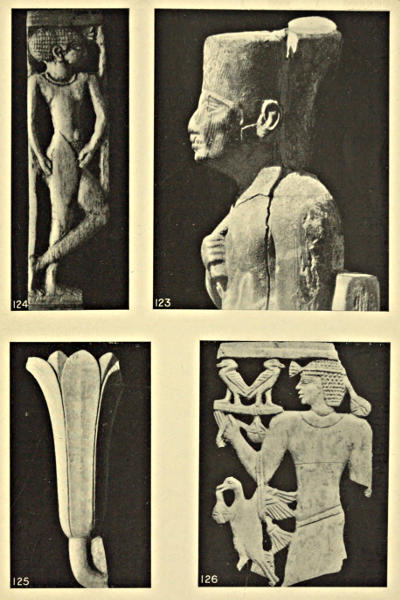
stands also the minute head of Khufu (fig. 123),
which we shall notice with the ivory-work.
OLD KINGDOM SCULPTURE
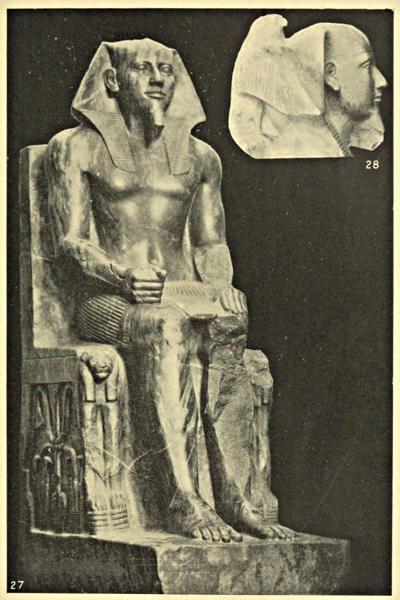
27, 28. King Khafra (IVth dynasty)
The statue of Khafra (fig. 27) carved in diorite
is one of the grandest works of Egypt. The entire
dignity and majesty shown contrast strongly with
the active air of the subordinate classes. The muscular
detail is powerful, but yet in keeping with the
serenity of the figure. The whole is best grasped
from below, as it was intended to be seen; but the
head should be studied at its own level, and the
profile, from a cast (fig. 28), shows the form as it
originally appeared when covered with a facing
which concealed the grain of the stone. The difference
of character between the calm, easy dignity
of this, and the terrible energy of Khufu (fig. 123),
should be observed. It shows how free the art is
from any mere convention of majesty. The hawk
behind the king is shown as spreading out its wings
to protect the royal head. This symbolism is ingeniously
hidden in the front view, so as not to
interfere with the effect of the whole figure as it
was intended to be seen. The figures of the Vth
and VIth dynasties have more vivacity than those
earlier, but scarcely such a real vitality. The well-known
scribe (fig. 29) is a good piece of expression,
showing the attentive, waiting air of a man who is
following dictation. The anatomy is not detailed,
and the surfaces look rather blocked out and bald
as compared with Khafra.
OLD KINGDOM SCULPTURE
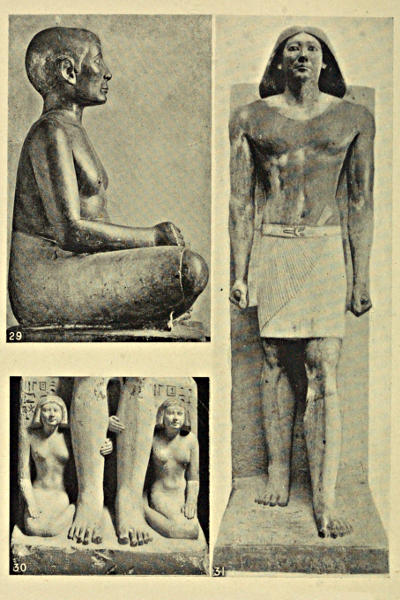
29. The scribe
30. Wife and daughter
31. Ranofer
The lower part of a group is given here (fig. 30)
for figures of the seated wife and daughter. These
show good modelling of the figure in a close-fitting
garment, and the hair is worn over the forehead
beneath the wig, as by Nofert. The figure of Ranofer
(fig. 31) is one of the most dignified of the
portraits of officials. The pose is strong; the
muscles are well rendered, and not too full though
clear. The wig stands well off the head, and gives
a continuous outline with the figure. It is hard to
see how the whole expression could be better than
this.
On looking closely at the detail of these early
statues, there is very little that can be set down as
conventional. All the features are natural, well
placed, and harmonious. The relation of the brow
to the eyes is generally true. But this point was
entirely missed in later times. In the XIIth dynasty
the eye is rather too forward; and in the XVIIIth
there is hardly a single statue that is correct, the
eyes usually projecting to the plane of the brow.
On observing even the finest figures of later times
it will be seen how purely conventional is their
treatment; the mouth and eyes are cold and mechanical,
and it is seldom that any one feature even
approaches the truth of the early art.
In the XIIth dynasty the work shows the scholastic
style of deliberate accuracy, without as much
personal vitality as in earlier times. Yet it is full of
carefully observed detail, and is by no means perfunctory
like the later work.
The facial surfaces are well rendered: observe
the varied treatment of the cheek below the eye
in figs. 32, 33, and 35, which are clearly individual.
The entirely different form of the mouth in these
three is as evidently personal. Throughout Egyptian
work the eye is of two distinct types, both of
which we see here in the XIIth dynasty. In one
type (fig. 32) the upper lid rises to its highest point
near the inner side; and with this form the actual
corner, or canthus major, may end in a mere angle
or in a lachrymal fossa more or less developed, an
extreme case of the long and wide fossa being seen
in fig. 32, and in the black granite figure from Alexandria
(so-called Hyksos) in Cairo. This may be
called the gibbous form of lid, and it is the more
usual in the sculpture and on coffins. The use of
a copper frame round the inserted eye in Old Kingdom
statues makes it uncertain how far the lachrymal
fossa was intended to appear. But the statues
of a single material show a small fossa in most cases,
such as Khafra, Dadefra, the (so-called) wife of the
Sheykh, and Sebekhotep III. In later work there
is no fossa, but only an angle, as in Tahutmes III,
Amenhotep III, Amenhotep son of Hapi, and other
instances to the end of the dynasties. But a slight
fossa is shown in Akhenaten and his family, and in
Ramessu II; and, under the Ethiopians, Taharqa
and Amenardys are both shown with a long fossa.
The other type of eye seen in figs. 33, 35 may be
called the narrow eye. This seems to belong mainly
to the Middle Kingdom, and is seen in Senusert III,
Amenemhat III, Queen Nofert, and Noferhotep.
It is perhaps unknown at an earlier age; and later
it rarely occurs, but may be seen in Merenptah, and
somewhat in Mentu-em-hat and some portraits of
the XXVIth dynasty. These remarks are merely
to draw attention to a detail which is easily observed
and seldom defaced; but for drawing conclusions an
extensive study is needed of all the varieties of form
and treatment, not only of the eye, but also of the
lips, nostrils, ears, and hair. How far such detail
belonged to the subject, and how much is due to
artistic conventions, we cannot yet say; but from the
similarities of portraits of the same person it seems
probable that the details are really due to differences
of type.
MIDDLE KINGDOM SCULPTURE
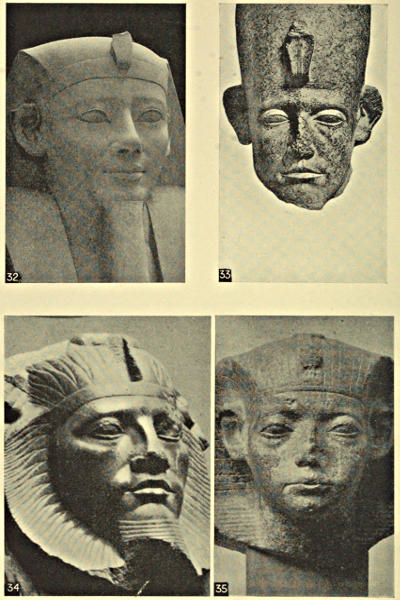
32. Senusert I
33. Senusert III
34. Foreign type
35. Amenemhat III
We now have a very difficult question to state as
to the origin of the remarkable type of fig. 34. This
is one of the class of sphinxes and statues commonly
described as being of the Hyksos. Yet, as
the Hyksos kings’ names are roughly cut on the
shoulders of the sphinxes, they are clearly not the
original inscriptions; and, as clearly, these figures
are older than the Hyksos. The type is distinguished
by an extreme muscularity of the face, deeply
cut, powerful lips with strong flexures, and the
long nose, not very prominent, but broad. All these
points are much in excess of such features on any
statue of a named Egyptian king. Some similarities
may be seen in the type of Senusert III and
Amenemhat III (figs. 33, 35); but these latter are
much less strong and unconventional. It is probable
that some of the stock of fig. 34 has gone to
form the type of figs. 33 and 35, but it is impossible
to see in them a uniform single type. It seems most
probable that fig. 34 belongs to an invading people
from Syria during the decadence of the Old Kingdom,
between the VIIth and Xth dynasties; but until
some example with an original name may be found,
it is useless to be more definite. It is noticeable
how all of the heads of this type are in black granite,
or rarely some other igneous rock; this suggests
that they were wrought by the school of the eastern
desert, and may therefore not be controlled by the
decadence of ordinary Egyptian work between the
Old and Middle Kingdoms.
Whether other strange works in black granite—such
as the fish-offerers of Tanis—belong to the same
age, has been questioned. It may be noted, however,
that the sphinxes and the black granite bust from
Alexandria have a large lachrymal fossa, while the
fish-offerers have no fossa, but only an inner angle
to the eye. The so-called Hyksos figures from
Bubastis are not really of this type, but show an inheritance
of some of its characters, such as belong
to the royal family in the XIIth dynasty. Whenever
the royal portraiture of the XIIth dynasty is
fully collected and studied, it will be possible to clear
the attribution of many statues, and so to separate
those which really belong to the earlier stock.
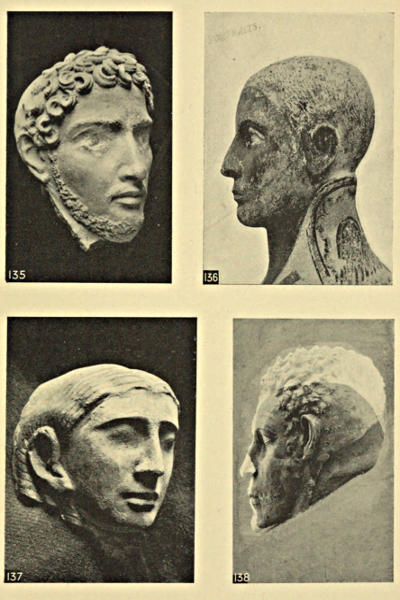
On coming to the XVIIIth dynasty a more mechanical
style prevails (figs. 36-39). This is obvious
in the formal raised band of eyebrow, and the eyes
being brought forward to the plane of the forehead.
The lips remain more natural, and are still treated
expressively. The best work of this age is the green
basalt statue of Tahutmes III in Cairo (fig. 37). It
accords closely with another figure of black granite
of the same king; but the red granite head in the
British Museum is much coarser and less expressive,
as is natural from that school of granite work. The
large nose is vouched for as a family characteristic
in the reliefs of Tahutmes II and Hatshepsut at
Deir el Bahri, which have precisely the same outline
of brow and nose; the under-side of the nose,
the slightly rising curve of the lips to the outer
corner, and the flatness of the facing of the lips, seem
to be individual details.
The head fig. 36 is of an official of Amenhotep
III, in quartzite. It has a fairly good outline of
the cheek, and well-cut lips; and it shows the more
florid and romantic turn of this age in the wavy hair
marked out with lines.
Under Akhenaten (fig. 39) there came a revolution
of art, which was perhaps only a culmination of
the naturalistic tendencies that were growing during
the preceding reigns. But it was enforced and
supported by the surrounding changes in religion,
ethics, and politics which were carried out by the
humanist reformer who ruled. It was probably also
stimulated by the influence of the contemporary art
of Crete and Greece, the whole eastern Mediterranean
apparently sharing in a general movement.
We shall notice this further when considering reliefs
and painting. Of round sculpture the best figure
remaining is that of Akhenaten now in Paris (fig.
39). It has been part of a group of the king and
queen sitting together, and it shows all the characteristics
of this school in the best form. The eyes
are quite natural; the lips are emphasised by a sharp
edge along their borders; the jaw and neck are
excellently rendered; and the ear, with its large
pierced lobe, is clearly true to life.
Though the reforms of Akhenaten mostly perished
with him, yet the training of his artists is still to be
seen in the sculpture of Tut-ankh-amen (fig. 38).
This has not the professional completeness of style
seen under Tahutmes III (fig. 37), but it carries on
the less precise sentimentalism of Akhenaten (fig.
39), with much feeling for expression and beauty,
but a lack of grip and force. The brow is neglected,
the eye is feeble, the cheek is without detail, but
the lips and chin are enforced as far as possible.
The whole effect is sweet but not impressive.
NEW KINGDOM SCULPTURE
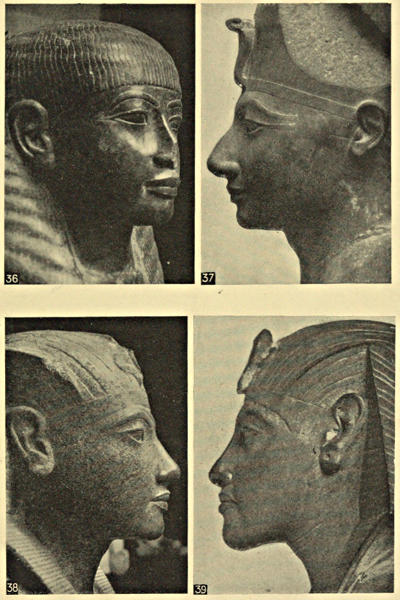
36. Under Amenhotep III
37. Tahutmes III
38. Tut-ankh-amen
39. Akhenaten
We now turn to the minor work in wood. In
the Old Kingdom, wood was frequently carved on
a large scale; of the Middle Kingdom there is the
statue of King Hor; but under the New Kingdom
the only large figures are some rather coarse funeral
statues. On the other hand, in small figures there
is a profusion of wood-carving. The wooden ushabtis
are often beautifully treated; the draped
figures of women are graceful and dignified, with
minute working of the hair and dress; the grotesque
figures of toilet objects are full of character; but
here our space limits us to one class, and we give
the nude figures (figs. 40-42), as such are rarely
found in other material.
NEW KINGDOM SCULPTURE
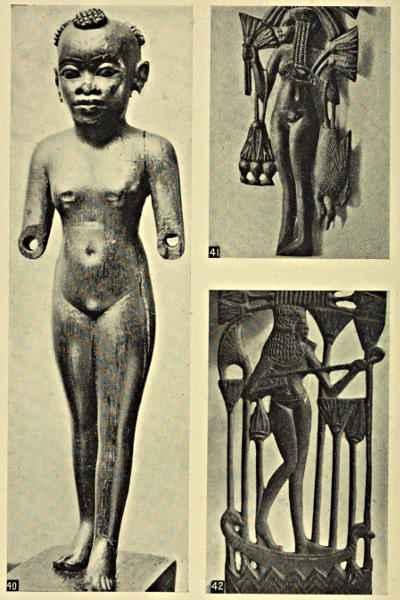
40, 41, 42. Wood-carvings of girls (XVIIIth dynasty)
The little negress (fig. 40), carved in ebony, is
part of a group representing her carrying a tray,
which is supported by a monkey before her. But
these accessories are inferior, and merely hide the
figure; the edge of the tray has been slightly cut
in on the breast and thus disfigured it. The detail
of this statuette is better than any other such work;
the perfect pose of the attitude, the poise of the
head, the fulness of the muscles, the innocent gravity
of the expression, are all excellent.
Other figures are carved in the handles of toilet
trays. The girl in fig. 41 holding flowers and birds
is on a smaller and coarser scale than the preceding,
but is excellent in expression and in the modelling
of the trunk. The damsel playing a lute on her
boat amid the papyrus thicket (fig. 42) shows one
of the graceful adjuncts of water-parties in high life.
The length of leg is exaggerated to harmonise with
the long stems around; but the pose is skilfully
seized, the distance of the feet being needful for
balance in a little shallop, while the cling of the
thighs is maintained. There is more self-consciousness
and deliberate effect in this expression than
in that of the little girls seen before.
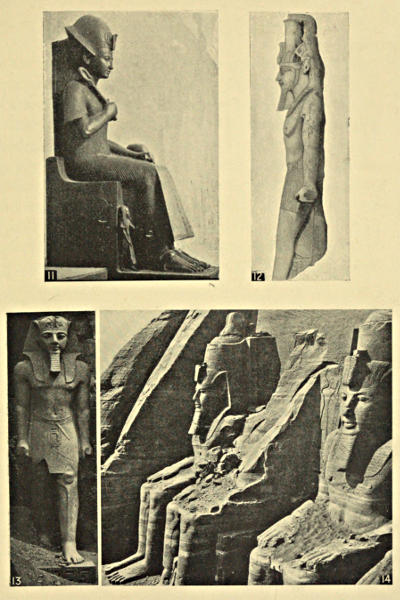
The age of decadence now begins with the Ramessides.
One fine piece arrests us in the black
granite statue of Ramessu II (fig. 43), of which an
entire view is given in fig. 11. The whole pose is
fairly good, the face looking down toward the spectator
below. The king is no longer the dignified
organiser of the Old Kingdom, with a vision far
away beyond everyday matters, but he is obviously
considering the opinion of the man in front of him.
The detail is almost equal to that of the previous
dynasty; the eye is natural, the nose rather formal,
the lips with the sharp edge even more developed
than before, and the chin and throat less modelled.
The elbow is carefully wrought, bringing out the
fold of flesh and the muscle separately, the accuracy
of which is questionable.
A good example of a private sculpture is the head
of Bak-en-khonsu (fig. 44). The eye is only slightly
indicated, leaning to the conventional blocking out
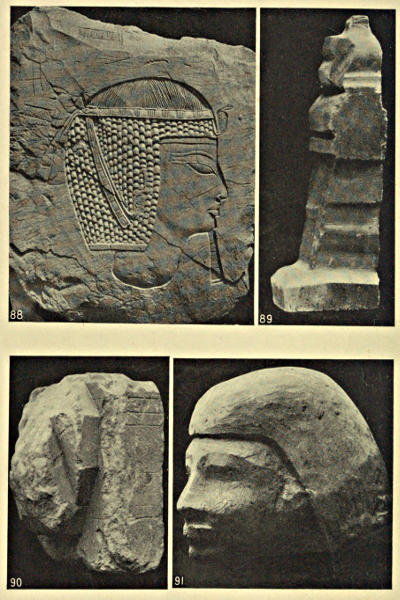
seen in figs. 91 and 137. The profile is good, and
the lips are less exaggerated than in the royal statues.
The artist could give all his attention to the
face alone, as the figure is entirely hidden in an
almost cubic block, which represents the man seated
with knees drawn up before the chest.
NEW KINGDOM SCULPTURE
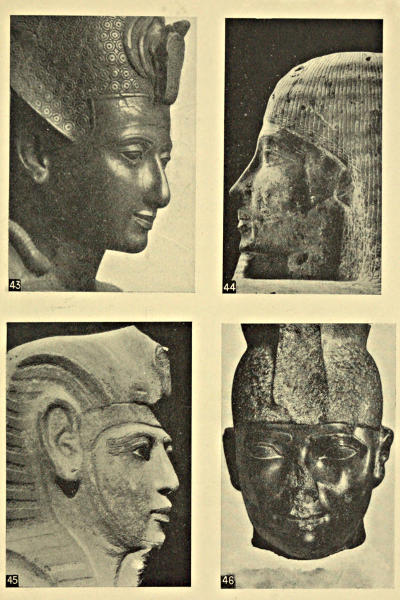
43. Ramessu II
44. Bak-en-khonsu
45. Merenptah
46. Taharqa
The head of Merenptah (fig. 45) shows him as
inheriting and imitating his father’s face and attitude.
The style is cold and formal; the eyes are
so forward as to be even beyond the plane of the
forehead, and scarcely capped by the brow. But
the nose and lips are natural and free of the forcing
which is seen rather earlier. There is no attempt
at any delicacy of facial curves, and the chin and
throat are masked by the official beard. As this is
in gray granite, and was executed as the ka statue
of the king’s personal temple, it may be taken as
the best that could be done at that time.
A different feeling comes in with the massive
individual portrait of Taharqa (fig. 46). The facial
muscles are strongly marked, but the mouth is singularly
unformed, and is exactly the opposite of that
in the strong type of fig. 34. The eyes are of the
gibbous form, with a long slot of lachrymal fossa,
which is also shown in the kindred figure of Queen
Amenardys (fig. 47). The style is not akin to any
other Egyptian work, and it seems as if an entirely
different physiognomy had challenged the sculptor
and made him drop his usual treatment and
study Nature afresh.
The alabaster statue of Amenardys (fig. 47) is
disproportioned as a whole, though parts are good
separately. It has just the faults due to an imitator
who does not trust to observation. The head
is too large, the jointing is weak. Each of the
features is fairly well rendered; and within the
limits of later mannerism there is no forcing or
exaggeration.
The portrait of Mentu-em-hat (fig. 48) belongs to
the same style as that of Taharqa, and both are in
black granite. The eyes seem too small, but this
is rather due to the depth and massiveness of the
jaws, which overweight the face. The apparent disproportion
in the low forehead is only due to the
photograph being taken too close and low down.
The height above the eyes is really equal to that
down to the upper edge of the chin. The facial
curves are carefully observed, and we can well credit
this with being a true portrait of the capable governor
of Thebes who continued in office under Taharqa
and Tanut-amen, and who repaired the devastations
of the Assyrian invasion.
LATE SCULPTURE
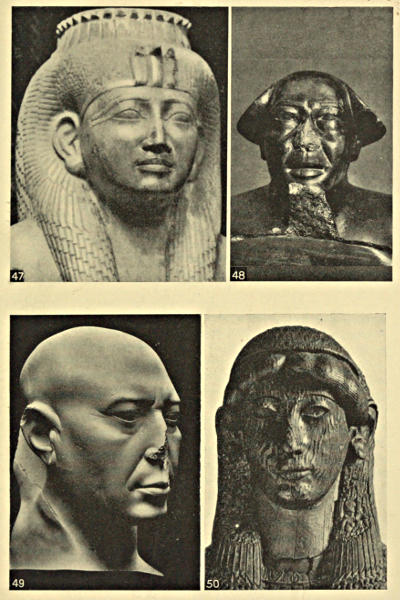
47. Amenardys
48. Mentu-em-hat
49. Basalt head
50. Wooden head
A head broken from a statue, found at Memphis
(fig. 49), is remarkable for the deep and searching
modelling. The bony structure, the facial muscles,
and the surface folds are all scrupulously observed.
The artist’s triumph is shown in the harmony and
the living character which he has infused into his
laborious precision. Very rarely can a man rise
superior to such a rigorous training. The character
of work is scarcely Egyptian; it belongs rather to
the same school as the republican Roman portraits,
but is earlier than those, as it has more precision of
detail.
Lastly, we have one of the best examples of Greek
influence in Egypt shown by the wood-carving of
a coffin (fig. 50). The long narrow face shaded by
thick wavy hair is Greek in feeling, while the feather
head-dress is old Egyptian. Unfortunately, the
decay of the wood has broken the surface, but it
still remains an impressive example of Egyptian
influence on art which is mainly Greek.