[From the battle of Morgarten to the battle of Marignano.]
In the fourteenth century infantry, after a thousand years of
depression and neglect, at last regained its due share of military
importance. Almost simultaneously there appeared two peoples
asserting a mastery in European politics by the efficiency of
their foot-soldiery. Their manners of fighting were as different
as their national character and geographical position, but although
they never met either in peace or war, they were practically
allied for the destruction of feudal chivalry. The knight, who
had for so long ridden roughshod over the populations of
Europe, was now to recognize his masters in the art of war.
The free yeomanry of England and the free herdsmen of the
Alps were about to enter on their career of conquest.
When war is reduced to its simplest elements, we find that
there are only two ways in which an enemy can be met and
defeated. Either the shock or the missile must be employed
against him. In the one case the victor achieves success by
throwing himself on his opponent, and worsting him in a hand-to-hand
struggle by his numbers, his weight, the superiority of
his arms, or the greater strength and skill with which he wields
them. In the second case he wins the day by keeping up such
a constant and deadly rain of missiles, that his enemy is destroyed
or driven back before he can come to close quarters. Each of
these methods can be combined with the use of very different
arms and tactics, and is susceptible of innumerable variations.
In the course of history they have alternately asserted their
preponderance: in the early middle ages shock-tactics were
entirely in the ascendant, while in our own day the use of the
missile has driven the rival system out of the field, nor does
it appear possible that this final verdict can ever be reversed.
The English archer and the Swiss pikeman represented these
two great forms of military efficiency in their simplest and most
elementary shapes. The one relied on his power to defeat his
enemy’s attack by rapid and accurate shooting. The other was
capable of driving before him far superior numbers by the
irresistible impact and steady pressure of his solid column with
its serried hedge of spear-points. When tried against the mail-clad
cavalry which had previously held the ascendancy in Europe,
each of these methods was found adequate to secure the victory
for those who employed it. Hence the whole military system
of the middle ages received a profound modification. To the
unquestioned predominance of a single form, that of the charge
delivered by cavalry, succeeded a rapid alternation of successful
and unsuccessful experiments in the correlation and combination
of cavalry and infantry, of shock-tactics and missile-tactics.
Further complicated by the results of the introduction of firearms,
this struggle has been prolonged down to the present day. It
is only in the last few years that the military world has learnt
that the attempt to utilize the shock of the infantry column or
the charging squadron must be abandoned in face of the extraordinary
development of modern firearms.
The Swiss of the fourteenth and fifteenth centuries have been
compared with much aptness to the Romans of the early
Republic. In the Swiss, as in the Roman, character we find the
most intense patriotism combined with an utter want of moral
sense and a certain meanness and pettiness of conception, which
prevent us from calling either nation truly great. In both the
steadiest courage and the fervour of the noblest self-sacrifice
were allied to an appalling ferocity and a cynical contempt and
pitiless disregard for the rights of others. Among each people
the warlike pride generated by successful wars of independence
led ere long to wars of conquest and plunder. As neighbours,
both were rendered insufferable by their haughtiness and proneness
to take offence on the slightest provocation70. As enemies,
both were distinguished for their deliberate and cold-blooded
cruelty. The resolution to give no quarter, which appears almost
pardonable in patriots desperately defending their native soil,
becomes brutal when retained in wars of aggression, but reaches
the climax of fiendish inhumanity when the slayer is a mere mercenary,
fighting for a cause in which he has no national interest.
Repulsive as was the bloodthirstiness of the Roman, it was far
from equalling in moral guilt the needless ferocity displayed by
the hired Swiss soldiery on many a battlefield of the sixteenth
century71.
In no point do we find a greater resemblance between the
histories of the two peoples, than in the causes of their success
in war. Rome and Switzerland alike are examples of the fact
that a good military organization and a sound system of national
tactics are the surest basis for a sustained career of conquest.
Provided with these a vigorous state needs no unbroken series
of great commanders. A succession of respectable mediocrities
suffices to guide the great engine of war, which works almost
automatically, and seldom fails to cleave its way to success.
The elected consuls of Rome, the elected or nominated
‘captains’ of the Confederates, could never have led their
troops to victory, had it not been for the systems which the
experience of their predecessors had brought to perfection.
The combination of pliability and solid strength in the legion,
the powers of rapid movement and irresistible impact which met
in the Swiss column, were competent to win a field without the
exertion of any extraordinary ability by the generals who set
them in motion.
The battle-array which the Confederates invariably employed,
was one whose prototype had been seen in the Macedonian
phalanx. It was always in masses of enormous depth that they
presented themselves on the battlefield. Their great national
weapon in the days of their highest reputation was the pike, an
ashen shaft eighteen feet long, fitted with a head of steel which
added another foot to its length. It was grasped with two
hands widely extended, and poised at the level of the shoulder
with the point slightly sunk, so as to deliver a downward thrust72.
Before the line projected not only the pikes of the front rank,
but those of the second, third, and fourth, an impenetrable
hedge of bristling points. The men in the interior of the
column held their weapons upright, till called upon to step
forward in order to replace those who had fallen in the foremost
ranks. Thus the pikes, rising twelve feet above the heads of the
men who bore them, gave to the charging mass the appearance
of a moving wood. Above it floated numberless flags, the
pennons of districts, towns, and guilds73, the banners of the
cantons, sometimes the great standard of ‘the Ancient League
of High Germany,’ the white cross on the red ground.
The pike, however, was not the only weapon of the Swiss.
In the earlier days of their independence, when the Confederacy
consisted of three or four cantons, the halberd was their favourite
arm, and even in the sixteenth century a considerable proportion
of the army continued to employ it. Eight feet in length--with
a heavy head which ended in a sharp point and bore
on its front a blade like that of a hatchet, on its back a strong
hook--the halberd was the most murderous, if also the most
ponderous, of weapons. Swung by the strong arms of the
Alpine herdsmen it would cleave helmet, shield, or coat-of-mail,
like pasteboard. The sight of the ghastly wounds which it
inflicted might well appal the stoutest foeman: he who had
once felt its edge required no second stroke. It was the
halberd which laid Leopold of Hapsburg dead across his fallen
banner at Sempach, and struck down Charles of Burgundy--all
his face one gash from temple to teeth--in the frozen ditch by
Nancy74.
The halberdiers had their recognized station in the Confederates’
battle-array. They were drawn up in the centre of
the column, around the chief banner, which was placed under
their care. If the enemy succeeded in checking the onset of
the pikemen, it was their duty to pass between the front ranks,
which opened out to give them egress, and throw themselves
into the fray. They were joined in their charge by the bearers
of two-handed swords, ‘Morning-Stars,’ and ‘Lucern Hammers75,’
all weapons of the most fearful efficiency in a hand-to-hand
combat. It was seldom that a hostile force, whether infantry or
cavalry, sustained this final attack, when the infuriated Swiss
dashed in among them, slashing right and left, sweeping off the
legs of horses, and cleaving armour and flesh with the same
tremendous blow.
In repelling cavalry charges, however, the halberd was found,
owing to its shortness, a far less useful weapon than the pike.
The disastrous fight near Bellinzona in 1422, where the Swiss,
having a large proportion of halberdiers in their front rank,
were broken by the Milanese gendarmes, was the final cause of
its relegation to the second epoch of the battle. From the
first shock of the opposing forces it was banished, being reserved
for the mêlée which afterwards ensued.
Next to its solidity the most formidable quality of the Swiss
infantry was its rapidity of movement. ‘No troops were ever
more expeditious on a march, or in forming themselves for
battle, because they were not overloaded with armour76.’ When
emergencies arrived a Confederate army could be raised with
extraordinary speed; a people who regarded military glory as the
one thing which made life worth living, flocked to arms without
needing a second summons. The outlying contingents marched
day and night in order to reach the mustering place in good
time. There was no need to waste days in the weary work of
organization, when every man stood among his kinsmen and
neighbours, beneath the pennon of his native town or valley.
The troops of the democratic cantons elected their officers,
those of the larger states received leaders appointed by their
councils, and then without further delay the army marched to
meet the enemy. Thus an invader, however unexpected his
attack, might in the course of three or four days find twenty
thousand men on his hands. They would often be within a few
miles of him, before he had heard that a Swiss force was in the
field.
In face of such an army it was impossible for the slowly-moving
troops of the fourteenth or fifteenth centuries to execute
manœuvres. An attempt to alter the line of battle,--as Charles
the Rash discovered to his dismay at Granson,--was sure to
lead to disaster. When once the Confederates were in motion
their enemy had to resign himself to fighting in whatever order
he found himself at the moment. They always made it their
rule to begin the fight, and never to allow themselves to be
attacked. The composition of their various columns was settled
early on the battle morning, and the men moved off to the field
already drawn up in their fighting-array. There was no pause
needed to draw the army out in line of battle; each phalanx
marched on the enemy at a steady but swift pace, which
covered the ground in an incredibly short time. The solid
masses glided forward in perfect order and in deep silence,
until the war-cry burst out in one simultaneous roar and the
column dashed itself against the hostile front. The rapidity of
the Swiss advance had in it something portentous: the great
wood of pikes and halberds came rolling over the brow of some
neighbouring hill; a moment later it was pursuing its even way
towards the front, and then--almost before the opponent had
time to realize his position--it was upon him, with its four rows
of spear-points projecting in front and the impetus of file upon
file surging up from the rear.
This power of swift movement was--as Macchiavelli observed--the
result of the Confederates’ determination not to burden
themselves with heavy armour. Their abstention from its use
was originally due to their poverty alone, but was confirmed by
the discovery that a heavy panoply would clog and hamper the
efficiency of their national tactics. The normal equipment of
the pikeman or halberdier was therefore light, consisting of a
steel-cap and breastplate alone. Even these were not in universal
employment; many of the soldiery trusted the defence of
their persons to their weapons, and wore only felt hats and
leather jerkins77. The use of back-plates, arm-pieces, and greaves
was by no means common; indeed the men wearing them were
often not sufficient in number to form a single rank at the head
of the column, the post in which they were always placed. The
leaders alone were required to present themselves in full armour;
they were therefore obliged to ride while on the march, in order
to keep up with their lightly-armed followers. When they
arrived in sight of the enemy they dismounted and led their
men to the charge on foot. A few of the patricians and men
of knightly family from Bern were found in the fifteenth century
serving as cavalry, but their numbers were absolutely insignificant,
a few scores at the most78.
Although the strength and pride of the Confederates lay in
their pikemen and halberdiers, the light troops were by no means
neglected. On occasion they were known to form as much as
a fourth of the army, and they never sank below a tenth of the
whole number79. They were originally armed with the cross-bow--the
weapon of the fabulous Tell--but even before the
great Burgundian war the use of the clumsy firearms of
the day was general among them. It was their duty to precede
the main body, and to endeavour to draw on themselves
the attention of the enemy’s artillery and light troops, so that the
columns behind them might advance as far as possible without
being molested. Thus the true use of a line of skirmishers was
already appreciated among the Swiss in the fifteenth century.
When the pikemen had come up with them, they retired into the
intervals between the various masses, and took no part in the
great charge, for which their weapons were not adapted.
It is at once evident that in the simplicity of its component
elements lay one of the chief sources of the strength of a Confederate
army. Its commanders were not troubled by any of
those problems as to the correlation and subordination of the
various arms, which led to so many unhappy experiments among
the generals of other nations. Cavalry and artillery were practically
non-existent; nor were the operations hampered by the
necessity of finding some employment for those masses of troops
of inferior quality who so often increased the numbers, but not
the efficiency, of a mediæval army. A Swiss force--however
hastily gathered--was always homogeneous and coherent;
there was no residuum of untried or disloyal soldiery for
whose conduct special precautions would have to be taken.
The larger proportion of the men among a nation devoted to
war had seen a considerable amount of service; while if local
jealousies were ever remembered in the field, they only served to
spur the rival contingents on to a healthy emulation in valour.
However much the cantons might wrangle among themselves,
they were always found united against a foreign attack80.
The character and organization of the Confederate army were
exceedingly unfavourable to the rise of great generals. The
soldier rested his hope of success rather on an entire confidence
in the fighting power of himself and his comrades, than on the
skill of his commander. Troops who have proved in a hundred
fields their ability to bear up against the most overwhelming odds,
are comparatively indifferent as to the personality of their leader.
If he is competent they work out his plan with success, if not,
they cheerfully set themselves to repair his faults by sheer hard
fighting. Another consideration was even more important
among the Swiss; there was a universal prejudice felt against
placing the troops of one canton under the orders of the citizen
of another. So strong was this feeling that an extraordinary
result ensued: the appointment of a commander-in-chief remained,
throughout the brilliant period of Swiss history, an
exception rather than a rule. Neither in the time of Sempach,
in the old war of Zurich, in the great struggle with Burgundy,
nor in the Swabian campaign against Maximilian of Austria,
was any single general entrusted with supreme authority81. The
conduct of affairs was in the hands of a ‘council of war;’ but it
was a council which, contrary to the old proverb about such
bodies, was always ready and willing to fight. It was composed
of the ‘captains’ of each cantonal contingent, and settled the questions
which came under discussion by a simple majority of voices.
Before a battle it entrusted the command of van, rear, main-body,
and light troops to different officers, but the holders of
such posts enjoyed a mere delegated authority, which expired
with the cessation of the emergency.
The existence of this curious subdivision of power, to which
the nearest parallel would be found in early Byzantine days, would
suffice by itself to explain the lack of all strategical skill and
unity of purpose which was observable in Swiss warfare. The
compromise which forms the mean between several rival schemes
usually combines their faults, not their merits. But in addition
to this, we may suspect that to find any one Swiss officer capable
of working out a coherent plan of campaign would have
been difficult. The ‘Captain’ was an old soldier who had won
distinction on bygone battlefields, but except in his experience
nowise different to the men under his orders. Of elaborating
the more difficult strategical combinations a Swiss ‘Council of
War’ was not much more capable than an average party of
veteran sergeant-majors would be in our own day.
With tactics, however, the case was different. The best
means of adapting the attack in column to the accidents of
locality or the quality and armament of the opposing troops
were studied in the school of experience. A real tactical
system was developed, whose efficiency was proved again and
again in the battles of the fifteenth century. For dealing with
the mediæval men-at-arms and infantry against whom it had
been designed, the Swiss method was unrivalled: it was only
when a new age introduced different conditions into war that it
gradually became obsolete.
The normal order of battle employed by the Confederates,
however small or large their army might be, was an advance in
an échelon of three divisions82. The first corps (‘vorhut’), that
which had formed the van while the force was on the march,
made for a given point in the enemy’s line. The second corps
(‘gewaltshaufen’), instead of coming up in line with the first,
advanced parallel to it, but at a short distance to its right or left
rear. The third corps (‘nachhut’) advanced still further back,
and often halted until the effect of the first attack was seen, in
order that it might be able to act, if necessary, as a reserve.
This disposition left a clear space behind each column, so that
if it was repulsed it could retire without throwing into disorder
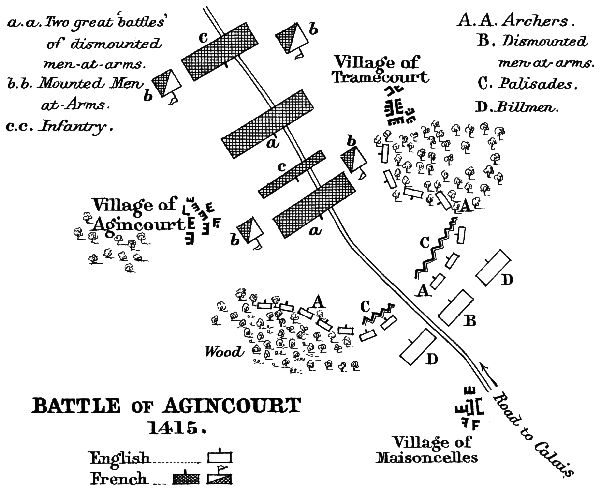
the rest of the army. Other nations (e.g. the French at
Agincourt), who were in the habit of placing one corps directly
in front of another, had often to pay the penalty for their tactical
crime, by seeing the defeat of their first line entail the rout of
the whole army, each division being rolled back in confusion on
that immediately in its rear. The Swiss order of attack had
another strong point in rendering it almost impossible for the
enemy’s troops to wheel inwards and attack the most advanced
column: if they did so they at once exposed their own flank to
the second column, which was just coming up and commencing
its charge.
The advance in échelon of columns was not the only form
employed by the Confederates. At Laupen the centre or
‘gewaltshaufen’ moved forward and opened the fight before
the wings were engaged. At the combat of Frastenz in 1499,
on the other hand, the wings commenced the onset, while the
centre was refused, and only came up to complete the overthrow.
Even the traditional array in three masses was sometimes
discarded for a different formation. At Sempach the men of
the Forest Cantons were drawn up in a single ‘wedge’ (Keil).
This order was not, as might be expected from its name, triangular,
but merely a column of more than ordinary depth in
proportion to its frontage. Its object was to break a hostile
line of unusual firmness by a concentrated shock delivered
against its centre. In 1468, during the fighting which preceded
the siege of Waldshut, the whole Confederate army
moved out to meet the Austrian cavalry in a great hollow
square, in the midst of which were placed the banners with
their escort of halberdiers. When such a body was attacked,
the men faced outwards to receive the onset of the horsemen;
this they called ‘forming the hedgehog83.’ So steady were they
that, with very inferior numbers, they could face the most energetic
charge: in the Swabian war of 1498, six hundred men of
Zurich, caught in the open plain by a thousand imperial men-at-arms,
‘formed a hedgehog, and drove off the enemy with ease
and much jesting84.’ Macchiavelli85 speaks of another Swiss
order of battle, which he calls ‘the Cross:’ ‘between the arms
of which they place their musketeers, to shelter them from the
first shock of the hostile column.’ His description, however, is
anything but explicit, and we can find no trace of any formation
of the kind in any recorded engagement.
The first victory of the Confederates was won, not by the
tactics which afterwards rendered them famous, but by a judicious
choice of a battlefield. Morgarten was a fearful example
of the normal uselessness of feudal cavalry in a mountainous
country. On a frosty November day, when the roads were like
ice underfoot, Leopold of Austria thrust his long narrow column
into the defiles leading to the valley of Schwytz. In front rode
the knights, who had of course claimed the honour of opening
the contest, while the 6000 infantry blocked the way behind.
In the narrow pass of Morgarten, where the road passes between
a precipitous slope on the right and the waters of the Egeri
lake on the left, the 1500 Confederates awaited the Austrians.
Full of the carelessness which accompanies overweening arrogance,
the duke had neglected the most ordinary precaution of
exploring his road, and only discovered the vicinity of the
enemy when a shower of boulders and tree-trunks came rolling
down the slope on his right flank, where a party of Swiss were
posted in a position entirely inaccessible to horsemen. A moment
later the head of the helpless column was charged by the
main body of the mountaineers. Before the Austrians had
realized that the battle had commenced, the halberds and
‘morning-stars’ of the Confederates were working havoc in
their van. The front ranks of the knights, wedged so tightly
together by the impact of the enemy that they could not lay
their lances in rest, much less spur their horses to the charge,
fought and died. The centre and rear were compelled to halt
and stand motionless, unable to push forward on account of the
narrowness of the pass, or to retreat on account of the infantry,
who choked the road behind. For a short time they endured
the deadly shower of rocks and logs, which continued to bound
down the slope, tear through the crowded ranks, and hurl man
and horse into the lake below. Then, by a simultaneous impulse,
the greater part of the mass turned their reins and made
for the rear. In the press hundreds were pushed over the edge
of the road, to drown in the deep water on the left. The main
body burst into the column of their own infantry, and, trampling
down their unfortunate followers, fled with such speed as was
possible on the slippery path. The Swiss, having now exterminated
the few knights in the van who had remained to fight,
came down on the rear of the panic-stricken crowd, and cut
down horseman and footman alike without meeting any resistance.
‘It was not a battle,’ says John of Winterthur, a contemporary
chronicler, ‘but a mere butchery of duke Leopold’s
men; for the mountain folk slew them like sheep in the
shambles: no one gave any quarter, but they cut down all,
without distinction, till there were none left to kill. So great
was the fierceness of the Confederates that scores of the Austrian
footmen, when they saw the bravest knights falling helplessly,
threw themselves in panic into the lake, preferring to sink in its
depths rather than to fall under the fearful weapons of their
enemies86.’
In short, the Swiss won their freedom, because, with instinctive
tactical skill, they gave the feudal cavalry no opportunity
for attacking them at advantage. ‘They were lords of the field,
because it was they, and not their foe, who settled where the
fighting should take place.’ On the steep and slippery road,
where they could not win impetus for their charge, and where
the narrowness of the defile prevented them from making use
of their superior numbers, the Austrians were helpless. The
crushing character of the defeat, however, was due to Leopold’s
inexcusable carelessness, in leaving the way unexplored and
suffering himself to be surprised in the fatal trap of the pass.
Morgarten exhibits the Swiss military system in a rudimentary
condition. Though won, like all Confederate victories, by the
charge of a column, it was the work of the halberd, not of the
pike. The latter weapon was not yet in general use among
the mountaineers of the three cantons: it was, in fact, never
adopted by them to so great an extent as was the case among
the Swiss of the lower Alpine lands and Aar valley, the Bernese
and people of Zurich and Lucern. The halberd, murderous
though it might be, was not an arm whose possession would
give an unqualified ascendancy to its wielders: it was the position,
not the weapons nor the tactics, of the Swiss which won
Morgarten. But their second great success bears a far higher
military importance.
At Laupen, for the first time almost since the days of the
Romans, infantry, entirely unsupported by horsemen, ranged
on a fair field in the plains, withstood an army complete in all
arms and superior in numbers87. It was twenty-four years after
duke Leopold’s defeat that the Confederates and their newly-allied
fellows of Bern met the forces of the Burgundian nobility
of the valleys of the Aar and Rhone, mustered by all the feudal
chiefs between Elsass and Lake Leman. Count Gerard of
Vallangin, the commander of the baronial army, evidently intended
to settle the day by turning one wing of the enemy, and
crushing it. With this object he drew up the whole of his
cavalry on the right of his array, his centre and left being entirely
composed of infantry. The Swiss formed the three
columns which were henceforth to be their normal order of
battle. They were under a single commander, Rudolf of Erlach,
to whom the credit of having first employed the formation
apparently belongs. The Bernese, who were mainly armed
with the pike, formed the centre column, the wings were drawn
back. That on the left was composed of the men of the three
old cantons, who were still employing the halberd as their chief
weapon, while the right was made up of other allies of Bern.
In this order they moved on to the attack, the centre considerably
in advance. The infantry of the Barons proved to
be no match for the Confederates: with a steady impulse the
Bernese pushed it back, trampled down the front ranks, and
drove the rest off the field. A moment later the Burgundian
left suffered the same fate at the hands of the Swiss right
column. Then, without wasting time in pursuit, the two victorious
masses turned to aid the men of the Forest Cantons.
Surrounded by a raging flood of horsemen on all sides, the left
column was hard pressed. The halberd, though inflicting the
most ghastly wounds, could not prevent the cavalry from occasionally
closing in. Like a rock, however, the mountaineers
withstood the incessant charges, and succeeded in holding their
own for the all-important period during which the hostile infantry
was being driven off the field. Then the two successful
columns came down on the left and rear of the Baronial horsemen,
and steadily met their charge. Apparently the enemy
was already exhausted by his attempt to overcome the men of
the Forest Cantons, for, after one vain attempt to ride down the
Bernese pikemen, he turned and rode off the field, not without
considerable loss, as many of his rearguard were intercepted
and driven into the river Sense.
Laupen was neither so bloody nor so dramatic a field as Morgarten;
but it is one of three great battles which mark the beginning
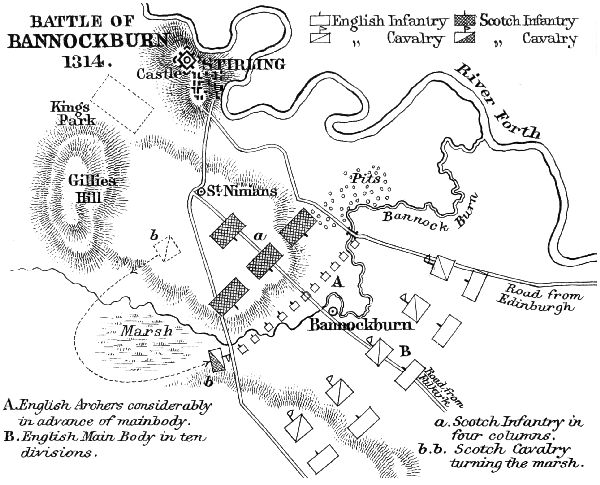
of a new period in the history of war. Bannockburn had already
sounded the same note in the distant West, but for the Continent
Laupen was the first revelation as to the power of good infantry.
The experiment which had been tried a few years before at
Cassel and Mons-en-Puelle with such ill success, was renewed
with a very different result. The Swiss had accomplished the
feat which the Flemings had undertaken with inadequate means
and experience. Seven years later a yet more striking lesson
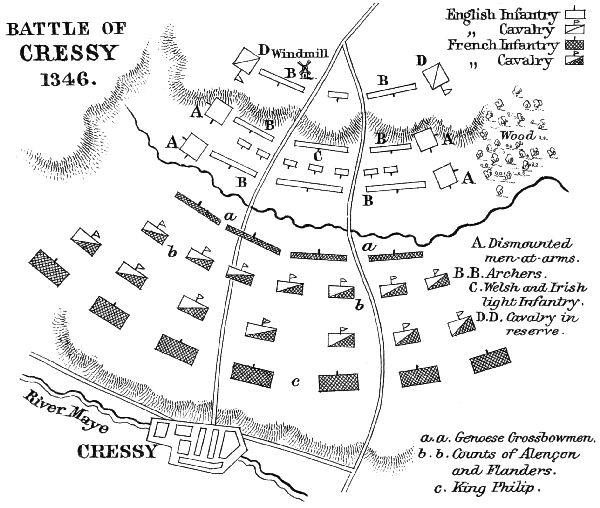
was to be administered to feudal chivalry, when the archer faced
the knight at Cressy. The mail-clad horseman was found
unable to break the phalanx of pikes, unable to approach the
line from which the deadly arrow reached him, but still the old
superstition which gave the most honourable name in war to the
mounted man, was strong enough to perpetuate for another
century the cavalry whose day had really gone by. A system
which was so intimately bound up with mediæval life and ideas
could not be destroyed by one, or by twenty disasters.
Sempach, the third great victory won by the Confederates,
shares with the less famous fight of Arbedo a peculiar interest.
Both were attempts to break the Swiss column by the adoption
of a similar method of attack to that which rendered it so
formidable. Leopold the Proud, remembering no doubt the
powerlessness of the horsemen which had been shown at
Laupen, made his knights dismount, as Edward of England had
done with such splendid results thirty years earlier. Perhaps he
may have borne in mind a similar order given by his ancestor
the Emperor Albert, when he fought the Bavarians at Hasenbühl
in 1298. At any rate the duke awaited the enemy’s attack
with his 4000 mailed men-at-arms formed in one massive
column,--their lances levelled in front,--ready to meet the Swiss
with tactics similar to their own and with the advantage which
the superior protection of armour gave in a contest otherwise
equal88. Leopold had also posted in reserve a considerable body
of foot and horse, who were to fall on the flanks and rear of the
Confederates, when they were fully engaged in front.
Arrayed in a single deep column (Keil), the Swiss came
rushing down from the hills with their usual impetuosity, the
horns of Uri and Unterwalden braying in their midst and the
banners of the four Forest Cantons waving above them89. The
first shock between the two masses was tremendous, but when
it was ended the Confederates found themselves thrust back.
Their whole front rank had gone down, and the Austrian
column was unshaken. In a moment they rallied; Uri replaced
Lucern as the head of the phalanx, and again they dashed at
the mail-clad line before them. But the second charge was no
more successful than the first: Schwytz had to succeed Uri, and
again Unterwalden took the place of Schwytz, and yet nothing
more was effected. The Austrians stood victorious, while in
front of them a long bank of Swiss corpses lay heaped. At the
same moment the duke’s reserve began to move, with the intention
of encircling the Confederate flank. The critical moment
had come; without some desperate effort the day was lost: but
while the Swiss were raging along the line of bristling points,
vainly hacking at the spears which pierced them, the necessary
impulse was at last given. To detail once more Winkelried’s
heroic death is unnecessary: every one knows how the Austrian
column was broken, how in the close combat which followed
the lance and long horseman’s sword proved no match for the
halberd, the battle-axe and the cutlass, how the duke and his
knights, weighed down by their heavy armour, neither could nor
would flee, and fell to a man around their banner.
Historians tell us all this, but what they forget to impress
upon us is that, in spite of his failure, duke Leopold was nearer
to success than any other commander, one exception alone
being made, who faced the Swiss down to the day of Marignano.
His idea of meeting the shock of the Swiss phalanx with a
heavier shock of his own was feasible. His mistakes in detail
ruined a plan which in itself was good. The first fault was that
he halted to receive the enemy’s charge, and did not advance to
meet it. Thus he lost most of the advantage which the superior
weight of his men would have given in the clashing of the
columns. He was equally misguided in making no attempt to
press on the Confederates when their first three charges had
failed, and so allowing them time to rally. Moreover he made
no adequate use of his mounted squadron in reserve, his light
troops, and the artillery, which we know that he had with him90.
If these had been employed on the Swiss flanks at the proper
moment, they would have decided the day. But Leopold only
used his artillery to open the combat, and kept his crossbowmen
and slingers in the rear, probably out of that feudal superstition
which demanded that the knight should have the most important
part in the battle. Neglecting these precautions, he lost the day,
but only after some of the hardest fighting which the Swiss ever
experienced.
What a better general could do by the employment of
Leopold’s tactical experiment was shown thirty-seven years
later on the field of Arbedo. On that occasion Carmagnola the
Milanese general,--who then met the Confederates for the first
time,--opened the engagement with a cavalry charge. Observing
its entire failure, the experienced condottiere at once resorted
to another form of attack. He dismounted the whole of his
6000 men-at-arms, and launched them in a single column
against the Swiss phalanx. The enemy, a body of 4000 men
from Uri, Unterwalden, Zug, and Lucern, were mainly halberdiers,
the pikemen and crossbowmen forming only a third of
their force. The two masses met, and engaged in a fair duel
between lance and sword on the one hand and pike and halberd
on the other. The impetus of the larger force bore down that of
the smaller, and, in spite of the desperate fighting of their enemies,
the Milanese began to gain ground. So hardly were the
Confederates now pressed that the Schultheiss of Lucern even
thought of surrender, and planted his halberd in the ground in
token of submission. Carmagnola, however, heated with the
fight, cried out that men who gave no quarter should receive
none, and continued his advance. He was on the very point of
victory91, when a new Swiss force suddenly appeared in his rear.
Believing them to be the contingents of Zürich, Schwytz, Glarus,
and Appenzell, which he knew to be at no great distance,
Carmagnola drew off his men and began to reform. But in
reality the new-comers were only a band of 600 foragers; they
made no attack; while the Swiss main-body took advantage of
the relaxation of the pressure to retire in good order. They had
lost 400 men according to their own acknowledgment, many
more if Italian accounts are to be received. Carmagnola’s loss,
though numerically larger, bore no such proportion to his whole
force, and had indeed been mainly incurred in the unsuccessful
cavalry charge which opened the action.
From the results of Sempach and Arbedo it seems natural to
draw the conclusion that a judicious employment of dismounted
men-at-arms might have led to success, if properly combined
with the use of other arms. The experiment, however, was never
repeated by the enemies of the Swiss: indeed almost the only
consequence which we can attribute to it is a decree of the
Council of Lucern, that ‘since things had not gone altogether
well with the Confederates’ a larger proportion of the army was
in future to be furnished with the pike92, a weapon which, unlike
the halberd, could contend on superior terms with the lance.
Putting aside the two battles which we have last examined, we
may say that for the first 150 years of their career the Swiss
were so fortunate as never to meet either with a master of the
art of war, or with any new form of tactical efficiency which
could rival their own phalanx. It was still with the mailed
horsemen or the motley and undisciplined infantry-array of
the middle ages that they had to deal. Their tactics had
been framed for successful conflict with such forces, and
continued to preserve an ascendancy over them. The free
lances of Enguerrand de Coucy, the burghers and nobles
of Swabia, the knights who followed Frederick or Leopold
or Sigismund of Hapsburg, were none of them exponents of
a new system, and served each in their turn to demonstrate
yet more clearly the superiority of the Confederates in military
skill.
Even the most dangerous attack ever aimed against Switzerland,
the invasion by the ‘Armagnac’ mercenaries of the
Dauphin Louis in 1444, was destined to result in the increase
of the warlike reputation of its soldiery. The battle of St. Jacob,
mad and unnecessary though it was, might serve as an example
to deter the boldest enemy from meddling with men who preferred
annihilation to retreat. Possessed by the single idea that
their phalanx could bear down any obstacle, the Confederates
deliberately crossed the Birs in face of an army of fifteen times
their strength. They attacked it, broke its centre, and were
then surrounded by its overwhelming numbers. Compelled to
‘form the hedgehog’ in order to resist the tremendous cavalry
charges directed against them, they remained rooted to the spot
for the remainder of the day. The Dauphin launched squadron
after squadron at them, but each in its turn was hurled back in
disorder. In the intervals between these onsets the French light
troops poured in their missiles, but though the clump of pikes
and halberds grew smaller it still remained impenetrable. Not
until the evening was the fighting ended, and then 6000
Armagnacs lay dead around the heap of Swiss corpses in the
centre. Louis saw that a few such victories would destroy his
whole army, and turned back into Alsace, leaving Switzerland
unmolested.
From that day the Confederates were able to reckon their
reputation for obstinate and invincible courage, as one of the
chief causes which gave them political importance. The
generals and armies who afterwards faced them, went into
battle without full confidence in themselves. It was no light
matter to engage with an enemy who would not retire before
any superiority in numbers, who was always ready for the fight,
who would neither give nor take quarter. The enemies of the
Swiss found these considerations the reverse of inspiriting
before a combat: it may almost be said that they came into the
field expecting a defeat, and therefore earned one. This fact is
especially noticeable in the great Burgundian war. If Charles
the Rash himself was unawed by the warlike renown of his
enemies93, the same cannot be said of his troops. A large
portion of his motley army could not be trusted in any dangerous
crisis: the German, Italian, and Savoyard mercenaries knew too
well the horrors of Swiss warfare, and shrank instinctively from
the shock of the phalanx of pikes. The duke might range his
men in order of battle, but he could not be sure that they would
fight. The old proverb that ‘God was on the side of the
Confederates’ was ever ringing in their ears, and so they were
half beaten before a blow was struck. Charles had endeavoured
to secure the efficiency of his army, by enlisting from each warlike
nation of Europe the class of troops for which it was
celebrated. The archers of England, the arquebusiers of
Germany, the light cavalry of Italy, the pikemen of Flanders,
marched side by side with the feudal chivalry of his Burgundian
vassals. But the duke had forgotten that, in assembling so many
nationalities under his banner, he had thrown away the cohesion
which is all-important in battle. Without mutual confidence or
certainty that each comrade would do his best for the common
cause, the soldiery would not stand firm. Granson was lost
merely because the nerve of the infantry failed them at the
decisive moment, although they had not yet been engaged.
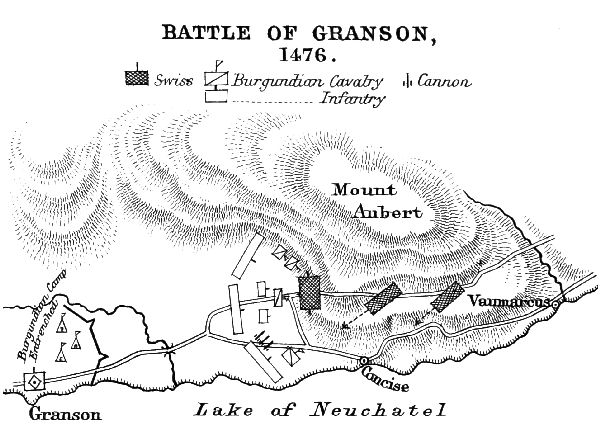
BATTLE OF GRANSON, 1476.
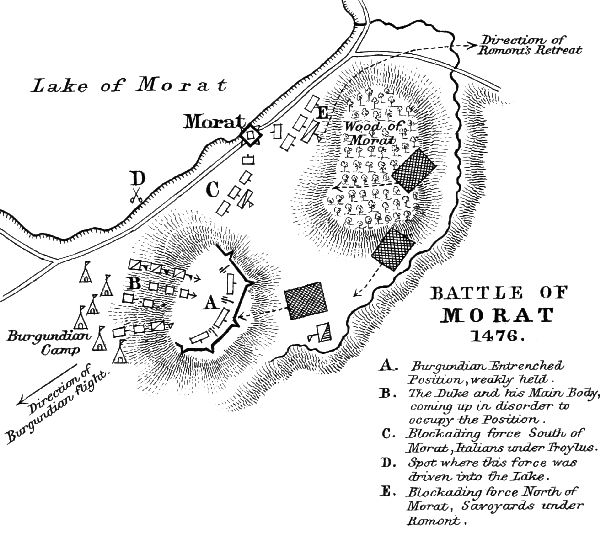
| A. |
Burgundian Entrenched Position, weakly held. |
| B. |
The Duke and his Main Body, coming up in disorder to occupy the Position. |
| C. |
Blockading force South of Morat, Italians under Troylus. |
| D. |
Spot where this force was driven into the Lake. |
| E. |
Blockading force North of Morat, Savoyards under Romont. |
In that fight the unskilful generalship of the Swiss had placed
the tactical advantages on the side of Charles: he had both outflanked
them and attacked one division of their army before the
others came up. He had, however, to learn that an army
superior in morale and homogeneity, and thoroughly knowing
its weapon, may be victorious in spite of all disadvantages.
Owing to their eagerness for battle the Confederate vanguard
(‘vorhut’), composed of the troops of Bern, Freiburg, and
Schwytz, had far outstripped the remainder of the force.
Coming swiftly over the hill side in one of their usual deep
columns, they found the whole Burgundian army spread out
before them in battle array on the plain of Granson. As they
reached the foot of the hill they at once saw that the duke’s
cavalry was preparing to attack them. Old experience had
made them callous to such sights: facing outwards the column
awaited the onset. The first charge was made by the cavalry
of Charles’ left wing: it failed, although the gallant lord of
Chateauguyon, who led it, forced his horse among the pikes and
died at the foot of the Standard of Schwytz. Next the duke
himself led on the lances of his guard, a force who had long
been esteemed the best troops in Europe: they did all that brave
men could, but were dashed back in confusion from the steady
line of spear-points. The Swiss now began to move forward
into the plain, eager to try the effect of the impact of their
phalanx on the Burgundian line. To meet this advance Charles
determined to draw back his centre, and when the enemy
advanced against it, to wheel both his wings round upon their
flank. The manœuvre appeared feasible, as the remainder of
the Confederate army was not yet in sight. Orders were
accordingly sent to the infantry and guns who were immediately
facing the approaching column, directing them to retire; while
at the same time the reserve was sent to strengthen the left
wing, the body with which the duke intended to deliver his
most crushing stroke. The Burgundian army was in fact
engaged in repeating the movement which had given
Hannibal victory at Cannæ: their fortune, however, was very
different. At the moment when the centre had begun to draw
back, and when the wings were not yet engaged, the heads of
the two Swiss columns, which had not before appeared, came
over the brow of Mont Aubert; moving rapidly towards the
battlefield with the usual majestic steadiness of their formation.
This of course would have frustrated Charles’ scheme for surrounding
the first phalanx; the échelon of divisions, which was
the normal Swiss array, being now established. The aspect of
the fight, however, was changed even more suddenly than might
have been expected. Connecting the retreat of their centre
with the advance of the Swiss, the whole of the infantry of the
Burgundian wings broke and fled, long before the Confederate
masses had come into contact with them. It was a sheer panic,
caused by the fact that the duke’s army had no cohesion or
confidence in itself; the various corps in the moment of danger
could not rely on each others’ steadiness, and seeing what they
imagined to be the rout of their centre, had no further thought
of endeavouring to turn the fortune of the day. It may be said
that no general could have foreseen such a disgraceful flight;
but at the same time the duke may be censured for attempting a
delicate manœuvre with an army destitute of homogeneity, and
in face of an enterprising opponent. ‘Strategical movements to
the rear’ have always a tendency to degenerate into undisguised
retreats, unless the men are perfectly in hand, and should therefore
be avoided as much as possible. Granson was for the
Swiss only one more example of the powerlessness of the best
cavalry against their columns: of infantry fighting there was
none at all.
In the second great defeat which he suffered at the hands of
the Confederates the duke was guilty of far more flagrant faults
in his generalship. His army was divided into three parts,
which in the event of a flank attack could bring each other
no succour. The position which he had chosen and fortified
for the covering of his siege-operations, only protected them
against an assault from the south-east. Still more strange was
it that the Burgundian light troops were held back so close to
the main-body, that the duke had no accurate knowledge of the
movements of his enemies till they appeared in front of his
lines. It was thus possible for the Confederate army to march,
under cover of the Wood of Morat, right across the front of the
two corps which virtually composed the centre and left of
Charles’ array. As it was well known that the enemy were
in the immediate vicinity, it is hard to conceive how the duke
could be content to wait in battle-order for six hours, without
sending out troops to obtain information. It is nevertheless
certain that when the Swiss did not show themselves, he sent
back his main-body to camp, and left the carefully entrenched
position in the charge of a few thousand men. Hardly had
this fault been committed, when the Confederate vanguard
appeared on the outskirts of the Wood of Morat, and marched
straight on the palisade. The utterly inadequate garrison made
a bold endeavour to hold their ground, but in a few minutes
were driven down the reverse slope of the hill, into the arms
of the troops who were coming up in hot haste from the camp
to their succour. The Swiss following hard in their rear pushed
the disordered mass before them, and crushed in detail each
supporting corps as it straggled up to attack them. The greater
part of the Burgundian infantry turned and fled,--with far more
excuse than at Granson. Many of the cavalry corps endeavoured
to change the fortune of the day by desperate but isolated
charges, in which they met the usual fate of those who endeavoured
to break a Swiss phalanx. The fighting, however,
was soon at an end, and mere slaughter took its place. While
the van and main-body of the Confederates followed the flying
crowd who made off in the direction of Avenches, the rear
came down on the Italian infantry, who had formed the besieging
force south of the town of Morat. These unfortunates,
whose retreat was cut off by the direction which the flight of
the main-body had taken, were trodden under foot or pushed
into the lake by the impact of the Swiss column, and entirely
annihilated, scarcely a single man escaping out of a force of
six thousand. The Savoyard corps, under Romont, who had
composed the duke’s extreme left, and were posted to the north
of Morat, escaped by a hazardous march which took them
round the rear of the Confederates.
Though Charles had done his best to prepare a victory for
his enemies by the faultiness of his dispositions, the management
of the Swiss army at Morat was the cause of the
completeness of his overthrow. A successful attack on the
Burgundian right would cut off the retreat of the two isolated
corps which composed the duke’s centre and left; the Confederate
leaders therefore determined to assault this point,
although to reach it they had to march straight across their
opponent’s front94. Favoured by his astonishing oversight in
leaving their march unobserved, they were able to surprise him,
and destroy his army in detail, before it could manage to form
even a rudimentary line of battle.
At Nancy the Swiss commanders again displayed considerable
skill in their dispositions: the main battle and the small rear
column held back and attracted the attention of the Burgundian
army, while the van executed a turning movement through the
woods, which brought it out on the enemy’s flank, and made
his position perfectly untenable. The duke’s troops assailed in
front and on their right at the same moment, and having to
deal with very superior numbers, were not merely defeated but
dispersed or destroyed. Charles himself refusing to fly, and
fighting desperately to cover the retreat of his scattered forces,
was surrounded, and cleft through helmet and skull by the
tremendous blow of a Swiss halberd.
The generalship displayed at Nancy and Morat was, however,
exceptional among the Confederates. After those battles, just
as before, we find that their victories continued to be won by
a headlong and desperate onset, rather than by the display of
any great strategical ability. In the Swabian war of 1499 the
credit of their successes falls to the troops rather than to their
leaders. The stormings of the fortified camps of Hard and
Malsheide were wonderful examples of the power of unshrinking
courage; but on each occasion the Swiss officers seem to have
considered that they were discharging their whole duty, when
they led their men straight against the enemy’s entrenchments.
At Frastenz the day was won by a desperate charge up the face
of a cliff which the Tyrolese had left unguarded, as being inaccessible.
Even at Dornach--the last battle fought on Swiss soil
against an invader till the eighteenth century--the fortune of
the fight turned on the superiority of the Confederate to the
Swabian pikemen man for man, and on the fact that the lances
of Gueldres could not break the flank column by their most
determined onset. Of manœuvring there appears to have been
little, of strategical planning none at all; it was considered
sufficient to launch the phalanx against the enemy, and trust
to its power of bearing down every obstacle that came in
its way.
Their disregard for the higher and more delicate problems
of military science, was destined to enfeeble the power and
destroy the reputation of the Confederates. At a time when
the great struggle in Italy was serving as a school for the
soldiery of other European nations, they alone refused to learn.
Broad theories, drawn from the newly-discovered works of the
ancients, were being co-ordinated with the modern experience
of professional officers, and were developing into an art of
war far superior to anything known in mediæval times. Scientific
engineers and artillerists had begun to modify the conditions
of warfare, and feudal tradition was everywhere discarded. New
forms of military efficiency, such as the sword-and-buckler men
of Spain, the Stradiot light cavalry, the German ‘black bands’
of musketeers, were coming to the front. The improvement of
the firearms placed in the hands of infantry was only less
important than the superior mobility which was given to field
artillery.
The Swiss, however, paid no attention to these changes; the
world around them might alter, but they would hold fast to
the tactics of their ancestors. At first, indeed, their arms were
still crowned with success: they were seen in Italy, as in more
northern lands, to ‘march with ten or fifteen thousand pikemen
against any number of horse, and to win a general opinion of
their excellence from the many remarkable services they performed95.’
They enjoyed for a time supreme importance, and
left their mark on the military history of every nation of central
and southern Europe. But it was impossible that a single
stereotyped tactical method, applied by men destitute of any
broad and scientific knowledge of the art of war, should continue
to assert an undisputed ascendancy. The victories of the
Swiss set every officer of capacity and versatile talent searching
for an efficient way of dealing with the onset of the phalanx.
Such a search was rendered comparatively easy by the fact that
the old feudal cavalry and the worthless mediæval infantry were
being rapidly replaced by disciplined troops, men capable of
keeping cool and collected even before the desperate rush of the
Confederate pikemen. The standing army of Charles of Burgundy
had been rendered inefficient by its want of homogeneity
and cohesion, as well as by the bad generalship of its leader.
The standing armies which fought in Italy thirty years later
were very different bodies. Although still raised from among
various nations, they were united by the bonds of old comradeship,
of esprit de corps, of professional pride, or of confidence in
some favourite general. The Swiss had therefore to face
troops of a far higher military value than they had ever before
encountered.
The first experiment tried against the Confederates was that
of the Emperor Maximilian, who raised in Germany corps of
pikemen and halberdiers, trained to act in a manner exactly
similar to that of their enemies. The ‘Landsknechts’ soon won
for themselves a reputation only second to that of the Swiss,
whom they boldly met in many a bloody field. The conflicts
between them were rendered obstinate by military as well as
national rivalry: the Confederates being indignant that any
troops should dare to face them with their own peculiar tactics,
while the Germans were determined to show that they were
not inferior in courage to their Alpine kinsmen. The shock
of the contending columns was therefore tremendous. The
two bristling lines of pikes crossed, and the leading files were
thrust upon each other’s weapons by the irresistible pressure
from behind. Often the whole front rank of each phalanx went
down in the first onset, but their comrades stepped forward over
their bodies to continue the fight96. When the masses had been
for some time ‘pushing against each other,’ their order became
confused and their pikes interlocked: then was the time for the
halberdiers to act97. The columns opened out to let them pass,
or they rushed round from the rear, and threw themselves into
the mêlée. This was the most deadly epoch of the strife: the
combatants mowed each other down with fearful rapidity. Their
ponderous weapons allowed of little fencing and parrying, and
inflicted wounds which were almost invariably mortal. Everyone
who missed his blow, or stumbled over a fallen comrade, or
turned to fly, was a doomed man. Quarter was neither expected
nor given. Of course these fearful hand-to-hand combats could
not be of great duration; one party had ere long to give ground,
and suffer the most fearful losses in its retreat. It was in a
struggle of this kind that the Landsknechts lost a full half of
their strength, when the Swiss bore them down at Novara. Even,
however, when they were victorious, the Confederates found
that their military ascendancy was growing less: they could no
longer sweep the enemy from the field by a single unchecked
onset, but were confronted by troops who were ready to turn
their own weapons against them, and who required the hardest
pressure before they would give ground. In spite of their defeats
the Landsknechts kept the field, and finally took their revenge
when the Swiss recoiled in disorder from the fatal trenches of
Bicocca.
There was, however, an enemy even more formidable than
the German, who was to appear upon the scene at a slightly
later date. The Spanish infantry of Gonsalvo de Cordova displayed
once more to the military world the strength of the tactics
of old Rome. They were armed, like the men of the ancient
legion, with the short thrusting sword and buckler, and wore the
steel cap, breast- and back-plates and greaves. Thus they were
far stronger in their defensive armour than the Swiss whom they
were about to encounter. When the pikeman and the swordsman
first met in 1502, under the walls of Barletta, the old problem
of Pydna and Cynoscephalæ was once more worked out.
A phalanx as solid and efficient as that of Philip the Macedonian
was met by troops whose tactics were those of the legionaries
of Æmilius Paullus. Then, as in an earlier age, the wielders of
the shorter weapon prevailed. ‘When they came to engage, the
Swiss at first pressed so hard on their enemy with the pike, that
they opened out their ranks; but the Spaniards, under the cover
of their bucklers, nimbly rushed in upon them with their swords,
and laid about them so furiously, that they made a great slaughter
of the Swiss, and gained a complete victory98.’ The vanquished,
in fact, suffered at the hands of the Spaniard the treatment which
they themselves had inflicted on the Austrians at Sempach. The
bearer of the longer weapon becomes helpless when his opponent
has closed with him, whether the arms concerned be lance
and halberd or pike and sword. The moment a breach had
been made in a Macedonian or Swiss phalanx the great length
of their spears became their ruin. There was nothing to do
but to drop them, and in the combat which then ensued troops
using the sword alone, and without defensive armour, were at a
hopeless disadvantage in attacking men furnished with the
buckler as well as the sword, and protected by a more complete
panoply. Whatever may be the result of a duel between sword
and spear alone, it is certain that when a light shield is added to
the swordsman’s equipment, he at once obtains the ascendancy.
The buckler serves to turn aside the spear-point, and then the
thrusting weapon is free to do its work99. It was, therefore,
natural that when Spanish and Swiss infantry met, the former
should in almost every case obtain success. The powerlessness
of the pike, however, was most strikingly displayed at a
battle in which the fortune of the day had not been favourable
to Spain. At the fight of Ravenna Gaston de Foix had succeeded
in driving Don Ramon de Cardona from his intrenchments,
and was endeavouring to secure the fruits of victory by
a vigorous pursuit. To intercept the retreat of the Spanish
infantry, who were retiring in good order, Gaston sent forward
the pikemen of Jacob Empser, then serving as auxiliaries beneath
the French banner. These troops accordingly fell on the retreating
column and attempted to arrest its march. The Spaniards,
however, turned at once and fell furiously on the Germans,
‘rushing at the pikes, or throwing themselves on the ground
and slipping below the points, so that they darted in among the
legs of the pikemen,’--a manœuvre which reminds us of the
conduct of the Soudanese Arabs at El Teb. In this way they
succeeded in closing with their opponents, and ‘made such good
use of their swords that not a German would have escaped, had
not the French horse come up to their rescue100.’ This fight was
typical of many more, in which during the first quarter of the
sixteenth century the sword and buckler were proved to be able
to master the pike. It may, therefore, be asked why, in the face
of these facts, the Swiss weapon remained in use, while the
Spanish infantry finally discarded their peculiar tactics. To
this question the answer is found in the consideration that the
sword was not suited for repulsing a cavalry charge, while the
pike continued to be used for that purpose down to the invention
of the bayonet in the end of the seventeenth century. Machiavelli
was, from his studies in Roman antiquity, the most devoted
admirer of the Spanish system, which seemed to bring back the
days of the ancient legion. Yet even he conceded that the pike,
a weapon which he is on every occasion ready to disparage,
must be retained by a considerable portion of those ideal armies
for whose guidance he drew up his ‘Art of War.’ He could
think of no other arm which could resist a charge of cavalry
steadily pressed home, and was therefore obliged to combine
pikemen with his ‘velites’ and ‘buckler-men.’
The rapid development of the arts of the engineer and
artillerist aimed another heavy blow at the Swiss supremacy.
The many-sided energy of the Renaissance period not unfrequently
made the professional soldier a scholar, and set him to
adapt the science of the ancients to the requirements of modern
warfare. The most cursory study of Vegetius Hyginus or
Vitruvius, all of them authors much esteemed at the time, would
suffice to show the strength of the Roman fortified camp.
Accordingly the art of Castramentation revived, and corps of
pioneers were attached to every army. It became common to
intrench not merely permanent positions, but camps which were
to be held for a few days only. Advantage was taken of favourable
sites, and lines of greater or less strength with emplacements
for artillery were constructed for the protection of the
army which felt itself inferior in the field. Many of the greatest
battles of the Italian wars were fought in and around such
positions; Ravenna, Bicocca, and Pavia are obvious examples.
Still more frequently a general threw himself with all his forces
into a fortified town and covered it with outworks and redoubts
till it resembled an intrenched camp rather than a mere fortress.
Such a phase in war was most disadvantageous to the Swiss:
even the most desperate courage cannot carry men over stone
walls or through flooded ditches, if they neglect the art which
teaches them how to approach such obstacles. The Confederates
in their earlier days had never displayed much skill in
attacking places of strength; and now, when the enemy’s
position was as frequently behind defences as in the open plain,
they refused to adapt their tactics to the altered circumstances.
Occasionally, as for example at the storming of the outworks of
Genoa in 1507, they were still able to sweep the enemy before
them by the mere vehemence of their onset. But more frequently
disaster followed the headlong rush delivered against
lines held by an adequate number of steady troops. Of this the
most striking instance was seen in 1522, when the Swiss columns
attempted to dislodge the enemy from the fortified park of
Bicocca. Under a severe fire from the Spanish hackbut-men
they crossed several hedges and flooded trenches, which
covered the main position of the imperialists. But when they
came to the last ditch and bank, along which were ranged the
landsknechts of Frundsberg, they found an obstacle which they
could not pass. Leaping into the deep excavation the front
ranks endeavoured to scramble up its further slope; but every
man who made the attempt fell beneath the pike-thrusts of the
Germans, who, standing on a higher level in their serried ranks,
kept back the incessant rushes with the greatest steadiness.
Three thousand corpses were left in the ditch before the Swiss
would desist from their hopeless undertaking; it was an attack
which, for misplaced daring, rivals the British assault on
Ticonderoga in 1758.
The improved artillery of the early sixteenth century worked
even more havoc with the Confederates. Of all formations the
phalanx is the easiest at which to aim, and the one which suffers
most loss from each cannon ball which strikes it. A single shot
ploughing through its serried ranks might disable twenty men,
yet the Swiss persisted in rushing straight for the front of
batteries and storming them in spite of their murderous fire.
Such conduct might conceivably have been justifiable in the fifteenth
century, when the clumsy guns of the day could seldom deliver
more than a single discharge between the moment at which
the enemy came within range and that at which he reached their
muzzles. Scientific artillerists, however, such as Pietro Navarro
and Alphonso D’Este, made cannon a real power in battles by
increasing its mobility and the rapidity of its fire. None the less
the Confederates continued to employ the front attack, which
had become four or five times more dangerous in the space of
forty years. A fearful lesson as to the recklessness of such
tactics was given them at Marignano, where, in spite of the
gallantry of the French gendarmerie, it was the artillery which
really won the day. The system which Francis’ advisers there
employed was to deliver charge after charge of cavalry on the
flanks of the Swiss columns, while the artillery played upon
them from the front. The onsets of the cavalry, though they
never succeeded in breaking the phalanx, forced it to halt and
‘form the hedgehog.’ The men at arms came on in bodies of
about five hundred strong, one taking up the fight when the first
had been beaten off. ‘In this way more than thirty fine charges
were delivered, and no one will in future be able to say that
cavalry are of no more use than hares in armour,’ wrote the
king to his mother. Of course these attacks would by themselves
have been fruitless; it was the fact that they checked the
advance of the Swiss, and obliged them to stand halted under
artillery fire that settled the result of the battle101. At last the
columns had suffered so severely that they gave up the attempt
to advance, and retired in good order, unbroken but diminished
by a half in their size.
Last but not least important among the causes of the decline
of the military ascendancy of the Confederates, was the continual
deterioration of their discipline. While among other
nations the commanders were becoming more and more masters
of the art of war, among the Swiss they were growing more and
more the slaves of their own soldiery. The division of their
authority had always been detrimental to the development of
strategical skill, but it now began to make even tactical arrangements
impossible. The army looked upon itself as a democracy
entitled to direct the proceedings of its ministry, rather than a
body under military discipline. Filled with a blind confidence
in the invincibility of their onset, they calmly neglected the
orders which appeared to them superfluous. On several occasions
they delivered an attack on the front of a position which
it had been intended to turn; on others they began the conflict,
although they had been directed to wait for the arrival of other
divisions before giving battle. If things were not going well
they threw away even the semblance of obedience to their leaders.
Before Bicocca the cry was raised, ‘Where are the officers, the
pensioners, the double-pay men? Let them come out and earn
their money fairly for once: they shall all fight in the front rank
to-day.’ What was even more astonishing than the arrogance
of the demand, was the fact that it was obeyed. The commanders
and captains stepped forward and formed the head of
the leading column; hardly one of them survived the fight, and
Winkelried of Unterwalden, the leader of the van-guard, was the
first to fall under the lances of Frundsberg’s landsknechts.
What was to be expected from an army in which the men gave
the orders and the officers executed them? Brute strength and
heedless courage were the only qualities now employed by the
Swiss, while against them were pitted the scientific generals of
the new school of war. The result was what might have been
expected: the pike tactics, which had been the admiration of
Europe, were superseded, because they had become stereotyped,
and the Swiss lost their proud position as the most formidable
infantry in the world.