In the plain text version Italic text is denoted by _underscores_.
The sign ^ represents a superscript; thus ^e represents the lower
case letter “e” written immediately above the level of the previous
character, while ^{text} means the word “text” is written as
surperscript.
This volume includes a subject index for this and for the previous
two volumes of this collection. In the HTML version only the material
covered in this volume was possible to link to the corresponding page
numbers.
Obvious punctuation and other printing errors have been corrected.
The book cover has been modified by the Transcriber and is included in
the public domain.
THE ART OF MUSIC
The Art of Music
A Comprehensive Library of Information
for Music Lovers and Musicians
Editor-in-Chief
DANIEL GREGORY MASON
Columbia University
Associate Editors
EDWARD B. HILLLELAND HALL Harvard UniversityPast Professor, Univ. of Wisconsin
Managing Editor
CÉSAR SAERCHINGER
Modern Music Society of New York
In Fourteen Volumes
Profusely Illustrated
NEW YORK THE NATIONAL SOCIETY OF MUSIC
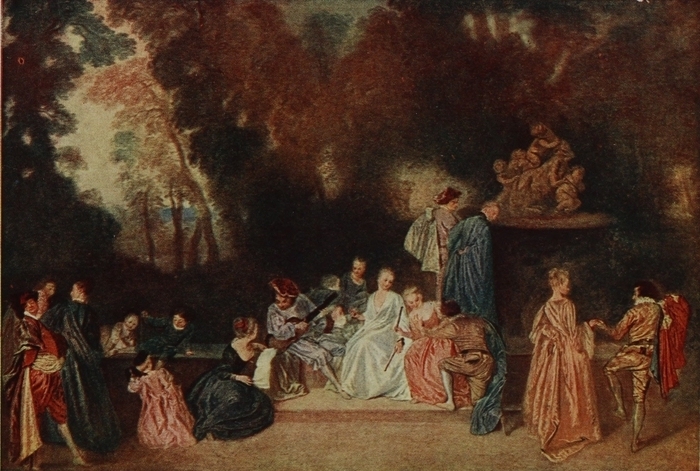
Garden Concert
Painting by Antoine Watteau
THE ART OF MUSIC: VOLUME THREE Modern Music
Being Book Three of
A Narrative History of Music
Department Editors:
EDWARD BURLINGAME HILL
AND
ERNEST NEWMAN
Music Critic, 'Daily Post,' Birmingham, England
Author of 'Gluck and the Opera,' 'Hugo Wolf,' 'Richard Strauss,' etc.
Introduction by
EDWARD BURLINGAME HILL
Instructor in Musical History, Harvard University
Formerly Music Critic, 'Boston Evening Transcript'
Editor, 'Musical World,' etc.
NEW YORK
THE NATIONAL SOCIETY OF MUSIC
Copyright, 1915, by
THE NATIONAL SOCIETY OF MUSIC, Inc.
[All Rights Reserved]
MODERN MUSIC
INTRODUCTION — I — II — III
The direct sources of modern music are to be found
in the works of Berlioz, Chopin, Liszt, and Wagner.
This assertion savors of truism, but, since the achievement
of these four masters in the enlargement of harmonic
idiom, in diversity of formal evolution, and in
intrinsic novelty and profundity of musical sentiment
and emotion remains so unalterably the point of departure
in modern music, reiteration is unavoidable
and essential. It were idle to deny that various figures
in musical history have shown prophetic glimpses of
the future. Monteverdi's taste for unprepared dissonance
and instinct for graphic instrumental effect; the
extraordinary anticipation of Liszt's treatment of the
diminished seventh chord, and the enharmonic modulations
to be found in the music of Sebastian Bach, the
presages of later German romanticism discoverable in
the works of his ill-fated son Wilhelm Friedemann, constitute
convincing details. The romantic ambitions of
Lesueur as to program-music found their reflection in
the superheated imagination of Berlioz, and the music-drama
of Wagner derives as conclusively from Fidelio
as from the more conclusively romantic antecedents of
Euryanthe. But, despite their illuminating quality,
these casual outcroppings of modernity do not reverse
the axiomatic statement made above.
The trend of modern music, then, may be traced first
along the path of the pervasive domination of Wagner;
second, the lesser but no less tenacious influence of
Liszt; it includes the rise of nationalistic schools, the
gradual infiltration of eclecticism leading at last to recent
quasi-anarchic efforts to expand the technical elements
of music.
If the critics of the late nineteenth and the twentieth
centuries have successfully exposed not only the æsthetic
flaws in Wagner's theory of the music-drama,
but also his own obvious departures in practice from
pre-conceived convictions, as well as the futility of
much of his polemic and philosophical writings, European
composers of opera, almost without exception,
save in Russia, have frankly adopted his methods in
whole or in part. Bruckner, Bungert, d'Albert, Schillings,
Pfitzner, Goldmark, Humperdinck, Weingartner,
and Richard Strauss in Germany; Saint-Saëns (in varying
degree), Chabrier, Lalo, Massenet (temporarily),
Bruneau and Charpentier (slightly), d'Indy, Chausson,
and Dukas in France; Verdi (more remotely), Puccini,
and possibly Wolf-Ferrari in Italy; Holbrooke in England,
are among the more conspicuous whose obligation
to Wagner is frankly perceptible. In Germany
the most prominent contributors to dramatic literature,
aside from Cornelius, with Der Barbier von Bagdad, and
Goetz with Der Widerspenstigen Zähmung, have been
Goldmark, Humperdinck, and Richard Strauss. The
latter, with an incredibly complex system of leading
motives, an elaborately contrapuntal connotation of
dramatic situations, aided by an intensely psychological
orchestral descriptiveness, has reached the
summit of post-Wagnerian drama. His later dramatic
experiments—a ruthless adaptation of Molière's
Bourgeois gentilhomme, containing the one-act opera
Ariadne auf Naxos, and the ballet 'The Legend of
Joseph'—are distinctly less representative examples of
his dramatic resourcefulness. In France, the Wagnerian
influence is typified in such works as Chabrier's
Gwendoline, d'Indy'sFervaal, and to a lesser extent
Chausson's Le Roi Arthus. Bruneau's realistic operas
and Charpentier's sociological Louise belong, first of
all, to the characteristically French lyric drama in
which the Wagnerian element is relatively unimportant.
In Debussy's Pelléas et Mélisande, Dukas'
Ariane et Barbe-bleue, Ravel's L'Heure espagnole, and
Fauré's Pénélope, we find a virtually independent conception
of opera which may be almost described as
anti-Wagnerian. In Italy, the later Verdi shows an
independent solution of dramatic problems, although
conscious of the work of Wagner. Puccini is the successor
of Verdi, rather than the follower of Wagner,
although his use of motives and treatment of the orchestra
shows at least an unconscious assimilation of
Wagnerian practice, Mascagni and Leoncavallo are virtually
negligible except for their early successes, and
one or two other works. Younger composers like
Montemezzi and Zadonai are beginning to claim attention,
but Wolf-Ferrari, combining Italian instinct with
German training, seems on the way to attain a renascence
of the opera buffa, provided that he is not again
tempted by the sensational type represented by 'The
Jewels of the Madonna.' Opera in England has remained
an exotic, save for the operettas of Sullivan,
despite the efforts of British composers to vitalize it.
Holbrooke's attempt to produce an English trilogy
seems fated to join previous failures, notwithstanding
his virtuosity and his dramatic earnestness. Russian
composers for the stage have steadily resisted the invasion
of Wagnerian methods. Adhering, first of all,
to the tenets of Dargomijsky, individuals have gradually
adopted their own standpoint. The most characteristic
works are Borodine's Prince Igor, Rimsky-Korsakoff's
Sniégourutchka, Sadko, Mlada, Le Coq d'Or,
and Moussorgsky's Boris Godounoff and Khovanshchina.
In the field of orchestral composition, the acceptance
of Wagner's procedure in orchestration is even more
universal than his dramatic following. If his system
follows logically from the adoption of valve horns and
valve trumpets, the enlargement of wind instrument
groups and the subdivision of the strings, its far-reaching
application is still a matter of amazement to the
analyst. Even if it be granted that Wagner himself
predaciously absorbed individual methods of treatment
from Weber, Meyerbeer, Berlioz, and Liszt, the
ultimate originality of his idiom justified his manifold
obligations. German composers, except among the followers
of Brahms, appropriated his extension of orchestral
effect as a matter of course, the most notable
being Bruckner, Goldmark, Humperdinck, Mahler, and
Strauss. If the two latter in turn can claim original
idioms of their own, the antecedents of their styles are
none the less evident. French composers from Saint-Saëns
to Dukas have made varying concessions to his
persuasive sonorities; even the stanch Rimsky-Korsakoff
fell before the seduction of Wagnerian amplitude
and variety of color. Glazounoff, Taneieff, Scriabine,
and other Russians followed suit. Among English composers,
Elgar and Bantock fell instinctively into line,
followed in some degree by William Wallace and Frederick
Delius. If Holbrooke is more directly a disciple
of Richard Strauss, that fact in itself denotes an unconscious
acknowledgment to Wagner.
If Liszt has had a less all-embracing reaction upon
modern composers, his sphere of influence has been
marked and widely extended. To begin with, his harmonic
style has been the subject of imitation second
only to Wagner up to the advent of Richard Strauss
and Debussy. His invention of the structurally elastic
symphonic poem remains the sole original contribution
in point of form which the nineteenth century can
claim. For even the cyclic sonata form of Franck is
but a modification of the academic type, and was foreshadowed
by Beethoven and Schumann. The vast evolution
of structural freedom, the infinite ramifications
of subtle and dramatic program-music, and the resultant
additions of the most stimulating character to modern
musical literature rest upon the courageous initiative
of Liszt. In France, Saint-Saëns' pioneer examples,
though somewhat slight in substance, prepared the way
for César Franck's Les Éolides and Le Chasseur maudit,
Duparc's Lénore, d'Indy's La forêt enchantée, the programmistic
Istar variations, Jour d'été à la Montagne,
Dukas' L'Apprenti-sorcier, Debussy's Prélude à l'Après-midi
d'un faune and the Nocturnes (programmistic if
impressionistic), Florent Schmitts' Tragédie de Salomé,
and Roussel's Evocations. In Germany, Richard
Strauss' epoch-making series of tone-poems, from Macbeth
to Also sprach Zarathustra, combine descriptive
aptitude and orchestral brilliance with a masterly
manipulation of formal elements. Weingartner's Die
Gefilde der Seligen and Reger's Böcklin symphonic
poems may be added to the list. In Russia, Balakireff's
Thamar, Borodine's 'Sketch from Central Asia,' Rimsky-Korsakoff's
Scheherezade (although a suite), Glazounoff's
Stenka Razine and other less vital works,
Rachmaninoff's 'Isle of the Dead,' Scriabine's 'Poem of
Ecstasy' and 'Poem of Fire' mark the path of evolution.
Smetana's series of six symphonic poems entitled 'My
Home' result directly from the stimulus of Liszt. In
Finland, Sibelius' tone-poems on national legendary
subjects take a high rank for their poetic and dramatic
qualities. If in England, Bantock's 'Dante and Beatrice,'
'Fifine at the Fair' and other works, Holbrooke's
'Queen Mab,' Wallace's 'François Villon,' Delius' 'Paris'
and Elgar's 'Falstaff' exhibit differing degrees of merit,
the example of Liszt is still inspiriting. Moreover, the
Lisztian treatment of the orchestra, emphasizing as it
does a felicitous employment of instruments of percussion,
has proved a remarkable liberating force, especially
in Russia and France. Liszt's piano idiom has
been assimilated even more widely than in the case of
the symphonic poem and orchestral style. Smetana,
Saint-Saëns, Balakireff, and Liapounoff occur at once
as salient instances.
The contributory reaction of Berlioz and Chopin
upon modern music has been relatively less direct, if
still apparent. It was exerted first in fertile suggestions
to Wagner and Liszt at a susceptible and formative
stage in their careers. Both have played some part in
the awakening of Russian musical consciousness, Berlioz
through his revolutionary orchestral style and
programmistic audacity, Chopin through his insinuating
pianistic idiom, which we find strongly reflected in
the earlier works of Scriabine. Some heritage of Berlioz
can undoubtedly be traced in the music of Gustav
Mahler, although expressed in a speech quite alien to
that of the French pioneer of realism.
It may be remarked in passing that the influence of
Brahms has been intensive rather than expansive. This
statement is entirely compatible with a just appraisal of
the worth and profundity of his music, nor can it in
any way be interpreted as a detraction of his unassailable
position. But in consideration of the absence of
the coloristic and extreme subjective elements in
Brahms' style, and in view of its conserving and reactionary
force, the great symphonist cannot be regarded
as specifically modernistic. Still, with his extraordinary
cohesiveness of form and vital rhythmic
progress, both in symphonic writing, chamber music
and piano pieces, Brahms has affected Reger, Weingartner
and Max Bruch in Germany, but also Glazounoff,
Rachmaninoff, Medtner, Parry, and others outside
of it.
With the four symphonies of Brahms the long evolution
of the classic form in Germany has apparently
come to an end with an involuntary recognition that
little more could be attained upon conventional lines.
The symphonies of Bruckner emphasize this realization.
Following in Wagner's orchestral footsteps, both
their structure and their ideas are of unequal value, in
which separate movements not infrequently rise to
sublimity of expression and dramatic fervor. While
opinion is still divided as to the merit of Mahler's ten
symphonies, they represent isolated instances of powerfully
conceived and tenaciously executed works
whose orchestral eloquence is in singularly apt conformity
with their substance. After a precocious and
conservative symphony, composed at the age of nineteen,
which pleased Brahms, Richard Strauss waited
twenty years before attempting in the Symphonia Domestica
so elastic a form as almost to escape classification
in this type. Despite much foolish controversy
over the programmistic features of this work, its brilliant
musical substance, its fundamental and logical
coherence, and the remarkable plastic coördination of
its themes constitute it a unique experiment in free
symphonic structure. In France, the symphony has
evolved a type somewhat apart from the Teutonic
example, although an outcome of it, namely, the
cyclical, in which its themes are derived from generative
phrases. After three innocuous specimens (one
unpublished) Saint-Saëns' third symphony shows many
of the attributes of classicality. César Franck's symphony
in D minor embodies most of his best qualities,
together with much structural originality. Lalo's more
fragile work in G minor displays a workmanship and
individuality which entitles it to record. Chausson's
Symphony in B-flat, despite its kinship with Franck,
possesses a significance quite beyond its actual recognition.
D'Indy, after composing an excellent cyclic work
upon a French folk-song, produced his instrumental
masterpiece with a second in B-flat, which for logical
structure and fusion of classic elements with modernistic
sentiment deserves to be classed as one of the
finest of its time. If Russian symphony composers
have not as a whole reached as high a mark as in the
freer and more imaginative forms, nevertheless Rimsky-Korsakoff,
Borodine, Balakireff, Glazounoff, Rachmaninoff,
and Taneieff have displayed sympathy with
classic ideals, and have achieved excellent if not surpassing
results within these limits. The symphonies of
Parry, Cowen and others in England have enlarged
little upon the conventional scope. Elgar raised high
hopes with his first symphony in A-flat, but speedily dismissed
them with his second in E-flat. Sibelius, in Finland,
having given proof of his uncommon creative
force and delineative imagination in his tone-poems,
has also exhibited unusual originality and vitality in
his four symphonies. The last of these virtually departs
from a genuine symphonic form, but its novelty alike in
ideas and treatment suggests that he, too, demands
greater elasticity of resource. For the problem of combining
the native style and technical requirements of
the symphony with modern sentiment is one of increasing
difficulty.
The field of piano music, chamber works, songs and
choral works is of too wide a range for detailed indication
of achievement. The piano music of Balakireff,
Liapounoff, Rachmaninoff, Scriabine, of Grieg, of
Franck, Debussy, Dukas, and Ravel, of Cyril Scott and
others merits a high place. The chamber music of
Smetana, Dvořák, Grieg (despite its shortcomings),
Franck, d'Indy, Fauré, Ravel, of Wolf, Strauss and
Reger deserves an equal record. The songs of Wolf
and Strauss, of Duparc, Fauré and Debussy, of Moussorgsky,
of Sibelius; the choral works of Franck, d'Indy,
Pierné, Schmitt, of Delius, Bantock, Elgar and other
Englishmen are conspicuous for technical and expressive
mastery.
Apart from the general assimilation of the innovating
features due to Wagner and Liszt, the most striking
factor in musical evolution of the late nineteenth and
twentieth centuries has been the rise of nationalistic
schools of composition. These have deliberately cultivated
the use of native folk-song and dance-rhythms,
and in the case of operas and symphonic poems have
frequently drawn upon national legend for subjects.
One of the earliest of these groups was the Bohemian,
whose leader, Smetana, already mentioned in connection
with the symphonic poem, chamber and piano
music, also won a distinguished place by his vivacious
comic opera 'The Bartered Bride,' known abroad chiefly
by its inimitable overture. If Dvořák promised to be a
worthy disciple of a greatly talented pioneer, his abilities
were diffused by falling a victim to commissions
from English choral societies, and in endeavoring to
emulate Brahms. In reality he was most significant
when unconscious, as in the Slavic Dances and his naïve
and charming Suite, op. 39, although his symphony
'From the New World' and certain chamber works
based upon negro themes are as enduring as anything
he composed. Hampered by a truly Schubertian lack
of self-criticism, his path toward oblivion has been hastened
by this fatal defect, although his national flavor
and piquant orchestral color deserve a juster fate.
In the Scandinavian countries Grieg, and, to a lesser
degree, Nordraak, as well as Svendsen and Sinding
tempered nationality with German culture. Grieg, the
more dominant personality, was a born poet, and imparted
a truly national fervor to his songs and piano
pieces. In the sonata form he was pathetically inept,
despite the former popularity of his chamber works and
piano concerto. Certain mannerisms in abuse of sequence,
and a too persistent cultivation of small forms,
have caused his works to lose ground rapidly; nevertheless
Grieg has given a poetic and nationalistic savor
to his best music that makes it impossible to overlook
its value.
A coterie of accomplished and versatile musicians
which yields to none for intrinsic charm, vitality, and
poetic spontaneity is that of the so-called Neo-Russians,
self-styled 'the Invincible Band.' Resenting Rubinstein's
almost total surrender to Teutonic standards,
and scorning Tschaikowsky as representing a pitiable
compromise between Russian and German standpoints,
they revolted against conventional technique with as
great pertinacity as did Galileo, Peri, Caccini, and
Monteverdi in the late sixteenth century. Their æsthetic
foster-father, Balakireff, for a time dominated the
studies and even supervised the composition of the
members—Borodine, Cui, Moussorgsky, and Rimsky-Korsakoff.
Ultimately, each followed his own path,
though not without a certain community of ideal. Aiming
to continue the work of Glinka and Dargomijsky,
both in opera and instrumental music, they wished to
use folk-songs for themes and to utilize national legends
or fairy stories. But they could not resist the
alien form of the symphonic poem, and with it the
orchestra of Liszt, and, while they opposed the Wagnerian
dramatic forms, one at least, Rimsky-Korsakoff,
could not withstand the palpable advantages of the
Wagnerian orchestra. Their works combined the elements
of western and oriental Russia, adhered largely
to folk-song or elements of its style, and in the opera
embodied folk-dances, semi-Pagan worship and ceremonial
with striking nationalistic effect. Many of their
orchestral pieces have taken place in the international
repertory of orchestras; of the operas a smaller number
have penetrated to European theatres. While the
nationalistic operas of Rimsky-Korsakoff are little
known beyond Russia, they show his talent in a broadly
humanistic and epic standpoint, hardly hinted at in
his orchestral works. Moussorgsky's Boris Godounoff,
one of the finest operas since Wagner, claims attention
from the fact that it attains dramatic vitality
from a standpoint diametrically opposed to Wagner.
The influence of Boris Godounoff is palpable as forming
the subtle dramatic idiom of Pelléas et Mélisande.
Glazounoff, Taneieff, and Glière represent the cosmopolitan
element among Russian composers of to-day.
Of these Glazounoff is the most notable. His
early symphonic poem, Stenka Razine, gave promise
of an original and brilliant career, but instead he has
become steadily more reactionary. Among his eight
symphonies there is scarcely one that is preëminent
from beginning to end. His ballets, Raymonda, 'The
Seasons,' and 'Love's Ruses,' have been surpassed by
younger men. His violin concerto is among his most
able works. A master of technique and structure and
a remarkably erudite figure, his lack of progressiveness
has been against him. A younger composer, Tcherepnine,
is known for his skillful ballets, 'Narcissus,' 'Pan
and Echo,' and 'The Pavilion of Armida,' which incline,
nevertheless, towards the conventional. Rachmaninoff
is also of reactionary tendencies, although his piano
concertos and his fine symphonic poem, 'The Isle of
the Dead,' have shown his distinction.
The rise of the modern French school, largely owing
to a patriotic reaction after the Franco-Prussian war
and the liberal policies of the National Society, has
brought about one of the most fertile movements in
modern music. The transition from the operas of
Gounod, Thomas, Bizet, and the early Massenet to those
of Chabrier, Lalo, d'Indy, Bruneau, Charpentier, Debussy,
Dukas, Ravel, and Fauré is remarkable for its
concentrated progress in dramatic truthfulness. Similarly,
beginning with the eclectic and facile Saint-Saëns,
the more romantic and fearless Lalo, and the
mystic Franck, through the audacious Chabrier and
the suave and poetic Fauré, including the serious and
devoted followers of Franck, d'Indy, Duparc, de Castillon,
Chausson, and Lekeu, the versatile Dukas, to
the epoch-making Debussy with the younger men
like Ravel, Schmitt and Roussel, French instrumental
music has developed, on the one hand, a fervently
classic spirit despite its modernism and, on
the other, an impressionistic exoticism which is without
parallel in modern music. Aside from a vitally new
harmonic idiom, which in Debussy reaches its greatest
originality despite d'Indy, Fauré, and the later developments
of Ravel, the attainment of racially distinct
dramatic style in such works as Debussy's Pelléas et
Mélisande, Dukas' Ariane et Barbe-bleue, Ravel's
L'Heure espagnole, and Fauré's Pénélope is one of
the crowning achievements of this group. Furthermore,
following the examples of the younger Russians,
the ballets of Jeux and Khamma by Debussy, La Péri
by Dukas, La Tragédie de Salomé by Florent Schmitt,
Le Festin de l'Arraignée by Roussel, Orphée by Roger-Ducasse,
and, most significant of all, Daphnis et Chloé
by Maurice Ravel, have given a remarkable impetus
to a genuine choreographic revival.
There has been no nationalistic development in England
comparable to that in other countries, although
there has been no lack of serious and sustained effort
to be both modern and individual. The most important
of British composers is undoubtedly Elgar, who has attained
something like independence with his brilliant
and well-made orchestral works, and more especially
for his oratorio 'The Dream of Gerontius.' If Elgar
only carried on further a systematized use of the leading
motive as suggested by Liszt in his oratorios, it was
done with a dramatic resource and eloquence which
made the method his own. Bantock, gifted with an
orchestral perception above the average, showing a
natural aptitude for exoticism, achieved a successful
fusion of eclectic elements with individuality in his
three-part setting of the Rubaîyat of Omar Khayyám.
Other choral works and orchestral pieces have met
with a more uncertain reception. William Wallace has
been conspicuous for his imaginative symphonic
poems, and the insight of his essays on music. Frederick
Delius, partly German, has maintained a personal
and somewhat detached individuality in orchestral,
choral and dramatic works of distinctive value.
Josef Holbrooke has been mentioned already for his
unusual mastery of orchestral technique, and his courageous
and ambitious attempts in opera. Many
younger composers are striving to be personal and independent,
though involuntarily affected by one or another
of existent currents in modern music. Of these
Cyril Scott attempts a praiseworthy modernistic and
impressionistic sentiment, in which he leans heavily on
Debussy's harmonic innovations. Thus, while English
composers have been active, they have fallen to the
ready temptations of eclecticism, a growing force in
music of to-day, and in consequence their art has not
the same measure of nationalistic import as in Russia,
France, and Germany.
In the meantime, as the musical world has moved
forward in respect to structure from the symphony to
the symphonic poem, followed by its logical sequence
the tone-poem, in which the elements of various forms
have been incorporated, so has there been progress
and even revolution in the technical material of music
itself. Dargomijsky was probably the pioneer in using
the whole-tone scale, as may be seen in the third act
of his opera 'The Stone Guest,' composed in 1869.
Rimsky-Korsakoff elaborated on his foundation as early
as 1880 in his opera Sniégourutchka. Moussorgsky
showed unusually individual harmonic tendencies, as
the first edition of Boris Godounoff before the revisions
and alterations by Rimsky-Korsakoff clearly demonstrate.
After casual experiments by Chabrier, d'Indy,
and Fauré, Debussy founded an original harmonic system,
in which modified modal harmony, a remarkable
extension of whole-tone scale chords, the free use of
ninths, elevenths and thirteenths are the chief ingredients.
Dukas has imitated Debussy to some extent,
Ravel owes much to him; both have developed independently,
Ravel in particular has approached if not
crossed the boundaries of poly-harmony. Scriabine,
following the natural harmonic heritage of the Russians,
has evolved an idiom of his own possessing considerable
novelty but disfigured by monotony, in that
it consists chiefly of transpositions of the thirteenth-chord
with the alteration of various constituent intervals.
What he might not have accomplished can only
be conjectured, since his career has been terminated
by his sudden death. Although Richard Strauss has
greatly enlarged modern harmonic resource, his results
must be regarded on the whole as a by-product
of his contrapuntal virtuosity. In his treatise on harmony
Schönberg refers to his 'discovery' of the whole-tone
scale long after both Russians and French had
used it, but it is noteworthy that Schönberg arrived at
the conception of this scale and its chords with an absolute
and unplagiaristic independence.
The most recent developments affecting the technical
character of music are poly-harmony, or simultaneous
use of chords in different keys, and free dissonant
counterpoint. Striking instances of the former type
of anarchic experiment may be found in the music
of Igor Stravinsky, whose reputation has been made
by the fantastic imagination and the dramatic sincerity
of his ballets 'The Bird of Fire,' Petrouchka, 'The Ceremonial
of Spring,' and 'The Nightingale.' In these he
has mingled Russian and French elements, fusing them
into a highly personal and extremely dissonant style,
which in its pungent freedom and ingenious mosaic of
tonalities is both highly diverting and poignantly expressive.
Stravinsky is one of the most daring innovators
of to-day, and both his dramatic vitality and the
audacity of his musical conceptions mark him as a
notable figure from whom much may be expected.
If Maurice Ravel, as shown in his ballet Daphnis et
Chloé, was a pioneer in poly-harmony, Alfred Casella,
of Italian parentage but of French education, has gone
considerably further. Similar tendencies may be found
in the music of Bartók, Kodály and other Hungarians.
It seemed formerly that Strauss had pushed the dissonant
contrapuntal style as far as it could go, but his
style is virtually conventional beside that of the later
Schönberg. Schönberg has already passed through
several evolutionary stages, but his mature idiom abjures
tonality to an incredible extent, and he forces the
procedures of free counterpoint to such audacious disregard
of even unconventional euphony that few can
compass his musical message. Time may prove, however,
that tonality is a needless convention, and it is
possible to declare that there is nothing illogical in his
contrapuntal system. It lies in the extravagant extension
of principles of dissonance which have already
been accepted. It is indubitable that Schönberg succeeds
in expressing moods previously unknown to musical
literature, and it is conceivable that music may
encompass unheard-of developments in this direction,
just as poly-harmony has already proved extremely
fruitful.
The developments of poly-harmony and dissonant
contrapuntal style prophesy the near inadequacy of
our present musical scale. Busoni and others have
long since advocated a piano in which the sharps and
flats should have separate keys. As music advanced
from the modes to the major and minor keys, and
finally to the chromatic scale, so the necessity for a
new scale may constitute logically the next momentous
problem in musical art.
Within recent years, the barriers of nationalism have
become relaxed. An almost involuntary interchange of
idioms has caused music to take on an international
character despite a certain maintenance of racial traits.
Eclecticism is becoming to a certain extent universal.
Achievement is too easily communicable from one
country to another. In some respects music was more
interesting when it was more parochial. To prophesy
that music is near to anarchy is to convict one's self of
approaching senility, for the ferment of the revolutionary
element has always existed in art. Since the
time of Wagner and Liszt, however, musical development
has proceeded with such extreme rapidity as to
endanger the endurance of our traditional material.
Poly-harmony, dissonant counterpoint and the agitation
for a new scale are suspicious indications. Disregarding
the future, however, let us realize that the
diversity and complexity of modern music is enthralling,
and that most of us can readily endure it as it
now is for a little longer.
Introductory; the term 'modern'—The 'old-romantic'
tradition and the 'New German' school—The followers of
Mendelssohn: Lachner, F. Hiller, Rietz, etc.; Carl Reinecke—Disciples
of Schumann: Robert Volkmann; Bargiel, Kirchner
and others; the Berlin circle; the musical genre artists:
Henselt, Heller, etc. (pianoforte); Jensen, Lassen, Abt, etc.
(song)—The comic opera and operetta: Lortzing, Johann
Strauss, etc.—French eclecticism in symphonic and operatic
composition: Massenet—Saint-Saëns, Lalo, Godard, etc.
Romantic Nationalism in Russian Music—Pathfinders;
Cavos and Verstovsky—Mikhail Ivanovich Glinka; Alexander
Sergeyevitch Dargomijsky—Neo-Romanticism in Russian
music; Anton Rubinstein—Peter Ilyitch Tschaikowsky.
The rise of national schools in the nineteenth century—Growth
of national expression in Scandinavian lands—Music
in modern Denmark—Sweden and her music—The
Norwegian composers; Edvard Grieg—Sinding and other
Norwegians—The Finnish Renaissance: Sibelius and others.
The founders of the 'Neo-Russian' nationalistic school:
Balakireff; Borodine—Moussorgsky—Rimsky-Korsakoff, his
life and works—César Cui and other nationalists, Napravnik,
and others.
The border nationalists; Alexander Glazounoff, Liadoff,
Liapounoff, etc.—The renaissance of Russian church music;
Kastalsky and Gretchaninoff—The new eclectics: Arensky,
Taneieff, Ippolitoff-Ivanoff, Glière, Rachmaninoff and others—Scriabine
and the radical foreign influence; Igor Stravinsky.
Characteristics of Czech music; Friedrich Smetana—Antonin
Dvořák—Zdenko Fibich and others; Joseph Suk and
Vitešlav Novák—Historical sketch of musical endeavor in
Hungary—Ödön Mihálovich, Count Zichy and Jenö Hubay—Dohnányi
and Moór; 'Young Hungary': Weiner, Béla Bartók
and others.
VII.
The Post-Classical and Poetic Schools of Modern Germany
The post-Beethovenian tendencies in the music of Germany
and their present-day significance; the problem of
modern symphonic form—The academic followers of
Brahms: Bruch and others—The modern 'poetic' school:
Richard Strauss as symphonic composer—Anton Bruckner,
his life and works—Gustav Mahler—Max Reger—Draeseke
and others.
The Wagnerian after-current: Cyrill Kistler; August
Bungert, Goldmark, etc.; Max Schillings, Eugen d'Albert—The
successful post-Wagnerians in the lighter genre: Götz,
Cornelius and Wolf; Engelbert Humperdinck and fairy
opera; Ludwig Thuille; Hans Pfitzner; the Volksoper—Richard
Strauss as musical dramatist—Hugo Wolf and the
modern song; other contemporary German lyricists—The
younger men: Klose, Hausegger, Schönberg, Korngold.
The foundations of modern French nationalism: Berlioz;
the operatic masters: Saint-Saëns, Lalo, Franck, etc.;
conditions favoring native art development—The pioneers
of ultra-modernism: Emanuel Chabrier and Gabriel Fauré—Vincent
d'Indy: his instrumental and his dramatic
works—Other pupils of Franck: Ernest Chausson; Henri
Duparc; Alexis de Castillon; Guy Ropartz.
Impressionism in Music—Claude Debussy, the pioneer
of the 'atmospheric' school; his career, his works and his
influence—Maurice Ravel, his life and work—Alfred
Bruneau; Gustave Charpentier—Paul Dukas—Miscellany;
Albert Roussel and Florent Schmitt.
The musical traditions of modern Italy—Verdi's heirs:
Boito, Mascagni, Leoncavallo, Puccini, Wolf-Ferrari, Franchetti,
Giordano, Orefice, Mancinelli—New paths; Montemezzi,
Zandonai and de Sabbata.
Martucci and Sgambati—The symphonic composers:
Zandonai, de Sabbata, Alfano, Marinuzzi, Sinigaglia, Mancinelli,
Floridia; the piano and violin composers: Franco
da Venezia, Paolo Frontini, Mario Tarenghi; Rosario Scalero,
Leone Sinigaglia; composers for the organ—The song
writers: art songs; ballads.
Social considerations; analogy between English and
American conditions—The German influence and its results:
Sterndale Bennett and others; the first group of independents:
Sullivan, Mackenzie, Parry, Goring Thomas,
Cowen, Stanford and Elgar—The second group: Delius and
Bantock; McCunn and German; Smyth, Davies, Wallace
and others, D. F. Tovey; musico-literary workers, musical
comedy writers—The third group: Vaughan Williams, Coleridge-Taylor
and W. Y. Hurlstone; Holbrooke, Grainger,
Scott, etc.; Frank Bridge and others; organ music, chamber
music, songs.
CHAPTER I BY- AND AFTER-CURRENTS OF THE ROMANTIC MOVEMENT — I — II — III — IV — V
Introductory; the term 'modern'—The 'old-romantic' tradition and the
'New German' school—The followers of Mendelssohn: Lachner, F. Hiller,
Rietz, etc.; Carl Reinecke—Disciples of Schumann: Robert Volkmann; Bargiel,
Kirchner and others; the Berlin circle; the musical genre artists:
Henselt, Heller, etc. (pianoforte); Jensen, Lassen, Abt, etc. (song)—The
comic opera and operetta: Lortzing, Johann Strauss, and others—French
eclecticism in symphonic and operatic composition: Massenet—Saint-Saëns,
Lalo, Godard, etc.
The term 'Modern Music,' which forms the title of this
volume, is subject to several interpretations. Just as in
the preceding volume we were obliged to qualify our
use of the words 'classic' and 'romantic,' partly because
all such nomenclature is more or less arbitrary, partly
because of the fusion of styles and dove-tailing of periods
which may be observed in the history of any art,
so it now becomes necessary to define the word 'modern'
in its present application.
Now 'modern' may mean merely new or up-to-date.
And in that sense it may indicate any degree of newness:
it may include the last twenty-five years or the
last century, or it may be made to apply to contemporaneous
works only. But in another sense—that generally
accepted in connection with music—it means 'advanced,'
progressive, or unprecedented in any other
period. Here, too, we may understand varying degrees
of modernity. The devotees of the most recent development,
impatient of the usual broad application of the
term, have dubbed their school the 'futurist.' In fact,
any of these characterizations, whether in a time sense
or a quality sense, are merely relative. Wagner's disciples,
disdainful of the romanticists, called his music
the 'music of the future.' Now, alas, critics classify
him as a romantic composer! Bach, on the other hand,
long popularly regarded as an archaic bugaboo, is
now frequently characterized as a veritable modern.
'How modern that is!' we exclaim time and again, while
listening to an organ toccata or fugue arranged by
Busoni! Beethoven, the great classic, is in his later
period certainly more 'modern' than many a romanticist—Mendelssohn,
for instance, or even Berlioz—though
only in a harmonic sense, for he had not the command
of orchestral color that the great and turbulent Frenchmen
made accessible to the world.
The newness of the music is thus seen to have little
to do with its modernity. Even the word 'contemporary'
gives us no definite clue, for there are men living
to-day—like Saint-Saëns—whose music is hardly modern
when compared to that of a Wolf, dead these
twelve years, or his own late countrymen Chabrier and
Fauré—not to speak of the recently departed Scriabine
with his clavier à lumière.
But it is quite impossible to include in such a volume
as this only the true moderns—in the æsthetic sense.
We should have to go back to Beethoven with his
famous chord comprising every degree of the diatonic
scale (in the Ninth Symphony), or at least to Chopin,
according to one interpretation. According to another
we should have to exclude Brahms and all his neo-classical
followers who content themselves with composing
in the time-honored forms. (Since there will
always be composers who prefer to devote themselves
to the preservation and continuation of formal tradition,
this 'classical' drift will, as Walter Niemann remarks,
be a 'modernism' of all times.) Brahms has, as
a matter of fact, been disposed of in the preceding volume,
but the inclusion in the present volume of men
like Volkmann, Lachner, etc., some of whom were born
long before Brahms, calls for an apology. It is merely
a matter of convenience, just as the treatment of men
like Glinka and Gade in connection with the nationalistic
developments of the later nineteenth century is
merely an expedient. Such chronological liberties are
the historian's license. We have, to conclude, simply
taken the word modern in its widest and loosest sense,
both as regards time and quality, and we shall let the
text explain to what degree a composer justifies his
position in the volume. We may say at the outset that
all the men reviewed in the present chapter would
have been included in Volume II but for lack of space.
In Volume II the two great movements known as the
classic and the romantic have been fairly brought to a
close. Brahms and Franck on the one side, Wagner
and Liszt on the other, may be considered to have concluded
the romantic period as definitely as Beethoven
concluded the classic. Like him, too, they not only surveyed
but staked out the path of the future. But no
great art movement is ever fully concluded. (It has
been said by æsthetic philosophers that we are still in
the era of the Renaissance.) Just as in the days of Beethoven
there lived the Cherubinis, the Clementis, the
Schuberts (as regards the symphony at least) who trod
in the great man's footsteps or explored important by-paths,
in some respects supplemented and completed
his work; so there are by- and after-currents of the
Romantic Movement which also cannot be ignored.
They are represented by men like Lachner, Ferdinand
Hiller, Reinecke and Volkmann in Germany; by Saint-Saëns,
Massenet and Lalo in France; Gade in Denmark.[1]
Some of their analogous predecessors have all
but passed from memory, perhaps their own works
will soon disappear from the current répertoire. Especially
in the case of the Germans (whose country has
certainly suffered the strain of over-cultivation and
over-production, and which has produced in this age
the particular brand known as 'kapellmeister music')
is this likely. But it must be borne in mind that these
composers had command of technical resources far beyond
the ken of their elder brothers; also that, by virtue
of the more subjective qualities characteristic of the
music of their period, as well as the vastly broadened
musical culture of this later day, they were able to
appeal more readily to a very wide audience.
The historical value of these men lies in their exploitation
of these same technical resources. They thoroughly
grasped the formulæ of their models; what the
pioneers had to hew out by force, these followers acquired
with ease. They worked diligently within these
limits, exhausting the possibilities of the prescribed
area and proving the ground, so to speak, so that newcomers
might tread upon it with confidence. They
were not as uncompromising, perhaps, as the pioneers
and high-priests themselves and therefore fused styles
that others thought irreconcilable. What seemed iconoclastic
became commonplace in their hands. Thus
their eclecticism opened the way for new originalities;
their very conservatism induced progress.
Germany, it will be remembered, was, during Wagner's
lifetime, divided into two camps: the classic-romantic
Mendelssohn-Schumann school which later
rallied about the person of Brahms, on the one hand,
and the Wagner-Liszt, sometimes called the late-romantic
or 'New German' school, on the other. The adherents
of the former are those whom we have called the
poets, the latter the painters, in music; terms applying
rather to the manner than to the matter, since the
'painters,' for another reason—namely, because they
believed that a poetic idea should form the basis of the
music and determine its forms—might with equal rights
call themselves 'poets.' And, indeed, their followers,
the 'New Germans,' among whom we reckon Mahler
and Strauss, constitute what in a later chapter we have
called the 'poetic' school of contemporary Germany.
Few musicians accepted Wagner's gospel in his lifetime.
Raff and other Liszt disciples, the Weimar group,
in other words, were virtually the only ones. A host,
however, worshipped the names of Mendelssohn and
Schumann. They gathered in Leipzig, their citadel,
where Mendelssohn reorganized the Gewandhaus concerts
in 1835,[2] and founded the Royal Conservatory in
1843, and in the Rhine cities, where Schumann's influence
was greatest. These men flourished during the
very time that Wagner was the great question of the
day. While preaching the gospel of romanticism, they
also upheld the great classic traditions. The advent of
Brahms, indeed, brought a revival of pure classic feeling.
This persists even to-day in the works of men
whose romantic inspirations, akin to Mendelssohn,
Schumann, and Chopin, find expression in forms of
classic cast.
Both Schumann and Wagner were reformers interested
in the broadening of musical culture, the improvement
of taste, and the establishment of a standard of
artistic propriety—Wagner on the stage, Schumann in
the concert room. The former was successful, the latter
only partially so. For, while the standards of the concert
room are much higher to-day than they were in
Schumann's day, musical taste in the home, which
should be guided by these standards, has, if anything,
deteriorated. The reason for this lies primarily in one
of the inevitable developments of musical romanticism
itself—the genre tendency; secondarily, in the fact that,
while the Wagnerians were propagandists, writers of
copious polemics and agitators, the classic romanticists
were purely professional musicians who disdained to
write, preferring deeds to words (and incidentally doing
far too much), or else, like Hiller, were feuilletonists,
pleasant gossips about their art and nothing more.
The development of the small forms, the miniature,
the genre in short, and the corresponding decay of the
larger forms was perhaps the most outstanding result of
the romantic movement. Wagner alone, the dramatic
romanticist, continued to paint large canvases, frescoes
in vivid colors. The 'poetic' romanticists were of a lyric
turn, and required compact and intimate forms of expression.
They had created the song, they had built
up a new piano literature out of small pieces, miniatures
like Schubert's 'Musical Moments,' Schumann's
'Fantasy Pieces,' Mendelssohn's 'Songs without Words,'
Field's 'Nocturnes,' Chopin's Dances, Preludes, and
Études. Franz, Jensen, Lassen, and others continued
the song; Brahms, with his Intermezzi; Henselt, Heller,
and Kirchner, with his piano miniatures, the piano
piece. The first degenerated into Abt, Curschmann, and
worse, the second into the type of thing of which 'The
Last Hope' and 'The Maiden's Prayer' were the ultimate
manifestations. Sentiment ran over in small gushes
and drippings, even the piano study was made the vehicle
for a sigh. The sonata of a former day became a
sonatina or an 'impromptu' of one kind or another.
The parallel thing now happened in other fields.
The concert overture of Mendelssohn had in a measure
displaced the symphony. What has been called the
'genre symphony' of Mendelssohn, Schumann, et al.
was also in the direction of minimization. Even Brahms
in his gigantic works emphasizes the tendency by the
intermezzo character of his slow movements, by the
orchestral filigree partaking of the chamber music
style. Now came the revival of the orchestral suite by
Lachner and Raff, the sinfonietta, and the serenade for
small orchestra. Again we sense the same trend in the
appearance of the choral ballad and in the tremendous
output of small dramatic cantatas for mixed or men's
voices.
In France, instrumental literature during the nineteenth
century had been largely tributary to that of
Germany, just as its opera earlier in the century was
of Italian stock. But the development of the 'grand'
opera of Meyerbeer, on the one hand, and the opéra
comique, on the other, had produced a truly Gallic form
of expression, of which the romanticism of the century
made use. Gounod and his colleagues of the lyric
drama; Bizet, the genius of his generation, with his
sparkling rhythms, his fine tunes and his orchestral
freshness; Délibes and David with their oriental color,
compounded a new French idiom which already found
a quasi-symphonic expression in the L'Arlésienne suites
of Bizet. Berlioz stands as a colossus among his generation
and to this day has perhaps not been quite assimilated
by his countrymen. The Germans have
profited from his orchestral reforms at least as much as
the French. But he gave the one tremendous impetus
to symphonic composition, stimulated interest in Beethoven
and Weber and so pointed the way for his
younger compatriots. Already he speaks of Saint-Saëns
as an accomplished musician.
Saint-Saëns is, indeed, the next great exponent of the
classic tradition as well as the earliest disciple of the
late romantic school of Liszt and Wagner in France.
Beside him, Massenet, no less great as technician, forms
the transition to modernism on the operatic side, while
Lalo and Godard devote themselves to both departments.
César Franck, the Belgian, stands aloof in his
ascetic isolation as the real creator of the modern
French idiom.
We shall now consider some of these 'transition' composers
in detail; first the Germans, then the French.
Certain attributes they all have in common. Most of
them lived long and prospered, enjoying a wide influence
or popularity in their day; Lachner and Reinecke
both came near to ninety; Volkmann near eighty; Saint-Saëns
is still hale at eighty. All of them were highly
productive: Hiller, Reinecke, Raff, and Lachner surpassed
200 in their opus-numbers; Saint-Saëns has gone
well over a hundred; and Massenet has written no less
than twenty-three operas alone. Nearly all of them
were either virtuosos or conductors: Hiller, Reinecke,
Saint-Saëns, Bülow, Henselt, Heller were brilliant pianists;
Lachner, Saint-Saëns, and Widor also organists;
Godard a violinist. The first four of these were eminent
conductors. Most of them were pedagogues besides;
some, such as Reinecke, Hiller, Jadassohn, Rietz,
and Massenet, among the most eminent of their generation.
Franz Lachner is the oldest of them. He was born,
1803, in Rain (Upper Bavaria), and died, 1890, in Munich.
Thus he came near filling out four-score and ten,
antedating Wagner by ten years and surviving him by
seven. His career came into actual collision with that
of the Bayreuth master too, since the latter's coming
to Munich as the favorite of the newly ascended King
Ludwig II forced Lachner from his autocratic position
as general musical director.
Many forces must have reacted upon an artist whose
life thus spans the ages. He was a friend of Schubert
in Vienna, where he became organist in 1824, and is
said to have found favor even with Beethoven. Sechter
and Abbé Stadler gave him the benefit of their learning.
After holding various conductor's posts in Vienna
and in Mannheim he finally found his way to Munich,
where he had already brought out his D minor symphony
with success. As court kapellmeister he conducted
the opera, the church performances of the royal
chapel choir and the concerts of the Academy, meanwhile
creating a long series of successful works, nearly
all of which exhibit his astounding contrapuntal skill.
His seven orchestral suites, a form which he and Raff revived,
occupy a special place in orchestral literature,
as a sort of direct continuation of Bach's and Händel's
instrumental works. They are veritable treasure stores
of contrapuntal art. Perhaps another generation will
appreciate them better; to-day they have fallen into
neglect. This is even more true of his eight symphonies,
four operas, two oratorios, etc. Of his chamber
music (piano quartets, string quartets, quintets, sextets,
nonet for wind, etc.), his piano pieces and songs, influenced
by Schubert, some few numbers have survived.
Most prominent in Mendelssohn's immediate train is
Ferdinand Hiller. His junior only by two years (he
was born Oct. 24, 1811, in Frankfurt), he followed
closely in the footsteps of that master. Like him, he
came of Jewish and well-to-do parents; like him, he had
the advantage of an early training, a broad culture
and wide travel. A pupil of Hummel and a brilliant
pianist, he was presented to Beethoven in Vienna; in
Paris he hobnobbed with Cherubini, Rossini, Chopin,
Liszt, Meyerbeer and Berlioz, taught and concertized;
in Milan he produced an opera (Romilda) by the aid
of Rossini. Mendelssohn, already his friend, brought
out his oratorio 'Jerusalem Destroyed' at the Gewandhaus
in 1840, and in 1843-44 (after a sojourn in Rome)
he himself directed the Gewandhaus concerts made famous
by Mendelssohn. Shortly after, he inaugurated a
series of subscription concerts in Dresden, also conducting
a chorus, and there brought out two operas
(Traum in der Christnacht, 1845, and Konradin, 1847).
Finally he did for Cologne what Mendelssohn had done
for Leipzig by organizing the conservatory and the Gewandhaus
concerts: he established the Cologne conservatory
(1850) and became conductor of the Konzertgesellschaft
and the Konzertchor, both of which participated
in the famous Gürzenich concerts and the
Rhenish music festivals. The eminence of his position
may be deduced from the fact that in 1851-52 he was
asked to direct the Italian opera in Paris. As teacher
and pianist he was no less renowned. For that reason
alone history cannot ignore him.
As a composer Hiller illustrates what we have said
of the degeneration of the early romantic school into
musical genre, though as a contemporary of Mendelssohn
he must be reckoned as a by-rather than a post-romantic.
He commanded only the small forms, in
which, however, he displayed great technical finish,
polished grace and a 'clever pedantry.' In short piano
pieces, Rêveries (of which he wrote four series), impromptus,
rondos, marches, waltzes, variations, and
études he was especially happy. An F-sharp major
piano concerto, sonatas and suites, as well as his chamber
works (violin and 'cello sonatas, trios, quartets,
etc.), are grateful and pleasing in their impeccable
smoothness. But his six operas, two oratorios, three
symphonies and other large works have gone the way
of oblivion. His numerous overtures, cantatas, choral
ballads, vocal quartets, duets and songs stamp him as
a real, miniature-loving romantic. In productivity, too,
he remains true to the breed; his opus numbers exceed
two hundred. Hiller died in Cologne in 1885.
Another friend of Mendelssohn was Julius Rietz
(1812-77), whose brother Eduard, the violinist, had
been the friend of the greater master's youth. He, too,
after conducting in Düsseldorf, came to the Leipzig
Gewandhaus as Gade's successor in 1848, took Mendelssohn's
place as municipal musical director and taught
at the conservatory until he became court kapellmeister
and head of the conservatory in Dresden. His editorial
work, the complete editions of the works of Bach, Händel,
Beethoven, Mendelssohn, and Mozart, published
by the house of Breitkopf and Härtel, are important.
His compositions are wholly influenced by Mendelssohn.
Among the few who actually had the benefit of Mendelssohn's
personal tuition is Richard Wüerst (1824-81),
whose activities were, however, centred in Berlin,
where he was musical director from 1874, royal
professor from 1877, and a member of the Academy.
His second symphony (op. 21) was prize-crowned in
Cologne and his cantata, Der Wasserneck, is a grateful
composition for mixed chorus. Several of his songs
also have become popular.
Karl Reinecke is less exclusive in his influence. He
divides his allegiance at least equally between Mendelssohn
and Schumann. He is the example par excellence
of the professional musician, the cobbler who
sticks to his last. He did not, like Hiller, indulge in
literary chit-chat about his art, confining himself to
writings of pedagogical import. He learned his craft
from his father, an excellent musician and drill-master,
and never had to go outside his home for direct instruction.
Thus he became an accomplished pianist
(unrivalled at least in one department—Mozart), at
nineteen appeared as virtuoso in Sweden and Denmark,
and in 1846-48 was court pianist to King Christian VIII.
After spending some time in Paris he joined Hiller's
teaching staff in Cologne conservatory, then held conductor's
posts in Barmen and Breslau, and finally
(1860) occupied Mendelssohn's place at the Gewandhaus
in Leipzig. There, when the new building was
dedicated in 1884, his bust in marble was placed beside
those of Mendelssohn and Schumann, and not till 1885
was he dethroned from his seat of authority—with the
advent of Nikisch. At the conservatory, too, his activity
was continuous from 1860 on—as instructor in piano
and free composition. From 1897 to his retirement in
1902 he was director of studies.
Reinecke was born in 1824 at Altona, near Hamburg,
and enjoyed the characteristic longevity of the 'transition'
composers, living well into the neighborhood of
ninety. In fecundity he surpasses even Hiller, for his
works number well-nigh three hundred. Besides Mendelssohnian
perfection, well-rounded classic form and
fine organization in workmanship, flavored with a
touch of Schumannesque subjectivity, Reinecke shows
traces of more advanced influences. The idioms of
Brahms and even the 'New Germans' crept into his
work as time went on. Of course, since Reinecke was
a famous pedagogue, his piano compositions (sonatas
for two and four hands, sonatinas, fantasy pieces, caprices,
and many other small forms) enjoyed a great
reputation as teaching material, which somewhat overshadowed
their undoubted intrinsic value as music.
His four piano concertos are no longer heard, nor are
those for violin, for 'cello, and for harp. But his chamber
music—the department where thorough musicianship
counts for most—is no doubt the most staple item
in his catalogue. There are a quintet, a quartet, seven
trios, besides three 'cello sonatas, four violin sonatas,
and a fantasy for violin and piano, also a sonata for
flute. His most popular and perhaps his best work are
the Kinderlieder, 'of classic importance in every sense,
easily understood by children and not without interest
for adults.'[3] Again it is the miniature form that prevails.
Similarly in the orchestral field, the overtures
(Dame Kobold, Aladin, Friedensfeier, Festouvertüre,
In memoriam) and the serenade for string orchestra
have outlasted the three symphonies, while the operas
('King Manfred,' 1867, three others, and the singspiel
'An Adventure of Händel'), as well as an oratorio,
masses, etc., have already faded from memory, though
the smaller choral works, with orchestra and otherwise
(including the Fairy Poems for women's voices and
the cycle Von der Wiege bis zum Grabe), still maintain
themselves in the repertoire of German societies.
Salomon Jadassohn (1831-1902) was still more of a
pedagogue and less of a composer. Yet he wrote copiously,
over one hundred works being published. It is
to be noted that he was a pupil of Liszt as well as
Moritz Hauptmann, but he gravitated to Leipzig and
lived there from 1852 on. He has a particular fondness
for the canon form and makes his chief mark in orchestral
and chamber music. But his teaching manuals
on harmony and counterpoint are his real monument.
Undoubtedly the most important contemporary of
Brahms, following in tracks of Schumann, was Robert
Volkmann. His acquaintance with Schumann was the
predominating stimulus of his artistic career, and, since
Brahms is too big and independent a genius to deserve
the epithet, Volkmann may count as the Düsseldorf
master's chief epigone. He was but five years younger
than Schumann, being born April 6, 1815, at Lommatzsch
in Saxony, the son of a cantor, who instructed
him in piano and organ playing. He studied theory
with Anacker in Freiberg and K. F. Becker in Leipzig.
He taught in Prague (1839) and Budapest (1842), lived
in Vienna 1854-58, and again in Prague, where he was
professor of harmony and counterpoint at the National
Academy of Music, and died in 1893.
His first published work, the 'Fantasy Pictures' for
piano, appeared in 1839 in Leipzig. Unlike most other
composers of this group, he managed to give his larger
forms a permanent value; his two symphonies, in B
major (op. 44) and D minor (op. 53) respectively, are
still frequently played. Especially the last contains
matter that is imbued with real feeling and effectively
handled. His three serenades for string orchestra
(opera 62, 63, and 69, the last with 'cello obbligato)
are no less pleasing, and, in spite of the tribute which
Volkmann pays to Schumann in all his works, even
original. Of other instrumental music there are two
overtures, the piano trio in B minor, which first made
Volkmann's name more widely known, together with
two string quartets in A minor and G minor, one other
trio and four more quartets, a 'cello concerto, a romance
each for 'cello and violin (with piano), a Konzertstück
for piano and a number of small works for
piano as well as for violin and piano. Among his
vocal compositions two masses for men's voices and
a number of secular pieces for solo voice with orchestral
accompaniment are the most important.
Woldemar Bargiel (1828-97), Theodor Kirchner
(1824-1903), Karl Grädener (1812-83), and Albert Dietrich
(b. 1829) are all disciples of Schumann. The first,
a stepbrother of Clara Schumann, is perhaps the most
important. He worked chiefly with the orchestra and
chamber combinations, his overture to 'Medea' and his
trios being most noteworthy, but he contributed to choral
and solo song literature as well. Kirchner is known
for his finely emotional piano miniatures (some accompanied
by string instruments) as well as for chamber
music and songs. Grädener, too, composed in all
these forms, and Dietrich, who was court kapellmeister
in Oldenburg and was in close personal touch with
Schumann in Düsseldorf, left symphonies, overtures,
chamber music and songs altogether in the spirit of
the great arch-romantic.
The composers so far discussed constitute what is
sometimes called the Leipzig circle. While they can
not in any sense be considered as radicals, and, indeed,
were frequently attacked as conservative or academic
by the followers of the more radical wing which made
its headquarters at Weimar, they appear distinctly progressive
when compared with the ultra-conservative
group of composers centred in Berlin, who made it
their particular duty to uphold tradition and to apply
their energies to the creation of choral music of rather
antique type. 'It may be that the attitude of certain
Berlin masters,' says Pratt,[4] 'like Grell, Dehn, and Kiel,
serve a useful purpose as a counterpoise to the impulsive
swing of style away from the traditions of the
old vocal counterpoint. They certainly helped to keep
musical education from forgetting solid structure in
composition amid its desires to exploit impressionistic
and sensational devices. Probably this reactionary
influence did good in the end, though its intolerant
narrowness exasperated the many who were eagerly
searching out new paths. It at least resulted in making
Berlin a centre for choral music of a severe type, for
able teachers of the art of singing, for musical theory
and for scholarly investigators of musical history.' It
may be added that the Royal Academy was the stronghold
of this extreme 'right wing,' and that the chief
institutions which helped to uphold old vocal traditions
were the Singakademie, the Domchor, the Institut
für Kirchenmusik (later merged into the Hochschule
für Musik). The Conservatory, founded in 1850 by
Marx, Kullak, and Stern, and the Neue Akademie der
Tonkunst, established in 1855 by Theodor Kullak, also
acquired considerable importance.
Eduard August Grell (1800-86) gave proof of his
contrapuntal genius in a series of sacred works including
a sixteen-part mass, an oratorio, and a Te
Deum, besides many songs and motets. He assisted
Rungenhagen in conducting the Singakademie from
1832, becoming sole conductor and teacher of composition
at the Academy in 1851, and was a musician of
very wide influence. Siegfried Dehn (1799-1858) is
chiefly important as teacher of a number of the composers
mentioned in this chapter and as the author of
treatises. Friedrich Kiel (1821-85), whose requiem in
F minor has been called among all later works of this
class the most worthy successor of those of Mozart and
Cherubini, has also written a Missa Solemnis, an oratorio
Christus, and another Requiem (A minor)—works
which attest above all the writer's polyphonic
skill, and which prove the appropriateness of applying
such a style to modern works of devotional character.
Kiel's Stabat mater, Te Deum, 130th Psalm and two-part
motets for women's voices, as well as his chamber
music and piano pieces, are all worthy of consideration.
Karl Friedrich Rungenhagen (d. 1851) and August Wilhelm
Bach (d. 1869), both noted as composers of choral
music, may complete our review of the 'Berlin circle.'
There remain to be mentioned those specialists who
are concerned almost exclusively with the two most
characteristic mediums of the romantic genre—the
piano piece and the song. Schumann and Chopin had
brought the miniature piano composition to its highest
plane of expression and the most advanced technical
standard, which even the dramatic imagination and the
virtuoso brilliance of Liszt could not surpass. They
and such milder romanticists as Mendelssohn and John
Field had brought this class of music within the reach
of amateurs, Schumann even within that of the child.
Brahms, with no thought of the dilettante, had intensified
this form of expression, making a corresponding
demand upon technical ability. It remained for men
like Adolf Henselt, Stephen Heller, and Theodor Kullak
to popularize the new pianistic idiom, as Clementi,
Hummel, and Moscheles had popularized that of the
classics. These are the real workers in genre, monochrome
genre, with their pictorial description, their
somewhat bourgeois romanticism and sometimes maudlin
sentimentality. Even their études are cast in an
easy lyrical vein which was made to convey the pretty
sentiment.
Henselt (1814-89) was an eminent pianist, born in
Silesia, pupil of Hummel and Sechter in Vienna. After
1838 he lived in St. Petersburg. Pieces like the Poème
d'amour and the 'Spring Song' are comparable to Mendelssohn's
'Songs without Words,' but they are more
richly embroidered and of a fuller sonority. His F
minor concerto is justly famous. Stephen Heller (1814-88)
was also famous as a concert pianist. Of his compositions,
to the number of 150, all for his own instrument,
many are truly and warmly poetic in content.
Though lacking Schumann's passion and Chopin's harmonic
genius, he surpasses Mendelssohn in the originality
and individuality of his ideas. In a number of his
things, probably pot-boilers, he leans dangerously to
the salon type of composition, with which many of his
immediate followers flooded the market. We are all
familiar with the album-leaf, fly-leaf, mood-picture,
fairy and flower piece variety of piano literature, as
well as the pseudo-nature study, the travel picture in
which the Rhine and its castles and Loreley, the Alps
and its cowbells, Venice with its barcarolles and Naples
with its tarantellas figure so conspicuously.
Kullak (1818-82), already mentioned as the founder
of the Neue Akademie of Berlin and famous both as
pianist and teacher, wrote some 130 works, most of
which is in the salon type or in the form of brilliant
fantasias and paraphrases, less important, perhaps,
than his études ('School of Octave Playing,' etc.). The
piano technicians Henri Hertz (1803-88), Sigismund
Thalberg (1812-71), Karl Klindworth (b. 1830), Karl
Tausig (1841-71), Nicolai Rubinstein (1835-81), brother
of Anton and founder of the Moscow conservatory, and
Hans von Bülow, of whom we shall speak later, might
all be mentioned in this connection, though their work
as virtuosi, teachers, and editors is of greater moment
than their efforts as original composers.
The song engaged the exclusive activity of numberless
composers of this period, and perhaps to a great
extent with as untoward results as the piano piece.
But there are, on the other hand, men like Eduard Lassen
(1830-1904), Adolf Jensen (1837-79), and Wilhelm
Taubert (1811-91) whose work, in part at least, will
take a place beside that of the great romantics. Robert
Franz, by far the most important of these, has been
treated in Volume II (p. 289). Taubert is to-day chiefly
known for his 'Children's Songs,' full of ingenuous
charm and sincere feeling. It should not be forgotten,
however, that their composer wrote a half dozen operas,
incidental music for Euripides' 'Medea' and Shakespeare's
'Tempest,' as well as symphonies, overtures,
chamber, piano and choral works. Berlin, his birthplace,
remained his headquarters. Here he conducted
the court concerts, the opera and the Singakademie,
and was the president of the musical section in the
Senate of the Royal Academy.
Adolf Jensen, in Hugo Riemann's judgment, is much
more than Franz entitled to the lyric mantle of Schumann.
His songs, appearing in modest series bearing
no special title, have in them much real poetic imagination.
They are unmistakably influenced by Wagner.
Books 4, 6, and 22, as well as the two cycles Dolorosa
and Erotikon, are picked by Naumann as especially
noteworthy. The popular Lehn' deine Wang is most
frequently sung, but is one of the less meritorious of
Jensen's songs. The composer has also been successful
with pianoforte works, his sonata op. 25 and the
pieces of opera 37, 38, and 42 being worthy essays along
the lines of Schumann. An eminently aristocratic character
and a profound subjective expression are their
distinguishing features, together with the soft beauty
of their melodic line. Jensen was a native of Königsberg
(1837), and spent some years in Russia in order to
earn sufficient money to live near Schumann in Düsseldorf,
but the tragic end of the latter frustrated this
plan. Hence he followed a call to conduct the theatre
orchestra in Posen, later going to Copenhagen, Königsberg,
Berlin, Dresden, and Graz. He died in Baden-Baden
in 1879.
Lassen, another song-writer of distinction, came more
definitely under the Liszt influence and will therefore
be treated with the 'New Germans' in another section.
The degeneration of the song, corresponding to that
of the small piano forms, is to be noted in the productions
of such men as Franz Abt (1819-85) and Karl
Friedrich Curschmann (1804-41). Abt is among song-writers
the typical Spiessbürger, the middle-class Philistine
dear to the Männerchor member's heart. His
songs are of that popular melodiousness which at its
best flavors of the folk-song and at its worst of the
music hall. Of the former variety are 'Wenn die
Schwalben heimwärts ziehn' and 'Gute Nacht, mein
herziges Kind.' All of Abt's songs and vocal quartets
are of the more or less saccharine sentimentality which
for a time was such an appealing factor in American
popular music. Indeed, when Abt visited the United
States in 1872 he was received with extraordinary acclaim.
Curschmann's songs are perhaps slightly superior in
musical value, and at one time were equally popular,
but they are not as near to becoming folk-songs as are
some of Abt's. Many others might be mentioned among
the purveyors of this sentimental stuff. If, as Naumann
says, Taubert and his kind are the musical bourgeoisie,
these are the small middle class. Arno Kleffel (b. 1840),
Louis Ehlert (1825-84), Heinrich Hofmann (1842-1902),
Alexander von Fielitz (b. 1860) may be regarded as
standing on the border line of the two provinces.
Much more worthy, from a purely musical standpoint,
are the frank expressions of good humor and
hilarity, the light rhythmic sing-song of the comic opera
and the operetta represented by Lortzing and Johann
Strauss (Jr.), respectively. Albert Lortzing (1801-51)
revived or perpetuated in a new (and more engaging)
form the singspiel of J. A. Hiller and Dittersdorf, the
genre which, as we remember, had its origin in the ballad
operas of eighteenth-century England. For all his
lightheartedness and ingenuousness, and despite his indebtedness
to Italy and the opéra comique, Lortzing belongs
to the Romantic movement. Bie is of that opinion
and says of him: 'He was at bottom a tender and
lightly sentimental nature running over with music and
winning his popularity in the genre of the bourgeois
song and the heart-quality chorus.' Born as the son
of an actor, travelling around from theatre to theatre,
learning to play various instruments, appearing in
juvenile rôles, becoming actor, singer and conductor by
turns, Lortzing fairly absorbed the ingredients that go to
make the successful provider of light amusement. Successful
he was only in an artistic sense—economically
always 'down on his luck.' He began to compose early
and turned out operas by the dozen, all dialogue operas
or singspiele, writing (or adapting) both words and
music. Not till 1835 did he make a hit—with Die
beiden Schützen. Zar und Zimmermann, Der Wildschütz,
Undine (a romantic fairy opera), and Der Waffenschmied
are the most successful of his works, and
still live as vigorous an existence in Germany as the
Gilbert and Sullivan operas do in England. He became
more and more popular as time went on, for he had
no successful imitator. No one after him managed to
write such dear old songs, such funny ensembles, and
such touching scenes of every-day life. No one, in short,
could make people laugh and cry by turns with such
perfect musical art. He is a classic, as classic in his
form as Dittersdorf; but, as Bie says, Mozart, Schubert,
and Weber had lived, and, for Lortzing, not in vain.
In this department, too, we must record a degeneration.
It was accomplished notably by Victor Nessler
(1841-90), whose Trompeter von Säkkingen still haunts
the German opera houses, while its most popular number,
Behüt dich Gott, is still a leading 'cornet solo,'
zither selection, and hurdy-gurdy favorite.
Johann Strauss (1825-1899)[5] might be denied a place
in many a serious history. But let us not forget that a
large part of the public, when you say 'Strauss,' still
think of him instead of Richard! And neither let us
forget Brahms' remark about the 'Blue Danube' waltz—that
he wished he might have written so beautiful a
melody—was quite sincere. The 'Blue Danube' has
become the second Austrian national anthem—or at
least the leading Viennese folk-song. 'Artist's Life,'
'Viennese Blood,' 'Bei uns z'Haus,' 'Man lebt nur einmal'
(out of which Taussig made one of the most brilliant of
concert pieces)—these waltzes are hardly less beloved
of the popular heart—and feet unspoiled by one-step or
tango. In his operettas, too, whose style is similar to
that of Offenbach and Lecocq (see II, p. 392 ff.), Strauss
remains the 'waltz king': the pages of Die Fledermaus
('The Bat'), 'The Gypsy Baron,' and 'The Queen's Lace
Handkerchief' teem with fascinating waltz rhythms.
Strauss is as inimitable in his way as Lortzing was in
his—to date he has no serious rival, unless it be the
composer of Rosenkavalier himself. Karl Millöcker[6]
(1842-99) with the 'Beggar Student' and Franz von
Suppé (1819-1895) with Das Mädchen vom Lande,
Flotte Bursche, etc., come nearest to him in reputation.
The latter should be remembered for more serious work
as well, and the still popular 'Poet and Peasant' overture.
He was the teacher of the American Reginald
de Koven.
If Leipzig represents the centre, and Berlin the right
wing, the group of Liszt disciples gathered together in
Weimar must be taken as the 'left' of the romantic
schools. Out of this wing has grown the new German
school which is still in the heyday of its glory and
among whose adherents may be reckoned most of the
contemporary German composers. We have mentioned
in this chapter only two of the older disciples of
this branch, namely Raff (who has already been noticed
in Vol. II), and Lassen, who is most widely known as
a song-writer. The rest we defer to a later chapter.
Joseph Joachim Raff was born at Lachen, on Zürich
lake, in 1822. The son of an organist, he first became
an elementary teacher. His first encouragement came
from Mendelssohn, but his hope to be able to study
with that master was never realized. Bülow and Liszt
were also helpful to him, but many disappointments
beset his path. He followed Liszt to Weimar in 1850,
became a collaborator on the Neue Zeitschrift für Musik,
and championed Wagner in a brochure entitled
'The Wagner Question' (1854). In the course of his
sixty years (he died in Frankfurt in 1882) he turned
out what is perhaps the largest number of works on
record. His opus numbers go far beyond 200—even
the indefatigable Riemann does not attempt a complete
summary of them. There are 11 symphonies, 3 orchestral
suites, 5 overtures and orchestral works; concertos,
sonatas, etc., for various instruments; 8 string quartets,
a string sextet and an octet, piano trios, quartets, and
every kind of smaller form imaginable. The piano
pieces flavor in many cases of the salon. The songs,
duets, vocal quartets and choruses are chiefly remarkable
for their great number. His opera 'King Alfred'
never got beyond Weimar, while some of his six others
(comic, lyric, and grand) were not even performed.
Out of all this mass only the Wald and Leonore symphonies
have stood the test of time, and even these are
rapidly fading.
Yet Raff was in some ways an important man. His
extraordinary and extremely fruitful talent was subjected
to the changing influences of the neo-classic and
the late romantic school. If the Mendelssohnian model
led him to emphasize the formalistic elements in his
work, he soon realized that perfect form was only a
means and not an end. That emotion, mood, and expression
were not to be subordinated to it he learned
from Liszt. Hence his works, descriptive in character
as their titles imply, show the conflict between form and
content which had already become a problem with
Berlioz. His symphonies, now purely descriptive (a development
starting with the pastoral symphony of Beethoven),
now dramatic (with Berlioz's Fantastique as
the model), are mildly programmistic and colorful, but
have neither the sweep of imagination of Berlioz nor
the daring brilliance of Liszt.
At any rate Raff had considerable influence upon
others—Edward MacDowell among them. He 'proved,'
as it were, the methods of the new German school along
mediocre lines. He was a pioneer and not a mere camp
follower as most of his contemporaries.
Hans von Bülow's (1830-94) importance as pianist,
conductor, and editor overshadows his claim as a creative
musician. As such he has left music for Shakespeare's
'Julius Cæsar,' a symphonic mood-picture 'Nirvana,'
an orchestral ballad 'The Singer's Curse,' and
copious piano works. Their style is what may be expected
from their creator's close associations with Liszt
and Wagner, which are too well known for comment.
He became Liszt's pupil in 1853 (marrying his daughter
Cosima in 1857)[7] and was Wagner's staunchest champion
as early as 1849. In his later years he gave evidence
of a broad catholicity and progressive spirit by
making propaganda for Brahms and propitiating the
youthful Richard Strauss. In his various executive
activities he accomplished miracles for the cause of
musical culture, and as conductor of the Meiningen and
the Berlin Philharmonic orchestra laid the foundation
of the contemporary conductor's art.
Eduard Lassen (1830-1904), who, through Liszt's influence,
was made musical director at the Weimar
court in 1858, becoming Hofkapellmeister in 1861, is
chiefly known for his pleasing songs. His early training
was received at the Conservatory, where he won the
prix de Rome in 1851. The fact that his songs betray at
times an almost Gallic grace is therefore not surprising.
He wrote, besides two operas (Frauenlob and Le Captif),
music for Hebbel's Nibelungen (11 'character
pieces' for orchestra), for Sophokles' 'Œdipus Colonos,'
and for Goethe's 'Faust'; also symphonies, overtures,
cantatas, etc.
C. S.
Turning to France, we have as the leading 'transition'
composers Massenet, Saint-Saëns, and Lalo, three
musicians strangely difficult to classify. They remain
on the margin of all the turbulent movements in modern
musical evolution. Each pursued his own way and
the only point of contact between the three, outside of
their uniformly friendly relations, is their individual
isolation. Each might have turned to the other for
sympathy in his loneliness. No doubt the spoiled and
successful Massenet, the skeptical and mocking Saint-Saëns,
and the noble and sensitive Lalo must have felt
alone in the attacks or indifference of their fellow artists.
Yet, aloof as they were, each in his way has been
an important influence on French music. Massenet by
the essentially French character of his melody, Saint-Saëns
by his eminently Latin sense of form, and Lalo
by the picturesque fondness for piquant rhythms, have
each woven themselves into the very texture of modern
French music, Saint-Saëns and Lalo in particular being
propagandists for the new and vital growth of the
symphonic forms in Paris during the last three decades.
If there is less of the spectacular and the intense in
their productions, there are qualities that make for a
certain recognition and popularity over a relatively
longer space of time. There is nothing enigmatic or
revolutionary with either. Each expressed himself with
varying degrees of sincerity in an idiom which, without
pointing to the future, is nevertheless of the time in
which it was written. If there are retrogressive qualities
in Saint-Saëns, it must not be forgotten that he is
one of the significant exponents of the symphonic poem.
If Massenet attempted no revolutionary harmonic procedure,
he nevertheless made a certain type of lyric
opera all his own. If Lalo was content to compose in
the conventional form known as symphony, concerto,
quartet, etc., he none the less endowed them with a
quality immediately personal and not present heretofore
in these forms. They are all intimately related
to French music as it has been and as it will be.
'I was born,' wrote Jules-Émile-Frédéric Massenet
(1842-1912) in an article appearing in 'Scribner's Magazine,'
'to the sound of hammers of bronze.' With this
stentorian statement, which would have better served
to inaugurate the biography of a Berlioz or a Benvenuto
Cellini, Massenet tells us the bare facts of a more
or less colorless life. With the exception of a few hard
years during his apprenticeship at the Conservatoire,
Massenet remains for well over a quarter of a century
the idol, or rather the spoiled child, of the Parisian
public. His reputation abroad is considerably less, the
rôle of his elegant or superficial art being taken in Germany
and America by Sig. Puccini. Nevertheless, even
to the American public, little interested in the refined
neuroticism of this child of the Second Empire, Massenet
is not devoid of a certain charm.
To obtain an adequate idea of his importance among
the group of composers of the late nineteenth century
it is necessary to close one's ears against the railing of
the snobbish élite. There is much in Massenet to criticize.
If one thinks merely of the spirit which actuates
his productions, one is very apt to be condemnatory.
When one considers, however, a fluid and elegant technique
such as was his, an amazing power of production
that recalls the prolific masters of the Renaissance, and
a power not only to please but even to dictate to the
fickle operatic tastes of a quarter-century, one must stop
one's criticism to murmur one's admiration. Massenet
has probably never been justly appraised. Among his
compatriots the critics allied with the young school are
so vituperative as to render their opinions valueless.
His admirers show an equal lack of proportion, being
ofttimes friends rather than well equipped critics. Any
just observer of musical history, however, must stop
to consider the qualities of a man that could retain his
hold upon the sympathies of a public rather distinguished
for the fickleness and injustice of its tastes. To
find the work that best exemplifies the Massenetian
qualities among an opus that includes twenty-four
operas, seven orchestral suites, innumerable songs,
some chamber music, and some incidental music for
various popular productions, is not easy.
Let us pass his operas in rapid review. The first
dramatic work of any importance is Le Roi de Lahore,
given for the first time in April, 1877. In this opera, as
in Hérodiade, which followed it four years later, there
is much that has become permanently fixed in the concert
répertoire. It is doubtful whether either will ever
regain its place in the theatre. With Manon, however,
an opéra comique in five acts, Massenet inaugurates a
success that was to be undimmed until his death in
1912. Manon, since its production in 1884, has enjoyed
a remarkable career of more than 1,200 productions in
Paris. It is typical, as regards the text, of the successful
libretto that the composer of Werther, of Le Jongleur
de Nôtre Dame, and Thaïs was to employ. Massenet
in his attitude toward adaptable literary material may
be said to have had his ear to the ground. It is not surprising,
therefore, that the passionate novelette of the
Abbé Prévost should have attracted him, and in Manon
one may observe the characteristics of the Massenetian
heroine that were to make him so popular among the
sensitive, subtle, spoiled, and restless women of our
time. One enthusiastic biographer asserts that Massenet
has taken one masterpiece to make another. Although
one must acknowledge the undoubted charm of
this fragile little opera, one cannot consider it on the
same intellectual plane as that sincere epic of a young
sentimentalist of the late eighteenth century. Throughout
the five acts are scenes or parts of scenes that show
Massenet at his best. Technically speaking, however,
the work is often inferior to the one or two little masterpieces
composed later on. In it a certain crudity
and hesitation of technique are often apparent. The
casual mingling of musical declamation with spoken
dialogue is often unsatisfactory if not absolutely distasteful.
It is in the splendid love-scene of Saint Sulpice
that the composer first gives a revelation of his remarkable
powers as a musico-dramatic artist.
In 1892 at Vienna was presented a work that Massenet
was never to surpass: Werther. This work has
never attained the popularity of Manon, but it is infinitely
superior in every detail. In it Massenet has
achieved an elastic musical declamation that is almost
unique in the history of opera. Throughout, with absolute
deference to the principles of diction, the solo
voice sings a sort of melodic recitative skillfully accompanied
by a transparent yet marvellously colored
orchestra. The comparative lack of success of Werther
is no doubt due to the sentimentalization of a tale
already morbid when fresh from the pen of Goethe.
Naturally in adapting it to the stage, and especially to
the French stage, the idyllic charm of Goethe's extraordinary
tale has been lost. Also, the glamour of its
quasi-autobiographical connection with a great poet
has entirely vanished. With all these qualifications,
one must nevertheless—if his opinion be not too influenced
by musical snobbishness—acknowledge Werther
to be a lyric work of the greatest importance.
There is only one other work that could add to Massenet's
reputation or show another facet of his genius,
Le Jongleur de Nôtre Dame. This work, founded upon
a legend of the Middle Ages adapted with taste and discretion
by Maurice Lena of the University of Paris, is
a treasure among short operas. The skeptical box-holder
of the theatre rejoices in the fact that there is
no woman's rôle. The three brief acts centre about the
routine of a monastery and the apparition of the Virgin.
Massenet has treated this innocent historiette with a
tenderness and care that belie the casual overproduction
that characterized his career.
After Le Jongleur one is face to face with a sad succession
of hastily composed, often mediocre, stage
pieces. Upon the occasion of the presentation of the
posthumous opera Cleopatra at Monte Carlo in 1914,
friendly critics pointed to the renewal of Massenet's genius.
An examination of Cleopatra, however, reveals a
deplorable use of conventional procedures with certain
disagreeable mannerisms of the composer at their
worst. Panurge, presented in 1913, is a better work.
No doubt in composing it Massenet wished to achieve
a French Meistersinger. He has fallen far short of this
and one is forced to confess that the Gallic cock crows
in a shrill and fragile falsetto.
Among Massenet's orchestral suites, it would be unjust
to omit mention of the Scènes Alsaciennes. Also
one can separate from the quantity of stage music composed
for various dramatic pieces Les Erynnies, composed
for the drama of Leconte de Lisle. An examination
of the cantatas, 'Eve' in particular, is interesting as
evidence of Massenet's extraordinary virtuosity.
So much for the actual works. When one considers
the influence of Massenet upon the new musical school
that sprang up in France after Franck, one can hardly
exaggerate it. Among his pupils are many of the distinguished
young musical Nihilists of to-day, for, if we
admit the meretricious aims of Massenet in contemporary
music, it is impossible not to admit, too, that he
possessed one of the most certain techniques for the
stage since Rameau. Absolutely conversant with the
exactions of dramatic composition, one might say that
in each bar of music he was haunted by the foot-lights.
Musically speaking, the modelling of the Massenetian
melody is characterized by an elegance that is sickly
and cloying. Towards the end of his career there was
no need to subject his music to the polishing that other
composers find necessary. His mannerisms resolved
themselves into tricks. The effect of these tricks was
so certain as to enable this skillful juggler to intersperse
pages of absolutely meaningless filling. In one department
of technique, however, one can think of little but
praise—that is Massenet's clear and sonorous orchestration.
He is one of the shining examples of that economy
of resources to be observed in present-day French composers.
His orchestra is that of the classics, and yet he
seems to endow it with possibilities for color and dramatic
expression unknown in France, at least in the
domain of theatrical composition, before his appearance.
His dominant fault is a nervous and ever-present desire
to please at all costs. He had an uncanny power
of estimating the receptivity of audiences and was careful
not to go beyond well-defined limits. In Esclarmonde
there is a timid attempt to acclimate the procedures
of Richard Wagner to the stage of the Opéra
Comique. We cannot share the enthusiasm of some of
Massenet's critics for this empty and inflated imitation.
It is not good Massenet, and it is poor Wagnerism, for
the real Massenet, say what you will, is the Massenet
of a few scenes of Manon, of the delicate moonlight
reverie of Werther, and the cloying Meditation from
Thaïs. The mistake of critics in appraising a composer
like Massenet is that they assume that there is a platinum
bar to standardize musical ideals. Massenet set
himself to do something. He wanted to please.
Haunted by the sufferings of his student life at the Conservatoire,
he wanted to be successful; he was eminently
so. If his means of obtaining this success seem
questionable to those of us who believe in a continuous
evolution of art, when we are confronted with the
industry, the achievement, and the mastery of technical
resources that are to be observed in Massenet, we must
unwillingly acclaim him a genius.
We have already referred to Massenet's prodigious
output. Besides his 23 operas his works include 4 oratorios
and biblical dramas, his incidental music to any
number of plays, his suites, overtures, chamber music,
piano pieces and four volumes of songs, as well as a capella
choruses. Massenet was a native of Montaud,
near St. Étienne (Loire), studied at the Conservatoire
with Laurent (piano), Reber (harmony), and Ambroise
Thomas (composition). He captured the prix de
Rome in 1863 with the cantata David Rizzio.
French Eclectics:
Édouard LaloBenjamin Godard Camille Saint-SaënsJules Massenet
VI
Charles-Camille Saint-Saëns was born October 9th,
1835, in Paris. He lives to-day (1915) in possession of
all his powers as an artist and a witty pamphleteer.
In some respects Saint-Saëns may be dubbed a musical
Voltaire. A master of all the forms peculiar to symphonic
music, he has never succeeded in endowing his
work with any quality save clarity and brilliance. One
would almost think at times that he deliberately stifled
emotional elements in himself of which he disapproved.
There is scarcely any department of music for which he
has not written. Symphonies, chamber music, songs,
operas and a ballet, and all this in quantity. Saint-Saëns,
too, has undeniably lofty musical standards. Prolific,
like Massenet, too prolific, in fact, for the subtle,
sensitive taste of our time, Saint-Saëns seems rather to
defy the public than to make any effort to please. His
skill as a technician and his extraordinary abilities as a
virtuoso have won him immediate recognition with musicians.
In examining the whole of his work, there are
only four orchestral pieces which have enduring qualities.
These are the four symphonic poems in which
Saint-Saëns pays an eloquent tribute to the form espoused
by his friend Franz Liszt. Of these, the finest
is Phaëton. Strange to say, the best known of this
tetralogy of masterpieces is not the best. Beside the
magnificently picturesque Phaëton the Danse macabre
seems a drab and inelegant humoresque. After Phaëton,
Le Rouet d'Omphale must be given the place of distinction
in the long list of Saint-Saëns's compositions.
In it the composer has given us a witty delineation of
the irresistible powers of seduction of a truly feminine
woman. The delicate orchestral texture entirely made
up of crystalline timbres marks Saint-Saëns as one of
the surest and most skillful manipulators of the modern
orchestra since Wagner. As is characteristic of
many French composers, there is a remarkable economy
of means. Small aggregations of instruments
achieve brilliant and compelling sonorities.
In the operatic field, Saint-Saëns is not happy. Here
all of his reactionary neo-classicism found its full vent,
and we are shocked to see a musician of Saint-Saëns's
taste and intelligence employing the pompous conventionalities
of the opera of 1850. 'Samson and Delilah,'
however, has found its way into the répertoire no doubt
on account of its fluent melodic structure and its agreeable
exoticism. No matter what his technical excellences,
one is conscious, with Saint-Saëns, of a certain
sterility. Sometimes his music is so imitative of the
classics as to be absolutely devoid of any reason for
being. Bach and Mendelssohn are his great influences
and Liszt and Berlioz have had a great part in the formation
of his orchestral technique. M. Schuré remarks
aptly: 'One notices with him a subtle and lively imagination,
a constant aspiration to strength, to nobility, to
majesty. From his quartets and his symphonies are
to be detached grandiose moments and rockets of emotion
which disappear too quickly. But it would be impossible
to find the individuality which asserts itself in
the ensemble of his works. One does not feel there the
torment of a soul or the pursuit of an ideal. It is the
Proteus, multiform and polyphonic, of music. Try to
seize him, and he changes into a siren. Are you under
the charm? He undergoes a change into a mocking
bird. You believe that you have got him at last, then
he climbs into the clouds like a hypogriff. His own
nature is best discerned in certain witty fantasies of
a skeptical and mordant character, like the Danse macabre
and the Rouet d'Omphale.' When one considers
that Saint-Saëns has been before the public ever since
the sixties, a period in which musical evolution has
undergone the most rapid and surprising changes, it
is not strange that he eludes characterization. He is a
musician who has, as Mr. Schuré so aptly says, refused
to set himself the narrow and rocky path of an ideal.
He has consistently avoided extremes. Side by side
with Saint-Saëns the modernist, the champion of the
symphonic poem, is Saint-Saëns the anti-Wagnerian.
He is one of the great pillars, however, in the remarkable
edifice of French symphonic music.
With Romain Bussine, in 1872, Saint-Saëns founded
the Société Nationale, an organization which was to
have the most far-reaching influence on the development
of French music. Like Lalo, Saint-Saëns worked
for a sort of protective tariff to keep French symphonic
music from being overwhelmed by the more experienced
Teuton neighbors. As a pamphleteer and propagandist,
Saint-Saëns is full of verve and always has the
last word. He was one of the first to appreciate Wagner,
but later, feeling that the popularity of the master
of Bayreuth might overwhelm young French composers,
he withdrew his sympathetic allegiance.
Édouard-Victor-Antoine Lalo was born in Lille in
1822. This modest, aristocratic, and noble-minded musician
has scarcely enjoyed his just due even in this
late day. He died, exhausted, in 1892. His whole
artistic career was ill-fated. His opera, Le Roi d'Ys, and
his ballet Namouna were both indifferently successful
if not absolute failures. It is doubtful if Lalo ever recovered
from the disappointment and overwork that
attended the composition and production of Namouna.
Without hesitation we should characterize these two
works as his most important. There is an excellent
symphony in G minor, a concerto for 'cello, the Symphonie
Espagnole for violin and orchestra, and a concerto
for piano, all of an equally lofty musical texture.
It is difficult to class Lalo with any group of musicians.
He was mildly influenced by Wagner, as were all young
musicians of his time, and yet Le Roi d'Ys is absolutely
his own. Lalo came of Spanish parentage. It is probable
that a certain sort of atavism is responsible for the
constant suggestion of the subtle monotony of Spanish
rhythms in his music. He is too distinct a Latin to be
overwhelmed by Wagner.
It is very probable that Lalo will never be genuinely
popular. The Symphonie Espagnole is in the répertoire
of every virtuoso violinist. The same may be said of
the concerto for 'cello, and yet it is doubtful if the layman
of symphonic concerts would complain were he
never again to hear anything of Lalo. This is due to a
certain aristocratic aloofness, and emotional reserve,
and an ever-present sense of proportion dear only to the
élite.
Lalo's influence was not in itself far-reaching. A sincere,
splendidly developed artist, he had none of the
qualities that make disciples. As one of a group of
musicians, however, that were to play an important
rôle in saving French music from foreign domination
and in finding an idiom characteristic and worthy of a
country possessed of the artistic traditions of France,
Lalo cannot be overestimated. As a member of the
Armingaud quartet he worked fervently to create a
taste for symphonic music. His own dignified symphonic
productions supplemented this necessary work
of propaganda, for it must not be forgotten that for
almost a century before the advent of César Franck
there was no French symphonic music. The French
genius, insofar as it expressed itself in music at all,
turned rather to the historical opera so pompously
fashioned, or the witty and amusing opéra comique.
Lalo must be considered with Saint-Saëns and Franck
as one of the pioneers in making a regenerate Parisian
taste. His life is colorless and offers little to the critic
in interpretation of his musical ideals. Lalo composed
silently, with conviction, and without self-consciousness.
He was singularly without theories. Concrete
technical problems absorbed him, and in the refinement
and nobility of his music is to be found the most eloquent
essay upon the rôle of an artist who seeks sincere
self-expression rather than general recognition.
As a leaven to the frivolous musical tastes prevalent
in the French capital before the last three decades Lalo
has played his part nobly. He will always be admired
by all sincere musicians. His art is complete, devoid of
mannerisms, plastically perfect, and yet without the
semblance of dryness. In his symphony one will observe
an unerring sense of form, an exquisite clarity of
orchestration, and a happy choice of ideas suitable for
development, Le Roi d'Ys is scarcely a masterpiece.
The text is constructed from a pretty folk-story, is not
very dramatic and occasionally gives one the impression
of amateurishness and puerility. The music is exquisite
and makes one regret that Lalo could not have
found other and more suitable vehicles for his dramatic
genius. Namouna is a sparkling, colorful ballet.
When it was revived some years ago, a more propitious
public enthusiastically revised the adverse verdict of
1882.
Little may be said of Benjamin Godard (1849-95)
except that he wrote much, too much perhaps, in nearly
all forms: symphonies (with characteristic titles, such
as the 'Gothic,' 'Oriental,' Symphonie légendaire), concertos
for violin and for piano, orchestral suites, dramatic
overture, symphony, a lyric scene, chamber music,
piano pieces, over a hundred songs, etc. Few of
these are heard nowadays, even in France perhaps.
Neither are his operas, Pédro de Zalaméa (1884), Jocelyn
(1888), Dante et Béatrice (1890), Ruy Blas (1891),
La Vivandière (1895), and Les Guelfes (1902). Jocelyn—and,
indeed, its composer—are perpetuated by the
charmingly sentimental Berceuse, beloved of amateur
violinists. Godard studied composition with Reber and
violin with Vieuxtemps at the Conservatoire. He won
the grand prix for composition awarded by the city of
Paris with the dramatic symphony 'Tasso.' This, like
the Symphonie légendaire, employs a chorus and solo
voices in combination with the orchestra.
Two composers, noted especially for their organ
works, should be mentioned in conclusion: Alexandre
Guilmant (born 1837) and Charles-Marie Widor (born
1845). Both made world-wide reputations as virtuosos
upon the organ, the former in the Trinité, the latter in
St. Sulpice in Paris. Guilmant has travelled over the
world and received the world's plaudits; Widor has
remained in Paris while droves of pupils from all over
the globe have gone back to their homes and have
spread his fame. Both have composed copiously for the
organ, Guilmant more exclusively so, also editing and
arranging a great deal for his instrument. Widor has
written two symphonies, choral works, chamber music,
and piano pieces, songs, etc., even a ballet, La Korrigane,
two grand operas, Nerto and Les Pêcheurs de
St. Jean, a comic opera and a pantomime, Jeanne d'Arc.
He is César Franck's successor as professor of organ
at the Conservatoire, and since 1891 has taken Dubois'
place in the chair of composition.
C. C.
FOOTNOTES:
[1] The last-named is treated with his compatriots in a succeeding chapter.
[2] The Gewandhaus Concerts properly date from 1763, when regular performances
began under J. A. Hiller, though not given in the building known
as the Gewandhaus until 1781. At that time the present system of government
by a board of directors began. The conductors during the first seventy
years were, from 1763: J. A. Hiller (d. 1804); from 1785, J. G. Schicht
(d. 1823); from 1810, Christian Schulz (d. 1827); and from 1827, Christian
August Pohlenz (d. 1843). The standard of excellence was already famous.
But in 1835 Mendelssohn brought new éclat and enterprise, especially as he
soon had the invaluable help of the violinist David. The list of conductors
has been from 1835: Mendelssohn (d. 1847); from 1843, Ferdinand Hiller
(d. 1885); from 1844, Gade (d. 1890); from 1848, Julius Rietz (d. 1877);
from 1860, Reinecke; and from 1895, Arthur Nikisch.—Pratt, 'The History
of Music.'
[3] Naumann: Musikgeschichte, new ed. by E. Schmitz, 1913.
[4] Waldo Selden Pratt: 'The History of Music,' New York, 1908.
[5] Strauss' father, Johann, Sr. (1804-1849), was, with his waltzes and
the wonderful travelling orchestra that played them, as much the hero of
the day as his son. The son first established an orchestra of his own, but
after his father's death succeeded him as leader of the older organization.
[6] Karl Millöcker, b. Vienna, 1842; d. 1899, Baden, near Vienna.
[7] He was divorced from her in 1869 and she became the wife of Richard
Wagner in the following year.
CHAPTER II THE RUSSIAN ROMANTICISTS — I — II — III
Romantic Nationalism in Russian Music; Pathfinders; Cavoss and Verstovsky—Mikhail
Ivanovich Glinka; Alexander Sergeyevitch Dargomijsky—Neo-Romanticism
in Russian Music; Anton Rubinstein—Peter Ilyitch Tschaikowsky.
Russian music as a whole is a true mirror of Slavic
racial character, life, passion, gloom, struggle, despair,
and agony. One can almost see in its turbulent-lugubrious
or buoyant-hilarious chords the rich colors of
the Byzantine style, the half Oriental atmosphere that
surrounds everything with a romantic halo—gloomy
prisons, wild mountains, wide steppes, luxurious palaces
and churches, idyllic villages and the lonely penal
colonies of Siberia. It really visualizes the life of the
empire of the Czar with a marvellous power. With its
short history and the unique position that it occupies
among the world's classics, it depicts the true type of
a Slav, the melancholy, simple and hospitable moujik,
with more fullness of color and virility than, for instance,
the German or Italian compositions depict the
representative types of those nations. In order to
understand the reason of this peculiar difference between
Russian and West European music it is necessary
to understand the social and psychological elements
upon which it is built.
While the West European composers founded their
creations upon the traditions of the masters, Russian
music grew out of the very heart, the joys and the sorrows
of the common people. All the Russian composers
of the early nationalistic era were men of active
life, who became musicians only on the urgency of their
inspiration. Glinka, for instance, was a functionary in
the Ministry of Finance, Dargomijsky was a clerk in
the Treasury Department, Moussorgsky was an army
officer, Rimsky-Korsakoff an officer of the navy, Borodine
was a celebrated inventor and scholar. Academic
musicians are wont to find the stamp of amateurishness
on most of the Russian classic music. To this Stassoff,
the celebrated Russian critic, replied: 'If that is the
case, our composers are only to be congratulated, for
they have not considered the form, the objective issues,
but the spirit, the subjective value of their inspirations.
We may be uneven and amateurish as nature and human
life are, but, thank Heaven, we are not artificial
and sophisticated!'
Be it a song, instrumental composition, or opera,
everything in Russian music breathes the ethnographic
and social-psychologic peculiarities of the race,
which is semi-Oriental in its foundations. Nationalism
in music has been the watchword of most of the Russian
composers since the very start. But, besides, there
has been a strong tendency to subjective individualism,
that often expresses itself in a wealth of sad nuances.
This has been to a great extent the reason that foreigners
consider melancholy the predominant racial quality,
a view not just to Russian music as a whole, which
is far too vigorous and healthy a growth to remain
continuously under the sway of one emotional influence.
To a foreign, especially an Anglo-Saxon ear Russian
music may sound sometimes too realistic, sometimes
too monotonous and sad without any obvious
reason. It has been declared by foreign academicians
lacking in cohesion, technique, and convincing unity.
However, this is not a defect of Russian art, but a
characteristic trait of its racial soul. Every Russian
artist, be he a composer, writer, or painter, in avoiding
artificiality puts into his creation all the idiomatic peculiarities
of his race without polishing out of it the
vigor of 'naturalness.' Russian music, more than any
other Russian art, expresses in all its archaic lines, soft
shades, and polyphonic harmonies the peculiar temperament
of the nation, which is just as restless and unbalanced
as its life.
The fundamental purpose of the pathfinders of Russian
music was to create beauties that emanated, not
from a certain class or school, but directly from the
soul of the masses. Their ideal was to create life from
life. In order to accomplish their tasks they went back
to melodic traditions of early mediæval music, to the
folk-songs, the mythological chants and the folk dances.
Since the Russian people are extremely musical, folk-song
is a great factor in the nation's life and evolution.
Music accompanies moujiks from the cradle to the
grave and plays a leading rôle in their social ceremonies.
Though profound melancholy seems to be the
dominant note, yet along with the gloom are also reckless
hilarity and boisterous humor, which often whirl
one off one's feet, as, notably, in Glinka's Kamarinskaya.
The phenomenon is startling, for music of the
deepest melancholy swings unexpectedly to buoyant
humor and exultant joy. This is explained by the fact
that the average Russian is extremely emotional and
consequently dramatic in his artistic expression. Very
characteristic is a passage of Leo Tolstoy on Russian
folk-song in which he writes:
'It is both sad and joyous, on a quiet summer evening,
to hear the sweeping song of the peasants. In it is
yearning without end, without hope, also power invisible,
the fateful stamp of destiny, and the faith in
preordination, one of the fundamental principles of our
race, which explains much that in Russian life seems
incomprehensible.'
The early Russian composers thus became creators
in touch with the common people, the very opposite
of the composers of German and Latin races, who
created only for the salons of aristocracy. The latter
were and remained strangers to the people among
whom they lived. Everything they composed was
strictly academic and expressed all the sentimentality
and stateliness of the nobility. Although geniuses of
great technique, in racial color, emotional quickness
and spontaneity they remain behind the Russians.
In spite of the fact that all the early Russian composers
were descendants of aristocracy, they remained
in their feelings and in their themes, like Gogol, Dostoievsky,
and Turgenieff in fiction, true portrayers of
the common people's life. There has never been an
aristocratic opera, a nobility music and salon influence
noticeable in Russian musical development. This may
be due to the fact that the Russian aristocracy is not
a privileged superior class of the autocratic régime, as
is that of Germany, Austria, Italy, and England, but
merely an intellectual, more advanced element of the
country. Thanks to Czar Feodor, the father of Peter
the Great, who destroyed all the pedigrees, patents
and papers of the nobility, saying that he did not want
to see their snobbery and intrigue in his empire, there
are no family documents in Russia which go back
beyond the reign of Czar Feodor. There is no doubt
that this autocratic proceeding has been beneficial to
Russian art, particularly to music, in having made it
democratic in its very foundations.
Though music has been cultivated in Russia since
the time of Peter the Great, the origin of the true nationalistic
school belongs to the Napoleonic era, the
reigns of Alexander I and Nicholas I. Cosmopolitan
that he was, Peter the Great disliked everything national,
and invited Italian musicians to form a school
of systematic musical education in his empire. But
Catherine II became deeply interested in encouraging
native music and herself took an active part in the
work. Between her political schemings and romantic
affairs, she took time to write librettos, to invite musicians
to her palace and to instruct them how to use the
themes of the folk plays, fairy tales, and choral dances
for a new Russian stage music. It is said that sixty new
operas were written during her reign and produced on
the stage of the newly-founded municipal opera house.
One of them, 'Annette,' is quoted as the first wholly
Russian opera, in librettist, theme, and composer.
A very conspicuous figure of the pre-nationalistic
period of Russian musical history is C. Cavos (1776-1840),
an Italian by birth, but a Slav in his work. He
wrote songs, instrumental music and operas, more or
less in Italian style but employing both Russian text
and theme. His opera, 'Ivan Sussanin,' was considered
a sensational novelty and the composer was hailed as a
great genius of the country. But his works died as
soon as they had loomed up under the protection of
the court and nothing of his compositions has survived.
Close upon Cavos followed Verstovsky, whose operas
'Tomb of Askold' and 'Pan Tvardovsky' were
produced in Moscow when Napoleon invaded Russia
in 1812. The first was built upon an old Slavic saga
in which Askold, the hero, and his brother, Dir, play
the same rôles as do Hengist and Horsa in Saxon chronicles.
The other was founded upon an old Polish story
of adventure somewhat resembling the Faust legend.
Besides the operas Verstovsky composed a large number
of songs, ballads, and dances. By birth a Pole and
by education an Italian, his compositions resemble in
many ways those of Rubinstein.
Russian musical conditions in the first half of the
past century were very much like those in America at
present. Besides Cavos and Verstovsky there had
been and were a number of more or less conspicuous
imitators of the Italian school. Their works were as
little Russian in character as Puccini's 'Girl of the
Golden West' is American. But the advent of Mozart,
Beethoven, and Schubert in Germany made a deep impression
upon the music-loving Russians. The men
upon whom the romantic German music made the
strongest impression were Glinka and Dargomijsky,
both inclined toward romantic ideals and themes.
Their first striking move was to rebel against the Italian
influences. 'Russia, like Germany, shall have its
own music independent of all academic schools and
foreign flavors, and it shall be a music of the masses.
Music is more vigorous and more individual when it
is national. We like individuality in life and literature,
as in all arts and politics. Why should the world not
cling more to the racial than to the cosmopolitan ideal?
The tendency of Italian music is cosmopolitan. I believe
that the tempo of music must correspond to the
tempo of life. Our duty is to speak for all the nation.'
Thus Glinka wrote at the critical moment.
Naturally Glinka's first attempts were ridiculed by
contemporary salon critics and concert habitués, who
looked at him as a 'moujik-maniac' and naïve dilettante.
His attempt at something truly national in character
was considered plebeian and undignified for a
nobleman. But, encouraged by Shukovsky, the famous
poet of that time and the tutor of the heir-apparent,
later Czar Alexander II, Glinka published in 1833 the
first volume of his songs and ballads, based purely on
themes of folk-songs. As he was merely a functionary
of the Ministry of Finance, without any systematic
musical training and had no professional prestige, his
work was ignored by the press, while society merely
made fun of him and his songs. It was evident that he
could not get any hearing in this way.
Shukovsky, whose apartment at the palace was a
rendezvous of artists and reformers of that time, suggested
to Glinka that he compose an opera out of the
rich material in his unpublished ballads, songs, and
instrumental sketches, and he on his part would take
care that it should be produced on the imperial stage.
Shukovsky even outlined a libretto on an historical
subject similar to that used by Cavos and suggested
to name it 'A Death for the Czar.' Baron Rosen, the
poetic private secretary of the Czarevitch, wrote the
libretto under the supervision of Shukovsky and Glinka
named it 'A Life for the Czar.' This was the first distinctly
national Russian opera that stands apart from
the Italian and German style. Instead of effective airs
and elaborate orchestration Glinka emphasized the
use of choruses and spectacular scenic methods, which
are more natural to Russian life than the former.
When the opera was produced in 1837 for the first time
in St. Petersburg the people went wild about it and
the young composer was hailed as a great æsthetic reformer.
The czar appointed him to act as a conductor
of the court choir, the famous pridvornaya kapella.
The phenomenal success embittered the professional
musicians of Russia and they began to fight the composer
with redoubled vigor.
Fortunately the czar, and especially Shukovsky,
were on the side of Glinka, so that all the intrigues of
his enemies failed. Meanwhile he had composed several
songs and a large number of ballads and orchestral
pieces, of which Kamarinskaya and the 'Spanish Overture'
are the most known. Glinka's songs and instrumental
pieces are full of melody and color, and they
are still sung and played in Russia, but the best he has
created are his two operas. In 1842 he finished his
second opera, 'Russlan and Liudmilla,' which, though
more poetic and melodious than 'A Life for the Czar',
failed to arouse the enthusiasm which had greeted his
first opera. The reason for that may have been that it
was distinctly democratic and not historical, and historical
pieces were a fad of that time.
Mikhail Ivanovich Glinka was born in 1804, in the
province of Smolensk, and his father, a wealthy nobleman,
sent him at the age of thirteen to be educated in
an aristocratic college in St. Petersburg. The young
man was intended for the civil service of the government,
but he loved music so passionately that he neglected
his other studies and took lessons in piano and
the theory of composition from various teachers of the
capital until he was about to be expelled from the
school. Graduated in 1824, he tried to get a position
in the treasury department, but, failing in this, continued
to study music till he secured it. Beethoven,
Weber, and Schubert made a lasting impression upon
his mind and he never ceased to worship them, though
he never imitated them. Byron, Goethe, and Pushkin
were the poets that inspired him most of all, and he
used to say if he could be in his native music what
those men had been in their native poetry he would die
a happy man.
With all his lack of technical skill, Glinka remains
the founder of the nationalistic school of music
of his native land. In spite of his many shortcomings
he is natural and superior to the opera composers
of his time in Italy and Germany. As all Russians have
inborn love of song and as that is expressed in manifold
ways in their actual life more than in the life of
any other nation, Glinka's main idea was to found the
Russian opera on combined passages of realistic musical
life, giving them a dramatic character. To emphasize
this he made use of picturesque stage glitter and
spectacular scenic effects. This betrays itself forcibly in
the vivid colors that outline the semi-Oriental architecture
of a cathedral, palace, public building or cottage,
or in the picturesque costumes for marriage,
for burial and for the various other social and official
ceremonies characteristic of Russia.
In his private life Glinka was just as unfortunate as
Tschaikowsky. The girl he had begun to love passionately
married a man of more promising social career.
He married a woman whom he did not love and they
were divorced after some scandal and difficulty. Then
the woman whom he had first loved and who was
married to a prominent army officer changed her
mind and eloped with Glinka. In order to avoid a
public scandal the czar forced the composer to relinquish
the woman of his choice. Glinka obeyed and fell
into a mood of melancholy which undermined his
health little by little until he died in Berlin in 1857.
But, strange to say, the private life of Glinka did
not affect his compositions, for there is nothing extremely
melancholy or sentimentally sad in his music.
An air of sentimental romanticism emanates from his
numerous ballads, songs, and instrumental works.
Like the rest of his contemporaries he is lyric, full of
color and sentiment in his minor works. One and all
are distinctly national.
Together with Glinka, Dargomijsky undertook to
carry the idea of nationalism in music into practice, in
spite of all the objections of contemporaries. They
met frequently and became close friends. Their aspirations
were the same, though Glinka was socially
prominent by reason of his official position, and Dargomijsky
was a mere clerk in the treasury department
and composed chiefly for his own pleasure. It was
much more difficult for him than for Glinka to obtain
social recognition, though the majority of his works
are far more national and artistic than Glinka's. His
songs stand close to the heart of the moujik. 'Glinka
is an artist of the nobility, I am of the peasants,' was
the way Dargomijsky defined the difference between
Glinka and himself.
Born on February 2, 1813, in the province of Tula,
Alexander Sergeyevitch Dargomijsky was the son of
a postal official, who lost his position and property in
Moscow when Napoleon occupied that city. The boy
grew up in great poverty and the only education he
received was that given by his parents. At the age
of twenty he made a trip to St. Petersburg and managed
to get the position of clerk in the treasury department.
Here he continued his studies in music,
which had been near his heart since early childhood.
After a few years of strenuous work he realized that
it was more important for him to collect and study
folk-music than to acquire the technique and theory
of the art of music, and with this in view he undertook
excursions to the villages during the summer vacation,
collecting folk-songs, attending festivals and
social ceremonies of the peasants. In this way he
stored up a huge material and knowledge for his individual
work. His first attempt was a series of songs
and ballads. In 1842 Dargomijsky resigned his official
position to devote his time exclusively to music. His
first opera, 'Esmeralda,' had a great success in Moscow
and gave him some prestige and courage to undertake
the composition of his second opera, 'The Triumph of
Bacchus,' which, however, was a failure.
Dargomijsky's masterpiece is and remains his opera
Russalka ('The Nymph'), which is composed to a libretto
based upon a poem of Pushkin. It takes a listener
to the picturesque and romantic banks of the
Dnieper River, where the heroine, Natasha, the daughter
of a miller, is deserted by a princely lover. In
despair she flings herself into the river and is at once
surrounded by a throng of the russalkas—the nymphs,
with whom Russian imagination has populated every
brook, lake, and river. She herself becomes a nymph
and eventually succeeds in enticing her false lover to
her arms beneath the water.
Dargomijsky's last opera, 'The Marble Guest,' for the
libretto of which he used the poetic drama of Pushkin,
based on the legend of Don Juan, was produced only
after his death in 1872. It differs from his previous
operas by the predominance of recitative, concerted
pieces being almost banished. Like Glinka, he was not
over-prolific in his compositions. Besides the four
operas he wrote only five or six orchestral pieces, some
thirty songs and ballads and a few dances. Tschaikowsky
complained bitterly that he was too lazy, although
he admitted that Dargomijsky was greatly hampered
by lack of systematic musical education.
Like Glinka, Dargomijsky was unhappy in his private
life. The woman whom he loved so deeply was
the wife of another man, and the one who loved him
found no response on his part. He was relieved of his
worries for daily bread after his Russalka made a success
on the stage. His apartment was the real rendezvous
of the group of young Russian nationalistic composers
who surpassed him by far in their works, such
as Borodine, Moussorgsky, Balakireff, César Cui, Rimsky-Korsakoff,
and Seroff. Dargomijsky died in 1869.
At the same time that the Balakireff group of Russian
nationalists began its work in St. Petersburg a romantic
temple was founded by Rubinstein. Among the
masters of Russian music he occupies an interesting
place, being, as it were, a link between the lyric Oriental
and the nationalistic Slav. In many ways he was a
phenomenal figure. Though he laid the corner-stone of
the modern Russian musical pedagogic system and was
a dominant authority of his time, he never caught the
true national spirit of Russia and by no means all his
talented pupils became his followers. He died a man
disappointed in his ideals and ambitions. 'All I care
about after my death is that men shall remember me by
this conservatory; let them say, this was Anton Rubinstein's
work,' he said, pointing to the Imperial Conservatory
in St. Petersburg,[8] of which he had been not only
the founder but the director for many years.
During all his influential life Rubinstein was bitterly
opposed to the Russian nationalistic school of music,
at the head of which stood Balakireff, Moussorgsky, and
Rimsky-Korsakoff. He referred to them as to dabblers
and eccentric amateurs. Even toward his pupil, Tschaikowsky,
he assumed a condescending attitude. His
veneration of the classics was almost fanatical. In the
genius of his contemporaries he had no faith. He truly
believed that music ended with Chopin. Even Wagner
and Liszt were small figures in his eyes. To the realistic
style initiated by Berlioz and the music dramas of
Wagner he was indifferent. His aspirations were for
the highest type of pure music, but he lacked the ability
to transform his own ideals into something real. Lyric
romanticism was all he cared for. The slightest innovation
in form, all attempts at realism in music, upset
his æsthetic measuring scale. But, despite his deficiencies
and faults, he deserves more credit from
posterity than it seems willing to accede to him. Saint-Saëns
has said: I have heard Rubinstein's music
reproached for its structure, its large plan, its vast
stretches, its carelessness in detail. The public taste
to-day calls for complications without end, arabesques,
and incessant modulations; but this is a fashion and
nothing more. It seems to me that his fruitfulness,
grand character and personality suffice to class Rubinstein
among the greatest musicians of all times.'
The outspoken romanticism of Rubinstein's works
is in a sense akin to the spirit of Byron's poems. There
is a passionate sweetness in his melodies that one finds
rarely in composers of his type. But in giving overmuch
attention to objective form, he often missed subjective
warmth, especially in his operas and his larger
instrumental works. He achieved the greatest success
in his songs of Oriental character, from which there
breathes the spirit of a heavy tropic night. But in these
his best moments he remains exotic and inexplicable to
our Occidental ears.
Russian Romanticists:
Mikhail GlinkaAlexander Dargomijsky Peter Ilyitch TschaikowskyAnton Rubinstein
IV
Romantic as his music was the course of Rubinstein's
life. He himself, according to Rimsky-Korsakoff,
blamed the romantic incidents of his life for his
shortcomings. 'I was spoiled by the flattery of high
society, which I received during my first concert tour
as a boy of thirteen,' Rubinstein told his brother composer.
'It made me conceited and fanatical. The misery
that I endured later wasted the best creative years
of my life, and the sudden success which followed
my acquaintance with the Grand Duchess Helen [the
sister of the Czar, who loved him] killed my aspirations
for the higher work by making me unexpectedly
the dictator of Russian musical education. If I had
worked up step by step by my own efforts I would
have reached the goal of my ambition.' At any rate
the unusual career of Rubinstein explains the psychological
side of his achievements and disappointments.
Born in 1829 in the village of Vichvatinetz, in the
Province of Podolia, in southwestern Russia, he began
to study the piano at the age of eight in Moscow. His
teacher, Alexander Villoing, at once realized that his
pupil was a genius and for five years spent his best
efforts upon him. When the boy was thirteen his
teacher undertook a concert tour with him, first
through Russia, later abroad. Rubinstein was a pianistic
marvel and was received everywhere with the
greatest enthusiasm. Chopin and Liszt declared him
a 'wonder child.' After three years of touring he settled
in Paris, lived in princely style and spent all the
money he had earned. Feeling the pinch of poverty,
he went to Vienna to secure the influence of Liszt, who
advised him to go to Berlin and gave him letters of
introduction. There he found the city in a state of
revolution and abandoned by society. In despair and
almost starving, Rubinstein pushed on to St. Petersburg,
where the once celebrated prodigy began to earn
his living with piano lessons at fifty cents until by a
mere chance he secured the position of pianist in the
court choir. At this time he composed his first opera,
Dimitry Donskoi, which was performed with some
success.
Rubinstein now undertook another trip to Liszt, at
Weimar, and there he met the Grand Duchess Helen,
who at once invited the young pianist to be her guest in
Italy. This was the beginning of his career. In 1856
Rubinstein composed some of his songs and piano
pieces and soon after this the Imperial Conservatory
of Music was founded in St. Petersburg and Moscow
with the Grand Duchess as patroness. In 1862 Rubinstein
became the director of the conservatory in St.
Petersburg and held the position until 1867 and later
from 1887 to 1891. In 1865 he married and made his
residence at Peterhof, where he lived in close touch
with Russian society. During this period of power and
comfort Rubinstein composed his sonatas, symphonies,
operas, and piano pieces, few of which are ever performed
nowadays.
Rubinstein's orchestral and operatic works occupy a
place between Schumann and Meyerbeer. His most
popular orchestral compositions are 'Faust,' 'Ivan IV,'
'Don Quixote,' and his Second Symphony, 'Ocean.'
The other five symphonies are rather stately, cold tone
pictures without any definite foundation. More known,
and even frequently performed, are his chamber music
pieces, the 'cello sonata in D major, and the trio in B
major. Of his operas and oratorios only one work, 'The
Demon,' has survived in the classic Russian répertoire.
The rest are long forgotten. Of longer life than Rubinstein's
orchestral and operatic compositions are his
piano pieces, especially his barcarolles, preludes,
études, and dances. All of his larger piano pieces are,
like his orchestral works, prolix, diffuse and full of
unassimilated ideas. Through all his compositions
there blows a breath of Oriental romanticism, something
that reminds one of the 'Thousand and One
Nights.' A peculiar sweetness and brilliancy of harmony
distinguish his style, but these particular qualities
make Rubinstein unpopular in our realistic age.
It is true that his piano pieces have little that is individual,
but they are graceful and aristocratic. To an
ear attuned to modern impressionism they are nothing
but graceful, warmly colored salon pieces devoid of
arresting features. But whatever may be the fate of
Rubinstein's instrumental music, he was a composer of
excellent songs, which will be sung as long as man
lives. They are the very crown of his creations. From
among his numerous ballads and songs 'The Asra,'
'The Dream,' 'Night,' etc., are especially enchanting.
In them he stands unmatched by any composer of his
time. The number of his works surpasses one hundred;
there are ten string quartets, three quintets,
five concertos, three sonatas for violin and piano, two
for 'cello and piano, two for violin and orchestra.
According to Russian critical opinion he was an imitator
of Mendelssohn and Schumann. But the fact is
he suffered from the overwhelming influence of the
German classics, whom he did not assimilate thoroughly,
and from being one of the greatest of piano virtuosi
of his age, which absorbed most of his attention
and time. It is not unnatural that a great executive
artist should acquire the forms of those composers
whose works he performs most. In following these
models Rubinstein simply demonstrated a psychological
rule.
Rubinstein's main importance in Russian music resides
in the fact that he laid the foundation of a nation-wide
musical education, so that now the national
and local governments are back of a serious æsthetic
culture. Besides having been twice a director of the
Imperial Conservatory of Music in St. Petersburg, he
was from time to time a director of the Imperial Musical
Society and conductor of the St. Petersburg symphony
concerts. He died in 1894 in Peterhof and is
buried in the graveyard of Alexandro-Nevsky monastery,
near to his rivals, Balakireff, Borodine, and Moussorgsky.
An artist of the same school as Rubinstein, yet entirely
different in works and spirit, was Peter Ilyitch
Tschaikowsky. Rubinstein was a creative virtuoso,
Tschaikowsky was a creative genius. They took the
same general direction in form and themes, but otherwise
a wide abyss separated these two unique spirits of
Russian music. Tschaikowsky had Rubinstein's passion
and technical skill, the same lyric style, and, like
him, adhered to West European form, but in his essentials
he remains a Russian of the most classic tendencies;
his language is that of an emotional Slav. His
music glows with the peculiar fire that burned in his
soul; rapture and agony, gloom and gayety seem in a
perpetual struggle for expression. With all its nationalistic
riches there is nothing in Tschaikowsky's tonal
structures that resembles those of his contemporaries.
He is a romantic poet of classic pattern, yet wholly a
Russian. He is altogether introspective, sentimentally
subjective, and ecclesiastically fanatic. With all his
Slavic pathos and subjective vigor Tschaikowsky builds
his tone-temples in Gothic style, which he never leaves.
That is very largely the reason why his music is so
phenomenally popular abroad, while his contemporaries
have, despite their originality and greatness, remained
in his shadow.
Tschaikowsky's compositions are as strange as his
inner self. His likening his artistic expressions to a
violent contest between a beast and a god no doubt had
its psychological reason. That there is much mystery
in his life and its relation to his art is apparent from
the following passage with which Kashkin, his biographer,
closes his book,[9] 'I have finished my reminiscences.
Of course, they might be supplemented by accounts
of a few more events, but I shall add nothing at
present, and perhaps I shall never do so. One document
I shall leave in a sealed packet, and if thirty
years hence it still has interest for the world the seal
may be broken; this packet I shall leave in the care of
Moscow University. It will contain the history of one
episode in Tschaikowsky's life upon which I have
barely touched in my book.'
That seal is still unbroken. All we can guess of
the nature of the secret is that it involves a tragedy of
romantic character. We shall get a closer idea of the
great composer when we consider a few characteristic
episodes of his private life in connection with his career
as a musician. Peter Ilyitch Tschaikowsky was
born in 1840, in the province of Viatka, where his
father was the general manager of Kamsko-Botkin's
Mills. He showed already in his early youth a great
liking for music and poetry, but the wish of his parents
was that he should make his career as an official of
the government. With this in view he was educated
in the aristocratic law school in St. Petersburg. Graduated
in 1859, he became an officer in the department of
the Ministry of Justice. While he was a student in the
law school he kept up his studies of music by taking
lessons from F. D. Becker and K. I. Karel and did not
give them up even when he became an active functionary
with less leisure than before. The desire for
a thorough musical education gave him no peace until
he entered the newly founded Conservatory of Music,
where Rubinstein and Zarembi became his teachers.
Though regularly the course was longer, Tschaikowsky
was graduated after three years of study, in 1866, and
at once was invited to become a professor of harmony
in the Imperial Conservatory of Music in Moscow.
During the first years of his life as a teacher Tschaikowsky
composed some smaller instrumental and vocal
pieces, which were performed with marked success,
partly by his pupils, partly by touring musical artists.
His first large compositions were the First Symphony,
which he composed in 1868, and his opera Voyevoda,
which he wrote a year later. Both these compositions
were less successful than his earlier ones. Nevertheless
the disappointment did not discourage the
young composer, for he proceeded to compose new
operas, 'Undine,' Opritchnik, and 'Vakula the Smith,'
besides some music for orchestra. In 1873 he composed
the ballet 'Snow Maiden,' and then followed in
succession his Second, Third, and Fourth Symphonies.
Assured of a pension of three thousand rubles
($1,500) a year and an extra income from the royalty
of his published music, Tschaikowsky resigned his teaching
post and devoted all his time to composition. His
Fourth Symphony had to some extent satisfied his ambition
as a symphonic composer, since it had been
received enthusiastically by the public in both Moscow
and St. Petersburg; he now threw all his efforts into
opera. In 1878 he finished his Evgheny Onegin, his
greatest opera, besides his two ballets.
In spite of his stormy private life and various romantic
conflicts Tschaikowsky was a prolific worker.
Besides the above-mentioned operas he wrote six symphonies,
of which the last two have gained world-wide
fame, three ballets, the overtures 'Romeo and Juliet,'
'The Tempest,' 'Hamlet,' and '1812,' the 'Italian Caprice,'
and the symphonic poem 'Manfred.' Besides these he
wrote two concertos for piano and orchestra, one concerto
for violin, three quartets, one trio, over a hundred
songs, some thirty smaller instrumental pieces and a
series of excellent church music. They vary in their
character and quality. Some of them are truly great
and majestic, while others are of mediocre merit.
Opritchnik, Mazeppa, Tcharodeiki, and Jeanne d'Arc
are dramatic operas, while Evgheny Onegin, Pique
Dame, and Yolanta are of outspoken lyric type. Tscherevitschki
and 'Vakula the Smith' are his two comic
operas.
Though Tschaikowsky's ambition was to excel in
opera, his symphonic compositions represent the best
he has written, especially his Fourth, Fifth, and Sixth
Symphonies, 'The Tempest,' the Marche Slav, 'Manfred,'
his piano concerto in B-flat minor, and his three
ballets, 'Snow Maiden,' 'Sleeping Beauty,' and 'Swan
Lake.' He is a perfect master of counterpoint and
graceful melodies. How well he mastered his technique
is proven by the careful modelling of his themes and
figures. But in opera his grasp is behind those of his
rivals. There is too much of the West European polish
and sentimentality, and too little of the elemental vigor
and grandeur of a Russian dramatist.
To the period of Tschaikowsky's last years as a
teacher in Moscow, especially from 1875 to 1885, belong
the mysterious romantic troubles which presumably
became the foundation of his creative despair, the
pessimism which has made him the Schopenhauer of
sound. Here may lie the secret of all the turbulent emotionalism
from which emanated those tragic chords,
all the wild musical images, that incessant melancholy
strain which characterize his works. In 1877 he married
Antony Ivanovna Millukova, but their married life
was of short duration. There are many strange stories
as to his despair on account of an unhappy love.
Tschaikowsky was an affectionate friend of a Mme.
von Meck, with whom he was in perpetual correspondence
and who gave him material aid in carrying out
his artistic ambitions, though he had never met her.
Why he did not is a mystery. It is said that he contemplated
suicide upon many occasions. He told his
friend Kashkin that twice he had gone up to his knees
in the Moscow River with the idea of drowning himself,
but that the effect of the cold water sobered him.
When his wildest emotions seized him he would rush
out and sit in the snow, if it was winter, or stand in the
river until numb with the cold. This cured him temporarily,
but he insisted that he remained a soul-sick
man. 'I am putting all my virtue and wickedness, passion
and agony into the piece I am writing,' he wrote
to a friend while composing his Symphonie Pathétique.
In 1890 Tschaikowsky celebrated the twenty-fifth anniversary
of his musical activity and was honored with
the degree of Doctor of Music by Cambridge University.
He made a tour of America, of which he spoke in high
terms as a country of new beauties and new life. One
of his remarks is characteristic. 'The rush and roar of
that wild freedom of America still haunts me. It is
like fifty orchestras combined. Although you do not
see any Indians running about the streets of New
York, yet their spirit has put a stamp on its whole life.
It is in the everlasting activity and the stoic attitude
toward what we call fate.'
One of the peculiar traits of Tschaikowsky was his
indifference to his creations after they had been produced.
He even disliked to hear them and always
found fault with his early compositions, especially with
his operas; yet he did not know how he could have
improved them. Exceptions, however, were his Fourth
and Sixth Symphonies, his 'Eugen Onegin,' Sérénade
Mélancholique, his Concerto in D, and a few other
compositions. While working upon his favorite opera
he was also engaged upon his Fourth Symphony. When
'Eugen Onegin' was first performed in Moscow, Tschaikowsky
whispered to Rubinstein, who was next to him
in the audience: 'This and the Fourth Symphony are
the decisive works of my career. If they fail I am a
failure.'
Tschaikowsky died suddenly, October 25, 1893, in
St. Petersburg—of cholera, as it was said officially.
But according to men who knew him intimately he
poisoned himself. This, we may be sure, is one of the
secrets sealed by Kashkin.
Tschaikowsky was one of the greatest masters of
the orchestra the world has seen. In effects of striking
brilliance and of sombreness he is equally successful,
and it is no doubt in a great measure on account of
this Slavic splendor that his orchestral works have
won the public. Yet he is far more than a colorist.
His mastery over orchestral polyphony is supreme.
There is always movement in his music, a rising and
falling of all the parts, a complicated interweaving,
never with the loss of sonority and richness. He is a
great harmonist as well and an irresistible melodist.
His rhythms are full of life, whether they are march,
waltz or barbarous wild dances. The movement in
five-four time in the Sixth Symphony is in itself a masterpiece
and has stimulated countless efforts in the
directions to which it pointed. It must be admitted
that melody, harmony, and rhythm, all bear the stamp
of the Slavic temperament, and, in so far as they are
Slavic or racial, they are vigorous and healthy; but
often Tschaikowsky becomes morbidly subjective, is
obviously not master of his mood, but slave to it.
Hence, after frequent hearings, there comes a
weight upon the listener, an intangible oppression
which he would be glad to avoid, but which cannot be
shaken off. One detects the line of the individual and
forgets the splendor of the race.
Yet through Tschaikowsky the glories of Russian
music were revealed to the general public. He occupies
a double position, as a Russian and as a strange
individuality, whose influence has been pronounced
upon modern music. The Russian composers unquestionably
hold a conspicuous place among those composers
who have been specially gifted to hear new possibilities
of orchestral sound and to add to the splendor
of orchestral music. Many of them denied Wagner.
The question of how far the peculiar powers of
the orchestra have been developed by them independently
of Wagner, with results in many ways similar,
may become the source of much speculation. It is
quite possible that, thanks to their own racial sensitiveness,
they have devised a brilliant orchestration similar
but unrelated to Wagner.
I. N.
FOOTNOTES:
[8] Established by the Imperial Musical Society in 1862.
CHAPTER III THE MUSIC OF MODERN SCANDINAVIA — I — II — III — IV
The Rise of national schools in the nineteenth century—Growth of
national expression in Scandinavian lands—Music in modern Denmark—Sweden
and her Music—The Norwegian composers; Edvard Grieg—Sinding
and other Norwegians—The Finnish Renaissance: Sibelius and others.
The most striking characteristic of the music of the
nineteenth century has doubtless been its astonishing
enrichment in technical means. Its next most striking
characteristic is easily its growth in national expression.
National art-music in the modern sense was almost
unknown before the nineteenth century. The
nearest thing to it was a 'Turkish march' in a Mozart
operetta or sonata, or an 'allemand' or 'schottisch' in a
French suite. The national differences in eighteenth
century music were differences of school, not of nationality.
It is true that Italian music usually tended
to lyricism, French to dexterity of form, and German
to technical solidity; it is true further that these qualities
corresponded in a rough way to the characteristics
of the respective nations. But all three used one and
the same musical system; they differed not so much in
their music as in the way they treated their music.
In the nineteenth century the national feeling found
expression as it never had before. The causes of this
were numerous, but the most important were two of a
political nature: First, the spread of the principles of
the French Revolution made democracy a far more
general fact than it had ever been before; political
authority and moral influence shifted more and more
from the rulers to the people and the character of the
ordinary men and women became more and more the
character of the nation. Second, the resistance called
forth by Napoleon's wars of aggression aroused national
consciousness as it had never been aroused before.
Napoleon, with a solid national consciousness
behind him, was invincible until he found a national
consciousness opposed to him—in Spain in 1809, in
Russia in 1812, and in Germany in 1813. Only the sense
of nationality had been able to preserve nations; and
it was the sense of nationality that thereafter continued
to maintain them.
To these two political causes we may perhaps add a
third cause—one of a technical-musical character.
With the early Beethoven the old classical system of
music had reached its apogee. When this was once
complete and firmly implanted in people's consciousness
contrasting sorts of music could be clearly apperceived.
Once the logical course of classical development
was finished, men's minds were free to look elsewhere
for beauties of another sort. So when a political
interest in the common people led men to investigate
the people's folk-songs, musical consciousness was at
the same time prepared to appreciate the striking differences
between art-music and folk-music.
Now all the national music of the nineteenth century
is based in a very real sense on the folk-music of the
people. The music of the eighteenth century could not
be truly national, because it was supported chiefly by
the aristocracy, and an art will inevitably tend to express
the character of the people who pay its bills. The
differences between the aristocracy of one nation and
that of another are largely superficial. The court of
Louis XV was distinguished from that of Frederick the
Great chiefly by the cut of the courtiers' clothes. But
the France of 1813 was distinguished from the Germany
of 1813 by the mould of the national soul. And
the national soul can be seen very imperfectly in the
official art of a nation; it must be sought for in the
popular art—in the myths, the fairy tales, the ballads,
and the folk-songs. So when the newly awakened national
consciousness began to demand musical expression,
it inevitably sought its materials in the music of
the people.
In the eighteenth century this popular music was
thought too crude to be of artistic value. The snobbishness
of political life was reflected in the prevailing
attitude toward art. Because the people's melodies
were different from the accepted music they were held
to be wrong. Or rather, one may say that cultivated
people hardly dreamed of their existence. Gradually,
in the latter half of the eighteenth century, scholars
became aware of the value of popular art. Herder was
the first important man to discover it in Germany, and
he passed his appreciation of it on to Goethe. By the
opening of the nineteenth century the appreciation of
folk-art was well under way. Collections of folk-songs
and folk-poetry were appearing, and their high artistic
value was being recognized. With the first decade of
the century the impulse reached the Scandinavian
lands, and their national existence in art began.
These countries had of course been free from the immediate
turmoil of the Napoleonic wars. They had
suffered, as all Europe had suffered, but they had not
been obliged to defend their nationality with their
blood. Denmark and Norway-Sweden had been for
centuries substantially independent, and Finland, which
had been in loose subjugation alternately to Sweden
and Russia, was practically independent for some time
until a political pact between Napoleon and the Czar
Alexander made her a grand duchy of Russia; but even
as a part of the Russian Empire she suffered no violation
of her national individuality until late in the
nineteenth century. Political independence and geographical
isolation had left the northern nations
somewhat turgid and provincial. Their artistic life had
been largely borrowed. The various courts had their
choirs and kapellmeisters, usually imported from Germany.
Native composers were infrequent; composition
was largely in the hands of second-rate musicians
from Germany who had migrated that they might be
larger fish in a smaller puddle. And the composition
was, of course, entirely in the foreign style. Stockholm
and Copenhagen had their opera in the latter half of
the eighteenth century, but the works performed were
chiefly French and Italian. These imported works set
the standard for most of the native musical composition.
Toward the end of the eighteenth century German
influence began to predominate, especially in Denmark,
where the German Singspiel took root and enjoyed
a long and prosperous career. The German influence
was much more proper to the Scandinavian
lands than that of France or Italy, but it had not the
slightest relation to a national art. Danish stories occasionally
appeared in the subject matter, but the music
was substantially that of Reichardt and Zelter in
Germany. In Sweden the course of events was the
same. Occasionally national subject matter appeared
in operatic librettos, but in the music never. Sweden,
which up to the beginning of the nineteenth century
continued to be a force in European political affairs,
had naturally enjoyed a considerable degree of intercourse
with other nations, and was all the more influenced
by them in her art. Norway and Finland,
however, were completely isolated, and received their
musical ministrations not at second hand but at third.
In all these countries there was a considerable degree
of musical life (choirs, orchestras, and dramatic
works), but this was almost wholly confined to the
large cities. Yet all these nations had the possibilities
of a rich artistic life—in national traditions, in folk-song,
and in a common sensitiveness of the racial soul.
All four nations are distinctly musical, and in Denmark
and Finland especially the solo or four-part song was
cultivated lovingly in the home and in the smaller communities.
From their isolation and provincialism the Scandinavian
countries were awakened, not by direct, but by
reflex impulse. The vigorous national life of other
European lands gradually stimulated a sympathetic
movement in the two Scandinavian peninsulas. Denmark
saw its first good collection of folk-songs in 1812-14,
Sweden in 1814-16. In 1842 came A. P. Berggreen's
famous collection of Danish songs, and about the same
time the 540 Norse folk-songs and dances gathered and
edited by Ludwig Lindeman. Doubtless this interest
had some political significance. But far more important
than these was the appearance in 1835 of the first
portion of the Kalevala, the Finnish national epic,
which has since taken its place beside the Iliad and the
Nibelungenlied as one of the greatest epics of all time.
This remarkable poem seems to have been genuinely
popular in origin. It remained in the mouths and
hearts of the people throughout the centuries, almost
unknown to the scholars. A Finnish physician, Elias
Lönnrot, made it his life work to collect and piece together
the fragments of the great poem. In 1835 he
published thirty-five runes, and in 1849 a new edition
containing fifty—all taken down directly from the
peasants' lips. This work had a decided political significance.
It intensified and solidified the national consciousness,
tending to counterbalance the influence of
the Swedish language, which until then had been unquestionedly
that of the cultivated classes; later it
formed a buffer to the Russian language which the
Czar attempted to force upon the Finns by imperial
edict. It served to arouse the national feeling to such
a pitch that Finland has in recent years been the chief
thorn in the Czar's side. And this fact, as we shall see,
helped to give the Finnish music of the last three decades
its intense national character.
The distinctly national movement in Scandinavian
countries began, as we have said, in the first decade of
the nineteenth century. Its growth thereafter was
steady and uninterrupted and was aided by the generous
spread of choral and symphonic music. In the first
stage the music written was based chiefly on German
models, but it was written more and more by native
Scandinavians. In the second stage (roughly the second
third of the century) the native composers wrote
music that was based on the national folk-music, but
timidly and vaguely. In the third stage, the folk-tunes
were frankly utilized, the national scales and rhythms
were deliberately and continuously called into service,
and the whole musical output given a character homogeneously
and distinctively national. It was in this
stage that the Scandinavian music became known to
the world at large. Grieg, a man of the highest talent,
possibly of genius, made himself one of the best loved
composers of the nineteenth century, and awakened a
widespread taste for the exotic. Together with Tschaikowsky
the Russian he made nationalism in music a
world-wide triumph. After his success it was no longer
counted against a composer that he spoke in a strange
tongue. The very strangeness of the tongue became a
source of interest; and if there was added thereto a
strong and beautiful musical message the new composer
usually had easy sailing. The outward success of
Grieg doubtless stimulated musical endeavor in Scandinavian
lands, and enabled the world at large to become
familiar with many minor talents whose reputations
could otherwise not have passed beyond their
national borders. Finally, there has arisen in Finland
the greatest and most individual of all Scandinavian
composers, and one of the most powerful writers of
music in the modern world—Jean Sibelius. In him the
most intense nationalism speaks with a universal voice.
The folk-music which made this Scandinavian nationalism
possible is rich and extensive. Apparently it
is of rather recent growth, but this fact is offset by the
isolation of the countries in which it developed. It is
of pure Germanic stock (with the exception of certain
Eastern influences in the music of Finland). Yet it has
a marked individuality, a perfume of its own. This
is the more remarkable as we discover that in external
qualities it exhibits only slight differences from the German
folk-song. The individuality is not obvious, as
with the Russian or Hungarian folk-music, but subtly
resident in a multitude of details which escape analysis.
Not only is the Scandinavian music clearly distinct
from that of the other Germanic lands, but the
music of each of the four countries is subtly distinguished
from that of all the others. The Danish is most
like the ordinary German folk-song with which we are
familiar. It is not rich in extent or variety of mood.
Its chief qualities are a discreet playfulness and a
gentle melancholy. In formal structure it is good but
not distinguished. It is predominantly vocal; in old
and characteristic dances Denmark is lacking. The
Swedish folk-music is in every way richer. It does not
attain to the extremes of animal and spiritual expression,
like the Russian, but within its fairly broad limits
it can show every variety of feeling. Even in its liveliest
moments it reveals something of the predominant
northern melancholy, but the dances, which are numerous
and spirited, reveal a buoyant health. The thin
veil of melancholy which has been so often noticed is
not nearly so prominent as a certain refined sensuality.
Sweden, more than any of the other Scandinavian
lands, has known periods of cosmopolitan luxury. She
has become a citizen of the world, with something of
the man-of-the-world's self-indulgence and self-consciousness.
So her folk-songs frequently reveal an exquisite
sense of form which seems French rather than
Germanic.
The Norse folk-song naturally shows a close relationship
with that of Sweden, but in every point of difference
it tends straight away from the German. Norway
has for centuries been a primitive country in its material
conditions; a country of tiny villages, of valleys
for months isolated one from the other; a country of
pioneer virtues and individualistic values. Large cities
are few; the ordinary machinery of civilization is
even yet limited. The economic activities are still in
great measure primitive, and much of the work is out
of doors, as in shipping, fishing and pasturing. The
scenery is among the grandest in the world. So it is
not surprising that the Norwegian folk-music is vigorous
and sometimes a little crude, and that it reveals
an intense feeling for nature. The people are deeply
religious and filled with the stern Protestant sense of a
personal relation with God. The tender and mystic
aspects of the music are less easy to account for; many
of the songs are an intimate revelation of subtle mood,
and others show a tonal vagueness which in modern
times is called 'impressionistic.' More than the Swedish
songs they are spontaneous and poetic. If they reflect
nature it is in her personal aspect. They show not
so much the Norwegian mountains as the fog which
covers the mountains. They sing not so much the old
Vikings as the quiet people who have settled down
to fishing and trading when their wanderings are over.
They reveal not the face of nature, but her bosom on
which lonely men may rest.
The Finnish music is of a mixed stock. Primarily
it is an adaptation of the Swedish, and the greater
number of Finnish songs are externally of Swedish
mould. But Lapland has also contributed her child-like
melodies. The true Finnish music, however, is
that drawn from the legendary sources of the original
race. The melodies of the old runes retain their primitive
aspects, and are unlike those of any other nation.
They are doubtless the very melodies to which the
Kalevala was originally sung. Externally monotonous
and heavy, they reveal strange beauties on closer examination.
They are distinguished by many repetitions
of the same note, by irregular or ill-defined
metre, and by a long and sinuous melodic line. Another
typical sort of melody is the 'horn-call,' developed
from the original blasts of the hunting-horn. The
theme of the trio of the scherzo of Sibelius' second
symphony is typical of the rune melody. Finally the
Russian influence may be felt in many of the older
Finnish tunes—in uncertain tonality and a peculiar use
of the minor. This mixture of musical forces is indicative
of the ethnological and social mixture which is
the Finnish race. The Finns are primarily a Mongolian
people. From the Laplanders to the north they
received what that simple people had to give. For centuries
they were under the domination of Sweden;
Swedish was the language of their literature and their
cultured conversation, and Swedish was their official
civilization. A considerable accession of Swedish immigrants
and infusion of Swedish blood left their affairs
in the control of Germanic influences. (It is on
this account that the Finnish is included in a chapter
on Scandinavian music.) Finally, a nearness to Russia
and an intermittent subjugation to the Czardom
brought into their midst Russian influences which were
assimilated flexibly but incompletely. In the late nineteenth
century Finland experienced a renaissance of
national feeling. The genuine Finnish language gained
the uppermost, and provided a rallying point for the
resistance to the Czar's attempted Russianization of his
duchy. Finnish traditions displaced those of the Vikings.
And Finland began to stand forth as an oriental
nation with a heroic background. Therefore, though
her music developed largely out of Germanic materials,
it has become, under Sibelius (himself of Teutonic
blood), a thing apart.
The use of folk-music on the part of the Scandinavian
composers seems to have been less deliberate and
conscious than in the case of the 'neo-Russian' nationalists.[10]
In the earliest composers who can be regarded
as national it is scarcely to be noticed. For some years
after Danish music began to have a national character
the actual presence of folk-elements was to be detected
only on close examination. Such a careful writer as
Mr. Finck indignantly denies that Grieg made any deliberate
use of folk-music. In his view the melodies of
the people are so inferior to those of Grieg that to suggest
the latter's indebtedness is something in the nature
of blasphemy. Nevertheless, in the process of nationalizing
the northern music the patriotic composers introduced
the spirit and the technical materials of
the folk-music into conscious works of art. Just what
the process was is hardly to be known, even by the
composers themselves. We know that Grieg was an
ardent nationalist and studied and admired the folk-songs.
To what extent he imitated or borrowed folk-melodies
for his compositions is not of first importance.
Probably, with the best of the nationalists, the process
was one of saturating themselves in the music of their
native land and then composing personally, and from
the heart. At all events, it is certain that the influence
of any folk-music, deeply studied, is too pervasive for
a sensitive composer to escape.
Since the first third of the nineteenth century the
Scandinavian composers have been heavily influenced
by the prevailing German musical forces. German
musicians were frequent visitors or sojourners in Scandinavian
cities, and the musicians of the northern
lands sought their education almost exclusively in Germany.
Hence Scandinavian music has reflected
closely the changes of fashion that prevailed to the
south. Mendelssohn and Schumann (through the work
of Gade) were the first dominating influences. Chopin
influenced their style of pianistic writing, and Wagner
and Liszt in due time influenced their harmonic procedure.
Music dramas were written quite in the Wagnerian
style, and a minor impulse toward programme
music came from Berlioz and Liszt. In the art of instrumentation
Wagner and Strauss received instant
recognition and imitation—an imitation which soon became
a schooling and developed into a pronounced
native art. Even Brahms had his share in the work,
primarily in the shorter piano pieces which have been
so distinctive a part of the Scandinavian musical output,
and latterly in the 'absolute' polyphonic work of
Alfvén, Stenhammar and Norman.
But though all these strands are distinctly discernible,
that which gives the Scandinavian tonal art a right
to a separate existence is a contribution of its own.
In the larger and more ambitious forms the Scandinavian
composers have usually not been at their best or
most distinctive. It is the smaller forms—songs, piano
pieces, orchestral pictures, etc.—which have carried
the music of the Northland throughout Europe and
America. In these we best see the distinguishing Scandinavian
traits. First there is an impressionism, a
dexterity in the creation of specific mood or atmosphere,
which preceded the recent craze for these qualities.
The music of Grieg, simple as it seems to us now,
was in its time a sort of gospel of what could be done
with music on the intimate or pictorial sides. Vagueness,
mystery, poetry spoke to us out of this music of
the north. Next there was a feeling for nature, for
pictorial values, for delineative music in its more romantic
terms, which had not been found in the more
strenuous program music of the Germans. The
'Sunrise' of Grieg's 'Peer Gynt Suite' attuned many
thousands of ears to the beauty of natural scenery as
depicted in music. Finally there was a feeling for
tonal qualities as such, which the modern French school
has developed to an almost unbelievable extent. The
tone of the piano became an intimate part of the poetry
of northern piano pieces. Further, the school of Grieg
has shown an astonishing talent in the handling of orchestral
color. Brilliant and poetic instrumentation
has been one of the chief glories of the northern school.
It was the romantic impulse that was behind all the
best work, and accordingly the formal element does
not bulk large in Scandinavian music. But there is
often a wonderful finesse, polish and dexterity which
reveals an exquisite sense of structure and workmanship,
especially in the smaller forms. Vocal music,
especially before the opening of the twentieth century,
flourished, and the songs of certain northern composers
have taken their place beside the best beloved lyric
works of Germany. Finally, there are brilliant exceptions
to the statement that the best northern work has
been achieved in the smaller forms; the concertos of
Grieg, the symphonic pieces of Sinding, and the symphonies
and tone-poems of Sibelius, strike an epic note
in modern music.
The early history of Danish music is that of any royal
court of post-Renaissance times. Foreign composers
and performers were invited to the capital, and when
the lower classes had been unusually well drained of
their earnings history recorded a 'brilliant musical
age.' In the eighteenth century there was a royal
opera, performing French and Italian pieces. From
time to time various choral or instrumental societies
were founded. In the conventional sense the musical
life of Copenhagen was flourishing. But in all this
there was no trace of national Danish music.
The first composer who may be called truly national
began working after a thorough Germanizing of the
country's musical taste had taken place. This man
was Johann Peter Emilius Hartmann (1805-1900). His
extensive work was hardly known outside the limits
of his native land. The few examples which were
played in Germany were speedily forgotten. But he
gradually came to be recognized as the great national
composer of Denmark. Though a large part of his
student years was spent in his native land, he was at
first under the influence of the fashionable composers
of the time, such as Marschner, Spontini, Spohr and
Auber. But, though not a student of Danish folk-songs,
he gradually came to feel the individuality of the national
music, and in 1832 made himself a national
spokesman with his melodrame 'The Golden Horns,' to
Oehlenschlager's text. His opera, 'Little Christine,' to
Andersen's story, performed in 1846, was thoroughly
national and popular in spirit. His output was astonishingly
large and varied. He wrote for nearly every
established form, symphonies, overtures, songs, choral
pieces, religious and secular, sonatas as well as short
romantic pieces for the piano, works for organ and
violin, ballets, and picturesque orchestral poems. His
nationalism does not appear consistently in his work;
he seems to have made it no creed; perhaps he only
imitated it from Weber and Chopin. But when he
chose to work with national materials he came nearer
to the popular spirit than any other composer of the
time, barring the two or three great ones of whom
Weber is the type. His facility was great, his themes
pregnant and arresting. He revealed an energetic structural
power, and together with fine polyphonic ability
a mastery of romantic suggestion in the style of Mendelssohn.
But it is chiefly by his native feeling for the
folk-style that he established himself as the first Scandinavian
nationalist in music. Grieg wrote of him:
'The dreams of our younger generation of northern men
were his from the time he reached maturity. The best
and deepest thoughts which moved a later generation
of more or less important spirits were spoken first in
him, and found their first echo in us.'
But it was Niels W. Gade (1817-1890) who represented
the Danish school in the eyes of the outside
world. This was due chiefly to his strategic position as
friend of Mendelssohn and, after Mendelssohn's death,
director of the Gewandhaus orchestra in Leipzig. At
bottom he was thoroughly a German of the conservative
romantic school. His excellence in the eyes of the
time consisted in his ability at writing Mendelssohn's
style of music with almost Mendelssohn's charm and
finish. But he was also the Dane, and in subtle wise
he managed to impregnate his music with Danish musical
feeling. His eight symphonies had a high standing
in his day, the first and last being typically national
in character, serving, in fact, as a sort of propaganda
for the national school that was to come. But
Gade was more thoroughly national in some of his
choral ballads and dramatic cantatas, such as 'Calamus,'
'The Erlking's Daughter,' 'The Stream,' and
others; and especially in his orchestral suite, 'A Summer
Day in the Country,' and his suite for string orchestra,
Holbergiana. His personality was not so vigorous
as that of Hartmann; his culture was more conservative
and classical; the shadow of Mendelssohn
prevented the more aggressive national utterance that
might have been desired. But what he did he did well,
and his immense influence on the future of Scandinavian
music was established through his masterful fusing
of the best German classic manner of the time with
popular national materials.
Among the Danish composers of the same time we
may mention Emil Hartmann (1836-1898), son of the
great Hartmann, prolific composer of orchestral pieces,
chamber music, and operas of professedly national
character; Peter A. Heise (1830-1870), composer of
songs to some of the best national lyric poetry of the
time; and August Winding (1835-1899), composer of
piano, orchestral and chamber music in which national
color and folk humor were discreetly brought to the
foreground.
In recent times the Danish school, of the four Scandinavian
branches, has been least national in intent.
Foreign gods have exercised their sway in one fashion
or another. Nor can we say that the absolute value of
the more recent works is distinguished. Among the
half dozen Danish composers who have attained to
eminence there is none who can be considered the
equal of either Gade or Hartmann in personal ability.
Much of the best efforts of the younger men has gone
to larger forms, in which either their creative inspiration
or their formal mastery has proved insufficient.
Among them there are four of marked ability: August
Enna, in opera; Asger Hamerik, in symphonic music;
P. E. Lange-Müller, in lyric and piano works; and Carl
Nielsen, in chamber music.
August Enna (born 1860) is the most prolific and successful
of Denmark's opera composers. Chiefly self-taught,
but mainly German in his influences, he has
written some ten operas in which one influence or style
after another is evident. 'Cleopatra,' after Rider
Haggard's story, is ambitious and theatric, but it reveals,
alongside of frank Wagnerism, the ghost of
Meyerbeer and of Italian opera of the 'transition period'
of the 'eighties. 'Aucassin and Nicolette' attempts
the quaint and naïve style which is supposed to comport
with the late Middle Ages; it has a distinction of
its own, but too often it is mere conventional romantic
opera. The fairy operas after Andersen—'The Little
Match Girl' and 'The Princess of the Peapod'—are in
more congenial style, but lack the necessary consistent
manner of light fantasy. The truth is that Enna, with
marked abilities, is limited to the expression of tender
sentiment, gentle melancholy, and personal, intimate
moods. His invention is happy, though uneven; his use
of the orchestra colorful but not always in taste. He
lacks the ability to conceive and carry out a large work
in a consistent and elevated manner. He fails in that
ultimate test of the thorough workman—the ability to
execute a whole work in a consistent and homogeneous
style. The trouble is not with his operatic instinct,
which is sufficiently vivid; nor with his melodic invention
as such, for this is often fresh and charming. But
his musicianship and his inspiration have not proven
equal to the task he has set himself.
Asger Hamerik (born 1843) has undertaken an
equally big task in the field of symphonic music. He
plans on a large scale, but it can hardly be said that he
thinks likewise. We may note a 'Poetic' symphony, a
'Tragic' symphony, a 'Lyric' symphony, a 'Majestic'
symphony, and a choral symphony, among several
others. Of his two operas, one, 'The Vendetta,' received
a performance in Milan. There is considerable choral
and chamber music, and in particular a 'Northern' orchestral
suite by which his artistic personality may be
best known. But he has at bottom little of the national
feeling. He is facilely eclectic, but with no individual
or consistent binding principle. He has a romanticism
that recalls Dvořák's—graceful, mildly sensuous, pleasing
rather than inspiring; he has further a marked gift
as an instrumental colorist. But his harmony is conventional,
and his thematic ideas are usually undistinguished.
Finally, his structural power is not sufficient
to raise his musical material to a high artistic
plane. Hamerik is out of the main line of Scandinavian
national music, but has not been able to make a
place for himself in music universal.
Much more to the purpose in intent and achievement
is P. E. Lange-Müller (born 1850). He reveals a graceful
sense of form and a sincere emotional feeling in
his smaller works for piano and voice. His harmony is
conservative and sometimes disappointing; but whenever
he strikes the tender mood of folk-music he saves
himself with a touch of poetry. But he is rather a follower
of the old school of German romanticism than
of Scandinavian nationalism. The four-act opera,
Frau Jeanna, is content with an unobtrusive lyric style,
but the lyricism is not exalted enough to sustain such a
large-scale work. The melodrama Middelalderlig, of
more recent date, shows much poetic color but a fundamental
lack of invention. In the larger works he is at
his best in the fairy-comedy, 'Once upon a Time.' His
symphony 'In Autumn,' his orchestral suite, 'Alhambra,'
and 'Niels Ebbesen' for chorus, have met with indifferent
success. Lange-Müller is primarily a lyric
composer for voice and piano, and in this field he
shows a sort of grace and tenderness which we shall
meet with frequently in recent Swedish music.
A sincere and able, yet austere, composer is Carl
Nielsen (born 1865). His music is, with that of the
Swede Alfvén, less programmistic and more 'absolute'
than we shall meet with in any other distinguished
Scandinavian musician of modern times. The national
element in his work is almost nil. A master of
counterpoint, and a vigorous innovator in the modern
Russian style, he commands respect rather than love.
His output includes more than half a dozen symphonies,
a number of works for string quartet and violin,
some large compositions for chorus and orchestra, and
a four-act opera, 'Saul and David.' It is by this that
he is best known. This is a work to command respectful
attention from musicians, but hardly enthusiastic
applause from ordinary audiences. The writing shows
great musical knowledge, careful and ample ability in
counterpoint and in modulation of the complex modern
sort, a certain unity of style, and a command of
special emotional color. But the work is perhaps
rather that of the symphonist than of the operatic poet.
His instrumentation, unlike his harmony, is conservative.
His workmanship is thorough, and his musicianship
wide and soundly based.
Among the minor names there are several who deserve
mention for one reason or another. Ludolf Nielsen
(born 1876) is a thorough classicist at heart, though
he has become known in Germany through his symphonic
poems 'In Memoriam,' Fra Bjaergene, and 'Summer
Night Moods.' He is more than usually talented,
but very conservative in his style. His themes are interesting
though not striking, and his product is sufficiently
inspired with human feeling to be preserved
from pedantry. Hakon Börresen (born 1876) has distinguished
himself with many songs which preserve the
national tradition established for Norway by Grieg
and Sinding. His chamber music has revealed harmonic
invention and tender coloring which show him
to be one of the chosen of the younger Danish composers.
Finally, we may mention Otto Malling (born
1848), an able writer for organ and string quartet; Victor
Bendix (born 1851), well known in Denmark for a
number of symphonies which combine delicate poetry
with structural beauty; Ludvig Schytte (born 1848),
prolific writer of piano pieces, and Cornelius Rübner,
who commands respect for solidly classic workmanship.
These latter men are of the old school. Of the younger
generation in Denmark we are hardly justified in hoping
for works of great distinction, unless a possible
exception may be made in the case of Börresen. For,
speaking broadly, the national impulse has departed
from Danish composition.
Though Scandinavian art was first brought to the
attention of the world at large through the Norwegians
(Grieg in music and Ibsen in literature), Sweden has
in more recent years held her share of international
attention. After Ibsen the Swede Strindberg was perhaps
the most talked-of dramatist in Europe. Still
more recently the novels of Selma Lagerlöf and the
sociological writings of Ellen Key have been widely
translated and read, not only in European lands, but
in America also. Strindberg was a supreme artist, a
personality of an intensity equalling Nietzsche and of a
spiritual variety suggesting that of Goethe. The strain
of violent morbidity in his Weltanschauung was a
purely personal and not at all a national matter. As
executive artist he showed an almost classic balance
and control. Selma Lagerlöf is sane and finely poised,
and Ellen Key has by her moderation and her clearness
of intellectual vision made herself a leader in a department
of modern sociological study which more than
any other is apt to be treated sentimentally and hysterically.
Poise and artistic control are, in fact, to be
noticed generally in modern Swedish art, and especially
in music. The cosmopolitan character of Swedish
political history is here seen in its results. Someone
has called Stockholm 'the Paris of the north.' The
epithet is just: grace, conscious artistry, sensuous self-indulgence,
are to be found in Swedish music in a degree
that contrasts markedly with the militant self-expression
of the Norwegian school. Without losing its
national qualities the art of modern Sweden has spoken
the easy language of the European capitals.
Sweden's story is like Denmark's: first a thorough
Germanization of her music, then a gradual growth of
the national tone. This tone grew in every case out of
the early German romanticism. The first great Swedish
composer and the earliest romanticist was Franz Berwald
(1796-1868). His position in Sweden is somewhat
analogous to that held in Denmark by Hartmann. His
output was large, and in the largest forms. He undertook
symphonic works which until his time had been
neglected in his native land. Without being known
much outside Sweden he gained a place in the hearts
of his countrymen which he has held ever since. His
most popular work was his Symphonie Sérieuse in G
minor, composed in 1843, sincere, poetic and musicianly.
The influence of Schumann is predominant. A
considerable quantity of symphonic and chamber music,
reflecting chiefly Beethoven and Mendelssohn,
gained him a position as the foremost symphonic writer
of his time. An early violin concerto, composed in
1820, reveals him as a sincere student of Beethoven,
youthful, romantic and progressive. Out of half a
dozen operas we may mention Estrella de Soria, a romantic
work of large proportions, built on the Parisian
model (though showing the homely influence of Weber)—with
hunting chorus, grand ballet, and all. That he
was not unconscious of his nationality is proved by the
names of some of his choral compositions, such as
Gustav Adolph bei Lützen, 'The Victory of Karl XII at
Narwa,' and the Nordische Phantasiebilder. A 'symphonic
poem,' En landtlig Bröllopfest, makes extensive
use of Swedish melodies, but the style is not a national
one, and the themes are merely utilized without being
developed. As a highly trained and spontaneous
worker in the early romantic style Berwald performed
a great service in awakening musical consciousness in
his native land. But here ends his national significance.
Berwald's tendency was represented in the following
generation by Albert Rubenson (1826-1901), a less talented
but very able composer. He came from the Leipzig
school and was thoroughly Germanized, but like
Berwald devoted some attention to Swedish subjects.
Ludwig Normann (1831-1885) anticipated the modern
Swedish composers in his preference for the smaller
forms. In his piano music he is tender and idyllic, delighting
in detail and suggestive device, something of a
poet and tone-painter. Mendelssohn is the chief influence
in his piano work. Though this is thin in style,
it is rich in charming melody and is carried out with
a fine polish. In his larger works, such as the symphony
in E-flat major (1840), he is still the melodist;
his writing is fresh and even original, but his scoring
is without distinction. His romantic overtures are in
the Mendelssohnian manner, with romantic color in
the fashion of the time.
One of the most talented of the early Swedish composers
was Ivan Hallström (1826-1901), who may be
said to have been the first truly national composer of
his land. He appreciated the artistic possibilities of
the national folk-song and made its use in his music a
chief tenet in his artistic creed. This was preëminently
true in his operas—such as Den Bergtagna, Die Gnomenbraut,
Der Viking, and Neaga. The last-named is
a romantic work teeming with color and poetry, with
traces of Wagnerian influence, but with much vigor,
beauty and depth. Some of these works have been
favorably received in Germany, but they are not sufficiently
personal and dramatic to justify a long life.
The Swedish folk-song was carried into symphonic and
chamber music by J. Adolph Hägg (born 1850), a disciple
of Gade and an able and fruitful composer of
symphonies and sonatas, and romantic pieces for piano,
which are filled with romantic and local color.
But the early musical generation, of which Hallström
may be considered one of the last, was more distinctive
and national in its songs than in its instrumental
works. The first half of the nineteenth century may be
called the golden age of the Swedish Lied. It was a
time of choral societies, some of which became famous
throughout the continent. Otto Lindblad (1809-1864)
was a leader and prolific composer for such societies.
It is to his credit to have composed the official national
song of Sweden. But the great lyric genius of Sweden
was Adolph Fr. Lindblad (1801-1879), who is commonly
called 'the Swedish Schubert.' His genius was
tender and elegiac, responding sensitively to the colors
of nature, and, thanks to the art of Jenny Lind, it became
familiar to concert-goers in many lands.
Swedish music of modern times has maintained a
wide variety of forms and styles. The national feeling
is still strong, though some of the ablest work is being
done in an 'absolute' idiom. On the whole the recent
Swedish school is best represented to the outside world
by Petersen-Berger with his short and graceful piano
pieces, and by Sjögren with his songs. In opera Sweden
has approached an international standing, but has
not quite attained it. Her opera is represented at its
best by Andreas Hallén (born 1846), who used national
tone-material with Wagnerian technique. Like
most other northern musicians of his time he went to
Leipzig for his training and sought in Germany for
his beacon lights. After returning to his native land he
became indispensable in its musical life, serving as director
of the Stockholm Philharmonic Society and of
the Stockholm opera. Besides songs and choral works
he wrote a number of symphonic pieces of a high order,
filled with Swedish melody and Swedish color.
The Swedish Rhapsodies opus 23, based entirely upon
well-known national songs, are of a solid technique
and agreeable variety; the themes themselves are little
developed, but by their scoring and their juxtaposition
they become fused into an admirable whole. The
Sommersaga, opus 36, lacks specific Swedish color, but
is an attractive and able work in the older romantic
style. The Toteninsel, opus 45, is an ambitious symphonic
poem. The themes are arresting, the development
powerful, and the harmony energetic, but the
work lacks the dithyrambic quality demanded of tone-poems
in recent times, and hence seems outmoded. In
'The Music of the Spheres,' dating from 1909, we discover
an admirable adaptation and fusion of modern
harmonic technique, but the ideas and the construction
speak of a bygone age. In all these works Hallén was
mainly under the influence of Liszt. In the operas, on
which his reputation chiefly rests, he was at first wholly
Wagnerian. His first work for the stage, 'Harald the
Viking,' though presumably Swedish, is utterly Wagnerian
in treatment. Were it not that Wagnerian imitation
cannot be truly creative, this work would surely
take a high rank, for it is powerful, dramatic, and admirably
scored. The national tone becomes more
marked in the later operas—Hexfällen (1896), Waldemarskatten
(1899) and Waldborgsmässa (1901). The
Wagnerian leit-motif and Wagnerian harmony are
still present, but the Swedish material has suitably
modified the general style. In Waldemarskatten, which
is of a light romantic tone, one even feels that the composer
has despaired of being successful in the highest
musical forms and has made a compromise in the direction
of easy popularity. But the work is filled with
beautiful passages. In the spots where Hallén imitates
folk-song or folk-dance, he is fresh and inspiring. His
musical treatment is never highly personal; on the
other hand he shows most valuable qualities—vigor,
passion, folk-feeling, and above all dramatic sense.
His scoring, too, is rich and colorful.
Perhaps the best known and most typical of the modern
Swedes is Emil Sjögren (born 1853), the undisputed
master of the modern Swedish art-song. No other composer
of his land is so individual as he. No other is
more specifically Swedish, in perfumed grace and sensuous
tenderness. Yet he is by no means a salon composer.
His work is energetic, showing at times even a
touch of the noble and heroic. His nationalism does
not consist so much in his use of actual Swedish material
as in his finely racial manner of treatment. In
his short piano pieces—cycles, novelettes, landscape
pictures, etc.—he has impregnated the salon manner of
a Mendelssohn with something of the color and personal
feeling of a Grieg. His choral works are highly
prized in Sweden. His work in the classical forms,
chiefly for violin and piano, are conservative in form
and (until recently) in harmony. But it is in his songs
that Sjögren has expressed himself most perfectly.
These are very numerous and show a wide range of
emotional expression. Beyond a doubt they are thoroughly
successful only in the tenderer and intimate
moods. They reveal a psychological power recalling
that of Schumann, and an impressionistic harmonic
perfume similar to that in Grieg's best work. In the
brief strophe form Sjögren shows himself master of
the exquisite form which distinguishes the Swedish
folk-song. In his early period his accompaniment followed
closely the regular voice-part, and his harmony,
while always personal, was simple. A middle period
shows a perfect blending of voice and piano, with freedom
and variety in each, much pianistic resourcefulness,
and a remarkable melodic gift. Since this period
his harmony has undergone a striking change. He has
evidently sat at the feet of the modern French masters,
and has adopted an idiom which is complex and difficult.
He has managed to keep it original and personal,
but it is to be doubted whether the recent songs will
ever hold a permanent place beside the lovely ones of
the middle period.
Of almost equal personal distinction and importance
is Wilhelm Petersen-Berger (born 1867), a master of
romantic piano music in the smaller forms, and a national
voice to his native land. His work is varied.
There is chamber music such as the E minor violin
sonata. There is a 'Banner Symphony' (1904) and one
entitled Sonnenfärd (1910). There are male choruses,
such as En Fjällfärd, and orchestral works such as the
'May Carnival in Stockholm,' together with at least four
operas—Sveagaldrar (1897), Das Glück (1902), Ran
(1903) and Arnljot (1907). Finally there are the piano
pieces, a rich and varied list ranging all the way from
the simplest of 'parlor melodies' to large tone poems
and concert works. Some of the piano pieces bear such
titles as 'To the Roses,' 'Summer Song,' and 'Lawn Tennis.'
Others are ambitiously named 'Northern Rhapsody'
(with orchestra) and 'Swedish Summer.' With
some of these works Petersen-Berger takes a place beside
the ablest and most poetic modern writers for the
pianoforte. Landscape, story and mood are here expressed,
with a technique ranging from that of Schumann's
'Children's Pieces' all the way to the modern
idiom of Ravel. If some of the pieces seem cheap and
sentimental let it be remembered that they are replacing
much less attractive things written by third rate
men, and are helping to raise the taste of the 'ordinary
music-lover' as Mendelssohn's 'Songs without Words'
did half a century before. His melody is truly lyric
and his harmony truly impressionistic. His genius for
the piano is proved by his ability to get full and colorful
effects out of a style of writing which on paper looks
thin. Though sentimentality abounds, the spirit is fundamentally
vigorous and healthy and at times approaches
something like tragic dignity. The 'Northern
Rhapsody' is a wholly admirable treatment of folk-tunes
on a large scale and with the idiom of pianistic
virtuosity. The songs are often charming, though on
the whole less satisfactory than the piano pieces. When
he writes simply he shows almost flawless taste and
artistic selection. When he aims at the mood of high
tragedy, as in the songs from Nietzsche, he is sometimes
unexpectedly successful. The Nietzsche songs, radical
in technique, are moving and impressive. In his large
works Petersen-Berger is not so successful. His Sonnenfärd
symphony is lyric, rather than orchestral. It
is lacking in structural power, and in the broad spiritual
sweep which such a large-scale work must have.
But here again his charming melody almost saves the
day. The opera Arnljot can hardly be called a success;
it is long and ambitious, but thinly written, undramatic,
and not very pleasing.
In direct contrast to Petersen-Berger is Hugo Alfvén
(born 1872), Sweden's most important contrapuntist.
In him the national influence is reduced to a minimum,
though it is sometimes to be noticed in a certain manner
of forming themes and moulding cadences. Swedish
color is, however, noticeable in certain works specifically
national. The Midsommarvaka is built upon Swedish
tunes, organized and developed in the spirit of the
classic composers. The whole spirit is intellectual and
technical, but this has its agreeable side in the composer's
ability to build up long sustained passages.
The 'Upsala Rhapsody,' opus 24, is merely an excuse
for the technical manipulation of a collection of rather
cheap melodies. The symphonies are more able and
even less interesting. The solidity and complexity of
the polyphonic style excite admiration, but the themes
are without distinction and the total effect is pedantic.
In his songs, however, Alfvén gives us a surprise. His
power of development here becomes something like
poetic greatness, especially where the form is free
enough to give the work a symphonic character. The
voice part is unconventional, declamatory and impressive,
and the accompaniment varied and impressive.
Altogether, these songs are among the most admirable
which modern Scandinavian has given us.
Among the other able composers of modern Sweden
we should mention Tor Aulin (born 1866), who has
consecrated his lyric and poetic talent chiefly to the
violin; Erik Akerberg (born 1860), whose classical predilections
have led him to choral and symphonic work;
and Wilhelm Stenhammar (born 1871). The last is one
of the ablest of modern Swedish composers, a man
whose talents have by no means been adequately recognized,
and a genius, perhaps, who is destined to out-strip
his better-known contemporaries. The list of his
works includes two operas, Tirfing (1898) and 'The
Feast at Solhaug' (the libretto from Ibsen's play); string
quartets, sonatas and concertos for piano and violin;
large choral works, songs, and ballads with orchestral
accompaniment. The piano concerto, opus 23, ranks
with Grieg's finest orchestral works. The themes, not
always remarkable, are lifted into the extraordinary by
Stenhammar's brilliant handling of them. The A minor
quartet, opus 25, shows great beauty of simple material,
and an intellectual and technical dominance which lift
it quite above the usual Swedish chamber music. The
sonata for violin and piano, opus 19, is a fine work,
simple, fresh, original and charming. In much of the
instrumental music the idiom is advanced, with the
emphasis thrown on the voice leading rather than on
the harmony; but it cannot easily be referred to a single
school, for it is always personal and individually expressive.
When we come to a work like Midvinter,
opus 24, a tone poem for large orchestra, we are at the
summit of modern Scandinavian romantic writing.
This work is a masterpiece. The themes, says the composer
in a note, were taken down by ear from the fiddler
Hinns Andersen, except for one, a traditional
Christmas hymn which is sung by a chorus obbligato.
The counterpoint in this work is masterly, the animal
vigor overwhelming. At no point is the composer
found wanting in structural power or invention. On
the whole, no modern Scandinavian composer, unless
it be Sinding, approaches Stenhammar in the fusing of
fresh poetry with strong intellectual and technical control.
But not only has he written some of Scandinavia's
finest chamber and symphonic music; he has written
also at least one opera which stands out from
among its contemporaries as genius stands out from
imitation. This is 'The Feast at Solhaug,' opus 6, dated
1896, and performed at the Berlin Royal Opera House
in 1905. This work is utterly lyrical and utterly national;
it is doubtful if there is a more thoroughly Swedish
work in the whole list of modern Scandinavian
music. In the vulgar sense it is not dramatic; it has
little concern for square-cornered emotions and startling
confrontations. Its melody, which is astonishingly
abundant, is always spontaneous and always expressive.
The discreetly managed accompaniment is unfailingly
resourceful in supplying color and emotional
expression. We can say without hesitation that there
has been no more beautiful dramatic work in the whole
history of Scandinavian opera.
Norway, as it seems, has always been a nation of
great individuals. In her early history she was as isolated
socially as she was geographically. Though nominally
a part of the Swedish Empire, she always maintained
a large measure of independence, and strengthened
the barrier of high mountains with a more impassable
barrier of neighborhood jealousy. Life was
difficult among the mountains and fjords, and each
man was obliged to depend upon his own courage and
energy. Luxury was unknown. Even civilization was
primitive. Hence, when Norway began to attain artistic
expression in the nineteenth century she was as
provincial as a little village in the middle west of
America. But her life, while simple, was intense, and
the narrowness of the spiritual environment fostered a
broad culture of the soul. Norway became a nation of
laborers, of poets, of thinkers, and of religious seers.
The very friction that opposed the current made it give
out more light.
Ibsen, the first supreme genius of Norway in the arts,
wrote equally from Norway's traditional past and from
Norway's circumscribed present. Out of the combination
of the two he created 'Brand,' one of the noblest
poetic tragedies of modern times. His later social
dramas, as we know, altered the theatre of the whole
world. Beside Ibsen was Björnson, only second to him
in poetry and drama. And it was during Ibsen's early
years that Norway began to attain self-expression in
music. The first composer of national significance was
Waldemar Thrane (1790-1828), composer of overtures,
cantatas, and dances, and of the music to Bjerragaard's
'Adventure in the Mountains.' But the fame of Norway
was first carried outside the peninsula by Ole Bull
(1810-1880), the virtuoso violinist who, after touring
through all the capitals of Europe, settled down in
Pennsylvania as the founder of a Norwegian colony.
His compositions for the violin had an influence out of
all proportion to their inherent value. He was a romantic
voice out of the north to thousands who had
never thought of music except in terms of Mendelssohn
and Händel. His Fantasies and Caprices for the violin
were filled with national melodies and national color.
He was an ardent patriot, and through his national
theatre in Bergen, no less than through his music and
playing, awakened his countrymen to artistic self-consciousness.
Of far wider power as a composer was Halfdan
Kjerulf (1815-1863), a composer of songs which stand
among the best in spontaneity and delicate charm. His
charming piano pieces in the small forms were filled
with romantic color. In his many songs, simple, yet
varied and original, he showed a power of evoking
emotional response that forces one to compare his talent
with that of Schubert. With him we should mention
E. Neupert (1842-1888), who carried the romanticism
of Weber and Mendelssohn into Norway, in a long
and varied list of chamber and orchestral music; M. A.
Udbye (1820-1889), composer of Norway's first opera
Fredkulla; and O. Winter-Hjelm (born 1837), who was
a generous composer of songs, choral and orchestral
pieces in the conservative romantic style of Germany.
Johann D. Behrens (1820-1890) proved himself a valuable
conductor and composer for Norway's unbelievably
numerous male singing societies.
But the greatest composer of the older romantic period
was Johan Svendsen (born 1840). He was solidly
grounded in the methods and ideals of Schumann,
Mendelssohn, Gade and even Brahms, and remained
always true to their vision. A specific national composer
he was not, but with discreet coloring he treated
national subjects in such works as the 'Norwegian
Rhapsody,' the 'Northern Carnival,' the legend for orchestra
Zorahayde, and the prelude to Björnson's Sigurd
Slembe. In the classical forms he wrote two symphonies
and a number of string quartets of marked
value. As a colorist he must be highly ranked. But
his color is not so much that of nationality as that of
romanticism in the conventional sense. His virtues
were the romantic virtues of sensuous beauty, discreet
eloquence, and somewhat self-conscious emotion. But
Norway found her true national propagandist in Richard
Nordraak (1842-1866). This man, who died at the
age of twenty-four, was a remarkably talented musician,
and an unrestrained enthusiast for the integrity
of his native land, both in politics and in art. It is said
that his meeting with Grieg in Copenhagen in 1864, and
their later friendly intercourse, determined the latter
to the strenuously national aspirations which he
later carried to such brilliant fruition. The funeral
march which Grieg inscribed to him after his death is
one of his deepest and most moving works. Nordraak's
few compositions—incidental music to two of
Björnson's plays, piano pieces and songs—show his
effort after purely national coloring, but have otherwise
no very high value.
The great apostle of Norwegian nationalism was of
course Grieg. His place among the composers of whom
we are now speaking was partly that of good angel and
partly that of press agent. The other Scandinavian
composers have basked to a great extent in the light
which he shed, have taken their inspiration from him,
and have learned invaluable lessons in the art of musical
picture painting. He was by no means merely a
nationalist. Besides acquainting the world with the
beautiful peculiarities of Norwegian folk-song and with
the fancied beauties of northern scenery, he showed
composers in every part of the world how to use
the melodic peculiarities of these songs to build up a
strange and enchanting harmony, capable of calling
forth mysterious pictures of the earth and sea and their
superhuman inhabitants. Grieg was the first popular
impressionist. He helped to shift the emphasis from
the technical and emotional aspects of music to its
specific pictorial and sensuous aspects. And he prepared
the world at large for the idea of musical nationalism,
which has become one of the two most striking
facts of present-day music.
When we say that Grieg was the first popular impressionist
we do not mean that he was more able or original
than certain others who were working with the
same tendencies at the same time. His popularity resulted
to a great extent from the form and manner in
which he worked. His piano music was admirably
suited to making a popular appeal. It was often short
and easy; it was nearly always melodious and clear.
Its picturesque titles suggested a reason for its unusual
turns of harmony and phrase. It was never so radical
in its originality as to leave the mind bewildered.
Hence Grieg became extremely popular among amateurs
and casual music-lovers. His piano pieces became
Hausmusik as those of Mendelssohn had been a
generation before. The 'impressionistic' effect was usually
produced by simple means—a slight alteration of
the familiar form of cadence, a gentle blurring of the
major and minor modes, an extended use of secondary
sevenths and other orthodox dissonances. These interested
the musical amateur without repelling him, and,
when listened to in association with the picturesque
titles, suggested all sorts of delightful sensuous things,
such as the mist on the mountains, the sunlight over the
fjords, or the heavy green of the seaside pines. This
musical style of Grieg's was expertly managed; it was
unquestionably individual and was matured to a point
where it showed no relapses to the style out of which
it had developed. As an orchestral colorist Grieg was
talented and original, but by no means revolutionary.
He chose timbres with a nice sense of their picturesque
values, but in orchestration he is not a long step ahead
of the Mendelssohn of the overtures.
Edvard Grieg at the Piano
After a photograph from life
V — VI
Edvard Hagerup Grieg, the son of Alexander Grieg,
was born in Bergen, Norway, in 1843. He was descended
from Alexander Greig (the spelling of the
name was changed later to accommodate the Norwegian
pronunciation), a merchant of Aberdeen, who
emigrated from Scotland to Norway soon after the
battle of Culloden, in 1746. His father and his grandfather
before him served as British consul at Bergen.
His mother was a daughter of Edvard Hagerup, for
many years the mayor of Bergen, the second city of
Norway. It was from her that Grieg inherited both his
predisposition for music and his intensely patriotic nature.
She was a loyal daughter of Norway and was
possessed of no small musical talent, which her family
was glad to cultivate, sending her to Hamburg in
her girlhood for lessons in singing and pianoforte
playing. These she supplemented later by further
musical studies in London, and she acquired sufficient
skill to enable her to appear acceptably as a soloist at
orchestral concerts in Bergen. It was a home surcharged
with a musical atmosphere into which Edvard
Grieg was born; and his mother must have dreamed
of making him a musician, for she began to give him
pianoforte lessons when he was only six years old.
Though he disliked school (he appears to have been a
typical youngster in his predilection for truancy), the
boy made commendable progress in his music and
even tried his hand at little compositions of his own;
but before his fifteenth year there was no serious
thought of a musical career for him. In that year Ole
Bull, the celebrated violinist, visited his father's house,
and, having heard the lad play some of his youthful
pieces, prevailed upon his parents to send him to Leipzig
that he might become a professional musician. It
was all arranged very quickly one summer afternoon;
the fond parents needed little coaxing, and to the boy
'it seemed the most natural thing in the world.' Matriculated
at the Leipzig Conservatory in 1858, young Grieg
at first made slow progress. He studied harmony and
counterpoint under Hauptmann and Richter, composition
under Rietz and Reinecke, and pianoforte playing
under Wenzel and Moscheles. At the conservatory at
that time were five English students, among them Arthur
Sullivan, J. F. Barnett, and Edward Dannreuther,
who subsequently became leaders in the musical life
of London; and their unstinting toil and patience in
drudgery inspired the young Norwegian to greater concentration
of effort than his frail physique could stand.
Under the strain he broke down completely. An attack
of pleurisy destroyed his left lung and thus his
health was permanently impaired. He was taken
home to Norway, where it was necessary for him to remain
the greater part of a year to recuperate. But as
soon as he was able he returned to Leipzig; he was
graduated with honors in 1862.
At Leipzig Grieg came strongly under the sway of
Mendelssohn and Schumann. He did not escape from
that influence when he went to Copenhagen in 1863 to
study composition informally with Niels Gade. While
Grieg always held Gade in high esteem, the two musicians
really had little in common, and the slight influence
of the Dane was speedily superseded by that of
Nordraak, with whom Grieg now came in contact.
Nordraak was ambitious to produce a genuinely national
Norwegian music, and, brief as their friendship
was, it served to set Grieg, whose talents lay in the
same direction, on the right path. Now fairly launched
upon the career of a piano virtuoso and composer, he
became a 'determined adversary of the effeminate Scandinavianism
which was a mixture of Gade and Mendelssohn,'
and with enthusiasm entered upon the work
of developing independently in artistic forms the musical
idioms of his people. In 1867 Grieg was married
to Nina Hagerup, his cousin, who had inspired and who
continued to inspire many of his best songs, and whose
singing of them helped to spread her husband's fame
in many European cities. In 1867 also he founded in
Christiania a musical union of the followers of the new
Norse school, which he continued to conduct for thirteen
years.
Besides the giving of concerts in the chief Scandinavian
and German cities and making an artistic
pilgrimage to Italy Grieg at this period was increasingly
industrious in composition. He was remarkably
active for a semi-invalid. He had found himself;
and he continued to develop his creative powers
in the production of music that was not only nationally
idiomatic, but thoroughly suffused with the real spirit
of his land and his people. In 1868 Liszt happened
upon his first violin sonata (opus 8) and forthwith
sent him a cordial letter of commendation and encouragement,
inviting him to Weimar. This letter was
instrumental in inducing the Norwegian government to
grant him a sum of money that enabled him to go
again to Rome in 1870. There he met Liszt and the
two musicians at once became firm friends. At their
second meeting Liszt played from the manuscript
Grieg's piano concerto (opus 16), and when he had
finished said: 'Keep steadily on; I tell you you have the
capability, and—do not let them intimidate you!' The
big, great-hearted Liszt feared that the frail little man
from the far north might be in danger of intimidation;
but his spirit was brave enough at all times—though
he wrote to his parents: 'This final admonition was of
tremendous importance to me; there was something in
it that seemed to give it an air of sanctification.'
Thenceforward the recognition of his genius steadily
increased. In 1872 he was appointed a member of the
Swedish Academy of Music; in 1883 a corresponding
member of the Musical Academy at Leyden; in 1890 of
the French Academy of Fine Arts. In 1893 the University
of Cambridge conferred on him the doctorate
in music, at the same time that it honored by the bestowal
of this degree Tschaikowsky, Saint-Saëns, Boito,
and Max Bruch. Except when on concert tours his
later years were spent chiefly at his beautiful country
home, the villa Troldhaugen near Bergen, and there
he died on September 4, 1907, after an almost constant
fight with death for more than forty-five years.
Hans von Bülow called Grieg the Chopin of the
North, and the convenience of the sobriquet helped
to give it a wider popular acceptance than it deserved,
for in truth the basis for such a comparison is rather
slight. Undoubtedly Chopin's bold new harmony was
one of the sub-conscious forces that helped to shape
Grieg's musical genius. His mother had appreciated
and delighted in Chopin's music at a time when it was
little understood and much underrated; and from
childhood Chopin was Grieg's best-loved composer.
In his student days he was deeply moved by the 'intense
minor mood of the Slavic folk-music in Chopin's
harmonies and the sadness over the unhappy fate of his
native land in his melodies.' It is certain that there
is a certain kinship in the musical styles of the two
men, in their refinement, in the kind and even the degree
of originality with which each has enriched his
art, in many of their aims and methods. While Grieg
never attained to the heights of Chopin in his pianoforte
music, he surpassed his Polish predecessor in
the ability to handle other instruments as well as in his
songs, of which he published no fewer than one hundred
and twenty-five.
These songs we hold to constitute Grieg's loftiest
achievement; and in all his music he is first of all the
singer—amazingly fertile in easily comprehensible and
alluring melodies. He patterned these original melodies
after the folk-songs of that Northland he loved so
ardently, just as he often employed the rhythms of its
folk-dances; and by these means he imparted to his
work a fascinating touch of strangeness and succeeded
in evoking as if by magic the moods of the land and
the people from which he sprang. On the wings of his
music we are carried to the land of the fjords; we
breathe its inspiriting air, and our blood dances and
sings with its lusty yet often melancholy sons and
daughters. Much as there is of Norway in his compositions,
there is still more of Grieg. His melodies are his
own and more enchanting than the folk-songs which
provided their patterns; and as a harmonist he is both
bold and skillful.
Grieg's place, as may be gathered from what has already
been said, is in the small group of the world's
greatest lyricists. He wrote no operas and he composed
no great symphonies. His physical infirmity militated
against the sustained effort necessary for the creation of
works in these kinds; but it is also plain from the work
he did when at his best that his inclination and his
powers led him into other fields. He possessed the
dramatic qualities and ability only slightly, the epic
still less, though it cannot be denied that in moments
of rare exaltation he was 'a poet of the tragic, of the
largely passionate and elemental.' His nearest approach
to symphonic breadth is to be found in his
pianoforte concerto, which Dr. Niemann pronounces
the most beautiful work of its kind since Schumann,
his sonatas for violin and pianoforte, his string quartet
and his 'Peer Gynt' music. Yet these beautiful and
stirring compositions are, after all, only lyrics of a
larger growth. Grieg himself knew well his powers
and his limitations, and he was as modest as he was
candid when he wrote: 'Artists like Bach and Beethoven
erected churches and temples on the heights.
I wanted, as Ibsen expresses it in one of his last dramas,
to build dwellings for men in which they might feel at
home and happy. In other words, I have recorded the
folk-music of my land. In style and form I have remained
a German romanticist of the Schumann school;
but at the same time I have dipped from the rich
treasures of native folk-song and sought to create a
national art out of this hitherto unexploited expression
of the folk-soul of Norway.' The spirit of the man recalls
the pretty little quatrain of Thomas Bailey Aldrich:
'I would be the lyric, Ever on the lip,
Rather than the epic Memory lets slip.'
And this is not to disparage pure and simple song.
It is enough for Edvard Grieg's lasting fame that he
did have in rare abundance the pure lyric quality—that
close and delicate touch upon the heart strings
which makes them vibrate in sympathy with all the
little importances and importunities of individual human
life.
The one Norwegian composer, besides Grieg, who has
attained an international position, is Christian Sinding
(born 1856). He is consciously and genuinely national,
but in almost every other way is a complement and
contrast to the other northern master. Where Grieg is
best in the idyllic, Sinding is best in the heroic. Sinding
is apt to be trivial where Grieg is at his best—namely,
in the smaller forms. On the other hand,
Sinding is noble and inspiring in works too long for
Grieg to sustain. In Sinding the Wagnerian influence
is marked and inescapable. He, like Grieg, is most at
home when working with native material—the sharp
rhythms, short periods and angular line of the Norwegian
folk-song—but he develops it objectively where
Grieg developed it intensively. Sinding need not work
from the pictorial; Grieg was obliged to. Sinding's
speech is much more cosmopolitan, his harmony less
pronounced, his form more conventional. At times he
attains a high level of emotional expression. On the
other hand, he has written much, and his reputation
has suffered thereby. Frequently he is uninspired.
But the sustained magnificence of his orchestral and
chamber music has done much to offset the prevailing
idea that the northern composers could work only in
the parlor or genre style. He sounds the epic and
heroic note too often and with too much inspiration to
permit us to question the greatness of his art.
He has worked in most of the established forms. His
D minor symphony, opus 21, is one of the noblest in all
Scandinavian music. His symphonic poem, 'Perpetual
Motion,' with its inexhaustible energy and its glittering
orchestral color, takes a high rank in modern orchestral
music. His chamber music—quartets, quintets,
trios, violin sonatas, etc.—is distinguished by melodic
inspiration, vigorous counterpoint, and sustained structural
power. His piano concerto and two violin concertos,
and his grandiose E-flat minor variations for
two pianos, have taken a firm place in concert programmes.
As a piano composer in the smaller forms
he is of course less personal, less distinguished, than
Grieg. But every piano student knows his Frühlingsrauschen
and Marche Grotesque. As a song composer
he may justly be ranked second to Grieg in all the
Scandinavian lands. His power and sincerity in the
shorter strophic song is astonishing; his strophes have
the cogency and finish of the Swedish folk-song combined
with the intensity and sincerity of the Norwegian.
In his longer songs he is noble and dramatic; he is a
master of poignant emotional expression and of sustained
and mounting energy. Two of his familiar
songs—'The Mother' and 'A Bird Cried'—are masterpieces
of the first rank. Sinding's harmony is vigorous.
An 'impressionist' in the modern sense of the term
he is not. He loves the use of marked dissonance for
specific effect; his harmonic style is broad, solidly
based, square-cornered. It is regrettable, perhaps, that
he did not work more in opera; his only dramatic work,
'The Holy Mountain,' was performed in Germany early
in 1914. But this fact doubtless furnishes us the reason,
for Norway does not offer a career for an opera composer,
who must depend for his success on great wealth
and large cities. As it is, Sinding has made a high,
perhaps a permanent, place for himself in chamber and
orchestral music.
Johan Selmer (born 1844) has taken a place as the
most radical of the 'new romanticists' in Norway. His
work is extensive and varied, and is most impressive
in the larger forms. He has written a series of symphonic
poems, several large choral works, many part
songs and ballads, and the usual quota of Lieder. His
chief influences were Wagner, Liszt, and Berlioz. He
can hardly be called a nationalist in music, for his work
shows little northern feeling except where he makes
use of specific Norwegian tunes; indeed he seems
equally willing to get his local color from Turkey or
Italy. His work is thoroughly disappointing; modelling
himself on the giants, he has been obliged to make
himself a gigantic mask of paper. Neither his melodic
inspiration, his structural power, nor his technical
learning was equal to the task he set himself. His chief
orchestral work, 'Prometheus,' opus 50, is ridiculously
inadequate to its grandiose subject. His Finnländischer
Festklang is the most ordinary sort of rhapsody on borrowed
material. Of his other works we need only say
that they reveal abundantly the effect of large ambitions
on a little man. Along with Selmer we may mention
three opera composers of Norway, none sufficiently
distinguished to carry his name beyond the national
border: Johannes Haarklou (born 1847), Cath. Elling
(born 1858) and Ole Olsen (born 1850). The last,
though yet 'unproduced' as a dramatic composer, deserves
to be better known than he is. His symphonic
and piano music is pleasing without being distinguished;
but the operas Lajla and Hans Unversagt are
charmingly colorful and melodic, revealing musical
scholarship and fine emotional expression. Finally we
may mention Johann Halvorsen (born 1864), a follower
of Grieg and an able composer for violin and
male chorus.
One of the most promising of the younger Norwegians
was Sigurd Lie (1871-1904), whose early death cut
off a career which bade fair to be internationally distinguished.
Surely he would have been one of the most
national of Norwegian composers. His list of works,
brief because of ill health, includes a symphony in A
minor, a symphonic march, an oriental suite for orchestra,
a piano quintet, a goodly list of short piano
pieces, and many songs and choral works. He used the
Norwegian folk-song intensively, combining its spirit
with that of the old ecclesiastical tone. He was a true
poet of music; his moods were usually mystic, gray and
religious, and his effects, even in simple piano pieces,
were obtained with astonishing sureness. His harmony,
though not radical, was personal and highly expressive.
His songs, much sung in his native land, reveal
a genius for precise and poignant expression.
One of the most popular of Norway's living composers
for the piano is Halfdan Cleve (born 1879), writer
of numerous works of which those in the large forms
are most important. Cleve is cosmopolitan, enamored
of large effects, and of dazzling virtuosity. His
technique is varied and exceedingly sure, but he lacks
the appealing loveliness which has brought reputation
to the works of so many of his countrymen. More
popular is Agathe Backer-Gröndahl (born 1847), industrious
writer of piano pieces in the smaller forms.
Outwardly a classicist, she has drunk of the lore of
Grieg and has achieved charming and able works, distinguished
by delicate feeling and care for detail. Her
children's songs are altogether delightful. But when
she attempts longer works her inspiration is apt to fail
her.
Perhaps the most original and personal composer
after Grieg and Sinding is Gerhard Schjelderup (born
1859), a tone poet of much technical ability and genuine
national feeling. His songs and ballads are very fine,
striking the heroic note with sincerity and conviction.
In his simple songs and piano pieces, Schjelderup's
innate feeling for the folk-tone makes him utterly successful.
In his operas, 'Norwegian Wedding,' 'Beyond
Sun and Moon,' 'A People in Distress,' and his incidental
music, he lacks the dramatic and structural
power for long sustained passages; but his genius for
expressive simplicity has filled these works with
beauties. Schjelderup's symphonies and chamber music
have made a place for themselves in European concert
halls equally by their freshness of feeling and by their
excellence of technique.
Finland's music, centred in its capital Helsingfors,
was from the first under German domination. The national
spirit, as we have seen, grew up under the inspiration
of the Kalevala, then newly made known to
literature. The first national composer of note was
Frederick Pacius (1809-1891), born in Hamburg, but
regarded as the founder of the national Finnish school.
He was under the Mendelssohnian domination, but
gave no little national color to his music and helped
to centre the growing national consciousness. Besides
symphonies, a violin concerto and male choruses, he
wrote an opera 'King Karl's Hunt,' and several Singspiele
which contained national flavor without any specific
national material. To Pacius Finland owes her
official national anthem. Other Finnish composers of
note were Karl Collan (1828-1871), F. von Schantz
(1835-1865) and C. G. Wasenus. The Wagnerian influence
first penetrated the land of lakes in the works
of Martin Wegelius (1846-1906), able composer of operas,
piano and orchestral music, and choral works.
But the first specific national tendency in Finnish music
is due to Robert Kajanus (born 1856), who achieved the
freshness and primitive force of the national folk-song
in works of Wagnerian power and scope. Besides
his piano and lyric pieces we possess several
symphonic poems of his—including Aino and Kullervo—all
markedly national in feeling.
Among the modern Finnish composers of second rank
Armas Järnefelt (born 1869) is distinguished. In orchestral
suites, symphonic poems (for example, the
Heimatklang), overtures, choral works, piano pieces,
and songs, he has shown spontaneity and technical
learning. Poetic feeling and sensitive coloring are
marked in his work. Much the same can be said of
Erik Melartin (born 1875), except that his genius is
more specifically lyric. His songs reflect the energy
and freshness of a race just coming to consciousness.
His smaller piano pieces show somewhat the salon
influence of Sweden, but in all we feel that the artist
is speaking. Ernst Mielck (1877-1899) had made a
place for himself with his symphony and other orchestral
works when death cut short his career. Oscar
Merikanto (born 1868) has written, besides one opera,
many songs and piano pieces, most of them conventional
and undistinguished, and Selim Palmgren (born
1878) has already attained a wide reputation.
In Sibelius we meet one of the most powerful composers
in modern music. Masterpiece after masterpiece
has come from his pen, and the works which
fall short of distinction are few indeed. He is at once
the most national and the most personal composer
in the whole history of Scandinavian music. His style
is like no one else's; his themes, his mode of development,
his harmonic 'atmosphere,' and his orchestral
coloring are quite his own. But his materials are,
with hardly an exception, drawn from the literature
and folk-lore of the Finnish nation; his melodies,
when not closely allied to the folk-melodies of his land,
are so true to their spirit that they evoke instant response
in his countrymen's hearts; and the moods and
emotions which he expresses are those that are rooted
deepest in the Finnish character. This powerful national
tradition and feeling of which he is the spokesman
he has vitalized with a creative energy which is
equalled only by the few greatest composers of the
world to-day. He has touched no department of music
which he has not enriched with powerful and original
works. As an innovator, pure and simple, he seems
likely to prove one of the most productive forces in
modern music. No deeper, more moving voice has ever
come out of the north; only in modern Russia can anything
so distinctly national and so supremely beautiful
be found.
Jean Sibelius was born in Finland in 1865 and at
first studied for the law. Shifting to music, he entered
the conservatory at Helsingfors and worked under
Wegelius. Later he studied in Berlin and thereafter
went to Vienna. Here, under Goldmark, he developed
his taste for powerful instrumental color, and under
Robert Fuchs his concern for finely wrought detail.
But even in his early works there was little of the German
influence to be traced beyond thorough workmanship.
With his symphonic poem, En Saga, opus 9, he
became recognized as a national composer. The Finns,
longing for self-expression, looked to him eagerly.
They had, as Dr. Niemann[11] has put it, been made silent
heroes by their struggles with forest, plain, cataract
and sea, and by the bitter recent political conflict with
Russia. And, as always happens in such cases, they
sought to give expression to their suppressed national
ideals in art. Sibelius's symphonic poem, Finlandia,
is a thinly veiled revolutionary document and his
great male chorus, 'The Song of the Athenians' (words
by the Finnish poet Rydberg), gave verbal expression
to the thoughts of the patriots of the nation. The
former piece has explicitly been banned in Finland by
Russian edict because of its inflammatory influence on
the people. But all this has not made Sibelius a political
figure such as Wagner became in 1848. He has
worked industriously and copiously at his music,
watching it go round the civilized world, keeping himself
aloof the while from outward turmoil, though his
personal sympathies are known to be strongly nationalistic.
It was the symphonic poems which first made Sibelius
a world-figure. These include a tetralogy, Lemminkäinen,
consisting of 'Lemminkäinen and the Village
Maidens,' 'The River of Tuonela,' 'The Swan of Tuonela,'
and 'Lemminkäinen's Home-faring'; Finlandia,
En Saga, 'Spring Song,' and the more recent 'Spirits of
the Ocean' and 'Pohjola's Daughter.' The Lemminkäinen
series is based on the Kalevala tale, which narrates
the adventures of the hero Lemminkäinen, his
departure to the river of death (Tuonela), his death
there, and the magic by which his mother charmed his
dismembered limbs to come together and the man to
come to life. Of the four separate works which make
up the series 'The Swan of Tuonela' is the most popular.
It was in this that Sibelius's original mastery of
orchestral tone was first made known to foreign audiences.
With its enchanting theme sung by the English
horn it weaves a long, slow spell of the utmost beauty.
Finlandia tells of the struggles of a submerged nation;
the early parts of the work are filled with passionate
excitement and military bustle; then there emerges the
motive of all this struggle—a majestic chorale melody,
scored with the strings in all their resonance, a song
at once of battle and of devotion, a melody for whose
equal we must go to Beethoven and Wagner. En Saga,
the earliest of the great nationalistic works, is without
a definite program, but is dramatic in the highest degree.
It is a masterpiece of free form, with its long,
swelling climaxes and passionate adagios, surrounded
by a haze of shimmering tone-color, as though the bard
were singing his story among the fogs of the northern
cliffs. The national character of these works is quite
as marked in their themes as in their subject-matter.
Sibelius is fond of the strange rhythms of the old
times—3/4, 7/4, 2/2, or 3/2 time. His accent is almost
crudely exaggerated. His original themes are so true
to the national character that they seem made of one
piece with the folk-tunes. The mood of these works
is rarely gay; the animation is primitive and savage.
The prevailing spirit is one of loneliness and gloom.
In the symphonic poems, which grow increasingly free
in harmony, we see in all its glory the orchestral scoring
which is one of Sibelius's chief claims to fame. It
is no mere virtuoso brilliancy, as is often the case with
Rimsky-Korsakoff. It is always an accentuation of the
character of the music with the character of the tone
of the instrument chosen. It is color from a heavy
palette, chosen chiefly from the deeper shades, showing
its contrast in modulation of tones rather than high
lights, yet kept always free of the turgid and muddy.
The same qualities are shown in the four symphonies.
Of these the last is a thing of revolutionary import—a
daring work whose full meaning to the future
of music has not begun to be appreciated. The other
three are perhaps less symphonies than symphonic
rhapsodies. They seem to imply a program, being
filled with episodes, dramatic, epic, and lyrical, interspersed
with recitative and legend-like passages. But,
however free the form, the architecture is cogent. In
his development work Sibelius is always masterly.
Some of the passages, like the main theme of the first
movement of the first symphony, or the slow movement
from the same, are amazing in their imaginative
power and beauty. The fourth symphony is a work
apart. In the first and second movements the harmony
is quite as radical as anything in modern German
or French music. It is, in fact, hardly harmony
at all, but the free interplay of monophonic voices.
Jean Sibelius
After a photo from life (1913)
From this method, which at the present moment is
almost Sibelius's private property, the composer extracts
a quality of poetry which is impressive in its
suggestions of great things beyond.
Some of Sibelius's best music has been written to
accompany dramatic performances. That for Adolph
Paul's play, 'King Christian II,' has been widely played
as an orchestral suite. The introduction is especially
fine. The warm and sweetly melancholy nocturne, the
'Elegy' for strings, and the profoundly moving Dance
of Death are all movements of rare beauty. The
lovely Valse Triste, a mimic drama in itself, written
for Järnefelt's play, Kuolema, has carried his reputation
far and wide, as the C sharp minor prelude carried
Rachmaninoff's, or the 'Melody in F' Rubinstein's.
There are, further, two orchestral suites from the accompanying
music to Maeterlinck's 'Pelléas and Mélisande,'
and Procopé's 'Belshazzar's Feast.' For orchestra
we may further mention the Karelia Overture, the
Scènes historiques, the Dance-Intermezzo, 'Pan and
Echo,' the melancholy waltzes to accompany Strindberg's
'Snowwhite,' the two canzonettas for small orchestras,
the Romance in C major for string orchestra,
the short symphonic poem, 'The Dryads,' and the Funeral
march.
The violin concerto, one of the most difficult of the
kind in existence, has already gained its place among
the standard concert pieces for the instrument. It
shows deep feeling and national color, especially in
the rhythmically vigorous finale. The string quartet,
Voces Intimæ, opus 56, is a masterly work in a reserved
style. The first three movements are said to
have as a sort of program certain chapters from Swedenborg.
The piano music is generally on a lower
plane. To a great extent it recalls Schumann and
Tschaikowsky; in such works as the Characterstücke,
opera 5, 24, 41, and 58, in the sonatina, opus 67, and
in the rondinos, opus 68, we find little that can be called
original. But we must remember that in these pieces
Sibelius was writing music to appeal to the people,
and has succeeded to a remarkable degree in raising
the general standard of taste in his native land. For
his most personal piano work we must look to his
transcriptions of Finnish tunes, especially 'The Fratricide'
and 'Evening Comes.'
In his songs for solo voice Sibelius has achieved remarkable
things. The remarkable 'Autumn Evening'
is a sort of free recitative, always verging on melody,
accompanied by suggestive descriptive figures in the
piano part. Here we see in germ one of his most important
contributions to modern music—an emphasis
on expressive monody. The ballad, Des Fahrmanns
Braut, which has been arranged for orchestral accompaniment,
is weaker musically, but shows the same
genius for expressive melodic recitative. And not the
least important and characteristic part of Sibelius's
work has been in the form of male choruses. Of these
we may mention 'The Origin of Fire' and 'The Imprisoned
Queen,' both with orchestral accompaniment,
and, above all, the magnificent 'Song of the Athenians,'
which has come to have a national significance among
the Finns. As we look over this remarkable list of
works, from the great symphonic forms down to brief
songs, and note the quantity of germinal originality
they contain, their high poetry, their universal beauty
and intense national expression, we must adjudge Sibelius
to be a master with a creative vitality which cannot
be matched by more than half a dozen composers
writing to-day.
The founders of the 'Neo-Russian' Nationalistic School: Balakireff;
Borodine—Moussorgsky—Rimsky-Korsakoff, his life and works—César Cui
and other nationalists, Napravnik, etc.
The most significant phase in the history of Russian
music is that which represents the activity of the Balakireff
group and the founders of the St. Petersburg
Free School of Music. This belongs to the middle of
the past century, when the seed sown by Glinka, Dargomijsky
and partly by Bortniansky began to bear its
first fruits. Up to that time the question of Russian
national music had not been aroused. The country
was dominated either by German or the Italian musical
ideals. Art, particularly music, was in every direction
aristocratic, academic, and pedantically ecclesiastic.
The ruling class was foreign to the core and followed
literally the timely æsthetic fads of other countries.
The idea that there could be any art in the life of a
moujik was ridiculed and flatly denied. O, Bóje sohraní!
a patron of music would exclaim at any attempts
at a national music.
To the middle class and the common people the
admission to high-class musical performances and the
opera was legally denied. The concerts of the Imperial
Musical Society and the performances of the Imperial
Opera were meant only for the élite, and the direction
of those institutions was in the hands of bureaucratic
foreigners. It was at a critical moment that Balakireff,
who had come as a young lawyer from Nijny Novgorod
to St. Petersburg, laid the foundation of the Free
School of Music. This institution was meant to train
young Russians, to arouse in them an enthusiasm for
the possibilities latent in their native music, and at the
same time to arrange free concerts for the people
and perform the works of those native composers who
were turned away by the existing organizations.
Founded by Balakireff, the composer, Lomakin, the
talented choirmaster, and Stassoff, the celebrated critic,
the free school became the institution of Borodine,
Moussorgsky and Rimsky-Korsakoff. Balakireff, Borodine
and Moussorgsky can be considered as the real
founders of the Russian 'realistic' school of music, if
not the pioneers of a new musical art movement altogether.
Upon their principles and examples rest the
original vigor and the subjective glamour of all subsequent
Russian music. The vague initiative given by
Glinka and Dargomijsky underwent a thorough process
of reconstruction at the hands of these three reformers;
the stamp set by them upon the Russian music is as
unique and as lasting as the semi-oriental spirit that
permeates Russian life and character with its exotic
magic.
The ideal of building up an art out of national material
seemed to hang in the air, for this was the time
of a great national awakening in Russia. Gogol, Lermontov,
Pushkin, Dostoievsky, and Turgenieff in
poetry and fiction, Griboiedoff and Ostrovsky in the
drama, Stassoff, Hertzen, and Mihailovsky in critical
literature, and the revolutionary movement of the so-called
narodno-volts in politics were all symptoms of
a vigorous reform period. It should be noted that in
this great and far-reaching movement the Russian
church, with all its seeming supremacy, exercised but
little influence over matters of art and literature.
While the church in Western Europe was aristocratic
in its institutions, in Russia it remained throughout
the centuries democratic. A Russian clergyman has
remained nothing but a more or less refined moujik,
a man who lives the life of the common people and
associates with the people. As such he has never been
antagonistic to the spirit of the common people, as
far as their æsthetic tendencies and traditions are concerned.
He has never tried to make art an issue of
the church. Music, less than any other of the arts, has
never been influenced in any way by ecclesiastical
interests. No instrumental music of any kind has ever
been performed in Russian churches. Hence, unlike
those of Western Europe, Russian composers never
came under the sway of the church. The western
church was, as we have seen, originally opposed to the
influence of folk music. In Russia, on the other hand,
it favored any assertion of the people's individuality.
It was, therefore, unlike the aristocratic classes, sympathetic
to such a work as that which the Free School
of Music made the object of its existence.
Before treating the works of the three great Russian
reformers individually we may remark that none of
them made music his sole profession. Balakireff was
sufficiently well off to devote himself to his art without
thought of material gain. Borodine earned his living
as a scholar and pedagogue, and so maintained his independence
as a composer. Moussorgsky alone felt
the pinch of poverty; his official duties were strenuous
and left him little leisure for composition. Yet, like
his colleagues, he never compromised with public taste.
The real initiator of this new movement, Mily Alekseyevitch
Balakireff, was born at Nijny Novgorod in
1837. He studied law at the University of Kazan,
though music was his hobby from early childhood on.
His musical ideals were Mozart, Beethoven, and Berlioz.
During one of his summer vacations Balakireff met in
the country near Nijny Novogorod a certain Mr. Oulibitcheff,
a retired diplomat and friend of Glinka, an
accomplished musician himself and thoroughly familiar
with the classic composers of every country. It was
he who converted Balakireff to the idea that Russia
should have its own music, and that the lines to be followed
should be those indicated by Glinka. With an
introduction to that apostle of nationalism Balakireff
journeyed to St. Petersburg in 1855. He found the city
under the spell of German and Italian music, and the
masses limited to the musical enjoyment to be derived
from military bands and boulevard artists. With all
the youthful energy at his command Balakireff set himself
to combat the foreign influence and advance nationalistic
ideas of music.
Balakireff was an artist such as perhaps only Russia
can produce. Without really systematic study he was
an accomplished musician theoretically and practically.
No existing method could measure up to his
ideas of musical study. He had mastered the classics
and made their technique his own; his contemporaries
he approached in a critical spirit, appropriating what
was good and rejecting what he considered wrong. His
watchword was individual liberty. 'I believe in the
subjective, not in the objective power of music,' he
said to his pupils. 'Objective music may strike us with
its brilliancy, but its achievement remains the handiwork
of a mediocre talent. Mediocre or merely talented
musicians are eager to produce effects, but the
ideal of a genius is to reproduce his very self, in unison
with the object of his art. There is no doubt that
art requires technique, but it must be absolutely unconscious
and individual.... Often the greatest pieces
of art are rather rude technically, but they grip the
soul and command attention for intrinsic values. This
is apparent in the works of Michelangelo, of Shakespeare,
of Turgenieff, and of Mozart. The beauty that
fascinates us most is that which is most individual.
I regard technique as a necessary but subservient element.
It may, however, become dangerous and kill
individuality as it has done with those favorites of our
public, whose virtuosity I despise more than mere
crudities.'
The man who launched such a theory at a time when
the rest of the world was merged in admiration of
Wagner and his technique was an interesting combination
of a scholar, poet, revolutionist, and agitator.
Wagner, Rubinstein, and Tschaikowsky were technicians
in his eyes, whose creative power moved merely
in the old-fashioned channels of classicism. Of the
rest of his contemporaries Liszt was the only genius
worthy of attention. Between Balakireff, Rubinstein,
and Tschaikowsky there was continual strife.[12] Rubinstein
headed the newly founded Imperial Conservatory,
Balakireff his Free School of Music. On Rubinstein's
side were the members of high society, the music critics
and the bureaucratic power. Balakireff and his group
of young composers were outcasts. Music critics and
public opinion stamped him a conceited dilettante,
only a handful of intellectuals subscribed to his creed.
Balakireff's first composition was a fantasia on Russian
themes for piano and orchestra, which he afterward
rearranged for an orchestral overture. In 1861
he composed the music to 'King Lear,' which is his
only work of a dramatic character. An opera, 'The
Golden Bird,' which he commenced some years later,
was never completed. One of the most significant of
Balakireff's early works is the symphonic poem 'Russia,'
commemorating the thousandth anniversary of
the inauguration of the Russian empire by Rurik.
That his own works are rather limited in number is
explained by the fact that he spent most of his best
years in organizing his campaign and in criticising the
compositions of his followers. The symphonic poem
'Tamara,' some twenty songs and ballades, 'Islamey,' an
oriental fantasy for piano, which was one of the most
cherished numbers in Liszt's repertoire, and his symphonic
poem 'Bohemia' represent the best fruits of his
genius. His First and Second Symphonies are very
beautiful, original and Russian in feeling, but they
have somehow remained behind his above-mentioned
works. Very fiery and popular are his two concertos,
the Spanish Overture and a number of dances. 'Tamara'
is a real gem of oriental wickedness and fascination.
In 1869 Balakireff was appointed conductor of the
Imperial Musical Society and later of the court choir.
In 1874 he retired from the directorship of the Free
School of Music and the post was taken over by Rimsky-Korsakoff.
From this time until his death Balakireff
lived in seclusion in his comfortable home in St.
Petersburg and avoided society. He died in 1910, having
outlived all his contemporaries and many of his
pupils. The last period of his life was overshadowed
by a strange mystic obsession which caused him to
destroy many of his compositions.
An artist of wholly different cast was Alexander
Porphyrievitch Borodine. While Balakireff was the
positive type of an active man, a born organizer
and agitator, Borodine was a dreamer and tender-souled
poet, the true Bohemian of his time. He
was a most remarkable combination of very unusual
abilities: Borodine the surgeon and doctor enjoyed a
nation-wide reputation; Borodine the chemist made
many valuable discoveries and wrote treatises which
were recognized universally as remarkable contributions
to science; Borodine the philanthropist and educator
was tireless from early morning till night; Borodine
the flutist, violinist, and pianist rivalled the best
virtuosi of his time; and Borodine the composer was,
according to Liszt, one of the most gifted orchestral
masters of the nineteenth century.
Here is what Borodine writes of his visit to the hero
of Weimar in 1877: 'Scarcely had I sent my card in
when there arose before me, as though out of the
ground, a long black frock-coat, and long white hair.
"You have written a fine symphony," he began in a
resonant voice. "I am delighted to see you. Only two
days ago I played your symphony to the grand duke,
who was wholly charmed with it. The first movement
is perfect. Your andante is a masterpiece. The scherzo
is enchanting, and then, this passage is wonderful—great!"'
This was his Second Symphony, which
Felix Weingartner has called one of the most beautiful
orchestral works ever written.
Under what circumstances he produced his enchanting
beauties is best evidenced from one of his letters to
his wife in 1873: 'Thursday I gave two lectures for
women [on surgery], received clothes sent from the
institution, had a letter from Butleroff to take dinner
with him and then to attend the meeting of the chemists.
I brought there all my material and gave an account
of my experiments. Then, Mendeleyev [the
famous chemist] took me to his house. I worked this
morning as usual, took dinner with Miety at Sorokina.
Then Raida and Kleopatra called on me to request
space for a sick man in the hospital.'
Who would believe that a man of such a versatile
nature was at the same time one of the finest composers
and musicians of his generation? In another letter to
his wife he writes how he rushes madly from his laboratory
to his musical study, sits furiously at the piano
and starts to pour out the musical ideas that have
haunted him day and night. His friends thought he
would never be able to continue such a triple life for
any length of time and urged him to devote himself
merely to music. But to him this change of thought
and work seemed a recreation and he lived in this very
turmoil until he died.
Borodine was born in St. Petersburg in 1834. His
father was Prince Gedeanoff, a descendant of the hereditary
rulers of the kingdom of Imeretia in the Caucasus,
and his mother, Mme. Kleineke, the widow of an
army doctor in Narva. Borodine's oriental tendency
can be traced back through his family. His nationalism
was truly spontaneous and genuine, in spite of the
fact that, unlike his colleagues, Balakireff and Moussorgsky,
he never had an opportunity to come in contact
with the peasantry. Borodine's nationalism is a
product of heredity and owes nothing to environment.
Having studied medicine in the famous Military
Surgery School in St. Petersburg, Borodine became a
professor in the same institution after a short practice
as a surgeon in various hospitals of the capital. He
was, even as a student in college, an accomplished virtuoso
in music. At the age of eighteen he had composed
a concerto for violin and piano. But his real
musical creative activity started when he met Balakireff
and the members of his circle, to whom he was
introduced by Moussorgsky, then a young officer of the
guard in the military hospital. Though filled with
Balakireff's ideals, Borodine was not close to his teacher.
Balakireff's ideas were grand in outline, but rather
rough in detail; Borodine's preferences were toward refinement
in detail and melodic form. Though the opera
'Prince Igor' may be considered Borodine's masterpiece,
he has enriched Russian musical literature by
exquisite examples of orchestral composition—of which
his Second Symphony and the symphonic poem 'In
Steppes of Central Asia' are the best—chamber music,
songs and dances. Borodine's orchestral compositions
excel in richness of coloring and in the dramatic vigor
of his melodies. Withal he has an almost mathematical
mastery of form and style.
From all his works emanates a distinctly lyric Slavic-Oriental
glow of sound—brilliant, passionate, gay, and
painful in turns. In the words of a modern Russian
composer, 'it is individually descriptive and extremely
modern—so modern that the audiences of to-day will
not be able to grasp all its intrinsic beauties.'
In 'Prince Igor' Borodine has produced a work that
has nothing in common with either Italian or German
operas. He employs a libretto of legendary character,
such as Wagner used for his operas, but in construction
and style he follows the very opposite direction of the
German master. The dramatic plot is almost lacking
in the conventional sense, but the interest of the audience
is kept in suspense by means of a unique musical
beauty, by stage effects and the dramatic truth that
shows itself in every detail of the action.
As compared with Balakireff and Moussorgsky, Borodine
was an aristocratic figure in thought and inclination.
He was more chivalrous and lyric in his style and
more imaginative in his form, therefore less dramatic
and less elemental. Borodine's great significance for
Russian music lies in his individual form of melodic
thought and the relation of that thought to human
life. His realism verged on the point of impressionistic
symbolism, in which he surpassed both Balakireff and
Moussorgsky. He gave to Russian music new forms of
romantic realism, forms that have been used and perfected
by the composers who have followed him. Unlike
Balakireff and Moussorgsky, Borodine was married
and lived a happy family life. He died suddenly at a
costume-ball in St. Petersburg in 1887.
Of all artists one of the most fought and ridiculed,
the least recognized and a figure almost ignored, yet
doubtless the greatest personality in Russian musical
history, was Modest Petrovitch Moussorgsky. It has
remained for the present generation, especially for
men like Rimsky-Korsakoff, Claude Debussy, Richard
Strauss, and Hugo Wolf, to appreciate this most original
musical genius of the last century. Rubinstein and
Tschaikowsky spoke of Moussorgsky as of a talented
musical heretic, regarding his compositions as the result
of accidental inspiration, crude in their workmanship
and primitive in their form. Though his name
was known through Russia to some extent, especially
after Rimsky-Korsakoff had secured for him some professional
success, he remained always a minor character.
This lasted until the beginning of this century,
when a celebrated foreign composer came out publicly
and said: 'What Shakespeare did in dramatic poetry
Moussorgsky accomplished in vocal music. The
Shakespearian breadth and power of his compositions
are so original that he is still too great to be appreciated,
even in this generation. A century may pass
before he will be fully understood by composers and
music lovers generally. His misfortune was that he
composed music two hundred years ahead of his time.'
After this the whole atmosphere changed. A cult of
Moussorgsky was started at home and abroad. The
public began to dig out the tragic chapters of his life
little by little and the neglected genius of Moussorgsky
loomed up to an extraordinary height, as is usually the
case when the sentiments of the public are stirred.
However, this cult of Moussorgsky is merely a timely
fad and adds nothing to his real greatness.
After the composer had met bitter opposition where
he had expected enthusiastic appreciation he wrote to
Balakireff: 'I do not consider music an abstract element
of our æsthetic emotions, but a living art, which,
going hand in hand with poetry and drama, shall express
the very soul of human life and feeling. The
academic composers and the people who have grown
to love the musical classics take my works for eccentric
and amateurish. This is all because I lack the high
academic air and do not follow the conventional way.
But why should I imitate others when there is so much
within myself that is my own? My idea is that every
tone should express a word. Music to me is speech
without words.'
Moussorgsky's music reminds us so much of the
poetry of Walt Whitman that we cannot but regard
these two geniuses of two different worlds as intimately
related to each other.
'Composers! mighty maestros!
And you sweet singers of old lands, Soprani, tenori, bassi!
To you a new bard caroling in the west
Obeissant sends his love.'
Like Whitman, Moussorgsky broke loose from the
conventional rhythm and verse. Most of his compositions
are set to his own words and librettos, in a
kind of poetic prose. He said plainly that he never
cared for verse for his compositions, but merely for a
dramatic story to carry a certain thought. 'Thoughts
and words fascinate me more than rhythm and poetic
technique,' he used to say. Every piece of his work
bears the stamp of his individuality; every chord of
his music breathes power and inspiration. It was not
a notion to be original that actuated him, but the
irresistible necessity to pour out what came to life in
his creative soul and temperament. In his autobiography
Moussorgsky writes characteristically:
'By virtue of his views and music and of the nature
of his compositions Moussorgsky stands apart from all
existing types of musicians. The creed of his artistic
faith is as follows: Art is a means of human intercourse
and not in itself an end. The whole of his
creative activity was dictated by this guiding principle.
Convinced that human speech is strictly governed by
musical laws, Moussorgsky considered that the musical
reproductions, not of isolated manifestations of sensibility,
but of articulate humanity as a whole, is the
function of his art. He holds that in the domain of
the musical art reformers such as Palestrina, Bach,
Berlioz, Gluck, Beethoven, and Liszt have created certain
artistic laws; but he does not consider these laws
as immutable, holding them to be strictly subject to
conditions of evolution and progress no less than the
whole world of thought.'
Moussorgsky's life was no less unique than his
thoughts and works. He was born in 1831 in the village
of Kareva in the province of Pskoff, the son of a retired
judicial functionary. He inherited the gift of music
from his mother and from his father the gift of poetry.
At the age of ten he was sent to a military school in
St. Petersburg, where he remained until 1856, when he
became an officer of the Preobrajensky Guard Regiment
in St. Petersburg. A handsome young man of
chivalrous manners, he became the romantic hero of the
beau monde of St. Petersburg. His musical studies, begun
in the college, were taken up more systematically
and energetically after he became an officer. As a
sentinel in the military hospital he met Borodine, the
surgeon, and the two passionate lovers of music soon
grew to be intimate friends. It was through Borodine
that he heard of Balakireff, in whose Free School of
Music he at once became a student. Already in 1858
he composed his first orchestral work, 'Scherzo,' which
was performed two years later by Balakireff's orchestra.
In 1859 Moussorgsky resigned from the army with
the idea of living for his music alone, but, lacking a
systematic musical education, he found himself an
outcast. He was treated as a dilettante by the professional
musicians and the patrons of music, and this
closed the way to earning a living by his art and getting
his compositions published or produced. The situation
made him desperate and he was glad to accept a
clerkship, first in the Department of Finance, later in
the office of the Imperial Comptroller. The salary was
small and the work hard; he could only compose during
the evenings and on festival days. This made him
bitter about his future. It is rather strange that even
Balakireff did not wholly understand Moussorgsky's
genius when he joined the circle, for Rimsky-Korsakoff
writes in his memoirs that Moussorgsky was always
treated as the least talented of all. This was on account
of the peculiarly passive frame of mind into which the
composer had fallen after leaving the army. He even
changed in his appearance and manners. The once
handsome, chivalrous young social hero was suddenly
transformed into a dreamy vagabond, who cared nothing
for manners and appearances.
Moussorgsky's masterpieces are his three song cycles
of about twenty numbers each, his few orchestral compositions
and his two operas, Boris Godounoff and
Khovanshchina. There is hardly a work by another
composer which has upon the listener such a ghastly,
hypnotic effect as some of these works of Moussorgsky.
Every chord of them is like a gripping, invisible finger.
His cycle of 'Death Dances,' of which Trepak is the
most popular, are knocks at the very gates of death,
written in the weird rhythms of old Russian peasant
dances. In this work he makes the listener realize the
indifference of nature to human fate. 'Snow fields in
silence—so cold is the night! And the icy north wind
is wailing, brokenly sobbing, as though a ghastly dirge.
Over the graves it is chanting. Lo! O behold. Through
the night a strange pair approaches; death holds an
old peasant in his clutches.' Thus sings the composer
in the epilogue. The starved peasant is frozen under
the snow. But then the sun shines warmer; spring
comes into the land. The icy fields change into flourishing
meadows, the lark soars to the sky and nature
continues its everlasting alternate play as if individual
joys and sorrows never existed.
The descriptive power of Moussorgsky's vocal compositions
is marvellously realistic, and of this his songs
of the second and third active period of his life, such
as 'Peasant Cradle Song,' 'Children Songs,' 'Serenade,'
and Polkovodets, give the best illustration. In the
first named composition not only does he visualize the
rocking of the cradle, accompanied by a sweet melody,
but he also draws, with a remarkable power, the interior
of a peasant's hut, the mother bending with tenderness
over her child; her sigh and dreaming of his
future; the child's breathing and the ticking of a primitive
old watch on the wall. One can almost see the
details of an idyllic lonely Russian village. But Moussorgsky
is not only powerful in his gloomy and melancholy
tone pictures, in which he depicts the hopeless
situation of the Russian people in their struggle for
freedom; he is also great in his humorous, gay songs.
Hopak, Pirushki, Po Griby, and the 'Children Songs'
are full of exultant humor, naughtiness or joy. How
well he could make music a satire is proved by
'Classic,' 'Raek,' and others, in which pedantic academicism
is caricatured in ironic chords. Moussorgsky's
musical activity may be divided into three periods:
First, from 1858 until 1865, when, more or less under
the influence of Dargomijsky, he composed 'Edip,'
'Saul,' Salâmmbo, 'Intermezzo,' 'Prelude,' and 'Menuette';
second, from 1865 until 1875, when he was independent
and wrote the 'Death Dances,' 'Children Songs,'
Boris Godounoff, Khovanshchina, etc.; and the third,
during which he composed the 'Song of Mephisto.' The
works of his second period are overwhelming in their
elemental power and boldness of treatment. In them
he surpasses all Russian composers up to his time.
Boris Godounoff, finished in 1870, was performed
four years later in the Imperial Opera House. The
libretto of this opera he took from the poetic drama of
Pushkin, but he changed it, eliminating much and
adding new scenes here and there, so that as a whole
it is his own creation. In this work Moussorgsky went
against the foreign classic opera in conception as well
as in construction. It is a typically Russian musical
drama, with all the richness of Slavic colors, true Byzantine
atmosphere and characters of the medieval
ages. Based on Russian history of about the middle
of the seventeenth century, when an adventurous regent
ascends the throne and when the court is full of
intrigues, its theme stands apart from all other operas.
The music is more or less, like many of Moussorgsky's
songs, written in imitation of the old folk-songs, folk
dances, ceremonial chants, and festival tunes. Foreign
critics have considered the opera as a piece constructed
of folk melodies. But this is not the case. There is
not a single folk melody in Boris Godounoff, every
phrase is the original creation of Moussorgsky.
Although there is nothing in the symphonic development
of Boris Godounoff which approaches the complexities
of Wagnerian music drama, the leading motives
are quite definitely associated with the characters
and emotions of the drama. Noteworthy features in
the realm of musical suggestion are those of the music
accompanying the hallucinations of Boris, where Moussorgsky
forsakes the conventional custom of employing
the heavy brass and reproduces the frenzy in musical
terms by means of downward chromatic passage
played tremolo by strings—an effect which succeeds
because it has a far more direct appeal to the nerves
of the listener than the more abstract commentary of
the German operatic masters.
Moussorgsky's second opera, Khovanshchina, which
was finished by Rimsky-Korsakoff after the death of
the composer, is in its subject and broad style far superior
to 'Boris,' especially because of its more powerful
symbolism and exalted pathos. But the music,
particularly in the last unfinished acts, lacks the originality
and grip of his early opera. If he had been
able to work out this opera under more favorable circumstances
it would have caught more faithfully the
psychology of a nation's life and history in a nutshell
of music than anything written before or later for the
stage. Moussorgsky also wrote a comic opera, 'The
Fair at Sorotchinsk,' which was partly orchestrated and
finished by Sahnovsky and Liadoff and performed for
the first time in the Spring of 1914.
Moussorgsky's perpetual misery, overwork, and the
thought that his compositions would be hardly understood
and recognized during his lifetime made him so
gloomy and desperate that he drifted away from Balakireff's
circle. For some time he lived at the country
place of his brother, and when he returned to St.
Petersburg he tried to overcome the haunting thoughts,
but in vain. He began to avoid all society and everything
conventional. In the meanwhile his Boris Godounoff
had been given with great success on the stage.
Yet the academic circles would not recognize him in
spite of this public success. The man's pride was
touched and he felt unhappy about everything he had
done. His only contentment he found in playing his
works for himself and in associating with the common
people in dram shops, which he visited with dire results.
Shunning every intelligent circle and society, he
grew melancholy, and his mental and physical health
was seriously affected.
Russian Nationalists:
Modest MoussorgskyMily Balakireff Alexander BorodineNicholas Rimsky-Korsakoff
III — IV
In 1868 Moussorgsky began to write an opera to the
libretto of Gogol's drama 'Marriage.' This, however,
he never finished. He wrote quite a number of powerful
orchestral works of which his 'Intermezzo,' 'Prelude,'
and Menuette Monstre are the most typical of
all. Having composed several piano pieces and orchestral
works with little satisfaction to himself, he
decided to devote himself only to vocal music. The
period from 1865 to 1875 was the most productive
part of his life. During these ten years he composed
his 'Hamlet' songs, ballads, romances, and operas,
every one of which is more or less original and hypnotizing
in its own way.
Moussorgsky's letters to his brother throw a remarkable
light on his unique nature and the change that
took place in his mind in regard to his social environment.
They are partly ironic, bitter expressions upon
modern civilization and its wrong standards. Moussorgsky
died in 1881 in the Nicholaevsky Military Hospital
at the age of forty-two and asked the nurse that
instead of a mass in church his 'Death Dance' be played
for him by a few of his admirers.
The most widely known of the 'neo-Russian' group,
outside of Russia, was Nicholas Andreievich Rimsky-Korsakoff.
This man, the most prolific and the most
expert of the group, proved himself in some ways one
of the supreme masters of modern music. His command
over harmonic color-painting and his astonishing
mastery over all details of modern orchestration have
made him a teacher to the composers of all nations.
Rimsky-Korsakoff was born March 18, 1844, at
Tikvin in the department of Novgorod. On his
father's estate he received all the advantages of a childhood
in the open air, and of the best education available.
From the four musicians who furnished music
for the family dances he received his first initiation
into the art of his later years. When he was six he
received his first piano lessons, and when he was nine
he was already composing pieces of his own. But it
was in the family tradition that the sons should enter
the navy, so when he was but twelve years of age the
boy went to the St. Petersburg Naval School and entered
the long required course. He did not, however,
give up his music during this period; he worked hard
at the piano and the 'cello, also receiving lessons in
composition from Kanillé. But music was comparatively
meaningless in his life until, in 1861, he met
Balakireff, who had recently come to the capital to
undertake the musical spiritualization of his country.
Under Balakireff he worked for about a year, and during
this time came into close contact with the other
members of the famous circle. The contact was profoundly
stimulating. 'They aired their opinions and
criticized the giants of the past,' says Mrs. Newmarch,[13]
'with a frankness and freedom that was probably very
naïve, and certainly scandalized their academic elders.
They adored Glinka; regarded Haydn and Mozart as
old-fashioned; admired Beethoven's latest quartets;
thought Bach—of whom they could have known little
beyond the "Well Tempered Clavier"—a mathematician
rather than a musician; they were enthusiastic
over Berlioz, while, as yet, Liszt had not begun to influence
them very greatly.' Of these days the composer
has written, 'I drank in all these ideas, although I really
had no grounds for accepting them, for I had only
heard fragments of many of the foreign works under
discussion, and afterwards I retailed them to my comrades
at the naval school who were interested in music
as being my own convictions.'[14]
Then, while Rimsky-Korsakoff's technique was still
being molded, while his ideals were unprecise and his
appreciations fluid, he was called away on a long cruise
on the ship Almaz—a cruise which was to last for
three years and take him around the world. But with
the huge energy for which Russians are so notable, he
decided to add music to his regular official duties. He
arranged that he was to send to Balakireff from time to
time the things he would write on shipboard, and was
to receive extended criticisms in return, to be picked
up at the harbors at which his ship should stop. Thus
he would maintain his active pupilship. The work
which he managed to accomplish on shipboard is astonishing.
But Rimsky-Korsakoff was endowed with
a capacity for orderly and methodical work which enabled
him in later life to discharge all sorts of onerous
artistic burdens and keep his creative output undiminished
in quantity. When he returned from the
cruise in 1865 he brought with him his Symphony No.
1, in E minor, the first symphony to be written by a
Russian. It was performed under Balakireff's direction
at one of the concerts of the Free School of Music
and made a favorable impression. For the next few
years the composer's life was chiefly centred in St.
Petersburg, and his association with the Balakireff
group was once more resumed. In this period, too, began
his close friendship with Moussorgsky, which continued
until the latter's death. After composing the
first Russian symphony he produced the first Russian
symphonic poem in Sadko, opus 5, which revealed his
marked power of musical narration and scene-painting.
Directly he followed with the 'Fantasy on Serbian
Tunes,' opus 6, which gave the first signs of his later
brilliancy in orchestration. This work attracted the
attention of Tschaikowsky, who became his ardent supporter
and continued as a personal friend in spite of
the fact that the ideals of the two composers were so
disparate that close association was impossible. In
1870 Rimsky-Korsakoff began his first opera, Pskovitianka
('The Maid of Pskoff'), which was performed
early in 1873 and was well received. Soon afterwards
he completed his 'Second Symphony,' which is in
reality rather a symphonic poem—the Antar, op. 9.
This may be taken as closing one period of his creative
activity. He had entered music with all the lively
nationalistic ideals of the Balakireff group, and with its
naïveté as to musical technique. Like his associates,
he had written chiefly in an intuitional fashion. But
in 1871 he accepted an invitation to teach at the St.
Petersburg Conservatory of Music. And he has recorded
that in attempting to teach the theory of music
he became convinced that it was first necessary for him
to learn it. He became profoundly dissatisfied with
his musical achievement and set out deliberately to
acquire an exhaustive knowledge of musical technique
by means of hard work. During one summer he wrote
innumerable exercises in counterpoint and sixty-four
fugues, ten of which he sent to Tschaikowsky for inspection.
From this severe period of self-tuition he
emerged with a command of conventional musical
means unsurpassed in Russia, but without any essential
loss either to his individuality or to his nationalism.
By some, Rimsky-Korsakoff's recognition of his need
for further technical learning has been accepted as a
recantation of his nationalistic principles. But it was
not this in reality, for his later operas are all drawn
from national sources and the folk-song continues to
occupy a prominent place among them. The enthusiasm
for classical learning may have changed his
standards somewhat; many critics feel that the revision
to which he later submitted the Moussorgsky
opera scores reveals a pedantic cast of mind, a failure
to appreciate the original genius of his friend. But,
on the other hand, his severe training gave him that
fluent technique which enabled him to accomplish such
a great amount of work on such a high plane of workmanship.
In point of fact, Rimsky-Korsakoff 'recanted' nothing.
His ideals and his fundamental musical method
had been formed in his early youth. Balakireff's enthusiasm
for folk-song never left him. The influence
of the early ocean cruise was in his work to the end.
Among all musicians Rimsky-Korsakoff is perhaps the
greatest describer of the sea. The effect of lonely days
and nights out in the midst of the swelling ocean, at a
time when his adolescent senses were still deeply impressionable—this
we can trace again and again in his
later music. 'What a thing to be thankful for is the
naval profession!' he wrote in a letter to Cui during the
first voyage.[15] 'How glorious, how agreeable, how elevating!
Picture yourself sailing across the North Sea.
The sky is gray, murky, and colorless; the wind
screeches through the rigging; the ship pitches so that
you can hardly keep your legs; you are constantly besprinkled
with spray and sometimes washed from head
to foot by a wave; you feel chilly and rather sick.
Oh, a sailor's life is really jolly!' We see here the
effect of the out-of-door activity on the young artist—that
awakening of sensibilities to the external life of
nature, rather than the introspection of the thinker
who spends his time solely in the study of his art. It
was this voyage, surely, that chiefly helped to make
Rimsky-Korsakoff so objective in his music. He loves
to describe the form and color of nature rather than
the experiences of the soul. He paints for us the life
of the senses. We recall the young naval officer in the
mighty swell of the ocean in Scheherezade. We cannot
doubt the effect of this early influence toward making
Rimsky-Korsakoff the great story-teller of modern
music.
His later life was an extremely active one. He retained
his position at the conservatory for many years,
and numbered among his pupils some of the most talented
composers in modern Russian music—among
them Liadoff, Arensky, Ippolitoff-Ivanoff, Gretchaninoff,
Tcherepnine, and Stravinsky. He was an enthusiastic
collector of national folk-tunes. He revised,
completed, arranged, or orchestrated many large
works, including operas by Moussorgsky, Borodine, and
Glinka. He served for many years as conductor of
the concerts of the Free School, succeeding Balakireff,
and for a time was assistant director of the music at
the Imperial Chapel. A perquisite post as inspector
of naval bands, given him in 1873, enabled him to devote
his time to music; for many years he remained
officially a servant of the government. After 1889 and
up to the time of his death in 1908 he wrote twelve
operas, and at one period was looked to to provide
one dramatic work each year for one or another of
the great lyric theatres of Russia. Once or twice he
was publicly at odds with officialdom, at one time going
so far as to resign his professorship in the conservatory.
But on the whole he was a figure of whom Russia,
both popular and official, was proud. His books
on theory and orchestration have long been standard.
Rimsky-Korsakoff's works, in addition to the fifteen
operas already mentioned, include three symphonies
(one of them the Antar), a 'Sinfonietta on Russian
Themes,' several symphonic poems, including the 'symphony'
Scheherezade, the Sadko, and the 'Symphonic
Tale' founded on the prologue to Pushkin's 'Russlan and
Ludmilla'; several large orchestral works, including
the famous 'Spanish Caprice,' the 'Fantasia on Serbian
Themes,' and the 'Easter Overture'; a fine piano concerto
and a violin fantasia; some church music, a
limited amount of piano music and many songs.
Rimsky-Korsakoff's operas are the staple of the Russian
opera houses. They are not works of such genius
as those of Moussorgsky and Borodine, but, taken together,
they reveal a creative genius of a high order.
In general their style is lyric rather than declamatory,
but in this respect Rimsky-Korsakoff applied a wide
variety of means to his special problems. Some, like
his first, 'The Maid of Pskoff,' follow loosely the principles
laid down by Dargomijsky in 'The Stone Guest,'
in which the libretto is regarded as a spoken text to
be followed with great literalness by the music. Others,
like Snegourotchka, are almost purely lyric in character.
Yet another, 'Mozart and Salieri,' is written in the
style of the eighteenth century. But in one way or another
the national feeling is in all of them, and folk-tunes
are introduced freely with more or less literalness.
Though Rimsky-Korsakoff could occasionally
reach heights of emotional intensity (as in the last
scene of 'The Maid of Pskoff'), his genius is more
properly lyrical and picturesque. The songs and pictures
of Snegourotchka and Sadko, in which a huge
variety of resource is brought to achieve vividness and
brilliancy of effect, are the work of a rich imagination.
The melody is supple and varied, the harmony
extremely expressive and colorful, but neither is so
original as with Moussorgsky. The orchestration, however,
never fails to be masterful in the highest degree.
This suits admirably the legendary and picturesque
subjects which Rimsky-Korsakoff invariably chose.
With only one or two exceptions, his operas have held
the stage steadily in Russia, and two or three of them
have become familiar, by frequent performances, to
foreign audiences.
Among Rimsky-Korsakoff's other works the 'Spanish
Caprice' and the Scheherezade symphony have become
classics of the concert room. The former is a virtuoso
piece in brilliantly colored orchestration. The other
is one of the most successful musical stories ever told.
In these pieces he is working in his own field, that of
national or oriental color, made vivid by every device
of the modern musician. When he is composing in the
more 'absolute' or classical forms, as in the 'Belaieff
Quartet,' or the piano concerto, his inspiration seems
to wane. Mention should be made of the songs, which
include some of the most perfect in Russian literature,
though in many the slender melody is weighted down
by the richness of the accompaniment. Finally, we
should not forget Rimsky-Korsakoff's great service to
Russian church music, which will be referred to later.
From this brief outline we can see how great was
the variety of his activities. Very little that he did was
undistinguished. When he was at his best, in the
exploitation of the resources of the modern orchestra,
in painting natural scenery, the sea or the woods, in
narrating a story of fairies or heroes, he was in the
very front rank of composers of the nineteenth century.
In comparison with Moussorgsky, Rimsky-Korsakoff
was a conservative. He inclined toward the sensuous
and regular melody of Borodine, which was always
somewhat Italian. His harmony was far from revolutionary.
He can show us no pages like that wonderful
page of Moussorgsky's, introducing the Kremlin scene
in Boris Godounoff, where the light of the rising sun
is painted striking the towers of the ancient churches—a
page which has become historic in connection with
modern French impressionism. On the whole, indeed,
he seems rather timid about venturing off the beaten
path. His harmonic heterodoxies, where they occur,
are introduced discreetly, obtaining their effect rather
by their appropriateness than by their originality. Nor
was Rimsky-Korsakoff so instinctive a nationalist as
either Balakireff or Moussorgsky. In a great quantity
of his music we find nothing to mark it as Russian.
But when we listen to the music of Rimsky-Korsakoff
we feel that it is daring, novel, and exotic. The striking
difference between this music seen and heard is
due chiefly to the orchestration, which so glitters with
strange colors that we forget how orthodox the musical
writing generally is. By tone coloring the composer
gives it qualities of pictorial suggestiveness and Oriental
strangeness which is quite lacking in the piano
score. Sometimes he even covers up musical poverty
by his magnificent scoring; the 'Spanish Rhapsody,' for
instance, is a work of little inherent originality, but is
maintained on our concert programs because of its
inexpressible brilliancy of orchestration. If, on the
whole, we find Rimsky-Korsakoff's music thin, we must
give due credit to the style which enabled the composer
to write a great quantity of music with easy facility,
while his taste kept him almost always above the level
of banality.
The fifth and last member of the nationalist group
was César Cui, the least distinctive and least important
of the five. He occupied a somewhat anomalous position
in the movement. The son of a Frenchman, he became
an enthusiastic nationalist, being the first of
Balakireff's important converts. As a teacher in the
Government Engineering School in St. Petersburg he
had little time for active composition, but exerted great
energy in defending the nationalist group in the press
and in pamphlets. In all Russia, with the single exception
of Vladimir Stassoff, there was no more vigorous
and overbearing apologist of the Russian school of
composition. Yet his own music is hardly tinged with
Russian elements, being a compound of Schumann and
of some of the most superficial of the French composers,
notably Auber. Though he was undoubtedly a
musician of considerable learning and much talent, he
has left nothing of much creative vigor.
His father came to Russia with Napoleon's army, was
wounded at Smolensk, and later became a teacher of
French in a private school at Vilna, near Poland. Here,
on January 18, 1835, César Antonovich Cui was born.
He received fairly good instruction in piano and violin
in his early years, and at the age of fifteen was sent
to the School of Military Engineering at St. Petersburg.
Here, in a seven years' course, he distinguished himself
so that he was made sub-professor in the school, and
later became a specialist in military fortifications.
(The present czar was at one time his pupil.) All his
life he gave distinguished service in this capacity, and
during the war that is going on at this writing, though
he is past eighty years of age, he is taking a prominent
part in the military defense of Russia.
It was in 1856, when he was twenty-one years old,
that he was introduced to Balakireff. He immediately
became fired with the latter's enthusiasm for a Russian
school of music. But his first works show no signs of
it. Some early piano pieces are written entirely in the
style of Schumann, and his first dramatic work, an
operetta called 'The Mandarin's Son,' is a weak piece
in the manner of Auber. His first important opera,
'The Prisoner of the Caucasus,' finished about this time
though not performed until twenty years later, shows
some originality and an attempt at local color. Early
in the 'sixties Cui was at work on his opera 'William
Ratcliff,' which established his reputation. It was performed
in the year 1869 at the Imperial Theatre, St.
Petersburg, and though coldly received at the time was
revived with considerable success many years later in
Moscow. But Cui's chief influence on the music of his
time was exerted through his newspaper articles, which
stoutly championed the 'Big Five.' In these he showed
himself an able, but a somewhat dogmatic, commentator.
He held his ground successfully until the music
of the new school had ceased to depend on the written
word for its prestige. His pamphlet, 'Music in Russia,'
was the chief source of knowledge of Russian composers
to the outside world for many years. Cui further
helped the cause among foreign lands through the
performances of his operas in Belgium and Paris. In
fact, two of his later operas, 'The Filibusterer' and
M'selle Fifi, were composed to French texts. The opera
'Angelo,' performed in 1876 and in some ways his
strongest work, was also drawn from a French source—a
play by Victor Hugo. When we have mentioned
'The Saracen,' founded upon a work of Dumas, and
'The Feast in Plague Time,' based on Pushkin, we have
named all his works for the stage. In these the dramatic
element is always subordinate to the lyrical.
The harmony, though often meticulous, is rarely strong
or original, and in general the style is thin and conventional.
But Cui had a rich fund of melody, and in a
few scenes, as in the love episodes in 'The Saracen,'
he succeeded to a notable degree in the expression of
emotion. But it is in Cui's songs and small pieces for
violin and piano that he shows his talent most markedly.
Here his French feeling for nicety of form and
delicacy of effect revealed itself at its best. We feel
that the pieces were written by some lesser Schumann,
but we admire the taste and judgment displayed in
their execution. Further, we must admire Cui's confining
himself to his own style of music. His enthusiasm
for and appreciation of the neo-Russian composers
is unquestionable, and he might have produced much
flamboyant nonsense in trying to make their style his
own. As it is he has played an important part in the
development of Russian music, and displayed abilities
which are by no means to be overlooked.
Before leaving the Russian nationalists we should
mention several composers of their generation who
were not definitely allied with them or with their
school, but still demand mention in any history of Russian
music. Edward Franzovitch Napravnik was born
August 12, 1839, in Bohemia, and moved to St. Petersburg
in 1861. He had received his musical education
in his native country and in Paris, where he studied
organ and piano, and later taught. In St. Petersburg
he took charge of Prince Youssipoff's private orchestra,
and thereafter became intimately associated with the
musical life of his adoptive country and worked indefatigably
for its improvement and independence. In
1863 he was appointed organist to the Imperial theatres,
and assistant to the conductor. At the time of the
latter's illness in 1869 he was appointed conductor,
and this post he held for nearly half a century. He
found Russian operatic life under the complete dominance
of the Italian influence and made every effort to
shift the centre of gravity toward native work. His
productions of Glinka's, Tschaikowsky's, and Rimsky-Korsakoff's
operas were notable. He was always distinctly
hospitable to native work, and the subsequent
triumph of Russian musical expression was due in no
small degree to his faith and energy. He further built
up the opera orchestra in St. Petersburg until it became
one of the best in all Europe, and restored to
the opera house its old brilliancy of performance. He
was also an able and frequent conductor of orchestral
concerts in the capital. His compositions, though many
and varied, show chiefly French and Wagnerian influence,
and are not highly important. He has written
four symphonies, among them one with a program
taken from Lermontov; several symphonic poems, of
which 'The Orient' is most important; three string
quartets and a quintet, two piano trios, a piano quartet,
a sonata for violin and piano, two suites for 'cello and
piano, a piano concerto; fantasias on Russian themes
for piano and violin, all with orchestral accompaniment;
a suite for violin and numerous vocal and
instrumental pieces in the smaller forms.
His operas, though they were never very popular,
are perhaps the most important part of his work. The
first, 'The Citizens of Nijny-Novgorod,' was produced
at the Imperial Opera House in 1868. It is somewhat
in the style of Glinka, but is generally thin and uninspired
except in the choral parts, which make effective
use of the old church modes. 'Harold,' produced in
1886, is more Wagnerian in form and dispenses with
the effects which helped the former work to its popularity.
Doubrovsky, produced in 1895, is Napravnik's
most popular work; in it the lyric quality is again most
prominent, and the parts are written with expert skill
for the singers. His last opera, Francesca da Rimini,
founded on Stephen Phillips' play, was first presented
in 1902. It is musically the most able of his works,
though highly reminiscent of the later Wagner. The
music of the love scenes is touching and expressive.
On the whole, we find Napravnik's influence on Russian
music to be notable and salutary, and his original
composition, though not inspired, sincere and workmanlike.
Paul Ivanovich Blaramberg (b. 1841), the son of a distinguished
general of French extraction, came early
under the influence of the Balakireff circle. But a
number of years spent in foreign countries impressed
other influences on his style, so that his music vacillated
from one manner to another without striking any
distinctive note. Blaramberg was long active as a
teacher of theory in the school of the Philharmonic
Society in Moscow. His works include a fantasia, 'The
Dragon Flies,' for solo, chorus, and orchestra; a musical
sketch, 'On the Volga,' for male chorus and orchestra;
'The Dying Gladiator,' a symphonic poem; a symphony
in B minor; a sinfonietta; a number of songs;
and five operas. His first opera, 'The Mummers,'
founded on a comedy by Ostrovsky, is a mingling of
many styles, from the dramatic declamation of Dargomijsky
to the musical patter of opera buffa. 'The
Roussalka Maiden' contains many pages of marked
lyric beauty, and 'Mary of Burgundy' attains some musical
force in the 'grand manner.' The last opera, 'The
Wave,' contains a number of pleasing melodies and
not a little effective 'oriental color.'
J. N. Melgounoff (1846-1893) was a theorist rather
than a composer and had some part in the nationalistic
movement through his close and scientific study of
folk-songs at a time when the cult of folk-song was
chiefly sentimental. A. Alpheraky (born 1846) was
also a specialist in folk-song, particularly those of the
Ukrane, where he was born. He composed a number
of songs, as well as piano pieces, in which the
national feeling is evident. N. V. Lissenko (born 1842)
was the author of a number of operas popular in the
Malo-Russian provinces. He was a pupil of Rimsky-Korsakoff
and set music to several texts drawn from
Gogol.
I. N.
FOOTNOTES:
[12] It is rather interesting that, in spite of Balakireff's opposition to
Tschaikowsky's music, they remained good friends throughout their life.
Tschaikowsky even tried to follow Balakireff's method in his symphonic
poem 'Fatum,' which he dedicated to his friend. As the composition did
not please Balakireff, though he performed it for the first time, Tschaikowsky
destroyed it later and it was never published or performed again.
This is what Balakireff wrote to Tschaikowsky after his attempt at modern
composition: 'You are too little acquainted with modern music. You
will never learn freedom of form from the classic composers. They can
only give you what you already knew when you sat at the student's
benches.' As irritable as Tschaikowsky was in such critical matters, he
never took the expression of Balakireff in an offended spirit. How highly
Tschaikowsky appreciated Balakireff is evident from his letter to Mme.
von Meck: 'Balakireff's songs are actually little masterpieces and I am
passionately fond of them. There was a time when I could not listen to
his "Selim's Song" without tears in my eyes.']
CHAPTER V THE MUSIC OF CONTEMPORARY RUSSIA — I — II — III
The border nationalists: Alexander Glazounoff, Liadoff, Liapounoff,
etc.—The renaissance of Russian church music: Kastalsky and Gretchaninoff—The
new eclectics: Arensky, Taneieff, Ippolitoff-Ivanoff, Glière,
Rachmaninoff and others—Scriabine and the radical foreign influence;
Igor Stravinsky.
The influence of the 'neo-Russian' group did not
continue in any direct line. There is to-day no one
representing the tendency in all its purity. But there
are a number of composers, originally pupils or satellites
of the Balakireff circle, who have carried something
of the nationalistic tendency into their style.
Chief of these, perhaps, is Alexander Constantinovich
Glazounoff, one of the most facile and brilliant of contemporary
Russian writers for the orchestra. His early
career was brilliant in the extreme. He was born in
St. Petersburg on August 10, 1865, of an old and well-known
family of publishers. In his childhood he received
excellent musical education and showed precocious
talents. At the age of fifteen he attracted the
notice and received the advice of Balakireff, who urged
further study, and two years later his first symphony
was performed at a concert of the Free School. In
the following year he entered the university, continuing
the lessons he had begun under Rimsky-Korsakoff.
The first symphony attracted the attention of Liszt, who
conducted it in 1884 at Weimar, and to whom a second
symphony, finished in 1886, was dedicated. Smaller
works written at this time show vivid pictorial and national
tendencies. In 1889 Glazounoff conducted a concert
of Russian works, including his own, at the Paris
exposition, and was honored by the performance of a
new symphonic poem of his—Stenka Razin—in Berlin.
The following years brought more narrative or pictorial
works—the orchestral fantasias 'The Forest' and
'The Sea,' the symphonic sketch 'A Slavonic Festival,'
an 'Oriental Rhapsody,' a symphonic tableau, 'The
Kremlin,' and the ballet 'Raymonda.'
The last, which was finished in 1897, may be taken
as marking the end of Glazounoff's period of youthful
romanticism. His work thereafter was less bound to
story or picture, more self-contained and notable for
architectural development. There are seven symphonies
already to be recorded, together with a violin concerto
of the utmost brilliancy, though of classical design.
Among the other works of the later period should
be mentioned the Symphonic Prologue 'In Memory of
Gogol,' a Finnish fantasia, performed at Helsingfors
in 1910; the symphonic suite, 'The Middle Ages'; and
another ballet, 'The Seasons.' There is also not a little
chamber music distinguished in form and execution,
and a quantity of songs of facile and graceful quality.
Glazounoff is now director of the St. Petersburg Conservatory.
Obviously his early ideals were much influenced by
Rimsky-Korsakoff and by Balakireff, from whom he
gained his first distinguished encouragement. He responded
to the romantic appeal of mediæval and national
fairy stories. He felt the grandeur of the sea
and the poetry of heroic legends. Thus in Stenka
Razin he tells of the Cossack brigand whose death was
foretold by his captive Persian princess and who sacrificed
her in expiation of his sins to the river Volga.
But it is evident that this romantic influence was not
lasting. What he chiefly learned from Rimsky-Korsakoff
was not the picturing of nature or of legendary
beings, but the manipulation of the orchestra with
the utmost of brilliancy. In his later works this becomes
only technical virtuosity, dazzling but somewhat
empty. His travels in foreign lands impressed foreign
ideals upon him. When we have given due credit to
his thoroughness of workmanship, his sensitive regard
for form and balance, the pregnant beauty of many of
his themes, we still feel that he is only a sublimated
salon composer.
Anatol Constantinovich Liadoff is another of Rimsky-Korsakoff's
pupils who has shown little enthusiasm for
a distinctly nationalistic music. He was born in St.
Petersburg on April 29, 1855, of a musical family,
both his father and his uncle being members of the
artistic staff of the opera. He entered the violin class
of the conservatory and was chosen for Rimsky-Korsakoff's
class in composition. His graduation cantata was
so fine that he was invited to become a teacher, and
has remained with the institution ever since. In 1893
he was appointed with Liapounoff to undertake the collection
of Russian folk-songs initiated by the Imperial
Geographical Society. His genius has shown itself
chiefly in the smaller forms, in which he has produced
pieces for the piano distinguished for perfection of
form. His songs, especially those for children, have
had a wide popularity. There are a certain number of
genre pieces for the piano (e. g., 'In the Steppes,' opus
23) and numerous pieces in the well known smaller
forms, such as preludes, études, and dances. The symphonic
scherzo, Baba Yaga, telling of the pranks of an
old witch of children's folk-lore, is one of his ablest
works. We should also mention the orchestral legend,
entitled 'The Enchanted Lake,' opus 62; the 'Amazon's
Dance,' opus 65; and the 'Last Scene from Schiller's
"Bride of Messina,"' opus 28, for mixed chorus and
orchestra.
Sergei Mikhailovich Liapounoff was born on November
18, 1859, at Yaroslav, and studied at the Imperial
School of Music at Nijny-Novgorod and at the Moscow
Conservatory. Later he came under the influence of
Balakireff, who conducted the first performance of his
'Concert Overture.' For some years he was assistant
conductor at the Imperial Chapel at St. Petersburg.
He is best known by his piano pieces, chiefly the fine
Concerto in E flat minor, and the tremendously difficult
Études. His numerous lighter pieces for piano,
among which are the Divertissements, opus 35, have
become exceedingly popular. His songs show a strong
national or oriental influence. His orchestral compositions
include a symphony, opus 12, the 'Solemn Overture
on a Russian Theme,' opus 7, and a symphonic
poem, opus 37. Mention should also be made of his
rhapsody on Ukranian airs for piano and orchestra,
which is a further proof of his sensitive feeling for folk-song.
Vasili Sergeievich Kallinikoff, born in 1866 in the
department of Orloff, was at the time of his death in
1900 one of the most promising of the then younger
Russian composers. He studied for eight years in the
school of the Moscow Philharmonic Society, and upon
his graduation became assistant conductor of the Moscow
Private Opera. The oncoming of consumption,
however, forced him to take up his residence in the
Caucasus. His most extraordinary work was the first
symphony, in the key of G minor, which was finished in
1895 and went begging for performance until it was
given several years later in Kieff. Since then it has
figured as one of the most popular of Russian orchestral
works. The second symphony, in A major, is less
distinguished. His other orchestral works, showing
great talent and considerable national feeling, include
two 'symphonic scenes,' 'The Nymphs' and 'The
Cedars,' and the incidental music to Alexander Tolstoy's
play, 'Czar Boris,' written for its performance at
the Moscow Art Theatre in 1899. There is also a cantata,
Ivan Damaskin, and a ballad, Roussalka, for
solo, chorus and orchestra. Kallinikoff also left some
songs, chamber music and piano pieces. A marked
originality is revealed in his best work, but it was still
immature when his final illness put an end to creative
activity.
A. Spendiaroff is loosely associated with the neo-nationalists
and has acquired some little popularity
with his orchestral works, 'The Three Palms' and the
'Caucasian Sketches.' He shows a marked talent of a
pictorial order, and felicity in the invention of expressive
melody. But his technique is that of an age
past, his method rings always true to the conventional,
and his musical content sounds all too reminiscent.
Ossip Ivanovich Wihtol, born in 1863 at Volnar, near
the Baltic Sea, has gained a distinctive position for himself
as a worker with Lettish themes. He was educated
at the St. Petersburg Conservatory and studied composition
under Rimsky-Korsakoff. Until 1908 he was a
teacher of theory in this institution. His best works
are those which are connected with Lettish folk-music,
notably the Symphonic Tableau, opus 4; the Orchestral
Suite, opus 29; and the Fantasia for violin, opus
42. We should also mention the 'Dramatic Overture'
and the Spriditis overture, the piano sonata, a string
quartet, and a number of songs and choruses—some
a cappella and some with orchestral accompaniment.
We have spoken several times of the absence of a
true 'national school' of Russian composition in present
times. But this statement must be amended. There is
one school which represents in great purity the cult of
the national and has achieved notable results in its
work. This is the school of musicians who have undertaken to
build up a pure ritual music for the Russian
church. This group is purely national in character.
It is the most intense contemporary expression of the
'Slavophile' ideal in recent times. The neo-Russian
group of Balakireff was, it is true, only loosely connected
with the Slavophile or nationalistic political
movement of its time, but its relation to the 'Western'
tendency of Tschaikowsky and Rubinstein is analogous
with that of the novelist Dostoievsky to Turgenieff. The
renaissance of Russian church music probably has a
certain political significance, for church and state have
been traditionally close to one another in the land of
the czar. The Eastern church, like that of Rome, suffered
from the musical sentimentalism of the nineteenth
century and received a vast accretion of 'sacred'
music which was flowery, thin, and utterly unsacred in
spirit. And like the Roman church it made strenuous
efforts to effect a reform, choosing as its basis the traditional
ecclesiastical modes. These, in the Eastern
church, are as rich and impressive as the Gregorian
modes of Rome. The first definite step was the establishment,
in 1889, of the Synodical School of Church
Singing in Moscow, under the direction of C. V. Smolenski.
It was only a preparatory step, for, under the
advice of Tschaikowsky and Taneieff, it concentrated
first upon the education of a number of singers thoroughly
grounded in musical art and theory. In 1898
the school was enlarged and reformed, becoming a regular
academy with a nine-year course and offering a
thorough training in every branch of musical art, from
sight reading up to composition. New methods of
teaching, introduced in 1897, brought the choral work
up to an unprecedented pitch of excellence, and a visit
of the school choir to Vienna in 1899 left a profound impression
upon the outside world. The school instituted,
in addition to its regular theoretical studies, a course in
the history of church music and its use in contrapuntal
forms, and thus began the training of its own line of
church composers, of whom the most able is to-day
P. G. Chesnikoff. V. C. Orloff, who notably raised the
standard of singing in the Metropolitan choir in St.
Petersburg, is now director of the school, and with the
help of the choral director, A. D. Kastalsky, has brought
it to astonishing efficiency.
Kastalsky and Gretchaninoff have attained their eminence
as composers chiefly through their work in the
renaissance of church music. The former was born in
1856, received a regular preparatory school course, and
studied music in the Moscow Conservatory. In 1887 he
became teacher of piano at the Synodical school, and
later of theory. He has composed much for the ritual,
basing his work on the old church melodies and developing
a style which is personal, yet in the highest
degree religious and impressive. His position in Russian
ecclesiastical music is now supreme. But in praising
his work we should not forget to mention that of
his predecessors, who did much to preserve a decent
appropriateness for Russian church music in the dark
days. Following the great Bortniansky came G. F.
Lyvovsky (1830-1894), who was educated in the imperial
choir and was later director of the Metropolitan
choir in St. Petersburg. He was a man of much talent,
and, feeling the approach of the new attitude toward
sacred music, showed in his work the transition from
the old to the new. Other notable church composers,
both in the old and the new style, were A. A. Archangelsky
(born 1846), Taneieff, Arensky, and Rimsky-Korsakoff.
But Gretchaninoff, though he has by no means given
himself solely to the composition of sacred music, has
brought the greatest genius to bear on it. He is no
mere routineer and theorist. Some of his works for
the ritual will stand as among the most perfect specimens
of sacred music the world over. Combined with
the greatest simplicity of method is an exhaustive technical
knowledge and a poetical feeling for the noble
and profound. It is he who has put into tones the
supreme poetry of worship. The profound impressiveness
of this new sacred music in performance is in
part due to the traditional Eastern practice of singing
the ritual unaccompanied. This a cappella tradition
has disciplined a generation of choirs to an accuracy of
intonation which is impossible where singers can depend
upon the support of an organ. Further, there is
the marvellous Russian bass voice, sometimes going as
low as B-flat or A, which furnishes a 'pedal' support to
the choir and makes an accompanying instrument quite
superfluous. The newer church composers have not
been slow in taking advantage of the striking musical
opportunities offered by this peculiar Slavic voice. As
a result of all these influences, the musical renaissance
of the Eastern church has been far more successful
than the parallel awakening in the Roman, and has
produced a music and a tradition of church singing incomparable
in the world to-day for nobility and purity.
Alexander Tikhonovich Gretchaninoff was born on
October 13, 1864, in Moscow, studied piano in the Moscow
conservatory and went in 1890 to St. Petersburg to
enjoy the advantages of Rimsky-Korsakoff's teaching.
He early gained a prize with a string quartet, and became
known in foreign countries by his songs and
chamber music. His style, outside of his church music,
is not especially national. He is inclined to the lyrical,
preferring Borodine to Moussorgsky, and throughout
his secular work shows German influence. His symphony
in G minor, op. 6, gained for him general recognition
in Russia, and the symphony op. 27 justified
the great hope felt for his talent. Gretchaninoff has
been active in dramatic music. He has written incidental
music to Ostrovsky's 'The Snow Maiden' and to
two of the plays which go to form Alexander Tolstoy's
trilogy on the times of Boris Godounoff. His two operas,
Dobrinya Nikitich and 'Sister Beatrice,' are distinguished
by great melodic impressiveness and in general
by a lyrical style which derives from Rimsky-Korsakoff
and Borodine. The latter opera, founded on
Maeterlinck's play, met with disfavor at the hands of
the Russian clergy, because of its representation of the
Virgin on the stage, and was withdrawn after four
performances.
A number of minor composers may also be grouped
under the general head of nationalists. Most prominent
of these is Nikolai Alexandrovich Sokoloff, who
was born in St. Petersburg in 1859 and studied composition
in the St. Petersburg Conservatory under Rimsky-Korsakoff.
His chamber music comprises three quartets,
a string quintet, and a serenade. For orchestra
he has written incidental music to Shakespeare's 'A
Winter's Tale' for performance at the Alexandrinsky
Theatre in St. Petersburg; a dramatic poem after Tolstoy's
'Don Juan'; a ballet, 'The Wild Swans'; and an
elegy and serenade for strings. There are numerous
small pieces for piano and violin, and choruses both for
mixed voices and for men's voices alone. A. Amani
(1875-1904) was also a pupil of Rimsky-Korsakoff and
in his piano and chamber music took for his inspiration
the poetry of the Orient and the melody of folk-song.
F. Blumenfeld (born 1863) has distinguished
himself as conductor at the Imperial Opera, St. Petersburg,
and has written, besides the 'Allegro Concerto'
for piano and orchestra and the symphony in C, many
songs and smaller piano pieces which place him with
the newer 'nationalists.' A. A. Iljinsky (born 1859) has
composed an opera on Pushkin's 'Fountain of the Baktchisserai,'
a symphonic scherzo, and an overture to
Tolstoy's Tsar Feodor, besides much chamber and
piano music. G. A. Kazachenko (born 1858) has written
an opera, 'Prince Serebreny,' which was performed
in St. Petersburg in 1892, and is now chorus-master at
the Imperial Opera. A. Kopyloff (born 1854) has written
much orchestral music, including a symphony in
C major, a scherzo for orchestra, and a concert overture,
also chamber music, including an effective quartet
in G major, op. 15. N. V. Stcherbacheff (born 1853)
is associated with the younger nationalists and has
composed much for piano and voice, in addition to a
serenade and two 'Idylls' for orchestra. Finally, B.
Zolotareff has distinguished himself in chamber music
and in song-writing, and has shown great ability in his
Fête Villageoise, op. 24, his 'Hebrew Rhapsody,' op. 7,
and his Symphony, op. 8.
We now come to a group of composers who have
been little influenced by the Russian folk-song. They
all trace their artistic paternity in one way or another
to Tschaikowsky. They are men who have used their
native talent in a scholarly and sincere way, and have
attained to great popularity in their native land and
even outside of it, but they seem likely not to retain
this popularity long. (This judgment may, however,
be premature in the case of Glière.) It is not, of course,
their denial of nationalism which has placed them in
the second class. But their loyalty to the past does not
seem to be coupled with a sufficiently powerful creative
faculty to make secure their hold upon the public.
Anton Stephanovich Arensky was one of the most
popular composers in Russia. This reputation was
gained in part by his piano pieces, which made
rather too great an effort toward the superficially pleasing
and have now almost passed out of sight. His ambitious
operas, too, have failed to hold the stage, but
his chamber music shows him at his best. He was
the son of a physician and was born at Nijny-Novgorod
on July 31, 1861. His early evinced musical talent was
carefully nurtured in his home, and when he was still
young he was sent to St. Petersburg to study under
Zikke. Later he worked under Rimsky-Korsakoff at
the Conservatory, and gained that institution's gold
medal for composition. His first symphony and his
piano concerto were both given public performance
soon after his graduation in 1882, and Arensky was appointed
professor of harmony and counterpoint at the
Moscow Conservatory. In 1888 he became conductor
of the concerts of the Russian Choral Society in Moscow,
and in 1895 moved to St. Petersburg to accept the
position of director of the Imperial Chapel choir, to
which he had been appointed on the recommendation
of Balakireff. He died in 1906 and it was generally
felt that the death had prevented the composition of
what would have been his best works. Early in his
career he gained the active sympathy and encouragement
of Tschaikowsky, who influenced him strongly in
a personal way. His talent was essentially conservative,
and his scholarly cast of mind is shown in his
published 'method,' which he illustrated with 1,000
musical examples, and in his book on musical forms.
His best works date from the Moscow period, since
bad health decreased his creative vigor in his later
years. Some of his smaller works may be placed beside
the best of Tschaikowsky. Most popular outside of
Russia have been the two string quartets, his trio in D
minor, and his piano quintet in D major, op. 51. Of
his two symphonies, the first, written in his boyhood,
is quite the best. The piano fantasia on Russian
themes, the violin concerto, and the cantata, 'The Fountain
of Baktchissarai,' are among his best known works.
His first opera, 'The Dream on the River Volga,' was
written to a libretto which Tschaikowsky had abandoned
and passed on to him 'with his blessing.' He
aimed at dramatic force and truthfulness, but his talent
was essentially lyrical, and he proved to be at his best
in his clear and graceful ariosos. His later operas,
'Raphael' and 'Nal and Damayanti' (each in one act),
show an advance in musical power, though the method
still continues conservative. Arensky's ballet, 'A Night
in Egypt,' was produced in 1899. His last work, composed
on his deathbed, was the incidental music composed
for the performance of 'The Tempest' at the
Moscow Art Theatre. Some of these numbers are
among the best things he ever wrote.
Sergei Ivanovich Taneieff is a conservative both in
mind and in heart, and may be considered the only real
pupil of Tschaikowsky. He was born of a rich and
noble family in Vladimir on November 13, 1856, and at
the age of ten entered the then newly opened Moscow
Conservatory, where he studied the piano under Nicholas
Rubinstein. Under Tschaikowsky he worked at
theory and composition. In 1875 he graduated with
highest honors and with a gold medal for his playing,
which was characterized by purity and strength of
touch, grace and ease of execution, maturity of intellect,
self-control, and a calm objective style of interpretation.
These qualities may well be considered typical
of his compositions. After a long Russian tour with
Auer, the violinist, Taneieff succeeded Tschaikowsky
as professor of orchestration at the Moscow Conservatory.
In 1885 he became director of the institution,
but soon retired to devote himself wholly to composition.
Though he is an admirable pianist, he seldom
appears in public.
His compositions, though not numerous, are all
marked by sincerity and thoroughness of workmanship.
Some of them have been compared to those of
Brahms. His work is essentially that of a scholar,
and makes little appeal to the emotions. His mastery,
of form is marked. The most ambitious of his works is
the 'trilogy' (in reality a three-act opera) based on
the Æschylus 'Oresteia.' This, though never popular
in Russia because of its severity of style, compels admiration
for its nobleness of concept and its scholarly
execution. The overture and last entr'acte are still
frequently performed in Russia. In general the style is
Wagnerian, and the leit-motif is used freely, though
not to excess. A cantata for solo, chorus, and orchestra—the
Ivan Damaskin—is one of the finest works
of its kind in Russian music. Taneieff has also written
three symphonies and an overture on Russian themes.
But his most distinctive work is perhaps to be found
in his eight string quartets (of which the third is the
most popular), in his two string quintets, and his quartet
with piano. There are also a number of male choruses
and smaller piano works.
A much more likable, though no less conservative,
figure is Michael Mikhaelovich Ippolitoff-Ivanoff. He
was born of a working class family near St. Petersburg
on November 15, 1859, and managed to get to the St.
Petersburg Conservatory, where he studied for six
years under Rimsky-Korsakoff. In 1882 he went to
Tiflis, where he remained a number of years as director
of the local music school, as conductor of the concerts
of the Imperial Musical Society, and for a time as
director of the government theatre. In 1893 he came to
Moscow to teach harmony, instrumentation and free
composition at the Conservatory, to the directorship of
which he succeeded in 1906. But perhaps his greatest
influence on Russian musical life was exerted by him
in his position as director of the Moscow Private Opera,
which he assumed in 1899, and which he helped to build
up to its high artistic standard. His reputation in foreign
lands rests chiefly on his string quartet, opus 13,
and his orchestral suite, 'Caucasian Sketches,' opus 10.
(A second Caucasian suite appeared in 1906 and has
had much success.) The list of his works also includes
notably a Sinfonietta and a piano quartet; three cantatas;
Iberia, for orchestra; and the 'Armenian Rhapsody,'
op. 48. In many of these works, as in his songs,
he is frequently displaying his penchant for Oriental,
Hebrew, and Caucasian music, which he has studied
with a poet's love and appreciation. In his two operas,
'Ruth' and 'Assya,' these qualities are also apparent.
The notable qualities of his music are its freedom from
artificiality, its warmth of expression, and its consistent
thoroughness of workmanship. But it is perhaps as an
organizer and director that he has performed his chief
service to Russian music.
One of the most promising of the younger conservative
Russians is Reinhold Glière, who is now director
of the Conservatory at Kieff and conductor of the Kieff
Symphony concerts. He has in these positions been a
dominant factor in the provincial, as opposed to the
metropolitan, musical life of Russia, and has by his
energy and progressiveness raised Kieff to a position
in some ways rivalling the capital. He was born at
Kieff on January 11, 1875, and was educated at Moscow,
where he studied with Taneieff and Ippolitoff-Ivanoff.
Though he was thus under conservative influences, he
showed in his earliest compositions a feeling for the
national musical sources which forbade critics to classify
him as a cosmopolitan.
His first string quartet, in A (op. 2), showed national
material treated with something of western softness,
and his many small pieces for string or wind instruments
often make use of folk-like melodies. It is
in his piano pieces that he shows himself weakest, and
these have contributed to an under-appreciation of
him in his own as well as in foreign lands. Some of
his works (especially the later ones) are thoroughly
national in character. Thus his recently finished opera
'Awakened' is built entirely on folk-material, and
comes with revolutionary directness straight from the
heart of the people. His symphonic poem, 'The Sirens,'
showed French influence, but was hardly a successful
synthesis. His first symphony, in E flat, op. 8, revealed
great promise, and his string quartets have
drawn the attention of music-lovers in foreign lands.
Contemporary Russian Composers:
Alexander GlazounoffReinhold Glière Vladimir RebikoffSergei Rachmaninoff
IV
It is in his symphonic work that Glière shows his
greatest ability. His orchestral writing burns with the
heat that is traditional in Russian music, and his handling
of his themes, in development and contrapuntal
treatment, is sometimes masterly. By far his greatest
work is his third symphony, Ilia Mourometz, which is
in reality a long and extremely ambitious symphonic
poem. It tells the tale of the great hero, Ilia, of the
Novgorod cycle of legends, who sat motionless in his
chair for thirty years until some holy pilgrims came
and urged him to arise and become a hero. Then he
went forth, conquering giants and pagans, until he was
finally turned to stone in the Holy Mountains. In this
work the themes, most of which are national in character,
and some of which seem taken directly from the
people, are in the highest degree pregnant and expressive.
They are used cyclically in all four movements,
and are developed at great length and with great complexity.
The harmonic idiom is chromatic, not exactly
radical but yet personal and creative. If we except certain
cliché passages which are unworthy of so fine a
work, we must adjudge the symphony from beginning
to end a masterpiece. Something of this mastery of
the heroic mood is also to be seen in Glière's numerous
songs. Though most of them are conventional in
their harmonic scheme, they reveal great poetry and
expressive power. With but one exception Glière
seems to be the greatest of the conservatives of modern
Russia.
This exception is Sergei Vassilievich Rachmaninoff,
whose reputation, now extended to all parts of the civilized
world, is by no means beyond his deserts. He
was born on March 20, 1873, in the department of Novgorod,
of a landed family of prominence. At the age
of nine he went to St. Petersburg to study music, but
three years later transferred to Moscow, where he
worked under Taneieff and Arensky. He graduated
from the Moscow Conservatory in 1892 with high honors,
and his one-act opera, Aleko, written for graduation,
was promptly performed at the Grand Theatre
and made a deep impression. Two short periods of
his later life were spent in the conducting of opera in
Moscow, but the most of his time he has spent in composition.
He is a pianist of rare abilities, and has
played his own music much on tours. For some years
he resided in Dresden.
Rachmaninoff's early fame is due to the sensational
popularity of his C-sharp minor prelude for piano, a
fine work of heroic import, holding immense promise
for the future. While much of his later composition
has been somewhat conventional in style, Rachmaninoff
at his best has justified the promise. The magnificent
E minor symphony ranks among the best works
of its kind in all modern music. Scarcely inferior to
it is the symphonic poem, 'The Island of the Dead,' suggested
by Arnold Böcklin's picture. Two later operas
have proved very impressive. The first, 'The Covetous
Knight,' is founded on a tale of Pushkin, and follows
the complete original text with literal exactness, achieving
an impressive dramatic declamation which seems
always on the verge of melody, and entwines itself
with the masterly psychological music of the orchestra.
Francesca da Rimini is more lyrical, and shows much
passion and power in its love scenes.
Rachmaninoff's only chamber music is an 'elegiac
trio' in memory of Tschaikowsky and a couple of sonatas.
A large choral work, 'Spring,' has attained great
popularity in Russia, and a recent one, founded on
Edgar Allan Poe's poem, 'The Bells,' is said to reveal
abilities of the highest order. For piano there are
many pieces—notably the various groups of preludes,
some hardly inferior to the famous one in C-sharp
minor; a set of variations on a theme of Chopin; six
pieces for four hands, op. 11; two suites for two pianos,
op. 5 and op. 17; and two superb concertos for piano
and orchestra, of which the second, op. 18, is the more
popular. His minor piano pieces are among the most
vigorous and finely executed in modern piano literature.
His songs are of wide variety, especially in regard
to national feeling; in some, as, for instance,
'The Harvest Fields,' he is almost on a plane with Moussorgsky.
We should mention also two works for orchestra,
a 'Gypsy Caprice' and a fantasia, 'The Cliff.'
Rachmaninoff's music is justly to be called conservative
and even academic in its later phase. But this must
not be taken to imply that it is cold or unpoetic. No
modern Russian composer can better strike the tone of
high and heroic poetry. Rachmaninoff has taken the
technique of the West, especially of modern Germany,
and the spirit if not the letter of the tunes of his own
lands and fused them into a music of his own, which,
at once complex and direct, stirs the heart and inflames
the blood. His orchestral palette is powerful and inclined
to be heavy. His contrapuntal style is complex
and masterful. His melody is free and impressive. He
is by all odds the greatest of the modern Russian eclectics.
A number of other composers, loosely connected
with the 'Western' tradition of Tschaikowsky, should
here be mentioned. Some of these are young men who
may as yet have given no adequate evidence of their
real ability. But all of them are able musicians with
some solid achievement to their credit. A. N. Korestschenko
(born 1870) won the gold medal at the Moscow
Conservatory for piano and theory after studying under
Taneieff and Arensky, and is now professor of harmony
at that institution. His most important work includes
three operas, a ballet 'The Magic Mirror,' and
a number of orchestral works, notably the 'Lyric Symphony,'
a 'Festival Prologue,' the Georgian and Armenian
Songs with orchestra, and the usual proportion
of songs and piano pieces. Nicholas Nikolaevich
Tcherepnine was born in 1873 and studied for the law,
but changed to the St. Petersburg Conservatory, where
he energetically studied composition under Rimsky-Korsakoff.
His style is eclectic and flexible. His name
is best known through his two ballets, Narcisse and
Le Pavilon d'Armide, but his overture to Rostand's
Princesse Lointaine, his 'Dramatic Fantasia,' op. 17,
and his orchestral sketch from 'Macbeth,' give further
evidence of marked powers. His songs and duets have
had great popularity, and his pianoforte concerto is
frequently played. He has also been active as a composer
of choral music, accompanied and a cappella.
Maximilian Steinberg, born in 1883 and trained
under Rimsky-Korsakoff and Glazounoff, has worked
chiefly in an academic way and has shown marked
technical mastery, especially in his quartet, op. 5, and
his second symphony in B minor. Nicholas Medtner,
who is of German parentage, shows the same respect
for classical procedure, together with an abundance
of inspiration and enthusiasm. He was born in Moscow
on December 24, 1879, and carried off the gold
medal at the Conservatory in 1900. Since then he has
been active chiefly as a composer, and has to his credit
a number of very fine piano sonatas, as well as considerable
chamber music. Attention has recently been
attracted to his songs, which combine great technical
resource with a fresh poetical feeling for the texts.
There is nothing of the nationalistic about his work.
The same, however, cannot quite be said for George
Catoire (born Moscow, 1861), who, though educated
in Berlin, has shown a feeling for things Slavic in his
symphonic poem, Mzyri, and in his cantata, Russalka.
Among his other large works are a symphony in C minor,
a piano concerto, and considerable chamber music.
J. Krysjanowsky is another modern eclectic, known
chiefly by his sonata for piano and violin, which, though
able, shows little poetical inspiration.
Let us complete this section of the history with a
passing mention of certain minor composers of local
importance. A. von Borchmann has shown a solid musical
ability and a strong classical tendency in his
string quartet, op. 3. J. I. Bleichmann (1868-1909) was
the composer of many popular piano and violin pieces,
of an orchestral work, several sonatas, and a sacred
choral work, 'Sebastian the Martyr.' A. Goedicke has
composed two symphonies, a dramatic overture, a
piano trio, a sonata for piano and violin and another
for piano alone, and numerous smaller pieces. W.
Malichevsky is an able composer of great promise and
has written three symphonies, three quartets and a violin
sonata. M. Ostroglazoff is an 'eclectic' whose true
powers are as yet undetermined. W. Pogojeff is fairly
well known because of his able chamber music and
piano pieces. S. Prokofieff (born 1891) is an able and
classically minded pupil of Glière and Liadoff, and
Selinoff (born 1875) has carried his early German
training into the writing of symphonic poems. We
should also make mention of E. Esposito, an able and
charming composer of operetta.
Of radical Russian composers two have in recent
years become internationally famous. Alexander
Scriabine is notable for his highly developed harmonic
method, which makes sensible subjective states of emotion
hardly possible to music hitherto. And Igor Stravinsky
has in his ballets carried free counterpoint and
a resultant revolutionary harmony to an extreme almost
undreamed of in the whole world of music. How
much there is of mere sensation in these two musicians
is at this time hard to determine. The question will be
determined in part not only by the extent to which they
retain a hold over their audiences, but also by the extent
to which the new paths which they are opening
prove fruitful to later followers. If one may judge
by appearances at this writing, it would seem that
Scriabine, who was essentially a theorist and a mystic,
had little to give the world beyond a reworking of the
chromatic style of Wagner's 'Tristan'—a style seemingly
inadequate to the intimate subjective message
he would have it bear. Stravinsky, on the other hand,
though still crude, seems to be at the threshold of a new
and remarkable musical development. In addition to
these new men we find in Russia a number who may
justly be called radicals, being influenced by the radicals
of other lands, chiefly France. No creative ability
of the first order has as yet been discovered among
these minor men.
Alexander Scriabine was born in Moscow on December
25, 1871. He was destined by his family for a career
in the army, but his leaning toward music determined
him to quit the cadet corps and become a student
in the Moscow Conservatory. Here he studied
piano with Safonoff and composition with Taneieff. He
graduated in 1892, taking a gold medal and setting out
to conquer Europe as a concert performer. In 1898 he
returned to the Moscow Conservatory to teach, but in
1903 resigned, determining to devote all his time to
composition. Since then he has lived in Paris, Budapest,
Berlin, and Switzerland. In 1906-07 he made a
brief visit to the United States, appearing as a pianist.
He died, dreaming great dreams for the future, in 1915.
His compositions have been numerous and have shown
a steady advance from the melodious and conventional
style of his early piano works to the intense harmonic
sensualism of his later orchestral pieces. The first
piano works were characterized by Cui as 'stolen from
Chopin's trousseau.' This is not unjust, although the
works show a certain technical originality in the invention
of figures. The first symphony is written in solid
and conservative style, with a due element of Wagnerian
influence, and a choral finale in praise of art
speaking for its composer's good intentions. The second
symphony shows a development of technical skill
and an enlarging of emotional range, but gives few
hints of the later style. The smaller music of this period—as,
for instance, the Mazurkas, op. 25, the Fantasia,
and the Preludes, op. 35—also show progress
chiefly on the technical side. The 'Satanic Poem' for
piano, op. 34, points to Liszt as its source.
It is the third symphony in C, entitled 'The Divine
Poem,' which first gives distinct evidence of change.
This work, composed in 1905, undertakes to depict the
inner struggles of the artist in his process of creation,
and reveals the subjective trend of its composer's growing
imagination. Its three movements are entitled respectively,
'Struggles,' 'Sensual Pleasures,' and 'Divine
Activity.' Here the emotional element is well to the
fore. The first movement is stirring and dramatic,
the second languorous and rich, the third bold and
brilliant. The orchestra employed is large and the
technique complex. Other ambitious works of the earlier
period are the concerto in F-sharp minor, op. 20,
a work of no outstanding importance, and the 'Reverie'
for orchestra, op. 24, which is distinctly weak. But
by the time we have reached the 'Poem of Ecstasy,'
composed in 1908, we have the composer in all his long-sought
individuality. The harmonic system is vague
to the ear, and weighs terribly on the senses. There is
evidence of some esoteric striving. One feels that
'more is meant than meets the ear.' It is in a single
movement, but in three sections, and these are entitled,
respectively, 'His Soul in the Orgy of Love,' 'The Realization
of a Fantastic Dream,' and 'The Glory of His
Own Art.' The orchestration is rich in the extreme and
the development of the motives shows a mature musical
power. The effect on the nerves and senses is undeniably
powerful. But withal it remains vague as a
work of art; it is obviously meant to convey an impression,
but the definite impression, like the 'program,'
is withheld, and perhaps it is as well so.
But it is the 'Prometheus,' subtitled 'Poem of Fire'
(composed 1911, op. 60), which shows Scriabine at his
most ambitious. The work is written in the general
style of the 'Poem of Ecstasy,' but the style, like the
themes, is more highly developed. And there is super-added
the color-symbolism which has helped to give
the work something of its sensational fame. The music
is meant to tell of the coming of 'fire'—that is, of the
creative principle—to man, and the orchestra describes
(one might better say 'experiences') the various forces
bearing upon incomplete man (represented by the
piano, which serves as a member of the orchestral
body), until the creative principle comes and makes
complete him who accepts it. But in addition to the
tones Scriabine has devised a parallel manipulation of
colors, on a color machine partly of his own invention,
and has 'scored' the 'chords' as he imagines them to
suit the music. 'The light keyboard,' says a commentator,
'traverses one octave with all the chromatic intervals,
and each key projects electrically a given color.
These are used in combination, and a "part" for this
instrument stands at the head of the score. The arrangement
of colors is as follows: C, red; G, rosy-orange;
D, yellow; A, green; E and B, pearly blue and
the shimmer of moonshine; F sharp, bright blue; D-flat,
violet; A-flat, purple; E-flat and B-flat, steely with the
glint of metal; F, dark red.' The first performance of
the work, with the color machine used as the composer
planned, was that of the Russian Symphony Orchestra
of New York, in March, 1915. It can hardly be said
that the experiment was convincing to many in the audience,
but it seems altogether possible that some sort
of union of the arts of pure color and pure tone in
an expressive mission may be fruitful for the future.
In a posthumous work entitled 'Mystery,' Scriabine
intended to use every means possible, including perfume
and the dance, to produce a supreme emotional
effect on the audience. We should also mention the ten
piano sonatas, of which the seventh and ninth are the
best, which show their composer's musical development
with great completeness, but suffer in the later
examples from a harmonic monotony. This seemed to
be Scriabine's besetting sin. It seems doubtful whether
his harmonic method, as he developed it, is flexible
enough for the continued strain to which he put it.
For in truth it is not a daring or extremely original
system, however impressive it may sound in the commentator's
notes. If we may sum the matter up in a
slang phrase we might say that Scriabine's harmony
'listens' better than it sounds.
The influence of the French 'impressionists' on Russian
composers is represented at its best in the work
of such men as Vassilenko and Rebikoff. The Russians
have ever been citizens of the world and have been
quick to imitate and learn from their western neighbors.
But in the past century they have also been
quick to assimilate and to give back something new
from their own individuality. This may be the destined
course of the French influence on Slavic musicians.
Sergius Vassilenko was born in Moscow in 1872, entered
the Conservatory in 1896, and was awarded the
gold medal for a cantata written after five years' work
under Taneieff and Ippolitoff-Ivanoff. His early work
was much under the influence of the Russian nationalists,
and his epic poem for orchestra, op. 4, illustrates
a taste for mediæval poetry which he supported out of
his profound knowledge of modal and church music.
But his larger works after this were chiefly French in
style. These include the two 'poems' for bass voice
and orchestra, 'The Whirlpool' and 'The Widow'; a
symphonic poem, 'The Garden of Death,' based on
Oscar Wilde, and the orchestral suite Au Soleil, by
which he is chiefly known in foreign lands.
Feodor Akimenko, though less wholly French in his
manner, may be ranked among those who chiefly speak
of Paris in their music. He was born at Kharkoff on
February 8, 1876, was educated in the Imperial Chapel
in St. Petersburg, and later was instructed in one or
another branch of music by Liadoff, Balakireff, and
Rimsky-Korsakoff. The influence of these masters is
evident in his work, however much he may have absorbed
a French idiom. His is 'a fundamentally Slavonic
personality,' says one commentator,[16] 'which inclines
toward dreaminess more than toward sensuality
or the picturesque. His music resembles the French
only in suppleness of rhythms and elaborateness of
harmonies.' His early works, which are more thoroughly
Russian in method, include many songs and
piano pieces, three choruses for mixed voices, a 'lyric
poem' for orchestra, a string trio and a piano and violin
sonata. After his journey to Paris his style changed
notably. From this later period we may mention such
works for the piano as the Recits d'une âme rêveuse,
Uranie, Pages d'une poésie fantastique, etc. His latest
compositions include a Sonata Fantastique and an
opera, 'The Queen of the Alps.'
Another composer of much originality and of subjective
tendencies is Vladimir Rebikoff, who was born
on May 16, 1866, at Krasnoyarsk, in Siberia. Even in
his piano pieces he has attempted to mirror psychological
states. But this attempt is carried much further in
his operas. 'The Christmas Tree,' in one act, attempts
to contrast the feelings of the rich and the poor, and
it was successful enough in its artistic purpose to gain
much popularity with its Moscow public. Rebikoff has
written two other 'psychological' operas—'Thea,' op.
34, and 'The Woman and the Dagger,' op. 41—not to
mention his early 'The Storm,' produced in 1894. In
his 'melo-mimics,' or pantomimic scenes with closely
allied musical accompaniment, Rebikoff has created a
small art form all his own.
M. Gniessin is one of the most talented of the younger
Russians who have shown marked foreign influence—in
this case German. His important works include a
'Symphonic Fragment' after Shelley, op. 4; a Sonata-ballad
in C-sharp minor for piano and 'cello, op. 7;
a symphonic poem, Vrubel; and a number of admirable
songs. W. G. Karatigin is known as the editor of
Moussorgsky's posthumous works and composer of
some carefully developed music. Among the remaining
young composers of this group we need only mention
the names of Kousmin, Yanowsky, Olenin and
Tchesnikoff.
There remains Igor Stravinsky, perhaps the greatest
of all the younger Russian composers in the pregnancy
of his musical style. He is regarded as a true representative
of nationalism in its 'second stage,' for, though
his work bears little external resemblance to that of
Moussorgsky, for instance, its style is indigenous to
Russia and its thematic material is closely connected
with the Russian folk-song. Stravinsky was born at
Oranienbaum on June 5, 1882, the son of Feodor Stravinsky,
a celebrated singer of the Imperial Theatre in
St. Petersburg. Though his precocious talent for music
was recognized and was fostered in piano lessons under
Rubinstein, he received a classical education and was
destined for the law. It was not until he met Rimsky-Korsakoff
at Heidelberg in 1902—that is, at the age of
twenty—that he turned definitely and finally to music.
He began work with Rimsky-Korsakoff and learned
something about brilliancy in orchestration. But his
ideals were too radical always to suit his master. The
latter is said to have exclaimed on hearing his pupil
play 'The Fire Bird': 'Stop playing that horrible stuff
or I shall begin to like it.'
Stravinsky's first important work was his symphony
in E-flat major, composed in 1906, and still in manuscript.
Then came 'Faun and Shepherdess,' a suite for
voice and piano, and, in 1908, the Scherzo Fantastique
for orchestra. His elegy on the death of Rimsky-Korsakoff,
his four piano studies, and a few of his songs,
written about this time, hold a hint of the changed style
that was to come.
Here begins the list of Stravinsky's important compositions.
'Fireworks,' for orchestra, was written purely
as a technical tour de force. Music in the higher sense
it is not, but it reveals immense technical resource in
scoring and in the invention of suggestive devices.
Pin wheels, sky rockets and exploding bombs among
other things are 'pictured' in this orchestral riot of
tone. In 1909 came the ballet 'The Nightingale,' which
has recently been rewritten, partly in the composer's
later style, and arranged as an opera. This led him to
his first successful ballet. But before entering considering
the three works which have chiefly brought him
his fame let us refer to some of the later songs, e. g.,
'The Cloister' and 'The Song of the Dew,' which are
masterful pieces in the ultra-modern manner, and to
the 'Astral Cantata,' which has not yet been published
at this writing.
Stravinsky's fame in foreign lands (which is doubtless
almost equal to that in his own, a strange thing in
Russian music) rests almost entirely on the three ballets
which were mounted and danced by Diaghileff's
company of dancers, drawn largely from the Imperial
Opera House, in St. Petersburg, who for several seasons
made wonderfully successful tours in the European
capitals. It must be understood that this institution,
the so-called 'Russian ballet,' was in no wise official.
It represented the 'extreme left wing' of Russian art in
regard to music, dancing, and scene painting. It was
altogether too radical to be received hospitably in the
official opera house. But it proved to be one of the
most brilliant artistic achievements of recent times, and
on it floated the fame of Igor Stravinsky.
His first ballet, 'The Fire Bird,' was produced in
Paris in 1910. It tells a long and richly colored story of
the rescue of a beautiful maiden from the snares of a
wicked magician. The music is by no means 'radical,'
but it shows immense talent in expressive melody, colorful
harmony, in precise expression of mood, in the
suggestion of pictures, and in a certain elaborate and
free polyphony which is one of Stravinsky's chief
glories. It is a work irresistible alike to the casual listener
and to the technical musician. The next ballet
was 'Petrouchka,' produced in 1911. This is a fanciful
tale of Petrouchka, the Russian Pierrot, and his unhappy
love for another doll. The little man finds a
rival in a terrible blackamoor, and in the end is most
foully murdered, spilling 'his vital sawdust' upon the
toy-shop floor. The characters are richly varied, and
the carnival music is telling in the extreme. Stravinsky's
musical characterization and picturing here is
masterly. But his greatest achievement is his preservation
of the tone of burlesque throughout—bouncing and
joyous, yet kindly and refined.
In this work we notice much of the harmonic daring
which is so startling in his third ballet, 'The Consecration
of Spring.' Here is an elaborate dance in two
scenes, setting forth presumably the mystic rites by
which the pre-historic Slavic peoples lured spring,
with its fruitful blessings, into their midst. The character
of the music and of the libretto is determined by
the peculiar theory of the dance on which the ballet is
founded. We cannot here go into this matter. Suffice
it to say that the dancing does not pretend to be 'primitive'
in an ethnological sense, though its angular movements
continually recall the crudities of pre-historic
art. The music is quite terrifying at first hearing. But
a second hearing, or a hasty examination of the score,
will convince one that it is executed with profound
musicianship and a sure understanding of the effects
to be obtained. Briefly, we may describe the musical
style as a free use of telling themes, largely national in
character, contrapuntally combined with such freedom
that harmony, in the classical sense, quite ceases to
exist. Because of the musical mastership displayed in
the writing we can be sure that this is not a 'freak' or a
blind alley experiment. Whether the tendency represents
a complete denial of harmonic relations, with the
attention centred wholly on the polyphonic interweaving,
or whether it is preparing the way for a new harmony
in which the second (major or minor) will be regarded
as a consonant interval, we cannot at this time
say. But Stravinsky's well-proved ability, and his evident
knowledge of what he is about, are at least presumptive
evidence that our enjoyment of this new style
will increase with our understanding of it.
Certainly men like Scriabine and Stravinsky prove
that Russian music has not been a mere burst of genius,
destined to become embalmed in academicism or
wafted on lyrical breezes into the salons. Probably no
nation in Europe to-day possesses a greater number of
thoroughly able composers than Russia. The Slav
seems to be no whit behind his brothers either in poetic
inspiration or in technical progress. Perhaps it is
a new generation, that has just begun its work—a generation
destined to achievements as fine as those of the
glorious 'Big Five.'
H. K. M.
FOOTNOTES:
[16] Ivan Narodny in 'Musical America,' August, 1914.
CHAPTER VI MUSICAL DEVELOPMENT IN BOHEMIA AND HUNGARY — I — II
Characteristics of Czech music; Friedrich Smetana—Antonin Dvořák—Zdenko
Fibich and others; Joseph Suk and Viteslav Novák—historical
sketch of musical endeavor in Hungary—Ödön Mihalovics, Count Zichy and
Jenö Hubay—Dohnányi and Moór; 'Young Hungary': Weiner, Béla Bartók,
and others.
All that is best in the music of Bohemia is fully represented
in the compositions of her two greatest sons,
Friedrich Smetana (1824-1884) and Antonin Dvořák
(1841-1904). As Louis XIV said that he was the state,
so it may almost be said that, musically speaking, these
two men are Bohemia. And yet, paradoxical as it may
seem, they can be really understood only when studied
in relation to their national background, when considered
the spokesmen of an otherwise voiceless but
richly endowed race. This is the paradox, indeed, of
all so-called 'national' composers. From one point of
view they are personally unimportant; their eloquence
is that of the race that speaks through them; and we
listen to them less as men of a general humanity than
as a special sort of men from a particular spot of
earth. Thus Mr. W. H. Hadow, in his admirable essay
on Dvořák,[17] does not hesitate to say of the eighteenth
century Bohemian musicians, Mysliveczek, Reicha, and
Dussek, all of whom lived abroad: 'We may find in
their denial of their country a conclusive reason for
their ultimate failure.' Shift the standpoint a little,
however, and it is obvious that something more is necessary
for a Bohemian musician than to live at home
and to incorporate the national melodies, or even express
the national temperament, in his compositions.
He must, that is, have gone to school to the best masters
of the music of the whole world—not literally, of
course, but by study of their works; he must thus have
become a past master of his craft; above all, he must
be a great individual, whatever his country, a man of
broad sympathy, warm heart, and keen intelligence.
'Theme,' wrote one who realized this on the occasion
of Dvořák's death,[18] 'is not the main thing in any art;
the part that counts is the manner of handling the
theme. When books are good enough they are literature,
and when music is good enough it is music.
Whether it be "national" or not matters not a jot.' Both
of the truths that oppose each other to form this paradox
are repeatedly exemplified in the history of music
in Bohemia.
The Czechs, or Bohemians, like other Slavic peoples,
are extremely gifted in music by nature; but, while
their cousins, the Russians, exemplify this gift largely in
songs of a melancholy cast, they are, on the contrary,
gay and sociable, and rejoice above all in dancing.
They are said to have no less than forty native dances.
Of these the most famous is the polka, improvised in
1830 by a Bohemian farm girl, and quickly disseminated
over the whole world. The wild 'furiant' and the
meditative poetic 'dumka' have been happily used by
Smetana, Dvořák, and others. Still other dances bear
such unpronounceable names as the beseda, the dudik,
the hulan, the kozak, the sedlák, the trinozka. They
are accompanied by the national instrument, the
'dudy,' a sort of bagpipe. 'On the whole,' says Mr.
Waldo S. Pratt,[19] 'Bohemian ... music shows a fondness
for noisy and hilarious forms whose origin is in
ardent social merrymaking, or for somewhat grandiose
and sumptuous effects, such as imply a half-barbaric
notion of splendor. In these respects the eastern music
stands in contrast with the much more personal and
subjective musical poesy to which northern composers
have tended.' This characterization, it is interesting to
note, would apply as well to the music of Smetana and
Dvořák, in which the kind of thoughtfulness we find
in Schumann is almost always wanting, as to the folk-music
of their country.
The songs, if naturally less boisterous than the
dances, are animated, forthright, and cheerful, rather
than profound. They are usually in major rather than
in minor, and vigorous though graceful in rhythm. As
in the spoken language the accent is almost always
put on the first word or syllable, the music usually begins,
too, with an accented note. Another peculiarity
that may be traceable to the language is that the
phrases are very apt to have an uneven number of accents,
such as three or five, instead of the two or four to
which we are accustomed. This gives them, for our
ears, an indescribable piquant charm. On the other
hand, as Bohemia is the most western of Slav countries,
and consequently the nearest to the seats of musical
culture in Germany, its songs show in the regularity
of their structure and sometimes in considerably
extended development of the musical thought, a superiority
over those of more remote and inaccessible
lands. Music has been taught, too, for many generations
in the Bohemian schools as carefully as 'the three
R's,' and it is usual for the village school teachers to
act also as organists, choir- and bandmasters. The Bohemian
common people seem really to love music.
It has been truly said: 'If a Bohemian school of music
can now be said to exist, it is as much due to the peasant
as to the conscious efforts of Bendl, Smetana, Fibich,
A. Stradal, and Dvořák.'[20]
As in Poland, Russia, Italy, and other countries, however,
music suffered long in Bohemia from political
oppressions and from lack of leadership. In the seventeenth
century, after the Thirty Years' War, Bohemia,
in spite of her proud past, found herself enslaved, intellectually
as well as politically. Her music was overlaid
and smothered by fashions imported from Germany,
France, and Italy, and her gifted musicians, as
Mr. Hadow points out, emigrated thither. During the
eighteenth century her Germanization was almost complete,
and even the Czech language seemed in danger
of dying out. George Benda (1721-1795) wrote fourteen
operas for the German stage; Anton Reicha (1770-1836)
settled in Paris as a teacher; J. L. Dussek (1761-1812),
best known of all, was a cosmopolitan musician,
more German than Czech.
Then, early in the nineteenth century, began a gradual
reassertion, timid and halting at first, of the national
individuality. Kalliwoda, Kittl, Dionys Weber,
and others tried to restore the prestige of the folk-songs;
Tomášek founded instrumental works upon
them; Skroup made in 1826 a collection of them. This
Frantisek Skroup (1801-1862) deserves as much as any
single musician to be considered the pioneer of the
Czech renaissanace. Conductor of the Bohemian Theatre
at Prague, he composed the first typically national
operas, performed in 1825 and later, and the most universally
loved of Bohemian songs, 'Where is My Home?'
His life spans the whole period of gestation of the
movement, for it was in 1862, the year of his death, that
it reached tangible fruition in the founding of the national
opera house, the 'Interimstheater,' at Prague.
Two years before this, in October, 1860, the gift of
political liberty had been granted Bohemia by Austrian
imperial diploma. In May, 1861, Smetana, most gifted
of native musicians, had returned from a long sojourn
in Sweden. Thus the national music now found itself
for the first time with an abiding place, liberty, and a
great leader.
Friedrich Smetana, born at Leitomischl, Bohemia,
March 2, 1824, showed pronounced musical talent from
the first, and was highly successful as a boy pianist.
His father, however, averse to his becoming a professional
musician, refused to support him when in his
nineteenth year he went to Prague to study. The severe
struggle with poverty and even hunger which he
had at this time, together with his close application to
the theory of music, may have had something to do
with the nervous and mental troubles which later overtook
him. His need of study was great, for his musical
experience had hitherto been chiefly of the national
dances and other popular pieces. In 1848, looking over
a manuscript composition of six years before, he noted
on its title page that it had been 'written in the utter
darkness of mental musical education,' and was preserved
as 'a curiosity of natural composition' only at
the request of 'the owner'—that is, his friend Katharina
Kolář, who in 1849 became his wife. He settled for a
time in Prague as a teacher, and even opened a school
of his own; but musical conditions in Bohemia were
at that time so primitive that in 1857 he accepted an
appointment as director of a choral and orchestral society
at Gothenburg in Sweden.
During his residence abroad he composed, in addition
to many piano pieces and small works, three symphonic
poems in which are to be found much of the
spontaneity and buoyancy of thought and the brilliancy
of orchestral coloring of his later works of this type.
These are 'Richard III' (1858), 'Wallensteins Lager'
(1859), and 'Hakon Jarl' (1861). Nevertheless he had
not yet really found his place. In 1859 his wife died,
and the following year he married Barbara Ferdinandi,
a Bohemian. It was partly due to her homesickness,
partly to the projected erection of the Interimstheater,
that he decided to return to Prague in 1861. He was
then nearly forty, but his lifework was still ahead of
him. He entered with enthusiasm into the national
movement. He established with Ferdinand Heller a
music school, through which he secured an ample living.
He was one of the founders of a singing society,
and also of a general society for the development of
Bohemian arts. Above all, he began the long series of
operas written for the new national opera house with
'The Brandenbergers in Bohemia,' composed in 1863,
and 'The Bartered Bride' (1866). Later came Dalibor
(1868), Libusa, composed in 1872 but not performed
until 1881, Die beiden Witwen (1873-74), Der Kuss
(1876), Das Geheimnis (1878), and Die Teufelsmauer
(1882).
The most famous of Smetana's operas, 'The Bartered
Bride,' performed for the first time at Prague, in 1866,
became only gradually known outside Bohemia, but is
now a favorite all over the world. It is a story of village
life, full of intrigue, love, and drollery. To this
spirited and amusing story Smetana has set equally
amusing and spirited music. From the whirling violin
figures of the overture to the final chord the good humor
remains unquenchable. In the polka closing Act I
and the furiant opening Act II is village merriment of
the most contagious kind; in the march of the showman
and his troupe, in the third act, orchestrated for drums,
cymbals, trumpet, and piccolo, is humor of the broadest;
and in Wenzel's stammering song, opening the
same act, is characterization of a more subtle kind, in
which humor and real feeling are blended as only a
master can blend them. There are, too, many passages
of simple tenderness, notably Marie's air and the duet
of the lovers in the first scene, and their terzet with
Kezal in the last, in which is revealed the composer's
unfailing fund of lyrical melody. 'This opera,' says
Mr. Philip Hale,[21] 'was a step in a new direction, for
it united the richness of melody, as seen in Mozart's
operas, with a new and modern comprehension of the
purpose of operatic composition, the accuracy of characterization,
the wish to be realistic.' We may note,
furthermore, how free is this realism of Smetana's
from the brutality of some more modern operas on
similar subjects, such as those of Mascagni, Leoncavallo,
and Puccini. The village life depicted in 'The
Bartered Bride' is never repulsive; it is not even tragic;
it is simply pathetic, comic, and endlessly appealing.
The simplicity of the musical idiom is notable. Not
only does the composer incorporate folk-tunes bodily
when it suits his purpose, as in the case of the polka and
furiant already mentioned, but the melodies he invents
himself are often equally simple, even naïve, and harmonized
with a similar artlessness. The haunting refrain
of the love duet might be sung by village serenaders.
Yet this simplicity is the simplicity of distinction,
not that of commonplaceness. There is a purity, a
chivalric tenderness about it that can never be counterfeited
by mediocrity, and that is in many of Smetana's
tunes, as it is in Schubert's and in Mozart's. It is a
very cheap form of snobbism that criticises such art as
this for its lack of the complexities of the German music-drama
or symphony. Smetana himself said: 'As
Wagner writes, we cannot compose'—he might have
added 'and would not.' 'To us,' says Mr. Hadow,
speaking of the Bohemian composers in general, 'to us,
who look upon Prague from the standpoints of Dresden
or Vienna, the music of these men may seem unduly
artless and immature: with Wagner on the one
side, with Brahms on the other, we have little time to
bestow on tentative efforts and incomplete production.
Some day we shall learn that we are in error. The
"Bartered Bride" is an achievement that would do
credit to any nation in Europe.'
One effect of the great success of his opera was that
Smetana was appointed conductor of the opera house.
A few years later, in 1873, he also became director of
the opera school connected with it, and one of the two
conductors of the concerts of the Philharmonic Society
at Prague. All these promising new activities,
however, were suddenly arrested by a terrible affliction,
perhaps the worst that can happen to a musician—deafness.
On the score of the Vyšehrad, composed in 1874,
the first of the series of six symphonic poems which
bears the general title 'My Country' and constitutes
his masterpiece in pure orchestral music, is the note,
'In a condition of ear-suffering.' The second, Vltava,
composed later in the same year, bears the inscription,
'In complete deafness.' It was indeed in 1874 that he
was obliged to give up all conducting. Part of a letter
which he wrote some years later is worth quoting, both
for the particulars it gives as to his trouble, and for
the fine spirit of manly endurance it reveals, recalling
vividly the similar spirit displayed by Beethoven in his
famous letter to his brothers. 'The loud buzzing and
roaring in the head,' he says, 'as though I were standing
under a great waterfall, remains to-day, and continues
day and night without any interruption, louder when
my mind is employed actively, and weaker when I am
in a calmer condition of mind. When I compose the
buzzing is noisier. I hear absolutely nothing, not even
my own voice. Shrill tones, as the cry of a child or
the barking of a dog, I hear very well, just as I do loud
whistling, and yet, I cannot determine what the noise
is, or where it comes from. Conversation with me is
impossible. I hear my own piano playing only in fancy,
not in reality. I cannot hear the playing of anybody
else, not even the performance of a full orchestra in
opera or in concert. I do not think that it is possible
for me to improve. I have no pain in the ear, and the
physicians agree that my disease is none of the familiar
diseases of the ear, but something else, perhaps a paralysis
of the nerves and the labyrinth. And so I am
completely determined to endure my sad fate in a
manly and calm way as long as I live.'
Aside from its deep musical beauty, a peculiar interest
attaches to the string quartet entitled by Smetana
Aus meinen Leben ('From My Life') because of the account
it gives in tones of his great affliction. The autobiographical
character is maintained throughout. The
first movement, in E minor, allegro vivo appassionato,
with its constant turbulence and restless aspiration,
depicts, according to the composer, his 'predisposition
toward romanticism.' The second, quasi polka, 'bears
me,' he says, 'back to the joyance of my youth, when as
composer I overwhelmed the world with dance tunes
and was known as a passionate dancer.' The largo
sostenuto, the third movement, perhaps musically the
finest of all, is built on two exceedingly earnest and
noble melodies which are worked out with elaborate
and most felicitous embroidering detail. They tell of
the composer's love for his wife and his happy marriage.
Of all the movements the finale is the most
dramatic. Indeed, it is one of the most dramatic pieces
in all chamber music. It opens in E major, Vivace, fortissimo—an
indescribable bustle of happy folk themes
jostling each other. A buoyant secondary melody is a
little quieter but still full of childlike joy. These two
themes alternate in rondo fashion, are developed with
never-flagging energy, and suggest the composer's joy
in his native folk-music and its use in his art. At the
height of the jollity there is a sudden pause, a sinister
tremolo of the middle strings, and the first violin sounds
a long high E, shrill, piercing, insistent. 'It is,' says
Smetana, 'the harmful piping of the highest tone in my
ear that in 1878 announced my deafness.'[22] All the
bustle dies away, we hear reminiscences, full now of a
tragic meaning, of the themes of the first movement,
and the music dies out with a mournful murmuring of
the viola and a few pizzicato chords.
If the string quartet is thus intimately personal in a
high degree, the series of orchestral tone-poems, 'My
Country,' dedicated to the city of Prague, is national in
scope. Number I, Vyšehrad, depicts the ancient fortress,
once a scene of glory, and its melancholy decline
into ruin and decay. In Number II, Vltava or 'The
Moldau,' the most popular of all, we hear the two tiny
rivulets which, rising in the mountain, flow down and
unite to form the mighty river Moldau. 'Sárka,' the
third (1875), refers to a valley north of the capital,
which was named for the noblest of mythical Bohemian
amazons. 'From Bohemia's Fields and Groves,'
Number IV (1875), is built on several intensely Czechic
tunes, and reaches a dizzying climax on a most delightful
polka theme. In 'Tabor,' Number V (1878), is
introduced the favorite war-chorale of the Taborites.
The last of the series, Blaník (1879), pictures the
mountain on which the Hussite warriors sleep until
they shall have to fight again for their country. The
orchestration of the whole series is as brilliant as the
themes are spirited and attractive, and they are universal
favorites in the concert hall.
Smetana wrote a good deal of choral and piano music,
as well as other orchestral works; but it is by 'My
Country,' the quartet, and 'The Bartered Bride' that he
will continue to be known. Fortunately for him, his
greatness was recognized during his lifetime; he was
idolized by his countrymen; and he knew the pleasure
of public triumphs at the fiftieth anniversary, in 1880,
of his first appearance as a pianist, at the opening of
the new national theatre in 1881, and on other occasions.
But when his sixtieth birthday, March 2, 1884,
was honored by a national festival, he was unable to
be present for a tragic reason. His nerves had been
troubling him for some time. When Die Teufelsmauer
was coldly received in 1882 he said, 'I am, then, at last
too old, and I ought not to write anything more, because
nobody wishes to hear from me.' Later he complained,
'I feel myself tired out, sleepy, and I fear that
the quickness of musical thoughts has gone from me.'
Gradually he lost his memory and his power to read.
He was not permitted by the doctors to compose or
even to think music. Only a few weeks before his
sixtieth birthday he had to be put in an asylum, and
there, without regaining his mind, he died, May 12,
1884.
Untoward as was Smetana's personal fate, he was
fortunate artistically in having at hand a younger
contemporary of genius equal and similar to his to
whom he could pass on the torch he had lighted. His
friend and protégé, Antonin Dvořák, at this time forty-two
years old, had not only felt his direct influence
during formative years, but resembled him in temperament
and in artistic ideals to a degree remarkable even
for fellow citizens of a small country like Bohemia.
Both were impulsive, impressionable, unreflective in
temper; both found in the strong dance rhythms and
the simple yet poignant melodies of the people their
natural expression; in both the classic qualities—reticence,
restraint, balance—were acquired rather than
instinctive. In Dvořák, however, there was an even
greater richness and sensuous warmth than in the older
man, and his music is thus, in the memorable phrase
of Mr. Hadow, 'more Corinthian than, Doric,' has 'a
certain opulence, a certain splendor and luxury to
which few other musicians have attained.'
Antonin Dvořák, born in 1841, eldest of eight children
of the village butcher in Nelahozeves on the Moldau,
knew poverty and music from his earliest days.
At fourteen he could sing and play the violin, the piano,
and the organ. A year later came his first appearance
as an orchestral composer. Planning to persuade his
reluctant father by practical demonstration that he
was destined to write music, he prepared for the village
band an original polka, with infinite pains, but alas! in
ignorance that the brass instruments do not play the
exact notes written. He wrote what he wanted to hear,
but what he heard might well have induced him to
resign himself to butchery. That it did not, that he
still held out against parental opposition and was
finally allowed to go to Prague, is an evidence of that
tenacity which was in the essence of his character. At
Prague he entered the Organ School, played in churches
and restaurants, and earned about nine dollars a
month, on which he lived. An occasional concert he
managed to hear by hiding behind the kettledrums of
a friendly player, but classical music he met for the
first time when, already twenty-one, he borrowed some
scores of Beethoven and Mendelssohn from Smetana.
Symphonic composition he acquired laboriously and
with surprising skill; the polka and the furiant were
in his blood.
He now spent about ten years composing industriously,
in poverty and complete obscurity. In 1871
came the long-awaited chance to emerge, in the shape
of an invitation to write an opera for the national
theatre. In writing this his first opera, 'The King and
the Collier' (Prague, 1874), he allowed himself to be
misled by his curious facility in imitating other styles
than his own. Mr. Hadow tells the story at length.
The point of it is that Dvořák, acting on a momentary
enthusiasm for Wagner, which his music shows that
he afterwards outgrew, committed the surprising folly
of giving his countrymen, at the very moment when
they were initiating a successful campaign for native
art, a Wagnerian music-drama under the guise of Czech
operetta! It was only a momentary aberration, but it
is worth mentioning because it illustrates a child-like
uncriticalness which was as much a part of Dvořák as
his freshness of feeling, his love of color, and his persistence.
Soon realizing his error he rewrote the music
in a more appropriate style. It then appeared that
the libretto, too, was wrong. Anyone else would have
given the matter up in disgust; but Dvořák had the
book also rewritten, and in this third version his work
won him his first operatic success.[23]
Soon he began to be known outside Bohemia. In
1875 he received a grant from the Austrian Ministry of
Education, on the strength of a symphony and an opera
submitted. Two years later, offering to the same body
his Moravian duets and some of his recent chamber
music, he was fortunate enough to have them examined
by Brahms, one of the committee. Brahms cordially
recommended his work to Simrock, the great
Berlin music publishing house, with the result that his
compositions began to be widely disseminated and he
was commissioned to write a set of characteristic national
dances. The result of this commission was the
first set of Slavonic Dances, opus 46, later supplemented
by eight more, opus 72. These dances are as characteristic
as any of Dvořák's works. Their melodic and
rhythmic animation is indescribable; while the basis is
national folk-song the themes are imaginatively treated
and led through many distant keys with the happy
inconsequence peculiar to Dvořák; and the whole is
orchestrated with the richness, variety, and delicacy
that make him one of the greatest orchestral masters of
all time. The same qualities are found in the beautiful
Slavonic Rhapsodies, the overtures Mein Heim and
Husitska, both based on Czechish melodies, and, mixed
with more classic elements, in the two sets of symphonic
variations and the five symphonies.
In the choral field Dvořák is best known by his admirable
Stabat Mater (1883), written in a pure classical
style, as if based on the best Italian models, and of
large inspiration. There are also an oratorio 'St. Ludmila'
(1886), more conventional, a requiem mass, and
several cantatas. Of many sets of beautiful solo songs,
special mention may be made of the Gypsy Songs, opus
55, Im Volkston, opus 73, and the 'Love Songs,' opus
83. The duets, 'Echos of Moravia,' are fine. There is
much piano music, too, but charming as are the 'Humoresques,'
opus 101, the 'Poetic Mood-Pictures,' opus
85, and some others, it may be said that Dvořák is less
at home with the piano than with other instruments.
On the other hand, one might with reason place his
chamber music even higher than his orchestral work,
for it is as admirably suited to its medium, and its
soberer palette restrains his almost barbaric love of
color. His pianoforte quintet in A major, opus 81,
with its broadly conceived allegro, its tender andante,
founded on the elegiac dumka of his country, and its
immensely spirited scherzo and finale, is surely one of
the finest quintets written since Schumann immortalized
the combination. As for his string quartets, they
must equally take their place in the front rank of
modern chamber music, beside the quartets of Brahms,
Franck, Tschaikowsky, and d'Indy. The last two, opera
105 and 106, are perhaps the best. Those who charge
Dvořák with 'lack of depth' would do well to penetrate
a little more deeply themselves into such things as the
Lento e molto cantabile of the former.
A special niche among the works of this wondrously
fertile mind must be reserved for the so-called American
works, written during his sojourn in New York in
the early nineties. These are the Quartet, opus 96, the
Quintet, opus 97, and the famous symphony, 'From the
New World,' opus 95. The importance of the negro
element in these works has perhaps been exaggerated.
It is true that we find in them the rhythmic snap of
rag-time, the melancholy crooning cadences of the 'spirituals,'
and even the scale of five notes ('pentatonic
scale'). It is even true that there is a more or less close
resemblance between some of their themes and certain
well-known songs, as, for instance, between the second
theme of the first movement of the symphony and
'Swing Low, Sweet Chariot,' or between the scherzo
of the Quintet and 'Old Man Moses, He Sells Roses.'
But, after all, the treatment is more important than
the theme; and it is because Dvořák is a great musician
that the pathos of the largo in the symphony moves
us as it does, and that he can make us as merry with a
bit of rag-time as with a furiant. He was one of the
musicians most richly endowed by nature, and one
who knew nothing of national boundaries; he was,
indeed, a veritable Schubert in fertility and spontaneity.
And, as it was said of Schubert that he 'could set a
wall-advertisement to music,' so it might be said of
Dvořák that he could have made even Indian tunes interesting—had
he tried. It is pleasant to add that he
got universal love in response to this more than Midas-like
transmuting power of his, and that the poor Bohemian
boy, after becoming rich and famous, died full
of honors, but as simple at heart as ever, in 1904. He
was described in an obituary notice as 'Pan Antonin of
the sturdy little figure, the jovial smile, the kindly
heart, and the school-girl modesty.'
Of other Bohemian composers contemporary with or
earlier than Dvořák none are of sufficient importance
to require more than briefest mention. These are: Joseph
Nesvadba (1824-1876), who wrote Bohemian songs
and choral works; Franz Skuherský (1830-1892), who
wrote Czech operas, chamber music, and theoretical
works; Menzel Theodor Bradský (1833-1881), who
wrote both German and Czech operas; Joseph Rozkosny
(born 1833), who wrote Czech operas, masses,
songs, and instrumental music; and Wilhelm Blodek
(1834-1874), who wrote Czech operas and instrumental
music. A somewhat more important figure is that of
Karl Bendl (1838-1897), composer of Czech operas and
ballets, who was conductor of the chief choral society
in Prague, influential in the Interimstheater, and who
'jointly with Smetana and Dvořák enjoys the distinction
of winning general recognition for Czech musical
art.' His operas Lejla, Bretislav and Jitka, Cernahoreí,
Karel Streta, and Dite Tabora are all on the standing
repertory of the National Theatre at Prague.
Adalbert Hřimalý (1842-1908), who wrote Czech operas,
and whose 'Enchanted Prince' (1870) has proved
a lasting success, deserves mention in this place.
Between Smetana and Dvořák and the contemporary
Bohemians stands Zdenko Fibich, a most prolific composer,
well known in Bohemia but little heard of outside
it. Fibich was born at Leborschitz in Bohemia,
December 21, 1850. Studying at Prague and later at
the Leipzig Conservatory, he became in 1876 assistant
conductor of the National Theatre in Prague, and in
1878 director of the Russian Church choir. He is said
to have written over seven hundred works, but they are
more facile than profound. Of his many Czechish
operas the most successful was 'Sárka' (1898). He
was much interested in the musical form known as
'melodrama' (not to be confused with the stage melodrama).
It is a recited action accompanied by music;
classic examples are Schumann's 'Manfred' and Bizet's
L'Arlésienne. Fibich wrote six melodramas, three
'scenic melodramas,' and a melodramatic trilogy, Hippodamia
(text by Brchliky, 1891). His orchestral
works include several symphonic poems, two symphonies,
and several overtures, of which 'A Night on Karlstein'
is well known. He also wrote chamber music,
songs and choruses, piano pieces, and a method for
pianoforte. He died in 1900.
A number of minor composers, contemporaries of
Fibich, are only of local importance for their Czechish
operas, produced in Prague. Such are Heinrich von
Káan-Albést (born 1852), director of the Prague Conservatory
in 1907; Vása Suk (born 1861), composer of
the opera Der Waldkönig (1900); Karl Navrátil (born
1867), who writes symphonic poems and chamber music;
and Karl Kovařovic (born 1862), conductor of the
Royal Bohemian Landes und National-Theater. This
theatre was erected in 1883, by subscription from
Czechs in Bohemia, Moravia, Silesia, northern Hungary,
even the colony in America. The Austrian government
is said to be not very favorable to it, vetoing
the posting of placards announcing performances in
Austrian watering places. The subsidy is raised by
the country of Bohemia, not by the government. In
August, 1903, a cycle of operas was given here, including
Fibich's 'The Fall of Arcana,' Kovařovic's Têtes de
chien, Nedbal's Le Gros Jean,[24] Dvořák's Roussalka
and several operas of Smetana.
A better known composer of Czechish operas is Emil
Nikolaus von Reznicek, who was, however, born not in
Bohemia but at Vienna, May 4, 1861. His comic opera
Donna Diana, produced in 1894 at Prague, made so
great a success that in a short time it was heard in
forty-three European opera-houses. Other operas by
him are Die Jungfrau von Orleans (1887), Satanella
(1888), Emmerich Fortunat (1889), and Till Eulenspiegel
(1901), on the subject made famous by
Strauss's witty symphonic poem. For orchestra he has
written a 'Tragic Symphony,' an 'Ironic Symphony,' an
'Idyllic Overture,' a 'Comedy Overture,' two symphonic
suites, etc., while a string quartet was played by the
Dessau Quartet at Berlin in 1906.
Fibich's pupil O. Ostřcil, whose contrapuntal skill
and brilliant orchestration testify to his ability, has
written the operas 'Kunal's Eyes,' 'The Fall of Wlasta,'
and 'Buds' (Knospen), also an Impromptu and a Suite
for orchestra. Of the pupils of Dvořák Rudolf Karel
has written a symphony in E-flat minor and Jugend, a
symphonic poem in which he pictures the struggles of a
youth of genius; and Alois Reiser is known as the composer
of an opera, Gobi, showing melodic and harmonic
originality without exaggeration, and of a trio, a 'cello
concerto, and solo pieces for violin in which his nationality
is reflected. Other contemporaries are Ottokar
Jeremiaš (symphonies, overtures, and chamber music)
and his brother Jaroslav Jeremiaš, a follower in his
two operas of modern French tendencies; K. Krǐcka,
W. Stepán, J. Maxner, B. Novotny, and others.
Without doubt the two most important living Bohemian
composers are Joseph Suk and Vitešlav Novák.
Suk, who was born at Křecovic, January 4, 1874, became
a pupil of Dvořák at the Prague Conservatory in
1888, and later married his daughter. He is second
violin of the Bohemian Quartet. Among his works may
be mentioned a 'Dramatic Overture,' an overture to
'A Winter's Tale,' a Symphony in E, a suite entitled 'A
Fairy Tale,' a piano quartet, a piano quintet, and two
string quartets. The symphony (in E major, op. 14,
published in Berlin) has charm and is most skillfully
written, especially for the strings, like everything by
this violinist-composer, but is somewhat prolix and
student-like, revealing Dvořák in many places, and in
the finale containing a theme too obviously suggested
by the overture to Smetana's 'The Bartered Bride.' 'A
Fairy Tale,' op. 16, sonorously and brilliantly scored, is
of programmistic character, especially the fourth movement.
Both of these orchestral works introduce a
number of folk-themes. This is also the case in an
early string quartet, op. 11 (1896), in B-flat major, the
finale of which is built on a polka tune in six-bar
phrases.
If one were to judge him by these things one would
say that Suk was a skillful violinist who thoroughly
understood how to write for his instrument, that he
had caught much of the charm of Bohemian folk-melody
and especially of Dvořák's way of treating it, but
that his musical expression was neither very far-reaching
nor very original. He may have felt this himself,
for in his second quartet, op. 31, published in 1911, he
has thrown over his earlier style completely, and
adopted a so-called 'modern idiom.' The work is
played in one movement, without pauses. It is full of
changes of tempo and of key, extremely complicated in
harmony, frightfully difficult for the players as regards
intonation, and difficult for the listeners, too, from its
spasmodic and constantly changing character. So far
as one can tell about such a work from reading the
score, it would seem as if the composer had abandoned
his natural speech here without gaining real eloquence
in exchange. Whether he be misguided or not, however,
there can be no doubt of his marked natural talent
for the same kind of impulsive, fresh musical expression
we find in Smetana and Dvořák.
The music of Novák, on the other hand, if less immediately
ingratiating, is much more thoughtful. The
influence of Dvořák is less felt in it than those of
Schumann and Brahms. Although the Bohemian and
also the allied Moravian and Hungarian-Slovak folk-melodies
are to some extent drawn upon for material,
the treatment is more intellectual than popular, rhythmic
subtleties abound, and the types of construction
are often highly complex and ingenious, there being
considerable use of those cyclic transformations of a
single theme throughout a long composition to which
César Franck and his school attribute so high a value.
It is worth noting that Novák, who was born December
5, 1870, at Kamenitz, Bohemia, is a man of general as
well as technical education, having attended the Bohemian
University and the Conservatory of Music at
Prague. He has continued to live in Prague as a music
teacher, several times receiving a state grant for composition.
Among his works are an Overture to a Moravian
Popular Drama, op. 18, the symphonic poems
'On the Lofty Tatra,' op. 26, and 'Eternal Longing,' op.
33, a 'Slovak Suite,' op. 32, two piano trios, two string
quartets, a piano quartet, a piano quintet, and a piano
sonata.
In his early compositions Novák shows the influence
of the German romantic school, as in the trio, op. 1,
with its somewhat pompous main theme and its contrasting
theme for 'cello solo, verging dangerously upon
the sentimental. The piano quartet, op. 7 (1900), on a
striking and even noble theme, suffers from Brahmsian
mannerisms of style and a treatment at times drily
academic. On the other hand, the piano quintet, op.
12 (published in 1904, but doubtless written much
earlier), on a plaintively poetic folk-theme in A minor,
and the first string quartet, op. 22 (1902), show clearly
the more native influence of his master Dvořák. He
thus shows the impressionability of all really highly-endowed
minds, and in his mature works writes with
as much flexibility as authority. The Trio quasi una
Ballata, op. 27 (1903), and the second string quartet,
op. 35 (1906), are masterpieces.
The trio is dramatic and powerful in expression,
original in style and structure. It begins, andante
tragico, with a fine bold melody, of folk character, in
D minor, given out by the violin, and later powerfully
developed by the piano. A secondary section in D-flat,
also somewhat 'folkish,' immediately follows, without
break. Next, again without pause, comes a 'quasi
scherzo, allegro burlesca' in G minor, the 'trio' of which
is ingeniously derived from the main theme of the
work. Recitative-like passages in the strings and cadenzas
for the piano then lead back to the original
andante theme, worked out in combination with subsidiary
matter and bringing the whole to an impressive
soft close.
The string quartet in D major is equally original,
though different in mood. Dramatic declamation here
gives place to a meditative thoughtfulness especially
suited to the four strings. There are but two movements.
The first is a fugue, largo misterioso, on a deliberate,
impressive theme, in the mood of the later
Beethoven—a fugue admirably fresh and spontaneous,
with the accepted 'inversions' of the theme and so on,
to be sure, but coming less as academic prescriptions
than as natural flowerings of the thought. The second
movement, Fantasia, is composite, containing first suggestions
of the root theme (of the fugue), introducing
a sort of sonata-exposition in which the same fugue
then figures as first subject and a new melody as second;
then, instead of a development, a scherzo section,
derived again from the root theme; then the recapitulation
of the two themes, completing the suggested sonata;
and finally, a literal repetition of the last three
pages of the fugue movement, thus binding the two
parts into unity. The scheme of construction is thus as
original as the music itself is impressive and beautiful.
If Novák can avoid the pitfall of over-intellectualism
peculiar to his temperament, he may easily become one
of the most vital forces in contemporary European
music.
D. G. M.
It may appear surprising at first that Hungary, a
thousand-year-old nation, has not until our own day
achieved an independent cultural existence, and more
especially an individual musical art. For we know
that the Magyar race is inherently musical and recent
researches have unearthed unsuspected treasures of
folk-song as ancient as they are characteristic. There
has indeed been for some time a recognized Hungarian
'flavor' utilized in the manner of an exotic by various
composers, notably Brahms and Liszt, and the dance
rhythms so utilized have proved no less fascinating
than those of the Slavs, for instance. But native Hungarian
composers have not until recently developed
these artistic germs with sufficient ability to arouse the
attention of the musical world.
When we consider the political condition of Hungary
during its long history, however, we no longer wonder
at the dearth of national culture. Twice the country
was utterly desolated, for ages the people possessed no
political independence, no constitution, and did not
use their own language—indeed their native tongue
was suppressed by a tyrannical government until late
in the nineteenth century. With the recrudescence of
national independence there came, as elsewhere, a revival
of nationalistic culture, and it is nothing short
of remarkable that within hardly more than a generation
Hungary has raised itself, in music especially, to
a point where its own sons are capable of brilliant
and characteristically native achievement. At any rate
it argues eloquently for the profound musical and poetic
instincts which were latent in the race.
A brief historical review of early musical endeavor
in Hungary may not be without value as an introduction
to our treatment of its modern composers. When
the Hungarians first occupied their present country
(A. D. 896) they found no music whatever in their new
home. The musical instinct born in them, however,
was very strong, for they sang when praying, when preparing
for war, at burials and festivals, and their first
Christian king, Stephan I (997-1038), founded a school
where singing was taught. In fact, the power of music
was respected so much that early musicians were called
hegedös, a word not derived from the Hungarian
hegedü (violin), but from heged—'having healed the
wounds.' In the fourteenth century, when the first gypsies
migrated to Hungary, they found there a people
whose music was already so highly developed that the
newcomers themselves learned their melodies from
them. It was through the songs of the Hungarians that
the gypsies became famous, and we have to bear in
mind that the great merit of the gypsies was not in
creating melodies, but in making them popularly
known from generation to generation.
Under the reign of the great national king, Mathias I
(1458-1490), music flourished and was even highly
cherished. The king, who made Hungary one of the
greatest powers of Europe in that period, possessed an
organ with silver pipes, and an orchestra. He also had
in his service numerous court singers, who sang of the
heroic deeds of national heroes. That musicians were
highly esteemed there we infer from the fact that such
musicians as Adrian Willaert and Thomas Stolzer were
in the service of King Louis II (1516-1526). After the
battle of Mohács (1526) the whole country was brought
under the yoke of the Turks, and almost every trace
of the high culture of the Hungarians was destroyed,
so that we possess nothing of the musical treasures of
this period. Collections of religious chants (from the
sixteenth and seventeenth centuries) show that sacred
music exerted a notable influence upon Hungarian folk-music.
The folk element, however, was already very
strong at the time of Sebastian Tinody (1510-1554),
whose historical songs displayed genuine and pure
Hungarian qualities. Not before the middle of the sixteenth
century was the character of Hungarian music
reflected outside of Hungary—at first in pieces called
Passamezzo and Ongaro, published in various German
and Italian collections.
In tracing the further development of Hungarian
music we find that in the latter part of the seventeenth
century some stage productions included songs. At
about the same time the Rákóczyan era of national
struggles brought forth many beautiful and impressive
melodies. These treasures were of no small influence
upon the evolution of national music, brought into still
greater prominence by musicians whom we may call
the real originators of the Hungarian idiom. They
were Lavotta (1764-1820), Csermák (1771-1822), and
Bihari (1769-1827). Lavotta's compositions were genuinely
characteristic Hungarian products, showing
mastery of invention and skill in handling the national
rhythms. He possessed a vivid fancy and a wealth of
ideas, but no technique. While his most important
work had the promising title of 'The Siege of Szigetvár,'[25]
it was composed for a solo violin without accompaniment
and its musical ideas were not over eight
to sixteen measures in length. Lavotta's other compositions,
such as his 'Serenade,'[26] in modern arrangements
are extremely effective. Some of his 'folk-songs'
will live forever.
Lavotta's pupil, the Bohemian Csermák, produced
some characteristic dances. He, too, lacked solidity of
structure. The compositions of the brilliant gypsy
violinist, Bihari (some of which are preserved in various
transcriptions), are the most valuable examples of
old national Hungarian music. The famous Rákoczy
march, as we know it through the transcriptions of
Liszt and Berlioz, is his work, being a remodelled version
of the original, plaintive Rákoczy song composed
about 1675 by M. Barna.
Summing up, we may distinguish the following six
periods in the history of Hungarian music from its beginning:
the age of the Pagan Hungarians, those whose
songs were so persistent that three centuries after the
introduction of Christianity the Councils found it necessary
to suppress them; the period from the rise of
Christianity to the fifteenth century, when as elsewhere
music was wholly in the service of the church, while
secular music was cultivated only by wandering minstrels;
the three centuries following, when the growing
influence of the gypsies is most powerfully felt,
when Lutheran and Calvinistic churches spread among
the people, and when the folk-songs alive in the mouths
of the people to-day were born; the eighteenth century,
when Hungarian national music became more independent
and individual, Hungarian rhythms especially
became strongly pronounced, and the fundamental
principles of absolute music were laid down; and the
first half of the nineteenth century, which produced
the first masters. The last of the six periods is that of
the contemporary composers and of 'young Hungary.'
In a few words we have endeavored to give a sketch
of the first four divisions. The transition to the next—the
period of the first masters—may be marked by the
first opera with a Hungarian libretto. This was 'Duke
Pikko and Tuttka Perzsi,' performed in 1793 under
Lavotta. The work was without any significance whatsoever.
The first noteworthy attempt in the direction
of national grand opera was 'Béla's Flight' by Ruzicska
(1833). That composer preferred the forms of the light
and popular Hungarian folk-songs to a more serious
vein. He should be given credit for his ambitious
attempt to create a truly national historical opera,
Hungarian both in music and in text. He was followed
by Franz Erkel (1810-1893), whose operas, with subjects
taken from Hungarian history, are still played to-day.
His music was genuinely Hungarian in character and
had absolute value. The overture to his Hunyady
László, with its classical form and poetic content, was
made popular in Europe through the efforts of Liszt.
Erkel was careful in selecting his dramatic subjects,
drawing freely upon Hungarian history. The subject
of his most successful work, Bánk-Bán, has also inspired
the mediæval German poet Hans Sachs, the eminent
Austrian dramatist Grillparzer, and the Hungarian
Josef Katona, whose tragedy of the same title represents
the best in Hungarian dramatic literature. Contemporary
with Erkel but of much less significance
was M. Mosonyi (1814-1870), who preserved the Hungarian
character in his operas and orchestral compositions
as well as in his piano pieces. His 'Studies' were
highly esteemed by Wagner.
The further development of Hungarian culture and
music in the nineteenth century closely reflects the influence
of the French, Germans, and Italians, although
the national ambition of the Hungarians to remodel the
foreign examples according to their own genius is evident.
It is upon this principle that Hungary to-day
produces musical works of absolute merit.
The most significant representatives of modern Hungarian
music are Ödön Mihálovich, Count Géza Zichy,
and Jenö Hubay. The compositions of these men
should be considered first as works of absolute merit,
regardless of their nationality; second, for the Hungarian
national elements which they unconsciously display;
and, finally, as noble, though not completely successful,
attempts to apply these elements and characteristics
to serious modern forms. Though much preoccupied
with this problem, they cannot be criticized for
the lack of strong individuality, since their personalities
almost always overshadow the Hungarian qualities
in their works, which, however, are still sufficiently
prominent to typify them as Hungarian composers.
Each of the three received his training under the most
eminent foreign masters, by which fact they were peculiarly
fitted to become the teachers of 'young Hungary,'
and incidentally the real founders of the modern Hungarian
school.
The oldest of the three, Mihálovich, was born in 1842.
He studied with Hauptmann in Leipzig, with Bülow in
Munich, and was in personal touch with Liszt and
Wagner. In his position as the director of the Hungarian
Royal National Academy of Music in Budapest he
exercises a strong and salutary influence upon present
Hungarian musical life. It is due to his efforts that this
unique school maintains an extraordinarily high standard.
As a composer he is versatile and prolific. He
has successfully applied his talent to every form from
song to grand opera ('Hagbart and Signe,' 'Toldi's
Love,' 'Eliana,' and Wieland der Schmied, upon the
libretto planned by Wagner). He has written a Symphony
in D and several symphonic poems ('Sellö,'
'Pan's Death,' 'The Ship of Ghosts,' 'Hero and Leander,'
Ronde du Sabbat, etc.). He is a master of orchestration
and displays superior craftsmanship in working
out his thematic material. His style shows a fusion
of Wagnerian elements and of the principles of nineteenth-century
program music with Hungarian national
characteristics. His musical ideas are usually lofty and
of refined taste.
Count Géza Zichy (born 1849) is an aristocrat in the
best sense of the word. The qualities of the man of
noble birth and high rank (he is a privy councillor to
the king, a member of the House of Lords, the president
of the National Music Conservatory, etc.), the
fine sensibility of a man endowed with talent and
trained under the best masters (he studied with and
was a friend of Liszt and Volkmann) are reflected in his
works as a poet, an author, a virtuoso, and a composer.
A man of wealth, he employs his means in the realization
of high artistic ideals. When as a lad of fourteen
he lost his right arm he experienced the lesson of
physical and spiritual suffering and grew up to be a
man of unusually intense energy.[27] Instead of giving
up his favorite art of piano playing he developed himself
into the greatest of left-arm virtuosos. His remarkable
playing, besides displaying an almost incredible
technique, reflects the feelings of a truly poetic
soul. 'His playing is remarkable in every respect, since
it is gentle and full of soul, of enthusiasm, and of incomparable
bravour,' wrote Fétis,[28] and Hanslick remarked
'there are many who can play, a few who can
charm, but only Zichy can bewitch with his playing.'
It is characteristic of him as a man and as an artist that
he never accepts any fee for playing; he plays only
for charity. 'I am happy,' he wrote to a critic, 'to be
in the service of the poor and of the unfortunate and to
earn bread for them through my hard work.'
Count Zichy's compositions for the piano—for the
left hand alone (études, a sonata, a serenade, arrangements
of Bach, Beethoven, Chopin, Liszt, Wagner, etc.)—are
unique in pianoforte literature. The climax of his
achievement in this field is his Concerto in E-flat. It
is distinguished by an energetic first movement, by a
deeply felt second movement cast in a Hungarian folk-mood,
by the brilliancy of the finale, and, above all,
by its terrific technical demands upon the left hand.
Hungarian Composers:
Count Géza ZichyJenö Hubay
Ernst von Dohnányi Emanuel Moór
VI
In dramatic music Count Zichy began his activity
with the opera Alár, upon a Hungarian subject. This
was followed by the more successful 'Master Roland,'
in which he makes use of a radically modern idiom.
The work lacks the usual characteristics of Hungarian
music. All his libretti were written by himself. Stimulated
by Wagner's idea that 'through music dance and
poetry are reconciled,' he undertook to write a poetic
'dance-poem' (ballet) or melodrama entitled Gemma.
In this dramatic (speaking) actors played the chief
rôles, while the action was supported by recitation,
mimicry, dance and symphonic music. This novel undertaking
proved a failure and Zichy later rewrote the
whole piece as a regular pantomime.
The most ambitious work is his trilogy comprising
Franz Rákoczy II, Nemo, and Rodosto, and dealing
with the life of the historical Franz Rákoczy (1676-1735),
'the great hero and great character, the loyal,
the most chivalrous, the noblest son of Hungary.' Zichy
made a deep study of the Rákoczyan era and the librettos
themselves as pure dramas are of considerable literary
value. With respect to their historical truth the
author remarked: 'After two years' study of this age
the figure of the great hero became more and more
vivid before my eyes and so I wrote the libretto of my
trilogy—or rather I copied it, since the life of Rákoczy
was itself induced by fate.'
Into the music of the trilogy there are woven numerous
themes dating from the Rákoczyan period. The
problem of applying the stylistic elements of national
Hungarian music to modern forms, rhythms and harmony,
however, proved a difficult one; Zichy's solution
is a worthy attempt, but nevertheless only partially successful.
Aside from this special purpose the work fascinates
by its melodic warmth, its rhythmic energy,
and its masterful workmanship. It is safe to say that
Zichy's Rákoczy trilogy represents a new phase in the
history of national Hungarian grand opera.
Of the three contemporary Hungarian composers
Hubay's name is the best known internationally.[29] His
career as a brilliant violinist (he frequently played
with Liszt); the fact that he was Wieniawsky's and
Vieuxtemps's successor at the Brussels Conservatory;
the success of his quartet (with Servais as 'cellist), all
helped to direct general attention to him. Both Massenet
and Saint-Saëns were much interested in him.
When as a young man of twenty-seven he was called
home by the Hungarian government, his fame was already
well established. Later he continued playing
in the musical centres of Europe and added to his
fame, and when he began to publish (and play) his
violin compositions he achieved such a sweeping success
that he is still popularly regarded as a composer
of well-known violin pieces, to the detriment of the
reputation of his other works.
This very attitude of the general public is the highest
praise for Hubay's violin compositions. Indeed, their
poetic charm, their effectiveness and singularly idiomatic
style stamp him as a genuinely inspired poet of
the instrument. In violin literature he occupies perhaps
the most nearly analogous place to that of Chopin
in piano music. His deeply-felt tone-pictures, his
'Csárda (tavern) Scenes,' in which he preserved many
a treasure of Hungarian folk-song, those magnificent
illustrations of Sirva vigad a magyar, those rapturous
Hungarian rhapsodies for the violin, are surely not of
less value than many of Liszt's finest piano compositions.
The facts that Hubay's name is chiefly associated with
his standard violin compositions and that his reputation
is mainly that of a great violin pedagogue were
obstacles to the popularity of his other works. Yet
his creative activity has been most varied: he has written
songs, sonatas, concertos, symphonies, and seven
operas. One of these operas, 'The Violin Maker of
Cremona' (libretto by Coppée), was successfully performed
in seventy European theatres. The music of
the 'Violin Maker' is characterized by refined elegance,
genuine passion, and the nobility of its ideas. The remark
of a Hungarian critic that Hubay's music impresses
one 'as if he had composed it with silk gloves
on his hands' may be accepted as real praise, for Hubay's
technical mastery is applied with uniformly
exquisite taste. He especially shows his superior musicianship
in the operas Alienor, 'Two Little Wooden
Shoes,' 'A Night of Love,' 'Venus of Milo,' and in the
two Hungarian operas, 'The Village Rover' and 'Lavotta's
Love,' the first based on a Hungarian peasant
play, the second on the life of the composer Lavotta.
Hubay's two essays in the field of national grand
opera are sincere products of his artistic conviction—conscious
manifestations of a national ambition; he
can, therefore, not be accused of trying to hide a lack
of original invention behind a cloak of folk-music.
Between Mihálovich, Zichy, Hubay, and the representatives
of 'young Hungary' there are composers of
note who are not young enough to be classified as such
nor old enough to be called masters, if we apply the
term to artistic stature rather than actual age. This
applies especially to Ernst von Dohnányi (born 1877),
a former pupil of the Hungarian Academy and of
d'Albert and at present a professor at the royal Hochschule
in Berlin. Virility, vehement pathos, enthusiasm,
and brilliant sonority are the outstanding qualities of
Dohnányi's music. His best works are perhaps in the
field of chamber music: the beautiful string quartet in
D-flat, the 'Trio Serenade,' full of caprice and coquetry,
the violin sonata in C-sharp minor, a work of fine inspiration,
are of solid merit. His four 'Rhapsodies'—well
known to pianists—are interesting. One of them
reveals the author's nationality, while another one re-echoes
his honored ideal, Brahms. His effective and
brilliant piano concerto, too, speaks here and there
in Brahmsian phraseology. Although he reflects slight
special influences in places (as that of Mahler in his
Suite), his style is eclectic and expresses at the same
time a strong individuality. In works of larger form he
has tried his hand at a symphony (D minor), excelling
in beautiful harmonies, and a comic opera, Tante Simonia,
containing a characteristic overture in which
the jovial character of the comedy is successfully reflected.
This, like his pantomime, 'The Veil of the
Pierette,' reveals him as a musical dramatist, with a
special gift for effective orchestration. Dohnányi's substantial
accomplishments already make it unnecessary
to predict for him a place in musical history.
Undoubtedly the hyper-critical and unreceptive attitude
of modern critics is responsible for the lack of
popularity of certain composers. It would seem that
Emanuel Moór is one of these. Moór is a tremendously
prolific composer. He has written no less than five
hundred songs, seven symphonies, three operas, six
concertos, and a mass of chamber music. Many of these
have real merit; also, they do not lack exponents and
interpreters (witness Marteau, Ysaye, Casals, Bauer,
the Flonzalay Quartet). Still, they have not been able
to gain a general appreciation. Time only will assign
a proper place to their creator. Here, also, should be
mentioned the name of J. Bloch, a successful composer
of numerous violin pieces.
National qualities are displayed to telling advantage
in the 'Aphorisms on Hungarian Folk-songs,' by the
brilliant Liszt pupil A. Szendi. In fact, the 'Aphorisms'
(difficult piano pieces) have perhaps more Hungarian
color than the Rhapsodies of Liszt. Szendi is
also the author of some good chamber music and of
an opera, 'Maria,' which he wrote together with Szabados.
'Maria' is built upon Wagnerian principles. The
subject of this ambitious opera is the struggle between
the Christian and Pagan Hungarians in the twelfth
century. The music, in which Hungarian elements also
have a prominent place, is of exquisite workmanship.
While Dohnányi and Moór are not living in Hungary,
Szendi, Bloch, and the brilliant group referred to as
'young Hungary' develop their growing talents within
the borders of their native land.
On the whole, the characteristics of the present products
of the young Hungarian school are above all individual;
but there is also a strong tendency toward
ultra-modernism, and, finally, a certain fragrance of
the Hungarian soil, a quality that one may feel but
can not analyze. The aim of the school is no less than
the creation of a new national style, which they endeavor
to reach by different ways. Brilliance and robust
individualism characterize every one of these disciples,
mostly of Hungarian education. This is especially
true of Leo Weiner (born 1885), whose very first
attempt in the field of composition attested a considerable
technique. If Weiner's first composition took his
master (Hans Koessler[30]) by surprise, a later one, which
he wrote for the final student's concert of his class, fell
little short of being a sensation for musical Europe.
This, his last student work—a 'Serenade'—spread his
fame through the continent. It was performed in almost
every musical centre of Europe. In it the composer
displays a really individual style of his own. It
is full of ideas garbed in brilliant orchestration and
glows with the fire of enthusiasm. Weiner's ingenious
harmonic sense and ability is as astonishing for his
age as his fine architectural sense. In his other works—a
quartet in E, a trio in G minor, a sonata for violin
and piano in D (a valuable addition to the list of
modern sonatas)—the harmony, while sonorous and
pure, is quite simple, though his modulations often act
as surprises. In form he never abandons logical progression
and artistic unity, since he never loses the general
outline of his movements. It is true that one may
find dull moments in Weiner, yet of what composer is
that not true? Weiner is less successful where he attempts
to produce Hungarian color, but as dignified
examples of music produced for its own sake his works
are likely to persist.
One of the chief representatives of musical ultra-modernism
in Hungary is Béla Bartók, a remarkable
individuality whose modernism has probably reached
its own limits. According to his principles, applied in
his compositions, every kind of key-relationship is possible.
Thus he combines a melody E major with a
motive A-flat major. His waltz, 'My Sweetheart is
Dancing,' is astonishingly grotesque and novel in its
pianistic effects. It will hardly fail to make a listener
smile or laugh—perhaps by direct intention of the composer.
Bartók's colleague in the field of grotesque but
effective dissonances is Z. Kodály, with whom he undertook
the notable task of collecting Hungarian folk-songs
in their genuine natural form. With these
true and unalloyed Hungarian melodies the two 'futurists'
proved that the genuine Hungarian folk-song differed
essentially from those known generally under
that name. Bartók's and Kodály's folk-melodies are
not built on the Hungarian scale, which is of gypsy
invention. They display primitive qualities and preserve
even the influence of the ancient church modes.
They have a great variety of constantly changing
rhythm and metre, and a distinct feature is the frequent
return of characteristic formulas, also the employment
of a peculiar pentatonic scale. Whatever may be his
merits as a composer, Béla Bartók's work as a scholar
in Hungarian music is of unquestioned historical
importance.
Another young composer whose works are frequently
played in foreign countries (also in America) is E.
Lendway, likewise a pupil of Koessler. His Symphony
has sterling qualities. He has, however, produced
works of greater significance in chamber music, in
piano music, and songs. Especially worthy of mention
is a 'Suite' for female voices a cappella. Old Japanese
poems supply the text. These he has set to music
of genuine poetic finesse, delicate and finely emotional.
The whole gives a series of impressive tone-pictures,
reflecting a fascinating exotic atmosphere.
As a testimony of Lendway's technical skill it has been
pointed out that he has produced Japanese 'color' without
using the Japanese scale. True to his modernist
propensities, he makes free use of the whole-tone scale,
but with a more specific effect than is usually done.
His latest and most ambitious work is an opera, 'Elga,'
after Gerhart Hauptmann's drama.
Other young Hungarians have attracted international
attention in the field of opera. E. Ábrányi's 'Paolo
and Francesca' and 'Monna Vanna' (after Maeterlinck)
have a dramatic power that is promising. He is at his
best in fantastic tone-painting, and remarkable for harmonic
invention and skill in orchestration. A charming
children's opera, 'Cinderella,' is by Á. Buttykay,
whose more ambitious symphonic works make him an
estimable member of the young Hungarian group.
Some chamber music works of ultra-modern tendencies
and a Symphonic Suite of ingenious orchestration
by Radnai raise expectations of still better things to
come.
Justice can hardly be done by merely mentioning the
names of such men as Chovan, Gobbi, Farkas, Rékai,
Koenig, Siklós, etc., all of whom are engaged in meritorious
creative work. Of no less importance are those
who work in the field of musicography and criticism.
'The Theory of Hungarian Music,' by Géza Molnár, and
'The Evolution of the Hungarian Folk-song,' by Fabo,
as well as shorter essays by A. Kern, P. Kacsoh, etc., are
of especially high value. In conclusion we may say
that even a slight study of contemporary Hungarian
music will convince one that the musical life of the
Hungary of to-day adequately reflects the tendency of
the age, and that the country has definitely entered
the rank of the truly musical nations.
E. K.
FOOTNOTES:
[17] 'Studies in Modern Music,' by W. H. Hadow, Second Series.
[20] Mrs. Edmond Wodehouse; article, 'Song,' in Grove's Dictionary of
Music.
[21] 'Famous Composers and Their Works,' New Series, Vol. I, p. 178.
[22] Actually, it was not E, but the chord of the sixth of A-flat, in high
position, that constantly rang in Smetana's ear.
[23] His operas are: Der König und der Köhler (1874), Die Dickschädel
(1882), Wanda (1876), Der Bauer ein Schelm (1877), Dimitrije (1882),
Jacobin (1889), Der Teufel und die wilde Käthe (1899), Roussalka (1901),
Armida (1904).
[24] Oscar Nedbal (born 1874), pupil of Dvořák, conductor, and viola of
the well-known Bohemian Quartet.
[25] It consisted of the following movements: 'The Council,' 'The Siege,'
'The Last Farewell,' 'The Prayer' and 'The Attack.'
[26] Arranged for string quartet by Kún László, published by Rózsavölgyi
in Budapest.
[27] It is touching to read in his brilliantly written autobiography (3 volumes,
1910), where, as if he had foreseen the terrible present war, he remarks:
'If God will help me, I will write a book for men with one arm,
and the book will be published in five languages!'
[28] In Biographie universelle des musiciens, p. 687.
[29] Jenö Hubay, born in 1858 in Budapest, son of Carl Huber, professor
of violin at the National Academy of Music and conductor of the National
Theatre in Budapest.
[30] Composer and head of the theory department of the Royal Hungarian
Academy.
CHAPTER VII THE POST-CLASSICAL AND POETIC SCHOOLS OF MODERN GERMANY — I
The post-Beethovenian tendencies in the music of Germany and their
present-day significance; the problem of modern symphonic form—The
academic followers of Brahms: Bruch and others—The modern 'poetic'
school: Richard Strauss as symphonic composer—Anton Bruckner, his life
and works—Gustav Mahler—Max Reger, and others.
No other European nation can show, within the last
fifty years, so great a variety of schools, and so great
a variety of effort and achievement within each school,
as the German. The reason is that the Germans were the
only race that, by the middle of the nineteenth century,
had beaten out a musical language that was capable of
almost every kind of expression. Within the ample
limits of that language there was room for the realization
of any spirit and any form—post-classical or progressive,
or a union of these two; poetic or abstract;
vocal or instrumental; symphonic or operatic. And in
each sphere the Germans developed both form and
spirit to a point attained by no other nation—in the
opera of Wagner, the post-Beethovenian symphony of
Brahms and Bruckner, the symphonic poem of Strauss,
the song of Hugo Wolf; while within the separate orbit
of each of these leaders there moved a crowd of
lesser but still goodly luminaries. It is remarkable, too,
that each period that seemed a climax of development
in this form or that proved to be only the starting-point
for a new departure. Beethoven's spirit realized
itself afresh in Wagner and Brahms, and in remoter but
still easily traceable ways in Liszt and Strauss; in the
best of Strauss, again, we can see coursing the sap of
Wagner, but with a vitality that throws out unexpected,
new and individual shoots; Schubert and Schumann,
each seemingly so perfect, so complete in himself, blossom
into a new and richer lyrical life in the songs of
Hugo Wolf. To make clear the nature and the meaning
of the modern German developments it will be necessary
to survey rapidly the conditions that led up to
them.
Beethoven, especially in his later symphonies, sonatas
and quartets, had carried music to an intellectual
and emotional height for a parallel to which we have to
go back a century, to the colossal work of Bach. Beethoven
bequeathed to music an enormous fund of expression
and a perfected instrument of expression.
Both of these were waiting for the new composers who
could use them for the fertilization of modern music.
Wagner seized upon the fund rather than the instrument.
In place of the latter, though, indeed, with its
assistance, he forged a new instrument of his own; but
the impulse to the forging of it, and the strength for the
forging of it, came to him in large measure from the
deep draughts he had drunk of Beethoven's spirit.
Schumann (the symphonic Schumann) and Brahms,
on the other hand, were more content with the instrument
as Beethoven had left it; or, to vary the illustration,
they were satisfied, speaking broadly, to fill with
more or less derivative pictures of their own the frame
that Beethoven had bequeathed to them. But it was inevitable
that a procedure of this kind should lead here
and there to the petrification of form into formalism,
both of idea and of design. For it is an error to suppose,
as the writers of text-books too often do, that
'form' is something that can be conveyed by tuition or
achieved by imitation. There is no such thing as form
apart from the idea; the form is simply the idea made
visible and coherent. It is not the form that shapes
the thought in the truly great masters; rather is the
form simply the expression of the thought, as the form
of a tree is the expression of the idea of a tree, or the
form of the human body the expression of the idea
of man. The post-classicists too often forgot that Beethoven's
form and Beethoven's thought are inseparable—that
they are, in truth, in the profoundest sense,
merely different names for the same thing, the one
totality viewed from different standpoints, as we may
speak for convenience sake of the bodily man and
the spiritual man, though, in truth, the living man is
one and indivisible; and the post-classicists, indeed,
from Brahms downwards, founded themselves upon
the early or middle Beethoven, or even his eighteenth-century
predecessors, rather than upon the Beethoven
of the last works, with their incessant, titanic struggle
to open new roads into art and life. With all his greatness,
Brahms was not great enough to be to the symphony
of his own day what Beethoven was to the symphony
of his. Brahms raises an excellent crop from
the delta fertilized by the waters of the great river as
it debouched into the unknown sea; but that was all.
He himself added nothing to the soil that could make
it fertile enough to support yet another generation.
All the technical mastery of Brahms—and it is very
great indeed—cannot give to his symphonic music the
thoroughly organic air of Beethoven's, the same sense
of the perfect, unanalyzable fusion of form and matter.
Modern German Symphonists and Lyricists:
Anton BrucknerFelix Draeseke Hugo WolfGustav Mahler
II — III
While Brahms was developing the classical heritage
in his own way, Liszt and Wagner were boldly staking
out claims on the future. With each of these composers
the aim was the same—to find a form and an expression
that, by their elasticity, would make music more
equal to the painting of human life in all its manifold
variety. This effort took two lines: the instrumental
and the dramatic. Liszt, anticipated to some extent by
Berlioz, tried to adapt the essence of the symphonic
form to the new spirit. The problems he set himself
have rarely been successfully solved, even to the present
day; they block the path of every modern writer
of symphonic poems, and of every writer of symphonies
the impulse behind which is more or less definitely
poetic.
The mere fact of the incessant fluctuation of modern
composers between the two forms—the one-movement
form of Liszt and the symphonic poem in general, and
the four-movement form of the poetic or partly poetic
symphony—shows that neither of them is of itself
completely adequate. For against each of them strict
logic can urge some pointed objection. The four-movement
form, growing as it does out of the suite, is and
will always be more appropriate to what may be
roughly called 'pattern-music' rather than to poetic
music; for the mere number of the movements, and
the practically invariable order of their succession,
implies the forcing of the thought into a preconceived
frame, rather than the determining of the frame by
the nature of the picture. The one-movement form is
in itself more logical, but it is always faced by the problem
of conciliating the natural evolution of a poetic
idea and the decorative evolution of a musical pattern;
and the symphonic poems in which this problem is satisfactorily
solved might perhaps be counted on the fingers
of one hand. There is a point in Strauss's Till
Eulenspiegel, for example,
in which we feel acutely that the poetic—or shall we
say the novelistic?—scheme that has so far been followed
line by line is being put aside for the moment in
order that the composer, having stated his thematic
material, may subject it, for purely musical reasons,
to something in the nature of the ordinary 'working-out.'
The four-movement form obviously allows greater
scope to a composer who has a great deal to say upon
a fruitful subject, but it labors under an equally obvious
disability. The modern sense of psychological unity
demands that the symphony of to-day shall justify, in
its own being, the casting of it into this or that number
of movements. Every work of art must, if challenged,
be able to give an answer to what Wagner used to call
the question 'Why?' 'Why,' we have a right to say to
the composer, 'have you chosen to give your work just
this form and these dimensions and no other?' It is
because modern composers cannot quite silence the
voice that whispers to them that the four-movement
form is the form of the suite, in which the charm of
the music comes mainly from the delight of the purely
musical faculty with itself, rather than a form suited
to a music that aims first of all at expressing more
definite feelings about life, that they try to vivify the
merely formal unity of the suite form with a psychological
unity—mainly by means of quasi-leit-motifs
that reappear in each of the movements.
But, though this system has given us some of our
finest modern works of the symphonic type, it has its
limitations. If the composer does not tell us the poetic
meaning of his themes and all their reappearances,
these reappearances frequently puzzle rather than enlighten
us: this is notably the case with César Franck.
If the composer works upon a single leit-motif, it is, as
a rule, of the 'Fate-and-humanity' type of the Tschaikowsky
symphony—a type that in the end becomes
rather painfully conventional. This simplicity of plan,
however, has the advantage of leaving the composer
free to develop his musical material with the minimum
of disturbance from the poetic idea. On the other
hand, if his poetic scheme is at all copious or extensive,
and he allows himself to follow all the vicissitudes of
it, he must either give us a written clue to every page
of his music—which he is generally unwilling and frequently
unable to do—or pay the penalty of our failing
to see in his music precisely what he intended to put
there; for it is as true now as when Wagner wrote,
three-quarters of a century ago, that purely instrumental
music cannot permit itself such sudden and frequent
changes as dramatic music without running the
risk of becoming unintelligible. Always there arises
within us, when the composer's thought branches off
at an angle that does not seem to us justified by the
inner logic of the music quâ music, that awkward question,
"Why?" and to that question only the stage action,
as Wagner says, or a program, as most of us would
say to-day, can supply a satisfactory answer. This conflict
between form and matter can be seen running
through almost all modern German instrumental music
of the poetic order; only the genius of Strauss has been
able to resolve the antinomy with some success. None
of Beethoven's successors has been able, as he was, to
fill every bar of a symphonic composition with equal
meaning, or to convey, as he did in the third symphony,
the fifth and the ninth, the sense of a drama that is
implicit in the music itself, and so coherent, so perspicuous,
that words cannot add anything to it in the
way of definiteness.
The symphonic work of Brahms (by which one
means not merely the symphonies but the overtures,
the concertos, the chamber music and the piano music)
does, indeed, as we have seen, found itself on the middle
rather than the later Beethoven (whereas it was
from the latest Beethoven that Wagner drew his chief
nourishment); but in spite of a certain timidity and a
certain rigidity of form, Brahms's profound nature and
his consummate workmanship give his work an individuality
that enables him to stand by the side of Beethoven,
though he never reaches quite to Beethoven's
height. The other exploiters of the classical heritage
have less individuality. They aim at breaking no new
ground; they are content to till afresh the soil that
the classical masters have fertilized for them.
Max Bruch may be taken as the type of a whole
crowd of these post-classical writers. Their virtues are
those that are always characteristic of the epigone.
There is in art, as in the animal world, a protective
mimicry that enables certain weaker species to assume
at any rate the external markings of more vigorous
organisms than themselves. In music, minds of this
order clothe themselves with the qualities that lie on
the surface of the great men's work. Their own art
is parasitic (one uses that term, of course, without any
offensive intention, with a biological, not a moral, implication).
The parasitic organism lives easily in virtue
of the fact that the parent organism undertakes all the
labor of the chief vital functions. The epigone manipulates
again and again the forms of his great predecessors.
The substance he pours into these molds is
hardly more his own. Yet work of this kind can have
undeniable charm; after all, it is better for a man
whose strength is not of the first order to live contentedly
upon the side of the great mountain than to
court destruction by trying to scale its dizziest peaks.
The work of these epigones always has the balance
and the clarity that come from the complete absence of
any sense of a new problem to beat their heads against.
Max Bruch was born in 1838 and evinced the early
precocity of genius; he had a symphony performed in
his native Cologne at the age of fourteen. As a beneficiary
of the Mozart Foundation he became a pupil of
Ferdinand Hiller in composition and of Carl Reinecke
and Ferdinand Breuning in piano. As executive musician
he has had a brilliant career. After teaching in
Cologne he became successively musical director in
Coblentz, court kapellmeister in Sondershausen, chorus
conductor in Berlin (Sternscher Gesangverein), conductor
of the Philharmonic Society of Liverpool, England,
and the Orchesterverein of Breslau. In 1891 he became
head of the 'master school' of composition in the Berlin
Academy, was given the title of professor, received
in 1893 the honorary degree of Doc. Mus. from Cambridge,
and in 1898 became a corresponding member
of the French Academy of Fine Arts.
His most important creative work is unquestionably
represented by his large choral works with orchestra.
Together with Georg Vierling (1820-1901) he may be
credited with the modern revival of the secular cantata.
Frithjof, op. 23 (1864), written during his stay in Mannheim
(1862-64), was the foundation-stone of his reputation,
followed soon after by the universally known
'Fair Ellen,' op. 25, and later by Odysseus, op. 41 (1873),
Arminius, op. 43, 'The Song of the Bell,' op. 45, 'The
Cross of Fire,' op. 52, all for mixed chorus. There is a
sacred oratorio, 'Moses,' op. 52, and a secular one 'Gustavus
Adolphus,' op. 73, and a large number of other
choral works for mixed, male and female chorus. His
operas, 'Lorelei' (1863) and 'Hermione' op. 40, had only
a succès d'estime. The first violin concerto, in G minor,
op. 26, is perhaps Bruch's most famous composition,
and a grateful constituent of every violinist's repertoire.
There are two other violin concertos (both in D minor),
opera 44 and 45, a Romance, a Fantasia and other violin
pieces with orchestra, also works for 'cello and orchestra,
including the well-known setting of Kol Nidrei.
Three symphonies (E-flat minor, F minor and E major),
op. 28, 36 and 51; a few chamber music and piano
pieces complete the catalogue of his works. Bruch's
idiom is frankly melodic, though his harmonic texture
is quite rich and his counterpoint varied. Formally
he is conservative and, all in all, he imposes no strain
upon the listener's power of comprehension. His music
is solid and grateful, but not of striking originality.
Through his masters, Reinecke and Hiller, he represents
the Schumann-Mendelssohn tradition in a vigorous
though inoffensive eclecticism.
The leading members of this order of composers in
the Germany of the second half of the nineteenth century
besides Bruch, were Hermann Goetz (1840-1876;
symphony in F major), Friedrich Gernsheim (born
1839; four symphonies and much chamber music),
Heinrich von Herzogenberg (1843-1900; chamber music,
church music, symphonies, etc.), Joseph Rheinberger
(1839-1901); Wilhelm Berger (1861-1911; works
for choir and orchestra, chamber music, two symphonies,
etc.); and Georg Schumann (1866; orchestral and
choral works, chamber music, etc).
Goetz is best known for his work in the operatic field
and may be more appropriately treated in that connection
(see p. 245). Gernsheim, a native of Worms, was
a student in the Leipzig conservatory and broadened
his education by a sojourn in Paris (from 1855). The
posts of musical director in Saarbrücken (1861), teacher
of piano and composition at the Cologne conservatory
(1865), conductor of the Maatschappig concerts in Rotterdam
(1874) successively engaged his activities. From
1890-97 he taught at the Stern conservatory in Berlin
and conducted the Sternsche Gesangverein till 1904,
besides the Eruditio musica of Rotterdam. In 1901 he
became principal of a master-school for composition.
Since 1897 Gernsheim has been a member of the senate
of the Royal Academy. Similar to Bruch in his tendencies,
Gernsheim has composed, aside from the instrumental
works mentioned above, a number of choral
works of which Salamis, Odin's Meeresritt (both for
men's chorus, baritone and orchestra) and Das Grab im
Busento (men's chorus and orchestra) are especially
notable. Overtures and a concerto each for piano, for
violin, and for 'cello must be added to complete the
list of his works.
Heinrich von Herzogenberg, too, is chiefly identified
with the revival of choral song, especially of ecclesiastical
character (a Requiem, op. 72; a mass, op. 87; Totenfeier,
op. 80; 'The Birth of Christ,' op. 90; a Passion,
op. 93, etc.). In this department Herzogenberg is the
successor to Friedrich Kiel.
Rheinberger occupies a peculiar position. He is a
stanch adherent to classical traditions and generally
considered as an academic composer. That his classicism
was not inconsistent with a hankering after the
methods of the New German School, however, is shown
in his Wallenstein symphony (op. 10) and his 'Christophorus'
(oratorio). Having received his early training
upon the organ, he has shown a preponderant tendency
toward organ music and ecclesiastical composition in
general. Nevertheless he has written, besides the works
already named, a symphonic fantasy, three overtures,
and considerable piano and chamber works. Eugen
Schmitz[31] calls him a South German Raff, for 'as many-sided
as Raff, he, in contrast to this master of North
German training, received his musical education in
South Germany.' (Born in Vaduz, in Lichtenstein, he
continued his training in Feldkirch and during 1851-54
at the Royal School of Music in Munich). In Munich
he became the centre of a veritable school of young
composers, exerting a very broad influence, first as
teacher of theory and later royal professor and inspector
of the Royal School. Rheinberger also conducted
the performances of the Royal Chapel choir. He received
the honorary degree of Ph.D. from the University
of Munich and became a member of the Berlin Academy.
Riemann's judgment of his merit, voiced in the following
sentences, may be taken as just on the whole.
He says: 'Rheinberger enjoyed a high reputation as
composer, in the vocal as well as in the instrumental
field. However, the contrapuntal mastery and the æsthetic
instinct evident in his workmanship cannot permanently
hide his lack of really warm-blooded emotion.'
His organ works, of classic perfection, will probably
last the longest. His Requiem, Stabat Mater, and a
double-choir Mass stand at the head of his church compositions.
He also wrote an opera, Die Sieben Raben.
Like Bruch's, his style is eclectic, being a fusion of neo-classical
and post-romantic influences.
Wilhelm Berger is a native of America (Boston,
1861), but was educated in Berlin, where he was a pupil
of Fr. Kiel at the Royal Hochschule. Later he became
teacher at the Klindworth-Scharwenka conservatory
and in 1903 succeeded Fritz Steinbach as conductor of
the famous Meiningen court orchestra. Some of his
songs are widely known, but his choral compositions
(Totentanz, Euphorin, etc.) constitute his most important
work. Berger is a Brahms disciple without
reserve, and so are Hans Kössler (b. 1853, symphonic
variations for orchestra, etc.), Friedrich E. Koch (b.
1862, symphonic fugue in C minor, oratorio Von den
Tageszeiten, etc.), Gustav Schreck (b. 1849), and
Max Zenger (b. 1837). Georg Schumann, the last on
our list of important epigones, has had more hearings
abroad than most of his contemporary brothers-in-faith,
especially with his oratorio 'Ruth' (1908), several
times performed by the New York Oratorio Society.
As conductor of the Berlin Singakademie (since
1900), he has not lacked incentive to choral writing,
hence 'Amor and Psyche,' Preis und Danklied, etc. A
symphony in B, a serenade, op. 32, and other orchestral
pieces as well as chamber works have come from his
pen, all in the Brahms idiom.
The names of the still smaller men are legion. Let
us mention but a few of them: Robert Radecke (1830-1911)
wrote a symphony, overtures, and choral songs;
Johann Herbeck (1831-77), symphonies, etc.; Joseph
Abert (b. 1832), besides operas a symphony, a symphonic
poem, 'Columbus,' and overtures; Albert Becker
(1834-99), a Mass in B minor, a prize-crowned symphony,
choral and chamber works; Franz Wüllner
(1832-1902), chiefly choral works; Heinrich Hofmann
(1842-1902), besides the operas Armin and Ännchen von
Tharau, a symphony, orchestral suites, cantatas, chamber
music and piano music, much of it for four hands;
and Franz Ries (b. 1846), suites for violin and piano,
string quartets, etc. Georg Henschel is especially noted
for his songs (see Vol. V); Hans Huber, a German
Swiss, for his 'Böcklin Symphony' and chamber music;
while the Germanized Poles Maurice Moszkowski (b.
1854) and the brothers Scharwenka (Philipp and Xaver,
b. 1850) claim attention with pleasing and popular
piano pieces. Needless to say, such a list as this can
never be complete.
Side by side with the neo-classical school, but always
steadily encroaching upon it, is the 'poetic' school that
derives from Liszt and Wagner. It is a truism of
criticism that in musical history the big men end periods
rather than begin them. The composer who inaugurates
a movement appears to posterity as a fumbler
rather than a master, and even in his own day his
methods and his ideals fail to command general respect,
so wide a gulf is there in them between intention
and achievement. It was so, for example, with Liszt
and his immediate school. But in the end there comes
a man who, with a greater natural genius than his
predecessors, assimilates all they have to teach him
either imaginatively or formally, and brings to fulfillment
what in them was at its best never more than
promise. The tentative work of Liszt comes to full
fruition in the work of Strauss. He has a richer musical
endowment than any of his predecessors in his own
special line, and a technical skill to which none of
them could ever pretend. Liszt had imagination, but
he never succeeded in making a thoroughly serviceable
technique for himself, no doubt because his early
career as a pianist made it impossible for him to work
seriously at composition until comparatively late in life.
Strauss is of the type of musician who readily learns all
that the pedagogues can teach him, and utilizes the
knowledge thus acquired as the basis for a new technique
of his own.
Richard Strauss was born June 11, 1864, in Munich,
the son of Franz Strauss, a noted Waldhorn player
(royal chamber musician). He studied composition with
the local court kapellmeister, W. Meyer, and as early
as 1881 gave striking evidence of his talent in a string
quartet in A minor (op. 2), which was played by the
Walter quartet. A Symphony in D minor, an overture
in C minor and a suite for thirteen wind instruments,
op. 7, all performed in public, the last by the famous
'Meininger' orchestra, quickly spread his name among
musicians and in 1885 he was engaged by Hans von
Bülow as musical director to the ducal court at Meiningen.
Here Alexander Ritter is said to have influenced
him in the direction of ultra-modernity. After another
year Strauss returned to Munich as third royal kapellmeister;
three years later (1889) he became Lassen's associate
as court conductor in Weimar; from 1894 to
1898 he was again in Munich, this time as court conductor,
and at the end of that period went to Berlin to
occupy a similar post at the Royal Prussian court. In
1904 he became general musical director (Generalmusikdirektor).
Since the appearance of his first works
mentioned above he has been almost incessantly occupied
with composition.
These early works and those immediately following
give little hint of the later Strauss, except for the characteristically
hard-hitting strength of it almost from
the first. Works like the B minor piano sonata (op. 5)
and the 'cello sonata (op. 6), for example, have a curious,
cubbish demonstrativeness about them; but it is
plain enough already that the cub is of the great breed.
With the exception of a few songs, and a setting of
Goethe's Wanderers Sturmlied for chorus and orchestra
(op. 14), all his music until his twenty-second year
was in the traditional instrumental forms; it includes,
besides the works already mentioned, a string quartet
(op. 2), a violin concerto (op. 8), a symphony (op. 12),
a quartet for piano and strings (op. 13), a Burleske
for piano and orchestra, and sundry smaller works
for piano solo, etc. According to his own account, he
was first set upon the path of poetic music by Alexander
Ritter—a man of no great account as a composer,
but restlessly alive to the newest musical currents of
his time, and with the literary gift of rousing enthusiasm
in others for his own ideas. He was an ardent
partisan of the 'New German' school of Liszt and Wagner.
Of his own essays in the operatic field only two
saw completion: Der faule Hans (1885) and Wem die
Krone? (1890). They were mildly successful in Munich
and Weimar. Besides these he wrote symphonic poems
that at least partially bridge the gap between Liszt
and Strauss; 'Seraphic Phantasy,' 'Erotic Legend,'
'Olaf's Wedding Procession,' and 'Emperor Rudolph's
Ride to the Grave' are some of the titles. Ritter was
of Russian birth (Narva), but lived in Germany from
childhood (Dresden, Leipzig, Weimar, Würzberg, etc).
He was a close friend of Bülow and married Wagner's
niece, Franziska Wagner.
Richard Strauss
After a crayon by Faragò (1905)
IV — V
The first-fruits of Ritter's influence upon Strauss were
the symphonic fantasia Aus Italien (1886). The young
revolutionary as yet moves with a certain amount of
circumspection. The new work is poetic, programmatic,
but it is cast in the conventional four-movement
form, the separate movements corresponding
roughly to those of the ordinary symphony. It is obviously
a 'prentice work,’ but it is of significance in
Strauss's history for a warmth of emotion that had been
only rarely perceptible in his earlier music. Here and
there it has the rude, knockabout sort of energy that
was noticeable in some of the earlier works, and that
in the later works was to degenerate into a mere noisy
slamming about of commonplaces; but it also shows
much poetic feeling, and in particular an ardent romantic
appreciation of nature.
Aus Italien was followed by a series of remarkable
tone-poems—Don Juan (op. 20, 1888), Macbeth (op.
23, written 1886-7 but not published until after the Don
Juan), Till Eulenspiegels lustige Streiche (op. 28, 1894-95),
Also sprach Zarathustra (op. 30, 1894-95), Don
Quixote (op. 39, 1897), Ein Heldenleben (op. 40, 1898),
and the Symphonia Domestica (op. 53, 1903). With
the last-named work Strauss bade farewell to the concert
room for many years, the next stage of his development
being worked out in the opera house.
The forms, no less than the titles, of the orchestral
works, reveal the many-sidedness of Strauss's mind, the
keenness of his interest in life and literary art, the individuality
of the point of view from which he regards
each of his subjects, and the peculiarly logical medium
he adopts for the expression of each of them. Bound
up with this adaptability are a certain restlessness that
drives him on to abandon every field in turn before
he has developed all the possibilities of it, and a certain
anxiety to 'hit the public between the eyes' each
time that gives him now and then the appearance of
exploiting new sensations for new sensations' sake.
It is perhaps not doing him any injustice, for instance,
to suppose that a very keen finger upon the public pulse
warned him that it would be unwise to bombard it
with another blood-and-lust drama of the type of Salome
and Elektra; so, with an admirably sure instinct,
he relaxes into the broad comedy of Der Rosenkavalier.
Feeling after this that the public wanted something
newer still, he tried, in Ariadne auf Naxos, to combine
drama and opera in the one work. Then, realizing
from the Western European successes of the Russians
that ballet is likely to become the order of the day,
he tries his hand at a modified form of this in 'The
Legend of Joseph.'
What in the later works has become, however, almost
as much a commercial as an artistic impulse, was
in the early years the genuine quick-change of a very
fertile, eager spirit, with extraordinary powers of poetic
and graphic expression in music. Strauss, like Wagner,
is a musical architect by instinct; he can plan big edifices
and realize them. The sureness of this instinct is
incidentally shown by the varied forms of these early
and middle-period orchestral works of his. As we
have seen, the writer of symphonic poems is always
confronted by the serious problem of harmonizing a
poetic with a musical development; and in practice we
find that, as a rule, either the following of the literary
idea destroys the purely musical logic of the work, or,
in his anxiety to preserve a formal logic in his music,
the composer has to impair the simplicity or the continuity
of the poetic scheme, as Strauss has had to do
in the passage in Till Eulenspiegel, already cited. But,
on the whole, Strauss has come much nearer than any
other composer to solving the problem of combined
poetic and musical form in instrumental music. In
Macbeth he has 'internalized' the dramatic action in a
very remarkable way—a procedure he might have
adopted with advantage on other occasions. Here,
where there was every temptation to the superficially
effective painting of externalities, he has dissolved the
pictorial and episodical into the psychological, making
Macbeth's own soul the centre of all the dramatic storm
and stress, and so allowing full scope for the purely
expressive power of music. In Don Juan the form is
rightly quasi-symphonic—a group of workable main
themes representing the hero, with a group of subsidiary
themes suggestive of the minor characters that
cross his path and the circumstances under which he
meets with them. The tissue is not woven throughout
with absolute continuity, but the form as a whole is
lucid and coherent. The episodical adventures of Till
Eulenspiegel could find no better musical frame than
the rondo form that Strauss has chosen for them; while
the variation form is most suited to the figures, the
adventures, and the psychology of Don Quixote and
Sancho Panza. In the Symphonia Domestica the number
and relationship of the characters, and the incidents
that make up the domestic day, are best treated in a
form that is virtually that of the ordinary symphony
compressed into a single movement. A similar congruity
between form and matter will be found in Also
sprach Zarathustra and Ein Heldenleben.
This fertility of form was only the outward and visible
sign of an extraordinary fertility of conception. No
other composer, before or since, has poured such a
wealth of thinking into program music, created so
many poetic-musical types, or depicted their milieu
with such graphic power. Each new work, dealing as
it did with new characters and new scenes, spontaneously
found for itself a new idiom, melodic, harmonic
and rhythmic; in this unconscious transformation of
his speech in accordance with the inward vision Strauss
resembles Wagner and Hugo Wolf. The immense energy
of the mind is shown not only in the range and
variety of its psychology, but physically, as it were, in
the wide trajectory of the melodies, the powerful gestures
of the rhythms that sometimes, indeed, become
almost convulsive—and the long-breathed phraseology
of passages like the opening section of Ein Heldenleben.
It was perhaps inevitable that this extraordinary energy
should occasionally get out of hand and degenerate
into a sort of Unbändigkeit. Strauss is at once a
man of genius and an irresponsible street urchin.
With all his gifts, something that goes to the making
of the artist of the very greatest kind is lacking in him.
He has a giant span of conception that is rare in music;
but he seems to take a pleasure in constructing gigantic
edifices only to spoil them for the admiring spectator
by scrawling a fatuity or an obscenity across the front
of them. He can be, at times, unaccountably perverse,
malicious, childish towards his own creations. This element
in him, or rather the seeds from which it has
developed, first become clearly visible in Till Eulenspiegel.
There, however, it remains pure gaminerie;
it does not clash with the nature of the subject, and
the jovial, youthful spirits and the happy inventiveness
of the composer carry it off. But afterwards it often
assumes an unpleasant form. There are one or two
things in Don Quixote that amuse us a little at first
but afterwards become rather tiresome, as over-insistence
on the purely physical grotesque always does in
time. In Ein Heldenleben a drama that is mostly
worked out on a high spiritual plane is vulgarized by
the crude physical horror of the brutal battle scene,
and by the now well-nigh pointless humor of the ugly
'Adversaries' section. There are pettinesses and sillinesses
in the Symphonia Domestica that one can hardly
understand a man of Strauss's eminence troubling to
put on paper. Altogether, we may say of the Strauss of
the instrumental works alone—we can certainly say it
of the later Strauss of the operas—that he is, in Romain
Rolland's phrase, a curious compound of 'mud, débris,
and genius.' Always he is a spirit at war with itself;
sometimes he seems cursed, like an obverse of Goethe's
Mephistopheles, to will the good and work the ill. But
he has enriched program music with a large fund of
new ideas, and given it a new direction and a new
technique. He has established, more thoroughly than
any other composer, the right of poetic instrumental
music to a place by the side of abstract music. He has
attempted things that were thought impossible in music,
sometimes failing, but more often than not succeeding
extraordinarily.
His workmanship is equal to his invention; of him
at any rate the post-classicists can never say, as they
said half a century ago of Liszt and his school, that he
writes literary music because he lacks the self-discipline
and the skill necessary for success in the abstract
forms. If anything his technique, especially his orchestral
technique, is too astounding; it tempts him to
do amazing but unnecessary things for the mere sake
of doing them. But with all his faults he is a colossus
of sorts; he bestrides modern German music as Wagner
did that of half a century ago. In wealth and
variety of emotion and in power of graphic utterance
his work as a whole is beyond comparison with that
of any other contemporary composer.
The life of Strauss overlaps that of his great post-classical
antithesis Brahms by thirty-three years, and by
thirty-six years that of Anton Bruckner (1824-1896), a
symphonist who is still little known, and that for two
reasons. In the first place, his works are as a rule excessively
long; in the second place, he had the misfortune
to live in Vienna, where the Brahms partisans
were at one time all-powerful. Some of them resented
the pretensions of another symphonist to comparison
with their own idol, and by innuendo and neglect,
rather than by direct attack, they contrived to diffuse
a legend that has maintained itself almost down to our
own day, that Bruckner was merely an amiable old
gentleman with a passion for writing symphonies, but
one who need not be taken too seriously. As a matter
of fact, he was a good deal more than that. There is
no necessity to flaunt a defiant Brucknerian banner in
the face of the Brahmsians, but there is every necessity
to say that great as Brahms was he by no means exhausted
the possibilities of the modern symphony, and
that several of the possibilities that he left untouched
were turned to excellent use by Bruckner.
Bruckner's life was remarkably circumscribed and
offers practically no interest to a biographer. The son
of a country schoolmaster in Ansfelden, Upper Austria
(where he was born Sept. 4, 1824), he spent his early
life following in his father's footsteps, first at Windhag
(near Freistadt), later at St. Florian, where he also
filled a temporary post as organist. By his own efforts
he became highly proficient on that instrument and
in counterpoint. This fact and his constant connection
with the church influenced his creative work strongly.
In 1855 he became cathedral organist at Linz, meantime
studying counterpoint with Sechter in Vienna,
where he later (1867) became his master's successor as
court organist. He also studied composition with Otto
Kitzler in 1861-63. Aside from his activities as professor
of organ, counterpoint and composition at the
Vienna Conservatory and as lecturer on music at the
Vienna University, this constitutes the outward record
of his career. He died in Vienna, Oct. 11, 1896.
Similarly devoid of variety in their classification are
his compositions—besides his nine symphonies, upon
which his reputation rests, there are only three masses
(D minor, 1864; E minor, 1869; F minor, 1872) and a
few more sacred works (including the '150th Psalm');
four compositions for men's chorus accompanied (Germanenzug
and Helgoland, with orchestra; Das hohe
Lied and Mitternacht, with piano); some others a cappella,
and one string quartet. Mostly works of large
calibre and commensurately broad in conception.
The error is still frequently made—it was an error
that did him much harm in anti-Wagnerian Vienna
during his lifetime—of regarding Bruckner as one who
tried to translate Wagner into terms of the symphony.
For Wagner, indeed, he had a passionate admiration;
but his own affinities as a composer with Wagner are
so trifling as to be negligible. The real heirs of Wagner
are the men who, like Strauss, aim at making
purely instrumental music a vehicle for the expression
of definite poetic ideas—whose symphonic poems are
really operas without words, with the orchestra as the
actors. Bruckner, even with Liszt's example before
him, passed the symphonic poem by on the other side.
His nine symphonies are almost as purely 'abstract'
music as those of Brahms; if one qualifies the comparison
with an 'almost' it is not because Bruckner
worked upon anything even remotely resembling a
program, but because the rather sudden transitions
here and there in the symphonies, lacking as they do
a strictly logical musical connection, are apt to suggest
that the composer had in his mind some more or less
definite extra-musical symbol. But this explanation of
the undeniable fact that there is more than one hiatus
in the Bruckner movements, though it is not an impossible
one, is not the most probable one in every case.
A certain disconnectedness was almost inevitable in
such a symphonic method as that of Bruckner. He had
no appetite for the merely formal 'working-out' that
Brahms could manipulate with such facility, but frequently
without convincing us that he is saying anything
very germane to his main topic. For a frank
recognition of Brahms' general mastery of form is not
incompatible with an equally frank recognition that
too often formalism was master of him. The danger
of a transmitted classical technique in any art is
that now and then it tempts its practitioners to talk—and
allows them to talk quite fluently—when they have
really nothing of vital importance to say. Take, as an
example, bars 58-73 of the first movement of Brahms'
fourth symphony. This passage is not merely dull; it
is absolutely meaningless. It carries the immediately
preceding thought no further; it is no manner of necessary
preparation for the thought that comes immediately
after. It is 'padding' pure and simple; a mechanical
manipulation of the clay without any clear idea on
the part of the potter as to what he wishes to model.
Brahms, in fact, knows, or half-knows, that he has
travelled as far as he can go along one road, and has
a little time to wait before etiquette permits him to
proceed up another: so he marks time with the best
grace he can—or, to vary the illustration, having said
all he can think of in connection with A, and not being
due just yet to discuss B, he simply goes on talking
until he can think of something to say. Such a passage
as this would have been impossible for Beethoven: his
rigorously logical mind would have rejected it as being
a mere inorganic patch upon the flesh of a living organism:
he would never have rested until he had re-established
the momentarily interrupted flow of vital
blood between the severed parts.
For a mechanical technique such as Brahms uses
here, Bruckner had no liking, nor would it have been
of much use in connection with ideas like his. In his
general attitude towards the symphony he reminds us
somewhat of Schubert. He does not start, as Brahms
does, with a subject that, however admirable it may be
in itself, and however excellently it may be adapted
for the germination of fresh matter from it, has obviously
been chosen in some degree because of its 'workableness.'
With Bruckner, as with Schubert, the subject
sings out at once simply because it must. The composer
is too full of the immediate warmth of the idea
to premeditate 'development' of it. So it inevitably
comes about that, with both Bruckner and Schubert,
repetition takes, in some degree, the place of development.
Symphonic development, speaking broadly, becomes
technically easier in proportion as the thematic
matter to be manipulated is shorter; looking at the music
for the moment as a mere piece of tissue-weaving,
it is evident that more permutations and combinations
can easily be made out of a theme like that of the first
subject of Beethoven's fifth symphony than out of the
main theme of Liszt's Tasso, or the Francesca theme in
Tschaikowsky's Francesca da Rimini. Wagner, with
his keen symphonic sense, gradually realized this;
whereas the leit-motifs of his early works are, as a rule,
fairly lengthy melodies, those of his later works are
of a pregnant brevity. The reason for this change of
style was that, as he came to see more and more clearly
the possibilities of a symphonic development of the
orchestral voice in opera, he saw also that the interweaving
of themes would be at once closer and more
elastic if the motifs themselves were made shorter.
This generic musical fact is the explanation of much
of the formal unsatisfactoriness of the average symphonic
poem. If the object of the poetic musician is
to depict a character, he will need a fairly wide sweep
of melodic outline. We could not, for example, suggest
Hamlet or Faust in a theme so short and simple
as that of the first subject of the Eroica, or the first
subject of the Second Symphony of Brahms—to say
nothing of the 'Fate' theme of Beethoven's Fifth. But
the wide-stretching poetic theme pays for its psychological
suggestiveness by sacrificing, in most cases, its
'workableness.' And composers have only latterly
learned how to overcome this disability by constructing
the big, character-drawing theme on a sort of fishing-rod
principle, with detachable parts. It takes Strauss
nearly one hundred and twenty bars in which to draw
the full portrait of his hero in the splendid opening
section of Ein Heldenleben; but various pieces of the
chief theme can be used at will later so as to suggest
some transformation of mood in the hero, or some
change in his circumstances. The curious falling figure
in the third bar of the work, for example, that at first
conveys an idea of headlong energy, afterwards becomes
a roar of pain and rage (full score, pp. 118 ff, and
elsewhere). Had Liszt had the imagination to hit upon
such a device as this, and the technique to manipulate
it, he might have given to the 'development' of his
symphonic poems something of the organic life that
Strauss has infused into his.
Bruckner also lacked, in the main, this knowledge
of how to work upon sweeping ideas that were conceived
primarily for purely expressive rather than 'developmental'
purposes, and at the same time to make
either the whole theme or various fragments of it plastic
factors in the evolution of an organically-knit texture.
If Brahms would have been none the worse for
a little of that quality in Bruckner that made it impossible
for him to talk unless he had something to say,
Bruckner would have been all the better for a little
of Brahms' gift of making the most of whatever fragment
of material he was using at the moment. When
Bruckner attempts 'development' in the scholastic
sense, as in bars 300 ff of the first movement of the
third symphony, he is almost always awkward and unconvincing.
His logic—and a logic of his own he certainly
had—was less formal than poetic; as one gets to
know the symphonies better one is surprised to find
emotional continuity coming into many a passage that
had previously appeared a trifle incoherent. His musical
logic is just the logic of any true and spontaneous
thing said simply, naturally and feelingly.
While it is true in one sense that Bruckner's methods
and outlook remained the same in each of his nine
published symphonies (the ninth, by the way, was left
uncompleted at his death), in another sense it puts a
false complexion on the truth. We do not find in him
any such growth—discernible in the texture not less
than in the manner—as we do from the First Symphony
to the Ninth of Beethoven, or from the Rienzi to the
Parsifal of Wagner. In externals, and to some extent
in essentials also, Bruckner's method and manner are
the same throughout his life—the wide-spun imaginative
first movement, the thoughtful adagio, the wild or
merry scherzo, the rather sprawling finale. But there
was a real evolution of the intensive kind; and in the
last three symphonies in particular everything has become
enormously vertieft. In the ninth, Bruckner often
attains to a Beethovenian profundity and pregnancy.
His greatest fault is his inability to concentrate: his
material is almost invariably excellent, but he is too
prodigal with it. He is not content with two or three
main ideas, that in themselves would constitute material
enough for a movement; to these he needs to
add episodes of all kinds, until the movement expands
to a size that makes listening to it a physical strain, and
renders it difficult for the mind to grasp the true proportions
of it. This is generally the case with his first
and last movements; not even the titanic power of conception
in movements like the finale of his fifth and
eighth symphonies, nor the extraordinary technical
mastery they show, can quite reconcile us to their
length and apparent diffuseness. His most expressive
work is frequently to be found in his adagios, though
there, too, his method is at times so leisurely that in
spite of the fine quality of the material and the depth
of feeling in the music, it is sometimes hard to maintain
one's interest in it to the end. In his scherzi he is more
conciliatory to the average listener. Here he is incontestably
nearer to Beethoven than Brahms ever came
in movements of this type. In place of the charming
but rather irrelevant quasi-pastorals with which
Brahms is content for the scherzi of his symphonies,
Bruckner writes movements overflowing with vitality,
a veritable riot of rhythmic energy. He will never be
popular in the concert room; his excessive length and
his frequent diffuseness are against that. But to musicians
he will always be one of the most interesting
figures in nineteenth-century music—a composer fertile
in ideas of a noble kind, an imaginative artist with the
power of evoking moods of a refined and moving
poetry. And certainly there is no contrast more remarkable
in the whole history of music than that between
the quiet, embarrassed, unlettered recluse that
was the man Bruckner, and the volcano of passion that
was the musician. Undoubtedly he has the great hand,
and at times he can shake the world with it as Beethoven
did with his. His place is between Beethoven
and Schubert: with each of his hands he holds a hand
of theirs.
The third big figure among the representatives of
the modern 'poetic' school is Gustav Mahler. Like the
other two, he is of the 'southern wing'; like Bruckner's,
his training was Viennese. Born in Kalischt (Bohemia),
he went to the capital as a student in the university
and the conservatory. Already at twenty he
began that brilliant career as conductor which during
his lifetime somewhat overshadowed his recognition
as a creative artist. His first post was at Hall (Upper
Austria), where he conducted a theatre orchestra;
thence he went to Laibach, Olmütz, Kassel (as Vereinsdirigent);
thence to Prague as conductor of the German
National Theatre (1885). In 1886 he substituted for
Nikisch at the Leipzig opera; two years later he became
opera conductor in Budapest, 1891 in Hamburg, and
1897 returned to Vienna, first as conductor, soon after
to become director of the Royal Opera, where he remained
till 1907. During 1898-1900 he conducted the
Philharmonic concerts as well. In 1909 he came to
New York as conductor of the Philharmonic Society
and remained till 1911, when failing health, perhaps
aggravated by uncongenial conditions, forced him to resign.
He died shortly after his return to Vienna, in the
same year.
Max Reger
After a photograph from life
VI
While still in his youth Mahler wrote an opera, 'The
Argonauts,' besides songs and chamber music. A musical
'fairy play,' Rübezahl, with text by himself, the
Lieder eines fahrenden Gesellen, and nine symphonies,
designed on a gigantic scale, constitute the bulk of his
mature works. Other songs, a choral work with orchestra
(Das klagende Lied), and the 'Humoresques'
for orchestra nearly complete the list.
Bruckner left the problem of modern symphonic
form unsolved. Brahms partly solved it in one way,
by following the classical tradition on its more 'abstract'
side; Strauss has partially solved it in another
way, by making the 'moments' of the musical evolution
of a work tally with those of a program. Mahler, on
the other hand, aimed at a course which was a sort
of compromise between all the others. His nine symphonies
are neither abstract music nor program music
in the ordinary sense of the latter word; yet they are
'programmatic' in the broad sense that in whole and
in detail they are motived more or less by definite
concepts of man and his life in the world. Mahler
faced more clear-sightedly and consistently than any
other composer of his day the problem of the combination
of the vocal and the symphonic form. That this
combination is full of as yet unrealized possibilities
will be doubted by no one familiar with the history of
music since Beethoven. In one shape or another the
problem has confronted probably nine-tenths of our
modern composers. Wagner found one partial solution
of it in his symphonic dramas, in which the orchestra
pours out an incessant flood of eloquent music,
the vague emotions of which are made definite for us
by the words and the stage action. The ordinary symphonic
poem attempts much the same thing by means
of a printed program that is intended to help the hearer
to read into the generalized expression of the music
a certain particular application of each emotion; we
may put it either that the symphonic poem is the Wagnerian
music drama without the stage and the characters,
or that the Wagnerian music drama is the symphonic
poem translated into visible action. But for
the best part of a century the imagination of composers
has been haunted by the experiment made by Beethoven
in his Ninth Symphony, of combining actual
voices with the ordinary symphonic form; it has always
been felt that instrumental music at its highest tension
and utmost expression almost of necessity calls out for
completion in the human cry. Words are often necessary
in order at once to intensify and to elucidate the
vague emotions to which alone the instruments can
give expression. It was the consciousness of this that
impelled Liszt to introduce the chorus at the end of
his 'Dante' and 'Faust' symphonies.
To a mind like Mahler's, full of striving, of aspiration,
of conscious reflection upon the world, it was even
more necessary that some means should be found of
giving definite direction to the indefinite sequences of
emotion of instrumental music. Almost from the beginning
he adopted the device of introducing a vocal
element into his symphonies. In the Second, a solo
contralto sings, in the fourth movement, some lines
from the Des Knaben Wunderhorn—'O rosebud red!
Mankind lies in sorest need, in sorest pain! In heaven
would I rather be!... I am from God, and back to
God again will go; God in His mercy will grant me a
light, will lighten me to eternal, blessed life'—while
the idea of resurrection that is the theme of the music
of the fifth movement is precisé by a chorus singing
Klopstock's ode, 'After brief repose thou shalt arise
from the dead, my dust; immortal life shall be thine.'
In the fourth movement of the third symphony—the
'Nature' symphony—a contralto solo sings the moving
lines, 'O Mensch, gieb Acht!' from Nietzsche's Also
sprach Zarathustra; and in the sixth movement the contralto
and a female choir dialogue with each other in
some verses from Des Knaben Wunderhorn. Five
stanzas from the same poem are set as a soprano solo
in the finale of the Fourth Symphony. And in the First
Symphony, though the voices are not actually used, the
composer, in the first and third movements, draws
upon the themes of certain of his own songs (Lieder
eines fahrenden Gesellen). In the Eighth Symphony
the intermixture of orchestra and voices is so close
that the title of 'symphonic cantata' would fit the work
perhaps as well as that of 'symphony with voices';
here the kernel of the music is formed by the old Latin
hymn Veni, creator spiritus and some words from the
final scene of the second part of Goethe's Faust.
Mahler's use of the voice in the orchestra is, as will
be seen, something quite different from merely singing
the 'program' of the work instead of printing it. His
aim is the suggestion of symbols rather than the painting
of realities. Even where, on the face of the case, it
looks at first as if his object had been a realistic one,
his intention was often less realistic than mystical.
In the Seventh Symphony, for instance, he introduces
cowbells; we have it from his own mouth that here
his aim was not simply a piece of pastoral painting,
but the suggestion of 'the last distant greeting from
earth that reaches the wanderer on the loftiest heights.'
'When I conceive a big musical painting,' he said once,
'I always come to a point at which I must bring in
speech as the bearer of my musical idea. So must it
have been with Beethoven when writing his Ninth Symphony,
only that his epoch could not provide him with
the suitable materials—for at bottom Schiller's poem is
not capable of giving expression to the "unheard" that
was within the composer.' In this Mahler is no doubt
right; the modern composer has a wider range of
poetry to draw upon for the equivalent of his musical
thought.
Mahler's form is in itself a beautiful and a rational
one; and, as with all other forms, the question is not
so much the 'How' as the 'What' of the music. Mahler,
perhaps, never fully realized the best there was in
him; fine as his music often is, it as often suggests a
mind that had not yet arrived at a true inner harmony.
His mind was always an arena in which dim, vast
dreams of music of his own struggled with impressions
from other men's music that incessantly thronged his
brain as they must that of every busy conductor, and
with more or less vague, poetic, philosophical and humanitarian
visions. He never quite succeeded in making
for himself an idiom unmistakably and exclusively
his own; all sorts of composers, from Beethoven and
Bruckner to Johann Strauss, seem to nod to each other
across his pages. As the Germans would say, his
Können was not always equal to his Wollen. His
feverish energy, his excitable imagination, and his lack
of concentration continually drove him to the writing
of works of excessive length, demanding unusually
large forces; the Eighth Symphony, for example, with
its large orchestra, seven soloists, boys' choir and two
mixed choirs, calls for a personnel of something like
one thousand. Yet he could be amazingly simple and
direct at times, as is shown by his lovely songs and
by many a passage in the symphonies that have a folk-song
flavor. His individuality as a symphonist is incontestable,
and it is probable that as time goes on
his reputation will increase. Alone among modern
German composers he is comparable to Strauss for general
vitality, ardor of conception, ambition of purpose,
and pregnancy of theme.
In abstract music the biggest figure in the Germany
of to-day is Max Reger (born 1873)[32]—almost the only
composer of our time who has remained unaffected
by the changes everywhere going on in European music,
though in his Romantische Suite he coquets a little
with French impressionism. His output is enormous,
and almost suggests spawning rather than composition
in the ordinary sense of the word. His general idiom
is founded mainly on Bach, with a slight indebtedness
to Brahms; for anything in the nature of program music
he appears to have no sympathy. The bulk of his
work consists of organ music, songs, and piano and
chamber music. His facility is incredible. He speaks
a harmonic and contrapuntal language of exceptional
richness; but it must be said that very often his facility
and the copiousness of his vocabulary tempt him to
over-write his subject; sometimes the contrapuntal
web is woven so thickly that no music can get through.
But every now and then this rather heavy-limbed genius
achieves a curious limpidity and grace, and a moving
tenderness. If it be undeniable that had Bach never
lived a large part of Reger's music would not have
been written, it is equally undeniable that some of his
organ works are worthy to be signed by Bach himself.
It may be a significant fact, as well as helpful in
assaying the value of modern theoretical pedagogy,
that Reger, super-technician that he is, was taught composition,
as Riemann's Lexikon boasts, 'entirely after
the text-books and editions of H. Riemann.' 'And,' it
goes on to say, 'in addition, he studied for five years
under Riemann's personal direction.' Riemann, it must
be borne in mind, is not a composer, but a theoretician
of extraordinary capacity. How little to the liking of
his master Reger's subsequent development has been
may be seen from the following quotation from the
same article: 'Reger evinced already in his (unpublished)
first compositions a tendency to extreme complication
of facture and to an overloading of the technical
apparatus, so that his development ought to have
been the opposite to that of Wagner, for instance, i.e.
a restriction of the imagination aiming at progressive
simplification. Instead of this he has allowed himself
to be influenced by those currents in an opposite direction,
regarding which contemporary criticism has
lost all judgment. With full consciousness he heaps up
daring harmonies and arbitrary feats of modulation in
a manner which is positively intolerant to the listener[!].
Reger's very strong melodic gifts could not
under such conditions arrive at a healthy development.
Only when a definite form forces him into particular
tracks (variations, fugue, chorale transcription) are his
works unobjectionable; the wealth of his inventive
power and his eminently polyphonic nature enable him
to be sufficiently original and surprising even within
such bounds. On the other hand, in simple pieces of
small dimensions, and in songs, his intentional avoidance
of natural simplicity is actually repugnant. His
continuous prodigality of the strongest means of expression
soon surfeit one, and in the end this excessive
richness becomes a mere stereotyped mannerism.'
No doubt the learned doctor is somewhat pedantic,
but curiously enough the opinion of less conservative
critics is not dissimilar. Dr. Walter Niemann
refers to Reger's condensed, harmonically overladen
style as a 'modern barock,' a 'degeneration of Brahmsian
classicism.' 'Universally admired is Reger's astounding
contrapuntal routine,' he says, 'the routine
that is most evident in the (now schematic, stereotyped)
construction of his fugues and double fugues; one also
generally admires his enormous constructive ability
(satztechnisches Können), the finished art of subtle
detail which he exhibits most charmingly in his smallest
forms, the Sonatinas, the Schlichte Weisen. But, leaving
out all the hypocrisy of fashion, the all-too-willing,
unintelligent deification of the great name, all musical
cliquism and modernistic partisanship, the hearing of
Reger's music either leaves us inwardly unconcerned
and even bores us, or it strikes us as more or less repulsive.
Details may well please us, and we are often
honestly prepared to praise a delicate mood, the atmospheric
coloring, the masterful construction. But,
impartially, no one will ever remark that Reger's art
exerts heartfelt, profound or ethical influences upon
the listener.'[33]
The particular partisanship to which Niemann refers
is one of the outstanding features of contemporary
German musical life. Reger has enjoyed a truly extraordinary
vogue in his own country. For that reason
we are devoting somewhat more space to him than
we otherwise should, for we do not acknowledge his
right to contend with Strauss for the mastery of his
craft. We certainly do not share the opinion of his
partisans, who have pronounced him a reincarnated
Bach, the completer of Beethoven, the heir to Brahms'
mantle and what not. Great as is his ability, we share
Niemann's view that 'his great power lies not in invention
but in transformation and after-creation' (Um und
Nachschaffen). Give him a good melody and he will
embroider it, metamorphose it, combine it with innumerable
other elements in an erudite—we had almost
said inspired—manner; give him a cast-iron form as a
frame and he will fill it with the most richly colored,
tumultuously crowded canvas, but the style of his
broideries will be curiously similar and all too fiercely
pondered, the colors of his canvas will suggest the studio
instead of the open air, the figures will be abnormal,
fantastic or pathetic to the point of morbidity—they
will not be images of nature.
Brahms is the prevailing influence in Reger, though
in manner rather than in spirit, the Bach polyphony
and structure, the Liszt-Wagnerian harmonic color,
and the acute German romanticism notwithstanding.
As regards his symphonic and chamber works this is
generally conceded and needs no further comment.
Like Brahms, by the way, Reger approached the orchestra
reluctantly; sonatas for various instruments,
chamber works in various combinations preceded his
first orchestral essay. The Sinfonietta (op. 90), the Serenade
in G major (op. 95), the Hiller Variations (op.
100), the Symphonic Prologue to a Tragedy (op. 108),
were presumably harbingers of a real symphony. Instead,
however, there followed a Konzert im alten Stil
(op. 123), a 'Romantic Suite' (op. 125) and a 'Ballet
Suite' (op. 130), again showing Reger's prediliction for
the antique forms; and a series of 'Tone Poems after
Pictures by Böcklin' (op. 128),[34] which would indicate
a turn toward the impressionistic mood-painting of the
ultra-modern wing of the 'poetic' school. His violin
concerto, in A minor (op. 101), and the piano concerto,
in F minor (op. 114), are, however, in effect symphonies
with solo instrument—again following Brahms' precept,
but by a hopelessly thick and involved orchestration,
he precludes anything like the interesting Brahmsian
dialogue or discussion between the two elements.
Of the mass of Reger's chamber music we should
mention the five sonatas for violin and piano, besides
four for violin alone (in the manner of J. S. Bach), in
which he shows his contrapuntal skill to particular advantage;
the three clarinet sonatas, notable for beautiful
slow movements and characteristic Reger scherzos
(which are usually either grotesque, boisterous or
spookish); two trios, three string quartets, a string
quintet, 'cello sonatas, two suites for piano and violin
(of which the first, Im alten Stil, op. 93, is widely
favored), and numerous other pieces for violin, piano,
etc. Reger has essayed choral writing extensively, the
Gesang der Verklärten for five-part chorus and large
orchestra (op. 71), Die Nonnen (op. 112), and several
series of 'Folk Songs' being but part of the output.
The much-favored organ compositions, chorale fantasias,
preludes and fugues and in various other forms
sanctified by the great Bach, are too numerous to mention
and the songs (over 200 in number) will receive
notice in another chapter.
Of the minor composers who owe allegiance to the
New German School of Wagner and Liszt we may name
first those of the immediate circle at Weimar—Peter
Cornelius, Hans von Bülow, Eduard Lassen, and Felix
Draeseke. Of these Bülow and Lassen have been mentioned
in Chapter I. Cornelius has already been remembered
in connection with the later romantic opera
as having successfully applied Wagner's principles to
the lighter dramatic genre ('Barber of Bagdad'), and
has received further mention as a song-writer (see Vol.
V, pp. 302ff). Here we may pay him a brief tribute as
the composer of beautiful choruses, in which he shows
the influence of the older masters of choral art. Thus
Der Tod das ist die kühle Nacht recalls the gorgeous
color of the Renaissance Venetians. From 1852 on,
when Cornelius joined the Liszt circle, he was one
of the chief standard-bearers of the New German
school.
Felix Draeseke's (born 1835) association with this
group must be qualified, for, though originally drawn
to Weimar by his enthusiasm for Liszt, he later deserted
the ranks of the New Germans and devoted
himself to the cultivation of the classic forms. This
reversion seems to have been in the nature of a reform,
for his early essays in the freer modernistic manner
are somewhat bizarre. In his harmonic and orchestral
style, however, he continued to adhere to the 'New
German' principles. In fact, he swung like a pendulum
between the two opposite poles of modern German music.
His compositions include three symphonies—G
major, F major, and C minor ('Tragica')—an orchestral
serenade (op. 49); two symphonic preludes, a Jubel-Overtüre;
three string quartets and a number of other
chamber works, a sonata and other pieces for piano, as
well as a number of large choral works (a Mass, op. 60;
a Requiem, op. 30; 'Song of Advent,' op. 60; a mystery,
Christus, consisting of a prelude and three oratorios;
cantatas, etc.); also several operas. Draeseke was a
friend of Bülow. He taught at the Lausanne conservatory
in 1868-69 and later at the Dresden conservatory.
He is a royal Saxon professor, privy councillor, etc.
Another grand-ducal musical director at Weimar was
August Klughardt (1847-1902), who wrote five symphonies,
a number of overtures, orchestral suites, etc. Like
Draeseke, he was influenced both by the neo-classics
and the 'New Germans.' Heinrich Porges (1837-1900),
also distinguished as a writer and conductor; Leopold
Damrosch (1832-85), who carried the Wagner-Liszt
banner to America; Hans von Bronsart (b. 1828) and
his wife Ingeborg, both pupils of Liszt and distinguished
in piano music (the former also for an orchestral fantasy
and a choral symphony, In den Alpen), should be
mentioned as belonging to the same group.
There are other names of real importance in absolute
music; there are Pfitzner, Thuille, Schillings, Klose and
Kaskel, there are Bungert, Weingartner, Goldmark
and less significant names, but since these have exercised
their talents chiefly in the dramatic field we shall
defer our treatment of them to the following chapter.
And, finally, there is a host of followers of these, too
numerous to be treated as individuals and if individually
distinguished too recent to have judgment pronounced
upon them. The most recent currents, too, shall
have attention in the next chapter.
[32] Reger is a native of Brand, in Bavaria, the son of a school teacher,
from whom he received his earliest musical training. In addition to this
he received instruction from the organist Lindner in Weiden (where his
father settled during Reger's infancy). After his studies under Dr. Riemann
(1890-95), he taught at the Wiesbaden conservatory, and (after
some years' residence in his home town and in Munich) at the Royal
Academy of Munich. In 1907 he became musical director at the Leipzig
University and teacher of composition in the conservatory there, and in
1908 was made 'Royal Professor.' In 1908 he resigned his university
post and in the same year was given the honorary degree of doctor of
philosophy by the University of Jena. Later, until 1915, he conducted the
Meiningen orchestra.
[33] Walter Niemann: Die Musik seit Richard Wagner, 1914.
[34] These include Der geigende Eremit; Spiel der Wellen; Die Toteninsel
and Bacchanal.
CHAPTER VIII GERMAN OPERA AFTER WAGNER AND MODERN GERMAN SONG — I — II
The Wagnerian after-current: Cyrill Kistler; August Bungert, Goldmark,
etc.; Max Schillings, Eugen d'Albert—The successful post-Wagnerians
in the lighter genre: Götz, Cornelius, and Wolf; Engelbert Humperdinck's
fairy opera; Ludwig Thuille; Hans Pfitzner; the Volksoper—Richard
Strauss as musical dramatist—Hugo Wolf and the modern song; other
contemporary German lyricists—The younger men: Klose, Hausegger, Schönberg,
Korngold.
It was only to be expected that the titanic personality
of Wagner should drag a number of smaller men after
it, both in his own day and later, by the sheer force
of attraction of a great body for small ones. In one of
his essays Matthew Arnold characterizes the test of
the quality of a critic as the power 'to ascertain the
master current in the literature of an epoch, and to
distinguish this from all the minor currents.' This
sensitiveness to master currents, however, that is so
essential to criticism, is generally a source of danger
to the secondary creative minds; it is apt to tempt
them to follow blindly in the wake of the master spirit,
instead of trying to find salvation on a road of their
own. In the third quarter of the nineteenth century
it was indubitably true that the master current in music
was that set going by Wagner; but it was equally
true that any other mariner who should venture upon
that stream was pretty certain to be swamped by Wagner's
backwash. So it has proved: with the sole exception
of Humperdinck's Hänsel und Gretel, no operatic
work of the late nineteenth century that openly
claimed kinship with Wagner has exhibited any staying
power, while the more durable success has been
reserved for works like Cornelius' Barbier von Bagdad
and Götz's Der Widerspenstigen Zähmung, that frankly
recognized the impossibility of any smaller man than
Wagner continuing Wagner's work.
As was inevitable, the more self-conscious of the
post-Wagnerians fastened for imitation upon what they
thought to be the essential Wagner, but that a later
day can see was the inessential. To them Wagner was
the re-creator of the world of the German saga. Posterity
has learned that with Wagner, as with all great
creators, the matter is of much less account than his
way of dealing with the matter. It is not the body of
religious and cosmological beliefs underlying the Greek
drama that makes the Greek dramatists what they are
to us to-day. Their very conception of the governance
of the universe is a thing that we find it hard to enter
into even by an effort of the historical imagination;
nevertheless these men are more vital to us than many
of the problem-play writers of our own epoch, simply
because the emotional stuff in which they deal is of the
eternal kind, and they have dealt with it along lines
that are independent of the mere thought of their own
age. Similarly, what is most vital for us in Wagner
now is not his myths, his problems of the will, his conception
of love, of redemption, of renunciation, or the
verse forms into which he threw his ideas, but the depth
of his passion, the truth of his portraiture, the beauty
and eloquence of his speech. The real Wagner, in
truth, was the Wagner that no one could hope to imitate.
But the generation that grew up in his mighty
shadow imagined that all it had to do was to re-exploit
the mere externalities of his work. Like him, it would
delve into German myths or German folk-lore for its
subjects; like him, it would adopt an alliterative mode
of poetic diction; like him, it would treat the less intense
moments of drama in a quasi-recitative that was
supposed to be an intensification of the intervals and
accents of ordinary speech. But all these things in
themselves were merely the clothes without the man;
and not one of Wagner's immediate successors showed
himself big enough to wear his mantle. Many of these
works written in a conspicuously Wagnerian spirit have
still considerable interest for the student of musical
history—the Kunihild (1848), for example, of Cyrill
Kistler (1848-1907)—but not enough vitality to preserve
for them a permanent place in the theatre repertory.
(The same composer's Baldur's Tod, written in the
'eighties, was not performed till 1905 in Düsseldorf.)
The big Homeric tetralogy of August Bungert, Odysseus
Heimkehr (1896), Kirke (1898), Nausikaa (1900-01),
and Odysseus Tod (1903), is an attempt to do for the
Greek myths what Wagner did for the Teutonic. (The
composer is said to be engaged upon a second tetralogy
of the same order, bearing the general title of 'Ilias.')
How seriously one section of the German musical public
took these colossal plans was shown by the proposal
to erect a 'Festspielhaus' on the Rhine that should be to
Bungert music-drama what Bayreuth is to the Wagnerian.
After a fair amount of success in the years immediately
following their production, however, Bungert's
operas have fallen out of the repertory. His talent
is indeed lyrical rather than dramatic. Bungert
was born in Mülheim (Ruhr) in 1846 and studied at
the Cologne Conservatory and in Paris. He became
musical director in Kreuznach (1869) and has since
lived chiefly in Karlsruhe and Berlin. Besides the 'tetralogy'
he wrote a comic opera, Die Studenten von
Salamanka (1884), and some symphonic and chamber
works. His songs (including Carmen Sylva's 'Songs of
a Queen') have probably more permanent value than
the rest of his work.
The opera has in fact tempted many of the German
lyricists to try to exceed their powers. Hans Sommer
(born 1837), who has produced a number of songs of
fine feeling and perspicuous workmanship, attempted
a Wagnerian flight in his opera Loreley (1891), in
which the treatment is a little too heavy for the subject.
Like so many of his contemporaries, he frequently
suffers for the sins of his librettists. Felix Draeseke
(b. 1835) has hovered uncertainly between Schumannesque
and Wagnerian ideals; his most successful opera
is Herrat (1892).[35] Adalbert von Goldschmidt (1848-1906)
aimed, as others of his kind did, at continuing
the Wagner tradition not only in the musical but in
the poetic line. He was his own librettist in the opera
Helianthus (1884); but in the music of both this and
the later opera Gaea (1889) the Wagnerian influence
is obvious. Carl Goldmark (1830-1915) brought the best
musical qualities of a mind that was eclectic both by
heredity and environment to bear upon the very successful
operas Die Königin von Saba (1875), Merlin
(1886), and Das Heimchen am Herd (1896), founded
on Dickens's 'Cricket on the Hearth.'
Though a native of Hungary (Keszthely, 1830), Goldmark
received a thoroughly German training in Vienna,
where he studied the violin with Jansa. He entered the
conservatory in 1847 and, since that institution was
closed the following year, he continued his studies by
himself. In 1865 he aroused attention with his overture
Sakuntala, which is still in the orchestral répertoire.
Happily guided by an artistic instinct, he hit
upon a vein which his talent especially fitted him to
exploit, namely, the painting of vivid oriental color.
His first opera, 'The Queen of Sheba,' produced in
Vienna in 1875, following the same tendency with equal
success, has preserved its popularity till to-day. The
chronological order of his other operas is as follows:
Merlin (Vienna, 1886, and revised for Frankfort, 1904);
'The Cricket on the Hearth' (1896); 'The Prisoner of
War' (1899); Götz von Berlichingen (1902); and 'A
Winter's Tale' (1908). His symphonic works include,
besides the Sakuntala overture, an orchestral suite
(symphony) 'The Rustic Wedding,' a symphony in E-flat,
the overtures 'Penthesilea,' 'In Spring,' 'Prometheus
Bound,' 'Sappho,' and 'In Italy'; a symphonic poem
'Zrínyi' (1903), two violin concertos, a piano quintet, a
string quartet, a suite for piano and violin, pianoforte
and choral works.
An apt criticism of Goldmark's style is given by
Eugen Schmitz in the revision of Naumann's Musikgeschichte:
'In any case, we know of no second composer
of the present time who can paint the exoticism
and fata morgana of the Orient and the tropics, the sultriness
and the effects of a climate that arouses devouring
passions, as well as the peculiarity and special nature
of the inhabitants, in such characteristic and glowing
tone-colors as Goldmark has succeeded in doing.
Herein, however, lies not only his strength but also his
weakness; for he is exclusively a musical colorist, a
colorist à la Makart, who sacrifices drawing and perspective
for the sake of color. Which means, translated
into musical terms: a composer whose melodic invention
and thematic development does not stand in a proportionate
relationship to the intoxicating magic of
tone-color combinations that he employs. Moreover, his
coloring is already beginning to fade beside the corresponding
achievements of the most modern composers
of to-day.'
A number of minor talents have from time to time
obtained a momentary or a local success, without in
the end doing anything to sustain the hope that something
really vital might be expected of them; of works
of this order we may mention the Urvasi (1886), Der
Evangelimann (1894), Don Quixote (1898), and Kuhreigen
(1911) of Wilhelm Kienzl (1857);[36]Die Versunkene
Glocke and Faust of Heinrich Zöllner (1854); the
Ingwelde (1894), Der Pfeifertag (1899), and Moloch
(1906) of Max Schillings (born 1868); the Sakuntala
(1884), Malawika (1886), Genesius (1893), and Orestes[37]
(1902) of Felix Weingartner (born 1863). In these
and some dozen or two of other modern Germans, composition
is an act of the will rather than of the imagination.
The generous eclecticism and superficial effectiveness
of the Tiefland (1903) of Eugen d'Albert (born
1864) have won for it exceptional popularity.
The classification of Schillings as a 'minor talent'
would probably not meet with the approval of many
critics and musicians in Germany, where his influence
is considerable. Schillings is one of the ramparts of
the progressive musical citadel of Munich, the centre
from which the Reger, Pfitzner and Thuille strands
radiate. If aristocracy and nobility are the outstanding
characteristics of his highly individual muse, a corresponding
exclusiveness, coldness and artificiality accompany
them. His perfection is that of the marble,
finely chiselled, hard and polished. His music is a personal
expression, but his personality is one that never
experienced the depths of human suffering. Schillings
was born in the Rhineland (Düren) in 1868 and finished
his studies in Munich. There he became 'royal professor'
in 1903 and later he went to Stuttgart as general
musical director in connection with the court theatre.
Besides his operas he wrote the symphonic prologue
'Œdipus' (1900), music for the 'Orestes' of Æschylus
(1900) and for Goethe's 'Faust' (Part I). Of non-dramatic
works there are two 'fantasies,' Meergruss
and Seemorgen; Ein Zwiegespräch for small orchestra,
solo violin and solo 'cello, a hymn-rhapsody, Dem Verklärten
(after Schiller) for mixed chorus, baritone and
orchestra (op. 21, 1905), Glockenlieder for tenor and
orchestra, some chamber music and about forty songs.
Especially successful are his three 'melodramatic'
works, i.e. music to accompany recitation, of which the
setting of Wildenbruch's Hexenlied is best known.
Weingartner and d'Albert, too, are considerable figures
in contemporary German music, though their records
as executive artists may outlive their reputations
as composers, the first being a brilliant and authoritative
conductor, the latter a pianist of extraordinary calibre.
Besides the operas mentioned above Weingartner
has written the symphonic poems 'King Lear' and 'The
Regions of the Blest,' two symphonies, three string
quartets and a piano sextet (op. 20), songs and piano
pieces. He has also distinguished himself as a critic
and author of valuable books of a practical and æsthetic
nature. D'Albert's evolution from pianist to composer
was accomplished in the usual manner, by way of the
piano concerto. He wrote two of them (op. 2 and 12),
then a 'cello concerto (op. 20), and promptly embarked
upon a symphonic career with two overtures ('Esther'
and 'Hyperion') and the symphony in F. Then came
chamber music, songs and various other forms. His
piano arrangements of Bach's organ works are justly
popular. His first opera was Der Rubin (1893), then
came Ghismonda (1895), Gernot (1897), Die Abreise
(1898), all of good Wagnerian extraction; then Kain
and Der Improvisator (1900), showing evidences of an
individual style, and, finally, Tiefland (1903), the one
really successful opera of d'Albert, which seems to
have become permanent in the German répertoire.
Flauto solo (1905) and Tragaldabas (1907) have not
made a great stir. D'Albert is of Scotch birth (Glasgow,
1864), though his father was a native of Germany.
On the whole, German opera of the more ambitious
kind cannot be said to have produced much that is
likely to be durable between Wagner and Strauss. The
indubitable master works have been for the most part
in the lighter genres—the delightful Der Widerspenstigen
Zähmung (1874) of Hermann Götz (1840-1876),
the Barbier von Bagdad (1858) of Peter Cornelius
(1824-1874) (a gem of grace and humor), and the
Hänsel und Gretel (1893) of Engelbert Humperdinck,
in which the Wagnerian polyphony is applied with the
happiest effect to a style that is the purest distillation
of the German folk-spirit. Of Cornelius's work we have
spoken elsewhere (Vol. II, pp. 380f), of Humperdinck
we shall have something to say presently. Here let us
dwell for a moment on Götz. His one finished opera
(a second, Francesca da Rimini, he did not live to finish)
has been called a 'little Meistersinger.' Whether
applied with justice or not, this epithet indicates the
work's spiritual relationship. Yet, Wagnerian that he
is, this classification must be made with reserve. A
close friend of Brahms, he was certainly influenced
by that master—in a measure he combines the rich and
varied texture of Brahms' chamber music with the symphonic
style of the Meistersinger. Niemann points out
other influences. 'He takes Jensen by the left hand,
Cornelius by the right; like both of these, he is lyrist
and worker in detail without a real dramatic vein and
a model of the idealistic German master of an older
time.' Der Widerspenstigen Zähmung was first heard
in 1874 in Mannheim and achieved wide popularity.
It is based on Shakespeare ('Taming of the Shrew'),
and an English text was used in England. Götz was
born in Königsberg and died near Zürich. He was
a pupil of Köhler, Stern, Bülow and Ulrich, and was
organist in Winterthur from 1867 to 1870, when failing
health forced him into retirement.
Hugo Wolf's[38]Der Corregidor (1896) is, in its endless
flow of melody and its sustained vitality of characterization,
perhaps the nearest approach in modern music
to the Meistersinger; for some reason or other, however,
a work that is a pure delight in the home does not seem
able to maintain itself on the stage. A second opera
of Wolf's, Manuel Venegas, in which we can trace the
same extraordinary simplification and clarification of
style that is evident in his latest songs, remained only
a fragment at his death. The successes, not less than
the failures, of these and other men showed clearly
that the further they got from the main Wagnerian
stream the safer they were. Cornelius, though living
in Wagner's immediate environment and cherishing a
passionate admiration for the great man, knew well
that his own salvation lay in trying to write as if Wagner
had never lived. The Barbier von Bagdad was
written some years before the composition of the Meistersinger
had begun; if Cornelius went anywhere for
a model for his own work it was to the Benvenuto Cellini
of Berlioz. He knew the danger he was in during
the composition of his second opera, Der Cid, and
strove desperately to shut out Wagner from his mind
at that time; he did not want, as he put it, simply to
hatch Wagnerian eggs. If Der Cid (1865) fails, it is
not because of any Wagnerian influence, but because
Cornelius's genius was of too light a tissue for so big
a stage subject. Nevertheless, if he does not wholly
fill the dramatic frame, he comes very near doing so;
it is no small dramatic gift that is shown in such passages
as the Trauermarsch in the second scene of the
first act and the subsequent monologue of Chimene, in
Chimene's scena in the second scene of the second act,
and in most of the choral writing. A third opera, Gunlöd,
was orchestrated by Lassen and Hoffbauer and
produced seventeen years after Cornelius's death.
Modern German Musical Dramatists:
Ludwig ThuilleHans Pfitzner Engelbert HumperdinckKarl Goldmark
III — IV — V — VI
Humperdinck seems destined to go down to posterity
as the composer of one work. His Hänsel und Gretel
owes its incomparable charm not to the Wagnerianisms
of it, which lie only on the surface, but to its expressing
once for all the very soul of a certain order of German
folk-song and German Kindlichkeit. His later works—Die
sieben Geislein (1897), Dornröschen (1902), and
the comic opera Die Heirat wider Willen (1905), though
containing much beautiful music, have on the whole
failed to convince the world that Humperdinck has any
new chapter to add to German opera. For this his
librettists must perhaps share the blame with him.
Die Königskinder (1898), which was originally a melodrama,
was recast as an opera in 1908 and, at least in
America, was more successful. Besides these Humperdinck
wrote incidental music for Aristophanes' Lysistrata,
Shakespeare's 'A Winter's Tale' and 'Tempest.'
Two choral ballads preceded the operas and a 'Moorish
Rhapsody' (1898) was composed for the Leeds Festival.
Humperdinck was born in Siegburg (Rhineland),
studied at the Cologne Conservatory, also in Munich
and in Italy. He taught for a time in Barcelona
(Spain) and in Frankfort (Hoch Conservatory), and in
1900 became head of a master school of composition
in Berlin with the title of royal professor and member
of the senate of the Academy of Arts.
A worthy companion to Hänsel und Gretel is the
Lobetanz (1898) of Ludwig Thuille (1861-1907).
Thuille's touch is lighter than Humperdinck's. Thuille
was a highly esteemed artist, especially among the Munich
circle of musicians. He is the only one of the
group of important composers settled there since Rheinberger's
demise that may be said to have founded a
'school.' He is the heir and successor of Rheinberger
and by virtue of his pedagogic talent the master of all
the younger South German moderns. Though Lobetanz
(which was preceded by Theuerdank, 1897, and
Gugeline, 1901) is the best known of his works, the
chamber music of his later period has probably the
most permanent value.[39] Thuille was born in Bozen
(Tyrol) and died in Munich, where he was professor at
the Royal Academy of Music.
Some success has been won by the Donna Anna
(1895) of E. N. von Reznicek (born 1860), a showy work
compact of many styles—grand opera, operetta, the
early Verdi, Tannhäuser, and the Spanish 'national'
idiom all jostling each other's elbows. There is little
real differentiation of character; such differentiation
as there is is only in musical externals—in costume
rather than in psychology. In Germany a certain following
is much devoted to Hans Pfitzner, whose opera
Der arme Heinrich was produced in 1895, and his Die
Rose vom Liebesgarten in 1901. Pfitzner is a musician
of more earnestness than inspiration. He is technically
well equipped, and all that he does indicates refinement
and intelligence; but he lacks the imagination that fuses
into new life whatever material it touches. (He has
also written some fairly expressive songs and a small
amount of chamber music.) Pfitzner, like Alex. Ritter,
is of Russian birth, being born (of German parents) in
Moscow in 1869. His father and the Hoch Conservatory
in Frankfurt were the sources of his musical education.
Since 1892 he has taught and conducted in various
places (Coblentz, Mainz, Berlin, Munich). In 1908 he
became municipal musical director and director of the
conservatory at Strassburg. Besides the two operas
he has written music for Ibsen's play, 'The Festival
of Solhaug' (1889), also for Kleist's Kätchen von Heilbronn
(1908) and Ilse von Stach's Christelflein. An
orchestral Scherzo (1888), several choral works and
vocal works with orchestra complete the list of his
works besides those mentioned above.
For the sake of completeness, brief mention must
here be made of the German Volksoper, a comparatively
unambitious genre in which much good work has
been done. Among its best products in recent years are
the quick-witted Versiegelt (1908) of Leo Blech (born
1871), and the Barbarina of Otto Neitzel (born 1852).
The biggest figure in modern German operatic music,
as in instrumental music, is Richard Strauss. It
was perhaps inevitable that this should be so. The
more massive German opera after Wagner was almost
bound to find what further development was possible
to it in the Wagnerian semi-symphonic form; the difficulty
was to find a composer capable of handling it.
This form was simply the expression of a spirit that had
come down to German music from Beethoven, and
that had to work itself out to the full before the next
great development—whatever that may prove to be—could
be possible; it is the same spirit that is visible,
in different but still related shapes, in the symphonic
tissue of the Wagnerian orchestra, the symphonic
poems of Liszt, the symphonies of Brahms, the pianoforte
accompaniments of Wolf and Marx and their
fellows, and the copious and vivid orchestral speech of
Strauss. It is a method that is perhaps only thoroughly
efficacious for composers whose heredity and environment
make the further working out of the German
tradition their most natural form of musical thinking.
That it is not the form best suited to peoples to whom
this tradition is not part of their blood and being is
shown by the dramatic poignancy attained by such
widely different dramatic methods as those of Moussorgsky,
Puccini, and Debussy. But when a race has,
in the course of generations, made for itself an instrument
so magnificent in its power and scope, and one
so peculiarly its own, as the German quasi-symphonic
form, it is the most natural thing in the world that
virtually all the best of its thinking should be done
by its aid. It was therefore perhaps not an accident,
but the logical outcome of the whole previous development
of German music, that the mind that was to dominate
the German opera of our own day should be the
mind that had already proved itself to be the most fertile,
original, and audacious in the field of instrumental
music. But it was a law for Strauss, no less than for
his smaller contemporaries, that if he was to be something
more than a mere nach-Wagnerianer he must do
his work outside not only the ground Wagner had occupied,
but outside the ground still covered by his
gigantic shadow.
It was well within that shadow, however, that
Strauss's first dramatic attempt was made. It is not so
much that the musical style of Guntram (1892-93) is
now and then reminiscent of Tannhäuser, of Lohengrin
or of Parsifal, while one of the themes has actually
stepped straight out of the pages of Tristan. A composer
can often indicate unmistakably his musical paternity
and yet give us the clear impression that he has
a genuine personality and style of his own. As a matter
of fact, the general style of Guntram is unquestionably
Strauss, and no one else. Where the Wagnerian
influence is most evident is in the mental world in
which the opera is set. The story, it is true—the text,
by the way, is Strauss's own—is not drawn from the
world of saga; but the general conception of an order
of knights, the object of whose brotherhood is to bind
all humanity in bonds of love, is obviously a last watering-down
of that doctrine of redemption by love that
played so large a part in the intellectual life of Wagner.
It is possible that this peculiar mentality of Guntram
was the aftermath of a breakdown in Strauss's
health in 1892. The work has a high-mindedness, a
spiritual fervor, an ethos that has never been particularly
prominent in Strauss's work as a whole, and that
has become more and more infrequent in it as he has
grown older. Guntram is a convalescent's work, written
in the mood of exalted idealism that convalescence
so often brings with it in men of complex nature. But
whatever be the physical or psychological explanation
of the origin of Guntram, there is no doubt that the
music lives in a finer, purer atmosphere than that of
Strauss's work as a whole; and for this reason alone
it will perhaps inspire respect even when its purely
musical qualities may have become outmoded. The
musical method of it contains in embryo all the later
Strauss. The orchestral tissue has not, of course, the
extraordinary exuberance of diction and of color of
his subsequent operas, but the affiliation with Wagner
is quite evident. There is a certain melodic angularity
here and there, and a tendency to get harmonic point
by mere audacious and self-conscious singularity—both
defects being characteristic of a powerful and eager
young brain possessed with ideals of expression that it
is not yet capable of realizing. The general idiom is in
the main that of Tod und Verklärung and Don Juan.
It is worth noting that already in Strauss's first opera
we perceive that failure to vivify all the characters
equally that is so pronounced in the later works. It is
one of the signs that, great as he is, he is not of the
same great breed as Wagner.
By the time he came to write his second opera,
Feuersnot (1900-01), Strauss had passed through all the
main stages of his development as an orchestral composer;
in Till Eulenspiegel, Also sprach Zarathustra,
Don Quixote, and Ein Heldenleben he had come to
thorough consciousness of himself, and attained an
extraordinary facility of technique. Under these circumstances
one would have expected Feuersnot to be a
rather better work than it actually is. One's early enthusiasm
for it becomes dissipated somewhat in the
course of years—no doubt because as we look back
upon it each of its faults has to bear not only its own
burden, but the burden of all the faults of the same
kind that have been piled up by Strauss in his later
works. The passion of the love music, for instance, has
more than a touch of commonplace in it now—as of a
Teutonic Leoncavallo—our eyes having been opened
by Elektra and 'The Legend of Joseph' to the pit of
banality that always yawns at Strauss's elbow, and
into which he finds it harder and harder to keep from
slipping. We see Strauss experimenting here with the
dance rhythms that he has so successfully exploited
in Der Rosenkavalier; but to some of these also time
has given a slightly vulgar air. But a great deal of the
opera still retains its charm; some portions of it are
a very happy distillation from the spirit of German
popular music, and the music of the children will
probably never lose its freshness. On the whole, the
opera is the least significant of all Strauss's work of
this class. It is clear that his long association with
the concert room had made an instrumental rather than
a vocal composer of him; much of the writing for the
voice is awkward and inexpressive.
In the Symphonia Domestica (1903) were to be distinguished
the first unmistakable signs of a certain
falling off in Strauss's inspiration, a certain coarsening
of the thought and a tendency to be too easily satisfied
with the first idea that came into his head. These symptoms
have become more and more evident in all the
operas that have followed this last of the big instrumental
works, though it has to be admitted that Strauss
shows an extraordinary dexterity in covering up his
weak places. Wagner's enemies, adapting an old gibe
to him, used to say that his music consisted of some
fine moments and some bad quarters of an hour. That
was not true of Wagner, but it is becoming increasingly
true of the later Strauss. For a while the quality of the
really inspired moments was so superb as to more than
compensate us for the disappointment of the moments
that were obviously less inspired; but as time has gone
on the inspired moments have become extremely rare
and the others regrettably plentiful. We are probably
not yet in a position to estimate justly the ultimate place
of Strauss in the history of the opera. No composer
has ever presented us with a problem precisely like his.
The magnificent things in his work are of a kind that
make us at first believe they will succeed in saving
the weaker portions from the shipwreck that, on the
merits of these alone, would seem to be their fate.
Then, as each new work deepens the conviction that
Strauss is the most sadly-flawed genius in the history
of music, as he passes from banality to banality, each of
them worse than any of its predecessors, we find ourselves,
when we turn back to the earlier works, less
disposed than before to look tolerantly on what is weakest
in them. What will be the final outcome of it all—whether
the halo round his head will ultimately blind
us to the mud about his feet, or whether the mud will
end by submerging the halo, no one can at present say.
The Richard Strauss of to-day is an insoluble mystery.
Something excessive or unruly appears to be inseparable
from everything he does. A consistent development
is impossible for him; he oscillates violently
like some sensitive electrical instrument in a storm.
But, while only partisanship could blind anyone to
the too palpable evidences of degeneration that his
genius shows at many points, it is beyond question
that in the best of his later stage works he dwarfs
every other composer of his day. We may like or dislike
the subject of Salome, according to our temperament;
how far the question of ethics ought to be allowed
to determine our attitude to an art work is a
point on which it is perhaps hopeless to expect agreement.
For the present writer the point is one of no
importance, because the whole discussion seems to him
to arise out of a confusion of the distinctive spheres
of life and art. A Salome in life would be a dangerous
and objectionable person, but then so would an Iago;
and, as no one calls Shakespeare a monster of iniquity
because he has drawn Iago with zest, one can see no
particular justice in calling Strauss's mind a morbid
one because it has been interested in the psychology
of a pervert like Salome. One is driven to the conclusion
that the root of the whole outcry is to be found
in the prejudice many people have against too close an
analysis of the psychology of sex, especially in its more
perverted manifestations. One can respect that prejudice
without sharing it; but one is bound to say it
unfits the victim of it for appreciation of Salome as a
work of art. The opera as a whole is not a masterpiece.
It lives only in virtue of its great moments; and Strauss
has not been more successful here than elsewhere in
breathing life into every one of his characters. Herod
and Herodias have no real musical physiognomy; we
could not, that is to say, visualize them from their music
alone as we can visualize a Hagen, a Mime, or even
a David. But Salome is characterized with extraordinary
subtlety. Music is here put to psychological uses
undreamt of even by Wagner. The strange thing is
that, in spite of himself, the artist in Strauss has risen
above the subject. Wilde's Salome is a lifeless thing,
a mere figure in some stiffly-woven tapestry. Strauss
pours so full a flood of emotion over her that the music
leaves us a final sensation, not of cold horror but of
sadness and pity.
He similarly humanizes the central character of his
next opera, Elektra (1907), making of her one of the
great tragic figures of the stage; and he throws an
antique dignity round the gloomy figure of the fate-bearing
Orestes. But, as with Salome, the opera as
a whole is not a great work. It contains a good deal of
merely sham music, such as that of the opening scene—music
in which Strauss simply talks volubly and noisily
to hide the fact that he has nothing to say; and there
is much commonplace music, such as that of the outburst
of Chrysothemis to Elektra, and most of that of
the final duet of the pair. One is left in the end with
a feeling of blank amazement that the mind that could
produce such great music as that of the opening invocation
of Agamemnon by Elektra, that of the entry of
Orestes, and that of the recognition of brother and
sister, could be so lacking in self-criticism as to place
side by side with these such banalities as are to be met
with elsewhere in the opera. The only conclusion the
close student of Strauss could come to after Elektra
was that the commonplace that was not far from some
of his finest conceptions from the first was now becoming
fatally easy to him.
Der Rosenkavalier (1913) confirmed this impression.
Its waltzes have earned for it a world-wide popularity.
They are charming enough, but there are no doubt a
hundred men in Europe who could have written these.
What no other living composer could have written is
the music—so wise, so human—of the scene between
Octavian and the Marschallin at the end of the first
act, the music of the entry of the Rosenkavalier in the
second act, and the great trio in the third, that can
look the Meistersinger quintet in the face and not be
ashamed. But again and again in the Rosenkavalier
we meet with music that is the merest mechanical product
of an energetic brain working without inspiration—the
bulk of the music of the third act, for instance, as
far as the trio. And once more Strauss shows, by his
quite indefinite portraiture of Faninal and Sophia, that
his powers of musical characterization are limited to
the leading personages of his works. Since Der Rosenkavalier
the general quality of his thinking has obviously
deteriorated. There are very few pages of Ariadne
auf Naxos that are above the level of the ordinary
German kapellmeister, while that of the mimodrama,
'The Legend of Joseph,' is the most pretentiously commonplace
that Strauss has ever produced. If his career
were to end now, the best epitaph we could find for
him would be Bülow's remark à propos of Mendelssohn:
'He began as a genius and ended as a talent.'
Strauss's ten years in the theatre have undoubtedly
done him much harm; they have especially made him
careless as to the quality of much of his music, knowing
as he does that the excitement of the action and
the general illusion of the theatre may be trusted to
keep the spectator occupied. But one may perhaps
venture to predict that unless he returns to the concert
room for a while, and forgets there a great deal of
what he has learned in the theatre, he will not easily
recover the position he has latterly lost.
Less well-known names in contemporary German
opera, some of which, however, are too important to
be omitted, are Ignaz Brüll (1846-1907), a Viennese
whose dialogue opera Das goldene Kreuz (1875) is
still in the German répertoire;[40] Edmund Kretschmer
(b. 1830) with Die Folkunger (1874), on a Scandinavian
subject treated in the earlier Wagnerian style,
and Heinrich der Löwe (1877); and Franz von Holstein
(b. 1826) with Die Heideschacht, etc. Karl Reinthaler
(1822-96) and Karl Grammann (1842-97) also wrote
operas successful in their time, as did also Hiller,
Wüerst, Reinecke, Dietrich, Abert, Rheinberger, and H.
Hofmann, who are mentioned elsewhere. Siegfried
Wagner (b. 1869), son of the great master and a pupil
of Humperdinck, should not be overlooked. His talent
is unpretentious, with a decided bent for 'folkish' melody,
and an excellent technical equipment. In Der
Bärenhäuter (1899) he follows the fashion for fairy-opera;
his four other operas (from Der Kobold to Sternengebot,
1904) lean toward the popular Spieloper,
with a tinge of romanticism.
Klose's 'dramatic symphony' Ilsebill (1903) really belongs
to the genus fairy-opera. While Karl von Kaskel's
(b. 1860) two charming works, Die Bettlerin vom Pont
des Arts and Dusle und Babell, are to be classified as
Spielopern.
As in the case of most other musical genres, Germany
in the second half of the nineteenth century
seemed to have made the province of the song peculiarly
its own. For well over a hundred years it has
never been without a great lyrist. Schubert gave the
German lyric wings. Schumann poured into it the full,
rich flood of German romanticism in its sincerest days.
Robert Franz cultivated a relatively simple song-form,
the texture of which is not always as elastic as one
could wish it to be; but he, too, was a man of pure and
honest spirit, who sang of nothing that he had not
deeply felt. Liszt first brought the song into some sort
of relation with the new ideals of operatic and instrumental
music associated with his name and that of
Wagner; and in spite of his effusiveness of sentiment
and his diffusiveness of style he produced some notable
lyrics. In a song like Es war ein König in Thule, for
example, a new principle of unification can be seen at
work, one germinal theme being used for the construction
of the whole song, which might almost be an excerpt
from a later Wagnerian opera. But the lyrical
history of the latter half of the nineteenth century is
really summed up in the achievements of two men—Brahms
and Hugo Wolf.[41]
Hugo Wolf, the foremost master of modern song,
was born in Windischgrätz (Lower Styria), Austria,
March 13, 1860, and died in an insane asylum in Vienna,
February 22, 1903, the victim of a fatal brain disease,
which afflicted him during the last six years of his
tragic existence. Thus his effective life was practically
reduced to thirty-seven years—not much longer a span
than that other great lyricist, Franz Schubert. Little
can be said of this brief career, impeded as it was by
untoward circumstances and jealous opposition. To
these conditions Wolf opposed a heroic fortitude and a
passionate devotion to his art, which he practiced with
uncompromising sincerity and religious assiduity.
During long periods of work he remained in seclusion,
maintaining a feverish activity and shutting himself off
from outside influences. From 1875 on he lived almost
continually in Vienna, where he studied for a short
time in the conservatory. His only considerable absence
he spent as conductor in Salzburg (1881). In
Vienna he taught and for some years (till 1887) wrote
criticisms for the Salonblatt. These articles have recently
been collected and published. They reflect the
writer's high idealism; his intolerance of all artistic
inferiority and mediocrity show him to have been as
valiant as an upholder of standards as he was discriminating
in the judgment of æsthetic values, though his
attack upon Brahms placed him into a somewhat ridiculous
light with a large part of the musical public.
Thus he eked out an existence; any considerable recognition
as a composer he did not achieve during his
lifetime. None of his works was published till 1888,
when his fifty-three Möricke songs (written within
three months) appeared. The Eichendorff cycle (twenty
songs) came next, and then the Spanisches Liederbuch
(consisting of thirty-four secular and ten sacred songs),
all written during 1889-90. Six songs for female voice
after poems by Gottfried Keller, the Italienisches Liederbuch
(forty-six poems by Paul Heyse, published in
two parts) were composed during 1890-91 and in 1896
and the three poems by Michelangelo were set in 1897.
Meantime there also came from his pen a hymn, Christnacht,
for soli, chorus and orchestra (1891), incidental
music for Ibsen's 'Festival of Solhaug' (1892), and in
1895 he wrote his Corregidor (already mentioned)
within a few months. Other songs, some dating from
his youth, were also published, as well as several choruses
and chorus arrangements of songs. A string quartet
in D minor (1879-80); a symphonic poem for full
orchestra, Penthesilea (1883); and the charming 'Italian
Serenade' for small orchestra (also arranged for
string quartet by the composer) constitute his instrumental
works—a small but choice aggregation.
Wolf was to the smaller field of the song what Wagner
was to the larger field of opera. That characterization
of him must not be misunderstood, as is often done,
to mean that he simply took over the methods of
Wagnerian musical drama—especially the principle of
the leit-motif—and applied them to the song. He benefited
by those methods, as virtually every modern composer
has done; but he never applied them in the
merely conscious and imitative way that the 'post-Wagnerians'
did, for instance, in the opera. Wolf
would have been a great lyrist had he been born in the
eighteenth century, the sixteenth, or the twelfth; but it
was his rare good fortune—the fortune that was denied
to Schubert—to live in an epoch that could provide
him with a lyrical instrument capable of responding to
every impulse of his imagination. His was a truly exceptional
brain, that could probably never have come
to its full fruition in any age but the one he happened
to be born into. He had not only the vision of new
things to be done in music, as Liszt and Berlioz and
others have had before and since, but the power, which
Liszt and Berlioz had not, to make for himself a vocabulary
that was copious enough, and a technique that
was strong and elastic enough, to permit the easy
expression of everything he felt. It is another of
the many points in which he resembles Wagner; with
the minimum of school training in his earliest days he
made for himself a technical instrument that was
purely his own—one that, when he had thoroughly mastered
it, never failed him, and that was capable of
steady growth and infinitely delicate adaptation to the
work of the moment.
He draws, as Wagner did, a line of demarcation between
an old world of feeling and a new one. As Wagner
peopled the stage with more types than Weber,
and saw more profoundly into the psychology of characters
of every kind, so Wolf enlarged the world of
previous and contemporary lyrists and intensified the
whole mental and emotional life of the lyrical form.
Too much stress need not be laid on the mere fact
that he insisted on better 'declamation' than was generally
regarded as sufficient in the song—on a shaping
of the melody that would permit of the just accentuation
of every word and syllable. This in itself could be
done, and indeed has been done, by many composers
who have not thereby succeeded in persuading the
world that they are of the breed of Wolf. The extraordinary
thing with him was that this respect for verbal
values was consistent with the unimpeded flow of an
expressive vocal line and an equally expressive pianoforte
tissue. The basis of his manner is the utilizing
of a quasi-symphonic form for the song. He marks
the end of monody in the lyric as Wagner marks the
end of monody in the opera. With Wagner the orchestra
was not a mere accompanying instrument, a 'big
guitar,' but a many-voiced protagonist in the drama itself.
When the simple-minded hearer of half a century
ago complained that there was no melody in Wagner,
he only meant that the melody was not where he
could distinguish it most easily—at the top. As a matter
of fact, Wagner was giving him at least three times
as much melody as the best of the Italian opera writers,
for in the Meistersinger or Tristan it is not only
the actors who are singing but the orchestra, and not
only the orchestra as a whole but the separate instruments
of it. When the average man complained that
Wagner was starving him of melody, it was like a man
drowning in a pond fifty feet deep crying out that there
was not water enough in the neighborhood for him to
wash in.
Wolf, too, fills the instrumental part of his songs
with as rich a life as the vocal part. But he does even
more amazing feats in the way of co-operation between
the two factors than Wagner did. Independent as the
piano part seemingly is, developing as if it had nothing
to think of but its own symphonic course, it never distracts
Wolf's attention from the vocal melody, which is
handled with astonishing ease and freedom. Not only
does each phase of the poem enter just where the most
point can be given to it both poetically and declamatorily,
without any regard for the mere four-square
of the ordinary line or bar-divisions, but each significant
word receives its appropriate accent, melodic rise
or fall, or fleck of color. In the Die ihr schwebet um
diese Palmen, for example, the expressive minor sixth
of the voice part on the word Qual, seems to be there
by a special dispensation of Providence. We know
that the interval is one that is characteristic of the main
accompaniment-figure of the song—it has appeared,
indeed, as early as the second bar, and has been frequently
repeated since—that it is almost inevitable that
now and then it should occur in the voice, and, as a
matter of fact, it has already occurred more than once
there—at the schwebet and Palmen of the first line, for
example, and later at the first syllable of Himmel in
the line Der Himmelsknabe duldet Beschwerde. Yet
we know very well that it is not a musical accident,
but a stroke of psychological genius, that brings just
this interval in on the word Qual in the lines Ach nur
im Schlaf ihm leise gesänftigt die Qual zerrinnt, the
interval indeed being in essence just what it has been
all along, but receiving now a new and more poignant
meaning by the way it is approached. We know very
well that no other song-writer but Wolf would have
had the instinct to perceive, in the midst of the flow
of the accompaniment to what seems its own predestined
goal, the expressive psychological possibilities
of that particular note at that particular moment in
that particular line. His songs teem with felicities of
this kind; they represent the employment of one of
Wagner's most characteristic instruments for uses more
subtle even than he ever dreamt of.
Yet—and the point needs insisting upon, as it is still
the subject of some misunderstanding—this quick and
delicate adaptation of melodic and harmonic and
rhythmic values to the necessities of the poem are not
the result of a mere calculated policy of 'follow the
words.' The song has not been shaped simply to permit
of this coincidence of verbal and musical values, nor
have these been consciously worked into the general
tissue of the song after this has been developed on
other lines. They represent the spontaneous utterance
of a mind to which all the factors of the song were
present in equal proportions from the first bar to the
last. Wolf made no sketches for his songs; the great
majority of them were written at a single sitting; the
subject possessed him and made its own language.
His independence, his originality, his seminal force
for the future of music, are all best shown by comparing
him with Brahms. No one, of course, will question
the greatness of Brahms as a lyrist. But a comparison
with Wolf at once throws the former's limitations into
a very strong light. Wolf was much more the man of
the new time than his great contemporary. Brahms
was the continuer and completer of Schumann, the last
voice that the older romantic movement found for itself.
By nature, training, and personal associations he
was ill fitted to assimilate the new life that Wagner
was pouring into the music of his day. Wolf from the
first made a clean departure from both the matter and
the manner of Brahms—a cleaner departure, indeed,
than Wagner at first made from the romanticism of
his contemporaries, for the kinship between the early
Wagner and the Schumann of the songs is unmistakable.
Wolf's thinking left the mental world of Brahms
completely on one side; his music is free, for instance,
from those touches of sugariness and of the larmoyant
that can be so frequently detected even in the rugged
Brahms, as in all the lyrists who took their stimulus
from romanticism. Brahms' lyric types—his maidens,
his students, his philosophers, his nature-lovers—are
those of Germany in a particular historical phase of
her art, literature, and life. With Wolf the lyric steps
into a wider field. His psychological range is much
broader than that of Brahms. He creates more types
of character and sets them in a more varied milieu.
With Brahms the same personages recur time after
time in his songs, expressing themselves in much the
same way. Even an unsympathetic student of Wolf
would have to admit that no two of the personages he
draws are the same. The characters of Brahms are
mostly of the same household, with the same heredity,
the same physical appearance, the same mental characteristics,
even the same gait. The man who lies brooding
in the summer fields in Feldeinsamkeit is brother
of the man who loves the maiden of Wir wandelten,
and first cousin of the girl who dies to the strains of
Immer leise wird mein Schlummer. They all feel
deeply but a little sentimentally; they are all extremely
introspective; all speak with a certain slow seriousness
and move about with a certain cumbersomeness.
Wolf's men and women are infinitely varied, both in
the mass and in detail; that is to say, not only is his
crowd made up of many diverse types, but each type—the
lovers, the thinkers, the penitents, and so on—is
full of an inner diversity.
Wolf surpasses Brahms again in everything that pertains
to the technical handling of the songs. Without
wishing to make out that Brahms was anything but
the great singer he undoubtedly was, it must be said
frankly that he is too content to work within a frame
that he has found to be of convenient size, shape, and
color, instead of letting his picture determine the frame.
The quaint accusation is sometimes brought against
Wolf that he is more of an instrumental writer than
a singer, the pianoforte parts of his songs being self-subsistent
compositions. A devil's advocate might argue
with much more force that it was Brahms who, in
his songs, thought primarily in terms of instrumental
phrases even for his voices. It is his intentness upon
the beauty of an abstract melodic line that makes him
pause illogically as he does after me Königin in the
first line of Wie bist du, meine Königin, thus making
a bad break in the poetical sense of the words, which
is not really complete until the second line is heard,
the Wie bist du not referring, as many thousands of
people imagine, to the Königin, but to the durch sanfte
Güte wonnevoll in the next line. In other songs, such
as An die Nachtigall, Brahms yields at the very beginning
to the fascination of what is unquestionably in
itself a beautiful phrase, without regard to the fact
that it will get him into difficulties both of psychology
and of 'declamation' as the song goes on, owing to his
applying the same kind of musical line-ending to poetical
line-endings that vary in meaning each time. Wolf
never makes a primitive blunder of this kind. He sees
the poem as a whole before he begins to set it; if he
adopts at the commencement a figure that is to run
through the whole song, it is a figure that can readily
be applied to each phase of it without doing psychological
violence to any. If at any point its application
involves a falsity, it would be temporarily discarded.
Brahms, again, is almost as much addicted to clichés
as Schubert, and with less excuse—the cliché of syncopation
for syncopation's sake; for example, the cliché
of a harmonic darkening of the second or third stanza
of a poem, and so on. From limitations of this sort
Wolf is free; his harmonic and rhythmic idioms are as
varied as his melodic. The great variety of his songs
makes it almost impossible to cite a few of them as
representative of the whole.
For Wolf the song was the supreme form of expression.
In the case of Strauss the song is only an
overflow from the concert and operatic works. In
spite of the great beauty of some of his songs, such as
the Ständchen and Seitdem dein Aug, we are probably
justified in saying that is not a lyrist pur sang. A large
number of his songs have obviously been turned out
for pot-boiling purposes. Certain undoubted successes
in the smaller forms notwithstanding, it remains true
that he is at his best when he has plenty of space to
work in, and, above all, when he can rely on the backing
of the orchestra, as in the splendid Pilgers Morgenlied,
and the 'Hymnus.' As a rule, he fails to achieve
Wolf's happy balance between the vocal part and the
accompaniment; very often his songs are simply piano
pieces with a voice part added as skillfully as may be,
which means sometimes not skillfully at all.
Among Max Reger's numerous songs are some of
great beauty. He is sometimes rather too copious to
be a thoroughly successful lyrist; both the piano and
the vocal ideas are now and then in danger of being
drowned in the flood of notes he pours about them.
But when he has seen his picture clearly and expressed
it simply and directly, his songs—the Wiegenlied and
Allein, for example, to mention two of widely differing
genres—are among the richest and most beautiful
of our time. Mahler poured some of the very best, because
the simplest and truest, of himself into such songs
as the Kindertodtenlieder, the four Lieder eines fahrenden
Gesellen, Ich atmet einen linden Duft, and Mitternacht
(from the four Rückert lyrics), and certain of
the settings of the songs from Des Knaben Wunderhorn.
But the list of good, and even very good, song-composers
in the Germany of the latter half of the nineteenth
century is almost endless; it seems, indeed, as if there
were at least one good song in the blood of every modern
German, just as there was at least one good lyric
or sonnet in the blood of every Elizabethan poet. From
Cornelius to Erich Wolff the stream has never stopped.
In virtually all these men except Erich Wolff, however,
the stream has been, as with Strauss, a side branch
of their main activity. It was only to be expected that
the next powerful impulse after Hugo Wolf would
come from a composer who, like him, gave to the songs
the best of his mental energies. Joseph Marx resembles
Wolf superficially in just the way that Wolf superficially
resembles Wagner—in the elaboration and expressiveness
of what must still be called, for convenience
sake, the accompaniment to his voice parts. But,
while it would be premature as yet to see in Marx another
Wolf, it is certain that we have in him a lyrist
of considerable individuality. He has managed to utilize
the Wolfian technique and the Wolfian heritage
of emotion, as Wolf utilized those of Wagner, without
copying them; they have become new things in his
hands. He has also drawn, as Wolf did, upon quite
a new range of poetic theme. He is not so keenly interested
as Wolf in the outer world. Wolf, like Goethe,
had the eye of a painter as well as the intuition of a
poet, and his music is peculiarly rich not only in more
or less avowed pictorialism, but in a sort of veiled pictorialism—a
pictorialism at one remove, as it were—that
conveys a subtle suggestion of the movement or
color of some concrete thing without forcing the symbol
for it too obtrusively upon our ear. (Excellent examples
are the suggestion of gently drooping boughs
and softly falling leaves in Anakreons Grab, and, in
another style, the unbroken thirds from first to last of
Nun wandre, Maria, so charmingly suggestive of the
side-by-side journeying of Joseph and Mary.) Marx's
music offers us hardly a recognizable example of this
pictorialism; his most ambitious effort has been in the
Regen (a German version of Verlaine's Il pleure dans
mon cœur), which is one of the least successful of his
lyrics. Like Wolf, he has called in a new harmonic
idiom to express new poetic conceptions or new shades
of old ones; but he is apt to become the slave of his
own manner, which Wolf never did. His intellectual
range, though not equal to that of his great predecessor,
is still a fairly wide one—from the luxuriance of the
splendid Barcarolle to the philosophical warmth of
Der Rauch, from the bizarrerie of the Valse de Chopin
to the humor of Warnung, from the earnest introspectiveness
of Wie einst, Hat dich die Liebe berührt, the
Japanesisches Regenlied and Ein junger Dichter to the
sunny vigor of the Sommerlied.
Among the rest of the numerous composers—Humperdinck,
Henning von Koss, Hans Sommer (a personality
of much charm and some power), Eugen d'Albert,
Weingartner, Bungert, Jean Louis Nicodé (b.
1853), and others—each of whom has enriched German
music with some delightful songs—a special word
may be said with regard to two of them—Theodor
Streicher (born 1814) and Erich W. Wolff (died 1913).
Streicher follows too faithfully at times in the footprints
of the poet—which is only another way of saying
that the musician in him is not always strong enough
to assert his rights. His work varies greatly in quality.
Some of it is finely imaginative and organically shaped;
the rest of it is a rather formless and expressionless
series of quasi-illustrations of a poetic idea line by line.
He frequently aims at the humorous, the realistic or
the sententious in a way that a composer with more
of the real root of music in him would see to be a mere
temptation to the art to overstrain itself. But, though
he is perhaps not more than half a musician—the other
half being poet, prosist, moralist, or what we will—that
half has produced some good songs, such as the
Fonte des Amores, Ein Fichtenbaum steht einsam, the
Lied des jungen Reiters, Maria sass am Wege, the
Nachtlied des Zarathustra, and the Weinschröterlied.
Erich Wolff was never more than a minor composer,
but that he had the genuine lyrical gift is shown by
such songs as Du bist so jung, Sieh, wo du bist ist
Frühling, Einen Sommer lang, and others. He is particularly
charming when, as in Fitzebue, Frisch vom
Storch and Christkindleins Wiegenlied, he exploits
the childlike vein that comes so easily to most Germans,
and that has found its most delightful modern expression
in Hänsel and Gretel.
A survey of German music at the present day leads
to the conclusion that, for the moment at any rate, it
has come to the end of its resources. All the great
traditions have exhausted themselves. Strauss has apparently
said all he has to say of value (though, of
course, he may yet recover himself). Of this he himself
seems uneasily conscious. His later works exhibit
both a tendency to revert to a Mozartian simplicity (as
in the final stages of Ariadne auf Naxos, the duet Ist
ein Traum, kann nicht wirklich sein in Der Rosenkavalier,
and elsewhere), and here and there, as in
'The Legend of Joseph,' a desire to coquet with the
exoticisms of France and the East. All these later
works suggest that Strauss has partly lost faith in the
German tradition, without having yet found a new faith
to take its place. Max Reger is content to sit in the
centre of his own web, spinning for ever the same
music out of the depths of his Teutonic consciousness.
In opera, in the song, in the symphony, in program
music, in chamber music, Germany is apparently doing
little more at present than mark time. Nevertheless
there are undoubtedly germinating forces which will
come to fruition before long. Perhaps the men now
creating will be the instruments of the new voice, perhaps
their pupils. One or two of the younger generation,
at any rate, have done things that may justly claim
our attention. One fact may be noticed in this connection:
that the supremacy seems to have shifted definitely
from the North to the South. Munich and Vienna
are, indeed, the new centres, in place of Leipzig and
Berlin.
Thuille's successor as teacher of composition in the
Munich Academy of Tonal Art, Friedrich Klose (b.
1862), is, as a pupil of Bruckner, particularly qualified
to represent the South-German branch of the New German
school. His single dramatic work, Ilsebill, did not
succeed in establishing him among the successful post-Wagnerians.
Walter Niemann[42] speaks of it as showing
that his real strength lies in the direction of symphonic
composition and music for the Catholic Church,
and continues: 'His three-movement symphonic poem
Das Leben ein Traum (1899), with organ, women's
chorus, declamation and wind instruments, and in a
less degree his Elfenreigen, already proved this.
Through him Hector Berlioz enters modern Munich by
the hand of Liszt, Wagner, and Bruckner, and particularly
Berlioz the forest romanticist of the "Dance of the
Sylphs" and "Queen Mab." Again and again Klose returns
to church music—with the D minor Mass, the
prelude and double fugue for organ, lastly, with Die
Wallfahrt nach Kevlaar. * * * If his striving after new
forms, the searching in other directions after the dramatic
element which was denied him in the ordinary
sense, savors of a strongly experimental character, his
music itself is all the less problematic. It is honest
through and through, warm-blooded, felt and natural.'
The quiet breadth of his themes, the deep glow of his
color reveals the pupil of Bruckner. His manner of
development in sequences, approaching the 'endless
melody,' betrays the disciple of Wagner. A Festzug
for orchestra, Vidi aquam for chorus, orchestra, and
organ, and an 'Elegy' for violin and piano are also
among his works.
Siegmund von Hausegger (b. 1872), son of the distinguished
critic and conductor Friedrich von Hausegger,
though he began his creative activity in the dramatic
field (with Helfrid, performed in 1893 in Graz,
and Zinnober, 1888, in Munich), has earned his chief
distinction with the symphonic poems Barbarossa
(1902) and Wieland der Schmied (1904). In these he
remains true to the Wagnerian formula, while in his
songs he upholds the gospel of Hugo Wolf. A youthful
Dyonysische Phantasie (1899), which preceded these
works, is characterized by Niemann as 'showing the line
of development in the direction of a "kapellmeister music"
in Strauss' style.' Since then there have come from
his pen a number of fine choruses with orchestra, some
for men's voices, others mixed. Hausegger was a pupil
of his father, of Degner, and of Pohlig (in piano) and
has achieved a high standing as conductor, first at the
Graz opera, 1896-97, then of the Kaim concerts in Munich
(from 1899) and the Museum concerts in Frankfort.
A new impulse may one day be given to German music
by the remarkable boy, Erich Korngold (born 1897),
who, while quite a child, showed an amazing mastery
of harmonic expression and of general technique, and
a not less amazing depth of thought. It remains to be
seen whether, as he grows to manhood, he will develop
a personality wholly his own (there are many signs
of this already), or whether he will merely relapse into
a skilled manipulator of the great traditions of his race.
But it is vain to try to forecast the future of music in
Germany or in any other country. Much music will
continue to be written that owes whatever virtues it
may possess merely to a competent exploitation of the
racial heritage. Of this type a fair sample is the
Deutsche Messe of Otto Taubmann (born 1859). On
the other hand, something may come of the revolt
against tradition that is now being led by Arnold
Schönberg (b. 1874).
This composer seemed destined, in his earlier works,
to carry still a stage further the great line of German
music; the mind that could produce the beautiful sextet
Verklärte Nacht and the splendid Gurrelieder at the
age of twenty-five or so seemed certain of a harmonious
development, bringing more and more of its own to
build with upon the permanent German foundation.
Thanks to this complete change of manner, he has
become one of the 'sensations' of modern music. And
it is still an open question whether these later works
have a real musical value, or whether they are only
fruitless experiments with the impossible. There are
many who say that this later Schönberg is a deliberate
'freak.' He found himself overwhelmed, they say, with
the competition in modern music, unable to make his
name known outside of Vienna among the mass of first-
and second-rate talents that were flooding the concert
halls; he found also a public somewhat weary with
surplus music and ready to respond to novelty in any
form. What more natural, then, than that he should
devise works different from anything existing, and gain
preëminence by the ugliness of his music when he could
not by its beauty? This theory might be more tenable
if Schönberg were a third-rate talent. But there can be
no question of his great ability as shown in his 'early
manner.' This manner, based on Wagner and Strauss,
was one of great energy and complexity. It combined
the resounding crash of great Wagnerian harmonies
with the sensuous beauty that has always been associated
with the music of Vienna. The score of the
Gurrelieder is one of the most complex in existence.
But the complexity does not extend to the harmonic
idiom. In this Schönberg was traditional, though by no
means conventional.
But there came a time in his development when he
began restlessly searching for new forms of expression.
This he found in a type of writing which completely
rejects the old harmonic system consecrated by
Bach. The composer concentrates his attention on the
interweaving of the polyphonic voices, unconcerned, apparently,
whether or not they 'make harmony.' Considered
purely as a polyphonic writer in this manner he
must be allowed to be masterly. His power of logical
theme-development in a purely abstract way is second
only to that of Reger among the moderns. But when
this mode of writing is turned to impressionistic purposes
the result is far more questionable. Up to the
present time the musical world has by no means decided
whether or not this is 'music' at all. It is at least probable
that its value lies chiefly in its experimental fruitfulness.
Music since Wagner has been tending steadily
toward a negation of the harmonic principles of the
classics, and there was apparently needed someone who—for
the sake of experiment at least—would overturn
these principles altogether and see what could be developed
out of a purely empirical system.
The music of the early Schönberg—the Schönberg
who literally lived and starved in a Viennese cellar—is
stimulating in the highest degree. The early songs[43]
strike a heroic note; they sing with a declamatory melody,
sometimes rising into inspired lyricism, which
seems to say that Olympus is speaking. The accompaniment
is invariably pregnant with energetic comment.
But the Gurrelieder is the work on which Schönberg
spent most of his early years. These 'songs' are
in reality a long cantata for soli, chorus and orchestra.
The text, taken from the Danish, tells of King
Waldemar, who journeyed to Gurre and there found
his bride Tove. They lived in bliss for a time, but then
Tove died and Waldemar cursed God. Tove's voice
called to him from the song of a bird, and he gathered
his warriors together and as armed skeletons they
dashed every night among the woods of Gurre, pursuing
their deathly, accursed chase. Tired out with his
immense labor, and despairing of ever securing production
for his work, Schönberg laid aside the Gurrelieder
before it was finished. Some years later, when he had
begun to make a little reputation by his later compositions,
his publisher urged him to finish the work,
promising a public performance with all the paraphernalia
required by the score. This included a huge
chorus and an orchestra probably larger than any other
that a musician has ever demanded. The performance
was given in Vienna and established Schönberg's European
fame. The unity of the work is marred by the
fact that the last quarter of it is written in the composer's
'second manner.' But the great portions of the
Gurrelieder must certainly rank among the noblest
products of modern music. The end of the first part,
in which Waldemar chides God for being a bad king,
in that he takes the last penny from a poor subject—this
scene throbs with a Shakespearean dignity and
power. Tove's funeral march and the scene in which
the dead queen speaks from the song of the bird, are
no less inspired. Finally, the work has a text as beautiful
as any which a modern composer has found. The
other great work of the early period is the sextet, Verklärte
Nacht, performed in America by the Kneisel Quartet.
This takes as a 'scenario' a poem by Richard Dehmel,
telling how the night was 'transfigured' by the
sacrifice of a husband in allowing his wife freedom in
her love. The spiritual story of the poem is closely followed
by the music, though there is no pretense of a
close 'argument' or 'program.' The voices of the various
characters are represented by the various solo instruments.
Yet this is no mere program music. Judged
for itself alone it proves a work of the highest beauty,
one of the finest things in modern chamber music.
The 'Pelléas and Mélisande' is one of the transition
works, but partakes rather of the character of the 'second
manner.' The greatest work of this period, however,
is the first string quartet, performed in America
by the Flonzaley Quartet in the winter of 1913-14. This
is 'absolute' music of the purest kind. It does not follow
the sonata form, and its various movements are intermingled
(split up, as it were, and shaken together),
but it shows a strict cogency of structure and firm sustaining
of the mood. The 'second manner' is marked by
a mingling, but not a fusing, of the early and later styles.
In the first quartet the first fifty bars or so are in the
severe later style, in which the polyphony is complexly
carried out without regard to the harmonic implications.
In these measures Schönberg shows his great
technical skill in the interweaving of voices and the
economic development of themes. The largo which
comes towards the end of the work is a passage of
magical beauty.
In the last period come the Kammersymphonie, the
second quartet, the two sets of 'Short Piano Pieces,' the
'Five Orchestral Pieces,' and the Pierrot melodrame.
The Kammersymphonie is in one movement. The music
is lively and the counterpoint complex but clear.
The quartet carries out consistently the absolute non-harmonic
polyphony attempted in the first, but, lacking
the poetical passages of the early work, it has found a
stony road to recognition. Pierrot has been heard in
two or three European cities and has been voted 'incomprehensible.'
The 'Five Orchestral Pieces,' performed
in America by the Chicago Orchestra, carry to
the extreme Schönberg's unamiable impressionism. In
them one seeks in vain for any unity or meaning
(beauty, in the old sense, being here quite out of the
question). They have, however, a certain unity in the
type of materials used and developed in each, though
their architecture remains a mystery. The 'Short Piano
Pieces' (the earlier ones come, in point of time, in the
middle period) have been much admired by the pianist
Busoni, who has made a 'concert arrangement' of them,
and published them with a preface of his own. Busoni
claims that they have discovered new timbres of the
piano, and evoke in the ear a subtle response of a sort
too delicate to have been called forth by the old type
of harmony. In general they are like the Orchestral
Pieces in character, seeming always to seek the outré at
the expense of the beautiful. Many profess to find a
deep and subtle beauty in these pieces. But if the empirical
harmony which they cultivate has any validity
it must attain that validity by empirical means. It is
certain that our ears do not enjoy this music, as they
are at present constituted. But it is possible that as
they hear more of it they may discover in it new values
not to be explained by the old principles. But this
leads us into the physics of musical æsthetics, which is
beyond the scope of this chapter. It should be noted,
however, that one of the by-products of such a crisis as
this in which Schönberg is playing such an important
part, is the stimulation it gives to musical theory. If
Schönberg succeeds in gaining a permanent place in
music with his 'third manner,' it is certain that all our
musical æsthetics hitherto must be reconstructed.
In closing our cursory review, we may admit that
German music can afford to shed—may, indeed, be
compelled in its own interest to shed—many of the mental
characteristics and the technical processes that
have made it what it is. There is an end to all things;
and there comes a time in the history of an art when
it is the part of wisdom to recognize that, as Nietzsche
says, only where there are graves are there resurrections.
The time is ripe for the next great man.
E. N.
FOOTNOTES:
[35] Other operas by Draeseke are Gudrun (1884) and Sigurd (fragments
performed in 1867). Bertrand de Born (three acts), Fischer und Karif (one
act), and Merlin were not published. Draeseke's symphonic works are more
important. (See p. 236.)
[36] Wilhelm Kienzl, b. Upper Austria in 1857, studied in Graz, Prague,
Leipzig, and Vienna. He visited Wagner in Bayreuth and became conductor
of the opera in Amsterdam (1883), at Krefeld, at Frankfort (1889), and
at the Munich Hofoper (to 1893).
[37]Orestes is a trilogy based on Æschylus and consisting of: I, Agamemnon;
II, Das Totenopfer; III, Die Erinyen.
[38] For biographical details, see below (p. 258).
[39] His sextet for piano and wind instruments in B major (op. 6) in
classic style, but of brilliant originality, first made his name known. In
the later works he sacrificed some of the emotionalism, the lyric freshness
and warmth of color of the southern lyricist for the sake of modernity.
This is noticeable in his piano quintet in E-flat, op. 20; his 'cello
sonata, op. 22; and his violin sonata, op. 30. There are also a 'Romantic
Overture' and Traumsommernacht for orchestra, and an organ sonata.
[40]Das goldene Kreuz is a charming aftergrowth of the German comic
opera of the Lortzing type with a touch of Viennese sentimentality. Others
by the same composer are Der Landfriede, Bianca, Das steinerne Herz,
Schach dem König, etc.
[41] The work of Brahms as a whole has been treated in another portion
of this work (Vol. II, Chap. XV). It will, however, be necessary to say
a few words with regard to him in this section, in order to bring the
essential nature of Wolf's achievement into a clearer light.
CHAPTER IX THE FOLLOWERS OF CÉSAR FRANCK — I — II — III
The Foundations of modern French nationalism: Berlioz; the operatic
masters; Saint-Saëns, Lalo, Franck, etc.; conditions favoring native art
development—The pioneers of ultra-modernism: Emanuel Chabrier and
Gabriel Fauré—Vincent d'Indy: his instrumental and his dramatic works—Other
pupils of Franck: Ernest Chausson; Henri Duparc; Alexis de Castillon;
Guy Ropartz.
Ultra-modern French music constitutes a movement
whose significance it may be still too early to estimate
judicially, whose causes are relatively obscure and
unprophetic, but whose attainments are exceedingly
concrete from the historical viewpoint aside from the
æsthetic controversies involved. Emerging from a generation
hampered by over-regard for convention, vacillating
and tentative in technical method in almost all
respects save the theatre, and too often artificial there,
a renascence of French music has been assured comparable
in lucidity of style and markedly racial qualities
to the golden days of a Couperin or a Rameau,
while fearing no contemporary rival in emotional discrimination
and delicate psychological analysis, and
not infrequently attaining a masterly and fundamental
vigor. The French composers of to-day have virtually
freed dramatic procedures from Italian traditions, and
even gradually distanced the Wagnerian incubus. They
have re-asserted a nationalistic spirit in music, with or
without dependence on folk-song material, with a potent
individuality of idiom which has not been so persistent
since the seventeenth and eighteenth centuries.
Finally, French critical activity, scholarship, research,
educational institutions, standards of performance
have risen to a pitch of excellence formerly denied
to all save the Germans.
While the roots of this attainment go back half a
century and more, the flower of achievement is still
so recent as to pique inquiry. It must be acknowledged
that on the surface no causes are discoverable which
are proportionate to the results attained, but closer
examination discloses an unmistakable drift. During
almost three-quarters of the nineteenth century, despite
the epoch-making work of Berlioz, the efforts of
French composers were centred in one or another of
the forms of opera. Auber, Boieldieu, Meyerbeer and
others were succeeded by Gounod, Thomas and Délibes,
leading insensibly to Massenet and Bizet. Gounod's
Faust (1859) and Roméo et Juliette (1867), Thomas'
Mignon (1866), Délibes' ballet Coppélia (1870), Massenet's
early work Don César de Bazan (1872), and
Bizet's Carmen (1875), unjustly pilloried as 'Wagnerian,'
were typical of the characteristic tendencies of
the period.
Yet it was precisely at a time when Parisians were
seemingly engrossed in the theatre, that signs of radical
departure were apparent, and these may be fittingly
considered the forerunners of the later standpoint. Up
to nearly the middle of the nineteenth century the Concerts
du Conservatoire, themselves the successors to
somewhat anomalous organizations, were the only regular
orchestral concerts in Paris. In 1849 Antoine Seghers
reorganized the Société de Sainte Cécile, at which
works by Gounod, Gouvy, and Saint-Saëns were occasionally
in evidence. In 1851 Jules Pasdeloup founded
the Société des Jeunes Artistes du Conservatoire,
merged ten years later into the Concerts Populaires,
which afforded a definite opportunity, if somewhat
grudgingly accorded, to young French composers. In
1855 Jules Armingaud formed a string quartet, later
augmented by wind instruments, for the popularization
of chamber music. He persisted against the obstacles
of popular indifference, and ultimately became even
fashionable. About this time also came an awakening
in the study of plain-chant and the religious music of
the sixteenth and preceding centuries. In 1853 Niedermeyer
founded the École de Musique Religieuse, a
significant institution which eventually broadened its
educative scope into a fairly wide survey of musical
literature. Other instrumental organizations of
later date, and one particularly significant attempt at
educational enfranchisement, will receive mention at
the proper place. The foregoing instances serve to
point out the seeming paradox of the rise of instrumental
music at an apparently unpropitious time.
Without minimizing the genuine impetus given to
instrumental music by the establishment of the foregoing
organizations, the trend of ultra-modern French
tendencies would have been dubious were it not for the
preparatory foundation laid by Camille Saint-Saëns,
Edouard Lalo and César Franck. Since the work of
these men has already been estimated in previous chapters,
it will suffice to indicate the precise nature of the
influence exerted by each.
Saint-Saëns, possessing marvellous assimilative ingenuity
as well as intellectual virtuosity, brought the
contrapuntal manner of Bach, the forms of Beethoven,
and the romanticism of Mendelssohn and Schumann
into skilled combination with his own somewhat illusive
and paradoxical individuality. To this he added a wayward
fancy for exotic material, not treated however in
its native spirit, but often in a scholastic manner that
nevertheless often had a charm of its own. From the
preparatory standpoint his conspicuous virtue lay in
the incredible fertility with which he produced a long
series of chamber music works, concertos and symphonies
possessing such salient qualities of invention and
workmanship as to force their acknowledgment from
the Parisian public. If his music at its worst is little
better than sterile virtuosity in which individual conviction
seems in abeyance, such works as the fifth
piano concerto, third violin concerto and third symphony
(to name a few only) bear a well-nigh classic
stamp in balance between expression and formal mastery.
Saint-Saëns, then, popularized the sonata form,
in its various manifestations, by means of a judicious
mixture of conventional form and Gallic piquancy, so
that a hitherto indifferent public was forced to applaud
spontaneously at last. If to a later generation Saint-Saëns
seems over-conventional and at times sententious
rather than eloquent, we must remember that in
its day his music was thought subversive of true progress,
and unduly Teutonic in its artistic predilections.
To-day we ask why he was not more unhesitatingly
subjective. But possibly that would be expecting too
much of a pioneer. Any estimate of Saint-Saëns would
be incomplete without mention of his effective championing
of the symphonic poem at a period when it
was still under suspicion. His four specimens of this
type show impeccable workmanship, piquant grace,
true Gallic economy in the disposition of his material.
They undoubtedly paved the way for works of later
composers manifesting alike greater profundity of
thought and higher qualities of the imagination.
Edouard Lalo stands in sharp contrast to Saint-Saëns.
He was of an impressionable, dramatic temperament,
drawn spontaneously toward the exotic and
the coloristic. His Spanish origin betrays itself in the
vivacity of his rhythms, and the picturesque quality of
his melodies. If indeed the crowning success of a career
full of reverses was the opera Le Roi d'Ys
(sketched 1875-6, revised 1886-7) produced in 1888
when the composer was sixty-five, his services to instrumental
music are none the less palpable. If Saint-Saëns
turns to the exotic as a refreshment from a species
of intellectual ennui, with Lalo it is the result of a
fundamental instinct. Lalo's ultimately characteristic
vein is to be found in concertos, of lax if not incoherent
form, employing Spanish, Russian and Norwegian
themes, a Norwegian Rhapsody for orchestra, and scintillant
suites of nationalistic dances from a ballet Namouna.
He became a deliberate advocate of 'local
color' treated with a veracious and not a conventional
atmosphere, in which the brilliant orchestral style was
more than a casual medium. His salient qualities were
romantic conviction and emotional ardor, in which he
provided a sincere and positive example whose influence
is tangible in later composers. Herein lies his
historical import.
It may seem unnecessary to refer again to the unselfish,
laborious yet exalted personality of César
Franck, or needless to rehearse the humble and patient
obscurity of his life for almost thirty years, the gradual
assembling of his devoted pupils, the unfolding of his
superb later works, and their posthumous general recognition,
but it is only through such reiteration that the
causes of his position become manifest. For it is precisely
through such vicissitudes that convictions are
forged and that the composers' idiom becomes forcefully
eloquent. Franck was not content with superficial
assimilation of technical procedures, nor with a
facile eclecticism, hence it is the moral character of the
artist which has affected his disciples to a degree even
overshadowing his technical instruction. Like Saint-Saëns,
Franck went directly to Bach for the essence of
canonic and fugal style, to Beethoven for the cardinal
principles of the variation and sonata forms. But
unlike Saint-Saëns he did not detach external characteristics
and apply them half-heartedly; he grasped
the basic qualities of the music he studied, yet expressed
himself freely and elastically in his own speech.
He taught and practised not the letter but the spirit of
style.
As regards historic import, Franck's harmonic idiom
(while remotely related to that of Liszt), perfectly commensurate
with his seraphic ideality, has become infiltrated
more or less into the individuality of all his pupils.
Less imitated but of great intrinsic significance
is Franck's virtual reincarnation of the canon, chorale
prelude, fugue and variation forms in terms of modern
mystical expressiveness. His crowning historical feat
was the fusion of hints from Beethoven (fifth and ninth
symphonies), Berlioz's somewhat artificial but suggestive
manipulation of themes, Liszt's plausible transformation
of musical ideas for a programmistic purpose,
into an independent solution of thematic unity
employing a 'generative' theme to supply all or nearly
all the thematic material. It may be suggested that
Saint-Saëns had anticipated Franck in this respect
(third symphony in C minor), but the latter had already
worked out the idea in his quintet (1878-79) and there
are germs of a similar treatment in his first trio (1841).[44]
If Franck's pupils have adopted this idea of thematic
variety based upon unity, in differing degrees of fidelity,
this device remains a favorite procedure with the
Franckist school, and Vincent d'Indy has employed its
resources with conspicuous success.
But the secret of Franck's enduring influence does
not consist solely in the genuine creative aspect of his
technical mastery despite its ineffaceable example. It
lies equally in the pervading morality of his æsthetic
principles, and in the intrinsic message of his musical
thought. In place of vivacious, piquant but often artificial
and conventionalized emotion of a recognizably
Gallic type, he brought to music a serenely mystical
Flemish (or, to be more exact, Walloon) temperament,
a nature naïvely pure and lofty, a character of placid
aspiration and consummate trust. His faith moved
technical and expressive mountains. Through the
steadfastly permeating quality of his artistic convictions
he counteracted the superficial and meretricious
elements in French music, and substituted the calm but
radiant ideals of a gospel of beauty which he not only
preached but lived in his own works. Understood only
by the few almost to the hour of his death, he preceded
his epoch so far in fearless self-expression that it seems
almost inaccurate to characterize him as a preparatory
figure. He is not only the greatest of these, a forerunner
in many respects of a later period, but also a
prophet to whom one wing of French composers look
for their inspiration and solace.
The foregoing names are not alone in their contributory
effect upon modern French composers. Among
many, a few names may be selected as worthy of mention.
Georges Bizet, essentially of the theatre, in his
overtures Roma (1861), Patrie (1875), the suite Jeux
d'Enfants (1872), a charming series of miniatures, as
well as the classic suites from the incidental music to
Daudet's L'Arlésienne, disclose a remarkable and specific
gift for instrumental music, whose continuance
was only limited by his untimely death.
Benjamin Godard, who presumably may have also
died before attaining the summit of his powers, was
an over-fertile composer of indisputable melodic gift
and spontaneity of mood, whose most conspicuous defect
was an almost total lack of critical discrimination.
In consequence, few of his works have survived, and
then chiefly for the practical usefulness of a few pieces
for violin or piano.
Jules Massenet, even more emphatically destined for
the theatre than Bizet, showed in his early works, such
as the overtures Pompeia (1865), Phèdre (1873), Les
Erynnies (suite from incidental music to the drama by
Leconte de Lisle, 1873), as well as in numerous orchestral
suites and shorter pieces, an unusual instinct
for concise precision of form, clarity of style, and an
extraordinarily dextrous, if at times coarse, manipulation
of the orchestra. But his sympathies were never
with the 'advanced school,' and his influence, a considerable
force despite the sneers of critics, has been
exerted almost entirely in the field of opera.
As a further preliminary to the evolution of ultra-modern
French music, several important manifestations
of progress must be discussed. The Franco-Prussian
war of 1870, an irretrievable misfortune to the
French people politically, acted as a direct and far-reaching
stimulus toward a nationalistic tendency in
music. It led to the rejection of extra-French influences,
that of Wagner among them, although the current
of imitation became ultimately too strong to be
resisted. It brought about a conscious striving toward
individuality in technical methods and the deliberate
attainment of racial traits in expression. The strength
and unity of this sentiment among French musicians
was strikingly exemplified in the founding as early as
1871 of the National Society of French Music by Romain
Bussine and Camille Saint-Saëns. Its purpose, as
indicated in the device Ars Gallica, was to provide for
and encourage the performance of works by French
composers, whether printed or in manuscript.[45] From
the beginning the Society has striven amazingly, and it
is not too much to assert that its programs constitute a
literal epitome of French musical evolution and progress.
Saint-Saëns, the first president of the Society,
resigned owing to disagreement over a policy adopted.
César Franck then acted virtually as president until
his death in 1890. Since then Vincent d'Indy has been
at its head.
The pioneer efforts of Pasdeloup in establishing orchestral
concerts were ably continued by Édouard Colonne
in connection with different organizations beginning
in 1873, and by Charles Lamoureux in 1881. Colonne's
great memorial was the efficient popularization
of Berlioz, while Lamoureux achieved a like service,
not without surmounting almost insuperable obstacles,
for the music of Wagner. Both coöperated in encouraging
the work of native composers, if less ardently
than the National Society, still to a sufficient extent to
prove to the Parisian public the existence of French
music of worth. In other respects the educational
achievement of both orchestras has been admirable,
and both are active to-day, the Colonne concerts being
directed by Gabriel Pierné, the Lamoureux concerts by
Camille Chevillard.
In 1892, Charles Bordes (1863-1905) founded a choral
society, Les Chanteurs de Saint Gervaise, to spread a
knowledge of the choral music of Palestrina and his
epoch, as well as the study of plain-chant. Four years
later this society was merged into the Schola Cantorum,
an école supérieure de musique, with Charles Bordes,
Alexandre Guilmant and Vincent d'Indy as founders, to
perpetuate the spirit and teachings of César Franck.
Intended originally as an active protest against the
superficial standpoint of the Conservatoire before the
administration of Gabriel Fauré, the Schola aims to
have the pupil pass through the entire course of musical
evolution with a curriculum of exhaustive thoroughness.
Aside from the practicability or the æsthetic
soundness of this theory, the Schola attempts to furnish
a comprehensive education that is praiseworthy in its
aims. Further than this the attitude of the Schola possesses
an historical import in that it embodies a deliberate
reaction against the revolutionary tendencies of
Debussy and Ravel, and aims to conserve the outlook
of Franck.
To complete the preparatory influences bearing upon
ultra-modern French music one should mention more
than tentatively the palpable stimulation of the so-called
'Neo-Russian School' comprising Balakireff,
Borodine, Rimsky-Korsakoff, Cui, and more particularly
Moussorgsky. While these men have reacted more
noticeably upon individuals rather than upon modern
French composers as a group, their example has been
none the less tangible. Russian sensitiveness as to orchestral
timbre, their use of folk-song, their predilection
for novel rhythms, exotic atmosphere, have all appealed
to the receptive sensibilities of the ultra-modern
French composer.
The pioneers of ultra-modern French music are Emmanuel
Chabrier and Gabriel Fauré, men of strikingly
dissimilar temperaments and equally remote style and
achievement. Each is, however, equally significant in
his own province.
Alexis-Emmanuel Chabrier (1841-94) was born at
Ambert (Puy-de-Dôme) in the South of France. One
can at once infer his temperament from his birthplace.
For Chabrier combined seemingly irreconcilable elements:
robust vigor, ardent sincerity and intense impressionability.
With an inexpressible sense of humor,
he possessed a delicate and distinguished poetic instinct
side by side with deeply human sentiments. His
early bent toward music was only permitted with the
understanding that it remain an avocation. Accordingly
Chabrier came to Paris to be educated at the age
of fifteen, obtained his lawyer's certificate when he was
twenty-one and forthwith entered the office of the Ministry
of the Interior. In the meantime he had acquired
astonishing skill as a pianist, studied harmony and
counterpoint, made friends with many poets, painters
and musicians, among them Paul Verlaine, Édouard
Manet, Duparc, d'Indy, Fauré and Messager. 'Considered
up to then as an amateur,'[46] Chabrier surprised
professional Paris with an opéra comique in three acts,
L'Étoile (1877) (played throughout this country without
authorization and with interpolated music by Francis
Wilson as 'The Merry Monarch'), and a one-act
operetta, L'Éducation manquée (1879), both of which
were described as 'exceeding in musical interest the
type of piece represented.'[47] A visit to Germany with
Henri Duparc, where he heard Tristan und Isolde, affected
his impressionable nature so deeply that he resolved
to give himself entirely to music and in 1880
resigned from his position at the Ministry. (His paradoxical
character was never more succinctly illustrated
than by the fact that he later composed 'Humorous
Quadrilles on Motives from Tristan.')[48]
In 1881 Chabrier became secretary and chorus master
for the newly founded Lamoureux concerts, and
helped to produce portions of Lohengrin and Tristan.
During this year he composed the 'Ten Picturesque
Pieces' for piano, from which he made a Suite Pastorale,
in which the orchestral idiom was not always
skillful. From his position in the Lamoureux orchestra
he soon learned the secrets of orchestral effect from
their source. In 1882 he went to Spain, notebook in
hand, and in the following year burst upon the Parisian
public with a brilliant rhapsody for orchestra on
Spanish themes entitled España. This highly coloristic,
poetic and impassioned piece at once placed him in the
front rank of contemporary French composers, and
remains a landmark in a new epoch for its conviction,
spontaneous inspiration, rhythmic vitality and individual
treatment of the orchestra. If Lalo had shown the
way, Chabrier at once surpassed the older musician on
his own ground.
During the next few years Chabrier produced some
of his most characteristic works, the 'Three Romantic
Waltzes' for two pianos, one of which evoked enthusiasm
from a Parisian wit for its 'exquisite bad taste,' a
remarkable idyllic scena for solo, chorus and orchestra,
La Sulamite, a Habañera, transcribed for piano and
also for orchestra. But by far the most ambitious work
of these years was a serious opera Gwendoline on a text
by Catulle Mendès, produced at the Théâtre de la Monnaie
in Brussels in 1886. Unfortunately the artistic
success of this opera was abruptly closed by the bankruptcy
of the management. But Germany received
Gwendoline with marked favor, and it was performed
at Karlsruhe, Leipzig, Dresden, Munich and Düsseldorf.
Gwendoline, despite some obvious defects, is a work
of unusual historical import, since it constitutes the
first thorough-going attempt, aside from the tentative
efforts of Reyer, Bizet, Massenet and others, to incorporate
the dramatic reforms of Wagner in an opera of
distinctively French character. Mendès' poem on a
legendary subject is frankly imitative of scenes and
characters from Wagner's music dramas. Chabrier as
frankly uses leading-motives, yet he does not conform
slavishly to the Wagnerian symphonic treatment of
them. Moreover Chabrier is under an equal obligation
to Wagner in the use of the orchestra, if indeed there
are many pages and scenes which are unmistakably
Gallic in their delicacy of conception and in individual
color effects. Indeed, there was nothing in Chabrier's
previous career to presuppose such genuine dramatic
gifts, such fanciful poetry or such depths of sentiment
as are to be discovered in this work, even though
Mendès' text is commonplace, and his drama too ill-proportioned
to form the basis of a satisfactory opera.
It cannot be denied that the apotheosis of the dying
lovers at the end of Act II is somewhat tawdry and
mock heroic in the persistent use of a banal theme;
on the other hand, the opening chorus of Act I, Gwendoline's
ballad in the same act, the delicate sensibility
of the prelude to Act II, the charming bridal music including
the tender Epithalame in the same act, all go to
establish the intrinsic value and the pioneer force of
the work. Gwendoline is and remains a magnificent
experiment, which still preserves much of its vitality
intact.
Justifiably discouraged, if not overmastered, by the
misfortunes attending the production of Gwendoline,
Chabrier nevertheless brought out in the following
year (1887) an opéra comique, Le Roi malgré lui, in
which the lyric charm, vivacity and humor of the music
achieved an instant success. Within a few days, however,
the Opéra Comique burned to the ground. Despite
this crushing blow, Chabrier continued to persist
in composition. He published many songs, fantastic,
grotesque and sentimental, among them the inimitable
'Villanelle of the Little Ducks,' a poignant and exquisitely
lyric chorus for women's voices and orchestra, 'To
Music' (1890), a rollicking Bourée fantasque (1891) for
piano, one of the boldest and most paradoxical instances
of his combining of humor and poetic atmosphere.
In addition he was working feverishly at another
opera, Briseis, which he hoped to make his masterpiece,
when his health gave way. When, after appalling
struggles, Chabrier had induced the Opéra to
give Gwendoline late in 1893, he was too ill to realize
or participate in his success and in the following year
he died.
The most striking feature in Chabrier's art was his
uncompromising sincerity and directness. He expressed
himself in his music with undeviating fidelity, despite
the shattering of conventions involved. Herein lies the
intrinsic value of his music, and the potency of his example.
Whether his medium were a humorous song, a
fantastic piano-piece, a pastoral idyl or a tragic drama,
he followed his creative impulse with an outspoken
daring not to be equalled since that stormy revolutionary,
Berlioz. Chabrier possessed a positive genius for
dance-rhythms and humorous marches which he redeemed
from coarseness by surprising turns of melodic
and harmonic inventiveness. Thus the choeur dansé
from the second act of Le Roi malgré lui, the first of
the 'Three Romantic Waltzes,' the witty Joyeuse
Marche and finally España are genuinely classics, despite
their lack of 'seriousness.' But Chabrier was
equally epoch-making in the sincerity and glamour with
which he painted lyric moods of poetic intensity and extremely
personal sentiment. Gwendoline's ballad, the
bridal music and Epithalame from the same opera, La
Sulamite and À la Musique display an astonishing variety
in scope of sentiment for the robust and almost
over-exuberant composer of España and the Bourée
fantasque. In sensuous and poignant imaginativeness
again, Chabrier is the forerunner to a considerable
extent of the later group whose essential purpose was
truthfulness of atmosphere. While as a dramatic composer
Chabrier followed deliberately in the footsteps of
Wagner, his own expressive individuality maintained
itself as persistently as could be expected from the force
of the spell to which it was subjected. Also, Chabrier
was in this respect but one of many, and not until the
fusion of Wagnerian method and French individuality
had been tried out, could the native composer at last
enfranchise himself. Harmonically, Chabrier was bold
and defiant in a generation which was submissive to
convention. With an idiom essentially his own, he
foreshadowed many so-called innovations in sequences
of seventh chords, the use of ninths, startling modulations,
and even a preparing of the whole-tone scale.
In short, Chabrier's legacy to French music was that
of a self-confident personality, daring to express himself
with total unreserve in an assimilative age which
deferred to public taste and superficialities of style.
Between Chabrier and Gabriel Fauré there can be no
comparison, and no parallel save that both have exerted
a constructive influence on modern French music.
Where Chabrier was high-spirited almost to boisterousness,
Fauré is suave, urbane, polished, a man of society
who nevertheless preserves curiously poetic and
mystical instincts. Born in 1845 at Pamiers, in that
district known as the Midi, he is of the reflective rather
than the spontaneous type. Meeting with a relatively
slight opposition from his father in cultivating his early
manifested gift for music, he came to Paris when only
nine years of age and studied for eleven years at
Niedermeyer's École de Musique Religieuse. He studied
first with Pierre Dietsch, who is remembered chiefly
for his purchase of Wagner's text to 'The Flying Dutchman'
and for the inconspicuous success of his music,
then with Saint-Saëns, who drilled him thoroughly in
Bach and the German romanticists. After four years'
incongenial work at Rennes, as organist and teacher
(in the latter capacity watchful mothers were loath to
confide their daughters' education to the attractive
youth), he served in the Franco-Prussian war. Then,
returning to Paris, he occupied various positions in
Parisian churches before settling finally at the Madeleine.
From 1877 to 1889 he made several trips to Germany
to see Liszt and to hear Wagner's music. During
these journeys he won glowing comments from such
diverse personalities as von Bülow, César Cui and
Tschaikowsky. In 1896 he became teacher of composition
at the Paris Conservatory; in 1905 he became director,
and still holds this position. He has thoroughly
reorganized the Conservatory, enlarged the scope of its
curriculum, especially as regards composition, and has
accomplished significant results as a teacher.
Fauré has not been equally successful in every field
of composition. His development has been inward.
He is first and foremost a composer of songs, and his
attainment in this direction alone would maintain his
position. He has been a fertile writer of piano pieces.
Many of them are disfigured by a light salon style; a
considerable number, however, are of intrinsically
poetic expression. Despite respectable achievements in
chamber music (he has been awarded prizes), the quintet
for piano and strings op. 89 (1906) is the one outstanding
work which is conspicuous in modern French
music, although the early violin sonata, op. 13 (1876),
had its day of popularity. He has written some agreeable
choral music, of which the cantata 'The Birth of
Venus' is notable if unequal. There is noble music in
the Requiem op. 48 (1887) and the final number In
Paradisum is an exceptionally fine instance of mystical
expression. Fauré's orchestral music is relatively insignificant,
and his incidental music to various dramas
has not left a permanent mark, save for the thoroughly
charming suite arranged from the music to Pelléas et
Mélisande op. 80 (1898). Not until the performance of
Pénélope (1913) at Monte Carlo and Paris has Fauré
accomplished a successful opera.
In song-writing, however, Fauré has achieved a remarkable
distinction not exceeded by any of his countrymen.
Some of the early songs dating from the years
spent at Rennes, as Le Papillon et la Fleur and Mai,
suggest naturally enough the influence of Saint-Saëns.
Others in the first volume, Sérénade Toscane, Après un
rêve, and Sylvie, show clearly a growing independence,
while Lydia in its delicate archaism foreshadows
Fauré's later achievements in this style. From 1880
onwards, Fauré at once launches into his own subtle
and fascinating vein. If some of the songs in a second
volume suggest the salon as do many of the piano
pieces, they have a peculiar elegance of mood and a
finesse of workmanship which elevate them above any
hint of vulgarity. Such are the songs Nell, Rencontre
and Chanson d'Amour. But there are many songs in
the same volume which bespeak eloquently Fauré's
higher gifts for lyrical interpretation and imaginative
delineation of mood. Among these the most salient are
Le Secret (1882), remarkable for its intimate sentiment,
En Prière, delicately mystical though slightly sentimental,
Nocturne (1886), which is original in its harmonic
idiom; Clair de Lune (1887), adroitly suggestive
of Verlaines' Watteauesque text; Les Berceaux (1882),
expansive in its human emotion; and Les Roses d'Ispahan,
replete with an impassioned exoticism. In a third
volume are two songs which show Fauré's individuality
in a significantly broader scope. These are Au cimitière
(1889), a profound elegy, typical of the outspoken
lamentation of the Latin temperament, and Prison, in
which the tragic emotion is heightened by an intensely
declamatory style. Fauré has published other sets of
songs, among them La Bonne Chanson (1891-92), texts
by Verlaine, and La Chanson d'Ève (1907-10), texts by
Charles Van Lerbergle, which contain many striking
specimens of his delicate lyricism, but none more significant,
except possibly from the virtue of added maturity,
than those already mentioned. As a whole, the
imaginative and expressive traits of Fauré's songs are
partially due to his unerring instinct in the choice of
texts by the most distinguished French poets, including
Leconte de Lisle, Villiers de Lisle-Adam, Paul Verlaine,
Jean Richepin, Sully-Prudhomme, Armand Silvestre,
Charles Grandmougin, Charles Baudelaire and others.
It is not too much to say that Fauré has vitalized the
song as no French composer had done hitherto, and
that his influence has been paramount among his
younger contemporaries despite divergences of individuality.
Furthermore, weighing the differences of
race and temperament, they can be successfully compared
with the German romanticists. If they do not
scale the same heights, sound the same depths, or approach
the artless simplicity of German lyricism, their
poetry is far more subtle, imaginative and varied in its
infinite differentiation of mood. In these songs are the
manifestations of suave elegance, individual perfume,
sometimes sensuous, sometimes mystical, a singularly
poetic essence expressed in music that delights alike by
its refined workmanship, melodic and harmonic ingenuity.
In his songs, Fauré is at once transitory and
definitive; he begins experimentally, but soon attains
ultra-modern significance.
Pénélope, text by Réné Fauchois, is a lyric drama
presenting the legend of Ulysses' return with a few unessential
variants. It does not attempt therefore a
drama of large outlines, but is content to remain within
the scope prescribed by its frame. Fauré also has
wisely followed within similar lines as being the more
compatible with his lyric talent. Nevertheless we find
in many episodes the distinguished invention which
marks his songs, a style which if somewhat too restrained
is nevertheless adequate. The first act contains
many passages of lyrical and emotional charm,
but not until the climax of the third act (the slaying
of the suitors) does Fauré arrive at genuine intensity.
If Pénélope cannot be classed with Pelléas et Mélisande
or Louise, if it does not convince one that Fauré is a
born dramatist, it contains too much that is poignantly
beautiful to be dismissed hastily. Furthermore it possesses
distinct historical import as owing virtually
nothing to the thralldom of Wagnerism. From this
standpoint it marks a conscious path of effort which
has engaged French composers for thirty years or so.
If some critical attention should rightfully be given
Fauré's Elegy for violoncello and piano op. 24 (1883),
the quintet, one of his noblest and most individual
works, the Requiem, the incidental music to Pelléas et
Mélisande, these omissions are purposely made to concentrate
appreciation on Fauré as a song writer. If he
is a significant figure among French musicians of to-day
on the intrinsic merits of his creative fancy, he deserves
none the less to be recorded as an important
innovator from the technical standpoint. He has
adapted, either literally or freely, modal harmony to
lyrical or dramatic suggestion. If Saint-Saëns had already
done this in his third symphony (finale), Fauré
has employed this medium with greater fluidity and
poetic connotation. Moreover this device has been
partially imitated by Debussy. In his use of secondary
sevenths in conventional sequence, the use of altered
chords suggesting the whole-tone scale, of ninths, elevenths
and thirteenths, he has gone beyond Chabrier,
and furnished many a hint to later composers. He is
also original and evolutionary in his ingeniously transitory
modulations, adding a spice of surprise to his
music. A conspicuous defect, on the other hand, is his
abuse of the sequence, melodic or harmonic, a shortcoming
which has been transmitted in some degree to
his pupil, Maurice Ravel. But after all critical cavilling
and analysis of his harmonic originality his enduring
charm and sincerity of sentiment defy analysis or
reconstruction.
If the pupils of César Franck are regarded to-day as
constituting a definitely reactionary wing in French
music, they had in their youth to contend with bitter
and outspoken criticism for their propagation of dangerously
'modern' tendencies. On the one hand, they
were under suspicion for their uncompromising fidelity
to their master's technical and æsthetic tenets, on the
other they were abused for their eager receptivity to
Wagnerian principles in dramatic reform and use of
the orchestra. In addition, they had to justify the innovating
features (both harmonically and melodically)
of their own definite individualities.
To-day we can look back at the struggle and see that
in reality they were contending for principles essentially
moderate and even classical in drift, especially
when viewed in the light of more revolutionary younger
contemporaries. We realize that in the main the influence
of Wagner was enormously salutary, even if it
postponed considerably the final achievement of a positively
nationalistic dramatic idiom. The lesson of an
opera which should genuinely unite music and drama,
of an orchestral style at once of greater scope and of
finesse in illustrative detail, was sadly needed. Moreover
it became at last an honor to have been a pupil
of Franck, and many claimed this distinction who were
not genuine disciples in reality. In addition there were
some, like Augusta Holmès, who studied under Franck
but who were never materially influenced by him, just
as there were others like Paul Dukas who showed the
imprint of Franck's methods without actually having
been his pupil. Vincent d'Indy thus enumerates the
real pupils of Franck: Camille Bênoit, Pierre de Bréville,
Albert Cahen, Charles Bordes, Alexis de Castillon,
Ernest Chausson, Arthur Coquard, Henri Duparc,
Augusta Holmès, Vincent d'Indy, Henri Kinkelmann,
Guillaume Lekeu, Guy Ropartz, Louis de Serres, Gaston
Vallin and Paul de Wailly. Of these de Castillon,
Chausson, Duparc, d'Indy, Lekeu and Ropartz may be
considered as representative, and d'Indy by virtue of
the totality of his activity is entitled to first consideration.
Vincent d'Indy, born at Paris, March 27, 1851, of a
family of ancient nobility coming from Ardèche in the
Cévennes, has steadily maintained an attitude of intellectual
aristocracy toward his art, although like his
master Franck he has labored most democratically for
the advancement of musical education.[49] Left motherless
when an infant, d'Indy was brought up by his
grandmother, Mme. Théodore d'Indy, of whom he likes
to record that she had 'known Grétry and Monsigny,
and shown a keen appreciation of Beethoven in 1825.'[50]
It was owing to her that d'Indy came early in contact
with the music of Bach and Beethoven. Piano lessons
under Diemer occupied him from the age of ten onwards,
and after 1865 he studied piano and harmony
at the Paris Conservatoire with Marmontel and Lavignac.
But d'Indy was also genuinely interested in composition,
and by 1870 he finished and published some
piano pieces, a short work for baritone and chorus, and
projected others of varying dimensions. When the
Franco-Prussian war broke out, d'Indy enlisted and
served throughout. After the war he took up the study
of law in a half-hearted manner, but his introduction
by Henri Duparc to César Franck in 1872 settled his
musical career definitely. While Franck criticized severely
the piano quartet that d'Indy brought him, he
was quick to perceive the latent qualities of the young
composer. Forthwith d'Indy studied the organ with
Franck at the Conservatoire, but recognizing the inadequate
opportunity of obtaining any technical drill
in composition at this institution, he became Franck's
private pupil. With him he worked faithfully and
pertinaciously, and received not only an exhaustive
technical grounding, but an illuminating æsthetic comradeship
rich in comprehensive discussions of art-principles.
D'Indy soon joined the Société Nationale de
Musique Française and became an energetic worker in
its behalf, being secretary for nearly ten years and becoming
president after the death of Franck in 1890.
Under his leadership the Society has wonderfully extended
its activity. In 1873 he spent a fruitful month
with Liszt at Weimar; in 1876 he heard a performance
of 'The Ring of the Nibelungs' at Bayreuth, and in 1881
he heard 'Parsifal.' From 1873 to 1878 he was kettle-drummer
and chorus-master in Colonne's orchestra,
and in 1887 chorus-master for Lamoureux, both exceedingly
valuable practical experiences. In 1885 the city
of Paris awarded d'Indy the first prize for his choral
work Le Chant de la Cloche, whose reception in the
following year placed him in the front rank of French
composers. In 1896 d'Indy with Charles Bordes and
Alexandre Guilmant founded the Schola Cantorum as
an école supérieure de musique,[51] to perpetuate the
spirit and practical essence of Franck's teachings, to
restore the study of plain-chant and the music of the
Palestrinian epoch to its proper dignity, and to include
in its curriculum masterpieces from the fifteenth to the
nineteenth centuries. With the death of Bordes in 1909
(compelled by reason of ill health to live in the south
of France, where he founded a branch of the Schola
at Montpellier in 1905) and of Guilmant in 1911, d'Indy
became sole director of the Schola. In this position he
has been prodigal of thought and strength.
To comprehend the nature of d'Indy's evolution, it
is essential to detail some of the more significant influences
reacting upon him. Brought up in a cultivated
milieu, d'Indy absorbed Goethe, Schiller, Herder and
Lessing, while not a few of his works are founded on
their writings. The German romantic musicians, Mendelssohn,
Schumann and Weber, affected him fairly
acutely for a while, but in a transitory fashion. While
the spell exercised by Franck on d'Indy is both deep
and permanent, it could not prevent his instant recognition
of the import of Wagner's dramatic procedures, including
the magical euphony of his orchestration.
While there remains of this 'Wagnerianism' only the
normal residue that comes with the acceptance of a
great historical figure, d'Indy's music continued to show
in method or suggestion his admiration and close study
of Wagner. That this is no longer the case is due partly
to the natural ripening of individuality consequent upon
maturity, and also to the Schola. With the profound
study of liturgic music and the literature of the sixteenth
century, d'Indy has reverted to ecclesiastic counterpoint
as a logical foundation for technique despite
his adaptation of its principles to a free and modernistic
expression. Moreover, he has used plain-chant melodies
to an increasing extent in instrumental or dramatic
works. Thus his music has taken on a spiritual
and humanitarian character, analogous in inward
motive if markedly different in outward sentiment
from that of his master.
Modern French Composers:
Emanuel Chabrier Vincent d'Indy Maurice RavelGustave Charpentier
IV
Apart from a relatively small amount of miscellaneous
works for chorus, piano, etc., the greater portion of
d'Indy's productivity can be divided into two general
classes, instrumental (orchestral or chamber music)
and dramatic (choral works or operas). Moreover he
turns (seemingly with deliberate purpose) from one
pole to another of the musical field. If the examination
of d'Indy's chief works in chronological order would
give the best clue to his evolutionary progress, the consideration
of each type by itself has perhaps greater
clarity.
D'Indy's earliest published instrumental music, the
piano quartet op. 7 (1878-88) and the symphonic ballad
La Forêt enchantée after Uhland (1878), show him to be
too concerned in mastering the technique of his art to
be preoccupied as to individuality. Of this the quartet
contains more, although not of an assertive order, together
with a sedulous attention to detail. La Forêt
enchantée is well planned and effectively carried out in
a spontaneous adolescent manner, with distinct Teutonic
reflections in the general atmosphere. This is all
changed with the 'Wallenstein Trilogy' (1873-81), three
symphonic poems after Schiller's drama. The subject
has struck fire in d'Indy's imagination. Le Camp de
Wallenstein is a kaleidoscope of passing scenes hit off
with apt characterization, dramatic touches and no little
orchestral brilliancy. Max et Thecla (the earliest
of d'Indy's orchestral works), performed as Ouverture
des Piccolomini in 1874, remodelled to form the second
part of the trilogy, contains all too obvious traces of
ineptitude, side by side with pages of genuine romantic
sensibility. La Mort de Wallenstein is musically the
strongest of the three, and the ablest in technical and
expressive mastery, despite echoes of the Tarnhelm motif
in the introduction and the palpably Franckian canonic
treatment of the chief theme. In inventiveness,
dramatic force and markedly skillful orchestration, the
trilogy is prophetic of later attainments.
The Poème des Montagnes op. 15 (1881) for piano
deserves mention because it is one of a number of
works concerned with aspects of nature, a source of
evocatory stimulus upon d'Indy in a number of instances.
There are romantic qualities of some grandeur
in these pieces, as well as dramatic vitality in one
idea which d'Indy appropriately used in a later work,[52]
but as a whole they do not rank with his best music. If
a poetic mood is apparent in Saugefleurie op. 21 (1884)
and a vein of piquant fancy is to be found in the suite
op. 24 for trumpet, flutes and strings, both are not unjustly
to be ranked chiefly as steps leading to works of
larger significance.
After Le Chant de la Cloche, whose performance
brought instant recognition to d'Indy, the 'Symphony
on a Mountain Air' op. 25 (1886) for piano and orchestra
is the first instance of d'Indy's deliberate resolve
to follow in the footsteps of Franck as regards
formal and thematic treatment. The basis of the work
is a true folk-song[53] which furnishes through rhythmic
and melodic modification the principal themes of the
symphony. Here we find more assertive individuality
than in any instrumental work since the Wallenstein
trilogy, a genuine capacity for logical developments,
thoughtful sentiment in the slow movement, and great
animation in the vivid Kermesse which forms the finale.
Similarly the trio op. 29 (1887) for clarinet, violoncello
and piano adopts the Franckian method while permitting
an equal freedom of personal idiom. Again passing
over minor works for the piano, a few choral or
vocal pieces which have a contributory rather than a
capital import, and leaving momentarily the opera
Fervaal, d'Indy's next striking contribution to instrumental
music is the set of symphonic variations Istar,
op. 42 (1896). The program of the work, taken from
the Epic of Izdubar, is concerned with the descent of
Istar into the Assyrian abode of the dead to rescue her
lover, leaving a garment or ornament with the guardian
of each of seven gates, until naked she has fulfilled the
test and restores her lover. Accordingly d'Indy has
adroitly reversed the variations from the complex to
the simple, to describe the gradual spoliation of the
heroine, until the theme at last emerges in a triumphal
unison depicting the nudity of Istar. The variations
are in themselves of great ingenuity, of picturesque detail
and gorgeous orchestral color, but the descriptive
purpose is somewhat marred by the artificialities of
technical manipulation. Heard as absolute music, the
intrinsic qualities of the piece delight the listener and
its uncompromising individuality shows the progressive
maturity of the composer.
In a second string quartet, op. 45 (1897), d'Indy's inventive
fertility in evolving not only the chief themes
but accompaniment figures from a motto of four notes,
gives further evidence of his skill along the lines suggested
by Franck. Certain episodes and even entire
movements give cause for suspicion that the composer
was drawn to the realization of technical problems
rather than that of concrete expression. The contrapuntal
texture of the quartet undoubtedly proceeds
from a source anterior to Franck, that of the counterpoint
of the sixteenth century to which d'Indy has reverted
more and more since his connection with the
Schola. But it is combined with a superstructure of
personal and modernistic expression upon classical and
Franckian models in such a way as to achieve a notable
beauty. If the Chanson et Danses, op. 50 (1898),
for wind instruments, is laid out in small forms, its singular
purity of style and its spontaneous mastery of a
difficult medium make it of greater weight than its
scope would indicate.
D'Indy's instrumental masterpiece, the Symphony in
B-flat, op. 57 (1902-3), easily marks the summit of his
achievement in this field. If, from a technical standpoint,
it surpasses anything hitherto attained by its
composer in logic and elasticity of form, subtle and
compelling development of themes from its generative
phrases, clarity of style despite its external complexity,
its creative inventiveness, richness of detail, profundity
of sentiment and genial orchestration are of equal magnitude.
With the climax of the finale, a chorale derived
from a theme in the introduction to the first
movement, d'Indy attains a comprehensive sublimity
that is not only unique in modern French music, but
which is difficult to find surpassed in the contemporary
symphonic literature of any nation. While the piano
and violin sonata, op. 59 (1903-4), by reason of its
smaller dimensions, can scarcely be compared with the
symphony, the diversity and elasticity of its thematic
development (on three generative phrases) as well as
the concrete beauty of its substance make it one of the
most distinguished examples of its class since that by
César Franck.
Jour d'été à la montagne, op. 61 (1905), three movements
for orchestra, with an underlying thematic unification
of introduction and conclusion, after prose
poems by Roger de Pampelonne, displays a balance of
greater homogeneity between constructive and descriptive
elements than any of d'Indy's programmistic
works. The use of plain-chant themes in the movement
Jour,[54] with the subtitle Après-midi sous les pins,
and again in Soir, manifests not only a felicitous emotional
connotation, but an increasing desire to correlate
even the music of externals to spiritual sources.
The poem Souvenirs for orchestra, op. 62 (1906), an
elegy on the death of his wife, is not only profoundly
elegiac in sentiment, but attains an unusual poignancy
through the quotation of the theme of the Beloved from
the earlier Poème des Montagnes. Both in Jour d'été à
la montagne and in Souvenirs d'Indy employs orchestral
effects ranging from delicate subtlety to extreme
force in a manner so entirely his own as to dispel forever
the question of imitative features.
D'Indy's latest instrumental work, a piano sonata, op.
63 (1907), is more happy in its formal constructive unity
than in a euphonious or natively idiomatic piano style.
Its variations are hardly convincing music despite their
technical skill; the scherzo has brilliant pages but too
much of its thematic material is indifferent. The finale
suffers for the same reason up to the climax and close,
where the theme of the variations (first movement)
and that of the finale are brought together with consummate
contrapuntal perception.
To summarize, d'Indy as an instrumental composer
has with sure and increasing power fused the methods
of Franck, with early contrapuntal elements, and his
own individualistic sentiment into music which presents
the strongest achievement in this direction since
that of his master. If d'Indy is sometimes dry or over-complex,
his best works show a blending of the intellectual
with the emotional which constitutes a persuasive
bid for their durability. From a conservative
standpoint it is impossible to imagine an abler unification
of elements that tend to be disparate or antagonistic.
As a master of the orchestra he can still hold his
own against ultra-modern developments although he is
relatively conservative in the forces he employs. If his
piano music, including the Helvetia Waltzes (1882), the
Schumanniana (1887), the Tableaux de Voyage (1889)
and other pieces are, by comparison with others of his
works, insignificant, the cantata Sainte Marie-Magdelène
(1885), the chorus for women's voices Sur la Mer
(1888), the imaginative song Lied Maritime (1896) are
conspicuous instances in a somewhat neglected field.
D'Indy's development as a dramatic composer follows
a natural path of evolution. Despite the success
of the 'Wallenstein Trilogy,' the largeness of conception
and the pregnant details of Le Chant de la Cloche op.
18 (1879-83), for solos, chorus and orchestra, text by the
composer after Schiller's poem, although preceded by
the dramatic experiments of La Chevauchée du Cid,
op. 11 (1879), scene for baritone, chorus and orchestra;
Clair de Lune, op. 13 (1872-81), dramatic study for soprano
and orchestra, and Attendez-moi sous l'orme, op.
14 (1882), opéra comique in one act, came as a complete
surprise. Even if d'Indy had obviously applied
Wagner's dramatic procedures, with modifications, to
a choral work, the variety and power of expression, the
firm treatment of the whole, and the superb use of a
large orchestra astounded musicians and public alike.
If the influence of both Franck and Wagner could be
discerned in the scenes of 'Baptism' and 'Love,' the assertive
personality evident in the scenes 'Vision' and
'Conflagration' was entirely original, and the dramatic
strokes in 'Death,' especially the telling use of portions
of the Catholic service for the dead in vigorous modal
harmonization, bespoke a composer of tragic intensity
of imagination.
Another surprise came several years later, in 1897,
when Fervaal, op. 40 (1889-95), an opera in three acts,
text by the composer, had its première at the Théâtre
de la Monnaie in Brussels. For a time the numerous
and comprehensive Wagnerian obligations obscured
the real qualities of the work, and prevented a judicial
opinion. Resemblances were too many; a legendary
subject, a hero who combined characteristics of Siegfried
and Parsifal, a heroine partly compounded of
Brünnhilde and Kundry, the renunciation of love as in
the 'Ring' and many others. D'Indy furthermore boldly
adopted the systematic use of leading-motives, and system
of orchestration frankly modelled on Wagner. But
though Fervaal was assimilative in underlying treatment,
it was far less experimental than Chabrier's
Gwendoline. It greatly surpassed the older work not
only in thorough absorption of technical method, in
continuity and flexibility of style, but in appropriate
dramatic characterization, and in adroit manipulation
of the orchestral forces. Furthermore, in the essence
of the subject dealing with the passing of Pagan mythology,
with redemption through suffering, and the
outcome a new religious faith whose key-note was the
love of humanity, d'Indy achieved a dramatic elevation
whose moral force indicated an innovation in French
operatic subjects. Its source was ultimately Teutonic,
but its realization was concretely Gallic. Despite the
manifest obligations, Fervaal not only shows a technical
and dramatic skill of a high order, but a tragic
note of distinctive individuality. The symbolic use of
the ancient hymn Pange Lingua as typifying the Christian
religion was not only a genuine dramatic inspiration
but a salient instance of effective connotation.
With the revival in 1912 at the Paris Opéra, when Wagnerianism
was no longer an issue,[55] the intrinsic qualities
of Fervaal were appreciated more on their own
merits. The incidental music to Catulle Mendès' drama
Medée, op. 47 (1898), showed afresh d'Indy's ability in
dramatic characterization, as well as his faculty for
realizing noble and tragic conceptions.
With the opera L'Étranger, op. 53 (1898-1901), d'Indy
made a notable progress in dramatic independence at
the cost of unequal musical invention. In the drama
(text again by d'Indy) is to be found a conflict between
the realistic and the symbolical which was confusing
and prejudicial to the success of the opera. In addition
the symbolism was not always intelligible or convincing.
If there were moral nobility in the drama in
the personality of the unselfish Stranger whose devotion
to humanity was misunderstood or sneered at
until he gave his life in an attempt to relieve ship-wrecked
sailors, many of the scenes were somewhat
obscure in import. D'Indy also resorted to musical
symbolism in the use of a liturgic melody from the office
of Holy Thursday, with the text Ubi caritas et amor,
ibi Deus est as a thematic basis for the entire work.
While this induces an atmosphere of indubitable spiritual
and moral elevation in the opera, there are many
scenes, especially in the first act, in which d'Indy's
dramatic perceptions seem to have deserted him. At
the end of the first act, and in the final scene more
especially, d'Indy has written music of unparalleled
dramatic intensity. In his orchestral style he has virtually
renounced Wagner, and its personal eloquence is
exceedingly powerful.
The evolution of d'Indy as a dramatic composer
forms an epitome of the development of French music
along dramatic lines. First slightly irresolute, then
acknowledging almost too sweepingly the glamour and
originality of Wagner, a nationalistic sentiment has
led to the repudiation of his potent influence, and the
gradual attainment of dramatic freedom. In a movement
whose most characteristic works are Gwendoline,
Esclarmonde, Fervaal, and L'Étranger we are compelled to
pause at the moment of genuine transition, and defer
the completion of this list until later. Report has it
that d'Indy has finished the composition of another
dramatic work, La Légende de Saint-Christophe (1907-14),
which should prove the strongest instance of his
unification of the dramatic and spiritual. D'Indy's art
has tended more and more to concern itself with religious
life and sentiment, and in his unselfish character
he is peculiarly qualified to treat such subjects.
With the consideration of d'Indy as an instrumental
and dramatic composer, one has traversed the most
significant of his works. In addition one must reiterate
his services to the Société Nationale, the years of laborious
devotion at the Schola and his not infrequent
appearances as conductor of programs of French music
including a visit to the United States in 1905. Besides,
his work as editor and author completes roughly the
sum total of his influence. With the reconstitutions of
Monteverdi's Orfeo and L'Incoronazione di Poppea, revisions
of Rameau's Dardanus, Hippolyte et Aricie and
Zaïs, and many other arrangements, the authorship
(with the collaboration of Auguste Sérieyx) of the
Cours de Composition in two volumes (incomplete as
yet) compiled from Schola lectures and showing an
extraordinarily comprehensive erudition, the biographies
of César Franck and Beethoven, not to mention a
host of articles and addresses or lectures, one is able to
sense the versatility and the solidity of d'Indy's achievements.
It is easy to visualize the debt owed him by
French music. In the first place he has steadily been a
conserver from the technical standpoint. Using the
sixteenth-century counterpoint as a point of departure,
he has been innovative harmonically even to the point
of prefiguring the whole-tone scale. Using with fluent
adaptability the time-honored canon, fugue, passacaglia,
chorale, variation and sonata forms, he has been
faithful fundamentally to their classic essence, while
clothing them in a musical idiom which is definitely
modern. While d'Indy is out of sympathy with atmospheric
or futuristic tendencies in the music of to-day,
he is not of an invital arch-conservative type. As a
disciple of Franck he believes in the 'liberty that comes
from perfect obedience to the law,' though his speech is
permeated with individual eloquence. No more comprehensively
eminent figure exists in French music to-day.
Others may have shown fresh paths, but they lack
the totality of attainment which is eminently characteristic
of d'Indy.
After d'Indy, the other representative pupils of
Franck have, with the exception of Guy Ropartz, had
their careers cut short by premature death or illness.
Nevertheless their accomplishment is far from being
negligible, and adds lustre not only to the fame of their
master but a very specific credit to French music.
Of these the most gifted was Ernest Chausson, born
at Paris in 1855, who did not begin the serious study of
music until after obtaining his bachelor's degree at law.
Entering Massenet's composition class at the Paris Conservatoire
in 1880, he tried for the prix de Rome in the
following year and failed. He accordingly left the
conservatory and worked arduously with César Franck
until 1883. Chausson was a man of considerable property,
who could thus afford to compose. A man of cultivation
and polish, a gracious host and an amiable
comrade in society, he was in secret almost obsessed
by melancholy, lack of self-confidence despite his affectionate,
lovable and gentle nature. He was retiring
where his own interests were concerned, made no effort
to push his works, and in consequence was not sought
by managers. Possessing unusual discernment in literature
and painting, he had a fine library, and a distinguished
collection of paintings by Delacroix, Dégas,
Lerolle, Besnard and Carrière. Thus like Chabrier before
him and Debussy after him, Chausson's sympathies
were keen in more than one branch of art. Chausson
was eager to advance the cause of the Société Nationale
and labored as its secretary for nearly a dozen
years. His music was played at its concerts and elsewhere,
and began to make its way. Chausson was just
entering a new creative phase with greater self-confidence,
assertion and technical preparedness. At work
on a string quartet at his summer place Chimay, he
went to refresh himself one afternoon with a bicycle
ride, and was found by the roadside, his head crushed
against a wall.
Chausson's music reflects his temperament with mirror-like
responsiveness. With perhaps more native
gifts than d'Indy, he lacked the latter's force of character
and his passionate ambition for self-development.
For long tormented by indecision as to whether to make
music his profession or not, his technical facility was
uncertain, and not always equal to the tasks he imposed
upon it. Like d'Indy he was influenced both by Franck
and Wagner. But he had a melodic vein that was his
own, a personal harmonic idiom, expressed in music of
poetic and delicately-colored romanticism. Perhaps
the most prominent trait in his music is the indefinably
affectionate sensibility of its emotion.
Chausson began as a composer of chamber music
and songs. He soon entered the orchestral field with a
prelude 'The Death of Coelio,' the symphonic poem
Viviane, op. 5 (1882), and Solitude dans les bois
(1886), later destroyed. If Viviane shows the insecure
hand of the apprentice, its technical insecurity is more
than counterbalanced by the exquisite poetry and romance
which breathe from its pages. Chausson's orchestral
masterpiece is his symphony in B-flat, op. 20
(1890), whose conception is noble and dignified, whose
themes are mature and full of sentiment, and which
has many eloquent pages. Though the work is deficient
in rhythmic variety and flexibility of phrase, its
underlying substance is too elevated to permit depreciation.
Its orchestral style, despite Wagnerian obligations,
shows a distinguished coloristic sense even in
comparison with the unusual orchestral style of d'Indy.
Despite certain defects, a Concert for piano, violin and
string quartet, op. 21 (1890-91), a Poème, op. 25 (1896),
for violin and orchestra, frequently played by Ysaye,
a piano quartet, op. 30 (1897), and the unfinished string
quartet bespeak the talent and promise of achievement
which was never to be fulfilled. In the dramatic field,
Chausson composed incidental music for performances
at Bouchor's Marionette theatre of Shakespeare's
Tempest, and Bouchor's Legend of St. Cecilia, a lyric
drama Hélène (unpublished) and an opera, Le Roi
Arthus (text by himself), performed at Brussels in the
Théâtre de la Monnaie in 1903. That Chausson had
dramatic instinct is especially evident in Le Roi Arthus,
but there is immaturity in dramatic technique as
well as a too lyrical treatment which detracts from the
romantic atmosphere and imaginative conception of
the whole. Among the songs, 'The Caravan,' 'Poem of
Love' and 'The Sea' and the well-nigh perfect Chanson
perpétuelle for voice and orchestra show Chausson's
lyric gift at its best.
Chausson remains a figure of importance, even if
much of his work suggests the possibilities of the future
rather than claims a final judgment on its own
account. Viviane, the Poème for violin, the piano quartet,
the Chanson perpétuelle and above all the Symphony
will survive their technical flaws on account of
their individualistic expression of noble thoughts and
fastidiously poetic emotion.
Henri Duparc, born at Paris in 1848, studied law as
did d'Indy and Chausson. One of the earliest pupils
of César Franck, he was also one of the first Frenchmen
to recognize Wagner, and made journeys with
Chabrier and d'Indy to hear his works in Germany.
From 1869, Duparc composed piano pieces, songs,
chamber music and works for orchestra. A merciless
critic of his own music, he has destroyed several works,
including a sonata for violoncello and piano, and two
orchestral studies. Since 1885 Duparc's career as a
composer has been closed owing to persistent ill health.
He is known by a symphonic poem Lénore (1875) after
the ballad by Bürger, and something more than a
dozen songs. The symphonic poem is interesting if
not remarkable, but the songs reveal the born lyricist.
Through thirty years of silence, the vitality of some of
these persists, especially L'Invitation au voyage, Ecstase,
Lamento, and Phydilé, as possessing distinctive
qualities which place them in the front rank of French
lyrics.
Guillaume Lekeu (1870-94), another tragically unfulfilled
artist of Belgian descent, played the violin at
fourteen, studied the music of Bach, Beethoven and
Wagner by himself, and at the age of nineteen had an
orchestral piece, Le Chant de triomphale délivrance,
performed at Verviers, 'without having had a single
lesson in composition.'[56] From 1888 he lived in Paris,
where he obtained his bachelor's degree in philosophy.
He became a friend of the poet Mallarmé, at whose
gatherings of poets, painters and philosophers Claude
Debussy found such illuminating inspiration. Lekeu
completed the study of harmony with Gaston Vallin, a
pupil of Franck, and soon came under the influence of
Franck himself. After Franck's death, he continued
composition lessons with d'Indy. D'Indy urged Lekeu,
as a native Belgian, to compete for the Belgian prix de
Rome. In 1891 he obtained the second prize with a
cantata Andromède. Its performance later was so successful
as to question the decision of the judges. In
1892 Lekeu wrote the sonata for piano and violin, which
was frequently played by Ysaye. In the same year he
finished a Fantasie symphonique on two folk-tunes of
Angers. While working at a piano quartet, Lekeu died
suddenly in 1894 from a relapse after typhoid fever.
Despite the contrary indications in his music, Lekeu
was of a gay, outgoing nature, full of spontaneity and
exuberance.
Besides the works mentioned he left songs, a piano
sonata, chamber music and orchestral pieces, among
them symphonic studies on 'Hamlet' and 'Faust' (second
part). It is perhaps inevitable that much of his
music should be immature, but the sonata for piano and
violin and the piano quartet show indisputable gifts
of a very high order, in which melodic inspiration,
frank harmonic experiments (some of them more felicitous
than others), an original and thoughtful kind of
beauty, and strong delineation of tragic moods are the
most salient qualities.
Alexis de Castillon (1838-73) showed early aptitude
for music, but was educated for the army in deference
to the wishes of his family. After leaving the military
school of Saint-Cyr, he became a cavalry officer. But
the impulse toward music was too strong and after several
years he resigned from the army. He had studied
music in a desultory fashion before, and now turned
to Victor Massé (the composer of a popular operetta,
Les Noces de Jeannette). From him he learned little
or nothing. In 1868 Duparc introduced de Castillon
to César Franck, who gladly received him as a pupil.
De Castillon served valiantly during the Franco-Prussian
war and then returned to his chosen profession
only to die two years later, leaving piano pieces, songs,
some half a dozen chamber works including the piano
and violin sonata op. 6, a concerto for piano, orchestral
pieces, and a setting of the 84th Psalm. By reason of
the vicissitudes of his life, de Castillon was never able
to do justice to his gifts. The sonata, a string quartet,
and a piano quartet, op. 7, show a native predisposition
for chamber music, which assuredly would have ripened
had the composer's life been spared. At his
funeral were assembled Bizet, Franck, Lalo, Duparc,
d'Indy, Massenet, Saint-Saëns, and others who had
'loved the artist and the man.'[57] Impressed by this assemblage
one of de Castillon's relatives remarked:
'Then he really had talent!'[58]
Charles Bordes (1865-1905) should receive some mention,
not only for his piano pieces, songs, sacred music,
and orchestral works, but for innumerable transcriptions
and arrangements of folk-songs, cantatas, vocal
pieces by various French composers, and his anthology
of religious music of the fifteenth to the seventeenth
centuries. Furthermore his organization of the Chanteurs
de Saint Gervais gave a decided impulse toward
the revival of sacred music, and his labors at the Schola
in Paris and the branch established at Montpellier give
evidence of his untiring devotion to the cause of art.
In contrast to the pathetic incompleteness of the careers
of Chausson, Lekeu, de Castillon, and Bordes, Guy
Ropartz has been enabled by reason of his long activity
to round out his talent. Joseph-Guy-Marie Ropartz
was born at Guincamp in the north of France in
1864. After completing his general education he graduated
from the law school at Rennes and was admitted
to the bar. Then, like d'Indy and Chausson, he gave
up law for music, entered the Paris Conservatoire,
where he studied with Dubois and Massenet. In 1887
he left the Conservatoire to be a pupil of Franck. In
1894 he became director of the conservatory at Nancy,
a position which he still holds.
Ropartz has been an industrious composer, and
among his works are incidental music for four dramas,
including Pierre Loti's and Louis Tiercelius' drama
Pêcheur d'Islande; a music drama, Le Pays; four symphonies;
a fantasia; a symphonic study, La Chasse du
Prince Arthur; several suites for orchestra; two string
quartets; a sonata for violoncello and piano, and one
for violin and piano; many songs and vocal pieces including
a setting of the 137th Psalm.
Following the principles of Franck, he tends toward
cyclical forms on generative themes, and in addition
employs Breton folk-songs in orchestral and dramatic
works. The symphony in C major, by its treatment of
a generative phrase, emphasizes his fidelity to his master,
but despite effective and transparent orchestration
the work is lacking in strong individuality and in
inherent logic and continuity in development. The
sonatas for violin and for violoncello with piano display
adequate workmanship and conception of style
but do not possess concrete musical persuasiveness.
Ropartz appears in the most favorable light when his
music gives free utterance to nationalistic sentiment
and 'local color.' His Breton suite and the Fantasia
have a rustic piquancy and rhythmic verve which give
evidence of sincere conviction.
Le Pays is said by no less an authority than Professor
Henri Lichtenberger to belong to 'the little group of
works which, like Pelléas et Mélisande of Debussy,
Ariane et Barbe-bleue of Dukas, Le Cœur du Moulin
of Déodat de Séverac, L'Heure espagnole of Ravel,
have distinct value and significance in the evolution
of our French art.'[59] But a study of the music does not
entirely bear this out. Ropartz shows in this music
drama an obvious gift for the stage, and his music
clearly heightens the dramatic situations. In its freedom
from outside influence it undoubtedly possesses
historical significance, but in compelling originality it
does not maintain the level of the works mentioned
above.
The foregoing pupils of Franck are those who have
best illustrated the didactic standpoint of their revered
master, both as regards technical treatment and uncompromising
self-expression. Of these d'Indy is incomparably
the most distinguished by virtue of the
continuity of his development, the intrinsic message
of his music, and his remarkable faculty for organization
in educative propaganda. If Chausson, Lekeu, and
Bordes were prevented from reaping the just rewards
to which their gifts entitled them, they attained not
only enough for self-justification but have left a definite
imprint on the course of modern French music.
In conclusion, though Franck's pupils are not iconoclastic,
though they seem ultra-reactionary in some respects,
their united efforts have preserved intact the
traditions of one of the noblest figures in French music,
and in their works is to be found music of such lofty
conception, admirable technical execution, and fearless
expression of personality as to make the task of
disparagement futile and ungrateful. Moreover, this
influence has not ceased with the actual pupils of
Franck. The names and works of Magnard,[60] Roussel,
de Séverac and Samazeuilh attest the fact that the
Franckian tradition is still a living force.
While Emmanuel Chabrier and Gabriel Fauré
showed the way for new vitality in musical expression
and the pupils of Franck demonstrated that the resources
of conservatism were not yet exhausted, new
movements were also on foot which may be classified
as belonging to the 'impressionistic or atmospheric'
school. A consideration of this movement, together
with some unclassifiable figures and an indication of
the work of some younger men, will follow in the next
chapter.
[50] Autobiographical Sketch in 'The Music-Lover's Calendar,' Boston, 1905.
[51] Charles Bordes founded the Chanteurs de St. Gervaise in 1892 to perform
sixteenth-century music, and more worthy later choral works. Including
the study of plain-chant, better standards in modern church music,
and higher requirements in organists, this association became the Schola
Cantorum in 1894. As a school it was incorporated as above.
[52] The theme of the Beloved, employed in the orchestral poem Souvenirs,
op. 62.
[54] Melody employed in the service proper to the Feast of the Assumption.
[55] 'On accuse les compositeurs de debussysme, on ne leur reproche plus
d'être wagnériens.'—Preface to 2nd edition, Fervaal, Étude thématique, by
Pierre de Bréville and Henri Laubers Villars.
[56] Octave Séré: Musiciens français d'aujourd'hui, p. 272.
[57] Louis Gallet: Notes d'un Librettist, quoted by Octave Séré in Musiciens
français d'aujourd'hui, p. 73.
[59] Lowell Institute Lecture, Jan. 7, 1915. Reported in the 'Boston Transcript.'
[60] Magnard died in September, 1914, somewhat quixotically defending his
cause against the Germans.
CHAPTER X DEBUSSY AND THE ULTRA-MODERNISTS — I
Impressionism in Music—Claude Debussy, the pioneer of the 'atmospheric'
school; his career, his works and his influence—Maurice Ravel,
his life and work—Alfred Bruneau; Gustave Charpentier—Paul Dukas—Miscellany;
Albert Roussel and Florent Schmitt.
The trend of ultra-modern French music has been so
swift in its development that the significant episodes
crowd upon one another's heels when they do not stride
along side by side. Within a year or two after the
death of César Franck and Edouard Lalo, while Saint-Saëns
was in the full tide of his ceaseless productivity,
while Massenet, then famed as the composer of Manon,
was shortly to meditate his Thaïs and La Navarraise,
while the irrepressible Chabrier was beginning to pay
the toll of his strenuous activity, while Fauré's songs
had already won recognition for their subtle mixtures
of sensuousness and mysticism, while d'Indy and
Chausson were evolving their individuality on the lines
laid down by their revered master, there arose strikingly
new principles of musical expression, involving
a new æsthetic standpoint, an enlargement of harmonic
resource, supplying a new and vital idiom which is
perhaps the most characteristically Gallic of the ultra-modern
movements centred in Paris. These principles
have crystallized into the impressionistic or 'atmospheric'
school, whose rise during the past fifteen or
twenty years has been little short of meteoric.
The subject of parallelism between the arts with a
definite interacting influence is a fertile one for discussion.
While but little space can be devoted here to
enlargement upon this topic, it may be observed that
with the advance of culture the intervening time before
one art reacts upon another becomes shorter. If the
Renaissance was relatively slow in affecting music, the
revolutionary outbreaks of 1830 and 1848 were more
nearly synchronous, while in the case of realism and
impressionism, the resulting confluence of principles
was nearly simultaneous. Fortunately the basic methods
of impressionism in painting and poetry are so well
understood that no definition of their purposes is needful
beyond a reminder that they aim to subordinate
detail in favor of the effect as a whole. In music impressionism
is obtained by procedures analogous if
markedly dissimilar from those employed in painting.
The results are alike in that both arts have gained enormously
in scope of subject as well as in greater brilliancy,
elusive poetry and human significance in their
treatment.
It is not too much to say that Claude Debussy may
be considered as the real originator of impressionism
in music, although he did not begin to compose in this
manner. But Debussy's success has brought forth a
host of imitators in France, Russia, England, and even
the United States, while so essentially Teutonic a composer
as Max Reger has passed through a Debussian
phase. Another composer who has contributed to the
development of impressionistic method is Maurice
Ravel, and he undoubtedly has derived much from Debussy.
At the same time he displays many original
characteristics which have nothing in common with
Debussy, and hence he cannot be dismissed as a mere
echo of the older composer. Impressionism has become
so essentially a part of ultra-modern French musical
evolution as to merit a clear exposition of its
claims and the achievements of its founders.
Claude-Achille Debussy was born at St. Germain-en-Laye,
not far from Paris, August 22, 1862. His father
was ambitious to make a sailor of his son, but a certain
Mme. Mautet, whose son was a brother-in-law of
Paul Verlaine, herself a pupil of Chopin, was so impressed
by the boy's piano playing that she prepared
him for entrance into the Paris Conservatory. He obtained
medals in solfeggio and piano playing, but was
less fortunate in the harmony class. In the class of
Émile Durand the study of harmony resolved itself
into an effort to discover the 'author's harmony' for
a given bass or soprano, hampered by rules 'as arbitrary
as those of bridge.'[61] Debussy also entered
Franck's organ class at the Conservatory, but here also
he was at odds with the master, whose urgings 'modulate,
modulate!' during the pupil's improvizations
seemed too often without point. In 1879 Debussy journeyed
to Russia with Mme. Metch, the wife of a Russian
railway constructor, in the capacity of domestic
pianist. He made slight acquaintance with Balakireff,
Borodine, and Rimsky-Korsakoff, but never came
across Moussorgsky, who was destined later to exercise
so marked an influence upon his dramatic methods.
The dominant expression which he brought back from
Russia was that of the fantastic gypsy music, whose
rhapsodic and improvisatory character addressed itself
readily to his fancy. At last Debussy entered the composition
class of Ernest Guiraud, and here his ability
quickly asserted itself. After a mention in counterpoint
and fugue in 1882, he obtained a second prix de
Rome in 1885, and the first prize in the year following
with the cantata 'The Prodigal Son,' entitling him to
study in Rome at governmental expense.
From Rome Debussy sent back to the Institute, as required,
a portion of a setting of Heine's lyrical drama
Almanzor, a suite for women's voices and orchestra,
'Spring,' recently published in a revision for orchestra
alone; a setting of Rossetti's 'The Blessed Damozel' for
voices and orchestra (finished after his return to Paris),
and a fantasy for piano and orchestra which has never
been published or performed.
On his return to Paris Debussy made the acquaintance
of Moussorgsky's Boris Godounoff in the first edition,
before the revisions and alterations made by Rimsky-Korsakoff.
This work was an immense revelation
of the possibilities of a simple yet poignant dramatic
style, and undoubtedly was fraught with suggestion to
the future composer of Pelléas. A visit to Bayreuth in
1889, where he heard Tristan, Parsifal, and the Meistersinger,
showed Wagner in a new light to Debussy. But
on repeating the trip in the following year he returned
disillusionized and henceforth Wagner ceased to exert
any influence whatever upon him. For some time at
this period Debussy was generously aided by the publisher
Georges Hartmann, who had likewise encouraged
de Castillon and Massenet. During these years Debussy
composed many piano pieces and songs, among
them the Arabesques (1888), the Ballade, Danse, Mazurka,
Reverie, Nocturne, and the Suite Bergamasque,
all dating from 1890. These piano pieces exhibit Debussy
as a frankly melodic composer of indubitable refinement
and imagination, in a vein not far removed
from that of Massenet, although possessing more distinction
and poetic sentiment. Among the songs the
early Nuit d'étoiles (1876), Fleur des blés (1878), and
Beau Soir (1878) are experimental, the last of the
three being the most interesting. The 'Three Melodies'
(1880), containing the songs La Belle au bois dormant,
Voici que le Printemps, and Paysage sentimental, the
Ariettes oubliées (1888, but revised later) show a
marked progress in concreteness of mood and harmonic
subtlety. Three songs (1890) on texts by Verlaine,
L'Échelonnement des haies, La Mer est plus belle,
and Le Son du Cor s'afflige, and the Cinq poëmes de
Baudelaire (1890), show a further evolution of lyric
delineation. If the latter are unequal (Le Balcon and
Le jet d'eau are the most vital) they at least demonstrate
an æsthetic ferment toward the later Debussy.
Mandoline (also 1890) is also a direct premonition of a
maturer style. In confirmation of this steady evolution
one must recall that side by side with the palpable
influence of Massenet in the cantata 'The Prodigal Son'
(especially in the prelude) and in the second movement
of the suite 'Spring' there were likewise harmonic
individualities and expressive sentiments in the first
movement of the suite, and in the delicately pre-Raphaelitic
'Blessed Damozel' which presage the developments
to come.
However, the direct stimulus which guided Debussy
in his search for personal enfranchisement did not
come from musical sources,[62] but from association with
poets, literary critics, and painters. From 1885 onwards,[63]
the symbolist poets Gustave Kahn, Pierre
Louys, Francis Vielé-Griffin, Stuart Merrill, Paul Verlaine,
Henri de Regnier, the painter Whistler, and
many others were in the habit of meeting at the house
of Stéphane Mallarmé, the symbolist poet, for discussion
on a variety of æsthetic topics. The Salon de la
Rose-Croix, formed by French painters as an outcome
of pre-Raphaelite influence, grew out of these meetings.
Verlaine and Mallarmé had founded the 'Wagnerian
Review' as a medium for exposition of the essential
unity of all the arts. As a result of these critical inquiries
and debates, Debussy was struck with the possibility
of attempting to transfer impressionistic and
symbolistic theories into the domain of music.
The first concrete instance of a deliberate embodiment
of impressionistic method is to be found in the
exquisite 'Prelude to the Afternoon of a Faun' (1882),
founded on the poem by Mallarmé. Here Debussy succeeded
admirably in translating the vague symbolism
of the poem into music of languorous mood and ineffably
delicate poetry. This brief piece, novel and striking
in both harmonic and expressive idiom, marks a
departure into a field of fertile consequence and far-reaching
import both intrinsically and historically.
It was in the summer of 1892, also, that Debussy
quite by chance came across Maeterlinck's play Pelléas
et Mélisande. Both the intensely human elements in
the drama and its sensitive symbolism made a strong
appeal to Debussy's newly awakened æsthetic instincts
and, after obtaining permission to utilize the play as
an opera text, he at once set to work upon it. For ten
years Debussy labored upon Pelléas with a patient
striving to realize in music its humanitarian sentiment,
its creative poetry and its tragedy. During these years
of gradual distillation of thought he attained slowly
but surely the inimitable style of his maturity. But in
the meantime he composed also in various other fields.
Already the songs, Fêtes galantes (1892), on Verlaine's
poems showed in their delicately impressionistic
introspection that the 'Afternoon of a Faun' was no
casual experiment. Similarly, the Proses Lyriques
(1893), although unequal, exhibit clearly, especially in
the songs De Rêve and De Grève, a formulation of the
whole-tone idiom, which was later to become a characteristic
feature of Debussy's style. A string quartet
(also 1893) was, by virtue of its inevitable restriction,
a momentary abandonment of the impressionistic ideal,
but within these limitations Debussy achieved an astonishing
individuality, charm of mood, and clearcut
workmanship, particularly in the thoughtful, slow
movement and the piquant scherzo. In 1898 he returned
to the impressionistic vein with three Chansons
de Bilitis from the like-named volume of poems by
Pierre Louys. The naïveté, humor, and penetrating
poetry of these lyrics were akin to the imaginative vein
of the Fêtes galantes.
In the following year Debussy gave a larger affirmation
of his impressionistic creed with the Nocturnes
for orchestra entitled 'Clouds,' 'Festivals,' and 'Sirens'
(the latter with a chorus of women's voices). These
pieces, although avowedly programmistic, do not attempt
realistic tone-painting, but aim rather to suggest
impressionistic moods growing out of their titles. The
slow procession of clouds, the dazzling intermingling
of groups of revellers, the elusive seduction of imaginary
sirens are pictured with an atmospheric verity
that far transcends the possibilities of realistic standpoint.
Musically the Nocturnes are distinguished by
their intrinsic potency of expression, their basic formal
coherence and logic of development, their concreteness
of mood, and their picturesqueness of detail.
The use of a chorus of women's voices, vocalizing
without text, a feature already employed in 'Spring,'
was not original to Debussy, for Berlioz had already
employed it in his highly dramatic but little known
Funeral March for the last scene of 'Hamlet' (1848).
But Debussy's highly coloristic and ingenious application
of the medium greatly enhances the pervasive
poetry of this Nocturne, and transforms it into a virtual
novelty. Not the least interesting harmonic consideration
of this piece is the use, with some definite system,
of the whole-tone scale, which Debussy later exploited
so remarkably, and of which up to this time only
transient suggestions had appeared.
During his long contemplative absorption in Pelléas
Debussy had not entirely neglected composition for the
piano. A Marche écossaise 'on a popular theme' ('The
Earl of Ross's March') for four hands (1891, orchestrated
in 1908) is piquant and vivacious without being
particularly characteristic. A 'Little Suite' for the
same combination (1894), if somewhat slight musically,
is pleasing for its clarity and simple directness. In
1901, however, Debussy showed a far more definite
originality, both pianistically and harmonically, in a
set of three pieces entitled Pour le Piano, with the subtitles
'Prelude,' 'Sarabande' and 'Toccata.' If the prelude
suggests something of the style of Bach, if the Sarabande
is to a certain extent a modernization of the
gravity of Rameau, and the toccata bears a resemblance
in its fiery impulsiveness to Domenico Scarlatti, these
pieces are none the less positively characteristic of Debussy
in their fundamentals. The frank use of the
whole-tone scale in the prelude, the harmonic boldness
of the sarabande with its sequences of sevenths, and
the ingenious piano figures in the toccata are the external
evidences of a basically individual conception.
If these pieces do not display the impressionism that
is indigenous to the later Debussy, they represent a
transition stage of far from negligible interest.
With the performances in 1902 of Pelléas et Mélisande
at the Opéra Comique Debussy attained an immediate
and definite renown. There was abundance of
opposition, disparagement, and ill-natured criticism,
but the work was too obviously significant to be downed
by it. To begin with it was epoch-making in the annals
of French dramatic art in that it marked a complete
enfranchisement from the influence of Wagner. Debussy
had been censured for saying that melody in the
voice parts (that is, formal melody) was 'anti-dramatic,'
but his by no means unmelodic recitative with
its fastidious attention to finesse of declamation justified
the restriction of the melodic element to the orchestra.
If the dramatic style of Pelléas, in its economy
of musical emphasis, was directly modelled upon
Moussorgsky's Boris, the evolution of this idea in
which the orchestra throughout, with the exception of
a few climaxes, maintained a transparent delicacy of
sonority, established a new conception of dramatic
style as well as new resources in sensibility of timbre.
Harmonically, Pelléas shows both a surprising unity
(considering that it occupied Debussy for ten years
at a transitional phase of his career) and a remarkable
extension of devices scarcely more than hinted
at in his earlier works. It is difficult to formulate
these innovations briefly, but they may be grouped
under three general headings. First, an æsthetic abrogation
of certain conventional harmonic procedures;
the free use of consecutive fifths and octaves, sequences
of seventh chords (in which Fauré definitely anticipated
Debussy), and of ninths. In these seemingly anarchistic
over-rulings of tradition Debussy was guided
by a sure and hyper-sensitive instinct. Second, the employment
of modal harmonization, sometimes strict but
more often free, with a singularly felicitous dramatic
connotation. Third, the development of a logical manner
founded on the whole-tone scale. Debussy cannot
claim that he originated the whole-tone scale, since it
was used by Dargomijsky in the third act of 'The
Stone Guest' (1869), by various neo-Russians, notably
Rimsky-Korsakoff, by Chabrier, Fauré, and d'Indy (in
the second act of Fervaal); nevertheless he can be said
to have made this idiom his own by his flexible and discriminating
manipulation of its resources. Debussy
does not employ the whole-tone scale as monotonously
as is often supposed. On the contrary, one of the
marked features of his harmonic style is its resourceful
variety.
Debussy's use of motives constitutes the very antipodes
of Wagner's somewhat cumbrous symphonic development
of them. If at first Debussy's treatment
seems too fluid and lacking in continuity, a closer study
of the score (especially in the orchestral version) will
reveal not only a flexible adaptation of motives to the
dramatic situations, but a logical and constructive development
often with considerable contrapuntal dexterity.
Furthermore, a formal coherence is maintained
without the artifices of symphonic development.
But the import of Pelléas does not consist merely in
the historical or technical value of its innovating features,
although this is patent. It resides primarily in
the basic poignancy with which the music illustrates
and reinforces the touching drama by Maeterlinck, as
well as its intrinsic surpassing beauty and poetic thrall.
It is because Debussy has characterized the innocent,
gentle Mélisande, the ardent Pelléas, Golaud haggard
with jealousy, the childlike carelessness of Yniold during
a questioning of such import to his father, with
such searching fidelity to the creations of the poet that
we find music and drama in accord to an extent seldom
witnessed in the history of opera. It is because Debussy
has brought such freshness of musical invention
and profound aptness of interpretation in such scenes
as the discovery of Mélisande by Golaud, the questioning
end of Act I, the animated scene between Pelléas
and Mélisande in Act II, their long love scene in Act III,
the dramatic duet at the end of Act IV, and the death
scene of Mélisande in Act V, that this opera occupies
a unique position. The characterization of the forest,
of the subterranean vaults of the château, of the remorse
of Golaud after his deed of vengeance, and the
purifying majesty of death show Debussy as a poet
and dramatist of indisputable mastery. Indeed, it is
not too much to say that Pelléas et Mélisande occupies
a position in modern French music akin to that of
Tristan und Isolde in German dramatic literature.
After Pelléas, Debussy turned again to the impressionistic
style in piano pieces and orchestral works of
progressive evolution. With the 'Engravings' for piano
(1903) containing 'Pagodas,' 'Evening in Grenada,'
'Gardens in the Rain,' he continued the impressionistic
method of 'The Afternoon of a Faun' with an amplified
harmonic and expressive idiom. 'Pagodas,'
founded on the Cambodian scale, and the Spanish suggestions
in 'Evening in Grenada' are characteristic instances
of the French taste for exoticism; 'Gardens in
the Rain' is founded upon an old French folk-song
which Debussy used later in the orchestral Image,
Rondes de Printemps. All three are markedly individual,
and display the poetic insight of Debussy tempered
by discretion. 'Masks' and 'The Joyous Isle'
(both 1904) contain alike fantastic exuberance and an
increasingly personal pianistic and harmonic style.
The latter in particular contains a homogeneity of thematic
development supposedly incompatible with an
impressionistic method. Two sets of Images (1905 and
1907) make still greater demands upon the impressionistic
capacity of the listener, sometimes at the expense
of concrete musical inventiveness, but those entitled
'Reflections in the Water' and 'Goldfishes' offer no
diminution of imaginative vitality. 'The Children's
Corner' (1908), a collection of miniatures, are sketches
of poetic appeal, though relatively slight. The final
number, 'Golliwog's Cakewalk,' is a fascinating French
version of ragtime style. Mr. André Caplet has orchestrated
these pieces with sensitive taste. Two series of
'Preludes' (1911 and 1913) exhibit both the virtues and
defects of Debussy's piano music. In some the piano
is scarcely equal to the impressionistic demands made
upon it, others touch the high-water mark of Debussy's
versatile invention. In the first set, 'Veils,' 'The Wind
in the Plain,' 'The Enveloped Cathedral' are felicitously
impressionistic; the 'Sounds and Perfumes Turn
in the Evening Air,' 'The Girl with Flaxen Hair' are
lyrically atmospheric, while in 'Minstrels' is to be found
another inimitably humorous transcription of ragtime
idiom. In the second set, La Puerta del Vino is an imaginatively
exotic Habañera; La terrasse des audiences
des clair de lune is of rarefied emotional atmosphere;
'The Fairies are Exquisite Dancers' and Ondine
are brilliant bits of delicate fancy; 'General Lavine—Eccentric'
is another witty adaptation of rag-time in
the Debussian manner. 'Fireworks,' a brilliantly impressionistic
study ending with a distant refrain of
the Marseillaise in a key other than that of the bass,
approaches realism, a final climax, before the above-mentioned
refrain, consisting of a double glissando on
the black and white keys simultaneously. 'Fireworks'
is also notable for a cadenza which is not in Debussy's
harmonic style, and which closely resembles cadenzas
characteristic of Maurice Ravel. But, with the historic
precedent of Haydn in his old age learning of Mozart
in orchestral procedure, one must not deny the same
privilege to Debussy. This detail is not without its
piquant side, because Ravel has been unjustly reproached
for too many 'obligations' to Debussy.
In the meantime Debussy has published several sets
of songs entitled to mention. A second collection of
Fêtes galantes (1904) shows a slight falling off in spontaneity,
but Le Faune is imaginative and felicitously
inventive, and in the Colloque sentimental an ingenious
quotation is made from an accompaniment figure of
En Sourdine in the first collection, justifiable not only
on account of the sentiments of the text in the second
song, but for the reminiscent alteration of the original
harmonies. A charming song, Le Jardin (presumably
1905), from a collection of settings by various French
composers of poems by Paul Gravollet, having a delightful
running accompaniment over a measured declamation
of the text, must be regarded as one of Debussy's
best. With some departure from his usual
choice of texts, Debussy has successfully set three Ballades
(1910) by François Villon, reproducing with uncommon
picturesqueness the archaic flavor of the
poem. The same year witnessed the publication of Le
Promenoir des amants on poems by Tristan Lhermitte,
whose delicate poetic style is more characteristic of his
established individuality. Of the 'Three Poems by
Mallarmé' (1913) one must admit an exquisite but
somewhat tenuous musical sentiment, not entirely free
from the 'polyharmonic' influence now current in Paris.
Among Debussy's vocal works, especial stress should
be laid on the spontaneous and spirited settings for
unaccompanied mixed chorus of the Trois Chansons
of Charles d'Orléans (1908). Here Debussy has caught
the spirit of these fifteenth-century poems most aptly,
and yet has not departed essentially from his own individuality.
It is incredible that these choruses are not
better known, and that they are not in the repertory
of more choral societies.
In the meantime it is not to be supposed that Debussy
had relinquished orchestral composition since
his success with Pelléas et Mélisande. In 1904 he wrote
two dances, Danse profane and Danse sacrée, for the
newly invented chromatic harp with accompaniment
of string orchestra. These pieces are pleasingly archaic
in character and yet not unduly so, illustrating an unusual
capacity in Debussy's inventive imagination.
'The Sea,' three symphonic sketches for orchestra
(1903-1905), produced in 1905, cannot be considered
entirely successful in spite of many remarkable qualities.
Here Debussy has attempted a subject which has
proved disillusionizing for many composers, and one
which is perhaps beyond the scope of his imagination.
There are picturesque and beautiful episodes in the
first movement, particularly the last pages, but the effect
of the movement as a whole is disjointed. The
second movement, Jeux des Vagues, is thoroughly
charming in its fanciful delineation of its title, and
possesses more continuity of development. The third
movement, again, is less satisfactory, although the climax
is stirringly triumphant. In 1909 Debussy published
three Images for orchestra: Gigues (not published
until 1913, although announced with the others),
Ibéria, and Rondes de Printemps. Gigues is a slight
if charming piece, with vivacious rhythms and no little
originality of orchestral effect; Rondes de Printemps
is a fantastic and sensitive impressionistic sketch,
founded upon the same folk-song which Debussy employed
in 'Gardens in the Rain' from the 'Engravings,'
here treated with the contrapuntal resources of imitation
and augmentation. If an episode in the middle of
the piece is less vital both in invention and treatment,
the effect of the whole is full of poetry, especially at
the climax where the strings divided have a sequence
of inverted chords of the eleventh descending diatonically
with magical effect. But the most significant by
far of these Images is Ibéria (the ancient name for
Spain), in which Debussy has given free play to his
exotic imagination and his faculty for impressionistic
treatment. Like Chabrier's España, Debussy's Ibéria
is still Spain seen through a Frenchman's eyes, but
with an enormous temperamental difference in vision.
In the first section, 'Through the Streets and Byways,'
Debussy has never shown more fantastic brilliance
and vivid, almost garish, interplay of color. In the
second portion, 'The Perfumes of Night,' he has never
exceeded its poignant atmosphere of surcharged sensibility.
A theme for divided violas and violoncellos
recalls the emotional heights of Pelléas. The last
movement, 'Morning on a Fête Day,' shows an impressionism
intensified almost to realism. As a whole
Ibéria is perhaps the most satisfying example of Debussy's
mature method, in which we find an undiminished
vitality of imagination combined with irreproachable
workmanship. Debussy's orchestral style, while
difficult to adjust satisfactorily, is full of delicate and
brilliant coloristic effects side by side.
In 1911 Debussy wrote incidental music for Gabriel
d'Annunzio's drama 'The Martyrdom of St. Sebastian.'
It is a thankless task to appraise dramatic music apart
from its intended adjuncts, especially when it is somewhat
fragmentary in character. There is an abundant
use of the quasi-archaic idiom (already employed in
the first of the Dances for harp and strings), which
found its justification in the mystical character of the
drama. Also there seems a little straining of impressionistic
resources in harmony, and not a little effective
choral writing. An orchestra of unusual constituence
gave opportunity for effects of a striking character.
But the fact remains that the music loses much of its
appeal apart from the conditions for which it was
written.
Of late Debussy has taken to the ballet, influenced
no doubt by the example of his contemporaries and
the magnificent opportunities for performance offered
by the annual visits of Diaghilev's Russian Ballet.
Florent Schmitt was one of the first of ultra-modern
Frenchmen to try this form with his lurid and masterly
Tragédie de Salomé (1907); then followed Paul Dukas
with La Péri (1910), Maurice Ravel with 'Daphnis and
Chloë' (1911), and other works to be mentioned later.
In 1912 Debussy published Jeux, ballet in one act on
a scenario by Nijinsky, and Khamma, of the same dimensions,
by W. L. Courtney and Maud Allan. Finally,
in 1913, he composed the miniature ballet-pantomime
La Boîte aux joujoux, by André Heller. In these works
he has shown a natural theatrical and scenic instinct
which is extraordinary, a sensitive adaptation of music
to dramatic situations, and a surprising versatility
in spite of his previous vindications of this quality.
The plot of Jeux is slight and fantastically unreal and
improbable, but it has afforded a basis for impalpable
music of great subtlety and distinction, in which
the appeal to Debussy's imagination was obvious.
Khamma, admirably contrived from the dramatic point
of view for the logical introduction of dancing, exhibits
a breadth of conception and a heroic quality
which is rare in Debussy. Unfortunately, incidents
have prevented this ballet from being performed (as
far as may be ascertained), but this assuredly has not
been on account of the inadequacy of the music. La
Boîte aux joujoux differs totally from the two preceding
in being, as its title-page asserts, a ballet for
children. It is not an unalloyed surprise from the pen
of the composer of the 'Children's Corner,' but it combines
genuine poetry, humor, mock-realism, and a judicious
miniature medium that is entirely original. If
musically at least La Boîte aux joujoux presupposes a
very sophisticated child, that does not prevent it from
making an instant appeal to mature listeners.
For many years it has been announced that Debussy
has been at work on operas taken from Poe's stories
'The Devil in the Belfry' and 'The Fall of the House of
Usher.' There have also been rumors that he was at
work on a version of the story of Tristan. It is a foregone
conclusion that these works will not appear until
their scrupulous composer is satisfied with every detail.
Like other modern French musicians Debussy has a
ready pen and exceedingly interesting critical opinions.
He has served as critic for the Revue blanche and for
Gil Blas, and many articles on a wide range of subjects
have appeared in these periodicals. His conversations
with M. Croche[64] have served as an amiable disguise
for the expression of his personal views on music.
When we come to survey as a whole the personality
and achievement of Debussy we discover that he has
been influenced by a fair number of composers, but
that their effect has been for the most part superficial
and transitory. Such was the contributory share of
Chopin and Grieg; Moussorgsky is prominently influential
alike for his dramatic style and his fidelity to
nature; other Neo-Russians have by their orchestral
idiom helped to cultivate his sense of timbre; Fauré
and Chabrier both guided him harmonically; Massenet
with his sure craftsmanship had more than a casual
admiration from Debussy; even the fantastic figure of
Erik Satie, an exaggerated symbolistic musician of grotesque
ideas but inefficient technique, helped him to
avoid the banal path. But the mainstay of Debussy's
reputation is simply that of his concrete musical gifts,
his inventiveness, his ability to characterize, and pervading
æsthetic instinct. It is not by virtue of his determination
to be impressionistic in music, nor by the
extension of the possibilities of the whole-tone scale,
or free modal harmonization, nor by his original pianistic
style, despite the intrinsic and historic significance
of these, that he has come to be the leading representative
of ultra-modern French composers of the revolutionary
type, in opposition to the reactionary if modernistic
d'Indy. It is because a certain creative field,
which others had approached tentatively, has been
made to yield a scope of subject, a variety of utterance
and an æsthetic import hitherto totally unsuspected.
While the impressionistic (or symbolistic) style has in
Debussy's hand become a flexible, fanciful, fantastic
or poignantly human idiom, its real weight can be appreciated
only by neglecting the harmonic novelty or
the stylistic medium and concentrating on the direct
utterance of the music itself. It is through this basic
eloquence of musical speech that Debussy is significant.
It is for this reason that, with Strauss, he must
be regarded as the chief creative figure of his generation.
To realize the simple, almost primitive, attitude
of Debussy toward his art it may be illuminating
to quote from an article from his pen in response to
inquiries 'On the present state of French music,' put
by Paul Landormy in the Revue bleue (1904), translated
by Philip Hale.[65]
'French music is clearness, elegance, simple and natural
declamation; French music wishes, first of all, to
give pleasure. Couperin, Rameau—these are true
Frenchmen.' Debussy has always admired Rameau,
witness his Hommage à Rameau in the first set of the
Images for piano and his obvious predilection for the
eighteenth-century qualities of lucidity and transparent
outline of much of his music. It must not be forgotten
that Debussy has joined Saint-Saëns, d'Indy, and
Dukas in the revision of Rameau's works for the complete
edition. Later in the same article we find Debussy
reiterating the view expressed above as to the function
of music with an insistence that is both Latin and even
Pagan in the best sense. 'Music should be cleared of
all scientific apparatus. Music should seek humbly
to give pleasure; great beauty is possible between these
limits. Extreme complexity is the contrary of art.
Beauty should be perceptible; it should impose itself
on us, or insinuate itself, without any effort on our
part to grasp it. Look at Leonardo da Vinci, Mozart!
These are great artists.'
To sum up, Debussy has brought the impressionistic
and symbolistic style into music; he has evolved a
supple harmonic idiom devoid of monotony, not chiefly
characterized by the whole-tone scale as many believe,
but comprising a simple style, a taking archaism, an
application of modal style, and an extension of the
uses of ninths and other chords. He has developed an
incredibly simple and yet effective dramatic style,
which makes 'Pelléas and Mélisande' one of the significant
works of the century. He has extended the nuances
and the figures of piano style, and has increased
the subdivision of the orchestra into delicate, almost
opalescent, timbres. But more than all, he has given to
music a new type of poetry, a rarefied humanity, and
new revelations of the imagination. It is too soon to
judge of the durability of his work, but his historical
position is secure—a lineal descendant of French
eighteenth-century great musicians with the vision and
the creative daring of the twentieth.
Claude Debussy
After a photo from life
II — III — IV — V
If the widespread imitation of Debussy may be taken
as an indication, no further proof of the vitality of his
creative innovations is needed. Richard Strauss has
not disdained to use the whole-tone scale in Salome
(the entrance of Herod), Reger has followed suit in
the 'Romantic Suite'; Puccini has drawn upon the same
idiom in 'The Girl of the Golden West'; Cyril Scott in
England and Charles Martin Loeffler in the United
States have gone to the same source, despite their indisputably
individual attainments. In Paris itself the
followers of Debussy are rife, and his influence is as
contagious as that of Wagner thirty years ago. A
figure long misjudged as a mere echo of Debussy, who
after an interval of fifteen years has shown that he
steadily followed his own path in spite of some manifest
obligations to the founder of impressionism in
music is Maurice Ravel. Since he is easily second in
importance among the members of the 'atmospheric'
group, he deserves, therefore, to be considered immediately
after Debussy.
Joseph-Maurice Ravel was born March 7, 1875, in
the town of Ciboure, in the department of the Basses-Pyrénées
in the extreme southwest of France, close
to the Spanish border. From early childhood, however,
he lived in Paris. At the age of twelve his predisposition
toward music asserted itself by his delight
in the major seventh chord, which he employed with
such insight later.[66] He was accordingly given lessons
in piano-playing and composition. His earliest works
were some variations on a chorale by Schumann, and
the first movement of a sonata. In 1889 he entered the
Paris Conservatory, where he studied the piano with
de Bériot, harmony with Pessard, counterpoint and
fugue with Gedalge, and composition with Fauré.
Despite his application he did not meet with the success
his efforts deserved. In 1901, however, he was
awarded the second prix de Rome for his cantata
Myrrha, and it is said that some of the jury favored
him as a choice for the first prize. In the two following
years he was unsuccessful, and in 1904 he did not
attempt to compete. In 1905 he offered himself as
candidate, but was refused permission. This exclusion,
when he had already attracted much attention as a composer,
which may have been partly due to his audacity
in 'writing down' ironically to the reactionary jury of
1901, aroused protests of so violent a nature as to start
an inquiry into conditions at the Conservatory, with
the result that Théodore Dubois was forced to resign
as director and Gabriel Fauré was appointed in his
place. Since then Ravel has devoted himself entirely
to composition and the record of his life is to be found
most persuasively in his work. Ravel has served several
times on the committee of the Société Nationale,
and he is a charter member of the Société Musicale Indépendante.
Before proceeding to a consideration of Ravel's music,
it may be well to enumerate the various influences
he has undergone. The first was Chabrier, whose Trois
Valses romantiques for two pianos aroused his admiration
when scarcely more than a boy. Then, as in the
case of Debussy, the fantastic personality and curious
music of Erik Satie appealed to his imagination. Some
of Fauré's harmonic procedures and some of his mannerisms,
such as the abuse of sequence, have left their
traces in the pupil. Some of Debussy's harmonic innovations
have obviously affected Ravel, just as he has
accepted his impressionism, but a careful study of the
latter's works will show a definite line of cleavage in
both particulars, beginning at an early stage of his
career. The exoticism of the Neo-Russians and their
sense of orchestral timbre have undoubtedly exercised
a powerful charm over Ravel.
After some unpublished songs, and a Sérénade grotesque
for piano composed in 1894, Ravel published
his first music in 1895, a Menuet antique for piano,
which Roland Manuel describes as 'a curious work in
which are voluntarily opposed, so it seems, scholastic
contrapuntal artifices and the most charming radicalism
(hardiesses).' Ravel's next work was two pieces
for two pianos entitled Les Sites Auriculaires, one a
Habañera (1895), showing an astonishing harmonic independence
for so young a composer, which was utilized
later in the 'Spanish Rhapsody' for orchestra, the
other Entre Cloches (1896), which is said to have been
incorporated in La Vallée des Cloches, included in the
piano pieces entitled Miroirs in 1896 also. Ravel composed
the first of his published songs, Sainte, on a poem
by Mallarmé, for which the music is charmingly archaic,
somewhat in Fauré's manner, but not devoid of independence.
In 1898 followed the 'Two Epigrams' for
voice and piano, on texts by Clément Marot (fifteenth
century), in which Ravel again appropriately employed
an archaic idiom curiously intermingled with
ninth chords. In this same year Ravel composed his
first orchestral work, the overture Shéhérazade (performed
by the National Society in the following year),
which has never been published. Two piano pieces, a
Pavane pour une infante défunte (1899), whose poignantly
elegiac mood shows its composer in a new light
as regards sensibility, and brilliant tour de force, Jeux
d'eau (1901), full of harmonic novelty and strikingly
original pianistic style, are both significant advances.
It was the bold personality of the latter piece that
served to expose and accentuate the ironic caricature
of a sentimental style to be found in Myrrha which
prejudiced a reactionary jury against him. A string
quartet (1902-03) at once made a profound impression
on account of the relative youth of its composer, for
its command of a difficult medium, its polish and symmetry
of form, its poetry and depth of sentiment. If
the last two movements are inferior in substance and
inspiration, the scherzo is piquant and novel, while the
first movement, particularly in its poetic close, stands
in the front rank of modern French chamber music
literature. If the theme of the first movement by its
harmonization in a sequence of seventh chords suggests
Fauré, there is no denying the personality of the work
as a whole. Three songs for voice and orchestra,
Shéhérazade (1903), on poems by Tristan Klingsor
(pseudonym for Tristan Leclère), are unequal, but the
first, Asie, reflects the varied exoticism of its text with
sympathetic charm.
Five pieces for piano entitled Miroirs (1905) present
Ravel's individuality in a clear light as regards his
impressionistic method. Without the maturity of a
later collection of piano pieces, they reflect, as their
title indicates, various aspects of nature with the illusion
demanded by impressionistic method, and at the
same time exhibit profundity of insight and delineative
poetry. The foundation of Ravel's thematic treatment,
unusual pianistic idiom, his personal harmonic flavor,
and his personal sentiment are all to be found therein.
In these pieces no trace is to be found of external influence;
the composer speaks in his own voice. Oiseaux
tristes, a melancholy landscape with some realistic
touches; Une barque sur l'Océan, broadly impressionistic
sketch of large dimensions; Alborada del Graciosa,
exhibiting that Spanish exoticism which has often
tempted Ravel; and La Vallé des Cloches, of sombre
yet highly poetic atmosphere, are the most striking.
A sonatina for piano of the same year pleases by the
polish of its form, its successful correlation of detail
and the individuality of its contents. A humorous song,
'The Toy's Christmas' (also 1905), later provided with
orchestral accompaniment, is an ingenious and vivacious
trifle.
In 1906 Ravel reasserted his gifts as a delicate realist
with the songs entitled 'Natural Histories,' on texts by
Jules Renard. With a musical imagery that is at once
ironic and replete with sensitive observation, Ravel depicts
the peacock, the cricket, the swan, and other
birds. An Introduction and Allegro (1906) for harp
with accompaniment of string quartet, flute and clarinet
is chiefly remarkable for the grateful virtuosity
with which the harp is treated. In 1907 Ravel showed
at once technical mastery of the orchestra and a skillful
reproduction of Spanish atmosphere with a 'Spanish
Rhapsody,' which is both brilliant and poetic. This
work must be considered with Chabrier's España and
Debussy's Ibéria as one of the graphic pictures of exoticism
in French musical literature. To this same year
belongs 'The Spanish Hour,' text by Franc Nohain entitled
a 'musical comedy' (but not in our sense), in
which Ravel attempted to revive the manner of the
opera buffa. The comedy contains inherent improbabilities
and the text is often far from inspiring, but
Ravel has written ingenious, humorous and poetic music
which far exceeds the book in value. This opera
presents a running commentary in the orchestra on a
few motives, leaving the voices to declaim with freedom,
while the brilliant and picturesque orchestration
adds greatly to vivacity and charm of the music.
In 1908 Ravel composed a set of four-hand pieces,
'Mother Goose,' of ingenuity, humor, and poetic insight.
These pieces have since been orchestrated with incomparable
finesse and knowledge of instrumental resource,
forming an orchestral suite, and, with the addition
of a prelude and various interludes, they have also
been transformed into a ballet. In 1908, also, Ravel
composed three poems for the piano, Gaspard de la
Nuit, on prose fragments by Aloysius Bertrand, which
in technical style and contents mark the acme of his
achievement in literature for the piano. Ondine and
Scarbo, the first and third of these pieces, illustrate
their 'programs' with an illuminating poetry that is
both brilliant and profound in insight. The second,
Le Gibbet, with a persistent pedal note in the right
hand over extraordinarily ingenious harmonies, possesses
a genuinely sinister and tragic depth.
These poems contrast sharply with Debussy's Images
of the same year. The latter are more obviously impressionistic,
but Ravel has disposed his uncanny technical
equipment with such expressive mastery and
such interpretative vitality as to fear no comparison
with the older composer. If by contrast the Valse
nobles et sentimentales (1910) for piano are agreeable
jeux d'esprit, they none the less possess qualities that
win our admiration. Frank boldness of style, fantastic
irony, and sentimental poetry go hand in hand, united
by a grateful piano idiom. The epilogue in particular,
with its reminiscences of various waltzes, gives a formal
continuity which relieves the set as a whole from
any charge of disjointedness.
Ravel's masterpiece is his 'choreographic symphony'
Daphnis et Chloé (1906-11), first performed by Diaghilev's
Russian Ballet in 1912. In this work Ravel disproves
emphatically the possible charge that he is a
composer of miniatures, for from the formal aspects it
shows continuity and coördination of development in
the symphonic manipulation of its motives. Dramatically
it is in remarkable accord with the atmosphere,
the action and the development of the scenario by the
famous ballet-master and author of plots Michel Fokine.
The music not only possesses interpretative vitality
on a far larger scale than Ravel has ever shown
before, but, aside from its astonishing brilliancy and
its coloristic poetry, it has a contrapuntal vigor of invention
and treatment which are absolutely convincing.
From the harmonic standpoint Ravel has attained a
new freedom and an elastic suppleness of idiom that
is bewildering. His treatment of a large orchestra,
augmented by the use of a mixed chorus behind the
scenes, is vitally brilliant and marvellously poetic even
in the light of his previous achievements. All in all,
Daphnis et Chloé is one of the most significant dramatic
works of recent years, and can worthily be
placed side by side with Debussy's Pelléas et Mélisande
and Dukas' Ariane et Barbe-bleue for its intrinsic merits
and historical attributes.
For some years Ravel has been engaged upon a setting
of Hauptmann's Versunkene Glocke. It is also
announced that he is at work upon a trio, a concerto
for piano on Basque themes, and an oratorio, Saint
François d'Assise. With his recent successes in mind,
these projected works engage a lively expectation.
In conclusion, it must be acknowledged that Ravel
cannot, like Debussy, claim to be a pioneer. He was
fortunate in being enabled to profit by the swift development
of new idioms, to absorb the exuberance of
Chabrier, the suave mysticism of Fauré, the illuminating
impressionism of Debussy, and the scintillant exoticism
of the Neo-Russians. But, while he owes no more
to his predecessors than Debussy, he has had the advantage
of having matured his style at an age which
was relatively in advance of Debussy. It must be recognized
that as a whole Ravel's music lies nearer the
surface of the human heart than Debussy's. It is not
usual to find that depth of poetry or of human sentiment
which distinguishes so considerable a portion
of Debussy's music. Ravel, on the other hand, is more
expansive in his scope; he captivates us with his humor,
his irony, his dappling brilliancy, and with an
almost metallic grasp in execution of a pre-conceived
plan. His harmonic transformations exert a literal
fascination, though their technical facility obscures
their purpose, but underneath there is seldom an inner
deficiency of sentiment. If his impressionism is tinged
with quasi-realistic effects, there is no lack of genuine
homogeneity of style. In fact, his skillful blending of
the two tendencies is one of the chief features of his
originality. In such works as the Pavane, the first
movement of the String Quartet, in Asie from Shéhérazade,
in La Vallée des Cloches, in Ondine and Le Gibbet,
and in many episodes of Daphnis et Chloé Ravel
offers a convincingly human sentiment which only emphasizes
his essential versatility of expression. For in
his characteristic vein of ironic brilliance and fantastic
subtlety he carries all before him.
If the work of Bruneau and Charpentier does not
follow in historic or chronological sequence that of
Debussy and Ravel, their juxtaposition is defensible
since the former in common with the latter have received
their individual stimulus from sources extraneous
to music. In the case of Bruneau the vitalizing motive
is the literary realism of Émile Zola; in that of
Charpentier the direct inspiration comes from socialism
or at least a socialistic outlook.
Louis-Charles-Bonaventure-Alfred Bruneau was born
in Paris, on March 1, 1857. His father played the
violin, his mother was a painter, thus an æsthetic environment
favored his artistic development. Alfred
Bruneau entered the Paris Conservatory at the age of
sixteen; three years later he was awarded the first prize
for violoncello playing. He studied harmony for three
years in Savard's class, became a pupil of Massenet and
was the first to win the second prix de Rome in 1881
with a cantata Geneviève. For some years previously
Bruneau had been a member of Pasdeloup's orchestra,
and in 1884 an Overture héroïque (1885) was
played by this organization. Other orchestral works—La
Belle au bois dormant (1884) and Penthesilée (a
symphonic poem with chorus, 1888)—belong to this
period.
Despite some fifty songs, choruses, a Requiem, and
some pieces for various wind instruments and piano,
Bruneau is essentially a dramatic composer, and it is
chiefly as such that he deserves consideration. His
first dramatic work, Kérim, the text by Millet and
Lavedan (1886), is an unpretentious opera of eminently
lyric vein, in which a facile orientalism plays a prominent
part. It displays the technical fluidity which
might be expected of a pupil of Massenet, and possesses
a slight, though palpable, individuality. A ballet, Les
Bacchantes (1887), not published until 1912 and recently
performed, is in the old style of detached pieces
without continuous music. Here Bruneau has been
successful in dramatic characterization, but the music
is again largely a reflection of Massenet.
It was not until 1891 that Bruneau gave evidence of
his characteristic style and individual dramatic method
which he has since pursued steadily. French musicians
had awakened to the permanent significance of
Wagner's dramatic principles, and it is not surprising,
therefore, to find that Bruneau accepted these in slight
degree. His Wagnerian obligations are virtually limited
to an attempt to unite music and text as intimately
as possible, to employ leading-motives as symbols of
persons or ideas, and to avoid formal melody in the
voice parts except at essentially lyric moments. His
development of motives, while to a certain extent symphonic,
is in fact markedly different from that of Wagner,
and his recitatives depart from the traditional accompanied
recitatives in that they employ as nearly as
possible the inflections of natural speech over single
chords.
The kernel of Bruneau's dramatic method lies in his
ardent championing of realism as a guiding principle
in general, and his admiration for Émile Zola as a man
and as a literary artist in particular. With the exception
of Kérim all his operas have been on subjects
taken from Zola's works, or on texts by Zola himself.
With the ideals of realism in mind, Bruneau has
avoided legendary subjects, although many of his
works are symbolic, and he has preferred to treat
dramas of everyday life, animated by the passions of
ordinary mortals. As Debussy reflected the impressionism
or symbolism of poets, painters, and dramatists
in his music, so Bruneau's operas are a counterpart
of the realistic movement. In place, therefore, of
the stilted, unreal action which disfigures even the finest
conceptions of Wagner, Bruneau has sought to replace
it with a lifelike, tense, and rapid simulation of
life itself. His realism has even led to the discarding
in his later operas of verse for prose from obvious
realistic considerations. In spite of some Teutonic
sources, Bruneau is eminently Gallic in his musical and
dramatic standpoint, and, while certain formulas of
his teacher, Massenet, persist for a time, in the main
he is rigorously independent. For a time Bruneau
was considered revolutionary in his harmonic standpoint,
but musically at least he cannot be called iconoclastic,
or even progressive. The strength of his
achievement lies entirely in his qualities as a dramatist
pure and simple.
The first work which embodied Bruneau's realistic
attitude was Le Rêve (1891), text by Gallet after Zola's
novel. The essence of the work dramatically lies in
the mystical temperament of the heroine, Angélique,
who loves the son of a priest (born before his father,
a widower, entered the priesthood) despite the opposition
of his father. When she is apparently dying
the priest restores her by a miracle and consents to
the marriage, only to have the bride fall lifeless as she
leaves the church. While Bruneau's musical treatment
of Angélique's mystical hallucinations is in a sentimental
manner that recalls Massenet, the opera as a
whole shows dramatic power of an independent character.
Bruneau's second opera in his new style, L'Attaque
du Moulin (1893), the dramatization by Gallet
of a story by Zola in Les Soirées de Médan, dealing
with an episode of the Franco-Prussian war, is far
more vital both in drama and music. The mill, the
source of life to the miller, Merlier, and his daughter
Françoise, is attacked by the enemy. Dominique, a foreigner,
who is betrothed to Françoise, is found with
powder marks on his hands and is condemned to be
shot. The enemy retreat, leaving a sentinel at the
mill. The sentinel is assassinated and Merlier is to be
shot for the deed. Although Dominique confesses that
he did the deed, Merlier dies in his stead so that his
daughter may be happy. Bruneau has been equally
happy in delineating the peace which reigns at the
mill before the arrival of the enemy and the celebration
of Françoise's betrothal, and in depicting the brutalities
of war and the unselfish death of Merlier.
L'Attaque du Moulin is a work of solid inspiration,
clarity of style and vivid dramatic force. The Institute
of France awarded the Monbinne prize to its composer.
Messidor (1897), text by Zola himself, deals with
the struggle between capital and labor and the love
of the poor Guillaume for the capitalist's daughter
Hélène. The capitalist is ruined, saner economic conditions
are brought about and the lovers are united. For
a drama which is both sociological and symbolistic
Bruneau has written music of broadly humanitarian
character and a vitally descriptive vigor. His musical
style is firmer and his conceptions are realized with
less crudeness than in previous works. L'Ouragan
(1901), whose action turns upon a devastating hurricane
in a fishing village, and also the tempestuous passions
of its inhabitants, has a primitive quality characteristic
of both author and composer. There is conscious
symbolism in this work also in the distinction
of types found in the three feminine characters. Of
this opera Debussy wrote: 'He (Bruneau) has, among
all musicians, a fine contempt for formulas, he walks
across his harmonies without troubling himself as to
their grammatical sonorous virtue; he perceives melodic
associations that some would qualify too quickly
as "monstrous" when they are simply unaccustomed.'[67]
L'Enfant roi (1905), Naïs Micoulin (1907), and La
Faute de l'Abbé Mouret (1907) display qualities similar
to Bruneau's other operas, in which close adjustment
to the drama and consistent musical treatment are the
notable features. Naïs Micoulin, text by Bruneau himself
after Zola's novel, is particularly admirable for its
clarity of style, its absence of mannerism, and its vital
depiction of two types of jealousy and the faithful
devotion of the hunchback, Toine.
Beyond his activity as a dramatic composer, especial
mention should be made of Bruneau's work as a critic.
He has contributed to many magazines, and he has
acted as musical critic for the Gil Blas, Le Figaro, and
Le Matin. He has collected three volumes of able criticism,
Musiques d'hier et de demain (1900), La Musique
Française (1901), containing much valuable historical
material, and Musiques de Russie et Musiciens de
France (1903). In these volumes he has shown himself
a vigorous and broad critic of catholicity of taste and
striking discrimination.
To sum up the dramatic work of Bruneau as a whole,
he must be considered as representing a sincere phase
of French evolution at a critical time. While it is
questionable whether realism can be a permanently
successful basis for opera, a form in which æsthetic
compromise and illusion are inherent, there is no denying
the courageous independence of his position and
the plausible defense of his methods which his operas
constitute. It must be confessed, however, that Bruneau's
dramatic instinct takes precedence over his concrete
musical gifts and the former carries off many
scenes and episodes in which the latter lags behind.
In short, Bruneau's gift for the stage is unquestionable,
and his dramatic innovations must remain identified
with French progress in this medium. His most obvious
defect lies in the inequality of his musical inspiration.
If his melodic sense is frank and spontaneous
as in the prelude to Act I of L'Attaque du Moulin, the
broad theme after the curtain rises in Act I of Messidor,
the introduction and 'Sowing Song' in Act II of the
same opera, the 'Song of the Earth' in Naïs Micoulin,
the contour of Bruneau's melodies is, on the other hand,
too often awkward and devoid of distinction. Likewise
his thematic manipulation is lacking in flexibility
or striking development, especially in the too obvious
employment of the devices of 'augmentation' and 'diminution'
(see L'Ouragan, prelude to Act I). Yet the
allegorical Ballet of Gold in Act III of Messidor and the
Introduction to Act IV of the same work show that
Bruneau has sensibility toward symphonic qualities.
Bruneau's harmonic idiom is rather monotonous and
devoid of that subtle recognition of style that we find in
the impressionistic school. On the other side, its wholesome
vigor has the sincerity which is the hall-mark of
realism. As a harmonist Bruneau is not advanced.
Despite the flaws that one can find in Bruneau the
musician, they are perhaps after all the defects of his
virtues. At a time of wavering and uncertainty, Bruneau
showed uncompromising sincerity, stuck to his
guns, defied opinion with a resolution and a reckless
adherence to his æsthetic standpoint worthy of a friend
of Zola. If his works have not the involuntary persuasion
that we find in other ultra-modern French
operas, one must acknowledge a preëminent dramatic
gift, possessing in its presentation of sociological and
humanistic problems vitality, high purpose and moments
of indubitable inspiration. If Bruneau's musical
defects hamper to a certain extent his wider recognition,
his fearless independence, his utter contempt
for imitation of others, and the remarkable dramatic
affinity between his conceptions and those of Zola's
are too striking not to be considered an interesting episode
in French dramatic evolution.
While Bruneau's operas, apart from a few performances
in London, Germany, and New York, have received
attention chiefly in France, Gustave Charpentier,
despite his relatively small productivity, has won a
universal recognition.
Gustave Charpentier was born in the town of Dieuze
in Lorraine, June 25, 1860. After the Franco-Prussian
war his parents came to live in Tourcoing, not far
from Lille. As a boy Charpentier showed natural
aptitude for the violin, clarinet, and solfeggio, although
he was obliged to work in a factory to support himself.
His employer became so struck with his musical
ability that he sent him to the Conservatory at Lille,
where he obtained numerous prizes. As a result of
this the municipality of Tourcoing granted him an
annual pension of twelve hundred francs to study at
the Paris Conservatory. In 1881 he began his work
there as a pupil of Massart, the violinist. He was not
successful in competition and, moreover, was obliged
to leave to fulfill his military service. Returning to the
Conservatory, he took up the study of harmony and
later entered Massenet's class in composition. He was
unsuccessful in a fugue competition, but in 1887 he
received the first prix de Rome for his cantata Dido,
which showed distinct dramatic gift and a concise and
logical continuity of musical development.
From Rome he sent back as the required proofs of
his industry an orchestral suite 'Impressions of Italy,'
permeated with Italian atmosphere and folk-song, a
symphony-drama, 'The Life of a Poet,' for solos, chorus
and orchestra, which may be regarded as a precursor
of his later dramatic work, and the first act of
'Louise.' This last was, however, not presented to the
Institute, as that institution considered that 'The Life
of a Poet' might count for two works.[68]
On returning to Paris Charpentier went to live in
Montmartre, the Bohemian and artistic quarter, and
entered passionately into the life about him. It presented
the inspiration and material which he wished to
embody in musical conceptions. He absorbed both the
socialism of the quarter and its Bohemian disparagement
of artistic and moral convention. Thus he witnessed
the aspiration of artists, their enthusiasm for a
life of freedom, together with its inevitable degradation.
He studied its types avidly, and reproduced them
with a verisimilitude that has made them well nigh
immortal. During these years he composed many of
the Poèmes chantés (published as a whole in 1894),
the songs, Les Fleurs du mal (1895), on poems by Baudelaire;
the Impressions fausses, on poems by Verlaine,
including La Veillée rouge (1894); symbolic variations
for baritone and male chorus with orchestra;
and La Ronde des Compagnons (1895), for the same
combination. In 1896 his Sérénade à Watteau (the
poem by Verlaine) for voices and orchestra was performed
in the Luxembourg gardens. In 1898 a cantata,
Le Couronnement de la muse, depicting an established
Montmartre custom, later incorporated in 'Louise,' was
given in the square of the Hôtel de Ville. As a whole,
these vocal works, with the exception of the cantata,
are of interest merely as showing the early style of
the composer and for their premonitions of his later
idiom. Charpentier is not a born song-writer and his
settings of Baudelaire's Le Jet d'eau, La Mort des amantes
and L'Invitation au voyage, of Verlaine's Chevaux
de bois and Sérénade à Watteau have been easily surpassed
by Debussy and Duparc. The most attractive
are a setting of Mauclair's La Chanson du chemin for
solo voice, women's chorus and orchestra, and the
Impressions fausses by Verlaine, in which his dramatic
and socialistic bent is more plausible.
In the meantime Charpentier had been working
steadily at his 'musical novel' Louise, both text and
music by himself, which he had begun at Rome. This
work, perhaps the most characteristic of his style, was
performed for the first time at the Opéra-comique,
February 3, 1900. It was an instant and prolonged
success, and its composer was not only famous but prosperous
financially. Since the recognition of 'Louise'
Charpentier has suffered from irregular health. The
production of 'Julien' (1896-1904) at Paris, June 4,
1913, announced as a sequel to 'Louise,' has added little
to his reputation. It is founded largely on the music
of 'The Life of a Poet,' with added episodes which contrast
incongruously with the idiom of the earlier work.
It has been announced that Charpentier has finished
a 'popular epic' entitled a Triptych. This, it is said,
will contain three two-act operas with the sub-titles,
L'Amour au faubourg, Commédiante, and Tragédiante.
In 1900 Charpentier founded the Conservatoire populaire
de Mimi Pinson (the generic slang title for the
shop-girl) for encouraging the musical education of
working girls. But, despite its worthy sociological purpose,
this institution has failed. Charpentier has occasionally
written critical articles, among them sympathetic
reviews of Bruneau's L'Attaque du Moulin and
L'Ouragan.
In considering the music and personality of Charpentier
it must be recognized at the outset that he is
far removed in emotional and intellectual makeup
from other prominent figures in modern French music.
A child of the people, absorbing socialistic tendencies
from his boyhood, he is a musician of the
instinctive type, averse to analysis or pre-conceived
theory. As Bruneau drew his inspiration from the
creed of realism and the works of Zola, so Charpentier
is dominated by his ardent socialistic bent. His
music attempts to embody his impressions of life from
a democratic standpoint, in which realism and symbolism
are sometimes felicitously and sometimes jarringly
mingled.
In his musical idiom Charpentier stands close to Massenet,
with that involuntary absorption of his teacher's
principles which actuates most of the pupils of that
facile but marvellously grounded composer. Charpentier
is far more sincere, however, in his relations to
his art, in that he has not courted popularity or lowered
his artistic standard for the sake of success. Despite
his obligations to Massenet, Charpentier has a
vigorously independent idiom in which Bohemianism
and a poetic humanity are the chief ingredients. This
asserts itself even if the ultimate source of his style
is obvious. He is also indebted to his master for the
transparent yet coloristic treatment of the orchestra,
in which sonority is obtained without waste or effort.
If at times it is evident that Charpentier has not listened
to Wagner without profit, the main current of his orchestral
procedures, like his basic musical qualities,
is preëminently Gallic.
In the early suite, 'Impressions of Italy' (1890), Charpentier
has depicted in a pleasing and picturesque style
various aspects of nature, the serenades of young men
on leaving the inns at midnight, with responses of
mandolins and guitars; the balanced and stately walk
of peasant maidens carrying water from the spring;
the brisk trot of mules with jingling harnesses and
their driver's songs; the wide stretches of country seen
from the heights near the 'Desert of Sorrento,' the
cries of birds and the distant sounds of convent bells;
and for finale a realistic description of a fête night at
Naples with the tarantella, folk-songs, bands drowning
each other out and general and uproarious gayety.
While the musical substance of this suite is undeniably
light, Charpentier has mingled Italian melodies, descriptions
of nature and a poetic undercurrent with an
unusual atmospheric charm and glamour that outweigh
concretely musical consideration. His instinctive and
coloristic manipulation of orchestral timbres heightens
greatly the programmistic illusion.
Though the 'Life of a Poet' (1889-91), scenario and
text by Charpentier, is crude and immature, it possesses
indubitable dramatic vitality notwithstanding.
It tells the tragedy of a young and aspiring poet who
would conquer the world of expression, confident in
his ability. Gradually he is assailed by doubt, loses
his faith and ultimately recognizes that he cannot coördinate
the vast problems confronting him into unity.
Seeking oblivion in drunkenness, he acknowledges his
defeat and the drama of his life is over.
In this work Charpentier has placed symbolism and
realism side by side in a way that is disconcerting.
After an orchestral prelude entitled 'Enthusiasm,' at
once rough, forceful and incoherent, a mysterious chorus
with the title 'Preparation' has dramatic power and
human sentiment. The second and third scenes, respectively
described as 'Incantation' and 'In the Land
of Dreams,' are still occupied with the symbolic appeal
of the poet to inspiration. Throughout this act the
music is effective dramatically, although often not far
removed from tawdry. In the second act, 'Doubt,'
there is a luminous charm in the chorus sung by the
'voices of night,' an appropriate interpretation of the
poet's harassing uncertainty in the second scene, and
an extremely poetic orchestral passage descriptive of
his meditations, which ends the act. In the first tableau
of the third act, entitled 'Impotence,' an orchestral introduction
of some length, again crudely dramatic, depicts
graphically the losing struggle of the poet for
his artistic soul. The chorus, 'voices of malediction,'
curse a divinity which permits the ruin of the artist's
dreams. To this, the poet, sombre and fantastic, adds
his last plaint of despair and his curse. In the second
'picture' the poet is at a fête in Montmartre. The orchestra
paints vividly the riot of cheap bands and the
reckless jollity. The chorus echoes the curse of the
preceding act and dies away in mysterious murmurs.
A dance orchestra (in the wings) plays a vulgar polka,
a noisy military band chimes in while passing. To
these a melody is dexterously added in the orchestra.
A reminiscence of a chorus in the first act is ingeniously
contrived with the polka and orchestral melody
as accompaniment. The poet, now drunk, apostrophizes
a wretched girl of the streets, who replies with
mocking laughter. The orchestra suggests the æsthetic
disintegration of the poet, the chorus recalls the aspirations
of his earlier life and finally the poet voices his
defeat.
'The Life of a Poet' is interesting because it presents
in a somewhat primitive state the essential characteristics
of the mature Charpentier, namely, a palpable
dramatic gift, the faculty of poetic and humanizing
illumination and differentiation of scenes. In the scene
at Montmartre he has not only furnished a precursor of
the Bohemian realism in 'Louise,' but he has displayed
considerable contrapuntal facility. If the 'Life of a
Poet' has the clearly discernible defects of youth, it
has also its vitality and a spontaneous conviction which
was prophetic of the future.
The universality of appeal to be found in 'Louise'
(finished in 1900, although begun at Rome), a 'musical
novel' in four acts, text by the composer, lies chiefly
in its simple dramatic poignancy. The story is that of
an innocent girl trusting the instincts of her heart in returning
the affection of the irresponsible Bohemian
poet who lives nearby; her elopement with the poet,
her enthralling happiness and brief triumph as 'Muse
of Montmartre' shattered by the false report of her
father's serious illness; her return to the parental
dwelling, her impatient chafing at restraint, her intolerable
longing to return to her lover and the facile
Bohemian life; her father's anger and her brutal dismissal
into the night by him, followed by his curse on
Paris. All is basically human and typical of life under
all conditions and places. But 'Louise' contains other
elements which make alike for retentive charm and
for critical admiration. In the first place, it is pervaded
by an insinuating glorification of Paris as a city of
freedom and provocative attraction, a perpetual Bohemian
paradise. Next, by the nature of the plot it
affords an opportunity for the librettist to voice a socialistic
assertion of the individual's right to personal
liberty, somewhat sententiously uttered, and a condemnation
of restraint symbolized by parental egotism.
'Louise' also contains a plausible and graphic portrayal
of artist life in Montmartre, including the time-honored
ceremony of crowning its 'Muse,' by which Charpentier
has immortalized types doomed to disappear before
the commercialization of the quarter for the foreign
visitor. In addition Charpentier may claim distinction
for his services as a folk-lorist by introducing the
street cries of various vendors to increase 'local color,'
recalling the ingenious choruses by Jannequin (of the
sixteenth century), such as Les Cris de Paris and Le
Chant des Oiseaux. Thus in time it may be recognized
that he has fulfilled an ethnographic purpose of some
import.
As the dramatic attraction of 'Louise' resides in its
simplicity, so also its musical value resides in its continuous
spontaneity, its limpidity of style, devoid of
all pretentious scholasticism, in which, however, there
is plenty of technical skill and unostentatious mastery
of material. Charpentier's dramatic and musical idiom
follows the conception of Massenet, in which the constituent
elements are balanced, without superfluous insistence
upon either. He employs formal lyricism, except
when the situation demands it, uses a flowing and
melodic declamation which gives free play to the annunciation
of the text. He employs motives freely, not
in the Wagnerian fashion, however, but in their flexible
manipulation succeeds in giving the needful touches
of detailed characterization. If his orchestral sonority
verges occasionally upon coarseness, as a whole it enhances
and colors the dramatic emotions with remarkable
skill and poetic fancy.
But, aside from the question of dramatic method,
it is the freshness of invention, the skill in characterization,
and the ebullient musical imaginativeness of
'Louise' which makes it so unusual among operas. It
is more accurate and illusive in its picture of Bohemianism
than Puccini's La Bohème, and possesses far
more human depth and emotional sincerity throughout.
In this respect also it is far above the generality
of Massenet's operas, and may be compared, despite
their essential difference in musical individuality, to
the operas of Bruneau. Charpentier is more of a poet,
and his musical invention is far readier. While it may
be needless to particularize the domestic scenes in the
first act; the prelude to the second act, 'The City
Awakens,' with the scene before the dawn in which
the rag-pickers, the coal-gleaners, and other characters
of the night-world discuss of life as they have
found it; the second scene in the same act, the dressmaker's
workshop, with an orchestral part for the
sewing machine, in which the sewers converse idly and
try to account for Louise's moodiness, the whole first
tableau of the third act, in which Julien and Louise
sing of the lure of Paris; Louise's scene with her father
in the fourth act, all these are concrete examples of
the interpretative power of Charpentier the dramatist
and composer.
It is difficult to be enthusiastic over Julien. If the
hero justifies the opposition of Louise's parents (for
the story of 'The Life of a Poet' forms its dramatic
basis), the introduction of many allegorical or symbolic
episodes not only mars the continuity of the
drama, but their musical style offends by its difference
from that of the music of 'The Life of a Poet,'
upon which Charpentier has drawn so freely for the
later opera. While in many instances Charpentier has
shown ingenuity in adapting his earlier music, the
total result of his labors has not only been disappointing
but disillusionizing in the extreme.
As a whole, Charpentier, the poet of 'Impressions of
Italy,' the crude but forceful dramatist of the 'Poet's
Life,' the mature artist of 'Louise,' has accomplished
certain unique aspects of realism with a symbolic or
sociological undercurrent. Limited as he is to 'the
quarter,' he has been also universal, and his sincere
and picturesque vision has something of permanence.
As a pupil of Massenet he does not belong to the vanguard,
but his plausible synthesis of seemingly contradictory
elements has left a permanent impress in the
annals of modern French music.
While categorical classification is not always essential
in criticism, it is somewhat discommoding to acknowledge
that a composer cannot conveniently be
placed under one logical and comprehensive heading.
While assimilation of qualities peculiar to two opposing
groups can be unified to a considerable extent, the
work of such an artist is inevitably lacking in complete
homogeneity. Such a figure is Dukas, who, nevertheless,
must be considered a force of considerable vitality
in present-day French music.
Paul Dukas was born in Paris, October 1, 1865.
Toward his fourteenth year his musical gifts asserted
themselves. In 1881, after some preliminary study, he
entered the Paris Conservatory, where he was a pupil
of Mathias (piano), Dubois (harmony), and Guiraud
(composition). In 1888 he was awarded the second
prix de Rome for his cantata Valleda. Since he was
passed over entirely in the competition of the following
year, he left the Conservatory and fulfilled his military
service. At this period he had composed three overtures,
of which the last, Polyeucte, alone has been published
and performed. In his Cours de Composition,[69]
d'Indy discloses that Dukas was ill-satisfied with the
instruction he received at the Conservatory, and that
he subsequently made a profound study of the classics
and evolved his own technical idiom. Dukas, however,
shows the effect of two schools, that of Franck
in much of his instrumental music, and a sympathy
with that of Debussy in the dramatic field. To acknowledge
this does not mean to tax him with lack
of individuality, but merely to recognize the confluence
of opposing viewpoints.
The overture Polyeucte (1891) shows surprising
command for so young a man of the technique of composition
and orchestration, although unnecessarily
elaborate in the former particular. It has the classic
dignity of Corneille and at the same time is sincerely
dramatic. The Symphony in C (1895-96) shows considerable
progress in many respects: clearer part writing,
unpretentious yet logical construction, no apparent
ambition other than to write sincerely within the limits
of normal symphonic style. There is also marked advance
in clarity and brilliance in the orchestral style.
In 1897 Dukas made a pronounced hit with his fantastic
and imaginative Scherzo, L'Apprenti sorcier, after
Goethe's ballad, first performed at a concert of the National
Society. This work is one of the landmarks of
modern French music for its elastic fluency of style,
the descriptive imagery of its music, and, above all, its
personal note, in which the orchestra was treated with
dazzling mastery.
A Sonata for piano (1899-1900) forsakes the vein of
programmistic tour de force entirely and exhibits a
dignified, almost classic, style whose workmanship is
admirable throughout. The theme of the first movement
is distinguished, the second less interesting until
it appears in the recapitulation with deft canonic imitation.
The slow movement is somewhat cold and lacking
in inner sentiment; the scherzo is individual, and
the finale solid. Similarly the 'Variations, Interlude and
Finale,' on a theme by Rameau, for piano (1902), is not
only composed with similar preoccupation for thorough
workmanship, but its spirit, save for some ever-present
harmonic boldness, seems to have proceeded
from the epoch of the theme. As a matter of fact, these
variations show a post-Beethovenian ingenuity, and
genuine skill in perceiving the gracious theme of Rameau
in different and engaging lights that make this
work conspicuous among piano literature in modern
French music. But this music is strongly suggestive of
d'Indy and the Schola. A Villanelle for horn and piano
(1906) is a charming piece which achieves individuality
despite the limitations of the horn.
But when Dukas' music for Maeterlinck's Ariane et
Barbe Bleue (1907) was performed May 10, 1907, after
he had begun and rejected 'Horn and Riemenhild'
(1892) and 'The Tree of Science' (1899), a greater surprise
was in store than upon the occasion when L'Apprenti
Sorcier was played for the first time.
Instead of the shrinking figure of the fairy-tale, Ariane
is a representative of the feminist movement, if not
almost a militant suffragette, who flatly disobeys Bluebeard,
opens all the forbidden doors to deck herself
with jewels, releases her captive sisters, helps them to
free Bluebeard when the infuriated peasants have attacked
and bound him, and then returns to her home,
leaving her infatuated sisters who have too little imagination
to make a decision. Dukas has treated this
story in a style that at once admits a coherent and almost
symphonic development of motives, and employs
a harmonic idiom that profits by all that Debussy has
done to extend the whole-tone scale. Dukas does not
employ this scale as Debussy has done, but it is obvious
that he never would have gone so far if it had not been
for his pioneer contemporary. Instead of the translucent
orchestra of Pelléas, Dukas has employed one
that is appropriately far more robust, but which he has
nevertheless used with discretion and reserve. He has
taken advantage of the discovery of the jewels in the
first act to employ coloristic resources lavishly. Despite
the complex obligations in the matter of style,
Dukas has produced music of a spontaneously decorative
and dramatic type, which makes this opera significant
among the works of recent years. While Ariane is
unequal, the first scene, excellently worked-out ensemble,
the close of the first act, the introduction and first
scene of the second, and the close of the work cannot
be effaced from the records of modern French opera.
In 1910, Dukas had another success with his poëme
dansant, La Péri, on a scenario of his own, which has
been exquisitely interpreted by Mlle. Trouhanova, to
whom it is dedicated. Here is a work of the ballet type,
which unites felicitously a sense of structure with a
gift for atmospheric interpretation. In this respect, La
Péri is one of the most satisfactory of Dukas' works,
and one in which his encyclopedic knowledge and his
imaginative gifts are best displayed.
In addition to his gifts as a composer, Dukas is an
editor and critic of distinction. He has retouched some
concertos for violin and clavecin by Couperin; he has
revised Les Indes galantes, La Princesse de Navarre
and Zephyre by Rameau for the complete edition of
that master's works. He made a four-hand arrangement
of Saint-Saëns' Samson et Dalila, and together
with that distinguished composer finished and orchestrated
Fredegonde, an opera left incomplete by Guiraud
at his death. In addition, Dukas' articles for the Revue
Hebdomadaire and the Gazette des Beaux Arts display
erudition and the clairvoyant judgment of the born
critic.
Thus, although attaching himself to no one group
exclusively, Dukas has, by his capacity for architectural
treatment of instrumental forms and his atmospheric
gift in dramatic characterization, attained a position of
dignity and individual expression.
It is not within the province of this chapter to be all-inclusive,
but merely to recognize the achievement of
the more notable figures. In consequence a brief mention
of some composers of lesser stature, and a slight
enlargement upon two of the more distinguished, will
suffice to account for present-day activity. There are,
however, two precursors of modern French music, who
from the circumstances of their lives and talent have
not reached the fruition which they might have deserved.
The first of these, Ernest Fanelli, for thirty
years lived the life of an obscure and impoverished
musician, playing the triangle in a small orchestra, accompanying
at cafés, laboring as a copyist. By mere
chance, Gabriel Pierné discovered in 1912 an orchestral
work, the first part Thebes, a symphonic poem founded
on Théophile Gautier's Roman de la Mome, composed
1883-87. The music was found to have anticipated
many harmonic effects of a later idiom including a
fairly developed whole-tone system. Other works like
the Impressions Pastorales (1890), some Humoresques
and a quintet for strings entitled L'Ane show their composer
to have poetic and descriptive gifts, whose late
revelation is not without pathos. Fanelli can exert no
historical influence, but he remains an isolated and belated
phenomenon whose temporary vogue is doubtless
likely soon to suffer eclipse.
Erik Satie, whose name has been mentioned in connection
with Maurice Ravel, and who doubtless was not
unsympathetic to Debussy since he orchestrated two
of his Gymnopédies, was born in 1866 and studied for
a time at the Paris Conservatory. But an examination
of his music would prognosticate his distaste for that
academic institution. He was influenced by the pre-Raphaelites,
and by the Salon de la Rose Croix and by
the mystical movement in literature generally. His
music, chiefly for piano, wavers between an elevated
and symbolic mysticism and an ironic and over-strained
impressionism. Regarded for years as an eccentric
poseur with some admixture of the charlatan,
it must now be recognized that he had glimmerings of
a modern harmonic idiom and subjective expression in
some of its aspects before the generality of modern
Parisian musicians. But these qualities were hampered
in their development by the ultra-fantastic character
of his ideas, and an incapacity for a coherent development
of them. He abhors the tyranny of the barline,
and many of his pieces have no rhythmical indication
from one end to the other, beyond the relative
value of the notes. He is also loath to employ cadences,
a prophetic glimpse of the future.
Among his earlier works, the Sarabandes (1887),
Gymnopédies (1888), incidental music for a drama by
Sar Peladan, Le Fils des Étoiles (1891), Sonneries de la
Rose Croix (1892), Uspud, a 'Christian ballet' with one
character (1892), Pièces froides (1897) and Morceaux
en forme de poire (1903), by their titles alone indicate
the character of their musical substance. The Gymnopédies
and the Sonneries de la Rose Croix are interesting
for their absence of the commonplace and for suggestions
of a poetic vein. The later works dating from
1912 and 1913 have fantastic titles which awake the
curiosity only to disappoint it by the contents of the
music. Aperçus désagréable, Descriptions automatiques,
Chapitres tournés en tous sens seem deliberately
contrived to affront the unwary, and cannot lay claim
to any influence beyond their perverse humor, and occassional
ironic caricature as in Celle qui parle trop,
Danse maigre and Españana.
Among the many contributors toward the upbuilding
of modern French music one must recall the names of
Gabriel Pierné for his piano concerto, a symphonic
poem for chorus and orchestra, L'An mil, the operas
Vendée, La Fille de Tabarin (1900), the choral works
La Croisade des Enfants (1903) and Les Enfants de
Bethlehem (1907); Deodat de Sévérac for his piano
suites Le Chant de la Terre (1900) and En Languedoc
(1904), the operas Cœur du Moulin (1909) and Heliogabale
(1910); Gustave Samazeuilh for his string
quartet, a sonata for violin and piano, the orchestral
pieces Étude Symphonique d'après 'la Nef' and Le
Sommeil de Canope; Isaac Albéniz, although of Spanish
birth associated with French composers;[70] Roger-Ducasse
for orchestral works, a 'mimodrame' Orphée,
Louis Aubert for a Fantasie for piano and orchestra,
songs, a Suite brêve for orchestra and the opera La
Forêt bleue. In addition the names of Chevillard, Busser,
Ladmirault, Henri Rabaud, André Messager,[71] Labey,
Casella, and others might be added. A figure of
some solitary distinction is Alberic Magnard (died
1914), whose operas Yolande, Guercœur and Bérénice,
three symphonies and other orchestral works, chamber
music, piano pieces and songs, show him to be a serious
musician who disdained popularity. Associated with
the Schola he partook of d'Indy's artistic stimulus without
losing his own individuality.
Two composers whose achievements are the strongest
of the younger generation are Albert Roussel and
Florent Schmitt. The former, born in 1869, entered the
navy, and even visited Cochin-China. In 1898 he entered
the Schola, where he studied with d'Indy for nine
years. Since 1902 he has taught counterpoint at the
Schola. His principal works are the piano pieces Rustiques
(1904-6), a Suite (1909), a Trio (1902), a Divertissement
for wind instruments (1906), a Sonata for
piano and violin (1907-08), the orchestral works 'A
Prelude,' after Tolstoy's novel 'Resurrection' (1903), Le
poëme de la Forêt, a symphony (1904-6) and three
symphonic sketches, 'Evolutions' (1910-11), the last
with chorus, a ballet-pantomine, Le Festin de l'Araignée
(1913). Of these the best known are the orchestral
works and the ballet. If the symphony suggests many
traits of d'Indy, there is in it no lack of individual ideas
and treatment. The 'Evolutions' seem far more personal,
and in both style and contents convince that
Roussel is a genuine creative force. The ballet, 'The
Festival of the Spider,' is an ingenious dramatic conception
in which the characters are the spider, flies,
beetles and worms. The music in its delicate subtlety
is ingeniously adapted to the action, and in addition is
picturesquely orchestrated with a minimum of resource.
Roussel has undergone a long and severe apprenticeship
and his later achievements have proved
its efficacy.
Florent Schmitt, born 1870, is of Lorraine origin.
After some preliminary study, he entered the Paris
Conservatory in 1889. Dubois and Lavignac were his
first teachers; subsequently he joined the classes of Massenet
and Gabriel Fauré. Leaving the Conservatory to
undergo his military service, he obtained a second prix
de Rome in 1897. In 1900 he was awarded the first
prize with the cantata Semiramis. After his prescribed
stay at the Villa Medicis in Rome, Schmitt travelled to
Germany, Austria and Hungary and even Turkey.
Schmitt has been a prolific composer and space will
not permit a consideration of all his works. Those
upon which his rising reputation rests are a Quintette
for piano and strings (1905-08), the 47th Psalm for
solo, chorus, orchestra and organ (1904) and two symphonic
poems, Le Palais hanté after Poe, and La Tragédie
de Salomé (1907), in its original form danced as
a drame muet by Loie Fuller. In addition are many
piano pieces for two and four hands, and for two pianos,
songs and choruses.
In Florent Schmitt's music is to be found alike the
solid contrapuntal workmanship of the Conservatory
and the atmospheric procedures of Debussy. These are
combined with a striking homogeneity and a dominating
force that make Schmitt perhaps the most promising
figure among French younger musicians of to-day.
If this praise must be qualified, it must be acknowledged
that he is overfluent, and that the triviality of
many of his ideas is only saved by his extraordinary
skill in treating them. In this respect his resourcefulness
is surprising and well-nigh infallible. The massive
architectural quality of the quintet, the barbaric splendor
of the 47th Psalm,[72] and the passionate and sinister
mood of La Tragédie de Salomé make these works significant
of the future even in the face of previous
achievements by his older contemporaries.
If this survey of modern French composers seem
oversanguine in its assertions, even the most conservative
critic must admit that their work within the last
thirty years has possessed a singularly unified continuity.
Striving deliberately to attain racial independence,
the various composers have attained their end
with a unity of achievement which is not surpassed in
modern times. Whether following the counsel of the
naturalized Franck, or heeding the iconoclastic tendencies
of Chabrier, Fauré and Debussy, and the realistic
aspirations of Bruneau and Charpentier, the impressions
of Ravel with its added graphic touches of
realism, French music has had a distinctive style, a
personal explanation of mood and a racial individuality
such as it has not shown since the days of Rameau.
The question as to its durability may be raised, as has
been done in many epochs and countries, but its position
in the immediate past, and in certain aspects of
the present, leaves no doubt as to its conviction and its
import.
E. B. H.
FOOTNOTES:
[61] Louis Laloy Monograph on Debussy, Paris, Dorbon ainé, 1909, p. 12.
[71] Messager, b. 1853, is most widely known for a number of charming
operettas, continuing the traditions of Offenbach and Lecoq, of which Véronique
(1898), also produced in America, is probably the best. His most
worthy contemporary in this department is Robert Planquette (1850-1903),
whose Les Cloches de Corneville ('Chimes of Normandy') is perennially
popular.
The Musical traditions of Modern Italy—Verdi's heirs: Boïto, Mascagni,
Leoncavallo, Puccini, Wolf-Ferrari, Franchetti, Giordano, Orefice,
Mancinelli—New paths; Montemezzi, Zandonai, and de Sabbata.
For those to whom music is an entertainment rather
than an art, the idea that Italy is the 'land of music'
will always exist. Almost an axiom has this popular
notion become among such persons. And there is, indeed,
little purpose in discouraging the belief. For
what is to be gained by destroying an illusion which, in
actual working, does no harm? Italy's musical development
and that, for example, of Germany, are diametrically
opposed to each other. Yet they both stand
to-day for something particular and peculiar to their
own natures. Man in his evolution has subconsciously
wrought certain changes, certain innovations; he has
been guided in doing so not so much by his desires as
by his national characteristics.
Taking this into consideration there is nothing that
cannot be understood in Italy's musical line from Palestrina
to Montemezzi. Perhaps the road has been travelled
with fewer halts with a view to an ideal than has
that of other nations, but it has been in accordance with
those things which not only shape a nation's fate but
also its art. The Italian race, descended as it is from
the Roman, had traditions. The ideals of that group
of men known as the Florentine monodists were high.
It was their purpose to add such music to the spoken
word as would intensify its meaning and make its effect
upon an audience more pronounced. In short, as
far back as 1600, when these men flourished, the ambition
of Richard Wagner and the music drama, or, if
you prefer, the Greek tragedy of Sophokles and Æschylus,
was known by Italian musicians who in their composing
tried to establish a union between text and music
such as the master of Bayreuth only accomplished
late in the nineteenth century. With the beginnings
of oratorio and opera—they differed little at first—the
idea that personal success for the performer was
necessary crept in. Had it not, Richard Wagner would
not have been obliged to revolutionize the form of production
given on the lyric stage. Händel, a German
by birth and an Englishman by adoption, wrote florid
Italian opera after 1700; he sacrificed the significance of
the word to the effectiveness of his vocal writing and
produced some things thereby which we of to-day can
look upon only as ludicrous. The musical world knows
how opera was composed in Italy in the latter part of
the eighteenth and the early part of the nineteenth century.
The librettist was not a poet, but a poetaster; a
composer of eminence would call upon him to supply
words for an aria already composed and especially
adapted to the voice of some great and popular singer.
The result naturally was an art-form which was neither
sincere nor of real value, except from the standpoint of
the singer.
The early Verdi followed the form which was known
to him by attending the performances of opera given in
his youth in Italy. But he saw the error of his ways
and his masterpieces, Aida, Otello and Falstaff, more
than atone for his early operas, which have little merit
other than their facile melodic flow. Was it not to be
expected that after him would come men who would
emulate the manner of his last works? Was it unnatural
to believe that Italy would interest itself in a more
faithful setting of words to music? And the direct followers
of the composer of Otello gave forth something
that called the world's attention to their works. That
it maintained Italian opera at a plane equal to the three
final works of Verdi cannot be said. It was a passing
phase and opened the way for the men who are now
raising Italian operatic composition to the highest point
in its history. As such it served its purpose.
When Giuseppe Verdi died in 1901 there had already
been inaugurated the Realist movement in Italian opera.
Italy's 'grand old man' had seen Pietro Mascagni
achieve world renown with his Cavalleria Rusticana
and Ruggiero Leoncavallo follow him with the popular
I Pagliacci. What he thought of the 'Veritists' we
are not favored with knowing. It would seem safe to
say that he could not have been deeply impressed by
them; for the soul which gave musical expression to
the emotions of the dying lovers Radames and Aïda,
to the grief-stricken Otello after his murder of the
lovely Desdemona, could have had little sympathy with
the productions of men who fairly grovelled in the
dust and covered themselves with mire in their attempts
to picture the primitive feelings of Sicilian
peasantry.
One man who is still alive and whose best work has a
place in the répertoire of more than one opera house
was a valued friend of Verdi. Arrigo Boïto[73] is his
name. It was he who prepared for Verdi the libretti
of Otello and Falstaff and produced a highly creditable
score himself in his Mefistofele. Time was when this
modern Italian's version of the Faust story was looked
upon by cognoscenti as music of modern trend. In
1895 R. A. Streatfeild, the English critic, spoke of it as
'music of the head, rather than of the heart.' Hear it
to-day and you will wonder how he made such a statement,
for we have gone far since Mefistofele and to us
it sounds pretty much like 'old Italian opera' in the accepted
sense. But in its day it had potency. Boïto is,
however, a finer littérateur than he is a musician. Since
his success with Mefistofele he has not given us anything
else. He has, to be sure, been working for many
years on a Nero opera, the second act of which—there
are to be five—is now completed. But a few years ago
he donned the senatorial toga and matters of state
have so occupied his attention that he is permitted
now to turn his thoughts to music only at intervals.
Further, he is already a man well along in years and
the impulse to create is no longer strong. Those who
know Boïto have reported that he will not complete
Nero and that it will go down as a fragment.
Alberto Franchetti, born in 1860 in Turin, has composed
Asrael, Cristoforo Colombo and Germania, three
long, unimportant works, tried and found wanting.
It was Luigi Torchi, the distinguished Italian critic,
who, in discussing Asrael called it 'the most fantastic,
metaphysical humbug that was ever seen on the stage.'
(Torchi wrote this before Charpentier compelled himself
to complete his 'Louise'!) Franchetti's leaning is
toward the historical opera à la Meyerbeer, his method
is Wagnerian. Originality he has none.
Our Realists are before us: Mascagni, Leoncavallo,
Giordano, Puccini and Wolf-Ferrari. We have purposely
omitted the names of men like Smareglia, Cilea,
Tasca and Spinelli. Their music has long since been
relegated to oblivion even in their own land. Little of
it ever got beyond the Italian boundary. Spinelli's A
Basso Porto reached New York in 1900 and was thus
described by Mr. W. J. Henderson, music critic of the
New York Sun: 'The story is so repulsive, the personages
so repellent, the motives so atrocious and the
whole atmosphere of the thing so foul with the smell
of the scums and stews of life, that one is glad to
escape to the outer air.... As to the music, ... there
is not a measure of it which proclaims inspiration.
There is not an idea which carries with it conviction.'
Mr. Henderson does not even condemn our American
operas so ruthlessly! From all of which the nature of
Spinelli's opera may be understood.
We in America have for a number of years looked
upon Giacomo Puccini as the greatest of living Italian
opera composers. His devotees call him the greatest
living creator of operatic music. Already his position
is becoming insecure, for younger, more inspired and
more learned men are appearing on the horizon of
Italy's music. The Italians have never held Puccini in
the same esteem as have Americans. Despite his many
failures Pietro Mascagni has been the pride of Italian
musicians and music-lovers. They will grant you that
his L'Amico Fritz, Guglielmo Ratcliff and Iris have
failed somewhat ignominiously. They will admit that
the story of Iris is one of the most revolting subjects
ever chosen for treatment upon the stage. Yet you
will have difficulty in proving to the contrary when they
challenge you to find them a more powerful piece of
orchestral writing by an Italian up to 1910 than the
'Hymn to the Sun' from that opera. We know of nothing
in modern Italian music so moving as this marvellously
conceived prelude, a piece of imaginative writing
of the first rank.
Mascagni[74] found himself famous after his Cavalleria.
The youthful vigor of that music, crude and immature,
gripped his countrymen and the inhabitants of other
lands and made them believe that a new voice had appeared
whose musical message was to be noteworthy.
Here was a composer who had the training, who possessed
definite musical ideas, who understood the stage—by
far the most important thing for a composer of
opera—but who has failed to add one iota to his reputation
though he has worked laboriously since the early
nineties to do so. His Ysabeau, which we were promised
a few years ago, has achieved perhaps more success
in his native land than any of his operas since
Cavalleria; some call it a masterpiece, others decry
its style as being unnatural to its composer. A hearing
in America would do much to clarify the situation.
Unfortunately Mascagni is a man who has disputes
with publishers, who disappoints impresarios who
desire to produce his works and whose domestic relations
rise to turbulent climaxes from time to time. This
has played a large part in his failure to receive hearings.
And it is indeed lamentable to think that his
chances for success have been spoiled by such matters.
His musical style is realistic, but it is never extreme.
It was Cavalleria and the success gained by it that gave
men like Tasca and Spinelli the idea that they, by
carrying verismo further, would be received as composers
of note. Mascagni has melodic fluency, he writes
well for the voice and his management of the orchestra
in Iris is proof positive that he has learned how to avoid
that ill-balance of instrumental departments which occurs
constantly in Cavalleria.
A smaller spirit is Leoncavallo (b. 1858). I Pagliacci,
to be sure, remains one of the most popular operas of
the day. But that is no proof of greatness. It must be
granted that in it he touched a responsive chord; that
his music has warmth and emotional force. But what
is there in this little tragedy that lifts one up? What
is there of thematic distinction? Signor Leoncavallo,
like Mascagni, has pursued the muse and written a
dozen or two operas since the world approved of his
I Pagliacci. He has written Chatterton, I Medici, Maia,
a La Bohème after Murger, I Zingari more recently,
and he is now writing an opera called Ave Maria.
They represent in toto a vast amount of work, but little
of achievement. Those who have heard his recent
operas agree unanimously that they lack the spark
which Pagliacci possesses, that they are honest works
by a man who has little to say and who tries to say
that little in an imposing manner.
Perhaps the place of Giacomo Puccini will be determined
alone by time. He is one of those creators
to whom success in overwhelming measure comes, to
whom the praise of the masses is granted during his
life-time. Signor Puccini has seen his operas made
part and parcel of virtually every operatic institution,
large and small, that pretends to have a respectably
varied repertory. He has witnessed triumphs, he has
the satisfaction of knowing that such a singer as Enrico
Caruso in one of his operas can fill the vast auditorium
of New York's Metropolitan Opera House. His work,
now almost completed, if we are to believe those reports
which are divulged as authentic, is the achievement
of a successful composer. His early operas Edgar
and Le Villi are not in the reckoning. Let us pass
them by. But he has given us a La Bohème, Manon
Lescaut, Madama Butterfly and La Fanciulla del West.
All of them have been accepted, though there may be
some dispute as to the place of the last named. Puccini
is now fifty-seven years old. He was born in 1858
at Lucca. He has enjoyed worldly possessions as the
result of having written music; he is the idol of the
public. Has he won the respect of discerning musicians?
Has his music been accorded a place alongside
that of the great living masters, such as Richard
Strauss, Jean Sibelius and Claude Debussy?
Such a problem presents itself in the case of this
popular composer for the stage. We would not deny
Puccini a claim to respect; he deserves that, if for no
other reason than for his having achieved international
approval. But when one comes to a wholly
serious investigation one fears that he will not be
among the elect of his time. And there is this to be
considered in arriving at an evaluation of his achievement.
He has written music in every case to stories
that the world has taken to its heart, witness Manon,
La Bohème, Butterfly, Tosca and 'The Girl.' It mattered
little to him whether they were dramas or novels.
He waited until the public had judged and then set
himself to putting them into operatic form. Such a
procedure is, of course, any composer's right. And it
shows keen insight of, however, a very obvious kind.
If the story of one's opera is already popular and admired
by the world, half the battle for approval is
already won. The big men were often less wise. Weber
wrote music to stories that were not only unknown, but
that had no especial appeal; and he wrote his inspired
music to libretti that were shamefully constructed and
amateurishly written.
Men of the first rank, who are artists in everything
they do, do not choose their subjects in the way Puccini
has. For Wagner the writing of a Tristan und
Isolde was life—it was as necessary that he work on
that particular drama as that he breathe. And to deal
with the 'Parsifal' legend when he did was likewise
inevitable. Call 'Parsifal' art or twaddle—it matters
little which—you must admit that it reflects the master
in his almost senile period, interested in just such an
absurd conglomeration as Kundry, Amfortas, Klingsor
and its other dramatic materials compose. The greatest
composers of opera have written because they had
to express certain things and because they found a
drama which dealt with it. Puccini has been led by
what the world approved.
Puccini has been fortunate, indeed. His La Bohème
is artistically his best work. In it there is a finer
sense of balance and proportion than in anything that
he has done. He has done what few Italians are able
to do, namely, he has interpreted the French spirit.
This little opera—whose libretto, effective as it is, is in
no wise an adequate reduction of Murger's great novel—is
replete with comic and tragic moments that amuse
and thrill by turns. The fun-making of the jolly Bohemians,
Rodolphe, Marcel, Schaunard and Colline, is
capitally pictured in music that is as care-free as the
souls of the inhabitants of the Quartier Latin. And the
death of little Mimi makes a musical scene that has
potency to-day,—yes, even though Puccini has since
learned to handle his orchestral apparatus with a
firmer grip and a mightier sweep.
La Fanciulla del West, which had its world-première
in America in 1911, is Puccini's biggest, if not his best,
production. We care not a farthing whether his music
be typical of California in 1849—we do wish that the
carpers who claim that it is not, would enlighten us by
telling just what kind of music is typical of it—nor
does it matter whether one hear echoes of his earlier
operas in it. It suffices that in it he has written with a
sweep and a command of his forces such as he exhibits
nowhere else and that he has written gorgeously in
more than one scene in the work. We have heard that
there is not as much melody in it as in his other operas.
But, as a matter of fact, Puccini's melodies in 'The
Girl' are quite as good as those in his other operas.
What is more, they have a pungency which he has attained
nowhere else.
But we fear that it is music of our time and that
only. We cannot bring ourselves to believe that audiences
of 1975 will find in Puccini anything that will
interest them. Works that depend, to a large extent,
on the appearance of a certain singer in the cast—and
Puccini's operas do—will scarcely exert a hold on the
public of a day when those singers shall have passed
from this world. Antonio Scotti has made Scarpia in
Tosca so vital a histrionic figure, Mr. Caruso sings
Cavaradossi so beautifully that only the most blasé
opera-goer fails to get real enjoyment from their personations.
And so it is to a large degree with his other
operas. Puccini bids fair to become another Meyerbeer
when fifty years shall have rolled away. He has
enjoyed the same shouts of approval from a public
no more discerning than was that of Paris of the early
nineteenth century; he has been called the most popular
operatic composer of his day. Meyerbeer was, too.
Yet to-day we can only find him tiresome and boring;
we can but wonder how any public listened to his
banalities, his deadly fustian, his woeful lack of inspiration,
and express approval. Already the music of
the future is dawning on our horizon. Those of us who
have given it attention know that it is a very different
thing from what music has been in the past. What we
know of it now may only be a shadow of what is to
come. Will it, when it does come and has been accepted,
allow a place to the long-drawn phrases of
Giacomo Puccini?
Ermanno Wolf-Ferrari, born (1876) of a German
mother and an Italian father, presents a problem to us.
He is a man whose gifts have not at all times been applied
to that which was his ideal, but rather to the immediately
necessary. If one looks at him in this light—and
it is feasible to do so—one can readily understand
some of his artistic indiscretions. The mob knows him
as the composer of I Gioielli della Madonna ('Jewels
of the Madonna,' 1908), his only essay in operatic realism
of the objectionable type. The art-lover hails him
as the fine spirit that conceived the little operas Il Segreto
di Suzanna, Le Donne Curiose, L'Amore Medico,
the oratorio La Vita Nuova, some charming though not
important songs and several beautiful pieces of chamber music,
among them two sonatas for violin and
piano and a quintet for piano and strings.
Wolf-Ferrari is neither Italian nor German; he is a
mixture and so it is possible to conceive his thinking
music in two ways.[75] By no means is this desirable,
but when it exists, what force can alter it? We feel
that the 'Jewels of the Madonna'—which those for
whom music is an entertainment rather than an art
admire so much—is simply a 'bad dream' of its composer's.
Before one knows his instrumental music one
thinks it was the real Wolf-Ferrari and that the finesse
of his other operas was a pose. There are many things
which caused the 'Jewels' to be written; persons who
know the composer and who were in Munich when it
was being written say that the chief one was the need
of financial aid. Seeing the shekels pouring into the
baskets of composers who did this kind of thing regularly,
Wolf-Ferrari 'tried his hand,' thinking that it
would be lucrative. That part of the adventure has
not been denied him. But it has done him immeasurable
harm in the opinions of many who were looking
to him for greater things. Its chances are limited—it
cannot be sung in Italy on account of its misrepresentation
of Neapolitan life—and the Metropolitan Opera
House has refused to place it in the répertoire.
What Wolf-Ferrari will do no one can say. His next
production may be in his dainty and at all times
charming manner. It may quite as readily be a lurid
and vulgar thing in the coarse musical style of 'The
Jewels.' One can only hope that the widely expressed
regrets of cognoscenti on the appearance of this unsavory
and uninspired work will have their effect on
the composer and that he will give us more in his
rococo style, which if not original is at any rate delightful
and unique in the music of to-day.
Times change and music develops. There is, in fact,
no branch of art in which metamorphoses are so
quickly accomplished. Not a decade ago Luigi Torchi
wrote that Umberto Giordano (b. 1867) was an ultra-modern
composer! This from a man whose knowledge
and fairness must be viewed with respect. Giordano an
ultra-modern! One hesitates to answer such a fatuous
assertion. Were it not generally known that what is
new in music to-day is rococo to-morrow the case
might be a serious one. Umberto Giordano is inconsequential
in the evaluating of Italian music-drama.
His achievements are the operas Regina Diaz, Mala
Vita, Andrea Chénier, Fedora, Siberia and Mme. Sans-Gêne.
For the opera-goer of to-day the list has little
meaning. Regina Diaz, an early work, occupies a place
in that limbo of the past where Puccini's Le Villi has
long been slumbering. Mala Vita was a failure, Andrea
Chénier and Fedora mild successes. 'Siberia' had
meritorious features, notably the Russian folk-songs
which were employed verbatim; had Signor Giordano
been a musician who had the power to develop them
symphonically and thus make them part and parcel
of his score his opera might have taken a place in the
repertory of the world's opera-houses. Fedora, based
on that wretched example of Sardoodledom, was
quickly consigned to oblivion and now his long-awaited
Madame Sans-Gêne—which he has been thinking
about since the time he went to Giuseppe Verdi and
asked him whether it would be possible to write an
opera in which Napoleon had to sing—has failed to
establish him an iota more firmly in the estimation of
musicians and lovers of music-drama. Many years
have been required for the composition of Sans-Gêne;
Giordano, once looked to as one of the 'younger Italians,'
is no longer to be placed in that category. He is
nearly fifty and he writes slowly. From him little is
to be expected. He remains one of those lesser composers,
whose name was brought into prominence by
his Andrea Chénier at a time when the interest in
Italy's then younger men had been aroused through the
unequivocal success of Cavalleria and I Pagliacci.
Giacomo Orefice and Luigi Mancinelli are two men
whose activities as composers have resulted in several
operas that have had hearings. Orefice has done the
operas Mariska, Consuelo, Il Gladiatore, Chopin, Cecilia,
Mose, and Il Pane Altri. His Chopin seems to
have aroused the most comment; in it he pictured incidents
in the life of the great Polish piano composer
and in doing so he has employed Chopin's music, setting
some of the nocturnes as solos for the voice, etc.
He is, however, more of a musical scholar than a composer.
Mancinelli, who has divided his time between
conducting and composing, has done a 'Hero and Leander,'
which had a respectable success when first
heard. His other operas are Isora di Provenza and
Paolo e Francesca. He has also done two oratorios,
Isaia and San Agnese. His musical speech is frankly
that of a post-Wagnerian.
Fortunately for the Italian music-drama there are
two young men living to-day who have achieved art-works
which seem to be the creation of individual
thought. Riccardo Zandonai and Italo Montemezzi
must carry the banner of their land in the music-drama.
The world has not taken them into that much
cherished household-word condition, but one does note
their attracting attention among musicians. And this
is the first step.
Montemezzi is one of those composers who was absolutely
unknown outside of his own country until
L'Amore dei tre re was heard in New York in 1914.
With little heralding the Metropolitan Opera House produced
his work; there were rumors of certain influences
being responsible for its being done. Many shook their
heads at its chances of being accepted by the public.
The final rehearsals were not completed when it was
recognized by a few gentlemen of the press that here
was a new composer who, though he had nothing wholly
original to say, was a man who could speak his lines
with distinction. The première came and the little
opera was acclaimed. It was at once seen that Signor
Montemezzi was a man who harked back to the poetic
drama as a basis for his musical structure, that he had
no patience with the veritists in opera. He had, as it
were, a finer soul, a loftier spiritual outlook than the
rank and file of his countrymen who had tried to win
in the field of opera within the last fifteen years.
Italo Montemezzi was born in 1876. His works, all
operatic, are: Giovanni Gallurese, produced in Turin
at the Victor Emmanuel Theatre on January 28, 1905,
Hellera, at Turin at the Regio Theatre on March 17,
1909, and L'Amore dei tre re, in Milan at La Scala in
the winter of 1913. It is rather strange to note in this
composer a total freedom from the long-drawn phrase
made so popular by Mr. Puccini. Montemezzi seems to
abhor it; and it is to his credit that he can work without
it. His earlier operas were less refined, but to-day
it is always possible to recognize his restraint in working
up his climaxes and his mastery in the highly imaginative
orchestral score which he sets down. Nothing
that modern orchestration includes is unknown to him,
but he is sparing in his use of the instruments: he
avoids monotonous stopped brass effects—which modern
composers dote on to the distress of their listeners—he
speaks a poetic utterance like a man in whom
there is that spark that bids him contribute to the art-work
of mankind.
But with all his talent he does not possess genius.
The man in Italy who has that is Riccardo Zandonai,
whose place is at the head of the leaders in his country's
music. Signor Zandonai is in truth young. He is
but thirty-two to-day (1915), and he has already done
an unquestionably important work. When you know
the music of this man you will realize that Italy's place
in the music of the future is to be a glorious one. For
his followers will be path-breakers like himself. Already
one has appeared on the horizon. Of him we
shall speak later. To Dickens and his 'Cricket on the
Hearth,' which the Latins call Il Grillo del Focolare,
Zandonai first gave his attention. This opera was
first given at the Politeama Chiarella in Turin on November
28, 1908, followed by his Conchita at the Dal
Verme in Milan on November 13, 1912. We pause here
to speak of this opera, which though received with an
ovation at its every premier performance, barring New
York, does not seem to have held its place in the répertoire.
The libretto, which is after Pierre Louys's La
Femme et le Pantin, is not one that interests the public.
Conchita was given, as we said, in Milan, then in
London at Covent Garden, then in San Francisco by a
visiting company which came over to give a season of
opera; Cleofonte Campanini produced it in Chicago
and Philadelphia and then brought it to New York for
one of the guest performances in February, 1913. No
further performances in New York were planned. To
pass judgment on it from that performance—which is
what actually happened in the case of the newspaper
reviewers—was idle. Only Tarquinia Tarquini, the
young Italian mezzo-soprano, for whom the composer
wrote the rôle, was adequate. The tenor who sang was
already losing his best qualities, and the other parts
were only moderately well done. The chorus was fair
and the orchestra likewise. Mr. Campanini labored
to put spirit into the performance, but it seemed that
the score was a little too subtle for his rather obvious
powers of comprehension.
One New York critic agreed with the present writer
that in spite of the performance Conchita was the most
interesting novelty that had been brought out since
Pelléas. Since then everything that this composer has
done has been watched with the greatest interest. Conchita
was accused of lacking melody, of being 'patchy,'
of being overscored in spots. None of these things are
true when one knows the work. A week's study of the
score reveals among the most gorgeous moments that
modern Italy has given us, moments which cannot fail
to impress any fair-minded person with their composer's
genius. Zandonai is an ultra-modern and he
writes without making any concessions to his forces.
Conchita may not be a work that fifty years hence will
know, but it is far too good an achievement to be allowed
to lie on the shelf in these days of semi-sterility
in operatic composition.
To Zandonai's list of operas we must add Melenis,
which first saw the light at the Dal Verme in Milan on
November 13, 1912. It was not successful. Then did
Zandonai set himself his greatest task, for he began
Francesca da Rimini, using as his libretto a reduction of
d'Annunzio's superb drama, the work of Tito Ricordi,
the noted Italian publisher. It was done at the Scala
in Milan in the spring of 1914 and was a triumph. The
following summer brought it to Covent Garden, London,
where its success was again instantaneous. The
Boston Opera Company had planned to give it in the
winter of 1913-1914, but the illness of Lina Cavalieri
postponed it. Then Mr. Gatti-Casazza was rumored
to have taken it for the Metropolitan Opera in New
York for the season of 1914-1915, but it has not been
forthcoming.
Of Francesca we can only speak through an acquaintance
with the published score. We have not sat in
the audience and gotten that perspective which is, perhaps,
necessary in estimating a new music-drama's
worth. But the impressions thus gained may be recorded
here at any rate. A magnificent drama, containing
everything that the musician who would accomplish
the wedding of the two arts requires, Mr.
Zandonai must have gotten much inspiration in working
on it. And the results are plainly there. The full,
Italian rich melodic flow, which in Conchita was not
always present, the apt sense of illustrating the dramatic
moment in tone, the masterly command of modern
harmony and a vital pulsing surge are in this
music. If Mr. Zandonai ever surpasses the love-scene
of Paolo and Francesca he will go down in history as a
giant. If he does not he will already at the age of
thirty-two have made a distinguished place for himself.
Personally we know nothing in modern French,
German or Russian music-drama that compares with
this, unless it be the great moments in Richard Strauss's
Salomé and Elektra. As for the orchestral score of
Francesca, we have heard Mr. Zandonai's orchestra,
know how he employs his instruments and are certain
that in the time between Conchita and this work he
has, if anything, progressed. That wonderful sweep
which he had at his command in the earlier opera must
be present again in this newer one. Should it not be we
still feel sure that the work will win on the merits of
its distinguished thematic material.
Rumor has it that Zandonai is now engaged on setting
Rostand's La princesse lointaine. Some day he
may do Cyrano, too, since his publishers acquired all
the Rostand dramas two years ago for operatic use.
And we may rightly expect important things from him,
for he is a musician of the first rank, Italy's genius of
to-day. That he is not only a composer for the stage
will be explained in the next chapter when we shall
treat of his noteworthy art-songs and his orchestral
works.
The follower of Zandonai who has been mentioned
though not named, is the boy Vittore de Sabbata. We
have learned that he has completed an opera which
has made his publishers skeptical as to what he will
do in the future. It is said to be so modern in its mode
of expression, so difficult to produce, that it has not
been definitely decided whether or not it will be undertaken.
The score of his Suite for orchestra, written at
eighteen, has made us marvel at his ingenuity and his
pregnant musical ideas. What he will do is not to be
gauged by any rule. He may prove to be a prodigy
whose light will have been extinguished long before he
is thirty. His health is reported to be very poor and so
he may be taken from us before he achieves anything
definite. At any rate his name deserves recording, for
he may be one of those men who will figure prominently
in bearing onward the legion of the Italian music-drama
of the future.
Vittorio Gnecchi, born in 1876, has done two operas,
Cassandra and Virtù d'Amore. Cassandra was first
produced in 1905 at the Teatro Communale in Bologna
and has since been heard at Ferrara in 1908, in Vienna
at the Volksoper in 1911 and in Philadelphia in 1914.
Gnecchi's instrumentation has been much praised, likened
in fact to that of Richard Strauss. On its American
production several critics found in the scoring of
Cassandra much that recalled that of Strauss's Elektra.
When they were reminded of the date of production
and composition of Cassandra, Gnecchi was soon vindicated
from the charge of having copied the Munich
composer's orchestral writing.
Worthy of record are Giuseppe Bezzi (b. 1874) with
his Quo Vadis, Renzo Bianchi (b. 1887) with his Fausta,
Renato Brogi (b. 1873) with Oblio and La Prima Notte,
Alessandro Bustini (b. 1876) with Maria Dulcis, Arturo
Cadore (b. 1877) with Il Natale, Ezio Camussi (b. 1883)
with La Du Barry, Agostino Cantu (b. 1878) with Il
Poeta, Leopoldo Cassone (b. 1878) with Al Mulino and
Velda, Roberto Catolla (b. 1871) with La Campana di
Groninga, Giuseppe Cicognani (b. 1870) with Il Figlio
Del Mare, Domenico Cortopassi (b. 1875) with Santa
Poesia, Alfredo Cuscina (b. 1881) with Radda, Ferruccio
Cusinati (b. 1873) with Medora and Tradita, and
Franco Leoni with Ib e la Piccola Cristina, L'Oracolo,
Raggio di luna, Rip Van Winkle and Tzigana.
A. W. K.
FOOTNOTES:
[73] B. Padua, Feb. 24, 1842, pupil of the Milan Conservatory, but cosmopolitan
in his influences, having visited Paris, Germany (where he was interested
in Wagner) and Poland, his mother's home. Two cantatas, 'The
Fourth of June' (1860) and Le sorelle d'Italia (1862), were his first published
efforts.
[74] B. Livorno, Dec. 7, 1863, pupil of Ponchielli and Saladino in Milan
Conservatory.
[75] Born in Venice Jan. 12, 1876, he studied with Rheinberger in Munich
in 1893-95, though in the main he is self-taught.
CHAPTER XII THE RENAISSANCE OF INSTRUMENTAL MUSIC IN ITALY — I — II — III — IV — V
Martucci and Sgambati—The symphonic composers: Zandonai, de Sabbata,
Alfano, Marinuzzi, Sinigaglia, Mancinelli, Floridia; the piano and
violin composers: Franco da Venezia, Paolo Frontini, Mario Tarenghi;
Rosario Scalero, Leone Sinigaglia; composers for the organ—The song
writers: art songs; ballads—Modern Spanish composers.
One is tempted to halt in the midst of an investigation
of Italy's instrumental music to note the unusual
progress which this nation of opera-lovers has made in
arriving at a point where absolute music has a place
in its æsthetic life. And only because Italy, from Boccherini
to Sgambati, ignored the development of music
apart from that of the stage is it necessary to express
wonderment at this worthy advance. A country that
could produce a Palestrina, a Frescobaldi and a Corelli,
in the days when the art of music was still in its youth,
found that it was chiefly interested in the wedding—or
attempted wedding—of words and music. There were,
to be sure, at all times men who wrote what they
thought symphonies of merit, men for the most part
who had little to say. Some of them were unable to
work with the opera-form as it existed. Their music
was, however, the kind that never gets beyond the borders
of its own country, if it succeeds in passing the
city in which it is first heard. The opera-composers
were much too busy getting ready an aria for Signorina
Batti or Signor Lodi to study the symphonic form. So
Italy went its merry way, without symphony, without
chamber music, without the art-song, in fact without
everything that belongs to the nobler kind, from the
days of Boccherini, of the much venerated Luigi Cherubini
to the appearance in 1843 of the late Giovanni
Sgambati.
That period covered, then, from 1770, when Boccherini
flourished, till 1850. The reasons for the exclusive
interest in opera must be sought in the conditions
obtaining in Rome, Milan, Florence, Genoa,
Naples and other leading cities. Opera-composers
wrote music that the orchestras could manage with
little or no trouble; symphonic music, naturally more
difficult of execution, was, to begin with, beyond the
ability of most of these orchestras. In fact it is only
recently that the Italian orchestras have been brought
to a real point of efficiency. So Italy went on, still holding
high its head as a musical nation—in its own estimation,
of course. To make a name as a musician one
had to compose a successful opera. A fine string quartet
meant nothing to the public, for it was a public
that did not know what chamber-music was. There
were, to be sure, occasional performances, but they
were sporadic, and they had no significance for the
people. After all it is not strange that this occurred.
Other nations have experienced similar stages in their
development in other arts. Italy went through it in
music. To-day she has found herself and she is rapidly
doing everything in her power to atone for her
shortcomings during those many years when opera, in
the opinion of her people, was synonymous with music.
Giovanni Sgambati was born in 1843. About the
year 1866 he began to make his influence felt and his
compositions appeared from the publishers, who, it
may be of interest to note, were advised by Wagner
to exploit his music. The friendship of Franz Liszt
and Sgambati was a very beautiful one; Liszt, in his
really noble and generous way, championed the young
Italian, saw in him a desire to do something in which
Italians of even that day were not especially absorbed.
Sgambati did not show Liszt an opera in the Rossinian
manner when the master arrived in Rome in 1861.
With serious purpose he brought him a symphony.
And Liszt, intelligent musical spirit that he was, looked
at it and recognized that here was an Italian who knew
what the symphonic form meant, who knew his orchestra,
who could write with some distinction. If one
does not expect the impossible of a pioneer there is
always something to be found in his activity that deserves
our aid and sympathy. So Liszt encouraged the
young man. Sgambati labored arduously; he accomplished
a great deal. In his list of works there are symphonies,
two of them, there are chamber works for
strings with piano, there is a piano concerto, shorter
pieces for the piano, some for violin, many songs, a
'Requiem' and other pieces in various forms. Sgambati
as an innovator is nothing; Sgambati as an Italian
symphonic pioneer is important. There was work to
be done and he did it with a zeal that speaks volumes
for his artistic sense. We of to-day might find his
symphonies tiresome, we might consider them too consciously
Brahmsian without the real Brahms spark, to
hold our attention. But their meaning for those men
who are producing vital things in Italy to-day is undeniable.
Sgambati not only gave the world his compositions;
he saw to it that for the first time the symphonic
works of the great German masters were produced
in his country. And he was among the earliest of the
Italians to champion the music of Richard Wagner.
Such a man, a musician with the breadth to appreciate
Wagner in the days when Wagner was hissed and ridiculed,
must in truth have possessed the soul of an artist.
With him worked a colleague, Giuseppe Martucci.
Like him, he was a pianist of note as well as a composer.
Martucci came a little later than Sgambati; he
was born in 1856, and he is still living to-day (1915).
For him, too, there was in music something beyond an
opera that filled the theatre from floor to gallery and
gave some adored singer the opportunity to disport
himself in the unmusical cadenzas and other pyrotechnical
passages which composers all around him were
manufacturing so assiduously. In placing an estimate
on the achievement of Martucci it is not impossible to
consider him quite as important a figure as Sgambati.
His music, too, has traits that are typically Italian,
though based on German models. His two symphonies,
his piano concerto in B-flat minor are admirable compositions,
none of them heaven-storming in originality,
all of them eminently praiseworthy for the solidity of
their texture, for the beauty of their design and for the
unflinching adherence to high ideals which they embody.
It was hardly to be expected that the two men who
set the example for their countrymen in symphonic
composition would be geniuses of the first rank. Had
they been they would doubtless have worked along
other lines. Italian symphonic composition was to be
placed on a secure basis not by path-breakers, but by
path-makers. This they were. And they were notable
examples of what good such men can work. Italy is
rapidly making felt her individuality in the contemporary
musical world by the strides in original composition
which she is taking. To those two pioneers, Giovanni
Sgambati and Giuseppe Martucci, must go the
credit for having pointed the way to absolute music by
Italians, for having toiled so that the men who came
after them might take what they had done and build on
it individual structures. And also that their followers
might have a public that would listen to them.
Nowhere in the world to-day is there more activity
in musical composition than among the young Italians.
The world at large seems to know less about them than
it does, for example, about the modern French or Russians.
This is perhaps largely the fault of the Italian
publishers, who do not seem to spread their publications
about in other lands as do their colleagues. Yet
the sincere and eager investigator cannot go far before
he finds a vast amount of engaging new Italian music.
In the field of the symphonic orchestra we meet with
Leone Sinigaglia, Riccardo Zandonai, Vittore de Sabbata,
Gino Marinuzzi, Franco Alfano, Luigi Mancinelli.
In the previous chapter we have dwelt on the music of
Zandonai's operas. He is, however, one of those big
men who have been moved to do absolute music as well;
and he has done several fine things for the concert-hall.
Like him, the young de Sabbata, of whom we
have spoken, and the older Mancinelli, who is better
known as a conductor than as a creative musician,
have also contributed to the symphonic literature. The
others, barring Alfano, who has done some four unsuccessful
operas, are composers of absolute music
alone.
Zandonai, Italy's greatest figure, has a symphonic
poem, Vere Novo, which must be seriously considered.
Though it is really an orchestral piece, the composer
has called in the aid of a baritone solo voice in an Ode
to Spring, the poem being by the distinguished Gabriele
d'Annunzio. In it we find a wonderful command
of orchestral effects, an intimate knowledge of the nature
of the various instruments and a masterly attention
to detail. The strings are subdivided into many
parts—and not in vain—and the whole work is unquestionably
important. There is also a delightful
Serenata Mediovale for orchestra with an important
part for a solo violoncello, a composition which has
distinction and geniality at the same time. It had a
performance in New York at an all-Italian concert
several years ago, but since then it has been unjustly
allowed to languish.
Franco Alfano, born in 1876, has done a Symphony
in E and a 'Romantic Suite,' two compositions that have
done much to make his name respected. For those
who do not believe that a real symphony has come out
of Italy of the twentieth century an examination of this
score may well be advised. It will convince even the
most skeptical. Alfano's instrumentation is always
good and he knows how to develop his material. Picturesque
is the suite consisting of Notte Adriatica
(Night on the Adriatic), Echi dell' Appennino (Echoes
of the Apennines), Al chiostro abbandonato (To an
Abandoned Cloister) and Natale campane (Christmas
Bells). These four movements are frankly programmatic.
They are not profound, but they are engaging,
and they should be made known wherever good orchestras
exist. When we think of some of the unsatisfactory
French orchestral novelties, German works of no
especial distinction that have been produced recently,
it would seem the duty of conductors to seek out these
Italian scores and present them to the public.
In Leone Sinigaglia, a native of Turin—he was born
in 1868—Italy has a composer who has done for the
folk-music of his province, if not his country, something
akin to what such nationalists as Dvořák and
Grieg accomplished. Piemonte is the title of a suite,
his opus 36, and Danze Piemontese are two dances
built on Piedmontese themes. These melodies of the
people, indigenous material that has always proved a
boon to gifted composers, have been treated by Sinigaglia
with rare skill. He has clothed them in an orchestral
garb which sets off their virtues most favorably
and their popular nature should play an interesting
part in gaining for them the approval of concert
audiences. His 'Rustic Dance' from the suite Piemonte
is thrilling, while in the same suite occurs In Montibus
Sanctis, in which there is an invocation to the
Virgin, serene and aloof in its inflections. The Piedmontese
dances are brilliant, racy compositions, a master's
development of tunes born of the soil. In bright
and gay spirit, too, is his overture Le Baruffe Chiozzotte
after a Goldoni comedy. This glistening little
overture has already been played in America and never
fails to arouse the good spirits of all who hear it.
Sicily comes in for musical picturing in the work of
Gino Marinuzzi, born in 1882, a composer whose name
is little known. The average musician is not aware of
his existence. Yet this modest musician has produced a
symphonic poem Sicania and a Suite Siciliana. What
Sinigaglia does with the folk-melodies of his native
Piedmont Marinuzzi accomplishes by employing Sicilian
tunes. And they are very beautiful, too. After all,
the results obtained in working on the folk-music of
any people depend on the skill of the artist who is
welding them into an art-work. Composers enough
have tried to make symphonic works of the crude tunes
of our Indian aborigines, but few, with the exception
of Edward MacDowell in his 'Indian Suite,' have accomplished
works of art by their labors. It is, then, a
matter of treatment; and both Sinigaglia and Marinuzzi
are well equipped to express in tone their conception
of folk-songs in artistic treatment, as their orchestral
works prove conclusively.
The boy de Sabbata was born in Trieste in 1892.
Saladino and Orefice were his masters at the conservatory
in Milan and they taught him well. His orchestral
technique matches that of Zandonai already and it is
almost impossible to imagine what he will arrive at in
the future. His Suite in four movements, Risveglio
mattutino (A Morning Awakening), Tra fronda e
fronda ('Mid Leafy Branches), an Idilio and Meriggio
(Midday), is one of the most amazing orchestral scores
we have ever seen. It was written at the age of twenty.
De Sabbata is not a Korngold in his musical speech; he
is a modern to be sure, but he has none of the qualities
which have won for the young Viennese composer such
heated discussion. His harmonies are new, yet they do
not seem to have been put down with any desire to be
different. There is a very distinct personality in this
music, and in the third movement of his suite (Idilio)
there is some of the warmest writing that has come to
our notice in a long time. This young man has imagination,
strong fantasy and a keen appreciation of
color. At twenty he can say more than most composers
at forty. And because he says it in his own way one
cannot help thinking that the future will be very bright
for him. The only hindrance is his ill health, which is
already causing those who are interested in him much
concern.
Pietro Floridia, born in 1860, an Italian musician who
lives in New York, has written a symphony in D minor,
creditable from the standpoint of the student but uninteresting
for the public. It has had a performance in
New York, where it was cordially, if not enthusiastically,
received. Mr. Floridia has also done the operas
Carlotta Clepier, La Colonia Libera, Maruzza and Paoletta.
Of Luigi Mancinelli's orchestral compositions
the Suite Scene Veneziane has been performed in London.
They are interesting examples of an Italian whose
idiom is post-Wagnerian in the broadest sense. And
Alberto Franchetti, better known for his operas, has
composed a symphony which Theodore Thomas played
shortly after it was composed. Like his other productions
it lacks physiognomy totally.
It may not be amiss to digress here to say a word
about Signor Marinetti and his Futurist fellows. Their
place is not an especially important one in Italy's musical
scheme. Their presence does, however, make
them come in for consideration. What Signor Marinetti
and his colleagues would have music become none
of us will be so rash as to endorse. Thus far he has
given performances of works of his own invention,
using instruments which make hideous and inartistic
noises to express his ideas. He calls them 'gurglers,'
'snorters' and 'growlers.' We are not conservative in
our taste; we cannot afford to be, for we have with us
the very interesting Arnold Schönberg, who is a Futurist
in tendencies, though not of the Marinetti type, and Leo
Ornstein, whose music is the dernier cri in our development.
Ornstein's music seems to have no relation with
musical art of the past; he is an impressionist and
writes as he feels. He refuses explanations of his music,
further than his stating that he is oblivious to all
that has gone before in musical composition, and writes
what his emotions tell him to, quite as he hears it before
ever a note is set to paper. He employs the piano,
stringed instruments, the voice, the orchestra, as the
case may be. He is therefore obviously not of Signor
Marinetti's tribe. There might be some interest in
hearing one of the latter's bombardments, but it cannot
have any æsthetic value. It must fail as one of
those wayward retrogressions which all arts have experienced
at some time in their history. From Marinetti
we need fear nothing. He will be forgotten long
before the next decade rolls round, when his aggressive
experiment in what he calls music will have been heartily
exploded as the attempt on the part of an iconoclast
to fuse a passing madness with a lofty art.
Italian piano composers are few; only one of them
touches the high-water mark. Franco da Venezia is
his name and he has put to his credit a Konzertstück
for piano and orchestra and some very unusual shorter
pieces for pianoforte solo. The former is regarded as a
splendid work. Of the morceaux we cannot say too
much. Da Venezia is a man of strong physiognomy.
He makes no compromises to win his public, he writes
no salon music. Look at his 'Caravan and Prayer in
the Desert' and you will know what he can do with the
keyboard of the piano! Then turn the pages of a short
poem for the piano, L'Isle des morts, in which there is
more real feeling than in the volumes of many a fashionable
modern Frenchman. Fire has been struck
here; nor has it been lighted to express some happy
little thought that might please amateur pianists. In
this music a tone-poet speaks and his message is worth
listening to. Paolo Frontini is another man who has
written much for the piano. Not important music is
his like that of da Venezia, but he has done some very
agreeable pieces, musicianly in execution and certainly
worthy of acquaintance. Mario Tarenghi, Muzio Agostini
and a half dozen others, whose names would
scarcely be worth recording, have contributed small
shares. Modern Italy's piano composer is Signor da
Venezia. It is to him that we must look for the Italian
piano music of the day.
Corelli, Vivaldi, Vitali, Veracini and a host of others
held the high standard of their country in violin music
in the days of the classic foundations. We have not
forgotten Corelli's La Follia, the sonatas of these other
men, nor the superb chaconne of Vitali. These men
were violinists and their répertoire was acquired and
increased by their own compositions. Until Nicolo
Paganini appeared in 1782 the Italian violin literature
was scarcely enlarged. And Paganini's music had
value only as violin music, whereas theirs had and has
a place to-day both as music and as music for the
violin. Now again an Italian violinist has come forward,
the musician who has established a string quartet
in Rome, where he gives his concerts every year for
a discriminating public. Rosario Scalero has in a sense
atoned for the woeful lack of violin composition in his
country. Scalero is not perhaps as original a composer
as we would like to have him; he has followed German
models and has studied seriously. But his sonata in D
minor for violin and piano is one of the best modern
sonatas we have, and we must be grateful that it has
come to us from a land that has done little since the
seventeenth century in producing chamber music for
the violin. This sonata leans a little on Brahms, but
there is in it at the same time something of that Italian
feeling which one recognizes so easily in music, whether
it be for the violin, piano, orchestra or what not. Scalero
has also put forth revisions of some of the classical
sonatas by the old Italian masters, revisions that show
his erudition and artistic judgment.
Some short compositions and a 'Piedmontese Rhapsody'
by Sinigaglia constitute that very interesting musician's
contribution to violin music. They are all of
them idiomatically conceived and effective in performance.
The Rhapsody is made up of folk-songs of Piedmont,
quite as are the orchestral dances which have
been discussed. It is an exceptionally felicitous piece
to perform, and with orchestral accompaniment it
should soon replace such hackneyed music as Saint-Saëns's
Rondo Capriccioso. Beyond the efforts of these
two men nothing of value is being written for the violin
by the modern Italians.
Before turning to the discussion of the art-song we
must speak of that curious musical personality, Don
Lorenzo Perosi, born in 1872, who is the representative
of oratorio in his land to-day. Also the Italian organ
composers. Perosi began his career by startling all
who knew him with his pretentious works in which he
has employed Biblical narratives as the subject for
long oratorios. His 'Resurrection of Lazarus' when first
produced in Venice fixed the attention of the world
upon him. It was said that a new Palestrina had been
found. All kinds of honors were paid him. A street
in his native Tortona was named after him. His services
as conductor at presentations of his oratorios
were sought. We cannot do better than to quote the
remarks of Luigi Torchi, who seems to have examined
his productions very carefully. He says: 'After all,
why this hurrah about Perosi? He, whose recreation
in times past was to compose cathedral church hymns
after the pattern of the Protestant chorales, writes at
present his vulgarly vaunted oratorios. This little
abbé, born with theatrical, operatic talent, and not being
permitted as a priest to write operas, in fault of
religious feeling gives vent by way of compensation to
the fullness of his romantic and sentimental exultations.
And look at the form of his compositions: a
frequency of tedious recitatives with words that follow
literally the text of the Bible; little melodies, properly
beginnings without endings, without any severe dignity
of line, alternate with more or less long instrumental
pieces of lyrical character; a couple of modern
church anthems, in a work drawn from the New Testament;
plain-song harmonized tragically, and some attempts
at operatic realism, ecclesiastical harmonies and
realistic operatic style.... He follows the lead of
Wagner, and makes use of the leit-motif; soon after
he delights in turning his back on him, and offers a
badly made fugue on a subject that smells of too classic
times. He has a fondness for instrumental phrases of
much color, but his purely orchestral numbers are
puerile, and betray no knowledge of modern orchestration.
He has learned to compose pieces without
ideas, fugues without developments, and, that he might
not be too badly off, orchestral intermezzos, written
and orchestrated with the knowledge of a schoolboy.
Perosi has undertaken the task of illustrating the life
of our Saviour in twelve oratorios. If he should keep
his word, he should be pardoned.'
Thus this abbé-composer is disposed of. Marco Enrico
Bossi, born in 1861 in Brescia, has written two oratorios,
'Paradise Lost' and 'Joan of Arc,' fine, sincere
works along lines that add little to what has been done
in the field before his time. He is at least dignified and
knows his craft and so, unlike Perosi, cannot be charged
with being a poseur. He is the foremost living organ
composer that Italy owns. And it is in this department
of activity that he is at his best. Some will think that
he should have been mentioned with the orchestral
composers. But his orchestral works are of the Sgambati-Martucci
kind, and, since he is one of the younger
men, it would be hardly proper to discuss academic
essays along with the work of those men who are blazing
paths. His chamber music, including a fine trio
'In Memoriam,' is creditable but undistinguished. It is
only in his organ music that an individual note is found.
Cesare Galeotti, Oreste Ravanello, Polibio Fumagalli,
Filippo Capocci, these are names of men who
have written in recent years and are writing (some of
them) organ music to-day. Capocci has done several
sonatas of a pleasing type, as has Fumagalli, while the
other two have confined themselves to working in the
smaller forms, often with much success.
Two native Italians who have made their homes in
America must be mentioned here. They are Pietro
Alessandro Yon and Giuseppe Ferrata. Mr. Yon is a
young man of unquestioned talent. He was born in
Settimo in 1886 and occupies the post of organist of
the Church of St. Francis Xavier, New York, devoting
a good portion of his time, however, to composition.
Just as it is the duty of organists of Anglican churches
to turn out an occasional Te Deum or Jubilate, so
must the Catholic church organist produce a Mass every
now and then. Mr. Yon is one of those who when he
comes forward with a Mass gives us a musical work of
distinction, not a pièce d'occasion. He has written a
number of them, but particularly fine is his recent
Mass in A. Here the true ecclesiastical spirit of the
Roman church is to be found; and what a mastery of
polyphony does this young Italian exhibit! His organ
compositions are also praiseworthy, a charming
'Christmas in Sicily' and a 'Prelude-Pastorale' (Dies
est laetitiæ) being characteristic examples.
Giuseppe Ferrata (b. 1866) lives in New Orleans,
Louisiana, where he teaches and composes. His list
of works is a long one, including a Messe solennelle for
solo voices, chorus or mixed voices and organ or orchestra,
a Mass in G minor for male voices and organ,
numerous songs, piano pieces, and a dozen or more
violin compositions in small forms. He should be
praised especially for a very fine string quartet in G
major and a group of sterling organ compositions. Mr.
Ferrata's path to success has not been made easier by
his living in America; it has, in a sense, taken him
away from Italy and her ways and, though it has doubtless
given him a freer viewpoint, he has had to struggle
for a hearing. His compositions are only now being
recognized and given performances. He has something
to say, has a fine compositional technique, and he is
disposed to add to his style the innovations of modern
harmonic thought.
Doubtless ninety-nine out of every hundred musicians
and music-lovers still believe that Italy has no
art-song, that her composers are still devoting their
energies to turning out those delectable morceaux in
ballad-style which Italian opera singers have sung in
the past, and still do, to an extent, when they are called
upon to take part in a concert. For these persons,
whose number is a large one, it will be surprising
information that Italy is working very seriously in
the field of the art-song. And the man who has achieved
the most conspicuous place in this department is that
young genius, Riccardo Zandonai, already spoken of
as a music-dramatist and as a symphonic composer.
Whereas some of the songs which can be placed in this
class by contemporary Italians still contain germs of
the popular Italian song style, Zandonai's songs are
indubitably on the high plane which is uninfluenced
by popular tendencies.
Mr. Zandonai has doubtless done a great many more
songs than we in America have been made familiar
with. He has perhaps also written many more than
he has published, the case with most composers. Several
years ago there appeared three songs, first a setting
of Verlaine's Il pleure dans mon cœur, then Coucher
de soleil à Kérazur and third Soror dolorosa to
one of Catulle Mendès' finest impassioned outbursts.
The effect of these songs on musicians who, at the time,
had heard no music of Zandonai was tremendous. In
every measure was written plainly the utterance of a
big personality, who commanded modern harmonies
with indisputable mastery. Whether his setting of the
lovely Verlaine poem matches or surpasses the widely
known one of Debussy is of little consequence. It is
not at all like it; Zandonai doubtless was unfamiliar
with the Debussy version when he wrote the song and
his Il pleure has an atmosphere all its own. The Orientalism
of Coucher de soleil à Kérazur is unique—it
gives the impression of a twilight conceived through an
entirely new lens. But it is in the Soror dolorosa that
the composer has written what would seem to be one of
his masterpieces. Every drop of the emotional force
that Mendès has called out in his glorious stanzas,
every bit of the color, of the warmth of the poem is
reflected stunningly in this music. It is a wedding of
voice and piano, achieved only by the greatest masters
in their most notable songs.
Then there appeared another set of songs, this time
five in number. Visione invernale, I due tarli, Ultima
rosa (this one to a Foggozzaro poem), Serenata and
L'Assiuolo are the titles. You cannot prefer one of
these songs to the other if you really get their meaning;
only the last one might be said to be not so distinctive.
The wonderful dirge of Visione Invernale,
the thrilling melodic beauty of Ultima rosa and the
lighter Serenata and the tragic narrative of I due tarli
('The Two Worms') grip as do few things in modern
music. If Mr. Zandonai has written difficult songs, that
is, from the singer's standpoint, it was not unexpected.
No composer who really had a message ever wrote to
a singer's taste. And Mr. Zandonai never makes concessions.
Guido Bianchini, Enrico Morpurgo, Alfredo Brüggemann,
Mario Barbieri—names assuredly strange to
many a music-lover—are all men who have contributed
significantly to song literature. Morpurgo's Una speranza
is typical of him at his best; Bianchini has real
modern tendencies. Francesco Santoliquido is known
to us through two songs, Tristezza crepuscolare and
Alba di luna sul bosco. Tristezza crepuscolare is the
better of the two, a magnificent conception, a song that
is thrilling in every inflection. There is a strong
Puccini tinge in Santoliquido's music, made fine, however,
by more restraint than the composer of Tosca
knows how to exert. Unusually well managed are the
accompaniments, which are rather graphic. Mr. Santoliquido
knows how to achieve a climax within a few
pages as do few of his contemporaries.
Apart from all these men stands Vittorio Gui, a
young composer and conductor, whose career has been
furthered by Arturo Toscanini. Signor Gui is an 'ultra'
in the best sense of the word. His songs, which have
not been exploited in America at all, are enigmatic.
In fact his choice of poems makes them so. He has
taken Chinese poems and translated them into Italian,
poems that contain that world of Confucian philosophy
which is still but little known. There are problems
in ultra-modern harmony here which many will not be
willing to solve, but which a few have already given
serious attention to and from which they have gotten
much joy. There is distinction in these songs; a desire
to experiment, perhaps, but still the feeling for new
paths, new moods, and, above all, a new idiom. The
attainment of that may not be so easily accomplished,
but Gui is one of the men who are going prominently
in that direction.
A word about the ballad composers, Paolo Tosti, P.
Mario Costa, Luigi Denza, and Enrico de Leva. Whereas
their position in serious music is not one of importance,
their appeal to millions entitles them to mention.
Tosti is doubtless the ablest of them. His innumerable
melodie—the characterization of his songs
as such is typical of what Italians thought a song must
be before they attempted the art-song—have a melodic
fascination. Who has not heard his 'Good-bye' and
his L'ultime canzone, two songs which have won a
popularity truly universal in scope! And when 'Good-bye,'
hackneyed as it is, is sung by a Melba it contains
an emotional thrill, theatrical as its appeal may be, insecure
as its structure is from the standpoint of the
art-song. It would be idle to enumerate Tosti's writings.
His songs go into the hundreds. De Leva, Denza,
and Costa are of the same creative blood; they believe
in pure melodies, none of them distinguished, set to
very indifferent Italian texts—not poems—and one and
all gorgeously effective for the singer. What these
men have produced has developed in Italian singers
that failing, namely, the dwelling on all high notes,
which is so objectionable. But it has also brought joy
to so many Italians whose sole musical interest was
singing, and their place in the development of Italy's
music cannot be overlooked. When a hundred years
have rolled around perhaps the name of Tosti will be
remembered. But it is exceedingly doubtful whether
there will be Italians producing a similar kind of music;
for by that time Italy's music-lovers will have
repudiated this type of banal melodic song, which
makes only an emotional appeal and into whose make-up
the intellectual has never been allowed to enter.
Italy's right to a place among musical nations of the
day cannot be denied. Not only in the producing of
worthy music-dramas, of orchestral works, of chamber
music, but also in the noble art-song is she active. A
change has come over her. Perhaps her musicians are
being better trained. Yet the St. Cecilia Academy in
Rome, the conservatories in Milan, Naples, Genoa, and
Bologna have always equipped their students well. It
may not be this so much as it is the imbuing of those
who choose lives in art with the responsibility of their
calling. Further, it is the advance which musical art
has made all over the world. The young Italian composer
of to-day has behind him Wagner and his glorious
achievement, Strauss and his superb essays in the
operatic and orchestral fields, the Frenchmen and their
innovations. What did he have fifty years ago? Was
it not to the old-style Italian opera that he looked with
a burning to achieve a work of this type and win popular
success? And one point that affects all modern
composition is quite as valid in Italy as it is anywhere:
Composers, in fact, musicians in general, are being
better educated; they are feeling the correlation of the
arts; they have studied the literatures of many nations,
they know the paintings of many masters. In this lie
the wonderful possibilities of the future! And modern
musical art has its pathway, one quite as open and
as free as that of any of its brothers, in which it must
accomplish its task. Italy will not be behind in the
future as she has been in the past. For she has a Zandonai,
a Montemezzi, a Gui to lead her on.
A. W. K.
Since the late Renaissance Spain has been generally
regarded as backward in music. And until recently the
reputation was deserved. But within the last two decades
musicians have become aware that there is a vigorous
and extremely talented school of native and patriotic
Spanish composers, working sincerely and effectively.
As always happens in such cases, we find on
closer examination that the revival of musical creativeness
is not a recent thing, but has been going on definitely
for half a century or more. But every indigenous
musical school must go through a period of internal
development, and the modern Spanish school has been
no exception. It is even probable that this school has
by no means begun to approach maturity. Though it
assiduously cultivates national materials and even issues
national manifestoes, its idiom is borrowed in the
main from France, and it is to Paris that the promising
young composers still look for tuition and inspiration.
The national material as used by the modern
Spanish composers has no more been infused into the
spirit and technique of their product than the Russian
folk-songs were infused into the Russian music of
Glinka's time. Modern Spanish music seems to be in a
preparatory stage. It has two main lines of activity—the
opera and the genre piece for piano. In the former
class Spanish composers have produced little that has
carried beyond the borders, though their industry is
indefatigable. But in piano music they have enriched
modern concert literature with many a piece of sparkling
vitality and able workmanship.
Among the precursors of the recent renaissance the
name of Baltasar Saldoni (1807-1891) is most eminent.
He was born in Barcelona, and received his education
in the monastery of Monserrat. Throughout the greater
part of his life he was distinguished as an organist,
teacher and scholar as well as a composer. His important
works were a symphony, O mia patria; a 'Hymn
to the god of Art'; some operas and operettas, and a
quantity of church and organ music written in a severe
contrapuntal style. Miguel Eslava (1807-1878) also deserves
mention both as composer and scholar. But
greater than either is Felippe Pedrell (born 1841 and
still living), who with Isaac Albéniz (born 1860) may be
called the founder of modern Spanish music. Both
were ardent nationalists; both were thorough and industrious
scholars; and both wrote with distinction in
large forms as well as small. Though Pedrell, the
student, was particularly eminent in the department of
Spanish ecclesiastical music, Pedrell the composer essayed
chiefly those forms which ordinarily bring the
maximum of worldly success. His early operas—El
último Abencerage (1874), Quasimodo (1875), and
'Cleopatra' (1878)—were produced in Spain at a time
when the native public would hardly lend an ear to
anything except Italian operas of the old school and
its beloved Zarzuelas, or operettas. His orchestral
works are large in design and admirably executed.
They include a Chanson Latine, the March à Mistral,
the Chant de la Montague (a suite of orchestral 'pictures'),
and the symphonic poems—'Tasso at Ferrara'
and 'Mazeppa.' In addition to many songs and small
piano pieces, Pedrell wrote considerable choral music,
in particular the noble 'Gloria Mass.' But his greatest
work, and the one which has chiefly won him the respect
of musicians in outside lands, is his operatic trilogy,
'The Pyrenees,' designed as a sort of hymn of praise
to his native land. The whole work was produced in
1902 in Barcelona, where the composer has worked indefatigably,
causing the city to attain a peculiar musical
importance somewhat parallel to that which Weimar
attained in Germany under the régime of Liszt.
The three parts of 'The Pyrenees' are denominated,
respectively, Patrie, Amor, and Fides, three words
forming an old and illustrious Spanish armorial inscription.
In the prologue a bard chants the sorrows
of Spain. The first part of the work is the story of
a nation sunk into a despair and then liberated. The
liberator is symbolized in the hero, the Comte de Foix,
while the legendary spirit of the mountains is personified
in a juglara, Raig de Lluna. Especially fine is
the second act of Patrie, where the sombre chant of the
monks mingles with the fanfare of the soldiers, the
music of a passing funeral cortège, and the melancholy
song of the jongluera.
Whereas Pedrell specialized in ancient Spanish
church music, Albéniz made a study of the folk-tunes
of his people. And this with the deliberate purpose of
using them as a basis for a new Spanish school of composition.
With unfailing energy he carried out his life-program,
and, though he did not succeed in carrying
the fame of his native land into many foreign capitals
(except for his superb piano pieces), he gave energy to
the awakening instincts of native composers, and set
a high standard for their work. He was in his early
youth a 'boy-wonder' pianist, and as such studied under
some of the most famous masters in Europe, among
them Marmontel in Paris, Reinecke in Leipzig, and
Liszt in Rome. As a composer he was largely self-taught.
His early piano work was undistinguished, but
his technical ability grew astonishingly with the course
of the years. His opera, Pepita Jimenez, is regarded as
the most distinguished operatic achievement of modern
Spain. It is frankly a 'folk-opera' and makes lavish
use of the specific Spanish rhythms and tunes which the
composer collected in his years of research among the
people. The score shows an easy mastery of counterpoint,
but the vocal parts are rather uninteresting, and
the work as a whole lacks the charm which one would
expect. Albéniz's other works for the stage are the
operas Enrico Clifford and 'King Arthur,' and the operetta
'The Magic Opal' (produced in London in 1893).
The oratorio Christus also has a high place in the music
of modern Spain. But Albéniz's most successful
works are his piano pieces. These have been called 'the
soul of modern Spain.' They seem to range over the
whole land, paying homage to a city or a valley, picturing
a street scene in festival time or some striking bit
of native scenery. Their melodies and rhythms are
Spanish from beginning to end. But their technique is
that of modern France. Albéniz, and all his compatriots
in music, had their best lessons in Paris, and they
could not fail to reflect the powerful influence from the
north. It is to their credit (to Albéniz's in particular,
since he chiefly insisted upon it) that with a French
technique and a set of æsthetic ideals unmistakably
French they still produced a music that was national
and personal. Albéniz's best works for the piano are
his two suites, 'Iberia' and 'The Alhambra.' These have
taken their place in modern concert programs beside
the works of Debussy and Ravel, and have given their
composer an international reputation as one of the leading
'impressionists' of modern times.
The most eminent living Spanish composer in this
style is Enrico Granados (born 1867). Like Albéniz,
he has worked in the larger forms, and his works deserved
at least this partial listing: the operas—María
de la Alcarria (1893) and Folletto (1898), the symphonic
poems, La Nit del Mort and 'Dante'; the incidental music
to Mestres' fairy play, Liliano; a quartet and a piano
trio, in addition to many songs. But, again like Albéniz,
it is in his piano pieces that he has done his best work.
These show all the modern French characteristics—highly
spiced harmony, free use of dissonances of the
second, clear but astonishingly intricate pianistic style,
free use of the whole tone scale and of exotic tonalities,
and daring characterization and realism. But its complexity
is not so much that of development as of ornamentation—which
is a quality more peculiarly Spanish.
As with Albéniz's piano works, the composer pays tribute
to many a Spanish town and to many a Spanish custom,
and loves to introduce a local color at once authentic
and suggestive. Granados' most important groups of
piano pieces are the Goyescas, the 'Songs of Youth,'
the Danzas Españolas, and the 'Poetic Waltzes.'
Hardly inferior to Granados in the writing of genre
pieces for piano is Joaquin Turina. This composer's
most important piano work is the suite Sevilla, a fascinating
group of tone pictures drawn from the daily
life of the city. His writing is marked by great delicacy
and keen feeling for the finer vibrations of the modern
piano. Among his other works we should mention an
opera, Fea e con Gracia (1905), a string quartet, and a
Scène andalouse for piano and violin (1913). Other
Spanish composers who have gained eminence in their
native land are K. Usandizaga, who is a pupil of d'Indy,
and whose opera Las Coloudrinas was produced in
Madrid in 1914; Vives, the composer of the nationalistic
opera Tabare (1914); and Costa Nogueras, composer
of Flor de almendro (1901), Ines de Castro (1905)
and Valieri (1906). Gabriel Grovlez (born 1882) has
written colorful piano music in the new style, and
Garcia Roble has made successful essays in the larger
forms. The great violinist Pablo Sarasate (1884-1908) is
eminent as a spirited composer for violin. Raoul Laparra,
though he is of Spanish parentage and has
worked with Spanish materials, should rather be
treated among the composers of modern France.[76]
Among the distinguished composers of modern Portugal
should be mentioned Verreira d'Arneiro (born
1838), who has gained a wide reputation with his
'Symphonic Cantata' and his opera, 'The Elixir of
Youth'; and Carlo Gomez (1839-1896), who was chiefly
active as a composer of operas in the Italian style for
Italian theatres. The most eminent Portuguese composer
of recent times, however, is the admirable pianist
Jose Vianna da Motta (born 1868). A quartet and a
symphony from his pen have been played with success,
but he is best known by his piano pieces, notably the
'Portuguese Scenes' and the five 'Portuguese Rhapsodies.'
CHAPTER XIII THE ENGLISH MUSICAL RENAISSANCE — I — II — III
Social considerations; analogy between English and American conditions—The
German influence and its results: Sterndale Bennett and others;
the first group of independents: Sullivan, Mackenzie, Parry, Goring Thomas,
Cowen, Stanford and Elgar—The second group: Delius and Bantock; McCunn
and German; Smyth, Davies, Wallace and others, D. F. Tovey; musico-literary
workers, musical comedy writers—The third group: Vaughan Williams,
Coleridge Taylor and W. Y. Hurlstone; Holbrooke, Grainger, Scott,
etc.; Frank Bridge and others; organ music, chamber music, songs.
The word renaissance when applied to English musical
conditions from about 1870 onwards is convenient
but slightly inaccurate. It gives us an easy group-symbol
for a large and unexpected outburst of activity; but
it does not either state or explain a fact. Re-naissance
means 'a being born again,' and that implies previous
death. But the flame of life had never quite died out
in the country to whose first great composer (Dunstable)
the modern world owes the invention of musical
art.
In its church and choral music especially there had
always been a flicker of life which at least once, in the
reigns of Elizabeth and the first James, had blazed up
into an astounding vitality. However, it was not to be
expected that the nation could go on living at this white
heat. The flame burnt itself down, but not out; and
the embers of a national art that had once been great
enough to light up the wide spaces of the world smouldered
through the eighteenth century and far into the
nineteenth.
The history of this ecclesiastical music might almost
have been predicted. Its postulates are merely the isolation
and selfishness of the English Church from the
days of William and Mary to those of the Oxford movement.
But there are some other factors governing the
productions of 'secular' music; and these we must examine.
From about the time of Purcell's death onwards
(1695) England was engaged in eating up as much of
the world as possible. And the result was national indigestion.
Already in Charles II's time there had been
alarming signs of an after-dinner torpidity which could
find pleasure only in the latest trickeries imported from
France. The old healthy delight in music as the recreation
of freemen was disappearing; and the Englishman,
spending his long day in the conquest, the civilization,
and the administration of his great empire, found
himself in the evening too weary for anything but contemptuous
applause.
Hence began the artistic invasion of England. The
foreigner was quick to see his opportunity in the preoccupations
of the nation. Over the sea he came in
shoals, impelled partly by the very natural belief in his
own nation as the source of all kultur, and principally
by his interest in the pound sterling. And, once landed,
there he remained. His motto was that of the old Hanoverian
countess: 'Ve kom for all your goots.'
It is unnecessary in this place to detail either the
methods or the pernicious effects of this unnatural
domination. Händel was a great, good, and pure-minded
man, but when he came to England in 1710 he
came to be a curse and an incubus brooding over the
English spirit for 150 years. Music very nearly died
there and, when the corpse showed any signs of reviving,
some foreign professor was always at hand to
stifle its faint cries, or, if that was not enough, to do a
little quiet blood-letting 'just to make sure.' Even in
the third quarter of the nineteenth century England
maintained men like Karl Halle (later Charles Hallé,
and later still Sir Charles Hallé) who were content to
accept position, affluence, and titles, giving in exchange
bitter and persistent opposition to the creative art of
their adopted country.
This deplorable state of affairs continued more or
less down to the middle year of last century. About
that time certain forces came into play which have
markedly changed the social and artistic conditions of
England. And only in this sense can we say that there
has been such a thing as a renaissance or rebirth of
music. Looked at from the twentieth-century end of
the telescope the changes seem violent and unbelievable;
but, if we put the glass down and walk through
the country itself, we shall be forced to accept them as
only a natural and inevitable broadening of the landscape.
The main fact on which we wish to dwell here is that
between the years 1870 and 1915 England has been able
to assert her nationality in music. And this is a matter
of the deepest interest to all Americans who love their
country. The preponderance of blood here is Anglo-Saxon
and, though America has the advantages and disadvantages
of a mixed population, she has yet to learn
the lesson already learned by some other peoples, that
only by the paths of nationalism can she scale the
heights of internationalism.
In more ways than one America's 1915 is England's
1870. The American composer need not engrave this
fact on his notepaper, but he may be recommended
by a sincere well-wisher to keep it in his heart. On
both the material and the spiritual sides it is true.
Watch the orchestral players on a Sunday night at the
'Metropolitan.' They are the sons of the men who were
playing in 1870 at Covent Garden. But since then the
Englishman has asserted his personality; and to-day
there is scarcely a foreigner in any first-class English
orchestra. Again, read through the synopses of novelties
in any season's concert programs here. How many
are American? Almost none. A hundred million people
owning half a continent with vast waterways, prairies,
and mountain ranges—yet musically nearly inarticulate!
There must be something wrong here.
Let us hasten to add that the brain-stuff of the American
composer is just as good as the brain-stuff of any
other composer. More than that, he alone of all his
countrymen seems to be aware that the price of victory
is battle and death in battle.
No one can say that England has yet conquered the
world in a musical sense. Still her achievements are
much greater than are generally recognized on this side
of the Atlantic. The art-works which represent these
achievements lie mostly on composers' shelves and in
publishers' cellars, kept there partly by their own
strangeness and partly by the timidity and self-effacement
of their authors.
Already similar works are being produced in America;
and it is therefore hoped that a consideration of
the musical conditions and processes in England between
1870 and 1915 may be helpful to American composers.
One may add that at the earlier date the outside
English public was just as heavily ignorant and
indifferent as the American public is now. In the one
case the leaven came, and in the other is coming from
within.
In a short sketch like the present it is not possible
to discuss fully the changed social conditions which
brought about the English musical renaissance. One
must, however, mention two forces which, acting somewhat
blindly on the individual, yet produced great effects
in the mass. The first of these was the re-cognition
that the man who mattered was the man of the soil.
From this re-cognition sprang the whole folk-song
movement—a movement whose depth and importance
are still very little understood in America. The second
is the growth of healthy liberal opinions and the partial
reconsideration of the English caste-system. On this
change the example of democratic America has undoubtedly
had great influence. The result of this levelling
upwards and downwards can be seen in the fact
that, whereas prior to 1870 the English composer was
generally a scallywag, now he is a gentleman.[77]
We have already said that England was never quite
dead musically. To the outsider she may have appeared
so, but it was really only a 'deep surgical anæsthesia.'
And the analogy holds. She had been operated
on so often by her German specialists that, as she came
out of her sleep, she only very gradually began to ask
herself whether, without another operation, she might
not be able to find health by dismissing her doctors and
changing her mode of life. Naturally it was a wrench
to her to send the doctors packing; and her weak system
almost, but not quite, refused her new diet of English
bread and English water. In other words, if we
divide the men of the English musical renaissance into
three groups according to age, we shall find that the
oldest group—to whom belongs all the honor of the
spade—were almost to a man foreign-trained. Their
main ideals were Joachim and Brahms, and their chief
quarrel with the second and third groups—their pupils,
be it said—was the quarrel between German technique
and English.
To the most distinguished thinker of that school the
correct way of writing a song is still the German way.
The rest-of-the-world way is simply wrong. Race, feeling,
national sentiment, all go for nothing. In effect
he says: 'You may draw your water from a spring in
Kent, in Maryland, or in Siberia; but it won't travel
except in disused Rhine-wine bottles.' The proposition
only needs stating to be condemned.
This is, in small, the attitude of the oldest group.
But we must remember that most of them continually
forget their treasonable theories and prove their loyalty
to national ideals in their practice. It is not a complete
loyalty, but it is one to which all respect and honor are
due. We must not judge it by the tree of which it was
itself the seed, but by the sickly undergrowth among
which it managed to strike root. And this shrivelled
stuff is represented to us by such names as E. J. Loder
(1813-65), H. H. Pierson (1815-73), and W. Sterndale
Bennett (1816-75). The last-named composer in especial
is a striking instance of an able but weak personality
overwhelmed by circumstance. When he was a student
among the Germans his docility to their ideals won
Schumann's approval. Returning to England, he found
himself, so to speak, hanging in the air like an orchid—without
roots. Naturally he withered away. And for
many years England had the spectacle of her chief musician
dribbling out smooth Anglo-German platitudes,
while Germany herself was producing Lohengrin, Tristan,
and 'The Ring.' Only one work of his has weathered
the storm of the English musical revival—'The
Naiads.' But, of course, neither he, nor Loder, nor
Pierson had any closer connection with the English
renaissance than the glow-worm has with the coming
sun. All three of these men were as clever as any living
American or English composer. They were all driven
into indignant silence, sullen despair, or musical madness
by the anti-national conditions of their time.
Contrast their output with that of the seven musical
children whom the fairy-stork brought to the rebirth
of English music. Their names and natal years are:
Arthur Seymour Sullivan (1842), Alexander Campbell
Mackenzie (1847), Charles Hubert Hastings Parry
(1848), Arthur Goring Thomas (1851), Frederic Hymen
Cowen (1852), Charles Villiers Stanford (1852), and Edward
William Elgar (1857). These seven men then—all
German-trained except Elgar and Thomas—yet
draw a large part of their vitality from the soil on
which they were bred. One only needs to hear an
Irish Rhapsody of Stanford, a big chorus of Parry, or
a gay little song of Sullivan to become aware of a 'new
something' in art. And, if the American reader be inclined
to doubt this 'new something' at a first hearing,
he may be earnestly advised to ask himself this question:
'What would be my first impressions of a symphonic
poem by Strauss if that were my first introduction
to a German art-work?'
The fertility of all these composers is so amazing
that any attempt to catalogue their works would stifle
the rest of this volume. Songs, operas, symphonies,
sonatas, variations, church music, and choral works
all pour forth in an endless stream. Under the one
heading, 'works for voice and orchestra,' Parry has 33
entries. Stanford's opus numbers approach 150, and he
begins with 7 operas, 7 symphonies, incidental music to
5 plays, and 27 'orchestral and choral works.' Cowen
has written 4 operas, 4 oratorios, 6 symphonies, and 18
cantatas; and that is only the beginning of his list. It
is plainly impossible even to hint at this enormous mass
of material. We must content ourselves with a rapid
glance at the distinguishing features of each composer.
Sullivan, the man who endeared himself personally
and musically to a generation, needs no introduction.
His work is practically summed up in the words 'Savoy
Opera.' And these words stand everywhere for melodic
charm and fancy, delicate humor, and exquisitely
finished workmanship. On the more æsthetic side we
owe him a lasting debt 'for his recognition of the fact
that it was not only necessary to set his text to music
which was pleasing in itself, but to invent melodies in
such close alliance with the words that the two things
became (to the hearer) indistinguishable.' His long
series of works beginning with 'Contrabandista,' 'Cox
and Box,' and 'Trial by Jury' continued through 'Patience,'
'Pinafore,' 'The Mikado,' 'The Yeomen of the
Guard,' 'The Gondoliers,' and others, till his death interrupted
the composition of his last work, 'The Emerald
Isle.' It must be added that both in his simple concert
songs and in his choral music Sullivan enjoyed a
wide popularity. This is now waning. Of his larger
concert works 'The Golden Legend' and the overture
'Di Ballo' possess the greatest vitality.
Mackenzie, who succeeded Macfarren (1813-87) as
principal of the Royal Academy of Music, is a man
of forceful character. Like Sullivan, he was trained in
Germany and came back a brilliant contrapuntist with
wide, far-reaching musical intentions. Familiar with
every nook in the orchestra, he has produced a mass
of concert and opera music all characterized by great
technical dexterity and a certain continual color and
warmth. More than once the present writer has been
surprised by some particularly modern stroke of his
orchestral expression and, after ascribing it to the influence
of the most neo of neo-continentals, has discovered
that Mackenzie was doing it before its supposed
author was born. It is a common word in London
that Stanford and Mackenzie spend their evenings
reading each other's full-scores, both missing out the
German parts. Of Mackenzie's works the best known
are the violin 'Benedictus' and 'Pibroch,' the orchestral
ballad La Belle Dame sans Merci, the cantatas 'The
Story of Sayid,' 'The Cottar's Saturday Night,' 'The
Dream of Jubal,' and, finally, the ever-popular overture
'Britannia.'
The English public connects Parry's name mainly
with his colossal choral writings and with his directorship
of The Royal College of Music. That, however,
by no means exhausts the list of his activities. In the
realms of song, of symphonic and chamber music, he
has shown an astonishing fertility. His productions are
marked throughout by a boundless contrapuntal skill
based very decidedly on the old order of things. To
his heroic mind forty-part writing is probably very
much what four-part writing is to the rest of mankind.
A sort of hard-knit sincerity and a lyrical grandeur
pervade all his works. One feels that, if Milton's father
had had his son's genius, he would have been a seventeenth-century
Parry. Of humor he has none, but in its
place a constant cheerfulness characteristic of a certain
very good type of Englishman. His best-loved work
is undoubtedly 'Blest Pair of Sirens.' But after that we
must mention 'The Glories of Our Blood and State,'
L'Allegro ed il Pensieroso, 'Lady Radnor's Suite,' the
'Symphonic Variations in E minor,' and the beautiful
series of 'English Lyrics.'
Goring Thomas was an Englishman who, with the
help of great natural talent and of long residence in
France, almost performed the miracle of successfully
changing his nationality. Of course, he had to pay the
price; and it was heavy. After burning incense at the
altar of French ideals he came back to a country where
grand opera was only an annual importation symbolical
of financial respectability. He might have done Sullivan's
work better than Sullivan. But the fates were
inexorably against him. He did not even get a knighthood.
Imagine Saint-Saëns caught young and studying
Handelian counterpoint at the Royal Academy of Music;
or Stravinsky doing 'fifth grade harmony' at the
Royal College of Music with his eye on the organ-loft at
York Minster or the conductor's seat at the Gaiety as
possible goals of his ambition. Either instance will give
the curious reader some idea of Thomas's difficulties,
social and psychological. One must add that he cannot
be denied great charm of manner and a strong selective
gift both in his melody and harmony. He had all
the Frenchman's talent for recognizing dramatic effect
and securing it swiftly. His best-known works are
'Esmeralda,' 'Nadeshda,' and 'The Swan and the Skylark.'
Cowen is a West Indian Jew. His artistic activities,
however, have mainly centred round London and Glasgow.
In the former place he has conducted the 'Philharmonic,'
and in the latter the Scottish Orchestra.
As a composer he has been both over-blamed and over-praised.
His blood undoubtedly gives him facility,
adaptability, and a somewhat detached viewpoint.
These qualities, academically praised by the Anglo-Saxon,
yet excite in England a certain half-envious distrust
when actually exercised. For instance, the English
musician does not care two raps about the style
of composition commonly called 'ye olde English'; but
he thinks it scarcely proper that Cowen should be able
to write in that style so well. Again, in his heart of
hearts the professional man probably thinks that King
David's ultimate object in writing Psalm 130 was the
afternoon service at Westminster Abbey; and here, too,
Cowen's pen causes some uneasiness. On the other
side of the picture we have had the composer figuring
with the public for years as a miracle of charm, grace,
and delicate fancy. A fair view of Cowen would probably
show him as a composer somewhat isolated from
his fellows, naturally inclined to the lighter side of life,
and perhaps more anxious for the laurel than for the
dust. His easy yet punctilious technique is shown in
a long list of popular works. Of these the most successful
are his two sets of 'Old English Dances,' the
orchestral suite 'The Language of Flowers,' the overture
'The Butterflies' Ball,' the 'Scandinavian,' 'Welsh,' and
'Idyllic' symphonies, and the choral works 'Ruth,' 'The
Rose Maiden,' 'The Sleeping Beauty,' and the 'Ode to
the Passions.'
Stanford and Ireland contribute respectively to English
musical life and to the empire what a penn'orth of
yeast does to a basin of dough. As far as one may
judge the ferment cannot be stopped. Its chemical constituents
are wit, clarity, and humor, all combined by
a delightful ease and precision of technique. Stanford's
scores are models of elegant reticence and their 'form'
is beyond reproach. In all his work one notices a constant
refusal to accept gloom for poetry. He is a musical
Oliver Goldsmith of the nineteenth century. No
one has done more for the preservation, the arranging,
and the publishing of Irish folk-song. Among the best-known
of his works are his comic opera 'Shamus
O'Brien,' his 'Irish Rhapsodies,' his 'Variations on an
English Theme,' and his many fine string quartets and
quintets. In the realm of song-literature both original
and arranged he has a great record; much of his church
music is by now classic on both sides of the Atlantic;
and he has made a very special success with his striking
Choral Ballads. In these last three departments one
may mention his 'Cavalier Songs' and his 'Songs of
Old Ireland'; his Services in B-flat, A and F; 'The Revenge,'
'The Voyage of Maeldune,' 'The Bard,' and
'Phaudrig Crohoore.'
Elgar's advantage over the other six members of
this group lies, not merely in his comparative youth,
but in the fact that he began his serious and prolonged
husbandry after the others had done the ploughing.
Practically self-educated, he set out with the very noble
determination to conquer the world unaided except by
his own brains. What this determination means in a
densely populated, imperialistic country like England
probably very few Americans can realize. From his
home in Malvern and later in London he began to issue
a series of works, few in number as the men of his
generation counted these things, but of unsurpassed
poetical quality. His earlier work, such as 'King Olaf'
and 'Caractacus,' met with no very wide appreciation;
but, with the appearance of his 'Enigma Variations,' his
'Sea Songs,' and his beautiful oratorio, 'The Dream of
Gerontius,' came general European recognition. His
present unassailable position in England may be gauged
from the fact that his oratorios—saturated with the
Roman Catholic spirit—are welcomed even in the English
cathedrals. Nor are the Deans and Chapters incensed
thereby. Of his other works—such as the overtures
'In the South' and 'Cockaigne,' the 'Pomp and Circumstance'
marches, the two enormous Symphonies,
the Violin Concerto, and the oratorios 'The Kingdom'
and 'The Apostles'—it is not possible to speak here in
detail. All Elgar's work is characterized by great sincerity
and purity of intention. He is an ample master
both of harmony and counterpoint; while his sense
of orchestral decoration is astonishing. One must in
fairness add that he has often been charged with a
certain indecision and melodic indefiniteness. These
are perhaps national traits; and the gravamen of this
charge may be lightened as Teutonic standards of judgment
become less and less generally enforced.
Before leaving this group of composers we must mention
the fact—already hinted at—that their general
education and social level is undoubtedly high as compared
with that of their predecessors. This point need
not be elaborated. But its effect is seen in the publication
of various volumes dealing with the æsthetic and
historical sides of music. Of these, Hubert Parry's two
great volumes on 'Johann Sebastian Bach' and 'Style in
Musical Art' are easily first. Only second to them is
the same author's work on 'The Seventeenth Century'
contributed to the 'Oxford History of Music.' And he
has three or four others to his credit. Stanford has
published two delightful books of memoirs and a short
treatise on 'Musical Composition.' Frederick Corder,
besides a considerable list of compositions, has produced
three volumes, of which the best-known is 'The
Orchestra and How to Write for It.' The awakening
taste for musical study at this period can perhaps be
best appreciated by considering the wide popularity of
Ebenezer Prout's dry, stubborn volumes on musical
technique.
Finally, in order to complete the list of names associated
with this movement, one must add John Stainer
and George Martin, both of St. Paul's Cathedral; Walter
Parratt, the distinguished 'Master of the King's Musick';
and Frederick Bridge of Westminster Abbey.
Of the dozen men named above ten received titles from
the Sovereign.
The members of the second and third groups shared
with Elgar the advantages of much improved musical
conditions. After twenty-five years' hard work the
older generation of composers had educated the country
to a wider, deeper, and purer appreciation of music.
They had even arrived at a tacit understanding with
their countrymen that an Englishman might, under certain
conditions, be able to compose. Of this understanding
their pupils took immediate advantage. Let
us see of what these improved conditions consisted.
In 1880, outside the provincial church festivals, orchestral
opportunity for the English composer meant
a few concerts conducted by August Manns at the Crystal
Palace and a few more given by the London Philharmonic
Society. To-day there is a larger number
of first-class orchestral players in London than in any
other city in the world.
To a large extent this is the result of the insatiable
London appetite for musical comedy performed with
a beauty and lavishness unknown in America. For
the orchestral player who cannot live by symphony
work alone can live by symphony and theatre work
combined. The number of orchestras both metropolitan
and provincial has thus increased enormously. The
percentage of English works played has also increased,
though there is still room for some improvement in that
respect.
In London alone there are, besides the Covent Garden
Orchestra—the Royal Philharmonic, the Queen's
Hall,[78] the London Symphony, the New Symphony, and
the Beecham. All of these can and do tackle successfully
the most modern music. A certain number of
excellent amateur orchestras, such as the Royal Amateur,
the Stock Exchange, and the Strolling Players,
testify to a wide interest in this form of music. Outside
London there are permanent orchestras at such
places as Bournemouth, Brighton, Glasgow, Harrogate,
Liverpool, Manchester, and Torquay.
Among conductors who have at one time or other
interested themselves in English music may be mentioned
Henry J. Wood, Granville Bantock, Godfrey,
Thomas Beecham, Balfour Gardiner, Landon Ronald.
And this leaves out of account the theatrical conductors,
the older musicians most of whom have conducted
either at the Royal Philharmonic or at some provincial
festival, and the conductors of choral societies, such as
George Riseley, Frederick Bridge, Allen Gill, Henry
Coward, and Arthur Fagge.
The second point which calls for notice is the folk-song
movement, which has forced composers to reconsider
some of the fundamentals of their art and at the
same time has furnished them with a mass of material
on which to work. We must remember that, from the
early middle ages until the present day, the traditional
music of Europe (folk-song) has continued to flow
in a sort of underground stream, while the written or
professional music has been the main official waterway.
The two have constantly joined their currents,
and at times the underground stream has actually been
in advance of the river overhead.
The important point is that, in England and Ireland
at any rate, the folk-song, orally transmitted, has practically
evolved as a separate art-form with its own ways
and means of expression. And the outstanding feature
of the movement is the recognition of this art-form
as a thing of beauty, of vitality, and of necessity to
the nation. One might make a very fair division of
English composers into those who do not use folk-tunes,
those who do for cheque-book reasons, and those
who do because they must.
In England the missioners of this movement came
only just in time. When they visited the country and
seaboard towns of such counties as Norfolk and Somerset
they found the art of folk-singing unknown except
to the oldest inhabitants. Luckily, however, these
sturdy grandfathers kept in their minds a great treasure
of folk-song, and it was from their lips that our present
collections were made. With this work the name of
Cecil Sharp will always be honorably joined. There
is now very little chance of folk-song dying, but, as
everywhere else, the genuine folk-singer is practically
extinct.
Irish folk-song has been the subject of conscious literary
enquiry for nearly two hundred years. And this
is not to be wondered at when we consider that, of all
folk-song, it is first in musical charm, variety, and depth
of poetical feeling. In this department the most important
recent contribution by far is Stanford's monumental
edition of the complete 'Petrie Collection'; but,
besides that, he has restored and arranged Moore's
'Irish Melodies' and has published two volumes containing
altogether eighty Irish songs and ballads with accompaniments.
Both in Wales and Scotland there has
been a similar but less important activity.
Before concluding this hasty sketch of the English
folk-song movement we must point out that its effect
on English composition was only gradually felt. The
men of the second group had been too strictly trained
in the tradition of the elders to feel quite comfortable
under the new dispensation. They acknowledged but
evaded its power. Their successors, on the other hand,
viewed it, not as a curious archæological discovery, but
as a living spring from which they could draw their
vitality.
The two most eminent names in the second group
of composers are undoubtedly Frederic Delius (b. 1863)
and Granville Bantock (b. 1868).
The former was born in Bradford, lived for some time
in the United States, and finally after long residence
and marriage in France became almost a foreigner.
Blessed with abundant means, he has always been able
'to cherish his genius' and let the world go hang. When
he reappeared in England it was as a solitary stranger
unknown even by name to his co-evals. And this sudden
reappearance on the wave-crest of a vigorous English
propaganda was not made the subject of loud-voiced
enthusiasms. His brilliant talents excited a perverse
misunderstanding; and he had to live down a
certain sore opposition from his contemporaries, many
of whom had for years been struggling in the Cave of
Æolus to blow up the very wind that sent him into
harbor. These are happily things of past history, and
he is now accepted by the world as a tone-poet of great
power and originality. Of his works—most of which
owe their present popularity to the exertions of his
friend Thomas Beecham—one may note 'Paris,' 'Brigg
Fair,' 'Appalachia,' 'Seadrift,' 'Dance Rhapsody,' and
his great 'Mass of Life.' Of his operas, neither 'Koanga'
nor 'A Village Romeo and Juliet' seems to have made a
pronounced success.
Modern British Composers:
Sir G. Hubert H. Parry Sir Arthur Sullivan Granville Bantock Sir Edward Elgar
IV
Bantock is a man of quite another kidney. The son
of a London doctor, he has always exerted himself for
the benefit of his fellow countrymen. In his younger
days as conductor of the New Brighton Orchestra he
devoted himself largely to the performance of English
music. The present writer, among many others, has to
acknowledge that his first chance was offered him by
Bantock. At the present time he wields great influence
as head of the Midland School of Music at Birmingham.
Bantock's work is characterized by fluent expression
and vivid coloring. His early experiences have given
him an almost uncanny touch in the orchestra. Perhaps
no one knows better than he how to 'score heavily'
by 'scoring lightly.' In his choice of subjects he leans
somewhat toward the exotic and oriental. From his
long list of compositions it is only possible to select the
orchestral works 'Sappho,' the 'Pierrot of the Minute,'
'The Witch of Atlas,' 'Fifine at the Fair'; and his vocal-and-orchestral
works 'Omar Khayyám,' 'The Fire Worshippers,'
the six sets of 'Songs of the East,' and the nine
'Sappho' fragments.
Hamish MacCunn (b. 1868) and Edward German (b.
1868),[79] the one a Scot and the other a Welshman, are
both more particularly identified with the theatre. MacCunn's
early orchestral poems, such as 'The Land of
the Mountain and the Flood' and 'The Ship o' the
Fiend,' at once brought him wide recognition. Their
fine poetical qualities are well known. A large portion
of his time, however, has been devoted to operatic conducting
and composition. In the latter field he has
to his credit such works as 'Jennie Deans' and 'Diarmid.'
But, though MacCunn is known to all as an able,
brilliant musician, he has had to pay the penalty of his
association with that musical Cinderella, English
Opera.
German, on the other hand, though never aiming
at the sun, has once or twice hit a star. He succeeded
Sullivan at the Savoy and made successes with 'The
Emerald Isle,' 'Merrie England,' 'A Princess of Kensington,'
and elsewhere with 'Tom Jones.' His incidental
music to 'Henry VIII' and 'Nell Gwyn' has been liked
into dislike. But German has done a great deal more
than this. No account of him would be complete that
did not mention his 'Welsh Rhapsody,' his 'Rhapsody
on March Themes,' his 'Gypsy Suite,' and his 'Overture
to Richard III.'
There is no denying the power, the wide ability, or
the technical resource of Ethel Mary Smyth. Judged
by her music alone one would say that she was only the
nom de guerre of a strong masculine personality saturated
with Teutonism. This, however, is only a pleasing
fancy. As a fact, the terrific earnestness of her music
could never have come from the brain of a mere
man. Opera is her stronghold, and her greatest victory
therein a fine Cornish drama, 'The Wreckers.'
Neither Walford Davies nor Charles Wood has produced
music in great quantity. Both have led somewhat
secluded lives; the one as organist of The Temple,
and the other as a Cambridge don.
Davies is a man of fastidious taste, a first-class organist
and contrapuntist, and a profound student of
Bach, Browning, and The Bible. It is said that his
coy muse sometimes furls her pinions at the approach
of a too red-blooded humanity. However that may
be, she has inspired him with at least one subtle and
delicately beautiful work, 'Everyman.'
Charles Wood is an Irishman from Armagh, a fine
scholarly musician and probably the best all-round
theorist in the country. He has a strong interest in the
folk-song of his native land and has written a set of
orchestral variations on the tune, 'Patrick Sarsfield.'
One of his best things is his string quartet in A minor.
In the realm of choral music his 'Ballad of Dundee'
may be selected for mention. He has at any rate one
great song to his credit—'Ethiopia saluting the colors.'
Arthur Hinton's (b. 1869) work, which is appreciated
on both sides of the Atlantic, includes some elaborate
pianoforte music, a two-act opera, 'Tamara,' a couple
of symphonies, the orchestral suite 'Endymion,' and a
good deal of chamber music. His compositions are
characteristic of the group to which he belongs. A
certain delight in clean, finished workmanship and
an incisiveness of expression are their main features.
Arthur Somervell has been throughout his life one of
the standard-bearers of the English revival. And he
has kept the banner flying both by his enthusiasm for
folk-music and by his own compositions. His graceful,
refined songs are sung and liked everywhere. Of
these perhaps the best known is his cycle from Tennyson's
'Maud.' Among his larger works one may mention
his 'Normandy' variations for pianoforte and orchestra
and his recent symphony 'Thalassa.' For some
years past Somervell has been the official mainspring
which keeps the clock of elementary musical education
ticking.
One of the most admirable features of the later
phases in the English musical renaissance is the
quickened and deepened interest shown both in English
musical history and in the general topic of musical
æsthetics. For the first time since the days of Hawkins
and Burney investigators have begun an elaborate
search in college, cathedral, and secular libraries. The
existence of a vast store of madrigals, of church and
instrumental music was scarcely suspected even by professional
musicians; and the treasure when unearthed
came as a revelation to musical England.
In the field of musical æsthetics there has been an
equally remarkable activity. And it is noteworthy that
a number of men who have devoted their lives to purely
musical composition have also produced elaborate
studies either of the technique, the history, or the psychology
of their art. Of these we may name six: Wallace,
McEwen, Walker, Tovey, Macpherson, and Buck.
William Wallace is, like MacCunn, a Scot from
Greenock. His mental growth had its roots in the
stiff classical sub-soil of a public school, and then
pushed its way up through the rocks of a university
medical course till it flowered in the sweet open air of
the R.A.M. composition class. Hence his mind, which
almost needs the threefold pormanteau-word 'musiterific'
to describe it. Wallace was the first Englishman
to write a symphonic poem, and he has made this form
something of a specialty. The best known of his six are
'The Passing of Beatrice' and 'Villon.' Of these the
latter has been played everywhere, and the present
writer has had to satisfy more than one puzzled American
enquirer as to how the author of 'Maritana'[80] could
possibly have written it! Some of Wallace's songs, for
instance 'Son o' Mine,' have acquired a popularity in
England almost too great for public comfort. In the
field of literature he has produced two remarkable
studies in the development of the musical sense—'The
Threshold of Music' and 'The Musical Faculty.'
John Blackwood McEwen is, like Wallace, a Scotsman.
Furthermore he has the same mental and physical
homes—Glasgow University, the R.A.M., and London.
He has produced much symphonic and chamber
music all characterized by a severe self-criticism, impeccable
workmanship, and at times a certain Scottish
exaltation. His quartets in A minor and C minor are
excellent. Of his symphonic poems the border ballad
'Grey Galloway' can hold up its head in any company.
He is an untiring enquirer into musical fundamentals
and, of his five published volumes, the most valuable is
'The Thought in Music.'
Both Ernest Walker and Donald Francis Tovey are
university men. The former, who is organist of Balliol
College, Oxford, has been much applauded for his songs
and chamber music. He has also rendered great and
lasting service by his admirable 'History of Music in
England.'
Tovey—the distinguished occupant of the Reid Chair
of Music in Edinburgh—is a sort of musical Francis
Bacon. Few of the English tales as to his learning and
memory would be believed if printed in America. The
most credible is that he is able to play the sketch-books
of Beethoven by heart. His pamphlets of severely analytical
criticism have, in a way, set a new standard in
this kind; while his work in connection with the eleventh
edition of the 'Encyclopædia Britannica' has
had the happiest results. Though a very able theorist
and historian, Tovey is by no means that alone. He
has written a good deal of chamber music, a concerto
for pianoforte and orchestra and, one hears, an opera.
It is difficult to place these works. Some of the older
musicians have hailed them as greatly instinct with the
spirit of Mozart, Beethoven, and Brahms, while some
of the younger men have catalogued them rather as
compilations from those three masters. The composer's
own views, throwing a terrific weight onto his isolated
notes and phrases, seem to make of music a burden
almost too heavy to bear. However this may be, it is
quite certain that Tovey has not yet shot his last bolt.
With Stewart Macpherson and Percy C. Buck we
may close this list of composer-authors. The former,
in addition to a considerable amount of published music,
has printed ten volumes, mostly on the technique
of composition: the latter, besides his music, has written
two valuable works—'The Organ' and 'The First
Year at the Organ.' Naturally the greater part of the
literary work in connection with this movement has
been done by scholars who are not themselves composers.
Most of these men have been in close touch
with the leaders of the renaissance; but, even when
their work has been purely archæological, it has, so to
speak, cleft the rock and released a fountain of inspiration
for their creative brethren.
Henry Davey's 'History of English Music' is a pioneer
work embodying the results of long and patient
research. Its combative determination to claim honor
for the honorable is beyond praise. A similar work,
less scholarly but equally patriotic, is Ernest Ford's
'Short History of Music in England.' Barclay Squire
(of the British Museum), has, with his brother-in-law
J. A. Fuller Maitland, done much to revive the national
pride in Purcell and to spread an accurate knowledge
of the earlier Elizabethan and Jacobean composers.
Fuller Maitland himself, apart from his claims as editor
of 'Grove' (2d ed.) and as a contributor to the 'Oxford
History of Music,' always used his distinguished
position at The Times to further the best interests of
English music. To this list we may add the names of
three other scholar-musicians all associated with the
'Oxford History of Music': W. H. Hadow, the brilliant
editor of the work and at present principal of the Armstrong
College; H. E. Wooldridge; and (the late) Edward
Dannreuther, whose life-span stretched from personal
contact with Richard Wagner to patient and sympathetic
intercourse with the youngest school of English
musicians.
In the special field of instrumental construction and
development we have Rev. F. W. Galpin, with his scholarly
and delightful volume 'Old English Instruments
of Music,' and Kathleen Schlesinger. Of Miss Schlesinger's
painstaking and accurate scholarship her country
has by no means made the acknowledgment it deserves.
In the realm of more general musical æsthetics and
criticism many names might be mentioned. We must
content ourselves with those of Ernest Newman, whose
profound works on 'Gluck' and 'Wagner' are discussed
everywhere, and E. J. Dent, who has studied certain
phases of Mozart's work and has published a classical
volume on 'Scarlatti.'
Though it is somewhat outside our special topic, some
reference must be made here to the English researches
into Greek music. For the first time since the Germans
began to inspissate the gloom, a ray or two of light has
been allowed to fall upon this difficult subject. In particular
D. B. Monro, with his volume 'The Modes of
Ancient Greek Music,' has shown that it is not an essential
of this study that the reader should always have the
sensation of swimming in glue. Since his day Cecil
Torr has published a clever work on the same topic;
while H. S. Macran and Abdy Williams have both written
on Aristoxenus.
This concludes the list of original writers, but, before
leaving the subject, a word must be spared for the vast
improvement that has appeared during the past few
years in the translation of foreign musical texts into
English. The value of the work of such men as Claude
Aveling, Frederick Jameson, and Paul England can
only be appreciated by a comparison of their translations
with those of their predecessors. One may add
that there is now a persistent cry in the London press
for fine English finely sung, and this demand—though
not always gratified—is kept before the public by such
patriotic critics as Robin Legge, Edwin Evans, and
Henry Cope Colles.
Finally, before passing on to the third group, we may
here conveniently place together the small band of
theatrical composers who have succeeded Sullivan.
Musical comedy and the money that comes from writing
it are the very sour grapes of the average English symphonist.
One and all they applaud what they call 'genuine
comic opera' (meaning Offenbach or anyone else
that is old and dead), but decry its much brighter,
cleaner, and more musical descendant. The ludicrous
snobbery of English life draws a wide black line between
the two classes of composer; and the stupidest
Mus. Doc. that ever drowned a choir would probably
rather have his daughter run off with the butler than
marry a musical comedy composer. Nine times out
of ten the theatrical man's revenge is that it is he and
not the Mus. Doc. that has the butler. For, even under
present conditions, the theatre alone in England offers
a composer-conductor the chance of an honorable livelihood.
During Sullivan's lifetime he and Gilbert were comic
opera; and, though the Savoy cap was tried on such diversely
shaped heads as A. C. Mackenzie, Ernest Ford,
Edward Soloman, and J. M. Barrie, it never really fitted
any of them. Cellier alone—brother of Sullivan's conductor—made
a success (elsewhere) with his charming
work, 'Dorothy.' We have already mentioned that,
after Sir Arthur's death, German completed his unfinished
opera, 'The Emerald Isle,' and continued to employ
his easy brilliant talents in that field. A later
attempt to run a miniature grand opera, written by an
Italian (Franco Leoni) but sung in English, was defeated
by the two gods of fog, musical and meteorological.
Toward the end of the century theatre-land began to
shift westward and northward into the Piccadilly Circus
and Shaftesbury Avenue district. The new form
of entertainment came into its own, and—if one may
quote the words of an eminent Russian violinist—'Musical
comedy at Daly's became the top-thing.' Of the
men who have been providing the music for the London
theatres we may mention four—Jones, Monckton, Talbot,
and Rubens.
Sidney Jones's music has been played all the world
over. In 'The Geisha,' 'San Toy,' and many other works
he has had the opportunity of exercising his delicate
taste and his really very musical mind. He has written
more than one extended finale that is a comic opera
masterpiece; while the alternate sparkle and quaint
tenderness of his melodies are quite irresistible.
Of recent years Lionel Monckton has had the biggest
finger in the musical comedy pie. And deservedly so.
He owes his present distinguished position mainly to his
inexhaustible fund of original melody. Many of these
tunes are, in their way, perfect. Their special excellence
is lightness, vigor, rhythmic variety and constructional
power. If the present writer were subpœnaed
before the Court of the Muses to give evidence as to the
best tunes made in the past fifteen years he would testify,
among others, for Monckton. The Folk-Song Society
of 2500 will probably explain him as a solar-myth.
Howard Talbot[81] and Paul Rubens may be bracketed
together. The former, though a New Yorker born, has
lived his musical life in London. And his charming
talent is shown in the many works of which he is either
whole-or part-author. Of these the most popular are
perhaps 'A Chinese Honeymoon,' 'The Arcadians,' and
'The Mousmé.' Rubens may be specially noticed for his
Sullivanesque power of associating his music intimately
with his literary text. Not that his music has anything
in common with Sullivan's. But the special faculty
of making the two things appear one is common to both
composers. Rubens nearly always writes his own lyrics
and thus, in a delightful manner, revives and vindicates
the theory and practice of Greek poetic composition.
With the turn of the century the folk-song movement
had sunk deep into the English mind, where it still
rests as an anchor for many of their hopes. Accordingly
in this period we find men, like Vaughan Williams,
who either base their music entirely on actual
folk-song or invent tunes in close spiritual alliance
with its ideals. In either case the result is a genuine
development of folk-music. On the technical side this
group is marked by a much more decided tendency to
refuse the highly organized German technique as necessary
to its salvation. This again is largely due to an
open-minded reconsideration of musical æsthetics,
forced upon composers by the special harmonic and
melodic features of folk-song. The matter is too large
for discussion here; but it is satisfactory to note that
more than one Englishman who passed through his
student-days with the reputation of a wrong-headed
jackass has been able to base his honor on his alleged
stupidities.
During recent years there is some change to be noted
in the material side of English musical conditions. Apparently
there is less love for the oratorio; and therefore
less scope for writing it. This symptom of musical
life is common to America and England. It is easy to
diagnose the reasons. In England they are two: first,
on the part of the audience, the dislike of prolonged
boredom; and, second, on the part of the composer, an
indignant hatred of the organized corruption associated
with choral music. The latter point cannot be dealt
with here, though it is a common theme of talk among
English composers. The musician's compensation is to
be found in the extraordinary system of 'choral competitions'
and 'festivals' which now honeycomb England
with their sweetness. These, beginning with Miss
Wakefield's celebrated gathering in Cumberland, have
spread all over the country and now offer composers
large opportunities for the performance of part-songs
and the smaller sort of choral works. The best and
highest aims of these English festivals are summarized
for Americans in the 'Norfolk Festival' of the Litchfield
County Choral Union founded by Mr. and Mrs. Stoeckel
to honor the memory of Robbins Battell.
On the side of actual orchestral opportunity the English
composer of to-day is undoubtedly more favored
than his American brother. There are more orchestras
there; and they are more ready to do native works.
The conditions are not perfect by any means, but they
are better there than here. As far as the publication
of serious music goes the English composer's position
is hopelessly bad. He has to contend against ignorance,
apathy, and a short-sighted financial timidity far beyond
American credence. In addition to that he often
has to fight hard against his own seniors who—themselves
comfortably off—deny that music, when written,
has any commercial existence. A certain London firm,
in order to encourage its poorer and younger clientèle
to take example thereby, continually cites the readiness
of one of its older wealthy composers to take $25 for
a choral work. Words can go no further.
It is unnecessary to specify the names of the great
English publishing houses which have associated themselves
with the English revival. Suffice it to say that
they have always been at hand, ready to lighten the
burden and the pocket of the composer. But it would
not be fair to ignore the firm of Stainer and Bell, which
was founded—under a directorate of distinguished musicians—with
the prime object of dealing honorably
with the composer. The existence of this firm is, in
its way, a landmark; or rather a lighthouse for composers
who have long had to beat up in the straits of
chicanery and dishonesty. Nor must we omit to mention
the present extended activity of the Society of
Authors. Though founded by Sir Walter Besant some
fifty years ago for the special protection of literary
men, it has recently formed a sub-committee of composers
under the chairmanship of Sir Charles V. Stanford.
It is now known as The Society of Authors, Playwrights,
and Composers and, among the last-named
workers, has already done valuable service.
The number of composers who might be mentioned
in this group is, of course, very large. Now that music
has almost risen to the level of golf and horse-racing as
a national pastime, it employs the brains of many. The
list, we fear, must be ruthlessly pruned. But it will be
pruned so as to leave the more prominent branches and
even some of the buds visible to the American reader.
Of his charity he may be asked to surmise what the
author well knows, that some young Englishmen of
great original powers are forced by circumstance to
spend their days in teaching little girls the fiddle, while
others who scarcely condescend below grand opera
might just as well be employed on some wholly uninspired
task—such as the writing of these pages.
Ralph Vaughan Williams—though he is the most
characteristically English of this group—is a Welshman.
Large both in body and mind, he has always kept
before himself and his fellows a singularly noble ideal.
It may safely be said of him that he has never trimmed
his course even half a point from what he considered
his duty. The music that comes from this simple and
courageous mind is naturally of the most earnest—perhaps
a little awkward at times, but always deeply
sincere. His aims and his outlook are peculiarly national.
Let us try to exemplify this. To a fresh-water
people like the Americans the attempts of Rubinstein,
Wagner, and others to illustrate 'the sea' in music may
not appear particularly unsuccessful: to a sea-loving
race like the English they are simply puny and ridiculous.
Williams has taken this subject, and, in his
choral 'Sea Symphony' (words by Walt Whitman),
has actually caught up the sounds of the sea as the
English hear them. This is a new and a great achievement.
Again in his 'London' symphony he has somehow
managed to express in sound a thing not hitherto
expressed—the poetry both tragic and comic which
dwells in that most wonderful of all towns. In Williams's
larger works there is always, quite apart from
their actual length, something vast, shadowy, and almost
primeval. His landscape is always bathed in a
pearly, translucent haze. The subjects loom up and disappear
with a suddenness natural in England but unnatural
elsewhere. It is as if a Turner canvas had been
translated into sound. Of Williams's other works,
many of which are directly inspired by the folk-music
of which he is an ardent collector, one may mention the
orchestral 'Norfolk Rhapsodies,' 'In the Fen Country,'
'Harnham Down,' and 'Boldrewood'; the 'Five Mystical
Songs' for baritone, chorus, and orchestra; the beautiful
cantata 'Willow-wood' for baritone, female chorus,
and orchestra; the six songs, 'On Wenlock Edge,' for
tenor voice, string quartet, and pianoforte; and, last,
his music to 'The Wasps.'
Samuel Coleridge-Taylor (1875-1912) and William
Young Hurlstone (1876-1906) both died while still
young. The one was an African, the other a pure Englishman.
Both died leaving an example to their friends
of modesty and cultured simplicity. As far as technique
went they could probably have both given
Vaughan Williams ninety yards start in a hundred
and beaten him. But, in any more serious race, the
handicap would probably have had to be reversed.
Their sailing-orders as students were perhaps merely
to keep the ship's head on Beethoven and Brahms. But,
in the case of Taylor, the powerful lode-stone of
Dvořák's genius spoilt the compass-readings and drew
his ship nearer and nearer to 'the coast of Bohemia.'
Of his work the best-known by far is his 'Hiawatha,'
the first performance of which at the R.C.M. was heard
by at least three members of the first group of composers—Sullivan,
Stanford, and Parry. After 'Hiawatha'
may be mentioned his cantata 'A Tale of Old
Japan,' his 'Bamboula Rhapsodic Dance' (written for
Norfolk, Conn.), and his violin 'Ballade' and 'Concerto.'
In Hurlstone's case a constant physical weakness prevented
the true development of his really great musical
powers. The best of his refined work is found in his sonatas,
trios, and quartets. Most of these have been or
are now being published in London.
Joseph Holbrooke (b. 1878) is from the land of Cockaigne.
His purposeful character and his invincible habit
of saying in public what most composers only think
in private have made him the enfant terrible of London
musical life. In output, energy, and material-command
he is probably unsurpassed by any living composer.
A strong, blistering style and a constant determination
to call his 16-inch guns into action have procured
for him many (musical) enemies. He is blessed
with a great sense of humor and a very complete knowledge
of the way to express it in music. His orchestral
variations on 'Three Blind Mice' should be played
everywhere. Holbrooke has enjoyed very exceptional
opportunities in the way of dramatic performance and
full-score publication. This is not to be regretted; especially
when one considers the usual disadvantages of
the English composer under these two heads. He has
written a large quantity of songs and chamber music—some
of it for the most curious combinations.[82] Among
his larger works one may select his operas 'The Children
of Don' and 'Dylan'; his 'Queen Mab' and 'The
Bells'; and his 'illuminated' choral symphony 'Apollo
and the Seaman.'
Percy Grainger (b. 1883)—pianist, composer, arranger,
friend of Grieg, etc.—comes from Australia;
and, if that country had not produced him, the concert-agents
of the world would have had to invent him. His
playing is wonderful. He never writes a dull note,
and he ranges from the Faroe Islands to the Antipodes.
He crosses no sea but as a conqueror. Folk-song
is his battleship and quaint diatonic harmony his submarine.
'Molly on the Shore,' 'Father and Daughter,'
'Mock Morris,' 'Händel in the Strand,' and 'I'm Seventeen
Come Sunday' all attest the 'certain liveliness' of
his very happy gifts. He has been applauded by thousands
and sketched by Sargent. What he will do next
nobody knows—but it is sure to be successful.
Cyril Scott[83] was born, apparently, in the 'Yellow
Book.' His slim Beardsleyesque nature seems to be always
moving through an elegant exotic shadow-world,
beckoned on by his own craving yet fastidious mind.
At Pagani's he sits mysteriously in a black stock and
cameo. A strange personality, distinguished and uneasy!
Certain crippling theories of rhythm and development
have at times bent the flight of his muse. His
'Aubade,' Pianoforte Concerto, and Ballad for baritone
and orchestra, 'Helen of Kirkconnell,' are notable.
Gustav von Holst[84] for all his name, is English born
and bred. Skegness gave him to the world: he has all
the energy and tenacity of the east-coast man. The
main features of his music are an extremely modern
and comprehensive method of handling his subjects,
great warmth and variety of orchestral color, and (occasionally
it must be confessed) excessive length. His
successes have been striking and well deserved. Among
his best-known productions are his Moorish work 'In
the Street of the Ouled Nails,'[85] his orchestral suites
'Phantastes,' and 'de Ballet,' and (more particularly)
his elaborate vocal and orchestral works, such as 'The
Cloud Messenger' and 'The Mystic Trumpeter.' A large
part of von Holst's time has been given to the composition
of Hindu opera on a vast scale; and, as we have
already hinted, composers who take up opera in England
have to pay penalties. Among others who have
been mulcted in this way are Nicholas Gatty (with three
operas, 'Greysteel,' 'Duke or Devil,' and 'The Tempest');
Rutland Boughton (with his scheme of open-air
choral drama on the Arthurian legends); J. E. Barkworth
(with 'Romeo and Juliet' set directly to Shakespeare's
text); George Clutsam, Colin McAlpin, and
Alec Maclean.
Norman O'Neill and Balfour Gardiner may be honorably
mentioned as among the very few young English
composers who ever picture the Goddess of Music as
not swathed in crêpe. O'Neill's compositions are manifold.
Among the most successful are his capital numbers
written as incidental music to 'The Blue Bird.'
Gardiner has a shorter list, but all his works have a
delightfully boyish and open-air spirit. We may mention
his orchestral pieces 'English Dance,' 'Overture to
a Comedy,' and 'Shepherd Fennel's Dance.'
One of the most prominent traits in the musical
make-up of the young English composer is his persistent
cry for loud, complex orchestral expression.
Holbrooke was the one who started him on this trail;
and now his constant prayer seems to be:
'O mihi si linguæ centum sint, oraque centum.'
Above this school Frank Bridge (b. 1879) stands head
and shoulders. What the others do well he does better;
and, if they ever attempt to follow him there, he always
has a 'best' waiting for them. Though he is quite unknown
outside England, one has no hesitation in saying
that his superior as a plastic orchestral artist would be
hard to find. Among his best works are his three orchestral
impressions of 'The Sea,' his two 'Dance Rhapsodies,'
and his beautiful symphonic poem 'Isabella.'
In chamber music he has been very successful, more
especially in the 'Fancy' or 'Phantasy' form recently
revived in England. His 'Three Idylls' for string quartet
are both charming and distinguished.
Round Bridge's name may be grouped, for convenience
of placing, the names of York Bowen, who has
written everything from symphonies and sonatas to a
waltz on Strauss's Ein Heldenleben; A. E. T. Bax, whose
activities are in some measure the musical counterpart
of the 'Celtic twilight' school of poetry; W. H. Bell, the
author of 'Mother Cary' and the 'Walt Whitman' symphony;
Hamilton Harty, whose 'Comedy Overture,'
'With the Wild Geese,' and 'The Mystic Trumpeter' are
all much played in England; and Hubert Bath. To the
last-named composer we English owe a debt for his
constant refusal to worship the muse with a cypress-branch.
His gay, sprightly choral ballads, such as
'The Wedding of Shon Maclean' and 'The Jackdaw of
Rheims,' bring him friends wherever they are heard.
Bath has also made a specialty of accompanied recitation-music.
He has produced nearly two dozen of these
pieces; but in this field Stanley Hawley with his fifty-one
published compositions easily leads the way. Almost
all the musicians mentioned in this paragraph have
been before the public at some time or other as conductors.
Harty and Bridge in particular have shown
themselves to be possessed of very strong gifts in this
line.
It is perhaps premature to criticize the very latest
swarms of orchestral composers that have issued from
the musical bee-hives of London. Certain of them,
however, show considerable promise and, in some
cases, a rather alarming tendency to soar after the
queen-bees of continental hives. This they will probably
outgrow as their summer days increase. Among
the most recent to try their wings are P. R. Kirby (a
Scotsman from Aberdeen), Eugène Goosens, Jr. (with
his symphonic poem 'Perseus'), and Oskar Borsdorf
(with his dramatic fantasy 'Glaucus and Ione').
Among the members of the third group who have
shown special excellence in the realm of chamber music
B. J. Dale stands preëminent. The first performance
of his big sonata in D minor made musical London
hold its breath. He has written a great deal of music
for the viola (as discovered by Lionel Tertis), and has
even defied fate by composing a work for six violas.
Dale's powers are very great, and he has probably a
good deal to say yet. Richard Walthew and T. F. Dunhill
have both an honorable record in chamber music.
Both, too, have written on the topic. The former, who,
is also a prolific song-writer, has published a volume
on 'The Development of Chamber Music'; while the
latter, in addition to his many-sided activities, has produced
a tactful treatise for students entitled 'Chamber
Music.' To the list of those who are specially devoted
to this form of composition one may add the names
of J. N. Ireland and James Friskin, neither of whom
has yet had an opportunity adequate to his undoubted
talents.
Naturally, at all times there has been a considerable
literature of organ music in England. Almost all the
composers mentioned above have written for the instrument.
But, among those more specially identified
with it and with church music, are W. Wolstenholme,
who has more than sixty published compositions; Ernest
Halsley, also with a long list; Lemare, whose transcriptions
are so well known; T. Tertius Noble; C. B.
Rootham; and Alan Gray. James Lyon, the Liverpool
organist, has a lengthy record of the most varied sort,
from orchestral, vocal, and organ works to church
services and technical treatises. A. M. Goodhart, of
Eton, has a similar weighty basketful. He has made a
specialty of the 'choral ballad.'
We have already given the names of many English
song writers. Here there are two groups of Richmonds
in the field; those who write for the shop-ballad public,
and those who do not. Most of the 'do nots' have naturally
already been dealt with among the more serious
composers; though the two spheres of activity by no
means always coincide. The following short list—covering
practically three generations—includes some of
both sorts, but excludes the names of composers already
mentioned: Stephen Adams, Frances Allitsen, Robert
Batten, A. von Ahn Carse, Coningsby Clarke, Eric
Coates, Noel Johnson, Frank Lambert, Liza Lehmann,
Herman Löhr, Daisy McGeoch, Alicia A. Needham,
Montague Phillips, John Pointer, Roger Quilter, Landon
Ronald (principal of the Guildhall School of Music),
Wilfred Sanderson, W. H. Squire, Hope Temple, Maude
V. White, Haydn Wood, and Amy Woodforde-Finden.
Before closing this highly compressed sketch of the
English musical renaissance an apology must be made
for a double omission. First, the whole subject of
English opera has been ignored as too complex and
difficult for treatment. The activities of Carl Rosa,
Moody-Manners, Beecham, and others have therefore
to be left almost unnoticed. Second, no list has been
attempted of the many fine executants produced by
England in the past generation. In actual accomplishment
some of these have been second to none in the
world; though unfortunately their connection with the
men of the English revival has often been slight or non-existent.
On the other hand, some of the first of these
artists have stood, and do now stand, in a very close
relationship with the composers. And this mutual sympathy
has often had happy results. One can scarcely
imagine Stanford's Irish songs without Mr. Plunket
Greene to sing them.
The reader who has travelled so far with the author
should have by now a fairly clear idea of musical conditions
and achievements on the other side. It is hoped
that he will not regard his experiences merely as a
forty-five-years' sojourn 'in darkest England.' He can
take the writer's word for it that there is plenty of light
shining there. But, what with the fogs in the North Sea,
the Channel, and the Atlantic, the rays seldom get beyond
the coastguard.
C. F.
FOOTNOTES:
[77] Out of the very small group of living English opera librettists one
is a duke and two are barons—Argyll, Howard de Walden, and Latymer.
A strange transformation in the national attitude towards music!
[78] The amount of work done by some of the English orchestras may
be gauged from the fact that during the first nine months of the present
European war the Queen's Hall Orchestra gave 112 concerts.
Ernest Noirot: A travers le Fouta-Diallon et le Bambouc
(Paris, 1885).
Henri A. Junod: Les chants et les contes des Ba-Ronga (Lausanne,
1897).
LITERATURE FOR CHAPTER II
In English
Carl Engel: Music of the Most Ancient Nations (London,
1909).
Richard Wallaschek: Primitive Music (London, 1893).
W. A. P. Martin: A Cycle of Cathay (Chicago, 1897).
C. R. Day: The Music and Musical Instruments of Southern
India and the Deccan (London, 1891).
J. A. Van Aalst: Chinese Music (Shanghai, 1884).
W. Lane: Modern Egyptians (London, 1871).
J. F. Piggot: Music and Musical Instruments of Japan (London,
1893).
A. J. Ellis: On the Musical Scales of Various Nations (1885).
W. Pole: Philosophy of Music (London, 1879).
Sourindro Mohun Tagore: Six Principal Ragas, with a brief
survey of Hindoo music (Calcutta, 1877).
G. L. Raymond: Rhythm and Harmony in Poetry and Music
(New York, 1893).
In German
R. G. Kiesewetter: Die Musik der Araber (1842).
In French
Julien Tiersot: Notes d'ethnographie musicale (Paris, 1905).
Judith Gautier: Les musiques bizarres à l'exposition de 1900.
Camille Saint-Saëns: Harmonie et mélodie (Paris, 1885).
Charles Pettit: L'Anneau de jade (Paris, 1911).
In Spanish
M. S. Fuertes: Musica Arabe-Española (Barcelona, 1853).
Felipe Pedrell: Organografia Musical Antigua Española (Barcelona,
1901).
LITERATURE FOR CHAPTER III
In English
David Levi: A Succinct Account of the Rites and Ceremonies
of the Jews (London, 1783).
George Rawlinson: The Five Great Monarchies of the Ancient
Eastern World (London, 1862).
Carl Engel: Musical Instruments, Hand-Book of the South
Kensington Museum.
Carl Engel: Music of the Most Ancient Nations (London,
1864).
Sir John Stainer: The Music of the Bible (London, 1904).
Joseph Bonomi: Nineveh and Its Palaces (London, 1853).
Sir Gardner Wilkinson: Manners and Customs of the Ancient
Egyptians (London, 1878).
Austin Henry Layard: Nineveh and Its Remains (London,
1849).
Prof. H. Graetz: History of the Jews, 5 vols. (London,
1891-2).
W. Flinders Petrie: History of Egypt, 3 vols. (London, 1853).
In German
A. F. Pfeiffer: Über die Musik der alten Hebräer (Erlangen,
1779).
J. L. Saalschütz: Geschichte und Würdigung der Musik bei
den Hebräern (Berlin, 1829).
C. R. Lepsius (Editor): Denkmäler aus Ägypten und Ethiopien,
5 vols. (Leipzig, 1897-1913).
F. Dielitzsch: Physiologie und Musik in ihrer Bedeutung für
die Grammatik, besonders die Hebräische (Leipzig,
1868).
A. Ackermann: Der Synagogal-Gesang in seiner historischen
Entwickelung (1894).
In French
Charles Rollin: Histoire ancienne des Égyptiens, des Cartagenois,
des Assyriens, des Babyloniens, des Mèdes et
des Perses, des Macédoniens, des Grecs (Paris, 1730,
Engl. tr., N. Y., 1887-88.)
Cornelius von Pauw: Recherches philosophiques sur les
Égyptiens et sur les Chinois (Berlin, 1773).
Abbé Roussière: Mémoire sur la musique des anciens, ou
l'on expose les principes des proportions authentiques,
dites de Pythagore, et de divers systèmes de musique
chez les Grecs, les Chinois, et les Égyptiens. Avec un
parallèle entre le système des Égyptiens et celui des
modernes (Paris, 1770).
Guillaume André Villoteau: Description de l'Égypte.
Fr. Aug. Gevaert: Histoire et théorie de la musique de l'antiquité
(1875-81).
Jean Loret: La musique chez les anciens Égyptiens (in Bibliothèque
de la Faculté des Lettres de Lyon).
F. Vigouroux: Psautier polyglotte; appendix (Paris, 1903).
Charles Lenormont: Musé des antiquités égyptiennes (Paris,
1841).
LITERATURE FOR CHAPTER IV
A—Sources
Pythagoras, the great philosopher of the sixth century B. C.
His teachings are known only through his pupils, especially
Philalaos (ca. 540 B. C.), of whose writings fragments
are preserved.
Plato (427-347 B. C.).
In his 'Republic,' 'De legibus,' 'De furore poetico,' 'Timæus,'
'Gorgias,' 'Alcibiades Philebus,' there are copious
references to music.
Archytas of Tarent, a contemporary of Plato.
He was the first to recognize the transmission of tones
by air vibration. His theories are cited by Theodore of
Smyrna, Claudius Ptolemy, etc.
Aristotle (383-320 B. C.).
In 'Polities' and 'Poetics' he makes frequent references
to music.
Aristoxenus of Tarent (ca. 320 B. C.), the most important
musical theoretician of ancient Greece. His 'Rhythmics'
and his 'Elements of Harmonics,' the greatest part of
which is lost, have been many times translated and
commented on.
Euclid, the great mathematician, a follower of Pythagoras.
His 'Sectio canonis' treats of the mathematical relation
of tones.
Heron of Alexandria (100 B. C.)
In his 'Pneumatica' he described the water organ (Hydraulis)
invented by Ktebisius, his teacher.
Aristides Quintilianus (first to second century, A. D.) of
Smyrna. His 'Introduction to Music' (μοὕσϛ ἁρ ονικἣϛ),
completely preserved, except for corruptions by copyists,
is especially notable for its tables of musical notation.
Plutarch, the celebrated writer of the comparative biographies
(50-120 A. D.), wrote an 'Introduction to Music,' full of
valuable information on the art.
Claudius Ptolemy, the great Græco-Egyptian geographer,
mathematician and astronomer (second century A. D.).
His 'Harmonics'—in three books—is an exhaustive
theory of the ancient scale system.
Alypius (ca. 360 A. D.). His 'Introduction to Music' is valuable
for the copious tables of notation (Alypian tables).
Boethius (475-524 A. D.), the chancellor of Theodoric the
Great. He was the chief exponent of Greek musical
theory to the Middle Ages. His five books on music ('De
Musica') are chiefly based on other works of the Roman
period, notably on Ptolemy.
B—Early Modern Writers on Greek Music
Vincenzo Galileo: Dialogo di Vincenzo Galileo ... della
musica antica, et della moderna (Florence, 1581).
M. Meibomius (Meibom): Antiquæ musicæ auctores septem
(Amsterdam, 1652).
C—Modern Authorities
August Böckh: De metris Pindari (Ed. of Pindar), 1811,
1819, 1821.
August Böckh: Die Entwicklung der Lehren des Philalaos
(Berlin, 1819).
August Beger: Die Würde der Musik im Griechischen Altertume
(Dresden, 1839).
Fr. Bellerman (ed.): Anonymi scriptio de musica (Berlin,
1841).
Fr. Bellerman (ed.): Die Tonleitern und Musiknoten der
Griechen (Berlin, 1847).
A. J. H. Vincent: Notice sur trois manuscrits grecs relatifs à
la musique (1847).
Carl Fr. Weitzmann: Geschichte der griechischen Musik
(Berlin, 1855).
Marquard: Harmonische Fragmente des Aristoxenus (1868).
Oskar Paul: Boethius' fünf Bücher über die Musik (translated
and elucidated, Leipzig, 1872).
Fr. Aug. Gevaert: Histoire et théorie de la musique de l'antiquité
(Gand, 1875).
Fr. Aug. Gevaert: Les problèmes musicaux d'Aristote (collab.
w. J. C. Vollgraf).
Rudolph Westphal: Musik des griechischen Alterthumes
(1883).
Rudolph Westphal: Aristoxenus von Tarent (1883).
A. Rossbach und R. Westphal: Theorie der musischen Künste
der Hellenen (1885-89).
D. B. Monro: The Modes of Ancient Greek Music (Oxford,
1894).
Carl von Jan: Musicii Scriptores Græci (Leipzig, 1895).
H. S. Macran: The Harmonies of Aristoxenus (Oxford, 1902).
R. von Kralik: Altgriechische Musik (Stuttgart, 1900).
Arthur Fairbanks: The Greek Pæan (Cornell Studies XII,
1900).
Louis Laloy: Aristoxène de Tarente (1904).
A. J. Hipkins: Dorian and Phrygian (Sammelbände der Int.
Musik-Ges., Vol. IV, No. 3, pp. 371-81).
LITERATURE FOR CHAPTER V
In English
The Plain-Song and Mediæval Music Society: Graduale
Sarisburiense, with intro. 'The Sarum Gradual'; 'Early
English Harmony,' etc., etc.
H. B. Briggs: The Elements of Plainsong (London, 1895).
The Benedictines of Stanbrook: Gregorian Music, an outline
of musical paleography (1897).
In German
Ferdinand Probst: Die Liturgie der ersten drei Jahrhunderte
(1870).
Ferdinand Probst: Die abendländische Messe vom 5. bis zum
8. Jahrhundert (1896).
H. Riemann: Studien zur Geschichte der Notenschrift (1878).
Ph. Spitta: Über Hucbalds Musica Enchiriadis (Vierteljahrs-schrift
für Musikwissenschaft, 1889, 1890).
In French
J. B. de Laborde: Essai sur la musique ancienne et moderne
(1780).
Ed. de Coussemaker: Histoire de l'harmonie au moyen-âge
(1852).
Ed. de Coussemaker: Mémoire sur Hucbald (1841).
J. Lebeuf: Traité historique et pratique sur le chant ecclésiastique
(1741).
L. Lambillotti: Antiphonaire de Saint-Grégoire (1851).
L. Lambillotti: Esthétique, théorie et pratique de plain-chant
(1855).
Dom Joseph Pothier: Les mélodies grégoriennes d'après la
tradition (1880).
Paléographie musicale: Les principaux manuscrits, etc.;
Instructions, etc.
Dom Germain Morin: Les véritables origines du chant grégorien
(1890).
Fr.-Aug. Gevaert: Les origines du chant liturgique de l'église
latine (1890).
J. Combarieu: Étude de philologie musicale. Théorie du
rhythme, etc. (1896).
G. L. Houdard: L'Art dit grégorien d'après la notation neumatique
(1897).
In Italian
Cardinal G. Bona: De divina psalmodia (1653, new ed. 1747).
F. Magani: L'anticaliturgia romana (1897-99).
Guido Gasperini: Storia della semiografia musicale (1905).
LITERATURE FOR CHAPTER VI
In English
H. E. Wooldridge: Early English Harmony from the 10th to
the 15th Century (1897).
John Stainer: Early Bodleian Music: Dufay and his contemporaries
(Oxford, 1909).
In German
G. Jacobsthal: Die Mensuralnotenschrift des 12.-13. Jahrhundert
(1871).
H. Bellermann: Die Mensuralnoten und Taktzeichen im 15.
und 16. Jahrhundert (1858).
Georg Lange: Zur Geschichte der Solmisation (Sammelb. der
Intern. Musik-Ges., I, 1899).
Hans Müller: Hucbalds echte und unechte Schriften über
Musik (1884).
Hans Müller: Eine Abhandlung über Mensuralmusik (1886).
Johannes Wolf: Geschichte der Mensuralnotation von 1250-1460
(1904).
Ph. Spitta: Die Musica enchiriadis und ihr Zeitalter (Viertel-jahrsschr.
für Musikwissenschaft, 1888 and 1889).
In French
Ed. de Coussemaker: Mémoire sur Hucbald (1841).
Ed. de Coussemaker: Les harmonistes des XIIme et XIIIme
siècles (Lille, 1864).
Ed. de Coussemaker: L'Art harmonique au XIIme et XIIIme
siècles (Paris, 1865).
Ed. de Coussemaker: Histoire de l'harmonie au moyen-âge
(1852).
In Italian
L. Angelini: Sopra la vita ed il sapere di Guido d'Arezzo
(1811).
Guido Gasperini: Storia della semiografia musicale (1905).
LITERATURE FOR CHAPTER VII
In English
Edmondstoune Duncan: Story of Minstrelsy.
Edward Jones: Musical and Poetical Relicks of the Welsh
Bards (three parts, 1786, 1802, 1824).
J. F. Rowbotham: The Troubadours and Courts of Love
(1896).
E. Hueffer: The Troubadours (London, 1895).
Henry John Chaytor: The Troubadours (Camb., 1912).
W. H. Grattan Flood: History of Irish Music (Dublin, 1906).
In French
Ed. de Coussemaker: Œuvres complètes du trouvère Adam de
la Hâle (1872).
Ed. de Coussemaker: L'Art harmonique au XIIme et XIIIme
siècles (1865).
Julien Tiersot: Histoire de la chanson populaire en France
(1889).
Joseph Anglade: Les troubadours (Paris, 1908).
Antony Méray: La vie au temps des trouvères (Paris, 1873).
E. Langlois: Robin et Marion (Paris, 1896).
A. Jeanroy: Les origines de la poésie lyrique en France au
moyen-âge (Paris, 1892).
Anonymous: Résumé historique sur la musique en Norvège.
In German
H. Riemann: Die Melodik der Minnesänger (Musikalisches
Wochenblatt, 1897-1902).
R. G. Kiesewetter: Schicksale und Beschaffenheit des weltlichen
Gesanges vom frühen Mittelalter, etc. (1841).
Fr. Diez: Die Poesie der Troubadours (2nd ed. by K. Bartsch,
1883).
Fr. Diez: Leben und Werke der Troubadours (2nd ed., 1882).
Paul Runge: Die Sangesweisen der Colmarer Handschrift,
etc. (1896).
Karl Bücher: Arbeit und Rhythmus (4th ed., 1909).
Ludwig Erk: Deutscher Liederhort; new ed. by F. N. Böhme
(Leipzig, 1893-94).
Aug. Reissmann: Geschichte des Deutschen Liedes (Berlin,
1874).
E. Freymond: Jongleurs und Menestrels (Halle, 1833).
J. Beck: Die Melodien der Troubadours (Strassburg, 1908).
R. Genée: Hans Sachs und seine Zeit (Leipzig, 1902).
Friedrich Silcher: Deutsche Volkslieder (Tübingen, 1858).
LITERATURE FOR CHAPTER VIII
In English
Grove's Dictionary of Music and Musicians, Articles on Josquin
des Près, Okeghem, Schools of Composition (London,
1904-10).
H. E. Wooldridge: Early English Harmony from the 10th to
the 15th Century (1897).
Sir John Stainer: Early Bodleian music: Dufay and His
Contemporaries (Oxford, 1909).
Ernst Pauer: Musical Form.
In German
R. G. Kiesewetter: Geschichte der europäisch-abendländischen
oder unserer heutigen Musik (1834).
Johannes Wolf: Geschichte der Mensuralnotation von 1250-1460
(Kirchenmusik, Jahrband, 1899).
Guido Adler: Die Wiederholung und Nachahmung in der
Mehrstimmigkeit (1882).
Oswald Koller: Der Liederkodex von Montpellier (Vierteljahrsschrift
f. Musikwissenschaft, 1888).
In French
Guillaume Dubois (called Crétin): Déploration de Guillaume
Crétin sur le tré pas de Jean Okeghem, etc. (Paris,
1864).
Félicien de Ménil: Josquin de Près (Revue Int. de Musique,
1899, No. 21, pp. 1322 ff.).
Félicien de Ménil: L'Ecole contraponctiste flamande du
XVe siècle (1895).
E. van der Straeten: La musique aux Pays-bas avant le XIXe
siècle (Brussels, 1867-88).
LITERATURE FOR CHAPTER IX
In English
Grove's Dictionary of Music and Musicians: art. Monodia, etc.
W. J. Henderson: Some Forerunners of Italian Opera (New
York, 1911).
J. A. Symonds: The Renaissance in Italy, 2 vols.
In German
R. G. Kiesewetter: Schicksale und Beschaffenheit des weltlichen
Gesanges vom frühesten Mittelalter bis zur Entstehung
der Oper (Leipzig, 1841).
Hugo Riemann: Handbuch der Musikgeschichte, Vol II (Leipzig,
1911, 1912, 1913).
Johannes Wolf: Geschichte der Mensuralnotation von 1250-1460
(Leipzig, 1904).
Johannes Wolf: Florenz in der Musikgeschichte des 14ten
Jahrhunderts (Sammelbände I. M.-G., 1901-1902).
In Italian
A. d'Angeli: La musica ai tempi di Dante (1904).
Luigi Torchi: La musica istromentale in Italia nei secoli 16º,
17º, e 18º (Rivista musicale, IV-VIII, 1898-1901).
LITERATURE FOR CHAPTER X
In English
Edward Dickinson: Music in the History of the Western
Church (New York, 1902).
J. A. Symonds: Renaissance in Italy, Vol. IV.
In German
P. Graf Waldersee: Giovanni Pierluigi da Palestrina, etc.
(In Sammlung musikalischer Vorträge, 1884).
R. G. Kiesewetter: Die Verdienste der Niederländer um die
Tonkunst (1829).
K. von Winterfeld: Johannes Pierluigi von Palestrina, etc.,
etc. (Breslau, 1832).
K. von Winterfeld: Musiktreiben und Musikempfinden in 16.
und 17. Jahrhundert (Berlin, 1851).
In French
A. C. G. Mathieu: Roland de Lattre [Orlando di Lasso], sa
vie, ses ouvrages (Gand, after 1856).
F.-J. Fétis: Quels ont été les mérites des Néerlandais dans la
musique, principalement au XIVe, XVe, et XVIe siècles?
(1829).
Henri Florent Delmotte: Notice biographique sur Roland
de Lattre connu sous le nom d'Orland de Lassus (Valenciennes,
1836).
G. Felix: Palestrina et la musique sacrée (1896).
In Italian
Giuseppe Baini: Memorie storico-critiche della vita e delle
opere di G. Perluigi da Palestrina (Rome, 1828).
Dom Aug. Vernarecci: Ottaviano dei Petrucci (second ed.
1882).
LITERATURE FOR CHAPTER XI
In English
Grove's Dictionary of Music and Musicians: Art. Opera, Peri,
Caccini, etc.
R. A. Streatfeild: The Opera (London, 1897).
W. F. Apthorp: The Opera Past and Present (New York,
1901).
In German
R. Eitner: Die Oper, etc. (Vol. X of Publikation älterer praktischer
und theoretischer Musikwerke, Berlin, 1881).
A. Heuss: Die Instrumentalstücke des 'Orfeo' (1903).
R. G. Kiesewetter: Schicksale und Beschaffenheit des weltlichen
Gesanges vom frühesten Mittelalter bis zur Entstehung
der Oper (Leipzig, 1841).
Hermann Kretzschmar: Die venezianische Oper und die
Werke Cavallis und Cestis (Vierteljahrsschrift für
Musikwissenschaft, Vol. VIII).
Arnold Schering: Die Anfänge des Oratoriums (Leipzig,
1907).
Emil Vogel: Claudio Monteverdi (Vierteljahrsschrift für Musikwissenschaft,
Vol. III, pp. 315 ff., Leipzig, 1887).
In French
Fr.-A. Gevaert: La musique vocale en Italie, Vol. I, Les
maîtres florentins 1595-1630 (Annuaires da Conservatoire
Royale de Bruxelles, 1882).
A. Regnard: La Renaissance du drame lyrique 1600-1876
(Paris, 1895).
Romain Rolland: Histoire de l'opéra en Europe avant Lully
et Scarlatti (Paris, 1895).
A. Coquard: La langue française et la musique (Le Courrier
Musical, Paris, May 1, 1907).
E. Dacier: Une danseuse française à Londres au début du
XVIII siècle (S. I. M., May 1, 1908).
Arsène Houssaye: Galerie du XVIIIme siècle: La Regence
Melanges extraits des manuscrits de Mme. Necker (Paris,
1798).
Paul Jedlinski: A propos de la reprise d'Iphigénie en Aulide
(Le Courrier Musical, Paris, Jan. 15th, 1908).
L. de la Laurencie: Le goût musical en France (Paris, 1905).
Gaston Maugras: Le Duc de Lauzun et la cour intime de Louis
XV (Paris, 1895).
Mémoirs de la Comtesse de Boigne (Paris, 1907).
Philippe Momier: Venise au XVIIIme siècle (Paris, 1907).
C. Pitou: Paris sous Louis XV (Paris, 1906).
Henri Prunières: Le cerf de la Vieville et le goût classique
(S. I. M., June 15, 1908).
L. Striffling: Goût musical en France au XVIIIe siècle (Paris,
1912).
H. A. Taine: L'ancien régime.
G. Touchard-Lafosse: Chroniques pittoresques et critiques
de l'œil de bœuf: Des petits appartements de la cour et
des salons de Paris sous Louis XIV, la régence, Louis
XV, et Louis XVI (Paris, 1845).
In Italian
Vernon Lee: Il settecento in Italia (Milan, 1881).
LITERATURE FOR CHAPTER II
In English
Charles Burney: The Present State of Music in Germany,
etc., 2 vols. (London, 1773).
Charles Burney: Present State of Music in France and Italy
(London, 1771).
H. F. Chorley: Music and Manners in France and North Germany,
3 vols. (London, 1843).
Kuno Francke: History of German Literature (N. Y., 1913).
Arthur Hassel: The Balance of Power, 1715-1789 (London,
1908).
John S. Shedlock: The Pianoforte Sonata, Its Origin and Development
(London, 1895).
In German
K. H. Bitter: Karl Philipp Emanuel and W. Friedemann
Bach, 2 vols. (Leipzig, 1868).
Carl Ditters von Dittersdorf: Autobiographie (Leipzig,
1801).
Karl Grunsky: Musikgeschichte des 17. und 18. Jahrhunderts
(Leipzig, 1905).
S. Bagge: Die geschichtliche Entwickelung der Sonata (In
Waldersee Sammlung, Vol. II. No. 19) 1880.
In French
Jules Carlez: Grimm et la musique de son temps (Paris,
1872).
Jules Combarieu: L'influence de la musique d'Allemagne sur
la musique française (Petersjahrbuch, 1895).
T. de Wyzewa et G. de Saint-Foix: W. A. Mozart, 1756-77,
2 vols. (Paris, 1912).
LITERATURE FOR CHAPTER III
In English
Charles Burney: The Present State of Music in Germany, etc.,
2 vols. (London, 1773).
Charles Burney: The Present State of Music in France and
Italy (London, 1771).
E. J. Dent: Mozart's Operas; a Critical Study (London, 1913).
W. H. Hadow: A Croatian Composer (Haydn) (London, 1897).
Otto Jahn: Life of Mozart (Trans. by Pauline T. Townsend),
3 vols. (London, 1882).
George Henry Lewes: The Life of Goethe.
W. A. Mozart: The Letters of W. A. Mozart (1769-1791).
Transl. from the collection of Lady Wallace (New York,
1866).
Ludwig Nohl: W. A. Mozart (Engl. transl. London, 1877).
In German
Hugo Daffner: Die Entwicklung des Klavierkonzerts bis
Mozart (1908).
Karl Grunsky: Musikgeschichte des 17. und 18. Jahrhunderts
(Leipzig, 1905).
Eduard Hanslick: Geschichte des Konzertwesens in Wien, 2
vols. (Vienna, 1869-70).
Joseph Haydn: Tagebuch (edited by J. E. Engl), 1909.
Otto Jahn: W. A. Mozart, 4th ed., 2 vols. (Leipzig, 1905-7).
Ludwig Köchel: Chronologisch-thematisches Verzeichnis der
Tonwerke W. A. Mozarts (Leipzig, 1862 and 1905).
Hermann Kretzschmar: Führer durch den Konzertsaal, 3
vols. (Leipzig, 1895-9).
W. A. Mozart: Gesammelte Briefe (herausg. von Ludwig
Nohl), (Salzburg, 1865).
G. N. von Nissen: Biographie W. A. Mozarts, 1828-1848
(Leipzig).
Ludwig Nohl: W. A. Mozart (Leipzig, 1882).
Gustav Nottebohm: Mozartiana (Leipzig, 1880).
C. F. Pohl: Joseph Haydn, 2 vols. [Unfinished], (Leipzig,
1875-82).
C. F. Pohl: Mozart in London; Haydn in London (Vienna,
1876).
Richard Wallaschek: Geschichte der Wiener Hofoper (in
Die Theater Wiens, 1907-9).
F. W. Walter: Die Entwicklung des Mannheimer Musik- und
Theater-lebens (Leipzig, 1897).
In French
Guiseppe Carpani: Le Haydine (Paris, 1812).
T. de Wyzewa et G. de Saint-Foix: W. A. Mozart, 1756-77, 2
vols. (Paris, 1912).
Henri Lavoix: Histoire de l'instrumentation (Paris, 1878).
Beethoven: Letters; ed. by A. Kalischer, trans. by J. S. Shedlock,
2 vols. (London, 1909).
Vincent d'Indy: Beethoven, a Critical Biography, trans. by
T. Baker (Boston, 1913).
Sir George Grove: Beethoven and his Nine Symphonies (London,
1896).
Daniel Gregory Mason: Beethoven and his Forerunners (New
York, 1904).
Karl Reinecke: The Beethoven Pianoforte Sonatas, trans. by
E. M. T. Dawson (London, 1912).
A. Schindler: The Life of Beethoven (including correspondence,
etc.); ed. by Moscheles (London, 1841).
Arthur Symons: Beethoven (Essay), (London, 1910).
In German
L. van Beethoven: Sämtliche Briefe; ed. by A. Kalischer,
5 vols. (1906-8).
Paul Bekker: Beethoven (Berlin, 1912).
G. von Breuning: Aus dem Schwarzspanierhause (New ed.,
1907).
Theodor von Frimmel: Ludwig van Beethoven, Berühmte
Musiker, v. 13 (Berlin, 1901).
Theodor von Frimmel: Beethoven Studien (Munich, 1905-6).
Ludwig Nohl: Beethoven, 3 vols. (Leipzig, 1867-77).
Gustav Nottebohm: Beethoveniana, 2 vols. (Leipzig, 1872-1887).
Karl Reinecke: Die Beethovenschen Klaviersonaten (1889,
new ed., 1905).
Hugo Riemann: Geschichte der Musik seit Beethoven, 1800-1900
(Berlin, 1904).
Alexander Wheelock Thayer: Ludwig van Beethovens
Leben, 5 vols., completed and revised by H. Deiters and
H. Riemann (1866 [1901], 1872 [1910], 1879 [1911],
1907, 1908).
In French
Jean Chantavoine: Beethoven (Paris, 1907).
Vincent d'Indy: Beethoven (Paris, 1913).
Romain Rolland: Beethoven (Paris, 1909).
LITERATURE FOR CHAPTER V
In English
Henry F. Chorley: Music and Manners in France and Germany
(London, 1844).
H. Sutherland Edwards: Life of Rossini (London, 1869).
H. Sutherland Edwards: Rossini and his School (London,
1881).
In German
Oskar Bie: Die Oper (Berlin, 1913).
Max Chop: Führer durch die Opernmusik (Berlin, 1912).
Ferd. Hiller: Künstlerleben (Cologne, 1880).
Dr. Adolph Kohnt: Meyerbeer (Berlin, 1890).
Dr. Adolph Kohnt: Rossini (Berlin, 1892).
H. Mendel: Giacomo Meyerbeer (Berlin, 1866).
Emil Naumann: Italienische Tondichter (Leipzig, 1901).
W. H. Riehl: Musikalische Charakterköpfe (Stuttgart, 1899).
Hugo Riemann: Geschichte der Musik seit Beethoven (Berlin,
1904).
Leo Schmidt: Meister der Tonkunst (Berlin, 1908).
In French
Blaze de Bury: La vie de Rossini (Paris, 1854).
Henri de Curzon: Meyerbeer (Paris, 1910).
Lionel Dauriac: Rossini (Paris, 1905).
Lionel Dauriac: Meyerbeer (Paris, 1913).
L. & M. Escudier: Rossini: Sa Vie et ses Œuvres (Paris,
1854).
Henri Eymieu: L'Œuvre de Meyerbeer (Paris, 1910).
F. Marcillac: Histoire de la musique moderne (Paris, 1875).
Philippe Monnier: Venise au XVIIIe siècle (Paris, 1907).
Paul Scudo: L'Art ancien et l'art moderne (Paris, 1854).
Mme. de Stendhal: Vie de Rossini (Paris, 1905).
In Italian
Antonio Amore: Vincenzo Bellini, 2 vols. (1892-4).
A. Cametti: Donizetti a Roma (Rivista Musicale Italiana, Vol.
XI, No. 4).
Ludovico Settimo Silvestri: Della vita e delle opere di Gioacchino
Rossini (Milan, 1874).
LITERATURE FOR CHAPTER VI
In English
Honoré de Balzac: The Great Man of the Province of Paris
(Eng. trans.).
Hillaire Belloc: The French Revolution (New York, 1911).
Sir Julius A. Benedict: Carl Maria von Weber (In The Great
Musicians, New York, 1881).
J. R. S. Bennett: Life of Sterndale Bennett (Cambridge,
1907).
'Charles Auchester,' Musical Novel on Mendelssohn and his
Circle.
Henry T. Finck: Chopin and Other Musical Essays (New
York, 1894).
James Huneker: Franz Liszt (New York, 1911).
Sebastian Heuse: The Mendelssohn Family, 1729-1847, transl.
2 vols. (New York, 1882).
Franz Liszt: Letters (Trans. by C. Bache, London, 1894).
Franz Liszt: Frédéric Chopin (Trans. Boston, 1863).
J. A. Fuller-Maitland: Schumann (New York, 1884).
Daniel Gregory Mason: The Romantic Composers (New
York, 1906).
Felix Mendelssohn: Letters and Recollections (Trans. from
F. Hiller by M. E. von Glehn, London, 1874).
F. Niecks: Frederick Chopin as Man and Musician (London,
1904).
Lina Ramann: Franz Liszt, Artist and Man (In the German,
Leipzig, 1880-1894), trans.
August Reissmann: Life and Works of Schumann (Trans.
London, 1900).
Siegfried Salomon: Niels W. Gade (Cassel, 1856-57).
R. Schumann: Letters. Transl. by May Herbert (London,
1890).
Stephen Stratton: Mendelssohn (Trans. in English Musical
Biographies, Birmingham, 1897).
Joseph von Wasielewski: Robert Schumann (Trans. Boston,
1871).
In German
Moritz Karasowski: Friedrich Chopin (3rd ed., Dresden,
1881).
W. A. Lampadius: Felix Mendelssohn-Bartholdy (Leipzig,
1848).
R. Schumann: Gesammelte Schriften über Musik und Musiker,
4 vols. (1854).
R. Schumann: Jugendbriefe, herausg. von Clara Schumann
(1885).
Philipp Spitta: Ein Lebensbild Robert Schumanns (In Waldersee
Sammlung), (1882).
Max von Weber: Carl Maria von Weber, 3 vols. (Leipzig,
1864-6).
Octave Sére: Musiciens français d'aujourd'hui (Paris, 1911).
LITERATURE FOR CHAPTERS XI AND XII
In English
Carlo Edwards: Music in Italy of To-day (Musical America,
Oct., 1914, p. 13-4).
Arthur Elson: Modern Composers of Europe (Boston, 1905).
R. Luecchesi: Music in Italy. Impressions after Thirty-two
Years' Absence (Musical Courier, IV, 47, no. 13, pp.
30-31).
In French
Camille Faust: Histoire de la musique européenne, 1850-1914
(Paris, 1914).
Maurice Touchard: La musique espagnole contemporaine
(Nouvelle Revue, March, 1914).
In Italian
Giuseppe Albinati: Piccolo Dizionario di Opere Teatrali,
Oratori, Cantate, etc.
LITERATURE FOR CHAPTER XIII
In English
J. R. St. Bennett: The Life of Sterndale Bennett (London,
1907).
Cecil Forsyth: Music and Nationalism (London, 1911).
F. J. Crowest: Dictionary of British Musicians (London,
1895).
Ernest Newman: Elgar (London, 1906).
J. A. F. Maitland: English Music in the Nineteenth Century
(New York, 1902).
Arthur Elson: Modern Composers of Europe (Boston, 1905).
J. B. Brown and St. Stratton: British Musical Biography
(London, 1897).
In German
Walter Niemann: Die Musik seit Richard Wagner (1913).
In French
Albert Soubies: Histoire de la musique dans les îles britanniques,
2 parts (1904-5).
INDEX FOR VOLUME I-III
Figures in italics indicate major references
A
Abel, Carl Friedrich, II. 62; influence on Mozart, II. 102.
Abert, Joseph, III. 212, 257.
Ábrányi, E., III. 199.
Abt, Franz, III. 19.
Academicism, I. lx.
Académie de Musique. See Paris Opéra.
Academies. See Verona and Bologna.
Accidentals (origin of), I. 156.
Accompagnato. See Recitative (accompanied).
Accompanied recitative. See Recitative.
Accompaniment, I. xx, lii; (instrumental, in polyphonic period), I. 246; (in early vocal solos), I. 262; (in madrigals), I. 281; (in early Italian recitative), I. 332; (17th cent.), I. 353f; (in early Italian opera), I. 332f, 342f, 380ff; (in early oratorio), I. 386; (in early German opera), I. 424; (in Händel oratorio), I. 439; (in sacred music, 18 cent.), I. 453; (Bach), I. 466, 470; (in passion music), I. 480f; (in Wolf's songs), III. 261f; (in Strauss' songs), III. 266.
Acoustics, I. 105ff.
Adam, Adolphe-Charles, II. 211f.
Adam de la Halle (or Hâle), I. 211, 213.
Adams, Stephen. See Maybrick, M.
Addison, Joseph, on Italian opera, I. 431.
Æolian mode, I. 137.
Æolian school (of Greek composition), I. 115.
Æschylus, I. 120, 329; III. 149.
Africa, primitive music in, I. 27ff.
Agathon, and early church music, I. 147.
Agazzari, I. 379.
Agostini, Muzio, III. 394.
[d']Agoult, Countess, II. 250.
Agricola, II. 31.
Aimara Indians, I. 45.
Akerberg, Erik, III. 85.
Akimenko, Feodor, III. 160.
Albéniz, Isaac, III. 362f, 404, 405f.
[d']Albert, III. viii, 243, 244, 268.
Albert V, Duke of Bavaria, I. 307ff.
Alberti, Domenico, II. 55, 56.
Albrechtsberger, Johann Georg, II. 63, 138.
Alfano, Franco, III. 389, 390.
Alfvén, III. 69, 75, 84.
Alkaios, I. 115.
Allan, Maud, III. 321.
Allegro (cantabile form of), II. 8.
Alleluia, the Hebrew, I. 149.
Allemande, I. 371f, 375.
Allitsen, Frances, III. 443.
Alpheraky, A., III. 136.
Amalarius, I. 137f.
Amani, A., III. 145.
Amati family, I. 362.
Ambros, A. W., quoted (on early Italian music), I. 263; (on the frottola and madrigal), I. 271ff; (on early church music), I. 315.
Ambrosian hymns, I. 135ff, 142f.
America (Tschaikowsky quoted on), III. 56; (conditions in, for composers, compared to England), III. 435.
Amphion, I. 93f, 111.
Anakreon, I. 115f.
Ancient Civilized Nations, music of, I. 64ff.
Andamanese Islanders, I. 8, 41.
Anders, G. E., II. 405.
Andersen, Hans Christian, III. 71, 74.
Anerio, Felice and Giovanni, I. 321.
Anglican Church, III. 410.
Animal cries, I. 2, 6.
[d']Annunzio, Gabriele, III. 381, 389.
Anschütz, Carl, II. 134.
Anthem, English, I. 295, 390, 433.
Antiphonal psalmody, I. 142f. Antiphonarium Romanum, I. 148.
Antiphons, I. 140.
Antiphony (in Greek music), I. 161.
Apel (author of 'Ghost Tales'), II. 374f.
Apollo, I. 122.
Appenzelder, Benedictus, I. 297.
Arabs (music of), I. 43, 52, 55, 63.
Arcadelt, Jacques, I. 273f, 305.
Arcadians, I. 95.
Archaism, intentional in modern music, III. 331, 334, 337.
Archangelsky, A. A., III. 143.
Archilei, Vittoria, I. 342.
Archilochos (Greek poet), I. 114f.
Architecture and music in 18th cent., II. 60.
Arensky, Anton Stephanovich, III. 28, 143, 146ff.
[d']Arezzo, Guido. See Guido d'Arezzo.
Aria, I. liv; (in early Italian opera), I. 341, 381f, 385, 393f, 428; II. 3, 16; (in church music), I. 453; (Bach), I. 476, 480, 491; (Mozart), II. 179.
Aria form, I. 1; (in the sonata), II. 54; (Beethoven's use in song), II. 278. See also Da capo.
Arion, I. 118.
Arioso, II. 26, 431. See also Recitative.
Ariosti (Attilio) and Händel, I. 435.
Ariosto, I. 328; II. 27.
Aristides Quintilianus, compiler of musical tables, I. 91.
Aristotle, I. 89, 97.
Aristoxenus, I. 99, 110.
Arius, I. 141.
[d']Arneiro, III. 408.
Arnaud, Abbé, on Italian opera, II. 179.
Arnold, Matthew, quoted, III. 238.
Arnould, Sophie, II. 33.
Ars nova, I. 228ff, 257, 262ff.
Arts (plastic) and music, I. 64, 66; (in Ital. Renaissance), I. 267f.
'Art and Revolution,' essay by Wagner, II. 415.
Art-song, the (before Schubert), II. 30, 269ff, 278; (Schubert), II. 279ff; (Schumann), II. 280ff; (other romanticists), II. 289ff; (Brahms), II. 465; III. 259; (modern development), I. lviii; III. xiv; (minor Romantics), III. 18ff, 24; (Russians), III. 47, 51, 106, 119, 153, 154; (Scandinavians), III. 79, 87, 89, 95, 99; (Bohemians), III. 178; (modern Germans), III. 257ff; (Wolf), III. 259ff; (modern French), III. 292f, 309, 311, 328f; (modern Italian), III. 298ff; (English), III. 442.
'Art Work of the Future' (The), essay by Wagner, II. 415.
Arteaga, on Stamitz, II. 67.
Artificial sopranos, I. 426; II. 10, 21, 26, 29.
Artusi, Giovanni Maria, on Monteverdi, I. 337f.
Ashantees, I. 29f.
Asia. See Oriental music.
Asor (Assyrian instrument), I. 65f, 78.
Assyria, I. 65ff; II. 79, 83ff.
Attaignant, Pierre, I. 286.
Atmospheric school, III. 317ff.
Aubade, I. 207, 218.
Auber, Daniel-François-Esprit, II. 210; III. 278; influence on Meyerbeer, II. 20.
Aubert, Louis, III. 363.
Auer (violinist), III. 148.
Augustus the Strong, II. 6, 12, 78.
Aulin, Tor, III. 85.
Aulos (Greek wind-instrument), I. 121ff.
Aurelian, on early church music, I. 145.
Australian aborigines, I. 7, 12; (dance of), I. 18.
Austrian National Hymn, II. 91.
[d']Auvergne, Peire, I. 211.
Aztecs, music of, I. 44f, 52, 53, 55f.
B
Babylonians (ancient), I. 64ff, 73, 83.
Bach, August Wilhelm, III. 16, 95.
Bach, Bernard, I. 461.
Bach, Carl Philipp Emanuel, I. x, 471, 486; II. 46, 56, 58ff, 139.
Bach, Johann Christian, II. 61f; (influence on Mozart), II. 102.
Bach, Johann Christoph (uncle of J. S. Bach), I. 455.
Bach, Johann Christoph (brother of J. S. Bach), I. 456.
Bach, Johann Michael, I. 455.
Bach, Johann Sebastian, I. ix, 1, lii, 353, 416, 419, 449-491; III. vii, 2; (compared with Händel), I. 419f, 445; (his use of the ternary form), II. 56; (in rel. to the song), II. 273; (modern influence), III. 231, 235, 281.
Bach Society, II. 60.
Bach, Wilhelm Friedemann, I. 461, 468, 471, 483f; II. 60f; III. vii.
Backer-Grondahl, Agathe, III. 99.
Baini (Abbate), quoted, I. 253.
Baker, Theodore (quoted), I. 37.
Balakireff, III. xii, xiv, xvi, 107f, 109ff, 128, 319; (and Tchaikovsky), III. 111 (footnote); (and Rimsky-Korsakoff), III. 124; (influence), III. 138.
Ballad opera, English, II. 9. See Beggar's Opera.
Ballard family, I. 287.
Ballata, I. 264.
Ballet (early Italian intermedii), I. 327; (in early Italian opera), I. 336, 382; (in French and Italian opera), I. 384f; (source of French opera), I. 402ff; (Noverre's reforms), II. 13; (in 19th-century French opera), II. 389ff; (in modern music), III. 162f, 321, 343, 360, 364.
Ballet-comique de la royne, II. 401ff.
Baltasarini, I. 401ff.
Bamboo drums, I. 16f.
Banchieri, Adriano, I. 279f, 281.
Bantock, Granville, III. x, xi, xiv, xix, 422, 424, 425.
Barbier (librettist), II. 205, 241.
Barbieri, Mario, III. 340.
Bardi, Giovanni, I. 329ff.
Barcelona, III. 404f.
Barezzi, Margarita, II. 482.
Barezzi, patron of Verdi, II. 48.
Bargiel, Woldemar, III. 14.
Barnett, J. F., III. 91.
Barrie, J. M., III. 432.
Barry, Mme. du, II. 33.
Bartók, Béla, III. xxi, 198.
Bass. See Figured bass; Ground-bass.
Bass clarinet, II. 341.
Bass drum, II. 342.
Bass voice, Russian, III. 144.
Bassano, I. 327f.
Basso continuo. See Figured bass.
Basso ostinato. See Ground-bass.
Bassoon, II. 340, 341, 343.
Bastille (capture of), II. 213.
Batteaux, on relation of arts, II. 24.
'Battle of the Huns,' II. 367.
'Battle of Vittoria,' II. 352.
Batten, Robert, III. 443.
Baudelaire, II. 418; III. 293.
Bayreuth, II. 423.
Bax, A. E. T., III. 441.
Bazzini, II. 503 (footnote).
Beaujoyeulx, Baltasar de, I. 401ff.
Beaulieu (Sieur de), I. 401ff.
Beaumarchais, II. 182.
Beccari, I. 328.
Becker, Albert, III. 212.
Becker, Dietrich, I. 373.
Bedouins, I. 28.
Beecham, Godfrey Thomas, III. 422, 424, 443.
Beethoven, Ludwig van, I. xv, li, lix, lv, lvi, lviii, 471, 478, 487; II. 54f, 115, 128ff, 227, 228f, 443, 444, 445; III. xi, 2, 95, 201, 202, 230, 282; (influence of), III. 230, 281; (influence on Wagner and Brahms), III. 207.
'Beggar's Opera,' II. 8.
Behrens, Johann D., III. 88.
Belgian school, rise of, I. 234ff.
Bell, W. H., III. 441.
Bellini, Vincenzo, II. 195f.
Belloc, Teresa, II. 185.
Bells, Assyrian, I. 67.
Benda, Franz, II. 7, 58.
Benda, Georg, II. 58, 168; III. 168.
Bendix, Victor, III. 76.
Bendl, Karl, III. 180.
Benelli (manager of King's Theatre, London), II. 184.
Bennett, W. Sterndale, II. 263 (footnote), 322, 348f; III. 414.
Bentwa (primitive instrument), I. 31f.
Berger, Wilhelm, III. 209, 211.
Berlin (Frederick the Great and his composers), II. 58, 78; (Spontini), II. 198; (Meyerbeer), II. 203; (Mendelssohn), II. 261.
Berlin circle (19th cent.), III. 15f.
Berlin Conservatory, III. 15.
Berlin Domchor, III. 15.
Berlin Hochschule für Musik, III. 15.
Berlin Neue Akademie für Tonkunst, III. 15.
Berlin school (18th cent.), II. 51, 57f.
Berlin Singakademie, III. 15.
Berlioz, Hector, I. xvii; II. 253ff, 348, 352ff, 382ff; III. vii, x, xii, 2, 69, 204, 278, 282, 323; quoted (on Chinese music), I. 48; on Gluck, II. 29; on French Revolution, 241.
Berselli (opera singer), I. 434.
Berwald, Franz, III. 78.
Bezzi, Giuseppe, III. 383.
Bianchi, Renzo, III. 383.
Bianchini, Guido, III. 400.
Bible, cited (on Assyrian music), I. 68; (on musical instruments), I. 70ff.
'Biblical Sonatas' (Kuhnau), I. 416.
Bie, Oskar, quoted, on opera at Stuttgart, II. 13; on Gluck, II. 17; on Kreisleriana, II. 308ff; on Viennese dilettante music, II. 312f; on effect of Paganini on Liszt, II. 324.
Bihari, III. 188.
Billroth, [Dr.] Theodor, II. 455.
Binary form, I. xxi-f; II. 55f.
Binchois, Giles, I. 244.
Birds, song of, I. 2, 6, 8.
Bis, Hippolyte (librettist), II. 188.
Bizet, Georges, II. 53, 390ff; III. 7, 278, 283.
Björnsen, III. 87, 89.
Blaramberg, Paul Ivanovich, III. 135f.
Blech, Leo, III. 249.
Bleichmann, J. I., III. 155.
Bloch, J., III. 196.
Blodek, Wilhelm, III. 180.
Blumenfeld, F., III. 145.
Boccherini, Luigi, II. 67, 68f, 97, 70; III. 386; influence on Mozart, II. 114.
Böcklin, Arnold, III. 152.
Boethius, I. 151.
Bohemia, III. 165; (political aspects), III. 168.
Bohemian school (modern), III. xv, 166ff.
Bohemianism, III. 349.
Böhm, Georg, I. 451, 457.
Boieldieu, François-Adrien, II. 209; III. 278.
Boïto, Arrigo, III. 93, 368f; Wagner assisted in Italy by, II. 440; friend of Verdi, II. 478; librettist for Verdi, II. 493, 500ff; Mefistofele prod. by, II. 503.
Bologna, Philharmonic Academy of, II. 103.
Bonaparte, Jérome, II. 132.
Bonaparte, Napoléon. See Napoléon.
Bononcini, Giovanni Battista, I. 421, 434ff.
Borchmann, A. von, III. 155.
Bordes, Charles, III. 313.
Bordoni, Faustina. See Hasse.
Born, Bertrand de, I. 211.
Borodine, Alexander, III. ix, xi, xiv, xvi, 38, 107, 109, 112ff, 319; and Liszt, III. 112; and Moussorgsky, III. 118; (influence), III. 145.
Börreson, Hakon, III. 76.
Borsdorf, Oskar, III. 441.
Bortniansky, III. 107, 143.
Bossi, Marco Enrico, III. 397.
Boucheron, Raimondo, II. 503 (footnote). Bouffes Parisiens, II. 393.
Bourgeois, Loys, I. 294.
Bourrée, I. 373.
Bowdich, T. A., quoted, I. 31, 32.
Bowen, York, III. 441.
Bowing, style of, in early violin music, I. 369.
Bradsky, Menzel, Theodore, III. 180.
Braganza, Duke of, II. 30.
Brahms, Johannes, I. lvii, 478; II. 230, 437, 443-469; III. x, xii, xiii, 4, 69, 148, 201f, 203, 206f, 222, 258, 413; (influence), III. 183, 184, 196, 231, 234, 245; (influence in Italy), III. 387, 395; (and Bruckner), III. 220f; (as song writer, compared to Wolf), III. 263f.
Brass instruments, perfection of, II. 117, 340.
Braun, Baron von, II. 161.
Breitkopf and Härtel (music publishers), II. 139, 146, 147; III. 11.
Brentano, Bettina, II. 139f, 145.
Breton folk-songs, use of, by Ropartz, III. 314.
Breuning, Stephan von, II. 133, 139, 142, 144.
Briard, Étienne, and music printing, I. 286.
Bridge, Frederick, III. 421, 422.
British folk-song. See Folk-song.
Broadwood (pianoforte maker), II. 163.
Brockes, B. H., I. 425, 433, 480.
Brogi, Renato, III. 383.
Bronsart, Hans von, III. 237.
Bronsart, Ingeborg von, III. 237.
Bruch, Max, III. xii, 93, 207f.
Bruckner, Anton, II. 438; III. viii, x, xiii, 201f, 219ff, 227; influence of, III. 230.
Brüll, Ignaz, III. 256.
Bruneau, Alfred, III. viii, ix, 342ff.
Brunswick, Countess von, II. 145.
Bücher, Karl, cited, I. 6, 96, 195.
Buck, Percy C., III. 429.
Budapest, III. 191.
Bull, John, I. 306.
Bull, Ole, III. 87, 91.
Bülow, Cosima von. See Wagner, Cosima, II. 422.
Bülow, Hans von, III. 18, 23, 235; and Wagner, II. 422; and Brahms, II. 455; on Verdi's 'Requiem,' II. 498.
Bulwer-Lytton (Wagner's adaptation of Rienzi), II. 406.
Bungert, August, III. viii, 240, 268.
Bürger, II. 223.
Burma, music in, I. 62.
Burney, Charles, quoted, I. 84f; on 17th century opera, I. 377; on madrigal by Festa, I. 276; on relation of music to poetry, II. 27; on Viennese musical supremacy, II. 50; on Stamitz, II. 64, 67; travels of, II. 76 (footnote); description of Vienna, II. 80ff; and Haydn, II. 89.
Burton, Frederick R., cited, I. 39.
Bushmen (Australian), dance of, I. 18.
Busnois, Antoine, I. 244, 245.
Busoni, Ferrucio, III. xxi, 275.
Busser, III. 363.
Bussine, Romain, III. 284.
Bustini, Alessandro, III. 383.
Buttykay, A., III. 199.
Buva (Japanese lute), I. 53.
Buxtehude, Dietrich, I. 361, 451, 458, 471, 476.
Buzzola, Antonio, II. 503 (footnote).
Byrd, William, I. 305ff.
Byron, II. 155, 316.
Byzantine influence, I. 143, 146.
C
Caccia, I. 264.
Caccini, Francesca, I. 378.
Caccini, Giulio, I. 329ff, 333ff, 366; (influence on Gluck), II. 26.
Cadences, I. liv, 229.
Cadenza, Rossini's use of, II. 186.
Cafaro, Pasquale, I. 400; II. 6.
Caffarelli (sopranist), II. 4.
Cagnoni, Antonio, II. 503 (footnote).
Caldara, Antonio, I. 479.
Calvin, I. 294.
Calzabigi, Ranieri di, II. 18f, 26.
Cammarano (librettist for Verdi), II. 490.
Cambert, Robert, I. 405ff.
Cambodia, music of, I. 57f.
Cambodian scale, modern use of, III. 327.
Camerata, Florentine, I. 329ff.
Campion, Thomas, I. 385.
Camussi, Ezio, III. 383.
Cannabich, Christian, II. 67.
Canon (definition), I. 228; (early English), I. 237f; (early use of), I. 242ff, 247ff, 312; (Bach), I. 474; (modern 'reincarnation'), III. 282.
Cantata (sacred), I. 302, 387; (secular), I. 393; (Händel), I. 420; (dramatic element in), I. 453; (Bach), I. 478, 479, 490; (Porpora), II. 4.
Cantori a liuto, I. 261, 266, 268.
Cantu, Agostino, III. 383.
Cantus firmus (in early church music), I. 312ff; (Palestrina), I. 320.
Canzona, I. 207, 356f, 363ff.
Canzona da sonar, II. 54.
Canzonetta, II. 69.
Capocci, Filippo, III. 397.
Caribs, music of, I. 6, 8.
Carissimi, Giacomo, I. 386f.
Carlyle, II. 213.
Carré, II. 205.
Carse, A. von Ahn, III. 443.
Caruso, Enrico, III. 374.
Cascia, Giovanni da, I. 263, 266.
Casella, Alfred, III. xxi.
Cassiodorus, cited, I. 135, 148.
Castanets, primitive, I. 14.
Castes, in relation to Egyptian music, I. 76.
Castillon, Alexis de, III. xviii, 212f.
Castrati. See Artificial sopranos.
Catalani, Angelica, II. 185.
Catharine, Empress of Russia, II. 15, 16, 40; III. 41.
Catoire, George, III. 154.
Cavalieri, Emilio de', I. 328f, 334ff, 385.
Cavalli, Francesco, I. 346, 380ff, 407; (and Rossini), II. 181.
Cavedagni (teacher of Rossini), II. 180.
Cavos, C, III. 41.
Celestine I, Pope, I. 143.
Cello. See Violoncello.
Celtic influence on early music, I. 196.
Ceremonies (in rel. to Indian music), I. 33; (Oriental music), I. 45, 56; (Hebrew), I. 74f.
Cesti, Marc'Antonio, I. 382f.
Chabrier, Emanuel, III. viii, ix, xviii, 2, 268; (influence), III. 341.
Chamber music, I. xviii, lviii; (Bach's period), I. 462ff; (Schobert), II. 68; (Viennese period), II. 96ff, 114f, 165f, 167, 170; (Romantic period), II. 293-333; (modern Italian), III. 387; (modern English), III. 442. See also String Quartet, etc.
Chambonnières, Jacques Champion, I. 375.
Champfleury, II. 418.
Chandos, Duke of, I. 433f.
Chanson, of polyphonic period, I. 207, 230f, 245, 254; (programmistic), I. 276f; II. 69. See also Art Song.
Chant. See Plain-chant.
Chants (Aztec), I. 55; (Japanese), I. 60; (exotic religious), I. 66f; (kitharœdic), I. 132ff, 138; (early Christian), I. 135ff, 480.
Chanteurs de Saint Gervaise, III. 285.
Characterization (in opera), II. 123, 377; III. 326; (in 17th cent. harpsichord music), I. 411f; (in the song), III. 263f; (in chamber music), III. 274.
Charles VII, Emperor, II. 64.
Charles X, King of France, II. 188.
Charpentier, Gustave, II. 439; III. viii, ix, 348ff.
Charpentier, Marc Antoine, I. 410.
Chateaubriand, II. 184.
Chausson, Ernest, III. viii, ix, xiii, 308.
Che (Chinese instrument), I. 53.
Cherubini, Luigi, II. 40ff.
Chesnikoff, P. G., III. 143.
Chevillard, Camille, III. 285, 363.
China, music in, I. 46ff, 56f; (instruments), I. 52ff.
Chivalry, I. 215.
Chivalry (Age of). See Troubadours, Trouvères, Minnesinger.
Choirs (early church), I. 140; (in Lutheran Church), I. 289, 291f; (antiphonal), I. 299f; (divided, of St. Mark's, Venice), I. 311.
Choir-training (Bach and), I. 464ff, 470.
Chopin, Frédéric, I. xvi, lvi; II. 256ff, 291, 305, 314ff; III. vii, xii, 49; (influence), III. 157, 332.
Choral Dances, Greek, I. 116, 121.
Choral lyricism (Greek), I. 118f.
Choral ballad, rise of, III. 7.
Choral competitions, III. 434.
Choral music, I. xlviii. See Chorus; Vocal Music.
Chorale, Protestant (origin), I. 225, 322, 360, 476; (Bach's), I. 480ff; (relation to song), II. 273, 274; (modern 'reincarnation'), III. 282.
Chorale-fantasias (Bach), I. 451, 479.
Chorale-prelude (origin), I. 292, 360f; (development by Bach), I. 451, 476, 490f.
Chord progressions (in early Italian music), I. 269f; (in early choral music), I. 300; (in early Protestant church music), I. 293; (vs. old polyphony), I. 322; (in early 17th cent. music), I. 352f; (in Bach's music), I. 476f, 490.
Chords. See Harmony.
Chorley, Henry Fothergill, on Verdi, II. 485.
Chorus (in early Italian opera), I. 326, 336, 342, 378, 383f; (in early oratorios), I. 386f; (of Henry Purcell), I. 390; (in early French ballet), I. 402f; (of Lully), I. 408; (in passion oratorio), I. 425f, 481; (developed by Händel), I. 438, 441, 447; (of Bach), I. 473, 482; (in symphonic music), II. 171; III. 228f, 341.
Choruses, primitive, I. 17; ancient (Assyrian), I. 68f; (Greek), I. 118, 121.
Christian music, conflict with Pagan, I. 188f.
Christianity, music of early era of, I. 129ff.
Chromaticism, Wagner's use of, II. 433f.
'Chromatic school' (16th cent.), I. 301f.
Chrysander, Friedrich, quoted on Händel, I. 437, 444.
Church, Anglican, III. 410.
Church, Greek. See Church, Russian.
Church, Lutheran, II. 288ff, 479ff.
Church, Roman (suppression of folk-song), I. 202f; (in rel. to early 17th cent. music), I. 348ff; (influence on early opera and oratorio), I. 378f. See also Church music; also Mass.
Church, Russian, III. 108f.
Church modes. See Modes, ecclesiastical.
Church music, I. xii, xlvi, lviii; (modern), I. liv; (early), I. 129ff, 133ff, 187ff, 192; (development of polyphony), I. 226ff; (use of secular melodies), I. 283; (Renaissance), I. 296f; (Roman, before Palestrina), I. 312f; (Palestrina period), I. 313ff; (Monteverdi), I. 344; (Bach), I. 452ff, 472; (German Protestant), I. 478ff; (Russian), III. 108f, 130, 141ff. See also Church; Reformation.
Cicognani, Giuseppe, III. 383.
Cilea, Francesco, III. 369.
Cimarosa, Domenico, II. 15.
Clarke, Coningsby, III. 443.
Clarinet, II. 265, 339, 340, 341, 342.
Classicism, definitions of, II. 267.
Classic Period, foundations of, II. 45ff. See Viennese classics.
Classicism (definition), II. 45; (modern revival of), III. 5.
Clavecin. See Harpsichord.
Clavicembalo, II. 162. See also Harpsichord.
Clavichord, I. 462, 485; II. 162; (description), II. 294.
Clavichord music. See Harpsichord music; Pianoforte music.
Clavier. See Clavichord; Harpsichord; Pianoforte, etc.
Clavier à lumière. See Light keyboard.
Clefs, metamorphosis of, I. 155.
Clemens, Jacob (Clemens non Papa), I. 304.
Clement of Alexandria, quoted, I. 141.
Clementi, Muzio, II. 106 (footnote), 163.
Coates, Eric, III. 443.
Coccia, Carlo, II. 503 (footnote).
Coda, II. 95.
Coffey, Charles, II. 8f.
Colbran, Isabella, II. 184f.
Coleridge-Taylor, Samuel, III. 437.
Collan, Karl, III. 100.
Colonne, Édouard, II. 439.
'Color,' (in early church music), I. 296; (in early orchestral music), I. 341f; (in instrumental works of Haydn and Mozart), II. 118. See also Local color; Tone color, orchestral.
Color symbolism, III. 158.
Coloratura, II. 26, 390.
Coloristic school (16th cent.), I. 301f.
Combarieu, Jules, quoted, I. 410.
Combined rhythms, I. xlix.
Comedy, Greek, I. 120.
Comedy scenes, in early Roman opera, I. 379f; in early Venetian opera, I. 382f.
Comic Opera. See Opera buffa; Opéra comique; Singspiel; Beggars' opera; Operetta; Musical comedy.
Commercialism, I. xxxii.
Concert des amateurs, II. 68.
Concertino, I. 394, 396, 482.
Composition (Schools of). See Schools of Composition.
Concerto (in Bach's period), I. 482; (Bach), I. 490. See also Pianoforte concerto, Violin concerto.
Concerto grosso (Corelli), I. 394ff.
Concerts du Conservatoire, III. 278.
Concerts Populaires, III. 278.
Concerts Spirituels, II. 65 (footnote), 68, 104.
Conflict of styles (in classic period), II. 62.
Congregational singing, in Lutheran Church, I. 289, 291f, 386.
Conservatoire de Musique (Paris), II. 42, 44, 254.
Conservatoire Populaire de Mimi Pinson, III. 350.
Conservatories (Berlin), III. 15; (Cologne), III. 10; (Leipzig), II. 261; III. 5; (Naples), II. 7, 8, 11, 197; (Paris), II. 42, 44, 254.
Conti, Prince, II. 68.
Continuo. See Figured bass.
Contrast, I. xxxviii, xlii; (in sonata), I. xivf; (germs of, in primitive music), I. 10; (in Palestrina's music), I. 310; (rhythmic, in sonata form), II. 52; (rhythmic, between movements), II. 54f; (intro. of principle in musical form), II. 63ff.
Conventions (in musical design), I. xxxv, xxxvii. lii.
Cook, James, I. 16f, 23.
Copenhagen, II. 40; III. 62.
Coquard, Arthur, II. 471.
Corder, Frederic. III. 421.
Corea (musical instruments), I. 53.
Corelli, Arcangelo, I. 375, 394ff, 452; II. 51; III. 385; (influence on Händel), II. 446; (influence on Bach), II. 472.
Cornelius, Peter, II. 380f; III. viii, 235f, 239, 245.
Cornet à pistons, II. 340, 341.
Corroborie dance, I. 13.
Corsi, Jacopo, I. 329ff.
Cortopassi, Domenico, III. 384.
Costa, P. Mario, III. 401.
Costumes, in early Italian opera, I. 336.
Cotto, Johannes, I. 172f.
Council of Trent, I. 312ff.
Counterpoint, I. xliii, xlvi, 227; (in early Italian music), I. 269ff, 282f; (reaction against), I. 311, 330; (Palestrina), I. 319f; (Monteverdi's violation of rules), I. 338ff; (influence of harmony), I. 352ff; (Mozart), II. 111. See Polyphonic style.
Couperin, François, I. 398, 410ff, 485; II. 60, 351.
Courante, I. 371f.
Courtney, W. L., III. 321.
Coward, Henry, III. 422.
Cowen, Frederic H., III. xiv, 415, 418.
Crab canon, I. 248.
Cramer, Jean Baptiste, II. 259.
Cremona violins, I. 362.
Crescendo (intro. by Mannheim school), II. 12, 138; (Jommelli's), II. 65; (Rossini's), II. 181.
Croatian folk-song, Haydn's use of, II. 98.
Croche, Monsieur (pseudonym), III. 332.
Crotola (Egyptian instrument), I. 82.
Csermák, III. 188.
Cui, César, III. xvi, 131ff; (on Scriabine), III. 157.
Cumberland festival (England), III. 434.
Curschmann, Friedrich, III. 19.
Cuscina, Alfredo, III. 384.
Cuzzoni, Francesca, I. 437.
Cycle. See Song Cycle, etc.
Cyclic form. See Sonata.
Czech music, characteristics of, III. 166ff.
Czernohorsky, Bohuslav, II. 19.
Czerny, Carl, on Beethoven's playing, II. 162.
D
Da capo (in aria form), II. 3, 10; (Gluck), II. 25; (Haydn), II. 273.
Dale, B. J., III. 442.
Dampers (in the pianoforte), II. 297.
Damrosch, Leopold, III. 237.
Dance music, I. xliv, xlvii, xlviii. See also Ballet; Suite.
Dance rhythms, III. xv.
Dance song, I. 195f.
Dance tunes (as constituents of the suite), I. 369ff.
Dancing (primitive), I. 11f; (Peruvian), I. 56; (Oriental), I. 57ff; (Egyptian), I. 84; (Greek choral), I. 116ff, 121; (mediæval), I. 195; (Troubadours), I. 208f. See also Ballet; also Folk-dances.
Dannreuther, Edward, III. 91, 430; quot., II. 170, 174.
Dante (songs of), I. 260f, 264; (Liszt's dramatic symphony), II. 259f.
Dargomijsky, Alexander Sergeyevitch, III. ix, xvi, xix, 38, 42, 46ff, 107, 121.
Darwin's theory of the origin of music, I. 4f.
Daudet (L'Arlésienne), II. 391.
Davey, Henry, III. 430.
David, Félicien, II. 390; III. 7.
Davies, James A., cited, I. 40.
Davies, Walford. III. 426.
Day, C. R., cited, I. 49.
Debussy, Claude, I. xviii; II. 439; III. ix, xi, xiv, xviii, 250, 318ff; (quoted on Bruneau), III. 346; (on modern French music), III. 333; (influence of), III. 335, 336, 364; (and Ravel), III. 341.
Declamation (in French opera), I. 408f; (in song), III. 260.
Dehmel, Richard, III. 274.
Dehn, Siegfried, III. 16.
Délibes, Léo, II. 389; III. 7, 278.
Delius, Frederick, III. x, xi, xiv, xix, 424f.
Denmark (political aspects), III. 61ff, 62; (folk-song), III. 65; (modern composers), III. 70ff.
Dent, E. J., III. 431.
Denza, Luigi, III. 401.
Derepas, Gustave, quot. on Franck, II. 472.
Descant, I. 162, 235, 270. See also Polyphony.
Descriptive color, in early music, I. 276f.
Després, or Desprez. See Josquin.
Devil dances, I. 58.
Diaghileff's Russian ballet, III. 331, 340.
Dialogue, musical. See Recitative.
Diaphony, I. 163ff, 237.
Diatonic scale (used by Egyptians), I. 86. See Scales.
Dietrich, Albert, III. 14, 257; (quot. on Brahms), II. 451.
Dietsch, Pierre, III. 291.
Dickinson, Edward, quoted on Beethoven, II. 130.
Dilettanti, Florentine, I. 329ff.
Discant. See Descant.
Dithyrambs, I. 119f.
Dittersdorf, Carl Ditters von, II. 2, 49, 63, 67, 71, 94, 114.
Doles, Johann Friedrich, II. 107.
Domchor, Berlin, III. 15.
Dohnányi, Ernst von, III. 195f.
Doni Giovanni Battista, quoted, I. 335.
Donizetti, Gaetano, II. 187, 192ff.
Dorian mode, I. 100, 103, 113, 136.
Dorian school (of Greek composition), I. 117.
Dostoievsky, III. 40, 108.
Double-bass, II. 338.
Double-bassoon, I. 446; II. 96, 341.
Double choir. See Choir (divided).
Double-stopping, in early violin music, I. 368.
Dowland, John, I. 306.
Draeseke, Felix, III. 235, 241.
Drama (Greek), I. 118ff, 329f; (English, 17th cent.), I. 430; (German, 18th cent.), II. 80f. See Opera; Oratorio.
Dramatic element (in early madrigals), I. 277f, 281; (in sacred music), I. 321f; (in 17th cent. opera), I. 380ff, 384f; (in 18th cent. opera), I. 428; (in Händel's operas), I. 429, 435; (in early oratorio), I. 386; (in passion oratorio), I. 425, 480.
Drame lyrique, II. 209f, 390. See Opera, French.
Dresden (early opera in), I. 384,416; (in Hasse's period), II. 5, 78; (Wagner), II. 406.
Drums (primitive), I. 15ff; (Indian), I. 35; (Aztec), I. 52; (Assyrian), I. 67; (Hebraic), I. 73f; (modern), II. 265, 341. See also Percussion, instruments of.
Drum-stick, II. 341. Du Schwert an meiner Linken, II. 234.
Dubarry, Jeanne. See Barry, Mme. du.
Dubois, Théodore, III. 336.
Duchesne, cited, I. 146.
Ducis, Benedictus, I. 297.
Dudevant, Madame. See Sand, George.
Dudy (Czech instrument), III. 166.
Duet (in early passion oratorio), I. 425; (in Italian opera), I. 427f.
Dufay, Guillaume, I. 235f, 240ff.
Dukas, Paul, III. viii, ix, x, xi, xiv, xviii, 321, 334, 357ff.
Dulcimer, Assyrian, I. 66.
Dumas, Alexandre, fils, (Dame aux Camélias), II. 492.
Dumka (Czech dance), III. 166.
Dunhill, T. F., III. 442.
Duni, E. R., II. 24, 122.
Dunstable, John, I. 236, 239ff; III. 409.
Duparc, Henri, III. x, xviii, 287, 311.
Duple rhythm (in early church music), I. 229.
Durante, Francesco, I. 400f; II. 8, 11, 14.
Durazza, II. 31.
Durchkomponiertes Lied, II. 274, 280.
Dürnitz, Count von, II. 114.
Dussek, J. L., II. 90; III. 165, 166.
Dvořák, Antonín, II. 455; III. xiv, xv, 74, 165, 166,
175ff, 181; (influence of), III. 183, 184; (influence in England), III. 437.
E
Ecclesiastical modes. See Modes, ecclesiastical.
Ecclesiastical music. See Church music.
Eckhardt, J. Gottfried, II. 67, 102.
Eclecticism, III. viii, xxii; (in France), III. 25ff; (in Russia), III. 146ff.
École de musique réligieuse, III. 279.
Egypt, music in, I. 65, 76ff; (influence on Greece), I. 86; (compared to Assyrian), I. 78, 82ff.
Egyptian Flutes, I. 26.
Ehlert, Louis, III. 20.
Eist, Diet von, I. 218.
Elgar, [Sir] Edward, II. 440; III. x, xi, xiv,
xviii, 415, 419.
Elling, Cath., III. 98.
Eloy, I. 244.
El'ud (Arabian instrument), I. 54.
Emotion, I. xxxiv, xliv, li, ixi; (primitive, as the cause of music), I. 5; (musical expression of, by Monteverdi), I. 345.
Empiricists (school of Greek composition), I. 109.
Engel, Carl, quoted, I. 13, 16, 70, 80.
England (folk-song), I. xliii; III. 422f; (minstrelsy), I. 200f; (polyphonic period), I. 237ff, 257; (Reformation), I. 295; (16th-17th cent.), I. 305f, 369ff; (17th cent. masque and opera), I. 385; (Purcell's period), I. 388ff; (18th cent.), I. 430ff; (modern), III. x, xviii, 409ff.
English horn, II. 341.
English language (use of, in opera), I. 438.
English Musical Renaissance (The), III. 409-444.
English oratorio. See Oratorio (Händel).
'English suites,' of Bach, I. 490.
Enna, August, III. 73f.
Ensemble, operatic, II. 10; (development by Mozart), II. 179.
Epic, mediæval, I. 168ff, 190ff.
Ephorus, cited, I. 95.
Epringerie, I. 208.
Equal temperament, I. 483, 485ff.
Equilibrium (in art), I. xxxv.
Érard, Sébastien, II. 163, 198.
Erkel, Franz, III. 190.
Ernst, Wilhelm, I. 460.
Eskimos, I. 11.
Esposito, E., III. 155.
Estampida, I. 208f.
Esterhazy, Princes Anton and Nicolaus, II. 87.
Etruscans, I. 131.
Eumolpos, I. 111.
Euripides, I. 120.
Eusebius, bishop of Cesarea, I. 139f.
Exotic music, I. 42-63.
Exoticism, in modern music, II. 42f, 389f; III. 199, 269, 279, 327.
Expression (vs. organization), I. xxxiv; (in early church music), I. 242; (in polyphonic period), I. 245.
Expressive style, in early Italian opera, I. 330ff, 335.
F
Fabo, III. 200.
Fagge, Arthur, III. 422.
Fanelli, Ernest, III. 361.
Farinelli, I. 436f, 398; II. 4, 185.
Farkas, III. 200.
Fasch, Johann Friedrich, II. 7, 8, 52, 56.
Fauré, Gabriel, III. ix, xiv, xviii, 2,
268, 285, 287, 291ff, 325; (influence of), III. 336, 341.
Faustina. See Hasse, Faustina.
Faux-bourdon, I. 235, 266.
Favart, II. 24, 31.
Feo, Francesco, I. 400f; II. 6, 8, 11.
Feodor, Czar, III. 40.
Ferdinand, King of Naples and Sicily, II. 15, 197.
Ferrara (opera in), I. 327, 328.
Ferrata, Giuseppe, III. 397, 398.
Festa, Constanzo, works of, I. 273ff, 303f.
Festivals. See Music festivals.
Fétis, F. J., cited, I. 86f, 263.
Fibich, Zdenko, III. 181ff.
Field, John, II. 258.
Fielitz, Alexander von, III. 20.
Figuration (in Chopin's music), II. 321.
Figured Bass (origin), I. 353ff; (in early violin music), I. 368; (Corelli), I. 375; (in monody), II. 51; (Stamitz), II. 12, 65ff; (Haydn), II. 95.
Filtz, Anton, II. 67.
Finale (operatic), II. 10, 179; (sonata), II. 54.
Finck, Heinrich, I. 304.
Fingering. See Keyboard Instruments.
Finland (political aspects), III. 61ff; (folk-music), III. 66ff; (modern composers), I. 100ff.
Flat (origin of), I. 156.
Flemish school, rise of, I. 234.
Floridia, Pietro, III. 392.
Florence (ars nova), I. 230, 263ff; (national festival), I. 324f; (early opera), I. 326, 330ff, 379.
Florentine camerata, I. 329ff.
Florimo, Franc., quoted, II. 16.
Flotow, Friedrich von, II. 380.
Flute (in early Germany), I. 198; (in early Italian opera), I. 333; (in Händel's orchestra), I. 424; (modern), II. 117, 265, 335, 337ff, 341.
Flutes, primitive, I. 22ff; (Indian), I. 36; exotic, I. 54; (in Mohammedan funeral services), I. 62; ancient (Egyptian), I. 80f, 84 ;
(Greek), I. 121ff.
Flutists (Greek), I. 112.
Foerster, Christoph, II. 7.
Fokine, M., III. 340.
Folk-dances, III. 39; (Bohemian), III. 166f. See also Dancing.
Folk-lore, II. 223.
Folk-music, I. xli, xlii-ff; (Swedish), III. 65; (Italian), III. 390f, 391; (negro), III. 179; (Spanish), III. 404f. See also Folk-songs; Primitive music; Exotic music.
Folk-poetry, III. 61.
Folk-songs, I. xxxviii; (in Middle Ages) I. 186ff; (definition), I. 191ff; (early French), I. 192ff; (early German, etc.), I. 195ff; (early English), I. 237f; (used in the Mass), I. 242; (Haydn's use of), II. 98; (Schubert's use of), II. 273; (Smetana's use of), III. 171ff; (in rel. to art-song), II. 274; (general), III. xv, xvi, 39, 61; (Danish), III. 65; (Norwegian), III. 66; (Finnish), III. 66ff; (Grieg's use of), III. 68; (Swedish), III. 79; (Russian), III. 139; (Bohemian), III. 167; (Magyar), III. 186; (Hungarian), III. 198ff; (Breton), III. 314; (Italian), III. 391; (British), III. 422f, 434, 437; (Irish), III. 423.
Follino, quoted, I. 343.
Fontana, Giovanni Battista, I. 368.
Ford, Ernest, III. 430, 432.
Forkel, Nikolaus (opposition to Gluck), II. 31.
Form, I. xxiv-ff, xxxviii, lviii, 264, 350-376, 450; II. 53ff; III. 202f; (conflict with matter), III. 206. See also Aria, Canzona; Sonata; Song form; Symphonic form, etc.
Fortunatus, I. 136f.
Four-movement form. See Symphonic form.
France (folk-song), I. xliii, xliv, 191ff; (primitive instruments), I. 24f; (mediæval minstrelsy), I. 202ff; (Troubadours, etc.), I. 204ff; (polyphonic period), I. 228ff, 242f, 266; (Reformation), I. 294; (17th cent. harpsichord music), I. 374ff; (17th century opera and ballet), I. 384, 401ff; (opera after Lully), I. 413f; (18th cent.), II. 23; (early 19th cent.), II. 199ff; (Romantic period), II. 241f, 253ff, 350ff, 385ff, 469ff; III. 7; (modern), III. ix, xvii, 277ff,
317-365; (modern, influence on Spain), III. 406.
Franchetti, Alberto, III. 369, 392.
Francis I of Austria, II. 27.
Francis II of Austria, II. 91.
Franck, César, I. 478; II. 439, 469ff, 471f; III. xi, xii, xiv,
xviii, 205, 279, 281f; (the followers of), III. 277ff; (pupils of, enumerated by d'Indy), III. 296; (influence of), III. 301, 314; (and Debussy), III. 319.
Francke, Kuno, quoted, II. 48.
Franco-Prussian war, III. 284.
Franz, Robert, II. 289ff; III. 18, 257.
Frauenlob (minnesinger), I. 220, 222.
Frederick the Great, I. 468f; II. 31, 48, 50, 58, 70, 78, 107, 204, 277.
Frederick William III of Prussia, II. 198.
Frederick William IV of Prussia, II. 261.
Fredkulla, M. A., III. 88.
Freemasons, II. 76. Freischützbuch (Das), II. 375.
French Revolution. See Revolutions (French).
French schools, etc. See France.
Frescobaldi, Girolamo, I. 358ff; III. 385.
Friskin, James, III. 442.
Froberger, John Jacob, I. 359f, 376.
Frontini, III. 394.
Frottola (the), I. 271, 326.
Fugue, I. xiii, xxxix, xli, lii; (Dufay), I. 236; (Sweelinck), I. 359; (before Bach), I. 451, 476; (Bach), I. 469, 473ff, 487, 489ff; (after Bach), I. 478; (modern), III. 282.
Fulda, Adam von, I. 304.
Fuller, Loie, III. 364.
Fuller-Maitland. See Maitland, J. A. Fuller.
Fumagalli, Polibio, III. 397.
Fürnberg (von), II. 86.
Furiant (Czech dance), III. 166.
Futurists, Italian, III. 392f.
Fux, Johann Joseph, I. 416; II. 62.
Fyffe, quoted, II. 232, 237ff.
G
Gabrieli, Andrea, I. 330, 356.
Gabrieli, Giovanni, I. 356.
Gade, Niels W., II. 263, 347; III. 69, 72, 92.
Gagliano, Marco da, I. 335, 378; (quoted), I. 333.
Galeotti, Cesare, III. 397.
Galilei, Vincenzo, I. 329f.
Galliard (the), I. 371f, 375.
Gallo-Belgian school, I. 234ff.
Galuppi, Baldassare, II. 15, 179.
Garcia, Manuel, II. 185.
Gardiner, Balfour, III. 422.
Garibaldi Hymn, II. 504.
Gassmann, F. L., II. 62.
Gaultier, Denys, I. 374f.
Gavotte (the), I. 372. Gazette Musicale de Paris, II. 247.
Geisha dance, I. 58f. Geistliche Lieder (Bach), II. 273.
Gelinek, Joseph, II. 161f.
Gellert, II. 49, 275.
Geminiani, Francesco, II. 51.
Generative theme, III. 282, 302, 314.
'Genre,' musical. See Miniature.
Genre symphony, III. 7.
George IV of England, II. 184.
Gerbert, Martin, I. 142; II. 67.
German, Edward, III. 425, 426, 432.
German influence (on Jommelli), II. 12; (in English music), III. 413f.
'German Requiem' (Brahms), II. 455.
Germany (folk-song), I. xliii, 195ff; (mediæval minstrelsy), I. 200ff; (minnesingers), I. 214ff; (Reformation), I. 288ff; (15th-16th cent.), I. 304f; (organ music, 16th-17th cent.), I. 359ff; (instrumental music, 17th cent.), I. 371ff; (harpsichord music, 17th cent.), I. 374ff; (opera, oratorio, etc., 17th cent.), I. 384, 387; (later 17th cent.), I. 414ff; (opera, 18th cent.), I. 421ff; (Bach), I. 448ff; (reaction against Italian opera), II. 9; (supremacy over Italy), II. 46; (18th century, social and religious aspects), II. 48ff, 76ff; (early classic period), II. 50ff; (Viennese period), II. 75ff; (Beethoven), II. 128ff; (Romantic movement), II. 213ff; (19th cent. national reawakening), II. 231ff; (devel. of the lied), II. 269ff; (pianoforte music, 19th cent.), II. 299ff; (Romantic chamber music), II. 328; (Romantic orchestral music), II. 343ff, 361ff; (Romantic opera), II. 372ff; (choral music of Rom. period), II. 394ff; (Wagner), II. 401ff; (neo-Romanticism), II. 443ff; III. 1ff; (modern symphonists), III. viii, 201ff; (modern opera), III. 238ff; (modern song), III. 257ff; (the ultra-moderns), III. 268ff.
Gernsheim, Friedrich, III. 209f.
Gesellschaft der Musikfreunde, II. 134.
Gesualdo, Carlo, I. 276.
Gevaert, F. A., quoted, I. 131, 135, 140, 144, 146f.
Gewandhaus (Leipzig), II. 261; III. 5.
Giammaria (lutenist), I. 328.
Gibbons, Orlando, I. xlvii, 306.
Gigue (the), I. 371f, 375.
Gilman, Benjamin Ives, cited, I. 14, 40.
Gill, Allen, III. 422.
Giordano, Umberto, III. 369, 377.
Giorgione, I. 327.
Gipsies. See Gypsies.
Glazounoff, Alexander Constantinovitch, III. x, xi,
xii, xiv, xvii, 137ff.
Glière, Reinhold, III. xvii, 146, 150f.
Glinka, III. xvi, 38, 39, 42ff, 107, 134.
Gluck, Christoph Willibald, II. 8, 17ff; (quoted), II. 208.
Gnecchi, Vittorio, III. 382.
Gobbi, III. 200.
Godard, Benjamin, III. 35f, 283.
Goethe, II. 49, 134, 140, 223, 232, 283; III. 61, 267, 358.
Goetz. See Götz.
Gogol, III. 39, 108, 123, 136, 138.
Golden Spur, Order of, II. 23, 71, 103.
Goldicke, A., III. 155.
Goldmark, Karl, II. 455; III. viii, x, 102, 241f.
Goldschmidt, Adalbert, III. 241.
Golpin, F. W., III. 430.
Gombert, Nicolas, I. 296f.
Gomez, Carlo, III. 408.
Goodhart, A. M., III. 442.
Goosens, Eugène, Jr., III. 441.
Gossec, François Joseph, II. 41, 65, 68, 106.
Götz, Hermann, III. viii, 209, 239, 245f.
Goudimel, Claude, I. 294f.
Gounod, Charles, II. 207, 386ff, 438; III. 7, 278.
Goura (African instrument), I. 28.
Grädener, Karl, III. 14.
Granados, Enrico, III. 406.
Grandmougin, Charles, III. 293.
Grammann, III. 256.
Graun, Joh. Gottlieb, II. 58.
Graun, Karl Heinrich, I. 416; II. 58.
Gray, Alan, III. 442.
Greco, II. 8.
Greece (Ancient), music of, I. 84ff, 88-127; (influence on Roman and early Christian music), I. 131ff, 136, 138, 151ff, 160, 165; (influence in Italian renaissance), I. 329, 330, 332, 346.
Greek modes and scales. See Modes, Scales, Tetrachords.
Greene, Maurice, I. 432.
Greene, Plunket, III. 443.
Gregorian tones. See Plain-song.
Gregorian tradition, I. 145f.
Gregory I, Pope, I. 144ff, 151, 156.
Grell, Eduard August, III. 16.
Gretchaninoff, Alexander, III. 128, 143, 144f.
Grétry, André E. M., II. 25, 41, 106.
Griboiedoff, III. 108.
Grieg, Edvard, II. 440; III. xiv, xv, xvi,
64, 68, 69, 70, 77,
89ff, 96; (quoted on Hartmann), III. 72; (influence of), III. 99, 332.
Grillo, Giovanni Battista, I. 364f.
Grillparzer, II. 134; III. 190.
Grimm, [Baron] Melchior, II. 24, 31, 102 (footnote).
Grimaldi, Niccolini, I. 432.
Grisar, Albert, II. 211.
Grisi, Giulia, II. 193.
Ground-bass, I. 367.
Grove, [Sir] George (citations, etc.), I. 313; II. 143, 150, 157, 162, 166, 168f, 344.
Grove's Dictionary of Music and Musicians, III. 430.
Grovlez, Gabriel, III. 407.
Guarneri family, I. 362.
Guecco, II. 187. Guerre des bouffons, I. 414f; II. 24, 35.
Guglielmi, Pietro, II. 14.
Guicciardi, [Countess] Giulia, II. 141, 145.
Guidicioni, Laura, I. 328.
Guido d'Arezzo, I. 167ff.
Guidonian Hand, I. 171.
Guillaume (the troubadour), I. 205.
Guilmant, Alexandre, III. 36, 285.
Gui, Vittorio, III. 400.
Guy, Abbott of Chalis, I. 174f.
Gypsies, II. 250, 322; III. 187, 319.
H
Haarklou, Johannes, III. 98.
Hadow, W. H., II. 98; III. 430; quoted (on Paësiello), II. 15; (on Sarti), II. 40; (on Bach's influence), II. 59; (on musical patronage), II. 88; (on Mozart's 'Paris symphony'), II. 104; (on development of art forms), II. 110; (on difference betw. Haydn and Mozart), II. 112; (on Mozart's concertos), II. 115; (on Schubert), II. 227.
Hägg, J. Adolph, III. 79.
Häle, Adam de la. See Adam.
Halévy, Jacques Fromental E., II. 207.
Halévy, Ludovic, II. 393.
Halle a.d. Saale, I. 360, 419ff, 422f, 463; II. 289.
Hallé, Sir Charles, III. 411.
Hallén, Andreas, III. 80f.
Halsley, Ernest, III. 442.
Hallström, Ivan, III. 79.
Halvorsen, Johann, III. 98.
Hamburg (17th century opera), I. 384, 414f, 422ff; (Brahms), II. 454.
Hamerik, Asger, III. 73, 74f.
Hammer-clavier. See Pianoforte.
Hammerschmidt, Andreas, I. 387.
Han, Ulrich, I. 285.
Hand-Clapping, I. 14, 69, 83.
Händel, George Frederick, I. 387, 393f, 397, 416f, 418ff, 463; II. 8, 56; III. 410.
Hanslick, Eduard, II. 436; (quoted, on Grieg), II. 440.
Harmonic alteration of melodies, I. xlix.
Harmonic style, I. xlvii. See also Monody.
Harmony, I. xxxix, xl, xlix, l, 43; (traces of, in primitive music), I. 16, 18ff; (Oriental meaning of the term), I. 48; (supposed traces of, in ancient music), I. 69, 88, 97; (Greek use of the term), I. 90; (harmonic foundation of early folk-songs), I. 198; (mediæval beginnings) I. 160ff; (13th cent. example), I. 237; (15th cent.), I. 269ff; (16th cent.), I. 293f; (musica ficta), I. 301f; (Palestrina), I. 320, 322; (Monteverdi, chromaticism), I. 341; (development in 17th cent.), I. 352ff; (German and English instrumentalists), I. 371f; (Purcell), I. 389; (A. Scarlatti), I. 393; (Lully), I. 409; (Rameau), I. 414; (Händel), I. 441; (Bach), I. 475ff, 487, 489ff; (influence on form), I. 51ff; (Haydn and Mozart), II. 111f; (Beethoven), I. 167; (Schubert), I. 227; (Schumann), II. 285, 286, 307; (influence of the pianoforte), II. 298; (Chopin), II. 320f; (Liszt), II. 324f; (Wagner), II. 433ff; (Brahms), II. 463; (Franck), II. 471; (modern innovations), III. 155ff,
164, 198, 272, 275f,
290, 295, 325.
Harps (African), I. 29; (Assyrian), I. 66; (Egyptian), I. 78ff; (Greek), I. 85, 125; (modern), II. 341.
Harpsichord (or clavier, in early opera), I. 333; (in the operatic orchestra), I. 424; (as basso continuo), I. 354; (description), II. 60, 373ff; II. 294.
Harpsichord music (early English), I. 306, 369; (Chambonnières), I. 375; (Froberger), I. 376; (Purcell), I. 390; (Domenico Scarlatti), I. 398f; (Couperin), I. 411f; (Händel), I. 445; (Bach), I. 471f. See also Pianoforte music.
Harpsichord playing, I. 375; (J. S. Bach's), I. 461, 489; (improved systems of fingering), I. 484ff; (C. P. E. Bach's), II. 59.
Hartmann, Georges, III. 320.
Hartmann, J. P. E., II. 347; III. 71f, 73.
Hasse, Faustina (Bordoni), I. 416, 437; II. 5ff.
Hasse, Joh. Adolph, I. 416, 427; II. 5ff, 31.
Hauschka (author of Austrian national hymn), II. 91.
Hausegger, Siegmund von, III. 270.
Hawaiian Islands, I. 22f.
Hawley, Stanley, III. 441.
Haydn, Joseph, II. 49 (footnote), 55, 57, 68f, 83ff; (and Mozart), II. 105ff, 114, 115, 116; (and Beethoven), II. 138; (as song composer), II. 273.
Haydn, Michael, II. 73ff; (influence on Mozart), II. 102.
Health, in relation to music, I. 90ff.
Hebbel, II. 380.
Hebrews (ancient), I. 70ff.
Heidegger, I. 437.
Heiligenstadt testament (Beethoven's), II. 136, 158, 159, (illus. facing p. 158).
Heine, Heinrich, II. 224, 249, 288f.
Heinrich von Meissen. See Frauenlob.
Heise, Peter A., III. 73.
Helen, Grand Duchess of Russia, III. 49.
Helgaire, quoted, I. 189.
Heller, André, III. 321.
Heller, Stephen, II. 322; III. 17.
Hemiolia, II. 461.
Henderson, W. J., quoted, I. 326; II. 276, 282.
Henschel, Georg, III. 212.
Henselt, Adolf, II. 322; III. 17.
Heptatonic scale, I. 46ff.
Herbeck, Johann, III. 212.
Herder, III. 61.
Hérold, L. J. F., II. 207, 211.
Herz, Henri, III. 18.
Hertzen, III. 108.
Herzogenberg, Heinrich von, III. 209, 210.
Hesiod, I. 92.
Hexachordal system, I. 167ff.
Heyden, Sebald, cited, I. 240.
Hierocles, quoted, I. 90, 109.
Hilarius, I. 142.
Hildburghausen, Prince Joseph of, II. 71 (footnote).
Hill, Aaron, I. 431, 438f.
Hiller, Ferdinand, II. 263 (footnote); III. 9, 256.
Hiller, Johann Adam, II. 8, 191.
Himmel, Friedrich Heinrich, II. 152, 162.
Hindoos, I. 47ff, 59ff.
Hinton, Arthur, III. 427.
History. See Musical History.
Hobrecht, Jacob, I. 248, 251.
Hoffmann, E. T. A., II. 308ff, 379.
Hoffmann, Leopold, II. 63.
Hoffmeister (publisher), II. 109.
Hofmann, Heinrich, III. 20, 212, 257.
Holbrooke, Joseph, III. viii, ix, x,
xi, xix, 438.
Holmès, Augusta, III. 296.
Holstein, Franz von, III. 256.
Holtzbauer, Ignaz, II. 67.
Homer, I. 92.
Homophonic style, I. xiii. See also Monody.
Homophony (in Greek music), I. 161; (and monody), I. 259. See also Monody.
Honauer, Leonti, II. 102.
Hopi Indians, I. 38f.
Horns (primitive), I. 21; (in mediæval Germany), I. 198, 218; (in the classic orchestra), II. 65, 117, 335; (in the Romantic period), II. 337ff; (modern), II. 117, 265, 335, 337, 338, 340, 341; (valve-horn), II. 340.
Hřimaly, Adalbert, III. 180.
Hubay, Jenő, III. 190, 194f.
Huber, Hans, III. 212.
Hucbald, I. 162ff.
Hughes, Rupert (quot.), II. 331.
Hugo, Victor, II. 244, 486.
Hullah, John (quoted), I. 256.
Hummel, Johann Nepomuk, II. 259, 321.
Humor (in early polyphonic music), I. 254; (in opera), see Opera buffa.
Humperdinck, Engelbert, II. 437; III. viii, x,
238, 245, 247, 267f.
Humfrey, Pelham, I. 385.
Huneker, James (quot.), II. 501.
Hungary, (folk-song), I. xliii-f; (political aspects), III. 186; (early musical history), III. 187ff; (modern composers), III. 190; (ultra-moderns), III. 197.
Hunold, C. F. See Menantes.
Hunting bow, I. 28.
Hurlstone, William Young, III. 437.
Hüttenbrenner, Anselm, II. 133.
Hyagnis, I. 112.
Hymns (early Christian), I. 135ff; (early Protestant), I. 289ff; (in passion music), I. 480f.
I
Iadmirault, III. 363.
Iastian mode, I. 136.
Ibsen, III. 77, 85, 87, 95.
Ibykos, I. 115f.
Idolatry (in relation to ancient music), I. 70, 77.
Illuminati, II. 76.
Iljinsky, Alexander A., III. 145.
Imitation (Greek meaning of term), I. 89; (in hexachordal system), I. 169; (free and strict, definition), I. 227f; (in early polyphonic music), I. 231f, 243; (early English example), I. 237ff; (in madrigals), I. 276. See also Canon; Counterpoint; Fugue.
Imitation of nature. See Program music.
Imperfections (in art), I. xxx-f.
Imperial Musical Society (Russian), III. 107.
Impressionism (suggestions of, in Liszt), II. 325; (in Norwegian folk-music), III. 66; (Grieg), III. 69, 89; (Sinding), III. 97; (Moussorgsky), III. 130; (Reger), III. 231; (French school) III. 317ff; (in modern piano music), III. 326f; (and realism), III. 342; (Eric Satie), III. 361; (Leo Ornstein), III. 393; (Albéniz), III. 406.
Indians, American, I. 13, 33ff.
[d']Indy, Vincent, II. 439; III. viii, ix,
xi, xiii, xiv, xviii,
282, 284, 285, 287, 296ff, 334; (influence), III. 358.
Ingegneri, Marc' Antonio, I. 337.
Instrumental music, I. xliii, xlvii, xlviii, lviii, 305, 306; (development in early 17th cent.), I. 355ff; (Purcell), I. 390f; (Bach), I. 452; (Lully, Rameau, Couperin), I. 409f. See also Accompaniments (instrumental); Chamber music; Harpsichord music; Pianoforte music; Orchestral music; Sonata; String quartet; Violin music, etc.
Instrumentation, I. liii; (abuse of special effect), I. xxii, lv; (Monteverdi), I. 337; (tone-color), I. 481; II. 12, 118, 266. See also Orchestration.
Instruments (primitive), I. 14f, 20ff; (Chinese), I. 48; (Hindoo), I. 49; (miscell. Exotic), I. 52ff; (Assyrian), I. 65ff; (Hebrew), I. 70ff; (Egyptian), I. 78ff; (Greek), I. 84f, 122ff; (mediæval), I. 198, 211, 218; (Renaissance), I. 261ff, 281; (perfection of modern), II. 335ff. See also Orchestra, Orchestration; String instruments; Wind instruments, and specific names of instruments.
Instruments of Percussion. See Drums.
Intermedii (Renaissance), I. 326.
Intermezzi. See Opera buffa.
Intervals (in primitive music), I. 7, 34, 40f; (in the sounds of nature), I. 8; (in Greek music), I. 99, 101ff; (in plain-song), I. 154; (in Italian ars nova), I. 264.
Inverted canon, I. 248.
Ippolitoff-Ivanoff, M. M., III. 128, 149.
Ireland (folk-song), I. xliii; III. 423.
Ireland, J. N., III. 442.
Isaac, Heinrich, I. 269, 304f.
Ismail Pasha, Khedive of Egypt, II. 496.
Isouard, Niccolò, II. 183.
Italian influence (on early Lutheran music), I. 243; (on German organ music), I. 358ff; (in 17th cent.), I. 389, 451, 454f; (on Händel), I. 427; (on Bach), I. 471, 476, 479, 489, 490; (on Gluck), II. 17; (on J. C. Bach), II. 61; (in 18th cent. Vienna), II. 80; (on Mozart), II. 102, 105, 121f; (on Meyerbeer), II. 199f; (on Wagner), II. 404, 407.
Italian opera. See Opera (Italian).
Italian Renaissance. See Renaissance (the).
Italy (Renaissance), I. 258ff; (ars nova), I. 262ff; (15th cent.), I. 266ff; (madrigal era), I. 272ff; (Venetian school), I. 298; (Palestrina), I. 311ff; (Florentine monodists), I. 324ff; (Monteverdi), I. 336ff; (early organ music), I. 358ff; (early violin music), I. 361ff; (harpsichord music), I. 374; (17th cent. opera), I. 380ff; (oratorio), I. 386f; (17th cent. instrumentalists), I. 391ff; (early 18th cent.), I. 426ff; (later 18th cent.), II. 1ff; (political aspects), II. 47; (sonata form), II. 52f; (Boccherini), II. 70; (early 19th cent.), II. 177ff; (modern opera), III. ix, 366ff; (modern renaissance of instr. music), III. 385ff; (modern song writers), III. 398; (folk-song), III. 349. See also Opera; also Renaissance.
J
Jadassohn, Salomon, III. 13.
Jahn, O. (quot.), II. 111, 115.
Jannequin, Clement, I. 276f, 306; II. 351; III. 354.
Japan, I. 47, 58f.
Japanese 'color,' III. 199.
Japanese instruments, I. 53.
Järnefelt, Armas, III. 101.
Jaspari (It. composer), II. 503 (footnote).
Java, I. 57.
Jennens, Charles, I. 442.
Jensen, Adolf, III. 18.
Jeremiaš, Jaroslav, III. 182.
Jeremiaš, Ottokar, III. 182.
Jérome Bonaparte, II. 132.
Joachim, Joseph, II. 413, 447.
John XXII (Pope), I. 232f.
John the Deacon, I. 145.
Johnson, Noel, III. 443.
Johnson, [Dr.] Samuel (cit. on Italian opera), I. 431.
Jommelli, Nicola, II. 11ff, 65.
Jongleurs, I. 203, 206, 210, 212. See also Troubadours.
Joseph II, Emperor of Austria, II. 15, 22, 49 (footnote), 106, 124.
Josephine, Empress, II. 197.
Josquin des Prés, I. 252ff, 269, 288, 296, 298, 313.
Jouy, Étienne, II. 188, 197.
'Judaism in Music,' essay by Wagner, II. 415.
Junod, Henry A., cited, I. 8.
K
Káan-Albést, Heinrich von, III. 181.
Kaffirs, I. 31.
Kajanus, Robert, III. 100.
Kalbeck, Max, cit., II. 450; friend of Brahms, II. 455.
Kalevala (the), III. 63, 67, 103.
Kallinikoff, Vasili Sergeievich, III. 140.
Kalliwoda, J. W., III. 168.
Kangaroo dance, I. 12.
Karatigin, W. G., III. 161.
Karel, Rudolf, III. 182.
Karl Eugen, Duke of Württemberg, II. 12.
Karl Theodor, Elector of the Palatinate, II. 64.
Kashkin, N. D., III. 53.
Kaskel, Karl von, III. 257.
Kastalsky, A. D., III. 143.
Katona, Josef, III. 190.
Kaunitz, Count, II. 18.
Kazachenko, G. A., III. 145.
Keats, I. xlv.
Keiser, Reinhard, I. 415, 422ff, 425, 452ff.
Keller, Maria Anna, II. 86.
Kerll, Kaspar, I. 384.
Kettle drum, II. 340, 341, 342.
Key, Ellen, III. 77.
Key relationships. See Modulation; Tonality.
Key signature, I. 230, 232. See also Accidentals.
Keyboard instruments. See Clavichord; Harpsichord; Pianoforte; Organ, etc.
Keys, in Greek music, I. 105. See also Scales; also Modulation.
Kieff, III. 150.
Kiel, Friedrich, III. 16.
Kienzl, Wilhelm, III. 243.
Kiesewetter, R. L., quoted, I. 249, 311.
Kietz, II. 405.
Kiober, II. 149.
Kin (Chinese instrument), I. 53.
Kind, Friedrich, II. 375.
King (Chinese instrument), I. 52f.
King, James, quoted, I. 16f.
Kinsky, Prince, II. 133, 152.
Kinsky, Count, II. 18.
Kirby, P. R., III. 441.
Kirchner, Theodor, III. 14.
Kirnberger, Joh. Philipp, II. 31.
Kissar (Nubian instrument), I. 69.
Kistler, Cyrill, III. 240.
Kithara (Greek instrument), I. 123f, 132f.
Kitharœdic chants, I. 132ff, 138, 141.
Kittl, J. F., III. 168.
Kjerulf, Halfdan, III. 87f.
Kleffel, Arno, III. 20.
Klindworth, Karl, III. 18.
Klopstock, II. 30, 48, 49, 50, 153.
Klose, Friedrich, III. 269f.
Klughardt, August, III. 236.
[Des] Knaben Wunderhorn, German folk-lore collection, II. 223f.
Kock, Paul de, II. 211.
Kodály, Z., III. xxi, 198.
Koenig, III. 200.
Koessler, Hans, III. 197, 211.
Kokin (Japanese instrument), I. 53.
Kopyloff, A., III. 146.
Korestschenko, A. N., III. 153.
Korngold, Erich, III. 271.
Körner, Theodor, II. 234.
Krehbiel, H. E., quot., II. 311.
Koss, Henning von, III. 268.
Koto (Japanese instrument), I. 53.
Kousmin, III. 161.
Kovařovic, Karl, III. 181.
Kreisler, Kapellmeister, II. 308.
Kretschmer, Edmund, III. 256.
Kretzschmar, Herman, cit., II. 121.
Kreutzer, Conradin, II. 379.
Kricka, K., III. 182.
Krysjanowsky, J., III. 155.
Kuhac, F. X., II. 98.
Kuhnau, Johann, I. 415f, 453; II. 58.
Kullak, Theodor, III. 15, 17f.
L
Lablache, Luigi, II. 185, 193.
Labor, as incentive to song, I. 6f.
Lachner, Franz, III. 8ff.
Lagerlöf, Selma, III. 77.
La Harpe, II. 35.
Lalo, Edouard, III. viii, xiii, xviii, 24,
33ff, 279, 280f, 287f.
Lambert, Frank, III. 443.
Lamennais, II. 247.
Lament, primitive, I. 8.
La Mettrie, II. 76.
Lamoureux (conductor), II. 439; III. 285.
Landi, Stefano, I. 379, 385f.
Landino, Francesco, I. 263f.
Lange-Müller, P. E., III. 73, 75.
Langhans, Wilhelm, quoted, II. 228, 229.
Languages, confusion of (in opera), I. 424.
Languedoc, I. 205.
Langue d'Oïl and langue d'Oc, I. 205.
Lanier, Nicholas, I. 385.
Laparra, Raoul, III. 407.
La Pouplinière, II. 65 (footnote), 68.
Larivée, II. 33.
Lasina, II. 490.
Lassen, Eduard, III. 18, 19, 24, 213, 235.
Lasso, Orlando di, I. 306ff, 320, 353.
Lassus. See Lasso.
Lavigna, Vincenzo, II. 481.
Lavotta, III. 188, 195.
Lawes, Henry, I. 385.
Leading motives. See Leit-motif.
Leading-tone, I. 301.
Le Bé (Le Bec), Guillaume, I. 286f.
Le Blanc du Roullet, II. 31ff.
Legendary song. See Folk-song.
Legras, II. 33.
Legrenzi, Giovanni, I. 346, 365, 384.
Le Gros, II. 65.
Lehmann, Liza, III. 443.
Leibnitz, II. 48.
Leipzig, battle of, II. 234.
Leipzig, I. 262f, 467f, 479; II. 261ff; III. 5f.
Leipzig circle of composers, III. 5, 15.
Leipzig school, I. 262.
Leit-motif, I. liii; (Berlioz), II. 351, 353f; (Bizet), II. 391; (Liszt), II. 399; (Wagner), II. 430f; (after Wagner), III. 205; (Chabrier), III. 288; (d'Indy), III. 305; (Bruneau), III. 343; (Perosi), III. 396. See also Motives.
Lekeu, Guillaume, III. xviii, 311.
Lendway, E., III. 199.
Lenz, Wilhelm von, on Beethoven, II. 165.
Leo (or Leonin, Leoninus), I. 184.
Leo, Leonardo, I. 400f; II. 11, 14.
Leo the Great, I. 143.
Léonard (founder of Théâtre Feydeau), II. 42.
Leoncavallo, Ruggiero, I. xviii; III. ix, 369, 371f, 384.
Leoni, Franco, III. 384, 432.
Leopold, Prince of Anhalt-Cöthen, I. 461f, 468.
Lermontov, III. 108.
Leroy, Adrian, I. 286f.
Lessing, II. 48, 81, 129.
Lesueur, Jean François, II. 44, 352; III. vii.
Leva, Enrico de, III. 401.
Levasseur, Nicolas Prosper, II. 185.
Lewes, George Henry, quoted, II. 75ff.
Liadoff, Anatol Constantinovich, III. 128, 139.
Liapounoff, Sergei Mikhailovich, III. xii, xiv, 139f.
Librettists. See Calzabigi, Metastasio, Rinuccini, Rossi, Scribe, etc.
Libretto (operatic) (in 18th cent.), II. 3, 26.
Lichnowsky, Prince, II. 107, 132, 152.
Lie, Sigurd, III. 98.
Lied. See Art-song.
Lieven, Madame de, II. 184.
Light opera. See Comic opera.
Light keyboard, III. 158.
Lind, Jenny, II. 204; III. 80.
Lindblad, Adolph Frederik, III. 80.
Lindblad, Otto, III. 80.
Ling-Lenu (inventor of Chinese scale), I. 46.
Lisle, Leconte de, III. 284, 293.
Lisle-Adam, Villiers de, III. 293.
Lissenko, N. V., III. 136.
Liszt, Franz, I. xvii; II. 245ff; (songs), II. 291; III. 257f; (as virtuoso), II. 305, 323ff; (symphonist), II. 358ff, 361ff; (rel. to Wagner), II. 412ff; (rel. to Brahms), II. 447; (influence), III. vii, x, 69, 212; (general), III. 111, 157,
190, 192, 202, 203f, 228, 282; (rel. to Sgambati), III. 386.
Literary movements (influence on modern music). See Impressionism, Realism, Symbolism, etc.
Liturgical plays, III. 324.
Liturgy (the), I. 138ff, 148ff. See also Plain-song; also Church music.
Lobkowitz, Prince, II. 18, 133, 141.
Local color, (in early madrigals), I. 276ff, 281; (Breton), III. 314; (Spanish), III. 287, 331, 338, 349,
406; (Italian), III. 349; (Parisian), III. 353, 354. See also Exoticism in modern music.
Locatelli, Pietro, II. 51, 56.
Locle, Camille du, II. 495.
Locke, Matthew, I. 373, 385.
Loder, E. J., III. 414.
Loeffler, Charles Martin, III. 335.
Logau, Friedrich von, II. 48.
Logroscino, Nicolo, II. 8 (footnote), 10.
Löhr, Hermann, III. 443.
Lollio, Alberto, I. 328.
Lomakin, III. 108.
London (Händel period), I. 430ff; II. 8; (18th cent.), II. 15, 79; (J. C. Bach), II. 61; (subscr. concerts est.), II. 62; (Haydn's visit), II. 89; (Rossini), II. 184; (Wagner), II. 415; (Verdi), II. 458ff; (present conditions), III. 421f.
London Philharmonic Society, II. 142, 415.
London Symphony Orchestra, III. 422.
Lönnrot, Elias, III. 63.
Lorenzo de' Medici (the Magnificent), I. 267f, 325.
Lortzing, Albert, II. 379; III. 20f.
Loti, Pierre, III. 314.
Lotti, Antonio, I. 346, 479.
Louis II, King of Hungary, III. 18.
Louis XIV, I. 405, 410; II. 47.
Louis XVIII, II. 198.
Louis Philippe, King of France, II. 190.
Love (as primitive cause of music), I. 4f, 36.
Love song (in exotic music), I. 51; (in Middle Ages), I. 202ff.
Löwe, Carl, II. 284.
Löwen, Johann Jacob, I. 373.
Ludwig, King of Württemberg, II. 235.
Ludwig II, King of Bavaria, II. 419.
Ludwigslust, II. 12.
Luis, infante of Spain, II. 70.
Lulli. See Lully.
Lully, Jean Baptiste, I. 382, 406ff, 414; II. 21; (influence on German composers), I. 415, 426; II. 52.
Lute (primitive), I. 43; (description), I. 261; (in 17th cent.), I. 374f.
Lute music, I. 370.
Lutenists (Renaissance), I. 261f.
Luther, Martin, I. 255, 288ff.
Lutheran Church, I. 224f, 478ff.
Lydian mode, I. 100, 103.
Lyon, James, III. 442.
Lyre (Assyrian), I. 66; (Egyptian), I. 80; (Hebrew), I. 70, 73; (Greek), I. 85, 110, 111, 123f.
Lyric drama. See Drame lyrique.
Lyric poetry, I. xlv; II. 269ff.
Lyvovsky, G. F., III. 143.
M
Mabellini, Teodulo, II. 503 (footnote).
Macabrun (the troubadour), I. 211.
MacCunn, Hamish, III. 425f.
MacDowell, Edward, II. 347.
McGeoch, Daisey, III. 443.
McEwen, John Blackwood, III. 428.
Machault, Guillaume de, I. 231.
Mackenzie, Alexander Campbell, III. 415, 416, 432.
Macpherson, Stewart, III. 429.
Macran, H. S., III. 431.
Macusi Indians, I. 11.
Madrigal, I. xliii; (14th cent.), I. 261, 264f, 266; (16th cent.), I. 272ff; II. 52; (English), I. 306; (Monteverdi), I. 338ff, 345.
Maeterlinck, III. 105, 145, 199, 322, 359.
Maffei, Andrea, II. 489.
Magadis (Greek instrument), I. 124.
Magadizing, I. 161.
Maggi (Italian May festivals), I. 324.
Maggini, Paolo, I. 362.
Magnard, Alberic, III. 315, 363.
Mahler, Gustav, III. x, xii, xiii, 226ff, 266; (influence), III. 196.
Maillart, Aimé, II. 212.
Maitland, J. A. Fuller, III. 430; (quoted on Händel), I. 447.
Majorca, II. 257.
Malays, I. 28.
Male soprano. See Artificial soprano.
Malfatti, Therese, II. 140, 145, 150, 159.
Malibran, Maria (Garcia), II. 185, 187, 312.
Malichevsky, W., III. 155.
Malling, Otto, III. 76.
Malvezzi, Christoforo, I. 329.
Mancinelli, Luigi, III. 378, 389, 392.
Manet, Édouard, III. 287.
Mannheim orchestra, II. 338.
Mannheim school, I. 481; II. 12, 57, 63ff, 67, 138.
Mantua, I. 326.
Manzoni, Cardinal, II. 498.
Maoris of New Zealand, I. 13.
Marcello, Benedetto, II. 6.
Marchand, Louis, I. 460f.
Marenzio, Luca, I. 275f, 329f.
Maria Theresa, Empress of Austria, II. 22, 72.
Marie, Galti (Mme.), II. 388.
Marie Antoinette, II. 32.
Marienklagen, I. 324.
Marignan, battle of, II. 351.
Marinetti, III. 392.
Marini, Biagio, I. 367;
II. 54.
Marinuzzi, Gino, III. 389, 391.
Mario, Giuseppe, II. 193.
Marmontel, II. 24, 33.
Marot, Clément, I. 294.
Mars, Mlle., II. 242.
Marschner, Heinrich (as song writer), II. 283; (as opera composer), II. 279.
Marseillaise, III. 328.
Marsyas, I. 122.
Martin, George, III. 421.
Martini, Padre G. B., II. 11, 101.
Martucci, Giuseppe, III. 387f.
Marty y Tollens, Francesco, I. 125f.
Marx, Joseph, III. 266.
Mascagni, Pietro, I. xviii; III. ix, 369, 370f.
Masini (dir. of Società Filodrammatica, Milan), II. 483.
Masque (17th cent.), I. 385.
Mass, I. 242f, 244, 247f, 312f; (Palestrina), I. 318ff. See also Liturgy.
Massé, Victor, II. 212.
Massenet, Jules, II. 438; III. viii, 24,
25ff, 278, 283f; (influence of), III. 343, 351.
Mastersingers. See Meistersinger.
Mathias I, King of Hungary, III. 187.
Mattei, Padre P. S., II. 180.
Mattheson, Johann, I. 415, 423, 452ff.
Maurus, Rhabanus, I. 137.
Maxner, J., III. 182.
May festivals (Italian), I. 324.
Maybrick, M. (Stephen Adams), III. 443.
Mayr, Simon, II. 180.
Mc. See Mac.
Measured music, I. 175ff, 183ff, 229.
Mensural composition, forms of, I. 183ff. See also Measured music.
Meck, Mme. von, III. 56.
Medicine men (Indian), I. 29.
Medtner, Nicholas, III. xii, 154.
Méhul, Étienne, II. 41ff.
Meilhac, II. 393.
Meiningen court orchestra, III. 211.
Meistersinger, I. 222ff;
II. 421.
Melartin, Erik, III. 101.
Melgounoff, J. N., III. 136.
Melodic minor scale, I. 301.
Melody, styles of (Greek music), I. 98; (plain-chant), I. 144, 153; (of early French folk-song), I. 193f; (early German folk-song), I. 197; (Netherland schools), I. 245, 269, 333; (Italian madrigalists), I. 212; (Palestrina), I. 320ff; (Florentine monodists), I. 332; (early instrumental music), I. 368f, 373; (early Italian opera), I. 380f, 392; (Purcell), I. 389; (Lully), I. 408; (Bach), I. 474ff; (Pergolesi), II. 8; (Gluck), II. 26; (classic period), II. 51; (Mozart and Haydn), II. 111, 118ff; (Beethoven), II. 171f; (Rossini), II. 185f; (Schubert), II. 227; (lyric quality), II. 272ff; (modern pianoforte), II. 297f, 320f, 323; (modern symphonic), II. 357ff, 364ff; (Wagner), II. 411, 431f, 433; (Brahms), II. 462f; (César Franck), II. 471.
Melzi, Prince, II. 19.
Menantes, I. 480.
Mendelssohn-Bartholdi, Felix, I. xvi, lvii, 318, 478; II. 200, 260ff, 290, 311ff, 344, 349ff, 395ff; III. 2; (influence), III. 9ff, 69, 79, 92.
Mendelssohn-Schumann school, III. 4.
Mendès, Catulle, III. 288, 306.
Mensural system. See Measured music.
Merbecke, John, I. 305.
Mercadente, Saverio, II. 187, 196. Mercure de France, quoted, II. 35, 68.
Merelli, Bartolomeo, II. 483.
Merikanto, Oscar, III. 101.
Merino, Gabriel, I. 328.
Merula, Tarquinio, I. 368.
Merulo, Claudio, I. 356.
Méry (librettist), II. 495.
Messager, André, III. 287, 363.
Messmer, Dr., II. 76, 103.
Metastasio, Pietro, II. 3, 5, 26, 31, 85.
Methods, technical (in musical composition), I. xxxvii.
Metternich, Prince, II. 184.
Mexicans, ancient, I. 16.
Meyerbeer, Giacomo, II. 199, 244; III. x, 278.
Michelangelo, III. 110.
Mielck, Ernst, III. 101.
Mihailovsky, III. 108.
Mihálovich, Ödön, III. 190, 191.
Milder, Anna, II. 152.
Millöcker, Karl, III. 22.
Milton, I. xlv.
'Mimi Pinson,' III. 350f.
Mingotti, Pietro, II. 21.
Miniature (musical forms), III. 6ff.
Minnesinger, I. 214ff.
Minor scales (harmonic and melodic), I. 301.
Minstrels, wandering (in Middle Ages), I. 200ff. See also Jongleurs; Minnesinger; Troubadours; Trouvères.
Minuet, I. 372, 375; (in classic sonata, etc.), II. 54, 116, 120, 170f.
Mockler-Ferryman, A. F., I. 11.
Modal harmony (in modern music), II. 463; III. xx, 295, 325.
Modern music (Bach's influence on), I. 477, 488, 490f; (accepted meanings of the term), III. 1ff.
Modes (in Greek music), I. 100ff.
Modes, ecclesiastical, I. xxvxiii, 152ff; (reaction of modern harmony), I. 270, 322, 352f, 360, 371; (in Palestrina's music), I. 320. See also Modal harmony; also Keys; Scales.
Modulation, I. lix; (in Greek music), I. 102; (polyphonic period), I. 246, 352; (Monteverdi), I. 341; (in aria form), I. 381; (D. Scarlatti), I. 399; (Bach), I. 487, 490; (in classic sonata), II. 55f; (Haydn and Mozart), II. 111; (Beethoven), II. 167; (Schubert, enharmonic), II. 229; (Chopin), II. 321; (Wagner), II. 411, 434; (Brahms), II. 463. See also Harmony (modern innovations).
Mohács, battle of, III. 187.
Mohammedan music, I. 47, 50, 59ff.
Molière, I. 407, 410; ('Le Bourgeois gentilhomme' quoted), I. 208.
Molnár, Géza, III. 200.
Monckton, Lionel, III. 433.
Monochord, I. 109, 124.
Monodia. See Monody.
Monodic style. See Monody.
Monody (in 14th cent.), I. 262ff; (in 15th cent.), I. 231, 326, 368f; (in 17th cent.), I. 282, 330; II. 52; (in early instr. music), I. 366, 367f.
Monro, D. B., III. 431.
Monsigny, Pierre Alexandre, II. 24, 41, 106.
Montemezzi, Italo, III. ix, 378.
Monteverdi, Claudio, I. 275, 338ff, 376, 379f, 382; II. 27; III. vii, 307.
Monteviti, II. 11.
Mood painting, I. lxi.
Moody-Manners, III. 443.
Moór, Emanuel, III. 196.
Moore's Irish Melodies, III. 423.
Morlacchi, Francesco, II. 180.
Morley, Thomas, I. xlvii, 306, 369f.
Morpurgo, Alfredo, III. 400.
Morzin, Count, II. 86.
Moscherosch, II. 48.
Moscow Conservatory, III. 148.
Moscow Private Opera, III. 149.
Mosonyi, M., III. 190.
Moszkowski, Maurice, III. 212.
Motet (early), I. 185; (16th cent. Italian), I. 270; (Bach), I. 480.
Motives (Debussy's use of), III. 225; (Charpentier), III. 355; (Dukas), III. 359. See Leit-motif.
Motta, Jose Vianna da, III. 408.
Mottl, Felix, II. 382.
Moussorgsky, Modeste, III. x, xiv, xvi, 38, 107,
109, 116ff, 250; (and Rimsky-Korsakoff), III. 125; (influence of, on modern French music), III. 286, 320; (and Debussy), III. 320.
Mouton, Jean, works by, I. 297f.
Movement plan. See Form; Sonata; Suite; etc.
Mozart, Leopold, II. 65, 72ff, 114f; (influence on W. A. Mozart), II. 101ff.
Mozart, Wolfgang Amadeus, I. xlix, 478; II. 3, 9, 13, 49, 55, 59, 67, 76 (footnote), 100ff, 106 (footnote), 163 (footnote); III. 110, 334; (and Haydn), II. 111ff; (as symphonist), II. 115ff; (operas), II. 121ff; (rel. to Beethoven), II. 137f; (influence on Rossini), II. 185; (comp. with Schubert), II. 227; (precursor of Weber), II. 240, 373, 377; (influence on Wagner), II. 404.
Müller, Wilhelm, II. 283.
Munich, early opera in, I. 384.
Murger, Henri, III. 374.
Muris, Jean de, I. 299.
Music drama. See Opera.
Music Festivals, III. 434.
'Music of the Future' (Wagner), II. 401.
Music printing, I. 271, 284.
Musica ficta, I. 301, 302.
Musical comedy (English), III. 415f, 422ff, 431ff.
Musical history, English writers of, III. 430.
Musical notation. See Notation.
Musical instruments. See Instruments.
Mysliveczek, Joseph, III. 165.
Mystery plays, I. 289. See Sacred representations.
Mysticism, III. 229, 361.
N
Nägeli, Hans Georg, II. 147.
Nanino, Giovanni, I. 321.
Naples, II. 5, 8, 11, 182, 494.
Naples, development of opera in, I. 383f; school of opera in, I. 391f; decline of opera in, I. 400f.
Napoleon I, II. 15, 156, 181, 238ff.
Napoleon III, II. 210, 493.
Napravnik, Edward Franzovitch, III. 134f.
National Society of French Music. See Société Nationale.
Nationalism (influence on German classics), II. 48f; (in Romantic movement), II. 218f; (German romanticism), II. 230ff, 236; (in modern music), III. viii, xv, 59ff; see also Folk-song; (in Russian music), III. 38, 107ff; (in Scandinavian music), III. 60ff; (in French music), III. 277ff; (in English music), III. 411ff.
Nationalistic Schools (rise of), II. 216.
Nature, imitation of. See Program music.
Nature, music in, I. 1ff, 8.
Naumann, Emil, cited, I. 245, 302.
Navrátil, Karl, III. 181.
Neapolitan School. See Opera.
Nedbal, III. 181.
Needham, Alicia A., III. 443.
Neefe, Christian Gottlieb, II. 131, 137, 138.
Negro music, III. 179.
Neitzel, Otto, III. 249.
Neo-Romanticism, II. 443-476; (German), III. 1ff; (French), III. 24ff; (Russian), III. 47ff. See also New German school.
Neo-Russians, III. xvi, 107ff; (influence in Russia), III. 137; (influence on modern French schools), III. 286, 332, 337.
Neri, Filippo, I. 334f.
Nero, I. 132.
Nessler, Victor, III. 21.
Nesvadba, Joseph, III. 180.
Netherland schools, I. 226-257, 296, 311; (influence on Palestrina), I. 320. Neue Zeitschrift für Musik, II. 264f, 447.
Neupert, Edmund, III. 88.
New German school, III. 4, 22. See also Germany (modern).
New Guinea, I. 24.
Newman, Ernest, III. 431.
New South Wales, I. 13.
New Symphony Orchestra (London), III. 422.
New York (Metropolitan Opera House), II. 428.
New Zealand, aborigines of, I. 8, 13, 20.
Nibelungenlied (the), II. 424; III. 63.
Niccolò. See Isquard.
Nicodé Jean Louis, III. 268.
Nicolai, Otto, II. 379.
Nielsen, Carl, III. 73, 75f.
Nielson, Ludolf, III. 76.
Niemann, Walter, cited, II. 429, 458.
Nietzsche, II. 422; III. 84.
Nijinsky (Russian dancer), III. 321.
Nini, Alessandro, It. composer, II. 503 (footnote).
Nithart von Riuwenthal (Minnesinger), I. 219.
Noble, T. Tertius, III. 442.
Nocturne (origin of form), II. 13.
Nofre (Egyptian instrument), I. 80.
Nogueras, Costa, III. 407.
Noise-making instruments, I. 14.
Noises, musical, I. 2.
Norfolk festival (U. S.), III. 434.
Nordraak, Richard, III. xv, 92.
Normann, Ludwig, III. 69, 79.
Norway (political aspects), III. 61ff; (folk-song), III. 66, 99; (modern composers), III. 86ff.
Nose-flute, I. 26.
Notation (Arabic), I. 51; (Assyrian), I. 69; (Greek), I. 125f, 133; (neumes), I. 154f; (early staff), I. 155; (Guido d'Arezzo), I. 171f; (measured music), I. 175, 176ff; (Minnesingers), I. 223; (Netherland schools), I. 228, 229ff, 232f. See also Tablatures.
Notker Balbulus, I. 149f.
Nottebohm, Gustav, quoted, II. 140, 158.
Nourrit, Adolphe, II. 185.
Novák, Viteslav, III. 182, 183ff.
Noverre, Jean Georges, II. 13, 104.
Novotny, B., III. 182.
O
Oblique motion (in polyphony), I. 165f.
Oboe, I. 29, 402, 424; II. 117, 265, 335, 337, 338, 339, 341.
Obrecht. See Hobrecht.
Octatonic scale, I. 114, 165.
Octave transposition, in Greek music, I. 103ff.
Odington, Walter, I. 228.
Offenbach, Jacques, II. 392ff.
Okeghem, Johannes, I. 244, 246ff, 250, 256.
Okenheim. See Okeghem.
Olenin, III. 161.
Ollivier, II. 418.
Olsen, Ole, III. 98.
Olympus, I. 112ff.
Ongaro, III. 188.
Opera, I. lviii; (schools), I. xviii, 409; (beginnings, Florence), I. 324ff; (Monteverdi), I. 336ff; (17th cent.), I. 350f, 376ff; (Neapolitan school), I. 391ff, 400f; (intro. in France), I. 405; (infl. in 17th cent. Germany), I. 414f; (Händel), I. 426ff; (in England), I. 430ff, 434ff; (18th cent.), II. 2ff; (Gluck's reform), II. 17ff; (Mozart), II. 103, 121ff; (early 19th cent.), II. 177ff; (Rossini), II. 183ff; (Donizetti-Bellini period), II. 192ff; (Meyerbeer), II. 200. See also Opera, English; Opera, French; Opera, German; Opera, Spanish; Opéra bouffon; Opera buffa; Opéra comique; Operetta; Singspiel.
Opera, English (17th cent. masques), I. 385; (Purcell), I. 388ff, 430; (ballad opera), II. 8; (Sullivan), III. 415f; (modern), III. 426; (musical comedy), III. 432f.
Opera, French (origin and early development), I. 401ff; (Lully), I. 406ff; (Rameau), I. 413f; (Gluck), II. 31ff; (Rossini), II. 188; (grand historical opera), II. 197ff; (Berlioz), II. 381ff; (drame lyrique), II. 385; (Franck), II. 475; (Massenet), III. 27ff; (Saint-Saëns, Lalo, etc.), III. 32f; (modern), III. 278, 288, 310, 314; (d'Indy), III. 304; (impressionists), III. 324, 339; (realists), III. 342, 350, 354; (Dukas), III. 359. See also Opéra comique; Operetta (French).
Opera German (17th cent.), I. 414f, 421f; (Händel), I. 423ff; (Mozart), II. 106, 123f; (Beethoven), II. 60f; (Weber), II. 225ff; (Romantic opera), II. 372-381; (Wagner), II. 401-442; (after Wagner), III. 238-257. See also Singspiel.
Opera, Italian. See Opera.
Opera, Spanish, III. 403ff.
Opéra bouffe. See Operetta.
Opéra bouffon, II. 25, 31. See also Opéra comique.
Opera buffa, (forerunner), I. 278; (18th cent.), II. 8ff, 24; (Mozart), II. 122ff; (Rossini), II. 183ff, 186; (Donizetti), II. 193f; (modern revival), III. 339.
Opéra comique, II. 23, 36; (18th cent.), II. 41ff, 68; (19th cent.), II. 122, 178, 193, 207, 209ff; (influence on drame lyrique), II. 392.
Opéra Comique (Paris theatre), II. 43.
'Opera and Drama' (essay by Wagner), II. 415.
Opera houses. See Bouffes Parisiens, Hamburg (17th cent. opera), Opéra Comique, Paris Opéra, Salle Favart, [La] Scala, St. Petersburg Opera, Stuttgart, Théâtre des Italiens, Théâtre Feydeau, Venice (opera houses), Vienna.
Opera seria. See Opera.
Opera singers, early Italian, I. 383f.
Operatic convention (18th cent.), I. 427.
Operatic style, I. lviii; (influence of Italian, on Passion music), I. 480, 490.
Operetta (French), II. 393f; (Viennese), III. 21.
Ophicleide, II. 341, 352.
Oratorio (beginnings), I. 324ff; (influence on early Italian opera), I. 378f; (early development, Carissimi), I. 385ff; (Händel), I. 425f, 429, 433f, 437ff; (Bach), I. 453f, 472; (Haydn), II. 91f; (Romantic period), II. 395ff; (modern English), III. 420, 434. See also Passion oratorio.
Orchestra (in Greek drama), I. 120f; (incipient), I. 354; (in Italy, 16th cent.), I. 282; (of earliest operas), I. 333; (of Monteverdi), I. 341f, 345; (of Hamburg opera), I. 424; (of Händel), I. 440; (for Bach's church music), I. 466; (for Bach's concertos), I. 482; (Mannheim), II. 65; (development, 18th cent.) II. 96; (Mozart), II. 117; (Rossini and Meyerbeer), II. 208; (Berlioz), II. 225; (development, 19th cent.), II. 334ff. See also Instruments.
Orchestral accompaniment. See Accompaniment.
Orchestral music (instrumental madrigals, 16th cent.), I. 281f; (Corelli), I. 394, 396; (in France, 16th cent.), I. 402; (Lully), I. 409; (Händel), I. 433, 445; (Bach), I. 481ff; (Mannheim school), II. 12f, 65ff; (Gluck), II. 25; (classic period), II. 59, 61, 74, 81, 93ff; (Haydn), II. 94; (Mozart), II. 115ff; (Beethoven), II. 157ff; (Romantic period), II. 343ff; (Brahms), II. 456, 466; (Franck), II. 474f; (modern), III. x-ff, 201ff. See also names of specific modern composers. See also Instrumental music.
Orchestral polyphony. See Polyphony (orchestral).
Orchestral style, I. lviii.
Orchestral tremolo. See Tremolo.
Orchestration, I. liii; (classic), II. 28, 40, 65, 117; (modern development), II. 339f, 342f; III. 411, 418, 466; (impressionistic), III. 334.
Order (principle of), I. xxix, xxxii.
Orefice, Giacomo, III. 378.
Organ (early history), I. 156f; (in 16th-17th cent.), I. 292, 355; (18th cent.), I. 450.
Organ music, I. lviii; (16th-17th cent.), I. 355ff; (Bach period), I. 450ff, 472, 476, 489, 490; (modern French), II. 472; III. 36; (modern), III. 397, 442.
Organistrum, I. 211.
Organists, famous (Landino), I. 264; (16th-17th cent.), I. 356ff; (18th cent.), I. 450, 461, 467f.
Organization (principle of), I. xxx, xxxiii-f, xxxvii, lv.
Organum, I. 162ff, 172, 181ff.
Oriental color in European music, I. 42f, 52, 63f; III. 42f.
Oriental folk-songs, I. xliii.
Oriental music, I. 42ff.
Origin of music, theories of, I. 3.
Orlando di Lasso. See Lasso.
Orloff, V. C., III. 143.
Ornstein, Leo, III. 393.
Orpheus, I. 92f, 111.
Osiander, Lukas, I. 291.
'Ossian,' II. 129, 139, 223.
Ostřcil, O., III. 182.
Ostrovsky, III. 108.
Ostroglazoff, M., III. 155.
Overture (Italian), I. 336, 341, 393; (French, in 16th cent.), I. 402; (French, Lully), I. 409; (Bach), I. 482f; (Gluck), II. 28; (concert overture), II. 347ff.
Ovid, II. 71.
Oxford History of Music, III. 420, 430; quoted, II. 112, 166.
P
Pachelbel, Johann, I. 361, 451.
Pacino, Giovanni, II. 196.
Pacius, Frederick, III. 100.
Paër, Ferdinando, II. 181.
Paganini, II. 76 (footnote), 249, 323.
Paësiello, Giovanni, II. 15, 181, 182.
Painting (art of), I. xxix.
Paladilhe, Émile, II. 207.
Palestrina, Giovanni Pierluigi da, I. 243, 314ff, 353, 480; II. 477; III. 385.
Palmgren, Selim, III. 101.
Parabasco, Girolamo, I. 328.
Paracataloge, I. 115.
Parallel motion (in descant), I. 165.
Paris (14th cent. musical supremacy), I. 228; (ars nova), I. 230, 231f, 265; (16th cent. ballet), I. 401; (early opera), I. 406ff; (Guerre des bouffons), II. 32ff; (18th cent. composers), II. 16, 79; (Gluck), II. 32ff; (early symphonic concerts), II. 65, 68; (Mozart), II. 104, 116; (Rossini), II. 188; (Berlioz), II. 241ff; (Meyerbeer), II. 200ff; (revolutionary era), II. 213, 218; (Chopin), II. 257ff, 313ff; (Wagner), II. 405, 418; (orchestra concerts, modern), III. 285; (musical glorification of), III. 354; (Bohemianism), III. 349.
Paris Conservatory, II. 42, 254; III. 291, 336.
Paris Opéra (establishment), I. 406, 407; (Gluck), II. 32, 34, 35, 39; (Spontini), II. 197; (Auber), II. 210; (Wagner), II. 418.
Paris Opéra Comique, II. 41, 193, 391.
Parlando recitative, I. 115; II. 26. See Recitative.
Parratt, Walter, III. 421.
Parry, [Sir] C. Hubert H., III. xii, xiv, 415, 416f; (on evolution of music), I. xxix-lxi; quoted, I. 476; II. 164.
Part-songs (modern), II. 53.
Pasdeloup, Jules, III. 278.
Passamezzo, III. 188.
Passion oratorio (origin and development in Germany), I. 424f, 480f; (dramatic element introduced), I. 453; (Bach), I. 472, 477ff.
Passions. See Emotions.
Pasta, Giuditta (Negri), II. 185, 187, 194, 195.
Pasticcio, II. 20.
Pastoral plays, I. 325, 327f, 405.
Pastoral songs. See Pastourelle.
Pastourelle, I. 203, 207f, 264.
Paul, Jean. See Richter, Jean Paul.
Pavan, I. 371, 375.
Pedrell, Felippe, III. 404.
Pedrotti, Carlo, II. 503 (footnote).
Pelissier, Olympe, II. 191.
Pepusch, John, I. 430.
Pentatonic scale, I. 45ff, 49, 69, 164; III. 179.
Percussion, instruments of (primitive), I. 23f; (Oriental), I. 52ff; (Assyrian), I. 67; (Egyptian), I. 82. See also Drums; Instruments.
Perfect immutable system (Greek music), I. 102ff.
Percy, Bishop, II. 129, 223.
Pergin, Marianna, II. 22.
Pergolesi, Giovanni Battista, II. 7, 8, 52, 55f; (influence on Mozart), II. 125.
Peri, Jacopo, I. 329ff, 343, 378; II. 26, 27.
Periods. See Classic Period, Romantic Period.
Perosi, Don Lorenzo, III. 395f.
Perotin, I. 184.
Perrin, Pierre, I. 405f.
Persiani, Fanny, II. 185.
Personal expression, I. li-f, lxi.
Peru, I. 24.
Peruvians (ancient), I. 44f, 52, 56.
Pesaro, II. 191.
Peter the Great, III. 40.
['Le] Petit prophète de Boehmischbroda,' II. 24.
Petersen-Berger, Wilhelm, III. 80, 81ff.
Petrella, Enrico, II. 503 (footnote).
Petrograd. See St. Petersburg.
Petrucci, Ott. dei, I. 245, 271, 285f.
Pfitzner, Hans, III. viii, 243, 247f.
Philammon, I. 111.
Philidor, François-André-Danican, II. 24, 41, 65 (footnote).
Phillips, Montague, III. 443.
Phillips, Stephen, III. 135.
Phrygian mode, I. 100, 103, 113.
Pianoforte (mechanical development), II. 162, 296f.
Pianoforte concerto, II. 72; (Mozart), II. 115; (Beethoven), II. 165, 167; (Weber), II. 303; (romantic composers), II. 330f; (Chopin), II. 314, 319; (Liszt), II. 327; (Brahms), II. 466; (Franck), II. 474f; (Tschaikowsky), III. 50; (Grieg), III. 70; (Saint-Saëns), III. 280.
Pianoforte music (Kuhnau), I. 415f; (J. S. Bach), I. 474ff, 483ff, 487, 490f; (C. P. E. Bach), II. 59; (Mozart), II. 114; (Beethoven), II. 163ff; (romantic period), II. 293-333; (neo-romantic), II. 464f, 472ff; ('genre' forms), III. 17; (impressionistic school), III. 326f, 340, 405; (modern Italian), III. 393f. See also Harpsichord music; also Pianoforte sonata.
Pianoforte sonata (D. Scarlatti), I. 399; II. 51; (Kuhnau), I. 416; II. 58; (C. P. E. Bach), II. 59f; (Mozart), II. 114; (Beethoven), II. 165, 167, 170, 173f; (Schubert), II. 300; (Weber), II. 302; (Schumann), II. 310; (Chopin), II. 319; (Brahms), II. 453, 464.
Pianoforte style, I. xx, xxi, 399; II. 60, 163, 297; III. 333.
Piave (librettist), II. 488.
Piccini, Nicola, II. 14f, 35, 37; (influence on Mozart), II. 122.
Piccolo, II. 341.
Pictorialism, in Wolf's songs, III. 267. See also Program music; Impressionism; Realism.
Pierné, Gabriel, III. xiv, 285, 361, 362.
Pierson, H. H., III. 414.
Pietà, Monte di, II. 481.
Pindar, I. 118f.
Piombo, Sebastiano del, I. 327f.
Pipes (primitive), I. 21ff; (Assyrian), I. 66f; (Egyptian), I. 80f.
Plagal modes, I. 151ff.
Plagiarism (in 18th cent.), I. 434, 441f.
Plain-chant. See Plain-song.
Plain-song, I. xlvi, 157, 183, 320, 349; III. 299. See also Church music (early Christian); Liturgy.
Plain-song, the age of, I. 127-159.
Planer, Minna, II. 405.
Planquette, Robert, III. 363 (footnote).
Platania, Pietro, II. 503 (footnote).
Plato, I. 77, 89f.
Plautus, I. 325f.
Play instinct (the) in rel. to music, I. 5f.
Pleyel, Ignaz, II. 90.
Plutarch, I. 114.
Poe, Edgar Allan, III. 152.
Poetry, in relation to Greek music, I. 90ff. See also Lyric poetry.
Pogojeff, W., III. 155.
Pohl, Karl Ferdinand, II. 94.
Pointer, John, III. 443.
Poliziano, I. 326f.
Polka (dance), III. 166.
Polonaise, II. 259, 315.
Polybius, I. 95.
Poly-harmony, III. xx.
Polynesia, I. 9.
Polyphonic style, I. xii, xxxviii, xxxix, xlvi, lvii; (development in Middle Ages), II. 226ff, 269, 296f, 348, 351; (early instrumental music), II. 282, 354, 363, 366, 369, 370, 372; (Lasso), I. 310; (Palestrina), I. 319ff; (reaction against), I. 330f, 353, 361; (fusion with harmonic style), I. 418, 441; (Bach), I. 472, 481f, 489, 490; (in string quartet), II. 69; (Mozart), II. 111; (orchestral), I. liv; II. 118, 418, 422; (Chopin), II. 320f; (Wagner), III. 426; (modern), III. xxi, 272, 308; (ultra-modern), III. 164. See also Counterpoint; Chanson; Madrigal; Motet.
Polyphony, the beginnings of, I. 160-183; (Netherland schools), I. 226-257; the golden age of, II. 284-323; (early forms of), see Organum, Diaphony, Descant.
Ponchielli, Amilcare, II. 478, 503.
Pontifical Choir, I. 318.
Popular music (modern), I. xlviii.
Porges, Heinrich, III. 237.
Porpora, Nicola, I. 400f, 436; II. 4ff, 85.
Porta, Constanzo, I. 304.
Portman, M. V., cited, I. 9.
Portraiture musical (in 17th cent. harpsichord music), I. 411f; (Mozart), II. 123. See also Characterization.
Portugal, III. 408.
Pougin, Arthur, II. 209.
Prague, II. 107, 235; III. 168.
Pre-Raphaelites, III. 321, 361.
Prelude (origin of form), I. 353; (Chopin), II. 317; (dramatic), see Overture. See also Chorale prelude. Premier coup d'archet, II. 104.
Prévost, L'Abbé ('Manon Lescaut'), II. 210.
Primitive music, I. xxxviii, xli, xliii, 1ff.
Printing of music. See Music printing.
Prix de Rome, II. 254.
Program music, I. li; (16th cent.), I. 276f, 296f; (17th cent.), I. 411f, 416; (Bach), I. 458; (Beethoven), II. 172; (Berlioz), II. 351ff; (Liszt), II. 359ff; (defense of), II. 367ff; (modern), III. 217; (impressionistic), III. 351.
Prokofieff, S., III. 155.
Prosa. See Sequences.
Prose, in opera, III. 344.
Prosodies (Greek), I. 117.
Prosody, I. xxxiv.
Protestant Church. See Lutheran Church.
Protestant Reformation. See Reformation.
Prout, Ebenezer, III. 421.
Provence, I. 205.
Psalmody, I. 140, 142f.
Psychology (in program music), III. 217; (in music drama), III. 254; (in the song), III. 262.
Ptolemy, Claudius, I. 110, 132.
Publishing. See Music publishing.
Puccini, Giacomo, III. viii, ix, 250,
335, 369, 370, 372f.
Puffendorf, II. 47.
Pukuta Yemnga, I. 15.
Purcell, Henry, I. 385, 388ff, 431, 433; (influence on Händel), I. 439.
Pushkin, III. 107, 121, 128, 145, 152.
Pythagoras, I. 90ff, 105ff.
Pythic festivals, I. 113.
Pythic games, I. 94.
Q
Quantz, Joachim, I. 468; II. 58.
Quarter-tones, I. 39f, 47, 49, 113; II. 332.
Quartet. See String quartet.
Queens Hall Orchestra, III. 422.
Quichua Indians, I. 45.
Quilter, Roger, III. 443.
Quinault, II. 34.
R
Rabaud, Henri, III. 363.
Rachmaninoff, Sergei Vassilievich, III. xi, xii, xiv,
xvii, 151ff.
Racine, Jean (and Lully), I. 409; II. 31.
Radecke, Robert, III. 212.
Radnai, III. 200.
Raff, Joachim, II. 322, 346f; III. 22ff.
Raga, I. 49.
'Ragtime,' I. 11; III. 327.
'Rákoczy March,' II. 341f; III. 189, 193.
Rameau, Jean Philippe, I. 398, 413f; II. 1, 21, 68, 351; III. 307, 334, 358, 360.
Ramis de Pareja, B., I. 269.
Ranat (Burmese instrument), I. 53.
Raphael, I. 327.
Rasoumowsky quartet, II. 143.
Rationalism, II. 48.
Rattle (as instrument), I. 14f, 35, 52.
Ravanello, III. 397.
Ravel, Maurice, III. xiv, xviii, xxi, 318, 321,
328, 335f; (and Debussy), III. 341.
Rawlinson, George (cited), I. 78.
Realism, III. 318, 339, 342, 344, 351. See also Verismo.
Rebikoff, Vladimir, III. 159, 160f.
Recitative, I. 331f, 335, 381f, 385, 386f, 389; (French), I. 406, 408; II. 3, 10; (accompanied), I. 393; II. 16, 182; (in German church music), I. 453, 480; (Bach), I. 477, 490; (Gluck), II. 26; (Rossini), II, 178, 182, 187; (Wagner), II. 431. Recitativo secco. See Recitative.
Reformation, I. 288ff, 387. See also Church, Lutheran.
Reger, Max, III. xi, xii, 231ff, 243, 269,
318, 335; (songs), III. 266.
Regino, I. 145.
Reicha, Anton, III. 165, 168.
Reichardt, Johann Friedrich, II. 277, 374; III. 62.
Reinecke, Carl, II. 263; III. 11ff, 257.
Reinken, Jan Adams, I. 451, 457.
Reinthaler, Karl, III. 256.
Reiser, Alois, III. 182.
Reissiger, Karl Gottlob, II. 409.
Reiteration, I. xli, xlii; II. 63.
Rékai, Ferdinand, III. 200.
Relativity in art, I. lv.
Religion, I. xliv, xlvii; (in rel. to exotic music), I. 50, 55; (influence on Minnesang), I. 222; (influence on German music), II. 48. See also Church.
Religious emotions (plain-song), I. 157f; (in music of Bach), I. 452, 454.
Religious music. See Church music.
'Reliques,' Percy's, II. 129, 223.
Reményi, Eduard, II. 451.
Renaissance (the), I. 214, 258ff, 306, 322.
Requiem (Mozart), II. 108, 125; (Berlioz), II. 398; (Verdi), II. 498.
Retroensa, I. 208.
Reutter, Georg, II. 62, 84.
Revolutions (Carbonarist), II. 184; (French), II. 42, 75, 155, 213ff, 443; (of 1830), II. 207, 241, 246; (of 1848), II. 413f.
Reyer, Ernest, II. 390, 438.
Reznicek, Emil Nikolaus von, III. 181.
Rheinberger, Joseph, III. 209, 210f, 257.
Rhythm, I. xiii, xliii-ff; (in primitive music), I. 11f, 20f; (Oriental music), I. 63; (Assyrian music), I. 68; (Egyptian music), I. 82; (Greek music), I. 96, 98, 112, 126; (plain-song), I. 144; (measured music), I. 175, 176ff, 185; (mediæval folk-song), I. 194f; (Troubadours), I. 209f; (ars nova), I. 229, 266; (absence of, in Palestrina style), I. 321, 323, 348f, 351; (in 17th cent. instrumental music), I. 351, 361, 364f, 369ff, 371, 373; (Carissimi oratorios), I. 386; (Bach), I. 475f; (Lully), I. 486; (opéra comique composers), II. 209f; (Chopin), II. 315; (Wagner), II. 435; (Brahms), II. 461; (Tschaikowsky), III. 57.
Ricci, Frederico, II. 503.
Ricercar, I. 356ff.
Richepin, Jean, III. 293.
Richter, Franz Xaver, II. 67.
Richter, Hans, II. 422.
Richter, Jean Paul, II. 263, 306.
Ricordi, Tito, III. 381.
Riddle canons, I. 247.
Riemann, Hugo, II. 8, 60; (quoted), I. 88, 115, 121, 137, 165, 207, 225, 229, 231, 264, 274, 303f, 438, 443, 476; II. 8, 25, 66, 117f, 120, 125; III. 232.
Ries, Franz (b. 1755), II. 131, 145.
Ries, Franz (b. 1846), III. 212.
Rietz, Eduard, III. 11.
Rietz, Julius, III. 10.
Rimsky-Korsakoff, Nicholas Andreievitch, II. 35, 53; III. ix, x, xiv,
xvi, 38, 107, 112, 123ff,
134, 143, 319; (quoted on Moussorgsky), III. 119; (influence), III. 138, 145; (and Stravinsky), III. 162.
Rinuccini, Ottavio, I. 328, 332f, 343; II. 3.
Riquier, Guirant, I. 211.
Ritornello, I. 336.
Riseley, George, III. 422.
Ritter, Alexander, III. 213, 214.
Robert of Normandy, I. 205.
Roble, Garcia, III. 407.
Rockstro, W. S. (quoted), I. 233, 427, 440.
Roger-Ducasse, III. xviii, 363.
Rogers, Benjamin, I. 373.
Rohrau, II. 90.
Rolland, Romain, cited, I. 312f, 325, 336; II. 253, 254, 283f.
Roman empire, I. 130ff, 187.
Romance (Troubadour form), I. 207.
Romanticism, I. xvi, lvi; II. 129, 267; (French), III. 6, 7, 298; (Russian), III. 37; (German), II. 129; III. 5, 209. See Romantic Movement.
Romantic Movement, II. 213-268; (song literature), II. 269-292; (pianoforte and chamber music), II. 292-333; (orchestral music), II. 334-371; (opera and choral song), II. 372-400; (by- and after-currents), III. 1-36.
Romberg, Andreas, and Bernhard, II. 132.
Rome, (Palestrina), I. 314ff; (early opera), I. 327, 378f; (Händel), I. 428; (Jommelli), II. 11. See also Church, Roman.
Ronald, Landon, III. 422, 443.
Rondeau, I. 195.
Rondet de carol, I. 208.
Rondo, II. 54, 167.
Rootham, C. B., III. 442.
Ropartz, Guy, III. 313f.
Rore, Cipriano di, I. 273, 275, 302f.
Rosa, Carl, III. 443.
Rose, Algernon (cited), I. 31.
Rossbach, battle of, II. 48.
Rossi, Gaetano, works of, II. 187, 196.
Rossi, Luigi, I. 379, 385f.
Rossi, Salvatore, I. 367.
Rossini, Gioachino Antonio, II. 180ff, 503.
Rotta, I. 211.
Rousseau, Jean Jacques, I. 162; II. 24, 28, 29, 32, 35.
Roussel, Albert, III. xviii, 315, 363.
Royal Academy of Music (London), I. 432ff.
Rozkosny, Joseph, III. 180.
Rubens, Paul, III. 433.
Rubenson, Albert, III. 80f.
Rubini, Giovanni Battista, II. 185, 194.
Rubinstein, Anton, II. 459; III. xvi, 47ff.
Rubinstein, Nicolai, III. 18, 111.
Ruckers family, I. 373f.
Rucziszka, II. 225.
Rudolph, Archduke of Austria, II. 133.
Rue, Pierre de la, I. 248.
Rungenhagen, Karl Friedrich, III. 16.
Rupff, Konrad, I. 290f.
Ruskin, John (quoted), II. 267.
Russian ballet, III. 163.
Russian church music, III. 141ff.
Russian Imperial Musical Society, III. 107.
Russian music, I. 63; III. ix, xvi, 37, 58; (romanticists), III. 37ff; (neo-romanticists), III. 47ff; (nationalists), III. 107ff; (contemporary), III. 137ff; (folk-song), III. 139; (church music), III. 141ff; (modern eclectics), III. 146f.
Ruzicska, III. 189.
Rydberg, III. 102.
S
Sabbata, Vittore de, III. 382, 389, 391.
Sacchini, Antonio, II. 14.
Sachs, Hans, I. 223ff; II. 421; III. 190.
Sackbut. See Trombone.
Sacred drama. See Oratorio.
Sacred music. See also Church music; Cantata; Oratorio, etc.
Sacred representations (sacre rappresentazione), III. 324.
St. Ambrose, hymns of, I. 135ff, 142f.
St. Augustine, I. 135, 137, 141.
St. Basil, I. 140.
St. Foix, G. de (cited), II. 67 (footnote), 103.
St. Gregory, I. 144ff, 151, 156.
St. Hilarius, I. 142.
St. Leo the Great, I. 143.
St. Petersburg (18th cent. composers), II. 15; (composers at court of Catherine II), II. 79.
St. Petersburg Conservatory, II. 40; III. 48, 126, 138.
St. Petersburg Free School of Music, III. 107.
St. Petersburg Opera, III. 134.
St. Petersburg pitch, II. 40.
Saint-Saëns, II. 418, 438; III. viii, x, xii,
xiii, xviii, 2, 7f,
24, 31ff, 48, 93,
278, 279, 282, 284; (quoted on Oriental music), I. 52f.
Saint-Simonism, II. 246.
Saldoni, Baltasar, III. 404.
Salieri, Antonio, II. 37, 39f, 92, 225, 238.
Salle Favart, II. 43.
Salo, Gasparo da, I. 362.
Salomon, Johann Peter, II. 89.
Salon de la Rose-Croix, III. 321.
Salvai (Signora), I. 434.
Salzburg, II. 73f, 101ff.
Samazeuilh, Gustave, III. 315, 362.
Sammartini, Giovanni Battista, II. 19, 114.
Samisen (Japanese instrument), I. 53.
Sand, Georges, II. 257.
Sanderson, Wilfred, III. 443.
Sanko (African instrument), I. 30.
Santoliquido, Francesco, III. 40.
Sappho, I. 115.
Sarabande, I. 371f, 423.
Sarti, Giuseppe, II. 40.
Sarto, Andrea del, I. 327.
Satie, Erik, III. 336, 361f.
Savages, music of. See Primitive Music.
[La] Scala, II. 484.
Scalero, Rosario, III. 395.
Scales (primitive), I. 6ff, 21ff, 27f, 31, 45; (Chinese), I. 46ff; (Oriental), I. 51, 63; (pentatonic), I. 45ff, 69, 164; III. 179; (Greek system), I. 99ff, 113, 110, 301; (octatonic), I. 114, 165; (early Christian), I. 152, 164; (hexachordal division), I. 169; (modern tonality), I. 301; (harmonic and melodic minor), I. 301 (footnote); (equal temperament), I. 483, 485ff. See also Modes; Modulation.
Scalp Dance, I. 34.
Scandinavia, III. xv, 59-106. See also Denmark, Finland, Norway, Sweden.
Scarlatti, Alessandro, I. 347, 388, 392ff, 397f, 401, 409; II. 5.
Scarlatti, Domenico, I. 397ff, 453; II. 51, 55, 60.
Scenic display (in 16th cent. pastoral), I. 328; (in early Venetian opera), I. 382; (in 17th cent. opera), I. 376f; (in early French ballet), I. 402ff.
Schaden, Dr. von, II. 135.
Schantz, F. von, III. 100.
Scharwenka, Philipp, III. 212.
Scharwenka, Xaver, III. 212.
Scheffer, Ary, II. 388.
Schenck, Johann, II. 138.
Schering, Arnold, cited, I. 443.
Scherzo, II. 54, 167, 170, 311f, 318f.
Schikaneder, Anton, II. 108, 109, 124.
Schiller ('Ode to Joy'), II. 171.
Schillings, Max, III. viii, 243f.
Schindler, Anton, II. 133, 143.
Schjelderup, Gerhard, III. 99f.
Schlesinger, Kathleen, III. 430.
Schmitt, Florent, III. xi, xiv, xviii,
321, 363, 364.
Schobert, Johann, II. 67ff; influence on Mozart, II. 67, 102.
Schola Cantorum (mediæval), I. 141, 146, 147.
Schola Cantorum (Paris), III. 285, 298.
Schönberg, Arnold, II. 369; III. xx, 271ff.
Schönbrunn, II. 22.
Schoolcraft, quoted, I. 37.
Schools of composition, I. xii-ff; (conflict of, in classic period), II. 62; (rise of nationalistic), II. 216; See also Berlin school, Leipzig school, Mannheim school, Netherland schools, Romantic Movement, Venetian school, Viennese classics, also Impressionism, Realism, also England, France, Germany, Italy, Russia, Scandinavia, etc.
Schopenhauer, II. 173, 415, 417.
Schubert, Franz, I. xvi; II. 115, 221ff; (songs), II. 279ff; (pianoforte works), II. 299ff; (operas), II. 380; (general), III. 202, 223, 257.
Schumann, Clara, II. 264, 449, 452, 453, 455, 457; III. 14, 69.
Schumann, Georg, III. 209.
Schumann, Robert, I. xvi, lvii; II. 262ff; (as song writer), II. 284ff; (pianoforte works), II. 304ff; (operas), II. 380; (antagonism to Wagner and Liszt), II. 448f; (general), III. xi, 257; (influence), III. 13ff,
78, 92, 95, 105, 183, 202.
Schumann-Mendelssohn tradition, III. 209.
Schuppanzigh, Ignaz, II. 143, 152.
Schuré, Édouard, II. 208.
Schütz, Heinrich, I. 384f, 387, 424, 478, 480.
Schweitzer, Albert, I. 476.
Schytte, Ludwig, III. 76.
Scotland (folk-song), I. xliii; III. 424.
Scott, Cyril, III. xiv, xix, 335.
Scott, [Sir] Walter, II. 194, 209, 223.
Scotti, Antonio, III. 374.
Scriabine, Alexander, III. x, xi, xii, xiv,
xx, 2, 155, 156ff, 164.
Scribe, Eugene, II. 187, 200, 203, 210.
Scudo, Paul, quoted, II. 209.
Sculpture (art of), I. xxix.
Sebastiani, Johann, I. 481.
Secular music, mediæval, I. 186ff; (in conflict with church music), I. 227; (early polyphonic), I. 230f; (in the mass), I. 242, 313, 320; (in Lutheran hymns), I. 290. See also Folk-songs; Instrumental music; Madrigals, etc.
Seghers, Antoine, III. 278.
Selinoff, III. 155.
Selmer, Johann, III. 97f.
Senesino, Francesco Bernardi, I. 434, 437; II. 4, 185.
Senfl, Ludwig, I. 288, 304f.
Sequences, I. 149f.
Serenade (Troubadours), I. 207; (orchestral), II. 115.
Sergius II, and early church music, I. 167.
Sérieyx, Auguste, III. 307.
Serpent (instrument), II. 341.
Sévérac, Déodat de, III. 315, 362.
Serrao, Paolo, II. 11.
Seven Years' War, II. 50.
Sexual attraction, as the cause of music, I. 4f.
Sgambati, Giovanni, III. 386f.
Shakespeare, I. xiv; II. 139, 380, 388, 488f, 500; III. 110.
Sharp (origin of), I. 156.
Sharp, Cecil, III. 423.
Shelley, I. xlv.
Shophar (Hebraic instrument), I. 73.
Shukovsky, III. 42.
Siam, I. 53, 57f.
Sibelius, Jean, III. xi, xiv, 64, 67,
68, 70, 101ff.
Siklós, III. 200.
Silbermann, Gottfried, II. 163.
Silcher, Friedrich, II. 276.
Silvestre, Armand, III. 293.
Simonides, I. 118.
Simphonies d'Allemagne, II. 13, 67.
Simrock (publisher), II. 132, 147.
Sinding, Christian, III. xv, 70, 96f.
Sinfonia, I. 368; II. 54, 66 (footnote). See also Overture (Italian).
Sinfonietta, III. 7.
Singers (18th cent.), I. 423, 427; II. 4, 6, 10, 21, 26, 33, 39; (19th cent.), II. 185. See also Opera Singers.
'Singing allegro,' II. 8, 52.
Singing masters (early famous), I. 250, 329ff, 333ff, 400, 436.
Singspiel, II. 9, 106, 123, 236, 277, 374; (Danish), II. 40; III. 62. See also Opera, German.
Sinigaglia, Leone, III. 389, 390, 395.
Sjögren, Emil, III. 80, 81f.
Skroup, Frantisek, III. 168.
Skuherský, Franz, III. 180.
Slavs (folk-song of), I. xliii.
Smareglia, Antonio, III. 369.
Smetana, Friedrich, III. xi, xii, xiv, xv,
165, 166, 169ff, 181; (influence), III. 183.
Smithson, Henriette, II. 254, 354.
Smolenski, Stepan Vassilievitch, III. 142.
Smyth, Ethel Mary, III. 426.
Snake Dances, I. 14, 34.
Social conditions, influence of, I. xxxv.
Socialism, III. 342, 349, 351.
Société des Jeunes Artistes du Conservatoire, III. 278.
Société de Sainte Cécile, III. 278.
Société Nationale de Musique Française, III. 284, 297.
Society of Authors, Playwrights and Composers, III. 435f.
Sociological music drama, III. 345.
Sokoloff, Nikolai Alexandrovich, III. 145.
Solfeggi, II. 4.
Solo, vocal (in 14th cent. art music), I. 262; (in 16th cent.), I. 281f.
Solo melody. See Monody.
Soloman, Edward, III. 432.
Somervell, Arthur, III. 427.
Sommer, Hans. III. 240, 268.
Sonata. See Pianoforte sonata; Violin sonata; Sonata da camera; Sonata da chiesa; Sonata form.
Sonata da camera, I. 369ff, 395f.
Sonata da chiesa, I. 357, 365ff, 395f.
Sonata form, I. xiv-f, xxvi, l-f, lii, lvi, 8, 52ff, 58, 72, 174f; III. 280.
Sonata period, I. xli. See also Mannheim school; Viennese classics.
Song. See Folk-song; Art-song; Part-song; Secular music, mediæval.
Song cycles (Beethoven), II. 278, 282; (Schubert), II. 282f; (Schumann), II. 287f.
Song form. See Binary form.
Song style, I. lix.
Sonnenfels (quoted), II. 29.
Sontag, Henriette, II. 185.
Sophistication (rhythmic), I. xlv-ff.
Soula (Troubadour form), I. 207.
Sound-producing materials (Chinese classification), I. 48.
South America (primitive instruments), I. 22.
Spain, modern, III. 403ff.
Spanish color. See Local color.
Spanish influence, on music of American Indians, I. 38f.
Späth, Friedrich, II. 163.
Spencer, Herbert, I. 4f.
Spendiaroff, A., III. 141.
Spinelli, Niccola, III. 369, 371.
Spitta, Philipp, I. 455, 467.
Spohr, Ludwig, II. 329ff, 331f, 346f, 377, 386, 397.
Spontini, Gasparo, II. 197ff.
Sports, in rel. to music, I. 6.
Squire, William Barclay, III. 430, 443.
Stage directions (Cavalieri's), I. 335.
Stainer, [Sir] John, III. 421.
Stainer and Bell (publishers), III. 435.
Stamitz, Johann, I. xiv (footnote), 481; II. 8, 12, 57, 63ff, 67, 94.
Stanford, [Sir] C. Villiers, III. 415, 419, 423.
Standfuss, II. 8.
Stassoff, Vladimir, III. 38, 107.
Stcherbacheff, N. V., III. 146.
Steffani, Agostino, I. 429.
Stegliano, Prince, II. 8.
Steibelt, Daniel, II. 161.
Stein, Johann Andreas, II. 163, 231.
Steinberg, Maximilian, III. 154.
Stendhal (Henri Beyle), quoted, II. 186.
Stenhammer, Wilhelm, III. 69, 85f.
Stepán, W., III. 182.
Stephan I, King of Hungary, III. 187.
Stile rappresentativo, I. 330ff, 335.
Stillfried, Ignaz von, II. 71.
Stockholm, II. 79; III. 62, 77.
Stolzer, Thomas, III. 187, 305.
Stone Age, instruments of, I. 24f.
Strabo, cited, I. 77, 85.
Stradella, Alessandro, I. 441f.
Strindberg, August, III. 77, 105.
Stradivari, Antonio, I. 362.
Strauss, Johann, II. 455, 460; III. 21, 230.
Strauss, Richard, I. xvii; II. 362, 411; III. viii, x, xi, xiii, xiv,
xx,69, 108, 201f, 204, 213ff,
227, 249ff, 265, 269, 335; (quoted on Verdi), II. 501.
Stravinsky, Igor, III. xx-f, 128, 155f, 161ff.
Streicher, Nanette, II. 142.
Streicher, Theodor, III. 268.
Strepponi, Giuseppina, II. 485.
Striggio, Alessandro, I. 276f.
String instruments (primitive), I. 28; (exotic), I. 53f; (Assyrian), I. 65f, 68f; (Greek), I. 122ff; (mediæval), I. 211; (modern), II. 335, 338, 339, 340, 342. See also Double bass; Harp; Lute; Organistrum; Rotta; Viol; Viola; Violin; Violoncello.
String quartet, I. xii; II. 69ff; (Haydn), II. 97; (Mozart), II. 114; (Beethoven), II. 165, 167, 170; (Schubert), II. 328f; (Spohr), II. 329f; (Brahms), II. 467; (Verdi), II. 498.
Stumpff, Karl, II. 132.
Stuttgart, II. 12, 78.
Styles (differentiation of), I. lviii; (conflict of, in classic period), II. 51, 62.
Subjectivity. See Personal expression.
Subjects. See Themes.
Suite (the), I. xiii-f, 369ff; II. 52, 54; (Bach), I. 472, 474f, 489; (modern orchestral), III. 7; (modern), III. 234.
Suk, Joseph, III. 182f.
Suk, Vása, III. 181.
Sullivan, [Sir] Arthur, III. ix, 91, 415f.
Sully-Prudhomme, III. 293.
'Sumer is icumen in,' I. 237.
Suppé, Franz von, III. 22.
Suspension, I. xlvii.
Süssmayr, François Xaver, II. 125.
Svendsen, Johann, III. xv, 88.
Sweden (political aspects), III. 61ff; (folk-music), III. 65, 79; (modern composers), III. 79ff.
Sweelinck, Peter, I. 358ff.
Switzerland (Reformation), I. 294.
Symbolism, III. 229ff, 351, 361. See also Impressionism.
Symbolist poets, influence of, on modern French music, III. 321.
Symonds, John Addington, quoted, I. 64, 188, 258ff, 268.
Symons, Arthur, quoted, II. 153, 159, 160, 169.
Symphonic form (modern), III. 203f; (applied to song), III. 260. See Symphony.
Symphonic poem (the), II. 361ff, 390, 475; III. 204, 223, 228, 428.
Symphony (the), I. xv-ff; II. 65ff, 126f; (Haydn), II. 93ff; (Mozart), II. 115ff; (Beethoven), II. 165, 166, 170f, 173, 174; (Schubert), II. 344f; (romanticists), II. 345ff; (Brahms), II. 456, 466, 468; (Franck), II. 472; (modern evolution), III. 204, 221, 227ff, 329; (choreographic), III. 340; (modern Italian), III. 387. See also Sinfonia; also Overture.
Sympson, Christopher, I. 367.
Syncopation, I. xlvii; II. 462. See also Ragtime.
Swieten, Baron van, II. 91.
Szendi, A., III. 197.
T
Tablatures, I. 157, 261, 285.
Tagelied, I. 218.
Taine (quoted), II. 112.
Talbot, Howard, III. 433.
Tallis, Thomas, I. 305.
Tambura (Hindoo instrument), I. 54.
Tamburini, II. 185, 193.
Taneieff, Sergei Ivanovich, III. x, xiv, xvii,
142, 143, 148ff.
Tannhäuser (minnesinger), I. 218.
Tarenghi, III. 394.
Tartini, Giuseppe, II. 50.
Tasca, III. 369, 371.
Tasso, I. 327; II. 363.
Taubert, Wilhelm, III. 18.
Taubmann, Otto, III. 271.
Tausig, Karl, II. 442.
Tchaikovsky. See Tchaikovsky.
Tcherepnine, III. xvii, 128, 154.
Tchesnikoff, III. 161.
Te Deums (Florentine festivals), I. 326; (Purcell and Händel), II. 432.
Technique, in musical composition, III. 110f.
Teile, Johann, I. 422.
Telemann, Friedrich, I. 415, 422f, 452ff, 465; II. 45.
Temperament, equal. See Equal temperament.
Temple, Hope, III. 443.
Ternary form. See Sonata form.
Terpander, I. 112ff.
Tertis, Lionel, III. 442.
Tetrachords, I. 99, 101ff, 151, 169, 300.
Thalberg, Sigismund, II. 313; III. 18.
Thaletas, I. 116.
Thamyris, I. 111.
Thayer, John Wheelock (quoted), II. 138, 143, 162.
Théâtre des Italiens (Paris), II. 188, 193.
Théâtre Feydeau, II. 42.
Theatres (Greek), I. 120f; (Renaissance), I. 325. See also Opera houses.
Theme and variations (in sonata), II. 54.
Themes, I. lix; (transformation of), II. 363. See also Generative theme.
Theory of music (ancient Greek), I. 91, 127.
Theory vs. practice, I. xxxvii.
Tonality (in musical form), I. xxxix, xlix, l.
Thespis, I. 120.
Thibaut, I. 320.
Thirty Years' War, I. 293f, 417.
Thomas, Arthur Goring, III. 415, 417f.
Thomas, Charles-Louis-Ambroise, II. 388; III. 278.
Thomasschule (Leipzig), II. 262.
Thompson (author of 'The Seasons'), II. 91.
Thoroughbass. See Counterpoint.
Thrane, Waldemar, III. 87.
Thuille, Ludwig, III. 243, 247.
Thun, Countess, II. 86.
Tiersot, Julien (cited), I. 43, 190, 194, 199, 339; II. 43, 472.
Timbre. See Tone Color.
Time (in measured music), I. 229f. See Rhythm.
Tinctoris, cited, I. 239, 244.
Tintoretto, I. 327f.
Tinya (Peruvian instrument), I. 53.
Toccata, I. 356, 358f, 450f; II. 307.
Toëschi, Carlo Giuseppe, II. 67.
Tolstoy, II. 418; III. 39, 140, 144, 145, 363.
Tomášek, III. 168.
Tonality, in Greek music, I. 100; (confusion of, in modern music), III. xxi, 198. See also Keys; Modulation; Scales.
Tone, definition of, I. 1.
Tone color, I. liii, lix. See Instrumentation.
Tonga Islands, I. 18.
Tonic key (in sonata form), II. 55, 56.
Torchi, Luigi, III. 369, 377; (quoted), III. 396.
Toscanini, Arturo, III. 400.
Tosti, Paolo, III. 401.
Tovey, Donald Francis, III. 429.
Traetto, Tommaso, II. 14.
Tragedy (Greek), I. 120, 329; II. 9.
Transcriptions, I. xix.
Transformation of themes, II. 363.
Transposition, I. 249.
Transposition scales (Greek), I. 103ff.
Tremolo (instrumental), I. 345, 368.
Triads, I. 19, 269f, 320.
Trigonon (Egyptian), I. 79.
Trio-sonata, II. 54, 59, 65.
Triple time (in early church music), I. 229.
Trombone (primitive), I. 24; (in early Italian music), I. 344, 363; (in early French ballet), I. 402; (modern), II. 341.
Tropes, I. 150.
Troubadours, I. 203, 204ff, 216f, 228, 260, 267.
Trovatori, I. 261.
Trumpet (primitive), I. 21; (Assyrian), I. 66; (Egyptian), I. 81; (Greek), I. 125; (modern), II. 265, 335, 337, 338, 340, 341, 342; (valve), II. 340.
Tschaikowsky, Peter Ilyitch, I. xvii; II. 108, 440; III. xvi, 48,
52ff, 64, 93, 105, 111,
134, 142, 147, 148, 205; (on Balakireff), III. 111 (footnote).
Tscherepnine. See Tcherepnine.
Tschesnikoff. See Tchesnikoff.
Tuba, II. 341.
Tubri, Hindoo, I. 54.
Turgenieff, II. 238; III. 40, 108, 110.
Turini, Francesco, I. 368.
Tye, Christopher, I. 305.
Tympani. See Kettledrums.
Tyrtæus, I. 118.
U
Ugolino, Baccio, I. 326.
Uhland, Ludwig, II. 223, 291.
Ultra-modern schools. See France; Germany; Russia, etc.
Umlauf, Ignaz, II. 106.
Usandizaga, K., III. 407.
V
Vaccal, Niccolò, II. 196.
Valve instruments, II. 340.
Van den Eeden, Gilles, II. 131.
Vanhall, Johann Baptist, II. 81, 114.
Variation of musical phrases, I. xlii.
Variations (in sonata), II. 54; (French), II. 473; (modern use), III. 282.
Vasari, George, cited, I. 328.
Vassilenko, Sergius, III. 159f.
Vecchi, Orazio, I. 276ff, 280.
'Venerable Bede,' I. 145, 147.
Venetian school, I. 298, 301f, 306, 346.
Venezia, Franco da, III. 393.
Venice (17th cent.), I. 327, 356, 377ff, 387; (18th cent.), II. 2, 11, 40, 181; (opera houses in), II. 179; (Verdi), II. 487ff.
Ventadour, Bernard de, I. 211.
Verdelot, Philippe, I. 273f, 277.
Verdi, Giuseppe, II. 207, 477ff; III. viii, ix, 367, 368; (followers of), III. 366ff.
Verismo, III. 368, 369ff.
Verlaine, Paul, III. 287, 293.
Vernet, Horace, II. 191.
Verona (Philharmonic Academy), II. 103.
Verstovsky, Alexei Nikolajevitch, III. 41.
Vers (Troubadour lyric), I. 206.
Vestris (dancer), II. 33.
Vidal, Peire, I. 211.
Vienna (Gluck), II. 17, 19ff, 37; (18th cent.), II. 31, 40, 44, 50, 71, 76, 77, 79ff; (Haydn), II. 84, 85, 92; (Mozart), II. 102, 105, 107, 108, 114; (first German opera), II. 106; (Beethoven), II. 132, 140ff; (Donizetti), II. 194; (Meyerbeer), II. 199; (19th cent.), II. 222f, 312f.
Viennese classics, II. 63, 75-178, 227.
Viennese school, modern, III. 271ff.
Vierling, Georg, III. 208.
Vieuxtemps, Henri, III. 194.
Villoteau, Guillaume André, quoted, I. 51.
Vina (Hindoo instrument), I. 49, 53f.
Vinci, Leonardo, I. 400f; II. 6.
Vinci, Leonardo da (the painter), I. 325, 327f; III. 334.
Viol, I. 211.
Viola (the), II. 96, 338, 343.
Viola, Alphonso della, I. 327.
Viola, Gian Pietro della, I. 326.
Violin (in early Germany), I. 198; (development in 17th cent.), I. 362; (in early French music), I. 402; (in modern orchestra), II. 338, 339, 341, 343.
Violin concerto (Mozart), II. 115; (Beethoven), II. 165; (Spohr and Mendelssohn), II. 332f; (Brahms), II. 456; (Tschaikowsky), III. 50; (Strauss), III. 214; (Saint-Saëns), III. 280.
Violin makers, Italian, I. 362.
Violin music (early), I. 362; (Corelli), I. 394ff; (Bach), I. 474f, 483, 489; (Spohr, etc.), II. 331f; (modern Italian), III. 394. See also Violin Sonata.
Violin playing (Mozart's method), II. 73.
Violin sonata (Corelli, etc.), I. 394; II. 51; (Mozart), II. 114; (Beethoven), II. 166; (Brahms), II. 456; (Franck), II. 471, 472.
Violoncello, II. 338, 341.
Violoncello music (Bach), I. 483, 489.
Viotti, Giovanni Battista, II. 90.
Virginal music. See Harpsichord music.
Virtuoso composers (piano), III. 18.
Virtuosos, I. 216f, 351.
Vitali, Giovanni Battista, I. 365f.
Vitruvius (cited), I. 133.
Vitry, Philippe de, I. 228.
Vittoria, Tom. Ludovico de, I. 321.
Vivaldi, Antonio, I. 396, 471.
Vives, Amedeo, III. 407.
Vocal element in symphonic music, III. 228f.
Vocal music, I. xx, xlviii; (basis of music), I. 4; (primitive), I. 17, 44; (Assyrian), I. 68; (Greek), I. 95f, 117ff; (plain-song), I. 128-159; (early polyphony), I. 160-184; (beginnings of harmony), I. 161f, 172f, 181f; (mediæval secular), I. 186-225; (Netherland schools), I. 226-257; (14th cent. solo), I. 260ff; (madrigals), I. 171ff; (Reformation), I. 288ff; (Lasso), I. 307ff; (Palestrina), I. 311; (expressive style), I. 329ff; (early 17th cent.), I. 348ff; (Bach), I. 452ff, 489f; (romantic period), II. 394ff. See also Aria; Art-song; Choral music; Cantata; Mass; Oratorio; Passion Oratorio; Plain-song.
Vocalizing without text, III. 323.
Vocalizzi, II. 4.
Vogl, Johann Michael, II. 225.
Vogler, Abbé, II. 199.
Voice. See Singers, Singing masters; (use of, in symphonic works); see Vocal element.
Volkmann, Robert, III. 13, 192.
Volkslied. See Folk-song (German).
Voltaire, II. 34, 47, 76.
W
Wagenseil, Georg Christoph, II. 63, 67, 71f, 82 (footnote).
Wagner, Cosima, II. 422.
Wagner, Richard, I. xviii, xxxvi, liii, 332, 336, 341; II. 39, 40, 139, 153, 164, 171, 176, 191, 196, 204, 206, 211, 265, 359, 372, 381, 391, 401-442, 448f; III. vii, xvii, 203f,
206, 207, 223, 228,
239, 253, 320; (influence), II. 381, 436ff, 497; III. 100, 157, 177, 193,
201f, 238, 245, 249, 270, 351; (influence in France), II. 391; III. viii, x,
290, 296, 298, 304, 343; (influence in Italy), II. 497; III. ix, 378, 387; (in Russia), III. x; (rel. to Bruckner), III. 221; (rel. to Sgambati), III. 386.
Wagner, Siegfried, III. 257.
Wagner-Liszt school, III. 4, 69. See also New-German school.
Waldstein, Count Ferdinand, II. 140, 141.
Wales (folk-songs), III. 424.
Walker, Ernest, III. 429.
Wallace, William, III. x, xi, xix, 428.
Wallaschek, Richard, cited, I. 26ff.
Walther, Johann, I. 290f.
Walthew, Richard, III. 442.
War dances, I. 13.
Waserus, C. G., III. 100.
Waterloo, battle of, II. 234.
Weber, Carl Maria, Freiherr von, II. 108, 178, 199, 222, 230, 231, 234ff, 446, 448; III. x; (operas), II. 238ff; (pianoforte style), II. 302; (influence), III. 78.
Weber, Constance, II. 106.
Weber, Dionys, III. 168.
Wegeler, Dr. Franz Gerhard, II. 148, 151.
Wegelius, Martin, III. 100, 102.
Weimar, I. 460; II. 78, 250; III. 15.
Weiner, Leo, III. 197.
Weingartner, Felix, III. viii, xi, xii,
113, 243, 244, 267.
Weinlich, Theodor, II. 404.
'Well-tempered Clavichord,' I. 472, 474ff, 485ff, 490; II. 56, 131.
Welsh folk-songs, III. 424.
Welsh scale, I. 164.
Westphalia, peace of, II. 47.
Whistles (primitive), I. 21f, 61f.
Whistler, James McNeill, III. 321.
White, Maude V., III. 443.
Whitman, Walt, III. 117, 436, 441.
Whole-tone scale, III. xix-f, 199, 290,
308, 322, 323, 324,
325, 335, 359.
Wieck, Clara. See Schumann, Clara.
Widmann, J. V., II. 450f.
Widor, Charles-Marie, III. 36.
Wieland, II. 48.
Wieniawsky, Henri, III. 194.
Wihtol, Ossip Ivanovich, III. 141.
Wilde, Oscar, III. 160, 254.
Wilkes, Capt., cit., I. 8.
Willaert, Adrian, I. 272ff, 298ff; III. 187.
Wille, Dr., II. 419.
William II, King of Prussia, II. 115.
Williams, C. F. Abdy, III. 431.
Williams, Vaughan, III. 434, 436f.
Willmann, Magdalena, II. 145.
Wind instruments, I. liii; (primitive), I. 21ff; (exotic), I. 54; (Assyrian), I. 66ff; (Greek), I. 121ff; (modern), II. 95, 338ff. See also Bass clarinet, Bassoon, Clarinet, Cornet-à-pistons, Double bassoon, English Horn, Flute, Horn, Oboe, Ophicleide, Piccolo, Serpent, Trombone, Trumpet, Tuba.
Winding, August, III. 73.
Winter-Hjelm, Otto, III. 88.
Wizlaw von Rügen (minnesinger), I. 218, 219.
Wolf, Hugo, III. 201f, 257ff; (influence), III. 267, 271.
Wolf-Ferrari, Ermanno, III. viii, ix, xiv, 369, 375.
Wolff, Erich W., III. 266f, 268.
Wolstenholme, W., III. 442.
Wood, Charles, III. 426f.
Wood, Haydn, III. 443.
Wood, Henry J., III. 422.
Woodforde-Finden, Amy, III. 443.
Wood-wind. See Wind Instruments.
Wooldridge, H. E., III. 430; (cited), I. 183.
Wordsworth, II. 99.
Work, as incentive to song, I. 6f.
Wüllner, Franz, III. 212.
Wüerst, Richard Ferdinand, III. 11, 257.
Wyzewa, T. de (cited), II. 67 (footnote), 103.
X-Y
Xylophone, I. 26f, 31.
Yanowsky, III. 161.
Yodle song, I. 198.
Yon, Pietro Alessandro, III. 397.
Young Hungarian school, III. 197.
Z
Zachau, Friedrich Wilhelm, I. 42f.
Zamr (Arabian instrument), I. 54.
Zandonai, Riccardo, III. ix, 378, 379, 389, 399.
Zarlino, Gioseffo, I. 269ff, 303.
Zelter, Carl Friedrich, II. 277f; III. 62.
Zichy, Count Géza, III. 190, 191f.
Zingarelli, Nicolo Antonio, II. 182.
Zmeskall, Baron von, II. 141, 143.
Zola, Émile, II. 206; III. 342, 343.
Zöllner, Heinrich, III. 243.
Zolotareff, B., III. 146.
Zumsteeg, Johann Rudolph, II. 278.
Zwingli, I. 294.