The Art of Music, Volume Two (of 14), by Daniel Gegory Mason, Edward B. Hill, Leland Hall, and César Saerchinger
Whole book · 44 sections
E-text prepared by Andrés V. Galia and the Online Distributed Proofreading Team (https://www.pgdp.net) from page images generously made available by Internet Archive (https://archive.org). Jude Eylander provided the music transcriptions.
Note:
Images of the original pages are available through
Internet Archive. See
https://archive.org/details/artofmusiccompre02maso
TRANSCRIBER'S NOTE
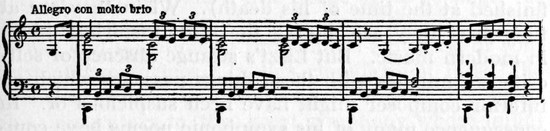
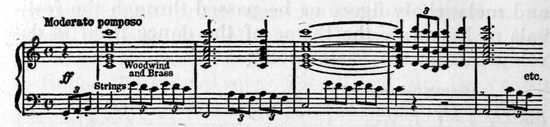
The musical files for the musical examples discussed in the book
have been provided by Jude Eylander. Those examples can be heard by
clicking on the [Listen] tab. The scores that appear in the original
book have been included as “jpg” images.
In some cases the scores that were used to generate the music files
differ slightly from the original scores. Those differences are due
to modifications that were made by the Music Transcriber during the
process of creating the musical archives in order to make the music
play accurately on modern musical transcribing programs. These scores
are included as PDF images, and can be seen by clicking on the [PDF]
tag in the HTML version of the book.
Obvious punctuation and other printing errors have been corrected.
The book cover has been modified by the Transcriber and is included
in the public domain.
The Art of Music
A Comprehensive Library of Information
for Music Lovers and Musicians
Editor-in-Chief
DANIEL GREGORY MASON
Columbia University
Associate Editors
EDWARD B. HILLLELAND HALL Harvard UniversityPast Professor, Univ. of Wisconsin
Managing Editor CÉSAR SAERCHINGER
Modern Music Society of New York
In Fourteen Volumes
Profusely Illustrated
NEW YORK THE NATIONAL SOCIETY OF MUSIC
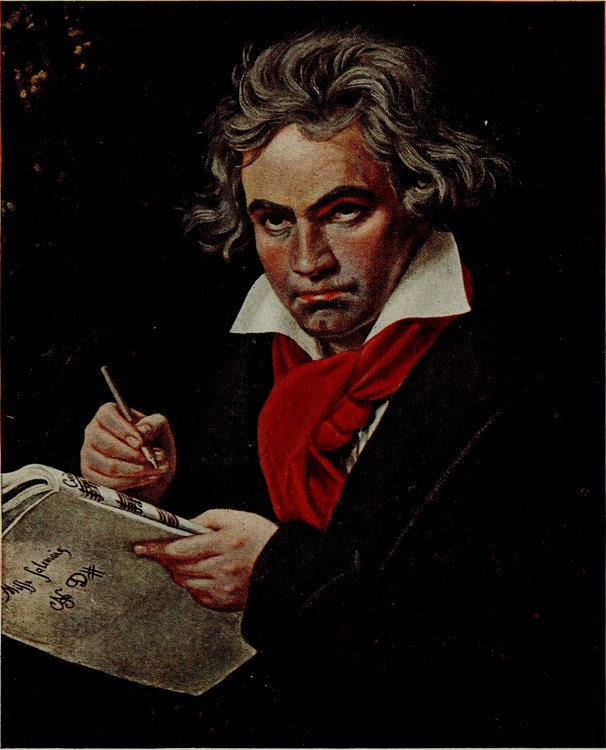
Beethoven
After the painting by Karl Stieler (Original owned by H. Hinrichsen, Leipzig)
THE ART OF MUSIC: VOLUME TWO
A Narrative History of Music
Department Editors:
LELAND HALL
AND CÉSAR SAERCHINGER
Introduction by
LELAND HALL
Past Professor of Musical History, University of Wisconsin
BOOK II CLASSICISM AND ROMANTICISM
NEW YORK THE NATIONAL SOCIETY OF MUSIC
1915
Copyright, 1915, by
THE NATIONAL SOCIETY OF MUSIC, Inc.
(All Rights Reserved)
A NARRATIVE HISTORY OF MUSIC INTRODUCTION TO VOLUME II
In the first volume of The Art of Music the history
of the art has been carried in as straight a line as possible
down to the death of Bach and Handel. These
two great composers, while they still serve as the foundation
of much present-day music, nevertheless stand
as the culmination of an epoch in the development and
style of music which is distinctly of the past. Many of
the greatest of their conceptions are expressed in a language,
so to speak, which rings old-fashioned in our
ears. Something has been lost of their art. In the second
volume, on the other hand, we have to do with the
growth of what we may call our own musical language,
with the language of Beethoven, Schubert, Schumann,
Wagner and Brahms, men with whose ideals and with
whose modes of expression we are still closely in touch.
In closing the first volume the reader bids farewell to
the time of music when polyphony still was supreme.
In opening this he greets the era of melody and harmony,
of the singing allegro, the scherzo, the rondo, of
the romantic song, of salon music, of national opera
and national life in music.
We have now to do with the symphony and the sonata,
which even to the uninitiated spell music, no
longer with the toccata and the fugue, words of more or
less hostile alarm to those who dread attention. We
shall deal with forms based upon melody, shall trace
their growth from their seeds in Italy, the land of melody,
through the works of Haydn, Mozart, and Beethoven.
We shall watch the perfecting of the orchestra,
its enrichment in sonority and in color. We shall see the
Lied spring from the forehead of Schubert. We shall
mark the development of the pianoforte and the growth
of a noble literature of pianoforte music, rivalling that
of the orchestra in proportion and in meaning. A new
opera will come into being, discarding old traditions,
alien myths, allying itself to the life of the peoples of
Europe.
Lastly we shall note the touch of two great forces
upon music, two forces mysteriously intertwined, the
French Revolution and the Romantic Movement. Music
will break from the control of rich nobles and make itself
dear to the hearts of the common people who inherit
the earth. It will learn to speak of intimate mysteries
and intensely personal emotion. Composers will
rebel from dependence upon a patronizing class and
seek judgment and reward from a free public. In
short, music will be no longer only the handmaiden of
the church, or the servant of a socially exalted class,
but the voice of the great human race, expressing its
passions, its emotions, its common sadness and joy, its
everyday dreams and even its realities.
The history of any art in such a stage of reformation
is necessarily complicated, and the history of music is
in no way exceptional. A thousand new influences
shaped it, hundreds of composers and of virtuosi came
for a while to the front. Political, social and even
economical and commercial conditions bore directly
upon it. To ravel from this tangle one or two threads
upon which to weave a consecutive narration has been
the object of the editors. Minuteness of detail would
have thwarted the purpose of this as of the first volume,
even if space could have been allowed for it. The book
has, therefore, been limited to an exposition only of
general movements, and to only general descriptions
of the works of the greatest composers who contributed
to them. Many lesser composers, famous in their day,
have not been mentioned, because their work has had
no real historical significance. They will, if at all vital,
receive treatment in the later volumes.
On the other hand, the reader is cautioned against
too easy acceptance of generalities which have long
usurped a sway over the public, such as the statement
that Emanuel Bach was the inventor of the sonata form,
or that Haydn was the creator of the symphony and of
the string quartet. Such forms are evolved, or built up
step by step, not created. The foundations of them lie
far back in the history of the art. In the present volume
the attention of the reader will be especially called
to the work of the Italian Pergolesi, and the Bohemian
Johann Stamitz, in preparing these forms for Haydn,
Mozart, and Beethoven.
Just as, in order to bring into relief the main lines
of development, many men and many details have been
omitted, so, in order to bring the volume to well-rounded
close, the works of many men which chronologically
should find their place herein have been consigned
arbitrarily to a third volume. Yet such treatment
is perhaps not so arbitrary as will at first appear.
Wagner, Brahms, and César Franck are the three greatest
of the later romantic composers. They developed
relatively independently of each other, and represent
the culmination of three distinct phases of the romantic
movement in music. Their separate influences made
themselves felt at once even upon composers scarcely
younger than they. Men so influenced belong properly
among their followers, no matter what their ages. Inasmuch
as the vast majority of modern music is most evidently
founded upon some one of these three men, most
conspicuously and almost inevitably upon Wagner,
contemporaries who so founded their work will be
treated among the modern composers, as those men
who lead the way over from the three great geniuses of
a past generation to the distinctly new art of the present
day. Notable among these are men like Max Bruch,
Anton Bruckner, Hugo Wolf, Gustav Mahler, and Camille
Saint-Saëns. Some of these men, by the close connection
of their art to that of past generations, might
perhaps more properly be treated in this volume, but
the confusion of so many minor strands would obscure
the trend of the narrative. Moreover, exigencies of
space have enforced certain limits upon the editors.
Thus, also, the national developments, the founding of
distinctly national schools of composition in Scandinavia,
Russia, Bohemia and elsewhere, directly influenced
by the romantic movement in Germany, have
had to find a place in Volume III.
It is perhaps in order to forestall any criticism that
may be made in the score of what will seem to some
serious omissions. Composers of individual merit,
though their music is of light calibre, are perhaps entitled
to recognition no less than their confrères in more
ambitious fields. We refer to such delightful writers
of comic opera as Johann Strauss, Millöcker, Suppé,
etc., and the admirable English school of musical comedy
headed by Sir Arthur Sullivan. Without denying
the intrinsic value of their work, it must be admitted
that they have contributed nothing essentially new or
fundamental to the development of the art and are
therefore of slight historical significance. The latter
school will, however, find proper mention in connection
with the more recent English composers to whom it has
served as a foundation if not a model. More adequate
treatment will be accorded to their works in the volumes
on opera, etc.
In closing, a word should be said concerning the contributors
to the Narrative History. There is ample precedent
for the method here employed of assigning different
periods to writers especially familiar with them.
Such collaboration has obvious advantages, for the
study of musical history has become an exceedingly
diverse one and by specialization only can its various
phases be thoroughly grasped. Any slight difference
in point of view or in style will be more than offset by
the careful and appreciative treatment accorded to each
period or composer by writers whose sympathies have
led them to a careful and adequate presentation, in
clear perspective, of the merits of a given style of composition.
The editors have endeavored as far as possible
to avail themselves of the able researches recently
made in Italy, Germany, France, etc., and they extend
their acknowledgment to such authors of valuable special
studies as Johannes Wolf, Hermann Kretschmar,
Emil Vogel, Romain Rolland, Julien Tiersot, etc., and
especially to the scholarly summary of Dr. Hugo Riemann,
of Leipzig. A more extensive list of these works
will be found in the Bibliographical Appendix to Volume
III.
The eighteenth century and operatic convention—Porpora
and Hasse—Pergolesi and the opera buffa—Jommelli,
Piccini, Cimarosa, etc.—Gluck’s early life; the Metastasio
period—The comic opera in France; Gluck’s reform;
Orfeo and Alceste—The Paris period; Gluck and Piccini;
the Iphigénies; Gluck’s mission—Gluck’s influence; the opéra comique; Cherubini.
Classicism and the classic period—Political and literary
forces—The conflict of styles; the sonata form—The Berlin
school; the sons of Bach—The Mannheim reform: the
genesis of the symphony—Followers of the Mannheim
school; rise of the string quartet; Vienna and Salzburg
as musical centres.
Social aspects of the classic period; Vienna, its court
and its people—Joseph Haydn—Haydn’s work; the symphony;
the string quartet—Wolfgang Amadeus Mozart—Mozart’s
style; Haydn and Mozart; the perfection of orchestral
style—Mozart and the opera; the Requiem; the
mission of Haydn and Mozart.
Form and formalism—Beethoven’s life—His relations
with his family, teachers, friends and other contemporaries—His
character—The man and the artist—Determining
factors in his development—The three periods in his
work and their characteristics—His place in the history of
music.
Italian opera at the advent of Rossini—Rossini and the
Italian operatic renaissance—Guillaume Tell—Donizetti and
Bellini—Spontini and the historical opera—Meyerbeer’s life
and works—His influence and followers—Development of opéra comique; Boieldieu, Auber, Hérold, Adam.
Part II. The Romantic Ideal
VI.
The Romantic Movement: Its Characteristics and Its Growth
Modern music and modern history; characteristics of the
music of the romantic period—Schubert and the German
romantic movement in literature—Weber and the German
reawakening—The Paris of 1830: French Romanticism—Franz
Liszt—Hector Berlioz—Chopin; Mendelssohn—Leipzig
and Robert Schumann—Romanticism and classicism.
Lyric poetry and song—The song before Schubert—Franz
Schubert; Carl Löwe—Robert Schumann; Robert
Franz; Mendelssohn and Chopin; Franz Liszt as song writer.
VIII.
Pianoforte and Chamber Music of the Romantic Period
Development of the modern pianoforte—The pioneers:
Schubert and Weber—Schumann and Mendelssohn—Chopin
and others—Franz Liszt, virtuoso and poet—Chamber
music of the romantic period; Ludwig Spohr and others.
The perfection of instruments; emotionalism of the romantic
period; enlargement of orchestral resources—The
symphony in the romantic period; Schubert, Mendelssohn,
Schumann; Spohr and Raff—The concert overture—The rise
of program music; the symphonic leit-motif; Berlioz’s
Fantastique; other Berlioz symphonies; Liszt’s dramatic
symphonies—Symphonic poem; Tasso; Liszt’s other symphonic
poems—The legitimacy of program music.
The rise of German opera; Weber and the romantic opera;
Weber’s followers—Berlioz as opera composer—The drame
lyrique from Gounod to Bizet—Opéra comique in the romantic
period; the opéra bouffe—Choral and sacred music
of the romantic period.
Periods of operatic reform; Wagner’s early life and
works—Paris: Rienzi, “The Flying Dutchman”—Dresden:
Tannhäuser and Lohengrin; Wagner and Liszt; the revolution
of 1848—Tristan and Meistersinger—Bayreuth; “The
Nibelungen Ring”—Parsifal—Wagner’s musico-dramatic reforms;
his harmonic revolution; the leit-motif system—The
Wagnerian influence.
The antecedents of Brahms—The life and personality of
Brahms—The idiosyncrasies of his music in rhythm, melody,
and harmony as expressions of his character—His
works for pianoforte, for voice, and for orchestra; the historical
position of Brahms—Franck’s place in the romantic
movement—His life, personality, and the characteristics of
his style; his works as the expression of religious mysticism.
Verdi’s mission in Italian opera—His early life and education—His
first operas and their political significance—His
second period: the maturing of his style—Crowning
achievements of his third period—Verdi’s contemporaries.
A NARRATIVE HISTORY OF MUSIC
CHAPTER I THE REGENERATION OF THE OPERA — I — II — III — IV
The eighteenth century and operatic convention—Porpora and Hasse—Pergolesi
and the opera buffa—Jommelli, Piccini, Cimarosa, etc.—Gluck’s
early life; the Metastasio period—The comic opera in France; Gluck’s reform;
Orfeo and Alceste—The Paris period; Gluck and Piccini; the
Iphigénies; Gluck’s mission—Gluck’s influence; Salieri and Sarti; the development
of opéra comique; Cherubini.
While the deep, quiet stream of Bach’s genius flowed
under the bridges all but unnoticed, the marts and
highways of Europe were a babel of operatic intrigue
and artistic shams. Handel in England was running
the course of his triumphal career, which luckily forced
him into the tracks of a new art-form; on the continent
meantime Italian opera reached at once its most
brilliant and most absurd epoch under the leadership
of Hasse and Porpora; even Rameau, the founder of
modern harmonic science, did not altogether keep
aloof from its influence, while perpetuating the traditions
of Lully in Paris. Vocal virtuosi continued to set
the musical fashions of the age, the artificial soprano
was still a force to which composers had to submit;
indeed, artificiality was the keynote of the century.
The society of the eighteenth century was primarily
concerned with the pursuit of sensuous enjoyment.
In Italy especially ‘the cosmic forces existed but in
order to serve the endless divertissement of superficial
and brainless beings, in whose eyes the sun’s only
mission was to illumine picturesque cavalcades and
water-parties, as that of the moon was to touch with
trembling ray the amorous forest glades.’ Monnier’s
vivid pen-picture of eighteenth century Venetian society
applies, with allowance made for change of scene
and local color, to all the greater Italian cities. ‘What
equivocal figures! What dubious pasts! Law (of Mississippi
bubble fame) lives by gambling, as does the
Chevalier Desjardins, his brother in the Bastille, his
wife in a lodging-house; the Count de Bonneval, turbaned,
sitting on a rug with legs crossed, worships
Allah, carries on far-reaching intrigues and is poisoned
by the Turks; Lord Baltimore, travelling with his physician
and a seraglio of eight women, with a pair of
negro guards; Ange Goudar, a wit, a cheat at cards, a
police spy and perjurer, rascally, bold, and ugly; and
his wife Sarah, once a servant in a London tavern,
marvellously beautiful, who receives the courtly world
at her palace in Pausilippo near Naples, and subjugates
it with her charm; disguised maidens, false princes,
fugitive financiers, literary blacklegs, Greeks, chevaliers
of all industries, wearers of every order, splenetic
grands seigneurs, and the kings of Voltaire’s Candide.
Of such is the Italian society of the eighteenth century
composed.
Music in this artificial atmosphere could only flatter
the sense of hearing without appealing to the intelligence,
excite the nerves and occasionally give a keener
point to voluptuousness, by dwelling on a note of elegant
sorrow or discreet religiousness. The very church,
according to Dittersdorf, had become a musical boudoir,
the convent a conservatory. As for the opera, it
could not be anything but a lounge for the idle public.
The Neapolitan school, which reigned supreme in Europe,
provided just the sort of amusement demanded
by that public. It produced scores of composers who
were hailed as maestri to-day and forgotten to-morrow.
Hundreds of operas appeared, but few ever
reached publication; their nature was as ephemeral as
the public’s taste was fickle, and a success meant no
more to a composer than new commissions to turn out
operas for city after city, to supply the insatiate thirst
for novelty. The manner in which these commissions
were carried out is indicative of the result. Composers
were usually given a libretto not of their choosing; the
recitatives, which constituted the dramatic groundwork,
were turned out first and distributed among the
singers. The writing of the arias was left to the last
so that the singers’ collaboration or advice could be
secured, for upon their rendition the success of the
whole opera depended; they were, indeed, written for
the singers—the particular singers of the first performance—and
in such a manner that their voices might
show to the best advantage. As Leopold Mozart wrote
in one of his letters, they made ‘the coat to fit the
wearer.’ The form which these operas took was an
absolute stereotype; a series of more or less disconnected
recitatives and arias, usually of the da capo
form, strung together by the merest thread of a plot.
It was a concert in costume rather than the drama in
music which was the original conception of opera in
the minds of its inventors.
Pietro Metastasio, the most prolific of librettists,
was eminently the purveyor of texts for these operas,
just as Rinuccini, the idealist, had furnished the poetic
basis for their nobler forerunners. Metastasio’s inspiration
flowed freely, both in lyrical and emotional veins,
but ‘the brilliancy of his florid rhetoric stifled the cry
of the heart.’ His plots were overloaded with the vapid
intrigues that pleased the taste of his contemporaries,
with quasi-pathetic characters, with passionate climaxes
and explosions. His popularity was immense.
He could count as many as forty editions of his own
works and among his collaborators were practically all
the great composers, from Handel to Gluck and Cimarosa.
As personifying the elements which sum up the
opera during this its most irrational period we may
take two figures of extraordinary eminence—Niccola
Porpora and Johann Adolf Hasse.
Niccola Porpora (1686-1766), while prominent in his
own day as composer, conductor, and teacher (among
his pupils was Joseph Haydn), is known to history
chiefly by his achievements as a singing master—perhaps
the greatest that ever lived. The art of bel canto,
that exaltation of the human voice for its own sake,
which in him reached its highest point, was doubtless
the greatest enemy to artistic sincerity and dramatic
truth, the greatest deterrent to operatic progress in the
eighteenth century. Though possessed of ideals of intrinsic
beauty—sensuousness of tone, dynamic power,
brilliance, and precision like that of an instrument—this
art would to-day arouse only wonder, not admiration.
Porpora understood the human voice in all its
peculiarities; he could produce, by sheer training,
singers who, like Farinelli, Senesino, and Caffarelli,
were the wonder of the age. By what methods his results
were reached we have no means of knowing, for
his secret was never committed to writing, but his
method was most likely empirical, as distinguished
from the scientific, or anatomical, methods of to-day.
It was told that he kept Caffarelli for five or six years
to one page of exercises, and then sent him into the
world as the greatest singer of Europe—a story which,
though doubtless exaggerated, indicates the purely
technical nature of his work.
Porpora wrote his own vocalizzi, and, though he
composed in every form, all of his works appear to
us more or less like solfeggi. His cantatas for solo
voice and harpsichord show him at his best, as a master
of the florid Italian vocal style, with consummate appreciation
of the possibilities of the vocal apparatus.
His operas, of which he wrote no less than fifty-three,
are for the most part tedious, conventional, and overloaded
with ornament, in every way characteristic of
the age; the same is true in some measure of his oratorios,
numerous church compositions, and chamber
works, all of which show him to be hardly more than
a thoroughly learned and accomplished technician.
But Porpora’s fame attracted many talented pupils,
including the brilliant young German, Hasse (1699-1783),
mentioned above, who, however, quickly forsook
him in favor of Alessandro Scarlatti, a slight which
Porpora never forgave and which served as motive
for a lifelong rivalry between the two men. Hasse,
originally trained in the tradition of the Hamburg
opera and its Brunswick offshoot (where he was engaged
as tenor and where he made his debut with his
only German opera, ‘Antiochus’), quickly succumbed to
the powerful Italian influence. The Italians took
kindly to him, and, after his debut in Naples with ‘Tigrane’
(1773), surnamed him il caro sassone. His marriage
with the celebrated Faustina Bordoni linked him
still closer to the history of Italian opera; for in the
course of his long life, which extends into the careers
of Haydn and Mozart, he wrote no less than seventy
operas, many of them to texts by the famed Metastasio,
and most of them vehicles for the marvellous gifts of
his wife. While she aroused the enthusiasm of audiences
throughout Europe, he enjoyed the highest popularity
of any operatic composer through half a century.
Together they made the opera at Dresden
(whither Hasse was called in 1731 as royal kapellmeister)
the most brilliant in Germany—one that even
Bach, as we have seen, was occasionally beguiled into
visiting. Once Hasse was persuaded to enter into competition
with Handel in London (1733), the operatic
capital of Europe, where Faustina, seven years before,
had vanquished her great rival Cuzzoni and provided
the chief operatic diversion of the Handel régime to
the tune of £2,000 a year! Only the death of August
the Strong in 1763 ended the Hasses’ reign in Dresden,
where during the bombardment of 1760 Hasse’s library
and most of the manuscripts of his works were destroyed
by fire. What remains of them reveals a rare
talent and a consummate musicianship which, had it
not been employed so completely in satisfying the prevailing
taste and propitiating absurd conventions,
might still appeal with the vitality of its harmonic texture
and the beauty of its melodic line. Much of the
polyphonic skill and the spontaneous charm of a Handel
is evident in these works, but they lack the breadth,
the grandeur and the seriousness that distinguish the
work of his greater compatriot. Over-abundance of
success militates against self-criticism, which is the essential
quality of genius, and Hasse’s success was not,
like Handel’s, dimmed by the changing taste of a surfeited
public. Hasse’s operas signalize at once the high
water mark of brilliant achievement in an art form
now obsolete and the ultimate degree of its fatuousness.
Hasse and Porpora, then, were the leaders of those
who remained true to the stereotyped form of opera,
the singers’ opera, whose very nature precluded progress.
They and a host of minor men, like Francesco
Feo, Leonardo Vinci, Pasquale Cafaro, were enrolled
in a party which resisted all ideas of reform;
and their natural allies in upholding absurd conventions
were the singers, that all-powerful race of
virtuosi, the impresarios, and all the great tribe of
adherents who derived a lucrative income from the
system. Against these formidable forces the under-current
of reform—both musical and dramatic—felt
from the beginning of the century, could make little
head. The protests of men like Benedetto Marcello,
whose satire Il teatro alla moda appeared in 1722,
were voices crying in the wilderness. Yet reform was
inevitable, a movement no less momentous than when
the Florentine reform of 1600 was under way—the great
process of crystallization and refinement which was to
usher in that most glorious era of musical creation
known as the classic period. Like the earlier reform,
it signified a reaction against technique, against soulless
display of virtuosity, a tendency toward simplicity, subjectivity,
directness of expression—a return to nature.
Though much of the pioneer work was done by composers
of instrumental music whose discussion must be
deferred to the next chapter, the movement had its
most spectacular manifestations in connection with
opera, and in that aspect is summed up in the work
of Gluck, the outstanding personality in the second half
of the eighteenth century. In the domain of absolute
music it saw its beginnings in the more or less spontaneous
efforts of instrumentalists like Fasch, Foerster,
Benda, and Johann Stamitz. First among those whose
initiative was felt in both directions we must name
Giovanni Battista Pergolesi, the young Neapolitan who,
born in 1710, had his brilliant artistic career cut short
at the premature age of twenty-six.
Pergolesi was the pupil of Greco, Durante, and Feo
at the Conservatorio dei Poveri at Naples, where a biblical
drama and two operas from his pen were performed
in 1731 without arousing any particular attention.
But a solemn mass which he was commissioned
to write by the city of Naples in praise of its patron
saint, and which was performed upon the occasion of
an earthquake, brought him sudden fame. The commission
probably came to him through the good offices
of Prince Stegliano, to whom he dedicated his famous
trio sonatas. These sonatas, later published in London,
brought an innovation which had no little influence
upon contemporary composers; namely, the so-called
cantabile (or singing) allegro as the first movement.
Riemann, who has edited two of them,[1] calls attention
to the richly developed sonata form of the first movement
of the G major trio especially, of which the works
of Fasch, Stamitz, and Gluck are clearly reminiscent.
‘The altogether charming, radiant melodies of Pergolesi
are linked with such conspicuous, forcible logic in
the development of the song-like theme, always in the
upper voice, that we are not surprised by the attention
which the movement aroused. We are here evidently
face to face with the beginning of a totally different
manner of treatment in instrumental melodies, which
I would like to call a transplantation of the aria style
to the instrumental field.’[2] We shall have occasion
to refer to this germination of a new style later on.
At present we must consider another of Pergolesi’s important
services to art—the creation of the opera
buffa.[3]
We have had occasion to observe in another chapter
the success of the ‘Beggar’s Opera’ in England in 1723,
which hastened the failure of the London Academy
under Handel’s management. Vulgar as it was, this
novelty embodied the same tendency toward simplicity
which was the essential element of the impending reform;
it was near to the people’s heart and there found
a quick response. This ballad-opera, as it was called,
was followed by many imitations, notably Coffey’s
‘The Devil to Pay, or The Wives Metamorphosed’
(1733), which, later produced in Germany, was adapted
by Standfuss (1752) and Johann Adam Hiller (1765)
and thus became the point of departure for the German
singspiel. This in turn reacted against the popularity
of Italian opera in Germany. The movement had its
Italian parallel in the fashion for the so-called intermezzi
which composers of the Neapolitan school began
very early in the century to interpolate between the
acts of their operas, as, in an earlier period, they had
been interpolated between the acts of the classic tragedies
(cf. Vol. I, p. 326 ff). Unlike these earlier spectacular
diversions, the later intermezzi were comic
pieces that developed a continuous plot independent
of that of the opera itself—an anomalous mixture of
tragedy and comedy which must have appeared ludicrous
at times even to eighteenth century audiences.
These artistic trifles were, however, not unlikely, in
their simple and unconventional spontaneity, to have
an interest surpassing that of the opera proper. Such
was the case with La serva padrona, which Pergolesi
produced between the acts of his opera Il pigionier
(1733). This graceful little piece made so immediate
an appeal that it completely overshadowed the serious
work to which it was attached, and, indeed, all the
other dramatic works of its composer, whose fame to-day
rests chiefly upon it and the immortal Stabat
mater, which was his last work.
La serva padrona is one of the very few operatic
works of the century that are alive to-day. An examination
of its contents quickly reveals the reason, for
its pages breathe a charm, a vivacity, a humor which
we need not hesitate to call Mozartian. Indeed, it
leaves little doubt in our minds that Mozart, born
twenty-three years later, must have been acquainted
with the work of its composer. At any rate he, no less
than Guglielmi, Piccini, Paesiello, and Cimarosa, the
chief representatives of the opera buffa, are indebted to
him for the form, since, as the first intermezzo opera capable
of standing by itself (it was afterward so produced
in Paris), it must be regarded as the first real
opera buffa.
Most of the later Neapolitans, in fact, essayed both
the serious and comic forms, not unmindful of the
popular success which the latter achieved. It became,
in time, a dangerous competitor to the conventionalized
opera seria, as the ballad-opera and the singspiel did
in England and Germany, and the opéra bouffon was
to become in France. Its advantage lay in its freedom
from the traditional operatic limitations (cf. Vol. I,
page 428). It might contain an indiscriminate mixture
of arias, recitatives, and ensembles; its dramatis
personæ were a flexible quantity. Moreover, it disposed
of the male soprano, favoring the lower voices, especially
basses, which had been altogether excluded from
the earlier operas. Hence it brought about a material
change in conditions with which composers had thus
far been unable to cope. In it the stereotyped da capo
aria yielded its place to more flexible forms; one of its
first exponents, Nicolo Logroscino,[4] introduced the animated
ensemble finale with many movements, which
was further developed by his successors. These wholesome
influences were soon felt in the serious opera as
well: it adopted especially the finale and the more
varied ensembles of the opera buffa, though lacking
the spicy parodistical element and the variegated
voices of its rival. Thus, in the works of Pergolesi’s
successors, especially Jommelli and Piccini, we see
foreshadowed the epoch-making reform of Gluck.
There is nothing to show, however, that Pergolesi
himself was conscious of being a reformer. His personal
character, irresponsible, brilliant rather than
introspective, would argue against that. We must
think of him as a true genius gifted by the grace of
heaven, romantic, wayward, and insufficiently balanced
to economize his vital forces toward a ripened age of
artistic activity. He nevertheless produced a number
of other operas, mostly serious, masses, and miscellaneous
ecclesiastical and chamber works. His death was
due to consumption. So much legend surrounds his
brief career that it has been made the subject of two
operas, by Paolo Serrão and by Monteviti.
C. S.
About the close of Pergolesi’s career two men made
their debuts whose lives were as nearly coeval as those
of Bach and Handel and who, though of unequal merit,
if measured by the standards of posterity, were both
important factors in the reform movement which we
are describing. These men were Jommelli and Gluck,
both born in 1714, the year which also gave to the
world Emanuel Bach, the talented son of the great
Johann Sebastian.
Nicola Jommelli was born at Aversa (near Naples).
At first a pupil of Durante, he received his chief training
under Feo and Leo. His first opera, L’Errore amoroso,
was brought out under an assumed name at
Naples when the composer was but twenty-three, and
so successfully that he had no hesitation in producing
his Odoardo under his own name the following year.
Other operas by him were heard in Rome, in Bologna
(where he studied counterpoint with Padre Martini);
in Venice, where the success of his Merope secured him
the post of director of the Conservatorio degli incurabili;
and in Rome, whither he had gone in 1749 as
substitute maestro di capella of St. Peter’s. In Vienna,
which he visited for the first time in 1748, Didone, one
of his finest operas, was produced. In 1753 Jommelli
became kapellmeister at Ludwigslust, the wonderful
rococo palace of Karl Eugen, duke of Württemberg,
near Stuttgart. Like Augustus the Strong of Saxony,
the elector of Bavaria, the margrave of Bayreuth,
the prince-bishop of Cologne, this pleasure-loving
ruler of a German principality had known
how to s’enversailler—to adopt the luxuries and
refinements of the court of Versailles, then the European
model for royal and princely extravagance. His
palace and gardens were magnificent and his opera
house was of such colossal dimensions that whole regiments
of cavalry could cross the stage. He needed a
celebrated master for his chapel and his opera; his
choice fell upon Jommelli, who spent fifteen prosperous
years in his employ, receiving a salary of ‘6,100 gulden
per annum, ten buckets of honorary wine, wood for
firing and forage for two horses.’
At Stuttgart Jommelli was strongly influenced by the
work of the German musicians; increased harmonic
profundity and improved orchestral technique were
the most palpable results. He came to have a better
appreciation of the orchestra than any of his countrymen;
at times he even made successful attempts at
‘tone painting.’ His orchestral ‘crescendo,’ with which
he made considerable furore, was a trick borrowed
from the celebrated Mannheim school. It is interesting
to note that the school of stylistic reformers which had
its centre at Mannheim, not far from Stuttgart, was
then in its heyday; two years before Jommelli’s arrival
in Stuttgart the famous Opus 1 of Johann Stamitz—the
sonatas (or rather symphonies) in which the Figured
Bass appears for the first time as an integral
obbligato part—was first heard in Paris. The so-called
Simphonies d’Allemagne henceforth appeared in great
number; they were published mostly in batches, often
in regular monthly or weekly sequence as ‘periodical
overtures,’ and so spread the gospel of German classicism
all over Europe. How far Jommelli was influenced
by all this it would be difficult to determine, but we
know that when in 1769 he returned to Naples his new
manner found no favor with his countrymen, who considered
his music too heavy. The young Mozart in
1770 wrote from there: ‘The opera here is by Jommelli.
It is beautiful, but the style is too elevated as
well as too antique for the theatre.’ It is well to remark
here how much Jommelli’s music in its best moments
resembles Mozart’s. He, no less than Pergolesi,
must be credited with the merit of having influenced
that master in many essentials.
Jommelli allowed none but his own operas to be
performed at Stuttgart. The productions were on a
scale, however, that raised the envy of Paris. No less
a genius than Noverre, the reformer of the French
ballet, was Jommelli’s collaborator in these magnificent
productions; and Jommelli also yielded to French influences
in the matter of the chorus. He handled Metastasio’s
texts with an eye to their psychological moments,
and infused into his scores much of dramatic
truth. In breaking up the monotonous sequence of
solos, characteristic of the fashionable Neapolitan
opera, he actually anticipated Gluck. All in all, Jommelli’s
work was so unusually strong and intensive
that we wonder why he fell short of accomplishing
the reform that was imminent. ‘Noverre and Jommelli
in Stuttgart might have done it,’ says Oscar Bie, in his
whimsical study of the opera, ‘but for the fact that
Stuttgart was a hell of frivolity and levity, a luxurious
mart for the purchase and sale of men.’
Jommelli’s last Stuttgart opera was Fetonte.[5] When
he returned to Italy in 1769 he found the public mad
with enthusiasm over a new opera buffa entitled Cecchina,
ossia la buona figliuola. In Rome it was played
in all the theatres, from the largest opera house down
to the marionette shows patronized by the poor.
Fashions were all alla Cecchina; houses, shops, and
wines were named after it, and a host of catch-words
and phrases from its text ran from lip to lip. ‘It is
probably the work of some boy,’ said the veteran composer,
but after he had heard it—‘Hear the opinion of
Jommelli—this is an inventor!’
The boy inventor of Cecchina was Nicola Piccini,
another Neapolitan, born in 1728, pupil of Leo and
Durante, who was destined to become the most famous
Italian composer of his day, though his works have
not survived to our time. His debut had been made in
1754 with Le donne dispettose, followed by a number
of other settings of Metastasio texts. We are told that
he found difficulty in getting hearings at first, because
the comic operas of Logroscino monopolized the stage.
Already, then, composers were forced into the opera
buffa with its greater vitality and variety. Piccini’s
contribution to its development was the extension of
the duet to greater dramatic purpose, and also of
the concerted finale first introduced by Logroscino.
We shall meet him again, as the adversary of Gluck.
Of hardly less importance than he were Tommaso
Traetto (1727-1779), ‘the most tragic of the Italians,’
who surpassed his contemporaries and followers in
truth and force of expression, and in harmonic
strength; Pietro Guglielmi (1727-1804), who with his
115 operas gained the applause of all Italy, of Dresden,
of Brunswick, and London; Antonio Sacchini
(1734-1786), who, besides grace of melody, attained at
times an almost classic solidity; and Giovanni Paesiello
(1741-1816), whose decided talent for opera buffa
made him the successful rival of Piccini and Cimarosa.
Paesiello, with Domenico Cimarosa (1749-1801), was
the leading representative of the buffa till the advent
of Mozart. As Hadow suggests, he might have achieved
real greatness had he been less constantly successful.
‘His life was one triumphal procession from Naples to
St. Petersburg, from St. Petersburg to Vienna, from
Vienna to Paris.’ Ferdinand of Sicily, Empress Catharine
of Russia, Joseph II of Austria, and even Napoleon
were successively his patrons; and his productiveness
was such that he never had time, even had he had inclination,
to criticise his own works. Of his ninety-four
operas only one, ‘The Barber of Seville,’ is of historic
interest, for its popularity was such that, until Rossini,
no composer dared to treat the same theme. Cimarosa
deserves perhaps more extended notice than many
others on account of his Matrimonio segreto, written
in Russia, which won unprecedented success there and
in Italy. It is practically the only one of all the works
of composers just mentioned that has not fallen a victim
to time. Its music is simple and tuneful, fresh and
full of good humor.
The eighteenth century public based its judgments
solely on mere externals—a pleasing tune, a brilliant
singer, a sumptuous mise-en-scène caught its favor, the
merest accident or circumstance might kill or make an
opera. To-day a composer is carried off in triumph,
to be hissed soon after by the same public. Rivalry
among composers is the order of the day. Sacchini,
Piccini, Paesiello, Cimarosa, are successively favorites
of Italian audiences; in London Christian Bach and
Sacchini divide the public as Handel and Bononcini
did before them; in Vienna Paesiello and Cimarosa are
applauded with the same acclaim as Gluck; in St.
Petersburg Galuppi,[6] Traetta, Paesiello, and Cimarosa
follow each other in the service of the sovereign (Catharine
II), who could not differentiate any tunes but the
howls of her nine dogs; in Paris, at last, the leading
figures become the storm centre of political agitations.
All these composers’ names are glibly pronounced by
the busy tongues of a brilliant but shallow society.
Favorite arias, like Galuppi’s Se per me, Sacchini’s
Se cerca, se dice, Piccini’s Se il ciel, are compared
after the manner of race entries. Florimo, the historian
of the Naples opera, dismissed the matter with
a few words: ‘Piccini is original and prolific; Sacchini
gay and light, Paesiello new and lithe, Cafaro
learned in harmony, Galuppi experienced in stagecraft,
Gluck a filosofia economica.’ They all have their merits—but,
after all, the difference is a matter of detail, a
fit subject for the gossip of an opera box. Even Gluck
is but one of them, if his Italian operas are at all
different the difference has escaped his critics.
But all of these composers, as well as some of their
predecessors, worked consciously or unconsciously in a
regeneration that was slowly but surely going forward.
The working out of solo and ensemble forms into definite
patterns; the development of the recitative from
mere heightened declamation to a free arioso, fully accompanied,
and to the accompagnato not followed by an
aria at all; the introduction of concertising instruments
which promptly developed into independent inner
voices and broadened the orchestral polyphony, the
dynamic contrasts—at first abrupt, then gradual—which
Jommelli took over from the orchestral technique
of Mannheim; the ingenious construction of ensembles
and the development of the finale into a pezzo
concertanto—all these tended toward higher organization,
individual and specialized development, though
purely musical at first and strictly removed from the
influence of other arts. The dramatic elements, the
plastic and phantastic, which, subordinated at first,
found their expression in ‘laments’ and in simile arias
(in which a mood was compared to a phenomena of
nature), then in ombra scenes, where spirits were invoked,
and in similar exalted situations, gradually became
more and more prominent, foreshadowing the
time when the portrayal of human passions was to become
once more the chief purpose of opera.
The last and decisive step in the revolution was the
coming of Gluck. ‘It seems as if a century had worked
to the limit of its strength to produce the flower of
Gluck—the great man is always the composite genius
of all the confluent temporal streams.’[7] Yet he himself
was one of these composite forces from which the
artistic purpose of his life was evolved. The Gluck of
the first five decades, the Gluck of Italian opera, of
what we may call the Metastasio period, was simply one
of the many Italians unconsciously working toward
that end. His work through two-thirds of his life had
no more significance than that of a Leo, a Vinci, or a
Jommelli. Fate willed, however, that Gluck should be
impressed more strongly by the growing public dissatisfaction
with senseless Italian opera, and incidentally
should be brought into close contact with varied
influences tending to the broadening of his ideas. Cosmopolite
that he was, he gathered the essence of European
musical culture from its four corners. Born in
Germany, he was early exposed to the influence of solid
musicianship; trained in Italy he gained, like Handel,
its sensuous melody; in England he heard the works
of Handel and received in the shape of artistic failure
that chastisement which opened his mind to radical
change of method. In France, soon after, he was impressed
with the plastic dramatic element of the monumental
Lully-Rameau opera. Back in Vienna, he produced
opéra comique and held converse with lettered
enthusiasts. Calzabigi, like Rinuccini in 1600, brought
literary ideas of reform. Metastasio was relegated—yet
not at once, for Gluck was careful, diplomatic. He
fed his reform to the public in single doses—diluted
for greater security, interspersed with Italian operas of
the old school as sops to the hostile singers, jealous of
their power. Only thus can we explain his relapses into
the current type. He knew his public must first be
educated. He felt the authority of a teacher and he
resorted to the didactic methods of Florence—of his
colleagues of 1600, whom Calzabigi knew and copied.
Prefaces explaining the author’s purpose once more
became the order of the day; finally the reformer was
conscious of being a reformer, of his true life mission.
Except for what human interest there is in his early
life we may therefore pass rapidly over the period
preceding 1762, the momentous year of Orfeo ed Euridice.
Born July 2, 1714, at Weidenwang, in the upper Palatinate,
Christoph Willibald Gluck’s early years were
passed in the forests of Bavaria and Bohemia. His
father, Alexander Gluck, had been a game-keeper, who,
having established himself in Bohemia in 1717, had
successively entered the employ of various territorial
magnates—Count Kaunitz in Neuschloss, Count Kinsky
in Kamnitz, Prince Lobkowitz in Eisenberg, and, finally,
the grand-duchess of Tuscany in Reichstadt. His
intention toward his son had been at first to make of
him a game-keeper, and it is recorded that young Christoph
was put through a course of Spartan discipline
with that end in view, during which he was obliged to
accompany his father barefooted through the forest in
the severest winter weather.
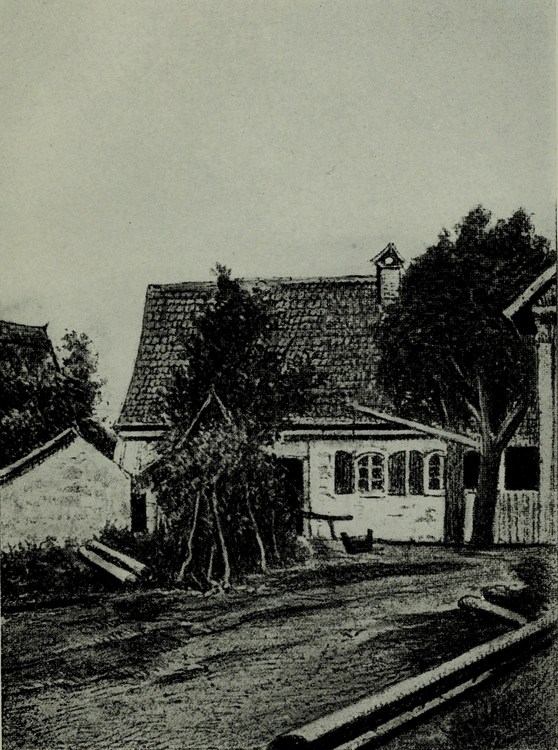
Birthplace of Gluck at Weidenwang (Central Franconia)
V — VI — VII
From the age of twelve to eighteen, however, he attended
the Jesuit school at Kommotau in the neighborhood
of the Lobkowitz estate and there, besides receiving
a good general education, he learned to sing and
play the violin and the 'cello, as well as the clavichord
and organ. In 1732 he went to Prague and studied
under Czernohorsky.[8] Here he was soon able to earn
a modest living—a welcome circumstance, for there
were six younger children at home, for whom his
father provided with difficulty. In Prague he gave lessons
in singing and on the 'cello; he played and sang in
various churches; and on holidays made the rounds of
the neighboring country as a fiddler, receiving his payment
in kind, for the good villagers, it is said, often
rewarded him with fresh eggs. Through the introductions
of his patron, Prince Lobkowitz, it was not long
before he obtained access to the homes of the music-loving
Bohemian nobility, and when he went to Vienna
in 1736 he was hospitably received in his protector’s
palace. Prince Lobkowitz also made it possible for
him to begin the study of composition. In Vienna he
chanced to meet the Italian Prince Melzi, who was so
pleased with his singing and playing that he made him
his chamber musician and took him with him to Milan.
Here, during four years, from 1737 to 1741, Gluck
studied the theory of music under the celebrated contrapuntist
Giovanni Battista Sammartini, and definitely
decided upon musical composition as a career.
His studies completed, he made his debut as a creative
artist at the age of twenty-seven, with the opera
Artaserse (Milan, 1741), set to a libretto of Metastasio.
It was the first of thirty Italian operas, composition
of which extended over a period of twenty years, and
which are now totally forgotten. The success of Artaserse
was instantaneous. We need not explain the
reasons for this success, nor the circumstances that,
together with its fellows, from Demofoonte to La finta
schiava, it has fallen into oblivion.
His Italian successes procured for him, however, an
invitation in 1745 to visit London and compose for the
Haymarket. Thither he went, and produced a new
opera, La caduta de’ giganti, which, though it earned
the high praise of Burney, was coldly received by the
public. A revised version of an earlier opera, Artamene,
was somewhat more successful, but Piramo e
Tisbe, a pasticcio (a kind of dramatic potpourri or
medley, often made up of selections from a number of
operas), fell flat. ‘Gluck knows no more counterpoint
than my cook,’ Handel is reported to have said—but
then, Handel’s cook was an excellent bassist and sang
in many of the composer’s own operas. Counterpoint,
it is true, was not Gluck’s forte, and the lack of depth
of harmonic expression which characterized his early
work was no doubt due to the want of contrapuntal
knowledge. Handel quite naturally received Gluck
with a somewhat negligent kindness. Gluck, on the
other hand, always preserved the greatest admiration
for him—we are told that he hung the master’s picture
over his bed. Not only the acquaintance of Handel,
whose influence is clearly felt in his later works, but
the musical atmosphere of the English capital must
have been of benefit to him.
Perhaps the most valuable lesson of his life was the
London failure of Piramo e Tisbe. He was astonished
that this pasticcio, which presented a number of the
most popular airs of his operas, was so unappreciated.
After thinking it over he may well have concluded that
all music properly deserving of the name should be
the fitting expression of a situation; this vital quality
lacking, in spite of melodic splendor and harmonic
richness and originality, what remained would be no
more than a meaningless arrangement of sounds, which
might tickle the ear pleasantly, but would have no emotional
power. A short trip to Paris afforded him an
opportunity of becoming acquainted with the classic
traditions of the French opera as developed by Lully
and Rameau. Lully, it will be remembered, more
nearly maintained the ideals of the early Florentines
than their own immediate successors. In his operas
the orchestra assumed a considerable importance, the
overture took a stately though conventional aspect.
The chorus and the ballet furnished a plastic background
to the drama and, indeed, had become integral
features. Rameau had added harmonic depth and
variety and given a new charm to the graceful dance
melodies. Gluck must have absorbed some or all of
this; yet, for fifteen years following his visit to London,
he continued to compose in the stereotyped form of
the Italian opera. He did not, it is true, return to
Italy, but he joined a travelling Italian opera company
conducted by Pietro Mingotti, as musical director and
composer. One of his contributions to its répertoire
was Le nozze d’Ercole e d’Ebe, which was performed
in the gardens of the Castle of Pillnitz (near Dresden)
to celebrate the marriage of the Saxon princess and
the Elector of Bavaria in June, 1747. How blunted
Gluck’s artistic sense must have been toward the incongruities
of Italian opera is shown by the fact that
the part of Hercules in this work was written for a
soprano and sung by a woman. In others the rôles of
Agamemnon the ‘king of men,’ of demigods and heroes
were trilled by artificial sopranos.
After sundry wanderings Gluck established himself
in Vienna, where in 1748 his Semiramide reconosciuta
had been performed to celebrate the birthday of the
Empress Maria Theresa. It was an opera seria of the
usual type and, though terribly confused, it revealed at
times the power and sweep characteristic of Handel.
In Vienna Gluck fell in love with Marianna Pergin,
the daughter of a wealthy merchant whose father
would not consent to the marriage. The story that his
sweetheart had vowed to be true to him and that he
wandered to Italy disguised as a Capucin to save expenses
in order to produce his Telemacco for the Argentina
Theatre in Rome has no foundation. But at
any rate the couple were finally married in 1750,
after the death of the relentless father. This signalized
the close of Gluck’s nomadic existence. With his permanent
residence in Vienna began a new epoch in his
life. Vienna was at that time a literary, musical, and
social centre of importance, a home of all the arts.
The reigning family of Hapsburg was an uncommonly
musical one; the empress, her father, her husband
(Francis of Lorraine), and her daughters were all
music lovers. Maria Theresa herself sang in the operatic
performances at her private theatre. Joseph II
played the 'cello in its orchestra. The court chapel had
its band, the cathedral its choir and four organists.
In the Hofburg and at the rustic palace of Schönbrunn
music was a favorite diversion of the court, cultivated
alike by the Austrian and the Hungarian nobility. The
royal opera houses at Launburg and Schönbrunn
placed in their service a long series of the famous opera
composers.
Semiramide had recommended its composer to the
favor of Maria Theresa, his star was in the ascendant.
In September, 1754, his comic opera Le Chinese, with
its tragic-comic ballet, L’Orfano della China, performed
at the countryseat of the Duke of Saxe-Hildburghausen
in the presence of the emperor and court, gave such
pleasure that its author was definitely attached to the
court opera at a salary of two thousand ducats a year.
His wealthy marriage and his increasing reputation,
instead of tempting him to indulge in luxurious ease,
spurred him to increased exertions. He added to the
sum total of his knowledge by studies of every kind—literary,
poetic, and linguistic—and his home became
a meeting place for the beaux esprits of art and science.
He wrote several more operas to librettos by Metastasio,
witnessed the triumph of two of them in Rome, after
which he was able to return to Vienna, a cavaliere dello
sperone d’oro (knight of the golden spur), this distinction
having been conferred upon him by the Pope.
Henceforth he called himself Chevalier or Ritter (not
von) Gluck.
For the sake of continuity we are obliged at this
point to resume the thread of our remarks concerning
the opera buffa of Pergolesi. In 1752, about the time of
Gluck’s official engagement at the Vienna opera, an
Italian troupe of ‘buffonists’ introduced in Paris La
serva padrona and Il maestro in musica (Pergolesi’s
only other comic opera). Their success was sensational,
and, having come at a psychological moment,
far-reaching in results, for it gave the impulse to a
new school, popular to this day—that of the French
opéra comique, at first called opera bouffon.
The latter part of the eighteenth century had witnessed
the birth of a new intellectual ideal in France,
essentially different from those associated with the
preceding movements of the Renaissance and the Reformation.
Neither antiquity nor the Bible were in
future to be the court of last instance, but judgment
and decision over all things was referred to the individual.
This theory, and others laid down by the encyclopedists—the
philosophers of the time—reacted
equally on all the arts. New theories concerning music
were advanced by laymen. Batteaux had already insisted
that poetry, music, and the dance were, by very
nature, intended to unite; Diderot and Rousseau conceived
the idea of the unified work of art. Jean Jaques
Rousseau,[9] the intellectual dictator, who laid a rather
exaggerated claim to musical knowledge, and the
famous satirist, Baron Melchior Grimm, now began a
literary tirade against the old musical tragedy of
France, which, like the Italian opera, had become paralyzed
into mere formulas. Rousseau, who had shortly
before written a comic opera, Le devin du village (The
Village Seer), in French, now denounced the French
language, with delightful inconsistency, as unfit to
sing; Grimm in his pamphlet, Le petit prophète
de Boehmisch-Broda, threatened the French people
with dire consequences if they did not abandon French
opera for Italian opera buffa.[10] This precipitated the
widespread controversy between Buffonists and anti-Buffonists,
known as the Guerre des bouffons, which,
in this age of pamphleteers, of theorists, and revolutionary
agitators, soon assumed political significance.
The conservatives hastened to uphold Rameau and
the cause of native art; the revolutionists rallied to the
support of the Italians. Marmontel, Favart, and others
set themselves to write after the Italian model, ‘Duni
brought from Parma his Ninette à la cour and followed
it in 1757 with Le peintre amoureux; Monsigny[11] left
his bureau and Philidor[12] his chess table to follow the
footsteps of Pergolesi; lastly came Grétry from Rome
and killed the old French operatic style with Le Tableau
parlant and Zémire et Azor!’ The result was the
production of a veritable flood of pleasing, delightful
operettas dealing with petty love intrigues, mostly of
pastoral character, in place of the stale, mythological
subjects common to French and Italian opera alike.
The new school quickly strengthened its hand and improved
its output. Its permanent value lay, of course,
in the infusion of new vitality into operatic composition
in general, a rejuvenation of the poetic as well as
musical technique, the unlocking of a whole treasure
of subjects hitherto unused.
Gluck at Vienna, already acquainted with French
opera, was quick to see the value of this new genre,
and he produced, in alternation with his Italian operas,
a number of these works, partly with interpolations
of his own, partly rewritten by him in their entirety.
Among the latter class must be named La fausse esclave
(1758); L’île de Merlin (1758); L’arbre enchantée
(1759); L’ivrogne corrigé (1760); Le cadi dupé (1761);
and La recontre imprévue (1764). As Riemann suggests,
it is not accidental that Gluck’s idea to reform
the conventionalized opera dates from this period of
intensive occupation with the French opéra bouffon.
There is no question that the simpler, more natural art,
and the genuineness and sincerity of the comic opera
were largely instrumental in the fruition of his theories.
His only extended effort during the period from 1756
to 1762 was a pantomimic ballet, Don Giovanni, but
the melodramas and symphonies (or overtures) written
for the private entertainment of the imperial family,
as well as seven trio sonatas, varied in expression
and at times quite modern in spirit, also date from
this time. It is well to remember also that this was a
period of great activity in instrumental composition;
that the Mannheim school of symphonists was just
then at the height of its accomplishment.
Gluck’s first reform opera, Orfeo ed Euridice, appeared
in 1762. The young Italian poet and dramatist,
Raniero da Calzabigi, supplied the text. Calzabigi,
though at first a follower of Metastasio, had conceived
a violent dislike for that librettist and his work. A hot-headed
theorist, he undoubtedly influenced Gluck in
the adoption of a new style, perhaps even gave the
actual initiative to the change. The idea was not sudden.
We have already pointed out how the later
Neapolitans had contributed elements of reform and
had paved the way in many particulars. They had
not, however, like Gluck, attacked the root of the evil—the
text. Metastasio’s texts were made to suit only the
old manner; Calzabigi’s were designed to a different
purpose: the unified, consistent expression of a definite
dramatic scheme. In the prefaces which accompanied
their next two essays in the new style, Alceste and
Paride, Gluck reverted to almost the very wording of
Peri and Caccini, but nevertheless no reaction to the
representative style of 1600 was intended. Though he
spoke of ‘forgetting his musicianship,’ he did not deny
himself all sensuous melodic flow in favor of a parlando
recitative. Too much water had flowed under
the bridges since 1600 for that. Scarlatti and his school
had not wrought wholly in vain. But the coloratura
outrage, the concert-opera, saw the beginning of its
end. The da capo aria was discarded altogether, the
chorus was reintroduced, and the subordination of
music to dramatic expression became the predominating
principle. Artificial sopranos and autocratic prime
donne could find no chance to rule in such a scheme;
their doom was certain and it was near. In the war
that ensued, which meant their eventual extinction,
Gluck found a powerful ally in the person of the emperor,
Francis I.
In that sovereign’s presence Orfeo was first given at
the Hofburgtheater in Vienna. Its mythological subject—the
same that Ariosti treated in his favolo of 1574,
that Peri made the theme of his epoch-making drama
of 1600, that Monteverdi chose for his Mantuan debut
in 1607—was surely as appropriate for this new reformer’s
first experiment as it was suited to the classic
simplicity and grandeur of his music. The opera was
studied with the greatest care, Gluck himself directing
all the rehearsals, and the participating artists forgot
that they were virtuosi in order better to grasp the
spirit of the work. It was mounted with all the skill
that the stagecraft of the day afforded. Although it
did not entirely break with tradition and was not altogether
free of the empty formulas from which the
composer tried to escape, it was too new to conquer
the sympathies of the Viennese public at once. Indeed,
the innovations were radical enough to cause trepidations
in Gluck’s own mind. His strong feelings that
the novelty of Orfeo might prevent its success induced
him to secure the neutrality of Metastasio before its
first performance, and his promise not to take sides
against it openly.
Gluck’s music is as fresh to-day as when it was written.
Its beauty and truth seemed far too serious to
many of his contemporaries. People at first said that
it was tiresome; and Burney declared that ‘the subordination
of music to poetry is a principle that holds good
only for the countries whose singers are bad.’ But
after five performances the triumph of Orfeo was assured
and its fame spread even to Italy. Rousseau
said of it: ‘I know of nothing so perfect in all
that regards what is called fitness, as the ensemble
in the Elysian fields. Everywhere the enjoyment of
pure and calm happiness is evident, but so equable is
its character that there is nothing either in the songs
or in the dance airs that in the slightest degree exceeds
its just measure.’ The first two acts of Orfeo
are profoundly human, with their dual picture of tender
sorrow and eternal joy. The grief of the poet and
the lamentations of his shepherd companions, rising in
mournful choral strains, insistent in their reiteration
of the motive indicative of their sorrow, are as effective
in their way as the musical language of Wagner, even
though they lack the force of modern harmony and
orchestral sonority. The principle is fundamentally
the same. Nor is Gluck’s music entirely devoid of the
dramatic force which has come to music with the
growth of the modern orchestra. Much of the delineation
of mood and emotion is left to the instruments.
Later, in the preface to Alceste, Gluck declared that
the overture should be in accord with the contents of
the opera and should serve as a preparation for it—a
simple, natural maxim to which composers had been
almost wholly blind up to that time. In Gluck’s overtures
we see, in fact, no Italian, but a German, influence.
They partake strongly of the nature of the
first movements of the Mannheim symphonies, showing
a contrasting second theme and are clearly divided into
three parts, like the sonata form. Thus the new instrumental
style was early introduced into the opera
through Gluck’s initiation, and thence was to be transferred
to the overtures of Mozart, Sacchini, Cherubini,
and others.
In 1764 Orfeo was given in Frankfort-on-the-Main
for the coronation of the Archduke Joseph as Roman
king. The imperial family seems to have been sympathetically
appreciative of Gluck’s efforts with the new
style; but nevertheless his next work, Telemacco, produced
at the Burgtheater in January, 1765, though considered
the best of his Italian operas, was a peculiar
mixture of the stereotype and the new, as if for a time
he lacked confidence. Quite different was the case of
Alceste (Hofburgtheater, Dec. 16, 1767). In this, his
second classic music drama, the composer carried out
the reforms begun in Orfeo more boldly and more consistently.
Calzabigi again wrote the text. The music
was neither so full of color nor so poetic as that of
its predecessor, yet was more sustained and equal in
beauty. The orchestration is somewhat fuller; the recitatives
have gained in expressiveness; there are effects
of great dramatic intensity, and arias of severe grandeur.
Berlioz called Alceste’s aria ‘Ye gods of endless
night’ the perfect manifestation of Gluck’s genius.
Like Orfeo, Alceste was admirably performed, and
again opinions differed greatly regarding it. Sonnenfels[13]
wrote after the performance: ‘I find myself in
wonderland. A serious opera without castrati, music
without solfeggios, or, I might rather say, without gurgling;
an Italian poem without pathos or banality. With
this threefold work of wonder the stage near the Hofburg
has been reopened.’ On the other hand, there
were heard in the parterre such comments as ‘It is
meant to call forth tears—I may shed a few—of ennui’;
‘Nine days without a performance, and then a requiem
mass’; or ‘A splendid two gulden’s worth of entertainment—a
fool who dies for her husband.’ This last is
quite in keeping with the sentiment of the eighteenth
century in regard to conjugal affection. It took a long
while for the public to accustom itself to the austerity
and tragic grandeur of this ‘tragedy set to music,’ as
its author called it. Yet Alceste in its dual form (for
the French edition represents a complete reworking of
its original) is Gluck’s masterpiece, and it still remains
one of the greatest classical operas.
Three years after Alceste came Paride ed Elena
(Nov. 30, 1770), a ‘drama for music.’ In the preface
of the work, dedicated to the duke of Braganza, Gluck
again emphasized his beliefs. Among other things he
wrote: ‘The more we seek to attain truth and perfection
the greater the need of positiveness and accuracy.
The lines that distinguish the work of Raphael from
that of the average painter are hardly noticeable, yet
any change of an outline, though it may not destroy
resemblance in a caricature, completely deforms a
beautiful female head. Only a slight alteration in the
mode of expression is needed to turn my aria Che faro
senza Euridice into a dance for marionettes.’ Paride
ed Elena, constructed on the principles of Orfeo and
Alceste, is the least important of Gluck’s operas and
the least known. The libretto lacks action, but the
score is interesting because of its lyric and romantic
character. Much of its style seems to anticipate the
new influences which Mozart afterward brought to
German music. It also offers the first instance of what
might be called local color in its contrasting choruses
of Greeks and Asiatics.
It is interesting to note that at the time of composing
the lyrical ‘Alceste’ Gluck was also preparing for
French opera with vocal romances, Lieder. His collection
of songs set to Klopstock’s odes was written in
1770. They have not much artistic value, but they are
among the earliest examples of the Lied as Mozart and
Beethoven later conceived it, a simple song melody
whose mission is frankly limited to a faithful emphasis
of a lyrical mood. Conceived in the spirit of Rousseau,
they are spontaneous and make an unaffected appeal
to the ear. The style is nearer that of French opéra
comique, at which Gluck had already tried his hand,
thus obtaining an exact knowledge of the spirit of
the French language and of its lyrical resources.
The wish of Gluck’s heart was to carry to completion
the reforms he had initiated, but Germany had practically
declared against them. His musical and literary
adversaries at the Viennese court, Hasse and Metastasio,
had formed a strong opposition. Baron Grimm
spoke of Gluck’s reforms as the work of a barbarian.
Agricola, Kirnberger, and Forkel were opposed to them.
In Prussia, Frederick the Great had a few arias from
Alceste and Orfeo sung in concert, and decided that
the composer ‘had no song and understood nothing of
the grand opera style,’ an opinion which, of course,
prevented the performance of his operas in Berlin.
In view of all this it is not surprising that he should
turn to what was then the centre of intellectual life,
that he should seize the opportunity to secure recognition
for his art in the great home of the drama—in
Paris.
Let us recall for a moment Gluck’s connection with
the French opéra bouffon. Favart had complimented
him, in a letter to the Vienna opera director Durazzo,
for the excellence of his French ‘déclamation.’ Evidently
Gluck and his friend Le Blanc du Roullet, attaché
of the French embassy, had kept track of the Guerre
des bouffons, and had taken advantage of the psychology
of the moment, for Rameau had died in 1764 and
the consequent weakening of the National party had
resulted in the victory of the Buffonists. Du Roullet
suggested to Gluck and Calzabigi that they collaborate
upon a French subject for an opera, and chose Racine’s
Iphigénie. The opera was completed and the text
translated by du Roullet, who now wrote a very diplomatic
letter to the authorities of the Académie royale
(the Paris opera). It recounted how the Chevalier
Gluck, celebrated throughout Europe, admired the
French style of composition, preferred it, indeed, to the
Italian; how he regarded the French language as eminently
suited to musical treatment, and that he had just
finished a new work in French on a tragedy of the
immortal Racine, which exhausted all the powers of
art, simple, natural song, enchanting melody, recitative
equal to the French, dance pieces of the most alluring
freshness. Here was everything to delight a Frenchman’s
heart; besides, his opera had been a great financial
success in Bologna, and so valiant a defender of
the French tongue should be given an opportunity in
its own home.
The academy saw a new hope in this. It considered
the letter in official session, and cautiously asked to
see an act of Iphigénie. After examination of it Gluck
was promised an engagement if he would agree to
write six operas like it. This condition, almost impossible
of acceptance for a man of Gluck’s age, was finally
removed through the intercession of Marie Antoinette,
now dauphiness of France, Gluck’s erstwhile
pupil in Vienna.
Gluck was invited to come to Paris as the guest of
the Académie and direct the staging of Iphigénie. He
arrived there with his wife and niece[14] in the summer
of 1773. Lodged in the citadel of the anti-Buffonists,
he incurred in advance the opposition of the Italian
party, but, diplomat that he was, he at once set about
to propitiate the enemy. Rousseau, the intellectual
potentate of France, was eventually won over; but,
despite the fact that Gluck’s music was essentially
human and should have fulfilled the demands of the
‘encyclopedists,’ such men as Marmontel, La Harpe,
and d’Alambert were arrayed against him, together
with the entire Italian party and many of the followers
of the old French school, who refused to accept him
as the successor of Lully and Rameau. Mme. du Barry
was one of these. Marie Antoinette, on the other hand,
constituted herself Gluck’s protector. It was the Guerre
des bouffons at its climax.
The première of Iphigénie en Aulide (April, 1774)
was awaited with the greatest impatience. Gluck had
spared no pains in the preparation. He drilled the
singers, spoiled by public favor, with the greatest vigor,
and ruthlessly combatted their caprices. The obstacles
were many: Legras was ill; Larivée, the Agamemnon,
did not understand his part; Sophie Arnold,
known as the greatest singing actress of her day, sang
out of tune; Vestris, the greatest dancer of his time—he
was called the ‘God of the Dance’—was not satisfied
with his part in the ballet of the opera. ‘Then dance
in heaven, if you’re the god of the dance,’ cried Gluck,
‘but not in my opera!’ And when the terpsichorean
divinity insisted on concluding Iphigénie with a chaconne,
he scornfully asked: ‘Did the Greeks dance
chaconnes?’ Gluck threatened more than once to withdraw
his opera, yielding only to the persuasions of the
dauphiness.
The second performance of the opera determined its
triumph, a triumph which in a manner made Paris the
centre of music in Europe.[15] Marie Antoinette even
wrote to her sister Marie Christine to express her pleasure.
Gluck received an honorarium of 20,000 francs
and was promised a life pension. Less severe and solemn
than Alceste, Iphigénie en Aulide and Iphigénie
en Tauride (written ten years later to a libretto by Guillard
and not heard until May 18, 1779) were the favorites
of town and court up to the very end of the ancien
régime. Not only are both more appealing and less
sombre, but they are also more delicate in form, more
simple in sentiment, and more intimate than Alceste.
Gluck’s fame was now universal. Voltaire, the oracle
of France, had pronounced in his favor. The nobility
sought his society, the courtiers waited on him. Even
princes hastened, when he laid down his bâton, to hand
him the peruke and surcoat cast aside while conducting.
A strong well-built man, bullet-headed, with a
red, pockmarked face and small gray, but brilliant,
eyes; richly and fashionably dressed; independent in
his manner; jealous of his liberty; opinionated, yet
witty and amiable, this revolutionary à la Rousseau,
this ‘plebeian genius’ completely conquered all affections
of Parisian society. He was at home everywhere;
every salon lionized him, he was a familiar figure at
the levers of Marie Antoinette.
In August, 1774, a French version of Orfeo, extensively
revised, was heard and acclaimed. This confirmed
the victory—the anti-Gluckists were vanquished for the
time. But a permanent connection with the Paris opera
did not at once result for Gluck, and the next year he
returned to Vienna, taking with him two old opera
texts by Quinault—Lully’s librettist—Roland and Armide,
which the Académie had commissioned him to
set. He set to music only the latter of the two poems,
for, when he learned that Piccini likewise had been
asked to set the Roland, and had been invited to Paris
by Marie Antoinette, he destroyed his sketches. An
older light operetta, Cythère assiegée, which he recast
and foolishly dispatched to Paris, thoroughly displeased
the Parisians. The opposition was quick to
seize its advantage. It looked about for a leader and
found him in Piccini, now at the head of the great
Neapolitan school. He was induced to come to Paris
by tempting promises, but was so ill-served by circumstances
that, in spite of the manœuvres and the intrigues
of his partisans, his Roland was not given until
1778.
On April 23, 1776, Gluck directed the first performance
of his new French version of Alceste. It was
hissed. In despair Gluck rushed from the opera house
and exclaimed to Rousseau: ‘Alceste has fallen!’
‘Yes,’ was the answer, ‘but it has fallen from the skies!’
In 1777 came Armide. In this opera Gluck thought he
had written sensuous music.[16] It no longer makes this
impression—the passion of ‘Tristan,’ the oriental voluptuousness
of the Scheherazade of Rimsky-Korsakov,
and the eroticism of modern dramatic scores have
somewhat cooled the warmth of the love music of
Armide. On the other hand, the passion of hatred is
delineated in this opera powerfully and vigorously
enough for modern appreciation. Armide is beautiful
throughout by reason of its sincerity.
Piccini’s Roland followed Alceste in a few months,
January, 1778. It was a success, but only a temporary
one. After twelve well-attended performances it
ceased to draw. Nevertheless it fanned the flame of
controversy. The fight of Gluckists and Piccinnists,
in continuation of the Guerre des bouffons, of which
the principals, by the way, were quite innocent, was at
its height. Men addressed each other with the challenge
‘Êtes-vous Gluckiste ou Piccinniste?’ Piccini
was placed at the head of an Italian troupe which was
engaged to give performances on alternate nights at
the Académie. The two ‘parties’ were now on equal
footing. Finally it occurred to the director to have
the two rivals treat the same subject and he selected
Racine’s Iphigénie en Tauride. Piccini was handicapped
from the start. His text was bad, neither his
talent nor his experience was so suited to the task as
Gluck’s. The latter’s version was ready in May, 1779,
and was a brilliant success. According to the Mercure
de France no opera had ever made so strong and so universal
an impression upon the public. ‘Pure musical
beauty as sweet as that of Orfeo, tragic intensity deeper
than that of Alceste, a firm touch, an undaunted courage,
a new subtlety of psychological insight, all combine
to form a masterpiece such as throughout its entire
history the operatic stage has never known.’ Piccini,
who meantime had produced his Atys, brought
out his Iphigénie in January, 1781. Despite many excellences
it was bound to be anti-climax to Gluck’s.
Needless to say it admits of no comparison.
Too great stress has often been laid on the quarrels
of the ‘Gluckists’ and ‘Piccinnists,’ which, it is true,
went to absurd lengths. As is usually the case with
partisanship in art, the chief characters themselves
were not personal enemies. The Italian sympathizers
merely took up the cry which the Buffonists had formerly
raised against the opera of Rameau. According
to them Gluck’s music was made up of too much noise
and not enough song. ‘But the Buffonist agitation had
been justified by results; it had produced the opéra
comique, which had assimilated what it could use of
the Italian opera buffa.’ Not so this new controversy.
Hence, despite a few days of glory for Piccini, his
party was not able to reawaken in France a taste for
the superficial charm of Italian music. ‘The crowd is
for Gluck,’ sighed La Harpe. And when, after the glorious
success of Iphigénie en Tauride, Piccini’s Didon
was given in 1783, it owed the favor with which it was
received largely to the fact that in style and expression
it followed Gluck’s model.
In 1780, six months after the Iphigénie première,
Gluck retired to Vienna to end his days in dignified and
wealthy leisure. He had accomplished his task, fulfilled
the wish of his heart. In his comfortable retreat
he learned of the failure of Piccini’s Iphigénie en
Tauride, while his own was given for the 151st time on
April 2, 1782! He also enjoyed the satisfaction of
knowing that Les Danaïdes, the opera written by his
disciple and pupil, Antonio Salieri, justified the truth
of his theories by its success on the Paris stage in 1784.
It was this pupil, who, consulting Gluck on the question
of whether to write the rôle of Christ in the tenor
in his cantata ‘The Last Judgment,’ received the answer,
half in jest, half in earnest, ‘I’ll be able before
long to let you know from the beyond how the Saviour
speaks.’ A few days after, on Nov. 15, 1787, the master
breathed his last, having suffered an apoplectic stroke.
The inscription on his tomb, ‘Here rests a righteous
German man, an ardent Christian, a faithful husband,
Christoph Ritter Gluck, the great master of the sublime
art of tone’ emphasizes the strongly moral side of his
character. For all his shrewdness and solicitude for
his own material welfare, his music is ample proof
of his nobility of soul; its loftiness, purity, unaffected
simplicity reflect the virtues for which men are universally
respected.
In its essence Gluck’s music may be considered the
expression of the classic ideal, the ‘naturalism’ and
‘new humanism’ of Rousseau, which idealized the old
Greek world and aimed to inculcate the Greek spirit;
courage and keenness in quest of truth and devotion to
the beautiful. The leading characteristics of his style
have been aptly defined as the ‘realistic notation of the
pathetic accent and passing movement, and the subordination
of the purely musical element to dramatic expression.’
‘I shall try,’ he wrote in the preface to Alceste,
‘to reduce music to its own function, that of seconding
poetry by intensifying the expression of sentiments
and the interest of situations without interrupting
the action by needless ornament. I have accordingly
taken great care not to interrupt the singer in
the heat of the dialogue and make him wait for a
tedious ritornel, nor do I allow him to stop on a sonorous
vowel, in the middle of a phrase, in order to show
the agility of a beautiful voice in a long cadenza. I
also believed it my duty to try to secure, to the best of
my power, a fine simplicity; therefore I have avoided
a display of difficulties which destroy clarity. I have
never laid stress on aught that was new, where it was
not conditioned in a natural manner by situation and
expression; and there is no rule which I have not been
willing to sacrifice with good grace for the sake of the
effect. These are my principles.’ The inscription, Il
préféra les Muses aux Sirènes (He chose the Muses
rather than the Sirens), beneath an old French copper-plate
of Gluck, dating from 1781, sounds the keynote
of his artistic character. A prophet of the true and
beautiful in music, he disdained to listen for long to
the tempting voices which counselled him to prefer
the easy rewards of popular success to the struggles
and uncertainties involved in the pursuit of a high
ideal. And, when the hour came, he was ready to reject
the appeal of external charm and mere virtuosity
and to lead dramatic musical art back to its natural
sources.
Gluck’s immediate influence was not nearly as widespread
as his reforms were momentous. It is true that
his music, reverting to simpler structures and depending
on subtler interpretation for its effects put an end
to the absolute rule of prime uomini and prime donne,
but, while some of its elements found their way into
the work of his more conventional contemporaries, his
example seems not to have been wholly followed by
any of them. His dramatic teachings, too, while they
could not fail to be absorbed by the composers, were
not adopted without reserve by any one except his immediate
pupil Salieri, who promptly reverted to the
Italian style after his first successes. Gluck was not a
true propagandist and never gathered about him disciples
who would spread his teachings—in short he did
not found a ‘school.’ Even in France, where his principles
had the weight of official sanction, apostasy was
rife, and Rossini and Meyerbeer were probably more
appreciated than their more austere predecessor. His
influence was far-reaching rather than immediate. It
remained for Wagner to take up the thread of reasoning
where Gluck left off and with multiplied resources,
musically and mechanically, with the way prepared
by literary forces, and himself equipped with rare controversial
powers, demonstrate the truths which his
predecessor could only assert.
Antonio Salieri (1750-1825) with Les Danaïdes, in
1781, achieved a notable success in frank imitation of
Gluck’s manner; indeed, the work, originally intrusted
to Gluck by the Académie de Musique, was, with doubtful
strategy, brought out as that master’s work, and
in consequence brought Salieri fame and fortune.
Other facts in Salieri’s life seem to bear out similar imperfections
of character. He was, however, a musician
of high artistic principles. When in 1787 Tarare was
produced in Paris it met with an overwhelming success,
but Salieri nevertheless withdrew it after a time and
partially rewrote it for its Vienna production, under
the title of Axur, Rè d’Ormus. ‘There have been many
instances in which an artist has been taught by failure
that second thoughts are best; there are not many in
which he has learned the lesson from popular approbation.’[17]
Salieri’s career is synchronous with Mozart’s,
whom he outlived, and against whom he intrigued in
ungenerous manner at the Viennese court, where he
became kapellmeister in 1788. He profited by his
rival’s example, moreover, but his music ‘falls between
the methods of his two great contemporaries, it is less
dramatic than Gluck’s and it has less melodic genuineness
than Mozart’s.’
Prominent among those who adhered to Italian operatic
tradition was Giuseppe Sarti (1729-1802), ‘a composer
of real invention, and a brilliant and audacious
master of the orchestra.’ We have W. H. Hadow’s
authority for the assertion that he first used devices
which are usually credited to Berlioz and Wagner, such
as the use of muted trumpets and clarinets and certain
experiments in the combination of instrumental
colors. Sarti achieved truly international renown;
from 1755 to 1775 he was at the court of Copenhagen,
where he produced twenty Italian operas, and four
Danish singspiele; next he was director of the girls’
conservatory in Venice and till 1784 musical director
of Milan cathedral,[18] and from 1784 till 1787 he served
Catherine II of Russia as court conductor. His famous
opera, Armida e Rinaldo, he produced while in this
post (1785), as well as a number of other works. In
1793 he founded a ‘musical academy’ which was the
forerunner of the great St. Petersburg conservatory,
and he was its director till 1801. His introduction of
the ‘St. Petersburg pitch’ (436 vibrations for A) is but
one detail of his many-sided influence.
Not the least point of Sarti’s historical importance
is the fact that he was the teacher of Cherubini. Luigi
Cherubini occupies a peculiar position in the history
of music. Born in Florence in 1760 and confining his
activities to Italy for the first twenty-eight years of his
career, he later extended his influence into Germany
(where Beethoven became an enthusiastic admirer)
and to Paris, where he became a most important factor
of musical life, especially in that most peculiarly
French development—the opéra comique. His operatic
method represents a compromise between those of his
teacher, Sarti, and of Gluck, who thus indirectly exerts
his influence upon comic opera. Successful as his many
Italian operas—produced prior to 1786—were, they
hardly deserve notice here. His Paris activities, synchronous
with those of Méhul, are so closely bound
up with the history of opéra comique that we may well
consider them in that connection.
The opéra comique, the singspiel of France, was
comic opera with spoken dialogue. Its earlier exponents,
Monsigny, Philidor, and Gossec, were in various
ways influenced by Gluck in their work. Grétry,[19]
whose Le tableau parlant, Les deux avares, and
L’Amant jaloux are ‘models of lightness and brilliancy,’
like Gluck ‘speaks the language of the heart’ in his
masterpieces, Zémire et Azor and Richard Cœur de
Lion, and excels in delineation of character and the
expression of typically French sentiment. Grétry’s appearance
marked an epoch in the history of opéra
comique. His Mémoires expose a dramatic creed closely
related to that of Gluck, but going beyond that master
in its advocacy of declamation in the place of song.
Gossec, also important as symphonist and composer
of serious operas (Philemon et Baucis, etc.), entered the
comic opera field in 1761, the year in which the Opéra
Comique, known as the Salle Favart, was opened,
though his real success did not come till 1766, with Les
Pêcheurs. Carried away by revolutionary fervor, he
took up the composition of patriotic hymns, became officially
connected with the worship of Reason, and
eventually left the comic opera field to Cherubini and
Méhul. Both arrived in Paris in 1778, which marks the
second period of opéra comique.
The peaceful artistic rivalry and development of this
period stand in peculiar contrast to the great political
holocaust which coincides with it—the French Revolution.
That upheaval was accompanied by an almost
frantic search for pleasure on the part of the public,
and an astounding increase in the number of theatres
(seventeen were opened in 1791, the year of Louis XVI’s
flight, and eighteen more up to 1800). Cherubini’s wife
herself relates how the theatres were crowded at night
after the guillotine had done its bloody work by day.
Music flourished as never before and especially French
music, for the storm of patriotism which swept the
country made for the patronage of things French. In
the very year of Robespierre’s execution (1794) the
Conservatoire de Musique was projected, an institution
which has ever since remained the bulwark of
French musical culture.[20]
In 1789 a certain Léonard, friseur to Marie Antoinette,
was given leave to collect a company for the
performance of Italian opera, and opened his theatre
in a hall of the Tuileries palace with his countryman
Cherubini as his musical director. The fall of the Bastille
in 1794 drove them from the royal residence to a
mere booth in the Foire St. Germain, where in 1792
they created the famous Théâtre Feydeau, and delighted
Revolutionary audiences with Cherubini versions
of Cimarosa and Paesiello operas. Here, too,
Lodoïska, one of Cherubini’s most brilliant works, was
enthusiastically applauded. Meantime Étienne Méhul
(b. Givet, Ardennes, 1763; d. Paris, 1817), the modest,
retiring artist, who had been patiently awaiting the
recognition of the Académie (his Alonzo et Cora was
not produced till 1791) had become the hero of the
older enterprise at the Salle Favart,[21] and there produced
his Euphrosine et Corradin in 1790, followed
by a series of works of which the last, Le jeune Henri
(1797), was hissed off the stage because, in the fifth
year of the revolution, it introduced a king as character—the
once adored Henry IV! This was followed by a
more successful series, ‘whose musical force and the
enchanting melodies with which they are begemmed
have kept them alive.’ His more serious works, notably
Stratonice, Athol, and especially Joseph, a biblical
opera, are highly esteemed. M. Tiersot considers the
last-named work superior to that by Handel of the
same name. Méhul was Gluck’s greatest disciple—he
was directly encouraged and aided by Gluck—and
even surpassed his master in musical science.
Cherubini’s Médé and Les deux journées were produced
in 1797 and 1800, respectively. The latter ‘shows
a conciseness of expression and a warmth of feeling
unusual to Cherubini,’ says Mr. Hadow; at any rate it
is better known to-day than any of the other works,
and not infrequently produced both in France and
Germany. It is opéra comique only in form, for it
mixes spoken dialogue with music—its plot is serious.
In this respect it furnishes a precedent for many other
so-called opéras comiques. Cherubini’s musical resources
were almost unlimited, wealth of ideas is even
a fault with him, having the effect of tiring the listener,
but his overtures are truly classic, his themes refined,
and his orchestration faultless. In Les deux journées
he abandoned the Italian traditions and confined himself
practically to ensembles and choruses. He must,
whatever his intrinsic value, be reckoned among the
most important factors in the reformation of the opera
in the direction of music drama.
Cherubini was not so fortunate as to win the favor
of Napoleon, as did his colleagues, Gossec and Grétry
and Méhul, all of whom received the cross of the Legion
of Honor. He returned to Vienna in 1805 and there
produced Faniska, the last and greatest of his operas,
but his prospects were spoiled by the capture of Vienna
and the entry of Napoleon, his enemy, at the head of
the French army. He returned to France disappointed
but still active, wrote church music, taught composition
at the conservatory and was its director from 1821
till his death in 1842. The opéra comique continued
meantime under the direction of Paesiello and from
1803 under Jean François Lesueur (1760-1837) ‘the
only other serious composer who deserves to be mentioned
by the side of Méhul and Cherubini.’ Lesueur’s
innovating ideas aroused much opposition, but he had
a distinguished following. Among his pupils was Hector
Berlioz.
[3] Usually Nicolo Logroscino is named as having gone before him, but,
as that composer is in evidence only from 1738 (two years after Pergolesi’s
death), the date of his birth usually accepted (1700) seems doubtful (cf.
Kretzschmar in Peters-Jahrbuch, 1908).—Riemann: Ibid.
[4] Born in Naples, date unknown; died there in 1763. He was one of
the creators of opera buffa, his parodistic dialect pieces—Il governatore,
Il vecchio marito, Tanto bene che male, etc.—being among its first examples.
In 1747 he became professor of counterpoint at the Conservatorio dei figliuoli
dispersi in Palermo.
[5] After his return to Naples his three last works, Armida, Demofoonte,
and Ifigenia in Tauride, passed over the heads of an unmindful public.
The composer felt these disappointments keenly. Impaired in health he
retired to his native town of Aversa and died there August 25, 1774.
[6] Baldassare Galuppi, born on the island of Burano, near Venice, In
1706; died in Venice, 1785, was a pupil of Lotti. He ranks among the most
eminent composers of comic operas, producing no less than 112 operas and
3 dramatic cantatas in every musical centre of Europe. He also composed
much church music and some notable piano sonatas.
[8] Bohuslav Czernohorsky (1684-1740) was a Franciscan monk, native of
Bohemia, but successively choirmaster in Padua and Assisi, where Tartini
was his pupil. He was highly esteemed as an ecclesiastical composer. At
the time when Gluck was his pupil he was director of the music at St.
Jacob’s, Prague.
[9] Born 1712; died 1778. Though not a trained musician he evinced a
lively interest in the art from his youth. Besides his Devin du village,
which remained in the French operatic repertoire for sixty years, he wrote
a ballet opera, Les Muses galantes, and fragments of an opera, Daphnis et
Chloé. His lyrical scene, Pygmalion, set to music first by Coignet, then by
Asplmayr, was the point of departure of the so-called ‘melodrama’ (spoken
dialogue with musical accompaniment). He also wrote a Dictionnaire de
musique (1767).
[10]Le petit prophète de Boehmisch-Broda has been identified by historians
with the founder of the Mannheim school, Johann Stamitz, for the latter
was born in Deutsch-Brod (Bohemia), and but two years before had set
Paris by the ears with his orchestral ‘sonatas.’ The hero of the Grimm
pamphlet is a poor musician, who by dream magic is transferred from
his bare attic chamber to the glittering hall of the Paris opera. He turns
away, aghast at the heartlessness of the spectacle and music.
[11] Pierre Alexandre Monsigny, born near St. Omer, 1729, died, Paris,
1817. Les aveux indiscrets (1759); Le cadi dupé (1760); On ne s’avise jamais
de tout (1761); Rose et Colas (1764), etc., are his chief successes in opera
comique.
[12] François-André-Danican Philidor, born, Dreux, 1726; died, London,
1795. Talented as a chess player he entered international contests successfully,
and wrote an analysis of the game. His love for composition awoke
suddenly and he made his comic-opera debut in 1759. His best works are:
Le maréchal férant (1761); Tom Jones (1765), which brought an innovation—the
a capelli vocal quartet; and Ernelinde, princesse de Norvège (1767),
a grand opera.
[13] Sonnenfels, a contemporary Viennese critic, was active in his endeavors
to uplift the German stage. (Briefe über die Wienerische Schaubühne,
Vienna, 1768.)
[14] Gluck’s marriage was childless, but he had adopted a niece, Marianne
Gluck, who had a pretty voice and pursued her musical training under
his care. Both Gluck’s wife and niece usually accompanied him in his
travels.
[15] After Iphigénie en Aulide Paris became the international centre of
operatic composition. London was more in the nature of an exchange, where
it was possible for artists to win a good deal of money quickly and easily;
the glory of the great Italian stages dimmed more and more, and Vienna,
Dresden, Berlin, and Munich were only locally important. Operatic control
passed from the Italian to the French stage at the same time German instrumental
composition began its victories.
[16] Gluck declared that the music of Armide was intended ‘to give a
voluptuous sensation,’ and La Harpe’s assertion that he had made Armide
a sorceress rather than an enchantress, and that her part was ‘une criallerie
monotone et fatigante,’ drew forth as bitter a reply from the composer
as Wagner ever wrote to his critics.
[17] W. H. Hadow: Oxford History of Music, Vol. V.
[18] During this period he produced his famous operas, Le gelosie vilane;
Fernace (1776), Achille in Sciro (1779), Giulio Sabino (1781).
[19] André Erneste Modeste Grétry, born, Liège, 1742; died, near Paris,
1813. ‘His Influence on the opéra comique was a lasting one; Isouard,
Boieldieu, Auber, Adam, were his heirs.’—Riemann.
[20] The Paris Conservatoire de Musique, succeeding the Bourbon École de
chant et de déclamation (1784) and the revolutionary Institut National de
Musique (1793), was established 1795, with Sarrette as director and with
liberal government support. Cherubini became its director in 1822, and
its enormous influence on the general trend of French art dates from his
administration.
[21] The two theatres, after about ten years’ rivalry, united as the Opéra
Comique which, under government subsidy, has continued to flourish to
this day.
CHAPTER II THE FOUNDATIONS OF THE CLASSIC PERIOD — I — II — III — IV — V
Classicism and the classic period—Political and literary forces—The
conflict of styles; the sonata form—The Berlin school; the sons of Bach—The
Mannheim reform; the Genesis of the Symphony—Followers of the
Mannheim school; rise of the string quartet; Vienna and Salzburg as musical
centres.
It is impossible to assign the so-called Classic Movement
to a definite period; its roots strike deep and its
limits are indefinite. It gathered momentum while
the ideas from which it revolted were in their ascendency;
its incipient stage was simultaneous with
the reign of Italian opera. To define the meaning of
classicism is as difficult as it is to fix the date of its
beginning. By contrasting, as we usually do, the style
of that period with a later one, usually called the
Romantic, by comparing the ideal of classicism with
the romantic ideal of subjective expression, we get
a negative rather than a positive definition; for classicism
is generally presumed to be formal, and antagonistic
to that free ideal—a supposition which is not altogether
exact, for it was just the reform of the classicists
that opened the way to the free expressiveness
which is characteristic of the ‘Romantics.’ On the other
hand, the classic ideal of just proportions, of pure objective
beauty, did find expression in the crystallized
forms, the clarified technique, and the flexible articulation
that superseded the unreasonably ornate, the
polyphonically obscure, or the superficial, trite monotony
of a great part of pre-classic music.
When Gluck’s Alceste first appeared on the boards
of the Imperial Opera in 1768, Mozart, the twelve-year-old
prodigy, was the pet of Viennese salons; Haydn,
with thirty symphonies to his credit, was laying the
musical foundations of a German Versailles at Esterhàz;
Emanuel Bach, practically at the end of his career,
had just left Frederick the Great to become Telemann’s
successor at Hamburg; and Stamitz, the great
reformer of style and the real father of the modern
orchestra, was already in his grave. On the other
hand, there were still living men like Hasse and Porpora,
whose recollection reached back to the very beginnings
of the century. These men belonged to an
earlier age, and so did in a sense all the men discussed
in the last chapter, with a few obvious exceptions.
But their influence extended far into the period which
we are about to discuss; their careers are practically
contemporaneous with the classic movement. The beginnings
of that movement, the first impulses of the
essentially new spirit we must seek in the work of men
who were, like Pergolesi, the contemporaries of Bach
and Handel.
To the reader of history perhaps the most significant
outward sign of the impending change is the shifting
of musical supremacy away from Italy, which had
held unbroken sway since the days of Palestrina. We
have seen in the last chapter how with Gluck the operatic
centre of gravity was transferred from Naples
to Paris. We shall now witness a similar change in
the realm of ‘absolute’ music—this time in favor of
Germany. The underlying causes of this change are
fundamentally the same as those which directed the
course of literature and general culture—namely the
social and political upheaval that followed the Reformation
and ushered in a century of struggle and
strife, that kindled the Phœnix of a united and liberated
nation, the Germany of to-day. A glance at the political
history of the preceding era will help our comprehension
of the period with which we have to deal.
The peace of Westphalia (1648) had left the German
Empire a dismembered, powerless mass. No less than
three hundred ‘independent’ states, ruled over by petty
tyrants—princes, dukes, margraves, bishops—each of
whom had the right to coin money, raise armies and
contract alliances, made up a nation defenseless against
foes, weakened by internal and military oppression,
steeped in abject misery and moral depravity. For
over a hundred years it remained an ‘abortion,’ an
‘irregular body like unto a monster,’ as Puffendorf characterized
it. Despite its pretensions it was, as Voltaire
said, ‘neither holy, nor Roman, nor an empire.’ Flood
after flood of pillaging soldiery had passed across its
fertile acres, spreading ruin and dejection; the ravages
of Louis XIV, the invasion of Kara Mustapha, the Spanish,
the Swedish, the Polish wars, left the people victims
of the selfish ambitions of brutish monarchs, men
whose example set a premium upon crime. These
noble robbers had made of the map of Europe a crazy-quilt,
the only sizable patches of which represented
France, Austria, and Russia. Italy, like Germany, was
divided, but with this difference—its several portions
were actually ruled by the ‘powers’—Austria had Tuscany
and Milan, Spain ruled Naples and Sicily, while
France owned Sardinia and Savoy. Its superior culture,
having thus the benefit of a benevolent paternalism,
penetrated to the very hearts of the conquerors,
to Vienna, Madrid, and Paris, and spread a thin but
glittering coat all over Europe. Germany, on the
other hand, was, under the sham of independence, so
constantly threatened with annihilation, so impoverished
through strife, that the very idea of culture suggested
a foreign thing, an exotic within the reach only
of the mighty. Friedrich von Logau in the early seventeenth
century bewailed the influx of foreign fashions
into Germany, while Moscherosch denounced the despisers
and traitors of his fatherland; and Lessing, over
a century later, was still attacking the predominance of
French taste in literature. We must not wonder at
this almost total eclipse of native culture. The fact
that the racial genius could perpetuate its germ, even
across this chasm of desolation, is one of the astounding
evidences of its strength.
That germ, to which we owe the preservation of
German culture, that thin current which ran all through
the seventeenth and the early eighteenth century, had
two distinct manifestations: the religious idealism of
the north, and the optimistic rationalism of the south,
which found expression in the writings of Leibnitz.
The first of these movements produced in literature
the religious lyrics of Protestant hymn writers, in music
the cantatas, passions, and oratorios of a Bach and a
Handel. Its ultimate expression was the Messias of
Klopstock, which in a sense combined the two forms of
art; for, as Dr. Kuno Francke[22] says, it is an ‘oratorio’
rather than an epic. As for Leibnitz, according to the
same authority, ‘it is hard to overestimate his services
to modern culture. He stands midway between Luther
and Goethe.... In a time of national degradation and
misery his philosophy offered shelter to the higher
thought and kept awake the hope of an ultimate resurrection
of the German people.’ The one event which
signalizes that resurrection more than any is the battle
of Rossbach in 1757. This was the shot that reverberated
through Europe and summoned all eyes to witness
a new spectacle, a prince who declared himself the
servant of his people. With Frederick the Great as
their hero the Germans of the North could rally to
the hope of a fatherland; their poets, tongue-tied for
centuries, broke forth in new lyric bursts; the vision
of a united, triumphant Germany fired patriots, philosophers,
scientists and artists with enthusiasm for a
new ideal. This idealism—or sentimentality—stood in
sharp contrast to the somewhat cynical rationalism of
Rousseau, Diderot, and d’Alembert, but it had an even
stronger influence on art.
The immediate effect of this regeneration was an
increased output of literature and of music, a greater
individuality, or assertiveness, in the native styles, the
perfection of its technique, and the crystallization of its
forms. In literature it bore its first fruits in the works
of Klopstock and Wieland. Already in 1748 Klopstock
had ‘sounded that morning call of joyous idealism
which was the dominant note of the best in all
modern German literature.’ This poet is an important
figure to us, for he is of all writers the most admired
in the period of musical history with which these chapters
deal. His very name brought tears to the eyes of
Charlotte in Goethe’s Werther; Leopold Mozart could
go no further in his admiration of his son’s genius
than to compare him to Klopstock. Wieland, who lived
less in the realm of the spiritual but was fired with a
greater enthusiasm for humanity, was among the first
to give expression to his hope of a united Germany.
He was personally acquainted with Mozart and early
appreciated his genius.[23]
A transformation was thus wrought in the minds of
the people of northern Europe. Much as in the humanitarian
revelation of the Italian Renaissance, men
became introspective, discovered in the recesses of
their souls a new sympathy; men’s hearts became more
receptive than they had ever been; and, as, after the
strife of centuries, Europe settled down to a placid
period of reconstruction, all this found manifold expression
in people’s lives and in their art.
The close of the Seven Years’ War in 1763 had
brought an era of comparative peace. Austria, though
deprived of some territory, entered upon a period of
prosperity which augured well for the progress of
art; Prussia, on the other hand, proceeded upon a
career of unprecedented expansion under the enlightened
leadership of the great Frederick. The Viennese
court, which had patronized music for generations, now
became what Burney called it, ‘the musical capital
of Europe,’ while Berlin and Potsdam constituted a
new centre for the cultivation of the art. Frederick,
the friend of Voltaire, though himself a lover of French
culture, and preferring the French language to his own,
nevertheless encouraged the advancement of things
native. He insisted that his subjects patronize home
manufactures, affect native customs, and, contrary to
Joseph II in Vienna, he engaged German musicians for
his court in preference to Italians. The two courts
may thus be conceived as the strongholds of the two opposing
styles, German and Italian, which in fusing produced
the new expressive style that is the most characteristic
element of classic music.
To make clear this conflict of styles represented by
the north and the south, by Berlin and Vienna, respectively,
we need only ask the reader to recall what
we have said about the music of Bach in Vol. I and that
of Pergolesi in the last chapter. In the one we
saw the culmination of polyphonic technique upon a
modern harmonic basis, a fusion of the old polyphonic
and new monodic styles, enriched by infinite
harmonic variety, with a wealth of ingenious
modulations and chromatic alterations, and a depth of
spirit analogous to the religious idealism which we
have cited as the dominant intellectual note of post-Reformation
Germany. In the other, the direct outcome
of the monodic idea, and therefore essentially
melodic, we found a consummate grace and lightness,
but also a certain shallowness, a desire to please, to
tickle the ear rather than to stir the deeper emotions.
In the course of time this style came to be absolutely
dominated by harmony, through the peculiar agency of
the Figured Bass. But instead of an ever-shifting harmonic
foundation, an iridescent variety of color, we
have here an essentially simple harmonic structure,
largely diatonic, and centring closely around the tonic
and dominant as the essential points of gravity, swinging
the direction of its cadences back and forth between
the two, while employing every melodic device
to introduce all the variety possible within the limitations
of so simple a scheme.
While, then, the style of Bach, and the North Germans,
on the one hand, had a predominant unity
of spirit it tended to variety of expression; the style of
the Italians, on the other hand, brought a variety of
ideas with a comparative simplicity of scheme or
monotony of expression, which quickly crystallized into
stereotyped forms. One of these forms, founded upon
the simple harmonic scheme of tonic and dominant,
developed, as we have seen, into the instrumental
sonata, a type of which the violin sonatas of Corelli and
his successors, Francesco Geminiani, Pietro Locatelli,
and Giuseppe Tartini, and the piano sonatas of Domenico
Scarlatti are excellent examples. Many Italians
managed to endow such pieces with a breadth, a song-like
sweep of melody, to which their inimitable facility
of vocal writing led them quite naturally. Pergolesi especially,
as we have said, deserves special merit for
the introduction of the so-called ‘singing allegro’ in
the first movements of his sonatas. Germans were
quick to follow these examples and their innate tendency
to variety of expression caused them to add another
element—that of rhythmic contrast.[24] Indeed,
although the Italian style continued to hold sway
throughout Europe long after 1700, we find among its
exponents an ever greater number of Germans. Their
proclivity for harmonic fullness, pathos, and dignity
was, moreover, reinforced by the influence of French
orchestral music of the style of Lully and his successors.
It was reserved for the Germans, also, to develop
the sonata form as we know it to-day, to build
it up into that wonderful vehicle for free fancy and for
the philosophic development of musical ideas.
Before introducing the reader to the men of this
epoch, who prepared the way for Haydn and Mozart,
we are obliged, for a better understanding of their
work, to describe briefly the nature and development
of that form which serves, so to speak, as a background
to their activity.
Certain successive epochs in the history of our art
have been so dominated by one or another type of
music that they might as aptly derive their names from
the particular type in fashion as the early Christian
era did from plain-chant. Thus the sixteenth century
might well be called the age of the madrigal, the early
seventeenth the period of accompanied monody, and
the late seventeenth the epoch of the suite. As the
vogue of any of these forms increases, a chain of conventions
and rules invariably grows up which tends
first to fix it, then to force it into stereotypes which
become the instrument of mediocre pedants. The
very rules by which it grows to perfection become the
shackles which arrest its expansion. Thus it usually
deteriorates almost immediately after it has reached
its highest elevation at the hand of genius, unless it
gives way to the broadening, liberalizing assaults of
iconoclasts, and only in the measure to which it is
capable of adapting itself to broader principles is
further life vouchsafed to it. It continues then to exist
beyond the period which is, so to speak, its own, in a
sort of afterglow of glory, less brilliant but infinitely
richer in interest, color and all-pervading warmth.
All the types above mentioned, from the madrigal
down, have continued to exist, in a sense, to our time,
and, though our age is obviously as antagonistic to
the spirit of the madrigal as it is to that of plain-chant,
we might cite modern part-songs partaking of the same
spirit which have a far stronger appeal. The modern
symphonic suites of a Bizet or a Rimsky-Korsakoff as
compared to the orchestral suite of the eighteenth century
furnish perhaps the most striking case in point.
The period which this and the following chapters
attempt to describe is dominated by the sonata form.
Not a composer of instrumental music—and it was essentially
the age of instrumental music—but essayed
that form in various guises. Even the writers of opera
did not fail to adopt it in their instrumental sections,
and even in their arias. But the decades which are our
immediate concern represent a formative stage, because
there is much variety, much uncertainty, both
in nomenclature and in the matter itself. Nomenclature
is never highly specialized at first. A name primarily
denotes a variety of things which have perhaps
only slight marks of resemblance. Thus we have seen
how sonata, derived from the verb suonare, to sound,
is at first a name for any instrumental piece, in distinction
to cantata, a vocal piece. The canzona da
sonar (or canzon sonata) symbolized the application
of the vocal style to instruments, and the abbreviation
‘sonata’ was for a time almost synonymous with sinfonia,
as in the first solo sonatas (for violin) of Bagio
Marini about 1617. The sonata in its modern sense is
essentially a solo form; but, during a century or more
of its evolution, the most familiar guise under which it
appeared was the ‘trio-sonata.’ That, as we have seen,
broadened out to symphonic proportions (while adapting
some of the features of the orchestral suite) and the
sonata became more specifically a solo piece, or, better,
a group of pieces, for the sonata of our day is a ‘cyclical’
piece. But through all its outward manifestations,
and irrespective of them, it underwent a definite and
continuous metamorphosis, by which it assumed a
more and more definite pattern, or patterns, which
eventually fused into one.
The ‘cycle sonata’ undoubtedly had its root idea in
the dance suite, and for a long time that derivation was
quite evident. The minuet, obstinately holding its
place in the scheme until Beethoven converted it into
the scherzo, was the last birthmark to disappear. The
variety of rhythm that the dance suite offers is also
clearly preserved in the principle of rhythmic contrasts
between the movements. These comprise usually a
rapid opening movement embodying the essentials
of the ‘sonata form’; a contrasting slow movement,
shorter and in less conventional form—sometimes aria,
sometimes ‘theme and variations’—stands next; the
finale, in the lighter Italian form, was usually a quick
dance movement or short, brilliant piece of slight significance;
in the German and more developed examples
it was often a rondo (one principal theme recurring at
intervals throughout the piece with fresh ‘episodical’
matter interspersed), and more and more frequently
it was cast in the first-movement form. Between the
slow movement and the finale is the place for the minuet
(if the sonata is in four movements). Haydn,
though not the first so to use it, quickened its tempo
and enriched it in content. A second minuet (Menuetto
II) appears in the earlier symphonies of Haydn
and Mozart, which by and by is incorporated with the
first as ‘trio’—the familiar alternate section always
followed by a repeat of the minuet itself.
Of course, the distinguishing feature of the sonata
over all other forms is the peculiar pattern of at least
one of its movements—most usually the first—the outcome
of a long evolution, which, in its finally settled
form, with the later Mozart and with Beethoven, became
the most efficient, the most flexible, and the most
convincing medium for the elaboration of musical
ideas. The ‘first-movement form,’ as it has been called,
appears in the eighteenth century in either of two primary
patterns: the binary (consisting of two sections),
and the ternary (consisting of three). The binary,
gradually introduced by the Italians, notably Pergolesi
and Alberti, is simply a broadening of the ‘song-form’
in two sections (each of which is repeated), having
one single theme or subject, presented in the following
key arrangement (‘A’ denoting the tonic or ‘home’ key
and ‘B’ the dominant or related key): |:A—B:|
|:B—A:|. This, with broadened dimensions and more
definite thematic distinction, within each section gave
way to: |:A¹—B²:||:B¹—A²:| (¹ and ² representing
first and second theme, respectively). In this arrangement
the second section simply reproduces the thematic
material of the first, but in the reverse order of
keys or tonality. It should be added that the ‘second
theme’ was usually, at this early stage of development,
a mere suggestion, an embryo with very slight individuality.
The leading representatives of this type of
form as applied to the suite as well as the sonata were
Pergolesi, Domenico Alberti, Handel, J. S. Bach, J. F.
Fasch, Domenico Scarlatti, Locatelli, and Gluck, and
most of the later Italians, who continued to prefer this
easily comprehended form, placing but simple problems
of musicianship before the composer. It was
eminently suited to the easy grace of polite music, of
the ‘salon’ music of the eighteenth century.
But in the works of German suite writers especially
the restatement of the first theme after the double bar
displays almost from the beginning a tendency toward
variety, abridgment, expansion, and modulation of
harmony. Gradually this section assumed such a bewildering,
fanciful character, such a variety of modulations,
that the subject in its original form was forgotten
by the hearer, and all recollection of the original key
had been obliterated from the mind. Composers then
grasped the device of restating the first theme in the
original key after this free development of it, and then
restating the second theme as before. Both the tonic
and the dominant elements of the first section (or exposition)
are now seen to be repeated in the tonic key
in the restatement section (or recapitulation) and the
form has assumed the following shape:
||:A¹—B²:||:(A²)| Development or |A¹—B¹:| ‘Working-out’
This is clearly a three-division form, and as such is
closely allied to the ballad form, or ternary song-form,
which is as old as the binary. Already Johann Sebastian
Bach in his Prelude in F minor, in the second part
of the ‘Well-tempered Clavichord,’ gives an example
of it, and in Emanuel Bach and his German contemporaries
this type becomes the standard. But it is curious
to observe how strongly the Italian influence worked
upon composers of the time, for, whenever the desire to
please is evident in their work, we see them adopt the
simpler pattern, and even when the ternary form is
used the so-called ‘working-out’ is little more than an
aimless sequence of meaningless passage work intended
to dazzle by its brilliance and its grandiose
effects, with but little relation to the subject matter of
the piece. Even Mozart and Haydn veered back and
forth between the two types until they had arrived at
a considerably advanced state of maturity.
The second theme, as time went on, became more
and more individualized and, as it assumed more distinct
rhythmic and melodic characteristics, it lent itself
more freely to logical development, like the principal
subjects, became in fact a real ‘subject’ on a par
with the first. With Stamitz and the Mannheim school,
at last, we meet the idea of contrast between the two
themes, not only in key but in spirit, in meaning. As
with characters in a story, these differences can readily
be taken hold of and elaborated. The themes may be
played off against each other, they may be understood
as masculine and feminine, as bold and timid, or as
light and tragic—the possibilities of the scheme are
unlimited, the complications under which an ingenious
mind can conceive it are infinite in their interest. Thus
only, by means of contrast, could states of mind be
translated into musical language, thus only was it possible
to give voice to the deeper sentiments, the new
feelings that were tugging at the heart-strings of Europe.
Only with this great principle of emotional contrast
did the art become receptive to the stirrings of
Sturm und Drang, of incipient Romanticism, thus only
could it give expression to the graceful melancholy of a
Mozart, the majestic ravings of a Beethoven.
Having given an indication of the various stages
through which the sonata form passed, we may now
speak of the men who developed it. We are here, of
course, concerned only with those who cultivated the
later and eventually universal German type.
In the band of musicians gathered about the court
of Frederick the Great we find such pioneers as Joachim
Quantz, the king’s instructor on the flute;[25] Gottlieb
Graun, whose significance as a composer of symphonies,
overtures, concertos, and sonatas is far greater
than that of his brother Karl Heinrich, the composer of
Der Tod Jesu; and the violinist Franz Benda, who was,
however, surpassed in musicianship by his brother
Georg, kapellmeister in Gotha. All of these and a
number of others constitute the so-called Berlin school,
whose most distinguished representative by far was
Carl Philipp Emanuel Bach, the most eminent of Johann
Sebastian’s sons. He has been called, not without
reason, the father of the piano sonata, for, although
Kuhnau preceded him in applying the form to the instrument,
it is he who made it popular, and who definitely
fixed its pattern, determined the order of its
movements—Allegro; Andante or Adagio; Allegro or
Presto—so familiar to all music-lovers.
Emanuel Bach was born in Weimar in 1714. He was
sent to Frankfort to study law, but instead established
a chorus with himself as its leader. In 1738 he went to
Berlin, where, two years later, we see him playing
the accompaniments to ‘Old Fritz’s’ flute solos. The
royal amateur’s accomplishments were of doubtful
merit, but Bach stood the strain for twenty-seven years,
at the end of which the king abandoned the flute for
the sword, and Bach abandoned the king to finish his
days in Hamburg as director of church music. But
church music was not his métier. His cantatas were
‘pot-boilers.’ Emanuel was made of different stuff
from his father. He fitted into his time—a polished
courtier, more witty than pious, more suave than sincere,
more brilliant than deep, but of solid musicianship
none the less—the technician par excellence, both
as composer and executant, a clean-cut formalist, a
thorough harmonist ‘crammed full of racy novelty,’
though not free from pedantry, and preferring always
the galant style of the period. The ‘polite’ instrument,
the harpsichord, was essentially his. The ‘Essay on
the True Manner of Playing the Clavier,’ which he
wrote in Berlin, is still of value to-day. His technique
was, no doubt, derived from that of his father, but he
introduced a still more advanced method of fingering.
His great importance to history, however, lies in
his instrumental compositions, comprising no less than
two hundred and ten solo pieces—piano sonatas, rondos,
concertos, trio-sonatas of the conventional type
(two violins and bass), six string quartets and the symphonies
printed in 1780. These works exercised a dual
force. While yielding to the taste of the time, they
held the balance to the side of greater harmonic richness
and artistic propriety; on the other hand, they
played an important part in the further development
of the prevailing forms to a point where they could
become ‘free enough and practical enough to deal with
the deep emotions.’ ‘As yet people looked on the art
as a refined sort of amusement. Not until Beethoven
had written his music did its possibilities as a vehicle
for deep human feeling and experience become evident.’[26]
By following fashion Bach became its leader,
and so exercised a widespread influence over his contemporaries
and immediate followers. For a few years,
says Mr. W. H. Hadow, the fate of music depended
upon Emanuel Bach; Mozart himself, though directly
influenced by him only in later life, called him ‘the
father of us all.’
Bach may hardly be said to have originated the modern
‘pianistic’ style—the free, brilliant manner of writing
particularly adapted to the requirements of the
instrument. Couperin and the astonishing Domenico
Scarlatti were before him. Naturally the instrument
which he used was not nearly so resonant or sonorous
as the piano of our day; an instrument the strings of
which were plucked by quills attached to the key lever,
not hit by hammers as the strings of our piano, was,
of course, devoid of all sustaining power. This fact
accounts for the infinite number of ornaments, trills,
mordents, grace notes, bewildering in their variety,
with which Bach’s sonatas are replete. Despite the
technical reason for their existence we cannot forego
the obvious analogy between them and the rococo style
prevalent in the architecture and decorations of the
period. Emanuel Bach’s music was as fashionable as
that style, and his popularity outlasted it. Strange as it
may seem, ‘Bach,’ in the eighteenth century and beyond,
always meant ‘Emanuel’!
Quite a different sort of man was Emanuel’s elder
brother, Wilhelm Friedemann Bach, the favorite son
of his father and thought to be the most gifted, too.
But the definition of genius as ‘an infinite capacity
for taking pains’ would not fit his gifts. Wilhelm preferred
a good time to concentrated labor, hence his
name is not writ large in history. Yet his work, mostly
preserved only in manuscript—concertos, suites, sonatas
and fantasias—shows more real individuality,
more Innigkeit and, at times, real passion than does his
brother’s. And, moreover, something that could never
happen to his brother’s works happened to one of his.
It was ascribed to his father and was so published in
the Bach Society’s edition of Sebastian’s works. In
the examples of his work, resurrected by the indefatigable
Dr. Riemann, we are often surprised by harmonic
vagaries and rhythmic ingenuities that recall
strongly the older Bach; the impassioned fancy of that
polyphonic giant finds often a faint echo in the rhapsodic
wanderings of his eldest son.
Friedemann Bach’s life was, like his work, rambling,
irregular. Born in 1710, he was organist in Dresden
from 1733 to 1747; then at Halle, in the church that
was Handel’s drilling ground under old Zachau. His
extravagances cost him this post and perhaps many
another, for he roved restlessly over Germany for the
rest of his life until, a broken-down genius of seventy-four,
he ended his career in Berlin in 1784.
In sharp contrast to the career of the oldest son of
Bach stands that of the youngest, Johann Christian
(born 1734, in Leipzig), chiefly renowned as an opera
composer of the Italian school. He has been called the
‘Milanese Bach,’ because from 1754 to 1762 he made
that Italian city his home and there wrote operas, and
became a Catholic to qualify as the organist of Milan
Cathedral; and the ‘London Bach’ because there he
spent the remaining twenty years of his life, a most
useful and honorable career. His first London venture
was in opera, too, but his historic importance does not
lie in that field. Symphonies (including one for two
orchestras), concertos for piano and various other
instruments, quintets, quartets, trios, sonatas for violin,
and numerous piano pieces which did much to
popularize the new instrument, are his real monuments.
Trained at first by his brother Emanuel, he was
bound to follow the polite, elegant style of the period,
and more so perhaps because of his Italian experience.
For that reason his value has been greatly underestimated.
But he is, nevertheless, an important factor in
the stylistic reform that prepared the way for the great
classics, and the upbuilding of German instrumental
music. Of his influence upon Mozart and Haydn we
shall have more to say anon. That influence was, of
course, largely Italian, for Bach followed the Italian
pattern in his sonatas. It was he that passed on to
Mozart the singing allegro which he had brought with
him from Italy, and so he may be considered in a
measure the communicator of Pergolesi’s genius.
As the centre of London musical life Christian Bach
exercised a tremendous influence in the formation of
popular taste.[27] The subscription concerts which he
and another German, Carl Friedrich Abel (1725-1787),
instituted in 1764, were to London what the Concerts
spirituels were to Paris. Not only symphonies, but
cantatas and chamber works of every description were
here performed in the manner of our public concerts
of to-day, and the higher forms of music were thus
placed for the first time within the reach of a great
number of people. After 1775 these concerts took place
in the famous Hanover Square Rooms and were continued
until 1782. In the following year another series,
known as the ‘Professional Concerts,’ was begun and
since that time the English capital has had an unbroken
succession of symphonic concerts.
The writer of musical history is confronted at every
point with the problem of classification. The men
whom we have discussed can, though united by ties of
nationality and even family, hardly be considered as of
one school. We have taken them as the representatives
of the North German musical art; yet, as we were
obliged to state, Southern influence affected nearly all
of them. Similarly, we should find in analyzing the
music of the Viennese that a more or less rugged Germanism
had entered into it. J. J. Fux (1660-1741), the
pioneer of the ‘Viennese school’; Georg Reutter, father
and son (1656-1738, and 1708-1772); F. L. Gassmann
(1723-1774); Johann Georg Albrechtsberger (1736-1809);
Leopold Hoffman (1730-1772); Georg Christoph
Wagenseil (1715-1777); and Carl Ditters von Dittersdorf
(1739-1799), who, with others, are usually reckoned
as of that school, are all examples of this Germanism.
Indeed, these men assume a historic importance
only in the degree to which they absorb the advancing
reforms of their northern confrères. All of them are
indebted for what merit they possess to the great school
of stylistic reformers who, about the year 1750, gathered
in the beautiful Rhenish city of Mannheim, and whose
leader, Johann Stamitz, was, until recently, unknown
to historians except as an executive musician. His
reappearance has cleared up many an unexplained
phenomenon, and for the first time has placed the entire
question of the origins of the Classic, or Viennese,
style, the style of Haydn, Mozart, and Beethoven,
in its proper light. Much of the merit ascribed to
Emanuel Bach, for instance, in connection with the
sonata, and to Haydn in connection with the symphony
belongs rightfully to Stamitz. We may now safely consider
the Viennese school, like that of Paris, as an offshoot
of the Mannheim school and shall, therefore,
discuss both as subsidiary to it.
The Mannheim reform brought into instrumental
music, as we have said, one essentially new idea—the
idea of contrast. Contrast is one of the two fundamental
principles of musical form; the other is reiteration.
Reiteration in its various forms—imitation,
transposition, and repetition—is a familiar element in
every musical composition. The ‘germination’ of musical
ideas, the logical development of such ideas, or motives—into
phrases, sentences, sections, and movements,
is in practice only a broadening of that principle.
All the forms which we have discussed—the aria,
the canzona, the toccata, the fugue, and the sonata—owe
their being to various methods of applying it. Contrast,
the other leading element of form, may be applied
technically in several different ways, of which only
two interest us here—contrast of key and dynamic contrast.
Contrast of key is the chief requisite in the most
highly organized forms, such as the fugue and the
sonata, and as such had been consciously employed
for practically two hundred years. But dynamic contrast—the
change from loud to soft, and vice versa,
especially gradual change, which, moreover, carries
with it the broader idea of varying expression, contrast
of mood and spirit, never entered into instrumental
music until the advent of Johann Stamitz. It
is this duality of expression that distinguishes the new
from the old; this is the outstanding feature of Classic
music over all that preceded it.
Johann Stamitz was born in Deutsch-Brod, Bohemia,
in 1717, and died at Mannheim in 1757. In the course
of his forty years he revolutionized instrumental practice
and laid the foundations of modern orchestral
technique, created a new style of composition, which
enabled Mozart and Beethoven to give adequate expression
to their genius; and originated a method of
writing which resulted in the abolition of the Figured
Bass. When, in 1742, Charles VII had himself crowned
emperor in Frankfort, Stamitz first aroused the attention
of the assembled nobility as a violin virtuoso. The
Prince Elector of the Palatinate, Karl Theodor, at once
engaged him as court musician. In 1745 he made him
his concert master and musical director. Within a
year or two, Stamitz made the court band into the best
orchestra of Europe. Burney, Leopold Mozart, and
others who have left their judgment of it convince us
that it was as good as an orchestra could be with the
limitations imposed by the still imperfect intonation
of certain instruments. It was, at any rate, the first
orchestra on a modern footing, whose members were
artists, bent upon artistic interpretation. It is curious
to read Leopold Mozart’s expression of surprise at finding
them ‘honest, decent people, not given to drink,
gambling, and roistering,’ but such was the reputation
musicians as a class enjoyed in those days.[28]
We may recall how Jommelli introduced the ‘orchestral
crescendo’ in the Strassburg opera. That he
emulated the Mannheim orchestra rather than set an
example for it seems unquestionable; for Stamitz had
already been at his work ten years when Jommelli arrived.
The gradual change from piano to forte, and
the sudden change in either direction to indicate a
change of mood, not only within single movements, but
within phrases and even themes, was bound to lead
to important consequences. While fiercely opposed by
the pedants among German musicians, the practice
found quick acceptance in the large centres where
Stamitz’s famous Opus 1 was performed. These Six
Sonatas (or Symphonies), ‘ou à trois ou avec toutes
(sic) l’orchestre,’ were brought out in 1751 at the Concerts
spirituels under Le Gros.[29] Stamitz’s ‘Sonatas’
were performed with drums, trumpets, and horns. Another
symphony with horns and oboes, and another
with horns and clarinets (a rare novelty), were brought
out in the winter of 1754-55, with Stamitz himself as
conductor. These ‘symphonies’ were, as a matter of
fact, trio-sonatas in the conventional form—two violins
and Figured Bass—such as had been produced in great
number since the time of Pergolesi. But there was a
difference. The Figured Bass was a fully participating
third part, not depending upon the usual harpsichord
interpretation of the harmony. The compositions
were, in fact, true string trios. But they were written
for (optional) orchestral execution, and when so performed
the added wind instruments supplied the harmonic
‘filling.’ This means, then, the application of
the classic sonata form to orchestral music, and virtually
the creation of the symphony.[30]
While not, by a long way, parallel with the symphonies
of Haydn, Mozart, and Beethoven, these works of
Stamitz are, nevertheless, true symphonies in a classic
style, orchestral compositions in sonata form. They
have the essential first-movement construction, they
are free from the fugato style of the earlier orchestral
pieces, and, instead of the indefinite rambling of passage
work, they present the clear thematic phraseology,
the germination of ideas, characteristic of the
form. Their sincere phraseology, says Riemann, ‘their
boldness of conception, and the masterly thematic development
which became an example in the period that
followed ... give Stamitz’s works lasting value.
Haydn and Mozart rest absolutely upon his shoulders.’[31]
Following Stamitz’s first efforts there appeared in
print a veritable flood of similar works, known in
France as Simphonies d’Allemagne, most of them by
direct pupils of Stamitz, by F. X. Richter, his associate
in Mannheim, by Wagenseil, Toeschi, Holtzbauer,
Filtz, and Cannabich, his successor at the Mannheim
Pult. Stamitz’s own work comprises ten orchestral
trios, fifty symphonies, violin concertos, violin solo
and violin-piano sonatas, a fair amount for so short a
career. That for a long time this highly interesting
figure disappeared from the annals of musical history
is only less remarkable than the eclipse of Bach’s
fame for seventy-five years after his death, though in
Stamitz’s case it was hardly because of slow recognition,
for already Burney had characterized him as a
great genius. Arteaga in 1785 called him ‘the Rubens
among composers’ and Gerbert (1792) said that ‘his
divine talent placed him far above his contemporaries.’
From these contemporaries we shall select only a
few as essential links in the chain of development.
Three men stand out as intermediaries between Stamitz
and the Haydn-Mozart epoch: Johann Schobert,
chiefly in the field of piano music; Luigi Boccherini,
especially for stringed chamber-music; and Carl Ditters
von Dittersdorf, for the symphony. These signalize
the ‘cosmopolization’ of the new art; representing,
as it were, its French, Italian, and South German outposts.
Schobert is especially important because of the influence
which he and his colleague Eckard exercised
upon Mozart at a very early age.[32] These two men were
the two favorite pianists of Paris salons about the middle
of the century. Chamber music with piano obbligato
found in Schobert one of its first exponents. A composer
of agreeable originality, solid in musicianship,
and an unequivocal follower of the Mannheim school,
he must be reckoned as a valiant supporter of the German
sonata as opposed to its lighter Italian sister,
though French characteristics are not by any means
lacking in his work.
As one in whom these characteristics predominate
we should mention François Joseph Gossec, familiar
to us as the writer of opéras comiques, but also important
as a composer of trio-sonatas (of the usual kind),
some for orchestral performance (like those of Stamitz,
ad lib.), and several real symphonies, all of which are
clearly influenced in manner by Stamitz and the Mannheimers.
Gossec was, in a way, the centre of Paris
musical life, for he conducted successively the private
concerts given under the patronage of La Pouplinière,
those of Prince Conti in Chantilly, the Concert des
amateurs, which he founded in 1770, and, eventually,
the Concerts spirituels, reorganized by him. The Mercure
de France, in an article on Rameau’s Castor et
Pollux, calls Gossec France’s representative musician
among the pioneers of the new style. Contrasting his
work with Rameau’s the critic refers to the latter as
being d’une teneur (of one tenor), while Gossec’s is
full of nuance and contrast. This slight digression will
dispose of the ‘Paris school’ for the present; we shall
now proceed to the chief Italian representative of
Mannheim principles.
In placing Boccherini before Haydn in our account of
the string quartet we may lay ourselves open to criticism,
for Haydn is universally considered the originator
of that form. But, as in almost every case, the fixing
of a new form cannot be ascribed to the efforts of
a single man. Although Haydn’s priority seems established,
Boccherini may more aptly be taken as the starting
point, for, while Haydn represents a more advanced
state of development, Boccherini at the outset displays
a far more finished routine.
In principle, the string quartet has existed since the
sixteenth century, when madrigals[33] and frottole written
in vocal polyphony and for vocal execution were
adapted to instruments. The greater part of the polyphonic
works of the fifteenth and sixteenth centuries
was written in four parts, and so were the German
lieder, French chansons, and Italian canzonette, as well
as the dance pieces of the sixteenth and seventeenth
centuries. In instrumental music four-part writing has
never been superseded, despite the quondam preference
for many voices, and the one hundred and fifty
years’ reign of Figured Bass. But a strictly four-part
execution was adhered to less and less, as orchestral
scoring came more and more into vogue for suite and
sonata. Hence the string quartet, when it reappeared,
was as much of a novelty in its way as the accompanied
solo song seemed to be in 1600. Quartetti, sonate a
quattro and sinfonie a quattro are, indeed, common
titles in the early seventeenth century, but their character
is distinctly different from our chamber music; they
are orchestral, depending on harmonic thickening and
massed chordal effects, while the peculiar charm of the
string quartet depends on purity and integrity of line
in every part, and while, at the same time, each part
is at all times necessary to the harmonic texture. Thus
the string quartet represents a more perfect fusion of
the polyphonic and harmonic ideals than any other
type. The exact point of division between ‘orchestral’
and true quartets cannot, of course, be determined,
though the distinction becomes evident in works of
Stamitz and Gossec, when, in one opus, we find trios
or quartets, some of which are expressly determined
for orchestral treatment while others are not.
It is Stamitz’s reform again which ‘loosened the
tongue of subjective expression,’ and, by turning away
from fugal treatment, prepared the way for the true
string quartet. Boccherini’s first quartets are still in
reality symphonies; and in Haydn’s early works, too,
the distinction between the two is not clear. Boccherini’s,
however, are so surprisingly full of new
forms of figuration, so sophisticated in dynamic
nuances, and so strikingly modern in style that, without
the previous appearance of Stamitz, Boccherini would
have to be considered a true pioneer.
Luigi Boccherini was born in 1743 in Lucca. After
appearing in Paris as ‘cellist he was made court virtuoso
to Luiz, infanta of Spain, and accordingly he settled
in Madrid. Frederick William II of Prussia acknowledged
the dedication of a work by conferring the title
of court composer on Boccherini, who then continued
to write much for the king and was rewarded generously,
like Haydn and Mozart after him. The death
of his royal patron in 1797 and the loss of his Spanish
post reduced the composer to poverty at an old age
(he died 1805). He has to his credit no less than 91
string quartets, 125 string quintets, 54 string trios and
a host of other works, including twenty symphonies,
also cantatas and oratorios. To-day he is neglected,
perhaps unjustly, but in this he shares the fate of all
the musicians of his period who abandoned themselves
to the lighter, more elegant genre of composition.
The relation of Carl Ditters von Dittersdorf to the
Mannheim school is, in the symphonic field, relatively
the same as that of Schobert in regard to the piano,
and Boccherini in connection with the string quartet.
Again we must guard against the criticism of detracting
from the glory of Haydn. Both Haydn and Dittersdorf
were pioneers in developing the symphony according to
the Mannheim principles, but, of course, Haydn in his
later works represents a more advanced stage, and will,
therefore, more properly receive full treatment in the
next chapter. Ditters probably composed his first
orchestral works between 1761 and 1765, while kapellmeister
to the bishop of Grosswardein in Hungary,
where he succeeded Michael Haydn (of whom presently).
Though Joseph Haydn’s first symphony (in D-major)
had already appeared in 1759, it had as yet none
of the ear-marks of the new style.
Ditters was doubtless more broadly educated than
most musicians of his time,[34] and probably in touch
with the latest developments, a fact borne out by his
works, which, however, show no material advance over
his models.
These works include, notably, twelve orchestral symphonies
on Ovid’s Metamorphoses, besides about one
hundred others and innumerable pieces of chamber
music, many of the lighter social genre, and several
oratorios, masses, and cantatas. His comic operas have
a special significance and will be mentioned in another
connection. Ditters was more fortunate in honors
than material gain. Both the order of the Golden Spur,
which seems to have been a coveted badge of greatness,
and the patent of nobility came to him; but after the
death of his last patron, the prince bishop of Breslau,
he was forced to seek the shelter of a friendly roof, the
country estate of Ignaz von Stillfried in Bohemia,
where he died in 1799.
His Vienna colleague, Georg Christian Wagenseil,[35]
we may dismiss with a few words, for, though one of
the most fashionable composers of his time, his compositions
have hardly any historic interest—they lack
real individuality. But he was in the line of development
under the Mannheim influence, and he did for
the piano concerto what Schobert did for the sonata—applied
to it the newly crystallized sonata form. His
concertos were much in vogue; little Mozart had them
in his prodigy’s repertoire—and no doubt they left at
least a trace of their influence on his wonderfully absorbent
mind. Wagenseil enjoyed a favored existence
at court as teacher of the Empress Maria Theresa and
the imperial princesses, with the rank of imperial court
composer. The Latin titles on his publications seem
to reflect his somewhat pompous personality. Pieces
in various forms for keyboard predominate, but the
usual quota of string music, church music, and some
symphonies are in evidence. His sixteen operas are
a mere trifle in comparison with the productivity of
the period.
Before closing our review of the minor men of the
period which had its climax in the practically simultaneous
appearance of Haydn and Mozart, we must
take at least passing notice of two men, the brother
of one and the father of the other, who, by virtue of
this close connection, could not fail to exercise a very
direct influence upon their greater relatives. By a peculiar
coincidence these two had one identical scene
of action—the archiepiscopal court of Salzburg, that
Alpine fastness hemmed in by the mountains of Tyrol,
Styria, and Bohemia. Hither Leopold Mozart had come
from Augsburg, where he was born in 1719, to study
law at the university; but he soon entered the employ
of the Count of Thurn, canon of the cathedral, as secretary,
and subsequently that of the prince archbishop
as court musician, and here he ended his days at the
same court but under another master of a far different
sort. Johann Michael Haydn became his confrère,
or rather his superior, in 1762, having secured
the place of archiepiscopal kapellmeister, left vacant
by the death of the venerable Eberlin. Before this he
had held a similar but less important post at Grosswardein
(Hungary) as predecessor to Ditters, and, like
his slightly older brother Joseph, had begun his career
as chorister in St. Stephen’s in Vienna.
Salzburg had always been one of the foremost cities
of Europe in its patronage of musical art. Not only the
reigning prelates, but people of every station cultivated
it. At this time it held many musicians of talent;
and its court concerts as well as the elaborate musical
services at the cathedral and the abbey of St. Peter’s,
the oratorios and the occasional performances under
university auspices contributed to the creation of a real
musical atmosphere. The old Archbishop Sigismund,
whose death came only too soon, must, in spite of the
elder Mozart’s misgivings on the subject, have been a
liberal, appreciative patron, for the interminable leaves
of absence, for artistic and commercial purposes, required
by both father and son were sufficient to try the
patience of anyone less understanding. Leopold’s chief
merit to the world was the education of his son, for
the sake of which he is said to have sacrificed all other
opportunities as pedagogue. His talents in that direction
were considerable, as his pioneer ‘Violin method’
(1756) attests. It experienced several editions, also
in translations, some even posthumous. His compositions,
through the agency of which his great son first
received the influence of Mannheim, were copious but
of mediocre value. Nevertheless, their formal correctness
and sound musicianship were most salutary examples
for the emulation of young Wolfgang. Leopold
had the good sense to abandon composition as soon as
he became aware of his son’s genius and to bend every
effort to its development. The elder Mozart received
the title of court composer and the post of vice-kapellmeister
under Michael Haydn, when the latter came to
Salzburg.
Michael Haydn’s career in Salzburg was a most honorable
one. It placed him in a state of dignity which,
though eminently gratifying, was less calculated to
rouse inspiration and ambition than the stormier career
of his greater brother. Notwithstanding this fact,
he has left something like twenty-eight masses, two
requiems, 114 graduals, 66 offertories, and much other
miscellaneous church music; songs, choruses (the earliest
four-part a capella songs for men’s voices); thirty
symphonies (not to be compared in value to his
brother’s), and numerous smaller instrumental pieces!
But a peculiar form of modesty which made him averse
to seeing his works in print confined his influence
largely to local limits. It is a most fortunate fact
that within these limits it fell upon so fertile a ground.
For young Mozart was most keen in his observation of
Haydn’s work, appreciated its value and received the
first of those valuable lessons that the greater Joseph
taught him in this roundabout fashion.
[23] ‘The Emperor Joseph, who objected to Haydn’s “tricks and nonsense,”
requested Dittersdorf in 1786 to draw a parallel between Haydn’s and
Mozart’s chamber music. Dittersdorf answered by requesting the Emperor
in his turn to draw a parallel between Klopstock and Gellert; whereupon
Joseph replied that both were great poets, but that Klopstock must be read
repeatedly in order to understand his beauties, whereas Gellert’s beauties
lay plainly exposed to the first glance. Dittersdorf’s analogy of Mozart
with Klopstock, Haydn with Gellert (!), was readily accepted by the
Emperor.’ Cf. Otto Jahn: ‘Life of Mozart,’ Vol. III.
[24] Johann Friedrich Fasch (1688-1758) was, according to Riemann, the
first to introduce this contrast. He was one of the most interesting of the
minor composers of Bach’s time. Cf. Riemann’s Collegium Musicum, No. 10.
[25] His compositions were chiefly for that instrument, and he achieved
lasting merit with his Anweisung die Flöte traversière zu spielen (1752).
He was born in 1697 and died in 1773.
[26] Surette and Mason: ‘The Appreciation of Music.’
[27] He was music master to the queen and in a way entered upon the
heritage of Handel.
[28] For further details concerning the Mannheim orchestra we refer the
reader to Vol. VIII, Chap. II.
[29] The Concerts spirituels, founded in 1725 by Philidor, were so called
because they were held on church holidays, when theatres were closed.
Mouret, Thuret, Royer, Mendonville, d’Auvergne, Gaviniès, and Le Gros
succeeded Philidor in conducting them till the revolution in 1791 brought
them to an end. Another series of concerts, though private, is important
for us here, because of its early acceptance of Mannheim principles. This
was inaugurated by a wealthy land owner, La Pouplinière, who had been
an enthusiastic protector of Rameau. ‘It was he,’ said Gossec, ‘who first
introduced the use of horns at his concerts, following the counsel of the
celebrated Johann Stamitz.’ This was about 1748, and in 1754 Stamitz himself
visited the orchestra, after which Gossec became its conductor and
developed the new style.
[30] Riemann cites Scheibe in the Kritische Musikus to the effect that
symphonies with drums and trumpets (or horns) were already common
in 1754, but we may safely assume that they were not symphonies in our
sense—orchestral sonatas—for it must be recalled that the word Sinfonia
was applied to pieces of various kinds, from a note-against-note canzona
(seventeenth century) to interludes in operas, oratorios, etc., and more
especially to the Italian operatic overture as distinguished from the French.
The German dance-suite, too, from 1650 on, had a first movement called
Sinfonia, which was superseded by the overture (in the French style)
soon after. In the early eighteenth century the prevailing orchestral piece
was an overture, usually modelled after the Italian Sinfonia. Not this,
indeed, but the chamber-sonata was the real forerunner of the symphony,
as our text has just shown.
[31]Handbuch der Musikgeschichte, II². We are indebted to Riemann for
this entire question of Stamitz, whose findings are the result of very recent
researches.
[32] The first four piano concertos ascribed to Mozart in Koechel’s catalogue
have now been proved to be merely studies based on Schobert’s
sonatas. Cf. T. de Wyzewa et G. de St. Foix: Un maître inconnu de Mozart.
[33] The majority of madrigals were, however, written in five parts.
[34] This education he owed to the magnanimity of Prince Joseph of
Hildburghausen, whom in his youth he attended as page. In 1761 the
prince secured him a place in the Vienna court orchestra which he held
till his engagement in Grosswardein.
CHAPTER III THE VIENNESE CLASSICS: HAYDN AND MOZART — I — II JOSEPH HAYDN — III — IV WOLFGANG AMADEUS MOZART — V
Social aspects of the classic period; Vienna, its court and its people—Joseph
Haydn—Haydn’s work; the symphony; the string quartet—Wolfgang
Amadeus Mozart—Mozart’s style; Haydn and Mozart; the perfection
of orchestral style—Mozart and the opera; the Requiem; the mission of
Haydn and Mozart.
We have prefaced the last chapter with a review of
the political and literary forces leading up to the classic
period. A brief survey of social conditions may similarly
aid the reader in supplying a background to
the important characters of this period and the circumstances
of their careers. First, we shall avail ourselves
of the picturesque account given by George Henry
Lewes in his ‘Life of Goethe.’ ‘Remember,’ he says,
‘that we are in the middle of the eighteenth century.
The French Revolution is as yet only gathering its
forces together; nearly twenty years must elapse before
the storm breaks. The chasm between that time and
our own is vast and deep. Every detail speaks of it.
To begin with science—everywhere the torch of civilization—it
is enough to say that chemistry did not then
exist. Abundant materials, indeed, existed, but that
which makes a science, viz., the power of prevision
based on quantitative knowledge, was still absent; and
alchemy maintained its place among the conflicting
hypotheses of the day.... This age, so incredulous
in religion, was credulous in science. In spite of all
the labors of the encyclopedists, in spite of all the philosophic
and religious “enlightenment,” in spite of Voltaire
and La Mettrie, it was possible for Count St. Germain
and Cagliostro to delude thousands; and Casanova
found a dupe in the Marquise d’Urfé, who believed
he could restore her youth and make the moon
impregnate her![36] It was in 1774 that Messmer astonished
Vienna with his marvels of mystic magnetism.
The secret societies of Freemasons and Illuminati, mystic
in their ceremonies and chimerical in their hopes—now
in quest of the philosopher’s stone, now in quest
of the perfectibility of mankind—a mixture of religious,
political, and mystical reveries, flourished in all
parts of Germany, and in all circles.
‘With science in so imperfect a condition we are
sure to find a corresponding poverty in material comfort
and luxury. High-roads, for example, were only
found in certain parts of Germany; Prussia had no
chaussée till 1787. Mile-stones were unknown, although
finger-posts existed. Instead of facilitating the
transit of travellers, it was thought good political economy
to obstruct them, for the longer they remained the
more money they spent in the country. A century
earlier stage coaches were known in England; but in
Germany public conveyances were few and miserable;
nothing but open carts with unstuffed seats. Diligences
on springs were unknown before 1800,’ ... and we
have the word of Burney and of Mozart that travel by
post was nothing short of torture![37]
If we examine into the manners, customs, and tastes
of the period we are struck with many apparently absurd
contradictions. Men whose nature, bred in generations
of fighting, was brutal in its very essence outwardly
affected a truly inordinate love of ceremony
and lavish splendor. The same dignitaries who discussed
for hours the fine distinctions of official precedence,
or the question whether princes of the church
should sit in council on green seats or red, like the
secular potentates, would use language and display
manners the coarseness of which is no longer tolerated
except in the lowest spheres of society. While indulging
in the grossest vulgarities and even vices, and
while committing the most wanton cruelties, this race
of petty tyrants expended thousands upon the glitter
and tinsel with which they thought to dazzle the eyes
of their neighbors. While this is more true of the
seventeenth than of the eighteenth century, and while
Europe was undergoing momentous changes, conditions
were after all not greatly improved in the period
of Haydn and Mozart. The graceful Italian melody
which reigned supreme at the Viennese court, or the
glitter of its rococo salons, found a striking note of contrast
in the broad dialect of Maria Theresa and the
‘boiled bacon and water’ of Emperor Joseph’s diet.
A stronger paradox than the brocade and ruffled lace
of a courtier’s dress and the coarse behavior of its
wearer could hardly be found.
The great courts of Europe, Versailles, Vienna, etc.,
were imitated at the lesser capitals in every detail, as
far as the limits of the princes’ purses permitted. As
George Henry Lewes says of Weimar, ‘these courts but
little corresponded with those conceptions of grandeur,
magnificence, or historical or political importance with
which the name of court is usually associated. But,
just as in gambling the feelings are agitated less by
the greatness of the stake than by the variations of
fortune, so, in social gambling of court intrigue, there is
the same ambition and agitation, whether the green
cloth be an empire or a duchy. Within its limits Saxe-Weimar,
for instance, displayed all that an imperial
court displays in larger proportions. It had its ministers,
its chamberlains, pages, and sycophants. Court
favor and disgrace elevated and depressed as if they
had been imperial smiles or autocratic frowns. A
standing army of six hundred men, with cavalry of
fifty hussars, had its war department, with war minister,
secretary, and clerk. Lest this appear too ridiculous,’
Lewes adds that ‘one of the small German princes
kept a corps of hussars, which consisted of a colonel,
six officers and two privates!’ Similarly every prince,
great or petty, gathered about him, for his greater
glory, the disciples of the graceful arts. Not a count,
margrave, or bishop but had in his retinue his court
musicians, his organists, his court composer, his band
and choir, all of whom were attached to their master
by ties of virtually feudal servitude, whose social standing
was usually on a level with domestic servants and
who were often but wretchedly paid. We have had
occasion to refer to a number of the more important
centres, such as Berlin, where Frederick the Great had
Johann Quantz, Franz Benda, and Emanuel Bach as
musical mentors; Dresden, where Augustus the Third
had Hasse and Porpora;[38] Stuttgart, where Karl Eugen
gave Jommelli a free hand; Mannheim, where Karl
Theodor gathered about him that genial band of musical
reformers with Stamitz at their head; and Salzburg,
where Archbishop Sigismund maintained Michael
Haydn, Leopold Mozart, and many another talented
musician.
As for the greater courts, they became the nuclei
for aggregations of men of genius, to many of whom
the world owes an everlasting debt of gratitude, but
who often received insufficient payment, and who, in
some cases, even suffered indignities at the hands of
their masters which are calculated to rouse the anger
of an admiring posterity. London and Paris were, of
course, as they had been for generations, the most brilliant
centres—the most liberal and the richest in opportunities
for musicians of talent or enterprise. At the
period of which we speak the court of George II (and
later George III) harbored Johann Christian Bach, Carl
Friedrich Abel, and Pietro Domenico Paradies; at
the court of Louis XVI and Marie Antoinette Rameau
was in his last years, while Gluck and Piccini were
the objects of violent controversy, while Philidor, Monsigny,
and Grétry were delighting audiences with opéra
comique, and while a valiant number of instrumentalists,
like Gossec, Gaviniès, Schobert, and Eckhard,
were building up a French outpost of classicism. Capitals
which had but recently attained international significance,
like Stockholm and St. Petersburg, assiduously
emulated the older ones; at the former, for instance,
Gustavus III patronized Naumann, and at the
latter Catherine II entertained successively Galuppi,
Traetto, Paesiello, and Sarti.
But Vienna was now the musical capital of Europe.
It was the concentrated scene of action where all the
chief musical issues of the day were fought out. There
the Mannheim school had its continuation, soon after
its inception; there Haydn and Mozart found their
greatest inspiration—as Beethoven and Schubert did
after them—it remained the citadel of musical Germany,
whose supremacy was now fairly established. It
is significant that Burney, in writing the results of his
musical investigations on the continent, devotes one
volume each to Italy and France but two to Germany,
notwithstanding his strong Italian sympathies. However,
the reason for this is partly the fact that Germany
was to an Englishman still somewhat of a wilderness,
and that the writer felt it incumbent upon him to give
some general details of the condition of the country.
We can do no better than quote some of his observations
upon Vienna in order to familiarize the reader
with the principal characters of the drama for which
it was the stage.[39]
After describing the approach to the city, which reminds
him of Venice, and his troubles at the customs,
where his books were ‘even more scrupulously read
than at the inquisition of Bologna,’ he continues: ‘The
streets are rendered doubly dark and dirty by their
narrowness, and by the extreme height of the houses;
but, as these are chiefly of white stone and in a uniform,
elegant style of architecture, in which the Italian
taste prevails, as well as in music, there is something
grand and magnificent in their appearance which is
very striking; and even those houses which have shops
on the ground floor seem like palaces above. Indeed,
the whole town and its suburbs appear at the first
glance to be composed of palaces rather than of common
habitations.’
Now for the life of the city. ‘The diversions of the
common people ... are such as seem hardly fit for
a civilized and polished nation to allow. Particularly
the combats, as they are called, or baiting of wild
beasts, in a manner much more savage and ferocious
than our bull-baiting, etc.’ The better class, of course,
found its chief amusement in the theatres, but the low
level of much of this amusement may be judged from
the fact that rough horse-play was almost necessary to
the success of a piece. Shortly before Burney’s visit
the customary premiums for actors who would ‘voluntarily
submit to be kicked and cuffed’ were abolished,
with the result that theatres went bankrupt ‘because
of the insufferable dullness and inactivity of the actors.’
By a mere chance Burney witnessed a performance of
Lessing’s Emilia Galotti, which as a play shocked his
sensibilities, but he speaks in admiring terms of the
orchestra, which played ‘overtures and act-tunes’ by
Haydn, Hoffman, and Vanhall. At another theatre the
pieces were so full of invention that it seemed to be
music of some other world.
Musically, also, the mass at St. Stephen’s impressed
him very much: ‘There were violins and violoncellos,
though it was not a festival,’ and boys whose voices
‘had been well cultivated.’ At night, in the court of
his inn, two poor scholars sang ‘in pleasing harmony,’
and later ‘a band of these singers performed through
the streets a kind of glees in three and four parts.’
‘Soldiers and common people,’ he says, ‘frequently
sing in parts, too,’ and he is forced to the conclusion
that ‘this whole country is certainly very musical.’
Through diplomatic influence our traveller is introduced
to the Countess Thun (afterwards Mozart’s
patron), ‘a most agreeable lady of very high rank, who,
among other talents, possesses as great skill in music
as any person of distinction I ever knew; she plays
the harpsichord with that grace, ease, and delicacy
which nothing but female fingers can arrive at.’ Forthwith
he meets ‘the admirable poet Metastasio, and the
no less admirable musician Hasse,’ as well as his wife,
Faustina, both very aged; also ‘the chevalier Gluck, one
of the most extraordinary geniuses of this, or perhaps
any, age or nation,’ who plays him his Iphigénie, just
completed, while his niece, Mlle. Marianne Gluck, sang
‘in so exquisite a manner that I could not conceive it
possible for any vocal performance to be more perfect.’
He hears music by ‘M. Hoffman, an excellent composer
of instrumental music’; by Vanhall, whom he meets
and whose pieces ‘afforded me such uncommon pleasure
that I should not hesitate to rank them among
the most complete and perfect compositions for many
instruments which the art of music can boast(!)’; also
some ‘exquisite quartets by Haydn, executed in the utmost
perfection’; and he attends a comic opera by
‘Signor Salieri, a scholar of M. Gassman,’ at which the
imperial family was present, his imperial majesty being
extremely attentive ‘and applauding very much.’[40]
‘His imperial majesty’ was, of course, Joseph II, who
we know played the violoncello, and was, in Burney’s
words, ‘just musical enough for a sovereign prince.’
The entire imperial family was musical, and the court
took its tone from it. All the great houses of the nobility—Lichtenstein,
Lobkowitz, Auersperg, Fürnberg,
Morzin—maintained their private bands or chamber
musicians. Our amusing informant, in concluding his
account of musical Vienna, says: ‘Indeed, Vienna is so
rich in composers and incloses within its walls such a
number of musicians of superior merit that it is but
just to allow it to be among German cities the imperial
seat of music as well as of power.’
It need hardly be repeated that Italian style was still
preferred by the society of the period, just as Italian
manners and language were affected by the nobility.
Italian was actually the language of the court, and how
little German was respected is seen from the fact that
Metastasio, the man of culture par excellence, though
living in Vienna through the greater part of his life,
spoke it ‘just enough to keep himself alive.’ Haydn,
like many others, Italianized his name to ‘Giuseppe’
and Mozart signed himself frequently Wolfgango Amadeo
Mozart!
This, then, is the city in which Haydn and Mozart
were to meet for the first time just one year after
Burney’s account. Though the first was the other’s
senior by twenty-four years their great creative periods
are virtually simultaneous. They date, in fact, from this
meeting, which marks the beginning of their influence
upon each other and their mutual and constant
admiration. Both already had brilliant careers behind
them as performers and composers, and it becomes our
duty now to give separate accounts of these careers.
C. S.
The boundaries of Hungary, the home of one of the
most musical peoples of the world, lies only about
thirty miles from Vienna. Here, it is said, in every two
houses will be found three violins and a lute. Men
and women sing at their work; children are reared
in poverty and song. In such a community, in the
village of Rohrau, near the border line between Austria
and Hungary, lived Matthias Haydn, wagoner and
parish sexton, with Elizabeth, his wife. They were
simple peasant people, probably partly Croatian in
blood, with rather more intelligence than their neighbors.
After his work was done Matthias played the harp
and Elizabeth sang, gathering the children about her
to share in the simple recreation. Franz Joseph, the
second of these children, born March 31, 1732, gave
signs of special musical intelligence, marking the time
and following his mother in a sweet, childish voice at
a very early age. When he was six he was put in
the care of a relative named Frankh, living in Hainburg,
for instruction in violin and harpsichord playing,
and in singing. Frankh seems to have been pretty
rough with the youngster, but his instruction must have
been good as far as it went, for two years later he
was noticed by Reutter, chapel master at St. Stephen’s
Cathedral in Vienna, and allowed to enter the choir
school.
Reutter was considered a great musician in his day—he
was ennobled in 1740—but he did not distinguish
himself by kind treatment of little Joseph, who was
poorly clad, half starved, and indifferently taught. The
boy, however, seems, even at this early age, to have had
a definite idea of what he wanted, and doggedly pursued
his own path. He got what instruction he could
from the masters of the school, purchased two heavy
and difficult works on thoroughbass and counterpoint,
spent play hours in practice on his clavier, and filled
reams of paper with notes. He afterwards said that
he remembered having two lessons from von Reutter in
ten years. When he was seventeen years old his voice
broke, and, being of no further service to the chapel
master, he was turned out of the school on a trivial
pretext.
The period that followed was one that even the
sweet-natured man must sometimes have wished to
forget. He was without money or friends—or at least
so he thought—and it is said he spent the night after
leaving school in wandering about the streets of the
city. Unknown to himself, however, the little singer
at the cathedral had made friends, and with one of
the humbler of these he found a temporary home.
Another good Viennese lent him one hundred and fifty
florins—a debt which Haydn not only soon paid, but
remembered for sixty years, as an item in his will
shows. He soon got a few pupils, played the violin at
wedding festivals and the like, and kept himself steadily
at the study of composition. He obtained the clavier
sonatas of Emanuel Bach and mastered their style so
thoroughly that the composer afterward sent him word
that he alone had fully mastered his writings and
learned to use them.
At twenty Haydn wrote his first mass, and at about
the same time received a considerable sum for composing
the music to a comic opera. He exchanged his
cold attic for a more comfortable loft which happened
to be in the same house in which the great Metastasio
lived. The poet was impressed by Haydn’s gifts and
obtained for him the position of music master in an
important Spanish family, resident in Vienna.
In this way, step by step, the fortunes of the young
enthusiast improved. He made acquaintances among
musical folk, and occasionally found himself in the
company of men who had mounted much higher on
the professional ladder than himself. One of these was
Porpora, already successful and of international fame.
Porpora was at that time singing master in the household
of Correr, the Venetian ambassador at Vienna,
and he proposed that Haydn should act as his accompanist
and incidentally profit by so close an acquaintance
with his ‘method.’ Thus Haydn was included in
the ambassador’s suite when they went to the baths of
Mannersdorf, on the border of Hungary. At the soirées
and entertainments of the grandees at Mannersdorf
Haydn met some of the well-known musicians of the
time—Bonno, Wagenseil, Gluck, and Ditters—becoming
warmly attached to the last-named. His progress
in learning Porpora’s method, however, was not so
satisfactory. The mighty man had no time for the
obscure one; the difficulty was obvious. But Haydn,
as always, knew what he wanted and did not hesitate
to make himself useful to Porpora in order to get the
instruction he needed. He was young and had no
false pride about being fag to a great man for a purpose.
His good-natured services won the master over;
and so Haydn was brought into direct connection with
the great exponent of Italian methods and ideas.
In 1755 he wrote his first quartet, being encouraged
by a wealthy amateur, von Fürnberg, who, at his country
home, had frequent performances of chamber
music. Haydn visited Fürnberg and became so interested
in the composition of chamber music that he
produced eighteen quartets during that and the following
year. About this time he became acquainted
with the Count and Countess Thun, cultivated and enthusiastic
amateurs, whose names are remembered
also in connection with Mozart, Gluck, and Beethoven.
Haydn instructed the Countess Thun both in harpsichord
playing and in singing, and was well paid for his
services.
The same Fürnberg that drew the attention of Haydn
to the composition of string quartets also recommended
him to his first patron, Count Morzin, for the position
of chapel master and composer at his private estate in
Bohemia, near Pilsen. It was there, in 1759, that
Haydn wrote his first symphony. He received a salary
of about one hundred dollars a year, with board and
lodging. With this munificent income he decided to
marry, even though the rules of his patron permitted
no married men in his employ.
Haydn’s choice had settled on the youngest daughter
of a wig-maker of Vienna named Keller; but the girl,
for some unknown reason, decided to take the veil. In
his determination not to lose so promising a young
man, the wig-maker persuaded the lover to take the
eldest daughter, Maria Anna, instead of the lost one.
The marriage was in every way unfortunate. Maria
Anna was a heartless scold, selfish and extravagant,
who, as her husband said, cared not a straw whether
he was an artist or a shoemaker. Haydn soon gave up
all attempts to live with her, though he supplied her
with a competence. She lived for forty years after
their marriage, and shortly before she died wrote to
Haydn, then in London, for a considerable sum of
money with which to buy a small house, ‘as it was a
very suitable place for a widow.’ For once Haydn refused
both the direct and the implied request, neither
sending her the money nor making her a widow. He
outlived her, in fact, by nine years, purchased the house
himself after his last visit to London and spent there
the remainder of his life.
To go back, however, to his professional career.
Count Morzin was unfortunately soon obliged to disband
his players and the change that consequently occurred
was one of the important crises of Haydn’s life.
He was appointed second chapel master to Prince Anton
Esterhàzy, a Hungarian nobleman, whose seat was
at Eisenstadt. Here Haydn was to spend the next thirty
years, here the friendships and pleasures of his mature
life were to lie, and here his genius was to ripen.
The Esterhàzy band comprised sixteen members at
the time of Haydn’s arrival, all of them excellent performers.
Their enthusiasm and support did much to
stimulate the new chapel master, even as his arrival
infused a new spirit into the concerts. The first chapel
master, Werner, a good contrapuntal scholar, took the
privilege of age and scoffed at Haydn’s new ideas, calling
him a ‘mere fop.’ The fact that they got on fairly
well together is surely a tribute to Haydn’s good nature
and genuine humbleness of spirit. The old prince
soon died, being succeeded by his brother, Prince Nicolaus.
When Werner died some five years later Haydn
became sole director. Prince Nicolaus increased the
orchestra and lent to Haydn all the support of a sympathetic
lover of music, as well as princely generosity. He
prepared for himself a magnificent residence, with
parks, lakes, gardens, and hunting courses, at Esterhàz,
where royal entertainments were constantly in progress.
Daily concerts were given, besides operas and
special performances for all sorts of festivals. The
seclusion of the country was occasionally exchanged
for brief visits to Vienna. In 1773 the Empress Maria
Theresa—she who, as Electoral Princess, had studied
singing with Porpora—was entertained at Esterhàz and
heard the first performance of the symphony which
bears her name. In 1780 Haydn wrote, for the opening
of a new theatre at Esterhàz, an opera which was also
performed before royalty at Vienna. He composed
the ‘Last Seven Words’ in 1785, and in the same year
Mozart dedicated to him six quartets in terms of affectionate
admiration.
By the death of Prince Nicolaus, in 1790, Haydn lost
not only a patron but a friend whom he sincerely loved.
His life at Esterhàz was, on the other hand, full of
work and conscientious activity in conducting rehearsals,
preparing for performances, and in writing new
music. On the other hand, it was curiously restricted
in scope, isolated from general society, and detached
from all the artistic movements of his period. His relations
with the prince were genial and friendly, apparently
quite unruffled by discord. Esterhàzy, though
very much the grandee, was indulgent, and not only
allowed his chapel master much freedom in his art,
but also recognized and respected his genius. The
system of patronage never produced a happier example
of the advantages and pleasures to be gained by both
patron and follower; but, after all, a comment of Mr.
Hadow seems most pertinent to the situation: ‘It is
worthy of remark that the greatest musician ever fostered
by a systematic patronage was the one over whose
character patronage exercised the least control.’ It is
Haydn, of course, who is the subject of this remark.
There was, at that time, an enterprising violinist
and concert manager, Johann Peter Salomon, travelling
on the continent in quest of ‘material’ for his next
London season. As soon as news of the death of Prince
Nicolaus reached Salomon, he started for Vienna with
the determination to take Haydn back with him to London.
Former proposals for a season in London had
always been ignored by Haydn, who considered himself
bound not to abandon his prince. Now that he was
free, Salomon’s persuasions were successful. Haydn,
nearly sixty years of age, undertook his first long journey,
embarking on the ocean he had never before seen,
and going among a people whose language he did not
know. He was under contract to supply Salomon with
six new symphonies.
They reached London early in the year 1791, and
Haydn took lodgings, which seemed very costly to his
thrifty mind, with Salomon at 18 Great Pulteney street.
The concerts took place from March till May, Salomon
leading the orchestra, which consisted of thirty-five or
forty performers, while Haydn conducted from the
pianoforte. The enterprise was an immediate success.
Haydn’s symphonies happened to hit the taste of the
time, and his fame as composer was supplemented by
great personal popularity. People of the highest rank
called upon him, poets celebrated him in verse, and
crowds flocked to the concerts.
Heretofore Haydn’s audiences had usually consisted
of a small number of people whose musical tastes were
well cultivated but often conventional; now he was
eagerly listened to by larger and more heterogeneous
crowds, whose enthusiasm reacted happily upon the
composer. He wrote not only the six symphonies for
the subscription concerts, but a number of other works—divertimenti
for concerted instruments, a nocturne,
string quartets, a clavier trio, songs, and a cantata—and
was much in demand for other concerts. At the suggestion
of Dr. Burney, the University of Oxford conferred
upon him the degree of Doctor of Music. The
prince of Wales invited him to visit at one of the royal
residences; his portrait was painted by famous artists;
everybody wished to do him honor. The directors of
the professional concerts tried to induce him to break
his engagements with Salomon, but, failing in this,
they engaged a former pupil of Haydn’s, Ignaz Pleyel
from Strassburg, and the two musicians conducted
rival concerts. The rivalry, however, was wholly
friendly, so far as Haydn and his pupil were concerned.
He visited Windsor and the races, and was present at
the Handel commemoration in Westminster Abbey,
where he was much impressed by a magnificent performance
of ‘The Messiah.’
After a stay of a year and a half in London Haydn
returned to Vienna, travelling by way of Bonn, where
he met Beethoven, who afterward came to him for instruction.
Arriving in Vienna in July, 1792, he met
with an enthusiastic reception. Early in 1794 Salomon
induced him, under a similar contract, to make another
journey to London, and to supply six new works for
the subscription concerts. Again Haydn carried all
before him. The new symphonies gained immediate
favor; the former set was repeated, and many pieces
of lesser importance were performed. The famous
virtuosi, Viotti and Dussek, took part in the benefits
for Haydn and Salomon. Haydn was again distinguished
by the court, receiving even an invitation to
spend the summer at Windsor, which he declined. In
every respect the London visits were a brilliant success,
securing a competence for Haydn’s old age, additional
fame, and a number of warm personal friendships
whose memory delighted him throughout the remaining
years of his life.
On his return to Vienna fresh honors awaited the
master, who was never again to travel far from home.
During his absence a monument and bust of himself
had been placed in a little park at Rohrau, his native
village. Upon being conducted to the place by his
friends he was much affected, and afterwards accompanied
the party to the modest house in which he was
born, where, overcome with emotion, he knelt and
kissed the threshold. In Vienna concerts were arranged
for the production of the London symphonies,
and many new works were planned. One of the most
interesting of these was the ‘National Hymn,’ composed
in 1797, to words written by the poet Hauschka. On
the birthday of the Emperor Franz II the air was sung
simultaneously at the National Theatre in Vienna and
at all the principal theatres in the provinces. Haydn
also used the hymn as the basis of one of the movements
in the Kaiser Quartet, No. 77.
The opportunity afforded Haydn in London of becoming
more familiar with the work of Handel had a
striking effect upon his genius, turning it toward the
composition of oratorios. His reputation was high,
but it was destined to soar still higher. Through Salomon,
Haydn had received a modified version of Milton’s
‘Paradise Lost,’ compiled by Lidley. This, translated
into German by van Swieten, formed the libretto
of ‘The Creation,’ composed by Haydn in a spirit of
great humbleness and piety. It was first performed
in Vienna in 1798 and immediately produced a strong
impression, the audience, as well as the composer, being
deeply moved. Choral societies were established
for the express purpose of giving it, rival societies in
London performed it during the season of 1800, and it
long enjoyed a popularity scarcely less than that of
‘The Messiah.’ Even with this important work his energy
was not dulled. Within a short time after the
completion of ‘The Creation’ he composed another oratorio,
‘The Seasons,’ to words adapted from Thomson’s
poem. This also sprang into immediate favor, and at
the time of its production, at least, gained quite as much
popularity as ‘The Creation.’
But the master’s strength was failing. After ‘The
Seasons’ he wrote but little, chiefly vocal quartets and
arrangements of Welsh and Scottish airs. On his seventy-third
birthday Mozart’s little son Wolfgang, aged
fourteen, composed a cantata in his honor and came
to him for his blessing. Many old friends sought out
the aged man, now sick and often melancholy, and
paid him highest honors. His last public appearance
was in March, 1808, at a performance of ‘The Creation’
at the university in Vienna, conducted by Salieri.
Overcome with fatigue and emotion Haydn was carried
home after the performance of the first part, receiving
as he departed the respectful homage of many distinguished
people, among whom was Beethoven. From
that time his strength waned, and, on May 31, 1809, he
breathed his last. He was buried in a churchyard near
his home; but, in 1820, at the command of Prince Anton
Esterhàzy, his body was removed to the parish
church at Eisenstadt, where so many years of his tranquil
life had been spent.
It is of no small value to consider Haydn the man,
before even Haydn the musician, for many of the qualities
which made him so respected and beloved as a
man were the bedrock upon which his genius was built.
There was little of the obviously romantic in his life,
nearly all of which was spent within a radius of thirty
miles; but it glows with kindness, good temper, and
sterling integrity. He was loyal to his emperor and his
church; thrifty, generous to less fortunate friends and
needy relatives, generous, also, with praise and appreciation.
Industrious and methodical in his habits, he
yet loved a jest or a harmless bit of fooling. He was
droll and sunny tempered, modest in his estimate of
himself, but possessing at the same time a proper
knowledge of his powers. He was not beglamored by
the favor of princes; and, while steadfast in the pursuit
of his mission, seemed, nevertheless, to have been without
ambition, in the usual sense, even as he was without
malice, avarice, or impatience. Good health and good
humor were the accompaniment of a gentle, healthy
piety. These qualities caused him to be beloved in
his lifetime; and they rank him, as a man, forever
apart from the long list of geniuses whose lives have
been torn asunder by passions, by undue sensitiveness,
by excesses, or overweening ambition—all that is commonly
understood by ‘temperament.’ The flame of
Haydn’s temperament burned clearly and steadily,
even if less intensely; and the record of his life causes
a thrill of satisfaction for his uniform and consistent
rightness, his few mistakes.
It remains now to consider the nature of the service
rendered by this remarkable man to his art, through
the special types of composition indissolubly connected
with his name. These are the symphony and the
quartet.
The early history of the development of the symphony
is essentially that of the development of the
sonata, which we have described in the last chapter.
When Joseph Haydn actually came upon the scene as
composer, the term symphony, or ‘sinfonia,’ had been
applied to compositions for orchestra, though these
pieces bore little resemblance to modern productions.
They were usually written in three movements, two of
them being rather quick and lively, with a slow one between,
and were scored for eight parts—four strings,
two oboes or two flutes, and two ‘cors de chasse,’ or
horns. Often the flutes or oboes were used simply to
reinforce the strings, while the horns sustained the
harmony. The figured bass was still in use, often transferred,
however, to the viol di gamba, and the director
used the harpsichord. The treatment of the parts was
still crude and stiff, showing little feeling for the tone
color of the instruments, balancing of parts, or variety
of treatment.
The internal structure, also, was still very uncertain.
The first movement, now usually written in
strict sonata form, did not then uniformly contain the
two contrasting themes, nor the codas and episodes of
the modern schools; and the working-out section and
recapitulation were seldom clearly defined. Even in
the poorest examples, however, the sonata scheme was
generally vaguely present; and in the best often definitely
marked. We must not lose sight, however, of the
epoch-making work of Stamitz and his associates at
Mannheim, both in the fixing of symphonic form and
the advancement of instrumental technique. Stamitz’s
Opus I appeared, it will be recalled, in 1751; Dittersdorf’s
emulation of the Mannheim symphonies began
about 1761. The intervening decade was a period of
experiment and constant improvement. Haydn, though
his first symphony, composed in 1759, showed none of
the new influence, must have been cognizant of the
advance.
Haydn’s first symphony, written when he was twenty-seven,
is described by Pohl as being a ‘small work in
three movements, for two violins, viola, bass, two hautboys,
and two horns; cheerful and unpretending in
character.’ From this time on his experiments in the
symphonic form were continuous, and more than one
hundred examples are credited to him. He was so situated
as to be able to test his work by actual performance.
To this fortunate circumstance may be attributed
the fact that he made great improvements in orchestration,
and that he gained steadily in clearness of outline,
variety of treatment, and enlargement of ideas.
In five years Haydn composed thirty symphonies, besides
many other pieces. His reputation spread far
beyond the bounds of Austria, and the official gazette
of Vienna called him ‘our national favorite.’ His seclusion
furthered his originality and versatility, and
his history seems a singularly marked example of
growth from within, rather than growth according to
the currents of contemporary taste. By 1790 the number
of symphonies had reached one hundred and ten,
and the steps of his development can be clearly traced.
There are traces of the old traditions in the doubling
of the parts, sometimes throughout an entire movement;
in the neglect of the wind instruments, sometimes
for the entire adagio; and in long solo passages for
bassoon or flute. Such peculiarities mark most of the
symphonies up to 1790. Among these crudities, however,
are signs of a steady advance in other respects.
In the all-important first movement he more and more
gave the second theme its rights, felt for new ways of
developing the themes themselves, and elaborated the
working-out section. The coda began to make its
appearance, and the figured bass was abandoned. He
established the practice of inserting the minuet between
the slow movement and the finale, thus setting the example
for the usual modern practice. The middle
strings and wind instruments gradually grew more independent,
the musical ideas more cultivated and refined,
his orchestration clearer and more buoyant. His
work is cheerful and gay, showing solid workmanship,
sometimes deep emotion, rarely poetry. Under his
hands the symphony, as an art form, gained stability,
strength, and a technical perfection which was to carry
the deeper message of later years, and the message of
the great symphonic writers who followed him.
During Haydn’s comparative solitude at Eisenstadt,
however, a wonderful youth had come into the European
musical world, had absorbed with the facility of
genius everything that musical science had to offer,
had learned from Haydn what could be done with the
symphony as he had learned from Gluck what could
be done with opera, and had outshone and outdistanced
every composer living at the time. What Haydn was
able to give to Mozart was rendered back to him with
abundant interest. Mozart made use of a richer and
more flexible orchestration, achieved greater beauty
and poignancy of expression; and Haydn, while retaining
his individuality, still shows marked traces of this
noble influence. The early works of Haydn were far
in advance of his time, and were highly regarded; but
they do not reveal the complete artist, and they have
been almost entirely superseded in public favor by the
London symphonies, composed after Mozart’s death.
In these he reaches heights he had never before attained,
not only in the high degree of technical skill,
but in the flood of fresh and genial ideas, and in new,
impressive harmonic progressions. The method of
orchestration is much bolder and freer. The parts are
rarely doubled, the bass and viola have their individual
work, the parts for the wind instruments are better
suited to their character, and greater attention is paid
to musical nuances. In these last works Haydn arrived
at that ‘spiritualization of music’ which makes
the art a vehicle not only for intellectual ideas, but for
deep and earnest emotion.
Parallel with the growth of the symphonic form and
its variety of treatment came also a real growth of the
orchestra. The organization of 1750, consisting of four
strings and four wind instruments, had become, in
1791, a group of thirty-five or forty pieces, consisting
of, besides the strings, two flutes, two oboes, two bassoons,
two horns, two trumpets and drums. To these
were sometimes added clarinets, and occasionally special
instruments, such as the triangle or cymbals. Thus,
by the end of the century, the form of the symphony,
according to modern understanding, was practically
established, and the orchestra organized nearly according
to its present state. Haydn represents the last stage
of the preparatory period, and he was, in a very genuine
and literal sense, the founder, and to some degree
the creator, of the modern symphony.
The string quartet had its birth almost simultaneously
with the symphony, and is also the child of
Haydn’s genius. Its ancestors are considered by Jahn
to be the divertimenti and cassations designed for table
music, serenades, and such entertainments, and written
often in four or five movements for four wind instruments,
wind instruments with strings, or even for
clavier. This species of composition was transferred,
curiously enough, to two violins, viola and bass—the
latter being in time replaced by the 'cello. This combination
of instruments, so easily available for private
use, appealed especially to Haydn, and his later compositions
for it are still recognized as models.
The quartet, like the symphony, is based on the sonata
form, and developed gradually, in a manner similar
to the larger work. Haydn’s first attempt in this species
was made at the age of twenty-three, and eighty-three
quartets are numbered among his catalogued works.
The early ones are very like the work of Boccherini,
and consist of five short movements, with two
minuets. As Haydn progressed his tendency was
to make the movements fewer and longer. After
Quartet No. 44 the four-movement form is generally
used, and his craftsmanship grows more
delicate. Gradually he filled the rather stiff and
formal outline with ideas that are graceful and charming,
even though they may sound somewhat elementary
to modern ears. He recognized the fact that in the
quartet each individual part must not be treated as
solo, nor yet should the others be made to supply a
mere accompaniment to the remainder. Each must
have its rôle, according to the capacity of the instrument
and the balance of parts. The best of Haydn’s
quartets exhibit not only a well-established form and
a fine perception of the relation of the instruments, but
also the more spiritual qualities—tenderness, playfulness,
pathos. He is not often romantic, neither is
there any trace of far-fetched mannerisms or fads. He
gave the form a life and freshness which at once secured
its popularity, even though the more scientific
musicians of his day were inclined to regard it with
suspicion, as a trifling innovation. Nevertheless, it
was the form which, together with the symphony, was
to attest the greatness of Mozart and Beethoven; and
it was from Haydn that Mozart, at least, learned its
use.
It is impossible to estimate rightly Haydn’s service
to music without taking into account one of his most
striking and original characteristics—his use of simple
tunes and folk songs. Much light has been thrown on
this phase of his genius by the labors of a Croatian
scholar, F. X. Kuhac, and the results of his work have
been given to the English-speaking world by Mr. Hadow.
As early as 1762, in his D-major symphony, composed
at Eisenstadt, Haydn began to use folk songs as
themes, and he continued to do so, in symphonies, quartets,
divertimenti, cantatas, and sacred music, to the
very end of his career. In this respect he was unique
among composers of his day. No other contemporaneous
writer thought it fitting or beautiful to work
rustic tunes into the texture of his music. Mozart is
witty with the ease of a man of the world, quite different
from the naïve drollery of Haydn, whose humor,
though perhaps a trifle light and shallow, is always
mobile, fresh, and gay. It is pointed out, moreover, by
the writers above mentioned that the shapes of Haydn’s
melodic phrases are not those of the German, but of the
Croatian folk song, and that the rhythms are correspondingly
varied. Eisenstadt lies in the very centre
of a Croatian colony, and Rohrau, Haydn’s birthplace,
has also a Croatian name. Many of its inhabitants are
Croatian, and a name, strikingly similar to Haydn’s
was of frequent occurrence in that region. Add to this
the fact that his music is saturated with tunes which
have all the characteristics, both rhythmic and melodic,
of the Croatian; that many tunes known to be of that
origin are actually employed by him, and the presumption
in favor of his Croatian inheritance is very strong.
But Haydn’s speech, like that of every genius, was
not only that of his race, but of the world. He had the
heart of a rustic poet unspoiled by a decayed civilization.
Like Wordsworth, he used the speech of a whole
nation, and lived to work out all that was in him.
Although almost entirely self-taught, he mastered every
scientific principle of musical composition known at
his time. He was able to compose for the people without
pandering to what was vicious or ignorant in their
taste. He identified himself absolutely with secular
music, and gave it a status equal to the music of the
church. He took the idea of the symphony and quartet,
while it was yet rather formless and chaotic, floating
in the musical consciousness of the period as salt
floats in the ocean, drew it from the surrounding
medium, and crystallized it into an art form.
Something has already been said concerning Haydn’s
popularity in England, and the genuine appreciation
accorded him in that country. Haydn himself remarked
that he did not become famous in Germany
until he had gained a reputation elsewhere. Even in
his old age he remembered, rather pathetically, the animosity
of certain of the Berlin critics, who had used
him very badly in early life, condemning his compositions
as ‘hasty, trivial, and extravagant.’ It is only
another proof that Beckmesser never dies. Haydn was
his own best critic, though a modest one, when he said,
‘Some of my children are well bred, some ill bred, and,
here and there, there is a changeling among them....
I know that God has bestowed a talent upon me, and
I thank Him for it. I think I have done my duty, and
been of use in my generation by my works.’ He rises
above all his contemporaries, except Mozart, as a lighthouse
rises above the waves of the sea. With Mozart
and Beethoven he formed the immortal trio whose individual
work, each with its own quality and its own
weight, are the completion and the sum of the first era
of orchestral music.
F. B.
Radically different from the career of Haydn is that
of Mozart, which, indeed, has no parallel in the annals
of music or any other art. It partakes so much of the
marvellous as to defy and to upset all our notions of
the growth of creative genius. What Haydn learned
by years of endeavor and experience Mozart acquired
as if by instinct. The forms evolved by the previous
generation, that new elegance of melodic expression,
the finesse of articulation and the principles of organic
unity, all these were a heritage upon which he entered
with full cognizance of their meaning and value. It
was as though he had dreamed these things in a previous
existence. They made up for him a language
which he used more easily than other children use their
mother tongue. It is a fact that he learned to read
music earlier than words. What common children
express in infantile prattle, this marvel of a boy expressed
in musical sounds. At three he attempted to
emulate his sister at clavier playing and actually picked
out series of pleasing thirds; at four, he learned to
play minuets which his father taught him ‘as in fun’
(a half-hour sufficed for one), and, at five, he composed
others like them himself. At six, these compositions
merited writing down, which his father did, and we
have the dated notebook as evidence of these first
stirrings of genius. At the age of seven Mozart appeared
before the world as a composer. The two piano
sonatas with violin accompaniment which he dedicated
to the Princess Victoire have all the attributes of finished
musical workmanship, and, even if his father retouched
and corrected these and other early works,
the performance, as that of a child, is none the less
remarkable.
The extraordinary training and the wise guidance of
the father, a highly educated musician, broad-minded
and progressive, were the second great advantage accruing
to Mozart, whose genius was thus led from the
beginning into proper channels. Leopold Mozart, himself
under the influence of the Mannheim school, naturally
imparted to his son all the peculiarities of their
style. Through him also the influence of Emanuel
Bach became an early source of inspiration. Pure,
simple melody with a natural obvious harmonic foundation
was the musical ideal to which Mozart aspired
from the first. Nevertheless, the study of counterpoint
was never neglected in the training which his father
gave him, though it was not until later, under the instruction
of Padre Martini, that he came to appreciate
its full significance and elevated beauty.
With Mozart the musical supremacy of Germany,
first asserted by the instrumental composers of Mannheim
and Berlin, is confirmed and extended to the field
of vocal music and the opera. Mozart could accomplish
this task only by virtue of his broad cosmopolitanism,
which, like that of Gluck, enabled him to
gather up in his grasp the achievements of the most
diverse schools. To this cosmopolitanism he was predisposed
by the circumstances of his birth as well as
of his early life. The geographical position of Salzburg,
where he was born in 1756, was, in a sense, a
strategic one. Situated in the southernmost part of
Germany, it was exposed to the influence of Italian
taste; inhabited by a sturdy German peasantry and
bourgeoisie, its sympathies were on the side of German
art, and the musicians at court were, at the time
of Mozart’s birth, almost without exception Germans.
Yet the echoes of the cultural life not only of Vienna,
Munich, and Mannheim, but of Milan, Naples, and
Paris, reached the narrow confines of this mountain
fastness, this citadel of intolerant Catholicism.
But Mozart’s cosmopolitanism was broader than this.
He was but six years of age, gifted with a marvellous
power of absorption, and impressionable to a degree,
when his father began with him and his eleven-year-old
sister, also highly talented and already an accomplished
pianist, the three-years’ journey—or concert
tour, as we should say to-day—which took them to
Munich, to Vienna, to Mannheim, to Brussels, Paris,
London, and The Hague. They played before the sovereigns
in all these capitals and were acclaimed prodigies
such as the world had never seen. How assiduously
young Mozart emulated the music of all the eminent
composers he met is seen from the fact that four
concertos until recently supposed to have been original
compositions were simply rearrangements of sonatas
by Schobert, Honauer, and Eckhardt.[41] Similarly, in
London he carefully copied out a symphony by C. F.
Abel, until recently reckoned among his own works;
and a copy of a symphony by Michael Haydn, his
father’s colleague in Salzburg, has also been found
among his manuscripts. But the most powerful influence
to which he submitted in London was that of
Johann Christian Bach, who determined his predilection
for Italian vocal style and Italian opera.
Already, in 1770, when he and his father were upon
their second artistic journey, he tried his hand both
at Italian and German opera, with La finta semplice
and Bastien und Bastienne, and it is significant that
during their production he was already exposed to the
theories of Gluck, who brought out his Alceste in that
year. But it must be said that neither of the two youthful
works shows any traits of these theories. The first
of them failed of performance in Vienna and was not
produced until later at Salzburg; the other was presented
under private auspices at the estate of the
famous Dr. Messmer of ‘magnetic’ fame. But in the
same year Mozart, then fourteen years of age, made his
debut in Italian opera seria with Mitradite at Milan.
This was the climax of a triumphal tour through Italy,
in the course of which he was made a member of the
Philharmonic academies of Verona and Bologna, was
given the Order of the Golden Spur by the Pope, and
earned the popular title of Il cavaliere filarmonico.
Upon his return to Salzburg young Mozart became
concert master at the archiepiscopal court, and partly
under pressure of demands for occasional music, partly
spurred on by a most extraordinary creative impulse,
he turned out works of every description—ecclesiastical
and secular; symphonies, sonatas, quartets, concertos,
serenades, etc., etc. He had written no less than
288 compositions, according to the latest enumeration,[42]
when, at the age of twenty-one, he was driven by the
insufferable conditions of his servitude to take his departure
from home and seek his fortune in the world.
This event marked the period of his artistic adolescence.
Accompanied by his mother he went over much
of the ground covered during his journey as a prodigy,
but where before there was universal acclaim he now
met utter indifference, professional opposition and intrigue,
and general lack of appreciation. However futile
in a material sense, this broadening of his artistic
horizon was of inestimable value to the ripening genius.
While equally sensitive to impressions as before, he no
longer merely imitated, but caught the essence of what
he heard and welded it by the power of his own genius
into a new and infinitely superior musical idiom. Now
for the first time he rises to the heights, to the exalted
beauty of expression which has given his works their
lasting value. Already in the fullness of his technical
power, equipped with a musicianship which enabled
him to turn to account every hint, every suggestion, this
virtuoso in creation no less than execution fairly drank
in the gospel of classicism. Mannheim became a new
world to him, but in his very exploration of it he left
the indelible footprints of his own inspiration.
If he met the Mannheim musicians on an equal footing
it followed that he could approach those of Paris
with a certain satirical condescension. But, if his genius
was recognized, professional intrigue prevented his
drawing any profit from it—he was reduced to teaching
and catering to patronage in the most absurd ways,
from writing a concerto for harp and flute (both of
which he detested) to providing ballets for Noverre, the
all-powerful dancer of the Paris opera. His adaptability
to circumstances was extraordinary. But all to no
avail; the total result of his endeavors was the commission
to write a symphony for the Concerts spirituels
then conducted by Le Gros. Nowhere else has he
shown his power of adaptability in the same measure
as in this so-called ‘Paris Symphony.’ It is, as Mr. Hadow
says, perhaps the only piece of ‘occasional’ music
that is truly classic. The circumstances of its creation
appear to us ridiculous but are indicative of the musical
intelligence of Paris at this time. The premier
coup d’archet, the first attack, was a point of pride
with the Paris orchestra, hence the piece had to begin
with all the instruments at once, which feat, as soon
as accomplished, promptly elicited loud applause.
‘What a fuss they make about that,’ wrote Mozart.
‘In the devil’s name, I see no difference. They just
begin all together as they do elsewhere. It is quite
ludicrous.’ For the same reason the last movement
of the Paris Symphony begins with a unison passage,
piano, which was greeted with a hush. ‘But directly the
forte began they took to clapping.’ Referring to the
passage in the first Allegro, the composer says, ‘I knew
it would make an effect, so I brought it in again at the
end, da capo.’ And, despite those prosaic calculations,
the symphony ‘has not an unworthy bar in it,’ and it
was one of the most successful works played at these
famous concerts. Yet Paris held out no permanent
hope to Mozart and he was forced to return to service
in Salzburg, under slightly improved circumstances.[43]
It is nothing short of tragic to see how the young
artist vainly resisted this dreaded renewal of tyranny,
and finally yielded, out of love for his father. His
liberation came with the order to write a new opera,
Idomeneo, for Munich in 1781. This work constitutes
the transition from adolescence to maturity. It is the
last of his operas to follow absolutely the precedents
of the Italian opera seria, and its success definitely determined
the course of his artistic career. In the same
year he severed his connection with the Salzburg
court (but not until driven to desperation and humiliated
beyond words), settled in Vienna, and secured
in a measure the protection of the emperor. But for
his livelihood he had for a long time to depend upon
concerts, until a propitious circumstance opened a new
avenue for the exercise of his talents. Meantime he
had experienced a new revelation. His genius had
been brought into contact with that of Joseph Haydn,
whom he met personally at the imperial palace in
1781 during the festivities occasioned by the visit of
Grand Duke Paul of Prussia.[44] This master’s works now
became the subject of his profound study, which bore
almost immediate results in his instrumental works.
The propitious circumstance alluded to above lay in
another direction. Joseph II had made himself the
protector of the German drama in Vienna and had
given the theatre a national significance. His patriotic
convictions induced him to adopt a similar course with
the opera, though his own personal tastes lay clearly in
the direction of Italy. At any rate, he abolished the
costly spectacular ballet and Italian opera and instituted
in their stead a ‘national vaudeville,’ as the German
opera was called. The theatre was opened in February,
1778, with a little operetta, Die Bergknappen,
by Umlauf, and this was followed by a number of
operas partly translated from the Italian or French,
including Röschen und Colas by Monsigny, Lucile, Silvain,
and Der Hausfreund by Grétry; and Anton und
Antonette by Gossec. In 1781 the emperor commissioned
Mozart to contribute to the repertoire a singspiel,
and a suitable libretto was found in Die Enführung
aus dem Serail. It had an extraordinary success.
In the flush of his triumph Mozart married Constanze
Weber, sister of the singer Aloysia Weber, the erstwhile
sweetheart of Mannheim. This again complicated his
financial circumstances; for his wife, loyal as she was,
knew nothing of household economy. Not until 1787
did Mozart secure a permanent situation at the imperial
court, and then with a salary of only eight hundred
florins (four hundred dollars), ‘too much for what I
do, too little for what I could do,’ as he wrote across
his first receipt. His duties consisted in providing
dance music for the court! Gluck died in the year of
Mozart’s appointment, but his position with two thousand
florins was not offered to Mozart. To the end
of his days he had to endure pecuniary difficulties and
even misery.
Intrigue of Italian colleagues, with Salieri, Gluck’s
pupil, at their head, moreover placed constant difficulties
in Mozart’s way, and when, in 1785, his ‘Marriage
of Figaro’ was brought out in Vienna it came near being
a total failure because of the purposely bad work of
the Italian singers. But at Prague, shortly after, the
opera aroused the greatest enthusiasm, and out of gratitude
Mozart wrote his next opera, Don Giovanni, for
that city (1787). In Vienna again it met with no success.
In this same wonderful year he completed, within
the course of six weeks, the three last and greatest
of his symphonies.
In a large measure the composer’s own character—his
simple, childlike and loyal nature—stood in
the way of his material success. When, in 1789, he
undertook a journey to Berlin with Prince Lichnowsky
Frederick William II offered him the place of royal
kapellmeister with a salary of three thousand thalers.
But his patriotism would not allow him to accept it in
spite of his straitened circumstances; and when, after
his return, he was induced to submit his resignation
to the emperor, so that, like Haydn, he might seek his
fortune abroad, he allowed his sentiment to get the better
of him at the mere suggestion of imperial regret.
The only reward for his loyalty was an order for another
opera. This was Così fan tutte, performed in
1790.
During his Berlin journey Mozart had visited
Leipzig and played upon the organ of St. Thomas’
Church. His masterly performance there so astonished
the organist, Doles, that, as he said, he thought the
spirit of his predecessor, Johann Sebastian Bach, had
been reincarnated. It is significant how thus late in
life Bach’s influence opened new vistas to Mozart—for
he had probably known so far only the Leipzig master’s
clavier compositions. It is related how, after a
performance of a cantata in his honor, he was profoundly
moved and, spreading the parts out on the
organ bench, became immersed in deep study. The
result is evident in his compositions of the last two
years. During the last, 1791, he wrote La clemenza di
Tito, another opera seria, for Prague, and his last and
greatest German opera, Die Zauberflöte, for Vienna.
The Requiem, by some considered the crowning work
of his genius, was his last effort; he did not live to
finish it. He died on December 5th, 1791, in abject misery,
while the ‘Magic Flute’ was being played to crowded
houses night after night on the outskirts of Vienna.
The profits from the work meantime accrued to the
benefit of the manager, Schikaneder, the ‘friend’ whom
Mozart had helped out of difficulties by writing it.
Mozart was buried in a common grave and the spot has
remained unknown to this day.
Thus, briefly, ran the life course of one of the greatest
and, without question, the most gifted of musicians
the world has seen. Within the short space of thirty-six
years he was able to produce an almost countless
series of works, the best of which still beguile us after
a century and a half into unqualified admiration. They
have lost none of their freshness and vitality, and it
is even safe to say that they are better appreciated now
than in Mozart’s own day. The tender fragrant loveliness
of his melodies, the caressing grace of his cadences
will always remain irresistible; in sheer beauty, in
pure musical essence, we shall not go beyond them.
Much might be said of the eternal influence of Mozart
on the latter-day disciples—we need only call to mind
Weber, Brahms, Tschaikowsky, and Richard Strauss,
whose own work is a frank and worthy tribute to his
memory.
It has been said that Mozart’s is the only music sufficient
unto itself, requiring no elucidation, no ‘program’
whatever. Hence its appeal is the most immediate
as well as the most general. It has that impersonal
charm which contrives to ingratiate itself with personalities
ever so remote, and to accommodate itself to
every mood. Yet a profoundly human character lies
at the bottom of it all. Mozart the simple, childlike, ingenuous,
and generous; or Mozart the witty, full of
abandon, of frank drollery and good humor. With
what fortitude he bore poignant grief and incessant
disappointment, how he submitted to indignities for the
sake of others, is well known. But every attack upon
his artistic integrity he met with stern reproof, and
through trial and misery he held steadfast to his ideal
as an artist. To Hoffmeister, the publisher, demanding
more ‘salable’ music, he writes that he prefers to
starve; Schikaneder, successful in making the master’s
talent subserve his own ends, gets no concession to the
low taste of his motley audience. Inspired with the
divinity of his mission, he subordinates his own welfare
to that one end, and he breathes his last in the
feverish labor over his final great task, the Requiem,
‘his own requiem,’ as he predicted.
We have endeavored to point out in our brief sketch
of Mozart’s life the chief influences to which he was
exposed. The extent to which he assimilated and developed
the various elements thus absorbed must determine
his place in musical history. ‘The history of
every art,’ says Mr. W. H. Hadow, ‘shows a continuous
interaction between form and content. The artist finds
himself confronted with a double problem: what is
the fittest to say, and what is the fittest manner of saying
it.... As a rule, one generation is mainly occupied
with questions of design, another takes up the scheme
and brings new emotional force to bear upon it, and
thus the old outlines stretch and waver, the old rules
become inadequate, and the form itself, grown more
flexible through a fuller vitality, once more asserts
its claim and attains a fuller organization.’ The generation
preceding Mozart and Haydn had settled for
the time being the question of form. Haydn said, as it
were, the last word in determining the design, applying
it in the most diverse ways and pointing the road
to further development. Mozart found it ‘sufficient to
his needs and set himself to fill it with a most varied
content of melodic invention.’ The analogy drawn by
Mr. Hadow between the Greek drama and the classic
forms of music is particularly apt: in both the ‘plot’ is
constructed in advance and remains ever the same; the
artist is left free to apply his genius to the poetic interpretation
of situations, the delineation of character,
the beauty of rhythm and verse. It was in these things
that Mozart excelled. He brought nothing essentially
new, but, by virtue of his consummate genius, he endowed
the symphonic forms as he found them with a
hitherto unequalled depth and force of expression, an
individuality so indefinable that we can describe it
only as ‘Mozartian.’ In no sense was Mozart a reformer.
In opera, unlike Gluck, he did not find his
limitations irksome, but knew how to achieve within
these limitations an ideal of dramatic truth without
detracting from the quality of his musical essence. His
style is as independent of psychology as it is of formal
interpretation, it is ‘sufficient unto itself,’ ineffable in
its beauty, irresistible in its charm. This utter independence
and self-sufficiency of style enabled him to
use with equal success the vocal and instrumental
idioms. And in his work we actually see an assimilation
of the two styles and an interchange of their individual
elements.
Mozart’s inspiration was primarily a melodic one
and for that reason we see him purposely subordinating
the harmonic substructure and often reducing it to
its simplest terms. If he employs at times figures of
accompaniment which are obvious and even trite, it is
done with an evident purpose to throw into relief the
individuality of his melodies, those rich broideries and
graceful arabesques which Mozart knew how to weave
about a simple ‘tonic and dominant.’ No composer ever
achieved such variety within so limited a harmonic
range. On the other hand, it has been truthfully said
that Mozart was the greatest polyphonist between Bach
and Brahms. He was able to make the most learned
use of contrapuntal devices when occasion demanded,
but never in the use of these devices did he descend to
dry formalism. His incidental use of counterpoint
often produces the most telling effects; the accentuation
of a motive by imitation, a caressing counter-melody
to add poignancy to an expressive phrase, the reciprocal
germination of musical ideas, all these he applies
with consummate science and without ever sacrificing
ingenuous spontaneity. Again in his harmonic texture
there are moments of daring which perplexed his contemporaries
and even to-day are open to dispute. The
sudden injection of a dissonant note into an apparently
tranquil harmonic relation, such as in the famous C-major
Quartet, which aroused such violent discussion
when first heard, or in the first Allegro theme of the
Don Giovanni overture, is his particularly favorite way
of introducing ‘color.’
This chromaticism of Mozart’s is one of the striking
differences between his music and Haydn’s. ‘Haydn
makes his richest point of color by sheer abrupt modulation;
Mozart by iridescent chromatic motion within
the limits of a clearly defined harmonic sequence.’[45] In
drawing a further comparison between the two Viennese
masters we find in Haydn a greater simplicity and
directness of expression, a more unadorned, unhesitating
utterance, as against Mozart, to whom perfectly
chiselled phrases, a polished, graceful manner of
speech are second nature, whether his mood is gay or
sad, his emotions careless or deep. The distinction is
aptly illustrated by the juxtaposition of the following
two themes quoted in Vol. IV of the ‘Oxford History of
Music.’
But the difference is not so much in phraseology as
in the broader aspects of invention and method. The
fundamental division lies, of course, in the character
of the two men. Haydn, the simple, ingenuous peasant,
whose moods range from sturdy humor to solid dignity;
Mozart, the keen, vivacious, witty cosmopolitan,
whose humor always tends to satire, but whose exalted
moments are moments of soulful, subjective contemplation.
His music is accordingly more epigrammatic,
on the one hand, and of a deeper, rounder sonority, on
the other. Mozart and Haydn first became acquainted
with each other in 1780, when both had behind them
long careers full of creative activity. It is significant,
however, that practically all the works which to-day
constitute our knowledge of them were created after
this meeting, and neither their music nor the fact of
their admiration for each other leaves any doubt as
to the power and depth of their mutual influence.
Mozart profited probably more in matters of technique
and structure; Haydn in matters of refinement and
delicacy.
The complete list of Mozart’s works includes no
less than twenty-one piano sonatas and fantasias (besides
a number for four hands); forty-two violin
sonatas; twenty-six string quartets; seven string quintets,
several string duos and trios; forty-one symphonies;
twenty-eight divertimenti, etc., for orchestra;
twenty-five piano concertos; six violin concertos; and
eighteen operas and other dramatic works, besides single
movements for diverse instruments, chamber music
for wind and for strings and wind, songs, arias, and
ecclesiastical compositions of every form, including
fifteen masses. But only a portion of these is of consequence
to the music lover of our day; the portion which
constitutes virtually the last decade of his activity. The
rest, though full of grace and charm, has only historical
significance.
His piano sonatas, we have seen, followed the model
of Schobert and, in some measure, of Emanuel Bach,
but the style of these works, available to the amateur
and valuable as study material, is more individual than
that of either of the earlier masters and their musical
worth is far superior. The first of them were written
about 1774 for Count von Dürnitz, of Munich, and represent
his contribution to the light, elegant style of the
period. In some later ones he strikes a more serious
note; dashing or majestic allegros alternate with caressing
cantabiles, graceful andantes or adagios of delicious
beauty and romantic expressiveness. The violin sonatas,
though supposed to have been written chiefly
for the diversion of his lady pupils (the instrument was
still considered most suitable for feminine amusement),
are full of beauty, strength, and dramatic expression.
The string quartets, the first of which he wrote during
his Italian journey of 1770, are in his early period
slight and unpretentious but lucid and delicate compositions,
in which we may trace influences of Sammartini
and Boccherini. From 1773 on, however, the influence
of Haydn’s genius is apparent. By 1781, when
Mozart took up his residence in Vienna, quartet-playing
had become one of the favorite pastimes of musical
amateurs. Haydn was the acknowledged leader in this
popular field and ‘whoever ventured on the same field
was obliged to serve under his banner.’ During the
period of 1782 to 1785 Mozart wrote a series of six quartets,
which he dedicated to that master ‘as the fruit of
long and painful study inspired by his example.’ After
playing them over at Mozart’s house (on such occasions
Haydn took the first violin part, Dittersdorf the second,
Mozart the viola, and Vanhall the 'cello) Haydn
turned to Leopold Mozart and said: ‘I assure you solemnly
and as an honest man that I consider your son
to be the greatest composer of whom I have ever
heard.’ Like Haydn and Boccherini, Mozart was commissioned
to write some quartets for the king of Prussia
(William II), and, since his royal patron himself
played the 'cello, he cleverly emphasized that instrument
without, however, depriving the other instruments
of their independent power of expression. Mozart’s
partiality for quartet writing is evident from the many
sketches in that form which have been preserved.
They are among the masterpieces of chamber music,
as are also his string duos, trios, and, especially, his
four great string quintets. The celebrated one in G
minor is, as Jahn says, a veritable ‘psychological revelation.’
Few pieces in instrumental music express a mood
of passionate excitement with such energy.’
Mozart’s concertos for the piano and also those for
the violin were written primarily for his own use. The
best of them date from the period preceding his Paris
journey, when he expected to make practical use of
them, for he was a virtuoso of no mean powers on both
instruments. There are six concertos for either instrument,
every one full of pure beauty and a model of
form. In them he substituted the classic sonata form
for the variable pattern used in the earlier concertos,
and hence he may be considered the creator of the
classic concerto, his only definite contribution to the
history of form. They are not merely brilliant pieces
for technical display, but symphonic, both in proportion
and import. In them are found some of the finest moments
of his inspiration. ‘It is the Mozart of the early
concerti to whom we owe the imperishable matter of
the Viennese period,’ says Mr. Hadow, ‘and the influences
which helped to mold successively the style of
Haydn, Beethoven, and Schubert.’
Of Mozart’s symphonies and serenades, terms which
in some cases are practically synonymous, there are
about eleven that are of lasting value and at least three
that are imperishable. With the exception of the Paris
symphony, ‘a brilliant and charming pièce d’occasion,’
which was referred to above, all of them were written
during the Vienna period, and the three great ones
flowed from the composer’s pen within the brief space
of six weeks in 1787, the year of Don Giovanni. In the
matter of form again Mozart followed in the tracks of
the Mannheim school. The usual three movements remain,
but, like Haydn, he usually adds the minuet after
the slow movement. The ‘developed ternary form’ is
applied in the first and more and more frequently
also in other movements, especially the last, where it
takes the place of the lighter rondo. But the musical
material is richer and its handling far more ingenious
than that of his predecessors, just as the spiritual import
is much deeper. The movements are more closely
knit, they have a unity of emotion which clearly points
in the direction of Beethoven’s later works. There is,
if not an idée fixe, at any rate a sentiment fixe. It is
manifested in a multiplicity of ways: more consistent
use of the principal thematic material in the ‘working-out,’
reassertion of themes after the ‘transition’ (the
section leading from the exposition to the development),
introductions which are, as it were, improvisations
on the mood of the piece, and codas ‘summing
up’ the subjective matter. This same unity exists between
the different movements; a note of grief or passion
sounded in the first movement is either reiterated
in the last or else we feel that the composer has
emerged from the struggle in triumph or noble joy.
Only the minuet, an almost constant quantity with
Mozart, brings a momentary relief or abandon to a
lighter vein, if it is not itself, as in the G minor symphony,
nobly dignified and touched with sadness.
In the use of orchestral instruments, too, Mozart
emulated the practice of the Mannheim composers.
Their works were usually scored for eight parts, that
is, two oboes or flutes and two horns, besides the usual
string body. Clarinets were still rare at that time, and
parts provided for them were for that reason arranged
for optional use, being interchangeable with the oboe
parts. Mozart, although he had heard them as early
as 1778 at Mannheim, used them only in his later
works,[46] and even then did not often employ that part
of their range which reaches below the oboe’s compass
(still thinking of them as alternates for that instrument).
But in the manner of writing for instruments
Mozart’s works show a real novelty. In the Mannheim
symphonies the wood wind instruments usually doubled
the string parts, but occasionally they were given long,
sustained notes and the brass even went beyond mere
‘accent notes’ (di rinforza) to the extent of an occasional
sustained note or any individual motive. Haydn
and Mozart at first confirmed this practice, but in their
later works they introduced a wholly new method,
which Dr. Riemann calls ‘filigree work’ and which
formed the basis of Beethoven’s orchestral style. ‘The
idea to conceive the orchestra as a multiplicity of units,
each of which may, upon proper occasion, interpose
an essential word, without, however, protruding itself
in the manner of a solo and thus disturbing in any way
the true character of the symphonic ensemble, was foreign
to the older orchestral music.’[47] A mere dialogue
between individual instruments or bodies of instruments
was, of course, nothing new, but the cutting up
of a single melodic thread and having different instruments
take it up alternately, as Haydn did, was an
innovation, and immediately led to another step, viz.,
the interweaving of individual melodic sections, dove-tail
fashion, thus:
and this in turn brought, with Mozart, the coöperation
of groups of instruments in such dove-tail formations,
and led finally to the more sophisticated disposition of
instrumental color, as in the second theme of the great
G minor symphony:
This sort of figure has nothing in common with the
old polyphony, in which there is always one predominating
theme, shifting from one voice to another. The
equal and independent participation of several differently
colored voices in the polyphonic web is the characteristic
feature of modern orchestral polyphony, the
style of Beethoven and his successors down to Strauss.
To Mozart Dr. Riemann gives the credit for the first
impulses to this free disposition of orchestral parts.
It is evident, however, only in his last works, and notably
the three great symphonies—the mighty ‘Jupiter’
(in C) with the great double fugue in the last movement,
the radiantly cheerful E-flat, and the more deeply
shaded, romantic G-minor, ‘the greatest orchestral composition
of the eighteenth century,’ works which alone
would have assured their creator’s immortality. It
would be futile to attempt a description of these monumental
creations, but we cannot forego a few general
remarks about them. They preach the gospel of classicism
in its highest perfection. Beauty of design was
never more potent in art. It is Praxitelean purity of
form warmed with delicate yet rich color. The expositions
are as perfect in form as they are rich in content;
the developments a world of iridescent color, of playful
suggestions and sweet reminders. The clean-cut individuality
of his themes, as eloquent as Wagner’s leit-motifs,
so lend themselves to transmutation that a
single motive of three notes, revealed in a thousand
new aspects, suffices as thematic material for an entire
development section. We refer to the opening theme
of the G minor:
A fascinating character displayed in every conceivable circumstance
and situation would be the literary equivalent of this.
But often the characters are two or three, and sometimes
strange faces appear and complicate the story.
Mozart is the master of subtle variants, of unexpected
yet not unnatural turns in melody. His recapitulations
therefore are rarely literal. The essence
remains the same, but it is deliciously intensified by
almost imperceptible means. Compare the second
theme of the last movement of the G minor in its original
form with its metamorphosis:
What infinite variety there is within the limits of
these three symphonies! The allegros, now majestic,
noble; now rhythmically alert, scintillant, joyous; now
full of suggestions of destiny; the andantes sometimes
grave or sad, sometimes a caressing supplication followed
by radiant bliss; the finales triumphant or careless,
a furious presto or a mighty fugue—it is a riot of
beauty and a maze of delicate dreams. But nowhere is
Mozart more himself than in his minuets. The minuet
was his cradle song. The first one he wrote—at four—would
have set the feet of gay salons to dancing, but
later they took real meaning, became alive with more
than rhythm. Whether they go carelessly romping
through flowery fields, full of the effervescence of youth,
as in the Jupiter symphony, whether they sway languidly
in sensuous rhythms or race ahead in fretful
flight, with themes flitting in and out in breathless pursuit,
they are always irresistible. And what balmy consolation,
what sweet reassurance there lies in his ‘trios.’
Haydn gave life to the minuet; Mozart gave it beauty.
The outstanding feature, however, not only of Mozart’s
symphonies, but of all his instrumental music, is
its peculiarly melodic quality, the constant sensuous
grace of melody regardless of rhythm or speed. Other
composers had achieved a cantabile quality in slow
movements, but rarely in the allegros and prestos.
Pergolesi, perhaps, came nearest to Mozart in this respect
and there is no doubt that that side of Mozart’s
inspiration was rooted in the vocal style of the Italians.
Here, then, is the point of contact between symphony
and opera. Mozart is the ‘conclusion, the final result of
the strong influence which operatic song had exerted
upon instrumental music since the beginning of the
eighteenth century.’[48] On the other hand, Mozart
brought symphonic elements into the opera, in which,
so far, it had been lacking; and it is safe to say that
only an ‘instrumental’ composer could have accomplished
what Mozart accomplished in dramatic music.
Wolfgang Amadeus Mozart
After an unfinished portrait by Josef Lange
VI
Great as were Mozart’s achievements in the field of
symphonic music, his services to opera were at least as
important. Recent critics, such as Kretzschmar,[49] are
wont to exalt the dramatic side of his genius above any
other. It is certain, at any rate, that his strongest predilection
lay in that direction. Already, in 1764, his
father writes from London how the eight-year-old composer
‘has his head filled’ with an idea to write a little
opera for the young people of Salzburg to perform.
After the return home his dramatic imagination makes
him personify the parts of his counterpoint exercises
as Il signor d’alto, Il marchese tenore, Il duco
basso, etc. Time and again he utters ‘his dearest wish’
to write an opera. Once it is ‘rather French than German,
and rather Italian than French’; another time
‘not a buffa but a seria.’ Curious enough, neither in
seria nor in the purely Italian style did he attain his
highest level.
But his suggestions, and much of his inspiration,
came from Italy. In serious opera, Hasse, Jommelli,
Paesillo, Majo, Traetto, and even minor men served
him for models, and, of course, his friend Christian
Bach; and Mozart never rose above their level. Lacking
the qualities of a reformer he followed the models as
closely as he did in other fields, but here was a form
that was not adequate to his genius—too worn out and
lifeless. Gluck might have helped him, but he came
too late. And so it happened that Mitridate (1770),
Ascanio in Albo (a ‘serenata,’ 1771), Il sogno di Scipione
and Lucio Silla (1772), Il rè pastore (dramatic cantata,
1775), Idomeneo (1781), and even La Clemenza di Tito,
written in his very last year, are as dead to-day as the
worst of their contemporaries. But with opera buffa
it was otherwise. Various influences came into play
here: Piccini’s La buona figluola and (though we have
no record of Mozart’s hearing it) its glorious ancestor,
Pergolesi’s Serva padrona; the successes of the opéra
comique, Duni, Monsigny, Grétry, even Rousseau—all
these reëchoed in his imagination. And then the flexibility
of the form—the thing was unlimited, capable of
infinite expansion. What if it had become trite and
silly—a Mozart could turn dross to gold, he could
deepen a puddle into a well! This was his great
achievement; what Gluck did for the opera seria he
did for the buffa. He took it into realms beyond the
ken of man, where its absurdities became golden
dreams, its figures flesh and blood, its buffoonery divine
abandon. The serious side of the story, too, became
less and less parody and more and more reality,
till in Don Giovanni we do not know where the point
of gravity lies. He calls it a dramma giocosa, but the
joke is all too real. Death, even of a profligate, has its
sting.
But what a music, what a halo of sound Mozart has
cast about it all. What are words of the text, after all,
especially when we do not understand them? These
melodies carry their own message, they cannot be sung
without expression, they are expression themselves.
Is there in all music a more soul-stirring beauty than
that of Deh vieni non tardar (Figaro, Act II), or In
diesen teuren Hallen (Magic Flute, Act II)? Or more
delicious tenderness than Cherubino’s Non so più and
Voi che sapete, or Don Giovanni’s serenade Deh vieni
alla fenestra; or more dashing gallantry than Fin ch’an
dal vino? Were duets ever written with half the grace
of La ci darem la mano, in Don Giovanni, or the letter
scene in Figaro? They are jewels that will continue to
glow when opera itself is reduced to cinders.
The purely musical elements of opera are Mozart’s
chief concern. If he gives himself wholly to that without
detriment to the drama, it is only by virtue of his
own extraordinary power. Mozart could not, like
Gluck, make himself ‘forget that he was a musician,’
and would not if he could; yet his scenes live, his characters
are more real than Gluck’s; all this despite ‘set
arias,’ despite coloratura, despite everything that Gluck
abolished. But in musical details he followed him; in
the portrayal of mood, in painting backgrounds, and
in the handling of the chorus. Gluck painted landscape,
but Mozart drew portraits. In musical characterization
his mastery is undisputed. Again we have
no use for words; the musical accents, the contour of
the phrase and its rhythm delineate the man more precisely
than a sketcher’s pencil. Here once more beauty
is the first law, it sheds its evening glow over all. No
mere frivolity here, no dissolute roisterers, no faithless
wives—Don Giovanni, the gay cavalier, becomes a ‘demon
of divine daring,’ the urchin Cherubino is made
the incarnation of Youth, Spring, and Love; the Countess
personifies the ideal of pure womanhood; Beaumarchais,
in short, becomes Mozart.
La finta semplice (1768), La finta giardiniera (1775),
and some fragmentary works are, like Mozart’s serious
operas, now forgotten, but Così fan tutte (1790), Le
nozze di Figaro (1786), and Don Giovanni (1787) continue
with unimpaired vitality as part of every respectable
operatic repertoire. The same is true of his greatest
German opera, Die Zauberflöte, and in a measure
of Die Entführung aus dem Serail. Germany owes a
debt of undying gratitude to the composer of these, for
they accomplished the long-fought-for victory over the
Italians. Hiller and his singspiel colleagues had tried
it and failed; and so had Dittersdorf, the mediocre
Schweitzer (allied to Wieland the poet), and numerous
others. Now for the first time tables were turned and
Italy submitted to the influence of Germany. Mozart
had beaten them on their own ground and had the audacity
to appropriate the spoil for his own country.
Without Mozart we could have no Meistersinger, cries
Kretzschmar, which means no Freischütz, no Oberon,
and no Rosenkavalier! But only we of to-day can
know these things. Joseph II, who had ‘ordered’ the
Entführung and whose express command was necessary
to bring it upon the boards, opined on the night of
the première that it was ‘too beautiful for our ears, and
a powerful lot of notes, my dear Mozart.’ ‘Exactly as
many as are necessary, your majesty,’ retorted the composer.
It was an evening of triumph, but a triumph
soon forgotten; for, after a few more attempts, the
lights went down on German opera—the ‘national vaudeville’—and
Salieri and his crew returned with all the
wailing heroines, the strutting heroes, the gruesome
ghosts, and all the paraphernalia of ‘serious opera!’
However, the people, the ‘common people,’ liked
Punch and Judy better, or, at least, its equivalent.
‘Magic’ opera was the vogue, the absurder the better;
and Schikaneder was their man. Some eighteenth century
‘Chantecler’ had left a surplus of bird feathers
on his hands—and these suggested Papageno, the ‘hero’
of another ‘magic’ opera—‘The Magic Flute.’ The foolishness
of its plot is unbelievable, but Mozart was won
over. Magic opera! Why—any opera would do. Now
we know how he loved it! And now he used his own
magic, his wonderful strains, and lo, nonsense became
logic, the ‘silly mixture of fairy romance and free-masonic
mysticism’ was buried under a flood of sound;
Schikaneder is forgotten and Mozart stands forth in all
the radiance of his glory. Let the unscrupulous manager
make his fortune and catch the people’s plaudits—but
think of the unspeakable joy of Mozart on his
deathbed as every night he follows the performances
in his imagination, act by act, piece by piece, hearing
with a finer sense than human ear and dreaming of
generations to come that will call him master!
The Requiem, which Mozart composed for the most
part while Zauberflöte was ‘running,’ is the only ecclesiastical
work which does not follow in the rut of his
contemporaries. All his masses, offertories, oratorios,
etc., are ‘unscrupulous adaptations of the operatic
style to church music.’ The Requiem, completed by his
pupil, Süssmayr, according to the master’s direction,
shows all the attributes of his genius—‘deeply felt melody,
masterful development, and a breadth of conception
which betrays the influence of Handel.’ ‘But,’ concludes
Riemann, ‘a soft, radiant glow spreading over it
all reminds us of Pergolesi.’ Yes, and that influence is
felt in many a measure of this work—we should be
tempted to use a trite metaphor if Pergolesi’s mantle
were adequate for the stature of a Mozart. As perhaps
the finest example, in smaller form, of his church music
we may refer the reader to the celebrated Ave verum,
composed in 1791, which is reprinted in our musical
supplement.
Through Haydn and Mozart orchestral music
emerged strong and well defined from a long period
of dim growth. Their symphonies are, so to speak,
the point of confluence of many streams of musical development,
most of which, it may be remarked, had
their source in Italy. The cultivation of solo melody,
the development of harmony, largely by practice with
the figured bass, until it became part of the structure
of music, the perfection of the string instruments of
the viol type and of the technique in playing and writing
for them, the attempts to vivify operatic music by
the use of various timbres, all these contributed to the
establishment of orchestral music as an independent
branch of the art. The question of form had been first
solved in music for keyboard instruments or for small
groups of instruments and was merely adapted to the
orchestra. These lines of development we have traced
in previous chapters. The building up of the frame,
so to speak, of orchestral music was synthetical. It
had to await the perfection of the various materials
which were combined to make it. This was, as we have
said, a long, slow process. The symphony was evolved,
not created. So, in this respect, neither Haydn nor Mozart
are creators.
But once the various constituents had fallen into
place, the perfected combination made clear, new and
peculiar possibilities, to the cultivation of which Haydn
and Mozart contributed enormously. These peculiar
possibilities were in the direction of sonority and tone
color. In search of these Haydn and Mozart originated
the orchestral style and pointed the way for all subsequent
composers. In the Haydn symphonies orchestral
music first rang even and clear; in those of Mozart
it was first tinged with tone colors, so exquisite, indeed,
that to-day, beside the brilliant works of Wagner and
Strauss, the colors still glow unfaded.
If Haydn and Mozart did not create the symphony,
the excellence of their music standardized it. The
blemish of conventionality and empty formalism cannot
touch the excellence of their best work. Such excellence
would have no power to move us were it only
skill. There is genuine emotional inspiration in most
of the Salomon symphonies and in the three great symphonies
of Mozart. In Haydn’s music it is the simple
emotion of folk songs; in Mozart’s it is more veiled and
mysterious, subtle and elusive. In neither is it stormy
and assertive, as in Beethoven, but it is none the less
clearly felt. That is why their works endure. That is
the personal touch, the special gift of each to the art.
Attempts to exalt Beethoven’s greatness by contrasting
his music with theirs are, in the main, unjust and lead to
false conclusions. Their clarity and graceful tenderness
are not less intrinsically beautiful because Beethoven
had the power of the storm. Moreover, the honest
critic must admit that the first two symphonies of
Beethoven fall short of the artistic beauty and the real
greatness of the Mozart G minor or C major. Indeed,
it is to be doubted if any orchestral music can be more
beautiful than Mozart’s little symphony in G minor,
for that is perfect.
We find in them the fresh-morning Spring of symphonic
music, when the sun is bright, the air still cool
and clear, the sparkling dew still on the grass. After
them a freshness has gone out of music, never to return.
Never again shall we hear the husbandman whistle
across the fields, nor the song of the happy youth of
dreams stealing barefoot across the dewy grass.
C. S.
FOOTNOTES:
[36] Superstition was still so widespread that Paganini was actually forced
to produce evidence that he did not derive his ‘magic’ from the evil one.
[37] Burney in describing his travels says: ‘So violent are the jolts, and
so hard are the seats, of German post wagons, that a man is rather kicked
than carried from one place to another.’ Mozart in a letter recounting to
his father his trip from Salzburg to Munich avows that he was compelled
to raise himself up by his arms and so remain suspended for a good
part of the way!
[38] After Augustus’ death, in 1763, musical life at this court deteriorated,
though Naumann was retained as kapellmeister by Charles, Augustus’s
son.
[39]Cf. Charles Burney: ‘The Present State of Music in Germany,’ London,
1773.
[40] Among other musicians he met is old Wagenseil, who was confined
to his couch, but had the harpsichord wheeled to him and ‘played me
several capriccios and pieces of his own composition in a very spirited and
masterly manner.’ Merely mentioned are Ditters, Huber, Mancini, the great
lutenist Kohaut, the violinist La Motte, and the oboist Venturini.
[41] Johann Schobert especially caught the boy’s fancy, though both his
father and Baron Grimm, their most influential friend in Paris, depreciated
his merits and tried to picture him as a small, jealous person. T.
de Wyzewa and G. de St. Foix, in their study Un maître inconnu de Mozart
(Zeitschrift Int. Musik-Ges., Nov., 1908), and in their partially completed
biography of Mozart, have clearly shown the powerful influence of the
Paris master on the youthful composer.
[42] T. de Wyzewa and G. de St. Foix in their scholarly work ‘W.-A.
Mozart’ have catalogued and fixed the relative positions of all the Mozart
compositions. This in a sense supersedes the famous catalogue made by
Ludwig von Koechel (1862, Supplement 1864).
[43] Mozart’s mother, ill during the greater part of the Paris sojourn,
died about the time of the symphony première. Grief-stricken as he was,
he wrote his father all the details of the performance and merely warned
him that his mother was dangerously ill. At the same time he advised
a close Salzburg friend of the event and begged him to acquaint his father
with it as carefully as possible.
[44] Another incident of this veritable carnival of music was the famous
pianoforte competition between Mozart and Clementi.
[45] W. H. Hadow, in ‘The Oxford History of Music.’
[46] It is a well-known fact that the moment of his first acquaintance
with the instrument Mozart became enamored of its tone. No ear ever was
more alive to the purely sensuous qualities of tone color.
[49] Hermann Kretzschmar: Mozart in der Geschichte der Oper (Jahrbuch
der Musikbibliothek Peters, 1905).
CHAPTER IV LUDWIG VAN BEETHOVEN — I — II — III — IV — V — VI — VII
Form and formalism—Beethoven’s life—His relations with his family,
teachers, friends, and other contemporaries—His character—The man
and the artist—Determining factors in his development—The three periods
in his work and their characteristics—His place in the history of music.
The most important contributions of the eighteenth
century to the history of music—the establishment of
harmony and the new tonalities, the technical growth of
the various forms, especially of the sonata and the development
of opera—have been treated in preceding
chapters; and we now only glance at them momentarily
in order to point out that they typify and
illustrate two of the predominating forces of the century,
the desire for form and the reaction against mere
formality. The first is well illustrated in the history
of the sonata, which, at the middle of the century, was
comparatively unimportant as a form of composition
and often without special significance in its musical
ideas. By 1796 Mozart had lived and died, and the
symphonic work of Haydn was done; with the result
that the principles of design, so strongly characteristic
of eighteenth century art, were in full operation in the
realm of music; the sonata form, as illustrated in the
quartet and symphony, was lifted to noble position
among the types of pure music; and the orchestra
was vastly improved.
The second of these forces, the reaction against formality
and conservatism, is connected with one of the
most interesting phases of the history of art. For a
large part of the century France held a dominating
place in drama, literature, and the opera. The art of
the theatre and of letters had become merely a suave
obedience to rule, and even the genius of a Voltaire,
with his dramatic instinct and boldness, could not lift
it entirely out of the frigid zone in which it had become
fixed. Germany and England, however, were preparing
to overthrow the traditions of French classicism.
Popular interest in legends, folk-lore, and ballads revived.
‘Ossian’ (published 1760-63) and Percy’s
‘Reliques’ (1765) aroused great enthusiasm both in
England and on the continent. Before the end of the
century Lessing, Goethe, and Schiller had placed new
landmarks in the progress of literature in Germany;
and in England, by 1810, much of Wordsworth’s best
poetry had been written. The study of early national
history and an appreciation of Nature took the place
of logic and the cold niceties of wit and epigram. The
comfortable acquiescence in the existing state of things,
the objectiveness, the decorous veiling of personal and
subjective elements, which characterize so many eighteenth
century writers, gave place to a passionate, lyrical
outburst of rapture over nature, expression of personal
desire, melancholy visions, or romantic love. In
politics and social life there was a strong revival of
republican ideas, a loosening of many of the more orthodox
tenets of religion, and again a strong note of
individualism.
That this counter-current against conventionality and
mere formalism should find expression in music was
but natural. The new development, however, in so
far as pure instrumental music is concerned, was a
change, not in form, but in content and style, an increase
in richness and depth, which took place within
the boundaries already laid out by earlier masters,
especially Haydn and Mozart. The musician in whom
we are to trace these developments is, of course, Ludwig
van Beethoven, who stands, like a colossus, bridging
the gulf between eighteenth century classicism and
nineteenth century romanticism. He was in a profound
sense the child of his age and nation. He
summed up the wisdom of the older contrapuntists, as
well as that of Mozart and Haydn; and he also gave the
impulse to what is most modern in musical achievement.
‘The most powerful currents in nineteenth century
music (the romanticism of Liszt, Berlioz; the Wagnerian
music drama) to a large extent take their point
of departure from Beethoven,’ writes Dickinson; and
the same author goes on to say: ‘No one disputes his
preëminence as sonata and symphony writer. In these
two departments he completes the movements of the
eighteenth century in the development of the cyclical
homophonic form, and is the first and greatest exponent
of that principle of individualism which has given
the later instrumental music its special character. He
must always be studied in the light of this double significance.’[50]
Although born in Germany and of German parents,
Beethoven belonged partly to that nation whose work
forms so large a chapter in the history of music, the
Netherlanders. His paternal grandfather, Louis van
Beethoven, early in the century emigrated from Antwerp
to Bonn, taking a position first as bass singer
then as chapel master in the court band of the Elector
of Cologne. He was an unusually capable man, highly
esteemed as a musician, and, although he died when
Ludwig was but three years of age, left an indelible
impression on his character. The father, Johann or
Jean, also a singer in the court chapel, was lacking in
the excellent qualities of the elder Beethoven. The
mother was of humble family, a woman with soft manners
and frail health, who bore her many sorrows with
quiet stoicism. Ludwig, the composer, christened in
the Roman Catholic Church in Bonn, December 17,
1770, was the second of a family of seven, only three
of whom lived to maturity. The house of his birth is
in the Bonngasse, now marked with a memorial tablet.
At a very early age the father put little Ludwig at
his music, and, upon perceiving his ability, kept him
practising in spite of tears. Violin and piano were
studied at home, while the rudiments of education
were followed in a public school until the lad was
about thirteen. As early as the age of nine, however,
he had learned all his father could teach him and was
turned over, first to a tenor singer named Pfeiffer and
later to the court organist, van den Eeden, a friend of
the grandfather. In 1781 Christian Gottlieb Neefe
(1748-1798) succeeded van den Eeden and took Beethoven
as his pupil. It is said that during an absence
he left his scholar, who had now reached the age of
eleven and a half years, to take his place at the organ,
and that a few months later this same pupil was playing
the larger part of Bach’s Wohltemperiertes Klavier.
There seems to be abundant evidence, indeed, that not
only Neefe but others were convinced of the boy’s
genius and disposed to assist him. At the age of fifteen
he was studying the violin with Franz Ries, the
father of Ferdinand, and at seventeen he made his first
journey to Vienna, where he had the famous interview
with Mozart. His return to Bonn was hastened by the
illness of his mother, who died shortly after.
Domestic affairs with the Beethovens went from bad
to worse, what with poverty, the loss of the mother, and
the irregular habits of the father. At nineteen Ludwig
was virtually in the position of head of the family,
earning money, dictating the expenditures, and looking
after the education of the younger brothers. At this
time he was assistant court organist and viola player,
both in the opera and chapel, and associated with such
men as Ries, the two Rombergs, Simrock, and Stumpff.
In July, 1792, when Haydn passed through Bonn on
his return from the first London visit, Beethoven
showed him a composition and was warmly praised;
and, in the course of this very year, the Elector arranged
for him to go again to Vienna, this time for a
longer stay and for the purpose of further study.
His life thenceforth was in Vienna, varied only by
visits to nearby villages or country places. His first
public appearance in Vienna as pianist was in 1795,
and from that time on his life was one of successful
musical activity. As improviser at the pianoforte he
was especially gifted, even at a time when there were
marvellous feats in extempore playing. By the year
1798 there appeared symptoms of deafness, which
gradually increased in spite of the efforts of physicians
to arrest or cure it, and finally forced him to give up
his playing. His last appearance in public as actual
participant in concerted work took place in 1814, when
he played his trio in B flat, though he conducted the
orchestra until 1822. At last this activity was also
denied him; and when the Choral Symphony was first
performed, in 1824, he was totally unaware of the applause
of the audience until he turned and saw it.
During these years, however, Beethoven had established
himself in favor with the musical public with
an independence such as no musician up to that time
ever achieved. From 1800 on he was in receipt of a
small annuity from Prince Lichnowsky, which was increased
by the sale of many compositions. In 1809
Jerome Bonaparte, king of Westphalia, appears to
have offered him the post of master of the chapel at
Cassel, with a salary of $1,500 a year and very easy
duties. The prospect of losing Beethoven, however,
aroused the lovers of music in Vienna to such an extent
that three of the nobility—Princes Kinsky and Lobkowitz
and Archduke Rudolph, brother of the emperor—guaranteed
him a regular stipend in order to insure
his continued residence among them. This maintenance,
moreover, was given absolutely free from conditions
of any sort. In 1815 his brother Caspar Carl
died, charging the composer with the care of his son
Carl, then a lad about nine years of age. The responsibility
was assumed by Beethoven with fervor and enthusiasm,
though the boy, as it proved, was far from
being worthy of the affectionate care of his distinguished
uncle. Moreover, Beethoven was now constantly
in ill health, and often in trouble over lodgings,
servants, and the like.
In spite of these preoccupations the composition of
masterpieces went on, though undoubtedly with difficulty
and pain, since their author was robbed of that
peace of mind so necessary to health and great achievements.
The nephew kept his hold on his uncle’s affection
to the end, was made heir to his property, and
at the last commended to the care of Beethoven’s old
advocate, Dr. Bach. In November, 1826, the master,
while making a journey from his brother’s house at
Gneixendorf, took cold and arrived at his home in
Vienna, the Swarzspanierhaus, mortally ill with inflammation
of the stomach and dropsy. The disease abated
for a time and Beethoven, though still confined to his
bed, was again eager for work. In March of the following
year, however, he grew steadily worse, received
the sacraments of the Roman Church on the twenty-fourth,
and two days later, at evening during a tremendous
thunder storm, he breathed his last. Stephan
von Breuning and Anton Schindler, who had attended
him, had gone to the cemetery to choose a burial place,
and only Anselm Hüttenbrenner, the friend of both
Schubert and Beethoven, was by his side. His funeral,
March twenty-ninth, was attended by an immense concourse
of people, including all the musicians and many
of the nobility of Vienna. In the procession to the
church the coffin was borne by eight distinguished
members of the opera; thirty-two musicians carried
torches, and at the gate of the cemetery there was an
address from the pen of the most distinguished Austrian
writer of the time, Grillparzer, recited by the actor
Anschütz. The grave was on the south side of the
cemetery near the spot where, a little more than a year
later, Schubert was buried. In 1863 the bodies of both
Schubert and Beethoven were exhumed and reburied
after the tombs were put in repair, the work being carried
out by Die Gesellschaft der Musikfreunde of
Vienna.
Such is the bare outline of a life filled with passionate
earnestness and continuous striving after unattainable
ideals of happiness. Beethoven’s character was a
strange combination of forces, and is not to be gauged
by the measuring rod of the average man. Some writers
have made too much of the accidents of his disposition,
such as his violent temper and rough manners;
and others have apparently been most concerned with
his affairs of the heart. What really matters in connection
with any biography has been noted by the great
countryman and contemporary of Beethoven, Goethe:
‘To present the man in relation to his times, and to
show how far as a whole they are opposed to him, in
how far they are favorable to him, and how, if he be
an artist, poet, or writer, he reflects them outwardly.’[51]
It is the purpose of this chapter to present a few of
the more salient qualities of this great man, as they
have appeared to those contemporaneous and later
writers best fitted to understand him; and to indicate
the path by which he was led to his achievements in
music. More than this is impossible within the limitations
of the present volume, but it is the writer’s hope
that this chapter may serve at least as an introduction
to one or more of the excellent longer works—biographies,
volumes of criticism, editions of letters—which
set forth more in detail the character of the man and
artist.
In relation to the members of his family it cannot
be said that Beethoven’s life was happy or even comfortable.
Two amiable and gentle figures emerge from
the domestic group, the fine old grandfather, Louis,
and the mother. For these Beethoven cherished till
his death a tender and reverent memory. In the autumn
of 1787 he writes to the Councillor, Dr. von Schaden,
at Augsburg, with whom he had become acquainted
on his return journey from Vienna: ‘I
found my mother still alive, but in the worst possible
state; she was dying of consumption, and the end
came about seven weeks ago, after she had endured
much pain and suffering. She was to me such a good,
lovable mother, my best friend. Oh! who was happier
than I when I could still utter the sweet name of
mother, and heed was paid to it.’ The gentle soul suffered
much, not only in her last illness, but throughout
her married life, for her husband, the tenor singer,
was a drunkard and worse than a nonentity in the
family life. He died soon after the composer’s removal
to Vienna. The two brothers contributed little to his
happiness or welfare. Johann was selfish and narrow-minded,
penurious and mean, with a dash of egotistic
arrogance which had nothing in common with the fierce
pride of the older brother, Ludwig. Acquiring some
property and living on it, Johann was capable of leaving
at his brother’s house his card inscribed Johann
van Beethoven, Gutsbesitzer (land proprietor). This
was promptly returned by the composer who had endorsed
it with the counter inscription, L. van Beethoven,
Hirnbesitzer (brain proprietor). The brother
Caspar Carl was a less positive character, and seems to
have shown some loyalty and affection for Ludwig at
certain periods of his life, sometimes acting virtually
as his secretary and business manager. But, though
he was more tolerable to Ludwig than the Gutsbesitzer,
his character was anything but admirable. Both brothers
borrowed freely of the composer when he was
affluent and neglected him when he most needed attention.
‘Heaven keep me from having to receive favors
from my brothers!’ he writes. And in the ‘Heiligenstadt
Will,’ written in 1802, before his fame as a composer
was firmly established, his bitterness against
them overflows. ‘O ye men who regard or declare me
to be malignant, stubborn, or cynical, how unjust are ye
towards me.... What you have done against me has,
as you know, long been forgiven. And you, brother
Carl, I especially thank you for the attachment you
have shown toward me of late ... I should much like
one of you to keep as an heirloom the instruments
given to me by Prince L., but let no strife arise between
you concerning them; if money should be of more
service to you, just sell them.’ This passage throws
light on the characters of the brothers, as well as on
Beethoven himself. It was at the house of the brother
Johann, where the composer and his nephew Carl were
visiting in 1826, near the end of his life, that he received
such scant courtesy in respect to fires, attendance
and the like (being also asked to pay board) that
he was forced to return to his home in Vienna. The
use of the family carriage was denied him and he was
therefore compelled to ride in an open carriage to the
nearest post station—an exposure which resulted in his
fatal illness.
Young Carl, who became the precious charge of the
composer upon Caspar’s death, was intolerable. Beethoven
sought, with an almost desperate courage, to
bring the boy into paths of manhood and virtue, making
plans for his schooling, for his proper acquaintance,
and for his advancement. Carl was deaf, apparently,
to all accents of affection and devotion, as well as to
the occasional outbursts of fury from his uncle. He
perpetually harassed him by his looseness, frivolity,
continual demands for money, and lack of sensibility;
and finally he attempted to take his own life. This
last stroke was almost too much for the uncle, who gave
way to his grief. Beethoven was, doubtless, but poorly
adapted to the task of schoolmaster or disciplinarian;
but he was generous, forgiving to a fault, and devoted
to the ideal of duty which he conceived to be his. But
the charge was from the beginning a constant source
of anxiety and sorrow, altering his nature, causing
trouble with his friends, and embittering his existence
by constant disappointments and contentions.
Some uncertainties exist concerning Beethoven’s relations
with his teachers. The court organist, van den
Eeden, was an old man, and could scarcely have taught
the boy more than a year before he was handed over to
Neefe, who was a good musician, a composer, and a
writer on musical matters. He undoubtedly gave his
pupil a thoroughly honest grounding in essentials, and,
what was of even greater importance, he showed a confidence
in the boy’s powers that must have left a strong
impression upon his sensitive nature. ‘This young
genius,’ he writes, when Beethoven was about twelve
years old, ‘deserves some assistance that he may travel.
If he goes on as he has begun, he will certainly become
a second Mozart.’ During Neefe’s tutelage Beethoven
was appointed accompanist to the opera band—an office
which involved a good deal of responsibility and
no pay—and later assistant court organist. His compositions,
however, even up to the time of his departure
for Vienna, do not at all compare, either in
number or significance, with those belonging to the
first twenty-two years of Mozart’s life. This fact, however,
did not dampen the confidence of the teacher,
who seems to have exerted the strongest influence of
an academic nature which ever came into the composer’s
life. Upon leaving Bonn, Beethoven expresses
his obligation. ‘Thank you,’ he says, ‘for the counsel
you have so often given me in my progress in my divine
art. Should I ever become a great man, you will
certainly have assisted in it.’[52]
His relations with Haydn have been a fruitful source
of discussion and explanation. On his second arrival
in Vienna, 1792, Beethoven became Haydn’s pupil.
Feeling, however, that his progress was slow, and finding
that errors in counterpoint had been overlooked
in his exercises, he quietly placed himself under the
instruction of Schenck, a composer well known in Beethoven’s
day. There was at the time no rupture with
Haydn, and he did not actually withdraw from his
tutorship until the older master’s second visit to London,
in 1794. Beethoven then took up work with Albrechtsberger,
but the relationship was mutually unsatisfactory.
The pupil felt a lack of sympathy and
Albrechtsberger expressed himself in regard to Beethoven
with something like contempt. ‘Have nothing
to do with him,’ he advises another pupil. ‘He has
learned nothing and will never do anything in decent
style.’ Although in later years Beethoven would not
call himself a pupil of Haydn, yet there were many
occasions when he showed a genuine and cordial appreciation
for the chapel master of Esterhàzy. The
natures of the two men, however, were fundamentally
different, and could scarcely fail to be antagonistic.
Haydn was by nature and court discipline schooled to
habits of good temper and self-control; he was pious,
submissive to the control of church and state, kindly
and cheerful in disposition. Beethoven, on the contrary,
was individualistic to the core, rough often to
the point of rudeness in manner, deeply affected by the
revolutionary spirit of the times, scornful of ritual and
priest, melancholy and passionate in temperament.
Is it strange that two such diverse natures found no
common ground of meeting?
Beethoven, however, aside from his formal instruction,
found nourishment for his genius, as all great
men do, in the work of the masters of his own and
other arts. He probably learned more from an independent
study of Haydn’s works than from all the
stated lessons; for his early compositions begin precisely
where those of Haydn and Mozart leave off.
They show, also, that he knew the worth of the earlier
masters. Concerning Emanuel Bach he writes: ‘Of
his pianoforte works I have only a few things, yet a
few by that true artist serve not only for high enjoyment
but also for study.’ In 1803 he writes to his publishers,
Breitkopf and Härtel: ‘I thank you heartily for
the beautiful things of Sebastian Bach. I will keep
and study them.’ Elsewhere he calls Sebastian Bach
‘the forefather of harmony,’ and in his characteristic
vein said that his name should be Meer (Sea), instead
of Bach (Brook). According to Wagner, this great
master was Beethoven’s guide in his artistic self-development.
The only other art with which he had any acquaintance
was poetry, and for this he shows a lifelong and
steadily growing appreciation. In the home circle of
his early friends, the Breunings, he first learned something
of German and English literature. Shakespeare
was familiar to him, and he had a great admiration
for Ossian, just then very popular in Germany. Homer
and Plutarch he knew, though only in translation. In
1809 we find him ordering complete sets of Goethe and
Schiller, and in a letter to Bettina Brentano he says:
‘When you write to Goethe about me, select all words
which will express to him my inmost reverence and
admiration.’ At the time of his interest in his physician’s
daughter, Therese Malfatti, he sends her as a
gift Goethe’s Wilhelm Meister and Schlegel’s translation
of Shakespeare, and speaks to her of reading Tacitus.
Elsewhere he writes: ‘I have always tried from childhood
onward to grasp the meaning of the better and
the wise of every age. It is a disgrace for any artist
who does not think it his duty at least to do that much.’
These instances of deliberate selection show the strong
tendency of his mind toward the powerful, epic, and
‘grand’ style of literature, and an almost complete indifference
toward the light and ephemeral. His own
language, as shown in the letters, show many minor inaccuracies,
but is, nevertheless, strongly characteristic,
forceful, and natural, and often trenchant or sardonic.
In his relation to his friends, happily his life shows
many richer and more grateful experiences than with
his own immediate family. Besides the Breunings,
his first and perhaps most important friend was Count
Waldstein, who recognized his genius and was undoubtedly
of service to him in Bonn as well as in
Vienna. In the album in which his friends inscribed
their farewells upon his departure from Bonn Waldstein’s
entry is this: ‘Dear Beethoven, you are travelling
to Vienna in fulfillment of your long cherished
wish. The genius of Mozart is still weeping and bewailing
the death of her favorite. With the inexhaustible
Haydn she found a refuge, but no occupation, and
is now waiting to leave him and join herself to someone
else. Labor assiduously and receive Mozart’s spirit
from the hands of Haydn. Your true friend, Waldstein.
Bonn, October 29, 1792.’[53]
From the time of his arrival in Vienna, his biography
is one long story of his connection with this or that
group of charming and fashionable people. Vienna
was then in a very special sense the musical centre of
Europe. There Mozart had just ended his marvellous
career, and there was the home of Haydn, the most
distinguished living musician. Many worthy representatives
of the art of music—Salieri, Gyrowetz, Eybler,
Weigl, Hummel, Woelfl, Steibelt, Ries—as well
as a host of fashionable and titled people who possessed
knowledge and a sincere love of music, called
Vienna their home. Many people of rank and fashion
were pleased to count themselves among Beethoven’s
friends. ‘My art wins for me friends and esteem,’ he
writes, and from these friends he received hospitality,
money, and countless favors. To them, in return, he
dedicated one after another of his noble works. To
Count Waldstein was inscribed the pianoforte sonata in
C, opus 53; to Baron von Zmeskall the quartet in
F minor, opus 95; to Countess Giulia Guicciardi the
Sonata quasi una fantasia in C sharp minor (often
called the Moonlight Sonata); the second symphony to
Prince Carl Lobkowitz, and so on through the long, illustrious
tale. He enjoyed the society of the polite
world. ‘It is good,’ he says, ‘to be with the aristocracy,
but one must be able to impress them.’
The old order of princely patronage, however, under
which nearly all musicians lived up to the close of the
eighteenth century, had no part nor lot in Beethoven’s
career. Haydn, living until 1809, spent nearly all his
life as a paid employee in the service of the prince
of Esterhàzy, and even his London symphonies and
the famous Austrian Hymn were composed ‘to order.’
Mozart, whose career began later and ended earlier
than Haydn’s, had the hardihood to throw off his yoke
of servitude to the archbishop of Salzburg; but Beethoven
was never under such a yoke. He accepted no
conditions as to the time or character of his compositions;
and, although he received a maintenance from
some of his princely friends, he was never on the footing
of a paid servant. On the contrary, he mingled
with nobility on a basis of perfect equality and shows
no trace of humiliation or submission. He was furiously
proud, and would accept nothing save on his
own terms. Nine years before his death he welcomed
joyfully a commission from the London Philharmonic
Society to visit England and bring with him a symphony
(it would have been the Ninth). Upon receiving
an intimation, however, that the Philharmonic
would be pleased to have something written in his
earlier style, he indignantly rejected the whole proposition.
For him there was no turning back and his art
was too sacred to be subject to the lighter preferences
of a chance patron. Though the plan to go to England
was again raised shortly before his last illness (this
time by the composer himself) it never came to a realization.
A special place among his friends should be given to
a few whose appreciation of the master was singularly
disinterested and deep. First among these were the von
Breunings, who encouraged his genius, bore with the peculiar
awkwardness and uncouthness of his youth, and
managed, for the most part, to escape his suspicion and
anger. It was in their house at the age of sixteen or
seventeen that he literally first discovered what personal
friendship meant; and it was Stephen von Breuning
and his son Gerhart who, with Schindler, waited on
him during his final illness. No others are to be compared
with the Breunings; but more than one showed a
capacity for genuine and unselfish devotion. Nanette
Streicher, the daughter of the piano manufacturer,
Stein, was among these. Often in his letters Beethoven
declares that he does not wish to trouble anyone;
and yet he complains to this amiable and capable
woman about servants, dusters, spoons, scissors, neckties,
stays, and blames the Austrian government, both
for his bad servants and smoking chimneys. It is evident
that she repeatedly helped him over his difficulties,
as did also Baron von Zmeskall, court secretary and
distinguished violoncellist, to whom he applied numberless
times for such things as quills, a looking glass, and
the exchanging of a torn hat, and whom he sent about
like an errand boy. Schuppanzigh, the celebrated
violinist and founder of the Rasoumowsky quartet,
which produced for the first time many of the Beethoven
compositions, was a trustworthy and valuable
friend. Princes Lichnowsky and Lobkowitz, Count von
Brunswick, the Archbishop Rudolph, Countesses Ertmann,
Erdödy, Therese von Brunswick, and Bettina
Brentano (afterward von Arnim)—the list of titled and
fashionable friends is long and all of them seem to
have borne with patience his eccentricities and delinquencies
in a genuine appreciation of his fine character
and genius. Among the few friends who proved
faithful to the last, however, was a young musician,
Anton Schindler, who for a time was Beethoven’s
housemate and devoted slave, and became his literary
executor and biographer. Schindler has been the object
of much detraction and censure, but both Grove
and Thayer regard him as trustworthy, in character as
well as in intelligence. He had much to bear from his
adored master, who tired of him, treated him with violence
and injustice, and finally banished him from his
house. But when Beethoven returned to Vienna from
the ill-fated visit to Johann in 1826, sick unto death,
Schindler resumed his old position as house companion.
Both Schindler and Baron von Zmeskall collected
notes, memoranda, and letters which have been of great
service to later biographers of the composer.
Beethoven’s friendships were often marked by periods
of storm, and many who were once proud to be in
his favored circle afterward became weary of his eccentricities,
or were led away to newer interests. It
was hard for him to understand some of the most obvious
rules of social conduct, and impossible for him to
control his tongue or temper. Close and well-tried
friends, falling under his suspicion or arousing his
anger, were in the morning forbidden his house,
roundly denounced, and treated almost like felons; in
the afternoon, with a return of calmness and reason,
he would write to them remorseful letters, beg their
forgiveness, and plead for a continuance of their affection.
Often the remorse was out of all proportion
to his crime. After a quarrel with Stephan von Breuning
he sends his portrait with the following message:
‘My dear, good Stephan—Let what for a time passed
between us lie forever hidden behind this picture. I
know it, I have broken your heart. The emotion which
you must certainly have noticed in me was sufficient
punishment for it. It was not a feeling of malice
against you; no, for then I should be no longer worthy
of your friendship. It was passion on your part and
on mine—but mistrust of you arose in me. Men came
between us who are not worthy either of you or of
me ... faithful, good, and noble Stephan. Forgive
me if I did hurt your feelings; I was not less a sufferer
myself through not having you near me during such a
long period; then only did I really feel how dear to
my heart you are and ever will be.’ Too apologetic and
remorseful, maybe; but still breathing a kind of stubborn
pride under its genuine and sincere affection.
Although Goethe and Beethoven met at least once,
they did not become friends. The poet was twenty-one
years the elder, and was too much the gentleman of
the world to like outward roughness and uncouth manners
in his associates. He had, moreover, no sympathy
with Beethoven’s rather republican opinions. On the
other hand, Beethoven had something of the peasant’s
intolerance for the courtier and fine gentleman. ‘Court
air,’ he writes in 1812, ‘suits Goethe more than becomes
a poet. One cannot laugh much at the ridiculous things
that virtuosi do, when poets, who ought to be looked
upon as the principal teachers of the nation, forget
everything else amidst this glitter.’
In spite of his deafness, rudeness, and eccentricity
Beethoven seems to have had no small degree of fascination
for women. He was continually in love, writing
sincere and charming letters to his ‘immortal Beloved,’
and planning more than once, with almost pathetic
tenderness, for marriage and a home. There
is a genuine infatuation, an ardent young-lover-like
exultation in courtship that lifts him for a time even
out of his art and leaves him wholly a man—a man,
however, whose passion was always stayed and ennobled
by spiritual bonds. License and immorality
had no attraction for him, even when all his hopes of
marriage were frustrated. Talented and lovely women
accepted his admiration—Magdelena Willman, the
singer, Countess Giulia Guicciardi, Therese Malfatti,
Countess von Brunswick, Bettina Brentano, the ‘Sybil
of romantic literature’—one after another received his
addresses, possibly returned in a measure his love, and,
presently, married someone else. Beethoven was undoubtedly
deeply moved at these successive disappointments.
‘Oh, God!’ he writes, ‘let me at last find her
who is destined to be mine, and who shall strengthen
me in virtue.’ But, though he was destined never to
be happy in this way, his thwarted love wrecked neither
his art nor his happiness. He writes to Ries in 1812,
in a tone almost of contentment and resignation: ‘All
kind messages to your wife, unfortunately I have none.
I found one who will probably never be mine, nevertheless,
I am not on that account a woman hater.’ The
truth is, music was in reality his only mistress, and
his plans for a more practical domesticity were like
clouds temporarily illumined by the sun of his own
imagination, and predestined to be as fleeting.
As has been noted, toward the end of his life most
of the intimacies and associations with the fashionable
circles of Vienna gradually ceased. During the
early part of his last illness the brother Johann, a few
musicians and an occasional stranger were among his
visitors, and until December of the year 1826 the
nephew made his home with Beethoven. But Johann
returned to his property, Carl rejoined his regiment,
much to the added comfort of the sick man, and the
visits from outsiders grew fewer in number. The
friends of earlier days—those whom he had honored
by his dedications or who had profited by the production
of his works, as well as those who had suffered
from his violence and abuse—nearly all were either
dead or unable to attend him in his failing strength.
Only the Breunings and Schindler remained actively
faithful till the last.
With his publishers his relations were, on the whole,
of a calmer and more stable nature than with his
princely friends. It must be noted that Beethoven is
the first composer whose works were placed before
the public in the manner which has now become universal.
Although music printing had been practised
since the sixteenth century, the publisher in the modern
sense did not arrive until about Beethoven’s time. The
works of the eighteenth century composers were often
produced from manuscript and kept in that state in the
libraries of private houses, and whatever copies were
made were generally at the express order of some musical
patron. Neither Mozart nor Haydn had a ‘publisher’
in the modern sense—a man who purchases the
author’s work outright or on royalties, taking his own
risk in printing and selling it. The greater part of
Beethoven’s compositions were sold outright to the distinguished
house of Breitkopf and Härtel, and, all
things considered, he was well paid. In those days it
took a week for a letter to travel from Vienna to Leipzig,
and Beethoven’s patience was often sorely tried by
delays not due to tardiness of post. The correspondence
is not lacking in those frantic calls for proof, questions
about dates of publication, alarms over errors,
and other matters so familiar to every composer and
author. In earlier days, Simrock of Bonn undertook the
publication of some of the master’s work, but did not
come up to his ideas in respect to time. The following
letter, concerning the Sonata in A, opus 47, shows that
even the impatient Beethoven could bear good-naturedly
with a certain amount of irritating trouble:
‘Dear, best Herr Simrock: I have been all the time
waiting anxiously for my sonata which I gave you—but
in vain. Do please write and tell me the reason
of the delay—whether you have taken it from me
merely to give it as food to the moths or do you wish
to claim it by special imperial privilege? Well, I
thought that might have happened long ago. This slow
devil who was to beat out this sonata, where is he hiding?
As a rule you are a quick devil, it is known that,
like Faust, you are in league with the black one, and on
that very account so beloved by your comrades.’
It is said that Nägeli of Zürich on receiving for publication
the Sonata in G (opus 31, No. 1), undertook to
improve a passage which he considered too abrupt or
heterodox, and added four measures of his own. The
liberty was discovered in proof, and the publication
immediately transferred to Simrock, who produced a
correct version. Nägeli, however, still retained and
adhered to his own version, copies of which are still
occasionally met with.
More than once Beethoven shows himself to be reasonable
and even patient with troublesome conditions.
In regard to some corrections in the C minor symphony
he writes to Breitkopf and Härtel: ‘One must not pretend
to be so divine as not to make improvements here
and there in one’s creations’—and surely the following
is a mild protest, considering the cause: ‘How in
heaven’s name did my Fantasia with orchestra come to
be dedicated to the King of Bavaria?’ This was no slip
of memory on Beethoven’s part, for he was very particular
about dedications. Again he writes to his publishers,
after citing a list of errors: ‘Make as many
faults as you like, leave out as much as you like—you
are still highly esteemed by me; that is the way with
men, they are esteemed because they have not made
still greater faults.’ His letters reveal the fact, not that
he was disorderly and careless, but that, on the contrary,
when he had time to give attention, he could
manage his business affairs very sensibly indeed. Usually
he is exact in stating his terms and conditions for
any given piece of work; but occasionally he was also
somewhat free in promising the same composition to
more than one publisher, and in setting off one bid
against another in order to get his price. But it is impossible
to see, even in such acts, any very deep-seated
selfish or mercenary quality. Full of ideas, pushed
from within as well as from without, he knew himself
capable of replacing one composition with another of
even richer value. He was always in need of money,
not because he lived luxuriously, but because of the
many demands made upon him from his family and
by reason of the fact that absorption in composition,
frequent illness, and deafness rendered him incapable
of ordering his affairs with any degree of economy.
Whenever it was possible he gave his services generously
for needy causes, such as a benefit for sick soldiers,
or for the indigent daughter of Bach. Writing
to Dr. Wegeler, the husband of Eleanore von Breuning,
he says: ‘If in our native land there are any signs of
returning prosperity, I will only use my art for the
benefit of the poor.’
In respect to other musicians Beethoven was in
a state of more or less open warfare. Bitterly resentful
of any slight, it was not easy for him to forgive
even an innocent or kindly criticism, much less the
open sneers that invariably attend the progress of a
new and somewhat heretical genius. If, however, he
considered other musicians worthy, he was glad of
their recognition. Although he did not care for the
subject of Don Giovanni, he writes that Mozart’s success
gave him as much pleasure as if it were his own
work. To his publishers he addresses these wise words
concerning young musicians: ‘Advise your critics to
exercise more care and good sense with regard to the
productions of young authors, for many a one may become
thereby dispirited, who otherwise might have
risen to higher things.’
Perhaps the most obvious element of his character
was his essential innocence and simplicity, with all
the curious secondary traits that accompany a nature
fundamentally incapable of becoming sophisticated.
Love of nature was one part of it. To an exceptional
degree he loved to walk in the woods and to make long
sojourns in the country. Lying on his back in the fields,
staring into the sky, he forgot himself and his anxieties
in a kind of ecstatic delight. Klober, the painter,
writes: ‘He would stand still, as if listening, with a
piece of paper in his hand, look up and down, and then
write something.’ Not always was he quiet, but often
strode impatiently along, humming, singing, or roaring,
with an occasional pause for the purpose of making
notes. In this manner dozens of sketch books were
filled with ideas which enable the student to trace,
step by step, the evolution of his themes. An Englishman
who lived in intimate friendship with him for
some months asserts that he never ‘met anyone who so
delighted in nature, or so thoroughly enjoyed flowers,
clouds, or other natural subjects. Nature was almost
meat and drink to him; he seems positively to exist
upon it.’ This quality is emphasized by Beethoven’s
letter to Therese Malfatti, in which he says: ‘No man
on earth can love the country as I do. It is trees,
woods, and rocks that return to us the echo of our own
thought.’ Like the Greeks, he could turn the dancing
of the Satyrs into an acceptable offering on the altar
of art. Of this part of his nature, the Sixth (Pastoral)
Symphony is the monument. It is as if he took special
occasion, once for all, to let speak the immediate voice
of Pan within him. It is full of the sights and sounds
of nature, not, however, as Beethoven himself says, a
painting, but an expression of feeling. In an analysis
of the allegro, referring to the constant repetition of
short phrases, Grove says: ‘I believe that the delicious,
natural, May-day, out-of-doors feeling of this movement
arises in a great measure from this kind of repetition.
It causes a monotony—which, however, is never
monotonous—and which, though no imitation, is akin
to the constant sounds of nature—the monotony of
rustling leaves and swaying trees, and running brooks
and blowing wind, the call of birds and the hum of insects.’
And he adds, as a summing up of its beauty:
‘However abstruse or characteristic the mood of Beethoven,
the expression of his mind is never dry or repulsive.
To hear one of his great compositions is like
contemplating, not a work of art or man’s device, but
a mountain, a forest, or other immense product of nature—at
once so complex and so simple; the whole so
great and overpowering; the parts so minute, so lovely,
and so consistent; and the effect so inspiring, so beneficial,
and so elevating.’
Another phase of this deep, unworldly innocence was
the very exhibition of temper that so often brought
him into trouble. Sophistication and conformity remove
these violences from men’s conduct, and rightly
so; often with them is also removed much of the earnestness,
the spontaneous tenderness, and the trustfulness
of innocence. What but a deeply innocent, unsophisticated
mind could have dictated words like
these, which were written to Dr. Wegeler, after a misunderstanding:
‘My only consolation is that you knew
me almost from my childhood, and—oh, let me say it
myself—I was really always of good disposition, and in
my dealings always strove to be upright and honest;
how, otherwise, could you have loved me.’ Together
with this yearning for understanding from his friends
was a consciousness also of genius, which was humble,
the very opposite of vanity and self-conceit: ‘You will
only see me again when I am truly great; not only
greater as an artist, but as a man you shall find me
better, more perfect’; and again, ‘I am convinced good
fortune will not fail me; with whom need I be afraid
of measuring my strength?’ This is the language of
self-confidence, and also of a nature thoroughly innocent
and simple.
Still another, and perhaps the most remarkable,
phase of his character was a certain boisterous love of
fun and high spirits, which betrayed itself on the most
unexpected occasions, often in puns, jests, practical
jokes, and satiric comment. He was, in fact, an invincible
humorist, ready, in season or out of season,
with or without decorum, to expend his jocose or
facetious pleasantry upon friend or enemy. If he could
deliver a home thrust, it was often accompanied with
a roar of laughter, and his sense of a joke often overthrew
every other consideration. Throwing books,
plates, eggs, at the servants, pouring a dish of stew
over the head of the waiter who had served him improperly;
sending the wisp of goat’s hair to the lady
who had asked him for a lock of his own—these were
his sardonically jesting retorts to what he considered
to be clumsiness or sentimentality. The estimable
Schuppanzigh, who in later life grew very fat, was
the subject of many a joke. ‘My lord Falstaff’ was one
of his nicknames, and a piece of musical drollery exists,
scrawled by Beethoven on a blank page of the end
of his sonata, opus 28, entitled Lob an den Dicken
(Praise to the fat one), which consists of a sort of
canon to the words, Schuppanzigh ist ein Lump, Lump,
Lump, and so on. Beethoven writes to Count von
Brunswick: ‘Schuppanzigh is married—they say his
wife is as fat as himself—what a family!’ Nicknames
are invented for friend and foe: Johann, the Gutsbesitzer,
is the ‘Brain-eater’ or ‘Pseudo-brother’; his
brother’s widow is ‘Queen of the Night,’ and a canon
written to Count Moritz Lichnowsky is set to the words,
Bester Herr Graf, du bist ein Schaf! Often his humor
is in bad taste and frequently out of season, but it is
always on call, a boisterous, biting, shrewd eighteenth
century gift for ridicule and jest.
It must be admitted, however, that he was usually
blind to the jest when it was turned on himself. There
is an anecdote to the effect that in Berlin in 1796 he
interrupted Himmel, the pianist, in the midst of an improvisation,
asking him when he was intending to begin
in earnest. When, however, months afterward,
Himmel attempted to even up the joke by writing to
Beethoven about the invention of a lantern for the
blind, the composer not only did not see the point but
was enraged when it was pointed out to him. Often,
however, the humorous turn which he was enabled to
give must have assisted in averting difficult situations,
and not always was his jesting so heavy handed. He
speaks of sending a song to the Princess Kinsky, ‘one
of the stoutest, prettiest ladies in Vienna,’ and the following
note shows his keen understanding of the peculiarities
of popular favorites. Anna Milder, a celebrated
German singer, was needed for rehearsal. ‘Manage
the affair cleverly with Milder,’ he writes; ‘only tell
her that you really come in my name, and in advance
beg her not to sing anywhere else. But to-morrow I
will come myself in order to kiss the hem of her garment.’
Another phase of the essential simplicity, as well
as greatness, of his mind is in his direct grasp of the
central thought of any work. He overlooked incidental
elements, in order to get at the fundamental idea. This
quality, as well as his own innate tendency toward the
heroic and grand, led him to such writers as Homer,
Plutarch, and Shakespeare, and made it impossible
for him to find any interest in trivial or frivolous
themes. He was always looking for suitable subjects
for opera, but could never bring himself to regard seriously
such a subject as Figaro or Don Giovanni. The
less noble impulses were not, for him, worthy themes
for art. ‘He refused with horror,’ Wagner notes, ‘to
write music to ballet, shows, fireworks, sensual love intrigues,
or an opera text of a frivolous tendency.’
‘Mozart, with his divine nonchalance, snatched at
any earthly happiness, any gaiety of the flesh or spirit,
and changed it instantly into the immortal substance
of his music. But Beethoven, with his peasant seriousness,
could not jest with virtue or the rhythmical order
of the world. His art was his religion and must be
served with a devotion in which there was none of the
easy pleasantness of the world.’[54] This same ability of
grasping the fundamental idea, however, led him also
sometimes to set an undue valuation upon an inferior
poet, such as Klopstock, whom it is said he read habitually
for years. Something in the nobility and grandeur
of the ideas at the bottom of this poet’s work
caused Beethoven to overlook its pompousness and
chaotic quality. The words meant less for him than
the emotion and conception which prompted them.
Beethoven himself, however, says that Goethe spoiled
Klopstock for him, but it was only, fortunately, to
provide him with something better. His taste for whatever
was noble and grand in art never left him; and, so
far as he was able, he lived up to the idea that it was
the artist’s duty to be acquainted with the ancient and
modern poets, not only so as to choose the best poetry
for his own work, but also to afford food for his inspiration.
Beethoven from the first faced the world with a defiant
spirit and a sort of wild independence. His sordid
childhood nourished in him a rugged habit of self-dependence,
and the knowledge of his own powers was
like a steady beacon holding him unfalteringly to a consciousness
of his high destiny. He believed, with all
the innocence of a great mind, that gifts of genius were
more than sufficient to raise their possessor to a level
with the highest nobility; and, with such a belief, he
could not pretend to a humility he was far from feeling
in the companionship of social superiors. This
feeling was perfectly compatible with the genuine
modesty and clearness of judgment in regard to his
own work. ‘Do not snatch the laurel wreaths from
Handel, Haydn, and Mozart,’ he writes; ‘they are entitled
to them; as yet I am not.’ But his modesty in
things artistic was born, after all, of a sense of his own
kinship with the greatest of the masters of art. He
could face a comparison with them, knowing full well
he belonged to their court; but to courts of a more
temporal nature he did not and could not belong, however
often he chanced to come under a princely roof.
The light ease of manner, the assured courtesies, the
happy audacities of speech and conduct which are native
to the life of the salon and court were foreign to
his nature. The suffrage of the fashionable world of
Vienna he won by reason of qualities which were alien
to them, but yet touched their sympathies, satisfied
their genuine love of music, and pricked their sensibilities
as with a goad. His is perhaps the first historic
instance of ‘artistic temperament’ dominating and imposing
itself upon society. Byron to a certain extent
defied social customs and allowed himself liberties
which he expected to be excused on account of his
genius and popularity; but he was fundamentally much
more closely allied to the world of fashion than Beethoven,
who was a law unto himself and in sympathy
with society only so far as it understood and applauded
his actions.
Theoretically, at least, he was an ardent revolutionist.
During the last decades of the eighteenth century
the revolution in France had dwarfed all other political
events in Europe, and republicanism was in the air.
Two years after Beethoven left Bonn the Electorate
of Cologne was abolished, and during the succeeding
period many other small principalities were swallowed
up by the larger kingdoms. The old order was changed
and almost all Europe was involved in warfare. In
1799 the allied European states began to make headway
against the invading French armies, and, as a consequence,
the Directory fell into disfavor in France.
Confusion and disorder prevailed, the Royalists recovering
somewhat of their former power, and the Jacobins
threatening another Reign of Terror. In this desperate
state of affairs Napoleon was looked to as the liberator
of his country. How he returned in all haste from his
victorious campaign in Egypt, was hailed with wild
enthusiasm, joined forces with some of the Directors,
drove the Council of Five Hundred from the Chamber
of Deputies (1799) and became First Consul—in fact,
master of France—need hardly be recounted here.
Beethoven regarded Napoleon as the embodiment
of the new hopes for the freedom of mankind which
had been fostered by the Revolution. That he had
also been affected by the martial spirit of the times is
revealed in the first and second symphonies. It was the
third, however, which was to prove the true monument
to republicanism. The story is one of the familiar
tales of musical history. Still full of confidence and
faith in the Corsican hero, Beethoven composed his
great ‘Eroica’ symphony (1804) and inscribed it with
the name ‘Buonaparte.’ A fair copy had already been
sent to an envoy who should present it to Napoleon,
and another finished copy was lying on the composer’s
work table when Beethoven’s friend Ries brought the
news that Napoleon had assumed the title of emperor.
Forthwith the admiration of Beethoven turned to
hatred. ‘After all, then,’ he cried, ‘he is nothing but
an ordinary mortal! He will trample all the rights of
man underfoot, to indulge his ambition, and become a
greater tyrant than anyone!’ The title page was seized,
torn in half and thrown on the floor; and the symphony
was rededicated to the memory of un grand’ uomo. It
is said that Beethoven was never heard to refer to the
matter again until the death of Napoleon in 1821, when
he remarked, in allusion to the Funeral March of his
second movement, ‘I have already foreseen and provided
for that catastrophe.’ Probably nothing, however,
beyond the title page was altered. ‘It is still a
portrait—and we may believe a favorable portrait—of
Napoleon, and should be listened to in that sense.
Not as a conqueror—that would not attract Beethoven’s
admiration—but for the general grandeur and loftiness
of his course and of his public character. How far
the portraiture extends, whether to the first movement
only or through the entire work, there will probably
be always a difference of opinion. The first movement
is certain. The March is certain also, as is shown by
Beethoven’s own remark—and the writer believes, after
the best consideration he can give to the subject, that
the other movements are also included in the picture,
and that the poco andante at the end represents the
apotheosis of the hero.’[55]
It is in vain, however, that one looks for a parallel
between the life and the work of the master. In
everyday matters he was impatient, abrupt and often
careless; while in his art his patience was such as
to become even a slow brooding, an infinite care. His
life was often distracted and melancholy; his music
is never distracted or melancholy, except in so far as
great art can be melancholy with a nobly tragic, universal
depth of sadness. In political matters a revolutionist
and in social life a rebel, in his art he accepted
forms as he found them, expanding them, indeed, but
not discarding them. Audacious and impassioned not
only in private conduct but in his extempore playing,
in his writing he was cautious and selective beyond all
belief. The sketch books are a curious and interesting
witness to the slow and tentative processes of his mind.
More than fifty of these—books of coarse music paper
of two hundred or more pages, sixteen staves to the
page—were found among his effects after death and
sold. One of these books was constantly with him, on
his walks, by his bedside, or when travelling, and in
them he wrote down his musical ideas as they came,
rewrote and elaborated them until they reached the
form he desired. They are, as Grove points out, perhaps
the most remarkable relic that any artist or literary
man has left behind him. In them can be traced
the germs of his themes from crude or often trivial
beginning, growing under his hand spontaneously, as
it seemed, into the distinguished and artistic designs
of his completed work. A dozen or a score attempts
at the same theme can often be found, and ‘the more
they are elaborated, the more spontaneous they become.’
In these books it can also be seen how he often
worked upon four or five different compositions at the
same time; how he sometimes kept in mind a theme or
an idea for years before finally using it, and how
extraordinary was the fertility of his genius. Nottebohm,
the author of ‘Beethoveniana,’ says: ‘Had he
carried out all the symphonies which are begun in these
books, we should have at least fifty.’ Thus we see his
method of work, and the stages through which his
compositions passed. ‘He took a story out of his own
life, the life of a friend, a play of Goethe or Shakespeare—and
he labored, eternally altering and improving,
until at last every phrase expressed just the emotions
he himself felt. The exhibition of his themes, as
expressed in the sketch books, show how passionately
and patiently he worked.’
Although he certainly sometimes allowed his music
to be affected by outside events, as has been traced, for
example, in the Eroica Symphony, yet in most instances
his work seems to be independent of the outward
experiences of his life. One of the most striking
examples of the detachment of his artistic from his
everyday life is in connection with the Second Symphony,
written in 1802, the year in which he wrote, also,
the celebrated ‘Heiligenstadt Will.’ This document
was prompted by his despair over his bad health, frequent
unhappiness on account of his brothers, and his
deafness, which was now pronounced incurable. In it
he says:
‘During the last six years I have been in a wretched
condition—I am compelled to live as an exile. If I
approach near to people, a feeling of hot anxiety
comes over me lest my condition should be noticed.
At times I was on the point of putting an end to my
life—art alone restrained my hand. Oh, it seemed as
if I could not quit this earth until I had produced all
I felt within me, and so I continued this wretched life—wretched,
indeed, with so sensitive a body that a
somewhat sudden change can throw me from the best
into the worst state. Lasting, I hope, will be my resolution
to bear up until it pleases the inexorable Parcæ
to break the thread. My prayer is that your life may
be better, less troubled by cares, than mine. Recommend
to your children virtue; it alone can bring happiness,
not money. So let it be. I joyfully hasten to
meet death. O Providence, let me have just one pure
day of joy; so long is it since true joy filled my heart.
Oh, when, Divine Being, shall I be able once again to
feel it in the temple of Nature and of men.’
Such was his expression of grief at the time when
the nature of his malady became known to him; and
who can doubt its depth and sincerity? In it the man
speaks from the heart; but in the same year also the
Second Symphony was written, and in this the artist
speaks. What a wonderful difference! ‘The scherzo
is as proudly gay in its capricious fantasy as the andante
is completely happy and tranquil; for everything
is smiling in this symphony, the warlike spirit of the
allegro is entirely free from violence; one can only
find there the grateful fervor of a noble heart in which
are still preserved unblemished the loveliest illusions
of life.’[56]
There seem to be two periods—one from 1808 to
1811, during his love affair with Therese Malfatti, and
again after his brother’s death in 1815—when outward
circumstances prevailed against the artist and rendered
him comparatively silent. Unable to loosen the
grip of personal emotion, during these periods he
wrote little of importance. ‘During all the rest of his
agitated and tormented life nothing, neither the constant
series of passionate and brief loves, nor constant
bodily sickness, trouble about money, trouble about
friends, relations, and the unspeakable nephew, meant
anything vital to his deeper self. The nephew helped
to kill him, but could not color a note of his music.’[57]
If, as in the case of the ‘Eroica,’ music was sometimes
the reflection of present emotion, it was still oftener,
as in the case just cited, his magic against it, his shelter
from grief, the rock-wall with which he shut out
the woes of life.
In the development of his artistic career three circumstances
may be counted as strongly determining
factors: his early experience in the theatre at Bonn,
his skill on the pianoforte, and his lifelong preference
for the sonata form.
In regard to the first, it is clearly evident that, although
Beethoven was moved least of all by operatic
works, yet his constant familiarity with the orchestra
during the formative years of his life must have left
a strong impression. From 1788 to 1792 at the National
Theatre in Bonn he was playing in such works as Die
Entführung, Don Giovanni, and Figaro by Mozart, Die
Pilgrime von Mekka by Gluck, and productions by Salieri,
Benda, Dittersdorf, and Paesiello. That in after
life he wrote but one opera was probably due to a number
of causes, one of which was his difficulty in finding
a libretto to his liking. His diary and letters show that
he was frequently in correspondence with various
poets concerning a libretto, and that the purpose of
further operatic work was never dismissed from his
mind. But he always conceived his melodies and musical
ideas instrumentally rather than vocally, and never
was able or willing to modify them to suit the compass
of the average voice. One consequence of this was
that he had endless trouble and difficulty in the production
of his opera, Fidelio, which was withdrawn after
the first three performances. Upon its revival it was
played to larger and more appreciative audiences, but
was again suddenly and finally withdrawn by the composer
after a quarrel with Baron von Braun, the intendant
of the theatre.
It was but natural that such difficulties and vexations
should turn the attention of the composer away from
operatic production, but he undoubtedly hoped that
better fortune would sometime attend his endeavors.
In one respect, at least, he reaped encouragement from
the experience with Fidelio, for it helped him to overcome
his sensitiveness in regard to his deafness. On
the margin of his sketch book in 1805 he writes: ‘Struggling
as you are in the vortex of society, it is yet possible,
notwithstanding all social hindrances, to write
operas. Let your deafness be no longer a secret, even
in your art.’ Great as Fidelio is, it does not possess
the vocal excellences even of the commonplace Italian
or French opera of its day. Its merit lies in the greater
nobility of conception, the freedom and boldness of its
orchestral score, and in its passionate emotional depth.
The result of Beethoven’s early practice with the theatre,
undoubtedly, was of far deeper significance in
relation to his symphonies than to his operatic work.
During the early days in Vienna his reputation rested
almost entirely upon his wonderful skill as player upon
the pianoforte, or, more especially, as improviser. It
was a period of great feats in extempore playing, and
some of the greatest masters of the time—Himmel,
Woelfl, Lipawsky, Gelinek, Steibelt—lived in Vienna.
They were at first inclined to make sport of the newcomer,
who bore himself awkwardly, spoke in dialect,
and took unheard-of liberties in his playing; but they
were presently forced to recognize the master hand.
Steibelt challenged him at the piano and was thoroughly
beaten, while Gelinek paid him the compliment
of listening to his playing so carefully as to be able to
reproduce many of his harmonies and melodies and
pass them off as his own. Technically, only Himmel
and Woelfl could seriously compare with Beethoven,
the first being distinguished by clearness and elegance,
and the second by the possession of unusually large
hands, which gave him a remarkable command of the
keyboard. They, as well as Beethoven, could perform
wonders in transposition, reading at sight, and memorizing,
just as Mozart had done. But Beethoven’s reputation
as the ‘giant among players’ rested upon other
qualities—the fire of his imagination, nobility of style,
and great range of expression. Understanding as he did
the capabilities of the pianoforte, he endowed his compositions
for this instrument with a wealth of detail and
depth of expression such as had hitherto not been
achieved. Czerny, himself an excellent pianist, thus
describes his playing: ‘His improvisation was most
brilliant and striking; in whatever company he might
chance to be he knew how to produce such an effect
upon every hearer that frequently not an eye remained
dry, while many would break out in loud sobs;
for there was something wonderful in his expression, in
addition to the beauty and originality of his ideas, and
his spirited style of rendering them.’[58] Ries and other
artists have also borne testimony to his skill, wealth of
imagery and inexhaustible fertility of ideas. Grove
says: ‘He extemporized in regular form; and his variations,
when he treated a theme in that way, were not
mere alterations of figure, but real developments and
elaborations of the subject.’
In close connection with his work as pianist, and exercising
a powerful influence not only upon Beethoven
but also upon all later composers, was the mechanical
development of the pianoforte. The clavichord and
clavicembalo, which had occupied a modest place during
the eighteenth century merely as accompanying
instruments to string or wind music, were now gradually
replaced by the Hammer-clavier, as it was called,
which, by the middle of the century, began to be considered
seriously as a solo instrument of remarkable
powers. Important piano manufacturers, such as Silbermann
in Strassburg, Späth in Regensburg, Stein in
Augsburg, Broadwood in London, and Érard in Paris,
did much to bring about the perfection of the instrument
and so indirectly assisted in the development of
pianoforte music. In 1747 Sebastian Bach had played
a Silbermann piano before Frederick the Great in
Potsdam, but the important development came after
the middle of the century. In London, in 1768, Johann
Christian Bach used the pianoforte for the first time
in a public concert, and we know that Mozart possessed
instruments both from Späth and Stein, and that in
1779 some of his work was published ‘for Clavier or
Pianoforte.’ An immediate consequence of this sudden
rise of the pianoforte into popularity was, of
course, the appearance of a new musical literature
adapted to the peculiarities of the instrument. Among
the first of the technical students of the pianoforte was
Muzio Clementi,[59] whose Gradus ad Parnassum, or hundred
exercises ‘upon the art of playing the pianoforte
in a severe and elegant style’ made a deep impression
upon the rising generation of musicians and are still
considered of the highest educational value. Some of
these exercises were published as early as 1784, though
the collection was not made until 1817. An extract
from the writing of one of Clementi’s best pupils throws
some light upon the standard of taste in regard to
pianoforte playing which prevailed in Beethoven’s
early days. He says: ‘I asked Clementi whether, in
1781, he had begun to treat the instrument in his present
(1806) style. He answered no, and added that in
those early days he had cultivated a more brilliant
execution, especially in double stops, hardly known
then, and in extemporized cadenzas, and that he had
subsequently achieved a more melodic and noble style
of performance after listening attentively to famous
singers, and also by means of the perfected mechanism
of English pianos, the construction of which formerly
stood in the way of a cantabile and legato style of
playing.’ It is evident that Beethoven came upon the
scene as pianoforte player not only when the improved
instrument was almost in the first flush of its popularity,
but also when virtuosity and the ability to astonish
by difficult technical feats were sometimes mistaken
for true artistic achievement.
By the time Beethoven’s career as a composer began
the sonata had already been developed, as we have
seen, especially by Haydn and Mozart, into a model
form whose validity was established for all time. Technically,
it was a compromise between the German effort
toward a logical and coherent harmonic expression,
as represented by Emanuel Bach and others, and the
Italian tendency toward melodic beauty and grace. The
first thirty-one published instrumental compositions of
Beethoven, as well as the great majority of all his
works, are in this form, which seemed, indeed, to be
the ‘veil-like tissue through which he gazed into the
realm of tones.’[60] With Haydn this form had reached
a plane where structural lucidity was almost the first
consideration. ‘Musicians had arrived at that artificial
state of mind which deliberately chose to be conscious
of formal elements,’ says Parry, ‘and it was only
by breathing a new and mightier spirit into the framework
that the structure would escape becoming merely
a collection of lifeless bones.’ It was this spirit which
Beethoven brought not only to the pianoforte sonata,
but also to the symphony and quartet. His spirit, as
we have seen, both in daily intercourse and in art, was
of the sort to scoff at needless restrictions and defy
conventionality. While, however, his rebellion against
conventionality of conduct and artificiality in society
was often somewhat excessive and superfluous, in his
art it led him unerringly, not toward iconoclasm or
even disregard of form, but toward the realities of human
feeling.
Beethoven’s works extend to every field of composition.
They include five concertos for piano and orchestra,
one concerto for violin and orchestra, sixteen quartets
for strings, ten sonatas for piano and violin, thirty-eight
sonatas for piano, one opera, two masses, nine
overtures and nine symphonies—about forty vocal and
less than two hundred instrumental compositions in
all. The division of the work into three periods, made
by von Lenz in 1852 is, on the whole, a useful and just
classification, when due allowance is made for the periods
overlapping and merging into each other according
to the different species of composition. The ideas
of his mature life expressed themselves earlier in the
sonatas than in the symphonies; therefore the first period,
so far as the sonatas are concerned, ends with
opus 22 (1801), while it includes the Second Symphony,
composed, as has been noted, in 1802. Individual exceptions
to the classification also occur, as, for example,
the Quartet in F minor, which, though composed during
the first period, shows strongly many of the characteristics
of the second. In general, however, the early
works may be said to spring from the pattern set by
Haydn and Mozart. In regard to this Grove says: ‘He
began, as it was natural and inevitable he should, with,
the best style of his day—the style of Mozart and
Haydn, with melodies and passages that might be almost
mistaken for theirs, with compositions apparently
molded in intention on them. And yet even during
this Mozartian epoch we meet with works or single
movements which are not Mozart, which Mozart perhaps
could not have written, and which very fully
reveal the future Beethoven.’
In spite of being fully conscious of himself and knowing
the power that was in him, Beethoven never was
an iconoclast or radical. He was rather a builder
whose architectural traditions came from ancient, well-accredited
sources, in kinship probably somewhat
closer to Haydn than to Mozart, though traces of Mozart
are clearly evident. ‘The topics are different, the
eloquence is more vivid, more nervous, more full-blooded—there
is far greater use of rhythmic gesture, a
far more intimate and telling appeal to emotion, but
in point of actual phraseology there is little that could
not have been written by an unusually adult, virile, and
self-willed follower of the accepted school. It is eighteenth
century music raised to a higher power.’[61]
The promise of a change in style, evident in the
Kreutzer Sonata (1803) and in the pianoforte concerto
in C minor, is practically completed in the Eroica Symphony
(1804)—a change of which Beethoven was fully
conscious and which he described in a letter as ‘something
new.’ It began the second period, lasting until
1814, to which belongs a striking and remarkable group
of works. In the long list are six symphonies, the third
to the eighth inclusive, the opera Fidelio with its four
overtures, the Coriolan overture, the Egmont music,
the pianoforte concertos in G and E flat, the violin concerto,
the Rasoumowsky quartets, and a dozen sonatas
for the piano, among which are the D minor and the
Appassionata. It was a period characterized by maturity,
wealth of imagination, humor, power, and individuality
to a marvellous degree. If Beethoven had
done nothing after 1814, he would still be one of the
very greatest composers in the field of pure instrumental
music. His ideas increase in breadth and variety,
the designs grow to magnificent proportions, the
work becomes more harmonious and significant, touching
many sides of thought and emotion.
In this period he broke through many of the conventions
of composition, as, for example, the idea that
certain musical forms required certain kinds of treatment.
The rondo and scherzo, formerly always of a
certain stated character, were made by him to express
what he wished, according to his conception of the requirements
of the piece. Likewise the number of his
movements was determined by the character and content
of the work, and the conventional repetition of
themes was made a matter of choice. Moreover, the
usual method of key succession was used only if agreeable
to his idea of fitness. In the great majority of
sonatas by Haydn and Mozart, if the first theme be
given out in a major key, the second is placed in the
dominant; or, if the first is in minor, the second would
be in the relative major. Beethoven makes the transition
to the dominant only three times out of eighty-one
examples, using instead the subdominant, the third
above, or the third below. He changes also from tonic
major to tonic minor, and vice versa. With him the
stereotyped restriction as to key succession was no
longer valid when it conflicted with the necessity for
greater freedom.
Again, Beethoven ignored the well-established convention
of separating different sections from one another
by well-defined breaks. It was the custom with
earlier masters to stop at the end of a passage, ‘to present
arms, as it were,’ with a series of chords or other
conventional stop; with Beethoven this gives place to a
method of subtly connecting, instead of separating, the
different sections, for which he used parts of the main
theme or phrases akin to it, thus making the connecting
link an inherent part of the piece. He also makes use
of episodes in the working-out section, introduces even
new themes, and expands both the coda and the introduction.
These modifications are of the nature of enlargements
or developments of a plan already accepted,
and seem, as Grove points out, ‘to have sprung from
the fact of his regarding his music less as a piece of
technical performance than his predecessors had perhaps
done, and more as the expression of the ideas
with which his mind was charged.’ These ideas were
too wide and too various to be contained within the
usual limits, and, therefore, the limits had to be enlarged.
The thing of first importance to him was the
idea, to be expressed exactly as he wished, without
regard to theoretical formulæ, which too often had become
dry and meaningless. Therefore he allows himself
liberties—such as the use of consecutive fifths—if
they convey the exact impression he wishes to convey.
Other musicians had also allowed themselves
such liberties, but not with the same high-handed individualistic
confidence that Beethoven betrays. ‘In
Beethoven the fact was connected with the peculiar
position he had taken in society, and with the new ideas
which the general movement of freedom at the end of
the eighteenth century, and the French Revolution in
particular, had forced even into such strongholds as
the Austrian courts.... What he felt he said, both in
society and in his music.... The great difference is
that, whereas in his ordinary intercourse he was extremely
abrupt and careless of effect, in his music he
was exactly the reverse—painstaking, laborious, and
never satisfied till he had conveyed his ideas in unmistakable
language.’[62]
In other words, conventional rules and regulations
of composition which had formerly been the dominating
factor were made subservient to what he considered
the essentials—consistency of mood and the development
of the poetic idea. He becomes the tone poet
whose versatility and beauty of expression increase
with the increasing power of his thought. Technical
accessories of art were elevated to their highest importance,
not for the sake of mere ornamentation, but
because they were of use in enlarging and developing
the idea.
During these years of rich achievement the staunch
qualities of his genius, his delicacy and accuracy of
sensation, his sound common sense and wisdom, his
breadth of imagination, joy, humor, sanity, and moral
earnestness—these qualities radiate from his work as
if it were illuminated by an inward phosphorescent
glow. He creates or translates for the listener a whole
world of truth which cannot be expressed by speech,
canvas, or marble, but is only capable of being revealed
in the realm of sound. The gaiety of his music is large
and beneficent; its humor is that of the gods at play;
its sorrow is never whimpering; its cry of passion is
never that of earthly desire. ‘It is the gaiety which
cries in the bird, rustles in the reeds, shines in spray;
it is a voice as immediate as sunlight. Some new epithet
must be invented for this music which narrates
nothing, yet is epic; sings no articulate message, yet is
lyric; moves to no distinguishable action, yet is already
awake in the wide waters out of which a world
is to awaken.’[63]
The transition to the third period is even more definitely
marked than that to the second. To it belong
the pianoforte sonatas opus 101 to 111, the quartets
opus 127 to 135, the Ninth Symphony, composed nearly
eleven years after the eighth, and the mass in D—works
built on even a grander scale than those of the
second epoch. It would almost seem as if the form,
enlarged and extended, ceased to exist as such and
became a principle of growth, comparable only to the
roots and fibres of a tree. The polyphony, quite unlike
the old type of counterpoint, yet like that in that
it is made up of distinct strands, is free and varied.
Like the other artifices of technique, it serves only to
repeat, intensify, or contrast the poetic idea. The
usual medium of the orchestra is now insufficient to
express his thought, therefore he adds a choral part
for the full completion of the idea which had been
germinating in his consciousness for more than twenty
years. Moreover, these later works are touched with a
mysticism almost beyond any words to define, as if
the musician had ceased to speak in order to let the
prophet have utterance. ‘He passes beyond the horizon
of a mere singer and poet and touches upon the domain
of the seer and the prophet; where, in unison with all
genuine mystics and ethical teachers, he delivers a message
of religious love and resignation, identification
with the sufferings of all living creatures, depreciation
of self, negation of personality, release from the
world.’[64]
More radical than the modifications mentioned above
were the substitution of the scherzo for the minuet,
and the introduction of a chorus into the symphony. It
will be remembered that the third symphonic movement,
the minuet, originally a slow, stately dance, had
already been modified in spirit and tempo by Mozart
and Haydn for the purpose of contrast. In his symphonies,
however, Beethoven abandoned the dance tune
almost entirely, using it only in the Eighth. Even in
the First, where the third movement is entitled ‘menuetto,’
it is in fact not a dance but a scherzo, and offers
almost a miniature model of the longer and grander
scherzos in such works as the Fifth and Ninth Symphonies,
where, as elsewhere, he made the form subservient
to his mood.
Of the second innovation mentioned, the finale of the
Ninth Symphony remains as the sole, but lasting
and stupendous, monument. This whole work, the
only symphony of his last period, deserves to be studied
not only as the crowning achievement of a remarkable
career and the logical outcome of the eight earlier
symphonies with their steadily increasing breadth and
power, but also as in itself voicing the last and best
message of the master. Its arrangement, consisting of
five parts, is rather irregular. The allegro is followed
by the scherzo, which in turn is followed by a slow
movement. The finale consists of a theme with variations
and a choral movement to the setting of Schiller’s
‘Ode to Joy.’ The thought of composing a work which
should express his ideals of universal peace and love
had been in his mind since the year 1792. It seems
as if he conceived the use of the chorus as an enlargement
and enrichment of the forces of the orchestra,
rather than as an extraneous addition—as if human
voices were but another group of instruments swelling
that great orchestral hymn which forms the poetic and
dramatic climax to the work, ‘carrying sentiment to
the extremest pitch of exaltation.’ The melody itself is
far above the merely æsthetic or beautiful, it reaches
the highest possible simplicity and nobility. ‘Beethoven
has emancipated this melody from all influences of
fashion and fluctuating taste, and elevated it to an
eternally valid type of pure humanity.’[65]
The changes in technical features inaugurated by
Beethoven are of far less importance, comparatively,
than the increase in æsthetic content, individuality, and
expression. As has been noted, he was no iconoclast;
seeking new effects in a striving for mere originality
or altering forms for the mere sake of trying something
new. On the contrary, his innovations were always
undertaken with extreme discretion and only as necessity
required; and even to the last the sonata form,
‘that triune symmetry of exposition, illustration, and
repetition,’ can be discerned as the basis upon which
his most extensive work was built. Even when this
basis is not at first clearly apparent, the details which
seemed to obscure it are found, upon study, to be the
organic and logical amplification of the structure itself,
never mere additions. It should be pointed out,
however, that the last works, especially those for the
piano, are of so transcendental or mystic a nature as
to make it impossible for the average listener to appreciate
them to their fullest extent; indeed, they provide
a severe test even for a mature interpreter and
for that reason they will hardly ever become popular.
In spite of Beethoven’s own assertion that his work
is not meant to be ‘program music,’ his name will no
doubt always be connected with that special phase of
modern art. We have seen how distinctly he grasped
the true principles of program or delineative music in
his words, Mehr Ausdruck der Empfindung als Malerei
(the expression of feeling, not a painting); never an imitation,
but a reproduction of the effect. More than any
musician of his own or earlier times was he able to saturate
his composition with the mood which prompted
it. For this reason the whole world sees pictures in
his sonatas and reads stories into his symphonies,
as it has not done with the work of Haydn, Emanuel
Bach, or Mozart. With the last-named composer it
was sufficient to bring all the devices of art—balance,
light and shade, contrast, repetition, surprise—to the
perfection of an artistic ensemble, with a result which
satisfies the æsthetic demands of the most fastidious.
Beethoven’s achievement was art plus mood or emotion;
therefore the popular habit of calling the favorite
sonata in C sharp minor the ‘Moonlight Sonata,’ unscholarly
though it may be, is striking witness to one
of the most fundamental of Beethoven’s qualities—the
power by which he imbued a given composition with a
certain mood recognizable at once by imaginative
minds. The aim at realism, however, is only apparent.
That he is not a ‘programmist,’ in the accepted sense,
is evident from the fact that he gave descriptive names
to only the two symphonies, the Eroica and Pastoral.
He does not tell a story, he produces a feeling, an impression.
His work is the notable embodiment of Schopenhauer’s
idea: ‘Music is not a representation of the
world, but an immediate voice of the world.’ Unlike
the artist who complained that he disliked working
out of doors because Nature ‘put him out,’ Beethoven
was most himself when Nature spoke through him.
This is the new element in music which was to germinate
so variously in the music drama, tone poems and
the like of the romantic writers of the nineteenth century.
In judging his operatic work, it has seemed to critics
that Beethoven remained almost insensible to the requirements
and limitations of a vocal style and was
impatient of the restraints necessarily imposed upon
all writing for the stage; with the result that his work
spread out into something neither exactly dramatic nor
oratorical. In spite of the obvious greatness of Fidelio,
these charges have some validity. With his two
masses, again, he went far beyond the boundaries allotted
by circumstance to any ecclesiastical production
and arrived at something like a ‘shapeless oratorio.’
His variations, also, so far exceed the limit of form
usually maintained by this species of composition that
they are scarcely to be classed with those of any other
composer. For the pianoforte, solo and in connection
with other instruments, there are twenty-nine sets of
this species of music, besides many brilliant instances
of its use in larger works, such as the slow movement
in the ‘Appassionata,’ and the slow movements of the
Fifth and Ninth Symphonies. Sometimes he keeps the
melody unchanged, weaving a varied accompaniment
above, below, or around it; again he preserves the harmonic
basis and embellishes the melody itself, these
being types of variation well known also to other composers.
Another method, however, peculiar to himself,
is to subject each part—melody, rhythm, and harmony—to
an interesting change, and yet with such
skill and art that the individual theme still remains
clearly recognizable. ‘In no other form than that of
the variation,’ remarks Dannreuther, ‘does Beethoven’s
creative power appear more wonderful and its effect
on the art more difficult to measure.’
It is, however, primarily as symphonist and sonata
writer that Beethoven stands preëminent. At the risk
of another repetition we must again say that with Beethoven’s
treatment the sonata form assumes a new
aspect, in that it serves as the golden bowl into which
the intensity of his thought is poured, rather than the
limiting framework of his art. He was disdainful of
the attitude of the Viennese public which caused the
virtuoso often to be confused with the artist. Brilliant
passages were to him merely so much bombast and
fury, unless there was a thought sufficiently intense to
justify the extra vigor; and to him cleverness of fingers
could not disguise emptiness of soul. ‘Such is the vital
germ from which spring the real peculiarities and individualities
of Beethoven’s instrumental compositions.
It must now be a form of spirit as well as a form of
the framework; it is to become internal as well as
external.’ A musical movement in Beethoven is a continuous
and complete poem; an organism which is
gradually unfolded before us, rarely weakened by the
purely conventional passages which were part of the
form of his predecessors.
It must be noted, however, that Beethoven’s subtle
modifications in regard to form were possible only
because Mozart and Haydn had so well prepared the
way by their very insistence upon the exact divisions
of any given piece. Audiences of that day enjoyed the
well-defined structure, which enabled them to follow
and know just where they were. Perhaps for that very
reason they sooner grew tired of the obviously constructed
piece, but in any case they were educated to a
familiarity with form, and were habituated to the effort
of following its general outlines. Beethoven profited
by this circumstance, taking liberties, especially in
his pianoforte compositions, which would have caused
mental confusion and bewilderment to earlier audiences,
but were understood and accepted with delight
by his own. His mastery of musical design and logical
accuracy enabled him so to express himself as to be
universally understood. He demonstrated both the
supremacy and the elasticity of the sonata form, taking
his mechanism from the eighteenth century, and in
return bequeathing a new style to the nineteenth—a
style which separated the later school of Vienna from
any that had preceded it, spread rapidly over Europe,
and exercised its authority upon every succeeding composer.
His great service was twofold: to free the art from
formalism and spirit-killing laws; and to lift it beyond
the level of fashionable taste. In this service he typifies
that spirit which, in the persons of Wordsworth,
Lessing, Schiller, and Goethe, has rescued literary art
from similar deadening influences. Wagner expressed
this feeling when he said, ‘For inasmuch as he elevated
music, conformably to its utmost nature, out of its degradation
as a merely diverting art to the height of its
sublime calling, he has opened to us the understanding
of that art in which the world explains itself.’ Herein
lies his true relation to the world of art and the secret
of his greatness; for almost unchallenged he takes the
supreme place in the realm of pure instrumental music.
His power is that of intellect combined with greatness
of character. ‘He loves love rather than any of the
images of love. He loves nature with the same, or even
a more constant, passion. He loves God, whom he
cannot name, whom he worships in no church built
with hands, with an equal rapture. Virtue appears to
him with the same loveliness as beauty.... There are
times when he despairs for himself, never for the
world. Law, order, a faultless celestial music, alone
exist for him; and these he believed to have been settled
before time was, in the heavens. Thus his music
was neither revolt nor melancholy,’ and it is this, the
noblest expression of a strange and otherwise inarticulate
soul, which lives for the eternal glory of the art
of music.
F. B.
FOOTNOTES:
[50] Edward Dickinson: ‘The Study of the History of Music.’
[59] Muzio Clementi (1752-1832) is now remembered chiefly by his technical
studies for the pianoforte, though a much greater portion of his work
deserves recognition. He was a great concert pianist, a rival of whom
Mozart was a little unwilling to admit the ability. A great part of his
life was spent in England. He composed a great amount of music for the
pianoforte which has little by little been displaced by that of Mozart;
and in his own lifetime symphonies which once were hailed with acclaim fell
into neglect before Haydn’s. His pianoforte works expanded keyboard
technique, especially in the direction of double notes and octaves, and were
the first distinctly pianoforte works in distinction to works for the harpsichord.
CHAPTER V OPERATIC DEVELOPMENT IN ITALY AND FRANCE — I — II — III — IV
Italian opera at the advent of Rossini—Rossini and the Italian operatic
renaissance; Guillaume Tell—Donizetti and Bellini—Spontini and the historical
opera—Meyerbeer’s life and works—His influence and followers—Development
of opéra comique; Auber, Hérold, Adam.
Operatic development in Italy and France during the
first half of the nineteenth century represents, broadly
speaking, the development of the romantic ideal by
Rossini and Meyerbeer; a breaking away from classic
and traditional forms; and the growth of individual
freedom in musical expression. Rossini, as shown by
subsequent detailed consideration of his works and the
reforms they introduced, overthrows the time-honored
operatic conventions of his day and breathes new life
into Italian dramatic art. Spontini, ‘the last great
classicist of the lyric stage,’ nevertheless forecasts
French grand opera in his extensive historical scores.
And French grand opera (as will be shown) is established
as a definite type, and given shape and coherence
by Rossini in Tell, by Meyerbeer in Robert, Les Huguenots,
Le Prophète, and l’Africaine.
In this period the classical movement, interpreting in
a manner the general trend of musical feeling in the
eighteenth century, merges into the romantic movement,
expressing that of the nineteenth. A widespread,
independent rather than interdependent, musical activity
in many directions at one and the same time
explains such apparent contradictions as Beethoven
and Rossini, Schubert, Cherubini, Spontini, Weber and
Meyerbeer, all creating simultaneously. To understand
the operatic reforms of Rossini and their later development
a résumé of the leading characteristics of the Italian
opera of his day is necessary.
As is usually the case when an art-form has in the
course of time crystallized into conventional formulas,
a revolution of some sort was imminent in Italian opera
at the beginning of the nineteenth century. In France
Gluck had already banished from his scores the dreary
recitativo secco, and extended the use of the chorus.
The opéra comique had come to stay, finding its most
notable exponents in Grétry, Méhul, and Boieldieu.
Cherubini’s nobly classic but cold and formal scores
gave enjoyment to a capital which has at nearly all
times been independent and self-sufficient. Mozart, in
Zauberflöte, had already unlocked for Germany the
sacred treasures of national art, and Weber,[66] following
the general trend of German poetry and fiction, had
inaugurated the romantic opera, a musical complement
of the romantic literary movement, to which he gave
its finest and fullest expression. Utilizing fairy tale
and legend, he had secured for opera ‘a wider stage
and an ampler air,’ and no longer relegating the beauties
of Nature to the background, but treating them as
an integral part of his artistic scheme, he laid the foundation
upon which was eventually to rise the modern
lyric drama.
But in Italy, beyond innate refinement of thought
and grace of style, the composers whose names are
identified with what was best in opera during the closing
years of the eighteenth century had nothing to say.
Cimarosa, Paesiello, Piccini (the one-time rival of
Gluck) were prolific writers of the sort of melodious
opera which had once delighted all Europe and still
enchanted the opera-mad populace of Naples, Florence,
Rome, and Venice. They had need to be prolific at a
time when, as Burney says, an opera already heard
was ‘like a last year’s almanac,’ and when Venice alone
could boast thirteen opera houses, public and private.
Each had to compose unremittingly, sometimes three
or even four operas a year, and it is hardly surprising
that their works, for all their charm, were thin and
conventional in orchestration, and had but scant variety
of melodic line. The development of the symphonic
forms of aria and ensemble by Mozart, the enlargement
of the orchestra, and the exaggerated fondness
for virtuoso singing encouraged these defects, and
gave these Italian composers ‘prosaically golden opportunities
of lifting spectators and singers to the seventh
heaven of flattered vanity.’ There was little or no connection
between the music and its drama. Speaking
generally, the operatic ideals of Italy were those of
old Galuppi, who, when asked to define good music,
replied: ‘Vaghezza, chiarezza e buona modulazione’
(vagueness, tenderness, and good modulation).
With all its faults the music of these eighteenth century
masters excelled in a certain gracious suavity.
Cimarosa, Paesiello and their contemporaries represent
the perfection of the older Italian opera buffa, the
classical Italian comic opera with secco-recitative, developed
by Logroscino, Pergolesi, and Jommelli, a
form which then reigned triumphant in all the large
capitals of Europe. In the more artificial opera seria
as well Cimarosa and Paesiello in particular achieved
notable successes, and their works are the link which
connects Italian opera with the most glorious period
the lyric drama has known since the elevation of both
Italian and German schools. But the criticism of the
Abbé Arnaud, who said, ‘These operas, for which their
drama is only a pretext, are nothing but concerts,’ is
altogether just.
The reforms of Gluck and the romantic movement
in Germany in no wise disturbed the trend of Italian
operatic composition. Weber’s influence was negligible,
for Italian operatic composers were, as a rule,
indifferent to what was going on, musically, outside
their own land. Those who, like Francesco Morlacchi
(1784-1841) or the Bavarian Simon Mayr (1763-1845),
were brought into contact with Weber or his works,
showed their indebtedness to him rather in their endeavors
to secure broader and more interesting harmonic
development of their melodies and greater orchestral
color than in any direct working out of his
ideals. But one native Italian was destined to exert an
influence, the constructive power of which, within the
confines of his own land, equalled that exerted by
Weber in Germany. The time was at hand when in
Italy, the citadel of operatic conventionality and formalism,
a reaction against vapidity of idea, affectation,
and worn-out sentimentality was to find its leaders in
Rossini, the ‘Swan of Pesaro,’ and his followers and disciples,
Bellini and Donizetti.
Gioacchino Antonio Rossini, his father a trumpeter,
his mother a baker’s daughter, was born in Pesaro,
February 29, 1792, and had his first musical instruction,
on the harpsichord, from Prinetti, a musician of Novara,
who played the scale with two fingers only and
fell asleep while giving lessons. He soon left his first
teacher, but when, at the age of fifteen, he was admitted
to the counterpoint class of Padre P. S. Mattei, he read
well at sight, and could play both the pianoforte and
the horn. At the Conservatory of Bologna, under Cavedagni,
he also learned to play the 'cello with ease.
His insight into orchestral writing, however, came
rather from the knowledge he gained by scoring
Haydn’s and Mozart’s quartets and symphonies than
from Mattei’s instruction. For counterpoint he never
had much sympathy; but, though the stricter forms of
composition did not appeal to him, he was well enough
grounded in the grammar of his art to enable him at
all times to give the most effective expression to the
delicious conceptions which continually presented
themselves to his mind.
In 1808 the Conservatory of Bologna awarded him
a prize for his cantata Il pianto d’armonia per la morte
d’Orfeo, and two years later the favor of the Marquis
Cavalli secured the performance of his first opera, Il
cambiale di matrimonio, at Venice. Rossini now produced
opera after opera with varying fortune in Bologna,
Rome, Venice, and Milan. The success of La
pietra del paragone (Milan, 1812), in which he introduced
his celebrated crescendo,[67] was eclipsed by that
of Tancredi (Venice, 1813), the only one among these
early works of which the memory has survived. In it
the plagiarism to which Rossini was prone is strongly
evident; it contains fragments of both Paer and Paesiello.
But the public was carried away with the verve
and ingenuity of the opera, and the charm of melodies
like Mi rivedrai, ti rivedrò, which, we are told, so
caught the public fancy that judges in the courts of
law were obliged to call those present to order for singing
it. Even the arrival of the Emperor Napoleon in
Venice, which took place at the time, could not compete
in popular interest with the performances of Tancredi.
In 1814 Rossini’s Il turco in Italia was heard in Milan,
and in the next year he agreed to take the musical
direction of the Teatro del Fondo at Naples, with the
understanding that he was to compose two operas every
year, and in return to receive a stipend of 200 ducats
(approximately one hundred and seventy-five dollars)
a month, and an annual share of the gaming tables
amounting to one thousand ducats (eight hundred and
seventy-five dollars)!
In Naples the presence of Zingarelli and Paesiello
gave rise to intrigue against the young composer, but
all opposition was overcome by the enthusiastic manner
in which the court received Elisabetta, regina d’Inghilterra,
set to a libretto by Schmidt, which anticipated
by a few years the incidents of Scott’s ‘Kenilworth.’
As in La pietra del paragone, Rossini had first made
effective use of the crescendo, so in Elisabetta he introduced
other innovations. The classic recitative secco
was replaced by a recitative accompanied by a quartet
of strings.[68] And for the first time Rossini wrote out
the ‘ornaments’ of the arias, instead of leaving them
to the fancy of the singers, on whose good taste and
sense of fitness he had found he could not depend.
A version by Sterbini of Beaumarchais’ comedy, Le
Barbier de Seville, furnished the libretto for his next
opera. Given the same year at Rome, at first under
the title of Almaviva, it encountered unusual odds.
Rome was a stronghold of the existing conventional
type of Italian opera which Rossini and his followers
in a measure superseded. There, as elsewhere, Paesiello’s
Barbiere had been a favorite of twenty-five years’
standing. Hence Rossini’s audacity to use the same
libretto was so strongly resented that his opera was
promptly and vehemently hissed from the stage. But
had not Paesiello himself, many years before, tried to
dim the glory of Pergolesi by resetting the libretto of
La serva padrona? Perhaps Italy considered it a matter
of poetic justice, for the success of Rossini’s Barbiere
di Siviglia, brightest and wittiest of comic operas, was
deferred no longer than the second performance, and
it soon cast Paesiello’s feebler score into utter oblivion.
Of the twelve operas which followed from Rossini’s
pen between 1815 and 1823, Otello (Rome, 1816) and
Semiramide (Venice, 1823) may be considered the
finest. In them the composer’s reform of the opera seria
culminated. ‘William Tell’ belongs to another period
and presents a wholly different phase of his creative
activity. In the field of opera buffa, La Cenerentola
(Cinderella), given in Rome in 1817, is ranked after
Il barbiere. It offers an interesting comparison with
Nicolo Isouard’s[69]Cendrillon. In the French composer’s
score all is fragrant with the atmosphere of fairyland
and rich in psychic moods; in Rossini’s treatment
of the same subject all is realistic humor and dazzling
vocal effect. He accepted the libretto of Cenerentola
only on condition that the supernatural element should
be omitted! It is the last of his operas which he
brought to a brilliant close for the sake of an individual
prima donna.
La gazza ladra, produced in Milan the same year,
was long considered Rossini’s best work. It is characteristic
of all that is best in his Italian period. The
tuneful overture with its crescendo—with the exception
of the Tell overture the best of all he has written—arias,
duets, ensembles, and finales are admirable.
The part-writing in the chorus numbers is inferior to
that of none of his other works. Two romantic operas,
Armida (1817)—the only one of Rossini’s Italian operas
provided with a ballet—and Ricciardo e Zoraide (1818),
both given in Naples, are rich in imagination and contain
fine choral numbers.
In 1820 the Carbonarist revolution, which drove out
King Ferdinand IV, ruined Rossini’s friend Barbaja
and induced Rossini to visit Vienna. On his way, in
1821, he married Isabella Colbran, a handsome and
wealthy Spanish prima donna, seven years older than
himself, who had taken a leading part in the first performance
of his Elisabetta six years before. Upon his
return to Bologna a flattering invitation from Prince
Metternich to ‘assist in the general reëstablishment of
harmony,’ took him to Verona for the opening of the
Congress, October 20, 1822. Here he conducted a number
of his operas, and wrote a pastoral cantata, Il vero
omaggio, and some marches for the amusement of the
royalties and statesmen there assembled, and made the
acquaintance of Chateaubriand and Madame de Lieven.
The cool reception accorded his Semiramide in Venice
probably had something to do with his accepting the
suggestion of Benelli, the manager of the King’s Theatre
in London, to pay that capital a visit. He went to
England late in the year and remained there for five
months, receiving many flattering attentions at court
and being presented to King George IV, with whom he
breakfasted tête-à-tête. His connection with the London
opera during his stay netted him over seven thousand
pounds.
Between the years 1815 and 1823—a comparatively
short space of time—Rossini had completely overthrown
the operatic ideals of Cimarosa and Paesiello,
and by sheer intelligence, trenchant vigor, marvellous
keenness in measuring the popular appetite and ability
to gratify it with novel sensations he entirely remodelled
both the opera seria and the opera buffa.
Rossini created without effort, for nature had granted
him, as she has granted most Italian composers, the
power of giving a nameless grace to all he wrote. Yet
he was more than versatile, more than merely facile.
In spite of his weakness for popular success and the
homage of the multitude, he was no musical charlatan.
Even his weakest productions were stronger than those
of the best of his Italian contemporaries. His early
study of Mozart had drawn his attention to the need
of improvement in Italian methods, and, as a result,
his instrumentation was richer, and—thanks to his own
natural instinct for orchestral color—more glowing and
varied than any previously produced in Italy. In his
cantabile melodies he often attained telling emotional
expression, he enriched the existing order with a wider
range of novel forms and ornamentations, and he
abandoned the lifeless recitative in favor of a more
dramatic style of accompanied recitation.
In the Italy of Rossini the prima donna was the supreme
arbiter of the lyric stage, and individual singers
became the idols of kings and peoples. Such singers
as Pasta, whose voice ranged from a to high d; the contraltos
Isabella Colbran (Rossini’s first wife) and
Malibran, who, despite the occasional ‘dead’ tones in
her middle register, never failed of an ovation when
she sang in Rome, Naples, Bologna, or Milan; Teresa
Belloc, the dramatic mezzo-soprano, who was a favorite
interpreter of Rossinian rôles; Fanny Persiani, so celebrated
as a coloratura soprano that she was called la
piccola Pasta; Henriette Sontag, most wonderful of
Rosines; and Catalani, mistress of bravura; the tenors
Rubini, Manuel Garcia, Nourrit; the basses Luigi Lablache,
Levasseur, and Tamburini, these were the sovereigns
of the days of Rossini and Meyerbeer. But their
reign was not as absolute as Farinelli’s and Senesino’s
in an earlier day. The new ideas which claimed that
the singer existed for the sake of the opera, and not
the opera for that of the singer, inevitably, though
slowly, reacted in the direction of proportion and fitness.
Rossini was the first to insist on writing out the coloratura
cadenzas and fioriture passages, which the great
singers still demanded, instead of leaving them to the
discretion, or indiscretion, of the artists. It had been the
custom to allow each soprano twenty measures at the
end of her solo, during which she improvised at will.
As a matter of fact, the cadenzas Rossini wrote for his
prime donne were quite as florid as any they might
have devised, but they were at least consistent; and his
determined stand in the matter sounded the death-knell
of the old tradition that the opera was primarily
a vehicle for the display of individual vocal virtuosity.
He was also the first of the Italians to assign the leading
parts to contraltos and basses; to make each
dramatic scene one continuous musical movement; and
to amplify and develop the concerted finale. These
widespread reforms culminate, for opera buffa, in Il
barbiere di Siviglia, and for opera seria in Semiramide
and Otello.
Il Barbiere, with its witty and amusing plot and its
entertaining and brilliant music, is one of the few
operas by Rossini performed at the present time. It
gives genuine expression in music to Beaumarchais’
comedy—a comedy of gallantry, not of love—and the
music is developed out of the action of the story. So
perfect is the unity of the work in this respect that its
coloratura arias, such as the celebrated one of Rosine’s,
do not even appear as a concession made to virtuoso
technique. One admirer speaks of the score, in language
perhaps a trifle exaggerated, as ‘a glittering,
multicolored bird of paradise, who had dipped his glowing
plumage in the rose of the dawn and the laughing,
glorious sunshine,’ and says that ‘each note is like a
dewdrop quivering on a rose-leaf.’ Stendhal says:
‘Rossini has had the happy thought, whether by chance
or deliberate intention, of being primarily himself in
the “Barber of Seville.” In seeking an intimate acquaintance
with Rossini’s style we should look for it in
this score.’
In Otello, which offers a suggestive contrast with the
treatment of the same subject by Verdi at a similar
point of his artistic development, the transition from
recitativo secco to pure recitative, begun in Elisabetta,
was carried to completion. Shakespeare’s tragedy was,
in a measure, ‘butchered to make a Roman holiday,’
the Roman public of Rossini’s day insisting on happy
endings, which therefore had to be invented. And it
is claimed that there are still places in Italy in which
the Shakespearian end of the story can never be performed
without interruption from the audience, who
warn Desdemona of Otello’s deadly approach. Otello
is essentially a melodrama. In his music Rossini has
portrayed a drama of action rather than a tragedy.
There is no inner psychological development, but an
easily grasped tale of passion of much scenic effect,
though in some of the dramatic scenes the passionate
accent is smothered beneath roulades. But if the musical
Othello himself is unconvincing from the tragic
point of view, in Desdemona Rossini has portrayed in
music a character of real tragic beauty and elevation.
Two great artists, Pasta and Malibran, have immortalized
the rôle—‘Pasta, imposing and severe as grief itself,’
and Malibran, more restless and impetuous, ‘rushing
up trembling, bathed in her tears and tresses.’ Semiramide
composed in forty days to a libretto by Rossi,[70]
gains a special interest because of its strong leaven of
Mozart. In Rossini’s own day and long afterward it
was considered his best opera seria, always excepting
Tell. The judgment of our own day largely agrees in
looking upon it as an almost perfect example of the
rococo style in music.
Rossini’s removal to Paris in 1824, when he became
musical director of the Théâtre des Italiens, marks the
beginning of another stage of his development, one that
produced but a single opera, Guillaume Tell, but that
one a masterpiece.
Owing to Rossini’s activity in his new position, which
he held for only eighteen months, the technical standard
of performance was decidedly raised. Among
the works he produced were Il viaggio a Reims (1825),
heard again three years later in a revised and augmented
version as Le Comte Ory, and Meyerbeer’s Il
Crociato, the first work of that composer to be heard
in Paris. In 1826 Charles X appointed him ‘first composer
to the king’ and ‘inspector-general of singing in
France,’ two sinecures the combined salaries of which
amounted to twenty thousand francs. Rossini, who
had a keen sense of humor, is said to have been in
the habit of stopping in the street, when some pavement
singer raised his voice, or the sound of song
floated down from some open window, and whispering
to his friends to be silent ‘because the inspector of singing
was busy gathering material for his next official
report.’
The leisure thus afforded him gave him an opportunity
to revise and improve his older works, and to
devote himself to a serious study of Beethoven. Between
1810 and 1828 he had produced forty distinct
works; in 1829 he produced the one great score of his
second period, which in most respects outweighs all
the others. It was to be the first of a series of five
operas which the king had commissioned him to write
for the Paris opera, but the overthrow of Charles X
made the agreement void in regard to the others.
The libretto of Guillaume Tell, which adheres closely
to Schiller’s drama, was written by Étienne Jouy and
Hippolyte Bis, and further altered according to Rossini’s
own suggestions. Though the original drama
contains fine situations, the libretto was not an ideal
one for musical treatment. Musically it ranks far
above any of his previous scores, since into the Italian
fabric of his own creation he had woven all that was
best in French operatic tradition. The brilliant and
often inappropriate fioriture with which many of the
works of his first period were overladen gave way to a
clear melodic style, befitting the simple nobility of his
subject and better qualified than his earlier style to
justify the title given him of ‘father of modern operatic
melody.’ No longer abstract types nor mere vehicles
for vocal display, his singers sang with the
dramatic accents of genuine passion. The conventional
cavatina was deliberately avoided. The choruses were
planned with greater breadth and with an admirable
regard for unity. The orchestration developed a wonderful
diversity of color, and breathed fresh and genuine
life through the entire score. The overture, not
a dramatic preface, but a pastoral symphony in
abridged form, with the obligatory three movements—allegro,
andante, presto; the huntsman’s chorus; the
duet between Tell and Arnold; the finale of the first
act; the prelude to the second and Matilda’s aria; the
grandiose scene on the Rütli, the festival scene and the
storm scene are, perhaps, the most noteworthy numbers.
It cost Rossini six months to compose Guillaume Tell,
the time in which he might have written six of his earlier
Italian operas. The result of earnest study and
deep reflection, it shows both French and German influences;
something of German depth and sincerity of
expression, a good deal of French esprit and dramatic
truth, and the usual Italian grace are its composite elements.
The ease and fluency of Rossini’s style persist
unchanged, while he discards mere mannerisms and
rises to heights of genuine dramatic intensity he had
not before attained. The new and varied instrumental
timbres he employed no doubt had a considerable
share in forming modern French composers’ taste for
delicate orchestral effects.
Tell marks a transitional stage in the history of
opera. It is to be regretted that it does not also mark
a transitional stage in the composer’s own creative
activity, instead of its climax. There is interesting matter
for speculation in what Rossini might have accomplished
had he not decided to retire from the operatic
field at the age of thirty-seven. After the success of
Guillaume Tell he retired for a time to Bologna to
continue his work according to the terms of his Paris
contract—he had been considering the subject of Faust
for an opera—and was filled with ambitious plans for
the inauguration of a new epoch in French opera.
When, in November, 1830, he returned to Paris his
agreement had been repudiated by the government of
Louis Philippe, and the interest in dramatic music had
waned. In 1832 he wrote six movements of his brilliant
Stabat mater (completed in 1839, the year of his
father’s death) and in 1836, after the triumph of Meyerbeer’s
Les Huguenots, he determined to give over operatic
composition altogether. His motive in so doing
has always been more or less a mystery. It has been
claimed that he was jealous of Meyerbeer’s success, but
his personal relations with Meyerbeer were friendly.
One of Rossini’s last compositions, in fact, was a pianoforte
fantasia on motives of Meyerbeer’s L’Africaine,
the final rehearsal of which he had attended. And
after his death there was found among his manuscripts
a requiem chant in memory of Meyerbeer, who had
died four years before. Another and more probable
theory is that the successive mutilation of what he regarded
as his greatest work (it was seldom given in its
complete form) checked his ardor for operatic composition.
Again, as he himself remarked to a friend,
‘A new work if successful could not add to my reputation,
while if it failed it might detract from it.’ And,
finally, Rossini was by nature pleasure-loving and fond
of the good things of life. He had amassed a considerable
fortune, and it is quite possible that he felt himself
unequal to submitting again to the strain he had
undergone in composing Tell. He told Hiller quite
frankly that when a man had composed thirty-seven
operas he began to feel a little tired, and his determination
to write no more allowed him to enjoy the happiness
of not outliving his capacity for production, far
less his reputation.
His first wife had died in 1845. In the interval between
the production of Tell and his second marriage in 1847,
with Olympe Pelissier (who sat to Horace Vernet for
his picture of ‘Judith and Holofernes’), the reaction of
years of ceaseless creative work, domestic troubles, and
the annoyance of his law suit against the French government
had seriously affected him physically and
mentally. His marriage with Mme. Pelissier was a
happy one, and he regained his good spirits and health.
Leaving Bologna during the year of his second marriage,
he remained for a time in Florence, and in 1855
settled in Paris, where his salon became an artistic and
musical centre. Here Richard Wagner visited him in
1860, a visit of which he has left an interesting record.
The Stabat mater (its first six numbers composed in
1832), completed in 1842, and given with tremendous
success at the Italiens; his Soirées musicales (1834), a
set of album leaves for one and two voices; his Requiem
Mass (Petite messe solennelle), and some instrumental
solos comprise the entire output of his last forty years.
He died Nov. 13, 1868, at his country house at Passy,
rich in honors and dignities, leaving the major portion
of a large fortune to his native town of Pesaro, to be
used for humanitarian and artistic ends.
It has been said, and with truth, that to a considerable
extent the musical drama from Gluck to Richard
Wagner is the work of Rossini. He assimilated what
was useful of the old style and used it in establishing
the character of his reforms. In developing the musical
drama Rossini, in spite of the classic origin of his manner,
may be considered one of the first representatives
of romantic art. And by thus laying a solid foundation
for the musical drama Rossini afforded those who
came after him an opportunity of giving it atmosphere
and, eventually, elevating its style. ‘As a representative
figure Rossini has no superior in the history of the
musical drama and his name is the name of an art
epoch.’
Rossini’s remodelling of Italian opera, representing,
as it did, the Italian spirit of his day in highest creative
florescence, could not fail to influence his contemporaries.
Chief among those who followed in his footsteps
were Donizetti and Bellini. Though without the artistic
genius of their illustrious countryman, they are identified
with him in the movement he inaugurated and
assisted him in maintaining Italian opera in its old position
against the increasing onslaughts from foreign
quarters.
Gaetano Donizetti (1798-1848) was a pupil of Simon
Mayr in his native city of Bergamo, and later of Rossini’s
master, Mattei, of Bologna. His first dramatic
attempt was an opera seria, Enrico conte di Borgogna,
given successfully in Venice in 1818. Obtaining his
discharge from the army, in which he had enlisted in
consequence of a quarrel with his father, he devoted
himself entirely to operatic composition, writing in all
sixty-five operas—he composed with incredible rapidity
and is said to have orchestrated an entire opera in
thirty hours—but, succumbing to brain trouble, brought
on by the strain of overwork, he died when barely fifty
years of age.
He added three unaffectedly tuneful and vivacious
operas to the opera buffa repertory: La fille du régiment,
L’Elisir d’amore, and Don Pasquale. In these
he is undoubtedly at his best, for he discards the affectations
he cultivated in his serious work to satisfy
the prevailing taste of his day and gives free rein to
his imagination and his power of humorous characterization.
La fille du régiment made the rounds of the German
and Italian opera houses before the Parisians were
willing to reconsider their verdict after its first unsuccessful
production at the Opéra Comique in 1840. It
presents a tale of love which does not run smooth, but
which terminates happily when a high-born mother at
length allows her daughter to marry a Napoleonic
officer, her inferior in birth. Though the music is
slight, it is free from pretense and unaffectedly gay.
Like Rossini, Donizetti settled in France after his reputation
was established and suited his style to the taste
of his adopted country. In a minor degree the differences
between Rossini’s Tell and his Semiramide are
the same as those between Donizetti’s Fille du régiment
and one of his Italian operas. But there parallel ends.
The ‘Daughter of the Regiment’ shows, however, that
Donizetti’s lighter operas have stood the test of time
better than his more serious ones.
L’Elisir d’amore (Milan, 1832) also contains some
spontaneous and gracefully fresh and captivating music.
The plot is childish, but musically the score ranks
with that of Don Pasquale (Paris, 1843), the plot of
which turns on a trick played by two young lovers
upon the uncle and guardian of one of them. This
brilliant trifle made a tremendous success, and in it
Donizetti’s gay vivacity reached its climax. It was
the last of his notable contributions to the opera buffa
of the Rossinian school. Written for the Théâtre des
Italiens, and sung for the first time by Grisi, Mario,
Tambarini, and Lablache, its success was in striking
contrast to the failure of Don Sebastien, a large serious
opera produced soon afterward.
The vogue of Donizetti’s serious operas has practically
passed away. To modern ears, despite much tender
melody and occasional dramatic expressiveness,
they sound stilted and lacking in vitality. Lucia di
Lammermoor, founded on Scott’s tragic romance ‘The
Bride of Lammermoor’ (Naples, 1835), immensely popular
in the composer’s day, is still given as a ‘prima
donna’s opera,’ for the virtuoso display of some favorite
artist. The fine sextet enjoys undiminished popularity
in its original form as well as in instrumental
arrangements, but in general the composer’s subservience
to the false standard of public taste detracts
from the music. An instance is the ‘mad-scene,’ ridiculous
from the dramatic standpoint, with its smooth
and polished melody, ending in a virtuoso fioritura
cadenza for voice and flute!
The same criticism applies to the tuneful Lucrezia
Borgia (Milan, 1833), which, in spite of charming melodies
and occasionally effective concerted numbers, is
orchestrated in a thin and childish manner. Anna
Bolena (Milan, 1830), written for Pasta and Rubini,
after the good old Italian fashion of adapting rôles to
singers, and Marino Faliero (1835) were both written in
rivalry with Bellini, and the failure of the last-named
opera was responsible for the supreme effort which
produced Lucia. More important is Linda di Chamounix,
which aroused such enthusiasm when first performed
in Vienna, in 1842, that the emperor conferred
the title of court composer on its composer. But La
Favorita, with its repulsive plot, which shares with
Lucia the honor of being the best of Donizetti’s serious
operas, is superior to Linda in the care with which it
has been written and in the dramatic power of the ensemble
numbers. Spirto gentil, the delightful romance
in the last act, is perhaps the best-known aria in the
score. In Lucia and La Favorita Donizetti’s melodic
inspiration—his sole claim to the favor of posterity—finds
its freest and most spontaneous development.
While Donizetti had an occasional sense of dramatic
effect, his contemporary, Vincenzo Bellini (1802-1835),
the son of an organist of Catania, showed a genius
which, if wanting in wit and vivacity, had much melancholy
sweetness and a certain elegiac solemnity of
expression. He had studied the works of both the German
and Italian composers, in particular those of Pergolesi,
and, like Donizetti, he fell a victim to the strain
of persistent overwork. Among his ten operas—he did
not attempt the buffa style—three stand out prominently:
La Sonnambula (Milan, 1831), Norma (Milan,
1831), and I Puritani (Paris, 1835).
La Sonnambula, in which the singer Pasta created
the title rôle, is an admirable example of Bellini in
his most tender and idyllic mood. A graceful melodiousness
fills the score and the closing scene attains
genuine sincerity and pathos. Norma (Milan, 1831),
set to a strong and moving libretto by the poet Felice
Romani, is a tragedy of Druidic Britain, and in it the
composer may be considered to have reached his highest
level. At a time like the present, when the art of
singing is not cultivated to the pitch of perfection that
was the standard in the composer’s own period, a modern
rendering of Norma, for instance, is apt to lose in
dramatic intensity, since Bellini and the other followers
of Rossini were content to provide a rich, broad
flow of cantilena melody, leaving it to the singers to infuse
in it dramatic force and meaning—something
which Tamburini, Rubini, and other great Italian
singers were well able to do.
Norma surpasses I Puritani in the real beauty and
force of its libretto, and gains thereby in musical consistency;
but the latter opera, which shows French influences
to some extent, cannot be excelled as regards
the tender pathos and sweet sincerity of its melodies,
which, like those in the composer’s other works, depend
on bel canto for their effect. Triumphantly successful
at the Théâtre des Italiens in Paris, 1834, this
last of Bellini’s works may well have been that of
which Wagner wrote: ‘I shall never forget the impression
made upon me by an opera of Bellini at a
period when I was completely exhausted with the everlasting
abstract complication used in our orchestras,
when a simple and noble melody was revealed to me
anew.’ In a manner Bellini may be considered a link
between the exuberant force and consummate savoir-faire
of Rossini’s French period and the more earnest
earlier efforts of Verdi.
Though Donizetti and Bellini are the leading figures
in the group of composers identified with Rossini’s
operatic reforms, a few other names call for mention
here: Saverio Mercadante, who composed both opera
seria and opera buffa—a gifted but careless writer
whose best-known work is the tragic opera Il Giuramento
(Milan, 1837); Giovanni Pacini, whose Safo, a
direct imitation of Rossini, was most successful; and
Niccolò Vaccai, better known for his vocal exercises—still
in general use—than for his once popular opera
Giuletta e Romeo (Milan, 1825). Meyerbeer’s seven
Italian operas, Romilda e Constanza, Semiramide riconosciuta,
Eduardo e Christina, Emma di Resburgo,
Margherita di Anjou, L’Esule di Granata, and Il Crociato
in Egitto, which were due directly to the admiration
he had conceived for Rossini in 1815, and of which
he afterward repented, also properly belong in this
enumeration.
Meanwhile the reform in Italian opera associated
with Rossini made itself felt in Germany, where, in
opera, the Italian style was still supreme, by way of
one of the most remarkable figures in the history of
music. Gassaro Spontini (1774-1851), the son of a cobbler
of Ancona, had studied composition at the Conservatorio
dei Turichi in Naples. By 1799 he had written
and produced eight operas. Appointed court composer
to King Ferdinand of Naples the same year, he
was compelled to leave that city in 1800, in consequence
of the discovery of an intrigue he had been
carrying on with a princess of the court. Two comic
operas, Julie and La petite maison (Paris, 1804), having
been hissed, he determined to drop the buffa style
completely. The production of Milton (one act) in
1804 was his first gage of adherence to the higher ideals
he henceforth made his own.
He was influenced materially by an earnest study of
Gluck and Mozart and through his friendship with
the dramatic poet Étienne Jouy. La Vestale (1807),
his first great success, was the result of three years of
effort, and upon its performance at the Académie Impériale,
through the influence of the Empress Josephine,
a public triumph, it won the prize offered by
Napoleon for the best dramatic work. In La Vestale,
one of the finest works of its class, Spontini superseded
the parlando of Italian opera with accompanied recitative,
increased the strength of his orchestra—contemporary
criticism accused him of overloading his scores
with orchestration—and employed large choruses with
telling effect. La Vestale glorified the pseudo-classicism
of the French directory; Ferdinando Cortez, which
duplicated the success of that opera two years later,
represents an attempt on the part of Napoleon to ingratiate
himself with the Spanish nation he designed
to conquer.
The same year the composer married the daughter
of Érard, the celebrated piano-maker, and in 1810 he
became director of the Italian Opera. In this capacity
he paid tribute to the German influences which had
molded his artistic views by giving the first Parisian
performance of Mozart’s Don Giovanni and organizing
concerts at which music by Haydn and other German
composers was heard. Court composer to Louis XVIII
in 1814, he was for five years mainly occupied with the
writing of Olympie, set to a clumsy and undramatic
libretto, which he himself considered his masterwork,
though its production in 1819 was a failure.
Five months after this disappointment, in response
to an invitation of Frederick William III of Prussia,
he settled in Berlin, becoming director of the Royal
Opera, with an excellent salary and plenty of leisure
time. In spite of difficulties with the intendant, Count
Brühl, he accomplished much. Die Vestalin, Ferdinando
Cortez, and Olympie, prepared with inconceivable
effort, were produced with great success in 1821.
But in the same year Weber’s Freischütz, full of romantic
fervor and directly appealing to the heart of the German
nation, turned public favor away from Spontini.
In Nourmahal (1822), the libretto founded on Moore’s
‘Lalla Rookh,’ and Alcidor (1825) Spontini evidently
chose subjects of a more fanciful type in order to compete
with Weber. His librettos were poor, however,
and the purely romantic was unsuited to his mode of
thought. In Agnes von Hohenstaufen, planned on a
grander scale than any of his previous scores, he reverted
again to his former style. It is beyond all doubt
Spontini’s greatest work. In grandeur of style and
imaginative breadth it excels both La Vestale and
Ferdinando Cortez. So thorough-going were Spontini’s
revisions that when it was again given in Berlin in
1837 many who had heard it when first performed did
not recognize it.
Spontini’s suspicious and despotic nature, which
made him almost impossible to get along with, led to his
dismissal, though with titles and salary, in 1841. Thereafter
he lived much in retirement and died in 1851.
His music belonged essentially to the epic period of
the first French empire. The wearied nations, after
the fall of Napoleon, craved sensuous beauty of sound,
lullabies, arias, cavatinas, tenderness, and wit rather
than stateliness and grandeur. Thus the political conditions
of the time favored Rossini’s success and, in a
measure, at Spontini’s expense. Spontini was the direct
precursor of Meyerbeer, who was to develop the
‘historical’ opera, to which the former had given distinction,
with its large lines and stateliness of detail,
its broadly human and heroic appeal, into the more
melodramatic and violently contrasted type generally
known as French ‘grand’ opera.
Giacomo Meyerbeer (1791-1863), first known as Jacob
Meyer Beer, the son of the wealthy Jewish banker
Beer, of Berlin, was an ‘infant prodigy,’ for, when
but nine years old, he was accounted the best pianist
in Berlin. The first teacher to exert a decided influence
on him was Abbé Vogler, organist and theoretician, of
Darmstadt, to whom he went in 1810, living in his home
and, with Carl Maria von Weber, taking daily lessons
in counterpoint, fugue, and organ playing. Appointed
composer to the court by the grand duke two years
later, his first opera, ‘Jephtha’s Vow,’ failed at Darmstadt
(1811), and his second, Alimelek, at Vienna in
1814. Though cruelly discouraged, he took Salieri’s
advice and, persevering, went to Italy to study vocalization
and form a new style.
In Venice Rossini’s influence affected him so powerfully
that, giving up all idea of developing a style of
his own, he produced the seven Italian operas already
mentioned, with brilliant and unlooked-for success,
which, however, did not impress his former fellow student,
Weber, who deplored them as treasonable to the
ideals of German art. Meyerbeer himself, before long,
regretted his defection. In fact, the last of the operas
of this Italian period, Il Crociato in Egitto (Venice,
1824), is no longer so evidently after the manner of
Rossini. It was given all over Italy, in London, Paris,
St. Petersburg, and even at Rio de Janeiro. Weber
considered it a sign that the composer would soon
abandon the Italian style and return to a higher ideal.
The success of Il Crociato gave Meyerbeer an excellent
opportunity of visiting Paris, in consequence of Rossini’s
staging it at the Italiens, in 1826, where it achieved
a triumph. The grief into which the death of his
father and of his two children plunged him interrupted
for some time his activity in the operatic field.
He returned to Germany and until 1830 wrote nothing
for public performance, but composed a number of
psalms, motets, cantatas, and songs of an austerely
sentimental character, among them his well-known
‘The Monk.’ This was his second, or German, period.
It is probable that in 1830 he planned his first distinctively
French opera, Robert le Diable, for which the
clever librettist Eugène Scribe wrote the book. The
first performance of that work, typically a grand romantic
opera, on November 22, 1831, aroused unbounded
enthusiasm. Yet certain contemporary critics
called it ‘the acme of insane fiction’ and spoke of it
as ‘the apotheosis of blasphemy, indecency, and absurdity.’
Schumann and Mendelssohn disapproved of
it—the latter accused its music of being ‘cold and heartless’—and
Spontini, because of professional jealousy,
condemned it. Liszt and Berlioz, on the other hand,
were full of admiration. There is no doubt that text
and music had united to create a tremendous impression.
The libretto, in spite of faults, was theatrically
effective; the music was pregnant, melodious, sensuously
pleasing and rendered dramatic by reason of
shrill contrasting orchestral coloring. So striking was
the impression it made at the time—though from our
present-day standpoint it is decidedly vieux jeu—that
its faults passed almost unobserved.
From the standpoint of the ideal, the work is lacking
in many respects. First intended for the opéra
comique, its remodelling by Scribe and Meyerbeer himself
had built up a kind of romantic and symbolic vision
around the original comedy. The Robert (loyal,
proud, and loving) and Isabella (tender and kind) of
the original were the same, but the characters of Bertram
and Alice had been elevated, respectively, to the
dignity of angels of evil and of good, struggling to
obtain possession of Robert’s soul, thus exalting the
entire work. The change had given the score a mixed
character, somewhat between drama and comedy, making
it a romantic opera in the manner of Euryanthe or
Oberon. Still, excess of variety in effects, the occasional
lack of melodic distinction, and want of character
do not affect its forceful expression and dramatic
boldness. The influence of Rossini and of Auber, whose
Muette de Portici had been given three years before,
of Gluck and Weber was apparent in Robert le Diable,
yet as a score it was different and in some respects
absolutely novel. If Meyerbeer had less creative spontaneity
and freshness than Rossini and less ease than
Auber, in breadth of musical education he surpassed
them both.
In a measure both Spontini and Rossini may be excused
if they thought that Meyerbeer, in developing
their art tendencies, transformed and distorted them.
Spontini, no doubt, looked on him as a huckster who
bartered away the sacred mysteries of creative art for
the sake of cheap applause. The straightforward Rossini
probably thought him a hypocrite. And therein
they both wronged him. An eclectic, ‘an art-lover
rather than an artist,’ Meyerbeer revelled in the luxury
of using every style and attempting every novelty, in
order to prove himself master of whatever he undertook.
But he was undeniably honest in all that he did,
though he lacked that spontaneity which belongs to
the artist alone. And in Les Huguenots, his next work,
first performed in 1836, five years after Robert, he composed
an opera which in gorgeous color, human interest,
consistent dramatic treatment and accentuation of
individual types, in force and breadth generally,
marked a decided advance on its predecessor.
Les Huguenots was not a historical opera in the sense
of Tell. In Tell Rossini showed himself as an Italian
and a patriot. The Hapsburgs of his hero’s day were
the same who, at the time he wrote, oppressed his
countrymen. Gessler stood for the imperial governor
of Lombardy, his guards for Austrian soldiers; the
liberty-loving Swiss he identified with the Lombards
and Venetians whose liberties were attacked. But,
though the subject of Meyerbeer’s opera is an episode
of the ‘Massacre of St. Bartholomew,’ that episode is
merely used as a sinister background, against which
his warm and living characters move and tell their
story. Les Huguenots may be considered Meyerbeer’s
most finished and representative score. Not a single
element of color and contrast has escaped him. In
only two respects did its interest fall short of that
awakened by its predecessor. So successful had the
composer been in his treatment of the supernatural in
Robert that the omission of that element now was regretted;
and, more important, the fifth act proved to be
an anti-climax. The opera, when given now, usually
ends at the fourth act, when Raoul, leaping from the
window to his death, leaves Valentine fainting. In
psychological truth Les Huguenots is undoubtedly superior
to Robert. There is a double interest: that of
knowing how the mutual love of Valentine the Catholic
and Raoul the Protestant will turn out; and that of the
drama in general, against which and not out of which
the fate of the Huguenots is developed.
In the third act especially the opera develops a
breadth and eloquence maintained to the end. The
varied shadings of this picture of Paris, its ensembles,
contrasted yet never confounded, constitute, in Berlioz’s
words, ‘a magnificent musical tissue.’ Les Huguenots,
like Robert, made the tour of the world. And, as
Tell was prohibited in Austria, for political reasons,
so Meyerbeer’s opera was forbidden in strictly Catholic
lands. This did not prevent its performance under
such titles as The Guelphs or The Ghibellines at Pisa;
a letter to Meyerbeer shows that he refused an arrangement
of the libretto entitled The Swedes before Prague!
After Les Huguenots had been produced Meyerbeer
spent a number of years in the preparation of his next
works, L’Africaine and Le Prophète. Scribe[71] had supplied
the librettos for both these works, and both underwent
countless revisions and changes at Meyerbeer’s
hands. The story of L’Africaine was more than once
entirely rewritten. In the meantime the composer had
accepted (after Spontini’s withdrawal) the appointment
of kapellmeister to the king of Prussia and spent
some years in Berlin. Here he composed psalms,
sacred cantatas, a secular choral work with living pictures,
Una festa nella corte di Ferrara; the first of his
four ‘Torchlight Marches,’ for the wedding of Prince
Max of Bavaria with Princess Mary of Prussia, and a
cantata for soli, chorus and brasses, set to a poem of
King Louis I of Bavaria. In 1843 he produced Das
Feldlager in Schlesien (The Camp in Silesia), a German
opera, based on anecdotes of Frederick the Great,
the national hero of Prussia; which, coldly received at
first, was at once successful when the brilliant Swedish
soprano, Jenny Lind, made her first appearance in
Prussia in it, as Vielka, the heroine. Three years later
he composed the incidental music for Struensee, a
drama written by his brother Michael. The overture
is still considered an example of his orchestration at
his best.
His chief care, however, from 1843 to 1847 was bestowed
on worthily presenting the works of others at
the Berlin Opera. Gluck’s Armida and Iphigenia in
Tauris; Mozart’s Don Giovanni, Zauberflöte; Beethoven’s
Fidelio; Weber’s Freischütz and Euryanthe; and
Spohr’s Faust, the last a tribute of appreciation. He
even procured the acceptance of Wagner’s Der fliegende
Holländer and Rienzi, that ‘brilliant, showy, and
effective exercise in the grand opera manner,’ whose
first performance he directed in 1847.
In 1849 Meyerbeer produced Le Prophète in Paris,
after many months of rehearsal. The score shows
greater elevation and grandeur than that of Les Huguenots,
but it is marred by contradictions and inequalities
of style. In spite of its success and many undeniably
beautiful sections, it betrays a falling off of the composer’s
creative power; and it suffers from overemphasis.
His two successful efforts to compete with the composers
of French opéra comique on their own ground,
L’Étoile du Nord and Le pardon de Ploërmel (‘Dinorah’),
were heard in Paris in 1854 and 1859, respectively.
L’Étoile du Nord was practically Das Feldlager
in Schlesien, worked over and given a Russian instead
of a Prussian background. Its success was troubled
by the last illness and death of the composer’s mother,
to whom he was passionately attached. A number of
shorter vocal and instrumental compositions were written
during the five years that elapsed between its
première and that of his second comic opera. This,
Le Pardon de Ploërmel, was set to a libretto by Carré
and Barbier. It is a charming pastoral work, easy,
graceful, and picturesque. Its music throughout is
tuneful and bright, but its inane libretto has much to
do with the neglect into which it has fallen.
From 1859 to 1864, besides the shorter compositions
alluded to, Meyerbeer worked on various unfinished
scores: a Judith, Blaze de Bury’s Jeunesse de Goethe,
and others. He left a quantity of unfinished manuscripts
of all kinds at his death. But mainly during
this period he was busy with the score of L’Africaine,
his last great opera. When at length, after years of
hesitation, he had decided to have it performed and
it was in active preparation at the opera, he was seized
with a sudden illness and died, May 2, 1864. He had
not been spared to witness the first performance of this
which he loved above all his other operas and on
which he lavished untold pains. It was produced, however,
with regard to his wishes, April 28, 1865, and was
a tremendous success. Scribe’s libretto contains many
poetic scenes and effective situations and gave the
composer every opportunity to manifest his genius.
It is the most consistent of his works. In it he displays
remarkable skill in delineation of characters and
situations. His music, in the scenes that occur in India,
is rich in glowing oriental color. Nowhere has he made
a finer use of the hues of the orchestral palette. And
in the fifth act, which crowns the entire work, he exalts
to the highest emotional pitch the noble and touching
character of his heroine, Selika, who sacrifices her
love for Vasco da Gama, that the latter may be happy
with the woman he loves. In dignity and serenity the
melodies of L’Africaine surpass those of the composer’s
other operas. Its music, though in general less popular
than that of Les Huguenots, is of a finer calibre, and
the ceaseless striving after effect, so apparent in much
of his other work, is absent in this.
The worth of Meyerbeer’s talent has long been realized,
despite the fact that Wagner, urged by personal
reasons, has ungratefuly called him ‘a miserable
music-maker,’ and ‘a Jewish banker to whom it occurred
to compose operas.’ Granting that his qualities
were those of the master artisan rather than the master
artist, admitting his weakness for ‘voluptuous ballets,
for passion torn to tatters, ecclesiastical display, and
violent death,’ for violent contrast rather than subtle
characterization, he still lives in his influence, which
may be said to have founded the melodramatic school
of opera now so popular, of which Cavalleria rusticana
is perhaps the most striking example. As long as intensity
of passion and power of dramatic treatment are
regarded as fitting in dramatic music his name will
live. Zola’s eulogy, put in the mouth of one of the
characters in his L’Œuvre, rings true:
‘Meyerbeer, a shrewd fellow who profited by everything, ...
bringing, after Weber, the symphony into
opera, giving dramatic expression to the unconscious
formula of Rossini. Oh, what superb evocations, feudal
pomp, military mysticism, the thrill of fantastic
legend, the cries of passion traversing history. And
what skill the personality of the instruments, dramatic
recitative symphonically accompanied by the orchestra,
the typical phrase upon which an entire work is built....
An ingenious fellow, a most ingenious fellow!’
The French grand opera of Rossini and Meyerbeer
was the musical expression of dramatic passionate
sentiments, affording scope to every excellence of vocal
and orchestral technique and even to every device of
stage setting. It is not strange that it appealed to contemporary
composers, even Auber, Hérold, Halévy,
and Adam, though more generally identified with the
opéra comique, attempted grand opera with varying
success.
Auber, in his La muette de Portici (‘Masaniello’),
given in 1828, meets Spontini, Rossini, and Meyerbeer
on their own ground with a historical drama of considerable
beauty and power. Its portrayal of revolutionary
sentiment was so convincing that its first performance
in Brussels (1830) precipitated the revolution
which ended in the separation of Holland and
Belgium. Hérold united with Auber’s elegance and
polish greater depth of feeling. Zampa (1831), a grand
opera on a fanciful subject, and Le pré aux clercs
(1832) are his best serious operas. His early death cut
short the development of his unusual dramatic gift.
Halévy even went so far as to distort his natural style
in the effort to emulate Meyerbeer. Of his grand
operas, La Juive (1835), La Reine de Chypre (1841),
Charles VI (1834), La Tempesta (1850), only the first,
a work of gloomy sublimity, with fine melodies and
much good instrumentation, may be called a masterpiece.
Adam’s few attempts at grand opera were entirely
unsuccessful, though his comic operas enjoyed
tremendous vogue.
But the influence of Rossini and Meyerbeer on grand
opera has continued far beyond their own time. The
style of La Patrie by Paladilhe is directly influenced
by Meyerbeer. Verdi, in his earlier works, Guido,
Trovatore, I Lombardi, shows traces of his methods.
Gounod, in the ‘dispute’ scene in the fourth act of
Romeo et Juliette likewise reflects Meyerbeer; and
Wagner was not above profiting from him whom he
most scornfully and unjustly belittled.
In summing up the contributions of Rossini and
Meyerbeer to the history of music, it may be said that
their operas, and in particular those of the latter, are
a continuation and amplification of the heritage of
Gluck. Édouard Schuré says in his important work,
Le Drame Musical: ‘The secret of the opera of Meyerbeer
is the pursuit of effect for effect’s sake.’ Yet it
will be remembered that Gluck himself wrote in the
preface of his Alceste: ‘I attach no importance to
formulas; I have sacrificed all to the effect to be produced.’
The art of Gluck and the art of Meyerbeer
have the same point of departure, and each is expressed
in formulas which, while quite distinct and individual,
denote the highest dramatic genius. Both Rossini and
Meyerbeer increased the value of the orchestra in expressing
emotion in all its phases in connection with
the drama; and helped to open the way for the later
development of French grand opera and the innovations
of Richard Wagner. Weber and Schubert had
both died before Meyerbeer began to play an important
part. Succeeding Spontini and Rossini as the dominant
figure of the grand opera stage, his real successor was
Richard Wagner. But, though Rossini, Meyerbeer, and
their followers had enriched the technical resources
of opera, had broadened the range of topic and plot,
yet they had not turned aside the main current of operatic
composition very far from its bed. The romantic
and dramatic tendencies which they had introduced,
however, were to bear fruit more especially in
French romanticism and the development of the evolution
of the French opéra comique into the drame
lyrique.
An account of the origin and development of the
French opéra comique as a purely national form of
dramatic musical entertainment has already been
given in the chapter dealing with Gluck’s operatic reform.
Here we will briefly show its development during
the period of which he have spoken.
François-Adrien Boieldieu[72] may be considered (together
with Niccolò Isouard) the last composer of the
older type of opéra comique, to which his operas Jean
de Paris and La dame blanche gave a new and lasting
distinction. As Pougin says: ‘It is positive that comic
opera, as Boieldieu understood it, was an art-work,
delicate in type, with genuine flavor and an essentially
varied color.’ Boieldieu was especially successful in
utilizing the rhythmic life of French folk song, and
La dame blanche has those same qualities of solid
merit and real musical invention found in the serious
opéra comique of Cherubini and Méhul. In fact, it
was these three composers who gave the genre a new
trend. In Scudo’s words, Boieldieu’s work is ‘the happy
transition from Grétry to Hérold and, together with
Méhul and Cherubini, the highest musical expression
in the comic opera field. After Boieldieu’s time the influence
of Rossini became so strong that opéra comique
began to lose its character as a distinct national operatic
form.’
The influence of Rossini was especially noticeable in
the work of the group of opéra comique composers, including
Auber, Hérold, Halévy, Adam, Victor Massé,
Maillard, who were to prepare the way for the lyric
drama of Thomas and Gounod. The contributions of
Auber, Hérold and Halévy to the ‘historical’ or grand
opera repertory have already been mentioned in the
review of operatic development in Italy and France.
Here we will only consider their work as a factor in
transforming the French comic opera of Méhul and
Boieldieu into the more sentimental and fanciful type
of which the modern romantic French opera was to be
born. One fact which furthered the transition from
opéra comique to drame lyrique was the frequent absence
of the element of farce, with the consequent encouragement
of a more poetic and romantic musical
development.
Daniel-François-Esprit Auber (1782-1871) uninterruptedly
busy from 1840 to 1871,[73] and his name identified
with many of the greatest successes of the comic
opera stage of his time, has been somewhat unjustly
termed ‘a superficial Rossini.’ Auber undoubtedly borrowed
from Rossini in his musical treatment of the
comic, and he had little idea of powerful ensemble
effects or of polyphonic writing; but grace, sweetness,
and brilliancy of instrumentation cannot be denied
him. ‘The child of Voltaire and Rossini,’ from about
1822 on he wrote operas in conjunction with the librettist
Scribe. Fra Diavolo (1830) shows Auber at his
best in comic opera. ‘The music is gay and tuneful,
without dropping into commonplace; the rhythms are
brilliant and varied, and the orchestration neat and
appropriate.’ Incidentally, it might be remarked that
Auber has written an opera on a subject which since
his time has appealed both to Massenet and Puccini,
Manon Lescaut (1856), which in places foreshadows
Verdi’s ardently dramatic art.
In spite of Auber’s personal and professional success
(not only was he considered one of the greatest
operatic composers of his day, but also he succeeded
Gossec in the Académie (1835), was director of the
Conservatory of Music (1842), and imperial maître de
chapelle to Napoleon III), he was essentially modest.
With more confidence in himself than Meyerbeer he
was quite as unpretentious as the latter. Though by no
means ungrateful to the artists who contributed to the
success of his works he would say: ‘I don’t cuddle
them and put them in cotton-wool, like Meyerbeer. It
is perfectly logical that he should do so. The Nourrits,
the Levasseurs, the Viardot-Garcias, and the Rogers
are not picked up at street corners; but bring me the
first urchin you meet who has a decent voice and a
fair amount of intelligence and in six months he’ll sing
the most difficult part I ever wrote, with the exception
of that of Masaniello. My operas are a kind of warming-pan
for great singers. There is something in being
a good warming-pan.’
Hérold’s most distinctive comic operas are Marie and
Le Muletier (1848). The last-named is a setting of a
rather spicy libretto by Paul de Kock, the novelist
whose field was that of ‘middle class Parisian life, of
guingettes and cabarets and equivocal adventures,’ and
was highly successful. It seems a far cry from an
operetta of this style to the romanticism of the drame
lyrique. But if an occasional score harked back as
regards vulgarity of subject to the equivocal popular
couplets which the Comtesse du Barry had Larrivée
sing for the entertainment of the sexagenarian Louis
XV at Luciennes some sixty years before, it only serves
to emphasize by contrast the trend in the direction of
a finer expression of sentiment. Halévy’s masterpiece
in comic opera is L’Éclair (1835). A curiosity of musical
literature, it is written for two tenors and two sopranos,
without a chorus; ‘and displays in a favorable
light the composer’s mastery of the most refined effects
of instrumentation and vocalization.’ Wagner, while
living in greatly reduced circumstances in Paris, had
been glad to arrange a piano score and various quartets
for strings of Halévy’s Guitarrero (1841).
The most famous of Auber’s disciples was Adolphe-Charles
Adam (1802-1856). Adam had been one of
Boieldieu’s favorite pupils and was an adept at copying
Auber’s style. Auber’s music gained or lost in value
according to the chance that conditioned its composer’s
inspiration; but it was always spiritual, elegant, and
ingenious, hiding real science and dignity beneath the
mask of frivolity. Adam, on the other hand, was an
excellent imitator, but his music was not original. He
wrote more than fifty light, exceedingly tuneful and
‘catchy’ light operas, of which Le Châlet (1834); Le
postillon de Longjumeau (1836), which had a tremendous
vogue throughout Europe; Le brasseur de Preston
(1838); Le roi d’Yvetot (1842), and Cagliostro (1844)
are the best known. Grisar, another disciple of Auber,
furnishes another example of graceful facility in writing,
combined with a lack of originality. Maillart’s
(1817-1871) Les dragons de Villars, which duplicated
its Parisian successes in Germany under the title of
Das Glöckchen des Eremiten, was the most popular of
the six operas he wrote. Victor Massé (1822-1884) is
known chiefly by Galathée (1852), Les noces de Jeanette
(1853), and Paul et Virginie (1876).
F. H. M.
FOOTNOTES:
[66] Although Weber was born before Rossini (1786) and his period is synchronous
with the present chapter, it has been thought best, because of his
close connection with the romantic movement in Germany, to treat him in
the next chapter.
[67] Two measures in the tonic, repeated in the dominant, the whole gone
over three times with increasing dynamic emphasis, constituted the famous
Rossini crescendo.
[68] The recitatives sung by the character of Christ in Bach’s St. Matthew
Passion are so accompanied. Bach likewise wrote out the vocal ornaments
of all his arias.
[69] Nicolo Isouard is a typical character of the time. He was born on
the island of Malta, educated in Paris, showing unusual ability as a pianist,
prepared for the navy and established in trade in Naples. Finally against
his father’s wishes he became a composer. To spare his family disgrace
he wrote under the name of Nicolo. He died in Paris in 1818.
[70] Gaetano Rossi (1780-1855), an Italian librettist, quite as prolific as
Scribe and as popular as a text-writer among his own countrymen as the
latter was in Paris, wrote the book of Semiramide. Among his texts were:
Donizetti’s Linda di Chamounix and Maria Padilla; Guecco’s La prova d’un
opera seria; Mercadante’s Il Giuramento; Rossini’s Tancredi; and Meyerbeer’s
Crociato in Egitto.
[71] Eugène Scribe (1791-1861) was the librettist de mode of the period.
Aside from his novels he wrote over a hundred libretti, including Meyerbeer’s
Robert, Les Huguenots, Le Prophète, and L’Africaine; Auber’s La
Muette, Fra Diavolo, Le domino noir, Les diamants de la couronne; Halévy’s
La Juive and Manon Lescault; Boieldieu’s Dame blanche; and Verdi’s Les
vêpres siciliennes.
[73] When only a boy of eleven he composed pretty airs which the
décolletées nymphs of the Directory sang between waltzes at the soirées
given by Barras, and he survived the fall of the Second Empire. Les pantins
de Violette, a charming little score, was given at the Bouffes four days
before he died.
CHAPTER VI THE ROMANTIC MOVEMENT: ITS CHARACTERISTICS AND ITS GROWTH — I — II — III
Modern music and modern history; characteristics of the music of the
romantic period—Schubert and the German romantic movement in literature—Weber
and the German reawakening—The Paris of 1830: French
romanticism—Franz Liszt—Hector Berlioz—Chopin; Mendelssohn—Leipzig
and Robert Schumann—Romanticism and classicism.
Modern history—the history of modern art and modern
thought, as well as that of modern politics—dates
from July 14, 1789, the capture of the Bastille at the
hands of the Parisian mob. Carlyle says there is only
one other real date in all history, and that is one without
a date, lost in the mists of legends—the Trojan
war. There is no political event, no war or rumor of
war among the European nations of to-day which,
when traced to its source, does not somehow flow
from that howling rabble which sweated and cursed
all day long before the prison—symbol of absolute
artistocratic power—overpowered the handful of
guards which defended it and made known to the
king, through his minister, its message: ‘Sire, this is
not an insurrection; it is a revolution!’
For a century and a quarter the mob of July 14th
has stood like a wall between the Middle Ages and
modern times. No less than modern politics, modern
thought and all its artistic expression date from 1789.
For, against the authority of hereditary rules and
rulers, the mob of the Bastille proclaimed another authority,
namely that of facts. The notion that forms
should square with facts and not facts with forms then
became the basis of men’s thinking. This truth had
existed as a theory in the minds of individual thinkers
for many decades—even for many centuries. But the
Parisian mob first revealed the truth of it by enacting it
as a fact. From that fact the truth spread among men’s
minds, forcing them, according to their lights, to bring
all forms and authorities to the test of facts. Babies,
who were to be the next generation’s great men, were
brought up in this kind of thought and were subtly inoculated
with it so that their later thinking was
based upon it, whether they would or no. And so men
have come to ask of a monarch, not whether he is a
legitimate son of his house, but whether he derives his
authority from the will of the nation. They have come
to ask of a philosophy, not whether it is consistent, but
whether it is true. And they have come to ask of an
art-form, not whether it is perfect, but whether it is
fitting to its subject-matter.
When we come to compare the music of the nineteenth
century with that of the century preceding we
find a contrast as striking as that between the state of
Europe as Napoleon left it with that as he found it.
The Europe of the eighteenth century was for the most
part a conglomeration of petty states, without national
feeling, without standing armies in the modern sense—states
which their princes ruled as private property
for the supplying of their personal wants, with power
of life and death over their subjects; states whose soldiers
ran away after the second volley and whose warfare
was little more than a formal and rather stupid
chess game; states whose statesmanship was the merest
personal intrigue of favorites. Among these states
a few half-trained mobs of revolutionary armies spread
terror, and the young Napoleon amazed them by demonstrating
that soldiers who had their hearts in a great
cause could outfight those who had not.
So, in contrast to the crystal clear symphonies of the
eighteenth century and the vocal roulades and delicate
clavichord suites, we find in the nineteenth huge orchestral
works, grandiose operas, the shattering of established
forms, an astonishing increase in the size of
the orchestra and the complexity of its parts, the association
of music with high poetic ideas, and the utter
rejection of most of the prevailing harmonic rules.
And with this extension of scope there came a profound
deepening in content, as much more profound and
human as the Parisian mob’s notion of society was
more profound and human than that of Louis XVI.
The revolution and the Napoleonic age, which had been
periods of dazzling personal glory, in which individual
ability and will power became effective as never before,
had stimulated the egotistic impulses of the nineteenth
century. People came to feel that a thing could
perhaps be good merely because they wanted it. Hence
the personal and emotional notes sound in the music
of the nineteenth century as they never sounded before.
The sentimental musings of Chopin, the intense
emotional expression of Schumann’s songs, the wild
and willful iconoclasm of Berlioz’s symphonies were
personal in the highest degree. And, as the complement
to this individual expression, there dawned a
certain folk or mob-expression, for the post-Napoleonic
age was also an age of national awakening. The feeling
of men that they are part of a group of human
beings rather than of a remote empire is the feeling
which we have in primitive literature, in the epics and
fairy stories, the ballads and folk epics. This folk-feeling
came to brilliant expression in Liszt’s Hungarian
rhapsodies, and the deep heroic note sounds quite
as grandly in his symphonic poems. Music took on a
power, by the aid of subtle suggestion, of evoking
physical images; and, in deeper sincerity, it achieved
something like accurate depiction of the emotions. A
thousand shades of expression, never dreamed of before,
were brought into the art. Men’s ears became
more delicate, in that they distinguished nuance of tone
and phrase, and particularly the individual qualities of
various instruments, as never before; it was the great
age of the pianoforte, in which the instrument was
dowered with a musical literature of its own, comparable
in range and beauty with that of the orchestra.
The instruments of the orchestra, too, were cultivated
with attention to their peculiar powers, and the potentialities
of orchestral expression were multiplied many
times over.
It was the great age of subdivision into schools and
of the development of national expression. The differences
between German, French, and Italian music in
the eighteenth century are little more than matters of
taste and emphasis—variations from one stock. But
the national schools which developed during the romantic
period differ utterly in their musical material
and treatment.
It was the golden age of virtuosity. The technical
facility of such men as Kalkbrenner and Czerny came
to dazzling fruition in Liszt and Paganini, whose concert
tours were triumphal journeys and whose names
were on people’s lips like those of great national conquerors.
This virtuosity took hold of people’s imaginations;
Liszt and Paganini became, even during their
lifetimes, glittering miracular legends. Their exploits
were, during the third and fourth decades of the century,
the substitute for those of Napoleon in the first
fifteen years. Their exploits expanded with the growing
interrelation of modern life. The great growth of
newspaper circulation in the Napoleonic age, and the
spread of railroads through the continent in the thirties,
increased many times the glory and extent of the
virtuoso’s great deeds.
But the travelling virtuoso was a symbol of a far
more important fact. For in this age musicians began
to break away entirely from the personal patron; they
appealed, for their justification and support, from the
prince to the people. The name of a great musician
was, thanks to the means of communication, spread
broadcast among men, and there was something like an
adequate living to be made by a composer-pianist from
his concerts and the sale of his compositions. From
the time of the revolution on it was the French state,
with its Conservatory and its theatres, not the French
court, which was the chief patron of the arts. And
from Napoleonic times on it was the people at large,
or at least the more cultured part of them, whose approval
the artist sought. In all essentials, from the fall
of Napoleon onward, it was a modern world in which
the musician found himself.
But it is evident that we cannot get along far in this
examination of romantic music without reviewing the
outward social history of the time. It is a time of
colors we can never discover from a mere observation
of outward facts and dates, for it is a time of complexities
of superficial intrigue likely to obscure its
meaning. We must, therefore, see the period, not as
most historians give it to us, but as a movement of
great masses of people and of the growing ideas which
directed their actions. Royal courts and popular assemblies
were not the real facts, but only the clearing
houses for the real facts. The balances, on one or the
other side of the ledger, which they showed bear only
the roughest kind of relation to the truth.
It is well to skeleton this period with five dates. The
first is the one already met, 1789. The next is the assumption
of the consulate by Napoleon in 1799, which
was practically the beginning of the empire. The next
is the fall of Napoleon, which we may place in 1814,
after the battle of Leipzig, or in 1815, after Waterloo,
as we prefer. The next is 1830, when, after conservative
reaction throughout Europe, the mobs in most of
the great capitals raised insurrections, and in some
cases overthrew governments and obtained some measure
of constitutional law. And the last is 1848, when
these popular outbreaks recurred in still more serious
form, and with a proletarian consciousness that made
this revolution the precursor of the twentieth century
as certainly as 1789 was the precursor of the nineteenth.
We cannot here give the details of the mighty and
prolonged struggle—we shall only recall to the reader
the astounding sequence of cataclysms and exploits that
shook Europe; roused its consciousness strata by strata;
remodelled its face, its thought, its ideals, its laws, and
its arts. Paris was the nervous centre of this upheaval,
the stage upon which the most conspicuous acts were
paraded; but every blow struck in that arena reëchoed,
multiplied, throughout Europe, just as every wave of
the turmoil originating in any part of Europe recorded
itself upon the seismograph of Paris. From the tyranny
and unthinking submission of before 1789 we
pass to a period of constitutional tolerance of the monarchical
form; thence to the aggressive propaganda
for republican principles and the terror; thence to the
personal exploits of a popular hero, arousing wonder
and admiration while imposing a new sort of tyranny.
Stimulated imaginations now give birth to new enthusiasms,
stir up the feelings of national unity and
pride; to consciousness of nationality succeeds consciousness
of class—reactions and restorations bring
new revolutions, successful mobs impose terms on submissive
monarchs, at Paris in 1833 as at Berlin in 1848;
then finally follows the communist manifesto. France,
Germany, Austria, Hungary, Bohemia, even England,
were convulsed with this glorious upheaval; and not
kings and soldiers alone, but men of peaceful moods—workingmen,
men of professions, poets, artists, musicians—were
borne into this whirlpool of politics. Musicians
of the eighteenth century had no thoughts but of
their art; those of the nineteenth were national enthusiasts,
celebrants of contemporary heroes, political philosophers,
propagandists, and agitators. What wonder?
Since the days of Julius Cæsar had there been any concrete
events to take hold of men’s imaginations as
these did? They set all men ‘thinking big.’ If the difference
between a Haydn symphony of 1790 and Beethoven’s
Ninth of 1826 is the difference between a toy
shop and the open world, is not the cause to be found
mainly in these battles of the nations? Not only Beethoven—Berlioz,
Chopin, Liszt, and Wagner, the political
exile, were affected by the successive events of
1789 to 1848. As proof of how closely musical history
coincides with the revolution wrought by these momentous
years, let us recall that Beethoven, the real source
of romantic music, lived at the time of Napoleon and
by the Eroica symphony actually touches Napoleon;
and that by the year 1848, which is the last of those
dates which we have chosen as the historic outline of
the romantic movement in music, Schubert and Weber
were long dead, Mendelssohn was dead, Chopin was
almost on his deathbed, Schumann was drifting toward
the end, Berlioz was weary of life, and Liszt was working
quietly at Weimar, which had been for years one
of the most liberal spots in Germany. And, as if Wagner’s
dreams of a mighty national music attended the
realization of the dream of all Germany, the foundation
stone of the national theatre at Bayreuth was laid
hardly a year after the unity of the German empire
was declared at Versailles in 1871.
How shall we characterize the music of this period?
In musical terms it is almost impossible to characterize
it as a whole, for the steady stream of tradition had
broken up violently into a multitude of forms and
styles, and these must be characterized one by one as
they come under our consideration. As a whole, it
must be characterized in broader terms. For the assertion
of the Parisian mob was at the bottom of it all.
Previously men’s imaginations had been bounded by
the traditional types; they took it for granted that they
must contain themselves within the limitations to which
they had been born. But since a dirty rabble had overturned
the power of the Bourbons, and an obscure
Corsican had married into the house of Hapsburg, men
realized that nothing is impossible; limitations are
made only to be broken down. The intellectual giant
of the age had brought this realization to supreme literary
expression in ‘Faust,’ the epic of the man who
would include within himself all truth and all experience.
And, whereas the ideal of the previous age had
been to work within limits and so become perfect,
the ideal of this latter age was to work without limits
and so become great. Throughout the first half of the
nineteenth century this sense of freedom to achieve the
impossible was the presiding genius of music.
And with it, as a corollary to it, came one thing more,
a thing which is the second great message of Goethe’s
‘Faust’—the idea that truth must be personally experienced,
that while it is abstract it is non-existent.
Faust could not know love except by being young and
falling in love. He could not achieve his redemption
by understanding the beauty of service; he must redeem
himself by actually serving his fellowmen. And so
in the nineteenth century men came to feel that beautiful
music cannot be merely contemplated and admired,
but must be lived with and felt. Accordingly composers
of this period emphasized continually the sensuous
in their music, developing orchestral colors, dazzling
masses of tone, intense harmonies and biting dissonances,
delicate half-lights of modulation, and the
deep magic of human song. The change in attitude
from music as a thing to be admired to music as a
thing to be felt is perhaps the chief musical fact of
the early nineteenth century.
Let us now consider the great romantic composers
as men living amid the stress and turmoil of revolution.
All but Schubert were more or less closely in touch with
it. All but him and Mendelssohn were distinctly revolutionists,
skilled as composers and hardly less skilled
to defend in impassioned prose the music they had
written. As champions of the ‘new’ in music they are
best studied against the background of young Europe
in arms and exultant.
But in the case of Franz Schubert we can almost dispense
with the background. His determining influences,
so far as they affected his peculiar contributions
to music, were almost wholly literary. He was an ideal
example of what we call the ‘pure musician.’ There
is nothing to indicate that he was interested in anything
but his art. He lived in or near Vienna during all the
Napoleonic invasions, but was concerned only with
escaping military service. Schubert was the last of
the musical specialists. From the time when his schoolmaster
father first directed his musical inclinations
he had only one interest in the world, outside of the
ordinary amusements of his Bohemian life. If Bach
was dominated by his Protestant piety and Handel by
the lure of outward success, Schubert worked for no
other reason than his love of the beautiful sounds
which he created (and of which he heard few enough
in his short lifetime).
Yet even here we are forced back for a moment
to the political background. For it is to be noticed
that the great German composers of the late eighteenth
and early nineteenth century found their activities centred
in and near Vienna: Haydn, Mozart, Beethoven,
and Schubert are all preëminently Austrian. In the second
quarter of the nineteenth century—that is, after the
death of Schubert—there is not a single great composer
living in Vienna for more than a short period of time.
The political situation of Vienna, the stronghold of
darkness at this time, must have had a blighting effect
on vigorous and open-minded men. At a time when
the most stimulating intellectual life was surging
through Germany generally, Vienna was suffering the
most rigid censorship and not a ray of light from the
intellectual world was permitted to enter the city.
Weber felt this in 1814 in Austrian Prague. He wrote:
‘The few composers and scholars who live here groan
for the most part under a yoke which has reduced them
to slavery and taken away the spirit which distinguishes
the true free-born artist.’ Weber, a true free-born
artist, left Prague at the earliest opportunity and
went to Dresden, where the national movement, though
frowned upon, was open and aggressive. Schubert, on
the contrary, because of poverty and indolence, never
left Vienna and the territory immediately surrounding.
In the preceding generation, when music was still
flowing in the calm traditions, composers could work
best in such a shut-in environment. (It is possibly well
to remember, however, that Austria had a fit of liberalism
in the two decades preceding Napoleon’s régime.)
But with the nineteenth century things changed; when
the beacon of national life was lighting the best spirits
of the time, the composers left Vienna and scattered
over Germany or settled in Paris and London. Schubert
alone remained, his imagination indifferent to the
world beyond. In all things but one he was a remnant
of the eighteenth century, living on within the walls
of the eighteenth century Vienna. But this one thing,
which made him a romanticist, a link between the past
and the present, a promise for the future, was connected,
like all the other important things of the time,
with the revolution and the Napoleonic convulsions.
It was, in short, the German national movement expressed
in the only form in which it could penetrate to
Vienna; namely, the romantic movement in literature.
Not in the least that Schubert recognized it as such;
his simple soul doubtless saw nothing in it but an opportunity
for beautiful melodies. But its inspiration
was the German nationalist movement.
The fuel was furnished in the eighteenth century in
the renaissance of German folk-lore and folk poetry.
The researches of Scott among the Scotch Highlands,
Bishop Percy’s ‘Reliques’ of English and Scottish folk
poetry, the vogue which Goethe’s Werther gave to
Ossian and his supposed Welsh poetry, and, most of all,
the ballads of Bürger, including the immortal ‘Lenore,’
contributed, toward the end of the century, to an intense
interest in old Germanic popular literature. Uhland,
one of the most typical of the romantic poets, fed,
in his youthful years, on ‘old books and chronicles with
wonderful pictures, descriptions of travel in lands
where the inhabitants had but one eye, placed in the
centre of the forehead, and where there were men with
horses’ feet and cranes’ necks, also a great work with
gruesome engravings of the Spanish wars in the Netherlands.’[74]
When he looked out on the streets he saw
Austrian or French soldiers moving through the town
and realized that there was an outside world of romantic
passions and great issues—a thing Schubert never
realized. Even then he was filled with patriotic fervor
and his beloved Germanic folk-literature became an
expression of it. In 1806-08 appeared Arnim and Brentano’s
Des Knaben Wunderhorn, a collection of German
folk poetry of all sorts—mostly taken down by
word of mouth from the people—which did for Germany
what Percy’s ‘Reliques’ had done for England.
Under this stimulus the German romantic movement
became, in Heine’s words, ‘a reawakening of the poetry
of the Middle Ages, as it had manifested itself in its
songs, paintings, and architecture,’[75] placed at the
service of the national awakening.
But patriotic fervor was the ‘underground meaning’
of the romantic movement. This hardly penetrated to
Schubert. He saw in it only his beautiful songs and
the inspiration of immortal longings awakened by
‘old books and chronicles with wonderful pictures.’
He had at his disposal a wonderful lyrical literature.
First of all Goethe, originator of so much that is rich
in modern German life; Rückert and Chamisso, and
Müller, singers of the personal sentiments; Körner, the
soldier poet, and Uhland, spokesman for the people
and apologist for the radical wing of the liberal political
movement; Wieland and Herder; and, in the last
months of his life, Heine, ultra-lyricist, satirist, and cosmopolite.
From this field Schubert’s instinct selected the purely
lyrical, without regard to its tendency, with little critical
discrimination of any sort. Thanks to his fertility,
he included in his list of songs all the best lyric poets
of his time. And to these poets he owed what was new
and historically significant in the spirit of his musical
output. This new element, reduced to its simplest
terms, was the emotional lyrical quality at its purest.
His musical training was almost exclusively classical,
so far as it was anything at all. He knew and adored
first Mozart and later Beethoven. But these composers
would not have given him his wonderful gift of expressive
song. And since it is never sufficient to lay any
specific quality purely to inborn genius (innate genius
is, on the whole, undifferentiated and not specific), we
must lay it, in Schubert’s case, to the romantic poets.
From the earliest years of his creative (as opposed to
his merely imitative) life, he set their songs to music;
he found nothing else so congenial; inevitably the spontaneous
song called forth by these lyrics dominated his
musical thinking. The romantic poets had taught him
to create from the heart rather than from the intelligence.
Franz Schubert was born at Lichtenthal, a suburb
of Vienna, in 1797, one of a family of nineteen children,
of whom ten survived childhood. Instructed in
violin playing by his father—nearly all German school-masters
played the violin—he evinced an astounding
musical talent at a very early age, was taken as boy
soprano into the Vienna court chapel, and instructed
in the musical choir school—the Convict—receiving
lessons from Rucziszka and Salieri. At sixteen, when
his voice changed, he left the Convict and during three
years assisted his father as elementary school teacher
in Lichtenthal. But in the meantime he composed no
less than eight operas, four masses, and other church
works and a number of songs. Not till 1817 was he enabled,
through the generosity of his friend Schober, to
devote himself entirely to music; never in his short
life was he in a position to support himself adequately
by means of his art: as musical tutor in the house of
Esterhàzy in Hungary (1818-1824) he was provided for
only during the summer months; Salieri’s post as vice-kapellmeister
in Vienna as well as the conductorship
of the Kärntnerthor Theatre he failed to secure. Hence,
he was dependent upon the meagre return from his
compositions and the assistance of a few generous
friends—singers, like Schönstein and Vogl, who made
his songs popular. Narrow as his sphere of action was
the circle of those who appreciated him. Public recognition
he secured only in his last year, with a single
concert of his own compositions. He died in 1828, at
the age of thirty-one. During that short span his productivity
was almost incredible; operas, mostly forgotten
(their texts alone would make them impossible)
and some lost choral works of extraordinary merit;
symphonies, some of which rank among the masterpieces
of all times; fourteen string quartets and many
other chamber works; piano sonatas of deep poetic content,
and shorter piano pieces (Moments musicals, impromptus,
etc.) poured from his magic pen, but especially
songs, to the number of 650, a great many of
which are immortal. Schubert was able to publish only
a portion of this prodigious product during his lifetime.
Much of it has since his death been resurrected
from an obscure bundle of assorted music found
among his effects, and at his death valued at 10 florins
($2.12)! A perfect stream of posthumous symphonies,
operas, quartets, songs, every sort of music appeared
year after year till the world began to doubt their authenticity.
Schumann, upon his visit to Vienna in 1838,
still discovered priceless treasures, including the great
C major symphony.
As a man Schubert never got far away from the
peasant stock from which he came. He was casual and
careless in his life; a Bohemian rather from shiftlessness
than from high spirits; content to work hard and
faithfully, and demanding nothing more than a seidel
of beer and a bosom companion for his diversion. He
was never intellectual, and what we might call his culture
came only from desultory reading. He was as
sensitive as a child and as trusting and warm-hearted.
His musical education had never been consistently pursued;
his fertility was so great that he preferred dashing
off a new piece to correcting an old one. Hence his
work tends to be prolix, and, in the more academic
sense, thin. Toward the end of his life, however, he
felt his technical shortcomings, and at the time of his
death had made arrangements for lessons in counterpoint
from Sechter. It is fair to say that we possess
only Schubert’s early works. Though they are some
1,800 in number, they are only a fragment of what he
would have produced had he reached three-score and
ten. By the age at which he died Wagner had not
written ‘Tannhäuser’ nor Beethoven his Third Symphony.
In point of natural genius no composer, excepting
possibly Mozart, excelled him. His rich and pure vein
of melody is unmatched in all the history of music.
We have already pointed out the strong influence of
the great Viennese classics upon Schubert. In forming
an estimate of his style we must recur to a comparison
with them. We think immediately of Mozart when
we consider the utter spontaneity, the inevitableness of
Schubert’s melodies, his inexhaustible well of inspiration,
the pure loveliness, the limpid clarity of his
phrases. Yet in actual subject matter he is more closely
connected to Beethoven—it is no detraction to say that
in his earlier period he freely borrowed from him, for,
in Mr. Hadow’s words, Schubert always ‘wears his rue
with a difference.’ Again, in his procedure, in his harmonic
progression and the rhythmic structure of his
phrases, he harks back to Haydn; the abruptness of his
modulations, the clear-cut directness of his articulation,
the folk-flavor of some of his themes are closely
akin to that master’s work. But out of all this material
he developed an idiom as individual as any of his
predecessors’.
The essential quality which distinguishes that idiom
is lyricism. Schubert is the lyricist par excellence.
More than any of the Viennese masters was he imbued
with the poetic quality of ideas. His musical phrases
are poetic where Mozart’s are purely musical. They
have the force of words, they seem even translations of
words, they are the equivalents of one certain poetic
sentiment and no other; they fit one particular mood
only. In the famous words of Lizst, Schubert was
le musicien le plus poète qui fût jamais (the most
poetic musician that ever lived). We may go further.
Granting that Mozart, too, was a poetic musician,
Schubert was a musical poet. What literary poet
does he resemble? Hadow compares him to Keats; a
German would select Heine. For Heine had all of that
simplicity, that unalterable directness which we can
never persuade ourselves was the result of intellectual
calculation or of technical skill; he is so artless an
artist that we feel his phrases came to him ready-made,
a perfect gift from heaven, which suffered no criticism,
no alteration or improvement.
Schubert died but one year after Beethoven, a circumstance
which alone gives us reason to dispute his place
among the romantic composers. He himself would
hardly have placed himself among them, for he did
not relish even the romantic vagaries of Beethoven
at the expense of pure beauty, though he worshipped
that master in love and awe. ‘It must be delightful and
refreshing for the artist,’ he wrote of his teacher Salieri
upon the latter’s jubilee, ‘to hear in the compositions of
his pupils simple nature with its expression, free from
all oddity, such as is now dominant with most musicians
and for which we have to thank one of our greatest
German artists almost exclusively....’ Yet, as
Langhans says, ‘not to deny his inclination to elegance
and pure beauty, he was able to approach the master
who was unattainable in these departments (orchestral
and chamber music) more closely than any one of his
contemporaries and successors.’[76] Yes, and in some
respects he was able to go beyond. ‘With less general
power of design than his great predecessors he surpasses
them all in the variety of his color. His harmony
is extraordinarily rich and original, his modulations
are audacious, his contrasts often striking and effective
and he has a peculiar power of driving his point
home by sudden alterations in volume of sound.’[77] In
the matter of form he could allow himself more freedom—he
could freight his sonatas with a poetic message
that stretched it beyond conventional bounds, for
his audience was better prepared to comprehend it.
And while his polyphony is never like that of Beethoven,
or even Mozart, his sensuous harmonic style,
crystal clear and gorgeously varied, with its novel and
enchanting use of the enharmonic change and its subtle
interchange of the major and minor modes, supplies a
richness and variety of another sort and in itself constitutes
an advance, the starting point of harmonic development
among succeeding composers. By these
tokens and ‘by a peculiar quality of imagination in his
warmth, his vividness and impatience of formal restraint,
he points forward to the generation that should
rebel against all formality.’ But, above all, by his lyric
quality. He is lyric where Beethoven is epic; and lyricism
is the very essence of romanticism. Whatever
his stature as a symphonist, as a composer in general,
his position as song writer is unique and of more
importance than any other. Here he creates a new
form, not by a change of principle, by a theoretically
definable process, but ‘a free artistic creative activity,
such as only a true genius, a rich personality not forced
by a scholastic education into definitely limited tracks,
could accomplish.’
The particular merit of this accomplishment of Schubert
will have more detailed discussion in the following
chapter. But, aside from that, he touched
no form that he did not enrich. By his sense of beauty,
unaided by scholarship or the inspiration of great
deeds in the outer world, he made himself one of the
great pioneers of modern music. Together with Weber,
he set the spirit for modern piano music and invented
some of its most typical forms. His Moments Musicals,
impromptus, and pieces in dance forms gave the impulse
to an entire literature—the Phantasiestücke of
Schumann, the songs without words of Mendelssohn
are typical examples. His quartets and his two great
symphonies (the C major and the unfinished B minor)
have a beauty hardly surpassed in instrumental music,
and are inferior to the greatest works of their kind only
in grasp of form. His influence on posterity is immeasurable.
Not only in the crisp rhythms and harmonic
sonorities of Schumann, in the sensuous melodies
and gracious turns of Mendelssohn, but in their progeny,
from Brahms to Grieg, there flows the musical essence
of Schubert. Who can listen to the slow movement
of the mighty Brahms C minor symphony without
realizing the depth of that well of inspiration, the universality
of the idiom created by the last of the Vienna
masters?
Schubert’s music was indeed the swan-song of the
Viennese period of the history of music, and it is remarkable
that a voice from that city, more than any
other in Europe bound to the old régime, should have
sung of the future of music. But so Schubert sang
from a city of the past. Meanwhile new voices were
raised from other lands, strong with the promise of the
time.
The great significance of Weber in musical history
is that he may fairly be called the first German national
composer. Preceding composers of the race had been
German in the sense that they were of German blood
and their works were paid for by Germans, and also
in that their music usually had certain characteristics
of the German nature. But they were not consciously
national in the aggressive sense. Weber’s works are
the first musical expression of a German patriotism,
cultivating what is most deeply and typically German,
singing German unity of feeling and presenting something
like a solid front against foreign feelings and
art. But we are too apt to wave away such a statement
as a mere phrase. At a distance we are too liable to
suppose that a great art can come into being in response
to a mere sentimental idea. But German patriotism
was a passion which was fought for by the best
brains and spirits of the time. It was in the heat of
conflict that Weber’s music acquired its deep meaning
and its spiritual intensity.
To understand the state of affairs we must again go
back to the French Revolution. Germany was at the
end of the eighteenth century more rigidly mediæval
than any other European country, save possibly Russia
and parts of Italy. The German patriot Stein thus described
the condition of Mecklenburg in a letter written
in 1802: ‘I found the aspect of the country as
cheerless as its misty northern sky; great estates, much
of them in pastures or fallow; an extremely thin population;
the entire laboring class under the yoke of
serfage; stretches of land attached to solitary ill-built
farm houses; in short, a monotony, a dead stillness,
spreading over the whole country; an absence of life
and activity that quite overcame my spirits. The home
of the Mecklenburg noble, who weighs like a load on
his peasants instead of improving their condition, gives
me the idea of the den of some wild beast, who devastates
everything about him and surrounds himself with
the silence of the grave.’ If Stein was perhaps inclined
to be pessimistic in his effort to arouse German
spirits, it is because he has in his mind’s eye the possibility
of better things, and the actual superiority of conditions
in France and England. Most observers of the
time viewed conditions with indifference. Goethe
showed little or no patriotism; ‘Germany is not a nation,’
he said curtly.
After the peace of Lunéville and the Diet of Ratisbon
the greater part of Germany fell under Napoleon’s
influence. The German people showed no concern at
thus passing under the control of the French. The German
states were nothing but the petty German courts.
Fyffe[78] humorously describes the process of political
reorganization which the territory underwent in 1801:
‘Scarcely was the Treaty of Lunéville signed when the
whole company of intriguers who had touted at Rastadt
posted off to the French capital with their maps and
their money-bags, the keener for the work when it became
known that by common consent the free cities
of the empire were now to be thrown into the spoil.
Talleyrand and his confidant, Mathieu, had no occasion
to ask for bribes, or to maneuver for the position of
arbiters in Germany. They were overwhelmed with
importunities. Solemn diplomatists of the old school
toiled up four flights of stairs to the lodging of the
needy secretary, or danced attendance at the parties of
the witty minister. They hugged Talleyrand’s poodle;
they played blind-man’s buff and belabored each other
with handkerchiefs to please his little niece. The
shrewder of them fortified their attentions with solid
bargains, and made it their principal care not to be
outbidden at the auction. Thus the game was kept up
as long as there was a bishopric or a city in the market.’
Such were the issues which controlled the national
destiny of Germany in 1801. Napoleon unintentionally
gave the impetus to the German resurgence by forcing
some vestige of rational organization upon the land.
The internal condition of the priest-ruled districts was
generally wretched; heavy ignorance, beggary, and intolerance
kept life down to an inert monotony. The
free cities, as a rule, were sunk in debt; the management
of their affairs had become the perquisite of a few
lawyers and privileged families. The new régime centralized
administration, strengthened the financial system,
and relieved the peasants of the most intolerable
of their burdens, and thus gave them a stake in the
national welfare.
Five years later Napoleon helped matters further by
a rule of insolence and national oppression that was
intolerable to any educated persons except the ever
servile Prussian court. The battle of Jena and the capture
of Berlin had thrown all Prussia into French
hands, and the court into French alliances. Stein protested
and attempted to arouse the people. He met
with indifference. Then came more indignities. Forty
thousand French soldiers permanently quartered on
Prussian soil taught the common people the bitterness
of foreign domination. When the Spanish resistance
of 1808 showed the weakness of Napoleon a band of
statesmen and patriots, including the poet Arndt, the
philosopher Fichte and the theologian Schleiermacher,
renewed their campaign for national feeling, the only
thing that could put into German armies the spirit
needful for Napoleon’s overthrow. In all this the
House of Hohenzollern and the ministers of the court
of Potsdam played a most inglorious rôle. The patriots
were frowned upon or openly prosecuted. Schill,
a patriotic army officer, who attempted to attack the
French on his own account, was denounced from Berlin.
Even when Napoleon was returning defeated from
Moscow, the jealousies of the court stood out to the last
against the spontaneous national uprising. Finally
Frederick William, the Prussian king, made a virtue
of necessity and entered the field in the name of German
unity.
But the nationalist movement had become a constitutionalist,
even a republican, movement. The German
soldiers, returning home victorious after the battle
of Leipzig, received the expected promise of a constitution
from Frederick William. After two years of
delay the promise had been practically withdrawn.
Only the examples of Weimar, Bavaria, and Baden,
together with the propaganda of the liberals, kept the
issue alive and growing, until it came to partial culmination
in 1848.
It was into this Napoleonic situation that Weber was
thrown in his most impressionable years. On a little vacation
trip from Prague he went to Berlin and saw the
return of Frederick William and the victorious Prussians
from Paris after the battle of Leipzig. The national
frenzy took hold of him and, at his next moment
of leisure, he composed settings to some of Körner’s
war songs, including the famous Du Schwert an meiner
Linken, which made him better known and loved
throughout Germany than all his previous works. To
this day these songs are sung by the German singing
societies, and nothing in all the literature of music is
more truly German. To celebrate Waterloo he composed
a cantata, Kampf und Sieg, which in the next
two years was performed in a number of the capitals
and secured to Weber his nationalist reputation. It
was well that he was thus brilliantly and openly known
at the time; he needed this reputation five years later
when his work took on a changed significance.
Carl Maria Freiherr von Weber was born at Eutin,
Oldenburg, in 1786, of Austrian parentage, into what we
should call the ‘decayed gentility.’ His father was from
time to time ‘retired army officer,’ director of a theatre
band, and itinerant theatre manager. His mother,
who died when he was seven, was an opera singer.
The boy, under his stepbrother’s proddings, became
something of a musician, and, when left to his own resources,
a prodigy. His travellings were incessant, his
studies a patchwork.[79] Nevertheless he had success on
his infantile concert tours, and showed marked talent
in his early compositions. At the age of thirteen he
wrote an opera, Das Waldmädchen, which was performed
in many theatres of Germany, and even in
Russia. From the age of sixteen to eighteen he was
kapellmeister at the theatre in Breslau. After some
two years of uncertainty and rather fast life he became
private secretary to the Duke Ludwig of Württemberg.
His life became faster. He became involved in debts.
Worse, he became involved in intrigue. The king was
suspicious. Weber was arrested and thrown into
prison. He was cleared of the charges against him,
but was banished from the kingdom. Realizing that
the way of the transgressor is hard, Weber now devoted
himself to serious living and the making of music.
Then followed three undirected years, filled with literature
and reading, as well as music. In 1812, during a
stay in Berlin, he amused himself by teaching a war-song
of his to the Brandenburg Brigade stationed in
the barracks. No doubt his life in the court of Stuttgart
had shown him the insincerity of aristocratic pretensions
and had turned his thoughts already to the
finer things about him—that popular liberal feeling
which just now took the form of military enthusiasm.
In the following year he accepted the post of kapellmeister
of the German theatre at Prague, with the difficult
problem of reorganizing the opera, but with full
authority to do it at his best. From this time on his
life became steady and illumined with serious purpose.
He brought to the theatre a rigor of discipline which it
had not known before, and produced a brilliant series
of German operas.
Early in 1817 he accepted a position as kapellmeister
of the German (as opposed to the Italian) opera of
Dresden. It was a challenge to his best powers, for the
German opera of Dresden was practically non-existent.
For a century Italian opera had held undisputed sway,
with French a respected second. The light German
singspiele, the chief representative of German opera,
were performed by second-rate artists. All the prestige
and influence of the city was for the Italian and French.
For the court of Dresden, like that of Berlin half a century
before, was thoroughly Frenchified. The king of
Saxony owed his kingdom to Napoleon and aristocratic
Germans still regarded what was German as
mean and common.
But there was a more significant reason for Weber’s
peculiar position, a reason that gave the color to his
future importance. What was patriotic was, as we
have seen, in the eyes of the court liberal and dangerous.
To foster German opera was accordingly to run
the risk of fostering anti-monarchical sentiments. If,
just at this time, the court of Dresden chose to inaugurate
a separate German opera, it was as a less
harmful concession to the demands of the populace,
and more particularly as a sort of anti-Austrian move
which crystallized just at this time in opposition to Metternich’s
reactionism. But, though the court wished a
German opera, it felt no particular sympathy for it.
In the preliminary negotiations it tried to insist, until
met with Weber’s firm attitude, that its German kapellmeister
should occupy a lower rank than Morlacchi,
the Italian director. And, as Weber’s fame as a German
nationalist composer grew, the court of Dresden
was one of the last to recognize it. In the face of such
lukewarmness Weber established the prestige of the
German opera, and wrote Der Freischütz, around which
all German nationalist sentiment centred. But to understand
why Freischütz occupied this peculiar position
we must once more turn back to history.
‘On the 18th of October, 1817,’ says the ever-entertaining
Fyffe, ‘the students of Jena, with deputations
from all the Protestant universities of Germany, held
a festival at Eisenach, to celebrate the double anniversary
of the Reformation and of the battle of Leipzig.
Five hundred young patriots, among them scholars who
had been decorated for bravery at Waterloo, bound
their brows with oak-leaves and assembled within the
venerable hall of Luther’s Wartburg castle, sang,
prayed, preached, and were preached to, dined, drank
to German liberty, the jewel of life, to Dr. Martin
Luther, the man of God, and to the grand duke of
Saxe-Weimar; then descended to Eisenach, fraternized
with the Landsturm in the market-place, and attended
divine service in the parish church without mishap.
In the evening they edified the townspeople with gymnastics,
which were now the recognized symbol of German
vigor, and lighted a great bonfire on the hill opposite
the castle. Throughout the official part of the
ceremony a reverential spirit prevailed; a few rash
words were, however, uttered against promise-breaking
kings, and some of the hardier spirits took advantage
of the bonfire to consign to the flames, in imitation of
Luther’s dealing with the Pope’s Bull, a quantity of
what they deemed un-German and illiberal writings.
Among these was Schmalz’s pamphlet (which attacked
the Tugendbund and other liberal German political
institutions of the Napoleonic period). They also burnt
a soldier’s straitjacket, a pigtail, and a corporal’s cane—emblems
of the military brutalism of past times
which was now being revived in Westphalia.’
The affair stirred up great alarm among the courts
of Europe, an alarm out of all proportion to its true
significance. The result—more espionage and suppression
of free speech. ‘With a million of men under
arms,’ adds Fyffe, ‘the sovereigns who had overthrown
Napoleon trembled because thirty or forty journalists
and professors pitched their rhetoric rather too high,
and because wise heads did not grow upon schoolboys’
shoulders.’ The liberal passion, in short, was there,
burning for a medium of expression. It was not allowed
to appear on the surface. The result was that
it must look for expression in some indirect way—in
parables; in short, in works of art. In such times art
takes on a most astonishing parallel of double meanings.
The phenomenon happened in striking form
some forty years later in Russia, when the growing
and rigidly suppressed demand for the liberation of the
serfs found expression in Turgenieff’s ‘Memoirs of a
Sportsman,’ which is called ‘the Russian “Uncle Tom’s
Cabin.”’ The book was a mere series of literary
sketches, telling various incidents among the country
people during a season’s hunting. It showed not a
note of passion, contained not a shadow of a political
reference. There was no ground on which the censor
could prohibit it, nor did the censor probably realize
its other meaning. But it proved the storm centre of
the liberal agitation. And so it has been with Russian
literature for the last half century; those whose hearts
understood could read deep between the lines.
And this was the position of Der Freischütz. The
most reactionary government could hardly prohibit
the performance of a fanciful tale of a shooting contest
in which the devil was called upon to assist with
magic. But it represented what was German in opposition
to what was French or Italian. Its story came
from the old and deep-rooted German legends; its
characters were German in all their ways; the institutions
it showed were old Germanic; its characters were
the peasants and the people of the lower class, who
were, in the propaganda of the time, the heart of the
German nation. And, lastly, its melodies were of the
very essence of German folk-song, the institution,
above all else save only the German language, which
made German hearts beat in tune. The opera was first
performed in Berlin, at the opening of the new court
theatre, on the sixth anniversary of the battle of Waterloo—that
is in 1821. The success was enormous and
within a year nearly every stage in Germany had
mounted the work. It was even heard in New York
within a few months. At every performance the enthusiasm
was beyond all bounds, and, after nine
months of this sort of thing, Weber wrote in his diary
in Vienna: ‘Greater enthusiasm there cannot be;
and I tremble to think of the future, for it is scarcely
possible to rise higher than this.’ As for the court
of Dresden, it realized slowly and grudgingly that
it had in its pay one of the great composers of the
world.
After Freischütz it was indeed ‘scarcely possible to
rise higher,’ but Weber attempted a more ambitious
task in a purely musical way in his next opera, Euryanthe,
which was a glorification of the romanticism of
the age—that of Jean Paul and E. T. A. Hoffmann, who
represented to the Germans of the time vigor of the
imagination and the freedom of the individual. Both
Euryanthe and Oberon, which followed it, are very
fine, but they could not repeat the success of Der Freischütz,
chiefly because Weber could not find another
Freischütz libretto. The composer died in England
on June 4, 1826, after conducting the first performances
of Oberon at Covent Garden.
Personally we see Weber as a man of the world,
yet always with a bit of aristocratic reserve. He had
been one of a wandering theatrical troupe, had played
behind the scenes of a theatre, had known financial
ups and downs, had lived on something like familiar
terms with gentlemen and ladies of the court, had been
a roué with the young bloods of degree, had intrigued
and been the victim of intrigue, had been a concert
pianist with the outward success and the social stigma
of a virtuoso musician, had been a successful executive
in responsible positions, had played the litterateur and
written a fashionable novel, had been a devoted husband
and father, and had felt the meaning of a great
social movement. Certainly Weber was the first of
that distinguished line of musicians who cultivated
literature with marked talent and effect; his letters
reveal the practised observer and the literary craftsman,
and his criticisms of music, of which he wrote
many at a certain period, have the insight of Schumann,
with something more than his verve. Finally, he was
the first great composer who was also a distinguished
director; his work at Prague and Dresden was hardly
less a creative feat than Der Freischütz.
Musically Weber has many a distinction. He is the
acknowledged founder of German opera (though Mozart
with Zauberflöte may be regarded as his forerunner),
and the man who made German music aggressively
national. Wagner, as we know him, would
hardly have been possible without Weber. Weber
is the father of the romanticists in his emphasis upon
the imagination, in his ability to give pictorial and
definite emotional values to his music. It is only a
slight exaggeration of the truth to call him the father
of modern instrumentation; his use of orchestral timbres
for sensuous or dramatic effects, so common nowadays,
was unprecedented in his time. With Schubert
he is the father of modern pianoforte music; himself
a virtuoso, he understood the technical capacities of
the piano, and developed them, both in the classical
forms and in the shorter forms which were carried to
such perfection by Schumann, with the romantic glow
of a new message. He is commonly regarded as deficient
in the larger forms, but in those departments
(and they were many) where he was at his best there
are few musicians who have worked more finely than
he.
Carl Maria von Weber
IV — V
The scene now shifts to Paris, a city unbelievably
frenzied and complex, the Paris that gives the tone to
a good half of the music of the romantic period.
‘As I finished my cantata (Sardanapalus),’ writes
Berlioz in his ‘Memoirs,’ ‘the Revolution broke out and
the Institute was a curious sight. Grapeshot rattled
on the barred doors, cannon balls shook the façade,
women screamed, and, in the momentary pauses, the
interrupted swallows took up their sweet, shrill cry.
I hurried over the last pages of my cantata and on
the 29th was free to maraud about the streets, pistol in
hand, with the “blessed riff-raff,” as Barbier said. I
shall never forget the look of Paris during those few
days. The frantic bravery of the gutter-snipe, the enthusiasm
of the men, the calm, sad resignation of the
Swiss and Royal Guards, the odd pride of the mob in
being “masters of Paris and looting nothing.”’
This was Paris in Berlioz’s and Liszt’s early years
there. In Paris at or about this time were living Victor
Hugo, Stendhal, de Vigny, Balzac, Chateaubriand,
de Musset, Lamartine, Dumas the elder, Heine, Sainte-Beuve,
and George Sand among the poets, dramatists,
and novelists; Guizot and Thiers among the historians;
Auguste Compte, Joseph le Maistre, Lamennais,
Proudhon, and Saint-Simon among the political philosophers.
It is hard to recall any other city at any
other time in history (save only the Athens of the
Peloponnesian War) which had such a vigorous intellectual
and artistic life. Thanks to the centralization
effected by Napoleon, thanks to the tradition of free
speech among the French, the centre of Europe had
shifted from Vienna to Paris.
A few months before the political revolution of July,
1830, occurred the outbreak of one of the historic artistic
revolutions of the capital. Victor Hugo’s ‘Hernani,’
on which the young romantic school centred its
hopes, was first performed on February 25, before an
audience that took it as a matter of life and death. The
performance was permitted, so tradition says, in the
expectation that the play would discredit the romantic
school once and for all. The principal actress, Mlle.
Mars, was outraged by Hugo’s imagery, and refused
point blank to call Firmin her ‘lion, superb and generous.’
A goodly claque, drawn from the ateliers and
salons, brought the play to an overwhelming triumph,
and for fifteen years the dominance of the romantic
school was indisputable.
This romantic school was somewhat parallel to that
of Germany, and, in a general way, took the same inspiration.
The literary influences, outside of the inevitable
Rousseau and Chateaubriand of France itself,
were chiefly Grimm’s recensions of old tales, Schiller’s
plays, Schlegel’s philosophical and historical works;
Goethe’s Faust, as well as our old friend Werther;
Herder’s ‘Thoughts on the Philosophy of History’;
Shakespeare and Dante as a matter of course; Byron
and Sir Walter Scott; and any number of collections
of mediæval tales and poems, foreign as well as French.
This much the French and German romanticists had in
common. But the movement had scarcely any political
tinge, though political influences developed out of it.
By a curious inversion the literary radicals were the
legitimists and political conservatives, and the classicists
the political revolutionists—perhaps a remnant of
the Revolution, when the republicans were turning to
the art and literature of Greece for ideals of
‘purity.’
For the French intellectuals had perhaps had enough
of political life, whereas the Germans were starved for
it. At any rate, the French romanticists were almost
wholly concerned with artistic canons. To them romanticism
meant freedom of the imagination, the demolishing
of classical forms and traditional rules, the
mixing of the genres ‘as they are mixed in life’; the
rendering of the language more sensuous and flexible,
and, above all, the expression of the subjective and individual
point of view. They had a great cult for the
historic, and their plays are filled with local color (real
or supposed) of the time in which their action is laid.
They supposed themselves to be returning to real life,
using everyday details and painting men as they are.
In particular they made their work more intimately
emotional; they substituted the image for the metaphor,
and the pictorial word for the abstract word.
This last fact is of greatest importance in its influence
on romantic music. The painting of the time, though
by no means so radical in technique as that of music,
showed the influences of the great social overturning.
Subjects were taken from contemporary or recent
times—the doings of the French in the Far East, the
campaigns of Napoleon, or from the natural scenery
round about Paris, renouncing the ‘adjusted landscape’
of the classicists with a ruined temple in the foreground.
Scenes from the Revolution came into painting,
and the drama of the private soldier or private citizen
gained human importance. Géricault emphasized
sensuous color as against the severe classicist David.
The leader, and perhaps the most typical member, of
the romantic school was Delacroix, a defender of the
art of the Middle Ages as against the exaggerated cult
of the Greeks. He took his subjects ‘from Dante,
Shakespeare, Byron (heroes of the literary romanticism);
from the history of the Crusades, of the French
Revolution, and of the Greek revolt against the Turks.
He painted with a feverish energy of life and expression,
a deep and poetic sense of color. His bold, ample
technique thrust aside the smooth timidities of the
imitators and prepared the way for modern impressionism.’[80]
But there was still another result of the suppression
of political tendencies in French romantic literature.
In looking to the outer world for inspiration (as every
artist must) the writers of the time, turning from contemporary
politics, inevitably saw before their eyes
Napoleon the Great, now no longer Corsican adventurer
and personal despot, but national hero and creator
of magnificent epics. The young people of this
time did not remember the miseries of the Napoleonic
wars; they remembered only their largeness and glory.
Fifteen years after the abdication of Napoleon the inspiration
of Napoleon came to literary expression. It
was a passion for bigness. Victor Hugo’s professed purpose
was to bring the whole of life within the compass
of a work of art. Every emotion was raised to its nth
power. Hernani passes from one cataclysmic experience
to another; the whole of life seems to depend on
the blowing of a hunting horn. The painting of the
time, under Géricault, Delacroix, and Delaroche, was
grandiose and pompous. The stage of the theatre was
filled with magnificent pictures. A nation comes to insurrection
in William Tell; Catholicism and Protestantism
grapple to the death in Les Huguenots. But not
only extensively but intensively this cult of bigness was
developed. Victor Hugo sums up the whole of life in
a phrase. The musicians had caught the trick; Meyerbeer
was of Victor Hugo’s stature in some things. He
gets the epic clang in a single couplet, as in the ‘Blessing
of the Poignards’ or in the G flat section of the
fourth act duet from Les Huguenots. And this heroic
quality came to its finest expression in Liszt, some of
whose themes, like that of Tasso
If ever a man was made to respond to this Paris of
1830 it was Franz Liszt. Heroic virtuosity was a solid
half of its Credo. Victor Hugo, as a virtuoso of language,
must be placed beside the greatest writers of all
time—Homer, Shakespeare, Dante, and whom else?
No less can be said for Liszt in regard to the piano. He
was born in 1811 in Raiding, Hungary. He is commonly
supposed to be partly Hungarian in blood, although
German biographers deny this, asserting that
the name originally had the common German form of
List. Almost before he could walk he was at the piano.
At the age of nine he appeared in public. And at the
age of twelve he was a pianist of international reputation.
How such virtuosity came to be, no one can explain.
Most things in music can be traced in some
degree to their causes. But in such a case as this the
miracle can be explained neither by his instruction nor
by his parentage nor by any external conditions. It
is one of the things that must be set down as a pure
gift of Heaven. Prominent noblemen guaranteed his
further education and, after a few months of study in
Vienna, under Czerny and Salieri, he and his father
went to Paris, which was to be the centre of his life
for some twenty years. He was the sensation of polite
Paris within a few months after his arrival and he
presently had pupils of noble blood at outrageous
prices. Two years after his arrival—that is, when he
was fourteen—a one-act operetta of his, Don Sanche,
was performed at the Académie Royale. Two years
later his father died and he was thrown on his own
resources as teacher and concert pianist. Then, in
1830, he fell sick following an unhappy love affair, and
his life was despaired of until, in the words of his
mother, ‘he was cured by the sound of the cannon.’
How did the Paris of 1830, and particularly the temper
of Parisian life, affect Liszt? ‘Monsieur Mignet,’
he said, ‘teach me all of French literature.’ Here is a
new thing in music—a musician who dares take all
knowledge to be his province. He writes, about this
time: ‘For two weeks my mind and my fingers have
been working like two of the damned: Homer, the
Bible, Plato, Locke, Byron, Hugo, Lamartine, Chateaubriand,
Beethoven, Bach, Hummel, Mozart, Weber are
about me. I study them, meditate them, devour them
furiously.’ He conceived a huge admiration for Hugo’s
Marion de Lorme and Schiller’s Wilhelm Tell. Be
sure, too, that he was busy reading the artistic theories
of the romanticists and translating them into musical
terms. The revolution of 1830 had immediate concrete
results in his music; he sketched a Revolutionary Symphony,
part of which later became incorporated into
his symphonic poem, Heroïde Funèbre. He made a
brilliant arrangement of the Marseillaise and wrote the
first number of his ‘Years of Pilgrimage’ on the insurrection
of the workmen at Lyon.
The early manifestations of modern socialistic theory
were then in the making—in the cult of Saint-Simon—and
Liszt was drawn to them. For many years it was
supposed that he was actually a member of the order,
though he later denied this. The Saint-Simonians had
a concrete scheme of communistic society, and a sort
of religious metaphysic. This latter, if not the former,
impressed Liszt deeply, especially because of the place
given to art as expressing the ideal toward which the
people—the whole people—would strive. But a still
stronger influence over Liszt was that of the revolutionary
abbé, Lamennais. Lamennais was a devout Catholic,
but, like many of the priesthood during the first
revolution, he was also an ardent democrat. He took
it as self-evident that religion was for all men, that
God is no respecter of persons. He was pained by the
rôle of the Catholic Church in the French Revolution—its
continual siding with the ministers of despotism,
its readiness to give its blessing and its huge moral influence
to any reactionary government which would
offer it material enrichment. He felt it was necessary—no
less in the interest of the Church than in that
of the people—that the Catholic Church should be the
defender of democracy against reactionary princes.
He was doing precisely what such men as G. K. Chesterton
and Hilaire Belloc are trying to do in England to-day.
His influence in Paris was great and he became
the rallying point for the liberal party in the Church.
Perhaps if his counsel had prevailed the Church would
not have become in the people’s minds the enemy of
all their liberties and would have retained its temporal
possessions in the war for Italian unity forty years
later. Liszt had always been a Catholic, and in his
earlier youth had been prevented from taking holy
orders only by his father’s express command. Now
he found Lamennais’ philosophy meat to his soul, and
Lamennais saw in him the great artist who was to exemplify
to the world his philosophy of art. In 1834
Liszt published in the Gazette Musicale de Paris an essay
embodying his social philosophy of art.
Several points in this manifesto are of importance
in indicating what four years of revolutionary Paris
had made of Liszt the artist. Though primarily a virtuoso,
Liszt had been raised above the mere vain delight
of exciting admiration in the crowd. He had
made up his mind to become a creative artist with all
his powers. He had asserted the artist’s right to do his
own thinking, to be a man in any way he saw fit. He
had accepted as gospel the romanticist creed that rules
must be broken whenever artistic expression demands
it and had imbibed to the full the literary and romantic
imagery of the school. He had linked up his virtuoso’s
sense of the crowd with the only thing that could redeem
it and make it an art—the human being’s sense
of democracy. And he had outlined with great accuracy
(so far as his form of speech allowed) the nature
of the music which he was later to compose.
We can nowhere find a better description of the music
of Liszt at its best than Liszt’s own description of
the future ‘humanitarian’ music—which partakes ‘in
the largest possible proportions of the characteristics
of both the theatre and the church—dramatic and holy,
splendid and simple, solemn and serious, fiery, stormy,
and calm.’ In this democracy Liszt the virtuoso and
Liszt the Catholic find at last their synthesis.
How many purely musical influences operated upon
Liszt in these years it is hard to say. We know that
he felt the message of Meyerbeer and Rossini (such as
it was) and raised it to its noblest form in his symphonic
poems—the message of magnificence and high
romance. But it is fair to say, also, that he appreciated
at its true value every sort of music that came within
his range of vision—Schubert’s songs, Chopin’s exquisite
pianistic traceries, Beethoven’s symphonies, and
the fashionable Italian operas of the day. He arranged
an astonishing number and variety of works for the
piano, catching with wizard-like certainty the essential
beauties of each. But probably the most profound
musical influence was that of Berlioz, who seemed the
very incarnation of the spirit of 1830. Berlioz’s partial
freeing of the symphonic form, his radical harmony,
and, most of all, his use of the idée fixe or representative
melody (which Liszt later developed in his symphonic
poems) powerfully impressed Liszt and came
to full fruit ten years later.
One more influence must be recorded for Liszt’s
early Parisian years. It was that of Paganini, who
made his first appearance at the capital in 1831. Here
was the virtuoso pure and simple. He excited Liszt’s
highest admiration and stimulated him to do for the
piano what Paganini had done for the violin. In 1826
Liszt had published his first études, showing all that
was most characteristic in his piano technique at that
time. After Paganini had stormed Paris he arranged
some of the violinist’s études for the piano, and the
advance in piano technique shown between these and
the earlier studies is marked.
But Liszt had by this time thought too much and too
deeply ever to believe that the technical was the whole
or even the most important part of an artist. He appreciates
the value of Paganini and the place of technical
virtuosity in art, but he writes: ‘The form should
not sound, but the spirit speak! Then only does the
virtuoso become the high priest of art, in whose mouth
dead letters assume life and meaning, and whose lips
reveal the secrets of art to the sons of men....’
Finally, note that, amid all this dogma and cocksureness,
Liszt understood with true humility that he was
not expressing ultimate truth, that he spoke for art in
a transition stage, and was the artistic expression of a
transitional culture. ‘You accuse me,’ he said to the
poet Heine, ‘of being immature and unstable in my
ideas, and as a proof you ennumerate the many causes
which, according to you, I have embraced with ardor.
But this accusation which you bring against me alone,
shouldn’t it, in justice, be brought against the whole
generation? Are we not unstable in our peculiar situation
between a past which we reject and a future which
we do not yet understand?’ Thus revolutionary Paris
had made of Liszt a conscious instrument in the transition
of music.
For some ten years Liszt remained the concert pianist.
His concert tours took him all over Europe, ‘like
a wandering gypsy.’ He even dreamed of coming to
America. In 1840 he went to Hungary and visited his
birthplace. He rode in a coach, thus fulfilling, in the
minds of the villagers, the prophecy of an old gypsy
in his youth, that he should return ‘in a glass carriage.’
In his book, ‘The Gypsies and Their Music,’ he gives
a highly colored and delightful account of how he was
received by the gypsies, how he spent a night in their
camp, how he was accompanied on his way by them
and serenaded until he was out of sight. The trip
made a lasting impression on his mind. He had heard
once more the gypsy tunes which had so thrilled him
in his earliest childhood, and the Hungarian Rhapsodies
were the result.
In 1833, in Paris, he was introduced to the Countess
d’Agoult, and between the two there sprang up a violent
attachment. They lived together for some ten years,
concerning which Liszt’s biographer, Chantavoine, says
bluntly, ‘the first was the happiest.’ They had three
children, one of them the wife of the French statesman,
Émile Ollivier, and another the wife of von Bülow and
later of Richard Wagner. Eventually they separated.
In 1842 Liszt was invited by the grand duke of Weimar
to conduct a series of concerts each year in the
city of Goethe and Schiller. Soon afterward he became
director of the court theatre. He gave to Weimar ten
years of brilliant eminence, performing, among other
works, Wagner’s Tannhäuser, Lohengrin, and ‘Flying
Dutchman’; Berlioz’s Benvenuto Cellini; Schumann’s
Genoveva and his scenes from Manfred;
Schubert’s Alfonso und Estrella; and Cornelius’ ‘The
Barber of Bagdad.’ The last work, an attempt to apply
Wagnerian principles to comic opera, was received
with extreme coldness, and Liszt in disgust gave up
his position, leaving Weimar in 1861. But during these
years he had composed many of the most important
of his works.
Liszt at the Piano
After a painting by Josef Danhauser
VI — VII — VIII
From this time until his death at Bayreuth in 1886 he
divided his life between Buda-Pesth, Weimar, and
Rome. In the ‘Eternal City’ the religious nature of
the man came to full expression and he studied the
lore of the Church like a loyal Catholic, being granted
the honorary title of Abbé. The revolutionist of 1834
had become the religious mystic. Rome and the magnificent
traditions of the Church filled his imagination.
Liszt’s compositions may be roughly divided into
three periods: first, the piano period, extending from
1826 to 1842; second, the orchestral period, from 1842
to 1860 (mostly during his residence at Weimar); and,
third, his choral period, from which date his religious
works. The nature of these compositions and their contribution
to the development of music will be discussed
in succeeding chapters. Here we need only recall a few
of their chief characteristics. Of his twelve hundred
compositions, some seven hundred are original and
the others mostly piano transcriptions of orchestral
and operatic works of all sorts. Certainly he wrote
too much, and not a little of his work must be set down
as trash, or near it. But some of it is of the highest
musical quality and was of the greatest importance in
musical development. The most typical of modern
musical forms—the symphonic poem—is due solely to
him. He formulated the theory of it and gave it brilliant
exemplification. His mastery of piano technique
is, of course, unequalled. He made the piano, on the
one hand, a small orchestra, and, on the other, an individual
voice. While he by no means developed all
the possibilities of the instrument (Chopin and Schumann
contributed more that was of musical value), he
extended its range—its avoirdupois, one might almost
say—as no other musician has done. His piano transcriptions,
though somewhat distrusted nowadays,
greatly increased the popularity of the instrument, and,
in some cases, were the chief means of spreading the
reputations of certain composers. His use of the orchestra
was hardly less masterful than that of Berlioz
and Wagner; in particular he gave full importance to
the individuality of instruments and emphasized the
sensuous qualities of their tone. More, perhaps, than
any other composer, he effected the union of pure music
with the poetical or pictorial idea. His use of chromatic
harmony was at times as daring as that of Berlioz
and antedated that of Wagner, who borrowed
richly from him. Only his religious music, among his
great works, must be accounted comparatively a failure.
He had great hopes, when he went to Rome, of
becoming the Palestrina of the modern Church. But
the Church would have none of his theatrical religious
music, while the public has been little more hospitable.
Intimate biographies of Liszt have succeeded in staining
the brilliant colors of the Liszt myth, but, on the
whole, no composer who gained a prodigious reputation
during his lifetime has lived up to it better, so to
speak, after his death. As an unrivalled concert pianist,
the one conqueror who never suffered a defeat, he
might have become vain and jealous. There is hardly
a trace of vanity or jealousy in his nature. His appreciation
of other composers was always generous and
remarkably just. No amount of difference in school
or aim could ever obscure, in his eyes, the real worth
of a man. Wagner, Berlioz, and a host of others owed
much of their reputation to him. His life at Weimar
was one continued crusade on behalf of little known
geniuses. His financial generosity was very great;
though the income from his concerts was huge he
never, after 1847, gave a recital for his own benefit. In
our more matter-of-fact age much of his musical and
verbal rhetoric sounds empty, but through it all the intellectuality
and sincerity of the man are unmistakable.
On the whole, it is hardly possible to name another
composer who possessed at once such a broad culture,
such a consistent idealism, and such a high integrity.
In Hector Berlioz (b. 1803 at Côte St. André, Isère)
we have one of those few men who is not to be explained
by any amount of examination of sources.
Only to a small extent was he specifically determined
by his environment. He is unique in his time and in
musical history. He, again, is to be explained only as
a gift of Heaven (or of the devil, as his contemporaries
thought). In a general way, however, he is very brilliantly
to be explained by the Paris of 1830. The external
tumult, the breaking of rules, the assertion of
individuality, all worked upon his sensitive spirit and
dominated his creative genius. He was at bottom a
childlike, affectionate man, ‘demanding at every moment
in his life to love and be loved,’ as Romain Rolland
says. In Renaissance Florence, we may imagine,
he might have been a Fra Angelico, or at least no more
bumptious than a Filippo Lippi. It was because he
was so delicately sensitive that he became, in the
Paris of 1830, a violent revolutionist.
His father was a provincial physician and, like so
many other fathers in artistic history, seemed to the
end of his days ashamed of the fact that he had a
genius for a son. The boy imbibed his first music
among the amateurs of his town. He went to Paris
to study medicine—because his father would provide
him funds for nothing else. He loyally studied his
science for a while, but nothing could keep him out
of music. Without his father’s consent or even knowledge
he entered the Conservatory, where he remained
at swords’ points with the director, Cherubini, who cuts
a ridiculous figure in his ‘Memoirs.’ By hook and crook,
and by the generosity of creditors, he managed to live
on and get his musical education. His father became
partially reconciled when he realized there was nothing
else to do. But how Berlioz took to heart the lawlessness
of the romantic school! Nothing that was, was
right. All that is most typically Gallic—clearness,
economy, control—is absent in his youthful work. ‘Ah,
me!’ says he in his ‘Memoirs,’ ‘what was the good God
thinking of when He dropped me down in this pleasant
land of France?’
The events of his career are not very significant.
He had a wild time of shocking people. He organized
concerts of his own works, chiefly by borrowing money.
After two failures he won the Prix de Rome, and
hardly reached Italy when he started to leave it on a
picaresque errand of sentimental revenge. He fell in
love with an English actress, Henriette Smithson, married
her when she was passée and in debt, and eventually
treated her rather shamefully. He gave concerts
of his works in France, Germany, England, Russia.
He was made curator of the Conservatory library. He
was made an officer of the Legion of Honor. He wrote
musical articles for the papers. He took life very much
to heart. And, from time to time, he wrote musical
works, very few of them anything less than masterpieces.
That is all. The details of his life make entertaining
reading. Very little is significant beyond an
understanding of his personal character. He was called
the genius without talent. Romain Rolland comes
closer when he says, ‘Berlioz is the most extreme combination
of power of genius with weakness of character.’
His power of discovering orchestral timbres is
only equalled by his power of making enemies. There
is no villainy recorded of his life; there are any number
of mean things, and any number of wild, irrational
things. His artistic sincerity is unquestioned, but it is
mingled with any amount of the bad boy’s delight in
shocking others. Like Schumann, but in his own manner,
he made himself a crusader against the Philistines.
Of the unhappiness of his life it is quite sufficient
to say that it was his own fault. His creed was the
subjective, sentimental creed of the romanticists:
‘Sensible people,’ he exclaims, ‘cannot understand this
intensity of being, this actual joy in existing, in dragging
from life the uttermost it has to give in height and
depth.’ He was haunted, too, by the romanticists’ passion
for bigness. His ideal orchestra, he tells us in his
work on Instrumentation, consists of 467 instruments—160
violins, 30 harps, eight pairs of kettle drums, 12
bassoons, 16 horns, and other instruments in similar
abundance.
His great importance in the history of music is, of
course, his development of the orchestra. No one else
has ever observed orchestral possibilities so keenly and
used them so surely. His musical ideas, as played on
the piano, may sound banal, but when they are heard
in the orchestra they become pure magic. He never
was a pianist; his virtuosity as a performer was lavished
on the flute and guitar. For this reason, perhaps,
his orchestral writing is the least pianistic, the
most inherently contrapuntal of any of the period.
He was a pioneer in freeing instrumental music from
the dominance of traditional forms. Forms may be
always necessary, but their raison d’être, as Berlioz
insisted, should be expressive and not traditional.
Berlioz was the first great exponent of program music;
Liszt owes an immense amount to him. He was
also the first to use in a thorough-going way the leit-motif,
or the idée fixe, as he called it. Not that he
developed the theory of the dramatic use of the leit-motif
as Wagner did, but he made extensive use of the
melody expressive of a particular idea or personage.
His output was limited, both in range and in quantity,
but there are few composers who have had a higher
average of excellence throughout their work—always
on the understanding that you like his subject-matter.
The hearer who does not may intellectually admit his
technical mastery of the orchestra, but he will feel that
the composer is sounding brass and tinkling cymbals.
Frédéric Chopin was far less influenced by external
events than most composers of the time. We have
the legend that the C minor Étude was written to express
his emotions upon hearing of the capture of Warsaw
by the Russians in 1831. We hear a good deal
(perhaps too much) about the national strain in his
music. The national dance rhythms enter into his
work, and, to some extent, the national musical idiom,
though refined out of any real national expressiveness.
Beyond this his music would apparently have been
the same, whatever the state of the world at large.
Nor are the events of his life of any particular significance.
He was born near Warsaw, in Poland, in
1810, the son of a teacher who later became professor
of French in the Lyceum of Warsaw. His father had
sufficient funds for his education, and the lad received
excellent instruction in music—in composition chiefly—at
the Warsaw Conservatory. At nine he appeared
as a concert pianist, and frequently thereafter. He was
a sensitive child, but hardly remarkable in any way.
There are child love affairs to be recorded by careful
biographers, with fancied influences on his art. In
composition he was not precocious, his Opus 1 appearing
at the age of eighteen. A visit to Vienna in 1829
decided him in his career of professional pianist, and
in 1830 he left Warsaw on a grand concert tour. In
1831 he reached Paris, where he lived most of his life
thereafter. His Opus 2 was ‘announced’ to the world
by the discerning Schumann, in the famous phrase,
‘Hats off, gentlemen. A genius!’ In 1837, through
Liszt’s machinations, he met Madame Dudevant, known
to fame by her pen name, George Sand. She was the
one great love affair of his life. Their visit to Majorca,
which has found a nesting place in literature in George
Sand’s Un Hiver à Majorque, was a rather dismal failure.
The result was an illness, which his mistress
nursed him through, and this began the continued ill
health that lasted until his death. After Majorca came
more composition and lessons in Paris, with summer
visits to George Sand at her country home, and occasional
trips to England. Then, in 1849, severe sickness
and death.
All that was really important in Chopin’s life happened
within himself. No other great composer of the
time is so utterly self-contained. Though he lived in
an age of frenzied ‘schools’ and propaganda, he calmly
worked as pleased him best, choosing what suited his
personality and letting the rest go. His music is, perhaps,
more consistently personal than that of any other
composer of the century. It is remarkable, too, that
the chief contemporary musical influences on his work
came from second and third-rate men. He was intimate
with Liszt, he was friendly with the Schumanns.
But from them he borrowed next to nothing. Yet he
worshipped Bach and Mozart. Nothing of the romantic
Parisian frenzy of the thirties enters into his music;
the only influence which the creed of the romanticists
had upon him seems to have been the freeing of his
mind from traditional obstacles, but it is doubtful
whether his mind was not already quite free when he
reached Paris. All that he did was peculiarly his; his
choice and rejection were accurate in the extreme.
In his piano playing he represented quite another
school from that of Liszt. He was gentle where Liszt
was frenzied; he was graceful where Liszt was pompous.
Or, rather, his playing was of no school, but
was simply his own. His imitators exaggerated his
characteristics, carrying his rubato to a silly extreme.
But no competent witness has testified that Chopin ever
erred in taste. The criticism was constantly heard,
during his lifetime, that he played too softly, that his
tone was insufficient to fill a large hall. It was his
style; he did not change because of his critics. He was
not, perhaps, a virtuoso of the first rank, but all agree
that the things which he did he did supremely well.
The supreme grace of his compositions found its best
exponent in him. Ornaments, such as the cadenzas of
the favorite E flat Nocturne, he played with a liquid
quality that no one could imitate. His rubato carried
with it a magical sense of personal freedom, but was
never too marked—was not a rubato at all, some say,
since the left hand kept the rhythm quite even.
As a workman Chopin was conscientious in the extreme.
He never allowed a work to go to the engraver
until he had put the last possible touch of perfection
to it. His posthumous compositions he desired never
to have published. His judgment of them was correct;
they are in almost every case inferior to the work which
he gave to the public. Just where his individuality
came from, no one can say; it seems to have been born
in him. From Field[81] he borrowed the Nocturne form,
or rather name. From Hummel[82] and Cramer[83] he borrowed
certain details of pianistic style. From the Italians
he caught a certain luxurious grace that is not to
be found in French or German music. But none of
this explains the genius by which he turned his borrowings
into great music.
Emotionally Chopin ranks perhaps as the greatest
of composers. In subjective expression and the evocation
of mood, apart from specific suggestion by words
or ‘program,’ he is supreme. He is by no means
merely the dreamy poet which we sometimes carelessly
suppose. Nothing can surpass the force and vigor of
his Polonaises, or the liveliness of his Mazurkas. In
harmony his invention was as inexhaustible as in melody,
and later music has borrowed many a progression
from him. Indeed, in this respect he was one of the
most original of composers. It has been said that in
harmony there has been nothing new since Bach save
only Chopin, Wagner, and Debussy. But, however
radical his progressions may be, they are never awkward.
They have that smoothness and that seeming
inevitableness which the artist honors with the epithet,
‘perfection.’ Chopin’s genius was wholly for the piano;
in the little writing he did for orchestra or other instruments
(mostly in connection with piano solo) there
is nothing to indicate that music would have been the
richer had he departed from his chosen field. In a
succeeding chapter more will be said about his music.
As to the man himself, it is all in his music. Any
biographical detail which we can collect must pale
before the Preludes, the Études, and the Polonaises.
An ‘average music-lover,’ about 1845, being questioned
as to whom he thought the greatest living composer,
would almost undoubtedly have replied, ‘Mendelssohn.’
For Mendelssohn had just the combination
of qualities which at the time could most charm people,
giving them enough of the new to interest and
enough of the old to avoid disconcerting shocks. Our
average music-lover would have gone on to say that
Mendelssohn had absorbed all that was good in romantic
music—the freshness, the pictorial suggestiveness,
the freedom from dry traditionalism—and had synthesized
it with the power and clearness of the old forms.
Mendelssohn was the one of the romantic composers
who was instantly understood. His reputation has
diminished steadily in the last half century. One does
not say this vindictively, for his polished works are as
delightful to-day as ever. But historically he cannot
rank for a moment with such men as Liszt, Schumann,
or Chopin. When we review the field we discover
that he added no single new element to musical expression.
His forms were the classical ones, only made
flexible enough to hold their romantic content. His
harmony, though fresh, was always strictly justified
by classical tradition. His instrumentation, charming
in the extreme, was only a restrained and tasteful use
of resources already known and used. In a history
of musical development Mendelssohn deserves no more
than passing mention.
Of all the great musicians of history none ever received
in his youth such a broad and sound academic
education. In every way he was one of fortune’s darlings.
His life, like that of few other distinguished
men of history (Macaulay alone comes readily to
mind), was little short of ideal. He was born in 1809
in Hamburg, son of a rich Jewish banker. Early in
his life the family formally embraced Christianity,
which removed from the musician the disabilities he
would otherwise have suffered in public life. His family
life during his youthful years in Berlin was that
which has always been traditionally Jewish—affectionate,
simple, vigorous, and inspiring—and his education
the best that money could secure. His father cultivated
his talents with greatest care, but he was never
allowed to become a spoiled child or to develop without
continual kindly criticism. He became a pianist
of almost the first rank, and was precocious in composition,
steadily developing technical finish and individuality.
At the age of 17, under the inspiration of
the reading of Shakespeare with his sister Fanny, he
wrote the ‘Midsummer Night’s Dream’ overture, as
finished and delightful a work as there is in all musical
literature. At twenty he was given money to travel
and look about the world for his future occupation.
As a conductor (chiefly of his own works) and, to a
lesser extent, as a pianist he steadily became more
famous, until, in 1835, he was invited to become conductor
of the concerts of the Gewandhaus Orchestra at
Leipzig. In this position he rapidly became the most
noted and perhaps the most immediately influential
musician in Europe. From 1840 to 1843 he was connected
with Berlin, where Frederick William IV had
commissioned him to organize a musical academy, but
in 1843 he did better by organizing the famous Conservatory
at Leipzig, of which he was made director, with
Schumann and Moscheles on the teaching staff. In
1847, after his tenth visit to England, he heard of the
death of his beloved sister Fanny, and shortly afterward
died. All Europe felt his death as a peculiarly
personal loss.
What we feel in the man, beyond all else, is poise—one
of the best of human qualities but not the most
productive in art. He knew and loved the classical
musicians—Bach, Mozart, and Beethoven—indeed, the
‘resurrection’ of Bach dates from his performance of
the Matthew Passion in Berlin in 1828. He also felt, in
a delicate way, the romantic spirit of the age, and gave
the most charming poetical pictures in his overtures.
All that he did he did with a polish that recalls Mozart.
His self-criticism was not profound, but was always
balanced. In his personal character he seems almost
disconcertingly perfect; we find ourselves wishing that
he had committed a few real sins so as to become more
human. His appreciation of other musicians was generous
but limited; he never fully understood the value
of Schumann, and his early meeting with Berlioz,
though impeccably polite, was quite mystifying. His
ability as an organizer and director was marked. His
work in Leipzig made that city, next to Paris, the musical
centre of Europe. Though his culture was broad
he was scarcely affected by external literary or political
currents, except to refine certain aspects of them for
use in his music.
There were more reasons than the accidental conjunction
of the Schumanns and Mendelssohn for the
brilliant position of Leipzig in German musical life.
For centuries the city had been, thanks to its university,
one of the intellectual centres of Germany. Being also
a mercantile centre, it became the logical location for
numerous publishing firms. The prestige and high
standard of the Thomasschule, of which Bach had for
many years been ‘Cantor,’ had stimulated its musical
life, and even when Mendelssohn arrived in 1835 the
Gewandhaus Orchestra was one of the most excellent
in Europe. The intellectual life of the city was of the
sort that has done most honor to Germany—vigorous,
scholarly, and critical, but self-supporting and self-contained.
Around Mendelssohn and his influence
there grew up the ‘Leipzig school,’ with Ferdinand
Hiller,[84] W. Sterndale Bennett,[85] Carl Reinecke,[86] and
Niels W. Gade[87] as its chief figures. Mendelssohn’s emphasis
on classicism and moderation was probably responsible
for the tendency of this school to degenerate
into academic dryness, but this was not present to dim
its brilliancy during Mendelssohn’s life.
In the ‘Leipzig circle’ Schumann was always something
of an outsider. Though he was much more of
Leipzig than Mendelssohn, he was too much of a revolutionary
to be immediately influential. Nor did he
have Mendelssohn’s advantages in laying hold on the
public. For the first twenty years of his life his connection
with music was only that of the enthusiastic
dilettante. Though his father, a bookseller of Zwickau
in Saxony, favored the development of his musical
gifts, his mother feared an artistic career and kept him
headed toward the profession of lawyer until his inclinations
became too strong. In the meantime he had
graduated from the Gymnasium of Zwickau, where he
was born in 1810, and entered the University of Leipzig
as a student of law. His sensitiveness to all artistic
influences in his youth was extremely marked, especially
to the efflorescent poet and pseudo-philosopher,
Jean Paul Richter (Jean Paul), on whom Schumann
later based his literary style. In his youth he would
organize amateur orchestras among his playfellows or
entertain them with musical descriptions of their personalities
on the piano. When, at about seventeen, he
arrived in Leipzig to study in the University, he plunged
into music, in particular studying the piano under Frederick
Wieck, whose daughter, the brilliant pianist,
Clara Wieck, later became his wife. An accident to his
hand, due to over-zeal in practice, shattered his hopes
of becoming a concert pianist, and he took to composition.
He now devoted his efforts to repairing the
gaps in his theoretical education, though not until a
number of years later was he completely at home in
the various styles of writing. His romantic courtship
of Clara Wieck culminated, in 1840, in their marriage,
against her father’s wishes. Their life together was
devoted and happy. The year of their marriage is that
of Schumann’s most fertile and creative work. His
life from this time on was the strenuous one of composer
and conductor, with not a few concert tours in
which he conducted and his wife played his compositions.
But more immediately fruitful was his literary
work as editor of the Neue Zeitschrift für Musik,
founded in 1834 to champion the romantic tendencies
of the younger composers. Toward 1845 there were
signs of a failing in physical and mental powers and at
times an enforced cessation of activity. In 1853 he suffered
extreme mental depression, and his mind virtually
gave way. An attempted suicide in 1854 was followed
by his confinement in a sanatorium, and his
death followed in 1856.
Schumann is the most distinguished in the list of
literary musicians. His early reactions to romantic
tendencies in literature were intense, and when the
time came for him to use his pen in defense of the
music of the future he had an effective literary style
at his command. It was the style of the time. Mere
academic or technical criticism he despised, not because
he despised scholarship, but because he felt it
had no place in written criticism. He set himself to
interpret the spirit of music. True to romantic ideals,
he was subjective before all. He sent his soul out on
adventures among the masterpieces—or, rather, his
souls; for he possessed several. One he called ‘Florestan,’
fiery, imaginative, buoyant; another was ‘Eusebius,’
dreamy and contemplative. It was these two
names which chiefly appeared beneath his articles.
Then there was a third, which he used seldom, ‘Meister
Raro,’ cool judgment and impersonal reserve. He set
himself to ‘make war on the Philistines,’ namely, all
persons who were stodgy, academic, and dry. He had
a fanciful society of crusaders among his friends which
he dubbed the Davidsbund. With this equipment of
buoyant fancy he was the best exemplar of the romantic
idealism of his time and race.
The Neue Zeitschrift für Musik, organized in connection
with enthusiastic friends, bravely battled for imagination
and direct expression in music during the
ten years of Schumann’s immediate editorship and during
his contributing editorship thereafter. Schumann’s
‘announcement’ of Chopin in 1831, and of Brahms in
1853, have become famous. In most things his judgment
was extraordinarily sound. Though he was
frankly an apologist for one tendency, he appreciated
many others, not excluding the reserved Mendelssohn,
who was in many things his direct opposite. Sometimes,
particularly in his prejudice against opera music,
he disagreed with the tendencies of the time. After
hearing ‘Tannhäuser’ in Dresden he could say nothing
warmer than that on the whole he thought Wagner
might some day be of importance to German opera.
But, though Schumann was thus limited, he had the
historical sense, and had scholarship behind his articles,
if not in them. During a several months’ stay in
Vienna he set himself to discovering forgotten manuscripts
of Schubert, and the great C major symphony,
first performed under Mendelssohn at the Gewandhaus
concerts in 1839, owes its recovery to him.
Schumann worked generously in all forms except
church music. At first he was chiefly a composer for
the piano, and his genre pieces, ‘pianistic’ in a quite
new way, opened the field for much subsequent music
from other pens. In them his romantic fervor best
shows itself. They are buoyantly pictorial and suggestive,
though avoiding extremes, and they abound in
literary mottoes. In 1840 begins his chief activity
as a song composer, and here he takes a place second
only to Schubert in lovableness and second to none in
intimate subjective expression. Between 1841 and 1850
come four lovely symphonies, uneven in quality and
without distinction in instrumentation, but glowing
with vigorous life. In the last ten years of his life come
the larger choral works, the ‘Faust’ scenes, several
cantatas, the—— and the opera ‘Genoveva.’ Throughout
the latter part of his life are scattered the chamber
works which are permanent additions to musical
literature. These works, and their contributions
to musical development, will be described in succeeding
chapters.
These are the preëminent romantic composers. What
they have in common is not so evident as seems at
first glance. The very creed that binds them together
makes them highly individual and dispartite. At bottom,
the only possible specific definition of romantic
music is a description of romantic music itself. ‘Romantic’
is at best a loose term; and it happens always
to be a relative term.
But a brief formal statement of the old distinction
between ‘romanticism’ and ‘classicism’ may be helpful
in following the description of romantic music in the
following chapters. For the terms have taken on some
sort of precise meaning in their course down the centuries.
Perhaps the chief distinction lies in the æsthetic
theory concerning limits. The Greek temple and the
Gothic cathedral are the standard examples. The
Greek loved to work intensively on a specific problem,
within definite and known limits, controlling every detail
with his intelligence and achieving the utmost perfection
possible to careful workmanship. The Greek
temple is small in size, can be taken in at a glance;
every line is clear and definitely terminated; details
are limited in number and each has its reason for existing;
the work is a unit and each part is a part of an
organic whole. The mediæval workman, on the other
hand, was impressed by the richness of a world which
he by no means understood; he loved to see all sorts
of things in the heavens above and the earth beneath
and to express them in his art. Ruskin makes himself
the apologist for the Gothic cathedral when he says:
‘Every beautiful detail added is so much richness
gained for the whole.’ The mediæval cathedral, then,
is an amazing aggregation of rich detail. Unity is a
minor matter. The cathedral is never to be taken in
at a glance. Its lines drive upward and vanish into
space; it is filled with dark corners and mysterious designs.
It is an attempt to pierce beyond limits and
achieve something more universal.
Here is the distinction, and it is more a matter of individual
temperament than of historical action and
reaction. The poise and control that come from working
within pre-defined limits are the chief glory of the
classical; the imagination and energy that come from
trying to pass beyond limits are the chief charm of the
romantic. Let us never expect to settle the controversy,
for both elements exist in all artists, even in Berlioz.
But let us try to understand how the artist feels toward
each of these inspirations, and to see what, in each
age, is the specific impulse toward one or the other.
[79] He was a pupil first of his stepbrother, Fridolin, of Heuschkel in
Hildburghausen, of Michael Haydn in Salzburg (1797), of Kalcher in theory,
and Valesi in singing.
[81] John Field, b. Dublin, 1782; d. Moscow, 1837; pianist and composer;
was a pupil of Clementi, whom he followed to Paris and later to St. Petersburg,
where he became noted as a teacher. Afterwards he gave concerts
successfully in London, as well as in Belgium, France, and Italy. His
20 ‘Nocturnes’ for pianoforte are the basis of his fame. Being the first
to use the name, he may be considered to have established the type. His
other compositions include concertos, sonatas, etc., and some chamber
music.
[82] Johann Nepomuk Hummel (1778-1837). Sec Vol. XI.
[83] Johann Baptist Cramer (1771-1858). See Vol. XI.
[84] Born, Frankfort, 1811; died, Cologne, 1885; was a man of many parts,
brilliant pianist and conductor, composer of fine sensibility and mastery
of form, and a talented critic and author; cosmopolite and friend of many
distinguished musicians, from Cherubini to Berlioz, and especially of Mendelssohn.
He left operas, symphonies, oratorios, chamber music, etc., and
theoretical works. His smaller works—piano pieces and songs—are still
popular.
[85] Born, Sheffield, England, 1816; died, London, 1875. See Vol. XI.
[86] Born in Altona, near Hamburg, 1824; a highly educated musician, distinguished
as pianist, conductor, composer, pedagogue, and critic. As
conductor of the Gewandhaus Orchestra and as professor of piano and
composition at the Leipzig Conservatory he exerted a long and powerful
influence. As composer he followed the school of Mendelssohn and Schumann,
was very prolific and distinguished by brilliant musicianship and
ingenious if not highly original imagination. Besides operas, singspiele
cantatas, symphonies, etc., he published excellent chamber music and many
piano works.
CHAPTER VII SONG LITERATURE OF THE ROMANTIC PERIOD — I — II — III — IV
Lyric poetry and song—The song before Schubert—Franz Schubert;
Carl Löwe—Robert Schumann; Robert Franz; Mendelssohn and Chopin;
Franz Liszt as song writer.
Song in the modern sense (the German word Lied
expresses it) is peculiarly a phenomenon of the nineteenth
century. In the preceding centuries it can
hardly be said to have claimed the attention of composers.
Vocal solos of many sorts there had, of course,
been; but they were of one or another formal type
and are sharply to be contrasted with the song of Schubert,
Schumann, and Franz. If a prophet and theorist
of the year 1800, foreknowing what was to be the spirit
of the romantic age, had sketched out an ideal art form
for the perfect expression of that spirit he would surely
have hit upon the song. The fact that song was not
composed in the seventeenth and eighteenth centuries
proves how predominantly formal and how little expressive
in purpose the music of that time was.
It is strange how little of the lyrical quality (in the
poet’s sense of the term) there was in the music of
the eighteenth century. The lyric is that form of poetry
which expresses individual emotion. It is thus sharply
to be contrasted in spirit with all other forms—the epic,
which tells a long and heroic story; the narrative, which
tells a shorter and more special story; the dramatic,
which pictures the characters as acting; the satiric, the
didactic, and the other forms of more or less objective
intent. No less is the lyric to be contrasted with the
other types in point of form. For, whereas the epic,
the dramatic, and the rest can add detail upon detail
at great length, and lives by its quantity of good things,
the lyric stands or falls at the first blow. Either it
transmits to the reader the emotion it seeks to express,
or it does not, and if it does not then the longer it
continues the greater bore it becomes. For all the
forms of objective poetry can get their effect by reproducing
objective details in abundance. But to transmit
an emotion one must somehow get at the heart of it—by
means of a suggestive word or phrase or of a picture
that instantly evokes an emotional experience.
The accuracy of the lyrical expression depends upon
selecting just the right details and omitting all the rest.
Thus the lyric must necessarily be short, while most
of the other poetic forms can be indefinitely extended.
And, besides, an emotion usually lasts in its purity
only for a moment. You divine it the instant it is with
you, or you have lost it. It cannot be prolonged by
conscious effort; it cannot be recalled by thinking about
it. The expression of it will therefore last but for a
moment. It must be caught on the wing. And the
power so to catch an emotion is a very special power.
Few poets have had it in the highest degree. Those
who have had it, such as Burns, Goethe, or Heine, can,
in a dozen lines or so, take their place beside the greatest
poets of all time. The special beauty of ‘My love
is like a red, red rose’ or ‘Der du von dem Himmel
bist’ or ‘Du bist wie eine Blume’ is as far removed
from that of the longer poem—say, ‘Il Penseroso’
or Swinburne’s ‘Hymn to Man’—as a tiny painting by
Vermeer is from a canvas by Veronese. Emotional expression,
of course, exists in many types of poetry, but
it cannot be sustained and hence is only a sort of recurrent
by-product. The lyric is distinguished by the
fact that in it individual emotional expression is the
single and unique aim.
This lyric spirit is obviously seldom to be found
in the ‘art’ music of the eighteenth century. It is not
too much to say that music in that age was regarded
as dignified in proportion to its length. The clavichord
pieces of Rameau or Couperin were hardly more than
after-dinner amusements; and the fugues and preludes
of Bach, for all the depth of the emotion in them
and despite their flexible form, were primarily technical
exercises. The best creative genius of the latter half
of the century was expended upon the larger forms—the
symphony, the oratorio, the opera, the mass.
All the qualities which are peculiar to the lyric in
poetry we find in the song—the Lied—of the nineteenth
century. A definition or description of the one could
be applied almost verbatim to the other. The lyric
song must be brief, emotional, direct. Like the lyric
poem, it cannot waste a single measure; it must create
its mood instantly. It is personal; it seeks not to picture
the emotion in general, but the particular emotion
experienced by a certain individual. It is unique;
no two experiences are quite alike, and no two songs
accurately expressive of individual experiences can
be alike. It is sensuous; emotions are felt, not understood,
and the song must set the hearer’s soul in vibration.
It is intimate; one does not tell one’s personal
emotions to a crowd, and the true song gives each
hearer the sense that he is the sole confidant of the
singer. Musical architecture, in the older sense, has
very little to do with this problem. Individual expression
goes its own way, and the music must accommodate
itself to the form of the text. Abundance of riches
is only in a limited way a virtue in a good song. The
great virtue is to select just the right phrase to express
the particular mood. Fine sensibilities are needed to
appreciate a good song, for the song is a personal confession,
and one can understand a friend’s confession
only if one has sensitive heart-strings.
Thus the song was peculiarly fitted to express a large
part of the spirit of the romantic period. This period,
which appreciated the individual more than any other
age since the time of Pericles (with the possible exception
of the Italian Renaissance), which sought to
make the form subsidiary to the sense, which sought
to get at the inner reality of men’s feelings, which
longed for sensation and experience above all other
things—this period expressed itself in a burst of spontaneous
song as truly as the drama expressed Elizabethan
England, or the opera expressed eighteenth century
Italy.
Lyrical song begins with Schubert. Before him there
was no standard of that form which he brought almost
instantaneously to perfection. It is hard for us to realize
how little respect the eighteenth century composer
had for the short song. His attitude was not greatly unlike
the attitude of modern poets toward the limerick.
Gluck set his hand to a few indifferent tunes in the
song-form, and Haydn and Mozart tossed off a handful,
most of which are mediocre. These men simply did
not consider the song worthy of the best efforts of a
creative artist.
If we take a somewhat broader definition of the word
song we find that it has been a part of music from the
beginning. Folk-song, beginning in the prehistoric age
of music, has kept pretty much to itself until recent
times, and has had a development parallel with art
music. From time to time it has served as a reservoir
for this art music, opening its treasures richly when
the conscious music makers had run dry. Thus it was
in the time of the troubadours and trouvères (themselves
only go-betweens) who took the songs of the
people and gave them currency in fashionable secular
and church music. So it was again in the time of
Luther, who used the familiar melodies of his time
to build up his congregational chorales (a great part
of the basis of German music from that day to
this). So it was again in the time of Schubert, who
enjoyed nothing better than walking to country merry-makings
to hear the country people sing their songs of
a holiday. And so it has been again in our own day,
when national schools—Russian, Spanish, Scandinavian
and the rest—are flourishing on the treasures of
their folk-songs. And when we say that song began
with Schubert we must not forget that long before him,
though almost unrecognized, there existed songs among
the people as perfect and as expressive as any that
composers have ever been able to invent. But these
songs are constructed in the traditional verse-form and
are, therefore, very different from most of the art songs
of the nineteenth century, which are detailed and
highly flexible.
Of the songs composed before the time of Schubert,
mostly by otherwise undistinguished men, the greater
part were in the simple form and style of the folk-song.
A second element in pre-Schubertian song was
the chorale. The Geistliche Lieder (Spiritual Songs)
of J. S. Bach were nothing but chorales for solo voice.
And the spirit and harmonic character of the chorale,
little cultivated in romantic song, are to be found in a
good part of the song literature of the eighteenth century.
A third element in eighteenth century song was
the da capo aria of the opera or oratorio. Many detached
lyrics were written in this form, or even to resemble
the more highly developed sonata form—as, for
instance, Haydn’s charming ‘My Mother Bids Me Bind
My Hair,’ which is otherwise as expressive and appropriate
a lyric as one could ask for. The effect of such
an artificial structure on the most intimate and delicate
of art forms was in most cases deadly, and songs
of this type were little more than oratorio arias out of
place.
It will be seen that each of these sorts of song has
some structural form to distinguish it. The folk-song,
which must be easy for untechnical persons to memorize,
naturally is cast in the ‘strophic’ form—that is,
one in which the melody is a group of balanced
phrases (generally four, eight, or sixteen), used without
change for all the stanzas of the song. The chorale
or hymn tune is much the same, being derived from
the folk-song and differing chiefly in its more solid
harmonic accompaniment. And the da capo aria is
distinguished and defined by its formal peculiarity.
Now it is evident that for free and detailed musical
expression the melody must be allowed to take its form
from the words and that none of these three traditional
forms can be allowed to control the musical
structure. And the Lied of the nineteenth century is
chiefly distinguished, at least as regards externals, by
this freedom of form. Such a song, following no traditional
structure, but answering to the peculiarities of
the text throughout, is the durchkomponiertes Lied, or
song that is ‘composed all the way through,’ which
Schubert established once and for all as an art-type.
But in its heart of hearts the ‘art’ song at its best
remains an own cousin to the folk-song. This art, the
mother of art and the fountain of youth to all arts that
are senescent, takes what is typical, what is common
to all men, casts it into a form which is intelligible to
all men, and passes through a thousand pairs of lips
and a thousand improvements until it is past the power
of men further to perfect it. Its range of subject is as
wide as life itself, only it chooses not what is individual
and peculiar, but what is universal and typical. It has
a matchless power for choosing the expressive detail
and the dramatic moment. An emotion which shakes
nations it can concentrate into a few burning lines.
It is never conscious that it is great art; it takes no
thought for the means; it is only interested in expressing
its message as powerfully and as simply as possible.
In doing this it hits upon the phrases that are at the
foundation of our musical system, at the cadences
which block in musical architecture upon the structure
from which all conscious forms are derived.
This popular art, as we have said, has revivified music
again and again. It was the soul of the Lutheran
chorale, which, the Papists sneeringly said, was the
chief asset of the Reformation, since it furnished the
sensuous form under which religion took its place in
the hearts of the people. It is the foundation of Johann
Sebastian Bach’s music from beginning to end. And
it is therefore the foundation of the work of Bach’s
most famous son, Carl Philipp Emanuel Bach, from
whom the ‘art song’ takes its rise. In the fifties he published
the several editions of his ‘Melodies’ to the spiritual
songs of Christian Fürchtegott Gellert; these may
be taken as the beginning of modern song. In his preface
Bach shows the keenness of his understanding,
stating in theory the problem which Schubert solved
in practice. He says that he has endeavored to invent,
in each case, the melody which will express the spirit
of the whole poem, and not, as had been the custom,
merely that which accords with the first stanza. In
other words, he recognizes the incongruity of expecting
one tune to express the varying moods of several dissimilar
stanzas. His solution was to strike a general
average among the stanzas and suit his tune to it.
Schubert solved the problem by composing his music
continuously to suit each stanza, line, and phrase—in
other words, by establishing the durchkomponiertes
Lied, the modern art song.
Philipp Emanuel Bach thus saw that the Lied should
do what the folk-song and the formal aria could not
do. It is a nice question, whether the conscious durchkomponiertes
Lied is more truly expressive than the
strophic folk-song. Mr. Henderson, in his book ‘Songs
and Song Writers’[88] illustrates the problem by comparing
Silcher’s well-known version of Heine’s Die
Lorelei with Liszt’s. Silcher’s eight-line tune has become
a true folk-song. It keeps an unvarying form and
tune through three double stanzas, using, to express
the lively action of the end, the same music that expresses
the natural beauty of the beginning. Liszt, on
the other hand, with masterful imaginative precision,
follows each detail of the picture and action in his
music. Mr. Henderson concludes that he would not
give Liszt’s setting for a dozen of Silcher’s. Some of
us, however, would willingly give the whole body of
Liszt’s music for a dozen folk tunes like Silcher’s. It
is, of course, a matter of individual preference. But we
should give an understanding heart to the method of
the folk-song, which offers to the poem a formal frame
of great beauty, binding the whole together in one
mood, while it allows the subsidiary details to play
freely, and perhaps the more effectually, by contrast
with the dominant tone. Whatever may be one’s final
decision in the matter, a study and comparison of the
two settings will make evident the typical qualities of
the folk-song and ‘art’ song as nothing else could.
Emanuel Bach also showed his feeling for the lyrical
quality of the Lied by apologizing, between the lines,
for his poems, saying that, although the didactic is
not the sort of poetry best suited to musical treatment,
Gellert’s fine verses justified the procedure in his
case. There is in the melodies, as we have said, something
of the feeling of the folk-song and of the Lutheran
chorale. And there is also in them an indefinable
quality which in a curious way looks forward to
the free melodic expression of Schubert.
Throughout the eighteenth century the chief representative
of pure German song was the singspiel, or
light and imaginative dramatic entertainment with
songs and choruses interspersed with spoken dialogue.
The singspiel was not a highly honored form of art;
it held a place somewhat analogous to the vaudeville
among us—that is, loved by the people, but regarded
as below the dignity of a first-class musician (Italian
opera being à la mode). Nevertheless, we find some
excellent light music among these singspiele. Reichardt’s
Erwin und Elmira, to Goethe’s text, contains
numbers which in simple charm and finish of workmanship
do not fall far below Mozart. These singspiele
maintained the German spirit in song in the face
of the Italian tradition until Weber came and made
the tinder blaze in the face of all Europe. Reichardt
felt the spirit of the time. He was one of those valuable
men who make things move while they are living and
are forgotten after they are dead. As kapellmeister
under Frederick the Great he introduced reforms which
made him unpopular among the conservative spirits.
His open sympathy with the principles of the French
revolution led to his dismissal from his official post.
From such a man we should expect exactly what we
find—an admiration for folk-songs and an insistence
that art songs should be founded on them. He was
widely popular and had a considerable influence on
his time. He was thus a power in keeping German
song true to the best German traditions until the time
when Schubert raised it to the first rank. Reichardt
was also the first to make a specialty of Goethe’s songs,
having set some hundred and twenty-five of them.
Zelter,[89] likewise, was best known in his time for his
settings of Goethe’s lyrics, and the poet preferred them
to those of Schubert. This fact need not excite such
indignation as is sometimes raised in reference to it,
for Goethe was little of a musician. Zelter kept true
to the popular tradition and some of his songs are
still sung by the German students. Zumsteeg[90] was another
important composer of the time, the first important
composer of ballads, and a favorite with Schubert,
who based his early style on him.
Historically the songs of Haydn, Mozart, and Beethoven
are of less importance than those of the composers
just named. Haydn’s are predominantly instrumental
in character. Mozart was much more of a
poet for the voice, and has to his credit at least one
song, ‘The Violet,’ a true durchkomponiertes Lied,
which can take its place beside the best in German
song literature. Beethoven’s songs are often no more
than musical routine. His early ‘Adelaide,’ a sentimental
scena in the Italian style, is his best known, but his
setting to Gellert’s ‘The Heavens Declare the Glory of
the Eternal’ is by far the finest. Except that it is a
little stiff in its grandeur it would be one of the noblest
of German songs. Yet Beethoven’s place in the history
of song rests chiefly upon the fact that he was one of
the first to compose a true song cycle having poetical
and musical unity. In some ways he anticipated Schumann’s
practises.
With Schubert the Lied appears, so to speak, ready
made. After his early years there is no more development
toward the Lied; there is only development of
the Lied. In his eighteenth year Schubert composed
a song which is practically flawless (‘The Erlking’) and
continued thereafter producing at a mighty pace, sometimes
nodding, like Homer, and ever and again dashing
off something which is matchless. In all he
composed some six hundred and fifty songs. Many of them
are mediocre, as is inevitable with one who composes
in such great quantity. Many others, like the beautiful
Todesmusik, are uneven, passages of highest beauty
alternating with vapid stretches such as any singing
teacher might have composed. He wrote as many as
six or seven songs between breakfast and dinner,
beginning the new one the instant he had finished the
old. He sometimes sold them at twenty cents apiece
(when he could sell them at all). It is easy to say that
he should have composed less and revised more, but
it does not appear that it cost him any more labor to
compose a great song than a mediocre one. On the
whole, it seems that Schubert measured his powers
justly in depending on the first inspiration. At the
same time, it has been established that he was not willfully
careless with his songs—not, at any rate, with
the ones he believed in. A number were revised and
copied three and four times. But generally his first inspiration,
whether it was good or bad, was allowed to
stand.
Now this facility is not to be confounded with superficiality.
Schubert, taking an inspiration from the
poems he read, went straight for the heart of the emotion.
No amount of painstaking could have made Am
Meer more profound in sentiment. His course was
simply that of Nature, producing in great quantity in
the expectation that the inferior will die off and the
best will perpetuate themselves. The range of his emotional
expression is very great. It is safe to say that
there is no type of sentiment or mood in any song of
the last hundred years which cannot find its prototype
in Schubert. His songs include ballads with a touch
of the archaic, like ‘The Erlking’; lyrics with the most
delicate wisp of symbolism, like Das Heidenröslein
(‘Heather Rose’); with the purest lyricism, like the
famous ‘Serenade’ or the ‘Praise of Tears’; lyrics of
the deepest tragedy, like ‘The Inn,’ or pathos, like
‘Death and the Maiden’; of the most intense emotional
energy, like Aufenthalt; of the merriest light-heartedness,
like ‘Hark, Hark, the Lark’ or the Wanderlied;
and of the most exalted grandeur, like Die Allmacht.
It would be out of place here to estimate these songs
in any detail. For they have a personal quality which
makes the estimating of them for another person a
ridiculous thing. Like all truly personal things, they
have, to the individual who values them, a value quite
incommensurable. Each of the best songs is unique,
and is not to be compared with any other. They are
irreplaceable and their value seems infinite. Hence the
praise of one who loves these songs would sound foolishly
extravagant to another. We can here only review
and point out the general qualities and characteristics
of Schubert’s output.
With one of his earliest songs—‘Gretchen at the Spinning
Wheel’—composed when he was seventeen, Schubert
establishes the principle of detailed delineation
in the accompaniment, developed so richly in the succeeding
decades. The whole of the melody is bound
together by the whirring of the wheel in the accompaniment.
But when Gretchen comes to her exclamation,
‘And ah, his kiss!’ she stops spinning for a moment and
the harmonies in the piano become intense and colorful.
This principle of delineative detail, even more
than the durchkomponierte form, constitutes the difference
between the ‘art’ song and its prototype, the folk-song.
The details become more and more frequent in
Schubert’s songs as his artistic development continues.
They are rarely realistic, as in Liszt, but they always
catch the mood or the emotional nuance with eloquent
suggestiveness. A free song, like Die Allmacht, follows
the varying moods of the text line for line. But
Schubert did not follow his text word for word as later
song-writers did. He felt what the folk-singer feels,
the formal musical unity of his song as apart from the
unity in the meaning of the words. He was never willing
to admit a delineative detail that involved a harsh
break in the flow of beautiful melody. It was his choice
of melody, much more than his choice of delineative
detail, that gave eloquence to his songs.
This melody is of great beauty and fluency from the
beginning. The lovely songs of the spectral tempter
in ‘The Erlking’ could not be more beautiful. Yet this
gift of lovely melody becomes richer, deeper, and even
more spontaneous as Schubert grew older—richer and
more spontaneous than has been known in any other
composer before or since. It is nearly always based on
the regular and measured melody of folk-song, and
rarely becomes anything approaching the free ‘endless
melody’ of Wagner. But beyond such a generalization
as this it can scarcely be covered with a single
descriptive phrase. It was adequate to every sort of
emotional expression, and was so gently flexible in
form that it could fit any sort of poem without losing
its graceful contour.
‘The Erlking,’ perhaps Schubert’s best known song
(it is certainly one of his greatest), is a perfect example
of the ballad, or condensed dramatic-narrative poem,
a type which had been cultivated by Zumsteeg, but had
never reached real artistic standing. It demands
sharp characterization of the speaking characters, and
especially some means of setting the mood of the poem
as a whole, in order to keep the story within its frame
and give it its artistic unity. The former Schubert supplies
with his melodies; the latter with the accompaniment
of triplets, with the recurring figure representing
the galloping of the horse. Without interrupting the
musical flow of his song he introduces the delineative
detail where it is needed, as in the double dissonance
at the repeated shriek of the child—a musical procedure
that was revolutionary at the time it was written.
And, if there were nothing else in the song to prove
genius, it would be proved by the last line in which, for
the first time, the triplets cease and the announcement
that the child was dead is made in an abrupt recitative,
carrying us back to a realization of the true nature of
the ballad as a tale that is told, a legend from the
olden times. It must always be a pity that Schubert
did not write more ballads. He is commonly
known as a lyric genius, but he could be equally a descriptive
genius. Yet only ‘The Young Nun,’ among
the better known of his songs, is at all narrative in
quality.
Schubert’s form, as we have said, ranges all the way
from the simple strophe, or verse form, up to the verge
of the declamatory. He was extremely fond of the
strophe, and usually used it with perfect justice, as in
the famous ‘Who is Sylvia,’ ‘Hark, Hark, the Lark,’ and
‘Ave Maria.’ Very often he uses the strophe form modified
and developed for the last stanza, as in Du bist die
Ruh, or the ‘Serenade.’ Again, as in Die Allmacht and
Aufenthalt, the melody, while being perfectly measured
and regular, follows the text with utmost freedom.
And, finally, there is Der Doppelgänger, which is
scarcely more than expressive declamation over a delineative
accompaniment. ‘The music of the future!’
exclaims Mr. Henderson. ‘Wagner’s theories a quarter
of a century before he evolved them.’
A number of Schubert’s are grouped together in ‘cycles,’
a procedure practised by Beethoven in his An
die Ferne Geliebte, and brought to perfection by Schumann.
Schubert’s twenty-four songs, ‘The Fair Maid of
the Mill,’ to words by Müller, tell the story of a love
affair and its consequent tragedy, enacted near the mill,
by the side of the brook, which ripples all through the
series. The songs tell a consecutive story somewhat
in the fashion of Tennyson’s ‘Maud,’ but the group has
little of the inner unity of Schumann’s cycles. The
‘Winter Journey’ series, also to Müller’s text, is more
closely bound together by its mood of old-aged despair.
The last fourteen songs which the composer wrote were
published after his death as ‘Swan Songs,’ and the
name has justly remained, for they seem one and all
to be written under the oppressive fear of death. They
include the six songs composed to the words of Heine,
whose early book of poems the composer had just
picked up. What a pity, if Schubert could not have
lived longer, that Heine did not live earlier! Each of,
these Heine songs is a masterpiece.
Schubert’s literary sense may not have been highly
critical, but it managed to include the greatest poets
and the best poems that were to be had. His settings
include seventy-two to words by Goethe, fifty-four of
Schiller, forty-four of Müller, forty-eight of his friend
Mayrhofer, nineteen of Schlegel, nineteen of Klopstock,
nineteen of Körner, ten of Walter Scott, seven
of Ossian, three of Shakespeare, and the immortal six
of Heine. And, though he was not inspired in any very
direct proportion to the literary worth of his poems,
he responded truly to the lyrical element wherever
he found it.
Writing at about the same time with Schubert were
the opera composers Ludwig Spohr, Heinrich Marschner,
and Weber. The song output of these men has
not proved historically important, but they have to
their credit the fact that they were true to the German
faith. Marschner’s songs are not altogether dead to-day,
and Weber’s are in a few instances excellent.
They come nearer than those of any other composer to
the true style and spirit of the folk-song, and reveal
from another angle the presiding genius of Weber’s
operas.
The place for the ballad which Schubert left almost
vacant in his work was filled by Johann Carl Gottfried
(Carl) Löwe, born only a few months before him.[91]
The numerous compositions of his long life have been
forgotten, except for his ballads. And these have lived,
in spite of their feeble melodic invention, by their sheer
dramatic energy. Löwe’s ballads depend wholly on
their words—that is their virtue; as music apart they
have scarcely any existence. But Löwe’s dramatic
sense was abundant and vigorous. A study of his setting
of ‘The Erlking’ as compared with that of Schubert will
instantly make evident the differences between the two
men. The motif of the storm is more complex and
wild; the speeches of the Erlking are strange and
mystical, as far as possible removed from the suave
melody of Schubert. The voice part is at every turn
made impressive rather than beautiful. Superficially
Schubert’s method looks the more superficial and inartistic,
but it conquers by the matchless expressive
power of its melody. Löwe’s ballads compel our respect,
in spite of their lack of melodic invention. They
are carefully selected and include some of the best
poetry of the time. They are worked out with great
care, and are conscientiously true to the meaning of
the words as songs rarely were in his day. They are
designed to make an impressive effect in a large concert
hall. They have a considerable range, from the
mock-primitive heroics of Ossian to the boisterous humor
of Goethe’s ‘Sorcerer’s Apprentice.’ And in their
cultivation of the declamatory style and of the delineative
accompaniment they were important in the musical
development of the age.
Schumann was not, like Schubert, a singer from his
earliest years. He was at first a dilettante of the piano,
and as he grew up dreamed of becoming a virtuoso.
He was enchanted by the piano, told it his thoughts,
and was fascinated by its undiscovered possibilities.
His genius came to its first maturity in his piano works,
and all his thoughts were at first for this instrument.
He did not write his first song until 1840; that is,
until almost the end of his thirtieth year. When he
did take to song-writing he wrote furiously. There
was a reason for it. For after several years of passionate
love-making to his Clara, and of almost more
passionate stubbornness on the part of her father, the
young people took the law into their own hands (quite
literally, since they had to invoke the courts) and were
married in 1840. The first happiness of married life
and the anticipations leading up to it seem to have
generated in Schumann that demand for a more personal
and intimate expression than his beloved piano
could offer. Though he had never been a rapid writer
he now wrote many songs at a stretch, as many as three
or four in a day. He seemed unable to exhaust what
he had to say. By the time the year was over he had
composed more than a hundred songs. He declared
himself satisfied with what he had done. He might
come back to song-writing, he said; but he wasn’t sure.
He did come back to it, but not until his creative
powers were on the wane. In the last six or seven
years of his life he wrote more than a hundred new
songs, but hardly one of them rises above mediocrity.
All the songs that have made him famous, and all that
are worthy of his genius, date from the year of his
marriage.
Just what, in a technical way, Schumann was trying
to do in his first songs we do not know. It is
probable that the ammunition for his unusual harmonic
progressions and his freer declamatory style
came from his own piano pieces. Fundamentally we
know he admired Schubert almost without reserve,
having already spent the best part of a year in Vienna,
unearthed a number of Schubert scores, and spread
Schubert’s reputation to the best of his ability. Yet
there is hardly one of Schumann’s songs that could
for a moment be mistaken for Schubert’s, so different
was the musical genesis of the two composers in their
song-writing. Schumann is a part of the Schubert
tradition; but he is just so much further developed
(whether for the better or for the worse may be left
to the theorists).
With Schumann the tendency of detailed musical description
is carried into a greater number of songs and
into a greater variety of details. The declamatory element
increases, both in the number of songs which it
dominates and in the extent to which it influences the
more melodic songs. The part of the piano is tremendously
increased, so much so that the Waldesgespräch
has been called a symphonic poem with recitative accompaniment
by the voice. The harmony, while lacking
in Schubert’s entrancingly simple enharmonic
changes, is more unusual, showing in particular a tendency
to avoid the perfect cadence, which would have
hurt Franz Schubert’s ear for a time. Schumann’s
songs are commonly called ‘psychological,’ and this
much-abused word may be allowed to stand in the
sense that Schumann offered a separate statement of
the separate strands of an emotional state, while Schubert
more usually expressed the emotional state pure
and simple. No songs could be more subjective than
some of Schubert’s later ones, but many, including
Schumann’s, have been more complex in emotional content.
But perhaps the first thing one feels on approaching
the Schumann songs is that they are consciously
wrought, that they are the work of a thinker. This
is no doubt partly because Schumann, with all his gifts,
did not have at his disposal Schubert’s wonderfully
rich melody and was obliged to weigh and consider.
But it is also quite to be expected from the nature of
the man. While Schumann’s songs are by no means
so rich as Schubert’s in point of melody, there are a
few of his tunes, especially the famous Widmung,
which can stand beside any in point of pure musical
beauty. Still, it must be admitted that Schumann’s
truly great songs, even from the output of 1840, are decidedly
limited in number.
To understand better what is meant by the word
‘psychological’ in connection with Schumann’s songs,
let us turn to his most famous group, the ‘Woman’s
Life and Love.’ The first of the group, ‘Since My Eyes
Beheld Him,’ tells of the young girl who has awakened
to her first half-consciousness of love. It is hero worship,
but it is disconcerting, making her strangely conscious
of herself, anxious to be alone and dream, surrounded
by a half sensuous, half sentimental mist. The
music is hesitating and broken, with many chromatic
progressions and suspensions in the piano part which
rob it of any firm harmonic outline. In the whole of
the voice part there is not a single perfect cadence.
The melody is utterly lovely, but it sounds indefinite,
as though it were always just beginning; only here and
there it rises into a definite phrase of moody longing.
In the second song, the famous Er, der Herrlichste von
Allen the girl has come to full consciousness of her
emotion. Her loved one is simply her hero, the noblest
of men. The music is straightforward and decisive;
the main theme begins with the notes of the tonic
chord (the ‘bugle notes’). There is no lack of full cadence
and pure half cadences. In the third song the
girl has received the man’s avowal of love, and is overcome
with amazement, almost terror, that her hero
should look with favor upon her. The voice part is
scarcely more than a broken recitative, and the accompaniment
is largely of short sharp chords. Only for
one ecstatic instant the melody becomes lyrically lovely,
in the richest German strain: it is on the words ‘I am
forever thine.’ In the sixth song the mother is gazing
at her newborn baby and weeping. The voice part is
free declamation, with a few rich chords in the accompaniment
to mark the underlying depth of emotion.
In the eighth and last song the husband has died. The
form of the song is much the same as that of the sixth,
only the chords are now heavy and tragic. As the lamenting
voice dies away the piano part glides into the
opening song, played softly; the wife dreams of the
first awakening of her love. The effect is to cast the
eight songs into a long backward vista, magically making
us feel that we have lived through the years of the
woman’s life and love.
This, easily the most famous of song cycles, is the
type of all of them. Beethoven wrote a true cycle, but
his songs are by no means equal to Schumann’s.
Schubert wrote cycles, but none with the close bond
and inner unity of this one. Nor are Schumann’s other
cycles—‘Myrtles,’ the Liederkreis, song series from
Eichendorff and another under the same name from
other poets, the ‘Poet’s Love’ from Heine, the Kerner
cycle, and the ‘Springtime of Love’ cycle—so closely
bound as this. The song cycle, on this plane, is a triumph
of the accurate delineative power of music.
Almost as much as of this type of ‘psychology’ Schumann
is master of the delicate picture of mood, as in
Die Lotosblume, Der Nussbaum, and the thrice lovely
Mondnacht. His musical high spirits often serve him
in good stead, as in Kerner’s ‘Wanderer’s Song.’ In
‘To the Sunshine’ he imitates the folk-song style with
remarkable success. In the short ballad he has at least
two works of supreme beauty, the Waldesgespräch,
already referred to, and the well known ‘Two Grenadiers.’
There is a certain grim humor (one of the few
lyrical qualities which Schubert never successfully attempted)
in his setting of Heine’s masterly ‘The Old
and Bitter Songs.’ And, finally, one song that stands
by itself in song literature—the famous Ich grolle
nicht, admired everywhere, yet not beyond its deserts.
Here is tragedy deep and exalted as in a Greek drama—though
it is disconcerting to note how much more
seriously Schumann took the subject than did his poet,
Heine.
In 1843, when Schumann had made his first success
as a song writer, he received from an unknown young
man a batch of songs in manuscript. With his customary
promptitude and sureness, he announced the
young man in his journal, the Neue Zeitschrift für
Musik. This man was Robert Franz, who, many insist,
is the greatest song writer in the world, barring only
Schubert.[92] Franz, it seems, had had an unhappy love
affair, and had taken to song-writing to ease his feelings,
having burned up all his previous compositions
as worthless. Schumann did for Franz what he did
for Brahms and to some extent for Chopin—put him
on the musical map—and that on the strength of an
examination of only a few early compositions. Through
his influence Franz’s Opus I was published, and thereafter,
steadily for many years, came songs from Franz’s
pen. He wrote little other original music, save a few
pieces for church use. His reputation refused to grow
rapidly, for there was little in his work or personality
on which to build réclame, but it has grown steadily.
The student of his songs will discover a high proportion
of first-rate songs among them—higher, probably,
than in any other song composer.
Franz is one of those composers of whose work little
can be told in print. It is all in the music. Unlike
Schubert and Schumann, he limited himself in his
choice of subjects, taking mostly poems of delicate
sentiments, and avoiding all that was realistic. Unlike
Schubert, he worked over his songs with greatest care,
sometimes keeping them for years before he had fashioned
them to perfection. His voice parts are, on the
whole, more independent than Schumann’s. They combine
perfect declamatory freedom and accurate observance
of the text with a delicate finish of melodic
grace. The accompaniments are in many styles.
Broken chords he uses with distinction, so that the individual
notes seem not only harmonic but melodic in
their function. In him, more than in previous song
writers, polyphony (deriving from his familiarity with
Bach) plays a prominent part. He is a master in the
use of delicate dissonance, and in some ways the poetry
of his accompaniments looks forward to the ‘atmospheric’
effects of what we loosely term the ‘impressionistic
school.’ He does not strike the heights or depths
of emotion, but his music at times is as moving as any
in song literature. Above all, he stands for the perfect
and intimate union of text and music, in a more subtle
way than was accomplished either by Schubert or Schumann.
Mendelssohn wrote many songs during his days of
fame, which had a popularity far outshining that of the
songs we have been speaking of. They sold in great
abundance, especially in England, and fetched extraordinary
prices from publishers. But by this time they
have sunk pretty nearly into oblivion. They are polished,
as all his work is, and have the quality of instantly
pleasing a hearer who doesn’t care to listen too
hard. Needless to say, their musicianship is above reproach.
But their melody, while graceful, is undistinguished,
and their emotional message is superficial.
Chopin, however, composed a little book of Polish
songs which deserves to be immortal. They purported
to be arrangements of Polish melodies together with
original songs in the same spirit. As a matter of fact,
they are probably almost altogether Chopin’s work.
In them we find the highest refinement of melodic contour,
and an exotic poetry in the accompaniments such
as none but Chopin, at the time, could write. ‘The
Maiden’s Wish’ is perhaps the only one familiar to the
general public, and that chiefly through Liszt’s piano
arrangement of it. But among the others there are
some of the first rank, particularly the ‘Baccanale,’
‘My Delights,’ and ‘Poland’s Dirge.’
In the intervals of his busy life Liszt managed to pen
some sixty or more Lieder, of which a large proportion
are of high quality. They suffer less than the other
classes of his compositions from the intrusion of banality
and gallery play. In them Liszt is never the poet
of delicate emotion, but certain things he did better
than either Schubert or Schumann. The high heroism,
often mock, which we feel in his orchestral writing is
here, too. He had command of large design; he could
paint the splendid emotion. His ballads are, on the
whole, among the best we have. In his setting of Uhland’s
‘The Ancestral Tomb,’ he caught the mysterious
aura of ancient balladry as few others have. When
there is a picture to be described Liszt always has a musical
phrase that suits the image. And in a few instances,
as in his settings of Der du von dem Himmel
bist and Du bist wie eine Blume, he achieved the lyric at
its least common denominator—the utmost simplicity of
sentiment expressed by the utmost simplicity of musical
phrase. It was a feat he rarely repeated. For in
these songs he painted not only the picture, but also
the emotion. In Mignon’s song, ‘Know’st thou the
Land?’ he has put into a single phrase the very breath
of homesickness. His setting of ‘The Loreley’ has already
been mentioned. It could hardly be finer in its
style. The preliminary musing of the poet, the quivering
of a dimly remembered song, the flow of the Rhine,
the song of the Loreley, the sinking of the ship, are all
described. Still finer is ‘The King of Thule,’ which,
with all its elaboration of detail, keeps to the sense of
archaic simplicity that is in Goethe’s poem. In his
settings of Victor Hugo, Liszt was as appropriate as
with Goethe, and we find in them all the transparency
of technique and the delicacy of sentiment that distinguishes
French verse. In all these songs Liszt uses
the utmost freedom of declamation in the voice part,
with fine regard for the integrity of the text.
H. K. M.
FOOTNOTES:
[88] W. J. Henderson: ‘Songs and Song Writers,’ pp. 182 ff.
[89] Carl Friedrich Zelter, b. Petzow-Werder on the Havel, 1758; d. Berlin,
1832.
[90] Johann Rudolph Zumsteeg, b. Sachsenflur (Odenwald), 1760; d. Stuttgart,
1802.
[91] In 1796 at Löbejün, near Köthen. He was educated in Halle, patronized
by King Jerome of Westphalia, Napoleon’s brother, and later became
municipal musical director at Stettin. He died in Kiel, 1869.
[92] Originally his name was Knauth, but his father changed it by royal
consent to Franz. He was born in Halle in 1815 and died there in 1892.
He became organist, choral conductor, and university musical director in
his native city. An assiduous student of Bach and of Handel, his townsman,
he combined a contrapuntal style with Schumannesque sentiment in his
songs, of which there appeared 350, besides some choral works. His critical
editions of Bach and Handel works are of great value. Almost total deafness
cut short Franz’s professional activity.
CHAPTER VIII PIANOFORTE AND CHAMBER MUSIC OF THE ROMANTIC PERIOD — I — II — III — IV
Development of the modern pianoforte—The pioneers: Schubert and
Weber—Schumann and Mendelssohn—Chopin and others—Franz Liszt, virtuoso
and poet—Chamber music of the romantic period; Ludwig Spohr and
others.
The striking difference between the pianoforte music
of the nineteenth century and that of the eighteenth
is, of course, not an accident. That of the eighteenth
is in most cases not properly piano music at all, since
it was composed specifically for the clavichord or harpsichord,
which have little beyond the familiar keyboard
in common with the modern pianoforte. Both classes
of instruments were known and in use throughout the
greater part of the eighteenth century, and the date
1800 may be taken as that at which the pianoforte displaced
its rivals. Much of the old harpsichord music
is played to-day on the piano (as, for instance, Bach’s
preludes and fugues), but the structure of the music
is very different, and the effect on the piano gives no
idea of the effect as originally intended.
The most superficial glance shows eloquently the difference
between the two sorts of keyboard music. That
of the nineteenth century differs from its predecessor
in its emphasis on long sustained ‘singing’ melody, in
its greater range, in its reliance on special tone qualities,
in being (to a great extent) melodic instead of
polyphonic, in wide skips and separation of notes, and,
above all, in its use of sustained chords. Leaving aside
the specific tendencies of the romantic period, all these
differences can be explained by the difference in the
instruments for which the two sorts of music were
written.
The clavichord was a very simple instrument of keys
and strings. The length of the vibrating string (which
determines its pitch) was set, at the stroke which set it
in vibration, by a metal ‘tangent’ on the end of the key
lever, being at once the hammer and the fret of the
string. The stroke was slight, the tone was extremely
soft. The vibration continued only a few seconds and
was so slight that anything like the ‘singing tone’ of the
pianoforte was impossible. But within the duration
of a single note the player, by a rapid upward and
downward movement of the wrist which varied the
pressure on the key, could produce a wavering tone
similar to the vibrato of the human voice and the
violin, which gave a faint but live warmth to the tone,
unhappily wholly lacking in the tone of the pianoforte.
It was doubtless this peculiar ‘live’ expressiveness
which made the instrument a favorite of the great Bach,
and which, moreover, justifies the player in making the
utmost possible variety of tone in playing Bach’s clavier
works on the modern instrument. The sound of the
instrument was something like that of an æolian harp,
and was therefore quite unsuited to the concert hall.
But it was of a sympathetic quality that made it a
favorite for small rooms, and much loved by composers
for their private musings.
The harpsichord was the concert piano, so to speak,
of the time. Its strings were plucked by means of a
short quill, and a damper automatically deadened the
tone an instant afterwards. The instrument was therefore
quite incapable of sustained melody, or of gradations
of volume, except with the use of stops, which on
the best instruments could bring new sets of strings into
play. Its tone was sharp and mechanical, not very unlike
that of a mandolin.
Now what the modern pianoforte possesses (apart
from its greater range and resonance) is chiefly ability
to control the power of the tone by force or lightness
of touch, and to sustain individual notes, by means of
holding down the key, or all of them together through
the use of the sustaining pedal. Theoretically, the clavichord
could both control power and sustain notes, but
the tone was so slight that these virtues were of little
practical use. The ground principle of the pianoforte
is its rebounding hammer, which strikes the string with
any desired power and immediately rebounds so as to
permit it to continue vibrating. Each string is provided
with its damper, which is held away from it as
long as the key is pressed down. The sustaining or
damper pedal removes all the dampers from the
strings, so that any notes which are struck will
continue vibrating. The one thing which the piano
cannot do is to control the tone after it is struck.
By great care in the use of materials piano
makers have been able to produce a tone which continues
vibrating with great purity and persistence, but
this inevitably dies out as the vibrations become diminished
in amplitude. The ‘legato’ of the pianoforte
is only a second best, and is rather an aural illusion
than a fact. Any increasing of the tone, as with the
violin, is quite impossible. Any true sustaining of the
tone is equally impossible, but, by skillful writing and
playing, the illusion of a legato tone can be well maintained
and a far greater beauty and variety of effect
can be reached than one might think possible from a
mechanical examination of the instrument.
Before 1770 (the date of Beethoven’s birth) clavier
music existed only for the clavichord and the harpsichord,
though it could also be played on the pianoforte.
Beethoven grew up with the maturing pianoforte.
By the time he had reached his artistic maturity
(in 1800) it had driven its rivals from the field. Up
to 1792 all Beethoven’s compositions were equally
adapted to the piano and the harpsichord. Up to 1803
they were published for pianoforte or harpsichord,
though it is probable that in the preceding decade he
had written most of his clavier music with the pianoforte
in mind.
The earliest pianoforte (made in the first two decades
of the eighteenth century) had a compass of four
and a half octaves, a little more than that of the ordinary
clavichord. The pianoforte of Mozart’s time had
five octaves, and Clementi added half an octave in
1793. By 1811 six and a half octaves had been reached,
and in 1836 (about the time of the publication of Liszt’s
first compositions, barring the youthful Études) there
were seven, or seven and one-third, which have remained
the standard ever since. During all this time
piano makers had been endeavoring to increase the
rigidity of the piano frame. This was partly to take
care of the greater size due to the adding of bass strings,
but chiefly to permit of greater tension. The quality
and persistency of the vibration depends to a great extent
on the tension of the strings. Other things being
equal, the excellence of the tone increases (up to a
certain limit) with the tension. This led gradually to
the introduction of iron supports, and later to a solid
cast iron or steel frame, though up to 1820 only wood
was used in the body of the pianoforte, until the tension
became so great and the pitch so high (for the
sake of tonal brilliancy) that the wooden frame proved
incapable of sustaining the strain. The average tension
on each string is, in the modern piano, some one
hundred and seventy-five pounds, and was up to recent
times much higher. The present Steinway concert
grand suffers a strain of more than twenty tons,
and, under the higher pitch of former years, had to
stand thirty. The weight of the instrument itself is
half a ton.
These improvements have made the piano second
only to the orchestra for all around usefulness and expressiveness.
The size of the instrument and the high
tension of the strings made its tone sufficient for the
largest concert hall, and permitted a keyboard range
almost double that of the harpsichord. The individual
dampers responsive to the pressure of the key made a
quasi-legato and true melody playing possible. The
rebounding hammer directly controlled by the key
made possible all varieties of soft and loud tone. And
the sustaining or damper, incorrectly called the loud
pedal, made possible the sustaining of chords in great
richness. The usefulness of this last device is still not
half stated in saying that chords can be sustained; for,
when all the strings are left open, there occurs a sympathetic
vibration in the strings which are not struck by
the hammers but are in tune with the overtones of
the strings that are struck. This fact increases to an
astonishing extent the resonance and sonority of any
chords sounded with the help of the sustaining pedal.
It makes the instrument almost orchestral in quality,
opening to it an amazing range and variety of effect
which Chopin, Liszt, and many piano writers after
them, used with supreme and magical skill. The soft
pedal opens another range of effects. On the grand
piano it shifts the hammers so that they hit but one
of the three strings proper to each note in the middle
and upper registers. Hence the direction una corda,
written in the pianoforte works of all great masters,
including Beethoven.
The piano thus became an ideal sounding board for
the romantic movement. It was capable of luscious expressive
melody. It could obtain effects of great delicacy
and intimate character. It could be loud, astonishing
and orchestral. Its tone was in itself a thing of
sensuous beauty. Its freedom in harmony was no less
than its freedom in melody, and enharmonic changes,
beloved of all the romanticists, became easy. It allowed
the greatest liberty in the disposition of notes,
and harmonic accompaniment, with broken chords and
arpeggios, could take on an absolute beauty of its
own. This sufficiently explains the complete change
in the method of writing clavier music in the nineteenth
century. One example of the way in which Mozart and
Chopin obtained harmonic sonority in accompaniments
will show how far-reaching the change was.
By the use of the damper pedal the Chopin formula
gives the effect of a sustained chord. On the harpsichord
it would have sounded like a few notes too
widely scattered to be united in sonority.
With such an instrument every style of music became
possible. Liszt asserted that he could reproduce
any orchestral effect on it, and many of the best orchestral
works of his time became generally known
first through his pianoforte arrangements of them.
Equally possible were the simple song-like melodies of
some of Chopin’s preludes, or the whimsical genre
pieces of Schumann. As a consequence the wonderful
piano literature of the nineteenth century is equal
to any music in range, power, and emotional expressiveness.
Nearly all the qualities of romantic music find their
beginnings in Beethoven. But it is not always easy to
disentangle the romantic from the classical element in
his music, and for convenience we begin the history of
the romantic period with Schubert and Weber. For
the specific and conscious tendencies of romanticism
first showed themselves in the fondness for smaller free
pianoforte forms, which Beethoven cultivated not at all,
if we omit his historically negligible Für Elise and one
or two other pieces of the same sort. Beethoven’s later
sonatas, while romantic in their breaking through the
classic form and seeking a more intense emotional expression,
are rather the prophets of romanticism than
its ancestors.
When Schubert dared to write lovely pieces without
any reference to traditional forms he began the history
of romantic piano music. This he did in his lovely Impromptus,
opus 90, and the famous Moments musicals,
both published in the year of his death, 1828. The
Impromptus were not so named by the composer, but
the title can well stand. They are essentially improvisations
at the piano. They were written not to suit any
form, nor to try any technical task, but simply because
the composer became fascinated with his musical idea
and wanted to work it out, which is true (theoretically
at least) of all romantic music. In the very first of
the Impromptus, that in C minor, we can almost see
Schubert running his fingers over his piano, timidly
experimenting with the discovery of a new tune, his
childlike delight at finding it a beautiful one, and his
pleasure in lingering over lovely cadences and enharmonic
changes, or in working out new forms for his
melody. The very first note—the octave G struck fortissimo—is
a note for the pianoforte and not for clavichord
or harpsichord. For it is held, and with the
damper pedal pressed down, so that the other strings
may join in the symphony in sympathetic vibration.
And throughout the piece this G seems to sound magically
as the dominant around which the whole harmony
centres as toward a magnet. In other words, we are
meeting in this first Impromptu our old Romantic
friend, sensuous tone. The pleasure which Schubert
takes in repeating the G, either by inference or in fact,
or in swelling his chords by the use of the pedal, or
in drawing out melodic cadences, or in coaxing out
the reverberating tones of the bass, or in letting his
melodic tone sound as though from the human voice—this,
we might almost say, marks the discovery of the
pianoforte by the nineteenth century. And it is equally
romanticism’s growing realization of itself.
All the impromptus are of great beauty, and all are
unmistakably of Schubert. They have the fault of
improvisations in that they are too long, but if one is
in a leisurely mood to receive them, they never become
a bore. The Moments musicals are still more typical
of Schubert’s genius—some of them short, ending suddenly
almost before the hearer is aware that they have
begun, but leaving behind a definite, clear-cut impression
like a cameo. They are the ancestors of all the
genre pieces of later times. Each of them might have
a fanciful name attached, and each has the directness
of genius. Schubert’s sonatas are important only in
their possession of the qualities of the Impromptus and
Moments musicals. They are filled with beauties, but
as sonatas—as representatives of classical organization
and logic—they are negligible. Schubert cannot resist
the charm of a lovely melody, and, when he finds one,
the claims of form retire into the background. Certain
individual movements are of high excellence, but
played consecutively they are uneven. The ‘Fantasia’ in
C minor (containing one of the themes from Schubert’s
song, ‘The Wanderer,’) is a fine imaginative and technical
work, but its freedom of form is of no historical
importance, as Mozart wrote a long fantasia in C that
was even more daring. The dances, likewise, have no
significance in point of form, being written altogether
after the usual manner of the day (they were, in fact,
mostly pot boilers), but they contain at times such appealing
beauty that they helped to dignify the dance as
a type of concert piano music. The ability to create the
highest beauty in parvo is distinctive of the romantic
movement, and Schubert’s dances and marches have
stimulated many another composer to simplicity of
expression. The influence of them is evident in the
Carnaval and the Davidsbündler Tänze of Schumann.
Liszt elaborated them and strung several together for
concert use, and the waltzes of Brahms, who, more perhaps
than any other, admired Schubert and profited by
him, are derived directly from those of Schubert.
Liszt may be quoted once more, in his rhetorical
style, but with his sympathetic understanding that
never misses the mark: ‘Our pianists,’ he says, ‘hardly
realize what a noble treasure is to be found in the clavier
music of Schubert. The most of them play him
through en passant, notice here and there repetitions
and retards—and then lay them aside. It is true that
Schubert himself is partly responsible for the infrequent
performance of his best works. He was too unconsciously
productive, wrote ceaselessly, mingling the
trivial and the important, the excellent and the mediocre,
paying no heed to criticism and giving his wilfullness
full swing. He lived in his music as the birds
live in the air and sang as the angels sing—oh, restlessly
creative genius! Oh, faithful hero of my youthful
heaven! Harmony, freshness, power, sympathy,
dreaminess, passion, gentleness, tears, and flames
stream from the depths and heights of your soul, and
in the magic of your humanity you almost allow us
to forget the greatness of your mastership!’
Along with Schubert, Weber stands as the progenitor
of the modern pianoforte style. (The comparative
claims of the two can never be evaluated.) Here,
again, it was Liszt who chiefly made the importance
of the man known to the world. He took loving pains
in the editing of Weber’s piano works late in his life,
and, with conscientious concern for the composer’s
intention, wrote out amplified paraphrases of many
of the passages to make them more effective in performance.
The absolute value of these works, especially
the sonatas, is much disputed. It is customary
to call them structurally weak, and at least reputable
to call them indifferent in invention. Yet we are constantly
being reminded in them that their author was
a genius, and the genius who composed Der Freischütz.
Certainly they deserve more frequent performance.
As sonatas, they are, on the whole, more
brilliant and more adequate than Schubert’s. Single
movements, such as the andante of the A flat sonata,
opus 39, can stand beside Beethoven in emotional dignity
and tender beauty. But, whatever is the absolute
musical value of these works, they are an advance on
Beethoven in one particular, the quality which the
Germans describe with the word klaviermässig—suited
to the piano. For Beethoven, with all the daring
of his later sonatas, got completely away from the
harpsichord method of writing only to write for piano
in orchestral style. He never began to exhaust the
qualities of the pianoforte which are distinctive of the
instrument. Weber’s writing is more for the pianoforte.
Especially Weber enriched piano literature with
dramatic pathos and romantic tone coloring, with vigorous
harmony and expressive song-like melody. The
famous ‘Invitation to the Dance’ shows him at his best,
giving full play to his love of the simple and folk-like
tune, separating the hands and the fingers, and slashing
brilliant streaks of light and shade in the piano
keyboard. The famous Konzertstück, a great favorite
of Liszt, and the concerto, once the rival in popularity
of Chopin’s, are rapidly slipping back into the gloom
of a forgotten style. As show pieces they pointed the
way to further development of pianoforte technique;
but that which made them brilliant is now commonplace,
the stock in trade of even third-rate pianists;
and the genuine emotional warmth which has made
much of Schubert’s pianoforte works immortal is absent
in these tours de force of Weber.
Historically Schubert leads the way to the piano
style of Schumann, and Weber to that of Liszt, and
both in company to the great achievements of the romantic
period. But their style is a long way from
modern pianoforte style—much more closely related to
Beethoven than to Chopin. The dependence on the
damper pedal for harmonic effects, the extreme separation
of the notes of a broken chord, the striving for
excessive power by means of sympathetic vibrations
of the strings, and, in general, the pointillage use of
notes as spots of color in the musical picture, are only
in germ in their works. The chorale method of building
up harmonies by closely adjacent notes still continues
to the detriment of the best pianistic effect. But
in the work of the composers immediately following
we find the qualities of the piano developed almost to
the limit of possible effect.
Keyboard music now tended more and more away
from the old chorale and polyphonic style, in which
eighteenth century music was ‘thought,’ toward a style
which could take its rise from a keyed instrument with
pedals. Weber and Schubert achieved only at times
this complete freedom in their clavier music. It remained
for Schumann, Liszt, and Chopin to reveal the
peculiar richness of the piano. Their styles are widely
differentiated, yet all truly pianistic and supplementary
one to the other. The differences can be derived
from the personalities and the outward lives of the
three men. Schumann was the unrestrained enthusiast,
who was prevented by an accident from becoming a
practising virtuoso and was obliged to do his work in
his work-room and his inner consciousness. Liszt was,
above all, the man of the world, the man who loved to
dominate people by his art and understood supremely
well how to do it. Chopin was by nature too sensitive
ever to be a public virtuoso; he reflected the Paris of
the thirties in terms of the individual soul where Liszt
reflected it in terms of the crowd. Each of them loved
his piano ‘as an Arab his steed,’ in Liszt’s words. Hence
Schumann’s music, while supremely pianistic, has little
concern for outward effect, and was, in point of fact,
slow in winning wide popularity. With an influential
magazine and a virtuoso wife to preach and practise his
music in the public ear, Schumann nevertheless had to
see the more facile Mendelssohn win all the fame and
outward success. Schumann’s reputation was for many
years an ‘underground’ one. But he was too much a
Romantic enthusiast to make any concessions to the
superficial taste of the concert hall or drawing room,
and continued writing music which sounded badly unless
it was very well played, and even then rather austerely
separated the sheep from the goats among its
hearers. Schumann is, above all, the pianists’ pianist.
The musical value and charm of his works is inextricably
interwoven with the executant’s delight in mastering
it.
Liszt is, of course, no less the technician than Schumann—in
fact, much more completely the technician
in his earlier years. But his was less the technique
of pleasing the performer than of pleasing the audience.
With a wizardry that has never been surpassed
he hit upon those resources of the piano which would
dazzle and overpower. Very frequently he adopts the
too easy method of getting his effect, the crashing repeated
chord and the superficial fireworks. None of
Schumann’s technical difficulties are without their absolute
musical value; all of Liszt’s, whether they convey
the highest poetry or the utmost banality, are directed
toward the applause of the crowd.
Chopin is much more than the elegant salon pianist,
which is the part of him that most frequently conditions
his external form. He was the sensitive harpstring of
his time, translating all its outward passions into terms
of the inward emotions. Where Schumann had fancy
Chopin had sentiment or emotion. Chopin had little
of Schumann’s vivid interest in experimenting in pianistic
resources for their own sake. Even his Études are
so preëminently musical, and have so little relation to a
pianistic method, that they show little technical enthusiasm
in the man. Chopin was interested in the
technical possibilities of the piano only as a means of
expressing his abounding sentiments and emotions.
It is because he has so much to express and such a
great variety of it that his music is of highest importance
in the history of piano technique, and is probably
the most subtly difficult of all pianoforte music. It is
hardly an exaggeration to say that there are twenty
pianists who can play the Liszt studies to one who can
play those of Chopin. The technical demands he makes
upon his instrument are always just enough to present
his musical message and no more. Though he was
utterly and solely of the piano (as neither Schumann
nor Liszt was) he had neither the executant nor the
public specifically in mind when he composed.
Schumann’s first twenty-six published works (covering \
most of the decade from 1830 to 1840) were almost
exclusively for the piano. From the beginning
he showed his instinct for its technical possibilities.
Opus 1, published in November, 1831, was a set of variations,
the theme being the musical ‘spelling’ of the
name of a woman friend of his, the ‘Countess Abegg,’
perhaps as much a product of the imagination as was
the music itself. The variations show the crudities of
dilettantism, as well as its enthusiasm and courage.
They were far from being the formal mechanical
variations of classical clavier music. No change of
the theme but has a musical and expressive beauty
apart from its technical ingenuity. Especially they reveal
a vivid sense of what the piano could do as distinguished
from what the clavichord or harpsichord
could do. Much better was opus 2, the Papillons, or
‘Butterflies,’ which is still popular on concert programs.
All that is typical of Schumann the pianist
is to be found in some measure in this opus 2. For,
besides the vivid joy they reveal in experimentation
with pianistic effects, there is the fact that they came,
by way of Schumann’s colorful imagination, out of
literature. Here was romanticism going full tilt. From
his earliest years Schumann had adored his Jean Paul.
He had equally adored his piano. When he read the
one he heard the other echoing. This was precisely
the origin of the Papillons, as Schumann confessed in
letters to his friends. The various dances of opus 2
are the portions of the masked dance of the conclusion
of Jean Paul’s Flegeljahre—not as program music,
nor even as pictorial music, but in the vaguest way the
creation of the sensitive musician under the stimulus of
literature. Schumann attached no especial value to
the fanciful titles which he gave much of his piano
music; in his later revisions of it he usually withdrew
them altogether. He always insisted that the music and
not the literature was the important thing in his music.
The names which betitle his music were often afterthoughts.
They were nearly always given in a playful
spirit. The literary music of Schumann is not in the
least music which expresses literature, but only music
written by a sensitive musician under the creative
stimulus of literature.
The ‘Butterflies’ of opus 2 (Papillons) are by no
means the flittering, showy butterflies common to salons
of that day. They are free and fanciful dances,
rich in harmonic and technical device, and rich especially
in buoyant high spirits. The canons, the free
melodic counterpoint, the recurrence of passages to
give unity to the series, the broken or rolling chords,
the spicy rhythmical devices, the blending of voices
in a manner quite different from the polyphonic style
of old, and the use of single anticipatory or suspended
notes for changes of key—these gave evidence of what
was to be the nature of Schumann’s contribution to
piano literature.
From now on until 1839, when Schumann began to
be absorbed in song writing, there appeared at leisurely
intervals piano works from his study, few of which are
anything short of creations of genius. In the Intermezzi
his technical preoccupations were given fuller
play; in the Davidsbündler Tänze our old friends ‘Florestan,’
‘Eusebius,’ and ‘Meister Raro’ contribute
pieces in their own special vein, all directed to the
good cause of ‘making war on the Philistines’—in other
words, asserting the claims of lovely music against
those of mechanical music, and of technically scholarly
music against those of sentimental salon music. Following
this work came the Toccata, one of Schumann’s
earliest serious works later revised—an amazing
achievement in point of technical virtuosity, based on
a deep knowledge of Bach and polyphonic procedure,
yet revealing the new Schumann in every bar. It
proved that the young revolutionist who was emphasizing
musical beauty over musical learning was not doing
so because he was technically unequipped.
He now wrote the Carnaval, perhaps the most popular
of Schumann’s piano works, with Schumann’s
friends, including Clara Wieck, Chopin, and Paganini,
appearing among the ‘musical pictures.’ Schumann’s
humor is growing more noisy, for in the last movement
the whole group join in an abusive ‘march against the
Philistines,’ to the tune of the old folk-song, ‘When
Grandfather Married Grandmother.’ Why should an
avowed revolutionist take as his patron theme a song
which praises the good old times ‘when people knew
naught of Ma’m’selle and Madame,’ and deprecates
change? But the romanticists, especially of Schumann’s
type, prided themselves on nothing more than
their historical sense and their kinship with the past—especially
the German past.
Next came more ambitious piano works, and interspersed
among them the Phantasiestücke (‘Fantasy
Pieces’), containing some of Schumann’s most characteristic
numbers, and the brilliant ‘Symphonic Études,’
masterpieces one and all. And still later the ‘Novelettes,’
the Faschingsswank, the well-known ‘Scenes
from Childhood,’ and the Kreisleriana. This group
Schumann felt to be his finest work. It was taken, like
the Papillons, from literature, this time E. T. A. Hoffmann’s
tales of the eccentric Kapellmeister Kreisler.
It is worth while to recall Hoffmann’s story, as an example
of the sort of literature to which Schumann responded
musically. In Dr. Bie’s words:[93] ‘The garden
into which the author leads us is full of tone and song.
The stranger comes up to the young squire and tells
him of many distant and unknown lands, and strange
men and animals; and his speech dies away into a wonderful
tone, in which he expresses unknown and mysterious
things, intelligibly, yet without words. But the
castle maiden follows his enticements, and they meet
every midnight at the old tree, none venturing to approach
too near the strange melodies that sound therefrom.
Then the castle maiden lies pierced through
under the tree, and the lute is broken, but from her
blood grow mosses of wonderful color over the stone,
and the young Chrysostom hears the nightingale, which
thereafter makes its nest and sings its song in the
tree. At home his father is accompanying his old songs
on the clavicymbal, and songs, mosses, and castle
maiden are all fused in his mind into one. In the garden
of tone and song all sorts of internal melodies rise
in his heart, and the murmur of the words gives them
their breath. He tries to set them to the clavier, but
they refuse to come forth from their hiding places.
He closes the instrument, and listens to see whether the
songs will not now sound forth more clearly and
brightly; for “I knew well that the tones must dwell
there as if enchanted.” Out of a world like this floated
all sorts of compositions in Schumann’s mind....
A thousand threads run from all sides into this intimate
web in which the whole lyrical devotion of a
musical soul is interwoven. The piano is the orchestra
of the heart. The joys and sorrows which are expressed
in these pieces were never put into form with more
sovereign power. For the external form Bach gave the
impulse; for the content, Hoffmann. The garlanded
roses of the middle section of No. 1, the shimmering
blossoms of the ‘inverted’ passage in the Langsamer
of No. 2, the immeasurable depth of the emotions in
the slow pieces (4 and 6), the bass unfettered by accent,
in the last bars of No. 8, leading down to final
whisperings, all are among the happiest of inspirations.’
It will be noticed that most of the piano works of
Schumann which we have mentioned are series of
short pieces. Some of the series, notably the Papillons,
the Carnaval, and Kreisleriana, are held loosely
together by a literary idea. The twenty little pieces
which constitute the Carnaval have, moreover, an
actual relation to each other, in that all of them contain
much the same melodic intervals. Three typical
sequences of intervals, which Schumann called
‘Sphinxes,’ are the groundwork of the Carnaval, but
very subtly disguised. That Pierrot, Arlequin, the
Valse Noble, Florestan, and Papillons are thus closely
related is likely to escape even the careful listener;
and these are perhaps the clearest examples. But this
device of ‘Sphinxes,’ and other devices for uniting a
long series of short pieces, really accomplish Schumann’s
purpose. On the other hand, they never give
to the works in question the broad design and the epic
continuity of the classical sonata at its best. The Beethoven
sonatas opus 101 and 110, for example, are
carved out of one piece. The Schumann cycles are
many jewels exquisitely matched and strung together.
The skill in so putting them together was peculiarly his,
and is the more striking in that each little piece is
separately perfect.
In general, it may be said that Schumann was at
his best when working on this plan. The power over
large forms came to him only later, after most of his
pianoforte music had been written. The two sonatas,
one in F sharp and one in G minor, both belong to the
early period; and both, in spite of most beautiful passages,
are, from the standpoint of artistic perfection,
unsatisfactory. In neither are form and content properly
matched. Exception must be made, however, for
the Fantasia in C major, opus 17. Here, what was uncertainty
or insincerity becomes an heroic freedom by
the depth of ideas and the power of imagination which
so found expression. The result is a work of immeasurable
grandeur, unique in pianoforte literature.
After his marriage to Clara Wieck Schumann gave
most of his attention to music for voice and for orchestra.
In this later life belongs the concerto for
piano and orchestra. No large concert piece in all
piano literature is more truly musical and less factitious;
no large work of any period in the history of
music shows more economy in the use of musical material
and means. In it Schumann is as completely
sincere as in his smaller pieces, and, in addition, reveals
what came more into view in his later years—the
fine reserve and even classic sense of fitness in the
man.
Mendelssohn as piano composer is universally
known by his ‘Songs Without Words,’ a title which he
invented in accordance with the fashion of the time.
Like all the rest of his music, these pieces are less
highly regarded now than a few decades ago. Modern
music has passed far beyond the romanticism of the
first half of the last century, and the ‘Songs Without
Words,’ with all their occasional charm, have no one
quality in sufficient proportion to make them historical
landmarks. They are never heard on concert programs;
their chief use is still in the instruction of
children. Their finish and fluidity would not plead
very strongly for them if it were not for the occasional
beauty of their melodies. They remain chiefly as an
indication of the better dilettante taste of the time.
And, as Mr. Krehbiel has pointed out,[94] we should give
generous credit to the music which was engagingly
simple and honest in a time when the taste was all
for superficial brilliance.
But Mendelssohn as a writer for the pianoforte is at
his best in the Scherzos, the so-called ‘Elf’ or ‘Kobold’
pieces, a type in which he is in his happiest and freshest
mood. One of these is a ‘Battle of the Mice,’ ‘with
tiny fanfares and dances, all kinds of squeaks, and
runnings to and fro of a captivating grace.’ Another
is the well-known ‘Rondo Capriccioso,’ one of his best.
In these ‘fairy pieces’ Mendelssohn derives directly
from Schubert and the Moments musicaux. In the
heavier pianoforte forms Mendelssohn had great vogue
in his day, and Berlioz tells jestingly how the pianos
at the Conservatory started to play the Concerto in G
minor at the very approach of a pupil, and how the
hammers continued to jump even after the instrument
was demolished.
The quality of the musical taste which Chopin and
in part Liszt were combatting is forcibly brought out
in the ‘Recollections of the Life of Moscheles,’ as quoted
by Dr. Bie.[95] ‘The halls echo with jubilations and applause,’
he says, ‘and the audiences, especially the
easily kindled Viennese, are enthusiastic in their
cheers; and music has become so popular and the compositions
so banal that it seldom occurs to them to
condemn shallowness. The dilettantes push forward,
the circle of instruction widens the cheaper and better
the pianos become. They push themselves into
rivalry with the artists, in great concerts. From professional
piano-playing—and they often played at two
places in an evening—the artists took recreation with
the good temper which never failed in those years.
The great singer Malibran would sit down to the piano
and sing the “Rataplan” and the Spanish songs, to which
she would imitate the guitar on the keyboard. Then
she would imitate famous colleagues, and a Duchess
greeting her, and a Lady So-and-so singing “Home,
Sweet Home” with the most cracked and nasal voice in
the world. Thalberg would then take his seat and
play Viennese songs and waltzes with “obbligato
snaps.” Moscheles himself would play with hand
turned round, or with the fist, perhaps hiding the thumb
under the fist. In Moscheles’ peculiar way of playing
the thumb used to take the thirds under the palm of
the hand.’
Frédéric Chopin
From a study by Delacroix
V — VI
The piano recital of modern times was then unknown.
It was not until 1838 that Liszt dared give a
recital without the assistance of other artists, and it
was not Liszt’s music so much as his overshadowing
personality that made the feat possible then. Chopin,
coming to Paris under excellent auspices, had little
need to make a name for himself in the concert hall
under these conditions, and, as we may imagine, had
still less zest for it. He was chiefly in demand to play
at private parties and aristocratic salons, where he
frequently enough, no doubt, met with stupidity and
lack of understanding, but where, at least, he was
spared the noisy vulgarity of a musical vaudeville.
Taking the best from his friends, and selecting the excellent
from the atmosphere of the salons which he
adorned, Chopin went on composing, living a life
which offers little color to the biographer. By the time
he had reached Paris in 1831 he had several masterpieces
tucked away in his portfolio, but, though perfectly
polished, they are of his weaker sentimental
style. The more powerful Chopin, the Chopin of the
polonaises, the ballades, the scherzos, and some of
the preludes, was perhaps partly the result of the intimacy
with George Sand, whose personality was of
the domineering, masculine sort. But more probably
it was just the development of an extraordinarily
sensitive personality. At any rate, it was not long
after his arrival in Paris that Chopin’s creative power
had reached full vigor.
After that the chronology of the pieces counts for
little. They can be examined by classes, and not by
opus numbers, except for the posthumous pieces (following
opus 65), which were withheld from publication
during the composer’s life by his own wish, and
were meant by him to be burned. They are, in almost
every case, inferior to the works published during his
lifetime. The works, grouped together, may be
summed up as follows: over fifty mazurkas, fifteen
waltzes, nearly as many polonaises, and certain other
dances; nineteen nocturnes, twenty-five preludes, twenty-seven
études, four ballades, four scherzos, five rondos,
three impromptus, a berceuse, a barcarolle, three
fantasias, three variations, four sonatas, two piano
concertos, and a trio for piano and strings. All his
works, then, except the Polish songs mentioned in the
last chapter, are written primarily for the piano, a
few having other instruments in combination or orchestral
accompaniment, but the vast majority for
piano alone.
The dances are highly variable in quality. Of the
many mazurkas, some are almost negligible, while a
few reveal Chopin’s use of the Polish folk-manner in
high perfection. They are not a persistent part of
modern concert programs. The waltzes, on the other
hand, cannot be escaped; they are with us at every
turn in modern life. Theorists have had fine battles
over their musical value; some find in them the
most perfect art of Chopin, and others regard them
as mere glorified, superficial salon pieces. Certainly
they concede more to mere outward display than do
most of his compositions, and the themes sometimes
border on the trivial. The posthumous waltzes are
like Schubert’s in that they are apt to be thin in style
with occasional rare beauties interspersed. Of the
remaining waltzes, the most pretentious, such as the
two in A flat, are extremely brilliant in design, offering
to the executant, besides full opportunity for the display
of dexterity, innumerable chances for nuance of
effect (which are, of course, frequently abused, so that
the dances become disjointed and specious caricatures
of music). The waltz in A minor is far finer, containing
the true emotional Chopin, by no means undignified
in the dance form. No less fine is the hackneyed
C-sharp minor waltz, in which the opportunities for
legitimate refinement and variety of interpretation are
infinite. These waltzes retain little of the feeling of
the dance, despite the frequent buoyancy of their
rhythm. Chopin was interested in emotional expression
and extreme refinement of style; it mattered little
to him by what name his piece might be called.
The Polonaises are a very different matter. Here
we find a type of heroic expression which Liszt himself
could not equal. The fine energy of the ‘Military’
polonaise in A major is universally known. The sound
and fury of this piece is never cheap; it is the exuberant
energy of genius. Even greater, if possible, are the
polonaises in F sharp minor and in A flat major. No
element in them falls below absolute genius. All of
Liszt’s heroics never evoked from the piano such superb
power. The sick and ‘pathological’ Chopin which
is described to us in music primers is here hardly to
be found—only here and there a touch of moody intensity,
which is, however, never repressive. The Chopin
of the waltzes and nocturnes would have been a
man of weak and morbid refinement, all the more unhealthy
because of his hypersensitive finesse. But,
when we have added thereto the Chopin of the Polonaises,
we have one of the two or three greatest, if not
the very greatest, emotional poet of music. The Polonaises
will stand forever as a protest against the supposition
that Chopin’s soul was degenerate.
The traditional ‘sick’ Chopin is to be found ipsissimus
in the Nocturnes, the most popular, with the
waltzes, of his works. In such ones as those in E flat
or G the sentiment is that of a lad suffering from
puppy-love and gazing at the moon. From beginning
to end there is scarcely a bar which could correspond
to the feelings of a physically healthy man. Yet we
must remember that this sort of sentiment was quite
in the fashion of the time. Byron had created of himself
a myth of introspective sorrow. Only a few decades
before, the Werther of Goethe’s novel, committing
suicide in his suit of buff and blue, was being imitated
by love-sick swains among all the fashionable circles
which sought to do the correct thing. Chateaubriand
and Jean Paul had cast their morbid spell over fashionable
society, and this spell was not likely to pass
away from the hectic Paris of the thirties while there
were such men as Byron and Heine to bind it afresh
each year with some fascinating book of verse. From
such an influence a highly sensitive man like Chopin
could not be altogether free. There is something in
every artistic nature which can respond sympathetically
to the claims of the morbid, for the reason that
the artist is a man to feel a wide variety of the sensations
that pertain to humanity. No one of the great
creative musicians of the time was quite free from
this morbid strain; in the sensitive, retiring Chopin
it came out in its most effeminate guise. But the point
is, it did not represent the whole of the man, nor necessarily
any essential part of him. It was the response
of his nervous organism to certain of the influences
to which he was subject. Chopin may have been physiologically
decadent or psychologically morbid; it is
hardly a question for musicians. But his music, taken
as a whole, does not prove a nature that was positively
unhealthy. Its persistent emphasis of sensuousness
and emotion makes it doubtless a somewhat unhealthy
influence on the nerves of children; but the same could
be said of many of the phases of perfectly healthy
adult life. And, whatever may be the verdict concerning
Chopin, we must admire the manner in which he
held his powerful emotional utterance within the firm
restraint of his aristocratic sense of fitness. If he has
sores, he never makes a vulgar display of them in
public.
The Preludes have a bolder and profounder note.
They are the treasure-house of his many ideas which,
though coming from the best of his creative spirit,
could not easily find a form or external purpose for
themselves. We may imagine that they are the selected
best of his improvisation on his own piano, late
at night. Some of them, like the prelude in D flat
major (the so-called ‘raindrop’ prelude) he worked
out at length, with conscientious regard for form.
Others, like that in A major, were just melodies which
were too beautiful to lose but were seemingly complete
just as they stood. The marvellous prelude in
C-sharp minor is the ultimate glorification of improvisation
with all the charm of willful fancy and aimlessness,
and all the stimulation of a sensitive taste which
could not endure having a single note out of place.
The Preludes are complete and unique; a careful listener
can hear the whole twenty-six successively and
retain a distinct impression for each. This is the
supreme test of style in a composer, and in sense of
style no greater composer than Chopin ever lived.
The Études deserve their name in that they are technically
difficult and that the performer who has mastered
them has mastered a great deal of the fine art of
the pianoforte. But they are the farthest possible
from being études in the pedagogical sense. It is quite
true that each presents some particular technical difficulty
in piano playing, but the dominance of this technical
feature springs rather from the composer’s sense
of style than from any pedagogical intent. Certainly
these pieces could not be more polished, or in most
cases, more beautiful, whatever their name and purpose.
They may be as emotional as anything of Chopin’s,
as the ‘Revolutionary’ étude in C minor, which,
tradition says, was written in 1831 when the composer
received news of the fall of Warsaw before the invading
Russians. The steady open arpeggio of the
bass is supposed to represent the rumble of conflict,
and the treble melody alternately the cries of rage of
the combatants and the prayers of the dying. But for
the most part the Études are pure grace and ‘pattern
music,’ with always that morose or emotional under-current
which creeps into all Chopin’s music. The
peculiar virtue of the Études, apart from their interest
for the technician, consists in their exquisite grace
and freedom combined with perfection of formal pattern.
In the miscellaneous group of larger compositions,
which includes the Ballades, the Scherzos, the Fantasias,
the Sonatas, and the Concertos, we find some of
Chopin’s greatest musical thoughts. The Ballades are
the musical narration of some fanciful tale of love or
adventure. Chopin supplied no ‘program,’ and it is
probable that he had none in mind when he composed
them. But they tease us out of thought, making us
supply our own stories for the musical narration.
They have the power of compelling the vision of long
vistas of half-remembered experiences—the very mood
of high romance. The Scherzos show Chopin’s genius
playing in characteristic perfection. They are not the
‘fairy scherzos’ of Mendelssohn, but vivid emotional
experiences, and Schumann could well say of the first,
‘How is gravity to clothe itself if jest goes about in
dark veils?’ Though they seem to be wholly free and
fantastical in form, they yet are related to the traditional
scherzo, not only in their triple rhythm, but in
the general disposition of musical material. Traces of
the old two-part song form, in which most of the scherzos
of Beethoven were written, are evident, and also
of the third part, called the Trio. On the other hand,
elaborate transitional passages from one part back to
another conceal or enrich the older, simpler form, and
in all four there is a coda of remarkable power and
fire. The Fantasia in B minor, long and intricate, is
one of the most profoundly moving of all Chopin’s
works; it leaves the hearer panting for breath, as
though he had waked up from an experience which
had sapped the energy of his soul. As for the Sonatas
and the Concertos, Chopin’s detractors have tried to
deny them any particular merit—or any excellence
except that of incidental beauties. The assertion will
hardly stand. Chopin’s strength was not in large-scale
architecture, nor in what we might call ‘formal form.’
But the sonatas and concertos have a way of charming
the hearer and freeing his imagination in spite of
faulty structure, and one sometimes feels that, had a
few more of them been written, they would have
created the very standards of form on which they are
to be judged. The famous ‘Funeral March’ was interpolated
as a slow movement of the B flat minor sonata,
with which it is always heard. Liszt’s eulogy of this
may seem vainly extravagant to our materialistic time,
but it represents exactly what happens to any one
foolish enough to try to put into words the emotions
stirred up by this wonderful piece.
Chopin, as we have said, played little in public.
He said the public scared him. When he did play
people were wont to complain that he could not be
heard. They were used to the bombastic tone of Kalkbrenner.
Chopin might have remedied this defect and
made a successful concert performer out of himself,
but his physical strength was always delicate and
his artistic conscience, moreover, unwilling to permit
forcing or grossness; so he continued to play too ‘softly.’
The explanation was his delicate finger touch, coming
entirely from the knuckles except where detached
chords were to be taken, when the wrists, of course,
came into play. Those who were so fortunate as really
to hear Chopin’s playing had ecstasies of delight over
this pearly touch, which made runs and florid decorations
sound marvellously liquid and flute-like. No
other performer before the public could do this. Chopin’s
pupils were in this respect never more than
pupils.
People complained, on hearing Chopin’s music
played by others, that it had no rhythm, that it was
all rubato. The inaccuracy of this was evident when
Chopin played his own compositions. For the melody,
the ornament, of the right hand might be rubato as it
pleased, but beneath it was a steady, almost mechanical
operation of the left hand. It was a part of Chopin’s
conscious method, and it is said he used a metronome
in practising. The point is worth emphasizing
because of the way it illuminates Chopin’s fine sense
of self-control and fitness.
No technical method was ever more accurately
suited to its task than Chopin’s. He grew up in the
atmosphere of the piano, and ‘thought piano’ when
composing music. He then drew on this and that
piano resource until, by the time he had ended his
short life, he had revealed the greater part of its potential
musical possibilities—and always in what he
had needed in the business of expressing his musical
thoughts. With him the piano became utterly freed
from the last traces of the tyranny of the polyphonic
and chorale styles. But he supplied a polyphony of
his own, the strangest, eeriest thing imaginable. It
was the combination of two or three melodies, widely
different and very beautiful, sometimes with the harmonic
accompaniment added, sometimes with the harmony
rising magically out of the counterpoint, but always
in a new manner that was utterly pianistic.
Chopin carried to its extreme the widely broken chord,
as in the accompaniment to the major section of the
‘Funeral March.’
But it was in the art of delicate figuration (borrowed
in the first place from Hummel) that Chopin was perhaps
most himself. This, with Chopin, can be contained
within no formula, can be described by no technical
language. It was inexhaustible; it was eternally
fluid, yet eternally appropriate. It somehow fused the
utmost propriety of mood with the utmost grace of
pattern. Even when it is most abundant, as in the
F sharp major nocturne, it never seems exaggerated
or in bad taste.
Harmonically Chopin was an innovator, at times a
radical one. Here, again, he seemed to appropriate
what he needed for the matter in hand, and exhibit
no experimental interest in what remained. His free
changes of key are graceful rather than sensuous, as
with Schubert, and, when the modulation grows out of
quasi-extemporaneous embellishment, as in the C
sharp minor prelude, it melts with an ease that seems
to come quite from the world of Bach. The later
mazurkas anticipate the progressive harmonies of
Wagner.
Much of his manner of playing, as well as the notion
of the nocturne, Chopin got from the Scotchman,
Field, who had fascinated European concert halls with
his dreaming, quiet performance, and with the free
melody of the nocturne genre which he had invented.
From Hummel, as we have said, Chopin borrowed his
embellishment, and from Cramer he chose many of
the fundamentals of pianistic style. From the Italians
(Italian opera included) he received his taste for long-drawn,
succulent melody; in the composer of ‘Norma’
we see a poor relation of the aristocratic Pole.
Thus from second and third-rate sources Chopin borrowed
or took what he needed. He was surrounded
by first-rate men, but dominated by none. He took
what he wanted where he found it, but only what he
wanted. He was constantly selecting—and rejecting.
Therein he was the aristocrat.
This is the place to make mention of several writers
for the piano whose works were of importance in their
day and occasionally to-day appear upon concert programs.
Stephen Heller,[96] slightly younger than Chopin,
and, unlike the Pole, blessed with a long life, wrote
in the light and graceful style which was much in
vogue, yet generally with sufficient selective sense to
avoid the vapid. About the same can be said for
Adolph Henselt (1814-1889), whose étude, ‘If I Were a
Bird,’ still haunts music conservatories. His vigorous
concerto for piano is also frequently played. William
Sterndale Bennett, who, after his student years in Leipzig,
became Mendelssohn’s priest in England, wrote
four concertos, a fantasia with orchestra, a trio, and
a sonata in F minor. His work is impeccable in form,
often fresh and charming in content, but without radical
energy of purpose—precisely Mendelssohn’s list of
qualities. Finally, we may mention Joachim Raff
(1822-1882), writer of a concerto and a suite, besides
a number of smaller pieces which show programmistic
tendencies.
Liszt, the supreme virtuoso of the piano, is the Liszt
who wrote about three-fourths of the compositions
which bear his name. The other fourth, or perhaps
a quarter share of the whole, comes from another
Liszt, a great poet, who could feel the values of whole
nations as Chopin could feel the values of individual
souls. It is not a paradox to say that Liszt was so
utterly master of the piano that he was a slave to it.
With it he won a place for himself among counts and
princesses, storming a national capital with twenty-four
concerts at a single visit by way of variety between
flirtations. Having so deeply in his being the
pianistic formulas for conquering, it was inevitable
that when he set out to do other tasks the pianistic
formula conquered him. So it is, at least, in much of
his music, which, with all its supreme pianistic skill,
is sometimes pretty worthless music. Only, apart from
this Liszt of the piano, there always stood that other
Liszt—the one who, as he tells us in his book on gypsy
music, slept in the open fields with the gypsies, studied
and noted their tunes, and felt the great sweeps of nature
as strongly as he felt the great sweeps of history.
Both Liszts must be kept in mind if we would understand
his piano works.
Liszt’s piano style was quite the opposite of Chopin’s.
The Pole played for a few intimate friends;
the Hungarian played for a vast auditorium. He had
the sense of the crowd as few others have ever had it.
His dazzling sweeps of arpeggios, of diatonic and chromatic
runs, his thunderous chords, piling up on one
another and repeated in violent succession, his unbelievable
rapidity of finger movement, his way of having
the whole seven octaves of the keyboard apparently
under his fingers at once—in short, his way of
making the pianoforte seem to be a whole orchestra—this
was the Liszt who wrote the greater part of
what we are about to summarize briefly.
Liszt’s piano style was not born ready made. Although
he captured Paris as an infant prodigy when
he first went there, he had an immense amount of
maturing and developing to do. ‘It is due in great
measure to the example of Paganini’s violin playing
that Liszt at this time, with slow, deliberate toil, created
modern piano playing,’ says Dr. Bie. ‘The world was
struck dumb by the enchantment of the Genoese violinist;
men did not trust their ears; something uncanny,
inexplicable, ran with this demon of music through
the halls. The wonder reached Liszt; he ventured on
his instrument to give sound to the unheard of; leaps
which none before him had ventured to make, “disjunctions”
which no one had hitherto thought could be
acoustically united; deep tremolos of fifths, like a dozen
kettle-drums, which rushed forth into wild chords; a
polyphony which almost employed as a rhythmical
element the overtones which destroy harmony; the
utmost possible use of the seven octaves in chords set
sharply one over another; resolutions of tied notes in
unceasing octave graces with harmonies hitherto unknown
of the interval of the tenth to increase the
fullness of tone-color; a regardless interweaving of
highest and lowest notes for purposes of light and
shade; the most manifold application of the tone-colors
of different octaves for the coloration of the
tone-effect; the entirely naturalistic use of the tremolo
and the glissando; and, above all, a perfect systematization
of the method of interlacing the hands, partly
for the management of runs, so as to bring out the
color, partly to gain a doubled power by the division,
and partly to attain, by the use of contractions and extensions
in the figures, a fullness of orchestral chord-power
never hitherto practised. This is the last step
possible for the piano in the process of individualization
begun by Hummel and continued by Chopin.’
The earliest of Liszt’s published études, published
in 1826, are now difficult to obtain. They were the
public statement of his pianistic creed, the ultimatum,
so to speak, of the most popular pianist of the day to
all rivals. They seemed to represent the utmost of
pianistic skill. Then, in 1832, came Paganini to Paris,
and Liszt, with his customary justice toward others,
recognized in him the supreme executant, and, what
was more significant, the element of the true artist.
Inevitably the experience reacted on his own art. He
adapted six of Paganini’s violin caprices for piano,
achieving a new ‘last word’ in pianoforte technique.
These studies still hold their place in piano concerts,
especially the picturesque ‘Campanella.’ In 1838 Liszt
sought to mark the progress of his pianism to date by
publishing a new arrangement of his earliest études,
under the name of Études d’exécution transcendante.
These, while primarily technical studies, are also the
work of a creative artist. The Mazeppa was a symphonic
poem in germ (later becoming one in actuality).
The Harmonies du Soir, experimenting with ‘atmospheric’
tone qualities on the piano, is an ancestor of
the modern ‘impressionistic’ school. The Étude Héroique
foreshadows the Tasso and Les Préludes. The
significant thing in this is the way in which Liszt’s
creative impulse grew out of his mastery of the piano.
A predominant part of Liszt’s earlier activity has in
recent times passed into comparative insignificance.
We are nowadays inclined to sneer at his pompous
arrangements of everything from Beethoven symphonies
and Bach preludes to the popular operas of the
day. But these arrangements, by which his pianistic
method chiefly became known, were equally important
in their effect on pianism and on musical taste.
The name and fame of Berlioz’s Symphonie Fantastique
went out among the nations chiefly through
Liszt’s playing of his arrangement of it. Schubert’s
songs, likewise, which one would suppose were possible
only for the voice, were paraphrased by Liszt
with such keen understanding of the melodic resources
of the piano, and such pious regard for the intentions
of Schubert, that Liszt’s piano was actually the chief
apostle of Schubert’s vocal music through a great part
of Europe. Liszt was similarly an apostle of Beethoven’s
symphonies. It is eternally to his credit that
Liszt, though in many ways an aristocrat in spirit, was
never a musical snob; his paraphrases of Auber’s and
Bellini’s operas showed as catholic a sense of beauty
as his arrangements of Beethoven. He could bow to
the popular demand for opera potpourris without ever
quite descending to the vulgar level of most pianists of
his day, though coming perilously near it. His arrangements
were always in some degree the work of
a creative artist, who could select his themes and develop
them into an artistic whole. They were equally
the work of an interpretive artist, for they frequently
revealed the true beauties and meanings of an opera
better than the conductors and singers of the day
did.
As Liszt travelled about the world on his triumphal
tours, or sojourned in the company of the Countess
d’Agoult in Switzerland, he sought to confide his impressions
to his piano. These impressions were published
in the two volumes of the ‘Years of Pilgrimage,’
poetic musical pictures in the idiom of pianistic virtuosity.
The first of these pieces was written to picture
the uprising of the workmen in Lyons, following the
Paris revolution of 1830. Thereafter came impressions
of every sort. The chapel of William Tell, the
Lake of Wallenstein, the dances of Venice or Naples,
the reading of Dante or of Petrarch’s sonnets—all
gave him some musical emotion or picture which he
sought to translate into terms of the piano. The musical
value of these works is highly variable, but at their
best, as in certain of the grandiose Petrarch sonnets,
they equal the best of his symphonic poems. In these
works, too, his experiments in radical harmony are
frequent, and at times he completely anticipates the
novel progressions of Debussy—whole-toned scale
and all. Along with the ‘Years of Pilgrimage’ may be
grouped certain other large compositions for the piano,
such as the two ‘Legends’ of St. Francis, the six ‘Consolations,’
the brilliant polonaises, the fascinating
‘Spanish Rhapsody,’ and the grandiose Funerailles.
All of these works are still frequently played by concert
pianists.
The two grand concertos with orchestra—in E flat
major and A major—are of dazzling technical brilliancy.
In the second in particular the pianistic resource
seems inexhaustible. The thematic material is
in Liszt’s finest vein and the orchestral accompaniment
is executed in the highest of colors. In the second,
too, Liszt not only connects the movements, as was
the fashion of the day, but completely fuses them,
somewhat in the manner that a Futurist painter fuses
the various parts of his picture. Scherzo, andante,
and allegro enter when fancy ordains, lasting sometimes
but a moment, and returning as they please.
In the same way is constructed the superb pianoforte
sonata in B minor, a glorious fantasy in Liszt’s most
heroic style. It is commonly said that as a sonata this
work is structurally weak; it would be truer to say
that as a sonata it has no existence. It is the nobility
of the work, in its contrapuntal and pianistic mastership,
that carries conviction.
The Hungarian Rhapsodies, perhaps Liszt’s most
typical achievement, are universally known. They
were the outcome of his visit to his native land in
1840, and of the notes he made at the time from the
singing of the gypsies. His book, ‘The Gypsies and
Their Music,’ is well worth reading for any who wish
to know the real impulse behind the Rhapsodies. Liszt,
beyond any of his time, understood the æsthetic and
ethical import of folk-music, and knew how to place
it at the foundation of all other music whatsoever.
Without such an appreciation he could not have caught
so accurately the distinctive features of Hungarian
music and developed them through his fifteen rhapsodies
without ever once losing the true flavor. In them
the gypsy ‘snap,’ the dotted notes, the instrumental
character, the extreme emphasis on rhythm, and the
peculiar oriental scales become supremely expressive.
Liszt is here, as he aspired to be, truly a national poet.
The Lassan or slow movement of the second, and every
note of the twelfth, the national hymn and funeral
march which open the fourteenth, are a permanent
part of our musical heritage. On the other hand, their
real musical value is unhappily obscured by virtuoso
display. They are, first and foremost, pieces for display,
however much genuine life and virility the folk
melodies and rhythms on which they are based may
give them. As such they find their usual place at the
end of concert programs, to suit the listener who is
tired of really listening and desires only to be taken
off his feet by pyrotechnics; as well as to furnish the
player his final opportunity to dazzle and overpower.
The romantic age produced many works in the
quieter forms of chamber music, but, perhaps because
these forms were quieter, was not at its best in them.
Nearly all the German composers of the period, save
Liszt, wrote quantities of such music. The string quartet
was comparatively under a cloud after Schubert’s
death, suffering a decline from his time on. But no
quartets, save those of Beethoven, are finer than Schubert’s.
He brought to them in full power his genius
for melody. Moreover, he showed in them a genius for
organization which he did not usually match in his
other large works. In the best of his quartets he escaped
the danger to which a lesser melodist would have
succumbed—that of incontinently putting a chief melody
into the first violin part and letting the remaining
instruments serve as accompaniment In no musical
type are all the voices so absolutely equal as in the
string quartet; the composer who unduly stresses any
one of the four is false to the peculiar genius of the
form. But Schubert feels all the parts: he gives each
its individuality, not in the close polyphonic manner
of Bach, but in the melodist’s manner of writing each
voice with an outline that is distinctive. In these works
the prolixity which so often beset him is purged away;
the musical standard is steadily maintained. The
movements show steady development and coherence.
The instruments are admirably treated with reference
to their peculiar possibilities. Often the quartets are
highly emotional and dramatic, though they never pass
beyond the natural limitations of this peculiarly abstract
type of music. In his search for color effects,
too, Schubert frequently foreshadows the methods and
feelings of modern composers, but these effects, such as
the tremolo climax, are not false to the true nature
of the instruments he is using. Some of Schubert’s
chamber works still hold their place in undiminished
popularity in concerts. A few make use of the melodies
of some of his best songs, such as ‘The Wanderer,’
‘Death and the Maiden,’ and Sei mir gegrüsst. The best
are perhaps those in A minor, G major, and D minor.
To these we must add the great C major quintet, which
uses the melody of ‘The Trout’ in its last movement.
Contemporary with Schubert, and outliving him by
a number of years was Ludwig Spohr (1784-1859),
whose quartets number as many as those of Mozart
and Beethoven put together. The only one which still
holds its place in concert programs is that in G minor,
opus 27. His quartets have the personal faults and
virtues of their composer, being somewhat tenuous and
mannered, and inclined to stress solo virtuosity. Schumann’s
early quartets, especially the three in opus 41,
show him very nearly at his best. These, written in
the early years of his married life, after a deliberate
study of the quartets of Beethoven, are thoroughly
workmanlike, and are eminently successful as experiments
in direct and ‘aphoristic’ expression. They rank
among the best in string quartet literature. Not so
much can be said for those of Mendelssohn. They were,
of course, immensely popular in their time. But, though
their style is polished, their content is not creative in
the finer sense. And, strangely enough, their composer
frequently committed in them faults of taste in his use
of the instruments. The best to be said of them, as of
much of the rest of Mendelssohn’s music, is that they
were of immense value in refining and deepening the
musical taste of the time, when the greater works of
every type were caviar to the general.
In addition to the quartets of the romantic period
we should mention the vast quantity of chamber music
written for various combinations of instruments. Spohr
in particular was very prolific, and his combinations
were sometimes highly unusual. For instance, he has
to his credit a nonet, four double quartets, a ‘nocturne’
for wind and percussion instruments, a sextet
for strings and a concerto for string quartet with orchestral
accompaniment. Mendelssohn’s octet for
strings, opus 22, is fresh and interesting, especially in
the scherzo, where the composer is at his best. And, to
follow the great trios (piano, violin, and 'cello) of
Beethoven, we have two trios, D minor and C minor,
by Mendelssohn, and three trios, in D minor, F major,
and G minor, by Schumann, of which the first is the
best. The later Schumann sonatas for violin show only
too clearly the composer’s declining powers.
The romantic period was naturally the time for great
pianoforte concertos. Weber, in his two concertos, in
C and E flat, and in his Concertstück for piano and
orchestra, foreshadowed the spirit of great concertos
that followed, though his technique was still one of
transition. Mendelssohn’s concerto in G minor was
for years the most popular of show pieces in conservatories,
though it has since largely dropped out of use.
(His Capriccio, however, is still familiar and beautiful.)
But the great concerto of the period, and one of the
great ones of all time, was Schumann’s in A minor.
This was originally written as a solo piece of moderate
length, but broadened into a concerto of three distinct
though joined movements, each representing the best
of Schumann’s genius. No concerto ever conceded less
to mere display, or maintained a more even standard
of musical excellence. And to-day, though the technical
brilliance is somewhat dimmed by comparison with
more modern works, the idealistic sincerity of the
lovely concerto speaks with unlessened vigor. Numerous
other concertos for pianoforte were composed and
were popular in the period we are discussing, but
most of them have dropped out of use, except for the
instruction of conservatory students. Among them we
may mention the concerto in F minor by Adolph Henselt
(1814-1889), one of the famous virtuosos of the
time, whose work is exceedingly pianistic, elaborate
and graceful, but somewhat pedantic and lacking in
force; that in A flat by John Field (1782-1837); that
in C sharp minor by Ferdinand Ries (1784-1838); that
in F minor by Sterndale Bennett (1816-1875); that in
F sharp minor by Ferdinand Hiller (1811-1885), a famous
virtuoso of the time, who was closely identified
with the work and activities of some of the greatest
composers; and that in G minor by Joachim Raff (1822-1882).
Chopin’s two concertos, composed in his earliest
years of creative activity, are uneven, but in parts
reveal the genius of their composer and justly maintain
their somewhat limited popularity in modern concerts.
Ludwig Spohr, whom Rupert Hughes calls one of ‘the
first of second-best composers,’ was a virtuoso of the
violin, and it is chiefly through his writing for that
instrument that he retains what position he has in
modern times. He first became known as a violinist
and constantly showed his predilection for the instrument
in his writings. In his day he seemed a dazzling
genius, with his eleven operas, his nine symphonies,
and his great oratorio ‘The Last Judgment.’ Yet these
have hardly more than a historical value to-day—except
for the quiet pleasure they can give the student
who takes the trouble to examine the scores. It is as
a composer for the violin that Spohr continues to speak
with some authority. His seventeen concertos still
enter largely into the training of young violin virtuosos,
and figure to a considerable though diminishing extent
in concerts. As a master of the violin Spohr represents
the old school. His bowing, when he played, was conservative.
He drew from his instrument a broad singing
quality of tone. All his writing shows his intimacy
with the instrument of his personal triumphs. It has
been said that ‘everything turned to a concerto at his
touch.’ His style, however, was not lurid, but rather
delicate and nuanced. Presently he was eclipsed by
Paganini,[97] a genius who was half charlatan, who
stopped short of no trick with his instrument provided
it might procure applause. Spohr could see nothing
but the trickster in this man who thrilled Liszt and
who has left several pieces which are to-day in constant
use and are not scorned by the best of musicians.
Spohr, however, had an individuality which could
not blend with that of the meteoric virtuoso. In some
respects he is extraordinarily modern. His harmony
was continually striving for peculiar and colorful effects.
He was addicted, in a mild way, to program
music, and gave titles to much of his music, such as the
‘Seasons’ symphony. But his genius always stopped
short of the epoch-making quality of supreme creativeness.
In violin literature we must mention one more work,
one which has never been surpassed in beauty of workmanship
and which remains one of the great things
of its kind in all music. This is Mendelssohn’s concerto.
It is, outside of the concert overtures, the one work of
his which has not sunk materially in the eyes of musicians
since its first years. Its themes, though not robust,
are of the very highest beauty. Its technical qualities
make it one of the best beloved of works to violinists.
And its unmatchable polish and balance of architecture
make it a constant joy to concert audiences.
H. K. M.
FOOTNOTES:
[93] Oskar Bie: ‘A History of the Pianoforte and Pianoforte Players,’
Chap. VIII.
[97] Niccolò Paganini, the greatest of all violin virtuosi, was born in 1782
in Genoa, and died, 1840, in Nizza.
CHAPTER IX ORCHESTRAL LITERATURE AND ORCHESTRAL DEVELOPMENT — I — II — III — IV — V — VI
The perfection of instruments; emotionalism of the romantic period;
enlargement of orchestral resources—The symphony in the romantic period;
Schubert, Mendelssohn, Schumann; Spohr and Raff—The concert overture—The
rise of program music; the symphonic leit-motif; Berlioz’s Fantastique;
other Berlioz symphonies; Liszt’s dramatic symphonies—The symphonic
poem; Tasso; Liszt’s other symphonic poems—The legitimacy of program
music.
Most typical of the romantic period—more typical
even than its art of song—was its orchestral music.
Here all that was peculiar to it—individuality, freedom
of form, largeness of conception, sensuousness of
effect—could find fullest development. The orchestra
in its eighteenth-century perfection was a small, compact,
well-ordered body of instruments, in which every
emphasis was laid on regularity and balance. The
orchestra of Liszt’s or Berlioz’s dramatic symphonies
was a bewildering collection of individual voices and
romantic tone qualities. It would hardly be an exaggeration
to say that, whereas a Haydn symphony was a
chaste design in lines, a Liszt symphony was a gorgeous
tapestry of color. Between the two every instrument
had been developed to the utmost of tonal eloquence
which composers could devise for it. The number
of kinds of instruments had been doubled or trebled,
thanks partly to Beethoven, and the size of the
orchestra in common use had been increased at least
once over. The technique of orchestral instruments
had increased astonishingly; Schubert’s C major symphony,
which was declared unplayable by the orchestra
of the Vienna Musikverein, one of the best of the
age, is a mere toy compared with Liszt’s or Berlioz’s
larger works. Such instruments as the horns and
trumpets were greatly improved during the second and
third decades of the century, so that they could take
a place as independent melodic voices, which had been
almost denied them in Beethoven’s time. As an instrument
of specific emotional expression the orchestra
rose from almost nil to its present position, unrivalled
save by the human voice.
It is doubtless true to say that this enlargement resulted
from the technical improvements in orchestral
instruments and from the increase of instrumental virtuosity,
but the converse is much more true. The case
is here not so much as with the piano, that an improved
instrument tempted a great composer to write
for it, but rather that great composers needed more
perfect means of expression and therefore stimulated
the technicians to greater efforts. For, as we have
seen, the musical spirits of the romantic period insisted
upon breaking through conventional limitations and
expressing what had never before been expressed.
They wanted overpowering grandeur of sound, impressive
richness of tone, great freedom of form, and constant
variety of color. They wanted especially those
means which could make possible their dreams of pictorial
and descriptive music. Flutes and oboes in
pairs and two horns and two trumpets capable of only
a partial scale, in addition to the usual strings, were
hardly adequate to describe the adventures of Dante
in the Inferno. The literary and social life of the time
had set composers thinking in grand style, and they
insisted upon having the new and improved instruments
which they felt they needed, upon forcing manufacturers
to inventions which should facilitate complicated
and extended passages in the wind, and the performers
to the acceptance of these new things and to
unheard-of industry in mastering them. Thus the
mere external characteristics of romantic orchestral
music are highly typical of the spirit of the time.
Perhaps the most typical quality of all is the insistence
upon sensuous effect. We have seen how the
denizens of the nineteenth century longed to be part of
the things that were going on about them, how, basing
themselves on the ‘sentimental’ school of Rousseau,
they considered a truth unperceived until they had
felt it. This distinction between contemplating life and
experiencing it is one of the chief distinctions between
the classical and the romantic spirit everywhere, and
between the attitude of the eighteenth century and
that of the nineteenth in particular. When Rousseau
offered the feelings of his ‘new Heloïse’ as justification
for her conduct, he sent a shock through the intelligent
minds of France. He said, in substance: ‘Put yourself
in her place and see if you wouldn’t do as she did.
Then ask yourself what your philosophic and moral
disapproval amounts to.’ Within some fifty years it
became quite the craze of polite society to put itself in
the new Heloïse’s place, and George Sand did it with
an energy which astonished even France.
Now, when one commences thoroughly to reason out
life from one’s individual feelings, it becomes necessary
to reconstruct philosophy—namely, to construct
it ‘from the bottom up,’ from the demands and relations
of the individual up to the constitution of the
mass. And it is quite natural that when insistence is
thus laid on the individual point of view the senses
enter into the question far more largely than before.
At its most extreme this view comes to an unrestrained
license for the senses—a vice typical of Restoration
France. But its nobler side was its desire to discover
how the other man felt and what his needs were, in
place of reasoning on abstract grounds how he ‘ought’
to act. Besides, since the French Revolution people
had been experiencing things so incessantly that they
had got the habit. After the fall of Napoleon they
could not consent to return to a calm observation of
events. Rather, it was precisely because external
events had calmed down that they so much more
needed violent experience in their imaginative and
artistic life. The classic tragedies of the French
‘golden age’ were indeed emotional and in high degree,
but the emotions were those of types, not of individuals.
They were looked on as grand æsthetic spectacles
rather than as appeals from one human being to another.
It was distinctly bad form to show too much
emotion at a tragedy of Racine’s; whereas in the romantic
period tears were quite in fashion. However
great the human falsity of the romantic dramas, they
at least pretended to be expressions of individual emotions,
and were received by their audiences as such.
The life of a follower of the arts in Paris in the twenties
and thirties (or anywhere in Europe, for that matter)
was one of laughing and weeping in the joys and
sorrows of others, moving from one emotional debauch
to another, and taking pride in making the feelings of
these creations of art as much as possible one’s own.
It was small wonder, then, that musicians did the
same; that, in addition to trying to paint pictures and
tell stories, they should endeavor to make every stroke
of beauty felt by the auditor, and felt in a physical
sensuous thrill rather than in a philosophic ‘sense of
beauty.’
And nothing could offer the romantic musicians a
finer opportunity for all this than the timbres of the
orchestra. The soft golden tone of the horn, the brilliant
yellow of the trumpet, the luscious green of the
oboe, the quiet silver white of the flute seemed to stand
ready for the poets of the senses to use at their pleasure.
In the vibrating tone of orchestral instruments,
even more than in complicated harmonies and appealing
melodies, lay their chance for titillating the nerves
of a generation hungry for sensuous excitement. But
we must remember that if these instruments have
poetic and colorful associations to us it is in large measure
because there were romantic composers to suggest
them. The horn and flute and oboe had been at
Haydn’s disposal, yet he was little interested in the
sensuous characteristics of them which we feel so
acutely. In great measure the poetic and sensuous
tone qualities of the modern orchestra were brought
out by the romantic composers.
The classical orchestra, as we have seen in an earlier
chapter, had originally been based on the ‘string quartet’—namely,
the first violins, the second violins, the
violas, and the ‘cellos, with the double basses reënforcing
the 'cello part. The string section completely supported
the musical structure. This was because the
strings alone were capable of playing complete and
smooth scales and executing all sorts of turns and trills
with nearly equal facility. Wind instruments in the
eighteenth century were in a very imperfect condition.
Some of them, like the trumpets, were capable of no
more than eight or ten notes. All suffered from serious
and numerous restrictions. Hence they were originally
used for giving occasional color or ornamentation to
the music which was carried by the strings. About
the middle of the century the famous orchestra of the
court of Mannheim, under the leadership and stimulus
of Cannabich and of the Stamitz family, reached something
like a solid equilibrium in the matter of instrumentation,
and from its disposition of the strings and
wind all later orchestration took its rise. The Mannheim
orchestra became renowned for its nuance of
effect, and especially for its organized crescendos and
diminuendos. The ideal orchestra thus passed on to
Haydn and Mozart was a ‘string quartet’ with wood-wind
instruments for the occasional doubling of the
string parts, and the brass for filling in and emphasizing
important chords. Gradually the wood-wind became
a separate section of the orchestra, sometimes
carrying a whole passage without the aid of strings,
and sometimes combining with the string section on
equal terms. With this stage modern instrumentation
may be said to have begun. The brass had to wait; its
individuality was not much developed until Beethoven’s
time.
Yet during the period of orchestral development
under Haydn and Mozart the strings remained the
solid basis for orchestral writing, partly because of
their greater practical efficiency, and partly because
the reserved character of the violin tone appealed more
to the classic sense of moderation. And even with the
increased importance of the wood-winds the unit of
writing was the group and not the individual instrument
(barring occasional special solos). The later
history of orchestral writing was one of a gradually
increasing importance and independence for the wood-wind
section (and later for the brass) and of individualization
for each separate instrument. Mozart based
his writing upon the Mannheim orchestration and
upon Haydn, showing considerable sensitiveness to
timbres, especially that of the clarinet. Haydn, in
turn, learned from Mozart’s symphonies, and in his
later works for the orchestra further developed freedom
of writing, being particularly fond of the oboe.
Beethoven emancipated all the instruments, making
his orchestra a collection of individual voices rather
than of groups (though he was necessarily hampered
by the technically clumsy brass).
Yet, compared to the writing of Berlioz and Liszt,
the classical symphonies were in their orchestration
rather dry and monochrome (always making a reservation
for the pronounced romantic vein in Beethoven).
Haydn and Mozart felt orchestral contrasts, but they
used them rather for the sake of variety than for their
absolute expressive value. So that, however these composers
may have anticipated and prepared the way for
the romanticists, the difference between the two orchestral
palettes is striking. One might say it was the
difference between Raphael’s palette and Rubens’.
And in mere externals the romanticists worked on a
much larger scale. The string orchestra in Mozart’s
time numbered from twenty-two to thirty instruments,
and to this were added usually two flutes and
two horns, and occasionally clarinets, bassoons, trumpets,
and kettle-drums in pairs. Beethoven’s orchestra
was little larger than this, and the capabilities of his
instruments only slightly greater, but his use of the
various instruments as peculiar and individual voices
was masterly. All the great composers of the second
quarter of the nineteenth century studied his instrumentation
and learned from it. But Beethoven, though
he sought out the individual character of orchestral
voices, did not make them sensuously expressive as
Weber and Liszt did. About the time of Beethoven’s
death the use of valves made the brass possible as an
independent choir, capable of performing most of the
ordinary diatonic and accidental notes and of carrying
full harmony. But it must be said that even the
most radical of the romantic composers, such as Berlioz,
did not avail themselves of these improvements
as rapidly as they might, and were characteristic
rather in their way of thinking for instruments than in
their way of writing for them. The valve horns and
valve trumpets came into use slowly; Schumann frequently
used valve horns plus natural horns, and Berlioz
preferred the vulgar cornet à pistons to the improved
trumpet.
But the romantic period added many an instrument
to the limited orchestra of Mozart and Beethoven.
Clarinets and trombones became the usual thing. The
horns were increased to four, and the small flute or
piccolo, the English horn, and the bass clarinet (or the
double bassoon), and the ophicleide became frequent.
Various instruments, such as the ‘serpent,’ the harp,
and all sorts of drums were freely introduced for special
effects.
Berlioz especially loved to introduce unusual instruments,
and quantities of them. For his famous
‘Requiem’ he demanded (though he later made concessions):
six flutes, four oboes, six clarinets, ten bassoons,
thirty-five first and thirty-five second violins,
thirty ‘cellos, twenty-five basses, and twelve horns. In
the Tuba Mirum he asks for twelve pairs of kettle-drums,
tuned to cover the whole diatonic scale and
several of the accidentals, and for four separate ‘orchestras,’
placed at the four corners of the stage, and
calling for six cornets, five trombones, and two tubas;
or five trumpets, six ophicleides, four trombones, four
tubas, and the like. His scores are filled with minute
directions to the performers, especially to the drummers,
who are enjoined to use a certain type of drumstick
for particular passages, to place their drum in a
certain position, and so on. His directions are curt
and precise. Liszt, on the other hand, leaves the matter
largely to ‘the gracious coöperation of the director.’
Experimentation with new and sensational effects
made life thrilling for these composers. Berlioz recalls
with delight in his Memoirs an effect he made
with his arrangement of the ‘Rackoczy March’ in Buda
Pesth. ‘No sooner,’ says he, ‘did the rumor spread
that I had written hony (national) music than Pesth
began to ferment. How had I treated it? They feared
profanation of that idolized melody which for so many
years had made their hearts beat with lust of glory
and battle and liberty; all kinds of stories were rife,
and at last there came to me M. Horwath, editor of a
Hungarian paper, who, unable to curb his curiosity,
had gone to inspect my march at the copyist.’
'“I have seen your Rakoczy score,” he said, uneasily.
'“Well?”
'“Well, I feel horribly nervous about it.”
'“Bah! Why?”
'“Your motif is introduced piano, and we are used
to hearing it fortissimo.”
'“Yes, by the gypsies. Is that all? Don’t be alarmed.
You shall have such a forte as you never heard in your
life. You can’t have read the score carefully; remember
the end is everything.”
‘All the same, when the day came my throat tightened,
as it did in times of great excitement, when this
devil of a thing came on. First the trumpets gave out
the rhythm, then the flutes and clarinets, with a pizzicato
accompaniment of strings—softly outlining the
air—the audience remaining calm and judicial. Then,
as there came a long crescendo, broken by the dull
beats of the big drum (as of distant cannon), a strange
restless movement was perceptible among them—and,
as the orchestra let itself go in a cataclysm of sweeping
fury and thunder, they could contain themselves
no longer. Their overcharged souls burst with a tremendous
explosion of feeling that raised my hair with
terror.’
This bass-drum beat pianissimo ‘as of distant cannon’
has never to this day lost its wild and mysterious
potency. But it must not be supposed that the romanticists’
contribution to orchestration consisted mainly
in isolated sensational effects. Their work was marvellously
thorough and solid. Berlioz in particular
had a wizard-like ear for discerning and developing
subtleties of timbre. His great work on Orchestration
(now somewhat passé but still stimulating and valuable
to the student) abounds in the mention of them.
He points out the poetic possibilities in the lower registers
of the clarinets, little used before his day. He
makes his famous notation as to the utterly different
tone qualities of one violin and of several violins in
unison, as though of different instruments. And so on
through hundreds of pages. The scores of the romanticists
abound in simple effects, unheard of before
their time, which gain their end like magic. Famous
examples come readily to mind: the muted violins in
the high registers in the ‘Dance of the Sylphs’ from
‘The Damnation of Faust’; the clumsy bassoons for the
dance of the ‘rude mechanicals’ in Mendelssohn’s incidental
music to ‘A Midsummer Night’s Dream’; the morose
viola solo which recurs through Berlioz’s ‘Harold
in Italy’; the taps and rolls on the tympani to accompany
the speeches of the devil in Der Freischütz or the
flutes in their lowest register in the accompaniment to
Agathe’s air in the same opera—all these are representative
of the richness of poetic imagination and understanding
of orchestral possibilities in the composers
of the romantic period.
It was inevitable that the pure symphonic form
should decline in esteem during the romantic period;
for it is based primarily on a love of pure design—the
‘da capo’ scheme of statement, development, and restatement,
which remains the best method ever invented
for vividly presenting musical ideas without
extra-musical association or aid. It is primarily a
mold for receiving ‘pure’ musical material, and the
romantic period, as we have seen, had comparatively
little use for music without poetic association. Of the
best symphonies of the time the greater part have some
general poetical designation, like the ‘Italian’ and
‘Scotch’ symphonies of Mendelssohn, or the ‘Spring’
and ‘Rhenish’ symphonies of Schumann. These titles
were in some cases mere afterthoughts or concessions
to the demands of the time, and in every case the
merest general or whimsical suggestion. Yet they can
easily be imagined as fitting the musical material, and
they always manage to add interest to the work without
interfering with the ‘absolute’ musical value. And
even when they are without specific title they are infused
with the spirit of the age—delight in sensuous
effects and rich scoring, emotional melody, and varied
harmonic support.
For all this, as for nearly everything else in modern
music, we must go back to Beethoven if we wish to find
the source, but for purposes of classification Schubert
may be set down as the first romantic symphonist. He
adhered as closely as he could to the classical mold,
though he never had a predominant gift for form. A
beautiful melody was to him the law-giver for all
things, and when he found such a melody it went its
way refusing to submit to the laws of proportion.
Yet this willfulness can hardly be regarded as standing
in the way of outward success; the ‘Unfinished’
symphony in B minor could not be better loved than
it is; it is safe to say that of all symphonies it is the
most popular. It was written (two movements and a
few bars of a scherzo) in 1822, was laid aside for no
known reason, and lay unknown in Vienna for many
years until rescued by Sir George Grove. The mysterious
introduction in the ‘cellos and basses, as though
to say, ‘It happened once upon a time’; the haunting
‘second theme’ introduced by the ‘cellos; the stirring
development with its shrieks of the wood-wind—all
are of the very stuff of romantic music. A purist
might wish the work less diffuse, especially in the second
movement; no one could wish it more beautiful.
In the great C major symphony, written in the year of
his death, Schubert seems to have been attempting a
magnum opus. If he had lived, this work would certainly
have been regarded as the first composition of
his ‘second period.’ He labored over it with much
more care than was his custom, and showed a desire
to attain a cogent form with truly orchestral ideas.
The best parts of the ‘Unfinished Symphony’ could be
sung by the human voice; the melodies of the C major
are at home only with orchestral instruments. The
work was all but unprecedented for its time in length
and difficulty; it is Schubert’s finest effort in sustained
and noble expression, and, though thoroughly romantic
in tone, his nearest approach to ‘absolute’ music.
It seems outmoded and at times a bit childlike to-day,
but by sheer beauty holds its place steadily on orchestral
programs. Schubert’s other symphonies have
dropped almost completely out of sight.
Mendelssohn’s four symphonies, including the ‘Italian,’
the ‘Scotch,’ and the ‘Reformation,’ have had a
harder time holding their place. It seems strange
that Mendelssohn, the avowed follower of the classics,
should not have done his best work in his symphonies,
but these compositions, though executed with extreme
polish and dexterity, sound thin to-day. A bolder
voice might have made them live. But the ‘Scotch’
and ‘Italian’ in them are seen through Leipzig spectacles,
and the musical subject-matter is not vigorous
enough to challenge a listener in the midst of modern
musical wealth. As for the ‘Reformation’ symphony,
with its use of the Protestant chorale, Ein feste Burg,
a technically ‘reformed’ Jew could hardly be expected
to catch the militant Christian spirit. Yet these works
are at their best precisely in their romantic picturesqueness;
as essays in the ‘absolute’ symphony they
cannot match the nobility and strength of Schubert’s
C major.
Schumann, the avowed romantic, had much more of
worth to put into his symphonies, probably because
he was an apostle and an image-breaker, and not a
polite ‘synthesist.’ The ‘Spring’ symphony in B flat,
written in the year of his marriage, 1840 (the year of
his most exuberant productivity), remains one of the
most beautiful between Beethoven and recent times.
The austerity of the classical form never robbed him
of spontaneity, for the ideas in his symphony are not
inferior to any he ever invented. The form is, on the
whole, satisfactory to the purist, and, beyond such innovations
as the connecting of all four movements in
the last symphony, he attempted little that was new.
The four works are fertile in lovely ideas, such as the
graceful folk-song intoned by ‘cellos and wood-wind
in the third, or the impressive organ-like movement
from the same work. Throughout there is the same
basic simplicity of invention—the combination of fresh
melodic idea with colorful harmony—which endears
him to all German hearts. It is customary to say
that Schumann was a mere amateur at orchestration.
It is certainly true that he had no particular turn for
niceties of scoring or for searching out endless novelties
of effect, and it is true that he sometimes proved
himself ignorant of certain primary rules, as when
he wrote an unplayable phrase for the horns in his
first symphony. But his orchestration is, on the whole,
well balanced and adequate to his subject-matter, and
is full of felicities of scoring which harmonize with
the romantic color of his ideas.
Of the other symphonists who were influenced by
the romantic fervor the greater part have dropped out
of sight. Spohr, who may be reckoned among them,
was in his day considered the equal of Beethoven, and
his symphonies, though often manneristic, are noble
in conception, romantic in feeling, and learned in execution.
Of a much later period is Raff, a disciple of
Liszt, and, to some extent, a crusader on behalf of
Wagner. Like Spohr, he enjoyed a much exaggerated
reputation during his lifetime. Of his eleven symphonies
Im Walde and Leonore (both of a mildly programmistic
nature) were the best known, the latter
in particular a popular favorite of a generation ago.
Raff further developed the resources of the orchestra
without striking out any new paths. Many of his ideas
were romantic and charming, but he was too often
facile and rather cheap. Still, he had not a little to
teach other composers, among them the American
MacDowell. Gade, friend of Mendelssohn and his successor
at Leipzig, was a thorough scholarly musician,
one of the few of the ‘Leipzig circle’ who did not succumb
to dry formalism. He may be considered one of
the first of the ‘national composers,’ for his work, based
to some extent on the Danish folk idiom, secured international
recognition for the national school founded by
J. P. E. Hartmann. Ferdinand Hiller, friend of Liszt
and Chopin, wrote three symphonies marked by romantic
feeling and technical vigor, and Reinecke, for many
years the representative of the Mendelssohn tradition
at Leipzig, wrote learnedly and at times with inspiring
freshness.
In the romantic period there developed, chiefly at
the hands of Mendelssohn, a form peculiarly characteristic
of the time—the so-called ‘concert overture.’
This was based on the classic overture for opera or
spoken drama, written in sonata form, usually with a
slow introduction, but poetic and, to a limited extent,
descriptive, and intended purely for concert performance.
The models were Beethoven’s overtures, ‘Coriolanus,’
‘Egmont,’ and, best of all, the ‘Leonore No 3,’
written to introduce a particular opera or drama, it
is true, but summing up and in some degree following
the course of the drama and having all the ear-marks
of the later romantic overture. From a mere prelude
intended to establish the prevailing mood of the drama
the overture had long since become an independent
artistic form. These overtures gained a great popularity
in concert, and their possibilities for romantic
suggestion were quickly seized upon by the romanticists.
Weber’s overture to Der Freischütz, though written
for the opera, may be ranked as a concert overture
(it is most frequently heard in that capacity), and
along with it the equally fine Euryanthe and Oberon.
The first named was a real challenge to the Philistines.
The slow introduction, with its horn melody of surpassing
loveliness, and the fast movement, introducing
the music of the Incantation scene, are thoroughly romantic.
Weber’s best known concert overture (in the
strict sense), the Jubel Ouvertüre, is of inferior quality.
Schumann, likewise, wrote no overtures not intended
for a special drama or a special occasion, but some
of his works in this form rank among his best orchestral
compositions. Chief among them is the ‘Manfred,’
which depicts the morbid passions in the soul
of Byron’s hero, as fine a work in its kind as any of the
period. The ‘Genoveva’ overture is fresh and colorful
in the style of Weber, and that for Schiller’s ‘Bride of
Messina’ is scarcely inferior. Berlioz has to his credit
a number of works in this form, mostly dating from
his earliest years of creative activity. Best known are
the ‘Rob Roy’ (introducing the Scotch tune, ‘Scots Wha’
Hae’) and the Carnival Romain, but the ‘Lear’ and
‘The Corsair,’ inspired by two of his favorite authors,
Shakespeare and Byron, are also possessed of his familiar
virtues. Another composer who in his day
made a name in this form is William Sterndale Bennett,
an Englishman who possessed the highest esteem
of Mendelssohn and Schumann, and was a valuable
part of the musical life of Leipzig in the thirties and
later. The best part of his work, now forgotten save
in England, is for the piano, but the ‘Parisina’ and
‘Wood Nymphs’ overtures were at one time ranked
with those of Mendelssohn. Like all English composers
of those times he was inclined to the academic,
but his work had much freshness and romantic charm,
combined with an admirable sense of form.
But it is Mendelssohn whose place in this field is
unrivalled. His ‘Midsummer Night’s Dream’ overture,
written when he was seventeen, has a place on modern
concert programs analogous to that of Schubert’s
‘Unfinished Symphony.’ This work is equally the
delight of the musical purist and of the untechnical
music-lover. It is marked by all Mendelssohn’s finest
qualities. Not a measure of it is slipshod or lacking
in distinction. Its scoring is deft in the extreme. Its
themes are fresh and charming. And upon it all is the
polish in which Mendelssohn excelled; no note seems
out of place, and none, one feels, could be otherwise
than as it is. It is mildly descriptive—as descriptive
as Mendelssohn ever was. The three groups of characters
in Shakespeare’s play are there—the fairies, the
love-stricken mortals, and the rude mechanicals—each
with its characteristic melody. The opening chords,
high in the wood-wind, set the fanciful tone of the
whole. For deft adaptation of the means to the end it
has rarely been surpassed in all music. In his other
overtures Mendelssohn is even less descriptive, being
content to catch the dominant mood of the subject
and transmit it into tone in the sonata form. ‘Fingal’s
Cave,’ the chief theme of which occurred to him and
was noted down on the supposed scene of its subject in
Scotland, is equally picturesque in its subject matter,
but lacks the buoyant invention of its predecessor.
The ‘Calm Sea and Prosperous Voyage’ is a masterpiece
of restraint. The technical means are exceedingly
simple, for in his effort to paint the reigning
quiet of his theme Mendelssohn dwells inordinately
upon the pure tonic chord. Yet the work never lacks
its composer’s customary freshness or sense of perfect
proportion. His fourth overture—‘To the Story
of the Lovely Melusina’—is only second to the ‘Midsummer
Night’s Dream’ in popularity. In these works
Mendelssohn is at his best; only the ‘Elijah’ and the
violin concerto equally deserve long life and frequent
repetition. For the overtures best show Mendelssohn
the synthesist. In them he has caught absolutely
the more refined spirit of romanticism, with its emphasis
on tone coloring and its association of literary
ideas, and has developed it in a classic mold as perfect
as anything in music. Nowhere else do the dominating
musical ideas of the eighteenth and nineteenth centuries
come to such an amicable meeting ground.
Yet this ‘controlled romanticism,’ which Mendelssohn
doubtless hoped would found a school, had little historical
result. The frenzied spirits of the time needed
some more vigorous stimulation, and those who had
vitality sufficient to make history were not the ones
to be guided by an academic gourmet. The Mendelssohn
concert overtures are a pleasant by-path in music;
they by no means strike a note to ring down the
corridors of time. ‘Controlled romanticism’ was not
the message for Mendelssohn’s age; for this age was
essentially militant, smashing idols and blazing new
paths, and nothing could feed its appetite save bitter
fruit.
This bitter fruit it had in full measure in Berlioz’s
romantic symphonies, as in Liszt’s symphonic poems.
Of the true romantic symphonies the most remarkable
is Berlioz’s Symphonie Fantastique, one of the most
astonishing productions in the whole history of music.
It seems safe to say that in historical fruitfulness this
work ranks with three or four others of the greatest—Monteverdi’s
opera Orfeo, in 1607; Wagner’s Tristan,
and what else? The Fantastique created program
music; it made an art form of the dramatic
symphony (including the not yet invented symphonic
poem and all forms of free and story-telling symphonic
works). At the same time it gave artistic existence to
the leit-motif, or representative theme, the most fruitful
single musical invention of the nineteenth century.
The Fantastique seems to have no ancestry; there
is nothing in previous musical literature to which more
than the vaguest parallel can be drawn, and there is
nothing in Berlioz’s previous works to indicate that
he had the power to take a new idea—two new ideas—out
of the sky and work them out with such mature
mastery. One might have expected a period of experimentation.
One might at least expect the work
to be the logical outcome of experiments by other men.
But Berlioz had no true ancestor in this form; he had
no more than chance forerunners.
Nevertheless program music, or at least descriptive
music, in some form or other, is nearly as old as
music itself. We have part-songs dating from the
fifteenth and sixteenth centuries which imitate the
cuckoo’s call, or the songs of other birds. Jannequin,
contemporary with Palestrina, wrote a piece descriptive
of the battle of Marignan, fought between the
French and the Swiss in 1515. Even Bach joins the
other program composers with his ‘Caprice on the
departure of his brother,’ in which the posthorn is
imitated. Couperin gave picturesque titles to nearly
all his compositions, and Rameau wrote a delightful
piece for harpsichord, suggestively called ‘The Hen.’
Many of Haydn’s symphonies have titles which add
materially to the poetry of the music. Beethoven admitted
that he never composed without some definite
image in mind. His ‘Pastoral Symphony’ is so well
known that it need only be mentioned, though strict
theorists may deny it a place with program music
on the plea that, in the composer’s own words, it is
‘rather the recording of impressions than painting.’
Yet Beethoven wrote one piece of downright program
music in the strict sense, for his ‘Battle of
Vittoria’ frankly sets out to describe one of the battles
of the Napoleonic wars. It is, however, pure hack
work, one of the few works of the master which might
have been composed by a mediocre man. It is of a
sort of debased program music which was much in
fashion at the time, easy and silly stuff which pretended
to describe anything from a landscape up to
the battle of Waterloo. The instances of imitative
music in Haydn’s ‘Creation’ are well known. Coming
down to later times we find the ophicleide imitating
the braying of the ass in Mendelssohn’s ‘Midsummer
Night’s Dream’ overture, and since then few composers,
however reserved in manner and classic in taste,
have wholly disdained it.
Yet all this long, even distinguished, history does not
fully prepare the way for the program music of
Berlioz. It is not likely that he was familiar with
much of it. And even if he had been he could have
found no programmistic form or idea ready at hand
for his program pieces. The program music idea was
rather ‘in the air’ than in specific musical works. From
the literary romanticists’ theory of the mixing of the
genres and the mingling of the arts his lively mind
no doubt drew a hint. And the influence of his teacher,
Lesueur, at the Conservatory must be reckoned on.
Lesueur was something of a radical and apostle of program
music in his day, having been, in fact, relieved of
his duties as director of music in Notre Dame because
he insisted upon attuning men’s minds to piety by
means of ‘picturesque and descriptive’ performances of
the Mass. Program music! Here was a true forerunner
of Berlioz—a very bad boy in a very solemn church.
Perhaps this accounts for Berlioz’s veneration of his
teacher, one of the few men who doesn’t figure somewhat
disgracefully in the Memoirs. At any rate,
the young revolutionist found in Lesueur a sympathetic
spirit such as is rarely to be found in conservatories.
To sum up, then, we find that Berlioz had no precedent
in reputable music for a sustained work of a
close descriptive nature. Works of picturesque quality,
which specifically do not ‘depict events’—like the
‘Pastoral’ symphony—are not program music in the
more exact sense. Isolated bits of description in good
music, like the famous ‘leaping stag’ and ‘shaggy lion’
of Haydn’s ‘Creation,’ offer no analogy for sustained
description. And the supposed pieces of sustained
description, like the fashionable ‘battle’ pieces, had
and deserved no musical standing. The Fantastique,
as we shall see, was detailed and sustained description
of the first rank musically. The gap between the Fantastique
and its supposed ancestors was quite complete.
It was bridged by pure genius.
As for the leit-motif, it is even more Berlioz’s own
invention. The use of a particular theme to represent
a particular personage or emotion was, of course, in
such program music as had existed. But only in a
few isolated instances had this been used recurrently
to accompany a dramatic story. Mozart, in Don Giovanni,
had used the famous trombone theme to represent
the Statue, first in the Graveyard scene and later
in the Supper scene. Weber had somewhat loosely
used a particular theme to represent the devil Samiel
in Der Freischütz. We know from Berlioz’s own
description[98] how this work affected him in his early
Parisian years and we may assume that the notion of
the leit-motif took hold on him then. But the leit-motif
in Mozart and Weber is hardly used as a deliberate
device, rather only as a natural repetition under
similar dramatic conditions. The use of the leit-motif
in symphonic music, and its variation under varied
conditions belongs solely to Berlioz.
True to romantic traditions, Berlioz evolved the
Fantastique out of his own joys and sorrows. It
originated in the frenzy of his love for the actress,
Henriette Smithson. He writes in February, 1830:[99]
‘Again, without warning and without reason, my ill-starred
passion wakes. She is in London, yet I feel
her presence ever with me. I listen to the beating of
my heart, it is like a sledge-hammer, every nerve in
my body quivers with pain.
‘Woe upon her! Could she but dream of the poetry,
the infinite bliss of such love as mine, she would fly
to my arms, even though my embrace should be her
death.
‘I was just going to begin my great symphony (Episode
in an Artist’s Life) to depict the course of this
infernal love of mine—but I can write nothing.’
Why, this is very midsummer madness! you say.
But the kind of madness from which came much good
romantic music. For the work had been planned in
the previous year, not long after Miss Smithson had
rejected Berlioz’s first advances.
But the composer very soon found that he could
write—and he wrote like a fiend. In May he tells a friend
that the rehearsals of the symphony will begin in three
days. The concert is to take place on the 30th. As for
Miss Smithson, ‘I pity and despise her. She is nothing
but a commonplace woman with an instinct for expressing
the tortures of the soul that she has never felt.’
Yet he wished that ‘the theatre people would somehow
plot to get her there—that wretched woman! She
could not but recognize herself.’
The performance of the symphony finally came off
toward the end of the year. But in the meantime a
new goddess had descended from the skies. The composer’s
marriage was to depend on the success of the
concert—so he says. ‘It must be a theatrical success;
Camille’s parents insist upon that as a condition of
our marriage. I hope I shall succeed.
‘P. S. That wretched Smithson girl is still here. I
have not seen her.’
And a few weeks later: ‘I had a frantic success.
They actually encored the Marche au Supplice. I am
mad! mad! My marriage is fixed for Easter, 1832. My
blessed symphony has done the deed.’
But not quite. He was rewriting this same symphony
a few months later in Italy when there came
a letter from Camille’s mother announcing her engagement
to M. Pleyel!
As explanation to the symphony the composer wrote
an extended ‘program’—in the strictest modern sense.
He notes, however, that the program may be dispensed
with, as ‘the symphony (the author hopes) offers sufficient
musical interest in itself, independent of any
dramatic intention.’ The program of the Fantastique
is worth quoting entire, since it stands as the prototype
and model of all musical programs since:
‘A young musician of morbid sensitiveness and ardent
imagination poisons himself with opium in an
excess of amorous despair. The narcotic dose, too
weak to cause his death, plunges him into a heavy
sleep, accompanied by the strangest visions, while his
sensations, sentiments and memories translate themselves
in his sick brain into musical thoughts and images.
The loved one herself has become for him a
melody, like a fixed idea which he rediscovers and
hears everywhere.
‘First Part: Reveries, Passions. He first recalls that
uneasiness of the soul, that wave of passions, those
melancholies, those reasonless joys, which he experienced
before having seen her whom he loves; then the
volcanic love with which she suddenly inspired him,
his frenzied heart-rendings, his jealous fury, his reawakening
tenderness, his religious consolations.
‘Second Part: A Ball. He finds the loved one at a
ball, in the midst of tumult and a brilliant fête.
‘Third Part: In the Country. A summer evening in
the country: he hears two shepherds conversing with
their horns; this pastoral duet, the natural scene, the
soft whispering of the winds in the trees, a few sentiments
of hope which he has recently conceived, all
combine to give his soul an unwonted calm, to give a
happier color to his thoughts; but she appears anew,
his heart stops beating, painful misapprehensions stir
him—if she should deceive him! One of the shepherds
repeats his naïve melody; the other does not respond.
The sun sets—distant rolls of thunder—solitude—silence——
‘Fourth Part: March to the Gallows. He dreams
that he has killed his loved one, that he is condemned
to death, led to the gallows. The cortège advances, to
the sounds of a march now sombre and wild, now brilliant
and solemn, in which a dull sound of heavy
steps follows immediately upon the noisiest shouts.
Finally, the fixed idea reappears for an instant like
a last thought of love, to be interrupted by the fatal
blow.
‘Fifth Part: Dream of the Witches’ Festival. He
fancies he is present at a witches’ dance, in the midst
of a gruesome company of shades, sorcerers, and monsters
of all sorts gathered for his funeral. Strange
sounds, sighs, bursts of laughter, distant cries and answers.
The loved melody reappears again; but it has
lost its character of nobility and timidity; it is nothing
but an ignoble dance, trivial and grotesque; it is she
who comes to the witches’ festival. Sounds of joy at her
arrival. She mingles with the hellish orgy; uncanny
noises—burlesque of the Dies Irae; dance of the
witches. The witches’ dance and the Dies Irae follow.’
The music follows this program in detail, and
supplies a host of other details to the sympathetic imagination.
The opening movement contains a melody
which Berlioz avers he composed at the age of twelve,
when he was in love with yet another young lady, a
certain Estelle, six years his senior. And in each movement
occurs the ‘fixed idea,’ founder of that distinguished
dynasty of leit-motifs in the nineteenth century:
In the opening movement, when the first agonies of
love are at their height, this theme undergoes a long
contrapuntal development which is a marvel of complexity
and harmonic energy. It recurs practically
unchanged in the next three movements, and at its
appearance in the fourth is cut short as the guillotine
chops the musician’s head off. In the last movement
it undergoes the change which makes this work the
predecessor of Liszt’s symphonic poems:
The structure of this work is complicated in the extreme,
and it abounds in harmonic and contrapuntal
novelties which are strokes of pure genius. Many a
musician may dislike the symphony, but none can help
respecting it. The orchestra, though not large for our
day, was revolutionary in its time. It included, in one
movement or another (besides the usual strings) a
small flute and two large ones; oboes; two clarinets,
a small clarinet, and an English horn; four horns, two
trumpets, two cornets à pistons, and three trombones;
four bassoons, two ophicleides, four pairs of kettle-drums,
cymbals, bells, and bass drum.
A challenge to the timid spirits of the time; and a
thing of revolutionary significance to modern music.
The other great dramatic symphonies of the time belong
wholly to Berlioz and Liszt. The Revolutionary
Symphony which Berlioz had planned under the stimulus
of the 1830 revolution, became, about 1837, the
Symphonie Funèbre et Héroïque, composed in honor
of the men killed in this insurrection. It is mostly
of inferior stuff compared with the composer’s other
works, but the ‘Funeral Sermon’ of the second movement,
which is a long accompanied recitative for the
trombones, is extremely impressive. ‘Harold in Italy,’
founded upon Byron’s ‘Childe Harold,’ was planned
during Berlioz’s residence in Italy, and executed under
the stimulus of Paganini. Here again we have the
‘fixed idea,’ in the shape of a lovely solo, representing
the morose hero, given to the viola. The work was
first planned as a viola concerto, but the composer’s
poetic instinct carried him into a dramatic symphony.
First Harold is in the mountains and Byronic moods of
longing creep over him. Then a band of pilgrims approaches
and his melody mingles with their chant.
Then the hero hears an Abruzzi mountaineer serenading
his lady love, and to the tune of his ‘fixed idea’
he invites his own soul to muse of love. And, finally,
Harold is captured by brigands, and his melody mingles
with their wild dance.
Berlioz’s melodies are apt to be dry and even cerebral
in their character, but this one for Harold is as
beautiful as one could wish:
The ‘Romeo and Juliet’ is by many considered Berlioz’s
finest work. It is in two parts, the first including
a number of choruses and recitatives narrating the
course of the tragedy, and the second developing various
pictures selected out of the action. The love scene
is ‘pure’ music of the highest beauty, and the scherzo,
based on the ‘Queen Mab’ speech, is one of Berlioz’s
most typical inventions.
All these compositions antedate by a number of
years the works of Liszt and Wagner, which make
extended use of Berlioz’s means. Wagner describes at
length how the idea of leit-motifs occurred to him during
his composition of ‘The Flying Dutchman’ (completed
in 1841), but he was certainly familiar with
Berlioz’s works. Liszt was from the first a great admirer
of Berlioz, and greatly helped to extend his
reputation through his masterly piano arrangements
of the Frenchman’s works. His development of the
leit-motif in his symphonic poems is frankly an adaptation
of the Berlioz idea.
Liszt’s dramatic symphonies are two—‘Dante’ and
‘Faust’—by which, doubtless, if he had his way, his
name would chiefly be known among the nations. We
have seen in an earlier chapter how deeply Liszt was
impressed by the great paintings in Rome, and how in
his youth he dreamed of some later Beethoven who
would translate Dante into an immortal musical work.
In the quiet of Weimar he set himself to accomplish
the labor. The work is sub-titled ‘Inferno, Purgatory,
and Paradise,’ but it is in two movements, the Purgatory
leading into, or perhaps only to, the gate of
Heaven. The first movement opens with one of the
finest of all Liszt’s themes, designed to express Dante’s
lines: ‘Through me the entrance to the city of
horror; through me the entrance into eternal pain;
through me the entrance to the dwelling place of the
damned.’ And immediately another motive for the
horns and trumpets to the famous words: ‘All hope
abandon, ye who enter here.’ The movement, with
an excessive use of the diminished seventh chord, depicts
the sufferings of the damned. But presently the
composer comes to a different sort of anguish, which
challenges all his powers as tone poet. It is the famous
episode of Paolo and Francesca da Rimini. It is introduced
by another motive of great beauty, standing for
the words: ‘There is no greater anguish than, during
suffering, to think of happier times.’ In the Francesca
episode Liszt lavishes all his best powers, and achieves
some of his finest pages. The music now descends into
the lower depths of the Inferno, and culminates in a
thunderous restatement of the theme, ‘All hope abandon,’
by the horns, trumpets and trombones. The second
movement, representing Purgatory, strikes a very
different note, one of hope and aspiration, and culminates
in the Latin Magnificat, sung by women’s voices
to a modal tune, which Liszt, now once more a loyal
Catholic, writes from the heart.
The ‘Faust’ symphony, written between 1854 and
1857, is hardly less magnificent in its plan and execution.
It is sub-titled ‘three character-pictures,’ and its
movements are assigned respectively to Faust, Gretchen,
and Mephistopheles. Yet the last movement
merges into a dramatic narration of the love story and
of Faust’s philosophic aspirations, and reaches its climax
in a men’s chorus intoning the famous final chorus
from Goethe’s drama: ‘All things transitory are but
a semblance.’ The Faust theme deserves quoting because
of its chromatic character, which has become so
typical of modern music:
The whole work is in Liszt’s most exalted vein. The
‘character pictures’ are suggestive in the extreme, and
are contrasted in the most vivid manner. Liszt has
rarely surpassed in sheer beauty the Gretchen episode,
the theme of which later becomes the setting for
Goethe’s famous line, ‘The eternal feminine leads us
upward and on.’ These two works—the ‘Dante’ and
the ‘Faust’—are doubtless not so supremely creative
as Liszt imagined, but they remain among the noblest
things in modern music. Their great difficulty of execution,
even to orchestras in our day, stands in the
way of their more frequent performance, but to those
who hear them they prove unforgettable. In them,
more than in any other of his works, Liszt has lavished
his musical learning and invention, has put all that
was best and noblest in himself.
The most typical musical form of to-day—the symphonic
poem—is wholly the creation of Liszt. The
dramatic symphony attained its highest development
at the hands of its inventor; later works of the kind,
such as Raff’s ‘Lenore Symphony,’ have been musically
of the second or third rate. It is quite true that a large
proportion of the symphonies of to-day have some
sort of general program or ‘subject,’ and nearly all
are sufficiently dramatic in feeling to invite fanciful
‘programs’ on the part of their hearers. But few composers
have cared or dared to go to Berlioz’s lengths.
The symphonic poem, on the other hand, has become
the ambition of most of the able orchestral writers of
our day. And, whereas Berlioz has never been
equalled in his line, Liszt has often been surpassed,
notably by Richard Strauss, in his.
Curiously enough, Berlioz, who was by temperament
least fitted to work in the strict symphonic form,
always kept to it in some degree. The most revolutionary
of spirits never broke away wholly from the
past. Liszt carried Berlioz’s program ideas to their
logical conclusion, inventing a type of composition in
which the form depended wholly and solely on the
subject matter. This latter statement will almost serve
as a definition of the symphonic poem. It is any sort
of orchestral composition which sets itself to tell a
story or depict the emotional content of a story. Its
form will be—what the story dictates, and no other.
The distinction sometimes drawn between the symphonic
poem and the tone poem is largely fanciful.
One may say that the former tends to the narrative
and the latter to the emotional, but for practical purposes
the two terms may be held synonymous.
In any kind of musical narration it is usually necessary
to represent the principal characters or ideas in
particular fashion, and the leit-motif is the natural
means to this end. And, though theoretically not indispensable,
the leit-motif has become a distinguishing
feature of the symphonic poem and inseparable from
it. Sometimes the themes are many (Strauss has
scores of them in his Heldenleben), but Liszt took a
particular pleasure in economy of means. Sometimes
a single theme served him for the development of the
whole work. He took the delight of a short-story
writer in making his work as compact and unified as
possible. In fact, the formal theory of the symphonic
poem would read much like Poe’s well known theory
of the short story. Let there be some predominant
character or idea—‘a single unique effect,’ in Poe’s language—and
let this be developed through the various
incidents of the narration, changing according to the
changing conditions, but always retaining an obvious
relation to the central idea. Or, in musical terms, select
a single theme (or at most two or three) representing
the central character or idea, and repeat and develop
this in various forms and moods. This principle
brought to a high efficiency a device which Berlioz
used only tentatively—that of transformation. To
Liszt a theme should always be fluid, rarely repeating
itself exactly, for a story never repeats itself. And his
musicianship and invention show themselves at their
best (and sometimes at their worst) in his constant
variation of his themes through many styles and forms.
But such formal statement as this is vague and meaningless
without the practical application which Liszt
gave it. The second and in many respects the noblest
of Liszt’s symphonic poems is the ‘Tasso, Lament
and Triumph,’ composed in 1849 to accompany a festival
performance of Goethe’s play at Weimar on the
hundredth anniversary of the poet’s birth. The subject
caught hold of Liszt’s romantic imagination. He confesses,
like the good romanticist that he is, that Byron’s
treatment of the character appealed to him more than
Goethe’s. ‘Nevertheless,’ he says in his preface to the
work, ‘Byron, in his picture of Tasso in prison, was
unable to add to the remembrance of his poignant
grief, so nobly and eloquently uttered in his “Lament,”
the thought of the “Triumph” that a tardy justice gave
to the chivalrous author of “Jerusalem Delivered.” We
have sought to mark this dual idea in the very title
of our work, and we should be glad to have succeeded
in pointing this great contrast—the genius who was
misjudged during his life, surrounded, after death,
with a halo that destroyed his enemies. Tasso loved
and suffered at Ferrara; he was avenged at Rome; his
glory still lives in the folk-songs of Venice. These
three elements are inseparable from his memory. To
represent them in music, we first called up his august
spirit as he still haunts the waters of Venice. Then
we beheld his proud and melancholy figure as he
passed through the festivals of Ferrara where he had
produced his master-works. Finally, we followed him
to Rome, the eternal city, that offered him the crown
and glorified in him the martyr and the poet.’ A few
lines further Liszt says: ‘For the sake, not merely of
authority, but the distinction of historical truth, we put
our idea into realistic form in taking for the theme
of our musical hero the melody to which we have heard
the gondoliers of Venice sing over the waters the lines
of Tasso, and utter them three centuries after the
poet.’ The theme is one of the finest in the whole Liszt
catalogue. We need hardly go to the length of saying
that its origin was a fiction on the part of the composer,
but doubtless he changed it generously to suit
his musical needs. Yet his evident delight in its pretended
origin is typical of the man and the time; romanticism
had a sentimental veneration for ‘the people,’
especially the people of the Middle Ages, and a
Venetian gondolier would naturally be the object of
a shower of quite undeserved sentimental poetry. The
whole story, and the atmosphere which surrounded it,
was meat for Liszt’s imagination.
This is the theme—a typical one—which Liszt transforms,
‘according to the changing conditions,’ to delineate
his hero’s struggles, the heroic character of the
man; his determination to achieve greatness; his ‘proud
and melancholy figure as he passed through the festivals
at Ferrara’—the theme of the dance itself is developed
from the Tasso motif:
And here, for a moment, the listener hides his face.
For Liszt has become as cheap as any bar-room fiddler.
His theme will not stand this transformation. It happens
again and again in Liszt, this forcing of a theme
into a mold in which it sounds banal. No doubt the
acclamations of the crowd were banal (if Liszt intended
it that way), but this thought cannot compensate
a listener who is having his ears pained. It is
one of the regrettable things about Liszt, whose best
is very nearly equal to the greatest in music, that he
sometimes sails into a passage of banality without
seeming to be at all conscious of it. Perhaps in this case
he was conscious of it, but stuck to his plan for the sake
of logical consistency. (The most frenzied radicals are
sometimes the most rigid doctrinaires.) The matter
is worth dwelling on for a moment, because it is one
of the most characteristic faults of the great man. In
the present case we are compensated for this vulgar
episode by the grand ‘apotheosis’ which closes the
work:
Such is the method, and it is in principle the same
as that since employed by all composers of ‘symphonic
poems’—of program music in fact.
Liszt’s symphonic poems number twelve (excluding
one, ‘From the Cradle to the Grave’ which was left unfinished
at the time of his death). When they are at
their best they are among the most inspiring things
in modern music. But Liszt’s strange absence of self-criticism
mingles with these things passages which an
inferior composer might have been suspicious of. In
consequence many of his symphonic poems have completely
dropped from our concert programs. Such
ones as the ‘Hamlet,’ the Festklänge, and ‘What is to
Be Heard on the Mountain,’ are hardly worth the efforts
of any orchestra. Les Préludes, on the other
hand, remains one of the most popular of our concert
pieces. Nowhere are themes more entrancing than in
this work, or his structural form more convincing.
‘The Ideal,’ after Schiller’s poems, was one of Wagner’s
favorites among the twelve, but is uneven in quality.
‘Orpheus,’ which is less ‘programmistic’ than any
of the others, in that it attempts only an idealized picture
of the mythical musician, is worked out on a consistently
high plane of musicianship. ‘Mazeppa,’ narrating
the ride of Byron’s hero tied on the back of a
wild horse, is simply an elaboration and orchestral
scoring of one of the piano études published as Liszt’s
opus 1 in 1826. The étude was even entitled ‘Mazeppa,’
and was descriptive of the wild ride, so we may, if we
choose, give Liszt the credit of having schemed the
symphonic poem form in germ before he became acquainted
with the works of Berlioz. ‘Hungaria,’ a
heroic fantasy on Hungarian tunes, should have been,
one would think, one of the best of Liszt’s works, but
in point of fact it sounds strangely empty, and exhibits
to an irritating degree the composer’s way of playing
to the gallery. The Festklänge was written, tradition
says, to celebrate his expected marriage with the
Princess von Wittgenstein, and, in view of Huneker’s
remark that Liszt accepted the Pope’s veto to this project
‘with his tongue in his cheek,’ we may assume
that its emptiness was a true gauge of his feelings. In
most of these works there is more than one chief
theme, and sometimes a pronounced antithesis or contrast
of two themes. In this classification falls ‘The
Preludes,’ which, in attempting to trace man’s struggles
preparatory to ‘that great symphony whose initial
note is sounded by death,’ makes use of two themes,
each of rare beauty, to depict the heroic and the gentle
sides of the hero’s nature, respectively. The antithesis
is more pronounced in ‘The Battle of the Huns,’
founded on Kalbeck’s picture, which is meant to symbolize
the struggle between Christianity (or the
Church) and Paganism. The Huns have a wild minor
theme in triplets, and the Church is represented by
the Gregorian hymn, Crux Fidelis.
Thus by works as well as by faith Liszt established
the musical type which best expressed his fervent romantic
nature. The symphonic poem form, coming to
something like maturity at the hands of one man, was
a proof of his intellectuality and his high musicianship.
We may wish that he had written less and criticized
his work more, but many of the pages are inescapable
in their beauty. In them we are in the very heart of
nineteenth-century romanticism.
Since the early days of violent opposition to Berlioz
and Liszt the question of the ‘legitimacy’ of program
music has not ceased to interest theorists. There are
not a few writers to-day who stoutly maintain that
the program and the pictorial image have no place
in music; that music, being constructed out of wholly
abstract stuff, must exist of and for itself. They wish
to have music ‘pure,’ to keep it to its ‘true function’ or
its ‘legitimate place.’ Music, they say, can never truly
imitate or describe outward life, and debases itself
if it makes the unsuccessful attempt.
Yet program music continues to be written in
ever-increasing abundance, and, though from the practical
point of view it needs no apologist, it boasts an
increasing number who defend it on various grounds.
These theorists point to the ancient and more or less
honorable history of program music, extending back
into the dark ages of the art. They mention the
greatest names of classical music—Bach and Beethoven—as
those of composers who have at least tried their
hand at it. They show that the classic ideal of the
‘purity of the arts’ (by no means practised in classical
Greece, by the way) has broken down in every domain,
and that some of the greatest works have been produced
in defiance of it. And, arguing more cogently,
they point out that whether or not music should evoke
visual images in people’s minds, evoke them it does,
and in a powerful degree. When Tod und Verklärung
makes vivid to the imaginations of thousands the soul’s
agonies of death and ecstasies of spiritual resurrection,
it is no better than yelping at the moon to moan that
this music is not ‘pure,’ or is out of its ‘proper function.’
Undoubtedly it is true that music which attempts to
be accurately imitative or descriptive of physical objects
or events is not worth the trouble. Certainly bad
music cannot become good merely by having a program.
But it is to be noted that all the great composers
of program music insisted that their work
should have a musical value apart from its program.
Even Berlioz, as extreme as any in his program
music, recorded the hope that his Fantastique, even if
given without the program, would ‘still offer sufficient
musical interest in itself.’ As music the Fantastique
has lived; as descriptive music it has immensely added
to its interest and vividness in the minds of audiences.
And so with all writers of program music up to Strauss
and even Schönberg, with his Pelleas und Melisande
(though Schönberg is one of the most abstract of musicians
in temperament).
Further, good program music throws its emphasis
much more on the emotional than on the literal
story to be told. Liszt rarely describes outward events.
He is always depicting some emotion in his characters,
or some sentimental impression in himself. And there
are few, even among the most conservative of theorists,
who will deny the power of music to suggest emotional
states. If so, why is it not ‘legitimate’ to suggest
the successive emotional states of a particular
character, as, for instance, Tasso? The fact that a
visual image may be present in the minds of the hearers
does not alter the status of the music itself. If we
admit this, then we can hardly deny that the composer
has a right to evoke this image, by means of a ‘program’
at the beginning.
The fact is that not one listener in a hundred has
any sense of true absolute music—the pure ‘pattern
music’ which is as far from emotions and sentiments as
a conventional design is from a Whistler etching. Even
the most rabid of purists, who exhaust a distinguished
vocabulary of abuse in characterizing program music,
may expend volumes of emotion in endeavoring
to discover the ‘meaning’ of classical symphonies.
They may build up elaborate significations for a Beethoven
symphony which its composer left quite without
a program, making each movement express some
phase of the author’s soul, or detecting the particular
emotion which inspired this or that one. They
will even build up a complete programmistic scheme
for every symphony, ordaining that the first movement
expresses struggle, the second meditation, the third
happiness, and the last triumph—and more of the like.
They will enact that a symphony is ‘great’ only in so
far as it expresses the totality of emotional experience—of
specific emotional experience, be it noted. This
sort of ‘interpretation’ has been wished on any number
of classical symphonies which were utterly innocent of
any intent save the intent to charm the ear. And nearly
always the deed has been done by professed enemies
of program music.
But, in spite of the fact that the instinct for programs
and meanings resides in nearly every breast,
still there is a theoretical case for absolute music.
There is nothing to prove that music, in and of itself,
has any specific emotional implications whatsoever.
It is merely an organization of tones. As such, since
it sets our nerves tingling, it can indeed arouse emotion,
but not emotions. That is, it can heighten and
excite our nervous state, but what particular form that
nervous state will take is determined by other factors.
In psychological language, it increases our suggestibility.
Under the nervous excitement produced by
music a particular emotional suggestion will more
readily make an impression, and this impression will
become associated in our minds with the music itself.
The program is such a suggestion. In a more precise
way the words and actions of a music drama supply
the suggestion. Of course, we have been so long
and so constantly under the influence of musical suggestions
that music without a particular suggestion
may have a more or less specific import to us. Slow
minor music we are wont to call ‘sad,’ and rapid major
music ‘gay.’ But this is because such music has nearly
always, in our experience, been associated with the sort
of mood it is supposed to express. Somewhere, in
the course of our musical education, there came the
specific suggestion from outside.
But this discussion is purely theoretical. The practical
fact is that music, thanks to a complex web of
traditional suggestion, is capable of bringing to us
more or less precise emotional meanings—or even pictorial
meanings, for there is no dividing line. And
this fact must be the starting point for any practical
discussion of the ‘legitimacy’ of programme music.
Starting with it, we find it difficult to exclude any sort
of music on purely abstract grounds. Any individual
may personally care more for ‘abstract’ music than
for program music; that is his privilege. But it is
a very different thing to try to ordain ‘legitimacy’ for
others, and legislate a great mass of beautiful music
out of artistic existence.
After all, the case reduces to this: that an ounce of
practice is worth a ton of precept. And the successful
practice of program music is one of the chief glories
of the romantic movement. Whatever may have
been the faults of the period, it demonstrated its faith
by deed, and the present musical age is impregnated
with this faith from top to bottom.
[99] ‘Letters to Humbert Ferrand,’ quoted in Everyman English edition of
the Memoirs, Chapters XV and XVI.
CHAPTER X ROMANTIC OPERA AND THE DEVELOPMENT OF CHORAL SONG — I — II — III — IV — V
The rise of German opera; Weber and the romantic opera; Weber’s
followers—Berlioz as opera composer—The drame lyrique from Gounod to
Bizet—Opéra comique in the romantic period; the opéra bouffe—Choral and
sacred music of the romantic period.
If vivid imagery was one of the chief lusts of the
romantic school it would seem that opera should have
proved one of its most typical and effective art forms.
And, throughout the time, opera flourished in the theatres
of Germany, and in Paris as a matter of course.
Yet we cannot say that the artistic output was as excellent
as we might expect. Of the works to be described
in this chapter not more than eight are to-day
thoroughly alive, and two of these are overestimated
choral works. Yet in the most real sense the opera
of the romantic period prepared the way for Wagner,
who would no doubt be called a romanticist if he were
not too great for any labels. And much of the music
of the period, though it has been displaced by modern
works (styles change more quickly in opera than in
any other form) has a decided interest and value if
we do not take too high an attitude toward it.
Modern opera can be dated from Der Freischütz.
Yet it goes without saying (since nothing is quite new
under the sun) that the work was not as novel in its
day as it seems to us after the lapse of nearly a century.
The elements of romanticism had existed in
opera long before Weber’s time. In Gluck’s ‘Armide’
the voluptuous adventures of Rinaldo in the enchantress’s
garden had breathed the spirit of the German
folk-lore awakening, though treated in Gluck’s style
of classical purity. Mozart, especially, must be counted
among the romanticists of opera. The final scene of
Don Giovanni, with its imaginative playing with the
supernatural, to the accompaniment of most impressive
music, seems to be a sketch in preparation for
Freischütz. And the spirit of German song had already
entered into opera in ‘The Magic Flute,’ which
is in great part as truly German as Weber, except for
its Italian grace and delicacy of treatment. Moreover,
‘The Magic Flute’ was a singspiel, or dramatic
work with music interspersed with spoken text—the
form in which Der Freischütz was written. Mozart’s
opera might have founded the German school, had conditions
been different, but beyond the fact that the
story is obscure and distinctly not national, the German
national movement had not yet begun. We have seen
in a previous chapter how it took repeated invasions
and insults from Napoleon to arouse patriotism
throughout the disjointed German lands, and how the
patriotic spirit had to fight the repression of the courts
at every turn. We have seen how it was hounded
from the streets to the cellars and how from beneath
ground it cried for some work of art which should
symbolize and express its aspiration while it was in
hiding. It was this conjunction of conditions which
gave Freischütz such peculiar popularity at the time—a
popularity, however, which was fully justified by its
artistic value and could not have been achieved in
such overwhelming degree without it.
The Italian opera, before Weber’s time, had carried
everything its own way. Those patriots who longed
for the creation of a German operatic art had no sort
of tradition to turn to except the singspiel. This was
never regarded highly, and was considered quite beneath
the dignity of the aristocracy and of those who
prided themselves on being artistically comme il faut.
And it was frequently as cheap and thin (not to say
coarse) as a second-rate vaudeville ‘skit’ to-day. But
it had in it elements of good old German humor, together
with occasional doses of German pathos, and
cultivated a German type of song, such as then existed.
At any rate, it was all there was. Weber had
no turn for the Italian ways of doing things, and little
knowledge of them. So when he sought to write serious
German opera that should appeal to a great mass
of the people—the desire for national popularity had
already been stirred in him by the success of his Leyer
und Schwert songs—he was obliged to write in a
tongue that was understood by his fellow men. It is
doubtful whether Der Freischütz could have gained
its wide popularity had its few pages of spoken dialogue
been replaced by musical recitative in the Italian
style. Such is the influence of tradition.
But he had no need to be ashamed of the true German
tradition to which he attached himself. The singspiel,
which represented all there was of German opera,
frequently cultivated a style of music which, if
simple, was genuinely musical and highly refined.
Reichardt’s singspiel, Erwin und Elmire, to Goethe’s
text, has been mentioned in the chapter on Romantic
Song, and its Mozart-like charm of melody referred
to. The singspiel was a repository for German song,
and frequently drew upon German folk-lore or ‘house’
lore for its subject matter. It needed only the right
genius at the right time to raise it into a supreme art
form.
As early as 1810, when Weber was still sowing his
wild oats and flirting with a literary career, he had
run across the story of the Freischütz in Apel’s newly
published book of German ‘ghost-tales.’ The subject
stirred his imagination and he planned to make an
opera of it. But he found other things to turn his
hand to, and was unable to hit upon a satisfactory
librettist until in 1817 he met Friedrich Kind, who had
already become popular with his play, Das Nachtlager
von Granada. Kind took up with the idea, and in ten
days completed his libretto. Weber worked at it
slowly, but with great zest. Four years later, on the
anniversary of the battle of Waterloo, it was performed
for the first time, at the opening of the new
Royal Theatre in Berlin. Its electric success, as it went
through the length and breadth of Germany, has been
described in a previous chapter.
Kind deserves a large share of the credit for the success
of the work, though it must be confessed that he did
not wear his laurels with much dignity. He protested
rather childishly against the excision of two superfluous
scenes from his libretto, and was forever trying
to exaggerate his share in the artistic partnership.
It seems to have been pique which prevented him from
writing more librettos for Weber—and what a series
of operas might have come out of that union! In 1843,
long after Weber’s death, he published a book, Das
Freischützbuch, in which he aired his griefs. The volume
would have little significance except for one or
two remarkable statements in it. ‘Every opera,’ he
says, ‘must be a complete whole, not only from the
musical, but also from the poetical point of view.’ And
again: ‘I convinced myself that through the union of
all arts, as poetry, music, action, painting, and dance,
a great whole could be formed.’ How striking these
statements sound in view of the art theories which
Wagner was evolving for himself five and ten years
later! And it must be said, to Kind’s justice, that
he had worked consistently on this theory in the
writing of the Freischütz libretto. He had insisted that
Weber set his work as he had written it, and his
insistence seems to have been due to more than a petty
pride.
The opera tells a story which had long been told, in
one form or another, in German homes. Max, a young
hunter, aspires to the position of chief huntsman on
Prince Ottokar’s domains. If he gains it he will have
the hand of the retiring chief huntsman’s daughter,
Agathe, whom he loves. His success depends upon
overcoming all rivals in a shooting contest. In the preliminary
contest he has made a poor showing. In fear
of failure he listens to the temptation of one Caspar,
and sells his soul to the devil, Samiel, in return for six
magic bullets, guaranteed by infernal charms to hit
their mark. A seventh, in Max’s possession, Samiel retains
for his own use. The bullets are charmed and
the price of the soul stipulated upon in dark Wolf’s
Glen at midnight. In this transaction Caspar acts as
middleman in the affair in order to induce Samiel to
extend the earthly life of his soul, which has similarly
been sold. On the day of the shooting match Agathe
experiences evil omens; instead of a bridal wreath a
funeral wreath has been prepared for her. She decides
to wear sacred roses instead. Max enters the contest
and his six bullets hit the mark. Then, at the
prince’s commands, he shoots at a passing dove—with
the seventh bullet. Agathe falls with a shriek, but she
is protected by her sacred wreath and the bullet pierces
Caspar’s heart. Overcome with remorse Max confesses
his sin. He is about to be banished in disgrace when
a passing hermit pleads for him, urging his extreme
temptation in extenuation, and he is restored by the
prince to all his happiness, on condition that he pass
successfully through a year’s probation.
This story may stand as a type of the romantic opera
plots of the time. Of first importance was its use of
purely German materials—the national element which
gave it its political significance. Only second in importance
was the fact that it was drawn from folk-lore
and hence was material intelligible and interesting
to everybody, as contrasted with the classic stories
of the operas and plays of eighteenth century France,
which were intelligible only to the upper class educated
in the classics, and which was specifically intended to
exclude the vulgar rabble from participation and so
serve as a sort of test of gentility. Third was the incidental
fact of the form which this democratic and
national spirit took—an interest in the element of the
bizarre, the fanciful, and the supernatural. It was
wholly suited to the tastes of the romantic age that
the devil Samiel should come upon the stage in person
and charm the seven bullets before the gaping eyes
of the audience.
The music shows Weber supreme in two important
qualities, the folk sense and the dramatic sense. No
one before him had been able to put into opera so
well the very spirit of German folk-song, as he did in
Agathe’s famous moonlight scene, or in the impressive
male chorus, accompanied by the brass, in the first act.
In power of characterization Weber is second only to
Mozart. The opening duet of the second act, sung by
the dreamy Agathe and the sprightly Ännchen, gives
to each character a melody which expresses her state
of soul, yet the two combine with utmost grace. In
his characterization of the supernatural Weber had no
adequate prototype save the Mozart of the cemetery
and supper scenes in Don Giovanni, for Spohr’s operatic
setting of the Faust legend was classic in tone
and method. The verve of the music of Wolf’s Glen is
exhilarating to the imagination. Samiel, whose
speeches are accompanied by rolls or taps on the kettle-drums,
seems to live to our ears and eyes, and as
the bullets, one after another, are charmed, the music
rises until it bursts in a stormy fury. Many of the tunes
of Der Freischütz have become folk-songs among the
German people, and the bridal chorus and Agathe’s
scene may be heard among the very children on their
way home from school, while the vigorous huntsmen’s
chorus is a staple of German singing societies wherever
the German language is spoken.
From the earliest years of his creative activity Weber
had been composing operas. And they grew steadily
better. The one just preceding Freischütz was Abu
Hassan, a comic opera in one act telling the difficulties
of Hassan and his wife Fatima to escape their debts.
The dainty and bustling music has helped to keep the
piece alive. But the piece which Weber intended
should be his magnum opus was Euryanthe, which followed
Freischütz. The critics, differing with the public
in their opinion concerning the latter work, admitted
Weber’s power of writing in simple style, but asserted
that he could not master longer concerted forms.
Weber accepted the challenge and wrote Euryanthe as
a work of pure romanticism, separated from the national
element, conceived on the broadest musical
scale. It is a true opera, without spoken dialogue.
The music is in parts the finest Weber ever wrote, and
in more than one way suggests Lohengrin, which
seems to have germinated in Wagner’s mind in part
from the study of Euryanthe. Weber’s last opera,
written on commission from Covent Garden, London,
and completed only a few months before his death,
was ‘Oberon,’ a return to the singspiel type, with much
of the other-worldly in its story. Euryanthe had failed
of popular success, chiefly through its impossibly
crude and involved libretto. ‘Oberon’ was better, but
far from ideal. It has, like ‘A Midsummer Night’s
Dream,’ Oberon, Titania, Puck, and the host of fairies,
together with mortal lovers whose destinies become involved
with those of the elves. The music is often
charming, revealing a delicacy of imagination not
found in Freischütz, but it is lacking in characterizing
power, and reveals its composer’s lessening bodily
and mental vigor.
Weber had established German opera on a par with
Italian, and there stood men ready to take up his mantle.
Chief of these was Heinrich Marschner.[100] He is
best known by his opera Hans Heiling, which tells the
adventurer of the king of the elves who takes human
form as the schoolmaster, Hans Heiling, in order to
win a mortal maiden. The music is full of romantic
imagination and is generally supposed to have influenced
Wagner in the writing of ‘The Flying Dutchman.’
Marschner’s other important operas are Templer
und Jüdin, founded upon ‘Ivanhoe,’ and ‘The Vampire.’
Conradin Kreutzer (1780-1849) was a prolific contemporary
of Marschner’s, but little of his music has
remained to our time outside of Das Nachtlager von
Granada and a few songs. The music of the opera is
often thin, but now and then Kreutzer could catch the
German folk-spirit as scarcely any others could save
Weber. Lortzing (1801-1851) was a more gifted musician,
and several of his operas are occasionally performed
now. Chief of these is Czar und Zimmermann,
which tells the adventures of Peter the Great of Russia
working among his shipbuilders. In more farcical vein
is Der Wildschütz. The music admirably suits the
bustling comedy of peasant intrigue. E. T. A. Hoffmann,
who so deeply influenced Schumann, was a talented
composer, and a number of his operas, thoroughly
in the romantic spirit, were popular at the time.
Nicolai’s[101] setting of Shakespeare’s ‘Merry Wives of
Windsor,’ dating from about this time, is a comic opera
classic, and Friedrich von Flotow’s ‘Martha’ is everywhere
known. Its composer (1812-1883) wrote numerous
operas, German and French, and at least one besides
‘Martha’ is still popular in Germany—‘Stradella.’
His music is, however, more French than German,
though its rhythmic grace and piquancy, its easy, simple
melody are universal in their appeal.
Two more important figures, musically considered,
are Schumann, with his one opera, ‘Genoveva,’ and
Peter Cornelius, with several works which deserve
more frequent performance than they receive. Schumann
had well-defined longings toward dramatic activity,
but had the customary difficulties of discriminating
musicians in finding a libretto. He hit upon an
adaptation of Hebbel’s Genoveva, a play drawn from a
mediæval legend, rather diffuse and uneven in workmanship,
but suffused with a noble poetic spirit that is
only beginning to be appreciated. The play lacks the
dramatic elements necessary for successful operas, and
Schumann’s music, though filled with beauties, is not
fully successful in characterization, and hence tends
to become monotonous. The overture, however, is a
permanent part of our concert programs. We feel
about Schumann as about Schubert (whose several
operas, Fierrabras, Alfonso und Estrella and others,
need be no more than mentioned), that they might have
produced great dramatic works had they been permitted
to live a little longer.
A man of ample musical stature and far too little
reputation is Cornelius.[102] He was an actor and painter
before turning to music. For some years he served
Liszt as secretary and confidant at Weimar, working
hard at music while acting as a sort of literary press
agent for the more radical tendencies in music. He
was one of the earliest to understand and believe in
Wagner’s music and theories (see Chapter XI). As
early as 1855 he was attempting to apply them to comic
opera. The result was the two-act opera ‘The Barber
of Bagdad,’ which Liszt thought highly of and brought
to performance under his own direction at the Weimar
Court Theatre. But the denizens of Weimar were
by this time tired of the fad of being radical, and
laughed the piece off the stage. It was in disgust at
this fiasco that Liszt decided to give up his directorship
in Weimar, and, after a few more months of
gradually slipping away from his duties, he left the
town for Italy, returning thereafter only for occasional
visits. ‘The Barber of Bagdad’ (the libretto by Cornelius
himself) carries out Wagner’s theories concerning
the close union of text and music, the dramatic
and meaty character of the libretto, the fusion of recitative
and cantilena style, and the use of the leit-motif.
It is full-bodied music, excellent in technique and,
moreover, filled with delightful musical humor and
beautiful melodies. But it insists on treating its sparkling
plot with high artistic seriousness, and this mystified
the Weimar audience, who, no doubt, failed to
see why one should take a comic opera so in earnest.
Cornelius’ later opera, ‘The Cid,’ was a serious work
in the Wagnerian style and necessarily was overshadowed
by Wagner’s great works, then just becoming
known. It is diffuse and uneven. But the last
opera, Gunlöd, left unfinished at the composer’s death
and completed by friends, contains much to justify
frequent revival.
The movement which we have just discussed had its
parallel in France, though there the nationalistic element
was lacking—conditions did not call for it; the
fight had long since been fought (cf. Chapter I).
But in France, like in Germany, the romantic opera,
the drame lyrique, was to grow out of the lighter
type, the opéra comique, the French equivalent of the
singspiel. Before discussing that development, however,
we must consider for a moment the work
of a composer who has already engaged our attention
and who cannot be classed with any of his compatriots.
Hector Berlioz stood apart from the course of French
opera. Fashionable people in his day applauded the
pomposity of Meyerbeer and Halévy, the facility of Auber,
but made short work of Berlioz’s operas, when
these were fortunate enough to reach performance.
Berlioz might conceivably have adapted himself to the
popular taste, but he was too sincere an artist and too
impetuous an egotist. He continued to the end of his
life writing the best he was capable of—and contracting
debts. His operas were much in advance of his
day, and are in many respects in advance of ours.
They continue to be appreciated by connoisseurs, but
the public has little use for the high seriousness of their
music. A daring French impresario recently brought
himself to a huge financial failure by attempting a
series of excellent operas on the best possible scale,
and in his list was Benvenuto Cellini, which had no
small part in swinging the scale of fortune against
him. The second part of Les Troyens was performed
near the end of Berlioz’s life, and was a flat failure;
it did not even succeed in stirring up discussion; the
public was simply indifferent. The first part of ‘The
Capture of Troy’ did not reach the stage until Felix
Mottl organized his Berlioz cycle at Carlsruhe in 1893.
Doubtless the chief factor which led to the failure of
these excellent works was their lack of balanced and
readily intelligible melody. Berlioz’s melodic writing
was always a little dry, and one must be something of
a gourmet to get beneath the surface to the rare beauty
within. But on the whole it is fair to say that the
music fails of its effect simply because opera publics
are too superficial and stupid. Yet it is possible to see
signs of improvement in this respect, and we may hope
for the day when Berlioz’s operas will have some established
place on the lyric stage.
‘Beatrice and Benedict,’ the libretto adapted by Berlioz
from Shakespeare’s ‘Much Ado about Nothing,’ is
a work filled to the brim with romantic loveliness and
animal life. It is one of that small class of comic
operas (of which ‘The Barber of Bagdad’ is a distinguished
member), which are of the finest musical
quality throughout, yet thoroughly in accord with the
gaiety of their subjects. The thrice lovely scene and
duet which opens the opera has a pervading perfume
of romanticism not often equalled in opera, and the
rollicking chorus of drunken servants in the second act
is that rarest of musical achievements, solid and scholarly
counterpoint used to express boisterous humor.
Shakespeare has rarely had the collaboration of a better
poet-musician.
Benvenuto Cellini takes an episode in the artist’s
life and narrates it against the brilliant background
of fashionable Rome in carnival time. The music is
picturesque and the carnival scenes are brilliant and
effective. But a far greater interest attaches to Berlioz’s
double opera ‘The Trojans.’ It was the work on
which Berlioz lavished the affection and inspiration
of his last years, the failure of which broke his heart.
In it a remarkable change has come over the frenzied
revolutionist of the thirties. It is a work of the utmost
restraint, of the finest sense of form and proportion,
of truly classical purity. Romain Rolland has
pointed out the classical nature of Berlioz’s personality,
and the paradox is amply justified by this last
opera. In Rolland’s view Berlioz was a Mozart born
out of his time. His sensitive soul, ‘eternally in need
of loving or being loved,’ was seared by the noise and
bustle of the age, and reflected it in his music until
disappointment and failure had forced him to withdraw
into his own personality and write for himself
and the muses. Berlioz’s admiration for Gluck’s theories,
music, and artistic personality is vividly recorded
in the earlier pages of the Memoirs. But in his student
days there was no opportunity for such an influence to
show itself. In his last years it came back—all Gluck’s
refinement, high artistic aim and classic self-control,
but deepened by a wealth of technical mastery that
Gluck knew nothing of. We are amazed, as we look
over the choruses of ‘The Trojans,’ to see the utter
simplicity of the writing, which is never for a moment
routine or commonplace—the simplicity of high and
rigid selection. The first division of the opera tells
the story told in the Iliad, of the finding of the wooden
horse, the entrance into Troy, the night sally, and the
sack of the city. Cassandra, priestess of woe, warns
her people, but is received with deaf ears. Over the
work there hangs the tragic earnestness of the Iliad,
which Berlioz loved and studied. In the second division
the Trojans are at Carthage, and, instead of war
we have the voluptuous lovemakings of Dido and
Æneas, and the final tragedy of the Trojan queen, all
told with such emotional intensity that the music is
almost worthy to stand beside that of Wagner.
‘The Damnation of Faust,’ which follows the course
of Goethe’s play with special emphasis on the supernatural
elements (freely interpolated), is best known
as a concert work, being hardly fitted for the stage at
all. It is picturesque in the highest degree. Berlioz’s
mastery of counterpoint and orchestration is here at
its highest. The interpolated ‘Rackozcy March’ is universally
known, and the ‘Dance of the Sylphs’ is one of
the stock examples of Berlioz’s use of the orchestra
for eerie effects. The chorus of demons is sung, for the
sake of linguistic accuracy, to the words which Swedenborg
gives as the authentic language of Hell.
Berlioz’s music admits of no compromise. Either it
must come to us or we must come to it. We have
been trying ever since his death to patch up some kind
of middle course.
H. K. M.
As we have seen in an earlier chapter, the opéra
comique had developed after Boildieu into a new type,
of which Auber, Hérold, Halévy, and Adam were the
principal exponents. These were the men who prepared
the way for the new lyric drama which grew
out of the opéra comique—for the romantic opera of
Gounod and Thomas. The romantic movement in
French literature had, we may recall, received its impulse
by Victor Hugo, whose Hernani appeared in
1829. Its influence on French music was most powerful
from 1840 on. Composers of all schools yielded
to it in one way or another, from Berlioz, who followed
the ideals of Gluck, to Halévy, whose Jaguarita l’Indienne
pictures romance in the tropics.
The direct result of this influence of literary romanticism
was the creation of the drame lyrique. Yet it
must not be thought that Thomas and Gounod deliberately
created the drame lyrique as a distinct operatic
form. Auber and others of his school had already
produced operas which may justly lay claim to
the titles of lyric dramas. And the earlier works of
both Thomas and Gounod themselves were light in
character. In fact, Thomas’ La double échelle and
Le Perruquier de la Régence are opéras comique of
the accepted type; and Le Caïd has received the somewhat
doubtful compliment of being considered ‘a precursor
of the Offenbach torrent of opéra bouffe.’ In
Gounod’s Médecin malgré lui, wherein he anticipated
Richard Strauss and Wolf-Ferrari in choosing a Molière
comedy for operatic treatment, the composer
achieved a success. Yet this opera, as well as that
charming modernization of a classic legend, Philemon
et Baucis, both adhere strictly to the conventional lines
of opéra comique.
Gounod’s Faust remains the epochal work of his
career. His Sapho (1851) never achieved popularity,
but is of interest because it foreshadows his later style
in its departure from tradition; in the final scene he
‘struck a note of sensuous melancholy new to French
opera.’ Adam (in his capacity as a music critic) even
claimed that in Sapho Gounod was trying to revive
Gluck’s system of musical declamation.
In March, 1859, the first performance of Faust took
place at the Théâtre Lyrique in Paris. In a manner
it represents the ideal combination of the brilliant
fancy, dreamy mysticism, and picturesque description
that is the stuff of which romanticism is made.
Goethe’s masterpiece, which had already been used
operatically by Spohr, and, to mention a few among
many, had also inspired Schumann, Berlioz, Liszt, and
Wagner, achieved as great a success in the land of
Goethe as it did in France. It was well received at
its debut by the critics of the day, but its success in
Paris was gradual, notwithstanding the fact that the
Révue des Deux Mondes spoke of ‘the sustained distinction
of style, the perfect good taste shown in every
least detail of the long score, the color, supreme elegance
and discreet sobriety of instrumentation which
reveal the hand of a master.’ But it must be remembered
that at the time of its production Rossini and
Meyerbeer were still regarded as the very incarnation
of music.
Gounod’s own style was essentially French, yet he
had studied Mendelssohn and Schumann, and the
charm of the poetic sentimentality that permeated his
music was novel in French composition. For several
decades Faust remained the recognized type of modern
French opera, of the drame lyrique, embodying
the poesy of an entire generation. The dictum ‘sensuous
but not sensual,’ which applies in general to all
Gounod’s work, is especially appropriate to Faust. It
shows at its best his lyric genius, his ability to produce
powerful effects without effort, and that languorous seduction
which has been deprecated as an enervating
influence in French dramatic art. In spite of elements
unsympathetic to the modern musician, Faust, taken
as a whole, is a work of a high order of beauty, shaped
by the hand of a master. ‘Every page of the music
tells of a striving after a lofty ideal.’
In Faust Gounod’s work as a creator culminates.
His remaining operas repeat, more or less, the ideas of
his masterpiece. The four-act Reine de Saba, given in
England under the name of ‘Irene,’ contains noble
pages, but was unsuccessful. Neither did Mireille
(1864), founded on a libretto by the Provençal poet
Mistral, nor Colombe, a light two-act operetta, win
popular favor. Romeo et Juliette (1867) ranks as his
second-best opera. The composer himself enigmatically
expressed his opinion of the relative values of
the two operas in the words: ‘“Faust” is the oldest, but
I was younger; “Romeo” is the youngest, but I was
older.’ Romeo et Juliette was an instant success in
Paris, and was eventually transferred to the repertory
of the Grand Opera, after having for some time formed
part of that of the Opéra Comique. Gounod’s last
operas Cinq Mars and Le Tribut de Zamora, which is
in the style of Meyerbeer, were alike unsuccessful.
Gounod struck a strong personal note, and he may
well be considered the strongest artistic influence in
French music up to the death of César Franck. His art
is eclectic, a curious mixture of naïve and refined sincerity,
of real and assumed tenderness, of voluptuousness
and worldly mysticism, and profound religious
sentiment. The influence of ‘Faust’ was at once apparent,
and its new and fascinating idiom was soon
taken up by other composers, who responded to its romantic
appeal.
Among these was Charles-Louis-Ambroise Thomas
(1811-1896), who had already produced five ambitious
operas with varying success before the appearance of
Faust. But Mignon (1866) is the opera in which after
Faust the transition from the opéra comique to the romantic
poetry of the lyric drama is most marked.
Gounod’s influence acted on Thomas like a charm.
Mignon is an opera of great dramatic truth and beauty,
one which according to Hanslick is ‘the work of a
sensitive and refined artist,’ characterized by ‘rare
knowledge of stage effects, skill in orchestral treatment,
and purity of style and sentiment.’ Like Gounod,
Thomas had chosen a subject by Goethe on which
to write the opera which was to raise him among the
foremost operatic composers of his day. Mme. Galti
Marie, the creator of the title rôle, had modelled her
conception of the part of the poor orphan girl upon
the well-known picture by Ary Scheffer, and Mignon
at once captivated the public, and remained one of the
most popular operas of the second half of the nineteenth
century.[103]
Again, like Gounod, Thomas turned to Shakespeare
after having set Goethe. His ‘Hamlet’ (1868) was successful
in Paris for a long time. And, though the music
cannot match its subject, it contains some of the
composer’s best work. The vocal parts are richly ornamented;
the poetically conceived part of Ophelia
is a coloratura rôle, such as modern opera, with the
possible exception of Delibes’ Lakmé, has not produced,
and the ballet music is brilliant. Françoise de
Rimini (1882) and the ballet La Tempête were his last
and least popular dramatic works.
Léo Delibes (1836-1891), a pupil of Adam, is widely
known by his charming ballets. The ballet, which had
played so important a part in eighteenth century opera,
was quite as popular in the nineteenth century. If
Vestris, the god of dance, had passed with the passing
of the Bourbon monarchy, there were Taglioni (who
danced the Tyrolienne in Guillaume Tell and the pas
de fascination in Meyerbeer’s Robert le Diable), Fanny
Elssler, and Carlotta Grisi, full of grace and gentility,
to give lustre to the art of dancing. The ballet as an
individual entertainment apart from opera was popular
during the greater part of the nineteenth century,
and was brought to a high perfection, best typified by
the famous Giselle, written for Carlotta Grisi, on subject
taken from Heinrich Heine, arranged by Théophile
Gautier, and set to music by Adam. To this kind of
composition Delibes contributed music of unusual
charm and distinction. La Source shows a wealth of
ravishing melody and made such an impression that
the composer was asked to write a divertissement, the
famous Pas des Fleurs to be introduced in the ballet Le
Corsaire, by his old master Adam, for its revival in
1867. His ‘Coppelia’ ballet, written to accompany a
pretty comedy of the same name, and the grand mythological
ballet ‘Sylvia’ are considered his best and established
his superiority as a composer of artistic
dance music.
The music of Delibes’ operas is unfailingly tender
and graceful, and his scores remain charming specimens
of the lyric style. Le roi l’a dit (1873) is a dainty
little work upon an old French subject, ‘as graceful
and fragile as a piece of Sèvres porcelain.’ Jean de
Nivelle has passed from the operatic repertory, but
Lakmé is a work of exquisite charm, its music dreamy
and sensuous as befits its oriental subject, and full of
local color. In Lakmé and the unfinished Kassaya[104]
Delibes shows an awakening to the possibilities of oriental
color. Ernest Reyer’s (1823-1909) Salammbo is in
the same direction; but it is Félicien David (1810-1876)
who must be credited with first drawing attention
to Eastern subjects as being admirably adapted to
operatic treatment. He was a pupil of Cherubini,
Reber[105] and Fétis, and he was for a time associated
with the activity of the Saint-Simonian Socialists. Later
he made a tour of the Orient from 1833 to 1835; then, returning
to Paris with an imagination powerfully stimulated
by his long stay in the East, he set himself to express
the spirit of the Orient in music. The first performance
of his symphonic ode Le Désert (1844) made
him suddenly famous. It was followed by the operas
Christophe Colomb, Eden, and La Perle du Brésil,
which was brilliantly successful. Another great operatic
triumph was the delightful Lalla Roukh which had
a run of one hundred nights from May in less than a
year (1862-1863). At a time when the works of Berlioz
were still unappreciated by the majority of people,
David succeeded in making the public take an interest
in music of a picturesque and descriptive kind, and in
this connection may be considered one of the pioneers
of the French drame lyrique. Le Désert founded the
school which counts not only Lakmé and Salammbo but
also Massenet’s Le Roi de Lahore and many others
among its representatives.
No French composer responded more delightfully
to the orientalism of David than Georges Bizet (1838-1875)
in his earlier works. His Pêcheurs de Perles
(1863) tells the loves of two Cingalese pearl fishers
for the priestess Leila. It had but a short run, though
its dreamy melodies are enchanting. Several of its
forceful dramatic scenes foreshadow the power and
variety of Carmen. His second opera La jolie fille de
Perth (1867), a tuneful and effective work, was based
upon one of Sir Walter Scott’s novels; but in Djamileh
(1872), his third opera, he returned to an Eastern subject.
This was the most original effort he had thus far
made, and it was thought so advanced at the time of its
production, that accusations of Wagnerism—at that
time anything but praise in Paris—were hurled at the
composer. He was more fortunate in the incidental
music he wrote for Alphonse Daudet’s drama L’Arlésienne,
which is still a favorite in the concert hall.
It has been said that the quality of Bizet’s operatic
work, like that of Gluck, depended in a measure on
the value of his book. He was indeed fortunate in the
libretto of Carmen, adapted from Prosper Merimée’s
celebrated study of Spanish gypsy character, by Meilhac
and Ludovic Halévy, the best librettists of their
day. The dramatic element in the story as written was
hidden by much descriptive analysis, but by discarding
this the authors produced one of the most famous libretti
in the whole range of opera. Carmen was
brought out at the Opéra Comique in 1875. Bizet’s occasional
use of the Wagnerian leading motive was perhaps
responsible for some of the coldness with which
the work was originally received. Its passionate force
was dubbed brutality, though we now know that it is a
most fine artistic feeling which makes the score of
Carmen what it is. Carmen was to Bizet what Der
Freischütz was to Weber. It represents the absolute
harmony of the composer with his work. In modern
opera of real artistic importance it is the perfect model
of the lyric song-play type, and as such it has exercised
a great influence on dramatic music. It is in every way
a masterpiece. The libretto is admirably concise and
well balanced, the music full of a lasting vitality, the
orchestration brilliant. Unhappily, only three months
after its production in Paris the genial composer died
suddenly of heart trouble. His early death—he was
no more than thirty-seven—robbed the French school
of one of its brightest ornaments, one who had infused
in the drame lyrique of Gounod and Thomas the vivifying
breath of dramatic truth. The later development
of French operatic romanticism in Massenet and others,
as well as Saint-Saëns’ revival of the classic model,
are more fitly reserved for future consideration. Our
present object has been to describe the development
of the drame lyrique out of the older comic opera, and
in a manner this culminates in Carmen.
We have still to give an account of the development
of the opéra comique in another direction—that of
farcical comedy, a task which falls well within the
chronological limits of this chapter. One reason for
the gradual approximation of the opéra comique to
the drame lyrique and grand opera, quite aside from
the influence of romanticism, lay in the appearance of
the opéra bouffe, representing parody, not sentiment.
For if the opéra comique and drame lyrique of the first
three quarters of the nineteenth century represented
the advance of artistic taste and the preference of the
musically educated for the essentially romantic rather
than the merely entertaining; the opéra bouffe or farcical
operetta, a small and trivial form, was the delight
of the musical groundlings of the second empire, at a
time when the pursuit of pleasure and the satisfaction
of material wants were the great preoccupations of society;
Jacques Offenbach (1819-1880) was in a sense
the creator of this Parisian novelty. Though Offenbach
was born of German-Jewish parents in Cologne,
the greater part of his life was spent in Paris, and his
music was more typically French than that of any of
his French rivals. The tone of French society during
the period of the Second Empire was set by the court.
The court organized innumerable entertainments, banquets,
reviews, and gorgeous official ceremonies which
succeeded one another without interruption. Music
hall songs and opéras bouffes, races and public festivals,
evening restaurants and the amusements they provided,
made the fame of this new Paris. And the music
of the music halls and opéras bouffes was the music of
Offenbach, the offspring of ‘an eccentric, rather short-kilted
and disheveled Muse,’ who later assumed a
soberer garb in the hands of Lecocq, Audran, and
Hervé.
In conjunction with Offenbach the librettists Meilhac
and Ludovic Halévy were the authors of these operettes
and farces which made the prosperity of the minor
Parisian theatres of the period. The libretto of the
opéra bouffe was usually one of intrigue, witty, if
coarse, and into the texture of which the representation
of contemporary whims and social oddities was cleverly
interwoven. Although the opéras bouffes were
broad and lively libels of the society of the time, ‘they
savored strongly of the vices and the follies they were
supposed to satirize.’ Offenbach was peculiarly happy
in developing in musical burlesque the extravagant
character of his situations. His melodic vein, though
often trivial and vulgar, was facile and spontaneous,
and he was master of an ironical musical humor.[106] The
theatre which he opened as the ‘Bouffes Parisiens’ in
1855 was crowded night after night by those who came
to hear his brilliant, humorous trifles. La grande
duchesse de Gerolstein, in which the triumph of the
Bouffes Parisiens culminated, is perhaps the most
popular burlesque operetta ever written, and it marked
the acceptance of opéra bouffe as a new form worth
cultivating. Offenbach’s works were given all over
Europe, were imitated by Lecocq, Audran, Planquette,
and others; and, being gay, tuneful, and exhilarating,
were not hindered in becoming popular by their want
of refinement. But after 1870 the vogue of parody
largely declined, and, though Offenbach composed industriously
till the time of his death and though his
opéras bouffes are still given here and there at intervals,
the form he created has practically passed away.
As a species akin in verbal texture to the comédie grivoise
of Collet, adapted to the idiom of a later generation,
and as a return of the opéra comique to the burlesque
and extravagance of the old vaudeville, the
opéra bouffe has a genuine historic interest.
But it must not be forgotten that Offenbach created
at least one work which is still a favorite number of
the modern grand opera repertory. This is Les Contes
d’Hoffmann, a fantastic opera in three acts. It appeared
after his death. It is genuine opéra comique
of the romantic type, rich in pleasing grace of expression,
in variety of melodic development, and grotesque
fancy; and, though the music lacks depth, it is descriptive
and imaginatively interesting, wonderfully charming
and melodious, and has survived when the hundred
or more opéras bouffes which Offenbach composed
are practically forgotten.
F. H. M.
Having described the trend of operatic development
in various directions, there remains only one class of
composition which, though partially allied to it in form,
is usually so different in spirit as to appear at first sight
antagonistic—namely, choral song. Choral song has
had, especially in recent times, a distinct development
independent of the church, and in this broader field it
has assumed a new importance. The Romantic influence
made itself felt even in the church, though perhaps
secondarily—for, like the Renaissance, it was a
purely secular movement. For purposes of convenience,
however, the secular and sacred works are here
treated together.
Felix Mendelssohn-Bartholdy
Of the choral church music of the German romantic
period only two works are frequently heard in
these days—the ‘Elijah’ and ‘St. Paul’ of Mendelssohn.
The church had largely lost its hold over great composers,
and when it did succeed in attracting them it
did so spasmodically and by the romantic stimulus
of its ritual rather than by direct patronage. And the
spirit of the time was not favorable to the oratorio
form. Mendelssohn’s great success in this field is due
to his rare power of revivifying classical procedure
with romantic coloring. And his success was far
greater in pious and unoperatic England than in his
native land. The oratorio form did exercise some attraction
for composers of the period, but their activity
took rather a secular form. Schumann, who composed
scarcely any music for the church, worked hard at
secular choral music.
Schubert, as a remnant of the classic age, wrote
masses as a matter of course. They are beautiful
yet, and their lovely melodies rank beside those of
Mozart’s, though far below Mozart in mastery of the
polyphonic manner. Schubert’s cantata, ‘Miriam’s
Song of Victory,’ written toward the end of his life, is
a charming work for chorus and soprano solo, full of
color and energy, conquering by its triumphantly expressive
melody.
In Byron’s ‘Manfred’ Schumann found a work which
took his fancy, in the morbid years of the decline of
his mental powers. Byron’s hero fell in love with his
beautiful sister and locked himself up in a lonely
castle and communed with demons in his effort to live
down his incestuous affection. The soul of the man is
shown in the well known overture, and many of the
emotional scenes have a tremendous power. Perhaps
best of all are the delicate choruses of the spirits. The
great vitality and beauty of the music make one wish
that this work could have been a music drama instead
of disjointed scenes for concert use. In ‘Paradise and
the Peri’ Schumann found a subject dear to his heart,
but his creative power was failing and the musical result
is uneven. In the scenes from Goethe’s ‘Faust,’ especially
in the mystical third part, he rose higher, occasionally
approaching his best level. The spirit of these
works, so intense, so genuine, so broad in conception,
so much more profound than that of his early piano
pieces and songs, make us want to protest against the
fate that robbed him of his mental balance, and robbed
the world of what might have been a ‘third period’
analogous to Beethoven’s.
Mendelssohn was canny enough (whether consciously
or not) to use the thunder of romanticism in a modified
form for his own profit. The intensity of the romanticists
had in his time achieved a little success with
the general public—to the extent of a love for flowing,
sensuous melody and a taste for pictorial music. This,
and no more, Mendelssohn adopted in his music.
Hence he was the ‘sane’ romanticist of his time. We
can say this without depreciating his sound musicianship,
which was based on all that was greatest and best
in German music. At times in the ‘Elijah’ one can
imagine one’s self in the atmosphere of Bach and Handel.
But not for long. Mendelssohn was writing
pseudo-dramatic music for the concert hall, and was
tickling people’s love for the theatrical while gratifying
their weakness for respectable piety. At least this
characterization will hold for England, which took
Mendelssohn with a seriousness that seems quite absurd
in our day. The ‘Elijah,’ in fact, can be acted on
the stage as an opera, and has been so acted more than
once. The wind and the rain which overtake the sacrifices
to Baal are vividly pictured in the music and
throughout the work the theatrical exploits of the holy
man of God are made the most of. Yet the choruses in
‘Elijah’ often attain a high nobility, and the deep and
sound musicianship, the mastery of counterpoint, and
the sense of formal balance which the work shows
compel our respect. ‘St. Paul,’ written several years
earlier, is in all ways an inferior work. There is little
in it of the high seriousness of Handel, and it could
hardly hold the place it still holds except for the melodic
grace of some of its arias. In all that makes oratorio
dignified and compelling, Spohr’s half-forgotten
‘Last Judgment,’ highly rated in its day, would have
the preference.
The bulk of the sacred music of the romantic period
must be sought for on the shelves of the musical libraries.
Many a fine idea went into this music. But it
has never succeeded in permanently finding a home in
the church or in the concert hall. The Roman church,
the finest institution ever organized for the using of
musical genius, has steadily drawn away from the life
of the world about it in the last century. The Italian
revolution of 1871, which resulted in the loss of the
Pope’s temporal power, was a symbol of the separation
that had been going on since the French Revolution.
The church, drawing away from contact whenever it
felt its principles to be at stake, lost the services of
the distinguished men of art which it had had so absolutely
at its disposal during the Middle Ages and the
Renaissance. Liszt, pious Catholic throughout his later
life, would have liked nothing better than to become
the Palestrina of the nineteenth century church, but,
though he had the personal friendship and admiration
of the pope, his music was always too theatrical to be
quite acceptable to the ecclesiastical powers. Since the
distinguished men of secular music have consistently
failed to make permanent connections with the church
in these later days, it is a pity that the quality of scholarly
and excellent music which is written for it by the
composers it retains in its service is not known to the
outside world. For the church has a whole line of
musicians of its own, but so far as the history of European
music is concerned they might as well never have
existed.
Berlioz’s gigantic ‘Requiem,’ which is known to all
music students, is rarely performed. The reason is
obvious; its vast demands on orchestral and choral resources,
described in the succeeding chapter, make its
adequate performance almost a physical as well as a
financial impossibility. The work is theatrical in the
highest degree. Its four separated orchestras, its excessive
use of the brass, its effort after vast masses of
tone have no connection with a church service—nor
were they meant to have. On the whole, Berlioz was
more interested in his orchestra than in his music in
this work. If reduced to the piano score the ‘Requiem’
would seem flat and uninspired music. At the same
time, its apologists are right in claiming that outside
of its orchestral and choral dress it is not itself and
cannot be judged. Given as it was intended to be
given, it is in the highest degree effective. Some of the
church music which Berlioz wrote in his earlier years
has little interest now except to the Berlioz student, but
the oratorio ‘The Childhood of Christ’ (for which the
composer wrote the text) is a fine work in his later
chastened manner.
While Gounod is most usually known as a composer
of opera, we must not forget that he wrote for the
church throughout his life, and that, in the opinion of
Saint-Saëns, his ‘St. Cecilia Mass,’ and the oratorios
‘The Redemption’ and Mors et Vita will survive all his
operas. In all his sacred music Gounod has struck the
happy medium between the popularity which easy
melodious and inoffensive harmony secure and the
solidity and strength due to a discreet following of the
classic models.
Liszt wrote two pretentious choral works of uneven
quality. The ‘Christus’ is obscured by the involved
symbolism which the composer took very seriously.
But its use of Gregorian and traditional motives is an
idea worthy of Liszt, which becomes effective in establishing
the tone of religious grandeur. The ‘Legend of
Saint Elizabeth’ is purely secular, written to celebrate
the dedication of the restored Wartburg, the castle
where Martin Luther was housed for some months, and
the scene of Wagner’s opera ‘Tannhäuser.’ This work
is chiefly interesting for its consistent and thorough
use of the leit-motif principle. The chief theme is a
hymn sung in the sixteenth century on the festival of
St. Elizabeth—quite the best thing in the work. This
appears in every possible guise and transformation,
corresponding with the progress of the story. The
scene which narrates the miracle of the roses is famous
for its mystic atmosphere, but on the whole the ‘legend’
has far too much pomp and circumstance and far too
little music.
In his masses Liszt touched the level of greatness.
The Graner mass, written during the Weimar period, is
ambitious in the extreme, using an orchestra of large
proportions and a wealth of Lisztian technique. Here
the imagination of the man becomes truly stirred by
the grandeur of the church. But the most interesting
of Liszt’s religious works, from the point of view of the
æsthetic theorist, is the ‘Hungarian Coronation Mass,’
written for performance in Buda-Pesth. Here Liszt,
returning under triumphal auspices to his native land,
tried an astonishing experiment. He used for his
themes the dance rhythms and the national scales of
his people. In the Kyrie it is the Lassan—the dance
which forms the first movement to nearly all the Rhapsodies.
It is there, unmistakable, but ennobled and dignified
without being distorted. The well known cadence,
with its firm accent and its subsequent ‘twist,’
continues, with more and more emphasis to an impressive
climax, then dies away in supplication. In the
Qui tollis section of the Gloria Liszt uses a Hungarian
scale, with its interval of the minor third, utterly removed
from the spirit of the Gregorian mass. Again,
in the Benedictus, the solo violin fiddles a tune with accents
and grace notes in the spirit of the extemporization
which Liszt heard so often among the gypsies in
the fields. We are aghast at these experiments. They
have met with disfavor; the church naturally will have
none of such a tendency, and most hearers will pronounce
it sacrilegious and go their way without listening.
So we may perhaps hear no more from Liszt’s experiment
of introducing folk elements into sacred music.
But it was done in the music of this same Roman
church in the fifteenth century. It was done in the
Lutheran church in the sixteenth century. The attitude
of the church in regard to this is an ecclesiastical
matter. But it is impossible for an open-minded music
lover to hear the Hungarian Mass and pronounce it
sacrilegious.
H. K. M.
FOOTNOTES:
[100] Born, Zittau, Saxony, 1795; died, Hanover, 1861. Like Schumann, he
went to Leipzig to study law but abandoned it for music. A patron took
him to Vienna. He secured a tutorship in Pressburg and there wrote three
operas, the last of which Weber performed in Dresden in 1820. There
Marschner secured employment as musical director at the opera, but after
Weber’s death (1826) went to Leipzig as conductor at the theatre. From
1831 till 1859 he was court kapellmeister in Hanover.
[101] Otto Nicolai, born Königsberg, 1810; died, Berlin, 1849.
[106] His best works are: Orphée aux Enfers (1858), La belle Hélène (1864),
Barbe-Bleue and La vie parisienne (1866), La grande duchesse de Gerolstein
(1867), La Périchole (1868), and Madame Favart (1879).
CHAPTER XI WAGNER AND WAGNERISM — I
Periods of operatic reform; Wagner’s early life and works—Paris:
Rienzi, ‘The Flying Dutchman’—Dresden: Tannhäuser and Lohengrin; Wagner
and Liszt; the revolution of 1848—Tristan and Meistersinger—Bayreuth;
‘The Nibelungen Ring’—Parsifal—Wagner’s musico-dramatic reforms; his
harmonic revolution; the leit-motif system—The Wagnerian influence.
The student or reader of musical history will perceive
that it is impossible to determine with any exactitude
the dividing lines which mark the epochs of
art evolution. Here and there may be fixed a sharper
line of demarcation, but for the most part there is such
a merging of phases and confusion of simultaneous
movements that we are forced, in making any survey
or general view of musical history, to measure approximately
these boundaries. It may be, however, noted
that, as in all other forms of human progress, the decisive
and revolutionary advances have been made by
those prophetic geniuses who, in single-handed struggle,
have achieved the triumphs which a succeeding
generation proclaimed. It is the names of these men
that mark the real milestones of musical history and
on that which marks the stretch of musical road we
now travel stands large the name of Richard Wagner.
That we may the more readily appreciate Wagner’s
place as the author of the ‘Music of the Future’ and the
creator of the music drama, it is necessary to review
briefly the course of musical history and particularly
that of the opera as it led up to the time of Wagner’s
birth at Leipzig, May 22, 1813. A glance at our chronological
tables will show us that at the time Beethoven
still lived and at the age of forty-three was creating
those works so enigmatic to his contemporaries. Weber
at the age of twenty-seven was, after the freedom of a
gay youth, settling down to a serious career, seven
years later to produce Der Freischütz. Mendelssohn,
Schumann, Liszt, and Chopin were in their earliest infancy,
while Schubert was but sixteen and Berlioz was
ten. Thus may it be seen at a glance that Wagner’s life
falls exactly into that epoch which we designate as
‘romantic,’ and to this same school we may correctly
assign the works of Wagner’s earlier periods. But, as
we of to-day view Wagner’s works as a whole, it is at
once apparent that the label of ‘romanticist’ is entirely
inadequate as descriptive of his place in musical history.
We shall trace in this chapter the growth of his
art and follow its development in some detail, but for
the moment it will suffice us if we recognize the fact
that Wagner arrested the stream of romantic thought
at the point where it was in danger of running muddy
with sentimentality, and turning into it the clearer waters
of classic ideals, opening a stream of nobler breadth
and depth than that which had been the channel of
romanticism.
Wagner’s service to dramatic art was even larger,
for the opera was certainly in greater danger of decay
than absolute music. Twice had the opera been rescued
from the degeneration that now again threatened
it, and at the hands of Gluck and of Weber had
been restored to artistic purity. Gluck, it will be remembered,
after a period of imitation of the Italians,
had grown discontent with the inadequacy of these
forms and his genius had sought a more genuine
dramatic utterance in returning to a chaster line of melody.
He also adopted the recitative as it had been introduced
into the earlier French operas, employed the
chorus in a truly dramatic way, and, spurning the hitherto
meaningless accompaniment, he had placed in the
orchestra much of dramatic significance, thereby creating
a musical background which was in many ways the
real precursor of all that we know to-day as dramatic
music.
Weber we have seen as the fountain head of the
romantic school, and his supreme achievements, the
operas, we find to be the embodiment of all that romanticism
implies; a tenderness and intense imaginativeness
coupled with a tragic element in which the
supernatural abounds. Musically his contributions to
dramatic art were a greater advance than that of any
predecessor; melodically and harmonically his innovations
were amazingly original and in his instrumentation
we hear the first flashes of modern color and
‘realism’ in music.
It was on these two dramatic ideals—the classic purity
and strength of Gluck and the glowing and mystic
romanticism of Weber—that Wagner’s early genius
fed. Wagner’s childhood was one which was well calculated
to develop his genius. With an actor as stepfather,
brothers and sisters all following stage careers,
an uncle who fostered in him the love of poetry and letters,
the early years of Richard were passed in an atmosphere
well suited to his spiritual development.
While evincing no early precocity in music, we find
him, even in his earliest boyhood, possessed with the
creative instinct. This first sought expression in poetry
and tragic drama written in his school days, but following
some superficial instruction in music and the
hearing of many concerts and operas, he launched
forth into musical composition, and throughout his
youthful student days he persisted in these efforts at
musical expression—composing overtures, symphonies,
and sonatas, all of which were marked with an extravagance
which sprang from a total lack of technical
training. In the meantime, however, he was not disdaining
the classic models, and he relates in his autobiography[107]
his early enthusiasm for Weber’s Freischütz,
for the symphonies of Beethoven, and certain
of Mozart’s works. At the age of seventeen he succeeded
in obtaining in Leipzig a performance of an
orchestral overture and the disillusioning effect of this
work must have had a sobering influence, for immediately
after he began those studies which constituted his
sole academic schooling. These consisted of several
months’ training in counterpoint and composition under
Theodor Weinlich, at that time musical director
of the Thomaskirche. After these studies he proceeded
with somewhat surer hand to produce shorter works
for orchestra and a futile attempt at the text and music
of an opera called Die Hochzeit. In 1833, however,
Wagner, at twenty-one, completed his first stage work,
Die Feen, and in the next year, while occupying his
first conductor’s post at Magdeburg, he wrote a second
opera, Das Liebesverbot. The first of these works did
not obtain a hearing in Wagner’s lifetime, while the
second one had one performance which proved a ‘fiasco’
and terminated Wagner’s career at Magdeburg.
While these early works form an interesting historical
document in showing the beginnings of Wagner’s art,
there is in them nothing of sufficient individuality that
can give them importance in musical history. The
greatest interest they possess for us is the evidence
which they bear of Wagner’s studies and models. Much
of Weber, Mozart, and Beethoven, and—in the Liebesverbot,
written at a time when routine opera conducting
had somewhat lowered his ideal—much of Donizetti.
Richard Wagner’s last portrait
Enlarged from an instantaneous photograph (1883)
II — III — IV — V
The six years which followed were troublous ones
for Wagner. In the winter of the following year
(1837) he became conductor of the opera at Königsberg,
and while there he married Minna Planer, a member
of the Magdeburg opera company, whom he had
met the previous year. After a few months’ occupancy
of this post he became conductor at Riga. Here a season
of unsatisfactory artistic conditions and personal
hardships determined him to capture musical Europe
by a bold march upon Paris, then the centre of opera.
In the summer of 1839, accompanied by his wife and
dog, the journey to Paris was made, by way of London
and Boulogne. At the latter place Wagner met Meyerbeer,
who furnished him with letters of introduction
which promised him hopes of success in the French
capital. Again, however, Wagner was fated to disappointment
and chagrin, and the two years which
formed the time of his first sojourn in Paris were filled
with the most bitter failures. It was, in fact, at this
period that his material affairs reached their lowest
point, and, to keep himself from starvation, Wagner
was obliged to accept the drudgery of ‘hack’ literary
writing and the transcribing of popular opera scores.
The only relief from these miseries was the intercourse
with a few faithful and enthusiastic friends[108] and the
occasional opportunity to hear the superior concerts
which the orchestra of the Conservatoire furnished at
that time.
But the hardships of these times did not lessen Wagner’s
creative activities and from these years date his
first important works: Rienzi, ‘The Flying Dutchman,’
and Eine Faust Ouvertüre.
Wagner, during his stay at Riga, had become fully
convinced that in writing operas of smaller calibre
for the lesser theatres of Germany he was giving himself
a futile task which stood much in the way of the
realization of those reforms which had already begun
to assume shape in his mind. He resolved to seek
larger fields in writing a work on a grander scale. ‘My
great consolation now,’ we read in his autobiography,
‘was to prepare Rienzi with such utter disregard of the
means which were available there for its production
that my desire to produce it would force me out of the
narrow confines of this puny theatrical circle to seek a
fresh connection with one of the larger theatres.’ Two
acts of the opera had been written at Riga and the
work was finished during his first months at Paris.
Wagner sent the manuscript of the work back to Germany,
where it created a friendly and favorable impression,
and the prospects of an immediate hearing
brought Wagner back to Germany in April, 1842. The
work was produced in Dresden on the twentieth of the
following October and was an immediate success.
It is Rienzi which marks the real beginning of Wagner’s
career as an operatic composer; the small and
fragmentary works which preceded it serve only to
record for us the experimental epoch of Wagner’s
writing. It is this place as first in the list of Wagner’s
work which gives Rienzi its greatest interest, for
neither the text nor the music are such as to make it
of artistic value when placed by the side of his later
productions.
The libretto was written by Wagner himself after
the novel by Bulwer Lytton. The hand of the reformer
of the opera is not visible in this libretto, which was
calculated, as Wagner himself frankly confessed, to afford
opportunities for the brilliant and theatrical exhibition
which constituted the popular opera of that time.
While the lines attain to a certain dignity and loftiness
of poetic conception, there is no trace of the attempt
at the realization of those dramatic ideals which Wagner
was soon to experience. Everything is calculated to
musical effectiveness of a pronounced theatrical quality
and the work presents the usual order of arias,
duets, and ensemble of the Italian opera. The music
for the greater part is matched to the spirit and form
of the libretto. Here again theatrical effectiveness is
the aim of Wagner, and to obtain it he has employed
the methods of Meyerbeer and Auber. Not that the
deeper and more noble influences are entirely forgotten,
for there are moments of intensity when the worshipper
of Beethoven and Weber discloses the depths
of musical and dramatic feeling that were his. But
of that style which Wagner so quickly developed, of
that marvellously individual note which was destined
to dominate the expression of future generations there
is but a trace. A few slightly characteristic traits of
melodic treatment, certain figurations in the accompaniment
and an individual quality of chorus writing
is all that is recognizable. The orchestration shows
the faults of the other features of the work—exaggeration.
It is noisy and theatrical, and, excepting in the
purely orchestral sections, such as the marches and
dances, it performs the function of the operatic orchestra
of the day, that of a mere accompaniment.
‘The Flying Dutchman’ was written in Paris and the
inspiration for the work was furnished by the stormy
voyage which Wagner had made in his journey to
London. The account which he himself has given of
its composition gives an interesting idea of his methods
of working and a touching picture of the conditions
under which it was written. He says in the autobiography:
‘I had already finished some of the words and
music of the lyric parts and had had the libretto translated
by Émile Deschamps, intending it for a trial performance,
which, also, never took place. These parts
were the ballad of Senta, the song of the Norwegian
sailors, and the “Spectre Song” of “The Flying Dutchman.”
Since that time I had been so violently torn
away from the music that, when the piano arrived at
my rustic retreat, I did not dare to touch it for a whole
day. I was terribly afraid lest I should discover that
my inspiration had left me—when suddenly I was
seized with the idea that I had forgotten to write out
the song of the helmsman in the first act, although, as
a matter of fact, I could not remember having composed
it at all, as I had in reality only just written the
lyrics. I succeeded, and was pleased with the result.
The same thing occurred with the “Spinning Song”; and
when I had written out these two pieces, and on further
reflection could not help admitting that they had
really only taken shape in my mind at that moment,
I was quite delirious with joy at the discovery. In
seven weeks the whole of the music of “The Flying
Dutchman,” except the orchestration, was finished.’
While one is prompted to group ‘Rienzi’ and ‘The
Flying Dutchman’ as forming Wagner’s first period, in
the latter work there is such an advance over the
former in both spirit and style that we can hardly so
classify them.
In ‘The Flying Dutchman’ we see Wagner making a
decided break from the theatrical opera and turning to
a subject that is more essentially dramatic. The mystic
element which he here infuses and his manner of
treatment are very decided steps toward that revolution
of musical stage works which was to culminate in
the ‘music drama.’ In its form the libretto presents less
of a departure from the older style than in its subject
and spiritual import; there is still the old operatic form
of set aria and ‘scene,’ but so consistently does all hang
upon the dramatic structure that the entire work is of
convincing and moving force.
This same advance in spirit and dramatic earnestness
rather than in actual methods is that which also
distinguishes the score of ‘The Flying Dutchman’ from
that of ‘Rienzi.’ The superficial brilliancy of the latter
gives place in ‘The Flying Dutchman’ to a dramatic
power which is entirely lacking in the earlier work.
One important innovation in form must be remarked:
the use of the ‘leading motive,’ which we find for the
first time in ‘The Flying Dutchman.’ Wagner here begins
to employ those characteristic phrases which so
vividly characterize for us the figures and situation of
the drama. In harmonic coloring the score shows but
slight advance over ‘Rienzi.’ We can observe in the
frequent use of the chromatic scale and the diminished
seventh chord an inclination toward a richer harmonic
scheme, but, taken in its entirety, the musical composition
of the work belongs distinctly to what we may call
Wagner’s ‘classic’ period and is still far from being
the ‘music of the future.’
The success of ‘Rienzi’ brought to Wagner the appointment
of court conductor to the king of Saxony,
in which his principal duties consisted of conducting
the opera at Dresden. Wagner occupied this position
for seven years; he gained a practical experience of
conducting in all its branches and a wide knowledge of
a very varied musical repertoire which broadened his
outlook and increased considerably his scope of expression.
Besides the operatic performances, the direction
of which he shared with Reissiger, Wagner
organized for several seasons a series of symphony
concerts at which he produced the classic symphonies,
including a memorable performance of Beethoven’s
ninth symphony on Palm Sunday, 1846.[109] Wagner
threw himself with great zeal into the preparation of
this work, one of his first sources of inspiration.
The result was a performance which thoroughly roused
the community, including the musical profession,
which was well represented at the performance, to a
sense of Wagner’s greatness as an interpretative artist.
There were many other events of importance in
Wagner’s external musical life at Dresden. Among
these he tells us of the visits of Spontini and of Marschner
to superintend the performances of their own
works and of a festival planned to welcome the king
of Saxony as he returned from England in August,
1844, on which occasion the march from Tannhäuser
had its first performance by the forces of the opera
company in the royal grounds at Pillnitz. In the winter
of the same year we find Wagner actively interested
in the movement which resulted in the removal
of Weber’s remains from London to their final resting
place in his own Dresden. In the ceremony which
took place when Weber’s remains were finally committed
to German soil, Wagner made a brief but eloquent
address and conducted the music for the occasion,
consisting of arrangements from Weber’s works
made by him. In the midst of a life thus busied Wagner
found, however, time for study, and, in the summer
months, for musical creation. His interest in the
classic drama dates from this period and it is to his
studies in mediæval lore pursued at this time that we
may attribute his knowledge of the subjects which he
later employed in his dramas.
Two musical works are the fruit of these Dresden
years. Tannhäuser and Lohengrin. These two works
we suitably bracket as forming the second period of
Wagner’s creative work; and, while his advance was
so persistent and so marked that each new score presents
to us an advance in spirit and form, these two are
so similar in spirit and form that they may be named
together as the next step in the development of his
style.
Tannhäuser and Lohengrin are designated by Wagner
as romantic operas, a title exactly descriptive
of their place as musical stage settings. While infusing
into the spirit and action a more poetical conception,
their creator had not as yet renounced the more conventional
forms of the operatic text. The most important
feature of the opera to which he still adhered was
the employment, both scenically and musically, of the
chorus. This, together with the interest of the ‘ensemble’
and a treatment of the solo parts more nearly
approaching the lyric aria than the free recitative of
the later dramas are points which these works share
with the older ‘opera.’ The advance in the musical substance
of these operas over the earlier works is very
great. In Tannhäuser we find for the first time Wagner
the innovator employing a melodic and harmonic
scheme that bears his own stamp, the essence of what
we know as ‘Wagnerism.’ From the first pages of
Tannhäuser there greets us for the first time that rich
sensuousness of melody and harmony which had its
apotheosis in the surging mysteries of Tristan und
Isolde. Wagner here first divined those new principles
of chromatic harmony and of key relations which constituted
the greatest advance that had been made by
a genius since Monteverdi’s bold innovations of over
two centuries before.
In his treatment of the orchestra Wagner’s advance
was also great and revealed the new paths which an
intimate study of Berlioz’s scores had opened to him.
In these two scores, and particularly in Lohengrin,
we find the beginnings of the rich polyphonic style of
Tristan and the Meistersinger and the marvellously
expressive and original use of the wind instruments
by which he attained, according to Richard Strauss,
‘a summit of æsthetic perfection hitherto unreached.’
With the advent of these two music dramas there
commenced that bitter opposition and antagonism to
Wagner and his works from almost the entire musical
fraternity and particularly from the professional critics,
the records of which form one of the most amazing
chapters of musical history. The gathering of these
records and their presentation has been the pleasure
of succeeding generations of critics who, in many cases,
by their blindness to the advances of their own age,
have but unconsciously become the objects for the similar
ridicule of their followers. Great as may be our
satisfaction in seeing history thus repeat itself, the real
study of musical development is more concerned with
those few appreciators who, with rare perceptive powers,
saw the truth of this new gospel and by its power
felt themselves drawn to the duty of spreading its influence.
Wagner once complained that musicians found in
him only a poet with a mediocre talent for music, while
the appreciators of his music were those outside of his
own profession. This was in a large measure true and
the explanation may be easily found in the fact that
attention to the letter so absorbed the minds of his contemporaries
that the spiritual significance of his art
entirely escaped them in the consternation which they
experienced in listening to a form of expression so
radically new. It is interesting to note, in passing,
the attitude toward Wagner’s art held by some of his
contemporaries. That of Mendelssohn as well as that
of Schumann and Berlioz was at first one of almost
contemptuous tolerance, which in time, as Wagner’s
fame increased and his art drew further away from
their understanding, turned to animosity. It is somewhat
strange to find in contrast to this feeling on the
part of these ‘romanticists’ the sympathy for Wagner
which was that of Louis Spohr, a classicist of an earlier
generation. The noble old composer of Jessonda
was a ready champion of Wagner, and in producing
his operas studied them faithfully and enthusiastically
until that which he at first had called ‘a downright
horrifying noise’ assumed a natural form. But he who
was to champion most valiantly the cause of Wagner,
and to extend to him the helping hand of sympathy
as well as material support, was Franz Liszt.
Wagner’s acquaintance with Liszt dates from his
first sojourn at Paris, but it was only after Wagner’s
return to Germany and the production of Rienzi that
Liszt took any particular notice of the young and struggling
composer. From that time on his zeal for Wagner’s
cause knew no bounds. He busied himself in attracting
the attention of musicians and people of rank
to the performances at Dresden, and made every effort
to bring Wagner a recognition worthy of his achievement.
In 1849 Liszt produced Tannhäuser at Weimar,
where he was court conductor, and in August of the
following year he gave the first performance of Lohengrin.
During the many years of Wagner’s exile from
Germany it was Liszt who was faithful to his interests
in his native land and helped to obtain performances
of his works. The correspondence of Wagner and Liszt
contains much valuable information and throws a
strong light on the reciprocal influences in their works.
And so throughout Wagner’s entire life this devoted
friend was continually fighting his battles, and extending
to him his valuable aid, till, at the end, we see
him sharing with Wagner at Bayreuth the consummation
of that glorious life, finally to rest near him who
had claimed so much of his life’s devotion.
Wagner’s term of office as court conductor at Dresden
ended with the revolutionary disturbances of May,
1849. It is only since the publication of his autobiography
that we have been able to gain any clear idea of
Wagner’s participation in those stormy scenes. While
the forty pages which he devotes to the narration of
these events give us a very vivid picture of his personal
actions, and settles for us the heretofore much discussed
question as to whether or not Wagner bore
arms, we can find no more adequate explanation of
these actions than those which he could furnish himself
when he describes his state of mind at that time as
being one of ‘dreamy unreality.’ Wagner’s independent
mind and revolutionary tendencies naturally drew
him into intimate relations with the radical element
in Dresden circles: August Röckel, Bakunin and other
leaders of the revolutionary party. It was this coupled
with Wagner’s growing feeling of discontent at the conditions
of art life and his venturesome and combative
spirit rather than any actual political sympathies which
led him to take active part in the stormy scenes of the
May revolutions. While his share in these seems to
have been largely that of an agitator rather than of an
actual bearer of arms, the accounts he gives of his part
in the disturbance show us plainly that the revolution
enlisted his entire sympathies. He made fiery speeches,
published a call to arms in the Volksblatt, a paper he
undertook to publish after the flight of its editor,
Röckel, and was conspicuous in meetings of the radical
leaders. With the fall of the provisional government
Wagner found it necessary to join in their flight, and
it was by the merest chance that he escaped arrest and
gained in safety the shelter of Liszt’s protection at Weimar.
Wagner’s share in these events resulted in his
proscription and exile from Germany until 1861.
The following six years were again a period of wanderings.
While maintaining a household at Zürich for
the greater part of this time, his intervals of quiet settlement
were few and he travelled restlessly to Paris,
Vienna, and to Italy, besides continually making excursions
in the mountains of Switzerland. While Wagner,
during this period, enjoyed the companionship of
a circle of interested and sympathetic friends, among
whom were the Wesendoncks and Hans von Bülow,
his severance from actual musical environment acted
as a stay to the flow of his musical creative faculties.
Aside from conducting a few local concerts in several
Swiss cities, his life seems to have been quite empty of
musical stimulus. But this lapse in musical productivity
only furnished the opportunity for an otherwise
diverted intellectual activity which greatly broadened
Wagner’s outlook and engendered in him those new
principles of art that mark his entrance into a new
phase of musical creation. At the beginning of his exile
Wagner’s impulse to expression found vent in several
essays in which he expounds some of his new ‘philosophy’
of art. ‘Art and Revolution’ was written shortly
after his first arrival in Zürich and was followed by
‘The Art Work of the Future,’[110] ‘Opera and Drama,’[111]
and ‘Judaism in Music.’[112] He also was continuously occupied
with the poems of his Nibelungen cycle, which
he completed in 1853.
In the same year Wagner began work on the musical
composition of the first of the Nibelungen cycle, Rheingold,
and at the same time he conceived the poem for
Tristan und Isolde, the spirit of which he says was
prompted by his study of Schopenhauer, whose writings
most earnestly attracted him at that time. Composition
on the Ring cycle meanwhile proceeded uninterruptedly,
and 1854 saw the completion of the second
opera, Walküre.
In 1855 he passed four months in London as conductor
of the Philharmonic, an episode in his life which
he recalls with seemingly little pleasure. In the following
year (1856) he had completed the second act of
Siegfried, when the impulse seized him to commence
work on the music of Tristan und Isolde, the text of
which he had originally planned in response to an order
for an opera from the emperor of Brazil. During
the next two years Wagner was feverishly immersed
in the composition of this work. The first act was written
in Zürich, the second act during a stay in Venice in
the winter of 1858, and the summer of 1859 saw the
work completed in Zürich.
While the earlier operas of the Ring, Rheingold,
Walküre, and a part of Siegfried, were composed before
Tristan und Isolde, it is the latter opera which
definitely marks the next step in the development of
Wagner’s art. It is impossible to allot to any one period
of Wagner’s growth the entire Nibelungen cycle.
The conception and composition of the great tetralogy
covered such a space of time as to embrace several
phases of his development. Between the composition
of Lohengrin and that of Rheingold, however, stands the
widest breach in the theories and practices of Wagner’s
art, for there does he break irrevocably with all that is
common to the older operatic forms and adopts those
methods by which he revolutionizes the operatic art
in the creation of the music drama. In first putting
these theories into practice we find, however, that Wagner
passed again through an experimental stage where
his spontaneous expression was somewhat under the
bondage of conscious effort. The score of the Rheingold,
while possessing the essential dramatic features
of the other Ring operas and many pages of musical
beauty and strength, is, it must be confessed, the least
interesting of Wagner’s works. It is only when we
come to Tristan und Isolde that we find Wagner employing
his new methods with a freedom of inspiration
which precludes self-consciousness and through
which he becomes completely the instrument of his inspiration.
The drama of ‘Tristan and Isolde’ Wagner drew from
the Celtic legend with which he made acquaintance
as he pursued his studies in the Nibelungen myths.
As has been noted before, Wagner attributed the mood
that inspired the conception of ‘Tristan and Isolde’ to
his studies of Schopenhauer, and commentators have
made much of this influence in attempting to read into
portions of ‘Tristan’ and the other dramas a more or
less complete presentation of Schopenhauer’s philosophy.
But Wagner’s own writings have proved him
to belong to that rather vague class of ‘artist-philosophers’
whose philosophy is more largely a matter of
moods than of a dispassionate seeing of truths. The
key to the situation is found in Wagner’s own remark:
‘I felt the longing to express myself in poetry. This
must have been partly due to the serious mood created
by Schopenhauer which was trying to find an ecstatic
expression.’ Wagner’s studies had developed in him
a new sense of the drama in which the unrealities of his
early romanticism entirely disappeared. A classic simplicity
of action, laying bare the intensity of the emotional
sweep, and a pervading sense of fatalistic tragedy—this
was the new aspiration of Wagner’s art.
The score of ‘Tristan and Isolde’ is one of the highest
peaks of musical achievement. It is a modern
classic which in spirit and form is the prototype of
almost all that has followed in modern dramatic music.
Wagner has in this music drama developed his
‘leit-motif’ system more fully than heretofore and the
entire score is one closely woven fabric of these eloquent
phrases combined with such art that Bülow, who
was the first to see the score, pronounced it a marvel
of logic and lucidity. In his employment of chromatic
harmony Wagner here surpassed all his previous mastery.
A wealth of chromatic passing notes, suspensions
and appoggiaturas gives to the harmony a richness
of sensuous color all its own; while the orchestral
scoring attains to that freedom of polyphonic beauty, to
which alone, according to Richard Strauss, modern
‘color’ owes its existence.
Wagner, on the completion of Tristan und Isolde,
began to long for its performance, a longing which he
was compelled to bear for eight years. During these
he experienced the repetition of his past sorrows and
disappointments. Again he resumed his wanderings
and for the next five years we find him in many places.
In September, 1859, he settled in Paris, where he spent
two entire seasons. After a series of concerts in which
he gave fragments of his various works, Wagner,
through the mediation of Princess Metternich, obtained
the promise of a hearing of Tannhäuser at the Opéra.
The first performance was given on March 13th after
an interminable array of difficulties had been overcome.
Wagner was forced to submit to many indignities
and to provide his opera with a ballet in compliance
with the regulations of the Opéra. At the second
performance, given on the 18th of March, occurred the
memorable and shameful interruption of the performance
by the members of the Jockey Club, who,
prompted by a foolish and vindictive chauvinism,
hooted and whistled down the singers and orchestra.
The ensuing disturbance fell little short of a riot.
It was during this last residence of Wagner in Paris
that he was surrounded by the circle through which
his doctrines and ideas were to be infused into the
spirit of French art. This circle, constituting the brilliant
salon meeting weekly at Wagner’s house in the
rue Newton, included Baudelaire, Champfleury, Tolstoi,
Ollivier and Saint-Saëns among its regular attendants.
In 1861 Wagner, through the influence of his royal
patrons in Paris, was able to return unmolested to
Germany. While the success of the earlier works was
now assured and they had taken a permanent place in
the repertoire of nearly every opera house, the way
to a fulfillment of his present aim, the production of
‘Tristan,’ seemed as remote as ever. Vain hopes were
held out by Karlsruhe and Vienna, but naught came of
them and Wagner was again obliged to obtain such
meagre and fragmentary hearings for his works as he
could obtain through the medium of the concert stage.
In 1863 he made concert tours to Russia and Hungary
besides conducting programs of his works in Vienna
and in several German cities. These performances,
while they spread Wagner’s fame, did little to assist
him toward a more hopeful prospect of material welfare
and thus in 1864 Wagner at the age of 51 found
himself again fleeing from debts and forced to seek an
asylum in the home of a friend, Dr. Wille at Mariafeld.
But this season of hardship proved to be only the deepest
darkness before the dawning of what was indeed a
new day in Wagner’s life. While spending a few days
at Stuttgart in April of that year he received a message
from the king of Bavaria, Ludwig II, announcing the
intention of the youthful monarch to become the protector
of Wagner and summoning him to Munich.
Wagner, in the closing words of his autobiography,
says, ‘Thus the dangerous road along which Fate beckoned
me to such great ends was not destined to be clear
of troubles and anxieties of a kind unknown to me
heretofore, but I was never again to feel the weight
of the everyday hardship of existence under the protection
of my exalted friend.’
Wagner, settled in Munich under the affectionate
patronage of the king, found himself in a position
which seemed to him the attainment of all his desires.
He was to be absolutely free to create as his own will
dictated, and, having completed his works, was to
superintend their production under ideal conditions.
During the first summer spent with the king at Lake
Starnberg he wrote the Huldigungsmarsch and an essay
entitled ‘State and Religion,’ and on his return
to Munich in the autumn he summoned Bülow, Cornelius,
and others of his lieutenants to assist him in
preparing the performances of ‘Tristan.’ These were
given in the following June and July with Bülow conducting
and Ludwig Schnorr as Tristan. Many of Wagner’s
friends drew together at Munich for these performances
and the event took on an aspect which forecasted
the spirit of the Wagner festivals of a later day.
Shortly after these first performances of ‘Tristan’ there
arose in Munich a wave of popular suspicion against
Wagner, which, fed by political and clerical intrigue,
soon reached a point where the king was obliged to
implore Wagner for his own safety’s sake to leave Bavaria.
Wagner again sought the refuge of his years of
exile, and, thanks to the king’s bountiful patronage, he
was able to install himself comfortably in the house at
Triebschen on the shores of Lake Lucerne, which was
to be his home for the six years that were to elapse
before he took up his final residence at Bayreuth. It
was here that Wagner found again ample leisure to
finish a work the conception of which dates from his
early days at Dresden when he had found the material
for the libretto in Gervinus’ ‘History of German Literature’
and at the composition of which he had been
occupied since 1861. This was his comic opera Die
Meistersinger von Nürnberg.
While the musical material of Die Meistersinger is
such as to place it easily in a class with ‘Tristan’ as a
stage work, it offers certain unique features which
place it in a class by itself. The work is usually
designated as Wagner’s only ‘comic’ opera, but
the designation comic here implies the absence of the
tragic more than an all-pervading spirit of humor. The
comic element in this opera is contrasted with a strong
vein of romantic tenderness and the earnest beauty of
its allegorical significance. In Die Meistersinger Wagner
restores to the action some of the more popular
features of the opera; the chorus and ensemble are
again introduced with musical and pictorial effectiveness,
but these externals of stage interest are made
only incidental in a drama which is as admirably well-knit
and as subtly conceived as are any of Wagner’s
later works, and it is with rare art that Wagner has
combined these differing elements. The most convincing
feature of the work as a drama lies in the marvellously
conceived allegory and the satirical force
with which it is drawn. So naturally do the story
and scene lend themselves to this treatment that, with
no disagreeable sense of self-obtrusion, Wagner here
convincingly presents his plea for a true and natural
art as opposed to that of a conventional pedantry. The
shaft of good-humored derision that he thrusts against
the critics is the most effective retort to their jibes,
while the words of art philosophy which he puts into
the mouth of Hans Sachs are indeed the best index he
has furnished us of his artistic creed.
In the music, no less than in the libretto, of Die Meistersinger
Wagner has successfully welded into a cohesive
unit several diffusive elements. The glowing intensity
of his ‘Tristan’ style is beautifully blended with a
rich and varied fund of musical characterization, which
includes imitations of the archaic, literally reproduced,
as in the chorales, or parodied, as in Köthner’s exposition
of the mastersingers’ musical requirements. The
harmonic treatment is less persistently chromatic than
that of ‘Tristan’ owing to the bolder diatonic nature of
much of its thematic material, a difference which, however,
cannot be said to lessen in any degree the wonderful
glow of color which Wagner had first employed
in Tristan und Isolde. Polyphonically considered, Die
Meistersinger stands as the first work in which Wagner
brought to an ultimate point his system of theme and
motive combinations. The two earlier operas of the
Ring contained the experiments of this system and in
‘Tristan’ the polyphony is one more of extraneous ornamentation
and variation of figure than of the thematic
combination by which Wagner is enabled so marvellously
to suggest simultaneous dramatic and psychological
aspects.
Die Meistersinger had its first performance at Munich
on June 21, 1868, and the excellence of this first
performance was due to the zealous labors of those
who at that time constituted Wagner’s able body of
helpers, Hans von Bülow, Hans Richter, and Karl Tausig.
In the following year, at the instigation of the
king, Rheingold and Walküre were produced at Munich,
but failed to make an impression because of the
inadequacy of their preparation.
Wagner in the meantime was living in quiet retirement
at Triebschen working at the completion of the
‘Nibelungen Ring.’ From this date commences Wagner’s
friendship with Friedrich Nietzsche, a friendship
which unfortunately turned to indifference on the part
of Wagner, and to distrust and animosity on the part
of Nietzsche.
On August 25, 1870, Wagner married Cosima von
Bülow, in which union he found the happiness which
had been denied to him through the long years of his
unhappy first marriage. A son, Siegfried, was born
in the following year, an event which Wagner celebrated
by the composition of the ‘Siegfried Idyl.’
We now approach the apotheosis of Wagner’s career,
Bayreuth and the Festival Theatre, a fulfillment of a
dream of many years. A dance through Wagner’s correspondence
and writings shows us that the idea of a
theatre where his own works could be especially and
ideally presented was long cherished by him. This
idea seemed near its realization when Wagner came
under the protection of King Ludwig, but many more
years passed before the composer attained this ambition.
In 1871 he determined upon the establishment
of such a theatre in Bayreuth. Several circumstances
contributed to this choice of location; his love of the
town and its situation, the generous offers of land made
to him by the town officials and the determining fact
of its being within the Bavarian kingdom, where it
could fittingly claim the patronage of Wagner’s royal
protector. Plans for the building were made by Wagner’s
old friend, Semper, and then began the weary
campaign for necessary funds. Public apathy and the
animosity of the press, which, expressing itself anew
at this last self-assertiveness of Wagner, delayed the
good cause, but May 22, 1872, Wagner’s fifty-ninth
birthday, saw the laying of the cornerstone. Four
more years elapsed before sufficient funds could be
found to complete the theatre. Wagner in the meantime
had taken up his residence at Bayreuth, where
he had built a house, Villa Wahnfried. On August
13, 1876, the Festival Theatre was opened. The audience
which attended this performance was indeed a
flattering tribute to Wagner’s genius, for, besides those
good friends and artists who now gathered to be present
at the triumph of their master, the German emperor,
the king of Bavaria, the emperor of Brazil, and
many other royal and noble personages were there as
representatives of a world at last ready to pay homage
to genius. The entire four operas of the ‘Ring of the
Nibelungen’ were performed in the following week and
the cycle was twice repeated in August of the same
season.
As has been noted, the several dramas of the ‘Ring’
belong to widely separated periods of his creative activity,
and, musically considered, have independent
points of regard. The poems, however, conceived as
they were, beginning with Götterdämmerung, which
originally bore the title of ‘Siegfried’s Death’ and led
up to by the three other poems of the cycle, are united
in dramatic form and feeling. The adoption of the
Nibelungen mythology, as a basis for a dramatic work,
dated from about the time that Lohengrin was finished.
Wagner, in searching material for a historical opera,
‘Barbarossa,’ lost interest in carrying out his original
scheme upon discovering the resemblance of this subject
to the Nibelungen and Siegfried mythology. He
says: ‘In direct connection with this I began to sketch
a clear summary of the form which the old original
Nibelungen myth had assumed in my mind in its immediate
association with the mythological legend of
the gods; a form which, though full of detail, was yet
much condensed in its leading features. Thanks to this
work, I was able to convert the chief part of the material
itself into a musical drama. It was only by degrees,
however, and after long hesitation, that I dared
to enter more deeply into my plans for this work; for
the thought of the practical realization of such a work
on our stage literally appalled me.’
While the Ring poems constitute a drama colossal
and imposing in its significance, far outreaching in
conception anything that had been before created as
a musical stage work, it is in many of its phases an
experimental work toward the development of the
ideal music drama which ‘Tristan and Isolde’ represents.
Written at a time when Wagner was in the
throes of a strong revolutionary upheaval and when
his philosophy of art and life was seeking literary expression,
we find the real dramatic essence of these
poems somewhat obscured by the mass of metaphysical
speculation which accompanies their development. In
Siegfried alone has Wagner more closely approached
his new ideal and created a work which, despite the
interruption in its composition, is dramatically and
musically the most coherent and most spontaneously
poetic of the Ring dramas. It has been already noted
that the break between the musical style of Lohengrin
and that of Rheingold is even greater than that between
the dramatic forms of the two works. In the six
years which separated the composition of these two
operas Wagner’s exuberant spontaneity of expression
became tempered with reflective inventiveness, and
there pervades the entire score of Rheingold a classic
solidity of feeling which by the side of the lyric suavity
of Lohengrin is one of almost austere ruggedness. We
find from the start Wagner’s new sense of dramatic
form well established and the metrical regularity of
Tannhäuser and Lohengrin is now replaced with the
free dramatic recitative and ‘leit-motif’ development.
Of harmonic color and polyphonic richness Rheingold
has less interest than have the other parts of the cycle,
and one cannot but feel that after the six years of non-productiveness
Wagner’s inventive powers had become
somewhat enfeebled. With the opening scenes of
Walküre, however, we find again a decided advance,
a melodic line more graceful in its curve and the harmonic
color enriched with chromatic subtleties again
lends sensuous warmth to the style to which is added
the classic solidity which Rheingold inaugurates. In
polyphonic development Walküre marks the point
where Wagner commences to employ that marvellously
skillful and beautiful system of combining motives,
which reached its full development in the richly woven
fabric of Tristan, Die Meistersinger, and Parsifal.
Wagner has told us that his studies in musical lore
were made, so to speak, backward, beginning with his
contemporaries and working back through the classics.
The influences, as they show themselves in his works,
would seem to bear out this statement, for, after the
rugged strength of Beethoven’s style which Rheingold
suggests, the advancing polyphonic interest, which next
appears in Walküre, reaches back to an older source
for its inspiration, the polyphony of Johann Sebastian
Bach. While, as has been remarked, Siegfried in its
entirety forms a coherent whole, the treatment of the
last act clearly displays the added mastery which Wagner
had gained in the writing of Tristan and of Die
Meistersinger. There is a larger sweep of melody and
a harmonic freedom which belongs distinctly to Wagner’s
ultimate style. In Götterdämmerung we find the
first manifestation of this latest phase of Wagner’s art.
A harmonic scheme that is at once bolder in its use
of daring dissonances and subtler in its mysterious
chromatic transitions gives added color to a fabric
woven almost entirely of leit-motifs in astounding variety
of sequence and combination.
The inauguration of the Bayreuth Festival Theatre
and the first performances there of the Nibelungen Ring
certainly marked the moment of Wagner’s greatest
external triumph, but it was a victory which by no
means brought him peace. A heavy debt was incurred
by this first season’s Bayreuth festival and it was six
years later before the funds necessary to meet this
deficit and to provide for a second season could be
obtained. The second Bayreuth season was devoted
entirely to the initial performances of Parsifal, with
the composition of which Wagner had been occupied
since 1877. The intervening six years had brought
many adherents to the Wagner cause and financial aid
to the support of the festival was more generously extended.
After a series of sixteen performances it was
found that the season had proved a monetary success
and its repetition was planned for the following year,
1883. The history of the Festival Theatre since that date
is so well known that its recitation here is unnecessary.
Bayreuth and the Wagner festival stand to-day a unique
fact in the history of art. As a shrine visited not only
by the confessed admirers and followers of Wagner,
but by a large public as well, it represents the embodiment
of Wagner’s life and art, constituting a sacred
temple of an art which, by virtue of its power, has
forced the attention of the entire world. Bayreuth,
moreover, preserving the traditions of the master himself,
has served as an authentic training school to those
hosts of artists whose duty it has become to carry these
traditions to the various opera stages of the world.
Wagner was fated not to see the repetition of the
Parsifal performances. In September, 1882, being in
delicate health and feeling much the need of repose,
he again journeyed to Italy. Settling in Venice, where
he hired a part of the Palazzo Vendramin, he passed
there the last seven months of his life in the seclusion
of his family circle. On February 1, 1883, Wagner was
seized with an attack of heart failure and died after
a few moments’ illness. Three days later the body
was borne back to Bayreuth where, after funeral ceremonies,
in which a mourning world paid a belated
tribute to his genius, Richard Wagner was laid to his
final rest in the garden of Villa Wahnfried.
The first conception of an opera on the theme and
incidents of which Parsifal is the expression dates from
an early period in Wagner’s life. The figure of Christ
had long presented to him a dramatic possibility, and
it is from the fusion of the poetical import of his life
and character with the philosophical ideas he had
gleaned from his studies in Buddhism and Schopenhauer
that Wagner evolved his last and most profound
drama.
It is the religious color and element in Parsifal that
calls forth from Wagner the latest expression of his
musical genius. We find in those portions of the
Parsifal score devoted to the depiction of this element
a serenity and sublimity of ethereal beauty hitherto
unattained by him. As we listen to the diatonic progression
of the ‘Faith’ and ‘Grail’ motives, we are aware
that Wagner’s genius continually sent its roots deeper
into the soil of musical tradition and lore and that in
seeking the truly profound and religious feeling he
had sounded the depths of the art that was Palestrina’s.
The Parsifal controversy has now become a matter
of history. Wagner’s idea and wish was to reserve the
rights of performance of this work solely for the Bayreuth
stage. This plan was undoubtedly the outcome
of a sincere desire to have this last work always performed
in an ideal manner and under such conditions
as would not always accompany its production should
it become the common property of the operatic world
at large. This wish of Wagner was disrespected in
1904 by Heinrich Conried, then director of the Metropolitan
Opera Company of New York, who announced
a series of performances of Parsifal at that house during
the season of 1903. The Wagner family made both
legal and sentimental appeals in an attempt to prevent
these performances, but they were unheeded and the
work was first heard outside of Bayreuth on December
24, 1903. It must be said that the performance was a
worthy one, as have been subsequent performances of
this work on the same stage, and, apart from the sentimental
regret that one must feel at this disregard of
Wagner’s will, the incident was not so deplorable as it
was then deemed by the more bigoted Wagnerites.
By the expiration of copyright, the work became released
to the repertoire of European opera houses on
January 1, 1914, and simultaneous performances in
every part of Europe attested the eagerness with which
the general public awaited this work.
With Wagner’s musical works before us, the voluminous
library of discussion and annotation which Wagner
himself and writers on music have furnished us
seems superfluous. Wagner’s theories of art reform
need little further explanation or support than those
furnished by the operas themselves; it is in the earnest
study of these that we learn truly to appreciate his
‘philosophy’ of art, it is in the universal imitation of
these models that we find the best evidence of their
dominating influence on modern art. The Wagnerian
pervasion of almost all subsequent music forms the
most important chapter of modern musical history, but
before we turn to the consideration of this phenomenon
let us briefly summarize the achievements of Wagner
in this potent reform which Walter Niemann[113] says
extends not only to music, the stage, and poetry, but to
modern culture in its entirety; a sweeping statement,
the proving of which would lead us into divers and
interesting channels of thought and discussion, but
which we must here renounce as not appertaining directly
to the history of music in its limited sense.
Wagner’s reformation of the opera as a stage drama,
stated briefly, consisted in releasing it, as it had before
been released by Gluck and by Weber, from the position
which it had occupied, as a mere framework
on which to build a musical structure, the words furnishing
an excuse for the popularities of vocal music,
the stage pictures and situations providing further entertainment.
It was to this level that all opera bade
fair to be brought at the time when Meyerbeer held
Europe by the ears. We have in the foregoing sketch
of the composer’s life shown briefly how at first Wagner,
still under the spell of romanticism, effected a compromise
between the libretto of the older opera form
and a text which should have intrinsic value as poetry
and convincing dramatic force. Then after reflective
study of classic ideals we find him making the decisive
break with all the conventionalities and traditions of
‘opera,’ thus evolving the music drama in which music,
poetry and stage setting should combine in one unified
art. Situations in such a drama are no longer created
to afford musical opportunities, but text and music are
joined in a unity of dramatic utterance of hitherto unattained
eloquence. Then as a final step in the perfection
of this conception Wagner clarifies and simplifies
the action while, by means of his inspired system
of tonal annotation, he provides a musical background
that depicts every shade of feeling and dramatic suggestion.
That system may be termed a parallel to the delineative
method employed by Berlioz and Liszt in developing
the dramatic symphony and the symphonic poem.
Like them, Wagner employs the leit-motif, but with
a far greater consistency, a more thorough-going logic.
Every situation, every character or object, every element
of nature, state of feeling or mental process is
accompanied by a musical phrase appropriate and peculiar
to it. Thus we have motifs of fate, misfortune,
storm, breeze; of Tristan, of Isolde, of Beckmesser, of
Wotan; of love and of enmity, of perplexity, deep
thought, and a thousand different conceptions. The
Rhine, the rainbow, the ring and the sword are as
definitely described as the stride of the giants, the
grovelling of Mime or the Walkyries’ exuberance.
So insistently is this done that the listener who has
provided himself with a dictionary, as it were, of Wagner’s
phrases, can understand in minute detail the
comments of the orchestra, which in a manner makes
him the composer’s confidant by laying bare the psychology
of the drama. Such dictionaries or commentaries
have been provided by annotators without number,
and in some measure by Wagner himself, and
labels have been applied to every theme, melody, passage
or phrase that is significantly reiterated. A certain
correspondence exists between motifs used in different
dramas for similar purposes, such as the heroic
motif of Siegfried in B flat and the one for Parsifal in
the same key. Wagner goes further—in his reference to
the story of Tristan, which Hans Sachs makes in the
Meistersinger, we hear softly insinuating itself into the
musical texture the motifs of love and death from
Tristan and Isolde, and so forth.
The efficacy of the system has been thoroughly
proved and for a time it seemed to the Wagnerites the
ultimate development of operatic language. Wagner
himself indicated that he had but made a beginning,
that others would take up and develop the system
after him. It has been ‘taken up’ by many disciples
but it has hardly been found capable of further development
upon the lines laid down by the master. Our
age rejects many of his devices as obvious and even
childish. But in a larger sense the method has persisted.
A new sense of form characterizes the musical
substance of the modern, or post-Wagnerian, opera.
The leit-motif, with its manifold reiterations, modifications,
variations, and combinations, has given a more
intense significance to the smallest unit of the musical
structure; it has made possible the Wagnerian ‘endless
melody’ with its continuously sustained interest, its lack
of full cadences, and its consequent restless stimulation.
That style of writing is one of the essentially new
things that Wagner brought, and with it came the ultimate
death of the conventional operatic divisions, the
concert forms within the opera. The distinction between
aria and recitative is now lost forever, by a
rapprochement or fusion of their two methods, rather
than the discontinuance of one. Wagner’s recitative is
an arioso, a free melody that has little in common with
the heightened declamation of a former age, yet is
vastly more eloquent. It rises to the sweep of an aria,
yet never descends to vocal display, and even in its
most musical moments observes the spirit of dramatic
utterance. It is a wholly new type of melody that has
been created, which was not at first recognized as such,
for the charge of ‘no melody’ has been the first and
most persistent levelled at Wagner.
Great as was the manifestation of Wagner’s dramatic
genius, the fact must ever be recognized that his
musical genius far overtopped it in its achievement and
in its influence. It is as musical works that these
dramas make their most profound impression. The
growth of Wagner’s musical powers far surpassed his
development as poet or dramatist. If we take the
poems of Wagner’s works and make a chronologically
arranged study of them, we shall see that, while there
is the evolution in form and in significance that we
have noted above, the advancing profundity of conception
and emotional force may be largely attributed
to the advance which the music makes in these
respects. It may be argued that it was the progress
of Wagner’s dramatic genius that prompted and inspired
the march of his musical forces, and, while
this may be to some extent true, it is the matured musicianship
of Wagner which removes Götterdämmerung
far from Rheingold in its significance and not
the difference in the inspiration of the two poems,
which were written during the same period.
We have spoken of the immense influence of Wagner
as a phenomenon. Surely such must be called the unprecedented
obsession of the musical thought of the
age which he effected. In rescuing the opera from its
position as a mere entertainment and by restoring to
its service the nobler utterances which absolute music
had begun to monopolize, Wagner’s service to the stage
was incalculable. Opera in its older sense still exists
and the apparition of a ‘Carmen,’ a Cavalleria rusticana,
a truly dramatic Verdi, or the melodic popularities
of a Massenet or Puccini attest the vitality and sincerity
of expression which may be found outside of
pure Wagnerism. It is, in fact, true that as we make
a survey of the post-Wagner operas the actual adoption
of his dramatic methods is not by any means universal,
omnipresent as may be the influence of his reforms.
The demand for sincerity of dramatic utterance
is now everywhere strongly felt, but the music
drama, as it came from the hand of Wagner, still
remains the unique product of him alone whose genius
was colossal enough to bring it to fruition.
More completely enthralling has been the spell of
Wagner’s musical influence, but before measuring its
far-reaching circle let us consider for a moment Wagner’s
scores in the light of absolute music and remark
upon some of their intrinsic musical content. Wagner’s
principal innovations were in the department of
harmonic structure. Speaking broadly, the essence
of this new harmonic treatment was a free use of the
chromatic element, which, radical as it was, was directly
due to the influence of Beethoven’s latest style.
This phase of Wagner’s composition first asserted itself,
as we have before noted, in Tannhäuser and
found its highest expression in ‘Tristan and Isolde.’
The chromatic features of Wagner’s melodic line are
undoubtedly in a measure an outgrowth of this harmonic
sense, though it would perhaps be truer to say
that discoveries in either department reflected themselves
in new-found effects in the other. Volumes
would not suffice to enumerate even superficially the
various formulæ which these chromaticisms assume,
but a very general classification might divide them into
two groups; the first consisting of passages of sinuous
chromatic leadings in conjunct motion. One of the
earliest evidences of this idiom is found in Tannhäuser:
The second type of harmonic formula is one in which
remotely related triads follow each other in chromatic
order with an enharmonic relationship. The following
passage from Lohengrin is an early example of this
type:
The latter passage contains (at *) another striking
feature of Wagner’s harmonic scheme, namely the
strong and biting chromatic suspensions which fell on
the ears of his generation with much the same effect
as must have had those earlier suspensions on the age
of Monteverdi. Wagner’s scores are replete with the
most varied and beautiful examples of these moments
of harmonic strife. In these three features, together
with an exceedingly varied use of the chord of the
ninth, lie many of the principles upon which Wagner
built his harmonic scheme, though it would be folly
to assert that any such superficial survey could give
an adequate conception of a system that was so varied
in its idiom and so intricate in its processes. It must
be added that, although, as we have stated, chromaticism
was the salient feature of Wagner’s harmony, his
fine sense of balance and contrast prevented him from
employing harmonies heavily scented to a point of
stifling thickness; he interspersed them wisely with a
strong vein of diatonic solidity, the materials of which
he handled with the mastery of Beethoven. We have
already cited the diatonic purity of certain of the Parsifal
motives and we need only remind the reader of
the leading Meistersinger themes as a further proof
of Wagner’s solid sense of tonality.
In rhythmical structure Wagner’s music possesses its
most conventional feature. We find little of the skillful
juggling of motive and phrase which was Beethoven’s
and which Brahms employed with such bewildering
mastery. Wagner in his earliest work uses
a particularly straightforward rhythmical formula;
common time is most prevalent and the phrases are
simple in their rhythmical structure, an occasional syncopation
being the only deviation from a regular following
of the beat and its equal divisions. The rhythmical
development of his later style is also comparatively
simple in its following; rhythmical excitement
is largely in the restless figuration which the strings
weave round the harmonic body. These figures are
usually well defined groups of the regular beat divisions
with an occasional syncopation and no disturbance
of the regular pulse of the measure. An examination
of the violin parts of ‘Tristan’ or the Meistersinger
will reveal the gamut of Wagner’s rhythmical sense.
Summing up we may say that Wagner’s methods, radical
as they appear, are built on the solid foundation
of his predecessors and, now that in our view of his
art we are able to employ some sense of perspective,
we may readily perceive it to assume naturally its
place as a step after Beethoven and Schubert in harmonic
development.
It is with hypnotic power that these methods and their
effects have possessed the musical consciousness of the
succeeding generation and, becoming the very essence
of modernity, insinuated themselves into the pages of
all modern music. The one other personality in modern
German music that assumes any proportions beside
the overshadowing figure of the Bayreuth master
is Johannes Brahms. As it would seem necessary for
the detractors of any cause or movement to find an
opposing force that they may pit against the object of
their disfavor, so did the anti-Wagnerites, headed by
Hanslick,[114] gather round the unconcerned Brahms with
their war-cries against Wagner. Much time and patience
have been lost over the Brahms-Wagner controversy
and surely to no end. So opposed are the
ideals and methods of these two leaders of modern
musical thought that comparisons become indeed
stupidly odious. To the reflective classicist of intellectual
proclivities Brahms will remain the model,
while Wagner rests, on the other hand, the guide of
those beguiled by sensuous color and dramatic freedom.
That the two are not irreconcilable in the same
mind may be seen in the fact that Richard Strauss
showed a strong Brahms influence in his earlier
works, and then, without total reincarnation, became
a close follower of Wagner, whose style has formed the
basis on which the most representative living German
has built his imposing structures. It is, indeed, Richard
Strauss who has shown us the further possibilities of
the Wagner idiom. Though he has been guided by
Liszt in certain externals of form and design, the
polyphonic orchestral texture and harmonic richness
of Strauss’ later style, individual as they are, remain
the distinct derivative of Richard Wagner’s art. The
failure of Strauss in his first opera, Guntram, may be
attributed to the dangerous experiment of which we
have spoken—that of a too servile emulation of Wagner’s
methods. In attempting to create his own libretto
and in following too closely the lines of Wagner, he
there became little more than a mere imitator, a charge
which, however, cannot be brought against him as the
composer of Salomé and Rosenkavalier.
In Humperdinck’s Hänsel und Gretel we find perhaps
the next most prominent manifestation of the
Wagnerian influence. Humperdinck met Wagner during
the master’s last years and was one of those who
assisted at the first Parsifal performances. While his
indebtedness to Wagner for harmonic, melodic, and
orchestral treatment is great, Humperdinck has, by the
employment of the naïve materials of folk-song, infused
a strong and freshly individual spirit into this charming
work, which by its fairy-tale subject became the
prototype of a considerable following of fairy operas.
To complete the catalogue of German operatic composers
who are followers of Wagner would be to make
it inclusive of every name and work that has attained
any place in the operatic repertoire of modern times.
In no less degree is his despotic hand felt in the
realm of absolute music. It was through the concert
stage that Wagner won much of his first recognition
and it followed naturally that symphonic music must
soon have felt the influence of his genius. Anton
Bruckner was an early convert and, as a confessed
disciple, attempted to demonstrate in his symphonies
how the dramatic warmth of Wagner’s style could be
confined within the symphony’s restricting line; a step
which opened up to those who did not follow Brahms
and the classic romanticists a path which has since
been well trodden.
Outside of Germany the spread of Wagner’s works
and the progress of his influence forms an interesting
chapter in history. We have seen Wagner resident in
Paris at several periods of his life; on the occasion
of his first two French sojourns his acquaintance was
largely with the older men, such as Berlioz, Halévy,
Auber, and others, but during his final stay in Paris,
in 1861, Wagner came into contact with some of the
younger generation, Saint-Saëns and Gounod among
others. It was perhaps natural in a France, which still
looked to Germany for its musical education, that these
two youthful and enthusiastic composers should champion
the cause of Wagner and become imbued with his
influence, an influence which showed itself strongly
in their subsequent work. While neither of these men
made any attempt at remodelling the operatic form
after Wagner’s ideas, their music soon showed his influence,
though denied by them as it was on several occasions.
More open in his discipleship of Wagner and
a too close imitator of his methods was Ernest Reyer,
whose Sigurd comes from the same source as Wagner’s
‘Ring’—the Nibelungen myths. Bizet is often unjustly
accused of Wagnerian tendencies; though he was undoubtedly
an earnest student and admirer of Wagner’s
works and has, in Carmen, made some slight use of a
leading motive system, his music, in its strongly national
flavor, has remained peculiarly free from Wagner’s
influence. Massenet, on the other hand, with his
less vital style, has in several instances succumbed to
Wagner’s influence, and in Esclarmonde there occurs
a motive so like one of the Meistersinger motives that
on the production of the work Massenet was called by
a critic ‘Mlle. Wagner.’ Stronger still becomes the
Wagner vein in French music as we come down to
our own day. Charpentier’s ‘Louise,’ despite its distinctive
color and feeling, leans very heavily on Wagner
in its harmonic and orchestral treatment. As a
reactionary influence against this encroaching tide of
Wagnerism was the quiet rise of the new nationalistic
French school which César Franck was evolving
through his sober post-Beethoven classicism. That
Franck himself was an admirer of Wagner we learn
from Vincent d’Indy,[115] who tells us that it was the
habit of his master to place himself in the mood for
composition by starting his working hours in playing
with great enthusiasm the prelude of Die Meistersinger.
César Franck numbered among his pupils a great many
of those who to-day form the circle of representative
French composers. These writers all show the forming
hand of their master and faithfully follow in his
efforts to preserve a noble, national art. There has,
however, crept into many of their pages the haunting
and unmistakable voice of the Bayreuth master. Vincent
d’Indy, one of the early champions of Wagner
and one who, with the two conductors, Lamoureux and
Colonne, did much to win a place for Wagner’s music
in both opera house and concert room of Paris, is
strongly Wagnerian in many of his moments and the
failure of his dramatic work is generally attributed to
his over-zealous following of Wagner. The strongest
check to Wagnerism in France and elsewhere is the
new France that asserts itself in the voice of him whom
many claim to be the first original thinker in music
since Wagner—Claude Debussy. The founder of
French impressionism, himself at one time an ardent
Wagnerite, tells us that his awakening appreciation of
the charm of Russian music turned him from following
in Wagner’s step. Whatever may have been its source
the distinctive and insinuatingly contagious style of Debussy
has undoubtedly been the first potent influence
toward a reaction against Wagnerism.
A brief word may be added as to the Wagner influence
as we find it in the other European nations. Of
conspicuous names those of Grieg and Tschaikowsky
fall easily into our list of Wagner followers. Undeniably
national and individual as both have been, each
had his Wagner enthusiasm. Into the works of the
former there crept so much of Wagner that Hanslick
wittily called him ‘Wagner in sealskins,’ while Tschaikowsky,
continually sounding his anti-Wagnerian sentiments,
is at times an unconscious imitator. From England
there has come in recent years in the work of one
whom Strauss called ‘the first English progressive,’
Edward Elgar, a voice which in its most eloquent moments
echoes that of Wagner. But perhaps the most
significant proof of the far-reaching influence of Wagner’s
art is the readiness with which it was welcomed
by Italy. As early as 1869 Wagner found his first Italian
champion in Boïto and to him was due the early
production of Wagner’s works at Bologna. Wagner’s
influence on Italian composers has been largely in the
respect of dramatic reform rather than actual musical
expression; the accusations of Wagnerism which
greeted the appearance of Verdi’s Aïda were as
groundless as the same cry against Carmen. In Aïda
Verdi forsook the superficial form of opera text that
had been that of his earlier works and adopted a form
more sincerely dramatic. This was, of course, under the
direct influence of Wagner’s reform as was the more
serious vein of the musical setting to this and Verdi’s
two last operas, ‘Othello’ and ‘Falstaff’; but in musical
idiom Verdi remained distinctively free from Wagner’s
influence.
With this brief survey in mind the deduction as to
the lasting value of Wagner’s theories and practices
may be easily drawn. Wagner, the composer, has set
his indelible mark upon the dramatic music of his age
and that of a succeeding age, and, becoming a classic,
he remains the inevitable model of modern musical
thought. Wagner as dramatist constitutes a somewhat
less forceful influence. Despite the inestimable value
of his dramatic reform and its widespread influence
on operatic art Wagner’s music dramas must remain
the unique work of their author and so peculiarly the
product of his universal genius that general imitation
of them is at once prohibited by the fact that the world
will not soon again see a man thus generously endowed.
Added proof of the enormous interest which has attached
itself to Wagner and his works is found in the
large and constantly increasing mass of Wagner literature,
more voluminous than that heretofore devoted to
any musician. The ten volumes which comprise Wagner’s
own collected writings,[116] contain much of vital
interest, as well as a mass of unimportant items. Besides
the poems of the operas, beginning with Rienzi,
we find all of those essays to which reference has been
already made, in which he advances his æsthetic and
philosophic principles. There is besides these a quantity
of exceedingly interesting autobiographical and
reminiscent articles and many valuable pages of hints
as to the interpretation of his own and of other works.
Of greater interest to the general reader is the two-volume
autobiography.[117] This work covers Wagner’s
life from childhood to the year 1864, the year in which
he met King Ludwig. Dictated to his wife and left in
trust to her for publication at a stated time after his
death, the book was eagerly awaited and attracted wide
attention on its appearance in 1911. In its intense subjectivity,
it gives us a vivid and intimate picture of
Wagner’s artistic life, and in its narration of external
events several episodes of his life, which had before
been matters of more or less mystery, are explained.
The publication of this autobiography was the signal
for a last and faint raising of the voice of detraction
against Wagner’s character in its egotistical isolation.
The unrelenting attitude of aggressiveness that he
adopted was only the natural attendant upon his genius
and its forceful expression. To him who reads
aright this record of Wagner’s life must come the
realization that self-protection often forced upon him
these external attitudes of a selfish nature, and that his
supreme confidence in his own power to accomplish his
great ideals warranted him in overcoming in any way
all obstacles which retarded the accomplishment.
[108] Kietz, the painter, E. G. Anders and Lehrs, philologists, were the most
intimate of these friends.
[109] The pamphlet which Wagner wrote and caused to be circulated publicly
in explanation of the symphony is found in Vol. VIII of his collected
works (English edition).
[116] ‘The Prose Writings of Richard Wagner’ (8 vols.), translated by W.
Ashton Ellis, London, 1899.
[117]Mein Leben, 1913 (Eng. tr.: ‘My Life,’ 1913).
CHAPTER XII NEO-ROMANTICISM: JOHANNES BRAHMS AND CÉSAR FRANCK — I — II — III — IV — V
The antecedents of Brahms—The life and personality of Brahms—The
idiosyncrasies of his music in rhythm, melody, and harmony as expressions
of his character—His works for pianoforte, for voice, and for orchestra;
the historical position of Brahms—Franck’s place in the romantic movement—His
life, personality, and the characteristics of his style; his works
as the expression of religious mysticism.
In the lifetime of Beethoven tendencies became evident
in music which during the nineteenth century
developed extraordinarily both rapidly and far, and
brought about new forms and an almost wholly new
art of orchestration. Music underwent transformations
parallel to those which altered the face of all the
arts and even of philosophy, and which were closely
dependent on the general political, social, and æsthetic
forces set loose throughout Europe by the French Revolution.
In the music of Beethoven himself many of
these alterations are suggested, foreshadowed, actually
anticipated. The last pianoforte sonatas, the Mass in
D, the Ninth Symphony and the last string quartets
were all colored by an intense subjectivity. The form
was free and strange. They were and are to-day incomprehensible
without deep study, they are not objectively
evident. They are dim and trackless realms
of music, hinting at infinite discoveries and possibilities.
They were not models, not types for his successors
to imitate, but gospels of freedom and messages
from remote valleys and mountains. They cast a light
over distances yet to be attained. At the same time
they were the expression of his own soul, profoundly
personal and mystical. We need not, however, look
here for traces of the French Revolution nor signs of
the times. This is not proud and conscious glorification
of the individual, nor the confident expression of
a mood, at once relaxed and self-assertive. This is
the music of a man who was first cut off from the
world, who was forced within himself, so to speak, by
illness, by loneliness, by complete deafness, whose
heart and soul were imprisoned in an aloofness, who
could find inspiration but in the mystery and power of
his own being. What he brought forth from such
heights and depths was to be infinitely suggestive to
musicians of a later age.
During the last half dozen years of Beethoven’s life,
two younger men, strongly affected by the new era of
freedom, were molding and coloring music in other
ways. Schubert, fired by the poetry of the German
romanticists, was pouring out songs full of freshness
and the new spirit, expressing in music the wildness
of storm and night, the gruesome forest-rider, the
fairy whisperings of the brook, the still sadness of
frosty winter. Under his hands the symphony became
fanciful, soft, and poetical. He filled it with enchanting
melody, with the warm-blooded life of folk-songs and
native rhythm, veiled it in shifting harmonies. Beside
him reckless Weber, full of German fairy tales,
of legends of chivalry, sensitive to tone-color, was writing
operas dear to the people, part-songs for men loyal
to Germany, adorning legend and ballad with splendid
colors of sound. Schubert had little grasp of form,
which is order in music; Weber had hardly to concern
himself with it, since his music was, so to speak, the
draperies of a form, of the drama. For each, poetry
and legend was the inspiration, romantic poetry and
wild legend, essentially Teutonic; for each, rapture
and color was the ideal. So it was at the death of
Beethoven. Weber was already dead, Schubert had
but a year to live. On the one hand, Beethoven the
mystic, unfathomed, infinitely suggestive; on the other,
Schubert and Weber, the inspired rhapsodist, the
genial colorist, prototypes of much to come. On
every hand were imminent needs, unexplored possibilities.
In the amazingly short space of twenty-five years
there grew up from these seeds a new music, most
firmly rooted in Schubert and Weber, at times fed by
the spirit of Beethoven. The rhapsodist gloried in his
mood, the colorist painted gorgeous panoramas; there
were poets in music, on the one hand, and painters in
music, on the other. The question of form and design,
the most vital for music if not for all the arts, has
been met in many ways. The poets have limited
themselves, or at any rate have found their best
and most characteristic expression, in small forms.
They publish long cycles made up of short pieces.
Often, as in the case of Schumann’s Papillons, Carnaval,
or Kreisleriana, the short pieces are more or less
closely held together in their relationship to one fanciful
central idea. They are scenes at a dress ball, comments
and impressions of two or three individualities
at a fête, various expressions in music of different
aspects of a man’s character. Or they may have no
unity as in the case of Chopin’s preludes, studies, sets
of mazurkas, or Mendelssohn’s ‘Songs Without Words,’
or Schumann’s Bunte Blätter. The painters in music
have devised new forms. They prefer to paint pictures
of action, they become narrative painters in music.
The mighty Berlioz paints progressive scenes from a
man’s life; Liszt gives us the battle between Paganism
and Christianity in a series of pictures, the whole of
life in its progress toward death, the dreams, the torture
and the ultimate triumph of Mazeppa, of Tasso.
They have acquired overpowering skill with the
brush and palette, they write for tremendous orchestras,
their scores are brilliant, often blinding. Their
narratives move on with great rush. We are familiar
with the story, follow it in the music. We know the
guise in music of the characters which enact it, they
are constantly before us, moving on, rarely reminiscent.
The bands of strict form break before the armies
of characters, of ideas, of events, and we need no balance,
for the story holds us and we are not upset. But
these painters, and we in their suite, are less thrilled
by the freedom of their poem and by the stride of
their narrative than bewitched and fired by the gorgeousness
of the colors which they employ with bold
and masterly hand.
We shall look relatively in vain for such colors in
the music of the ‘poets.’ They are lyricists, they express
moods in music and each little piece partakes of the
color of the mood which it enfolds—is in general delicate
and monochrome. The poets are essentially composers
for the pianoforte. They have chosen the instrument
suitable for the home and for intimate surroundings,
and their choice bars the brilliancy of color
from their now exquisite now passionate and profoundly
moving art. They are musicians of the spirit
and the mood, meditative, genuine, passionate, tearful
and gay by turn. The others are musicians of the senses
and the act, dramatists, tawdry charlatans or magnificently
glorious spokesmen, leaders, challengers, who
speak with the resonance of trumpets and seduce with
the honey of soft music.
Now the poets are descended from Schubert and
the painters from Weber. Both are unwavering in
their allegiance to Beethoven, but the spirit of Beethoven
has touched them little. The poets more than
the painters are akin to him, but they lack his breadth
and power. The painters have something of his daring
strength, but they stand over against him, are not
in line with him. Such is the condition of music only
twenty-five years after the death of him whom all, save
Chopin, who worshipped Mozart, hailed as supreme
master.
In September, 1853, Brahms came to Schumann, then
conductor at Düsseldorf on the Rhine, provided with a
letter of introduction from Joseph Joachim, the renowned
violinist, but two years his senior. Brahms
was at that time just over twenty years of age. He
brought with him manuscripts of his own composing
and played for Schumann. A short while before he
had played the same things for Liszt at Weimar. Of his
three weeks’ stay as Liszt’s guest very bitter accounts
have been written. If Brahms was tired and fell asleep
while Liszt was playing to him, if Liszt was merely
seeking to impose himself upon the young musician
when he played that young man’s scherzo at sight from
manuscript, and altered it, well and good. Brahms
was, at any rate—thanks in this case, too, to Joachim—received
in the throne-room of the painters in music,
and nothing came of it. He departed the richer by an
elegant cigar-case, gift from his host; and in later years
still spoke of Liszt’s unique, incomparable and inimitable
playing. But in the throne-room of the poets
he was hailed with unbounded rejoicing. Schumann
took again in his gifted hand the pen so long idle and
wrote the article for the New Journal of Music, which
proclaimed the advent of the true successor of Beethoven.
It was a daring prophecy and it had a tremendous
effect upon Brahms and upon his career; for it
was a gage thrown to him he could not neglect and
though it at once created an opposition, vehement and
longstanding, it screwed his best and most genuine
efforts to the sticking place. Never through the rest
of his life did he relax the self-imposed struggle to
make himself worthy of Schumann’s confidence and
hope.
Meanwhile, among the painters, directly in the line
from Weber, another man had come to the fore, a
colossal genius such as perhaps the world had never
seen before nor is like to see again. Richard Wagner,
at that time just twice the age of Brahms, was in exile
at Zürich. He had written Rienzi, ‘The Flying Dutchman,’
Tannhäuser, and Lohengrin. All had been performed.
The libretto of the Ring was done and the
music to Rheingold composed and orchestrated. Schumann
disapproved. It is hard to understand why he,
so recklessly generous, so willing to see the best in the
music of all the younger school, the ardent supporter
of Berlioz, should have turned away from Wagner.
One must suspect a touch of personal aversion. He
was not alone. No man ever had fiercer battle to wage
than Wagner, nor did any man ever bring to battle
a more indomitable courage and will. Liszt was his
staunch supporter; and to Liszt, too, both Schumann
and his wife had aversion, easier to understand than
their aversion to Wagner. For Liszt, the virtuoso, was
made of gold and tinsel. Liszt, the composer, was made
so in part. But Wagner, the musician, was incomparably
great, that is to say, his powers were colossal
and unlike those of any other, and therefore not to
be compared. That Schumann failed to recognize this
comes with something of a shock to those who have
been amazed at the keenness of his perception, and
yet more to those who have rejoiced to find in the musician
the nobility and generosity of a great-hearted
man. It is obvious that the divergence between poets
and painters had by this time become too wide for his
unselfish, sympathetic nature to bridge; and thus when
Brahms, a young man of twenty, was launched into
the world of music he found musicians divided into
two camps between which the hostility was to grow
ever more bitter. Liszt at Weimar, Schumann at Düsseldorf,
were the rallying points for the opposing sides,
but within a year Schumann’s mind failed. The standard
was forced upon Brahms, and Liszt gave himself
up to Wagner.
It was almost inevitable that the great part of the
world of music should be won over by Wagner. One
by one the poets seceded, gave way to the influence of
Wagner’s marvellous power, an influence which Clara
Schumann never ceased to deplore. The result was
that Brahms was regarded, outside the circle of a few
powerful friends, as reactionary. He led, so to speak,
a negative existence in music. He was cried down for
what he was not, not for what he was. There is no
reason to suppose that Brahms suffered thereby. The
sale of his compositions constantly increased and after
the first few probationary years he never lacked a good
income from them. Still, perhaps the majority of
musicians were blinded by the controversy to the positive,
assertive, progressive elements in Brahms’ music.
On the other hand, the adherents of Brahms, the
‘Brahmins,’ as they have been not inaptly called, retaliated
by more or less shameful attacks upon Wagner,
which later quite justly fell back upon their own heads,
to their merited humiliation. They failed to see in him
anything but a smasher of tradition, they closed their
eyes to his mighty power of construction. In the course
of time Wagner’s triumph was overwhelming. He remained
the successful innovator, and Brahms the follower
of ancient tradition.
The life of Brahms offers little that is striking or
unusual. He was born in Hamburg, the northern city
by the sea, on the 7th of May, 1833, of relatively humble
parents. His father was a double-bass player in a
theatre orchestra. His mother, many years older than
his father, and more or less a cripple, seems to have
had a deep love for reading and a remarkable memory
to retain what she had read. In his earliest childhood
Brahms commenced to acquire a knowledge of poetry
from his mother, which showed all through his later
life in the choice of poems he made for his songs. His
ability to play the piano was so evident that his father
hoped to send him as a child wonder to tour the United
States, from which fate, however, he was saved by the
firmness of one of his teachers. Twice in November,
1847, he appeared with others in public, playing conventional
show pieces of the facture of Thalberg; but
in the next year he gave a recital of his own at which
he played Bach, a point of which Kalbeck[118] makes a
trifle too much. The income of the father was very
small, and Brahms was not an overwhelming success
as a concert pianist. To earn a little money, therefore,
he used to play for dancing in taverns along the
waterfront; forgetful, we are told, of the rollicking
sailors, absorbed in books upon the desk of the piano
before him. His early life was not an easy one. It
helped to mold him, however, and brought out his
enormous perseverance and strength of will. These
early days of hardship were never forgotten. He believed
they had helped rather than hindered him, a
belief which, it must be admitted, is refreshingly manly
in contrast to the wail of despised genius so often ringing
in the ears of one who reads the lives of the great
musicians as they have been penned by their later
worshippers. Not long before he died, being occupied
with the question of his will and the disposal of his
money, he asked his friend, the Swiss writer J. V. Widmann
for advice. Widmann suggested that he establish
a fund for the support and aid of struggling young
musicians; to which Brahms replied that the genius of
such, if it were worth anything, would find its own
support and be the stronger for the struggle. The attitude
is very characteristic.
Occasional visitors to Hamburg had a strong influence
upon the youth. Such were Joachim and Robert
and Clara Schumann, though he did not then meet the
latter. At the age of nineteen, having already composed
the E-flat minor scherzo, the F-sharp minor and
C-major sonatas and numerous songs, he went forth
on a concert tour with the Bohemian violinist Remenyi.
On this tour he again came in touch with Joachim,
who furnished him with letters to Liszt at Weimar
and the Schumanns at Düsseldorf. Of his stay at Weimar
mention has already been made. At Düsseldorf
he was received at once into the heart of the family.
In striking contrast with the gruffness of later years
is the description given by Albert Dietrich of the young
man come out of the north to the home of the Schumanns.
‘The appearance, as original as interesting, of
the youthful almost boyish-looking musician, with his
high-pitched voice and long fair hair, made a most
attractive impression upon me. I was particularly
struck by the characteristic energy of the mouth and
serious depths in his blue eyes....’ One evening
Brahms was asked to play. He played a Toccata of
Bach and his own scherzo in E-flat minor ‘with wonderful
power and mastery; bending his head down over the
keys, and, as was his wont in his excitement, humming
the melody aloud as he played. He modestly deprecated
the torrent of praise with which his performance
was greeted. Everyone marvelled at his remarkable
talent, and, above all, we young musicians were unanimous
in our enthusiastic admiration of the supremely
artistic qualities of his playing, at times so powerful
or, when occasion demanded it, so exquisitely tender,
but always full of character. Soon after there was an
excursion to the Grafenberg. Brahms was of the party,
and showed himself here in all the amiable freshness
and innocence of youth.... The young artist was of
vigorous physique; even the severest mental work
hardly seeming an exertion to him. He could sleep
soundly at any hour of the day if he wished to do so.
In intercourse with his fellows he was lively, often even
exuberant in spirits, occasionally blunt and full of wild
freaks. With the boisterousness of youth he would
run up the stairs, knock at my door with both fists,
and, without awaiting a reply, burst into the room.
He tried to lower his strikingly high-pitched voice by
speaking hoarsely, which gave it an unpleasant sound.’
All accounts of the young Brahms lay emphasis on
his lovableness, his exuberant good spirits, his shining
good health and his physical vitality. Clara Schumann
wrote in her diary: ‘I found a nice stanza in a
poem of Bodenstedt’s which is just the motto for
Johannes:
’“In winter I sing as my glass I drain, For joy that the spring is drawing near;
And when spring comes, I drink again, For joy that at last it is really here.”'
Clara, too, admired his playing, and she was competent
to judge. ‘I always listen to him with fresh admiration,’
she wrote. ‘I like to watch him while he plays.
His face has a noble expression always, but when he
plays it becomes even more exalted. And at the same
time he always plays quietly, i. e. his movements are
always beautiful, not like Liszt’s and others’.’ He was
always devoted to Schubert and she remarked that he
played Schubert wonderfully. Later in life his playing
became careless and loud.
Not half a year after Brahms was received at Düsseldorf
Schumann’s mind gave way. In February, 1854,
he attempted suicide, and immediately after it became
necessary to send him to a private sanatorium at Endenich.
For two years longer he lived. They were
years of anguish for his wife, during which Brahms
was her unfailing refuge and support. She wrote in
her diary that her children might read in after years
what now is made known to the world. ‘Then came
Johannes Brahms. Your father loved and admired
him as he did no man except Joachim. He came, like
a true comrade, to share all my sorrow; he strengthened
the heart that threatened to break, he uplifted
my mind, he cheered my spirits whenever and wherever
he could, in short, he was in the fullest sense of
the word my friend.’
Brahms was profoundly affected by the suffering
he witnessed and by the personal grief at the loss of a
friend who had meant so much to him. The hearty,
boisterous gaiety such as he poured into parts of his
youthful compositions, into the scherzo of the F-minor
sonata, for instance, and into the finale of the C-major,
never again found unqualified expression in his music.
His character was set and hardened. From then on
he locked his emotions within himself. Little by little
he became harsh, rejected, often roughly, kindness and
praise—made himself a coat of iron and shut his
nature from the world. Ruthlessly outspoken and direct,
seemingly heedless of the sensibilities of those
who loved him dearly and whom he dearly loved, he
presents only a proud, fierce defiance to grief, to misfortune,
even to life itself. What such self-discipline
cost him only his music expresses. Three of his gloomiest
and most austere works came first into his mind
during the horror of Schumann’s illness; the D-minor
concerto for the piano, the first movement of the C-minor
quartet, and the first movement of the C-minor
symphony.
Meanwhile he was earning a precarious living by
giving concerts here and there, not always with success;
and he had begun a relentlessly severe course
of self-training in his art. Here Joachim and he were
mutually helpful to each other. Every week each
would send to the other exercises in music, fragments
of compositions, expecting in return frank and merciless
criticism. In the fall of 1859 he accepted a position
at Detmold as pianist and leader of the chorus. A
small orchestra was at his service, which offered him
opportunity to study instrumental effects, especially
wind instruments, and for which he wrote the two
serenades in A and in D major. Likewise he profited
by his association with the chorus, and laid at Detmold
the foundation for his technique in writing for voices,
which has very rarely been equalled. Duties in this
new position occupied him only during the musical
season, from September to December. At other times
he played in concert or went back to his home in Hamburg.
At one concert in Leipzig in 1859 he was actually
hissed, either because his own concerto which he
played or his manner of playing it was offensive. The
critics were viciously hostile. Brahms took the defeat
manfully, evidently ranked it as he did his days of
playing for the Hamburg sailors, among the experiences
which were in the long run stimulating. At Hamburg
he organized a chorus of women’s voices for
which many of his loveliest works were then and subsequently
composed. In the chorus was a young Viennese
lady from whom, according to Kalbeck, he first
heard Viennese folk-music. With Vienna henceforth
in mind he continued in his work at Detmold until
1862, when he broke away from North Germany and
went to establish himself in the land of his desire.
He came before the public first as a pianist, later as
a composer. For a year he was conductor of the
Singakademie. Afterward he never held an office except
during the three years 1872-1875, when he was
conductor of the Gesellschaft der Musikfreunde.
The death of his mother in 1867 aggravated his tendency
to forbidding self-discipline. The result in music
was the ‘German Requiem,’ which even those who
cannot sympathize with his music in general have
willingly granted to be one of the great masterpieces
of music. As it was first performed at a concert of the
Gesellschaft der Musikfreunde in Vienna in April,
1867, it consisted of only three numbers. To these he
later added four, and in this form it was performed
on Good Friday, April 10, 1868, in Bremen. Clara
Schumann, who was present, wrote in her diary that
she had been more moved by it than by any other
sacred music she had ever heard. It established
Brahms’ reputation as a composer, a reputation which
steadily grew among conservatives. A group of distinguished
critics, musicians, and men of unusual intellectual
gifts gathered about him in Vienna. Among
them were Dr. Theodor Billroth, the famous surgeon,
probably his most intimate friend; Eduard Hanslick
and Max Kalbeck among the critics, K. Goldmark and
Johann Strauss among the musicians. Joachim was a
lifelong friend, Von Bülow and Fritz Simrock, the publisher,
were staunch admirers, and in Dvořák he later
took a deep interest. Journeys to Italy and to Switzerland
took him from Vienna for some time every year,
and he often spent a part of the summer with Clara
Schumann at various German watering places.
A few works were inspired by unusual events, such
as the ‘Song of Triumph’ to celebrate the victory of
the German armies in the war against France, and the
‘Academic Festival Overture,’ composed in gratitude
to the university at Breslau which conferred upon him
the degree of Doctor of Philosophy. A similar degree
was offered by the University of Cambridge, which
Brahms was forced to refuse because he was unwilling
to undertake the voyage to England.
He was an omnivorous reader and an enthusiastic
amateur of art. Regular in his habits, a stubborn and
untiring worker, he composed almost unceasingly to
the time of his last illness and death in April, 1897.
The great works for the orchestra comprise ‘Variations
on a Theme of Haydn’s,’ the ‘Academic Festival Overture,’
and the ‘Tragic Overture,’ four great symphonies,
the second concerto for piano and orchestra, the concerto
for violin and orchestra, and a concerto for violin
and violoncello. The great choral works are the
‘Requiem,’ ‘The Song of Triumph,’ and ‘The Song of
Destiny,’ a cantata, ‘Rinaldo,’ and a great number of
songs. Besides these there are many sets of works
for the piano, all in short forms, generally called caprices
or intermezzi, and several sets of variations, one
on a theme of Paganini, one on a theme of Handel;
sonatas for piano and violin, and piano and violoncello;
the magnificent quintet in F-minor for piano and
strings, sonatas for clarinet and piano, string quartets,
piano quartets, and trios.
Brahms is to be ranked among the romantic composers
in that all his work is distinctly a reflection
of his own personality, in that every emotion, mood,
dream, or whatever may be the cause and inspiration
of his music is invariably tinged with the nature
through which it passed. The lovable, boisterous
frankness which was characteristic of him as a young
man was little by little curbed, subdued, levelled, so
to speak. He cultivated an austere intellectual grasp
of himself, tending to crush all sentimentality and often
all sentiment. We may not hesitate to believe his own
word that Clara Schumann was dearer to him than
anyone else upon the earth, nor yet can we fail to read
in her diary that she suffered more than anyone else
from his uncompromising intellectuality. If she attempted
to praise or encourage him she met with a
heartless intellectual rebuke. Not long after Schumann
died, he wrote a letter to reprimand her for taking
his own cause too much to heart. ‘You demand too
rapid and enthusiastic recognition of talent which you
happen to like. Art is a republic. You should take
that as a motto. You are far too aristocratic.... Do
not place one artist in a higher rank and expect the
others to regard him as their superior, as dictator. His
gifts will make him a beloved and respected citizen of
this republic, but will not make him consul or emperor.’
To which she replied: ‘It is true that I am
often greatly struck by the richness of your genius,
that you always seem to me one on whom heaven has
poured out its best gifts, that I love and honor you for
the sake of many glorious works. All this has fastened
its roots deep down in my heart, so, dearest Johannes,
do not trouble to kill it all by your cold philosophizing.’
Clara exerted herself to bring his compositions
before the public. A short extract from her diary will
show how Brahms rewarded her efforts. ‘I was in
agonies of nervousness but I played them [variations
on a theme of Schumann’s] well all the same, and they
were much applauded. Johannes, however, hurt me
very much by his indifference. He declared that he
could no longer bear to hear the variations, it was
altogether dreadful to him to listen to anything of his
own and to have to sit by and do nothing. Although
I can well understand this feeling I cannot help finding
it hard when one has devoted all one’s powers to a
work, and the composer himself has not a kind word
for it.’ The tenderness which would have meant much
to her he failed to show. He made himself rough and
harsh, stern and severe. That a man could write of
him as ‘a steadfast, strong, manly nature, self-contained
and independent, striving ever for the highest,
an uncompromisingly true and unbending artistic conscience,
strict even to harshness, rigidly exacting,’ wins
the adherent, wins loyalty and admiration, hides but
does not fill the lack.
Undoubtedly, as a son of a gloomy northern land,
the tendency to self-restraint was a racial heritage.
Outward facts of his life show that he was himself
conscious of it and that he tried in a measure to escape
from it. His love of gay Vienna, his journeys
into Switzerland, his oft-repeated search for color and
spontaneous emotion in Italy, are all signs of a man
trying to be free from his own nature. ‘But that, in
spite of Vienna,’ writes Walter Niemann, ‘he remained
a true son of the sea-girt province, we know from all
accounts of his life. Melancholy, deep, powerful and
earnest feeling, uncommunicativeness, a noble restraint
of emotion, meditativeness, even morbidness, the inclination
to be alone with himself, the inability both as
man and as artist to get away from himself, are characteristics
which must be ever assigned to him.’[119]
There is something heroic in this, a grim strength,
the chill of northern forests and northern seas, loneliness
and the power to endure suffering in silence. It
is an old ideal. The thane, were he wanderer or seafarer,
never forgot it was his duty to lock his sorrow
within his breast. That it might lead and has led to
morbidness, to taciturnity, on the one hand, is no less
evident than that, on the other, it may lead to splendid
fortitude and nobility. This old ideal has found its
first full expression in music through Brahms. We
come upon a paradox, the man who would express
nothing, who has in music expressed all.
It is striking how the man reveals himself in his
music. The rigorous self-discipline and restraint find
their counterpart in the absolute perfection of the
structure, the polyphonic skill, the intellectual poise
and certainty. There is a resultant lack of obvious
color, a deliberate suppression of sensuousness, so
marked that Rubinstein could call him, with Joachim,
the high-priest of virtue, a remark which carries the
antidote to its own sting, if one will be serious. And
the music of Brahms is essentially serious. In general
it lacks appealing charm and humor. Its beauties
yield only to thoughtful study, but the harvest is rich,
though often sombre. He belongs to the poets, not the
painters, in that his short pieces are saturated with
mood, even and rather monochrome. The mood, too,
is prevailingly dark, not light. That he could at times
rise out of it and give way to light-heartedness and
frank humor no one can deny who will recall, for instance,
the ‘Academic Festival Overture,’ where the
mood is boisterous and full of fun, student fun. The
Passacaglia in the Fourth Symphony hints at it as well,
and some of the songs, and the last movement of the
violin concerto. But these are in strong contrast to
the general spirit of his music. His happier moods are
ever touched with wistfulness or with sadness. In such
vein he is often at his best, as, for example, in the allegretto
of the first and of the second symphonies. Such
a mischievous humor as Beethoven expressed in the
scherzo of the Eroica Symphony, such peasant joviality
as rollicks through the scherzo of the Pastoral, such wit
as glances through the eighth symphony, were, if he
had them at all within him, too oppressed to find utterance
and excite laughter or even smiles. As a boy, it
will be remembered, he was often overbrimming with
good spirits, full of freakish sport. The first three
sonatas reflect this. Then came the illness of Schumann,
his adored friend, and, knowing what grief and
suffering were, he fortified himself against them. He
took a wound to heart and never after was off his
guard.
It cannot be said that his music is wholly lacking
in humor. Reckless, ‘unbuttoned’ humor is indeed
rarely if ever evident; but the broader humor, the sense
of balance and proportion, strengthens his works almost
without exception. If it can be said that he was
never able to free himself from a mood of twilight and
the northern sea, it cannot be said that he was so sunk
in this mood as to lose himself in unhealthy morbidness,
to lose perspective and the power of wide vision.
Above all else his music is broadly planned. It is
wide and spacious, not to say vast. There is enormous
force in it, vigor of mind and of spirit, too. Surcharged
it may not be with heat and color, but great winds blow
through it, it is expansive, it lifts the listener to towering
heights, never drags him to ecstatic torture in the
fiery lake of distressed passion and hysterical grief.
For this reason Liszt could say of some of it that it
was ‘sanitary,’ and here again we must be serious not to
smart with the sting.
No musician ever devoted himself more wholeheartedly
to the study of folk-music, but he failed to
imbue his works with the spirit of it. One has but to
contrast him with Haydn or with Schubert to be convinced.
The Liebeslieder waltzes, and the set of
waltzes arranged for four hands, charming as they
are, lack the true folk-spirit of spontaneity and
warmth. For all their seeming simplicity they hold
back something; they are veiled and therefore suggestive,
not immediate. They breathe of the ever-changing
sea, not of the warm and stable earth. His admiration
for Johann Strauss is well known. That he himself
could not write waltzes of the same mad, irresistible
swing was to him a source of conscious regret.
Yet the accompaniments which he wrote for series of
German folk-songs are ineffably beautiful. In them,
he interprets the spirit of the northern races to which
by birth and character he belonged. That which would
have made him the interpreter of all mankind, that
quick emotion which is the essence of the human race,
the current of warm blood which flows through us all
and makes us all as one, he bound and concealed
within himself. He cannot speak the common idiom.
Hence his music will impress the listener upon the
first hearing as intellectual, and, as a rule, study and
familiarity alone reveal the depth of genuine emotional
feeling from which it sprang. Therefore it is true of
him in the same measure as it is true of Bach and
Beethoven that the beauty of his music grows ever
richer with repeated hearings, and does not fade nor
become stale. It is not, however, intellectual in the
sense that it is always deliberately contrived, but only
in so far as it reflects the austere control of mind over
emotion which was characteristic of him as a man.
One is conscious always of control and a consequent
power to sustain. In rhythm, in melody and in harmony
this control has left its mark. It is to be doubted
if the music of any other composer is so full of idiosyncrasies
of expression. Strangely enough these are not
limitations. They are not mannerisms in the sense
that they are habits, mere formulas of expression, unconsciously
affected and riding the composer to death.
They are subtly connected with and suitable to the
quality of emotion which they serve to express, that
emotion which, as we have seen, is always under control.
They are signs of strength, not of weakness.
His rhythm is varied by devices of syncopation which
are not to be found used to such an extent in the
works of any other of the great composers. Especially
frequent is the alteration of two beats of three values
into three beats of two, an alteration practised by the
early polyphonic writers and called the hemiola.
Brahms employed it not only with various beats of
the measure but with the measures themselves. Thus
two measures of 3/4 time often become in value three
measures of 2/4 time. Notice, for instance in the
sonata for piano in F-minor the part for the left hand
in measures seven to sixteen of the first movement.
In this passage the left hand is clearly playing in 2/4
time, the right in 3/4; yet the sum of rhythmical values
for each at the end of the passage is the same. It is
to be noted that, whereas Schumann frequently lost
himself in syncopation, or, in other words, overstepped
the mark so that the original beat was wholly lost and
with it the effect of syncopation, at any rate to the
listener, Brahms always contrived that the original
beat should be suggested if not emphasized, and his
employment of syncopation, therefore, is always effective
as such. He acquired extraordinary skill in the
combination of different rhythms at the same time,
and in the modification of tempo by modification of
the actual value of the notes. The variety and complexity
of the rhythm of his music are rarely lost on a
listener, though often they serve only to bewilder him
until the secret becomes clear. Within the somewhat
rigid bounds of form and counterpoint his music is
made wonderfully flexible, while by syncopation he
actually makes the natural beat more relentless. Mystery,
rebellion, divergence, the world-old struggle between
law and chaos he could express either in fine
suggestions or in strong contradictions by his power
over rhythm in music. In the broader rhythm of structure,
too, he was free. Phrases of five bars are constantly
met with in his music.
His melodies are indescribably large. They have
the poise of great and far-reaching thought and yet
rarely lack spontaneity. Indeed, as a song writer he
is unexcelled. In his instrumental music there is often
a predominance of lyricism. Though he was eminently
skillful in the treatment of melodic motifs, of small
sections of melody, though his mastery of polyphonic
writing is second to none, except Bach, parts of the
symphonies seem to be carried by broad, flowing melodies,
which in their largeness and sweep have the
power to take the listener soaring into vast expanses.
To cite but one instance, the melodies of the first movement
of the D-major symphony are truly lyrical. In
them alone there is wonderful beauty, wonderful
power. They are not meaningless. Of that movement
it is not to be said what a marvellous structure has
Brahms been able to build out of motives in themselves
meaningless, in the hands of another insignificant. The
beauty of the movement is largely in the materials out
of which it is built. Of the melodies of Beethoven it
may be said they have infinite depth, of those of Schubert
that they have perennial freshness, of those of
Schumann romance and tenderness, but of Brahms
that they have power, the power of the eagle to soar.
They are frequently composed of the tones of a chord,
sometimes of the simple tonic triad. Notice in this
regard the first melodies of all the symphonies, the
songs ‘Sapphic Ode,’ Die Mainacht, Wiegenlied, and
countless others.
His harmonies are, as would be expected from one
to whom softness was a stranger, for the most part
diatonic. They are virile, almost never sensuous.
Sharp dissonances are frequent, augmented intervals
rare, and often his harmonies are made ‘thick’ by
doubling the third even in very low registers. There is
at times a strong suggestion of the old modal harmony,
especially in works written for chorus without accompaniment.
Major and minor alternate unexpectedly,
the two modes seeming in his music interchangeable.
He is fond of extremely wide intervals, very low and
very high tones at once, and the empty places without
sound between call forth the spirit of barren moorland,
the mystery of dreary places, of the deserted
sea.
In all Brahms’ music, whether for piano, for voices,
combinations of instruments, or for orchestra, these
idiosyncrasies are present. They are easily recognized,
easily seized upon by the critic; but taken together they
do not constitute the sum of Brahms’ genius. They are
expressive of his broad intellectual grasp; but the essence
of his genius consists far rather in a powerful,
deep, and genuine emotional feeling which is seldom
lacking in all that he composed. It is hard to get at,
hard for the player, the singer, and the leader to reveal,
but the fact none the less remains that Brahms
is one of the very great composers, one who truly had
something to say. One may feel at times that he set
himself deliberately to say it in a manner new and
strange; but it is none the less evident to one who has
given thought to the interpretation of what lies behind
his music, that the form of his utterance, though at
first seemingly awkward and willful, is perfectly and
marvellously fitting.
Brahms’ pianoforte works are with comparatively
few exceptions in small forms. There are rhapsodies
and ballades and many intermezzi and capriccios. Unlike
Schumann he never gives these pieces a poetic
title to suggest the mood in which they are steeped,
though sometimes, rarely indeed, he prefixes a motto,
a stanza from a poem, as in the andante of the F-minor
sonata, or the title of a poem, as in the ballade that is
called ‘Edward,’ or the intermezzo in E-flat major,
both suggested by Scotch poems. The pieces are almost
without exception difficult. The ordinary technique
of the pianist is hardly serviceable, for common
formulas of accompaniment he seldom uses, but rather
unusual and wide groupings of notes which call for
the greatest and most rapid freedom of the arm and a
largeness of hand. Mixed rhythms abound, and difficult
cross-accents. For one even who has mastered the
technical difficulties of Chopin and Liszt new difficulties
appear. He seems to stand out of the beaten path
of virtuosity. His aversion to display has carefully
stripped all his music of conventional flourish and
adornment, and his pianoforte music is seldom brilliant
never showy, but rather sombre. What it lacks
in brilliance, on the other hand, it makes up in richness
and sonority; and when mastered will prove, though
ungrateful for the hand, adapted to the most intimate
spirit of the instrument. The two sets of variations
on a theme of Paganini make the utmost demands upon
hand and head of the player. It may be questioned if
any music for the piano is technically more difficult.
One has only to compare them with the Liszt-Paganini
studies to realize how extraordinarily new Brahms’
attitude toward the piano was. In Liszt transcendent,
blinding virtuosity; in Brahms inexhaustible richness.
The songs, too, are not less difficult and not more
brilliant. The breadth of phrases and melodies require
of the singer a tremendous power to sustain, and
yet they are so essentially lyrical that the finest shading
is necessary fully to bring out the depth of the
feeling in them. The accompaniments are complicated
by the same idiosyncrasies of rhythm and spacing
which are met with in the piano music, yet they
are so contrived that the melodies are not taken and
woven into them as in so many of the exquisite songs
of Schumann, but that the melodies are set off by them.
In writing for choruses or for groups of voices, he
manifested a skill well-nigh equal to that of Bach and
Handel. He seems often to have gone back to the part-songs
of the sixteenth century for his models.
Compared with the scores of Wagner his orchestral
works are sombre and gray. The comparison has led
many to the conclusion that Brahms had no command
of orchestral color. This is hardly true. Vivid coloring
is for the most part lacking, but such coloring
would be wholly out of place in the expression of the
emotion which gives his symphonies their grandeur.
His art of orchestration, like his art of writing for the
pianoforte, is peculiarly his own, and again is the most
fitting imaginable to the quality of his inspiration.
It is often striking. The introduction to the last movement
of the first symphony, the coda of the first movement
of the second symphony, the adagio of the fourth
symphony are all points of color which as color cannot
be forgotten; and in all his works for orchestra this
is what Hugo Riemann calls a ‘gothic’ interweaving of
parts, which, if it be not a subtle coloration, is at any
rate most beautiful shading. On the whole, it is inconceivable
that Brahms should have scored his symphonies
otherwise than he has scored them. As they
stand they are representative of the nature of the man,
to whom brilliance and sensuousness were perhaps
too often to be distrusted. Much has been made of the
well-known fact that not a few of his works, and
among them one of his greatest, the quintet in F minor
for pianoforte and strings, were slow to take their
final color in his mind. The D minor concerto for
piano and orchestra was at one time to have been a
symphony, the great quintet was originally a sonata
for two pianos, the orchestral variations on a theme
of Haydn, too, were first thought of for two pianos,
and the waltzes for pianoforte, four hands, were partially
scored for orchestra. But this may be as well
accounted for by his evident and self-confessed hesitation
in approaching the orchestra as by insensitiveness
to tone color. The concerto in D minor is opus 15,
the quintet opus 34, the Haydn variations opus 56. The
first symphony, on the other hand, is opus 68. After
this all doubt of color seems to have disappeared.
Analysis of the great works is reserved for later volumes.
The ‘Requiem,’ the quintet for piano and strings,
the ‘Song of Destiny,’ the overwhelmingly beautiful
concerto for violin and orchestra, the songs, the songs
for women’s voices with horn and harp, the ‘Academic
Festival Overture,’ and the ‘Tragic Overture,’ the works
for pianoforte, the trios, quartets and quintets for various
instruments, the four mighty symphonies—all bear
the stamp of the man and of his genius in ways which
have been hinted at. No matter how small the form,
there is suggestion of poise and of great breadth of
opinion. It is this spirit of expanse that will ever make
his music akin to that of Bach and Beethoven. Schumann’s
prophecy was bold. Some believe that it has
been fulfilled, that Brahms is in truth the successor
of Beethoven. Whether or not Brahms will stand with
Bach and Beethoven as one of the three greatest composers
it is far too early to say. The limitations of his
character and of his temperament are obvious and his
music has not escaped them. On the other hand, the
depth and grandeur, the heroic strength, the power
over rhythm, over melody, and over harmony belong
only to the highest in music. He was of the line of
poets descended from Schubert through Schumann,
but he had a firmer grasp than they. His music is
more strongly built, is both deeper and higher. Its
sombreness has been unjustly aggravated by comparison
with Wagner, but the time has come when the
two men are no longer judged in relation to each
other, when they are found to be of stuff too different
to be compared any more than fire and water can be
compared. They are sprung of radically different
stock. It might almost be said that they are made up
of different elements. If with any composers, he can
only be compared with Bach and Beethoven. His perfect
workmanship nearly matches that of the former;
but Bach, for all the huge proportions of his great
works, is a subtle composer, and Brahms is not subtle.
The harmonies of Bach are chromatic, those of
Brahms, as we have seen, are diatonic. His forms are
near those of Beethoven, and his rugged spirit as well.
His symphonies, in spite of the lyrical side of his genius
which is evident in them, can stand beside those
of the master of Bonn and lose none of their stature.
But he lacks the comic spirit which sparkles ever and
again irrepressibly in the music of Beethoven. He is
indubitably a product of the movement which, for
lack of a more definite name, we must call romantic;
and, though it has been said with truth that some of
the music of Beethoven and much of Bach is romantic,
it cannot be denied that the romantic movement
brought to music qualities which are not evident in the
works of the earlier masters. The romanticists in every
art took themselves extremely seriously as individuals.
From their relationship to life as a whole, to the state,
and to man they often rebelled, even when making a
great show of patriotism. A reaction was inevitable,
tending to realism, cynicism, even pessimism. Brahms
stood upon the outer edge of romanticism, on the
threshold of the movement to come. He took himself
seriously, not however with enjoyment in individual
liberty, with conscious indulgence in mood and reverie,
but with grim determination to shape himself and his
music to an ideal, which, were it only that of perfect
law, was fixed above the attainment of the race. If, as
it has been often written, Beethoven’s music expresses
the triumph of man over destiny, Brahms may well
speak of a triumph in spite of destiny. That over which
Beethoven triumphed was the destiny which touches
man; that in spite of which and amid which the music
of Brahms stands firm and secure is the destiny of the
universe, of the stars and planets whirling through
the soundless, unfathomable night of space, not man’s
soul exultant but man’s reason unafraid, unshaken by
the cry of the heart which finds no consolation.
The drift of romanticism toward realism is easy to
trace in all the arts. There were, however, artists of all
kinds who were caught up, so to speak, from the current
into a life of the spirit, who championed neither
the glory of the senses, as Wagner, nor the indomitable
power of reason, as Brahms, but preserved a serenity
and calm, a sort of confident, nearly ascetic rapture,
elevated above the turmoil of the world, standing not
with nor against, but floating above. Such an artist
in music was César Franck, growing up almost unnoticed
between Wagner and Brahms, now to be ranked
as one of the greatest composers of the second half of
the century. He is as different from them as they are
from each other. Liszt, the omniscient, knew of him,
had heard him play the organ in the church of Ste.
Clotilde, where in almost monastic seclusion the greater
part of his life flowed on, had likened him to the great
Sebastian Bach, had gone away marvelling; but only
a small band of pupils knew him intimately and the
depth of his genius as a composer.
His life was retired. He was indifferent to lack of
appreciation. When, through the efforts of his devoted
disciples, his works were at rare intervals brought to
public performance, he was quite forgetful of the cold,
often hostile, audience, intent only to compare the sound
of his music as he heard it with the thought he had had
in his soul, happy if the sound were what he had conceived
it would be. Of envy, meanness, jealousy, of all
the darker side of life, in fact, he seems to have taken
no account. Nor by imagination could he picture it,
nor express it in his music, which is unfailingly luminous
and exalted. Most striking in his nature was a
gentle, unwavering, confident candor, and in his music
there is scarcely a hint of doubt, of inquiring, or of
struggle. It suggests inevitably the cathedral, the joyous
calm of religious faith, spiritual exaltation, even
radiance.
His life, though not free in early years from hardship,
was relatively calm and uneventful. He was born
in Liège in December, 1822, eleven years after Wagner,
eleven years before Brahms, and from the start
was directed to music by his father. In the course of
his early training at Liège he acquired remarkable skill
as a virtuoso, and his father had hopes of exploiting
his gifts in wide concert tours. In 1835 he moved with
his family to Paris and remained there seven years; at
the end of which, having amazed his instructors and
judges at the Conservatoire, among whom, be it noted,
the venerable Cherubini, and won a special prize, he
was called from further study by the dictates of his
father and went back to Liège to take up his career as
a concert pianist. For some reason this project was
abandoned at the end of two years, and he returned to
Paris, there to pass the remainder of his life.
At first he was organist at the church of Notre Dame
de Lorette, later at Ste. Clotilde, and in 1872 he was
appointed professor of the organ at the Conservatoire.
To the end of his life he gave lessons in organ and
pianoforte playing, here and there, and in composition
to a few chosen pupils. He was elected member of
the Legion of Honor in 1885; not, however, in recognition
of his gifts as a composer, but only of his work as
professor of organ at the Conservatoire. He died on
the 8th of November, 1890. At the time of his marriage,
in 1848, he resolved to save from the pressure of work
to gain a livelihood an hour or two of every day for
composition—time, as he himself expressed it, to think.
The hours chosen were preferably in the early morning
and to the custom, never broken in his lifetime, we
owe his great compositions, penned in those few moments
of rest from a busy life. He wrote in all forms,
operas, oratorios, cantatas, works for piano, for string
quartet, concertos, sonatas, and symphonies.
With the exception of a few early pieces for piano
all his work bears the stamp of his personality. Like
Brahms, he has pronounced idiosyncrasies, among
which his fondness for shifting harmonies is the most
constantly obvious. The ceaseless alteration of chords,
the almost unbroken gliding by half-steps, the lithe
sinuousness of all the inner voices seem to wrap his
music in a veil, to render it intangible and mystical.
Diatonic passages are rare, all is chromatic. Parallel
to this is his use of short phrases, which alone are capable
of being treated in this shifting manner. His
melodies are almost invariably dissected, they seldom
are built up in broad design. They are resolved into
their finest motifs and as such are woven and twisted
into the close iridescent harmonic fabric with bewildering
skill. All is in subtle movement. Yet there is a
complete absence of sensuousness, even, for the most
part, of dramatic fire. The overpowering climaxes to
which he builds are never a frenzy of emotion, they
are superbly calm and exalted. The structure of his
music is strangely inorganic. His material does not
develop. He adds phrase upon phrase, detail upon detail
with astonishing power to knit and weave closely
what comes with what went before. His extraordinary
polyphonic skill seems inborn, native to the man.
Arthur Coquard said of him that he thought the most
complicated things in music quite naturally. Imitation,
canon, augmentation, and diminution, the most
complex problems of the science of music, he solves
without effort. The perfect canon in the last movement
of the violin sonata sounds simple and spontaneous.
The shifting, intangible harmonies, the minute
melodies, the fine fabric as of a goldsmith’s carving,
are all the work of a mystic, indescribably pure and
radiant. Agitating, complex rhythms are rare. The
second movement of the violin sonata and the last
movement of the ‘Prelude, Aria, and Finale’ are exceptional.
The heat of passion is seldom felt. Faith
and serene light prevail, a music, it has been said, at
once the sister of prayer and of poetry. His music,
in short, wrote Gustave Derepas, ‘leads us from egoism
to love, by the path of the true mysticism of Christianity;
from the world to the soul, from the soul to
God.’
His form, as has been said, is not organic, but he
gives to all his music a unity and compactness by using
the same thematic material throughout the movements
of a given composition. For example, in the first movement
of the ‘Prelude, Chorale, and Fugue’ for piano, the
theme of the fugue which constitutes the last movement
is plainly suggested, and the climax of the last movement
is built up out of this fugue theme woven with the
great movement of the chorale. In the first movement
of the ‘Prelude, Aria, and Finale,’ likewise for piano,
the theme of the Finale is used as counterpoint; in the
Aria again the same use is made of it; in the Finale
the Aria theme is reintroduced, and the coda at the
end is built up of the principal theme of the Prelude
and a theme taken from the closing section of the Aria.
The four movements of the violin sonata are most
closely related thematically; the symphony, too, is
dominated by one theme, and the theme which opens
the string quartet closes it as well. This uniting of the
several movements of a work on a large scale by employing
throughout the same material was more consistently
cultivated by Franck than by any other composer.
The concerto for piano and orchestra in E-flat
by Liszt is constructed on the same principle; the D
minor symphony of Schumann also, and it is suggested
in the first symphony of Brahms, but these are exceptions.
Germs of such a relationship between movements
in the cyclic forms were in the last works of
Beethoven. In Franck they developed to great proportion.
The fugue in the ‘Prelude, Chorale and Fugue’ and the
canon in the last movement of the violin sonata are
superbly built, and his restoration of strict forms to
works in several movements finds a precedent only in
Beethoven and once in Mozart. The treatment of the
variation form in the Variations Symphoniques for
piano and orchestra is no less masterly than his treatment
of fugue and canon, but it can hardly be said that
he excelled either Schumann or Brahms in this branch
of composition.
Franck was a great organist and all his work is as
clearly influenced by organ technique as the works of
Sebastian Bach were before him. ‘His orchestra,’
Julien Tiersot wrote in an article published in Le
Ménéstrel for October 23, 1904, ‘is sonorous and compact,
the orchestra of an organist. He employs especially
the two contrasting elements of strings (eight-foot
stops) and brass (great-organ). The wood-wind
is in the background. This observation encloses a
criticism, and his method could not be given as a
model; it robs the orchestra of much variety of coloring,
which is the richness of the modern art. But we
ought to consider it as characteristic of the manner of
César Franck, which alone suffices to make such use
legitimate.’ Undeniably the sensuous coloring of the
Wagnerian school is lacking, though Franck devoted
himself almost passionately at one time to the study of
Wagner’s scores; yet, as in the case of Brahms,
Franck’s scoring, peculiarly his own, is fitting to the
quality of his inspiration. There is no suggestion of
the warmth of the senses in any of his music. Complete
mastery of the art of vivid warm tone-coloring
belongs only to those descended from Weber, and preëminently
to Wagner.
The works for the pianoforte are thoroughly influenced
by organ technique. The movement of the rich,
solid basses, and the impracticably wide spaces call
urgently for the supporting pedals of the organ. Yet
they are by no means unsuited to the instrument for
which they were written. If when played they suggest
the organ to the listener, and the Chorale in the Prelude,
Chorale and Fugue is especially suggestive, the
reason is not be found in any solecism, but in the religious
spirit that breathes from all Franck’s works and
transports the listener to the shades of vast cathedral
aisles. Among his most sublime works are three Chorale
Fantasias for organ, written not long before he died.
These, it may safely be assumed, are among the few
contributions to the literature for the organ which
approach the inimitable master-works of Sebastian
Bach.
There are three oratorios, to use the term loosely,
‘Ruth,’ ‘The Redemption,’ and ‘The Beatitudes,’ belonging
respectively in the three periods in which
Franck’s life and musical development naturally fall.
All were coldly received during his lifetime. ‘Ruth,’
written when he was but twenty-four years old, is in the
style of the classical oratorios. ‘The Redemption,’ too,
still partakes of the half dramatic, half epic character
of the oratorio; but in ‘The Beatitudes,’ his masterpiece,
if one must be chosen, the dramatic element is almost
wholly lacking, and he has created almost a new art-form.
To set Christ’s sermon on the mount to music was
a tremendous undertaking, and the great length of the
work will always stand in the way of its universal acceptance;
but here more than anywhere else Franck’s
peculiar gift of harmony has full force in the expression
of religious rapture and the mysticism of the devout
and childlike believer.
It is curious to note the inability of Franck’s genius
to express wild and dramatic emotion. Among his
works for orchestra and for orchestra and piano are
several that may take rank as symphonic poems, Les
Éolides, Le Chasseur maudit, and Les Djinns, the last
two based upon gruesome poems, all three failing to
strike the listener cold. The symphony with chorus,
later rearranged as a suite, ‘Psyche,’ is an exquisitely
pure conception, wholly spiritual. The operas Hulda
and Grisèle were performed only after his death and
failed to win a place in the repertory of opera houses.
It is this strange absence of genuinely dramatic and
sensuous elements from Franck’s music which gives it
its quite peculiar stamp, the quality which appeals to
us as a sort of poetry of religion. And it is this same
lack which leads one to say that he grows up with Wagner
and Brahms and yet is not of a piece with either of
them. He had an extraordinarily refined technique of
composition, but it was perhaps more the technique of
the goldsmith than that of the sculptor. His works impress
by fineness of detail, not, for all their length and
remarkable adherence of structure, by breadth of design.
His is intensely an introspective art, which weaves
about the simplest subject and through every measure
most intricate garlands of chromatic harmony. It is a
music which is apart from life, spiritual and exalted.
It does not reflect the life of the body, nor that of the
sovereign mind, but the life of the spirit. By so reading
it we come to understand his own attitude in regard
to it, which took no thought of how it impressed the
public, but only of how it matched in performance, in
sound, his soul’s image of it.
With Wagner, Brahms and César Franck the romantic
movement in music comes to an end. The impulse
which gave it life came to its ultimate forms in their
music and was for ever gone. It has washed on only
like a broken wave over the works of most of their
successors down to the present day. Now new impulses
are already at work leading us no one knows whither.
It is safe to say that the old music has been written,
that new is in the making. An epoch is closed in music,
an epoch which was the seed time of harmony as we
learned it in school, and as, strangely enough, the future
generations seem likely to learn it no more.
Beethoven stood back of the movement. From him
sprang the two great lines which we have characterized
as the poets and painters in music, and from him, too,
the third master, César Franck. It would indeed be
hardihood to pronounce whether or not the promise for
the future contained in the last works of Beethoven has
been fulfilled.
L. H.
FOOTNOTES:
[118] Max Kalbeck: ‘Johannes Brahms,’ 3 vols. (1904-11).
[119] Walter Niemann: Die Musik seit Richard Wagner, Berlin, 1914.
CHAPTER XIII VERDI AND HIS CONTEMPORARIES — I — II — III — IV — V
Verdi’s mission in Italian opera—His early life and education—His
first operas and their political significance—His second period: the maturing
of his style—Crowning achievements of his third period—His contemporaries.
One can hardly imagine the art of music being what
it is to-day without Bach or Mozart or Beethoven, without
Monteverdi or Gluck or Wagner. It has been said
that great men sum up an epoch and inaugurate one.
Janus-like, they look at once behind and before, with
glances that survey comprehensively all that is past
and pierce prophetically the dim mists of the future.
Unmistakably they point the way to the seekers of new
paths; down through the ages rings the echo of their
guiding voice in the ears of those who follow. So much
is this so that the world has come to measure a man’s
greatness by the extent of his influence on succeeding
generations. The test has been applied to Wagner
and stamps him unequivocally as one of the great; but
a rigid application of the same test would seem to exclude
from the immortal ranks the commanding figure
of his distinguished contemporary, Giuseppe Verdi.
Yet, while it is still perhaps too early to ascertain
Verdi’s ultimate place in musical history, there are few
to-day who would deny to him the title of great. Undoubtedly
he is the most prominent figure in Italian music
since Palestrina. The musical history of his country
for half a century is almost exclusively the narrative of
his remarkable individual achievement. Nevertheless,
when he passed away, leaving to an admiring world a
splendid record of artistic accomplishment, there remained
on the musical soil of Italy no appreciable
traces of his passage. He founded no school; he left
no disciples, no imitators. Of all the younger Italians
who aspired to inherit his honored mantle there is not
one in whom we can point to any specific signs of his
influence. Even his close friend and collaborator,
Boïto, was drawn from his side by the compelling magnetism
of the creator of Tristan. Some influence, of
course, must inevitably have emanated from him; but
it was no greater apparently than that exercised even
by mediocre artistic personalities upon those with
whom they come immediately in contact. It is curious
to note, in contrast, the influence on the younger Italians
of Ponchielli, a lesser genius, and one is inclined
to wonder why ‘the noblest Roman of them all’ inspired
no one to follow in his footsteps.
The reason, however, is not far to seek. Verdi was
no innovator, no explorer of fresh fields. He had not
the passionate desire that Wagner had for a new and
more adequate form of expression. The fierce contempt
for conventional limitations so common to genius
in all ages was unknown to him. Verdi was temperamentally
the most bourgeois of great artists. He
was conservative, prudent, practical, and self-contained.
The appearance of eccentricity was distasteful
to him. He had a proper respect for established
traditions and no ambition to overturn them. The art
forms he inherited appeared to him quite adequate
to his purposes, and in the beginning of his career
he seems to have had no greater desire than to imitate
the dramatic successes of Rossini, Mercadante, and
Bellini. His growth was perfectly natural, spontaneous,
unconscious. He towered above his predecessors
because he was altogether a bigger man—more intelligent,
more intense, more sincere, and more vital. He
was not conscious of the need for a more logical art
form than the Italian opera of his time, and unquestioningly
he poured his inspiration into the conventional
molds; but as time went on his sure dramatic
instinct unconsciously shaped these into a vehicle suitable
to the expression of his genius. It thus became the
real mission of Verdi to develop and synthesize into a
homogeneous art form the various contradictory musical
and dramatic influences to which he fell heir; and,
having done that, his work was finished, nor was there
anything left for another to add.
The influences which Verdi inherited were sufficiently
complex. The ideals of Gluck and Mozart
were strangely diluted by Rossini with the inanities of
the concert-opera school, of which Sacchini, Paesiello,
Jommelli, and Cimarosa were leading exponents.
Il Barbiere, it is true, is refreshingly Mozartian and
Tell is infused with the romantic spirit of Weber and
Auber; but even these are not entirely free from the
vapidity of the Neapolitans. With Rossini’s followers,
Bellini, Donizetti, and Mercadante, Italian opera shows
retrogression rather than advance, though Norma is
obviously inspired by Tell and La Favorita is not lacking
in traces of Meyerbeer. The truth is that Italian
opera during the first few decades of the nineteenth
century was suffering from an epidemic of anæmia.
It was not devoid of spontaneity, of inspiration, of facile
grace; but it was languid and lackadaisical; it was
like the drooping society belle of the period, with her
hothouse pallor, her tight corsets and fainting spells
and smelling salts. To save it from degenerating into
imbecility there was necessary the advent of an unsophisticated
personality dowered with robust sincerity,
with full-blooded force and virility. And fortunately
just such a savior appeared in the person of
Giuseppe Verdi.
The career of Verdi is in many ways the most remarkable
in musical history. None other covers such
an extended period of productive activity; none other
shows such a very gradual and constant development;
none other delayed so long its full fruition. Had Verdi
died or stopped writing at the same age as did Mozart,
Beethoven, Weber, Schubert, or Schumann—to mention
only a few—his name would be to us merely that
of a delightful melodist whose genius reached its fullest
expression in Rigoletto and the Traviata. He would
rank perhaps with Rossini and Donizetti—certainly
not higher. But at an age which is usually considered
beyond the limit of actual achievement he gave to the
world the crowning masterpieces which as far surpass
the creations of his prime as Tristan and Die Meistersinger
surpass Das Liebesverbot and Rienzi.
Giuseppe Fortunino Verdi was born on October 10,
1813, in the little village of Le Roncole, about three
miles from Busseto. His parents were Carlo Verdi and
Luigia Utini, peasants and innkeepers of Le Roncole.
Happily, the narrative of Verdi’s early years is comparatively
free from the wealth of strange and wonderful
legends that cluster like barnacles around the childhood
of nearly every genius. There was something
exceptional, however, in the sympathetic readiness
with which the untutored innkeeper encouraged his
son’s taste for music by the gift of a spinet and in the
eager assiduity with which the child devoted himself
to the instrument. In encouraging his son’s taste for
music it was the far-fetched dream of Carlo Verdi that
the boy might some day become organist of the church
of Le Roncole. At the age of eleven Verdi justified his
father’s hopes. Meantime he went to school at Busseto
and subsequently became an office boy in the wholesale
grocery house of one Antonio Barezzi.
Barezzi was a cultivated man. He played with skill
upon the flute, clarinet, French horn, and ophicleide,
and he was president of the local Philharmonic Society,
which held its meetings and rehearsals at his house.
There Verdi’s talent was recognized by the conductor
Provesi, who after a few years put the young man in his
place as conductor of the Philharmonic Society and frequently
used him as his substitute at the organ of the
cathedral.
Eventually, however, Verdi exhausted the musical
possibilities of Busseto, and his loyal friends, Barezzi
and Provesi, decided that he should go to Milan.
Through the influence of Barezzi he was awarded one
of the bursaries of the Monte di Pietà,[120] and, as this was
not sufficient to cover all his expenses, the good Barezzi
advanced him money out of his own pocket.
Verdi arrived in Milan in June, 1832, and at once
made application in writing for admission as a paying
pupil at the Conservatory. He also went through what
he afterward called ‘a sort of examination.’ One learns
without surprise that he was not admitted. The reason
for his rejection is one of those profound academic
secrets about which the world is perfectly unconcerned.
He was simply advised by Provesi’s friend, Rolla, a
master at the Conservatory, to choose a teacher in
the town, and accordingly he chose Vincenzo Lavigna.
With him Verdi made rapid progress and gained a
valuable practical familiarity with the technique of
dramatic composition. From this period date many
forgotten compositions, including pianoforte pieces,
marches, overtures, serenades, cantatas, a Stabat Mater
and other efforts. Some of these were written for the
Philharmonic Society of Busseto and some were performed
at La Scala at the benefit concerts for the
Pio Istituto Teatrale. Several of them were utilized
by Verdi in the scores of his earlier operas.
From 1833-36 Verdi was maestro di musica of Busseto.
During that time he wrote a large amount of
church music, besides marches for the banda (town
band) and overtures for the orchestra of the Philharmonic.
Except as preparatory exercises, none of these
has any particular value. The most important event
of those three years was Verdi’s marriage to Margarita
Barezzi, daughter of the enlightened grocer who so
ably deputized Providence in shaping the great composer’s
career. This marriage seems to have kindled a
new ambition in Verdi, and as soon as the conditions
of his contract with the municipality of Busseto were
fulfilled he returned to Milan, taking with him his wife,
two young children and the completed score of a
musical melodrama, entitled Oberto, Conte di San
Bonifacio, of which he had copied all the parts, both
vocal and instrumental, with his own hand.
Verdi returned to Milan under most promising auspices,
having already attracted the favorable notice
of some of the leading social and artistic factors of
that musical city. A few years before, when he was
studying in Milan, there existed a society of rich musical
dilettanti, called the Società Filodrammatica, which
included such exalted personages as Count Renato Borromeo,
the Duke Visconti, and Count Pompeo Belgiojoso,
and was directed by a maestro named Masini.
The society held weekly artistic meetings in the hall
of the Teatro Filodrammatico, which it owned, and, at
the time we speak of, was engaged in preparing
Haydn’s ‘Creation’ for performance. Verdi distinguished
himself by conducting the performance of
that work, in place of the absent maestri. Soon
afterward Count Borromeo commissioned Verdi to
write the music for a cantata for voice and orchestra
on the occasion of the marriage of some member of
his family, and this commission was followed by an invitation
to write an opera for the Philodramatic Theatre.
The libretto furnished by Masini was altered by
Temistocle Solera—a very remarkable young poet, with
whom Verdi had cultivated a close friendship—and became
Oberto di San Bonifacio.
This was the opera with which Verdi landed in Milan
in 1838. Masini, unfortunately, was no longer director
of the Philodramatic Theatre, but he promised to obtain
for Oberto a representation at La Scala. In this
he was assured the support of Count Borromeo and
other influential members of the Philodramatic, but,
beyond a few commonplace words of recommendation—as
Verdi afterward remarked—the noble gentlemen
did not exert themselves. Masini, however, succeeded
in making arrangements to have Oberto produced in
the spring of 1839. The illness of one of the principal
singers set all his plans awry; but Bartolomeo Merelli,
who was then impresario of La Scala, was so much
impressed with the possibilities of the opera that he decided
to put it on at his own expense, agreeing to divide
with Verdi whatever price the latter might realize
from the sale of the score.[121]Oberto was produced on
the seventeenth of November, 1839, and met with a
modest success. Merelli then commissioned Verdi to
write within two years three operas which were to
be produced at La Scala or at the Imperial Theatre of
Vienna. None of the librettos supplied by Merelli appealed
to Verdi; but finally he chose what appeared
to him the best of a bad lot. This was a work in the
comic vein, called Il Finto Stanislao and renamed by
Verdi Un Giorno di Regno.
It was the supreme irony of fate that set Verdi just
then to the composition of a comic opera. Poverty,
sickness, and death in rapid succession darkened that
period of his life. Between April and June, 1840, he
lost, one after the other, his baby boy, his little girl,
and his beloved wife. And he was supposed to write
a comic opera! Un Giorno di Regno naturally did not
succeed, and, feeling thoroughly disheartened by his
successive misfortunes, Verdi resolved to abandon a
musical career. From this slough of despond he was
finally drawn some months later by the attraction of a
libretto, written by his friend Solera, which Merelli had
succeeded in inducing him to read. It was Nabucco.[122]
The opera Nabucco was finished in the fall of 1841
and was produced at La Scala on March 9, 1842. Its
success was unprecedented. The first performance
was attended by scenes of the wildest and most fervent
enthusiasm. So unusually vociferous was the demonstration,
even for an Italian theatre, that Verdi at first
thought the audience was making fun of him. Nabucco,
however, was a real sensation. It had a dramatic
fire and energy, a massiveness of treatment, a
richness of orchestral and choral color that were new
to the Italians. The chorus of the Scala had to be specially
augmented to achieve its magnificent effects.
Somewhat crude it was, no doubt, but it possessed life
and force—qualities of which the Italian stage was
then sorely in need. One is amused at this date to
read the complaints of an eminent English critic—Henry
Fothergill Chorley of the Athenæeum, to wit—touching
its noisiness, its ‘immoderate employment of
brass instruments,’ and its lack of melody. Familiar
charges! To the Italians Nabucco was the ideal of
what a tragic music drama should be, and certainly
it approached that ideal more nearly than any opera
that had appeared in years.[123]
The great success of Nabucco placed Verdi at once
on an equal footing with Donizetti, Mercadante, Pacini,
Ricci, and the other musical idols of contemporary
Italy. The management of La Scala commissioned him
to write the opera d’obbligo[124] for the grand season of
the Carnival, and Merelli gave him a blank contract to
sign upon his own terms. Verdi’s demands were sufficiently
moderate, and within eleven months he had
handed to the management of La Scala the completed
score of a new opera, I Lombardi alla Prima Crociata.
With I Lombardi began Verdi’s long and troublesome
experience with the Austrian censorship. The
time was almost ripe for the political awakening of
Lombardo-Venetia, and some of the patriotic feeling
which Verdi, consciously or unconsciously, expressed
in Nabucco had touched an answering chord in the
spirit of the Milanese which was partly responsible
for the enthusiasm with which the opera was received.
Such demonstrations were little to the taste of the
Austrians, and when I Lombardi was announced they
were prepared to edit it into complete political innocuousness.
Accordingly, in response to an ill-tempered
letter from Cardinal Gaisruk, Archbishop of Milan,
drawing attention to the supposed presence in I Lombardi
of several objectionable and sacrilegious incidents,
the director of police, Torresani, notified the
management of La Scala that the opera could not be
produced without important changes. After much discussion
Torresani finally announced that, as he was
‘never a person to cut the wings of a young artist,’
the opera might go on provided the words Salve Maria
were substituted for Ave Maria.[125]
I Lombardi was produced in February, 1843, and
met with a reception rivalling that which greeted Nabucco.
As in the case of the latter opera a certain
amount of this excitement was political—the audiences
reading into many of the passages a patriotic
meaning which may or may not have been intended.
The chorus, O Signore, dal tetto natio, was the signal
for a tremendous demonstration similar to that which
had been aroused by the words, O, mia patria, si bella
e perduta in Nabucco. Additional political significance
was lent to the occasion by the interference of the police
to prevent the repetition of the quintet. In truth,
Verdi owed much of his extraordinary success of his
early operas to his lucky coincidence with the awakening
patriotic and revolutionary sentiment of the Italian
people. He put into fervent, blood-stirring music the
thoughts and aspirations which they dared not as yet
express in words and deeds. We cannot believe that
he did this altogether unconsciously, for he was much
too near the soil and the hearts of the people of Italy
not to feel with them and in a measure express them.
Indeed, as he himself acknowledged, it was among
the common people that his work first met with sympathy
and understanding.
After the success of I Lombardi Verdi was beset
with requests for a new work from all the leading
opera houses in Italy. He finally made a contract
with the Fenice in Venice and chose for his subject
Victor Hugo’s drama Ernani, from which a mediocre
libretto was arranged at his request by a mediocre poet
named Francesco Maria Piave. The subject appealed
strongly to Verdi and resulted in a score that was a
decided advance on Nabucco and I Lombardi. It
brought Verdi again into collision with the Austrian
police, who insisted on certain modifications; but, in
spite of careful censorship, it still furnished an opportunity
for patriotic demonstrations on the part of the
Venetians, who read a political significance into the
chorus, Si ridesti il Leon di Castiglia. Under the circumstances
one cannot say to what extent, if any, the
artistic appeal of Ernani was responsible for the enthusiasm
which greeted its première at La Fenice on
March 9, 1844. Some of the other Italian cities—notably
Florence—received it coolly enough; but, on the
whole it was very successful in Italy. Abroad the impression
it produced was less favorable. It was the
first Verdi opera to be given in London, where Lumley
opened the season of 1845 with it at Her Majesty’s
Theatre. The manner of its reception may be described
in the words of a contemporary wag, who declared
after the performance: ‘Well, the “I don’t knows”
have it.’ In Paris it was presented at the Théâtre
Italien, in January, 1846, but, owing to the excusably
strenuous objections of Victor Hugo, its name was
changed to Il Proscritto and the name of its characters
were also altered. Hugo did not admire Piave’s version
of his drama; neither did it succeed with the Parisian
public.
Verdi’s next effort was I due Foscari, a long-winded
melodrama constructed by Piave, which was produced
in 1844, and received without enthusiasm. Its merit
is far below that of its three immediate predecessors;
nor was its successor, Giovanna d’Arco, of much more
value, though it had the advantage of a good poem
written by Solera. Giovanna d’Arco was followed, respectively,
by Alzira and Attila, neither of which attained
or deserved much success. Great enthusiasm,
it is true, marked the reception of Attila in Italy, but
it is attributable almost solely to the susceptible patriotic
fervor of the people, who were aroused to almost
frantic demonstrations by such lines as Avrai tu
l’universo, resti l’Italia me. In London Attila attracted
to the box-office the magnificent sum of forty
dollars, though in Paris a fragment of the work produced
what was described as ‘a startling effect,’ through
the medium of the statuesque Sophie Cruvelli.[126]
Yet during all this time Verdi was advancing, as it
were, under cover. His failures were not the result of
any decline in his powers. They showed no loss of the
vigor and vitality that gave life to Nabucco, I Lombardi,
and Ernani. Simply, they were less felicitous,
but no less the crude and forceful efforts of a strong
man not yet trained to the effective use of his own
strength. Some of their defects, too, were no doubt due
to the poverty of the libretti, for Verdi was essentially
a dramatic genius, dependent for inspiration largely
upon the situations with which he was supplied. Certainly
the quality of his works seems to vary precisely
with the quality of their libretti. Thus, Macbeth, an
adaptation of Shakespeare’s tragedy, made by Piave,
proved a distinct advance on its immediate predecessor,
Attila—even though Piave did not improve on
Shakespeare. It was produced at La Pergola, Florence,
on March 14, 1847, with complete success. Like
so many other Verdi operas, ‘Macbeth’ provided an excuse
for patriotic demonstrations, and in Venice the
Austrian soldiery had to be summoned to quell the
riotous and seditious excitement aroused by Palma’s
singing of the verse:
La patria tradita
Piangendo c’invita
Fratelli, gli oppressi
Corriamo a salvar.
‘Macbeth’ was followed by I Masnadieri, which was
written for the stage of Her Majesty’s Theatre, London.
It was originally intended that Verdi should write an
opera for the English stage on the subject of King Lear,
and it is to be regretted that circumstances prevented
him from carrying out his project, for he seems to
have found a special inspiration in the Shakespearean
drama. The libretto of I Masnadieri was written by
Andrea Maffei, but that excellent poet had the bad
judgment to single out for treatment Die Räuber of
Schiller, which had already been shamefully mauled
and mangled by other librettists. It was a complete
failure in London, where Verdi himself conducted it;
it also was a complete failure everywhere else.
Notwithstanding this Verdi was offered the post of
chef d’orchestre at Her Majesty’s Theatre, but had to
refuse because of contract engagements. His next two
operas were mere hack work—Il Corsaro and La Battaglia
di Legnano. The latter, being a deliberate attempt
to dramatize a revolution rather than to express
the feelings that underlie revolutions, was an artistic
failure.
With Luisa Miller begins what is usually known as
Verdi’s second period—the period in which he shook
himself free from the grandiose bombast, from which
none of his earlier works is entirely free. In this so-called
second period he becomes more restrained, more
coherent, more net; he leans somewhat more to the
suave cantabile of Bellini and Donizetti, a little more—if
the truth be told—to the trite and mawkish. Cammarano
fashioned the libretto of Luisa Miller from
Schiller’s immature Kabale und Liebe. It was a moderately
good libretto and moderately good, perhaps,
sufficiently describes the music which Verdi wrote to
it. Stiffelio, a work of little merit, with a poem by
Piave, was the next product of Verdi’s second manner.
It was given without success at the Grand Theatre,
Trieste, in November, 1850.
After Stiffelio, however, there came in rapid succession
from Verdi’s pen three works whose enormous
success consummated his fame and whose melodiousness
has since reëchoed continuously from every
opera stage and street organ in the universe. When
Stiffelio was produced he was under contract with
the impresario Lasina to write an opera for the Fenice
of Venice. At his request Piave again made free with
Victor Hugo, choosing this time the unsavory melodrama,
Le roi s’amuse, which he adopted under the
title of La Maledizione. When the Italian police got
wind of the project, however, there was serious trouble.
Le roi s’amuse contains some implied animadversions
on the morals of royalty, and the censorship absolutely
forbade the appearance in Italy of such an iniquitous
trifling with a sacrosanct subject. Verdi, who possessed
a generous share of obstinacy, refused to write an
opera on any other subject, to the despair of the Fenice
management who had promised the Venetians a new
opera by the illustrious maestro. A way out of the impasse
was finally found by a commissary of police
named Martello, who advised some substitution in the
names of the characters—such as the duke of Mantua
for the king—and also suggested the title Rigoletto,
Buffone di Corte. These suggestions proved acceptable
to Verdi and within forty days the score of Rigoletto
was written and orchestrated from first note to last.
Its première, on March 11, 1851, was an unqualified
success. The too famous canzone, ‘La donna e mobile,’
caused a sensation which was so accurately foreseen
by the composer that he would not put it to paper until
a few hours before the performance. Rigoletto was
presented at the Italian Opera, Covent Garden, London,
in the season of 1853 and at the Théâtre Italien, Paris,
on January 17, 1857. Its London reception was very
cordial.
Certainly Rigoletto marks a decided advance on
its predecessors. It is simpler in design, more economical
of material, more logically developed and dramatically
more legitimate—notwithstanding such puerilities
as Gilda’s eccentric and irrelevant aria in the
garden scene. There are present also signs which seem
to indicate the influence of Meyerbeer; but it is difficult
to trace specific influences in the work of a man of
such absorbing individuality as Verdi.
After Rigoletto came Il Trovatore, which was produced
at the Apollo Theatre, Rome, on January 19,
1853, and was received with extraordinary enthusiasm.
From Rome it spread like wildfire throughout Italy,
everywhere achieving an overwhelming success. In
Naples three houses gave the opera at about the same
time. Soon all the capitals in Europe were humming its
ingratiating melodies. Paris saw it at the Théâtre Italien
in December, 1854; London at Covent Garden in
May, 1855—even Germany extended to it a warm and
smiling welcome. Truly, Il Trovatore is, to an extent,
unique in operatic annals. It probably enjoys the distinction
of being the most popular and least intelligible
opera ever written. The rambling and inchoate libretto
was made by Cammarano from El Trovador of the
Spanish dramatist, Antonio Garcia Gultierez, and nobody
has ever lived who could give a succinct and lucid
exposition of its story. For that reason probably the
work as a whole is such as to deserve the name of ‘a
concert in costume,’ which someone has aptly applied
to it. Verdi could not possibly have woven a dramatic
score of consistent texture round such a literary nightmare.
What he did do was to write a number of very
pleasing solos, duets, and trios, together with some
theatrical and ingratiating orchestral music. Anyone
inclined to question the theatricalism of the score may
be interested in comparing the ‘Anvil Chorus’ of Il
Trovatore with the ‘Forging of the Sword’ episode in
Siegfried. Still, one cannot deny distinct merit to a
work which has held a place in the affections of millions
of people for more than half a century. Its amazing
popularity when it first spread contagiously over
Europe aroused a storm of critical comment which
reads amusingly at this day. In the eyes of Verdi’s enthusiastic
protagonists Il Trovatore naturally marked
the zenith of operatic achievement, while his antagonists
placed it unequivocally at the nadir of uninspired
and commonplace triviality.
La Traviata sounds like a feminine counterpart of
Il Trovatore, which it followed and with which it has
been so often associated on operatic bills. The two
works, however, are drawn from widely different
sources and are about as dissimilar in every way as
any other two operas of Verdi which might be mentioned.
Piave made the libretto of La Traviata from
La Dame aux Camélias of Alexandre Dumas, fils. The
subject does not appear to be an ideal one for musical
treatment; but it is of a style which seems to have a
peculiar appeal to composers, as witness Bohème,
Sappho, Manon, and many others. One is inclined to
award to the Traviata a very high place among Verdi’s
works. It stands alone among them, absolutely different
in style and manner from anything else he has
done. There is in it a simplicity, a sparkle, a grace,
a feminine daintiness, an enticing languor, a spirit quite
thoroughly Gallic, suggesting, as Barevi has observed,
the style of the opéra comique (cf. Chap. I). La Traviata,
produced at Venice in 1853, was a flat failure,
partly owing to the general incapacity of the cast; about
a year later, with some changes, it was reproduced in
Venice and proved a brilliant success.
Two years of silence followed La Traviata. During
that time Verdi was engaged on a work which the management
of the Paris Opera—passing over Auber, Berlioz,
and Halévy—had commissioned him to write for
the Universal Exhibition of 1855. The libretto was
made by Scribe and Duveyrier and dealt with the sanguinary
episode of the French-Italian war of 1282,
known as the Sicilian Vespers—a peculiar subject to
select under the circumstances. After an amount of
delay, caused by the eccentric disappearance of the
beautiful Sophie Cruvelli, idol of contemporary Paris,
Les Vêpres Siciliennes was produced at the Opéra
in 1855. It was received with great enthusiasm, but did
not outlive the popularity of its first prima donna. It
was followed by Simon Boccanegra, composed to a
poem adapted by Piave from Schiller’s Fieschi, which,
produced at the Fenice, Venice, in 1857, with little success,
was later revised by that excellent poet, Arrigo
Boïto, and, with the music recast by Verdi, was received
at La Scala, Milan, in 1881 with distinct favor.
Verdi’s next opera, Un Ballo in Maschera, has a peculiar
history, turning on the curious interaction of art
and politics which is such a feature of Verdi’s career.
It was adapted from the ‘Gustave III’ of Scribe, which
Auber had already set to music for the Paris Opera,
and was at first entitled La Vendetta in Domino. Written
for the San Carlo Theatre, Naples, it was about
to be put into rehearsal when word arrived of the attempted
assassination of Napoleon III by Orsini. The
Italian police, morbidly sensitive in such matters, at
once forbade the representation of Un Ballo in Maschera
without radical modifications, and Verdi, with
his customary obstinacy, emphatically refused to make
any alteration whatsoever. Even when the San Carlo
management instituted a civil action against him for
two hundred thousand francs Verdi declined to budge.
He was openly supported in his attitude by the entire
population of Naples, which greeted his appearance
everywhere with enthusiastic shouts of Viva Verdi!.
Eventually, feeling that the affair would create a revolution
on its own account, the authorities requested
Verdi to take himself and his opera out of Naples.
The opera was then secured by Jacovacci, the famous
impresario of the Apollo Theatre in Rome, who swore
he would present it in that city at any cost. ‘I shall
arrange with the censure, with the cardinal-governor,
with St. Peter if necessary,’ he said. ‘Within a week,
my dear maestro, you shall have the libretto, with all
the visas and all the buon per la scena possible.’
Nevertheless the papal government did not prove so
tractable, and, before Un Ballo in Maschera could appear
in Rome the scene of the action had to be shifted
from Sweden to America and the character of Gustave
III transmogrified into the Earl of Warwick, Governor
of Boston! Indifferent to historic accuracy, however,
Rome received the opera with enthusiasm, when it was
produced in February, 1859. Upon the occasion of
its presentation at the Théâtre Italien, Paris, on January
13, 1861, the scene was shifted to the kingdom of
Naples—where it still remains—because Mario refused
to wear the costume of a New England Puritan at the
beginning of the eighteenth century. Un Ballo in
Maschera was given in London in 1861 and was received
very cordially.
It is, in effect, one of the most mature works of
Verdi’s second manner. Still more mature and suggestive
of what was to come is La Forza del Destino,
which was written for the Imperial Theatre of St.
Petersburg, and was produced there on November 10,
1862, encountering merely a succès d’estime. Repellantly
gloomy and gruesome is the story of La Forza del
Destino, adapted by Piave from Don Alvar, a tragedy
in the exaggerated French romantic vein by Don Angel
de Saavedra. The oppressive libretto perhaps accounted
in large measure for the lack of success which
attended the opera, not only in St. Petersburg, but in
Milan, where it was produced at La Scala in 1869, and
in Paris where the Théâtre Italien staged it in 1876.
Yet La Forza del Destino contains some of the most
powerful, passionate and poignant music that Verdi
ever wrote, and one can see in it more clearly than
in any of his other works suggestions of that complete
maturity of genius which was to blossom forth in
Aïda, Otello, and Falstaff.[127]
Notwithstanding the indifferent reception accorded
Les Vêpres Siciliennes in Paris, the management of the
opera again approached Verdi when a new gala piece
was needed for the Universal Exhibition of 1866. The
opera management was singularly unfortunate in its
experience with Verdi. For this occasion the composer
was supplied by Méry and Camille du Locle with an
indifferent libretto called Don Carlos, and he was unable
to rise above its level.
Don Carlos, however, was but the darkness before
the dawn of a new period more brilliant and glorious
than was dreamed of even by those of Verdi’s admirers
who did him highest reverence. At that time Wagner
had not yet come into his own, and, in the eyes of
the world at large Verdi stood absolutely without peer
among living composers. Consequently, when Ismaïl
Pasha, Khedive of Egypt, wished to add lustre to the
beautiful opera houses he had built in Cairo he could
think of nothing more desirable for the purpose than
a new work from the pen of the great Italian. That
nothing might be wanting to make such an event a
memorable triumph, Mariette Bey, the distinguished
French Egyptologist, sketched out, as a subject for
the proposed work, a stirring, colorful story, recalling
vividly the picturesque glories of ancient Egypt. This
story set fire to Verdi’s imagination. Under his direction
a libretto in French prose was made from Mariette’s
sketch by Camille du Locle and done into Italian
verse by A. Ghislanzoni. So ardently did Verdi become
enamoured of the work that within a few months
he had handed to Ismaïl Pasha the completed score of
Aïda. The opera was to be performed at the end of
1870, but owing to a number of causes—including the
imprisonment of the scenery within the walls of Paris
by the besieging Germans—its performance was delayed
for a year. It was finally given on December
24, 1871, before a brilliant cosmopolitan audience
and amid scenes of the most intense enthusiasm.[128] The
success of Aïda was overwhelming; nor was it due, as
in the case of so many other Verdi operas, to causes
extraneous to the work itself. Milan, which heard Aïda
on February 7, 1872, received it with an applause which
rivalled in spontaneous fervor the enthusiasm of Cairo,
and the verdict of Milan has been emphatically endorsed
by every important opera house in the world.
Within three years, beginning on April 22, 1876, the
Théâtre Italien presented it sixty-eight times to appreciative
Parisian audiences, and later, at the Opéra, its
reception was still enthusiastic. England, hitherto
characteristically somewhat cold to Verdi, greeted Aïda
warmly when it was given at Covent Garden in 1876,
and bestowed upon the work the full measure of its
critical approval.
Giuseppe Verdi
Aïda was the storm centre around which raged the
first controversy touching the alleged influence of Wagner
on Verdi. In Aïda, apparently, we find all the
identifying features of the modern music-drama as
modelled by Wagner. There is the broad declamation,
the dramatic realism and coherence, the solid, powerful
instrumentation, the deposition of the voice from
its commanding position as the all-important vehicle,
the employment of the orchestra as the principal exponent
of color, character, expression—putting the
statue in the orchestra and leaving the pedestal on
the stage, as Grétry said of Mozart. Yet, in spite of all
this, in spite of much specious critical reasoning to the
contrary, Aïda is altogether Verdi, and there is in it
of Wagner not a jot, not a tittle! It is, of course, impossible
to suppose that Verdi was unacquainted with
Wagner’s works, and equally impossible to suppose
that he remained unimpressed by them. But Verdi’s
was emphatically not the type of mind to borrow from
any other. He was an exceptionally introspective, self-centred
and self-sufficient man. Besides, he was concerned
with the development of the Italian lyric drama
purely according to Italian taste, and in directions
which he himself had followed more or less strictly
from the beginning of his career. From the propaganda
of Wagner he must inevitably have absorbed
some pregnant suggestions as to musical dramatics,
particularly as Wagner was in that respect the voice
of the zeitgeist; but of specific Wagnerian influence in
his music there is absolutely no trace. Anyone who
follows the development of Verdi’s genius from Nabucco
can see in Aïda its logical maturing. No elements
appear in the latter opera which are not appreciable
in embryo in the former—between them lies
simply thirty years of study, knowledge and experiment.
During a period of enforced leisure in 1873 Verdi
wrote a string quartet, the only chamber music work that
ever came from his fertile pen. His friend, the noble
and illustrious Manzoni, passed away in the same year,
and Verdi proposed to honor his memory by composing
a requiem to be performed on the first anniversary
of his death. The municipality of Milan entered into
the project to the extent of planning an elaborate public
presentation of the work at the expense of the city.
Verdi had already composed a Libera me for a mass
which, in accordance with a suggestion made by him to
Tito Ricordi, was to be written in honor of Rossini by
the leading composers of Italy. For some undiscovered
reason or reasons this mass was never given. The
Libera me which Verdi wrote for it, however, served as
a foundation for the new mass in memory of Manzoni.
On May 22, 1874, the Manzoni Requiem was given at
the church of San Marco, Milan, in the presence of
musicians and dilettanti from all over Europe. Later
it was presented to enthusiastic audiences at La Scala,
at one of the Matinées Spirituelles of the Salle Favart,
Paris, and at the Royal Albert Hall, London.
Hans von Bülow, with Teutonic emphasis, has characterized
the Requiem as a ‘monstrosity.’ While the
description is perhaps extreme, it is, from one point of
view, not altogether unjustified. Certainly a German
critic, having in mind the magnificent classic structures
of Bach, Mozart, and Beethoven, could hardly look
with tolerance upon this colorful expression of southern
genius. The Manzoni Requiem is, in fact, a complete
contradiction of itself, and as such can hardly be
termed a successful artistic achievement. The odor of
the coulisses rather than that of the sanctuary hangs
heavily about it. But, if one can forget that it is a
mass and listen to it simply as a piece of music, then
the Requiem stands revealed for what it is—a touching,
noble, and profound expression of love and sorrow for
a friend departed. This is Verdi’s only important
essay in sacred music, though mention may be made
of his colorful and dramatic Stabat Mater, written in
1898.
A five-act opera entitled Montezuma which Verdi
wrote in 1878 may be passed over with the remark
that it was produced in that year at La Scala, Milan.
Then for nearly ten years Verdi was silent. The world
was content to believe that his silence was permanent,
that the marvellously productive career of the great
master had come to a glorious and fitting close in Aïda
and the Requiem. Nobody then could have believed
that Aïda, far from making the culmination of Verdi’s
achievement, was but the beginning of a new period
in which his genius rose to heights that dwarfed even
the loftiest eminence of his heyday. There is nothing in
the history of art that can parallel the final flight of
this man, at an age when the wings of creative inspiration
have usually withered into impotence, or crumbled
into dust. Under the circumstances one can, of course,
very easily overestimate the æsthetic value of the last
works of Verdi, surrounded as they are in one’s imagination
with the halo which the venerable age of
their creator has inevitably lent to them. As a matter
of fact, the ultimate place of Verdi’s last works in
musical history it is not within our power to determine.
The mighty weapon of popular approval—which bestows
the final accolade or delivers the last damning
thrust, according to one’s point of view—has as yet
missed both Otello and Falstaff. Critics differ, as
critics will and ever did. Musically, dramatically,
formally, and technically Otello and Falstaff are the
most finished examples of operatic composition that
Italy has ever given to the world; and even outside
Italy—if one excepts the masterpieces of Wagner—it
is doubtful if they can be paralleled. Whether, also,
they possess the divine spark which alone gives immortality
is a moot point. We cannot say.
The goddess of fortune, who on the whole kept ever
close to Verdi’s side, secured for him in his culminating
efforts the collaboration of Arrigo Boïto, a poet and
musician of exceptional gifts. Undoubtedly Boïto
made very free with Shakespeare in his libretto of
Otello, but, compared with previous attempts to adapt
Shakespeare for operatic purposes, his version is an
absolute masterpiece. Even more remarkable, and
much more faithful to the original, is his version of
Falstaff, which, taken by and large, is probably the only
perfect opera libretto ever written. Otello is a story
which might be expected to find perfect understanding
and sympathy in the mind and temperament of an
Italian, and consequently the faithful preservation of
the original spirit is not so remarkable; but that an
Italian should succeed in retaining through the change
of language the thoroughly English flavor of Falstaff
is truly extraordinary.
Otello was produced on February 5, 1887, at La
Scala, Milan. That it was a brilliant success is not artistically
very significant. Verdi to the Milanese was
something less than a god and more than a composer.
Its first performance at the Lyceum Theatre, London,
in July, 1889, and at the Paris Opéra on October 12,
1894, were both gala occasions, and the enthusiasm
which greeted it may safely be interpreted in part as
a personal tribute to the venerable composer. Outside
of such special occasions, and in the absence of the
leather-lunged Tamagno, Otello has always been received
with curiosity, with interest, with respect, with
admiration, but without enthusiasm and, generally
speaking, without appreciation. A certain few there
are whose appreciative love of the work is fervent and
sincere; but the attitude of the public at large toward
Otello is not sympathetic.
Much the same may be said of the public attitude
toward Falstaff—though the public, for some reason
difficult to fathom, is provided with comparatively few
opportunities of becoming familiar with this greatest
of all Verdi’s creations. Excepting Die Meistersinger
and Le Nozze di Figaro there is nothing in the literature
of comic opera that can compare with Falstaff,
and in its dazzling, dancing exuberance of youth and
wit and gaiety it stands quite alone. ‘Falstaff,’ says
Richard Strauss, ‘is the greatest masterpiece of modern
Italian music. It is a work in which Verdi attained
real artistic perfection.’ ‘The action in Falstaff,’ James
Huneker writes, ‘is almost as rapid as if the text were
spoken; and the orchestra—the wittiest and most
sparkling riant orchestra I ever heard—comments
upon the monologue and dialogue of the book. When
the speech becomes rhetorical so does the orchestra.
It is heightened speech and instead of melody of the
antique, formal pattern we hear the endless melody
which Wagner employs. But Verdi’s speech is his own
and does not savor of Wagner. If the ideas are not
developed and do not assume vaster proportions it is
because of their character. They could not be so treated
without doing violence to the sense of proportion.
Classic purity in expression, Latin exuberance, joyfulness,
and an inexpressibly delightful atmosphere of
irresponsible youthfulness and gaiety are all in this
charming score....’ Nowhere in Falstaff do we find
the slightest suggestion of Wagner. Its spirit is much
more that of Mozart. Naturally it invites comparison
both with Die Meistersinger and with Figaro, but the
comparison in either case is futile. In form and content
Falstaff is absolutely sui generis.
La Scala, which witnessed the first Verdi triumph,
also witnessed his last. Falstaff had its première there
on February 9, 1893, in the presence of ‘the best elements
in music, art, politics and society,’ to quote a
contemporary correspondent of the London Daily
Graphic. The audience, so we are informed, grew
wildly riotous in its enthusiasm. Even the ‘best elements’
so far forgot themselves as to wax demonstrative;
while that part of the population of Milan which
was not included in the audience held a demonstration
of its own after the performance in front of Verdi’s
hotel, forcing the aged composer to spend most of the
night walking back and forth between his apartment
and the balcony that he might listen to reiterated appreciations
of an opera which the majority of the demonstrators
had not heard. Paris heard Falstaff at the
Opéra Comique in April, 1894, and London at Covent
Garden in the following month. Falstaff was the
crowning effort of a distinguished genius, of a composer
who had shed great lustre on the fame of Italian
music, of a man venerable in age and character and
achievement. It was Verdi’s swan-song. He died in
Milan on January 27, 1901.[129]
Verdi’s extended career brings practically every
nineteenth-century Italian composer of note within
the category of his chronological contemporaries; but
of contemporaries in the philosophical sense he had
practically none worthy of mention. Rossini, Bellini,
Donizetti, Mercadante, Frederico and Luigi Ricci all
outlived the beginning of Verdi’s artistic career. I
Puritani first appeared in 1834, Don Pasquale in 1843,
the Crispino e la Comare of the Ricci brothers in 1850.
Rossini died only three years and Mercadante only one
year before Aïda was produced, though both had long
ceased to compose. But all of these men belong artistically
to a period prior to Verdi. Many of the younger
Italians, including Mascagni, Leoncavallo, and Puccini,
had already attracted attention when Falstaff appeared;
but they again belong to a later period. Boïto[130]
is hard to classify. He is the Berlioz of Italian music,
on a smaller scale—a polygonal figure which does not
seem to fit into any well-defined niche. His Mefistofele
was produced as early as 1868, yet he seems to belong
musically and dramatically to the post-Wagnerian
epoch. Apart from those who were just beginning or
just ending their artistic careers Italy was almost barren
of meritorious composers during most of Verdi’s
life. It would appear as if that one gigantic tree absorbed
all the nourishment from the musical soil of
Italy, leaving not enough to give strength to lesser
growths. Of the leading Italian composers chosen to
collaborate on the mass in honor of Rossini, not one,
except Frederico Ricci and Verdi himself, is now remembered.[131]
There remains Amilcare Ponchielli (1834-86)
who is important as the founder of the Italian realistic
school which has given to the world I Pagliacci,
Cavalleria Rusticana, Le Gioje della Madonna, and
other essays in blood-letting brutality. His operas include
I Promessi Sposi (1856), La Savojarda (1861),
Roderica (1864), La Stella del Monte (1867), Le Due
Generale (1873), La Gioconda (1876), Il Figliuol Prodigio
(1880), and Marion Delorme (1885). Of these
only La Gioconda, which still enjoys an equivocal popularity,
has succeeded in establishing itself. Ponchielli
wrote an amount of other music, sacred and secular, but
none of it calls for special notice, except the Garibaldi
Hymn (1882), which is likely to live after all his more
pretentious efforts have been forgotten.
There is nothing more to be said of Verdi’s contemporaries.
The history of his career is practically
the history of Italian music during the same time.
He reigned alone in unquestionable supremacy, and,
whatever the future may have in store for Italy, it has
not yet disclosed a worthy successor to his vacant
throne.
W. D. D.
FOOTNOTES:
[120] The Monte di Pietà e d’Abbondanza di Busseto is an institution
founded primarily for the relief of the poor and secondarily to help poor
children of promise to develop their talent for the sciences or fine arts.
[121] This does not sound like extravagant generosity on Merelli’s part,
but it must be remembered that in those days it was customary for an unknown
composer to bear the expense of having his operas produced. The
score of Oberto was purchased by Giovanni Ricordi, founder of the publishing
house of that name, for two thousand Austrian liri (about three
hundred and fifty dollars).
[122]Nabucco is a common Italian abbreviation of Nabucodonosor.
[123] The part of Abigail in Nabucco was taken by Giuseppina Strepponi,
one of the finest lyric tragédiennes of her day, who afterward became
Verdi’s wife.
[124] The opera d’obbligo is the new work which an impresario is pledged
to produce each season by virtue of his agreement with the municipality as
lessee of a theatre.
[125] This ludicrous concession to archiepiscopal scruples recalls the production
of Nabucco in London, where the title was changed to Nino, Rè
d’Assyria, in deference to public sentiment—because, forsooth, Nabucco
was a Biblical personage. One can fancy how the British public of that
day would have received Salomé!
[126]Attila in its entirety was never given in Paris.
[127] For the sake of completeness we may mention here as the chronologically
appropriate place Verdi’s L’Inno delle Nazione, written for the London
International Exhibition of 1862 as part of an international musical patch-work
in which Auber, Meyerbeer, and Sterndale Bennett also participated.
L’Inno delle Nazione may be forgotten without damage to Verdi’s reputation.
[128] Contrary to a widespread impression Aïda was not written for the
opening of the Khedival Opera House, that event having taken place in
1869. It may also be observed that the story of Aïda has no historical foundation,
though it was written with an expert eye to historical and archæological
verisimilitude.
[129] Space does not permit us to speak of Verdi’s personality, his private
life, or the many honors and distinctions which came to him. The reader
is referred to ‘Verdi: Man and Musician,’ by F. J. Crowest, New York, 1897,
and ‘Verdi: An Anecdotic History,’ by Arthur Pougin, London, 1887.
[130] Arrigo Boïto, b. Padua, 1842, composer and poet, studied at the
Milan Conservatory. See Vol. III.
[131] Besides Verdi and Ricci the list included Buzzola, Bazzini, Pedrotti,
Cagnoni, Nini, Boucheron, Coccia, Jaspari, Platania, Petrella, and Mabellini.
Mercadante was omitted because his age and feeble health rendered it impossible
for him to collaborate in the work. Jaspari is still in some repute
as a musical historiographer.
TRANSCRIBER'S NOTE
In some cases the scores that were used to generate the music files
differ slightly from the original scores. Those differences are due
to modifications that were made by the Music Transcriber during the
process of creating the musical archives in order to make the music
play accurately on modern musical transcribing programs. These scores
are included as PDF images, and can be seen by clicking on the [PDF]
tag in the HTML version of the book.
Obvious punctuation and other printing errors have been corrected.
The book cover has been modified by the Transcriber and is included
in the public domain.