In the plain text version Italic text is denoted by _underscores_.
The sign ^ represents a superscript; thus e^ represents the lower case
letter e written immediately above the previous character.
Most of the Greek words included in the original work have been
transliterated to the Latin alphabet. The only exception has been the
words belonging to the song Prayer to the Muse. The transliterated
Greek words have been signaled in the text with the sign [Greek:
text transliterated].
The musical files for the musical examples discussed in the book
have been provided by Jude Eylander. Those examples can be heard by
clicking on the [Listen] tab. This is only possible in the HTML version
of the book. The scores that appear in the original book have been
included as images.
In the plain text version there are some musical signs that cannot be
reproduced. They are indicated in the text with the label [music sign].
Those music signs are included as images in the HTML version of the
work.
In some cases the scores that were used to generate the music files
differ slightly from the original scores. Those differences are due to
modifications that were made during the process of creating the musical
archives. These scores are included as png images, and can be seen by
clicking on the [PNG] tag in the HTML version of the book.
Obvious punctuation and other printing errors have been corrected.
Some of the tables and diagrams presented in the plain text version
have been modified from their original lay-out to avoid unsupported
display. The original layout of those tables and diagrams are available
in the HTML version where they have been included as images.
The book cover has been modified by the Transcriber and is included
in the public domain.
THE ART OF MUSIC
The Art of Music
A Comprehensive Library of Information
for Music Lovers and Musicians
Editor-in-Chief
DANIEL GREGORY MASON
Columbia University
Associate Editors
EDWARD B. HILLLELAND HALL Harvard UniversityPast Professor, Univ. of Wisconsin
Managing Editor CÉSAR SAERCHINGER
Modern Music Society of New York
In Fourteen Volumes
Profusely Illustrated
NEW YORK THE NATIONAL SOCIETY OF MUSIC
1915
King René and his Musical Court.
From the Breviary of King René, a 15th century manuscript in the Bibliothèque
de l’Arsenal.
THE ART OF MUSIC: VOLUME ONE A Narrative History of Music
Department Editors:
LELAND HALL
AND
CÉSAR SAERCHINGER
Introduction by
C. HUBERT H. PARRY, Mus. Doc.
Director Royal College of Music, London.
Formerly Professor of Music, University of Oxford, etc.
BOOK I
THE PRE-CLASSIC PERIODS
NEW YORK THE NATIONAL SOCIETY OF MUSIC
Copyright, 1915, by
THE NATIONAL SOCIETY OF MUSIC, Inc.
[All Rights Reserved]
CONTENTS OF THE SERIES
Volume I.Narrative History of Music—Book I: The Pre-Classic Periods.
Introduction by Sir C. Hubert H. Parry, Mus. Doc., Director of the Royal College of Music, London.
Volume II.Narrative History of Music—Book II: Classicism and Romanticism.
Introduction by Leland Hall, Past Professor of Musical History, University of Wisconsin.
Volume III.Narrative History of Music—Book III: Modern Music.
Introduction by Edward Burlingame Hill, Instructor in the History of Music, Harvard University.
Volume IV.Music in America.
Introduction by Arthur Farwell, Associate Editor, ‘Musical America.’
Volume V.The Voice and Vocal Music.
Introduction by David Bispham, LL.D.
Volume VI.Choral and Church Music.
Introduction by Sir Edward Elgar, O.M.
Volume VII.Pianoforte and Chamber Music.
Introduction by Claude Debussy.
Volume VIII.The Orchestra and Orchestral Music.
Introduction by Dr. Richard Strauss.
Volume IX.The Opera.
Introduction by Alfred Hertz, Conductor, Metropolitan Opera House, New York.
Volume X.The Dance.
Introduction by Anna Pavlowa, of the Imperial Russian Ballet.
Volume XI.Dictionary of Musicians and General Index.
Volume XII.Dictionary of Music and General Index.
Volume XIII.Musical Examples.
Volume XIV.Modern Musical Examples.
GENERAL INTRODUCTION
THE ART OF MUSIC
So many and varied are the paths of musical enjoyment
and profit opened out in the following pages, so
different and sometimes so conflicting are the types of
art represented there, that the timid or inexperienced
reader may well pause at the threshold, afraid of
wholly losing his way in such a labyrinth. He may
hesitate to trust himself in so unfamiliar a landscape
without first seeing some sort of small-scale plan of the
ground, which, omitting the confusing details, shows in
bold relief only the larger and essential divisions—the
‘lay of the land.’ Such a plan it is the object of this
introduction to furnish.
Of the two most general types of reader, the professional
musician and the amateur or lover of music, the
first is least in need of such assistance. His keen interest
in his specialty will naturally determine the order of
his reading; he will look first for all he can find about
that, and later work out from that centre in various directions,
and meanwhile the plan peculiar to this work
of assembling all information on a given subject contained
in any of the volumes under a name or subject
word in the index volume will make this process as
systematic and economical of time as it is fascinating
to intellectual curiosity. Thus the index volume will
serve as a sort of central rotunda, so to speak, making
each room in this house of information accessible from
every other, and it will matter little at what point we
enter. The singer may go in by Volume V, the pianist
by Volume VII, the organist by Volume VI: all will
eventually penetrate the entire edifice.
It is, then, the music lover unfamiliar with all musical
technique, and quite unspecialized in his interest,
who most needs the help that these preliminary suggestions
may offer. The kind of help he will want will
depend, of course, on what it is he chiefly wishes to
gain by his reading. Now we shall probably not go
far wrong in saying that such a reader will desire, first,
that general knowledge of the most important schools
and the greatest individuals of music history which is
not only a powerful aid to the enjoyment of music, but
is nowadays coming to be considered an essential part
of a liberal education. Secondly, he will wish to gain
sufficient familiarity with music itself, and sufficient
understanding of the instruments by which it is produced
and the ways in which they influence its structure
and style, to afford him the basis for sound discrimination
between good, bad, and indifferent music,
to develop, in short, his taste. In the third place, he
will justly consider that, however abstruse and involved
the theory of music may be, its fundamental principles
are nevertheless accessible to the layman, and that familiarity
with such principles, especially those of musical
structure, affording as it will an insight into the
way music is put together, is an invaluable aid to that
sympathetic understanding of it which comes only to
the alert and attentive listener. In a word, the music
lover will demand of his reading that it instruct him
historically, that it refine his taste by developing his
sense of style, and that it intensify his enjoyment by
showing him how to listen.
Glancing now at the table of contents, we shall see
that ‘The Art of Music’ naturally divides itself into
three portions, each especially suited to subserve one of
these three needs of the reader. The first four volumes,
historical in character, are primarily instructive.
Volumes V to IX, inclusive, deal with the practical
side of the art—what is sometimes called ‘applied
music’—and in describing the chief media by which
it is produced, such as the voice, the organ, the piano,
the string quartet, the orchestra, provide general notions
of what is appropriate to each. The short essays
on harmony and on form in Volume XII, and many
passages of explanation of similar matters scattered
through all the volumes, will acquaint the student with
the fundamental principles of musical theory and the
standard types of musical structure, thus affording him
valuable aid to appreciative listening. The three portions
of the work, historical, practical, and theoretical,
are finally correlated and unified by Volumes XI
and XII, the Dictionary and Index, and illustrated by
the musical examples in Volumes XIII and XIV.
Let us examine a little more closely the ground covered
by each of these three general sections, one after
another, not yet in detail—that will come only with the
actual reading—but with the idea rather of getting a
bird’s-eye view of the whole field in its salient masses
and divisions.
The history of music is like that of other arts in being
divided into schools or epochs. These are of course
to a certain extent arbitrary and artificial—marked off
by critics for convenience of classification—and a composer
may belong to two or more schools, as Beethoven,
for example, is both ‘classical’ and ‘romantic,’ without
being any more aware of it than we are when our train
crosses the line, say, from New York State into Massachusetts.
But they are also in part natural and real,
because any fruitful idea in art—such as the ‘impressionistic’
idea of light in painting, for instance—is so
much greater than any one man’s capacity to grasp it
that a whole generation or more of artists is needed to
develop its possibilities. Such a group of artists forms
what we call a ‘school’ or ‘period,’ beginning usually
with pioneers whose work is crude but novel, continuing
with countless workers, most of whom are after a
short time completely forgotten, and culminating with
one or two greatly endowed masters who gather up all
the best achievements of the school in their own work
and stands for posterity as its figure-heads, or in some
cases engulf it entirely in their colossal shadows.
Pioneers, journeymen, geniuses—that is the list of characters
in the drama we call an artistic school.
If we try to outline in the roughest way the half
dozen or so most important schools we can find in the
entire history of music we shall get something like the
following. After the long groping among the rudiments
that went on through Greek and early Christian
times there emerged during the middle ages a type of
ecclesiastical music which, after a development of several
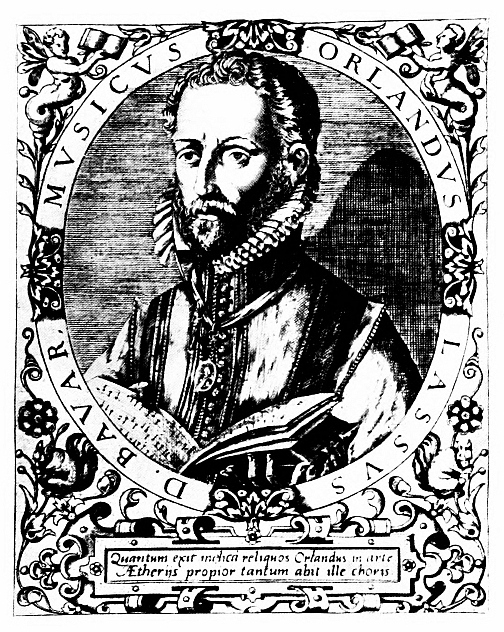
centuries, culminated in the work of Orlando de
Lasso (1520-1594), Giovanni Pierluigi da Palestrina
(1524-1594), and others. This music is as primitive,
archaic, and severe to our ears as the early Flemish religious
pictures are to our eyes. It can be described
chiefly in negatives. It did not employ instruments,
but only voices in the chorus. It had no regular time-measure,
but wandered on with as little definiteness of
rhythm as the Latin prose to which it was set. It employed
no grating harsh combinations of tones (‘dissonances’)
such as make our music so stirring to the
emotions, partly because they are difficult for voices,
partly because the science of harmony was in its infancy,
partly because the kind of expression it aimed at
was that of religious peace. Each group of voices had
its own melody to carry, and as there were sometimes
as many as sixteen groups an extraordinarily complex
web of voices or ‘parts’ was developed, to which is due
the name of polyphonic (many-voiced) applied to this
school. Unsuited as it is to the restless temper of the
modern man, it often attained within its own limits an
exquisite beauty.
With the application of this general type of art, the
polyphonic, to instruments, especially the organ, new
developments supervened. Dissonances were perfectly
easy, and most effective, on the organ, that would have
been impossible for voices. Definite metre and rhythm
were gradually introduced. Above all, the many melodies
of the older style to some extent gave way to the
massive detached chords more suitable to the organ
(because the player could grasp them by handfuls instead
of having to make his fingers play hide and seek
among the keys), and thus was born another great
type of style, the ‘homophonic’ (one main melody, accompanied
by chords rather than by other melodies).
At the same time the intellectual interest was vastly
increased by the use of more and more definite and
recognizable bits of melody, happily called the ‘subjects’
or ‘themes’ of the composition, which could be
developed and marshalled just as a writer develops and
marshals his thoughts. The fugue is the arch type of
this kind of composition, with its style partly polyphonic
and partly homophonic, its deep thoughtfulness, its
ingenuity, and its surprising variety and depth of emotional
expression. Its supreme master was Johann Sebastian
Bach (1685-1750).
Despite the mixture of styles in the fugue, however,
the preponderant element was still the basket-like
texture of winding melodies suitable especially to
voices—hence it was only in the suite, a type which
developed at the same time and of which also Bach was
one of the supreme masters, that the homophonic style
suitable to instruments was freely worked out. Instruments
mark the rhythm much more strongly than
voices, so that all sorts of dance movements are particularly
appropriate for them. When the rhythm is
so marked, comparatively short phrases of tune stand
out sharply and balance each other like the verses in
a couplet of poetry. Composers soon found out how
further to group these phrases in definite parts or sections,
so contrasted that the whole of the short piece or
‘movement’ presented a perfectly clear, sharp impression,
had a definite beginning, middle, and end—a clear
scheme of form. This clearness of impression was
enhanced by making only one line of melody—the
‘tune’ or ‘air,’ as we say—prominent, either subordinating
all the others or doing away with them entirely in
favor of an accompaniment of detached chords such
as we find in a modern waltz or march. The suite,
then, as it is found in its golden age, the eighteenth century,
is a series of short dance tunes of strongly marked
rhythm, precise in phraseology and concise in form,
in the homophonic style. Among its masters may be
mentioned, besides the German Bach, Couperin and
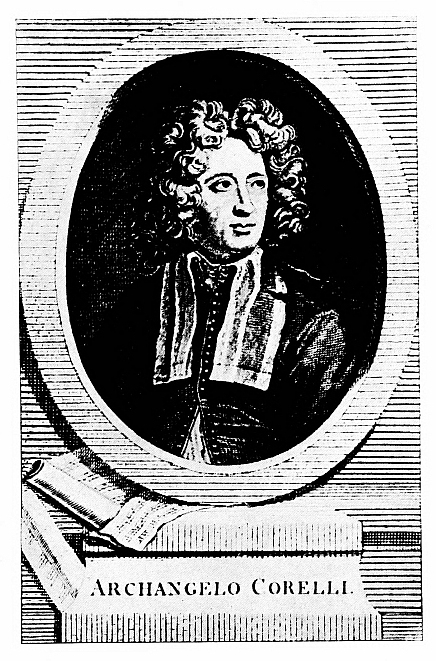
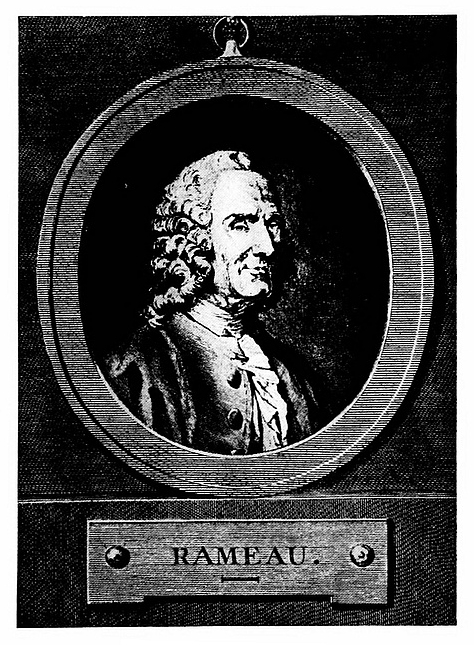
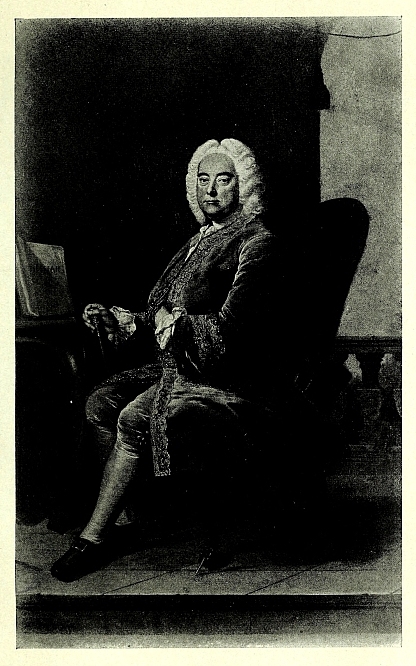
Rameau in France, Corelli (violin) and Scarlatti
(harpsichord) in Italy, and Handel in England.
Closely allied with the suite, indeed an offshoot from
it, is the sonata, originally any piece for instruments
(from sonare, to sound or play) as distinguished from
a cantata for voices (from cantare, to sing). The old
sonatas are essentially suites. But the generation after
Bach’s, of which one of his own sons, Carl Philipp
Emanuel Bach, was a guiding spirit, hit upon one of
those apparently simple but immensely fruitful ideas
out of which whole schools are made. It was this: Instead
of coming to a stop as soon as you have outlined
a single musical idea or ‘theme,’ and then merely repeating
or slightly elaborating it, as was done in all the
movements of the typical suite, why not embrace in the
span of your thought two contrasting ideas,[1] so characterized
and arranged that each should serve as the effective
foil of the other? Once this notion of making a
piece of music out of two contrasting themes was tried
out in practice it proved to have endless potentialities.
In the two hundred years that have elapsed since C. P. E.
Bach’s birth in 1714 its possibilities have not been exhausted;
it has shown an elasticity which has enabled
it to serve equally for the embodiment of such different
ideas as those of Mozart, Beethoven, Schubert, Schumann,
Tschaikowsky, Brahms; it has been applied to
all branches of instrumental music, extending its sway
quickly from the ‘sonata,’ specifically so called, for one,
two or three instruments, to the quartet, quintet, etc.,
for a group, to the concerto for a soloist with orchestral
accompaniment, and to the overture and the symphony
for full orchestra.
The purest examples of the application of this scheme
to orchestral music are to be found in the first movements
of the symphonies of Joseph Haydn (1732-1809),
of W. A. Mozart (1756-1791), and above all of Ludwig
van Beethoven (1770-1821), the genius in whom the
classical symphony culminated. The method adopted
in such movements, of which the opening allegro of
Beethoven’s Eroica Symphony may stand as an unsurpassable
model, was, first, to present two strongly individual
and contrasting musical ideas (‘themes’), the
first usually more vigorous in character, the second
more tender and appealing; second, to let these
thoughts germinate or develop in such a way as to
bring clearly forth what was at first latent in them;
and, finally, to draw together the threads and complete
the musical action by a restatement of the root ideas in
something like their original form. The variety, the
power, the subtlety, the unfailing instinct for beauty,
with which Beethoven worked out the almost limitless
possibilities of such a scheme can hardly be realized
even dimly save by a loving study of his masterpieces,
phrase by phrase, almost note by note. His symphonies
are like Greek statues of the great period in their infinite
variety, their perfect unity. It may seriously be
doubted whether music can ever a second time attain
the harmony of all its elements that it found in this
supreme master—that which one of his critics has happily
termed ‘the perfect balance of expression and
design.’
Certain it is that immediately after him, in large
measure as a result of his own example, it took a pronounced
turn toward picturesqueness, toward highly
personal expression, toward all that is conveniently
summed up in the vague word Romanticism. Just what
romanticism means it is easier to suggest by examples
than to define in general terms. Franz Schubert
(1797-1828), emphasizing the lyric element in orchestral
music, so that his symphonies have almost the
personal expressiveness of songs, is romantic. Robert
Schumann (1810-1856), with his vivid short piano
pieces bearing such suggestive titles as ‘Soaring,’
‘Whims,’ ‘In the Night,’ ‘Why,’ and with his musical
portraits of friends, his quotations from his own works,
and other ingenious devices for stimulating our imaginations,
literary and pictorial as well as musical, is
romantic. Felix Mendelssohn (1809-1847) is romantic
with his orchestral canvases of the Hebrides islands
bathed in sunshine and clamored over by sea-birds, and
of the delicate dances of Shakespeare’s fairies in the
‘Mid-summer Night’s Dream’; and romantic is Frédéric
Chopin (1809-1849), with his nocturnes and preludes.
The composers of the romantic period, in fact, embodied
in the types of design they inherited from Beethoven
(but practised, as a rule, with far less mastery than
he) a sort of poetic suggestion of all kinds of things
outside of music. Their art is essentially an art of suggestion;
and, while its purely musical beauty is often
great, they wish us not to rest content with the music
for itself, but to regard it as a symbol of something
beyond.
Once composers had begun to label, so to speak, the
musical expressiveness which the classicists preferred
to leave free to act upon each hearer according to his
temperament and associations, certain especially literary
minds among them, notably Hector Berlioz (1803-1869)
and Franz Liszt (1811-1886), naturally felt impelled
to carry the process a step further, to amplify
and edit the label into complete ‘directions for using.’
Such ‘directions for using’ are called ‘programs,’ and
the school which affects them is named ‘programmistic,’
or, by analogy with a similar school in literature,
‘realistic.’ Your typical programmist, such as Berlioz,
is not satisfied with the romanticist’s mere suggestion
of a subject; he demands in advance a complete bill of
fare of his musical feast. When Beethoven, a classicist,
deals with a human emotion—love, for instance, as in
the Fifth Symphony—he aims merely to stimulate in us
the most general feeling and let each of us interpret for
himself; when a romanticist like Tschaikowsky writes
almost equally beautiful love music he gives a fillip to
our imagination by naming it an overture to ‘Romeo
and Juliet’; but when Berlioz conceives his Symphonie
Fantastique he must have his lover killed on the guillotine—he
must even hear the knife fall. Such a theory
of musical æsthetics is evidently highly dangerous,
since it tends to bind shackles on the free movement of
the music, and also to distract the hearer’s attention
from the music to something far less vital. Nevertheless
in the hands of Richard Strauss in our own day
(born 1864), who seems to be the genius in which this
school is to culminate, it has led to remarkable results.
We have now reviewed in highly summary fashion
some of the chief schools, with their most representative
masters, that may be noted in a bird’s-eye view of
the history of instrumental music. As for the other
great branch of the art, music associated with literature,
and especially its most important manifestation,
the opera, classification according to artistic principles
is both more difficult and less necessary, since the opera
can very well be studied by countries rather than by
schools. The reader will at any rate find in his study
of opera that one or two clear conceptions of the national
or racial character of the three peoples who have
done the most important work in the operatic field, the
Italians, the French, and the Germans, will help him
more than æsthetic standards difficult to apply to an
æsthetic hybrid which is neither drama nor music.
Thus the Italian sensuousness has been both the blessing
and the curse of opera in Italy: the blessing by
keeping it simple and tuneful, as in so much of Rossini
(1792-1868), Bellini (1802-1835), Donizetti (1798-1848),
the early Verdi (1813-1901), and even such moderns as
Mascagni and Leoncavallo; the curse of opening the
door to all sorts of absurdities on the dramatic side,
and to the abuse of the power of the singers in meaningless
virtuosity. Again, the keen dramatic sense of
the French has helped to minimize such absurdities in
works produced by their composers or at their national
opera house under their national influence, as for instance
those of Gluck (1714-1787), Cherubini (1760-1842),
Meyerbeer (1791-1864), and others. Finally the
warmth of sentiment of the Germans, their unrivalled
faculty for getting at the emotional essence of a situation
and expressing it in music, must be accorded a
large part in the power of the romantic operas of the
German Carl Maria von Weber (1786-1826) and the
music dramas of Richard Wagner (1813-1883). In revenge
the Teutonic deficiency of dramatic sense and
tolerance of tedium are to some extent accountable for
those long stagnations of the action in the Wagnerian
dramas which the most ardent admirers of Wagner the
musician no longer deny.
In all this historical study of the earlier volumes of
‘The Art of Music’ the reader will be primarily in quest
of information, his interest will be that of the scientist
in facts. Even here, however, he will soon find himself
discriminating the good from the bad, or from the less
good, setting up standards of comparison, in a word,
mingling with his purely scientific interest in facts an
artistic interest in values. In all periods he will find
the great man distinguished from the little by nobility,
depth, and variety of thought, and by purity of style.
In all ages he will discover hosts of mediocrities for one
genius. He will realize that there were as many routinists
in the polyphonic school, as many dry-as-dusts in
the classic, as many sentimentalists in the romantic, as
there are uninspired scene-painters among the programmists.
He will remark what may be called the
double paradox of art: first, that cheap decorativeness,
empty display of merely technical skill, ‘splurge’ of all
sorts, while often making music popular in its own day,
has always killed it early for posterity, as for example
in the case of the over-ornamented arias of Italian
opera or the equally over-ornamented piano pieces of
Thalberg and other early nineteenth century pianists;
second, that simplicity, directness, sincerity are always
at first ignored or misunderstood, and only gradually
take the supreme place which belongs to them, as
we see in studying such otherwise dissimilar artists
as Gluck, Mozart, Beethoven, Schumann, Wagner,
Brahms, Franck. Such observations open up the path
to a true, independent, and unconventional estimate of
artistic values, to the development of real taste.
It is especially in amplifying, clarifying, and solidifying
this taste that the second group of volumes, dealing
with the media of musical production, will be useful
to the unprofessional reader. A knowledge of the
construction of instruments and of the style appropriate
to each, as determined by its peculiarities and exemplified
in its literature, is a great aid both to the appreciation
of excellence and to the detection of shoddiness.
A simple example will make this clear. Every one who
has watched a pianist play a waltz knows how appropriate
and convenient for the piano is that kind of accompaniment
which has been called the ‘dum-dum-dum’—where
the left hand first sounds the bass and
then strikes twice a chord completing the harmony and
at the same time marking the rhythm. This is an excellent
piano device, because it does these three needful
things in the simplest possible way. What shall we say,
however, when laziness or incompetence, writing a
waltz for orchestra, borrows this piano device without
change, as it does constantly in the popular music of
the day? Evidently enough, what was well fitted to the
piano is ridiculous for an orchestra: for here it gives
the bass instruments a series of detached notes without
coherence or interest, and condemns the unfortunate
players who provide the middle parts to repeat an endless
‘dum-dum, dum-dum’ which outrages all musical
instinct.
Or, again, we sometimes hear piano pieces in which
the harmonies are arranged in solid chords, as in the
hymn-tune familiar in the protestant church. Why the
effect should be so singularly vapid we do not know
until we think of the peculiarities of the instruments
involved. Voices, especially in large groups, as in congregational
singing, move slowly, sustain well, and
show their quality best when disposed in broad masses.
Hence the appropriateness to them of these deliberate
chords. But the piano, on the contrary, sustains very
poorly, achieves fullness of volume only by means of
rapid utterance, and is in short at its very worst in the
hymn-tune style. Piano tone requires to be split up
into many facets, to be carved, so to speak; but vocal
tone is like those substances, such as colored marble,
which show their texture best in the block. Recently
there has been much controversy as to the appropriateness
of organ transcriptions of orchestral works. No
doubt the organ can render the notes of a symphony
quite as well as the poor overworked piano, but a rudimentary
knowledge of the mechanism of the organ will
show us where lies its special capacity—in the sustaining
and rolling up of great masses of tone, and not at
all in that more intimate expressiveness through swelling
and fading and through accent in which the violin
is peerless. The organ is magnificent in a Bach fugue,
unsatisfactory in a Beethoven symphony, ridiculous in
a popular dance. Thus on all sides we see that style
depends on the medium, and that a sensitive taste will
no more detach a musical figure from its appropriate
setting than it will transfer the costume of the logging-camp
to the drawing-room, or vice versa.
What makes all study of this kind particularly necessary
to the would-be intelligent music-lover of to-day is
that our generation seems to be going through a period
of unusual confusion in all matters of taste. Whether
it be that our resources have accumulated faster than
our powers of assimilation could develop, or that popular
education, while increasing the amount of musical
enjoyment, has lowered its quality, or that the ever-present
commercialism has betrayed us—whatever be
the causes, it is certain that almost all our standards
have suffered from a false liberalism, that we have lost
old lines and boundaries without getting anything to
put in their place, and that much as we may boast of
no longer starving our artistic instincts as did our puritan
forefathers, we do not yet discriminatingly nourish
them, but rather overeat ourselves sick. There is
hardly any branch of music where this tendency to excess
may not be discovered. The modern conception of
the piano, for instance, as a rival of the orchestra in
richness, variety, and power of sound has adulterated
piano style in many respects. It has led directly to ‘ungrateful’
writing for the piano by composers, to pounding
and other exaggerations by players. There are few
musicians nowadays who show the fine self-control
that made Schumann and Chopin models of how the
piano should be treated. The rare intuition of Debussy
in this respect is one of the true justifications of a
vogue not perhaps altogether free from faddism.
In chamber music, notably the string quartet, where
delicateness of sonority is even more vital to the style,
since it is the condition of the clearness of the individual
voices, and cannot be departed from without an
immediate coarsening of the texture, there is the same
tendency to imitate the orchestra. One hears many
modern quartets in which all four instruments keep
restlessly sawing away, often on two strings at once,
as if they were taking part in a hurdle race or a debating
society, rather than in a work of art. Special effects
like harmonics and the use of the mute, appropriate
enough in solos and at long intervals, are grossly
abused. In striving to be something beyond its frame
this most exquisite combination of four musical personalities
loses all its intimateness, all its charm. Even
orchestral music itself does not escape these perversions.
There is a distinct cult at the present day, especially
in France, for playing at concerts music originally
written to accompany pantomimes or ballets, and even
for composing pieces intended for concert according to
the processes suitable for such illustrative music—with
highly spiced sonorous effects, schemes of structure
based on dramatic action, and little or no purely musical
interest. Indeed, all thoughtful observers must
sometimes ask themselves if this universal tendency to
force things out of their natural fields, to make them
do not what they can do best, but what they are least
expected to do, is not a symptom of a grave disorder of
our æsthetic sense, a preference of novelty to beauty, a
debased fondness for the queer, an invasion of art by
that low curiosity which draws a street crowd around
any one who will stand on his head, or wear his clothes
wrong side before. The reader genuinely fond of
music will be glad to combat this tendency to the best
of his power, and to that end will inform himself of
those peculiarities of instruments by which appropriateness
of style is so largely determined.
What the average reader can get from his study of
the theoretical portions of ‘The Art of Music’ will depend
largely on his instinctive sense of the larger bearing
of technical facts. Studied with pedantic insistence
of detail harmony is a dry subject; studied with an
imagination eager for the light it throws on general
æsthetic questions it proves unexpectedly illuminating.
Harmony describes the material available to the musician;
it is, we might say, the dictionary from which
each composer chooses the words he needs to express
his thought; and to study it is therefore for the lover of
music much what it is for the lover of literature to
study the vocabularies of his favorite authors—the derivations
of the words, their ancient associations, the
flavors which cling about them. Just as Sir Thomas
Browne has his special words, noble-sounding, many-syllabled,
and his special forms of sentence that roll
grandly off the tongue, and as Keats finds in the same
English a completely different instrument, capable of
romantic utterance and full of elusive suggestion: so
the harmony of Bach is not the harmony of Schumann,
although it is made out of the same notes and even
many of the same chords. Indeed, the very same chord
is not the same in effect, in style, when used in the context
of two composers, or even of one composer in two
different moods; a chord is a chameleon that takes the
color of its surroundings. How full of sadness, of infinite
resignation, is the first B flat chord in the Adagio
of the Ninth Symphony! How the very same B flat
chord pulsates with energy in the Allegro of the
Fourth! The study of the action and reaction of harmony
and style is a fascinating one, in spite of its difficulty—one
on which books might be written, as many
have been on the choice of words in literature.
Easier, however, and much more directly helpful to
appreciation, is the study of the chief principles of
musical form or structure, as they affect, not the composer,
but the listener. As one going into a foreign
country provides himself with some guidance as to the
main things he is going to see there, so the music lover
to whom symphonic music remains to some degree a
foreign region likes to find out before he hears it what
he is to listen for. That knowledge in detail will be
found in the essay on musical form in Volume XII.
Here it is our business, as before, avoiding detail, to
get such a bird’s-eye view as may be possible of the
most general facts of musical form. Especially agreeable
and useful would it be if we could show that, in
music as elsewhere, form and formalism are two essentially
different things, and that while formalism is
the conventionalizing and stiffening that indicate lowered
vitality or incipient death in a work of art, form
is the necessary shape it takes because it is alive. The
formless is not yet alive; the formal is dying or dead;
only the formed truly lives. Therefore musical form is
quite simple and natural, like the branching of trees or
the crystallizing of salts, and the study of it is based
on observation and common sense, and strives to determine
how sounds have to be ordered to become intelligible.
Essentially there are but three processes concerned
in musical construction—the announcement or exposition
of the themes, their elaboration or development,
and their recapitulation. These processes are the natural
outcome of quite simple psychological facts, and
are duplicated in literature and other arts. The announcement
of a theme is the preliminary statement,
made as simple and as brief as possible, of the thought
with which the composer proposes to occupy himself.
For the listener, it is the presentation of a bit of melody
of a particular rhythmic profile which he remembers
by this profile, this characteristic combination of long
and short, accented and unaccented notes, just as he
remembers a person by the shape of his face. Careful
attention to the main themes of a composition is of
vital importance to appreciation, since the themes are
the actors of the musical drama, and all the action is
really only the working out of their latent characteristics.
This is what we mean by development. In no music
worthy of the name is development an artificial, intellectual
process; it is simply the germination of the
theme-seeds. As it results, however, in constantly increasing
complexity, it would quickly confuse the listener
were it not judiciously combined with simple
repetitions of the original ideas, serving both to mark
the completion of one cycle of development and sometimes
to initiate a new one. The recapitulations insure
the unity of the impression as a whole made by the
work of art; the developments give it the richness and
variety inseparable from all life.
The many special musical forms of which the student
will read are merely so many clearly defined combinations
of these three processes. Thus in the minuet, for
example, a comparatively primitive form, there is one
theme, expounded, developed, and recapitulated, and
in the second part called trio, a second theme treated
exactly the same way. In the ‘Song form’ so called,
used for slow movements of sonatas and symphonies,
there is usually an exposition of a theme, a slight development,
and an ornamented or otherwise varied
repetition; then, without any complete stop, a contrasting
theme, treated much the same way; finally, a return
of the main theme, either treated as at first or somewhat
more briefly. Sometimes there is a short coda
(concluding section) with further slight development
of one or both themes.
The sonata form, as we have already seen, is distinguished
from both these more rudimentary types by
having two themes of almost equal importance—sometimes
three. These contrast with each other in expression,
rhythm, and what is called ‘key.’ Their development
is extended and occupies the entire middle part
of the piece. They are regularly recapitulated much
as at first, but now both in the same ‘key,’ and may be
followed by a coda, which with Beethoven assumes
sometimes almost the importance of a second development.
In the rondo there is a constant alternation between
a main theme and other secondary themes or
sections of development.
Thus in all the special forms we find but different
applications of the three fundamental processes of exposition,
development, and recapitulation, much as all
plants go through the necessary cycle of seeding,
growth, and blossoming. The more the music of the
great symphonic masters is studied the more marvellous
will the reader find the mingling of ingenuity and
simplicity with which they know how to marshal their
thoughts. Such study makes listening no longer a passive
or even wearisome process, but the most fascinating
reliving of a spiritual life as many-sided, as
infinitely various, as filled with beauty, as that of Nature
herself.
Daniel Gregory Mason.
June, 1914.
FOOTNOTES:
[1] To be exact Emanuel Bach was not responsible for the idea of contrast,
which was a principle developed by the so-called Mannheim school,
whose leader was Johann Stamitz. But with Bach the two separate sections
of the ‘Exposition’ first become distinct.
A NARRATIVE HISTORY OF MUSIC
BOOK I
A NARRATIVE HISTORY OF MUSIC
INTRODUCTION
Musical art is the idealized art of the inner man as
distinguished from the arts of painting and sculpture
and their like which are the idealized expression of
what is outside him. It is the result of the urgent
impulses of certain peculiarly constituted human beings
to express things which move them in ways which
are favorable to permanence; which permanence
proves attainable only through the controlling influence
of the instinct for order.
The instinct for order and the impulse to gratify
it in all directions seem to be present in all unperverted
human beings; which is obviously the consequence
of the fact that it has always ministered to the
preservation of those who possessed it. The primitive
savage who kept his weapons in some kind of orderly
fashion, and knew where to lay his hands on them
when wanted, easily survived the disorderly savage
who could not find them soon enough to prevent being
exterminated. The primitive savage who could dispose
his means of existence in an orderly fashion was more
likely to survive the savage who had no proper place
for anything; and there were thousands of other ways
in which this instinct favored its possessor; and
favored him more and more as social and anti-social
conditions progressed in complexity. Looked at from
another point of view, that of experience, the lack of
the sense of order betokens low mental power; and
the possession of it in higher and higher degrees is
a token of higher and higher capacities of mind.
The sense of order is the basis of organization; and
out of organization comes permanence. The more perfect
the organization the more lasting is the thing organized.
What is well built is well organized for its
purpose, and stands fast. What is ill built is badly
organized for its purpose, and tumbles down. And so
it is with a work of literature. It cannot be said that
a noble thought ill-presented will soon be forgotten;
but its being ill-presented makes it obscure. And it
must be admitted that fascination is added to the utterance
of a great thought by the perfect clearness and
nicety with which it is expressed. The presentation is
in that sense admirably organized and the mind welcomes
it, and returns to it frequently with delight;
whereas if it is clumsily expressed it gives the mind
unnecessary trouble to understand what it means, and
then there is a feeling of distaste and annoyance which
prejudices the welcome that the great thought merits.
So it is with a work of art. Clumsiness and incoherence
of structure beget discomfort, however great
the intentions. Imperfections which may not be noticed
at first grow more and more oppressive, till they
become unbearable, and at last mankind is impelled
to regard the good intentions as little better than opportunities
wasted.
It may be justly argued that such imperfections are
inevitable not only because art represents human efforts
but because organization takes centuries to effect.
It is also true that certain types of imperfection are
pathetically attractive and afford a kind of interest
in themselves where they suggest the kind of human
condition and effort which is characteristic of the time
and circumstances in which any individual work of
art was produced. But in such case it is necessary
that the motive shall be honorable. After ages will
never be able to regard the deficiencies in modern
church and chapel architecture, stained glass windows,
modern tombstones and suburban villa residences with
anything but disgust. Putting such aberrations aside
for the present, it is pleasant to realize that one of the
privileges of an instinct for style is to be able to recognize
the stage of organization which has been reached,
both in diction and structure, by the qualities of any
work of art, and to locate the type of organization and
balance its proportionate relation to what is expressed,
and, more subtly still, to discern even the intention.
Men who have any artistic instinct estimate the quality
of a work of art by such an adjustment. They feel its
nobility if it has any, even though the standard of
organization is low, by estimating the quality of the
thought in connection with the inevitable limitations
of the means of expression. A work of art may
inspire constant delight even though its form be obvious
and its details crude, if the methods employed
are sincere efforts to express with the best means
available an inspiring idea. Limitations do not necessarily
imply false construction. There is this to be
remembered: that the progress of thought and the
progress of organization proceed together and that a
thought which clearly belongs to several generations
ago will not be as complex or have to cover so much
ground as the thought of later times of equal status;
and that the limitation of the means of organization
of the time to which the thought belongs will therefore
be adequate and congenial to that thought, whereas,
if a composer or artist use only the resources of diction
and design of two hundred years ago to express a
modern thought, the deficiency of the organization becomes
at once apparent.
It is worth while to observe parenthetically that in
primitive stages of art men did not attempt organization
in order to give permanence to their artistic products.
Their attitude was that of the unconscious child,
and they merely sought to gratify their instinct for
order, and arrived at the principle of organization in
the process. So the beginnings of art were the direct
result of the inevitable processes of the universe. Men
found out the relation of organization to permanence
long afterward, when they developed the capacity to
analyze and consider what they were doing.
Mankind, like the individual, passes through three
stages in his manner of producing and doing things.
The first is unconscious and spontaneous, the second
is self-critical, analytical, and self-conscious; and the
third is the synthesis which comes of the recovery of
spontaneity with all the advantages of the absorption
of right principles of action. In the products of the
first stage people delight in spite of crudity and clumsiness
because they are fervent, genuine, essentially human.
The products of the second are often ineffectual,
occasionally suggestive, and for the most part more
historically than humanly interesting. It is in the last
phase that the greatest works of musical art are produced;
and it is in such works of art that the approximation
to perfection may be found, in which there is
no part which has not some relation to every other
part; nothing which does not minister to the fullness
with which the inner idea of the artist is expressed; in
which every curve of melody, every progression of
harmony, every modulation, every rhythmic group,
every climax and relaxation of stress, every shade of
color, and every part of the inner texture at once
ministers to coherent and cogent expression and at
the same time fulfills its function in the general scheme
of design or organization. From mere elementary
orderliness art has progressed in such things to the
very highest manifestations of the subtlest and most
perfect organization which the human mind is capable
of achieving. But it must be admitted that such an
ideal is only reached in very rare cases, by masters
whose complete absorption in the work of artistic
creation is undisturbed by distracting influences; who
can maintain their concentration through a prolonged
and coherent effort; and who have the gift to apply
their faculties and successfully call upon their minds
to provide exactly the right methods and procedures
whenever required, and at the same time to hold
everything balanced by the requirements of proportionate
relation which is indispensable to true artistic
organization.
It is to such perfection that all true artists aspire,
and it is only those who are absolutely true to themselves
who can even approximate to it. In days when
commercialism is rampant and the favor of such as
are totally ignorant of the most elementary artistic
principles is held to be the criterion of artistic worth, it
practically becomes impossible.
There are two phases of organization. The first is
the organization of terms, signs, methods, materials,
some of which must be found before art begins, but
most of which are found as it evolves. The second
phase is the organization of the individual works of
art. The parallel that springs to mind at the moment
is the organization of units and supplies of an army, on
the one hand, and, on the other, the organization of
the campaign and the engagements for which the
forces and their needs were organized. Upon the
former kind of organization it is not necessary to dwell.
It is an obvious necessity of art. But, though part of it,
it does not illustrate or affect the quality of the art
products except in a purely elementary and mechanical
sense. Of the latter kind, which manifests itself inevitably
in varying degrees in every musical work from
the cheapest popular song to the highest instrumental
symphony, it must be admitted that it is worth while
to have some little understanding; especially of the
relations to one another of the various branches and
factors in the artistic scheme which the study of such
things in detail is apt to miss.
At the outset the curious anomaly may be admitted
that expression and organization appear to be antagonistic.
This is only one way of recognizing that
art, like everything else, is achieved by the accommodation
of opposites. The very idea of human feeling
being expressed in preconceived set terms sounds so
preposterous as to be almost repugnant. Yet if it is
not expressed in set terms how should it maintain its
hold upon the mind? We know by experience that
human feeling upsets organization (as, for instance,
in the confusion of rhythm into which highly emotional
performers and singers are driven), and that organization
stifles human feeling (as, for instance, in the empty,
inadequate words that are stuffed into poetry to make
rhymes, and the ridiculous shams that are stuffed in
architecture as in music to make a pattern complete).
But, as a matter of fact, though language also might be
described as antagonistic to feeling, yet feeling cannot
definitely be conveyed to other beings without being
formalized into words, and the words arranged according
to the recognized rules of prosody. And, as a
matter of experience, when language has become, as it
does, a spontaneous means of expressing feeling, it
very often intensifies the feelings that it is used to express.
Many men are more excited by their own violent
language than by the motives which caused them
to give vent to it. So in art some men only begin to
find out how strong their feelings are when they try
to put them into shape. The mere fact of organizing
effective climaxes according to settled principles causes
them to believe in deep-set passion which they would
not otherwise have suspected in themselves. Oratory
is never in itself a proof of greatness or even sincerity
of soul.
So it cannot be maintained that the appearance of
antagonism is fully borne out by experience. But
what is evident is that the human element represents
instability and the constructive element stability; and
the adjustment of the two keeps art alive. All art that
has life in it must be in unstable equilibrium, for, indeed,
all thought whatever induces instability. Stable
equilibrium, if such a thing could be conceivable, is
merely abeyance of activity. As a matter of fact there
is no part of the universe which is in stable equilibrium,
art as little as the rest of it. Art is, in the widest sense,
man’s highest expression of the Spirit of the Universe;
that is of the effects which are produced in his inner
man by his personal experiences in it and his cogitations
about it, and art’s life is governed by the same
laws. In the universe all things seem to tend toward
stable equilibrium, and yet of necessity when it seems
to be approached some new direction of force disturbs
it and sets up new systems of motions which may last
for ages. So in art there has been a tendency to deal
with the claims of feeling and the claims of form at
different times. At certain periods in art’s history the
human element predominated and the claims of organization
were either ignored or overlooked. The
result was incoherence, and the need of more circumspect
procedure gave organization an excessive spell of
attention. Convention then took the place of realities
and art became the playground of ingenious dry-as-dusts,
till the human element again asserted its claims
and progress swayed in the direction of instability
again; and so the great rhythm was maintained.
But it would be absurd to pretend that the alternation
proceeded regularly without yielding to external
influences. The direction which art took was often influenced
by social conditions external to itself. A
chance whiff of fashion or a wave of impulse in favor
of intellectual subtleties would naturally cause a phase
of art in which human feeling would be crowded out
by superfluity of organizing ingenuity. A state of society
in which a few people enjoyed the results of their
ancestors having annexed all the material advantages
of the world and regarded the rest of humanity as
merely provided by Providence to minister to their
vanities, would be peculiarly favorable to the exuberance
of conventional pattern-making and elegant futilities;
while the successful overthrow of such a poisonous
tradition and the general acceptance of the widest
claims of humanity to common justice naturally
brought an overwhelming impulse of human feeling
into play. But the apparent derangement of the ebb
and flow was not actually destructive of the principle,
but only affected the length of the periods and the extent
of the one influence on the other.
As a rule the instinctive discernment of humanity
was so far just that it is far more easy to point to periods
when human feeling predominated than to those
when the organizing instinct predominated. This was
natural because all artistic beings are, as far as the
impulse is concerned, at the outset bent upon expressing
feelings of some sort. Even those who have more
aptitude for technical efficiency than mind are not
actually aiming at producing supernaturally correct
grammatical exercises. They are always much offended
if such a thing is suggested. The unsophisticated
lovers of music who have no technical knowledge
to speak of are always concerned with the human side
of it, they are moved by the sound, the color, the
rhythm, the character of the melody, and, as far as
they can get at it, by the idea the composer wants to
express. It lies with the unsophisticated to maintain
the claims of that side of art, as Wagner suggested
when he said that he made his works for the not-musicians.
The fully instructed are inevitably inclined to overestimate
mere workmanship. The wonder that is inspired
by supremely masterly organization impels experts
to be carried away by their admiration of it; and,
moreover, it is practicable to discuss that aspect of art
fully and clearly, whereas language is not apt to discuss
the meaning and spirit of musical art, for the obvious
reason that it is the business of music to express things
that are beyond the reach of words. And it is pathetic
to think how many thousands of people who have
musical insight, and are really moved and inspired by
it, are, through their very conscientious desire to understand
it, misled into supposing that organization and
dexterous use of the methods of art are the things
that are of highest importance. This has been the bane
of the greater part of theoretic writing about art and is
the thing which arouses rebellion in ardent and aspiring
minds against the stress that is laid on principles of
form and grammatical orthodoxies. To such dispositions
it seems preposterous to devote so much attention
to the organization and to take so little count of
the thing organized; and their antagonism is indeed
very serviceable. For, however ridiculous the results
their ardor often produces, they do help to keep art
alive and to prevent its being stifled by conventions.
And they do maintain the necessary protest against
the paralyzing theory that has at times been propounded,
that art is merely a special manifestation of
clever mechanical ingenuity. Coherent organization is
indeed a necessary condition of art, but the thing organized
is of the foremost importance. The idea comes
first and the organization is secondary. Yet the one is
futile without the other; the idea cannot be conveyed
without the organization, but organization without
something to organize is mere superfluity. The idea
without organization is mere incoherence; mere organization
without meaning is empty puzzle making. Neither
by itself has any claim to be distinguished as art.
The ways in which a work of art can be organized
are practically innumerable; but in musical art they
all have the simple structural basis of a departure from
a given point to a point or many points of contrast and
back home again. The infinite number of varieties
depends on the manner in which the central point is
established, and how the departure from it is made;
how the contrasting middle portion is organized, and
how the return home is established. The evolution of
principles of form consists in the elaboration of the
main divisions into subordinate contrasts, contrasts to
contrasts, inner organic procedures, devices of structure
which are linked and superimposed on one another,
in which the steps that lead away from the main
centre are successively distributed in subtle gradations,
all of which are available to make the adaptation to
the idea more perfect. The story of the evolution is
perspicuously clear, as the vast amount of devoted and,
latterly, intelligent labor which has been expended
upon collecting folk-songs and specimens of quasi-musical
phrases of savages has completed the story
from the first appearance of the desire for some kind
of orderliness up to the portentous elaborations of
European music of the present day.
The way complication has been built upon complication
may be easily grasped by observing the successive
stages of art for which organization had to be
provided. At first it had only to serve for a single
melodic line; then, in the period of ecclesiastical choral
music, for two or more combined melodic lines; then
composers combined more and more melodic lines as
they found out how it could be done, and this caused
their minds to be almost monopolized by what may
be called linear organization, which is a systematized
relation of melodic parts which are quasi independent,
but knit into unity by their subjection to the rules of
melodic scales, which were called modes. The highest
outcome of long and concentrated thought in this direction
was the type of organization known as the
fugue, which is a linear principle of organization vitalized
by the systematic distribution of recognizable
melodic phrases. Fugue was the first form in which
the musical idea was the most prominent factor in
organization, and in the hands of genuine composers
was developed to a high degree of perfection. But it
left almost unrealized the problem of organization
which dawned upon men’s minds as necessary when
they began to feel the harmonies which were the result
of combined melodious parts as entities in themselves.
This problem was dealt with in the period
when men devoted themselves to the classification of
harmonies in key systems, which gave every harmony
a definite function in artistic organization; and the capacity
of the human mind was developed till it could
recognize one succession of harmonies as representing
one key centre and another succession of harmonies as
representing another key centre, and this made an orderly
succession of key centres the new basis of organization.
Then the human mind grew to be able to discern
these principles of order when composers dispensed
with the sounding of the concrete harmonies
and only represented them by ornamental procedures;
through which the trained mind can perceive and infer
the groups of harmonic successions which are implied
and recognize the respective keys to which they belong.
Complication yet further expanded the basis of
organization as composers approached what may be
called the extreme of sophistication, which became attainable
by a reversion to the linear system, in which
harmony was again suffused by polyphonic methods,
and the individual notes of the ornamental formulas
themselves are made to represent centres of activity
and have their own harmonization; which harmonization
subsists in spite of its apparent clashing with the
harmonization of other ornamental notes, which the
mind is able to endure because it intellectually segregates
the notes which represent different systems and
allots them to their respective centres and so keeps
them apart from one another. The superimposition of
device upon device is like a perpetual budding from
a germ cell, with the additional analogy to things physical,
that each generation is always consistent in its
characteristics and identifiable. The quickness of the
human mind at grasping the especial type of organization
which it has to accept, in order to follow the idea
of the composer, is one of its most extraordinary capacities;
as is the development of the art which enables
the adequately equipped composer to be sure that his
most subtle sophistications are sure to meet with understanding
from the auditors who are equally well
equipped. When an ignoramus looks at a full score of
any big modern work and sees there the hundreds of
notes that are to be sounded in a few seconds, and
sounded also for the fraction of a second and no more,
most of which are not harmony notes but only suggest
them by the way they are grouped, and yet convey to
the qualified auditor a perfect sense of orderliness and
coherence, it will either give him the sense of the
amazing development of art and of human capacity to
follow what is offered to it as art, or incredulity, in accordance
with his temperamental bias.
But it has to be remembered that, in order to find
any method of organization serviceable, the auditor
must have gone through some of the steps which enable
him to follow the procedure. It is here that certain
perplexing incapacities will find their explanation.
It frequently happens that a person of considerable
musical culture is amazed to find that some passage
which he regards as one of the noblest and most moving
in the whole range of art leaves the majority of average
audiences entirely blank and unmoved—and this
may happen with people who are constantly hearing
music. It happens most frequently when a person who
cultivates late phases of instrumental music is brought
into contact with the finest choral music of the sixteenth
century. The meaning and purpose of the several
motions have not come under his attention and he
has no clue whatever to the scheme of organization.
The contempt with which the complacent classicist of
the sonata period looked down upon the form of the
fugue was owing to musicians having broken altogether
for the time with organization of the fugal type
and having become incapable of listening to and understanding
the motions of two or three independent
parts at once. For here it will be as well to observe
that every step in the building up of art by the addition
of notes to a scale, of new chords which were devised,
and of methods and devices of all sorts had special
functions when they were invented, just as much as
every conceivable feature in architecture had a function.
But mankind always forgot the original meaning
very soon and applied the various features to other
purposes, most of which were quite without meaning
and merely served for barren show. And it is this
forgetfulness which makes so many people totally indifferent
to the finest artistic achievements. They are
expressed in a language they do not understand.
It must be obvious that there is a very close connection
between the type and complexity of organization
and the standard of mental development of those for
whom it is devised. The study of folk-music and the
music of primitive savages is very enlightening in this
respect; especially in respect of the organization, which
is based in great part on musical phrases. As might
be naturally supposed the earliest sign of awakening
intelligence is found in mere reiteration of some melodic
or rhythmic formula. This is essentially the primitive
savage type and is met with in extraordinary persistency
under varied conditions. It is a most remarkable
fact that such undisguised reiteration is a conspicuous
feature of the music of relatively undeveloped
races in the present day, who have adopted the advanced
methods of modern music with remarkable
success. It is the more curious as the composers of
the more developed races do not resort to such naïve
reiteration except as a basis for presenting a phrase or
passage in different lights by variation. And with the
undeveloped races their reversion to a primitive practice,
especially at points of great excitement, is an unconscious
admission of the nearness of their temperamental
average to that of their primitive ancestry. As
a principle mere reiteration is hardly worthy of the
name of organization, it might rather be called a preliminary
procedure, or a means of keeping things going.
It does not imply any mental development, it only
implies some kind of definition and capacity of recognition.
The first step toward real organization comes
when a phrase or short passage of melody is alternated
with another which serves as a contrast with it, and
returns again to the first phrase to give the sense of
completeness. Yet even such a simple principle of
orderliness needed considerable progress in mental
grasp before it could be attained. It might perhaps
be regarded as the significant feature which distinguishes
folk-music from savage music. Folk-music
is indeed a very considerable advance on the music
of primitive savages, and it shows the growth of power
to attain to real orderliness, as the basis of art, by the
employment of simple and clear forms of organization,
which are evolved quite irrespective of any collusion
or imitation between the races that resorted to it. As
folk-music is always melodic it did not admit of great
variety of elaboration in the organization of the tunes,
yet there was sufficient to illustrate the average disposition
toward intellectuality of the races which the
songs represent. Races which are notable for the
quickness of their intelligence and their delight in the
exercise of it show it in the closeness and interest of
the structure of their folk-music, as is the case with
Scotch tunes, and those whom imagination, feeling, or
sentiment are specially liable to dominate are represented
by forms which are vaguer and less elaborately
organized. On the side of character, also, it is parenthetically
observable that folk tunes reflect the temperamental
qualities of the races and localities to which
they belong most truthfully—such as the vivacity and
love of orderly design of the French, the pathos and
pugnacity of the Irish, the sober simplicity and deliberation
of the English, the sentimental reflectiveness
of Germans, the spasmodic vehemence of Hungarians,
and the love of elaborate ornamentation of
Orientals. Slavonic folk-music is also most characteristic,
but it is most difficult to define. It has in most
cases a flavor of the playful unconsciousness of youth,
simplicity of structure and a kind of pathetic gaiety.
This close connection between a race or a geographical
attitude of mind and its folk-music is really a foretaste
of the connection which persisted throughout
the whole story of art’s evolution. A people’s music
so accurately represents its temperamental qualities
that, if there was any doubt about a race’s character,
the music they favor would solve it. In folk-music
the element of rhythm figures very considerably; and,
as it is a subject about which a great deal of confusion
of mind seems to exist, it is advisable to give a little
attention to it. It is a defining and vitalizing influence
of the highest importance; for it is only through
rhythm that the individual factors of organization become
identifiable. It is through the grouping of beats
into two, three, four, five, six, and so on that the nuclei
which are the basis of organization are grouped into
coherent and distinguishable factors. Inasmuch as a
note is nothing by itself, and only becomes something
when it has relation to another note, and, as these notes
must succeed one another in time, it is necessary to
have some means of defining the respective lengths of
time which are to be relatively allotted to the respective
notes; and rhythm is the process by which the
progress of sounds in time is marked off and organized.
Without it there would be mere vagueness and confusion.
This is the aspect of rhythm from the point of view
of organization. That was not its object in the beginning,
but to minister to expression of feeling. All people
who have not attained to an advanced stage of
culture and intelligence delight in rhythm; and the
sphere it occupies in folk-music is enlightening; for its
preponderance varies considerably. In some folk-music
it is always conspicuous, as in Hungarian and
French folk-music; in some it is only moderately apparent
and rarely aggressive, except when the words
associated with it imply vigorous action, as in English
and German folk-music. There are obvious implications
which are suggested by the fact. The aggressively
rhythmic music shows a predisposition for instrumental
music, and the less rhythmic for vocal
music. The former represents the music of action
and the latter the music of inner feeling. The former
secular feeling and the latter serious feeling associated
with religion of some sort.
Rhythm suggests bodily activity. Its essential function
is to represent the expression of feelings by motions
of the body, arms, legs, or any part that can
move freely. This is verified by the fact that rhythmic
music impels people to join in with hands and feet, and
this is also the underlying basis of dance music; for
the object of dance music is to inspire people to rhythmic
activity, and its connection with expression is verified
by the fact that so much dance music, even in the
earliest times, has been mimetic. The position of
rhythm in artistic music is strange, for it is undeniable
that the preponderant impulse of serious composers
is to hide it away in sophistications. Indeed, for many
centuries it was, possibly unconsciously, kept at bay.
Pure unsophisticated rhythm belongs to the primitives.
It is not the form of expression congenial to self-respecting
and developed races when they are taking
anything serious in hand. This is partly because it
does, as above remarked, represent physical expression,
which is not the type to which intellectual people
are prone. Developed minds want to convince by argument;
primitive people by force. Moreover, rhythm
is not progressive. In its direct forms it is probably
much as it was with the cave dwellers. Its limitations
are obvious; and its simple forms are indicative of a
primitive state in those that use it.
As a matter of fact, it seems to be the ingrained impulse
of composers whose feeling for their art is highly
developed to disguise it, as though the frank use of it
was commonplace and cheap. What appears to be
progress in rhythm is indeed not in rhythm itself, but
in that very sophistication. It is like the sophistication
of metre in the blank verse of Shakespeare or Milton,
or even in the lyric poetry of Shelley and Keats and
later poets, which makes English lyrics so difficult for
inefficient and unliterary composers to set. The parallel
in poetry and verse is complete. For the jog-trot
of those indifferent poets who make an appeal to the
undeveloped minds of the herd is poetry of a low order,
just as is the rhythmic commonplace of cheap-minded
composers.
The higher type of composer deals with rhythm as
with everything else. He uses the simple basis of a
definite rhythm to build upon it something interesting.
What would be commonplace and familiar is made
worthy of the name of art by its presentation in relation
to other rhythms, or in combination with an independent
grouping of strong and weak beats which gives
it new significance. Such sophistication of rhythm was
very difficult in the times when music was confined to
one melodic part. But it became easy when choral
music developed into contrapuntal treatment of melodic
voice parts, and it attained in later days to the
highest pitch of interest when the harmonic style was
reinfused with polyphonic methods, and full opportunities
were afforded for combining different rhythms
at once, and ordinary rhythms in one part could be
made quite interesting or amusing through their association
with other parts which are purposely at variance
with the essential rhythm. By such procedure
composers succeeded in avoiding the use of common
property and could enjoy the inestimable services of
rhythm as a vitalizer and a definer without condescending
from their high estate. The reticence of the higher
type of composer in the matter of rhythm, and his
tendency to refrain from such undisguised relaxation,
is curiously confirmed by the history of sacred music.
It is a very singular fact that, in the long period of over
five centuries, during which church music was developed
from the most primitive conditions till it manifested
such wonderful perfection of spirit and workmanship
at the end of the sixteenth century, composers,
guided by instinct rather than conscious reasoning,
always endeavored to suppress or hide the sense of
rhythm. As music began to grow from the doubling of
plain-song at the intervals of fifths and fourths and
octaves (which was so convenient to the different calibres
of the voices which had to sing it), by filling in
the steps between one principal note and another with
shorter notes, and so developed primitive counterpoint,
composers soon began to aim at giving the effect of
independence to human voices by making them move
at different times and in different directions; by making
use of syncopations, suspensions, dotted notes that
overlapped one another, and all such procedures as
obscured the rhythmic element. And even when, owing
to special circumstances, they were driven to make
parts move simultaneously, as in later harmonic procedure,
they made the chords halt and move again, and
even occasionally drop the principal accent, to obviate
the sense of rhythmic lilt—as may be observed in some
of the hymn tunes of Orlando Gibbons, which have had
to be altered and made quite commonplace in modern
times to suit the mechanical habits of modern congregations.
This curious persistence may be explained by the fact
that devotional feeling is not demonstrative. Western
people in really devotional frame of mind do not
gesticulate or fling their arms and legs about to express
their feelings, but are bowed down in spiritual ecstasy.
The music was the true expression of the spirit; and,
till secular music began to react upon religious music
after the beginning of the seventeenth century, the
music of the services of the church might fairly be
described as anti-rhythmic. And it still remains a fact
that whenever rhythm makes its appearance prominently
in music which purports to be devotional it is
a proof of its insincerity. But there are always many
things which concur in achieving a big result, and it
must be admitted that conjoined with the instinct
which avoided rhythm in religious music was the fact
that all the early religious music was essentially vocal;
and vocal music in its purest simplicity is comparatively
unrhythmic. It learnt definite and consistent
rhythm from instrumental music when that came to be
cultivated with vigor from the beginning of the seventeenth
century onward. It is true that dance music
was sung, and that the Balletti of such a delightful
composer as Morley have wonderful rhythmic verve;
but such compositions represent the time when musical
expansion was moving strongly in a secular direction
and instruments were beginning to exert their influence.
The greater madrigals of the late sixteenth and
early seventeenth centuries still illustrate the inherent
peculiarity of pure choral music and give ample proofs
of the composers’ endeavors to disguise the rhythmic
element and represent the underlying principle of the
grouping of strong and weak beats without adopting
obvious rhythmic organization. Instrumental music,
on the other hand, inevitably implies rhythm. In its
most primitive phases it was probably nothing but
rhythm, and that rhythm of a perfectly frank and undisguised
description. In its early artistic, phases it
was generally full of rhythmic life without obtruding
the rhythm as a special means of appeal to the audience,
as is the case in modern popular music. The
deeply ingrained habits of counterpoint which still
persisted in the eighteenth century made even suites
of dance tunes so full of texture in detail that the
rhythm was rather the basis of the definition of pulses
than a factor in the effect. If the story of modern
music were followed up with special reference to
rhythm it would be found that the aim of all composers
who took their art seriously has been to avoid
the commonplaces and to sophisticate rhythm in such
a way as to make it serve as an additional source of
expression, instead of a mere mechanical incitement to
movement. The increase of orchestral instruments offered
ample opportunities to sophisticate rhythms in
a manner analogous to the charming effects of early
choral music, in which syncopation and cross-rhythms
add a genuine interest to the fundamental rhythm and
seem to play with the hearers by making them feel that
one rhythm is superimposed on another. Even in actual
modern dance tunes of the best kind the impulse
to add something independent to the fundamental
rhythm is found in such devices as tying over the
last note of a group of three in a valse to the strong
beat of the succeeding rhythmic group, while the essential
rhythm is maintained by the bass or other instruments
of the accompaniment, and composers have
even successfully devised such attractive ingenuities as
the effect of three long beats being superimposed on
two groups of the three lesser beats of the established
rhythm. The well-known combination in Mozart’s
Don Giovanni of a minuet and a valse each in triple
time and a country dance in 4/4 time is one of the most
ingenious illustrations of such combined rhythms. The
essential basis of all such devices is the sophistication
of the obvious, which is the natural impulse of every
true composer.
Such sophistication is, however, ultimately dependent
on the development of harmony into its latest
polyphonic phases, which represent the furthest progress
of intellectual perception in the races which make
use of it. The use of harmonies systematized on the
basis of tonalities is the highest development in respect
of expression that has been attained in art and it has
become a means of widening the possibilities of organization
which seems to be unlimited. It is said of a
famous English philosopher, whose range of intellectual
power was abnormal, that he wept because he
thought that the range of melodic variety was exhaustible.
He was possibly one of the many whose
musical sense is not sufficiently developed to understand
progressions of harmony. For, if he had known
that every note of every melody is capable of being
accompanied by an immense number of different harmonies,
probably several dozens apiece, and that each
different harmony is capable of altering altogether the
expressive character of the melodic note in relation
to other notes of the melody, and that the changes
in expression not only apply to notes which are contiguous
but to notes that are several steps removed,
he need not have been distressed at the limitations of
the musical scale as developed by European peoples.
But this does not by any means exhaust the possibilities
of expressive effect, because the same harmony
will have a different effect if it is in close order or in
open order; if it is in close order in a high part of the
scale or a low part of the scale; and the melodic significance
is also variable with the rhythmic treatment
to which it is subjected. The full force of harmonies
to minister to expression was dependent on the systematization
of chords on a tonal basis. This had been
in the air for a long time before composers definitely
grappled with the problem, as may be observed in the
splendid use J. S. Bach made of the expressive resources
of harmony. But it was the classical masters of
the sonata period who dealt with the matter effectually.
They based their scheme of organization on the recognition
of a complete classification of the harmonic contents
of any key; which implied a recognition of the
actual degrees of importance and of the functions of
each individual chord. This scheme also required as
its most essential guaranty a very strict recognition
and observance of each key that became a factor in the
form; and also the apprehension of chords as chords.
But when the true polyphonic spirit invaded the
sacred precincts of the sonata type, and means were
supplied to slip from diatonic chord to chromatic chord,
and even for a composer to lead the pleasingly bewildered
hearer into some unimaginable remote key and
back, it began to dawn on people that the achievement
of even such an admirable principle of organization as
the sonata form had not landed musicians in their final
haven, but that in reality the sonata period was merely
one of transition—a kind of interim, like that of the
aria form in opera, when men forebore for a time to
address themselves to expression, and projected their
minds to the solution of the essential problems of organization.
The wonderful success which the sonata
composers achieved in their devoted self-denial led to
the unfortunate misconception that musical art was a
thing which stood by itself and was self-sufficient and
had no reference in its highest manifestations to anything
outside itself. Two things corrected this strange
aberration. One was that a race of composers sprang
up who filled up the easily managed forms of the
sonata type with correct and orthodox passages and
deluged the world with utterly barren, empty, artificial
and intolerably conventional rigmarole. This,
indeed, the world could not put up with, and it turned
with not unnatural eagerness to welcome the party who
advocated program music. These aspiring people
were quite on the right tack, but the resources of art
were not as yet built up sufficiently for their purposes,
and therefore a great part of their trivial and conventional
imitations of scenes and impressions merely
made them ridiculous. The necessary revolution came
out of the heart of the old régime. The greatest masters
of the sonata types of art had always been impelled
to infuse their works of the sonata order with
human meaning and to suggest a condition of feeling—mournful,
cheerful, merry, mischievous, and the like;
and Beethoven, the greatest of them all by far, after
showing frequent signs of breaking away even as early
as the slow movement of his Sonata in D, opus 10, No.
3, finally in his latest sonatas, quartets and symphonies
produced some of the most wonderful human documents
ever achieved by man, in which he expressed
the workings of his own innermost feelings, the portrayal
of his aspirations, his perplexities in face of
the problems of life, his deep cogitations and moods,
and his hopes for the destiny of humanity. Here, indeed,
he had found the true sphere of musical expression.
It was the expression of his innermost being;
and his music rose to such unparalleled heights
because he dealt with his own self, which he was
bound to know better than most people know themselves
because he was so shut off from the world by his
deafness; and it may be added that the music is so profoundly
interesting also because he was personally such
an extraordinary and intensely interesting character.
Beethoven occupied the unique position of consummating
the sonata type and giving the impulse to the
artistic development which reëstablished the full vigor
of human expression and feeling. He reëstablished
the right of ideas to be expressed by music and indicated
the manner in which it was to be done. His
ardent nature rebelled against conventions. He sought
to eliminate all dead and inert matter, to get rid of
the formal types of accompaniment which were everybody’s
property, and to make everything subserve to
the expression of the idea. It was probably this which
impelled him in his later works to revert to the fugue—that
is, to the real fugue of the type of John Sebastian
Bach, and not to the bastard form in which attempts
were made to amalgamate it with the harmonic
scheme of sonata form, which caused the introduction
of the conventional passages of that form which were
totally alien to the real fugue form. In the genuine
fugue form, as illustrated by him and Bach, all the
texture of the work is alive and there are no conventional
formulas of accompaniment, and Beethoven’s
point of view enabled him to go right back, as it were,
beyond the historical episode of the sonata and bring
the true fugue again to life and use it as a most concentrated
means of expression. There is a further and
very striking aspect of the question which is that
Beethoven, in bringing the fugue form into the field
again, anticipated and gave impulse to the revival of
the polyphonic methods which is such a conspicuous
feature of the most recent development in art: and
yet further, his use of the fugue form illustrated that
gravitation of artistic development which was to find
such splendid accomplishment in the later music
dramas of Wagner, in which the polyphonic treatment
and the use of the leit-motif form a gigantic expansion
of the essential principles of the supremely elastic
form of the fugue.
But even these significant facts do not exhaust the
aspects in which Beethoven anticipated later artistic
developments. It is a very strange fact that after his
deafness was quite established his sense of tone color
continued to expand. Even in comparatively early
works he had shown gravitation toward romantically
characteristic effects of instrumentation, as, for instance,
in the familiar and supremely wonderful color
scheme of the scherzo of the C minor symphony. But
after he had quite lost his hearing his color sense grew
in richness and depth and variety to a bewildering
extent. His mind seemed to be specially occupied
with finding tone colors which intensified the expression
in quite a new way, as, for instance, in the huge
slow movement of the sonata in B flat, opus 106, in the
last movement of the sonata in C minor, opus 111, and
in the slow movement of the Choral Symphony. Prior
to his time there had been a great deal of inert matter
in orchestral scoring. The functions of wind instruments
were indeed defined, in so far as they were used
either as actual solo instruments or more often to supply
a pleasant continuity of tone in agreeable colors,
while the strings did most of the actual talking. But
the standard of execution of the players, as well as the
technique of orchestration, was not advanced enough
to bring the wind instruments fairly into the operation
on an equality with the strings, and they were made to
play what was definitely serviceable to the scheme, but
had in itself no musical definition and purpose. The
greater part of the advance that has since taken place
in orchestration consists in making every member of
the orchestra contribute to the complex of polyphony
by playing actual and apt musical passages. It implied
the growth of texture toward vitality in every part of
the artistic scheme, and a development of organization
of the very subtlest description. For it must be
kept in mind that the employment of instruments of
diverse tone color in the modern manner does not imply
their constant employment, but their apt employment
only; which is so contrived by the genius of
composers who can really think in orchestras that the
tone qualities affect the sensibilities of the hearers to
the utmost by their relations to one another. Even the
feeblest intelligence would be capable of discerning
the fact that great effects of color are made through
juxtaposition. A very vivid piece of coloring is not
vivid because the individual colors are vivid, but because
various colors are disposed so as to give particular
colors their utmost effect upon the sensibilities.
A glowing red does not glow of itself but because the
sensibilities have been so affected by other colors that
they have become highly susceptible to red. Groups
of nerves are affected in various ways by tone colors,
and the secret of art is so to use the various tone colors
that each shall minister in full measure to the effect of
others. And the secret of expression in art in this
particular department is that the composer who has
that very highly organized faculty of perception of
relations of colors uses just those relations in their
various degrees which intensify the susceptibility of
the human auditor to the quality of the ideas he wants
to express.
In this field there is a very wide and interesting opportunity
for special study, as the average of color
tendencies is a very striking means of gauging the disposition
and personality of composers. Thus the stern,
almost ascetic, colors of Brahms, varied by touching
gleams of tenderness and beauty, express his personality
most exactly. Beethoven undoubtedly changed
his average of color as he developed his personality.
In his earlier works he was genial and bright, after the
manner of the sonata composers, and made use of the
cheerful coloring that suited a cultured and prosperous
aristocracy. In his middle period he became warmer
and more serious; in his latest period he was sometimes
grim and fierce, sometimes deep and solemn, but
often tender with the depth of longing and the earnestness
of his aspiration. But who cannot read the character
of a composer through his average color scheme?
The flighty, empty-headed trickster with his sparkling
piccolo and his gas-jet noises on violins, and the bombastic
vulgarian posing as a man of great feeling with
his roars of blatant brass; the oversensitized hedonist
with his delicate subtleties, mainly in transparent
pearl-grays; and so on. We are almost inclined to forget
that it is all, or nearly all, a matter of relations;
it is only not a matter of relations when the music is
false. When the composer does try to make his effects
by violence and what he supposes to be the intrinsic
power of tone-quality nobody is permanently taken in.
That the basis of color effect is relation is a thing man
is learning every day in the infinite variety of a gorgeous
sunset and in the luxuriant blaze of his own
flowerbeds. Indeed, the principle of relativity in art
is nowhere likely to be more readily felt than in the
matter of color.
It is more difficult to apprehend in matters of form
and organization. Yet it ought to be easy to perceive
that the whole object of organization is to put things
in their right places. It is just as in the color scheme:
the effect of a work of art, as has been said before,
does not depend upon intrinsic interest of individual
moments, but on the relation of every moment to every
other moment. If the relations are false the impression
is marred and the idea fails to carry conviction.
But it follows from this that there had to be a sweeping
change in the generally accepted views of the
universal applicability of the sonata forms. They were
no doubt admirable as types of abstract design; they
were examples of approximate perfection in musical
organization; but, when the time came again after the
sonata period to make music express ideas, it became
evident, with the assistance of Beethoven’s insight, that
special ideas required types of organization which were
specially adapted to the ideas. Men humbly ventured
on compositions which did not represent the august
dignity of the sonata order. They tried in small ways
to represent their feelings and ideas. They found the
sonata forms much too big; the prescriptive rights of
so aristocratic an organization entailing such a lot
of formalities; and they had of sheer necessity to find
some forms more apt and compact. The unique genius
of Chopin led the way. Surrounded by an atmosphere
of romanticism, and entirely free, as far as we can
see, from the influence of the sonata spirit, his strange
and subtle mind sought types of form which were quite
independent of tradition. Very often the form seems
to grow out of the musical ideas; at any rate it is easy
to feel that form and utterance progressed simultaneously
in his processes of inspiration. This attitude
toward original methods of organization is perceptible
in a very large range of his compositions—the ballads,
the impromptus, the mazurkas, but in the finest and
subtlest shape in the best of the preludes. There,
indeed, can always be felt the underlying impulse to
express some feeling or idea which is not purely and
only musical, and also the exact aptness of the form
in which it is expressed. Hardly any modern composers
have excelled Chopin in this respect; it is his
greatest contribution to the evolution of musical art.
But even classical composers, composers essentially
built up on the great traditions, tacitly admitted the
gravitation of art back to its rightful position; Mendelssohn
in his songs without words and symphonies,
Schumann in vast numbers of movements of all calibres
for pianoforte and even in movements of symphonies,
such as the slow movement of the Rhenish
and the whole of the D major; Brahms in his compact
and well-considered piano pieces, and movements in
his chamber music; and later on the host of experimentalizing
composers in every branch of art, all bent
on expressing something that stirs them, and all bent
on finding special ways of organizing what they have
to say. The most conclusive illustrations are naturally
in the branch of song as cultivated by modern composers.
Here the theories of the few faithful defenders
of the old strongholds are obviously void; for it
is impossible to imagine anyone being so preposterously
idiotic as to try and write a song in sonata form.
The scheme of organization must inevitably, in such
a form of art, follow absolutely the meaning of the
words and the course of the dramatic development. As
a matter of fact, the same connection with words rules
the situation as far as regards the artistic organization
in all directions from anthems and church music up
to the colossal scores of music dramas. The composer
has now not only to provide diction, method, artistic
texture, color, but also new types of form. It may, indeed,
be said that the highest aim of the composer,
after the discovery of something worth expressing, is
to find some new scheme—some new distribution of
the architectural elements of his musical work—which
will present his ideas in forms which will attract the
attention and keep the interest of the highest class of
minds.
The situation may be said to round off the story of
music’s development so far. For the colossal accumulation
of resources and means of beautifying and vitalizing
ideas serves not only for utterance but also to
widen the scope and variety of schemes of artistic
organization—and the individual composer becomes
personally responsible in that respect as well as for the
feeling and the artistic details.
But the indebtedness of latter-day composers to the
devotion of those who went before is not exhausted
by these accomplishments. For there are many features
of art to which successive generations of composers
have contributed in the fashioning, and which
ought not to be overlooked, though they cannot be
dealt with in detail in a summary. One of the subtlest
and most interesting is the differentiation of various
styles. The instinct which impelled composers in this
connection was always to find the most perfect adjustment
of resources to environment. In other words,
to express what they had to say in the ways which
were most convenient and effective for the instruments
which had to play it, and most suitable to the audience
to which it was to be addressed in the place where it
had to be performed.
At first composers’ ingenuity was exercised in one
style only, that of choral music, limited also mainly to
sacred music. When that was more or less perfected in
the space of some five centuries, instrumental secular
style began to emerge; at first leaning on the methods
and devices which composers had found out in choral
music, and then by degrees, as instrumental music
learned to stand alone, making it more completely apt
for performance by instruments; which process has
gone on till the present day and is still going on. Then,
soon after instrumental style began to branch off from
the parent stem of choral music, operatic style began to
be laboriously devised, and is by degrees still being
perfected in the sphere of music drama; then followed
the distinct style for various solo instruments, as the
style of organ music, the style for various kinds of
orchestral music, for chamber music, for domestic
music, songs, concert-platform music, various types of
modern church music—an ever-increasing variety, each
style being the most perfect adaptation to the conditions
of presentment and the qualities of instruments
as time goes on.
Another development of great interest is that of
thematic material. Such things as subjects were hardly
thought of at first in artistic conditions, as choral music
was not adapted to clear definition. That quality
began to manifest itself when rhythm began to play
its part in instrumental music. Then melodious passages,
which were clearly recognizable in themselves,
began to make their appearance in operatic arias, but
they were for a long time defined more by the conventional
periods indicated by cadences of various degrees
of finality than by their individual character.
This peculiarity of defining subjects persisted almost
till the end of the sonata period in the latter part of
Beethoven’s life, when he began to divine the possibility
of subjects being identifiable for themselves without
artificial conventions for marking their boundaries,
and gave the impulse to that practice of concentrating
interest in short phrases and figures which have intrinsic
definition by reason of their characteristic intervals
and rhythms, which has become the most universal
trait of all later music, gathering force in the
romantic period and being developed further by the
latest representative composers, who use color, chord
positions, even modulation, as well as melodic features,
as factors in making their thematic nuclei stand out
from their context, and serve the purpose of texts to
their discourses—the said texts serving also to suggest
as clearly as possible what the composer has in his
mind, which he desires to convey to his audience in the
most vivid and permanent forms.
It is inevitable that all this huge development of
artistic resources, which has taken so many centuries
of patient and devoted concentration of faculties,
should bewilder the ardent and eager latter-day composer
who is longing to express himself at once.
In many cases his invention and spontaneity seem
to be paralyzed by the amount there is to learn. On
the one hand, it causes academicism in the more conscientious,
and, on the other, it causes rebellion. All
the ‘isms’ of contemporary art of all kinds are the
result of a kind of indigestion which is the outcome of
the superabundance of resources of all kinds. The
highest manifestations of art can only be produced by
those who have survived the long process of learning to
understand the meaning and purpose of artistic procedures
and still have some vitality left. But the public
is by this time quite incapable of distinguishing between
what is built upon genuine foundations and
what is pure recklessness. They like recklessness, and
the power to recognize the mind which builds so difficult
an edifice of individuality on loyalty to his art
requires too much education. So many contrive the
appearance of originality by the easy process of merely
doing what they have been advised not to do. They
cry out against the soul-subduing labor of having to
learn how to do the things that are worth doing in the
best way. So artistic progress becomes mainly the
process of learning from making mistakes, which
brings it into line with all the ordinary forms of social
progress. It becomes a wild hurly-burly of impetuous
adventurousness, in which the ardent explorers do not
even allow themselves time to find out whether the
new country they propose to explore is worth exploring.
But without doubt there is a residue of the real
quality when the disposition of the composer is also
of fine quality. The ‘new paths’ now entail the motive
of the composer being more identifiable than ever.
They betray themselves in spite of themselves. The
pedant cannot escape from his pedantry, the conventional-minded
from his conventions, the sentimentalist
from his sentimentalities, the vain man from his vanities,
the sensualist from his cravings, the insolent from
his insolence, or the commercial from his advertisements.
The general repudiation of standards leaves
them all without disguise, and the man who understands
music can identify the individual and his type
of society and what it is worth through the music he
puts forward as representing him.
It entails a change in the position of musical art
which took place in the painting art centuries earlier,
and shows what a modern thing music is. Men no
longer expect music to be the expression of noble and
exalted thoughts only, but accept it as the expression
of all kinds of moods, emotions, feelings and aspirations,
whether they be little and intimate, satyric and
strange, wildly extravagant, genially humorous, pugnacious,
pacific, pastoral, even uproariously domestic.
It is a new kind of differentiation in which there is
inevitably a new kind of waste. But the ideal public,
which is infinitely longer than it is broad, will ultimately
apply the judgment based on the experience of
generations, and will sift out the products of the genuinely
artistic beings from the follies of the heedless
ones. The purists are in despair, but those whose
optimism is invulnerable can look forward in the unshaken
belief that art will go on expanding healthily,
in spite of the confusion of tongues, through the inextinguishable
passion of true composers to find the most
perfect and complete expression of their own personalities.
Music in nature—Theories of the origin of music—Intervals
and scales; contrast—The aborigines of Carribea,
Polynesia, Samoa, Africa—The rhythmic element: music
and the dance; instruments of percussion—Harmonic traces—Wind
instruments and their scales; the xylophone—Instruments
of semi-civilized peoples—The North American
Indian—Influence of modern culture on savage music.
Significance of exotic music—Classification; Aztecs and
Peruvians—The Orient: China and Hindustan, the Mohammedans—Exotic
instruments—Music as religious rite; music
and dancing—Music and customs; Orient and Occident.
Conjecture and authority—The Assyrians and Babylonians;
instruments; scales—The Hebrews—The Egyptians;
social aspects; Plato’s testimony; instruments—Egyptian
influence on Greek culture and its musical significance.
Significance of Greek music—Greek conception of music;
mythical records—Music in social life; folk-song; general
characteristics of Greek music—Systems and scales—Pythagoras’
theories; later theorists: Aristoxenus to Ptolemy—Periods
of Greek composition; the nomoi; lyricism; choral
dancing and choral lyricism; the drama—Greek instruments;
notation.
Music in the Roman empire—Sources of early Christian
music; the hymns of St. Ambrose—Hebrew traditions—Psalmody,
responses, antiphons; the liturgy; the Gregorian
tradition; the antiphonary and the gradual; sequences and
tropes—Ecclesiastical modes; early notation.
The third dimension in music—‘Antiphony’ and Polyphony;
magadizing; organum and diaphony, parallel and oblique—Guido
d’Arezzo and his reputed inventions; solmisation;
progress of notation—Johannes Cotto and the Ad organum
faciendum; contrary motion and the beginning of
true polyphony—Measured music; mensural notation—Faux-bourdon, gymel; forms of mensural composition.
Popular music; fusion of secular and ecclesiastical
spirit; Paganism and Christianity; the epic—Folksong;
early types in France, complainte, narrative song, dance
song; Germany and the North; occupational songs—Vagrant
musicians; jongleurs, minstrels; the love song—Troubadours
and Trouvères; Adam de la Halle—The Minnesinger;
the Meistersinger; influence on Reformation and Renaissance.
The Netherland style; the Ars Nova; Maschault and the
Paris school; the papal ban on figured music—The Gallo-Belgian
school; early English polyphony; John Dunstable;
Dufay and Binchois; other Gallo-Belgians—Okeghem and
his school—Josquin des Prés; merits of the Netherland
Schools.
Spirit of the Renaissance—Trovatori and cantori a liuto;
The Florentine Ars Nova; Landino; caccia, ballata, madrigal—The
fifteenth century; the Medici; Netherland influence;
popular song forms—Adrian Willaert and the new madrigal—Orazio
Vecchi and the dramatic madrigal.
Invention of music printing—The Reformation—The
immediate successors of Josquin; Adrian Willaert and the
Venetian school; Germany and England—Orlando di Lasso—Palestrina;
his life—The Palestrina style; the culmination
of vocal polyphony—Conclusion.
The forerunners of opera—The Florentine reform of
1600; the ‘expressive’ style; Peri and Caccini; the first
opera; Cavalieri and the origin of the oratorio—Claudio
Monteverdi: his life and his works.
Résumé of the sixteenth century—Rhythm and form;
the development of harmony; figured bass—The organ
style; canzona da sonar; ricercar; toccata; sonata da chiesa;
great organists—The genesis of violin music; canzona and sonata—The sonata da camera; the suite—Music for the
harpsichord—The opera in the seventeenth century; Heinrich
Schütz.
The musicians of the century—Henry Purcell and music
in England—Italy: Alessandro Scarlatti; Arcangelo Corelli;
Domenico Scarlatti—The beginnings of French opera: the Ballet-comique de la reine; Cambert and Perrin—Jean Baptiste
de Lully—Couperin and Rameau—Music in Germany:
Keiser, Mattheson, and the Hamburg opera; precursors of
Bach.
The consequences of the seventeenth century: Bach and
Handel—Handel’s early life; the opera at Hamburg; the
German oratorio—The Italian period, Rodrigo, Agrippina,
and Resurrezione—Music in England; Handel as opera composer
and impresario—Origins of the Handelian oratorio;
from ‘Esther’ to ‘The Messiah’—Handel’s instrumental music;
conclusion.
Introduction—The life of Bach—Bach’s polyphonic skill
and the qualities of his genius—Bach’s contribution to the
art of music and the forms he employed—The revision of
keyboard technique and equal temperament—Bach’s relation
to the history of music.
Music in nature—Theories of the origin of music-Intervals and scales;
Contrast—The aborigines of Carribea, Polynesia, Samoa, Africa—The rhythmic
element: music and the dance; instruments of percussion—Harmonic
traces—Wind instruments and their scales; the xylophone—Instruments of
semi-civilized peoples—The North American Indian—Influence of modern
culture on savage music.
Music is coeval with the human race. In all probability
it precedes spoken language. For music is primarily
the expression of emotion; articulate language
is the expression of definite thought. And in the process
of evolution emotion precedes thought. The beginnings
of music are to be found in Nature herself. The
howling of the winds, the humming of insects, the cries
of animals, the songs of birds must all be considered as
elemental music, inasmuch as they contain the two
fundamental elements thereof: ‘rhythm’ and ‘tone.’
Rhythm is the more or less regular division of time
by beats or strokes. The heart beats in a regular
rhythm; there is the rhythm of the raindrops; man
walks with a rhythmic stride; the waves beat upon the
shore in a solemn and impressive rhythm; the drumming
of the partridge; the chirping of the crickets; the
tapping of the woodpecker; the muttering of distant
thunder, etc.—all these are rhythms, more or less regular
divisions of time, marked off by beats or accents.
Now ‘tone’ is merely a noise which persists at a certain
pitch. When we cry out in fear we usually produce
a noise, but should we be careful to maintain a
steady and equal emission of breath we should produce
a tone. In other words, a ‘noise’ is produced by a rapid
and irregular change in the rate of vibration of the
sounding body, whereas a ‘tone’ is produced by the
steady maintenance of a certain rate of vibration for a
long enough time for the ear to appreciate its definiteness.
That this time need not be very long is proved by
the ease with which we grasp as tones certain very short
notes used in music; grace notes, for instance. Many
noises, in fact, upon analysis appear to be collections
of heterogeneous tonal fragments which succeed each
other with such rapidity and eccentricity as to preclude
the recognition of their tonal elements, as such.
Such animal cries as the roaring of lions, the baying
of wolves, the screeching of parrots, or the barking of
dogs must be classed as mere noises. While they are
frequently of rhythmic interest, they contain too little
of the tonal element to be regarded musically. On the
other hand, the humming of certain insects, which produces
a definite tone, the whistling and singing of many
birds, the musical cries of certain monkeys as related in
Darwin, and even on occasion the crying of the wind,
must all be regarded as ‘natural music.’
The wind with its fitful and irregular howling usually
produces mere noise, but there are times when it blows
with such a steady intensity through the forest that a
definite tone is produced. One reads with interest and
sympathy in the memoirs of a certain naturalist how
he, while listening to the ethereal singing noises produced
by myriads of small insects, imagined that he
caught but the lower notes of some elfin symphony, too
refined for mortal ears to hear. The songs of the singing
birds are very notable examples of ‘natural music,’
for here the tones are in many instances quite perfect,
while the rhythms of many bird-songs are sharply defined
and easily noted.
But it is savage or primitive man who claims our
greatest interest. Untouched by learning, simple of
mind and direct and naïve in his conduct, he is at the
same time a part of nature and the ancestor of civilized
man—a being not only endowed with strong rhythmic
sense, but with vocal powers far superior in possible
variety of inflection to those of any of the animals.
His love cries, war songs, and savage laments are as
much natural music as are the songs of birds or the
cries of animals, and contain, even though crudely, the
elements from which civilized music has subsequently
been developed. It is with him that our story really
begins.
Thus we see that the fundamental elements of music
are to be found in nature herself. Man, in his upward
and wonderful course from barbarism to civilization,
has but cunningly combined these elements, with ever-increasing
intellectuality, until there has come to development
the glorious art of music as we know it
to-day; an art which ‘hath the power of making Heaven
descend upon earth,’ as it is written in the Chinese
annals.
When we contemplate the life of the savage we are
to all intents and purposes observing the lives of our
own primitive ancestors. As we see them to-day they
without doubt portray for us a phase through which we
ourselves passed on our way upward to civilization.
No tribe of savages has yet been discovered who have
not possessed some elemental fragments of music. No
matter how barbaric the people, how rude their manners,
or how savage their dispositions, music of some
sort plays a vital and significant part in their lives.
Most savage tribes have their war cries, songs, and
dances; their playful or ceremonious dances; their love
or marriage songs, their funeral songs; and lastly,
their mysterious and pantheistically religious incantations:
prayer songs, appeals to unseen powers, either
diabolical or beneficent; to effect the deliverance of
some person from a dread disease, or to bring rain, or
abundance of game, etc. All these are to be regarded
as primitive music—music which has hardly as yet attained
the dignity of an Art.
The collection and study of these fragments has been
of great interest to ethnologists and philosophers and
has given rise to numerous theories regarding the
origin of music. Herbert Spencer gives a physiological
explanation of its origin, claiming that intense emotion
acts in a particular manner on the vocal and respiratory
organs, thereby causing the person thus affected
to emit sounds; either high or low, loud or soft, according
to the kind of emotion with which he is filled.
Beginning with the proposition that ‘All music is originally
vocal,’ he goes on to say: ‘All vocal sounds are
reproduced by the agency of certain muscles. These
muscles, in common with those of the body at large, are
excited to contraction by pleasurable and painful feelings.’
And again: ‘We have here, then, a principle
underlying all vocal phenomena, including those of
vocal music, and by consequence those of music in general.
The muscles that move the chest, larynx, and
vocal cords, contracting like other muscles in proportion
to the intensity of the feelings; every different contraction
of these muscles involving, as it does, a different
adjustment of the vocal organs; every different
adjustment of the vocal organs causing a change in the
sound emitted; it follows that variations of voice are
the physiological results of variations of feeling.’
Charles Darwin attempts to explain the existence of
primitive music by considering it as a secondary sexual
manifestation. He asserts that primitive song was used
as a method of charming the opposite sex; that the
first songs were love songs, and that from these all
others were developed. In the ‘Descent of Man’ he
says: ‘The male alone of the tortoise utters a noise, and
this only during the season of love. Male alligators
roar or bellow during the same season. Every one
knows how much birds use their vocal organs as a
means of courtship; and some species likewise perform
what may be called instrumental music.’ And later:
‘Women are thought to possess sweeter voices than
men, and so far as this serves as any guide, we may
infer that they first acquired musical powers in order
to attract the other sex.’
Spencer’s explanation is pure theory, based as it is
not upon observation of particular facts, but upon a
knowledge of certain physiological laws. Darwin’s explanation,
on the contrary, is evidently based on very
careful observations of particular instances of the manifestation
of the primitive musical faculty. Nevertheless,
however interestingly Darwin writes concerning
the origin of music, Spencer’s explanation must seem
to us the broader, more inclusive and satisfying of the
two, inasmuch as it bases the origin of music in a
variety of emotional experiences rather than in only
one (the love emotion). Darwin, however, says that
the emotion of love may give rise to many other emotions
of a quite different character, such as rage, jealousy,
and triumph; and proceeds to indicate the possible
development of various kinds of primitive songs
from primitive love songs. It is, however, difficult for
us to conceive of the development of war songs, incantations,
or howls of grief for the dead as having been
developed from primitive love songs.
According to Grosse, music arose from the play instinct.
It is one of the forms in which superabundant
energy is spent. Most animals, including man, are endowed
with more than enough energy than is absolutely
necessary to supply their physical needs. This superabundant
energy is expressed in different kinds of play.
The leaping and diving of the porpoise, the gambolling
of dogs, the running of races, and the playing of games
among primitive men are examples of the working of
the play instinct. Our modern sports, tennis, football,
etc., are also examples of it. According to this
theory, singing and dancing first arose as means of
diversion from the monotony of existence, as a means
of whiling away the time and making life pleasant.
This is a most important theory, and while it probably
is not wholly true, it contains a large percentage of
truth. It is upheld by a great number of writers besides
Grosse, and has great significance concerning the origin
of all the Arts, including music.
Another theory of the origin of music is that it arose
through the imitation by primitive man of bird-songs
and other sounds in Nature. It is true that in a collection
of the music of many savage tribes there are numerous
songs which are certainly imitations of certain
bird calls and other animal cries. Particularly are
these to be noted in the music of the North American
Indians. They have ‘Pelican,’ ‘Crane,’ ‘Elk,’ and ‘Buffalo’
songs, and even songs imitating the wind in the
pines. Their animal songs are to a large extent but
slight developments of the cry of the animal himself.
This cry was probably first used by the primitive hunter
as a decoy, and eventually through frequent use became
a recognized song. Although many primitive songs
have undoubtedly arisen in this way, the theory of
imitation considered as an explanation of the origin of
music is somewhat in discredit with ethnologists and
philosophers. It is much too partial and there are too
many cases to which it certainly cannot apply.
In his study Arbeit und Rhythmus Karl Bücher advances
the idea that through regular ‘work’ of any kind
‘song’ as an accompaniment is naturally induced. The
regularity of the ‘work,’ be it walking, driving a stake,
or grinding corn in a hollowed-out stone, supplies one
element of music; i. e., rhythm. One element of a tune
being present, what more natural than an attempt on
the part of the worker to supply the other element and
thus lighten the labor? Especially is this likely to happen
if the task require several workers who are obliged
to work together, somewhat in unison. Bücher says
‘Song is the offspring of labor. It is a means employed
to discipline individual activities to the accomplishment
of a common task.’
Leaving out of consideration, however, all external
stimuli which may or may not have had a determinative
influence in the development of primitive music,
we cannot but think of the remark of Karl Böckel,
which strikes the note of truth: ‘Song has its origin in
the cry of joy or sorrow; in the need of expression inborn
in all peoples in a state of nature.’
From the foregoing it is easily to be seen that the
first music was vocal. Vocal music has its origin and
cause in the elemental urge of Nature, whereas musical
instruments, even of the most primitive description,
are a subsequent development and spring from the inventive
faculty of man. The most elemental cries of
primitive peoples consist of a succession of sounds beginning
on a high tone and descending by means of a
gliding or slurring effect, to a low tone. Such are the
cries of the Caribs, and of the aboriginal inhabitants
of Australia. Sometimes the gliding of the voice takes
an upward turn, as it is said to do among the Polynesian
cannibals when gloating over a victim about to be
sacrificed. Definite musical tones cannot be recognized
in these primitive cries, hence they cannot be
accurately written down in the musical notation of civilization.
In such simple and elemental cries as these,
although no definite musical intervals are to be recognized,
it is not long before they appear. In fact, it is
easily to be seen in the most primitive music that the
production of definite tones, and more or less of a
definite melodic design, is the object toward which the
savage mind unconsciously gropes. It must not be supposed
that the intervals in use in civilized music are
wholly the invention of man. Many of the intervals,
such as thirds, fifths, and octaves, are found to be quite
perfect in certain animal cries and particularly in bird-song.
Consider the two following bird-songs collected
by the writer in Massachusetts:
Civilized man has arranged these tones and intervals
in diatonic sequences called scales. The scales are his
invention, but the majority of the intervals composing
them were undoubtedly in frequent use by primitive
man from prehistoric times. As Gilman truly observes,
‘Definite successions of tones were in use long
before they became regular systematic scales.’[2] The
following cry of grief from the southeastern coast of
Africa illustrates both the falling inflection of the voice
already alluded to as a primitive characteristic and
also the use of definite musical intervals. It was noted
by Henri A. Junod:
Ô ma mè-re Ô ma mè-re Tu m’as quit-tée, où es-tu al-lóe
Here is another ‘lament’; this one being from New Zealand.
The tonal range is somewhat more extensive
but the falling inflexion of the voice is well illustrated.
The usual savage downward howl occurs at the end:
In the ‘Narrative of the United States Exploring Expedition’
by Captain Wilkes the following song is
noted. It comes from the island of Arnheim in Polynesia:
The most primitive musical utterances are usually
confined to a narrow range. Seconds and thirds are
the intervals most frequently used. The songs of the
Terra del Fuegians, for instance, do not usually exceed
the limits of a third. The song just quoted from Arnheim
is, it will be noted, with the exception of the
ornamental quirks, confined to the range of a second.
The most limited songs in regard to range of intervals,
however, appear to be the songs of the Andamanese
Islanders. M. V. Portman in a paper on Andamanese
music published in the Journal of the Royal Asiatic
Society, says: ‘The only notes in use in their songs
are the following, and in this order: The leading note
1/4 sharp, the tonic, the tonic 1/4 sharp. The whole
range of notes is therefore not equal to a superfluous
second.’[3]
The savage mind, being incapable, for the most part,
of the development of a musical idea, is satisfied by an
incessant repetition of the same phrase. Here is a
song of the Caribs as noted by Théodore de Bry.
While it is comprised within the interval of a small
second, it was repeated sometimes for an hour at a
time, with what monotonous effect we can well imagine:
Another Carib song, comprised within the interval of
a fourth, is here given. A similar song from Polynesia
is also given for purposes of comparison. The two
songs are remarkably similar; in fact, almost identical.
The geographical separation of the Caribs and the
Polynesians is so great as to have made intercommunication
almost beyond the bounds of possibility. How,
then, can the similarity be accounted for? Apparently
only by assuming that peoples who live in similar
conditions, and whose minds are in a similar state of
development, may express themselves in a similar
manner:
Germs of the principle of contrast may be found in
both the above songs. A second phrase or musical
motive has been invented which is sung alternately
with the first, thereby relieving the sense of monotony.
This was certainly a great step in the development
of primitive music. The invention of a second musical
phrase, and the contrasting of it with the first, was
the unconscious beginning of musical form. For contrast
is the basic principle of form in music. The following
song from Samoa shows this principle of the
contrasting of musical motives very clearly. The two
motives are sung by different groups of persons:
The above is a tune in which the contrasting phrases
are of equal length, and recur with great regularity,
but many tunes are found in which the contrasting
motives, or melodic particles, follow each other with
whimsical irregularity, their relative position and recurrence
following no law but the feeling of the singer
at the moment. Such is this tune of the Macusi Indians
of South America:
But in this Eskimo tune, noted by Dr. Kane, one of
the earliest Arctic explorers, while the motives follow
each other with regularity and are of equal length,
each motive is given twice before the contrasting motive
occurs:
Two little tunes from Africa may serve as final illustrations
of this contrasting phrase principle. These
tunes are also interesting inasmuch as both contain a
germ of ‘ragtime.’ The sources of ragtime are to be
found in the songs of the American negro slaves, and
it is significant to find these hints also present in the
songs of the parent African race.
Both the above are taken from ‘Up the Niger’ by
Captain A. F. Mockler-Ferryman.
Music and the dance developed side by side. Music is
rhythm plus tone; the dance, rhythm plus gesture.
In savage life they are well-nigh inseparable. The
dance among civilized peoples is merely a diversion;
a form of amusement. Among savages it is much
more rarely so. Nearly all ceremonies, whether of a
joyful, sorrowful, or religious character, were accompanied
by appropriate dances. Many of these dances
were of a very elementary character, consisting merely
of certain postures, swaying of the body, or leaping
into the air. Some dances were imitated from the
motions of certain animals, even as some of the primitive
songs were imitative of animal cries. Of such
nature is the Kangaroo dance of the aborigines of Australia.
The men who indulge in the dance imitate
the postures and leaps of the kangaroo, and also imitate
with their voices the sounds made by that animal.
Meanwhile the women sing the following simple tune
over and over again, and furnish a rhythmical accompaniment
by knocking two pieces of wood together:
Similarly, the North American Indians have eagle
dances, dog dances, etc., while the natives of Kamtschatka
have a bear dance in which, says Engel,[4] ‘they
cleverly imitate not only the attitude and tricks
of the bear, but also its voice.’ There were also war
dances, love dances, funeral dances, and various ceremonial
dances. In a sense, all primitive music may
be considered as dance music. All primitive songs
were accompanied by gestures or dances and, naturally,
there was no dance without its accompanying
music. The head-hunting Dyaks of Borneo have a
dance in which the gestures indicate the cutting off of
heads. The North American Indians have a scalp
dance, celebrating the victorious exploits of a war
party. The Maoris of New Zealand have a war dance
in which all thrust out their tongues at once, a gesture
which may indicate contempt of the enemy.
One of the most curious of primitive dances is the
Corroberie Dance of the natives of Australia. It is
thus described by Carl Engel: ‘Twenty or more men
paint their naked dark bodies to represent skeletons,
which they accomplish by drawing white lines across
the body with pipe-clay to correspond with the ribs,
and broader ones on the arms, legs, and the head.
Thus prepared they perform the Corroberie at night
before a fire. The spectators, placed at some distance
from them, see only the white skeletons, which vanish
and reappear whenever the dancers turn around. The
wild and ghastly action of the skeletons is accompanied
by vocal effusions and some rhythmical noise which a
number of hidden bystanders produce by beating their
shields in regular time.’ Here is the melody of one of
these Corroberie dances. This melody is from New
South Wales and has been noted with slight variations
by Wilkes, Field, and Freycinet. The version of Field
is given:
But it is, perhaps, among the American Indians, of
all savage peoples, that the dance assumes its greatest
importance. The very term ‘dance’ often means a
ceremony covering several days; the whole consisting
of many individual dances, recitations, and songs, and
forming a ritual of a quasi-religious or pantheistic
character. Their ceremonies are usually appeals to
the gods for rain, abundant crops, luck in hunting, or
good fortune in war. Thus there is the Great Rain
Dance of the Junis; the Sun Dance of the Cheyennes;
and the Snake Dance of the Hopis. The Snake Dance
is an elaborate ceremony of several days’ duration,
during which live rattlesnakes are on occasion carried
in the hands and even held between the teeth while a
dignified and ‘stamping’ sort of dance goes forward.
It is primarily an invocation to the gods for rain.
Two melodies used in the Snake Dance are here
given, as noted by Benjamin Ives Gilman:
All primitive dances are accompanied by hand clapping,
stamping of the feet, the beating of stones, the
knocking of two sticks of wood together, or something
of this nature to keep the time regular and to accentuate
the rhythm. Among the Andamanese Islanders thigh-slapping
alternates with hand-clapping, and among
some tribes the snapping of the fingers is used. From
snapping the fingers to rattling a handful of pebbles
was an easy and natural step. This rattling of pebbles
in the hand constituted a kind of rude ‘castanets.’
These pebbles were soon put into a seashell or a
gourd and thus the first rattles came into existence.
Rattles were made by putting pebbles into gourds or
other dried, hollow fruits, into tortoise shells, or seashells,
and even into human skulls, as is the case in
New Guinea. In the Snake Dance mentioned above
gourd rattles are used, imitating the sound of the rattlesnake
when angry. The rattle is supposed to be the
remote ancestor of the bell. In the place of two sticks,
two bones were frequently beaten one upon the other,
or struck together while being held between the fingers
of one hand. Long mussel shells were also used as
clappers. The beating of slabs or plates of stone constituted
a rude gong. Finally it was discovered that
by stretching the skin of an animal tightly over the
end of a hollow log and striking it energetically a
sharper and more resonant and penetrating noise could
be produced than in any other way. Thus the first
drums were made.
The rudest form of drum on record is evidently that
in use among the Andamanese Islanders. It is called
the Pukuta Yemnga and consists of a ‘shield-shaped
piece of wood which is placed with the narrow end in
the ground and struck with the foot. The convex side
of it follows the shape of the tree from which it has
been cut. When in use the convex side of the Pukuta
is uppermost’ (Portman). It is evidently a kind of
sounding board, or foot-drum.
The drum, roughly speaking, is the oldest musical
instrument. It is of great interest to us inasmuch as it
still holds a place of honor in the modern orchestra.
It is the king of the group of percussion instruments
whose object it is, not to produce a tone, but an accent.
No tribe of savages has been discovered but what is
possessed of a drum of some sort. The most usual form
of construction of the primitive drum has been that of
a section of tree trunk, hollowed out, and covered with
skin at each end. Certain trees, such as the bread-fruit
tree or the bamboo, render this peculiarly feasible. But
drums have been found made from gourds, cocoanuts,
calabashes, and many melon-like fruits. Primitive
drums range in size from very small hand drums,
which can be held in one hand and struck with the
other, up to those whose heads are several feet in
diameter and require the use of a good stout club as a
drumstick.
The ancient Mexicans possessed a drum which gave
forth two distinct tones of definite pitch. It is thus
described by Carl Engel in his work on Musical Instruments:
‘They [the Mexicans] generally made it of a
single block of very hard wood, somewhat oblong
square in shape, which they hollowed, leaving at each
end a solid piece about three or four inches in thickness,
and at its upper side a kind of sound-board about
a quarter of an inch in thickness. In this sound-board,
if it may be called so, they made three incisions,
namely, two running parallel some distance lengthwise
of the drum, and a third running across from one
of these to the other just in the centre. By this means
they obtained two vibrating tongues of wood which,
when beaten with a stick, produced sounds as clearly
defined as those of our kettledrums.’ In some of these
wooden drums the two tongues on being struck at the
same time produced a third; in others a fifth; in others
a sixth, and in some even an octave. The difference in
pitch was obtained by making the two tongues of a
different thickness, and naturally the greater the difference
in thickness the larger was the interval produced.
A curious instance of drums which give forth a sound
of a definite pitch is the bamboo drums, still to be
found in some of the islands of the Pacific. These
drums were first described in the account of Captain
James Cook’s third voyage to the Pacific ocean. The
whole passage is of exceeding interest, giving as it does
a picture of purely primitive musical development untouched
and uninfluenced by any civilized suggestion.
The date, as far as I have been able to ascertain, was
May 18, 1777, and the place Hapace (Hapai) in the
Tonga Island group. The account is as follows:
‘A chorus of eighteen men seated themselves before
us in the centre of the circle composed of numerous
spectators, the area of which was to be the scene of the
exhibitions. Four or five of this band had large pieces
of bamboo, from three to five or six feet long, each
managed by one man, who held it nearly in a vertical
position, the upper end open, but the other end closed
by one of the joints. With this closed end the performers
kept constantly striking the ground, though slowly,
thus producing different notes according to the different
lengths of the instruments, but all of them of the
hollow or bass sort; to counteract which a person kept
striking quickly, and with two sticks, a piece of the
same substance, split and laid along the ground, and
by that means furnishing a tone as acute as those produced
by the others were grave. The rest of the band,
as well as those who performed upon the bamboos,
sang a slow and soft air, which so much tempered the
harsher notes of the above instruments that no bystander,
however accustomed to hear the most perfect
and varied modulations of sweet sounds, could avoid
confessing the vast power and pleasing effect of this
harmony.’
Captain James King, who was with Captain Cook
during his last voyage, also writes concerning these
bamboo drums as follows: ‘In their regular concerts
each man had a bamboo which was of a different
length and gave a different tone. These they beat
against the ground, and each performer, assisted by
the note given by this instrument, repeated the same
note, accompanying it with words, by which means it
was rendered sometimes short and sometimes long. In
this manner they sang in chorus, and not only produced
octaves to each other, according to their species of
voice, but fell on concords such as were not disagreeable
to the ear.’
The latter part of this quotation from Captain King
raises the interesting question of the existence of harmony
in primitive music. This question has been much
discussed. Travellers have certainly brought back
wonderful tales of part singing among primitive peoples.
Unfortunately most of these travellers have not
possessed any very accurate musical knowledge, hence
their statements cannot for the most part be regarded
as of scientific value. Especially does this apply to
statements concerning harmony or the harmonic intervals.
The appreciation of a melody or ‘tune’ is about
as much as the man of average intelligence is capable
of. But the determination of the relation of the notes
of this tune to other sounds produced at the same time
requires a more special or technical knowledge.
At a first consideration of the subject one is led, somewhat
hastily, to conclude that when definite harmonic
intervals occur in savage music they are entirely the
result of accident, and not of design. In his description
of a dance, native to the bushmen of Australia, Elson
says: ‘The music to this odd performance is not in
unison; the dancer sings one air, the spectators another,
and the drum gives a species of “ground bass” to the
whole.’ To have arranged these two ‘airs’ so that they,
on being sung simultaneously, would have produced a
concordant and musical result would have required a
degree of mental development of which the bushman is
not to be suspected. In this, and many similar instances,
we may safely assume that such harmonic intervals
as may have been produced were purely the
result of accident. There are, however, so many instances
on record, and of undoubted authenticity, in
which it is seen that certain savages have consciously
striven to produce concords, both in their singing and
in their rude instruments, that these cannot be disregarded
in an impartial consideration of the question.
Of great interest in this connection is the following
song, which was obtained by G. Forster at the Tonga
Islands about the year 1775:
It will be seen that this song ends with a chord of
three tones; a triad, in other words. It will also be
seen that each of the tones in the triad (with the exception
of e) has been sounded more than once in the
preceding melody. In fact, with the exception of d,
all the tones of the melody are constituent tones of the
triad. After singing these tones in melodic sequence,
or one after the other, it was surely a most natural
procedure to sing them at the same time, so that they
should sound together. Thus the triad was quite naturally
produced. Drayton, who visited the Tonga
Islands some seventy years after Forster, also mentions
the fact of their ending some of their songs with a
well-defined triad. But whereas the triad in the song
noted by Forster is minor, that spoken of by Drayton
is a major triad. In either case the fact is sufficiently
remarkable.
In the narrative of the Wilkes exploring expedition
we find a song noted in which use is made of the harmonic
intervals in the accompaniment of a melody.
The song was obtained at the Tonga Islands about
1840. In its use of harmony it is one degree in advance
of the song collected by Forster, although not so interesting
melodically:
At first the bass note makes a fifth with the principal
melodic note. Later the third is added, making the
complete major triad. It is also worth noting that
these harmonic bass tones are in a slightly different
rhythm from the melody and preserve an independent
character as an accompaniment to the melody. Perhaps
the most striking instance, however, of the conscious
use by savages of concordant musical intervals
is afforded by the following little song noted by the
traveller Forster as having been sung by the original
inhabitants of New Zealand:
To have sung this melody in thirds, to have ended
it in unison, and then to have gone back to the thirds
again was certainly a most remarkable feat for the
savage mind to accomplish, and decidedly points to
conscious intention rather than mere accident.
While the knowledge and the development of the
science of harmony is one of the fruits of European
civilization, and as a science is well-nigh confined to
Europe exclusively, we still must admit that whereas
primitive man had no knowledge of harmony
he had a feeling for it, and that this feeling led him,
though somewhat blindly, to the attainment of certain
fundamental harmonic intervals. These intervals he
evidently valued and used consciously. It is certainly
of interest to note that a germ or suggestion of harmony
existed in the primitive mind; that this element, as well
as the other elements of music, has a natural basis.
We have seen how naturally the percussion instruments
were developed; how they sprang into being, as
it were, in response to an innate necessity for rhythmic
expression, an inevitable accompaniment of the dance
and the dance-song. Almost at the same time wind
instruments of a simple and rude kind were fashioned.
Whistles were made from the bones of animals
with the marrow removed. Pipes were made from
hollow reeds, while conch shells and the horns of deer-like
animals furnished the first trumpets. These primitive
whistles, pipes, and deer-horn trumpets[5] when
blown were capable of giving forth but one tone. However,
it is highly probable that, as their makers grew
more familiar with the effect of the varying pressure
of the lips, certain partials of the fundamental tone
were produced, such as the octave, the fifth, and even
the third. Eventually a series of holes were pierced in
them, thus making it possible by means of stopping
and unstopping these holes with the fingers to produce
a rude scale of tones. But the first whistles were evidently
of the one tone variety. An interesting relic of
this description has recently been exhumed by N. Lartet
in the department of Dordogne, France. It consists of
a small bone, probably of the reindeer, about two inches
in length. Through this bone near one end a small hole
has been bored, probably by a sharp piece of hard
stone, like flint. By applying the lips to this hole and
blowing strongly a shrill whistling sound is produced.
This was no doubt used in hunting, or as a call. In a
cave at Lombrive in the department of Ariège several
dog-teeth with similar holes for whistling have likewise
been discovered.
To construct an instrument of the whistle variety
which should produce more than one tone was the
next step. On whistles or pipes of different lengths
tones of different pitches can be produced, low tones
from long pipes, higher tones from shorter pipes. So
different lengths of whistles were rudely bound together,
the longest at one end, the shortest at the other
end, and the intermediate ones arranged in a sequence
according to their relative lengths. Thus an instrument
was made from which it was possible to obtain a succession
of rising tones, a primitive scale. As with the
drum among percussion instruments, so this instrument
among wind instruments occupies a place of honor.
The invention of the drum sums up for us all previously
existing rhythmic musical impulses, and this collection
of whistles gives us an instrument on which the production
of a sequence of different tones or musical
scale is possible. It has been given the poetical
name of ‘Pan’s Pipes.’ These ‘Pan’s Pipes,’ of more or
less primitive construction, are found quite generally
among the savage tribes of the world. Specimens have
been found in South America consisting of but two
flutes or pipes, a kind of double flute, as it were; while
specimens with a variable number of pipes, from six
or seven up to fifteen, have been found among the inhabitants
of the various islands of Polynesia. Stumpf,
in Die Anfänge der Musik, reproduces a photograph
taken in southwest Africa, showing an orchestra of
Pan’s Pipes. There are eleven performers, each holding
a set of pipes. The instruments are of several
sizes; the smallest being about six inches and the largest
five or six feet in length. Archæological discoveries
in the ancient tombs or burial places of barbarous or
semi-civilized peoples bring many curious specimens
to light.
‘Orchestra’ of Pan’s Pipes.
From a photograph reproduced in Stumpf’s ‘Anfänge der Musik’.
VI — VII — VIII
In the British museum there is a Pan’s pipe
consisting of a double row of reeds bound together
exactly opposite each other; a sort of double Pan’s
Pipes. Each series consists of seven reed pipes, and
while one series of pipes remains open, allowing the
free passage of air through them, all the pipes of the
second series have been closed at the lower end. Now,
to stop a pipe at the bottom has the effect of raising its
pitch an octave. It was evidently the intention that
two of these pipes should be blown at once and when
this is done through the whole series the following succession
of tones is produced:
This is a five-toned or pentatonic scale, the last two
tones being merely duplicates in octave of the first
two. The scale of five tones, arranged in varying sequence,
is a primitive form of scale. While not so
primitive as some (scales of three or four tones, for
instance), it is still much more so than the scales on
which our modern art of music is based.
Another specimen of ancient Peruvian ‘Pan’s Pipes,’
at present in the New York Museum of Natural History,
gives the following scale:
This is a scale of eight tones and bears some slight
relation to the minor scale in use at the present day.
Among the Tahitians Captain Cook observed that
the raising or lowering of the pitch of a single flute or
pipe was accomplished by rolling up a leaf in tubular
form, inserting this improvised tube into the bottom
of the flute and pushing it in or drawing it out until
the required pitch was obtained. Some such device as
this quite probably suggested the obtaining of different
tones from the same pipe. The rolled-up leaf itself was
used as a pipe capable of giving forth a true musical
tone.
One of the natives of the Sandwich Islands, on being
questioned in regard to their primitive musical instruments,
stripped a leaf from the ti plant and, rolling it
up somewhat in the shape of an old-fashioned lamp-lighter,
blew through it, producing a tone of pure reedlike
quality. Emerson says: ‘This little rustic pipe,
quickly improvised from the leaf that every Hawaiian
garden supplies, would at once convert any skeptic to
a belief in the pipes of the god Pan.’[6]
Among the inhabitants of New Guinea a flute or pipe
is in use in which the tones are varied by means of a
slide which is pushed into the tube or withdrawn in
much the same manner as the rolled-up leaf mentioned
by Captain Cook, but evidently on a much more extensive
scale. This is in effect a primitive trombone.
Finally, flutes or pipes which are pierced with holes
are found among many savage tribes, who have discovered
that the effect of lengthening or shortening the
tube could be obtained by boring holes in it and stopping
them or unstopping them with the fingers. Simple
as this may appear to us, it was a great discovery for
the savage mind to make, and must have been the culmination
of many groping attempts to attain this end
extending through long ages.
On the most primitive instruments of this nature
the finger holes were but two or three in number, but
flutes or pipes are now found among nearly all savages
capable of giving scales of from five to eight tones.
Fétis figures and describes an instrument made from
the horn of a stag, which was found in an ancient sepulchre,
near Poitiers, France. This instrument, which is
a sort of trumpet or flute-à-bec,[7] is pierced with three
holes and gives a series of four diatonic tones. The
lowest with all the holes stopped; the next higher with
one finger raised, and so on. It is described as being
made with great care and precision, the holes having
been placed with an exactitude which would seem to
indicate a considerable knowledge and appreciation of
certain facts of acoustics.
In the sepulchre where this instrument was found
there were arms and other implements made of stone.
This musical instrument, therefore, almost surely dates
from the later period of the stone age, which age preceded
in point of time the age in which man discovered
and made use of the metals. It is therefore prehistoric
and undoubtedly of very great antiquity. In the New
York Museum of Natural History there is a collection
of ancient bone flutes from Peru. These flutes are
pierced with finger holes and give various scales of
four, five, and six tones. The four-toned scale
,
sounds entirely rational and is in accordance
with our modern ideas of diatonic succession; also this five-toned scale
and this six-toned
scale . But certain other scales given by
these flutes appear to be more or less freakish in character
and consist of a somewhat hit-or-miss collection
of tones, indicating either a very crude musical sense
among the ancient Peruvians, or very little skill on the
part of the makers of the flutes:
Nose flutes are found at the present day among many
tribes. These are made from a section of bamboo
or other cane-like wood from which the pith has been
removed. The top end is left closed by the joint and a
hole pierced on the side very near the top. Finger
holes from two to four in number are bored in the tube
of the flute. In playing the flute is pressed firmly
against the lips, taking care that the little hole near
the top end is covered by one nostril. Music of an extempore
kind is now produced by breathing into the
instrument and covering and uncovering the finger
holes in the usual manner; the length of the piece of
music being determined by the breath of the performer.
The following specimen of nose-flute music
was collected by Miss Jennie Eisner in Hawaii:
The development of these primitive wind instruments
is usually ascribed to a slightly later period than
that of the development of the first percussion instruments.
The construction of wind instruments is considered
to represent a slightly higher degree of mental
development in man, and hence they are not regarded
by ethnologists as being so primitive as the percussion
instruments. Nevertheless Wallaschek insists that
the first instruments to be developed were wind instruments,
alleging in proof the discovery of some Egyptian
flutes which he asserts antedate any other musical instruments
of which we have any record. It is certainly
true that the physical organism of man contains
in itself the prototype of all wind instruments, i. e., the
voice. But it is equally true that hand clapping and
the stamping of the feet are also native to him, and
these are undoubtedly the prototypes of all percussion
instruments. The isolated fact of the discovery of these
flutes is not of sufficient weight, to our mind, to justify
the belief that wind instruments were developed anterior
to percussion instruments.
As the appreciation of the fact of definite musical
tones being obtainable on instruments took root and
grew in the human mind, and especially as these tones
began to be arranged in definite series or scales, another
instrument of a remarkable nature was developed.
It was a percussion instrument, but one on
which could be produced not only a tone having a
definite pitch, but a whole series or scale of tones.
Hence it was as capable of reproducing a melody as
some of the primitive pipes or flutes. This was the
xylophone. This instrument, having its far distant
origin in the two sticks of wood which were struck together
to produce a rhythmical noise by the most
primitive savages, has been brought to its greatest perfection
by the Africans and the Guatemalans. Its
principle of construction is similar to that of the Pan’s
Pipes; a series of sticks or bars of wood arranged according
to their relative lengths; the longer giving forth
the lower tones, and the tones growing higher in pitch
as the sticks grow shorter. The series of sounding
sticks of wood are in Africa usually fixed over a gourd,
a series of gourds, or a drum-like instrument which acts
as a sounding-board, thus giving the pieces of wood
greater sonority. This instrument, as it is found among
many of the African tribes, has a compass of from one
to two octaves and gives approximately the tones of
our usual diatonic scale. It aroused the admiration
of Junod to such an extent that he refers to it as the
‘African piano,’ not an inapt name, by the way. The
marimba of the Guatemalans, while not exactly a
xylophone, is a percussion instrument which is capable
of giving a scale of definite tones. According to Wallaschek
‘it consists of a number of gourds (as many as
sixteen) covered with a flat piece of wood, beaten with
a stick, and produces different tones according to the
size of the gourd.’ The tone is said to resemble very
much that of our modern piano.
The development of drums, such elementary wind
instruments as have been noted, the xylophone, a suggestion
of harmony and the rude idea of a scale, make
up the sum of the musical accomplishment of primitive
man. It is true that the precursor of the stringed
instruments is to be found in the hunting bow, and a
few cases are found where this is used as a sort of one-stringed
harp, the string being either struck with a
stick or plucked with the fingers. Mention must also
be made of the African goura, a sort of a primitive
Æolian harp. It has but one string, and is similar in
shape to the child’s small bow for shooting arrows. It
has a quill affixed to one end in such a way that the
string may be vibrated by blowing through the quill.
The fingers are then lightly touched to the string, and
a few faint harmonic-like sounds are produced. But,
generally speaking, the development of stringed instruments
is not to be looked for among savage peoples,
it coincides with the rise of man from barbarism to
some degree of civilization.
It is impossible to trace the progress of music in unbroken
sequence from its primitive beginnings to its
development as an art by civilized nations. The record
is far too fragmentary. There are too many missing
links, too many isolated and well-nigh inexplicable
facts. Thus, among semi-civilized peoples like
the Malays, the Bedouins, and the people of Africa,
we find music of a comparatively high order and sophisticated
nature. It is inconceivable that these people
should have developed this music by their own initiative.
The only reasonable explanation is that it
has been acquired to a certain extent from educated
travellers and explorers. In this process it has been
unconsciously modified so that it usually reflects both
elements—the barbaric and the civilized. The following
melody, which is a song in use by the ‘medicine
men’ of southeastern Africa for the exorcising or expelling
of an evil spirit from a person supposed to be
possessed by it, is a case in point:
While this melody has an undoubted barbaric character
as a whole, it shows traces of civilized influence.
It is quite definitely in the key of G, even though it
contains no F-sharp, and the passages for chorus sound
anything but barbaric. From the same district comes
the following war song. While structurally, especially
in regard to the use of the musical intervals, it exhibits
considerable musical sophistication, the general effect
is wild and primitive. This war song was in actual
use in 1895.
Among many of the semi-civilized tribes of Africa
harps are found to be in use, some having as many as
sixteen strings. The oboe, an instrument of a much
higher type than the primitive pipe, is also found.
It is conjectured that the Africans derived the harp
from ancient Egypt, as many of those in use at the
present day much resemble in form certain harps
which we find represented in ancient Egyptian sculptures
and bas reliefs. As for the oboe, it was almost
certainly introduced by Arabian traders.
Among several tribes, but particularly the Ashantees,
is to be found a rude sort of stringed instrument
which in construction is somewhat midway between
a harp and a banjo, and has some of the characteristics
of each. It is called a sanko. It has eight strings, the
lowest of which is tuned to middle ‘C’ and the highest
an octave above. The intermediary strings fairly represent
the tones of the usual diatonic scale. The
origin of the sanko is known to be Arabian, but its
construction has undoubtedly undergone some modification
in the hands of the Africans. It is capable of
giving forth incipient harmony, and its negro players
make frequent use of thirds, sixths and even chords
of three tones (triads). Here are two specimens of
music played upon the sanko, both collected and transcribed
by T. E. Bowdich in Ashantee:
The first of these tunes is claimed by the natives of
Ashantee to be their oldest traditional tune. It certainly
seems to possess all the crudity of true primitive
music. The second tune is far more highly and rationally
organized and shows more decidedly the effect of
external influence. Quite free from the possible modification
of European imitation, however, are the following
fragments, recently taken down on the phonograph
by Sir Harry Johnston in Uganda. It is to be
regretted that the notation is not more exact.[8]
Algernon Rose has described a peculiar kind of xylophone
which he saw in South Africa. It consists of a
series of ten or more pieces of bamboo of different
lengths. All are fastened tightly at one end to a board,
leaving the other end free. This other end is plucked
with the thumb or fingers, after the manner of a harp
string. The pieces of bamboo being plucked in this
manner, each gives forth a sound, and as they are of
different lengths it is possible to produce a series of
different sounds; a rudimentary musical scale. Rose
refers to the instrument as a ‘clicker’ and finds it to be
in use among the Kaffirs. T. E. Bowdich also mentions
an instrument which seems to be, from his description,
almost identical with the instrument described above.
This he found to be in use in Ashantee before 1819.
He gives the following air as having been played
upon it:
This certainly sounds quite natural to civilized ears.
Bowdich also mentions a one-stringed instrument
called the bentwa, which seems to have been played
much in the manner of a jew’s-harp. He says:
‘The Bentwa is a stick bent in the form of a bow,
and across it is fastened a very thin piece of split cane
which is held between the lips at one end and struck
with a small stick, while at the other it is occasionally
stopped, or rather buffed by a thick one; on this they
play only lively airs, and it owes its various sounds to
the lips.’ He also gives this tune as having been played
upon this instrument. Its resemblance to certain Irish
jigs in 6/8 time is worthy of remark.
There also exists among one of the lesser known
tribes (the Empoongua) an instrument having five
strings, said to be made of the filaments of the palm
tree. Bowdich describes this instrument as being
made of pieces of bamboo, which being bound together
form a species of sounding board over which
the strings are stretched lengthwise and held up by
means of bridges at the ends. He gives the following
tune as having been played on this instrument:
While the study of some of the musical instruments
of semi-civilized peoples is of ethnological interest the
music itself is questionably so, inasmuch as it is more
or less of a jumble of two elements—the barbaric and
the civilized. Hence it is not of real significance in
tracing the natural rise and evolution of the art. Much
of the music of semi-barbarous peoples does not consist
of what they have themselves developed during their
rise from savagery, but consists more frequently of
diluted, distorted and malappropriated bits of melody
which have by devious routes reached them from civilization.
Of especial interest to Americans is the music of the
North American Indians. It is difficult to characterize
this music by a few general remarks, as there are, or
rather were, over fifty different tribes, each of which
had its own peculiar music. The whole mass of tunes
presented many interesting varieties, both in structure
and rhythm.
Music among the Indians did not occupy the place of
an art. Song was not indulged in for the sake of giving
pleasure, and music can hardly be said to have been
developed among them in response to a love of melody
for its own sake. There can be no doubt that among
the Africans and other semi-barbarous peoples music,
however rude, gives a genuine æsthetic pleasure,
even though of a primitive sort. But among the Indians
music was too closely bound up with ritual to have
much of an independent existence as music. Song was
the inevitable accompaniment of every important act
or ceremony in tribal or individual life. Each prayer,
incantation, tribal or individual ceremony had its own
appropriate song, and it was considered unlawful to
sing this particular song except in accompaniment of
this particular prayer or ceremony. Certain songs having
to do with ceremonies which occurred at certain
seasons of the year could only be heard at these seasons.
The song, as a song, had no existence apart from
the ceremony. It is true that gambling songs, and
songs of labor, such as corn-grinding songs, are to be
found among many of the tribes, but these are apparently
variations of the general rule, and that they were
indulged in for the sake of æsthetic pleasure is very
doubtful. Between certain tribes on the Pacific coast
there were indeed singing contests, but it is learned on
investigation that these contests were largely trials of
memory, their object being to ascertain who could remember
accurately the greatest number of songs.
In general it may be said that the melodies of the
northern tribes, such as the ‘Iroquois,’ ‘Algonquin,’ or
‘Kwakiutl,’ are much ruder and present more rugged
characteristics than those of the southern tribes, such
as the ‘Zunis’ or ‘Navahoes.’ These southern Indian
melodies are much more graceful. This difference is
well shown by the two following melodies. The first
is from Dakota; the second from New Mexico:
A peculiarity of the Dakota melody is the downward
leap of a fourth to be seen in the second measure. The
use of the interval of the fourth as a prominent melodic
interval is quite a general characteristic of Indian
music, and is noticeable in the music of many different
tribes. The following Scalp Dance from Minnesota
illustrates this:
Again, it may be said that the larger number of
Indian tunes have a falling melodic inflection. True
to the most primitive characteristic of savage music,
that of beginning on a high tone and descending gradually
to the bottom of the voice, the melodic course of
the great majority of Indian tunes is ever downward.
It is not an unusual thing for an Indian tune to end on
a tone an octave and a half lower than that on which
it began. The following dance song, also from Minnesota,
illustrates this:
Among the Indians the drum is naturally the instrument
most frequently in use. There are but few songs
or ceremonies in which it does not play a vital part.
It is almost always used to accompany a singer, apparently
to mark the time; but curiously enough the
rhythm of the drum is sometimes at variance with
the rhythm of the song. The rhythmic values of the
vocal melody, on the one hand, and the different
rhythm of its drum accompaniment, on the other, are
so persistently independent that the effect is very evidently
intentional. Rattles are sometimes used instead
of the drum, as is the case in the Snake Dances of the
Hopis already referred to.
The only other musical instrument deserving the
name which is in widespread use is the so-called flute.
This flute, pierced with six holes and blown through
the end (not across the side) is used as a courting or
love-making instrument on which to serenade the loved
one. The fragments of melody which are played upon
it are largely extempore and are understood by the
Indian maiden as a declaration of love. The following
is a sample of one of these flute love-calls:
With the exception of the flute and its love-calls, instrumental
music can be said not to exist among the
Indians. With them music is almost entirely song.
And, as the most important element of their songs is
not primarily their strictly musical value, this paucity
of their instrumental music is only what might be expected.
It is interesting to note, however, that practically
in the only case in which music occurs divorced
from ritual in Indian life, it appears as an expression of
the love emotion. This is significant when considered
in connection with Darwin’s theory of the origin of
music cited above.
Even though the music of the Indians is almost entirely
a by-product of ritual it would be wrong to conclude
that as music it is lacking in character. While
many of their ritualistic songs are merely a sort of
recitative in which the melody is much distorted and
drawn out to accommodate the words, others are quite
perfect in their form and general melodic organization,
and of a truly distinctive and forceful character; as,
for instance, the following ‘Song of the Wolf,’ which
was collected by Dr. Boas among the Kwakiutl tribe
in the northwest:
Nothing like a scientific study of Indian music was
attempted until 1880. In that year Theodore Baker
lived a while on the Seneca reservation, in the state
of New York, and collected and studied such Indian
melodies as he could there obtain. The results of his
studies were embodied in a pamphlet and published
under the title, Über die Musik der nordamerikanischen
Wilden. This little book first drew the attention
of ethnologists and others to the hitherto unsuspected
existence of a large and important native musical
culture among the Indians. Before 1880 investigators
of the Indian and his native culture had entirely
ignored his music, considering it to be mere barbaric
noise not worthy of attention. Even Schoolcraft, in his
great work published in 1854, said: ‘Indian music is
very simple. It consists of about four notes.’ Since the
publication of Baker’s essay, however, the subject has
not lacked investigators. The application by Prof.
Fewkes, of Harvard University, of the phonograph to
the accurate recording of Indian melody has been used
with brilliant success by investigators. Through the
efforts of such workers as Alice C. Fletcher, Frederick
R. Burton, Franz Boaz, James Mooney, Natalie Curtis,
Frances Densmore, and others, thousands of Indian
songs of many different kinds have been collected, written
down, and published, forming a library of American
primitive music of great completeness and inestimable
value to students of the subject.
In collecting and studying the music of primitive
peoples great difficulty is experienced in obtaining
trustworthy data. Almost all the savage and semi-barbarous
peoples of the world at the present day have
been in contact more or less with civilized man for so
long that they have acquired by imitation many of his
manners, customs, and ideas. Thus the savage’s original
development has been overlaid as it were with a
varnish of culture, which is foreign, not native, to him.
The first civilized men to come in contact with a savage
tribe have not as a rule been intent upon observing
their manners and customs nor upon recording their
primitive music or folk-lore. These first men have
usually come as discoverers and as conquerors. They
have been followed by missionaries, who in their zeal
to perpetuate the doctrines of Christianity have been
ever anxious to divert the minds of the people from
their ancient traditions, by substituting for them stories
from Bible history. Their ancient songs and barbarous-sounding
incantations, however interesting to the
ethnologist, have been in most cases tabooed by the missionaries
as impious, who substituted for them the
hymns of the church. This thing has happened in
Australia, New Zealand, Polynesia, Africa, and particularly
in America, the Indian tribes having been so
inoculated with musical ideas, hymns, and scraps of
folk song, that it is frequently only with great difficulty
that the character of their own primitive music can be
determined.
A collection of the music of the Hopi tribe, who dwell
in seven naturally fortified hill towns in the desert of
Arizona, reveals to a large extent Spanish influence.
Many of their melodies have the grace and movement
of Spanish dances. This is quite explicable, however,
when it is remembered that the Spanish held dominion
over these towns from 1580 to 1680. Spanish influence
is also apparent in the music of the aboriginal inhabitants
of the Philippine Islands, and in the traditional
music of the Mexicans and Peruvians. Brasseur de
Bourbourg has translated into French from the
Quinche, the former Mayan tongue, an ancient manuscript
called ‘Rabinal-Achi.’ It is an immense dramatic
ballet accompanied by music and danced and acted by
hundreds of performers. But when we come to examine
this music it is only to find that it has an unmistakably
Spanish character.
From the fascinating histories of Francis Parkman
it is plainly seen with what zeal the early Jesuit missionaries
strove to Christianize the Canadian tribes of
Indians. At the present day it is not an unusual thing
to find turns of melody and even whole tunes which
resemble to a large extent certain hymns of the Catholic
Church. Frederick R. Burton, who has investigated the
Ojibways’ music, says that, while on one of his trips in
the vicinity of Lake Huron, he fell in with a particularly
isolated tribe of these Indians. He asked them to
sing one of their old choruses. The Indians complied and—sang
a garbled version of ‘Old Hundred.’
The innate love of music among the African blacks
has been remarked. Their imitative powers are likewise
well known. We are told by Theophilus Hahn of
an instance in which not only the music but the words
of certain Dutch hymns, the latter being entirely unintelligible
to the negroes, were remembered and repeated
almost exactly, after being heard but once by
them. Noirot,[9] after calling attention to the great resemblance
existing between certain African airs and
English jig tunes, or French vaudeville songs, says: ‘It
is necessary, however, to make an exception of those
slow and monotonous phrases which are sung by the
young women to accompany dancing, and of the airs
played on the Bambara flute. In these we again perceive
the savage aspect of this music; the chant inspired
by the patriarchal life of the blacks.’ A specimen of
one of these airs is here given:
The first collectors of the music of the various savage
tribes naturally were obliged to write it down in
ordinary musical notation. But savages in their primitive
melodies, like certain animals in their quasi-musical
cries, continually use intervals of less than a semi-tone.
In writing down these primitive melodies in our
notation it has been necessary to disregard these small
intervals and to treat them as accidental happenings, a
mere out-of-tuneness, as it were. The note written
down has always been assumed to represent the tone
which the primitive singer was trying unsuccessfully
to produce. But instances of these variations from the
tones of the orthodox chromatic scale finally became so
numerous as to give rise to the belief that savages consciously
made use of quarter tones in their songs.
This belief has had many learned and eloquent defenders,
among whom may be mentioned James A.
Davies[10] and Benjamin Ives Gilman.[11] The truth of this
theory is, however, very doubtful. The conscious use
of the quarter tones or intervals smaller than those
in use in European music would indicate a much more
refined perception of tones and their relations, a much
more delicate musical ear, than is possessed by civilized
Europeans. And this is hardly to be reasonably
expected of savages. Moreover, during recent years
the writer has examined some hundreds of Indian
songs as recorded by the phonograph. Many repetitions
of single songs have been examined by him. As
a general rule the repetitions fail to agree in length,
rhythm, or accuracy of intonation. Frequently they
agree only in general contour. Any single tone is
liable to vary up or down at least a quarter of a tone,
and in some cases the variation is as much as a full
tone. Now if the Indians consciously use quarter tones
in their songs, one would expect to find a regular recurrence
of these small intervals at the same place in each
subsequent repetition of the song. But as such is very
far from being the case, one is led to conclude that
while these fractional intervals do really occur, their
occurrence is much more the result of accident than of
conscious intention. These conclusions in regard to
North American Indian music apply, we believe, to the
music of all savages.
The characteristics of that which is primitive are
undoubted strength, directness of expression, and consequent
effectiveness, but this elemental strength is
coupled with crudity, inaccuracy, and an apparent lawlessness
or impatience of restraint. No matter how
charming, how effective, or how interesting many of
these strains of primitive music may seem to us from an
ethnological point of view, it is apparent that the mind
of man has not yet grasped and moulded this tonal material.
Primitive music does not show the effect of
thought. It is merely the wild and wayward expression
of emotion.
It was when the rudimentary successions of tones
known to primitive man were gathered up and scientifically
arranged in definite and unalterable scales that
our modern art of music began. And at this point our
survey of primitive music properly ends.
H. F. G.
Specimen of Andamanese Music. Noted by M. V. Portman.
[3] A specimen of Andamanese music is to be found on page 41.
[4] Carl Engel: Introduction to the Study of National Music, Vol. I.
[5] Horns made from elephant tusks have been found in central Africa.
[6] Nath. B. Emerson: The Unwritten Literature of Hawaii, 1909.
[7]Flute-à-bec = beak flute; one which is played by blowing through
the end.
[8] We have ventured to change certain notes, such as substituting D-flat
for C-sharp, for instance. While this in no way alters the tune, the musical
intervals are more readily grasped by the reader.
Significance of exotic music—Classification; Aztecs and Peruvians—The
Orient: China and Hindustan, the Mohammedans—Exotic instruments—Music
as religious rite; music and dancing—Music and customs; Orient and
Occident.
No history of music can pretend to completeness that
does not give some account of the various musical systems
that have developed before or outside of the influence
of European civilization, though in truth music,
in comparison with the other arts in Europe, has assimilated
astonishingly little from the peoples of the
Orient or from ancient civilization, for European music
is based essentially upon harmony, and harmony, taking
the word in its accepted meaning, was unknown to
ancient nations, and is unknown to-day in countries of
the Orient. We must admit that tricks of rhythm and
melody came from the Orient into Spain at the time of
the Moorish Conquest, were even brought back to
Europe by the Crusaders returning from their distant
wanderings. Furthermore the lute and perhaps the
violin, both of which have held an important place in
the development of European music, came from
Arabia. But that the technique or structure of our music
has been considerably influenced by the music of
other races is quite out of the question. On the other
hand, composers have, from time to time, enlivened
their music by touches of Oriental color. They have
experimented with Oriental melody and rhythm, they
have sometimes used strange instruments foreign to
Europe. We may cite, for instance, Goldmark’s Sakuntala
Overture; Bizet’s Les Pêcheurs de Perles;
Félicien David’s symphonic ode, Le Désert; Rimsky-Korsakov’s
glowing Oriental Scheherezade; Balakirev’s
Islamey, etc. These experiments cannot but
call our attention to those elaborate exotic systems of
music which were flourishing in India, in China, in
Japan, in Siam and Java, in Arabia and Persia centuries
before the age of Bach and Handel. While
Europe was still slowly emerging from the barbarism
of the Middle Ages music had reached a high state of
development in these countries. Strange instruments
of many kinds were in use; there was an art of composition,
frequently some form of notation; there was a
musical profession and ‘much discussion of musical
acoustics and æsthetics.’ An authority[13] on musical
ethnology says of the Arabs: ‘At this day, when the
decadence of the Arab civilization has been entirely
consummated it still retains enough traces of its former
splendor to enable us to claim without fear that at the
time of its greatest florescence it was certainly as rich,
probably even richer, than European art at the same
epoch.’
As a foundation for all understanding and estimation
of the so-called exotic systems of music we must
bear in mind that beneath the differences from our own
music in scale structure often as a matter of practice
more apparent than real, in lack of harmony and in
predominance of rhythm, lies the fundamental difference
that music has never been cultivated for itself
alone in China, in Hindustan, or among ancient nations
to anything like the same extent as in the Occident.
Though in the Mohammedan Orient, at the height of the
Saracen civilization, it was highly esteemed as a social
diversion, in general it figures, not as an independent
art, but rather as an auxiliary one. This, of course, applies
to art-music, not to popular or folk song, of which,
just as in other lands, there is a rich literature in the
East. On the rivers of China, in the bazaars of Hindoo
cities, under the Bedouin tent-roof, the people sing their
songs. But the art of music was developed by these
peoples only in connection with dancing, sacred or
secular, with ceremonial functions, plays or pantomimes.
If this fact be borne in mind, it is perhaps
easier to comprehend an art so strikingly different from
our own.
Exotic music, or, broadly speaking, the music of the
semi-civilized races, may be considered under four
heads; that of the Aztecs and Peruvians (nations whose
civilizations, though they have been destroyed, are of
too recent date to be classed with those of the ancients,
yet the scant musical record of which should not be
overlooked); the music of India; the music of the Chinese,
Japanese, and Indo-Chinese peoples, including the
Siamese, Javabese, Cambodians, Annamites; and the
music of the Mohammedan Orient.
There is but little known of the music of the Aztecs
or Peruvians. The fact that the Aztec language was
sweet and harmonious to the ear and had no sharp or
nasal sounds justified the fondness with which both
lyric and dramatic poetry were cultivated in ancient
Mexico. But the music of the Aztecs seems to have been
unworthy of so cultivated a people. It was the only
art that remained in its infancy among them. Still, the
mention of ballads sung by the people, court-odes and
the chants of temple choirs, show that they must have
cultivated a form of vocal music distinctly above that
of drums and horns, pipes and whistles. Moreover,
music played an important part in connection with religious
and secular dancing, as it did also in India. It
has been conjectured that the Aztec tonal system resembled
that of the Arabs. Their songs generally began
with deep sounds, rising in pitch and accelerating with
the increase of pleasurable emotion on the part of the
singer. De Solis speaks of the funeral processions in
which the bodies of the dead were brought to the temples
to be received by the priests swinging their censers
of burning copal ‘to the hoarse sound of dissonant
flutes and singing various hymns in a melancholy
mode.’
Among the Peruvians the beautiful Quichua dialect,
like the melodious language of the Aztecs, encouraged
the haravecs or poets to compose the verses which were
sung at religious festivals and at the table of the Inca.
And, as in Mexico, music was intimately associated with
religious dancing and ceremony. It played its part in
the elaborate ritual of the Incas’ sun worship. However,
little information is available concerning the development
of the Inca music or that of the Aztecs before
the Conquest. The Quichua and Aimara Indians of
the present day are still passionately fond of music,
singing and dancing to the accompaniment of the
quena (Peruvian flute) and guitar; and phrases of the
traditional minstrelsy of the Inca haravecs may ‘have
been borne down the tide of rustic melody to these
later generations.’ Their songs are in the ancient five-tone
scale known as the pentatonic, which they have
probably inherited from their proud ancestors, together
with a fondness for triple rhythm, sole traces of
the music of that brilliant state which sank before the
power of Spain.
Concerning the music of China, of Hindustan, and of
the Mohammedan Orient we have definite information.
The people of these countries have not been, like the
Aztecs of Mexico or the Incas of Peru, either swept
from the face of the earth or thrown back into a
drowsy barbarism. Their own civilizations live on beneath
a surface decay. They have ideals of tradition,
of permanence, of racial habit, quite different from
those accepted by our standards of progress and original
development, which have fenced in their music
from all Occidental influences. Only a few hardly
noticeable variations in instrumentation and choreography
mark the touch of time. Notation, rhythm, and
design have remained for ages immutably the same.
It is supposed in China that Ling-Lenu, minister of
the Emperor Honang-Ty, chosen to fix the laws of
musical sound, retired to a bamboo-grove, near the
source of the Yellow River, and there cut twelve bamboo
tubes whose varying lengths yielded the sounds
of our present-day chromatic scale. In reality, however,
the pentatonic scale
is used. The tones b and e (omitted in this scale as we have written
it), the fourth and seventh tones in our scale, which are
not found in the normal pentatonic scale, are given a
special name, pien; and the union of the five tones and
the two pien constitute what the Chinese call the
‘Seven Principles’ in music. But the five-tone scale is
the one commonly employed in practice and constitutes
the basis of all music in the Indo-Chinese countries.[14]
In Java, Siam, Burmah, and Cambodia, both
five-tone and seven-tone (heptatonic) scales are in use;
but the musical system of Japan, which was originally
borrowed from China, is built up wholly on a five-tone
scale, with the important difference from the Chinese
that it has a minor third, and not a major: .
This difference gives Japanese music a certain individual
character of its own.
The Hindoos have a system of seven-toned scales differentiated
from each other by variable quarter-tone
steps. But the theory of music is developed in India
with an over-elaboration of subtleties, as it is in China,
and of almost a thousand varieties of scale theoretically
possible in the Hindoo system no more than
twenty are in actual use. Many of these resemble our
own.
What may be called Mohammedan music is a complex
type. It has resulted from the spread of Mohammedanism
along the Mediterranean coast and
Northern Africa, and in Central Africa and Southern
Asia. It includes features from many sources—Persian,
Byzantine Greek, Mediæval Christian, and purely
local—and is historically a puzzle. Like the Hindoo
scales, the scales which are used in distinctly Mohammedan
countries are heptatonic; but the theoretical
division of the octave is into seventeen steps (each
equal to about one-third of a whole step) instead of
the twenty-two srutis of the Hindoos. There are
some eighteen of these seven-tone scales in use, varying
from each other in the location of their shorter
steps.
The five and seven-tone scales on which these musical
systems are based are analogous to our own. It is
the manner in which they are employed and modified
by other factors that makes their music strikingly different
from ours. The Chinese, in the first place, have
many melodies similar to old Scotch songs, but they are
primarily interested, not in the flow of the melody, but
in timbre, in the quality and character of sound.
Whereas we, as soon as we have defined a sound, pass
to the consideration of intonation, duration, etc., the
Chinese theoreticians, with rare keenness of perception,
have worked out an elaborate division of the quality
of sound, according to the phenomena governing its
production, classifying it according to eight sound-producing
materials provided by Nature—skin, tone, metal,
baked clay, silk, wood, bamboo, and gourd. Harmony
means to the Chinese what it meant to the ancient
Greeks, a purely æsthetic combination of sound and
dance. Duple rhythm predominates. Both Chinese
melodies and the melodies of the Indo-Chinese are continuous,
admitting neither interruption nor repetition.
The refrain is very rare, and occurs only in popular
songs. Noisy, shrill, and harsh effects abound, disagreeable
to our ears. Berlioz said: ‘The Chinese sing
like dogs howling, like a cat screeching when it has
swallowed a toad.’ But Berlioz could not listen with
an understanding ear. No more can we. Such wholesale
condemnation must be tempered with respect before
the feeling of the illustrious Chinese musician,
Konai, who said, ‘When I strike the sonorous stones,
either softly or with force, savage beasts leap up with
joy and concord reigns between high dignitaries.’
In ancient China music was a privileged amusement
of the higher classes, and it has always been under imperial
supervision. With the passing of the centuries
it has been largely turned over to the vulgar, in street
and theatre; and the ancient rules governing its production
and performance (there are sixty volumes of
classic works alone on the subject) have fallen into
disuse. A letter notation is still employed.
The music of Indo-China hardly differs in essentials
from that of China, and presents much the same peculiarity
in comparison with our own. On the other
hand, the music of India is quite distinct, and presents
only a few surface similarities to the Mongolian. Hindoo
music, according to Captain Day,[15] has lost the primitive
purity of Aryan times. The theoretical division of
the octave into twenty-two quarter-tones, recorded in
Sanscrit books, finds no practical application in modern
usage. As in Chinese music, harmony is non-existent;
for Hindoo music is purely melodic, and the
Vina, the seven-stringed lute used as an accompanying
instrument, merely doubles the voice part. But Hindoo
music is built, as we have said, upon a system of seven-tone
or heptatonic scales which offers far greater opportunity
for effect than the pentatonic system of the
Chinese. It has, moreover, infinitely more rhythmic
variety and its rhythms are triple rather than duple,
as is the case with the Chinese. They are capricious
and elastic (this due, in part no doubt, to Mohammedan
influences), and are usually strongly marked. One of
the most characteristic features in Hindoo music, which
has no counterpart in Chinese, is the Raga,[16] or traditional
type-melody to which texts of varying character
are sung. Some of the ragas are especially consecrated
to gods and heroes. In general Hindoo airs are marked
by long melodic passages, often of no definite design.
There are three general divisions: gana (vocal music),
vadya (instrumental music), and nytria (dance music).
The Hindoos divide all instruments into four classes:
quite unlike the Chinese classification: stringed instruments;
those with membranes sounded by percussion;
those struck in pairs; and those which sound when
blown. A Sanscrit notation (characters for notes and
signs or words for other details) indicates pitch and
duration.
Music in Mohammedan countries has peculiarities
which differentiate it quite distinctly from music in
China and in India. In India music has always been
largely associated with religion, especially in connection
with the dance. Mohammedanism has never encouraged
religious music. It is true that the chanting
of the muezzin calls the faithful to prayer from the
minarets; but except this the music which accompanies
the dances of the whirling dervishes of Cairo,
Bagdad, and Constantinople offers practically the only
example of Mohammedan religious music.[17] Nevertheless
in the brilliant days of the Abbaside caliphs and
the Moorish kings of Spain music was a passion with
the Saracens. Haroun-al-Raschid lavished rewards of
gold and lands on his musicians and the ‘Thousand
and One Nights’ proves in what esteem music was held
throughout the Mohammedan Orient at the time of the
Caliphate. There was a rich and elaborate musical
literature, but the decadence of the Arab civilization
brought with it entire oblivion of the many treatises
and writings of these glorious days. The old science is
forgotten, just as in China the musical wisdom of ancient
times has fallen into neglect. Yet throughout the
wide territories in which Mohammedanism established
itself, that peculiar and distinctive type which more
than any other represents Oriental music to us, a type
resulting from a mixture of Persian and Arabian styles,
complicated with Christian and other influences, has
been traditionally handed down to the present day. As
in the other systems we have discussed, harmony is
practically non-existent. The scales are seven-toned
and there are some eighteen theoretical modes. Both
duple and triple rhythms are employed with greatest
variety. In fact, one of the most striking characteristics
of Mohammedan musical art is the variety and
complexity of its sharp rhythms. The melodies are
excessively adorned with every sort of flourish and
ornament, slides, turns, grace-notes, shakes, and arabesques
of every description not pleasing to our ears.
Popular songs and professional musicians are to be
found throughout all the Mohammedan Orient. The
love song in particular is held in high esteem in all
Mohammedan countries, and the following example
may illustrate its charm:
Villoteau mentions his regret at not having been able
to note down ‘the accent of yielding abandonment with
which the singers express the voluptuous melancholy
which fills the majority of these songs.’ Some of the
present-day Persian love-songs are said to be sung to
poems of Hafiz. The occupational popular song is
also found everywhere. In general, the standpoint
taken by the Arab proverb, ‘Who does not hunt, does
not love, is not moved by the sound of music nor raptured
by the fragrance of blossoms is no man,’ is that
of the Mohammedan Orient as regards the art of
sound.
Though, strange to say, Arab music at the time of its
greatest florescence possessed no system of notation,
an elementary alphabetical notation has since been invented
and is now in use.
In the main, the differences between Oriental music
and our own may be summed up in the words of
Saint-Saëns: ‘Oriental musical art is another art. The
musical art of antiquity is founded on the combination
of melody and rhythm. To these our art adds a third
element—harmony.’ And, however much they differ
from our own, it should always be borne in mind that
‘the subtly ingenious mathematical subdivisions of the
Persians and Arabs, the excessive modal elaboration of
the Hindoos, the narrow and constrained stiffness of
the Chinese, the ambiguous elasticity of the Japanese,
and the truly marvellous artificiality of the Javanese and
Siamese systems are all the products of human artistic
ingenuity working instinctively for artistic ends.’
An account of the uses of such music and the rôle it
plays in customs far different from our own calls for
some description of the instruments employed. Every
nation had its own peculiar instruments. Those of percussion
seem to us particularly characteristic. Such
Oriental coloration as has been applied to our modern
music has been usually in the way of rhythm emphasized
by strange instruments of percussion. Drums,
tam-tams, gongs, etc., do not fail to suggest at once the
spirit of barbarous or outlandish peoples. The Peruvians
and Aztecs had a variety of drums. The Aztecs
used the huehuetl and the teponastle; the one, a drum
struck by the fingers, a wooden cylinder three feet
high, with a deer-skin head which could be loosened
or tightened at will; the other a hollow closed cylinder
of wood, having two longitudinal parallel slits close
together, the strip of wood between which was struck
with two drumsticks whose ends were covered with
rubber. This instrument is still used by the Mexican
Indians. It sounds a melancholy note, and one audible
at a great distance. The Aztecs also used an enormous
rattle, the axacaxtli, in place of castanets. It was a
gourd pierced with holes and filled with small stones.
The most characteristic Chinese instrument of percussion
is the king, a set of graduated plates, stones,
or bells, hung in a frame and played with a mallet.
The tone produced is smooth and sonorous. In addition,
the Chinese, Japanese, and Indo-Chinese have a
quantity of metal gongs and cymbals, bells, tambourines,
castanets, and drums of all kinds. In Siam and
Burmah there is the ranat, a set of wooden or metal
bars played with a mallet, in reality a xylophone; and
in Java the anklong, of the same family, the bars of
which are of bamboo. The Hindoos and Mohammedan
Orientals also have a great number of drums, tam-tams,
gongs, etc., which is not surprising in view of the predominant
part rhythm was given in their music.
The stringed instruments are not less numerous.
They appear to have been unknown to the Aztecs, and
the Peruvians used only the tinya, a guitar with six
strings. But the Chinese had a great number of them,
among which the kin, a small lute with seven strings,
held a peculiar place. It was long an object of veneration.
Sages alone might venture to touch its strings;
ordinary mortals should be content merely to regard it
in silence with the most profound respect. An elaborate
psaltery or zither called che, with twenty-five
strings, was much in use, and there were several bowed
instruments in the viol family, of uncertain ancient
descent. The Cambodians, too, have instruments of
the viol family, notably the tro-khmer, a three-stringed
viol held like the 'cello when played. The Siamese,
Coreans, and Annamites all use instruments of the
guitar and mandolin family with a varying number of
strings. In Burmah the favorite instrument is a queer
harp with thirteen strings called the soung. In Japan
there are the koto, which is a pleasing-toned zither with
thirteen strings; the samisen, a small guitar associated
with the Geisha girls, the buva, a type of lute, and the
kokin, a primitive violin. One finds in India the sarindas
or sarungis, viols with sympathetic wire strings;
the vina, most generally popular of Hindoo stringed
instruments, a sort of lute with two gourd resonators;
and the tambura, a long slender guitar with three or
more strings. But of all the stringed instruments of
the Orient el’ud of Arabia is most famous. It is no
other in name or fact than the lute, with broad, pear-shaped
body, short neck bent back at the head, and four
or more strings. Introduced by the Moors into Spain
about 800 A. D., it became the favorite instrument of
all Europe, was developed and improved with every
care, was beautified with finest art and workmanship.
From Arabia, too, may have come to Europe the first
primitive violins. The Arabian rebab and the Persian
kemangeh are almost identical in principle with our
violin. The Arabian santirs and kanoons, zithers with
many strings, played with plectra adjusted like thimbles
on the finger-tips, have remained Oriental.
Wind instruments are common to all races. Flutes
and fifes were known both to the Aztecs and Peruvians,
and flutes, flageolets, oboes, horns, bagpipes, and
trumpets are in constant use among the others. With
the Aztecs conch-shells took the place of trumpets of
metal. Deserving of special mention are the Chinese
cheng, a set of small bamboo pipes with free reeds,
precursor of the modern organ; the Hindoo tubri,
a popular form of bagpipe used by the snake charmers
of India; and the Arab zamr, a particularly shrill variety
of oboe.
Thus we find in use among ancient semi-civilized
peoples and among the Oriental races of the past and
present the three great families of musical instruments;
instruments of percussion, string instruments, and wind
instruments, from which we have chosen and developed
our orchestra. We are recalled to the remark of
Saint-Saëns, already quoted, that all the musical systems
of these peoples were products of human artistic
ingenuity, working instinctively for artistic ends. The
instinct for expression in music works so far in all
races alike. But whereas those races whose music we
are discussing were content with the harsh or dry
sounds of the primitive instruments we have mentioned,
the races of Europe have been impelled by the
desire for ever richer and more flexible tone to develop
and improve these instruments. Of the clumsy, hoarse
viol they have made the perfect violin; of the hunting
horn the mellow French horn of the orchestra; of the
tremulous clavichord and spinet the powerful pianoforte.
Music has become an art of sound. Those people
whom, for the sake of convenience, we group together
in this chapter as exotic never dissociated music
from the dance or from elaborate ceremonies of one
sort or another. The art of music hardly attained independence.
Therefore we are almost at a loss to appreciate
it outside the highly ceremonious societies in
which it played its part and a discussion of some of
the uses to which it was put is necessary in our chapter.
With the exception of the Mohammedans, the first
and foremost use of music among the exotic races has
been in religious rites of one sort or another. And in
this connection it is in most cases an accompaniment
to religious dancing and pantomime. Music is rarely
looked upon in the Orient as a means of social diversion
or artistic enjoyment in itself alone, such as we
consider music of the orchestra or the string quartet.
Only in the form of poetic song or of orchestral accompaniment
to the religious or secular ballet is it
highly appreciated.
The hymns chanted in a sing-song manner, the monotonous
tunes accompanying the temple services and
sacred dances of the ancient Mexicans would, no
doubt, prove intolerably wearisome to our ears, but
the Aztecs took such pleasure in them that they often
sang during entire days. And, quite in the eighteenth
century manner, the wealthy Aztec nobles maintained
choirs of singers and bands of professional musicians.
At the great Sun-feast of the ancient Peruvians, ‘the
long revelry of the day was closed at night by music
and dancing.’ Some sort of song flourished among
this people. There was a class of minstrels. Aside
from the traditional melodies which have already been
mentioned, the music of some of the distinctively Inca
(not Spanish) dances, the huaino, the cachua, the
cachaspare, has come down to our own day.
In China music is for the most part confined to sacred
ceremonies and dancing. Père Amiot, a French
missionary who spent some time in China in the second
half of the eighteenth century, wrote down the following
celebrated chorus; a hymn in honor of the
ancestors, sung in the emperor’s presence to the accompaniment
of sacred dances, and the typical Chinese
orchestra:
Duei tsıen jin koung.
Tê tchao yng Tıen.
Lu yuen kı yu.
Sıao-tsee.
Yuen cheou sang koue.
Yu pao kı tê,
Hao Tıen ouang kı.
Yu tsin san hıen.
Duo sin yué y.
At private and ceremonial banquets, also, dancing to
orchestral accompaniment is usual. Solo, in the province
of Yunnan, the most southwestern division of
China, supplies the musicians and dancers for the
private orchestras and entertainments of mandarins
throughout the Celestial empire. Then, too, the Chinese
orchestra finds a place in theatrical representations.
The songs to be heard in every Chinese city at
eventide to the crude accompaniment of mandolins
and guitars may attest a popular fondness for music,
but the gongs continually sounding in the temples and
innumerable tinkling bells upon the towers and pagodas
can hardly be said to constitute music.
In Siam, Burmah, Cambodia, and Java the arts of
music and dancing have always been held in high
esteem. In Java the native dances are marked by gravity
and harmony of movement. The average ambulant
band in that country consists of six players, while the
gamelags of native sovereigns like the sultan of
Djokka or the emperor of Solo usually comprise a
dozen. The Siamese have ballet performances of posturing
and slow, deliberate dancing, most of which are
pantomime plays with orchestral accompaniment, the
story chanted by a kind of Greek chorus behind the
scenes. The king of Cambodia maintains a large
troupe of dancers, chosen among the most beautiful
women in his realm, who preserve the tradition of the
ancient dances of the land. The following air is a
prelude to one of these Cambodian dances, sung by a
female chorus with orchestral accompaniment:
In both these countries, as in Annam and Burmah, it
is not the orchestra that leads the dancers, but the
dancers who are followed by the orchestra. And in
nearly all cases these pantomimes are of an allegorical
or mythological character. Similar performances,
notably ‘devil dances,’ are given in lamaseries of Tibet,
Mongolia, and Siberia in which the Buddhist monks,
in costume and mask, represent gods, devils, mythological
kings, and other traditional characters.
The airs of the sampan-men of the Hue River in
Annam are often beautiful. In alternation with their
wives they sing simple ballads full of poetry and grace
as they float down stream at night. Peculiar are the
orchestras of the blind, made up of poor families, some
one member of which is sightless, who sing love-songs
before the village tea-houses for a pittance.
In Japan the ‘geishas’ perform their poetic dances,
‘The Leaf of Gold,’ ‘The Butterfly Dance,’ to the sound
of a vague, discreetly agreeable accompaniment. The
geishas’ music is that of the plucked string, and is generally
vague in form. The koto and the samisen are
the representative instruments, though sometimes the
musicians sing a few measures. Harmony in our sense
of the word is entirely lacking. In the Buddhist temples
the entire service is intoned on one note, but the
priests sing successively at a different pitch, and the
chanting is punctuated by the occasional clang of cymbals
and the deep, rich tones of the great gong, a
strange and impressive combination. At the time of
the various Japanese flower festivals, those of the azaleas,
of the flowering plum and cherry, when the country
is glad with pink and white blossoms, roving bands
of musicians and dancers in grotesque costume add to
the gaiety of the occasion.
Old Japanese Print: ‘Girl of the Old Kingdom Playing the Harp’.
IV
In Hindustan dance music (vocal and instrumental
combined) plays an important part in the religious ceremonies
of the temples, both in the voluptuous dances
of the devadhazis, or bayadères,[18] and in the chanting
of the montranis, scriptural formulas set to a fixed
musical rhythm. The size of a Hindoo orchestra varies,
and the dance-music it plays is not always of a sensuous,
erotic type, but often very animated and vigorous
in character, such as accompanies the dancing at the
courts of the rajahs. Music frequently accompanies
dramatic representations as well, and there is a great
deal of popular song. The Hindoos have dhourpad and
kourka, warlike hymns, hoti, canticles in honor of
Krishna, stouti, official odes, bichnoupoud, evening
songs, kheal, love songs, sohla, nuptial songs, thoumries,
patriotic songs, palma, cradle songs, and darda,
love songs. In many cases Hindoo music shows signs
of Mohammedan influence, especially in the variety
and liveliness of its rhythm. It is curious to note that
the use of certain types accompanying instruments is
restricted to certain social classes, priests, mendicant
holy men, dancing girls, and so forth.
Mohammedan music is associated with a wide variety
of voluptuous secular dances, for the Mohammedan
Orient possesses an art of dance equal to the most delicate
inspirations of our poets. There is the dance of
the Ouled Nail, the famous dancing girls of Biskra, the
Tunisian ‘Dance of the Hair,’[19] the Algerian ‘Dance of
the Pitchers,’ the dances of the Egyptian Ghaouazi or
‘Almees,’ exponents of what is known to us as the
danse du ventre, of which one of the dance airs follows:
There are the dances of Syrian, Soudanese and other
dancing-girls. Then there are the special dances, accompanied
by choral singing and instrumental music,
that celebrate the nuptial ceremony throughout the
Orient.
The variety of customs, of traditional observances
and usages interwoven with exotic music is endless.
Many religious chants, for instance, are fixed by tradition,
and are undoubtedly of high antiquity. Such
is the chanting of the sacred books in the Temple of
the Sacred Tooth in Ceylon, where on each night of
the full moon the whole text of the ‘Tripitakas,’ or
‘Three Baskets’ of wisdom, is recited by relays of yellow-robed
priests, succeeding each other every two
hours between the dark and the dawn. They are said
to chant in deep resonant voices, as steady and continuous
as the roar of the surf, without break, quaver,
or pause. When we consider that Buddhist priests
have repeated these sacred texts in this manner on
every night of the full moon for twenty-eight centuries,
the traditional cantillation of the Koran appears a
thing of recent date. The following interesting ‘call to
prayer’ of the muezzin has been traditionally handed
down, and its chant is supposed to antedate the era
of Mohammed:
Al-la-ho ak-bar,
Al-la - - - - ho ak-bar,
ach ha-dou en-nâ la i-lah ell Al-lah.
Ach ha-dou en-nâ. Mo-ham-med
ra-soul Al-lah - - - - - Al-la-ho ak-
bar - - - - la i-lah ell Al-lah.
And the Hindoo ragas and mantranis offer further
proof of the conserving examples of tradition.
A curious custom among the Chinese of immemorial
antiquity is that of attaching whistles weighing only
a few grams to the tails of pigeons soon after they
emerge from the shell, by means of fine copper wire.
The whistles are of two kinds; bamboo, with from two
to five tubes, or gourds, with sometimes as many as
twenty-five apertures. All the whistles in a flock are
tuned to a different pitch. As they fly about Pekin and
other cities they fill the air with a sort of wind-blown
music. It is interesting as a commentary on the Chinese
national love of sweet sounds.
A custom of the Mohammedan Orient is the use of
the flute in services for the dead. Modern Arab mortuary
hymns are sung to the accompaniment of the
flute, and the employment of the instrument in this
connection dates back to ancient times. It is customary
in almost every occupation in the Orient to sing traditional
songs while work is going on. The Arab camel-drivers
have a melody of strange intonations and long-drawn-out
sounds which may have come down from
the days of Antar; the boatmen on the Nile, the fellahin
toiling on its banks, the ambulant peddlers of
Oriental cities, all have their traditional airs or cries.
Some are very poetic; the water carriers of Mecca sing
when they dispense their wares: ‘Paradise and forgiveness
be the lot of him who gave you this water!’
When, in June, Arab boys offer bunches of fragrant
pink jasmine buds, enclosed in fig-leaves, for sale in
the streets of Kairowan, those who buy return to their
work chanting in a quaint minor key: ‘We render
thanks to Allah for sending rain to make the flowers
bloom.’ The Burmese love to thresh rice to the sound
of music, and the Buddhist nuns in Japan solicit contributions
by striking small metal gongs attached to their
belt with little wooden hammers carried in their hands.
The Hindoo palanquin-bearers, the Japanese rickshaw-men,
the Chinese coolies and sampan-men, all have
their characteristic songs, most of them traditional, for
the East is slow to change.
The art of music in the Orient and the art of music
in Western Europe have little in common. It may be
that Christian music in the first few centuries of its
existence was vaguely similar to that music we have
been discussing, but after harmony found its place in
our music a comparison between the two arts is far
to seek. In Oriental music the dominant feature is
rhythm, insistent and often unvaried. This may be
partly because rhythm is the most exciting element in
music and the most immediate in its appeal, partly because
in the Orient music was and is almost never dissociated
from the dance or from some sort of regular
movement such as rowing or reaping. In our music
rhythm is constantly varied and subtly disguised. As
for melody, the Orientals are bound to short phrases
repeated again and again, lacking contrast and only
primitively balanced; and most of their melodies are in
scales different from ours. Of harmony they have relatively
no idea, whereas the music of Western Europe
has been subjected to the tremendously powerful influence
of harmony in one form or another for nearly a
thousand years. Hence, even though the rhythm and
melody in both have come from the same instinct in the
race of man, the Western and the Eastern arts of music
seem almost radically different.
In general the difference between the two is only
exaggerated by the few cases in modern music when
composers have made use of Oriental themes or
rhythms or instruments. Such cases by no means show
a working together or an approach of the two systems;
for the mere fact that a certain twist of melody, a certain
insistence of rhythm, a beat of the tam-tam or the
gong can give a strong Oriental color to music proves
how foreign Oriental music still sounds to our ears. It
may be said that European music has been influenced
by Asiatic music hardly at all, unless, possibly, the
prominent, almost barbaric rhythms of some Russian
music have sprung from a mixture of the Oriental with
the Slav.
F. H. M.
FOOTNOTES:
[12] Musical development of civilized races removed from European influence.
[13] Julien Tiersot: Notes d’ethnographie musicale (première séries),
Paris, 1905.
[14] What we may call modern Chinese music probably reached China
through Bactria, a Greek kingdom, founded by Diodotus 256 B. C. Jesuit
missionaries jumped to the conclusion that the Greeks borrowed the
Pythagorean scale from the Chinese, but the ‘Chinese’ scale did not exist
in China until two centuries after its appearance in Greece. Chinese literature
on music goes back no farther than the ninth century of the Christian
era, to which date may be assigned the Chieh Ku Lu, a treatise on
the deer-skin drum, introduced into China from Central Asia, and evidently
of Scythian origin. There are several important works of the sixteenth
and seventeenth centuries in which the history and theory of music
are fully discussed.
[15] C. R. Day: ‘The Music and Musical Instruments of Southern India
and the Deccan,’ London, 1891.
[16] The music of a raga, which is very popular in Central India, is given
in Tiersot, Notes d’ethnographie musicale, Plate 10.
[17] This finds a curious parallel in the music of the dance of the seis
in the Cathedral of Seville—almost the only example of religious dancing
in Christianity.
[18] In the ‘dance of Krishna,’ a three-day religious saturnalia in honor
of the youthful god, and in the obscene rites of Kali, the black goddess,
the devadhazis portray all the phases of physical passion.
[19] ‘A number of young girls slowly and gracefully sway and twist their
lithe bodies in rhythm to the music of flageolets playing in minor mode.
Most of the time they dance on their knees, bending and twisting, their
hair sometimes standing out almost straight, then falling about their heads.’
CHAPTER III THE MOST ANCIENT CIVILIZED NATIONS — I — II — III
Conjecture and authority—The Assyrians and Babylonians; instruments;
scales—The Hebrews—The Egyptians; social aspects; Plato’s testimony; instruments—Egyptian
influence on Greek culture and its musical significance.
The researches and discoveries of the past fifty years
in the valley of the Nile and among the deeply buried
ruins of Babylon and Nineveh have thrown light on
much that was hitherto obscure in the history of the
ancient cultured nations of the East. Yet, even to-day,
our knowledge of that history is at best fragmentary
and largely conjectural. Out of the mass of fragments
and conjectures at our command we can pick very
little that will fit into the structure of an authoritative
musical history.
We know definitely that the Assyrians, Babylonians,
Egyptians, and Hebrews possessed in their heyday an
advanced civilization and a large amount of æsthetic
culture. From analogy with other old civilizations of
which we have more accurate knowledge, however, we
have no reason to suppose that their musical culture
kept pace with their advance in other arts. From the
plastic to the pictorial and last to the musical seems
to have been the historical order of advance in the
evolution of artistic expression. Music, to quote John
Addington Symonds, ‘is the essentially modern art.’
Nevertheless, even in default of any more specific evidence,
we could safely assume that musical culture
among the ancient civilized nations had advanced considerably
beyond the stage reached by primitive peoples.
In support of this assumption we have an amount of
definite evidence; which indeed goes very little beyond
a corroboration of our beliefs. In the case of the Assyrians
and Egyptians this testimony consists of bas-reliefs
and mural paintings representing musical instruments,
and a few actual instruments which have
been discovered in the ruins of Nineveh and in the
tombs of Egyptian kings. These sculptures show a
wide variety of instruments, the general construction
of which would indicate considerable musical knowledge,
and they testify clearly that among the Assyrians
and Egyptians music was an indispensable adjunct to
all affairs of ceremony, and consequently, in all likelihood,
a subject for serious cultivation.
The Assyrian bas-reliefs represent chiefly historical
events, religious ceremonies, and royal entertainments.
We have no means of knowing whether the musical
instruments shown thereon were the only ones in use
among the Assyrians, or whether there were not other
instruments in widely popular use which the priestly
conventions excluded from all ceremonial observances.
The instruments represented, however, are numerous
and interesting. Judged by the frequency of its appearance
on the monuments, the favorite instrument of
the Assyrians seems to have been the asor, which consisted
of a square or triangular frame mounted with
six to ten strings of silk or catgut and was played with
a plectrum. It was carried in front of the performer by
means of a strap slung over his shoulder, and both
hands were used in playing it—the right with the plectrum
and the left either to twang the strings or to stop
any unnecessary vibration. The number of strings on
this or on any other Assyrian instrument can only be
conjectured. Apparently the artist was never at pains
to secure fidelity of detail, for sometimes there are
more strings than tuning-pegs and sometimes the reverse.
After the asor the harp seems to have come next in
popular estimation. The Assyrian harp was an imposing
instrument, about four feet high, and was carried in
ceremonial processions before the breast of the performer,
much as a side-drum is carried in a military
band. It was furnished with tuning-pegs and with
about twenty strings, probably of silk, but possibly of
catgut. The most essential point of differentiation between
the Assyrian harp and the modern instrument
was the lack of a front pillar. This would argue a
rather weak and harsh tone; though if the frame were
made of metal or ivory—as in the case of the later
Egyptian harps—it would allow of sufficient tension
to secure a tone not necessarily very inferior to that
of our own harp.
Besides the asor and the harp the representations of
Assyrian stringed instruments included the lyre, dulcimer,
and tamboura or lute. The Assyrian lyre strongly
resembled the Nubian kissar of to-day. It carried from
four to ten strings tied around the upper bar, which
was raised or lowered to change the pitch, and it was
probably played with a plectrum. The tamboura was
an instrument resembling the banjo or guitar and was
the prototype of the instrument which may be found all
over the East at the present day. The dulcimer contained
about ten strings and was played with a plectrum.
Of wind instruments the Assyrians possessed only
pipes and trumpets. Their trumpet was a small instrument,
either straight or slightly curved, and was probably
made of horn. Presumably it suffered from severe
limitations musically. The nature of their pipes,
however, indicates that the Assyrians had done some
successful experimenting in musical effects and must
have constructed a definite scale system of some sort.
In the museum of the Royal Asiatic Society in London
there is a small Assyrian pipe of baked clay in a very
good state of preservation. It is about three inches long
and has two holes equally distant from the end. The
fixed notes on this pipe are a tonic, third, and fifth.
The closing of the left finger-hole produces a note about
a quarter tone lower than the right, and it is possible
that this was intended for a minor third. Of a later
development than the single pipe was the double pipe,
which consisted of two pipes, sometimes of equal,
sometimes of unequal length, held one in each hand,
with the playing ends of both in the mouth. Probably
one of the pipes gave a sort of droning accompaniment
to the other and the general effect must have been
something like that of the bagpipe. The syrinx, or
pipes of Pan, was doubtless known to the Assyrians as
well as to the Hebrews, and may be the instrument
whose invention is ascribed to Jubal in Genesis.
The Assyrians seem to have been well provided with
instruments of percussion, including tambourines and
cymbals. Their drums were usually covered only at
one end, but they also had barrel-shaped drums covered
at both ends and beaten at both ends like a tom-tom.
All their drums, apparently, were beaten with
the hands. Bells were presumably in high favor among
them, as we learn from the Bible, and there have been
discovered a number of Assyrian bells of various sizes,
all open at the top, like Chinese bells, and indicating
that the first use of chimes antedates by a long time
their introduction into India and China.
The habit peculiar to ancient artists of depicting the
part for the whole, or two to mean many, makes it
impossible for us to determine from the reliefs whether
the Assyrians used regularly any definite number of
musical instruments in their performances. We know,
however, that they employed various combinations of
instruments. On the Assyrian bas-reliefs in the British
Museum (some of which are fragments) we find such
combinations as harp and drum; lyre, harp and double
pipe; two asors and drum; three lyres; two trumpets;
seven harps, one dulcimer; two double pipes, a drum
and chorus. The predominance of strings over instruments
of percussion in all representations of Assyrian
concerts prompts the supposition that the music was of
a soft, suave character. Rhythm seems to have been
marked chiefly by the clapping of hands, and musical
performances were probably accompanied usually, if
not always, by singing and dancing. The evidence of
the bas-reliefs on this point is supplemented by the
Bible accounts of ceremonial observances among the
Hebrews, who must have been profoundly influenced
by Babylonian culture. Dancing was undoubtedly an
integral part of all ceremonial observances and triumphal
processions among the ancient nations of the
East, and it would seem that as a rule it was accompanied
by vocal as well as instrumental music. The
Bible is replete with illuminative references on the
subject.
On the Assyrian bas-relief above mentioned, showing
the instrumental band and chorus, the women of the
chorus are represented with their hands to their throats
and are evidently performing that peculiar shrilling
which constitutes the Hebrew Allelujah, and which
may still be heard in Syria, Arabia, and Persia. This
strange style of singing—if it may be so called—was a
feature of triumphal processions, and was always performed
by women. Various references to this custom
may be found in the Bible—for instance, David’s reception
by the women after his victory over the Philistines
and Jephthah’s reception by his daughter and
her companions after the battle against the children of
Ammon. We can only guess as to the nature of the
choral singing at Assyrian religious festivals. Probably
it was in unison or octaves, and it may have been
antiphonal, as it was among the Hebrews.[20]
The constant employment of chorus with well-developed
musical instruments of different tone quality
would seem to have suggested to the Assyrians at least
some elementary harmonic effects. But that is entirely
a matter of conjecture. As far as we know, they did
not possess any system of musical notation, and, lacking
that, they could not have developed an harmonic
system that was anything but very crude or very haphazard.
It is the opinion of Engel[21] that they ‘produced
together different notes which appeared to them agreeable
in concord,’ but that their instruments were too incomplete
for a systematic combination of a fixed number
of different parts. A scale system of some sort they
must have had, but what it was we are at a loss to determine.
Engel, pointing out the analogies between
the various old musical systems of Oriental countries,
concludes that the Assyrians probably used a pentatonic
series consisting of the tonic, second, third, fifth,
and sixth. Such a scale is found in China, Japan, India,
Burmah, Siam, and Java, and is supposedly of high antiquity
in those countries. The deduction that it was
also used by the Assyrians is based on the assumption,
which Engel supports by much plausible evidence, that
there was a common fountain-head of all Asiatic musical
art. It is also pointed out as a significant fact that
the Nubian kissar, which so closely resembles the Assyrian
lyre, is tuned in that scale. On the other hand,
from the construction of the Assyrian instruments, and
from comparison with the music of other peoples, even
those in a more primitive state of musical development,
it may be inferred that the Assyrians were acquainted
with other effects and may have used other scales.
The decree which forbade the Hebrews the making
of graven images, salutary as it may have been as a
theological safeguard, must always prove a source of
regret to the archæologist and historian. Because of it
we cannot now visually reconstruct the life of the
chosen people in Biblical times with the same satisfactory
vividness as we can that of the Assyrians and
Egyptians. We are thus deprived of what has been
our chief source of information in considering the
state of musical culture among the other civilized nations
of the ancient East. A few illustrations of what
may have been Hebrew musical instruments have, it is
true, come down to us; but they are very doubtful and
far from enlightening. There is an Egyptian painting
of the time of Osirtasen II (about 1800 B. C.), discovered
in a tomb at Beni-Hassan, which shows three men—obviously
captives—playing on lyres. The hieroglyphics
refer to these men as ‘strangers,’ and it is the
opinion of Sir Gardner Wilkinson that they were Jews.
We also possess some coins of the time of Simon Maccabæus
(second century B. C.), on some of which are
pictured lyres of different shapes and sizes, while on
others are shown a couple of small figures which may
represent trumpets or drums. Possibly the musical
instruments carved on the Arch of Titus were exact
copies of Hebrew originals, but, for all we know to the
contrary, the sculptor of the arch may never even have
seen a Hebrew instrument. Apart from these scanty
and problematical remains, pictorial evidence of the
musical culture of the ancient Hebrews is, as far as we
know, non-existent.
The documentary evidence in our possession is fuller
but not at all definite. It consists chiefly of the Bible
and the rabbinical records; and upon the accuracy of
the information obtainable from these sources we cannot
implicitly rely. This statement is made in due
reverence and without any suggested denial of the spiritual
truths embodied in writings which millions of
men regard as sacred. The peculiar figurativeness
which lends such charm to the language of the Bible
makes it impossible for us to be quite sure of its literal
meaning, and this obscurity is intensified by the fact
that the identification of many names of things in the
original text has been the purest guesswork on the
part of translators. The identification of the names of
musical instruments, especially, has been a stumbling
block to scholars. For instance, it has never been determined
which of the many names of stringed instruments
occurring in the Bible refers to the harp—an
instrument which was undoubtedly known to the ancient
Hebrews. On the other hand, the ugab, mentioned
in Genesis as the invention of Jubal, has invariably
been translated organ—an instrument which just
as certainly was not known to them. Nor are the rabbinical
records any more trustworthy. On many points
they contradict the Bible—which raises an indeterminable
question of veracity between them—while on
other points their statements are irresistibly provocative
of doubt in the mind of the judicious reader. It
must always be remembered that the Bible and the
rabbinical records are, in the main, history written by
unscientific historians concerning the past of their own
race, and the tendency in such cases to drape an attractive
garb of fiction over the bare bones of fact has
in all ages been an ineradicable trait of human psychology.
The old historians, while in a preferential position
compared with us in regard to time, suffered obviously
either from lack of knowledge or superfluity of
imagination. Josephus, the most authoritative of them,
tells us seriously that there were prepared for the dedication
of the Temple a band and chorus consisting of
200,000 trumpets, 40,000 stringed instruments, and
200,000 Levite singers—truly a Brobdignagian ensemble!
In spite of the paucity of our information, however,
we are able to form a general idea of the state of musical
culture among the ancient Hebrews. Except for
inevitable local differences, Hebrew music must have
resembled closely that of the Assyrians and Egyptians—probably
more the former than the latter, if indeed
there was any radical dissimilarity between them. The
Hebrew and Assyro-Babylonian people sprang from
the same Semitic stock. Abraham, we learn, ‘came out
of Ur of the Chaldees,’ and up to the time of the exile
to Egypt it is probable that Hebrew and Babylonian
culture were almost identical. The long sojourn of the
Jews in Egypt, however, must have had a profound
influence upon them. It is important to remember that
they were not really captives in Egypt; they were not
restricted in their activities; they were not socially
ostracised. The daughter of a Pharaoh married a
Hebrew, and it is reasonable to suppose that such intermarriage
was common. At the period of the Exodus,
therefore, there must have been little to distinguish the
culture of the Hebrews from that of the other people of
Egypt. Moses, we know, ‘was learned in the wisdom
of the Egyptians,’ and in that respect he probably
differed little from his followers. Later we shall
advert to the complementary influence of Hebrew
culture on the Egyptians as well as to the probability of
Babylonian influence on the latter. Consequently the
culture which the Jews brought out of Egypt must still
have remained Babylonian in essence. Subsequently
we see a renascence of Babylonian influence which
becomes particularly noticeable after the captivity in
Babylon. All the names of musical instruments given
in Daniel are Chaldean. Max Müller observes that
several of the apocryphal books were written originally
in Chaldee, not in Hebrew, and points out that Ezra
contains fragments of Chaldee contemporaneous with
the cuneiform inscriptions of Darius and Xerxes.
The rabbinical records mention thirty-six musical
instruments in use among the ancient Hebrews, while
the Bible contains references to about half that number.
As has been said, the names of these instruments
have never been exactly identified and it is possible
that several different names may refer to the same instrument.
The Hebrews almost certainly possessed the
harp, though we do not know what they called it. The
psanterin, mentioned in Daniel, was perhaps a dulcimer.
The Arab dulcimer of the present day is called
santir. We may assume from the representation of the
lyre on the coins of the high-priest Simon Maccabæus
that the Hebrews employed that instrument, and it
may have been the kinnor of King David. The minnim,
machalath, and nebel were perhaps instruments of the
guitar or lute type. The chalil and nekeb were names
of pipes or flutes, while the mishrokitha, mentioned in
Daniel, is supposed to have been a double pipe. It is
likely that the ugab, which is translated as ‘organ’ in
the English authorized version of the Bible, was the
syrinx or Pandean pipes. Forkel and other historians
are of the opinion that the sumphonia, mentioned in
Daniel, was a bagpipe, basing their conclusion apparently
on the fact that the Italian peasants call the bagpipe
zampogna. The magrepha was probably also a
sort of bagpipe. Three kinds of trumpets were used by
the ancient Hebrews—the keven, shophar, and chatzozerah.
The last-named was a straight trumpet, about
two feet long, and was sometimes made of silver; the
others were curved trumpets probably made of horn.
The shophar is still found in Jewish synagogues. Presumably
the Hebrews used a number of drums. Of
these we know only the toph, which has been translated
timbrel or tabret, and was probably a sort of
tambourine. There still exists in the East a small
hand-drum, called by the Arabs doff or adufe. According
to Saalschütz and other historians, the menaaneim,
referred to in Samuel, and translated cymbals, was the
sistrum.[22] The tzeltzelim, metzilloth, and metzilthaim
may have been cymbals. The phaamon (Exod. xxxviii
and xxxix) were little bells on the robe of a priest, and
we still find them in Jewish synagogues attached to the
‘rolls of law’ containing the Pentateuch.
There is abundance of evidence that music played a
very important part in the lives of the ancient Hebrews
and that musical performances were carefully, often
elaborately, organized. As with other ancient nations
of the East, the most important function of music was
to lend solemnity and effect to religious ceremonial.
King David, who seems to have filled in the development
of Hebrew liturgical music the same rôle traditionally
ascribed to St. Gregory in the history of the
Christian liturgy, employed in the service of the Temple
no fewer than 4,000 musicians, of whom two hundred
and eighty-eight were virtuosi, and the remainder assistants
and pupils (1 Chron. xxiii and xxv). In the
introduction to the Psautier polyglotte of L’Abbé
Vigouroux, the following historical sketch is given of
the musical organization of the ancient Jewish cult:[23]
‘When David ascended the throne he organized sacred
music which comprised instrumentalists and singers;
and the institution expressly maintained by Ezekiah
and Nehemiah continued until the ruin of the Temple.
In a first group there were three choir leaders: Hamon,
Asaph, and Ethan; in a second, fourteen Levites distributed
in three choirs according to the instruments
they played—the first comprising three chiefs who had
cymbals to direct the singers and instrumentalists, the
second composed of eight musicians who played the
nebel, and the third composed of musicians who played
the kinnor. Later Daniel completed this work. Among
the descendants of Levi four thousand were chosen “to
praise God with instruments of music.” The singers,
like the priests, were divided into twenty-four classes,
the chiefs of which were the sons of Asaph (four),
Jeduthun (six), and Hamon (fourteen). These chiefs
have under their orders two hundred and eighty-eight
masters charged with instructing the others. This
musical organization, established by David and conserved
by Solomon, was altered more or less under
their idolatrous successors; but the reformer kings,
Ezekiah and Josiah, took pains to revive it. In the fifth
century, under Nehemiah, they sang and played ‘in the
manner of David.’[24]
Apart from its importance in religious service, music
had a deep significance in the lives of the ancient Hebrews.
They attributed to it peculiar curative and
inspirational powers. We know how David used it to
relieve the illness of Saul, and even Elias employed it
to stimulate the spirit of prophecy. It was the accompaniment
of all important occasions, both sad and joyful.
There is frequent mention in the Bible of triumphal
songs and of the use of trumpets in war.
Bridal processions were accompanied by music (Jer.
vii), and it also seems to have been commonly
employed at funerals (2 Chron. xxxv et al.). Love
songs were not unknown to the Hebrews (Isaiah v;
Psalm xiv), nor were they lacking in songs of a convivial
and lightly popular nature. They welcomed
itinerant musicians as warmly as the courts of Europe
in the chivalric period welcomed the Troubadours.
Indeed, from what we know of them, they seem to have
been an intensely music-loving people, and this fact
can but add to our regret that we are unable to determine
the exact nature of their music or what the proportions
were to which they had developed it as an art.
Regarding Egyptian music, the evidence at our disposal
is fuller and more suggestive, though the deductions
to be drawn from it are hardly less conjectural.
It consists mainly of monumental sculptures, mural
paintings, and fragments and nearly preserved specimens
of actual instruments. There are also many fugitive
references to Egyptian music in the works of
Herodotus, Plato, Diodorus Siculus, Strabo, and other
Greek writers. Between the earliest representations of
Egyptian musical instruments and the visits to Egypt
of Herodotus and Plato stretches a period of nearly
two thousand years—time enough for such a complete
revolution to have taken place as to render valueless
the references of the Greek writers as throwing light
on Egyptian musical culture at the noontide of Egypt’s
greatness. Yet such a revolution almost certainly did
not take place. During two thousand years, as we may
see from the monuments, Egyptian art stood practically
still.
The system of hereditary castes was an impermeable
barrier to the advance of culture. Caste conventions
were elevated to the dignity of sacred laws and innovations
were regarded almost as sacrilege. Herodotus,
who lived in Egypt, tells us that the musical profession
was strictly hereditary and had been so for uncounted
centuries. No one, for instance, who was not of a family
of professional singers, he asserts, could adopt the
profession of a singer. Considering the rarity of good
voices, even where such restrictions do not exist, one
can easily imagine that vocal performances in Egypt
were not stimulating. Nor could Egyptian music be
very rich in inspiration, if we are to accept the following
admiring tribute of Plato, who had lived thirteen
years in Egypt, and who, like other Greek philosophers,
was himself a musical scholar.
‘The plan which we have been laying down for the
education of youth,’ he says in one of his dialogues,[25]
‘was known long ago to the Egyptians, that nothing but
beautiful forms and fine music should be permitted to
enter into the assemblies of young people. Having
settled what those forms and what that music should
be, they exhibited them in their temples; nor was it
allowable for painters and other imitative artists to
innovate or invent any forms different from what were
established. Nor is it now lawful, either in painting,
statuary, or any of the branches of music, to make any
alteration. Upon examining, therefore, you will find
that the pictures and statues made two thousand years
ago are in no one particular better than what they make
at the present day.’
As further evidence of the unchanging antiquity of
Egyptian music Plato quotes the tradition that ‘the
music which has been so long preserved was composed
by Isis.’ The fact that, as Strabo says, music, both vocal
and instrumental, was an integral part of the ritual in
the worship of all the gods, except Osiris, tended to
conserve still more strictly that rigidity of system to
which Plato so admiringly refers. The priestly caste
in Egypt was the perfect embodiment of petrified conservatism
and its influence was all-pervading and absolute.
Egyptian music must eventually have come to
be a lifeless, colorless, meaningless thing—the dry and
chalky skeleton of an art—and we are not surprised to
learn from Diodorus (60 B. C.) that the Egyptians of
his time despised it and looked upon its cultivation as
an effeminate and undesirable occupation.
Comparative studies of Egyptian and Assyrian culture
lead George Rawlinson[26] to the conclusion that the
former has been vastly overrated. While Assyrian art
flourished apace, he asserts, art in Egypt remained a
stunted growth. The inference that musical art among
the Egyptians lagged behind that of the Assyrians is not
borne out by the evidence of the monuments and mural
paintings. From these we may see that Egyptian musical
instruments were much superior in design and construction
to those pictured on the Assyrian bas-reliefs.
This, of course, may be explained by the superior mechanical
talent of the Egyptians, which is apparent in
their architecture, and cannot be taken as conclusive
evidence of a higher æsthetic development. The whole
question of the comparative culture of Egypt and Assyria
is a very doubtful one. Whether Egypt was influenced
by Assyrian culture or the reverse, and to what
extent, is a moot point. There are evidences of similar
influences in the art of both countries. The fact seems
to be that Egypt and Assyria interacted on each other
closely and borrowed from each other or from a common
source. Their musical instruments show striking
resemblances and seem to have been used in much the
same way and in connection with similar ceremonies.
There are, however, important points of divergence.
The asor, which was apparently the favorite instrument
of the Assyrians, is not found represented on any Egyptian
monuments that have come down to us. In its
stead the harp obviously held the place of honor. The
Egyptian harp was much superior to the Assyrian instrument,
both in design and construction; indeed,
except for the lack of a front pillar, pedals, and double
strings, it must have been little inferior to our own
harp, even in musical quality, while in beauty of design
it could hold its own with the best we are able to show.
This is all the more remarkable in view of the fact that
it was brought to perfection at least three thousand
years ago. The two ornate and beautifully modelled
harps found by the English traveller Bruce, painted
in fresco on the walls of the Tomb of the Kings at
Thebes, are attributed to the period of Rameses II
(about 1250 B. C.) and, whatever they may have been
musically, they are perfect models of grace and finished
workmanship. Most of the harps on the Egyptian
monuments are highly ornamented and were obviously
constructed with an eye to decorative effect. The harp
seems to have been the instrument de luxe in Egypt—the
necessary finishing touch to the furniture of every
well-appointed home—the Egyptian counterpart of our
piano. It varied in size to suit the taste, or perhaps the
pocket-book, of its owner. The largest harps were almost
as tall as a man and were equipped with twenty
or more strings, the smallest ones had four strings and
were easily carried about. In regard to the number of
strings, however, the fidelity to numerical truth of the
ancient artists cannot unquestionably be assumed. It is
the opinion of Carl Engel that the Egyptian harp was
tuned in the same diatonic series of intervals as the
Greeks obtained by two conjunct tetrachords. He bases
his opinion on the apparent number of strings. Probably
it was tuned in a diatonic series of some sort; but
opinions on the subject are the purest guesswork.
A favorite instrument among the Egyptians was the
trigonon or triangular harp—referred to as a Phrygian
instrument by Sophocles. It was small and easily carried,
and its tone must have approximated somewhat
that of the lyre. The latter instrument is represented
frequently on Egyptian monuments and apparently
varied very much in size and shape. It seems to have
been much more powerful than the Greek lyre, but was
not so symmetrical in design. Several well-preserved
specimens of Egyptian lyres may be seen in the museums
of Berlin and Leyden. One end of the top bar
is higher than the other, and the instrument obviously
was tuned by sliding the strings up and down the bar.
On the whole, the Egyptian lyre must have been a
somewhat crude and ungainly instrument. It does not
seem to have been nearly so esteemed as the harp, nor
did it apparently hold the same place in popular regard
as the tamboura or nofre. The latter is found represented
in various shapes, and it seems likely that it
was, above all others, the instrument of the people.
Instruments closely resembling it are popular in many
Oriental countries to the present day. These usually
contain three strings, which are tuned in the tonic, fifth,
and octave. It would be assuming too much to declare
that the Egyptian nofre was similarly tuned. There is
in the British Museum a small Egyptian terra-cotta vase
upon which is depicted a tamboura with frets distinctly
marked over the whole neck, and we may reasonably
argue from this that the nofre players used habitually
a number of strictly defined intervals. Besides the
long-necked nofre the Egyptians possessed a short-necked
tamboura strongly resembling the Arabian oud.
They had also a peculiar instrument with four or five
strings, which was carried on the shoulder; a kind of
lyre which was placed on a stand and played by both
hands, and a primitive variety of harmonicon.
By far the most interesting and instructive relics of
Egyptian musical instruments that have come down to
us are a number of pipes and flutes, many well-preserved
specimens of which may be seen in the British
and Leyden museums. They contain from three to five—usually
four—holes, and in many of them pieces of
thick straw or other similar material are found inserted
in the playing ends. There does not appear to
have been any restriction as to the number of holes.
In the British Museum there is an Egyptian pipe about
twelve inches long, with seven holes burned in the
sides. Two straws of about the same length as the
pipe were found with it. Straw reeds have also been
found with Egyptian flutes. The latter were very long
instruments, reaching from the player’s mouth to beyond
the length of his arm. The most interesting and
perfectly preserved specimens of those that have yet
come to light are a pair of reed flutes, eighteen inches
long and three-sixteenths of an inch in diameter, which
were discovered by the distinguished Egyptologist Flinders
Petrie in a rock-hewn sepulchre at Kahan—the
town inhabited by workers employed in building
the pyramid of Userteen II. On these flutes were elicited
the following notes:
By varying the pressure, a fifth and an octave higher
were obtained, and by the same means was elicited
from the three-holed flute the complete diatonic scale
of C. Allowance must, of course, be made for the possible
differences between the facsimiles of these old
flutes and the original instruments, as they were in the
time of Userteen II. There is also to be considered a
probably wide divergence in method between modern
European and ancient Egyptian flute players. The
experiments, however, suggest interesting speculations.
The double-pipes are represented frequently on Egyptian
monuments; the trumpet less frequently. Trumpets
apparently were not very popular in Egypt. They
seem to have been made of wood—though brass may
have been used. The scarcity of trumpets is peculiar,
because the Egyptians obviously did not affect a soft,
suave style of music, as the Assyrians did. Some of
their dances look almost riotous, and they must have
had a strong sense of rhythm. They had a partiality
for drums, of which they possessed a variety. Besides
drums, their instruments of percussion included sistra,
crotola, bells, cymbals, and tambourines. The
sistrum or seshesh was a peculiar instrument, almost
identical with the sarasel used to-day by the priests
of a Christian sect in Abyssinia, and seems to have been
employed exclusively in religious ceremonies. The
crotola were two balls or knobs of wood or metal, with
handles, and were used apparently in the same way
and with the same effect as castanets.
The representations of Egyptian musical performances
furnish a wide and fascinating field for speculation;
but beyond the testimony that music played
a very important part in the lives of the Egyptians
they supply us with little definite information.
The contention of Rawlinson that the Assyrians
were more advanced æsthetically is supported
to some extent by the apparent fondness of
the Egyptians for barbaric rhythmical effects. The
same line of reasoning, however, would place the music
of Wagner and Strauss lower in the scale of evolution
than that of Mendelssohn and John Field. Between
the Assyrians and the Egyptians a difference in musical
taste is obvious; a difference in musical development
is decidedly questionable. There are always to be taken
into consideration dissimilarities in national character.
It is the opinion of some ethnologists that, about 5000
B. C., there came into the valley of the Nile a Semitic
people from East Africa or South Arabia who mingled
with the aboriginal Hamites and produced the historic
Egyptians. These immigrants, it is contended, had
been under the influence of the culture which had already
grown up on the plains of Babylonia, and introduced
into Egypt elements of art which were unknown
to the ruder Hamitic stock. These elements the
Egyptians may have developed to greater perfection in
certain technical aspects than the Babylonians, owing
partly to their superior industry and partly to the fact
that, in comparison with the Assyrio-Babylonian people,
their history was peaceful, and favorable to the
development of the arts and crafts.
Procession of Egyptian Musicians.
From a temple and a hypogeum at Gourah and Karnak (Thebes).
This theory would explain the appearance of a common
source of the art of both nations. It is probable,
too, that Babylonian culture exercised a continuous,
though perhaps slight, influence throughout the whole
course of Egyptian history. That there was close intercourse
between the two nations at various times is evident
from many known facts in the history of both.
Syria, which was saturated with Babylonian culture,
was an Egyptian province; nor can the possibility be
overlooked that the Hebrews, during their long sojourn
in Egypt, brought to Egyptian art some of the influence
of a culture that had its genesis in Babylonia. These
speculations are given here because there is a general
tendency to assume readily that Egypt was predominantly
the influential factor in the growth of ancient
culture, and because the representations of Egyptian
and Assyrian musical performances show similarities
which indicate that either may have strongly influenced
the other.
Herodotus tells us of an Egyptian musical performance
at which women beat on drums and men played
on flutes, while a chorus sang and clapped their hands
at the same time. This performance, it seems, was
typical. The suggested effect is barbaric; but the monuments
bear evidence that the Egyptians enjoyed musical
performances of a much more refined character.
We find represented, for example, such combinations
as harp, two tambouras and double-pipe, and lyre,
harp, double-pipe and chorus. In an interesting work
on Egyptian antiquities edited by Lepsius[27] there is an
illustration of an extraordinary concert of eight flutes.
The players are divided into two sets. One man, differently
dressed from the others, stands facing the
group, and holds his flute as if he had either just finished
playing or was just about to begin. Presumably
he was either the conductor or a solo player. The
illustration is taken from a tomb in the Pyramid of
Gizeh and dates from the Fifth Dynasty, or before 2000
B. C. The Egyptians, obviously, adapted their music
to the occasion, using different combinations of instruments
for religious ceremonies, public celebrations,
private entertainments, and military parades. There
has been preserved on an imperfect fragment a representation
of a military band consisting of a trumpet, a
drum, some large instrument which is too much obliterated
to be distinguished, and two crotola.
Dancing, an important feature of Egyptian life,
formed a part both of ceremonial observances and private
entertainments. The Egyptians seem to have developed
dancing into a much more sophisticated art than
the Assyrians, and, unlike the latter, they showed a
partiality for dances of a lively, spirited nature. These
were usually performed by men, who, to judge from the
monuments, were equipped with all the semi-acrobatic
technique of the modern ballet-dancer—even to the
pirouette. The slower dances were rendered by women
and were, as a rule, languorous and erotic in character.
Much has been said of the influence of Egyptian
music on the Greeks, and more than due importance,
perhaps, has been attached to the supposition that
Pythagoras (571-497 B. C.) learned music in Egypt. A
posteriori inferences have been drawn as to the nature
of Egyptian music which are hardly warranted by the
evidence. Greek literature is not lacking in references
to Egyptian influence. ‘The Greeks,’ says Burney,[28]
‘who lost no merit by neglecting to claim it, confess
that most of their ancient musical instruments were of
Egyptian invention.’ Greek notions of the origin of
their ancient musical instruments, however, cannot be
taken very seriously. The evidence inherent in the
instruments themselves is more valuable and tends
rather to contradict the supposition that they were of
Egyptian origin. The beautifully proportioned and
graceful Greek lyre is so markedly different from the
clumsy and crude Egyptian instrument as to suggest
an absolutely independent development. Significant,
too, is the absence of the harp from all except one of
the specimens of Greek art that have come down to
us; though the beauty and grace of the Egyptian harp
must have appealed strongly to Greek artists had they
been at all familiar with it. The one exception is the
representation of Polyhymnia with a harp, on a Greek
vase in the Berlin Museum, and the harp in this case
resembles more the Assyrian than the Egyptian instrument.
It may be pointed out, however, that this vase
belongs to the later period of Greek art, after the conquest
of the Persian Empire by Alexander had exposed
the classical civilization of Greece to the full force of
Oriental influence. But the case for Asiatic influence
does not depend upon this vase. There is significance
in the fact that most of the famous Greek musicians
were from Asia Minor or adjacent islands. Marsyas
was a Phrygian; Terpander, Arion, and Sappho hailed
from Lesbos; Olympus, the supposed inventor of the
old enharmonic scale, was a native of Mysias. Strabo,[29]
too, speaks of the derivation of Greek stringed instruments
from Asia. On the other hand, we are informed
by the ubiquitous and omniscient Herodotus that the
Dorians came originally from Egypt. The statements
of Herodotus, however, must be taken with a large
amount of reservation. ‘The net result of Oriental research,’
Prof. Sayce warns us, ‘in its bearing on Herodotus
is to show that the greater part of what he professes
to tell us of the history of Egypt, Babylonia, and
Persia is really a collection of Märchen, or popular
stories, current among the Greek loungers and half-caste
dragomen on the skirts of the Persian empire.’[30]
As a matter of fact, the statements of all Greek historians,
except as to contemporary events, are totally
untrustworthy. Excellent reporters they undoubtedly
were; but they lacked the historical sense and were but
scantily informed. There seems to have been in Greece
a peculiar admiration for things Egyptian and a corresponding
contempt for things Asiatic—the latter bred
probably of the constant wars between Hellas and
Persia that began with the conquest of the Lydian
kingdom by Cyrus the Great. In default, therefore, of
any more specific evidence the statements of Greek
writers on the origins of Greek music are of little value;
nor does the intrinsic evidence lead us to any more
definite conclusion than the conjecture that Greek
music was influenced somewhat by both Egyptian and
Assyrian music, though to what extent and in what
proportions it is impossible to determine.
We are equally ignorant of the nature of the Egyptian
musical system. A well-defined system they had, without
doubt—they systematized everything. The evidence
seems to point to the fact that they used a diatonic
scale, and the representations of their musical
performances would indicate that they were acquainted
with harmonic effects. A concert of eight flutes, for
instance, in unison, or even in octaves, without other
instruments of any sort to vary the monotony, would
hardly have appealed to a taste as cultivated as theirs
must have been. Fétis is of the opinion that the Egyptians
possessed a system of musical notation, and sees
in the resemblance to demotic characters of the musical
notation used by the modern Greek Church evidence of
the fact that it belonged to ancient Egypt.[31] The presence
of a system of musical notation is no proof of the
coincidence of an harmonic system, but it is prima facie
evidence of a stage of artistic development which included
a sense of something more than primitive and
haphazard concords. Such a stage of development we
may probably credit with safety to the ancient Egyptians,
and, whatever their music may have been, we can
surely conclude that it had acquired at least the elementary
proportions of an art.
W. D. D.
FOOTNOTES:
[20] Antiphonal is here used in the sense that one part of the chorus
answered the other.
[21] Carl Engel: ‘Music of the Most Ancient Nations.’
[31] F. J. Fétis: Biographie universelle des musiciens et bibliographie
générale de la musique.
CHAPTER IV THE MUSIC OF THE ANCIENT GREEKS — I — II
Significance of Greek music—Greek conception of music; mythical records—Music
in social life; folk song; general characteristics of Greek
music—Systems and scales—Pythagoras’ theories; later theorists: Aristoxenus
to Ptolemy—Periods of Greek composition: the nomoi; lyricism;
choral dancing and choral lyricism; the drama—Greek instruments; notation.
The importance of the music of the most ancient civilizations
and its relevance to the history of music as
an art may be questioned with some justification. Indeed,
some historians, notably Riemann, in his scholarly
Handbuch der Musikgeschichte, have practically
foregone all reference to it. But an account of Greek
music has unanimously been held an essential part of
the scheme, for it has had an unquestioned influence
upon the beginnings of our own art, and though misunderstood
for centuries its theoretic system has
served as the foundation of mediæval musical science.
Moreover, the Greeks, in whose civilization antiquity
reached its pinnacle, manifested an attitude toward the
art distinctly different from that of the older nations,
an æsthetic and humanistic attitude more akin to our
own, which enabled them to realize something like the
degree of beauty and perfection which they are conceded
to have attained in the other arts. Therefore,
though music is destitute of parallels to our glorious
examples of the plastic arts of antiquity, a presentation
of the few facts hinting at the true merits of this lost
art is distinctly pertinent.
It is lamentable, indeed, that next to nothing has
been preserved to us of Greek music. The few fragments
which assiduous antiquarians have restored and
deciphered are hardly sufficient to suggest its true quality,
and even further restorations could do no more
than confirm the present evidence, for manuscripts are
but the skeleton records—the essence has been lost
with the lyres and flutes, it has died with the voices of
Anacreon and Sappho.
While we moderns generally deny to music any direct
correspondence with the realities of life, the Greeks
held it to be the most ‘imitative’ or representative of
arts.[32] Not only states of feeling, but also ethical qualities
and dispositions of mind were reproduced by
musical ‘imitation,’ and on the close correspondence
between the copy and the original depended the importance
of music in the formation of character. Aristotle
in his ‘Politics’ says: ‘In rhythm and melodies we have
the most realistic imitation of anger and mildness, as
well as of courage, temperance, and all their opposites.’
Here is an important element in the Greek conception
of music, radically different from our own. Its imputed
educational value, its influence upon the character
of the youth, and even its therapeutic powers are
no less foreign to our modern ideas.
Plato in his ‘Republic’ sets down the study of music
and its regulation as an essential part of the ideal commonwealth.
‘Beginning from early childhood,’ he says,
‘they teach and admonish their sons as long as they
live....’ ‘Again the music masters in the same way
pay attention to sobriety of behavior and take care that
the boys commit no evil, and when they have learned to
play upon the lyre they teach them all the compositions
of other good poets, lyric poets, setting them to music,
and they compel Modes and Harmony to become familiar
to the boys’ souls in order that they may become
more gentle, and, being themselves more rhythmical
and harmonious, they may be serviceable in word and
deed; for the whole life of man requires rhythm and
harmony.’ And elsewhere in the same work: ‘But
when handsome amusements are appointed them in
their infancy, and when by means of music they embrace
that amusement which is according to law (contrariwise
to the others), this music attends them in
everything else and grows with them, and raiseth up in
the city whatever formerly was fallen down.’
As illustrative of the moral import of music Plato
says: ‘Is it indeed then according as I say, that we
shall never become musicians, neither we ourselves, nor
the guardians we say we are to educate, before we
understand the images of temperance, fortitude, liberality
and magnificence, and the other sister virtues?...’
Hierocles attests Pythagoras’ belief in the therapeutic
powers of music in the following quotation:
‘He look’d on Musick as a great advantage to Health
and made use of it in the diseases of the body as well as
of the Soul; for, as Plato said after him, Perfect Musick
is a Compound of Voices and of Instrumental Harmony.
The Voice alone is more perfect than instruments
alone; but it wants one thing to complete its
Perfection; and that one thing is Harmony: and Instruments
alone, without a voice, yield only rambling and
extravagant Sounds, which may indeed affect and move
the Soul, but cannot instruct nor form the Manners
which ought to be the chief end of Musick.’[33]
Before considering the probable character and form
of ancient Hellenic compositions we must record that
music hardly existed among the Greeks as an independent
art. The word [Greek: mousikê] held a much broader meaning
than our own word music; it included poetry, at
least in its narrower sense, and in a measure dancing
and mimetics. Likewise it was closely allied, through
their philosophy, to mathematics and astronomy. But
to say that music was subordinate to poetry is inaccurate,
for, while vocal compositions, both solo and
choral, made up the bulk of Greek music, instrumental
music was practised not only in accompaniment, but
independently also, and virtuosity on the kithara and
aulos was developed to a considerable degree. The great
musicians of Greece, however, were at the same time
its great poets. Homer and Hesiod may be thought
of as musicians, no less than Pindar, the adored creator
of the first dithyramb, and Æschylus, the greatest
of dramatists. It may be interesting at this point to
reproduce the table compiled by Aristides Quintilianus
(second century A. D.), one of the most eminent Greek
theoreticians of the Roman era, to show the various
branches of musical science as then understood. This
illustrates clearly the union of poetry and music, the
perfect fusion of two arts in which neither predominated,
but was only an inherent part of the other.
The earliest references to the art, in the works of
Homer and Hesiod,[34] who themselves may be deemed
the first poetic singers of record, are clothed in mythical
terms, and a brief review of these references may be
of interest as reflecting the racial attitude toward music.
In Hesiod we read much about the immortal muses,
the nine daughters of Zeus (all-father) and Mnemosyne
(memory), and of these especially three are of interest
to us: Calliope, the muse of epic song; Euterpe, the
muse of melody and lyric poetry, and Terpsichore, the
muse of choral dance. According to Homer these entertained
the gods by singing (Iliad, i, 604), while song
itself the poet considered a direct gift of the gods.
The greatest mythical figure of Greek music is Orpheus,
who, like all the early civilizers of Hellas, was
a Thracian, a people afterward considered barbarous
by the Athenians. Orpheus was said to be the son of
the king of Thrace, by the muse Calliope, but another
account makes Apollo his father. He was one of the
Argonauts, and indeed it was the stirring tones of his
lyre as he chanted of adventure on the sea that stirred
the good ship Argo to her launching when all the
strength of the heroes had failed in the task. On passing
the Island of the Sirens the Argonauts owed their
safety to Orpheus, for, taking his lyre, he sang so loudly
and so sweetly as to overpower the Sirens’ melodies,
whereby all escaped unscathed save Butes, who plunged
overboard only to be snatched up by Aphrodite. Again
it was the urging of Orpheus’ lyre that gave the strength
to the Argonautic rowers to speed between the clashing
rocks, the Sympleglades, after the dove had passed
through and the rocks had recoiled. The skill with
which he plucked the strings moved even the trees and
rocks, and the wild beasts of the forest surrounded him
in delighted transports as he sang.
The story of Orpheus and his wife, the nymph Eurydice,
is perhaps the best known of all myths connected
with music. Eurydice, it is said, was slain by the bite
of a serpent as she was fleeing from the unwelcome love
of Aristæus, son of Apollo. Orpheus determined to
descend to the Underworld, and, using the power of
melody to soften the hearts of the rulers of that abode
of Darkness and of Death, to regain possession of his
beloved. Armed with his lyre, he easily obtained admittance
to the realm of Hades, and in course of time
made good his entrance to the palace of Pluto. At the
music of his lyre the wheel of Ixion stopped, Tantalus
forgot the thirst which was his eternal torture, for a
moment the vulture ceased his perpetual gnawing at
the vitals of Tityus and Pluto, and Proserpina granted
the prayer of the impassioned melodist, with one condition
only: that he should not look back upon his
almost-rescued wife before he had reached with her the
confines of the land of darkness. Impelled by love and
eagerness, Orpheus violated this condition and Eurydice
vanished evermore from his sight.
Of the poetical works ascribed to Orpheus, those
which remain appear to have been written chiefly by
Onamacritus and Cercops, and they illustrate some of
the earliest forms of hymns with a musical accompaniment.
Orpheus is also credited with the formulation of
an augmentation of the scale, having added two strings
to the seven-stringed lyre which Apollo had given him.
The legend of Amphion also signifies the peculiar
veneration in which music was held by the Greeks.
The son of Zeus (or Jupiter) and Antiope, he became
king of the Thebans, and Hermes gave him a lyre of
gold. By its power alone, the story runs, he built the
walls of Thebes, the stones taking their places in obedience
to the strains of his instrument. All of which
serves to illustrate the high conception which the
Greeks had of the art, how constantly it occupied their
thoughts, and what extraordinary powers they ascribed
to it. This is further attested by historical evidence
showing the place which music occupied in their social
system.
There is little doubt that in the classic period at least
music was an essential part of the intellectual equipment
of every citizen. It assumed a public importance
and received an official recognition from the state
which no other people has ever accorded to it. Not
only did it form an integral part of religious worship,
but it occupied an important position in the great national
festivals at which the intellectual accomplishments
no less than the physical prowess of all Greece
were matched.
The Olympic games, beginning with the year 776
B. C., and taking place regularly every four years in
the plain of Alpheious in Elis (Olympia), are the oldest
as well as the most famous of these festivals, and as the
most comprehensive national celebrations they assumed
the greatest importance. All Hellas and the
colonies sent spectators and participants in the contests.
While music no doubt played a great part in
the celebration of the victors, in the sacred sacrifice to
Zeus, and in the pageants and dances, an actual contest
in music or poetry was never incorporated into the
Olympic games. But the Pythic games, which took
place at Delphi every nine years, and after 586 B. C. in
the third year of every Olympiad, were primarily poetico-musical
contests in honor of Apollo. The first
day was permanently dedicated to the performance of
the famous Nomos Pythicos (of which later). Both the
Isthmian games and the Nemeic games, which took
place every two years, were likewise closely identified
with music.
But besides these great national festivals, which in
all amounted to two or three annually, there were a
great number of local celebrations, some of which partook
of an almost national character by virtue of the
great influx of foreign visitors. The Eleusinian mysteries,
primarily confined to the initiates, also took on
the character of a popular festival by the institution of
public contests and pageants, in which, of course, music
played a great part. The Athenians’ annual Panatheneas
in honor of their patron goddess, their harvest
festivals, and their Dionysos festivals; the Spartans’
numerous celebrations and a host of others, all of which
were dedicated to some phase of culture, will indicate
in some measure the tremendous amount of time and
attention which the Greeks gave to the cultivation of
the representative arts.
From Polybius, writing in the second century A. D.,
and taking as his authority Ephorus, writing two hundred
years earlier, we learn that the Arcadians ordered
their State affairs entirely according to music, in such
manner that not only boys, but young men up to the
age of thirty were obliged to cultivate musical study
continually. ‘From infancy on their children are accustomed
to sing according to rule the hymns and
pæans with which every country district praises its
gods and heroes. Later they learn the melodies of
Timotheus and Philoxenos, and annually perform their
choral dances in the theatre to the accompaniment of
Dionysian flutes—the children their children’s dances,
and youths the dances of men. Throughout their
whole life they institute performances in this way, not
engaging foreign musicians, but relying upon their
own talents, and relieving each other in turn in the
execution of songs. And while it is not considered a
disgrace to plead ignorance in other fields of knowledge,
they consider it reprehensible to decline to sing.
They also practise processions to the accompaniment
of flutes, and annually perform dances which they
study together and produce in the theatres at the common
expense.’
Not only in the public functions, but in their domestic
life as well, did music assume great importance. From
earliest times we have records of folk songs associated
with the various occupations of ordinary life. Of these
the songs which have reference to the seasons of the
year and their phenomena, and which express the emotions
called forth by them, are of the greatest antiquity.
They were sung by country folk, by the reapers and
vintners. There were two distinct classes of folk songs,
the songs of sorrow and the songs of joy, both of which
existed according to Homer before his time. Karl
Bücher in his Arbeit und Rhythmus shows that in the
occupational songs, where the dance did not form a
part of the music, the rhythm of the occupations themselves—the
handling of tools—determined the rhythm
of the songs. Among such are the song of the miller
while grinding, the song of the spinners, the binders of
sheaves, and many others. There is no doubt that these
songs, expressing in simple terms the sorrows and joys
of the ordinary man, had a refreshing influence upon
the more sophisticated artistic creations of Greek musicians,
just as our folk songs have had upon the works
of our greatest composers. The private practice of the
more artistic forms was also common among the
Greeks. We read in their literature how the lyre was
passed round at the banquet, and each guest was expected
to add to the merriment of the occasion; of the
bridal songs, and many other forms of choral music
executed upon special occasions.
Greek flute and kithara players.
Reproduced from a Volcentian vessel.
III — IV — V — VI
The actual character of this music we must gather
from the writings about it, rather than the few fragments
at hand for analysis. Just as music, because of
its moral significance, became the subject of philosophic
speculation, so did its scientific side appeal to the
analytic mind of the Greeks, and their mathematicians
and scientists in general expatiated at length upon its
theory. From their writings we adduce first of all the
fact that Greek music lacked at least one of the important
elements of modern music, namely, polyphony—or
harmony—the quality which of all, from a modern
point of view, appeals most directly to our emotions,
to our susceptibility, which is most closely associated
with color and ‘mood.’ Investigators, such as Westphal,
Gevaert, etc., have untiringly striven to establish
evidence of something more than simple homophony
in the music of antiquity, but beyond a slight deviation
in the instrumental accompaniments, partaking of the
nature of grace notes, they have discovered traces of
nothing but melody at the unison—or at the distance of
an octave, when men and boys (or women) sang together,
or when the voice was accompanied by an instrument
of higher or lower pitch. Such and nothing
more is the import of the testimony of Aristotle, when
he says: ‘Why is symphonous or antiphonal singing
more pleasing than harmony? Is it not because it is
the consonance of the octave? For antiphony is born
of the voices of young boys and men, whose tones are
equal in distance from each other as is the highest note
of an octave from the lowest’ (Problems xix, 29). Curious
as it may seem that it should never have occurred
to a people intellectually so advanced to venture experiments
in the field of polyphony; that it should
never have entered their minds to strike two strings of
the lyre or kithara simultaneously, or that an occasional
false note struck along with the right one should
not have suggested the possibilities of the ‘third dimension’
in music, it remains a fact that in all the mass
of theoretical and technical writings upon the art sufficient
to reconstruct the entire ‘system’ of Greek music,
no mention is made of harmony or polyphony.[35] We
can only conclude then that combinations other than
the perfect consonance of the octave, all mixtures of
sounds or a confusion of lines, were hostile to the
Greek ideal of purity, to the underlying principle of
classic simplicity.
Thus the Greeks, reduced to the resources of rhythm
and melody as means of musical expression, developed
these to a very high degree, in the fineness of its distinctions
advanced even beyond the point which we
have as yet found it necessary to reach in modern
music. Their rhythm, while no doubt it had a distinct
and independent existence, was primarily determined
by the accent of the spoken word, the metres of poetry.
Even if conceived as a musical entity, it must at all
times be thought of as pertaining to the text rather than
the melody. The earliest rhythm of which we have
knowledge is the hexameter of the Homeric epics, and
it is doubtful whether any variety in rhythmic structure
was introduced until the introduction of the short
iambic measures at a later period. Melody, on the
other hand, while subjected to certain laws, and at first
perhaps nothing more than a monotonous chant or
declamation at slightly varying pitch, finally attained
a variety of line and freedom of movement which rendered
it capable of the most subtle shades of expression.
This, we are informed, was due to a complex
system of modes or scales, of genera and chroai, which,
if we understand them correctly, would credit the
Greek ear with much finer distinctions of pitch than we
are capable of to-day.
A full discussion of this system is beyond our present
purpose, and the numerous controversies concerning it,
which in many respects are still unsettled, place the
matter outside the pale of true history; but a brief
statement of its development (in historical sequence)
is necessary for the comprehension of the terms which
must recur in the course of our sketch.
We have seen that the Greeks recognized the consonance
of the octave. Similarly they recognized at
an early period the close relationship of the interval
of the perfect fifth, and its inversion, the perfect
fourth. The latter became the basis of the Greek system
of scales. They divided the interval into unequal
smaller intervals according to three methods, or
genera, in each case placing the larger steps at the top
and the smaller at the bottom. (An equal division of
the interval has, as far as we know, never been attempted
and is entirely foreign to natural impulses.)
The results obtained were as follows:
Of these three tetrachords (from [Greek: tetra] = four and
[Greek: chordon] = string) only the first was generally accepted,
the chromatic was rarely used and the enharmonic
probably only by virtuosi, for we have the testimony
of Aristoxenus that the ear accustomed itself only with
difficulty to the distinction of quarter tones.
By joining two diatonic tetrachords together we obtain
a series of notes corresponding to the Dorian scale
or mode ([Greek: harmonia])—more properly ‘octave species’—which
was accounted the oldest of all the modes:
Associated with this we soon find the Phrygian
mode, supposed to be of Asiatic origin and introduced
into Greece by Terpander of Lesbos, one of the earliest
known composers of antiquity:
Around these three may be grouped all the modes
in use in classic times. These scales or octave species
may be compared rather to our present major and
minor modes than to our modern transposition scales,
in that their identity is determined not by their absolute
pitch, but by the intrinsic character of each mode,
based upon the distribution of the large and small
steps or intervals within the octave. But here the
analogy ends, for the Greek modes cannot really be
thought of in the same way as either modern scales
or modes, which by long association with our harmonic
system have become inseparably identified with
it, so that every step of the scale has a harmonic significance
as well as a melodic. Hence, there is associated
with our scales the idea of tonality, which in its
modern sense is entirely foreign to Greek music.
Nevertheless a distinct character or ethos was ascribed
to their scales by the Greeks (just as our major and
minor have their individual character). The Lydian,
for instance, was thought of as plaintive and adaptable
to songs of sorrow; the Dorian as manly and strong,
hence to be employed in warlike strains; and so on.[36]
It will be seen that the above three scales correspond
to the three series of notes comprised within the octaves
from e to e´, d to d´, and c to c´, produced by
the white keys of the piano. (While this does not
indicate their absolute pitch, it represents the relative
pitch at which they appear as part of the entire system,
or ‘foundation scale,’ of the Greeks, illustrated on
page 103.) By a transposition of the tetrachord divisions
of each of these scales, the Greeks obtained two
additional scales out of each of the above three. These
derived scales were denoted by the prefixes hypo and
hyper (low and high), respectively:
(It is evident from this table that the Hypodorian corresponds
to the Hyperphrygian, and the Hypophrygian to the
Hyperlydian; hence there are only seven different modes.)
A common relationship was thus clearly recognized
between the three scales of each group, which may be
thought of as having one common tonic. It may be
noted, however, that the Hypodorian probably had an
independent existence before being associated with the
Dorian, as is indicated by its own ethnological name
of ‘Æolian,’ and as such was supposed to be of great
antiquity. The Hyperdorian enjoyed an independent
existence as ‘Mixolydian.’ Its invention has been variously
ascribed to Sappho, Damon and Pythocleides.
We have seen how, by joining two tetrachords, the
Greeks constructed their Dorian scale (octachord). By
joining additional tetrachords to this scale at either
end they obtained their double octave scale or ‘Perfect
Immutable System’:
It should be noted, however, that the new tetrachords
are added conjunctively, i. e., so that one of
their notes (e) coincides with the terminal notes of
the original octave, while the two tetrachords making
up that octave were placed in juxtaposition with a
whole tone step between them. This was called the
tone of disjunction (diezeuxis). For purposes of
modulation (metabole) they now laid across the middle
of this system an additional diatonic tetrachord
(from d to a) in such a way that one of its tones (b♭)
came half way between the two notes of the diezeuxis.[37]
The low A was added to round out the octave. (It is
a curious fact that what we call low the Greeks called
high and vice versa.) The two tetrachords Meson and
Hypaton, together with the conjunctive (Synemmenon),
were also considered as an independent system
called the Lesser Perfect System. The relation
of these systems as well as the names of the individual
notes are set forth on the accompanying table.
Double Octave Scale, or Perfect Immutable System
By carving out of the Greater Perfect System (which
we may call simply the Complete System) overlapping
octave sections, each beginning on a different note, the
Greek theorists found these to correspond in their
intervals to each of the seven different modes, as follows:
Thus all scales came to be thought of theoretically
as transpositions of the corresponding octave sections
in the Complete System (Foundation Scale). Indeed,
the entire system was considered as transposed
and the individual tones retained their names regardless
of pitch, i. e., in the Dorian mode the mese would
always be the fourth note from the bottom, in the
Phrygian the fifth, etc.
As an example, let us transpose the Foundation Scale
one tone above its natural pitch:
The middle octave will now be seen to be Phrygian
(corresponding to No. 3 above) instead of Dorian as
before. Now in their system of transposition scales
(in reality transposed Complete Systems) the Greeks
gave to every scale the name corresponding to the
mode of its middle octave. Before the time of Aristoxenus
only seven of these transposition scales,
or keys ([Greek: tonoi]) were in use. That theoretician eventually
rounded out the scheme to eighteen (of which
six appear in modern notation as duplicates or octave
transpositions). He did this systematically by taking
the interval of the perfect fifth as a basis and building
on each semi-tone degree a group of three scales (natural,
hypo, and hyper). As there were not enough of
the original modes to supply names for all of the
new scales, it was, of course, necessary to invent arbitrary
names for the superfluous ones. By this achievement
it was possible to transpose a melody into any
one of the eighteen (or really twelve) keys without
changing its modal character. We may therefore assume
with some justification that Aristoxenus’ system
in a way did for the Greeks what our own equal
temperament has done for modern music.
We end our brief sketch of Greek theory at this
point, which may be assumed as the highest development
of the system. Later systems were either based
on Aristoxenus or were of reactionary nature. We
must, however, for a moment retrace our steps to explain
briefly the achievements of an earlier theoretician,
the great philosopher Pythagoras, in the field of
musical acoustics.
Like many of the ancient philosophers, Pythagoras
(ca. 600 B. C.) is known only by his disciples and by
their quotations from or commentaries on his teaching.
Of these the most important are Archytas (400-365
B. C.) and the great mathematician Euclid (ca. 300
B. C), though there is some reason to suppose the part
of Euclid’s work dealing with music to have been written
by Cleonides (ca. 200 B. C.) and by the later Pythagorean
Nichomachus (ca. 150 A. D.).
In Hierocles’ Commentaries on the ‘Symbols’ and
‘Golden Verses’ of Pythagoras, M. Dacier, the translator,
amplifies the prefatory Life of Pythagoras found
in Hierocles, and he recounts, as Gaudentius, Nichomachus,
Macrobius, Boëtius, and others have recounted,
the incident which drew the attention of the
ancient founder of the great system of secret numbers
to the numerical relations of Sound in Music. The
quaint old story is as follows: ‘Pythagoras is honored
with the Invention of Harmonical Measures; and ’tis
related how it happened. They write, that one Day,
after he had been meditating a long while on the Means
of assisting the Hearing, as he had already found
means of assisting the Sight, by the Rule, Compass,
Astrolabe and other Instruments, and the Feeling, by
the Balance and the Measures, he chanced to go by a
Smith’s Shop, and heard several Hammers of different
Sizes, beating Iron upon the Anvil. He was moved
with the Justness of the Harmony, and going into the
Shop, he examined the Hammers and their sound in
regard to their Sizes; and, being returned home, he
made an Instrument on the Wall of his Chamber, with
Stakes that served for pegs and with strings of equal
length, at the end of which he tied the different
Weights, and by striking several of these strings at
once he produced different Tones, and thereby learnt
the Reasons of this different Harmony, and of the intervals
that caused it.’
In general it may be pointed out that the Pythagorean
system of harmonics was only incidental to philosophy.
Thus Laloy, speaking of the musical system
of Pythagoras, says: ‘One finds, amid their confused
accounts and contradictory assertions, a body of rules
and precepts which present a “Pythagoric life,” as
there was an “Orphic life,” in which justice, order,
friendship, abstinence, geometry, and music are an integral
part ... even metempsychosis itself being
merely the truth inherent in a number.’
The monochord, a single string stretched over a sliding
bridge, was the basis of the acoustical experiments
of Pythagoras. By shifting the position of the bridge
he varied the pitch of this string. His great discovery,
that which has rightly caused him to be regarded as
the founder of a branch of acoustics, was that between
the respective lengths of stretched strings which gave
the three consonances of octave, fifth and fourth, there
existed certain essentially simple relations, as follows:
the octave was in the relation of a string of one half
the length or double the length; in other words, the
relation of 2/1; the fifth was in the relation of 3/2; and
the fourth in the relation of 4/3. These intervals, apparently
on account of the simplicity of their mathematical
relationship, were henceforth regarded as consonant.
All other intervals were dissonant, at any rate
in theory. The essential difference between the mathematical
theory of sound ratios as held by the Pythagoreans
and that held in modern times lies in the conception
of the Third. To the Greeks such an interval
was entirely dissonant, not necessarily because it was
displeasing to the ear, but because they either did not
recognize its ratio as 4/5 or did not deem this ratio
to fit in with the highly abstruse theology they had
built up on other numerical ratios. The step of the
Fifth was to the Pythagoreans not merely the fundamental,
but also the only, basis for the determination
of tone ratios, whereas to-day the Third and
sometimes even the Seventh are taken into account.
As to the value that Pythagoras attached to these
fundamentals, we may quote Hierocles: ‘Pythagoras,’
he says, ‘has a very particular Opinion concerning
Musick, which nevertheless the Masters of that Science,
after they have duly weigh’d it, will find Just and Reasonable.
He condemned and rejected all judgment
that was made of Musick by the ear: because he found
the Sense of Hearing to be already so weaken’d and
decay’d, that it was no longer able to judge aright.
He would have Men therefore judge of it by the
Understanding, and by the analogical and proportionable
Harmony. This in my opinion was to show that
the Beauty of Musick is independent of the Tune that
strikes the Ear, and consists only in the Reason, in
the confirmity and in the Proportion, of which the
Understanding is the only Judge.’ And he adds this remark:
‘As to what he said, that the Sense of Hearing
was become weak and impotent, it agrees with this
other Assertion of his, that the reason why Men did not
hear the Musick of the Universe was the weakness and
imbecility of their Nature, which they had corrupted
and suffered to degenerate.’
The error of the Pythagoreans, it may be pointed out,
did not lie in the misuse of experimental data, but in
the philosophical deductions therefrom. To the followers
of Pythagoras a harmonic consonance was not
a perception, it was a thing the existence of which
could be conceived independently, a thing as real as
the string which had given it birth. Sound was to
them, therefore, a distinct identity, possessing attributes
pertaining only to itself, yet susceptible of impression
from without; it was a number realized and concrete,
a number simple and all-inclusive, but, above
all, a series of numbers possessing a personality, the
veiling power of which both illumined and obscured
a myriad symbolisms. Strict Harmonic Consonance
was the utmost of numerical potency, it was a divine
thought, not embodied Being. How deeply this was
felt to be a truth by the Pythagoreans is evidenced
by the story told of the death of Pythagoras, when the
great philosopher, turning to his disciples, gave as his
last instruction “Always the monochord!”
As for the value of the Pythagorean school as
a whole, it is manifest that it must be considered as a
group of mystical speculators, professing to be students
of music and claiming Pythagoras as their master, but,
in actual verity, doing little more than reducing sounds
to air vibrations and ascertaining the numerical relations
of pitch. Lovers of music they were not, they
were mathematical precisians, perceiving no beauty
and hearing no inspiration in melodic sounds except
in such wise as these fitted into an ordered sequence
of arithmetical form.
The development of the Pythagorean school was rendered
all the more self-centred by the vitality and
strength of the Empiricists. This flourishing school of
musical art was concerned with arbitrary regulations
as to the most acceptable forms of composition. The
Empiricists determined what melodies were suitable
to certain instruments. They debarred the flute from
certain festivals and admitted it to others, they decided
upon the forms of construction of musical instruments,
and, above all, they insisted upon the performance
of certain compositions in the traditional style.
While not avowedly hostile to the Pythagoreans, the
Empirical school paid little heed to the mathematical
speculations of the learned, and song and dance continued
because music was an art. Great as was the
symbolic majesty of the Monochord, the surging strain
of the lyre meant infinitely more to the life of Ancient
Greece.
The second great development of Greek musical philosophy
is that of Aristoxenus (b. 354 B. C.), whose
systemization of the transposition scales has already
been mentioned. If Pythagoras established some of
the fundamental rules of acoustics, Aristoxenus may
be given the credit of establishing Musical Science; the
former was a branch of a science, the second was the
science of an art.
To put the essential principles of Aristoxenus in the
simplest possible form it may be said that he established
two principal rules: (1) that music accepts
Sound as sounds heard by the ear, and that the science
of music must be built upon the foundation of sounds
that are heard; (2) that sound-functions exist, possessing
properties of sonance not directly reducible to
any simple or elemental numerical ratio. The work
of Aristoxenus was a revolution in musical philosophy
based upon the principle of music as an organic whole
of sounds bearing a dynamic relation each to the
other. Aristotle had not been able to break away from
the old Pythagorean conception, but Aristoxenus
brushed away the misty speculations of morality, the
mathematical entanglements and the musty formalism
that surround the music of his time and set himself to
answer the one vital question: Why does Music employ
certain sounds and reject certain others?
The third stage of development of Greek music may
be represented by Claudius Ptolemy, who lived in the
second century of the Christian era. He may, with
considerable authority, be deemed the inventor of the
first interpreter of the equal tempered scale. R. C.
Phillips has thrown considerable light upon the disputed
questions involved in this matter, and to his
monograph on the ‘Harmonic Tetrachords of Claudius
Ptolemy’ (1904) we may refer the reader desirous of
detailed information. Leaving the question of theory,
we now proceed to pick up the thread of mythical
story and trace what we can of the history of Greek
composition.
All legendary references to the prehistoric era of
Greek music point to its importation into Hellas by various
artists, partly from the North (Thessaly and
Thrace) and partly from the East (Asia Minor). In
this we see probably nothing more than a racial recollection
of the Dorian migration, which, as we know,
took place about the year 1104 B. C. Orpheus, of
whom we have already spoken, must be counted among
the Northerners, the Thracians, for his native place was
Pieria at the foot of Mt. Olympus. His pupil, Musaios,
was supposed to have lived in Athens, and his son
Eumolpos was the progenitor of the famous family
of priests and singers which were entrusted perpetually
with the rites of the Eleusinian mysteries, sacred
to Demeter. Amphion, another of the Northern artists
(the miraculous builder of the walls of Thebes),
is described by Pausanias (Græco-Roman historian,
2d Cent., A. D.) as a relative of Tantalos of Lydia, and
to have brought from there the Lydian mode. He is
also credited with having increased the lyre from
four to seven strings. Heraclides Ponticus calls him
the founder of the kitharœdic school of poetry, which
was governed by a method and laws distinct from the
auletic school, associated with the aulos, the Grecian
flute, from which it took its name. The regulation of
the cult of Apollo at Delphi is ascribed to Philammon,
whose son Thamyris, a native of the more uncultured
regions of Thrace, was said to have challenged the
muses to contest, and to have been punished for this
offense with blindness.
Thus the North was, as we have seen, the home of
the kitharœdic muse; Phrygia, on the other hand, must
be considered as the cradle of the auletic school, of
which the most prominent early names are Hyagnis,
Marsyas, and Olympus, the three oldest players upon
the flute. The first of these was said to be the inventor
of that art. Marsyas was his son and first disciple,
while Olympus introduced the art into Greece and
became the first Hellenic master of artistic instrumental
music.[38]
The first distinct period of musical composition is
that of the nomoi (sing.nomos; Gr. [Greek: nomos] = law), a certain
type of melodies constructed according to fixed
rules, which were sung as solos to verses whose subject
was usually the praise of some god. (The singers performing
them were known as aœds and later as rhapsodists.)
The earliest nomoi were melodies of very
simple structure, but from the first there is a distinction
between the kitharœdic and auletic types, the first
of which is supposed to have followed the Homeric
hexameter (iambic metre), and the latter to have been
based on the elegiac measures, offering, however, a
considerable variety of rhythm.
The pioneer representatives of these two opposing
schools were, respectively, Olympus, already familiar
to us, and Terpander, both of whom belong to the
seventh century B. C. Concerning Olympus’ art a
startling assertion is found in Plutarch. He was regarded
by Greek musicians as the originator of the
enharmonic genus. Upon clearer examination, it has
been found that this use of the word ‘enharmonic’ does
not coincide with the sense in which it is used above,
where we explained the three genera of tetrachords.
The quarter-tone division is, indeed, a much later
product and does not seem ever to have attained to
great popularity. The enharmonic scale of Olympus
simply consisted of the diatonic with a step omitted,
so as to avoid all semi-tone intervals in the melodies.
This elided tone was probably the Lichanos of the
Phrygian scale ([Greek: harmonia]), or f, if we take the octave
from d to d´ on the white keys of the piano. The
Phrygian was naturally the scale used by Olympus,
whose home was Phrygia, but he is also said to have
introduced this ‘enharmonic’ type of melody into the
Dorian mode. When the full octachord came into consideration
(originally the scale was limited to seven
notes) the omission of the upper tone of the higher
semi-tone interval (from b to c) followed as a matter
of course. Thus Terpander’s ‘enharmonic’ scale is seen
to be simply a sort of pentatonic system, the antiquity
of which is already evident from our examination of
primitive music.
Little is known of Olympus’ life. What part of
Greece he inhabited we are not told. It seems certain
that he practised his art in the service of Apollo.
About one hundred years before the beginning of the
Pythic games at Delphi he composed a song describing
the fight of Apollo with the dragon, which afterward
became known as the Nomos Pythicos, and which,
as we have seen, was regularly performed upon the
first day of the Pythic festivals.[39]
Of Terpander, however, the first of the kitharœdic
nome writers, we have many isolated details, both of
legend and fact. There is a story that the lyre of
Orpheus was carried on the waves of the sea from the
Thracian coast to Antissa on Lesbos, where Terpander
was born. Orpheus is, indeed, the singer whom Terpander
was said to emulate, while Olympus was supposed
to follow the models of Homer. Terpander was
the first victor in the Spartan Carneata (festival in
honor of Apollo), which began during the twenty-sixth
Olympiad. This indicates his settling in Sparta, which
is further confirmed by Plutarch, who in his De musica
calls him the chief representative of the first period
in which Sparta flourished musically. Plutarch also
records the legend that he successfully subdued a revolt
of the Lacedemonians by the power of his music.
To us the most important item of Terpander’s achievements
is the addition of the eighth string to the lyre
(kithara), thus completing the octave.
The next musician of extraordinary importance was
Archilochos of Paraos, whose period has been fixed
as 675-630. His popularity seems to have surpassed
that of any other except Homer, with whom he was
equal in the estimation of the ancients. His literary
merit consists of the introduction into artistic poetry
of the iambic and trochaic trimeter and tetrameter and
the origination of the strophic form, by the alternation
of shorter verses of different rhythm with longer ones.
Similarly, his great musical achievement is the introduction
of rhythmical change and the use of faster
time. In using shorter measures he endowed his compositions
with a certain folk-quality which, combined
with the element of satire and fable, quickly brought
them into popular favor. Archilochos was a pugnacious,
combative character; he had taken part in the
wars on Eubœa and found his death in a warlike exploit
on Nasos. His invective and satirical poems were
a totally new departure in Greek poetry. A peculiar
practice, which in a sense survives in the method of
our musical comedians, was introduced by Archilochos
for humoristic effect, i. e., the interrupting of
the song proper by the spoken word, followed by a
return to the melody after a brief instrumental interlude.
This was known as paracataloge. Its use was
later transferred to the serious ode and even the
tragedy. A reference in Plutarch to Archilochos’ accompaniments
‘under the vocal part, whereas the old
ones sang everything in unison’ has aroused considerable
controversy. We shall dismiss it with the well-supported
conclusion of Riemann, that it does not
point to any form of heterophony, but to certain methods
of interluding, rhythmical ornamentation and
playing in the upper octave (flageolet).
The strophic forms of Archilochos constituted the
preliminary steps toward the development of lyric
poetry, which, founded in the seventh century, ‘raised
its graceful structure in the sixth.’ Alkman and Stesichoros
furnish the transition to this subjective school,
whose disciples are essentially the celebrants of love
and wine. According to dialects it falls into three
divisions—the Ionian, Dorian, and Æolian. The last,
rooted in the kitharœdic school of Terpander, finds in
its Lesbian home its first exponents—Alkaios and
Sappho.
Alkaios (625-575 B. C.), son of a noble family of
Mitylene, composed no less than ten books of sacred
hymns and drinking, love, and war songs, in which the
predominating note is the hate of tyranny and the joys
of the banquet. His contemporary, Sappho, whose
verses are likewise full of passion and pathos, takes
flaming love as her theme, and a number of other
Greek women poets of the sixth century follow her
example. ‘The poems of Alkaios and Sappho are the
most melodious of Greek creations.... Their fluent
strophes, so easily subjected to musical treatment, have
not only in antiquity but throughout a series of centuries
been regarded as a fixed form’ (cf. the Odes of
Horace). Ibykos and Anakreon, both living in the
second half of the sixth century, belong to the same
category. Both were wandering singers. The former
is known to us through Schiller’s poem perpetuating
the legend of the cranes; the latter is still a byword
for the joy of life and the praise of love, wine, and
song.
A group of auletic musicians living in the seventh
century, to which belonged Xenokritos, Polymnestos,
and Thaletas, is credited with new developments in the
musical practice of Sparta, which were soon transferred
to the other Hellenic states as well. This great
and far-reaching innovation was the introduction of
the choral dances.
The cradle of the dance was said to be the island
of Crete. Thence came Thaletas, the most important
of the group of composers just mentioned. His fame
reached the Spartans, who summoned him to organize
a Pæan in honor of Apollo, in order to allay the pest,[40]
and this inaugurated his extended activity in Sparta,
where he introduced also the pyrrhic ([Greek: pyrrhíchê]), a rapidly
moving dance, and the gymnopædia ([Greek: gymnopaidia])
festival dances performed annually in honor of those
who fell at Thyrea. In the regular order of gymnastic
dance education the last named were first, then came
the pyrrhics, and finally the ‘stage dances,’ including
the famous hyporchemas—pantomimic dances—which
doubtless were a development in the direction of the
drama.
According to a description of Athenæus the gymnopædias
resembled the regular wrestling of the palæstra,
for all the young boys danced naked and executed
rhythmic body motions and responsive movements of
the hands. The pyrrhic, which, according to Aristoxenus,
was not an importation but of native Spartan
origin, was a sort of war dance, which later, however,
took on a bacchic character, rods and torches displacing
the spears. It is recorded that marching songs, accompanied
by rhythmic motions, were popular in
Sparta from early times, and in the second Messenian
war (685 B. C.) inspired the warriors to victory. The
word hyporchema, defined as a pantomimic dance,
‘in its narrowest sense signifies the pantomimic representation
of the action described by the words’ (Athenæus,
i. 15). The same authority says that ‘while the
chorus danced, it sang’ and that ‘some of the hymns
were danced and some were not, just as the Pæans
were sung either with or without dancing.’ Among
the hyporchemas are also included a great number of
individual actions which made up the ceremonial of
the great religious festivals and games, such as the
gathering of the laurels for the victor, the garnering of
the grapes, the bringing in of the tripod. To them
belong also the so-called ‘Prosodies,’ sung to the accompaniment
of the aulos during the processional into
the temple or the approach to and withdrawal from
the altar. All choral dancing was of course closely
associated with music. And, while the monodic forms
of composition continued to flourish, choral music
came to stand highest in the public favor. The charm
of variety afforded by a combination of the two was,
moreover, quickly recognized.
The development of this choral music was the particular
mission of a school of lyricists no less celebrated
than the Æolian—namely, the Dorian. It was
considered the highest form of lyricism. Larger periods
and great variety, instead of short and regular
strophes, distinguish its form, while its spiritual import
is correspondingly broader. The hymnæ (bridal
choruses); the scolia (praising a celebrated personality),
out of which grew the encomium (song of
praise), and the epinikion, sung in praise of the victors
at the great festival games, are said to have
introduced the softer, subjective, essentially lyrical
element into the chorus. The dithyramb, originally a
Bacchic festival song in honor of the god of wine
(Dionysos), represents the highest of lyric choral
forms. It originated in Phrygia, was developed artistically
by Arion, living at the court of Periander in
Corinth (628-585 B. C.), but was cultivated principally
at Athens, first through Lasos of Hermione. Arion was
the first to assemble a large chorus—50 men and boys—forming
a circle around the altar of Dionysos, with
a flute player in the centre. Before him Tyrtæus (685
B. C.) was said to have originated the division of the
chorus into three parts—‘children, men, and old men’—but
earlier than that we learn from Pollux of the
partition of the chorus into two semi-choirs, which
sang in responsive or antiphonary manner.
Simonides of Keos and Pindar are the chief figures
of choral lyricism. The former, born on the isle of
Keos (Ionia), lived first at the court of Hipparch in
Athens, after whose assassination he went to Thessaly.
After the battle of Marathon (490) he reappeared at
Athens with an elegy upon the fallen warriors, which
left him victor over Æschylus, the founder of the
drama. He also won the dithyrambic contest in 471,
and he died at the court of Hierons of Syracuse. The
reproach of commercialism, made against Simonides
because of his acceptance of favors and pay at the
hand of rulers, reminds one of present-day criticism.
In contrast to him, Pindar (522-448), the illustrious
master, revered not less than Homer himself, was a
retiring personality, ‘living for himself rather than
others.’ He was born at Thebes. His life story has
been embellished with legend and fiction, indicating
the nation’s affection for him. He participated frequently
in the national festivals and, it is related,
found his death on the stage of the theatre at Argos.
His works combine no less than seventeen books containing
hymns, pæans, dithyrambs, parthenias, hyporchemas,
encomiums, thernoi epinikia, and other
forms, all intended for choral performance. His first
Pythic ode is among the six fragments of Greek music
preserved to us.
We must now consider what is perhaps the greatest
and the most original creation of the Greek mind—the
drama. Its forms we have seen in lyric poetry and
in pantomimic dances of the chorus, furnishing the
elements of dialogue and representative action. These
forms are to be found independently among other nations
of antiquity, but their combination is peculiar
to the Greeks, to whom the entire world is indebted
for the art of the theatre. Like the dithyrambic chorus,
whose close connection with the worship of Dionysos
we have observed, the drama was perpetually associated
with these Bacchic festivals. The very name
tragedy (from [Greek: tragos] = goat) indicates its root form—the
satyr play, executed by men disguised with fur
skin and the cloven hoof to represent the votaries of
the God. Here is added another element of the drama—impersonation—though
earlier cases of it are seen,
for instance, in the disguise of the poet Chrysothemis
as the god Apollo, when performing his compositions.
Allegory and symbolism were things to which the
Greek mind naturally inclined. Mythological conceptions
were often visualized, such as the favorite fight
of Apollo and the dragon, the myth of Demeter and
Persephone represented in the Eleusinian mysteries,
etc. The word [Greek: dran] is the general expression for secret
action in the Pagan cult, hence in the antique drama,
no less than our own opera, we may recognize a sacred
origin (cf. Chap. XI, p. 325). The dithyrambic chorus,
whose members themselves are thought to have been
disguised as satyrs, furnished the last preparatory step
leading to the tragedy, which, it should be noted, gradually
developed out of the non-choral sections, the solo
speeches of the leaders.[41] Similarly, the Comedy had
its beginning in the rather coarse witticisms of the
choral leaders in the Bacchic processions of the Dionysos
festival (cf. Aristotle, ‘Poetics,’ 4).
The first real dramatist was Thespis, who, in 536 B. C.,
was summoned to Athens by the Pisistratides to produce
a tragedy in which for the first time there appeared
an actor outside of the chorus. It developed
rapidly from then on—we need only mention the introduction
of the comedy by Epicharmos (540-450) and
its official sanctioning in Athens in 487. Phrynichos,
the greatest dramatist before Æschylus, is remembered
by the performance of the ‘Fall of Milet’ for which,
because it reminded the Athenians of their defeat, he
was punished, and the political tragedy henceforth
forbidden. The names of the three greatest tragic
poets, Æschylus (525-456), Sophocles (496-406), and
Euripides (450-395), are too well known to require
comment. Our present task is simply to point out
the important part which music played in their works.
The parallel frequently drawn between the modern
opera or music drama on the one hand, and the classic
tragedy on the other, we may dismiss with the statement
of Riemann, that ‘the classic tragedy was a drama
in which music as such coöperated, while in the modern
(music drama) music occupies an eminently dominating
place.’ We might add that, whereas we speak,
for instance, of Wagner as being his own librettist, we
might say of Euripides that he supplied his own music
for his drama.
The three elements of modern opera—soloists, chorus,
and orchestra—were, indeed, represented in the
classic drama. The soloists were the actors (who sang
most of their speeches) and the chorus leader with his
assistants, who were sometimes drafted to the stage
proper, to take part in the action. The chorus consisted
of fifteen members in the tragedy, twenty-four
in the comedy. It was placed on a lower eminence
than the principals (on the ‘orchestra’) and represented
at first (with Æschylus and Sophocles) the ‘moral consciousness
of the people.’ Later, with Euripides, its
contemplative function was superseded by its actual
participation in the action as a mob. It sang together—or
tutti, as we would say—the parados and aphodos,
the processional and recessional choruses—for which
the chorus was sometimes divided into sections, appearing
one after the other, as, for instance, in the
‘Seven against Thebes,’ and the stasima, interspersed
through the action. The choral dance of the tragedy,
festive and stately, was called emmeleia; that of the
satyr play, grotesque and rapid, the sikinnis, and the
lampooning, lascivious dance of the comedy, cordax.
The ‘orchestra’ consisted of one simple flute player,
who used the double aulos. This was traditionally the
characteristic ‘orgiastic’ instrument. The kithara, despite
its popularity in other uses, was never admitted
to the tragedy. The chief function of the flute may
have been to keep the chorus ‘in tune,’ but it is certain
that it played interludes, etc., and at times solo numbers,
for we know that aulos playing had become a
highly developed technical practice, and that aulos
virtuosi achieved great reputations and were highly
esteemed.
This leads us to the question of instrumental practice
in general, the brief consideration of which is our next
task.
One of the most ancient musical controversies was
that regarding the respective merits of wind and string
instruments. How it resulted in a most important victory
for the latter is revealed in the partly mythical
story of Marsyas, a Phrygian satyr. According to this
legend Marsyas found upon the banks of a stream a
flute, probably the double flute, which Athena had
thrown away because she feared that blowing upon
it would injure her beauty. Being a satyr, and therefore
not so sensitive upon the point of personal attractions
as the goddess, Marsyas set himself to learn the
use of the instrument, and, in course of time, grew
so proficient that he challenged Apollo to a contest,
the god to use the lyre, the satyr the pipe. Apollo
played a simple melody, but Marsyas, following, executed
a number of variations upon this tune which
compelled the judge to admit that in the first test victory
belonged to the satyr. Apollo then played again,
accompanying himself with the voice, and this Marsyas
could not surpass; he objected, however, on the ground
that the voice and the lyre were two instruments, while
he was using only one. Apollo retorted that Marsyas
used both mouth and fingers for his pipe, hence he
had the right to use his mouth as well. The judges
agreed with Apollo and the second test was awarded
to the god. But when the third test came Apollo
scorned to use the voice, and burst out in such a strain
of melody as even Mount Olympus had never heard
before, the music of the immortals which no satyr
could hope to compass. Marsyas was flayed alive by
Apollo as a sufficient declaration of his defeat.
Thus the myth. It has its reflection in fact. For the
ancient national music of the lyre prevailed in Greece
over the foreign Phrygian double flute and the latter
was regarded as a barbarian instrument, finding its
place only in vintage festivals, bacchanalian orgies,
and, finally, into the chorus of the tragic drama.
The lyre and the aulos, then, are the arch-types of
the two great classes of instruments—string and wind—which
the Greeks used. That there were a great
number of varieties we gather from their representation
on monuments, vases, etc., and from the writings
of classic authors. Taking the string instruments as
the oldest—for mythical references to these go farthest
back into antiquity—we find first the lyre, and then its
more graceful sister, the kithara (or phorminx), which
were in common use in the north, on the islands and
the coast of Asia Minor. The lyre, originally made of
the shell of a tortoise, had an arched soundbox, while
the kithara’s was flat; the latter’s body was larger and
more angular in shape. Both had originally four, subsequently
seven, strings, which were added to in later
periods till eleven was reached. These were fastened
in a base at the lower end of the instrument and ran
across a ‘bridge’ to the cross-piece connecting the two
arms, which acted also as tuning peg. The sounding
board had in the centre a resonance opening.
The Contest between Apollo and Marysas.
Ancient Greek frieze after Baumeister.
The Asiatic form of kithara became popular
throughout Greece as a consequence of the work of
Terpander’s school and attained the leading rank as
the Greek concert instrument, employed by professional
players exclusively, while the primitive lyre
was relegated to the use of amateurs and domestic
purposes. With its full complement of strings music
in all the modes could be played upon it without especially
tuning the individual strings. The relative pitch
of the string was based on the Dorian mode in the
middle octave (e to e´), but for greater brilliancy of
effect virtuosi preferred the higher transpositions, so
that finally the instrument was accordingly tuned as
follows:
By special technical practice the higher octave (flageolet)
could also be produced. The manner of playing
was probably as follows: The left arm held the instrument
close to the body by means of a sling, while the
right, by means of a plectrum with arrow-shaped
ends, plucked the strings from the outside. This left
the fingers of the left hand free to touch the strings
from the body side. It is thought that this was done as
accompaniment (in unison) to the voice, while the
right played the solo selections, interludes, etc.
Most prominent among other forms of string instruments
was the magadis, a larger harp-like instrument
with twenty strings, which was played without plectrum,
and, if we read ancient writers correctly, in octaves.[42]
Likewise the barbiton (similar to the kithara),
the harp-like pectis, simikion, and epigoneion, and the
lute-like pandura and nabla (of archaic origin), were
played without plectrum, as indeed the lyre and kithara
were also played in earliest times. The harp, though
known to the Greeks, was not used by them. There
only remains to mention the monochord, an instrument
of one string stretched over a soundbox, which could
be arbitrarily divided by a movable ‘bridge.’ It was
used purely for experimental purposes, as we have already
seen. Later it was constructed with several
strings in order to demonstrate the consonance of intervals;
in modern times it became the basis from
which the clavichord, and finally the piano, was
evolved.
The chief Greek wind instrument, as already indicated,
was the aulos, or flute—not, however, a flute in
the modern sense, but a reed instrument resembling an
oboe, and having a double reed. It was often used in
pairs, of equal intonation, but of different size, the
larger instrument playing the soli, the smaller the accompaniment.
The aulos had as many as fifteen or sixteen
holes, but not sufficient to produce all the chromatic
degrees of the scale, which, as well as the different
genera, were produced by half stops and similar
technical manipulations. There were also rings attached
near the holes, by the turning of which the pitch
could be altered. Overblowing was also practised, by
means of a small hole (syrinx) near the mouthpiece.
There was a whole family of auloi corresponding to the
varying ranges of the human voice. The entire compass
from the lowest note of the bass aulos to the highest
of the soprano was three octaves. It is recorded
that auloi were tuned differently according to the various
modes, and that players were usually equipped
with an entire set of seven.
Other wind instruments used by the Greeks were
the Libyan flute (played sideways), the elymos, and
the syrinx—the familiar ‘pipes of Pan’—consisting of
a number of rush reeds of different lengths fastened together
with wax. Trumpets, straight (sapinx) and
crooked horn-like (keras), were also common as instruments
of war and priestly ceremony. The former
variety even attained the rank of a contest (agonistic)
instrument. A female exponent of Sapinx playing is
recorded in the person of Aglais, the daughter of Megalocles.
A few words will suffice to indicate the nature of
Greek musical notation. Instrumental notation differed
from vocal and was of earlier origin. Characters
of archaic form (Phœnician) were used to indicate
the notes, though not in a definite alphabetic order.
They are also used in inverted or distorted forms to
indicate minute variations, i. e., the three notes of a
Pyknon (the short step of the tetrachord) were indicated
by a certain sign in different positions, thus:
, , and
. In vocal notation the regular Greek alphabet
was employed from Α to Ω to represent the
notes of the middle octave (including every step necessary
to the production of the various modes and
genera.) The higher octave was indicated by an ‘octava
sign.’
Rhythm was usually not noted, being determined by
the metre of the verse, but a code which determined
the proportion of sound duration was sometimes used.
The norm or unit in that system was denoted by the absence of any sign, its double by
, its triple by
,
quadruple by ,
and quintuple by . Rests were
indicated thus: .
All of these signs were, like our
modern notes, set over the text. While the system was
thoroughly worked out in its technical details, its cumbersomeness
would suggest that in practice it was of
less use than in theoretical exposition. No wonder,
then, that few compositions were, as far as we know,
actually written down, and of those only six are preserved
to us. These are as follows:
1. The beginning of the first Pythic ode of Pindar.
2. Three hymns of Mesomedes (‘To the Muse,’ ‘To Helios,’
and ‘To Nemesis’) discovered by Vincenzo Galilei (see Chap.
IX).
3. Some small instrumental exercises, analyzed by Bellermann
(1841).
4. The Epitaph of Seikilos (discovered 1883).
5. Two complete Apollo Hymns of the second century B. C.,
found chiselled in stone in the Athenian treasury at Delphi.
6. A Fragment of the first Stasimon from Euripides’
‘Orestes’ (found 1892).
The Hymn to the Muse by Mesomedes (No. 2) is reproduced
at the end of this article.
This necessarily brief sketch will have acquainted
the reader with the most salient facts concerning Greek
music—lost as an art, but perpetuated as a science.
Many volumes have been written upon the subject, but
much more than these facts cannot possibly be adduced
except by long and arduous study. For our present
purpose may it suffice to convey to the reader that here
for the first time music has attained the dignity of an
art, with all its æsthetic, emotional and moral significance,
with its complicated theory, its sophisticated
technique, consciously employed to give pleasure and
to uplift the mind of man. Mechanical limitations and
peculiar conditions prevented the development of this
art in the modern sense, but its theory has without
doubt given a definite direction to modern music. Not
only the musical teaching of the early church fathers,
but the speculations of theorists down to comparatively
modern times, and the principles of the Renaissance
masters were based on those of the Greeks, however
much misunderstood. Perhaps it is not out of place to
recall, in conclusion, how modern composers have
been inspired by the stories of classic antiquity and beguiled
by the music of Greek poetry. Modern music,
disconnected from all that may have been the music
of the older nations of antiquity, is a lineal descendant
of the music of the Greeks.
[32] Imitation ([Greek: monsikhê]) is a term commonly applied to the fine arts.
[33] Harmony here does not mean polyphony or heterophony, as will be
seen hereafter.
[34] These poet-singers, indeed, chanted their verses—perhaps not to fixed
melodies, but according to a recognized style of cantilation which varied
according to the different species of poetry, and was emulated by the
readers or singers other than the bards themselves.
[35] The word harmony ([Greek: harmonia]) was used by the Greeks in the sense
of melody and was the name given to the so-called octave species or modes
of which we shall speak hereafter. (Cf. Aristotle’s ‘Harmonics.’)
[36] The statement of Aristotle, that certain low-pitched modes suited
the failing voices of old men, is misleading, as it assumes a fixed pitch for
the modes, which at least in classic times they had not, and which was
not their essential quality. It may be that in Aristotle’s time the ethical
conception of modes had been lost and that they had all become practically
transposition scales. But the theory advanced by H. S. Macran in ‘Grove’s
Dictionary,’ which gives each mode an ‘intrinsic’ pitch character according
to the high or low position of its mese, or tonic, is interesting. According
to the laws of Greek music, this ‘tonic’ must be the predominating or constantly
recurring note in every melody.
[37] The b♭ is known to have been the first chromatic string added to
the kithara, or lyre, thus enabling players to use several modes without
tuning the instrument especially for them.
[38] The distinction of an older and younger Olympus which was made
by Pratinas, the Greek poet and historian, is no longer credited. At any
rate, the older (whom Pratinas places before the Trojan War) is the one
to whom the chief merits accrue, and therefore the only one to be considered
here.
[39] During the first auletic contest in connection with these festivals,
which took place in 586 B. C., a certain Sakadas was awarded the victor’s
wreath for the performance of another Nomos Pythicos, composed by himself,
which, from all accounts, may be looked upon as a sort of program
music, describing the event in realistic manner.
[40] The word Pæan (Gr. [Greek: paian]) originally signified physician. It was
the name given to a choral address, usually of thanksgiving, to Apollo or
Diana.
[41] Dithyrambic composition continued, of course, to flourish beside the
drama, as did also the writing of nomes, but both were corrupted by the
introduction of solo interpolations (in the case of the former) and choral
numbers (in the latter), so that they finally approached each other in a
sort of cantata form.
[42] Hence the expression ‘magadizing’ for singing in octaves.
CHAPTER V THE AGE OF PLAIN-SONG — I — II — III — IV — V
Music in the Roman empire—Sources of early Christian music; the
hymns of St. Ambrose—Hebrew traditions—Psalmody, responses, antiphons;
the liturgy; the Gregorian tradition; the antiphonary and the gradual; sequences
and tropes—Ecclesiastical modes; early notation.
From the point of view of the musical historian the
dominant note of civilization at the opening of the
Christian era was the all-pervading influence of Hellenistic
culture. It is well to remember, however, that
this influence was more in form than in content. Greek
art was no longer the pure, bright flame that lighted
the world so gloriously in the age of Pericles. Its blaze
had become dull and lifeless; elements foreign to the
fuel that had fed it in the classic age had been brought
to it by the softly sensuous fingers of the Orient and the
rough, unsympathetic hands of Rome. Hellenic art
at the opening of the Christian era resembled that of
Periclean Athens as little as the pseudo-classic architecture
of the Italian Renaissance resembled the crowning
glories of the Acropolis. The serene, clear, intellectual
æstheticism of Greece had degenerated into the
coarse sensuality of the pagan Latins and the sterile
dilettantism of the theistic peoples of the Orient.
Neither Latins nor Orientals were at all capable of
understanding or assimilating it. Its joyous, essentially
Aryan paganism was as foreign to the Semitic
temperament as its lucid intellectuality was impossible
to the turgid Roman mind.
We have then at the beginning of the Christian era
a veneer of Greek culture covering a gross materialism
in the West and a decadent, mystic symbolism in the
East. Into this situation was born the new cult with its
utter negation of everything the ancient world, pagan
or theistic, held precious. Christianity from the beginning
was at war with its environment—Greek, Roman,
and Hebraic. Though its roots lay in Jewish
philosophy, its pessimistic attitude toward the world,
its view of life as an evil, poisoned condition, was directly
opposed to the spirit of a people with whom,
as Renan says, ‘the evils of life were never chronic
complaints’ (‘pour qui les maux de la vie ne deviennent
pas des maladies chroniques’). Its opposition to
all the teachings and practices of paganism was, of
course, absolute and uncompromising.
Nevertheless, Christianity absorbed from its environment
the material of its ritual as inevitably as the tree
draws nurture from the soil and atmosphere that underlies
and surrounds it. That it absorbed those elements
unconsciously, even unwillingly, goes a long way
to explain our ignorance of the manner in which the
liturgical music of the Church developed. It seems
practically certain that among the most devout early
Christians music was looked upon with suspicion, and
its use, especially in connection with the worship of
God, was probably discouraged as far as possible. Even
as late as the fourth century we find a Syrian monk
warning one of his brethren that we should approach
God with sighs and tears, with reverence and humility,
and not with song. When, through the inevitable pressure
of environment, music had become an integral
part of the Christian ritual, the Church fathers, with
characteristic naïveté, completely ignored the source
from which it was drawn, and, in what is obviously
simple faith, attributed to it a divine origin. ‘Our
singing,’ says St. John Chrysostom, ‘is only an echo, an
imitation of that of the angels. Music was invented in
heaven. Around and above us sing the angels. If man
is musical it is by a revelation of the Holy Ghost; the
singer is inspired from on high.’ St. Athanasius, St.
Ambrose, Justin Martyr, St. Basil, St. Benedict, and
other early fathers talk in the same strain. John de
Muris, more historical and less mystical, can find no
more definite origin for liturgical music than a vague
tradition.[43]
With those who were practically eye-witnesses to the
growth of early Church music so serenely blind to the
influences that determined its course, the task of the
modern historian in reconstructing those influences
becomes practically impossible. If, however, we understand
clearly the conditions under which liturgical
music took shape we can formulate a theoretical
sketch of its history, which is probably not far from
the truth. In this connection it will help us considerably
if we remember that during the early centuries
of the Christian era the Roman church was far from
being the dominant and unifying factor which it later
became, and that the great institution to which we are
wont to refer simply as ‘the church’ resulted from the
confluence of many independent streams, and not from
the expansion of any single one. These streams were
divided, so to speak, between two main watersheds,
one of which was Asia Minor and the other Italy. In
Asia Minor the church was surrounded by a Semitic
civilization shot through with Hellenic elements; in
Italy it grew up in an environment of Græco-Roman
culture.
It might be well to take a glance here at the state of
music in Rome at the beginning of the Christian era.
Roman music previous to the conquest of Greece
(146 B. C.) had borrowed its forms from the Etruscans
and the Greeks. Etruscan influences were probably
predominant in the early centuries of the Republic.[44]
The nature of these influences is not known to us. It
would seem that the Etruscans were originally a Greek
race, and the fountain-head of their musical art was
consequently Hellenic. But they were, as their vases
show, a race dowered with artistic ideals and genuine
creative impulses, and they must have modelled their
musical inheritance into something new, characteristic,
and beautiful. But, if we are to believe Dionysius,
Strabo, and other Roman writers who have touched
on the subject, we must conclude that the Romans
merely imitated such music of the Etruscans as was
useful for religious and military purposes, choosing,
presumably, the cruder forms of the art. We may accept
this conclusion all the more readily since we know
that the Romans, even down to Imperial times, remained
obtuse and obtrusive Philistines.
It does not seem that the Romans borrowed much directly
from Greece until after Greece became a Roman
province. They were not, in fact, interested at all in
art. But, after repeated conquests had made them rich
and luxurious, they began to cultivate—or rather patronize—art
as a sort of fashionable and expensive luxury.
The result was a gradual growth, among the leisure
classes in Rome, of a very real literary and æsthetic
taste. By the time of Augustus Rome was able to produce
such excellent imitators of Greek models as Virgil,
Horace, Ovid, and Catullus. In music, however, the
imperial people never rose so high. Hellenic music
had already degenerated when Rome fell under its
influence. ‘Besides pantomime with chorus,’ says Gevaert,
‘Greek musicians brought to Rome only the instrumental
solo and the song with kithara or lyre accompaniment.’[45]
This branch of the art flourished
apace in Rome, where, however, like Italian opera in
later centuries, it became distorted into a craze for
meaningless virtuosity. We know less about the music
itself than we know about the famous kithara players
who were the favorites of emperors and were accorded
the honors and dignity of princes. History speaks to
us about Tigellius, the friend of Augustus, and Mesomedes,
of Crete, the intimate of Hadrian. Nero gained
a humorous immortality by his pretensions as a singer
and kithara player. The story of his journey through
Greece, where he won the kithara prize at the Olympic
games and defeated in public competition the most
famous performers in every city he visited, is surely
one of the most ludicrous narratives in all history.
Until the third century A. D. the kitharœdic chant
was purely Hellenic, as we might surmise from the
names of its most famous exponents, such as Terpnos,
Menecrates, Diodorus, Chrysogones, Pollion, Echion,
and Glaphyros. In the second century Ptolemy, writing
his ‘Harmonics,’ founded his system of tones and
modes on the practice of the kithara and lyre players.[46]
Practically all of the pieces which have come down to
us from the Græco-Roman period, and which we have
noted in the last chapter, belong to the literature of the
kithara. The kitharœdic chants were narratives in the
style of Timotheus, or lyrics, chiefly hymns to some
divinity. These compositions were not in strophic
form. The melody was divided into sections of unequal
length (commata) and varied more or less from
one end of the poem to the other. Until the beginning
of the fourth century the texts were usually in Greek.
The Latin kitharœdic songs, such as those of Horace
and Catullus, were scarcely heard except at banquets
and private reunions. Greek was, indeed, the prevailing
musical language, as we may learn from Vitruvius,
who prefaces to the chapter on music in his work
on Architecture a warning that musical theory is practically
a sealed book to those who do not know Greek.[47]
After the removal of the seat of empire to Byzantium
in 330 A. D., the use of Greek disappeared, and with it
the use of musical notation by means of Greek letters.
The transmission of music then became oral and the
art of the kithara song and its accompaniments gradually
vanished.[48]
Now the founders of Christianity were Jews, and
Oriental influences were never absent from the church,
even in Rome. Furthermore the apostles of Christianity
in Rome were humble, untutored men, and the majority
of their converts were drawn from the same class—the
class which in all ages has naturally taken refuge
in any creed which contradicts the views and practices
of its masters and oppressors. Christ’s message of
hope to the humble in spirit came home first to the
humble in material possessions. ‘Deposuit potentes de
sede et exaltavit humiles.’ For three centuries the
Christians in Italy were subjected to constant oppression
and often to fiercely violent persecution. Their
rites were performed in dark and secret places and,
presumably, without any noise that could be avoided.
Under the circumstances one is tempted to conclude
that music was severely ignored by the first Christians
in Rome. They had every reason to avoid it. It was
likely to attract undesirable attention; it was associated
primarily in their minds with the sensual orgies of their
pagan oppressors, and, finally, the first Christians
themselves were not of the class likely to possess much
musical culture. Nevertheless, it is practically certain
that they intoned some of their services in a simple, discreet
way. They must have chanted their psalms, at
least, probably as the Hebrews did. This chant, it
would perhaps be safe to assume, was responsorial and
consisted of a low, more or less monotonous, recitative.
By the time the Edict of Milan (313 A. D.) struck off
the fetters that bound Christianity the Church had already
gathered to her bosom many of the most influential
and cultured Roman citizens. Their advent must
have changed gradually the whole complexion of the
Roman church. With their cultivated taste for art they
probably furnished the prime impulse toward the æstheticism
which gradually came to be a distinguishing
feature of the church ritual. After the Edict of Milan
the church jumped almost at a bound to a position of
social and political influence which soon became one of
social and political predominance. The most influential
of its members no longer came from the lowly and
oppressed, but from the rich and powerful. Every reason
that had operated against the use of music in the
primitive church had disappeared, and with it had disappeared
for a time the Oriental tendencies which the
founders of the church had consciously or unconsciously
incorporated with it. There is little doubt that
during the third and fourth centuries Græco-Roman
culture penetrated to the innermost shrine of Western
Christianity and remained an active agent in the formulation
of liturgical music long after the Orient had
again become a predominant influence through the removal
of the seat of empire to Byzantium.
It is unfortunately not within our power to indicate
the point at which the Græco-Roman kitharœdic chant
began to influence Christian religious music, nor do
the relative proportions of a general history permit us
to study the question here. However, it is sufficient for
us to know that the kitharœdic chant was the direct
ancestor of the Christian hymnody in the West.
‘Among various kinds of pieces of which the Roman
antiphonary is composed,’ says Gevaert, ‘none is
known by literary documents to be so old as the strophic
hymnody; from the musical point of view it marks
the transition from the vocal melopæia of antiquity to
the liturgical chant properly so called.’ We find this
transition fully accomplished in the hymns of St. Ambrose
(d. 397), who is unquestionably the most striking
and influential figure in early liturgical music. Gevaert
aptly calls him the ‘Terpander of Western Christianity.’
His works are full of reference to music, many
of which are naïvely charming. For example, he
writes: ‘The angels praise the Lord, the powers of
heaven sing psalms unto him, and even before the very
beginning of the world the cherubim and seraphim
sang with sweet voice Holy, Holy, Holy!’ He mentions
the music of the spheres and recalls that it has been
said the axle of heaven itself turned with a perpetual
sweet sound that might be heard in the uttermost parts
of the earth where there are certain secrets of Nature;
that the wild beasts and birds might be soothed with
the delight of voices blending. Even more practical,
he points out that those things we wish well to remember
we are accustomed to sing, for that which is sung
stays the better in our memories. His hymns produced
a great effect upon St. Augustine, who wrote of them
in his ‘Confessions’ in terms almost extravagant; and a
whole century later Cassiodorus constantly cites St.
Ambrose and bears witness to the wide and everlasting
nature of his influence on Christian hymnody.
Six hymns which have come down to us are attributed
with certainty to this gifted saint. They are the
Deus creator omnium, Jam surgit hora tertia, Æterne
rerum conditor, Veni redemptor gentium, Illuxit orbijam dies, and Bis ternas horas explicans. Probably
also he was the author of O lux beata Trinitas, Hic est
dies verus Dei, Splendor paternæ gloriæ, and Æterna
Christi munera. The melodic forms of these hymns are
borrowed directly from the Greeks and Romans.
Stripped of their melismas their primitive contours are
easily recognizable, and their structure is thoroughly
in accord with the modal theory of the classic Greeks.
All of these hymns which seem to be the most ancient
belong to one of the principal kitharœdic modes—the
Dorian, Iastian, or Æolian. The Ambrosian hymns in
the Dorian mode have the same melodic texture as the
hymn to Helios and the main part of the song to the
Muse (see pp. 126-127 above). Hymns after the manner
of Ambrose in the Iastian and Æolian modes are frequent
in the Catholic hymnody.[49]
The Græco-Roman complexion of the Ambrosian
hymns is still further evident in their metrical form.
‘The old ecclesiastical hymns composed in iambic dimeters
and ascribed to Bishop Ambrose,’ says Riemann,
‘are still firmly founded upon the antique art,
as they respect absolutely the quantity of the syllables
and introduce long syllables and short ones only where
it is in accordance with the laws of classic poetry.’[50]
The eight syllable iambi of the Ambrosian verse became
extremely popular in ecclesiastical hymnody, and
the Breviary, as it is to-day, contains many hymns in
that measure. But this was not the only metrical form
of classic Rome that became incorporated in the liturgy
of the Church. Vanantius Fortunatus in the sixth century
introduced the trochaic tetrameter, which was a
favorite popular verse among the ancient Romans, and
still survives in the rhythm of the Roman saltarello and
the Neapolitan tarantella. The elegant Sapphic strophe,
so dear to Latin lyricists, made its appearance subsequent
to the Carlovingian epoch. As long as Latin
prosody remained dominant the ecclesiastical hymns
were more or less metrical, but as literary Latin passed
into desuetude these chants lost their isochronous
rhythm. At the beginning of the eighth century the
vogue of metrical verse had already passed. With it
passed, too, the classic melopæia which had gradually
become enriched by accessory inflexions.[51]
There was quite a large school of hymn writers in
the Ambrosian style, among whom may be mentioned
especially St. Augustine (350-430), St. Paulinus of Nola
(ca. 431), the Spanish poet Prudentius (fourth century),[52]
Sedulius (fifth century), Ennodius and Venantius
Fortunatus (sixth century). The style spread rapidly
from Milan into the different western provinces of
the Roman empire. A text of the time of Sidonius
Apollinaris (second half of the fifth century) tells us
that at the feast of Christmas all the churches of Gaul
and Italy resounded to the hymn Veni creator gentium,
and Rhabanus Maurus, bishop of Mayence in the middle
of the ninth century, tells us that the Ambrosian
hymns were then in use in all the churches of the
West.[53] Further proof of their wide prevalence is furnished
by the rules of St. Benedict and Aurelian of
Arles (first half of sixth century). For many centuries,
however, they were frowned upon by Rome. The
Council of Braga (563) expressly excluded from the
divine office all chants in verse and all texts not taken
from the sacred scriptures. Three centuries later the
deacon Amalarius, charged by Louis the Pious with
regulating the chants of the office for all the churches
of the Frankish empire, leaves hymns completely aside
in conformity with the usage of Rome at that time. In
fact, the local rite of Rome had not yet welcomed
hymns as late as the beginning of the twelfth century.
Priority is given to the Ambrosian hymns in this discussion,
not because they are the most ancient forms of
liturgical chant, but because they form the most easily
demarcable point of transition from Græco-Roman
music to Christian ecclesiastical music. The most ancient
forms of the liturgy undoubtedly had their genesis
in the Orient. There, of course, the influence of Greek
music was also active, though to what extent it affected
the Hebrew traditions we cannot even surmise. We
find, too, the vogue of the kitharœdic chant even
greater among the Roman citizens of the Orient than
among the inhabitants of Italy. The former carried
their passion for this form of expression to the extent
of engraving the songs with their melodies on funeral
monuments. It may again be remarked, however, that
the first Christians were not of the class likely to be influenced
easily by extraneous culture. Acquainted with
foreign music they undoubtedly were. The apostles,
for instance, speak of the Greek ‘zither’ as a familiar
instrument.[54] But this acquaintance was in all probability
superficial. Humble and uneducated for the
most part, those pioneers of a new cult were of the sort
with whom custom and tradition die hard. They were
reared in the atmosphere of the synagogue; and it must
be remembered that they were not iconoclasts of the
Hebrew faith, but rather professed reformers and purifiers
of it. The Temple of Solomon, the Ark of the
Covenant, the patriarchs and prophets were subjects
as sacred to them as they were to older generations of
the children of Israel. Their quarrel was not with the
Jews, but with such Jews as refused to recognize their
new king. While, therefore, they had every reason for
avoiding the music of the Pagan Greeks and Romans,
they had no reason whatever for abandoning that
which had been handed down to them from David.
They certainly took over the texts of the Old Testament
psalmody, and it is a natural assumption that with
them they adopted the music to which these texts were
sung. We may conjecture with some plausibility that
the psalmodic solo, responsorial chant, and antiphonal
chant—all ancient Hebrew liturgical forms—passed directly
from the Temple and Synagogue into the first
Christian communities, with such minor changes as
may have been necessitated by the new ritual and attendant
upon the transference of its conduct from
trained cantors to untrained laymen.
The psalmodic solo has no special significance in the
development of the Christian liturgy. Of more importance
is the responsorial chant, which consists of a solo
interrupted periodically by the voice of the people.[55]
It is very probable that this form of psalmody was in
use among the first Christians, though we have no direct
evidence on the point. We learn, however, from
church historians that psalms were sung in this fashion
at Alexandria in the time of Bishop Athanasius in the
early part of the fourth century. The antiphonal
chant, which is the most interesting and important of
liturgical forms, is of extreme antiquity. David, we
know, divided the singers of the Temple into two
choirs. Whether this form passed directly and without
interruption from the Temple and Synagogue into
the religious services of the first Christians we have no
means of knowing. It was, however, adopted at a very
early date by Christian communities in the Orient.
Eusebius, bishop of Cesarea (third century) reproduces
a text of Philo in which occurs the following description:
‘Suddenly all rose on both sides ... and
formed two choirs, men and women. Each choir chose
its coryphee and soloist ... then they sang to God
hymns of different melodies and metres, sometimes together
and sometimes answering each other in suitable
manner.’ As showing the early expansion of this style
of singing throughout the Christian world we may
quote from a letter of St. Basil (fourth century) to the
inhabitants of Nova Cesarea. ‘The people rise in the
night,’ he writes, ‘and go to the house of prayer; when
they have prayed they pass to the psalms. Sometimes
they divide into two alternate parts, sometimes a soloist
sings and all answer; and having thus passed the
night in divers psalms they intone all together, as one
voice and one heart, the penitential psalm.... If it is
for this reason [the organization of the psalmody] you
wish to separate from me you must also separate from
the Egyptians and Lybians, from the inhabitants of
Thebes, Palestine, Arabia, Phœnicia, Syria, and the
banks of the Euphrates—in a word, from all those who
hold in honor vigils and psalms performed in common.’
It may be remarked that the antiphon originally
was merely the alternate singing of two choirs. Later
it came to mean the solo refrain intoned by the high
priest before the biblical psalm or canticle and repeated
by the choir when the psalm or canticle is finished.
According to the rules of St. Benedict this solo
refrain was intended to give (imponere) the melody
to the singers. Musically, says Gevaert, it forms the
introduction and finale of the psalmodic chant to which
it is bound by a community of mode. It probably took
the place of an earlier instrumental introduction and
finale, as, for some reason or reasons upon which it is
idle to speculate, instruments were excluded from the
services of the primitive church.
It was in the monasteries of the East, of Syria and
Egypt, that the forms of the liturgy first began to take
shape, and in Antioch and Alexandria there developed
schools of singing which were to the Greek churches of
the East what the schola cantorum was to the Latin
churches of the seventh and eighth centuries. In the
fourth century, as we may gather from the canons of
the council of Laodicea, they had already trained singers
in the churches of Syria, and St. Augustine speaks
of the singing of St. Athanasius as if the latter must
have had a careful schooling in the art. Silvia, the
Gallic pilgrim, mentions the singing of antiphons and
psalms in the church at Alexandria (385-88). In the
fifth century, as we learn from a letter of Sidonius
Apollinaris, Syrian cantors were used in Italian
churches.
The prejudice against Pagan music, which must have
excluded all Greek or Græco-Roman influences from
the Christian services of apostolic times, proved hard
to kill. We find it cropping out even in Clement of
Alexandria, who admits only ‘modest and decent harmonies’
and excludes harmonies that are ‘chromatic
and light, such as are used in the lascivious orgies of
courtesans.’ By that time, however, the prejudice apparently
had become discriminating. The extraordinary
popularity of the kitharœdic songs was bound to
have its influence. The heresiarchs were not slow to
recognize the hold of profane melodies on the people,
and composed dogmatic chants to the melodies of popular
songs, much in the manner of the Salvation Army
of our day. Arius, for instance, the great heresiarch
who was condemned by the council of Nicea (325), reproduced
in his Thalia the lascivious musical forms of
the Ionian Sotades—to the great scandal of Athanasius.
St. Ephraem (320-79), adopting the same idea, turned
the Syrians from the songs of Harmonius by writing
hymns in the Syrian language on the same melodies,
and Gregory of Nazianza (328-89) composed canticles
to take the place of the heterodox psalms of the Apollinarists.
While probably there was never any break in the
communication between the churches of the East and
those of the West, it is likely that they developed their
liturgical forms more or less independently until about
the middle of the fourth century. Then the floodgates
of Oriental influence seem to have been opened by St.
Hilarius and St. Ambrose. The former, who was bishop
of Poitiers, is said to have introduced into his church
the antiphonal and other forms of psalmody then practised
in the churches of Asia, where he had lived in
exile for four years (356-60). He is supposed to have
introduced the Syrian hymnody into the Western
Church. ‘Hymnorum carmine floruit primus,’ Isidor
of Seville said of him. He is credited with having been
the pioneer of the metrical style of hymn known as
Ambrosian, though the three hymns from his pen which
have been preserved hardly bear out this contention.
They are crude in rhythm and not likely to have
served as models for the cultured Ambrose. From all
available evidence one is impelled to award to St. Ambrose
the honor of having first introduced antiphonal
psalmody to the West.[56] Indeed there is little doubt that
he was the real founder of the Latin chant in general.
Ecclesiastical songs, as we have already seen, had already
developed, both in the East and in the West, to
something like a formal art; but Ambrose seems to
have been the first to gather together the various elements
composing it and lay the foundations of a
strictly ordered liturgy. From Milan the antiphonal
psalmody spread through all the churches of the West.
Even Rome, which until the twelfth century excluded
the Ambrosian hymns, adopted antiphonal psalmody
in the time of Pope Celestine I (422-32).[57] It is to Rome
that one must look for the subsequent development of
liturgical song; though until the time of the great
schism the formative influences were more Byzantine
than Latin. St. Leo the Great (440-61) established in
the immediate vicinity of the Basilica of St. Peter a
monastic community especially entrusted with the service
of the canonical hours, under the patronage of
Saints John and Paul, and this was followed in the second
half of the seventh century by the community of
St. Martin and, under Gregory III (731-41), by that of
St. Stephen.
The complete collection of liturgical chants upon
which Rome finally set her approval has been called
for ages the Antiphonarium Romanum; and this, as
Rome became the head of the organization of the
church, was adopted by all other branches in Western
Europe as the Bible, so to speak, of ecclesiastical song.
It was compiled from four collections of which the
Ambrosian was one, the others being the Gregorian,
the Gallican, and the Mozarabian or Spanish. The
principal manuscripts in these collections have been
reproduced in facsimile by the Benedictine monks of
Solesmes in their invaluable Paléographie musicale
(1889 et seq.). To quote from the introduction to this
magnificent series: ‘The Gregorian, Ambrosian, Mozarabian,
and the little which remains to us of the
Gallican dialects, seem in fact to have one common
source, to have been derived from the same musical
language: the chant of the Latin church in its cradle.
That is at least the opinion to which we have been
brought by the examination of the manuscripts in the
libraries of our own monasteries and of those which we
have been able to consult elsewhere. Concerning the
similarities we can say modes and rhythms are the
same in the four varieties of chant. The melodic forms
present the same general character.... Moreover, in
these diverse musical dialects certain melodic types or
airs constantly recur which are always perfectly recognizable,
in spite of the differences resulting from the
peculiarities of style or character proper to each of
them. Among the Ambrosian and Gregorian these mutual
borrowings, these common heritages are especially
frequent.’
The history of these collections is extremely obscure.
No manuscripts are extant of earlier date than the
twelfth century. As to who actually compiled the
Antiphonarium Romanum, a long-standing and generally
accepted tradition ascribed it to St. Gregory the
Great (d. 604), but the validity of the tradition has
been attacked by a number of reputable and authoritative
modern historians, conspicuous among whom is
Gevaert. Without entering into the merits of the controversy
we shall briefly indicate the earliest sources of
information on liturgical collections, following Gevaert
on the Gregorian tradition, not in parti pris, but because
the tradition has been so long and so strongly
intrenched that it is more in need of examination than
of support.
The first mention of a collection of chants occurs
about the year 760 when Pope Paul I sent to King Pepin
an Antiphonal and a Responsal.[58] In the time of
Charlemagne there existed a missal and breviary called
Gregorian, as we gather from a letter addressed to the
emperor by Pope Hadrian. This is the earliest mention
we find of the Gregorian tradition, and it is not
very enlightening. The first writer to give us much
information about the liturgy is Amalarius, who was
deacon of Metz under Louis the Pious. Aurelian of
Réomé (ca. 859) classes the melodies according to the
order of the eight ecclesiastical modes, and Regino,
Abbé of Prum, toward the end of the same century
gives us in his Tonarius an extended catalogue of anthems
and responses, accompanied by a neumatic notation.
We find again a hazy reference to Gregory by
Walafrid Strabo under Louis the Debonair, and it is
only when we come to the life of St. Gregory, written
by John the Deacon about 882, that we find an explicit
and unequivocal ascription of the existing collection of
liturgical chants to that pope.[59]
The scarcity of references to the Gregorian tradition
among writers prior to John the Deacon is curious.
Isidor of Seville and the Venerable Bede, both of whom
occupied themselves much with the liturgy, are silent
on the point; so is the Liber Pontificalis. Gregory’s
own writings are singularly lacking in references to
music. His only utterance on the subject that has been
preserved to us is the decree of the Synod of 595 in
which he condemns the tendency of the priests to be
more preoccupied with the effect of their voices than
with the import of what they sing, and orders that they
confine themselves thenceforth by reciting the Gospel
in the celebration of the mass and leave the singing to
sub-deacons and clerics of inferior grade. This would
not of itself imply any great devotion on Gregory’s
part to liturgical music, though the necessity of training
clerics of inferior grade to sing the services might
have suggested the founding of the Schola Cantorum
which is traditionally ascribed to him. It is pointed out
by Gevaert that the Antiphonarius Gregorianus does
not fit the ecclesiastical calendar of the time of St.
Gregory, but belongs to the liturgical usage of Rome
about the year 750.[60] Duchesne credits the editing of the
Gregorian missal to Pope Hadrian during the first
years of Charlemagne’s reign. The name Gregorian
may have reference to Gregory II (715-31) or, more
probably, to Gregory III. It is a fact that until the end
of the seventh or the beginning of the eighth century
the churches did not open on Friday, and it was not
allowed to celebrate mass on that day, because it coincided
with the Pagan feast of Jupiter (Jovis Dies).
Even as late as the end of the sixth century the celebration
of this festival was so common that it was solemnly
condemned by the Council of Narbonne (589).
By the eighth century, however, the last remains of
Paganism had so completely disappeared that the prohibition
of Friday services was removed by Pope Gregory
II, who ordained the celebration of the sacred rites
on the Fridays of Lent. Now the Gregorian Antiphonary
contains a mass for each Friday in Lent, while
there is none in the Gelasian Missal of the seventh century.
If the mass is not a later interpolation, then the
Gregorian Antiphonary certainly could not have been
compiled before the time of Gregory II.
Many historical considerations lead Gevaert to credit
the completion and final formulation of liturgical
chant to the Hellenic popes of the seventh and eighth
centuries. Following the end of the Gothic kingdom
and with the dominance of the Byzantine emperors
begins the second period of church music in the West,
a period which shows every sign of the Oriental influence
so powerful at Rome under the rule of the
exarchs of Ravenna. This influence is apparent not
only in the more ornate form of the music, but in the
frequent use of the Greek language and in the importation
of feasts foreign to the Roman rite. In the seventh
century four of the most ancient feasts of the Virgin—the
Purification, Annunciation, Assumption, and
Nativity—were brought from the Orient, and from the
same epoch dates the adoption at Rome of the feast
called the Exaltation of the Cross, which originated in
the Oriental church. ‘By the seventh century,’ says Gevaert,
‘we are in the presence of an advanced art, conscious
of its principles, with rules and formulas for
each class of composition.’ Skilled interpreters had
been developed by the Schola Cantorum, and these, together
with the Syrian monks who fled to Italy after
the Mussulman conquest, were the real authors of the
responses of the nocturnal office and the true chants of
the mass. The popes of the seventh century, most of
whom were themselves versed in the cantilena romana,
were particularly solicitous about the beauty and order
of the liturgy. To the eleven popes of Hellenic origin
who held the chair of St. Peter between 678 and 752 is
probably due the final development and perfection of
liturgical forms. Chief among them was Agathon
(678-681), who seems to have regulated or fixed definitely
the texts of what in the eighth century was called
the Responsal, or actual Antiphonary, containing the
complete repertory of the office of the hours for the
entire year. The Venerable Bede says that Agathon
sent the leader of the Basilica singers to England to
organize that part of the ecclesiastical service according
to the usage of Rome. Leo II, we learn from the
papal chronicles, was very learned in the sacred chant,
as was also Sergius II. The latter, our authority thinks,
inspired the last work on the Roman Gradual, and was
the first to initiate the Roman singers in the doctrine
of the four double ecclesiastical modes, which later
writers, following the lead of Boethius, identified with
the eight tonal steps of Aristoxenus, falsely attributed
to Ptolemy. The editing of that part of the Liber
Antiphonarius which has become our Gradual was
probably due to the Syrian pope, Gregory III, who was
very active in the promotion of liturgical music.
The Antiphonarium Romanum, or complete collection
of liturgical chants of the church—consisting of
several hundred pieces—is divided into two distinct
parts—the Antiphonarium proper and the Gradual.
The former contains the offices of the canonical hours
(cursus ecclesiasticus), consisting of the responses, anthems,
and hymns reiterated day and night by religious
communities. The custom of reciting the office began
among the monastic orders of the Orient about the
fourth century. Apparently it had its genesis in Antioch,
about 350, and soon spread to the other Greek
churches. The pilgrim in Silvia speaks of hearing the
Vigils and other hours in the church of Jerusalem
(386), and Bishop Cassian of Autun found the hour of
Prime introduced at Bethlehem in 390. From Alexandria
and Constantinople the office passed to Milan
and Rome. In the sixth century it was organized somewhat
as it is to-day. Cassiodorus (ca. 540) names seven
synaxes, or daily reunions, and a similar number is
mentioned in the rules of St. Benedict about the same
time.
The Gradual consists of the services of the mass, and
contains the anthems, responses, and hymns proper to
these services. There are a few fixed pieces, such as
the Kyrie, Gloria, Sanctus, Agnus Dei, and Credo, constituting
what is known as the Ordinary of the mass,
and besides these there are a large number which vary
according to the day and the name of the saint whose
feast is celebrated. The chants belonging to the Introit
and Communion are antiphonal, while those of the
Gradual, Alleluja, Tractus, and Offertory are responsorial.
The Gloria in excelsis is a sort of hymn. Besides
the hymns of the Ambrosian cycle, already
spoken of, the Latin church adopted many Oriental
hymns of the seventh and eighth centuries. Fourteen
hymns of great age are still included in the Gradual,
among them the Pange lingua, attributed to Fortunatus,
the Vexilla regis, and the Veni creator spiritus, attributed
to Charlemagne.
The hymns, anthems, and responses in the general
repertory of church songs appear under two distinct
forms—simple melodies and ornate melodies. The
former, which are more or less syllabic, are used for all
the anthems in the cursus ecclesiasticus and the responses
belonging to that part of it which forms the
office of the day. The ornate style is used for the
anthems and responses of the mass and for the office
of the night. The responses of the Gradual, Tractus,
and Alleluja are musically the most interesting of the
liturgical chants. They are not so much an integral
part of the sacrifice of the mass as they are a sort of
vocal intermezzo for solo and chorus, allowing the display
of considerable art, both in technique and expression.
A peculiar form of composition which first appears
in the liturgy after the ninth century is the sequence
or prosa. Apparently this originated in the East and
grew out of the custom of writing words as mnemonics
under the syllables of the word Alleluja.[61] Gradually
it became of such importance that it was detached from
the Alleluja and made an independent form. The first
examples of the sequence which appear in the Latin
church are furnished by Notker Balbulus (830-912),
who was responsible for developing it to the proportions
of an independent form. Indeed he has been
called its inventor. An ancient Irish authority, quoted
in the Book of Lismore, says, ‘Notker, Abbot of St.
Gall’s, invented sequences, and Alleluja after them in
the form in which they are.’[62] Among the most famous
followers of Notker in the composition of sequences
may be mentioned Tutilo or Tuathal (d. 915), an Irish
monk of St. Gall’s, Wipo, and Adam de Saint-Victor.
The council of Trent suppressed all sequences except
five, which are still used by the church. These are the
Victimæ pascali laudes of Wipo; the Lauda Sion Salvatorem
of St. Thomas Aquinas; the Dies Iræ of
Thomas de Celano; the Stabat Mater of Jacques de
Benedictis, and the Veni Sancte Spiritus.
Another peculiar form, practically the antithesis of
the sequence in its origin, is the trope, which consists
of the dilation of the musical or the literary text by the
interjection of complementary phrases. This—at least
at first—was probably done to avoid monotony. For
instance, instead of singing Kyrie eleison nine times in
succession, it was sung as follows:
‘Kyrie cuncti potens genitor Deus, omni creator eleison—fons et origo boni pie luxque perennis, eleison.
Kyrie salvicet pietas tua nos, bone rector, eleison,’ etc.
(Tutilo, Cod. S. Gall, 484.)
All parts of the mass, from the Introit to the Communion,
have been decorated with tropes. There has
been compiled a list of seventy-eight tropes for the
Kyrie alone. Like the sequence the trope developed
from an accessory function to an independent form
which at one time was practised with much assiduity.
Whether the musical theory of the ecclesiastical
chants prior to the fifth century—apart from the Ambrosian
hymns—was influenced more by Roman or
Oriental traditions is a moot point. The question, however,
is not vital, as the real founder of the church system
of modes, the Pythagorean philosopher Boethius
(fifth century), was professedly an imitator of the
Greek theorists. Boethius speaks of the ancients with
something like veneration, and takes pride in writing
like a Greek, after the fashion of Plato, Aristotle, Aristoxenus,
Nichomachus, Philolaus, and Ptolemy. He is
a mathematician rather than a musician. He congratulates
Ptolemy on having ignored the testimony of the
ear and condemns the practice of music as interfering
with the just and logical consideration of theory. Cassiodorus
and Isidore of Seville speak in somewhat the
same fashion. Boethius is the authority for a long line
of church musicians, including Hucbald, Guido, Englebert,
Jean de Muris, Adam de Fulda, and Alcuin. The
mathematical view of music fathered by him gained
such prevalence that in the curriculum of mediæval
universities music was placed among the mathematical
sciences.
We cannot do more here than briefly indicate the
tone system used in the church after the liturgy had
been definitely formulated, without going into the question
of its earlier evolution. The system of modes was
professedly founded on the tetrachordal species of the
Greeks (see Chap. IV, p. 112), but with an obvious
misunderstanding of the Greek system. At first only
four forms were recognized, namely, the so-called authentic
(from [Greek: ], to govern) modes of St. Ambrose.
According to tradition St. Gregory added to
these four ‘plagal’ (from [Greek: plagios], oblique). At any rate
before the eleventh century there were eight accepted
church modes, four ‘authentic’ modes, and four
‘plagal’ or derived modes. Later theorists taught the
existence of fourteen different scales. Two of these
were rejected as ‘impure’; the other twelve remained
in use for centuries, and were known by the names of
their Greek prototypes, but these names, too, were misapplied,
as will be seen from the following table, where
the octave D-d corresponding to the Phrygian species of
the Greeks is named Dorian, and vice versa the octave
F-f (Greek mixolydian) has become the Lydian, and
so forth. The difference between authentic and plagal
modes was chiefly one of range and emphasis. For
example, in every mode two tones were considered,
and were, as a matter of fact, of predominant importance;
the final or note on which the piece ended,
somewhat analogous to our tonic or key-note, and the
dominant, the note most frequently touched in the
course of the melody, the centre of gravity, so to speak,
about which the melody moved. In the authentic
modes the melody never sank below the final except in
cadence, where it might take the note immediately below
the final and rise by one step to the close; and the
dominant was, like our dominant, in the middle of the
scale. In the plagal modes, on the other hand, the
melody wandered freely as low as a fourth below the
final, which thus was near the middle of the melodic
range; and the dominant was a third below the dominant
of the corresponding authentic mode. Whenever
the dominant fell on B, C was substituted (indicated
by N.B. in the table) and in the rejected Locrian G was
substituted for F.
Each authentic mode had its related plagal. The
final of the ecclesiastical Dorian mode was D.[63] The
range of a melody written in this mode was limited to
notes which may be represented on the pianoforte by
the white keys between D and d, including the two D’s
and, for the cadence, the C below the lower. The melody
would centre about A and come to end on D. The
related plagal mode, called the Hypodorian, had the
same final, D, but the range of a melody in this mode
was from the A below to the A above the final, centering
about the dominant, F. The so-called relaxed
modes which are frequently met with varied likewise
from the authentic modes in range which in such modes
might be extended to a third below the final. The dominant
remained the same and the slight extension of
range hardly altered the ethos or character of the authentic
mode from which it thus technically varied.
Authentic Modes.Plagal Modes.
The modes were in as far as possible strictly adhered
to, but the occurrence of certain intervals difficult to
sing and not wholly pleasant to the ear (notably the
augmented fourth, or tritone,[64] from F to B), led to
modifications or, as we should say, chromatic alterations.
B-flat, for instance, was substituted for B whenever
the interval from F to B occurred; and later, in
the development of part singing, many other alterations
were found necessary. Marks indicating such
alterations were seldom written in the score, and singers
were specially trained to alter intervals at sight,
according to the elaborate rules of the practice called
musica ficta, or ‘false music.’
We have already adverted to the gradual decline in
the use of the Greek language at Rome and the incidental
passing from the minds and the memories of
men of the alphabetical system of notation which had
been inherited from the Greeks. It is not quite clear,
however, how the Oriental church, which used Greek
until a comparatively late period and even introduced
that language into the liturgy of the Latin church, could
have absolutely ignored the Greek system of notation.
Yet such appears to be the case. As far as we can discover,
the early chants of the church, both in the East
and in the West, were handed down viva voce, and not
until about the eighth century do we find traces of any
attempt to devise a system of graphic aids to musical
memory. This system, as we first find it, was of a most
elementary sort and consisted merely of a few strokes
and dashes placed above the text of the song and serving
apparently no other purpose than to indicate in a
general way the rising and falling inflections of the
melody. These signs are known as neumes, and from
them gradually developed our modern system of notation.
The origin of the neumes is quite obscure. It
would appear that at first they consisted merely of the
acute and grave accents borrowed from the Byzantine
grammarians and designed to indicate the occurrence
of a rising and falling inflection respectively. To them
were gradually added dashes, strokes, curves, and
hooks in various combinations which in time became a
fairly complete and precise system of musical writing.
Their evolution into the square and diamond-shaped
Gothic notation of the middle ages can be followed
with sufficient clearness.
Specimen of Notation in Neumes, Tenth and Eleventh Century.
These signs, though representing definite turns and
embellishments in the melody, gave no exact indication
of pitch. The first sign of anything approaching a staff
occurs in the tenth century, when one or two lines were
drawn across the page to mark the place of certain
tones or pitches. The first line was used for the tone F
and the second for the tone C. Other lines were later
added for the other tones, and each line was marked
with the letter of the tone to which it was assigned.
Though all the letters of the scale were used in this
fashion, F, C, and G were the ones most commonly employed
and from the Gothic characters for these were
developed our modern clef signs, as may be seen from
the following illustration:
Genesis of Clefs from Gothic Letters.
A system of letter notation seems to have grown up
contemporaneously with the neumatic system. Its invention
has been ascribed to Gregory the Great and to
Boethius, without much authority in either case. The
first instances of its practical use are found in the writings
of Notker Balbulus and Hucbald. Originally fifteen
letters were used to designate the tones of two octaves;
this number was afterward reduced to seven,
repeated in successive octaves. The letters ran from
A to G, but none of them had a definite tone meaning,
as they have with us. A was merely the tone taken as
a starting point and the series was always counted upward
from it. In the system as it was finally completed
the lowest G was added and called gamma to distinguish
it from the G in the regular series. It is of interest
to note here that the introduction of B flat necessitated
the use of two differently shaped B’s. The B
durum was angular
and the B molle was rounded .
From the former was derived our natural sign
(♮) and from the latter our flat sign (♭). Our sharp is
merely a variation of the natural. The system of letter
notation was originally devised chiefly for instruments,
particularly the organ, though its use gradually became
universal. It belongs, however, more properly to a
period later than the one we have been discussing.
One other item may justly find a place in this chapter,
namely, the early history of the organ. The instrument
has virtually since the beginning of our era been
associated with the church, and was already a factor in
the service during the plain-song period. We shall
presently see how one of the earliest forms of polyphony—of
music that was not merely plain chant—received
its name from the instrument. The organ is of
ancient origin; according to Riemann, its ancestors are
the bagpipe and the Pan’s pipe. Already in the second
century B. C. there existed a true organ, in which
air pressure was generated by pumps (bellows) and
compressed by means of water pressure and the manipulation
of a keyboard. The invention of this so-called
water-organ (organum hydraulicum, hydraulic organ)
was ascribed to Ktesibios (170 B. C.) by his pupil Heron
of Alexandria, whose writings have come down to us.
Water was, it seems, not a necessary accessory to this
instrument and organs were soon after constructed
without the hydraulic principle, in Greece and Italy.
The Organ in the Middle Ages.
1. Pneumatic organ, 4th century.
2. The famous Winchester organ, 951, A. D.
3. German organ, 11th century.
The instrument was known in the occident long
before King Pepin received one as a present from
Emperor Constantine Copronymos in 757 A. D. A
Greek description of an organ belonging to Julian the
Apostate (fourth century) and others mentioned by
Cassiodorus and St. Augustine furnish valuable details.
These instruments usually consisted of from eight to
fifteen pipes (one to two octaves of the diatonic scale)
which were constructed in the same manner as the flue
pipes of modern organs. Throughout the ninth century
organs were assiduously manufactured by monks,
especially in France and Germany, and their compass
was made to coincide with the middle range of the
human voice (c to c´) so as to be used in connection
with vocal instruction. The names of the tones were
inscribed on the ‘keys,’ which were small wooden
plates in vertical position. The player was obliged
to pull this shutter away to allow the wind to enter the
pipes, which would sound continuously till shut. By
980 there existed organs of considerable size, such as
the famous one at Winchester, consisting of 400 pipes
and two keyboards, requiring two players. A special
form of notation, known as tablature, grew up for organ
playing which coincides in general with our modern
staff notation.
The above will, we believe, suffice to give a clear
account of the musical activities of the period which
we have called the Age of Plain-song. Among music-loving
people in general there is a lack of interest
in plain-song, due partly to religious reasons,
but chiefly born of a tendency to regard it as a
dry and spiritless formula, an insipid sort of recitative
designed to lend solemnity to devotional exercises.
Complete lack of sympathy and imagination could
alone excuse such an impression in the minds of those
who have ever had the opportunity of hearing it sung
in a sincere and reverent spirit. Unlike the pedantic,
mathematical art that music came to be in the middle
ages, plain-song was preëminently a form of emotional
expression. Further, it was the expression of emotions
most poignant and profound. It came from the
hearts of men who were conscious actors in a gigantic
drama. The inexpressible tortures of eternal fire, the
ecstatic wonders of a golden heaven, the ineffable mystery
of the Godhead, the awful panoply of the Judgment,
the wrath and agony of a wronged and insulted
Deity who yet offered Himself as a bloody holocaust
for the sins of men—all the esoteric spiritual symbols
of Christianity had for these early believers a real and
literal significance. To them was vouchsafed the simple
faith, the naïve wonder of childhood. Their souls
were possessed with a great awe, with an intense longing,
with profound humility and passionate remorse,
with fiery zeal and ardent love, with the joyous ecstasy
of anticipated salvation and the nameless horror of
ever-threatening damnation. All this wealth of deep
and keen emotion is conveyed to us in the songs of the
early church with the direct simplicity of Greek drama.
No one, listening to the mournful strains of the Dies
Iræ, could escape the vague awe, the blood-congealing
sense of that tremendous drama set for ‘the day of
wrath, that awful day when heaven and earth shall pass
away’; nor could any one hear the serene melody of the
Veni sancte spiritus without feeling some suggestion of
the ineffable peace that follows the descent of the
Spirit Paraclete. Understanding and sympathy—difficult
perhaps for a scientific and rationalistic age—are
essential to the appreciation of these poets of the ecstatic
vision; but for any one who can bring imagination
and sensibility to the study of plain-song the results
of the task will prove well worth the labor.
W. D. D.
FOOTNOTES:
[43] ‘Auctoritatem ... in Ecclesia cantandi causa devotionis traxit a canta
religiosorum antiquorum tam in novo quam in vetere testamento.’—John
de Muris, Sum. Mas.
[44] Cf. Strabo, De Bello Punico, Livy, Bk. xxxix.
[45] Fr. Aug. Gevaert: La Mélopée antique dans le chant de l’église latine.
[46] See Bellermann and Vincent: Anonymi scriptio de musica, Berlin, 1841.
[48] For a fuller discussion of Græco-Roman music see Fr. Aug. Gevaert,
La mélopée antique dans le chant de l’église latine (Ghent, 1895); Combarieu,
Histoire de la musique, Vol. I, Chap. XIII (Paris, 1913); Charles
Burney, ‘History of Music,’ Vol. I.
[50] Hugo Riemann: Handbuch der Musikgeschichte, I².
[51] For a detailed discussion of the metrical forms of ecclesiastical
hymnody see Riemann: Handbuch der Musikgeschichte, I².
[52] Prudentius was the author of two collections of hymns, the Kathemerinon
and the Peristephanon, which were first adopted by the Spanish
church and later introduced to Rome.
[53] De init. cler., in Migne, Patr. Lat., cvii, 362.
[54] See Paul I; Cor. xiv. 7; John Apocal., v. 8, xiv. 2, xv. 2.
[55] A typical example is the recurrence of the phrase ‘Quoniam in
æternum misericordia ejus’ in the 135th psalm.
[56] Gerbert says of him: ‘Illud sacrorum hymnorum in Ecclesia genus,
quod antiquissimus in Ecclesiæ temporibus in usu fuit, in Oriente præsertim
a S. Ephrem, inter Latinos a S. Ambrosio excultum, unde et Ambrosiani
dicti sunt hymni ... non cantum alternum, vel populi concentum primu(s)
indux(it) in ecclesiam Mediolanensem S. Ambrosinus, sed cantum modulatum
antea insuetum in ecclesia occidentali.’—De Cantu et Musica Sacra, I, p. 199.
The writings of the Fathers are full of fugitive, grateful references to the
musical achievements of Ambrose. Nor is his fame based on tradition, as in
the case of St. Gregory. Some of his most devoted admirers are near contemporaries.
The references to his work are not usually inspired by a
clear understanding of just what he did for church music, but all together
they create a vivid impression that St. Ambrose is the biggest single figure
in the history of liturgical song.
[57] According to some musical historians, Celestine introduced the antiphonal
psalmody from Poitiers.
[59] Vita S. Gregorii Magni, in Mabillon, Acta sanctorum ordinis benedicti,
Paris, 1668.
[60] Les origines du chant liturgique de l’église latine.
[61] The Alleluja is not really a word but a sort of shrilling effect of
great antiquity among the Hebrews and other people of the Orient. It was
produced by choruses of women in triumphal processions and other joyous
celebrations, and seems to have been about half way between a song and
a cheer. The early Christians used it in songs of joy and praise, and perhaps
sang it to take the place of the instrumental prelude of the psalms.
‘Laudes, hoc est alleluia canere, canticum est Hebræorum,’ says Isidore
of Seville. (De off., I, 13.)
[62] See ‘History of Irish Music,’ W. H. Grattan Flood, Dublin, 1906.
Notker was the author of the famous Antiphona de Morte, beginning Media
vita in morte sumus (In the midst of life we are in death), which was
quickly adopted as a funeral anthem throughout Europe. Miraculous effects
were attributed to it, and its use was so much abused that the council of
Cologne (1316) forbade anybody to sing it who was not specially authorized
by a bishop.
[63] Here should be noted one of the ways in which the Christian theorists
misapplied the system of the Greeks. In Chapter IV we have seen that the
Greeks did not consider pitch as in any way related to the character or
ethos of the modes. This ethos was determined solely by the arrangement
of the steps in the scale. The Christian theorists, on the other hand, though
they still recognized the variety of character obtained by varying the distribution
of steps in the scale, evidently allotted to the different modes a
different final or pitch, and thus pitch came to influence the character of
the modes. The modes might, however, still be transposed and sung at
any pitch.
[64] This dreaded interval was called by churchmen diabolus in musica,
and as such studiously avoided.
CHAPTER VI THE BEGINNINGS OF POLYPHONY — I — II — III — IV — V
The third dimension in music—‘Antiphony’ and Polyphony; magadizing;
organum and diaphony, parallel, oblique—Guido d’Arezzo and his
reputed inventions; solmisation; progress of notation—Johannes Cotto and
the Ad organum faciendum; contrary motion and the beginning of true
polyphony—Measured music; mensural notation—Faux-bourdon, gymel;
forms of mensural composition.
In the preceding chapter we have tried to trace the
perfecting of a form of melody called plain-song. We
have seen how the mass of the Catholic Church was set
to solo music. Apart from the highly expressive quality
which the music inevitably acquired because of the
reality and life of the new emotional religion, the
plain-song of the mass did not differ from the artistic
music of the Greeks and the Romans, that is to say, it
brought forward no new means of effect or of expression.
We may say it was the adaptation of old and
tried methods to new ends. We can hardly suppose
that the technique of composition had been advanced
by the early Christian composers beyond the point to
which the Greeks had brought it, nor that the art of
music had been expanded during the first centuries of
the Christian era to greater proportions than the
Greeks had developed it. The theorists of the first nine
centuries made blunders in trying to systematize Christian
song according to the remnants of Greek theory
which had been preserved; yet the Greek scales were
still in use, though misnamed by the theorists, and composers
for the church still conformed to them. But
about the beginning of the ninth century a new element
appeared in music for the church which the Greeks had
left practically untouched and which was probably the
contribution of the barbarian peoples of northern and
western Europe, either the Germans or the Celts,
namely, part-singing. To the single plain-song melodies
of the ritual composers added another accompanying
melody or part. The resultant progression of
concords and discords was incipient harmony, the
practice of so weaving two and later three and four
melodies together was the beginning of the science or
art of polyphony.
Polyphony was practically foreign to the music of
the Greeks. They had observed, it is true, that a chorus
of men and boys produced a different quality of sound
from that of a chorus made up of all men or all boys,
and they had analyzed the difference and found the
cause of it to be that boys’ voices were an octave higher
than men’s; and that boys and men singing together did
not sing the same notes. This effect, which they also
imitated with voices and certain instruments they called
Antiphony, and they considered it more pleasing than
the effect of voices or instruments in the same pitch
which they called Homophony. The practice of making
music in octaves was called magadizing, from the
name of a large harp-like instrument, the magadis,
upon which it was possible. But magadizing cannot be
considered the forerunner of polyphony, for, though
melodies an octave apart may be considered not strictly
the same, still they pursue the same course and are in
no way independent of each other; and the effect of a
melody sung in octaves differs from the effect of one
sung in unison only in quality, not at all in kind.
The allegiance of theorists to Greek culture all
through the Middle Ages and the Renaissance has
tended to conceal the actual origin of polyphony, but
as early as 1767 J. J. Rousseau wrote in his Dictionnaire
de musique, ‘It is hard not to suspect that all our
harmony is an invention of the Goths or the Barbarians.’
And later: ‘It was reserved to the people of the
North to make this great discovery and to bequeath it as
the foundation of all the rules of the art of music.’
The kernel from which the complicated science of
polyphony sprang is simple to understand. One voice
sang a melody, another voice or an instrument, starting
with it, wove a counter-melody about it, elaborated by
the flourishes and melismas which are still dear to the
people of the Orient. Some such sort of primitive improvisation
seems to have been practised by the people
of northern Europe, and to have been taken over by the
church singers. The later art of déchant sur le livre
or improvised descant was essentially no different and
seems to have been of very ancient origin. The early
theorists naturally took it upon themselves to regulate
and systematize the popular practice, and thereupon
polyphony first comes to our notice through their
works in a very stiff and ugly form of music called
organum, which in its strictest form is hardly more to
be considered polyphony than the magadizing of the
Greeks.
The works of many of the ninth century theorists
such as Aurelian of Réomé, and Remy of Auxerre, suggest
that some form of part-singing was practised in
their day, though they leave us in confusion owing to
the ambiguity of their language. The famous scholar
Scotus Erigena (880) mentions organum, but in a passage
that is difficult and obscure. Regino, abbot of
Prum in 892, is the first to define consonance and dissonance
in such a way as to leave no doubt that he
considers them from the point of view of polyphony,
that is to say, as sounds that are the result of two different
notes sung simultaneously. In the works of
Hucbald of St. Amand in Flanders, quite at the end of
the century, if not well into the tenth (Hucbald died in
930 or 932, over ninety years of age), there is at last a
definite and clear description of organum. The word
organum is an adaptation of the name of the instrument
on which the art could be imitated, or, perhaps,
from which it partly originated, the organ; just as the
Greeks coined a word from magadis.
Of Hucbald’s life little is known save that he was
born about 840, that he was a monk, a poet, and a musician,
a disciple of St. Remy of Auxerre and a friend
of St. Odo of Cluny. Up to within recent years several
important works on music were attributed to him, of
which only one seems now to be actually his—the tract,
De Harmonica Institutione, of which several copies are
in existence. This and the Musica Enchiriadis of his
friend St. Odo are responsible for the widespread belief
that polyphony actually sprang from a hideous
progression of empty fourths and fifths. Both theorists,
in their efforts to confine the current form of extemporized
descant in the strict bounds of theory, reduced
it thus: to a given melody taken from the
plain-song of the church the descanter or organizer
added another at the interval of a fifth or fourth below,
which followed the first melody or cantus firmus note
by note in strictly parallel movement. The fourth
seems to have been regarded as the pleasanter of the
intervals, though, as we shall see, it led composers into
difficulties, to overcome which Hucbald himself proposed
a relaxation of the stiff parallel movement between
the parts. In the strict organum or diaphony
the movement was thus:
Either or both of the parts might be doubled at the
octave, in which case the diaphony was called composite.
Just why the intervals of the fifth and fourth should
have been chosen for this parallel music, which is excruciating
to our modern ears, is not positively known.
The simple obvious answer to the riddle is that Hucbald
and his contemporaries based their theories on
the theories of the Greeks, who regarded the fifth and
fourth as consonances nearest the perfect consonance
of the octave and unison. But in that case we have to
ask ourselves why Hucbald and his followers regarded
the diaphony of the fourth as pleasanter than that of
the fifth which they none the less acknowledged was
more nearly perfect. Dr. Hugo Riemann has suggested
a solution to this difficulty which is in substance that
organum was an attempt to assimilate elements of an
ancient art of singing practised by the Welsh and other
Celtic singers. The Welsh scale is a pentatonic scale,
that is, a scale of five steps in which half steps are
skipped. In terms of the keyboard, it can be represented
by a scale starting upon E-flat and proceeding
to the E-flat above or below only by way of the black
keys between or by a similar progression between any
other two black keys an octave apart. In such a scale
parallel fourths are impossible, as indeed they are in
the Greek scales of eight notes upon which the church
music was based; but whereas the progression of the
fourths in the Greek scales is broken by the imperfect
and very unpleasant interval of the tritone, in the pentatonic
scale it is interrupted by the pleasing major
third. Such a progression of fourths and thirds seems
to spring almost naturally from the pentatonic scales
and was very likely much practised by the ancient
Welsh singers.[65] A comparison of two examples will
make the difference obvious.
The presence in the octatonic scale of the disagreeable
tritone, marked with a star in the example, forced
even Hucbald and Odo to make some provision for
avoiding it. This consisted in limiting the movement
of the ‘organizing’ voice. It was not allowed to descend
below a certain point in the scale. In those cases,
therefore, in which the cantus firmus began in such a
way that the organizing voice could not accompany it
at the start without sinking below its prescribed limit
the organizing voice must start with the same note as
the cantus firmus and hold that note until the cantus
firmus had risen so that it was possible for the organizing
voice to follow it at the interval of the fourth. In
the same way the parts were forced to close at the
unison if the movement of the cantus firmus did not
permit the organizing voice to follow it at the interval
of a fourth without going below its limit. The following
example will make this clear:
In this case it will be noted that the movement of the
parts is no longer continuously parallel, but that there
are passages in which it is oblique. Indeed it is hardly
conceivable that strict parallel movement was ever
adhered to in anything but theory. It is interesting to
observe how even in theory it had to give way, and how
by the presence of the tritone in the scale the theorists
were practically forced into a genuine polyphonic style.
The strict style, as we have already remarked, was
hardly more polyphonic than the magadizing of the
Greeks; for, though the voice parts are actually different,
still each is closely bound to the other and has no
independent movement of its own; but in the freer
style there is a difference if not an independence of
movement.
In connection with this example it is also well to
note that through the oblique movement the parts are
made to sound other intervals than the fourth or fifth
or unison, which with the octave were regarded for
centuries as the only consonances. At the first star they
are singing the harsh interval of a second; immediately
after they sing a major third. By the earliest theorists
these dissonances were disregarded or accepted as
necessary evils, the unavoidable results of the restrictions
under which the organizing voice was laid. But
if the free diaphony was practised at all it was to lead
musicians inevitably to a recognition of these intervals,
and of the effect of contrasting one kind with another.
In the works of Hucbald and Odo and their contemporaries,
however, the ideal is theoretically the parallel
progression of the only consonances they would admit,
the fourth, fifth, and octave. Oblique movement was
first of all a way to escape the tritone, and the unnamed
dissonances were haphazard. Thus we find
only the mere germ of the science of polyphony. The
dry stiffness of the music and the inadequacy of the
cumbersome rules must lead one to believe that learned
men, true to their time, were doing what they could to
define a popular free practice within the limits of
theory. The sudden untraceable advent of a new free
style some hundred years or more later goes to prove
that the free descant of a genuinely musical people was
never actually suppressed or discontinued by the influence
of the theorists.
However, before considering the new diaphony, we
have still to trace the further progress of the organum
of Hucbald and Odo. The next theorist of importance
was Guido of Arezzo. To Guido have been attributed
at various times most of the important inventions and
reforms of early polyphonic music, among them descant,
organum and diaphony, the hexachordal system,
the staff for notation, and even the spinet; but the
wealth of tradition which clothed him so gloriously
has, as in the case of many others, been gradually
stripped from him, till we find him disclosed as a brilliantly
learned monk and a famous teacher, author of
but few of the works which possibly his teaching inspired.
He has recently been identified with a French
monk of the Benedictine monastery of St. Maur des
Fosses.[66] He was born at or near Arezzo about 990,
and in due time became a Benedictine monk. He must
have had remarkable talent for music, for about 1022
Pope Benedict VIII, hearing that he had invented a new
method for teaching singing, invited him to Rome to
question him about it. He visited Rome again a few
years later on the express invitation of Pope John XIX,
and this time brought with him a copy of the Antiphonarium,
written according to his own method of
notation. The story goes that the pope was so impressed
by the new method that he refused to allow
Guido to leave the audience chamber until he had himself
learned to sing from it. After this he tried to persuade
Guido to remain in Rome, but Guido, on the plea
of ill-health, left Rome, promising to return the following
year. However, he accepted an invitation from the
abbot of a monastery near Ferrara to go there and
teach singing to the monks and choir-boys; and he
stayed there several years, during which he wrote one
of the most important of his works, the Micrologus,
dedicated to the bishop of Arezzo. Later he became
abbot of the Monastery of Santa Croce near Arezzo,
and he died there about the year 1050. During the time
of his second visit to Rome he wrote the famous letter
to Michael, a monk at Pomposa, which has led historians
to believe that he was actually the inventor of a
new division of the scales into groups of six notes,
called hexachorda, and a new system of teaching based
on this division.
The case of Guido is typical of the period in which
he lived. Very evidently an unusually gifted teacher,
as Hucbald was a hundred years before him, his influence
was strong over the communities with which
he came into contact, and spread abroad after his
death, so that many innovations which were probably
the results of slow growth were attributed to his inventiveness.
The Micrologus contains many rules for
the construction of organum below a cantus firmus,
which are not very much advanced beyond those of
Hucbald and Odo. The old strict diaphony is still held
by him in respect, though the free is much preferred.
To those intervals which result from the ‘free’ treatment
of the organizing voice, however, he gives names,
and he is conscious of their effect; so that, where Hucbald
and Odo confined themselves to giving rules for
the movement of the organizing voice in such a way as
to avoid the harsh tritone even at the cost of other dissonances,
Guido gives rules to direct singers in the use
of these dissonances for themselves, which, as we have
seen, in the earlier treatises were considered accidental.
This marks a real advance. But there is in Guido’s
works the same attempt merely to make rules, to harness
music to logical theory, that we found in Hucbald’s
and Odo’s; and it is again hard to believe that his
method of organizing was in common practice, or that
it represents the style of church singing of his day.
From the accounts of the early Christians, from the
elaborate ornamentation of the plain-song in mediæval
manuscripts in which it is first found written down,
and from later accounts of the ‘descanters’ we are influenced
to believe that music was sung in the church
with a warmth of feeling, sometimes exalted, sometimes
hysterical even to the point of stamping with the
feet and gesticulating, from which the standardized
bald ornamentation of Guido is far removed. Furthermore,
the next important treatises after Guido’s, one
by Johannes Cotto, and an anonymous one called Ad
Organum Faciendum, deal with the subject of organum
in a wholly new way and show an advance which can
hardly be explained unless we admit that a freer kind
of organum was much in use in Guido’s day than that
which he describes and for which he makes his rules.
But before proceeding with the development of the
early polyphony after the time of Guido, we have to
consider two inventions in music which have been for
centuries placed to his credit. In the first place he is
supposed to have divided the scale, which, it will be remembered,
had always been considered as consisting of
groups of four notes called tetrachords placed one
above the other, into overlapping groups of six notes
called hexachords. The first began on G, the second on
C, the third on F, and the others were reduplications of
these at the octave. The superiority of this system over
the system of tetrachords, inherited from the Greeks,
was that in each hexachord the halftone occupies the
same position, that is, between the third and fourth
steps.[67] It is not certain whether Guido was the first
so to divide the scale, but he evidently did much to
perfect the new system.
There has long been a tradition that he was the first
to give those names to the notes of the hexachord which
are in use even at the present day. Having noticed that
the successive lines of a hymn to St. John the Baptist
began on successive notes of the scale, the first on G, the
second on A, the third on B, etc., up to the sixth note,
namely, E, he is supposed to have associated the first
syllable of each line with the note to which it was sung.
The hymn reads as follows:
Ut queant laxis Resonari fibris Mira gestorum Famuli tuorum Solve polluti Labii reatum
Sancte Joannes.
Hence G was called ut; A, re; B, mi; C, fa; D, sol;
and E, la. These are the notes of the first hexachord,
and these names are given to the notes of every hexachord.
The half-step therefore was always mi-fa.
Since the hexachords overlapped, several tones acquired
two or even three names. For instance, the
second hexachord began on C, which was also the
fourth note of the first hexachord, and in the complete
system this C was C-fa-ut. The fourth hexachord began
on G an octave above the first. This G was not
only the lowest note of the fourth hexachord but the
second of the third and the fourth of the second.
Therefore, its complete name was G-sol-re-ut. The
lowest G, which Guido is said to have added to perfect
the system, was called gamma. It was always gamma-ut,
from which our word gamut. The process of giving
each note its proper series of names was called solmisation.
The system seems to us clumsy and inadequate. We
cannot but ask ourselves why Guido did not choose
the natural limit of the octave for his groups instead
of the sixth. However, it was a great improvement
over the yet clumsier system of the tetrachords, and
was of great service to musicians down to comparatively
recent times. One may find no end of examples
of its use in the works of the great polyphonic writers.
As a help to students in learning it, the system of the
Guidonian Hand was invented, whereby the various
tones and syllables of the hexachords were assigned
to the joints of the hand and could be counted off on
the hand much as children are taught in kindergarten
to count on their fingers. That Guido himself invented
this elementary system is doubtful, though his name
has become associated with it.
The Guidonian Hand.
Guido must also be credited with valuable improvements
in the art of notation. In his day two systems
were in use. One employed the letters of the alphabet,
capitals for the lowest octave, small letters for the
next and double letters for the highest. This was exact,
though difficult and clumsy. The other employed
neumes (see Chap. V) superimposed over the words
(of the text to be sung) at distances varying according
to the pitch of the sound. This, though essentially
graphic, was inaccurate. Composers were already accustomed
to draw two lines over the text, each of
which stood for a definite pitch, one for F, colored red,
and one for C, a fifth above, colored yellow, but the
pitch of notes between or below or above these lines
was, of course, still only indefinitely indicated by the
distance of the neumes from them. Guido therefore
added another line between these two, representing
A, and one above representing E, both colored black.
Thus the four-line staff was perfected. It has remained
the orthodox staff for plain-song down to the
present day. This improvement of notation, in addition
to the hexachordal system and the invention of
solmisation, have all had a lasting influence upon
music, and through his close connection with them
Guido of Arezzo stands out as one of the most brilliant
figures in the early history of music.
Hardly a trace has survived of the development of
music during the fifty years after the death of Guido,
about 1050. The next works which cast light upon
music were written about 1100. One is the Musica of
Johannes Cotto, the other the anonymous Ad organum
faciendum mentioned above. In both works a wholly
new style of organum makes its appearance. In the
first place, the organizing voice now sings normally
above the cantus firmus, though the whole style is so
relatively free that the parts frequently cross each
other, sometimes coming to end with the organizing
voice below. In the second place, contrary movement
in the voice parts is preferred to parallel or oblique
movement; that is, if the melody ascends, the accompanying
voice, if possible, descends, and vice versa.
Thus the two melodies have each an individual free
movement and the science of polyphony is really under
way. Moreover, they proceed now through a series of
consonances. There are no haphazard dissonances as
in the earlier free organum of both Hucbald and
Guido. The organizing voice is no longer directed only
in such a way as is easiest to avoid the hated tritone,
but is planned to sing always in consonance with the
cantus firmus. The following example illustrates the
movement of the parts in this new system:
Cotto is rather indifferent and, of course, dry about
the whole subject of organum. It occupied but a chapter
in his rather long treatise. But the ‘Anonymus’
is full of enthusiasm and loud in his praises of this
method of part-singing and bold in his declaration of
its superiority over the unaccompanied plain-song.
Such enthusiasm smacks a little of the layman, and is
but another indication of the real origin of organum
in the improvised descant of the people, quite out of
the despotism of theory. The Anonymus gives a
great many rules for the conduct of the organizing or
improvising voice. He has divided the system into
two modes, determined by the interval at which the
voices start out. For instance, rules of the first mode
state how the organizing voice must proceed when it
starts in unison with the cantus firmus, or at the octave.
If it starts at the fourth or fifth it is controlled
by the rules of the second mode. There are three other
modes which are determined by the various progressions
of the parts in the middle of the piece. The division
into modes and the rules are of little importance,
for it is obvious that only the first few notes of
a piece are definitely influenced by the position at
which the parts start and that after this influence
ceases to make itself felt the modes dissolve into each
other. Thus, though the enthusiasm of the Anonymus
points to the popularity of the current practice of organizing,
whatever it may have been, his rules are but
another example of the inability of theory to cope with
it. Still this theoretical composition continued to claim
the respect of teachers and composers late into the
second half of the twelfth century.
A treatise by Guy, Abbot of Chalis, about this time,
is concerned with essentially the same problems and
presents no really new point of view. He is practically
the last of the theorizing organizers. Organum gave
way to a new kind of music. In the course of over two
hundred years it had run perfectly within the narrow
limits to which it had been inevitably confined, and
the science of it was briefly this: to devise over any
given melody a counter-melody which accompanied it
note by note, moving, as far as possible, in contrary
motion, sinking to meet the melody when it rose, rising
away from it when it fell, and, with few exceptions, in
strictest concord of octaves, fifth, fourths, and unison.
Rules had been formulated to cover practically all combinations
which could occur in the narrow scheme.
The restricted, cramped art then crumbled into dust
and disappeared. Again and again this process is
repeated in the history of music. The essence of music,
and, indeed, of any art, cannot be caught by rules and
theories. The stricter the rules the more surely will
music rebel and seek expression in new and natural
forms. We cannot believe that music in the Middle
Ages was not a means of expression, that it was not
warm with life; and therefore we cannot believe that
this dry organum of Hucbald and Odo, of Guido of
Arezzo, of Guy of Chalis, which was still-born of scholastic
theory, is representative of the actual practice of
music, either in the church or among the people. On
the other hand, these excellent old monks were pioneers
in the science of polyphonic writing. Inadequate
and confusing as their rules and theories may be, they
are none the less the first rules and theories in the
field, the first attempts to give to polyphony the dignity
and regularity of Art.
Meanwhile, long before Guy of Chalis had written
what may be taken as the final word on organum, the
new art which was destined to supplant it was developing
both in England and in France. Two little pieces,
one Ut tuo propitiatus, the other Mira lege, miro modo,
have survived from the first part of the twelfth century.
Both are written in a freely moving style in which the
use of concords and discords appears quite unrestricted.
Moreover, the second of them is distinctly
metrical, and in lively rhythm. It is noted with neumes
on a staff and the rhythm is evident only through the
words, for the neumes gave no indication of the length
or shortness of the notes which they represented, but
only their pitch. Now in both these little pieces there
are places where the organizing voice sings more than
one note to a note of the cantus firmus or vice versa.
So long as composers set only metrical texts to music
the rhythm of the verse easily determined the rhythm
in which the shorter notes were to be sung over the
longer; but the text of the mass was in unmetrical
prose, and if composers, in setting this to music in
more than one part, wished one part to sing several
notes to the other’s one, they had no means of indicating
the rhythm or measure in which these notes were
to be sung. Hence it became necessary for them to
invent a standard metrical measure and a system of
notation whereby it could be indicated. Their efforts
in this direction inaugurated the second period in the
history of polyphonic music, which is known as the
period of measured music, and which extends roughly
from the first half of the twelfth century to the first
quarter of the fourteenth, approximately from 1150
to 1325.
Our information regarding the development of the
new art of measured music comes mainly from treatises
which appeared in the course of these two centuries.
Among them the most important are the two
earliest, Discantus positio vulgaris and De musica
libellus, both anonymous and both belonging to the
second half of the twelfth century; the De musica mensurabili
positio of Jean de Garlandia, written about
1245; and at last the great Ars cantus mensurabilis,
commonly attributed to Franco of Cologne, about
whose identity there is little certainty, and the work of
Walter Odington, the English mathematician, written
about 1280, De speculatione musices. As the earlier
theorists succeeded in compressing a certain kind of
music within the strict limits of mathematical theory,
so the mensuralists finally bound up music in an exact
arbitrary system from which it was again to break
free in the so-called Ars nova. But the field of their
efforts was much larger than that of the organum and
the results of their work consequently of more lasting
importance.
The first attempts were toward the perfecting of a
system of measuring music in time, and the outcome
was the Perfect System, a thoroughly arbitrary and
unnatural scheme of triple values. That the natural
division of a musical note is into two halves scarcely
needs an explanation. We therefore divide our whole
notes into half notes, the halves into quarters, the quarters
into eighths, and so forth. But the mensuralists
divided the whole note into three parts or two unequal
parts, and each of these into three more. The standard
note was the longa. It was theoretically held to contain
in itself the triple value of the perfect measure.
Hence it was called the longa perfecta. The first subdivision
of the longa in the perfect system was into
three breves and of the breve into three semi-breves.
But in those cases in which the longa was divided into
two unequal parts one of these parts was still called a
longa. This longa, however, was considered imperfect,
and its imperfection was made up by a breve.
So, too, the perfect breve could be divided into an imperfect
and a semi-breve.
Let us now consider the signs by which these values
were expressed. The sign for the longa, or long, as
we shall henceforth call it, was a modification of one of
the old neumes called a virga, written thus
; that for
the brevis or breve came from the punctum, written
thus .
The new signs were long
and breve . The
semi-breve was a lozenge-shaped alteration of the
breve, .
This seems simple enough until we come
across the distressful circumstances that the same sign
represented both the perfect and imperfect long, and
that the perfect and imperfect breve, too, shared the
same figure. The following table illustrates the early
mensural notes and their equivalents in modern notation.
In our age of utilitarian inspiration the imperfections
of such a system of notation in which the two
most frequent signs had a twofold significance would
be remedied by the invention of other signs; but the
theorists of that day found it easier and more natural
to supplement the system with numbers of rules whereby
the exact values of the notes could be determined.
For example, a long followed by another long was perfect;
a long followed by a breve was imperfect and to
be valued as two beats. But a long followed by two
breves was perfect, for the two breves in themselves
made up a second perfect three, since one was considered
as recta and the other as altera. A long followed
by three breves was obviously perfect, since the three
breves could not but make up a perfect measure. Similar
rules governed the valuation of the breve. Three
breves between two longs were not to be altered, four
breves between two longs also remained unaltered,
since one of them counted to make up the imperfection
of the preceding long. But five breves required alteration,
the first three counting as one perfect measure,
the last two attaining perfection by the alteration of
the second of them. Semi-breves were also subject
to the laws of perfection and alteration and were governed
by much the same laws as governed the breves.
One who had mastered all these laws was able to read
music with more or less certainty, though it must have
been necessary for him to look ahead constantly, in
order to estimate the value of the note actually before
him.
Later theorists did not fail to associate the mysteries
of the perfect system of triple values with the Trinity,
and thus sprang up the belief that the earlier mensuralists
had had the perfection of the Trinity in mind
when they allotted to the perfect longa its measure of
three values. Yet, clumsy as the system of triple values
was, it was founded upon perfectly rational principles.
It was the best compromise in music between
several poetic metres, some of which, like the Iambic
and Trochaic, are essentially triple; others, like the
Dactylic and Anapæstic, essentially double. Music,
during all the years while the mensuralists were supreme,
was profoundly influenced by poetic metres.
All these had been reduced by means of the triple
proportion to six formulas or modes, and every piece
of music was theoretically in one or another of these
modes. Such a definite classification of various
rhythms, besides being eminently gratifying to the
learned theorists, was of considerable assistance to the
singer in his way through the maze of mensural notation,
who, knowing the mode in which he was to sing,
had but to fit the notes before him into the persistent,
generally unvarying, rhythm proper to that mode.
Composers were well aware of the monotony of one
rhythm long continued. They therefore interrupted
the beats by pauses, and occasionally shifted in the
midst of a piece from one mode to another. The
pauses were represented by vertical lines across the
staff, and the length of the pause was determined by
the length of the line—the perfect pause of three beats
being represented by a line drawn up through three
spaces, the imperfect pause of two beats by one crossing
two spaces and the others in proportion. The end
was marked by a line drawn across the entire staff.
So far the complexities of the mensural system of
notation are not too difficult to follow with comparative
ease. But the longs, the breves and the semi-breves
were employed only in the notation of syllabic
music; that is, of music in which each note corresponds
to a syllable of the text. In those cases where one
syllable was extended through several notes, another
form of notation was employed. The several notes so
sung were bound together in one complex sign called
a ligature. The ligatures, like the longs and the breves,
were adaptations of old neumatic signs. In the old
plain-song the flourishes or melismas on single syllables
were sung in a free rhythm; but the mensuralists were
determined to reduce every phrase of music to exact
rhythmical proportions, and these easy, graceful, soaring
ornaments were crushed with the rest in the iron
grip of their system. Hence the ligatures were interpreted
according to the strictest rules. A few examples
will serve to show the extraordinary complexity of the
system. Among the old neumatic signs which stood
for a series of notes two were of especially frequent
occurrence. These were the podatus, , and the
clivis, .
Of these the first represented an ascending
series, the second—which seems to have developed
from the circumflex accent—a descending series. It
will be noticed that the clivis begins with an upward
stroke to the first note, which is represented by the
heavy part of the line at the top of the curve. The
podatus has no such stroke. Several other signs were
derived from these two, and those derived from the
clivis began always with this upward stroke, and those
from the podatus were without it. Thus all ascending
ornaments were represented by a neume which had
no preliminary stroke, all descending ornaments by
one with the preliminary stroke. This characteristic
peculiarity was maintained by the mensuralists in their
ligatures. The podatus became ,
the clivis.
In so far as the mensural system of notation
was graphic, in that the position of the notes in the
scale presented accurately the direction of the changing
pitch of the sounds they stood for, there was no
need of preserving in the ligatures such peculiarities
of the neumatic signs. But, on the other hand, these
peculiarities were needed to represent the mensural
value of the notes in the ligatures, the more so because
the mensuralists were determined to allow no freedom
in the rendering of those ornaments in ligature, but
rather to reduce each one to an exact numerical value.
Hence we find two kinds of ligatures: those which preserved
the traits inherited from their neumatic ancestors,
and those in which such marks were lacking.
The first were very properly called cum proprietate,
the others sine proprietate; and the rule was that in
every ligature cum proprietate the first note was a
breve, while in every ligature sine proprietate it was
a long. If the ligature represented a series of breves
and semi-breves, the preliminary stroke was upward
from the note, not to it, thus: .
Further than this we need not go in our explanation
of notation according to the mensural system. The
mensuralists had their way and reduced all music to
a purely arbitrary system of triple proportion, and
their notation, though bewildering and complex, was
practically without flaw. The reaction from it will
be treated in the next chapter. Meanwhile we have to
consider what forms of music developed under this
new method.
Regarding the relations of the voice parts, one is
struck by the new attitude toward consonance and dissonance
of which they give proof. In the old and in
the free organum only four intervals were admitted
as consonant—the unison, the fourth, the fifth, and
the octave. The third and the sixth, which add so
much color to our harmony, were appreciated and considered
pleasant only just before the final unison or
octave. The mensuralists admitted them as consonant,
though they qualified them as imperfect. For, true to
the time in which they lived, they divided the consonants
theoretically into classes—the octave and unison
being defined as perfect, the fourth and the fifth
as intermediate, the third and later the sixth as imperfect.
So far did the love of system carry them that,
feeling the need of a balancing theory of dissonances,
these were divided into three classes similarly defined
as perfect, intermediate, and imperfect. We should,
indeed, be hard put to-day to discriminate between a
perfect and an imperfect discord. Of the imperfect
consonances the thirds were first to be recognized, the
minor third being preferred, as less imperfect, to the
major. The major sixth came next and the last to
be consecrated was the minor sixth, which, for some
years after the major had been admitted among the
tolerably pleasant concords, was held to be intolerably
dissonant. The fact that these concords, now held
to be the richest and most satisfying in music, were
then called imperfect is striking proof of the perseverance
of the old classical ideas of concord and discord
inherited from the Greeks. Again, one must
suspect that theory and practice do not walk hand in
hand through the history of music in the Middle Ages.
The admission of thirds and sixths even grudgingly
among the consonant intervals is proof that through
some common or popular practice of singing they
had become familiar and pleasant to the ears of men.
We have already mentioned the possible origin of
organum in the practice of improvising counter-melodies
which seems to have existed among the Celts and
Germans of Europe at a very early age. There is
some reason to believe that in this practice thirds and
sixths played an important rôle; in fact, that there
were two kinds of organizing or descant, one of which,
called gymel, consisted wholly of thirds, the other,
called faux-bourdon, of thirds and sixths. These kinds
of organizing, it is true, are not mentioned by name
until nearly the close of the fourteenth century, but
there is evidence that they were of ancient origin.
Whether or not these were the popular practices which
brought the agreeable nature of thirds and sixths to
the attention of the mensuralists has not yet been definitely
determined. The reader is referred to Dr. Riemann’s
Geschichte der Musiktheorie im IX-XIV Jahrhundert
(Leipzig, 1898), and the ‘Oxford History of
Music,’ Vol. I, by H. E. Wooldridge (Part I, p. 160), for
discussions on both sides of the question. The word
gymel was derived from the Latin gemellus, meaning
twin, and the cantus gemellus, or organizing in thirds,
in fact, consists of twin melodies. Faux-bourdon
means false burden, or bass. The term was applied to
the practice of singers who sang the lowest part of a
piece of music an octave higher than it was actually
written. If the chord C-E-G is so sung then it becomes
E-G-C, and whereas in the original chord as written
the intervals are the third, from C to E, and the fifth,
from C to G, in the transposed form the intervals are
the third, from E to G, and the sixth, from E to C, of
which intervals faux-bourdon consisted. The origin
of this ‘false singing’ offered by Mr. Wooldridge,[68]
though properly belonging in a later period, may be
summarized here.
By the first quarter of the fourteenth century the
methods of descant had become thoroughly obnoxious
to the ecclesiastical authorities and the Pope, John
XXII, issued a decree in 1322 for the restriction of
descant and for the reëstablishing of plain-song. The
old parallel organum of the fifth and fourth was still
allowed. Singers, chafing under the severe restraint,
added a third part between the cantus firmus and the
fifth which on the written page looked innocent enough
to escape detection, and further enriched the effect of
their singing by transposing their plain-song to the octave
above, which, as we have seen, then moved in
the pleasant relation of the sixth to the written middle
part. Thus, though the written parts looked in the
book sufficiently like the old parallel organum, the
effect of the singing was totally different. However,
this explanation of the origin of the term faux-bourdon
leaves us still unenlightened as to how the sixth
had come to sound so agreeably to the ears of these
rebellious singers.
Having perfected a system of notation, and having
admitted the intervals pleasantest to our ears among
the consonances to be allowed, having thus broadly
widened their technique and the possibilities of music,
we might well expect pleasing results from the mensuralists.
But their music is, as a matter of fact, for
the most part rigid and harsh. Several new forms
of composition had been invented and had been perfected,
notably by the two great organists of Notre
Dame in Paris, Leo or Leonin, and his successor, Perotin.
It is customary to group these compositions under
three headings, namely, compositions in which all parts
have the same words, compositions in which not all
parts have words, and compositions in which the parts
have different words. Among the first the cantilena
(chanson), the rondel and rota are best understood,
though the distinction between the cantilena and the
rondel is not evident. The rondel was a piece in which
each voice sang a part of the same melody in turn, all
singing together; but, whereas in the rota one voice began
alone and the others entered each after the other
with the same melody at stated intervals, until all were
singing together, in the rondel all voices began together,
each singing its own melody, which was, in turn,
exchanged for that of the others. Among the compositions
of the second class (in which not all parts have
words), the conductus and the organum purum were
most in favor. Both are but vaguely understood. The
organum purum, evidently the survival of the old free
descant, was written for two, three, or even four
voices. The tenor sang the tones of a plain-song melody
in very long notes, while the other voices sang florid
melodies above it, merely to vocalizing syllables. The
conductus differed from this mainly in that such passages
of florid descant over extended syllables of the
plain-song were interspersed with passages in which
the plain-song moved naturally in metrical rhythm,
and in which the descant accompanied it note for note.
In the conductus composers made use of all the devices
of imitation and sequence which were at their command.
Finally, the third class of compositions named
above is represented by the Motet.
The Motet is by far the most remarkable of all
forms invented by the mensuralists. In the first place,
a melody, usually some bit of plain-song, was written
down in a definite rhythmical formula. There were
several of these formulæ, called ordines, at the service
of the composers. The tenor part was made up of the
repetition of this short formal phrase. Over this two
descanting parts were set, which might be original with
the composer, but which later were almost invariably
two songs, preferably secular songs. These two songs
were simply forced into rhythmical conformity to the
tenor. They were slightly modified so as to come into
consonance with each other and with the tenor at the
beginning and end of the lines. Apart from this they
were in no way related, either to each other or to the
tenor. So came about the remarkable series of compositions
in which three distinct songs, never intended
to go together, are bound fast to each other by the rules
of measured music, in which the tenor drones a nonsense
syllable, while the descant and the treble may
be singing, the one the praises of the Virgin, the other
the praises of good wine in Paris. This is surely the
triumphant non plus ultra of the mensuralists. Here,
indeed, the rules of measured music preside in iron
sway. Not only have the old free ornaments of the early
church music been rigorously cramped to a formula
and all the kinds of metre reduced to a stiff rule of
triple perfection, but the quaint old hymns of the
church have been crushed with the gay, mad songs of
Paris down hard upon a droning, inexorable tenor
which, like a fettered convict, works its slow way
along. A reaction was inevitable and it was swift to
follow.
L. H.
FOOTNOTES:
[65] See Riemann, Handbuch der Musikgeschichte, I², p. 144 ff.
[66] See article by Dom Germain in Revue de l’art chrétien, 1888.
[67] Strict ‘imitation’ would be extremely difficult in the tetrachordal system.
A subject given in one tetrachord could not be imitated exactly in
another, because the tetrachords varied from each other by the position
of the half-step within them. Compare, for instance, the modern major
and minor modes. The answer given in minor to a subject announced in
major is not a strict imitation. If, on the other hand, the answer to a
subject in a certain hexachord was given in another hexachord, it would
necessarily be a strict imitation, since in all hexachords the half-step came
between the third and fourth tones, between mi and fa.
CHAPTER VII SECULAR MUSIC OF THE MIDDLE AGES — I — II — III
Popular music; fusion of secular and ecclesiastic spirit; Paganism and
Christianity; the epic—Folksong; early types in France, complainte, narrative
song, dance song; Germany and the North; occupational songs—Vagrant
musicians; jongleurs, minstrels; the love song—Troubadours and Trouvères;
Adam de la Halle—The Minnesinger; the Meistersinger; influence on Reformation
and Renaissance.
However slim the records of early church music
they still suffice to give some clews to the origin and
nature of the first religious songs. But, when we turn
to the question of secular song at the beginning of our
era, we are baffled by an utter lack of tangible material.
For the same monks to whom we are indebted for
the early examples of sacred music were religious fanatics
who looked with hostile eyes upon the profane
creations of their lay contemporaries. Yet we may
be confident of the continued and uninterrupted existence
not only of some sort of folk music, but also of
the germs at least of an art music, however crude,
throughout that period of confusion incident to, and
following, the crumbling of the Roman empire.
We need but point to our discourse upon the music
of primitive peoples (Chap. I), the traces of musical
culture left by the ancients (Chap. II), and especially
the high achievements of the Greeks (Chap. IV), as
evidence that, whatever the stage of a people’s intellectual
development, music is a prime factor of individual
and racial expression. Furthermore, at almost
every period there is recognizable the distinction between
folk music proper—the spontaneous collective
expression of racial sentiment—and the more sophisticated
creations which we may designate as art. Thus
the music transmitted by the Greeks to the Romans,
if added to ever so slightly, no doubt was continued
with the other forms of Greek culture. The symposias,
scolia, and lyrics of Hellas had their progeny in the
odes of Horace and Catullus; the bards, the aœds, and
rhapsodists had their counterpart—degenerate, if you
will—in the histriones, the gladiators, and performers
in the arena of declining Rome. Turning to the ‘Barbarians’
who caused the empire’s fall, we learn that
already Tacitus recorded the activities of the German
bardit who intoned war songs before their chiefs and
inspired them to new victories; while Athenæus and
Diodorus Siculus both tell of the Celtic bards who had
an organization in the earliest Middle Ages and were
regularly educated for their profession.
Because of the fact that our earliest musical records
are ecclesiastical, the impression might prevail that
modern music had its origin in the Christian church.
But, although almost completely subjected to it as its
guardian mother, and almost wholly occupied in its
service, the beginnings of Christian music antedate
the church itself. Pagan rites had their music no less
than Christian. Just as we find elements of Greek
philosophy in the teaching of Christianity, so the
church reconciled Pagan festivals with its own holidays,
and with them adapted elements of Pagan music.
Thus our Easter was a continuation of the Pagan May-day
festivals, and in the old Easter hymn O filii et filiæ
we find again the old Celtic may day songs, the chansons
de quête which still survive in France. We here
reproduce one above the other:
En re-ve-nant de-dans les champs,
En re-ve-nant de-dans les champs.
The midwinter festival, merged into our Christmas,
and the midsummer festival, corresponding to the
feast of St. John the Baptist, both became connected
with masses and songs common to both beliefs; the
Tonus Peregrinus, sung to the psalm ‘When Israel
came out of Egypt,’ already an old melody in the ninth
century, is almost identical with old French secular
songs, and we have already observed the adoption of
vulgar melodies into ‘sequences’ and motets.
It must be remembered that for a considerable period
Christianity and Paganism coexisted as tolerant
companions. The former could not totally blot out
the traditions, customs, conventions, ideas, and myths
of classic Paganism which were rooted in the popular
consciousness. ‘All through the Middle Ages,’ says
Symonds, ‘uneasy and imperfect memories of Greece
and Rome had haunted Europe. Alexander, the great
conqueror; Hector, the noble knight and lover; Helen,
who set Troy town on fire; Virgil, the magician; Dame
Venus, lingering about the hill of Hörsel—these phantoms,
whereof the positive historic truth was lost, remained
to sway the soul and stimulate desire in myth
and saga.’[69]
Associated with these myths were the traditions native
to the Celtic and Germanic peoples. The very
bards of whom we spoke are known to have entered
the service of the church in great number, though this
did not prevent their travelling from castle to castle
to sing before the princes ballads in praise of their
heroic ancestors. Of these epics, hero tales, strange
stories of conquest and adventure the nations of central
Europe possessed a rich treasure, and we hear that
about A. D. 800 Charlemagne, the sovereign patron of
liberal arts, ordered a collection of them to be made.
Tolerant though he was of the traditions of his people,
the profane songs of love and satire, sometimes
indecent, which were sung about the churches, became
subjects of his censure; and no doubt the trouble they
caused was but one indication of the growing antagonism
between Christian and non-Christian, the intolerance
of the later Middle Ages. Already Charles’ son,
Ludwig the Pious, looked with disfavor upon the
heathen epics. As time went on and clerical influence
broadened, the personalities of Pagan tradition became
associated with the spirit of evil; Dame Venus had now
become the she-devil, the seductress of pious knights.[70]
This again gave rise to new ideas, traditions, and superstitions;
the mystic and the supernatural caught hold
of the people’s fancy and were reflected in their poetry
and song.
Among the earliest epics, of which the verses are
extant, are fragments such as the song on the victory
of Clothar II over the Saxons in 622 A. D. Helgaire, a
historian of the ninth century, tells us that, ‘thanks to
its rustic character, it ran from lip to lip; when it was
sung the women provided the chorus by clapping their
hands.’ Its Latin text is said to be merely a translation
of a popular version, which would antedate the earliest
known vernacular song by over two centuries. Of a
more advanced type is the Song of Roland, that famous
chronicle of the death of the Count of Brittany in the
Pass of Roncesvalles, during Charlemagne’s return
from the conquest of the Spanish march. Its musical
notation was lost, but it was sung as late as 1356 at
the battle of Poitiers. Though this great epic consists
of no less than four thousand verses, Tiersot points
out that its hero had long been celebrated in innumerable
short lyrics, easy to remember, which all the people
sang. Many were the epics describing the valiant
deeds of Charlemagne himself, and posterity deified
him as the hero of heroes in numerous strains that are
lost to us. But one of which the music has been deciphered,
though with varying results, is the Planctus
Karoli, a complainte on the death of the great emperor
(813 A. D.).[71] Then there is the quaint vernacular
song in praise of King Ludwig III, celebrating his victory
over the Normans (832 A. D.):
‘Einen Kuning weiz ich
Heisset Herr Ludwig
Der gerne Gott dienet
Weil er ihms lohnet,’ etc.
(‘A king I know,
named Lord Ludwig,
who serves God gladly,
for he rewards him,’ etc.)
But with isolated exceptions like this one all the
early epics were written in Latin; even the early songs
of the first crusaders (eleventh century) are still in
that language. Their origin may in many instances
have been ecclesiastical; written by some monk secluded
within his monastery walls, they may never
have been sung by the people; their melodies, akin to
the plain chant of the church, may never have entered
into the popular consciousness. Yet it is in the popular
consciousness that we must look for the true origin
of mediæval secular music. In folk song itself we
must seek the germs of the art which bore such rich
blossoms as the Troubadour and Minnesinger lyrics
and which in turn refreshed by its influence the music
of the church itself.
As folk songs we are wont to designate those lyrics
of simple character which, handed down from generation
to generation, are the common property of all
the people. Every nation, regardless of the degree
of its musical intelligence, possesses a stock of such
songs, so natural in their simple ingenuity as to disarm
the criticism of art, whose rules they follow unconsciously
and with perfect concealment of means. Their
origin is often lost in the obscurity of tradition and we
accept them generally and without question as part
and parcel of our racial inheritance. Yet, while in a
sense spontaneous, every folk song did originate in
the consciousness of some one person. The fact that
we do not know its author’s name argues simply that
the song has outlived the memory of him who created
it. He was a man of the people, more gifted than his
fellows, who saw the world through a poet’s eye, but
who spoke the same language, was reared in the same
traditions, and swayed by the same passions and sentiments
as they who were unable to express such things
in memorable form. This fellow, whose natural language
is music, becomes their spokesman; their heartbeats
are the accents of his song. His talent is independent
of culture. A natural facility, an introspective
faculty and a certain routine suffice to give his
song the coherence and definiteness of pattern which
fasten it upon the memory. Language is the only requisite
for the transmission of his art. Once language is
fixed and has become the common property of the people,
this song, vibrating the heart-strings of its makers’
countrymen, will be repeated by another who perchance
will fashion others like it; his son, if he be
gifted like himself, will do likewise and so the inexhaustible
well of popular genius will flow unceasingly
from age to age.
In the sentiments and thoughts common to all, then,
we will find the impulses of the songs which we shall
now discuss. Considering the different shades of our
temperament, sadness, contentment, gladness, and exuberance,
we find that each gives rise to a species of
song, of which the second is naturally the least distinctive,
the two extremes calling for the most decisive
expression. Now sadness and melancholy have their
concrete causes, and it is in the narration of these
causes that the heart vents its sorrow. Hence the narrative
form, the complainte, whose very name would
confirm our reasoning, is the earliest form of folk song
in the vulgar tongue. In a warlike people this would
naturally dwell upon warlike heroic themes, and we
have already pointed out the early origin of the epic.
The musical form of epic was perhaps the simplest of
all, taking for its sole rhythm the accent of the words,
one or two short phrases, chanted much in the manner
of the plain-song, sufficing for innumerable verses. It is
notable, too, that the church, adroitly seizing upon
popular music as a power of influence, adopted this
form to another genus, the légende, which, though
developed by clericals, struck as deep a root in the
people’s imagination. Thus we see in the ninth century
the ‘Chant of St. Eulalia,’ and in the tenth the
‘Life of St. Leger,’ which already shows great advance
in form, being composed in couplets of two, four, and
six verses, alternating. Possessed of better means of
perpetuation this religious epic flourished better and
survived longer than the heroic complainte.
Still another genus was what we might call the popular
complaintes, the chansons narratives, which dealt
with the people’s own characters, with the common
causes of woe; the common soldier and the peasant;
the death of a husband or a son. Such a one is the
Chanson de Renaud, which is considered the classic
type of popular song. It is sung in every part of
France, and its traces are found in Spain, Italy, Sweden,
and Norway. It is unquestionably of great age,
though its date cannot be fixed.
Quand Jean Re-naud de guer-re r’vint,
Te-nait ses tri-pes dans ses mains.
Sa mère à la fe-nêtre en haut:
“Voi-ci ve-nir mon fils Re-naud.”
This strain is sung through thirteen stanzas, recounting
Renaud’s return from the wars to his home, where
mother and wife await him, only to die upon the stroke
of midnight. The mother artfully conceals the fact
from his young spouse till finally she hears the news
from the boys in the street and sees the catafalque in
the church. Her grief is expressed in two final stanzas
upon this melody:
Re-naud, Re-naud, mon ré-con-fort,
Te voi-là donc en rang des morts!
Di-vin Re-naud mon ré-con-fort,
Te voi-là donc en rang des—morts!—
the last stanza very naïvely telling of her own death:
‘She had said for him three verses; at the first she confessed,
At the second she took sacrament; at the third she expired.’
The music is notable not only for its perfect symmetry
and the fidelity with which it expresses the sentiment,
but also its discriminating use of the natural
and flatted B to produce a plaintive effect. (To both
the employment of ‘modern’ tonality and the chromatic
element in popular song we shall have occasion to return.)
The 6/8 rhythm is no less remarkable, giving
the piece a crispness and definiteness never attained
by mediæval church music.
Parallel to the narrative song there developed a
lighter genre, as old as the complainte itself, which
corresponds to comedy as the latter does to tragedy.
Its personages are the same, but stripped of all their
sombre aspect; its story has a happy conclusion; its
subject is not infrequently comic and satirical. Tiersot
quotes, in contrast to the Chanson de Renaud, an
example which is still heard in the provinces of
France.[72] Like the song already quoted, it narrates the
return of soldiers from the war, but, where the first
has the mark of death upon him, the other returns with
a ‘rose between his lips.’ It is perhaps not so old as the
Chanson de Renaud, but equally characteristic and particularly
‘Gallic’ in flavor:
Trois jeun’ tam-bours
S’en re-ve-nant de guer-re,
Trois jeun’ tam-bours
S’en re-ve-nant de guerre,
Et ri et ran, ran pe-ta-plan,
S’en re-ve-nant de guer-re.
Note the crisp rhythm, the decided major tonality,
and the exuberant spirit of the song. Many early
melodies show these same characteristics, which at
once remind us of that other elemental form of folk
music—the dance song, in which rhythm is the essential
element.
Rhythm is the feature which most of all distinguishes
popular song, and secular music in general, from
church music. It is the essentially emotional quality
of music which the Christian church carefully excluded
from its chant. We have seen, however, how people’s
primitive instinct causes them to mark the rhythm
of a melody (Chap. I) and beheld the women clapping
their hands to the tune of the complainte of
Clothar II. Dependent upon simple formulas which
could be easily grasped and remembered, folk song
naturally chose the simplest rhythmic and melodic
types. Hence the dance became one of the principal
root-stocks of secular music. An element which was
never admitted into the narrative form, the refrain, is
a distinguishing characteristic of the dance song, and
in it we see the germ of the earliest of our modern
instrumental forms, the rondeau, originally the name
of a dance. The dance song was perhaps the most
varied in melodies, for the wayfaring musicians of the
Middle Ages carried them from village to village and
from country to country, so that there was a continuous
international exchange.
The rhythmic nature of folk song carries us into
another field of speculation, namely, the influence of
the people’s daily occupations, the close relation between
daily life and song in ages when life in its individual
and social manifestations could be reduced to
simple formulæ. Occupational songs have from earliest
times (cf. Chap. IV) been an important factor in
folk music, and it is obvious that early in the Middle
Ages such songs were closely associated with the movements
of the human body in various occupations. Dr.
Bücher[73] calls attention to the fact that the blacksmith
at his anvil, the navvy in the street, are striking iambi,
trochees, spondees, dactyls, and anapests. He
has collected an enormous amount of folk songs that
were sung by the woodman as he wielded his axe, by
the boatman plying his oars, by the peasant as he
plowed his acre, scattered the seed, mowed the field,
and reaped the harvest. This, however, pertains particularly
to Germany, where Bücher’s investigations
were chiefly carried on, and whither we must now direct
the reader’s attention.
To trace and formulate distinctions between the folk
songs of the northern and southern nations is a hazardous
undertaking, since the Celtic element which so
largely determines the music of Ireland, Scotland, and
Wales is also present in France and Spain, and since
the wars between the various races, as well as the great
international movements of the Crusades, tended to
modify national distinctions. All these meetings and
collisions between the different nations have left traces
in the songs of the individual peoples. However,
northern folk song may in general be said to be simpler
and more regular in outline and striving for greater
continuity of design or pattern than southern. Rhythm
is simpler, firmer, and less given to eccentricities. The
tonality is usually clearer and minor scales seem to
predominate. In the dance songs the passionate and
boisterous element, characteristic of the dances of the
Slavic and Latin races, is lacking.
The folk song of Northern Europe draws largely
upon the stock of topics held in common. Ever since
Johann Gottfried Herder, in his Stimmen der Völker
in Liedern (‘The Voices of the Peoples in Song’), called
attention to the treasures of folk song, the patient research
of painstaking scholars has brought forth proof
upon proof to show how closely the nations of the
North are related, in spite of political boundary lines
and other barriers. The recurrence of the same saga
or story of ancient myth or hero-lore in Scandinavian
song and in German, the resemblance between the German
Tannhäuser, the Swedish knight Olaf, the Scottish
Thomas the Rhymer, and the Flemish Heer Daniel
or Heer Halewyn, make the question of priority seem
irrelevant. North and south of the Channel, and even
east and west of the Rhine, the contents of legendary
song are curiously alike.
In manner, too, northern folk songs have many features
in common; an instinctive simplicity of language,
a freedom from obscurities and far-fetched allusions,
the prevalence of a four-line strophe and alliteration
and assonance which only in time yield to rhyme. The
singing of the same tune to an indefinite number of
lines or stanzas is common to Celtic bards, Norse
skalds, and German singers, and links them to their
forerunners in classical antiquity, the Greek rhapsodists.
In following the outline of the poem, the melody
is usually cast in lines, each closing with a cadence
or ‘fall’; the lines form groups or couplets, either similar
or dissimilar, in the manner of rhyming verse-lines.
The first couple of phrases is repeated to give the structure
stability; the middle portion forms the contrast,
either by being broken up into shorter lengths or
founded upon different notes of the scale. The dominant
in the middle cadence is of frequent occurrence.
The rhythm is simple.
Impressionable and receptive by nature, the German
people have always been given to imitation of
foreign models and there is no doubt that the international
movements during the Crusades and the visits
of wandering minstrels of foreign birth introduced
alien elements and obliterated some of the original
features of German folk song. The pathetic rise of a
tune through the fifth to the minor seventh suggests
Scandinavian influence; the alternation of major and
relative minor may be traced to the same source. Still
the German Volkslied has some traits that distinguish
it from the folk song of other northern nations. It is
more firmly knit, more formal, and less emotional.
Unlike English song, which favors a repetition of short
phrases, a single figure which, repeated on different
degrees of the scale, sometimes makes up the whole
tune, German folk song repeats short phrases only to
establish balance after contrast or to make the essential
parts of the structure correspond. There is a
marked tendency to make the formal climax coincide
with the emotional, but in this respect the Volkslied
does not reach the admirable symmetry of the Irish
folk song. A distinctive form is the ‘Jodel’ or ‘Jodler’
of the mountaineers of Germany, the Tyrol, and Switzerland.
Based upon broken chords or arpeggios, it
suggests, as do some other folk songs built upon a
harmonic foundation, that the German people had an
innate sense for diatonic harmony long before harmony
as such became an element of musical composition.[74]
With the exception of the Jodler, which is unique for
its exuberance of spirit, the Volkslied is rather reserved
and contained in manner. It reflects the serious,
contemplative character and the healthy, well-poised
temperament of a physically and spiritually
strong race.
Song and dance entered largely into the life of mediæval
German villages and towns. When village
communities depended upon their own resources for
work and play, every village had its own musicians.
The peasant boys usually played the fiddle, the shepherds
the Schalmey, while the flute was hardly less popular.
In the towns there were several functionaries
identified with certain forms of song. The watchman
on the town wall (Türmer) was blowing a tune on his
horn; the ‘wait’ or Nachtwächter admonished the people
to observe the curfew hour and repair for the
night; and, when the Postillon or courier came through
the gates with clatter of hoofs and cracking of whips,
the rousing notes of his horn brought young and old
into the street to greet the bringer of news. The smallest
community had its ‘town piper.’ There was no
festivity without song or dance, and the instrumentalist
playing for the dance was accompanied by a precentor
for the singing and a leader for the steps. The
great variety of occupations and pastimes accompanied
by song and dance made for a great variety of folk
tunes. From this folk song of mediæval Germany, dealing
with the realities of life in their manifold manifestations,
one could almost reconstruct the whole life
of the race, its history, beliefs, superstitions, activities,
social and domestic customs, its intimate domestic relations
and its important public functions. The Tage,
Leichen, Tanz, Spruch, Zauber, and Wünschelieder,
the harvest, spinning, soldiers’, and other trade and
labor songs are a musical commentary as illuminating
to the historian as any other relics of the past.
Many beautiful melodies still heard by the traveller
in Brittany, Normandy, Provence, or the rural sections
of Germany, date from the Middle Ages. Their charm
and their vitality are such that they have survived the
onslaught of advancing civilization for eight centuries
or more. They take us back to the time when agriculture
was the one great pursuit of man, when in
solitude song lightened his labor and in company song
cheered his rest; when every custom, ceremonial, occupation,
had its songs; when music was a solace to
all alike; when that terrible distinction between the
lettered and unlettered did not exist. ‘For neither in
Greece nor in the Middle Ages did it exist; the same
poetry pleased all, the prince and the burgher, the
knight and peasant.’ ‘In certain Breton provinces,’
says Tiersot, ‘following an old feudal law, established
in the eleventh and twelfth centuries, certain revenues
were paid in song. In one place the prior exacted the
tax of “nuptial song” from the newly married on the
Sunday after the wedding; in another, every new bride
was obliged to perform a song and dance, whereupon
the lord would decorate the bride with a flower bonnet,
while all the women married during the year
danced and sang a song—eloquent testimony indeed of
the love of music among our early forefathers.
C. S.
We have had occasion to mention the vagrant musicians,
that singular adjunct to Middle-Age society, which
appeared in every country of Central Europe, in Germany
as Fahrender, in France as fableor or contraire
and later as jongleur or ménétrier, in England as minstrel.
Gustav Freytag has speculatively traced their
origin back to the Roman gladiators, actors, and performers
mentioned above, a despised race, who were,
like their supposed posterity, beyond the pale of the
law. When the Germanic hordes swept away the degenerate
opulence of Rome, this class may well be
supposed to have scattered among the barbarian conquerors.
As once in the arena, they now stood before
the huts of Frankish chieftains, performing their tricks
and piping strange tunes. To the populace of the Middle
Ages they were welcome guests, for they provided
the one means of artistic entertainment outside the
church.
In Germany the fahrende Sänger or Spielmann,
whether a native who had travelled in many lands or
a singer of foreign birth, was sure to find his way into
the remotest huts of the countryside. He brought with
him new tunes and took with him those that he heard
at the fireside that had given him hospitality. In this
way the stock of tunes handed down from father to
son and from mother to daughter was in every generation
enlarged by acquisitions from without. The minstrel
was the medium of musical exchange between
the town and the country, between the several provinces
and between different nations. He was the middleman
and the teacher, through whom echoes of the
songs of Norse skalds, Welsh and Irish bards, and
French and Provençal singers reached the German
people and vice versa. He was especially popular in
England, where numerous instances are quoted of
minstrels appearing at royal weddings and other great
functions, not only individually but in large numbers,
and being so richly rewarded for their services that
the church complained because they were better paid
than priests. Individual German sovereigns also seem
to have appreciated their skill and distinguished them
by marks of favor. In 1355 Emperor Charles IV appointed
one Johann der Fiedler ‘rex omnium histriorum’
for the archbishopric of Mayence, and thirty
years later another minstrel, the piper Brachte, bore
the official title Künig der farenden Lüte (King of the
wayfarers).
In France, too, the vagrant appears as the original
type of popular singer. He ran from one end of the
land to the other. Received and even invited by the
great lords he went from castle to castle, his head
filled with songs, or his pockets with parchments—if,
indeed, he could read. Perchance he would stop in the
common of some village, play a few stray arpeggios on
his viol, and, having collected an enthusiastic audience,
sing a complainte, the adventures of a favorite hero,
or perhaps recount the story of a celebrated crime,
embellished with horrifying details. Again he might
sing a love romance, or even a scriptural légende—the
‘Prodigal Son’ or some other parable, the life of a
saint, or the Passion of our Lord.
With the growth of the cities and the development
of the middle class the wandering minstrel lost popularity
in Germany, even among the people. His itinerant
life bred a disregard of social customs and conventions
which caused no little concern among the
respectable burghers of larger communities, and both
the Sachsenspiegel and the Schwabenspiegel, chronicles
of the thirteenth century, record the fact that minstrels
were outside the social pale and even excluded from
membership in the church. Yet these same outcasts
of the church, excluded from its sacraments, would
gather the faithful in the cathedral square and, exciting
the people’s fancy with sacred legends and miracles,
would, as it were, become the self-appointed
allies of the clergy. But at last, in uncompromising opposition
to them, the resident musicians of the towns
associated themselves in the manner of guilds and
monopolized the privilege of furnishing music for
public functions, being employed and paid by the city
councils. The earliest musicians’ guild of this kind was
the Nikolaibrüderschaft (Brotherhood of St. Nicholas),
organized in Vienna in 1288. Its management
was entrusted to a high official, the Musikantenvogt,
later Oberspielgraf, who represented the highest tribunal
in matters of music. The policy of these musicians’
guilds was similar to that of musicians’ unions of the
present day. In a district covered by the guilds only
persons enrolled as paying members were allowed to
play or sing for money.
It was different in France. Here the jongleur, by
virtue of special circumstances, became a privileged
character and enjoyed the continued patronage of the
aristocracy, for he was an all-important factor in the
musicianship of chivalry, which we shall presently
discuss.
We have left out of our consideration of folk music
so far that all-important element of modern song, the
mainspring of lyricism—romantic love. In an age
when man’s entire spiritual life was dictated by religious
dogma, his natural instincts, branded as profane
and unworthy, were naturally excluded from the
objects of his poetic expression. ‘But the church could
not completely triumph over Nature. The fundamental
human sentiments—above all, profane love—after having
for more than ten centuries been excluded from
the expression which musical science might have
vouchsafed to them, now seemed to take their revenge,
to free themselves from long subjection, to let voices
hitherto condemned to silence be heard at last. By
the side of the altars where psalms were sung, where
the things of the world were condemned, the free and
subtle stories of exalted love arose, like irresistible protests
of the human heart. The cult of the ideal woman,
the mother of the Saviour, the Virgin immaculate,
continued; but beside it was heard the praise of the
woman of France [of Germany, of Italy]; the subject of
another sort of devotion, as exalted and often as pure.
The chivalrous qualities of the race, disciplined and
refined by Christian dogma, but rebelling against asceticism,
reappeared and reclaimed their rights with a
new vivacity.’[75] This new spirit pervaded all classes of
society. The nobility, especially, now affected a finer,
more spiritual manner of life. Christian metaphysics,
superior education, and the advanced social position of
women were the things which prepared the way for
chivalry, that new moral code propagated by formal
orders of knighthood. The Crusades and contact with
Eastern culture confirmed its establishment.
Mediæval French Sculpture showing Trouvères
and Jongleurs with Instruments.
IV — VI
With this first renaissance of the modern spirit came
also the awakening of a new appreciation of the beauties
of Nature. Man began to notice the first flowers,
the song of birds, the signs of spring’s awakening.
This gave rise to a species of popular song known
as the pastoral—pastourelle—which was afterward
adopted and cultivated by the Troubadours, who subjected
it to certain rules, respecting the sequence of
different lengths of verses, etc. Besides the pastourelle,
numerous other forms of love songs (we need only
mention the serenades peculiar to the south—the
Basque country and Corsica especially) are of truly
popular origin.
It may not be out of place here to quote the
charming love romance in narrative form entitled
Aucassin et Nicolette, dating from the beginning of the
thirteenth century, which had an undoubted influence
upon the music of chivalry both in France and in Germany.
It comprises twenty-one vocal pieces interspersed
with twenty prose sections, which are to be
read, not sung, as the superscription Or se dient et content
et flabloient indicates, in distinction from the Or
se cante of the verse sections. The verse also forms
part of the narrative, with the exception of Aucassin’s
song to the evening star, which is purely lyric but of
the same musical treatment as the epic songs of the
piece:
The second musical line here serves for thirteen successive
text lines with continuous rhyme—another example
of this most ancient method of cantilation.
We must now pass on to the development of the love
song, which seems to have been the special task of a
gifted and celebrated race of knighthood, the glorious
post-musicians called Troubadours and Trouvères in
France, and Minnesinger in Germany.
The Troubadours and Trouvères (so called from
trobar or trouver—to find) were, in sharp contrast to
the vagrant professional musicians, noble knights, who
practised the graceful arts as gifted amateurs, primarily
in the impassioned praise of woman and for the
sole prize of her favor, with such zeal and superior intelligence
that they soon outstripped in skill their
meaner colleagues, who now became their servants.
France was, it will be recalled, at this time, linguistically
divided into two sections. The langue d’Oc was spoken
in the south and the langue d’Oïl in the north. In
the south, in Provence and Languedoc, the so-called
Troubadour movement had its inception. ‘That glorious
land, endowed with all the charms of sunny
skies, which surpassed all other European provinces
in culture, prosperity, and spiritual contentment,
was the cradle of this chivalry, with which are associated
supreme sensual enjoyment, a passion for splendor,
and the worship of women, thus uniting all the
conditions of poetic art.’[76] Chivalry spread rapidly beyond
the limits of these provinces, however, and across
the Pyrenees, where lay the three Christian kingdoms
of Castille-León, Navarre, and Aragón. Counts, dukes,
and kings extended their patronage to this knightly
poet-band and vied with each in attaching to their
courts a brilliant assemblage of singers. The counts
of Provence especially, Raimon Berengar III and his
successors, the counts of Toulouse, Anjou, and Poitou,
the kings of Aragón, Castille, and León, the margraves
of Montferrat and Este, the French royal court where
Eleonore of Poitou was queen, and the court of England
under Henry II, the second husband of Queen
Eleonore, provided rallying centres. Even the sovereigns
themselves were ambitious for the favor of the
Muses. The earliest Troubadour of prominence was
Guillaume, count of Poitiers (1087-1127). Contemporary
with him was Robert, duke of Normandy, the son
of William the Conqueror, who, after returning from
the Crusade (1106), was till his death a prisoner of his
brother Henry I of England in the Castle of Cardiff,
where he is said to have attained the rank of a Welsh
bard.
This remarkable and sudden flowering of lyric
poetry among the knighthood of the eleventh century,
continuing for two centuries and more the record of
which stands brightly emblazoned upon the shield of
musical history, has never been satisfactorily explained.
Riemann thinks that the education of the young nobility
in the monasteries certainly had a refining influence.
The familiarity with old Breton and British literature,
the legend of King Arthur’s Round Table, the old Celtic
narrative poems and romances, especially the legend
of Tristan and Yseult, which were known through old
French adaptations, likewise had an influence.
By their own testimony, however, the Provençal
poets found their immediate suggestions in folk song
itself, as interpreted by the jongleurs. The latter’s
entire repertoire of classic and mediæval chronicles
was adopted by the Troubadours, whose own experiences
in the Crusades later caused them to substitute
recent chivalric deeds for antique subjects. The forms
of the jongleurs’ art we find again in the Troubadour
creations, but refined in style, governed by definite
laws of poetry, more exalted in sentiment, so that, without
sacrifice of spontaneity, they have gained distinction
and variety and have become conscious works of
art. As we are concerned here only with their musical
significance, which, indeed, has been generally ignored
by literary historians and underestimated by musicians,
we shall have little to say about these forms;
for, great as is the variety of their content, we fail to
find parallel distinctions in their musical settings.
It should not be overlooked, however, that certain
poetic devices and ingenuities gave rise to more advanced
musical forms, i. e., the repetition of a phrase
on two rhyming verses at the beginning of a song, followed
by a variant, which is the elementary form of
the Lied.
The so-called vers gives a starting point for Troubadour
lyrics. This was the name given to a strictly normal
composition in a measure of eight syllables, with
probably an amplification of the more sporadic, uneven
verse forms of the jongleurs. The chanson is a more
sophisticated form, consisting of alternating verses
of different lengths. Girant de Borneil (1175-1220) is
known as its first exponent. Then we find again the
familiar narrative form in the guise of chansons de
geste—epics recounting deeds of valor—the sirventes,
employed in a lover’s address to his mistress as well
as in satire (which is an early prototype of the famous
terza rima later adopted by Dante and Petrarch), and
the tenson, a controversial song in which the same subject
is treated by rival poets, real and fictitious, in alternating
verses. The Breton narrative or lai, of melancholy
character, as represented in the ‘Tristan’ legend,
was also adopted by the Troubadours; other lyrics are
variously designated as canson, canzona, soula (a
merry song), romance (more characteristic of the
Trouvères), alba (aubade), a morning song, serena
(serenade), an evening song, and pastourelle, the favorite
form already mentioned, which is the richest in
popular elements—dance rhythms, refrains, etc.
The pastourelle is characterized by extreme simplicity
of theme. Its characters are shepherds and shepherdesses,
and it usually begins in the narrative form,
the narrator fixing the time of his adventure—the early
morn—and the scene, invariably a field, where he
meets a shepherdess ‘in the shade of a bush,’ or ‘at the
edge of a spring.’ The amorous dialogue which follows
has a happy conclusion if the lover be a shepherd,
an unhappy one if he be a knight. The sentiments
expressed in the Troubadour pastoral are, of
course, rather those of knight and lady in the disguise
of shepherds than those of real shepherds. Robin and
Marion, the usual hero and heroine of pastoral songs,
are the central personalities of a whole cycle, the origin
of which is exceedingly ancient, far behind the day of
Adam de la Halle, who is perhaps the most famous
composer of pastorals. Most of the mediæval pastorals
preserved to us belong to this cycle. The famous
Robin m’aime is still sung, we are told, by the peasants
of northern France. It runs as follows:
The pastoral song survived the Middle Ages and was
a favorite down to the Revolution, long before which
it had, however, found its way into the aristocracy and
polite society of cities and so lost the little natural
flavor which still clung to it in the days of the Troubadours.
Robin and Marion made way for Tircis and
Aminta, Phyllis and Lycidas, beribboned and bespangled
counterfeits of the original article. To illustrate
how hackneyed this type of song and the plays
later made out of them had become in the time of
Molière, we may quote Monsieur Jourdain: ‘Why all
these shepherds? I see nothing else.’ To which the
dancing-master replies peremptorily: ‘When characters
speak in music it is necessary, for the sake of realism,
to make them shepherds. Song was ever affected
by shepherds; it is hardly natural that princes and
princesses should vent their passions in musical dialogue!’
Among Troubadour dance forms there should also
be mentioned the carol or rondet de carol, retroensa,
estampida, and the espringerie (jumping dance). Particularly
notable is the Estampida of Rambaut de Vacqueiras
(1180-1270), a Troubadour at the court of
Montferrat, the lover of the beautiful princess Beatrice.
The story connected with it aptly illustrates the influence
of the jongleurs. When one day a band of these,
native of France, came to the court, they awakened
general merriment with a new Estampida played on
their viols. Only Rambaut could not be roused from
his melancholy, and Beatrice asked him therefore to
sing a song himself, and so regain a happier mood.
Whereupon he composed the charming dance song
Kalenda maya in the manner of the jongleurs’ estampida:
Kal-len-da ma-ya
Ni fuelhs de fa-ya
Ni chans d’auzell ni flors de glaia
Non es quem pla-ya
Pros dom-na gua-ya
Tro qu’un ys-nelh mes-sat-gier a-ya
Del vos-tre bel cors quem re-tra-ya
Pla-zer no-yelh qu’ Amors m’a-tra-ya
E ja-ya
Em-tra-ya
Vas vos don-na ve- ra-ya
E cha-ya
De pla-ya
L’ge-los ans quem n’e-stra-ya.
(5 Stanzas)
It should be noted here that in the transcriptions of
Troubadour songs—and most of the small manuscript
treasure preserved to us still wants unfolding—there
has until recently prevailed the error to interpret them
as measured music. Measured music came into use,
we have seen, with Franco of Cologne, about A. D.
1200, but, nevertheless, many writers did not adopt it
for centuries thereafter. The Troubadours persistently
followed the metre of the verse instead of fitting their
melodies into a set rhythmic scheme (and most naturally
so, when we consider that they were primarily
poets); hence the square notes in which they note
their melodies are really nothing but neumes on a
staff. This use has given rise to the error common to
most historians, who, in forcing the beautiful, spontaneous
tunes into a straitjacket of modern measurement,
deprived them of their rhythmic and melodic
grace in a manner which did violence to the verses as
well. In considering their musical quality we must call
attention to the fact that, while devoid of the rich
beauties of modern harmony, these songs, availing
themselves both of the antique modes and modern
tonalities, are able to convey nobility of sentiment,
passion, and varied shades of emotion. Breathing the
‘tender grace of a day that is dead,’ they are, in some
instances, still able to charm in our noisy age, and the
influence which they have had upon the course of
the art can hardly be over-appreciated.
It has been mentioned that the Jongleurs came
largely into the service of the Troubadours. It is they
who accompanied the knights in their travels from
castle to castle, providing the lighter kinds of amusement,
and the instrumental accompaniment, such as
it was, on their viols or rottas—sometimes, indeed,
singing their master’s songs, with the dissemination of
which they were frequently entrusted. That they often
undertook to ‘improve’ these compositions on their
own account we gather from the words of Peire d’Auvergne
and others, entreating jongleurs not to meddle
with their verses and melodies. Sometimes, no doubt,
they were more gifted than the Troubadour and provided
the melody for his verses as well. In some instances,
indeed, a Jongleur became a Troubadour or
Trouvère, and sometimes a Troubadour became a
Jongleur, as in the case of Gaucelm Faidit, who lost
money at dice and was forced to earn a livelihood by
his art. For that was the real distinction between the
two; one sang for glory, the other for gain. As long
as they did not make a trade of their art, lowly-born
and bastards took equal rank with princes and nobles,
in the earlier periods at least.
While at first the Troubadour disdained to accompany
his own singing, he soon learned the art from
the Jongleur and in many cases became his own accompanist.
His favorite instruments were the viol, the
rotta (a form of fiddle), and the organistrum.[77] The
quality of the melodies or chords he wrested from
them can hardly be conjectured, for we must not forget
that of polyphony, still in its incipient stages among
the learned musicians of the church, he had no knowledge—not,
at least, until about the time of Adam de la
Halle (1240-1287), who forms the bridge, as it were,
from the Trouvères to the scientific musicians of the
Netherland school.
We must now briefly enumerate a few of the illustrious
Provençal Troubadours. There were about four
hundred poets of fame. The list is headed by Guillaume,
count of Poitiers. Soon after him comes the
fiery and poetic Bernard de Ventadour (1140-1195),
patronized by Queen Eleanor; and Macabrun, the
foundling, who wrote—between 1150 and 1195—in a
most involved style and generally a satirical vein. Then
comes Jaufre Rudel, prince of Blaya (1140-1170), famous
for his languishing love-songs; Peire d’Auvergne
(1152-1215) the ‘master of the Troubadours,’ renowned
for artistic finish; Guillem de Cabestanh (1181-1196),
whose poetic adulation of his lady cost him his life
at the hand of her jealous husband, while the object
of his affection was forced to eat his heart; Peire Vidal
(1175-1215), perhaps the most celebrated of all the
Troubadours; Bertrand de Born (1180-1195), famous
for his war songs; Folquet de Marseilles (1180-1231),
Bishop of Toulouse; Rambaut de Vaqueiras (1180-1207),
the cynical and caustic ‘Monk of Montaudon’
(1180-1200); Arnault Daniel (1180-1200), a nobleman
of Perigord, celebrated by Petrarch and Dante; Gaucelm
Faidit (1190-1240); Savarie de Mauleon (1200-1230),
who fought with Raymond of Toulouse against
Simon de Montfort; Peire Cardinal (1210-1230); and
Guirant Riquier (1250-1294), the last true Troubadour.
Among the women-of whom seventeen achieved great
reputation—the foremost was Beatrice, countess of Die
and wife of Guillaume de Poitiers.
The crushing out of the Troubadours is ascribed to
the Albigensian crusade, which lasted from 1207 to
1244. The Albigenses’ home was in the very heart of
the Troubadour country and the legate of Pope Innocent
III, sent as inquisitor, was murdered there during
his attempt to extirpate the heresy. The crusade of
revenge which followed was particularly directed
against Count Raymond of Toulouse, staunch patron
of the Troubadours, who flocked to his standard and
raised their voices in songs of war and religious controversy.
Their odes, pasquinades, and sirventes were
sung by their Jongleurs in market places and at fairs,
while they themselves girt on their swords and fought.
During a fierce war of twenty years waves of soldiers
and clergy swept through the lonely vineyards and
gardens, leaving only blackened ruin in their wake.
The bright days of the Troubadour were ended; the
society that supported him was crushed, and the blow
that fell in Provence reverberated through all the land.
The race was not extinct, however; its representatives
found a welcome at the courts of Castille, of Aragón,
and of Sicily, where Frederick II was king. From this
last centre they unquestionably exerted an important
influence upon the Italian Renaissance, to which we
shall recur in a later chapter. In this connection we
may mention the interesting fact that the poet Dante
early in the fourteenth century visited the Troubadours
in their home and drew inspiration from their art.
The Trouvères’ ascendancy dates from about 1137,
when Eleonore of Aquitaine became queen of France.
At her court the knights who spoke the langue d’Oïl
came in contact with those of the south, and from them
received their poetic impulse. Besides this linguistic
difference, the only other distinction is the somewhat
more earnest character of Trouvère songs. Among
their illustrious representatives we must name, first,
King Richard I (1169-1199) of England (Cœur-de-Lion)
and his ménéstrel Blondel de Nesle. Then there
are Marie de France, at the court of Henry II of England;
Thibaut IV, count of Champagne, afterward king
of Navarre (1208-1253); Raoul de Coucy (end of the
twelfth century); Perrin d’Angecourt; Audefroi le Bastard;
Guyot de Dijon; Jehan de Bretal; and Adam de la
Halle (or de la Hâle)[78] surnamed le bossu d’Arras (the
hunchback of Arras), whose works are preserved to
us and are published by Coussemaker in modern notation.[79]
That he was a genuinely inspired poet and
composer is eloquently attested by his chansons, rondeaux,
and motets, in which he also displays a complete
mastery of the musical science of his day. The
most important of his works is the pastoral comedy,
Le geu de Robin et de Marion, which he arranged at
the command of the king of Naples, about the year
1285. Very little of the music was his own, most of it
was taken from the stock of popular song. As a wanderer
over Europe, a man of free, wild life who yet
had undergone strict musical training in the monasteries
of northern France, he is interesting as showing
the contrast of theoretical and of actual music and
the first efforts to combine the one with the other.
It is difficult, if not impossible, to say just how much
the Troubadours and the Trouvères influenced the development
of music. The Troubadours found a footing
in Sicily and southern Italy and influenced the
growth of the so-called Ars Nova, which will be
treated in the next chapter. Melodies of the Trouvères
were adopted by the Netherland composers as the
foundations of their masses. These are definite points
at which secular and religious music certainly touched.
If, beyond this, the relations between them are vague
and hard to trace, the movements of which the Troubadours
and the Trouvères are manifestations are none
the less of vital significance in the history of music.
Through them the undercurrent of real free music,
which we may be sure never ceased to flow even when
the crushing weight of scholasticism was heaviest,
welled to the surface. They represent spontaneous
joy and human delight in ages fettered with theology
and logic. They represent the real source of music.
Those who would believe that the great Italian Renaissance
was not primarily a return to classicism but an
all-powerful and general awakening of man to the
beauty and delight of earth will find in the music of
the Troubadours and Trouvères this natural delight
expressed. If, as it happened, music was the last to
rise up in the freedom of the Renaissance, it was
because music got no help in her need of expression
from a study of the music of the ancients; music had
to build slowly her own means, unaided by precedent
and past accomplishment, fed and encouraged only
by the natural love of man’s heart to sing, a love which
is here attested in the dark ages and to which she
finally turned.
We must again give our attention to Germany, where
a musical development parallel to that of the Provençal
and French chivalry had been going forward
since the twelfth century. Art music as such had so
far been confined in Germany to the church; the composers
and scholars devoted to its practice were to be
found largely in the monasteries. But about the beginning
of the twelfth century an attempt was made
by poet-singers of noble birth to found a school of
secular song expressing their ideals of life and appealing
to people of their rank. This conscious effort of
aristocratic singers shared with the unconscious
achievement of folk song a certain range of topics, notably
historical and sacred, and a certain naïveté of
attitude. In other respects it differed from it radically,
both in content and in manner, for it was founded
upon the ideal of chivalry and was full of the spirit of
gallantry. But, while the southern poet-singers made
profane love their one great theme, German chivalric
poetry in a curious way blended the mediæval adoration
of the Virgin Mary with the worship of women in
general. From this devotion to Fru Minne (Dame
Love) it was called Minnegesang and its singers Minnesinger.
The beauties of Nature, ever present in German
poetry, also formed an important subject in Minnegesang.
Though simple enough in itself, this first art song
of the Germans never equalled the ingenuousness of
the Volkslied, for a burden of knowledge hampered the
flight of the poets’ imaginations and chilled the ardor
of their sentiments, and, in the attempt to escape from
base realities, they frequently lost themselves in elusive
abstractions. The allegorical element, almost absent
in the Volkslied, was largely represented in Minnegesang,
which is full of poetic allusions to the heavenly
virtues that lead to salvation, and to the deadly
sins that pave the road to perdition. Minnegesang was
more personal and direct than the Volkslied, which
tends to socialize or generalize an individual experience
until it applies and appeals to all. A product of
the castles, Minnegesang was frequently a matter of
ambition, encouraged by the hope of finding favor with
a princely patron or winning the love of a high-born
lady. The Volkslied, a product of the people, made
no such appeal and was its own reward. The tournaments
of song were therefore limited to the Minnesinger
and represented a counterpart of those other
contests which in the period of chivalry brought out
physical prowess and skill.
There is an element of partisan controversy in the
writings of even recent historians concerning the respective
merits of the Troubadours and Minnesinger,
some maintaining the superiority and originality of the
latter, while others, like Combarieu, call them simply
‘imitators’ of the Troubadours. The fact that they appeared
somewhat later is not sufficient evidence for
such a statement, however, and may be explained by
the fact that in Germany chivalry flourished later. The
German knights, it will be remembered, did not participate
in the first Crusade. Doubtless the same influences
making for exalted expression were at work in
both countries and the early epics of which we have
spoken were in a sense the common property of both.
Moreover, the epic poems of the Celtic people (the
Breton lais, etc.) preceded the Provençal lyrics and
probably reached Germany by direct road.
A fundamental difference between the two schools,
which strongly argues a separate origin, is the fact that
in form Minnegesang approached the heavier epic style
of the Northern bards, rather than the lighter lyric vein
of the Southern singers. Inasmuch as German poetry
contained a great variety of verse-forms with a varying
number of syllables, Minnegesang developed a great
variety of rhythms. Unlike Romance lyricism, German
composition never forsook the principle of accentuation
for the sake of mere syllabic proportion (enumeration).
In other words, the Germans considered only
the accented syllables, subordinating the unaccented so
that they might be either eliminated or increased in
number without disturbing the rhythmic contour;
which means a very different relation between text and
melody. Melody corresponding with verbal accent
makes for correct emphasis and a natural and logical
declamation.
The stereotyped contour of the Troubadour songs
which their composers sought to overcome by excessive
melodic ornament is not found to the same extent in
Minnegesang, where the change of hypermetres and
catalectics provides in itself a considerable variety of
rhythm even where the same melody is retained for a
succession of stanzas. This sort of adaptation must
have required considerable skill in execution; it has,
moreover, given no end of trouble to modern transcribers
in the determination of phrase limits. In the
example here given we follow the interpretation of
Riemann. It is an excerpt from the Jena manuscript,
being the only example dating from the twelfth century.
Its author is ‘old Spervogel,’ and its serious contemplative
character will illustrate the difference between
the works of Troubadours and Minnesinger. We
give only the first line of the melody in four of the thirteen
forms which it assumes over the various texts of
succeeding verses.
A form especially cultivated by the Minnesinger was
the aubade (Tagelied) which originated with the Provençal
Troubadours. In its German form it usually
represents a lover, lingering near his beloved, whom the
watchman’s trumpet call announcing the dawn’s approach
speeds on his homeward way. In the earliest
known Tagelied, by Diet von Eist (1180), the song of a
bird is heard instead of the watchman’s call, but in
later examples the horn-call assumes greater prominence
and is even represented by a melody without text
at the beginning or in the middle of a verse. In one by
Wizlaw such a sequence of apparently superfluous
notes at the end of the first verse puzzled transcribers
until recently, when its significance was discovered. In
subsequent verses of this example words are supplied
for the notes of the call.
List du in der min-ne dro,
ichse den lech-ten mor-ghen fro.
De vo-ghe-l’n sin-ghen den tac,
her ist ho.
The ‘instrumental’ portions may perhaps have been
hummed in imitation of the horn, but the principle is
the same. Still later we find examples, such as the
Nachthorn and Taghorn of the Monk of Salzburg,
which are marked Auch gut zu blasen (‘Also good for
blowing’).
The Tournament of Song in the Wartburg.
VII
One of the early names of Minnesingers is that of
Tannhauser, or Tannhäuser, who was born between
1210 and 1220. To him is credited a Busslied (song of
penitence), but it was probably in existence long before
customary among penitents, and only later ascribed
to him. The participation of Tannhäuser in the
song tournament of the Wartburg as represented in the
Wagner opera, is obviously a dramatic license of the
composer, as the event took place before his birth, in
1208. One of the most striking figures is Nithart von
Riuwenthal, who endeavored to infuse new life into the
courtly formalism of Minnegesang by drawing upon
the folk song and folk dance.[80] He called the new genre
which he created, and which was a mild parody upon
the peasant tunes then popular in rural Austria and
Bavaria, dörperliche singen (village singing), in contrast
to the höfische singen (courtly singing) of this
class. His dance songs differ from other Minnesinger’s
lyrics in their syllabic structure, as of necessity their
pronounced rhythm did not admit superfluous syllables.
The melodic correspondence between rhyming
verses already noted in Troubadour chansons is a
prominent feature with Nithart, but more remarkable
than this is the fine imitation of melodic elements corresponding
to short rhyming lines within simple verses
(Stollen or Abgesang).
Wis wil-kom-men mei-nen schin!
Wer möcht uns er-gez-zen din?
Wan du kannst ver-swen-den pin.
Daz sagt uns di-siu diet.
Der win-der ist so lang hie g’leg’n.
Uf dem veld und in den weg’n:
Wil-li-klich gab er den seg’n.
Da er von hin-nen——schiet.
Nu wil du di hel-de a-ber ern.
Und wil klei-nin vo-ge-lin die sue-ze stim-me lern.
Daz sie bald in dem
Wald ir sue-zen sank ge-mern.
Wizlaw von Rügen, another Minnesinger who tried
to leave the beaten path, showed a marked tendency
toward a more direct and faithful reflection of the emotional
contents of his song. His senende claghe (longing
complaint), in which he emulates what he refers
to as the senende wise (melody) of the untutored man,
is an evidence of the attempt of Minnesinger at ‘characterization,’
and we frequently meet with such specific
names of Töne or Weisen, which indicate the intention
to convey an individual sentiment in melody. The apparent
sameness in many of the tunes seems less insistent
when we consider the question of tempo which
must have differentiated their performance, but which
was never indicated in the manuscripts.
Hermann der Damen and Heinrich von Meissen, surnamed
Frauenlob for his songs in praise of women,
were famous for their Leiche, allegorical sacred songs
on the order of the ‘sequences,’ with melodies strictly
adapted to a text, consisting of irregular stanzas with
little repetition. Of the songs of the two greatest Minnesinger,
Wolfram von Eschenbach and Walther von
der Vogelweide, only the poems exist: the melodies
passing for theirs are of doubtful origin.
The greatest patrons of Minnegesang among the sovereigns
of Germany were the Emperor Frederick I
(Barbarossa), who died in 1190; Conradin, the last of
the Hohenstauffen, who died 1268; and Wenceslaus of
Bohemia, a contemporary of Conradin. Minnegesang
was not to the same extent as Troubadour poetry a
courtly art, yet the castles of these sovereigns naturally
became centres of development, as did also the courts
of the Austrian dukes, when Heinrich von Melk, der
Küremberger, Dietmar von Eist and Nithart (Neidhart)
held forth; the courts of the margraves of Bavaria
and Swabia, where we find the margrave of Rietenburg,
Meinloh von Seveningen, Spervogel, and Reinmer
von Zweter; and finally the castle of the landgrave
of Thuringia, which boasted of such bright ornaments
as Tannhäuser, Heinrich von Veldecke, Walter von
der Vogelweide, and Wolfram von Eschenbach, of
whom the last two have attained the rank of national
poets. The formal, stately character of Minnesong
prevented its becoming as popular as the Troubadour
song in France. Another reason for this is the fact
that the more pronounced caste feeling of the Germans
forbade them to enlist the assistance of musicians of
inferior station. Whatever accompaniment there may
have been was provided by the poet-singers themselves.
With the decline of feudalism and chivalry and the
development of the industries the middle class acquired
a social prominence which roused dormant ambitions
and developed latent abilities. The craftsmen
had formed societies with strictly graded membership,
a most elaborate set of statutes and rigid ceremonial
of initiation. They were as much a social as an intellectual
manifestation being developed to mutual improvement
and recreation, and music entered largely
into their program. Association with Minnesingers
who were not of noble rank and who, instead of bearing
the title Ritter (knight), were called Meister (masters),
gradually awakened the desire of the good
burghers to emulate the example of the aristocracy
and cultivate song in the manner of Minnegesang. The
story that Emperor Otto I was founder of Meistergesang
(master song), and gave to twelve masters, among them
Heinrich Frauenlob, Barthel Regenbogen, and Klingsohr,
something like a charter, has long been proved a
myth, since the emperor and these personages were not
even contemporaries. But the fact that Frauenlob, who
was one of the last Minnesingers, is claimed as one of
the founders of Meistergesang, shows how closely the
latter followed upon the former. There is little doubt,
however, that the master-song was first cultivated in a
Meistersingschule (school of master song) in Mayence,
whence it spread to other cities, foremost among them
Nuremburg, Augsburg, Regensburg, Ulm, and Munich.
The Meistersingschulen recruited their members
from the singing-schools of the artisan guilds. Candidates
were subjected to a rigorous examination and
had to account not only for their previous life, their
family connections, moral standing, and religious convictions,
but had to pledge themselves to hold the ideal
of their art, to live a pure and worthy life, and to be
loyal and helpful to the fellow-members of the school.
There were ‘school-friends,’ ‘scholars,’ ‘poets,’ and
‘singers.’ Above them in rank were four Merker—markers
or judges; one of whom had to compare the
text of the song with the scriptural passage upon
which it was founded, while the second judged the
syllabic accent, the third the rhyme, and the fourth the
tune. The highest grade was that of Meister, a title
conferred upon him who was capable of fixing the
standard of both text and music. Prize contests were a
feature of the public performances and carried on the
tradition of the song tournament of chivalry. The
meetings were held in church. The prize consisted of
a string of ornamental coins, a bunch of artificial flowers,
or the permission at the end of the meeting to
stand at the church door and receive from the parting
audience a fee in current coin. The spirit of mediæval
artisan life and of scholastic formalism was paramount
in the organization and all its activities. It is admirably
reflected in Richard Wagner’s Meistersinger von
Nürnberg where, embodied in the figure of Beckmesser,
the Merker becomes the type of the pedant who
rates the letter higher than the spirit.
As religion was foremost in men’s minds at that
period, Meistergesang dealt at first mainly with religious
topics and turned out prosy biblical paraphrases
with numerous historical and allegorical allusions.
The versification followed closely the models of the
Minnegesang, the structure of the masters’ strophes being
almost identical with that of their aristocratic compatriots.
Even the terms Weise and Ton used by the
later Minnesingers to denote metre and melody, were
adopted by the master singers. The song itself was in
the form of a so-called Bar; its parts were Gesätze;
each Gesatz consisted of two Stollen (strophe and anti-strophe)
sung to the same melody; then followed a
Stollen in the tune of the last Gesatz. The rules governing
the composition of these songs were called Tabulatur.
The verse-form or Ton was given special
names, such as the lange Ton or graue Ton, or suggesting
the contents, were called Beerweis, Brunnenweis,
Blutton, Lindenschmidtton, or named after the
authors, as Regenbogenton, Schilherton, etc. Frauenlob
was held in such esteem by the greatest of the
mastersingers, that Hans Sachs himself wrote some
twenty-five songs or more in the Frauenlobton. Although
the structure of these songs was hidebound in
formal restrictions, the spirit reflected a sturdy sincerity
which was in keeping with the racial temperament
of the singers and not without charm.
Few manuscripts of the Meistersingers contain the
music of the songs, and their notation is not always
reliable. They employed neumes, like the Minnesingers
before them, but they limited themselves almost
exclusively to semi-breves, reserving the minims only
for the ornamental figures. These figures, called Blumen[81]
(flowers, fiorituri) when inserted as an interlude
or at the final cadence made a pleasing effect, in contrast
to the even movement of the melody which, without
any perceptible rhythmic division, was likely to be
monotonous. Recent musical authorities, among them
Riemann, incline to the opinion that the mastersingers’
melodies were far better than the reputation they enjoy.
While some writers claim that they accompanied
their songs on the harp, the violin, lute, or zither,
others make no mention whatever of instrumental accompaniment,
and Genée, in his book on Hans Sachs
and his time, distinctly states that they were sung without
accompaniment.[82]
Among the most famous Meistersingers were Heinrich
Frauenlob (mentioned above), Hans Foltz, Hans
Rosenplüt, Konrad Nachtigall, Konrad Murner, Michel
Behaim, Jörg Schilher, Bartel Regenbogen, Heinrich
von Ueglin, and Muskatblüt. But far above his colleagues
towers Hans Sachs, the shoemaker poet of
Nuremberg. His achievements as poet, dramatist, and
musician are uneven in quality; his farces assure him
of a more prominent place in German literature than
the rank accorded to him in musical history for his
setting of the psalms. But taken as a whole his personality
typifies what was best in the art of his class at
that period—an art practised under conditions which
did not favor the free and bold flight of creative genius.
It was Hans Sach who first of all the mastersingers
openly espoused the cause of the new church by greeting
the appearance of Luther in his famous song, Die
Wittenbergisch Nachtigall. In his naïve, sincere devotion
to the new creed he undertook also to ‘revise’ some
of the older master songs to make them conform to the
new spirit, and his contributions to Protestant church
music were highly esteemed by his contemporaries.
Individual impulse, both emotional and musical, being
curbed by rigid rules, Meistergesang was a less
direct expression of personality than Minnegesang,
and a less frank reflection of sentiment than the Volkslied.
Lacking spontaneity and wider human appeal,
it fostered a spirit of severe formalism which could not
have much influence upon the development of music in
general. On the other hand, this formalistic severity
imparted a technical and spiritual discipline which was
not to be undervalued, and the stress laid upon a serious
and dignified attitude toward the art of music may
have done no little toward counterbalancing the frivolous
tendencies which sprang up here and there during
the religious, social, and political unrest of the
fifteenth and sixteenth centuries. Nor was the relation
between Meistergesang and the Reformation without
influence upon the development of Protestant
church music. For in the slow and measured movement
of the songs, dealing with sacred themes and sung
unisono by the members of the Singschule at the opening
of their meetings, one can recognize an essential
feature of the Protestant Chorale.
Thus we may conclude with the statement that the
real value to posterity of the art movements we have
discussed lies in their influence upon the two great
social movements that signalize the dawn of the modern
era, namely, the Renaissance in Italy and the
Reformation in Germany, both of which are again
reflected in the music of a later day. The new spirit
is echoed in the sublime words of Hans Sachs:
‘Awake! Draws nigh the break of day,
I hear upon the hawthorn spray A bonny little nightingale. Her song resounds through hill and dale.
The night descends the Western sky,
And from the East the dawn draws nigh. With red ardor the flush of day Breaks through the cloud banks, dull and gray.’[83]
[70] The legend of Tannhäuser, perpetuated in Wagner’s opera, is an
example of this superstition.
[71]Complainte was the generic name for the narrative form of song;
the later chansons de geste, the legend of the Passion and of the Saints,
early romances and the ballades of the peasants all belonged to this genus.
[72] Julien Tiersot: L’histoire de la chanson populaire en France.
[74] The ‘cow-horn tune’ of Salzburg (fourteenth century) suggests that
the arpeggio manner may have been derived from the horn itself, which
was the most common instrument in the pastoral regions of the Tyrol and
Switzerland.
[78] B. at Arras, ca. 1230; d. in Naples in 1287. His father was a well-to-do
burgher, who destined him for holy orders and sent him to the Abbey of
Vauxcelles. But his falling in love with a certain demoiselle Marie changed
the course of his career. However, he separated from her in 1263, and
retired again as a clerical to Douai. In 1282 he entered the service of Duke
Robert II of Artois and accompanied him in his expedition to Sicily, where
he wrote some of his most important works for the entertainment of the
French court. Le geu de Robin et Marion was preceded by other pieces, including
Le geu de la feuillée (1262), but they were of a frivolous and even
licentious character.
[79] Ed. de Coussemaker: Œuvres complètes du Trouvères Adam de la Hâle.
[80] The terms Tanzwise and Tanzliet are attached to not a few songs of
Minnesingers, notably to those of Ulrich von Lichtenstein and Reinmar der
Fiedler.
[81] The Blume was sometimes applied to the first syllable of a song
when it was probably intended to prepare the mood, but produced a rather
ludicrous effect. Even Hans Sachs begins his song Drey frummer König
Juda with a Blume of ten notes, all on the word drey.
[83] From the English translation of Die Meistersinger von Nürnberg, by
Frederick Corder.
CHAPTER VIII THE RISE OF THE NETHERLAND SCHOOLS — I — II — III — III
The Netherland style; the Ars Nova; Machault and the Paris school;
the papal ban on figured music—The Gallo-Belgian school; early English
polyphony; John Dunstable; Dufay and Binchois; other Gallo-Belgians—Okeghem
and his school—Josquin des Près; merits of the Netherland schools.
We have already discussed the origins of polyphony
and the condition of secular popular music in the dim
periods of the Middle Ages. We shall confine ourselves
in this chapter for the most part to the development
of polyphony, the art of music within the church,
not because it was only within the church that polyphony
was perfected, but because the art can be most
easily and consistently traced in church music. None
of the great composers whose importance we shall discuss
restricted himself only to religious music, but all
gave the greater part of their energy thereto, and most
of the available knowledge of music from 1300 to 1600
is related to the church. It must not be forgotten, on
the other hand, that secular music exerted a vigorous
influence upon ecclesiastical music, an influence constantly
combatted by the church authorities, yet constantly
triumphant. The two styles acted and reacted
upon each other in a manner which may be observed
at various periods of musical history.
The study of the development of music from 1300 to
1600 is largely the study of the art or science of polyphony.
Polyphony, or counterpoint, is primarily the
art of combining two or more voice parts so that they
shall maintain their independent character and individual
interest, and still harmonize with each other.
Early musical notes were written as dots, or points, one
voice under or against another, whereby the term
contra punctum, meaning simply note against note,
originated. As has been previously explained, the
first or more important melody, called subject, theme,
or cantus firmus, was generally placed in the tenor,
so called from tenere (to hold), on account of its holding
the melody: and the addition of one or more melodies
to the cantus firmus, or theme, under strict rules
and regulations, is the art of counterpoint.[84]
One of the most important devices for enhancing
interest in the principal melody is known as ‘imitation’;
that is, the repetition of a theme or phrase, or parts
thereof, either at a different pitch from the original,
or in a different voice part, with or without rhythmic
or other modifications, which, however, must not be so
great as to destroy the resemblance. Combining, as it
does, variety with unity of impression, and offering the
composer opportunity for the display of great ingenuity,
the art of imitation grew rapidly in importance,
and became one of the chief and most characteristic
beauties of polyphonic writing.[85] To trace the growth
of that style of writing, which has been called the
Netherland style, is our present purpose.
In Chapter VI we traced the beginnings of polyphony
in the stiff organum, and the growth of the so-called
mensural system by which all music was reduced to
triple rhythm and bound by mathematical laws, indifferent
to beauty, relentlessly rigid and monotonous.
During this period the musical centre of Europe was
Paris, where the organists of Notre Dame were the
most influential composers. Here the reaction against
the system found voice in theoretical discussion, though
this again was probably only the reflection of what had
been going on in actual practice, both in France and
elsewhere. Indeed, it is claimed by some writers
(notably Riemann) that certain composers of Florence,
under the direct influence of Troubadour song, were
the first to throw off the fetters of musical dogma;
England, too, has a serious claim for priority in the
new movement,[86] which was influenced everywhere by
the spontaneous florescence of secular song. But the
name ars nova, by which the reform was designated by
its protagonists in contradistinction to the ars antiqua
of their Franconian predecessors, has led historians to
connect it with the probable author of the treatise entitled
‘The Ars Nova.’ Philippe de Vitry, bishop of
Meaux (1290-1361), is said to be the author of this
treatise, as well as of several others dealing with
measured music, ‘proportions’ and the relative value
of the symbols of notation. In it he advocates counterpoint
for several voices, rhythmic variety of a free use
of chromatic alterations. None of his own compositions
has been preserved to us, however. Another
writer, known by the name of Jean de Muris, left several
works of similarly radical character. He is not
to be confused, however, with a theorist of the same
name designated as ‘the Norman,’ who taught at the
Sorbonne from 1321 on, and whose teaching was so
conservative as really to constitute a reaction against
the new method—the ars nova. This effort toward
freedom was characterized, first by the reintroduction
of duple time into church music, in which triple time,
on account of its symbolistic connection with the Trinity,
had long held the field; secondly, by the emancipation
of individual voices by means of a greater variety
of rhythm; thirdly, by the prohibition of parallel octaves
and fifths;[87] and lastly, by the differentiation between
half and full cadences,[88] which, in homophonic
music—in plain-chant and in secular song—had long
been recognized.
The introduction of the natural duple rhythm into
music written for the church demanded the addition
of new signs to the mensural system of notation (cf.
Chap. VI, pp. 177 ff.), for it was necessary that singers
should be informed whether they were to sing according
to the triple or double scheme. Thus there
appear about this period new time signs. Of these a
semi-breve, still called, by the way, tempus perfectum
circle, ,
signified the division of the breve into three
or perfect time. A half-circle, ,
signified the division of the breve into two semi-breves, and this was imperfect
time. A dot within the circle or the half-circle, ,
indicated that the semi-breve was to be divided into
three minims, but without the dot the semi-breve
equalled only two minims. The three-part division of
the semi-breve constituted major prolation, the two-part,
minor prolation. Perfect or imperfect time was
sung twice as fast if the time sign was cut by a line, .
The second of these cut signs still survives in the
modern sign, ,
signifying alla breve time. It appears
likely that De Vitry himself was the first to think of
using colored notes to signify still another genus of
rhythmical subdivision called proportio hemiolia; and
that he was the first to use the term contrapunctus, or
counterpoint, instead of descant.
Through lack of actual examples of the period we
are unable to tell how thoroughly and readily church
composers adopted the methods of the ars nova, but
eventually their advocacy was of momentous importance.
It is true that secular music was the first to benefit
by the advance, for it preserved naturally all the elements
which the new law purposed to regulate. Hence
the first form—that which constitutes the first ground
of interaction, the transition to the polyphonic form of
church music—was the popular chanson, an elementary
form of song, evidently developed from the canson and
the ballad of the Troubadours, etc., which, as we know,
were composed for a solo voice with an improvised
instrumental accompaniment. According to Riemann
this development of the chanson first went forward in
Italy, in connection with the movement known as the
Florentine ars nova, a detailed account of which we
have chosen to reserve for our next chapter. The Italian
ars nova, which is held by modern historians to
have influenced the French ars nova in various ways,
and to have transmitted to it a style of composition
in which the upper voice was freely invented and harmonically
interpreted—though in a rude manner—by
the accompanying voice or voices, a style which by
1400 was fully developed. These chansons were, it
should be noted, like their prototype, chiefly for one
solo voice with instrumental accompaniment and
varied by instrumental preludes, interludes, and postludes.
Purely vocal polyphony in chansons was rare
before 1500, though examples of an elementary kind
of part-songs have also been preserved, and, as the
polyphonic style advanced, these eventually superseded
the instrumentally accompanied solo (monodic song).
Meantime, however, the church had fallen heir to
these primarily secular inspirations and developed
under the rules of the ars nova a freer contrapuntal
style, whose chief vehicles were the Mass and the
Motet, forms whose general characteristics have been
explained in previous chapters. Characteristic of this
new polyphony is the so-called imitative style, whose
real origin has never been discovered and which is the
distinguishing feature of the schools about to be discussed.
The first indications of this imitative, or
Netherland, style are found in the works of Jehannot
Lescurel and Guillaume de Machault (d. ca. 1372).
Machault is the composer of the first known four-part
mass, which was performed at the coronation of
Charles V, in 1360. It must be admitted that this is
not a very good specimen, even of early polyphony.
The parallel octaves and fifths already prohibited by
musical authorities had no terrors for Machault, and
his discords amount to nothing less than cacophony.
It is a historical landmark, however, and serves as a
starting point from which to trace the development
of contrapuntal methods. In justice to Machault it
should perhaps be said that he was a much better poet
than composer, and his verses deserve a higher rank
than this music, which includes, besides the mass, two
and three-part chansons rondeaux and motets.
For some years longer Paris continued to be, as it
had been for more than two hundred years, the musical
centre of Europe. The prestige it had held so long was
lost, ultimately, not only through an actual decline of
original power, but through an abuse of the power they
possessed. The standards of the old organ masters of
Notre Dame, if somewhat dry, were at least scholarly;
but we begin to see, in the early fourteenth century, a
deterioration, and a tendency among singers to make
a display of their ability in improvisation. Canons
and rounds of that time, and even long after, were
written in a kind of shorthand, understood, presumably,
by every trained singer, but nevertheless giving
some freedom of judgment to the performer, which
was easily abused. The first phrase of the cantus
firmus was usually written out; after this a few signs in
Latin, meaning nothing to the modern musician unskilled
in the mysteries of this art, would indicate the
time of entrance and relative pitch for the other voices.
Imitation was almost continuously in use; the ‘accidentals’
of modern notation were but rarely indicated,
even as late as the time of Palestrina, and the ‘key signature’
of the present day was unknown. However,
the training of the chapel singers was such as to give a
thorough knowledge of the use of accidentals and of
the musical symbols of the time. Intricate rules for
their guidance were laid down; but, carried away by
the flood of new ideas, and unrestrained by scholarly
fastidiousness, many of them indulged in liberties
which loaded down the pure melody of the venerable
plain-chant with inappropriate ornamentations, and
often rendered it hopelessly unrecognizable.
In protest against these unwarranted melismas and
tasteless innovations of singers, especially of the cathedral
choirs and of the papal chapel, the famous bull
of 1322 was issued by Pope John XXII. It was not a
protest, primarily, either against the popular faux-bourdon,
which was generally in use until after the
return of the papacy to Rome (1377), or the contrapuntal
school, per se. It was certainly not against the
methods of the ars nova, as is proved by the use of certain
technical terms peculiar to the ars antiqua. It is
against the abuses of the latter school, the obscuring of
the plain-song melodies and the violation of the spirit
of church music by frivolous rhythmic variations, ornamentation,
and juggling with counter melodies, often
of profane character. Many other protests of a like
nature came from the papal chair during the next two
hundred and fifty years; and we shall have occasion
to see, in a later chapter, the result of the struggle
between religious decorum, on the one hand, and, on
the other, the vagaries of the artistic mind in the throes
of development.
Yet it must be granted that the masters of the old
French school deserve no small credit for their scientific
and practical labors. During the time of their
ascendancy the resources of notation were increased,
double counterpoint was cultivated, a greater freedom
in metre and rhythm was introduced, the several voices
became more nearly independent, and an extraordinary
degree of attention was paid to the problems involved
in mensuration. They failed, however, in reaching a
point at which true artistic composition, in the larger
sense, begins. ‘Of symmetrical arrangement, based
upon the lines of a preconceived design, they had no
idea. Their highest aspirations extended no farther
than the enrichment of a given melody with such harmonies
as they were able to improvise at a moment’s
notice: whereas composition, properly so called, depends,
for its existence, upon the invention—or, at
least, upon the selection—of a definite musical idea,
which the genius of the composer presents, now in one
form, and now in another, until the exhaustive discussion
of its various aspects produces a work of art, as
consistent, in its integrity, as the conduct of a scholastic
thesis, or a dramatic poem.’[89]
It was this very quality of design which distinguished
the work of the Flemish composers, who, about the
middle of the fourteenth century, gained the dominating
position among European musicians.
With the decline of the old French school the musical
leadership of Europe passed into the hands of the Early
Netherlanders, called by some historians the Gallo-Belgian
School, which flourished, roughly, from the
middle of the fourteenth to the middle of the fifteenth
century.
It will be remembered that the fourteenth century
was an epoch of great prosperity in the Netherlands.
The ancient nobility had lost power, while the towns,
with their astute and far-seeing traders, had acquired
extraordinary strength. Earlier many serfs had been
enfranchised, and thus a large body of sturdy workers
was liberated into the independent trades and soon became
wealthier and more powerful than the nobles.
The trade guilds and burghers were uncompromising
in resisting the encroachments both of the feudal lords
and of the Church, and were, therefore, enabled to
turn their energies toward commerce and agriculture,
unchecked by the influences of a corrupt government.
Great factories flourished, vessels of Dutch merchants
plied their trade in nearly every sea, population,
wealth, and intelligence increased. The ancient towns,
Bruges, Louvain, Antwerp, Ghent, Ypres, still bear testimony
to these days of prosperity in their magnificent
examples, not of ecclesiastical architecture, as in Italy,
but of splendid structures for municipal and domestic
use. It was among these prosperous and music-loving
people that the art of contrapuntal writing was nourished.
They did not invent or create polyphony, as
has long been believed; but they found pleasure in the
fact that the principles of music could be reduced to
laws and rules, and the more intricate the rules, the
more the true Netherlanders delighted in them. In
fact, it was this very tendency that smothered polyphony
itself, in course of time; but not before a vast
amount of systematized knowledge had been preserved
for their successors.
The service of the Pope’s chapel up to the time of its
return to Rome from Avignon in 1377 was sung in faux-bourdon,
or in the still older method of extemporaneous
descant. Ecclesiastical records show that, after the
return to Rome, several Belgian musicians were among
the singers in the papal choir. These brought with
them, along with other music, the first masses written
in counterpoint that had ever been seen there. Among
the Belgians in Rome, in the early fifteenth century,
was a tenor singer named William Dufay, born probably
in Chimay, in Hainault, about 1400. There has
been much misapprehension concerning Dufay, owing
to the fact that Baini, an Italian historian (1775-1844),
gave, erroneously, the probable date of his death as
1432. Recent researches, however, especially those of
Sir John Stainer, have thrown much light on the life
and work of Dufay, and enabled historians to understand
facts which hitherto had seemed irreconcilable.
According to this recent authority, Dufay received
his musical education as chorister in the cathedral at
Cambrai, which in the fifteenth century belonged to the
Netherlands. It is famous as the seat of the archbishopric
of Fénelon and of Dubois, and for its ancient
cathedral. According to contemporary evidence, the
music of the Cambrai cathedral was considered ‘the
most beautiful in Europe.’[90]
It was but natural, then, that the papal choir at Rome
should draw what singers it could from Cambrai. It
appears that Dufay entered it as the youngest member
in 1428 and remained five years. After a break he was
again appointed in the following decade, when he remained
but a short period. It was at the time a frequent
custom for the church to reward whom it would
by ecclesiastical appointments, allowing the holder of
office to reside elsewhere. According to this custom,
Dufay was appointed to the canonries of Cambrai and
Mons, both of which offices he held till his death, though
he removed to Savoy about 1437 and travelled somewhat
in the interests of his art. He died at a great age
in 1474. His will is still preserved in the archives of
Cambrai, and in it, among other items, he bequeaths
money to the Cambrai altar boys. He is buried in the
chapel of St. Etienne, beneath a stone he himself caused
to be made, which, though mutilated, is still in existence.
One of his last desires was that a certain motet
of his own composition be sung at his deathbed.
The chief source of our knowledge of Dufay’s early
works is the ‘MS. Canonici misc. 213’ in the Bodleian
library at Oxford, compiled not later than 1436, a portion
of which has recently been explained and given to
the public by Sir John Stainer.[91] The MS. represents
the period of transition from Machault to Dufay, including
the early works of the latter. They are mostly
in the old mensural (black) notation, and show an unusual
proportion of secular pieces. Transcriptions and
solutions of sixty of them, belonging to the period
1400-1441, are given by Stainer. Most of the pieces are
dry in melody and show occasional harsh discords; but
they also exhibit examples of fugal form and some
crude attempts at expression. They are quite lacking
in a certain sweetness of harmony characteristic of his
later works, which has been traced to the influence of
his famous English contemporary, John Dunstable. It
appears advisable, therefore, to consider here the condition
of music in England which is thus to make itself
felt upon the course of music in general.
Though the twelfth and thirteenth centuries do not,
in England, show well-defined groups of musicians
working toward a common end, such as constitute a
‘school’ in the accepted sense, there can be no doubt
that the English were ahead of their time in the early
days of polyphony and that English music strongly influenced
composers on the continent. Indeed a very
considerable case for the actual origin of polyphony
in England has been made out by recent historians of
great authority, and the case is supported by the famous
old English canon, ‘Sumer is i-cumen in’—one of
the earliest extant examples of polyphonic music. The
date of this interesting composition is given by Rockstro[92]
as not later than 1250. It is a charming melody,
composed to a gay, naïve poem, in the form of a round,
or canon, for six voices, and is supposed to have been
written by John Fornsete, a monk of Reading. In some
measures the parallel fifths and octaves show the influence
of diaphony, while in others there is excellent
counterpoint which might have been written at least a
hundred and fifty years later. The imitation is not
confined to short phrases, but is consistently carried
through in the four upper voices to the close, over two
independent basses. The harmony is rather limited,
the F major chord being in great preponderance: but,
on the whole, the canon shows a high degree of skill in
polyphonic writing. It is, in short, a remarkable example
of the working out of an inspired folk song with
two systems of part writing, which, so far as we know,
were not contemporaneous.
One explanation of this apparent anomaly is that
the composition, originally the work of a song writer of
great natural genius, was later edited or corrected by a
learned musician. Parallel octaves and fifths were not
considered offensive in the thirteenth century, and such
a learned scholar might easily have let them pass, while
lifting other parts of the music to an artistic form considerably
in advance of popular taste. It has been supposed,
on the other hand, that the composition is really
the single accidentally preserved specimen of a whole
musical literature, which has otherwise been lost. In
support of this latter theory it is urged that the art of
imitation, as illustrated in the canon, must have
reached a point of excellence beyond anything existing
in France or Belgium at the time, and could only have
been the product of a well-defined school. However
the case may be, the song remains, an isolated but for
its time brilliant example testifying to the freshness,
vitality, and beauty of early English music.
It should be added that, under the auspices of the
‘Plain-song and Mediæval Music Society’ of England,
researches have been carried on, resulting in the publication
of two volumes,[93] the first containing photographic
reproductions of sixty of the most notable
examples of English harmonized music prior to the
fifteenth century, the second transcriptions thereof into
modern musical notation, with explanatory notes. The
majority of the examples are written for two voices,
and some for three: none of these, however, can compare,
in regard to workmanship, with the ‘Sumer’
canon, which is also included in the collection.
Not until the beginning of the fifteenth century do we
find actual evidence of a school, and it is interesting to
note the points of resemblance between it and the first
Netherland school. Both are characterized by a reliance
on the plain-chant melody, by a conventional
opening, a lack of sensitiveness to discords, an avoidance
of the third in the closing chord, and an absence
of harmonic effects. Compared with the old French
school, however, they show a genuine progress in the
abolition of the harsher discords, the use of the third
in cadences not final, and in the more frequent employment
of imitation.
Representatives of the early English school, it is
important to note, were divided into two distinct
branches, one remaining for the most part on English
soil, while the other identified itself almost wholly with
continental schools, and, in respect to style, seems to
belong to them. In this latter group was John Dunstable,
born about 1390, in Dunstable, England. He
died in 1453, and is buried in St. Stephen’s, Walbrock,
where an epitaph was said to be inscribed on ‘two
faire plated stones in the Chancell, each by other.’ Another,
written by the Abbot of St. Albans, is headed:
‘Upon John Dunstable, an astrologian,
A mathematician, a musitian, and what not,’
and the six lines of elegiac Latin which follow bestow
upon him heartfelt praise.
Dunstable was a writer of songs both sacred and
secular. One of the latter, O Rosa bella, was discovered
in the Vatican in 1847, and is one of the most beautiful
specimens of the age. Of the two compositions in
the possession of the British Museum, one is a sort of
musical enigma, a form of composition quite in vogue
among the later Netherlanders. The other is a work
in three parts of some length, without words, and is
found in a splendid volume of MS. music formerly belonging
to Henry VIII. Four sacred compositions, two
songs, and two motets are in the archives of the Liceo
Filarmonico of Bologna.
Even with these few examples of his work, Dunstable’s
reputation as a great musician seems to rest on
solid ground. More than half a dozen interesting references
to him are made in contemporaneous European
writings, among them being one by Tinctoris, a Belgian
theorist and composer (1445-1511), and another by
a French verse-writer, who compares Dufay, Binchois,
and Dunstable as song writers, to the advantage of the
Englishman. The passage from Tinctoris refers to
England as the fons et origo of counterpoint, and cites
Dunstable as her chief composer.
Absurd mistakes have crept into the commentaries
upon Dunstable. One early writer, Sebald Heyden
(1540), claimed that he was the inventor of counterpoint,
and another identified him with St. Dunstan.
These and other errors were handed down by subsequent
writers, until Ambros, in his Musikgeschichte,
set most of them right. Of course counterpoint was
not, and in the nature of things could not be, the invention
of any one man. It was built up gradually, one
school contributing a little here, another there, until a
comprehensive system was formed.
In England Dunstable’s name was either little known
or else it was soon forgotten; for it fails to appear in
an important work, Scriptores Britanniæ, published in
1550, scarcely a century after his death. From the fact
that all but two of his extant compositions are in continental
libraries, and that his reputation, during his
lifetime, was evidently far greater in Europe than in
England, it is supposed that most of his life was spent
abroad. Since none of Dunstable’s compositions appear
in the ‘MS. Canonici,’ it is evident that his fame
was not established in Europe when the collection was
made (not later than 1436). Contemporary references
to him, however, begin to appear about that time, or
shortly after; and it is a remarkable fact that the
compositions of Dufay, which are known to have been
written after this date, show a marked advance both in
contrapuntal skill and in style over those contained in
the ‘MS Canonici.’ In face of the facts that Dunstable
was not only an older contemporary of Dufay and
Binchois, but that he was also an excellent master of
counterpoint and style, it is, therefore, not unreasonable
to assume that he was one of the important sources
upon which these Gallo-Belgians drew for their instruction
and inspiration.
Like the Netherland composers, Dunstable shows a
lack of variety and a failure to adapt his music to the
sentiments of the words: but he far surpasses them in
sweetness and beauty. His works are among the earliest
to exhibit a design founded upon resources other
than the plain-chant melodies of the Church. He was
capable of writing learned musical puzzles, thus foreshadowing
the frequent practice of the Netherlanders
of the next century; but he also wrote in lighter vein
with charm and purity, and definitely renounced the
harsh discords employed by Machault and others. It
is with good reason, therefore, that scholars have
predicated, from these facts, the influence of Dunstable
upon the early Netherlanders, even though, in his native
land, we find no trace of his teachings until they
were imported later from the Low Countries.
Through Dunstable, therefore, we are led back to
Dufay and his contemporaries, and the real significance
of this first Netherland school. The writers belonging
to it were for centuries buried under the fame of the
later Flemish composers, Okeghem and his pupils. As
will be seen, however, Dufay is to be reckoned, not only
as an important pioneer in the strikingly brilliant
achievements of the Netherlanders, but also as the
actual founder of a school. Learned and well versed in
the musical science of his day, he possessed furthermore
that indefinable touch of genius which enables a
man to build a little higher than his forerunners, and
leave art enriched by his labors. A large number of
his compositions have been recovered, among them
being fifty-nine secular songs, thirty-six sacred songs,
eight whole masses, and about twenty sections, or
movements, of masses. One hundred and fifty compositions
were discovered by Haberl alone, hidden in the
archives of Bologna, Rome, and Trieste. Masses and
portions of masses are in the Brussels Library, others
at Cambrai, still others in the Paris library, and in
Munich a motet for three voices.
The oldest datable work is a chanson, Resveillies vous
et faites chiere lye, written in honor of the marriage of
Charles Malatesta, Lord of Pesaro, and Vittoria Colonna,
in 1415. Dufay was one of the first composers
to use the unfilled white notes, and it is believed that
he introduced other changes in notation. He deserves
great credit for discarding, in his later works, the empty
fourths and fifths, as well as the parallel fifths, which
still disfigured the music of some of the ablest composers
of the early fifteenth century. We find, furthermore,
in Dufay a more developed, though not very extended,
canonic treatment of voices; and, again, there
is occasionally noticeable a strong tendency toward
expression, as, for example, in the mass, Ecce Ancilla,
which is even more interesting on account of its harmonic
character. Moreover, after he settled at Cambrai
in 1436—that is, after Dunstable’s European fame
was established—a new conception, similar to that
found in the English composer’s works, seems to animate
his compositions. His dry methods change, the
different voices become more melodious, the harsher
discords disappear, and the use of canon grows more
frequent.
The feature of Dufay’s epoch, however, which had
a most far-reaching effect, and one which, incidentally,
brought the wrath of fifteenth century critics
upon his head, was the practice of using in the mass
secular melodies in place of the Gregorian cantus
firmus. For example, the folk songs, Tant je me déduis,
Se la face ay pale, and L’omme armé, were incorporated
as ‘subjects’ in a number of masses, which were
named after the tunes. The absolute invention of new
subjects was foreign to composers of that day, and such
familiar tunes, repeated in the various parts of the
mass, supplied a familiar nucleus, while the composer’s
ingenuity found ample play in weaving about it
manifold figures and phrases. This was decidedly a
new departure, and one that could not be agreeable to
the Church. But the new fashion was no sooner set
than other composers eagerly took it up. Dufay’s pupils
adopted it and passed it on to the later Netherlanders,
who in turn handed it down to the Romans.
L’omme armé became such a favorite for the mass
that the younger Gallo-Belgians, Faugues and Caron,
the Netherlanders Josquin and Lasso, and even
the Roman Palestrina, in his early work, made
use of it. In appropriating these secular melodies
usually only the beginning was employed, and
around this were woven contrapuntal devices. In
this manner the new melody acquired almost the
importance of a theme. Imitation of one part by
another, at a greater or less interval of time, is, at present,
so inevitably a characteristic feature of every musical
composition of a higher order that it is difficult
to imagine a time when it was far from being an obvious
or necessary element. The invention of this art
was for long attributed to Okeghem and his school;
though it is now apparent that it was not only practised
fifty years earlier by Dufay, but that it was already
used as early as 1250, as is seen in the now
famous canon ‘Sumer is i-cumen in,’ which has been
mentioned above.
This epoch of the activity of the Gallo-Belgians resulted
in the firm establishment of what might be called
the Netherland style. Technical ingenuity was exalted
over beauty of sound; the use of martial tunes and love
songs, some of them accompanied by most indiscreet
words, prevailed in the mass as long as the old polyphony
lasted; and the art of canon, although as yet
limited and crude, took its place among the indispensable
adjuncts of all musical composition.
Of the three composers of this period who are frequently
mentioned together by the old writers, two
have already been briefly discussed. The third, Giles
Binchois, born about 1400, died in 1460, seven years
after Dunstable and fourteen years before Dufay.
First a soldier, then a priest, Binchois became chaplain-chantre
to Duke Philip of Burgundy in 1452. Like
Dufay, he was appointed non-resident canon of the
cathedral at Mons. Twenty-eight of his compositions
are in the ‘MS. Canonici,’ of which all but one are
secular. Six songs and two motets in the Munich library
have also been recently discovered and transcribed
by Dr. Hugo Riemann. Among Binchois’ extant
works are also about a dozen sacred songs and six
parts of masses. Like his contemporaries of the same
school, Binchois was somewhat more interested in
technical performance than in expression. Tinctoris
mentions him with great praise as a composer whose
fame would endure forever. It is evident, also, from
the testimony of contemporary writers, that both Dufay
and Binchois were widely celebrated as masters and
teachers of counterpoint.
Another Gallo-Belgian, Eloy, born about 1400, produced
a mass for five voices, a rarity for that time.
This work, called Dixerunt discipuli, is in the Vatican
library. Many of the pupils of Dufay and Binchois,
among whom were Busnois, Caron, Faugues, Basiron,
and Obrecht, became more or less celebrated in their
time, and constituted a kind of second generation or
transitional school between the first, or Gallo-Belgian,
and the later Netherland schools. Growing more familiar
with the resources of the contrapuntal method, they
improved upon the work of their masters, while adhering,
in essentials, to their precepts. Dufay and
Binchois, for instance, usually imitated the pattern
either in unison or the octave; their followers used also
the canon in the fifth, and carried it out with more
skill. They discovered the construction of chords,
though they still had no idea of rational chord progressions.
Busnois, especially, was a more skillful harmonist
than Dufay. His fame spread to Italy, and
Petrucci[94] included a number of his songs in one of
his earliest publications, about 1503. Among these
pieces is a four-part chanson, Dieu quel mariage,
which, according to Naumann, is remarkable, not only
for the refinement of its harmony, but also on account
of its masterly treatment of the melody. This is placed
partly in the tenor and partly in the alto—a novel feature
for the time—with no disturbance of the free motion
and canonic flow of the other two parts. Busnois
had also more skill in design than Dufay, actually employing
the beginning of the melody as a theme, and
building upon it the whole canonic structure of the
voices.
The spirit of change was upon the art of music, as it
had been in turn upon architecture, poetry, and painting.
Dry outlines were giving place to greater fullness
of detail, to greater richness of coloring, harmony, and
expression; but, even as music was the last of the arts
to be affected by the renascent vitality of the late Middle
Ages, so it was slow in travelling the tortuous
course of technical difficulties which had to be conquered
before true beauty of expression could be
reached. Nevertheless, even at this time, music was a
real art, possessing laws, modes of diction, and even
traditions. Though it revealed its youthfulness in its
limitations and crudeness it was by no means chaotic.
The music of the mass already showed definite signs of
form. There was a shadowy idea of key distribution,
and efforts to arrive at a satisfactory method of modulation
are evident on every hand. The compositions of
the time begin to show a love of variety and contrast,
together with extreme regularity in the matter of
rhythm. During this time also it is clear that in some
forms of secular music, at least, instrumental accompaniments
were used. Sometimes songs, and even motets,
were played and not sung; again, instruments were
counted upon to assist the voices through difficult passages.
The major seventh was not considered unvocal,
but the compass of both instruments and voices was
exceedingly limited. On every hand efforts were made
to break through the bonds of old tradition. In these
and other matters it is plain that our first Netherlander
had left the Troubadour Machault far behind.
The next important advance in the art of polyphony
is associated with the name of Johannes Okeghem,[95]
to whom the leadership in the art of music passed at
the death of Dufay, in 1474. Like many other musicians
of the time, Okeghem was trained as a choir
boy, being one of the fifty-three choristers in the cathedral
at Antwerp just before the middle of the century.
About twenty years later we find him in Paris as
royal chapel master, in great favor with King Louis
the Eleventh. He travelled to Spain at the King’s expense,
and later, about 1484, revisited his native country,
where he was received at Bruges with great ceremony.
It is evident, therefore, that his fame was
already well established during the lifetime of the
older master, Dufay, to whose mantle he fell heir at
about the age of forty-five. It is thought that during
the latter period of his life he resided at Tours, where
he died in 1495. It is most likely that he was a pupil of
Binchois, rather than of Dufay.
The extant compositions of this master are seventeen
masses, seven motets, nineteen chansons, and a number
of canons. One mass is in the possession of the papal
chapel, and five of the chansons were published by
Petrucci early in the sixteenth century, not long after
Okeghem’s death. The Missa cujusvis toni was used
for many years in the cathedral at Munich, where the
MS., with corrections made by the singers themselves,
still exists. Another mass, Deo gratia, has become one
of the curiosities of musical history, from the fact that
it is written for thirty-six parts, with a nine-fold canon.
It may be said at once that Okeghem’s celebrity, and
his important place in the history of polyphony, rest
upon two things: his remarkable influence as a teacher,
and the fact that under him and his pupils the canonic
style, in extremely ingenious combinations, reached the
apogee of its development. Preceding composers had
studied and written much about the proper manner of
treating two or more melodies in combination, about
intervals, progressions, dissonances, mensural problems,
and the art of imitation, diminution, inversion,
and the like. Some of them had expended their genius
in systematizing and classifying the complex rules for
contrapuntal writing, and they delighted in setting
themselves difficult tasks to be performed within these
rigid rules. This was all very well; it resulted in the
establishment of a perfected technique and a body of
knowledge, the value of which was recognized by every
musician with scholarly aims. Okeghem appeared on
the scene at a time when the struggle with technical
difficulties seemed to be an end in itself, and his
genius—of the mathematical sort—enabled him to
master and play with them. It is a mistake to suppose
that he devoted himself wholly, or even largely, to the
composition of more ‘riddle canons,’ as they are called;
but it is probably a fact that he is most frequently remembered
and characterized by them.
RIDDLE CANON BY PIERRE DE LA RUE.
A hint as to the nature of these curious compositions
will be sufficient, perhaps, to mystify the uninitiated
reader. The mass, Ad omnem tonum, shows, instead
of the clefs, question marks as signatures; and it may
be sung, by using the corresponding accidentals, in any
church mode. The thirty-six part mass, with canon for
nine parts, already mentioned, is not a ‘riddle,’ but has
all the difficulties of one. In Okeghem’s school is
found the so-called ‘crab canon,’ canon cancrizans,
which is first sung through in the usual way from beginning
to end, then repeated backward. There is
also a canon which, like the canon cancrizans, is to
be sung through twice, but from the beginning to the
end both times. In the second singing, however, each
progression of the original melody down is answered
by a corresponding interval up, or vice versa. This is
known as the ‘inverted canon.’ One of Okeghem’s followers,
Hobrecht, furnishes us even with a canon which
has both the retrograde and the inverted motion.
In fact, canonic forms of all varieties and complications
were treated by Okeghem and his school to the
point of exhaustion. It must not be forgotten that the
range given to a single voice was much more limited
than at present; that these compositions must conform
to the strictest rules, not only when sung in the normal
manner, but when repeated in retrograde or inverted
motion; and that the very essence of the work was the
perfection attained in adhering to contrapuntal laws,
rather than the expression of individual feeling.
Okeghem himself made these puzzles but rarely, and,
as it were, in the manner of providing an intellectual
treat for the educated musicians of his day, especially
those who formed the church choirs. These difficult
works were a test of their ability and thorough acquaintance
with Church modes; they afforded exercise
in transposition from one mode to another and offered
the charm of variety which the special characteristics
of each individual mode imparted. Furthermore, they
tended to develop the highest artistry the vocalist was
capable of, and were an illustration of the variety of
combinations possible with the already existing parts.
It has often been claimed that Okeghem was only a
musical pundit; that his works are merely curiosities,
depending for their interest on their mathematical ingenuity,
and not on their artistic worth. But such a
judgment does the master less than justice. Even from
the point of view of later and more beautiful achievements,
it must be acknowledged that at least some of
his compositions have a certain artistic merit. Moreover,
the service of Okeghem and his school was one
of the necessary preliminaries to the full perfection of
the art of polyphony. Technical difficulties were solved
once for all, and a vast system of theoretical knowledge
was prepared by their devoted labors for the use of
the greater masters who should follow. So keen a critic
and judge as R. G. Kiesewetter (1841) says of Okeghem
and his followers: ‘... they have greater facility
in counterpoint and fertility in invention; their compositions,
moreover, being no longer mere premeditated
submissions to contrapuntal operation, are for the most
part indicative of thought and sketched with manifest
design; being also full of ingenious contrivances of an
obligato counterpoint, at that time just discovered.’
Besides, the work of Okeghem is interesting as illustrating
a certain phase of character peculiar to the
Middle Ages. There was, at the time, a love of secrecy
and mystery, which led artists and expert craftsmen
to embody the signs of their craft in a private and
esoteric system, which no one but the initiated could
understand. In accordance with this trend, the writing
down of a canon of Okeghem, as has been pointed out,
often took the form of a special musical design, consisting
only of a few notes and a short Latin inscription.
The reading of such a canon was not always
easy, even to the initiated: but to the novice it had all
the mystery of a Delphic oracle. It was not possible,
of course, even for the most cultivated musician, upon
hearing such a work performed, to recognize and follow
all its complexities. Okeghem was the master who
aroused and nourished the taste for these complex
achievements in music, though he was by no means
their inventor. Such devices, though to a less degree,
were already known to Dufay, as is shown in his canon,
L’omme armé. But Okeghem brought the art to the
point of virtuosity; and it is for this reason he stands
at the head of the Netherland school. Judged by the
standard of pure art, he is at his best as a composer
of chansons. Even these, however, have long outlived
their day, just as his contrapuntal riddles have long
ceased to tease the intelligence or curiosity of lovers
of music.
It is by virtue of another quality, his gift for teaching,
that Okeghem lives to-day. As the founder of the
Netherland school merely, his influence must almost
have ceased when the traditions of that school were
superseded by the vital enthusiasm of another; but, as
the teacher of the leaders of succeeding schools, he has
achieved a kind of immortality sometimes missed by
greater artists. In the whole history of music Okeghem
as a teacher stands alone. Only Porpora, possibly, the
great singing master of the eighteenth century, can be
compared to him. Kiesewetter says, ‘Through his
pupils the art was transplanted into all countries, and
he must be regarded (for it can be proved by genealogy)
as the founder of all schools from his own to the
present age.’
Only a few of his most distinguished pupils can be
mentioned here: Jean de Roi, Basiron, Jacques Barbireau,
Pierre de la Rue, Compère, Agricola, Caron,
Verbonnet, Brumel, and, greatest of all, Josquin des
Prés. Some of them, such as Agricola, unfortunately
conceived the writing of contrapuntal intricacies to be
their chief duty; while others used their acquired
knowledge to better purpose. The Belgian, Hobrecht
(1450-1505), chapel master of Notre Dame at Antwerp,
was probably not a personal pupil of Okeghem, though
a zealous follower and admirer. While assimilating
and adopting the master’s ingenuity, he also was able
to weave into his masses and motets a personal, subjective
quality which marks them with the composer’s
individuality. So highly esteemed was Hobrecht in his
day that in 1494 the whole choir of the principal church
in Bruges, for which he had written a mass, travelled
to Antwerp in order to express thanks and do him
honor.
During Okeghem’s supremacy—a matter of forty
years or so—some of the more interesting forms, which
had been cultivated in the time of Dufay, disappeared.
We look in vain for the mediæval rondo, the ballad,
the accompanied secular art song, and the paraphrased
church song, with instrumental accompaniment. The
contribution of Okeghem and his followers was the
development of technical resources and a greater freedom,
both in range and style, in vocal composition.
His unremitting, thoughtful search for fundamental
rules established the art of polyphony on a firm basis,
and provided a safe starting point for the utterance
of truth and passion. It is the fate, however, of work
depending on a passing taste to grow old quickly, and
Okeghem himself probably outlived his popularity.
But his pupils spread over Europe and perpetuated his
learning, and some of them, at least, enriched the art
by a fresher genius. Unlike the old French and Gallo-Belgian
masters, who stayed at home, these writers
overflowed into Italy and Germany, established schools
of instruction, and founded choruses for the production
of vocal works. Among them, moreover, was one
genius who exercised the strongest influence on the art
of music, and deserves to rank as one of its greatest
masters. That genius was Josquin des Prés.
Josquin des Prés is almost the last in the long list of
Netherland composers, and overtops them all, with the
exception of Lassus. The year of his birth is uncertain,
but has been placed at about 1450, since he was a
singer in the papal chapel under Pope Sixtus IV (1471-84).
He has been claimed as a countryman by Italian
writers, because his name was modified into del Prato;
by German, because, ethnologically and geographically,
the Low Countries are a part of Germany; by the
French, because the Netherlands became a political
dependency of France about two hundred years after
Josquin’s death; and naturally the Belgians claim some
share in the fame of the man who represents the glory
of Belgian music. The towns of Condé, Tours, and
Cambrai, the home of Dufay, and of others, have all
been candidates for the honor of his birth; but scholars
are now agreed that he was born at least in the province
of Hainault, which belonged, during the middle
and later fifteenth century, to the dominions of Philip
the Good of Burgundy. Josquin had been chapel
singer at Milan before entering the papal choir (1484),
and afterward he is found in the service of Louis XII
of France, with whom he was a great favorite. Like
some of his predecessors, he received an appointment
to a canonry, but seems not to have kept the office very
long. In the year 1515 the Netherlands became German,
and, according to Konrad Peutinger, Josquin left
France for a position in the Netherland chapel of
Maximilian I. It seems probable, therefore, that he
spent the latter part of his life at Condé, in his native
country, where he died in 1521.
Josquin des Prés.
Okeghem was still alive, and Dufay less than a score
of years dead, when Josquin’s fame sprang to the sky.
So great a stir did his gifts create in Rome that beside
him the fame of all other composers paled. The Duke
Hercules d’Este of Ferrara, for whom Josquin composed
a mass entitled Hercules dux Ferrariæ, called
him the Prince of Music; and the Abbate Baini, director
of the pontifical chapel in the early nineteenth century,
says of him: ‘In a short time, by his new productions,
he becomes the idol of Europe. There is no longer
tolerance for any one but Josquin. Josquin alone is
sung in every chapel in Christendom. Nobody but Josquin
in Italy, nobody but Josquin in France, nobody
but Josquin in Germany, in Flanders, in Hungary, in
Spain—Josquin and Josquin alone.’[96]
Fables grew up about his name, as about that of
Homer or Wilhelm Tell. It is said that the French
monarch, under whom Josquin served, had a bad voice
and a still worse ear. Nevertheless, he was fond of
music and desired his brilliant retainer to compose
something in which he could take part. Josquin was
equal to the occasion. He constructed a quartette
somewhat different from the usual sort, there being two
upper parts in a canon, and a free bass. To these he
added a fourth part, the vox regis, as he flippantly
called it, consisting of a single note which it was the
king’s office to repeat, almost incessantly, throughout
the piece!
The emoluments even of a royal musician were evidently
not always prompt or large, and Josquin is
reported more than once to have given the cue to the
king by compositions whose opening Biblical words
contained a punning comment on the royal dilatoriness
in paying salaries, or whose sacred meaning could be
amusingly applied to his own indigence. When finally
the king good-naturedly took the hint, Josquin poured
out his gratitude in a motet, ‘Lord, thou hast dealt
graciously with thy servant.’ One biographer of Josquin
cynically declares that the thank-offering was not
at all up to the mark of the petitions.
Gaiety and humor were often in evidence in his music,
as one would expect from so witty, lively a character.
His work generally shows a careful finish and
attention to details. Naumann points out that he takes
greater care in declamation, groups his voices for better
color effects, and achieves results, especially in the
masses, which foreshadow the grandeur and simplicity
of the great period of ecclesiastical music under Palestrina.
The Passion motets and Stabat Mater for five
voices are among the most famous of his works. Severe
contrapuntal art is shown in the two L’omme armé
masses, as well as in Pange lingua and Fortuna desperata.
The contrapuntal ingenuity, however, is lost
sight of in a genial, naïve quality combined with nobility
and ceremonial dignity.
His fame as a writer of chansons equalled his reputation
in sacred music. In these also he stands far
ahead of his contemporaries, paying more attention to
syllabic values, and entering into the mood of the text.
His manner is unforced and gay, and here, too, his
great contrapuntal ingenuity is veiled by poetical,
nicely calculated effects.
Concerning his work as a whole in comparison with
his predecessors, it is generally considered that he is
more concise, easier to comprehend, less laden with
artifice, and able at last to put soul into the elaborate
framework of the polyphonic art. He is the first important
musician whose work has come down to us in
such quantities as to enable critics to judge adequately
of his powers. He was in the prime of life when the
art of printing music by means of movable types was
invented, and for a century or more his compositions
were included in almost every collection that was
made. Among his extant works are thirty-two masses,
fragments of masses, motets, some of them for
five parts, and chansons. Portions of his work have
been given to the public successively by Petrucci
(early sixteenth century), in Junta’s edition, Rome,
1521, in the Missa XII of Graphæus, 1539; and no less
than seven special editions of portions of his works
were made during the sixteenth century. Masses in
manuscript are to be found in the archives of the papal
chapel, as well as in the libraries of Munich and Cambrai.
Besides these, numerous examples have been
preserved in the works of Glarean, Sebald Heyden,
Forkel, Burney, Hawkins, Kiesewetter, Ambros, and
others. The number and importance of his commentators
and editors are glowing tributes to the importance
of the man himself. With the exception of Lassus,
no other Netherland master enjoyed such fame, either
during life or after death. He is called ‘Jodocus’ in
affection, and described as ‘at once learned and pleasing,
everywhere graceful, the universal favorite of the
age, welcomed everywhere, ruling without a rival.’
Luther mentions the ‘Jodocus’ as one of his favorite
composers, saying that others were mastered by notes,
while Josquin did what he pleased with them.
And with all this popularity, even glorification,
what living singer has ever sung, or what living amateur
has ever heard, a note of his music? Specimens
of it are not current, it is true; but neither are they inaccessible.
Three hundred and fifty years are as nothing
in the lifetime of a book, a building, a statue—even
of a picture, so much more perishable....
Dante had need of a commentator before Josquin could
have learned to read: the frescoes of Giotto were beginning
to decay ere he visited Italy, and the beautiful
cathedral of St. Quentin had entered its third century
ere he first raised his voice in it.’[97]
The eclipse of Josquin’s fame, however, appears not
to be quite so complete and thorough to-day as when
the above words were written (1862). A number of
German societies now regularly include his compositions
in their programs, and some of his works have
been given in New York during the current year (1914).
But no matter how neglected, he occupies a great and
honored place in the history of music. Hitherto, as
we have seen, musicians had been almost entirely absorbed
in the study and application of technical details.
Their art was, first and foremost, an intellectual
exercise, and its appeal, naturally, almost entirely
limited to the intellect. To the modern amateur, good
music is that which touches him. He wishes to be conscious
of that indefinable spirit which is at once both
simpler and deeper than intellect. The greater part
of the contrapuntal subtleties of Okeghem must have
left the listener cold, remaining in history only as
amazing tours de force, whose artificial perfection
could only be a stage in the development toward something
higher. It was this higher quality, achieved by
Josquin, which placed him at the head of composers
of his time, and gives him importance in history. He,
too, possessed the technical skill and learning necessary
to the construction of contrapuntal riddles; he,
too, was sometimes artificial, and occasionally surpassed
even Okeghem in his quaint and grotesque
combinations. But such intellectual gymnastic feats
were not an important matter with him. He used, and
has the distinction of being the first to use, learning as
a means of expression, as the vehicle of personal, subjective,
and sympathetic utterance. His style became
simpler and more transparent, his conception of the
text more poetic, and, by reason of these qualities, truth
and beauty of expression are his chief merits.
The labor of the Netherlanders, from Dufay to the
death of Josquin, offers a spectacle of almost unparalleled
activity and painstaking research. It was, for
the art of polyphony, the period of youth and adolescence,
with its enormous energy, its too great reliance
upon intellect, and its comparative lack of mellowness
and heart. Dufay was a singer in the papal chapel
exactly one hundred years before Josquin held the
same position. He, with other Gallo-Belgians and the
English Dunstable, added to the body of technical
knowledge, established the principles of design in
composition, and brought sacred music into closer
touch with folk-song. Okeghem and his immediate followers
were intoxicated, not with the wine of poetry
or passion, but with a desire for intellectual artifice
and refinement. They expended their genius on technique
as an end, and produced compositions beside
which even the most intricate contrapuntal efforts of
later days seem almost like child’s play. Such work
carries within itself, however, the seeds of its own
destruction, and, so far as it rested upon puzzling subtleties,
it was doomed to die. Nevertheless, the schools
of Dufay and Okeghem prepared the way and the
materials for the third and greatest of the indigenous
Netherland schools, that of Josquin. To him the resources
of counterpoint were merely the means to obtain
beauty of expression. It is for this reason that we
regard him as the first great composer.
F. B.
FOOTNOTES:
[84] Strict or plain counterpoint is divided into several species: (1) note
against note, there being one note in the accompanying melody or melodies
to one note of the cantus firmus; (2) two notes against one; (3) three,
four, or more notes against one; (4) syncopated; (5) florid or figured, in
which the added parts are free. Counterpoint is single, or simple, when
the added part is uniformly above or below the cantus; double when the
added part is so constructed as to be usable either above or below the
cantus by a uniform transposition of an octave, a tenth, or some other
interval; and triple, or quadruple, when three or four melodies are so fitted
as to be mutually interchangeable with one another by transposition.
[85] Imitation is strict when the succession of intervals
is identical in both antecedent and consequent; free when some
modification of the one appears in the other. Imitation is called
augmented when the rhythmic value of the several tones is
systematically increased, as, for example, when quarter-notes are
represented by half-notes; diminished when the rhythmic value of the
several notes is lessened; inverted (or imitation in contrary motion)
when every upward interval in the antecedent is represented in the
answer by an equivalent downward interval, or vice versa; retrograde
(or reversed imitation) when the intervals of the antecedent are taken
in the reverse order in the consequent. A canon is a
composition in which imitation is carried out at some length. Imitation
is also the basis of the fugue.
[86] It is in Walter Odington’s treatise that the first mention of duple
metre is made.
[87] Similar intervals occurring between two voices that pass from one
chord to another in parallel motion.
[88] A sequence of chords at the end of a phrase or period, involving,
in modern music, a clear enunciation of the tonality or key in which the
piece is written. Full, perfect, complete or authentic cadence is the dominant
harmony in root position followed by that of the tonic in root position.
This kind of cadence is comparable to a period. A half cadence
is a less definite closing, used for phrases not final.
[89] W. S. Rockstro, in Grove’s Dictionary, III, 259.
[90] Quoted from an extant letter of Philip of Luxembourg to the Chapter
at Cambrai.
[97] Hullah: ‘Lectures on the History of Modern Music,’ p. 53.
CHAPTER IX THE ITALIAN RENAISSANCE — I — II
Spirit of the Renaissance—Trovatori and cantori a liuto; The Florentine
Ars nova; Landino; caccia, ballata, madrigal—The fifteenth century;
the Medici; Netherland influence; popular song forms—Adrian Willaert
and the new madrigal—Orazio Vecchi and the dramatic madrigal.
We have learned in the previous chapters how
music, an incipient art fastened in the bondage of religious
mysticism, groped through the blackness of
the mediæval night; how, bound by dogmatic rule, it
became the object of intellectual lucubration, the
scholastic medium of pedants, who reared their stupendous
structure of Gothic intricacy beyond the reach
of ordinary man, ‘that tower of Babel, in the building
of which tongues were confounded, till no one understood
what he sang nor what he heard.’ And we
have seen how this edifice, in adapting itself to the
use of the denizens, softened its lines and its angles,
broadened its spaces and became a thing of beauty—a
process in which we see reflected the dawn of a
new era, when humanity breathes a freer air; that
glorious spiritual awakening which found its religious
expression in the Reformation, its æsthetic revelation
in the Renaissance. We shall presently consider the
influence of the former upon the course of music in
Germany; our immediate purpose is to follow the path
of the parallel process accomplished through the Renaissance
in Italy.
In the words of J. Addington Symonds, the history
of the Renaissance is ‘the history of the attainment
of self-conscious freedom by the human spirit manifested
in the European races.’ In politics it meant
the breaking down of the reactionary forces vested in
the church and the empire, in science it meant the
substitution of knowledge for superstition, the fearless
exploring of new continents and the demonstration
of the infinity of the universe; in art it meant
the firing of man’s imagination, the stimulation of
his creative faculties by the Revival of Learning, ‘that
rediscovery of the classic past which restored the confidence
in their own faculties to men striving after a
spiritual freedom, ... which held up for emulation
master works of literature, philosophy and art, provoked
inquiry, shattered the narrow mental barrier
imposed by mediæval orthodoxy.’
Just as the artist ‘humanized the altar pieces and
the cloister frescoes upon which he worked’ and so
‘silently substituted the love of beauty and the interest
of actual life for the principles of the church,’ so the
musician ‘humanized’ the service of the church,
brought beauty, expression and emotion into his
masses and motets, imbuing them with the dramatic
spirit, the spirit of passion, which had never been
absent from the secular music of the people, the music
that is always indigenous to the soil. It is in this music
that we must first seek the embodiment of the
Renaissance spirit, which means the direct expression
of human emotions in terms of oral beauty. That spirit
has been associated in the history of music with two
things: the ‘invention’ of monody[98] and the rise of
opera, both of which are placed about the end of the
sixteenth century. But recent research has shown
these apparently sudden events to be the outcome of a
development extending back nearly three hundred
years, so that they become the objective rather than
the starting point of our account, which will aim to
trace the steps by which this momentous reform was
accomplished.
Our story has a direct connection with Chapter VII,
where we spoke of the art of the Provençal troubadours.
Though their influence was not felt in Italy till
late in the twelfth century it bore a fruit as rich as it
had in France. In the middle of the thirteenth a number
of troubadours and jongleurs visited Frederick II
at Milan, in the train of Raymon Berengar, Count of
Provence. The Emperor extended his patronage to
them, as did also Charles d’Anjou, the king of Naples.
They became known among the people as uomini di
corti, and ciarlatanti (because their chief theme was
the exploits of Charlemagne), and the natives taught
by them were called trovatori and giocolini. These
soon cultivated native poetry in the Italian vernacular,
the volgar poesia, which spread its influence to northern
Italy as well and found representatives especially
in Florence and Bologna. The thirteenth century records
the names of Quittona d’Arezzo, Guido Guincelli
and Jacopone da Todi, and upon the threshold of
the fourteenth stands Dante (1265-1321), one of the
greatest poets of all times, who with Petrarch (1304-1374)
and Boccaccio (1313-1375) finally demonstrates
the power of the Italian language as an artistic medium.
In these three, Symonds says, ‘Italy recovered
the consciousness of intellectual liberty.’ What is
more to our purpose, they so clarified and amplified
the Italian tongue that it became the vehicle for a
national literature, in which were produced not only
epics after the classic models, but also lyric gems in
new and spontaneous forms, which would inspire the
creation of melody.
Among these poetic forms we frequently meet with
canzone and madrigals (then called mandriale, from
Ital. mandra = hearth), which were evidently written to
be sung. Their melodies, however, were no longer composed
by the poets themselves but by a class of musicians
characteristic of Italy during the Renaissance, the
cantori a liuto, lutenists, who were essentially composers
and singers, as distinguished from the trovatori,
who were poets primarily. One of these cantori a
liuto was Dante’s friend, Casella, whose name he has
perpetuated in the Purgatorio.[99] The importance of
the lutenists in this and succeeding periods of music
calls for a brief explanation of their instrument. The
lute was a plucked string instrument, somewhat resembling
the guitar. Its origin was oriental. The
favorite instrument of the Arabs, it reached Italy by
way of Spain, and thence spread all over Europe. In
the fifteenth to the seventeenth century it came to hold
a place relatively as prominent as our pianoforte to-day—it
was the household instrument par excellence and
an important member of early orchestras. In shape
the lute resembles the mandolin rather than the guitar,
but it was made in various sizes, varieties, and ranges
(chitarrone, theorbo, etc.). The number of strings
was variable. Five pairs running across the fingerboard
and an additional single one for the melody
were fretted; the rest running outside were used only
as open strings. The tunings varied at different periods,
and, as in the case of the organ, a special kind of
notation, or tablature, was used (cf. Vol. VIII, Chap. II).
It must not be supposed, however, that these lutenists
were learned musicians in the sense of the contrapuntists
who, at this same period, flourished in the
Netherlands, and who had already begun to invade
Italy. They were not familiar with the complicated
musical science of the time. The ecclesiastical modes,
mensural science, notation and its ramifications, ligatures,
prolation and proportions, the theory of consonance
and dissonance, the laws of voice progression,
etc., all combined to form a science so formidable
as to baffle all but those devoting their lives to its
study. A boy put to school in childhood could achieve
only in manhood the knowledge of a ‘cantor.’ As
for composing, he would first have to be, as Kiesewetter
says, a ‘doctor of counterpoint.’ The lutenists were
none such; they were essentially dilettanti and hence
their art, which was transmitted from ear to ear, has
not been preserved to us. To gain a knowledge of
the nature of their music we must turn to the more
learned native musicians, who, we know, cultivated
the same forms in the fourteenth century.
Here we meet with the most remarkable revelations.
We will recall how music in its course of development
under the guidance of the church ‘chose a path
which led directly away from the solo style of the
folk song or the song of the troubadours and into
the realm of polyphonic imitation.’ It has been supposed,
therefore, that the vocal solo had no place in
the system and never appeared in the art music
of the time. But recent investigators have unlocked
for us a treasure of song by a school of Italian musicians
of the early fourteenth century who perpetuated
not only the solo style, but the solo song
with instrumental accompaniment, which is the supposed
‘invention’ of the Florentine monodists of
1600! Fétis was the first to make known to the world
the existence of the precious manuscript of the Bibliothèque
Nationale in Paris, dated 1375, which contains
the specimens of these early Renaissance masters,
among whom we should mention Jacopo da Bologna,
Giovanni da Cascia (1329-1351), Francesco Landino
(1325-1397) and Ghiradellus de Padua. Their worth
was appreciated not only by Fétis who, in speaking
of Giovanni da Cascia, says that ‘Guillaume de Machault,
who was the most celebrated French musician
of the same epoch, does not show greater ability,’[100] but
also by other historians. Ambros says, ‘If their (the
Italians’) works take an inferior position to that of
the Netherlanders the reason is not lack of talent,
but the fact that because of a disposition deeply
rooted in the Italian nature and character, which later
bore the richest fruits, the Italians were to develop
certain sides of the art, before it had to be subjected
to the indispensable school of contrapuntalism.’ But
none of the historians were aware of the full significance
of this music until Johannes Wolf’s[101] study of
mensural notation appeared and until Hugo Riemann’s
deductions[102] for the first time placed it in its true
light. It is this school, which he characterizes as the
Italian Ars nova, whose influence upon the French Ars
nova and its chanson literature we have already emphasized.
The centre of this art is Florence, which Fétis calls
‘the cradle of modern music.’ Its principal representative
is Francesco Landino, mentioned above. The
facts of his life are brief. He was born in Florence
about 1325, the son of a painter of some reputation.
Having lost his sight in his youth, he sought consolation
in the study of music. He learned to play all
the instruments then in vogue and, it is said, even invented
others. But it was his ability on the organ
that made him famous. In this he surpassed his contemporaries
to such an extent that he was aptly styled
Francesco degli organi. The chief musicians of his
time united to bestow upon him a laurel wreath, with
which the king of Cyprus crowned him in Venice. He
died in his native city in 1390.
What is true of his music applies in a great measure
to that of his contemporaries—those named above and
a number of others. The three principal forms into
which their compositions are cast are the caccia, the
ballata and the madrigal. The caccia is the one indigenous
form of the three, being of truly Tuscan
origin. It is a canon for two voices, with or without
a third as bass foundation, which does not participate
in the canon (like the drone bass of ‘Sumer is i-cumen
in’). As its name implies (caccia = chase) it is a hunting
song, though later it is applied to the humorous
description of a market scene. The ballata is clearly
derived from the dance songs of the troubadours. Its
form as cultivated by the Florentines shows at the beginning
a phrase whose text and melody serve as a
chorus refrain (ripresa). This is followed by a middle
section which is repeated (piedi) over a different text;
then the opening section is again taken up with fresh
text as a volta, after which it is repeated as refrain.
Often there are a number of strophes (copla) which
are alike except for the texts of the piedi.
The madrigal, too, originated in Provence, being derived
from the pastourelle. While the latter, however,
recounts amorous adventures with rural belles, the
madrigal poems of Dante and his successors have for
their subject the contemplation of the beauties of nature,
with a whimsical, philosophical or sentimental
conclusion. Its musical form is similar to the ballad
and rondeau; it is divided into two parts with repeats
and its melodic phrases are usually not of
greater length than would be required for about five
text lines. We shall see later a new development of
the madrigal in the polyphonic a capella style, which
became significant for the development of opera; the
present form is, however, entirely monodic and accompanied.
Herein indeed lies the most remarkable feature of
these early forms of secular music; in that they present
a definitely thought-out combination of vocal and
instrumental music, whose existence at this period was
until recently unsuspected. But the latest research has
definitely shown that the doubtful melismatic figures
without words which precede and follow the individual
phrases are nothing but instrumental preludes,
interludes and postludes. Riemann[103] calls attention
to the surprisingly definite harmonic basis of these
songs; which seems far in advance of diaphony, faux-bourdon
and all the primitive forms of polyphony.
There is a remarkably varied combination of intervals—octaves,
sixths, fifths, thirds, also sevenths and
ninths used in the nature of passing notes or over a
pedal—foreshadowing the manner of a much later day.
Consecutive fifths and octaves occur rarely, and when
they do are used in a way which is not very objectionable
even to modern ears. A strictly modal character
is avoided by the frequent use of chromatics. ‘Indeed
this Florentine “ars nova” of the fourteenth
century has no connection with the laborious attempts
of the Paris school. This is evident from the fact that
it does not build “motets” upon a tuneless tenor, or
construct rondeaux and “conducts” in the clumsy manner
of the organum, but that it appears with entirely
new fundamental forms, and with such a certainty
and natural freshness, that a theoretical process of
creation seems absolutely out of the question. No,
this Florentine New Art is a genuine, indigenous
flower of Italian genius. If we nevertheless insist upon
tracing its roots beyond the rich soil of Tuscan literature,
we can only find it in the troubadour poetry of
Provence.’[104]
According to our authority, there took place in the
second half of the fourteenth century an active exchange
of the achievements between the Florentines
and the Paris school, in which France took from Italy
a greater rhythmic variety, while Italy gained from
France the manner of writing over a faux-bourdon
foundation, the result being a decided detriment to
the Florentine school, which lost much of its freedom
in the invention of independent voices, though it gained
in harmonic purity, while of course the consecutive octaves
and fifths naturally disappear entirely. Examples
of madrigals, cacci, etc., of the Florentine school
may be examined in Johannes Wolf’s Geschichte der
Mensuralnotation. A notable specimen by Giovanni da
Cascia is ‘The White Peacock,’ quoted by Riemann
(I²). The cantori a liuto, who flourished probably
throughout the fifteenth century, performed, no doubt,
the compositions of these masters, no less than their
own inventions and the popular songs of the day, the
frottole, the canzone, villanesche and villanelle, which
resounded through the streets and the campagna of
Renaissance Italy.
The fifteenth century saw Italy well advanced toward
the state in which it has been compared to ancient
Greece. The work begun by Petrarch had made
mighty strides, the recovery of ancient learning and
ancient art had become the great passion of the age,
and the worship of beauty was the second, if not the
first, creed of a people but recently emerged from
the broils of civil war and settled down to a prosperous
period, under a benevolent tyranny of which
the rule of the Medici at Florence was the arch-type.
Learning and culture had become a badge of nobility
and the patronage of the arts an instrument of power.
That music shared in the boon which came to art is
unquestionable; a musical education was once again,
as in ancient Greece, an essential part of a gentleman’s
equipment; poets and musicians shared the patronage
of princes, who themselves had no greater ambition
than to be accounted men of genius—in truth, Florence
had become the Athens of the modern world.
Cosimo de Medici returned from his Venetian exile
in 1434 and, once installed in power, we see him surrounded
by such men as Donatello, Brunelleschi,
Ghiberti and Luca della Robbia. Gemistos Plethos,
the Byzantine Greek, fires his passion for Plato’s
philosophy and Marsilio Ficino is trained under his
patronage to translate the works of the sage. Vespasiano
assures us of his versatility as follows: ‘When
giving audience to a scholar, he discoursed concerning
letters; in the company of theologians he showed his
acquaintance with theology, ... astrologers found
him well versed in their science, ... musicians in
like manner perceived his mastery of music, wherein
he much delighted.’
Cosimo’s grandson, Lorenzo the Magnificent (1449-1492),
far surpassed his grandsire in talent and culture.
He was a writer of prose and poetry, gave the
impulse to the revival of a national literature, and
may be said to have raised popular poetry to the
dignity of an art, in writing new verses for the canzone
a ballo which the young men and girls sang and danced
upon the squares of Florence to celebrate the return
of May, and the canti carnascialeschi, the songs that
the Florentine populace sang, masked, at carnival
times. He organized for these occasions great pageants
in which he himself took part, engaging the best artists
for the embellishment of chariots and the designing
of costumes, while he himself wrote songs appropriate
to the characters represented on the cars, causing new
musical settings to be made by eminent composers.
‘Every festivity,’ says Symonds, ‘May morning tournaments,
summer evening dances on the squares of Florence,
weddings, carnival processions, and vintage banquets
at the villa, had their own lyrics with music and
the Carola.’
Lorenzo’s famous academy constituted perhaps the
greatest intellectual galaxy of the age, for at his table
sat Angelo Poliziano, Cristoforo Landino, Marsilio Ficino,
Giovanni Pico della Mirandola, Leo Battista
Alberti, Michelangelo Buonarrotti, Luigi Pulci. Surrounded
by these companions we behold him in the
streets of Florence, not disdaining to perform his own
songs, in the midst of an approving populace, or, perchance,
‘when Florence sleeps beside the silvery Arno
and the large Italian stars come forth above,’ accompanied
by a few kindred spirits, lute in hand, singing
the verses of a Dante or a Petrarch to the accompaniment
of soft Italian zephyrs; or, again, in his villa ‘on
the steep slope of that lofty hill crowned by the mother
city, the ancient Fiesole,’ with Michael Angelo, ‘seated
between Ficino and Politian, with the voices of
prophets vibrating in his memory and with the music
of Plato sounding in his ears ... till Pulci breaks the
silence with a brand-new canto of Morgante, or a
singing boy is bidden to tune his mandoline to Messer
Angelo’s last-made ballata.’[105]
To such gatherings of boon companions and to the
small domestic circle the cantori a liuto were finally
relegated, for, as we shall see, their usefulness had been
outlived. Such men as these were the perpetuators
of their art and the last, perhaps, to cultivate the
spontaneous monodies of their Florentine forbears, for
it is unthinkable that these worshippers of beauty,
these æsthetic sentimentalists should have escaped
the charm of that school and have forgone it in favor
of that which followed. For meantime the musicians
of the Netherland school continued to spread their
propaganda in Italy, and so successfully, that their
contrapuntal works began to supersede the native
monodic style.
Altar of the Virgin.
After the painting by Bellini (Venice Academy).
III — IV
Their method had, indeed, undergone great improvement:
Josquin des Près and his more expressive style
had achieved tremendous popularity throughout Europe.[106]
Toward the end of the fifteenth century these
masters cultivated the secular forms more and more,
always, of course, in their wonted contrapuntal method.
They would frequently take the melody of a favorite
folk-song, use it as their tenor (the middle part) around
which they wove an artful counterpoint. In Germany
the ‘harmonization’ of popular melodies, or melodies
in the popular vein, had been going forward for some
time, and it is a noteworthy fact that Heinrich Isaac,
one of those most prominently engaged in this work,
was organist in Florence from 1484 to 1494 and again
after 1514. The style of writing adopted in these popular
settings was a simple ‘note against note,’ which
emphasized chord progressions rather than melodic integrity.
Definite ideas of harmony were beginning to take
root about this time. Ramis de Pareja, the Spanish
theoretician, in 1482 had, by his new mathematical
definitions of the ratio of intervals, established the
consonant nature of the triad; Franchino Gafori and
Ludovico Fogliano (d. 1539) had insisted upon the
same principle. In 1558 Gioseffo Zarlino[107] gave to the
world his Institutioni harmoniche, which, following
the Ptolomean determination of intervals, established
the natural relations of the tones of the major triad
(divisione armonica) and in the course of the century
his ideas of harmony became the common property
of musicians. With harmony as the predominating
principle of music, with ‘vertical’ hearing rather than
‘horizontal’ as the prevailing habit, and the constantly
freer use of chromatics, the doom of ecclesiastical
modes was sounded, even if not fully accomplished till
later, and the real advent of modern music had been
reached.
The Italians, from early times as to-day primarily
and essentially melodists, never found great appeal in
the barbarous descant and counterpoint of the Netherlanders.
‘But they could not but perceive the charm
of harmony, once it had been cleansed of its dross,
when composers no longer worked for the eye of their
expert colleagues alone, but for the ears of the people
as well.’ Hence polyphonic music was gradually accepted
in the place of the native monodies which
had now lost caste, and it became fashionable to perform
motets for the entertainment of one’s guests.
However, the number of native singers able to perform
this ‘learned’ music was insufficient to supply
even the churches outside of Rome, much less the
palaces of the aristocracy, until the increased influx of
Netherlanders as singers and teachers spread their
art among the musicians of Italy. During the sixteenth
century the simplification of notation made the art
of reading music accessible to the dilettanti, who now
formed musical coteries for the performance of polyphonic
songs. Native composers busied themselves to
supply the demand and their products were spread
broadcast by enterprising publishers, for meantime, in
1476, the art of printing had been introduced in Rome.[108]
The first of these publishers was Ottaviano dei Petrucci,
who, though not its inventor, so advanced the art of
music printing as to render it a practical medium. His
office in Venice produced in 1501 a collection of ninety-six
songs written by various composers. Thus he
brought polyphonic music to the people and so caused
the old monodies of the lutenists and earlier masters
to pass still farther into oblivion.
Among the native products of Petrucci’s press we
see a number of four-part songs of lighter genre called
frottole. This was a simple popular form akin to the
ballata and usually supposed to be of humorous content.
The frottola was essentially a street song, originally
sung to an improvised accompaniment, and did
not really belong to the a capella species. But in
Petrucci’s collection (between 1504 and 1509 he published
nine books of frottole) they appear as polyphonic
pieces in a manner of the time.[109] In this guise
they were stepping stones to a nobler form which was
to achieve immense popularity and, practised by the
more educated circles of amateurs, became the ‘chamber
music’ of the period. This was the madrigal or,
to be precise, the new madrigal, for though the old
verses of Dante, Petrarch, etc., served as bases, its
musical structure had little to do with the earlier form
(see above, p. 264).
This, in fact, was the only excuse for adopting the
name madrigal for this new type of composition. Composers
were weary of the short forms with their
endless repetition of phrases and, recognizing the
superiority of the old classic poems both in sentiment
and structure, proceeded to apply to them their polyphonic
skill. Like in the motet the setting was continuous
(durchkomponiert), with or without reiteration
of musical ideas, but, unlike that stereotyped form, the
madrigal was the child of free invention throughout,
not a contrapuntal exercise upon a given cantus firmus.
The tenor was not more prominent than the other
voices; neither, on the other hand, was the treble a
real ‘melody’ in the modern sense, being the result
of simultaneous calculation. The madrigal was the
a capella composition par excellence and, as the secular
counterpart of the motet, became the standard form
in which the pure vocal style was developed.
Adrian Willaert (1480-1562), the founder of the so-called
Venetian school, whose activities as a church
composer we shall recount in the next chapter, is generally
considered the father of the new madrigal.
Though others went before him, it was he who endowed
it with the freshness and vitality which made
its extraordinary vogue possible. Master Adrian, says
Ambros, ‘found in the smaller frottole of a Marco Caro
and others many noble, serious expressions of sentiment.
This colorit, this peculiar tone, he retained, together
with the manner of treating Italian verse; but
in place of the timid, poor and often clumsy technique
of the Italians he applied to them the entire Netherland
mastery of accomplished counterpoint—and the madrigal
was ready.... The madrigal was to express
only the pure and the profound. The cor gentile was
the center of this poetry and music—the heart moved
by noble love, with its joys and pains, its love, hope,
longing, suffering and anger. The ‘tone’ of the madrigal
is ever one of tender emotion, never of vehement
passion.... It should never burst out in unbeautiful,
violent expressions.’ Analyzing one of his madrigals,
Riemann say that ‘on the whole there is so much
originality, so much individual endeavor, that the lack
of flowering fancy and warm blood is willingly overlooked.
We feel as one does in the case of moderns,
for instance Berlioz, that we are in the presence of a
distinguished personality.... Willaert is great by
virtue of the various impulses that he gave, as teacher,
as eminent artist, but not really because of his compositions.
If we compare him to the passionate Verdelot,
the daring Arcadelt, the solemn Festa, the supple Gero,
or the genial Rore, commanding all the nuances of expression,
any one of these will be found more telling,
but ... in all of the works of these, his pupils, we
find the traces of his genius.’ Riemann has here
named the greatest of the madrigalists, some of whom
we must now consider further. They were all not
only learned contrapuntists, but consummate masters
of style, as is shown by the restraint with which they
applied their skill, and they have left us works ‘which
for purity of style and graceful flow of melody can
scarcely be exceeded.’
Philippe Verdelot’s madrigals appeared even before
those of Willaert (1538), but few have been preserved
with all parts complete. He probably lived in Italy
during 1525-1565 (Florence and Venice). His second
book of five-part madrigals appeared in 1536 and in
the same year Willaert published lute arrangements
of Verdelot’s madrigals. Besides nine books of madrigals
(four to six parts) he left motets for up to eight
parts and a large mass, Philomena.
But the success of his madrigals was even surpassed
by those of Jacques Arcadelt. A native of the Netherlands
(b. 1514), the latter died in Paris after 1557.
He appears as singer at the court of Florence from
1540 to 1549, when he became one of the papal singers
of the Sistine Chapel in Rome and singing master to
the boys at St. Peter’s. Besides compositions which
appeared in miscellaneous collections, he published
independently five books of four-part madrigals (1537-1544),
another for three parts, all of which went rapidly
through many editions, besides three masses and a
book of motets. One of his madrigals, Il bianco et
dolce cigno, a notable example of the style, is reprinted
by Burney.[110] The well-known Ave Maria, which has
been edited by Sir Henry Bishop and transcribed by
Liszt, is now thought to be of doubtful authorship.
Constanzo Festa, of Rome (where he was papal
chapel singer from 1517 till his death in 1545), the
first Italian representative of the imitative vocal style
in church composition, is with Willaert and Verdelot
the originator of the new madrigal; his Amor che mi
consigli, published in 1531, even points to him as the
first in the field. His works are distinguished by
rhythm, grace, elegance, simplicity and purity of harmony.
Burney further assures us that ‘the subjects
of imitation in it are as modern, and that the parts
sing as well as if they were a production of the eighteenth
century.’ His madrigal Quando ritrovo la mia
pastorella (‘Down in a Flow’ry Vale’) was for a long
time the most popular piece of its kind in England.
He was less happy in his motets, in which he followed
the absurd custom of setting the voice to different
texts. A celebrated Te Deum by him is still sung by
the pontifical choir upon the election of a new pope.
Festa attained the dignity of maestro at the Vatican,
being at that time the only Italian to hold such a
position.
The most distinguished pupil of Willaert was
Cipriano di Rore (b. ca. 1516 at Mechlin or Antwerp).
After leaving Willaert’s tutelage in Venice he went to
the court of Hercules II at Ferrara in 1542, where,
in the same year, his first book of madrigals was
brought out. After sundry travels in his native country,
he was made maestro di capella to Duke Ottavio
Farnese at Parma, returning to Venice as Willaert’s
successor upon the latter’s death. He enjoyed great
distinction as a composer of originality—of his ecclesiastical
works we shall speak in Chapter X. As a composer
of madrigals and ricercari (see Chap. XI, p. 356)
he followed in his master’s footsteps. Eight books of
four to five-part madrigals, published from 1542 to
1565, of which the four-part ones were issued in score
form in 1577 as an aid to the study of counterpoint,
constitute the bulk of his secular works. It will be
well to mention here that Monteverdi, a half century
later, acclaimed ‘the divine Cipriano di Rore’ as the
founder of the new art, because of his endeavors in
establishing the supremacy of melody.[111]
Luca Marenzio (b. near Brescia, 1550-1560) was probably
the most distinguished of all the madrigalists,
though he by no means limited himself to this field.
His contemporaries called him il piu dolce cigna (the
sweetest swan), divino compositore, etc., and he enjoyed
the highest musical eminence. About 1584 he
was maestro to Cardinal d’Este, later at the court of
Sigismund III of Poland received the unusual salary
of 1,000 scudi, and was organist of the papal chapel
in Rome from 1585 till his death in 1594, caused, it
was said, by a broken heart because of his love for a
relative of Cardinal Aldobrandini whom he could not
marry. His printed compositions comprise no less
than eighteen books of madrigals (4 to 6 voices) and
many ecclesiastical works.
Of further names we need only mention Constanzo
Porta, of Padua (1530-1601); Giovanni Croce, of Venice
(1557-1609); Andrea and Giovanni Gabrieli (of whom
we shall speak in a later chapter); Claudio Merulo, of
Correggio (1553-1604), and Carlo Gesualdo, Prince of
Venosa (1560-1614), ‘the most daring and most genial
harmonist of the sixteenth century,’, and finally the
princely Lassus and the great Palestrina himself, as a
few of the endless host of madrigal writers. Not thousands,
but tens of thousands of madrigals were composed
in this period; it was the accepted medium for
the expression of every poetic idea, every pretty sentiment.
People sang madrigals at home and abroad,
in society and for private pastime; in short, its popularity
has not been surpassed even by the modern
song.
A distinct departure from the madrigal of Willaert,
and one in which historians are wont to see a direct
step toward the opera, is seen in the descriptive, or
dramatic, madrigals of Allessandro Striggio (b. Mantua,
1535) and Orazio Vecchi. The descriptive element
had indeed invaded song composition much earlier.
The French ‘program chansons,’ notably those of
Clement Jannequin, who attempted to reproduce in
vocal music the song of birds and the noise of battle,
were, perhaps, the most remarkable phenomena of this
kind. Though not an Italian, Jannequin deserves
notice here because of his influence in this direction.
He was a pupil of Josquin and, besides a varied lot
of sacred works, issued a great number of chansons
which became popular as bravura pieces in instrumental
form, being printed in Italy without texts in
1577 (partite in caselle per sonar). His great chansons
(inventions), which stamp him the programmistic
composer of the sixteenth century, include La bataille
(on the battle of Marignano [1515]), La guerre, Le
caquet des femmes (women’s gossip), La jalousie, La
chasse au lièvre (rabbit hunt), etc., etc. A curious example
is the excerpt reprinted in our supplement. In it
the cuckoo’s call, the nightingale’s song, the notes of
the thrush and other sounds of nature’s music are introduced
simultaneously.[112]
Verdelot’s realistic description of the chase, Eckhard’s
tumult of the people at St. Mark’s and Striggio’s
dispute of the washerwomen at the brook are additional
instances in which vocal music appropriated
the dramatic elements of action, movement—the passing
shapes and the play of colors. In the hands of
these composers, the madrigal became a vehicle for
humorous or whimsical moods no less than for the
expression of tender sentiments, or ‘a charming, picturesque
and dramatic symphony,’ for which Romain
Rolland finds an analogy in the ‘Romeo and Juliet’
symphony of Berlioz. Such are Orazio Vecchi’s La
selva di varia ricreatone (1590), ‘Musical Banquet’
(1597) and Amfiparnasso. They are in reality series
of madrigals which follow out a continuous idea as in
dramatic action, their text comprising the dramatic
forms of monologue and dialogue, but, curious as it
may seem, never set to music in the way that seems
natural to us—as solos, duets, etc.—but always in madrigalesque
polyphony. Thus, instead of having the
singers represent the different characters of the piece,
the actual practice was to have the monologue sections
sung by all of them, while the dialogue would
be carried on between sets of two or three singers each.
For example, if Isabella (in Amfiparnasso) speaks to
her lover Lucio, a group of three voices represents
each of them; Isabella is characterized by a soprano
and supported by an alto and a ‘quinto,’ Lucio represented
by a tenor sustained by a quinto and a bass.
Never did it occur to the composer, even when the text
was marked Lucio solo, actually to write for a solo
voice! By this we may understand what a revolution
was necessary in men’s minds to accomplish the
essential step to dramatic fidelity.
The following is Romain Rolland’s pen picture of
the most interesting exponent of the dramatic madrigal:
‘Orazio Vecchi (b. Modena 1550; d. there 1605)
was a man of the Renaissance. He possessed its superabundance
of vigor, the desire for action, and a robust
good humor. Chapel master at Modena, we find him
on the highways and by-ways of Italy, indoors only to
take part in brawls and coltellate. Commissioned as
archdeacon of Correggio to correct the Gradual of the
Roman Catholic church; he is occupied in 1591 with
directing private and public masquerades in Modena.
A writer of celebrated masses, he becomes at the same
time the creator of opera buffa. Three times the
Bishop of Reggio dismissed him from his function, but
his reputation was enormous—the house of Este and
the great Italian lords extended their favor to him,
while his name spread to Austria, to Denmark and to
Poland. At his death in 1605 he was regarded not only
as one of the foremost musicians of the century and
the inventor of musical comedy, but as one of the
greatest geniuses of the age.’ Comedy is, indeed, his
sphere; rarely does he ascend to the height of pathos
or passion, though he amply proves himself capable of
portraying earnest sentiment and sometimes pathos;
but the question whether he merits the reputation of
having created comic opera or not we shall leave to
the judgment of the reader.
First we shall let him speak for himself. ‘I know
well,’ he says, ‘that peradventure some will consider
my “caprices” as unworthy and light, but they should
learn that as much grace, art and fidelity is required
to trace a comic part as in representing an old reasoning
sage.’ And elsewhere, ‘Music is poetry by the
same right as poetry itself.’ That the conscious purpose
of his music was the expression of ideas is evident
from these directions which preface his Amfiparnasso:
‘Everything here has a precise purpose; it is
necessary to find this, and only by expressing it well
and intelligently will you give life to the performance....
The moral import [of the piece] is of less
consequence than the simple comedy; since music appeals
to the emotions rather than the intellect, I have
been obliged to compress the development of the action
into the smallest space, for speech is more rapid than
song. Hence it is necessary to condense, contract, suppress
detail and only to take the capital situations, the
moments characteristic to the subject. The imagination
must supply the rest.’
Vecchi’s disciple, Banchieri, gives a clear account
of the manner of performing these madrigals in the
preface to La comedia di prudenza giovenile: ‘Before
the music one of the singers will read in a loud
voice the name of the scene, the names of the characters
and the argument. The place of performance
is a room of medium size, as closed-in as possible (for
the sake of acoustics); in one corner of the room two
large carpets are laid on the floor and an agreeable
decoration is used for the background. Two seats are
placed at the right and left respectively. Behind the
“back-drop” are benches for the singers, who must
turn toward the audience and be seated at a hand’s
breadth from each other. Behind them is an orchestra
of lutes, clavicembali, etc., attuned to the voices. Above
is a large sheet which hides both singers and musicians.
The singers (invisible) follow the music of their parts;
there should be three (or better six) at a time. They
must give animation to the cheerful words, pathos to
the sad ones, and enunciate loudly and intelligibly.
The reciting actors (alone on the scene) must prepare
their rôles, know them well by heart and follow the
music closely. It would not be amiss to have a
prompter aid the singers, instrumentalists and reciters.’
These ‘actors’ do not, as may be supposed, perform
pantomime; they simply pronounce the prologue and
announce the scenes. At the end they would, perhaps,
dance a few ballet steps in order to leave the spectator
in a happy frame of mind. By way of example we
shall briefly recount the plot of Vecchi’s chef-d’œuvre,
that commedia armonica of the strangely inexplicable
title Amfiparnasso. The story centers around the love
intrigue of Lucio and Isabella, the daughter of Pantalone,
who has determined to marry her to the pedantic
Gratiano. Lucio attempts to commit suicide but is
saved. Isabella, about to follow him into death, declares
her love. They are married and in the last
scene receive the forced consent and the presents of
all concerned. Meantime, Pantalone serenades and is
rejected by the courtesan Hortensia, Lelio pursues another
adventure with the beautiful Nisa, and the captain,
Cardone, believing himself loved by Isabella,
makes advances and is promptly rebuked. Doctor
Gratiano sings absurd serenades while Francatrippa,
the valet of Pantalone, goes to borrow money at the
Jews’ house, who reject him under pretext of the Sabbath.
The book for this amazing comedy, as indeed
for all the others, was written by Vecchi himself. He
makes all his characters speak in their various dialects
and the ‘score’ is full of humorous descriptions
and characterizations. The piece had great success
and, while there were many adverse criticisms, the
number of his imitators attests the continued popularity
of the form which he developed.
Adriano Banchieri of Bologna (1567-1634) was
Vecchi’s chief disciple and one of his great admirers.
He frankly imitated him in his Studio dilettevole for
three voices (1603), while in his Saviezza giovenile he
yields to the influence of the Florentine reform (of
which later) and endeavors to present a compromise
between the ‘representative’ and the polyphonic styles.
He was, moreover, a musician of great merit, composed,
like Vecchi, numerous organ pieces and was
the author of a number of theoretic works and polemics.
The vogue of the dramatic madrigal continued
throughout the north of Italy for twenty years
after Vecchi’s death; in Bologna it survived to the end
of the seventeenth century. Whatever its importance
in the development of the opera, however far removed
from realistic action, the dramatic principle is there—we
have, in fact, a musical drama, or, at least, a dramatic
symphony, especially if we regard the voices which
accompany the characters in the nature of instruments.
And here it behooves us to record another peculiar
fact: These minor voice parts were often actually
played on instruments, not only in the dramatic madrigal,
but in the other vocal forms as well; sometimes
because of the lack of singers and sometimes
for the sake of variety. The first recorded instance
of this kind of solo singing was supposed to have occurred
in 1539 when Sileno sang in an intermedio the
upper part of a madrigal by Francesco Corteccia
(d. 1571), accompanying himself on the violone, while
the other parts, representing satyrs, were taken by
wind instruments. Caccini, the reputed inventor of
‘monody,’ in an intermezzo by Pietro Strozzi performed
at the marriage of Duke Francesco and Bianca
Capello (1579), himself sang the rôle of Night with an
accompaniment of viols. These instances are, however,
not isolated. The experiment proved popular
and became common practice. A number of the frottole,
villanelle, madrigals, etc., which came from
Petrucci’s press, appeared, indeed, in the guise of lute
arrangements.[113]
But all this was as far from true ‘monody,’ or solo
melody, as the dramatic madrigal was removed from
opera, for the mere emphasizing of an upper part,
which was developed out of, or as counterpart to, another,
could not make it express the sentiment intended
by the text or follow the accents and natural inflections
of the spoken word. Monody was as much a lost art
as the Greek tragedy, which the ‘inventors’ of opera
thought they were reviving from a slumber of well-nigh
two thousand years. Its reinstatement was the
result of a deliberate reform, a revolt against the prevailing
polyphonic method, accomplished by a limited
number of individuals. Even if the analytical historian
must reject the possibility of the sudden invention
of an artistic form, we cannot deny the merit
of the most definite step toward the creation of opera
to the Florentine camerata, an account of whose activities
we shall reserve for a later chapter. Our object in
this discussion has been to emphasize the fact that
monody, the most natural form of musical expression,
was not an arbitrary invention such as the contrapuntal
style evidently was; that it lay, indeed, at the very
foundation of that style, but was so effectually displaced
by it that only the faintest memories of it survived.
It was from these memories that the new art of
the seventeenth century, with its new dramatic significance,
sprang—just as the Ars nova, the new art of the
fifteenth century, had sprung from their source. The
intervening space of two centuries was a period of
prodigious development both in secular and church
music, and of the most active exchange between the
two. But in this exchange the church unquestionably
remained the debtor, for it acquired from the secular
art most of its really vital elements, even dramatic
force. Only thus could it become the ideal expression
of that new religious spirit with which both the Catholic
and Protestant faiths were to be imbued. The
development of this religious art, which forms the parallel
to the movements just described, is our next subject.
C. S.
FOOTNOTES:
[98] The word monody may be applied to the purely melodic, unaccompanied
music of ancient times and the plain-song era, which, however,
is better described as homophony, in contradistinction to monody in the
present sense, namely, solo melody with instrumental accompaniment.
In monodic music the upper voice predominates throughout and determines
the harmonic structure. In vocal polyphony, or counterpoint, the principal
voice (cantus firmus) was usually in the tenor, and had no such determining
significance.
[99] Dante’s ballate were everywhere known and sung, according to
Saccheti’s novels, and when Dante overheard a blacksmith singing his
song he scolded him for having altered it. Dante himself was, according
to an anonymous writer of the thirteenth century, dilettore nel canto e
ogni suono.
[100] F. J. Fétis: Hist. Gén. de la Musique, V. 308.
[101] Joh. Wolf: Geschichte der Mensuralnotation von 1260-1450 (2 vols.,
1904).
[102]Cf. H. Riemann: Handbuch der Musikgeschichte I², pp. 305 ff.
[105] J. A. Symonds: ‘Renaissance in Italy,’ Vol. II.
[106] During 1471 to 1488 Josquin was at the papal chapel in Rome. His
popularity there is illustrated by the following episode. When a motet
was performed in a distinguished social circle it passed almost without
notice until the hearers became aware that Josquin was its composer,
when all hands promptly proceeded to express their admiration of it.
[107] B. Chioggia (Venice), 1517; d. Venice, 1590; was a pupil of Willaert.
In 1565 succeeded Cipriano de Rore as maestro at St Mark’s. Most of his
compositions have been lost. His theoretical works were of the greatest
importance. Like M. Hauptmann later, he already recognized but one
kind of third, the major, and distinguishes the thirds of the major and
minor triad not by size but by position, upon which principle he based
the entire theory of harmony. Only the introduction of the thorough
bass soon after, which reckoned all intervals from the bass up, prevented
a development of this rational theory. (Cf. Riemann: Gesch. der
Musiktheorie, pp. 369 ff.)
[109] The frottola ‘stood midway between the strict and complicated
madrigal and the villotta or villanella, which was a mere harmonization
of a tune; and in fact as the use of counterpoint increased it disappeared,
its better element went into the madrigal, its lower into the villanella.—Grove’s
‘Dictionary.’
‘If we consider the frottole as contrapuntal exercises they appear
very meagre. If, however, we consider them as attempts to free the
cantabile melody, the declamatory rhythm which is analogous to the
verse metre, from the imitative web, and as an attempt to endow musical
pieces with architectural symmetry in the construction of its consecutive
(not simultaneous) elements they are significant phenomena.’—Ambros.
[111] The inscription Cromatici, a note nere on the title page of some of
di Rore’s madrigals, which has been thought to indicate the chromatic nature
of these compositions, refers, as Riemann clearly shows (Handbuch der
Musikgeschichte II¹. 411), simply to the color of the notes, croma being a
current name for the eighth note since early times.
[112]Musikgeschichte in Beispielen. Excerpt, etc., in Handbuch der Musikgeschichte,
II¹. 407 ff.
[113] That these vocal compositions were often performed entirely by
instruments is indicated by the direction which we meet frequently on
sixteenth century title pages: ‘practical for all instruments.’ The kind
of instruments was not indicated and the choice was left to the direction
of the performer. Not till the end of the century did musicians begin
to discriminate and to recognize the value of instrumental timbre. In the
intermezzi arrangements of madrigals, etc., were often performed by
many instruments, as for instance in those produced in 1565 by Striggio
and Fr. Corteccia (d. 1571), who assembled an orchestra of 2 clavicembali,
4 violini, 1 liuto mezzano, 1 cornetto muto, 4 tromboni, 1 flauti diritti, 4
traverse, 1 liuto grosso, 1 sotto basso di viola, 1 soprano di viola, 4 liuti,
1 viola d’arco, 1 lirone, 1 traverso contralto, 1 flauto grande tenore, 1
trombone basso, 5 storte, 1 stortina, 2 cornetti ordinarii, 1 cornetto grosso,
1 dolzaina, 1 lira, 1 ribecchino, 2 tamburi.
CHAPTER X THE GOLDEN AGE OF POLYPHONY — I — II — III — IV
Invention of music printing—The Reformation—The immediate successors
of Josquin; Adrian Willaert and the Venetian school; Germany and
England—Orlando di Lasso—Palestrina; his life—The Palestrina style; the
culmination of vocal polyphony—Conclusion.
The deep vital forces which had for two hundred
years been urging Italy to magnificent achievement
broke through into music during the course of the sixteenth
century. Music was, as she has always been,
the last to respond to a general movement; but the response,
when it came, entailed an entire reconstruction
of the art. All through the century the process of reconstruction
was active. It was, however, gradual in
its working. Only toward the very end of the century
a few bold explorers and experimenters turned
their backs upon the past, cut loose from the old art
of music and started in to build with new stone and
new tools a new art. We have to do in this chapter
with the old art; on the one hand, with influences
which boldly altered it, and with new developments
which were set free through these alterations; on the
other, with its ultimate perfection and consequent end.
The invention of music-printing just before the beginning
of the century had a powerful influence upon
the development of music. The beautiful manuscripts
in which early music has been preserved to us were
the work for the most part of monks, and are another
evidence of the restriction of music to the church.
With the invention of printing came a liberation from
this restraint. Music circulated through the lay society—all
kinds of music, both secular and sacred—it
stepped from the dim vast cathedrals and went
among the people and entered into their homes and
into their lives. The world of men and women welcomed
it and changed it, formed it to the expression
of their joys and sorrows. The superhuman intricacies
of counterpoint and canon little by little withered and
fell by the way.
Ulrich Han, of Ingolstadt, in 1476 solved the problem
of printing music by means of movable types,
but his invention seems to have languished until other
enterprising men took it up. In Italy this was done
by Ottaviano dei Petrucci, born in 1466 at Fossombrone,
near Ancona. Petrucci, one of the first monopolists
in the business of printing music, was, like Aldus
Manutius, a man of good birth and fortune. Some time
before 1498 he had established himself at Venice, and
obtained from the municipal council the sole privilege,
for twenty years, of printing figured music (canto figurato),
and music in the tablature of the organ and
lute. This meant that, so far as Venice was concerned,
all the published lamentations, frottole, motets, and
masses were to issue from Petrucci’s press.
His first publication in 1501 was a collection of
ninety-six pieces, most of them written for three or
four voices, by Okeghem, Hobrecht, Josquin, Isaak, and
others. The printing was done by a double process:
first the staff, then the notes, in a small quarto, with
fine black ink. The parts stood opposite one another
on the open page, thus:
soprano │ tenor alto │ bass
The registry or ‘fit’ of the notes was perfect, and the
effect of the whole was admirable.
This expensive double process, however, was superseded
about five years later by another, simpler one,
involving only one impression. In 1511 Petrucci left
his plant at Venice in the hands of others and returned
to Fossombrone. Two years later he obtained
a patent from Pope Leo X for all the printing in the
papal states for a period of fifteen years. Petrucci’s
last publication, a collection of eighty-three motets, is
dated 1523. His works are rare and highly valued as
antique specimens of printing, and the man himself is
also remembered for the standards of neatness and precision
which he established.
Pierre Attaignant is said to be the first to introduce
music printing by means of movable types into
France. In the nine years from 1527 to 1533 Attaignant
printed nineteen books of motets of various French
and foreign masters. These prints are also very rare
and historically important. His work was still going
on in 1543, but it seems that the famous Ballards were
soon to take it up. The names not only of printers,
but of the engravers and founders of these first music
types are justly preserved. Pierre Hautin was engraver
for Attaignant, and Etienne Briard a founder at Avignon.
Briard furnished the first known specimens of
round notes, in place of the usual quadrangular shapes,
and these were used for the first time in printing the
works of Carpentras in 1532. This, however, was an
exception, as the round notes were not generally introduced
into print until about the year 1700. Le Bé was
another well-known type founder. His types were of
the sort which printed notes and lines simultaneously.
Each individual type contained a note and a portion
of the staff; but later Le Bé adopted Petrucci’s method
of double impressions.
Adrian Leroy, a lute player, singer, and composer,
appears as the next printer of renown in Paris after
Attaignant. Leroy presently joined forces with another
follower of the craft named Ballard—incidentally
marrying the daughter of the house—and in 1552 the
firm obtained a patent as sole printers of music for
King Henry II of France. This patent, frequently renewed,
remained in the Ballard family until it was
abolished by the French Revolution, more than two
hundred years later; and the types of Le Bé, printing
both notes and lines at once, purchased by Pierre Ballard
in 1540 for fifty thousand livres, were still in use
in 1750. One cannot help suspecting that these types,
excellent as they must have been, grew old-fashioned
long before they were laid aside. But monopoly has
its uses. There was no one to compete on equal terms
with the distinguished and influential Ballards; so there
was no use to them in making expensive changes in
type.
For more than two centuries, then, the Ballard family
held an important place as printers of music in
France. The famous Orlando di Lasso visited them;
Lully’s operas were printed by them, first from movable
types, later from copper plates. In the early days
of the firm Leroy himself wrote an instruction book
for the lute, which was translated into English in two
different versions—one by a writer named F. K. Gentleman.
Leroy also wrote an instruction book for the
‘guiterne’ (guitar) and a book of airs de cour for the
lute, in the dedication of which he said that such airs
were formerly known as voix de ville. In England
Thomas Tallis and his pupil, William Byrd, obtained
in 1575 a monopoly for twenty years of all music
printing done in the realm.
The invention of printing meant, as we have said,
that music was no longer centralized about the church.
Yet it has to be granted that one of the greatest impulses
music has ever received came to it in the early
sixteenth century from a new religion; an impulse
which, destined to be checked for a while, though not
killed, by the horrors of religious warfare in the next
century, was to gain thereafter ever more and more
strength and lead at last to truly magnificent heights
in the work of Johann Sebastian Bach. The new religious
movement to which we refer was the Protestant
Reformation under the leadership of Martin Luther.
We have said consciously that music received thereby
a new impulse. To hold that music was entirely
reconstructed by Luther, that he discarded all the
forms and technique of music that had been up to
that time developed in the art, is quite as mistaken as
to hold that he wholly discarded the Roman ritual and
built up a new and independent service. The change
which the Reformation brought to music was like the
change it brought to the service, far more one of spirit
than one of form. Luther’s reform was essentially to
abolish the mediation of the priesthood, to clear from
the service in so far as possible all that might stand
between the worshipper and his God, to give freedom
to the intimate personal communion between God and
man which the northerner naturally feels and practises.
In this respect Luther’s reform would theoretically
restore all music in the service to the congregation.
But Luther was dearly fond of music, of, so to speak,
the best music. His favorite composers were Josquin
des Prés and Ludwig Senfl, both contrapuntists of enormous
skill. Their music was a worthy adornment of
the service. ‘I am not of the opinion,’ he said, ‘that on
account of the Gospel all the arts should be crushed
out of existence as some over-religious people pretend;
but I would willingly see all the arts, especially music,
in the service of him who has created and given them.’
Congregational singing is anything but an art; often,
indeed, is hardly music. Luther had no intention to
dismiss trained choirs from the churches and give
over all the music of the service to the untrained mass
of worshippers. The trained choir therefore was retained
in all the Lutheran churches, which could afford
to pay for one, and music for these choirs—that is, artistic
music, often music written by Catholic composers
in complicated contrapuntal style—held an honored
place in the Lutheran ritual.
The personal intimate spirit from which the reform
drew life, however, found an expression in music. To
the congregation was allotted a greater or less portion
of song. It will be remembered that the early Christians
sang together and that not until the seventh century
was the privilege taken from them and restricted
only to a trained choir. The German people, as a matter
of fact, seem never to have quite given up their
share in the musical part of the service. At some of
the great festival services they joined in the Kyrie and
in the Alleluia, and very early it became the custom
to insert German verses in the liturgy at these places.
Thus there developed a literature of German hymns,
sometimes partly German and partly Latin, as the following
old Easter hymn, obviously interpolated in the
Kyrie:
‘Christ ist erstanden
Von der Marter alle.
Des sollen wir alle froh sein,
Christ soll unser Trost sein,
Kyrioleis.
Hallelujah, Hallelujah, Hallelujah!
Des sollen wir alle froh sein,
Christ soll unser Trost sein,
Kyrioleis.’
In connection with the mystery plays other hymns
were written, such as the following cradle-song, part
German, part Latin and part nonsense:
‘In dulci jubilo
Nun singet und sei froh.
Unser’s Herzens Wonne
Liegt in præsipio,
Und leuchtet als die Sonne.
Matris in gremio.
Alpha et O. Alpha et O.’
About these hymns there was woven a sort of religious
folk music. By the time of the Reformation
there was a whole literature to draw from and Luther
needed only to organize and standardize many of the
hymns which had been familiar to the people for generations.
To these he added others of his own writing.
The music was drawn from all sources, practically
none was especially composed. Luther had to aid him
in compiling his hymn-book two famous musicians,
Konrad Rupff and Johann Walther. In 1524 these two
men were his guests for a period of three weeks. Köstlin[114]
writes: ‘While Walther and Rupff sat at the table
bending over the music sheets with pen in hand, Father
Luther walked up and down the room, trying on his fife
to ally the melodies that flowed from his memory and
his imagination with the poems he had discovered,
until he had made the verse melody a rhythmically finished,
well-rounded, strong, and compact whole.’ Here
we have a picture of the German hymn-tune, later
called the chorale, in the process of crystallization.
‘The Devil does not need all the good tunes for himself,’
Luther wisely remarked, and he drew from all
sources, secular and sacred, for his melodies. The
same breadth of choice was likewise exercised by his
followers throughout the century: a song sung by the
footsoldiers at the battle of Pavia became the Durch
Adam’s Fall ist ganz verderbt; the chorale melody
Von Gott will ich nicht lassen, can be traced to an old
love song, Einmal tät ich Spazieren; a love song,
Mein G’müt ist mir verwirret von einer Jungfrau zart,
by Hans Leo Hassler, became the choral melody to the
funeral-hymn Herzlich thut mich verlangen, and later
the same melody was set to Paul Gerhardt’s hymn, O
Haupt voll Blut und Wunden, and in that form holds
a leading part in Bach’s St. Matthew Passion. Nor
were the chorale tunes taken from Germany alone.
Favorite part-songs of Italy and France were appropriated
and set to German words.
The hymn-book compiled by Luther with the help of
Rupff and Walther was published in Wittenburg in
1524. It was intended for church use, and that the
compilers had the choir, not the congregation, in mind
is proved by the fact that all the tunes are contrapuntally
set, with the melody as cantus firmus in the
tenor, that is to say, in the middle of the music, not
soaring triumphantly aloft majestically to guide the
congregation. We have, therefore, in these chorales of
Luther not a new form but a new spirit. How great
a part the congregation ever actually took in them is
open to discussion. Doubtless in those churches where
there was no skilled choir, congregational singing
played an important rôle; but it seems likely that in
those churches where there was such a choir, congregational
singing was kept as much in the background
as possible. In 1586 Lukas Osiander published a set
of fifty chorales, ‘set contrapuntally in such a way that
the whole Christian congregation can always join in
them.’ This was obviously a kind attempt to bring
the more or less neglected congregation into the musical
part of the service. In Osiander’s arrangements
the melody is in the soprano. But the setting is still
too intricate for general use and the same rather condescending,
yet still lofty, attitude toward the congregation
is characteristic of all composers down to the
time of Bach.
The question of just how the congregation sang
those chorales allotted to them is also in doubt. It
is hardly possible that in the first half of the sixteenth
century the organ accompanied them. The organ was
still far too imperfect to attempt polyphonic playing
such as would afford a harmonic support to the singers,
who, we may presume, sang only in unison. It is more
likely that the organ and the congregation alternated,
or that the choir and the congregation sang in turn.
Toward the end of the century attempts were made
to have the choir lead the congregation, and then later,
in the course of time, the organ was perfected and
was used for accompaniment, coming soon to drown
out the choir, which had little chance to maintain a
leadership over the mass of singers on the one hand
and the organ on the other. Thus the organ finally
took the leadership. In its new position it no longer
alternated with the congregation, and the skill which
organists had had an opportunity to show in the solo
passages, alternating, in the old days, with the congregation,
was now concentrated upon the prelude. In
this way the foundation for a characteristically German
art-form in organ music, the chorale-prelude, was
laid.
Though Luther was too much of a musician to be
willing to give over the music of the service to be mishandled
by a crowd of untrained singers, he none the
less intended his chorale melodies to enter into the
lives of the German Protestants. Thus, while, on the
one hand, we have Luther’s own book and subsequent
books in the same contrapuntal style, on the other, we
have hymn-books in which only the melody was written
and which carried the noble old tunes to every
hearth and home throughout Protestant Germany. The
first ‘house’ hymn-book appeared a short while before
Luther’s church book. It was compiled by Luther’s
friend, Justus Jonas, and was called the Erfurt Enchiridion.
Among the hymns contained in it were two old
Latin hymns, already mentioned in Chapter V, the
Veni redemptor gentium, by St. Ambrose, and the
Media in vita, by Notker Balbulus, both, of course,
done into German. An interesting collection was published
in Frankfurt in 1571 with the preface: ‘Street
songs, cavalier songs, and mountain songs transformed
into Christian and moral songs, for the abolishing, in
the course of time, of the bad and vexatious practice
of singing idle and shameful songs in the streets, in
fields, and at home, by substituting for them good
sacred and honest words.’ The chorale melodies, indeed,
became the property of the Germans. They were
colored with the sentiment of a whole race; they took
on a nobility and a dignity, they seemed to germinate
new life, and, finally, they became the glory of a lofty
art, based on the skill of the Netherlanders, modified
and adorned according to a new style soon to be perfected
by the Italians, and infused with rich, warm
life flowing from the very hearts of the German people.
The Protestant Reformation did not, then, at once
alter the form of church music in Germany. Other
influences, sprung from Catholic Italy, were to be far
more powerful in that respect. Even the tendency
toward harmonic writing, toward emphasizing the
progression of chords rather than the interweaving of
melodies, which the chorale melodies undoubtedly
furthered, was a tendency very evident in Italian
church music of the time, notably at Venice, was indeed
a mark of the time. The true significance of the
Lutheran reform in the history of music is that it laid
music open to a flood of genuine strong feeling, personal,
intimate, intensely human feeling, which little
by little during the next two centuries, in spite of the
horror and agony of persecution and warfare, permeated
every vein and artery of music, and filled them
with vital warmth and glowing color. During the
Thirty Years’ War only the hymn and the chorale
melody escaped destruction in Germany, and these
survived because they were actually a part of the people
and could cease to exist only when the race had
been stamped out.
In France and in England the Protestant movement
had far less influence upon music than in Germany.
In France this seems to be explained by the fact that
the French had not, like the Germans, a literature of
native hymns, but had to construct their hymn-book
from the Psalter, and that they had a more slender
stock of genuine folk-song to draw upon. Zwingli, the
leader of the Swiss Reformation, which was to win the
support of the Frenchman Calvin, was not in favor of
music, and his followers were ruthless in their destruction
of organs and collections of music. Calvin, on
the other hand, had in regard to music more the point
of view of Luther. He drew freely from the Lutheran
hymn-books both melodies and words, but especially
in favor of metrical versions of the Psalms. These
were set to music often excellent and finely harmonized.
Among the Calvinistic psalm writers Clement
Marot is most famous. It was he who, as court poet
to Francis I, made several versions of the Psalms into
the style of ballads, which won great popularity by
their novelty and were set to gay tunes and sung by
the people at court. Subsequently, in forced exile at
Geneva, he added nineteen more to the collection of
thirty he had already written, and these were later
supplemented and arranged in final form by Theodore
de Beza. Most conspicuous among the musicians connected
with the movement in France were Loys Bourgeois
and Claude Goudimel. The latter may have
been a Netherlander and a pupil of Josquin. He was
killed in the massacre of St. Bartholomew in Lyons
(1572). Bourgeois composed many melodies himself
to the Calvinistic hymns and set them more or less
simply in four parts. Goudimel, on the other hand,
composed elaborate settings in the style of motets with
the melody, seldom his own, in the tenor.
The English, like the French, relied upon metrical
versions of the Psalms for their hymn-books. Furthermore,
the beginning of the Reformation in England
was complicated with political motives and the movement
was, for a long time, simply a break from the
Church of Rome rather than an outburst of religious
convictions. Yet after the suppression of monasteries
between 1536 and 1540 there was something of the same
destruction of organs and music which had wrought
such havoc in Switzerland, and a general condemnation
of elaborate church service. The first attempt at
hymn tunes was the Goostlie Psalmes of Coverdale,
drawn largely from Lutheran sources. Under Edward
VI (1547-1553) began the organization of the Anglican
Church and the drafting of liturgies in English. The
movement was checked by the reign of Mary, but under
Elizabeth resulted in a standard ritual which called
forth the best musical genius of the country. An elaborate
setting of the canticles, etc., used in morning and
evening prayer was encouraged and a new art-form,
the musical flower of the English Reformation, the anthem,
resulted from the setting of the variable portions
of these services.
The great spirit of the Italian Renaissance, which
was essentially a spirit of freedom and joy in individuality,
thus took shape in Germany, England, and
France, and laid a hand upon music as it had already
done in Italy. On every hand it scatters its seeds, which
will take root and later flower. Elements of form and
design, rich chromatic alterations of harmony, splendid
dramatic effects of answering double choirs are
woven into the intricate web of Netherland polyphonic
music, touching it with color and fire, making it fertile
with new and vast developments. But all is gradual;
the art grows slowly and only slowly changes. Amid
the turbulent restlessness, the experiment and daring,
the old ideal, the ideal of the monasteries and the great
cathedrals, still awaits perfection—the touch of Lassus
and of Palestrina.
We have seen that Petrucci’s first publication of
1501 contained ninety-six pieces, most of which were
by Okeghem, Hobrecht, Josquin, Isaak, and others,
such as Ghiselin, La Rue, Alex. Agricola, Brumel,
Craen, by far the most part Netherlanders. This was
in Venice. We need no further evidence of the popularity
of the Netherland art in Italy. The Netherland
style had become by this time the standard style of
Europe; and during the first quarter of the sixteenth
century Netherlanders still held sway over the development
of music. There were pupils of Josquin in
the Netherlands, in France, in Spain, in Italy, and in
Germany. His music flowed over the face of Europe
and his art penetrated to all the courts and into all
the cathedrals. And upon all his pupils the spirit of
the Renaissance was at work. Thousands of madrigals,
of love songs, drinking songs, and hunting songs
came crowding from their pens and jostled masses and
motets in confusion. Program music was in the air,
songs of battle, songs of gossiping women, of birds, of
shepherds and of shepherdesses. It is hardly surprising
that music for the church began to take on colors
more and more brilliant. It is more surprising that
the old ideal of exalted polyphony still endured and
still called men to its standard.
Some of the pupils of Josquin are worthy of separate
mention. Perhaps the most distinguished of them
was Nicolas Gombert. He was a Netherlander by birth.
We find him in the service of the sovereign of the
Netherlands, later in the royal chapel at Brussels. In
1530 he was master of the boys at the imperial chapel
in Madrid, and afterward probably first master in the
same chapel. In 1556 he was back in his own country
again, where, a few years after, he died. A large
number of his works, from special editions of the
sixteenth century, have come down to us, and some of
his manuscripts, like so many other treasures of this
period, are in the Munich library. His work for the
church is characterized by a gentle, harmonious
beauty, and Fétis called him the predecessor of Palestrina,
especially on account of a beautiful Pater noster,
which is marked by a lofty religious sentiment. He
was very successful as a composer of motets, and, in
his secular works, showed a tendency toward tone-color
effects—program music—especially in his chansons,
Le berger et la bergère, and Le chant des oiseaux.
Benedictus Ducis, another Netherlander and pupil
of Josquin, born at Bruges in 1480, was distinguished
by the musical brotherhood of Antwerp by being
elected Prince of the Guild—the highest honor an
artist could achieve at that time in the Netherlands.
Leaving Antwerp in 1515 he appears to have visited
Henry the Eighth of England, and later to have been
in Germany. There is some difficulty in distinguishing
the works of Ducis from those of Benedictus Appenzelder,
owing to the peculiar custom of the time
of signing manuscripts only with the Christian name.
It is generally conceded, however, that Ducis composed
a funeral ode on the death of his master Josquin, also
a motet for eight parts, Peccantem me quotidie, passion
music and settings of the Psalms, the earnestness
and nobility of which justify his fame.
Jean Mouton, another pupil, was born probably
near Metz, in Lorraine, became chapel singer to Louis
XII and Francis I of France, then canon of Thérouanne
and afterward of St. Quentin. His works show
him to be a master of counterpoint and a worthy pupil
of Josquin. Petrucci printed five of his masses in
1508, and later more than twenty of his motets; and
Attaignant included his compositions in the third book
of a famous collection of masses published in 1532,
and also in a collection of motets which appeared
somewhat earlier. A few masses in manuscript are
in the Munich library. A large number of his motets
have been preserved, justly valued for their artistic
and effective qualities, which in some instances
closely resemble those of his master. His pupil, Adrian
Willaert, was one of the most gifted and one of the
most influential composers of the next generation. He
may be regarded as the founder of the Venetian school
of composers, who played such a brilliant part in the
history of music during the sixteenth century, who
were experimenters and innovators, whose energy
opened many a new channel to the course of music.
The influence of Josquin thus passed to Venice.
Adrian Willaert, born probably in 1490 at Roulers,
in Belgium, first studied law in Paris. Afterward he
adopted music as his profession and became a pupil
of Jean Mouton. In 1516 we find him travelling in
Italy, visiting Rome, Venice, and Ferrara. There is
a story to the effect that in Rome he heard a motet
of his, the Verbum dulce et suave, sung by the papal
choir, whose members believed it to have been written
by Josquin; and that they refused to sing it again when
they discovered it to be by an unknown composer. If
this story be true, it may be added here that Willaert
lived to see the day when his compositions were considered
entirely worthy of attention, even from the
most distinguished body of singers in Christendom.
That time was not yet come, however. Willaert left
Italy, taking service as chapel master to King Ludwig
II, ruler of Hungary and Bavaria; but in 1526 he was
back again in Venice, where, in the following year,
he received the appointment as first chapel master of
the Basilica of St. Mark, at a salary of seventy ducats,
about one hundred and sixty dollars. This was later
increased to two hundred ducats, about four hundred
and sixty dollars, which was considered a princely income.
For thirty-five years the master kept at his post,
although twice during that time, once in 1542 and again
in 1556, a longing for his native country drew him
back to Belgium. It was his hope, indeed, to spend
his last years in Bruges; but he had taken root too
firmly in Italy. Friends, admirers, and patrons urged
him to remain in Venice, and it was there, in 1562, that
he died.
The Basilica of St. Mark was already ancient when
Willaert came to Venice. Founded in 830 to receive
the relics of the second Evangelist brought from Alexandria,
rebuilt a hundred and fifty years later, it had
received its permanent form about the middle of the
eleventh century. Five hundred years had but increased
its beauty and added mellowness and historic
interest to its charm. Externally, its domes and pinnacles,
its encrusted marbles and pillars, its bronze
horses and many-colored arches constitute a unique
and splendid monument of history. Within its walls,
statues, columns crowned with capitals from Greece
and Byzantium, and rich mosaics blend in a beauty
at once impressive and magnificent. The interior is
not large, two hundred and five by one hundred and
sixty-four feet; but it is particularly well adapted to
the use of the two organs, which are placed opposite
each other.
This circumstance suggested to Willaert the device
of dividing his choir so as to contrast the mass effect
of the united voices with antiphonal singing. With
this device, happily carried into effect, there developed
in time, under Willaert’s hands, a new style of composition
for two choirs. It was this style which continued
in vogue for more than a century and formed the
standard and became the peculiar characteristic of the
Venetian school.
In his early experiments with the divided choir Willaert
made use of the Psalms, whose poetical form,
with the parallel half-verses and refrains, seemed especially
adapted to antiphonal rendering. Following
these, he composed hymns and masses, not after the
manner of the eight or ten-part compositions known in
the Netherlands, but works specially adapted to the
double choir, each part complete in itself, each combining
with or opposing the other, and yet creating an
impression of unity and centralization. This was actually
a new artistic creation, and by reason of it Willaert
became almost the idol of the Venetians. They
called his lovely music ‘liquid gold,’ adapted his name
to ‘Messer Adriano,’ honored him with verses and public
addresses, and, in his old age, besought him to
leave his ashes to the city in which his artistic triumphs
had been achieved.
Willaert’s experiments with double choir effects had
a profound and lasting influence upon the development
of music. In the first place, owing to this, devices
of imitation and canonic progression which had
so long been the most prominent feature of ecclesiastical
and secular music, became secondary in importance
to chord progressions. The reason is obvious. To get
the best effect with two answering choirs the sections
which each sings must not be long and complicated,
but relatively short and clear cut, otherwise the effect
of balance or of echo is lost; and in these relatively
short sections there is hardly time to accomplish elaborate
polyphonic development. Even if there were,
the polyphonic effects are far too subtle to be easily
recognized in echo or answer. The tendency in writing
music for two choirs was therefore toward a simple
style, clearly balanced, with certain definite harmonic
relationships which could not fail to be recognized
when repeated. The composers of the Venetian school
were almost within reach of the harmonic idea of
music, which rose clearly to supremacy only late in
the next century. They were actually breaking away
from the ecclesiastical modes, not only by thus trying
to write in a simple harmonic style, which was founded
nearly on our ideas of tonic and dominant, but also
by enriching their harmonies with chromatic variations.
Willaert thus stands out as one of the founders
of what has been called the coloristic or chromatic
school of the sixteenth century. In his music, and
even more in the music of his followers, the old modes
are constantly altered and with them the practice of
musica ficta, already mentioned, reaches its height.[115]
It meant the crumbling of the model system. It must
not, however, be supposed that Willaert abandoned entirely
the traditions of the Netherlanders and that he
gave up writing in the complicated style altogether.
He, indeed, employed imitation and canon, but more
casually; often only at the entrance of short alternating
sections. His voice parts then proceeded in ‘solid chord
pillars,’ as Naumann has happily said, in a style markedly
in advance of the old contrapuntal conceptions.
In him therefore we have a brilliant example of the
old style worked upon by new impulses, by the spirit
of the Renaissance, the desire for rich color and varied,
beautiful form.
Willaert was an industrious composer, and his works
go far toward making the period from 1450 to 1550
‘the golden century of the Netherlands.’ Masses, motets,
psalms and hymns, madrigals and canzone are
all well-represented. One unusual composition, for
five voices, in the form of a narrative based on the
Bible story Susannah, seems like an early prophecy of
the sacred cantata, although the treatment is severely
hymnlike and not dramatic. As a writer of madrigals
and of frottole Willaert’s position is discussed in another
chapter; though it may be said in passing that
in these, as in his sacred music, his individuality is
marked, and his knowledge and musical skill evident.
Though a northerner by birth, Willaert became the
founder of a school characteristically Italian, and his
work seemed, to his contemporaries, to embody the
very spirit of Venetian life, in its richness and variety.
He brought to the Italians the inheritance of the Netherland
art, turned it into new and interesting channels,
and revealed to later masters what possibilities of color
lay hidden under the strictness of its laws.
Upon the death of Willaert, his pupil, Cipriano di
Rore,[116] was appointed to the high office at St. Mark’s.
Works of di Rore, including madrigals, motets, masses,
psalms, and a Passion according to St. John, were held
in high esteem by his contemporaries, especially in
Munich, where they were frequently performed under
the direction of Lassus. Duke Albert of Bavaria
caused a handsome copy of a collection of his church
compositions, graced by a portrait of the composer,
to be placed in the Munich library, where it still remains.
Following di Rore at St. Mark’s came Gioseffo Zarlino,[117]
a member of the order of Franciscan monks, also
a pupil of Willaert, and a theorist of great importance.
Few of his compositions have survived, but his theoretical
writing, Instituzioni harmoniche, Dimostrazioni
harmoniche, and Sopplimenti musicali, remain in an
edition of Zarlino’s collected works published in four
volumes in 1589. There are also in manuscript French,
German, and Dutch translations of the Instituzioni,
which contain, besides an important discussion of the
third, and the major and minor consonant triad, a
clear explanation of double counterpoint in the octave,
twelfth, and in contrary motion; of canon and double
canon in the unison, octave, and upper and under fifth,
with numerous examples based upon the same cantus
firmus. Baldasarro Donati and Giovanni della Croce,
both distinguished musicians, in turn succeeded Zarlino
as maestro di capella at St. Mark’s.
Elsewhere in Italy important composers appear,
native Italians who bring to the Netherland art the
Italian gift of melody and sweetness. Constanzo Festa,[118]
a Florentine, occupies an especially important place.
Riemann says of him, ‘He can be looked upon as the
predecessor of Palestrina, with whose style his own
has many points of similarity. He was the first Italian
contrapuntist of importance, and gives a foretaste of
the beauties which were to spring from the union of
Netherland art with Italian feeling for euphony and
melody.’ Constanzo Porta, a pupil of Willaert, was
successively maestro of the Franciscan monastery at
Padua, and of churches at Ravenna, Osimo, and Loreto.
Gafori (or Gafurius, 1451-1522), cantor and master of
the boys at Milan cathedral, left many theoretical writings
of great value. Arcadelt, already mentioned as a
writer of madrigals, composed a volume of masses,
published both in Venice and by Ballard and Leroy in
Paris in 1557. Jacob Clemens, better known by the
name of Clemens non Papa, to distinguish him from
the pope—a fact which attests, in a jocular way, his
popularity—was a Netherlander, and one of the most
famous composers of the epoch between Josquin and
Palestrina, leaving to posterity a large number of
masses, motets, and chansons, besides four books of
hymns and psalms, the melodies of which were taken
from Netherland folk song.
Meantime in Germany we find also musicians of distinction,
though as yet none of the very first rank.
One of the oldest of these was Adam von Fulda, a
learned monk, known both as a composer and theorist,
and the author of at least one highly esteemed motet,
O vera lux et gloria. Heinrich Finck, Thomas Stolzer,
Ludwig Senfl, and Heinrich Isaak all deserve an honorable
place in the history of German music of the
late fifteenth and early sixteenth centuries. Isaak,
though for some time considered a German, was born
in the Netherlands, probably about 1450, and was one
of the most learned of the contemporaries of Josquin.
He lived for a time in Ferrara, afterward becoming organist
at the court of Lorenzo the Magnificent. From
this post he went to Rome, and finally entered the service
of the Emperor Maximilian I at Vienna. Petrucci
printed five of his masses in 1506, and included many
of his other compositions in collections published early
in the century. Manuscript works are in the Munich,
Brussels, and Vienna libraries. His part songs were
considered models of their kind, and are not lacking
in interest even to-day. It is to Isaak we are indebted
for the lovely Inspruck, ich muss dich lassen, used as a
hymn by the followers of Luther, and by Sebastian
Bach in the St. Matthew Passion.
Ludwig Senfl (born 1492, died about 1555), a pupil
and the successor of Isaak at the court chapel of Maximilian
I at Vienna, was later chapel-master at Munich.
According to Riemann, Senfl was one of the most distinguished,
if not the most important, of the German
contrapuntists of the sixteenth century. He is further
remembered as a friend of Luther. A great number of
his compositions are preserved, among them being
masses, motets, odes, songs, and hymns for congregational
singing.
The work of the brilliant Clement Jannequin in Paris
was largely secular and will be treated in another chapter.
It may be remarked in passing that types of composition
perfected by him were to have great influence
upon instrumental music before the end of the century.
In England John Merbecke (d. 1585), Christopher
Tye (d. 1572), Thomas Tallis (d. 1585), and William
Byrd (d. 1623) match the Netherlands in skill and
bring to their music not only the spirit of the new age,
but the peculiar melodiousness which has always characterized
English music. The works of Tallis became
great favorites and in the famous English collections
of music for the virginals toward the end of the century
several of his vocal works appeared as transcriptions.
Byrd must be ranked as one of the most daring composers
of the time. Though he conformed to the new
religion he remained at heart a Catholic, and his great
works are akin to those of the greatest Catholic composers
on the continent. He has, indeed, been called
the Lassus of England. Here, too, must be mentioned,
though belonging almost more to the next century,
Thomas Morley (d. 1602), John Dowland (d. 1626),
and perhaps the greatest of all English composers except
Henry Purcell, Orlando Gibbons (d. 1625). All
these men were composing at the end of the century,
especially madrigals and other secular forms famous
not only for their great technical skill, but for their
remarkable sweetness and expressiveness. They were
all, moreover, skillful instrumentalists and brought
music for the harpsichord to a state far advanced beyond
anything on the continent. John Bull (d. 1628)
was not only a master of the art of counterpoint but a
virtuoso on both organ and harpsichord, whose match
could be found only in Andrea and Giovanni Gabrielli
in Venice.
Everywhere the Renaissance spirit was at work, but
prosperous Venice stands out clearly as the centre of
the new movement which so colored and remodelled
music. Effects of double choirs, chromatic harmonies,
tendencies toward definiteness of form, and even the
combination of voices and instruments within the
church itself, all marks of the changes which were affecting
the development of music, all signs of the liberation
of music from the sway of the church and of
its closer relationship with passionate active life, are
first found in the works of the composers who were
connected with St. Mark’s cathedral. But these men
were really pioneers and the results of their innovations,
though radical and far-reaching, were hardly
foreseen. They sowed seeds, so to speak, which were
to grow and flower long after their death. We have
now to consider how the art of the Netherlanders grew
to a present perfection in the works of two men—Orlando
di Lasso and Pierluigi da Palestrina—both of
whom, but particularly the latter, pursued an ideal untouched
by the modern forces playing upon music
about them; an ideal which, moreover, they attained
and by attaining brought to an end the first great period
in the history of European music.
Orlando di Lasso[119] was born in the town of Mons, in
Hainault, probably in 1530. The Flemish form of the
name, Roland de Lattre, seems to have been abandoned
early in favor of the Italian. The fate of the musically
gifted boy, both during and long after the Middle
Ages, was a choir school; and accordingly Orlando was
entered as chorister in the local church of St. Nicholas.
A writer named Van Quickelberg, giving an account
of Lasso in 1565, says that he quickly came to a
good understanding of music, and that the beauty of
his voice caused him to be twice stolen from the school
in which he lived with the other choristers. Twice also
his ‘good parents’ rescued him; but, finally (at the age of
twelve), he became attached to the suite of Ferdinand
of Gonzaga, Viceroy of Sicily, with whom he travelled
to Italy. Orlando stayed for some time in Naples,
Rome, and Milan, continuing his studies, and then
seems to have undertaken a long journey through
France and England. By the year 1555 he was settled
in Antwerp and rather widely known as a composer.
Two years later Albert V, duke of Bavaria, called him
to serve as chamber musician at his court in Munich.
Duke Albert was a liberal man, a connoisseur of art,
and, oddly enough, a man of some fame both in the
athletic and in the religious world. He founded the
famous royal library of Munich, to which we have had
frequent occasion to refer, and enriched it during his
lifetime with many valuable manuscripts and objects
of art.
At first Lasso, being unfamiliar with the German
language, filled rather a subordinate position among
the duke’s musicians; but in 1562 he was appointed
master of the chapel, which included both the choir
and an orchestra. From this year on, up to the time
when the illness attacked him which resulted in his
death, his career was one of ever-increasing success
and prosperity. He was called the ‘Prince of Musicians.’
In 1570 he was ennobled by the Emperor Maximilian
II, and in the year following Pope Gregory XIII
decorated him with the Order of the Golden Spur.
On visiting Paris he was received with great favor by
King Charles IX; while at home Duke Albert assured
him his salary for life and appointed three of his sons
to honorable positions in the chapel. The successor
of Albert, Duke Wilhelm II, not only confirmed Lasso
in his position, but presented him, in appreciation of
his services, with a house and garden, and also made
suitable provision for his wife. Neither the favor of
royalty nor the admiration of princes, however, could
render him immune to ill fortune. His last few years
were clouded by mental trouble and melancholia. In
June, 1594, he died, and was buried in the cemetery of
the Franciscans. The monastery has been destroyed,
but the monument to Lasso was preserved and now
stands in the garden of the Academy of Fine Art in
Munich.
Although the name of Lasso is not so well known to
the world to-day as that of Palestrina, his career
was a remarkable one. In the oft-mentioned Munich
library, among other works of the master, is a manuscript
copy of his most famous work, the ‘Penitential
Psalms,’ written between 1562 and 1565, but not published
until some time later. At the performance of
these psalms Duke Albert was so impressed and affected
that he caused a manuscript copy to be made
and placed in his library. It was richly ornamented
by the court painter, Hans Mielich, and other artists,
and magnificently bound in leather.[120] Duke Albert was
perhaps an exceptional patron; but, granting that to
be the case, Lasso’s career shows how honorable was
the position held by a great musician in his century.
Orlando di Lasso.
V
In the duke’s chapel were upward of ninety singers
and players, several of them composers of merit, all of
them musicians of ability. The choir singing was well
balanced, and correct in pitch, even through the longest
compositions. The general order of the ducal service
was for the wind and brass instruments of the orchestra
to accompany the mass on Sundays, and festival
days, and, on the occasion of a banquet, to play during
the earlier courses of the dinner. The strings, under
Morari as conductor, then enlivened the remainder
of the feast until the dessert, when Lasso and his choir
of picked voices would finish the entertainment with
quartets, trios, or pieces for the full choir. For chamber
music, all the instruments would combine. The
duke and his family were keenly interested in Lasso’s
work, passionately fond of music in itself and proud
of the celebrity of their chapel master. It is one of
the instances where reverence and appreciation came
to the artist during his lifetime; and it is not to be
doubted that these fortunate circumstances had a tremendous
influence on the master’s work. His industry
and fertility were prodigious. Compositions amounting
to two thousand or more are accredited to him—masses,
motets, magnificats, passion music, frottole,
chansons and psalms. There are two hundred and
thirty madrigals alone. Following the lead of Willaert,
he sometimes used the divided choir and composed for
it, and also showed himself not indifferent to the growing
taste for psalm singing.
The Seven Penitential Psalms, composed at the
duke’s request, are for five voices, some numbers with
two separate movements for each verse, the final movement,
Sic erat, for six voices. Each psalm is a composition
of some length, though modern ideas as to their
tempi, and therefore as to the time required for their
performance, show considerable variation. ‘It is not
true that Lasso composed the Penitential Psalms to
soothe the remorse of Charles IX, after the massacre
of St. Bartholomew, but it is more than probable that
they were sung before that unhappy monarch, and his
musical sense must indeed have been dull, if he found
no consolation and hope expressed in them. This is
no everyday music, which may charm at all seasons,
or in all moods; but there are times when we find ourselves
forgetting the antique forms of expression, passing
the strange combinations of sounds, almost losing
ourselves in a new-found grave delight, till the last
few moments of the psalm—always of a more vigorous
character—gradually recall us as from a beautiful
dream which “waking we can scarce remember”....
So unobtrusive is its character that we can fancy the
worshippers hearing it by the hour, passive rather
than active listeners, with no thought of the human
mind that fashioned its form. Yet the art is there, for
there is no monotony in the sequence of the movements.
Every variety that can be naturally obtained
by changes of key, contrasted effects of repose and
activity, or distribution of voices, are here; but these
changes are so quietly and naturally introduced, and
the startling contrasts now called “dramatic” so entirely
avoided, that the composer’s part seems only to
have been to deliver faithfully a divine message, without
attracting notice to himself.’[121]
De Lasso’s secular compositions are placed by critics
almost unanimously even above his ecclesiastical work.
The madrigals and chansons reveal force and variety
of treatment, bold experiments with chromatics, a
freer modulation and a keen sympathy for the popular
elements of music. ‘Lasso shed lustre on, and at the
same time closed, the great epoch of the Belgian ascendancy,
which, during the space of two hundred
years, had given to the world nearly three hundred
musicians of marvellous science.’[122] The decline and
fall of the Netherland school, which began with the
death of its last great master, Lasso, are ascribed by
Fétis to the political disturbances and wars of the sixteenth
and succeeding centuries. But it seems more
probable that the intricacies of the contrapuntal art
created a desire for simpler methods. The genius of
Italy and Germany, upon whose soil the last Netherland
masters flourished, supplied the very qualities
which brought the art to perfection.
It has already been related how, even as early as
1322, the liberties which careless, ignorant, or sacrilegious
singers took with the Roman service had called
forth denunciations from the papal chair. The genius
of the Netherland schools, dominating church music
as it did for a space of two hundred years, was, like
Janus, two-faced. On the one hand, it developed a
musical technique so complete and perfect in form
that any further progress without an entire change of
principle seemed impossible; and, on the other, it
fostered a dry, mathematical correctness that led, at
its worst, to an utter disregard of expression and feeling.
Only the genius of a Josquin or a Lasso rendered
learning subservient to beauty of expression and carried
out the true mission of art.
In Rome, however, no master had yet appeared who
was great enough to force into the background all the
unsanctioned innovations by which unscrupulous musicians
sought to reach the popular taste. From the
time of the return of the popes from Avignon (1377)
Roman church music had been a continual source of
dissatisfaction to the Curia. As has been pointed out,
the plain-chant became more and more overladen with
contrapuntal embellishments; the mass sometimes exhibited
a labored canon worked over a long, slow cantus
firmus, the different voices singing different sets of
words entirely unconnected with each other. Sometimes,
again, the ritual was enlivened by texts beginning
with the words Baisez moy; Adieu, mes amours;
or the much tortured Omme armé, of which the tunes
were as worldly as the text. If these objections were
lacking, another was likely to be present in the absurdly
elaborate style, which rendered the words of so
little importance that they might as well not have existed
at all. The mass, ‘bristling with inept and distracting
artifices,’ had lost all relation to the service
it was supposed to illustrate. ‘It was usual for the
most solemn phrases of the Kyrie, Gloria, Credo, or
Agnus Dei to blend along the aisles of the basilica with
the unedifying refrains of the lewd chansons of Flanders
and Provence.’[123] In this manner the beautiful
ritual was either degraded by pedants into a mere
learned conundrum, or by idlers into a sacrilegious and
profane exercise; and the reproofs of popes and councils
had, so far, not availed to keep out these signs of
deterioration, much less to lift church music to the
level of the sister arts.
In this situation the Council of Trent was forced to
recognize the degradation of music and to take up the
question of a thorough and complete reform. In 1564
Pope Pius IV authorized a commission of eight cardinals
to carry out the resolution of the council, whose
complaints were mainly upon the two points indicated
above—first, the melodies of the canti firmi were not
only secular, but sung to secular words, while the other
parts often sang something else; secondly, the style had
become so excessively florid as to obscure the words,
even when suitable, and render them of no account.
Some of the members of the council, it is claimed, declared
that it was better to forbid polyphony altogether
than to suffer the existing abuses to continue. In the
passionate desire for the purification of the ritual even
Josquin’s works had been abandoned, not because of
any lack of admiration for them, but because he shared
necessarily in the general condemnation of all music
not Gregorian. A modest and devoted composer, however,
had already attracted the attention of two of the
members of the pope’s commission, Cardinals Borromeo
and Vitellozzi, and it was to him they now turned
in their need.
Giovanni Pierluigi da Palestrina was born in 1526[124]
of humble parentage in Praeneste, or Palestrina, a town
in the campagna four hours from Rome. Early in life
he came to the Imperial city, studied with one of the
excellent masters resident there, and then returned to
his native town to become organist in the cathedral. In
1547 he married the daughter of a tradesman, by whom
he had several children. In 1551 Pope Julius III called
him to Rome as choirmaster of the St. Giulia Chapel
at St. Peter’s, where he succeeded Arcadelt. Three
years later, after the publication of a volume of masses,
dedicated to the pope, Palestrina received an appointment
as singer in the papal choir. He had a poor voice,
he was a layman, and married. Each one of these reasons
was sufficient, according to the constitution of the
Roman College, to forbid his appointment, and Palestrina
hesitated in his acceptance of the post. Not wishing,
however, to offend his powerful patron, and naturally
desirous of obtaining a permanent position, he
resigned his office at the St. Giulia chapel and entered
the pontifical choir. This appointment was supposed
to be for life, and the young singer may well have felt
discouraged when, after four years, a reforming pope,
Paul IV, dismissed him with two other married men.
In place of his salary as singer the pope awarded him
a pension of six scudi (less than six dollars) a month.
With a wife and family such a reduction of income
seemed nothing less than ruin to Palestrina, and,
stricken with nervous fever, he took to his bed. A
little more courage, however, might have served him
better; for his dismissal did not spell ruin. In two
months he was invited to fill the post of choir master at
the Lateran, and his fortunes again brightened. He
was able to keep his pension, together with the salary
accorded him in his new position. After six years he
was transferred to the Church of Santa Maria Maggiore,
where he remained for ten years, his monthly
salary being about sixteen dollars. In 1571 he was
reappointed to his old office of chapel master at the
Vatican.
Palestrina was chapel master at the Santa Maria
Maggiore at the time of the appointment of the commission
for the reform of church music. The Cardinals
Borromeo and Vitellozzi, both active members, recommended
that one more trial be made to harmonize religious
requirements with the better taste of the people.
A story has prevailed for centuries that Palestrina was
requested to write a mass which should serve as a
model of what the music of the sacred office should
be, and that he submitted three works, which were first
performed with great care at the house of Cardinal
Vitellozzi, before a group of clergy and singers. There
was an immediate and enthusiastic verdict in favor of
the compositions. The first two were good, and were
sufficiently praised; but the third, the Missa Papæ Marcelli,
as it was afterward called in honor of an earlier
pope, was felt to be the epitome of all that was noble
and dignified in ecclesiastical music, the crown and
glory of the service itself. It was first sung in the papal
chapel in 1565. In appreciation of the noble work,
Palestrina was made official composer to the pontifical
choir—a post created especially for him—and succeeding
popes confirmed him in his office as long as he
lived.
The story of the commission of cardinals and the
musical reforms instituted by the Council of Trent has
been so emphasized by some historians as to represent
Palestrina as the ‘savior’ without whose services
church music would virtually have ceased to exist.
Such a view, however, requires some modification.
Church music was not ‘saved’ by Palestrina in any
such sense, though its debt to him is, nevertheless, almost
inestimable. There was never any intention on
the part of the cardinals to abolish it altogether from
the church; but they had long been seeking a form and
a style which should be intelligible, acceptable both to
the devotee and the layman of cultivated musical taste,
and suitable to the office which it holds in the sacred
service. Ambros goes so far as to deny that there was
any cause for such wholesale purification; but, in view
of the facts cited, this is evidently an error. That the
evil was widespread is proved by the action that provincial
synods took, in following the example of the
Council of Trent, Milan and Cambrai in 1565, Constance
and Augsburg in 1567, Namur and Mechlin in 1570.
From the time of Josquin attempts had been made
by one and another of the masters mentioned in this
chapter to make a more suitable connection between
text and melody, to simplify the contrapuntal writing,
and to put expression into their art. To some extent,
as has been seen, they accomplished their purpose.
Josquin, Festa, Gombert, Morales, Rore, and especially
Willaert and Lasso, have all left evidences of their
noble endeavor in this direction. It was left to Palestrina,
however, to achieve a high level of style, the excellence
of which was reached by the other masters only
in isolated instances; and to prove to the cardinals that
the music of the church could be lifted to its true dignity.
He differs, not in form, but in æsthetic principle,
from his contemporaries; but it is precisely that difference
which raised Palestrina to the pinnacle of
fame.
The outward facts of his later life offer little that
need detain the reader. Among his patrons were popes
and princes, but they did not, on the whole, distinguish
themselves by kindness or generosity to the musician.
Jealousy among members of the choir with which he
was so long connected was a constant source of unpleasantness,
and his faithful work was meagrely rewarded.
His largest regular earnings amounted to
something like thirty dollars a month, and he apparently
never dreamed of any revenue from the sale of
his works. Indeed, it is unlikely that any very substantial
reward ever came to him with his added honors
as a composer. Neither could he have added much to
his gains by teaching, for in the whole course of his
life he taught but seven private pupils, three of whom
were his own sons. Continuous poverty was accompanied
by domestic griefs of the deepest kind. Three
sons, all giving promise of inheriting the father’s intellect
and genius, died one after another; the wife
with whom he was especially happy died in 1580; and
the one remaining son became a profligate and worthless
spendthrift. It may be added that not long after
the death of his first wife he married a wealthy widow
and so was well provided for till the end of his life.
Pierluigi da Palestrina.
VI
One event in the master’s life stands out in contrast
to the general sadness. In 1575, the year of Jubilee,
fifteen hundred singers, belonging to two confraternities
of his native town, made a pilgrimage to Rome,
and utilized the occasion to do him honor. Dividing
themselves into three choruses, with priests, laymen,
boys, and women among their number, and with Palestrina
himself at their head, they entered Rome in a
solemn and ceremonial procession, singing the music
of their great townsman. This was perhaps the only
public honor Palestrina received during his lifetime.
Among the friends of his later life were S. Filippo
Neri, his confessor, a favorite pupil named Guidetti,
Ippolito d’Este, and Giacomo Buoncompagni, a nephew
of Pope Gregory XIII. The activity of his early years
continued almost to the very end. The record of the
second half of his life is but a long catalogue of his
publications. Whole collections of magnificent works
were dedicated to popes, cardinals, or princes, some of
whom returned the honor with scant courtesy. The
last of these was a collection of thirty madrigali spirituali
for five voices, in honor of the Virgin, dedicated
to the grand-duchess of Tuscany, wife of Ferdinand
de’ Medici. Baini and Dr. Burney are full of praises
for these last productions. While he was eagerly at
work on another volume—seven masses to be dedicated
to Pope Clement VII—he was taken ill and died, February
2, 1594, comforted and cared for to the end, not
by his mean and worthless son, but by his saintly
friend, Filippo Neri. By order of the Curia he was
buried with all the honor of a cardinal or prince in the
Basilica of the Vatican, while the citizens of Rome,
high and low, followed him in sorrow to his grave.
The immense number of Palestrina’s works is astonishing
even in that age of prodigious workers. The
list appended to a prospectus of a proposed ‘selected’
edition of his works mentions ninety-three masses, one
hundred and nineteen motets, forty-five hymns, sixty-eight
offertories, three volumes of Lamentations; of
litanies three books, of Magnificats two books, of madrigals
four books—all of which are but a portion of his
labors. The mass for Holy Thursday, Fratres ego enim
accepi, the mass for the assumption of the Virgin, Assumpta
est Maria in coelum, the motet, Surge illuminare
Jerusalem, and the Stabat Mater for two choirs,
are still in use in the papal chapel. The Improperia,
(reproaches of the Lord to an ungrateful people), performed
for the first time in 1560, immediately obtained
a great renown, and were added at once by Pope Pius
IV to the collection of the apostolic chapel. This work
also has been repeated in the Sistine chapel yearly on
Good Friday up to the present time. Its performance
made a profound impression upon both Goethe and
Mendelssohn. The latter thus describes the singing of
the pontifical choristers in the rendition of this work:
‘They understood how to bring out and place each delicate
trait in the most favorable light, without giving it
undue prominence; one chord gently melted into another.
The ceremony, at the same time, is solemn and
imposing; deep silence prevails in the chapel, only
broken by the reëchoing “Holy,” sung with unvarying
sweetness and expression.’
The Missa Papæ Marcelli, which proved so important
an instrument in the history of church music, is
written for six voices, soprano, alto, two tenors, and
two basses. Immediately upon its production its popularity
became very great. Cardinals quoted poetry in
its praise; the pope commanded that a special performance
be given in the apostolic chapel, and that it
be transcribed into the chapel collection in unusually
large characters. Baini compares its grandeur to that
of Thirty-third Canto of the Inferno. Curious legends
as to its origin sprang up, and unauthorized ‘arrangements’
went through several editions. A poor
adaptation for four voices was made by Anerio, and
others for eight and twelve voices by other followers
of the Roman school. It is perhaps the best known
example of the celebrated Palestrina style.
In a classification of Palestrina’s work the German
writer Hauptmann distinguishes three styles, corresponding
generally to the master’s very early, adolescent,
and mature years. The first shows markedly the
influence of his Netherland predecessors and teachers.
The melodies move along independently without
‘melting into chords,’ and the predominating character
is fugal and canonic. In this phase of his work he was
still influenced by the ‘evil fashion’ of the period, which
for the most part subordinated the true meaning of the
music to the display of contrapuntal science. This
quality is shown occasionally, also, in later compositions,
as, for example, in the mass with the well-worn
L’omme armé theme, wherein he boldly met the Flemish
composers on their own ground and proved that
he could write as learned counterpoint as they. In
these examples he seems intentionally to have adopted
the florid style of his predecessors, overlaying the
theme with erudite contrapuntal figures, and rendering
it elaborate and difficult.
The mass Assumpta est Maria may be said to illustrate
the second style, which is in marked contrast to
his preceding work. The music is much less elaborate,
the voices proceeding, for the most part, simultaneously
in smoothly flowing phrases. The third, that known as
the Palestrina style, illustrated so famously by the
Pope Marcellus mass, is a combination of all that was
best in the Netherland and Italian schools. It is a vocal
style in simple counterpoint, mostly note against note,
with only a moderate use of imitation, and an avoidance
of chromatics, violent contrasts, and everything
approaching the dramatic. At first he followed the
custom of using secular tunes for sacred works; but
in his best period he almost invariably employed the
ancient plain-song melodies in connection with the
proper sacred text. Many of his canti firmi are placed
in the soprano instead of in the tenor voice. Strict
attention is shown to syllabic declamation, and to a
simple, singable arrangement of the voice parts, which
is frequently based upon a succession of pure triads.
The harmony is gentle and serene, and the devices for
obtaining contrasts and tone color are conspicuous by
their absence; while the whole is imbued with sincerity,
devotion, and a great sense of beauty. Thibaut, a
Frenchman, says of him, ‘He is so completely master
of the ancient ecclesiastical modes, and of the treatment
of the simple triad, that repose and enjoyment
are to be found in his works in a greater degree than
in those of any other master.’
Contrasts and similarities between the lives of di
Lasso and Palestrina suggest themselves at once. The
one a northerner, aristocratic, famous, successful, rich,
welcomed in the most courtly and cultured circles of
Europe, encouraged and richly rewarded in all his
endeavors: the other a southerner, poor, burdened with
sorrows and difficulties throughout his life, pursuing
his calling without regard to favor or disfavor. Yet
they were alike in their prodigious activity, in their
lovable and gentle natures, and in their devotion to the
Catholic Mother Church. Both were rich in genius—the
northerner more emotional, more sensuous in harmony,
more dramatic, the southerner more calm and
serene in the beauty of his work. Palestrina seems to
have stood apart, untouched both by the swarming intellectual
novelties of the time, and by the revolutionary
spirit within the church. Great of intellect indeed
he must have been, for he conquered a vast field of
learning, and reached a point where his art was objective,
universal, and perfect according to its type.
With the death of Palestrina the first great period of
what we may call modern music, in distinction from
the music of the ancients, which was purely melodic,
came practically to perfection which was an end. A
few distinguished composers carried on for a while
the traditions of the vocal polyphonic style, now perfect,
chief among whom were Giovanni Nanino (d.
1607), Thomas Luis de Vittoria (d. ca. 1613), Felice
Anerio (d. 1614), and Giovanni Anerio (d. ca. 1620),
possibly the brother of Felice; but new and powerful
influences were at work to turn men’s minds from this
perfection and rapidly so to modify the style itself that
the characteristics and the spirit of it vanished. It
had grown up within the church, it was apt only to the
expression of exalted religious rapture, and even before
the century which brought about its flawless perfection
the more passionate spirit of man was seeking to
express itself. Such a spirit brought color and fire and
dramatic vigor to music, even to music of the church
such as we have seen in Venice; and such emotional
force the exquisitely adjusted mechanism of polyphony
was in no way suited to express. We must remember
that it was essentially religious music and that pronounced
rhythm and sharp dissonances were consciously
avoided; furthermore, that at its best it was
to be sung without accompaniment and that a conjunct,
smooth movement of the voice parts was necessary
since singers in choir without accompaniment
cannot be sure to sing wide or unnatural intervals exactly.
Since rhythm, dissonance, and sudden leaps or
turns in melody are the chief means whereby music
can express emotional agitation, the Palestrina style
was not even remotely suitable to the new and active
spirit spread abroad through the influence of the Italian
Renaissance, which had discovered new worlds,
new arts, new sciences, new life. The delicate and infinitely
complicated structure could not but be rent and
distorted. Luther with his chorales, the English with
their new service and the coming of the Elizabethan
age, even Willaert in catholic, rich Venice with his two
organs and his double choirs had forecast the end of the
Palestrina style.
Several features of this marvellous style were destined
to disappear simply with the natural growth of
music. In the first place the polyphonic ideal, in its
highest, strictest sense—the submersion of many melodies
in a river of sound in which no melody is evident,
the complete suppression of individual personal
utterance—was a mediæval and essentially intellectual
ideal. It could not long maintain its hold against the
inborn natural desire of the individual to sing out his
own personal feelings. For it meant the suppression
of melody, an unnatural restraint. In the second place,
from the time when two melodies were first joined the
knowledge and appreciation of harmony were bound to
grow—that is, the knowledge of the effect of dissonances
and consonances following each other, and it
needed but a matter of time for men to come to plan
music with the end of producing such effects in a definite
sequence. Now in polyphony the consideration
of the progression of chords was entirely secondary to
the ideal of writing several independent voice parts.
Of course the influence of the church modes was strong
in delaying the development of the harmonic bases of
music, they were iron bands about harmony and they
quite fettered modulation, for it was forbidden to pass
in the course of a piece from one mode to another.
But here again the Palestrina style is related to the
scholasticism of the Middle Ages. The ecclesiastical
modes were in general closely connected with the
philosophy of æsthetics, on the one hand, and with
mathematics, on the other; and all the popular music
which has been preserved from the Middle Ages shows
an unmistakable and deeply significant choice of those
modes only which resemble our own major and minor.
In the suppression of individual emotion, in the
banishment of rhythm and other active startling elements
of music in order to produce the effect of vagueness
and mystery, in the limitation of music to ecclesiastical
modes, the Palestrina style is the flower of the
spirit of the Middle Ages, of a spirit that in the lifetime
of Palestrina himself was already dissipating in thin
air. He stands looking backward upon the centuries
which had given him birth, while on every hand the
activities of man were urging impetuously forward.
To the new aims, therefore, we must now turn our attention.
F. B.
FOOTNOTES:
[114]Luther als Vater des evangelischen Kirchenliedes.
[115]Musica ficta is music in which the ecclesiastical modes, theoretically
never to be altered, are freely varied by chromatics, that is to say, in
which the diatonic or natural notes of the modes are raised and lowered
by sharps and flats, either to enrich the harmony or to facilitate the leading
of the voice parts. The instinct so to alter notes that they may glide or
lead, so to speak, into certain chords is almost fundamental. The same
instinct was equally powerful in another direction in forming scales even
among semi-civilized races, only in scales, which are melodic formulæ,
the instinct is to glide downward to a final note, as, for instance, in the
Dorian tetrachord of the Greeks, whereas in harmonic music the instinct
is to glide upward. The so-called leading tone in our scale is the result
of harmonic instinct, and its final establishment in the scale is certainly
heralded in musica ficta. A comparison of the so-called natural and harmonic
minor scales in our own system will, perhaps, make the matter
clear to the reader lacking technical knowledge. The natural A-minor scale
comprises on the keyboard the white notes from A to a. In the harmonic
minor, that is to say, in the minor scale so altered as to be suitable for
the purposes of harmony, the G is raised a half tone by a sharp and
therefore leads irresistibly to the A above it. This sharping of the G augments
the natural interval from F to G, and, since this augmented interval
is hard to sing, the F, too, is sometimes sharped, and the scale then becomes
what we call the melodic minor. Nothing could be more indicative
than this ‘melodic’ compromise of the power harmony has exercised over
the development of music, for rather than do without the leading tone,
which is itself an alteration of the natural scale, we alter the scale still
further. Our melodic minor scale is therefore constructed to square with
the harmonic need, a queer paradox. Before harmony came to influence
composers the true melodic alteration of this scale of white notes between
A and a would have been the flatting or lowering of the B, so that the
melody might attain its most natural end on the lowest note of the scale
by a gliding half-step. It should be noted that relatively few indications
of chromatic alterations in musica ficta were written in the score. Singers
were given a special training to enable them to recognize when such alterations
were necessary, and to alter correctly. Thus in connection with
musica ficta elaborate rules were formulated which are not distantly removed
from our own rules of harmony.
[120] This work contains the portrait which we reproduce herewith, and
which, taken in connection with its setting and the history of the man,
is of uncommon interest.
[121] J. R. Sterndale-Bennett, in Grove’s Dictionary.
CHAPTER XI THE BEGINNINGS OF OPERA AND ORATORIO — I
The forerunners of opera—The Florentine reform of 1600; the ‘expressive’
style; Peri and Caccini; the first opera; Cavalieri and the origin of
oratorio—Claudio Monteverdi: his life and his works.
In tracing the genesis of the connection of music
with dramatic action we shall rely upon the delightful
and exhaustive study of M. Rolland entitled L’Opéra
avant l’opéra,[125] in which he shows our most popular
species of musical art to have descended from the pastoral
play and the ‘antique’ drama with music, this
in turn to have come out of the sacre rappresentazione
(sacred representations) and the maggi, the May festivals,
which still exist in Italy. The sacred representations
again were a union of the fourteenth century
divozione or liturgical plays (dramatizations of the religious
offices), and the national festival of Florence,
held in honor of its patron saint, John. These remarkable
festivals date back to the thirteenth century
and were staged so sumptuously and elaborately as
to require months of preparation.
Research has shown that the words of the sacred
plays were at first entirely sung, and by analogy with
the traditional May festivals we are even informed
as to the nature of the melodies used. There were
traditional cantilena forms for every part of the action:
prologues, epilogues, prayers, etc., and we meet
already the familiar variety of solo, duet, trio and
semi-choir, even though all the voices sing in unison.
Popular songs and dance music were interpolated as
well as Te Deums and Laudi, and the intermezzi,
later so popular, were already in evidence. The costuming
and personation of characters were consistently
carried out and the properties and mechanical
devices (ingegni teatrali) were the creations of the
genius of such men as Brunelleschi in Florence and
Leonardo da Vinci in Milan. Parallel phenomena are
the Marienklagen existing in Germany from the fourteenth
century on, the music of which was similar to
the liturgical chant of the church.[126]
We have mentioned the interest which Lorenzo de
Medici took in the carnival celebrations. The sacred
representations engaged his attention no less: following
the spirit of the age, he secularized them to some
extent, substituting classic myth for Christian allegory.
The fifteenth century saw the spread of Humanism
in the wake of the Revival of Learning, and the sixteenth
beheld its ultimate triumph. The theatre felt
the effect of the movement no less than architecture
and sculpture. The love of show, of rich display,
which obsessed the princely despots of the period,
coupled with their ardor for the beauties of antiquity,
found its expression in the classic tragedies, the comedies
and pastoral plays which now taxed the talents
of poets, of painters and of musicians. Far from being
exclusive, these spectacles became the popular amusements
in such centres as Rome, Urbino, Mantua, Venice
and Ferrara. On festival occasions they assumed phenomenal
proportions, as for instance at the marriage
of Lucrezia Borgia to the son of Hercules d’Este, when
five comedies by Plautus were played in one week in
a theatre holding five thousand spectators. Music always
played an essential part in the performance,
though mostly in the form of intermedii, which, as they
assumed a more independent dramatic character and
developed their dancing features, became in themselves
the forerunners of the ballet-opera.[127]
Notable exceptions, in which the purpose of music
was something more than mere relief, were the great
poet Poliziano’s Orfeo given in 1474 with music by
one Germi, and also a Dafne produced with music
by Gian Pietro della Viola, in 1486, both at Mantua,
‘that same Mantua in which there were to be played
one hundred and forty years later the Orfeo of Monteverdi
and the Dafne of Gagliano.’ The coincidence is
indeed striking as is also the fact that the Florentine
‘inventors’ of opera in 1600 chose as their first themes
the same two classic tales. It would be interesting to
compare the 1474 version of the perennial—and ideal—operatic
subject, the story of Orpheus and Eurydice,
with that of the mighty Gluck; but, alas, the music
has not been preserved to us. Mr. W. J. Henderson,
who has endeavored to prove this Orfeo to be the
first opera of record, concludes that the frottola, in its
solo arrangement, formed the basis of the music; that
the dialogue was probably sung throughout; that there
were choruses and ballets—all the accessories of
modern opera in fact.[128] It was nevertheless nothing
more than an ‘antique’ drama with music, with the
only difference that in this case the subject was a
musical one, that the leading character represented a
singer, and was in fact impersonated in the original
performance by one of the most famous Italian vocalists
of the period, Baccio Ugolino, who sang to the
accompaniment of his own lyre (lira da braccia). The
scenery of this performance at the Palazzo Gonzaga
was simple, only one setting being required. The
stage was divided, one side representing the Thracian
countryside, and the other the realm of Pluto. But
Poliziano later revised the work, dividing it into five
acts and elaborating it along the line of the sacre
rappresentazione.
Not only at Florence and Mantua, but in Venice, in
Ferrara at the court of Hercules I, in Rome under papal
auspices, in fact wherever there was a fastidious aristocracy,
these ‘antique’ comedie flourished. Among
artists, Leonardo da Vinci at Milan, Raphael at Rome,
Andrea del Sarto at Florence, Dosso Dossi at Ferrara,
and numerous other immortal names of the Renaissance
are associated with their production, and among
musicians Alphonso della Viola, Antonio dal Cornetto,
Claudio Merulo, Andrea Gabrieli, and many more. As
Humanism succumbs to the Catholic reaction, with
the pillaging of Rome by Charles V (1527) and the
taking of Florence soon after, as liberty of thought is
crushed by the Inquisition, as petty tyrants supersede
broad-spirited despots, the harmless pastoral play succeeds
the comedia. Sumptuous settings and meaningless
music now outweigh dramatic significance. Poets
such as Ariosto and Tasso are the authors of these
spectacles, and another generation of great artists,
John of Bologna, Salviati, Bernardo Bumlalente and
perhaps Michael Angelo, lavish their skill upon them.
Indeed both painters and poets in this age are musicians.
Music had at this epoch obsessed the entire
thought of Italy. Painters, writers, the élite, especially
in the north of Italy, madly abandoned themselves to
it. Nearly all great Venetian painters of the sixteenth
century: Giorgione, Bassano, Tintoretto, Giovanni
d’Udine, Sebastiano del Piombo, were musicians. Let
us recall the numerous paintings of ‘concerts,’ either
sacred (Bellini) or profane (Giorgione, Bonifazio, Veronese);
remember how in the ‘Marriage at Canaan’
of the Louvre, Titian holds the bass viol and Bassano
the flute. Sebastiano del Piombo was celebrated as
lute player and singer, while Vasari recognized more
willing Tintoretto’s talent as a musician than as a
painter. At the court of Leo X music superseded
all the other arts. The pope decreed for two virtuosi,
charged with the superintendence of St. Peter’s, a
stipend equal to Raphael’s. A Jewish lutenist, Giammaria,
received the title of count and a palace. A
singer, Gabriel Merino, became archbishop of Bari.
Finally, it will be remembered that, when Leonardo
da Vinci presented himself at the court of Ludovico
il Moro at Milan, it was, according to Vasari, not in
the capacity of painter, but as musician. Girolamo
Parabasco said, ‘I am a musician, not a poet’ and the
great Tasso, ‘Music is, so to speak, the soul of poetry.’
Beccari’s Sacrificio, produced in 1554 with music
by Alfonso della Viola (which is preserved), before
Hercules II of Ferrara, the Aretusa of Alberto Lollio
(1563), the Sfortunato of Agostino Argenti, and the
famous Aminta of Torquato Tasso,[129] given with music
at the court of the grand duke of Tuscany in 1590, are
examples of pastoral plays. Tasso’s collaborators and
advisers in this production were none other than Emilio
de’ Cavalieri and Laura Guidicioni (perhaps also Ottavio
Rinuccini, at any rate a spectator) who, we shall
presently see, are to become instrumental in the creation
of true opera. In the same year these two produced
privately their pastoral plays with music, Il
Satiro and Disperazione di fileno, the first known examples
of opera, for they were set to music throughout,
and probably even in ‘representative’ style, as it
was called. Five years later (1595) followed Il Gioco
della cieca, played before the Archduke Ferdinand, but
the music of none of these works has been preserved.
‘The Concert’.
After the painting by Giorgione (Pitti Palace).
II — III
The opera, then, had arrived. But, unaware of the
fact, its so-called inventors, caught in the spell of antiquarian
research, their imaginations transported by
the glories of the classic past, turned their vision back
to ancient Greece—to Athens, that prototype of their
own city of Florence—where Æschylus unfolds before
the eyes of his countrymen a spectacle worthy of the
gods. They see no analogy in their madrigals and the
dithyrambic chorus of the ancients, no parallel in their
sacre rappresentazione to the Eleusynian mysteries and
Bacchic festivals, but, rejecting all that has gone before,
attempt to resurrect the magic power of music as
an organic part of human speech, and the revival of
the greatest product of classic genius—the Greek tragedy.
Such was the purpose of the camerata, that genial
circle of amateurs, literati and musicians which gathered
at the house of Giovanni Bardi, count of Vernio,
in Florence, one of those famous ‘academies’ which
were the centres of the intellectual life of Italy in the
sixteenth century.
Jacopo Peri, an erudite musician and a favorite
singer; his younger colleague Giulio Caccini of Rome;
the already familiar Emilio de’ Cavalieri, inspector-general
of the artists in Florence; Luca Marenzio, the
most eminent musician of the city, and Christoforo
Malvezzi, all of whom had collaborated on the intermezzi
to Bardi’s L’Amico fido in 1589, were, together
with Jacopo Corsi, a wealthy and intelligent patron of
music, and Vincenzo Galilei, father of the great astronomer,
the chief members of the circle, besides the host.
These men, liberal thinkers, modernists, literati rather
than professional musicians, were out of sympathy
with the pedants of the contrapuntal school, the ‘Goths’
against whom Galilei[130] had already published his diatribe
in 1551. The Latin translations of Aristoxenus’,
Ptolemy’s and Aristotle’s treatises on music, published
in 1562, aroused their keenest interest and discussion,
and their admiration of the plastic arts which had signalized
the Renaissance in the preceding centuries now
found an echo in their attempt to reconstruct a lost
ideal. In 1585 the great Andrea Gabrieli had written
choruses for the solemn performance of Œdipus Rex
at Vincenza, and in 1589 Luca Marenzio wrote a ‘Combat
of Apollo and the Dragon,’ drawing his inspiration
from the descriptions of the Nomos Pythikos of the
Greeks (see Chap. IV, p. 127). Convinced, despite the
lack of examples, of the greater expressive power of
Greek music with the employment of simpler means,
Galilei, after long research with the aid of Bardi, now
composed for a solo voice and instrumental accompaniment
Dante’s ‘Lament of Ugolino,’ in the so-called
stile rappresentativo, the representative style. His experiment
proved suggestive if not altogether successful,
and the task was next taken up by Caccini,[131] who, with
probably more natural talent than Galilei, set himself
to the composition of several canzone in the new style,
a simple cantilena over a figured bass (see Chap. XI,
p. 355) which provided a harmonious support to be
executed by instruments (lute or theorbo). Endowed
with a beautiful and well-cultivated voice, he achieved
a genuine success among his sympathetic circle. To
make sure of himself, however, he proceeded to Rome,
where his new songs were applauded by an assemblage
of connoisseurs. Thus encouraged, he appealed
to his literary friends for verses in all metres, which
he promptly set to music. Some years later (1601)
these were published under the title La nuove musiche
(‘The New Music’) with a remarkable preface, in which
their author claims the merit for having originated
the stile rappresentativo, and which contains so much
technical information for singers that it may well be
considered the first vocal method. Caccini’s arie were
disseminated largely through his vocal pupils, for they
adapted themselves admirably to the beautiful Italian
style of singing of which he was one of the first masters.
We may mention incidentally that his daughter, Septimia,
became one of the famous singers of the period
and aroused the admiration of Monteverdi. Her sister,
Francesca, achieved distinction both as singer and composer.
Caccini, though he was probably the first to use and
secure public acceptance of the arioso style, was—despite
his own claims—not the originator of the true
recitative. That distinction belongs to Jacopo Peri, a
more learned musician though a less genial personality,
who meantime had begun the application of
the representative style to the drama.[132] Corsi, the
successor of Bardi (now become papal chamberlain
in Rome), as host and patron, was a close friend of the
poet Ottavio Rinuccini (d. 1623). Both were familiar
with the experiments of Cavalieri in the realm of
dramatic music. After joint deliberation, the two appealed
to Peri ‘to give a simple proof of the power
of modern music’ by setting Rinuccini’s dramatic poem
Dafne, a scene of which had already been experimented
with by Bardi. ‘Remembering that it was a
question of dramatic poetry and that the melody must
at all times be modelled after the words,’ Peri concluded
‘that the ancients employed musical forms
which, more elevated than ordinary speech yet less
regularly designed than common song melodies, were
half-way between the two.’ In an effort to forget
every known style, he at first attempted to rediscover
the diastematica of the Greeks, the quarter-tone interval,
in the inflections of ordinary speech. According
to his own testimony, he closely observed persons
speaking, so that he might reproduce as naturally as
possible their expressions, whether moderate or passionate.
Thus he decided to have quiet expressions
sung in half-spoken tones over a resting instrumental
bass. In emotional moments, however, the voices proceeded
in a more animated tempo and by larger intervals
instead of strictly conjunct motion, while the
accompaniment indulged in more frequently changing,
and sometimes dissonant, harmonies. In other words,
he used what we know to-day as recitative.
The importance of the principle thus introduced—the
preference of expressive quality to purely musical
effect—cannot be plain-song germ of romanticism
itself lies in this departure, the elements
of Gluck’s reform, of Wagner’s creed, repose in the
assertion of Caccini that ‘one is always beautiful when
one is expressive.’
Peri’s Dafne, after charming the circle of intimates,
was performed at the house of Corsi one evening during
the carnival of 1597, the composer singing the rôle
of Apollo, in the presence of the Grand Duke Ferdinando
de Medici, the cardinals dal Monte and Montalto,
the poets Piero Strozzi and Francesco Cini and
‘a great number of gentlemen.’ ‘The pleasure and
the stupor which seized the audience is inexpressible,’
said Gagliano later in the preface to his own Dafne.
Every person there felt that he was in the presence
of a new art. Spurred on by this victory, Rinuccini
composed his Euridice for the festivities occasioned
by the marriage of Maria de Medici to Henri IV, king
of France, in 1600. Peri again wrote the music, though
at the performance, which took place on October 6 at
the Pitti palace, some of the numbers of Caccini’s
version (composed after Peri’s) were substituted because
of Caccini’s influence with the singers. The title
rôle was sung by the famous Vittoria Archilei, ‘the
Euterpe of Italy,’ while Peri himself impersonated
Orpheus. The event not only aroused the greatest
enthusiasm among the distinguished assemblage, but
its echoes resounded through all the courts of Europe
and tremendously stimulated interest in the new art.
The score of Euridice has been reprinted in Florence
in 1863 and may be examined by the student. It consists
of 48 small octavo pages of simple recitative
dialogue written over a figured bass, interspersed with
five-part choruses in predominatingly diatonic harmony.
The preface indicates that the figured bass was
executed by a clavier, a chitarrone, a lira grande and a
large flute (in one place a triflauto—triple flute—is
added), but it is not clear how the musicians managed
to produce effective harmony without written-out
parts. The impoverished quality of the music indicates
a distinct retrogression from the contrapuntal
compositions of the day, and vastly so when we consider
the a capella style of Palestrina. Its striking novelty
alone accounts for the extraordinary effect it had
upon the hearers. Its value was not in its intrinsic
quality but in the direction which it indicated, the path
which was to lead to untold riches of sound.
Following closely upon the heels of Peri’s work
came the setting of the same poem by Caccini, who
had already produced Il rapimento di Caffalo (1597,
performed 1600); Marco da Gagaliano (1575-1642) was
already at work along similar lines and in 1608 produced
his Dafne at Mantua—one year after Monteverdi’s
‘Orfeo’ which, however, marked so great an
advance that it might have been written a generation
later. Before discussing that master, it will be necessary
to consider the utilization of the representative
style in another field—that of the sacred drama or oratorio—by
Emilio de’ Cavalieri,[133] whose dramatic essays
in connection with Laura Guidicioni have already been
mentioned.
The origin of the oratorio is twofold: the prose
oratorio latino and the Italian oratorio volgare. The
former is derived from the mediæval liturgical plays
already spoken of, and the ‘mysteries’ and ‘moralities’
of the fifteenth century are clearly forerunners
of it. The oratorio volgare, a didactic poem independent
of scripture text, had its point of departure in
the esercizii spirituali (scriptural lessons), instituted
by the priest Filippo Neri (afterward canonized) at
Rome. He became the founder of the congregation
of Oratorians, which regularly met for Bible study under
his leadership. On certain evenings of the week
his sermons were preceded and followed either by a
selection of popular hymns or by the dramatic rendering
of a biblical scene. From the place in which
these were first enacted, the oratory of the church of
S. Maria in Vallicella, they received their name—Oratorio.
Just as the dramatic madrigal was built upon the
style of the secular madrigal, so these sacred dramas
probably modelled themselves after the ‘spiritual’
madrigal. While Peri and Caccini were still engaged
in their experiments, Cavalieri, in 1600, staged in Neri’s
oratory his most important creation La Rappresentazione
di anima e di corpo, slightly antedating Peri’s
Euridice. Like that work, it was written in ‘expressive’
style, of which Cavalieri may indeed have been
the real originator. Cavalieri’s work belongs to the
province of sacred opera, being the first of this important
branch of the music drama, which is further
represented by such works as Landis’ S. Alessio (1637)
and Marazolli’s allegorical opera La Vita humana
(1658). It is distinguished from the true non-scenic
oratorio, which is associated with the artistic personality
Carissimi. To show the distinction between his
work and that of Florentines, however, we quote the
criticism of his Il Satiro, by Giovanni Battista Doni,
the historian of the Florentine monodists: ‘It must,
however, be well understood,’ he says, ‘that these melodies
are very different from those of to-day (seventeenth
century) which are written in the stile recitativo;
the others (of Cavalieri, etc.) are nothing but ariettas
with all sorts of artifices and repetitions, echoes and
other similar things, having nothing to do with the
good and true dramatic music....’
On the other hand, Cavalieri’s own instructions show
his wonderful practical knowledge in the performance
of opera, and give us an exact idea of the first operatic
theatre: ‘The hall should not hold more than a thousand
spectators comfortably seated, in the greatest
silence. Larger halls have bad acoustics: they make
the singer force his voice and they kill expression.
Moreover, when the words are not understood the
music becomes tiresome. The number of instruments
must be proportioned to the place of performance.
The orchestra is invisible, hidden behind the drop.
The instrumentation should change according to the
emotion expressed. An overture, an instrumental and
vocal introduction, are of good effect before the curtain
rises. The ritornelle and sinfonie should be played
by many instruments. A ballet, or better a singing
ballet, should close the performance. The actor must
seek to acquire absolute perfection in his voice,
physique, gestures, bearing, and even his walk. He
should sing with emotion—as it is written—not one
passage like the other; and he must be careful to
pronounce his words distinctly, so that he may be
heard che siano intese. The chorus should not think
they are excused from acting when they do not have
to sing. They must feign to listen to what is going on;
they must occasionally change their places, rise, sit
down, make gestures. The performance should not
exceed two hours.... Three acts suffice and one
must be careful to infuse variety, not only into the
music but also the poem, and even the costumes....’
‘Gluck and Wagner,’ says Romain Rolland, ‘have
added little to these rules!’
The favolo in musica (it was not called opera as
yet) had taken root; its first tender shoots, delectable
morsels for a fastidious intellectual aristocracy, nurtured
in the soil of princely patronage, had given evidence
of hardihood. But it was an exotic, a hot-house
plant, limited by its very nature to the homes of aristocracy:
in order to flourish and grow to noble proportions
it had to bathe in the sunlight of popular
favor; it required the care of a master, a genius who
substituted imagination for synthetic reason, intuition
for experiment. That master was Monteverdi. If the
works of Peri and Caccini smelt of the midnight oil,
there coursed in his creations the red blood of humanity.
If their music was ‘representative’ of the
exact meaning of the word, attuned to the niceties of
accent and inflection, his portrayed the gamut of
human passions, the soul itself, even at times violating
literary fidelity to reach that greater purpose. While
they had ‘thrust upon them’ the honor of creating a
new method of expression, he, the musical genius of a
century, could deliberately choose between the old and
the new—and he chose the new. ‘With him the new
evolution began and the new edifice, hardly risen above
the ground, became a magnificent monument. Well
did he see what was lacking in the conception of the
Florentines: he understood that to fight successfully
against the resources of counterpoint new riches had to
be brought, different but equally valuable. His prodigious
inventive genius discovered them: he found
them in harmony, in the expressive accent of the monodic
chant and in the variety of instrumentation.’
Claudio Monteverdi (in old prints spelled Monteverde,
though by himself as here) first saw the light
of the world at Cremona, in May, 1567. His father was
probably a physician, at any rate a man of culture,
who provided for his children an education far above
the average. Claudio gave early evidence of musical
talent and was placed under the tutelage of Marc’ Antonio
Ingegneri, the choirmaster of the cathedral and
musical arbiter in Cremona, with whom he studied
viola playing, singing and composition. Ingegneri was
a composer of genius; his Responsoria, published
anonymously, were for a long time ascribed to Palestrina,
and, while worthy to be ranked with that composer’s,
they contain harmonies and modulations
foreign to his style.
Here, in the master’s originality we seem to find the
explanation of his leniency toward his pupils’ vagaries,
for Monteverdi from the first showed a most persistent
tendency to break the rules of counterpoint. He first
appears as composer at the age of sixteen, publishing
in 1583 his Madrigali spirituali for four voices and
in the following year his Canzonette a tre voci, which
were full of irregularities and forbidden progressions.
His first book of five-part madrigals was brought out
in 1587 and it was evident that he was already reaching
out for realms unknown, though perhaps not yet equal
to the leap. An extraordinary addiction to dissonances,
frequent use of the seventh in suspensions, and a number
of unpleasant progressions characterize these otherwise
beautiful madrigals, as well as the additional
collections, printed in 1590, 1592 and 1603; but they
nevertheless became popular, the last two going eventually
through eight editions.
Meantime Monteverdi had become an able violist
and aroused attention to his playing in high quarters.
His virtuosity opened him the doors to the service of
Duke Vincenzo di Gonzaga at Mantua, whither he went
in 1590 as violist and singer. His modernist tendencies
aroused the opposition of local musicians, which, already
evident when he became maestro di capella in
1602, broke out openly as the madrigals of his fifth
book, including the beautiful Cruda Amarilli, made
their appearance. These drew the fire of Giovanni
Maria Artusi, theoretician, and canonicus regulatis of
S. Salvatore, who attacked him in a polemic, ‘On the
Imperfections of Modern Music’ (1600), not mentioning
his name, but quoting his newest compositions
(still in MS.) as examples. The attack is so amusing,
and its adherence to the perennial arguments of contemporary
criticism so striking that we cannot refrain
from quoting it in part.
Claudio Monteverdi.
After a contemporaneous portrait (artist unknown).
‘Though I am glad to hear of a new manner of composition
it would be more edifying to find in these
madrigals reasonable passagi, but this kind of air-castles
and chimeras deserves the severest reproof.’
Like all critics he cites the example of the masters:
Palestrina, Porta, Merulo, Gabrieli, Gastode, Lasso,
etc., whose works these ‘moderns’ should emulate, but
instead ‘are content to concoct as great a noise as possible—a
confused mixture of unrhyming things, and
mountains of imperfections.’ ‘Behold, for instance,’
he cries, ‘the rough and uncouth passage in the third
example (by Monteverdi). After a rest the bass attacks
on a diminished fifth against the upper voice.’
Not after a consonance, mind you, as the masters have
done, but after a rest—and, as for sevenths unprepared—preposterous!
Monteverdi had had the temerity not only to use
the dominant seventh without ‘preparation’ according
to the established rules, but to use other dissonances,
diminished and secondary sevenths, ninths and
elevenths in connection; he had introduced a freedom
in the movement of voices and a sequence of chords
the audacity of which still startles us to-day. ‘Modern!
Certainly he is modern by these tokens,’ says Tiersot,
after hearing the Paris revival of Orfeo. ‘But truly
and spontaneously has he made his discoveries, they
were so little searched for, that neither his contemporaries,
nor his successors, perhaps not even himself,
have understood their value; and it has taken us centuries
to arrive at a true appreciation of their merit.’
Monteverdi replied to his critics (for the cry had
been taken up by others and the argument developed
into an open war) with the publication of his fifth book
of madrigals, containing all the criticized compositions
with not a note changed. He even travelled to Venice
to supervise the printing so as to insure accuracy. In
his preface he said that, having endeavored to express
emotions hitherto unexpressed in music, it was necessary
to invent new tone combinations. New harmonies,
moreover, required new modulations. He insisted
that more than one point of view is worthy of
consideration and advised the cognoscenti to study further
and learn ‘that the modern composer builds upon
a foundation of truth.’ These madrigals reached
eventually nine editions, were reprinted in Antwerp
and Copenhagen and spread their composer’s fame
throughout Europe.
Moreover, Monteverdi stood in high favor with his
patron, a man of understanding who shared his ancestors’
leaning to lavish patronage of the arts. He
accompanied Duke Vincenzo on his war expedition
to Hungary, when in 1595 he supported Rudolph II
against the Turks, and in 1599 went with him to
Flanders, whence he brought a new style of composition,
the canto alla francese, which he afterwards
adopted in his Scherzi musicale a tre voci.
His domestic circumstances, however, were none too
favorable. He had married in 1595 Claudia Cattaneo,
the daughter of a violist and herself a singer at the
ducal court, where her salary even exceeded Monteverdi’s
meagre pay. She had borne him two sons and
existence became more and more difficult. In 1607
she was taken seriously ill, and continued hardship and
solicitude for his family spurred Monteverdi to complaint,
but without result. His duties were most onerous,
for besides directing the music at court he was
obliged to participate in the church service and the
many special performances which the duke’s love of
festivities occasioned.
One of these occasions was the carnival of 1607,
when Vincenzo, familiar with the successes of Peri and
Caccini at Florence, determined to surpass them at
Mantua, and intrusted the preparation of the work to
Monteverdi. The result was the Favola di Orfeo, the
text for which had been written by Alessandro Striggio,
son of the famous madrigalist. It was performed,
first in the Academia degl’Invaghite, and again, on
February 24th, and March 1st, in the ducal theatre.
Its success was enormous; the music aroused the most
profound admiration, as did also the book, which, by
order of the duke, was printed, so that the audience
might follow it during the performance. As Orfeo
is the only opera of Monteverdi preserved to us in its
entirety, we may examine the score in Robert Eitner’s
edition with modern notation and the figured bass
harmonized, and so realize the tremendous advance
it shows, over Caccini’s ‘Euridice,’ for instance (reprinted
in the same publication).[134] The style of the
recitative is similar, though it shows much greater
fluency, the harmonies are beyond all comparison
richer and more varied; dissonances, especially the
diminished seventh, being used with great dramatic
effect; suspensions and anticipations are particularly
frequent and there are many daring chromatic modulations,
such as from G# minor to G and from E♭ major
to E, reminding of Wagner’s use of these same progressions.
Instead of a simple figured bass we have in
the instrumental numbers at least a completely worked-out
harmonic structure, and for the first time instruments
are used in definite combinations with respect
to their various timbres. There is an agreeably varied
sequence of toccata (overture), recitative, arioso, ritornelle,
chorus and sinfonie (at ends of acts); in fact, we
find in Orfeo all the elements of the later opera, from
the instrumental introduction to the final movement,
even though in small proportions and of modest pretentions.
The ternary form, later so important, opens
its way here and there, i. e. in the first movement of
the second act. The great bravura aria is also represented
and offers opportunity to the skillful singer to
exhibit his technique. (Sometimes the vocal part appears
in two ways; first in the simple unadorned form,
and directly under it in elaborate coloratura arrangement,
evidently leaving the choice to the singer.) The
orchestra instruments play together only in the instrumental
numbers; in the choruses they simply double
the voice parts; but in accompanying the solo voices
the composer has made use of a curious device of associating
the tone quality of a certain instrument or
group of instruments with each character. This is
indicated in the table of characters, which at the same
time shows the composition of Monteverdi’s orchestra:
CHARACTERS
INSTRUMENTS
Music, prologue
Two gravicembani (similar to spinets)
Orfeo
Two bass viols
Euridice
Ten violas
Chorus of nymphs and shepherds
One double harp
Speranza
Two small French violins
Caronte (Charon)
Two chitaroni (zithers)
Chorus of infernal spirits
Two organi di legno (small pipe organs)
Proserpina
Three bassi da gamba (large viols)
Pluto
Four trombones
Apollo
One regale (reed organ)
Chorus of shepherds who dance theMoresca at the end
Two cornets, a flute alla vigesima seconda; a clarino (small trumpet) and three muted trumpets
This recognition of a psychological correspondence
between characters or situations and the timbre of instruments
is interesting because it points the way to
the dramatic utilization of orchestra color.
Directly after Orfeo, Monteverdi produced his Ballo
delle Ingrate, a ballet scene in the manner of the usual
intermezzi. The arduous labor and nervous strain incident
to these performances forced upon him the
necessity of a rest, which he spent in a visit to his
father’s house at Cremona. There his wife, again
stricken, died, and, plunged into grief, he himself succumbed
to illness. His income reduced to his own
earnings, he sent through his father an earnest appeal
to the duke for greater emolument, and, that denied, a
request to be released from further duty. But instead
he was speedily summoned to return, in order to prepare
a musical spectacle for the coming nuptials of the
heir apparent, Don Francesco, and Margherita, infanta
of Savoy. His financial condition was now slightly
improved and, spurred by the prospect of greater fame,
he plunged into the task of setting the music of a new
opera, Arianna, for which Rinuccini had been commissioned
to write the book. The work was to be staged
on a scale far beyond anything attempted till then, the
best singers available were engaged, and the rehearsals
occupied five months. It is interesting to note that
another opera, Tiede, by Cini and Peri, competed for
the honor of the performance at these festivities, but
was rejected in favor of Arianna. Peri was, however,
commissioned to write the recitatives for Arianna.
The performance took place May 28th, 1608. The
theatre, we are told by the official historian, Follino,
was not large enough to accommodate all the nobles
visiting in the train of foreign princes and the natives
had to be denied admittance. While the play itself
made a deep impression, in the music Monteverdi had
surpassed himself. ‘The orchestra behind the scenes,’
continues Follino, ‘accompanied the beautiful voices
throughout, following the character of the singing most
faithfully. The lament of Arianna, abandoned by
Theseus, was performed with great feeling and pictured
so touchingly that all the auditors were profoundly
stirred and not a lady’s eye remained tearless.’
This ‘Lament’ afterwards became one of the
most popular pieces in Italy. After Cosimo II (de
Medici) in 1613 obtained the score of Arianna from
the duke and performed it in Florence it was said
that the favorite selection was heard in every house
that contained a clavicembalo or a lute.
The sumptuous ballet Idropica, for which Monteverdi
composed the prologue, was produced during the
same festivities. The succeeding period saw no
diminution in the output of this indefatigable composer.
In 1610 we see him in Rome suing for the favor
of Clement VIII, to whom he presents his ecclesiastical
compositions, which were, however, inferior to
his secular works. In 1612 Duke Vincenzo died, and
Monteverdi resigned his post to accept the most coveted
musical office in Italy—that of choirmaster at St.
Mark’s, Venice. His position there became the source
of the greatest satisfaction to him, for, aside from the
fact that he received three hundred ducats yearly, and
after 1616 four hundred, while finally his total income
increased to six hundred and fifty, he was honored and
esteemed better even than his illustrious predecessors,
Willaert, de Rore, Zarlino, etc. He enjoyed the title
of maestro di capella to the republic, brought the music
of St. Mark’s, where he had a choir of thirty singers
and twenty instruments, to a high degree of perfection,
superintended the chamber music of the city as well
and earned the most general popular appreciation.
In 1621 he composed the music for a requiem in
memory of Duke Cosimo II of Tuscany, and from
Strozzi’s enthusiastic description it was a most gorgeous
tone creation, better fitted for a theatre than a
church. Similarly in 1631 he was called upon to provide
the music for a great thanksgiving in St. Mark’s
after the terrible plague raging through Italy, and responded
with a mass, in the Gloria and Credo of which
he introduced a trombone accompaniment. His creative
power in the dramatic field remained unabated.
Il Combattimento di Tancredi e Clorinda (half dramatic,
half epic, with narrative testo, connecting the
speeches), composed in 1624, was followed in 1627 by
La finta pazza Licori (by Strozzi and Striggio) and
five intermezzi for the marriage of Odoardo Farnese
at Parma, and in 1630 by Proserpina rapita. The first
public opera house in Venice, the Teatro di San Paolo,
and soon after the Teatro S. Giovanni e Paolo, for
which Monteverdi furnished L’Adone (1639), Le nozze
di Enea con Lavinia (1641) and Il ritorno d’Ulisse in
patria, which last is preserved. Thus, even in his last
two years he was occupied on a series of operas, of
which L’Incoronazione di Poppea (1642) was his last
great effort. It might be added that his seventh book
of madrigals had appeared in 1619 and his eighth, the
famous Madrigali guerrieri et amorosi, in 1638.
In his Combattimento Monteverdi introduced a new
effect, now familiar as the orchestral tremolo, which
so startled the musicians that at first they refused to
play it. His own explanation for its use is curious:
‘I have recognized,’ he says, ‘that our passions or
emotions are expressed in three grades: anger (violence),
temperate moderation, and humility or petition....
These three grades are clearly reflected in music,
namely, in that of excited, tender, or moderate character
(concitato, molle e temperato).’ Finding only
the two last represented in the older music, he studied
the question of spondeic and phyrric verse metre
which the Greeks had transferred to music. Taking
the semi-breve (whole note) for the unit of the former,
he proposed to break it up into sixteen semicromes
(sixteenths), which are to be played in succession upon
one note to obtain the faster measure, which he calls
concitato (tremolo).
This is but one instance of how Monteverdi constantly
sought instructions from the ancients. In his
letters of 1633 and 1634 he tells of his labors to rediscover
human melody and the music of the passions.
He had no one to guide him, and no books but Plato.
The information which Galilei conveyed interested
him, but he was careful not to be misled by the phantom
of a lost art. He believed that in following his
own principles he would be more true to classic thought
than by trying to apply its formulas. He claimed that
modern art has profited more from a study of Greek
thought than from old-fashioned harmonic exercise.
Thus the ancients had rendered to music the same
service which the century before they had rendered to
sculpture. They had taken it out of the studied formulas
and had led artists back to the sole observation
of nature. ‘Indeed, a real Renaissance opens at the
beginning of the seventeenth century with Monteverdi—the
Renaissance of the heart in the language of music.’
Monteverdi’s artistic creed and theories are to some
extent perpetuated in his Selva morale e spirituale,
dedicated to the Empress Eleonora Gonzaga, and published
in 1640. Monteverdi died in Venice November
29, 1643, and was buried with great honors at the
Chiesa dei Frari. With his death we see opera finally
established in that place in the heart of the Italian
people which it has held to this day. Others had
already taken up the work, notably his pupil, Pietro
Francesco Cavalli, whose genius burst upon the world
in 1639 with his Nozze di Teti.
With the next generation the Florentine school divides
into the new Venetian school founded by Giovanni
Legrenzi (1635-1672), of which Antonio Lotti
was to become the leader, and the Neapolitan, which
found its guiding genius in Alessandro Scarlatti, one
of the most conspicuous musical figures of the seventeenth
century. From him and his teacher Francesco
Provenzale (ca. 1669) there issued a long chain of
masters and pupils—Francesco Durante (1684-1755);
Leonardo Leo (1694-1744); Francesco Feo (1685-1740);
Gaetano Greco (b. 1680), etc.—who developed the Italian
opera in its narrowest sense—an opera that was
purely vocal, whose chief aim was the production of
beautiful melody and which paid a minimum of attention
to orchestration and dramatic pathos. It was
a purely musical school, and even more than that of
Venice removed from the ideal of the Florentines.
Against this school were ultimately to be directed the
reforms of Gluck, whose theories are solidly founded
upon the creed of Florence. Florence, then, is the true
cradle of opera, also in its more modern sense, for
the precepts there laid down have remained valid even
to Wagner and the music drama of to-day.
C. S.
FOOTNOTES:
[125] In Musiciens d’autrefois (3me ed., 1912), p. 19.
[126] An example of a Marienklage, dating from the sixteenth century, is
reprinted by Eitner in the Publikation älterer praktischer und theoretischer
Musikwerke, Vol. X.
[127] A description of a highly developed example of this species, the
Ballet-Comique de la royne, will be found in Chap. XIII, p. 401.
[128]Cf. W. J. Henderson: ‘Some Forerunners of Italian Opera.’ (1913.)
[129] Tasso’s fervent love for music is well known and reflected in
his writings. The particular musician of his choice was Don Carlo Gesualdo,
prince of Venosa, who set the music for a number of Tasso’s
madrigals.
[130] B. Florence, ca. 1533, d. there, 1600, was a pupil of Zarlino, an
excellent musician and an able lutenist and violinist. He published two
books of madrigals and made the first known experiments in the “representative”
style of melody. He was a deep student of Greek music,
discovered the hymns of Mesomedes (transcribed successfully only 200
years later) and published ‘Dialogue on Antique and Modern Music’
(1581), a diatribe against Zarlino and his methods. His son, Galileo
Galilei, the great astronomer, is said to have constructed his first telescope
from an organ pipe belonging to his father.
[131] Giulio Caccini (surnamed Romano), b. Rome ca. 1550; d. 1618 in
Florence, where he had lived since 1564 and was employed at court as
a singer. During the winter of 1604-1605 he sojourned in Paris at the
request of Queen Maria (de Medici). Besides the works mentioned in
our text, he wrote Fuggilotio musicale (madrigals, etc.) and a sequel
to his Nuove musiche.
[132] Jacopo Peri (b. Florence, Aug. 20, 1561, d. there Aug. 12, 1633) was a
pupil of Christoforo Malvezzi. He became chief director of music at
the court of Florence under Francesco, Ferdinand I and Cosimo II de
Medici. Besides his Dafne and Euridice, he published Le varie musiche
del Sig. Jacopo Peri, etc. (1609), the recitatives for Monteverdi’s Arianna, a
war-play (barriera), La precedenza delle dame, and a part of Gagliano’s
opera, La Flora.
[133] Emilio de’ Cavalieri (or del Cavaliere), b. ca. 1550; d. March 11th,
1662, in Rome, was, before his appointment at Florence, organist of the
Oratorio del S. Cruciffisso in S. Marcello (Rome). His earliest works are
madrigals, as we know from a reference to the “eighty-sixth, in six
parts,” in his preface to the Rappresentazione.
[134]Publikation älterer praktischer und theoretischer Musikwerke, Vol. X.
CHAPTER XII NEW FORMS: VOCAL AND INSTRUMENTAL — I — II — III — IV — V — VI
Résumé of the sixteenth century—Rhythm and form; the development
of harmony; figured bass—The organ style; canzona da sonar; ricercar;
toccata; sonata da chiesa; great organists—The genesis of violin music;
canzona and sonata—The sonata da camera; the suite—Music for the harpsichord—The
opera in the seventeenth century; Heinrich Schütz.
During the sixteenth century a style of music attained
perfection, and, as we have seen, two composers,
Palestrina and Orlando Lassus, put upon it the final
stamp of great personal genius. This style is known
as the vocal polyphonic style. The music was written
for choruses and for the most part was intended to be
sung without accompaniment. Centuries of endeavor
had gone to its development, during which composers
bore in mind first and always a great ideal—the combination
of many melodies in one euphonious whole.
The result was a texture of music so nicely woven that
in the mass of smooth flowing sound no one melody
was evident to the ear, though many melodies moved
simultaneously forward with seeming independence,
each crossing and recrossing the others, each free to
sustain a note while the others moved above and below
it, all coming at certain points to dwell together in rich
chords. Intended only for service in the church, it
was a music perfectly expressive of a rapt and exalted
state of religious devotion, from which had been expelled
all the elements that might disturb and excite, all
harsh intervals, all suddenness, all lively rhythm. It
was woven about the Latin text of the mass and of
other rites and ceremonies of the church; but except
for this connection with words it was without form and
unconfined. Without rhythm and without symmetrical
form—the very foundations upon which most music
rests—it seems like an edifice floating in mid-air, without
foundation, ethereal, mystical, and perfect. Such
a music could indeed be brought no further after Palestrina
and Lassus; but it left to the world a model of
polyphonic technique which was to aid in the development
and enrichment of subsequent music, and which
has had an indirect influence upon every great composer
since that time.
The last years of the sixteenth century gave evidence
of a rebellion from the laws of polyphonic technique;
yet the musicians are at first not so much actuated
by a feeling of rebellion against this established
form as by an enthusiasm for other kinds of music,
which, during the centuries when all musicians gave
their most serious thought to the development of polyphony,
had been more or less neglected—kinds of
music in which solo melody and rhythm play a part.
Peri, Caccini, Cavalieri, and the other brilliant young
men who, just before the turn of the century, composed
music in a so-called new style, are not inventors of anything
new, but experimenters with the simple kind of
music which must have endured among the people
through all the civilized ages of man. They sought to
raise simple song into an art, and their experiments
turned the attention of all men to those branches of
music which had for centuries been considered beneath
the dignity of serious effort. At the start, spurred on
by the desire to restore the combination of music and
poetry which had been practised by the Greeks, they
became intoxicated by the sheer beauty of the human
voice in single melody, and by the ever further discovery
of the power of music to express live, poignant,
human emotions beyond the ascetic rapture of religious
devotion. Indeed, the desire to express new emotions
in melody and harmony and the sensuous delight in
sound are the main causes of the remarkable developments
of the seventeenth century which not only produced
a new form of vocal music completely secular
and independent of the church, though still bound to
words, but also firmly established instrumental music
untrammelled by words or adherence to text, beautiful
and noble in itself alone.
Inasmuch as the marvellously perfect technique of
writing polyphonic choruses for voices was suited only
to the expression of the vague ecstasy which had
formed it, composers were forced to invent a new
technique and a new style of writing. The ways by
which they arrived at this new style form the subject
of this chapter. It will be seen that certain ones built
directly upon the polyphonic style, that others developed
solo melody and the solo adorned and elaborated
by many devices; and that it was by a union of the
two ways that at last the new style was made worthy
and sufficient.
At the beginning of the century music was, so to
speak, taken out of the church and set, free and weak,
into the open world. At once social fashion seized
upon it. Opera, for instance, became almost at once
the fashion of the day. From the opening of the first
public opera house in Venice in 1637 opera composers
had to write their music with regard to popular success,
in other words, with regard to what the public
wanted; and since the public came soon to worship
the human voice even more than the music, the composer
and his works were often at the mercy of the
reigning favorite singer. Moreover, in the course of
the century, a race of virtuosi sprang into prominence,
men who thrilled and electrified by display of technical
skill, and won the public by amazement. Music which
is written only with the aim of giving the performer
a chance to exhibit technical skill cannot be adjudged
great music, nor even good music; yet the influences of
attempts at virtuosity were of inestimable value to the
growth of music in the seventeenth century, and indeed
have been so at all times, though they often appear
a fruitless, hollow sham. For the virtuoso discovers
the utmost capabilities of his instrument and
thereby widens the field of composition. In the seventeenth
century, and in the eighteenth as well, the
composer and the virtuoso were one.
As we have already seen, in the church music of Palestrina
and Lassus there was no active rhythm. The
recurrence of regular beats was as far as possible disguised
to avoid the excitement which a persistent,
marked rhythm must convey upon an audience, and
which is out of place in the mystical rites of the church.
But in the seventeenth century composers of vocal
music made more and more use of marked rhythm as
a means of conveying emotional excitement; and instrumental
composers, finding out little by little how
lifeless music for instruments was when not animated
by rhythm, made rhythm more and more persistent and
obvious in their work. Along with the recognition of
the life-giving power of rhythm came the appreciation
of clearly balanced structural form, which is only a
broader kind of rhythm.
Melody, rhythm, and symmetrical form seem to us
the very essentials of music. It must be ever a source
of wonder that for centuries musicians gave themselves
to the development of a style of music which deliberately
suppressed them. Yet those very musicians whose
long labors are summed up and glorified in the works
of Palestrina and Lassus laid the foundation upon
which the art of modern music has been built. The
polyphonic style, animated by rhythm and molded to
melody, became counterpoint, which, though in a sense
the ‘mathematics’ of music and in the hands of an uninspired
composer as dry as dust, is none the less the
very essence of the art; and in the hands of a master
the power and glory of man’s mind in music. We shall
see it prepared in the course of the century for the
hands of perhaps the greatest of all composers, John
Sebastian Bach.
Spreading gradually through all the music of the
century came the new warm force of harmony. In the
works of Palestrina and Lassus the appreciation of
chords is often evident; but the attention of both was
mainly centred upon the interweaving of many melodies,
and for the most part the chords which resulted
from the simultaneous sounding of many voice parts
were not regarded in relation to each other, nor
planned beforehand in a definite progression. The flow
of the various parts was theoretically never directed
nor influenced by an harmonic plan. Moreover, the
vocal polyphony was written in the various types of
scales known as the ecclesiastical modes, types which
owed their peculiar characteristics to the position of
the semi-tone steps within the octave. A change in the
course of a piece from one mode to another—a modulation
as we should say to-day—was most rarely ventured.
In other words, there was no change of key.
The practice of raising or lowering notes in the scales
by sharps and flats in order to avoid harsh dissonances,
or to let parts glide by the interval of a semi-tone into
the chords of cadences, which practice was called
musica ficta, had by the middle of the sixteenth century
softened the rigor of the modes; yet during the first
half of the seventeenth century the modes were still
held to differ from each other in æsthetic qualities, and
composers were still under the sway of the laws which
governed them. The modes broke down gradually, it
is true, and traces of their influence are found late in
the seventeenth century; but by the end of the century
they had practically given way to the major and minor
keys upon which our greatest music has been based.
The subtleties of the modes were artificial. The popular
music of the Middle Ages shows an instinctive choice
of modes nearest our present-day major and minor
scales.
The enthusiasm for melody in the seventeenth century
at first allowed to an accompaniment only simple
chords, to be played by lute or spinet, which very soon
came to be regarded as harmonic progressions. These
chords were not the result of the interweaving of various
melodies, but were entities in themselves, and
came to be appreciated as such. Freed from the laws
of counterpoint and calculated to aid in the expression
of keen emotion, sudden unprepared dissonances found
their place in music. Chords were contrasted, their
beauty and power were perceived, and they were studied
and used for themselves. Moreover, it became the
custom to play a few chords as prelude to an instrumental
piece, and out of this custom there grew up in
the course of the century a type of instrumental music
called a Prelude, which was hardly more than an elaborate
series of chords broken up in arpeggios, of which
no finer example can be mentioned than the first prelude
in Bach’s ‘Well-tempered Clavichord.’ Thus the
rich beauty of harmony came into music, the most
subtle, the most colored, and the most profound of her
expressions.
Perhaps the most characteristic mark of the new
school of composition, and one which points suggestively
to the way in which harmony developed, is the
employment of what is known as a Figured Bass. The
voice parts of the great polyphonic masterpieces were
often printed separately, rarely together in one score;
but the first operas were printed in score on two staffs,
on the upper of which the melody was recorded, and
on the lower a single bass part, with figures and sharps
and flats written under the notes to indicate the chords
of which these notes were the foundation and which
constituted the accompaniment. The origin of this
Figured Bass is doubtful. It is possibly the result of
the endeavors of Italian organists in the sixteenth century
to free themselves from the task of playing those
pieces written in the old style from a number of separately
printed parts. Whatever its origin, it was perfectly
suited to the monodists and to those who during
the century wrote in the new style. It is indicative of
the way composers centred all their interest in the melody,
leaving the details of the accompaniment to the
discretion and the taste of the accompanist, thought of
in this case as a single player, using lute, harpsichord,
organ, or any instrument upon which chords could be
played. Evidently only a most simple accompaniment
was expected, one which merely supported the melody
with chords and attempted little or no contrapuntal
intricacies. In cases where the accompaniment was
given to a number of instruments the Figured Bass still
served only for the instrument which could play
chords, though the single notes of it might be reinforced
by an instrument of low range such as the viol.
For the other instruments which were to enrich the
harmonies and add touches of orchestral color special
parts were written. So the harpsichord became the
centre of the group of accompanying instruments, and
later the centre of the orchestra, apart from opera,
supplying the harmonic basis of the music in solid
chords. It continued to hold its central place until at
the end of the next century Gluck took a definite stand
against it.
The bass part itself was at first considered only as
the foundation of the harmonies of the accompaniment.
It was not, therefore, an independent melody,
and was not planned in any contrapuntal relation with
the melody above it. But before the end of the first
decade of the century composers began to give it movement
and a character of its own, sometimes treating it
in definite contrapuntal relation with the melody.
Thus early did the composers of the new school turn
to the science of counterpoint for aid in the construction
of their music; thus early began the new and the
old to work together.
The Figured Bass is significant, not only of the way
composers came to an appreciation of the value of an
harmonic foundation in music, and of how counterpoint
came to the aid of the new music when it was
leaden and uninteresting; it points also to the slow
development of the orchestra, of the skill to write for
groups of instruments in such a way that they could
stand independently without the bolstering of the harpsichord
or the organ. The orchestral style proper is
the most complex style in music and was the slowest
to develop. The employment of the Figured Bass is
evidence of the inability of composers to master it
during the seventeenth and eighteenth centuries.
Yet though the composers of the seventeenth century
were unable to master the problem of the orchestra,
their accomplishments in the development of instrumental
music, especially of music for small groups of
string instruments, were most important. The achievements
of the organists may be considered first, because
in them the tradition of the polyphonic style most evidently
perseveres, and because they were the first to
develop a suitable instrumental style. The organ had
been used in the churches from very early times and
had been little by little improved until by the middle
of the sixteenth century it was capable of great power
of tone and of some beauty and delicacy as well. During
the sixteenth century music for the organ had been
cultivated by three great Venetian organists, Andrea
Gabrieli (1510-1586), Claudio Merulo (1533-1604), and
Giovanni Gabrieli (1557-1612), nephew and pupil of
Andrea. All three were world famous in their day,
and men came from Germany, France, and England to
hear them play and to study with them. The organs in
St. Mark’s cathedral were among the finest in Europe.
Venice was brilliantly to the fore in music, and these
three great organists were in the very front ranks of
innovators. If their music sounds to us antiquated
now it is because it was hardly in the power of three
men in the span of half a century to develop a style of
music for the organ which would be suited to its special
qualities. It must not be forgotten that serious
musicians had given relatively little thought to instrumental
music, and had spent their lives in the perfecting
of a style in vocal music. These three pioneers in
organ music, therefore, had first to discover what sort
of music sounded well on the organ. The problems
were difficult, for not only was there the question of
instrumental style, but likewise the question of form,
since instrumental music, deprived of the continuity
of a text to hold it in some measure together, must be
wrought into definite form or else remain an inartistic
chaos of sound. It can hardly be said that these early
organists invented any clear self-sufficient forms. In
fact, all form had to wait until the harmonic idea was
clear in men’s minds, until the middle of the next century.
In the collections of their works are to be found
ricercari, canzone da sonar and toccatas; but none of
these has definite form. The ricercar was a piece in
polyphonic imitative style, of serious character, ancestor
of the instrumental fugue but very strongly
bound to the vocal style of the day. It differed from
the fugue in that it presented no clear so-called second
subject as foil or play-fellow to the main subject; and,
moreover, in that there was even no consistent main
subject throughout the piece, but a rambling from one
to another suggested by it, and so on. Rhythm was
indeterminate and frequently changing and there was
little suggestion of a definite metrical structure of
formal significance.
The canzona was originally no more than an arrangement
for the organ of a secular song in polyphonic
style, of the kind made popular in France in
the period of the ars nova. (See Chap. IX.) The
characteristic feature of these songs or chansons was
a division of the music, following the stanzas of the
poem, into several sections or strophes, some of which
were in polyphonic style, others in simple ‘note for note’
harmony; and in working them over for the organ composers
maintained the division. We shall see how composers
for other instruments worked upon the same
plan, and how in this plan lies the germ from which
was to spring one of the so-called cyclic forms of music—a
piece in several distinct movements, called sonata
da chiesa, which was one of the direct ancestors of the
symphony. However, in the early canzona there was
no actual splitting up into movements, but only a series
of rather distinct sections within the one movement
differing from each other in style and rhythm. The
organists used the canzona with rather more lightness
than they ever displayed in the treatment of the ricercar,
and in an attempt to animate and vary the simple
song parts they hit upon not a few of those devices of
ornamentation which came to play a great part in
instrumental music of the eighteenth century. Andrea
Gabrieli’s canzona, Un gai berger, is an excellent example
of the type, while the connection with its prototype
is still distinct. Though there is a canzona for organ
by Bach, the form never developed in organ music
to any very great importance. It was assimilated on
the one hand by the ricercar and on the other by the
more brilliant toccata.
The toccata was from the first a piece for display,
and more than any other called the suitable organ
style into being. The early toccatas might be called
ventures in virtuosity. In them composers broke free
little by little from the slow moving vocal style. They
discovered how much more rapidly their fingers could
move than voices could sing, and they learned to leap
and run, so to speak, and gave over once for all the
slow pace of the vocal style, which, admirably suited to
voices, is intolerably heavy and dull upon instruments.
The first attempts amounted to little more than rapid
running of scales over a foundation of uninteresting
chords; but by the end of the sixteenth century the
chords had become more interesting and other runs
than simple scales had been developed.
Two men especially are important in the history of
organ music of the first half of the seventeenth century,
Peter Sweelinck in Amsterdam and Girolamo Frescobaldi
in Rome, the one commonly accepted as the first
of the school of great organists of northern Europe,
the other strongly influential in forming the style of the
organists of southern Germany. The best of the northern
and southern schools came to be united in John Sebastian
Bach, the greatest of all organists, for whose
music, therefore, Sweelinck and Frescobaldi may be
said to have laid foundations. Both were daring, brilliant
performers and equally bold and venturesome
composers. Sweelinck was organist at the old church
in Amsterdam from about 1581 to the year of his
death, 1621; and Frescobaldi, considerably younger,
organist at St. Peter’s in Rome from 1608 to 1628, and
again later in life. In both cities crowds flocked to the
churches whenever these great men played.
Of Sweelinck’s music that has been preserved a great
part shows strongly the influence of the early Venetian
organists, but as might be expected he goes beyond
them in instrumental effects; and in serious works, not
calculated merely to display the skill of the virtuoso, he
really creates a definite fugue form, independent of
vocal style, animated and impressive. As a performer
he was excited to experiment in effects which often
led him into meaningless passage work, striking perhaps
in his day, but to our ears childish and quite lacking
in musical worth. But his influence was long felt
and was the incentive to ever bolder and bolder efforts
to expand the range of organ technique.
The younger Italian was no less daring, but seems
to have been gifted with more sensitive instinct. He
never offends by empty display; his style is consistently
higher than that of any other organist of his
day. His advance over his predecessors is most marked
in his use of animated rhythmical subjects which he
developed more often in genuine fugal style with answering
counter subject and logical balanced form
than in the aimless style of the older ricercar. Moreover,
the passage work in his toccatas is built upon
chord progressions which are very nearly free of the
old modal restrictions and which are impressive in
themselves and of genuine musical worth. Among
works published in his lifetime are a set of fantasias
(1608), all but three of which are in ricercar style, a
set of toccatas (1614), a set of ricercari (1615), which
show a marked improvement in construction over
earlier works, a second book of toccatas in 1627, and
in 1635 the most famous of all his works, the Fiori
musicali, which contained pieces in all styles known at
that time.
Among his pupils was the brilliant Saxon wanderer,
John Jacob Froberger, who was for many years organist
at the court of Vienna, for four years in Rome, two
in Paris, later in London under romantic circumstances
of which he has himself left an account, and still again
in the Netherlands, in Halle, in Vienna, and in France,
where he died in 1657. In the work of such a man
many influences are of course evident, but in his organ
compositions that of Frescobaldi is most consistent,
and thus the style of the Italian passes over into German
usage.
After the death of Frescobaldi the importance of
organ music in Italy steadily declined, but in Germany,
both north and south, it grew steadily greater. It was
built up on the foundations laid by the Italians themselves
and by Sweelinck, who was strongly under the
influence of the Italians; but there entered into it an
element of purely German nature, the Protestant
Chorale. These noble, expressive old melodies, though
of varied origin—some sprung from the old plain-song
melodies of the Roman ritual, others from the folk
songs of the people—had become the religious folk
song of the German Protestant. Upon them organists
constructed a singularly lofty and expressive form of
music known as the Chorale Prelude, which combined
with the polyphonic skill—the remodelled heritage of
the old masters—the genuine serious feeling of the
chorale. As the name implies, the chorale prelude was
played by the organist before the congregation sang
the chorale, and might be regarded as the organist’s
prologue inspired by a musical text. Two kinds of the
prelude were developed to a high state of musical excellence
at the end of the seventeenth century. In one
the chorale melody was treated in flowing contrapuntal
style, appearing now in long notes, now in short, woven
into a smooth texture of sound; in the other the melody
was often brilliantly adorned with trills and turns and
was made to stand boldly forth over an accompaniment
which often presented a vigorous counter subject
and which was filled with the most striking and daring
devices of the virtuoso. The former was more in keeping
with the spirit of the south German organists; one
of whom, Johann Pachelbel,[135] a Nuremberger, developed
it richly. The other was fostered by the vigorous
daring organists of the north, among whom the Dane,
Dietrich Buxtehude,[136] stands out most conspicuously.
We shall see later how much Sebastian Bach was influenced
by these two great organists.
At the end of the seventeenth century organ music
was independent of vocal style. Free of the old church
modes, built solidly upon an impressive, harmonic
foundation, animated by strong rhythm and varied by
a thousand devices of virtuosity which had their being
in the nature of the instrument itself, it makes evident
the great changes which had come into music during
the century. On the other hand, the general employment
of a polyphonic style, for which the organ is of
all instruments the best suited, and which moreover is
in keeping with the dignity and noble solemnity of the
instrument, shows the perseverance of those high principles
of musical composition which had been first
established and glorified in the vocal works of Palestrina
and Lassus. And in the forms of Prelude, Toccata,
Fugue, and Choral Prelude composers had found
suitable forms in which their musical ideas could
stand, apart from a text and self-sufficient as absolute
music.
Inasmuch as the organ was the instrument for which
the most suitable style was clearly to be found in a
modification of the old vocal polyphony, organist-composers
were spared much of the difficulty which
hindered composers who strove to write for other instruments,
or for combinations of instruments. We
have seen that organ music, set upon its way by the
Italians, was dropped by them before the middle of
the century. All their interest in instrumental music
came very early in the century to be centred upon music
for the violin and instruments of that family. This
is due to the fact that during that century there arose
in northern Italy families of violin makers who, selecting
generally the least clumsy of the types of bowed
instruments, and particularly the violin, with marvellous
workmanship and natural endowment of instinctive
skill, developed them into instruments of a sweetness,
flexibility, and power of expression which can be
rivalled only by the human voice. The names of these
violin makers have long been famous in the world, and
neither their skill nor their success has ever since been
matched. The first of them was Gasparo da Salo of
Brescia, who worked in the last half of the sixteenth
century and a little way into the seventeenth. Working
a little later in Brescia was Paolo Maggini. The
centre of the industry soon shifted to the town of Cremona,
and it is in the list of the Cremonese makers
that we find the names of the Amati family, of whom
the last and most famous was Nicolo (d. 1648); the
Guarneri family, of whom the last and greatest was
Joseph, who lived far into the eighteenth century; and
the great name of Antonio Stradivari, who, born about
1644, lived until 1737. The violin itself was in use early
in the century, mostly as soprano in a group of viols.
The rapid and remarkable perfection of it, however,
soon attracted almost the exclusive attention of composers;
and it was thus raised from a minor rôle in a
group of instruments to be the head of all instruments.
The earliest attempts of Italian composers to write
violin music were singularly childish and unsuccessful,
and in most cases they seem stupidly against the simplest
principles of instrumental music. But one must
not forget that the only art of composition which had
been developed to a technical excellence was the art of
vocal polyphony, and that the only skill the first instrumental
composers had to bring to writing music for
their instruments was the skill which they had acquired
in the study of polyphonic choruses. We have seen
that the early organ composers worked upon the same
plan, but whereas a polyphonic style is essentially suitable
to the organ, and the modifications of the vocal
style necessary to convert it into a style for the organ
suggested themselves naturally and obviously, the instrumental
composers were face to face with a far
more illusive problem. They progressed by much the
same steps as the organists, but noticeably more
slowly.
The form in which most of the earlier attempts were
cast was the canzona. This, as we have already seen in
organ music, was modelled upon the form of the French
chanson of the sixteenth century, and its characteristic
feature was a division into several short sections not
actually cut off from each other, yet differing quite distinctly
both in rhythm and in treatment; some being
in the polyphonic style, others in a style of simple
chords. The number of instruments might vary from
four to sixteen, but the majority of early canzonas
were written for four instruments, usually of the viol
type. In a collection of canzonas published in Venice
in 1608 there is one, however, written for eight trombones,
and another for sixteen. The number of little
sections in the canzona also varied. The tendency at
first was toward a great many, ten or twelve; but with
the general development of instrumental style came
the lengthening of the sections and a consequent reduction
of their number.
A typical canzona of this period is one for four instruments
by Giovanni Battista Grillo.[137] It is made up
of ten sections. The first, in common time, is but seven
measures long, and is in the style of the ricercar, i. e.
built upon an imitation of short motives. The second
section is in triple time, in the general style of a galliard,
a dance form of the time, and is eleven measures
long. The third section is again in common time and
in the style of a ricercar, and is twenty measures long.
The fourth has ten measures, in the slow common time
of the pavan; the fifth, eight measures in the triple time
of the galliard; the sixth, six measures in the style of
the pavan; the seventh, thirteen measures in galliard
style. The eighth and ninth are repetitions of the first
and second, and the whole series is brought to a close
by a short coda of five measures. Those sections which
are in polyphonic style are more or less closely related
to each thematically. It will be observed that, of the
ten sections, seven are made up of an irregular number
of measures and cannot give to our ears an impression
of rhythmical structure. One should notice, too,
the return of the first two sections at the end, which
gives some primitive balance to the little piece as a
whole.
The obvious weakness in such a form of movement
lies in the division into so many little sections, no one
of which is long enough to claim the serious attention
of a listener. True enough, the early works of the instrumental
composers show very few rhythmically
animated themes which could suggest any considerable
treatment and development; but in the few cases
where such themes do appear there is not space enough
in a section for the composer to do anything with them,
and they drop out of the piece almost as soon as they
have awakened in the listener the desire to hear more
of them.
The natural development was toward the extension
of the section, therefore, until each made the impression
of a definite and well-balanced whole; and from
that it was but a step to cutting off the sections one
from the other by pauses. That is what happened.
The canzona grew from a movement in many little
sections to the ripe form of a piece in four distinct
movements to which by the middle of the century was
given the name sonata da chiesa. Among the first to
write sonatas of this type was Giovanni Legrenzi, who
published a set of them in 1655. Legrenzi is one of the
most gifted composers of the time, not only of operas,
in connection with which his name is most often heard,
but of instrumental music as well, of which the sonatas
just mentioned are excellent examples. The last of
them is well planned and interesting throughout. The
first movement is an excellent well-knit fugue, built
upon a definite rhythmical subject against which two
interesting and varied counter subjects are set. All
these subjects have vigor and distinct individuality,
and they are treated with a skill which is proof of
Legrenzi’s instinct for the instrumental style. The second
movement is in the dignified rhythm of the sarabande,
a dance form of the day; the third is a short
adagio, leading to the last, which is lively and rapid,
but rather loose in structure, recalling the old-style
ricercar.
However, the sonatas of Legrenzi are often in more
than four movements, and the credit of giving the
sonata da chiesa its definite and lasting form belongs
to Giovanni Battista Vitali, in whose collection of them,
published in 1667, there is at last a regularity of plan
in the number and arrangement of movements. The
scheme is practically tripartite. There are two fast
movements in common time and in fugal style, one at
the beginning and one at the end; and between them a
movement generally in simple harmonic style and in
triple time. There are also a few very slow measures
either before or after the middle movement or at the
beginning of the sonata as introduction to the first fast
movement. The two fast movements are frequently in
thematic relation to each other. Here we have the
form made ready for the later masters, of which we
shall see them make use. Compared with the canzona
of the first half of the century, Vitali’s work shows a
striking, sudden advance, not only in clearness of form,
but in instrumental style. Not much is known of his
life, but his works show that he was a player of brilliant
skill, one of the first of the virtuoso violin composers.
Though the sonata da chiesa was descended directly
from the old canzona da sonar and is therefore connected
with the old music, it was greatly affected on
the way by influences not remotely connected with the
old polyphonic style. In the preceding pages it has
been shown how the cultivation of the monodic style
led to the cultivation of the technique of the human
voice. Already in the works of Caccini, himself a
great singer, there appear passages for the solo voice
intended to show off its flexibility and technique. The
influence of the monodic style made itself felt at once
in violin music, and prompted the cultivation of a
form of solo music which had little or nothing to do
with the polyphonic canzona. No pieces have come
down to us from the first ten years of the century which
were written for the violin alone with accompaniment
of Figured Bass for lute or harpsichord; but there are
many written for two violins, which, in that they play
seldom together but pursue a sort of dialogue in music,
may be said to belong to the monodic style. The early
pieces in this manner are under the influence of the
new vocal style. Passages of any lively movement are
written after the manner of Caccini’s newly discovered
vocal agilities.
But very soon the suitable violin style began to make
its appearance, and we come across passages which
could not have been sung, but which were suggested
by the nature of the instrument for which they were
intended. The early efforts were called sonatas. Like
the canzona, they were given special names, for example,
Salvatore Rossi’s sonata on the air of the Romanesca,
and another on the air of Ruggiero, both of
which are no more than a series of variations over two
melodies both well known in their day. The practice
of composing variations over a bass part which remained
unchanged or was only very slightly adorned
in a few cases and was called a ground bass or basso
ostinato, was most common throughout the entire seventeenth
century. No manner of securing an effect of
form and symmetry could have been simpler, and no
other form could have spurred composers more effectively
toward the discovery of trills, turns, runs, and
other ornaments within the power of instruments as a
very means of saving themselves from the deadly monotony
of a few phrases reiterated inexorably again
and again in the bass. That the practice even of extemporizing
variations—or divisions, as they were
called—on a ground bass was much in vogue, as the
improvisation of descant over the cantus firmus was in
the early days of church polyphony, is witnessed by
the famous work of the English musician, Christopher
Sympson, entitled, the ‘Division Violist,’ which appeared
in 1659, and which was intended to teach the
art. Sympson says, ‘A Ground, subject, or bass, call it
what you please, is pricked down in two several
papers, one for him who is to play the Ground upon
an organ, harpsichord, or what other instrument may
be apt for that purpose, the other for him that plays
upon the viol, who, having the said Ground before his
eyes as his theme or subject, plays such variety of
descant or division in concordance thereto as his skill
and present invention do then suggest unto him.’
The true instrumental monody makes its first appearance
in 1617 in the works of Biagio Marini, the
first famous violinist. In the first of his publications—a
set of pieces called Affetti musicali, printed in 1617
in Venice, where Marini was then playing in the orchestra
of St. Mark’s—there are two pieces called Sinfonie
for violin (or cornet) with Figured Bass, which
may be said to represent the point where two distinct
styles of instrumental music begin to diverge; one proceeding
directly from these to pieces of widely developed
solo music, the other developing through the canzona
and works of that kind to modern orchestral
music. This first work of Marini presents many innovations,
the bowing is suggested by slurs, use is made
of the tremolo (seven years before Monteverdi’s Combattimento
di Tancredi e Clorinda, in which it was
long held to have appeared first);[138] and there are many
passages of double stopping.
Another composer of the early times is Francesco
Turini, writing trio-sonatas in the style of Salvatore
Rossi, for two violins and a Figured Bass; and the
works of Giovanni Battista Fontana (1641) show ever
further development, not only in violin technique, but
in the construction of music as well. Treading so carefully
over new ground, the early composers seldom let
themselves go in melodies of any long sweep but restrained
themselves to short phrases, just as in writing
canzonas for groups of instruments they held fast by
short sections; but, in the works of Fontana, long,
smooth phrases of well-balanced melody give proof of
the rapidity with which the art was progressing and
the confidence that was coming in the treatment of
music for the violin. In the works of a contemporary,
Tarquinio Merula, there is often even a lively humorous
free swing. So the first half of the seventeenth
century brought an understanding of the character of
the violin as a solo instrument, and of its special treatment
and of some of the possibilities of virtuosity that
lay within it; and through the cultivation of the solo
sonata—direct offspring of the early monodic style—there
grew up an art of composing long, smooth, expressive
melodies for the violin which, exerting an influence
upon the canzona of polyphonic birth, was to
aid in freeing it from its restriction to short motives
and in setting it upon its way toward the sonata da
chiesa of Corelli and the symphonies of Beethoven.
The importance of rhythm in instrumental music has
already been pointed out. We have mentioned the
part it played in the transformation of the heavy canzona
into the sonata da chiesa, giving life and character
to the themes, and structural regularity to the sections.
We have now to consider the development of
another cyclic form of music, the Suite, called in Italy
the sonata da camera, which had its very being in
rhythm. The orthodox suite at the end of the seventeenth
century was a series of four short pieces, all of
which were in the same key, each having the name of a
dance, and differing from the others in its rhythm. The
origin of the suite, therefore, is to be sought in the
cultivation of dance music, which is essentially rhythmical
music, and in the combination of several short
dances in a sequence.
The remarkable English collections of music for the
harpsichord or virginal already alluded to contain
many dance tunes. In the treatment of them, however,
as we have said, composers showed the influence of the
polyphonic style to such an extent that they frequently
disguised or even suppressed the characteristic
rhythms as far as possible by cross accents and polyphonic
intricacies. Yet that the English composers of
that time, great men like William Byrd, John Bull, and
Thomas Morley, were conscious of the contrasting
characters of various dance rhythms, and of the pleasant
effect of playing a dance in one time after a dance
in another, is shown by a passage in Morley’s famous
book, ‘Plain and Easy Introduction to Practical Music’
(1597), which describes the effect to be got by alternating
a pavan and a galliard, ‘the first of which was a
kind of staid musick ordained for grave dancing, and
the other a lighter and more stirring kind of dancing.’
But the practice of stringing dance tunes together
antedates Morley’s book by nearly a century, if not
more. Among the first pieces of music ever printed
were sets of dance tunes for the lute, which were
printed by Petrucci in Venice in 1508. Some of these
sets consisted of a pavan followed by other dances—saltarello
and piva—which were thematically related
to it; and throughout the sixteenth century many such
embryo suites made their appearance. In the early
lute music of the time the rhythmical element was quite
obvious, clearly because the polyphonic style could not
be reproduced upon the lute. Indeed music for the lute
is the first instrumental music which presents a definite
special instrumental style, and this because by its
nature the instrument was quite unfitted for polyphony.
The separate pieces in the early suites were
often thematically related; they were, in fact, variation
suites, built up upon the same theme presented in various
rhythms. Toward the end of the century it became
customary to print together many pieces of the same
kind, so that one encounters sets of pavans, of galliards,
of passamezzi, of courantes, etc. Thereby the
stringing together of dances of different types in the
order of a suite disappears from printed music, though
doubtless players of the lute and of the harpsichord
chose single dances from the various collections and
put and played them together according to their own
taste.
In Italy the interest, newly aroused early in the seventeenth
century, in toccatas and ricercari for the organ,
and in the canzona and solo sonata for other instruments,
banished for a time interest in the combination
of dance tunes; but German and English composers
accepted the canzona very slowly, and all through
the century gave themselves conspicuously to the combination
and development of dance tunes, at first for
an ensemble of instruments, and later for the harpsichord.
They early broke away from the restrictions
of church modes and built up their pieces over a clear
harmonic foundation generally richer and more varied
than the harmonies of the Italians. But in these early
suites, too, there is the same rhythmical hesitation
which has been found characteristic of all early instrumental
music, and the metrical structure of the various
dances is often irregular and unbalanced, so strong
were the old polyphonic traditions and the mistrust
of liveliness.
Of the old dance tunes two are almost invariably
present in the suite up to the middle of the century, the
pavan and the galliard. The pavan was a broad,
stately kind of music in common time, and was generally
divided into three sections, of which the first was
in simple harmonic style, and the second and third
more contrapuntal. The galliard, on the other hand,
was in triple time, and was always set in simple harmonic
style. Here is the same principle of construction
as that upon which the instrumental canzonas were
built—pieces of polyphonic style contrasted with those
of a simpler kind.
At what time the pavan and the galliard gave way
to the allemande and courante, which are the nucleus
of the orthodox suite, has yet to be determined, but at
the end of the century the suites of the great German
and English writers present uniformly four standard
movements, of which the arrangement is allemande,
courante, sarabande, and gigue. The origin of the allemande
is unknown. It was always in common time
and was of stately though not slow movement. Of the
courantes there were two distinct types, one called
French and the other Italian, both in triple time and
both rapid, but the former complex and full of cross
accents and the latter simple and gay. The sarabande
was of Spanish or Moorish origin and was in slow
triple time with the rhythmical peculiarity of a dwelling
or accent upon the second beat of the measure. It
differed from the other movements in that it was invariably
in harmonic style; and its rich though simple
chords and the quiet dignity of its movements have
expressed many of the deepest and most emotional
thoughts of the great masters, Purcell, Handel, and
Bach. The gigue was lively and usually in six-eight
time. It was the only dance of British origin to find a
central place in the suite, which is remarkable in view
of the fact that the English masters were among the
first to work with the suite form. Between the sarabande
and the gigue it was customary to insert one or
more extra dances, of which those most frequently met
with are the minuet, gavotte, bourrée, etc. At the beginning
of the suite was often a prelude in the form of
the early canzona, and called ‘sonata’ or ‘symphony.’
Each movement was divided into two nearly equal
parts, and each of these parts was repeated. The first
began in the tonic key and modulated to the dominant;
the second began in the dominant and modulated back
to the tonic. Thus there was an harmonic basis which
in these movements, as in the movements of the perfected
sonata da chiesa of the Italians, was an essential
element of the design. The division of the definite
movements, which was from the beginning one of the
features of the suite, probably had some influence upon
the Italian composers and led them to the step of cutting
the canzona, too, into definite movements.
All through the century composers in England and
in Germany were experimenting with these combinations
of dance tunes for groups of instruments. Among
the English experimenters should be mentioned Matthew
Locke with his collection of suites for strings called
‘The Little Consort of Three Parts’ (1656), each of
which contains a pavan, an ayre, a ‘corant,’ and a sarabande;
and Benjamin Rogers, one of the most famous
composers of his day. Among the Germans, Johann
Jacob Löwen with his Sinfonien (1658), which are
sets of dance tunes, and Dietrich Becker with ‘Musical
Spring Fruit’ (1658), among which is a suite made up
in the conventional order of allemande, courante,
sarabande, and gigue. One cannot but be astonished
to find how closely the suite of the northern masters
and the canzona of the Italians kept pace with one another.
As proof one has only to note that Becker’s
work with its orthodox suite is but a year later than
Vitali’s first sonata da chiesa.
Thus by the beginning of the last quarter of the century
musicians had developed an instrument style for
groups of string instruments and for the organ; they
had devised fitting forms independent of words for
their musical ideas, they had studied melody and acquired
the art of handling it, and they had admitted
the stir of rhythm into their most serious work, thereby
giving it an animation which would have been summarily
condemned a century before. There still
lacked men of the highest order of genius to take up
the work thus prepared for them.
One style of instrumental music is still to be discussed,
namely, that for the harpsichord. This instrument
had been brought to a high state of perfection by
the family of Ruckers in Antwerp about the turn of
the sixteenth century. It was known by various names—clavecin
in France, harpsichord in England, clavicembalo
in Italy, and was made in various forms and
sizes. Though a keyboard instrument, it can hardly
be considered an ancestor of the piano, for the tones
of it were caused by the plucking of the strings, by
jacks attached to levers operated by the keys and not
by the pressing or striking of them. Such variety of
tone shading as could be got from it was chiefly through
the working of stops, which brought a new series of
strings into play, or of pedals, which dampened the
strings; and the larger harpsichords were furnished
with two or more manuals which operated upon separate
sets of strings.
The extraordinary output of music for the virginals
in England just before the beginning and during the
first few years of the century gave way to interest in
‘Fancies,’ and later in suites for strings, and the Germans
were absorbed in music for the organ or for an
ensemble of strings. The Italians were given almost
wholly to the cultivation of music for the violin. To
the French must be given the credit of having developed
the art of the harpsichord to a high state of excellence
and beauty during the course of the first half
of the century. The Germans were content to publish
some pieces for the ‘harpsichord or organ,’ the Italians
likewise; the French were the first to realize the fundamental
differences between the two instruments. A
great deal is due to the influence of the famous French
lutenists of the mid-century, among whom Denys Gaultier
deserves first mention. His collection of pieces
called La rhétorique des dieux is one of the most
charming records of music in Europe during the seventeenth
century. While composers for organ, for
groups of string instruments, and even for the voice,
were still struggling with problems of style and form,
these little pieces made their appearance, in which
there is no trace of experiment nor hesitation, but complete
mastery of a style both delicate and in every way
suitable. The lute still held its place as the most generally
used of all instruments during the greater part
of the century, not only as accompaniment to voices
and as foundation for groups of instruments, but as a
solo instrument. Even works by Corelli at the very
end of the century are written over a Figured Bass,
which may be played either by harpsichord or lute.
That it at last gave way to the harpsichord is probably
owing to the great difficulty of playing it. After the
time of Gaultier, special cultivation of it rapidly
waned, but Gaultier had lasting influence upon subsequent
composers for the harpsichord, both in France
and Germany. La rhétorique des dieux contains many
sets of little pieces, most of which conform to the style
of dance pieces then cultivated, all bearing fanciful
names such as Phæton foudroyé, Diana, Ulysses, Mars
superbe, Juno, ou La jalouse, La coquette virtuose,
etc. They are light and graceful and quite free of the
heaviness of the polyphonic style.
The first of the great French composers for the harpsichord
was Jacques Champion Chambonnières, brilliant
son of a family of musicians. His two books of
pieces published in 1670 contain several sets of dances
which are arranged in the order already established
as orthodox; allemande, courante, sarabande, and
gigue. The place of the allemande is sometimes taken
by two pavans, several of the courantes are followed
by doubles, and sometimes a minuet or a galliard takes
the place of the gigue. The style is obviously influenced
by Gaultier’s music for the lute, and is marked
by perfect ease and an elegant clearness and grace.
And like Gaultier’s pieces, many of them have dainty,
fanciful names, such as Iris la toute belle, L’entretien
des dieux, Jeunes zéphirs, etc. Already in the preface
to these sets of pieces we come across directions for
playing those little ornaments which were to become
one of the most characteristic features of music for the
harpsichord in the next century, and the subject of
many a treatise.
In Germany harpsichord music was set free from
organ music by Froberger, whose works for the organ
we have already mentioned. Though his harpsichord
pieces first appeared in print in 1693 and 1696, several
manuscripts bear the date of 1649; and one upon the
death of Ferdinand IV must belong near 1654. Froberger
must have seen something of Gaultier and
Chambonnières while he was in Paris, but the fact that
none of his pieces bore names after the fashion of the
French composers shows that he did not wish to be
considered an imitator of them, and indeed his style is
still rather heavy and compact and more akin to the
early English style than to the light transparent style
of the French.
The history of opera during the seventeenth century
is brilliantly fascinating because it reflects so much
the social life of those times; yet the contribution of
opera composers to the art of music is not great. We
have seen in a previous chapter what Monteverdi accomplished
for opera; that he had a grasp and comprehension
of those principles of opera upon which Gluck
and Wagner later based their music dramas; that his
music, though often rashly experimental and crude, on
the other hand was often genuinely dramatic and
strong in emotional feeling. But even before his death
composers of opera had turned their backs upon the
road toward which Monteverdi had pointed, and were
well started on their way toward an opera in which all
dramatic power, all genuine feeling was to be stifled
in a mass of formal vocalism and scenic display. Upon
opera more than upon any other form of music the influence
of fashion and public taste made itself felt.
The rush of opera into a state of utter falseness was
indeed headlong. Let us quote from Dr. Burney’s history.
After stating that during the years between 1662
and 1680 there were nearly a hundred different operas
performed in Venice alone, and giving the names of
many composers now quite forgotten, he says: ‘During
this period it seldom happens indeed that the names of
poets, composers, or singers are recorded in printed
copies of these dramas, though that of the machinist is
never omitted; and much greater care seems to have
been taken to amuse the eye than the ears or the intellect
of those who attended these spectacles.’ He
gives a list of the paraphernalia used in the performance
of an opera on the subject of Berenice at Padua in
1680. The list includes choruses of one hundred virgins,
one hundred soldiers, one hundred horsemen in
iron armor, forty cornets of horse, six trumpeters on
horse-back, six drummers, six ensigns, six trombones,
six flutes, six minstrels playing on Turkish instruments,
six others on octave flutes, six pages, three sergeants,
six cymballists, twelve huntsmen, twelve
grooms, six coachmen for the triumph, six others for
the procession, two lions led by two Turks, two elephants
by two others, Berenice’s triumphal car drawn
by four horses, six other cars with prisoners and spoils
drawn by twelve horses, and six coaches for the procession.
Among the scenes in the first act was a vast
plain with two triumphal arches, another with pavilions
and tents, a square prepared for the entrance of
triumph; in act two, Berenice’s royal apartments; in
act three, a royal dressing-room, completely furnished,
stables with one hundred live horses, and besides representations
of every species of chase, as of wild boar,
stag, deer, and bears. Obviously in such a spectacle
true dramatic art and true musicianship found little
place. Yet some of the opera composers of the century
should not pass unnoticed even in a general history of
music. Their operas, it is true, are now no longer
heard, are indeed practically forgotten, but their efforts
invented new vocal forms which have held a
prominent place in the art of music, not only in opera.
Opera may be said to have originated in Florence,
but it was soon transplanted from the city of its birth,
and after the year 1600 the historian finds little of importance
in Florentine opera to claim his attention. In
1608 Marco da Gagliano made another musical setting
of Rinuccini’s Dafne, which had been set by Peri into
the first opera. It may be remarked that Peri generously
placed Gagliano above himself. Gagliano wrote
a preface to his Dafne in which he gave as his definition
of opera, ‘a true entertainment for princes, more pleasing
than any other, for it unites in itself all the finest
pleasures, invention, the arrangement of a subject,
ideas, style, sweetness of rhyme, the art of music, concord
of voices and instruments, refinement and delicacy
of song, graceful dances and movements; and it may
be said that painting also plays a great part in the
perspective and the costumes; so much so that not only
the intelligence but all the noblest feelings are charmed
by the most pleasing arts which have been invented by
the genius of man.’ This is a high ideal of opera, not
unworthy to stand beside Wagner’s; but the spirit of
the age cared little enough about charming the intelligence,
and the next opera of importance in Florence,
Ruggiero, written by Francesca Caccini, daughter of
Giulio Caccini, is little more than a spectacle. Gagliano’s
Flora (1624) closes the Florentine period.
In Rome the opera was for many years influenced by
the oratorio, that is to say, the texts chosen were
oftenest either spiritual or allegorical, following the
style of Cavalieri’s Rappresentazione, which has already
been treated in the previous chapter. Opera and
oratorio were hardly different in form. The influence
of the church was strong and decidedly conservative.
The most important opera composers in Rome, Stefano
Landi and Agazzari, were both in the service of the
church, and were, as a matter of fact, primarily church
composers. Moreover, there was no public opera in
Rome until after the middle of the century. Performances
were given under the patronage and at the palaces
of cardinals, among them Corsini, Colonna, Rospigliosi,
and Barberini. Landi’s two operas, Orfeo
(1619), and San Alessio (1634), are both made up of
comic and tragic elements. In Orfeo there is a Lethe
drinking song for Charon, one of the first comedy
scenes in opera, and in San Alessio, which deals with
a story of Christ, there are buffoons. These comedy
scenes seem to show a reaction against the ecclesiastical
influence. Among the musicians in the service of
Cardinal Barberini was Luigi Rossi, one of the most
admired and best beloved musicians of his day. He
was summoned to Paris by Mazarin in 1646 with twenty
singers, among them eight male soprani, and in Paris
wrote his most famous opera, ‘The Marriage of Orpheus
and Eurydice.’ Upon his return to Rome he wrote
another opera, Il palagio d’Atlante, and an oratorio,
‘Joseph.’ In general it may be said that the influence
of the church was too strong for opera at Rome, and
the so-called Roman school of the seventeenth century
has its place only in the development of the cantata
and the oratorio.
Venice was the centre of operatic music during the
greater part of the century. Thither, as we have seen,
Monteverdi had been called in 1613 as choirmaster at
St. Mark’s, and there he wrote Tancredi, ‘The Return
of Ulysses,’ and L’incoronazione di Poppea, all of
which, by the color of their orchestration, their genuine
dramatic feeling, and their remarkable strength of
harmony, left a standard for opera which was nowhere
equalled throughout the century. The first opera house
in Europe was built in Venice in 1637. Others quickly
followed in the same city. Thus here the opera ceased
to be a private amusement for the rich nobility and
became a public diversion; and composers were consequently
forced to take at once into consideration the
desires and the taste of the public. No longer free
under a rich patronage to experiment, they were
obliged to write works for which a popular success
might be expected. Furthermore, the financial managers
of the opera were by no means willing to pay
high salaries and secure the services of the best musicians
for the orchestra. Composers could count upon
but little skill in the playing of their accompaniments,
and, had they been inclined to write elaborately for the
orchestra, would have been deterred from so doing by
the knowledge that their music would have been mishandled.
Thereupon it is hardly surprising that composers
quickly lost interest in a detailed workmanship
which would have passed unnoticed by the careless
ears of the age, that they strove for breadth of effect,
at the sacrifice of artistic perfection, that they
neglected their accompaniments and the resources of
the orchestra and centred their attention wholly upon
the voice parts, upon melody for which alone the public
had interest. The standards of Monteverdi were forgotten
or ignored even before his death. His greatest
pupil and his successor, Francesco Cabetti-Bruni, called
Cavalli (1599-1676), never lost entirely what he learned
from his master. In his operas, of which ‘Jason’ (1649),
‘Serse’ (1660), and Ercole amante (1662) are most
often cited, and were in his own day the most famous,
the dramatic element never wholly disappears. But,
whereas Monteverdi intensified the plays which he set
to music by sudden, often harsh, effects, Cavalli tended
always toward smoothness. Monteverdi’s style is
pointed and concentrated, full of fire, Cavalli’s flowing
and diluted. It was to his interest to make the most
of dramatic scenes, to expand them to proportions
which could not fail to claim the attention of his audiences.
Therefore it happens that the recitative, which
was the usual medium of musical expression in the
early operas, was at places in his opera broadened into
more or less sustained melody. The dramatic value
of a situation was no longer tersely emphasized by a
sharp interval in the voice part or a few harsh chords
in the accompaniment, but was extended throughout a
long passage tending to become more and more lyrical.
In this fashion the aria was prefigured in the operas
of Cavalli, and so it grew and was perfected and became
the characteristic mark of the Italian opera.
The form became stereotyped. There was usually
an orchestral introduction, anticipating the melody.
This was followed by the first section of the aria, usually
broad, flowing melody within the limits of the
tonic key. After this came an orchestral ritornel, and
then the second section of the aria, usually in a more
broken and sometimes more agitated style, and in a
contrasting key. This section was followed by another
orchestral ritornel and the return of the first section
complete. It became the custom to write the words
da capo at the end of the second section, directing the
singer to return to the beginning and start over again,
singing to a sign placed at the end of the first section.
The form is, of course, stiff, but it is not by any means
essentially ugly. The recapitulation of the first section
gives a sense of balance and proportion to the
song as a whole, which is necessary in any work of art.
This very balance, however, is in direct opposition to
dramatic effect. The action of a drama must move
forward. To return in scenes of great feeling to a
point already passed and repeat what has already once
been sung checks all action and brings the play to a
standstill. Yet in the course of the century arias came
to occupy the predominant part in opera. Before the
end of the century they were classified into various
kinds, and a composer was not only forced to incorporate
a certain number of each kind into his opera,
but to allot to each singer his or her proper share of
them. The old dramma per musica became a thing
of the past, the new opera merely a series of songs
arbitrarily joined by a few measures of indifferent accompanied
or unaccompanied recitative.
As we have said, signs of this development are already
apparent in the operas of Cavalli, pupil of
Monteverdi. Cavalli achieved immense popular success.
His fame spread over Europe. He was summoned
to France in 1660 and again in 1662 and required
to furnish operas for the court of Louis XIV.
Lully, whose work we shall consider in the next chapter,
was already in control of music at the court, and
was commissioned to add ballet music to the operas
of Cavalli to season them to the French taste; and in
this way had the chance to study Cavalli’s music and
to appropriate from it all that was worth continuing.
Through Cavalli the influence of Monteverdi therefore
passed into France.
It is not in melody alone that Cavalli’s works reflect
the spirit of his time. The orchestral parts are carelessly
treated. There are instrumental passages for
which no special instruments are even designated.
There is the same love of show and spectacle which
was already evident in the works of England and the
ballets of France and in the late Florentine opera.
Elaborate scenes and complicated stage machines are
constantly employed. There are pompous allegorical
prologues and final ballets, and scenes of buffoonery
mingled with the classic theme.
All this is far more striking in the works of a later
famous composer of the Venetian school, Marc’ Antonio
Cesti (1620-1669). Cesti’s most famous operas
were La Dori (1663) and Il pomo d’oro (1667). The
latter was written after Cesti had gone to Vienna for
the marriage of Leopold I and Margareta of Spain. It
was produced with the most extravagant splendor. The
prologue was sung by characters representing Spain,
Italy, Hungary, Bohemia, and even America. There
were five acts and sixty-seven scenes. The voice parts
are smooth and melodious, but the orchestra is carelessly
handled. Giovanni Legrenzi (1625-1690) alone
stands conspicuous among the Venetian composers for
any attention to orchestral effects. Most of his operas
were written between 1675 and 1684 while he was at
the head of one of the Venetian conservatories and
second choirmaster at St. Mark’s, and nearly all of
them were produced in Venice. He seems to have presided
over a sort of academy which met at his house.
Among his pupils the most famous in the next generation
were Lotti, Caldara, and Galuppi.
The list of composers who wrote for the opera houses
in Venice is long. Their fertility was enormous. The
public demanded novelty and only a few operas won a
permanent place in its favor. The opera season was
carnival time, during the weeks between Epiphany and
Lent, though there were often short seasons in the fall
and in the late spring. All operas must end happily,
and the comic element was never absent. For the
greater part of the century the Venetian opera was the
favorite of all Europe. After 1670, however, opera began
to flourish in Naples, and by the beginning of the
next century the Neapolitan opera was supreme. Here
in Naples the victory of the singers was complete.
Composers were at their mercy and the public fawned
upon them. Bearing in mind that the opera began
with the attempts of a few brilliant young Florentines
to restore the Greek drama, in which, so far as we
know, recitative and chorus were the chief musical
adjuncts, we cannot but be amazed to note the state
to which it had come by the end of the century. The
chorus had been abandoned except for massed effects
at the end of the acts, recitative had been cut down as
much as possible, and the aria was supreme. Even
the arias were distorted or inflated with technical devices
to show off the skill of the singers. Of dramatic
feeling there was none and of genuine music scarcely
a note that has survived the test of time. Practically
all of the more than seven hundred operas written between
1607 and 1700 have sunk into oblivion. Many
have even perished utterly. As Burney says, often
enough the name of the composer of an opera was
unmentioned. A century of endeavor might well be
reckoned as futilely spent, but that it left a model of
smooth recitative, of eminently suitable vocal style and
the standard of the perfected aria.
But such an opera as this was what the public
wanted, not only in Italy, but in Germany, France, and
England as well. Except for the opera in Hamburg
there was no attempt at a national opera in Germany
during the century. For the most part composers,
librettists, and singers were Italian. Heinrich Schütz
has the fame of having written the first German opera.
The music was burned in 1760. The text was the oft-set
Dafne of Rinuccini, translated into German. Remembering
that Schütz had received his education in
Venice between 1609 and 1612, at a time when the new
style was in the air, we may surmise that his music
was in the Italian style of the first period of opera,
full of dramatic feeling. Daphne was performed in
1627 at the castle of Hartenfels near Torgau in Saxony
for the marriage of Princess Sophie of Saxony and
George II of Hesse-Darmstadt. Opera was introduced
in Munich in 1657 by Kaspar Kerll, writing to Italian
texts. In Dresden opera was from the start (1662)
Italian. There was no opera in Berlin before 1700.
The French received the Italians coldly at first, but
their opera, or rather the ballet from which their opera
developed, depended for effect largely upon display.
In England the theatres were closed by the Puritans
between 1642 and 1660, and there was no opera before
Purcell’s ‘Dido and Æneas’ (1688-1690). But both
before and after the commonwealth a form of dramatic
entertainment called the ‘masque’ was in great favor
and attracted the attention of a number of composers.
The masque resembled the French ballet, which seems
to have come from the same source; but it far excelled
its French counterpart in literary workmanship and
skill. Like the French ballet, however, it was wholly
a private amusement. People of rank and fashion
took part in it, usually disguised. It was generally
based on a mythological story and was made up of
dialogue, songs, and dancing, and was always extravagantly
staged. Among the composers who set music to
various masques throughout the century should be
mentioned Thomas Campion (d. 1620), Nicholas Lanier
(d. 1666), who is said to have introduced recitative
into England; the brothers William and Henry
Lawes, the latter of whom set Milton’s ‘Comus’ to
music in 1634; Matthew Locke (d. 1677); and Pelham
Humphrey (d. 1674). The masque can hardly be said
to have developed into opera. The one very great
composer England produced during the century, Henry
Purcell, was influenced by it, but his one opera ‘Dido
and Æneas’ is almost the only English opera, and
immediately after his death Italian opera flooded London
to the exclusion of any other that might have
grown out of the masque.
Meanwhile the oratorio, which sprang into life together
with the opera, had been generally neglected.
The first real oratorio, Cavalieri’s Rappresentazione
di anima e di corpo, given in Rome in 1600, did not
differ, except in subject matter, from an opera. The
personages in the allegory were all acted; there were
scenery and costumes. The same is true of the oratorio
of Steffano Landi and Luigi Rossi. The form
began to differ from the form of the opera only with
the works of Giacomo Carissimi, one of the most famous
composers of the century. He was born near Rome
about 1604, was probably trained in Rome, and held
the post of choirmaster at S. Apollinari in Rome from
1628 until his death in 1674. Trained in Rome and
living most of his life there, Carissimi was under the
conservative influence of the church and all his music
shows a musicianship far above that of any of his
contemporaries, and more allied to the lofty perfection
of the old polyphonic style. On the other hand, he did
not fail to avail himself of the results of the new
movement. Though in his masses he is a master of
smooth part writing, not unworthy to stand beside
Palestrina, in the choruses of his oratorios, when there
is agitated or dramatic feeling to be expressed, he uses
with equal ease a style broken and pointed with
rhythm, which is wholly in keeping with the dramatic
ideals of Monteverdi and none the less careful
and artistic. In this certain ‘high seriousness’ of his
work Carissimi is in sharp contrast with most of the
composers of his age, who, carried high on the wave
of the reactionary movement, often refused to subject
themselves to the discipline of any genuine musical
training and composed merely in a sketchy, unfinished
way. All Carissimi’s work is marked by great finish.
He was one of the few composers of the century who
worked seriously to improve the new recitative style
and his influence in this regard was far-reaching.
Then, too, his treatment of orchestral accompaniments
was anything but vague and indefinite. He was the
first to differentiate the oratorio from the opera. In
all his oratorios, of which ‘Jephtha’ and ‘Jonah’ are
the most famous, the story is sung in recitative by a
‘Narrator.’ There is no action, nor scenery nor costumes,
and the chorus is given a far more important
part in the scheme than it ever found in opera. It
was upon the foundation laid by Carissimi that Handel,
nearly a century later, built up his own great oratorio.
Carissimi was, moreover, the first to perfect a form
of music known as the cantata, consisting of recitative
and arias for solo voice with figured bass accompaniment,
a sort of vocal chamber music which was also
suitable for use in the church. The form was further
developed by Alessandro Scarlatti, and later by Handel.
In Germany the growths of both the oratorio and the
cantata were greatly influenced by the more serious
religious temper of the people and by the intimate
personal religious sentiment which was the outcome
of the Reformation. Naturally, the church music of
the German composers was affected by the Italian
schools, notably that of Venice, and by the general
movement toward solo and concert style and the opera.
But the chorales which, we have already seen, led to
a form of organ music distinctively German colored
all German Protestant religious music with a spirit
that was completely wanting in Italian music of the
same age. The chorale was incorporated into oratorios
and into cantatas. The congregation was given a voice,
shared in the musical expression of most profound
and yet most intimate devotional feeling. By far the
greatest of German composers of this time was Heinrich
Schütz (1585-1672), whose Dafne has already been
mentioned. Most of his works were sacred. In the
oratorio style belong the ‘Resurrection’ (1623), the
‘Seven Words’ (1645) and four settings of the story of
the Passion, settings of the Psalms (1619) and the
Symphoniæ sacræ (1629-1650). All these works,
though full of dramatic feeling, are intensely religious,
and foreshadow the great cantatas and the Passion
of Johann Sebastian Bach, both in their richness of
harmony and in their genuineness of feeling.
L. H.
FOOTNOTES:
[135] B., Nürnberg, 1653; d. there, 1706. See Vol. XI.
[137] See Riemann: Handbuch der Musikgeschichte, II², p. 127.
[138] See Riemann: Op. cit., II², 100 Cf. Chap. IX, p. 245.
CHAPTER XIII THE SEVENTEENTH CENTURY — I
The musicians of the century—Henry Purcell and music in England—Italy:
Alessandro Scarlatti; Arcangelo Corelli; Domenico Scarlatti—The
beginnings of French opera: the Ballet-comique de la reine; Cambert and
Perrin—Jean Baptiste Lully—Couperin and Rameau—Music in Germany:
Keiser, Mattheson, and the Hamburg opera; precursors of Bach.
Three-quarters of the seventeenth century produced
hardly more than experimental music. The enthusiasm
of the Italians found on every hand new ways
for the development of music and they were in every
branch the innovators and the bold discoverers. In
every country of Europe their influence was felt, their
guidance followed. They were the models for the
time. And, at the end of the century, what they had
sown bore fruit, both in their own country and in
England, Holland, Germany, and France. At the end
of the century lasting achievement takes the place of
experiment, there are a dozen composers in every
branch of music who no longer speak with hesitation
but with certainty, whose music is well built and clear
and free in style. Their activities pass well into the
next century, but they are firmly rooted in the seventeenth,
and their work should be regarded as the harvest
of that time of sowing. Growing among them
were the greatest of all composers, John Sebastian
Bach, and his great compeer Georg Friedrich Handel.
England alone produced a truly great composer
whose lifetime fell within the century, Henry Purcell.
Henry Purcell.
After an old engraving.
II
The date of his birth has not been exactly determined.
He died on the 21st of November, 1695, at the age of
only thirty-seven years. As a boy he sang in the choir
of the Chapel Royal, and when his voice broke he was
still retained as a supernumerary. In 1680 he succeeded
Dr. John Blow as organist of Westminster Abbey
and held the post until his death. He began to
compose when very young and in his brief life set
his stamp upon almost every form of music then
known, though he found the first expression of his
remarkable genius in music for the stage and incidental
music for plays. In this branch his opera ‘Dido
and Æneas’ (1689-1691) maintains the highest excellence.
What is most striking in it, and, indeed, is
most striking in all Purcell’s music, is the genuineness
of feeling. He gave his music lasting life. There is
little trace of empty formalism or of arid conventionalism
which stifled the music of so many opera composers
of his day. Its freshness is in no way stale
to-day. His use of harmony as a means of emotional
expression is far ahead of any of his contemporaries,
and he had a gift of spontaneous melody which has
never been excelled by any other save perhaps Schubert.
The death song of Dido in the opera just mentioned
is nearly as startling in relation to the time in
which it was written as Monteverdi’s ‘Lament of Ariadne.’
A few measures of most expressive recitative
lead to the song, which, characteristically English, is
indeed a song and not the stiff aria of the day. It is
a striking example of Purcell’s skill in working over
a ground bass, in this case a descending chromatic
phrase full of melancholy and pathos. ‘Dido and
Æneas’ is the only English opera in the strict sense of
the word. Unhappily the rich promise of a national
school of English opera which it contains was never
fulfilled. Almost immediately after the death of Purcell
Italian opera invaded London and in 1711 was
firmly established there by Handel.
Purcell wrote a great deal of music for the theatre,
but for the most part in the form of songs and instrumental
dances. Among the plays for which he wrote
music should be mentioned Dryden’s ‘King Arthur’
and ‘The Indian Queen’; ‘Diocletian,’ ‘The Fairy
Queen,’ and the ‘Tempest.’ His most important instrumental
works are a set of twelve sonatas for two
violins, bass and figured bass for harpsichord, published
in 1683, and another similar set of ten published
after his death by his widow, and eight suites for
harpsichord. All these are in keeping with the general
style of the time. The sonatas, the first set of which
appeared in the same year as Corelli’s opus 1, are
marked by seriousness which tends toward heaviness
in comparison with Corelli’s work. They are less spontaneous
than his vocal music, but they are of high
artistic merit. The works for harpsichord are touched
by the charm of English tunefulness and are no less
dainty for being conspicuously simple in comparison
with the more elaborate work of the French writers.
The greatest part of Purcell’s work must remain an
isolated monument of great genius, for it had little
influence upon the general course of music in his day.
However, his anthems and semi-sacred odes hold an
important historical position, inasmuch as they contain
magnificent choruses, from a study of which Handel
obviously and greatly profited. Purcell was second
to none of his contemporaries in technical skill. He
stood above them in musical power, in the fullness and
virility of his ideas, in genuineness and simplicity, in
those qualities which elevate genius above technical
mastery and agreeable ease. His music rings clear and
true.
In Italy itself, three men stand out most prominently,
Alessandro Scarlatti, his son Domenico, and Arcangelo
Corelli. Alessandro Scarlatti is one of the most brilliant
figures of the period. Unhappily it is but another
proof of the futility of opera music of that time that
so little of his work has survived. His productiveness
is nothing short of prodigious. He wrote at least
114 operas and, besides these, 500 cantatas, both for
solo voice and for two voices, church music and oratorios.
Born in Sicily and living at two periods in his
life at Naples for several years, he was long held to
have added a new flavor to Italian opera and to have
founded a school of opera in Naples distinct in character
from other Italian opera. But, except for the
unusual charm of his personal genius and a higher
artistic instinct than that with which most of his contemporaries
were endowed, his music hardly differs
from theirs. Certainly he is one of the most important
figures in the history of music, in that he rounded
Italian opera into smooth, polished shape and left it
clearly defined as a model for all opera composers
during the course of the next century. He was born
in Sicily in 1659; the exact place is not known, but his
family was of Tuscan origin. His youth was spent in
Rome, where serious traditions of music still lingered;
and there, under what teachers no one knows, he acquired
a thoroughly solid foundation and that light,
sure grasp of technique which shows in his music in
striking contrast to the careless work of many a contemporary
then famous. From 1684 to 1702 he was in
Naples, occupied principally in composing operas for
production at the royal palace or at the theatre of San
Bartolomeo. The Neapolitan taste was frivolous and,
there can be little doubt, was harmful to the composer,
by nature inclined rather to comply with it than to
defy it. Yet by 1702 Scarlatti could stand it no longer,
and for nine years lived in various of the big Italian
cities, always writing operas, successful and highly
honored. He returned to Naples in 1713. A few years
later the Neapolitans lost interest in his music and he
went again to Rome. In 1723 he was back again in
Naples, quite out of favor with the public, apparently
forgotten by his own generation; and here he died on
the 24th of October, 1725. During the last year of his
life Johann Adolf Hasse, destined to universal popularity
as a composer of operas in the Italian style, was
his pupil.
The great number of da capo arias in Scarlatti’s
works gave rise to a belief prevalent for many years
that he was the inventor of this form, which is mainly
responsible for the degeneration of Italian opera into
the state of meaningless vapidity in which it is found
during the following century; but the growth of the
form and its use can be traced in the works of his
predecessors. He gave to the form, however, its perfect
outline, and, though none of his arias can be said
to touch any emotional depth, they are models of a
perfect vocal style never since excelled, and even to-day
are pleasing by the faultlessness of their structure
and the elegant smoothness of their flow. Scarlatti
established this conventional form to the exclusion of
all others. How strongly it prevents dramatic action
has already been shown in a previous chapter; but
Scarlatti in establishing it so firmly in Italian opera
was but complying with the demands of audiences of
his time, and should be less blamed for his acquiescence
to popular taste than praised for the beauty
with which he was able to clothe it. He bequeaths to
his followers thereby one of the few valuable accomplishments
of Italian opera composers of the seventeenth
century, a form of music wonderfully adapted
to show off the beauties of the human voice.
Moreover, he may be said to have invented the accompanied
recitative. At any rate his opera Olimpia
vendicata (1686) gives us the earliest known examples
of it, and, though he used it seldom, that he thought
to use it at all is indicative of his genius, which, not
bold enough to explore the realm of effects in the face
of a frivolous public, might, under more favorable circumstances,
have broken free of the conventions closing
tighter and tighter about Italian opera. With his
operas appear the first approximately definite models
of the Italian overture. These overtures when played
with the operas to which they were preludes were
called sinfonie, but when played in concert apart from
the operas were called overtures. They consisted of
three distinct parts or movements—the first a solid
allegro, the second a slow expressive movement, and
the last light and lively. How much the form had
influence upon the development of the symphony is
shown by the fact that several of Haydn’s early symphonies
were published under the name of overtures.
Other works even nearer general oblivion than Scarlatti’s
operas are his secular cantatas. These are less
influenced by the demands of the public, and are in
general representative of his ideals. Not only are the
recitative and the arias in smooth, flawless style, but
the accompaniments, frequently enriched by instrumental
parts added to the figured bass, are full of expressive
harmony. That they are less remembered
than the operas is due to the fact that the form ceased
to be cultivated after his death. Handel’s cantatas, like
his operas, show the influence of Scarlatti; but Handel’s
cantatas, too, are forgotten.
In that he left in his operas a model of perfect form
for that style of opera which was popular and successful
during the next century, his influence was
strongly felt, and he was imitated by countless composers
who, unhappily, fell far short of his musicianship.
Hasse was actually his pupil, Handel his follower;
they alone were worthy of their predecessor.
His figure is a striking one in the history of music, both
by itself and in relation to the time which cramped
and confined it.
His friend Arcangelo Corelli won a lasting fame as
the first great violinist and composer of music for the
violin. He was born at Fusignano in Italy in February,
1653. During his early life, about which little is
known, he appears to have travelled in Germany and
France, but before 1685 he had settled in Rome, where,
save for a few journeys, he remained till the end of his
life in January, 1713. In his lifetime he lacked neither
friends nor appreciation. His works achieved immediate
popularity in all the countries of Europe. Only
in Naples, whither he went in 1708, did he fail to win
success. Stories of his meetings with Scarlatti and
with Handel show him to have been a man of gentle,
kindly nature, unspoiled by the homage done him by
royalty and by the first people in Italy. His position
in the history of music is of twofold importance; for
not only was he a great player who laid a firm foundation
for the future development of violin technique,
but a composer who summed up in his works what had
been done in music for an ensemble of string instruments,
and left models of genuine musical worth which
were to serve composers of instrumental music until
the full development of the symphony.
His works were published in six sets or opera, still
justly famous. Sets one and three consist of twelve
sonate da chiesa; two and four, of twelve sonate da
camera. The fifth contains twelve solo sonatas for violin
with bass and figured bass; and the sixth is made
up of concerti grossi for three solo instruments, called
the concertino, and an accompaniment for two violins,
viola, violoncello, and figured bass, called the tutti.
The sonate da chiesa and the sonate da camera differ
from each other more in name than in content. The
sonate da chiesa or church sonatas are, as might be
expected, of rather serious character, the chamber
sonatas are more frankly rhythmical; and, whereas the
movements of the former are without titles and stand
as absolute music, those of the latter frequently bear
the names of the dance forms from which we have
seen the sonata da camera developed. But the two
kinds are closely related. The form in which all are
cast is fundamentally tripartite, with an introductory
movement. The introduction is in a slow, solid style,
after the manner of the old pavan. The first movement
proper is in the dignified contrapuntal style of
the allemande, the second in the style of the sarabande—slow
and expressive—and the last is lively and usually
in the rhythm of the gigue. They are all written
for three instruments, with figured bass for organ,
harpsichord or lute. What is most striking about
them, apart from their excellent fitness for the instruments
for which they were written, is the compactness
of form, the neat balance and proportion toward which
composers had been toiling during the century. Here
at last is mature instrumental music, music that can
stand alone, that is firm and articulate. In the church
sonatas, it is true, he sometimes chokes the life of
the music in the contrapuntal web which was still in
his day the high serious ideal of musicians, but the
chamber sonatas are astonishingly free from it. Even
more striking is the fine mastery of form and style
shown in the twelve solo sonatas. These, too, are of
the two kinds, church sonatas and chamber sonatas.
In them there is no trace of uncertainty nor of insecure
experiment. Master of the violin as he was, his treatment
of the solo passages and his ornamentation have
lost none of their beauty to our ears more than two
hundred years after he wrote them. There is no trace
of the slow-moving vocal style which had so long hampered
his predecessors; all is purely instrumental. In
him a great victory was won and a branch of music
established for all time. It is noteworthy, too, that he
was guided by a good taste which restrained him from
writing passages merely for technical display. The
feverish desire to astonish audiences, evident in the
works of his famous contemporary, Vivaldi, is nowhere
evident in his own; and, though they may seem to lack
fire on this account, they are the more musical for being
the less brilliant. His works still have their place
in the repertories of great violinists. What must strike
the listener is the just proportion between form and
content, giving them a serene dignity; for, as the form
is simple, so is the emotion equable and cool, and there
is no empty pretentiousness, on the one hand, nor inadequacy
of means, on the other.
The concerti grossi present a relatively new form.
The first eight are built upon the same plan as the
sonate da chiesa; the last four contain dance movements
in the style of the sonate da camera. In the
eighth is the famous ‘Pastorale.’ The term is used as
early as 1698 (Lorenzo Gregori: Concerti grossi, op. 2)
to signify a composition for two or three solo instruments
with more or less elaborate orchestral accompaniment
or background. The solo instruments repeat
what the orchestra plays, with some elaboration
and fine shading. Out of the concerti grossi Torelli
and Vivaldi developed the solo concerto, limiting the
concertino to one single violin. In this new form the
solo passages present new material independent of
what the tutti has announced, and are distinct episodes
filled with brilliant pyrotechnics.
Arcangelo Corelli.
III — IV
Corelli and Scarlatti must both be given an important
place in the history of music. Of the two men,
Scarlatti had the greater genius, but he turned it to
use in a form of music which could not develop beyond
where he left it, which was radically false and
destined to oblivion. Corelli, on the other hand, composing
far less, gave violin music the secure foundation
upon which all later musicians have built, and
left examples of simple instrumental music which still
hold their place by force of their calm, genuine feeling.
It is strange to think of Corelli on tour in Naples
some two hundred years ago, sitting nervous and confused
at the head of Scarlatti’s orchestra, stupidly
making mistakes; and of Scarlatti, then at the pinnacle
of fame, polite and kind.
Alessandro Scarlatti’s son, Domenico, was born in
Naples in 1685, during the second year of his father’s
stay there. With whom he studied is unknown, but
in his youth he was both in Naples and Rome. His
first work was in Naples. In 1705 his father sent him
to Venice with the great singer Nicolino, and gave him
a letter to Ferdinand de Medici in Florence in which
he wrote: ‘This son of mine is an eagle whose wings
are grown; he ought not to stay idle in the nest, and
I ought not to hinder his flight.... Under the sole
escort of his own artistic ability he sets forth to meet
whatever opportunities may present themselves for
making himself known—opportunities for which it is
hopeless to wait in Rome nowadays.’
In 1708 Handel came to Venice and the two men
seem to have gone to Rome together for a competition
on harpsichord and organ before Cardinal Ottoboni,
the generous patron of Corelli. At any rate, the competition
took place and Handel was judged the better
organist, while the victory for harpsichord was undecided.
After this the two young men, of the same age,
became warm friends. Handel shortly after established
himself in London, but Scarlatti’s life was always
a wandering one. He was at various times in the
service of the Queen of Poland in Rome, as composer
for her private theatre; maestro da capella of St.
Peter’s, where he composed sacred music; in London,
producing his operas; in Lisbon; and, finally, at the
court of Spain, where he was appointed music-master
to the princess of the Asturias. After fifteen years in
Spain he returned to Naples, and died there in 1757.
He left no money, but his family was provided for by
the great singer Farinelli, who, likewise, had been
many years at the court of Spain in highest favor.
Domenico Scarlatti’s operas and masses are now forgotten,
but his fame as a composer for the harpsichord
is immortal. What Chopin and Liszt did for the pianoforte
music of their day Scarlatti did for music for the
harpsichord in his. It has been often said that he was
the founder of the pianoforte style. This is true, unless
the French composer François Couperin shares
the honor with him. Of the brilliant virtuoso style he
is unquestionably the founder. His instinct for style
and form made no false step, and his music is astonishingly
sparkling and fresh when played by modern
virtuosi on the modern pianoforte. The works of his
French contemporaries, Couperin and Rameau, are
unmatched in delicacy and grace and a most refined
sentiment; still it may be said that their charm to
modern ears consists not a little in an exquisite old-fashioned
spirit which breathes from a court life long
since ruthlessly stamped under foot, whereas Scarlatti’s
music compels attention and admiration even
to-day by its vigor, flash, and daring. Moreover, it is
free as air from all heaviness of rhythm or of contrapuntal
intricacies and yet is none the less clear-cut and
perfect in form. It is, first of all, virtuoso music. Most
of the pieces demand the utmost speed and lightness
of touch. Among the most difficult devices he frequently
employed is the crossing of hands, by which
he obtained instrumental effects hardly less brilliant
than those of Liszt. And yet his music is not all empty
display. There is an epigrammatic clearness about it
which has the sparkle of all genuine wit, irrespective
of the time which gave it birth, and at times there is
a masculine touch of poetry, enriched by various expressive
harmonies, notably in one, the most famous
of his sonatas, that in D minor, which is familiar to
all concert-goers in the elaborated form and higher
key into which Tausig has transcribed it. Unlike other
composers in his day, he did not set four or five pieces
together in a suite, but kept his pieces separate, and
called each one a sonata or an exercise. Nor did he
label any of them with the dainty suggestive names that
became the fashion in France and Germany. They
are all short and all in the same form. Each is made
up of two sections, one of which begins in the tonic
and modulates to the dominant, or, if the key is minor,
to the relative major; the other from this key back to
end in the tonic, frequently by way of contrasting remote
keys. Both sections are repeated in their turn.
The effect is one of precise balance and clearness.
There are generally two quite distinct figures or even
themes which are employed in such a way as to suggest
the sonata form of later development, the first
given at the start in the tonic key, the second in the
second part of the first section in the dominant or
relative major; and the sparkling liveliness of the
pieces depends not a little on the contrast and play of
these two distinct figures, their neat and regular arrangement,
and the satisfying return of them in the
second section of the piece. Such an aptness, such a
clear-headed wit is hardly met with anywhere else in
music. If the glitter of Scarlatti’s harpsichord music
is sometimes hard, it is never false. It is the glitter of
a diamond, not of tinsel. It has never tarnished. It
flashes brilliantly from an age when much was false—clean-cut,
polished, impervious, and, in its pointed way,
defiant.
Thus in Italy three men sum up the seventeenth century
and inaugurate the eighteenth. They were not
alone in their day, but their contemporaries, once
equally famous, have for the most part sunk into an
oblivion from which only the enthusiastic historian
recovers them. And even the most gifted of these
three, Alessandro Scarlatti, becomes daily less a substance
and more a shade, though what there was of intrinsic
worth in the Italian opera of that time was developed
and adorned by him to stand as a model for
Handel, for Haydn and Mozart, and for Rossini and
Verdi. Corelli, his friend, and Domenico Scarlatti, his
son, built with less perishable stuff and on the foundations
which they laid for the branches of music in
which they were adept great monuments have been
reared. Their genius and their musicianship were less
great than those of the elder Scarlatti, but their compositions
were of a piece with reality, not, like his, the
adornment of a false and meaningless convention.
Hence their music still speaks for itself to-day, a language
sometimes thin, but in the main clear and strong,
whereas others must speak for Scarlatti. In the oratorios
of Handel and in the vocal works of Bach the
best of what the Italian opera composers of the seventeenth
century accomplished was perpetuated, and
Scarlatti was unquestionably the greatest of these composers.
The seeds of his genius were thus transplanted
from the sterile soil in which circumstances had forced
him to sow them and they bore fruit in strange forms
and alien lands.
So ended the supremacy of the Italians in the history
of music. After the death of Scarlatti the Neapolitan
opera became wholly trivial. The list of composers
is long. Some are distinguished by a certain elegance
of style, such as Feo, Vinci, and Cafaro, others by a
cleverness in handling the orchestra, such as Durante,
and still others, notably Porpora and Leo, were very
great teachers of singing; but for the most part they
were all as like as eggs and none added anything of
lasting value to music. The comic opera alone had
any real life. This, the last creation of the Italians,
was powerful in directing the course of music and will
be treated in another chapter.
What Alessandro Scarlatti did for opera in Italy,
Lully had done for opera in France. The French opera,
like the English opera, of which we have the one
splendid example in Purcell’s ‘Dido and Æneas,’ was
of quite distinct origin from the Italian. Whereas the
Italian opera sprang from attempts to restore the
method of combining music and dramatic declamation,
practised by the Greeks, the French opera developed
from a form of entertainment that had long flourished
in France and was dear to the hearts of the French
people—the ballet.
The famous Ballet-comique de la royne given in
Paris at the Petit Bourbon on the 15th of October, 1581,
in honor of the marriage of the Duc de Joyeuse and
Mademoiselle de Vaudemont, sister of King Henry III,
is in a sense the first attempt in France toward what
we now call opera. It was a magnificent spectacle in
which songs, choruses, and dancing played a part. The
plan of it was made by Baltasar de Beaujoyeaulx, whose
real name was Baltasarini, groom of the chamber to
the king and the queen mother (Catharine de Medici).
The music was by the Sieur de Beaulieu, whose true
name was probably Lambert, and another composer
named Salmon, and the verses were by one named La
Chesnaye. A few excerpts from a contemporary account
of the performance will best illustrate what the
ballet was. It was given before the king and his mother
and an assemblage of the highest nobles in France.
As for the overture the writer of the account says:
‘After some measure of silence had been established
there came from behind the walls the sound of oboes,
cornets, sackbuts (trombones), and other sweet-toned
instruments.’ After this the Sieur de la Roche, escaping
from a garden at the back of the hall, came and
delivered an address before the king. He was followed
by the sorceress Circe, from whom he had evidently
escaped and who was bent on having him back again.
But he eluded her and she returned to her garden.
Then three sirens and a triton appeared and sang a
chorus, which was echoed by singers concealed in a
golden arch at the back of the hall. They disappeared
and an immense fountain was drawn upon the stage by
two sea-horses; and about the fountain twelve naiads
were grouped, among whom were ladies of highest
rank, covered with gold and jewels. The fountain was
drawn round the room, spouting ‘real water,’ surrounded
by eight tritons playing lutes, harps, etc., and
by a dozen pages or more bearing lighted torches, all
singing. After this chorus, Glaucus and Thetis took
their place in chairs at the foot of the fountain and
sang a little dialogue to which the tritons answered in
chorus. The fountain was then drawn off behind
Circe’s garden, and ten violinists came forward, dressed
in white satin hung with gold, and played for the first
dance which was taken by the twelve pages and the
twelve naiads who had returned. Circe appeared,
furious, from her garden and laid all the dancers under
her spell so that they stood motionless, and then she
retired to her garden swollen with victory. Suddenly
there was a loud clap of thunder and Mercury appeared,
descending in a cloud from which he sang. He
then stepped from his cloud and freed the dancers
from Circe’s spell, whereupon they at once took up the
dance again. Mercury went back to his cloud and
Circe came again upon the scene and bewitched not
only the dancers, but Mercury himself, whose cloud
would not conceal him, so that they all followed her
two by two into her fatal garden. And here the garden
was brilliantly lit, and the spectators saw walking
therein a stag, a dog, an elephant, a lion, a tiger, and
various other beasts who were once men, who now
had undergone Circe’s spell. The first act ended here.
The second act opened with a five-part song for
satyrs to which the golden vault replied in echo. A
forest advanced across the floor of the hall, a forest
with a rock in the middle and oak trees hung with garlands
of gold, and four dryads to whom the satyrs sang
a song of welcome. The forest went before the king
and from its leafy depths a young dryad delivered a
speech to him; then the forest turned to the left and
proceeded to Pan’s grotto. Here Pan welcomed the
dryads with a tune on his flute and they complained to
him of Circe who had imprisoned not only their playmates
the naiads, but Mercury himself as well. Thereupon
Pan promised his aid and the wood went away.
Entered then the four virtues, two of whom played
upon the lute while the other two sang a little duet.
The golden vault responded with an instrumental piece
in five parts, and then Minerva approached in a car
drawn by a huge serpent, Minerva bringing the head of
Medusa. She delivered yet another address to the king
and invoked Jupiter, who, after a few claps of thunder,
descended in a cloud. He stood on his cloud and sang
a song, after which the cloud deposited him upon the
floor and he went off with Minerva to Pan’s grotto.
Poor Pan was soundly scolded by Minerva for having
let Circe steal away the naiads and Mercury. Pan,
though replying that the power to overcome Circe belonged
alone to Minerva, none the less started off for
Circe’s garden followed by eight satyrs armed with
knobbed and thorny clubs. Minerva went along, too,
to the assault, but Jupiter was left alone on the stage.
Once before Circe’s stronghold, that wily lady harangued
her assailants and made fun of Minerva and of
Jupiter. To Jupiter she said: ‘If any one is destined
to triumph over me, it is the king of France, to whom
you, even as I, must yield the realm you possess.’
Minerva and her heroes broke down the door of Circe’s
garden and Jupiter struck the lady herself with a thunderbolt,
who thereupon fell senseless to the floor.
Minerva got possession of the magic wand, released
those who had been chained by Circe’s spell, and at
last restored Circe herself, who joined with her to lead
a procession of all who had taken part in the play
around the hall. Then followed a grand ballet before
the king.
This performance of the Ballet-comique de la royne
lasted five hours and a half and the cost of producing it
was more than three million six hundred thousand
francs. This was approximately a century before the
performance of ‘Berenice’ in Padua, of which mention
has been made in a previous chapter; but whereas the
Italian opera degenerated into a scenic display, the
French opera resulted from a cutting down of lavish
extravagance and uniting the various scenes and choruses
with musical declamation.
The ballet remained the favorite diversion of the
French court down to the middle of the seventeenth
century, though the splendor of this Ballet-comique
was never reproduced. Though it approached what we
now call opera, it remained differentiated from opera
in a few fundamental points. Parts were taken by
members of the court society, the whole entertainment
was planned to flatter the king so that the lines spoken
by the players were often directed to the monarch in
the manner of Circe’s lesson to Jupiter which we have
just quoted, and there were long addresses without
music and without relation to the plot of the ballet.
In 1645 and 1646 Cardinal Mazarin invited Italian
singers to give an exhibition of their opera in Paris.
They were coldly received. In Perrin’s famous letter
to his protector, the Cardinal de la Rovera, April 30,
1659, the Italian music was likened to plain-song and
airs from the cloister. Yet it was with the aim of making
an opera for the French on the plan of the Italian
opera that Perrin wrote his Pastoral in 1659, for which
Cambert composed the music. This pastoral in music,
called sometimes L’opéra d’Issy, was performed at Issy
near Paris with great success. There was present such
a crowd of princes, dukes, peers, and marshals of
France that the whole way from Paris to Issy was
thronged with their coaches. There was not room in
the hall for all who came. Those who could find no
place were patient, promenading through the gardens
or holding court on the lawns. By express order of
his majesty Louis XIV, the Pastoral was repeated at
the palace of Vincennes. So French opera was inaugurated.
Of Cambert, who wrote the music, little is known.
He had lessons on the harpsichord from Chambonnières,
the Nestor of French clavecinists, he was organist
at the Church of St. Honoré, and following the success
of the Pastoral he was appointed superintendent
of music to Anne of Austria, mother of Louis XIV.
For more than ten years after the Pastoral Perrin and
Cambert kept relatively silent. There are a few drinking
songs by Cambert which belong to this time, but the
two men rest in obscurity until the first performance
of their opera Pomone on the 19th of March, 1671, at
the Tennis Court near the Rue Guénégaud. In 1669
Perrin had obtained from Louis XIV the permit ‘to establish
throughout the kingdom academies of opera,
or representations with music in the French language
after the manner of those in Italy.’ Perrin secured
Cambert to write music for these representations, and
Pomone, their joint product, is the first opera publicly
performed in Paris. A great part of their singers had
been recruited from churches in the country, but the
success of this first performance was enormous. Only
the music of one act has been preserved. It is childish,
but at moments may stand favorably by that of Lully.
What makes it so heavy to our ears are the long passages
of dull, unrhythmical recitative which, from the
point of view of music, are vague and ill-formed.
To Cambert and Perrin must be given the honor of
having established French opera. To them was
awarded the first royal warrant to give opera throughout
the kingdom. Pomone was an auspicious beginning;
but within a year trouble had come between the
two men, and Cambert’s next opera was set to words
by another poet, Gilbert, well known in his day. And
then, apparently as sequence to the split between Cambert
and Perrin, Cambert was himself deprived of his
royal rights, the opera was given into the hands of one
sole man, who had long been plotting to acquire it,
and Cambert departed to England.
This one man, Jean Baptiste Lully (or Lulli), was
born in Florence or near there in 1633. He had come
to Paris when a boy of twelve or thirteen in the suite
of the Duc de Guise, knowing little of music, save the
guitar. He had been a kitchen boy in the service of
Mlle. de Montpensier, and now, in 1672, was given sole
control over opera throughout the kingdom of France.
The way in which he won favor with the king shows
him to have been an intriguer, and the king to have
had little genuine appreciation of music apart from
the tunes to which he danced in the court ballets.
Lully was at first admitted into the king’s band of
violins, and later was made head of a special band.
Not only was he a ready composer of dances to the
king’s taste; he was himself a dancer and a mimic.
In Molière’s comedy-ballets to which he was commissioned
to compose music he often acted with much-admired
skill. As to his treatment of Molière the less
said perhaps the better. He was a skillful manager, he
was always ready with some amusement for the court.
From the start he played for the royal favor, and he
won it. Not only was he given the sole authority to
produce operas in France; Cambert was even denied
the right to produce his as well.
Lully had no systematic training as a musician, but
he learned from all he came in contact with; from
Cambert, who had written music for the ballets; from
Cavalli, who came to Paris with his Xerxes in 1660;
and again with Ercole amante in 1662, to both of which
Lully was commissioned to set ballets that they might
meet with the requirements of French courtly taste.
From 1672, when he gained control of the opera, to his
death, in 1687, he wrote an opera, a tragédie lyrique,
every year. His manner of composing, according to
Lecerf de la Viéville (1705) was as follows: ‘He read
the libretto until he knew it nearly by heart; he would
then sit down at his harpsichord, sing over the words
again and again, pounding the harpsichord; his snuff-box
at one end of it, the keys dirty and covered with
tobacco (for he was very slovenly). When he had finished
singing and had got his songs well in his head,
his secretaries, Lalouette or Collasse, came, and to
them he dictated. The next day he could hardly remember
what he had dictated.’
Lully was a clever, exceedingly intelligent man, a
good actor, a good clown, a good dancer, an unscrupulous
plotter, an iron disciplinarian. Not only did he
write the music to his operas, he superintended and
often remodelled the libretti furnished him by Quinault,
the poet of his own choosing. He was indefatigably
painstaking. He coached the singers even to the way
they should enter and leave the stage, and he drilled
the orchestra so that it had a precision, the traditions
of which endured for more than a century. He was
not a great musician. One may believe that he left
the filling out of his harmonies to his secretaries, Lalouette
and Collasse. His airs and his choruses are
in the ballet style of the century. Only in recitative
did he accomplish anything new. He wrote his operas
at the same time Racine was producing many of his
most famous tragedies—Racine, who was a master of
verse and of declamation; and he modelled his recitative
according to Racine’s art of declamation. The
great law of it is that it shall be syllabic, one syllable
to one musical tone. Music is here in strict bondage
to words. Lecerf says that the recitative as developed
by Lully is a just mean between tragic declamation
and the art of music. According to L. de la Laurencie[139]
a comparison of Lully’s recitative with the recitative
of Carissimi or of Provenzale shows that Lully proceeded
to a clearing of the Italian technique, cutting
from it all the absurd weeds which the taste for bel
canto and even musical taste in the strict sense had
let grow in the garden of melody. We have in the recitative
of Lully, then, something that is not music, but
a mean between declamation and music. Often stiff
and monotonous, it is only rarely impassioned and
effective. Always the words, the rhyme and the verse
are of paramount importance. In this regard it was
so much to the taste of the French audiences, of the
précieux, that Lully’s operas came to be valued far
more for their recitative than for their airs. The recitative
became not an artificial bond between airs and
choruses, but the main burden of the opera, as indeed
it should be; and in this respect he is a great reformer
and akin to Monteverdi on the one hand and Gluck
on the other. He is the founder of the admirable
French style of declamation. Thus the opera of Lully
and the opera of Scarlatti are strikingly different. Both
were bound to a strict public convention, but Scarlatti
wrote for the bel canto, Lully for declamation;
the Italians craved the sensuous beauty of the voice
in song and let the drama go; the French demanded
intelligent declamation, and sacrificed music. Of the
two the French opera was essentially more rational
and nearer artistic truth, though even in Lully’s lifetime
it became wholly stereotyped; and neither form
as it left the hands of its finisher was capable of further
development until infused with new life by a great
reformer such as Gluck.
Jean-Baptiste de Lully.
V — VI
To Lully as a musician belongs the credit of having
given definite form to his overtures. The so-called
French overture as he established it was generally in
two parts or movements—the first slow and serious,
the second lively and in vigorous, fugal style. Sometimes
a third movement recalling the first was added.
These overtures were much admired in their day and
during the next century, and the form was adopted by
most of the German composers as the first movement
of the orchestral suite, and by Handel for overtures
to his oratorios. Lully seems to have been most successful
in instrumental music of a ‘noble and martial
kind.’ Marches from his operas were actually played
for soldiers in the field, and ‘when the prince of
Orange wanted marches for his troops, he had recourse
to Lully, who sent him one.’ All of Lully’s airs
and especially his dance tunes have a simplicity and
a clearness of outline which secured to them a popularity
not forgotten even to-day. It is music easy to
remember, vigorous in rhythm and in sentiment, positive
and definite, often poor in harmony and grace and
never subtle, but on the other hand never vague or
weak. As far as it goes it goes unfalteringly and with
a sureness that challenges respect and is at times superb.
After the death of Lully, early in 1687, French opera
subsisted upon what he had left it. There was no man
to take over his supreme dictatorship and until 1723,
when Rameau began to write for the stage, no operas
of any influence were written in Paris. Conventional
form was too strong even for a man like Charpentier,
whose musical gifts seem to have been higher than
Lully’s. Desmarets, Des Touches and Campra are
hardly more than imitators of Lully. Lully stands
alone in the history of French opera during the seventeenth
century as absolute a despot in the realm of
music as his great patron, Louis XIV, over the lands
of Europe. He won his place by intrigue, he kept it
by an enormous strength of will and perseverance and
by shrewd observation of the court taste.
There was no more genuine critical appreciation
of music in France during the gorgeous reign of Louis
XIV than there was in Italy, Germany or England at
the same time. According to M. Combarieu,[140] there
was no more real public than there were true critics—a
few wits writing verses and publishing their dislikes
or their flatteries, their naïve admiration for
banal prowess in virtuosity. The mark of the king is
on all music; music for the king’s ballets, for the king’s
opera, for the king’s suppers, for the king’s fêtes, and
above it all the haughty, majestic king. Lully and Racine,
Lully and Molière!
In salon music courtly elegance shines in miniature.
After the death of Lully a young man grew into
prominence who was to win from the king his own
appellation, the Great—François Couperin. He was
born of a family of famous musicians in Paris in 1668.
From 1693 he was organist to the king in the chapel
at Versailles, and in 1696 he was elected organist of
St. Gervais, a post which had been held for many years
by members of his family; but though he is said to
have been an excellent organist, his fame now rests
upon his skill in playing and writing for the clavecin.
He was private teacher to princes and princesses, to
the highest ladies of the land, and never by one note
did he offend against the precise and elegant etiquette
in the midst of which he was formed. He was an exquisite
dainty stylist in music, a painter of delicate
miniature portraits. Porcelain is not more fragile than
his music, nor crystals of frost clearer cut. There is
no suggestion of feeling too deep for elegance. A
touch of courtly tenderness, a mood of courtly melancholy
are the nadir of his emotion. His little works
for the clavecin are masterpieces of form and style.
They never suggest the great power of music to express
the fire of man’s heart and the struggle of his soul.
Lacking the daring brilliance of Scarlatti’s sonatas,
they are none the less perfectly suited to the thin,
frosty instrument for which they were written. For
many years they stood as perfect models of harpsichord
style and their influence can be traced in the
works of all his contemporaries, even in those of J. S.
Bach. Four sets of them were printed in 1713, 1717,
1722, and 1730. There are twenty-seven suites or
ordres, each containing a varying number of little
pieces which no longer bear dance names nor emphasize
dance rhythms, but are given suggestive, dainty
names after the style of Gaultier and Chambonnières.
Many of them are portraits of court ladies of the time.
La douce et piquante, La majestueuse, L’enchantresse,
L’engageante, L’attendrissante, L’ingénue, etc.
Others affect the fashionable pastoral romance, such
as Les bergeries, Le barolet flottant, La fleurie, ou la
tendre Nanette; others are bits of delicate realism, Les
petits moulins à vent, Le carillon de Cythère, etc.; and
a few have highly colored names such as Fureurs
bachiques and Les enjouements bachiques. Besides
these ordres he published transcriptions of works by
Corelli and Lully which were called Apothèse de Corelli,
and Apothèse de l’incomparable Lully.
In all his work there is an unblemished purity of
style, a charm of melody, a delicate sense of harmony.
They are all very highly ornamented with trills, mordants,
turns, etc., which often sound too heavy on the
modern pianoforte, but which were necessary in music
for the harpsichord with its thin tone and lack of all
sustaining power. His ‘Art of Playing the Harpsichord,’
published in 1717, had an enormous influence.
A passage of it almost brings Couperin, court clavecinist,
before our eyes. These are his directions for
having a correct appearance when playing: ‘One
should turn the body a little to the right while at the
harpsichord. Do not keep the knees too close together;
have the feet parallel, but the right foot a little forward.
One can easily correct oneself of the habit of
making faces while playing by putting a mirror on the
desk of the harpsichord. It is much more becoming
not to mark time with the head, the body, or the feet.
One must affect an easy appearance before the
clavecin, without looking too fixedly at any one object,
nor on the other hand looking vague. Look at the audience,
if there is one, as if one were doing nothing
in particular (this for those who play without their
notes).’
Undoubtedly here is a refinement of art which has
never since been equalled, a neatness and precision in
every detail; but it brought with it a self-consciousness
and a suppression of virile emotion, made of music
an exquisite toy and of the musician a courtier. Couperin’s
music suffers more by being played on the modern
pianoforte than that of his contemporaries, Scarlatti,
Handel, and Bach. The greater sonority of tone
clouds the fragile perfect workmanship. There is in
it no depth of emotion nor daring brilliance to meet
the strength of the new instrument. As music they
belong to their time; as works of perfect art they are
imperishable.
Couperin died in 1733, just as the last and greatest
of the French composers of this time, Jean Philippe
Rameau, was about to bring out his first opera, Hippolyte
et Aricie. Rameau was fifty years old. His life
had been hard and varied. He had been organist in a
provincial town; he had published sets of pieces for
harpsichord in Paris; he had published in 1722 a treatise
on harmony, the first of his many important works
on that subject; he had been engaged in writing ballets
for the theatre, and made himself a favorite music-master
among ladies of high rank. At the house of
La Pouplinière he had met Voltaire and with him had
written an opera, ‘Samson,’ which had been forbidden
by the Academy on the eve of its performance. At
last, on the 1st of October, 1733, Hippolyte et Aricie
was produced at the Academy. It brought a storm of
abuse upon the composer who had dared to attempt
more than a slavish imitation of Lully. He gradually
won some respect and continued to write operas,
among which Castor et Pollux (1737), commonly considered
his masterpiece, achieved a marked and continued
success. However, no success would silence his
detractors. Rousseau made himself the mouthpiece
for those who cried him down. And in 1746, just when
he had succeeded in overcoming the violent hostility
of the Lullists, a company of Italian singers at the
Comédie italienne won over a half of the Parisian public
so that Rameau found himself engaged in another
and yet fiercer struggle as defender and head of
French music against the Italian invaders. The malice
and brutality of this famous Guerre des bouffons are
incredible, but the whole affair points unmistakably
to a state of society in which all critical judgment had
given way to unenlightened prejudiced controversy.
Rameau won but a temporary victory. After his death,
in 1764, Italian opera was supreme in Paris until the
arrival of Gluck.
Rameau’s operas are æsthetically different from
Lully’s. Less skillful than Lully in recitative, he far
excels him in genuineness of feeling and in harmony.
Rameau was a great musician. His studies in harmony
were profound and far-reaching in their effect, and
the texture of his music was softened and warmly colored
by a richness of chords and modulation. His
works for the harpsichord are not so polished as Couperin’s,
but are more virile; and the last set (1736)
shows the influence of Scarlatti. What is most striking
about him is his independence of court life and convention.
Lully was backed by the most powerful monarch
in Europe, whose protection assured him success. Rameau
had nothing to hope for from the debauched
court of Louis XV, in spite of the official royal recognition.
He withstood the most venomous attacks alone,
and by the courage and power of his own will made
himself head and champion of the music of his country.
At the end of the seventeenth century and the beginning
of the eighteenth, Germany was under the influence
of the French and of the Italians. In Hamburg
there was the nearest approach to a national
spirit. Hamburg was one of the most brilliant opera
towns, but, whereas in Dresden, Berlin, Munich, and
Vienna the Italian opera was supreme and Italian singers
and Italian composers held sway, in Hamburg
operas were with few exceptions given in German
and were furnished by German composers. It must
be said, however, that most of the composers were
strongly under the influence of the Italians or of Lully,
and many of the libretti were translations or adaptations
of Italian libretti. Chief among the composers
stands Reinhard Keiser, a man of loose principles and
luxurious life, but of extraordinary musical facility.
Apart from a great deal of sacred music, he wrote not
less than one hundred and sixteen operas. It was while
he was at the height of his fame that Handel came to
Hamburg.
Jean-Philippe Rameau.
At Hamburg also was Johann Mattheson, first of all
a singer under Keiser, then a conductor and composer.
But his compositions have all been forgotten, and he
is important now only as the writer of ‘Foundations
for a German Roll of Honor’ and ‘The Complete Kapellmeister,’
both of which are the source of much that
is known about German music previous and up to his
time. The Roll of Honor is a series of short biographies
of German composers. Living composers were
asked to write an account of themselves for it. Bach
seems to have been invited to do so and to have declined
the invitation. Mattheson is also remembered
for his duel with Handel.
The most prolific of all composers in Germany was
Telemann, friend of Mattheson and Handel, but of his
works nothing is remembered. Of more importance
is Karl Heinrich Graun, who was head of the Italian
opera in Dresden and Berlin, and whose Te Deum,
composed after the victory of Frederick the Great at
Prague (1756), and Tod Jesu are still heard. As precursor
of Bach in the St. Thomas school in Leipzig,
Kuhnau is of interest. He was a staunch musician of
the old school, a man of remarkable learning. In the
history of German clavier music he is the most important
figure before Bach. His Sonata aus dem B
seems to be the first piece of clavier music in three
movements not dance tunes. They were published in
Leipzig in 1695. In the next year appeared his ‘Fresh
Clavier Fruit or Seven Sonatas’ and after those his
‘Biblical Sonatas,’ which are surely among the most
curious records of music in an age gone by. They
are frankly program music. Each sonata consists of
a number of little pieces illustrative of some story from
the Bible. There are the story of David and Goliath,
the story of Jacob and Leah, the story of Saul and
David. It was in imitation of them that Bach wrote
his only piece of program music, the Capriccio on the
departure of his brother to the wars.
J. J. Fux was from 1698 to 1741 a court composer
in Vienna, greatly beloved and admired. He is remembered
more as a teacher than as a composer, and
his text book in the form of dialogues Gradus ad Parnassum
was for a century one of the standard books
on composition.
In Dresden the figure of Hasse, the Saxon, becomes
prominent after 1731. He was perhaps the most successful
opera composer of his day. Probably not a
little of his success was due to the glorious singing of
his wife Faustina. Hasse, too, was a friend of Handel
and of Bach.
Keiser, Mattheson, Telemann, Graun, Hasse, Kuhnau,
and a host of others, all prominent in their day, have
been forever obscured by the glory of J. S. Bach and
Handel. As we have chosen Purcell, Scarlatti, Corelli,
Lully, Couperin and Rameau to represent what the
musical genius of England, Italy and France was able
to build upon the foundation of Italian experiment in
the first half of the seventeenth century, so we must
choose Bach and Handel to represent Germany. Germany
was a little behind the other nations of Europe
to present what the sum of a century was to her. This
was partly owing to the destruction of the Thirty Years
War from which she was slow to recover, partly because
she had no central capital like London and Paris
to foster the best of her native genius. Yet all the experiment,
all the enthusiasm, all the labor of the seventeenth
century are gathered up in the work of her two
great sons; all other composers of all other nations are
small beside their genius.
CHAPTER XIV HANDEL AND THE ORATORIO — I — II — III — IV
The consequences of the seventeenth century: Bach and Handel—Handel’s
early life; the opera at Hamburg; the German oratorio—The Italian
period, ‘Rodrigo,’ ‘Agrippina,’ and ‘Resurrezione’—Music in England; Handel
as opera composer and impresario—Origins of the Handelian oratorio;
from ‘Esther’ to ‘The Messiah’—Handel’s instrumental music; conclusion.
In myriad ways the seventeenth century had
wrought a mighty task. Founding their practice upon
the technique acquired by previous generations, its
composers had evolved definite styles of composition,
both in the polyphonic and the monodic schools. The
demand for greater sonority had caused them to exploit
the harmonic resources of music more than before;
the perfection of instruments and instrumental
technique had stimulated melodic invention and
rhythmic variety, and this increased technique had in
turn been applied to vocal music, which, beginning
with Caccini in 1600, had developed a marvellous virtuosity
demanding ever greater means of display.
While the old vocal polyphony had largely yielded its
sway to the more individualistic art of solo singing,
its technique and ideals were preserved in the instrumental
forms of chamber music, which, as we have
seen, crystallized during the course of the century, and,
as the same composers were bound to essay both styles,
a union of the two had, in a measure, been effected.
In such a period of transition there was little chance
for ultimate perfection; it was an age of innovators
rather than masters. Yet the century had produced
some great men, too: Alessandro Scarlatti and Arcangelo
Corelli in Italy, Lully, Rameau and Couperin in
France, Schütz, Froberger, and Kuhnau were men of
no small attainments. Their work had sufficient power
and charm to gain acceptance for the new styles and
to popularize them. But it remained for another generation
to bring forth two men great enough to make
them survive through posterity, to give them lasting
life. Those two men were Georg Friedrich Handel and
Johann Sebastian Bach. It is notable that both came
of the same spiritual stock, that of the Thuringian
church organists—that contemplative, sequestered
school of artists,—imbued with a homely philosophy
and influenced by the sweet quietude of German domesticity,—which
wrought for the glory of God and
the uplift of the human soul. Handel[141] and Bach were
born within one month of each other, and within a
very short distance, for Eisenach is less than an hour’s
run from Halle, where Handel saw the light of day,
February 23d, 1685. They were as nearly contemporaries,
in the literal sense, as men can be—Bach died
but nine years before his colleague,—but in spirit they
were generations removed from one another. Curious
as it is that they never in their life met, though
well acquainted with each other’s work, we may find
a psychological explanation for the fact in that Handel
represented the spirit and apogee of his age, summing
up the achievements of the generations immediately
gone before, while Bach, penetrating into the very
essence of the music of past ages, evolved from it a
new art that should inspire the musicians of generations
to come, that should go surging down through
the centuries like a mighty everlasting stream from
which the genius of composers could draw continuous
inspiration without the danger of exhaustion, an
art so great that it had to break all the shackles and
restrictions of its time and build for itself a new system,
create a new language.
Who shall say which of the two men had the greater
talent? Their difference is one of character, not of
degree. Bach, exploring quietly the resources of his
own soul, hardly stirred from his narrow surroundings;
Handel, of infinite flexibility and adaptability, appropriated
every style, every trick, every brilliant effect
he heard, imbuing it with new power. Restlessly
he roamed to Berlin and Hamburg, to Italy, and finally
to England, everywhere sweeping up in his mighty
grasp the achievements of men gone before him, indefatigably
composing and rousing a wondering world
to new enthusiasms. Bach, unmindful of the public
taste, retiring, profound, inexorable; Handel constantly
trimming his sails to the wind of public favor, achieving
success after success, not by new means, but by
using those at his command with the full power of
genius. From early youth he felt the stirrings of that
genius; before he was seven, indeed, he had taught
himself to play upon the harpsichord,—surreptitiously,
we are told, for his father, village surgeon at
Giebichenstein, near Halle, intent upon the social advancement
of his son, was so fearful of his son’s developing
a ‘non-productive’ talent that he even refused
to send him to school, lest he should learn his notes.
Well known is the story of how admiring friends
smuggled the harpsichord into the garret, where young
Georg would delight his heart in the still hours of the
night. No less known, also, are the circumstances of
his father’s journey to the court of Saxe-Weissenfels,
where a son by a former marriage was valet-de-chambre
to the duke. Young Handel insisted on following
the carriage on foot until his father relented
and took him to the court, where he came in contact
with the duke’s musicians and was permitted to play
upon the organ. It was at the duke’s peremptory advice
that the father finally consented to give his boy
a musical training. F. W. Zachau, the organist of the
Liebfrauenkirche, which raises its tall spires in the
market-place of Halle, where opposite it we now behold
Handel’s monument, became his master. For
three years he was made to compose a sacred motet
every week, by way of exercise. When, in 1696, Handel
was sent on a visit to Berlin, he already astounded
musicians like Attilio Ariosti by his powers of improvisation,
though the famous Bononcini, who was later
to become his bitter rival, seems already to have looked
upon the boy with suspicion, for he gave him the difficult
test of playing a newly composed fugue at sight,
which Handel promptly fulfilled. The elector of Brandenburg
desired to attach him to his court and send
him to Italy for further study, but to forestall this he
was summoned to return home, and again placed in
charge of the competent Zachau. In the next year his
father died, and, obliged to support himself and his
mother, he secured, on probation, the post of organist
at the Dom- und Schlosskirche, at the same time entering
the university—that university so closely identified
with Protestant theology—as a student.
Handel’s nature was not one to tolerate the comparative
seclusion and retirement of Halle for long. Moreover,
it inclined to a style of music less austere than
that of the Lutheran church—so that when echoes of
quite a different school, joined to reports of brilliant
successes, reached his ears, he gave them ready heed.
Such reports came from Hamburg, now the chief
stronghold of Italian opera in Germany. In order to
explain its existence we must for a moment turn the
reader’s mind back to the already related importation
of opera into Germany in 1627 and its first exponent
there—Heinrich Schütz. This event had been followed
by operatic performances—in Italian—at Regensburg
(L’inganno d’amore, by Ferrari, 1653); Vienna (Antonio
Draghi’s Alcindo and Cloridia, 1655); and Munich
(Giulio Riva’s Adelaida Regia Principiosa di Susa).
But no further attempt at opera in German was made
till the appearance at Hamburg of Johann Teile’s singspiel,
Adam und Eva, in 1678. By virtue of this composer’s
efforts Hamburg attained the operatic supremacy
of Germany. Names now all but forgotten, Johann
Förtsch, Johann Franck, Johann Cousser, were
staunch pioneers in the cause of German art at this
northern output, though their Germanism no doubt
suffered a generous admixture of Italian influence.
The same is true of the work of the triumvirate of the
Hamburg opera—Keiser, Mattheson, and Telemann—which
held sway there from the early sixties on. The
first of these produced no less than 116, and probably
more, operas for Hamburg during 1694-1734. To him
especially the opera house owed its word-wide fame—to
his work as impresario perhaps more than as composer,
for, from Basilius (first performed at Wolfenbüttel
in 1693 and the next year in Hamburg) to Circe,
his swan song of forty years after, all the works that
were able to arouse enthusiasm in his time are but
names to us. Nevertheless Keiser may well count as
having placed German opera upon a firm foundation.
The style of his works, rediscovered in 1810, is more
German than that of his colleagues and, though less
remarkable for rhetorical perfection, compares favorably
with Lully’s in the matter of variety of expression
and dramatic truth.
Handel had already met Telemann, Keiser’s colleague,
who passed through Halle in 1701, and it was
not unlikely that he received from that exponent of
the operatic style an impulse toward greater melodiousness
than he was likely to receive from Zachau.
Agostino Steffani, another melodist, also visited Halle
in 1703. In the same year we see Handel set out for
Hamburg, in order to have himself thoroughly ‘made
over’ under the influence of its famous operatic school.
He joined the orchestra of Keiser’s Opera House as
violino ripieno, passing himself off as a novice, but,
when Keiser went into hiding from his creditors, Handel
promptly took his place at the harpsichord and
shone forth as conductor so brilliantly that he was retained
upon Keiser’s return. Here he also met Mattheson,
the brilliant composer and theorist, then slightly
older than himself. An anecdote of their early friendship
recounts how the two went to Lübeck to apply for
an organist’s position, but speedily returned when they
learned that the new incumbent was obliged to marry
his predecessor’s daughter. This friendship came to
a sudden end when, during a performance of Mattheson’s
‘Cleopatra,’ in which the composer was wont to
conduct and also to sing the rôle of Antonio while Handel
substituted at the harpsichord. Upon one occasion
the latter stubbornly refused to yield his place, after
the supposed death of Antonio, to the resuscitated hero,
and a quarrel ensued, resulting in a duel in which it is
said Handel’s life was barely saved by the protection
afforded by a brass button.
It was not long before Handel made his own début
in opera: both ‘Almira’ and ‘Nero’ were produced in
1705. Keiser’s influence is felt in these works. They
are distinguished by much of the melodious charm
which has saved the favorite Lascia ch’io pianga from
oblivion. This rare gem was originally composed as a
sarabande in one of Handel’s early chamber works; its
use in the opera preludes what was to become a common
practice with Handel in musical economy. That
Keiser was already jealous of his young rival is evidenced
by the fact that he himself reset the libretto of
‘Nero’ and performed it at the Hamburg opera in place
of Handel’s.
We may remind the reader at this point that the
German opera in Hamburg, despite its many incongruities,
was the only opera at that time aiming at
dramatic fidelity. Public taste had run to vocalization
pure and simple, and singers were the sole arbiters of
operatic style. In the Hamburg opera the recitatives,
which fully explained the story, were sung in German,
while the arias, in the prevailing florid Italian style,
were sung in Italian, as the vernacular was not considered
a suitable medium for vocal display. The orchestra
was a combination of instruments aiming at quantitative
rather than qualitative sonority, the string body
consisting of two violin parts, and ‘cellos and basses
playing in unison, while the wood wind—chiefly oboes
and bassoons—usually doubled the string parts. What
the effect must have been can be imagined when we
consider that in one of Handel’s operas he used twenty-six
oboes, while there were but six flutes, generally
used only as an obbligato instrument. The harmonic
basis was furnished, as in the oldest Italian operas, by
the Figured Bass played upon the harpsichord, which
formed the centre of the orchestra. Two other Handel
operas were performed at Hamburg during 1705-1706,
namely, ‘Daphne’ and ‘Florinda.’ In the latter year
we already see him on his way to Italy.
In the meantime, however, Handel had essayed another
form of composition then popular in Germany—the
passion oratorio. The Lutheran church had
adopted from the Catholic the practice of reciting the
history of the passion at vespers during holy week.
This had given an opportunity to composers for a peculiarly
profound religious expression in music. Heinrich
Schütz must be named as the chief representative
of passion music before Bach, though nearly sixty
works of similar character have been preserved to us
from before his time. The narrative was divided into
three parts representing Christ, the Evangelist, and the
people, which originally had been sung in chorus, but,
with the rise of monody, the first two were chanted
by single voices. Except a few introductory words, the
entire text was made up of scriptural narrative, but
later the beautiful chorale tunes sung by the Lutheran
congregation were interspersed by way of reflective
comment. This all became so fast-bound a convention
that when Keiser produced his passion set to the words
of Menantes at Hamburg in 1704 the church censured
him severely for omitting the chorale element. Entirely
original music had been used for the passion
service, however, as early as 1672 by Sebastiani.
Handel’s Ein kleines Passions-Oratorium, composed
in 1704, was arranged from the Gospel of St. John, into
which he introduced contemplative airs, instead of
chorales. The chorus is mostly in five parts; the part
of Pilate is taken by an alto, Christ by a tenor, and the
Evangelist by a bass. He introduces a more elaborate
accompaniment for the dramatically heightened ecce
homo passage, while the biblical speeches are set in
aria form. There are also duets, and a fugato chorus is
sung by the soldiers casting lots for the vestment. The
passion poems written by Brockes about this time were
set to music no less than thirty times between 1712 and
1727 and among the most important of these is one
by Handel written in 1716 while in attendance upon
the elector at Hanover, to which we shall recur later.
Suffice it to say that with every new work, such as Keiser’s,
the dramatic element becomes more prominent.
The meditative portions are now allotted to a definite
character, such as ‘Daughter of Zion,’ or a ‘Faithful
Soul,’ to be superseded still later by Mary Magdalen, the
Disciple, the Virgin, etc. It may be said, then, to approach
more nearly to the form of the oratorio, which,
as we have seen in a previous chapter, had been cultivated
in Italy by Carissimi and his followers. There,
however, it had so nearly developed into the prevailing
operatic form that it was distinguished from it only by
the lack of scenery. The chorus, after being reduced
to mere fragments, finally disappeared as it had done
in the opera. These were the materials from which
Handel’s genius was later to evolve virtually a new
form of art.
It is to Italy that Handel now turns his steps. That
country had flooded Europe with singers that won the
public’s heart wherever they appeared and even the
musicians of Germany could not assail their stronghold,
reinforced by popular approval. An offer
by Prince Gaston de Medici in 1705 had been
proudly refused by Handel, unwilling to assume the
position of a servant. He now undertook the journey
at his own expense, and, visiting not only Florence, but
Rome, Venice, and Naples in turn, composed constantly
both secular and sacred music. No less than a dozen
solo cantatas—those charming little melodic sketches,
miniature operas, in a sense, consisting of simple recitative
and arioso over a figured bass—were produced
at Florence, and upon his return after a short stay in
Rome he produced ‘Rodrigo,’ his first Italian opera.
Its overture shows the influence of Lully, being in the
form established by that composer (see Chap. XIII, p.
409) and forthwith adopted by Handel for all his
operas and oratorios. In this case it closed with a suite
of dances, including a gigue, a sarabande, a sailor’s
dance, a minuet, two bourrées and a passecaille. The
elaborateness of the accompaniments to many of the
arias gave evidence of Handel’s increased appreciation
of brilliant orchestral effects. ‘Rodrigo’ was an unqualified
success, which was as real as it may have been
surprising to Handel. ‘Agrippina,’ produced in Venice,
whither he went in 1708, appealed so strongly to the audience
that at every cessation of the music there were
loud cries of ‘viva il caro Sassone!’ (long live the dear
Saxon). This enthusiastic reception of a German composer
argues well for the broad judgment of the Italians,
whose domination of the European musical world
at that time was bitterly resented. But it was not an
isolated instance, for twenty years later another German,
Johann Adolph Hasse, was similarly honored,
and subsequent instances are frequent down to our
present day, when the Italian enthusiasm for Wagner
is hardly surpassed in Germany itself.
On the other hand, there could have been but little
that was strange to the Italian public in Handel’s work.
All through his Hamburg career he had been influenced
by the Italian school. That school had long departed
from the ideals of melodic expressiveness and
dramatic verisimilitude and was now given over to
prescribed conventions made for the benefit of the
performer. It had become simply a string of set arias
and recitatives alternated in such a way as to provide
the desired variety of the vocal exhibition. These rules
as summarized by Rockstro,[142] exacted that there must
always be six principal characters—three of each sex.
The first woman must be a high soprano, the first man
an artificial soprano, though he is the hero of the
piece. The second man and the second woman might
be either sopranos or contraltos; the third man sometimes
was a tenor, and a bass would be included only
when four men were in the cast. In each act all the
principal singers had to sing at least one of the arias,
all of which were in the conventional da capo forms.
These were the aria cantabile, aria di portmento, aria
di mezzo, carattere, aria parlante, and aria di bravura.
There had to be always a duet for the leading man and
woman and an ensemble (coro) of all the leading
singers at the end.
These limitations are sufficient explanation for the
hopeless oblivion into which the operas of this period,
including Handel’s, have descended. Even of the individual
arias only a few are such as to interest or
charm the modern listener. A few melodic gems like
Lascia ch’io pianga, Mio cara bene and two or three
more are the sum total that is of value in all this tremendous
bulk of operatic works which occupied the
greater part of Handel’s life. Posterity’s verdict is just
in these matters, nor need we feel any sense of regret
at the loss, when we consider the astounding rapidity
with which these compositions were ground out—‘Agrippina’
had been completed within three weeks—and
that the technique acquired in their writing must
have yielded richer fruit in those works which remain
as the master’s monument. Hence we need pass but
rapidly over the list of operas, serenate and oratorios
composed by Handel during this period. All of them
lie within the domain of Italian influence. He never
attempted to develop the form further or reform it in
any way. But, as we shall see later, he used it as the
starting point for the new Handelian oratorio, which
was the outstanding creation of his genius.
The one important fact of Handel’s Italian period is
the influence he received from the composers of that
country. While there he met Alessandro and Domenico
Scarlatti, Lutti, Marcello, Pasquini, Corelli, and
Steffani, whom he already knew and who befriended
him. In the genial circle of the ‘Arcadian’ academy, in
the homes of the music-loving Marquis Ruspoli and
the talented Cardinal Ottoboni in Rome, he absorbed
Italian ideals and acquired Italian technique. In
Rome, where the performance of opera was forbidden
by ecclesiastical authority, he composed Il Trionfo del
tempo e del disinganno, which he afterward made
over into an English oratorio entitled ‘The Triumph
of Time and Truth’ and another serenata Aci, Galatea,
e Polifemo, really a cantata for three voices with orchestra,
was written in Naples. This work, however,
has no connection with the work of a similar name
which belongs to a later period.
‘Agrippina,’ the opera mentioned above, did service
in furnishing melodies for an oratorio, La Resurrezione,
at once an outstanding instance of Handel’s
transition from opera to oratorio and of his somewhat
ruthless practice of using musical material for widely
varying purposes. The use of Agrippina’s air, both
words and music, for the character of Mary Magdalen
is little calculated to recommend Handel’s early works
for devotional expression. But it surpassed in dramatic
intensity anything in that form produced so far,
for with the Italian melodic suavity Handel combined
from the first the rich harmonic sonority peculiar to the
Germans, so happily fusing the old polyphonic and
new monodic ideals that many of his early works already
‘bear,’ as Riemann says, ‘the stamp of classicism.’
It is interesting to note, however, that in Resurrezione
Handel makes such scant use of his contrapuntal
powers that we find but two brief choruses in the entire
work. It is an open question whether this oratorio
was originally intended for presentation in a theatre,
or, minus all action, in a church; nor is it known
whether or not it was ever publicly performed.
After a stay of almost five years Handel prepared to
return to Germany, for, through the good offices of
Steffani, who held the post of kapellmeister to the
Duke of Hanover, Handel secured that position as
Steffani’s successor in 1710. As he had, however, already
had several invitations to go to London, then
the great stronghold of Italian opera, he accepted his
new post only on condition that he might visit that
metropolis. He did so in the same year and was so
occupied and so carried away with success that he remained
six months. As this is practically the beginning
of Handel’s English period, we may preface it
by a few remarks upon the state of music in England
at that time.
Following the death of Henry Purcell (in 1695), who
had produced thirty-nine English operas, or ‘half-operas,’
as Chrysander calls them, since they consisted
of drama interspersed with ‘musical scenes’—music in
England had for several years been confined to vocal
and instrumental concerts and comic singing and dancing
entertainments. Thus the beautiful seed of Purcell’s
genius had fallen upon barren ground; the promise
of an English school of opera which seemed to lie
in his work remained unfulfilled. Taste had degenerated
to such a degree that the time was ripe for the
successful introduction of Italian opera, the ‘exotic and
irrational entertainment’ which Johnson made the subject
of his caustic censure. Beginning with 1705 the
Drury Lane Theatre and later the Haymarket became
the scenes of triumph for Italian singers displaying
their art in the degenerate works of their countrymen.
With the production of ‘Thamyris, Queen of Scythia,’
in which airs of Scarlatti and Bononcini were used in
arrangements by John Pepusch[143] there came into vogue
that confusion of tongues which Addison ridiculed in
the Spectator. After commenting upon the rhetorical
absurdities of the erstwhile translations, he says: ‘The
next step to our refinement was the introducing of Italian
actors into our opera who sung their parts in their
own language at the same time that our countrymen
performed theirs in our native tongue. The king or
hero of the play generally spoke in Italian and his
slaves answered him in English. The lover frequently
made his court and gained the heart of his princess in
a language which she did not understand. One would
have thought it very difficult to have carried on dialogues
after this manner without an interpreter between
the persons that conversed together, but this was
the state of the English stage for about three years. At
length the audience grew tired of understanding half
the opera and, therefore, to ease themselves entirely of
the fatigue of thinking, have so ordered it at present
that the whole opera is performed in an unknown
tongue. We no longer understand the language of our
own stage, insomuch that I have often been afraid when
I have seen our Italian performers chattering in the
vehemence of action, that they have been calling us
names and abusing us among themselves....’ A little
further on he says, ‘At present our notions of music
are so very uncertain that we do not know what it is
we like, only, in general, we are transported with anything
that is not English, so it be of a foreign growth,
let it be Italian, French, or High Dutch, it is the same
thing. In short, our English music is quite rooted out
and nothing yet planted in its stead.’
This was indeed the state of things when Handel
settled in London. No wonder, then, that ‘Rinaldo,’
composed by him in the space of two weeks to the
words of Aaron Hill, the director of the Haymarket
Theatre, was a tremendous success. The popularity
of the music was such that the stirring march occurring
in the score was adapted by the Life Guards as their
regimental march to be used for nearly half a century
thereafter. But we are prone to think that the public’s
enthusiasm was at least equally due to the vocal pyrotechnics
of Niccolini Grimaldi, who, as Rinaldo, electrified
his hearers in Cara sposa and many other splendid
arias, and the gorgeous staging, which presented,
among other things, a garden filled with live birds.
‘Rinaldo’ held the boards of the Haymarket for fifteen
consecutive nights and was afterward revived in Hamburg
and Naples. When Handel returned to Hanover
at the close of the opera season his taste for the duties
of kapellmeister had evidently been spoiled by his English
experience, for he soon applied for and received
permission for a second visit, on condition that he return
within a reasonable time. He went there in November,
1712, and produced another opera, Il pastor
fido, which was not so successful.[144] He was as much admired
in other directions, however, as, for instance,
when he would play the closing voluntaries at St.
Paul’s Cathedral upon the invitation of the organist,
Maurice Greene, who, it is said, even volunteered to
blow the organ so that he might hear Handel play.
Meantime Handel showed no intention to return to
Hanover. Upon the conclusion of the Peace of Utrecht,
March 31, 1713, he was commanded to write music for
its celebration by Queen Anne, for whom he had already
written a birthday ode in February of the same
year. The Te Deum and Jubilate, largely based on
Purcell’s composition of that name, which is still being
annually performed at St. Paul’s, was the result, and
he was rewarded by the queen with a life annuity of
£200. He had not yet made up his mind to end his
somewhat prolonged leave of absence when his patron
appeared in London as George I of England, for, in the
meantime, Queen Anne had died and the Hanoverian
dynasty was brought in by the Whigs, to whom the
Peace of Utrecht and Queen Anne, both sources of
Handel’s favor, were most obnoxious. Naturally Handel
was now in disfavor at court, but, through the good
offices of his friend, the Baron Kielmannsegge, matters
were adjusted in this wise. Handel was persuaded to
compose a series of short instrumental pieces to be
played in a barge following the king during a nocturnal
excursion upon the Thames. This ‘Water Music’ so
pleased the king that he inquired as to its composer,
and, finding that he was none other than his former
kapellmeister, demanded him into his presence to bestow
upon him a pension equal to that which he had
received from Queen Anne. His engagement as music
master to the daughter of the prince of Wales soon
brought his income up to £600. In 1716 he accompanied
the king on a visit to Hanover and there composed
his famous Brockes’ passion Der für die
Sünden der Welt gemarterte und sterbende Jesus.
Further impetus for the composition of sacred music
came to Handel through his appointment as chapel-master
to the wealthy duke of Chandos, who lived in
extraordinarily magnificent style at his palace, Cannons,
in Edgeware, where he had built a private chapel
after the Italian manner. With a splendid organ, good
singers, and competent orchestra at his command Handel
was in a position to furnish fittingly magnificent
music. Here he composed two Te Deums and the
twelve Chandos Anthems set for chorus and solos after
the style developed since Purcell, in which we may
see the root form of the English oratorio soon to follow.
The first of these, indeed, followed soon after.
It was a setting of a text by Humphrey arranged from
Racine’s ‘Esther.’ Much of the music was taken from
his earlier Passion, though its former use was radically
different. After its original performance at Cannons
in August, 1720, when the duke made Handel a present
of £1,000 as a token of his appreciation, ‘Esther’ was
performed several times in public. The serenata ‘Acis
and Galatea’ also belongs to the Chandos period, which
was the stepping-stone to Handel’s final and greatest
mission, the creation of oratorio. First, however, we
must briefly review the remainder of his operatic
career.
The Royal Academy of Music, formed for the production
of Italian opera, engaged Handel’s services in
1719, as well as those of the celebrated Bononcini, who
now also took up his residence in London.[145] As impresario
Handel visited Dresden, where Italian opera
flourished,[146] in order to secure a first-class company of
singers, among whom were the famous male sopranos
Senesino and Berselli, and Signora Salvai. ‘Radamisto’
was the first opera of Handel’s to be performed. It
created a sensation which was without precedent in
England. It is difficult for us to comprehend the success
of this work, dead as it is to-day. Nevertheless,
the applause was tremendous, the theatre was packed
to the doors, and persons were finally allowed to sit
on the stage. The critics considered it superior to
anything yet seen on an English stage, and Handel
himself considered one of its arias, Ombra cara, the
best he had ever composed. Whatever our opinion
to-day, there is no question that many of the forty-odd
operas of which ‘Radamisto’ was the first were far
superior to those of any of his contemporaries. Indeed,
his star shone so brightly that it dimmed the light
of every other upon the operatic firmament of Europe.
Two of the operas, ‘Rinaldo’ and ‘Radamisto,’ deserve
special mention for breadth of conception as well as
intrinsic musical value. In these two Handel has
reached at least a degree of dramatic power. He has
treated with consummate skill the various sources and
degrees of human passion and led his audience into a
carefully woven web in which they became partakers
in the subtleties of anxiety, joy, anger, and pathos.
The remaining forty or so we may dismiss with a mere
mention. Floridante (1721), Ottone (1723), Flavio
(1723), Giulio Cesare, Tamerlano (1724), Alessandro
(1726), Riccardo, Primo, Re d’Inghilterra (1727), all
produced at the Royal Academy, are simply names to
us. They have to-day not even a historical significance.
Of interest because of the story connected with it is
Muzio szevola, in which the third act was written by
Handel, the other two being supplied by his rivals,
Ariosti and Bononcini. Ariosti, naturally, was out of
the running, but the acts by Bononcini and Handel,
both of whom had hosts of partisans, now became the
subjects of a heated and general controversy which
caught the entire English society in its whirl. The affair
reminds of the war of Gluckists and Piccinists
which at a later period set all Paris a-flutter, but, while
in that case a general principle was at stake, the personal
merits of the two composers were the only issue
here. The triviality of the discussion is reflected in
the contemporary verse of John Byron, the Lancashire
poet:
‘Some say, compar’d to Bononcini,
That Mynherr Handel’s but a ninny;
Others aver that he to Handel
Is merely fit to hold a candle—
Strange, all this Difference should be
’Twixt tweedle-dum and tweedle-dee.’
The public soon surfeited of this affair, and, indeed,
of Italian opera altogether—the Academy became defunct
in 1728. But Handel stubbornly held out. He
formed a partnership with Heidegger, the manager of
the Haymarket, risked his all, and with mad industry
continued to supply an imaginary demand. Late in
that year he hurried to Italy, stopping at Halle to
visit his old mother, now stricken with blindness, on
the way, and incidentally came to know the Neapolitan
school of opera at its apogee under Scarlatti. He returned
to London with a fresh personnel for the Academy,
and during the following four seasons produced
‘Lotario’ (1729), ‘Partenope’ (1730), ‘Poro’ and ‘Ezio’
(1731), ‘Sosarme’ and ‘Orlando’ (1732). Here the venture
lagged. Bononcini’s open rivalry in another theatre
aggravated the situation, and various dissatisfactions,
squabbles with singers, etc., which need not occupy
us here, resulted in the dissolution of the partnership
and the evacuation of the field in the enemy’s
favor.[147] After a second trip to Italy another attempt
was made by Handel alone, in a theatre in Lincoln’s-Inn-Fields,
and later in Covent Garden, where, besides
a new version of ‘Il Pastor Fido,’ ‘Terpsichore’ and six
more operas, he produced ‘Alexander’s Feast,’ composed
to the words of Dryden’s ode. During 1735 and
1736 Handel was troubled with illness; the following
year saw him bankrupt. Cuzzoni, and Faustina, the
wife of Hasse, those rivals whom Handel had propitiated
by diplomatically composing music for both in
one opera that should show their several excellencies
without outshining each other; Senesino, the spoiled
child of the London public, by offending whom Handel
had alienated his aristocratic friends; the wonderful
Farinelli, and all the Italian crew left England in disgust.
Handel himself, worn out by renewed efforts as
composer and impresario, was forced to seek recuperation
in Aix-la-Chapelle. After his return he made
several more feeble essays at opera, of which ‘Imeneo’
(1740) and ‘Deidamia’ (1741) were the last. The failure
of the last years was in a measure offset by the
success of a benefit concert given in 1738 at the instance
of loyal friends. Moreover, the fact that Handel’s
statue was erected in Vauxhall Gardens at this time—an
unprecedented honor for a living man—betokened
the high popular regard for his genius.
The glories of that genius were in fact yet to be unfolded
in their fullness, and in a field hitherto barely
touched. Thoroughly chastened by his late failures,
Handel gradually reached the conclusion that ‘sacred
music was best for a man in failing years.’ Chrysander
describes how, toward the end of his operatic activity,
he began to comprehend his true mission to be ‘the
union of the entire musical art, secular and ecclesiastic,
of the preceding centuries in the form newly created
by him (the oratorio).’ Whether we are skeptical
about the sincerity of Handel’s philosophy or not, he
certainly had had ample opportunity to feel the public’s
pulse. As early as 1732 Aaron Hill had written
him urging that ‘the English language was soft enough
for opera and that it was time the country were delivered
from Italian bondage.’ That which now fastened
Handel’s attention upon the oratorio was more
than anything else the changing taste of the English
public, which primarily meant nothing but a demand
for opera in English—a reaction against the incomprehensible
Italian warble, and the falseness, the dramatic
absurdity of the prevalent school of opera.[148]
As we have already pointed out, the immediate
source of the Handelian oratorio lay in the Italian
opera. ‘Though externally the course of Handel’s career
till 1740 was determined by the composition of
opera,’ says Riemann,[149] ‘in retrospect it appears as a
preparation for oratorio, and all his activities resolved
themselves into that.’
His previous essays in Italian and in German oratorio
(La resurrezione and the Brockes’ Passion) would
seem to portend a fusion of the two forms. Another
important ingredient, however, was the sacred music
of Purcell, the imitation of which—in Queen Anne’s
birthday ode, the Utrecht Te Deum, etc.—had led Handel
to form a style of choral composition. For the outstanding
difference, the distinguishing characteristic
of Handel’s oratorio is the essential employment of the
chorus, which rises to ever greater eminence till at last
in the crowning works of the master, in the ‘Messiah’
and in ‘Samson,’ we see a grand choral drama interspersed
with occasional solo passages. Handel had
by that time conceived a choral fabric of such stupendous
dimensions as would give the oratorio a place
among the grandest art forms in existence.
Georg Frederick Handel.
After a painting by Thomas Hudson.
V
The Chandos Te Deums and anthems were the next
step in that direction, and ‘Esther’ represents the foundation
upon which the gigantic structure of the later
works was raised. It was ‘Esther,’ indeed, which gave
the direct impulse to the most momentous transition in
Handel’s career. That oratorio, originally composed
for the chapel of the duke of Chandos, was revived,
with action, scenery, and costume by the children of
the Chapel Royal in Westminster. It was twice repeated
in a tavern in the Strand, and again performed
without authority in April, 1732, ‘at the Great Room
in Villar’s Street, York Buildings,’ at five shillings a
head. Always alive to business advantages, Handel
immediately announced a performance of it at his own
opera house for the second of May, ‘by a great number
of voices and instruments.’ The acting of sacred oratorio
had been forbidden by the Bishop, hence the advertisement
said that ‘there would be no Acting, but
the House will be fitted up in a decent Manner for the
audience.’ Handel had enlarged for this occasion the
choruses and the orchestration, which now consisted of
five violins, viola, 'cello, double bass, two oboes, two
flutes, two bassoons, harp, theorbo, harpsichord, and
organ—a combination which appears surprisingly
modern in comparison with the freak proportions of
some of the earlier operas.
The unusual success of the experiment was no doubt
responsible for the next effort of this kind, namely
‘Deborah,’ performed in 1733, at double prices, which
circumstance militated against large audiences and
fanned the flame of opposition then raging about Handel.
In the same year ‘Athalia’ was produced in Oxford,
in which Handel came very near the form of the
German chorale cantata. ‘Deborah’ and ‘Esther’ were
also revived there with success.[150]
In ‘Esther’ we divine the spark of Handel’s future
greatness. In other works, too, there are isolated numbers
that touch the high-water mark of beauty, but in
the whole of any of these there is little unity; the single
numbers do not hang together, the whole scheme does
not suggest homogeneity of conception or convey the
poignant religious feeling, the purposeful intensity of
the later works.
With these qualities we meet for the first time in
‘Saul,’ composed in 1738. This, says the admiring
Rockstro, ‘surpasses even the finest scenes presented
in either of the three earlier works,’ and he enthusiastically
points to the Song of Triumph in the first act
with its picturesque carillon accompaniment, marking
out each successive step in the procession, while the
jealous monarch bursts with envy, the wailing notes
of the oboes and bassoons in the ‘Witch’s Incantation,’
the gloomy pomp of the terrible Dead March, and
the tender pathos of David’s own personal sorrow, so
clearly distinguished from that felt by the nation at
large as some of its dramatic virtues.
‘Israel in Egypt,’ Handel’s next work, is, besides the
‘Messiah,’ the only purely epic oratorio in which the
chorus becomes the protagonist of the drama, and we
are inclined to consider these two the greatest of all.
That it was in advance of the public taste of the period
is indicated by the poor reception accorded to ‘Israel’
upon its first performance in 1740. It was considered
so heavy that it had to be performed the second time
with interpolated songs to lighten it up. Despite the
fact that it was put together in a total of seventeen
days, that it consists to a large extent of the work of
other men (sixteen of the thirty-nine numbers are
plagiarized), and that it represents another instance of
Handel’s peculiar handicraft in reutilizing his own creations,
it exhibits qualities which hardly any other of
his works possesses in so great a measure. Instead of
the stereotyped harmonic structure of dominant-tonic,
subdominant-tonic, which stamps so much of his work
as tedious and antiquated, we have here rich chromatic
progressions and colorful modulations; the clear-cut
note-for-note harmony is varied by a seething polyphonic
web which eloquently betrays Handel’s early
fugal training, a polyphony as diverse almost as that
of the a capella masters of the past, but resting firmly
on a pure harmonic foundation, euphonious, sonorous,
guided by solid laws of progression, but unrestrained
in its freedom of movement. The chorus ‘They
loathed to drink,’ adapted from one of his own organ
fugues, is a fine example. It is in moments like these
that Handel shows his kinship to his great countryman,
Bach. The colossal double choruses in which
every resource of vocal polyphony and harmonic power
seems exhausted are the most noted features of ‘Israel
in Egypt.’
Handel’s reprehensible practice of appropriating
the compositions of other, and often obscure, composers
has been much discussed. To a modern artistic
conscience there is no excuse for such wholesale theft.
How far it was justified by usage we are not able now
to determine. At any rate we are surprised at the
absence of protest on the part of the composers of the
pilfered works. It is true that by utilizing their material
Handel often saved such compositions from certain
oblivion, and that in handling it his masterful
touch was such as to sanctify even dross. Moreover,
the original parts are usually far superior to the appropriative
ones. The only plausible explanation for
the procedure can be found in the feverish haste with
which he produced piece after piece, which would indicate
an extraordinary rapacity for success—and probably
material gain—an unsympathetic trait of character
unfortunately associated with others as repugnant.
In ‘Israel’ a Stradella serenata furnished the material
for ‘He speaketh the word,’ ‘But as for his People,’ and
‘Believed the Lord.’ The antiphonal effect desired by
Handel was most conveniently provided by the two
orchestras in Stradella’s work, which represent the
two rival parties of musicians serenading the lovers’
mistress. ‘The Lord is a man of war’ represents a
most ingenious form of plagiarism, for the voice parts
are taken from a work by Erba, but the accompaniment
figure is from Urio’s Te Deum. Such artful utilizations
and welding of foreign materials into a homogeneous
and impressively artistic whole reveal Handel as the
master workman of his time. Many other instances
could be cited, but we content ourselves with the pleasant
one as disposing of the matter.
Without question, the pinnacle of Handel’s creative
mission was reached with the next oratorio—‘The Messiah’—on
which perhaps more than all the other works
taken together rests Handel’s place in the heart of
modern music lovers. That monumental work was
produced between August 22 and September 14, 1741,
a period of twenty-four days! The compiler of the
libretto was Charles Jennens, the quality of whose
other literary performances have cast considerable
doubt upon his claim to the origination of the altogether
admirable plan. His comment on Handel’s setting
throws light on his conceited nature as well as
upon the firm independence of the composer: ‘He
has made a fine entertainment of it,’ says Jennens,
‘though not near so good as he might and ought to
have done. I have with great difficulty made him correct
some of the present faults, but he retained the
overture obstinately, in which there are some passages
far unworthy of Handel, but much more unworthy
of the Messiah!’ Posterity has decreed otherwise
with respect to the comparative merits of book
and music. At any rate, the former is well-nigh ideal
in the unity of thought and intensive continuity with
which the story of the Saviour’s life is unfolded from
the prophecy to the last things.
We have called ‘The Messiah’ an epic oratorio. As
there is, as Schering[151] says, but a series of contemplative
choruses, arias, and recitatives on the ‘Messiah’
idea, its psychological connection with the German
cantata is much closer than with the Italian oratorio.
As we have observed, Handel had been getting away
more and more from the operatic style. Both because
of its form and because scriptural words only are
used in it, we may, with Riemann, consider it as one
great anthem. The work is too well known to require
extended comment. Let us only remind the reader of
the exquisite beauty of such lyric passages as ‘I know
that my Redeemer liveth,’ ‘How beautiful are the feet,’
and ‘Behold and see’ which are among the rarest gems
of aria form in our possession. Powerful and passionate
expressions such as occur in ‘The people that
walked in darkness’ are as rare in the literature of
dramatic music, while the highly dramatic recitatives
like ‘Thy rebuke hath broken’ are, without question,
one of the completest realizations of the ideal of Peri
and Monteverdi.[152] The glorious choral effects in the Hallelujah
chorus, the stirring polyphony, now simultaneous,
now imitative, reflect a potency and spiritual elevation
that will perhaps never be surpassed. Lastly,
let us not forget the beautiful Pastoral Symphony in
which the exquisite Calabrian melody, the song of the
piferari that Handel had heard in the early days at
Rome, is introduced.
‘The Messiah’ was first performed on April 13, 1742,
in Dublin, whither Handel had gone upon the invitation
of the duke of Devonshire, lord lieutenant of Ireland.
It was given for the benefit of a charitable society
and was well received. When in March of the
following year it was performed in London, the audience,
including the king, was so affected by the Hallelujah
chorus that at the words ‘For the Lord God omnipotent
reigneth’ it instinctively rose. Thus it has
remained customary in England for audiences to stand
during the performance of that number.
A number of other oratorios followed in regular succession:
‘Samson’ in 1741, ‘Joseph’ in 1743, ‘Semele’
in 1744, and ‘Belshazzar’ and ‘Hercules’ in 1744. After
an eighteen-months’ period of inactivity following another
financial crisis, came the ‘Occasional Oratorio,’
thus named, according to Chrysander, ‘because its creation
and performances were occasioned by peculiar
passing circumstances,’ and ‘Judas Maccabæus,’
‘Joshua’ (1747), ‘Solomon’ (1748), ‘Susanna’ (1748),
and ‘Theodora’ (1749). By this time the excessive popularity
of oratorio had waned also and ‘Theodora’ was
so poorly attended that Handel remarked bitterly that
the Jews (who had patronized his oratorios on Hebraic
subjects quite largely) would not come because the
subject was Christian, and the ladies stayed away because
it was virtuous. Considering the notorious state
of Harry Walpole’s society we may better understand
this jest.
‘The Choice of Hercules,’ a secular oratorio (1750),
and ‘Jephtha,’ composed in 1751 and performed in the
following year, closed the series. During this time
Handel was afflicted with a disease which eventually
robbed him of his sight. Three operations for cataract
were of no avail and he remained blind, or nearly so,
for the remainder of his life. (It is a curious coincidence
that Bach at the end of his life suffered a similar
fate.) Nevertheless he labored on. The practice
of playing organ concertos between the parts of his
oratorios, which was a regular custom with him, he
continued, probably now they were purely improvisations,
as, indeed, they had been, with few exceptions,
theretofore. Those which he wrote down seem to have
answered the purpose merely of providing material
at times when inspiration lagged.
Handel’s instrumental music is, like Bach’s, based on
the solid German fugal technique, but, unlike that master’s,
it is strongly influenced by Italian violin music,
and especially by that of Corelli. It is characterized
by distinguished simplicity, clearness of outline and
terseness of utterance. By virtue of their broad thematic
formation and the direct force of their expression,
his violin sonatas, trio sonatas, and concerti grossi
are superior to those of Corelli. He wrote also a number
of pieces for the harpsichord, and as early as 1720
had published ‘Lessons for the Harpsichord,’ which
was reprinted in Germany, France, Switzerland, and
Holland. Before 1740 he composed no less than twelve
sonatas for violin or flute with Figured Bass, thirteen
trio sonatas for two violins (oboes or flutes) and bass,
six concerti grossi, known as the oboe concerti, and
five other orchestral concerti, twenty organ concerti,
twelve concerti for strings, and many suites, fantasies,
and fugues for piano and organ. But it is not evident
that he attached great importance to his instrumental
works. He regarded them rather as great storehouses
of material upon which he drew (as we have seen) at
will for his larger vocal compositions.
The last of Handel’s labors were the production of
the English version of ‘The Triumph of Time and
Truth’ (originally composed in 1708) at Covent Garden
in 1757,[153] and the conducting of the annual performance
of the ‘Messiah’ at the Foundling Hospital in London.
This charitable labor, as well as his support of the fund
for helpless musicians and other acts of benevolence,
betokens Handel’s generosity. He attended another
performance of his most popular oratorio at Covent
Garden, April 6th, 1759, eight days before his death,
which occurred at his house in Brooks Street on the
fourteenth of that month. The master was buried in
Westminster Abbey among the nation’s great. Englishmen
may well claim him as one of their own, notwithstanding
his German birth and parentage, for not only
had he become a naturalized British subject in 1726, but
he had entered thoroughly into the spirit of British
society and adapted himself to its habits of mind.
Throughout its later period his career was closely identified
with the British crown. Upon taking the oath of
allegiance he became officially composer to the court.
As such, upon the coronation of George II in 1727, he
composed four great anthems for the occasion, and
conducted an exceptionally large orchestra, in which
a double bassoon, constructed under Handel’s supervision,
was used for the first time. Again, in 1737, he
wrote a deeply affecting mourning anthem for the
burial of Queen Caroline, and, altogether, he came to
share in an unusual degree the patriotic veneration of
the English people. Moreover, his ideals were in a
large measure shaped by English public opinion. It
is doubtful, indeed, whether his work would ever have
attained its great lasting value had it not been turned
away from the channels of Italian opera by the sheer
force of popular taste. What his genius would have
brought forth had he, like Bach, remained within the
local sphere of his birthplace, is an interesting speculation.
Handel’s fame increased steadily until the time of
his death. Though the opposition against him had lost
much of its force, it was a more or less constant irritation
and embarrassment to him till late in his life.
His own character, his irascible temper, and his stubbornness
no doubt were in a measure responsible for
this. But men who are aggressive and successful not
uncommonly incur the wrath of jealous rivals, and
few men have been as successful as Handel, notwithstanding
his repeated failures. He was a big man,
built on a large scale both mentally and physically—he
rose to heights rarely attained by men of his profession,
and it was inevitable that his pride should
sometimes go to the length of arrogance. Many are
the anecdotes testifying to his tyrannical nature, his
ruthless manners, his ponderous pomposity, his abnormal
appetite. Some of all that is reflected in his
work. We often hear the vain, self-sufficient boor
through the interminable roulades and runs, the ponderous
chords, the diatonic sonorities of his scores.
On the other hand, the man of the world, the successful
courtier, the shrewd homme d’affaires shines
through. As Maitland says, ‘Studying all but a very
few exceptionally inspired pages of his works we remain
conscious of the full-bottomed wig, the lace ruffles,
and all the various details of his costume.’[154]
But those two pages are enough to place him among
the greatest of the great. If we can justly say that he
sums up the achievement of his own generation of
music, as far as it corresponds to the taste of the period,
it must not be thought that he passed nothing on
to the next. The oratorio, his special gift to the world,
will always remain inseparably connected with his
name. Had he left nothing but his inspired works in
that form, to serve as models for posterity, his claim to
immortality would be assured.
C. S.
FOOTNOTES:
[141] We shall hereafter adhere to the English spelling of the name, without
the Umlaut.
[143] John Christopher Pepusch (b. Berlin, 1667; d. London, 1752) was
not only an able, practical musician, but an authority in theory and
musical history. He went to England in 1700 and joined the orchestra of
the Drury Lane Theatre, where he became subsequently accompanist and
composer. In that capacity he compiled ‘English’ operas from Italian
arias. As founder of the ‘Academy of Ancient Music’ he made a serious
effort toward the revival of sixteenth century music (Purcell, etc.). He
was Handel’s predecessor as organist to the Duke of Chandos and as such
composed services, anthems, cantatas, etc. After writing a number of
English operas for the Lincoln’s-Inn-Fields Theatre (‘Venus and Adonis,’
‘Death of Dido,’ etc.), he arranged and produced the famous ‘Beggar’s
Opera’ (a ballad-opera by Gay), which attained tremendous popularity
and created a serious competition to the Italian operas of Handel.
[144] It was followed In January by Teseo, which, though more successful,
did not warrant many performances. A benefit performance was later
given by the company for Handel, who, up to that time, had received no
remuneration.
[145] Giovanni Battista Bononcini (or Buononcini), son and pupil of Giov.
Maria Bononcini (maestro di capella at the cathedral of Modena, composer
of chamber music, theoretician, etc.), was born about 1660 at Modena,
d. about 1750. As first maestro of S. Giovanni in monte, he wrote masses
and oratorios, among which are Davidde, Giosue, La Maddelena a piedi di
Christro. His instrumental works include Sinfonie a 5-8 (op. 2, 1685),
Sinfonie a 3 with Basso continuo (op. 3, 1686), Sinfonie a piu strumenti
(op. 5), etc. In 1691 he went to Vienna, and, beginning 1694, devoted himself
largely to the composition of operas (Tullo Ostilio, La fedo pubblica,
Proteo sul Reno, Polifemo, etc.), produced in Rome, Vienna and Berlin,
where he became court composer to Queen Sophie Charlotte (1703). Before
his engagement in London he returned to Vienna and produced a number
of new operas, from Tomiri (1704) to Muzio Scevola (1710). His fame was
perhaps second only to Handel’s, and the direct popular appeal of his
pleasing, simple melodic style fully explains the keen rivalry which ensued
between the two. His London operas include Astarto (1720), Ciro, Crispo,
Griselda (1722), Calpurnia (1724), and Astianatte (1727). His productivity
was no less great in chamber music, of which he wrote ayres, various
dance movements, divertimente da camera, and sonatas for strings and for
clavecin. He fell into disrepute in England through the discovery that he
had published a madrigal by Lotti as his own—strange as it may seem
that his rival’s offenses in that direction passed without censure.
[147] Nicola Porpora (see Vol. II, Chap. I) was made conductor of the rival
opera, and as the teacher of Farinelli and nearly all the great singers of
the time he was easily able to rally around himself a most formidable
force of artists.
[148] We may remind the reader of the valiant efforts made by Dr. Pepusch
and other Anglo-Germans against the English public’s absolute surrender
to the Italian opera and Italian monody, holding out for the more serious
contrapuntal music of the sixteenth century, and for the use of the native
tongue. The immense success of Gay’s ‘Beggar’s Opera’ in 1728 was another
proof of this demand for a native popular entertainment.
[153] His introduction of choruses in the new version aptly illustrates the
metamorphosis which the Handel oratorio underwent, and how indispensable
the choral element had by this time become.
Introduction—The life of Bach—Bach’s polyphonic skill and the qualities
of his genius—Bach’s contribution to the art of music and the forms he
employed—The revision of keyboard technique and equal temperament—Bach’s
relation to the history of music.
That Bach lived at a time when the musical public
was opera mad, when the Italian singers were dictators,
when the grace and ease of Italian melody were bewitching
and relaxing all music, yet that he himself
never wrote for the stage nor ever surrendered in spirit
to the force of the new movement, inevitably obscures
and misrepresents his relation to the past and present
of his day. By the peculiar nature of his genius which
has filled his music with a seemingly forever unweakening
power to stimulate, because of its perhaps unmatched
greatness, he will always stand a little above
and apart from other composers and will appear unlinked
in the slow development of music. Mozart,
Beethoven, Mendelssohn, Schumann, Wagner, Brahms,
even the greatest and most original composers of the
present age, all have hailed him as the father of modern
music, have drawn inspiration and knowledge from
him as from an inexhaustible source, and this unfailing
tribute and dependence from nearly all subsequent
composers has helped to fix our conception of him as
the source and ultimate scope of music. His gift of
expression was indeed all-comprehending, if not infinite.
The freshness of his music has been judged
immortal. He partakes of the superhuman. He seems
perfection. Yet one has but to look through the eyes
of devoted historians to see a man human and simple,
straightforward, stubborn, sometimes quarrelsome,
quite independent, even defiant, and an artist standing
as firmly rooted as an oak in the work of his predecessors,
thoroughly awake to the music of his day, and
drawing in his own fashion many of the features which
marked it.
Like Beethoven, he invented no new forms, but took
the forms at hand, property common to all composers
of his day, and, by his most uncommon genius, gave
the touches which transformed them into monuments
of imperishable beauty and perfection. But, more
than in the case of Beethoven, it was the quality of
his own inspiration which gave to these forms their
first and last glory. There are symphonies of Haydn
and Mozart written ten or a dozen years before Beethoven
wrote his first symphony which we can hardly
believe will ever lose their hold upon the public, which
seem destined to immortal life, for which no apology
of time nor circumstance need ever be made; but before
Bach there are no fugues, no suites, no cantatas,
no settings of the Passion for which such apologies
are not necessary, which must not henceforth conceal
defect or weakness in the respectable toga of antiquity.
This distinction, of course, offers no ground for a comparison
of the two men. It is the result of circumstance,
of accident.
The seventeenth century, of which Bach and Handel
were the two great results, was a period of experiment
fraught with more tentativeness and uncertainty than
have ever since hindered composers. We need only
recall how, before the beginning of that very century,
which was to prove the most fruitful of all in
the long history of music, the vocal art of polyphony,
the consummation of a century of effort, had been shattered
into various parts, each of which had almost to
begin life anew, to mold itself to strange needs and
surroundings; how the invention of opera had smashed
down the last restraining barrier of mediæval scholasticism
and let loose a thousand restless composers to
wander at will in lands hitherto all but undreamed of.
The improvement of the organ and of other instruments,
the perfection of the violin had yet to come; the
principles of form which should give music a foundation
apart from that of a text were yet to be discovered;
the modern art of harmony was to develop from the
seed; and the vigor of rhythm to be accepted little by
little into the constitution of serious music. Music
was still either old-fashioned or weak or unsettled to
the very day of Bach and Handel. Through them it
emerged from its period of probation and experiment,
splendid and secure. They therefore appear to the
later eye in the glory of creators, and especially Bach,
because, for all the vast number and proportions of his
choral works, he is fundamentally an instrumental
composer and instrumental music was the greatest bequest
of the seventeenth century to the future of
music.
Only one branch of music had developed relatively
independently of the Italian influence—music for the
organ. Though this, as we have seen, was given its
first impetus by Italian composers, it had grown to
its fuller proportions among the Germans, of whom
mention has been made in Chapter XI. By the time
of Bach organs were well-made and effective instruments,
a line of virtuosi in both north and south Germany
had developed an astonishing technique, and
certain fairly definite types of composition had been
established. Of these the toccata, the fugue, and the
chorale-fantasy or chorale-prelude received the most
attention. The toccata was primarily a piece for display
and was looser in structure than the others. Series
of brilliant runs, scales and arpeggios over a foundation
of rich and varied chords formed the most general
and characteristic features, with which were alternated,
for effect of contrast, passages of slow moving
harmony and thematic significance. The fugue was
a piece of music developed contrapuntally throughout
from a definite subject and countersubjects, the direct
outcome of the old imitative polyphonic music of the
later Netherland masters. Both toccatas and fugues
were treated with great skill and ingenious variety
by Bach’s predecessors—Buxteheude, Reinken, Böhm,
Pachelbel and others—but none of these organists succeeded
in giving to either form the perfect balance
and proportion, the organic unity, the architectonic
grandeur, the definitive outline and shape wherewith
Bach wrought them into enduring masterpieces. The
same is true of the chorale fantasies and preludes.
Three distinct types had come into being before
the activity of Bach, one dignified and smooth,
consisting actually of several short fugues upon
sections of the chorale melody, lacking therefore
breadth and power; one singing and serene, in
which the flowing melody was set above or below an
intricate contrapuntal web; and one in which, in the
fiery words of Albert Schweitzer, the chorale melody
was torn in fragments and tossed into a rushing torrent
of virtuosity. The first of these forms was disjunct,
the second lacked variety, the third was out
of keeping with the simplicity and noble dignity of
the chorale. It was Bach who united what was best
in all three into a type of prelude which, inspired by
the very spirit of the chorale melody, was built up
out of the range of organ technique into a structure
of faultless proportion. In the department of organ
music, therefore, Bach seized upon the materials gathered
for his use by men who had gone before, and,
for the first time, made of them perfect temples. He
was not misled by experiment, he did not falter
through lack of power to sustain; he worked with absolute
sureness and with the instinct of only the highest
genius for perfect form.
In other instrumental music, in suites for clavier,
for violin, for violoncello, for orchestra, in sonatas and
concertos, he found forms already perfected. Nor can
it be said that he did anything to develop or refine the
style suitable for these instruments, since his own style
was unmistakably influenced by the organ, and is sometimes
heavy in comparison with Couperin’s, with Domenico
Scarlatti’s, with Corelli’s, and Vivaldi’s. To
these branches of music he brought a richness of feeling,
an emotional depth and warmth, too, which hitherto
had not been expressed in music. Nearly every
emotion worthy of expression in music is to be met
with in, for example, the Well-tempered Clavichord.
On the one hand, liveliness, wit, gaiety; on the other,
melancholy, deep sadness, religious exaltation, the
lightest, the most serious shades of feeling, the most
vivid and the most subdued expression. Thus the
equable cool forms of Corelli, so justly proportioned
between grace and calm emotion, the scintillating sonatas
of Domenico Scarlatti, become suffused with a
new, a real, personal life and are neither distorted nor
dulled, but animated for all time.
As to organ music, he brought the power to construct
and to unify, and to chamber music the warmth of his
deep feeling. Vocal music—and his vocal works are,
with inconsiderable exceptions, for the church—he
made sublime by the true spirit of German religion
which has found in him its perfect expression. He
wrote in forms which were, as we have said, common
to all composers of his day. Keiser, Mattheson, Telemann
wrote not only in the same forms as he, but
actually set many of the same texts. Undoubtedly they
were men of inferior genius, but they were, none the
less, excellent musicians, and had remarkable control
of the technique of composition; and it is almost incredible
that the stupendous numbers of their compositions
are lying forgotten in libraries. Many a
phrase, many an aria, and many a movement have a
real beauty of form and a grace of content, but they
are dead and not likely to be restored. The reason,
not to be found alone in the second-rate quality of
their genius, is, however, not far to seek. The development
of opera in Italy during the seventeenth century
influenced the whole course of music over Europe.
The enthusiasm for opera spread veritably like wildfire.
Forms were invented which were obvious and
immediate in their appeal to the general public, and
these forms were taken over into church music, even
in Germany, where the tradition of a more profound
and more fitting style still lingered. Cantatas, oratorios,
even settings of the Passion, gave way to the
universal demand for dramatic and easily pleasing
music, were composed of arias and recitatives, and
accompanied by instruments just as operas were. It
would be absurd to say that church music could not
gain, did not gain, as a matter of fact, by the injection
of new and extraneous forms. Some few conservatives,
notably the austere Johann Kuhnau, cantor of
the St. Thomas school at Leipzig, where Bach was to
pass the last half of his life, set themselves deliberately
against the new movement. Many clergymen waxed
bitter and polemical; but by far the majority of musicians,
among them the men above mentioned, hailed
the new forms with delight and, always more or less
closely associated with the theatre, deliberately tried
to give to church music the glamour and brilliance of
music for the stage. Bach was himself far too
much aware of the drift of music in his own
day not to take advantage of the new forms which
were the outgrowth of the opera. He adopted
them into cantata, oratorio, and Passion. But
whereas the sacred works of Keiser, Mattheson, and
Telemann breathed only the light spirit of the trivial
opera of the time, the arias and recitatives of Bach
seemed to be the very flower of the meditative religious
spirit peculiar to the Teutonic races. Thus his works
stand at once with and aloof from his age. Outwardly
the same, inwardly different. And that his cantatas
and oratorios and Passions, cast in the mold of the
Italian opera at the beginning of the eighteenth century,
are glowing with the inspiration that was the religious
voice of a whole race, is the reason why they
live when those of his contemporaries are dead. They
brought a trivial style into the church, he made a style
glorious by filling it with an intimate, profound, and
indescribably tender and genuine devotion. They tried
to secularize church music, he to make a secular music
the priestess of the temple.
Grandeur of conception, warmth and depth of feeling,
nobility and often exaltation of spirit he brought
to music, and transformed the materials which were,
as the accumulation of a long century, at the service
of a hundred of his contemporaries, into masterpieces
of imperishable beauty. The cast of his genius seems
almost out of place in the general spirit of music at
his age. That which makes his music supremely great
sprang from out the depths of his own nature, depths
which are to-day unsounded and mysterious, the never-failing
source of highest inspiration. Famous in his
own day as an organist, and a performer on the harpsichord
of astounding skill, as a composer he passed
unnoticed or misunderstood save by a few pupils and
friends. The ideal toward which he worked was fast
losing hold upon the world of musicians. He was considered
recondite and dry.
It is only human to desire the knowledge of some intimate
details in the life of such a man, but the exhaustive
researches of Philipp Spitta have collected all
that is likely ever to be known about Bach, and there
is almost a complete absence of any of those details
which help to restore the daily life of a man to the
admirers of a later age. We know little more than
the facts of his life, must remain onlookers except
as we may penetrate to his great heart through his
music.
He came of a family which can be traced back nearly
two hundred years, all of whom were characterized
by the strong virtues of the German peasantry, by
thrift, honesty, and a sturdy piety which never wavered
among all the horrors of religious warfare.
Nearly all were musicians, connected either with the
church as composers and organists, such as Johann
Christoph and Johann Michael, uncles of Johann Sebastian’s
father, or with the bands in the towns where
they lived, such as Bach’s grandfather, and his father,
Johann Ambrosius. The family had so spread over
Thuringia that there was hardly a town in the province
in which some member of it was not actively associated
with music. Ambrosius Bach played the viola in the
town band of Eisenach. Here Johann Sebastian was
born in March, 1685.[155]
One may believe that his talent showed itself while
he was still very young, and that he was intended to
follow in the footsteps of his father. Probably he
learned from his father how to play the violin. In
his father’s house, too, he was surrounded by secular
music, lively and rhythmical, so that in his very tenderest
years he must have acquired that fondness for,
and appreciation of, rhythm which are so strongly evident
in all his work. It seems likely, too, that a preference
for instrumental music was fostered in his boyhood,
for he remained always primarily an instrumental
composer. Just how or when he learned to play the
harpsichord is not known, but it can hardly be doubted
that he had acquired some skill upon it before his
father died.
His mother died in 1694. In little more than half a
year his father married again, but died very shortly
after. Bach was thus left an orphan at the age of ten,
the youngest of a large family. He went to live with
his brother Johann Christoph, twelve years or more
older than he, in the neighboring village of Ohrdruf.
Johann Christoph was an organist, a pupil of the great
Pachelbel, and in his house Sebastian first came into
close contact with church music, and music for the
organ. Here he received his first regular instruction
on the organ. Here, too, if we may believe one of the
few anecdotes which have colored the history of his
life, he gave a sign of that tremendous industry which
distinguished his whole life in studying and making
his own all the scores that came within his reach.
The story is that his brother had a valuable collection
of music by Pachelbel, Froberger, and other composers
famous in that day, which he kept locked behind
the latticed doors of a bookcase. Some of this
collection the young Sebastian managed to extract for
his own use, and he set to work to copy it by stealth,
but one day Johann Christoph caught him at his labor,
and took the music away. Whether or not the anecdote
is true, it is typical of Bach’s method of study.
The blindness which fell upon him in the last years
of his life was hastened, if not actually caused, by his
indefatigable copying of music.
At Ohrdruf he sang in the church choir and thereby
gained his first experience in choral music. When at
the end of five years he had to begin to earn his own
livelihood, it was as a choir boy he went to St. Michael’s
school in Lüneburg in the north of Germany. That
he had already unusual skill as a musician is proved
by the fact that after his voice broke he was still paid
to remain at St. Michael’s, probably a prefect of the
choir. The year at Lüneburg brought him into contact
with much fine music. At the church of St. John in the
same town George Böhm was organist, one of the most
remarkable organists of his day. He was a pupil of the
venerable Jan Adams Reinken, one of the disciples of
Peter Sweelinck, founder of the brilliant school of
North German organists. Reinken himself was still
playing at the church of St. Catharine in Hamburg, near
by, and Bach went often on foot to Hamburg to hear the
great man. About the time Bach left Lüneburg, Handel
came to Hamburg to play the violin and the harpsichord
in the orchestra at the opera house. The two
men never came nearer meeting.
The circumstances under which Bach left Lüneburg
are not known. In 1703 he was for three months
in the service of Prince Johann Ernst at Weimar. In
August of that year he received the appointment of
organist at the New Church in the neighboring town of
Arnstadt. With this appointment his student days
may be said to end; he now steps before the world as
a skilled musician. In his new position he had not only
to play the organ but to train the choir as well, and
also to train a sort of musical society which furnished
a large choir for other churches in the town. Hence
he had ample opportunity to advance himself still
further in the art of playing the organ, and to train
his abilities to the composition of choral music. Only
a few works can be definitely assigned to this period.
A cantata showing signs of youthful endeavor is among
them. The complaint of the church consistory that
he accompanied the congregational singing in such an
elaborate and complex way as to bewilder the singers
seems to prove that he was busy at this time in studying
some of the various arrangements of chorales and
accompaniments which have come down to us in the
mass of his manuscripts. Probably the congregation
sang the melody in unison. It was customary for the
organist to fill up the pauses at the end of each line
with a few flourishes of his own. Doubtless these were
oftenest improvised, yet Bach made a special study
of the art of accompanying, and wrote down many
samples of his own method for the benefit of his pupils.
His ardent, independent young spirit must have led
him into every kind of experiment during these early
years at Arnstadt.
By far the most interesting of his compositions of
this time is the little Capriccio written on the departure
of his brother, Johann Jacob, to the wars. It consists
of six little movements somewhat in the style of the
Biblical narratives published but a few years before
by Kuhnau in Leipzig. To each is prefixed a title or
a program, such as the account of various accidents
which may befall the brother, the attempts of friends
to dissuade him from his journey, their lament when
they see that their tears are of no avail, and, at last,
the merry song of the postilion, and a fugue on the
call of his horn. The workmanship is perfect and the
piece breathes the warm, intimate feeling which is peculiar
of all Bach’s work. It has an added interest in
that it is the only piece of program music Bach ever
wrote.
In October, 1705, he obtained a leave of absence and
went on foot fifty miles to Lübeck to hear the famous
Abendmusik which was given on certain Sundays in
Advent at the church of St. Mary, where the great Dietrich
Buxtehude was organist. No detailed record of
his experiences in Lübeck has been preserved; but
that he stayed there three months over the leave he
obtained from Arnstadt proves how much he found
there to interest him deeply. On his return he was
taken to task by the authorities of the church in a council,
the records of which have been preserved. To
their reproof for having so long overstayed his leave
he had only to reply that he had left his work in the
hands of a competent substitute who he had hoped
would give satisfaction. At the same meeting he was
reprimanded for accompanying the congregational
singing too elaborately. They complained that he had
made his preludes too long, and, when spoken to in
that regard, had promptly made them too short, that
he neglected choir practice altogether, and that he went
to a wine shop during the sermon. To all this Bach replied
laconically, that he would try to do better. He
agreed to submit an explanation of his general conduct
in writing. All through the report one feels the independent,
often angry, young spirit held in restraint
behind the brief replies. The promised explanation
was not forthcoming and in November, 1706, he was
again taken to task. This time complaint was added
that he had admitted a young maiden to the organ
loft, and allowed her to make music there. The young
maiden was probably his cousin, Maria Barbara Bach,
to whom he was shortly after betrothed.
Conditions at Arnstadt soon became irksome to him,
and on June 15, 1707, we find him installed as organist
of the church of St. Blasius in Mühlhausen. Here his
salary was a little less than fifty dollars a year, to
which were added ‘some measures of corn, two cords
of firewood, some brushwood, and three pounds of
fish.’ Scanty as it seems, it was evidently enough for
him to marry on, and, accordingly, he took his cousin
to wife on October 17, 1707. They were married in
the village church of Dornheim, near Arnstadt, by an
old friend of the Bach family.
Two important records of his stay in Mühlhausen
have come down to us, his recommendation for repairs
on the church organ, in which he shows a most thorough
understanding of the mechanical part of the organ
even to the smallest detail, and his first important
composition the Rathswechsel cantata composed in
honor of the yearly change in municipal authorities,
the only one of his choral works which was engraved
and printed during his lifetime. It was performed on
February 4, 1708.
Bach did not remain a year at Mühlhausen. He received
an invitation from Duke Wilhelm Ernst of Weimar
to be court organist and chamber musician at a
much better salary. The letter by which he notified
the council at Mühlhausen of his desire to accept the
new post has been preserved.
The nine years Bach spent at Weimar must have
been happy and prosperous. The character of the
reigning duke influenced his composition. There was
no opera at the court and, though there was a band
of twenty or more players, in which Bach played both
harpsichord and violin, and of which he later became
leader, the duke’s chief interest was in music for the
church, and Bach’s most important works during his
stay at Weimar were for the organ and for the church
choir.
Meanwhile his fame was spreading over Germany.
It seems probable that every year he journeyed from
Weimar to one or another of the big German cities,
on what might be regarded as concert tours. One of
them has become specially famous on account of an
anecdote which has always been associated with it.
In 1717 he was in Dresden at the same time J. L. Marchand,
one of the most famous French clavicinists, was
there. In some way, quite in keeping with the customs
of the day, Bach’s friends arranged a contest of
skill on the harpsichord between him and Marchand.
The outcome is well known. Bach was ready at the
appointed spot and hour. Marchand failed to appear.
Whether or not Marchand fled because he feared to be
worsted in a contest with Bach is hardly of great importance,
but the anecdote is extremely important in
that it points to the fact that Bach was already one of
the great masters of the harpsichord.
His fame as an organist brought many pupils to study
with him, among whom were J. M. Schubart, who may
have studied with him in Arnstadt; Caspar Vogler,
J. T. Krebs, and J. G. Ziegler. In 1715 he took the
son of his brother Christoph into his house, young
Bernard Bach, to whose industry we owe the greater
part of the valuable manuscript copy of Sebastian
Bach’s compositions, which passed later into the hands
of Andreas Bach. His own family, too, was growing.
Both Wilhelm Friedemann, his favorite and most
gifted son, and Carl Philipp Emanuel, who became the
most distinguished musician of the next generation,
were born in Weimar.
His resignation in 1717 from a position where he
must have been so happy comes as a surprise. In November
of that year he moved with his family to the
court of Prince Leopold of Anhalt-Cöthen, where he
had been appointed chapel master and director of the
prince’s chamber music. Anhalt-Cöthen was a flourishing
little community. The prince, himself hardly
more than a youth, was generous and free in spirit,
fond of art and of music. He played the violin, the
'cello, and the harpsichord, and seems to have been
an excellent bass singer as well. His interest was
chiefly in secular instrumental music. There was no
good organ at the court nor any trained choir of
singers, but there was probably a good band, though
the names of only a few players have been preserved.
Among them is Christopher Ferdinand Abel, whose
son, Carl Friedrich, shared with Sebastian Bach’s son
Christian the high honors of the musical world of London
in the next generation. Through them the young
Mozart was destined to be influenced. It is indeed
curious to find the fathers of the two men playing in
the same little court band. Just what Bach’s duties
were in his new position has never been discovered. It
was a good appointment and well paid, and he was in
high favor with the young prince. But, as Spitta has
eloquently written, time has effaced or overgrown almost
every trace of his labors, as the grass has overgrown
the castle yard which he must so often have
crossed, and his name has died out among the people
of the place almost as completely as the sounds with
which he once roused the echoes of the now empty and
deserted halls.
The six years spent at Cöthen were the happiest of
his life. It will seem strange to those who think of
Bach as a composer of religious music and organ
music that he could have treasured in his memory
these years at Cöthen, when his energy was directed
almost wholly to the composition of chamber music.
Yet such was the case. The explanation of this seeming
riddle is to be found in his personal character and
in the peculiar quality of his genius. For all the independent
strength of his will and his intellect, his
was essentially a meditative nature, which found its
truest expression apart from the public, and in the
small intimate forms of chamber music. He delighted
in the circle of his family, he delighted in the tender,
faint music of the clavichord, which, we are assured,
was his favorite instrument. The glory and majesty
of his great power are in his music for the organ, the
exaltation of his spirit is in the St. Matthew Passion
and in the mass in B minor, but nowhere is the essence
of his heart so warm, so simple and so unadorned
as in the music he composed for clavichord, for violin,
and for 'cello while he was at Cöthen.
His life went quietly on there within the court,
broken by occasional journeys such as he was accustomed
to take from Weimar. In the autumn of 1719
he passed through Halle, where Handel was staying
for a short while with his family, during the trip he
made from London to Italy, in search of singers. Bach
made an effort to meet him, only to find that Handel
had just departed. Later in life he again attempted
to see and talk with the world-famous master, and
again failed. The two greatest musicians of their time
never met.
On the seventh of July, 1720, while Bach was away
with his prince, his wife died. Left with four young
children, he married again, in about a year and a half,
Anna Magdalena Wülker, youngest daughter of Johann
Caspar Wülker, court trumpeter at Weissenfels. She
was at that time twenty-one years old, intensely musical
and was an excellent singer. She was, moreover, skillful
with the pen, and helped her husband in copying
his own and other music. Her clear, flowing handwriting
can be seen in the manuscript copies of the solo
violin and violoncello sonatas, and in those of later
works. That she worked diligently to master the clavichord
is only one of the many instances of her desire
to improve her knowledge of music in every way that
would help her to follow and assist her husband.
She thus became the centre of a home life which must
have been in many ways the source of cheer and deep
happiness to her husband and her family. How much
this meant to Bach as he grew older amid the vexations
of his post in the St. Thomas school in Leipzig
cannot be overestimated, for, as we have already said,
he was at heart a man who withdrew from the bustle
of society and the world at large into the intimacy of
home life.
The list of works he composed at Cöthen is a long
one and momentous in the history of music. Many
of them are epoch-making; all bear the marks of his
undying genius in their workmanship, in their perfection
of form and of detail, in the warmth of the inspiration
that prompted them. Inasmuch as during the six
years of his stay there he devoted himself almost solely
to the composition of secular instrumental music, the
period stands out distinct and unique in his life. What
his daily life was, what his actual duties at the court,
we do not know; but that they were happy years the
music he wrote attests. Moreover, we have his own
word written some years later to a friend in Russia
that he would have been content to pass the remainder
of his days there. But the marriage of Prince Leopold
in 1722 seems to have changed the spirit of the court.
The young princess had no special fondness for music,
and Bach no longer felt himself in congenial surroundings.
In 1722 the venerable Johann Kuhnau, cantor of
the St. Thomas school in Leipzig, died. Within a
year Bach obtained the post, moved with his family
to Leipzig, and at the end of May, 1723, was installed
in the position which he was to hold until the time of
his death.
The St. Thomas school was an adjunct of the old
St. Thomas church. It had been founded in the thirteenth
century, and up to the time of the Reformation
had been under the control of Augustinian monks, but
at that time had been taken into the control of the
municipal council. Bach was, therefore, in the employ
of the town authorities, for the most part men
with little knowledge or love of music, with whom
he was seldom in good accord. From the earliest
times the main purpose of the school had been to train
singers for the church of St. Thomas and later for the
church of St. Nicholas, but it was a charity school for
orphans as well, and most of the boys were unruly.
Bach’s chief duties were the training of these choir boys
and the furnishing of music for the St. Thomas and
St. Nicholas churches. Officially he had nothing to
do with the organ in either church.[156]
Bach was beset by difficulties and unpleasantness on
every hand. To begin, the school was disorganized
and the boys unruly, as we have said. Nor was music
in very high respect there, if we may judge by the
prospectus of studies which said that, next to the glory
of God, the chief aim of singing was to promote the
pupils’ digestions. Bach’s work with them was not
heavy. On Monday, Tuesday, and Wednesday he had
to give a lesson in music at nine, and one at twelve, and
on Friday one at twelve. On Friday, too, he had to
take the boys to church at seven in the morning, and
on Saturday at the same time had to expound the
Latin catechism to the third and fourth classes. On
certain days in the week he had to give a Latin lesson
to the third class. On Thursday he was free. The
rehearsals of the Sunday music took place regularly
on Saturday afternoon. But the boys were frequently
in bad condition. It was a custom for them to parade
through the streets from time to time at various houses
for donations. Their voices were often ruined by
colds, and Bach could have had but little pleasure in
training such material. Moreover, the spirit of the
school had been demoralized by the light Italian music
which had gained a foothold through the town opera
house, and through Telemann, organist at the New
Church, and the boys frequently deserted the school
to sing in the musical union which Telemann had organized.
However, in the course of a few years Bach
got control of the musical union and of music in the
famous old university as well, and was thus in a position
to train a portion of the inhabitants of the town
to an appreciation of his own kind of music.
From the start he set himself vigorously to reform
and improve the condition of music in the St. Thomas
and St. Nicholas churches. To this end he tried to
get hold of as many singers and as many players as
possible. Here he was in constant conflict with the
town council, who refused to furnish him with money
necessary to engage the boys and men he needed. In
August, 1730, he submitted to the council a statement
of what material should be rightly placed at his service
if he was expected to furnish ‘well-appointed church
music,’ and a brief and very telling account of what
he actually had. Concerning the instrumentalists necessary
to accompany church cantatas, etc., he writes:
‘In all, at least eighteen persons are needed for instruments.
The number appointed is eight, four town
pipers, three town violinists, and one assistant. Discretion
forbids me telling the plain truth as to their ability
and musical knowledge; however, it ought to be considered
that they are partly inefficient and partly not in
such good practice as they should be. The most important
instruments for supporting the parts, and the
most indispensable in themselves are wanting.’ He gives
the names of the boys in the school, dividing them
into three classes: ‘seventeen available, twenty not yet
available, and seventeen useless.’ The statement was
quite ignored by the town council. Up to the year
1746 no additional appropriation was devoted to keeping
up the music in the churches of St. Thomas and
St. Nicholas. That Bach was angry and embittered by
such a disregard is evident in the famous letter to his
friend Erdmann, in which he wrote, among other
things, that the appointment was by no means so advantageous
as it had been described to him, that many
fees incidental to it had been stopped, that the town
was very dear to live in and the authorities were very
strange folks with no love of music, so that he lived
under almost constant vexation, jealousy, and persecution;
finally, that he felt compelled to seek his fortune,
with God’s assistance, elsewhere.[157]
Affairs could not have been quite so hopeless as Bach
felt they were. At any rate, he seems to have done
nothing more in the way of finding another position.
It can hardly be doubted that he would have had no
difficulty in doing so had he long wanted to. His fame
as an organist was widespread over Germany; and he
was a man of firmest determination and no end of
courage. He must have decided that the advantages
Leipzig offered him outweighed the disadvantages
under which the stupidity or indifference of the town
council placed him. Moreover, shortly after this affair,
in fact, just before the letter to Erdmann was
written, a new rector, J. M. Gesner, was appointed to
the St. Thomas school, a man who never failed in his
appreciation of Bach and sympathy with his aims, and
who, most important of all, had the special talent of
managing boys, and was able in the few years of his
stay in Leipzig to establish order and to put the school
upon a new and solid foundation. He probably succeeded
in easing the relations between Bach and the
town council, and through his efforts Bach was released
from giving lessons in Latin and all other general instruction
apart from music.
Bach settled in Leipzig. His home life was happy,
and varied by the visits of all musicians of prominence
who passed through the town. His hospitality and his
courtesy were famous. Men journeyed to Leipzig just
to hear him play upon the organ. One man wrote
in the account of his life which he contributed to Mattheson’s
Ehrenpforte: ‘I journeyed to Leipzig to hear
the great Johann Sebastian Bach play. This great artist
received me most courteously and so bewitched
me by his uncommon skill that the troubles of the
journey were forgotten as nothing.’ Quantz, the famous
flute player, teacher of Frederick the Great, wrote:
‘The admirable Johann Sebastian Bach has at length
in modern times brought the art of the organ to its
greatest perfection.’ Occasionally he went to Dresden
to hear the opera or to play for friends there. One
chronicle has it that he would say to his favorite son:
‘Friedemann, shall we go to Dresden again and hear
their beautiful little songs?’ In 1736 he was appointed
court composer to August III, king of Poland and of
Saxony. He retained an honorary position at the court
of Anhalt-Cöthen, though Prince Leopold, his former
friend and patron, died not long after Bach came to
Leipzig. His sons Friedemann and Emanuel grew
to manhood and acquired positions. Emanuel was employed
at the court of Frederick the Great at Potsdam.
Pupils surrounded him, most of whom were not
members of the St. Thomas school, but students at the
university; and in spite of the fact that on many occasions
he showed signs of quick and violent temper,
he won not only respect but love from most of them.
One of the most famous, Altnikol, married a daughter
of the house. At last Frederick the Great, having heard
much of his marvellous talent through Emanuel and
his pupils, many of whom were playing in the royal
band, summoned him to the court at Potsdam. Bach
arrived at Potsdam on the 7th of May, 1747, accompanied
by Friedemann, and was received with respect
by the great king. The story is well known how Frederick,
when he heard that Bach was in town, laid aside
his flute, which he had taken up for his evening concert,
and saying, ‘Gentlemen, old Bach is arrived,’
sent for him to come at once to the palace. Bach was
made to try over the new Silbermann pianofortes, of
which the king had several, and the next evening the
king desired him to improvise a six-part fugue on a
subject which he was allowed to choose for himself.
In all this experience Bach very evidently fulfilled the
expectations which had been roused in the king. Upon
his return to Leipzig he composed his famous ‘Musical
Offering,’ a collection of pieces in most complicated
style, all based upon or related to a theme which the
king had given him, and dedicated it to the king. This
led to the much greater ‘Art of Fugue,’ the last great
work from his pen. It is made up of fifteen fugues and
four canons on one and the same theme, employing
the most complicated and difficult counterpoint in the
expression of a calm and noble emotion. A good part
of it had been engraved on copper plates before Bach
died, but not all.
Johann Sebastian Bach.
After the painting recently discovered by Dr. Fritz Vollbach.
II — III — IV — V
During the last year of his life his sight failed. In
the winter of 1749-50 he underwent two operations,
both of which were unsuccessful, and he was left totally
blind and shaken in health. On July 18, 1750, his
sight was suddenly restored, but a few hours afterward
he was stricken with apoplexy and he died on Tuesday,
July 28, at a quarter to nine in the evening. With him
at the time of his death were his wife and daughters,
his youngest son Christian, his son-in-law Altnikol and
one of his pupils. The funeral was on the following
Friday from St. John’s church, where the preacher announced:
‘The very worthy and venerable Herr Johann
Sebastian Bach, court composer to his kingly
majesty of Poland and electoral and serene highness
of Saxony, chapel master to his highness the prince
of Anhalt-Cöthen, and cantor to the school at St.
Thomas’s in town, having fallen calmly and blessedly
asleep in God, in St. Thomas’s churchyard his body has
this day, according to Christian usage, been consigned
to the earth.’ It was remarked in a sitting of the town
council on August 8 that Herr Bach had been a great
musician but not a schoolmaster.
Such are the outlines of Bach’s life. It was decidedly
a happy one as lives go. There is much evidence to
show that he was impulsive and that he worked at
his music with great enthusiasm, but the tenor of his
life was even, not erratic, methodical, and simple.
It is strange to think of him as a schoolmaster, but such
he was for a great part of his life. Though the duties
of teaching must have been often irksome, they were
relatively light, and in no way demanded so much time
or effort as to deprive him of opportunity or enthusiasm
to compose. His own report of the condition of
the choirs and band at the school can leave no doubt
that he never heard his choral works performed in a
manner which we should deem at the present day appropriate
to their greatness. Probably the two choirs
at his service for singing the St. Matthew Passion numbered
not more than twelve singers each, and the soloists
were members of the choir; he never had a complete
band, and the organs at St. Thomas church were
bad. There was lax discipline and disorder, too. Still
these were inadequacies and improprieties from which
most composers of his day suffered. Even the Abendmusik
at Lübeck, as fine church music as was likely to
be heard in all Germany, was interrupted and marred
by the noise of the choir boys racing and capering in
the choir loft. Bach was not exceptionally unfortunate
in this regard. In material affairs he was relatively
well-off; his family life was exceptionally happy and
complete, he won the love and admiration of many
friends and pupils, and honor from princes.
Of his many children but three boys and a girl long
survived him, Wilhelm Friedemann, Carl Philipp
Emanuel, Johann Christian, and Regina. Friedemann,
the most gifted and the favorite son, became a drunkard,
Emanuel and Christian became famous, one in
Germany, the other in London. All three are to blame
for the fact that their father’s widow, all but their
mother, fell into abject poverty and dependence upon
public charity. Regina lived to be an old woman,
friendless and likewise poverty-stricken until not long
before her death, Rochlitz, the publisher, undertook
a publication by subscription of her father’s works.
Among the subscribers Beethoven was the first.
Bach published only a very few works during his
lifetime. The majority of his compositions passed in
manuscript into the keeping of his sons. Emanuel
later brought out many, but much of what fell to the
keeping of Friedemann was carelessly lost or sold for
a pittance here and there. There is no way of telling
how much of the great man’s music has disappeared,
but the amount which has been preserved is prodigious.
As is so often the case among musicians, and, indeed,
among most artists, his activity is more or less
clearly divided into several periods. Thus the early
years at Arnstadt and Mühlhausen are years of experiment
and study. In the account of his life the ‘Necrology,’
which was published by Emanuel in a periodical
owned by Mizler and called the Bibliothèque, we
learn that during these years he frequently spent the
whole night in study and practice. During the Weimar
period, when he was both organist and player in the
duke’s band, he came into contact with Italian music,
and devoted himself with enthusiasm and evidently
untiring energy to the mastery of those principles of
clear and lucid form which were at that time exemplified
at their best in the violin works of Corelli and
Vivaldi. It was a period of great and brilliant works
for the organ, probably the toccata and fugue in D
minor, which, however, because of its very evident relationship
in style and even in theme to works of Buxtehude,
may have been conceived earlier; almost certainly
the fugue in G minor, the prelude and fugue in
A minor, the colossal toccata in F, and perhaps the
one passacaglia. At this time, possibly largely as a
matter of study and exercise, he transcribed concertos
of Vivaldi for harpsichord, mastering thus the form,
practically invented by the Italian, which he later used
so brilliantly in the Italian Concerto for clavicembalo.
At Cöthen he was cut off from the organ and associated
wholly with secular music, and in this period
naturally fall the first part of the Well-tempered Clavichord,
the French suites, the suites for violin alone
and for 'cello, the Brandenburg concertos and the overtures
for orchestra. Finally at Leipzig, where he was
expected to furnish music for almost every Sunday of
the year, he composed his great choral works, about
three hundred cantatas, six motets at least, the Christmas
and Easter oratorios, the Magnificats, the great
mass in B minor, and shorter masses, and four settings
of the Passion, of which that according to St. Matthew
is perhaps the most sublime of his works and the perfect
expression of his genius. Instrumental works also
belong to this period, marked by maturity and calm,
a broadening of form, an alienation from the lucid
conciseness of the Italian and French styles. There
are, for example, the prelude and fugue for organ in
E-flat major, the English suites and the second part of
the Well-tempered Clavichord for clavier, the overture
à la manière française, the ‘Musical Offering,’ and
the ‘Art of Fugue.’
Within the limits of a single chapter there is no space
to discuss these great works in detail, nor to point to
the ways in which Bach’s genius manifested itself in
each of them. We shall, therefore, give a brief analysis
of that genius in general and then proceed to show
the position Bach occupies in the course of the development
of music.
Bach’s skill in polyphonic writing is perhaps unequalled
both in its minute perfection and in its breadth
and power. It is evident in nearly everything he wrote,
be it the simplest of the two-part Inventions or the
mighty choruses in the B minor mass, the fugues for
organ or the fugues for solo violin. Within the most
confined limits or ranging over mighty expanses it still
serves his end, marvellously flexible and seeming spontaneous.
Yet this skill does not constitute his genius.
In general it differs more in degree than in kind from
that of his predecessors and his contemporaries. In
spite of the rapidly spreading domination of the monodic
style, which was the style resulting from the Italian
opera, the style of melody and simple accompaniments
in chords, the polyphonic style still retained
the allegiance of serious musicians, and even, in fact,
of those who were less serious. All composers, probably
all church organists, in the time of Bach could
write fugues, double or single; could even improvise
fugues; could write canons; wrote them as a pastime.
Such skill was acquired almost in childhood,
aided largely by copying volumes of music. Many
composers discarded it altogether in writing for the
public, many made a false show of it. It was, however,
a manner of expression still common to the time, almost
an idiom. So, though Bach’s skill could amaze
even those who had been brought up to write fugues as
daily exercise, it appeared to his contemporaries something
as a matter of course, and to historians and
critics allied with the new schools a positive detriment—a
failing. At the present day the idiom in its naturalness
is so far lost that our ears can hardly understand
it. We no longer listen to polyphonic music without
very special training. We do not follow it naturally,
almost instinctively. The skill amazes, does not immediately
express. It was, of course, thoroughly natural
to Bach. But it was no more to him than an art,
than, let us say, the art of speech; for he was wont to
liken the interweaving of several parts in music to a
conversation upon a given subject. Bach’s skill in
polyphony is but a manner of speech, most faultless
and subtle and powerful. Others acquired the
manner, not perfectly, but none had the ideals, the
emotions to express which have filled his works with
warmth, with vitality, with actual life.
Thus his melodies are beautiful and expressive. Take,
for example, the subjects of the fugues in the first part
of the Well-tempered Clavichord. Here one might reasonably
expect type melodies, mechanical phrases inexpressive
in themselves, worthless, except as polyphonic
material; the sort of phrases handed on from composer
to composer, almost note for note—mere formulas.
But one is astonished by the endless variety and freshness.
All are original. Even the shortest, those which
are hardly more than a kernel of melody, have a distinction,
such as the subjects of the very first fugue, in
C major, of the serious, indescribably sad figures in
C-sharp minor, and E-flat minor, and the exalted, inspired
fugue in B-flat minor. A more passionately expressive
phrase is hardly to be found in music than
that upon which the fugue in G minor is built, a more
graceful melody than the subject of the fugue in C-sharp
major; more delicate or humorous than those of
the C minor and B-flat major fugues. These touches
of pure melodic expressiveness are but preludes to
the great melodies of the cantatas and the Passion.
The melodies Mein gläubiges Herze from the Pentecost
cantata, ‘Only Weep’ and ‘Have Mercy, Lord’ from the
Passion according to St. Matthew are no more conspicuous
than many others for their expanse and the
depth of feeling which breathes in them. The grace
of certain melodies in the suites for violin and for 'cello
alone are captivating, the aria for the G string from
the second orchestral suite most profound; and there
is a type of melody especially dear to him, such as is
found in the middle movement of the sonatas and concertos
for violin, wonderfully free, rhapsodical, as
though improvised. In general he avoided the elaborate,
ornamental roulades characteristic of the Italian
aria, even when writing in that form. In the few cases
in which he did employ them they are expressive and
gently realistic. In all his work there is evidence of a
melodic genius of the purest kind, often not vocal, it
is true, and often wound in a polyphonic web, but
astonishingly genuine and inspired.
Though the quality of a great part of the music of
Bach is meditative and not seldom mystical, parts of
it are conspicuous for their rhythmical lightness and
delicacy. Especially the suites for violin and ‘cello
have a rhythmical animation which is irresistible. The
dance movements which compose the last parts of the
Ouverture à la manière française, and movements in
the English suites, depend almost wholly for their
charm on the incisiveness and zest of their rhythm.
Nor is such sprightliness lacking in the fugues, though
in polyphonic music it is usually unemphasized. The
fugue in D major in the first part of the Well-tempered
Clavichord might be called a fugue in rhythm; the
fugue in F minor in the second part, too, is almost
wholly guided by a playful rhythm. It is to the music
of Bach therefore that one should look to find the
polyphonic style set free of its proverbial heaviness
and inertia, light and airy as laughter and true wit,
strong as the march of an army.
But to harmony more than to all else in music the
touch of the genius of Bach brought new life and a
splendor that can never grow dull. It is as a harmonist
that he stands the father of modern music. His pupils
have told us that the first task to which he set them
was exercise, not in counterpoint, but in harmonization
of simple chorale melodies. If one tries to analyze
the difference between a Bach fugue and other fugues
it is not to be found in the superior workmanship and
finish, nor, save little, in the melodic and rhythmical
inspiration, but in the background of harmony. In
harmony lie the mystery and wonder of Bach’s imperishable
music. It is half the strength of its form. One
might well ask what is a fugue without Bach. The
seeds of it are in the old vocal polyphonic style, passages
in which one voice imitated another at the interval
of a fifth or fourth, were perhaps suggested to composers
by voices singing the same words in turn; and
the device was taken over by organists in the late sixteenth
and early seventeenth century and used in
ricercari and canzone, with no notion of form and
balance; it was used in preludizing to the singing of
the congregation, but had no true independent existence
apart from the chorale to which it led; it was
used as the second part of the so-called French overture.
Experimenting in one way or another, composers
gradually built up a fairly definite instrumental form
of fugue. But the fugues, notably the organ fugues,
of even the greatest organists before Bach, lacked logical
construction. Buxtehude’s were built, as Albert
Schweitzer has said, on a principle of laisser-aller.
There seemed to be no good reason, according to Dr.
Hugo Riemann, why any of them should not end or
should not go on. It was Bach at last who gave to the
fugue perfect proportion and organic unity. Principles
of a form in music more clear-cut than any German
forms he acquired, as we have said, in Weimar from
a study of Italian and French masterpieces, but he
based all his forms on a foundation of harmony and
to all his works gave proportion and logic sprung from
harmony alone.
Sir Hubert Parry in his study of Johann Sebastian
Bach has demonstrated by careful analysis what a
surprising number of preludes in the Well-tempered
Clavichord are fundamentally progressions of chords.
The name alone of this great series is suggestive, as we
shall later prove. The clearest example of this harmonic
prelude is the very first—that in C major. Hardly
less clear are the second, the third, the sixth, the fifteenth,
the twenty-first, and the twenty-third. Practically
all, indeed, are upon the same plan, though in
those mentioned the plan is clearest. This is, of course,
no invention of Bach. The prelude grew out of a few
chords rolled by an organist or player of the harpsichord
or lute to claim the attention of his audience.
The point is that Bach has made out of these preludes
music of ineffable beauty merely by the gift of his
genius in harmony. The sequences of his chords may
be as modern as Wagner’s, chromatic alterations even
more subtle; or, as in the organ works, they may move
through broad diatonic highways, powerful in suspensions
and magnificent in delays. And, as to his power
of expression through harmony, let one listen to the
recitatives of the St. Matthew Passion, one of the immortal,
unfathomable creations of man’s genius; consider
how they move on phrase after phrase, page after
page, bearing the whole weight of a mighty composition
and unaccompanied save by a few scattered
chords. It may well be doubted if any art has or
could have added one touch more of inexplicable,
unspeakable beauty to the story of the Passion, save
only these few scattered chords of Bach’s genius.
We have already observed that all great composers
from the time of Beethoven have acknowledged Bach
as the father of modern music, but this relationship
which his descendants have so gladly acknowledged is,
on the whole, general and intangible. The reason is
partly that Bach invented no new forms, and that the
forms which he chose, and the style in which he wrote,
passed out of circulation, so to speak, immediately
after his death. The fugue, the cantata, and the Passion
he brought to the highest point it was possible for
these forms to attain. They have rarely been attempted
since with near enough success to suggest even imitation.
The fugues of Mozart, Beethoven, and Brahms
are essentially different from the fugues of Bach.
Mendelssohn fell far short of the master whom he,
more almost than all others, worshipped. César
Franck has been compared to Bach, but is curiously
unlike him. The cantata and the Passion grew up to
Bach and then stopped: the cantata, because even in
the hands of Bach it was an uncouth hybrid, neither
opera, which is itself an illogical mixture, nor church
music; the Passion, because, as Bach left it, it is as unattainable
as the sun. As far as form and outward
show are concerned, therefore, Bach’s position in the
history of music is that of the culmination, the ultimate
consummation, of certain styles and forms now obsolete.
To understand his appearance in the history of
music one must step back into the history of the seventeenth
century in German music, a history strangely
complicated with that of Protestantism, Lutheran
hymns, and cantata texts, inextricably associated with
the church and with the organ loft. In the growth of
church music in Germany Bach had not one, nor two
predecessors. A dozen different courses converged in
him. Strangely enough, of the music of the one man
before him with whom he might seem related, Heinrich
Schütz, he knew little or nothing. All others
worthy of the name of composers, however, contributed
some share to his development.
All the great organists from the time there were
great organists led to Bach, step by step, unmistakably.
Every new phase of form, every new device of virtuosity
but paved the way for one who was so supremely
great as to cast them all into shade or oblivion. All
hymn writers, all composers of chorales led the same
way. The Protestant religion found its perfect artistic
expression in Bach, not in the cantatas but in the
chorale fantasies for organ, the motets and the Passion
according to St. Matthew. Catholic art contributed its
share. He copied out masses by Palestrina, and by
other men now forgotten, such as Lotti and Caldara.
For a good part of the Lutheran service, especially at
St. Thomas church in Leipzig, was practically Catholic
in form. The Kyrie, the Gloria, Credo, Benedictus,
Sanctus, and Agnus Dei had their place in the ritual;
and, what is more, German composers, and Bach was
no exception, seldom troubled to set them to new
music but adapted music of the earlier Italian writers
to the new German words. The enormous number of
cantatas was owing to the fact that the form had grown
out of a native German custom of singing hymns between
the reading of the Gospel and the Credo, on the
one hand, and the sermon, on the other, and composers
were given opportunity to set texts not already time-worn.
The history of these texts is one full of sad
failures to achieve a truly artistic form, of futile efforts
to reconcile chorale and hymn with the new operatic
style, of bad verse and trivial, mechanical sentiment.
Bach was constantly harassed by problems of text,
varying in his choice between an old style Bible text
woven with the strophes of the chorale hymns, by far
the best though least suited to the operatic style of
music which had established itself in the church, and
a free text developed from a line or passage in the
Bible, consisting of strophic arias and passages for
recitative in the so-called madrigal style, a loose versification.
The artistic perfection of the Passion is due
no little to the fact that he himself supervised the arrangement
of the text, the introduction of strophic
verse for arias, and madrigal style for ariosos and the
chorales.
The history of Passion music leads to Bach, and
further than that it cannot go. Way back in the Middle
Ages the story of the Passion was chanted in the
churches, some time, usually on Good Friday in holy
week. The words of the evangelist, of actors in the
drama, and of Christ were chanted by a priest or deacon
in the monotonous reciting tone, and the choir
was given the ejaculations of the crowd. Later the
words of Christ, the evangelist, Pilate, Peter, etc., were
allowed to different chanters and with the growth of
the operatic style the monotonous chant was changed
to more expressive recitative. This intrusion of the
operatic style was at times bitterly opposed, and the
greatest German composer before Bach—Heinrich
Schütz—was among the reactionaries, though he had
received his training in Italy under Giovanni Gabrieli
and Monteverdi himself. However, the influence of
opera was too strong for the conservative clergy, and
not only did recitative, aria, and dramatic choruses
come to play a part in the singing of the story of the
Passion, but instruments were introduced into the accompaniment,
and the whole became practically a
drama. The need for texts suitable for treatment in
recitative and aria finally led to versified arrangements
of the Biblical narrative itself, as well as to the introduction
of strophic stanzas interpretative of the mood
or action of the story. A new character, the so-called
daughter of Zion, was introduced as a convenient
spokeswoman for the congregation.
Such were the theatrical arrangements made by
C. F. Hunold, known as Menantes, and by B. H.
Brockes, a town councillor of Hamburg, whose arrangement
was set to music by Keiser, Mattheson, Telemann,
and Handel. Chorale melodies and hymns
found no place in these passions. Schütz had employed
them at the beginning and the end of his settings,
as introduction and epilogue. They were apparently
first woven into the body of the work by a little-known
composer, Johann Sebastiani, about 1672. The
arrangement which Bach finally used for his St. Matthew
Passion was a combination of these earlier styles.
For the narrative he reverted to the Biblical text, divided
among the various characters. He retained the
interpretative arias which in the midst of the story
dwell for a time on the suffering, on the horror of it
all, and their effect upon man; he included among the
singers the Daughter of Zion. The chorus was used
for the utterances of the crowd, with considerable restraint,
and, throughout the work, for richly harmonized
chorales which served to draw the congregation
into the tragedy even though they were but once or
twice given a voice in them. At the beginning and
the end massive double choruses, into the first of which
a chorale melody was woven, opened and concluded
the story. Orchestra and organ made up the accompaniment.
All these various elements he combined
with unerring sense of proportion and fitness and with
no inconsistencies and no histrionic glamour, so that
the work stands perfect as a piece of art, and as the
purest expression in music of the Lutheran religion.
In his general treatment of the orchestra Bach is
allied so much more closely to the past than to the
future that in this regard he can be said to have had
practically no influence upon his successors. Before
his death the Mannheim school, led by Johann Stamitz,
was already pointing the way toward a new treatment
of the orchestra which was to be taken up and developed
by Haydn, Mozart, and Beethoven. Bach differs
from these later men not so much in a lack of
appreciation of tone color as in his forcing all instruments,
irrespective of their peculiar capabilities, to
conformity in a polyphonic style much influenced by
the organ. The result is that trumpets and oboes, for
examples, are made to play rapid, agile figures suitable
only to violin. All instruments are treated in the
same way, may be required to take equal and similar
parts in the music. This is, of course, distinctly old-fashioned.
Purely technical reasons would prevent
any composer of the new school from writing for the
oboes as he would write for the violins. Sonority and
color, too, ousted the old polyphonic ideal. Bach was
not, however, deaf to orchestral color. Often in the
accompaniments to cantatas and other vocal works
the coloring is rich and unusual, and unusual combinations
of solo instruments in the Brandenburg concertos
seem to show him on voyages of discovery, so to speak,
into the effects of combinations of different timbres.
The two series of orchestral works are the Brandenburg
concertos and the Ouvertures, both written during
his stay at Cöthen. The names themselves speak from
the now distant past of orchestral music. The name
concerto then signified a composition written for a
small group of solo instruments, called the concertino,
accompanied by or alternating with a larger group
called the tutti. For instance, in the second concerto
the solo group is composed of trumpet, flute, oboe, and
violin, the tutti being in all cases made up of strings.
The form is Corellian. The relatively modern treatment
of a solo instrument in a concerto, writing for
it to show off its special qualities and technical peculiarities,
is hardly suggested, tutti and concertino having
to play the same musical material in the same polyphonic
style, offering principally contrast between sonority
and delicacy; though, as we have said, the element
of tone color plays a part. It must be added,
however, that the long passage for harpsichord at the
end of the first movement of the fifth concerto is very
similar to modern cadenzas. The treatment of all
parts is consistently polyphonic.
The same is true of the four Ouvertures. These compositions
are in reality suites, having as the first two
movements the two characteristics of the French ouverture
invented by Lully, one slow and serious, the other
an extended allegro in fugal style. The following
movements are in dance forms and rhythms. They
are scored for the customary brass, wood, and strings,
employed here not so much for their specialties as for
contrasts of sonority and delicacy.
Bach has not, therefore, contributed in matters of
style and form to the development of music after his
time nor to the growth of orchestral music, which was
the distinguishing feature of the age which followed
immediately upon his death. This is due, as we have
said, to the fact that the style and forms which were
his own inheritance passed out of circulation. In many
cases, too, his work was of such unique greatness that
no imitation of it could come near enough to suggest
more than most vaguely an influence. Copies of his
style but emphasize its remoteness, both in time and
quality. Certain works must remain forever unique
because their peculiar perfection must always keep
them in a class by themselves. Among these there are
none more striking than the works for solo violin and
for solo violoncello, works which have no counterpart
in music. Still, we are not limited to intangible influences
of melody and harmony in noting the effect
which his compositions have had upon his followers.
In two ways at least he gave a definite impulse to the
course of music; he reorganized the system of fingering
keyboard instruments, and invented a satisfactory
and universally accepted method of equal temperament.
About the time Friedemann, his first born son, was
nine years old Bach began to compose for him the book
of pieces known as the ‘Little Clavier Book.’ It is
what we should call to-day a graded collection of short
pieces intended to perfect the already striking abilities
of his son. Beginning with the simplest elements,
he introduced difficulties by degrees until the last
pieces, in polyphonic style, demand a very considerable
skill. The most interesting passages are those
in which Bach has indicated the fingering, for they
prove that he reorganized all the systems of fingering
in use in his day and perfected one of his own upon
which future developments are based. His chief innovation
is in the manner of using the thumb. Up to
the time of Couperin, players of keyed instruments
used only the four fingers of the hand. The thumb
hung idle. The position must have been stiff and
awkward and it is hard to understand how such brilliant
performers as the north German organists ever
overcame the difficulties of it. Yet Bach himself told
his son Emanuel that in his youth he had seen great
organists play who never used the thumb except for
the widest stretches. Couperin’s famous book on the
art of playing the harpsichord appeared in 1717, the
very year Bach went to Cöthen. In it he advocated the
use of the thumb, but over the fingers, not under them.
Bach was one of the first to appreciate the advantages
of passing the thumb under the hand. It is hardly
possible that he invented the practice. Many of the
oldest works for the harpsichord must have called for
a use of the thumb, and the contemporary works of
Domenico Scarlatti would have been almost insurmountably
difficult without it; but in theory the use
of the thumb under the hand was avoided, and Bach’s
‘Little Clavier Book’ contains probably the first open
recognition of the advantages of so using it, no matter
what the actual practice of virtuosi had been up to
that time. One will observe that Bach did not abandon
the old system, and that many passages marked by him
are to be played in the old way; that is, by passing the
long fingers, chiefly the middle finger, over the short
ones; but he laid the foundations of the new. The
most famous of players in the next generation was his
own son Emanuel, whose book on playing the harpsichord
was the standard authority down to the time
that the harpsichord was finally supplanted by the
pianoforte. Haydn and Mozart undoubtedly profited
by it, and thus the methods of the father were spread
abroad through the son and played a considerable part
in the development of music for the pianoforte.
‘The Well-tempered Clavichord’[158] is unquestionably
an epoch-making work. It is, as is well known, a series
of preludes and fugues in all major and minor keys.
The term ‘well-tempered’ refers to Bach’s method of
tuning the clavichord, which for the first time made
such an unbounded use of harmony possible. It will
be remembered that the first keyboards had only those
keys which are to-day white, sounding only the diatonic
tones of the modes. The first chromatic alteration
allowed in these modes was the B-flat, which was
practically forced upon musicians in order to avoid the
augmented interval between F and B natural, an interval
excruciating to their ears. So the black key
between A and B was the first to find its place on the
keyboard, and it was tuned in the relation of a perfect
fourth with the F below. E-flat seems to have
been the next black key and was tuned in the relation
of a perfect fourth to the B-flat. The other black keys
were added one by one, nearly always in exact relation
to some one of the white keys or the original diatonic
notes of the modes, F sharp in that of a perfect
fifth with the B below, G sharp in that of a perfect
major third with E, C sharp in the same relation with
A. Inasmuch as all these intervals were mathematically
exact—and such was the idea of tuning all
through the Middle Ages and nearly to the time of
Bach—the black keys were in perfect relation only
with one or more of the white keys, and often quite out
of relation with each other. The intervals between
them were very noticeably out of tune and false.
When, during the seventeenth century, our harmonic
system of transposing keys finally supplanted the old
modal system, composers for the harpsichord and the
organ still found themselves limited by their keyboards
to three sharp keys and two flat, so long as their instruments
were perfectly tuned.
A cursory glance at some of the old harpsichord music
shows that composers did not by any means submit to
such a restriction, and we must presume that, unless
they were willing to endure the sound of many hideous
imperfections, they developed in practice at any rate
some system of tuning which softened or tempered
them. Bach, therefore, is not the inventor of the first
tempered tuning, but it is doubtful if any composer
before him had worked out such a satisfactory system
as his which has been called equal temperament, and
which amounts practically to the division of the keyboard
octave into twelve equal though slightly imperfect
intervals. Only the octave remained strictly in
tune. The imperfections of the other intervals were
so slight, however, as to be hardly perceptible. Thus
the black keys of the keyboard came to represent two
notes, different in theory, the sharp of the note below
and the flat of the note above; and, by such a compromise,
composers for the instrument were enabled
to modulate freely through all keys. Bach must be
acknowledged the first great musician to recognize the
inestimable value of such a liberation, in proof of
which he wrote the first series of the ‘Well-tempered
Clavichord.’ The fugues notably are enriched by the
most beautiful modulations, and in this regard the
collection may be said to be almost the foundation
upon which all subsequent music has been built, and
to contain the seeds from which the most soaring harmonies
of Beethoven, Chopin and even Wagner have
sprung. Thus we are brought back by the ‘Well-tempered
Clavichord’ to the crowning glory of his genius,
his gift for harmony. Beethoven knew the Well-tempered
Clavichord.’ He is said to have won his first
distinction as a pianist by his playing of those preludes
and fugues in Vienna. And Beethoven called Bach
the forefather of harmony.
Probably no collection of pieces has been so carefully
studied and sounded again and again by generation
after generation of composers and probably no
other set of pieces will ever prove so impervious to
every influence of time. It is like an eternal spring,
forever fresh, forever marvellous. Scarcely less wonderful
are the collections of two- and three-part Inventions.
Both these and the preludes and fugues
were written as exercises—the one, in Bach’s own
words, as ‘an honest guide by which the lovers of the
clavier, but particularly those who desire to learn,
are shown a plain way not only to play neatly in two
parts, but also, in further progress, to play correctly
and well in three obbligato parts; and, at the same time,
not only to acquire good ideas, but also to work them
out themselves; and, finally, to acquire a cantabile
style of playing, and, at the same time, to gain a strong
predilection for, and foretaste of, composition’; the
other ‘for the use and practice of young musicians who
desire to learn, as for those who are already skilled in
this study, for amusement.’ There can be no better
testimony to Bach as a teacher than these short prefaces,
written in his own fine hand, upon the title pages
of the two sets. For him, the greatest virtuoso of his
day, virtuosity was nothing, and he taught those about
him above all to seek to express only what was genuine
and fine in music. So he continues to teach the
world of musicians, though music has passed through
fire and tempest since he wrote these pieces all but
two hundred years ago in the castle at Cöthen. Styles
have changed, forms have changed, instruments have
changed; the state, the world, are no longer the same;
yet in every state and to every corner of the world
where there are men and women who have devoted
their lives to music, there will Bach be found as the
touchstone of all that is good in the art.
This is in essence his position at the present day
in music, a position unique and special. He will always
be the greatest of teachers. His music is profoundly
mystical and for this reason the secret of
its extraordinary vitality will perhaps never be revealed;
and it is nearly always intimate; in this most
different from Handel, his great contemporary, with
whom he will ever be compared, though the startling
contrasts between them lead no nearer to the comprehension
or just estimate of either. Handel is outspoken,
Bach suggestive; the one compels, the other
stimulates.
In conclusion we may once more draw attention
to some of the salient points in his genius. As a man
he had keen practical knowledge, yet he was impulsive
and ardent. He was unshakable in his convictions.
He was generous but not always peaceable. And he
was always quietly but profoundly thoughtful. Among
his friends were men of prominence, knowledge, and
high social rank. The circumstances of his life kept
him from the theatre, which was the goal of most composers
of his time, but, furthermore, his genius was not
of the dramatic kind nor his nature one to seek public
acclaim. He was, however, in the words of a contemporary,
the prince of all players on the harpsichord
and the organ, and was so recognized over a large part
of Germany.
His unmatched technique in composition was acquired
by constant labor and a never-ending study of
all available music, both Italian and French, as well as
German, while he remained essentially a son of his
race. The works of Couperin were known to him,
those of Vivaldi and Corelli, of all the great German
organists and composers, save only Heinrich Schütz,
of the old Italian masters, Palestrina, Lotti, and Caldara.
The forms of his day he mastered, both those
of ancient descent and those of more recent make;
and he invented no new forms. He was first and foremost
an organist, the culmination of a long line of
German masters. His music for the organ rises higher
than that of any of his predecessors, largely because
of the logical harmonic foundation upon which he
built it. It has never since been equalled. To music
for other keyboard installments, precursors of the
pianoforte, he brought a richness of harmony and of
feeling not to be found in such music before his day.
The polyphonic forms, especially the fugues, were
influenced by the organ style. Other forms, such as
the suites, suggest the influence of French writers.
The so-called English suites, the name of which has
given rise to much discussion, are the greatest suites
in existence. The suites for violin and 'cello alone are
unique. The polyphonic style in which many movements
of them are written is characteristic of German
violin music of the time; the conciseness of form, of
the Italian masters. All his vocal works show the influence
of the organ style, which was the most natural
and most familiar to him, but in these he has incorporated
forms such as recitative and da capo aria directly
from the contemporary Italian opera. Difficulties
and improprieties of text affected the cantatas.
The Passions, especially that according to St. Matthew,
are flawless in structure. The perfection of the
latter is largely due to his supervision of and arrangement
of the plan and the text. The mass in B minor is
his most colossal work, seeming, however, a less natural
expression of his genius than the Passion. Preludes,
fugues, suites, concertos in the old style, the
church cantata and the musical setting of the Passion
he brought to their highest point.
After his death other forms occupied composers,
so that he has not served as a model. Also, the next
age was preëminently the age of the orchestra, the
modern orchestra with its peculiar problems, to the
settlement of which Bach contributed little or nothing.
The sonorous pianoforte persuaded composers from
the organ. The polyphonic style was abandoned or
was radically modified. Thus the new era of Haydn,
Mozart, and Beethoven is seemingly completely severed
from Bach, totally disconnected save for the links
of a revised system of fingering for keyboard instruments
and a satisfactory method of equal temperament.
But the new age was the age of the supremacy
of harmony in music and the genius of Bach, often
concealed behind the polyphonic fabric of his greatest
works, is essentially harmonic. Chords, modulation,
chromaticism are the essence of his music. In all
his compositions they give the mysterious warmth.
They are the basis of his form, the power of his suggestion.
That he might be free to modulate at will he
so tuned his clavichord that all keys, both major and
minor, could mingle through it; and as initiative for
his students to the beauties of harmony unrestricted
he composed two series of preludes and fugues in every
key which to-day seem an epitome of musical expression.
Written for students, they have taught every
great composer from Beethoven to Richard Strauss and
Claude Debussy. They open the way to his other and
to his bigger works, where the lover of music may so
lose himself in wonder and deepest joy that he will
say, as many have said, here is the beginning and the
end of music.
[156] Both St. Thomas school and church are still In existence. The boys’
choir is one of the finest in Germany and may be heard as in Bach’s time
every Sunday of the year, in a motet.
[157] This famous letter is printed in full in Spitta’s Life of Johann Sebastian
Bach. It is illuminating in regard not only to Bach’s character, but to
his family life as well.
[158] The clavichord was suitable only for the most intimate sort of
music. It differed from the harpsichord in that the tone of it was produced
not by a plucking of the strings but by a pressure brought to bear
on them by little uprights attached to the key levers. The tone was very
slender but sweet and within its limitations capable of fine shading. A
varying pressure of the key produced that tremolo which on the violin is
called vibrato, and gave the tone a delicate warmth wholly lacking in the
clean-cut, frosty tone of the harpsichord—and, indeed, in the rich tone of
the pianoforte.
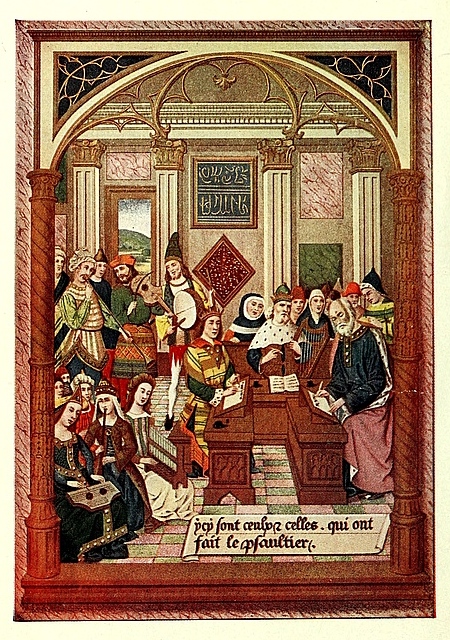










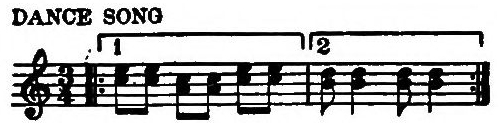
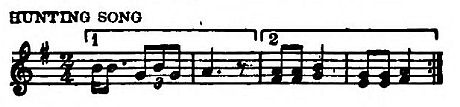
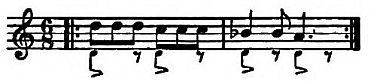
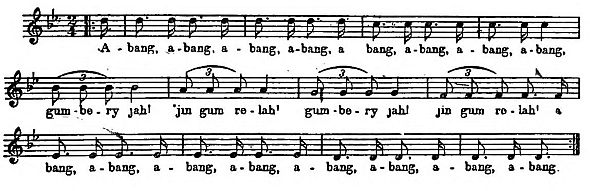





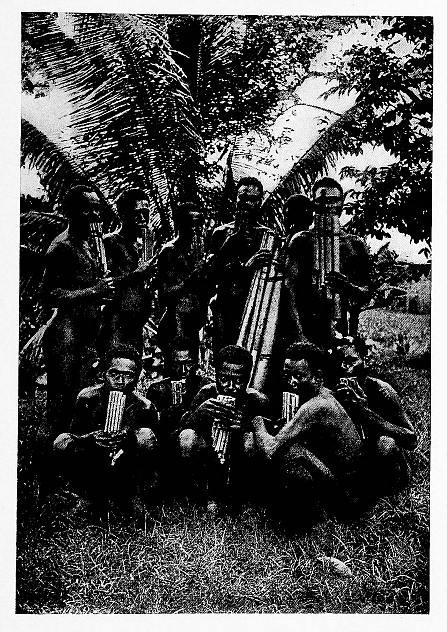
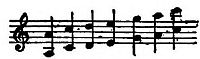
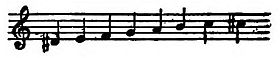
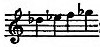 ,
sounds entirely rational and is in accordance
with our modern ideas of diatonic succession; also this five-toned scale
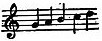 and this six-toned
scale
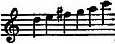 . But certain other scales given by
these flutes appear to be more or less freakish in character
and consist of a somewhat hit-or-miss collection
of tones, indicating either a very crude musical sense
among the ancient Peruvians, or very little skill on the
part of the makers of the flutes:

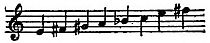
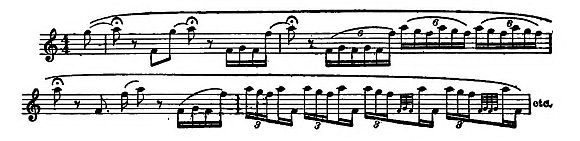
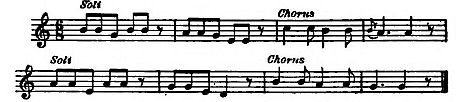

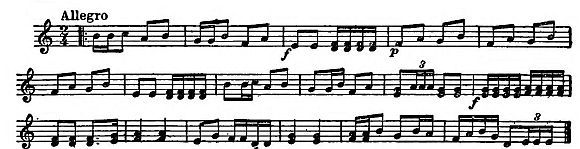






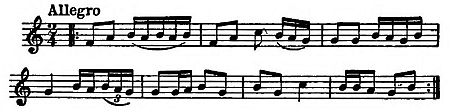

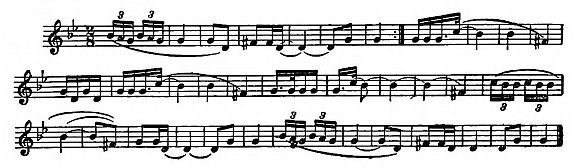
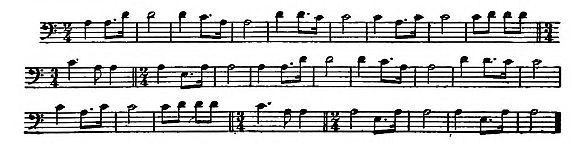
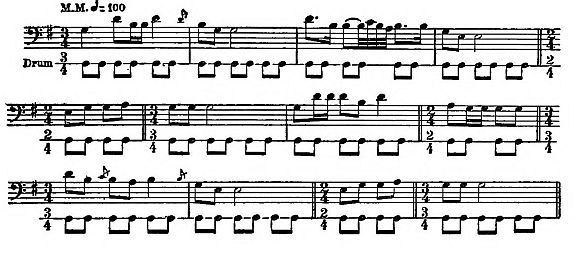
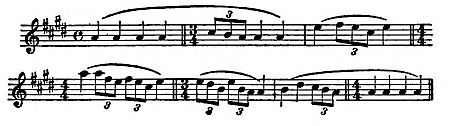


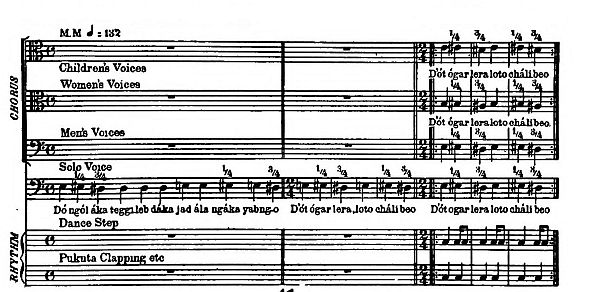
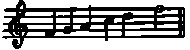 is used. The tones b and e (omitted in this scale as we have written
it), the fourth and seventh tones in our scale, which are
not found in the normal pentatonic scale, are given a
special name, pien; and the union of the five tones and
the two pien constitute what the Chinese call the
‘Seven Principles’ in music. But the five-tone scale is
the one commonly employed in practice and constitutes
the basis of all music in the Indo-Chinese countries.
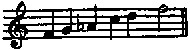 .
This difference gives Japanese music a certain individual
character of its own.

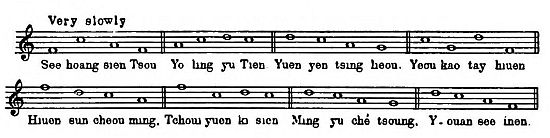
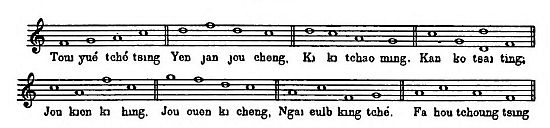
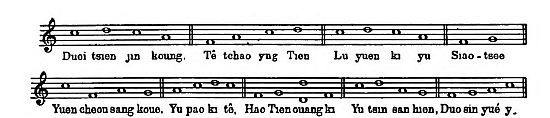
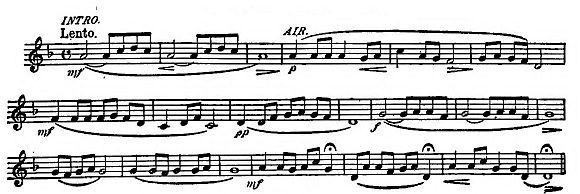
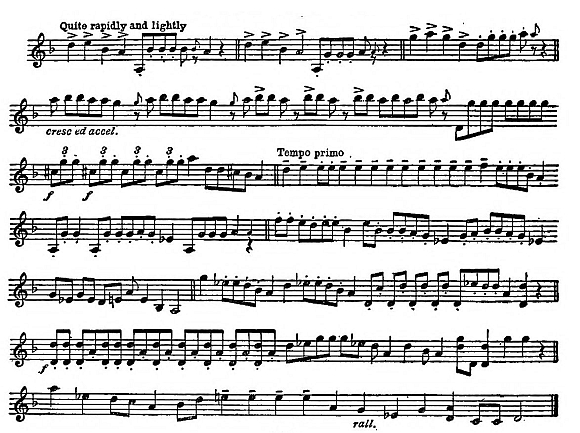
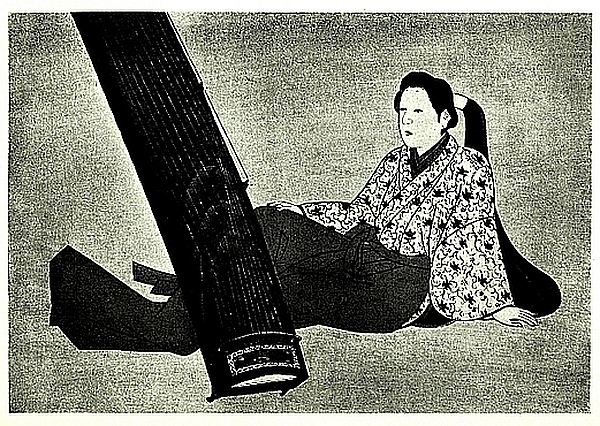
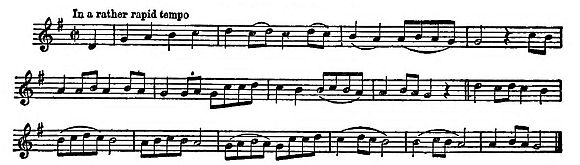
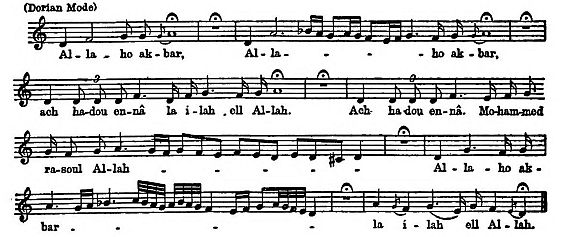
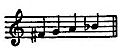
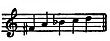
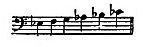
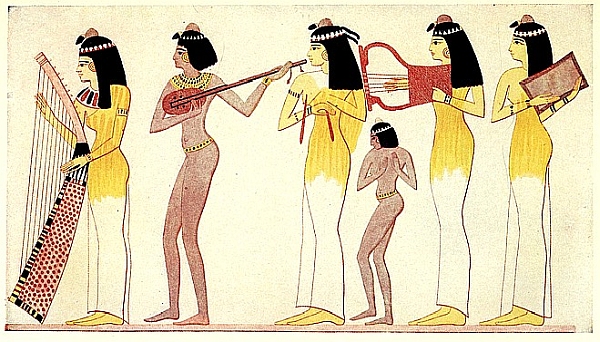
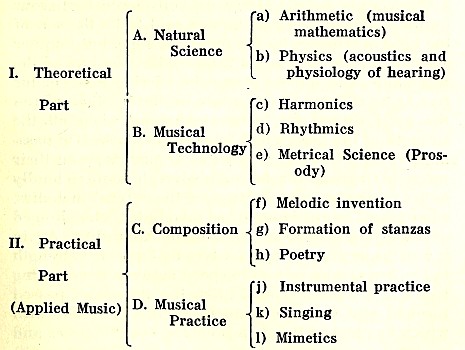
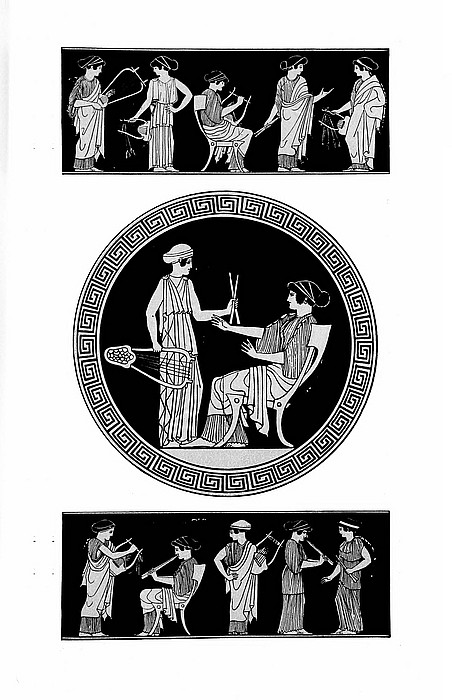

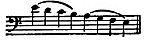
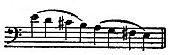
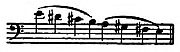
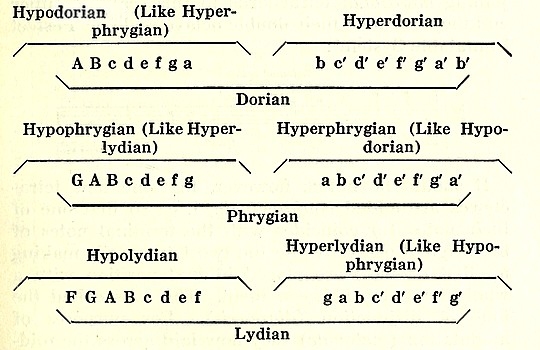
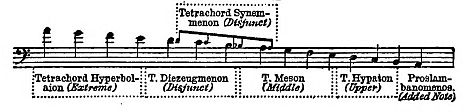
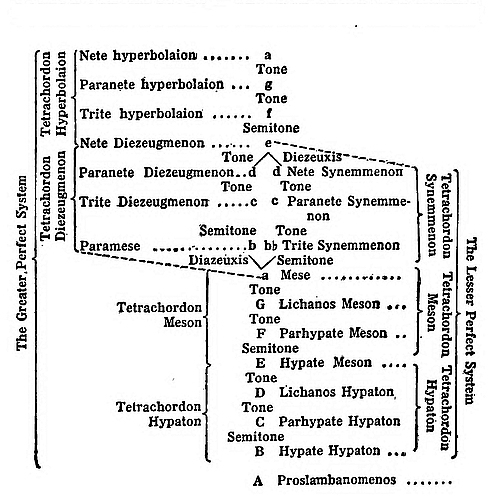
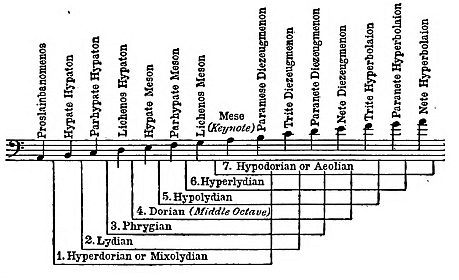

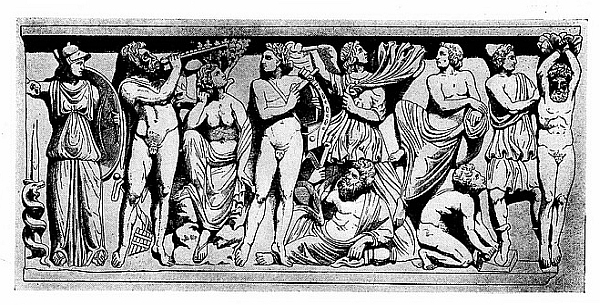
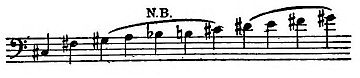
 ,
 , and
 . In vocal notation the regular Greek alphabet
was employed from Α to Ω to represent the
notes of the middle octave (including every step necessary
to the production of the various modes and
genera.) The higher octave was indicated by an ‘octava
sign.’
 , its triple by
 ,
quadruple by
 ,
and quintuple by
 . Rests were
indicated thus:
 .
All of these signs were, like our
modern notes, set over the text. While the system was
thoroughly worked out in its technical details, its cumbersomeness
would suggest that in practice it was of
less use than in theoretical exposition. No wonder,
then, that few compositions were, as far as we know,
actually written down, and of those only six are preserved
to us. These are as follows:
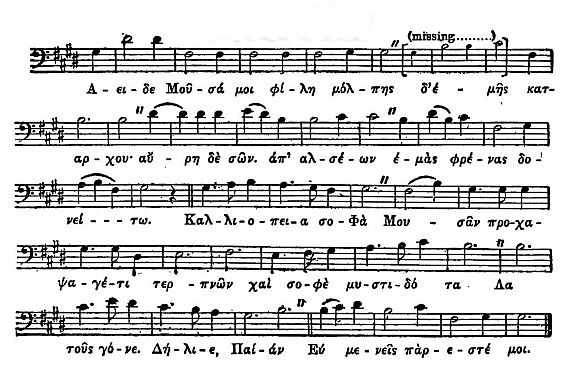
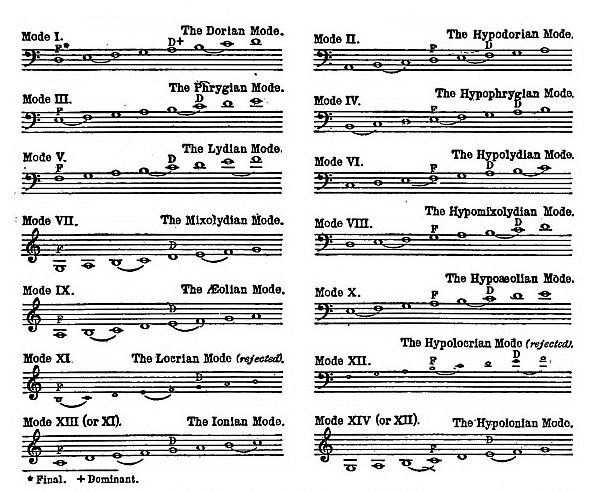


 and the B molle was rounded
 .
From the former was derived our natural sign
(♮) and from the latter our flat sign (♭). Our sharp is
merely a variation of the natural. The system of letter
notation was originally devised chiefly for instruments,
particularly the organ, though its use gradually became
universal. It belongs, however, more properly to a
period later than the one we have been discussing.
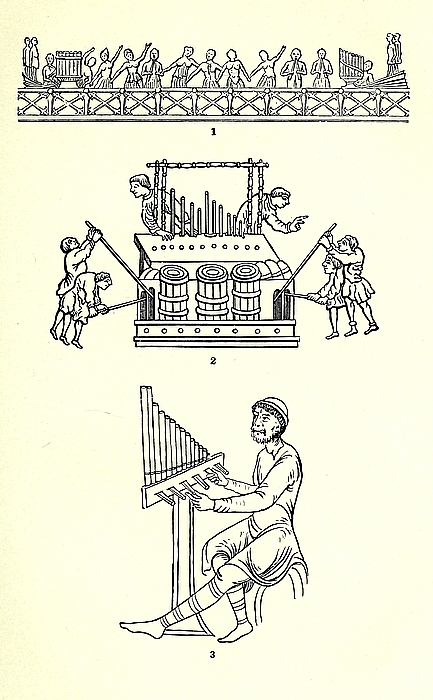


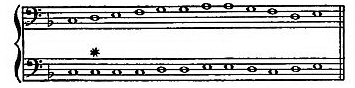
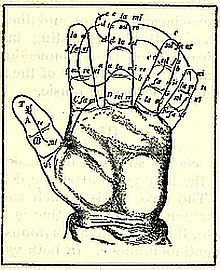
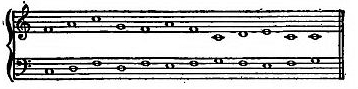
 ; that for
the brevis or breve came from the punctum, written
thus
 .
The new signs were long
 and breve
 . The
semi-breve was a lozenge-shaped alteration of the
breve,
 .
This seems simple enough until we come
across the distressful circumstances that the same sign
represented both the perfect and imperfect long, and
that the perfect and imperfect breve, too, shared the
same figure. The following table illustrates the early
mensural notes and their equivalents in modern notation.

 , and the
clivis,
 .
Of these the first represented an ascending
series, the second—which seems to have developed
from the circumflex accent—a descending series. It
will be noticed that the clivis begins with an upward
stroke to the first note, which is represented by the
heavy part of the line at the top of the curve. The
podatus has no such stroke. Several other signs were
derived from these two, and those derived from the
clivis began always with this upward stroke, and those
from the podatus were without it. Thus all ascending
ornaments were represented by a neume which had
no preliminary stroke, all descending ornaments by
one with the preliminary stroke. This characteristic
peculiarity was maintained by the mensuralists in their
ligatures. The podatus became
 ,
the clivis
 .
In so far as the mensural system of notation
was graphic, in that the position of the notes in the
scale presented accurately the direction of the changing
pitch of the sounds they stood for, there was no
need of preserving in the ligatures such peculiarities
of the neumatic signs. But, on the other hand, these
peculiarities were needed to represent the mensural
value of the notes in the ligatures, the more so because
the mensuralists were determined to allow no freedom
in the rendering of those ornaments in ligature, but
rather to reduce each one to an exact numerical value.
Hence we find two kinds of ligatures: those which preserved
the traits inherited from their neumatic ancestors,
and those in which such marks were lacking.
The first were very properly called cum proprietate,
the others sine proprietate; and the rule was that in
every ligature cum proprietate the first note was a
breve, while in every ligature sine proprietate it was
a long. If the ligature represented a series of breves
and semi-breves, the preliminary stroke was upward
from the note, not to it, thus:
 .


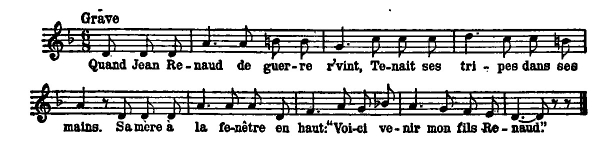
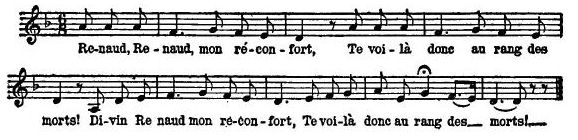
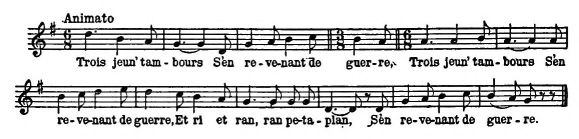
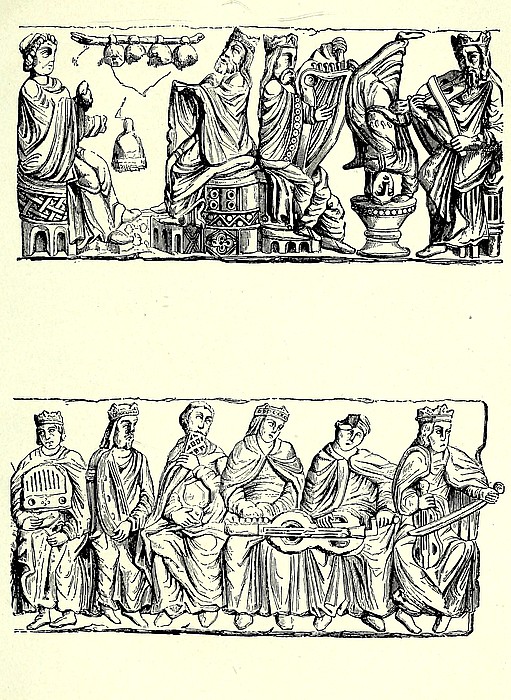

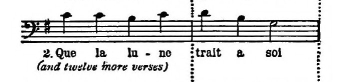


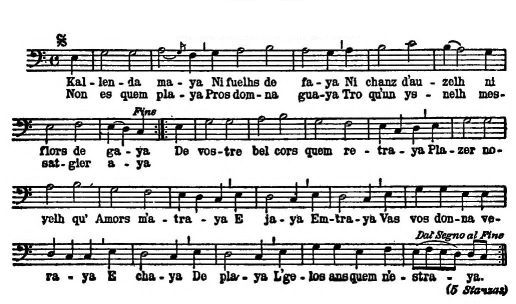




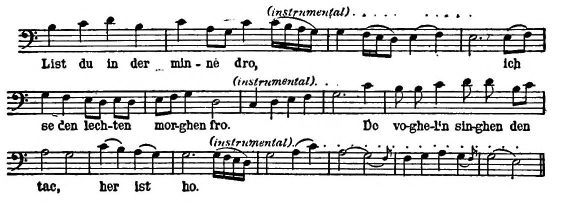
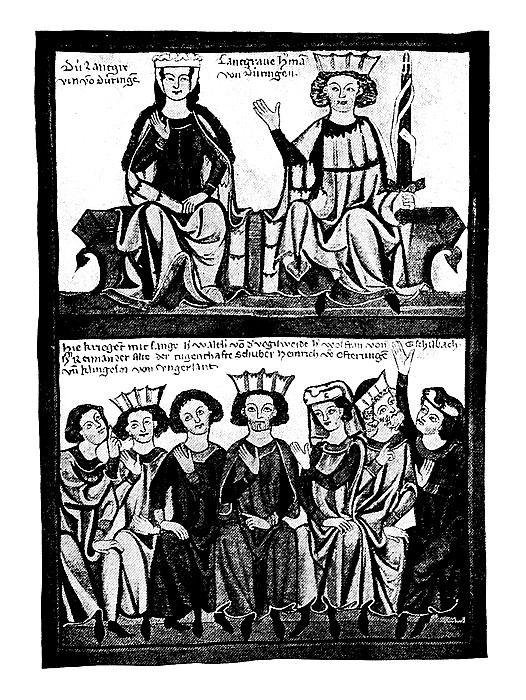
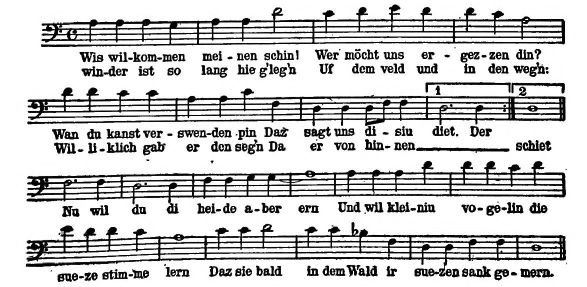
 ,
signified the division of the breve into three
or perfect time. A half-circle,
 ,
signified the division of the breve into two semi-breves, and this was imperfect
time. A dot within the circle or the half-circle,

 ,
indicated that the semi-breve was to be divided into
three minims, but without the dot the semi-breve
equalled only two minims. The three-part division of
the semi-breve constituted major prolation, the two-part,
minor prolation. Perfect or imperfect time was
sung twice as fast if the time sign was cut by a line,

 .
The second of these cut signs still survives in the
modern sign,
 ,
signifying alla breve time. It appears
likely that De Vitry himself was the first to think of
using colored notes to signify still another genus of
rhythmical subdivision called proportio hemiolia; and
that he was the first to use the term contrapunctus, or
counterpoint, instead of descant.