BY EDWIN J. PRINDLE.
There are many kinds of invention. The poet, the artist,
the playwright, the novelist all exercise or may exercise invention
in the production of their works. The merchant may
exercise invention in the devising of a new method of selling
goods. The department store was an invention of this class.
The subject of my paper is, however, the art of making technical
inventions, and particularly patentable inventions. And,
first, of its commercial importance; for the engineer is concerned
with things having a commercial value. By the art of
inventing, wealth is created absolutely out of ideas alone. It
usually takes capital to develop an invention and make it productive,
but not always. A notable recent example is Professor
Pupin's loaded telephone line. He received a very large sum
of money, and his expenditures, as I understand, were comparatively
trivial.
The certificate of ownership of an invention is a patent, and
the importance of the art of invention will be made apparent
from a brief consideration of what rights a patent confers and
of the part that patents play in the industries.
A patent is the most perfect form of monopoly recognized
by the law. As was said in a recent decision:
"Within his domain, the patentee is czar. The people must take
the invention on the terms he dictates or let it alone for seventeen years.
This is a necessity from the nature of the grant. Cries of restraint of
trade and impairment of the freedom of sales are unavailing, because
for the promotion of the useful arts the constitution and statutes authorize
this very monopoly."
There is an enormous amount of wealth in this country that
is based upon patents. As an instance, might be mentioned
the fact that the United Shoe Machinery Company is, by means
of patents, able to control the sewing machines upon which
ninety per cent. of the welt shoes in the United States are
sewed. The Bell Telephone Company, and the Westinghouse
Air Brake Company and many other corporations of the first
importance built themselves up on patents. Patents have become
so well recognized a factor in commerce that, in many
lines of manufacture, concerns do not depend simply upon
cheapness of manufacture, or quality of product, to maintain
their trade, but they count on always having a product which
is at least slightly better than that of their competitors, and
which is covered by patents, so that they do not have to compete
with an article of equal merit. And they keep a corps
of inventors at work in a constant effort to improve the product,
so that, when the patents now giving protection have expired,
they will have a better article to offer, which shall also be protected
by patents.
Inventing has become almost a recognized profession. Many
large concerns constantly employ a large corps of inventors,
at liberal salaries. Besides the inventors employed by large
corporations, there are many inventors who have maintained
their independence, and are free lances, so to speak. Some inventors
have become wealthy almost solely by their inventions,
such as Edison, Bell, Westinghouse, Marconi, Pupin, Tesla,
and Sprague. A considerable number of the smaller manufacturing
concerns are built largely or wholly upon the inventions
of their principal owners.
Aside from the question of financial returns from inventing,
the inventor has the satisfaction of knowing that he is a producer
of the most fundamental kind. All material progress
has involved the production of inventions. Inventors are universally
conceded to be among the greatest benefactors of the
human race.
The art of invention is therefore one of great commercial
and economical importance, and it becomes a matter of much
interest to know how inventions are produced. It is my object
to attempt an explanation of the manner of their production.
If it be inquired on what grounds I offer an explanation of
this apparently most difficult subject, I reply that, in the practice
of patent law, I have often had occasion and opportunity
to inquire into the mental processes of inventors, and that
the subject is one to which I have given considerable attention.
It seems to be popularly believed that the inventor must
be born to his work, and that such people are born only occasionally.
This is true, to a certain extent, but I am convinced
there are many people who, without suspecting it, have latent
inventive abilities, which could be put to work if they only
knew how to go about it. The large percentage of inventors
in this country compared with all other countries, shows that
the inventive faculty is one which can be cultivated to some
extent. The difference in ingenuity is not wholly a matter of
race, for substantially the same blood exists in some other
countries, but it is the encouragement of our patent laws that
has stimulated the cultivation of this faculty.
The popular idea seems to be that an invention is produced
by its inventor at a single effort of the imagination and complete,
as Minerva sprang full grown and fully armed from the
mind of Jove.
It is, undoubtedly, true that every inventor must have some
imagination or creative faculty, but, as I shall seek to show,
this faculty may be greatly assisted by method. While reasoning
does not constitute the whole of an inventive act, it can,
so to speak, clear the way and render the inventive act easier
of accomplishment.
Invention has been defined as "In the nature of a guess;
the mind leaps across a logical chasm. Instead of working
out a conclusion, it imagines it." The courts have repeatedly
held that that which could be produced purely by the process
of reasoning or inference, on the part of one ordinarily skilled
in the art is not patentable, but that the imaginative or creative
faculty must somewhere be used in the process. The mind
must somewhere leap from the known to the unknown by means
of the imagination, and not by mere inference in making the
invention. But the inventor, consciously or unconsciously, by
proper method, reduces the length of this leap to much more
moderate proportions than is popularly supposed.
That reasoning and research frequently enter very largely
into the inventive act in aid of the creative faculty is the opinion
of Dr. Trowbridge, of Columbia University who said:
"Important inventions leading to widespread improvements in the
arts or to new industries do not come by chance, or as sudden inspiration,
but are in almost every instance the result of long and exhaustive
researches by men whose thorough familiarity with their subjects enables
them to see clearly the way to improvements. Almost all important
and successful inventions which have found their way into general
use and acceptance have been the products of well-balanced and
thoughtful minds, capable of patient laborious investigation."
Judge Drummond, in a decision many years ago, said:
"Most inventions are the result of experiment, trial, and effort, and
few of them are worked out by mere will."
Most inventions are an evolution from some previously invented
form. It has been said:
"We know exactly how the human mind works. The unknown—or
unknowable—it always conceives in terms of the known."
Even the imagination conceives in terms of what is already
known; that is, the product of the imagination is a transformation
of material already possessed. Imagination is the association
in new relations of ideas already possessed by the mind.
It is impossible to imagine that, the elements of which are not
already known to us. We cannot conceive of a color which
does not consist of a blending of one or more colors with which
we are already familiar. This evolution of an invention is
more or less logical, and is often worked out by logical processes
to such an extent that the steps or efforts of imagination
are greatly reduced as compared with the effort of producing
the invention solely by the imagination.
Edison is quoted as having said that "any man can become
an inventor if he has imagination and pertinacity," that "invention
is not so much inspiration as perspiration."
There are four classes of protectable inventions. These are
Arts,
Machines,
Manufactures, and
Compositions of matter.
In popular language an art may be said to be any process
or series of steps or operations for accomplishing a physical
or chemical result. Examples are, the art of telephoning by
causing undulations of the electric current corresponding to
the sound waves of the spoken voice. The art of casting car
wheels, which consists in directing the metal into the mold in
a stream running tangentially instead of radially, so that the
metal in the mold is given a rotary movement, and the heavy,
sound metal flows out to the rim of the wheel, while the light
and defective metal is displaced toward the centre, where it is
not subjected to wear.
The term machine hardly needs any explanation. It may
be said to be an assemblage of two or more mechanical elements,
having a law of action of its own.
A manufacture is anything made by the hand of man, which
is neither a machine nor a composition of matter; such as, a
chisel, a match, or a pencil.
The term composition of matter covers all combinations of
two or more substances, whether by mechanical mixture or
chemical union, and whether they be gases, fluids, powders or
solids; such as, a new cement or paint.
These definitions are not legally exact, but serve to illustrate
the meaning.
In the making of all inventions which do not consist in the
discovery of the adaptability of some means to an end not
intentionally being sought after, the first step is the selection
of a problem. The inventor should first make certain that the
problem is based upon a real need. Much time and money
is sometimes spent in an effort to invent something that is not
really needed. What already exists is good enough or is so good
that no additional cost or complication would justify anything
better. The new invention might be objectionable because it
would involve counter disadvantages more important than its
own advantages, so that a really desirable object is the first
thing to be sure of.
Having selected a problem, the next step should be a thorough
analysis of the old situation, getting at the reasons for the
faults which exist, and in fact discovering the presence of
faults which are not obvious to others, because of the tendency
to believe that whatever is, is right.
Then the qualities of the material, and the laws of action
under which one must operate should be exhaustively considered.
It should be considered whether these laws are really or only
apparently inflexible. It should be carefully considered whether
further improvement is possible in the same direction, and such
consideration will often suggest the direction in which further
improvement must go, if a change of direction is necessary.
Sometimes the only possible improvement is in an opposite
direction. A glance at the accounts of how James Watt invented
the condensing steam-engine will show what a large
part profound study of the old engine and of the laws of steam
played in his invention, and how strongly they suggested the
directions of the solutions of his difficulties.
We now come to the constructive part of inventing, in order
to illustrate which, I will seek to explain how several inventions
were, or could have been, produced.
The way in which the first automatic steam engine was produced
was undoubtedly this—and it shows how comparatively
easily a really great invention may sometimes be made. It
was the duty of Humphrey Potter, a boy, to turn a stop-cock
to let the steam into the cylinder and one to let in water to
condense it at certain periods of each stroke of the engine, and
if this were not done at the right time, the engine would stop.
He noticed that these movements of the stop-cock handles took
place in unison with the movements of certain portions of the
beam of the engine. He simply connected the valve handles
with the proper portions of the beam by strings, and the engine
became automatic—a most eventful result.
As one example of the evolution of an invention, I will take
an instrument for measuring and recording a period of time,
known as the calculograph, because it lends itself with facility,
to an explanation from a platform and because my duties as a
lawyer have necessitated my becoming very familiar with the
invention, and have caused me to consider how it was probably
produced.
And first the problem: There was much occasion to determine
and record the values of periods of elapsed time; such as, the
length of time of a telephone conversation; as the revenue of
the telephone companies depended upon the accuracy of the
determination. All the previous methods involved the recording
in hours and minutes the times of day marking the initial
and the final limits of the period to be measured, and then the
subtraction of the one time of day from the other. This subtraction
was found to be very unreliable as well as expensive.
The problem then was to devise some way by which the value
of the period could be arrived at directly and without subtraction
and also by which such value could be mechanically
recorded.
The prior machine from which the calculograph was evolved
is the time-stamp, a printing machine having a stationary die
like a clock dial and having a rotating die like the hand of the
clock, as in Fig. 1. The small triangle outside the dial is the
hour hand, it being placed outside the dial because it is necessary
that the two hands shall be at the level of the face of the dial and
yet be able to pass each other. The hour hand may be disregarded
here, as the records needed are almost never an hour
long. The manner of using the time stamp to determine the
value of an interval was to stamp the time of day at the beginning
of the period, and then to stamp the time of day at the
close of the period at another place on the paper, as shown
in Fig. 2, and finally mentally to subtract the one time of day
from the other to get the value of the period.
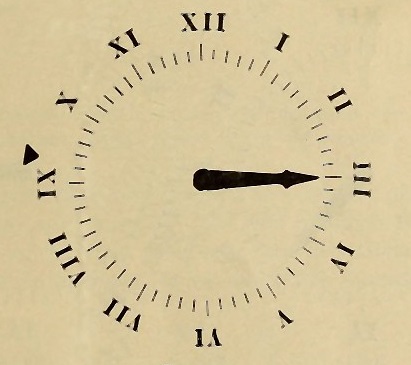
Fig. 1.
Time Stamp Record.
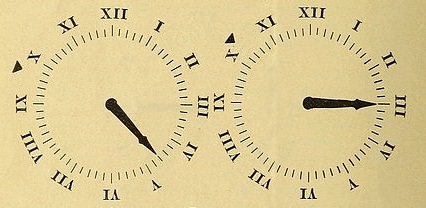
The inventor of the new machine conceived the idea that,
if the time-stamp were provided with guides or gauges so that
the card could be placed both times in the same position, and
the two records of the time stamp thus be superimposed concentrically
(as illustrated in Fig. 3), the value of the period
would be represented by the arc marked off by the initial and
final imprints of the minute hand, so that, instead of subtracting
one record from another, he had only to find the value
of the arc marked off by counting the corresponding number
of minutes along the dial.
The inventor had thus gotten rid of the subtraction, but there
were several desirable qualities not yet obtained. First, he
could not tell from the record alone, whether it was the longer
or the shorter arc marked off that was the measure of the period.
For instance, he could not tell whether the period was 7 or
53 minutes. This was because the two hand or pointer imprints
were exactly alike except in position. So he conceived
the idea of making the pointer imprints different in appearance,
by providing the pointer die with a mark in line with the pointer,
as illustrated in Fig. 4.
The mark and pointer revolve together and either the dies
or the platen are so arranged that the mark can be printed
without the pointer at the initial imprint and the pointer
at the final imprint as in Fig. 5, the mark being printed or
not at the final imprint, as desired. This could be done either
by allowing the pointer die or the corresponding portion of
the platen to remain retracted from the paper during the first
printing.
| Fig. 2. |
9:23
Initial Time Stamp Record. |
10:15
Final Time Stamp Record. |
| Elapsed Time: 10:15-9:23 = 52 minutes. |
To read this record, hours and minutes must be subtracted from
hours and minutes, an operation liable to much error.
It could thus be told with certainty from the record alone
whether the longer or the shorter arc is the measure of the
period, because the beginning of the arc is that indicated by
the imprint of the mark without the pointer.
There was still something to be desired. The counting of
the minutes along the measuring arc was a waste of time, if
the value of the arc could in some way be directly indicated.
If the hand were set back to 12 o'clock for the initial imprint,
the final imprint would show the hand pointing directly at
the minute whose number on the dial is the value of the period,
and it would not even be necessary to count. But the setting
of the hand back to zero would prevent its making the final
imprint of any previously begun record, so that the machine
could only be used for one record at a time. It was desirable
to have a machine that would record any number of overlapping
intervals at the same time, so that one machine would record
the intervals of all the telephone conversations under the
control of a single operator, or rather of two operators, because
both of them could reach the same machine. So it wouldn't
do to set the hand back to zero, as the hand must rotate constantly
and uniformly. Then why not set the zero up to the
hand at each initial imprint? This meant making the dial
rotatable, as well as the hand. It gave an initial record like
that shown in Fig. 6.
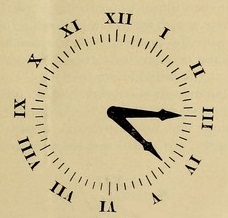
Fig. 3.
Subtraction eliminated but counting still required and uncertainty
whether elapsed period is 7 or 53 minutes.
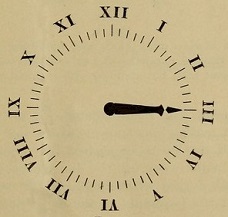
Fig. 4.
Hand and zero mark revolving within stationary dial.
The inventor then thought of securing the dial to the pointer
die so that they would revolve together, the zero of the dial
being in line with the pointer, as illustrated in Fig. 7. This
would obviate the necessity of setting the zero of the dial up
to the pointer at the initial imprint.
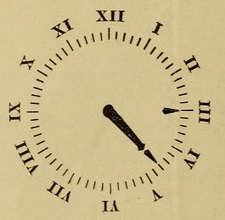
Fig. 5.
Initial imprint of zero mark alone and final imprint of hand (and
zero). Elapsed time, 8 minutes. No subtraction and no uncertainty
as to which imprint first, but counting still required.
But again the improvement involved a difficulty. As the
dial rotated, its final impressions would never register with its
initial impressions and would therefore always destroy them.
As the first imprint of the dial was the only useful one, and as
the second imprint only made trouble, the inventor conceived
the idea of not making any imprint of the dial at the close of
the period, and this he accomplished by making the annular
portion of the platen covering the dial so that it could be advanced
to print or not as desired. As the zero of the dial
always marked the beginning of the measuring arc, it served
the same purpose as the mark in line with the pointer, and the
latter could now be omitted.
The final machine then consists simply of a revolving die
which, as shown in Fig. 8, consists of a graduated and progressively
numbered dial, having a pointer revolving in line
with the zero, and the machine has a platen consisting of an
inner circular portion over the pointer and an annular portion
over the dial, each portion being operated by a separate handle
so that the dial can be printed at the beginning of the period
and the pointer alone, at its close.
The final record has an initial imprint of the dial, Fig. 9a,
the zero of the dial showing the position of the pointer at the
beginning of the period, and a final imprint of the pointer alone,
as shown in Fig. 9b, the complete final record, Fig. 9c, consisting
of the superimposition of these two records, and showing the
pointer in line with that graduation whose number is the value
of the period. Here is a record not only involving no subtraction
and no uncertainty but not even, counting in its record,
and, as it was made without disturbing the motions either of the
pointer or dial, any number of records of other periods could
have been begun or finished while the machine was measuring
the period in question.
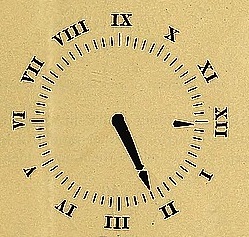
Fig. 6.
Dial moved up to initial position of zero mark. Elapsed time, 11
minutes. No subtraction, no counting, no uncertainty; but only one
record possible at a time.
Hiding all the intermediate steps in the evolution of this
invention, it seems the result of spontaneous creation, but
considering the steps in their successive order, it will be seen
that the invention is an evolution from the time-stamp; that
logic rendered the effort of the imagination at any one step
small by comparison, and that the individual steps might be
well within the capacity of a person to whom the spontaneous
creation of the final invention might be utterly impossible.
A most interesting example of the evolution of an invention
is that of the cord-knotter of the self-binding harvester. The
problem here was to devise a mechanism which would take place
of the human hands in tying a knot in a cord whose ends had
mechanically been brought together around a bundle of grain.
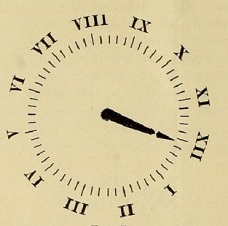
Fig. 7.
Dial with pointer at zero revolving together.
The first step was to select the knot which could be tied
by the simplest motions. The knot which the inventor selected
is that shown in Fig. 10, and is a form of bow-knot.
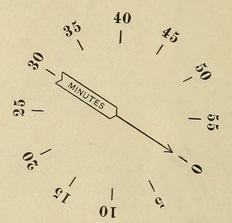
Fig. 8.
Dial with pointer at zero revolving together, zero mark on pointer
being replaced by zero of dial.
The problem was to find how this knot could be tied with
the smallest number of fingers, making the smallest number
of simple movements. As anyone would ordinarily tie even
this simple knot, the movements would be so numerous and
complex as to seem impossible of performance by mechanism.
The inventor, by study of his problem, found that this knot
could be tied by the use of only two fingers of one hand, and
by very simple movements. The knot will best be understood
by following the motions of these fingers in tying the knot.
Using the first and second fingers of the right hand, they are
first swept outward and backward in a circular path against
the two strands of the cord to be tied, as shown in Fig. 11.
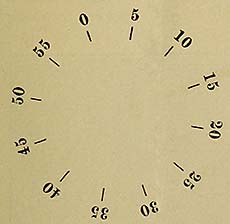
Fig. 9a.
Initial Imprint.
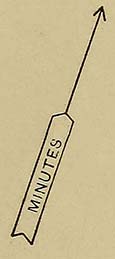
Fig. 9b.
Final Imprint.
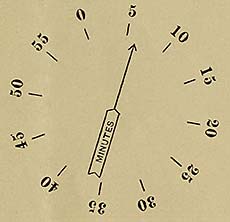
Fig. 9c.
Complete Record.
Simple, direct-reading record. No subtraction, no counting, no uncertainty.
Any number of overlapping periods recorded on one machine.
The fingers continue in their circular motion backward, so
that the strands of the cord are wrapped around these fingers,
as shown in Fig. 12.
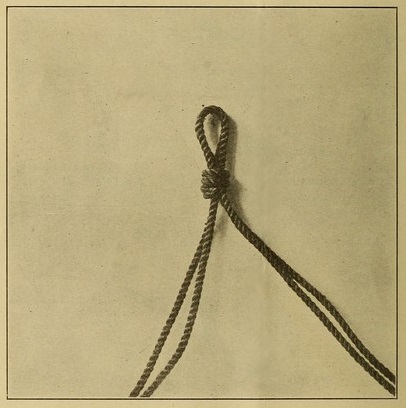
Fig. 10.
Continuing their circular motion, the fingers approach the
strands of the cord between the twisted portion and a part of
the machine which holds the ends of the cord, and the fingers
spread apart as shown in Fig. 13, so that they can pass over
and grasp the strands thus approached, as shown in Fig. 14.
The fingers then draw back through the loop which has been
formed about them, the fingers holding the grasped portion of
the strands, as shown in Fig. 15.
The knot is finished by the completion of the retracting
movement of the fingers through the loop, thus forming the bow
of the knot as shown in Fig. 16.
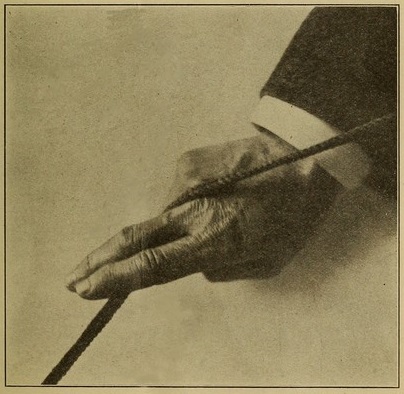
Fig. 11.
The inventor found that one finger could have a purely
rotary movement, as if it were fixed on the arm and unable to
move independently of the arm, and the movement being as if
the arm rotated like a shaft, but the second finger must be
further capable of moving toward and from the first finger
to perform the opening movement of Fig. 13, and the closing
movement of Fig. 14 by which it grasps the cord. The inventor
accordingly, from his exhaustive analysis of his problem,
and his invention or discovery of the proper finger motions,
had further only to devise the very simple mechanical device
illustrated in Fig. 17 to replace his fingers.
The index finger of the hand is represented by the finger S,
which is integral with the shaft V. The second finger of the
hand is represented by the finger U, which is pivoted to the
first finger by the pin s. The grasping movement of the finger
U is accomplished by a spring V' bearing on the shank U',
and its opening movement is caused by the travel of an anti-friction
roll U", on the rear end of the pivoted finger, over a
cam V", on the bearing of the shaft. The shaft is rotated by
the turning of a bevel pinion W on the shaft through the action
of an intermittent gear. The necessity of drawing the fingers
backward to accomplish the movement between Figs. 14 and 16
was avoided by causing the tied bundle to have a motion away
from the fingers as it is expelled from the machine, the relative
motion between the fingers and the knot being the same as if
the fingers drew back.
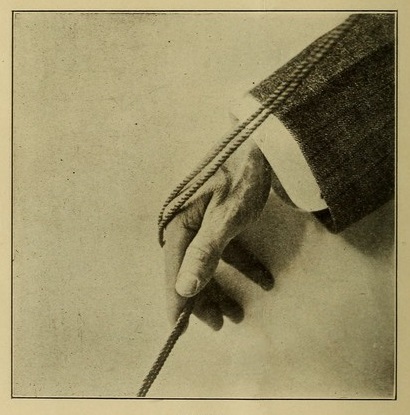
Fig. 12.
Thus the accomplishment of a seemingly almost impossible
function was rendered mechanically simple by an evolution
from the human hand, after an exhaustive and ingenious
analysis of the conditions involved.
It will be seen from the examples I have given that the constructive
part of inventing consists of evolution, and it is the
association of previously known elements in new relations (using
the term elements in its broadest sense). The results of such
new association may, themselves, be treated as elements of
the next stage of development, but in the last analysis nothing
is invented or created absolutely out of nothing.
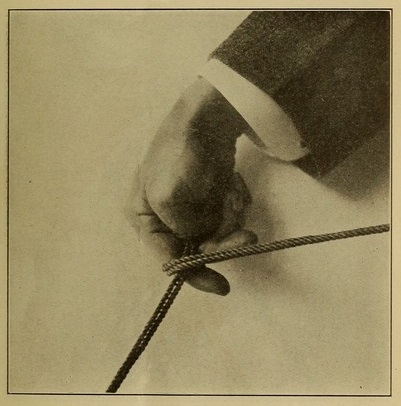
Fig. 13.
It must also be apparent, that pure reason and method,
while not taking the place of the inventive faculty, can clear
the way for the exercise of that faculty and very greatly reduce
the demands upon it.
Where it is desired to make a broadly new invention on
fundamentally different lines from those before—having first
studied the art to find the results needed, the qualities of
the material or other absolutely controlling conditions should
be exhaustively considered; but at the time of making the
inventive effort, the details should be dismissed from the mind
of how results already obtained in the art were gotten. One
should endeavor to conceive how he would accomplish the
desired result if he were attempting the problem before any
one else had ever solved it. In other words, he should endeavor
to provide himself with the idea elements on which the imagination
will operate, but to dismiss from his mind as much
as possible the old ways in which these elements have been
associated, and thus leave his imagination free to associate
them in original and, as to be hoped, better relations than before.
He should invent all the means he can possibly invent to accomplish
the desired result, and should then, before experimenting,
go to the art to see whether or not these means have before
been invented. He would probably find that some of the
elements, at least, have been better worked out than he has
worked them out. Of course, mechanical dictionaries, and
other sources of mechanical elements and movements will be
found useful in arriving at means for accomplishing certain of
the motions, if the invention be a machine. Many important
inventions have been made by persons whose occupation is
wholly disconnected with the art in which they are inventing,
because their minds were not prejudiced by what had already
been done. While such an effort is likely to possess more originality
than that on the part of a person in the art, there is, of
course, less probability of its being thoroughly practical. The
mind well stored with the old ways of solving the problem will,
of course, be less likely to repeat any of the mistakes of the
earlier inventors, but it will also not be as apt to strike out on
distinctly original lines. It is so full, already, of the old forms
of association of the elements as to be less likely to think of
associating them in broadly new relations.
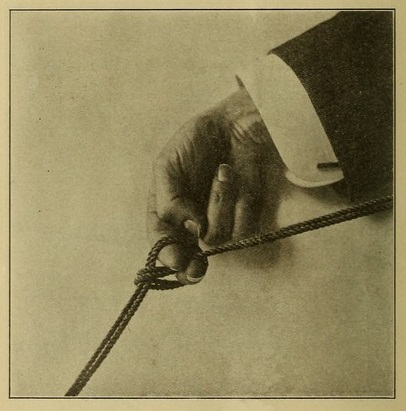
Fig. 14.
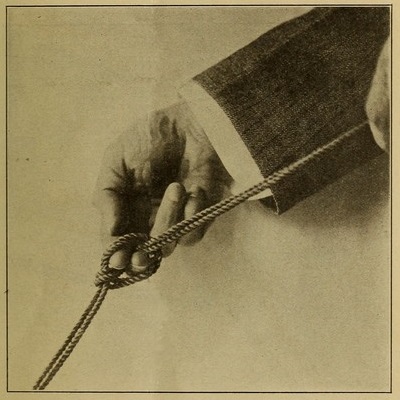
Fig. 15.
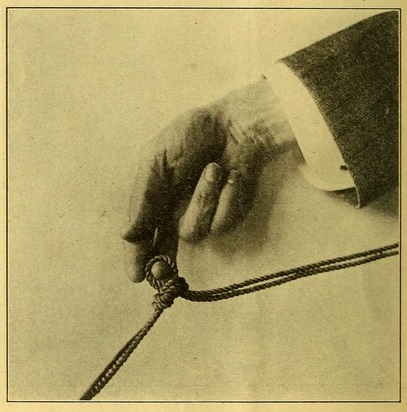
Fig. 16.
Nothing should be considered impossible until it has been conclusively
worked out or tried by experiments which leave no
room for doubt. It is no sufficient reason for believing a thing
won't work because immemorial tradition, or those skilled in
the art, say it will not work. Many an important improvement
has been condemned as impracticable, by those in the art,
before it has been tried.
A conception which an inventor has been striving for unsuccessfully
will sometimes come to him at a time of unaccustomed
mental stimulation. The slight stimulation of the
movement of a train of cars, and the sound of music, have
been known to produce this effect. The sub-conscious mind,
after having been prepared by a full consideration of the problem
to be solved, will sometimes solve the problem without conscious
effort, on the part of the inventor.
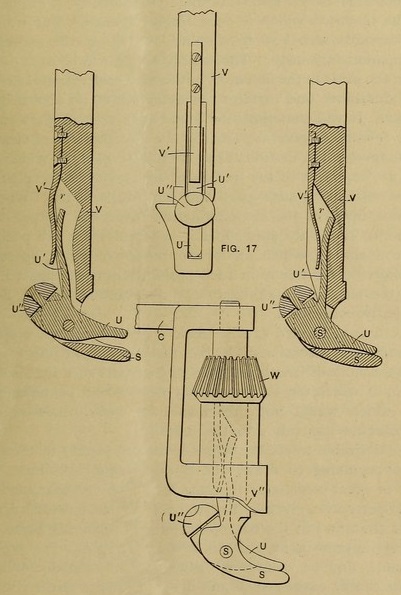
Fig. 17.
The essential parts of the cord-knotter.
In inventing a machine to operate upon any given material,
the logical way is to work from the tool to the power. The
tool or tools should first be invented, and the motions determined
which are to be given to them. The proper gearing or parts
to produce from the power each motion for each tool should
then be invented. It should then be considered if parts of
each train of gearing cannot be combined, so as to make one
part do the work of a part in each train; in short, to reduce
the machine to its lowest terms. Occasionally a mechanism
will be invented which is exceedingly ingenious, but which it
is afterwards seen how to simplify, greatly at the expense of
its apparent ingenuity. This simplification will be at the sacrifice
of the pride of the inventor, but such considerations as cheapness,
durability and certainty of action leave no choice in the
matter. It will sometimes be found that a single part can be
made to actuate several parts, by the interposition of elements
which reverse the motion taken from such part, or which take
only a component of the motion of such part, or the resultant
of the motion of such part and some other part. Where a
machine involves the conjoint action of several forces, it can
be more thoroughly studied, if it is found there are positions
of the machine in which one force or motion only is in operation,
the effect of the others in such position being eliminated, and
thus the elements making up the resultant effect can be intelligently
controlled.
The drawing board can be made a great source of economy
in producing inventions. If the three principal views of all
the essentially different positions of the parts of a machine are
drawn, it will often be found that defects will be brought to
light which would not otherwise have been observed until
the machine was put into the metal.
It is desirable to see the whole invention clearly in the mind
before beginning to draw, but if that cannot be done, it is
often of great assistance to draw what can be seen, and the
clearer perception given by the study of the parts already drawn,
assists the mind in the conception of the remaining parts.
If the improvement which it is sought to make is a process,
it should first be considered whether any radically different
process can be conceived of, and if so, whether or not it is better
than the old process, and the reason for its defects, and whether
it is possible to cure those defects. If the old process appears
to be in the right general direction, it should be considered
whether one of the old steps cannot with advantage be replaced
by a new one, or whether the order of performing the steps cannot
be changed to advantage. I have in mind one process in which
a reversal of the order of steps resulted in giving the product
certain desirable qualities which had before been sought for,
but could not be obtained.
It is sometimes desirable not only to invent a good process
of producing a product, but to control all feasible processes
of producing the product. Such a case occurred where the product
itself had been patented, and it was desirable to extend
the monopoly beyond the time when the patent on the product
should expire. There were two steps or operations which were
essential to the production of the product, and the inventor,
by reference to permutations, saw that there were but three
orders in which those steps could be performed; first, the order
A-B, then the order B-A, and then both steps together. The
order A-B was the old order, which did not produce an article
having the desired qualities. The inventor therefore, proceeded
to invent ways by which the steps could be performed
together, and then by which they could be performed in the
reverse order, and the patenting such two processes would cover
generically all possible ways of making the article and secure
the desired result of putting himself in position to control the
monopoly after the patent on the article had expired, because
no one could make the article without using one of his two
processes.
In inventing compositions of matter there is one inventor
who, if he is seeking for a certain result, will take a chemical
dictionary and make every possible combination of every substance
that could by any possibility be an ingredient of that
which he desires to produce. It is as if he were seeking to
locate a vein of mineral in a given territory, and, instead of
observing the geographical and geological formation, and thus
seeking to arrive at the most probable location of the vein, he
should dig up every foot of earth throughout the whole territory,
in order finally to locate the vein. This method is exceedingly
exhaustive, but does not appeal to one as involving
much exercise of the inventive faculties.
Inventing has become so much of a science, that if one is
willing to spend sufficient time and money to enable a competent
corps of inventors to go at the matter exhaustively,
almost any possible invention involving but a reasonable
advance in the art can be perfected.
Punctuation errors repaired.
The second copyright notice before the text begins has been
changed from 1903 to 1906 to match the first notice on the title page.