The Art of Home Furnishing and Decoration
FRANK ALVAH PARSONS
Man is exactly what he lives in, for environment is the strongest
possible factor in man’s development. One may be so long among loud
noises, bad odors, inharmonious colors and wrong arrangements of
things that one doesn’t mind them, because one has let them become
an integral part of one’s self. They are there, and they are as bad
as they were at first, but one has become immune to them. This being
admitted, it follows, of course, that concordant sounds, agreeable
odors, harmonious colors and pleasing arrangements have their immediate
effects, but their tendency is toward refinement, culture and artistic
appreciation instead of toward brutality, ignorance and indifference.
It is certainly not hard to see what effect is produced by living in
any wrong environment. As a person accustoms himself to it, he becomes
like it. When he is like it, he will admire only its kind, and whatever
he does will be as nearly like his environment as he himself is.
The importance of thoroughly comprehending this truth cannot be
overstated. The mental and artistic quality of the nation and even its
physical comfort depend upon it. This viewpoint, being somewhat new
to us, accounts for the upheaval in our ideas of what a home really
is. Looking a little into this matter may perhaps stimulate us still
further in our thinking, which will affect our way of doing whatever we
attempt in the future.
The Home Molds Our Tastes and Lives
In the first place the home is the center of all life’s activities. We
are born there, and long before we have seen the shop, the office, the
church or even the school, our first impressions of the fundamentals of
life have become fixed. These are exceedingly hard to efface.
The school can hardly hope to counteract in the child’s mind the effect
of hearing incorrect language spoken at home for six years; the church
is greatly handicapped in its influence where wrong principles of life
have determined habits during the first years; the artistic sense is
practically dead and refinement of taste impossible in that child whose
parents have given the usual wall papers, rugs, hangings, pictures and
other objects of modern furnishing a chance to do their unrestricted
work. Most of these have been made to sell, but not to people who use
any judgment in buying. Occasionally we think of the durability or the
comfort of an article, but how seldom of the colors, the patterns,
the combinations of different periods with different meanings, all of
which unite to make an unthinkable, inharmonious jumble which produces
a reaction on an impressionable person little short of criminal. This
being the case, is it any wonder that too frequently we are satisfied
with inferior things or that we are not able to compete with other
nations in creating better ones?
This view of the home as an educator places it above any other
institution in life and makes it worthy of the most careful and
scientific study from several points of view. It might be well to
consider here four of the most important of these.
Home Must Satisfy the Body
The first requisite of a house is physical comfort. Not only is this
true of each article of furniture, but it is true also of the placing
of each piece as it relates to the other pieces.
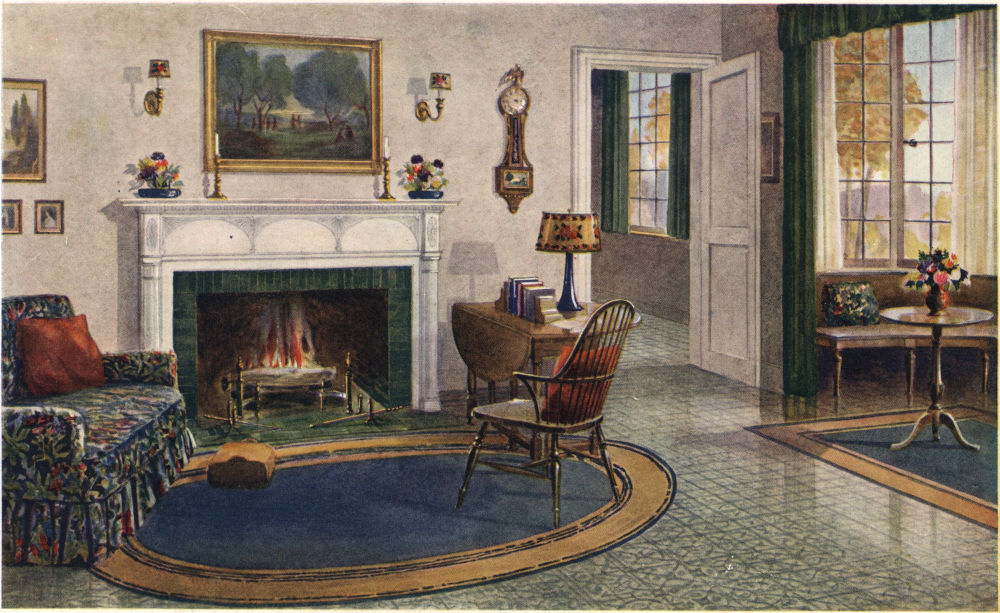
Take, for instance, a divan, a chair, a table, a lamp, some books and
a footstool. It is not enough that the chair, the divan and the stool
should each be comfortable to the body, but comfort demands that each
be so placed that one can use the divan or chair with the stool, while
the books on a table with a lamp are placed so that one may lounge or
sit and read without effort and without expending energy to assemble
what is required. The best possible arrangement, you see, demands more
skill than at first appears.
Home Must Satisfy the Mind
Mental comfort is even more important to man in his home than
physical comfort. He must, or should, find in his home an intellectual
stimulus and a refining influence to complement the activities and
struggles of his life outside, to calm and rest the tired nerves and to
relieve the material or commercial stress which threatens entirely to
destroy his power to see or know anything else. Unconsciously driven by
this need he rushes from home to the club, to the theatre or elsewhere
for diversion, amusement or rest. This is not as it should be, for in
the right environment the home should furnish the rest and intellectual
refreshment needed. Let us consider that there must be an expenditure
of thought and skill in furnishing a home if it is to play its rightful
part in the scheme of life.
Home Must Be Sanitary
Even then, there is another thing to consider. A man may succeed
in accomplishing wonders in the realm of physical comfort, yet so
completely ignore the question of sanitation as to menace the health
of his family, if not to offend their sense of decent cleanliness.
The horrors of Victorian plush upholstery, chenille portieres and
nailed-down carpets are still fresh in the memory of some of us, and
we have not yet been able to get a clear idea of a really clean thing
because of the bad impression made on us by these conditions. Probably
we never shall, until we succeed in effacing their memory by discarding
the traditions they represent and adopting wholly different ideas in
their places. Let us think of the question of sanitation as a
second necessity in considering any household problem.
Costly Things Not Always Best
It is perhaps unnecessary to look at this matter from the viewpoint
of economics, but to me it seems very important. We cannot all afford
to buy everything we see, desire or even appreciate. Realizing this,
we lose enthusiasm and take almost anything. This is not necessary,
nor is it wise. Good things are not all costly, nor are all cheap
things equally bad. One might also add that frequently very costly
things incline to be bad; at any rate, there is far greater danger of
their being so because of the greater opportunity they afford for the
expression of bad taste.
Knowledge furnishes the greatest defense against bad things in any
form. The more one knows, the more capable he is of selecting the best
for his money and of using his selections in such a way as to suggest
that much more was paid for them than they really cost.
An Artistic Home Means Enjoyable Living
Intelligent selection—the art of buying the most appropriate
furnishings and decorations for the home—leads logically to
intelligent decoration, the art of arranging the furnishings and
decorations so as to make possible a thoroughly attractive home and
keenly enjoyable living for the family.
The introduction of the word “Art” always opens up a new field fraught
with unpleasant possibilities. So many things masquerade under this
name that we are almost deceived as to what it really is. Shall we not
attack and dispose of some of these fallacies before attempting to see
what it actually is?
Because it is an art to decorate we are apt to think that
anything attached to or hung on to another thing is decoration,
therefore artistic. Nothing could be further from the truth. Principles
control decoration, and decoration is only possible when it conforms
to these principles. In order to be decorative there must be something
that requires decoration; that is, which is incomplete in itself. As
soon as material of any kind is added after a thing is complete, the
result becomes an aggregation, not a decoration.
Most houses belong to this class because the owner refuses to stop when
he is done. He may also have erred through having no place to decorate,
his background being of such a kind that, struggle as it might, nothing
could compete for attention, therefore could not become decorative by
contrast. Simplicity in backgrounds is the foundation of decorative
possibility.
No Room for Sentimentality
Oversentimentality is as bad as overdecoration. Sentiment is not only
commendable but is an essential element that makes for human decency,
but sentimentality, which by most people is thought to be
the same thing, is unpleasant and unhealthy. Admiration, affection,
veneration—each of these qualities has its place with all of us in
its particular situation. This is well; but when, through association,
we mistake an impersonal object for the real qualities of a person and
begin to bestow adoration on it, then it is time to stop and think.
To be sure, one respects some things in his grandfather and his
other forebears. He is not insensible to the excellent points in his
friends and associates. But if he is a wise man, he does not apply
all his grandfather’s good qualities to all the furniture he uses,
nor the excellent points in his friends to all the objects they have
felt impelled to give him at one time or another for some sort of
reason. If half the rubbish in every house in America that exists for
solely sentimental reasons or because of a fear of being detected
in its destruction were to be burned now, the next generation would
have a much clearer vision of what art is, unhampered by sentimental
misconception.
A sentimental and an æsthetic feeling are quite distinct from each
other. Who is there among us who does not love nature? The
trees, the birds, the flowers—they seem to be a part of the great
Divine scheme which calls for especial appreciation. This is also
well; but nature is not art, neither is man’s imitation of it.
Sometimes his interpretation of it is art, sometimes it is not. Not
infrequently his conventionalization of nature and its adaptation to
the material in which it is to be used become a decorative art; yet,
even if this is accomplished, the thing may be spoiled in the use, and
an inartistic whole may result. Just and reasonable homage to nature
has impelled people to try in all sorts of ways to imitate it. This
is not art. Art is creation, not imitation. One has
but to reflect, and amazement must result when one realizes to what
this impulse has led in every field of expression. Flowers have been
painted on everything known, from the kitchen floor to the plush sofa
pillow. The more like nature these decorations have appeared, the more
artistic they were thought to be, when the truth was actually the
reverse. The more natural these are, the more inappropriate they are as
seen from any viewpoint.
Art Is Creative
Who is there that would not hesitate to sit down on, or put his foot
on, a perfectly natural rose or lily? Where is there a human being that
would care to lie down on a pillow with the painted face, even of an
Indian, in the center? Who can see nature insulted in various objects
by the sticking-in of pins or the driving-in of nails? The whole thing
is too simple. Nature has its place, but it is not art, nor is the
imitation of it art.
This is so intimately associated with another fallacy that it should
suggest it without comment. The appetites of man are ever insistent
for attention. The desire for food, drink, shelter—these are physical
appetites. They make their assertions naturally, and when normally
treated bear their relation to the rest of life. But neither these nor
the sensations attendant on them are art, nor should these senses be
confounded with the artistic sense.
Apples and pears look well on trees, in suitable receptacles or on
tables. They are to eat. Imitations of them painted on plates seem to
win admiration at once for their likeness to the real thing. The saliva
flows in the mouth, the digestive organs begin their natural functions,
and, while our sensations are purely physical, strangely enough many
think this artistic. It is the hunger appetite being appeased, not the
æsthetic.
The atrocities committed in this field are innumerable. Exact copies
of everything, from a bunch of grapes to an ostrich, may be found in
one winter’s millinery display, while the real or copied forms of
everything, from a dried fish to a gigantic moose head, may be seen in
one dining-room at one time. This is not art. It is natural history and
botany illustration in museum effect.
All Pictures Are Not Good
The hardest thing in the world to combat is a universal belief in the
infallibility of pictures. These are necessary to convey ideas and they
have a function to perform. They are interesting, they may even be
amusing, but they are by no means always artistic. So great has been
the belief in and admiration for pictures, that we have, as a nation,
pretty nearly surrendered to the idea that drawing and picture-making
alone is art. No greater mistake than this has ever been made. There
are a thousand more bad pictures than there are good ones and a hundred
bad ones used in houses where one good one appears. This is because we
seem to have a kind of fear that there may be a vacant place on the
wall, and also because the picture idea has become a mania.
“Silence is golden,” but a blank space on a wall is often diamonds and
emeralds compared to one filled with the average pictures that are
hung, not to mention their frames. What shall we say of this phase
of human dissipation, particularly when the frames are gilt ones? A
person who allows himself to decorate his house with frames instead of
pictures should be expected to hang his wardrobe in the front hall for
the same purpose. The results of this mania should not be charged up to
the credit side of art. Rather, the man afflicted with it is a slave to
tradition.
For the most difficult thing in the world is for a person to change
his established way of thinking or of doing anything. It is so much
easier to think as one’s grandfather did and to do as one’s father
did than it is to think and do for one’s self. For this reason we are
somewhat handicapped in getting at the essence of art and its practical
applications to ordinary life. If mahogany was the favored wood in the
last half of the eighteenth century, of course it is a good idea to use
it for anything, anywhere, forever afterward, even though a much better
substitute is at hand. If floors were hardwood or soft wood or stone,
or even plastered with Oriental rugs bearing no relation to the rest
of the house, there seems to be no reason why people should change the
rugs or have another kind of floor.
Examples of this adherence to tradition are so frequent and so deadly
that to cite more would be a waste of time. Traditional belief that
antiques are always good or that the work of some particular man is
forever praiseworthy or that some particular article should always be
used in some established way, has blinded us to the possibilities in
the right use of new things in a progressive way. All this hinders a
clear perception of what art really is.
If these things which have been misnamed art are carefully removed
from consciousness permanently, it is easy enough to see what art is,
and then it becomes almost an unconscious process to apply it, whether
the application is made to the house, to clothes, or to other personal
forms of expression.
Art Is Expressing Yourself
In the first place, art is creation. It is the personal expression of
the individual in any material or combination that completely conveys
his conception of what he is trying to project.
This connection generally expresses a need which he himself feels.
It may be for a house, a living-room, a divan, a hat, a footstool, a
typewriter or an automobile. In any case, there is a need for something
for a particular use. This need should be the reason for the art
expression. Spurred on by the need, a man creates something which will
fill the need.
This need is both functional or material and mental or artistic. One
bar to seeing what art is rests in not recognizing this two-fold
element in it. In so far as one is able to make a chair that fits the
body, fulfils its special function as a dining-room chair, or a study
chair, he has succeeded in creating the first artistic element. An
object which does not do honestly and truthfully and sensibly what it
purports to do cannot be artistic, no matter how it looks.
Art Is Beauty
The second element that enters into art is appearance or beauty. This
element or quality is a little more difficult to define because it is
relative, just as heat is, or as goodness is. What seems warm to one
seems cold to another; what seems good to one may be bad to some one
else; so, then, the standard of beauty depends entirely upon one’s
own conception of it. This does not mean that anything that anybody
considers beautiful is so, any more than it means that it is a warm day
when the thermometer is at zero because somebody does not feel cold.
It simply means that the person who judges may or may not have a right
mental standard of what beauty really is. This standard may be acquired
approximately by anyone, for it is determined by certain principles.
If the principles of harmony are understood and applied, beauty will
result.
The Function of a Room
Take, for instance, the problem of a particular room. The first
question to ask one’s self is: “What is this room for?” If it is
a dining-room, it is a place in which to eat in peace. If it is a
living-room, it is to live in and should have a quiet, restful, refined
and otherwise pleasant atmosphere. If it is a bedroom, it is to rest
and sleep in. From whatever standpoint the room is viewed, the question
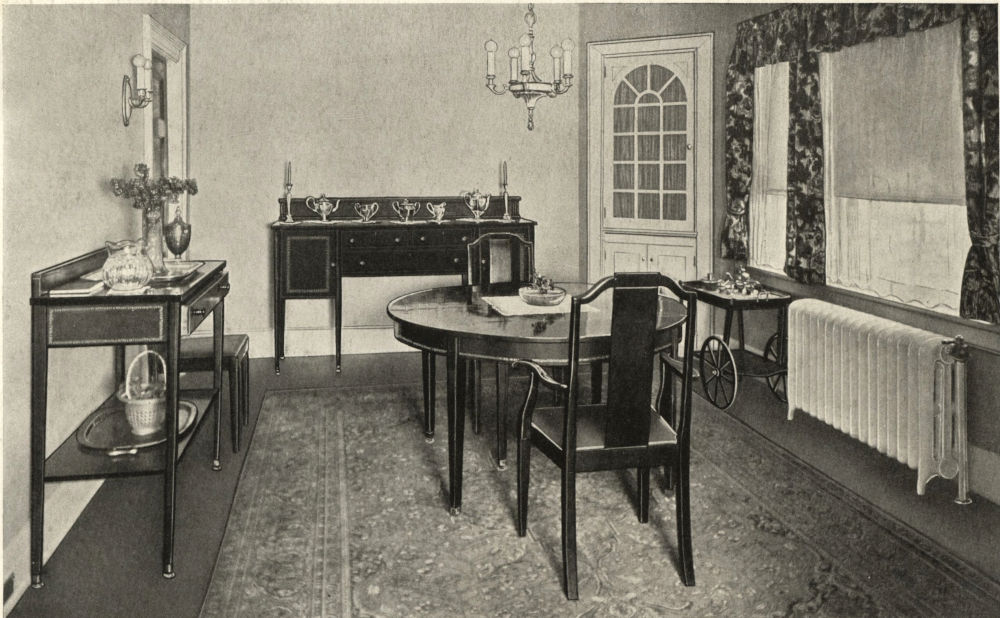
of use comes first. Anything in the dining-room that interferes
with eating in peace is in bad taste. Whatever appears as decoration
in the living-room that is unrestful, tawdry, common or unessential,
is inartistic. If the bedroom contains anything that is out of tone
with its general spirit, if it contains anything that makes for other
than an atmosphere of calm contentment and deep, sound sleep, it
should be removed at once. Let this point of view spur us on to make
an investigation of our houses—room by room—and alter or remove
everything that strikes a jarring note.
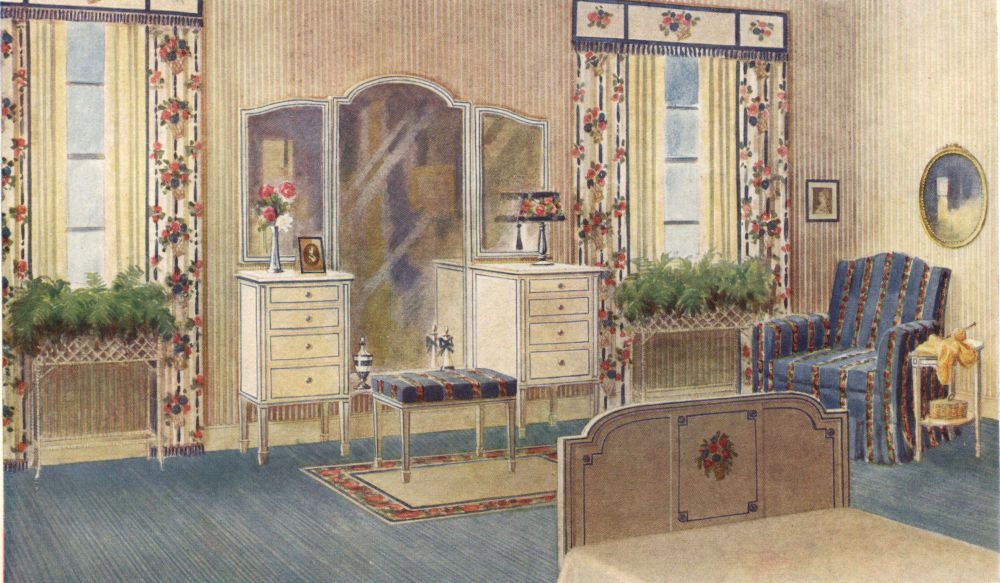
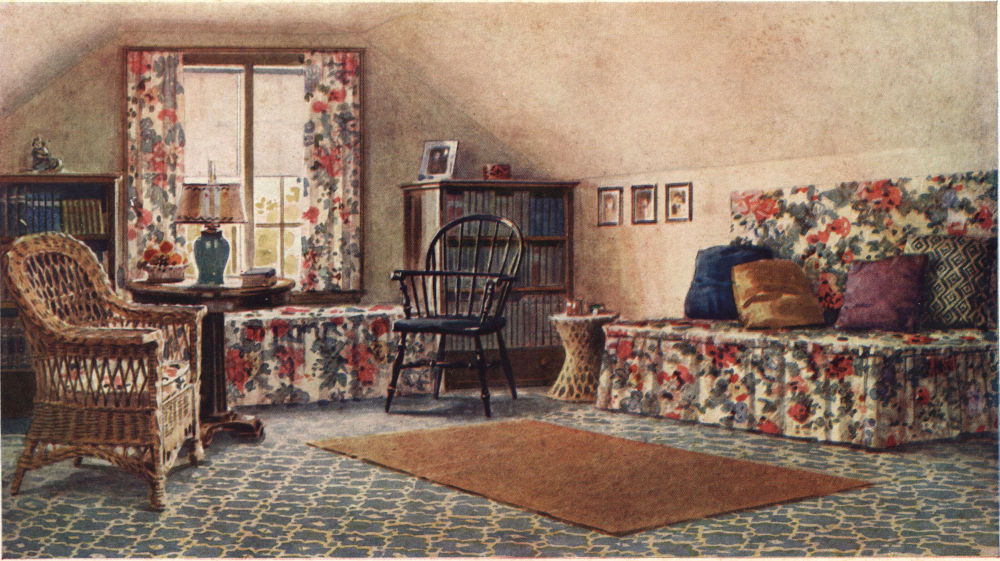
Let us start with the bedroom. Are there spotted fabrics or papers
on the wall, the spots on which one involuntarily counts, even after
going to sleep? Are there a half dozen small pictures in black frames
against a white background, so hung that successive steps are formed
which resemble the front hall stairs? Are there other diverting and
disturbing arrangements in the room that seem to invite us to close our
eyes to avoid further annoyance? Much can be done in house decoration
by elimination, and the strongest argument for this process will be
found in submitting each room to the test as to the performance of its
proper function.
The Language of Art
These elements, fitness to use and beauty, which
when combined make what is called the art of quality, must be made
comprehensible by facts and truths which can be expressed in a language
form that all may learn to understand. This art language is made up
of color, form, line and texture, and depends for its efficiency on a
knowledge of the principles which govern it and upon an appreciation
for the niceties in its use. Anyone can learn the principles and will
grow in appreciation as he makes a right use of what he knows. Of the
qualities mentioned, color is the most interesting; at least, it is the
easiest to see. At the same time it is the most misused. This is much
too small a space in which to demonstrate with any thoroughness the
color language idea, but two or three of the most important facts must
be emphasized.
Use of Color To Express Personality
Nothing is more personal than color and nothing admits of expressing
personality with clearer or more manifest charm. The normal
colors—yellow, red, blue, green, orange and violet—may be used in
illustration of this statement.
Color has its source in light, and natural light comes from the sun.
Yellow looks most like the sun, as it expresses the quality that the
sun seems to give out. From the sun we are cheered, made light-hearted
and receive new life. Yellow in a room should, under normal conditions,
produce the same feelings where it is the basis for the wall color or
is used in curtains or in other spots. Red suggests blood and fire.
It is associated with activity, aggression and passion. It heats and
stimulates. One who fails to react to color is not normal or is immune
from overcontact, while one who simply likes or dislikes a color and,
therefore, uses it or never does, misses the real chance to express
ideas. If one prefers red, there is no proof in the fact that makes
it incumbent on him to live surrounded by it. He may be erratic enough
without it, or possibly he doesn’t need a stimulant. Need is the
fundamental question rather than liking. It is a question of what one
ought to have.
It is interesting to know that the aggressive quality of red makes a
room in which it is used smaller in appearance, and there are times
when this is not desirable. Its warming quality is not needed in hot
climates or during a warm season.
Blue has an opposite effect from red. Its reactions are restraint,
coolness, repose and distance. By association one thinks of a clear
blue sky and the cool breezes from the blue waters of the ocean. This
makes blue a suitable antidote for hot weather and a temperate force,
useful in modifying some people’s dispositions. Green, which is a
union of yellow and blue, expresses the qualities of both. Nothing
could be more restful, soothing and agreeable than the cheering and
cooling effects of a seat in the shade upon the green grass under
luxuriant green trees, in the middle of a hot day. It is easy to see
the practical application of this in decorative art.
Violet or purple has the qualities of red and blue, while orange has
the qualities of yellow and red. It is interesting to study the natural
reactions shown by people of all ages and conditions to these colors
as environments under different mental conditions. Incomplete as
these suggestions are, they are probably sufficient to establish the
point that personal qualities or individual character traits can be
definitely expressed in color terms and that antidotes for an excess
of certain qualities are just as possible where a knowledge of color
exists.
There is a second color quality that we must not ignore. If I think of
one group of colors containing light pink, delicate blue, lavender,
canary yellow and white as representing one idea, and dark crimson,
heavy, dark green, blue with a rich dark purple and black as another
group, I have a basis for comparison. If my problem of expression is
the qualities that we generally attribute to youth, or the proper
colors for a young girl’s bedroom, or for the lighter and more
delicate things in life, I have no hesitation in choosing the first
group. If, on the other hand, the problem is one of clothes for a
person of mature age, or a color scheme for a library in an old English
house, or some other problem in which the qualities required are
dignity, quietness and stability, there should be no question as to the
preference for the second group.
This quality of light and darkness in color is called value and
must not be forgotten in using color as a language.
There is no doubt that the third quality, called intensity,
is the most important of all to a right understanding of interior
decoration. This quality determines how brilliant or how forceful
a color tone is. Softer and less aggressive tones are called
neutral or neutralized colors. The most important
question in using color decoratively is that which relates to the
distribution and correct placing of neutralized colors in their
relation to the more intense ones. The grossest errors in the whole
realm of color used in decoration are committed in this field. One or
two principles that relate to this matter must always be carefully
observed: “Backgrounds should be less intense in color than objects
that are to appear against them in any decorative way.” From this it
obviously follows that walls, ceilings and floors of houses must be
less intense in color than hangings, upholsteries, small rugs, pictures
and other decorative material. This is one of the most important points
to remember in every color problem.
There is a corollary to this which is equally important: “The larger
the color area the less intense it should be, and the smaller the area,
the more intense it may be.” According to this principle, hangings
and large rugs must be less intense in color than sofa cushions, lamp
shades and decorative bits of pottery and other materials. Keeping this
relation of areas in mind is an aid in selecting any article for the
house, as well as a help in choosing those things that are concerned
with one’s personal appearance. A red necktie is more appealing than a
red suit, so is a red flower or ribbon more decorative on a black hat
than a gray one would be on a red hat.
The slightest attempt at using color must disclose its power to express
personality, its natural value feeling and its decorative dependence
upon a proper distribution of intensities.
Use of Form To Express Ideas
While the principles of form are a little less apparent in their
illustration to most of us than color, yet they are no less important
in producing a harmonious whole. One of the first premises of
decoration is the assumption that there is a definite form or shape
upon which a decoration is to be applied. The direction of the bounding
lines of this form determines the direction of the principal lines of
the decorative matter which is to be applied on it.
The bounding lines of a floor are generally straight and at right
angles to each other. This fixes several important points regarding the
disposition of rugs and furniture. Rugs that are placed at all sorts of
angles on the floor and by their positions bid one go in any direction
save the one he started to take are among the most disconcerting and
distracting lines in a room arrangement. Place all rugs in accord with
the bounding lines of a room and harmony is at once restored.
One must conform to this principle also in placing furniture. Most
pieces should be parallel with the sides of the room, even though they
are not against the walls. Curved line chairs or other small objects
sometimes lend themselves naturally to a diagonal placement. Care
should be taken in grouping furniture to give the appearance of harmony
with the room structure. Let us look after the piano that is placed
catacorner in the living-room, and the bed, in the same position, in
the bedroom.
It is not unusual to see pictures strung over the walls in such a way
that the line indicated from the top of one to another is a zigzag
that illy suggests harmony with the structure of the wall. Triangular
picture wires are ugly and distracting. Unless a picture is small
enough to be hung with an invisible attachment at the back, it should
be hung with one long wire passed through two screw eyes, one at each
top corner of the frame, with one wire paralleling each side of the
frame and going over a hook above. This not only harmonizes the wire
with the frame, but with the doors, windows and the room structure.
The choice and arrangement of essential materials in the room, so far
as the aspect of beauty is concerned, will be treated in detail later
on.
Size and Shape of Objects a Factor
The principle of consistently related shapes and sizes finds scores of
applications in the arrangement of a room. Who has not wondered what to
do with a round clock, when everything else adjacent to it was either
square or rectangular in form? Where is there a house in which there is
not a round or oval picture to be placed, or a chair of wholly curved
lines, where all others are straight? The attempt to place one isolated
round object on a wall is generally a failure, because there is nothing
to relate it to any other nearby lines. Oval and curved objects must be
repeated by others similar in form in other positions in the room if
they are to become in any sense a part of the design.
The second part of this principle—consistent sizes—is even more
important and far-reaching than the first. To the architect, the
decorator or the creator of any art object, this is a vital matter.
Every interior, as well as exterior, architectural feature is thought
of in relation to every other one in the matter of size.
It is not uncommon to enter a room and find a chimney large enough
for an Elizabethan banquet hall, while the room itself, in size,
suggests a city flat. Nor is it less common to find a table or divan
of gigantic proportions being required to live in harmony with chairs
or other articles of various pigmy types. These unusual and unhappy
relationships cannot conform to the principle of consistent sizes.
In our use of hangings, upholstery, rugs, etc., the lack of feeling for
consistent sizes is still more often apparent. Before discussing this,
let us look for a moment at patterns and motifs as they are used in
textiles, wall papers and rugs.
For some unknown reason we have come to believe that there is no beauty
in anything in which there is not a pattern plainly visible, forgetting
that three-fourths of all wall and floor spaces are backgrounds on
which to show other more important things, including people, who have
some right to be exploited even against wall paper. There are some
phases of the motif running through a design, that may be considered
here in some detail.
There are three distinct varieties of motif. First, the motif which
aims to reproduce identically a natural object. Such things are rarely
successful. The second is known as the abstract type, where the motif
is of a form and color not derived from a natural source, being a
matter of space and line arrangement, often resulting in geometric
forms. The third, known as the conventional motif, takes a natural
thing and attempts to translate it into form and color suited by
its appearance and feeling to some particular material in which the
design is developed. In the conventional design, beauty is attained by
harmonizing the motif with the material on which the design is made,
while the naturalistic motif strives to represent some natural thing
and takes a chance on its being appropriate in the material in which it
is to be rendered. Harmony in motifs means, first, a relation in this
particular, from which it follows that a rug or floor which is entirely
geometric in pattern cannot be used successfully with hangings which
show a purely naturalistic design.
Another opportunity for harmony is found in consistently related motifs
as to size and shape. It frequently happens that the floor motif, for
example, is small and delicate in size and refined in line treatment.
If a person is naturally sensitive to color rather than form and he
finds a rug or hangings pleasing in color, he is often satisfied. For
harmony in relationship, however, he must ask if the motif in the rug
and that in the hangings are consistent in size and shape with the
floor and wall motifs.
Elements in a Room Must Balance
A third principle of form is known as balance. This is the
principle of arrangement whereby attractions are equalized and through
this equalization a restful feeling is obtained; that is, a feeling
of equilibrium or safety. It is somewhat disconcerting to enter a
small room and find a black piano across one corner and a delicate
Hepplewhite chair in the opposite corner. One instinctively rushes
to the aid of the chair. Attraction may be of color, size, shape or
texture, and one learns only by constant practice to see and feel the
attraction forces in different objects used.
There are two types of balance to consider. The first one, known as
bi-symmetric balance, is the equalization of attractions on
either side of a vertical center by using objects the same size, shape,
color and texture. This is formal, dignified and safe, but lacks in
some ways the delicacy and subtlety resulting from an attempt to get
a less formal placing. Consider a vertical line drawn through the
center of a chimney-piece placed in the middle of a wall space. On
either side of the chimney-piece and equally distant from it may be
placed two pictures similar in size, form and color, and the result is
bi-symmetrical. If two similar candlesticks are placed one at either
end of the chimney-piece and equidistant from the end, with a portrait
in the center, there is still bi-symmetric arrangement. So long as this
arrangement is maintained, bi-symmetry results.
A second kind of balance is known as occult balance. This term
is used to signify that the balance is rather felt or sensed than
exactly determined. If the same vertical line is drawn through the
same chimney-piece, one picture is placed a certain distance from the
left and two smaller pictures of unequal size are used on the right to
balance this. The two pictures must be so placed that their attraction
equals that of the larger one at the left. Similarly, if one large
porcelain jar and two or three other articles are to be used, there
must be a feeling of equal attraction on either side of the vertical
line.
To explain briefly the primary laws of balance we may give the rules:
“Equal attractions balance each other at equal distances from the
center.” And, conversely: “Unequal attractions balance each other at
unequal distances from the center.”
A third and a little more complicated law is stated as follows:
“Unequal attractions balance each other at distances from the center
which are in inverse ratio to their powers of attraction.” Translated,
this means that objects with the strongest attractions tend to
gravitate toward the central line, while less attractive ones tend to
draw from this line.
The application of the rules of balance not only to objects on the
wall, but to the furniture when seen against the wall or against the
floor, is essential to room composition. It is also essential that the
floor, in its general appearance, should bear a balanced relation to
the walls and to the hangings.
There is no better place, perhaps, than at this point to make clear
the relations of these three bounding surfaces. The ceiling should
be unobtrusive, but keyed in color to the rest of the room. A
perfectly white ceiling, except in a white room, or an over-ornamented
ceiling anywhere is an annoyance to him who would see his friends
or furnishings. A too-aggressive wall paper or other wall covering
makes a bid for attention quite out of proportion to its rights as a
background, while aggressive and over-assertive floors or rugs are
in bad taste, particularly when they assume the prerogatives of the
hostess in their attempt at attraction.
“Crawly” Pictures and Patterns Are Bad
The ceiling should be about as much lighter and less attractive than
the walls, as the walls are lighter and less attractive than the
floor. This is a balanced arrangement of ceilings, walls and floors.
Operating exactly opposite to the principle of balance is one known as
movement. This is calculated to cause unrest, excitement and
similar sensations, by creating an interest which causes the eye to
move from one thing to another. It is very desirable in many cases that
movement, particularly of a violent type, should not occur. Allusion
to stair arrangements in picture hangings has already been made. This
is not conducive to sleep. Erratic crawling vine patterns, creeping up
the curtains or the wall paper, are a little suggestive in the early
morning hours if one chances to awake. Violent contrasting lines,
created by bad furniture placing or by spotted wall papers or floor
covering, also become tiresome and disturbing, except to those who by
long contact with such things have become immune to their influence.
Even such may suffer a subconscious disturbance, though they do not
realize it.
There is a certain monotony attendant on the continual presentation
of one sound, one color or one form, for mental consideration. On the
other hand, there is a complete disorganization of the powers of the
human mind if a host of colors, forms or sounds are presented at one
time. If one is poverty, the other is certainly gluttony, and neither
should be accepted. It is through a judicious selection and arrangement
that sufficient variety is obtained to give pleasure, while restraint
results in making life humanly possible. It is very rarely that we err
on the side of simplicity, but it is not at all unlikely that we may
become flagrantly sumptuous, with an uncomfortable, tawdry result.
Emphasize Only Important Things in a Room
The principle known as emphasis is one which we must regard
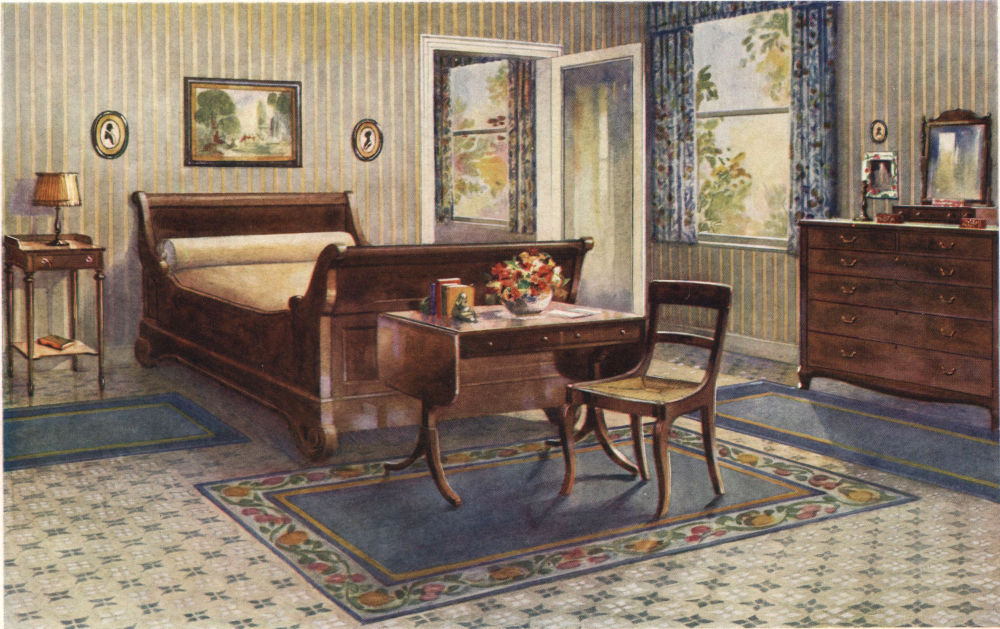
as important. In a bedroom one ought to see a bed; it is vastly more
important than the picture exhibition hung about it. In a dining-room
a well-set table is the emphatic note, not the chenille curtains nor
the products of the chase hung upon the wall. In the living-room the
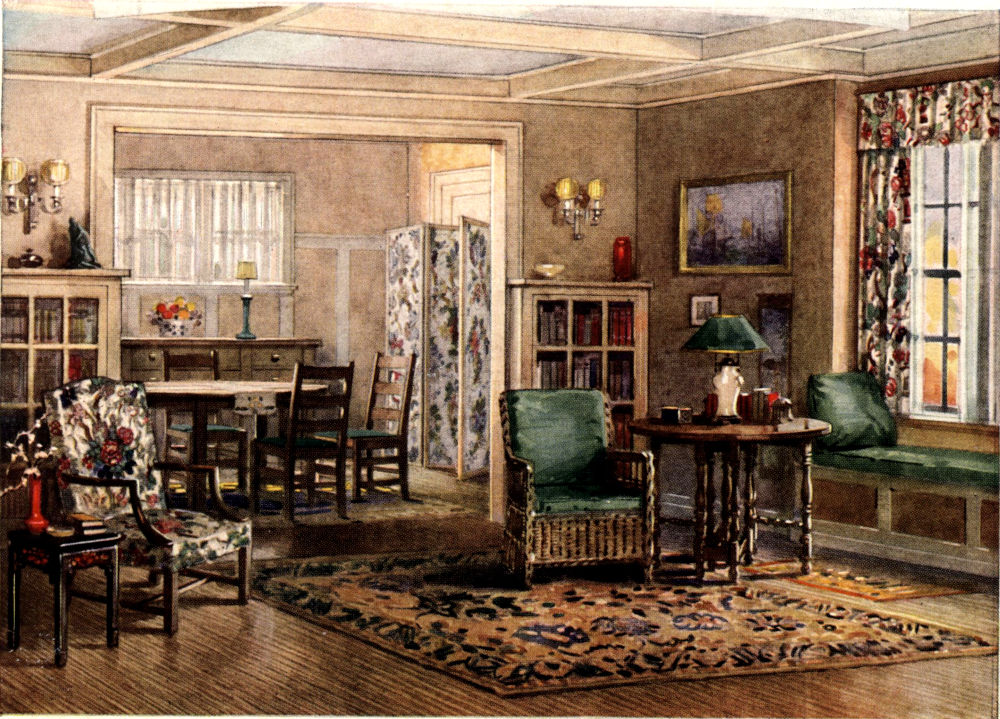
easy-chair, the divan, the bookcase, the beautiful portrait, lamp or
picture—all these things should be emphasized by color, form or line,
that their importance as related to other things in the room may be
apparent at sight.
Knowing this to be true, is it not strange that we still find people
who are willing to emphasize the wall paper or the floor or the
unpleasant ceiling decorations, to the absolute exclusion of anything
else that may have to be used in the room? The relation of background
to decorative objects cannot be insisted upon too much.
The Spirit of the Whole House Should Be the Spirit of Each
Room
The final principle of form is known as unity. In this limited
discussion only a word can be said of it. A room is a unit, so should a
house be. It is impossible to look with equanimity from an Old English
dining-room into a Louis XVI sitting-room. These styles are very far
apart in their meaning and can only be harmonized by those who know
how, when, where and how much of each element to use.
It is just as impossible to make a unit out of a mixture of Fifteenth,
Seventeenth and Nineteenth Century furniture, unless one knows how.
Every article used in furnishing a house not only has its conventional
value, but its design also. If one knows thoroughly the exact meaning
and power of a Louis XVI chair, an Elizabethan table, an Italian
console or a William and Mary bookcase, there is no doubt that these
may be used successfully in one room.
There are so many considerations in such a problem that it is
insufficient to choose single objects for their value alone. Each thing
must be chosen with a clear understanding of what room it is to go in
and with what other things it is in the future to be associated. A
failure to do this will certainly result in pandemonium.
What shall we do with the things we have? Use them if we have to,
destroy them if we are willing to—at least eliminate everything that
is nonessential. The pernicious practice of giving everything one
learns to dislike or that has become worn out, to the poor, does more
to prevent them from enjoying a personal growth than any other one
thing.
Perhaps no better way to think of the principle of unity can be
suggested than to quote the definition of an eminent Nineteenth Century
historian: “A unit is that to which nothing can be added and from which
nothing can be taken without interfering materially with the idea
itself.”
Objects Should Look the Way They Feel
The question of texture as a form of expression must not be
omitted. Texture is that quality of an object which seems to convey
the idea of how it feels. It is a combination of a degree of solidity,
strength, roughness, coarseness, etc. One finds this quality in the
grained effects of wood, in the weaves of different textiles, in the
appearance of braided straws, and even in feathers and other materials.
It is this sense of fitness in textural feeling that forbids the use
of hard, harsh-grained oaks with the finer textures of mahogany and
satin-wood. Disregarding this quality, people often combined the
coarser, heavier and more-resisting woolens or linens with soft,
impressionable and destructible silks or fine cottons. Harmony in the
texture quality cannot fail to contribute to harmony in the finished
unit.
Such is the language of art expression in color, form, line and
texture. The principles which govern the right selection and
combination of all materials that go to make a house are the real
guides to growth in artistic appreciation.
Good Taste the Final Criterion
Good taste, which is the final criterion in all art, is cultivated or
improved in most people by a constant study and application of the
principles which control artistic expression.
Should we not, all of us, do well often to take time to remind
ourselves of certain great established principles and to endeavor
constantly to see more clearly and completely the principles that
govern the expression of these truths? Thereby we may unconsciously
form habits of thinking and of doing things that will not only make for
broader and better personal growth, but will contribute to a higher
type of national civilization. We have not to worry if all the powers
of science are not directed to the development of so-called efficient
service, in lines that are wholly material and commercial.
We are extraordinarily committed to this propaganda, as a people, and
we might ask ourselves whether we may not be developing this idea
at the expense of mental and spiritual ideals that, after all, are
the real things that not only determine what we actually are, but are
the only things that are truly permanent. Life is certainly something
beside machinery, raw materials and money, even granting these to be
essentials.
Perceiving the desirability of the art quality results generally in an
effort to possess it, and that entails immediate action in two distinct
ways. First, go out to find the simple, fundamental principles that
control the language of color, form, line and texture; second, apply
these principles at once in the home, in the shop, in clothes, in
printed paper or in any concrete thing where interest and possibility
are found. Through every application growth is assured.
Influence of Environment
Let us again remember that man is exactly what he lives in, for
environment is the strongest possible factor in man’s development. Let
us not forget that what man really is, is what his mind is, and this he
must express in all he does.
This places the importance of the home where it deserves to be and
makes its furnishing one of the most serious and at the same time one
of the most delightful things in life, never for an instant minimizing
what has always been desirable, but vastly enlarging and ennobling the
idea for which it stood.
In recognizing anew the part art is to play in this matter, let us not
forget that it in no way interferes with the three essential qualities
that are inevitably factors in every home problem simple or elaborate,
as the case may be.
Perfect physical comfort is necessary, if only from the standpoint of
more efficient service on our part and the relief it brings us, not
to be constantly thinking how hard the bed is, how uncomfortable the
chair seems, or how rough and uneven the floor feels. Art in no way
interferes with physical comfort; in fact, it demands it, as an element
of the eternal fitness of things.
The nation is awake to the power of cleanliness as a factor in making
an efficient physical, and thereby, indirectly, a finer mental being,
as a contribution to modern civilization. Every article selected for
the home should have this requirement considered. Including this in
the art idea will remove the misapprehension under which some people
labor, that art implies disorder at home, a dowdy or unkempt person and
a disregard of nature’s most obvious laws. The first law of Heaven is
order; it is no less so of art.
Expense is the constant excuse of those who want better things but
cannot afford them. There are as many bad expensive things as there
are cheap ones. No home is too poor to have much better things, much
better arranged, than it has, and no home is so rich that much of the
furnishing might not well be publicly burned and the rest rearranged.
From any standpoint, comfort, sanitation, economics or art, the home
is to become the greatest moulding influence in human life. Shall
we remain apathetic and indifferent to this most vital problem,
satisfied to increase our bank account only, or shall we awaken now and
contribute our mite to a fuller national life and a higher and happier
existence? This certainly will not decrease our power to increase the
bank account, but will enable us to do it with far less physical effort.
Floor Styles Change with the Customs
Traditions have generally obtained in each generation and fashion as to
what materials should be used in various parts of the house and how to
use them. The original ideas which went to establish these traditions
or manners differed in their origins, but were always the logical
outcomes of times in which they were developed. For instance, the walls
of the house in the Italian Renaissance were of stone. Steel was not
thought of and wood unsuited, while in American Colonial days wood was
the most plentiful material and the quickest and easiest to handle in
building in the manner in which the people lived.
At various times climate, geography, religious and social customs and
the developments of science or art have changed conditions, and with
this, methods and materials have undergone similar changes.
Floors, for example, have mostly been of clay, stone, tile or wood,
dictated by one or more of the modifying influences of which we have
spoken. Wood cannot take the place of stone, neither should it try to
pretend to do so, but there is no denying that one is better than the
other under certain conditions and that neither is the only good floor
under all conditions.
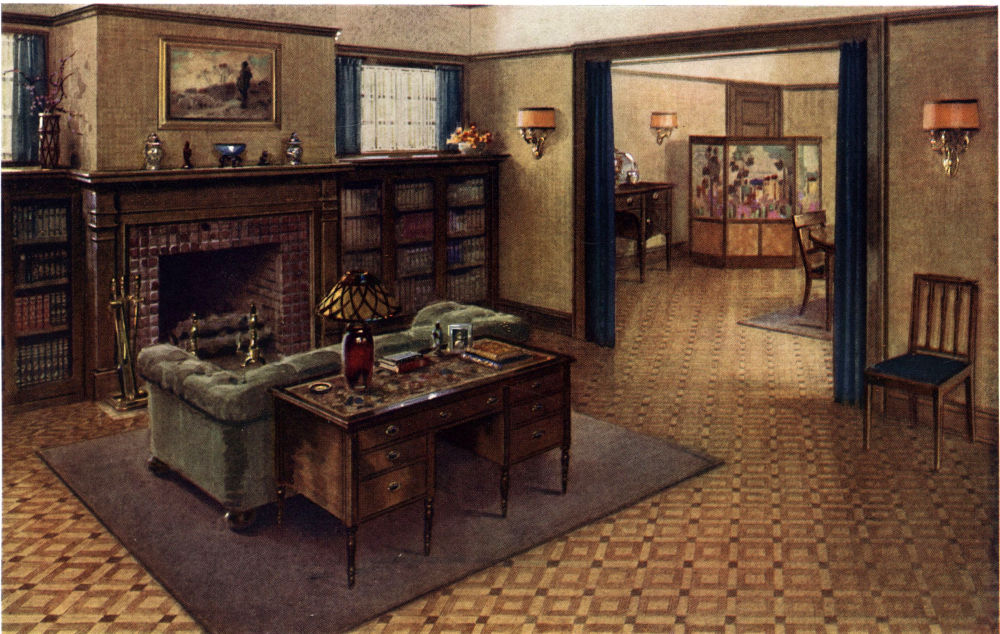
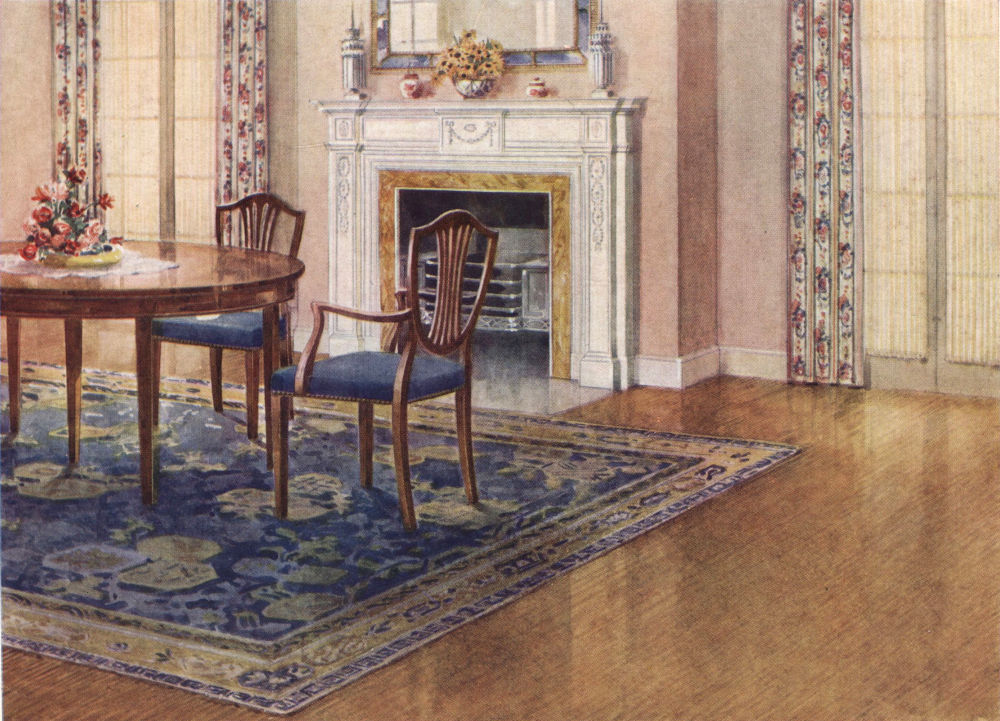
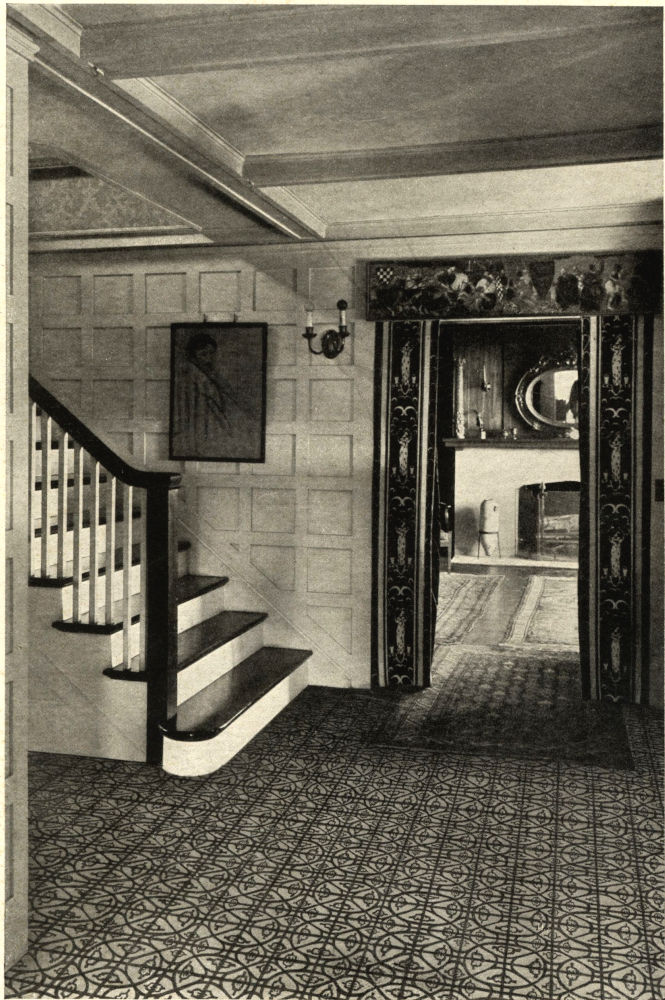
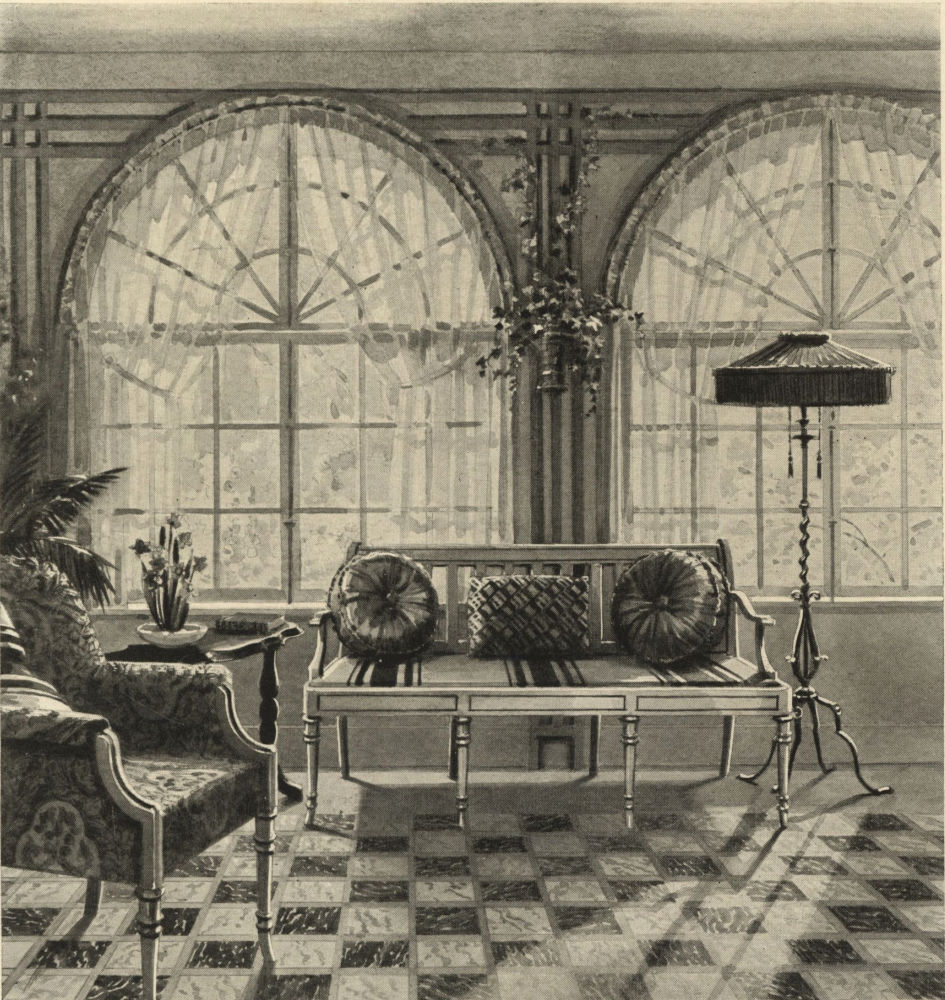
Linoleum as a floor is not a substitute for stone, wood, tile or clay.
It is another material, recent in conception and suited to particular
conditions, because of properties that neither stone, clay nor wood
have in exactly the same proportions.
Where Linoleum May Be Suitable and Desirable
Like other floors in modern houses, linoleum ought to combine the
qualities of sanitation, comfort, durability to fulfil completely its
functions. When made to conform to these ends—as it does if properly
designed, and then selected and arranged so as to harmonize perfectly
with its surroundings—it is not only suitable but desirable. Linoleum
is sanitary, because the most obvious thing about it is the ease with
which it can be cleaned and kept clean.
Linoleum is comfortable, because it is soft, quiet and resilient
underfoot. It is economical, because it is durable.
In parts of Europe, the artistic possibilities of linoleum have
been developed to such a degree that many fine homes are furnished
throughout with floors of that material. There is no reason why, in
this country, the development of the art side of linoleum should not
follow the general development of interior decoration. For patterns and
colors, suitable for any scheme of house furnishing and decoration,
seemingly, can be produced.