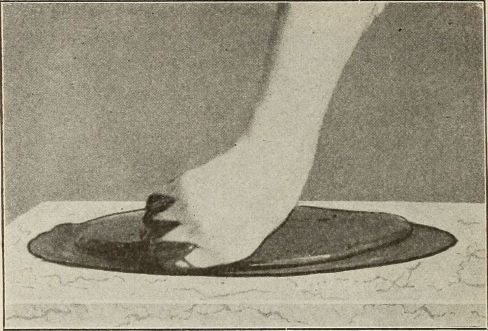
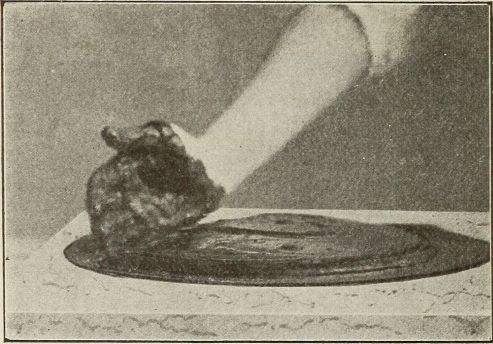
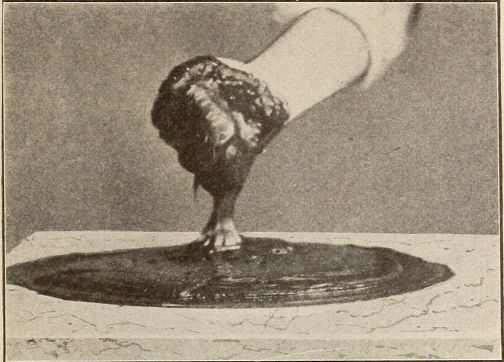
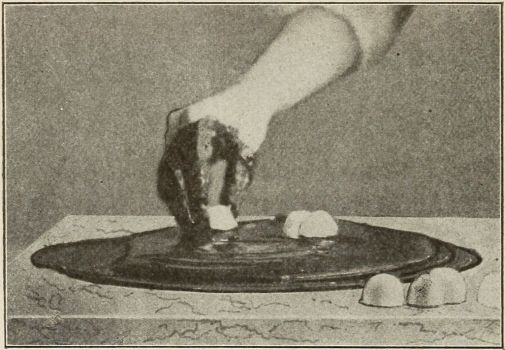
- 2½ pounds sugar.
- ½ pound glucose.
- 1 pint water.
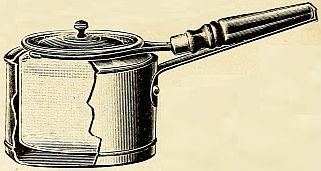
Put the sugar, glucose and water in the kettle and set on
hot fire. Stir this and wipe down sides of kettle same as bon-bon
cream, and when it starts to boil, cover until it steams
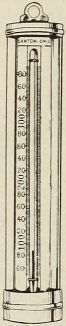
well, remove cover, put in thermometer, and cook to 238, then
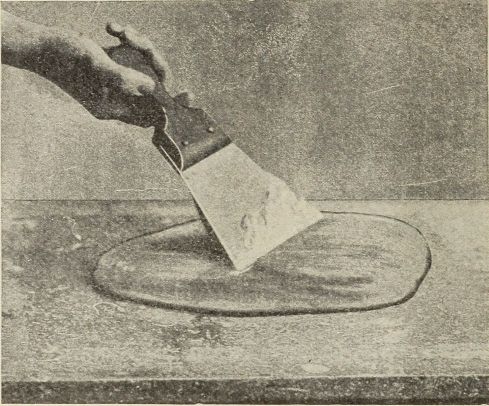
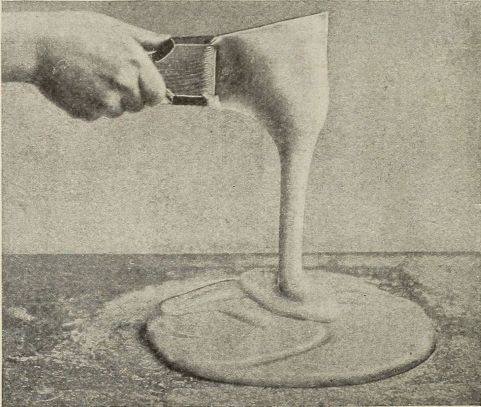
remove from the fire and pour on slab which has previously
been moistened a little. You will see that so far, you handle
this the same as bon-bon cream, but it is not necessary to
use quite so much care with it, as the glucose in it has a tendency
to keep it from sugaring any, but do not get careless with
it simply because we tell you this. This fondant must not
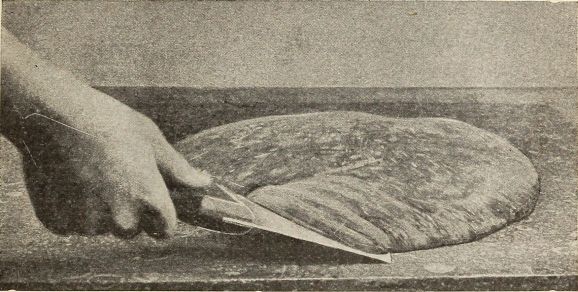
stand until perfectly cold, but commence creaming it when
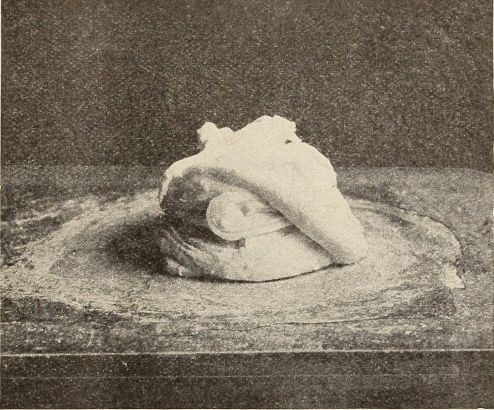
about half cold, and cream it in the same way that you do
bon-bon cream. It is better to scoop this fondant off into
your crock just before it sets firmly. When you see it is up
to that point, quickly scoop it into the crock, for if you allow
it to remain on the slab until it sets perfectly hard, and sweat
it same as bon-bon cream, it is very sticky to handle. If you
should happen to scoop it into the crock a few seconds too
soon, it does not matter, as it will come out just the same in
the end. It will take longer to cream this fondant than it
does bon-bon cream. When you put it in the crock, cover
with a damp cloth the same as the other. This is a snow
white, very soft, smooth, and sticky fondant, and is used for
the centers of chocolate creams, as it makes a much softer
center for them than bon-bon cream does. We will tell you
farther on how to handle it, but always remember, we will
speak of this as center cream and the other, bon-bon cream.
Make exactly same as above, only instead of white sugar,
use two-third maple and one-third white. If you use maple
syrup instead of maple sugar, allow two pounds of syrup for
every pound of sugar desired. You will find this cream very
sticky, and it takes longer to cream it up than the other, but
it makes a delicious chocolate cream. Do not get discouraged
and think it is not going to cream for you, for if you cooked it
to the right degree, it will never fail to cream.
As you use the center cream for the inside of chocolate
creams, you must have some method of moulding them on
account of that cream being so soft and sticky. This is done
in cornstarch, the same kind as you use for cooking purposes,
as that does not stick to the candy in the least. Get the
cheapest grade possible, as that answers the purpose. It
should cost you from five to eight cents a box, and we would
advise you to get four or five boxes at once, as it never spoils
and may be used indefinitely, over and over again. When you
are through with it, scoop it out into a large jar until you
need it again.
Take a square, shallow pan, from one-half to one inch
deep, or a pie pan will answer the purpose as well, and sift
starch into it until you have enough in to fill it. Then with a
smooth stick that extends over each side of the pan, smooth it
off very even. By having the stick extend over edges of the
pan, you will not pack the starch down, which is very necessary
to avoid, as you cannot make your impressions perfect
if your starch is packed in the least, and consequently this
starch must be sifted into the pan and not scooped in. In
smoothing it off, place your stick on the pan at one end and
push it across, and in that manner you will not pack the
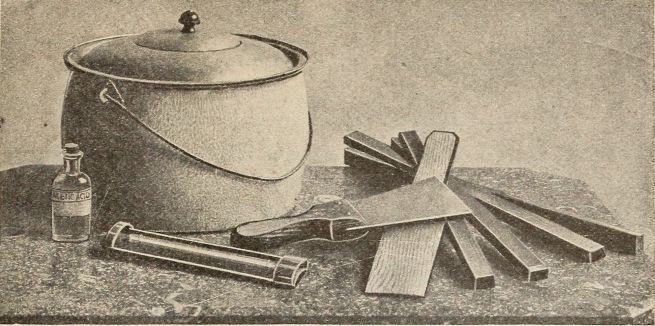
starch in the least. Now take your stick with the style of
moulds glued on you intend using, take hold of each end of
it, and press the moulds down into the starch until the stick
strikes the sides of the pan; carefully raise the stick and you
will then find your impressions in the starch ready to be filled.
Continue in this manner until you have the pan full of impressions,
always remembering that every time you make a
new row of impressions, you must, when pressing the moulds
down in the starch, press away from the ones you just made,
the least trifle, so you will not spoil them, as this cornstarch
is very treacherous, and if you should happen to press the
moulds the least bit toward the impressions previously made,
you would cause them to cave in. By having the ends of your
stick protrude over the edges of the pan as directed, you will
thus get all the impressions the exact depth. You must be
very careful and do not jar the table a particle or attempt to
move the pan before filling the impressions with center cream,
for if you do, you are liable to spoil them.
Take as much center cream as you wish, and put it into
the double boiler with hot water underneath it, set on the fire
and stir until it melts, and do not allow any water to get in
with the cream. As soon as it is thin, color and flavor any
way you wish, and let it remain on the stove until it gets good
and hot. It must be hot or it will not harden in the starch,
but remember the hotter you get it, the harder it will be after
it is cool, and as you do not wish them to be too hard, be
careful and not allow it to get too hot. The best way to test this,
is to take some out upon your spoon and touch your tongue
to it and if it is very warm it is ready to use. Now set off
the stove, but do not take the inside boiler with the cream in
it out of the water, as it must be kept warm. Dip a little out
in a spoon and pour it into the impression. In doing this
you will soon get an idea about how much to dip out each
time in the spoon in order to fill the impression. If you have
dipped out too much to fill it, as soon as it is full, quickly
turn the spoon up, as you only want the impression level full.
Continue in this manner until you fill them all. You must
work rapidly, and will soon be able to drop the cream in the
impressions without striking the edges and breaking them
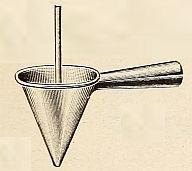
down. If you use a funnel to drop these centers, you must
warm it a little over a fire, but do not get it hot, just warm;
then take the handle of the funnel in your left hand, and with
your right hand push the stick down into the end of the funnel,
and have someone else pour the heated center cream into
the funnel. Hold the end of the funnel over one of the impressions
in the starch, and lift the stick with your right
hand, allowing enough cream to run into the mould to fill it.
Continue in this manner till all have been filled. If the
cream becomes too thick to run out of the spoon, or funnel,
readily, set it back on the stove a few moments, until the
water under it boils again, then it will be thin enough to run
out as before. If you made this cream correctly in the first
place, it will never be necessary to add any water to it in order
to have it run out of the spoon; but in case you misread
your thermometer and cooked it a little too much, it may
be so thick that it will require a few drops of water, but add
very little. In from ten to twenty minutes, the centers will
be hard enough to pick out of the starch and blow off. Very
little of the starch will stick to them as you lift them out, but
what does will blow off easily. You may do this with your
mouth, or better still, if you have any kind of a small bellows
in the house, put the centers in a pan as you take them from
the starch, and when they are all taken out, squeeze the bellows
on them several times, and they are perfectly clean.
In blowing this starch off, we would advise you to take them
outdoors and do it, as the starch makes quite a dust in the
kitchen. They are now ready to coat with chocolate, and do
this as directed in article on Chocolate Coating.
All chocolate creams are moulded in this manner, excepting
Orientals. You may make these any shape or size centers
that you have moulds for. These centers should be
coated within several hours after being moulded.
If you wish chopped nuts of any kind in the centers, stir
them in well, just before you commence dropping them in the
starch, or you may if you wish, drop a large piece or a whole
half of a nut in each impression, then pour the cream on top
of it.
If you use a funnel, and wish to use nuts in the centers,
do not add the nuts to the cream before being run in the
starch, but simply drop them in the empty mould before hand,
and run the cream on top, till it fills the mould.
If they do not harden in the starch, it is because of the
water you added or else because you did not get the cream
hot enough, and they may be picked out, blown off, and re-melted
again without hurting the cream in the least. These
centers will mellow up a great deal after being coated with
chocolate, and are better after they stand a few days.
If you should have more cream melted up than you have
impressions made for, you may flavor it highly with wintergreen
or peppermint, and with a spoon, drop it out in wafers.
While it really does not come under this heading, we will
say here that centers moulded in this manner and coated with
bon-bon cream make a very nice cheap bon-bon, but are not
to be compared with the ones made after the style we direct
you to, in article on Bon-Bon Making. A great many confectioners
never make bon-bons in any other manner than this,
but you will see the others are much finer.
It is a failing of many persons to heat the center too hot
so that it will run through the funnel more readily, but the
result is a hard center that will never get soft, and nothing
can be done to soften it after it is once hard. A chocolate
center becomes soft within three or four days.
You may make them any flavor or color you desire. You
may, if you wish, roll bon-bon cream up into balls and coat
them with chocolate, but this does not make a nice chocolate
cream, and the proper way is to mould the centers in cornstarch
as directed, using the center cream for this purpose.
Either rose, wintergreen, peppermint, strawberry, vanilla, or
lemon make a fine chocolate cream. It is best to make each
flavor a different shape. Color the rose, strawberry, and
wintergreen a delicate pink and the lemon a deep yellow. The
vanilla should be left uncolored, and you may put chopped
nuts in any of these in the manner we directed, in article on
Cornstarch Work.
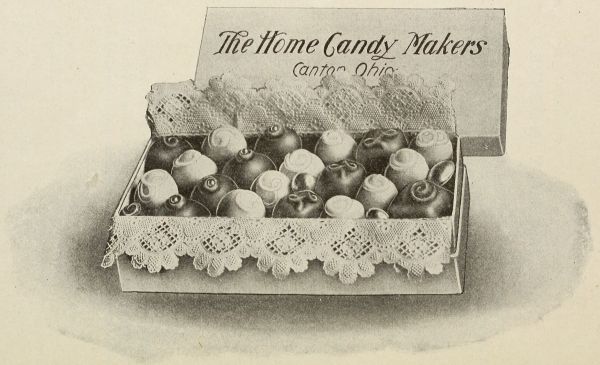
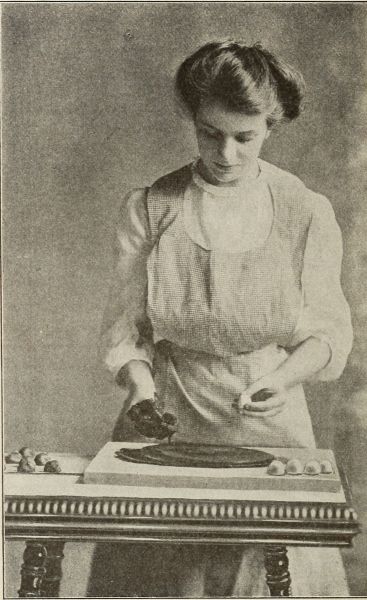
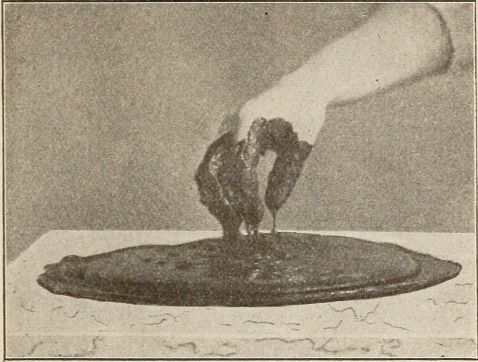
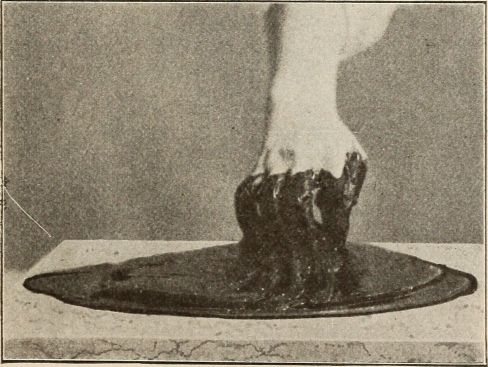
When moulded, blow off the starch, and coat with chocolate
as directed in article on Chocolate Coating. If you desire
a nut on the top of any of your chocolates make a flat
shaped center, and put the nut on before the chocolate sets,
and press down very gently, so as not to make a base on
them. Maple chocolates, made from maple center cream in
this manner, are very fine. English walnuts, pecans, or almonds,
blanched and split in two, are the prettiest nuts for
this purpose; however, we do not advise putting nuts on chocolate
creams, except on rare occasions, as you will notice the
finest grades of chocolate creams do not have nuts on them.
If you are able to purchase any silver dragees, which are
kept only in large candy stores, they are very pretty on the
tops of chocolate creams. As you see by this, there is no
limit to the many different styles of chocolate creams possible
to make, by adopting any ideas you have of your own and
following this recipe.
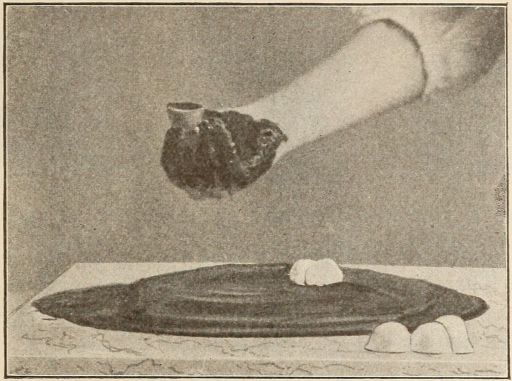
Buy your marshmallows, as that is cheaper and much
easier than making them, and coat them with chocolate the
same as chocolate creams. If they are very large, it is best
to cut them in two before coating, as they will look prettier.
Pistachio nuts, chopped very fine and sprinkled over them
before the chocolate sets, look very nice.
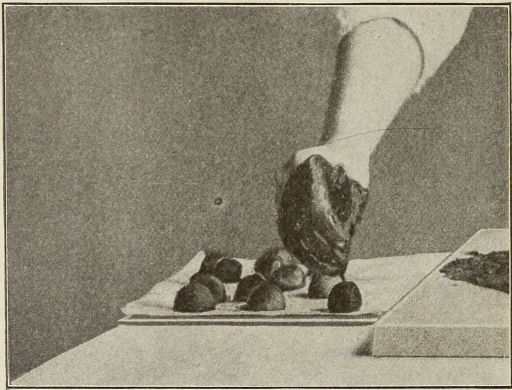
Make some caramels, either vanilla or strawberry flavor,
which are the best for this purpose, and coat same as directed
for other chocolates.
Remove the seeds from dates, roll them up, and coat with
chocolate as directed. If you stuff these dates with chopped
hickory nuts after removing seeds, then press firmly together
and coat with chocolate, they are very fine.
Buy some fig paste or Oriental jelly, and coat with chocolate
same as others, and you will find it makes a very fine
piece of candy.
Cut freshly made fudge up in squares and coat with
chocolate. Chocolate fudge, coated in this manner, is probably
better than the other flavors. Opera fudge, cut into
squares and coated with chocolate, is much nicer than the
other kind of fudge.
Drop out some wintergreen or peppermint wafers in the
manner described before, only use center cream instead of
bon-bon cream, then coat with chocolate. It is best to use
the center cream in making these, as it mellows up more after
being coated than bon-bon cream, as it is much softer.
Make a batch of walnut brittle as directed, and cut into
oblong pieces about one inch long, then coat with chocolate.
These are very brittle and nice eating.
Select large candied cherries, and coat with chocolate
same as other centers. These are probably the finest chocolates
you can make, and also the most expensive, and I
would advise you to only use them in dressing off the top
layer of your boxes.
Either English walnuts, pecans, or Brazil nuts are very
fine when coated with chocolate. Do it in the same manner as
other chocolate coating, but do not roast these nuts before
coating them.
Roast the almonds in the oven, being careful about getting
them too brown, and when cool, coat with chocolate.
Never coat nuts of any description with anything but sweet
coating; if you should use chocolate on them that is the least
particle bitter, they would not taste good at all. The best
way to coat these small nuts, is to work your chocolate, then
put in quite a number of the nuts, roll them around a little,
then with a pair of tweezers, lift them out one at a time and
lay on your oilcloth. This is much quicker than lifting them
out with your hands, one at a time.
Roast the filberts in the oven, same as you do other nuts,
then coat with chocolate, and in laying them on the oilcloth,
lay three of them in the form of a triangle so that they will
touch each other, then lay another one on top and when the
chocolate is set, they will stick firmly together and look very
pretty in a box. If you have a pair of tweezers, they are very
convenient with which to pick the nuts out of the chocolate,
and lay them so that they will touch each other. In laying
the last filbert on top, if you will allow quite a little chocolate
to stick to it as you lift it out, it will improve the looks of
the pyramid, as it will run down over the other nuts.
Pour out a little chocolate coating, work it until nearly
cold, then mix into it broken pecan meats until it is pretty
thick, then with a spoon drop it in the form of patties on the
oilcloth, and make them about the size of a silver dollar.
Have enough nuts mixed in the chocolate so that they will be
thick enough to hold their shape after being dropped out and
will not spread any, and consequently they will be very rough
looking, which they should be. These are about the finest
candy in this line which it is possible to make, providing of
course that you use the Sweet Coating for this purpose.
Make them in the same manner as pecan fritters. Always
use roasted peanuts, and if you have the raw Spanish
peanuts, roast them in the oven first, as they are better than
the large peanuts.
Cut some candied pineapple into points and coat with
chocolate.
Molasses and Moonlight Kisses are greatly improved
when coated with chocolate. Cut the kisses into pieces about
two inches long and coat with chocolate.
Buy a few Nabisco wafers, cut them in four pieces and
dip in sweet chocolate.
Make a batch of cocoanut centers as given in this book,
roll them round and dip in chocolate. This makes a nice
topping piece for your boxes. You may also set a small
round dragee on top of the ball, while the chocolate is still
warm.
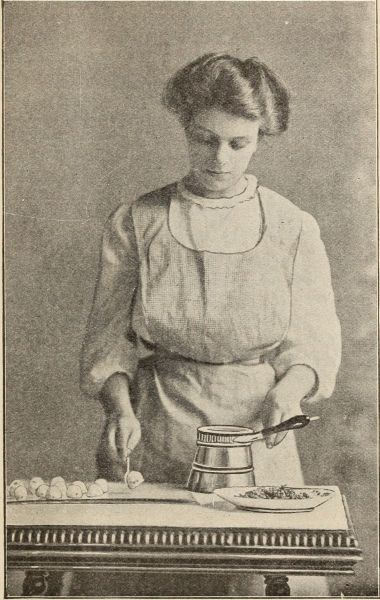
Drain the liquor from red or white Maraschino cherries.
Melt some fondant, and dip each cherry in the melted fondant.
It is well to add a little of the liquor to the fondant
while melting, as this has a tendency to make the fondant
watery in about a day. As soon as you have dipped all the
cherries, and the fondant on them has cooled, commence at
once to coat with chocolate. If after you have finished coating,
and you find little drops of syrup standing out on the
chocolate coated cherries, simply cover these holes with a
little cooled chocolate and it will stop at once; for if allowed
to drop out, the cherries would be dry in a few days. These
are best wrapped in wax paper.