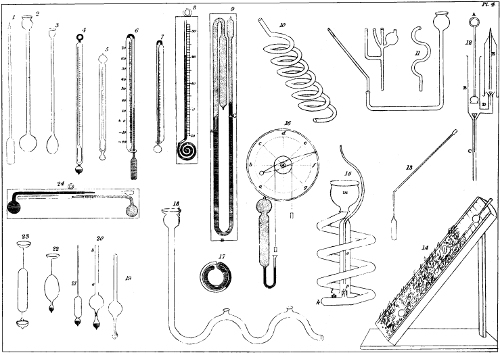
When a person is well acquainted with the
fundamental operations which we have just
described, the preparation of the instruments
of which we are about to speak can present
scarcely any difficulty. Indeed, some of them
are so extremely simple, and are so easy of
execution, that it is sufficient to cast a glance
upon the figures which represent them, to seize
at once the method which must be followed in
their construction. Of such instruments we
shall not stop to give a detailed description,
but shall content ourselves with presenting the
design.
On the other hand, it is of importance to observe
that a certain number of instruments are
graduated or furnished with pieces, or mountings,
of which it is not the object of our art to
teach the construction, and which demand a
more or less extensive knowledge of the sciences.
We shall treat of these mountings but
summarily, referring the student, for more detailed
instructions, to the works on natural philosophy
and chemistry, in which these instruments
are especially treated of. Our reason
for this is, that we do not wish to abandon the
plan we had adopted of describing simply the
art of glass-blowing. To describe the use and
application of philosophical instruments, or to
explain the principles on which they act, would
be passing quite out of our province.
Adapters.—These are tubes of glass of various
forms, employed in chemistry to connect
together the different pieces constituting an
apparatus—as, for example, to join a retort to
a receiver during the operation of distillation.
You should take care to border the extremities
of an adapter; or you may widen them into
the form of the mouth of a bottle, when they
are to be closed air-tight by corks. Besides this,
there is nothing particular to be observed in
the preparation of adapters.
Apparatus for Boiling in Vacuo.—Represented
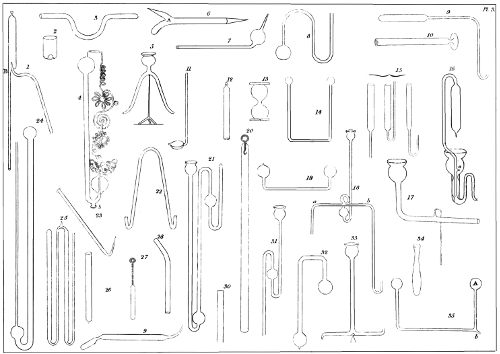
by pl. 3, fig. 19. Employ a tube about
a quarter of an inch in diameter. Blow two
bulbs; give the tube the necessary curvature;
fill one of the bulbs with nitric ether; boil the
ether to expel the atmospheric air from the apparatus,
then seal the opening in the other bulb.
Apparatus for Freezing in Vacuo. The
Cryophorus.—Take a tube one-third of an inch
or rather more in diameter, and pretty thick in
the sides. Blow a bulb at each end; the first
at the sealed part of the tube, the other at the
open point; then give to the tube the curvature
represented by pl. 3, fig. 32. Introduce as
much water as will half fill one of the bulbs;
make the water boil, and draw off the point
and seal the apparatus during the ebullition.
Apparatus for conducting Water in bent
Tubes.—Solder a funnel (see Funnels) to the
end of a tube; pierce two holes in this tube in
the same line, and solder to each a little addition
proper to receive a cork. Finish the instrument
by bending it in the manner indicated by
pl. 4, fig. 18.
Apparatus for Experiments on Running
Liquids.—A tube bent once at a right angle,
mounted with a funnel, pierced laterally, and
soldered at the same point to a smaller tube.
See pl. 3, fig. 17.
Apparatus for Exhibiting the Phenomena
of Capillary Tubes.—This apparatus consists
of a capillary tube soldered to another tube of
a more considerable diameter. Sometimes it is
bent like the letter U. Pl. 3, fig. 15.
Apparatus for the Preparation of Phosphuret
of Lime.—An apparatus that can be
employed for the preparation of phosphuret of
lime, as well as in a variety of other chemical
experiments, consists of a tube sealed at one
extremity, slightly bent and choked at two
inches and a half from the sealed part, and
drawn out (after the introduction of the substances
to be operated upon) at the other extremity.
This little distillatory apparatus is
represented by pl. 3, fig. 29.
Archimedes’s Screw.—There is no particular
process for the making of this instrument.
It is, however, necessary for one who would
succeed in making it, to exercise himself in
the art of well bending a tube. After a few
attempts, you may finish by producing a pretty-regular
spiral. The tube chosen for this instrument
should be six or seven feet long, and
about one-third of an inch in diameter. You
commence by making a bend, nearly at a right
angle, about four inches from one of its extremities.
This bent portion serves afterwards
as a handle, and very much facilitates the
operation; it represents the prolongation of
the rational axis which may be conceived to
pass through the centre of the spiral. See
pl. 4, fig. 10.
Barker’s Mill.—Apparatus for exhibiting
the rotatory motion produced by the running
of liquids.—Contract a tube at its two extremities,
pierce it laterally about the middle of
its length, and solder to the hole an additional
tube, terminated by a funnel. Soften the principal
tube at the side opposite to the part that
was pierced, and form there a conical cavity
by pressing the softened glass inward with the
aid of a metallic rod. This cavity must be so
carefully made that the whole apparatus can be
supported on a pivot. Bend the contracted
ends of the tube horizontally, and in different
directions, cut off their extremities at a proper
length, and slightly border the edges of the
orifices. See pl. 3, fig. 33.
You may produce this apparatus under a
different form, as may be seen at pl. 3, fig. 5.
Barometers.—Barometers serve to measure
the pressure of the atmosphere. The following
are the varieties most in use.
Cistern Barometer.—Take a tube about
thirty-two inches long, and at least one-third of
an inch in diameter, internally; seal one of its
extremities, free it with most particular care
from moisture, fill it with mercury, and make
the mercury boil in the tube, by heat, in order
to drive out every particle of air which might
be present. When the tube is full of mercury,
and the boiling has taken place, turn it upside
down, and plunge the open end into a cistern
also filled with mercury which has been boiled.
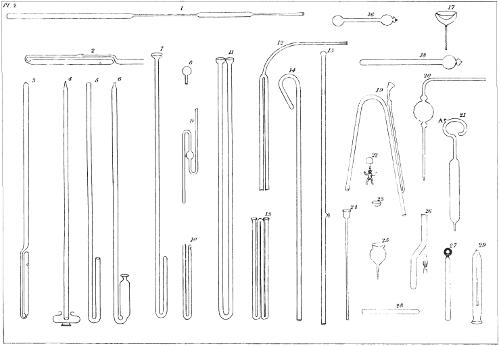
See pl. 2, fig. 4.
Dial (or Wheel) Barometer.—The tube
intended for this barometer should be very regular
in the bore. It should be thirty-nine
inches long. Close it at one end, and bend it
like the letter U at about thirty-two inches from
the sealed extremity. See pl. 2, fig. 5, and
Graduation of the Dial Barometer.
Syphon Barometer.—Make use of such a
tube as might be employed for a Cistern Barometer;
solder to its open end a cylindrical
or spherical reservoir, and bend the tube close
to the point of junction in such a manner as to
bring the cylinder parallel with the tube. If
the reservoir is to be closed with a cover of
leather, cut off the remaining point of the cylinder,
slightly widen the orifice, and then
border it. If no leather is to be applied, but
the point of the cylinder left open, it is necessary,
after the introduction of the mercury, to
draw off the point abruptly, and to leave an
opening so small that mercury cannot pass by
it. Pl. 2, fig. 6.
Stop-Cock Barometer.—This differs from
the preceding barometer only by having a stop-cock
mounted in iron between the reservoir
and the tube.
Compound Barometers.—Blow a bulb at
each end of a barometer tube of about thirty-three
inches in length. Solder a small and
almost capillary tube to the point which terminates
one of the bulbs, and bend the great
tube very near this bulb. This must be done
in such a manner that the centre of one bulb
shall be thirty inches from the centre of the
other bulb. Introduce a quantity of mercury
sufficient to fill the great tube and half the two
bulbs; fill the remaining space in the last bulb
with alcohol.
You may give a different disposition to this
instrument. Divide a barometer tube into
two, three, or four pieces, and reunite the
pieces by intermediate capillary tubes, so as to
form a series of large and small tubes, soldered
alternately the one at the end of the other.
Then communicate to this compound tube the
form exhibited by pl. 3, fig. 25, and join, at
each superior bend, a little tube, for the convenience
of easily filling the instrument with
mercury: seal these tubes as soon as the mercury
is introduced. The graduation of compound
barometers is made by bringing them
into comparison with a good standard barometer.
After taking two or three fixed points,
it is easy to continue the scale.
Gay Lussac’s Barometer.—Take a tube
which is very regular in the bore, four-tenths
of an inch in diameter, and thirty-five inches
and a half in length. Seal one of its extremities
and draw out the other; then cut the tube
at about two-thirds of its whole length from the
sealed end, and reunite the two pieces by
means of a capillary tube soldered between
them, the whole being kept in a line. See
pl. 2, fig. 1. Pierce laterally the part of the
tube which is drawn out, at some inches from
the base of the point, and force the margin of
the hole into the interior of the tube, by means
of a conical point of metal, in such a manner as
to form a little sunk funnel, of which the orifice
must be very small. After having introduced
the proper quantity of mercury into the
instrument, boil it, and assist the disengagement
of the bubbles of air by agitating a fine
iron wire within the tube. Then remove the
part of the tube which was drawn out, by
sealing the end of the wide part. Give to the
whole instrument the curvature indicated by
pl. 2, fig. 3.
Bunten’s Barometer.—This instrument differs
from the preceding but in one point,
namely, that the capillary tube is formed of
two soldered pieces, of which the one, passing
into the other, is terminated by a capillary
point. This arrangement is exhibited by pl. 2,
fig. 2.
Barometer pierced laterally for Demonstrations.—Take
a tube thirty-nine inches
long, with thick sides, and two-tenths of an
inch internal diameter. Seal it at one end,
and choke it at the distance of eight inches
therefrom. Pierce a hole in the tube about
twelve or sixteen inches from the choked part,
and solder to the hole an additional piece,
which can be closed by a cork or covered by
a piece of bladder. The instrument is represented
by pl. 2, fig. 15.
Bell-Glasses for Experiments.—These
are pieces of tube sealed at one end, and
widened or bordered at the other. They are
extremely useful, and much employed in chemical
experiments. They also supply the
place of bottles for preserving small quantities
of substances. Sometimes they are required
to be straight, as pl. 3, fig. 12. Sometimes
they need to be curved, as pl. 3, fig. 29. This
is particularly the case when they are to be
employed as retorts, for which purpose the
sealed part should be made thin. Pl. 3, fig. 6,
exhibits a retort with a tubulure.
Blowpipe.—We shall give in this article an
account of the various pieces of glass which
form part of the blowpipe described in the
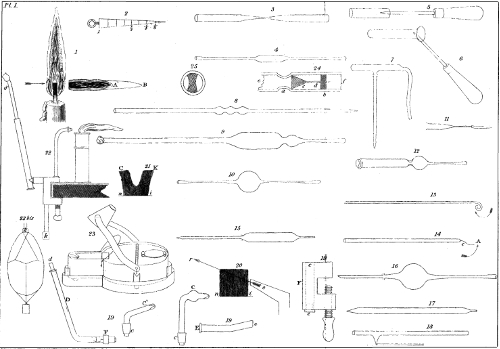
early part of this work. See pl. 1, fig. 19.
The beak C, which is employed with the
candlestick, is merely a bent tube, at the extremity
of which a bulb is blown. The bulb is
terminated by a point, the thickness of the
sides of which is augmented by turning it for a
long time in the flame.
As for the beak used with the lamp, it is
simply a bent tube C´, of which the orifice has
been diminished by turning it round in the flame.
The point of this beak is not drawn out like
that of the beak described in the preceding paragraph,
but is allowed to be thick, that it may
not melt in the flame of the lamp.
The tube D F has four-tenths of an inch internal
diameter, and is pretty thick in the sides.
You must commence by bordering and slightly
widening one of its extremities, and then proceed
to choke it at about two inches from its
other extremity, taking care to give to the
choked part a figure as perfectly conical as
possible, in order that the valve may act well.
We have described the valve at length at p. 6.
The tube d is as much narrower than the
tube D F as is necessary to permit it to pass up
and down within the latter. Its use is to
lengthen or shorten the tube for the convenience
of the blower. The lower end is wound
round with waxed thread, to make it fit air-tight.
The mouth-piece is executed by widening
the end of the tube, and then, while the
widened part is still soft, by pressing the two
sides obliquely, one against the other. By this
means you give to the mouth-piece a flattened
form, which adapts it better to the lips. The
tube is finished by slightly bending this extremity.
In order that the bladder, or air reservoir,
may be conveniently and securely attached to
the tube E, you must take care to widen the
end of this tube, and to turn up the edges
strongly, by pressing the soft end against a
flat metallic surface.
Capsules.—These are very small mercury
funnels, of which the opening or neck has been
closed. To transform these funnels into capsules,
you must cut the neck as close as possible,
and then soften, close, and flatten the
opening. In performing this operation, hold
the capsule by the edge with your pincers, and
employ a piece of metal to press the glass together
and make it close the hole and form
the flat bottom of the capsule. See pl. 2,
fig. 23.
Another Method.—After having blown a
bulb at the end of a point, soften a narrow
zone of the bulb, and then blow suddenly and
strongly into it; by which means you separate
the bulb into two capsules, which only need to
be bordered. If you find any difficulty in presenting
to the flame the capsule which forms
the part of the bulb opposed to the point, you
can attach to it a little rod of glass, which you
can afterwards easily separate by a slight
smart blow.
Occasionally you will have to make capsules
with double sides, which will be described at
the article Nicholson’s Hydrometer.
Cartesian Devils.—Blow a bulb at the
extremity of a very small tube, and heat a portion
of the bulb, for the purpose of prolonging
it into a beak. This can be effected with the
aid of an auxiliary tube, which, on being joined
to the heated part of the bulb, carries away
with it the portion of glass which adheres.
This portion of the bulb becomes thus prolonged
into a little point, which must be cut at
its extremity, so as to leave a small opening.
The principal tube must be cut at the distance
of half an inch from the bulb, and the ends of
it must be drawn out and twisted into a ring.
Instead of forming laterally a little beak to the
bulb, you may pierce the tail, after twisting it
into the form of a ring, or you may manage in
such a manner as not to obliterate the canal of
the twisted part. In general, little enamel
figures are suspended to the ring of these
globes, as is represented by pl. 2, fig. 22. A
simple bulb, blown at the extremity of a small
portion of tube, can supply the place of the
Ludion or Cartesian devil. See pl. 2, fig. 8.
Communicating Vases.—Employ a tube of
a large diameter; terminate one of its extremities
with a funnel, fashion the other like
the neck of a bottle; and bend the tube into
the shape shewn by pl. 4, fig. 11. Then twist
some other tubes into various forms, according
to the end you propose to attain, and adjust
these tubes to the neck of the large tube by
means of corks, which have holes bored
through them. In this manner an exchange of
tubes is provided for various experiments.
Dropping Tubes.—The name dropping tube
is given to an instrument of glass which is very
much employed in chemistry, for the purpose
of transferring small quantities of liquor from
one vessel into another, without disturbing either
of the vessels. Dropping tubes are made of
a great variety of forms and sizes, according to
the purposes to which they are intended to
be applied.
Blow a bulb between two points, and then,
before the glass has regained its consistence,
lengthen the bulb into an oval form. Cut and
border the two points.
If the bulb, or reservoir, is to be so large
that it cannot be formed at the expense of the
thickness of the tube, and yet be sufficiently
strong, it must be blown separately from a
larger tube, and then soldered to two smaller
tubes, one of which should have a certain curvature
given to it. See pl. 2, fig. 20.
Sometimes a dropping tube is employed to
measure small quantities of liquid. In this
case the point should be drawn off abruptly,
and the scale should be marked on the shank
or tube with spots of black enamel.
Pl. 2, fig. 21, represents a peculiar variety
of dropping tube employed in some experiments.
It is made in the same manner as the
common dropping tubes, excepting that, when
the tail is formed, it is sealed at the extremity,
bent there into a ring, and then pierced at A.
Pl. 3, fig. 26, represents another variety of
dropping tube, a description of which is unnecessary.
Fountains.—It will readily be understood
by those acquainted with the construction of
hydraulic apparatus, that, by means of a judicious
arrangement of glass tubes, a great variety
of fountains may be produced. The following
are given as examples.
Fountain of Circulation.—Take a tube,
twenty-four or thirty inches long, nearly half an
inch in diameter, and with pretty thick sides;
blow a bulb at one of its extremities, and bend
the other into a U, after having drawn it out as
indicated by pl. 3, fig. 4. Pierce the tube at
B, and join there a short piece adapted to receive
a cork. Then prepare a bulb of the
same size as the first bulb, and solder it to the
extremity of a very long and almost capillary
tube, which you must bend in zig-zag, in such
a manner as to make it represent a Maltese
cross, a star, a rose, or any other figure that
may be suggested. The side of the bulb opposite
to that which is attached to this twisted
tube, ought to be formed like the neck of a
bottle, in order that it may receive the drawn-out
part of the larger tube, which should enter
the bulb until the point of the large tube nearly
touches the neck of the little tube at its junction
with the bulb. This disposition is shewn
in the figure. Seal now the other end of the
little tube to the bulb of the large tube; then,
with a little cement or sealing-wax, close the
space between the bulb of the little tube and
the point of the large tube. The instrument
being thus prepared, as much alcohol, previously
coloured red, must be inserted by the
neck b as is sufficient to fill one of the bulbs.
The neck is then closed with a cork, and a little
cement or sealing-wax. Or, instead of forming
this neck to the instrument, the additional
piece may be drawn out to a point, which permits
it to be sealed hermetically.
Fountain of Compression.—Introduce into
a tube of large diameter a piece of capillary
tube with thick sides. This must pass a little
beyond the extremity of the large tube, which
is to be softened and soldered to the other, so
that it shall be fixed concentrically. The common
point is then to be drawn out. When the
tube is quite cold, and the small tube properly
fixed in the centre of the large one, cut the
latter at a proper distance, border it, and choke
it near the end, which must be fashioned in
such a manner as to be capable of being completely
closed by a cork. See pl. 2, fig. 29.
Intermitting Fountain.—This apparatus is
represented by pl. 3, fig. 16. Solder a cylindrical
reservoir to the extremity of a capillary
tube, pierced at a, and sealed at its extremity.
Draw out abruptly the point of the reservoir,
and give it a very small orifice; then give to
the capillary tube the form indicated by the
figure. Prepare next a funnel resembling a
mercury-funnel, but much larger; choke the
neck of this funnel, and bend the tube into the
form of a syphon.
Hero’s Fountain.—Solder a bulb to the extremity
of a tube, and transform the bulb into
a funnel. Close the funnel with a cork, and
solder to the other end of the tube a bulb similar
to the first. Next, solder a third bulb between
two tubes, of which one must be twice
as long the other; solder the longer of these
tubes to the bulb of the first tube, and draw
out the point of the shorter tube. You have
now a long tube, with a funnel at one end, a
contracted point at the other, and two bulbs in
its length. Give to the whole apparatus the
form indicated by pl. 3, fig. 21.
Funnels.—It will be seen, upon looking
over the engravings, that funnels require to be
made for a great variety of instruments; you
ought therefore to acquire as soon as possible
the art of making them well. The following
are those most frequently required.
Retort Funnel.—Blow a bulb at the extremity
of a tube; present the superior hemisphere
of the bulb to the flame, and when it is
sufficiently softened, blow strongly into the
other end of the tube. The air will force its
way through the bulb, making a hole which
will be larger or smaller according to the extent
of surface which may have been softened.
The opening of the funnel being made thus,
there is nothing more to do than to adjust the
edges, which, in the present state, are both
fragile and irregular. This it is very easy to
do. The edges are softened, the most prominent
parts are cut off with the scissars, and the
parts which are thin are bent back on themselves,
that they may become thicker. Upon
turning the funnel round in the flame, the
smaller irregularities give way, and the edges
become rounded. See pl. 2, fig. 24.
When the funnel is desired to be very large
in proportion to the size of the tube, a bulb is
made from a larger tube, and afterwards soldered
to the small tube, and transformed into a
funnel in the manner above described.
Funnel for introducing Mercury into
narrow tubes.—The mercury-funnel is represented
by pl. 2, fig. 25. Blow a bulb between
two points; cut off one of the points, and
open the bulb at that place, in the manner described
in the preceding article.
Hydrostatic Funnel.—This is represented
by pl. 3, fig. 31. It is an instrument of constant
use in chemical experiments. Form a
funnel at the extremity of a tube in the manner
described above, having previously blown a
bulb near the middle of the tube. When this
has been done, bend the tube into the form
shown by the figure.
Hour-Glasses.—Blow four bulbs on a tube
close to each other; open the two end bulbs
like funnels, and then form them into flat supports
or pedestals, according to the method
described at the article Test-glass with a foot.
Obstruct entirely the canal which separates
one of these feet; choke to a certain extent the
passage between the two remaining bulbs;
and close the canal between the other foot and
the bulbs, after introducing the quantity of sand
which you have found to be necessary. See
pl. 3, fig. 13.
Hydraulic Ram.—This instrument is represented
by pl. 4, fig. 15. Employ a tube about
six feet long, with thick sides and of large
diameter. Seal it at one extremity, k, and
border it at the other; solder at p an additional
piece, choked so as to receive a valve.
Pierce the tube at l; draw it out, and fix a
funnel there; then twist the tube into a spiral.
Form, on the other hand, a fountain of compression,
o, and a funnel, m; and fix both of
these pieces by means of sealing-wax, as soon
as the two valves p and l have been put into
their places.
Hydrometers.—Hydrometers are instruments
which, on being plunged into liquids,
indicate immediately their density or specific
gravity. Areometers differ from hydrometers
sometimes in graduation, sometimes merely in
name. The following are examples of hydrometers,
of which a great many varieties are in use.
Baumé’s Hydrometer.—Make a cylinder
between two points, and solder it to the extremity
of a tube with thin sides, and which must
be very regular on the outside. Close the
open part which is to form the stalk of the
hydrometer with a little wax. See pl. 1, fig.
9 and 15. When the soldering, which must
be well done, is complete, and the stalk well
centered, choke the reservoir at a little distance
from the base of the point, by drawing it out
in such a manner as considerably to diminish
the canal in this part. Remove then the ball
of wax which closed the tube, draw off the
point of the cylinder, and make the part which
was pulled away from the cylinder by the
choking, into a bulb, by blowing with precaution
into the tube. If the reservoir is required
to be spherical instead of cylindrical, it must
be softened and expanded by blowing. When
it is intended to ballast the instrument with
mercury, the canal must be completely stopped
at the point where it is choked. In this case,
the part drawn away from the cylinder is expanded
into a bulb by blowing through the
extreme point, which is to be cut off after the
instrument is completed.
In the first case, you ballast the instrument
with lead shot, which you fix in the lower bulb
by means of a little wax, which closes the
canal at the choked part. In the second case,
after having proved the ballast by putting it
first into the large reservoir, it is removed into
the little bulb, and the latter is immediately
sealed.
One of the essential conditions of a good
hydrometer is that the stalk should keep a perfectly
vertical position when the instrument is
plunged in water. If, therefore, on proving
the ballast, you perceive the stalk to rest obliquely,
you must take care, on retiring it from
the water, to wipe it dry, and to present the
choked part between the cylinder and the little
bulb to the flame; when it is softened, it is
easy, by giving it a slight bend in the direction
where the stalk of the hydrometer passes from
the vertical, to rectify the defect.
Finally, when the instrument is ballasted,
you must seal the stalk, after having fixed in its
interior the strip of paper which bears the graduated
division.
This method of operation serves equally for
all the areometers known under the names of
areometer of Baumé, pèse-sels, pèse-liqueurs,
pèse-acides, and hydrometers, which differ only
in the scheme of their graduation. As to the
size and the length of the stalks, they depend
upon the dimensions you desire to give to the
degrees of the scale, and upon the use to which
the instruments are destined. For the areometer
of Baumé, and for the pèse-sels, the stalks
are generally thicker and shorter than for hydrometers.
Pl. 4, fig. 19, 20, and 21, represent
different hydrometers.
Nicholson’s Hydrometer.—Solder a bulb
to the extremity of a capillary tube; open it so
as to form a very wide funnel, or rather capsule;
border the edges, and melt the point of junction
with the tube so as to close the opening of
the latter. Solder the other extremity of the
tube to a cylindrical reservoir. Soften the
point at the lower extremity of the cylinder,
and obstruct the canal so as to convert the point
into a glass rod; bend this rod into a hook.
Now blow a bulb at the end of a point, as if
to make a mercury funnel; but, after having
softened the hemisphere of the bulb opposite to
the point, and placed the latter in the mouth,
instead of blowing into the bulb so as to make
a funnel, strongly suck air from the bulb: by
this means the softened part of the glass is
drawn inwards, and you obtain a capsule with
double sides, as exhibited by pl. 2, fig. 17.
This capsule must have a small handle fastened
across it, by which it may be hung to the
hook formed at the bottom of the cylinder described
above.
This hydrometer being always brought to
the same level, the point to which it must be
sunk in the liquid experimented with, is marked
on the stalk by applying a little spot of black
enamel. The instrument is represented by
pl. 4, fig. 23. A variation in form is shewn
by pl. 4, fig. 22.
Hydrometer with two Branches.—To
measure the relative density of two liquids
which have no action on each other, you employ
a simple tube, bent in the middle and widened
at its two extremities. See pl. 2, fig. 11.
Hydrometer with three Branches.—This
consists of a tube bent in such a manner that
the two branches become parallel. To this tube
another is soldered at the point of curvature,
and is bent in the direction exhibited by pl. 2,
fig. 12. When the two branches are put into
different liquids, and the operator sucks air
from the third branch, the two liquids rise in
their respective tubes to heights which are
in the inverse ratio of their specific gravities.
Hydrometer with four Branches.—This
is merely a tube bent three times, and widened
at its extremities. Pl. 2, fig. 13.
To graduate hydrometers with two, three,
and four branches, you have to divide their
tubes into a certain number of equal parts.
Manometers.—Make choice of a tube nearly
capillary, very regular in the bore, and with
sides more or less thick, according to the degree
of pressure which it is to support. Seal this
tube at one end, blow a bulb with thick sides
near the middle, and curl it in S, just as is represented
by pl. 2, fig. 9. For manometers
which serve to measure the elasticity of the
air under the receiver of the air-pump, what
is generally employed is a tube closed at one
end and bent into a U. Pl. 2, fig. 10. You
should take care to contract these at some distance
from the sealed part, in order to avoid
the breaking of the instrument on the sudden
admission of air. Manometers are graduated,
as will be explained in the sequel.
Mariotte’s Tube.—This is represented by
pl. 2, fig. 7. It consists of a tube thirty-nine
inches long, closed at one end, bordered and
widened at the other, and bent into a U at the
distance of eight inches from its sealed end.
The graduation of this instrument will be described
hereafter.
Phosphoric Fire-Bottle.—This is a short
piece of tube closed at one end, and widened
and bordered at the other, in such a manner as
to receive a cork. Pl. 3, fig. 34. It is in this
little vessel that the phosphorus is enclosed.
Glasses of this form can be employed in a great
variety of chemical experiments.
Pulsometer.—This instrument consists of a
tube, of which each extremity is terminated by
a bulb; it is partly filled with nitric ether, and
sealed at the moment when the ebullition of the
ether has chased the atmospheric air wholly from
the interior of the vessel. Pl. 2, fig. 16.
Pump.—Solder a cylinder, B (pl. 4, fig. 12), to
the extremity of a small tube, C, and form their
point of coincidence into a funnel, to which you
will adapt a valve. Pierce the wide tube or
body of the pump at D, and solder there a
piece of tube bent into an elbow and widened
at the other end into a funnel, which is to be
furnished with a second valve, as is represented
in the figure. Prepare then the fountain of
compression E, and, by means of a cork and a
little sealing-wax, fix it upon the branch D. To
prepare the piston, A, blow a bulb at the end of
a tube, flatten the end of the bulb, and choke it
across the middle, in order to form a place
round which tow can be twisted, to make it fit
the tube air-tight. Finish the piston by twisting
the other end of the tube into a ring, as at
A. The valves are formed of small cones of
cork, or wood, having in the centre an iron
wire of sufficient size and weight to enable
them to play well.
Retort for Chemical Experiments.—Plate
3, fig. 9, represents a combination of a large
and a small tube, forming a retort, which can be
employed with much advantage in many chemical
experiments. When a gas is to be distilled
by means of such a vessel, the ingredients are
put into the wide tube, which is previously
closed at one end, and then the other end of the
tube is either drawn out or soldered to a narrow
tube. Pl. 3, fig. 8 and 29, represent such
vessels under different forms. Very often a sort
of retort can be formed by joining a wide tube
to a long bent narrow tube, by means of a
cork.
Tubulated Retort.—This is represented by
pl. 3, fig. 6. Prepare a retort, such as is described
in the preceding article, but one which
is bent near the closed end; pierce it at A
(fig. 6), and solder there a little piece of tube
previously drawn out and sealed, such as is represented
by pl. 1, fig. 11. When the soldering
is finished, soften the end of the little tube,
pierce it, and fashion it into a bottle neck, so that
it can be closed by a cork. Finish the instrument
by forming the open end according to the
purpose to which it may be destined. In the
figure, the end is represented as drawn out for
the convenience of blowing into the retort to
pierce the tubulure.
Rumford’s Thermoscope.—This instrument
is represented by pl. 3, fig. 35. It is necessary
to take a tube almost capillary, to solder a bulb
at each extremity, to pierce it laterally at b, and
to solder there a piece of tube previously drawn
out, but of which you open the point for the
purpose of finishing the sealing of the bulb A.
After doing this, you bend the two branches,
as shewn in the figure. When the liquid has
been introduced into the instrument, you must
seal the little piece of tube which serves as a
reservoir.
This instrument can be made in another manner.
Take two pieces of tube, one of them
twice as long as the other; solder a bulb at one
end of each of these tubes, and at about the
third part of the length of the long tube, parting
from the bulb, bend it at a right angle; pierce
the little tube at a corresponding distance, and
solder to the hole the end of the long tube. The
soldering being finished, and the whole system
having the form indicated by pl. 3, fig. 35, introduce,
by the open end of the short tube, a
small quantity of coloured acid, and then seal
the end of the short tube, which serves as a
reservoir.
The interior diameter of the tubes which are
generally employed as thermoscopes, is one-eighth
or one-twelfth of an inch. The mode
of graduation is described in a subsequent
chapter.
Syphons.—The simple syphon is a glass tube
bent, at a little distance from the middle, into a
form which is intermediate between those of
⋂ and ⋀, the legs being stretched apart like
those of the latter, but the bend being rounded
like that of the former. The tube is bent near
the middle, and not exactly at the middle, in
order that the legs may be of unequal lengths;
an arrangement which is indispensable. Syphons
are made of different lengths and diameters,
for various purposes. They can be made
of tubes so capillary that it is sufficient to put
them into water to make them act: the liquid
rises in them by capillary attraction, and does
not require to be sucked through the tube, as
it does when large syphons are employed.
Wirtemberg Syphon.—This syphon is the
same as the simple syphon, excepting that the
two branches are of equal length, and are bent
in U at both extremities. Pl. 3, fig. 22.
Syphon with three Branches.—This instrument
is represented by pl. 2, fig. 19. Close
a tube at one end and draw it out at the other;
pierce it at some inches from the contracted extremity,
and solder to the hole a little tube of
which the other end has been closed with wax.
Give the tube the bend necessary to constitute a
syphon, and open the two branches. The soldering
of the two tubes is facilitated by giving
to the extremity of the little tube a bend which
adapts it to be applied parallel to the large tube.
When the syphon is desired to be well finished,
the mouth-piece of the little tube must be bordered
and widened, and a bulb must be blown
near the mouth-piece.
Syphon with Jet of Water.—This instrument
is represented by pl. 3, fig. 1. Take a
tube of a large diameter, close it at one end,
and draw it out at the other. Cut the contracted
part in such a manner as to be able to introduce,
through the orifice, the extremity, also
drawn out, of another tube, which should be
almost capillary. Solder these together in such
a manner that the point of the small tube shall
remain fixed about an inch within the interior of
the reservoir. Pierce again the latter, at B,
and solder there another branch of the same
diameter as the former; but fix it in such a
manner that its side shall be contiguous to the
side of the reservoir. Finally, give to the
branches the bend represented by the figure.
Spoons.—Solder a bulb to the extremity of
a capillary tube; open the bulb as for a funnel,
but make the opening laterally. Cut with scissars
the edges of the part blown open, and in
such a manner as to form a spoon or a ladle,
according as the bulb had the form of a sphere
or an olive. This instrument is useful for
taking small quantities of acids. Pl. 3, fig. 11.
Spirit Level.—The spirit level is represented
by pl. 2, fig. 28. Choose a piece of
tube very straight, and with sides precisely of
the same thickness in all parts. Seal it at one
end, and draw it out abruptly at the other.
Fill it almost entirely with alcohol, and seal the
point by the jet of a candle.
—Take a tube
drawn out at one end; choke it at an inch
from the base, in such a manner as to obstruct
the canal almost entirely. Pl. 1, fig. 12. Cut
off the point, close the opening, and soften the
whole end completely; then blow it into a
bulb and burst it into a funnel. Now present
the contracted part to the fire, so as totally to
close the passage. Border and soften the funnel,
and by pressing it against a flat plate of
metal give it the form of a foot, or pedestal.
Cut the tube at the length which you desire the
test-glass to have, and border the edges of the
opening. This is a very useful little chemical
instrument. It is represented by pl. 3, fig. 10.
Thermometers.—Thermometers are instruments
employed for appreciating changes of
temperature, either in the atmosphere or in substances
which we have occasion to examine.
The following are the principal varieties now
employed.
Ordinary Thermometer.—If you desire to
make standard thermometers, you must have
capillary tubes of perfect accuracy in the bore.
You are assured of regularity in the diameter
of a tube when a drop of mercury, made to
pass along the canal by means of a gentle inclination,
or by air blown from an Indian-rubber
bottle, gives everywhere a metallic column
of the same length.
For ordinary thermometers this precaution is
superfluous. In all cases you employ a tube
more or less capillary, at one of the extremities
of which you blow or solder a spherical or cylindrical
reservoir. See pl. 4, fig. 1 and 2.
You fill the instrument with well-purified mercury,
or alcohol, which you boil in the tube, in
order to chase the air from it. As it is necessary
to heat the instrument throughout its
whole length, you must place it on a railing of
iron wire, inclined in the manner represented by
pl. 4, fig. 14, and covered with burning charcoal,
or red-hot wood ashes. It is better, however,
to employ a kind of muff, formed of two
concentric wire grates, between which you put
burning charcoal, and reserve the centre for the
instrument. The tube is thus kept in a vertical
position, which allows the bubbles of air to
escape with more facility. An iron wire is
made use of to fasten the tube precisely in the
centre of the column of fire. The operation is
considerably promoted by soldering a little
funnel to the upper extremity of the thermometer
tube; and, in order to avoid the interruption
of the column of liquid by bubbles of air,
it is better to give to the superior part of the
reservoir the form of a cone (pl. 4, fig. 3), rather
than to preserve the completely spherical
form indicated by pl. 4, fig. 2.
When the ebullition has expelled all the air
which was contained in the mercury, or alcohol,
you immediately plunge the open extremity of
the instrument into a vessel filled with one or the
other of these liquids; or, instead of this, you
pour the liquid into the funnel, in order that the
instrument may be quite filled at the common
temperature. You then cut off the funnel, if
one has been used, and, by properly elevating
the temperature of the reservoir, you expel so
much of the liquid that the summit of the column
rests at the point which you desire to
make choice of for the mean temperature: this
operation is termed regulating the course of
the thermometer.
There are two methods of closing thermometers:
you may either produce a vacuum above
the column of mercury, or you may allow air
to remain there. In the first case, after having
drawn out the end of the tube, you heat the
liquid until a single drop passes out of the
opening; you then instantly bring the point
into the jet, and seal it.
In the second case, you seal the instrument
at the ordinary temperature, and having previously
raised to a reddish-white heat the
button of glass which is formed by the sealing,
you suddenly elevate the temperature of the
mercury. The liquid, on rising, compresses
the enclosed air, which dilates the red-hot
button at the summit of the tube, and produces
a species of reservoir. This reservoir is indispensably
necessary when you leave air above
the column of liquid, in order to provide
against the bursting of the instrument on those
occasions when the temperature of the mercury
comes to be considerably elevated. See pl. 4,
fig. 13.
Dial Thermometer.—Terminate a piece of
tube, of six-tenths of an inch in diameter, with
two points, and solder to one of these points a
tube one-eighth of an inch in diameter and six
inches long; close the end of this small tube,
and, heating a zone of the reservoir, near the
base of the other point, blow a bulb there.
Cut off the point by which you have blown, at
a little distance from the bulb; open and border
the end of the narrow tube, and bend it
into a U. See pl. 4, fig. 16.
Fill the bulb and the reservoir with alcohol,
and add a drop of mercury which fills a certain
space in the narrow tube. This mercury
bears on its surface a little iron weight, to
which a thread is fastened; the other end of
this thread passes over a pulley, whose axis
turns a needle. The expansion or contraction
of the alcohol causes the mercury to rise and
fall, and consequently produces a movement of
the needle or index of the dial. This thermometer
is graduated like the others, by being
brought into comparison with a standard thermometer.
Chemical Thermometer.—This instrument
is merely a common thermometer, the divisions
of which, graduated on paper, are enclosed in
a very thin glass tube, to hinder them from
being altered or destroyed when the instrument
is plunged into liquids. Pl. 4, fig. 4, 5, 6, and
7, represent chemical thermometers of various
kinds.
The case of the thermometer can be made
in two different ways. According to the first,
you take a tube of a pretty large diameter, and
with very thin sides; you draw out one end and
obliterate the point, which you bend into a
ring, in a direction perpendicular to that of the
case; you pass through this ring the stalk of
the thermometer, which is thus placed parallel
to the large tube. After having fixed the graduated
scale in the interior of the case, by
means of a small drop of sealing-wax, which
has been dropped on the slip of paper, and
which, being supported against the side of the
case, needs only to be warmed to adhere there
and fix the scale securely to its envelope, you
close the upper extremity of the case by drawing
it out, obliterating the canal and soldering
it to the thermometer tube which has been introduced
into the ring at the lower end of the
case. You heat the connecting piece till it is
soft, and then push the thermometer up and
down until the zero marked on its tube corresponds
with the zero marked on the scale
within the case. See pl. 4, fig. 6 and 7.
The second method of making the case is as
follows:—You take a tube with thin sides, and
sufficiently large to contain the entire thermometer;
you draw out the tube at one end, and
choke it at some distance from the point of the
contracted part. This you must do in such a
manner as to form a little bulb, which is to be
ballasted in the manner described at the article
Hydrometers. After having introduced into
the case a little ball of cotton, you place therein
the thermometer, furnished with its scale,
and in such a manner that the reservoir rests on
the cotton. You terminate the upper end of
the case either with a ring or by a contraction
which permits the instrument to be suspended
by a cord. See pl. 4, fig. 4 and 5.
Spiral Thermometer.—Take a tube which
is not capillary, but which has thin sides; close
one of its ends, and bend it round by pressing
it with a metallic rod; continue to bend it
round till it has made several turns, all in the
same plane. See pl. 1, fig. 13. The latter
turns may be managed with the fingers instead
of the metallic rod. When the reservoir so
formed is sufficiently large, solder to the end of
it a capillary tube, which you point in a direction
perpendicular to that of the axis of the
spiral. The instrument is represented by pl. 4,
fig. 8.
Pocket Thermometer.—The pocket thermometer
differs in nothing from the thermometer
just described, except that the capillary tube,
instead of passing away from the spiral in a
straight line, is turned round, so as to form a
continuation of the spiral. See pl. 4, fig. 17.
Maximum Thermometer.—This instrument
consists of an ordinary mercurial thermometer,
bent at a right angle near the origin of the reservoir,
and in the horizontal column of which
a little steel or iron rod has been introduced:
this rod, by gliding in the tube, where it experiences
very little friction, serves as an index.
Since this index does not permit the instrument
to be sealed with the vacuum above the mercury,
you must terminate the sealing by a little
reservoir, as we have described at the article on
the second method of closing thermometers.
The instrument is represented by pl. 4, fig. 24.
Minimum Thermometer.—This instrument
is constructed pretty nearly in the same manner
as the preceding. The liquid, however,
must be alcohol, and the index a little rod of
enamel, which ought not to be quite so large as
the bore of the thermometer tube. You seal
the tube by making a vacuum above the column.
Bellani’s Maximum Thermometer.—This
thermometer is represented by pl. 4, fig. 9.
Take a tube which is very regular, and about
one-eighth or one-twelfth of an inch diameter in
the bore; solder a reservoir at each end, one
of them much larger than the other; make a
bend near the large reservoir, and then fill the
instrument with alcohol to A. Above that,
place the first index, which consists of a very
small piece of tube closed at one end and cut
off square at the other. In the interior of this
tube the two ends of a hair are fixed, by means
of a little rod of iron, which is pushed into the
tube. Introduce a quantity of mercury above
this index, make the bend B, add again mercury
as far as C, then another index similar to
the first. Finally, fill the rest of the tube and
the half the little reservoir with alcohol, and
seal the point.
Differential Thermometer.—This instrument
is represented by pl. 3, fig. 14. Take a
tube ten or twelve inches long, and one-eighth
or one-twelfth of an inch internal diameter;
blow a bulb at one end, and bend the tube at a
right angle towards the fourth part of its length.
Prepare a second tube in the same manner, and
solder the bent ends together, so as to form a
single tube with a bulb at each end, having previously
poured into one of the bulbs a small
quantity of sulphuric acid tinged red.
Instead of following the above method, you
may take a single tube of twenty or twenty-four
inches in length, and of the above-mentioned
diameter; you solder a bulb at each end,
bend the tube twice till it represents the figure,
pour in the acid, and then seal the open points.
The graduation of the differential thermometer,
as well as of all the other thermometers, is described
in a subsequent section.
Tube for Crystallizing Spermaceti.—Take
a little capillary tube; curl one of its ends
into a ring, and solder the other to a cylindrical
reservoir, two-thirds of the capacity of
which you fill with very pure spermaceti dissolved
in sulphuric ether; you then seal the
point of the reservoir. See pl. 3, fig. 27.
Tube for demonstrating the non-conductability
of Heat by Liquids.—This is represented
by pl. 2, fig. 26. It is a tube sealed
at one end, bordered at the other, and bent in
such a manner as conveniently to permit the
upper part of a column of liquid to be exposed
to heat.
Tube for estimating the Density of
Vapours.—Represented by pl. 2, fig. 14. It
is merely a tube sealed at one end, bordered at
the other, and bent as shewn by the figure.
Tubes for exposing Substances to Heat
and Gases.—This instrument consists of a
tube bent in the middle into a U. Pl. 3, fig. 3.
It is much employed in chemistry, for containing
substances which we wish at the same
time to expose to an elevated temperature and
to the action of certain gases. This tube can
also be employed for cooling gases, or liquids,
in distillation; the bent part being, in this case,
dipped into water or a freezing mixture, or enveloped
in wet paper or cloth.
Tubes for the Preservation of Objects
of Natural History, or of Chemical Preparations.—Take
a tube of which the width
and length corresponds with the object which is
to be enclosed; draw it out at one end, and,
after having obstructed the point, twist it into a
ring. Introduce the object by the open extremity,
which you must afterwards draw out;
fill the tube with the liquid necessary to preserve
the object, and then seal the point. See
pl. 2, fig. 27.
If you desire to have the power of taking out
the object at will—as, for example, when grain
is preserved, or when, in chemistry, the tube is
employed to contain salts and other compounds,
of which small quantities are now and then required
for use—you do not seal the end of the
receiver, but border it in such a manner that it
can be closed by a cork.
In some cases a cork is not sufficient to secure
the substance from the action of air: it
must then be assisted with a little cement. By
melting together two parts of yellow wax, one
part of turpentine, and a small quantity of
Venetian red, a very useful cement for such
purposes is obtained.
It is sometimes necessary to suspend the objects
enclosed within the tube: you then introduce
a little glass hook, the tail of which you
solder to the upper extremity of the tube;
managing this operation at the same time that
you make the external ring for the support of
the instrument. By turning the hook round
cautiously, which is done when the end of the
tube is in a soft state, and by cooling the whole
with care, you may succeed in fixing the hook
in the centre of the tube. See pl. 3, fig. 20.
Tube for emptying Eggs.—It is a simple
tube, drawn out to a capillary point at one end,
and bent there into a V. See pl. 3, fig. 23.
The application which the author has made
of this instrument, and of the tube represented
by pl. 3, fig. 26, has been shewn in a memoir
inserted in the Annales des Sciences Naturelles,
Tom. XV. Novembre 1828, concerning
a new method of preparing and rendering
durable collections of eggs destined for cabinets
of Natural History.
Vial of the Four Elements.—This instrument
is represented by pl. 2, fig. 27. Take a
tube drawn out at one end, obstruct the canal
two inches from the extremity, and twist the
contracted part into a ring. Draw out the
other end of the tube, introduce the proper
liquids, remove the point of the tube, and seal
it. The liquids generally employed for filling
the vial of the four elements are, 1. Mercury;
2. A very concentrated solution of carbonate of
potash; 3. Oil of turpentine; 4. Alcohol. A
portion of air is also allowed to remain in the
tube.
Water Hammer.—Pl. 2, fig. 18, is a representation
of this instrument. Choose a tube
of a good diameter, and with thick sides; seal
it at one end and draw it out at the other.
Blow a bulb at the base of the contracted part;
then, having put a quantity of water in the
tube, let it boil therein, to expel the atmospherical
air. When you imagine that all the air
has been expelled, and that nothing remains in
the tube but steam and water, seal the open
point.
When you have to seal a tube in this manner,
you should be careful to draw out the extremity
of the tube somewhat abruptly, and
leave a very small opening, so that it shall be
sufficient to expose the point to the jet of a
candle blown by a mouth blowpipe, to have the
sealing completely and suddenly effected. You
can afterwards round this sealed part by turning
it in the flame of the lamp, provided, however,
that you have preserved a sufficient thickness
of glass at the sides of the point. If you
omit to take this precaution, the pressure of the
atmosphere, acting with great force on the
softened glass when it is unsupported by the
partial vacuum within the tube, is capable of
producing such a flattening, or even sinking in
of the matter, as could not subsequently be rectified;
except, indeed, by heating simultaneously
the liquid contained in the tube and the
glass to be mended, which is an operation of a
very delicate description.
Welter’s Safety Tubes.—After having
closed a tube at one end and drawn it out at
the other, give it the curvature exhibited by
plate 3, fig. 18. Pierce it then laterally, in the
middle of the part a b, and solder there the extremity
of a tube, to the other end of which a
funnel has been soldered: it is necessary that
the funnel be closed by a cork. The soldering
being terminated, a bulb must be blown and
the tube bent in S, in the manner shewn by the
figure. Then open the closed end, and cut off
the contracted point.