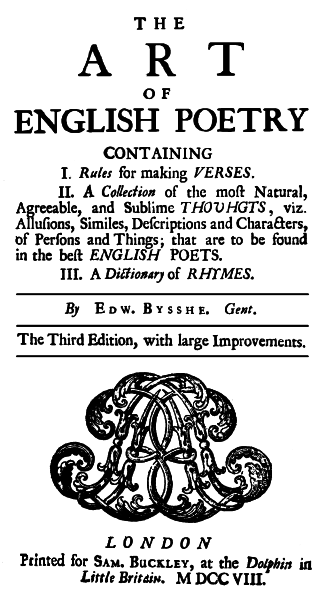
Of the Structure of English Verses.
The Structure of our Verses, whether Blank, or in Rhyme, consists in a
certain Number of Syllables; not in Feet compos'd of long and short
Syllables, as the Verses of the Greeks and Romans. And though some
ingenious Persons formerly puzzled themselves in prescribing Rules for
the Quantity of English Syllables, and, in Imitation of the Latins,
compos'd Verses by the measure of Spondees, Dactyls, &c., yet the
Success of their Undertaking has fully evinc'd the Vainness of their
Attempt, and given ground to suspect they had not throughly weigh'd what
the Genius of our Language would bear; nor reflected that each Tongue
has its peculiar Beauties, and that what is agreeable and natural to
one, is very often disagreeable, nay, inconsistent with another. But
that Design being now wholly exploded, it is sufficient to have
mention'd it.
Our Verses then consist in a certain Number of Syllables; but the Verses
of double Rhyme require a Syllable more than those of single Rhyme. Thus
in a Poem whose Verses consist of ten Syllables, those of the same Poem
that are accented on the last save one, which we call Verses of double
Rhyme, must have eleven; as may be seen by these Verses.
A Man so various that he seem'd to be
Not one, but all Mankind's Epitome:
Stiff in Opinion, always in the Wrong,
Was ev'ry thing by starts, and nothing long:
But, in the Course of one revolving Moon,
Was Fidler, Chymist, Statesman, and Buffoon:
Then all for Women, Painting, Rhyming, Drinking;
Besides ten thousand Freaks that dy'd in Thinking.
Praising and Railing were his usual Themes;
And both, to shew his Judgment, in Extreams.
So over-violent, or over-civil,
That every Man with him was God or Devil.Dryd.
Where the 4 Verses that are accented on the last save one, have 11
Syllables; the others, accented on the last, but 10.
In a Poem whose Verses consist of 8, the double Rhymes require 9, as,
When hard Words, Jealousies and Fears,
Set Folks together by the Ears;
And made 'em fight, like mad, or drunk,
For Dame Religion, as for Punk;
Whose Honesty they all durst swear for,
Tho' not a Man of 'em know wherefore:
Then did Sir Knight abandon Dwelling,
And out he rode a Collonelling.Hud.
In a Poem whose Verses consist of 7, the double Rhymes require 8, as,
All thy Verse is softer far
Than the downy Feathers are
Of my Wings, or of my Arrows;
Of my Mother's Doves or Sparrows.Cowl.
This must also be observ'd in Blank Verse; as,
Welcom, thou worthy Partner of my Lawrels!
Thou Brother of my Choice! a Band more sacred
Than Nature's brittle Tye. By holy Friendship!
Glory and Fame stood still for thy Arrival,
My Soul seem'd wanting of its better Half,
And languish'd for thy Absence, like a Prophet,
Who waits the Inspiration of his God.Rowe.
And this Verse of Milton,
Void of all Succour and needful Comfort,
wants a Syllable; for, being accented on the last save one, it ought to
have 11, as all the Verses, but two, of the preceeding Example have: But
if we transpose the Words thus,
Of Succour and all needful Comfort void,
it then wants nothing of its due Measure, because it is accented on the
last Syllable.
Of the several Sorts of Verses; and first of those of ten
Syllables. Of the due Observation of the Accent; and of the
Pause.
Our Poetry admits for the most part but of three sorts of Verses; that
is to say, of Verses of 10, 8, or 7 Syllables: Those of 4, 6, 9, 11, 12,
and 14, are generally imploy'd in Masks and Operas, and in the Stanzas
of Lyrick and Pindarick Odes, and we have few intire Poems compos'd in
any of those sorts of Verses. Those of 12, and of 14 Syllables, are
frequently inserted in our Poems in Heroick Verse, and when rightly made
use of, carry a peculiar Grace with them. See the next Section towards
the end.
The Verses of 10 Syllables, which are our Heroick, are us'd in Heroick
Poems, in Tragedies, Comedies, Pastorals, Elegies; and sometimes in
Burlesque.
In these Verses two things are chiefly to be consider'd.
1. The Seat of the Accent.
2. The Pause.
For, 'tis not enough that Verses have their just Number of Syllables:
the true Harmony of them depends on a due Observation of the Accent and
Pause.
The Accent is an Elevation, or a Falling of the Voice, on a certain
Syllable of a Word.
The Pause is a Rest or Stop that is made in pronouncing the Verse, and
that divides it, as it were, into two parts; each of which is call'd an
Hemistich, or Half-Verse.
But this Division is not always equal, that is to say, one of the
Half-verses does not always contain the same Number of Syllables as the
other: and this Inequality proceeds from the Seat of the Accent that is
strongest, and prevails most in the first Half-verse. For, the Pause
must be observ'd at the end of the Word where such Accent happens to
be, or at the end of the following Word.
Now in a Verse of 10 Syllables, this Accent must be either on the 2d,
4th, or 6th; which produces 5 several Pauses, that is to say, at the 3d,
4th, 5th, 6th, or 7th Syllable of the Verse; For,
When it happens to be on the 2d, the Pause will be either at the 3d, or
4th.
At the 3d, in two manners:
1. When the Syllable accented happens to be the last save one of a Word;
as,
As busy—as intentive Emmets are;
Or Cities—whom unlook'd-for Sieges scare.Dav.
2. Or, when the Accent is on the last of a Word, and the next a
Monosyllable, whose Construction is govern'd by that on which the Accent
is; as,
Despise it,—and more noble Thoughts pursue.Dryd.
When the Accent falls on the 2d Syllable of the Verse, and the last save
two of a Word, the Pause will be at the 4th; as,
He meditates—his absent Enemy.Dryd.
When the Accent is on the 4th of a Verse, the Pause will be either at
the same Syllable, or at the 5th, or 6th.
At the same, when the Syllable of the Accent happens to be the last of a
Word; as,
Such huge Extreams—inhabit thy great Mind,
God-like, unmov'd,—and yet, like Woman, kind.Wall.
At the 5th in 2 manners:
1. When it happens to be the last save one of a Word; as,
Like bright Aurora—whose refulgent Ray
Foretells the Fervour—of ensuing Day;
And warns the Shepherd—with his Flocks, retreat
To leafy Shadows—from the threaten'd Heat.Wall.
2. Or the last of the Word, if the next be a Monosyllable govern'd by
it; as,
So fresh the Wound is—and the Grief so vast.Wall.
At the 6th, when the Syllable of the Accent happens to be the last save
two of a Word; as,
Those Seeds of Luxury,—Debate, and Pride.Wall.
Lastly, When the Accent is on the 6th Syllable of the Verse, the Pause
will be either at the same Syllable, or at the 7th.
At the same, when the Syllable of the Accent happens to be the last of a
Word; as,
She meditates Revenge—resolv'd to die.Wall.
At the 7th in two manners:
1. When it happens to be the last save one of a Word; as,
Nor when the War is over,—is it Peace.Dryd.
Mirrors are taught to flatter,—but our Springs. Wall.
2. Or the last of a Word, if the following one be a Monosyllable whose
Construction depends on the preceeding Word on which the Accent is; as,
And since he could not save her,—with her dy'd.Dryd.
From all this it appears, that the Pause is determin'd by the Seat of
the Accent; but if the Accents happen to be equally strong, on the 2d,
4th, and 6th Syllable of a Verse, the Sense and Construction of the
Words must then guide to the Observation of the Pause: For Example; In
one of the Verses I cited as an Instance of it at the 7th Syllable,
Mirrors are taught to flatter, but our Springs.
The Accent is as strong on Taught, as on the first Syllable of
Flatter, and if the Pause were observ'd at the 4th Syllable of the
Verse, it would have nothing disagreeable in its Sound: as,
Mirrors are taught—to flatter, but our Springs
Present th' impartial Images of things.
Which tho' it be no Violence to the Ear, yet it is to the Sense, and
that ought always carefully to be avoided in reading or in repeating of
Verses.
For this Reason it is, that the Construction or Sense should never end
at a Syllable where the Pause ought not to be made; as at the 8th and 2d
in the two following Verses:
Bright Hesper twinkles from afar:—Away
My Kids!—for you have had a Feast to day.Staff.
Which Verses have nothing disagreeable in their Structure but the Pause;
which in the first of them must be observ'd at the 8th Syllable, in the
2d at the 2d; and so unequal a Division can produce no true Harmony. And
for this Reason too, the Pauses at the 3d and 7th Syllables, tho' not
wholly to be condemn'd, ought to be but sparingly practis'd.
The foregoing Rules ought indispensibly to be follow'd in all our Verses
of 10 Syllables; and the observation of them, like that of right Time in
Musick, will produce Harmony; the neglect of them, Harshness and
Discord; as appears by the following Verses.
None think Rewards render'd worthy their Worth.
And both Lovers, both thy Disciples were,Dav.
In which tho' the true Number of Syllables be observ'd, yet neither of
them have so much as the Sound of a Verse: Now their Disagreeableness
proceeds from the undue Seat of the Accent: For Example, the first of
them is accented on the 5th and 7th Syllables; but if we change the
Words, and remove the Accent to the 4th and 6th, the Verse will become
smooth and easie; as,
None think Rewards are equal to their Worth.
The harshness of the last of them proceeds from its being accented on
the 3d Syllable, which may be mended thus, by transposing only one Word;
And Lovers both, both thy Disciples were.
In like manner the following Verses,
To be massacred, not in Battle slain.Blac.
But forc'd, harsh, and uneasie unto all.Cowl.
Against the Insults of the Wind and Tide.Blac.
A second Essay will the Pow'rs appease.Blac.
With Scythians expert in the Dart and Bow.Dryd.
are rough, because the foregoing Rules are not observ'd in their
Structure: For Example, the first, where the Pause is at the 5th
Syllable, and the Accent on the 3d, is contrary to the Rule which says,
that the Accent that determines the Pause must be on the 2d, 4th, or 6th
Syllable of the Verse; and to mend that Verse we need only place the
Accent on the 4th, and then the Pause at the 5th will have nothing
disagreeable, as,
Thus to be murther'd, not in Battle slain.
The second Verse is Accented on the 3d Syllable, and the Pause is there
too; which makes it indeed the thing it expresses, forc'd, harsh, and
uneasie; it may be mended thus,
But forc'd and harsh, uneasie unto all.
The 3d, 4th, and 5th of those Verses, have like faults; for the Pauses
are at the 5th, and the Accent there too, which is likewise contrary to
the foregoing Rules: Now they will be made smooth and flowing, by taking
the Accent from the 5th, and removing the Seat of the Pause; as,
Against th' Insults both of the Wind and Tide.
A second Trial will the Pow'rs appease.
With Scythians skilfull in the Dart and Bow.
From whence we conclude, that in all Verses of 10 Syllables, the most
prevailing Accents ought to be on the 2d, 4th, or 6th Syllables; for if
they are on the 3d, 5th, or 7th, the Verses will be rough and
disagreeable, as has been prov'd by the preceeding Instances.
In short, the wrong placing of the Accent is as great a fault in our
Versification, as false Quantity was in that of the Antients; and
therefore we ought to take equal care to avoid it, and endeavour so to
dispose the Words, that they may create a certain Melody in the Ear,
without Labour to the Tongue, or Violence to the Sense.
Of the other Sorts of Verses that are us'd in our Poetry.
After the Verses of 10 Syllables, those of 8 are most frequent, and we
have many intire Poems compos'd in them.
In the Structure of these Verses, as well as of those of 10 Syllables,
we must take care that the most prevailing Accents be neither on the 3d
nor 5th Syllables of them.
They also require a Pause to be observ'd in pronouncing them, which is
generally at the 4th, or 5th Syllable; as,
I'll sing of Heroes,—and of Kings,
In mighty Numbers—mighty things;
Begin, my Muse,—but lo the Strings,
To my great Song—rebellious prove,
The Strings will sound—of nought but Love. Cowl.
The Verses of 7 Syllables, which are call'd Anacreontick, are most
beautiful when the strongest Accent is on the 3d, and the Pause either
there, or at the 4th, as,
Fill the Bowl—with rosy Wine,
Round our Temples—Roses twine;
Crown'd with Roses—we contemn
Gyges wealthy—Diadem.Cowl.
The Verses of 9, and of 11 Syllables, are of two sorts, one is those
that are accented upon the last save one, which are only the Verses of
double Rhyme that belong to those of 8 and 10 Syllables, of which
Examples have already been given. The other is those that are accented
on the last Syllable, which are employ'd only in Compositions for
Musick, and in the lowest sort of Burlesque Poetry; the disagreeableness
of their Measure having wholly excluded them from grave and serious
Subjects. They who desire to see Examples of them, may find some
scatter'd here and there in our Masks, and Operas, and in our Burlesque
Writers. I will give but two.
Hilas, O Hilas, why sit we mute?
Now that each Bird saluteth the Spring.Wall.
Apart let me view then each Heavenly Fair,
For three at a time there's no Mortal can bear.Congr.
The Verses of 12 Syllables are truly Heroick, both in their Measure and
Sound; tho' we have no intire Works compos'd in them; and they are so
far from being a Blemish to the Poems they are in, that on the contrary,
when rightly employed, they conduce not a little to the Ornament of
them; particularly in the following Rencounters.
1. When they conclude an Episode in an Heroick Poem: Thus Stafford
ends his Translation of that of Camilla from the 11th Æneid, with a
Verse of 12 Syllables.
The ling'ring Soul th' unwelcom Doom receives,
And, murm'ring with Disdain, the beauteous Body leaves.
2. When they conclude a Triplet and full Sense together; as,
Millions of op'ning Mouths to Fame belong;
And every Mouth is furnish'd with a Tongue;
And round with list'ning Ears the flying Plague is hung.Dryd.
And here we may observe by the way, that whenever a Triplet is made use
of in an Heroick Poem, it is a fault not to close the Sense at the end
of the Triplet, but to continue it into the next Line; as Dryden has
done in his Translation of the 11th Æneid in those Lines.
With Olives crown'd, the Presents they shall bear,
A Purple Robe, a Royal Iv'ry Chair,
And all the Marks of Sway that Latian Monarchs wear,
And Sums of Gold, &c.
And in the 7th Æneid he has committed the like fault.
Then they, whose Mothers, frantick with their Fear,
In Woods and Wilds the Flags of Bacchus bear,
And lead his Dances with dishevel'd Hair,
Increase the Clamour, &c.
But the Sense is not confin'd to the Couplet, for the Close of it may
fall into the middle of the next Verse, that is the Third, and sometimes
farther off: Provided the last Verse of the Couplet exceed not the
Number of ten Syllables; for then the Sense ought always to conclude
with it. Examples of this are so frequent, that 'tis needless to give
any.
3. When they conclude the Stanzas of Lyrick or Pindarick Odes; Examples
of which are often seen in Dryden, and others.
In these Verses the Pause ought to be at the 6th Syllable, as may be
seen in the foregoing Examples.
We sometimes find it, tho' very rarely, at the 7th; as,
That such a cursed Creature—lives so long a space.
When it is at the 4th, the Verse will be rough and hobbling: as,
And Midwife Time—the ripen'd Plot to Murther brought.Dryd.
The Prince pursu'd—and march'd along with equal Pace.Dryd.
In the last of which it is very apparent, that if the Sense and
Construction would allow us to make the Pause at the 6th Syllable,
The Prince pursu'd, and march'd—along with equal Pace.
the Verse would be much more flowing and easie.
The Verses of 14 Syllables are less frequent than those of 12; they are
likewise inserted in Heroick Poems, &c. and are agreeable enough when
they conclude a Triplet and Sense, and follow a Verse of 12; as,
For thee the Land in fragrant Flowers is drest;
For thee the Ocean smiles, and smooths her wavy Breast,
And Heav'n it self with more serene and purer Light is blest.Dryd.
But if they follow one of 10 Syllables, the Inequality of the Measure
renders them less agreeable; as,
While all thy Province, Nature, I survey,
And sing to Memmius an Immortal Lay
Of Heav'n and Earth; and every where thy wondrous Pow'r display(Dryd.
Especially if it be the last of a Couplet only; as,
With Court-Informers haunts, and Royal Spies,
Things done relates, not done she feigns, and mingles Truth with Lies.(Dryd.
But this is only in Heroicks; for in Pindaricks and Lyricks, Verses of
12 or 14 Syllables are frequently and gracefully plac'd, not only after
those of 12 or 10, but of any other number of Syllables whatsoever.
The Verses of 4 and 6 Syllables have nothing worth observing, and
therefore I shall content my self with having made mention of them. They
are, as I said before, us'd only in Operas, and Masks, and in Lyrick and
Pindarick Odes. Take one Example of them.
To rule by Love,
To shed no Blood,
May be extoll'd above;
But here below,
Let Princes know,
'Tis fatal to be good.Dryd.
Several Rules conducing to the Beauty of our Versification.
Our Poetry being very much polish'd and refin'd since the Days of
Chaucer, Spencer and the other antient Poets, some Rules which they
neglected, and that conduce very much to the Ornament of it, have been
practis'd by the best of the Moderns.
The first is, to avoid as much as possible the Concourse of Vowels,
which occasions a certain ill-sounding Gaping, call'd by the Latins
Hiatus; and which they thought so disagreeable to the Ear, that, to
avoid it, whenever a Word ended in a Vowel, and the next began with one,
they never, even in Prose, sounded the Vowel of the first Word, but lost
it in the Pronunciation; and it is a fault in our Poets not to do the
like, whenever our Language will admit of it.
For this Reason, the e of the Particle The ought always to be cut
off before the Words that begin by a Vowel; as,
With weeping Eyes she heard th' unwelcome News.Dryd.
And it is a fault to make The and the first Syllable of the following
word two distinct Syllables, as in this,
Refrain'd a while by the unwelcome Night.Wall.
A second sort of Hiatus, and that ought no less to be avoided is, when
a Word that ends in a Vowel that cannot be cut off, is plac'd before one
that begins by the same Vowel, or one that has the like Sound; as,
Should thy Iambicks swell into a Book.Wall.
The second Rule is, to contract the two last Syllables of the
Preterperfect Tenses of all the Verbs that will admit of it; which are
all the Regular Verbs whatsoever, except only those ending in D or T,
and DE or TE. And it is a fault to make Amazed of three Syllables, and
Loved of two; instead of Amaz'd of two, and Lov'd of one.
And the second Person of the Present and Preterperfect Tenses of all
Verbs ought to be contracted in like manner; as thou lov'st, for thou
lovest, &c.
The third Rule is, not to make use of several Words in a Verse that
begin by the same Letter; as,
The Court he knew to steer in Storms of State.
He in these Miracles Design discern'd. Dav.
Yet we find an Instance of such a Verse in Dryden's Translation of the
first Pastoral of Virgil;
Till then a helpless, hopeless, homely Swain.
Which I am perswaded he left not thus through Negligence or
Inadvertency, but with design to paint in the Number and Sound of the
Words the thing he describ'd, a Shepherd in whom
Nec spes libertatis erat, nec cura peculi.
Now how far the Sound of the H aspirate, with which three Feet of that
Verse begin, expresses the Despair of the Swain, let the Judicious
judge: I have taken notice of it only to say, that 'tis a great Beauty
in Poetry, when the Words and Numbers are so dispos'd, as by their Order
and Sound to represent the things describ'd.
The fourth is, to avoid ending a Verse by an Adjective whose Substantive
begins the following; as,
Some lost their quiet Rivals, some their kind
Parents, &c.Dav.
Or, by a Preposition when the Case it governs begins the Verse that
follows; as,
The daily less'ning of our Life, shews by
A little dying, how outright to dye.Wall.
The fifth is, to avoid the frequent Use of Words of many Syllables,
which are proper enough in Prose, but come not into Verse without a
certain Violence altogether disagreeable; particularly those whose
Accent is on the fourth Syllable from the last; as Undutifulness.
Doubts concerning the Number of Syllables of certain Words.
There is no Language whatsoever, that so often joyns several Vowels
together to make Diphthongs of them, as ours; this appears in our having
several compos'd of three different Vowels: as EAU, and EOU in
Beauteous: IOU in Glorious, UAI in Acquaint, &c.
Now from hence may arise some Difficulties concerning the true
Pronunciation of those Vowels: Whether they ought to be sounded
separately in two Syllables, or joyntly in one.
The antient Poets made them sometimes of two Syllables, sometimes but of
one, as the Measure of their Verse requir'd; but they are now become to
be but of one, and it is a fault to make them of two: From whence we may
draw this general Rule;
That whenever one Syllable of a Word ends in a Vowel, and the next
begins by one, provided the first of those Syllables be not that on
which the Word is accented, those two Syllables ought in Verse to be
contracted and made but one.
Thus Beauteous is but two Syllables, Victorious but three, and it is
a fault in Dryden, to make it four, as he has done in this Verse:
Your Arms are on the Rhine victorious.
To prove that this Verse wants a Syllable of its due Measure, we need
but add one to it; as,
Your Arms are on the Rhine victorious now.
Where tho' the Syllable now be added to the Verse, it has no more than
its due number of Syllables, which plainly proves it wanted it.
But if the Accent be upon the first of these Syllables, they cannot be
contracted to make a Diphthong, but must be computed as two distinct
Syllables: Thus Poet, Lion, Quiet, and the like, must always be
us'd as two Syllables: Poetry and the like, as three.
And it is a fault to make Riot, for Example, one Syllable, as Milton
has done in this Verse.
Their Riot ascends above their lofty Tow'rs.
The same Poet has in another place made use of a like Word twice in one
Verse, and made it two Syllables each time.
With Ruin upon Ruin, Rout on Rout.
And any Ear may discover that this last Verse has its true Measure, the
other not.
But there are some Words that may be excepted; as Diamond, Violet,
Violent, Diadem, Hyacinth, and perhaps some others, which, though
they are accented upon the first Vowel, are sometimes us'd but as two
Syllables; as in the following Verses,
From Diamond Quarries hewn, and Rocks of Gold.Milt.
With Poppies, Daffadils, and Violets joyn'd.Tate.
With vain, but violent Force their Darts they flung.Cowl.
His Ephod, Mitre, well-cut Diadem on.Cowl.
My blushing Hyacinths, and my Bays I keep.Dryd.
Sometimes as three; as
A Mount of rocky Diamond did rise.Blac.
Hence the blue Violet and blushing Rose.Blac.
And set soft Hyacinths of Iron Blue.Dryd.
When they are us'd but as two Syllables they suffer an Elision of one of
their Vowels, and are generally written thus, Di'mond, Vi'let, &c.
This Contraction is not always made of Syllables of the same Word only;
for the Particle A being plac'd after a Word that ends in a Vowel,
will sometimes admit of the like Contraction: For Example, after the
Word many; as,
Tho' many a Victim from my Folds was bought,
And many a Cheese to Country-Markets brought.Dryd.
They many a Trophy gain'd with many a Wound.Dav.
After To; as,
Can he to a Friend, to a Son so bloody grow.Cowl.
After They; as,
From thee, their long-known King, they a King desire.Cowl.
After By; as,
When we by a foolish Figure say.Cowl.
And perhaps after some others.
There are also other Words whose Syllables are sometimes contracted,
sometimes not: as, Bower, Heaven, Prayer, Nigher, Towards, and
many more of the like Nature: But they generally ought to be us'd but as
one Syllable; and then they suffer an Elision of the Vowel that precedes
their final Consonant, and ought to be written thus: Pow'r, Heav'n,
Pray'r, Nigh'r, tow'rds.
The Termination ISM is always us'd but as one Syllable; as
Where griesly Schism and raging Strife appear.Cowl.
And Rhumatisms I send to rack the Joynts.Dryd.
And, indeed, considering that it has but one Vowel, it may seem absurd
to assert that it ought to be reckon'd two Syllables; yet in my Opinion,
those Verses seem to have a Syllable more than their due Measure, and
would run better if we took one from them; as,
Where griesly Schism, raging Strife appear.
I Rhumatisms send to rack the Joynts.
Yet this Opinion being contrary to the constant practice of our Poets, I
shall not presume to advance it as a Rule for others to follow; but
leave it to be decided by such as are better Judges of Poetical Numbers.
The like may be said of the Terminations ASM and OSM.
Of the Elisions that are allow'd in our Versification.
Our Verses consisting only of a certain Number of Syllables, nothing can
be of more ease, or greater use to our Poets, than the retaining or
cutting off a Syllable from a Verse, according as the measure of it
requires; and therefore it is requisite to treat of the Elisions that
are allowable in our Poetry, some of which have been already taken
notice of in the preceding Section.
By Elision, I mean the cutting off one or more Letters from a Word,
whereby two Syllables come to be contracted into one; or the taking away
an intire Syllable. Now when in a Word of more than two Syllables, which
is accented on the last save two, the Liquid R, happens to be between
two Vowels, that which precedes the Liquid admits of an Elision, Of this
nature are many Words in ANCE, ENCE, ENT, ER, OUS, and RY; as
Temperance, Preference, Different, Flatterer, Amorous,
Victory: Which are Words of three Syllables, and often us'd as such in
Verse; but they may also be contracted into two, by cutting off the
Vowel that precedes the Liquid; as Temp'rance, Pref'rence,
Diff'rent, Flatt'rer, Am'rous, Vict'ry. The like Elision is
sometimes us'd, when any of the other Liquids L, M, or N, happen to be
between two Vowels, in Words accented like the former, as Fabulous,
Enemy, Mariner, which may be contracted Fab'lous, En'my,
Mar'ner. But this is not so frequent.
Observe, that I said accented on the last save two; for if the Word be
accented on the last save one, that is to say, on the Vowel that
precedes the Liquid, that Vowel may not be cut off. And therefore it is
a fault to make, for Example, Sonorous of two Syllables, as in this
Verse;
With Son'rous Metals wak'd the drowsie Day.Blac.
Which always ought to be of three; as in this,
Sonorous Metals blowing martial Sounds.Milt.
In like manner; whenever the Letter S happens to be between two Vowels
in Words of three Syllables, accented on the first, one of the Vowels
may be cut off; as Pris'ner, Bus'ness, &c.
Or the Letter C when 'tis sounded like S; that is to say, whenever it
preceds the Vowels E or I; as Med'cine, for Medicine.
Or V Consonant; as Cov'nant for Covenant.
To these may be added the Gerunds of all Verbs whose Infinitives end in
any of the Liquids, preceded by a Vowel or Diphthong, and that are
accented on the last save one: for the Gerunds being form'd by adding
the Syllable ING to the Infinitive, the Liquid that was their final
Letter, comes thereby to be between two Vowels; and the Accent that was
on the last save one of the Infinitive, comes to be on the last save two
of the Gerund: And therefore the Vowel or Diphthong, that precedes the
Liquid, may be cut off; by means whereof the Gerund of three Syllables
comes to be but of two, as from Travel, Travelling, or Trav'ling;
from Endeavour, Endeavouring, or Endeav'ring, &c.
But if the Accent be on the last Syllable of such a Verb, its Gerund
will not suffer such an Elision: Thus the Gerund of Devour must always
be three Syllables, Devouring, not Dev'ring; because all Derivatives
still retain the Accent of their Primitives, that is, on the same
Syllable: and the Accent always obliges the Syllable on which it is, to
remain entire.
The Gerunds of the Verbs in OW, accented on the last save two, suffer an
Elision of the O that precedes the W; as Foll'wing, Wall'wing.
The Particle It admits of an Elision of its Vowel before Is, Was,
Were, Will, Would; as 'Tis, 'Twas, 'Twere, 'Twill,
'Twould, for It is, It was, &c.
It likewise sometimes suffers the like Elision, when plac'd after a
Word that ends in a Vowel; as By't for By it, Do't for Do it: Or
that ends in a Consonant after which the Letter T can be pronounc'd; as
Was't for Was it, In't for In it, and the like: But this is not
so frequent in Heroick Verse.
The Particle Is may lose its I after any Word that ends in a Vowel,
or in any of the Consonants after which the Letter S may be sounded; as
she's for she is: The Air's for the Air is, &c.
To (sign of the Infinitive Mood) may lose its O before any Verb that
begins by a Vowel; as T' amaze, t' undo, &c.
To (Sign of the Dative Case) may likewise lose its O before any Noun
that begins with a Vowel; as t' Air, t' every, &c. But this
Elision is not so allowable as the former.
Are may lose its A after the Pronouns Personal, We, You, They;
as We're, You're, They're: And thus it is that this Elision ought
to be made, and not as some do, by cutting off the final Vowels of the
Pronouns Personal; W'are, Y'are, Th'are.
Will and Would may lose all their first Letters, and retain only
their final one, after any of the Pronouns Personal; as I'll for I
will; He'd for He would; or after Who, as who'll for who
will; who'd for who would.
Have, may lose its two first Letters after I, You, We, They;
as I've, You've, We've, They've.
Not, its two first Letters after can; as Can't for Can not.
Am, its A after I: I'm for I am.
Us, its U after Let: Let's for Let us.
Taken, its K, as Ta'en: for so it ought to be written, not
ta'ne.
Heaven, Seven; Even, Eleven, and the Participles Driven,
Given, Thriven, and their Compounds, may lose their last Vowel, as
Heav'n, Forgiv'n, &c. See the foregoing Section, p. 13.
To these may be added Bow'r, Pow'r, Flow'r, Tow'r, Show'r, for
Bower, Power, &c.
Never, Ever, Over, may lose their V; and are contracted thus,
Ne'er, E'er, O'er.
Some Words admit of an Elision of their first Syllable; as 'Tween,
'Twixt, 'Mong, 'Mongst, 'Gainst, 'Bove, 'Cause, 'Fore, for
Between, Betwixt, Among, Amongst, Against, Above, Because,
Before. And some others that may be observ'd in reading our Poets.
I have already, in the 3d Section of this Chapter, spoken of the Elision
of the e of the Particle The before Vowels: But it is requisite
likewise to take notice, that it sometimes loses its Vowel before a Word
that begins by a Consonant, and then its two remaining Letters are
joyn'd to the preceding Word; as To th' Wall, for To the Wall; By
th' Wall, for By the Wall, &c. But this is scarce allowable in
Heroick Poetry.
The Particles In, Of, and On, sometimes lose their Consonants, and
are joyn'd to the Particle The in like manner; as i'th', o'th',
for in the, of the.
In some of our Poets we find the Pronoun His lose its two first
Letters after any Word that ends in a Vowel; as to's, by's, &c. for
to his, by his, &c. Or after many Words that end in a Consonant,
after which the Letter S can be pronounc'd; as In's, for's, for In
his, for his, &c. This is frequent in Cowley, who often takes too
great a Liberty in his Contractions; as t' your for to your, t'
which for to which, and many others; in which we must be cautious of
following his Example: But the contracting of the Pronoun His in the
manner I mention'd, is not wholly to be condemn'd.
We sometimes find the Word Who, contracted before Words that begin by
a Vowel; as,
Wh' expose to Scorn and Hate both them and it.Cowl.
And the Preposition By in like manner; as,
B' unequal Fate, and Providence's Crime.Dryd.
Well did he know how Palms b' Oppression speed.Cowl.
And the Pronouns personal, He, She, They, We; as,
Timely h' obeys her wife Advice, and strait
To unjust Force sh' opposes just Deceit.Cowl.
Themselves at first against themselves th' excite.Cowl.
Shame and Woe to us, if w' our Wealth obey.Cowl.
But these and the like Contractions are very rare in our most correct
Poets, and ought indeed wholly to be avoided: For 'tis a general Rule,
that no Vowel can be cut off before another, when it cannot be sunk in
the pronunciation of it: And therefore we ought to take care never to
place a Word that begins by a Vowel, after a Word that ends in one (mute
E only excepted) unless the final Vowel of the former can be lost in its
Pronunciation: For, to leave two Vowels opening on each other, causes a
very disagreeable Hiatus. Whenever therefore a Vowel ends a Word, the
next ought to begin with a Consonant, or what is Equivalent to it; as
our W, and H aspirate, plainly are.
For which reason 'tis a Fault in some of our Poets to cut off the e of
the Particle The, for Example, before a Word that begins by an H
aspirate; as
And th' hasty Troops march'd loud and chearful down.Cowl.
But if the H aspirate be follow'd by another E, that of the Particle
The may be cut off; As,
Th' Heroick Prince's Courage or his Love.Wall.
Th' Hesperian Fruit, and made the Dragon sleep.Wall.