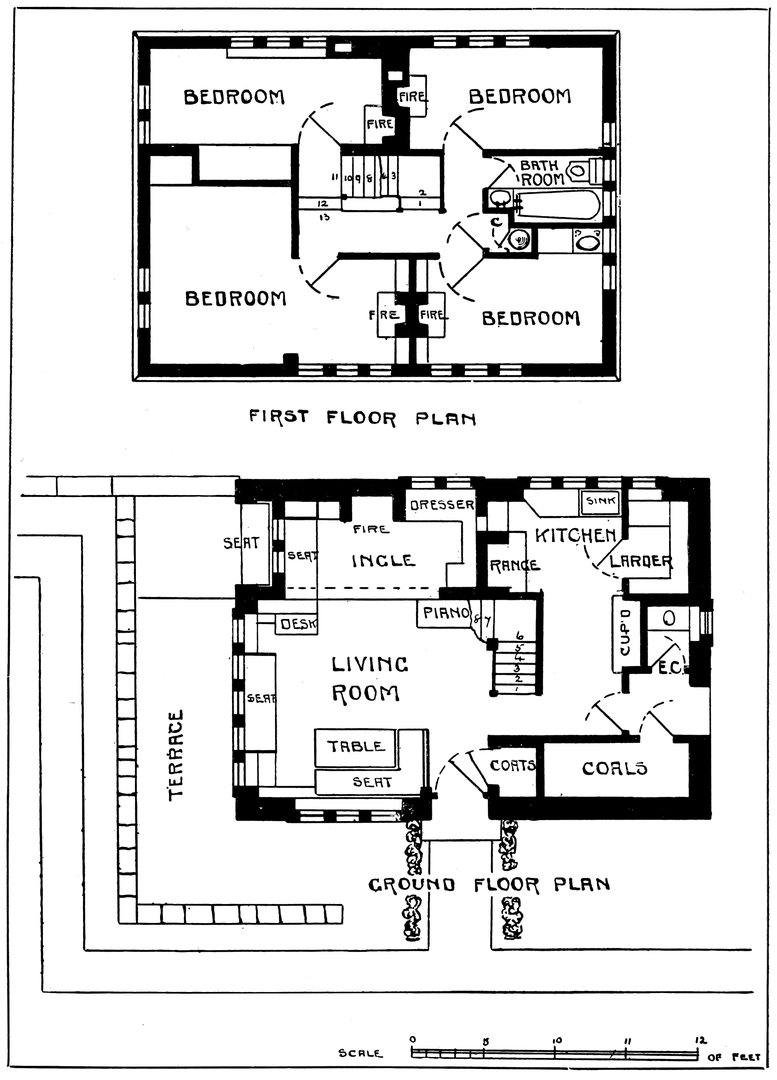
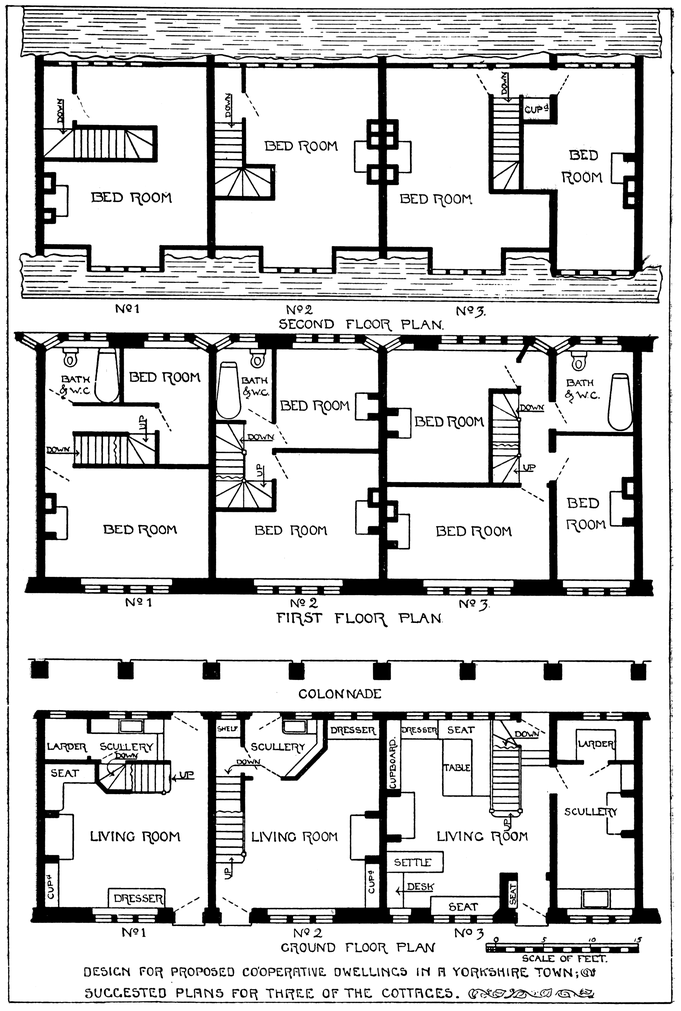
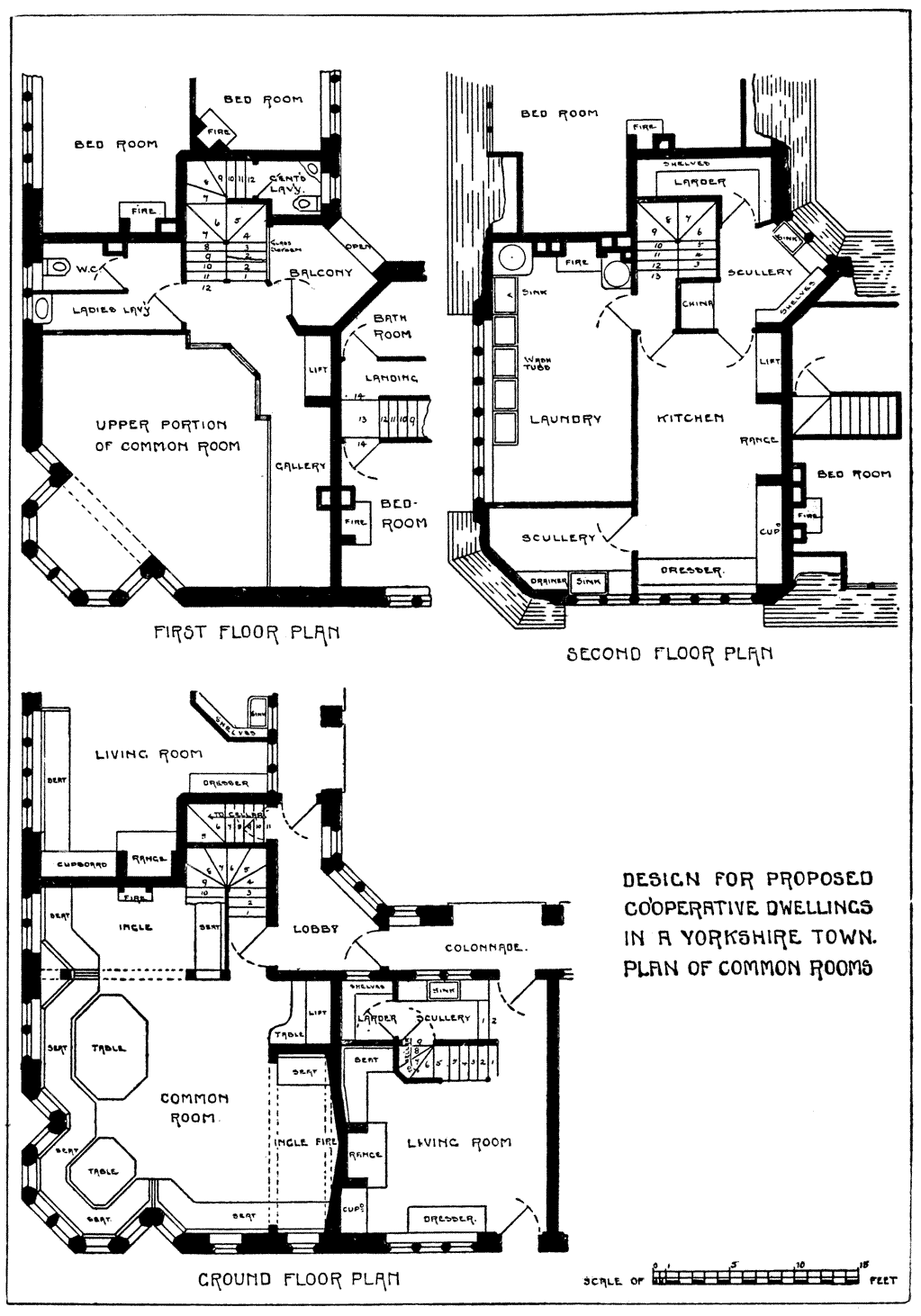
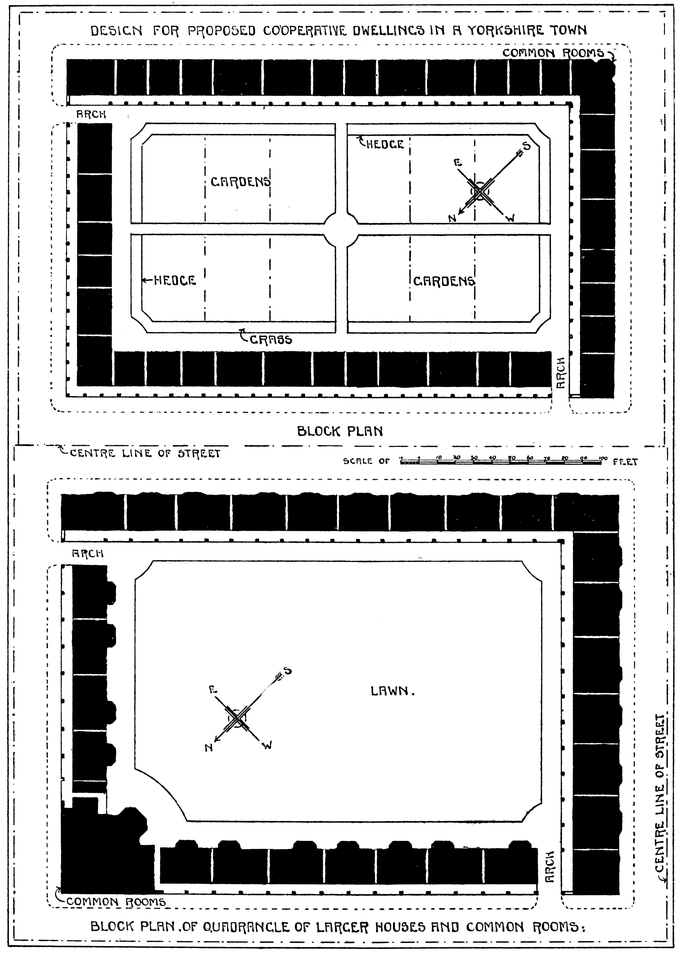
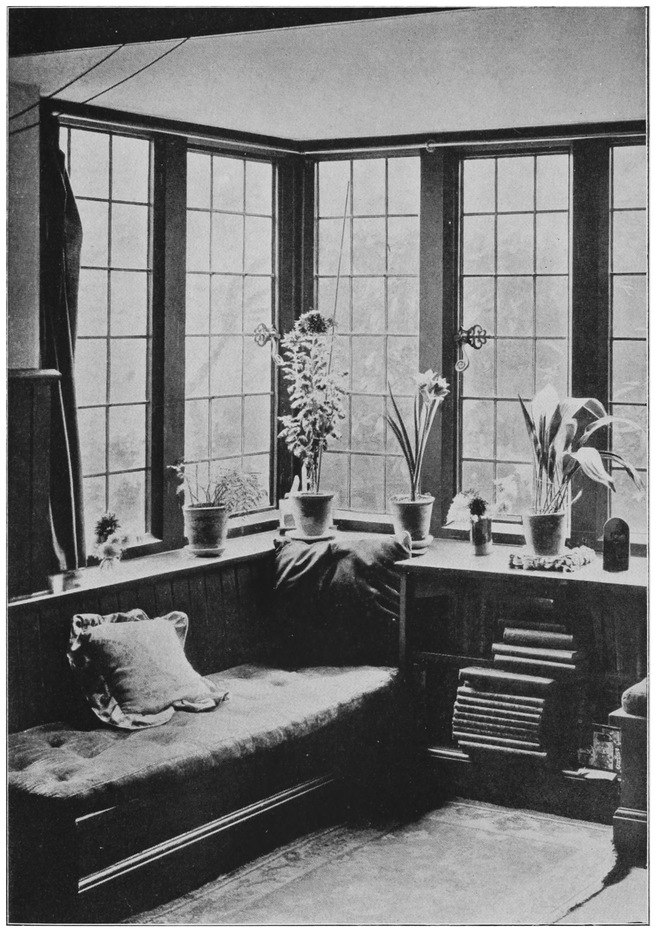
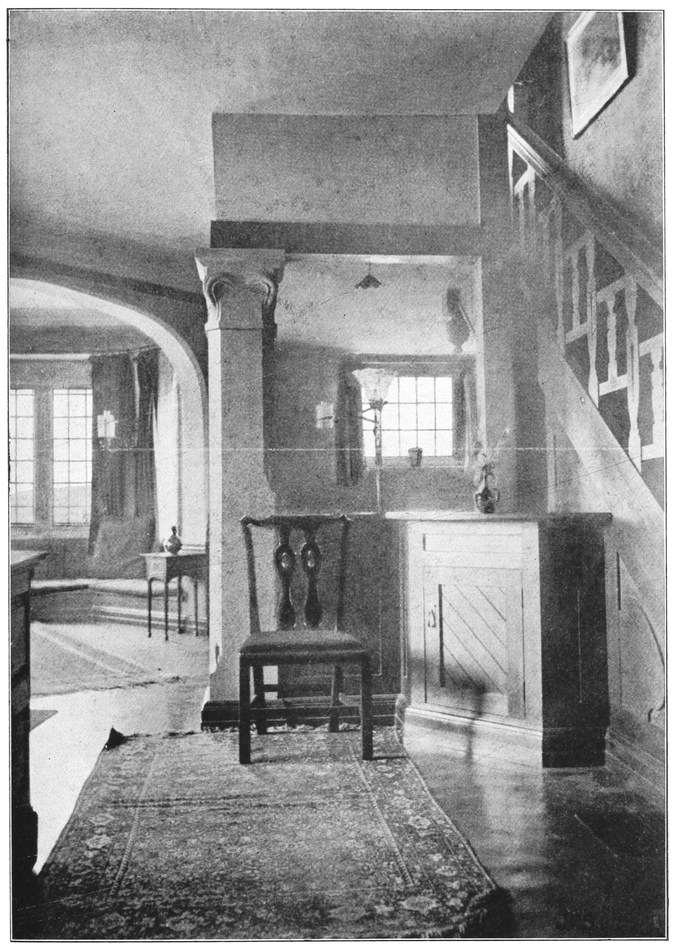
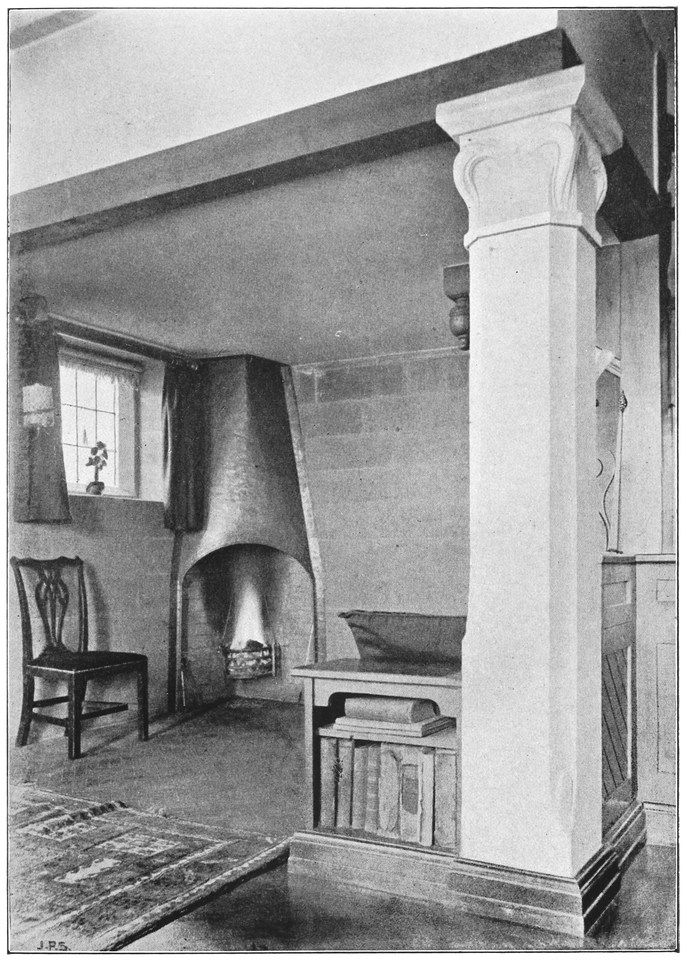
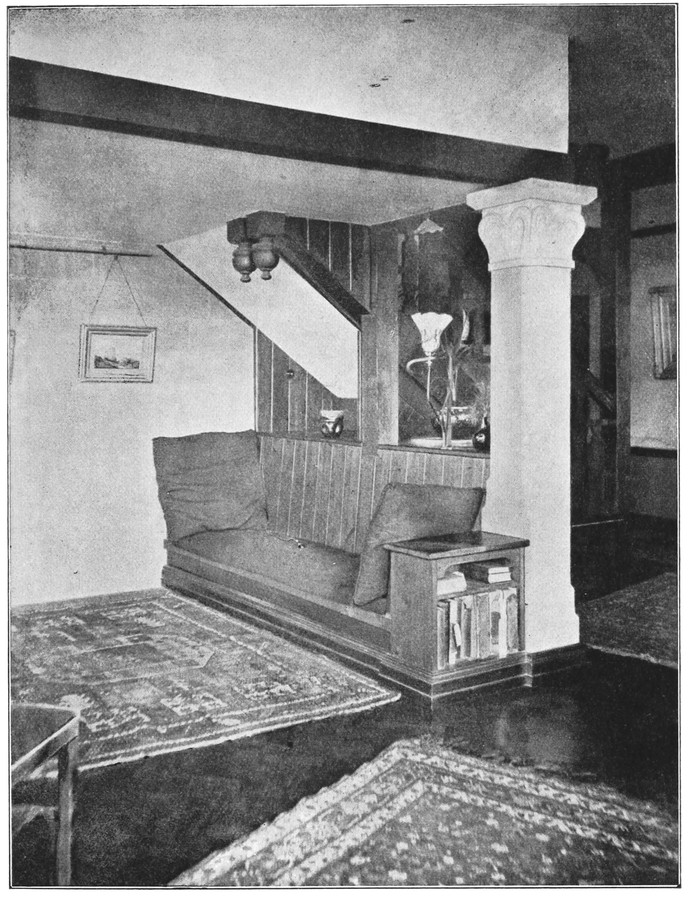
Larger versions of most plates
towards the end of this eBook may be seen by right-clicking them and
selecting an option to view them separately, or by double-tapping
and/or stretching them.
MANCHESTER:
Chorlton & Knowles, Mayfield Press.
1901.
THE ART OF
BUILDING
A HOME.
A Collection of Lectures and
Illustrations by Barry Parker
and Raymond Unwin.
Longmans, Green & Co.,
39, Paternoster Row, London,
New York, & Bombay,
1901.
PREFACE.
Some time ago I published a
reprint of two of my articles
with illustrations which had
appeared in “The Building
News.”
This little publication, though
long out of print, being still
constantly asked for; and the
need of something to take its place being felt by
us; the question of re-issuing it arose. Instead of
doing this, however, it seemed better, as being a
later and fuller expression, to collect two or three
of the lectures which my partner and I had from
time to time written for various audiences; and to
add by way of illustration some of the sketches
and photographs we had by us.
So came into existence this book in its present
form.
The way we run in ruts is
wonderful: our inability to
find out the right principles
upon which to set to work to
accomplish what we take in
hand, or to go to the bottom
of things, is simply astonishing:
while the resignation
with which we accept the Recognised and Usual as
the Right and Inevitable is really beautiful.
In nothing is this tendency more noticeable than
in the art of house-building. We begin by considering
what, in the way of a house, our neighbours
have; what they would expect us to have; what is
customary in the rank of life to which we belong;
anything, in fact, but what are our actual needs.
About the last thing we do is to make our home
take just that form which will, in the most straightforward
manner, meet our requirements.
It is too often evident that people, instead of being
assisted, and their lives added to, by the houses
they occupy, are but living as well as may be in
spite of them. The house, planned largely to meet
supposed wants which never occur, and sacrificed
to convention and custom, neither satisfies the real
needs of its occupants nor expresses in any way
their individuality.
The planning having been dictated by convention,
all the details are worked out under the same influence.
To each house is applied a certain amount
of meaningless mechanical and superficial ornamentation
according to some recognised standard.
No use whatever is made of the decorative properties
inherent in the construction and in the
details necessary to the building. These are put as
far as possible out of sight. For example, latches
and locks are all let into the doors leaving visible
the knob only. The hinges are hidden in the rebate
of the door frame, while the real door frame,
that which does the work, is covered up with the
strip of flimsy moulded board styled the architrave.
All constructional features, wherever possible, are
smeared over with a coat of plaster to bring them
up to the same dead level of flat monotony, leaving
a clear field for the erection of the customary
abominations in the form of cornices, imitation
beams where no beams are wanted, & plaster brackets
which could support, and do support, nothing.
Even with the fire the chief aim seems to be
to acknowledge as few of its properties and characteristics
as possible; it is buried as deep in the
wall, and as far out of sight and out of the way as
may be; it is smothered up with as much uncongenial
and inappropriate “enrichment” as can be
crowded round it; and, to add the final touch of
senseless incongruity, some form of that massive
and apparently very constructional and essential
thing we call a mantelpiece is erected, in wood,
stone, or marble, towering it may be even to the
ceiling. If we were not so accustomed to it, great
would be our astonishment to find that this most
prominent feature has really no function whatever,
beyond giving cause for a lot of other things as
useful and beautiful as itself, which exist only that
they may be put upon it, “to decorate it.”
Could we but have the right thing put in the right
place and left alone, each object having some vital
reason for being where it is, and obviously revealing
its function; could we but have that form given
to everything which would best enable it to answer
the real purpose for which it exists; our houses
would become places of real interest.
The essence and life of design lies in finding that
form for anything which will, with the maximum
of convenience and beauty, fit it for the particular
functions it has to perform, and adapt it to the
special circumstances in which it must be placed.
Perhaps the most fruitful source whence charm of
design arises in anything, is the grace with which
it serves its purpose and conforms to its surroundings.
How many of the beautiful features of the
work of past ages, which we now arbitrarily reproduce
and copy, arose out of the skilful and graceful
way in which some old artist-craftsman, or
chief mason, got over a difficulty! If, instead of
copying these features when and where the cause
for them does not exist, we would rather emulate
the spirit in which they were produced, there
would be more hope of again seeing life and vigour
in our architecture and design.
When the architect leaves the house, the subservience
to convention is not over. After him follow
the decorator and the furnisher, who try to overcome
the lifelessness and vapidity by covering all
surfaces with fugitive decorations and incongruous
patterns, and filling the rooms with flimsy
stereotyped furniture and nick-nacks. To these
the mistress of the house will be incessantly adding,
from an instinctive feeling of the incompleteness
and unsatisfactoriness of the whole. Incidentally
we see here one reason why the influence of
the architect should not stop at the completion of
the four walls, but should extend to the last detail
of the furnished house. When his responsibility
ceases with the erection of the shell, it is natural
that he should look very little beyond this. There
is no inducement for him to work out any definite
scheme for a finished room, for he knows that if
he had any aim the decorator and furnisher would
certainly miss it and would fail to complete his creation.
If, when designing a house, the architect were
bearing in mind the effect each room would have
when finished and furnished, his conceptions
would be influenced from the very beginning, and
his attitude towards the work would tend to undergo
an entire change. At present he but too
readily accepts the popular idea of art as a thing
quite apart from life, a sort of trimming to be added
if funds allow.
It is this prevalent conception of beauty as a sweetmeat,
something rather nice which may be taken
or left according to inclination after the solid meal
has been secured, which largely causes the lack of
comeliness we find in our houses. Before this idea
can be dispelled & we can appreciate either the place
which art should hold in our lives or the importance
of rightly educating the appreciation of it, we
must realise that beauty is part of the necessary
food of any life worth the name; that art, which
is the expression of beauty as conceived and created
by man, is primarily concerned with the making
of the useful garments of life beautiful, not
with the trimming of them; and that, moreover,
in its higher branches art is the medium through
which the most subtle ideas are conveyed from
man to man.
Understanding something of the true meaning of
art, we may set about realising it, at least in the
homes which are so much within our control. Let
us have in our houses, rooms where there shall be
space to carry on the business of life freely and
with pleasure, with furniture made for use; rooms
where a drop of water spilled is not fatal; where
the life of a child is not made a burden to it by unnecessary
restraint; plain, simple, and ungarnished
if necessary, but honest. Let us have such ornament
as we do have really beautiful and wrought
by hand, carving, wrought metal, embroidery,
painting, something which it has given pleasure to
the producer to create, and which shows this in
every line—the only possible work of art. Let us
call in the artist, bid him leave his easel pictures,
and paint on our walls and over the chimney corner
landscapes and scenes which shall bring light
and life into the room; which shall speak of nature,
purity, and truth; shall become part of the room,
of the walls on which they are painted, and of the
lives of us who live beside them; paintings which
our children shall grow up to love, and always connect
with scenes of home with that vividness of a
memory from childhood which no time can efface.
Then, if necessary, let the rest of the walls go untouched
in all the rich variety of colour and tone,
of light and shade, of the naked brickwork. Let
the floor go uncarpeted, and the wood unpainted,
that we may have time to think, and money with
which to educate our children to think also. Let us
have rooms which once decorated are always decorated,
rooms fit to be homes in the fullest poetry
of the name; in which no artificiality need momentarily
force us to feel shame for things of which
we know there is nothing to be ashamed: rooms
which can form backgrounds, fitting and dignified,
at the time and in our memories, for all those little
scenes, those acts of kindness and small duties, as
well as the scenes of deep emotion and trial, which
make up the drama of our lives at home.
B. P.
R. U.
THE SMALLER MIDDLE CLASS HOUSE.
A lecture delivered before an audience of architects
in 1895.
In the class of house with which
we are to deal to-night, there
are so many directions in
which improvement is needed,
that it will only be possible
for me, in the space of one
lecture, to refer to a few of
them, and to those specially
which will illustrate most suggestively the main
principles for which I contend: suggestively, in the
hope that some present will do me the honour of
giving further thought to what I shall touch upon,
than is possible to them during the length of time
assigned to me this evening.
The influences which our common every-day surroundings
have upon our characters, our conceptions,
our habits of thought and conduct, are often
very much underrated; we do not realise the power
they have of either aiding or hindering the development
in us of the best or worst of which we
are capable.
Of the capacity the mere contour of a moulding
has to bear the impression of refinement or vulgarity,
we, as architects, are fully aware; but, I think,
may not quite as fully realise the harmful influence
of imperfect and unspontaneous drawing, or ill-conception
in pattern design, or ill-assorted combinations
of colour.
The thing of first consideration in designing a
house is convenience, workability. The plan is that
which should be first thought of; so, in our small
middle class house, I will try to suggest one or two
of the improvements that seem to be most wanted
in planning.
First of all, for the sake of any who may be here
who are not architects, I will just point out what
is the most comfortable form of room for a sitting
room with respect to the relative positions of the
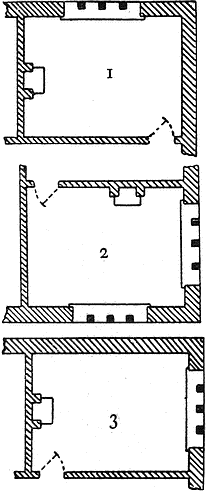
door, windows, and fire. If your room must, of necessity,
be square or oblong
(which should be the
case as seldom as possible),
the form most conducive
to comfort, is of
course this: diagram 1.
The second best arrangement,
(when this cannot
be got) is to have the door
and fire both on the long
wall, diagram 2. When
the door is on the opposite
wall to the fire, you
never feel to be able to
get out of the draught of
it; and of course this kind
of thing, diagram 3, is
too palpably bad to need
that anything should be
said regarding it.
One of the first defects
we notice in the plans of
houses of the class we
are speaking of, as usually
laid down, is that there are too many rooms &
all therefore necessarily too small. In the larger
middle class house there are generally drawing
room, dining room, library, kitchens, and offices,
all tolerably good rooms. Now, when a smaller
house is wanted, the general custom seems to be,
to put exactly the same number of rooms, only
reducing all in size. Would it not be far better to
reduce the number of rooms, keeping such rooms
as we do retain, large enough to be healthy, comfortable,
and habitable?
Are not many of the houses we know only too well,
most distressing in this respect, divided up, as they
are, into a number of small compartments, we cannot
call them rooms, all far too small to be healthy;
too small to be really fit for human habitation.
And what is gained by this cramping? Only that
there shall be one or more of these compartments
practically useless. In far the greater number of
these houses the third room is never used, or used
merely because it happens to be there, and its chief
end seems to be to provide a place for the women
of the household to spend any spare time they may
have, cleaning down, dusting &c.
Now many people have a feeling that there is a
certain cosiness in a small room entirely unattainable
in a large one; this is a mistake altogether;
quite the reverse has been my experience, which
is that such a sense of cosiness as can be got in the
recesses of a large room, can never be attained in
a small one, be it no larger than a sentry box. But
if your big room is to be comfortable it must have
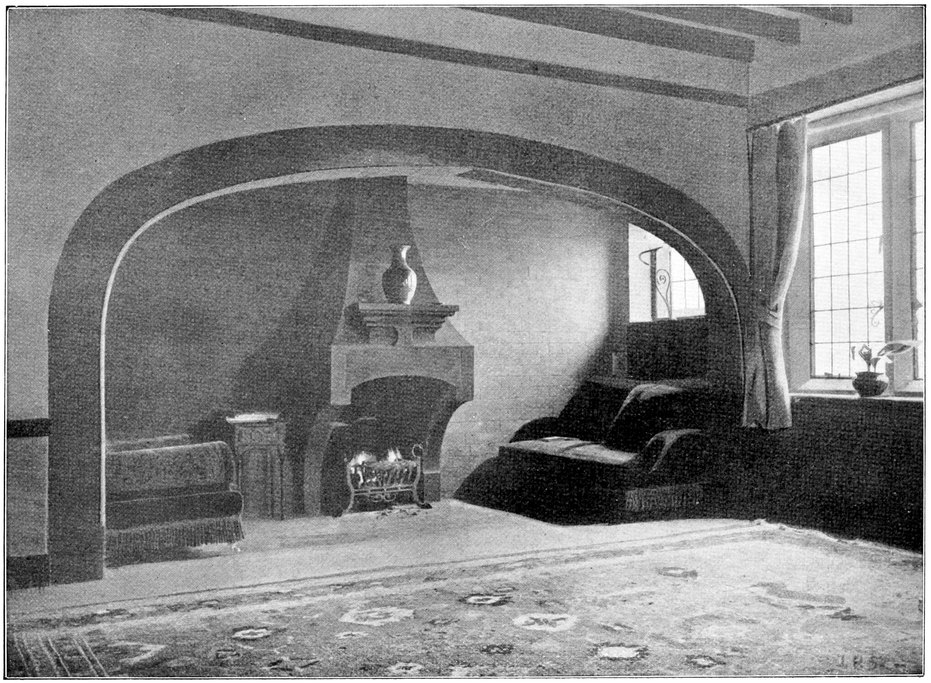
recesses. There is a great charm in a room broken
up in plan, where that slight feeling of mystery
is given to it which arises when you cannot see
the whole room from any one point in which you
are likely to sit; when there is always something
round the corner.
And what is made of the hall? Generally one of
two things; either it is a passage with a kind of
step-ladder for a staircase and a hat stand in it,
with not room enough for you to hold the door
and let a friend out; or it is a great bare cold comfortless
waste space, in the centre of the house:
instead of being, as it might, the most comfortable
and homely room, the centre of the common
life of the household.
Of course a hall of this kind needs some care in
planning. In the first place, the staircase must occupy
exactly that position in which it can be made
an ornament and a pleasing feature in the room,
all of which it is quite capable of being, and a
position in which it does not detract from the cosiness,
or give any unpleasant feeling of draughtiness,
or too great openness. In the second place,
the doors necessarily opening into a hall must be
carefully so grouped that the parts of the room
in which anyone would sit, shall be out of the
draught of them as far as possible.
Any house is cold all through the winter months
unless a fire of some kind is kept burning in the
hall; many people, therefore, find it necessary to
have a stove or heating apparatus; and, in most
houses, it is thought necessary to have two other
fires burning, one in the living room, and one in
some other room that there may be somewhere to
show visitors. Now when the hall is also a sitting
room, with a fire in it, we get, for the trouble and
expense of two fires, all the advantages ordinarily
attaching to three.
I must now pass on to Decoration and Furniture.
The best test of the artistic merits or demerits of
a room as a whole, is the impression it makes, on
one’s entering for the first time. We can get accustomed
to anything, and it is from this fact, taken
in conjunction with what we have already noted,
of the power as an influence for advancement or
degradation of beautiful or unbeautiful surroundings,
that the importance of our subject to-night
is partly drawn. And what should be our feeling,
on entering a room? Simply this: How exquisitely
comfortable! For the first essential in the form and
design of any decorative object, (and everything in a
room should be a decorative object), is reposefulness.
I feel herein to be guilty of giving utterance to a
truism, and I should hardly dare to state so obvious
a fact, were it not that I see this first principle
so almost universally violated; for, if this test
of reposefulness is the test, the average farm house
kitchen has an artistic value far beyond that of
ninety-nine out of every hundred drawing rooms
in the kingdom; and I will endeavour to show
why.
The first fault in our rooms which contributes to
this result is over decoration. This is an almost universal
failing. Everything has a pattern on it and
almost every pattern is mechanically produced,
run out by the yard, and cut off just where it happens
to be when the time comes for it to finish.
No pattern bears any relation to any other pattern,
and the whole effect is fidgety, fussy, and painful
to a degree. Nothing is let alone, but every surface
must needs be worried and tortured into some
unwholesome form of altogether soul-less ornament.
We cannot even find rest for our weary eyes
on the ceiling, for tortuous intricacies of design
meet them there also.
The second fault I wish to refer to, is that all this
ornament is made to shout, everything is clamouring
for notice. It would not be in place for me to
say much here about those rooms in which any
one element of decoration is in such flagrantly bad
taste as to be noticed, immediately on entering,
with a sort of start and feeling of “Oh! wall-paper,”
or “Oh! carpet,” or whatever it may happen to be.
(A designer will often aim at this for the sake of
the advertisement and at the sacrifice of his artistic
principles). But even when this extreme is not
reached, everything seems trying within certain
limits to assert itself, to attract attention.
Now any ornament you notice when you do not
look for it, or perhaps I might better say, when
you do not wish to think of it, is necessarily in bad
taste. The degree of assertiveness admissible in a
decorative object depends upon the degree of its
naturalisation or conventionalisation, or, to put it
another way, on the degree in which it is fine or
mechanical. And though we cannot pretend to
regulate by rules of this kind, pictures which are
direct mirrors as far as possible of real things, yet,
in so far as they are mural decorations, they come
under this law.
Mr. Ruskin’s wall, painted to look like a vinery,
would admit of much more forcible treatment,
being entirely painted by hand and as true to nature
as possible, than would a wall with a printed
vine pattern on it in which there necessarily was
repetition. And natural flowers painted may fittingly
be treated much more forcibly than would
be admissible in a purely conventional design, because
natural flowers, hills, & trees, cannot become
assertive enough to influence one disquietingly.
Therefore the more nearly approaching to nature,
the more assertive may be our ornament, or rather
the less assertive it will be from this very reason,
and therefore may be the more forcible in treatment.
So we can stand, in a conventional pattern
design, a degree of contrast in tones, which we
could not tolerate in flat masses of colour.
One of the chief underlying causes of this failing
of fussiness we have noted, is, that a room is scarcely
ever designed as a whole, never enough thought
of as a whole. The designer of each individual
thing, knowing nothing of the form or character
which anything else in the room was going to take,
thought only of his own design, & worked enough
interest into it to make it all-sufficient in itself;
and the consequence, when his design gets put
into a room in conjunction with a lot of other
things, all designed in just the same spirit, is,
that restlessness we have been deploring.
A room is a place in which to think of other things
besides those relating exclusively to the room itself,
and so much incident and interest should not be
worked into it as to distractingly affect the pursuance
of these thoughts & occupations. I say again,
any ornament which you notice when you do not
wish to is necessarily in bad taste.
When choosing anything, a wall paper for instance,
we forget that we are, while so doing, devoting
all our thought and attention to the design
we are considering; and that, though pleasing under
these circumstances, it may not be equally so
to have by us when we wish to think of other
things, or in the position for which we intend it.
Now no flat mechanical ornament, designed to
cover a large space, should ever be so designed
that you are able easily to trace the pattern at the
other side of the room. Please do not understand
from this that it should be small in design; far
from it; things small in design are, almost necessarily,
finikin and therefore unreposeful; but
being quiet and retiring in colour and contrast of
tones, whether large or small, let it reveal, when
you come to have leisure to examine it, vigorous
broad and direct treatment, good loving thoughtful
drawing, real artistic conception, and perception
of beauty in form and line.
How seldom we get these qualities: how laboured
and unspontaneous most patterns are! Into what
unwholesome forms the ornament is tortured, how
the one aim seems to be to make the design as
restless and fussy as possible! A sort of feeling
pervades the whole, that the designer could not
let the thing alone.
I think we must not now go far into the faults in
actual draughtsmanship most common in our designs.
But one thing is very striking: our designers,
almost without exception, seem to be out of their
depth directly anything in the way of foreshortening
is required of them; this cannot but lead us
to the conclusion, that drawing from Nature does
not form a sufficiently important part of their
training. In fact I have myself known several men,
engaged entirely in drawing ornament, who never
drew a bud or twig from Nature in their lives.
However this may be, the fact remains that very
few of our designers seem able to draw a leaf turning
over with any truth and accuracy.
Another cause of failure in our rooms is the dread
of repeating ourselves. With my wish that a more
wholesome feeling in this may spring up among
all engaged in artistic work, I am perhaps more
anxious to have your sympathy than with anything
which has gone before. Let us then do nothing different
from what we have done before, until we feel
it to be better than what we have done before.
Now this fear of repetition is no imaginary evil,
but a very real and living one. How often do we
all attempt something fresh, knowing it not to be
the best we can do, (best I mean more in kind than
degree) simply from a weak dislike that people
should say of us, that we have only one style. How
often do we turn out a design for a certain purpose
and position, knowing it to be not so good as one
we have before made for a similar purpose and
position, simply because we have not strength to
repeat what we believe to be best, lest people
should think that is all we can do. In so doing we
preclude all possibility of development.
Now observe, this never occurs during the progress
of any living art in the past. The man who
had carved one Early English capital did not,
when next he had a capital to carve, say, “I know
nothing more beautiful, but I must at any rate do
something different, I must not put the same capital
here again.” On the contrary, his aim was to
carve a similar capital again, only he would try to
do a better one; for probably he had noticed some
little point in which he could improve on the last
he did; some way in which he could mass his light
and shade so as to give them a more pleasing form
when seen at a distance; or some more lovely feeling
it was possible to introduce into the reveal of
a leaf or the curve of a stem.
You must forgive me if I dwell on this a little.
For it is of vital importance that all of us who have
any hope or wish to see a living art again existent
among us, should realise the full significance of
this. There are many other changes which must
take place in our practice of the arts, and these very
radical changes, before living art is again possible
to us; but if I can bring home to anyone, directly
or indirectly, the full significance of this, I shall
have done something towards this great end.
In excuse it may be and is said, “This aiming at
change, variety, novelty, &c. is demanded of the
designer by a capricious change-loving public,
broadly speaking, incapable of any true judgment
or appreciation of good and bad in art.” In reply
to this, I think we cannot do better than recall
what Mr. Ruskin says on this head. “You may
like making money exceedingly; but if it come to
a fair question, whether you are to make five hundred
pounds less by this business, or to spoil your
building, and you choose to spoil your building,
there’s an end of you. So you may be as thirsty for
fame as a cricket is for cream; but, if it come to a
fair question, whether you are to please the mob, or
do the thing as you know it ought to be done; and
you can’t do both, and choose to please the mob,—its
all over with you;—there’s no hope for you;
nothing that you can do will ever be worth a man’s
glance as he passes by.”
A further cause of failure in decorating and furnishing
is virtually the same as we noticed when
speaking of planning. When a small middle class
house is wanted, what is usually done, we saw, is
virtually to take a plan suitable for a larger house
and reduce it every way, instead of designing a
house suited to the new requirements. This same
mistake is generally made in the decoration and
furniture; instead of these being designed to suit
the condition or circumstances in which they are
to be placed, each designed for its position and
purpose, and good and honest as far as it goes,
what do we find? Cheapened imitations of the sort
of thing common in the larger house, cheapened
by being badly made, by veneer on pine instead
of solid wood, by cast metals and ornament made
to look like wrought, by machine carved wood,
by marbled slate, &c. P. G. Hubert in his little
book entitled “Liberty and a Living,” says: “One
of my critics, for whom I have great personal deference,
tells me that my theory of life tends to a
relapse into barbarism, and in illustration of the
truth of his position, he pointed one evening to a
music stand near the piano with the remark:
“With your ideas, that stand would never be made
of mahogany and elaborately ornamented, but
would be of pine, perhaps stained.”
“Well, suppose it was, I am inclined to think that
the greater use of common material, stained pine
and other cheap wood, in the houses of people of
taste is a distinct indication of a needed reform.
Take the little music stand in illustration. Its purpose
is to hold a number of music books and loose
sheets of music. It has three or four shelves, and is
so made as to stand in a corner near the piano and
take up but little room. It is made of mahogany,
highly polished, & is ornamented, as most people
would call it, with a sort of stucco-beading, which
to me is distasteful. But it cost money, and therefore
has its reasons for being in certain eyes. I have
forgotten what it cost me—probably from fifteen to
twenty dollars. Thanks to the growth of good
taste, I can to-day pick out from half-a-dozen
books I know of a little design for a music stand,
or sketch it myself, and the nearest carpenter will
make the thing in a day at a cost of two or three
dollars for wood, labor, and staining. The result
will be something which is pleasanter to my eye,
and I will venture to say to the eyes of nine out
of ten persons of educated taste. The other fifteen
or sixteen dollars saved may be devoted to books,
pictures, music—any of the things which really
add something to life. The music stand of stained
pine will do its work just as well as the one made
of mahogany, inlaid with stucco beading—in fact it
will do it better, for it will not need a periodic rubbing
on the part of the parlour-maid to keep it
bright and polished, and it can be moved about
when occasion demands, as it weighs but little. It
is as strong as the other, and it will last a hundred
years.”
And now for the last cause of failure of which I
shall speak, and this is: the very marked feeling
which everything has of not having been designed
for its place: the look everything has of being
ready to move at any moment. Most things to look
right and happy in their places must be designed
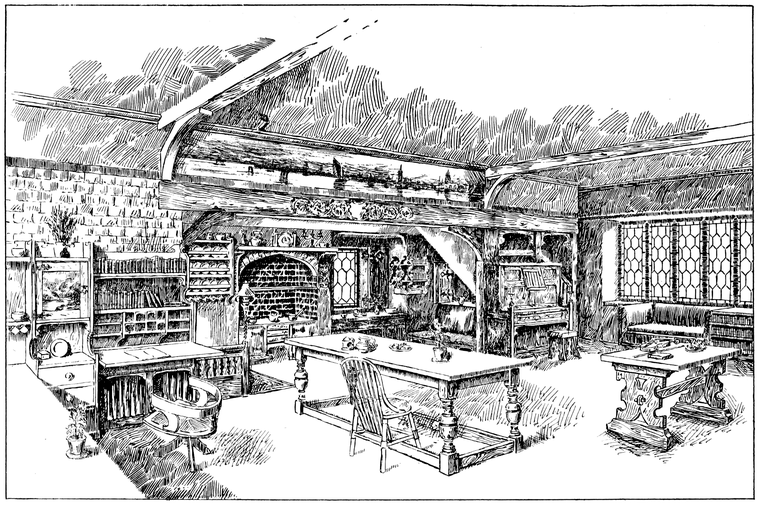
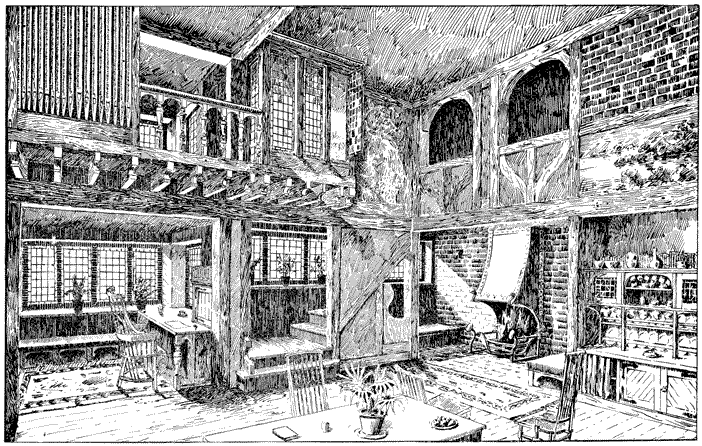
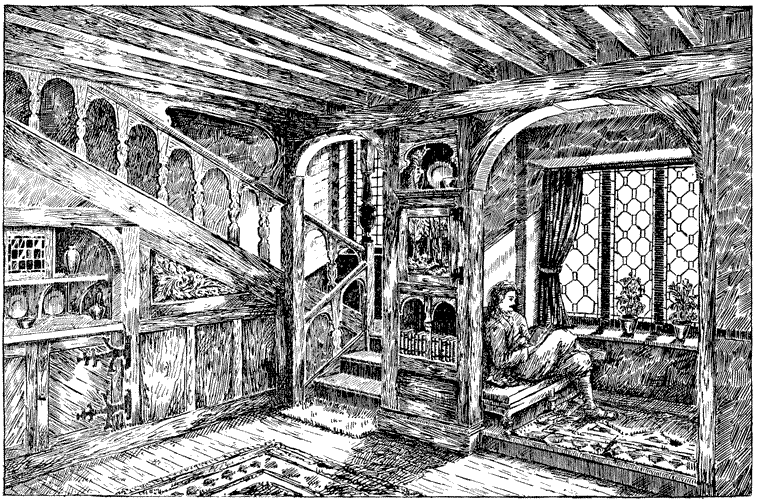
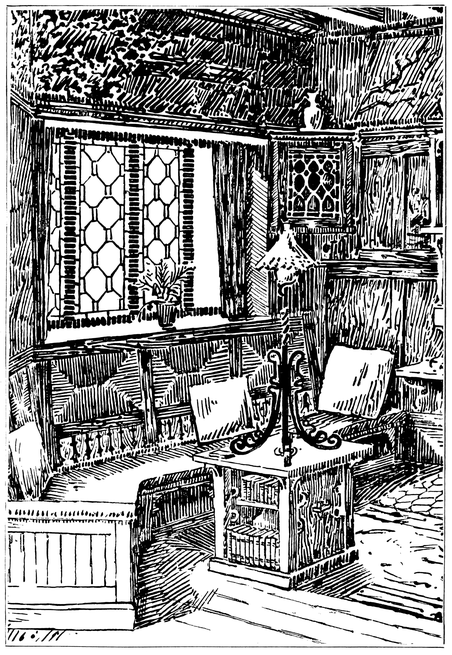
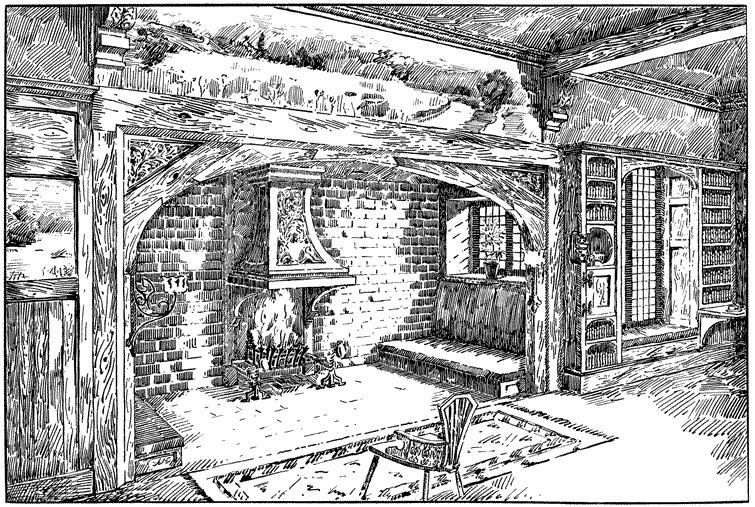
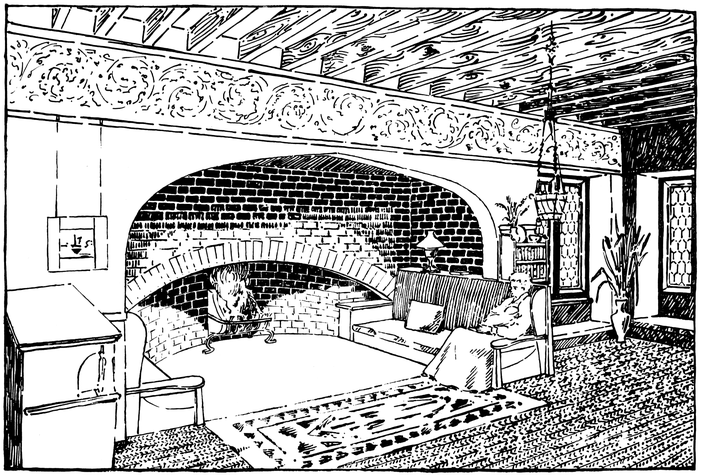
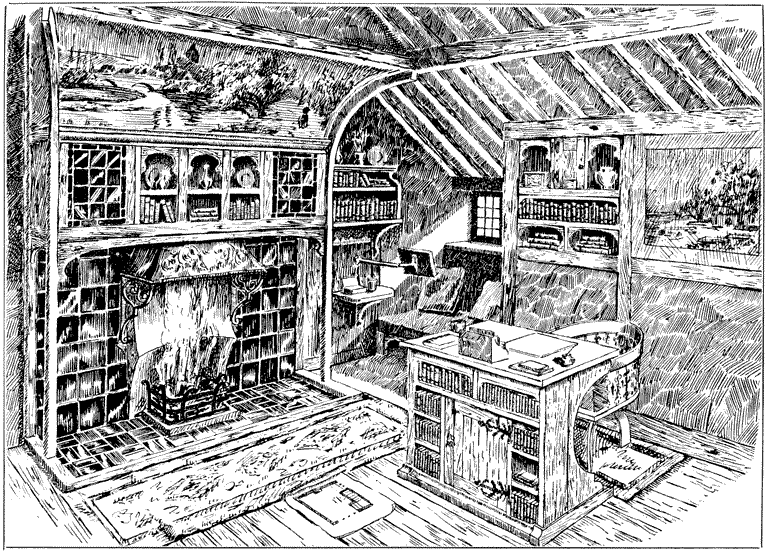
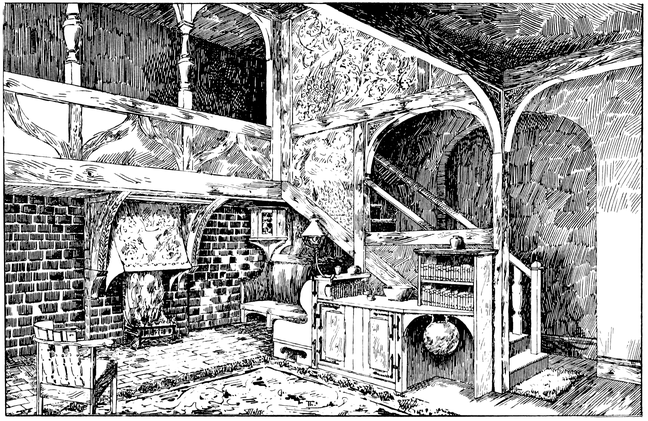
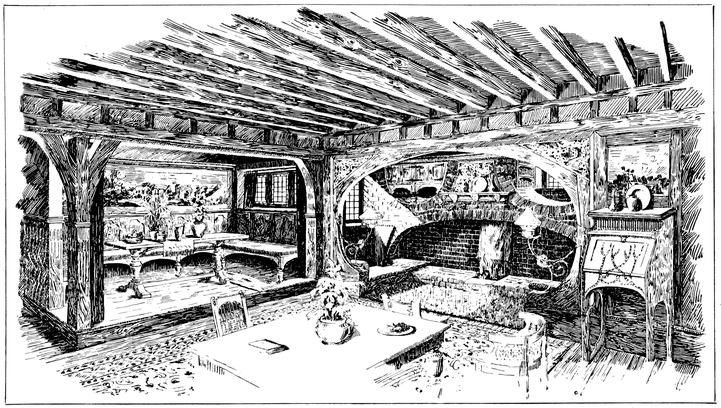
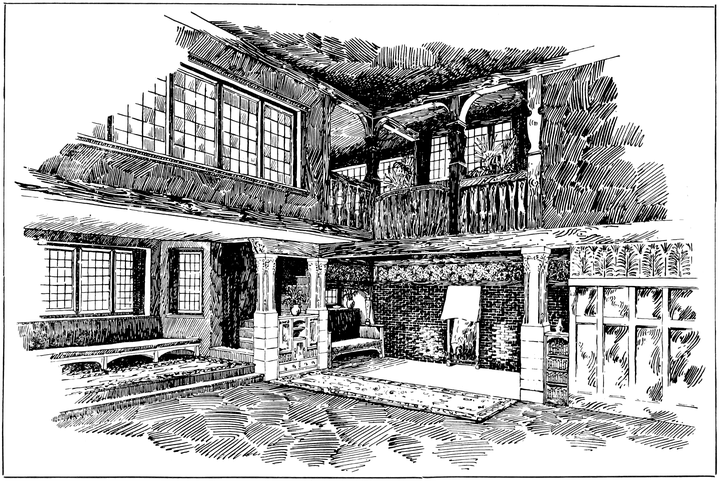
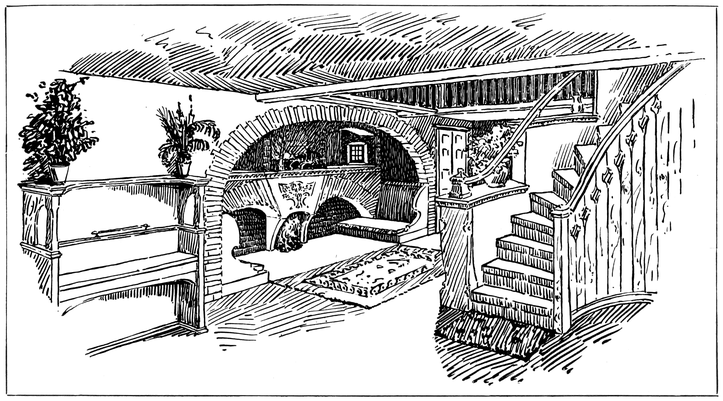
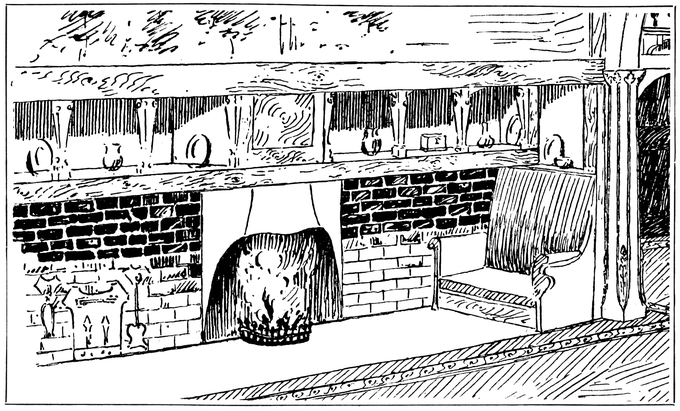
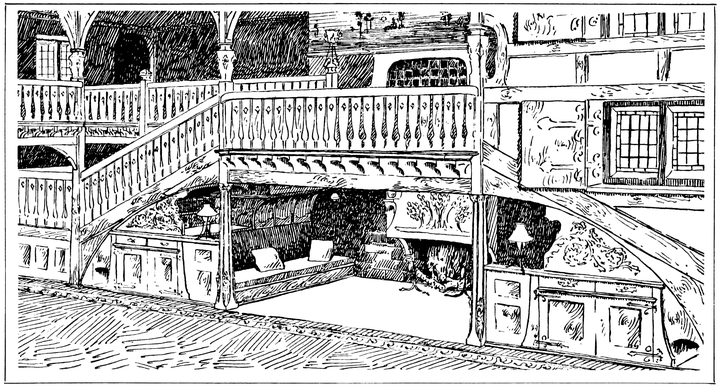
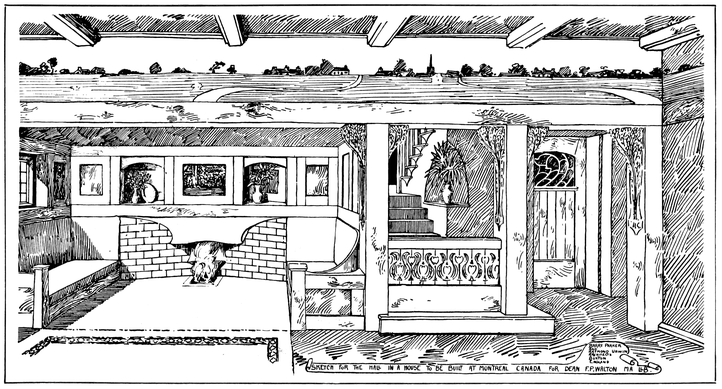
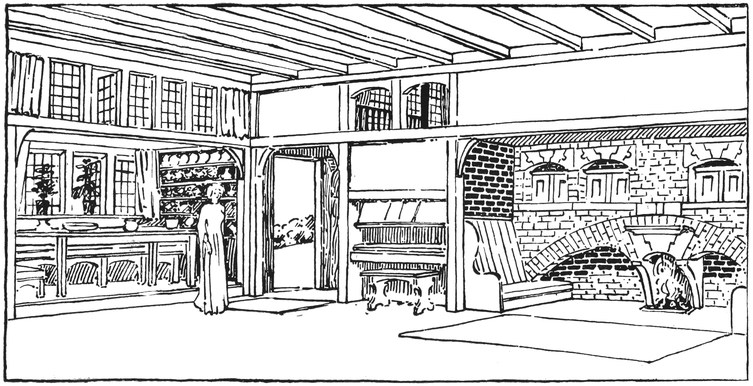
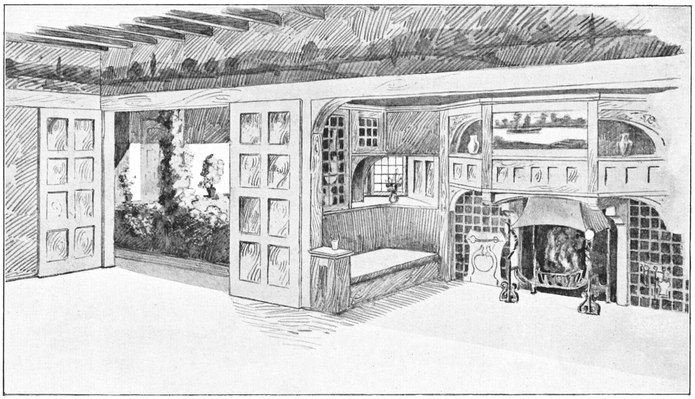
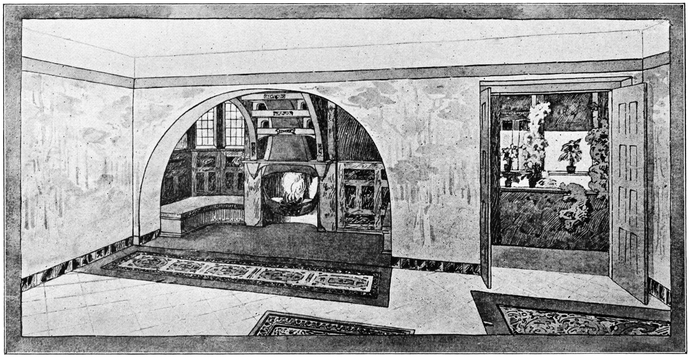
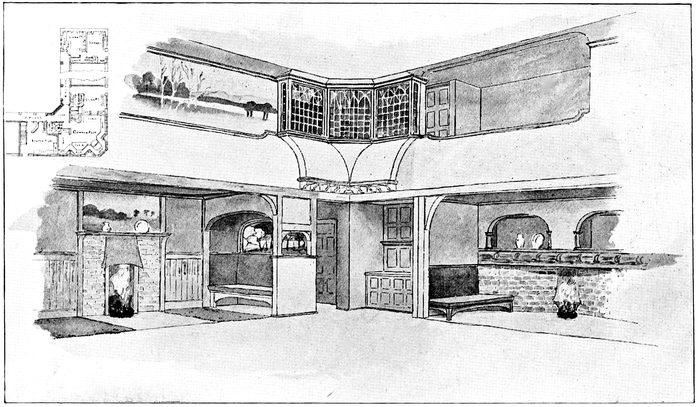
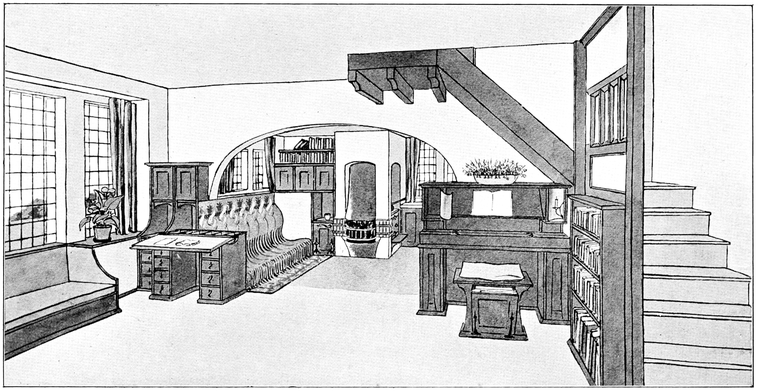
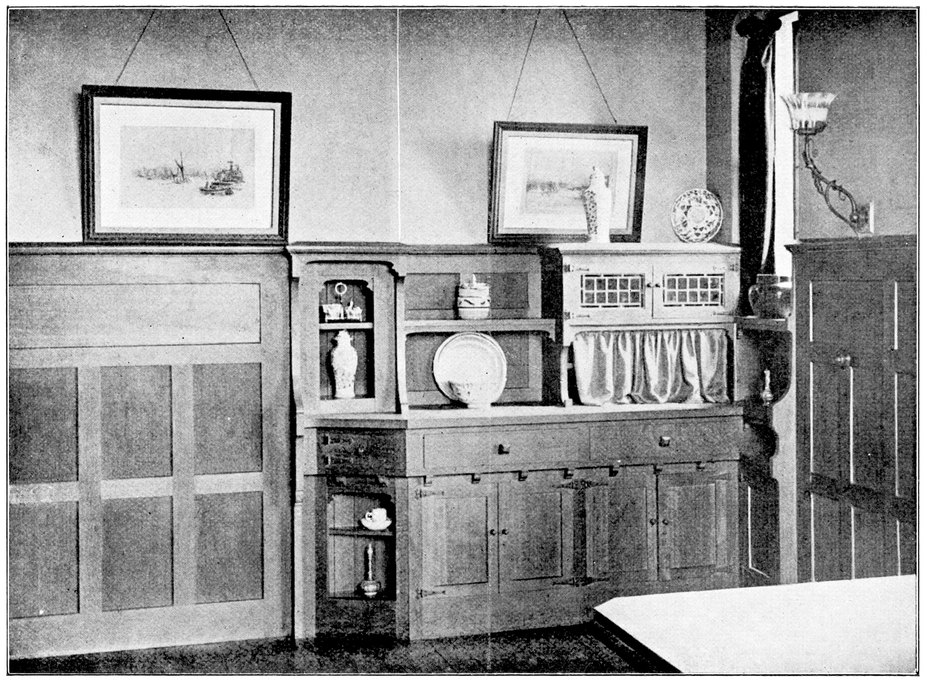
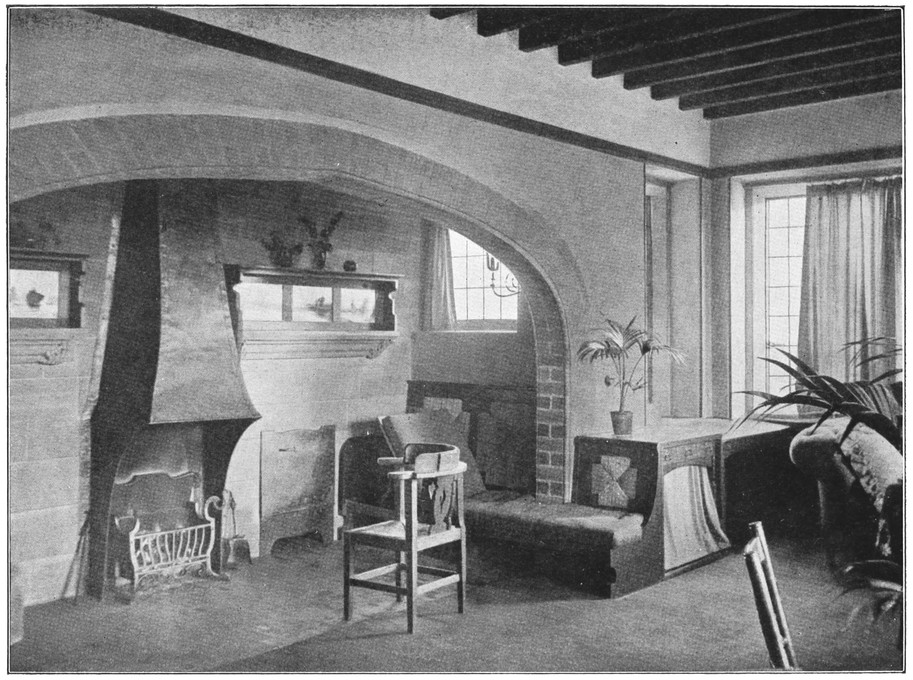
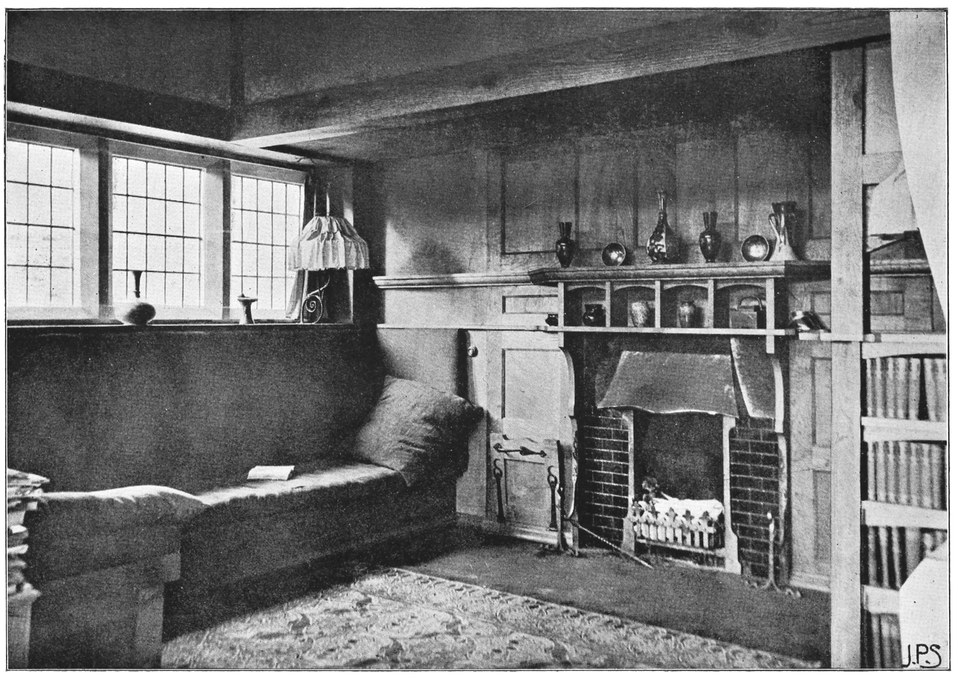
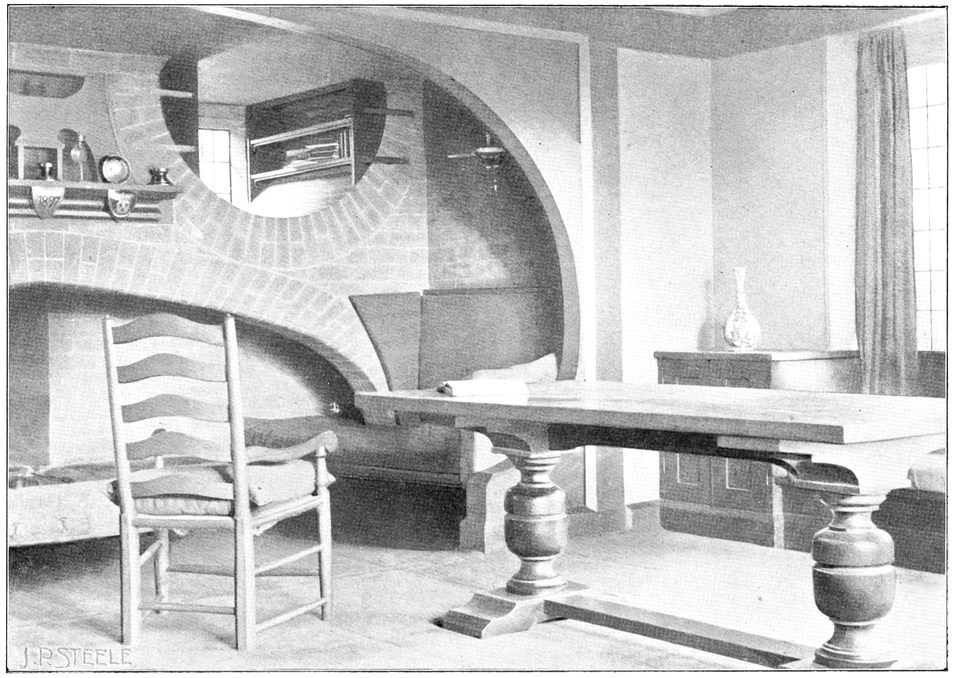
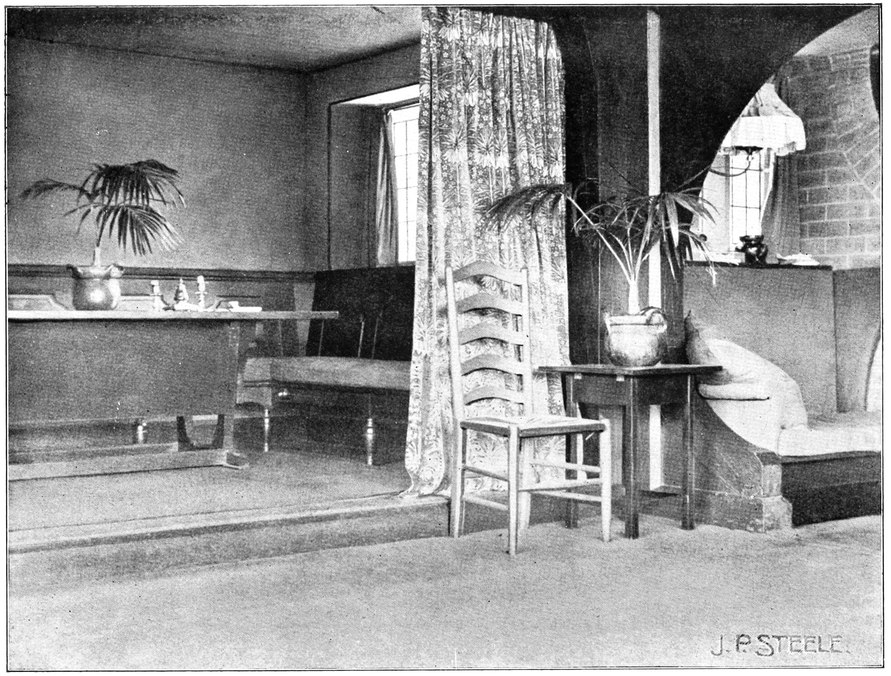
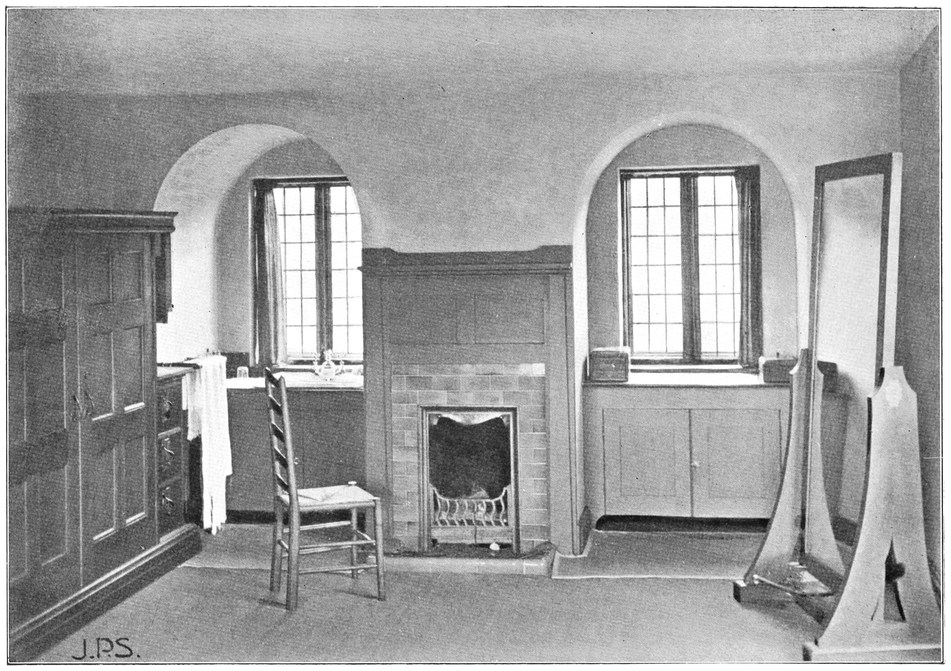
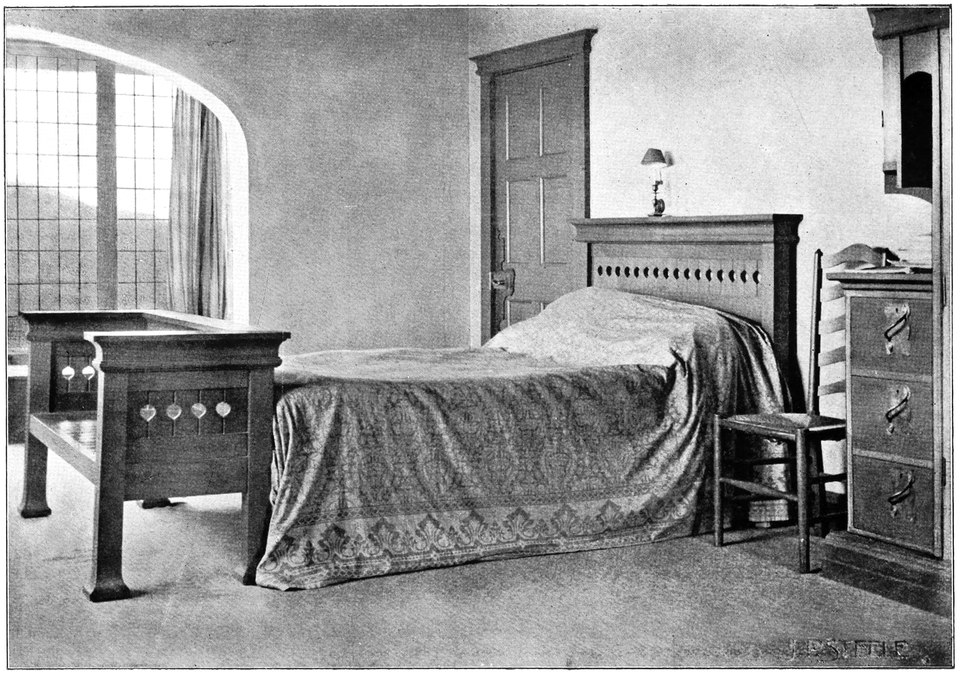
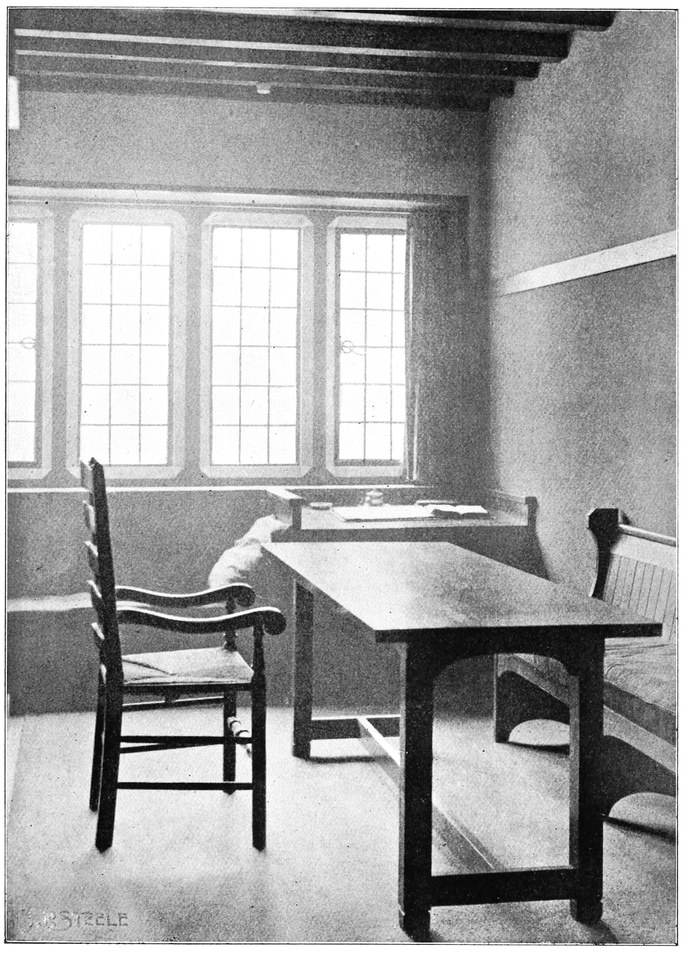
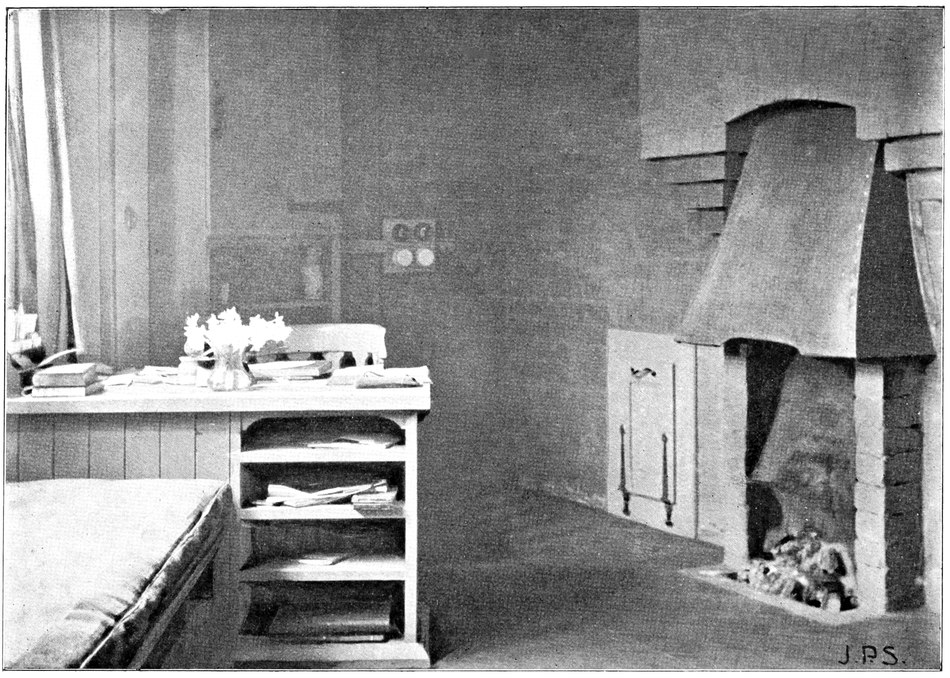
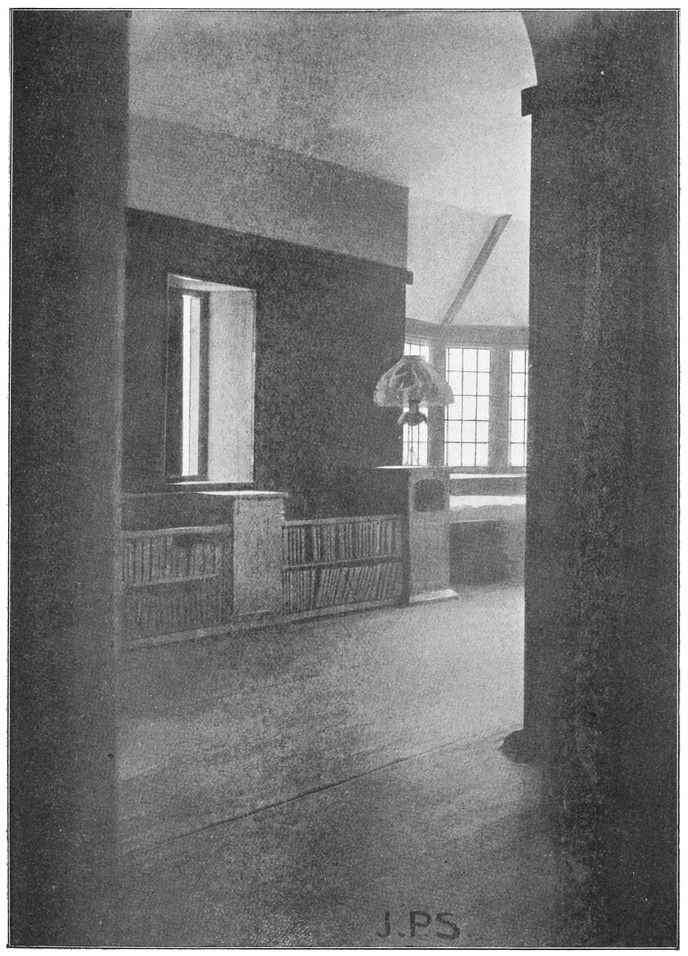
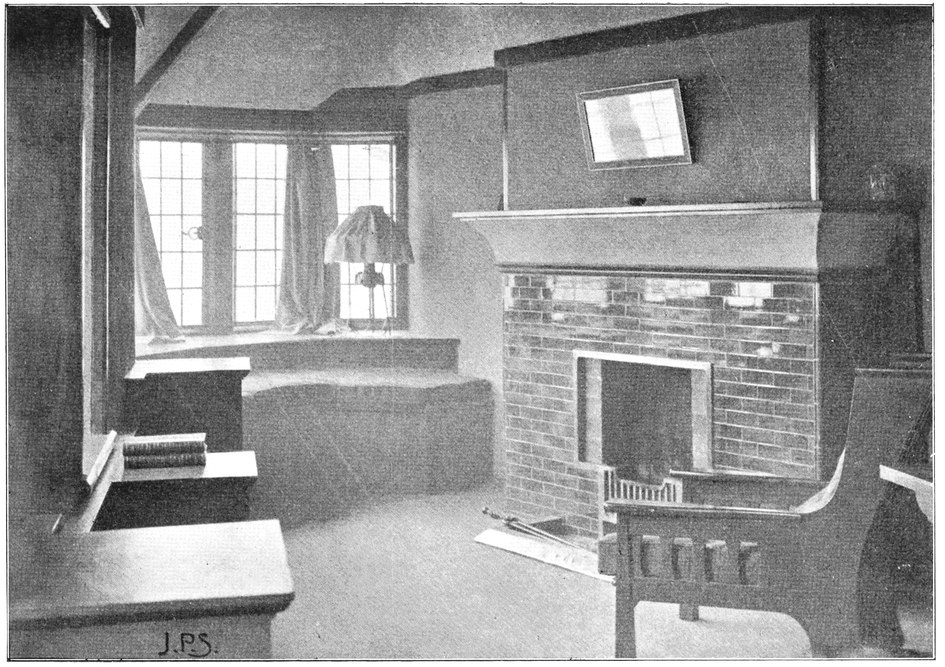
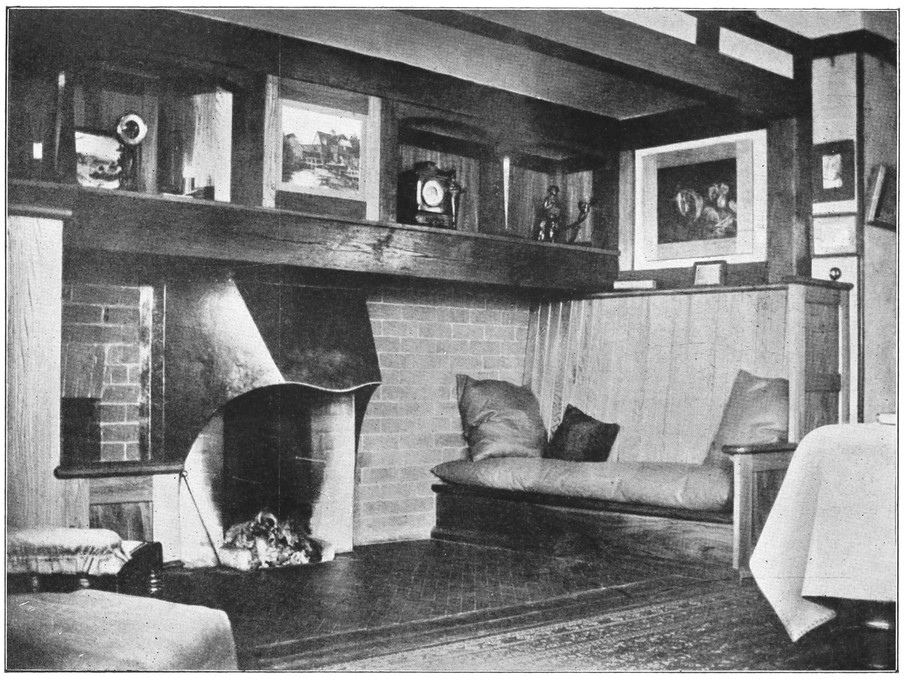
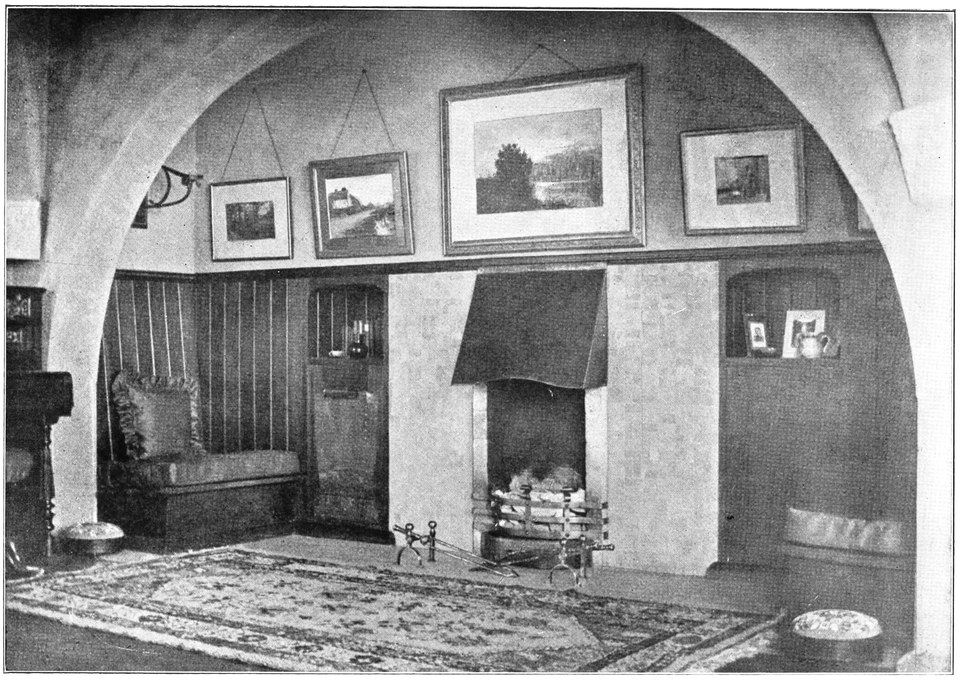
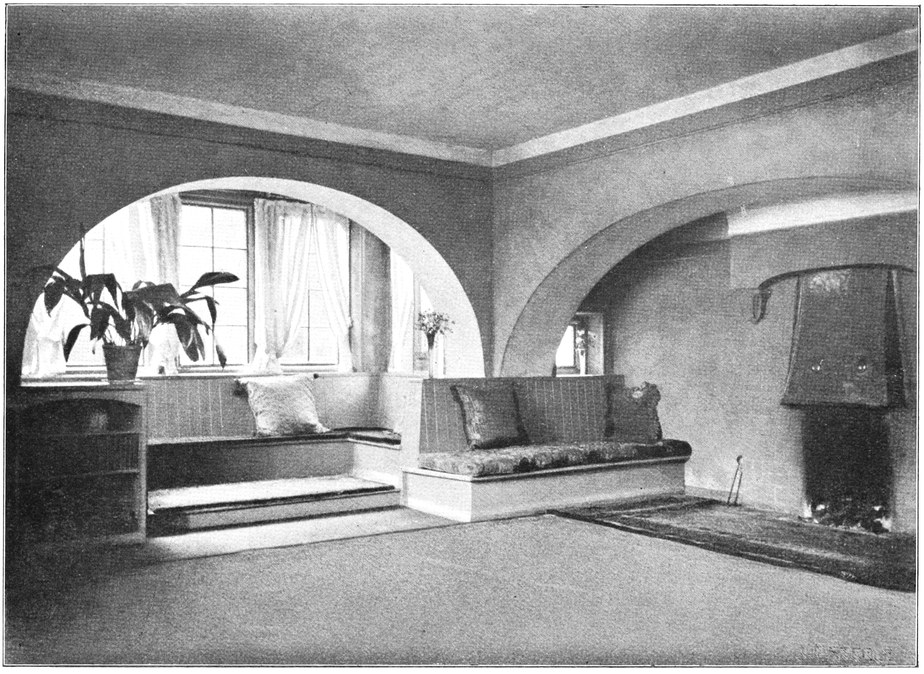
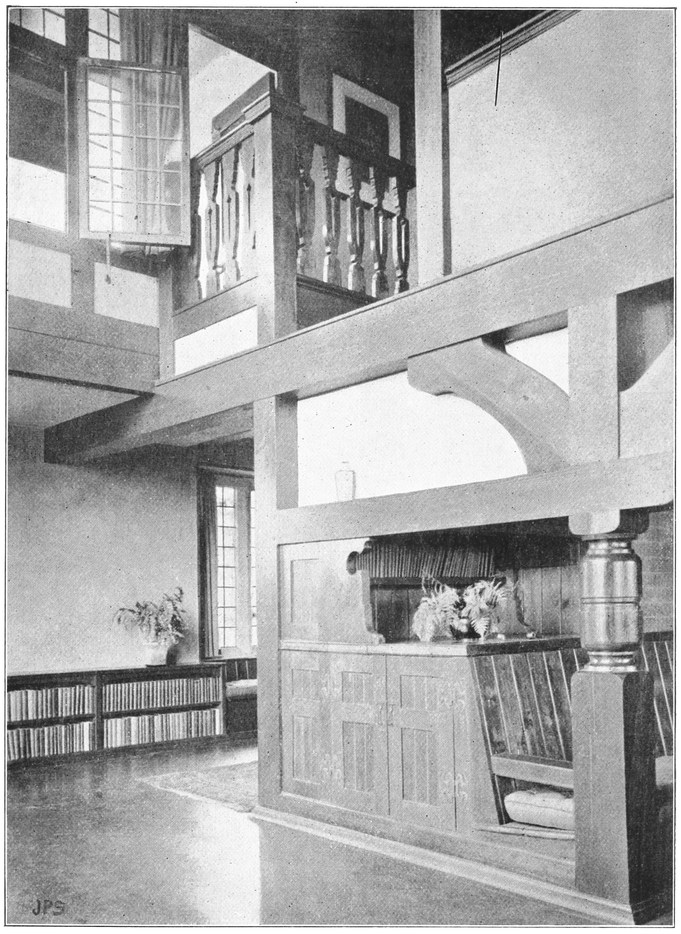
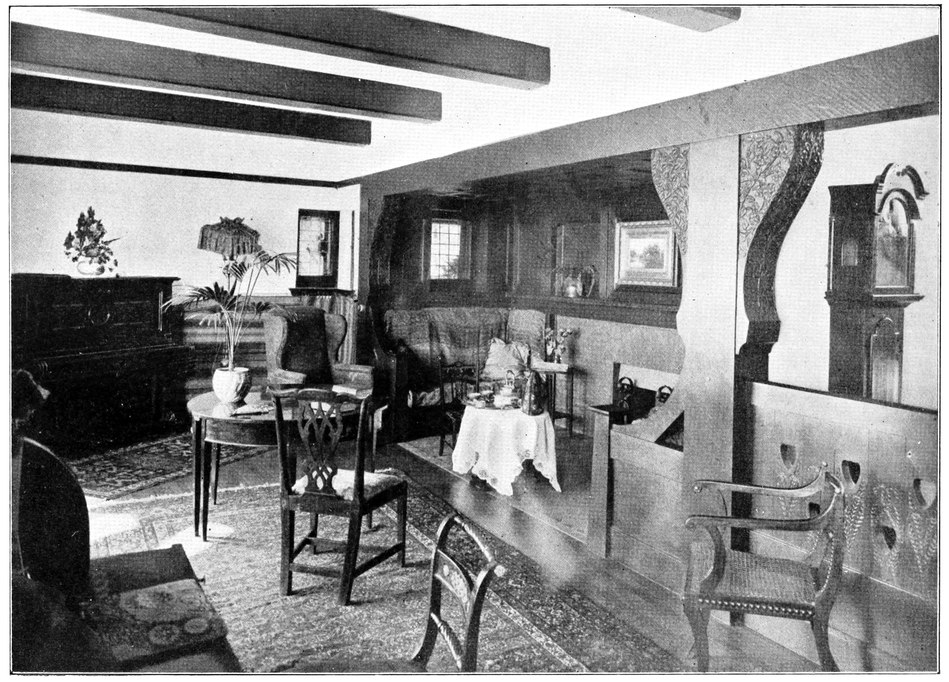
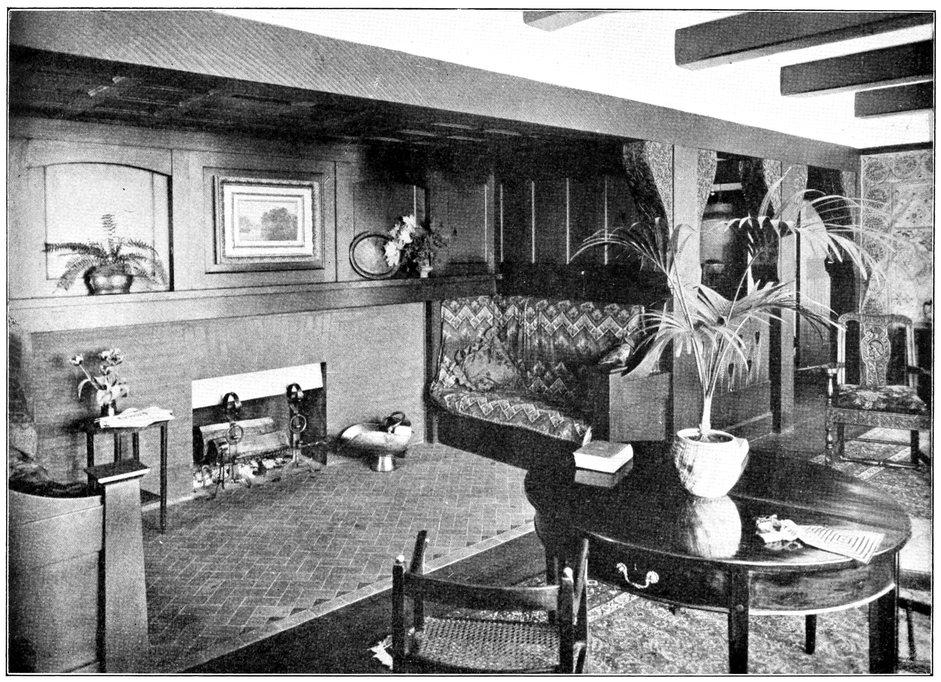
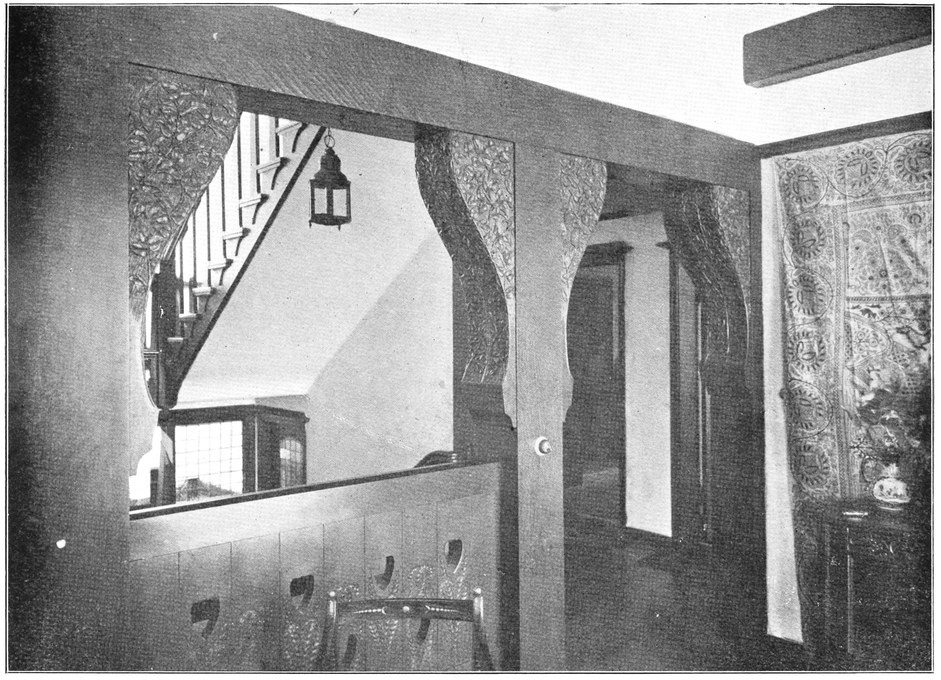
for their places. The advantages attaching to a room
furnished in this way, and largely by means of
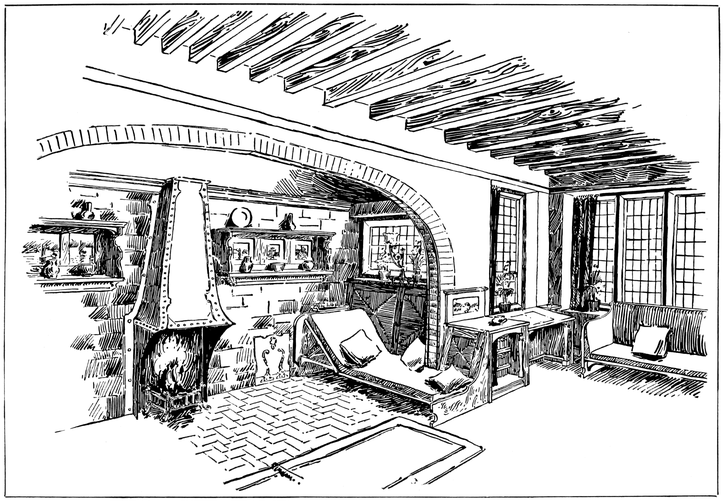
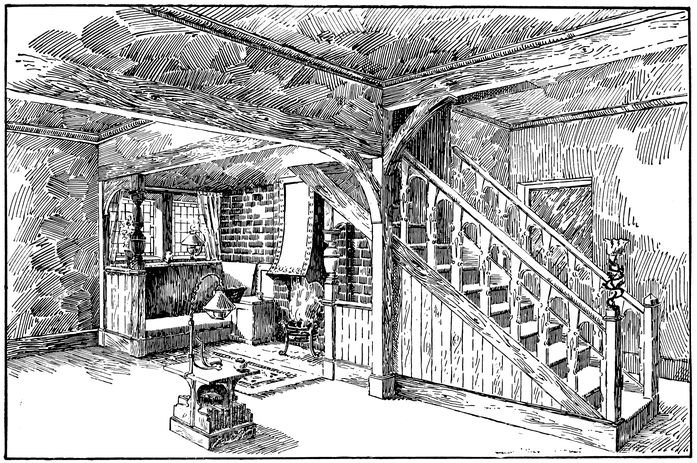
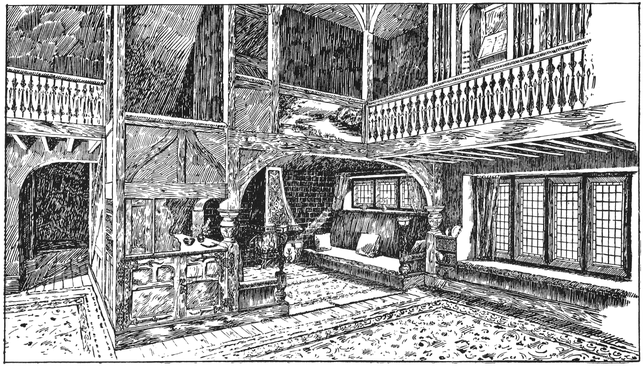
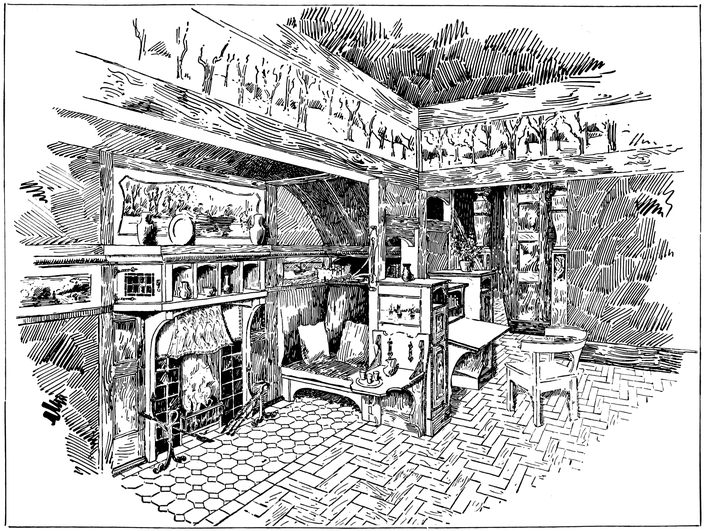
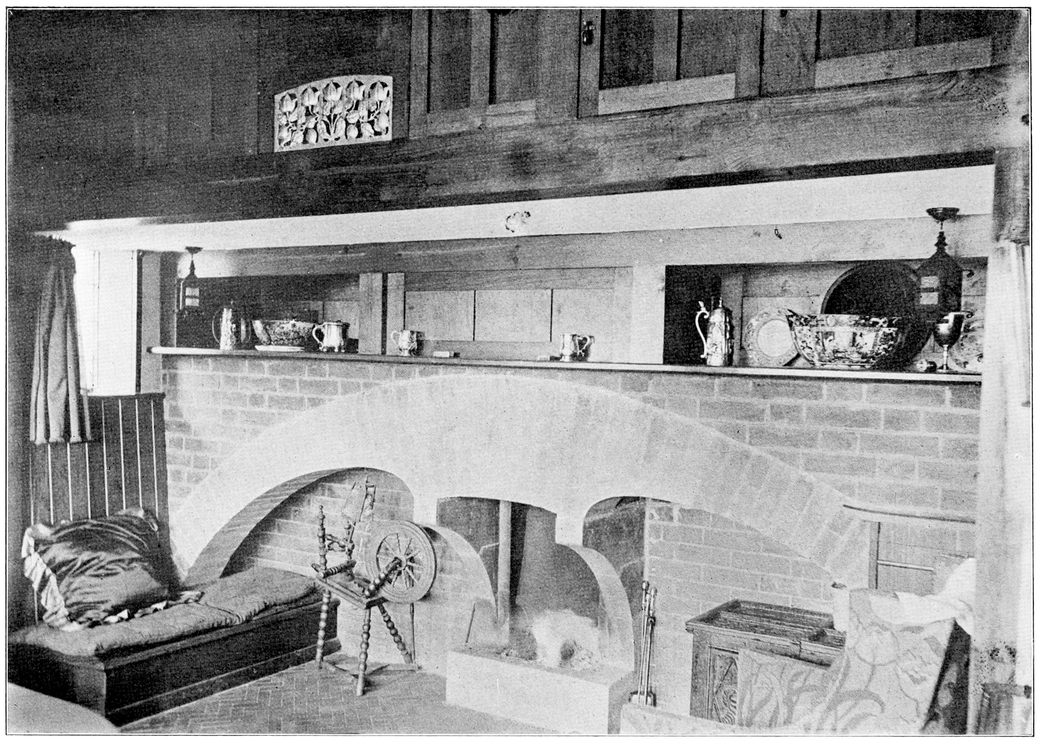
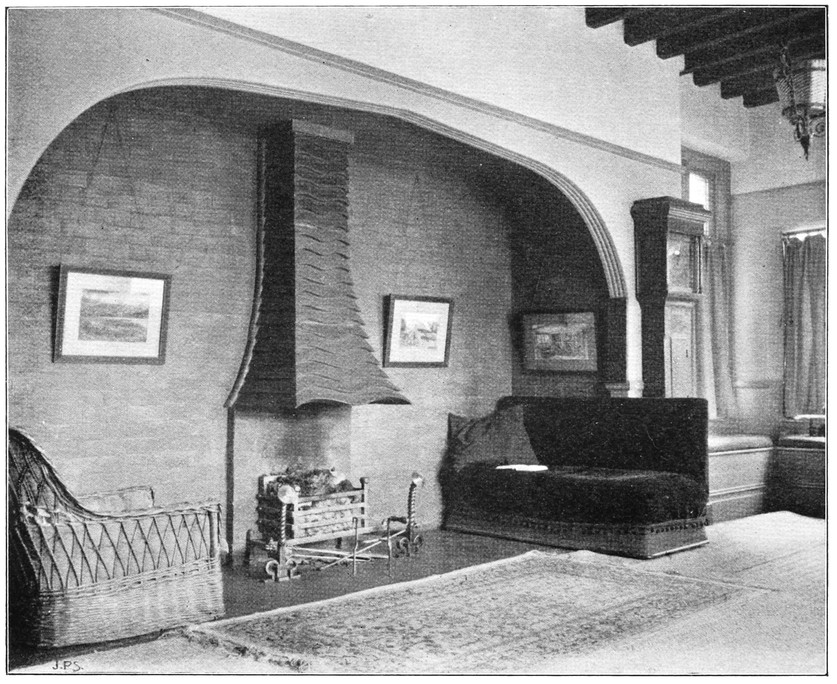
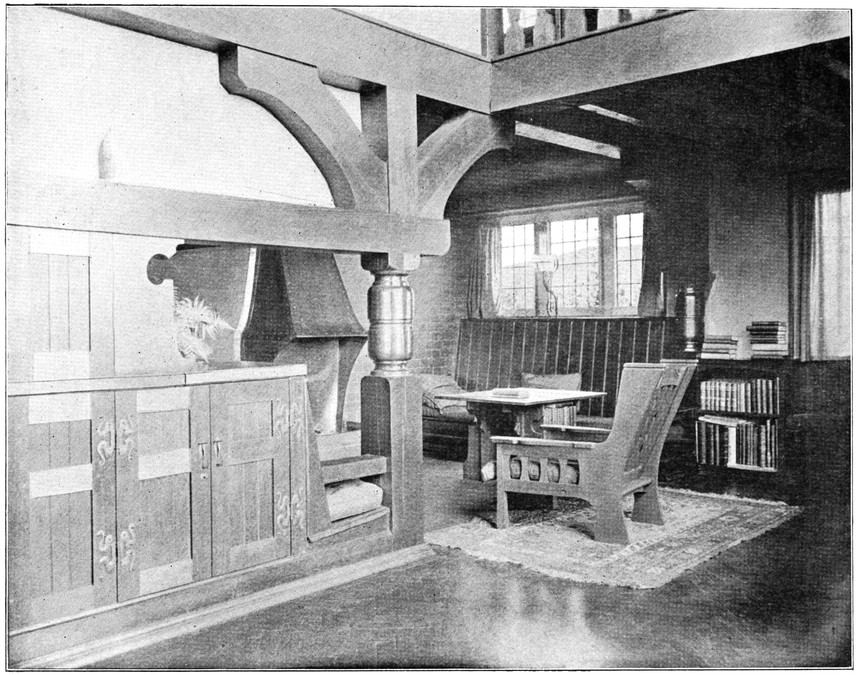
fixtures, I think the accompanying sketches will do
something to illustrate.
There is a unity, completeness, comfort, and repose
about such a room, which can never be got
in a room in which the furniture &c. is not designed
for its position and looking at home there,
but is just temporarily stuck where it happens to
stand, with a look of being on the alert, and ready
to move on at a moment’s notice.
But it is time to sum up our position and note
the general conclusions to which we are led. I have
described some of the defects we most commonly
see in planning, and the arrangement of the hall;
the entire want of reposefulness, (that infallible criterion
of good ornament), that troubles the man
of taste in nearly all domestic decorative work; and
the lack of fitness in the furniture that is generally
crowded into the rooms of smaller middle class
houses, which adds the final touch to the complete
failure, from an artistic point of view, of the great
majority of such rooms.
I further mentioned as causes generally contributing
to this failure, over-decoration, the covering
of all surfaces with a mass of incongruous patterns,
quite fatal, even where the designs are in themselves
good: the effortfulness of most ornament,
by which every pattern seems to clamour for notice,
in which connexion I stated as a guiding principle,
that any ornament you notice before you look for
it, is likely to be in bad taste. Further I noticed
the laboured and unspontaneous character of so
many of the designs themselves and the lack of
good drawing in them, and hinted that this arose
partly from the designer’s dread of repeating himself,
and his eagerness to produce something fresh
without considering whether it was better. Finally
I drew attention to the way in which so many
rooms are furnished with cheap imitations of better
or more esteemed materials, decorated with
cast, or otherwise mechanically produced imitations
of hand-wrought ornament, and the general
unfitness, and ready-to-move look, which results
from there being no fixed furniture, but all having
been designed without any thought of the room,
and the room planned without any view to its furniture.
I have several times hinted that the entire lack of
unity, which is the inevitable result of all this, must
continue, so long as our rooms and our houses are
never thought out as a whole, so long as one man
plans the building, another arranges the decorations,
and a third picks up the furniture of twenty
designers, here and there and everywhere. It is essential
to any good result, that one man should
design the house as a whole. I do not mean necessarily
that he should design everything in it, or
draw with his own hand every detail; but he must
exercise a controlling power, selecting where he
does not design, and ensuring that the work of all
may be done in a spirit of co-operation towards
the complete whole which he planned.
You will all be wishing to ask me, I doubt not,
how this is possible in our days of speculative
building, short leases & shorter tenancies. I must
at once admit that to a large part of this work such
a system is inapplicable, though even here much
could be done if each department made what
improvements are possible irrespective of the
others. The lack of power to control the decorations
does not excuse a badly planned hall. But
outside the purely speculative building there is
yet a large amount of work to which the system is
applicable, in greater or less degree, such degree
mainly depending on our clients: and here we have
the real difficulty. We are powerless to compel our
clients, nay, to a large extent, the client has a right
to have his own way.
I suppose a doctor is in a similar fix; he is called
in to prescribe for a patient and finds his prescription
is useless because the patient will continue to
smoke; he does not, if he is worth anything, accept
the situation; but he explains that smoking
is, in this case, fatal, that it renders his skill unavailing;
and, if all his advice is neglected, he will
finally refuse to act.
Architecture is rightly called a profession only
when the architect advises his client what is best,
and brings the whole weight of his knowledge and
experience to persuade him from anything foolish,
or in bad taste. When he produces to order some
plan of which he cannot approve, he is merely a
merchant of plans.
While speaking of this duty of the architect, I
would not be thought to make light of many conditions
of modern life which will, so long as they
continue, and to the extent to which they spread,
hinder all attempts to produce beautiful and dignified
homes. One such condition is the instability
of social position; everyone is seeking to get a step
further up the social ladder. The result is a demand
for houses which look as though they belonged
to the social grade next above that of the
people who are to live in them. To such untrue
aims art refuses any countenance; and it is well.
But there is an already great and daily increasing
number of those who are weary of this fruitless
struggle, of a life spent in work entirely without
interest or beauty, or the power of giving a vestige
of real pleasure, that they may have the means to
acquire things without interest, beauty, or the power
of giving any pleasure beyond the sordid satisfaction
of letting Mr. and Mrs. So-and-So see they
can afford to have them. These are anxious to find
houses suited to their genuine wants, houses in
which the work will be reduced to a minimum, and
the beauty increased to a maximum, by the only
true method of making all the useful and necessary
things beautiful; not by the false method of
keeping all useful & necessary things out of sight,
trying to conceal their purpose or to appear unconscious
of their existence, and substituting for
them things recognised to be useless but regarded
(so long as the fashion lasts at any rate) as beautiful.
This polished mahogany life of ours, with stucco
trimmings and jerry joints presented for view to
our visitors and acquaintances in the front room,
is not, I believe, what many of us really want; we
are tired also of the dismal and cramped, but at anyrate
real, back office, back room, and kitchen life;
& many are looking for houses in which they shall
not spend their labour for that which is not bread,
but shall be able to live a life of less artificiality
than our present complex 19th century existence,
a truer, healthier life altogether.
I have just said, that the true method of making
a room beautiful is to make all the necessary and
useful things in it beautiful; so much is this true
that it becomes almost impossible to design a really
beautiful room that is to have no useful work
done in it or natural life lived in it. An architect
called upon to design a room in which nothing
more earnest is to be done than to gossip over
afternoon tea has, indeed, a sad job.
For a room must always derive its dignity or
meanness from, and reflect somewhat, the character
and kind of occupation which is carried on in it.
For instance, the studio of an artist, the study of
a man of letters, the workshop of a carpenter, or
the kitchen of a farmhouse, each in its position
and degree, derives a dignity and interest from the
work done in it. And the things in the room bear
some relation to that work, and will be the furniture
and surroundings natural to it; as the bench
and tools in the carpenter’s shop; the easels and
canvasses in the studio; the books and papers in
the study; and the bright pans and crockery in the
kitchen. All these lend a sense of active, useful, human
life to the room, which redeems it from vulgarity,
though it be the simplest possible; and no
amount of decoration or ornamentation can give
dignity or homeliness to a room which is used as
a show room, or in which no regular useful life is
lived. For in the work room all things have a place,
by reason of their usefulness, which gives a sense
of fitness and repose entirely wanting in a room
where a place has obviously had to be found for
everything, as in a drawing room.
How far things beautiful alone, are to be allowed
place in our rooms I am not prepared to say. Thoreau,
you will remember, threw away his fossil, the
only ornament in his room, because it required
dusting. While not suggesting that we should follow
his example to such an extreme, I yet think
that in retaining his spade and his axe he retained
more of true decoration. And I believe in the main
that the more adapted to its use anything is, the
more graceful will it be in shape. The bent handle
of the axe, more comfortable to hold, is also more
beautiful than the straight, and in the degree the
curve and form of the handle is adapted to its uses
as an axe, by just so much the more beautiful it
becomes.
The charm of the farmhouse kitchen, with everything
in its place because of its usefulness, can of
course be increased to an unlimited extent by making
all the useful articles also beautiful in form,
and harmonious in color. This is the line on which
alone, I contend, a really beautiful room is to be
got; and I would discourage all attempts at adornment
by finding places for useless things.
I am glad to think that, owing to the great increase
of education and employment among ladies, there
will be less and less call for the old-fashioned drawing
room; ladies will want a room to work in, not
to dawdle in.
Pardon me if I seem to have dwelt over long on
some of these difficulties in the way of designing
really beautiful rooms. I have done so in the belief
that they do not, as at first may appear, lie outside
our province. For I believe, as professional men,
we have just such power of influencing our clients
by helping them towards a more natural life as the
doctor has in such matters as diet; and particularly
is this power evident in the domestic branch of the
profession, with which we are dealing.
In building a man’s shell for him we certainly can
influence very largely the life he will live within
it; and while it is our duty to make that shell fit
the life as well as possible, it is surely also our
privilege to make it conduce to the realisation of
the best of which he is capable.
In so far as we do this, we shall rise above the mere
planner of houses and take our places in the work
of planning and moulding the future life of the
people.
BARRY PARKER.
THE DIGNITY OF ALL TRUE ART.
The kinship between all the
various branches of art is so
very close, that instead of
speaking of them as different
arts, it would really be more
accurate to describe them as
only different media for expression
of the same truth.
Our object in trying to express ourselves in some
one form of art, is to bring home to those to whom
this form most appeals, truths which we see are
passed over by them unheeded and uncomprehended
when expressed in another. Many of the
principles and truths I hope to bring before you
are so much more easily set forth in other arts than
that of language, that the attempt to use this form
would seem unnecessary and undesirable were it
not for the truth of what I have just said, that each
of the arts appeals & clearly expresses its meanings
and teachings only to a part of those to whom it is
addressed. All feel something of the meanings expressed
through art, no matter what form of expression
may have been chosen, but every one will
be more directly appealed to and will more clearly
understand the message expressed in one art than
they would that, or some other message, expressed
in another.
It cannot be denied that many get from music
what they see not in poetry, while others learn
from poetry what they miss in music, painting,
sculpture, or architecture; that some can feel and
know truth in architecture they find not in the
drama, and many learn from the drama what no
other art can teach them.
For though it is true that many of our greatest
artists could have expressed themselves, as some
have expressed themselves, with equal power
through several media; many of our greatest poets
might have made equally great painters, and our
painters, poets; still few could possibly find time
to acquire equal knowledge of several arts. And
though most men, being masters of one art, will
have abundant sympathy and love for the others,
yet life will prove too short for them to come to
feel and know the messages or truths of any other
with equal clearness. But, having them in the
depths of their natures, they will feel, though dimly
perhaps, that they are all one, and that their
vital truths belong to all alike, and are essentially
the same in all, and are of the very life of all that is
worthy, all that is beautiful, true, or noble.
Now all the greatest truths are so broad and universal
in their very elements, that they are incapable
of clear definition and must depend on the
subtleties of true art for expression. And in this
lies the dignity of all true art, in that by it and
through it only can the highest truths be taught,
or true education reached.
Music is the most perfect means of saying what
cannot be expressed in words. None of us can
translate into words what has been revealed to us
through music, it is a means of expression above
and beyond words; painting, poetry, sculpture,
architecture, even a mere colour scheme, can all tell
us much which is beyond the power of any direct
expression. The deeper the truth the more dependent
it is upon one or other of these arts for
its expression. None of us can say what music has
brought home to us, none of us can tell what a
beautiful building has said to us. If we try to give
all these things in words, “beauty,” “truth,” or
that hopelessly feeble phrase “elevating influence,”
and kindred terms, are all that come to our aid
with which to tell of them. Into these weak inadequate
words we have to read all that which we have
learned from other arts, & so give them a meaning
they are incapable of conveying, unless we have
felt it through influences above and beyond them.
Music, the most perfect of the arts, is the most subtle,
the most inexplicable. It seems to be, (if I may
use the expression), the most direct gift of God to
man, excepting of course that revelation of Himself
which we call Nature, and which is above all
arts or anything needing man’s instrumentality.
Why has music this power of calling forth all that
is best in us, of making us feel the great things
beyond expression? We cannot say.
We feel, and so we know and realise, that music
never deceives, and is the only art which is never
misunderstood. Her revelation is either taken or
left, it is either comprehended or passed by unheeded,
but it is never misconstrued. It may be
understood and felt in a degree only. It may give
more of its message to one than to another, but in so
far as it is understood at all, it is truly understood
and never misleads, and herein lies its greatness.
Some there are who say they can express by language
or other arts what the musician is speaking
of in his music; this only shows that all in which
music transcends other arts is beyond their conception.
The messages music has for us are above
and beyond such things as can be put into words,
and to have it merely telling a story which could
equally well, or perhaps even better, have been
told in words, or even to have it imitating the
sounds of the sea, the voices of the storm, the
whisper of the trees, or the sorrow of the wind, is
to miss much of its greatness.
The messages of music may have been at some
times the same as those of Nature, in the sea, the
stream, or the trees, but to make it merely a less
comprehensible language, telling us what written
or spoken language can tell us, is to take from it
much of its nobility and to deprive it of some of
its most sacred prerogatives.
So if we follow this through we see its truth in
all the arts. Poetry, partaking of the character of
music, can bring home to us things too subtle, too
high, to be told to us in prose, but may be misunderstood
as music cannot be. In its highest influences,
in those elements which it has in common
with music, it is, like music, either taken rightly or
not comprehended at all, but in many of its lesser
and more definable messages it may be misunderstood.
A very little thought will show how absolutely
true in literature is what I have said, as to the position
art must hold as the only means of expressing
the greatest truths, and will show too, that just as
our theme advances in dignity, will it increasingly
need the aid of art to give it expression. The meanest
things of life are most easily expressed. We
can give our financial position with clearness in
figures. We can express the composition of a gas
with absolute accuracy in a formula. We can give
almost any mere scientific fact in words. We can
even state the properties of a triangle with some
definiteness. But beyond this we cannot go without
calling Art to our aid; and the higher we attempt
to soar the more dependent upon her do
we become.
Our laws and legal documents are a constant comment
upon and illustration of the utter failure inevitably
resulting from any attempt to express
with absolute accuracy, without the aid of art, any
of those things which involve questions of morality,
love, truth, justice, or any of the higher qualities
of our nature; for they have always been and
must always be the most obscure, involved, and
incomprehensible attempts at expression in any
language.
So we go upwards from the scientific formula and
the laws of geometry, past the legal document to
the newspaper article, and everyday prose, until we
come to the more matter-of-fact forms of philosophy,
thence on to parable, fiction and fairy tale, &
from these to sculpture, architecture, painting, and
poetry, calling in at every stage more and more of
the aid of art, until we arrive at last at that most
perfect art, and most complete expression, music.
And observe, all the way through the series we
have moved less and less within the regions of
definitely statable facts, and more and more in the
regions of those truths which can be felt & known,
but not definitely expressed.
Great truths, which are for all time and all peoples,
must be expressed in an art at any rate as high in
dignity as parable in one of its many forms. The
greatest teachers have recognised this. All great
truths must be presented in a form in which those
who are capable of realising them can find them,
while others miss, & each can take away what he can
comprehend. This is only another way of saying
again, great truths can only be expressed through
the medium of art, for it is an essential property
of all true art that it shall suggest and imply more
than it actually says.
I have said art is the only true educator between
man and man, and a knowledge and appreciation
of those things which through art alone we can
learn, is the only true education. But I would
not for one moment be thought to lose sight of
the fact that Nature can and does teach us more
than any work of man. She has influences over us
tending to the highest education; with these I was
not concerning myself in the above, for I was
speaking of man’s influence upon his fellow man.
I am to try and give some idea of wherein lies the
life and vitality of some of the humbler branches
of art. I say humbler, for I will have none of the
shallow hypocrisy of those who, not being able to
paint a great realistic picture, pretend that their
little conventional decorations are a higher and
nobler branch of art, and who, because the great
picture may be still greater by being also decorative,
and can only attain to its greatest when it is
also decorative, argue that all decorative art is
greater than pictorial.
It is my aim to show that to these applied arts also
belongs much of that power to express those higher
things which are felt and known only through
art.
We all know that the mere form of a chair, the
contour of a mould, the shape of a bracket, a
scheme of colour, have power to affect us, in a degree,
in just the same way music does, and, with
awe let us realise it, even as Nature herself does.
And I would have every craftsman and every practiser
of the arts as deeply impressed with the dignity
this places upon him, and the responsibilities
it brings with it, as he can possibly be. I would
have him feel this truth, that in his degree he is
instrumental in either forwarding or retarding his
fellow men in their highest and truest education;
that in just so far as his art is true or false, real
and vital, or feeble and insincere, he is advancing
or hindering this great work; that true art is the
grandest work of which humanity is capable, and
that through it alone can man advance to higher
things than those of which he is now capable.
We can none of us know, and certainly none of
us are in any danger of over-estimating, the good
influence of a beautiful building upon all those
who pass and repass it daily; and the smallest and
most insignificant article in our daily use has, in
its own degree, like power to help or hinder our
development.
Wherein truth in art consists, none but the artist
can know, and he cannot tell to another what he
knows of it himself; he has learned it, first from
an inborn instinct and gift, and second, by that
education which true art only can promote, and
others can only come to a knowledge of it in the
same way.
The whole spirit and trend, all the outside circumstances,
influences, and conditions of modern
life, are against the artist and true art. The present
individualistic and competitive basis of society
makes a living art almost an impossibility, but I
do not propose we should concern ourselves now
with questions which are not within the designer’s
power, but only with those things which he can
and must see that he personally rightly understands
and practises.
No good work in any field of art was ever yet done
in a hurry; it maybe done quickly, with the utmost
energy, this will probably only give it vitality, but
all outside pressure means death to art.
All true art work must always be done under the
very keenest stress of mental effort; it cannot be
slovenly, careless, or interestless in its smallest detail,
but must be wrought with every faculty alert
with an absorption and concentration amounting
to abandon, and it must be done, can only be done
for the love of it. Other motives there may be, and
in greater or less degree there will be, but this
must be first and paramount, or true art is impossible.
A very fruitful cause of failure is the effort to be
original. In the loathsome distortions of fashion
we see daily the result of this attempt to originate
new forms, simply for the sake of novelty, without
the slightest reference to any feeling for beauty or
fitness. Originality has no value other than a purely
commercial one, unless the original thing has
advantages over the commonplace. Most of the
things which we have about us show unmistakably
that their designers went to work in the wrong
spirit from the very first. We see at a glance that
the position taken up was this. The designer has
said to himself “This is generally done so and so,
in such and such a manner; now how can I modify
this to make it in some degree original: where can
I introduce a little novelty?”
No good result was ever yet arrived at by any one
who took up this position. No: the way to go to
work is, to get clearly into your mind the functions,
duties, requirements and limitations of the
thing to be designed, then choose the material or
materials which will enable it best to fulfil its functions,
duties, and requirements, and keep within
its limitations. Afterwards, with a full knowledge
and candid recognition of the properties and characteristics
of your materials and the best way of
using them, set to work to evolve the form which
will, in the simplest and most direct & at the same
time most beautiful and decorative manner, fulfil
the requirements, and the result will bear the impress
of your own personality, it will have your
own feeling, and will probably also have something
of true originality.
You may if you like, with all this clearly in your
mind, pass in review the customary forms employed
to fulfil the conditions, retaining such characteristics
as you see are valuable either because
they advance the objects, or add to the comeliness,
but this must come second not first.
I would like you to notice in passing that this right
and true method of going to work in design is
entirely inapplicable to all things having no functions
to fulfil, by such a throng of which we are
now surrounded.
The whole trend of modern civilisation would
make the outlook for the artist one of blank hopelessness,
were it not that there are signs of a reaction,
due to the efforts of great men who have
fought hard that art may not die.
We call the present the “Machine Age.” Now the
influence of machinery on art is one of the most
degrading we have to contend with, for every advance
made by machinery must mean a corresponding
retreat on the part of art.
When I have expressed the keen sense of pleasure
given me by the beautiful variety of surface, the
light and shade, the crisp, clean adze cuts, the vital
human interest, of some old beam, the commercial
mind has said to me “If the workman who wrought
it had possessed the tools with which to get it up
to a better surface, he would not have left it as it is.”
This is probably true, but it does not affect the
question of the relative beauty of the two beams,
the absolutely square, smooth, machine planed one,
and the irregular rough hewn one so full of character
and interest. The artistic value of each is a
question quite apart from such considerations. To-day,
if we require a beam in our building, we take
every bit of natural character out of it, and bring
it, by mechanical processes, to as dead and flat, as
lifeless and monotonous a state as possible, then
we stupidly try to replace some of the natural and
characteristic beauty we have been at so much
trouble to get rid of, by some form of applied ornament,
moulding, or what not, which probably
has only this one result, that it obscures the one
trace of natural beauty which has been able to survive
the previous processes, that is the grain and
figure of the wood. Afterwards we stand and look
at it, with a sort of feeling that there is something
wrong, and wonder why it was so much more
beautiful before.
This is only one illustration, it would be easy to
give hundreds. For beauty of texture and surface
are nothing to the machine producer or the commercial
spirit of to-day.
When I say I want a piece of copper just hammered
out to the size and shape I require without
that grinding and polishing by which all trace of
the hammer & human hand is lost in mere smoothness
and mechanical finish, the workman tells me
it will be injurious to his credit, people will see
nothing in it but bad workmanship and inability to
finish. He would prefer to efface the sympathetic
surface and natural beauties of the beaten metal
as completely as possible, then he would put it
in a press and stamp some meaningless pattern on
it, but the result would be entirely uninteresting
to him, and he would have no satisfaction in it,
unless sheer commercialism had utterly killed
every grain of everything higher than itself in his
nature.
Think of the beauty of leaded glass compared with
the lifeless hard mechanical perfection of polished
plate. This beauty has nothing to do with its old-fashioned
look, with romantic associations, or
quaintness of effect; it is simply an inherent property
of all leaded glazing, due to the wonderful
and never ending charm of the play of light and
shade on the different panes, each one catching the
light slightly differently from any other, some glistening
brightly, others dead and sombre, and the
rest occupying every tone between the two. One
sheet of glass with the leading laid upon it would
be more ugly and meaningless than the plate glass.
Many would-be artistic people think that it is an
essential characteristic of the artistic that it should
be in some degree eccentric or unusual. This is as
great a delusion as any one could well labour under.
That it is the case at the present time cannot be
denied; but it is because we have sunk to such
depths of degradation, that the artistic has become
the eccentric and unusual, not that to be different
from the ordinary is the property of the artistic.
There was a time when the exact reverse was the
case, when simple natural beauty was the rule in
all things and ugliness the exception, and the unusual
and eccentric was then the inartistic.
So also many would-be artistic people think that
things derive an artistic value simply from being
old or old-fashioned. This again is entirely untrue
except of such things as undergo a modification
and change for the better in themselves at the
hands of old Father Time. But this too is an error
easily accounted for, as at the present time, as regards
the common things of daily life, the standard
of design is so debased that it would be almost
impossible to bring out of the past (at any rate of
centuries before the last), forms for these which
would not surpass in beauty those now current
among us. If art in our homes were living and
progressive the old and old-fashioned would be
the ugly and inartistic.
A perfectly frank recognition of construction and
an honest compliance with its demands is an absolute
essential of all good designs; any attempt
to disguise or thwart, or failure to acknowledge,
the necessary characteristics and features of construction,
must result in artistic disaster and is indeed
a very fruitful cause of it. So also is that
kindred error, the adoption of a less perfect construction
to get the form wanted. It is not necessary
I should dwell upon this now, for it is recognised
by all art teachers, though by very few of those
who practise the applied arts, and illustrations of
the truth of it meet us in abundance on every hand
and will occur to all.
Neither is it necessary (and for the same reasons)
that I should say much about imitations & shams;
wood made to simulate stone or marble; iron cast
in forms suited only to wood; wood worked into
forms suited only to stone, or in imitation of stone,
as in tracery and groining. The evil of all this is
too well known, and I have had to pass over it for
the sake of what is less recognised and not so often
brought before us. To put the right thing in the
right place; to give it its most appropriate form,
and above all things the form which will best enable
it to fulfil its functions and uses, and withal
the simplest, most direct, and the most perfect
in construction; this is the first duty of every designer,
and in doing this he will generally find he
gets the maximum of beauty.
The conscious effort to be original will always produce
abortions and painful results; the only originality
worth anything is arrived at in trying to do
something better not something new; and the true
artist shows himself in giving beauty of form, of
colour, and design to the necessary and useful, and
adding that higher usefulness belonging to a work
of art. But may we not have ornament, pure ornament
which has no other definite use? Certainly
we may, but let us at the very outset apply this
test to it. It does not, we say, fulfil any useful purpose
on the physical plane, does it fulfil any purpose
on that higher plane of which I have spoken?
Is its educational influence good? If so we will
welcome it. If not let it go. And I fear, when this
test is applied, it will be found that there is but little
of the enormous profusion of the (so-called) ornament
spread over everything about us, which
would not have to go.
Most of us would do well to change it all for one
or two good pictures, a bit of really beautiful metal
work, carving, or embroidery, done by an artist
with his own hand, and possessing something of
that dignity of true art I have tried to show.
BARRY PARKER.
OUR EDUCATION IN ART.
My subject is “Our Education
in Art,” & I approach
it with a sense of trepidation,
feeling that the task
I have set myself is one of
very great difficulty, and
being, as I am, so fully alive
to the tremendous issues
involved in our holding right or wrong views upon
art education.
The place in our lives which Art must fill is so
exalted that it is with reverence I would consider
the way in which we should teach or be taught to
express ourselves in art, or learn to read the meaning
of others expressed through that medium.
Those who have come to realize that only by the
employment of Art can the highest truths which
we are capable of receiving be conveyed from one
man to another, must feel that the method of preparing
ourselves to wield so great a power, or
render ourselves receptive of such an influence,
should be most earnestly considered. I have taken
“Our Education in Art” as my title, instead of
“The Education of an Artist” or any other title
which would have fixed more definitely the limitations
within which I should confine myself, because
I want what I am about to say to have a
much wider application than it would if simply
taken as addressed to those who propose to practise
an art. For, to train all to an appreciation of
what is good, true, and beautiful, in Art, is hardly
less important than to train artists capable of
expressing what is good, true, and beautiful.
All have not vouchsafed to them the power to express
themselves in an art, but all are in some degree
influenced by the artistic qualities of the
things by which they are surrounded, and I wish
to suggest a way of learning to appreciate what is
good and true and beautiful in art, even more than
a way of learning to create such art. That there
shall be those who can appreciate good art is necessary
to its life. That we should have those who
can create it is not enough; this is the work of the
few; the work of the many is to make an atmosphere
in which it can live. I would impress as
gravely as possible upon those who aspire to the
practice of an art, not only the dignity belonging
to what they would undertake, but the tremendous
responsibility attaching to it.
The first thing that must go to the making of an
artist is that he should have that within him which
craves for expression, and which can only be expressed
through the medium of an art. This first
essential is given to many to whom the power to
express it is not given, but without it the facility
to express will be a power for harm not for good:
it is the presence of great qualities, not the absence
of bad, which makes a work of art.
The artist’s great responsibility lies in this: every
time he creates anything capable of bearing the
impress of the true art instinct, he brings into existence
that which will have an influence upon all
who see it, and will quicken or deaden in them this
high instinct. The thought that, if he create not
something better than would have been created by
others, had he left it to them, he is doing harm in the
world, not good, is one that should come home to
him very solemnly. To the art worker belongs this
privilege—that his art can be a great power for good;
and this responsibility—that he must of necessity
have done either harm or good by his work, and
that unless he has done something which is beyond
and above the conception of the general run (nay,
of the great majority) of his fellow-creatures, something
they feel to have a little more in it, and to
be a little more than they can grasp, he is not
merely harmless, he is a failure. For as in life generally,
so in the artistic life, he who merely does
what no one can attach blame to, and has not done
better than others would have done in his stead,
has lived to no purpose. Virtue is not a negative
quality in art or in life; it does not consist in keeping
the Ten Commandments. “All these things
have I kept from my youth up: what lack I yet?”
This man 1900 years ago had grasped the truth
of what I have said above better than most of us
have to-day.
I will herein confine myself to speaking of those
arts which depend upon our eyes for their means of
appealing to us; and as I wish that these suggestions
may be of real practical value, to all who desire to
appreciate what is artistically good and true, I must
leave out of our consideration, for the moment, all
the greater qualities which belong to art; and confine
myself to showing how we must first learn to
see, and to what I may call the purely technical side
of learning to see and represent. For simplicity I
will take the art of portraying Nature, as seen in
her landscapes, as my example of how to learn both
to see and to draw; for the process is the same in
either case.
Now when first one attempts to paint a landscape,
one is over-whelmed by the tremendous number
of different things one sees in it and has to take
into consideration at the same time. There is the
form and drawing, the light and shade, the atmosphere
and its effect upon the local tints or real colours
of each individual object in the landscape, the
overpowering profusion of detail, the reflected
lights and reflected colours, the relative value of
objects, the texture, and character of surfaces, the
composition, what we call the accidental effects;
and last but not least, the teaching and meaning,
the particular message Nature has to convey in
the whole scene. And only by long and patient
study of each of these separately, can we acquire
the power to grasp them all together in the way
which is necessary when painting.
Were I to teach, I should make my pupils go
through a long and patient study of each of these
separately, devoting much thought to each in turn,
quite apart from the use of pencil or brush; for it
is impossible to represent one without the others,
but not impossible to study one without the others.
And that we should be able to first dissociate one
from another in our minds, and then see the influence
of one upon another, is absolutely necessary
to a true portraiture of Nature in landscape.
I would then begin with the simplest of the things
in my category, and impart to my pupils a knowledge
of form (probably best done by some simple
process of modelling), and I would go on to the
drawing of form without reference to light and
shade. Next I would teach them to see form in
masses of light and shade only, leaving out of consideration
at the first (as far as possible) the influence
of reflected light, but eventually giving much
time and thought to enabling them to see the reflected
light truly, and to measure its gradations
and degrees accurately. From this they should go
on to represent textures and character of surfaces,
and not until all this had been done would I bring
in the use of colour. This should begin by the
accurate matching of local tints, before the representation
of the colour effects produced by atmosphere
with its varying degrees of moisture, of
density and transparency or opacity, its power of
diffusing light, and its effect on distance, was
attempted. Next I would allow sketching with reference
to composition, grouping, and much study
of the relative values of one object to another in
the landscape, affected as it is by all the foregoing,
and difficult of explanation as it always is, even in
view of and with a perfect knowledge of all the
foregoing. Finally, being first able to see and feel,
then we would go on to try to catch & portray the
moods and messages of Nature, and the poetry of
the whole.
I would then point out to the accomplished craftsman,
that he, upon sitting down to paint from
Nature, must first ask himself what it is which
makes a picture (in the true sense of the word) in
what is before him, and why he has chosen this
particular subject: and he must never for a moment
allow himself to lose sight of this. Much
there is he must of necessity leave out, but he must
grasp the essentials and retain these. His study
has taught him to see things as they present themselves
to his eye, rather than as he knows them to be.
In a sentence, he has learned to know what he sees,
not to see what he knows: he is aware that yonder
hill in the distance, were he there, would be green,
but that seeing it as he does, affected by the intervening
atmosphere & light, it is blue. The painter
must by training, and power of analysing causes
of effects, be able to see his subject somewhat as he
would were he suddenly dropped into his seat from
another planet, without any knowledge of the appearance
on closer inspection of the component
parts of his subject. May I explain some of what I
have said, with the aid of a simple example, a stone
wall bounding a green field, the wall casting a shadow
on the grass. Of drawing pure and simple there
is not much; there is the form of the stones in the
wall, the irregularities of the contour of the field,
the shadow of the wall & the modifications which
the rise and fall of the surface of the field effect in it,
presenting it to the eye now more foreshortened
and now less as the angle between the wall and the
ground changes. In the reflected light there is much
to note and dissociate in our minds from the direct
lighting. In this we should see that the shadow on
the shade side of the wall is much lighter than the
shadow cast by the wall upon the grass. This results
from the fact that the grass from its horizontal
position receives far more diffused light from
the atmosphere and the sky than does the vertical
surface of the wall; therefore it reflects more light
upon the wall than the wall can in its turn reflect
on to it. But though the shadow on the shade side
of the wall is lighter than the shadow on the grass,
the shade side of the wall will be darker than the
grass within the shadow of the wall; and this is
not due to the local tint, the grey of the stone and
the green of the grass, for probably the horizontal
surfaces of the stones on the top of the wall, show
as light as the part of the grass which is also in the
full blaze of the sun; it is due to the different
character of surface or texture of the grass field and
the stone wall, and the different effect upon each of
varying degrees of lighting. So observe, all these,
the light and shade, the diffused and the reflected
light, the character of the surfaces, the local tints
and the atmosphere & distance from the observer,
all affect the relative value of the tone of the grass
and wall, which value must be seen truly before it
can be painted truly.
As I said, for simplicity, I have herein so far followed
out the course of study as applied in landscape
only, but at the right stages I would have the
student, in exactly the same way, study the seeing
rightly, and then drawing rightly, first plants, then
animals, then the human figure; then finally I
would let him apply his knowledge and artistic
feeling to design.
Art is at its greatest when applied. If the great
picture, while retaining all its merits as a picture,
can at the same time also hold its own as an element
of decoration and lend its aid to producing
the general effect to be made upon us by the whole
building, it is by so much the greater. I would not,
until the final stage, encourage the study of any
form of applied art. None of the figures drawn or
studied should be those applied to the decoration
of a building, used in flat design, or in any way
conventionally treated or grouped. I would encourage
no study of ornament of any style, period,
or nation. Our need is for a system of education
which will strengthen our inborn perception for
what constitutes real beauty. It is comparatively easy
to learn to distinguish a beautiful thing from an
ugly thing, but to know wherein the difference lies
is quite another matter. It is our education in art
that must strengthen our power to see what are
the essentially beautiful properties which the one
possesses and the other does not. We, whose work
it is to design, frequently find the client who has
best been able to appreciate the difference between
the good and bad design in the finished result, will,
when a design is being worked out for him, be
most emphatic in his instructions that one by one
every feature which has contributed to that difference
shall be eliminated: and the bearing upon this
of what I have said, about educating those who
are not to practise the arts, but to appreciate, will
be easily seen.
He who has studied landscape earnestly and lovingly,
and learnt to see wherein its beauty lies,
when he comes to apply that landscape to an architectural
or decorative purpose, such for instance
as the decoration of wall surfaces, stained glass, or
what not, will find his own characteristic way of
conventionalising it. His conventionalisation will
be such as is dictated to him clearly by the limitations
of the material in which his design is to be
produced, and by questions of fitness and suitability.
And his feeling for true beauty will enable him
to retain the essentials of the beauty in the landscape
he is applying, & to discard what is less necessary.
He will suggest the mood of Nature and convey
her influence upon the beholder. He will also, in
his freedom from the influence of long established
conventions, be able unconsciously to impart his
own personality and feeling, and so give real originality
to his handiwork.
For him who would practise the art of the architect,
a course of study directed primarily to the
strengthening of the power to see wherein lies the
secret of the beauty of one form over another, and
not merely that one form is more beautiful than
another, is perhaps more important than to him
who follows any other art appealing to the eye: for
this art is further removed from the influence of
Nature’s own teaching.
I have been obliged to dismiss in a single sentence
the training by means of drawing and studying
plants, animals, & the human form, which I would
advocate; and fear I may so have given a very
wrong impression as to the importance I attach to
this study. I must ask that this be not measured
by the time I have devoted to it; for I hold it to
be all-important, and the work at it should be long
and thorough. In this work the student could be
carried much further in many of the separate
branches of his study I have indicated, than he
could be in landscape. The plants & animals would
demand of him a far greater perception of the subtleties
of form than did the landscape, and of course
his drawing would be carried very much further.
He would have to apply all he had learnt of light
& shade and reflected light under very much more
complex conditions. Much more subtle distinction
of the character of surfaces and textures would be
required of him; and also greater nicety of perception
in local tints. But composition or grouping
should not enter yet into his consideration. Before
he thought of these I should want him to specialise,
and decide in what field of artistic labour his feeling
& knowledge were to find expression. I should
then require that he get a complete mastery of the
technicalities of this, and of its methods, restrictions,
and capabilities. If he elected to be an architect,
I would have him acquire a comprehensive
knowledge of pure building construction, but no
architecture—in so far as it can be separated from
building construction. If possible, I would have
him learn one of the handicrafts for which he is
eventually to design, that he might show forth his
feeling for beauty of form modified by, and in due
and proper relation to, complete mastery over
methods of construction. If he were to be a sculptor
I would have him next master the technical side
of the art. If a glass painter he should be able to
make a window before he attempted to design one.
The embryo painter should master all the details
of the painter’s art; the would-be textile designer
should work at a loom; and the ceramic designer
with wheel, mould, glazes, & kiln. Then at length,
each should in his own line attempt to give expression
to his own ideas, his own feeling, and his
own love of beauty, in something really to be used,
and for which there was a definite requirement
and a place in the world already assigned.
And this brings us to what I consider perhaps the
most vital point in the whole system I am advocating.
The student is now in a position to solve
the difficulties which will beset him on every hand.
In his own way he sets himself to create that which
will best fulfil certain definite conditions and requirements,
and to give it what he conceives to be
the best and most beautiful form in which it can
do this. At this stage, having first encountered the
difficulties, he may, with advantage to himself and
his work, look round and see how others before
him have met and overcome similar difficulties;
and how, out of the way they have done this, certain
historic styles, accepted forms, and recognised
conventions have resulted. As each difficulty presents
itself it will help and stimulate him to study
how it has been overcome in old work, but if he
is saturated with knowledge of the forms and finished
result of old work, without first having met
the problems which brought them into existence,
he will simply have his own instincts swamped by
them, and will blindly reproduce them without
any feeling for the spirit which prompted them.
Really vital design will be well-nigh impossible to
him.
That we substitute suggestion for development
is one great defect in our educational system to-day
in all things, but especially in those things
appertaining to the arts. Our schools of art begin
their training in design with an exhaustive study
of historic styles of ornament and applied form of
every kind. The course of study laid down by the
Institute of British Architects for its pupils, commences
with “Evidences of Study” of old Greek
and Gothic buildings; in all cases suggestion is
substituted for development, and in consequence
we have turned out by the thousand men capable
of reproducing works in all styles, but with no
vital appreciation of the spirit and causes which
lead to the existence of any one of them, and not
one who can evolve a really vital work of art among
them.
If we look round among those who are the leading
spirits in the really great forward movement
in art which is going on among us, how many of
them shall we find to be the product of our recognised
educational authorities in art? How many
have got their art training on the lines laid down
by our schools of art, for instance? If they come
out of government schools at all, we shall generally
find they have acquired their grasp & mastery
in spite of that system, and owe it to influences
arising in some by-path, there, or outside its curriculum
altogether; or to the fact that their own
individuality has been too big to be drowned or
stamped out by it. Still we cannot fail to be struck
by the very small percentage of these leading spirits
which it can be claimed are the outcome of any system
of training at present recognised.
The embryo architect is in a somewhat better position
than those intending to follow other arts, for
the old apprenticeship system still obtains in this
profession; and in his master’s office he is at anyrate
engaged upon work for a definite purpose
and designed to fulfil definite conditions. He has
opportunities to go some depth into the why and
wherefore of things, and must of necessity do so.
Very differently is he situated from one who is
patiently acquiring a knowledge of the outward
forms of things in a large technical school. The
advocates of this “Study from the beginning of the
best examples,” talk of getting imbued with the
spirit of the old work. It is not for me to go now
into the many reasons why it is not possible for us
in these later times to enter fully into the spirit
which prompted the beautiful work of the past:
this one reason, that we have not first met with the
difficulties the overcoming of which brought it
into existence, is all that is within my province at
the moment. Get yourself saturated with knowledge
of form, of beautiful form, presented for
your study by Nature on every hand, and apply
this in your own way to meeting requirements and
overcoming difficulties which you fully comprehend,
which present themselves to you in the
work which you have to do. Be not swamped with
anothers’ ways of fulfilling other (though perhaps
similar) conditions, meeting the requirements of
another age, or overcoming other difficulties which
you at best understand very imperfectly.
It would be very easy to give numberless illustrations
of the harm resulting from this very wide-spread
and far-reaching error in our conception
and teaching of the duties of the designer, of the
way he should go to work, and the methods he
should follow.
We do not now require to be told that to fasten
thin strips of wood to the face of a brick or stone
wall in imitation of half-timber work is bad; but
I may just in passing point out, that it was this
same fault in our training and in our conception
of the whole question, which ever made this possible,
and rendered us able to tolerate it. We saw
the beauty of old timber and plaster construction,
and not seeing also that that beauty resulted from
straightforwardly & honestly using the best form
of construction known for these materials, we
thought of the finished effect only, and imagined
we got it by imitating it in other construction,
where the conditions and requirements and the
difficulties to be met and overcome were different.
Nor do we need to think about these things much
before we can see that it is wrong to erect gable,
projection, cove, parapet, continuation of a bay
window, or what not, for no useful purpose but
solely for the display of even constructionally genuine
half-timber work, that it may, by its echo of
the beauties we have felt to exist in some true art
work in the past, lead us to suppose that it too
is beautiful.
But to avoid all possibility of becoming in the least
personal, I will not take my illustrations from recent
times, for it is easy to find them in abundance
without. The abominations of the Renaissance are
in themselves enough. These abominations were
simply the outcome of giving the study of the
finished result in the beautiful work of the past undue
prominence in men’s minds, and allowing this
study to smother the feeling for what had constituted
the beauty in that work. As all know, the Renaissance
came from the revival of the study of old
Greek and Roman work in the 14th, 15th & 16th
centuries. Men then began again to see the beauty
that was in a Greek capital, shaft and base, but had
not first learned to see that that beauty was the result
primarily of the simple and direct way in which
the pillar fulfilled its functions, in the form of construction
in which it was used; and they began to
use it again, and tried to work it in just as it was,
and at the stage it had reached in the process of
its evolution. They began to introduce it in buildings
of a different construction, and in places where
the conditions were very different from those under
which it was so great. It had been beautiful where
it supported a roof and cornice, and stood strong
and adequate under their dead crushing weight:
but it was now introduced in conjunction with the
dome, the thrust of which it was entirely unsuited
to sustain, therefore chains hidden in the masonry
(like those in our own St. Paul’s Cathedral), were
requisitioned, and we got an apparently stone building
so constructed that it would not stand up in
stone, just as we have to-day on every hand imitation
half-timber buildings which would not stand
up if of timber construction. It had been beautiful
in the sunny climes of Greece and Italy, where the
shade of the entablature it supported was needed,
and an attribute of beauty: but it was now placed
where the wall could not be set back from it, but
must be brought out to it, and must have windows
unshaded by cornice, frieze, & architrave. Therefore
the pillar stood in front of it, carrying nothing,
doing nothing, and a melancholy, painful thing to
all who beheld it rightly.
They studied the ornament of the Greeks, but failed
to notice how it was in all cases subordinated to,
and explained and enhanced the general forms and
contours and emphasized the construction; and
the result was the meaningless inanity and vapid
gracefulness of their compiled arabesques and
ornament on pilasters, their festoons, and all the
rest of the imitative and uninspired artificialities of
the style.
The work became lifeless & compiled. In a Gothic
cathedral, of the times before the Renaissance tainted
our northern work, one feels the mason honestly
developing the resources of his material, age
by age. Behind one of Wren’s spires one always
sees the man with paper and drawing instruments,
hard mechanical lines laboriously measured off on
a drawing board, with mathematical calculations
of proportion figured all round the margin.
And apropos of all this, may I be allowed parenthetically
to say, that there is a movement on foot
to make architecture a close profession. I do not
propose to enter here into this, or into the question
whether any true standard of qualification in architecture,
or any other art, can possibly be secured
by examination; but all I have been saying has a
very distinct bearing on the policy of those who
advocate that all who would enter the profession
of an architect, should go through the same course
of study as definitely laid down by them; a course
which begins with the study of ancient work, and,
in so far as it includes at all those things which
constitute the true training, brings them forward
in the reverse order from the one indicated above.
But this is not the point I wish to show; I wish
emphatically to say that to train all would-be architects
in such a way that they can pass the same
examinations is bad enough; but for all to go
through the same mill in preparation for these examinations,
not allowing those who have other
ideas of what an architect’s training should be a
free hand to act upon their own convictions, can
only have most disastrous results to architecture,
as it would to any other art.
It is well to think earnestly of our education in
art, and to fit ourselves for true appreciation; but
when we have done this, if we come to actively
practise an art, to keep a watch upon our motives
is our only true guide. Everything depends on this.
If the motive is unworthy the art will be unworthy.
Unless we create any work of art, unless we write,
paint, design, or whatever it may be, first with a
desire to create an influence for good, to bring
home to others something of the true & beautiful
which might otherwise escape them, our art will
be unworthy.
The first thing that must go to the making of an
artist is not that he shall have the power to express
himself, but that he shall have that within him
which needs expression. The artist’s duty is a very
grave and solemn one; it is for him to rouse in
others the power of seeing truth and beauty, “The
best impart the gift of seeing to the rest.”
BARRY PARKER.
ART AND SIMPLICITY.
“Ability to live without furniture, without impedimenta,
with the least possible amount of neat clothing,
shows more than the advantage held by this
Japanese race in the struggle of life; it shows also
the real character of some weaknesses in our civilization.
It forces reflection upon the useless multiplicity
of our daily wants.” Kokoro, Lafcadio Hearn.
Looking over some colour
prints from Japan, I have been
much impressed by the extreme
simplicity which characterizes
the interiors of Japanese
houses as depicted in
them. Print after print shows
us a room almost bare, the
walls in some delicate brown or grey tint, with
the wood framing exposed: this latter consists of
bamboo cane or simple squared posts and beams,
with now and then a door head slightly arched. For
the elaborately ornamented screens and bric-à-brac
which are associated with Japan one searches these
prints in vain: the rooms are characterized by an
almost complete absence of mere ornament. There
is in one a single panel of the wall or screen adorned
with a landscape very slightly suggested; in
another a blind or hanging of some sort bears a
text or painted floral decoration; or a vase standing
on a slightly raised dais, holds a carefully arranged
spray of flowers; or ajar on the centre of a wall
displays a single peony or chrysanthemum exquisitely
poised; but beyond this there is no ornamentation.
There is considerable variety in the shape of the
rooms shown, none seemingly being just four-square.
A complete absence of furniture characterizes
them, and only such things as are actually
being used find a place there. Yet the whole suggestion
conveyed is one of refined and elegant life:
the lady arranging flowers does not have the sprays
from which she is to select on the floor by her, but
on a beautifully lacquered tray; while all the utensils
one sees represented, such as boxes, candle-sticks,
tea-cups, or platters, are elegant in shape and
colour and often much ornamented. They are quite
obviously in the room for use however, not for ornament.
Judging from these prints, the refinement of Japan
seems to result in no desire for beautiful ornaments
or elaborate decorations, but rather in the demand
that everything that is required for use shall be
elegant or even highly ornamental. Their æstheticism
evidently does not bring a craving to be always
surrounded by innumerable articles of vertu, but
rather a demand that such things as must come to
their hands justified by their use, shall come also
graced by beauty.
In contrast with the extreme simplicity of the
rooms is a lavish display of bright colour and ornament
on the dresses of the ladies, as they are
represented chatting or working; this tells with
wonderful effect against the soft grey or brown,
or the pale green of the dried rush matting, which
are the prevailing colours shown on the walls and
floors.
Such rooms as these are obviously thought of
mainly as the back-ground to the people and their
life. There is evidently in the Japanese no lack of
love for the beauty of Nature and of ornament;
only there is a dignity which makes them demand
a suitable setting for their lives; and a very rare
refinement which teaches them to prefer the complete
realization and enjoyment of the beauty of a
few simple things, to the superficial appreciation of
many elaborately beautiful ones; which leads them
to spend their thought rather in showing to the best
advantage the utmost beauty of one spray, than
in finding places for a basketful of rare flowers.
How different is the common estimate of art and
refinement here in the west. When we think of the
elaborately upholstered houses of our ‘artistic circles,’
the people of taste—crowded as they are
with costly decorations and ornaments; when we
find that one of the most refined of our modern
painters is in danger of being remembered as much
for the gorgeous palace in which he lived as for the
works of art he painted; what wonder if philosophers
and moralists tell us that art is the enemy of
simplicity, the fosterer of luxury!
If the love of art did really result in making more
and more elaborate collections of beautiful things
necessary to us, then indeed it would be the enemy
not alone of simplicity but of liberty also. Then
would it be but an added burden, still more terribly
dividing those who work from those who
enjoy, and further enslaving the one to the other;
but another millstone hung about the neck of
miserable man to keep him from rising above the
slough of mere material wants and entanglements,
in which he is already well-nigh engulfed. But the
accumulation of beautiful things from all the ends
of the earth is no sign that a deep love for art
exists, and the admiration of them in itself is no
sign of much refinement. Rather does this result
from our utter lack of true art, from our complete
inability to make the things we need beautiful.
It is a sign too of our entire want of refinement
that we are content to use such ugly things as we do
make, if only we may have a few of the beautiful
things that other people have made, to look at.
Fancy a Greek carrying water in a galvanized iron
pail, and thinking it artistic to put his pitcher on a
bracket in his hall! The Greek required his pitchers
for water carrying, and made them for that
purpose, made them as comfortable and easy to
carry as possible; and that his work in the making
of them might be to him somewhat of an interest,
he made them as beautiful as he could in form,
and decorated them with suggestions of the things
his mind loved to dwell upon. And so was art to
him both a solace to labour and an expression of
his interest in his work. And to the one who used
the things made, what was it but a pure added joy
in his life; suggesting to him the pleasure of that
worker, and starting in his mind thoughts of gods
or heroes on which he also liked to dwell. This is
the origin of all true art, springing from some
joy in the maker and giving to all who use the
thing made some suggestion of this joy. Or it may
be, in the higher branches, springing from some
great thought demanding expression or great emotion
yearning for sympathy, & in the beholder ever
after stimulating something of that thought or
emotion. Instead of being an added burden to men
it may be an added joy; may gladden the hours
of toil to the maker; and for the user may lift the
every-day affairs of life out of the commonplace,
satisfying his taste with the comeliness of all the
implements he uses and cheering him with the
beautiful suggestions of their ornament.
Art such as this must be in close touch with simplicity;
for, under its influence, ornament that has
no message of suggestion, that conveys no memento
of a maker’s pleasure, would not exist; and if
you come to think of it, why should it? There is
no virtue in mere ornament: far otherwise. It is not
easy to create a decoration more beautiful than the
play of sunlight or firelight on a whitewashed
wall; and unless some one has joy in doing it, or can
give us something more constantly pleasing or suggestively
helpful, why should it be attempted?
Certainly refinement does not demand it; for it is
refinement that teaches us to appreciate the subtle
colouring of the varying light and to be content
with it.
In other ways also the growth of the æsthetic faculty
will lead to simplicity, & will help to produce
those changes in the conditions of life and work,
without which there is no hope for any great
revival of art on the lines just sketched. Until
recently the beautiful feathers of the heron, the
so-called ospreys or egrets, were a favourite decoration
for the head dress; but since the cruelty
attendant on the obtaining of them has been generally
known, they have vanished alike from the
plume of the soldier and the bonnet of the gentle
lady. Their beauty brings no more pleasure; it is
marred by the mental picture of the bleeding heron
and its starving young: none but the ignorant or
vain can wear them now. As our appreciation of
beauty becomes, if I may so use the term, intensive
as well as extensive, many similar changes will
be brought about. For one must not forget that the
appeal of beauty, of art, to us is not solely a matter
of the senses. A work of art does not cease to touch
us the moment it is out of our sight; nay, we may
even get more pleasure and help from it after than
when actually gazing at it. But if it is to continue
to please us, beauty must bear to be thought about.
If we cannot dwell with satisfaction on the origin
or production of the beautiful object, its beauty
ceases to please, we feel it to be superficial.
This desire for such a harmony in our life and
surroundings as will not alone delight the eye, but
will also satisfy and please the mind and heart,
springing as it does from a deeper appreciation of
beauty, will have far-reaching results in the direction
of wedding art and simplicity together. There
are many who can no longer enjoy an artistic life
above stairs, undisturbed by the lack of what art
could add, in the life below stairs on which it rests;
for they feel that no beauty in the drawing room
can make up for the want of beauty in the lives of
those in the kitchen; no refinement in the study
compensate for the utter lack of it in the workshop.
In fact we are coming to realize that although we
may have the right and the power to create for ourselves
a costly palace to dwell in, and to gather
around us all the luxuries and refinements we can
think of, and may moreover have plenty of servants
to wait on us and plenty of labourers to help
us to support our costly life; yet art will not make
such a life beautiful, simply because of that want
of harmony between the life and all that goes to
support it. However right and just such a life may
be thought to be, it cannot be beautiful.
And so those to whom beauty really appeals are
seeking a simpler form of life, one which need not
cost so much of the labour of others to maintain,
or so much of their own to procure. And the more
they come to love & enjoy beauty, the greater must
this tendency to simplicity of life become, not from
any virtue or asceticism, but simply as a matter of
choice. Why should one having such tastes encumber
himself with an elaborate household, which but
offends his inner love of harmony, and takes his
time and energy from the enjoyment of so much
greater pleasure? He knows that the art in a picture
belongs to all who can appreciate it, not solely
to the purchaser of it, who buys not the art but the
right to shut it up; and he realizes that the beauty
of a landscape is a pleasure open to all who can see
it, and that it cannot be conveyed in the title deed.
Such an one does not barter away his time and his
freedom to enjoy these solid pleasures, for the sake
of a fine house, fine society, or any other fictitious
refinements. He minds not how simple his surroundings,
if only he may be able to dwell in
thought on everything he handles or sees about
him without any painful suggestion of drudgery in
the making of them, or squalor in the maintaining
of them, marring his pleasure in their simple elegance.
The most humble house will content him, so
only he may have time and quiet to appreciate the
beauties of nature and art, and opportunity for
the sharing with others of like taste the enjoyment
of these things. For the love of beauty is not
selfish, it grows by sharing: we all love to make
others see the beauty that we enjoy.
It is true that such a man may be fastidious, that
he may hate all ugly or sordid things, and may demand
that everything he has shall be the best of
its kind. But this must not be confounded with a
desire for many things, or a dislike of simple ones.
The musician too, is hurt by harsh sounds and
requires his music to be of the best, but he does
not ask that an orchestral concert shall be for ever
going on.
This general dependence of beauty on simplicity,
at any rate in the private dwelling house, is of
special interest to those whose function it is to give
an artistic setting to the lives of clients by so designing
their homes that they shall be comfortable
for those who are to occupy them and comely for
all who shall behold them. The architect is astonished
to find how very conventional generally
are the reasons which dictate the size and arrangement
of the house. He is impressed by the great
difference that exists between what are considered
to be suitable houses for different classes of people:
and he begins to wonder whether there are not
discoverable some factors determining what is a
suitable size for a man’s shell having more intimate
relation to his life than the depth of his pocket,
or some reason for its form and adornment less
conventional than those usually accepted.
For example, an architect receives a commission
to design some labourers’ cottages. The cost is the
first stipulation: this must be low enough for the
cottages to yield a fair return on the outlay when
let at such rents as the labourers can afford to pay
out of their present wages. Probably the next stipulation
is that each house must have a parlour,
kitchen, and three bedrooms. The usual result of
such instructions is a design for a row of cottages,
all alike, each having a small parlour in front with
a front door into it, a kitchen behind—it is well
if this is not smaller still—with the stairs going up
between the two and a little larder under: the kitchen
has a back door leading into the yard, a sink
under the only window, and a copper between that
and the fire. Here we have as the living-room for
a family a place twelve to fifteen feet square, containing
three doors, a sink, and a copper. True
there is a sitting-room; but that is of little use. The
occupants will have neither money to find coal for
a second fire, nor energy to keep the fire going
and the room tidy for use, nor will there be any
inclination for the family to divide for the little
time they are all at home. But a false convention of
respectability demands this sitting-room; and the
stern limits of cost preclude the possibility of having
a scullery or washhouse in addition.
How an architect must wish he could attack this
commission from another standpoint. How he
must long to design a house to fit the habits of life
of those who are to occupy it. Then he would work
on quite different lines. Knowing that the family
will practically live in the kitchen, he would think
out the space needed to give room for doing work,
taking meals, and resting. He would consider what
of the work which must be done most tends to
make the living-room uncomfortable and dirty;
and he would banish that to a scullery or wash-house.
In the living-room he would plan so that
there might be warm seats round the fire in winter,
free from draughts, and seats for summer near the
window; a good dresser for work, well lighted and
supplied with cupboards, plate-rack, and perhaps
a small washing-up sink for the crockery. Then
he would allow space for a table for meals, and a
few shelves for books; perhaps he might even find
a corner for a piano or desk, in case either should
be wanted. Instead of the sitting-room, he would
either build a little den for quiet reading or writing,
if any member of the family desired to study,
or more probably so plan one of the bedrooms
that a portion of it could be made cosy for such a
purpose, about the only one for which a sitting-room
would be at all likely to be wanted. Remembering
too that cleanliness has been placed only
second among virtues, and that probably most of
the labourers would have dirty and arduous work,
he would contrive to give a bath; and if nothing
better could be done might put it in the scullery.
In this way he would have obtained a cottage as
nearly as possible fitted to the lives of the people.
It would take no more daily labour and expense
to keep up than the conventional one, and would
not cost such a great deal more to build—in fact,
omitting the bath, and keeping within the total
size, need cost no more.
Perhaps the next commission is for a country
house. It is stipulated that there shall be dining-room,
drawing-room, and library, a good entrance
hall and six bedrooms, together with kitchen, scullery,
two servants’ bedrooms, butler’s pantry, china
pantry, larder, laundry, a lavatory and cloak-room
on the ground floor, and a bathroom on each bedroom
floor. Such requirements have probably as
little real connection with the lives of the people
who are to live in the house, as the conventions
which dictated the two roomed cottage. The size
of the house has more to do with the social position
assumed by its owner, than with the number of his
household; and the library quite as likely is due
to the length of his purse, as to the number of his
books or his literary pursuits.
Somewhere between these two extremes must lie
the sort of house which the lover of art and beauty
would desire for himself. Somewhere, in each case,
must the two opposing tendencies of comfort
and simplicity meet. Up to a certain point it will
add to a man’s real pleasure in life to enlarge
upon the bare shelter of the labourer’s cottage;
but beyond that point any gain there may be will
be too dearly bought. This point is fixed for any
individual, but must of course vary widely with
the temperament and circumstances of each. It
is sufficient for our purpose to realize that there
is such a point, and that the development of a
man’s love of beauty and art will in the long run
give more and more force to the tendencies which
make for simplicity. Those whose main desire is
for beauty in their lives, are coming to see that to
the rational cottage as sketched above, with its
ample living-room and the other absolute necessaries
of a decently comfortable life, they must add
with great caution and reluctance, and only as
dictated by really pressing needs. Every extra
room is an added care, means further demands on
time and energy, and makes it harder to maintain
the home without introducing additional inharmonious
elements in the way of service. It is
possible, though not easy, to introduce one helper
into the home life on equal terms, but very difficult
indeed to do this with two. The increase of the
house must be zealously resisted, if it is to be kept
within the limits of one helper doing a fair share
of work. And not only must the size be watched:
the furnishing and decorating likewise need to
be kept simple. It is a good rule in such a house
to add nothing until actually needed, and to think
well whether the pleasure and comfort it can give
will repay the care and dusting it will require.
Working on these lines there will be a good chance
that our homes will grow beautiful, that they will
fit our lives and be really filled with life. When we
try how few things we can do with, we also begin
to try how beautiful those few may be made. When
we value our time, and the time of our helpers, by
the pleasure which may be had from a wise use of
it, we shall take care that any adornment we have,
shall at least give pleasure equal to any other use
we might have made of the time required to obtain
it. Therefore none but good decoration will tempt
us. We shall be content with our bare coloured
walls, until perhaps some artist friend comes along
and adorns them for us with some true ornament,
which will be an abiding satisfaction, not only in
the direct suggestion which it conveys, but also
in the memories it revives of a pleasant visit and
a guest happy in a congenial task.
RAYMOND UNWIN.
OF FURNITURE. Part 1.
A lecture given before a gathering of art workers.
Our instructions for to-night
are that we show you examples
of some of our work. But we
have found ourselves unable
to comply with the letter of
the instructions, to confine
the examples that we show
you to-night to furniture; for,
of furniture which can be considered apart from
the building it furnishes, we have scarcely any to
show. Complying as nearly as we can, we will as
far as possible keep within what may be considered
furnishing.
Before proceeding to the illustrations of our work,
I would like to point out what we claim you shall
find to be its leading characteristics: and among
these I will name first, absolute simplicity, directness,
and straightforwardness. I feel that we are to-day
so completely smothered in lifeless and meaningless
fuss of pattern, moulding, knick-knack,
flourish and convention, and the machine-made
& mechanically produced substitute for ornament,
that it is well-nigh impossible for our artistic sensibilities
to exist at all unless liberated from them.
I would mention secondly complete unity and
absolute harmony between all the parts, such as
can only be obtained when a house, its decorations
and furniture, are all designed by one man—or at
least under the entire supervision of one man.
Now when I claim that if the result is to be
artistically satisfactory, nay also if it is to be
satisfactory from the point of view of comfort and
practical utility, the house and everything in the
house must from the first be thought of and designed
as a whole, the objection most commonly
made is that a house should reflect somewhat the
character, habits, and taste of those who live in it;
and that if the architect is to make his influence
felt in every detail of its furnishing and decoration,
it will show his feeling, taste, and character, not
his client’s.
There seems at first glance to be some truth in this;
but a very little thought will show, that instead of
the power of the members of a household to impress
their own individuality upon their home
being lessened by this extension of the architect’s
influence, it would be greatly increased.
The architect who is worth anything will always
design a house which will fit any particular client
much better than would any house he could
possibly find not designed for him: and of furniture,
fittings and decoration, and all else belonging
to a house, this is also true. The client wanting a
piece of furniture, can otherwise only select, from
those offered for sale in the shops, that which will
most nearly fill the place of something designed
specially to meet his requirements. His own taste
and individuality can have no influence upon it
whatever; no say in the form it shall take; this has
been decided for him by a designer to whom he
probably never gives a thought. But if his architect
designs something to fit him & his house, the client
can make his own taste felt from the beginning; he
can make known to his architect his own personality,
habits, and feeling; and have some chance of
getting what will accord with these and moreover
be in proper relation with the whole. It is not a
question whether he shall have things to his own
design or to that of another: this would be a different
matter altogether: the question is: Shall he
have things designed to fit in with him and his
requirements, or do the best he can with what
chance may offer him?
It has struck me as very wonderful how good a
result has in rare instances been attained by one of
true artistic feeling through long years of careful
watchfulness making the most of such opportunities
as came in his way of picking up & gathering
round him—often in a house which has not a
redeeming characteristic—furniture and decoration
which his own taste has told him are good
and reasonably congruous. But I have always felt:
What would not this man have made of it if he
had been able to have some influence upon the
design for the house and the things in it! By
choosing an architect capable of sympathy with
his own artistic feeling, he could have done more at
the very outset towards procuring a fitting setting
for himself and his life, than he has been able to do
by all his care and thought in selection.
That they who lack taste will also stamp their own
individuality on the house they live in, no matter
how extended has been the architect’s province, we
know to our cost to be only too true.
All here know that the only right way to go to
work to design anything is to give it that form
which will best enable it to fulfil its functions, that
form which is best adapted to the methods by which
it is to be produced, at the same time giving it the
most beautiful form consistent with & explaining
these conditions of purpose and construction: and
I contend further that to gain artistic success the
position it is to occupy must also be taken into
consideration; it must be designed for its place;
and, to get the best result, its place must even be
designed for it.
Socially morally and artistically one of the most
necessary reforms to-day is that we should simplify
our lives; we should shake ourselves free from
all this hampering web of artificialities in which we
have become so degradingly entangled: and in our
homes we must make this possible for ourselves
by first sweeping away all these fussy substitutes
for ornament, all these supposed indications and
requirements of refinement. Then, when we have
done this, we must set ourselves to make those
things which are necessary and helpful to real life
and true refinement also beautiful.
But have you ever seen the ordinary room with
nothing but the bare necessaries of educated and
refined life in it? I can assure you the effect is not
comfortable. And it is not to be wondered at that
people condemned to live in such rooms should
try to supplement their baldness by all sorts of added
ornament and bric-à-brac. Some time ago a picture
dealer was looking at some of our designs for
rooms, and he said: “Yes, but it cannot be expected
that I should admire them. You, and those who
follow your teaching are the worst enemies I have.
I want people to have houses of the ordinary type,
that they may always be trying in vain to make
something of them, by patiently buying & buying
in the hope that by adding first this then that some
approach to a satisfactory result may be obtained.
Each of these rooms is in itself a complete and
satisfactory whole: there is no temptation to add
anything.”
Lest the foregoing should give any the impression
that I do not find places for pictures, I will let this
bring me to what sooner or later this evening I
shall be called upon to justify myself in, namely,
the amount of realism I admit in a picture to which
I accord a place as an element of decoration. I hold
that the degree of conventionalisation justifiably
demanded in any decoration is only such as is necessitated
by the following: The limitations of the
materials and the processes by which it is to be
produced; a just appreciation of the special beauties
of these materials and characteristics of these
processes; and a full recognition of its proper relations
to all by which it will be surrounded, and
with which it is to be combined as a component
part of an architectural whole. There is no need for
adding any further artificial restrictions. But as a
legitimate reason for convention I would add a
perfectly frank acknowledgment of considerations
of economy. If you use one process in preference
to another because it is less costly, there
is no occasion to disguise this. But, spite of the
convention justified by this needful economy,
seek to retain something of the effect which the
motif that gave the inspiration had upon you.
The easel picture hung on the walls of our houses
is certainly unsatisfactory; that it is only more so
when hung on the walls of an exhibition all will
admit: but that all the advance we have made in
our power to represent nature in realistic portraiture
is in the wrong direction we cannot admit.
We may insist that our easel pictures shall be regarded
as complete in themselves, and thought of
as detached & dissociated from all that surrounds
them; but this is demanding an impossibility: they
must form part of a whole. We find the easel picture
is less unsatisfactory if we do nothing more
for it than consider its frame, the colour scheme
of its setting and surroundings with relation to it:
give it a definite place made for it, and it is better
still. But let us add to all its other dignity this too,
that it fulfils all the demands made upon it in its
capacity as an element of decoration, and it will be
by so much the greater. The imaginative picture,
or the picture giving a bit of nature with her mood,
and having something of the effect upon one the
real scene would have, only gains by being at the
same time also decorative. And it is equally true
that if decoration, by the suggestion of a beautiful
scene, can also have upon us something of the uplifting
effect such a scene would have, as a decoration
it is finer.
Do not let us have convention pure and simple.
If we are to retain all that art has gained in the
development of the easel picture, we must face the
problem fairly, not shirk it. Let us first have something
which we feel to be really beautiful, and then
let us suffer it to undergo only such conventionalisation
as is dictated naturally by the conditions
and processes of its production, the limitations of
the materials from which it is to be created, and a
true feeling for fitness; never losing sight of the
essential elements of the beauty of our motif and
the factors in creating that beauty, and sacrificing
nothing we can help of its meaning and charm.
BARRY PARKER.
OF FURNITURE. Part 2.
There is one point touched
upon by Mr. Parker in his
paper, about which I should
like to say a few words: I refer
to the question of simplicity
in furnishing. I feel that
in showing to an assembly of
art workers many of the illustrations
which we wish to show, some further explanation
on this point is due.
There may be rooms required for state purposes
in the palaces of kings or the mansions of the great,
which call for elaborate & very ornate furnishing:
such I do not propose now to consider. I would
refer rather to the homes of average middle-class
people, where this style of furnishing would be out
of place.
Such people have usually thought it necessary for
their houses to contain several sitting-rooms, calling
them dining-room, drawing-room, and breakfast-room,
although the means at the disposal of
the great majority would not allow three decent
rooms; and the desired number could only be
obtained by reducing them all to tiny box-like
chambers, not one of them large enough to make
a comfortable living apartment. From this supposed
necessity has sprung the typical modern
suburban residence, which consists of a series of
these small box-like chambers more or less cleverly
fitted together; while to meet the demand thus
caused, we find the warehouses filled with ready-made
furniture, supposed to be suitable to these
rooms, inscribed “drawing-room suite,” “dining-room
suite,” and so on. These also I will not consider;
they have no interest, no actual touch on life.
Such houses and the furniture which is made for
them are no more fitted to the lives of nine out of
ten middle-class families than would be the old hall
and solar of the middle ages with their rude fittings.
My contention is that the great majority of middle-class
families live in one sitting-room. It is even
pathetic to watch their attempts to do this in houses
which seem specially designed to make it as difficult
as possible. Many make the dining-room serve
them for a living-room, wasting the best room in
the house by keeping it vacant, except on more or
less state occasions; others live in the drawing-room,
taking their meals only in the dining-room.
But whatever the arrangement, they all alike seem
to be hampered for want of a good comfortable
living-room designed and furnished as such.
I want specially to speak of rooms of this class, in
the designing and furnishing of which we are at
once brought into touch with the daily life of the
household, and have scope to consider and meet
their actual requirements. In such a room, if they
possessed it, most families would take some at any
rate of their meals; suitable table and seats must
therefore be provided, with something of the nature
of a sideboard or dresser to hold the many accessories
which are most conveniently kept in the
room. The ladies would do their work here and
should have cupboards or other provision for their
numerous apparatus. A piano and place to keep
music will generally need providing; while book
shelves, cupboards or drawers for newspapers and
magazines, will be required; and some kind of
writing table or bureau properly fitted to contain
the household stationery & business papers would
mostly be a great boon. The room too should have
cosy seats, and something in the way of a sofa or
settle as the family will sit and rest here; and these
must be comfortably placed in relation to the fire,
door, and windows. A place would not uncommonly
have to be found for children to spend at any
rate part of the day, which implies a toy drawer
and some space for play.
It is of course only in the smaller middle-class
house—which by the way is numerically far the
most important—that the whole of the family life
is carried on in one sitting-room: but the need of
a good living-room is none the less felt in many a
larger house where the means of the occupants
will allow of their having more rooms than one in
regular use. In such houses some of the functions
of the living room will no doubt be provided for
separately. There will be a nursery or play-room
for the bairns in one house; a special room for
meals in another: in one, afternoon callers will be
received in a boudoir; in another, a study or library
will be set apart for more studious pursuits;
while the tastes of some families may demand a
room set apart for music. But whatever rooms may
be added, still, in the great majority of cases, there
will be needed one to serve as a general living-room.
Just as in the middle ages the great hall was the
centre of the house, all the other chambers clustering
round and being subordinate to it; so in the
modern middle class house a good living room is
the first essential, and all the other rooms should
be considered in relation to it.
This living room requires furniture and fittings
specially suited to its various functions, and its
requirements can no more be met by a suite of
dining-room or drawing-room furniture than they
could by a set of kitchen things. If we remember
that large numbers of such houses as we are speaking
of are worked with one servant, and the majority
with not more than two; it will be obvious
that this room, which in so many cases will be used
for an early breakfast, must be so arranged that it
can be easily and quickly cleaned. If we consider
further the great number of articles that must be
kept handy in such a room, to say nothing of the
people themselves who are to occupy it—for whom
after all the room exists, and as a back-ground for
whose life it alone has any reason for being—it
will be evident that the furniture cannot well be
too simple.
If the result is not to become a crowded jumble,
ample allowance must be made, in considering the
decorations and furnishing, for the life that is to
come into the room, and for the hundred and one
articles which we may call the implements of such
life. These of themselves must form a large element,
good or bad, in the decoration of a room;
and could they all be obtained graceful and beautiful,
there would be a liberal supply of ornament.
But this is one of the greatest difficulties; for, while
it is possible to find beautiful plaster-work, carving,
gesso panels, and so forth, it is almost impossible
to obtain the necessary implements of life even
tolerably elegant.
In vain do we seek to make a room look beautiful
by the elaboration of its decoration and furniture,
irrespective of all that goes to make up the life that
will be lived in it. The successful room is the one
which looks well with all the life in it, not the one
which looks its best before it is occupied. It is only
by making proper allowance for this life that a
living room can be made to look well. Great simplicity
is needed in the treatment of a room which
may so soon become crowded and restless; but
which may also, if properly treated, be more charming
and homelike than any other, just because it is
so full of life and the evidences of life—a decoration
after all by no means to be despised.
RAYMOND UNWIN.
BUILDING & NATURAL BEAUTY.
Around the cottage I live
in there is a large rookery,
spreading over many trees
which form a small wood on
the hillside. Last year a pair
of rooks began to build a nest
in a beech-tree that stands by
the cottage: they chose a large
bough over-hanging the road, quite away from the
general colony, and in a very prominent position.
This was evidently the cause of great annoyance
to the black-coated community, who again and
again destroyed the half-built nest. The enterprising
pair maintained their position however; and
after some weeks of contention got the nest completed,
by working in turns, one mounting guard
while the other fetched the twigs. They reared
their family without further molestation, so far as
I could observe; but this spring the first thing the
rooks did was to destroy the last remnants of the
nest left by the winter storms.
This interesting little episode of rook life set me
musing as to why the community should object
to this nest. I could only suppose that its isolated
and prominent position offended their sense of the
general fitness of things, and that they wished to
guard against the first beginnings of “Suburban
Villadom.” If so, we must I think commend alike
their good sense and their good taste. For there
is nothing which it seems more hopeless to harmonize
with natural scenery than the modern
town suburb. We find plenty of cities, towns, and
villages, castles, mansions, and cottages, which are
a joy in the landscape; but when a modern town
begins to sprawl its squalor or its suburban gentility
out into the fields, what desecration of scenery
follows! Most people feel this without realising
the cause very fully. But if we look for it,
we shall find that modern suburbs specially offend
in coming between the town and the country; so
that, however the city may be fitted to beautify
the landscape, we cannot see it from the fields;
nor can we catch a refreshing glimpse of the cool
green hillside from amidst our busy streets. For
between lie miles of jerry cottages built in rows,
or acres of ill-assorted villas, each set in a scrap of
so-called landscape garden.
In the old towns which we admire when we chance
to come on them, we notice that the country comes
up clean and fresh right to the point where the
town proper begins: and it does begin indeed:
honest town, confessed, which does not seek to
look half-countrified. In the oldest cities we sometimes
find a wall with the country coming right
up to the gates, which adds to this effect. In old
times all the townspeople lived in the town, and
tried to make it comely as a town; and when this
was done it generally looked pleasing in the landscape.
It was possible to get most charming peeps
of country from its streets—framed in perhaps
with an old gateway, or with some decent town
buildings. Of our modern citizens, all who can
afford it live outside the town, removed from those
who work to make them wealthy. Hence they lose
interest in the town as a dwelling-place, and we
get a great central business quarter, surrounded by
the residential suburbs containing only poor town
buildings or nondescript half-country dwellings.
It is not however with suburbs only that we spoil
scenery; in isolated buildings, or groups of buildings,
we very often put up what is offensive to the
lover of country; and it will I think be both interesting
and useful to enquire a little further why
the buildings which our forefathers put up mostly
adorn a landscape, while our own erections so frequently
spoil it.
Much of the charm of old buildings is no doubt
due to the kindly hand of Time, which not only
heals the scars that man makes on the earth, but
tones down the raw surfaces, and softens the hard
lines and colours of anything he may build. But
not to Father Time can we give all the credit. It
will be more than he can do, I think, to make our
modern suburbs look as beautiful, as fitting in the
scenery, as many an old city or country town does.
Apart from the question of beauty in the style of
building, which of course is an obvious factor of
great influence, there are a few more easily understood
reasons for the difference between old and
new. If we take for example their position: do not
old houses and villages generally seem to nestle
in a valley, under a hill, or by the edge of a wood
or copse, and both by their placing and style convey
the idea of shelter and retreat? Sometimes this
characteristic was carried so far, that we find houses
placed so as to get little or no view. But they were
built for busy people who lived mainly out of doors,
and returned to their shelter at night as the rooks
come home to roost. Too often now we place a
building so as to strike a note of defiance with
surrounding nature. The thing stands out hard
and prominent in the landscape; shouts at you
across the valley; and through not co-operating
with the scene, fails to convey anything of that
sense of nestling in a fitting nook, or on an appropriate
ledge—that sheltering under Nature’s wing
as it were—which makes a building look really at
home.
Then, too, does not the old building seem almost to
grow out of the ground on which it stands? Built
of the local stone; roofed with material common
to the district—thatch, stone shingles, or grey
slates, perhaps; harmonizing in colour with the
rocks and soil; it is as appropriate to the earth on
which it rests, as the twig built nest of the rook
is to the tree top on which it sways so lightly and
yet so securely.
As we pass from county to county, rejoicing in the
unspoilt bits of old villages and towns, we cannot
but notice how much of the restful quiet
beauty is due to the general harmony. We see the
grey stone-roofed village of Yorkshire and Derbyshire,
so quietly fitting to the country of rocks and
stone walls; the green slate of Cumberland and
Westmoreland, that country of bright colouring;
the thatch of Shropshire or Somerset, always cosy
and homely looking, whether on the timber-framed
building or on the whitewashed cottage; or again,
the purple slates of North Wales, unobtrusive
among the dark blue shadows of her towering
peaks, and fitly covering in the cottage whose walls
are of rough slabs of the same slate. The red tile,
too, coloured with the iron which tints the soil,
more widely distributed and in greater variety than
any of the roof coverings, though not exactly a
natural product only needs to be clothed with the
golden green of the lichen to look as much at home
as any of the rest: we know it well in Staffordshire,
and to think of Whitby without its red roofs is to
realise at once what beauty it can give to a scene.
Each of these roof coverings has a special beauty of
its own; some look well almost anywhere; but we
do not always realise how much of roofs we see in
a landscape, or to what extent the restful charm of
old places springs from their harmony with surroundings
and the general prevalence of one material
in the district.
Our fathers were not tempted as we are in this.
They had to use the local material and to stick to
it. There were no railways in their time carrying
blue slates to Whitby, or red tiles to North Wales.
Now all these materials are brought to our doors,
and the builder chooses each according to his own
fad; and so we get all sorts of materials and colours
hopelessly jumbled up together, with no thought
of general harmony.
Our manufactured materials too are less beautiful.
Our tiles by perfect machinery are made so true
and flat that a modern tile roof looks as though
it had been ironed with a polishing iron, like a shirt
front. And both our tiles and bricks tend to become
so hard and forbidding that no kindly lichen will
clothe them, no wind and rain soften and tone them.
It gives one something of a shock to see the delicate
clematis and the clinging ivy struggling with
a wall which, after twenty or thirty years, still looks
as hard and new as the day it was built. The old
tiles were a little curled in burning, and had a surface
rough enough to afford lodgment for moss
and lichen; and so the lines were less hard, and
the newness of surface and colour soon mellowed
into all sorts of lovely shades.
Many an old building that has little pretension to
fine architecture, yet adorns a scene of natural
beauty by its simple fitness of design, where a
modern one would probably spoil it. Such design
was the outcome of a natural effort to get the most
use and convenience out of materials thoroughly
known. Hence a general suitability is found between
design and material, and an obvious connection
between quaint features and the want that
has called them into being. Look at the plainest
old four-square thatched cottage, and there will
nearly always be some interest in the way the thatch
has been coaxed up over a window, or a ridge
worked to avoid a chimney gutter, which redeems
it from baldness. The same skilful handling of tiles
is found in all real tile districts; and so we find
many picturesque gables, which we should miss
in a country of slates or stone shingles.
There is on all hands evidence of a willingness to
give labour without stint; to do a job well and a
bit more; to linger over it, and see if a little more
work here and there would not improve the look.
In fact, we read in these old buildings, as in an
open book, of a simple workman who was something
of an artist, one who could take pleasure in
his work, finding joy in the perfection of what he
created, and delight in its comeliness.
Whenever we again raise up such an army of builders,
working at their trades with the pleasure of
artists, then will all buildings become as beautiful
as of old; then will it be possible for such workmen,
co-operating with a true architect or master builder,
to raise fine architecture, like our old cathedrals
and abbeys. No effort of office-trained architects,
with workmen whose chief interest on the job is
to find ‘knocking-off time,’ can ever take the place
of the co-operation between real craftsmen under
the leadership of the most able among them: for it
is to this that we owe most of the building that
we can truly say adorns our country.
RAYMOND UNWIN.
CO-OPERATION IN BUILDING.
As beautiful as an old English
village.” The phrase arrests
our attention and calls up
many a pleasant picture stored
in our minds; but with the
remembered beauty there
comes too the associated sadness
of something loved that
is fast passing away. The picture we recall may be
the view down some long wide village street
bordered with clusters of cottages, some opening
direct on to the roadside, some with their bright
bits of flower border in front; here and there a
break in the buildings is marked with the dark foliage
of trees in a larger garden; a dignified forecourt
with its iron railings reveals an old manor
house, or a gate-way in a high wall overhung by
elms leads to the vicarage; while at the street end
where the road turns away is the lich-gate, leading
to the church whose parapetted roof and slender
spire rising far above all the surrounding buildings
complete the whole group. Or maybe we picture
to ourselves rather some village green, with the
rows of sunny whitewashed houses, the barns and
haystacks of an occasional farmyard, the end of an
orchard, and the village school, that are gathered
round it.
In such views as these there are houses and buildings
of all sizes: the hut in which the old road-mender
lives by himself, the inn with its ancient
sign, the prosperous yeoman’s homestead, the
blacksmith’s house and forge, the squire’s hall, the
vicarage, and the doctor’s house, are all seemingly
jumbled together; and mingled with them are
barns and village shops, wood-yards and wheel-wrights’
sheds. Yet there is no sense of confusion;
on the contrary the scene gives us that peaceful
feeling which comes from the perception of orderly
arrangement. This is the more surprising because
the order is rather intuitively felt than seen or
consciously realised by the beholder. It is due very
largely to the beautiful grouping of buildings and
roofs, a grouping which has come so inevitably
that it seems as if it would be somewhat difficult
to avoid it, or to utterly spoil it. Certainly where
many buildings of various characters and sizes are
gathered together, as in a village, a picturesqueness
of grouping is rarely absent even when the
individual buildings have in themselves no special
beauty; and very often the introduction of one or
two really ugly modern buildings detracts little
from this particular charm.
The village was the expression of a small corporate
life in which all the different units were personally
in touch with each other, conscious of and frankly
accepting their relations, and on the whole content
with them. This relationship reveals itself in
the feeling of order which the view induces. Every
building honestly confesses just what it is, and so
falls into its place. The smallest cottage has its
share of the village street on to which the manor
house also fronts. It is content with that share and
with its condition, and does not try to look like a
villa. It is this crystallisation of the elements of
the village in accordance with a definitely organized
life of mutual relations, respect or service,
which gives the appearance of being an organic
whole, the home of a community, to what would
otherwise be a mere conglomeration of buildings.
This effect is greatly enhanced where the central
feature around which the village has clustered, the
church, castle, or manor house, is of sufficient size
and architectural interest to challenge comparison
with the whole village rather than with the individual
houses. The impressive pile of the old
Priory as seen across the valley towering above all
the other grey roofed buildings of the little town
of Cartmel, is a fine example of this. The sense of
unity is further increased in most old villages by
a general harmony in colour and style of the buildings
themselves, due to the prevalent use of certain
materials, which are usually those found in
the district.
In the modern building-estate all these elements
of beauty are entirely wanting. The land is cut up
into little plots all about the same size; these are
sold to a chance collection of people who erect on
them houses of any conceivable style, or lack of
style; each deals with his own plot quite regardless
of the others; and every house seems to be wishing
to dissociate itself as much as possible from its
neighbours, to look as distinct and imposing as it
can. Ground enough not being allowed for each
house to stand comfortably within its plot, such
separation as exists only makes it possible for every
house to block the view from some other, and easy
for the occupants to over-look their neighbours
and realise their near presence all round to a maximum
extent. No grouping of buildings is thought
of nor any organized arrangement, beyond occasionally
some feeble attempt at laying out streets;
and it is rarely indeed that we seem able to erect a
public building of any sort at all in scale with the
extent of the surrounding houses.
To compensate for the loss of the interest springing
from variety of grouping, a loss specially evident
in the old-fashioned four-square suburban villa,
an attempt is now mostly made to introduce some
special features into each individual house, and so
to create an artificial picturesqueness. This is not
uncommonly done by needlessly cutting up the
roof with turrets from which there is no outlook,
or gables which serve no purpose except to provide
an excuse for a little black and white half-timber
work. A street of such houses is however
even less satisfactory than one of the old square
box houses, in that it is more artificial, and lacks
a certain element of dignity which its predecessor
often acquired from its very simplicity. In short,
around all our towns are spread patches of villadom
of the beauty of which no one can cherish
any memories, but the ugliness of which causes
them to be regarded by many with a cordial hatred;
so much so that to the lover of natural scenery the
commencement of a new house is regarded as a
sure sign of the coming destruction of the old
beauty.
Modern conditions of life and work are not conducive
to the production of great architecture, and
it seems probable that we shall have to await some
change in these conditions before much that is
really fine in building will be accomplished. But in
the simpler buildings required for domestic purposes
there are marked signs of improvement.
Already a few architects are meeting our wants
without affectation or pedantry, but with simple
directness and honesty of construction, and are
producing individual buildings of great beauty;
but so long as these remain isolated examples, mere
units in a chance collection, they can do little to
help the whole effect. The various buildings must
be brought into harmonious relations one with
another; the suburb or settlement must be conceived
in some broader spirit and developed in
relation to a definite idea of the whole, if any improvement
is to be effected.
We cannot of course put back the hands of time,
nor can we re-create the spirit which built the old
churches that crown so many villages. The relationships
of feudalism have gone, and democracy
has yet to evolve some definite relationships of its
own, which when they come will doubtless be as
picturesque as the old forms. But allowing full
force to these disadvantages, we could, if we really
desired it, even now so arrange a new building site
that it should not be an actual eye-sore, and might
manage that it should have some little of the charm
of the old village.
Thanks to the growth of taste among all classes
of people there is springing up a demand for
something of the kind. In all the large towns are
numbers of people who hate the ugly & dreary life
that they are condemned to live in them, who love
the country and country life, and who will travel
long distances to and from their work that they
may be able to enjoy them. These people do not
want to live in isolated houses, out of sight of their
neighbours; they are townspeople of sociable instincts:
but neither do they desire to live in a mere
extension of the fringe of the town. What they
really want are country villages, little centres of life
large enough and varied enough to give them
interesting human society and a few of the more
necessary comforts of modern life, such as a post
office, a railway station, efficient drainage and water
supply. These people have many common interests,
much that all would wish to preserve in a new
home, as, for example, fresh air, and an open view
of country that cannot readily be spoilt. Just such
an amount of associated action as would ensure
these advantages for them all, would suffice to give
the sense of cohesion to the whole settlement
which is so lamentably wanting when each struggles
ineffectually to secure as much as he can of
them for himself alone. With some co-operation
the maximum of these advantages could be obtained
for every individual house, be it large or small;
without it none but those rich enough to purchase
a large tract of country for themselves can be secure
of even a limited share of them.
Within easy reach of large towns, estates & farms
are constantly changing hands at prices little above
their value as agricultural land. Frequently we find
the enterprising purchaser takes advantage of the
demand for country homes: he spends a few hundred
pounds in developing his purchase as a building
estate, by making roads and laying drains;
then he cuts it up into small plots and sells it at
three, five, or even ten times the rate at which he
bought it. If a few of those who wish to secure a
country home were to purchase such an estate or
farm among them, they could get all the advantage
of cheap land themselves. If they were then to
develop the site on co-operative lines, they could
obtain many other equally solid advantages. The
houses could be grouped together and so arranged
that each would obtain a sunny aspect and an open
outlook; and portions of the land could be reserved
for ever from being built upon to secure these
views.
The arrangement that should be adopted to obtain
the best result, would depend entirely on the nature
of the site. If it were on the ridge of some
rising ground, probably the best plan would be
to group the houses at each side of a good broad
roadway, taking the wide village street as the suggestion;
while on a good southern slope, the most
successful plan might be to gather the houses and
other buildings on three sides of an open space,
adopting the village green as the model. Where
the site was large enough, and the slope sufficient,
a second green with its houses could be arranged,
low enough not to obstruct the view from the
upper one; or where two sides of a valley were
included, villages might be placed on each of the
slopes, leaving the valley below for ever free to
afford a pleasant prospect for each village. The
particular arrangement to be adopted would be a
matter for most careful thought, and no building
should be commenced until some definite conception
of what the completed village was to be like
had been worked out. The sites for prospective
schools, church, or other public buildings, should
be reserved from the first, in accordance with the
size to which the available land would allow the
community to grow. The houses should be clustered
together as much as possible, not set villa-wise
each in the centre of a little plot. Some few
houses of wealthier members could stand back in
larger grounds, taking advantage of outlying
positions or sharing in the common outlook as
seemed best: their gardens and entrances would
make pleasant openings in the buildings. But the
majority of the houses should be gathered into
groups, which would inevitably acquire picturesqueness
from the variety both in size and form
of the buildings.
A good number of the houses too might be open
to the road or green. The unfenced common coming
right up to one’s doorstep, always gives a
charming sense of openness whether viewed from
within or from without; a sense in no way diminished
by the contrast that occasional fenced gardens
or forecourts offer where the houses are set back
somewhat. All sorts of individual tastes and needs
would afford opportunity for obtaining variety:
the one thing to be avoided at all costs would be
the producing of anything like a street of detached
villas.
The common insatiable desire for detachment is
very remarkable; it appears to arise mainly from
a resigned acceptance of the jerry builder’s party
wall as the inevitable one. Everyone suspects a
party wall, looks to hear through it his neighbour’s
child in the dead of night, or his piano on a Sunday
afternoon. Guarantee a sound-proof party wall,
and few will be able to give any valid reason why
there should be from ten to fifty feet of useless
ground between every two houses. In a properly
built house, one is really much less conscious of
one’s neighbour, and much less over-looked by
him, if his house is attached, than if it is a few yards
away. Where it is desired, however, many minor
devices, such as a highly walled garden or a covered-in
yard, may be used with effect to increase
the number of separate houses without destroying
the grouping.
Artistically, the success of the plan would depend
largely on the clustering of the buildings, the
avoidance of mere rows on the one hand and of
detached villas on the other. But, in addition, some
controlling influence must maintain a certain degree
of harmony. The use of local materials as far
as possible should be encouraged, and the introduction
of discordant colours or styles of building
be prevented. The extremest degree of simplicity
should be allowed, but anything pretentious,
showy, or false, be rigidly excluded. Probably this
general control could be best secured by giving to
some architect in full sympathy with the scheme
powers similar to those usually possessed by the
agent of a large ground landlord, though exercised
in the latter case more often to maintain the value
of the property than its beauty.
The question of design in the individual building
is one that cannot be touched on here, though obviously
a matter of vital importance to the degree
of beauty attainable; rather I seek to emphasize the
great advance which is possible to us by a right
use of such taste and designing ability as may be
readily commanded to-day. So soon as the desire
for some collective beauty in our buildings has been
stimulated, the chief difficulty will have been overcome.
If by some little co-operation we can arouse
interest and pride in the matter, time will develop
that collective appreciation of what is fitting, to
which we must look for final success.
Association for mutual help in various ways is undoubtedly
the growing influence which is destined
to bring to communities that crystalline structure
which was so marked a feature of feudal society,
and the lack of which is so characteristic of our
own. When our new settlements begin to feel this
influence they will again take on some of the unity
which comes from organic growth. And as this influence
increases in force, and interest and thought
become more and more centred in the communal
institutions and buildings, so will these begin to
grow in beauty; for the people will wish to adorn
them. The beauty of the village and its public
buildings will then become a first consideration,
and the pride of the inhabitants will be displayed
in these, not in the aggressive elaboration of their
own houses.
There is the more hope of this because the practical
advantages to be derived from such co-operation
as suggested, are so great and obvious as to
form just such a reliable basis of utility as is required
for the healthy growth of art. Without going
fully into this side of the question, a few of the
more obvious directions in which co-operation
could help people of limited means, after they had
associated for the purpose of purchasing and developing
their settlement, may be referred to.
The improvement and use of the land not required
for building purposes, by draining, planting of fruit
trees, or the erection of a suitable dairy, would be
one of the first and most important of these; this
would secure a good supply of pure milk and fresh
farm produce, and at the same time allow the open
ground to be enjoyed to the full for recreative purposes.
A laundry would be another enterprise
specially easy to organize on co-operative lines, and
even in a village too small to support a fully staffed
laundry, it would make all the difference if everyone
could have the advantage of a well appointed
wash-house instead of having to use the ordinary
inconvenient cramped scullery with no proper appliances.
In a community where several business
men daily journeyed to the town, a co-operative
conveyance to and from the station could be arranged
in connection with the farm, as could also
the general carriage and cartage requirements. In
providing education for the young and recreation
for all, association would be invaluable; while it
could easily be used as a means of buying, on
advantageous terms, in large quantities, commodities
which cannot economically be obtained in the
country in small quantities, and of securing many
valuable services for all which would be out of the
reach of individuals.
It is of course not necessary that the first steps
towards the development of such a building scheme
should be taken by the prospective tenants. A landowner
might well work on this line; he would find
in it a means of adding greatly to the value of estates
which might not be available for an ordinary
building scheme. If he would lay out a plot of land
and offer to all comers a site of such size as they
wanted with sufficient open land between them
and any future buildings that might block their
view secured by perpetual guarantee, he would get
plenty of applications even in positions that are
not the most favourable. He could also, by building
some houses of various sizes and carefully
grouping them, give an example of the sort of
building he would encourage, which would soon
be followed. By retaining some control of plans for
buildings to be carried out by others on his land,
he would be able to secure a general harmony and
a consistent development. He could too enlist the
interest of his tenants or purchasers in the growth
of the colony, and foster among them co-operative
effort in that direction.
On the same lines, also, the state or municipal landlord
might relieve the over-crowding in towns by
developing hamlets and villages in the out-lying
districts wherever they had, or could get, suitable
land. And even in the towns and immediately surrounding
suburbs, much might be done to remove
the dreary ugliness of the streets by the use of co-operation
in building, and by the fostering of it in
the occupants of the houses. The arrangement
would need to be different for a town or suburb,
where land would be costly, from that suggested
for a village. For just as the price of land in the
centre of cities regulates to a large extent the height
to which it is profitable to carry up the buildings,
so on the outskirts it must determine the area of
land that can be allowed to each house. By co-operation
it may be secured, however, that all the
land which can be afforded shall be available to give
air and outlook to all alike, while its actual occupation
can be reserved for those who really want
a garden.
In the country we have seen how co-operation
could give back to us some of the picturesqueness
of old villages. In the same way it would add character
and dignity to our towns, even to rows of
cottages. What more satisfactory town buildings
could one desire than some of the old colleges?
Yet these consist primarily of rows of small tenements
grouped round quadrangles or gardens with
certain common rooms attached. The hall, the chapel,
and the gatehouse, are prominent features;
while the cloisters, where such exist, affording
covered ways from the tenements to the common
rooms, help to give a sense of unity to the whole.
Why should not cottages be grouped into quadrangles,
having all the available land in a square
in the centre? Some of the space so often wasted in
a useless front parlour in each cottage, could be
used to form instead a Common Room, in which a
fire might always be burning in an evening, where
comfort for social intercourse, for reading, or writing,
could always be found. Such a room could be
used also for music & general recreation, and might
add much colour to the lives of all those who frequented
it. To this Common Room could be added
a laundry and drying-room fitted with a few
modern appliances which would not only reduce
by half the labour and time occupied in the weekly
wash, but would take the bulky copper and mangle
out of each cottage, and relieve them all of the unpleasantness
of the steam and the encumbrance of
the drying clothes. In connection with this a bath-room
could be arranged for groups of the smallest
cottages, while the growth of co-operation would
soon bring the common bakehouse and kitchen.
From this to the preparation of meals and the serving
of them in the Common Room would be only a
matter of time; for the advantage of it is obvious.
Instead of thirty or forty housewives preparing
thirty or forty little scrap dinners, heating a like
number of ovens, boiling thrice the number of pans
& cleaning them all up again, two or three of them
retained as cooks by the little settlement would
do the whole, and could give better and cheaper
meals into the bargain.
It is not only to those who live in cottages that co-operation
offers advantages. From another class we
hear much of the great servant difficulty. Hotels,
boarding houses, and hydropathics, are springing
up in every direction to accommodate those who
are seeking to escape from the worry of servants, the
trouble and expense of jerry-built houses, and the
endless small anxieties that go to the running of
a separate establishment. But hotels and boarding
houses do not really meet the wants of this class.
What they need is some arrangement by which
they could retain the privacy and individuality of
a separate house, while gaining the advantage,
which they have in a boarding house, of properly
organized service and skilled cooking. These needs
would be admirably met by groups of houses arranged
to give ready access to a communal establishment,
where meals would be supplied, laid
either in the common dining room or in the private
house as desired; where the occasional use
of commodious rooms could be obtained for entertaining
purposes; and from whence properly
trained effective helps could be sent out daily, for
as long or as short a time as might be required,
to do all the domestic work of the separate houses,
or such part of it as the occupants might prefer
not to do themselves. Such an establishment could
readily be built and worked on co-operative lines,
giving many of the advantages of hotel life without
entailing its disadvantages or its costliness.
The planning of the Common Rooms would
require much thought and care. On this would depend
greatly the success of the co-operative effort.
The usual small meeting-room, high, four-square,
having a great deal of tawdry decoration, but lacking
anything whatever to give a sense of comfort or
to add a bit of interest, would be fatal. High the
rooms should be, in parts, sufficient to give air space
and promote easy ventilation. But there should be
deep recesses or ingles with low ceilings, places
which by the contrast of their special cosiness
should attract people to sit there. If there could be
a little gallery for the musicians, a deep balcony
overlooking the street or the gardens for the smokers,
these would prove great attractions for which
everyone would gladly dispense with the adornments
usually thought necessary for public rooms:
though adornments of a more interesting character
there well might be, and undoubtedly would be,
when people came to appreciate their Common
Rooms. As such co-operative quadrangles multiplied,
the necessary variety to suit different habits
of life would arise; for even those composed of
houses of similar size would become differentiated,
somewhat as different colleges in a university acquire
a character for hard reading, for athletics, or
for sport, and each could choose according to his
tastes. The essential thing from the æsthetic point
of view is that there shall be enough co-operation
to secure some grouping of buildings, some centralising
influence on them.
How different our streets would look if instead
of the rows upon rows of dreary uninteresting
cottages and hardly less dreary terraces of larger
houses, we could have blocks such as suggested.
Some might be adorned with a colonnade facing
the street, and leading to the common rooms at the
corner; some might have a comely arched gateway
into the court as a special feature, through which,
as one passed, a peep at the quadrangle, tennis
ground, or garden, would be obtained. There need
be nothing elaborate about such buildings. Quite
simple cottages or houses, with some variety of
size to suit large and small families, a little taste
in proportioning doors, windows, and other details,
a little imagination in welding them into a complete
whole—these would suffice to change our
dreary streets into something, the beauty and interest
of which would be a constant source of
pleasure.
Architecture has always reflected the condition of
the society in which it flourished, being great in
times of organisation, and deteriorating in times
of disintegration. Recently it has very clearly represented
the inordinate desire for individual independence.
One sees terraces of houses, each
painted a different colour to try and emphasize
their independence. Or one may find the gable end
of a porch which is common to two villas, painted
half a bright green to match one house, half a
chocolate red to accord with the other. These may
be extreme instances, but they are very typical of
the length to which independence has been carried.
Society is, however, now realising very fast that
this independence is no end in itself, and is only
good in that it sets free the individuals to form
new relationships based on mutual association.
This is already having its effect on architecture,
in that it is now not uncommon for the individual
to make some effort to have his buildings made
beautiful for the public to look at, as well as convenient
for himself: the interest of the community
in the matter is so far acknowledged. Very
soon it will seem equally obvious that the relations
of the separate buildings to each other should
be considered, and concerted effort be directed to
the creation of streets with at least some unity and
dignity of effect, and settlements that, if they may
not have all the charm of the old English village,
shall at any rate look at home in their country
surroundings.
RAYMOND UNWIN.
THE ART OF DESIGNING SMALL HOUSES AND COTTAGES.
By Barry Parker and Raymond Unwin.
A paper read by Mr. Unwin before an audience of
Architects in January, 1901.
In the domestic branch of
architecture, each commission
presents to us a fresh problem,
full of human interest, the
right solution of which demands
that we shall consider
it from many points of view.
We must look upon the task
primarily as the providing of a suitable setting for
the life of our client and his family. In this connection,
not only his actual wants but his ideals of
life have to be taken thought of; nor must we
overlook our possible influence upon him through
his house.
Again, each house appeals to us as a new creation
of our art. We are in much the same position as
the portrait painter: the likeness, truly, is that of
the sitter, but the interpretation of it, the setting,
and the colour—in short, the art of the picture—belong
to the painter. So, too, the house as a habitation
belongs to and must satisfy the client, while
as a work of art it belongs to and must satisfy its
designer. In this matter we stand as guardians, alike
of our reputation and of the general interest of the
public as beholders of the building. The right of
the public to be considered is much clearer than
many seem to realize. No one who might add to
the joy of life by building something comely
should add to its gloom by building what is ill-looking.
I do not anticipate that these considerations, or
those to which we shall presently come, are new to
you. But it is probable that they would appeal to
each one in a different order of relative importance,
so that in no two of us would our attitude towards
the problem be exactly alike. In no house can every
advantage be obtained; each must be somewhat of
a compromise; in each there must be a sacrificing
of what we deem less important to secure what we
esteem of greater value. It follows that the variety
of our attitude must produce individuality in the
result. When, therefore, you did me the honour
to suggest that I should bring this subject before
you, I felt that the best response I could make
would be to try to give you, as from one fellow-workman
to another, some account of the way in
which we approach our domestic work, hoping,
that in comparing this, and the results which we
shall show, with other methods and results, you
might find some little interest.
Suppose then that we have received a commission
for a dwelling house; that we have made ourselves
sufficiently acquainted with our new client’s wishes,
his mode of life, and habits, by getting him to write
to us very fully of everything he would like to be
specially considered, discussing points with him,
or visiting his home, as circumstances may suggest;
and further, that we have made full notes of all the
instructions and information thus gathered for our
own use; the first thing is to visit the site and devote
some time to thinking out the problem on the
spot.
The site is the most important factor to be considered,
for it usually suggests both the internal
arrangement and the external treatment. If the
site is a large one the position of the house upon
it must first be determined. In past times the
house was regarded mainly as a shelter, and this
greatly influenced the choice of its position. But
we do not to-day so much build shelters for people
who live out of doors, as dwellings whence they
may occasionally go forth. A primary consideration
then must be, to so place the house as to afford
its occupants the greatest possible enjoyment of
such beauty of adjacent country or grandeur of
distant view as the site can command. While doing
this, however, we must place and design the house
in such a way that it shall not stand out as a disturbing
excrescence, but shall look at home in its
site, in harmony with its surroundings.
This consideration of the house as a detail in a
larger picture will bring us to a determination of
its general form, its treatment and its colouring.
Some positions demand a lofty building, while
others seem to suggest that it be kept as low as
possible. And in the country, certainly, the low
house is more successful, more in harmony with
the scenery; perhaps because it is suggestive more
of man’s dependence upon Nature, less of his defiance
of her powers. In the choice of materials
and colouring, harmony rather than strong contrast
should be sought. There is only one sure way
of obtaining this at all generally, which is, of course,
to keep to local materials and local ways of using
them. At any rate I think we may lay it down that
strong reasons of use or economy are needed to
justify a departure from these. Where a departure
is made, let the contrast with what is usual in the
district be as slight as may be. We do not enough
consider when we introduce for the first time into
some valley a bright red roof, how it will haunt the
eye from every point of view, and may go far towards
marring the beauty of the whole scene by
destroying its restfulness. We should let the surroundings
which are to constitute the picture
suggest the colouring as well as the form of the
new object we are about to introduce. Some definite
scheme suitable to the position should be
adopted, and colours of paint and any enrichments
made to contribute to it.
Greatly as must the site influence the external
treatment of the house, its internal arrangement
will be even more definitely dictated by it. The
position of each room in relation to the points of
the compass & the outlook should be determined
on the spot. It is now pretty generally realised that
no sacrifice is too great which is necessary to enable
us to bring plenty of sunshine into all the
main living rooms. In the South of England perhaps
some moderation must be observed in applying
this rule, there being no inconsiderable
number of days on which a too sunny room may
become unbearably hot; and, where the size of the
house will allow of it, to have an east and west
room is often a great boon. But over the greater
part of our country, certainly in the Midlands and
the North, the importance of arranging for the
few days when the sun is oppressive is small indeed
compared with that of planning to suit the
many days when every hour of sunshine is of the
utmost value. The general rule, then, would seem
to be, so to contrive as to get the sunshine into a
room at the time when it is most likely to be
occupied. Let a study or breakfast-room be east
or south-east, a general living-room or drawing-room
south and south-west. A good western window
in the room we most occupy during the latter
part of the day, gives us many an extra hour of
daylight; while the opportunity it affords us of
habitually seeing the bright colour of sunset is a
privilege which is worth some effort to obtain. A
kitchen is best north-east or east, for the first
coming down into the fireless house may well have
its cheerlessness reduced for the servants by what
sunshine is to be had at an early hour; later in the
day, when the kitchen is hot with cooking, the heat
of the sun should not be added. A bath-room and
bedrooms, too, are pleasant with an eastern aspect,
though some cannot sleep in a room into which
early sunshine can come.
Next only in importance to such considerations of
aspect, and certainly important enough to modify
them somewhat, is the question of prospect; for
a pleasant outlook is a boon only less great than a
sunny aspect. We must not ignore a fine view even
when it can only be had to the north, and much
less must we allow any trivial conventions, like
the old commonly accepted idea that the front of
the house should be to the road, to betray us into
sacrificing such solid advantages as sunshine and
a pleasant view. In fact, to produce a good plan,
one should go to the site without any preconceived
conventions, but with a quite open mind, prepared
to think out each fresh problem on the spot from
the beginning, and to receive all the suggestions
the site can offer. I hope you will pardon me if I
seem to insist unduly on the importance of so elementary
a principle as that of building to suit each
site. But one sees the principle so commonly disregarded
that it is needful to emphasize it. Not
only do we find houses perched uncomfortably on
the shoulder of a hill, or thrust into prominence
one way or another regardless of their effect on
their surroundings; but, in arrangement, the
disregard of the site is carried so far that semi-detached
houses are even built with their plans
just reversed, so that a plan designed for the north
end is made to serve for the south, or one arranged
to suit the east side allowed to pass for the west.
Before leaving the site one should be able to carry
away not only detailed notes of drainage, water
supply, levels, fine trees, views and aspects, but
also a general idea as to the best arrangement of
the rooms of the new house, an ideal plan to be
aimed at, and a sort of mental sketch in block of
the general form the new creation should take externally.
It would be only tedious to you if I were to go
through all the items of a house, trying to deal
with them in a general way. I will therefore now
take one or two definite examples, and explain how
and why we worked them out as we did, trusting
that the interest which attaches to any actual problem
solved may come to my aid and redeem the
details from tediousness.
We have chosen for the first example a country
house designed for a site in North Staffordshire,
partly because this site is not one to very obviously
suggest or very imperatively demand a
special treatment. The plot of land consists of a
small field, long, and rather narrow; it is much the
shape of a suburban building plot, though situated
right in the country. The main road runs along
the north-east end, and the ground rises on the
far side of this road, cutting off all view in that
direction. The ground falls from the road towards
the south-west: the slope being very slight at the
top, suggests a level terrace on which to place the
house. The land continues to fall away to a stream;
across this there is a very pleasant view, which becomes
finest to the south of the plot.
The client required the house to have a good comfortable
living-room for the general family life;
another good room for entertaining guests and
callers; a small den for his own use, with desk, safe,
and sample cupboards; four bedrooms, one to be
a bed-sitting-room for an only son; and a kitchen
with the usual offices. The house was to be arranged
to give as much open-air life within as possible.
As the site is exposed to the prevailing winds, and
the best prospect is in the direction whence they
blow, some form of court upon which the rooms
might open, suggests itself as a means of obtaining
the needful shelter. The stableyard not being very
suitable for the purpose, the house is grouped
about a very small central court, round which a
corridor is planned fitted with sliding windows,
so that it can be converted at will into a sort of
small open air cloister by sliding the sashes down
below the sill. This is roofed over at as low a level
as possible, to avoid anything of the feeling of a
well, which a court, as small as this needs must be,
might soon produce. The main roof also is made
to slope away from the court in all directions, so
that a good deal of sunlight may find its way in.
Upon this corridor the main rooms open with
wide double doors, and the court being protected
against wind on all sides, it is possible, except when
extremely cold, to have the living rooms much
more open to the fresh air than is usual. A ventilating
stove prevents cold draughts in winter. The
kitchen, butler’s pantry, front and side entrances,
and stairs all communicate with the corridor, but
so as not to destroy the privacy of the living rooms
by obliging anyone to pass the doors when going
from one to the other. Pleasing vistas are obtained
from the rooms across the court, and from the
corridor into the rooms, such as it is not often possible
to contrive in so small a house. This charm of
vista should always be thought of when planning.
The living-room, as the most generally occupied,
and therefore most important room, is placed at
the south corner, having the double outlook to
south-east & south-west, and getting all available
sunlight and the best of the prospect. It is not
enough to give a room windows in the right direction,
however; the room must be so arranged that
it shall, so to speak, turn its face right; and the
windows be so placed that one would naturally
look out of them from the most usually occupied
parts of the room. For this reason an angle window
commanding the pick of the view is thrown
out on the south-east side. This brings the sun
well into the room, and at the same time provides
a good well-lighted position for the piano, from
whence anyone can easily face to the whole room
while singing. For the same reason the fire is put
on the north-east wall; and, that a thorough sense
of cosiness may always be obtainable, it is placed
in a deep recess or ingle.
Now an ingle affords a very good instance of how
easy it is to misuse the old examples which we
study, and that in two manners. For while some
neglect altogether the suggestions which they
offer, others copy the old forms without troubling
to understand them. To make use of old features
legitimately, of course, one must first understand
the reasons which called them into being, the difficulties
which they were designed to meet: and
when similar reasons or difficulties present themselves
to us we may then avail ourselves of the
solution which they indicate, not copying slavishly
the details, but taking the principle and working
it out to suit our own particular circumstances.
The ingle had two main uses: the first was to
protect a wide open fire from the cross draughts
arising from badly fitting or open doors, shutters
and windows; the second was to afford sheltered
seats near the fire, where the aged and feeble could
rest and anyone could keep warm in cold or rough
weather. Incidentally, no doubt, our forefathers
appreciated the value of contrast, the charm of the
ruddy fire-lit space glowing red in the grey ill-lighted
building, and the cosiness of the sheltered
low recess in the wide and lofty hall. To obtain
this charm, as is often done, by forming an ingle
so small that one cannot sit in it comfortably, is
merely to remove the fire further from the room;
while on the other hand, to arrange a large ingle,
as is also sometimes done, with a modern tiled
register stove set in a chimney breast, is to lose
the feeling of sitting on the hearth, and the charm
that springs from the fire being able to cast its
glow all over the recess and be seen from every
part where one can sit. The ingle adapted to
modern use, and justifying the space it occupies
in rooms of moderate size, must be large enough
to be comfortable for one to sit in regularly, a place
where one can live, not merely sit to be roasted.
The fire must be so designed as to have something
of the feeling of the old fire on the hearth, and
must not be cut off from the recess or in any way
allowed to grow into a fireplace within a fireplace.
It is generally well to make the whole recess into
the hearth, and we often arrange for the fire to
burn in a suitably shaped fire-brick hollow, which
answers all purposes excellently. The ingle must
be protected from cross draughts, otherwise the
fire cannot be sufficiently exposed. Fenders are
best avoided, and anything like a loose coal-box is
a disadvantage. A coal-box can often be contrived
in the thickness of the wall. When properly arranged,
and fitted with comfortable low seats, the
ingle always proves to be a favourite part of the
room; the place where people naturally go to sit
and rest.
But I am digressing from the plan, and must return
to the living-room which we are designing.
There the ingle is of somewhat special construction,
having several small windows to afford peeps
out towards the court and the view, and to give
light conveniently placed for reading; and also
having cupboards for the display of oriental pottery.
The seats are made long enough to recline
on.
A large sunny bay facing the fire is arranged to
be used as a dining recess, except in very cold weather.
Such a recess relieves a living room from
being uncomfortably blocked up with a meal-table.
The bay also gives us a west window through
which the evening light will come.
In all rooms there is a part by the door where no
one willingly sits, because of a certain lack of comfort;
it is well to keep such part of the room as
small as possible. Very often a room may be actually
improved by being reduced in width just
where the door opens, while the space cut off may
be put to valuable use. In this case the sheltered
south-west balcony, which is obtained by narrowing
the two rooms opposite the doors, adds greatly
to the amount of open air life it is possible to
enjoy, and makes it easy to have the pleasure of
frequently taking meals in the open: the little window
by the sideboard is convenient to hand things
through for this purpose. A recessed balcony is, in
our climate, much more useful than any projecting
verandah. It is possible, owing to the extra shelter,
to sit in such a balcony two or three times as often
as in the verandah with open ends.
In this room, a sideboard, a large cabinet and the
other important furniture, form part of the scheme:
they are thought out and designed with the building.
In the treatment of the room advantage is
taken of the beams and lintels required for the recesses,
and where these are lacking a deep picture
rail carrying line with them is adopted, under
which the sideboard, cabinet, and most of the windows
are arranged to finish, leaving an unbroken
frieze above, and giving a sense of order and unity
to the whole. This frieze is decorated with a painted
suggestion of landscape; but in simpler treatment,
if whitewashed, or coloured with the ceiling,
it would be light & satisfactory. The lower portion
of the walls, under the decorated frieze, is finished
in plaster tinted to the required shade by mixing
colouring matter with the skimming coat; this
forms a good, plain, solid-looking background for
either pictures, furniture, or the people who inhabit
the room.
Where economy is any consideration we may keep
rooms as low as possible, giving additional space
outwards, which is as valuable as space upwards
for use as an air reservoir, and for all other purposes
so much more valuable. This house is nine
feet from floor to floor.
The hall, or entertaining room, being intended for
less constant as well as more formal use, takes a
somewhat simpler shape. Placed at the west corner
with windows south-west and north-west it gets
all the sunshine during the afternoon and evening,
when most occupied. It is immediately accessible
from the entrance, and opens upon the balcony
and garden through a double window. The fire is
placed in an ingle contrived under the stairs and
half landing, an arch being used in this case to carry
the chimney stack and form the recess. The flue
from the fire is brought over on to the arch by
means of a copper hood. A little bay, partly in the
porch, lights this ingle. The messenger’s seat in
the porch, a cupboard, and a coal box complete the
utilization of the space under the stairs, which is
thus not only made to add to the convenience, but
also to contribute something to the interest of
both the room and the porch.
Adjacent to the entrance is the small sanctum.
Here, again, something is taken off the square
room, which, while improving it rather than otherwise
by giving a recess for desk and pigeon holes,
enables us to have a small vestibule with cupboard
for visitors’ hats and cloaks. A comfortable corner
between fire and window is left clear for easy chair
and reading stand.
Behind the living-room, with its fireplace at the
back of the living-room fireplace, is placed the
kitchen. It occupies the east corner of the house,
and has its main window to the north-east, the
right aspect for a kitchen. There is a small window
to the south-east, to light the range and make a
comfortable place for sewing or reading. One corner
between fire and window should always be
kept free from doors in a kitchen, so that there
may be a place to sit in; and a still more comfortable
kitchen results, when it is possible to collect
all the doors on one side.
The larder has its window in the back porch, to
get a north aspect; while thorough ventilation is
secured by an opening on the south-east under the
eaves where the sun cannot reach it. The cellar was
added after the preliminary plans were made, the
scullery being re-arranged to allow of it. This latter
is shaped to obstruct as little as possible the
squint window in the living-room ingle, and at the
same time faces south, which, as there is no fireplace,
is a good aspect for it.
The staircase rises from the corridor, and as it is
accessible from all parts without passing the doors
of the reception rooms, a back staircase is not
needed. Where economy is a consideration the
back staircase is one of the first things which may
be dispensed with, for it adds so little real comfort
in proportion to its cost.
The bedroom plan follows pretty closely the
ground plan, the bedrooms also leading off a corridor
round the inner court. All four bedrooms are
arranged so that in addition to being convenient
as bedrooms, they have at least a corner near the
fire comfortable to sit in. In small houses to regard
a bedroom as a sleeping room only is a mistake.
The accommodation is greatly increased when
each member of the household can use his or her
bedroom as a private den also. The balcony is repeated
on the first floor—the bedrooms being as
serviceable without the space it occupies—and by
reason of the parapet and overhanging eaves, it is
even more sheltered than that on the ground floor;
and it is thus possible in two bedrooms to sleep
practically in the open air in almost all weathers.
It has special value, too, as an addition to the west
room, which is designed for the boy’s bedroom
and study. Here the bed fits in a deep recess out
of the way; a washstand is contrived in the sill of
the window of the same recess, which is slightly
bayed to give the needful room; and a curtain may
be drawn across, cutting off all the special bedroom
appliances; so leaving a good comfortable study.
A window is put to bring the south-east sun into
bedroom No. 3, the wide sill of which in the rather
narrow room may be used for a dressing table. In
bedroom No. 4 an over-hanging window recess is
carried out on the joists, to avoid the want of comfort
which one always feels on the window side of
a room when the door opens right in the corner,
as here. This room has also a little window towards
the court to bring in morning sun; and thus all the
bedrooms get through ventilation and plenty of
sunshine.
Of the treatment of the rooms little need be said.
The recesses by the chimney breasts are fitted
with cupboards and bookshelves, which are designed
to include simple framings or mantels for
the fireplaces, and the cornices of which are arranged
to match the cornice over doors and windows
and to carry line with a picture rail running
round the room. Wall papers or other decorations
stop at this rail, all above being taken in with the
ceiling. This arrangement enables the ceiling to be
broken up by the slopes of the low roofs without
giving the ugly odds and ends of papered wall,
which really are the only unpleasing feature about
a ceiling broken up in that way.
During the whole of the planning the elevations
are of course kept in view, and the block design
carried away in the mind from the site constantly
exerts a modifying influence. The difficulty usually
is to maintain sufficient simplicity; so many features
are suggested by little conveniences of planning
that one has continually to cut them out,
never to seek for them merely for the sake of
effect.
This plan which we have just considered, representing,
perhaps, rather a large house to be classed
as “small,” does not quite illustrate one point to
which we attach very great importance in the designing
of small houses. The second plan shown
gives me an opportunity of referring to this. Here
a special effort was made to obtain one room giving
some sense of space in a house not large enough
to contain several large rooms. In all small houses
much must be sacrificed, but it seems to us to be
infinitely less of a sacrifice to reduce the number
of rooms, than to reduce the size of them all. In
every small house it should be a first consideration
to secure one room large enough to allow of
some interest being worked into the room itself,
and to afford some comfort and dignity of life to
its occupants.
In the plan now before us the hall was made into
the chief living room; it is carried up two stories
to provide for an organ gallery. The gallery leading
to the balcony, the landing, and the staircase,
are all thrown into this hall; the stairs are so arranged
as to afford a screen to the fire, and form
a sort of deep ingle with low ceiling under the
landing. The low ceiling continues under the
organ gallery and the balcony, the central part of
the hall being open to the full height. The sense of
cosiness in this ingle is greatly enhanced by contrast
with the lofty open space outside; while the
variety in lighting, whether when the morning sun
streams in at the great east window, or when the
ingle glows red in the gathering dusk, adds a perpetual
charm. In the gallery is a second fire, with
a lounge seat by the organ, under a kind of canopy
formed by the half-landing of the second floor
stairs.
To obtain this spacious hall the remainder of the
house has been reduced as much as possible. Only
one other small room, for den or meal-room, is
provided, with kitchens, offices, and four bedrooms,
two of which are on the second floor.
Lest you should be inclined to think that only for
people living a very exceptional life would it be
advantageous to throw so much space into one
room, I will next refer to a design drawn for a
London literary man, who, though not able to
afford a large house, still by reason of his position
required occasionally to be able to entertain a good
many people. Here the first consideration has been
to obtain a hall which would be at once a comfortable
living-room and a dignified entertaining
room. The meal-room has been kept as small as
would just allow of a little dinner-party being
given in it. The fire is placed in one corner, the
sideboard in another; had it been possible to put
the door also in a corner it would have been still
more convenient, for in a small dining-room it is
in the corners that there is a little space to spare.
The narrow Hampstead building plot, having a
south-west aspect, and the best prospect to the
south, dictated the general arrangement of the
house and the placing of the best room at the
south corner. This room is spanned by two arches
to carry the wall of the study over; within one of
them is placed the fire recess with seats and fitment,
thus using up all the space under the stairs
to add to the size and character of the room;
while the stairs themselves, which are shut off from
the vestibule by a door, are also open to the room,
the quarter-landing forming a small gallery overlooking
it.
The staircase is such an essentially interesting and
decorative feature in a house, and the space under
and around it may be made to add so much
to a room both in size and individuality, that it
always seems a pity to shut it off in a mere passage.
In old houses the charm of some departure
from the plain room is well recognised, for the
favourite view, alike for the artist and the photographer,
is always that which contains some peep
of stairs from the hall, some gallery, balcony, ingle,
or deep window recess. When the most is made
of such advantages as can be claimed for the bare
square room, they seem but a poor compensation
for the loss of character and charm.
Over the hall in this house are placed the client’s
study and bedroom, the two being combined that
both may have the benefit of the whole air space:
book cases and curtains screen off the bedroom
portion. Double doors and double windows are
fitted to this room, for perfect quiet both by day
and by night is essential; and further to secure this,
ventilation is obtained independently of the windows
by means of two fireplaces and an air shaft
built in one of the stacks. The client’s wife, son
and daughter all proposed to make considerable
use of their bedrooms in the day time.
But I must pass on now to cottages, the second part
of our subject. The distinction between a small
house and a cottage, never a very clear one, has
been further obscured by a common affectation
of simplicity. The word certainly suggests a simple
shelter for a simple form of life, and for our purposes
I propose to regard as a cottage any house
in which separate accommodation is not provided
for servants. Provision for domestic help there
may be, but it must be “as one of the family,” not
constituting a separate class to be separately provided
for.
To cottages, what has been said about the advantage
of securing a good living-room, even at great
sacrifice of other conveniences, applies with additional
force. For not only is the total space at our
command usually less, but the number of functions
which the living-room has to provide for is
greater, many of the functions of a kitchen being
added to it. To combine the comfort of a living-room
with the convenience for work of a kitchen
will tax our skill in planning, and as the space we
can give becomes less, our care in the disposal of
it must become greater.
Let us again proceed by way of example, taking
a largish cottage designed for a client who wished
to live a quiet simple life, yet on a scale that
would allow of his enjoying the more necessary
comforts and refinements. The site is near a small
Derbyshire town, and consists of a mound caused
by the out-crop of some shale grit. On the north
runs a stream, to which the ground falls precipitously;
the road is to the west, and there is a steep
fall here also; to the east the fall is slight, while
to the south the ground rises gently. There are
fine views in all directions, most interesting to the
north, least so to the south. The client, however,
desired the main windows of the living-room to
be to the west, having a special liking for the evening
light. The site seemed to demand a simple
oblong house with plain span-roof kept as low as
possible, forming a sort of crest on the steep-sided
mound.
The western end of the building becomes the
living-room, having windows with the desired
outlook. There is a window to the north to command
the best of the view; another on the south
side admits plenty of sun; and in addition on this
side there is the outer door, placed there that it
may be possible to enjoy the charm which a door
opening direct from a room upon a sunny garden
always gives. Such a door must, however, be so
placed that while the peep out is obtained the comfort
of the room is not destroyed. Here we have
gathered the two doors and the stair foot together
in a narrow part of the room out of the way, leaving
all the rest of the space comfortable to occupy.
The fire is placed on the north wall, in a deep
recess; one side of which is devoted to rest, the
other to work. The former is occupied by a comfortable
low seat; in the latter is fixed a plate-rack,
and a working dresser fitted with a small fixed
bowl for washing up glass and china. All the
kitchen work done in the living-room is thus confined
to the one corner handy to the fire for cooking,
and well lighted by the north window. The
fireplace is designed to be used as a closed cooking
stove or as an open fire to sit round. The floor
of the recess is tiled, which enhances a little the
feeling of sitting on the hearth, and at the same
time affords the most easily cleaned surface for the
working corner. The arrangement, though producing
a little the effect of a room within a room,
secures at anyrate some of the cosiness of an ingle.
We are enabled to get a sheltered garden-seat by
reducing the width of the recess to a more comfortable
dimension. The ingle is further defined
by an archway, on one side of which is fitted a
writing desk, and on the other the piano is designed
to stand, occupying part of the space under
the rising stairs, the remaining portion being taken
up with a store cupboard opening into the kitchen.
A second resting place is provided by a wide low
window seat in the main window. Fixed seats are
arranged for two sides of the meal table, one having
a high back to screen it from any draught
coming through the outer door.
To this one good room is added a kitchen for the
more dirty work, fitted with a small range; a good
cupboard for coats and hats by the entrance; a
coal-place and larder. Upstairs are four bedrooms,
necessarily rather small; one has a bed-recess taken
off the largest room to help it, and as it is over
the low ceiling of the ingle, it gets the advantage
of extra height under the sloping roof; and thus
the low ceiling, which adds so much to the feeling
of cosiness in an ingle, is made to benefit the bedroom
over. Where some such arrangement as this
is not possible, we sometimes utilize the space between
the low ceiling and the floor above as a
storage cupboard, and we often take advantage of
it for ventilating purposes, by bringing fresh air
into the room, slightly warmed by passing behind
the fire, and delivering it over the opening to the
recess, where it is distributed with the least possible
draught. Where an outlet into a flue is desirable
to supplement the exhaust due to the fire,
we find this a very good place to arrange it. In a
room with close-fitting iron casements, sufficiently
well built not to leak excessively through floors,
skirting, and door, the most frequent cause of a
smoky chimney is the want of sufficient air supply,
and some form of inlet is an absolute necessity.
For bedrooms this may be successfully arranged
in some cases through a hollow fender kerb.
All the bedrooms in this cottage are so arranged
as to have a fairly comfortable corner between the
fire and a window, where one can sit to read or
write. An east aspect is obtained for the bath-room,
and a linen cupboard warmed by the cylinder is
provided.
Of the elevations I need only say that local random
range stone is used for the ground story,
while for the upper portion the need for obtaining
four bedrooms over a house so narrow requires
the use of nine inch brick walls which are rough-cast
in cement. The roof is covered with local
stone slate.
It is obvious that the living-room of this cottage
could with much less trouble have been made a
four-square room with a fire at one end and a door
at the other; and might have been furnished with
a mixture of kitchen and parlour furniture. But
I shall have sadly missed the purpose of this paper
should you not now feel, as we do, that life would
be immensely more comfortable and more dignified
in a room such as I have been describing,
where each requirement has been considered and
provided for, and which has had just the shape and
arrangement given to it that seemed best to meet
those requirements; where, moreover, all the furniture
has been designed in keeping with its place
and its purpose, so that there is no incongruity between
the desk and the dresser, the piano and the
plate-rack.
Time will not permit me to refer in detail to any
smaller cottage plans. But enough has, I hope,
been said to make it quite clear, that, whatever the
size of the house, we think it should grow, both
as a utilitarian plan and as an artistic creation, out
of the real needs of the occupants; and that the
art of designing small houses and cottages consists,
not in following any accepted code of conventions,
however useful these may be in their
place, but in working out such a convenient and
comely setting for the special life that shall be
lived in them as shall enable that life to expand
itself to the fullest extent, not merely unhampered
by the building in which it is clothed, but actually
stimulated by a congenial surrounding.
Punctuation, hyphenation, and spelling were made
consistent when a predominant preference was found
in the original book; otherwise they were not changed.
Simple typographical errors were corrected.
In the original book, some sidenotes were positioned
mid-paragraph. Here, all sidenotes are positioned
at the beginning of the paragraph.
Transcriber added a page number (136) to the “List of Plates and Plates
at the end” entry in the Table of Contents.