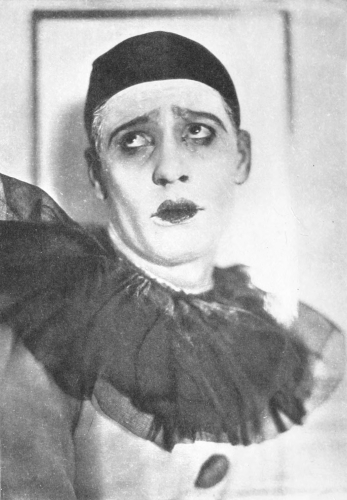
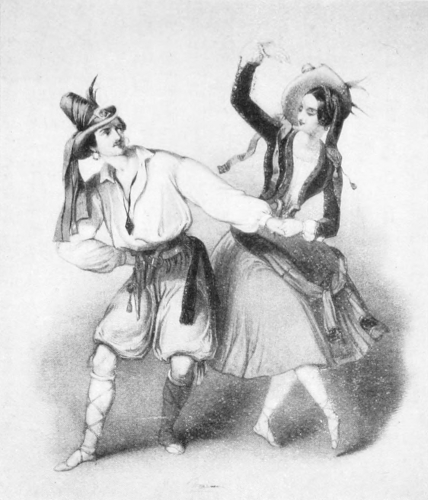
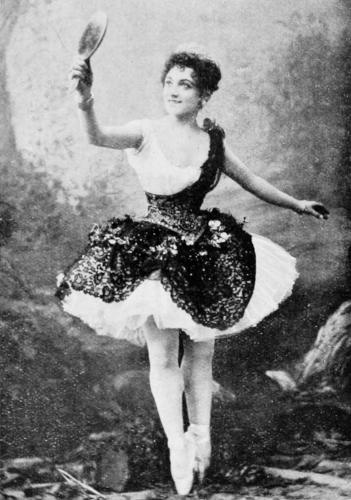
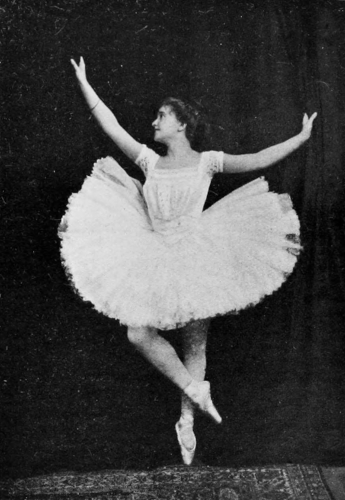
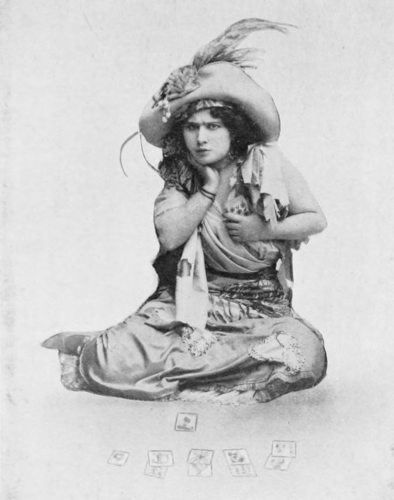
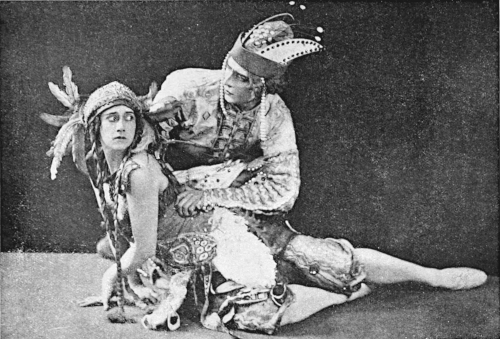
Adolph Bolm in “Carnival.” from a photograph by E. O. Hoppé
THE
ART OF BALLET
BY MARK E. PERUGINI
LONDON: MARTIN SECKER
NUMBER FIVE JOHN STREET ADELPHI
First published 1915
TO
MY WIFE
PREFACE
Some may possibly wonder to find here no record of Ballet
in Italy, or at the Opera Houses of Madrid, Lisbon,
Vienna, Buda-Pest, Berlin, Copenhagen, Stockholm, Warsaw,
or Petrograd (formerly St. Petersburg), not to speak of the
United States and South America. This, however, would be
to miss somewhat the author’s purpose, which is not to trace
the growth of Ballet in every capital where it has been seen.
To do so effectively were hardly possible in a single volume.
A whole book might well be devoted to the history of the art
in Italy alone, herein only touched upon as it came to have
vital influence on France and England in the nineteenth
century. We have already had numerous volumes dealing
with Russian Ballet; and since the ground has been extensively
enough surveyed in that direction there could be no
particular advantage in devoting more space to the subject
than is already given to it in this work, the purpose of which
only is to present—as far as possible from contemporary
sources—some leading phases of the history of the modern Art
of Ballet as seen more particularly in France and England.
A brief series of biographical essays “Cameos of the
Dance,” by the same writer, was published in The Whitehall
Review in 1909; various articles on the subject also being
contributed to The Evening News, Lady’s Pictorial, Illustrated
Sporting and Dramatic News, Pall Mall Gazette and
other London journals during 1910 and 1911; and a series
of “Sketches of the Dance and Ballet,” coming from the
same hand, appeared in The Dancing Times, 1912, 1913 and
1914. They were based on portions of the manuscript of the
present work which, begun some years ago by way of pastime,
and written during the scant leisure of a crowded business
life, was completed at the publisher’s request, and was—save
for a few brief insertions in the proofs—ready, and announced
for publication before the Great War began in August 1914.
The preparation of this book has involved the marshalling
of a vast array of facts and dates, the delving into and
comparison of some three hundred or more ancient and
modern volumes on dancing and on theatrical and operatic
history, the study of scores of old newspaper-files and long-forgotten
theatrical “repositories” and souvenirs. Error is
always possible in spite of care, and if it should have happened
here the writer will be grateful for correction. In covering
so wide a field a full bibliography becomes impossible from
limits of space; but to those interested the following list of
leading authorities—supplemented by those referred to in
the text—may be of service. “La Danse Grecque Antique,”
by M. Emmanuel; “Roman Life and Manners under the
Early Empire,” by L. Friedländer; “Dramatic Traditions
of the Dark Ages,” by Joseph S. Tunison (University of
Chicago Press); “Orchésographie,” by Thoinot Arbeau
(1588); “Des Ballets Anciens et Modernes,” by Père
Menestrier (1682); “La Danse Antique et Moderne,” by
De Cahuzac (1754); “The Code of Terpsichore,” by Carlo
Blasis (1823); “Dictionnaire de la Danse,” by G. Desrat
(1895); “Dancing in all Ages,” by Edward Scott (1899);
“Histoire de la Danse,” by F. de Menil (1905); and “The
Dance: Its Place in Art and Life,” by T. and M. W.
Kinney (1914).
There may be some who could not agree that Ballet
is an “art,” or even that it has, or ever had, any
special charm or historic interest. The charm—as in the case
of any other art—will probably always remain rather a matter
of individual opinion; the historic interest is merely a matter
of fact.
No man can hope for agreement with his fellows in all
things. The world were flat if it could be so. He may hector,
and not convince; he may cajole and not convert; he may
tell the simple truth in simple speech and still be misunderstood.
So many of his partners in the dance of life speak in
different tongues; or, speaking the same, use words and
phrases more familiar to them than to himself.
In going to a foreign land we change our currency; but it
is hardly to be accounted spurious because it is not as ours.
There may be something to be said for the variety; and, also,
there may be some common basis of value which can be
accepted readily by both. A world-currency has not yet
arrived. In opinion it is much the same.
But the sense of “fair play” is so admirable, and so truly
British a characteristic, that one may usually rely on it for a
considerate hearing. Possible dissentients may be the more
inclined to grant this if they are informed at the outset that
this book has no specially persuasive purpose, and that I am
content that it should be mainly accounted a record of fact.
One of the facts which it chronicles is that Ballet, whether
an “art” or not, has existed, in some form or another, for
about two thousand years. An interest which can show so
long a record may yet not be of such surpassing importance,
let us say, as Statecraft or Religion; but one which has thus
long and widely appealed to the æsthetic sense of mankind
can hardly be considered worthless. It were a vast and
complex matter to decide the relative values of the various
“arts,” and, certainly this book is no endeavour to pronounce
thereon, nor to persuade any that Ballet is the greatest,
though it is unquestionably one of the oldest of the arts.
But it will suffice to offer the opinion that, whether it has
reached its highest level or not as yet Ballet is an art in itself;
one that in the past has had so many judicious and sympathetic
exponents, and has so long a record of existence, that there is
really some justification for the expenditure of casual leisure
by any who cares to play the chronicler or to read such
chronicle.
This much said, before setting out to travel the road of the
past, let us for a moment reconsider another fact, namely,
that we have in London two theatres where for about a
quarter of a century Ballet was the main attraction. The
fact is unique in the annals of the British stage.
Ballets have been produced elsewhere occasionally. We
have seen operas, pantomimes, burlesques, of which they
formed a part. At earlier periods—as in the ’forties of last
century—they have also been seen as separate items in the
programme of an operatic season; and there has been a
quite remarkable revival of interest during the past few years.
But in all the history of the stage there was never before a
time when it could be said that for such a period not one
but two theatrical houses in London continuously offered
this kind of entertainment as their chief attraction.
It has to be remembered that this sustained existence of
Ballet in England has been, as in the case of all “legitimate
drama,” without State aid such as it has received in Milan,
Rome, Naples, Paris, Vienna, Petrograd, Copenhagen, and elsewhere
on the Continent, where the physical advantages of
dancing and the artistic value of Ballet are fully appreciated.
The arts must flourish haphazard here! We have no national
conservatoire in which this art of Ballet is taught as it is
abroad. Consequently it has been less generally understood;
and, being so, has had to exist in face of considerable prejudice.
Some critics profess to despise it because it ignores the
spoken word. Some have decried it because of the presence
of dancing. Some will not admit that it is worthy to be called
an art at all, and there are possibly still some primly primitive
people who pretend to view with moral pain the existence of
any such entertainment. They may patronise a theatre or
tolerate an actor or actress—but a Ballet or a Ballet-Dancer!
The misunderstanding of the aims and possibilities of the
Art of Ballet, as seen at its best, is to be regretted.
Not for such critics are the music of moving lines, the modulating
harmonies of colour, the subtleties of mimic expression,
nor all the wealth of historic associations and romantic charm
which a knowledge of its past recalls.
Austere critics would do well, when deprecating Ballet, to
remember that many others have found it, as Colley Cibber
regretfully admitted it was found in his time: “a pleasing
and rational entertainment.”
That it is “pleasing” many know from witnessing some of
the best of modern examples. As to whether it can be considered
“rational” depends so much on the kind of meaning
that may be given to that word. All rational people speak in
prose; constantly to speak in verse might be considered quite
irrational. But are we to banish poetry from the world
because it is not the common form of speech?
Some people might find it quite irrational to sit in a theatre
and laugh or weep at the imaginary joys or woes of imaginary
characters impersonated by people who are not seriously
concerned therewith, and with whom, personally, we are not
at all concerned.
It might be well considered irrational to be moved by any
“concord of sweet sounds,” at least in the shape of “opera”;
or to be enspelled by the charm of a statue or a painting, or
by the wizardry of any form of art; for once it is questioned
whether it be “rational,” there need be no end to dispute;
and one remembers how poor Tolstoy fared in essaying to
decide: “What is Art?”
That of Ballet surely is no less rational than Poetry, than
Drama, than Music, Sculpture, Painting—all of which exist
by their conventions, all of which in principle it employs; to
all of which it is akin. It is not less an art; and when looking
at a modern ballet we can hardly fail to consider the long
train of reasoned thought and of artistic tradition that lie
beyond the entertainment that we see to-day.
What is it that we see? An orchestra of dancers who are
also mimes, who represent—one should rather say, realise—the
imaginative creations of an author, or a number of authors
working harmoniously together, in terms of rhythmic movement
and dramatic expression, with the aid also of colour and
music and sound.
Every one of these dancers has had to undergo a special and
arduous training, the traditions of which reach back through
centuries till lost in time’s obscurity.
Each has an allotted place at any given moment in the
general scheme. Every grouping and dispersal of a group—like
the formation and modulation of chords in music—is part
of an ordered plan.
Every step of every dancer, every gesture, every phrase of
music, is composed or selected to express particular ideas or
series of ideas; every colour and each change of tone in the
whole symphony of hues has been appraised. Not a thing
that happens is haphazard.
It is probably by reason of the number of people that must
be employed, and the labour entailed before a successful
result can be achieved, and on account of the difficulties and
risks attendant on its production, that we have had so few
theatres devoted to an art so thoroughly appreciated abroad,
not only as one of ancient institution, but as one that still
offers wide scope for the creative genius of poet, artist and
musician, apart from the interpretative abilities of dancer and
of mime.
CHAPTER I A DISTINCTION, AND SOME DIFFERENCES
The chief elements of Ballet as seen to-day are—dancing,
miming, music and scenic effect, including of course in
this last the costumes and colour-schemes, as well as the
actual “scenery” and lighting.
It is in the proper harmonising of these elements that the
true art of Ballet-composition, or, as it is called, “choreography,”
consists. Each has its individual history, and all
have been combined in varying proportions at various periods.
But it is only in the past hundred and fifty years or so that
they have been harmoniously blended in the increasing richness
of their development to give us this separate, protean and
beautiful art—the Ballet of the Theatre.
These four elements are the material of which Ballet
is composed, and the result may be judged by their
balance.
We are to think not of the worst examples that have been,
but of the best, and of those that yet might be.
Most of the older writers on dancing speak of almost all
concerted dances as ballets and refer to the “ballets” of the
Egyptians, the Greeks and the Romans. The Abbé Menestrier,
however, writing in the seventeenth century, wisely observed
the distinction between dances that are only “dances,” and
those that approximate to “ballet.”
It should be borne in mind that it is possible to dance and
not represent an idea save that of dancing, as when a child
dances for joy, not in order to represent the joy of another. That
is the province of the Mime. It is equally possible to mimic
without dancing.
The best ballet-dancer is one who has intelligence and
training to do both, whose dancing and mimicry are interpretative.
Speaking of certain Egyptian and Greek figure-dances and
the approach of some of them to the Ballet as he knew it towards
the end of the seventeenth century, Menestrier wrote:
“J’appelle ces Danses Ballets parce qu’elles n’etoient pas de
simples Danses comme les autres, mais des Representations
ingenieuses, des mouvements du Ciel et des Planétes, et des
evolutions du labyrinthe
dont Thésée sortit.” That is a distinction
to be remembered by any who may look on the Art of Ballet
as simply—dancing.
It is necessary to-day to make another distinction, that
between “ballet,” and “the ballet of the theatre.” In a
sense the Hindus, the Egyptians, the Greeks, the Romans,
indeed all peoples in past ages have had ballets; that is,
dances which were “representations ingenieuses,” which represented
an idea or told a story.
There have been entertainments, too, of which dancing
formed a considerable part—such as our English “masques,”
which, contemporaneously, were often spoken of as “ballets.”
But though they may for convenience have been so called,
they were never more than partly akin with the ballet of
the theatre as we see it to-day. They never exhibited that
balance of subordinated and developed arts which the best
examples of later times have shown; and were not seen in
the public theatre, as a form of dramatic entertainment apart
from others.
One has only to consider for an instant what were the
musical and scenic resources of the Greek and Roman stage,
and compare them with the resources of modern orchestration
and scenic effect to realise the difference between antique
“ballet” and that of to-day.
Setting aside this difference, which arises from the development
of the several elements through the centuries, one may
find many an ancient definition of “ballet” that appears apt
enough to-day, for the difference is not so much one of principle
as this of resources.
Athenæus, a second-century Greek critic, declared:
“Ballet is an imitation of things said and sung,” and Lucian,
that—“It is by the gesture, movements and cadences that
this imitation or representation is made up, as the song is
made up by the inflections of the voice.” This is a happy
illustration. Inflections might well be described as “gestures”
of the voice.
Menestrier (who, besides writing an exceedingly entertaining
history of Ballet, also wrote extensively on Heraldry, and was
author of several solid historical works as well as numerous
poems and libretti) has said: “Ballet is an imitation like the
other arts, and that much has in common with them. The
difference is, that while the other arts only imitate certain
things, as painting, which expresses the shape, colour, arrangement
and disposition of things, Ballet expresses the movement
which Painting and Sculpture could not express, and by these
movements can represent the nature of things, and those
characteristics of the soul which only can find expression by
such movements. This imitation is achieved by the movements
of the body, which are the interpreters of the passions
and of the inmost feelings. And even as the body has various
parts composing a whole and making a beautiful harmony,
one uses instruments and their accord, to regulate those movements
which express the effect of the passions of the soul.”
These definitions have decided value, but hardly quite
meet the case of modern Ballet.
Noverre, Blasis, Gardel, and other of the older maîtres de ballet,
have told us in several charming books, essays, letters,
dialogues and libretti, much as to what Ballet can and should
be, but yet leave something to seek in the matter of brief yet
comprehensive definition.
It is with some hesitancy, therefore, that I venture, before
talking of its history, to suggest as a simple definition that:
“a ballet is a series of solo and concerted dances with mimetic
actions, accompanied by music and scenic accessories, telling a
story.”
It is by reason of this definition that I propose to pass
somewhat lightly over the early dawn of Ballet, or rather of
its earliest elements, the dance and miming; and that I
propose to deal more fully with the period after the advent of
Louis Quatorze—in France and in England—which saw the
development of the Ballet du Théâtre.
There have, of course, been modern ballets that did not
tell a story. But the true Ballet of the theatre should.
Such have been the best of those of Noverre, of Blasis, of
Perrot, Nuittier, Théophile Gautier, and of later composers of
ballet like Taglioni, Manzotti, Coppi, Mme. Lanner, Wilhelm,
Curti, Fokine, and, indeed, all the best ballets of later
years; and such will the best always be.
CHAPTER II EGYPT
The origin of the drama is hardly to be reckoned among
the historic mysteries. By serious triflers debate might
be held as to what should be considered the first dramatic
representation and when it actually took place.
Some five centuries before the Christian era the first plays
of which scholarship has taken note were performed at Athens,
those of Thespis, forerunner of the first great dramatists of the
world—Æschylus, Sophocles, and Euripides.
For convenience the origin of Western drama may be dated
from Thespis because it seems first to have assumed then a
definite form. That is not its actual origin any more than
the origin of any human being is to be dated from its birth.
As a possibility it may be said to have existed always. Even
Chronology has its limitations, and preceding any given event
there must have existed principles or tendencies.
When it is said, therefore, that the origin of the Drama is
not an historic mystery it is because we are not very much in
the dark as to when it began to assume a somewhat definite
form; and, moreover, we can be fairly clear as to what must
have preceded it. There seems rather more than a probability
that the Drama derived its existence from the Poet, in his
capacity as a Narrator.
For some hundreds of years the Drama has been chiefly a
representation of character and events, whether real or
fictitious. In its earliest forms it was mainly descriptive. It
would seem to be the natural order of things that from mere
description there should arise in time—possibly from a half-conscious
feeling of the need of emphasis, of a desire to impress
the hearers—the attempt to illustrate or to represent the scenes
or actions described. The mere repetition of any story seems
to tend towards that. Have we not observed that no “fish”
story is ever quite complete—if not convincing—without histrionic
illustrations?
Though in India and China, with their more ancient
civilisation, the chronologic origin of the Drama might be
more remotely placed, it is probable that in the Homeric bard
and the Homeric audience, should be sought the true beginning
of the Western theatre; while, all the world over, the evolution
of the dramatic form has probably been much the same—namely,
a gradual transition from poetic narration to imitative
representation. Thus at the back of the Drama is probably
the Poet. Beside the Poet, too, is often the Priest.
Greek tragedy is usually said to have had a purely “religious”
origin, and certainly it was from early times employed
for the purposes of, or in the service of, Religion; but it
would, one feels, be rather truer to presume its actual origin to
be purely secular, and to be found in the Poet making his appeal
to an ordinary audience, in a word, to the People, while
sometimes under the patronage of priestly and ruling classes.
When, however, we come to consider the origin of the Dance—first
and most important of the “four elements” of Ballet—we
are forced to the conclusion that, even though we are on
more uncertain ground, it must, nevertheless, be far older than
the Drama. Why this should be so, even though we have no
approximate date to go upon as in the case of the Thespian
theatre, is not difficult to see.
The Drama evolved from, and has always depended on, the
faculty of speech, and on the growth of a language. A copious
vocabulary and flexibility of verbal expression are not
exactly characteristics of the primitive races; and, without
both, the Drama, as we have known it for some centuries,
could not have existed.
But the Dance (with mimicry, which has always followed
close upon its heels) has no need of words, and is itself a kind
of speech, in which the whole body is used as a means of
expression.
We are none of us old enough to remember, and there is
consequently no need to be dogmatic and assert that the
Dance actually did precede speech; but it is far from improbable
that it could have done; and while one shudders to
think of the ardent danse tourbillon our Mother Earth must
have danced from the moment of her birth, it is perhaps more
amusing—and yet not wholly frivolous—to contemplate a
possible origin of the Dance in the sport some Simian ancestors
may have found in rhythmically swaying on the flexile
branches of some primeval tree, before they had acquired a
vocabulary sufficiently copious for the analysis of their
sensations.
Seriously, however, and just because it has a rhythmic basis,
dancing in some form is among the earliest instincts of mankind,
even as it is of children. In all climes, at all periods,
men and women have danced; and its origin is lost in the
mists of prehistoric years. Non-civilised races still existent
may offer evidence as to stages in its evolution; but even
among the more primitive races, dancing seems to have
some definiteness of form, marking a heritage of long
practice.
From some earliest, uncouth leapings and gestures of savage
or half savage tribes (the effect of mere exuberant physical
energy) may have grown the idea of thus expressing joy and
thankfulness; for joy, not sorrow, one feels must surely have
been always the first inspirer of the Dance; and possibly a
victory over an enemy, or gratitude for a full harvest may have
come to be first the inspiration, and then the excuse for
repeating such manifestations.
Repetition of an act tends to create a habit, and what may
be at first apparently a spontaneous experiment grows by
repetition into a cult, with set form and ritual.
The ritual of the Dance seems to be as ancient as the stars,
in representing the movements of which, it is supposed by
some to have had its origin in Egypt over two thousand years
ago. Nowhere is it found without form. All must be done in
a certain way, according to the traditions of the locality in
which the dance is seen, or according to some wider tradition.
Always it has a ritual of its own, but also with religious ritual
the origin of the Dance—as also of the Drama—appears in
some mysterious manner to be upbound.
Of all the records that we have of dancing, the earliest
are, apparently, those of Egypt. Its origin is not there; it
must be older; but we know at least that the Egyptians were
among the first people with a civilisation that encouraged
dancing.
One of the finest among modern historians of the art,
divides dancing, for convenience in tracing its evolution, into
“sacred” and “profane”; that is, the Dance forming, as so
often it did in ancient times, part of a religious ceremonial,
and that which in any other of its forms was merely a pleasure
of the people. For our purpose in tracing the growth of Ballet,
however, it would seem advisable to divide the Dance yet
further, into “sacred,” “secular,” and “theatrical.”
The Egyptians had no Ballet of the theatre, because they
had no theatre. They had dances which seem to have been
“representations ingenieuses,” and to that extent, as mimetic
dances, partook of the nature of Ballet; but they were not
organised as theatrical spectacles for private or public entertainment.
The Greeks had no Ballet of the theatre because, though
they had the theatre, they, like the Egyptians, had merely
mimetic dances, not Ballet.
But if Egypt had no popular theatre in which dancing was
seen, it appears to have existed, nevertheless, in three distinct
forms—as a pleasure of “the man in the street”—just as we
see children dance to a barrel-organ in the London streets
to-day; again, as an entertainment for the wealthy, just as a
popular singer, dancer or other entertainer of to-day is engaged
for an “at home” or dinner-party; and, finally, as an element
of the elaborate and somewhat theatrical Egyptian religious
ceremonial.
Monuments from Thebes and Beni Hassan show pictures of
Egyptian dancers performing steps very similar to some
we can see to-day. They appear to be performing them
for the pleasure of onlookers as well as their own. This
acquiring of an audience has, after all, been always of first
importance, and without it the Drama could hardly have come
into existence.
Most people are interested in seeing others do something
they are unable to do themselves, and when they can see it
well done, in a manner, that is, suggesting a difficult feat
accomplished with ease, they will even pay for the exhibition.
That is the popular (with managers the extremely popular)
side of the theatrical arts, of which dancing is one. When
there arises the desire to see the exhibition repeated frequently,
then must follow the special place with special facilities and
accessories for the performance, and the theatre, or something
like it, thus comes into existence as an institution sustained by
popular support. There is first the thing done for pleasure—which
is art; then the exploitation of it for profit—which is
commerce; that is the brief epitaph of any art as a fruit of
civilisation.
The Egyptians did not reach the “theatre” stage. But
dancing, essentially a popular art, received encouragement as
an element in religious festivals and as an entertainment of
the wealthy classes.
Considerable difference of opinion exists as to the “religious”
dances of Egypt. Enthusiastic historians of dancing seem
rather too prone to expand the little store of fact we possess,
and some go to the length of speaking of the religious and
popular “ballets” of the Egyptians. But it is certain that
they had no regular theatrical spectacles in which dancing
was of prime importance; and their popular dances, to any
such extent as they could be described as “representations
ingenieuses,” were primitive in comparison with any of later
times.
Solo-dances and pas de deux were general enough, but the
dancing of massed groups, and the dramatic representation
of a story, appear to have been unknown, or have passed unrecorded
if they were known. The nearest approach to them,
though not of course performed as a theatrical spectacle,
would seem to have been an “astronomical dance,” which
was done by or under the direction of the priests of Apis, and
is said to have been—appropriately enough!—a representation
of the movements of the stars. It is probable that it was
employed mainly as a means of education.
Holy Church in mediæval times took advantage of the
popular craving for theatrical shows, and sought by the aid
of “mystery plays,” and “moralities” to extend the knowledge
of religious truths. It may be conjectured that the
Egyptian hierarchy similarly had some such end in view, and
that the priestly caste sought to utilise the popular taste for
dancing as a means of influence, and that the actual performance
of the dance served to fix more lastingly in the minds of
novices the religious and astronomical truths it embodied.
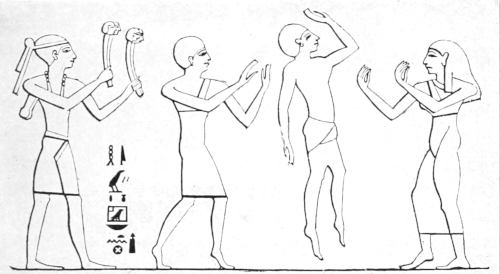
An Egyptian Male Dancer
(From a Theban Fresco).
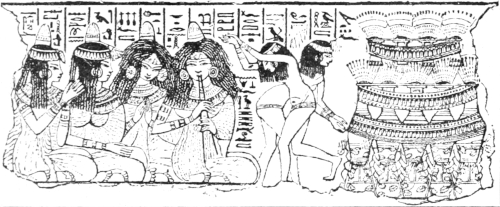
Egyptian Dancing Girls
(From a mural painting in the British Museum).
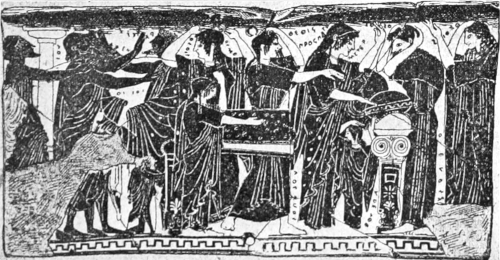
A Greek Funeral Dance
(From a coloured plaque in the Louvre).
In addition to the star-dance, the Egyptians are said to have
had a “funeral” dance, but it is doubtful if this, the
“Maneros”—of which Herodotus speaks—was a solemn
dance. The fact is, however, that information both as to the
religious and ceremonial uses of dancing among the Egyptians
is very scant, and what little record we have of their dancing
is mainly on its popular side and is to be gleaned from monuments.
One of the frescoes in the British Museum shows two girls
performing, apparently before a select audience of women,
one of whom is seen to be applauding, or perhaps marking the
time with syncopated clapping, as negroes do to-day.
Another representation of dancing is on a fresco from Thebes
showing three figures, the centre of whom is apparently performing
an entrechat, as seen to-day, the step in which the
dancer crosses feet in mid-air; while a fourth acts as orchestra
with a couple of the curious curved maces which were beaten
together to mark the rhythm in sonorous fashion.
Other Egyptian monuments also show dancers, one from
Beni Hassan depicting several couples, apparently boys,
performing a dance that obviously had certain set steps, and
suggests that it was used mainly as a rhythmic athletic exercise,
as were many of the Greek dances. And yet another
monument shows men apparently in the act of performing a
pirouette. About them all there is the air of decision, a
suggestion of trained performance that in itself, remembering
that these monuments are some four thousand years old, and
depict steps similar to some performed to-day, is testimony to
the antiquity of the art of dancing.
CHAPTER III GREECE
There is no lack of testimony, pictorial and literary,
to the ancient Greek love of the Dance.
Among the various arts of war and peace that Vulcan
engraved upon that wondrous shield which he fashioned at
the entreaty of sad Thetis for her son Achilles, the Dance
was not forgotten; and the Homeric singer must have been
a lover of the art to limn as clear a picture as is given in
the eighteenth book of the Iliad.
“There, too, the skilful artist’s hand had wrought
With curious workmanship, a mazy dance,
Like that which Dædalus in Knossos erst
At fair-haired Ariadne’s bidding framed.
There, laying each on other’s wrists their hand,
Bright youths and many-suitored maidens danced.”
“Now whirled they round with nimble practised feet,
Easy, as when a potter, seated, turns
A wheel, new-fashioned by his skilful hand
And spins it round, to prove if true it run:
Now featly moved in well-beseeming ranks.
A numerous crowd, around, the lovely dance
Surveyed, delighted; while an honoured Bard
Sang, as he struck the lyre, and to the strain
Two tumblers, in the midst, were whirling round.”
The “two tumblers” is an interesting detail, but it does
not necessarily refer to the sort of acrobatic “tumbling”
we are familiar with to-day. There have always been two
phases of the Dance which can best be understood by noting
the distinction marked by the use of two words in French—at
least by their use among the masters and writers of the
seventeenth and eighteenth centuries—namely, danser and
sauter. The former means to dance, “terre-à-terre,” that
is, always with the feet, or one foot at least, on or
close to the ground; sauter, means invariably to leap
into the air, or even to perform steps while both feet are in
the air.
We usually speak of “a somersault,” a “double somersault,”
and so forth. The word is a corruption from the old
French soubresault, from the Latin supra, over, and saltus,
leap.
Early historians of the Dance frequently speak of
“saltation,” without any reference to the “somersault”
as we know it, but to what we should call simply
dancing.
The Homeric picture must have been repeated innumerable
times since it was first limned, whenever and wherever
there has been a gathering of men and maids on a village
green, dancing in a circle, with a couple of high-leaping lads
in the centre inciting all to quicken the rhythm of the whirling
dance. Many an Elizabethan village must have realised
such a scene; and for all the artifice of the stage, with its
paint and footlights, does it not hold something of the
antique tradition in the picture often seen, of a circle of
dancing girls enclosing two wildly turning “stars”? Is it
impossibly un-Hellenic to presume that the “Two tumblers,
in the midst, were whirling round” in pirouettes? At least
it may be considered—a presumption!
Far later in Hellenic days we have a gracious picture of
the Dance in Theocritus’ eighteenth Idyll, “The Bridal of
Helen,” which reads delightfully in Calverley’s translation:
“Whilom in Lacedæmon tripped many a maiden fair
To gold-pressed Menelaus’ halls with hyacinths in her hair,
Twelve to the painted chamber, the queenliest in the land,
The clustered loveliness of Greece came dancing hand-in-hand.
With woven steps they beat the ground in unison and sang
The bridal hymn of triumph till all the Palace rang.”
The Greek dance, it should be noted, was almost invariably
accompanied by singing; and the poet probably was often
indebted to the dance for the rhythm of his verse. The
bridal dance was of very ancient institution. Indeed, there
were few occasions which were not celebrated with dancing,
and the Greeks even followed the Egyptian custom of having
“dancers” at their funerals! It is not to be thought,
however, that the steps were exactly gay; nor need there
have been anything incongruous, for we can be sure the
instinctive taste of the people would not have admitted
such a thing, and, moreover, a dance and a dancer as they
saw it, were rather different from the vision we have recalled
by such words.
To the ancient Greeks the Dance was a cult, an element
in the religious and physical well-being of the individual
and the State: and the dance that was taught to the child
became an important and lasting factor in the physical
growth and culture of the man.
We who, most of us, are only too apt to look on dancing
as a mere trivial pastime, may wonder that it was so seriously
considered by the Greeks, and that it should have so earnestly
engaged the attentions of such philosophers as Plato and
Lucian. But perhaps that is only because we have not
considered it sufficiently ourselves and have associated it
too closely with theatrical display.
In any form in which it is at its best the theatre is one
of the noblest and most influential institutions of civilisation;
as dancing, at its best, is one of the finest, because most
comprehensive, of the theatrical arts. But there is a vast
difference between the dance which was a means of physical
and mental development, pursued amid the health-giving
surroundings of sunshine and fresh air, and, let us say, some
such degradation of art as some examples of the “classic”
dance we have seen of recent years, performed in the glare
of footlights, amid the smoke-laden atmosphere of a music-hall.
The contrast is an obvious one, but the thing to consider
is that we in England have allowed an art which held an
important place in Greek national life, and which should
be of the greatest educational value to ourselves, to become
mainly a spectacle of the theatre, where more often than
not it is seen at its best, not necessarily because it is the
result of the best system, but because it is the fruit of the greatest
practice.
It is obviously impossible to deal very fully with the
Hellenic dance in the space of a chapter in a volume which
is not intended to trace the evolution of the Dance but of
Ballet. An entire book were needed to treat the subject
adequately—and we have not such a book in English, as yet.
But Emmanuel’s masterly technical review of Hellenic
dancing in his volume La Danse Grecque, is invaluable, and
is testimony to the sound and catholic scholarship which in
France scorns no subject as “trivial” merely because those
ignorant of its history dismiss it as such; and which finds
sympathetic students in a country where all the arts are
treated with a respect that is at least as great as that offered
to commercialism.
The Greeks are said to have derived their earlier dances
from Egypt. This may be questionable, because it is equally
likely that there was a traditional, indigenous dance in
Greece. But it was through the Greeks, certainly, that
dancing first assumed that variety and perfection of form
and style which all the arts seemed destined to attain under
their quickening, purifying, and inspiring influence; and
it was the Greeks, too, who first began to develop the art of
mimicry.
First, as already suggested, there would probably have
been some occasion for joy, tending to express itself by
dancing; and a victory over an enemy, or gratitude for a
full harvest (the more exalted when the harvest was of the
grape!) would have been such occasions. Later must have
come the idea of representing the victory celebrated, or the
imagined characteristics of the being or beings who were
supposed to be the cause of the earth’s fruition, and who,
if propitiated by this tumultuous acknowledgment of gratitude,
perhaps might renew their favours.
Thus, in time, out of the ritual of the Dance would have
grown the ritual of representation—Mimicry, miming, or
“acting,” as we call it; and little by little, from the wild
exuberance of recurring poetic festivals, such as those in
honour of Dionysus, would have grown the ordered sense of
Drama, the representation of thanksgiving, of feelings, events
and things by Mimicry, the actor’s art; either allied with,
or separate from, dancing.
The Greeks, improving on the Egyptians, invented and
developed the idea of the Theatre. But though the Greeks
in their Drama utilised the arts of dancing and mimicry, it
would seem that they were quite subordinated to the literary
and dramatic art of the all-inspiring Poet, and that words,
with a meaning behind them, words representing, as far as
words can, thoughts, passions, emotions, actions, things,
were the essential medium of Greek Drama, not the art of
the Dancer or the Mime.
It should be noted that the Greek orcheisthai (ὀρχεῖσθαι),
to dance, implied more than mere steps with the feet. It
included much that goes to make a really good ballet-dancer
of to-day—interpretative dancing and mimetic gesture.
The Greeks in fact had some of the material, if they did not
have as we know it—the Ballet.
The earliest dramatic poets, Thespis, Phrynichus, were
called “dancers” because in addition to providing the
drama as poets, their function was to train their choruses
in the dances which, accompanied by singing, were introduced
in the play.
One of the most celebrated of the actors in the plays of
Æschylus, Telestes, was said not merely to indicate feelings
but to “describe” events with his hands; and this, which
was really miming, was considered as part of dancing,
which Aristotle defined as “the representation of actions,
characters and passions by means of postures and rhythmic
movements.”
Plutarch analyses dancing as “Motions, Postures and
Indications,” a “posture” being the attitude of the dancer
at the moment of arrested movement, and an “indication,”
the gesture which indicated an external object referred to
in a poet’s lines, such as the sky; or such as an orator would
use when raising his hand heavenward invoking the gods.
The chief dances used in the Greek drama were the
Emmeleia, a stately measure; Hyporchemata, lively dances;
the Kordax, a very coarse and rough comic dance; and
finally the Sikinnis, which was attached especially to satyric
comedies and parodied as a rule the measure of the Emmeleia.
These were all a part, though a subordinate part, of the
classic drama, and, according to some authorities, had their
foundation in the rhythm of the poet’s verse as it was sung
by the chorus or declaimed by the chief actors.
But apart from these there were mimetic dances. One,
in which we may perhaps even see a hint of the origin of
dancing itself, is found in Longus’ novel, Daphnis and Chloe,
in which Dryas performs a vintage-dance, “pretending to
gather grapes, to carry them in panniers, to tread them in
a vat and pour the flowing juice into jars, and then to drink
of the wine thus newly made”; and all done so cleverly
that the spectators were deceived for the time and thought
they really saw the grapes, the vats, and the wine the actor
made pretence of drinking. This, probably an incident
drawn from life, was indeed a “representation ingenieuse,”
and even suggests yet another of the many possibilities as
to the origin of the Dance, namely—that dancing itself may
have originated from the treading of grapes.
The famous Pyrrhic dance was of course mimetic and
represented a series of war-like incidents, all of which had
an educational purpose, as by their means the youthful
soldier was taught how to advance and retreat, how to aim
a blow or hurl a javelin and to dodge them; and how to
leap and vault, in event of meeting ditches and walls. Apart
from military dances in which physical culture and grace
were the chief aims, there were many dances of a purely
festival character taken part in by young men and girls, and
by girls alone.
The close association between religion and the Dance
in ancient Hellenic days is seen in the number of festivals
in honour of the gods, at which special dances were performed,
apart from those which formed part of the classic
drama and others which were merely by way of joyous
pastime. Certain dances were performed annually in honour
of Jupiter; others, such as the Procharysteriæ, were in honour
of Minerva; then there was the Pæonian dance in honour
of Apollo; the Ionic, and the Kalabis and the famous
Dance of Innocence, instituted by Lycurgus, and executed
to the glory of Diana, by young Lacedæmonian girls before
the altar of the goddess. The Delian dance, special to the
isle of Delos, was much the same in character and closed
with the offering of floral garlands on the altar of Aphrodite.
One of the most solemn incidents of the Eleusinian mysteries
was the mystical dance-drama representing the search of
Ceres for her daughter Proserpine—practically a “ballet,”
in the older acceptance of the word.
The secular dance of the Greeks was essentially an individualistic
form. Men and women only rarely danced together,
and when they did, the joining of hands, or anything like
chain-dancing was exceptional. One of these exceptions
was the Hormos, or Collar-dance as it was called, which
Lucian describes as being danced by youths and maidens
advancing one by one in the form of a collar, made up of the
alternating jewels of feminine grace and manly strength,
the dance being led by a youth. Most of the Greek dances
had a leader, and the favour in which the art was held is
shown by the fact that they termed their Chief Magistrate
Pro-orchestris, or Leader of the Dance. As a rule, chain-dances
were performed by one or the other sex.
In another sense also the Hellenic dance was individualistic.
We are accustomed to see entire groups, eight, sixteen, or
even thirty-two or more dancers all performing the same step
simultaneously. It is one of the conventions of Ballet, like
the chorus in “musical comedy.” But the Greeks had not
that convention.
Although their dance was based on strict rhythm and was
governed by rigid rules, they governed the dance of the
individual, not of groups. He, or she, was adjudged a good
dancer by the grace of line displayed and rhythmic balance
of movement, and many a vase painting exhibits groups of
dancers who, though dancing in the mass, are each doing
different steps; and equally the gestures and mimetic
expression of each differed.
The system unquestionably had its advantages, for while
the rhythm of the song or poetic verse which accompanied
the performers was the common basis of the dance for all,
the individuality of expression undoubtedly gave a vitality
to the group which accounts for the vividness and charm
of their representation on many an antique vase.
Numerous indeed were the various forms of the Hellenic
dance, sacred, dramatic, secular—Meursius catalogues some
two hundred—but further description would detain us too
long en route towards the culmination of all these earlier
types of mimetic and other dances in the Ballet of to-day,
and we have next to trace the growth of Latin Mime and
Pantomime.
CHAPTER IV MIME AND PANTOMIME: ROME, HIPPODROME—OBSCURITY
If to Greece modern Ballet owes much for the encouragement
of the Dance, to Rome it is even more indebted
for the development of the art of Pantomime.
By many the word Pantomime is associated solely with
that time-honoured entertainment which children, home
for the Christmas holidays, are supposed to be too blasé
to care for, but which they go to by way of obliging parents
who feel it their duty to take them.
The Christmas pantomime has long been one of our
cherished institutions, though, like the British Constitution,
it has undergone many changes. It is still given at Christmas.
That much of tradition remains. But most of its
original features have all but disappeared. Time was, two
hundred years ago, when it was mainly “Harlequinade,”
and Harlequin and his gay comrades of Italian comedy
were the heroes of the play. Then classical plots and allusions,
with an elaboration of scenic effect and “machines,”
brought about a gradual change. In the early nineteenth
century a “topical” and “patriotic” element had crept in;
but the Harlequinade, although shortened, and, shall we say,
broadened, still remained.
Then a craze for “transformation” scenes set in because
the extreme gorgeousness of the tinsel productions of
Kemble and Macready—the archæological and historic
“accuracy” of which was always emphasised!—forced the
pantomime producers in self-defence to go one better.
And then came Grimaldi to give a new life to the whimsies
of that Clown whose prototype dates back to ancient Rome;
and for half a century or more the Christmas pantomime
continued much the same—a familiar nursery-story played
out to the accompaniment of fairy-like and glittering scenic
accessories, concluding with a rough-and-tumble Harlequinade,
until in recent years the introduction of the Music-hall
performer gave us the entertainment we have to-day.
Not thus, however, was the antique “pantomime,” which,
evolving from the more ancient and spoken “Mimes,” became,
because it took all nature for its province—pan-mimicry,
or pantomime; the stage representation, without
the spoken word, of all that eye could see or mind of man
conceive.
Now, it is a far step from narrative to impersonation—marking
an advance in the technique of acting; and it
was some time before the Greek Drama had achieved this.
But it was not so much the impressive and noble side of
the Greek Drama that taught the actors, not merely to
declaim situations but to act them; it must have been the
popular, the comic side; and it was probably the Doric
farce, and later the early Latin comedy derived therefrom,
that really brought to perfection under the Roman Empire
the art of Miming apart from the art of Dancing.
The comic is so much nearer to life as we see it every day
than the tragic; and it was this ability to see the more
familiar comic side of life, and the desire to travesty the
serious—whether in Greece or Rome—that first gave flexibility
and variety to the art of miming, or “acting,” as we
call it nowadays.
It is because of this nearness to the life of the time, because
of the travesty of contemporary types and public
affairs, that the Latin actors made their wide appeal.
From public encouragement would come the increasing
endeavour of popular actors to outshine each other in
technical tours de force;
and from playing the familiar
types of Latin Comedy, such as Maccus, with his double
hump, prototype of our Punch; Pappus, forerunner of Pantaloon,
and other characters (some from the early Mimi, some
from the Atellanæ and Togatæ of tradition), the Latin Actors
of the first and second centuries A.D. ultimately aspired to
the wordless representation of the gods and heroes of myth
and legend.
According to one authority, “the Latin Pantomime grew
out of the custom at this period—the first century of the
Christian era—of having lyrical solos, such as interludes to
flute accompaniment, between the acts of the Latin comedies.”
According to that admirable historian of the stage, Mr.
Charles Hastings, “this new mode (Pantomime) was a kind
of mime, in which poses and gestures constituted the fundamental
portion of the play. Words occupied a secondary
place, and eventually disappeared altogether. Only the music
was preserved, and in order that the audience might understand
the gestures of the actors, little books were distributed
in Greek text, intelligible only to the learned and to the upper
classes. Later on the mask—rejected by the mime—was
adopted, and a chorus was employed to accompany the
comedian with their voices, and to explain the multiple gestures
by which the actors created the different characters in turn.
Moreover, there was a company of mute players. The libretti
left almost unlimited liberty of detail. Sometimes the music
broke off to enable the actor to finish his fioritura and variations.
Sometimes, on the other hand, the comedian paused,
or left the stage, while the story was taken up by the recitative
and the instruments.”
All this reads much like a description of a modern “mimodrame,”
such as “L’Enfant Prodigue,” or “Sumurun.”
Again it reads not unlike a description of a modern ballet,
for with these do we not often have printed synopses distributed,
though not in Greek text? But we have to remember
that the music was primitive, the scenic effect,
though often remarkable, was different from that of our
modern stage, with its greater mechanical resources; and,
finally, that all this was an innovation of the Roman stage,
for we are talking of the period that saw the dawn of the
Christian era.
Among the more famous of the Latin pantomimists were
Pylades, who was the inventor of tragic pantomimes; and
Bathyllus, who was the composer of livelier episodes. For
some time they joined forces and had a theatre of their own,
where they staged comedies and tragedies composed by
themselves without words or any other aid in telling the
story of the play than dancing, pantomime and music.
The innovation struck the popular fancy, and all Rome
flocked to support the new venture. The two actors were
received at the Emperor’s Court, and became the spoilt
darlings of the Roman “smart” set. The inevitable happened.
They began to intrigue at Court, and were made the centre
of intrigue; they became as jealous of each other as rival
opera singers, and in time a financially happy partnership
was dissolved, and there were two theatres devoted to pantomimes
instead of one.
But as this form of drama was a novelty, and pleased
the “connoisseurs,” who were numerous and increasing in
numbers, both theatres were equally successful, perhaps the
more so in that the public is always specially interested in
ventures that appear to be in rivalry. The taste for existing
stage-productions slackened in favour of those offered by
Pylades and Bathyllus. Their “ballets” whether tragic,
comic or satiric were looked on as the very perfection of
tragedy, comedy or satire.
It was no longer a matter of declamatory style to enjoy
or to criticise, it was a matter of steps, movements, gestures,
attitudes, figures or positions that were discussed by wise
connoisseurs of “the new thing,” who in Rome, as elsewhere
to-day, had much to say on what they presumed to understand
because—it was new! And such, it is said, was the
genius of the “producers” of this novel form of entertainment;
the effect was so natural, the stage-pictures were so
convincing, the pathos was so moving or the gaiety so free
and infectious, that the audiences forgot they had ears while
using enchanted eyes; and expressive gestures took the
place of vocal inflections, of the power of words and the magic
of poetic verse.
Pylades before long found a rival star arise in the person
of Hylas, whose greatest performance was said to be in
Œdipus. If Pylades and Bathyllus had quarrelled, there was
evidently no love lost between Pylades and Hylas.
Hylas on one occasion was giving a representation of
Agamemnon and, at a particular line referring to that historic
personage as “the great,” he rose up on tip-toe. “That,”
said Pylades scornfully, “is being tall, not ‘great’”; a
criticism not only just, but giving an excellent insight into
the methods and ideas of the famous Latin pantomimist.
It is somewhat uncertain whether it was the Court intrigues
of Bathyllus or of Hylas or of both which ultimately secured
from the Emperor the sentence of banishment for Pylades,
or whether it was the daring, not to say impudence of the
actor in representing well-known people, or whether again
it may not have been the increasing danger of the constant
brawls which were taking place daily in the streets of Rome
between the rival factions—the Pyladians and the Bathyllians.
But whatsoever the reason, the probability is that the
perpetual strife between the parties supporting the adored
actors (worse than ever was that between the Piccinists and
Gluckists of the eighteenth century), with the constant blood-shed
it involved, was made the excuse for the convenient
removal of one of the principal factors in the disorder, and
that the influence of Bathyllus, possibly backed up by that
of Hylas, was able to secure the removal of the tragic actor.
Pylades, however, had his revenge, for such was the
uproar in Rome on his banishment that the Emperor was
practically forced to recall him, and he returned in triumph.
It is time, however, to leave the affairs of popular actors
of the ancient world, since it is less the details of their
personal history we need to consider than their importance
as the virtual inventors of the second element of Ballet,
the art of the mime, or, to use for a moment the more comprehensive
word—pantomime. Thus we can see that it is
largely due to the perfecting by the Italians of that art
which seems to have been even more natural to them than
to the Greeks—miming, that we have the Ballet of to-day.
From the dawn of the Christian era, comedy gave place
to a perfect craze, first for the mime, and then for its offspring,
pure pantomime. But, finally, the mimetic art as a
standing entertainment of the Roman public, came to suffer
neglect in favour of circuses; then, together with the
circuses, it was opposed by the Churches. There were
spasmodic revivals in the fourth and fifth centuries, but
from the fifth century mime and pantomime practically
ceased to exist in Constantinople, to which the seat of the
Roman Empire had by that time been removed; and the
arts both of the dancer and the mime fell upon a period of
obscurity, though they went into retirement with all the
reluctance of a modern “star.”
CHAPTER V CHURCH THUNDER AND CHURCH COMPLAISANCE
It is a truism of history that opposition towards the
amusements of a people only increases the desire for
them, and that the undue pressure of a law, or of a too
rigid majority, only stimulates the invention of evasions.
In dramatic history there is ample proof of this.
In England during the seventeenth century the force
of Puritan opinion and of law did not crush the Drama,
but led to unseemly licence.
When, in the early eighteenth century, Paris was enlivened
by the spectacle of the majestic Royal Opera,
endeavouring by legal thunder to suppress the lively vaudeville
performances of the too popular Paris Fairs, and even
going to the length of obtaining decrees forbidding the
Fair theatres to perform musical plays in which words were
sung, were the managers of the little theatres downhearted?
No! they merely evaded the law and made a mockery of
pompous interference by having the music of their songs
played, while the meaning was acted in dumb-show, and—the
actual words, printed very large, were displayed
on a screen let down to the stage from above! Their
audiences, catching the spirit of the thing, enjoyed the
wit of the evasion and supported the performances all
the more.
There are many people who can only relish that which
they have been told is wrong.
Much the same spirit was abroad about sixteen hundred
years ago, when the growing power of the Christian Church
began to be a calculable factor in “practical politics,”
and the embarrassment of successive Roman emperors in
trying to rule an unwieldy and decaying Empire was
increased by the moral warfare between the more
rigid sects of the new Church and the pleasures of the
people.
It should, however, be said in justice to the early Churchmen
that many of the pleasures of the people had become
entirely scandalous, and detrimental to the manhood of the
Empire, at least as seen in the Empire’s capital. Over such
let us draw a veil!
While, in these “democratic” days, it may be doubted
if there are any of the English-speaking race who “dearly
love a lord” (though there is really no reason why they
should not!), there were certainly some thousands of the
Byzantine populace in the third and fourth centuries to
whom a successful circus-rider or gladiator, actor or dancer,
was of far more interest than any peer of their period.
The histrionic favourites lacked, of course, the advantages
of picture-postcard fame, and had to be content with immortality
in verse. But as for the now hackneyed “stage
romance” of the marriage of a youthful scion of a noble
house with some resplendent star of the theatrical firmament,
did not a Byzantine Emperor, Justinian, marry Theodora,
once a popular dancer at the Hippodrome!
Yet he it was who made one of the more effective moves
to suppress some of his people’s excessive opportunities for
amusement, by abolishing the laws under which the expense
of the performances in the Hippodrome, and some of the
less important theatres had been met by the Imperial
treasury. This, however, was mainly due to his beautiful
wife, who had seen all the vilest side of theatrical life in a
time when the older dramatic culture had given place to
banal and vulgar entertainments involving a horrible servitude
of those engaged in providing them.
Before this, however, the Church’s thunder had been
launched at the grosser theatrical spectacles, and the Theatre
had retaliated by mocking the adherents of the then new
religion. Where fulmination failed, control by influence
was essayed. But for all the attacks of the more advanced
and severer leaders of the early Church, there must have
been something of confusion for at least the first five centuries
of the Christian era. Indeed, in the endeavour of the Church
to transmute the popular love of theatrical spectacles into
something higher, and to awaken the public interest in the
service of the Church, what with the introduction of choral
song, with strophe and antistrophe, and of solemn processionals,
even it is said of ceremonial dances performed by
the choir—such as the Easter dances still seen in Spain
to-day—the Church itself must have come at times to seem
perilously sympathetic towards the very things it was professing
to condemn.
Did not Gregory Nazianzen implore Julian, before he
became “the Apostate,” to be more discreet, saying in
effect: “If you must dance, and if you must take part in
these fêtes, for which you seem to have such a passion, then
dance, if you must; but why revive the dissolute dances of
the daughter of Herodias, and of the pagans? Dance rather
as King David did before the Ark; dance to the glory of
God. Such exercises of peace and of piety are worthy of an
Emperor and a Christian.”
In short, wise cleric as he was, he found no fault with the
healthy exercise of the dance itself, but only with such
dance and other Byzantine entertainment as had tended,
or might tend, to become merely an exhibition of depraved
taste.
Indeed, how could he have inveighed against the dance
as an expression of clean rejoicing when it had been recorded:
“And Miriam the prophetess, the sister of Aaron,
took a timbrel in her hand; and all the women went out
after her with timbrels and with dances”?[1] Had not the
servants of Achish said: “Is not this David the king of
the land? did not they sing one to another of him in dances,
saying, Saul hath slain his thousands, and David his ten
thousands?”[2] Had it not, too, been written: “And
David danced before the Lord with all his might.”[3]
No, the Church thunder had been directed against the
licence by which the arts of dancing and miming had been
corrupted, and against, not wholesome athleticism and
healthy sport, but the hysterical brutalities and “professionalism”
of the arena.
And if further proof were required of ecclesiastical interest
in and practice of the thing it only attacked when seen in
degraded form, it is to be found in the fact that in
744, the Pope Zacharias promulgated a Bull suppressing
all so-called “religious dances,” or “baladoires” as he
called them, which were showing signs of becoming
“degenerate.”
These were dances which were performed in, or within
the precincts of cathedrals and churches at certain festivals
such as Easter, Midsummer and Christmas; and of which
the old English bonfire dances of St. John’s Eve, were (and
the modern carnival, and the Eastertide ceremonial seen
in Seville to-day, are) probably survivals, though, to be sure,
they should be accounted originally as survivals of earlier
pagan dances in honour of the sun, and of the harvest,
and not as originating with the Christian Church.
It may seem a far cry from the date of Pope Zacharias’
edict of 744, to 1462, when the first of the ballets ambulatoires
is recorded, but it must not be supposed that dancing, if
not miming, is entirely lacking in history during those seven
hundred odd years. Any history of dancing would aid us in
at least partly bridging such a gap; but it will be convenient
in a chapter dealing more especially with early
ecclesiastical influence on the evolution of Ballet, to
deal now with a form of entertainment or of religious
festival which was essentially a creation of the earlier
Church.
The famous procession of the Fête Dieu which King
René d’Anjou, Count of Provence, established at Aix in
1462, was, as an old historian tells us, an “ambulatory”
ballet, “composed of a number of allegorical scenes, called
entremets.” This word entremets, which was later replaced by
“interludes,” designated a miming spectacle in which men and
animals represented the action. Sometimes jugglers and
mountebanks showed their tricks and danced to the sound of
their instruments. These entertainments were called entremets
because they were instituted to occupy the guests agreeably
at a great feast, during the intervals between the courses.
“The entre-actes of our first tragedies,” the writer adds,
“were arranged in this manner, as one sees in the works
of Baif, the interludes in the tragedy of Sophonisbie. More
than five hundred mountebanks, Merry Andrews, comedians
and buffoons, exhibited their tricks and prowess at the full
Court which was held at Rimini to arm the knights and
nobles of the house of Malatesta and others.”
As the fêtes and tournaments, given on these occasions,
were accompanied by acts of devotion, the festivals of the
Church often displayed also something of the gallant pomp
of the tournaments.
These ballets ambulatoires, however, with all their richer
pageantry, were yet to be outshone by the two secular
entertainments to which we must devote our next chapter—the
banquet-dance of Bergonzio di Botta, of 1489, and the
still more famous “Ballet Comique de la Reine,” of 1581,
the last of which, there can be little doubt, had important
effect in the development if not creation of our English
masque, which, in turn, had an immense influence on the
evolution of modern Ballet.
CHAPTER VI THE BANQUET-BALL OF BERGONZIO DI BOTTA, 1489, AND THE FAMOUS “BALLET COMIQUE DE LA REINE,” 1581
A superb and ingenious festivity was that arranged by
Bergonzio di Botta, a gentleman of Tortona, in honour
of the wedding of Galeazzo, Duke of Milan, with Isabella
of Aragon.
The good Bergonzio was a lover of all the best things of
life, but especially of dining and of dancing. That historic
gourmet, Brillat Savarin, commends him for his taste in
the former matter, as may we for the bright idea of combining
a dinner with a dance, one of somewhat nobler plan
than any modern example!
The dinner was of many courses and each was introduced
by the servers and waiters with a dance in character, the
whole constituting a sort of dinner-ballet. In the centre
of a stately salon, which was surrounded by a gallery
where various musicians were distributed, there was a large
table.
As the Duke and his lady entered the salon by one door,
from another approached Jason and the Argonauts who,
stepping proudly forth to the sound of martial music
and by dance and gestures expressing their admiration of
so handsome a bride and bridegroom, covered the table with
the Golden Fleece which they were carrying.
This group then gave place to Mercury who, in recitative,
described the cunning which he had used in stealing from
Apollo, who guarded the flocks of Admetus, a fat calf, with
which he came to pay homage to the newly married pair.
While he placed it on the table three “quadrilles” who
followed him executed a graceful entrée.
Diana and her nymphs then succeeded Mercury. The
Goddess was followed by a kind of litter on which was a
hart. This, she explained, was Actæon, who, although
no longer alive, was happy in that he was to be offered to so
amiable and fair a nymph as Isabella of Aragon. At this
moment a melodious symphony attracted the attention of
the guests. It announced the singer of Thrace, who was
seen playing on his lyre while chanting the praises of the
young duchess.
“I mourned,” he sang, “on Mount Apennine the death
of tender Eurydice. Now, hearing of the union of two lovers
worthy to live for one another, I have felt, for the first time
since my sorrow, an impulse of joy. My songs have changed
with the feelings of my heart. A flock of birds has flown
to hear my song. I offer them to the fairest princess on
earth, since the charming Eurydice is no more.”
A sudden clamour interrupted his song as Atalanta and
Theseus, heading a nimble and brilliant troupe, represented
by lively dances the glories of the chase. The mimic hunt
was terminated by the death of the wild boar of Calydon,
which was offered to the young Duke, with triumphal
“ballets.”
A magnificent spectacle then succeeded this picturesque
entrance. On one side was Iris, seated on a car drawn by
peacocks and followed by several nymphs, covered in light
gauze and carrying dishes of superb birds. The youthful
Hebe appeared on the other side, carrying the nectar which
she poured for the gods. She was accompanied by Arcadian
shepherds, laden with all kinds of food and by Vertumnus and
Pomona who offered all manner of fruits. At the same time
the shade of that famous gourmet Apicius rose from the
earth, presenting to this superb feast all the delicacies he
had invented and which had given him the reputation of
the most voluptuous among ancient Romans. This spectacle
disappeared and then there was a wondrous ballet of all the
gods of the sea and rivers of Lombardy; who carried the
most exquisite fish and served them while executing dances
of different characters.
This extraordinary repast was followed by a yet more
singular spectacle opened by Orpheus, who headed a procession
of Hymen and a troop of Loves, followed by the
Graces who surrounded Conjugal Faith, whom they presented
to the Princess, while offering, themselves, to
serve her.
At this moment, Semiramis, Helen, Medea and Cleopatra
interrupted a recitative by Conjugal Faith to sing of the
delights of Passion. Then a Vestal, indignant that the
recital of pure and true marriages should be sullied by such
guilty songs, ordered the notorious queens to withdraw.
At her voice, the Loves, who accompanied her, joined in a
lively dance, pursuing the wicked queens with lighted
torches and setting fire to the gauze veils of their headdress!
Lucretia, Penelope, Thomiris, Porcia and Sulpicia
replaced them and presented to the young Princess that
palm for chastity which they had merited during their
lives. Their “modest and noble” dance, however, was interrupted
by Bacchus, with a troop of revellers who came to
celebrate so illustrious a bridal, and the festival terminated
in a manner as gay as it was ingenious.
The fête achieved a prodigious fame throughout Italy.
It was the talk of every city and a full description of its
glories was published, while crowds of “society hostesses”
of the period endeavoured to emulate the ingenuity
of its originators, and the vogue of the dinner-ballet
“arrived.”
One effect of its fame was that for a century it set the
fashion for the Royal and Ducal Courts throughout Europe.
Every Court had its “ballets,” in which lords and ladies of
highest degree took part; and the movement was greatly
fostered by Catherine de Medici, who sought to divert the
attention of her son, Henry III, from political affairs towards
the more congenial ways of social amusement, of which
Court-ballets formed considerable part.
The culmination of these sumptuous entertainments came,
however, in 1581, when in celebration of the betrothal of
the Duc de Joyeuse and Marguerite of Lorraine, sister of
the Queen of France, a spectacle was arranged, the splendour
of which had never been seen in the world before. This was
Beaujoyeux’s famous “Ballet Comique de la Royne”—or de la
Reine in modern spelling—which set all cultured Europe
aglow with praise of its designer. A special account of it,
with many charming engravings, was printed by order of
the King to send to foreign Courts. So much did it set a
fashion that the elaborate masked balls and the numerous
Court-masques and entertainments which followed in the
reigns of Henry VIII, Elizabeth and James were directly
inspired by the success of Beaujoyeux’s ballet, even as they
in turn influenced the subsequent productions of Louis
XIV in France.
The author and designer was an Italian, by name Baltasarini,
famous as a violinist. He was introduced by the
Duc de Brissac to the notice of Catherine de Medici, who
appointed him a valet de chambre, and subsequently he
became official organiser of the Court fêtes, ballets and
concerts, assuming the name of Baltasar de Beaujoyeux.
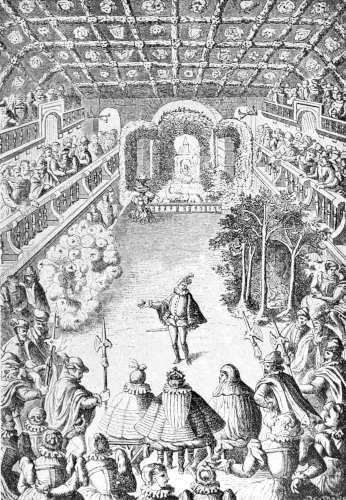
Stage Effect in the 16th Century
(A Scene from the “Ballet Comique de la Royne,” by Baltasar de
Beaujoyeux, 1581).
The account of the ballet was sumptuously published.
The title-page read as follows:
BALET COMIQUE
De la Royne, faict
aux nopces de mon
sieur le Duc de Ioyeuse &
madamoyselle de Vau
demont sa sœur.
par
Baltasar de Beavioyevlx
valet de chambre du
Roy et de la Royne sa mère.
à Paris
par
Adrian le Roy, Robert Ballard, et Mamert Patisson
Imprimeurs du Roy.
MDLXXXII
Avec Privilege.
After a courtly dedication “Au Roy de France, et de
Pologne,” full of praise for his prowess in arms and his taste
in art, full of graceful compliment by classic implications,
he follows with an address:
AU LECTEUR.
Povravtant, amy Lecteur, que le tiltre et inscription de
ce livre est sans example, et que lon n’a point veu par cy
deuant aucun Balet auoir esté imprimé, ny ce mot de Comique
y estre adapté: ie vous prieray ne trouver ny l’un ny l’autre
estrange. Car quant au Balet, encores que ci soit vne inuention
moderne, ou pour le moins, repétée si long de l’antiquité,
que l’on la puisse nommer telle: n’estant à la verité que des
meslanges geometriques de plusieurs personnes dansans
ensemble sous vne diuerse harmonie de plusieurs instruments:
ie vous confesse que simplement representé par
l’impression, cela eust eu beaucoup de nouveauté, et peu
de beauté, de reciter vne simple Comedie: aussi cela n’eust
pas esté ny bien excellent, ny digne d’vne si grande Royne,
qui vouloit faire quelque chose de bien magnifique et triomphant.
Sur ce ie me suis advisé qu’il ne seroit point indecent
de mesler l’un et l’autre ensemblement, et diversifier la
musique de poesie, et entrelacer la poesie de musique et le
plus souvent les côfrondre toutes deux ensemble: ansi que
l’antiquité ne recitoit point ses vers sans musique, et Orphée
ne sonnoit jamais sans vers, i’ay toutes fois donné le premier
tiltre et honneur à la danse, et le second à la substâce, que
i’ay inscrite Comique, plus pour la belle, tranquille et heureuse
conclusion, ou elle se termine, que pour la qualité des personnages,
qui sont presque tous dieux et déesses, ou autres
personnes heroiques. Ainsi i’ay animé et fait parler le Balet,
et chanter et resonner la Comedie: et y adjoustant plusieurs
rares et riches représentations et ornements, ie puis dise
avoir contenté en un corps bien proportionné, l’œil, l’oreille,
et l’entendement. Vous priant que la nouveauté, ou intitulation
ne vous en face mal juger; car estant l’invention
principalement. Composée de ces deux parties, ie ne pouvois
tout attribuer au Balet, sans faite tout à la Comedie, distinctement
representée par ses scènes et actes: ny à la
Comedie sans prejudicier au Balet, qui honore, esgaye
et rempli d’harmonieux recits le beau sens de la Comedie.
Ce que m’estant bien advis vous avoir deu abondamment
instruire de mon intention, ie vous prie aussi ne vous
effaroucher de ce nom et prendre le tout en aussi bonne
par, comme i’ay desire vous satisfaire pour mon
regard.
Although the quaint spelling of the old French may offer
a passing difficulty to some readers, I have felt it advisable
to give the address as it stands, for it presents several
points of extraordinary interest.
First and foremost is the fact that it claims Beaujoyeux’s
ballet to be the first ever printed!
His description of a ballet as “meslanges geometriques de
plusieurs personnes dansans ensemble” is extremely interesting.
Pylades the Latin dancer-mime declared that no man
could become a perfect mime who did not understand music,
painting, sculpture and geometry! And in recent years a
well-known Italian maître with whom I was discussing Ballet
remarked, as he held up a case of drawing instruments,
“Here is the whole art of choreography,” or ballet-composition.
This may seem a somewhat exaggerated assertion, but it
is a fact that without some knowledge of geometry it would
be difficult for a composer of Ballet to tell the effect that
would be produced by lines and groups of dancers in the
sight of a huge audience all looking at the stage from different
angles.
Beaujoyeux’s claim to appeal to and satisfy “l’œil,
l’oreille, et l’entendement” is also interesting, and quite in
accord with modern ideas of the Ballet.
The entertainment itself must have been a remarkable
affair. It began with a fine water display by a fountain with
twelve sides, on each of which were two naiads, with musical
instruments, for the “concert,” which accompanied the
singers. Above the fountain-basin, which was full of fish,
rose another on pillars, where twelve niches made seats for
so many nymphs. In the middle, dolphins carried a crown
and formed a throne for the Queen. Two other basins rose
again above, formed of other dolphins grouped, which
spouted great jets of water, and the whole was topped by a
golden ball five feet in diameter.
It was from this “machine,” drawn by sea-horses and
accompanied by twelve tritons and as many sirens with
their instruments, that there descended the Queen, the
Princesse de Lorraine, the Duchesses de Mercueil, de Guise,
de Nevers, d’Aumale and de Joyeuse, Marechal de Raiz,
and de l’Archant and the Demoiselles de Pons, de Bourdeille
and de Cypierre—who had all been seated in golden cars,
and who were dressed in silver cloth and crêpe encrusted
with gold bullion and precious stones. Thus they made the
first entrance, arranging themselves in twelve different figures.
At the first entrance they were six abreast and three in
front in a triangle, of which the Queen formed the first point.
After this impressive opening the ballet meandered
through the story of Circe, with musical interludes, songs
and dances, and elaborate allegory. But as the first act
began at ten in the evening and the last did not finish till
after five in the morning, it will be seen that the production
was as lengthy as it was magnificent. Some idea of the
splendour of the fête, indeed, may be gathered from the fact
that it cost something over three and a half million francs.
The conclusion was graceful. The Queen and the Princesses,
who had represented naiads and nereids, presented gold
medals to the princes and seigneurs who, in the guise of
tritons, had danced with them—presumably as a reward
for their patience! This presentation of gifts became quite
a custom at these courtly ballets, and doubtless the modern
cotillon is a survival.
The “Ballet Comique” set a fashion throughout Europe,
and various Courts vied with each other in similar entertainments.
The English Court had, of course, already had its
ceremonial balls, masked balls and “masques,” but their
splendour had been nothing to this, and the subsequent
fêtes at the Courts of Elizabeth and James were directly
influenced by the example of the French in this direction,
as we shall see when we come to deal with the English masque
as a form of Ballet.
Let us first, however, consider the dances of the period,
for which we have an excellent authority in the work of
Thoinot Arbeau.
CHAPTER VII THOINOT ARBEAU’S “ORCHÉSOGRAPHIE,” 1588
“In Spring,” we know, “the young man’s fancy lightly
turns to thoughts of love.” In the winter of life it
would seem that an old man’s fancy lightly turns to thoughts
of the dances that his time-stiffened limbs can no more
achieve with their earlier agility and grace, and he takes to—writing
about them. For it is strange but true that some
of the most entertaining volumes on the subject are those
written on the history of the dance by “grave and reverend
seigneurs”; who, one would imagine, had long foregone
all thought of youthful pastimes and turned their minds to
solemner affairs. Three such, at least, I can recall—Thoinot
Arbeau, Bonnet, and Baron.
Over three centuries ago—nay, nearly four, we come
upon a somewhat sage and elderly gentleman, Thoinot
Arbeau, whose book with its strange title, Orchésographie,
was published in 1588.
Was it shyness, or sheer fraud that made him write it
under a false name, a nom de théâtre it would almost seem.
For Thoinot Arbeau was not his name, but a sort of anagram
on his real one, which was Jehan Tabourot. Moreover, he
was sixty-seven when he wrote it, and was a Canon of the
Church! He was born at Dijon in 1519, and was the son of
one Estienne Tabourot, a King’s Counsellor! Think of it—born
four hundred years ago, yet he speaks to our time,
telling us, albeit in somewhat stiff and difficult French, of
the dances that were in vogue in his dancing days.
As to the strange title of his work, its meaning will of
course be apparent to all who know anything of the history
of the subject, for they will remember that the Greek word
for the dance was Orcheisthai (the Orchestra being the floor-space
where the dancers performed); and so Orchésographie
is merely a treatise on the writing of dances; that
is, the setting of them down in such form that subsequent
readers could study the dances therefrom.
The recording of the actual steps of dances has always
been a problem, and other leading masters in France (such
as Beauchamps, Pécourt, Feuillet) and in England (such as
Weaver) had several more or less successful shots during the
seventeenth and eighteenth centuries at inventing a sort of
dance-shorthand.
The very first author to attempt such a thing with any
real success was apparently our friend Arbeau; for earlier
works, such as that of Caroso, are very poor. Into the full
details of his system, however, I do not propose to enter
now, for the matter is somewhat technical. The interest
of Arbeau’s work, however, is by no means mainly technical.
The book, which was published at Lengres in 1588, is
written in the form of a dialogue “by which everyone can
easily learn and practise the honest exercise of the dances,”
to give the quaint phraseology of the original, the two
speakers being Arbeau the author, and Capriol, a youth
who some few years earlier had left Lengres to go to Paris
and Orleans and now, on his return, has sought out Arbeau
to learn from him all that he can of dancing. Thoinot at
first does not recognise him because, as he says, “You have
grown so, and I believe that you have also enlarged your
spirit by virtue and knowledge.” He asks the young man’s
opinion of the study of Law, remarking that he was also
once a law-student.
Capriol expresses his admiration for the law as a necessary
institution, but complains that his neglect of the polite
arts, while in the company of the Orleans law-students, has
made him dull and wooden. He says that his knowledge
of fencing and tennis makes him an acceptable companion
with other youths, but he fails as a dancer to please the
demoiselles, a point on which, it seems to him, depends the
whole reputation of a young man who contemplates marriage.
Then follows some sound advice, with curious details, from
Arbeau, on the advantages of dancing as a matrimonial agent,
and he acclaims the art as one necessary to social welfare.
Capriol agrees and expresses his disgust that the dance
should have been so subject to bitter attacks, of which he
quotes historic instances. Arbeau neatly responds that,
“For one who has blamed, an infinity have esteemed and
praised the art,” also following with quoted examples, saying,
indeed, that “Le S. prophete royal dauid dāça au deuāt de
l’arche de Dieu,” or, in other words, that “the holy prophet,
King David, danced before the Ark of God.”
In the course of their conversation, Arbeau makes learned
references to the derivation of the word “Dance,” mentioning
others then in use that were allied to it, such as saulter
(from the Latin saltare), caroler (hence our “carols,” or songs
which, originally, accompanied certain religious dances),
baler, and trepiner, Capriol remembers that the ancients had
three kinds of dances: the sedate Emmeleia, the gay Kordax,
and the mixed Sikinnis, the first of which Arbeau likens
(quite unhistorically) to the pavanes and basse-dance of his
own period; the second, to the gaillardes, voltas, corantos,
gavottes (note that—a reference to the gavotte in 1588!) and
branles (or, as Elizabethan Englishmen called them,
“brawls”); while the third, he declares, must have been
similar to the branles doubles and to “the dance which we
call bouffons or matachins.”
Then, very wisely, he points out that most objections to
dancing have been provoked not by decent but by—objectionable
dancing! And as Capriol hastily assures his austere
but kindly teacher that he wants none of that sort, but that
he is anxious to teach his twelve-year-old sister what Arbeau
is good enough to teach him, the old man proceeds on most
polite and methodical lines.
Arbeau, truly remarking that rhythm is the basis of the
dance, as it was always of all military marching and evolutions,
then goes on to give a wonderful disquisition on that
glorious instrument, the drum, and a masterly analysis of
its rhythmic possibilities, both as an inspirer of soldiers on
the march and as a stimulus to the dance.
The old man’s enthusiasm for an instrument that has
never really received its due homage is truly fine, and he
gives no less than seventy-six examples of drum-beat on
a common-time basis. He follows this with an exposition of
fife-playing (with musical examples); his earnest plea for
this study of drum (tambour) and fife being only preparatory
to a study of the basse-dances, which were properly accompanied
by both instruments.
As several of these dances of three centuries agone have been
revived in our time, it is of interest to consider them in some
detail, more especially as they formed the choregraphic
basis of all the ballets subsequently for some two centuries.
Arbeau informs us that most of what he calls the “recreative”
dances (or as we might say “social,” as opposed to
the more ceremonial affairs necessitating an orchestra) were
performed in his forebears’ time to the music of the flute
and little drum.
Capriol asks: “Tell me, what are these dances and how
are they done?”
To which Arbeau replies that they danced, in his father’s
days, “pavanes, basse-dances, branles and courantes, which
have been in use some forty or fifty years.”
Capriol asks: “How did our fathers dance the basse-dance?”
Arbeau replied that they had two sorts, the one common
and regular, the other irregular, the former being danced to
“chansons régulieres,” and the latter to “chansons irrégulieres,”
and proceeds to explain that, for the former songs,
there were sixteen bars which were repeated, making thirty-two
to commence with; then a middle part of sixteen bars;
and a close of sixteen, repeated; making eighty bars in all.
If the air of the song was longer than this, the basse-dance
played on it was termed “irregular.” He then explains that
the basse-dance proper was in three parts, the term being
really only applied to the first; the second being called
“retour de la basse-dance,” and the third and last being
termed “tordion.”
Then comes the following:
“Memoire des mouvements pour la basse-dance.
R b ss d r d r b ss ddd r d
r b ss d r b c.”
Not unnaturally Capriol, who is for ever asking quite
intelligent questions, wants a translation of this cryptic-looking
array of letters. It is better understood when one
hears that “R” stands for reverence, “b” for a branle,
“ss” for deux simples, “d” for a double (or three “ddd”
for three “doubles”); the small “r” stands for a réprise,
and “c” for congé; all of which are terms understood by
dancers of to-day.
He gives very careful directions not only for performing
the “reverence,” the “simple,” the “double,” the “réprise,”
and the “congé,” but for performing the various movements
of the basse-dance, the retour, and the tordion; as, for instance,
when he remarks that “You begin the dance of the tordion,
which is in triple time, just like the basse-dance: but it is
(to give his own words) plus legiere and concitée.”
He describes the Pavane as “easy” to dance, and gives
details of its performance, together with the music of that
famous and lovely example, “Belle qui tiens ma vie captive,”
the words being given in full, for four voices and tambour
accompaniment.
The Gaillarde, he says, is so-called “parce qu’il fault estre
gaillard and dispos pour la dancer,” and with much detail as
to its performance explains that while danced somewhat like
the tordion the latter is done “plus doulcement and avec
actions and gestes moings violents.”
He gives nearly a dozen musical examples for the gaillarde,
one called “La traditors my fa morire”; another “Anthoinette”;
another, with the charming title “Baisons nous
belle”; another, “Si j’ayme ou non.”
Capriol, by the way, remarks apropos after the second-named,
that “At Orleans when we give Aubades we always
play on our lutes and guiternes a gaillarde called ‘La Romanesque,’”
but that it seemed so hackneyed and trivial that he
and his companions took to “Anthoinette” as being livelier
and having a better rhythm.
The Gaillarde was in triple time, and was made up of five
steps (or four steps and a leap) and one “position”; the
term cinq pas also being alternatively applied to it, hence
the Shakespearean “cinque-pace” and “sink-a-pace.”
The Volte, from which is derived the modern valse, was
described by Arbeau as “a species of gaillarde familiar to
the Provençals,” danced, like the tordion, in triple time, and
consisting of two steps and a leap. The Volte, or Volta, as
it was as often called, was popular in England, as was the
Gaillarde, and references to it are found in Shakespeare
(Troilus and Cressida) and in the one really great work on
the Dance in English literature, namely, Sir John Davies’
richly imaginative and finely musical poem, Orchestra, or a
Poeme on Daunciny, which was published in 1596, only
eight years after Arbeau’s Orchésographie.
The Courante, Arbeau describes as very different from the
Volte. It is also (in contrast to the Pavanes and Basse-dances)
a danse sautée, but in twelve time, with running steps, requiring
from time to time not the quick, light leaping of a
volte, but the sort of slow soaring for which Vestris was
famous in the eighteenth century and Volinin and Bohn can
perform so superbly to-day.
Arbeau says that in his youth the dance was given as a
kind of “ballet,” by three young men and three girls, with
grace and dignity and he bewails its subsequent decadence.
The old English term was “current traverse.” In Sir John
Davies’ Orchestra one finds the following reference:
“What shall I name those currant travases
That on a triple dactyl foot do run
Close by the ground in sliding passages?”
In Shakespeare’s Henry the Fifth, too, is the following:
“Bourbon: They bid us to the English dancing-schools
And teach lavoltas high and swift corantos;”
and Sir Toby Belch, it will be recalled, asks: “Why dost
thou go to church in a galliard and come home in a coranto?
My very walk should be a jig ... sink-a-pace.”
There seems, however, considerable ground for question
as to what the courante, or coranto, really was, whether a
slow or quick dance. Arbeau’s directions are, for once, not
quite clear. He speaks of it being a more graceful affair in
his younger days; and he was an old man at the time his
Orchésographie was published. In England it certainly seems
to have become a fairly lively dance, of which the main
feature was its “running” steps.
In France that characteristic seems to have been the
same though the tempo may have been slower. Certainly
it became slower there, for the courante under Louis Quatorze
was considered a dull dance, disappearing in favour of newer
types requiring a more developed and quicker technique.
However, dances alter in character, like everything else,
in the course of time. The waltz or valse has considerably
altered since it was first introduced into London drawing-rooms—and
considered shocking!—in the first decade of
the nineteenth century; and even to-day there is considerable
difference between the valse as danced by Swiss or
German peasants, and as seen in the London ball-room. It is
probable that the courante of Arbeau’s day was as varied in
performance as the tango of our later time.
Let us return, however, to his description of other dances
of the period. The Allemande, he explains, “est une dance
plaine de mediocre gravité, familiere aux Allemâds, et croy
qu’elle soit de noz plus anciennes car nous sommes desendus
des Allemandes.” But his authority for the latter statement
he does not give! It was danced by two or more people, in
twelve time, and later was a very popular dance with Louis
the Thirteenth.
A lengthy description follows of the Branle, which is also
sometimes spelt Bransle, and from which comes our English
word Brawl, the meaning of which has sadly degenerated
from its original significance.
Saying that, “since you know how to dance the Pavane
and the Basse-dance, it will be easy for you to dance the
branles,” he then proceeds to give account of over a score,
including two which seem later to have assumed a right to be
considered as separate dances, namely, the Triory de Bretagne
(or simply, the Triory) and the Branle de la Haye, sometimes
called merely the Haye, Hay, or Hey, which was an interlacing
chain-dance.
Among the examples he gives is a Branle d’Escosse, of which
he says: “Les branles d’Escosse estoient
en vogue y a environ
vingt ans,” and it is much like the customary Scotch reel.
The Branles des Lavandières, he explains, is so-called because
the dancers make a noise by clapping their hands to represent
that made by the washerwomen who wash their clothes on
the banks of the Seine. Another, the Branle du Chandelier,
was danced with lighted candles.
A description of the Gavotte follows, and it is interesting
to note that this dance which is still seen on the stage sometimes
to-day, was an established favourite as far back as
1588. Then comes an account of the “Morisque” dance,
the origin of which Arbeau places in the Saturnalia of the
ancient world, not without reason, one fancies; and then
he gives account of the Canaries, which, he says, some say
takes its name from the Canary Isles, while others derive it
“from a ballet composed for a masquerade in which the
dancers were dressed as kings and queens of Mauretania, or
even as savages therefrom, with headdress of varied plumage.”
The last chapter is devoted to the dance of Bouffons, a dance
with sword and buckler supposedly derived from ancient
Rome and a never-failing source of delight to French playgoers
and opera-lovers of the sixteenth and seventeenth
centuries.
Before the “Dialogue” actually closes, young Capriol
politely thanks Monsieur Arbeau for the trouble he has taken
to teach him dancing, and Arbeau responds by promising
a second volume (alas! never written) dealing with the
ballets of the masquerades “made” at Lengres. He urges
him meanwhile to practise “les dances honnestement,” and
so become a worthy comrade of the planets “qui dancent
naturellement”: and he closes his discourse very prettily
with the words, “Je prie Dieu
vous en donne la grace.”
We have lingered somewhat over this old manual of
dancing, but there are some half-dozen points in the history
of ballet that it is of vital importance to emphasise, and
Arbeau’s book is one of them.
Dancing itself of course had continued to exist through
all time. But from the decadence of Rome until fairly late
in the fifteenth century, ballet had only a precarious sporadic
existence; and the production of Beaujoyeux’s volume
of the Ballet Comique de la Royne in 1582, and Arbeau’s
Orchésographie in 1588, made a turning-point in the
history of ballet—the point where a popular amusement
was once again taken up by men of intellect and given a
new form and a new spirit. Beaujoyeux created an interest
in ballet, Arbeau assisted an advance in the technique of
one of the chief elements of the art, namely, dancing; and
there can be little doubt that both men were largely instrumental
in forwarding that movement towards popular delight
in the theatrical masque and ballet which were to become an
outstanding feature of the next two centuries, the seventeenth
and the eighteenth.
CHAPTER VIII SCENIC EFFECT: THE ENGLISH MASQUE AS BALLET
In considering di Botta’s elaborate feast, and Beaujoyeux’s
“ballet,” one is struck by their similarity
to the English “disguisings” and masques, which, first
introduced to the Court of Henry the Eighth in 1512 as a
novelty from Italy, only began to assume definite literary
form about a century later. That century contributed
towards the development of scenic effect.
In studying Arbeau’s manual of contemporary dance
and music, one is struck by another thing: he is dealing
with a social amusement of the upper classes. The dances
he describes were mainly the proper accomplishment of the
well born, or were such of lower origin as might with adaptation
become worthy of performance by more courtly dancers.
It is certain he does not describe all the types of dance known
to his period. The old Provençal “Rigaudon” which was
later to come into such favour owing to Camargo, is not
referred to by Arbeau; nor the languorous “Sarabande,”
which was probably of Moorish origin derived through Spain—or
possibly earlier through Augustan Rome; the lively
“Chaconne” is another omission; the “Tresca” yet another.
These, and perhaps others, must have existed in Arbeau’s
time and long before; but would be among the traditional
amusements of the people, and were not yet elected to the
company of courtly dances.
It is needful to linger over these points here, for they
account for much that we find in the subsequent development
of theatrical ballets in the seventeenth and eighteenth
centuries.
Speaking of Beaujoyeux’s “Ballet Comique,” Castil Blaze,
the scholarly historian of the Paris opera, remarks that it
“became the model on which were composed a number of
ballets, sung and danced, a kind of piece which held the
place of Opera among the French and English for about a
century.” That century was, roughly, from about 1500 to
1600. And he adds: “The English gave them the name of
masque.”
In the few years after Henry VIII came to be crowned
the young monarch spent considerable time and spared no
expense in entertaining himself and his Queen with “disguisings,”
“revels” and masqued balls.
On Twelfth Night, 1511, before the banquet in the Hall
at Richmond, so records the contemporary chronicler,
Edward Hall, there “was a pageant devised like a mountain,
glistering by night as though it had been all of gold and set
with stones; on the top of which mountain was a tree of
gold, the branches and boughs frysed with gold, spreading
on every side over the mountain with roses and pomegranates;
the which mountain was with (de) vices brought
up towards the King, and out of the same came a lady
apparelled in cloth of gold, and the children of honour, called
the henchmen, which were freshly disguised and danced a
Morris before the King, and that done re-entered the mountain:
and then was the wassail brought in and so brake up
Christmas.”
The next year the King himself took part in a similar
pageant; and in the next, i.e. in 1513, so Hall tells us, “the
King with eleven others were disguised after the manner of
Italy, called a Mask, a thing not seen before in England.
They were apparelled in garments long and broad, wrought
with gold, with visors and caps of gold; and after the
banquet these masquers came in with six gentlemen
disguised in silk, bearing staff-torches, and desired the ladies
to dance.”
A little later came the introduction of singing, and dialogue
as well as dancing, some allegorical story forming the basis
of the masque. In Beaujoyeux’s “ballet” of 1582, we have
all this. Up to then in England the masque made no great
advance beyond those of Henry VIII’s early years. In
Beaujoyeux’s “ballet,” however, we have all that had been,
and more. We have dancing, singing, dialogue, elaborate
scenic effect, all in illustration of a mythic and allegorical
story; and achieving a definiteness and grandeur of form
hitherto unequalled, as well as publicity which made it
famous throughout Europe. In some ways it was as much
masque as “ballet,” and as much opera as masque. Actually
it did stimulate the development of the Masque in England;
and Opera in France.
At the English Courts of Henry VIII and Elizabeth, the
masque developed in the direction of scenic elaboration and
splendour (with music) that made up for its literary shortcomings,
at least in its earlier period.
At the French Courts of Henry IV and Louis XIII, what
were known as Opera-ballets (later to be separated as opera
and ballet) developed a musical richness (with scenic effect)
that made up for similar literary shortcomings. Yet again
came another form in the Comedie Ballet of Molière.
With the accession of James I of England came the real
efflorescence of the English masque, which under the hands
of Ben Jonson was to become a fairly balanced harmony of
the three arts—the poet’s, the musician’s, and the painter-designer’s.
It must of course be understood that in both the masque
and ballet there was dancing; but at the period with which
we are now dealing, namely the last decade of the sixteenth
and first few decades of the seventeenth centuries, the
technique of that art was—for stage purposes—comparatively
so primitive as to make it almost a negligible quantity.
There was dancing of course—that of “henchmen” and
men and boys who performed a Morris, or bouffon-dances;
and that of courtier, Court-lady, or even, it might be, a Royal
personage, who would take part in the stately Pavane or
Almain, now and then unbending sufficiently to dance a
Trenchmore (once Queen Elizabeth’s favourite) or Canary.
But it was all either an intrusion, alien to the general
purport of the production, or else vastly overshadowed by
the chief design, which was to present, with the aid of “disguisings”
and elaborate “machines,” a sort of living picture
or series of living pictures, expressing some mythological,
allegorical episodes or complimentary idea.
The chief aim was splendid pageantry; something mainly
to please the eye; and secondarily to charm the ear; without
making too great claims upon the intellect.
Among the leading English masque writers during the
period we are considering were George Gascoigne, Campion,
Samuel Daniel, Dekker, Chapman, William Browne, Beaumont
and Fletcher and Jonson.
In France, at the Court of Henri Quatre, and under the
direction of his famous minister, the great and grave Sully—who
himself took part in them—some eighty ballets were
given between 1589 and 1610, apart from state balls and
bals masqués.
In England among the more notable masques produced
during about the same period were the following:—
1585. The Masque of “Lovely London,” performed
before the Lord Mayor.
1589. A Masque planned by order of Queen Elizabeth
in honour of the wedding of King James VI of
Scotland and Anne of Denmark.
1594. A Masque before Queen Elizabeth at Whitehall.
1604. A Masque by Samuel Daniel, “The Twelve Goddesses,”
arranged by Queen Anne, Consort of
James I, in honour of the Spanish Ambassador,
at Hampton Court.
1605. “The Masque of Blackness,” by Ben Jonson (his
first real masque) given on Twelfth Night at
Whitehall.
1606. Ben Jonson’s “Masque of Hymen,” for the marriage
of Robert Devereux, third Earl of Essex,
with the Earl of Suffolk’s younger daughter,
Frances Howard.
1608. Ben Jonson’s “Masque of Beauty”—a sequel to
the “Masque of Blackness” at the request of the
Queen Consort, who, with the Ladies of the Court,
took part in the performance. This was followed
in the same year by his “Hue and Cry after
Cupid,” given at Court on Shrove Tuesday, in
celebration of Lord Viscount Haddington’s marriage.
1609. Ben Jonson’s “Masque of Queens” at Whitehall
on Twelfth Night.
All these were elaborate productions; those of Jonson
being indeed beautiful. Their literary value has long been
realised, and one sees in them some of his finest work. The
introductory descriptions and the stage-directions are singularly
minute and careful, and, in their way, are quite as well
worth study as the beauties of his strong and noble verse.
He writes of scenes and costumes as if he loved them: as
when, in “The Masque of Blackness,” he describes the
Moon, “triumphant in a silver throne.... Her garments
white and silver, the dressing of her head antique, and
crowned with a luminary or sphere of light; which, striking
on the clouds, and brightened with silver, reflected, as
natural clouds do, the splendour of the moon. The heaven
about her was vaulted with blue silk, and set with stars of
silver, which had in them their several lights burning.”
And again: “The attire of the masquers was alike in all,
without difference: the colours azure and silver; but returned
on the top with a scroll and antique dressings of
feathers, and jewels interlaced with ropes of pearl. And for
the front, ear, neck, and wrists the ornament was of the most
choice and Orient pearl: best setting off from the Black.”
For the scenery and mechanical effects or “machines”
as they were called—there was Inigo Jones, the travelled
artist-architect who had seen many a masking in Italy;
for the music there was Alfonso Ferrabosco, son of the
Italian composer, appointed music-master at the Court of
James I; and for Maître de danse, there were Thomas Giles
and Hieronimus Herne.
It was a noble company who took part in the performances.
In “The Masque of Blackness,” though there were only
three speaking parts, Oceanus, Niger and Æthiopia—the
impersonators of which are not recorded—there was no less
a personage than Queen Anne herself, Consort of King
James, who appeared as Euphoris, supported by the Countess
of Bedford (Aglaia), Lady Herbert (Diaphane), the
Countess of Derby (Eucampse), Lady Rich (Ocyte), Countess
of Suffolk (Kathare) and other fair ladies of title.
The “Masque of Beauty,” a superb spectacle given at the
Court some three years later by express command of Her
Majesty, had for speaking parts only three, namely those of
Boreas—“in a robe of russet and white mixed, full and bagged;
his hair and beard rough and horrid; his wings grey, and
full of snow and icicles; his mantle borne from him with wires
and in several puffs”; Januarius—“in a throne of silver;
his robe of ash colour, long, fringed with silver; a white mantle;
his wings white and his buskins”; and Vulturnus—“in a
blue coloured robe and mantle, puft as the former, but somewhat
sweeter; his face black, and on his head a red sun, showing he
came from the East.”
Following the entrance of Vulturnus, bringing—in reference
to the former “Masque of Blackness”—the good news
of his discovery of a lost isle whereon the black but lovely
daughters of Niger had been languishing in obscurity, there
came a fine pageant.
“Here,” as Jonson’s stage directions describe it, “a
curtain was drawn in which the night was painted, and the
scene was discovered which (because the former was marine,
and these, yet of necessity, to come from the sea) I devised
should be an island floating on a calm water. In the midst
thereof was a Seat of State, called the Throne of Beauty,
erected; divided into eight squares, and distinguished by so
many Ionic pilasters. In these squares, the sixteen masquers
were placed by couples; behind them in the centre of the
throne was a tralucent pillar, shining with several coloured
lights, that reflected on their backs. From the top of which
pillar went several arches to the pilasters, in front, little
Cupids in flying posture, waving of wreaths and lights, bore
up the cornice; over which were eight figures, representing
the elements of Beauty, which advanced upon the Ionic, and,
being females, had the Corinthian order.”
They were: Splendour, Serenitas, Germinatio, Lætitia,
Temperies, Venustas, Dignitas, and Perfectio. Minute
description is given of their garments, but is too lengthy
for inclusion here. The stage directions then proceed:
“On the top of all the throne (as being made out of all
these) stood Harmonia, a personage whose dressing had
something of all the others, and had her robe painted full of
figures. Her head was compassed with a crown of gold,
having in it seven jewels equally set. In her hand a lyra,
whereon she rested.
“This was the ornament of the throne. The ascent to
which, consisting of six steps, was covered with a multitude
of Cupids (chosen out of the best and most ingenious youth
in the kingdom, noble and others) that were torch-bearers;
and all armed with bows, quivers, wings, and other ensigns
of love. On the sides of the throne were curious and elegant
arbours appointed; and behind, in the back part of the isle,
a grove of grown trees laden with golden fruit, which other
little Cupids plucked, and threw at each other, whilst on the
ground, leverets picked up the bruised apples and left them
half eaten. The ground-plat of the whole was a subtle indented
maze; and in the two foremost angles were two
fountains that ran continually, the one Hebe’s and the other
Hedone’s; in the arbours were placed the musicians, who
represented the shades of the old poets, and were attired in
a priest-like habit of crimson and purple, with laurel garlands.
“The colours of the masques were varied; the one half
in orange tawny and silver; the other in sea-green and
silver. The bodies of short skirts on white and gold to both.
“The habit and dressing for the fashion was most curious,
and so exceeding in riches, as the throne whereon they lay
seemed to be a mine of light, struck from their jewels and
their garments.
“This throne, as the whole island moved forward on the
water, had a circular motion of its own, imitating that which
we call motum mundi, from the east to the west, or the right
to the left side.... The steps whereon the Cupids sat had
a motion contrary, with analogy ad motum planetarum, from
the west to the east; both which turned with their several
lights. And with these three varied motions, at once, the
whole scene shot itself to the land.”
After a chorus with echoing refrain, “Vulturnus the wind
spake to the river Thamesis, that lay along between the
shores, leaning upon his urn, that flowed with water, and
crowned with flowers; with a blue cloth of silver robe about
him; and was personated by Master Thomas Giles, who
made the dances.
“Vul. Rise, Aged Thames, and by the hand
Receive the nymphs, within the land,
And in those curious squares and rounds
Wherewith thou flow’st betwixt the grounds
Of fruitful Kent and Essex fair
That lends the garlands for thy hair;
Instruct their silver feet to tread,
Whilst we, again, to sea are fled.
“With which the Winds departed; and the river received
them into the land, by couples and fours, their Cupids coming
before them.
“These dancing forth a most curious dance, full of excellent
device and change, ended it in the figure of a diamond, and
so, standing still, were by the musicians with a second Song,
sung by a loud tenor, celebrated.
“So Beauty on the waters stood,
When Love had severed earth from flood!
So when he parted air from fire,
He did with concord all inspire!
And then a motion he them taught,
The elder than himself was thought.
Which thought was, yet, the child of earth,
For Love is elder than his birth.
“The song ended; they danced forth their second dance, more
subtle and full of change than the former; and so exquisitely
performed, as the king’s majesty (incited first by his own liking
to that which all others there present wished) required them both
again after some time of dancing with the lords. Which time,
to give them respite, was intermitted with a song.
“This song was followed by others.
“After which songs they danced galliards and corantos; and
with those excellent graces, that the music appointed to celebrate
them, showed it could be silent no longer; but, by the first
tenor, admired them thus:
“SONG.
“Had those that dwelt in error foul,
And held that women have no soul,
But seen these move; they would have then
Said, women were the souls of men;
So they do move each heart and eye
With the world’s soul, true harmony.
“Here they danced a third most elegant and curious dance,
and not to be described again by any art but that of their own
footing, which ending in the figure that was to produce the fourth,
Januaryfrom his state saluted them thus:
“Janu. Your Grace is great, as is your Beauty, dames;
Enough my feasts have proved your thankful flames
Now use your seat; that seat which was, before,
Though straying, uncertain, floating to each shore,
And to whose having every clime laid claim,
Each land and nation urgéd as the aim
Of their ambition, Beauty’s perfect throne,
Now made peculiar to this place alone;
And that by impulsion of your destinies,
And his attractive beams that lights these skies;
Who, though with ocean compassed, never wets
His hair therein, nor wears a beam that sets.
Long may his light adorn these happy rites,
As I renew them; and your gracious sights
Enjoy that happiness, even to envy, as when
Beauty, at large, brake forth and conquered men!
“At which they danced their last dance into their throne again.”
These quotations, though necessarily brief, illustrate the
characteristic elements in the construction of the masque—dancing,
music, song, spoken verse and elaborate scenic
effect.
The reference to Thomas Giles, “who made the dances,”
to the dances themselves, “galliards and corantos,” and that
charming admission as to “a third most elegant and curious
dance” not to be described again “by any art but that of
their own footing”; the reference to the arbours in which
“were placed the musicians, who represented the shades of
the old poets, and were attired in a priest-like habit of crimson
and purple, with laurel garlands”; the song of the “first
tenor”—“Had those that dwelt ...” and January’s speech
apostrophising women’s beauty; above all the loving descriptions
of the scenery and mechanical effects, must all be of
uncommon interest to those who know anything of the history
of the French ballet, because it is so closely paralleled in the
descriptions given some seventy years later by the Abbé
Menestrier of the entertainments at the Court of Louis XIV.
The English “masques” of the early seventeenth were, in
effect, the French “ballets” of the early eighteenth century.
To return, however, to the English Court of James I.
The Queen and Ladies of her Court once again took part
in the entertainment of His Majesty as representatives of the
various types of Beauty introduced in the course of the
masque, and yet again were they found in the noble “Masque
of Queens,” celebrated from the House of Fame, by the Queen
of Great Britain with her Ladies, at Whitehall, February 2nd,
1609, which was dedicated to the young Prince Henry, as
to the origin of which Ben gives the following interesting
note: “It increasing,” he says, “to the third time of my
being used in these services to Her Majesty’s personal presentations,
with the ladies whom she pleaseth to honour; it was
my first and special regard, to see to the dignity of their
persons. For which reason I chose the argument to be A
celebration of honourable and true Fame bred out of Virtue.”
All of which in a sense foreshadowed the various symbolic
ballets later at the Court of France, such as La Verité, ennemie
des apparences, which we shall come to consider in due course.
The thing to realise now is that these masques of Ben Jonson
and of other men of his period were the finest flowering of a
form of entertainment which had been struggling for definite
shape throughout the previous century, indeed from the days
of di Botta’s fête in 1489, and had received its most recent
and most effective stimulus from France in the production of
Beaujoyeux’s wondrous symbolic and mythologic “ballet”
some twenty odd years before Ben Jonson’s first “masque”
was produced. The English masque—partly dramatic
“interlude” with song, music and dance introduced, was in
effect a ballet, and was a direct influence in the formation of
the “opera-ballets” which were subsequently to be the
delight of the French Court for a century or more.
CHAPTER IX BALLET ON THE MOVE
If the masque was a kind of ballet that did not move
from its appointed place within sight of the Royal and
Courtly audience, by whom it was commanded as a spectacle
for private entertainment, there was a “ballet” which did,
and became, like the “carrousels” and “triumphs,” a very
public spectacle, namely the ballet-ambulatoire, or peripatetic
“ballet,” said to have originated among the Portuguese, and
much encouraged by the Church.
The Beatification of Ignatius Loyola in 1609 is an instance
of peripatetic “ballet” famous in the history of the dance.
Interesting account of it is given by the invaluable Menestrier,
who writes:
“As the Jesuits had a war-like character, they chose the
Siege of Troy for the subject of their ballet. The first act
took place before the church of Notre Dame de Lorette. It
was there they stood the wooden horse. Full of Jesuits, the
machine began to move, while numerous dancers acted the
most remarkable feats of arms of Achilles, Ajax, Hector and
Æneas. The monstrous horse and its retinue advanced,
preceded by a brilliant orchestra. They arrived at the Place
St. Roch, where the Jesuits had their church. The city of
Troy, or at least a part of its towers and ramparts, constructed
of wood, occupied a third of this place. A piece of wall was
broken down, to give entrance to the horse, the Greeks
descended from the machine and the Trojans attacked them
with guns. The enemy defended with the same arms, and
the two sides fought—while dancing! Eighteen great
staves filled with fireworks caused the burning and the ruin
of Troy!”
One might be puzzled to know how the author of such
a drama would introduce Saint Ignatius Loyola on the
scene. The maker of the “book,” however, had no qualms,
and, leaving the Greeks and Trojans buried beneath the ruins
of Ilium, on the following day, he led the spectators to the
seashore. “Four brigantines,” the chronicler proceeds,
“richly decorated and fenced, painted and gilded, covered
with dancers and ‘choirs of music,’ present themselves at the
Port. They bring four ambassadors, who, in the name of the
four quarters of the globe, come to swear homage and fidelity,
to offer presents to the newly beatified, to thank him for his
benefits and to beg his protection for the future. All the
artillery of the Forts and of the vessels salute the brigantines
on their entrance. The ambassadors then mount the cars in
waiting and advance towards the College of the reverend
fathers, with an escort of three hundred Jesuits on horseback,
dressed as Greeks! Four troops of inhabitants of the
four quarters of the world, dressed in national costumes,
dance round the cars. The realms, the provinces, represented
by their genii loci, march before their ambassador.
The troop from America is the first, and among the dancers
are many children disguised as monkeys and parrots, and
twelve dwarfs, mounted on little nags. The car of Asia is
drawn by two elephants. Six superb horses form the team
of the others.” The diversity, the richness of the costumes
was not the least ornament of this singular ballet, for it is
said that several of the actors had on their garments precious
stones of great value.
It is the Portuguese who claim to have invented the true
ambulatory ballets, which—designed in imitation of the
Thyrennian “pomp” described by Appius Alexander—were
danced in the streets of a town proceeding from place to
place, with movable stages and properties. The performances
were given on saints’ days and with the greatest solemnity.
In the year 1610 Pope Paul V. canonised Cardinal St. Charles
Borromée, who, under the pontificate of Pius IV., his uncle,
was patron of the kingdom of Portugal, and that grateful
nation wished to honour him publicly.
In order that it should be done with the greater solemnity,
they put his image on board a ship, as if he were coming
back once more to assume the protection of the kingdom of
Portugal.
“A richly decorated vessel with flying sails of divers
colours and silk cordage of magnificent hues, carried the
image of the saint under a canopy of gold brocade. On its
appearance in the roads all the vessels in port, superbly
arrayed, advanced to meet it, and rendering military honours,
brought it back with great pomp, and a salute from the guns
of Lisbon and all the vessels in Port. The reliquaries of the
patron Saints of Portugal, carried by the nobles of state and
followed by the religious, civil and military bodies, received
the new Saint on disembarcation.”
As soon as the image was landed, it was received by all
the monks and the whole of the ecclesiastical body, who
went to meet it in procession with four large chariots containing
different tableaux. The first car represented Fame,
the second the town of Milan, the third Portugal, and the
fourth the Church. Besides the chariots, each company of
monks and each Brotherhood carried its own particular
Saint on rich litters, called by the Portuguese “andarillas.”
The image of St. Charles was ornamented with precious
stones to the value of twenty-six to twenty-seven thousand
crowns; several others to the value of sixty, seventy and
eighty thousand crowns, and the jewels that were displayed
at this fête were estimated at more than four
millions.
Between each chariot were troops of dancers, who represented,
in dancing, the more notable of the acts of the Saints.
Octavio Accoromboni, Bishop of Fossombrone, who obtained
these honours for St. Charles, was at this time in the town
of Lisbon, where he had gone to collect certain monies that
Portugal was giving to the Pope. He has left us a description
of this fête, in which he remarks that “the Italians
and more especially the Romans, should not be surprised to
read that dances and ballets formed a part of so sacred a
ceremony, because in Portugal processions and fêtes would
not seem elevated nor serious enough unless accompanied
by these manifestations of joy.”
In order to prepare for these fêtes, dances, ballets and
processions, the Lisbon folk had decorated, several days
beforehand, big masts erected at the doors of the churches
where the service was to be held, and at different places on
the roads where the processions and performances would
pass. “These masts were of pine, gilded and decked with
crowns, streamers and banners of different colours, similar
to the masts put up in France at the doors of the magistrates’
houses on the first of May in several towns of the
kingdom, a custom which has given to these masts the name
of ‘Maypole.’ The Spaniards call them ‘Mayos,’ or ‘Arboles
de Enamorados’ (Lovers’ trees) because young men plant
them on the first of May at the door of their mistresses’
houses.” The procession passed through triumphant arches, and
the streets were hung with tapestries and strewn with flowers.
Three masts were planted at the places of the actual
performance, one at the spot at the port where the procession
was to start after the landing of the image of St.
Charles, another in the middle of the route, and the third
at the door of the church where the procession was to end,
and where the image of the saint was to be placed. These
masts marked the places for the performances, for it was
there the procession stopped, and the dancers made their
chief entrances in the “ballet.” Needless to say immense
sums were spent on the fête.
These are but two instances of the ballet-ambulatoire.
More might be given, but these will suffice to afford some idea
of a type of spectacle which the older historians speak of as
a “ballet,” but which is of special interest to us by reason
of the contrast it forms to the masque, which was the reverse
of “ambulatory,” and from the fact that though in direct
contrast on another score, namely, that it was not a private
but a public spectacle, it was under the “immediate patronage”
of the Church!
Neither the masque nor the ballet-ambulatoire, was yet
a theatrical entertainment; but it is curious, is it not,
to note that they had a certain kinship with theatrical
tradition, for these magnificent peripatetic “ballets” of the
ecclesiastics had had a primitive forerunner in the performance
of Thespis with his travelling car in Grecian towns and
villages some six centuries before the Christian era! Even
as, later, we in fourteenth-century England had our Mystery
and Miracle plays travelling from “station” to “station”
in similar fashion, and our “mummers” or mimers; while,
on the other hand, the masque itself, as a private entertainment
of the English Court, with its stage, and “machines,”
scenery, dancing, music and song, not to mention its Royal
and Courtly audience, was forerunner of similar entertainments
which a century later were to become the features
of the Courts of Louis XIV and XV, and from that to develop
under Royal Patronage into the Ballet of the Theatre.
CHAPTER X COURT BALLETS ABROAD: 1609-1650
While the English Court was enjoying its masques,
during the reigns of Henry VIII, Elizabeth and
James, and the French were labouring forth their heroic
ballets under Henri Quatre—more than eighty having been
given from 1589 to 1610, without counting insignificant
balls and masquerades—Italy was similarly keeping up in
the movement which her example had originally inspired.
It was the custom there to celebrate the birthday of the
Princess by an annual public fête. As one old historian
records, the more usual spectacles of these celebrations
were in the form of “Carrousels, Tournois, des Comedies,
des Actions en Musique, des Festins, des Feux d’Artifice,
des Mascarades quand ces Fêtes se trouvent au temps du
Carnaval, des Presens, des Illuminations, des Chasses, des
Courses sur la Neige et sur la Glace suivant la saison, des
Promenades et des Jeux sur les Eaux.”
The Court of Savoy was particularly devoted to such entertainments.
In 1609 there was a ballet d’armes, entitled, “Il Sol nascente
nell’ oscurità dell Tile,” danced by the “Serene” Princes of
Savoy, the occasion being the anniversary of the birth of
their Royal father, the Duke Charles Emannuel.
Again, in 1611, the Prince of Piedmont gave a fête in
honour to his father’s birthday, representing “The Taking
of the Isle of Cyprus.”
Stage Effect in the 17th Century
(From a coloured engraving of a scene from “Circe,” 1694).
In the year 1615 was produced a mounted ballet at this
same Court (Savoy) for the arrival of the Prince d’Urbin.
This was an attack and a combat to music against three
hundred men on foot, who formed different companies of
various shapes, lunated, oval, square and triangular. They
had drilled their horses so well that they were never out of
step with the rhythm of the music. There were numerous
cars drawn by lions, stags, elephants, rhinoceroses, etc.,
and as they represented the triumph of Love over War, the
Four Quarters of the World followed the cars of the victors
mounted in as many chariots. The Car of Europe was
drawn by horses, that of Africa by elephants, that of Asia by
camels, that of America by “unicorns”! The cars of this
festival had engraved work on them by Callot.
In 1618, “The Elements,” a grand ballet and tourney
was represented by the Duke of Savoy and his son, the
Prince of Piedmont, on the former’s birthday.
“The Temples of Peace and War on Mount Parnassus,”
a ballet and tourney “avec un Festin à la Chinoise,” formed
the entertainment of the following year.
“The Judgment of Flora on the Dispute of the Nymphs
over the Crown of Flowers presented to Mme. Royale on
her Birthday,” is the long and stately title of a fête given at
Turin in 1620.
“The Tribute of the Divinities of the Sky, Air, Sea and
Infernal regions,” was a grand ballet and tourney of 1621.
“The Ballet of the Seven Kings of China” was another.
“The Joy of Heaven and Earth,” a fête in honour of the
Duke’s birthday in 1624, was followed by “Bacchus triomphant
des Indes, avec une Action en Musique et une Chasse
Pastorale,” in the same year. This was a fête in honour of
the Duke Charles Emmanuel’s birthday, and was performed
by the pages of the Prince Cardinal Maurice of Savoy, at
Rome on January 22nd, 1624.
“Mount Parnassus and the Muses,” “The Quarrel of
the Defenders and the Enemies of the Muses,” took place
in February, 1624. “Cadmus, victorieux du Serpent,” and
“Prometheus” were notable ballets in 1627.
One of the most remarkable, and, according to contemporaries,
beautiful mounted ballets ever composed was that
of “Æolus, King of the Winds,” which Alfonso Ruggieri
Sansoverino presented at the wedding of the Prince of
Tuscany in the year 1628 in the St. Croix Square, in Florence.
On one of the sides of this square was a large reef with a cave
hollowed out of its rock and closed by a great door secured
with padlocks.
Don Anthony de Medici, who took the part of master of
the combat, having reconnoitred the course, Æolus, King
of the Winds, entered, accompanied by twelve watermen
to whom he “had taught the use of sails and the nature of
the winds.” Twelve Tritons walked before him blowing
their trumpets. Eight Sirens replied on other instruments,
accompanied by Hoar-frost. Eight pages represented the
many effects of the Winds, causing cold, hot, damp, dry,
clear, dull, serene or cloudy weather.
The two sponsors walked behind their pages. The chariot
of the Ocean followed, drawn by two big whales. It represented
a rock covered with seaweed, coral and different kinds
of shells. Nymphs of the sea, rivers and springs were seated
on this rock, and gave a musical concert with wind instruments
presided over by Dolopea, wife of Æolus. Æolus,
having passed in his chariot and arrived in front of
the Prince’s box, saluted the bride, and after offering her
his kingdom and all his troops, took a lance in his hand;
then, suddenly departing, went and thrust against the door
of the Cave of the Winds. The padlocks broke, and the door
being opened, thirty-two mounted men and a hundred and
twenty-eight on foot were set at liberty. The men, rushing
like the winds they represented, ran to the other side of the
square. Here Æolus stopped them and gave them orders
to arrange themselves into a triangular figure. He led
them in this order to salute the Princess for whom the fête
was arranged. After having taken their places, they began to
manœuvre their horses in a ring on the right; they went
in single file to make a chain, and sixteen of them having
broken it, they formed a smaller one, from which eight
more detached themselves, making a still smaller one. The
first horsemen, curveting, manœuvred their horses to perform
voltes and half-voltes, joining again without a halt, and,
forming twos, fours and eights, “they mingled capers at the
galop, with caracolling in figures, performing a marvellous
labyrinth with their intertwinings and evolutions.”
In the year 1628, the students of the College at Rheims
danced a ballet in joyful commemoration of the taking of
La Rochelle, the design of which, after ancient Roman
models, was “The Conquest of the Car of Glory by the great
Theander.”
Unlike modern musical comedy, or “revue,” there purported
to be a plot. The Giants of the Black Tower, trusting
in the might of their magic, published a challenge “full of
empty pride,” by which they summoned all Knights-errant
to the conquest of the Car of Glory.
Lindamor, wishing to chastise the insolence of these fiends,
arranges with three of his friends to go and fight them. The
Black Tower is full of sorceries, and there was no means of
opening it, except by the sounding of an enchanted horn
which the Giants had fastened to the Gate. Lindamor sounds
it; the Giants issue forth upon him and his comrades, and
the contest being unequal, Lindamor is compelled to withdraw
and to leave his comrades in the hands of the Giants,
who load them with chains, and fasten them to the Castle
Gate to serve as a trophy to their vanity.
Some country shepherds who had seen the adventure
of Lindamor and the Giants, persuade Caspis to take a
part in favour of these unhappy knights. This shepherd,
who was above the power of all magic, presents himself
before the captives, and first of all breaks their chains and
sets them at liberty. Lindamor, well pleased at the courtesy
of Caspis, discusses with him the means of avenging himself
on the Giants of the Black Tower. He learns from this
shepherd that the sword of Cloridan is necessary for this
enterprise, and that, in order to get it, it is necessary to put
to sleep the Dragon to whom the Giants have given the
charge of it. The shepherd offers, himself, to do this and
succeeds. But to get the sword of Cloridan something more
was wanted than to put the Dragon to sleep. The shepherd
evokes the shade of Cloridan to find out from him what must
be done to make use of this sword successfully.
The shade when called forth, informs him that Theander
alone is capable of using it. The rumour of this oracular
response having got abroad, Vulcan with his Cyclops prepares
arms for Theander, who being preceded by Renown
and followed by Lindamor, reaches the place where the sword
of Cloridan is guarded, seizes the sword, after having
chained the Dragon, presents himself with it at the gate
of the Black Tower, causes the gate to open at the sound
of the horn, defeats the Giants, draws from the Tower
the Car of Glory, harnesses the Giants to it and triumphs
finally over the arms and the enchantments of his
enemies.
The story, which smacks of some mediæval romance of
Chivalry, was really allegorical of the capture of La Rochelle.
The late king was Theander; the shepherd Caspis was the
Cardinal Richelieu, his prime minister; Lindamor, the
King, Henry III, who, being as yet only Duc d’Anjou,
had attempted this siege in vain. The sword of Cloridan
was that of Clovis; the Black Tower was La Rochelle;
and the magic charms were Heresy and Rebellion.
Again, in the year 1628, a ballet of “The Court of the
Sun,” by an Abbé Scotto, was danced at the Court of Savoy.
Night played the overture, and at her command spirits and
goblins made a “pleasing” entrance, coming on from different
directions. Night, however, warning them to be careful
that Day did not surprise them, they retired into their
caves, when the Morning Star introduced visions of the
Morning, bright Dreams issuing from the ivory gate. The
Star of Venus rose from the sea to announce the arrival
of the loveliest Aurora ever seen, and ordered the Zephyrs
to rise and to strew flowers, the Dew to sprinkle perfumed
water and the sweetest and most healthful influences.
Aurora followed them, and having descended from Heaven,
suddenly caused the Palace of the Sun (in Ionic architecture)
to appear; the seven Planets and the twelve Hours were
seen in niches, from which they emerged to dance; the
Muses in other niches performed concerted movements,
Time, the Year, the Seasons, the Months and the Weeks
providing the music in the boxes of this palace.
From the last examples, it is seen that philosophic, poetical
and classic allegories were often used as the basis of ballets.
The philosophic were “those in which causes and effects,
peculiar qualities and the origin of things, were expressed
in a suitable story by the devices of the ballet.” Several
ballets of this kind were seen at the theatre of the College
of Clermont, principally, those of “Curiosity,” “Dreams,”
“Comets,” “Illusion,” “The Empire of the Sun,” “Fashion.”
In that of “Curiosity” it was desired to show that the good
or bad use made of it contributes to the perfecting or spoiling
of the mind. Curiosity was represented by four characters,
each forming a part of the ballet. The first of these was
Useless Curiosity, which occupies itself only with trifles; the
second, Dangerous Curiosity, which seeks forbidden and
harmful things, and it was shown that these are the two
kinds of curiosity to be avoided!
Among Useless Curiosities, was seen Idleness, with a troop
of loiterers who ran about hunting for gossip and false
rumours, merely to pass the time and “to find out what
was going on in the world”; others who consulted
almanacks to discover what the weather would be; and also
sleepers, who, awakening, entertained each other with their
dreams, from which they foretold what was about to happen!
Mistakes, New Opinions, Alchemy, Sorcery, Magic and
Superstition were some of the “characters” in the scene
showing Dangerous Curiosity.
The third and fourth parts showed Useful and Necessary
Curiosity, respectively. Useful Curiosity was represented
by travellers whose desire to learn all about the
manners and customs of different nations drove them
into foreign countries; also “by physicians who work to
gain experience.” In Necessary Curiosity was introduced
the art of navigation, instanced by sailors, who, under the
guidance of Tiphys, helmsman of the Argo, set out “to
discover new worlds”; another example of “necessary
curiosity” being the fire brought from Heaven by Prometheus
for people eager to discover its use. The poetical
allegories were not less ingenious than the philosophic,
although “they did not pretend,” as one old chronicler
informs us, “to so much precision.”
In the same year at the Savoy Court, “Alcée,” a ballet
of fishermen, with intermezzi and some superb presents
brought to Mme. Royale for her birthday by the Prince of
Piedmont and his Cavaliers, was a grand water entertainment
in which appeared, to quote an old historian, “Le Vaisseau
de la Felicité accompagné de toutes les Deitez (sic) avec les
Concerts de Musique, des quatres Elemens avec leur machines;
de la Representation en Music (sic), d’Arion, du Temps avec
les années heureuses, des quatres parties du monde avec des
Entrées de Ballets, des quatres Saisons avec le tribut de
toutes leurs douceurs pour le Festin.” This was given by the
Duke in honour of Mme. Royale on her birthday, and it
was declared that a fête “plus complette, plus magnifique
et plus agréable” had never been seen.
“Eternity” was the title of a ballet given in 1629; “Le
Temps Eternel” following next year; “La Felicité Publique”
the next; and in 1632, “La Chasse Theatrale, representée en
Ballet,” by the Cardinal of Savoy at his country mansion
was given in honour of his brother, the Duke’s birthday.
Among the “moral” ballets, there is hardly one more
pleasing than that composed to commemorate the birthday
of the Cardinal of Savoy in 1634. The subject of this ballet
was “Truth, the Enemy of Appearance, as proved by Time”—La
Verita Nemica della Apparenza sollevata dal Tempo.
This ballet opened with a chorus of False Rumours and
Suspicions, followed by Appearance and Lies! They were
curiously represented by characters dressed as cocks and
hens, who sang a dialogue half in Italian and half in French,
mingled with the cluckings of cocks and hens. The chorus
by the latter ran as follows:
“Su gli albori matutini
Cot, cot, cot, cot, cot cantando
Col cucurrii s’inchini
E bisbigli mormorando
Fra i sospetti, e fra i Rumori
Cu, cu, cu, cu, cu, cu, cu,
Salutiam del novo sol gli almi splendori.”
The cocks replied:
“Faisant la guerre au silence
Cot, cot, cot, avec nos chants,
Cette douce violence
Ravit les Cieux et les Champs.
Et notre inconstant hospice
Cot, cot, cot, cot, cot, coné
Couvre d’apparence un subtil artifice.”
After this quaint song, the scene opened, and a large
Cloud was seen, accompanied by the Winds. “Appearance”
also made her entrance at this moment. She had wings
and a long peacock’s tail and her dress was hung with a
number of mirrors. She was brooding over some eggs, from
which hatched out—Pernicious Lies, Deceits and Frauds,
White-Lies, Flatteries, Intrigues, Mockeries, Ridiculous Lies
and Idle Tales! An eternal crew!
The Deceits were dressed in dark colours with serpents
concealed among flowers; the Frauds, clothed in hunters’
nets, struck bladders as they danced; the Flatteries were
dressed as monkeys, Intrigues as lobster-catchers with
lanterns in their hands and on their heads; Ridiculous Lies
were represented by beggars who pretended to be cripples
with wooden legs.
Time, having driven away Appearance with all her Lies,
opened the nest on which she had been sitting and there
appeared a great hour-glass from which Time ordered Truth
to come forth; the latter then calling back all the Hours,
danced with them the finale of the “grand ballet.”
Surely, the time is ripe for a revival of such a production!
“Pâris” (1635), “Le Théâtre de la Gloire” (1637) and
“La Bataille des Vents” (1640) were notable productions
at the Court of Savoy; but one of the most interesting
of these seventeenth-century entertainments was that on
February 19th, 1640, when at the same Court was given a
“Ballet of Alchemists” in which, under a charming allegory,
they made fun of those seekers of the philosopher’s stone
who pretend to make gold.
Hermes Trismegistus, dressed as a philosopher, with the
master’s ring, introduces some of the most celebrated
chemists of different nations: Morieno, an Italian; Bauzan,
a Greek; Körner, a German; Untser, a Swede; Calid, a
Turk; Sandivoge, a Pole; Raymond Lulli and Hortulaus,
Spaniards; Dolcon and Beguin, Frenchmen; Pierre, a
Lorrainer; Rasis, a Jew; and Geber, an Arab.
The Italian and the Greek brought in a furnace of five
storeys and octagonal in shape. The German and the Swede
brought in the alembics; the Turk and the Pole came with
flowers for distilling, which they carried in baskets; the two
Spaniards brought charcoal; the French came with bellows
to blow up the fire; the Lorrainer carried sieves for sifting;
the Jew and the Arab had in front of them leathern aprons
with various pockets, where they carried alum, vitriol,
sulphur and ingots of metal.
For the grand ballet they all worked together around
the furnace, whence they drew a thousand pretty novelties
to give to the ladies in the audience—essences, liqueurs, glass
jewellery, mirrors, bracelets, Cyprus powder, paint and other
treasures, very much as presents are given at Cotillons and
big fancy dress balls to-day.
Yet another delightful production of this period must be
chronicled, namely, the “Ballet of Tobacco,” danced at
Turin, the last day of Carnival, 1650. The scene represented
the Isle of Tobago, “from which tobacco took its name, and
gave happiness to the nations to whom the gods had given this
plant. First entered four High Priests of that country, who
drew forth snuff from certain golden boxes which they
carried, and threw this powder in the air to appease the
Winds and Tempests. Then with long pipes they smoked
around an altar, making of their smoking tobacco a sort of
sacrifice to their favourite Deities. For the second entry two
Indians were twisting into a rope tobacco leaves. Two others
were pounding it in mortars to reduce it to powder, and made
the third entrance scene. The fourth was of snuff-takers,
who sneezed and presented the snuff to each other, taking
it in pinches with amusing ceremony; while the fifth was
a band of smokers gathered together in an Academy or place
set apart for smoking, wherein Turks, Spaniards, Poles and
other nationalities received the tobacco from the Indians
and proceeded to take it in their different ways.”
Such, in brief, were some of the continental ballets of
the first half of the seventeenth century, a period, it must be
admitted, not lacking in ingenuity, or resource in means of
entertainment.
CHAPTER XI THE TURNING POINT: LE ROI SOLEIL AND HIS ACADEMY OF DANCING, 1651-1675
For some two centuries Italy had amused herself with
Ballet as a courtly entertainment; and so, during one,
had England and France.
Now, in 1651, it was France who was to give the lead to
Europe, for in February of that year Louis-Quatorze, then a
lad of thirteen, appeared in a ballet by Benserade, entitled
“Cassandra,” and this was the first of many in which he
took part until, at the age of thirty, he withdrew from the
stage and gave his farewell performance in the ballet of
“Flora” in 1669. Strange, is it not, to think of a king as a
ballet-dancer? Yet, had not our own King Henry VIII been
among the joyous masquers?
But Louis XIV was to become more than a mere participant
in Ballet—he was to become the virtual founder of modern
Ballet as seen on the stage; for it was he—universal patron
of the arts—who was to found a Royal Academy of Dance and
Music, to the existence and encouragement of which the
modern development of both arts is largely due.
All these ballets had been either the principal object or
the supplement of superb fêtes given at Versailles or in the
other royal palaces. Historians have described the fêtes
which Fouquet, the Comptroller of Finances, offered to Louis
XIV. As a sidelight on the Comptroller’s magnificence and
extravagance, the following is of interest.
The king left Fontainebleau one evening in September,
1660, with his entire Court, in order to have supper at the
castle of Vaux-le-Vicomte. The route, five leagues long,
was illuminated with waxen torches; and booths, put up at
intervals, were laden with all kinds of refreshment for the
travellers. The castle, blazing with light, seemed to Louis
like some palace of faerie. A magnificently furnished suite
was set apart for His Majesty, and the Court was put up in the
minister’s house. An immense sideboard, laden with gold and
silver plate, was a feature of the room in which the king was
to have supper, with a fountain playing in the middle. A
splendid banquet was served, and a band placed in a
gallery discoursed sweet music. Numerous other tables
were set out for the Court; and the whole of the king’s
guard, even to the famous livery servants, were entertained
most sumptuously during the two days that the fête
lasted.
After supper the king took a walk by a lake the shores of
which were decorated with orange trees, lemon trees, and
pomegranates, planted in gilded tubs, the fruit being available
to all who wanted any. Thousands of torches diffused a
brilliant light. A theatre, built in the middle of the lake,
offered yet further entertainment with a representation of
“The Triumph of Venus,” a ballet of a new kind, in which
Tritons and Nereids, having swum about in the waves,
afterwards proceeded to sing eulogies of King Louis. All the
best musicians of Paris had been added to the king’s orchestra,
and they were hidden behind the scenery of the theatre,
and in the neighbouring thickets. On the following day there
was a royal hunt, with tables served at all the meeting-places.
There was fishing in the lake, from which the net
brought in enormous fish; there was a play, then a ball, and
finally fireworks; not to mention the sumptuous and
delicate fare; the exquisite wines and delicious liqueurs
which were provided on the same scale of unlimited
extravagance.
On the first day Louis, whilst admiring the gardens and
park from his window, had remarked on its beauty, but said
that the view would be still more lovely if it were not shut
in by a wood of tall trees that he pointed out. Next morning
Fouquet drew the king to the same window and led the conversation
in such a way that Louis might repeat the remark
he had made the evening before.
“Sire, since that wood has the misfortune to displease you,
it shall fall immediately.”
Then at a given signal the forest disappeared with a crash
as if by magic, and the royal eye could see to the horizon.
Sawn through during the night and attached to ropes that a
hidden army of peasants pulled all at the same time, the trees
fell at the voice of command.
All this magnificence and extravagance astonished the
courtiers, but served also to arouse considerable suspicion.
The king’s brother remarked that the name of the castle
should rather be Vol-le-Roi than Vaux-le-Vicomte. This fête,
an act of homage, as imprudent as it was ambitious, hastened
the downfall of its author, and from that very day his doom
was assured.
Among the many ballets in which Louis XIV himself took
part, the more notable were “Le Triomphe de Bacchus,”
“Le Temps,” “Les Plaisirs,” “L’Amour Malade,” “Alcibiade,”
“La Raillerie,” “L’Impatience,” “Vincennes,” and
“Les Amours Déguisés,” as well as some of the comédie-ballets
of Molière.
Louis represented only the more exalted characters, such
as Jupiter, Neptune, Apollo; though on occasion, to display
the variety of his talent, he essayed an experiment in genre
bouffonesque. Among the entrées in the “Triomphe de
Bacchus,” for instance, there was one for some filous, traîneurs d’épée,
sortant du palais de Silène, échauffés par le vin, and the
King playing the rôle of one of the “filous,” sang the following
stanza:
“Dans le metier qui nous occupe
Nos sentiments sont assez beaux,
Car nous prisons plus une jupe
Que nous ne ferions vingt manteaux.”
The Duc Mercour, the Marquis de Montglas, the Messieurs
Sanguin and Lachesnaye, garbed as attendants on Bacchus,
addressed the following verses to the ladies of the Court,
and the author had carefully indicated that they were to be
spoken to the “demoiselles”:
“Il n’est pas mal aisé d’acquérir nos offices,
Et pour y parvenir le chemin en est doux;
Mais vous ne sauriez mieux vous adresser
qu’à nous,
Si vous voulez apprendre à devenir nourrices.”
Copies of the “book” of the ballet are, I believe, extant;
and the designs for the costumes of the actors are still more
curious.
The members of His Majesty’s ballet, if they were not expert
ballet dancers, could at least give ample proof of their nobility.
Louis XIV counted marquises and marchionesses, dukes and
duchesses, even princes and princesses and queens among his
subjects, that is, his dancing subjects.
It was in 1661 that the king founded the Dancing Academy.
A room in the Louvre was assigned to this learned society,
which, however, preferred to gilded ceilings the smoky walls
of an inn having for its sign “L’Epée de Bois.” It was in
this favourite retreat that the members of the new Academy
met together. It was here that the interests of the kingdom
of the rigaudon and the minuet were regulated, where elections
were held, and, without breaking up the session, without
even leaving their academic chairs, dinner was served to the
members on the table where each had just cast his vote. A
tablecloth covered the green cloth; the bottle followed the
inkhorn; supper replaced the ballot-box; and the assembly
drank long draughts to the health of the new member.
The letters patent for the foundation of the Dancing
Academy read curiously. In the preamble, for instance, the
king thus expressed himself:
“Although the art of dancing has always been recognised
as one of the most honourable, and the most necessary for
the training of the body, to give it the first and most natural
foundations for all kinds of exercises and amongst others to
those of arms; and as it is, consequently, one of the most
useful to our nobility and others who have the honour of
approaching us, not only in times of war in our armies, but
also in times of peace, in the performance of our ballets,
nevertheless, during the disorder of the last wars, there have
been introduced into the said art, as in all others, a great
number of abuses likely to bring them to irretrievable ruin.
“Many ignorant people have tried to disfigure the dance and
to spoil it, as exhibited in the personal appearance of the
majority of people of quality: so that we see few among those
of our Court and suite who would be able to take part in our
ballets, whatever scheme we drew up to attract them thereto.
It being necessary, therefore, to provide for this, and wishing
to re-establish the said art in its perfection, and to increase
it as much as possible, we deemed it opportune to establish
in our good town of Paris a Royal Academy of Dancing,
comprising thirteen of the most experienced men in the said
art, to wit:
MM. Galant du Désert, dancing-master to the Queen;
Prévôt, dancing-master to the King;
Jean Renaud, dancing-master to His Majesty’s brother;
Guillaume Raynal, dancing-master to the Dauphin;
Nicolas de Lorges;
Guillaume Renaud;
Jean Picquet;
Florent Galant du Désert;
Jean de Grigny.”
These, let us note, are the names of the patriarchs of the
French dance.
In 1669 the Abbé Perrin, who was official introducer of
Ambassadors to Gaston, Duc d’Orléans?, having obtained
exclusive rights from the king, went into theatrical management,
taking as his colleagues the Marquis de Sourdeac to
direct the scenic and mechanical effects, and Cambert to
supply the music. A certain Champeron advanced the money,
and on March 28th, 1671, “Pomone,” a pastoral in five acts,
words by Perrin, music by Cambert, dances by Beauchamps,
was produced at the theatre of the Rue Mazarine.
The whole thing was poor, but this did not prevent the house
being crowded for eight months, so that at the end of this
time Perrin drew out thirty thousand francs as his share:
but the various members of the little syndicate disagreed
when it came to sharing out. Lulli profited by their disputes,
cleared out Perrin and his partners, and started again in a
disused tennis-court known as the Bel Air, situated in the
Rue de Vaugirard, near the Luxembourg. He had as colleagues
Quinault for the poetic libretti, and an Italian named Vigarani
for the mechanical effects, one of the cleverest stage managers
in Europe at the time. They produced there in 1672 the
“Fêtes de Bacchus et de l’Amour.” When Molière died in the
following year, the hall of the Palais-Royal, which he had
occupied, was given to Lulli.
Louis XIV, by letters patent, dated 1672, concerning the
non-forfeiture of nobility of ladies and nobles who were
prepared to figure in the scene at the opera, authorises his
“faithful and well-beloved Jean-Baptiste Lulli to add to the
Royal Academy of Music and Dancing, instituted by these
presents, a school suitable to educate pupils as much for
dancing as for singing and also to train bands of violins and
other instruments.”
The Sun-King, in fact, exerted his care to such a point
that he himself superintended and wrote with his own hand
the budget of the corps de ballet at the Opera.
The order is dated January 11th, 1713.
The male dancers were twelve in number.
Their united salaries amounted to 8400 francs.
Two of them had 1000 francs.
Four, 800 francs.
Four, 600 francs.
Two others, 400 francs.
The ten female dancers earned together 5400 francs.
The two principals had 900 francs.
The four seconds had 500 francs.
The four last 400 francs.
There were besides:
A master of the dancing-room, at 500 francs.
A composer of ballets, at 1500 francs.
A designer, at 1200 francs.
And a master-tailor, at 800 francs.
The king busied himself even with the author’s royalties,
and it must be confessed that he showed himself more generous
proportionately towards the authors than towards the
artists. According to a rate fixed by him, a hundred and
twenty francs were paid for a ballet for each of the first ten
performances and sixty francs for each following.
La Bruyère, author of “Les Caractères,” has spoken of the
virtuosi of the dance who shone in his time, and in criticising
their methods, he sheds light on the difficulties which had
already been surmounted in 1675. “Would the dancer
Cobus please you, who, throwing up his feet in front, turns
once in the air, before regaining the floor?” Again, “Do
you ignore the fact that he is no longer young?” says La
Bruyère, when speaking to the susceptible ladies of the Court.
It was Beauchamps or Le Basque, dancers at the Opera,
that he meant. The famous Pécourt is also described under
the name of Bathyle. “Where will you find, I do not say
in the order of knights which you look down upon, but among
the players in a farce, a young man, who leaps higher into
the air whilst dancing, or who cuts better capers? As for
him, the crowd is too great, he refuses more women than he
accepts.”
Pécourt, the adored of the beauties of the time, was the
favoured lover of Ninon de l’Enclos. One day, the Maréchal
de Choiseul, his rival, met, at the house of their common
mistress, the popular dancer, who was dressed in what was
apparently a uniform.
“Ah,” said he ironically, “since when have you turned
soldier, M. Pécourt? And in what corps are you serving?”
“Marshal,” was the reply, “I command a corps in which
you have long served.”
Blondi, Beauchamps’ nephew; Feuillet, Desaix, Ballon,
Baudiery-Laval, and his son Michel-Jean, a good dancer and
an excellent mechanical contriver; Mesdemoiselles Subligny,
Prévôt, Carville, and Le Breton, were also stars of the
period, of some of whom there will be more to say presently.
BOOK II: THE SECOND ERA
CHAPTER XII SOME EARLY STARS AND BALLETS
For some time after the founding of the King’s Dancing
Academy the French Opera stage was ungraced by the
feminine form, though women took part in the performance
at some of the minor theatres, such as the famous Theatres
of the Fair in Paris.
For the entertainment of the more exalted sections of
Society the more exalted ladies themselves performed; at
Court, however, not on the public stage, where, as in our own
theatre in Elizabethan times, youths played the women’s rôles.
Such was the case in the production of a ballet by Lulli and
Desbrosses in 1672, “Les Fêtes de l’amour et de Bacchus,” in
which M. le Duc de Monmouth, M. le Duc de Villeroy, M. le
Marquis de Rassen, and M. Legrand, executed various
dances “supported” by Beauchamps, M. André, Favier and
Lapierre, professional male dancers at the Opera.
Of these the leader was Beauchamps, director of the Royal
Academy of Dancing, composer of, and superintendent of,
the Court Ballets of Louis XIV in 1661, and made maître des
ballets to the Academy in 1671. He danced with the king
in the entertainment at Court, and though La Bruyère says
of him, “qu’il jetait les jambes en avant, et faisait un tour en
l’air avant que de retomber à terre,” showing that even in those
days the public loved “sensation,” he was ordinarily a grave
and dignified executant. He was one of the first experimentalists
in the direction of inventing a system of Choreography,
or the writing down of dances in a kind of shorthand, so that
a dance once designed should never be lost, but could be
read and repeated as easily as a piece of music. In this he
was only following on the track of old Arbeau, but his system
was different, and, if not ideal, at least it paved the way to a
better. Beauchamps died in 1705.
Pécourt, who was “premier danseur et maître des ballets de
l’Opéra,” made his début only in 1672. His style was what is
known as “demi-caractère,” and he is said to have had notable
effect on the ladies of his day, his amazing lightness fairly
turning their heads.
Blondi, a nephew of Beauchamps; Ballon, who became
maître à danser to Louis XV; Baudiery-Laval, a nephew of
Ballon, who succeeded his uncle as dancing-master to the
Royal Family and maître des ballets at Court; Michel-Jean
Baudiery-Laval, son of the last-named, who was not only a
maître à danser, but is said to have been the first stage manager
to have used lycopodium powder, which used to be the chief
means of producing stage lightning; these were some of the
lesser stars of the end of the seventeenth and beginning of
the eighteenth centuries in France, and they were to be followed
by Louis-Pierre Dupré, who came to be known as Le Grand
Dupré, and who surpassed all his forerunners by the grace and
the dignity of his dancing, and the noblesse of his poses. He
made his début in 1720, was long the premier danseur at the
Opera, and did not retire till 1754.
To hark back, however, to 1672, when there were only
men to play the women’s parts. The reason for the dearth of
feminine stars was quite simple. The Academy was in its
infancy. There were no properly qualified professional
danseuses, and the courtly amateurs were too courtly—and
too much amateurs—to appear to advantage on the stage.
The Academy came to alter all that.
It revived a genuine interest in dancing as an art worthy
of serious consideration; and Lulli, that inspired monkey of
a dancing-musician, did the rest; for it was his opera-ballet,
“Le Triomphe de L’Amour,” produced on May 16th, 1681,
which brought the presence of women dancers to the boards.
Various high ladies of the Court, the Dauphine, la Princesse
de Conti, Mlle. de Nantes, and others, formed a useful
background, but the entire feminine personnel of the dancing
school numbered only four—Mlle. Lafontaine, Mlle. Le
Peintre, Mlle. Fernon, and Mlle. Roland, the first-named
being the leader, the première des premières danseuses, and
accorded the title so often granted to successive premières
since then, of Reine de la Danse.
That admirable historian of French opera, Castil-Blaze, has
given excellent account of the state of affairs towards the end
of the seventeenth century.
“The lack of good dancers,” he says, “was doubtless an
obstacle in the way of the introduction of grand ballet at the
Royal Academy. ‘Les Fêtes de L’Amour et de Bacchus,’ ‘Le
Triomphe de L’Amour,’ and all productions of the same kind
commonly called at that time Ballets, were really nothing
less than Operas treated in such a way as to give a little more
freedom for the introduction of dances, the singing being
nevertheless still the main object. Pécourt, who made his
début in ‘Cadmus,’ shared the honours of the dance with
Beauchamps, with Dolivet, a capital mime, and another good
dancer named L’Etang. The company of singers also included
some notable personalities, and though the functions
of singer and dancer were usually kept pretty well apart,
one actress, Mlle. Desmatins, managed, in the opera of
‘Perseus,’ to score a double success as singer and dancer, a very
unusual combination, as it is seldom indeed that a dancer
is good for much as a vocalist. Vigarani, an Italian theatrical
machiniste, of great talent, had charge of the theatres of the
Court; and another Italian, Rivani, and Francis Berein,
fulfilled a similar function with regard to the Opera.”
Italian ballets, executed by Italian dancers, were among the
favourite diversions of the French Court towards the end of the
seventeenth and beginning of the eighteenth centuries, which
accounts for the frequency with which they appear in the paintings
of Watteau, Lancret, and other artists of the period. That
of “L’Impatience” had been partly translated into the French
in order that Louis XIV might take part in it, and was, like
all the comedy-ballets of the time, a series of detached scenes
quite independent of each other, merely depicting the various
amusing examples of impatience which one usually finds—in
other people!
The taste, however, for the Italian ballet, by no means
interfered with the development of the native type, which
received not only the support of the nobility, but increasing
support on the professional and technical side, for authors,
musicians, and dancers were beginning to realise that ballet
was a form of art which had long been too neglected, and that
it was worthy of attention.
“Le Temps de la Paix,” represented at Fontainebleau, was
given by the corps de ballet of the newly founded Académie
Royale, illustrious dancers and scions of the nobility all taking
their share in the production. The women dancers from the
theatre, who mingled with the princesses and ladies of the
Court, were termed femmes pantomimes, in order to distinguish
them from the titled dilettanti. Among the amateurs
one finds the name of the Princesse de Conti; Duchesse
de Bourbon; such good old names as Mlle. de Blois,
D’Armagnac, de Brienne, D’Uzès, D’Estrées; on the theatrical
side such artists as Hardouin, Thévenard, and the amazing
Mlle. de Maupin—heroine of a hundred wild and questionable
adventures—were among the more illustrious of the singers;
while Ballon, whom we have already named, won applause
for the energy and vivacity of his dance, and Mlle. Subligny
was equally admired for the grace and dignity of hers.
CHAPTER XIII PANTOMIME AT SCEAUX: AND MLLE. PRÉVÔT
The mention of Subligny recalls the interesting fact that
during the reigns of Louis XIV and Louis XV of
France there was a considerable importation of French and
Italian actors, singers, dancers, and musicians into England.
We all know the complaints in The Spectator and other
journals of the period against the craze for Italian opera.
A little earlier than that Cambert, who had been Director
of the King’s Music to the Court of Louis-Quatorze and
organist at the Church of St. Honoré in Paris, and who, after
breaking fresh ground in French opera, was also one of the
first to experiment with Ballet, became attached to the Court
of our own Charles II in 1677. He died in London, whence
he had withdrawn out of jealousy towards his pushing young
rival Lulli.
Desmarets, Campra, Destouches, Rebel, Bourgeois, Mouret
and Monteclair are also names of French composers of opera
and ballet, from about 1693 to 1716, well known to students
of musical history, perhaps their only successor worthy of
mention being Quinault, until all, from Lulli onwards, were
to be eclipsed by the greater Rameau, who was composer of
nearly a score of notable ballets, and who made his appearance
on the musical horizon in the ’thirties of the eighteenth century.
To return, however, to the dancers. Nivelon was one of
the more famous French dancers who visited London towards
the end of the seventeenth century, and had considerable
success; as did another of the early danseuses, Mlle. Subligny,
who came to London with influential introductions to John
Locke, of all people in the world, author of the famous but
soporific Essay on the Human Understanding, which, however,
omits any reference to that of the charming dancer.
It can readily be imagined that the introduction of women
to the French stage made for improvement in many directions
besides access of grace. The little rivalries and successes of
women dancers induced a general spirit of emulation that had
its effect on technique.
Now, following on the introduction of women dancers
to the stage, we come to another interesting point in the
history of the dance and ballet; for, once again, it was due
to a woman that we had the invention—or rather the revival—for
it had not been seen since the days of Bathyllus and
Pylades in Augustan Rome—of ballet-pantomime, a ballet
acted entirely pantomimically, or in dumb-show.
It was the happy idea of the learned and extravagant
Duchesse du Maine, whose Nuits de Sceaux have been
chronicled by that fascinating bluestocking, Mlle. Delaunay,
who was later to become famous as Madame de Staël.
Among the endless round of fêtes and entertainments at
Sceaux, at the little theatre in which she took such prominent
part, the ever-restless Duchess never presented her guests
with a greater novelty. Day and night—and especially
night—they had all been requisitioned to invent ingenious
amusements. Sleep had been banished from the exigent
little Court. Dialogues, “proverbs,” “literary lotteries,”
songs and comedies had been turned out without cessation
as from a literary factory. Always it had been “words,
words, words,” and play on words. Now, for the first time
for centuries—as it was, in fact, and must certainly have
seemed to the Duchess’s house-parties!—there was to be
silence on the stage at Sceaux.
The Duchesse du Maine
Having chosen the last scene of the fourth act of Corneille’s
“Horace,” the Duchess commanded the composer Mouret to
set it to music as if it were to be sung. The words were then
ignored, the music was played by an orchestra, and the two
well-known dancers, M. Ballon and Mlle. Prévôt, of the Royal
Academy, mutely mimed the actions and emotions of the
leading characters, so dramatically and with such intensity
of feeling that, it is said, both they and their audience were
moved at times to tears!
Françoise Prévôt, or Prévost, was born about 1680, made
her début at the age of eighteen, and when Subligny retired
in 1705, took her place as première danseuse. For some twenty
odd years she was the joy of all frequenters of the Opera,
for her grace and lightness of style. She retired in 1730, and
died eleven years after. Among the more famous of her pupils
were Marie Sallé and Marie-Anne de Cupis de Camargo, of
both of whom there will be more to say in due course. Meanwhile,
among the dances mainly in vogue during Prévôt’s
earlier period were the Courantes, Allemandes, Gigues, Contredanses;
and in her later years, Chaconnes, Passacailles, and
Passepieds. For the dancing of the last Prévôt was especially
famed.
In the preface to his “Maître à Danser,” published four
years after the dancer’s retirement, Rameau describes her in
the following terms: “Dans une seule de ses danses sont
renfermées toutes les règles qu’après de longues méditations nous
pouvons donner sur notre art, et elle les met en pratique,
avec tant de grâce, tant de justesse, tant de légèreté, tant de
précision qu’elle peut être regardée comme un prodige dans ce
genre.”
Again, Noverre, in his Lettres sur la Danse, published later,
makes graceful reference to Prévôt in recalling his impressions
of famous dancers whom he had seen in earlier years, and
gives us, too, an interesting criticism of the methods of the
composers of ballet in the mid-eighteenth century. “La
plupart des compositeurs,” he says, “suivent les vieilles rubriques
de l’opéra. Ils font des passe-pieds parceque Mdlle. Prévôt les
courait avec elegance; des musettes parceque Mdlle. Sallé et
M. Dumoulin les dansaient avec autant de grace que de volupté;
des tambourins parceque c’était le genre où Mdlle. de Camargo
excellait; des chaconnes et des passacailles parceque le célèbre
Dupré s’était comme fixé à ces mouvements; qu’ils s’ajoustaient à
son goût, à son genre et à la noblesse de sa taille. Mais tous
ces excellents Sujets n’y sont plus; ils ont été remplacés
et au-delà, dans des parties et ne le seront peut être jamais
dans les autres....”
Though Noverre was writing this about 1760, we have to
remember that he cannot actually have seen Prévôt, since he
was only born 1727, and she retired in 1730. But he records
an interesting tradition in complaining that the greater
number of the composers of his time still followed the older
canon of the opera, and composed passepieds because “Mdlle.
Prévôt les courait”; for it shows that the technique of the
dance had already begun to outgrow that of the composer.
Musicians were following in their forerunner’s tracks; dancers
were advancing on the road of invention. Indeed, we shall
see that this was so when we come to consider the differences
between the styles of Prévôt and her later successors. For
the moment it suffices to record that Prévôt, star of the
French opera from about 1700 to 1730, was famous for her
elegance, for her “grace,” “lightness,” “precision,” as
revealed in the comparatively slow dances of her period,
when the technique was obviously not immature (or Rameau
could not have noted such qualities in her dancing), but
evidently had not yet developed in the direction of speed,
or of tours de force such as some of the later dancers were to
exhibit. The passepied, of which an old French dancer-poet
wrote:
“Le léger passe-pied doit voler terre à terre,”
was a dance in three-four time, a species of minuet, performed,
as the poet records, “terre à terre,” hence Noverre’s
description:
“Mdlle. Prévôt les courait avec elegance.”
A modern versifier has—perhaps presumptuously—put
the following lines into the dancer’s mouth:
PRÉVÔT SPEAKS
“Though others by Courante may swear
Or some the grave Allemande prefer,
Or vow for Gigues alone they care,
Or Contredanse’s vulgar stir:
For me—who am no villager!—
I love not dances rough and free,
Nor yet too slow! Without demur
The Passepied’s the dance for me.
“Hark to its gentle, plaintive air!
Was music ever mellower,
More full of grace, more sweetly fair?
No dancer, sure, could wish to err
From the staid rhythms that recur—
As softly as a breath may be—
With base like a pleased kitten’s purr:
The Passepied’s the dance for me!
“No other music now may share,
With this my favour, or could spur
My feet new measures now to dare.
What of Camargo? As for her—
(Of passing fancies harbinger!)
Quickness, but naught of grace has she.
She dance? That plain, fast foreigner?
The Passepied’s the dance for me!”
ENVOI
“Lovers of dance, let naught deter
Your love from graces all can see
In Passepied! And all aver
The Passepied’s the dance for me!”
Of the jealousy which might have impelled Mlle. Prévôt
to speak thus of her young rival Camargo and her quicker
style there will be more to say presently. It is necessary for a
while to turn aside (even to hark back a little, perhaps, since
in dealing with a period of transition there must be several
threads to trace back and gather up), and to glance at another
phase of theatrical history than that of the première danseuse
and the august Royal Opera, namely, the less exalted—and
more popular—theatre; one which proved often the antechamber
to the greater stage and Royal favour, to wit—the
Italian Comedy and the Theatres of the Fair.
CHAPTER XIV ITALIAN COMEDY AND THE THEATRES OF THE FAIR
Humanity, like history, repeats itself in its recurring
moods. Some years ago London playgoers
went rather mad over what was a comparatively new thing
to that period, the production of a delightful play without
words, namely, MM. Carré and Wormser’s “L’Enfant Prodigue,”
acted to perfection by a cast headed by Mlle. Jane
May, as Pierrot, with Mlle. Zanfretta as Pierrette.
About two thousand years ago the playgoers of ancient
Rome began to go mad about what was then thought to be a
really new thing—pantomime acting without words.
The two pantomimists, Bathyllus and Pylades, then set a
standard in mimetic representation never achieved before.
The two Roman actors were “dancers,” but it was because
they were panto-mimes of such brilliant quality that they
became famous. Had they been merely dancers they would
hardly have made the impression they did.
The modern ballet-dancer—as we understand the word—knows,
or should know, that dancing without the ability to
mime is not enough to win the fame of a Taglioni, a Grisi,
Génée or Karsavina, in ballet.
In opera a voice of the loveliest tone, together with an
acquired technical excellence in the use of it, has not the power
to move the hearers if expression is lacking. It is the art of the
mime which gives expression and significance to the art of the
dancer; and it was as dancer-mimes that Pylades and
Bathyllus moved their audience to something like worship.
It is, of course, a pretence, this doing without words. I
say “pretence” because you cannot do away with words.
You may have a “wordless” play, but behind the dumb-show
there are still the words. It is so in life. Behind all
things is—the Word. Things are only representative of
thoughts; and thoughts are inconceivable without words.
We may not always speak with tongue and voice; but, if
we have the impulse to speak, the instrument matters not,
and we may “speak” with our hands. So doing, a look or
gesture becomes a word, a series of gestures a sentence.
Now, in ancient Roman days when the ordinary spoken
comedy merged first into a sort of musical comedy, and then,
at the dawn of the Christian era, into unspoken comedy or
pantomime; and when, in addition, all the Greek plays and
stories of the Greek and Latin myths were drawn upon for
pantomime, some of the original characters stayed and others
were incorporated in the general make-up of the purely
wordless play as this form of entertainment grew increasingly
popular; and among the new-comers was probably Mercury,
who became a sort of Harlequin, with gift of invisibility and
magic wand.
The spoken comedy of ancient Rome becoming superseded,
first by the pantomimes and secondly by the craze for the
circus, finally died down with the fall of the Empire itself,
and did not revive for some hundreds of years, until the
world’s great reawakening, in the Middle Ages, to the wonders
of the classic past. But it is more than probable that this
dumb comedy, or panto-mime, any more than dancing, did
not die.
In Sicily and Southern Italy more especially it would have
survived; for expressive pantomime was always as much a
means of speech among the Southern Latins as verbal language
itself.
In the old Latin Comedy the same set of characters were
often made to appear in other guises, and in different comic
situations. Maccus, for instance, though still called so,
would appear at one time as an old maid, at another as a raw
soldier: Pappus would be a doting old husband, or father
whose daughter was abducted: and he was usually outwitted
whatever the situation he was in. These and various other
types, and this custom of making them each a kind of “quick-change”
artist, survived, or at least revived.
In Italy, as time went by, various local types were added
to the original cast of the pantomime. The old man would
be a Venetian; the Doctor, from Bologna, famous for its
University and—poisons; the Clown would be a peasant-servant
from Bergamo; the braggart soldier, a “Capitan,”
would be from Spain; sometimes they would each speak
in their own particular dialect, and fun would be made
thereof. Throughout the fifteenth, sixteenth, and seventeenth
centuries the fame of the Italian comedians spread
throughout the world.
Troupes found their way to Paris and London, and no
slight traces of their influence are to be found in Shakespeare
and Molière. Pre-Shakespearean comedy in England was
often impromptu and pantomimic; and the actors worked
much as the Italian players had always done.
In 1611 a well-known Italian comedian, Flaminio Scala,
printed a book of plays performed by his company. There
was no dialogue! They were simply something like what
we know as “plots,” though the French word “canevas”
expresses it better. It was merely the outline of the play,
entrances, exits, “business” written on canvas and hung up
in the wings as a reminder to the actors, who “gagged” the
play throughout, each usually introducing his own stock tricks
or business (lazzi was the Italian word) as the play proceeded.
In one of the Flaminio Scala’s plots we find a Pantalon,
a Dottore or Doctor, a Captain (a braggart such as Pistol), a
Pedrolino, later to become better known to us after various
changes of spirit as Pierrot.
In seventeenth- and eighteenth-century Paris the Italian
players had a sensational success, being honoured by Louis
XIV and his successor; and were regularly introduced into
the lighter operas, were copied by the players in the Paris
Fair Theatres, and were often the subject of the brush of
Watteau and other artists.
In a little volume I have, Le Théâtre Italien (published
1695), by the famous actor, Evariste Gherardi, the author
explains that “the reader must not expect to find in this book
entire comedies, because the Italian plays could not be
printed, for the simple reason that the players learn nothing
by rote, and it suffices for them merely to have seen the
subject of the comedy a moment before stepping on the stage.”
He says that “the charm of the pieces is inseparable from the
action, and their success depends wholly on the actors, who
play from imagination rather than from memory, and compose
their comedy while playing.”
Among the titles of the plays we find: “Arlequin, Emperor
in the Moon”; “Colombine, Advocate”; “Arlequin
Proteus”; “Arlequin Jason”; “The Cause of Woman”;
“Divorce”; and “Arlequin, Man of Fortune.” In most we
find Arlequin assuming various disguises—“Arlequin en
More,” “Arlequin deguisé en Baron,” “Arlequin deguisé en
Comtesse” being among stage directions, for instance, to
“The Cause of Woman.”
By the early eighteenth century the leading characters
had become Arlequin, Pantalon, Punchinello, the Doctor, the
Captain, Scaramouche, Scapin, Leandre, and Mezzetin; and
women had become incorporated in the generally enlarged
cast, the chief being Isabelle, Octavie and Colombine.
Reference has already been made to the Duchesse du Maine,
who in 1708 revived the art of pure pantomime by producing
an act of Corneille’s “Horace,” which was performed entirely
in dumb show by the dancer-mimes, Mdlle. Prévôt and Monsieur
Ballon, to music by Mouret.
Soon after, Nivelon, and other dancers who were also
mimes, such as Sallé, began to come to London; and in the
early eighteenth century was seen the birth of the first real
English pantomime, which bore some resemblance to that of
ancient Rome, owed something to the Italian comedy and to
the more recent French theatre, with certain new ideas of
its own—especially in the way of costume and elaborate
staging. This was due to the enterprise of John Rich.
By Rich’s time Arlequin had become the all-important
character of the French comedy-stage, and he followed a
then recent custom (also the ancient Latin custom) of placing
one character in various sets of circumstances. His first
production at the Lincoln’s Inn Fields Theatre in 1717 was
“Harlequin Sorcerer,” which was followed by several others
with Harlequin as the hero. Their form was always much the
same. A serious, classic or fabulous story, such as one from
Ovid, was the basis of the work; while between the serious
scenes, and partly woven into them, ran a lighter story, consisting
mainly of Harlequin’s courtship of Columbine, with
interference from other characters, on whom in turn Harlequin
played tricks with his magic wand. Rich played Harlequin,
and made him dumb, for the simple reason that, though a
clever actor, he could not speak well enough for the stage.
Thus he gave us once again the ancient classic art of pantomime,
which now became the true wordless English Harlequinade;
and he taught his players of the other parts,
Pantaloon, Pierrot, Clown, Columbine, an art of wordless
acting equal to his own. He realised the value of fine mounting,
and his productions were gorgeously staged and almost
invariably successful.
It would be interesting, of course, to trace with some detail
the history of Italian comedy and its influence on the French
and English stage; indeed, to go fully into the vexed question
of its origin. Certain modern scholars, such as Miss Winifred
Smith in her extremely able and interesting volume on the
Commedia dell’ Arte, issued by the Columbia University of
America, holds the view that it was not derived from the
classic stage at all, but was a spontaneous growth of fifteenth-century
Italy.
Another view is that there was an unbroken thread of
tradition from Greece, through Sicily and the Greek settlements
in south-eastern Italy, and that when the Commedia
attained its great vogue in the sixteenth and seventeenth
centuries, spreading through Italy and thence through
western Europe, the charm and complexity of its texture
was due to the numerous strands that had been gathered
up from various localities in the progress of years.
Yet another possibility is, that this central idea of pantomime,
or dumb acting, may merely have occurred again and
again through the centuries, as a “new” idea, without direct
impulse from tradition.
Personally I feel that acting without words implies a greater
technical advance in the art of representation than acting
with them, for it makes the actor more than merely repeater, or
even interpreter, of an author; it makes him partly creator,
or author. It is impossible, however, to go fully now into the
question of the origin of the art of pantomime. Whatsoever
diverse theories students may hold, the fact remains that it
was known in classic days, and that the form of it which we
know under the Italian title of the Commedia dell’ Arte
flourished in the seventeenth and eighteenth centuries, and
certainly had its influence on the French and English stage,
literature and art, and also on Ballet.
The Duchesse du Maine in her pantomime production of
Corneille’s “Horace” was deliberately harking back to a
form of entertainment which she believed had held the
classic stage; and the production was not without effect on
the history of Ballet. The appearance of Italian pantomime
actors in Paris had additional influence.
Look at some of the pictures of Watteau, Lancret and
Fragonard. You will see there the types of the Italian
Comedy; turn to the scores of the opera-ballets of the early
eighteenth century and you will note that, more often than
not, the Italian players were introduced; just as we to-day,
in our revues, have introduced Russian dancers, or English
players impersonating, or parodying, the Russians—simply
because the Russians have in recent years attained a vogue
similar to that attained by Italian singers in the ’forties of last
century, and to that attained by the Italian comedy troupes
of two centuries ago. These things are introduced into
current dramatic productions just because they have their
vogue, just because they are “topical.” Equally they
influence art and literature.
Even the French critics seem hardly to have realised the
extent to which French art of the early eighteenth century
was influenced by the contemporary stage. All can see, of
course, that it was influenced, to the extent of introducing
the types of Italian comedy. One has only to glance at
Watteau’s “L’Amour au Théâtre Italien” to see that patent
fact. But the fact also that, except for his earlier landscapes
and camp scenes, several of Watteau’s pictures were,
in all probability, derived from ballets actually seen on the
French stage seem to have been overlooked.
One of the earlier works attributed to Watteau is a picture
representing the “Departure of the Italian Comedians.”
The engraving of it by L. Jacob in the wonderful Jullienne
collection of engravings from Watteau’s works plainly gives
the date of the incident as 1697. Watteau, however, did not
arrive from Valenciennes to take up his abode in Paris until
after 1702, when he came to reside and work with Claude
Gillot, the engraver.
So either this seems a mistake on Jullienne’s part, or the
picture is not by Watteau, but is worked up from sketches
and descriptions by Gillot or some other person who was an
eyewitness of the incident; for it is quite obvious that
Watteau cannot have seen what took place in Paris before
he arrived there, and when he was only thirteen years old, as
he would have been in 1697.
Let us turn aside for a while from this minor problem and
consider who, exactly, were these Italian comedians. From
the sixteenth century, in 1570 as a fact, when Catherine de
Medici invited a company of Italian players to Paris, there
had been several troupes arriving from time to time, under
Court patronage. One of the earliest of importance came in
1576, and were known as Gli Gelosi, Les Jaloux, that is,
according to one authority, folk jealous of pleasing; though
they may also have been so called from the fact that they
achieved their success first in a comedy of that name, Gli
Gelosi, or Les Jaloux.
Nearer the dates which are our concern was Fiorelli’s troupe,
which in 1660 was properly established at the Palais Royal,
where they played alternately with Molière’s company, and received
the title of “Comédiens du Roi de la troupe Italienne.”
In 1684 it was established by order of the Dauphin that
the troupe should always be composed of twelve members,
four women and eight men, made up as follows: two women
for “serious rôles,” two for comic, two men for lovers, two
for comic parts, two “pour conduire l’intrigue,” and two to
play fathers and old men generally. These kept the traditional
names respectively of: Isabelle, Eularia; Columbine,
Marinette; Octave, Cinthio; Scaramouche, Arlequin;
Mezzetin, Pascariel; Pantalon, and the Doctor.
In 1697, however, the Italian comedians, who by now had
begun to develop, from the Commedia dell’ Arte, or purely
improvised dumb show play of an earlier period into a more
or less written “literary” comedy, had the audacity to
produce under the title of “La Fausse Prude,” a play, the title
of which seemed to suggest foundation on a novel (published
in Holland) which had attacked the King’s mistress, Madame
de Maintenon. For this they were banished, and were not
recalled to Royal favour until 1716.
Hence the problem of deciding Watteau’s connection with
the painting of an incident that occurred in 1697, five years
before he can have reached Paris; and also of “placing”
the rest of his avowedly theatrical pictures, when apparently
the Italian comedians were not to be seen, or if seen, not
until 1716; thus giving Watteau only five years before his
death in 1721 to account for the fairly extensive collection of
works dealing expressly with these stage types.
Speaking of the period shortly after Watteau arrived in
Paris, one critic has declared (though it in no way lessens
the value of his decisions concerning Watteau’s art): “Indeed,
during these early years Watteau could have had no
opportunity of studying the Italian comedy, otherwise than
through the works of his new preceptor and friend”: this
“preceptor and friend” being, of course, Gillot, by whose
enthusiasm for the stage Antoine’s own was unquestionably
awakened.
The same writer goes on to say: “It can hardly be doubted
that from him—and not, as legend has it, from the stage
itself—Watteau obtained his first peep into the strange
realms of the Commedia dell’ Arte.”
But the plain fact is that there was every opportunity,
despite this earlier banishment of the Royal troupe of Italian
comedians, for Watteau to have obtained not only his first
peep into the realms of the Commedia dell’ Arte and to have
been influenced throughout his Paris life, especially by Ballet.
From the time Antoine reached the city in 1702 until his
death in 1721 there were four marked opportunities for stage
influence, namely, the legitimate and royally patronised
French comedians; the Opera, still flushed with Lulli’s magic,
and not despicably illumined by Campra; the Ballet, then
finding wings to soar; and finally, the Theatres of the Fair,
which, with their gay quarrel against authority, with their
reckless parodies and splendid spectacles, have been strangely
neglected by Watteau’s biographers as a contributory influence
on his choice of subject.
Let us consider first the Theatres of the Fairs. The fairs
themselves, of St. Germain and St. Laurent, were of ancient
institution, and from early times they had their side-shows
of tumblers, rope-dancers, trained animals, such as performing
bears, monkeys, and white mice, as well as balladists and
marionettes, which were the chief attraction by the middle
of the seventeenth century.
Towards the end of the century each Fair had one or more
troupes of actors, especially Italian, who played improvised
pieces in dumb-show, as well as written farces, vaudevilles
and parodies in Italian, French, and sometimes a mixture of
both languages. These troupes were quite apart from those
which from time to time had been brought from Italy by
special invitation from the French Court.
It was the Royal Troupe only that was expelled in 1697,
for its performance of “La Fausse Prude”; and it was really
their expulsion which aroused the Theatres of the Fair to a
new and more vigorous life.
The Departure of the Italian Comedians, 1697
(From an engraving by L. Jacob of Watteau’s picture).
Pierrot and Arlequin in the early 18th Century
(From Riccoboni’s “Histoire du Théâtre Italien”).
The Fair of St. Germain was open from February 3rd to
Easter Sunday; the Fair of St. Laurent began at the end of
June and closed in October, so that for the greater part of the
year both offered opportunities for amusement of a less expensive
and more popular sort than did the aristocratic
Comédie Française and Comédie Italienne; in fact, so popular
were they that, on suppression of the Comédie Italienne, the
aristocracy themselves patronised the foreign troupes of the
Theatres of the Fair.
From the dawn of the eighteenth century, however, this
very popularity became a source of worry to the managers of
the troupes at the Fairs, for it involved the jealousy of the
Comédie Française and the still youthful Opera; and the
attempts of grandiose Authority to smother these minor
theatres (which had public sympathy wholly on their side)
and the amazing resource shown by their managers in meeting
each fresh legal thunderbolt by some new and more hilarious
evasion, is a veritable comedy in itself, but must not detain
us now. All we need to consider at the moment is that,
despite attempts to suppress them there were these troupes,
at the Theatres of the Fair, from before 1702, when Watteau
came to Paris, until after 1721, the date of his death.
There was the troupe of Madame Jeanne Godefroy, widow
of Maurice Von der Beck, from 1694 to 1709; that of
Christopher Selles, from 1701 to 1709; that of Louis Nivelon
(who, by the way, was a theatrical visitor to London), from
1707 to 1771; that of Saint-Edmé from 1711 to 1718;
and, most important of all, that of Constantini, known as
Octave, from 1712 to 1716.
Thus from the time he arrived in Paris Watteau could,
for a few pence, have seen any of these companies, and
in view of the fact that the first thing any young man up
from the country usually does is to see the “sights” of the
town, and more especially in view of the fact that soon after
his arrival Watteau was in the studio of Gillot—popular
engraver of such popular subjects, and himself a lover of the
stage—what was more probable than that Antoine did include
the Theatres of the Fair among the sights he saw, and so was
influenced to choose, as some of the earlier subjects of his
brush, the Italian players he could see there.
CHAPTER XV WATTEAU’S DEBT TO THE STAGE
The stage has from time to time been indebted to
Watteau for costume and décor. But Watteau’s
debt to the stage of his period, to the Opera, to the Italian
Comedy, and to the Theatres of the Fair, has hardly been
considered sufficiently. Here is not the place to bring forward
all the evidence that could be produced. Only an indication
of some of the leading possibilities can be given. But while
the subject has an interest of its own, on the purely critical
side, it is also of interest to students of the ballet, for they
may trace in some of the famous French pictures of the early
eighteenth century the influence of ballet on contemporary
art. Again, history “repeats itself” to-day, for have not
many artists of our own time found inspiration in many of
the productions of the Russian ballet?
It is interesting first to compare Watteau’s picture of
“L’Amour au Théâtre Italien” with the reproductions given
here from an old volume in my possession, Riccoboni’s Histoire
du Théâtre Italien, which was not published until six years after
Watteau’s death, but which may be regarded as a contemporary
work since it describes the stage of his time.
These prints represent the various types of the Italian
comedy as they were actually costumed, and comparing these
with the figures in Watteau’s group, one sees in their close
resemblance proof that the master was painting from things
seen, from life itself (albeit stage life), not some graceful
creations of his own imagination, as some of us to-day have
been too apt to think.
In “L’Amour au Théâtre Italien” we have a faithful
record of costumes actually worn; but the whole attitude of
the group of figures suggests something vastly more than
merely an artist’s study of costume. The figures are alert,
the moment dramatic. Something is happening, or rather has
happened, and there is a suggestion of culmination, as if the
interruption of a song by the entry of a character had called
forth, or was about to call forth, some whimsical comment
from Pierrot, the singer. It seems a captured moment in a
comedy.
Comparing it with the obviously companion picture,
“L’Amour au Théâtre Français,” one might well be somewhat
puzzled by the title, since in neither is there any apparent
love-scene taking place. The one suggests an interruption
in a comedy, the other—a dance in progress.
Beneath the engravings of these two by C. N. Cochin in the
Jullienne collection, however, are inscribed a couple of six-line
stanzas, one beneath each, in which the treatment of
love themes in Italian and French comedies respectively is
contrasted.
L’AMOUR AU THÉÂTRE FRANÇAIS
“L’amour badine en France; il se montre un grand jour
Il ne prend point de masque, il se parle sans detour;
Il vit dans les festins, aux plaisir il s’allie,
C’est une liberté que le noeud qui nous lie
Nous servons sans constrainte e Bacchus e l’Amour.
Et nos tristes voisins nous taxent de folie.
M. Roy.”
L’AMOUR AU THÉÂTRE ITALIEN
“La jalouse Italie effrayante les amours,
Les fait marcher de nuit, les constraint au mistère
Mais une Serenade y supplie aux discours;
Un geste, un sel regard conclud on rompt d’Affaire,
L’impatient Francois en intrigue préfere,
Des chemins moins couverts, les croyée—vous plus courts?
M. Roy.”
These stanzas are by Roy, a contemporary poet who was a
librettist for the Opera, two of whose operas were produced
in 1712.
One thing is certain, that Watteau’s own eyes must have
noted the contrast between the Italian and French comedy
to have painted such pictures. He could not have painted
them without being an observant theatre-goer. What, then,
did he see, and when could he have seen such productions as
might suggest such works? While acknowledging that
positive evidence is still to be sought, I cannot help feeling
that these two pictures, and one or two others, could fairly
safely be placed as work done about 1711-1712.
In 1709 Antoine, still with Audran at the Luxembourg,
competed for entry, and was admitted with four other
students, for the Academy. Then he left Paris for Valenciennes,
defraying expenses by selling a military picture,
“Départ des Troupes,” to the dealer, Sirois, who urged him
to paint a similar picture, which he did at Valenciennes.
L’Amour au Théâtre Italien
L’Amour au Théâtre Français
(From the Jullienne engravings from Watteau, British Museum).
There is no direct evidence that Watteau painted any
stage-pictures before this period; and it would seem that
his work in the country was mainly on military and naturalistic
subjects. We do know that he was again in Paris at a
date uncertain in 1712, and went to live with a Monsieur
Crozat, by whom he was engaged to paint a series of panels
of The Seasons. It is extremely likely that he would have
returned to Paris refreshed by his country sojourn and with a
new zest for work, and for theatre-going, which was then
beginning to be particularly interesting, a crisis in the Fair
Theatre troubles being over by 1710, and some new
productions there as well as at the opera being well worth
seeing.
As I would trace his movements, still admitting that
positive evidence is required, Watteau returned to Paris early
in 1711, took up his quarters for a time with Sirois the dealer,
who would have the disposing of work done at Valenciennes.
One of his first pictures of this period was probably “Gilles
and his Family,” in the Wallace collection, which is supposed
to be a portrait of Sirois dressed as a Pierrot or Gilles (the
names being synonymous at the period) in a costume supplied
by Watteau’s own wardrobe.
Then would come visits to the Fairs of St. Germain and
St. Laurent, whence he would return reinspired with a love
for the gay, reckless, satiric Italian comedy.
One has only to compare the Hertford House “Gilles”
with the central figure of Pierrot in the “L’Amour au Théâtre
Italien” to see that one is an earlier work and is the figure
of a man somewhat self-conscious and not quite used to the
clothes he is wearing; the other a maturer work, representing
a vivid impression of a born comedian, momentarily
master of the scene. Doubtless at this time, too, would be
done some, but only some, of the remaining works dealing
with the Italian stage types, such as “Les Jaloux,” “Arlequin
Jaloux,” “Comédiens Italiens,” and “Pierrot Content.”
A little after, I think, would come such works as “Arlequin et
Colombine,” (in the Wallace collection), “Mezzetin,” and
the maturer “Gilles,” in the Louvre.
In 1712 there were at the Theatres of the Fair in Paris two
famous players of Gilles or Pierrot, namely, Hamoche, who
made his début in that year with the St. Edmé troupe; and
Belloni, who was also a lemonade-seller, quite a popular
character, notable, as one chronicle tells us, “for the grand
simplicity of his acting and for his naïve and truthful speech.”
The most famous of the players of Arlequin was Pierre-François
(otherwise Domenique) Biancolelli, who was also of
the St. Edmé troupe, somewhere between 1710-1712.
Thus it was not unlikely that Watteau saw these actors,
as he may have seen another, Delaplace, as Scaramouche, and
Desgranges, who came to Paris from Lyons, in 1712, as “the
Doctor”; though the Mezzetin offers a minor problem in
that Angelo Constantini, the most famous impersonator of the
character, after suffering banishment with the Italian comedians
in 1697, went to Poland, where an intrigue with the
Queen resulted in his imprisonment for twenty years, by
which time Watteau was no more. Him, therefore, Watteau
cannot have seen. But the character was a familiar one on the
stage at the time, 1710-1712, and must have been played by
other popular actors, even if not of sufficient note to be
chronicled.
To turn from the Italian actors to other theatrical
characters which form the subjects of some of Watteau’s
pictures, it is of interest to note that one of the engravings
in the Jullienne collection represents “Poisson en habit de
paysan.” Poisson was a familiar name in the annals of
the French stage, for it was borne by three generations of
Parisian actors, Raymond Poisson, who died in 1690, Paul,
his son, and François, grandson. Watteau’s picture is
presumably that of the second, Paul.
Another interesting point to note is that a portrait of
Raymond Poisson, painted by Netscher, was engraved by
Edelinck (who was employed by Watteau’s employer—Audran)
and represents the actor in the character of Crispin,
one of his most famous parts (that of a sort of black-dressed
Pierrot, a messenger distinguished by his long boots, worn
by Raymond Poisson to increase his stature), which was
successively played by his son Paul, and grandson François,
and became a traditional type.
Watteau cannot have seen Raymond, who died twelve
years before the artist came to Paris, but he may well have
seen Paul, and it is significant that he should have drawn a
figure representing not “Poisson en habit de Crispin” (whose
costume was now a tradition) but “en habit de Paysan” as if
it was the very fact that the part was one different from that
especially associated with the Poisson family which made it
of interest to Watteau.
In connection with the same portrait there is one point
that is particularly noteworthy, namely, that it is exactly
like the central figure in “Le Concert,” or “Les Charmes de la
Vie” in the Wallace collection; and close consideration of
the latter inclines me to the belief that the picture represents—as
certain others not unusually so considered may well do—a
scene from an opera.
Another of the engravings in the Jullienne collection of
“Mdlle. Desmares en habit de Pelerine.” Mlle. Desmares
was a well-known Danish actress; and “pelerines” appear in
Watteau’s “L’Embarquement pour l’Ile de Cythère.”
One has only to pass in review a succession of Watteau’s
works, or reproductions thereof, to notice how very
frequently he repeats himself in matters of detail. In a
general way, for instance, it is curious to note how frequently
dancing and music are repeated in the course of his life’s
work. In “L’Amour au Théâtre Français” is a couple
dancing; in the “Bal sous une Colonnade” another; in
“Le Contrat de Mariage” and its variants—another, and very
similar; in “Le Menuet” (at the Hermitage, Petrograd)
another; in “Amusements Champêtres” (Chantilly), and in
the “Fêtes Vénitiennes” (Edinburgh) are more such couples;
while there is, of course, the dainty single figure of the child
in “La Danse,” in the Royal Palace, Potsdam; and the
famous “L’Indifférent,” in the Louvre, also represents a
young man dancing. Dancers and musicians are thus a
constant theme for Watteau’s brush.
There are, however, more distinctive and more curious
repetitions to note than these obvious evidences of a general
taste for music and the dance; the repetitions of figures or
groups in particular positions, and of details in mise en scène.
The well-known “Joueur de Guitare,” in the Musée Condé,
reappears in almost exact facsimile in “La Surprise” (in
Buckingham Palace) and also in the “Fête Galante,” or
“Fête Champêtre,” in the Royal Gallery, Dresden.
The couple in “La Gamme d’Amour” is simply a detail
from the centre of the “Assemblée dans un Parc,” in the
Royal Gallery at Berlin. The musician in “La Leçon de
Musique” (Wallace collection) is repeated in “Le Concert,”
also in the Wallace collection.
To turn now to details of mise en scène, it is curious to note
that the pillars seen in the last-named picture also occur in
the “Bal sous une Colonnade,” in the Dulwich Gallery.
The reclining statue to the right of the picture, known as
“Les Champs Elysées,” in the Wallace collection, is another,
presumably an earlier version of the “Jupiter and Antiope,”
in the Louvre.
The statuette and amorini in the “Fête d’Amour” at the
Dresden Royal Gallery are variants of those in the “Embarquement
pour l’Ile de Cythère”; while the terminal statue
of Pan seen in the “Arlequin et Colombine,” in the
Wallace collection, reappears again and again in the Italian
Comedy series.
Le Concert
(From the painting by Watteau, Wallace Collection).
La Leçon de Musique
(From the painting by Watteau, Wallace Collection).
To some, unaware, perhaps, of the influence which the stage
of Watteau’s time was exerting in other directions, these
comparisons may possibly seem unnecessary. But in considering
the extent to which that influence may have expressed
itself in the painter’s work, it is just these details which, taken
in conjunction with the trend of theatrical taste at that time,
are likely to be of importance. There was never an artist
yet—whether in colour, sound, or spoken or written word—who
created a new world out of nothing. The spirit of art
can only find its expression in the manipulation of existing
material. Every work of art must surely be the culmination
of a long series of impulses due to external stimuli the connection
of which, perhaps over a lengthy period, consciousness
has failed to analyse and memory to record.
Now Watteau’s work as a whole exhibits the frequent
repetition of certain motifs, but they were never of something
he can never have seen in reality. It was not automatic
reiteration of some pictured or imagined type, group or
material object. His earliest impressions of stage-life, it is
true, may well have been those conveyed by the prints or
paintings of his master Gillot. But there was no necessity
for him to subsist for the rest of his life for inspiration on
second-hand impressions.
When, therefore, we find in works other than those avowedly
theatrical, a repetition of certain details which are found in
those dealings obviously with the theatre, it may be conceded,
perhaps, that the direct influence of stage scenes and
stage effects upon his art was somewhat more extensive than
might be thought merely from a study of those pictures which
are ostensibly studies of dramatic types and subjects; and
for an instance we may take the introduction of a group of
Italian comedians among the bystanders in the “Bal sous
une Colonnade,” already referred to. They need a little
looking for amid so many figures, but when discovered one
might question what Pierrot, Arlequin and their fellows are
doing “dans cette galère.”
When we come, again, to consider the picture called “Le
Concert” (in the Wallace Collection) and find, in the central
figure, a striking likeness to another picture by Watteau of
“Poisson” in the costume of a peasant: and observe also a
repetition of a scenic detail such as the terrace-columns,
which are similar to those of the Colonnade: further noting
that the treatment of the distance between these same
columns is strangely suggestive of the flatness of a stage
“back-cloth,” it begins to seem not improbable that we have
here a pretty faithful translation of actual stage scenes.
In one of these, the “Fêtes Champêtres,” also known as
“Les Fêtes Vénitiennes” (in the National Gallery, Edinburgh),
it is possible that we have a clue.
Can it be mere coincidence that from 1710—the year after
Watteau had become a student at the Academy—one of the
most popular and most frequently revived ballets at the
Opera was Campra and Danchet’s “Les Fêtes Vénitiennes?”
True, Watteau must be presumed to have been at Valenciennes
from about the end of 1709 until shortly before
1712, when he took up his abode with Crozat, but the
ballet was revived again in 1712; not to mention a
pastiche called “Fragments de Lulli,” which included
an entrée entitled “La Vénitienne,” produced in January,
1711, which, as has already been suggested, was the more
likely time than 1712 for Watteau’s return to town after his
stay at Valenciennes.
At this time, in any case, there were several productions
at the Opera which may have easily proved an influence in
the thoughts of an impressionable young artist. It was in
1712 that two operas were produced, namely, “Créüse l’Athénienne”
and “Callirhoé,” the libretti of which were by Roy,
whose stanzas form the inscriptions already referred to as
appearing under the engravings of “L’Amour au Théâtre
Français” and “L’Amour au Théâtre Italien.”
In one of the few of Watteau’s letters quoted by the
Goncourts is one to Gersaint in which Antoine accepts an
invitation to go “avec Antoine de la Roque,” and dine next
day. It is not insignificant that the first opera of which De la
Roque was librettist was produced in April, 1713, and entitled
“Médée et Jason.”
Les Plaisirs du Bal
(From the Jullienne engravings from Watteau, British Museum).
To return, however, to “Les Fêtes Vénitiennes.” The score
of this ballet, or rather “opera-ballet,” was published by the
great French printer Ballard in 1714, and an examination of
it reveals further possibilities of its having influenced not
only the picture of the same name, but the “Bal sous une
Colonnade,” “Le Concert,” and possibly others of Watteau’s
composition, just as yet others might have been partly
inspired by Monteclair’s ballet “Les Fêtes de l’Eté,” published
in 1716, and Bertin’s “Les Plaisirs de la Campagne,”
published in 1719.
“Les Fêtes Vénitiennes” was in four acts or entrées, with
a prologue. The third act was entitled “De l’Opéra,” and
opens with a music-lesson, practically the rehearsal of a duet
between Léontine, the prima-donna, and her music master,
just before the production of a miniature opera; and the
fourth is headed “Du Bal.” The stage directions for this are:
“Le Théâtre représente un lieu préparé pour un Bal”; and in a
bragging duel between the music-master and the dancing-master
the latter boasts:
“Je scais l’art de tracer aux yeux
Les sons qui frappent les oreilles,”
which the other counters by saying that he can raise a storm
musically, which he proceeds to do, giving a musical representation
of the rising wind, of thunder, and so on. This,
however, is by the way. The one thing important is that there
are these two acts devoted to illustrating the charms of music
and the dance, that the opera contains an “air pour les
Arlequins,” an “air des Polichinelles,” an “air Champêtre,”
and closes, as several other ballets of the period also did,
with a sort of divertissement, introducing the Italian players,
and a general gathering of all the dramatis personæ on the
stage while the dances of this divertissement final are in
progress; all of which suggests the “Bal sous une Colonnade”
of Watteau.
Monteclair’s “Les Fêtes de l’Eté” is of special interest in
that it was produced in 1716. In 1717 Watteau, after requests
from the Academy authorities, painted his diploma picture,
the immortal “Embarquement pour Cythère.” It would seem
that Monteclair’s ballet contains the first suggestions which
culminated in that picture.
It is in three acts, with a prologue, and the stage directions
for this are: “Le Théâtre représente une Campagne dont les
beautés commencent à fletrir: Le Printemps y paroit environné
d’Amants et Amantes qui lui font la cour.” In the
course of the act one of the lovers, expatiating on this charm of
their surroundings, sings: “Et la mère du Dieu des Amants a
quitté Cythère pour ces lieux charmés.”
The second act has the following stage directions at the
start: “Le Théâtre représente un relais de chasse, on y voit un
char doré, une Meute et une partie de l’equipage des Chasseurs.”
One of the characters introduced is a young man, Lisidor,
who is remarkable for his indifference to feminine charms,
and might well be the origin of Watteau’s exquisite “L’Indifférent.”
Another of the characters, Dorante, is counselled
to imitate him; and in a discussion between Agatine and
Cephise, the former is advised by the latter “pour s’assurer
de ce qu’on aime, la feinte indifférence est d’un puissant secours.”
In 1730, by the way, a play was produced at the theatre
of the St. Laurent Fair called “L’Indifférence,” in which the
hero preaches the doctrine of indifference to love! Watteau,
of course, cannot have seen this play, but it is significant that
both in 1716 and 1730, the stage should be found dealing
with what was evidently a current type of character.
Mlle. Desmares en habit de Pèlerine
(From the Jullienne engravings from Watteau,
British Museum).
L’Embarquement pour l’Ile de Cythère
(From a photograph, by E. Alinari, of Watteau’s
painting in the Louvre).
In the third act of Monteclair’s ballet, the opening directions
are: “Le Théâtre représente les Rives de la Seine. On voit le
soleil prêt à se coucher” (which might possibly account for
the soft, warm tone of Watteau’s Embarquement) and one
of the characters comes to warn some lovers with a song:
“Tendres amants, la Barque est prête”; and the ballet concludes
with a dance divertissement, as was usual at the period.
One cannot dogmatically assert that these operas did
directly inspire the pictures named, but that Watteau caught
his first suggestion of some from such performances as his
own taste and his association with a theatrical and musical
set would have led him to frequent, must seem, at the least,
probable.
CHAPTER XVI THE SPECTATOR AND MR. WEAVER
Queen Anne had long been dead, but she can
never have been very lively when alive, for her
period was one when political intrigue, theological controversy,
and the War of Spanish Succession were the chief
subjects that occupied everybody’s attention, especially her
own, and—could anything be duller? Moreover, she was of
somewhat portly proportions, had a solemn husband, and—unlike
Queen Elizabeth—was really no dancer.
With such a queen on the throne, at such a time of stress,
can it be wondered at that theatrical dancing was at a comparatively
low ebb? Why, there were only two theatres,
Drury Lane and Lincoln’s Inn Fields! and they were striving
hard to outdo each other—in dullness.
Indeed, it was not until practically the close of Queen Anne’s
reign that stage-dancing began to come to its own; for though
the craze for pantomimes (and his importation of French
dancers) started by John Rich in Anne’s last year, were
mainly responsible for this, I cannot help thinking that Steele
and Addison’s ever lively Spectator, together with the works
of Mr. John Weaver, had considerable effect in rousing the
attention of playgoers as to the possibilities of dancing on
the stage; for while there are four papers in The Spectator in
which dancing as a social accomplishment is discussed,
Steele, in one of them, makes the interesting suggestion that
“It would be a great improvement, as well as embellishment
to the theatre, if dancing were more regarded, and taught to
all the actors”; and another calls special attention to
An Essay towards an History of Dancing, by John Weaver (a
12mo. volume published in 1712), who was also author of a
very interesting History of Pantomimes. These literary
efforts cannot have been without their influence on current
taste in things theatrical.
Before the appearance of The Spectator, however, Addison
had made amusing reference to a dancing-master in one of
his papers for The Tatler. The date is 1709. He heads it as
written “From my own Apartment, October 31,” and goes
on: “I was this morning awakened by a sudden shake of the
house; and as soon as I had got a little out of my consternation,
I felt another, which was followed by two or three repetitions
of the same convulsion. I got up as fast as possible, girt
on my rapier, and snatched up my hat, when my landlady
came up to me and told me that the gentlewoman of the next
house begged me to step thither, for that a lodger she had
taken in was run mad; and she desired my advice; as indeed
everybody in the whole lane does upon important occasions,”
he slyly adds.
With much detail and delightful humour Addison goes
on to describe his adventure, at greater length than
can be given here. Suffice it to say that he went in next door
and upstairs, “with my hand upon the hilt of my rapier
and approached this new lodger’s door. I looked in at the
keyhole and there I saw a well-made man look with great
attention at a book and, on a sudden, jump into the air so
high that his head almost touched the ceiling. He came down
safe on his right foot, and again flew up, alighting on his left;
then looked again at his book and, holding out his right leg,
put it into such a quivering motion that I thought he would
have shaken it off.”
Eventually, of course, he discovers the lodger is a dancing-master,
and on asking to see the book he is studying Addison
“could not make anything of it.” Whereupon the maître
explains that he had been reading a dance or two ... “which
had been written by one who taught at an academy in France,”
adding the interesting comment “that now articulate motions,
as well as sounds, were expressed by proper characters;
and that there is nothing so common as to communicate
a dance by a letter.” Ultimately Addison begs
him to practise in a ground-room, and returns to his
own residence “meditating on the various occupations of
rational creatures.”
To return, however, to the later publication, The Spectator,
in which Addison was also assisted by Steele and other
writers of such varied character as Motteaux (debauchee,
tea-merchant and translator of Don Quixote), Ambrose
Philips (whom Swift nicknamed “Namby Pamby”), and
Isaac Watts—the famous hymn-writer. In a comparatively
early number a short note introduces in very
learned fashion a quaint letter purporting to be from “some
substantial tradesman about ‘Change,’” in which the writer
grows querulous over the way in which his daughter (who
“has for some time been under the tuition of Monsieur
Rigadoon, a dancing-master in the city”), has been taught to
behave at a ball he takes her to.
With some of the dancing the old man is delighted, as
he is with the art generally, but presently he has to complain:
“But as the best institutions are liable to corruptions,
so, sir, I must acquaint you that very great abuses are crept
into this entertainment. I was amazed to see my girl handed
by and handing young fellows with so much familiarity,” and
he finds that fault especially with “a most impudent step
called ‘Setting.’”
There can be little doubt, however, that the good citizen
was shocked by a dance that was probably quite innocuous, and
only seemed to suggest a familiarity of behaviour unusual to
his prim eyes, viewing a ball-room for the first time.
Almost the whole of one issue of The Spectator is taken up
with a letter from John Weaver, to whom Steele gives a fine
advertisement by not only printing the letter in extenso, but
introducing it with sapient comments from himself. One
point he makes somewhat recalls to mind the complaint of
Arbeau’s young friend, the law-student Capriol, who had
grown dusty over his studies.
Speaking of dancing, Steele says: “I know a gentleman of
great abilities, who bewailed the want of this part of his
education to the end of a very honourable life. He observed
that there was not occasion for the common use of great
talents; that they are but seldom in demand; and that these
very great talents were often rendered useless to a man for
want of small attainments.” One can hardly perhaps
consider dancing to-day as a “small attainment,” however
it may have been considered in the reign of Queen
Anne.
Weaver’s own letter is too long to quote in its entirety, but
I cannot refrain from giving at least the following, since, while
speaking of his own work, he offers incidentally several
peculiarly interesting glimpses as to the state of the art in
1712.
“Mr. Spectator,
“Since there are scarce any of the arts or sciences that
have not been recommended to the world by the pens of
some of the professors, masters, or lovers of them, whereby
the usefulness, excellence, and benefit arising from them, both
as to the speculative and practical part, have been made
public, to the great advantage and improvement of such arts
and sciences; why should dancing, an art celebrated by the
ancients in so extraordinary a manner, be totally neglected by the
moderns, and left destitute of any pen to recommend its various
excellencies and substantial merit to mankind?
“The low ebb to which dancing is now fallen is altogether
owing to this silence. The art is esteemed only as an amusing
trifle; it lies altogether uncultivated, and is unhappily fallen
under the imputation of being illiterate and ‘mechanic.’
And as Terence, in one of his prologues, complains of the
rope-dancers drawing all the spectators from his play; so
may we well say, that capering and tumbling is now preferred
to, and supplies the place of, just and regular dancing
in our theatres. It is, therefore, in my opinion, high
time that someone should come to its assistance and relieve
it from the many gross and growing errors that have crept
into it, and overcast its real beauties; and to set dancing in
its true light, would show the usefulness and elegance of it,
with the pleasure and instruction produced from it; and also
lay down some fundamental rules, that might so tend to the
improvement of its professors, and information of the
spectators, that the first might be the better enabled to
perform, and the latter rendered more capable of judging
what is (if there be anything) valuable in this art.
“To encourage, therefore, some ingenious pen capable of
so generous an undertaking, and in some measure to relieve
dancing from the disadvantages it at present lies under, I,
who teach to dance, have attempted a small treatise as an
Essay towards an History of Dancing; in which I have enquired
into its antiquity, origin and use, and shown what
esteem the ancients had for it. I have likewise considered
the nature and perfection of all its several parts, and how
beneficial and delightful it is, both as a qualification and an
exercise; and endeavoured to answer all objections that have
been maliciously raised against it. I have proceeded to give
an account of the particular dances of the Greeks and Romans,
whether religious, war-like or civil; and taken particular
notice of that part of dancing relating to the ancient stage in
which the pantomimes had so great a share. Nor have I been
wanting in giving an historical account of some particular
masters excellent in that surprising art; after which I have
advanced some observations on the modern dancing, both
as to the stage, and that part of it so absolutely necessary for
the qualification of gentlemen and ladies; and have concluded
with some short remarks on the origin and progress
of the character by which dances are writ down, and communicated
to one master from another. If some great
genius after this would arise, and advance this art to that
perfection it seems capable of receiving, what might not be
expected from it.”
All modern students of dancing will be interested especially
in the passages I have italicised in the foregoing excerpt, for
one gets a significant glimpse as to the state of theatrical
dancing (they had no native ballet) in London during the
reign of Anne; such a contrast to Paris, where Louis XIV’s
Académie Royale de la Danse was beginning to bring forth
“rare and refreshing” fruit and the Ballet was beginning to
be understood as a genuine work of art.
“The art is esteemed only as an amusing trifle!” In an
earlier paper had not “Mr. Spectator” introduced the subject
with a little apology for dealing at all with a reputedly
trivial theme, and had he not backed himself up with scholarly
reference to classic writers on the Dance, such as Lucian?
Oh! Anne! That the art should have been, in your reign,
“esteemed only as an amusing trifle!” And when you
might have followed a royal example and, emulating your
contemporary Louis, ennobled the art by founding an English
“Royal Academy of Dancing.”
Well, Weaver, at any rate, knew that the art was something
more than an “amusing trifle” when he wrote almost
prophetically: “If some great genius after this would arise
and advance this art to that perfection it seems capable of
receiving, what might not be expected from it.” What
would he have said had he lived to see the triumphs of
Noverre, of Blasis, and of the British, French or the Russian
Ballet of modern times?
CHAPTER XVII A FRENCH DANCER IN EIGHTEENTH-CENTURY LONDON
We have seen that the state of dancing in England was
nothing to boast of in the early eighteenth century.
We have seen that London had not yet what Paris had had
some fifty years—State-aided Opera and Ballet.
But the public appreciation of art was there all the same,
and an astute manager of that day was as capable of
realising, quite as well as any modern, that where there was
no home supply it might be profitable to import foreign
talent.
Strange, is it not, that there was not then, any more than
to-day, anyone clever enough, apparently, to realise that since
foreign talent would prove attractive to a dance and spectacle-loving
public (had not the English proved their innate love
of spectacle in Elizabethan times?) it might be less expensive
and still more profitable, to encourage native talent. Still
that is our way. We let the foreign artist discover England,
and then discover the foreign artist. We never seem to
discover ourselves. We shirk the horrible revelation that the
English really are an artistic, an art-loving nation. But
whatsoever the foreigner may have or have had against us,
he can never accuse us of lack of enthusiasm, of indifference
to his efforts to please.
In the early eighteenth century—French actors, dancers,
and acrobats; in the later eighteenth and mid-nineteenth—Italian
opera singers and ballet; in the later nineteenth—light
French Opera (at the Criterion, Gaiety and Opera
Comique); and in the twentieth—Russian Opera and
Ballet; these London has had, and more, and always greeted
with generous praise and enthusiastic approval. Whatsoever
may be said of the English as a nation of “shopkeepers”
slow to adopt new ideas, there is nothing small or hesitating
about their adoption and praise of foreign art and artists;
and so it was that the delectable French dancer Mlle. Marie
Sallé, one of the two chief pupils of the famous Prévôt,
found a warm welcome when she visited London in the reign
of George I.
Mlle. Sallé, born in 1707, was the daughter of one minor
theatrical manager, niece of another, and made her first
appearance at the age of eleven in an opera-comique by
Le Sage—author of the lively “Gil Blas”—entitled “La
Princesse de Carisme,” at the St. Laurent Fair, in Paris, in
1718. She spent the next few years in touring, or, when not
on tour, in playing at the Fair theatres in Paris. It is just
possible that Watteau may have seen her as a young girl at
the Fair theatres before he died in 1721. That, however,
though pleasant to contemplate as a possibility, is less our
concern than the circumstances of her début, and her subsequent
appearance in London.
“La Princesse de Carisme,” a romantic-satirical, three-act
musical comedy, dealt with the love-affairs and adventures
of a Persian Prince and his boon companion and
“confident”—Arlequin. There was some charming music
in it, and so great was its success at the theatre of the St.
Laurent Fair that it was put on at the Opera in Paris by
Royal command.
By the year 1718, it will be remembered, old Christopher
Rich had died, leaving his theatre in Lincoln’s Inn Fields in
London to his son John Rich, who made himself famous and
increased his wealth by producing the first pantomimes ever
seen in the great metropolis, which were mounted on the
stage with all the attractions of gorgeous scenery and dresses,
grand “mechanical effects,” appropriate music, and striking
ballets; the various acts of the spectacle being interspersed
with a comic or serio-comic element, supplied by the eternal
love-affairs of Arlequin and Columbine.
Marie Sallé
(From an engraving by Petit after a picture by Fenouil).
This form of entertainment became so popular as to rival
seriously the power of London’s two chief theatres, Drury
Lane and Haymarket, mainly through Rich’s enterprise
in securing all the best opera-singers, dancers, acrobats
and other performers from the Continent. In fact, he
may fairly be described as London’s earliest music-hall
manager, for the entertainment provided at the Lincoln’s
Inn Fields theatre was much like that of a modern variety
house. It was thus he came to engage Mlle. Sallé and
her brother, who made their first appearance here as
dancers in an English comedy, “Love’s Last Shift,” in
October, 1725.
Next year also they appeared in London, and in April,
1727, Mlle. Sallé was given a complimentary benefit, in
which she and her brother introduced some of their youthful
pupils. In that same year she made her début at the Paris
Opera, where she remained till, for some obscure reason, she
broke therefrom, and in October returned to London, once
more under John Rich’s management.
The reason for the break may have been that professional
jealousy did not give her the place which her talents should
have justified; or may have been over the question of
costume-reform, which was a matter of burning interest to
some of the younger spirits in those days. Or it may have
been merely as the result of managerial changes at the
Opera in 1728. But whatsoever the reason, what Paris
lost London gained, and her greatest triumph here came
at the end of 1733, when she made her first appearance at
Covent Garden, following it up with still greater success in
the spring of the following year, when she achieved a striking
success in a classic ballet, “Pygmalion,” in more or less
correct costume, instead of in the absurdly befrilled garb,
with laced cuirasse, powdered hair and plumed helmets,
which were considered de rigueur on the stage at that absurdly
artificial period.
Marie Sallé was not only a dancer of exquisite lightness
and grace, she was a woman of taste and sense, and, forestalling
Noverre’s fight on the same ground, had tried to
bring about costume-reform at the Académie Royale in Paris,
only to find that those in authority were strong in—authority,
and convention! She rejoiced, therefore, in a return to
London, that gave her more scope for the expression of her
artistic ideas, and two ballets of her own composition,
“Pygmalion” (February, 1734) and “Bacchus et Ariane”
(March, 1734), were mounted with more regard for classic
feeling. Her appearance in both caused a furore. Royalty
came to Covent Garden on the nights she danced. The
whole town flocked to see her, and numerous duels were
fought by ardent young gentlemen who trod on each other’s
toes when jammed in the crowds that endeavoured to enter
the theatre.
Mlle. Sallé must have been a woman of character. In a
loose era she was cordially detested by her stage colleagues
in Paris for her virtue! It was such a reflection on them
that one should not be as they!
Another aspect of her is revealed in a significant little
anecdote. The great Handel, having admired her in Paris,
had offered her three thousand francs to appear at Covent
Garden, and specially composed for her a ballet, “Terpsichore.”
Hearing of this, Porpora, Handel’s great rival and
manager of the King’s Theatre, Haymarket, promptly
offered her three thousand guineas, and had the tact to
suggest that she might accept it as she had not yet signed
a contract with Handel. To which proposal Sallé replied
with quiet scorn: “And does my word then count for
nothing?”
London was delighted with the novelty of Mlle. Sallé’s
ideas in the production of Ballet, and with the personal
grace of the young dancer herself. One of the older historians
of the dance has described her in the following glowing
terms: “Une figure noble, une belle taille, une grâce parfaite,
une danse expressive et voluptueuse, tels étaient les avantages
de Mademoiselle Sallé, la Taglioni de 1730.”
As an influence in the revolution of the Dance and Ballet
she might perhaps not incorrectly be described as the Isadora
Duncan of her period. True, she did not dance barefoot,
but she came to loosen the bonds of tradition, and to free
the spirit of the Dance from the stiffening conventionalities
which had grown up around Ballet as seen at the Paris Opera.
In London she had greater freedom, and—greater success;
indeed, so triumphant was her final season that when she
did return to Paris she was welcomed by Voltaire with the
following verses:
“Les Amours, pleurant votre absence,
Loin de vous s’étaient envolés;
Enfin les voilà rappelés
Dans le séjour de leur naissance.”
In yet another poem he pays tribute to her virtue in
describing her thus:
“De tous les cœurs et du sien la maîtresse,
Elle alluma des feux qui lui sont inconnus.
De Diane c’est la prêtresse
Dansant sous les traits de Vénus.”
Later there was to come a change and the idealistic young
dancer was to be attacked for the very virtues her adoring
poets—for Voltaire was not the only one—had celebrated.
Her austerity got on the Parisian nerves! A more modern
scribe has pictured her thus:
SALLÉ
“The perfect dance needs music sweet
As dreams; seductive, so the feet
Are led to move as by some spell;
Or music as of murmuring shell.
True dance shows naught of haste or heat,
Nor trick, nor any kind of cheat.
Beauty and Joy, twin souls, should meet
To make that lovely miracle,
The perfect dance.
“A field of wind-kissed waving wheat;
A swaying sea, scarce waked to greet
The dawn; clouds drifting; these things tell
What dance may be—if it excel.
Men said they saw in hers complete,
The perfect dance!”
But if the Parisians did not quite appreciate her as they
should have done at first, her return to Paris after her
London successes was triumphant. Her portrait was
painted by Lancret; her every appearance was greeted with
enthusiasm.
She remained at the Opera for some years, retired therefrom
in 1740, but made frequent appearances after, at
Versailles and at Fontainebleau, until a few years before her
death in 1756.
It is interesting to think that her personal dignity had
won her the respect, and her beauteous art the homage of
London before her qualities came to be recognised in Paris.
It is possibly just the suggestion of austerity about her
performance that appealed to the London audience. She
had a poetic distinction above the average. She was
an expressive mime, and her dancing was marked by
supreme refinement, a magnetic reserve, a strange
suggestion of pictured stillness, an exquisite simplicity
and grace.
CHAPTER XVIII LA BELLE CAMARGO
Some say that Camargo had no right to be described
“La Belle.” Contemporary accounts of her appearance
differ. It was a time when people took sides, and
duelled for their opinions.
It is a curious fact that several famous dancers have
been of questionable beauty—at least, as to face, and when
in repose; for it is another curious thing that no dancer
ever did or possibly ever could, look plain when dancing,
that is, if dancing really well. The animation or gentle
grace of the dance, whether quick or slow, seems inevitably
to confer a beauty that otherwise might not be apparent.
This fact in itself would appear to suggest that in dancing,
as in other arts, and in life itself, it is the “spirit which
quickeneth”; and, where that sufficiently illumines the
body, what the body itself may otherwise be profits little.
But if some of her more jealous colleagues may have found
Camargo too dark for their taste—“swarthy,” said some—you
may in turn criticise her critics and see for yourself
what she was like if you go to view her portrait by Lancret,
in the Wallace collection in Hertford House.
Marie-Anne de Cupis de Camargo was born at Brussels early
in April, and baptised in the parish of St. Nicholas—it is well
to be exact in matters of such importance!—on the 15th of
that month, in 1710.
She was the daughter, and first child, of a gentleman who
had “seen better days”—and, through his daughter, was
to see them again. At the time of her birth he was a teacher
of music and dancing, and was employed by, or dependent
on, the Prince de Ligne. Through her father the little dancer
claimed descent from an exalted Roman family, which from
time to time had given a bishop, an archbishop, and a
cardinal to Holy Church; while on her mother’s side she was
descended from a famous and ancient Spanish house.
Romance was ever ready to find in the earliest years of a
popular star predictions of future fame, and it is probably
only romance that tells how Camargo danced, on hearing a
violin played, when she was but six months old!
It is rather more certain, though, that her first lessons
were from her father, and that under his tuition she did well
enough, by the time she was nearly ten, to deserve the
patronage of the Princesse de Ligne, when that lady paid
the expenses of some few months’ study under the then
famous Mlle. Prévôt.
Even so she must have been remarkably precocious, for
before she was eleven she had returned to Brussels finished
enough to achieve a remarkable success on her first appearance.
An auspicious début was followed by an engagement
at Rouen, but, through no fault of Marie-Anne be it said, the
manager failed.
As the Camargo luck would have it, however, there
was a new director at the Académie Royale in Paris, by
name Francine, and from him the little dancer received the
welcome chance of appearing at the Opera, where she made
her Paris début on May 5th, 1726, in “Les Caractères de la
Danse,” and achieved an instant and emphatic success.
Over the new-comer the impressionable capital fairly
lost its head, and soon every fashion—shoes, hats, fans,
coiffures, everything—was “à la Camargo,” of which craze
relics survive, for even to-day we have Camargo shoes. Such
a threatened eclipse of her own popularity not unnaturally
made poor Prévôt—now about forty-six, and having been
before the public over twenty years—furiously jealous, and
for the next year or so Marie-Anne’s progress was made
difficult by intrigue, and ere Paris set its seal of favour on
her art by imitating her fashions, the young dancer had to
find herself more than once occupying the comparative
obscurity of the “back row.”
Her chance came, though, when one of the famous male
dancers, Dumoulin, for some reason failed to make his entry,
and Camargo, in a sudden devil-may-care mood, taking up
his cue, leapt forward and went through his dance with such
dazzling brilliance and won such universal acclaim that
henceforth any intrigue for the suppression of the youthful
artist was impossible, and it was Prévôt, not Marie-Anne,
who eventually had to go.
While Sallé—also a pupil of Prévôt—was making a bid
for fame in London, Camargo was taking Paris by storm,
and creating another of which she was temporarily the
unhappy centre. Furious at this second obtrusion on the
public notice Mlle. Prévôt bitterly upbraided her pushing
young pupil, refused to give her any more lessons, and even
to dance with her in an entrée in which the Duchesse de Berri
had asked her to appear.
A well-known male dancer of the Opera, seeing Camargo
in tears, said to her: “Leave this severe and jealous mistress,
who seeks only to mortify you. I will give you lessons, and
will compose the entrée which the Duchesse requires and
you shall dance in it.” Under the careful direction of Blondi
the young dancer—then only sixteen—made rapid progress.
She combined noblesse and brilliance of execution, with grace,
lightness, and a gaiety which was natural to her—on the
stage. One who had seen her described her in the following
terms: “C’était une femme d’esprit; fort gaie sur la scène
et fort triste à la ville; qui n’était ni jolie ni bien faite, mais
légère, et la légèreté était alors un mérite fort rare. Elle exécutait
avec une extrême facilité la ‘royale’ et ‘l’entrechat’ coupé sans
frottement....”
There was for a little time considerable rivalry between
Sallé, Camargo and a third young dancer named Roland,
of whose record history has been neglectful. But the rivalry
was testified by an anonymous scribe whose verses may be
translated as follow:
“Of Camargo, Roland, Sallé
The connoisseurs have much to say!
One holds ’tis Sallé’s grace that tells,
And one—Roland in joy excels.
But each is struck by the display
Of nimble steps and daring way
Of Camargo.
“Equal the balance ’twixt the three
But were I Paris, forced to choose,
Only I know I could not use
But crown the dance, sublime and free,
Of Camargo.”
There was of course the inevitable tribute from Voltaire,
whose poem, apart from the ingenuity with which he divides
his favours between the rival stars, is of unusual interest,
since it gives a useful impression of their contrasted styles
in apostrophising the dancers thus:
“Ah! Camargo, que vous êtes brillante!
Mais que Sallé, grand dieux! est ravissante!
Que vos pas sont légers, et que les siens sont doux!
Elle est inimitable, et vous êtes nouvelle;
Les nymphes sautent comme vous
Et les Grâces dansent comme elle.”
It is all safe praise of course, but when we separate the
qualities one finds that he is only versifying the current
opinion—Camargo is “brillante,” her steps are “légers,”
and the “nouvelle” refers less to her than to the novelty of
her steps, with the clever invention of which she delighted
her audience; and the nymphs, you observe, “sautent
comme vous,” an appropriate phrase for one whose entrechats
amazed a generation to which such things were new. On
the other hand, Sallé was “ravissante,” her steps were
“doux”; she was “inimitable,” and “les Grâces dansent
comme elle,” a point of special significance when we recall
the historic distinction between the words sauter and
danser.
Voltaire’s admiration was not exactly fevered—could
the icy “intellectual” ever have been that? Not so the
rest of Paris. Rumour soon gave her countless lovers—as
it will a pretty actress to-day?—but history does not
record that she succumbed to their protestations. Certainly
duels were fought on her behalf; but probably she was
unaware that she was the cause; and certainly she did not
provoke them. Was she a pretty actress? Setting aside
the opinion of her feminine contemporaries, unbiased colleagues
thought not. Yet painters such as Lancret, Vanloo,
and Pater sought for the honour of depicting her graceful figure
and—was it her face? Well, as to actual features perhaps
she was not faultlessly beautiful, but with that mingled
Italian and Spanish blood, even if she were swarthy as some
said, she must have been striking, temperamental, full of
fire and “interesting” as we might say to-day. Much of her
fascination must have been in expression, and one feels that
she had that quality which often makes a dancer—sheer joy
in dancing.
M. Ballon and Mlle. Prévôt
(After an engraving [reversed] in the Bibliothèque de l’Opéra).
Camargo
(From the painting by Lancret in the Wallace Collection).
Her style was noted by contemporaries as combining
quickness with grace to a degree not previously achieved,
and she won special credit for her invention of new steps.
Her improvisation of new dances was remarkable, and it is
important to note that she was the first to perform an
entrechat, which, only for the benefit of non-dancing readers,
may be described as the step in which a dancer actually
crosses her feet rapidly while in mid-air. This historic innovation
took place in 1730, and she could make four crossings;
while eight are said to be as many as any dancer has since
performed.
Another interesting point to note is that until the advent
of Camargo the ballet skirts reached nearly, or quite, to the
ankles. She was the first to shorten it, not, of course, to the
brevity one can only regret has been too often seen since,
but to such degree as to enable the steps to be better seen
and the dancer to have greater freedom of movement. Her
favourite dances were the Tambourin, Gavotte, and Rigaudon,
or Rigadoon, as it is known in English. But for all the shortening
of the skirt and the rapidity of her steps, Marie-Anne was
never accused from departing from modesty, grace, and
refinement of deportment.
A curious personal characteristic was, that while
on the stage she was the incarnation of gaiety, yet
in private life she was for the most part strangely grave,
and even sad; though, with all the advantages of talent,
position, and wealth of which she was possessed, it might
have been expected she should be quite otherwise. No one
ever discovered the reason. One imagines it to have been
that modern disease, “the artistic temperament,” and a
steady perception of the pitiful fact that all stage triumphs
are but transient; and that, popular as she might be, and
was, on her retirement in 1751, her fame would not long
endure after her death, which actually occurred in 1770.
Yet to-day she lives for us in Lancret’s exquisite picture, for
all to see who visit Hertford House.
CAMARGO SPEAKS
“Talk to me not of poor Prévôt,
With all her peevish airs and graces;
Her day is past! ’Tis sad, I know,
But then—we cannot all be aces!
’Tis time she learned her proper place is
A little lower in the pack;
For all in favour now my pace is:
Of Rigaudons I have the knack.
“Though some still like a vogue that’s slow,
Formal, and stiff, the present craze is
All for the dance that has some ‘go;’
And Minuet enjoys all praises.
But yet my dance the more amazes,
And none can follow on my ‘track,’
As step with swift step interlaces.
Of Rigaudons I have the knack.
“When in my aerial flight I go,
High leaping, see the people’s faces!
How round their eyes begin to grow,
And what a shout each one upraises!
Perchance some jealous girl grimaces.
But what of that! when, smiling back,
I see the one thing she betrays is—
Of Rigaudons I have the knack!
ENVOI
“But oh! one fear my soul abases.
Time will some day my fair limbs rack!
Who then will reck that now the phrase is—
‘Of Rigaudons I have the knack’?”
CHAPTER XIX THE HOUSE OF VESTRIS
It is recorded that during one of the many revolts indulged
in by the dancers of the Paris Opera against managerial
control, which incidentally meant, of course, State and Royal
control, some of the leaders were sent to Fort l’Evêque—including
Auguste Vestris.
So melodramatically pathetic was the farewell scene with
his father, Gaetan, that even his colleagues laughed! “Go
my son,” said le Diou de la Danse. “This is the most glorious
moment of your career. Take my carriage, and ask for the
cell which was occupied by my friend the King of Poland.
I will meet every expense.”
And the great Gaetan is said to have added, with an air of
injured dignity, that this was the first time in history that
there had been “any difference of opinion between the House
of Bourbon and the House of Vestris!”
What was the—“House of Vestris?” Well, it was a
fairly numerous one, of which, so far as our interest is concerned,
Gaetan was virtually the founder. He had a father
it is true, who, being employed, it is believed, in a Florentine
pawnbroker’s, got into some trouble and with his young
family “cleared” to Naples. There being no trains, “wireless”
or Scotland Yard in those days, they stayed there in safety
for a while; the children, who had been taught music and
dancing, being made to exercise their talents in that direction
for their general support.
Palermo was the next move, where two of the girls, Marie-Therese
and Violante, with one of the sons, Gaetan, entered
the Opera. After that they seem to have scattered and
travelled over most of cultured Europe, appearing now in
one opera house, now in another, and always deeply engaged
in love affairs. It is with their arrival in Paris, and with
Gaetan more especially that we now have to do.
He was one of the eight children of Thomas Vestris and
his wife, née Violante-Beatrix de Dominique Bruscagli, but
only of three of the family have we much record, namely,
Gaetan and the two sisters already mentioned.
Gaetan-Appolino Balthazar Vestris was born at Florence
in April, 1729, and in importance—though far from it in
physique—was the Mordkin of his era. There, however, the
resemblance ceases.
He was a little man, with the biggest ideas of his own
talents. But his size did not detract from his merits, his
sheer style as a dancer; and from all accounts he is to be
ranked as one of the finest male dancers the world has ever
known. Indeed, it is hardly an exaggeration to say that he
is one of the most important factors in the history of the
modern dance and that his influence as a teacher is seen
to-day in the real classic school, that is, the school which is
based on ages of tradition. For Gaetan was in his time the
supreme leader of the Dance, and undoubtedly gave a new
standard and tradition to Paris, the influence of which
spread to every Opera House on the Continent.
He is a link in a chain. One of the first dancing
masters to assist Louis XIV in establishing his Royal
Academy of Music and Dance—and modern theatrical
dancing dates from that event—was Beauchamps, whose
pupil was “the great” Dupré. He taught Gaetan Vestris.
Gaetan in turn taught his son Auguste, of whom, in his later
years, Carlotta Grisi was a pupil, and there may be some
to-day who have studied under pupils of Carlotta Grisi, who
herself died comparatively recently.
According to a contemporary biographer Gaetan made his
début at the Royal Academy of Music and Dance “sans
retribution,” in 1748; entered there for study in 1749, became
a solo dancer in 1751, a Member of the Académie Royale
de Danse in 1753; maître de ballet in 1761 until 1770, and
composer and master of Ballet from that year until 1776.
From time to time he visited Stuttgart—as the Russian
dancers to-day have visited London—in vacation, and in the
theatre there under the direction of that master of ballet-composition
and stage reformer, Jean Georges Noverre,
found greater scope for his artistic abilities than in the more
conventional work of the Paris Opera.
We have seen that by her invention of new and rapid
steps, Camargo infused new life into the technique of theatrical
dancing some years before the rise of Gaetan Vestris to
supremacy. He, in turn, came to bring a new influence
mainly in the direction of a certain largeur of movement
and gesture, a certain grandiosity, as well as setting a new
standard in perfection of execution.
A contemporary critic declared: “When Vestris appeared
at the Opera one really believed it was Apollo who had come
to earth to give lessons in grace. He perfected the art of the
Dance, gave more freedom to the ‘positions’ already known,
and created new ones.”
Undoubtedly he learnt much from Noverre, even as the
latter had learnt much from David Garrick. Noverre conceived
the idea of creating the dance with action, in short,
the ballet-pantomime; at least its creation was claimed,
and by some of his contemporaries, attributed to him;
though we have seen that he had forerunners in the Duchesse
du Maine, and, too, in Sallé, who was an ardent stage-reformer
and seems to have influenced Noverre. But it was
the latter who took practical steps towards instituting the
real ballet in action, the true ballet-pantomime as we have
seen it to-day.
Up to this time, opera-ballet had had a somewhat rigid
form: there were music, singing and dancing; but the
dances were detached items in the general effect. The
regulation form was: passe-pieds in the prologue; musettes
in the first act; tambourins in the second; chaconnes and
passacailles in the third and fourth.
In all this it was not the plot of the opera which decided
the introduction of the dances, but quite other considerations,
such as the particular excellence of particular dancers
in their special dances—the best performers usually appearing
last. It was routine, not the action of the story by which
these things were ordered; and the poet who had provided
the plot, the musician who had composed the music, the
costumier and scenic artist, and even the ballet master, each
worked detachedly, without regard to consultation and cooperation
towards an artistic unity of effect.
The lines had been set, the routine laid down for all time;
any deviation therefrom seemed impossible, a thing vainly
imagined only by a heretic, who could not hope to win in a
fight against the established form and authority of the Opera.
Yet the reformation came. Noverre, the reformer, found in
Gaetan Vestris a technical exponent who responded to his
influence; and in Dauberval, another; and at Stuttgart the
time and place for artistic experiment. It is to this triumvirate
that credit was given in their own time for the reform
of the scène chorégraphique, a reform which had to struggle
against and overcome tradition, prejudice, ignorance and the
obstinacy of authority. Slow progress was made at first.
Stuttgart had its effect, but the Paris Opera still clung to
the bizarre accessories which were then regarded as inherent
to the dignity of the theatre—the masks, under which the
faces were hidden, the towering wigs by which the heads
were bowed; the absurd panniers; the puffed skirts; the
great breastplates, all forming the heroic panoply by which
the leading histrions were known for hero and heroine, and
traces of which may be found in those spangled figures
beloved of our grandfathers and grandmothers in their childhood,
during the first half of last century.
Gaetan Vestris
(From an old print).
Gaetan Vestris was the first dancer who dared to discard
that absurd convention—the mask, and so reveal that
expressive play of feature which made acted ballet possible.
This was in 1770, when he appeared in a ballet-pantomime
on the story of Medea and Jason. He astonished the audience
by the dramatic force of his miming and by the nobility of
his physiognomical expression. One critic wrote: “Le
mérite particulier de Vestris, c’était la grâce, l’élégance et la
délicatesse. Tous ses pas avaient une pureté, un fini dont on
ne peut se faire une idée aujourd’hui et ce n’est pas sans quelque
raison qu’on compare son talent à celui de Racine.”
For all his artistic talent as dancer and mime, however,
Gaetan was practically illiterate; ignorant of all save the art
in which he excelled; and his conceit was colossal.
One day, when he was coming from a rehearsal at the
Opera, a somewhat ample lady happened, in passing, to
tread rather heavily on one of his feet. In deep concern she
apologised profusely, and expressed an earnest hope that
she had not seriously hurt him.
“Hurt me, Madam!” he answered. “Me? You have
merely put all Paris into mourning for a fortnight!”
His pride in his son was stupendous, and he once declared
that, “If Auguste occasionally descends to touch the earth it
is merely out of consideration for the feelings of less talented
colleagues.” As to himself, on one occasion he volunteered the
assertion that his century had produced but three really
great men—Frederick the Great, Voltaire and himself!
Of the many susceptible ladies who succumbed to the
questionable fascination of this “Diou de la Danse”—as
in his Italianate-French he called himself—the most notable—apart
from his legitimate wife, the beautiful danseuse
Heinel, whom he married in 1752—was Mlle. Allard.
Born of poor and none too honest parents, Marie Allard
first drew breath on August 14th, 1742, at Marseilles, where
at an early age she entered the local theatre. On the death
of her mother, she decided to leave a disreputable father and
made her way to Lyons, where she found another not very
brilliant theatrical engagement. At the age of fourteen,
tiring of Lyons, she set out to win fame in Paris, where she
entered the Comédie Française. In the course of time, she came
to know Gaetan Vestris, and with him she studied dancing.
She made her début at the Opera in June, 1761, and delighted
the audience with the verve, grace and gaiety of her
dancing. Though she shone especially in comedy, she was
noted as a clever actress in tragedy; and while “Sylvie,”
in the comedy-ballet of that name, was one of her most
successful parts, she is said to have moved beholders to
tears by her performance in Noverre’s “Medea.”
In the lighter rôles, however, she was especially popular,
and from the moment of her entrée (she was the only dancer
at the Opera who was allowed to compose her own entrées,
not edible!) her gaiety of manner was such as almost to
eclipse the real talent displayed in her dancing.
Unfortunately, her public career came to a close all too
soon for her admirers, from a cause which even she with
all her agility and incessant exercise, was unable to control—a
tendency to embonpoint! She retired in 1781, and died in
1802; not before she had seen the success of her and Gaetan
Vestris’ son, Auguste, who, known as Vestr’-Allard, seemed
to combine within him the respective choreographic
perfections of mother and father.
Gaetan Vestris, having retired in 1782, lived until 1808,
and rejoiced to see his son acknowledged as supreme. On
him he graciously conferred the title of Le Diou de la Danse;
and he declared that it was, after all, only natural that
Auguste should excel, since the young man possessed one
advantage over himself—he “had Gaetan for his father!”
Auguste, or Marie-Auguste, to give his full name, was
born at Paris in 1760. He made his début at the age of
twelve in a divertissement entitled “Cinquantaine” with a
chaconne, which he danced in a manner such as had never
been seen. In 1773 he made a strikingly successful appearance
as Eros in the ballet of “Endymion;” and though already
recognised as a master he entered the Academy school in
1775 and the Opera in the following year. For some time
he accepted subordinate rôles, but gradually his consummate
ability in all he undertook brought him forward, and as he
became more and more the pet of the ladies of the Opera
and the admiration of its patrons he began to develop his
father’s traits, especially conceit.
On one occasion the Director, de Vismes, annoyed at some
impertinence of the young man, said, “Monsieur Vestris, do
you know to whom you speak?”
“Yes,” Auguste replied, “to the farmer of my talent.”
It says much for that talent that his appearance at the
Opera during some thirty-five years, under Louis-Seize, the
Republic and the Empire, largely accounted for its prosperity
in those amazing times.
He had his father’s grace, precision, suppleness, and
style, but more spirit and vivacity; a greater gift of mime;
and was as good in genre as in the nobler rôles. He paid
several visits to London, always with success.
He married in 1795, a young dancer, Anne-Catherine
Augier, who had made her début at the Opera two years
before under the nom de théâtre of Aimée, but his infatuation
for her modesty and charm and many good qualities did not
last any longer than had his other infatuations for worse
qualities in less desirable ladies, and his infidelities led her to
attempt suicide, with results that left her more or less an
invalid until death put an end to her unhappy existence in
1809. Auguste Vestris himself died in 1842, and left one son
Auguste-Armand. He made his début at the Opera, as did a
cousin, Charles Vestris, both being pupils of Auguste; and
both went abroad; but neither added greater brilliance to
the family name than had been achieved for it by first Gaetan,
and then Auguste, the first and most distinguished upholders
of the House of Vestris.
CHAPTER XX JEAN GEORGES NOVERRE
Supreme above all other writers on the dance and
ballet is Jean Georges Noverre, whose genius has been
praised by Diderot, Voltaire, by D’Alembert, Dorat, and by
David Garrick, the last of whom described him as “the
Shakespeare” of the dance.
Born at Paris in April, 1727, he was the son of a distinguished
Swiss soldier, who had served as an adjutant in the
army of Charles XII, and intended his son for a military
career.
Jean, however, early developed a passion for the stage,
and especially for dancing, so was apprenticed by his father
to the famous Parisian dancer and maître de ballet, Dupré.
In August, 1743, young Noverre made his début at the
Court of Louis-Quinze in a fête at Fontainebleau, but with
only moderate success. Not discouraged, however, he went
a little later to the Court of Berlin, where he became a
favourite with Frederick the Great and his brother, Prince
Henry of Prussia.
He returned to France in 1747, and two years later obtained
the post of maître de ballet at the Opéra Comique, where the
success of his “Ballet Chinois” aroused considerable jealousy
among his colleagues and brought him some distinction in
the art world. But the success was not great enough for his
ambitious spirit, and he again travelled, and did not return
to Paris for nearly twenty years. Noverre and such are
seldom recognised as prophets in their own country, until
their genius has received recognition abroad. As Castil-Blaze,
the historian of opera in France, has neatly expressed
it: “Noverre and the two Gardels effected in the dance
the same revolution that Gluck and Sacchini achieved some
years later in French music.” But Noverre was unable to do
this as a young man in Paris fighting against the sheer dead
weight of convention and hide-bound authority. He was
unable to do it until he had won his laurels abroad.
Sallé, one of the most exquisite and “intellectual” of
danseuses, had left Paris for a more appreciative audience in
London because the Paris Opera disliked her attempts to
discard the ridiculous conventions of stage costumes then
ruling and to “reform it altogether” in favour of something
more congruous.
Noverre visioned to himself a theatre devoted to a kind of
ballet as different from that he saw in Paris, as the Russian
ballet we have seen to-day differs from that which London
had seen in the ’thirties of last century; a ballet that should
be informed by a technique so perfect as to be unobtrusive,
and combining the arts of dance, pantomime, music and
poesy into a new, subtle, resourceful and comprehensive
means of artistic expression.
He wanted to see swept away all the mechanical rules
of ballet composition, the stereotyped and unimaginative
story, the conventional arrangement of stage groups, the
stilted “heroic” style of the dancers, the formal sequence
of their entrées, and above all, the bizarrerie of their
masks, their panniers and helmets with waving, funereal
plumes. He wanted to infuse a new spirit of art and efficiency
into what he found about him and—he had to go elsewhere!
An invitation from the Duke of Würtemberg to become
maître de ballet at the luxurious Court of Stuttgart gave him
his chance, and he founded here the school which was to
influence European Ballet in that and the successive generation,
as the school of Petrograd seemed like to do to-day.
The publication of his Lettres sur la Danse et sur les Ballets,
in 1760, dedicated by permission to this same Duke of
Würtemberg and Teck, caused a sensation among dancers
in Paris and other capitals, and having produced ballets in
Berlin, London (1755), Lyons (1758), and Stuttgart, he was
reintroduced to Paris by Vestris (who had been in the habit
of visiting Stuttgart every year to dance during his vacations)
in 1765, when he achieved a success with his tragic ballet of
“Medea.”
Later he was to visit Vienna, to superintend the fêtes on the
occasion of the marriage of the Archduchess Caroline (Queen
of Naples), produce there a dozen ballets, and become appointed
Director of Court fêtes and Maître de Danse to the
Empress Maria Theresa and Imperial Family, the Empress
heaping favours upon him and granting a lieutenancy to his
son.
From Vienna he went to the Court of Milan, where he was
created Chevalier of the Order of the Cross; then to the
Courts of Naples and Lisbon; then to London, and finally
again to Paris, in 1775, on the invitation of his old pupil,
Marie Antoinette, who made him Maître des Ballets en Chef
at the Imperial Academy of Music, and Director of the fêtes
at the Petit Trianon; finally retiring at the outbreak of the
French Revolution, to London, where it is possible—or, at
any rate, in England—some of his descendants may yet be
living.
A translation of these wonderful Lettres sur la Danse et
sur les Ballets was published in London in 1780, and was
dedicated to the then Prince of Wales, later George IV.
In the preface the anonymous translator says: “The
works of Monsieur Noverre, especially the following letters,
have been translated into most of the European languages
and thought worthy of a distinguished place in the libraries
of the literati.” To which, let me add, they should be so
thought to-day, at least in their original French form, for
they are of uncommon interest and literary charm.
In the somewhat stiff manner of the English of the late
Georgian period, his translator remarks of Noverre’s work in
the original: “His manner of writing is chaste, correct and
elegant; perfectly master of his subjects, he treats of them
with the utmost perspicuity; and by the connection which
he proves to exist between the other arts, and that of dancing,
the author lays down rules and precepts for them all; so
that the poet, the painter and the musician may be greatly
benefited by the perusal of his works.”
The translator follows with a short history of dancing,
and three extremely interesting epistles to Noverre from the
great Voltaire, in the first of which, apropos the publication
of Noverre’s Lettres, he says: “I have read, sir, your
work of genius: my gratitude equals my esteem. You
promise only to treat of dancing, and you shed a light on all
the arts. Your style is as eloquent as your ballet is imaginative.”
In another he remarks: “I have for admiring you,
a reason personal to myself; it is that your works abound
with poetical images. Poets and painters shall vie with
each other to have you ranked with them.” Again he says:
“I am surprised that you have not been offered such advantages
as might have kept you in France; but that time is
no more when France sets the example to all Europe”; but
elsewhere remarks, curiously enough: “I believe that your
merit will be fully recognised in England, for there they love
Nature.”
Jean Georges Noverre
It was just this love of Nature and “natural” acting
which brought Noverre and Garrick together in mutual
admiration and friendship, to the latter of whom, by the way,
the French maître pays the highest tribute in his tenth letter.
To turn, however, to the first: “Poetry, painting and
dancing are, or ought to be, the faithful copy of Nature ...
a ballet is a piece of painting, the scene is the canvas; in the
mechanical motions of the figures we find the colours ...
the composer himself is the painter.
“Ballets have hitherto been the faint sketch only of what
they might one day be. An art entirely subservient, as this
is, to taste and genius, may receive daily variations and
improvements. History, painting, mythology, poetry, all
join to raise it from that obscurity in which it lies buried;
and it is truly surprising that composers have hitherto disdained
so many valuable resources.... If ballets are for
the most part uninteresting and uniformly dull, if they fail
in their characteristic expression which constitutes their very
essence, the defect does not originate from the art itself, but
should be ascribed to the artists. Are then the latter to be
told that dancing is an imitative art? I am indeed inclined
to think that they know it not, since we daily see the generality
of composers sacrifice the beauties of the dance and
forego the graceful naïveté of sentiment, to become servile
copyists of a certain number of figures known and hackneyed
for a century or more.... It is uncommon and next to
impossible now to find invention in ballets, elegance in the
forms, neatness in the groups, or the requisite precision in the
means of introducing the various figures.”
“Ballet masters should consult the productions of the
most eminent painters. This would bring them nearer to
Nature and induce them to avoid as often as possible that
symmetry of figures which, by repeating the object, presents
two separate pictures on one and the same canvas. A ballet,
perfect in all its parts, is a picture drawn from life, of the
manners, dresses, ceremonies and customs of the various
nations. It must be a complete panto-mime and through the
eyes speak, as it were, to the very soul of the spectator. If
it wants expression, if it be deficient in point of situation and
scenery, it degenerates into a mere spectacle, flat and
monotonous.
“This kind of composition will not admit of mediocrity;
like the art of painting it requires a degree of perfection the
more difficult to attain in that it is subordinate to a true
imitation of Nature, and that it is next to an impossibility to
achieve that all-subduing truth which conceals the illusion
from the spectator, carries him, as it were, to the very spot
where the scene lies; and inspires him with the same sentiments
as he must experience, were he present at the events
which the artist only represents.
“Ballets, being regular representations, ought to unite the
various parts of the drama. Most of the subjects, adapted
to the dancer, are devoid of sense, and exhibit only a confused
jumble of scenes, equally unmeaning and unconnected; yet
it is in general absolutely necessary to confine oneself
within certain rules. The historical part of a ballet must have
its exposition, its incidents, its dénouement. The success of
this kind of entertainment chiefly depends on choosing good
subjects, and dealing with them in a proper manner.”
The above brief quotations are all of interest as bearing
on particular points in dancing and ballet-composition, but
I cannot refrain from giving one more and a lengthier excerpt,
the sound common sense of which applies to-day and will
appeal to all modern dancers who realise that the finest
opportunities of displaying their skill are, and can only be,
found in ballets worthy of their art.
“Every ballet,” he says, “complicated and extensive
in its subject, which does not point out, with clearness and
perspicuity, the action it is intended to represent, the intrigue
of which is unintelligible, without a program or printed
explanation: a ballet, in fine, whose plan is not felt, and
appears deficient in point of exposition, incident and dénouement;
such a ballet, I say, will never rise, in my opinion,
above a mere divertissement of dancing, more or less commendable
from the manner in which it is performed. But it
cannot affect me much, since it bears no particular character,
and is devoid of expression.
“It may be objected that dancing is now in so improved
a state that it may please, nay, enchant without the accessory
ornaments of expression and sentiment.... I readily
acknowledge that, as to mechanical execution, the art has
attained the highest degree of perfection: I shall even confess
that it sometimes is graceful: but gracefulness is but a small
portion of the qualities it requires.
“What I call the mechanical parts of dancing are the
steps linked to each other with ease and brilliancy, the
aplomb, steadiness, activity, liveliness, and a well-directed
opposition between the arms and legs. When all these parts
are managed without genius, when the latter does not direct
these different motions, and animate them by the fire of
sentiment and expression; I feel neither emotion nor concern.
The dexterity of the dancer obtains my applause; I
admire the automaton, but I experience no further sensation.
It has upon me the same effect as the most beautiful line,
whose words are uncouthly set asunder, producing sound,
not sense. As for instance, what would a reader feel at
hearing the following detached words: Fame-lives-in-dies-he-cause-who-in-virtue’s?
Yet these very words aptly joined
by the man of genius, by Shakespeare, express the noblest
sentiment:
‘He lives in Fame who dies in Virtue’s cause.’
“From the above comparison we may fairly conclude
that the art of Dancing has in itself all that is necessary to
speak the best language, but that it is not enough to be
acquainted only with its alphabet. Let the man of genius
put the letters together, form the words, and from these
produce regular sentences; the art shall no longer be mute,
but speak with true energy, and the ballets will share with
the best dramatic pieces the peculiar advantage of exciting
the tenderest feelings; nay, of receiving the tribute of a
tear; while, in a less serious style, this art will please, entertain
and charm the spectators. Dancing thus ennobled by
the expression of sentiment, and under the direction of a
man of true genius, will, in time, obtain the praises which
the enlightened world bestows on poetry and painting, and
become entitled to the rewards with which the latter are
daily honoured.”
The closing lines of the above are so curiously prophetic
one questions whether we have not already reached the
period when an “enlightened world” bestows on dancing—at
any rate on dancers—the “rewards” with which poetry
and painting have been (or ought to have been) hitherto
honoured.
CHAPTER XXI GUIMARD THE GRAND: 1743-1816
For some thirty of Madeleine Guimard’s seventy-three
years of life she was the idol of Paris, having risen
from obscurity to power, and returned again from a joyous
life set in high places to a lonely death in obscurity.
Authorities differ, as authorities so often do over the
advent of new stars in the firmament of life, as to the date
of Guimard’s birth. One says the 2nd, and another the 10th,
and yet a third the 20th of October. Edmond de Goncourt—not
infallible on other points—gives the date of her baptism
correctly as December 27th, 1743.
She made her début before the Parisian public when she
was about sixteen, at the Comédie Française. She was
received into the Academy in 1762, at the age of nineteen,
and at a salary of six hundred livres.
In face she was not beautiful; some have described her
even as ugly. She certainly had not Sophie Arnould’s
shrewish wit, though she had humour; but her gestures,
her face, above all her expressive eyes spoke eloquently,
her dancing seemed ever the true and spirited expression
of sentiments really felt, and in whatsoever rôle she was
always brilliant, entrancing. She had that glamour which
makes up for lack of looks, and had, too, caprice of mood
and a commanding manner, both qualities which susceptible
men find adorable.
Her historians have not always been kind. A contemporary
wrote: “La Guimard a des caprices entre nous. On
ne peut compter sur elle.... Son arrogance n’a pas de nom....
Ce que la Guimard veut, bon gré, mal gré, il faut qu’on
le veuille.” And there you have it! “What Guimard
wishes, willy-nilly one must wish.” That is a touch that
tells; the words ring true. Intriguing, capricious—masterful!
What wonder, then, that she came to rise by her own buoyancy,
of manner and morals, and sought the rarefied, but, in
the days of Louis XV, far from inaccessible atmosphere
of Court circles.
Guimard made her début at the Opera in May, 1762, as
Terpsichore in a ballet called “Les Caractères de la Danse,”
and achieved a triumph. From that time until she retired
from the stage she was practically without a rival in the
affections of the Parisian audiences. One testimony to
her popularity is found in the promptitude with which
she was nicknamed. Guimard, if not beautiful in face,
had, nevertheless, a beautiful figure, was quite unusually
graceful, carried herself nobly, was altogether a commanding
and magnetic personage, but for all her beauty of figure
Guimard was amazingly slim.
Seeing her in a classical ballet dancing as a nymph between
two fauns—impersonated by the celebrated male-dancers
Vestris père and Dauberval—Sophie Arnould said it reminded
her of “two dogs fighting for a bone.” Another
of her footnotes on Guimard was her description of her as
“Le Squelette des Grâces,” which also had the saving grace
of being partly a compliment, and it was by this nickname
that Madeleine was generally known throughout Paris.
To judge from this insistence on Madeleine’s thinness one
might imagine that she could not be as attractive, certainly
hardly as graceful as has been said. But such nicknames
are, though emphasising some special characteristic, usually
only marks of popularity, and that Guimard really was
graceful can be gathered from the summing-up of Noverre
who had seen her dance for years and knew, as only a great
ballet-master could, what he was talking about when he said
that “... from her début to her retirement she was always
graceful, naturally so. She never ran after difficulties. A
lovable and noble simplicity reigned in her dance; she
designed it with perfect taste, and put expression and sentiment
into all her movements.”
Of her performance in Gardel’s ballet, “La Chercheuse
d’Esprit,” in which she played the title-rôle, a contemporary
wrote that “her eloquent silences surpassed the vivid, easy
and seductive diction of Mme. Favart;” and he mentions
one point that is of interest when he remembers that the
struggle that Noverre had had to achieve some reform of
costume on the opera-stage, namely, that Guimard, “following
the example of Mme. Favart, discarded the panniers and
the cuirasse of conventional costume.”
In the ballet of “Les Fêtes de l’Hymen et de l’Amour,” in
1766, Guimard had the misfortune to have one of her arms
broken by a piece of falling scenery. Such was her place
in public regard even at this time, that a Mass was said at
Notre-Dame for her recovery.
It was not long after success came to her that Guimard
accepted the protection of the notorious Prince de Soubise.
One of her first acquisitions, in 1768, was a superb residence
at Pantin, just outside Paris, which was decorated by
Fragonard. It was visited by everybody who was anybody,
for, apart from the charms of its mistress, there was a theatre
in the mansion, where entertainments of a very special kind
were staged, little poetic trifles or risky comedies, which
while delighting a circle of appreciative connoisseurs would
not have been staged in the ordinary way, as being caviare to
the general.
The place at Pantin, however, did not suffice the exigent
Madeleine, and a town-house was taken also in the Chaussée
d’Antin,—next to that of Sophie Arnould by the way—where
another theatre was built and where even more
festive entertainments were provided, a theatre which could
seat five hundred persons (only present by invitation) which
received the name of The Temple of Terpsichore. It was
designed by the architect Ledoux, decorated by Fragonard,
who did numerous lovely panels in which Guimard appeared;
and by David, then a youthful assistant, whom Madeleine’s
generous aid is said to have sent to Rome for the furtherance
of his art education.
Here in the course of time all Paris came. Here Guimard
held her famous receptions—three a week, to the first of
which were invited members of the Court circles, the aristocracy
of the aristocracy; to the second—artists, actors,
actresses, musicians, poets, the aristocracy of the world of
intellect; to the third—all the polished rakes and roués,
with their attendant Phrynes, the aristocracy of vice.
There seem to have been wild times in the Chaussée d’Antin
Hôtel, and some of Madeleine’s private theatrical productions
must have been worthy of tottering Rome. Well might
discreet Abbés, and reputedly virtuous ladies of the Court
hide behind the curtains of the darkened and mysterious
boxes with which her theatre was provided. Not be seen
while seeing was their only chance to retain a virtuous
reputation! It was now doubtless that after having long
danced le genre sérieux, Guimard abandoned it as one record
says for the genre mixte, and was “inimitable” in “les
ballets Anacréontiques!”
One example of the sort of dramatic fare Madeleine was
giving her guests on occasion at Pantin, or at the Chaussée
d’Antin residence, will suffice. In 1721 at the Château of
St. Cloud, in the presence of the Duc d’Orléans as Regent,
there had been given a ballet called “Les Fêtes d’Adam.” Some
of her friends suggested that Madeleine should go one better
and produce a ballet on a classic subject with herself as
Venus rising from the sea. But the Archbishop of Paris got
news of the affair and managed to nip the suggestion in the
bud. Perhaps it was never seriously intended; it may have
been “merely a suggestion—nothing more.”
One of her first lovers was Delaborde the financier, poor
only as an amateur musician, who directed her theatre at
Pantin till it was closed in 1770; and only of greater importance
in her life, financially, was Soubise. But Madeleine
had a particular penchant for bishops it seems, and incidentally
some of her later and most devoted friends were De
Jarente, Bishop of Orleans, De Choiseul, the Archbishop of
Cambrai, and Desnos, Bishop of Verdun.
The first-named of these clerical worthies had the disposal
of a whole sheaf of livings, that is to say, he was supposed to
have, but it was really Madeleine who allotted them—abbeys,
priories, chapels and so forth. She did not forget
her friends, and De Jarente found himself unable to resist.
“What Guimard wishes one must wish!” It was this
allotment of the bishops’ feuille des bénéfices which drew
from Sophie Arnould the whimsical remark that “Ce petit
ver à soie (Guimard) devrait être plus gras. Elle ronge une
si bonne feuille.”
Another favour which, through the Prince de Soubise,
Madeleine was able to dispense among her friends was permission
to hunt in the Royal forests, and it led to trouble
on more than one occasion—her friends were so much of a
genre mixte.
But if men were weak where Guimard was concerned,
there is no need to consider her as infamous. There is so
often a tendency among chroniclers to consider that because
a pretty woman, with every inducement to succumb to
temptation, had a “protector,” all her men friends found
her equally ready to receive their attentions. Nothing
could be more unjust. There may have been reasons why
Madeleine did not marry sooner than she did, and she may
not have been quite that paragon of virtue our present time
prefers, but in an age notorious for its callousness and cruelty
as well as for its moral laxity she was distinguished as a
woman not merely of fascination but of good heart and
generous impulses.
Did not one writer say of her that “En quittant le théâtre,
cette virtuose emporta le genre agréable avec elle?” Did not
Marmontel, referring to her well-known acts of charity, write
of her the poem beginning:
“Est-il bien vrai, jeune et belle damnée
Que, du théâtre embelli par tes pas,
Tu vas chercher dans le froid galetas,
L’humanité plaintive abandonnée?”
Did not a preacher speak of her in the pulpit as “Magdalen
not yet repentant, but already charitable?” and add, too,
that “The hand which gives so well will not be refused when
knocking at the gates of Paradise?” And why? Because
all who were in trouble had but to turn to Guimard for help—poor
players, artists, poets, all. Because, though every
year she received a handsome present from Soubise, one year,
in 1768, when the winter had dealt cruelly with the Paris
poor, she begged that instead of sending her jewellery, the
Prince would send her the equivalent in money, and when
she received it she added more, and herself went to
all the poor folk in her neighbourhood and fed the starving;
went unostentatiously, from simple good-heartedness
and sympathy; and it was the populace who spoke of it,
not she.
She had her foibles, her little vanities perhaps, as when
at Longchamps one summer she appeared in an equipage
most gorgeously embellished with somewhat startling arms—mistletoe
growing out of a gold mark, which glowed in the
middle of a shield, the Graces serving as supports, with a
group of Cupids as a crown.
Guimard could be jealous on occasion. A Mlle. Dervieux,
appearing as a singer at the Academy without success, had
the audacity to reappear as a dancer and triumph. This
Madeleine would possibly not have minded, but her own pet
poet Dorat celebrated Mlle. Dervieux’s success in verse, and
this poetic infidelity was more than Madeleine could stand,
with the consequence that all the pamphleteers of Paris were
forthwith ranged on sides and a paper war took place between
the rival supporters of the two fair dancers, characters were
torn to rags, and in the course of time the battle burnt itself
out, as such usually do, without anyone being seriously the
worse.
Strangely enough it was just at this time that Guimard
herself elected to make an appearance as a singer. When
there was a revival of some of the old pieces in the repertoire
of the Royal Academy, including “Les Fêtes d’Hébé ou les
Talents Lyriques,” for which Rameau had written the music,
Guimard appeared in this as Aglaia, one of the three Graces—“with
song and dance,” as one might say to-day. But it
was, as so often the case in modern days, only the charm of
the dance that made it possible to forgive the disillusion of
the song, for Madeleine’s voice was thin and hard.
It was as a dancer and always as a dancer that Guimard
excelled. It was as a dancer she won her chief successes in
the ballets “La Chercheuse d’Esprit” (1778), “Ninette à la
Cour” (1778), “Mirza” (1779), “La Rosière” (1784) and
“Le Premier Navigateur” (1785), all of which, by the way,
were by Maximilien Gardel. Of her work in these one
historian has written: “Her dance was always noble, full
of life, light, expressive and voluptuous; her acting naïve,
gay, piquante, tender and pathetic.” Connoisseurs reproached
her at times for having grown a little “mannered,” but
she always preserved in her dance that finish, even
preciosity, and those delicate nuances of style of which
later times have proved the rarity.
It was as a dancer she had the good fortune to please the
King who, always a generous patron of the arts—with the
nation’s money!—gave her for one dance she performed
before him and the Queen, a pension of six thousand livres
a year, giving at the same time a pension of one thousand
a year to the man who danced with her, Despréaux, who
later became her husband. This pension came to her the
year following her appearance in “Le Premier Navigateur,” in
1786, apparently just at a time she was much in need of
money. One may believe that Madeleine’s impulsive generosity
had helped to bring about that need, as well as her
known extravagance. For one thing, apart from her being
ready to assist less fortunate artists, she had been the prime
mover in an act of wholesale renunciation.
The Prince of Soubise, in the manner of his King, a
generous patron of the arts, had been allowing a handsome
annual pension to a number of dancers at the Opera, as
well as treating them all to periodical supper-parties of
most sumptuous kind. Suddenly the supper-parties ceased,
the Prince was no longer seen among the audiences at the
Opera and it came to be known that his son-in-law, the
Prince de Gueméné, had become bankrupt, disastrously so,
and that the entire family were doing their best to meet the
creditors honourably. When this was known all the dancers
foregathered in Madeleine’s loge at the Opera and a stately,
kindly, tactful letter was drawn up and signed by all the
pensionnaires, some thirty or more, headed by Guimard.
The length of it precludes entire quotation in a chapter all
too short to cover Madeleine’s crowded seventy-three years,
but after referring to their regret at the Prince’s absence, to
a delay in approaching him due to fear lest they be thought
wanting in consideration, and to the urgent motive which
had overcome such delicate scruples on hearing the news of
the bankruptcy confirmed on all sides, the writers of the
letter proceed that, finding there can be no prospect of the
position improving, they feel they would be guilty of ingratitude
were they not to imitate the Prince’s exemplary
renunciations on behalf of his relative, and restore the
pensions with which his generosity had provided them.
“Apply,” the letter continues, “these revenues, Monseigneur,
to the relief of so many old soldiers, poor men of letters, and
such unhappy retainers as the Prince de Gueméné draws
with him in his downfall. As for us, other resources remain.
We shall have lost nothing, Monseigneur, if we retain your
esteem. We shall even have gained if in refusing to-day
your kindly gifts we force our detractors to acknowledge
that we were not unworthy of them. We are, with deep
respect, Monseigneur, your Serene Highness’s very humble
servants, Guimard, Heinel, Peslin, Dorival, etc., etc.” The
letter is dated 6th December, 1782.
It was now that Guimard was paying periodical summer
visits to London for the Opera seasons. Edmond de Goncourt
in his monograph on the dancer gives two very interesting
letters written by Guimard apropos to these London
sojourns, one to Perregaux the Banker, dated 20th June,
1784, the other to M. de la Ferté, Director of the
Académie, dated 26th May, (1786) and both addressed from
No. 10, Pall Mall.
In the former she gives a spirited and amusing account
of the way in which Gallini and Ravelli, then directing the
Opera in London, had sought to take advantage of a fire
at the old Opera House in order to break through the contract
with Guimard by which she was to receive six hundred
and fifty guineas for the season. The fire seemed at first
likely to put a closure on the season, but Covent Garden was
placed at the disposal of the Opera. Gallini, making alleged
losses the excuse, tried to persuade Madeleine to lower her
terms for the rest of the season. Finding she would only
agree to providing her own costumes—no light consideration—he
pretended satisfaction and departed. Ravelli, however,
followed and, evidently by arrangement, informed her that
Gallini was several kinds of idiot, and that he had been
deposed in favour of Ravelli who, as the new stage-manager,
came to offer her fresh terms—twenty-five louis a performance,
on behalf of Gallini.
Guimard smiled and expressed astonishment that Ravelli
should make such propositions from Gallini since the latter
was no longer in power, and added that she held them to her
contract. When she turned up at rehearsal with a couple of
witnesses and having consulted solicitors, Ravelli “looked
green” and Gallini “stupefied.” They offered fresh proposals
and tried hard to wriggle out of their contract but
Guimard won, of course, and the more so in that though her
chief friends among the English aristocracy, notably the
Duchess of Devonshire, were out of town, enough were left
to make things uncomfortable for Gallini, who found his
conduct the talk of the town.
The second letter, to M. la Ferté, is mainly good advice
on the direction of the Opera and encouragement of rising
talent, and for this giving of counsel she begs that he will
excuse her since it is out of friendship for him and also on
account of her desire, in her own words, “ne pas voir détruire
entièrement la belle danse, que j’ai vu exister à l’Opéra.” In
both letters she sends—in the inevitable postscript!—charming
messages to the wives of her correspondents and
mentions some little commissions with which they had
entrusted her.
That she did not have a bad time in London may be
gathered from the fact that she excuses herself for not
having written sooner because since she arrived in town
she had not been left a minute to herself by “les plus grandes
dames,” and principally by the Duchess of Devonshire with
whom she spent most of the time that she had away from
the theatre; and of the London audiences generally she
remarks: “Ils m’aiment à la folie, ces bons Anglais!” Not
the first time a charming foreign dancer has been beloved of
“ces bons Anglais!”
But with all the friendship of the great and the love of
the populace and her six hundred and fifty guineas for the
London season, Guimard’s financial position was not what
it had been. The Soubise pension had been relinquished;
that she received from the King in view of twenty years’
service at the Opera hardly sufficed her rather magnificent
requirements, and the time came, in 1786, when she found
it convenient to dispose of her mansion in the Chaussée
d’Antin. This she did by arranging, without police sanction,
a lottery, the tickets for which numbered two thousand five
hundred, at a hundred and twenty livres each, a total sum of
three hundred thousand livres. There was a fierce demand
for the tickets, and twice the number could have been sold.
The drawing took place in a salon of the Hôtel des Menus-Plaisirs,
Rue Bergère, on the 1st of May, 1786, and Madeleine’s
mansion with all its furniture went to the Comtesse du Lau,
who, by the way, had only taken one ticket!
It is worth noting now that Madeleine had reached the
age of forty-three, that she had never been pretty and that
she was marked with smallpox, with which—a current
danger at those times—she had been attacked in 1783. To
a clever and magnetic personality age matters not, nor do
looks mean everything since in any case they are bound
to alter in the course of a few decades; and even smallpox
is not fatal to fascination. But these things, nevertheless,
have to be admitted when one comes to years of
discretion, and forty-three may be accounted such. One
wonders whether Madeleine, who was eminently a woman
of sense, began about now to face facts and the future,
and whether the doing so, or else mere circumstances,
political and social, impelled her to the next step in her
career.
People had wondered how Guimard had managed to keep
exactly the same appearance for so many years. This was
the secret! When she was twenty she had a portrait painted
that was true to life and afterwards, for some twenty years
or so, every morning she would study this and make herself
up to resemble it exactly; and neither lover nor friend was
ever admitted to this toilette.
This was an ingenious idea, but it could not last for ever.
It is all the more interesting then to note the next important
incident in Guimard’s career. Ninon de l’Enclos, acting on
the principle that it’s never too late to have a lover, flirted
when she was ninety. Guimard gave up lovers when she was
past forty and took a husband, a man, moreover, whom she
had known for years.
In 1789, Guimard retired from the Opera; in 1789 she
married Jean Despréaux, dancer and poet; and in 1789 the
gathering storms of Revolution broke and Paris, smitten
first by famine, became for the next few years a hell, in
which strangely enough, there was still a demand for entertainment
lighter and less fervid than massacre.
When Guimard and Despréaux—comrades for at least
twenty-five years—married, they settled down, on a fairly
comfortable income, derived from their pensions and acquired
property, at Montmartre and one of Jean’s poems
gives a charming picture of their retreat in those troubled
times. But during the Revolution, State finances were in
disorder, and pensions were curtailed or discontinued and
all the old favourites of the Opera were more or less involved
in difficulties. In 1792, the city of Paris having confided
the care of the Opera to Francoeur and Celerier, they
nominated Despréaux director of the theatre and a member
of the administrative committee, but this did not last. The
following year Francoeur and Celerier were imprisoned,
the actors were authorised to manage the theatre themselves
and Despréaux—whose father, by the way, who
had been leader of the orchestra at the Opera, killed himself
the same year from despair at the general ruin around
him—was allotted some part in the management of the
public fêtes.
In 1796—the year of the establishment of the Directory—Madeleine
made a reappearance at a benefit given on
January 23rd for the veteran performers at the Opera who
had all suffered grievous losses in the Revolution. In 1807,
three years after the crowning of Napoleon, by which time
the national ferment had begun to settle down a little and
the languished arts to take hope again, an Imperial
decree dated July 29th, reduced the number of theatres
in Paris to eight, and the Académie Impériale de Musique—as
it was now called—had for Director, Picard, the comic
poet, and for “inspecteur”—Despréaux.
But these casual and precarious employments were not
enough to remedy the losses that husband and wife sustained
in the lean and fevered years from 1789, when they
settled down in their high-perched nest overlooking all
Paris in Montmartre until 1807, when Despréaux became
again attached to the Opera, and that this employment too
did not last we know from a letter which Madeleine wrote to
a friend in 1814 imploring him to use his influence with
people at Court to obtain from Louis XVIII some position
for her husband, a letter in which she mentions the loss
of their entire fortune owing to the Revolution and pleads
that “nos besoins sont bien urgents.”
There is then every probability that their needs really
were urgent. Guimard had never been charged with thrift;
and Despréaux was a poet. Both started married life with
a fair capital—all things henceforth held in common of
course, according to the law—but fortune was against them,
and though they might perhaps have weathered the storm
had they been twenty years younger, it was almost inevitable
that, their pensions gone, their capital diminishing,
they should find the struggle growing yearly harder and
their chances of replenishing their coffers less and less. De
Goncourt gives what one cannot but feel is a too idyllic
picture of the last years of the old couple, mainly on the
basis of Jean’s poems (and he was ever an optimist!) but
he also gives us one true, interesting, and poignant glimpse
of Madeleine
as an old lady who, with her toy theatre, would,
for the amusement of friends who chanced to drop in, go
through the scenes of former splendour and with her frail
fingers perform the steps that had made her famous in many
a ballet of the past.
Apparently Madeleine’s appeal to friends at Court must
have had some success for Despréaux. In the following
year, 1815, he was appointed inspector-general of the Court
entertainments, and professor “de danse et de grâces” at the
Conservatoire. But it is probable that only the last three
or four years of their married life brought them any return of
fortune.
Madeleine Guimard
(From the painting by Fragonard).
Madeleine died on May 4th, 1816, and, for years out of
sight of a public which had long had other and less gracious
objects for thought, her death passed almost unnoticed by
the populace for whose amusement she had worked so loyally
in her prime. Four years later, on March 26th, 1820, Despréaux
followed her who had been his adored comrade for
the greater portion of their lives. He had seen her, as little
more than a child, win her earliest triumphs at the Opera,
had seen her growing splendour as a woman of fashion,
watched her through many years, danced with her, written
for her and about her, seen her worst and best, and loved her
well enough all through to wait till she would consent to
marry him and with him retire from the stage they had so
long adorned; and through the years, troublous for no fault
of theirs, which followed their marriage, he cheered and
consoled her for all she had relinquished, for the public
worship all foregone, and for the neglect of the rising generation.
He it was who, though their means can hardly have permitted
it, instituted the little déjeuners and supper-parties of
kindred spirits, where songs were written and ballads sung in
praise of love and wine and “la Gloire”—the one cry of the
French Romanticists; all, one may well think, to cheer his
beloved whose charm and goodness, poet himself, he never
ceased to sing.
All this could not have been had not Guimard, with all her
faults had more reserves of goodness than her earlier circumstances
can have given opportunity for developing. Guimard
had been grand; Guimard had been gay; but through it
all Guimard must have been good in heart, full of sympathy
and courage and generous charities of mind and soul;
and Despréaux, gentle, wise, humorous, idealistic, honest,
must have found her so, to speak and write of her as he
always did, with ardour and a kind of boyish awe, even
after she had passed away. No note of discord marred their
married years, and when Guimard came to make her exit
from the stage of life, silently, with nothing but ghostly
memories of applause, her comrade, well we may be sure,
waited only with impatience for his cue to follow her.
GUIMARD SPEAKS
(Ætat. 70)
“Yes, ye may laugh at Mère Guimard,
Laugh well, my girls, while laugh ye may!
But none of ye will fare as far
As I, who long have had my day.
Time was when Paris all did pray
Because I broke my arm! And yet
Who now recalls my queen-like sway
O’er those whom Death did not forget?
“Time on my visage many a scar
Hath graven deep. No longer gay
My voice, that once could make or mar
The Minister who failed to pay
Just tribute to my charms. Decay
My once slim, rounded limbs doth fret;
And scarce my feet could tread their way
O’er those whom Death did not forget.
“Yet ere I dance to where they are,
Take heed, my girls, the words I say!
I had a power none might bar,
A court that rivalled the array
Of aught Versailles could best display,
For at my Court Versailles was met!
And still I triumph, old and grey,
O’er those whom Death did not forget.
ENVOI
“‘Squelette des Grâces’ they called me!
Yea, and now? Sans-graces! A mere ‘Squelette!’
But grace I had, and have, to-day
O’er those whom Death did not forget.”
CHAPTER XXII DESPRÉAUX, POET AND—HUSBAND OF GUIMARD
There can be nothing more irksome to a man than to
be known merely as the husband of his more famous
wife.
In speaking, however, of Despréaux as “husband of
Guimard,” it is not my intention to cast any slight on an
estimable and, in his own time, well-known personality;
but I do so merely that the reader will thereby be able to
“place” her genial and accomplished husband, M. Despréaux
to whom reference has already been made. He was born in
1748, five years after Mlle. Guimard, and was the son of a
musician at the Paris Opera, where he himself was entered
as a supernumerary-dancer in 1764. He made rapid progress
in the art of his choice and won increasing reputation until,
unhappily a wound in the foot completely closed his career
as a “star,” and being a man of much theatrical experience
and general culture, he then became a maître de ballet and
also gave dancing lessons. In 1789 he married Madeleine
Guimard, whom he had long worshipped, and the two retired,
as we know, at the opening of the Revolution to a cosy nest
on the heights of Montmartre. So high, indeed, were they
and so steep was the roadway approaching their dwelling,
that the patrols refrained from troubling them, and save for
financial losses, and rumours of revolution and distant guns,
the couple remained untroubled by the red and raging
Anarchy in the city stretched at their feet.
Edmond de Goncourt makes out—on what authority I
cannot fathom—that Despréaux was born in 1758, and not
1748, thus making him out to be fifteen years the junior of
Guimard when they married in 1789. As on other points he
writes with such accuracy and copious wealth of detail one
might suppose him to be correct, but seeing that Despréaux
was undoubtedly entered a supernumerary-dancer in the
Opera in 1764, and could hardly have been so at the age of
six, one can only infer a slip of the pen, and that Goncourt
really meant 1748, which would make the young male dancer’s
age the likelier one of sixteen on appearing at Opera as a
super, although he would, of course, have been training
earlier.
The question of age, however, is comparatively small.
The thing that matters for us is that Despréaux, following
modestly in the footsteps of his far greater predecessor
Boileau-Despréaux (not an ancestor, by the way) had cultivated
a taste for poetry, and during his retirement at
Montmartre, divided his time between amusing his wife and
friends with cutting silhouettes—at which he was an expert—and
singing songs and parodies which he wrote himself.
It seems an odd thing, does it not? that a man should be
thus amusing himself and his friends—should be sufficiently
undistracted to do so—while the greatest revolution then
known to history should be in progress. But what could he
do? He was a dancer, a singer, an artist; and could have
had little weight had he meddled in the risky game of politics.
As it was, perhaps, he chose the saner course, and when
most were losing their heads he kept his own, and, as Richard
Cœur de Lion had when in prison, wiled away the hours in
song.
His poems were collected and published in two volumes
under the title: “Mes Passe-Temps: Chansons, suivies de
l’Art de la Danse, poème en quatre chants, calqué sur l’Art
Poétique de Boileau Despréaux.” They were “adorned”
with engravings after the design of Moreau Junior, and the
music of the songs appears at the end of the second volume.
The work was published after the Revolution fever had
subsided, in 1806, and perhaps the very strangest comment
on the Revolution is implied in Despréaux’s preface, which
calmly opens with the following: “In 1794 I suggested to a
number of friends that we should meet once or twice a month
to dine together, under the condition that politics should
never be mentioned, and that each should bring a song composed
upon a given word. My proposition was taken up;
we decided that the words should be drawn by lot, after
being submitted to the judgment of the gathering, in order
to eliminate subjects which might only present needless
difficulties.”
And so the year 1794, being one of the worst of all those
red years of Revolution, this little centre went placidly
through it, dining and wining and rhyming, as if there were
nothing worse than a sham fight raging round the distant
horizon. It positively makes one wonder if there was a
French Revolution after all. But no, there evidently was,
for our author had a nice little library, and in the following
year, owing to monetary losses occasioned by the general
débâcle, had to sell many of his beloved volumes. Of course
he made song about it—“Ma Bibliothèque, ou Le Cauchemar”—in
which he pictures the spectre of want asking him what
he will do, and urging him to sell his books for food. “Que
feras-tu, Despréaux?” the nightmare questions:
“Ni bois ni vin dans ta cave
De chandelle pas un bout:
Faussement on fait le brave
Lorsque l’on manque de tout!
Une tartine de beurre
Vaut plus que jadis un bœuf
Dans un mois, à pareille heure
Quel sera le prix d’un œuf?
Par décade mille livres
Ne peuvent payer ton pain
Mon ami, mange tes livres
Pour ne pas mourir de faim.”
The spectre points out that the prospect of having to do so is
no mere dream and urges him to sell “tous tes auteurs fameux,”
pointing out that he could live on the “divine” Homer for
at least a day or two, while on the “pensif” Rousseau he
could exist a long time. He could count on his precious
Virgil for the rent, while the translation “de Delille” should
yield his old gardener’s wages. Among the many works
mentioned in indiscriminate order are Plutarch, La Fontaine,
Don Quichotte, Anacreon, Newton, Milton, Cicero, Horace,
Juvenal, Boccaccio, Erasmus, Montesquieu, Boileau, Corneille,
Voltaire, Racine, Favart, Molière, Plato, Dorat, Seneca, and
a set of the British Drama!
It should be noted, by the way, that Despréaux had some
knowledge of English and had paid occasional visits to
London with his wife, who was rather a favourite of the then
Duchess of Devonshire, and in one of his poems he gives an
amusingly bitter “Tableau de Londres,” in which he complains
of—
“Cette atmosphère de cendre
Qui ne cesse de descendre,”
speaks of the lower classes as “insolent” and chaffs the
English taste for beer and the eternal “roast-biff” (sic);
while as to the English Sunday, the stanza must really be
given in full:
“Deux cents dimanches anglais,
N’en valent pas un français,
Ce jour, si joyeux en France,
Est le jour de pénitence;
Et lorsqu’un Anglais se pend
Se pend, se pend,
C’est un dimanche qu’il prend;
A Paris, le dimanche on danse.
Vive la France!”
Our poet’s range of subject was remarkable—high philosophy,
discussed with smiling raillery; curious life-contrasts,
like that of his wife being a popular dancer and his sister a
nun; charades, dialogues, charming and pathetic little word-pictures
like “La Neige,” a “Bacchic” song on “The End
of the World,” and so forth, nothing seemed to come amiss
that could be turned into song. Throughout his varied work
there runs a consistent strain of Gallic gaiety—itself a form
of bravery; and if his Muse has not the hard, biting intensity
of a Villon, nor the lofty rhetoric of a Victor Hugo, it manages
to keep a middle course of sanity and pleasantry with invariable
success and an infallible though limited appeal.
Among his many ingenious poems are two of special
interest to stage-folk of all time, one “Le Langage des
Mains,” Chanson Pantomime, the other “Le Langage des
Yeux”; both of which require to be illustrated by the actor
who sings them and emphasise the need of facial and manual
expression. As he truly says:
“Le comédien ou l’orateur,
Sans mains, serait un corps sans âme.”
In one of the poems appears the phrase, “La Walse (sic) aux
mille tours,” while among the notes at the end of the volume
is a definition which may be translated as follows: Walse—a
Swiss dance the music of which is in 3-4 time; but it has
only the value of two steps. It is done by a couple pirouetting
while circling round the salon. It has nothing in it of complexity;
it is the art in its infancy. When its rhythm is in 2 time
it is called “sauteuse.” The word “sauteuse” suggests the
ordinary polka in 2-4 time, in the customary manner, for any
dance described as “sauteuse” means one in which the
feet are raised from the ground, or in which leaping is indulged
in, not when the feet glide on the ground, as in the
modern waltz. The old volta, from which the modern waltz
is derived, was, it will be remembered, a leaping dance.
The greater part of the second volume is mainly devoted
to his lengthy paraphrase of the great Boileau’s “L’Art
Poétique,” under the title of “L’Art de la Danse,” which is
full of sound instruction to dancers and interesting criticism
of his contemporaries.
CHAPTER XXIII A CENTURY’S CLOSE
We have lingered somewhat over these sketches of the
eighteenth century; let us hasten over that century’s
close, for was it not steeped in blood?
“Revolution,” did they not call the madness which seized
France? Heralded by fair promises of universal brotherhood,
what did all the fine talk of her “intellectuals” and “philosophs”
end in? A state of anarchy, national madness; in
which no man’s life was safe, and no woman’s honour.
War is horrible enough between nations. What, then, is
universal war between individuals, “men, brother men?”
Strange, is it not, that while the dying century was performing
its dance of death, theatres should be open; operas,
comedies, and ballets be performed.
Before Guimard and her literary husband had begun to
find their fortunes affected by the advent of the popular
madness called Revolution, there were few theatres in Paris.
Indeed, there were only five of any importance giving daily
performances in 1775 and of these the Opera was of course
the leading house as of old—the work of Gluck, Grétry,
Piccinni and Sacchini holding the bill in Opera, for a period
of some thirty years onward, the work of ballet composition
being mainly in the hands of Noverre and the brothers
Maximillian and Pierre Gardel.
It was from the end of that year, too, when Noverre’s
“Médée et Jason” was produced that the novelty of ballet-pantomime,
having come to replace the earlier opera-ballet,
now became generally known simply as ballet.
In 1781 the Paris Opera was the scene of a tremendous
conflagration, in which, owing to the presence of mind of
Dauberval, one of the leading dancers, in quickly lowering
the curtain, during a performance of the ballet, the audience
were able to escape, but several of the dancers were burnt,
and Guimard herself, discovered cowering in one of the
boxes clad only in her underwear, was rescued by one of
the stage hands. The famous house was ruined, and the
company removed to a provisional house erected by the
architect Lenoir by the Porte St. Martin.
Ten years later, in 1791, a Royal decree establishing the
freedom of the drama did away with the former paucity of
Paris in regard to places of amusement, and in that year
alone eighteen new theatres were added to those already in
existence, and old ones sometimes changed their names.
The Opera was known as L’Académie Royale de Musique.
Then the King having displeased his people and fled to
Varennes, it became simply the Opera. Then the King
having pleased his subjects they graciously permitted a
return to L’Académie Royale. Then, a month later, in
October, 1791, it became the Opera-National; and later the
Théâtre des Arts, all of which changes foreshadowed in a
way the advent of blind Revolution; and the next change
of title to Théâtre de la République et des arts; which yet
was not its final title. Meanwhile, what of the dancers?
Guimard had left the stage in 1790. Two years later
the leaders of the ballet were Mlle. Miller (later to become
Madame Pierre de Gardel), Mlle. Saulnier, Mlle. Roze,
Madame Pérignon, Mlle. Chevigny.
Pierre Gardel, born in 1758 at Nancy, had been maître de
ballet at the Opera from 1787, and had produced “Télémaque,”
“Psyché,” and other ballets out of which he made a fortune.
“Psyché” alone was given nearly a thousand times! In most
of them Madame Gardel appeared and with remarkable
success. At fifty, as at twenty, she was still admired. She
was an excellent mime, a graceful dancer in all styles, seemed
in each new rôle to surpass herself, and Noverre, describing
her feet, said “they glittered like diamonds.”
Then there were the brothers Malter, the one known as
“the bird,” the other as “the Devil,” because he usually
played the rôles of demons.
Madame Pérignon, who succeeded Madame Dauberval
(née Mlle. Theodore), was a dancer of talent, but was considerably
surpassed by Mlle. Chevigny of whom an eyewitness
of her dancing remarked: “Quelle verve! quelle
gaîté dans le comique! dans les rôles sérieux, quelle chaleur!
quel pathétique! Tout le feu d’une véritable actrice brillait
dans ses beaux yeux.”
Then there were Miles. Allard, Peslin, Coulon, Clotilde,
Beaupré, Brancher, Chameroy; Gosselin, who was, despite
embonpoint, so supple as to win the nickname “the Boneless”;
Fanny Bias, and Bigottini; and M. Laborie, who
in 1790 had “created” the title-rôle in “Zephyre;” Messieurs
Lany, Dauberval; Deshayes, a marvel of soaring agility;
Henry, whose mobile figure recalled “le grand Dupré”;
Didelot, Duport; Auguste Vestris, with whom we have
already dealt; and Lepicq, known as the Apollo of the
Dance.
Throughout the Revolution the theatres had been open,
and had been full. The people had gone mad with lust of
blood and lust of power; but the dancers continued to
maintain their aplomb in difficult poses, and pick their steps,
more carefully amid the lit and flowered splendours of the
theatre, than statesmen could theirs upon the blood-stained
slippery mire of current “politics.”
France might hold its fantastic State ballet, the Fête of
the Supreme, indeed might go stark mad, and all Law and
Order and Reason be overthrown, but one man, the greatest
world-man known to history, was gathering strength to
bring order out of chaos, to remake a nation and a nation’s
laws; to set the world a-wondering if he should master it.
Strangest of all, perhaps, that he, the great Napoleon,
should have found time to flirt with a ballet-dancer—the
famous Bigottini, of whom the Countess Nesselrode in her
letters said that the effect she produced with her dancing and
miming was so moving as to make even the most hardened
man weep.
But she seemed rather to have amused Napoleon, more
especially when, having told the President of the Legislative
Chamber, Fontanes, to send her a present, she received a
collection of French classics; and on being asked later by
Napoleon—unaware of the nature of the gift—if she was
content with Fontanes’ choice, she exclaimed that she was
not entirely.
“How so?” asked Napoleon.
Bigottini’s reply must be given in the original.
“Il m’a payée en livres; j’aurais mieux aimé en francs.”
In spite of the library, Mlle. Bigottini became a millionaire—in
francs.
BOOK III: THE MODERN ERA
CHAPTER XXIV THE EARLY NINETEENTH CENTURY
Though it had not died during the Revolutionary
period, either in Paris or London, the art of Ballet,
from the death of Louis XV was really of little artistic
interest, and was to remain so until the famous ’Forties of
last century.
The dancers were mostly mechanical; the ballets uninspired;
the mounting meretricious; and it was not till
the ’forties of last century that a new and all-surpassing
danseuse, Marie Taglioni, came to infuse a new spirit into
the art and found a tradition that holds to-day.
In London Ballet was in almost the same state as in Paris,
but not quite, possibly because having been always imported
at its best, it had had less opportunity of becoming hide-bound
by tradition at its worst, as in the case of an old-established
continental school. For the continued production
of soundly artistic ballet the existence of a good
school is a necessity, a school founded and sustained on right
principles. But in its continued existence there is inevitably
danger of ultimate stultification from the “setting” of the
very tradition it has created, unless there is a perpetual
infusion of new ideas.
In Paris the new idea was not then encouraged, if it came
counter to the traditional technique of which the Vestris,
father and son, were the supreme exponents.
In London there was more freedom, because there was
less of tradition; and while we had to wait until the mid-’forties
for the productions which were to the Londoners
of the early Victorian period what the Russian ballet has been
to Londoners in recent years, there was some fairly sound
work being done here from 1795 to 1840.
I have, among my books, a volume of libretti of ballets
composed by Didelot and produced at the King’s Theatre,
Haymarket, from 1796 to 1800. It contains “Sappho and
Phaon,” grand ballet érotique, en quatre actes; “L’Amour
Vengé,” ballet épisodique, en deux actes, dans le genre anacréontique;
“Flore et Zephire,” ballet-divertissement, in one
act; “The Happy Shipwreck, or The Scotch Witches,” a
dramatic ballet in three acts; “Acis and Galatea,” a pastoral
ballet in one act; and “Laura et Lenza, or The Troubadour,”
a grand ballet in two acts, “performed for the first time for
the benefit of Madame Hilligsberg,” who played Laura.
“Laura and Lenza,” is of particular interest to us to-day,
for among the performers, in addition to M. Didelot, who
played the troubadour hero, Lenza, was a M. Deshayes—a
capable dancer and producer of ballet in London and Paris—and
a Mr. d’Egville, bearer of a name which is well-known
in both cities at the present day.
“Flora et Zephire,” was the most popular, and was frequently
revived even as late as the ’thirties, when Marie
Taglioni made her début in it at King’s Theatre, for Laporte’s
benefit, on June 3rd, 1830.
Both in Paris and London, however, during the first two
decades of the nineteenth century Ballet was comparatively
undistinguished and it was not really until the ’thirties that it
began to assume new interest. True, there were in Paris,
some remarkable exponents of advanced technique as regards
dancing, but in the glamour of technical achievement the
greater idea of the art of Ballet was somewhat obscured.
At the Paris Opera the dieux de la danse were MM. Albert
Paul and Ferdinand, all of whom visited London from time
to time and the second of whom was known as l’aérien, a
descriptive nickname emphasised by the quaint criticism of
a contemporary who wrote: “Paul used to spring and
bound upwards, and was continually in the clouds; his foot
scarcely touched the earth or rather the stage; he darted
up from the ground and came down perpendicularly, after
travelling a quarter of an hour in the air!”
M. Paul, by the way, later became a celebrated dancing-master
at Brighton, in good Queen Victoria’s early days.
Then, too, there was Paul’s sister who became Madame
Montessu, hardly less celebrated than her brilliant brother.
Then, too, Mlle. Brocard, who so won Queen Victoria’s
girlish admiration that some of her dolls were dressed to
represent the pretty dancer in character. Brocard, however,
was more remarkable for her beauty than for her dancing.
Another famous artist of the period was M. Coulon, to
whose careful tuition the graceful, and élégante Pauline
Duvernay owed much of her success, as did also the sisters
Noblet—Lise and Alexandrine, the latter of whom forsook
the dance to become an actress.
Of Lise Noblet a contemporary chronicler wrote in 1821:
“Encore un phénix! Une danseuse qui ne fait jamais de
faux pas, qui préfère le cercle d’amis à la foule des amants,
qui vient au théâtre à pied, et qui retourne de même!” In
1828, she created, with immense success, the rôle of Fenella,
in La Muette de Portici, and was described as “le dernier
produit de l’école française aux poses géométriques et aux
écarts à angle droit”; the same critic drawing an interesting
comparison between the old school and the rising new one,
in adding: “Déjà, Marie Taglioni s’avancait sur la pointe
du pied—blanche vapeur baignée de mousselines transparentes—poétique,
nébuleuse, immatérielle comme ces fées dont parle
Walter Scott, qui errent la nuit près des fontaines et portent en
guise de ceinture un collier de perles de rosée!... Lise
Noblet se résolut non sans combat—à prouver qu’il y a au
monde quelque chose de plus agréable qu’une femme qui tourne
sur l’ongle de l’orteil avec une jambe parallèle à l’horizon, dans
l’attitude d’un compas farée. Elle céda, à Fanny Elssler,
‘Fenella’ de La Muette qu’elle avait créée, et lui prit en échange—‘El
Jales de Jérès.’ ‘Las Boleros de Cadiz’ ‘La Madrileña,’
et toutes sortes d’autres cachuchas et fandangos. Grâce à ces
concessions, Mdlle. Noblet resta jusqu’en 1840, attachée à l’ Opéra.”
These references to contrast of styles, to Scott, and to
Spanish dances are particularly interesting as illuminating
the change which was coming over the Ballet about 1820-1830.
Mere technique as the chief aim of Ballet was beginning
to fail. It had become too academic and needed the
infusion of a new spirit of grace and freedom. It came in a
sudden craze for national dances, particularly Slav and
Spanish, and in the craze for Scott and all his works, which
undoubtedly became an influence on Opera and Ballet, as
they did on the forces which led to the growth of the great
Romantic movement, of which Hugo was to be hailed as
leader and of which the effects passing on through the Art
and Literature of the ’fifties, ’sixties, and ’seventies, can
still perhaps be traced to-day.
Much of the popularity of the Spanish and Slav dances
during the early part of the nineteenth century was due to
their frequent performance by Pauline Duvernay, Pauline
Leroux and the Elsslers. There were two Elsslers, sisters,
the elder of whom, Thérèse, was born in 1808, and Fanny
in 1810, both at Vienna.
Thérèse was less brilliant a dancer than her sister—whom
she “mothered” always—but had a charming personality.
She eventually gave up the stage to marry, morganatically,
Prince Adalbert of Prussia, and was afterwards ennobled.
Fanny Elssler
(From an old engraving).
Carlotta Grisi
(From a lithograph).
At the outset of her career Fanny achieved distinction,
or had it thrust upon her, by becoming an object of the
“grande passion,” on the part of l’Aiglon, the Duc de Reichstadt,
Napoleon’s ill-fated son. But it was said that the
rumour was only put about by her astute manager, in order
to get the young dancer talked about, and as an advertisement
the manœuvre succeeded admirably.
Both sisters, after acquiring a favourable reputation in
Germany, came to London, and it was here, in 1834, that
Véron, the manager of the Paris Opera, came over to tempt
them to appear in Paris with a salary of forty thousand
francs, twenty thousand each. Thinking to impress the
young Viennese with an example of Parisian magnificence,
Véron gave a dinner-party in their honour at the Clarendon,
in Bond Street, to which the best available society was
invited, and the menu, the wine and the equipage were of
unparalleled quality. At dessert an attendant brought a
silver salver piled high with costly presents for the ladies of
the company—pearls, rubies, diamonds, superbly set—a
miniature Golconda. But somehow it all fell a trifle flat.
The Elssler girls, true to their simple German training,
drank only water with their dinner, and with dessert merely
accepted, the one a hatpin, and the other a little handbag;
and they would not agree to sign their contract until the day
of Véron’s departure!
Both in Paris and London the sisters were triumphantly
successful, and when in 1841 they toured through America
they met with a reception that was sensational. It was
“roses, roses all the way”; and in some of the towns
triumphal arches were erected. At Philadelphia their horses
were unharnessed and their carriage drawn by the admiring
populace, headed by the Mayor!
Fanny was an especial favourite, and when the sisters
left New Orleans, some niggers, who were hoisting freight
from the hold of an adjacent steamboat—and niggers are
notoriously apt at catching up topical subjects—thus chanted,
as the vessel bearing the dancers left the wharf:
“Fanny, is you going up de ribber?
Grog time o’ day.
When all dese here’s got Elssler fever?
Oh, hoist away!
De Lor’ knows what we’ll do widout you,
Grog time o’ day.
De toe an’ heel won’t dance widout you.
Oh, hoist away!
Day say you dances like a fedder,
Grog time o’ day.
Wid t’ree t’ousand dollars all togedder.
Oh, hoist away!”
Fanny Elssler was at her best in the ballet of “Le Diable Boiteux,”
the plot of which is founded on Le Sage’s
famous romance. An enthusiastic contemporary described
her in the following quaint terms: “La Fanny is tall,
beautifully formed, with limbs that strongly resemble the
hunting Diana, combining strength with the most delicate
and graceful style. Her small and classically shaped head
is placed on her shoulders in a singularly elegant manner;
the pure fairness of her skin requires no artificial whiteness;
while her eyes beam with a species of playful malice, well-suited
to the half-ironical expression at times visible in the
corners of her finely curved lips. Her rich, glossy hair, of
bright chestnut hue, is usually braided over a forehead
formed to wear, with equal grace and dignity, the diadem of
a queen, or the floral wreath of a nymph; and though
strictly feminine in her appearance, none can so well or so
advantageously assume the costume of the opposite sex.”
As a dancer she excelled in all spirited dances, such as the
Fandango, and the Mazurka, while in the Cachucha and the
Cracovienne, she stirred her audience to a frenzy of admiration.
Thérèse Elssler retired from the stage in 1850. Fanny, a
year later, married a rich banker, withdrew, and died in 1884.
CHAPTER XXV CARLO BLASIS
The Dance and Ballet had made progress during the
past two centuries and had reached the point when,
unable to attain to greater perfection of technique, it needed
some fresh artistic inspiration. Italy, however, had long
been degenerate as regards the Dance, her whole artistic
ambition having expressed itself in Opera and an unrivalled
excellence in vocal technique. So that towards the end of
the eighteenth century and for half the nineteenth, her
singers were unmatched throughout the world.
The introduction of French dancers and the production
of some of the ballets of French composers turned the attention
of the lovers of bel Canto to the possibilities of the sister
art. Noverre had produced some of his ballets at Milan,
and his methods and artistic taste gradually spread through
Italy, his influence being further extended by several of his
Italian pupils, such as Rossi and Angiolini.
It was not, however, until Carlo Blasis came to preside
over the Imperial Academy of Dancing and Pantomime
at Milan, 1837, that the Italian ballet began to assume
any importance, and the Milan Academy, becoming recognised
as the first in Europe, came in turn to influence Paris,
London and other capitals of the world. Indeed, it is hardly
too much to say that probably every opera house which has
been established a century owes something directly or indirectly
to the genius of Carlo Blasis, who in his enthusiasm
for, and appreciation of, the Dance and Ballet, and in his
ability to write thereon was another Noverre, but with an
even wider range of talent and scholarship.
In the history of art there can be few records of such
amazing power of assimilation, combined with a high standard
of achievement. We have but to glance at a list of his
works, to realise this. While the theory and practice of
dancing were his leading theme, one to which he returned
again and again, few things failed to stimulate his interest
and his pen.
“Observations sur le Chant et sur l’Expression de la Musique
Dramatique” were a series of essays contributed to a London
paper. He wrote considerably on the art of Pantomime. He
contributed biographies of Garrick and of Fuseli to a Milan
periodical; and another of Pergolesi to a German paper. A
dissertation on “Italian Dramatic Music in France,” was
another of his subjects. He left in manuscript works on
François Premier; on Lucan and his poem of Pharsalia;
on Alexander the Great; on the Influence of the Italian
Genius upon the World; on the then Modern Greek Dances;
on “La Grande Epoque de Louis XV en France, en Italie, et
en Angleterre”; a “Lexicon of Universal Erudition”;
while perhaps the greatest of his works—according to contemporary
criticism—was “L’Uomo Fisico, Intellettuale e
Morale,” a book of some thousand pages.
His education had been of a kind that should incline him
to take, as Bacon did, “all knowledge,” for his province.
Madrolle, the famous French publicist of his period, described
Blasis as “a man of the most comprehensive mind that he
had ever known,” and further declared him “a universal
genius.” Indeed, though he achieved fame as a maître de
ballet, he seems really to have been a sort of super-maître of
all the arts.
He was born at Naples on November 4th, 1803, the son
of Francesco Blasis and Vincenza Coluzzi Zurla Blasis, both,
it is said, of noble descent. The family claimed an ancestry
reaching back beyond the reigns of Tiberius and Augustus,
when there were patricians known as the Blasii. Machiavelli
mentions the same family, and various monuments in Italy
and Sicily bear the name of De Blasis.
When Carlo was two years old, his father, who had forsaken
the ancestral profession of the sea for literature and
music, took his family from Naples to Marseilles, where the
De was dropped, for political reasons, and the name became
simply Blasis. Having studied the tastes and tendencies of
his children somewhat carefully Francesco determined to give
his son Carlo a thorough grounding in the classics and the
fine arts. His daughter Teresa was taught singing and the
pianoforte; and his younger daughter Virginia, who was
born at Marseilles, was destined to Opera. It must be set
to the credit of the fond father’s discernment and influence
that each of his children achieved distinction in their own
sphere and day.
The education of Carlo, we are told in a contemporary
biography, “was at once literary and artistic and theatrical.”
He showed such enthusiasm and ability in his studies that
it was said that he might easily have become a painter,
a composer of music, or a dancer and ballet-master. He
finally chose the last as his profession owing to the fact
that it offered more lucrative prospects as well as combining
all the varied opportunities for artistic expression which his
young soul craved. In other directions, however, his general
education was not neglected, and the subjects he studied
all came to be employed in the profession he had chosen,
rendering him valuable assistance in dancing, pantomime
and the composition of ballets. In later life when asked how
he came to get through such masses of work as he did he
used to declare: “Le temps ne manque jamais à qui sait
l’employer,” and to add Tissot’s saying: “Dormons, dormons,
très peu; vivons toute notre vie, et pendant trois semaines que
nous avons à vivre, ne dormons pas, ne soyons pas morts,
pendant quinze jours.” Indeed, he lived every minute of his
incessantly active life, and in his later years seldom worked
less than fifteen hours a day.
As a lad he studied music, in all its branches, with his
father. Drawing, painting, modelling, architecture, geometry,
mathematics, anatomy, literature and dancing he studied
with some of the best available masters of his period, at
Marseilles, Rome, Florence, Bordeaux, Bologna and Pavia;
and when he came to practise his profession as ballet-master
and composer, he was able not only to evolve the plot of
the ballet, and explain every situation, teach every step
and gesture and expression, but to furnish designs for the
costumes, scenery, and mechanical effects.
He was avid of learning, and absorbed something of value
from all with whom he came in contact. He haunted the
artists’ studios and made a special point of visiting all he
could in any town in which he happened to stay, Thorwaldsen,
Longhi and Canova being among the more prominent
of the sculptors and artists whom he came to know. He
became a connoisseur and collector of paintings, sculpture
carvings, cameos, jewellery, old instruments; had a remarkable
library, not only of books in Greek, Latin, Italian,
French, English, German and Spanish, but an interesting
collection of music, from Palestrina to his own time, his
library and gallery being valued at somewhere about ten
thousand pounds.
He started his professional career and travels at the
age of twelve, when he appeared as a dancer in the
leading theatre at Marseilles, then at Aix, Avignon, Lyons,
Toulouse; finally settling with his family for some time at
Bordeaux, where he had a very successful début and where—under
the able direction of Dauberval, of whom we have
already heard—most of the best dancers in France appeared
preparatory to an engagement in Paris.
Blasis then received an invitation to the capital, where his
début was so extraordinarily successful that he was promptly
placed in the front rank, and for a time studied under the
famous Gardel, who thought so highly of him that he selected
for him as partner in several ballets, Mlle. Gosselin, one of
the leading dancers at the Opera, followed by Mlle. Legallois,
a dancer of the classic school.
On account of intrigues and cabals—which are not, alas,
unusual in the theatrical profession, or in any other perhaps—Blasis
left the Opera and was next engaged at Milan, first
going on a successful tour, during which he composed various
ballets, notably “Iphigénie en Aulide,” “La Vestale,”
“Fernando Cortez,” “Castor and Pollux,” “Don Juan”
and “Les Mystères d’Isis.”
His appearance at La Scala, Milan, was triumphant,
and he remained there for fourteen seasons, as dancer and
ballet-composer. Then followed a successful Italian tour.
Painters, sculptors and engravers as well as various poets
celebrated his progress, and one Venetian painter, having
seen him dancing some pas de deux with his famous partner
Virginia Leon, in which they entwined and enveloped themselves
in rose-coloured veils—presumably very much as
Mordkin and Pavlova did in the “L’Automne Bacchanale,”
made sketches of the various graceful groupings and afterwards
introduced them into the decorations of an apartment
in the house of a rich Venetian nobleman.
There can be no doubt that the appeal of Blasis’ work
to artists was greatly due not merely to his technical excellence
as a dancer but to the fact that—steeped as he was in the
study of music, sculpture and painting—his work was a
living expression of a classic art-spirit. Again and again in
his writings he emphasises the necessity the young dancer is
under of studying not only music, but drawing, painting and
sculpture. In one interesting passage, especially, he remarks:
“It is in the best productions of painting and sculpture
that the dancer may study with profit how to display his
figure with taste and elegance. They are a fountain of
beauties, to which all those should repair who wish to distinguish
themselves for the correctness and purity of their
performances. In the Bacchanalian groups which I have
composed, I have successfully introduced various attitudes,
arabesques and groupings, the original idea of which was
suggested to me, during my journey to Naples and through
Magna Grecia, on viewing the paintings, bronzes and sculptures
rescued from the ruins of Herculaneum.”
The publication at Milan, of his first work, in French,
A Theoretical, Practical and Elementary Treatise on the
Art of Dancing, brought Blasis into prominent notice
throughout the Continent and in London, owing to press
notices and demands for translations of a work that was
unrivalled of its kind and is valuable to-day.
In 1826 Blasis came to London, where, at the King’s
Theatre, Haymarket, he was triumphantly received as dancer,
actor and ballet-composer. He remained here for some
time, and in 1829-1830 published his still more important
work, in English, namely, The Code of Terpsichore in
which the whole subject of dancing is dealt with exhaustively.
The book was “embellished” with numerous line-engravings,
accompanied by music, composed by his sisters, Virginia
and Teresa Blasis, and was dedicated to Virginia, then
Prima Donna of the Italian Opera at Paris. The work
was an instant success and did much to further the aim
which Blasis had in all his writings, namely, the raising
of the art of the Dance and Ballet nearer to a level with
the other imitative arts.
Carlo Blasis
(From a lithograph).
The maître now divided his time between England and
Italy, sometimes appearing as a dancer, sometimes producing
ballets of his own composition; or yet again as journalist
and author, contributing articles to leading reviews, or
seeing some fresh volume through the press, always occupied
in propagating his school and principles, demonstrating his
method, and putting into practice wherever he went every
new improvement or suggestion which could advance the
cause he had at heart; always encouraging and inspiring all
those of his profession with whom he came in touch, with a
newer and higher idea of the possibilities of theatrical dance
and ballet. It was now said, indeed, that “all who followed
the same profession became either his disciples or imitators.”
His triumphs as a dancer, however, were unhappily cut
short during an engagement at the San Carlo, Naples, by an
accident which occurred during rehearsal, some unaccountable
injury to the left leg, for which every remedy was tried
without avail. Though he was not unable henceforth to
perform the simpler and more natural movements he found
himself handicapped by a certain stiffness that made anything
like a cabriole or entrechat impossible, and wisely decided
to retire rather than diminish the fame he had already
acquired as a dancer. Hereafter it was as a composer of
ballets and as a widely informed writer on the arts that he
elected to occupy himself, and in Italy, France and England—notably
at Drury Lane—his productions both on the stage
and in the Press, won him increasing recognition and respect.
In 1837 Blasis was appointed by the Italian Government
Director of the Imperial Academy of Dancing and Pantomime
at Milan, where the reforms he introduced and the
new artistic ideal he created shortly raised it to the position
of the leading Academy of the world.
By the end of the eighteenth century dancing and ballet
at the Paris Opera, had grown, as we have seen, a stiff,
formal, dull affair. Carlo Blasis’ rule at the Milan Academy,
which put new life into the art, had a tremendous influence
throughout the Continent, so much so indeed that Russia,
Austria, France, and even England all to-day owe something
to the traditions of style and efficiency his genius laid down
at that time.
The system of training he instituted then is still much
the same in present-day opera-houses, from which most of
the famous dancers are drawn. Pupils entered the Milan
Academy at an early age. No one was admitted before the
age of eight years, nor after twelve, if a girl, or fourteen, if a
boy. They were to be medically examined, and be proved
to have a robust constitution and to be in good health. They
had to be children of respectable parents; and, when admitted,
were to remain in the school, devoted to its service and to the
service of the theatre for eight years. For the first three
years they were to be considered as apprentices and receive
no salary; those who were qualified for performance in the
theatre came to receive progressive salaries. Their daily
practice in the school was for three hours in the morning, from
nine to twelve, at dancing; after which they were to be exercised
in the art of pantomime for one hour.
To-day the training is just as severe and much the same.
For the Russian ballet pupils enter the Academy at
Petrograd at the age of nine and remain till eighteen.
Madame Karsavina, one of the most finished dancers in the
world, has told us how, even now, she continues to practise
a couple of hours or more every day.
A well-known Italian maître de ballet at a famous West End
theatre once told me that he always practised dancing from
two to three hours a day, and “pantomime” or “mime,”
as it is usually called, from one to two hours. Mlle. Génée,
too, has stated that she practises from two to three hours
daily. Such practice is necessary, not merely to a pupil, but
to a finished and successful dancer to keep the limbs absolutely
supple and enable the artist to give that impression of
consummate ease in performing the most difficult steps,
which is the true test of the really great dancer; while the
study of “miming” is equally necessary, since it is the art
which gives life and expression to the dance.
Before a dancer has achieved the distinction of becoming
a “star,” it may be safely reckoned that she has had from
eight to ten years daily drudgery, and that her earlier years
have been without financial reward, and may even have
involved her parents or relatives in considerable expense for
her training or apprenticeship. Given the physique, the
instinct for dancing, and the intelligence, what then must
the prospective “star” expect before she can become a
première danseuse, or even a “seconde”?
Go into any large school where “toe-dancing” is taught
and what will you see? A large, barely furnished room,
on one or two, or perhaps on all sides of which is fixed a bar
or pole, some four feet from the ground. Here, having
already been thoroughly grounded in the “five positions,”
which every dancer learns, the pupils, perhaps a dozen or
more in number, ranging from eight upwards, will be found
at “side practice,” as it is called, going through the various
“positions” and steps, while one hand rests on the bar.
Here she goes through the fatiguing and endless training
known as practice “on the bar,” learning “battements,”
which consist in moving one leg in the air, now forward, now
back, while the other, on tip-toe, supports the body; learning
the even more difficult ronds de jambes, or circles made by
one leg while resting on the other; learning all the while to
get the legs free and supple, to keep the shoulders down and
the elbows loose, before proceeding to the more complex steps
and poses.
After incessant drilling at the bar comes the “centre
practice,” in which many of the same positions and steps
are repeated with new and more difficult ones, away from the
bar; until little by little after months, indeed, it may be
years, of incessant practice, the young dancer becomes
qualified to take a place in the minor ranks of the ballet
where, in watching the more finished work of the première
danseuse, she is further inspired to yet more arduous practice
in the school or at home, in the hope of achieving a perfection
that shall bring her similar rewards—a princely income, unlimited
bouquets, and the clamorous applause of an adoring
audience.
All this is severe enough training; but the dancer’s training
always has been severe. The hard thing, from the ballet
composer’s point of view is—that the individuality and
artistic spirit of the dancer is, only too often, crushed by the
training or at least subordinated to an exaltation of mere
technique. Technique is a necessity, of course. But it was
in the power of such men as Noverre and Blasis to inspire in
their disciples something more than an emulation for technical
efficiency, and to give them an artistic ideal which made the
drudgery of their training seem worth while as a means of
attaining to greater ease of artistic expression. Blasis’
influence undoubtedly ran like a quickening spirit through
the capitals of Europe and led the way to that great revival
of romantic ballet which marked the era of the ’forties and
found its fullest and most poetic expression in the idealism
of Taglioni.
CHAPTER XXVI MARIE TAGLIONI (“SYLPHIDE”)
The great theatrical sensation of the mid-’forties was
the famous Pas de Quatre, composed of Lucile Grahn,
Fanny Cerito, Carlotta Grisi, and Marie Taglioni, the last-named
making a welcome return to the stage after an absence
of some years. This was in 1845. Taglioni’s reappearance
and a dispute between the dancers as to the order of their
entrée gave the event a handsome advertisement.
In the end the difficulty was settled by Lumley, the
manager of the Opera, deciding that, as Mlle. Taglioni herself
was indifferent as to when she made her entrance, they
should appear according to age, the youngest first; and in
consequence Lucile Grahn led the quartette, a crescendo
of applause finishing in a terrific climax as Taglioni, greatest
of them all, appeared, and, as one witness declared, “the
whole house went clean mad.”
Marie Taglioni, greatest of the four, was the first to give
the impulse towards the creation of that new school which
the others represented. The technique of all four was virtually
the same, that which had always been traditional. In the
foundations of their art all were of the old school. All had
been thoroughly drilled in the eternal “five positions.”
But in the spirit of this art all were as new for their period,
and by contrast with the eighteenth-century school, as
Camargo had been when she first quickened that school by
the introduction of a fresher inspiration and new miracles
of execution; and as Sallé had been when she had striven
to replace the convention of pannier and cuirasse for classic
hero and heroine, with a costume nearer to Hellenic truth
and beauty. And of the four who made theatrical dancing
in the ’forties of last century what it was, Taglioni was the
pioneer.
She was one of a family of Taglionis. There was Louise,
who had won distinction at the Opera under the Empire, and
who had a sister so beautiful that when she left the stage to
marry an Italian gentleman and settle down at Venice, it
came to be a proverb, “To see Venice and the beautiful
Contarini.” Marie was the niece of these two.
Born at Stockholm in 1804, she was the daughter of Philip
Taglioni (1777-1871), a ballet-master from Milan, and a
Swedish mother, née Anna Karsten, whose grandfather had
been a famous actor and singer at the Swedish Court. In
these two strains probably we have one of the secrets of
Marie Taglioni’s art, for, while from the Italian side she
would have inherited that passion for technique which is
innate in the Latin races, from the maternal she would have
received the impulse towards a poetic and dreamy idealism
which is characteristic of the North.
Add to this the fact that her father was not only a really
accomplished teacher of dancing but was steeped in the
romantic legends and poetry of Scandinavia, and we are
better able to understand how it was the stiff formalism
and poetic conventionalities of Ballet in the pre-Taglioni
period had to succumb to the new breath of inspiration
which was to set all London and Paris raving of its beauty
in the ’forties, and fire even so temperate and cynical an
observer as Thackeray to enthusiastic expressions of admiration
of Marie Taglioni in “Sylphide.”
As a child she was unprepossessing to look at and had
physical defects. It is said that when the famous dancing
master, Coulon, was consulted as to the teaching of the
child, he exclaimed: “What can I do with that little hunch-back?”
Nevertheless, her father intended that she should become
a dancer, and, taking her in hand himself, a dancer she
became; with the result that—to adapt the expression of
an ingenious French critic—between them they ultimately
taglionised the Ballet.
Marie made her first appearance at Vienna in 1822, in a
ballet bearing the lengthy title, “Réception d’une jeune
nymphe à la cour de Terpsichore.” Her father had arranged
a pas for her début, but in her confusion, it is said, she
forgot it, and substituted another of her own invention,
which proved a triumphant success.
From Vienna she went to Stuttgart, where the Queen
of Würtemberg became so attached to her that she treated
her like a sister, and was seen to shed tears on the occasion
of Taglioni’s last appearance at the Stuttgart Opera House.
She next proceeded to Munich, where she was equally well
received by the royal family, finally making her début at
Paris on July 23rd, 1827, in a ballet called “Le Sicilien.”
Her appearance was an immediate success, and was followed
by fresh triumphs in “La Vestale,” “Fernando Cortez,” “Les
Bayadères” and “Le Carnaval de Venise,” this first engagement
terminating on August 10th. One critic of her time writes
enthusiastically of the effect she created with: “sa grâce
naïve, ses poses décentes et voluptueuses, son extrême légèreté,
la nouveauté de sa danse, dont les effets semblaient appartenir
aux inspirations de la nature au lieu d’être les résultats des
combinaisons de l’art et du travail de l’école, produisirent une
sensation très vive sur le public. Le talent d’une virtuose qui
s’éloigne de la route battue par ses devanciers, trouve des opposants
que la continuité des succès ne désarme pas toujours: il n’y eut
qu’une voix sur Mlle. Taglioni: tout le monde fut enchanté, ravi.”
The Ballet had grown formalised, stale. Taglioni came as
spirit from another sphere to infuse new vitality and idealism
into its wearied splendour, and she provided jaded opera
lovers with a new thrill. After her Parisian début, she was re-engaged
for the following year and returned in the April of 1828
to win further admiration in “Les Bayadères,” and “Lydie”
and “Psyché”; then, the year after, in “La Belle au Bois
dormant,” a fifteen years’ engagement being finally offered
to her at the Opera, with intervals of absence sufficient to
enable her to pay visits to Germany, Russia, Italy and
England, when, in every country, she achieved fresh
triumphs.
Her London début at the benefit of Laporte, manager
at Her Majesty’s Theatre, took place on June 3rd, 1830,
in Didelot’s ballet of “Flore et Zephire.”
A contemporary account of her dancing says: “Taglioni
unquestionably combines the finest requisites for eminence
in her art. The union she displays of muscular ability with
the most feminine delicacy of frame and figure is truly extraordinary.
A charming simplicity, the principal characteristic
of her demeanour on the stage—an utter absence of that
false consequence and bombast of carriage and manner which
have so peculiarly marked too many artistes of our time;
and a native grace and matchless precision in her movements,
even those in which the most astonishing difficulties are
conquered, and which yet appear to demand of her no effort,
leave us delighted with the fairyism of the lovely being before
us ... and enchant us into forgetfulness of the unwearied
perseverance and application by which, in aid of the
lavish gifts of Nature, such unrivalled excellence has been
attained.”
Every contemporary account of Taglioni insists always
on that one note, the idealism of her art. The late Mme.
Katti-Lanner, who saw her dance, told me once that she
appeared like some fairy being always about to soar away
from the earth to which she seemed so little to belong.
Was it not Victor Hugo who inscribed a volume which he
sent to her: “à vos pieds—à vos ailes”?
It was but natural then that she should be the ideal exponent
of the title-rôle in that graceful Ballet “Sylphide,”
which was produced at Paris on March 14th, 1832.
The importance of the new influence brought to bear on
the art of Ballet by the advent of Taglioni and the contrast
between the older and the newer schools was well defined by
Théophile Gautier who, writing of “Sylphide” said: “Ce ballet
commença pour la chorégraphie une ère toute nouvelle et ce fut
par lui que le romantisme s’introduisit dans le domaine de
Terpsichore. A dater de la ‘Sylphide,’ les ‘Filets de Vulcain,’
‘Flore et Zephire’ ne furent plus possibles: l’Opéra fut livré
aux gnomes, aux ondins, aux salamandres, aux elfes, aux
nixes, aux willis, aux péris et à tout ce peuple étrange et mystérieux
qui se prête si merveilleusement aux fantaisies du maître
de ballet. Les douze maisons de marbre et d’or des Olympies
furent reléguées dans la poussière des magasins, et l’on ne
commanda plus aux décorateurs que des forêts romantiques, que
des vallées éclairées par le joli clair de lune allemand des ballades
de Henri Heine....”
The poet Méry remarked of the new dancer: “Avec Mlle.
Taglioni la danse s’est élevée à la sainteté d’un art.” That is
just what she achieved. Dancing, which had become a
mechanical display of technical tours de force, was restored
to the dignity—or sanctity—of an art.
But her influence extended further. She enlarged the
perspective of the stage effects. The stiff formalism of
“classic” scenes, of neat temples and trim vistas gave place
to mysterious lakes and umbrageous forests, vast spaces that
stirred the imagination and prepared the mind for the entrée
of visionary dancers.
The story of “Sylphide” is of the love of a sylph for a handsome
young Highland peasant, who is haunted by visions of
her in his dreams and memories of the vision on awaking,
so much so that the heart of his own betrothed is broken
and his brain is turned by the manifestation of his aerial
love, who herself becomes the victim of an unhappier fate by
a terrible spell cast on her by infernal powers and woven
during a witches’ sabbath, which forms one of the more
impressive scenes of the ballet. The plot was adapted from
Charles Nodier’s story, Trilby, by Adolphe Nourrit, and the
music by Schneitzhöffer was pronounced “excellent” by
Castil-Blaze, who remarked that it was an “Œuvre infiniment
remarquable dans un genre qui peut devenir important lorsqu’un
homme de talent et d’esprit veut bien l’adopter.” He also
reports of the first production of “Sylphide” in Paris, that it
had a succès merveilleux.
Elsewhere Taglioni’s success was no less remarkable.
Indeed, wheresoever she went she achieved a triumph.
At Petrograd such tempting offers were made by the
Emperor and Empress that she prolonged her stay for
three years, and left laden with gifts from their Imperial
Majesties. At Vienna, on one occasion, having been
called before the curtain twenty-two times, when she
finally got away from the Opera House her carriage was
drawn to her hotel by forty young men of the leading Austrian
families. In London she was worshipped by the public, and was
one of the special admirations of the youthful Queen Victoria,
some of whose dolls (as in the case of Brocard, Pauline Leroux,
and other dancers) were dressed to represent the characters
Taglioni played, and may be seen to-day in the London Museum.
Marie Taglioni
(From a lithograph dated 1833).
The Pas de Quatre of 1845
(Lucille Grahn, Fanny Cerito, Carlotta Grisi, and
in the centre Marie Taglioni).
Taglioni was married to Gilbert, Comte de Voisins, in
1835, but the marriage was not a happy one and was dissolved
in 1844. She retired for a little time, but returned
to the stage again and appeared in London, with triumphant
success, in 1845.
The climax of a great season came in July of that year,
when, at the request of Her Majesty, Queen Victoria, the Pas
de Quatre, to which reference has already been made, was
arranged for the four great dancers, Taglioni, Cerito, Carlotta
Grisi and Lucile Grahn. One critic remarked that the appearance
of four such stars on the same boards and in the same
pas was “truly what our Gallic neighbours call une solennité
théâtrale, and such a one as none of those who beheld it are
likely to witness again.”
It was, he declared rightly, “an event unparalleled in
theatrical annals, and one which, some two score years hence,
may be handed down to a new generation by garrulous
septuagenarians as one of the most brilliant reminiscences of
days gone by.”
Without being a septuagenarian, or being in a position
to remember an event about which to grow garrulous, all
who have studied theatrical history at all can freely endorse
the remark. Probably never in any theatre was seen such
excitement as there was on this occasion. Contemporary
testimony, when authoritative, is always valuable in such
cases, and as there is no better account of the famous “Pas de
Quatre” than that given by the Illustrated London News of that
day, July 19th, 1845, it may be quoted at length with advantage.
Speaking of the curiosity which so unusual an event must
necessarily excite, and which led him to “hurry” to the
theatre, the writer declared that:
“curiosity and every other feeling was merged in admiration
when the four great dancers commenced the series of
picturesque groupings with which this performance opens.
We can safely say we have never witnessed a scene more
perfect in all its details. The greatest of painters, in his
loftiest flights, could hardly have conceived, and certainly
never executed, a group more faultless and more replete with
grace and poetry than that formed by these four danseuses:
Taglioni in the midst, her head thrown backwards, apparently
reclining in the arms of her sister nymphs. Could such a
combination have taken place in the ancient palmy days of
art, the pencil of the painter and the song of the poet would
alike have been employed to perpetuate its remembrance.
No description can render the exquisite, and almost ethereal
grace of movement and attitude of these great dancers, and
those who have witnessed the scene, may boast of having
once, at least, seen the perfection of the art of dancing so
little understood. There was no affectation, no apparent
exertion or struggle for effect on the part of these gifted
artistes; and though they displayed their utmost resources,
there was a simplicity and ease, the absence of which would
have completely broken the spell they threw around the
scene. Of the details of this performance it is difficult to
speak. In the solo steps executed by each danseuse, each in
turn seemed to claim pre-eminence. Where every one in her
own style is perfect, peculiar individual taste alone may
balance in favour of one or the other, but the award of public
applause must be equally bestowed; and, for our own part,
we confess that our penchant for the peculiar style, and our
admiration for the dignity, the repose, and exquisite grace
which characterise Taglioni, and the dancer who has so
brilliantly followed the same track (Lucile Grahn), did not
prevent our warmly appreciating the charming archness and
twinkling steps of Carlotta Grisi, or the wonderful flying
leaps and revolving bounds of Cerito. Though, as we have
said, each displayed her utmost powers, the emulation of the
fair dancers was, if we may trust appearances, unaccompanied
by envy.
“Every time a shower of bouquets descended, on the
conclusion of a solo pas of one or other of the fair ballerines,
her sister dancers came forward to assist her in collecting
them; and both on Saturday and Tuesday did Cerito offer
to crown Taglioni with a wreath which had been thrown in
homage to the queen of the dance. We were also glad to see
on the part of the audience far less of partisanship than had
been displayed two or three years since, on the performance
of a pas de deux between Elssler and Cerito. The applause
was universal, and equally distributed. This, however, did
not take from the excitement of the scene. The house,
crowded to the roof, presented a concourse of the most eager
faces, never diverted for a moment from the performance;
and the extraordinary tumult of enthusiastic applause,
joined to the delightful effect of the spectacle presented,
imparted to the whole scene an interest and excitement that
can hardly be imagined.”
Yet another triumph for Ballet was scored in the following
season, July, 1846, when Taglioni’s appearance in “La
Gitana” having been hailed with quite extraordinary
enthusiasm, there came a piece of managerial enterprise
equalling that of the famous Pas de Quatre.
A new ballet by Perrot, “Les Tribulations d’un Maître de
Ballet,” was arranged for production and during the performance
a pas was to have been introduced, combining the
matchless three—Grahn, Cerito and Taglioni, supported
also by the niece of the last named, Louise Taglioni; and
St. Leon, husband of Cerito; and Perrot, husband of Carlotta
Grisi.
This pas for the leading dancers was intended to form part
of a divertissement entitled “Le Jugement de Pâris,” which
the aforesaid maître de ballet was supposed to be arranging
and to be having “tribulations” about. But on putting the
divertissement into rehearsal the idea was found to be so
attractive and to assume such importance as to overshadow
the rest of the production and the “Jugement de Pâris”
was therefore detached and staged as a separate ballet in
itself with the happiest result.
The pas so isolated was of course the famous Pas des
Déesses, the goddesses naturally being the fair rivals Juno,
Minerva and Venus, impersonated by the three great ballerines,
who contended for the apple thrown by the Goddess of Discord,
and awarded by Paris to the most beautiful of the
three.
Needless to say, with such dancers, the production found
favour with audiences and critics, one of whom wrote:
“The idea of this pas is an excellent one; for it is an
important qualification in choregraphic compositions, that
the dancing should appear to be a necessary result of the
action—that an intelligible idea should be conveyed by it,
and a story kept up throughout. Without this, dancing,
however beautiful in itself, loses half its charm to those who
look for something more in it than mere power and grace
of motion. Here there is a purpose in the varied attitudes
and graceful evolutions of each danseuse, as she is supposed
to be endeavouring to outstrip her rivals, and vindicate her
right to the disputed apple; and the effect is a charming
one, independently of the interest and excitement that must
inevitably attach to the combined performance of such
unequalled artists as these. The Graces, enacted by Louise
Taglioni, Demississe, and Cassan; Cupid, by that graceful
child, Mdlle. Lamoureux; Mercure, by Perrot, etc., etc.,
are all numbered amongst the dramatis personæ of the ballet,
and a more charming combination could hardly be met with.
“Taglioni is, however, the principal ‘star’ at the present
moment. Those who have visited Her Majesty’s Theatre
predetermined to find her marvellous talent diminished,
and to ‘regret’ her reappearance on the English stage, have
come away enchanted, despite themselves, at that marvellous
union of unrivalled agility, with the most perfect grace
and elegance, in which no dancer has as yet equalled her.
If there is any change perceptible, she seems to have advanced
in her art—in person, an increase of embonpoint has proved
decidedly favourable to her appearance. It is, no doubt, in
the danse noble that she excels; but in every style of dancing
the je ne sais quoi of peculiar refinement and grace, for which
she is remarkable in her style, distinguishes her. As long as
Taglioni continues to dance, she will continue to excite an
enthusiasm of applause, as the famous Guimard, styled in
1770, ‘La Reine de la Danse,’ had done before her. A peculiar
gentleness and amiability of look, and a dignity of manner
which never abandons Taglioni, is in admirable keeping with
the style of her dancing; and, if we may believe report,
these do not belie her real character.”
As a matter of fact, the appearances and “report” did
not belie her character, for Taglioni always won the respect
and love of all she met. She had done so abroad, where
crowned heads and royal families had made a friend of her,
enchanted with her sweetness and modesty, and won to
equal respect by her innate dignity of character.
It was the same in London, where, it is said, she received
not only the generous homage of her stage colleagues and
was offered a superb testimonial at the close of the season
of 1846, but also met with special favour from Queen Victoria
herself, who was as much a connoisseur of good dancing as
she was of virtuous conduct.
It may have been by reason of this that Taglioni was appointed
teacher of dancing and deportment to some of the
younger members of the English Royal Family; and later
undertook the tuition of a few favoured young dancers. Yet
Fortune did not favour her always, and she died at Marseilles
on April 25th, 1884; like Guimard, also neglected and in
poverty. But while there is one to read the records of the
stage her name will survive as one of the founders and supreme
exponents of the idealistic school of Ballet.
TAGLIONI (“SYLPHIDE”)
“Slim, virginal, upon the stage she springs:
And joy forthwith relumines weary eyes
That, looking ever on dull mundane things,
Long had forgot youth’s heritage of joy:
Slim, virginal, clad in resplendent white
With floral coronal and fluttering wings
She stands serenely poised; then, swift to rise,
Gleams like a sunlit dove in sudden flight:
So, once again, return to our dulled sight
Dreams of a golden age without alloy.
“How many sages sought in ancient time
Some magic stone transmuting all to gold;
Elixirs rare have many yearned to find,
Recalling refluent youth ere life depart;
How many strove to conjure from the air,
From water, earth or fire with subtle art
The elemental beings therein divined!
“But thou, with art more potent and sublime,
Transmutest all! None seeing thee is old!
All hearts forlorn, from dross of woe are freed!
And in the magic glamour of thy grace,
Hope’s listless wings win strength once more to fare
Towards that Ideal whose lineaments we trace
Importally incarnate in—‘Sylphide!’”
CHAPTER XXVII CARLOTTA GRISI (GISELLE)
Seldom is a good dancer also a born singer; and still
more rarely do both talents develop simultaneously to
such a point that there can be any serious doubt as to which
to relinquish in favour of the other. Yet such was the happy
fate of Carlotta Grisi, the cousin of the two famous singing
sisters, Giuditta and Giulia Grisi.
Carlotta at one time showed such promise of becoming a
vocalist that no less a person than the great Malibran advised
her to devote her life to singing. But when Perrot, the
famous ballet-master, who had received his congé from the
Paris Opera, saw her, when she was earning her living as a
dancer at Naples, he was clever enough to suggest that she
should develop both talents, fully intending that under his
encouragement and tuition she should become at least a
finished danseuse, for he saw in the future of such a pupil an
opportunity of securing his own return to the Opera. Moreover,
although—as a famous maîtresse de ballet of our time
once described him to me—“ogly as sin,” he managed to
become her husband!
Carlotta Grisi was born in 1821 at Visnida, in Upper
Istria, in a palace built for the Emperor Francis II. When
a mere child of five years old she was dancing, with
other children, at the Scala, Milan, where she danced with
such grace that she was nicknamed La petite Heberlé, a Mlle.
Heberlé then being a very popular star. Subsequently she
toured with a company through Italy appearing at Florence,
Rome, Naples, and it was here she met and became the pupil
and then wife of Perrot.
Brief visits to London, Vienna, Milan, Naples followed,
the young dancer gathering fresh triumphs at each, until
finally she made her Parisian début at the Renaissance on
February 28th, 1840. Here she appeared both as singer and
dancer in “Le Zingaro,” but on the closing of the theatre she
went in February, 1841, to the Opera, and achieved an instant
success in “La Favorita.” From that moment her career
was one of continued triumph.
In June of that year she appeared in “Giselle, ou les
Willis, ballet en deux actes, de MM. de Saint Georges, Th.
Gautier et Coralli, musique de M. Adam, décors de M. Ciceri,”
as it is described on my copy of the original libretto. Carlotta’s
appearance in it was the artistic sensation of the Continent.
“Giselle” is founded on one of those romantic legendary
themes in which Germany was once so rich, and tells of the fate
of a village girl who falls a victim to the mysterious Willis, or
spirits of betrothed girls who in life were passionately fond
of dancing, who have died ere marriage, and are doomed after
death to dance every night from midnight to dawn, luring
whom they may to the same fate. This, and the story of
shattered hope and love forlorn, which bring about poor
little Giselle’s destruction, are the two leading themes of a
ballet which, touching both the heights of gaiety and depths
of tragedy, is rich in every element that can interest or charm,
and presents many dramatic situations that demand from a
supremely accomplished dancer a power of mimic expression,
intensity and poetic sympathy that are rare. Carlotta Grisi
was ideally equipped, and she was par excellence—Giselle.
A revival of the second act, under the title of “les Sylphides,”
was given by the Russian dancers at the Coliseum a few
seasons ago.
Gautier’s admiration for Grisi was enthusiastic. “Qu’est-ce
que Giselle?” he asked the day after the first performance,
thus answering his own question: “Giselle, c’est Carlotta
Grisi, une charmante fille aux yeux bleus, au sourire fin et naïf,
à la démarche alerte, une Italienne qui a l’air d’une Allemande
à s’y tromper, comme l’Allemande Fanny avait l’air d’une
Andalouse de Séville.... Pour la pantomime, elle a dépassé
toutes les espérances. Pas un geste de convention. Pas un
mouvement faux. C’est la nature prise sur le fait.”
Another of her admirers described Carlotta in the following
quaint terms: “... a blonde beauty; her eyes are of
a soft and lovely blue, her mouth is small, and her complexion
is of a rare freshness and delicacy.... Her figure is symmetrical,
for, though slight, she has not that anatomical
thinness, which is so common among the danseuses of the
Académie Royale. Her grace is not more surprising than
her aplomb. She never appears to exert herself, but can
execute the most incredible tours de force with a perfect
tranquillity.”
Grisi’s success in London was stupendous. She appeared
here at Drury Lane, and later at Her Majesty’s, for the Opera
seasons. On her farewell appearance in “The Peri” (by
Théophile Gautier, Coralli and Burgmüller) at the end of the
season in November, 1843, the Illustrated London News gave
the following note:
“Carlotta Grisi took her farewell of an English audience
on Saturday night (i.e. November 18th, 1843) in the popular
ballet of ‘The Peri,’ when a brilliant company was present
to bid adieu to their favourite dancer. On the entrance of
Mdlle. Grisi, there was one unanimous burst of applause, and
each movement of her graceful figure was the signal for
renewed approbation. When the famous leap was given,
cries of encore re-echoed from every part of the house, and
once again the favourite, with a spirit undaunted, leaped
into the arms of the lover in the ballet. The applause continued
undiminished until the fall of the curtain—then the
enthusiasm became a furore, and the name of ‘Grisi’ was
uttered by a thousand voices. She soon appeared, led on by
Petipa, and in looks more expressive than words, spoke her
thanks for the kindness which she has received and merited.
Wreaths and bouquets were plenteously showered on the
dancer, and our artist has attempted a representation of the
enthusiastic scene.
“After the performances, Mr. Bunn gave an elegant
supper in the grand saloon of the theatre to about seventy
of his friends and patrons. The entertainment was intended
as a complimentary leave-taking to Carlotta Grisi, on her
quitting London to fulfil her engagements in Paris. After
proposing the health of Carlotta Grisi, Mr. Bunn presented
that lady with a superb bracelet of black enamel, richly
ornamented with diamonds, as a slight souvenir of her highly
successful career at Drury Lane Theatre. Attached to the
bracelet was the following inscription: ‘Présenté à Mlle.
Carlotta Grisi, la danseuse la plus poétique de l’univers, avec
les hommages respectueux de son directeur A. Bunn, Théâtre
Royal, Drury Lane, 18th November, 1843.’”
A contemporary enthusiast, writing of her in 1846, said:
“Her name is henceforth inseparably connected with the
charming and poetic creations which her own grace and
beauty have immortalised: ‘Giselle,’ ‘Beatrix,’ ‘La Péri,’
have attained a celebrity equal to that of ‘La Sylphide’ and
‘La Fille du Danube,’ and the most devoted admirer of
Taglioni can scarcely refuse a tribute of homage to the
bewitching elegance of Carlotta Grisi. Wherever she goes,
her reception is the same; if she is idolised in Paris, she is
adored in London. The impression produced by her performance
of ‘La Péri,’ at Drury Lane, in 1843, will not be
easily forgotten, and her more recent triumph in the ‘Pas de
Quatre’ is still fresh in the recollection of the habitués of the
Opera. Nor must we omit her last creations of Mazourka
in the ‘Diable à Quatre’ and ‘Paquita.’ It is impossible
to describe the fascinating naïveté of her manner, the arch
and lively humour of her pantomime, and the extraordinary
precision and grace of her dancing!” High praise, certainly!
But, evidently not exaggerated, for all contemporary accounts
of Grisi are equally enthusiastic.
Carlotta’s married life was not entirely happy. She had
many admirers, and her husband had a temper, and though
she always kept the former at a discreet distance, the latter
was not so easily managed, and after a few years of marriage,
which had apparently been entered upon more as a matter of
mutual interest than mutual affection, she and her husband
agreed to separate. Grisi left the stage in 1857 at the climax
of her success, and retired to live quietly in Switzerland,
where she died only a few years ago.
CHAPTER XXVIII FANNY CERITO (“ONDINE”)
Of the great quartette, Cerito was the especial pet of
London audiences, among whom she was always known
as the “divine” Fanny.
This but echoed the pretty worship of her good old father
to whom she was always “La Divinita,” and who in the
heyday of her success used to go about with his pockets
stuffed with her old shoes, and fragments of the floral crowns
which had been thrown to her on the stage.
From the time of her birth at Naples, in 1821, he had
guarded her, and his pride in her talent and her triumphs
was but natural, seeing how young she was, how early she
won fame, and how great was her charm.
She made her début at the San Carlo, Naples, in 1835,
in a ballet called “The Horoscope.” She then toured,
appearing at most of the Italian cities. Even before she had
left Italy she had earned, on her début at Milan, the complimentary
title of “the fourth Grace,” one of the many
“fourth” Graces the world has seen since ancient classic
days!
After Italy there followed a couple of years at Vienna and
then, strangely enough, reversing the customary order of
things, her London début was made some years before she
appeared in Paris. She was seen regularly in London for
some seasons from 1840 onwards.
In May, 1841, she appeared at Her Majesty’s, in the
“Lac des Fées,” with great success; in June “Sylphide”
was revived for her, and on August 12th she took her benefit,
to which people flocked from all parts of London and, notwithstanding
the usual deserted state of town at such a time,
the audience was one of the biggest and most fashionable on
record. Then she went on a brief visit to Liverpool, and then
returned for a time to Vienna.
It was in the two ballets, “Alma” and “Ondine,” that
the beauteous Fanny achieved her greatest triumphs, in the
former representing a fire-spirit, in the latter, a water-nymph
given, as was Hans Andersen’s little Mermaid, mortal life
and form.
She appeared in “Alma,” a ballet by Deshayes, on its first
production in London during July, 1842, on the night when
the famous “Persiani” row took place, and which was said
to be worse than several similar riots in the previous year at
the Opera. Mme. Persiani had been “too ill to sing,” and
the audience had been incredulous. Comparative quiet was
at length secured by the respected manager, Lumley, and,
as a journal of the time quaintly records: “A beautiful,
sylph-like Cerito, danced in the splendid ballet of ‘Alma,’ and
by her inspiration hushed the stormy elements with a repose
that ought always to reign when genius and talent are
supreme.”
Another chronicler speaks of the “new and glittering
ballet of ‘Alma,’ which reflects the greatest credit on the
inventor, M. Deshayes,” and adds: “We have no hesitation
in saying that this is the ballet of all ballets, and carries our
memory back to our young, innocent and merry days of
juvenility, when care was not care, and tears not tears of
woe, to the days of bright sunny smiles, when fairies in our
eyes were fairies, and when the brilliant realisations of the
doings of ‘Cherry and Fair Star’ were real, existing things of
creation, and part and parcelling of our then dreamy nature
and being. Such is the new ballet of ‘Alma.’ It is one of
the best ever put on the opera boards.” That this impression
was created was due certainly to the talent, both as actress
and dancer, of Cerito, for whom the ballet had been specially
composed.
Apropos of her great popularity in London a contemporary
record mentions an interesting “fact which will bear testimony
at once to her perfect embodiment of the poetry of
motion and her excellent private character,” namely, that
“The Queen Dowager of England was lately graciously
pleased to bestow on her a splendid enamel brooch, set with
diamonds, and accompanied by a most flattering message.”
“Alma” was succeeded in the following year by “Ondine,”
also composed specially for her, by Perrot, with admirable
music by Pugni, and produced at Her Majesty’s on June 22nd,
1843. The plot is somewhat like that of Hans Andersen’s
story, “The Little Mermaid,” and the production gave
Cerito fine opportunities for expressive miming as well as
dancing, one of the great moments of the ballet being the
scene in which the little Naiad realises at last the mortal life
which has been given her, when, for the first time she sees
her shadow cast by the moonlight; and then came one of
the chief sensations of the ballet—Cerito’s dancing of the
famous pas de l’ombre, a thing of such beauty that the
audience wished it a joy for ever.
Cerito made her Parisian début with success in 1847, in
a ballet called “La Fille de Marbre,” composed by St. Leon.
A French critic, speaking of her personal attractions,
described her as “petite et dodue ... les bras ronds et d’un
contour moelleux, les yeux bleus, le sourire facile, la jambe forte,
le pied petit, mais épais, la chevelure blonde, mais rebelle.” A
charming little picture.
Fanny Cerito and St. Leon
Lucille Grahn and Perrot
Another critic wrote: “Short in stature and round in
frame, Cerito is one example of how grace will overcome the
lack of personal elegance, how mental animation will convey
vivacity and attraction to features which, in repose, are
heavy and inexpressive. With a figure which would be too
redundant, were it not for its extreme flexibility and abandon,
Cerito is yet a charming artiste, who has honourably earned a
high popularity and deservedly retained it.”
Some idea of her style as a dancer, as well as of her personal
appearance, is afforded by another contemporary who
described her as “bondante and abondante.”
Among her other successes were “La Vivandière” and
“Le Diable au Violon.” For the last-named the violin was
played by St. Leon, the violinist and ballet-master, whom
she married. She separated from him in 1850. In April,
1854, she won a striking success in a ballet, “Gemma,” which
she had composed in collaboration with Théophile Gautier—a
great admirer of her—and she retired later in the same
year.
CHAPTER XXIX LUCILE GRAHN (“EOLINE”)
Lucile Grahn was born at Copenhagen, June 30th,
1821, and is said to have been so delighted with a
ballet to which she was taken when only four years old, that
she forthwith insisted on learning to dance, and made her
regular theatrical début as Cupid when she was seven!
For a time she left the stage in order to pursue her studies
as a dancer. After seven years of the usual and always
taxing training she reappeared, at the age of fourteen, first
in “La Muette de Portici,” following with success in a ballet
of her own composition, “Le Cinq Seul,” then creating the
rôle of the Princess Astride, in a ballet entitled “Waldemar,”
and followed with the title-rôle in “Hertha,” both Scandinavian
in subject.
Then she proceeded to Paris, and after studying a while
under Barrez, was recalled suddenly to Copenhagen to take
part in a fête arranged in honour of the Queen of Denmark,
and so did not make her Parisian début until she appeared
at the Opera in “Le Carnaval de Venise,” in 1838, in which
she achieved an immediate success, only excelled in the
following year when she captured all Parisians’ hearts in
the ballet which Taglioni had already made famous—“Sylphide.”
Unhappily, in the spring of 1840, her career was interrupted
by an accident while rehearsing a variation which
she was to perform at the benefit of Madame Falcon, the
singer; and in consequence of inflammation of the knee
she was laid up for some time in spite of the most careful
attention. She never appeared at the Paris Opera again;
but in the next few years her recovery was sufficient to allow
of her achieving many successes in London, as well as taking
part in the famous Quartette.
In 1844 she appeared in “Lady Henriette” at Drury
Lane, and in the following Spring was engaged for the entire
season of the Italian Opera at Her Majesty’s, where she
won the most dazzling of her successes in a ballet entitled
“Eoline,” produced in April, 1845.
A contemporary critic records the production in the
following amusingly naïve terms: “The ballet ‘Eoline,’
with its poetic story, and its lovely feminine features (sic),
was the great hit of the first night, spite the difficulties of
complicated scenery and mechanical effects. The ballet
worked wonders, and Lucile Grahn exhibits nightly the most
delightful grace and modesty of deportment, in addition to
certainty and aplomb of position, reminding one of Canova’s
masterpieces of sculpture.”
Grahn made a great success as Catarina in “La Fille du
Bandit,” during May, 1848. According to one critic it
“exhibited her talents in a higher degree than anything
she has previously appeared in. As the bandit’s daughter
she assumes a dignified bearing, like that of one born to
command, and supports it throughout whether in dancing
or action ... and the grace of her solos commands numerous
encores.”
Yet greater success followed in “Le Jugement de Pâris,”
the honours therein, however, being shared with Cerito
and Taglioni. This appearance was in connection with
one of the most striking sensations of the theatrical season of
1848 (certainly the most remarkable in the history of ballet,
save for the famous Pas de Quatre of three years before),
namely, the Pas des Déesses, which was performed in the
presence of Her Majesty Queen Victoria.
Even the Russians of our day never evoked greater excitement
or enthusiasm than that which greeted the appearance
of these three great dancers of the ’forties in one ballet. A contemporary
critic, contrasting the production with that of the
former Pas de Quatre remarked that “for poetry of idea and
execution the Pas des Déesses has decidedly the advantage,”
and goes on to say: “Besides this, though the attention is
principally directed to the three great danseuses, yet the
grouping is rendered far more effective by the addition of
other actors.
“The Pas des Déesses has another recommendation; it is
longer, and the intervals while the three ‘stars’ are resting
themselves, are filled up by the charming butterfly steps
of Louise Taglioni, and the most incredible feats on the
part of St. Leon and Perrot. In fact, all here surpass themselves—of
Taglioni, Grahn, Cerito, each in turn seems to
obtain the advantage—though, of course, the palm is finally
adjudged by each spectator accordingly as his taste is
originally inclined. For ourselves, as critics, obliged to put
away all previous predilections, we are compelled to confess
that each in her peculiar style, in this pas, reaches the ne plus
ultra of her art, and each is different.
“Though the styles of Taglioni and Lucille Grahn at
first sight would seem to be identical, yet they have both
their own peculiar characteristics. The buoyant energy
of Grahn contrasts with that peculiar quietness that marks
Taglioni’s most daring feats, while Cerito, who by her very
smallness of stature, seems fitted by nature for another
style of dancing, bounds to and fro, as though in the plenitude
of enjoyment. We have never seen either of these
great danseuses achieve such wonders as in this pas. The
improvement of Lucile Grahn is, above all, marvellous; she
introduces a step entirely new and exquisitely graceful;
and, though it must be of most difficult achievement, she
executes it with an ease and lightness which gives her the
appearance of flying. It is a species of valse renversée on a
grand scale. One of the most effective moments with Cerito
is that in which she comes on with St. Leon, executing a
jetés battus in the air, and, at the same moment, turning her
head suddenly to catch a sight of the much-desired apple.
This never fails to elicit thunders of applause, and an encore.
“As for Taglioni, after taking the most daring leaps in her
own easy and exquisitely graceful manner, she flits across
the stage with a succession of steps, which, though perfectly
simple, are executed with such inconceivable lightness and
such enchanting grace, as invariably to call forth one of the
most enthusiastic encores we ever remember to have witnessed;
in fact, from beginning to end of the divertissement, all the
spectators are kept in a state of excitement, which finds vent
in clappings, in shoutings, and bravas, occasionally quite
deafening.”
The reference to the styles of Taglioni and Lucile Grahn
as being almost “identical” is made additionally interesting
by the discerning manner in which the critic contrasts the
“buoyant energy of Grahn” with that “peculiar quietness”
that marked Taglioni’s most daring efforts.
Both had studied in the traditional school and to that
extent were bound to be somewhat similar. Their differences
were due to physique and temperament, Grahn, the fair
Dane, was somewhat heavier in build, had always been
stronger and was also younger than Taglioni, who, weakly
in childhood, had always been of more raffinée build and
temperament, and was now perhaps a shade less energetic
than in the days when she had delighted London with her
earliest appearances some fifteen years before. Still, that
“peculiar quietness” had always distinguished her and was
that very quality which had made her so ideal an exponent
of “Sylphide.”
Lucile Grahn, who was tall, slim, with blue eyes and
blonde hair, was said, as regards her dancing, to possess
“less strength than Elssler, less flexibility than Taglioni,
but more of both than anyone else.”
She appeared in London each season until 1848, when the
arrival of Jenny Lind created such a craze for Opera—and
for Jenny Lind—that Ballet temporarily lost its attraction
for London audiences. She comes close to our own times, for
she died at Munich in the spring of 1907.
CHAPTER XXX THE DECLINE AND REVIVAL
Following what may be called “the Taglioni era”
came a period of comparative dullness. There were successors
who charmed their audiences in London, in Paris, in
Rome, Vienna and America. There was the brilliant Caroline
Rosati; the stately Amalia Ferraris; dashing Rita Sangalli—who
married a Baron; dainty Rosita Mauri; Petipa,
Fabbri, and others whose name and fame were brilliant but
transient. But these, you will say, were all foreigners.
Had we no English ballet dancers? Well, it may safely be
said that Ballet in England was never more thoroughly
English, or more thoroughly banal, than for some twenty
years before and after the Taglioni period.
From 1850 onwards it was the period of the Great Utilities,
of which Ballet was not one! Save for a few good examples
later at the old Canterbury Music Hall, with Miss
Phyllis Broughton as première danseuse, at Weston’s Music
Hall, Holborn, and at the Alhambra under Strange’s
management, and some good productions at the Crystal
Palace arranged by M. Leon Espinosa, it was practically
a close time for artistic dance and ballet for something like
a quarter of a century.
The state of public disfavour into which the art had fallen
is well seen from the interesting extract from the Era
Almanack of 1872, in which one reads: “Judging from
Mr. Mapleson’s extensive productions the ballet was another
sheet anchor on which he relied. Madame Katti Lanner, a
Viennese danseuse of great repute, was, with other foreign
artists, engaged for the express purpose of reviving an
interest in the old-fashioned, elaborate ballet of action. The
experiment was boldly made, but failed; and it is clear that
all modern audiences care for is an incidental divertissement
which may mean something or nothing. As for a story
worked out by clever pantomime, people refuse to stay and
see it, and the deserted appearance of the theatre while
‘Giselle’ and other ballets were in progress was a significant
hint that incidental dances only are appreciated by opera-goers
of the present day. The ballets invented by Madame
Katti Lanner were ‘La Rose de Séville,’ ‘Hvika’ and one
or two nameless divertissements. She danced in them all, and
in the first act of ‘Giselle.’”
Thus, London audiences from, roughly, 1850 to 1870,
had not that burning interest in the art of ballet which they
had displayed for the twenty years or so preceding 1850;
indeed, they had little or no interest in it. In Paris conditions
were much the same. There were dancers of some ability
and transient popularity, as we have noted, but no ballet and
no dancer appeared of outstanding merit such as those of the
great periods of the eighteenth century, the mid-nineteenth,
or such as we have seen to-day. Even dancing, apart from
ballet, was of comparatively little interest.
In London, with the ’eighties came the dear old Gaiety
and another pas de quatre, that in “Faust Up-to-Date,” a very
different one from that of the ’forties, not the toe-dancing of
classic ballet, but step-dancing of the characteristic and
admirable English school; and it was a very bright and
inspiring dance done with tremendous verve by the Misses
Florence Levey, Lillian Price, Maud Wilmot, and Eva Greville.
Supreme, however, as an exponent of the English school
of dancing was, unquestionably, Kate Vaughan, who, with
Sylvia Grey, Alice Lethbridge, Letty Lind, and others of that
period, and for well into the ’nineties, were the delight of
London.
Kate Vaughan herself was one of the most distinguished
dancers England has ever had—distinguished for incomparable
grace, finish, and characteristically English refinement
of manner. There were no ragged edges to her work.
Her art was—as all good art must be—deliberate; her
every pose and movement beautiful, and always instinct
with the quintessence of a special and personal charm that
never failed her to the end. I saw her dance, shortly before
her death, at a concert given on behalf of one of the various
charities which arose out of the Boer War; and all the art
and all the charm which had made Kate Vaughan a stage
influence in her time were as amply evident as when she had
first delighted us some twenty years before.
With the ’eighties came the rise of the Ballet as a regular
London institution, on the founding of those two veteran
Vaudeville houses, the Empire and the Alhambra, where for
about a quarter of a century, practically without interruption,
Ballet was the chief item on their always varied and attractive
programmes. Of course, there was in 1884 the famous production
of Manzotti’s great ballet “Excelsior” at Her
Majesty’s Theatre; but it was not really until the opening
of the two aforenamed houses that we had a real revival of
Ballet in London apart from the Opera, and without that
State-aid which the art receives on the Continent.
CHAPTER XXXI THE ALHAMBRA: 1854-1903
Both the Alhambra and the Empire were alike in having
had a somewhat varied career before they became the
rival “homes of English ballet.”
There was something like a craze for music-halls in the
early ’sixties of last century, and it was probably partly due
to this that the Alhambra, which had been opened in 1854
as a Panopticon of the Arts and Sciences (with a Royal
Charter granted by Queen Victoria in 1850) failing of its
more ambitious purpose, ceased (unsuccessfully) to instruct,
and sought (with better success) only to amuse.
First it was given over to more or less unorthodox religious
services on the Sundays and to boxing contests and wrestling
on the week days! Then for a time it came under the direction
of a then well-known theatrical manager and speculator, the
late Mr. E. T. Smith, who called it the Alhambra, and in 1870
secured a regular music-hall licence. The place was still not
very successful. It became a circus for a short time.
Then it was taken over by a Mr. William Wilde, of Nottingham,
who introduced Leotard, the famous gymnast, about
whose wonderful grace and daring London went mad, so
much so that on his return visit in 1866, under the late John
Hollingshead’s management, he received a salary of £180 a
week.
Then Mr. Frederick Strange, who had been connected
with the Crystal Palace, became manager and introduced
ballet, his most notable production being one called
“L’Enfant Prodigue,” which was adapted from Auber’s
opera. Mr. Jules Riviere was the conductor of the orchestra;
and among those who became responsible for the arranging
of the ballets were the brothers Imré and Bolossy Kiralfy,
assisted by their sister Aniola, one of their most successful
productions being one entitled “Hungary.”
At this period the old quarrel between the young “music-halls”
and the “legitimate” theatres was growing serious.
A ballet might be produced so long as it was called and was,
in effect, a mere divertissement. Anything else, a musical
sketch, or opera—in which words were said or sung—was
held an infringement of the rights of a regular theatre, and
when John Hollingshead, as stage director during 1865-1867,
produced in 1866 a pantomime called “Where’s the Police?”
the management were fined by a magistrate some two hundred
and forty pounds. Apart from ballet and such a production
as this pantomime, there was, of course, plenty of the
“variety” element, contributed by such performers as
Leotard, the Farinis, and the Foucarts, gymnasts; and
various vocalists known to their period.
With the dawn of the ’seventies came a new taste for
ballet and “Les Nations” was staged at the Alhambra with
a Mlle. Colonna and other dancers, including Esther Austin
(a sister of Emily Soldene) in the cast; and a “Parisian
Quadrille” became a feature of the production.
Then came a season of “Promenade” Concerts, and during
the Franco-Prussian war the conductor, Mr. Jules Riviere,
gave the “War Songs of Europe,” those of the French and
Prussian nations evoking such passion that free fights occurred,
and the theatre lost its music-hall licence; and the Directors
of the Alhambra Company promptly secured a regular theatre
licence from the Lord Chamberlain!
So on April 24th, 1871, the place was opened as the
Alhambra Theatre, with an evening’s entertainment including
a farce, “Oh, My Head!”; a comic opera, “The Crimson
Scarf”; and two ballets, “The Beauties of the Harem”
and “Puella.” Then followed another ballet “The Sylph
of the Glen”; and then “A Romantic Tale,” by J. B.
Johnston, and an extravaganza, “All About the Battle of
Dorking.”
In September of the same year the Vokes, a famous family
of dancers, made their appearance, the programme including
“The Two Gregorys,” a comic ballet, and “The Mountain
Sylph,” and “The Beauties of the Harem,” in which a
Mlle. Sismondi appeared with much success. The Christmas
pantomime which followed, with the title “Harlequin Prince
Happy-go-Lucky, or Princess Beauty” (a title quite in the
good old pantomime style), included a ballet, with such
performers as Mlles. Pitteri, Sismondi, and another well-known
dancing family, the Elliots.
There was a change of management in March, 1872, when
John Baum, from Cremorne Gardens, took up the reins and
produced Offenbach’s “Le Roi Carotte,” with M. Jacobi as
musical director, and ballets as a feature of the production.
Then followed “The Black Crook,” and Offenbach’s beautiful
opera, “La Belle Hélène,” and then, in December, 1873,
“Don Juan,” in each of the last two Miss Kate Santley
playing “lead.”
In the spring of next year came “La Jolie Parfumeuse,”
followed in the autumn with a ballet, “The Demon’s Bride,”
and “Whittington,” an opéra bouffe, in which the honours
were shared by Miss Kate Santley and Miss Julia Mathews.
In the autumn of 1875, with Mr. Joseph A. Cave as Manager
and producer, came “Spectresheim,” and a comic ballet,
“Cupid in Arcadia,” in which the Lauri family and “The
Majiltons” appeared. A succession of farces, pantomimes,
extravaganzas, light opera and ballets followed, the more
noteworthy productions being Strauss’s “Die Fledermaus,”
produced at the Alhambra on January 9th, 1877.
As an example of the lavish manner in which the audiences
of those days were catered for, the programme for that
evening is interesting. There was none of the “9 to 11”
business about the theatres then. The “gallery boy” paid
his sixpence, or the “pittite” his two shillings expecting a
run for his money—and got it! The majority of theatres
began their performance at 7.15 p.m.; and those that did
not, started even earlier, sometimes as early as six o’clock, and
often with four or five productions. On January 9th, 1877,
the programme at the Alhambra was as follows:
7.15.
“A Warning to Parents.”
A Farce.
8.0.
“Die Fledermaus.”
Opera Comique by Johann Strauss.
10.0.
The Celebrated Girards.
Eccentric Dancers.
10.15.
“The Fairies’ Home.”
A New Grand Ballet.
“Die Fledermaus” had an excellent cast, including Miss
Emma Chambers—a very popular soubrette of the time—and
Mr. Harry Paulton; while in the ballet were a Mlle.
Pertoldi, a very handsome danseuse of statuesque proportions,
a Mlle. T. de Gillert, a clever mime, and among lesser
lights Mlles. Sismondi, Melville, Rosa and Richards, who
were for several years to be more or less prominently associated
with the Alhambra ballet.
In September of the same year was staged Offenbach’s
opéra bouffe, “Orphée aux Enfers,” with handsome, golden-tressed
Cornélie d’Anka as the chief attraction; the same
programme including the ballet of “Yolande,” “invented
and designed” by Alfred Thompson, with music by Mons.
G. Jacobi, and dances by Mons. A. Bertrand, from the Paris
Opera, who was later to become more closely associated with
Alhambra productions. The principal danseuses were Mlles.
Passani, Pertoldi, de Gillert and M. A. Josset.
It has been stated that it was “towards the end of 1877”
that the late Mr. Charles Morton—one of the ablest theatrical
managers London has known—took charge of the Alhambra,
and that he started his connection therewith by reviving one
of his former great successes, namely, “La Fille de Madame
Angot.” He may have become connected with the theatre
towards the end of 1877, but apparently the first time his
name appeared on the programme as Manager was early in
January, 1878; and not with “Madame Angot” as his first
production, but with “Wildfire,” a “Grand, Spectacular,
Fairy, Musical and Pantomimic Extravaganza” (as it was
described) by the then very popular collaborateurs, H. B.
Farnie and R. Reece—an extra extravagant extravaganza
in three acts and fourteen tableaux!
This remarkable production had a strong cast, including
Harry Paulton, J. H. Ryley, two charming singers, Miss
Lennox Grey and Miss Pattie Laverne; and among the
danseuses in the divertissement—Mlles. Pertoldi, de Gillert
and Sismondi.
Next month came a triple bill, starting at 7.20 with a
farce, “Crowded Houses”; then, at 8, “La Fille de Madame
Angot,” with Mlles. Cornélie d’Anka, Selina Dolaro and
Lennox Grey as the bright particular stars; followed, at
10.30, with “Les Gardes Françaises,” a grand military
ballet; with Mlles. E. Pertoldi and T. de Gillert as the
leading artists, the dances being arranged by Mons. A.
Bertrand, the whole production proving very successful.
Much of its success—as in the case of the two or three
preceding spectacles—was attributable largely to the beauty
of the staging and the splendour of the costumes, apropos
to which it should be noted here that it was first in 1877 that
M. and Mme. Charles Alias first began to make costumes for
the Alhambra, and were associated with it in several subsequent
productions until the end of 1883.
It was not, however, until 1884, when the Magistrate’s
licence for music and dancing was again recovered, that
M. Alias (to whom I am indebted for several details of the
theatre’s history) regularly took up the position of Costumier
to the Alhambra, in which capacity he had entire control of the
costume department—a very important factor in spectacular
production—and supplied every dress worn on the stage
for a period of about thirty years. Considering that there
were some nine or ten complete changes of management
during that time it speaks volumes for his ability and
the excellence of the work done by M. Alias that his
services should have been retained through so lengthy a period.
To return, however, to the days when the Alhambra
was not a “music-hall” but a theatre, with the Lord
Chamberlain’s licence, and was giving opéra comique and
opéra bouffe as well as ballet. Charles Morton’s next production,
in April, 1878, was another Offenbach revival,
namely, “The Grand Duchess,” with Mlle. Cornélie d’Anka,
Miss Rose Lee and J. D. Stoyle (“Jimmy” Stoyle), Pertoldi
and T. de Gillert in the cast, M. Bertrand (by now engaged
as “resident” ballet-master) introducing two ballets, one
Hungarian and the other Bohemian.
In the following June came the production of Von Suppé’s
comic opera, “Fatinitza,” adapted by Henry S. Leigh, with the
late Aynsley Cook, Miss Rose Lee, John J. Dallas and other
popular stars in the cast. It was preceded by a farce, “Which
is Which,” and followed by a “grand Indian” ballet d’action
by the late J. Albery, entitled “The Golden Wreath,”
arranged by Bertrand, with music by Jacobi, and with
Mlles. G. David, E. Pertoldi and T. de Gillert as dancers.
It was, from all accounts, a very gorgeous production.
Indeed, so successful was it that when Offenbach’s “Geneviève
de Brabant” was staged in the autumn, this ballet was
“still running.”
The sensation of the following spring was the production
of “La Poule aux Œufs d’Or,” a “new grand Spectacular
and Musical féerie,” by MM. Denhery and Clairville, adapted
to the English stage by Frank Hall, with a very strong cast
including such well-known favourites as Constance Loseby,
Emily Soldene, Clara Vesey, Violet Granville, the celebrated
French duettists Bruet and Rivière, Aynsley Cook, E. Righton
(“Teddy” Righton), with Pertoldi and de Gillert as leading
danseuses.
In the autumn came a revival of Offenbach’s “The Princess
of Trebizonde,” with Miss Alice May, Miss Constance Loseby,
Miss Emma Chambers, Mr. Charles Collette, Mr. Furneaux
Cook, in the cast, the opera being followed by “Le Carnaval
de Venise,” a ballet in which that fine, statuesque dancer and
expressive mime, Mme. Malvina Cavallazi—later to become
so great a favourite with the Empire’s audiences—was
supported by Mlle. de Gillert and other Alhambra favourites,
and for which, as in the case of many ballets at this period—the
gorgeous costumes were from designs by Faustin.
This was succeeded by Lecocq’s comic opera “La Petite
Mademoiselle,” of which the English libretto was by Reece
and Henry S. Leigh, a very brilliant cast including the late
Fred Leslie, Harry Paulton, Constance Loseby, Emma
Chambers and Alice May, the opera being preceded by a
farce and followed by a ballet, “Carmen,” dances by Bertrand
and music by Jacobi.
On December 22nd, 1879, came the production of “Rothomago,”
a “Grand, New, Christmas Fairy Spectacle,” arranged
by H. B. Farnie from the French, in four acts and seventeen
tableaux! It was the day of big adjectives and big productions.
This apparently started the modern fashion of requiring
a positive syndicate of musical collaborators, for the late
Edward Solomon was responsible for the music of the First
Act, P. Bucalossi for the Second, Gaston Serpette (composer
of “Les Cloches de Corneville”) for the Third, no less than
three ballets being contributed by Jacobi. The cast included
Constance Loseby, Mlle. Julie, Emma Chambers, Harry
Paulton, Pertoldi, de Gillert, Rosselli; the costumes were
designed by Mr. C. Wilhelm, and executed, as were so many
of the costumes for these earlier productions, by Madame
Alias, Miss Fisher and Mrs. May.
The spring of 1880 was marked by the successful production
of Offenbach’s “La Fille du Tambour-Major,” with
an excellent cast including Constance Loseby, Edith Blande,
Fanny Edwards, the fascinating Fanny Leslie—who later
became so popular a “variety artiste”—Fred Leslie, and
Fred Marvin. It was followed by a gorgeous Egyptian ballet
“Memnon,” in which Mlle. Pertoldi, Miss Matthews—a very
handsome English dancer—and Mlles. Rosa and Marie
Muller (pupils of Mme. Katti Lanner) were the chief attractions,
not to mention Ænea, known as the “Flying Wonder.”
Mr. Charles Morton left the Alhambra in 1881, and a
striking success was achieved by the new manager, Mr.
William Holland, with “Babil and Bijou,” the cast including
Miss Rosa Berend, Miss Constance Loseby, Harry Paulton, and
Harry Monkhouse; while in the two grand ballets arranged
by Bertrand and for which the dresses were designed by
Mr. Wilhelm, were to be seen Mlle. Pertoldi, and Mme.
Palladino, a petite and fascinating dancer who later
was to become one of the leading favourites at the
Empire.
In December, 1882, the theatre was burnt down, and
on rebuilding various successful productions were staged.
The house, however, did not really enter upon its most
triumphant phase until October, 1884, when it became the
Alhambra Theatre of Varieties, with ballet now as its main
attraction.
The first of the productions was “A Village Festival,” a
new grand ballet of Olden Times, with Mlle. Palladino as
the première danseuse. It was followed in the December with
another, a very successful ballet, “The Swans,” with Mlle.
Palladino and a Miss Mathews, a very popular dancer in her
day. On the Christmas Eve yet another was staged,
“Melusine,” a new fantastic ballet, in which a Mlle. Sampietro
was supported by Miss Mathews. “Nina the Enchantress”;
“Le Bivouac”—a military spectacle; “Cupid;”
“The Seasons”; “Nadia”; “Algeria”; “Dresdina”; “Enchantment”;
“Antiope”; “Ideala,” a “pastoral divertissement”;
“Irene”—a fantastic ballet; “Our Army and
Navy”—patriotic spectacle; “Astrea,” were progressively
successful productions.
“Asmodeus”; “Zanetta” followed, bringing us to June,
1890, and these too, were notable for some gorgeous stage
effects which drew “all London,” and for the dancing of
principals such as the two already mentioned, and of Mme.
Cormani, Signorina Legnani, Signorina Bessone, Mme. Roffey
and Signor de Vicenti, the last named being for many years
associated with the Alhambra productions.
“Salandra,” given for the first time on June 23rd, 1890,
was a remarkably fine production, and with the late Charles
Morton as Acting Manager, Vernon Dowsett as Stage Manager,
Mr. T. E. Ryan for Scenic Artist, Signor Casati as maître de
ballet, M. and Mme. Alias responsible for the costumes;
and a superb orchestra of fifty instrumentalists under Mons.
G. Jacobi, the Alhambra’s new era of growing prosperity was
now assured.
The ballet was in five tableaux, and involved some striking
changes of scene. The heroine, Salandra (Signorina Legnani)
was a Gipsy Queen, and the opening scene introduced various
Tzigane dances. There was an exciting wrestling match, and a
lively hunting dance in the third tableau; a charming fair
scene in the last, and the whole production exhibited to the
full those characteristics of brightness, efficiency of performance,
and splendour of stage effect, which were long to
mark the Alhambra as a house of distinction and one high
in popular favour.
For Christmas of that year “The Sleeping Beauty”
proved attractive, and was followed in 1891, by “On the
Roofs,” a “pantomime ballet” by the famous Lauri troupe.
“Oriella,” a new fantastic ballet—described as “the most
beautiful of all” then produced at the Alhambra—followed;
then a musical pantomime by Charles Lauri, “The Sculptor
and the Poodle”; then a comic ballet, “The Sioux,” by
Charles Lauri and his troupe, with music by Mr. Walter
Slaughter; and in September, 1892, came “Up the River,”
a very popular production invented by the late John
Hollingshead (who was now Manager) in which the rural
and riverside scenery by Mr. T. E. Ryan was very much
admired; the scenic effects—including a remarkable storm—being
admirably managed; the ballet capitally performed;
and M. Jacobi’s flowing and richly orchestrated
music proving better than ever.
“Temptation,” a “new, grand fantastic ballet, in three
tableaux,” invented and arranged by Signor Carlo Coppi,
with scenery by Ryan, and music by M. Jacobi, was a big
and very successful production, in which a Signorina Elia,
as première, made a hit.
The production of “Aladdin” by John Hollingshead
on December 19th, 1892, called forth tributes of praise for
the enterprising and ingenious Manager. The familiar story
was well kept to, the situations were telling, and the four
changes of scene were effected without once lowering the
curtain, while the last, “The Veil of Diamonds,” was
amazing. A tableau curtain of glass was introduced, composed
of some 75,000 glass facets held together by twenty-four
miles of wire, and illuminated by various electric and other
lights of different colours, the whole achieving one of the
most wonderful effects ever seen on the stage, one not easily
forgotten.
The cast was a strong one, Signorina Legnani—a finished
dancer of the typical Italian school—as the Princess; Mlle.
Marie, a charming little dancer and clever mime, as Aladdin;
Signorina Pollini, as the Spirit of the Lamp; that fine actor
and dancer, Mr. Fred Storey, as the Magician; with good
support from Mme. Roffey, Miss Hooten, the Almonti
Brothers, and, of course, a wondrous array of beauty among
the Alhambra corps de ballet. Mr. Bruce Smith had provided
artistic scenery; Mr. Howard Russell was the designer of
the costumes—as for several of the Alhambra ballets—which
were admirably turned out as usual by M. and Mme.
Alias; and M. Jacobi had once again surpassed himself in
the music, that for the beautiful “chrysanthemum” scene
and a waltz in A, in the finale, proving especially popular.
Another great success was achieved in the production
of “Chicago,” in March, 1893, a lively, up-to-date production,
which later ran into a second edition. “Fidelia,”
adapted from “Le Violon du Diable,” was a romantic ballet
that also went into a second edition. The Alhambra by now
had as Business Manager, Mr. Albert A. Gilmer, with
Mr. A. G. Ford as Stage Manager, though Signor Casati,
as maître de ballet, M. G. Jacobi, as conductor and composer
of the music, were still continuing in their accustomed
spheres.
Yet another success achieved under the same able direction
was “Don Quixote,” with Mr. Fred Storey as a brilliant
exponent of the title-rôle, and Signorina Porro as the Dulcinea,
La Salmoiraghi as the niece, and Mr. Fred Yarnold, as the
Sancho Panza, other parts being well filled by Miss Julia
Seale (a handsome and clever dancer and mime long associated
with the Alhambra), Mme. Roffey, Miss Hooten and
the Almontis.
The ballet was a great success with the public, and a
happy comment by a leading critic was as follows: “Within
the charming framework of the four admirably painted
scenes by Ryan there is a continuous procession of ballet
incident, the costumes quaint, picturesque, poetic, splendid,
and nevertheless suggestive always of old Spain. Mr. Howard
Russell, the designer, deserves great praise for the fancy and
versatility which he has been able to show without proving
unfaithful to his theme. While his beautiful dresses give
rare variety and character to the dances of maidservants,
pages, millers, grape-gatherers, brigands, wood-nymphs, in
the earlier portions of the piece, they are seen to really
magnificent effect in the grand gathering of all the Terpsichorean
forces of the theatre in the final tableau. The stage
organisation of the Alhambra is always good. Nowhere do
we see better mass dancing; and nowhere either do the
dancers receive more assistance from the musician. M. Jacobi’s
ballet music is as sympathetic as its tunefulness is inexhaustible.
This is M. Jacobi’s eighty-ninth ballet here.” That
last remark may come as a revelation to those who do not
realise how much of ballet we have had at two London
theatres in the past thirty years. “Don Quixote” was
M. Jacobi’s “eighty-ninth ballet” at the Alhambra, and—there
were other Jacobian productions to follow!
Mr. Alfred Moul in 1894 became the General Manager of
the Alhambra and the evidences of his long associations
with the dramatic and lyric stage were quickly apparent
in the series of brilliant successes with Ballet which now
were placed to the credit of the historic house of which
he had assumed control.
A marked success in the summer of the same year was
“Sita,” the story of which dealt with an Indian girl’s hopeless
love for the accepted lover of her master’s daughter.
A grand spectacular ballet, on the familiar theme of “Ali
Baba and the Forty Thieves,” was the sensation of the close
of 1894, more particularly owing to the introduction of an
“aerial ballet” by the well-known Grigolati troupe. The
treatment of the story was on conventional lines, naturally,
but the ballet was gorgeously staged, and introduced an
especially attractive dancer, Signorina Cecilia Cerri, while
Mlle. Louise Agoust, as Morgiana, added to the laurels she had
already won in other productions as a first-rate mime of
dramatic character. “Bluebeard” was another popular
success on familiar lines; and “Rip Van Winkle”—with
Mr. Fred Storey, masterly as Rip—yet another, towards the
end of 1896.
Mr. Alfred Moul then staged “Victoria and Merrie England,”
a “grand national ballet in eight tableaux,” the scenario
being arranged and the ballet “invented” by Signor Carlo
Coppi, the music being by no less a personage than Sir Arthur
Sullivan, M. Jacobi still conducting, while the scenery was by
Mr. T. E. Ryan, the costumes by M. and Mme. Alias from
designs by Mr. Howard Russell, the cast including Signorina
Legnani, Miss Ethel Hawthorne, Miss Julia Seale and Miss
Josephine Casaboni. The ballet was a huge success. It was
certainly one of the finest spectacular and “patriotic”
productions ever seen on the London stage, and it is one
of the proudest records of the Alhambra that the performances
were honoured with nearly a score of Royal
visits.
One of the great successes of the spring of 1898 was a
grand ballet on the old theme of “Beauty and the Beast,”
invented and produced by Signor Carlo Coppi, with music
by M. Jacobi, the interest being kept up throughout in a
crescendo of pageantry. The sensation of the production
was, perhaps, the second tableau, “The Garden of Roses,” in
which the popular Signorina Cerri, supported by the corps de
ballet, appeared in a grand valse representing every known
kind of rose, each dancer being almost hidden by gigantic
presentments of the flowers—red, tea, moss roses and every
other type—a luxurious mass of living blossoms, weaving
itself into ever fresh and endless harmonies of colour and
enchantment. Yet another gorgeous effect was attained by
a Butterfly ballet, and the whole thing was one more
triumph for Mr. T. E. Ryan as scenic artist, Mr. Howard
Russell and M. Alias, responsible for the wonderful
costumes; a triumph indeed for all associated with the
production.
On the retirement of Mr. Moul, which took place in 1898,
Mr. C. Dundas Slater became General Manager, with Mr.
James Howell as Business Manager, Mr. Charles Wilson as
Stage Manager, Mr. H. Woodford as Secretary and Treasurer;
and Mr. G. W. Byng as Musical Director—the last two named
gentlemen holding their appointments for many years
following.
A very popular production of this year was “Jack Ashore,”
modestly described as “an unpretentious Sketchy Divertissement
in One Tableau” which was invented and produced by
Mr. Charles Wilson, with dances arranged by Signor Pratesi,
and music by Mr. George Byng. It had a delightful early
nineteenth-century setting for its dramatic little story and
was capitally done by a cast including Miss Julia Seale, Miss
Casaboni, the Misses Grace and Sybil Arundale, Mr. Albert
Le Fre, and the Brothers Almonti.
An attractive production of the following year was “A
Day Off,” which, however, was somewhat outshone by the
beauty of “The Red Shoes,” a fine spectacular ballet based
on Hans Andersen’s famous story, with a good cast including
Mlle. Emilienne D’Alençon, Miss Julia Seale, and Miss J.
Casaboni—a very vivacious and attractive dancer.
Two noteworthy ballets of 1900 were “Napoli,” in one
scene, written by Signor Giovanni Pratesi, produced by
Mr. Charles Wilson, with music by Mr. George W. Byng; and
a patriotic military display, “Soldiers of the Queen,” produced
by Mr. Charles Wilson, under the direction of Mr. C. Dundas
Slater, the scene representing Queen’s Parade, Aldershot,
from sunrise to sunset, concluding with an Inspection and
Grand March by the combined bands of Infantry, Drums
and Fifes, corps de ballet, chorus and auxiliaries, numbering
over two hundred and fifty, and representing some thirty
leading regiments. Needless to say, produced as it was when
patriotic feeling was at its height on account of the Boer
War, it was as successful as it was magnificent.
A “romantic nautical ballet,” in three scenes, entitled
“The Handy Man,” followed in January, 1901. It was
written and produced by Mr. Charles Wilson, with music
by Mr. George W. Byng, and dances arranged by Signor Rossi.
In the same programme was a vocal ballet divertissement,
“The Gay City,” by the same author and musician, the
dances arranged by Mme. Cormani. Later this was retained,
and was followed by a “fanciful” grand ballet, entitled
“Inspiration,” invented and written by Mr. Malcolm Watson,
the music being by Mr. George W. Byng, and the dances by
Signor Carlo Coppi, the cast including Miss Audrey Stafford,
as the Goddess of Inspiration, Miss Judith Espinosa, as the
Genius of Inspiration, Miss Edith Slack, as a Greek Dancer,
Mr. Fred Farren, as Caliban, and other well-known people.
The year closed with a charming divertissement, “Gretna
Green,” and a revised edition of “Soldiers of the King.”
Mlle. Palladino in “Nina” at the Alhambra
Dover St. Studios
Mlle. Britta
“In Japan,” a delightful ballet, adapted by Mr. S. L.
Bensusan, from his story, Dede, with music specially composed
by M. Louis Ganne, proved particularly attractive.
There was a good story, the acting and dancing were unusually
good, and the mounting and stage effects, under the
direction of Mr. C. Dundas Slater and Mr. Charles Wilson,
were fresh and beautiful, especially the “Ballet of Blossoms.”
The theatre at this period was now again to come under
the influence of Mr. Alfred Moul. At an Annual General
Meeting of the Shareholders at the commencement of the
year 1902, when the fortunes of the theatre seemed once more
uncertain, Mr. Moul was invited again by both Shareholders
and Directors to assume control. He responded, and within
a few weeks was installed as Chairman of the Company, once
more throwing his energies into a congenial task. One of
his first achievements was to secure the services of an old
protégé and a now eminent musician, Mr. Landon Ronald.
From the pen of that accomplished artist came the music
for a spectacular Patriotic Ballet entitled “Britannia’s
Realm,” in a prologue and four scenes, invented and produced
by Mr. Charles Wilson, with dances by Signor Carlo Coppi.
It was one of the best planned and most extraordinarily
sumptuous productions ever seen at the Alhambra, long
famous for the splendour of its effects, and while there were
several charming novelties, such as the Pas des Patineurs, in
the Canadian Skating Carnival scene (the music of which
must still haunt those who heard it), for sheer magnificence
probably nothing finer has ever been produced on the
Alhambra stage than the Indian jewel scene, and the grand
finale representing “Homage to Britannia,” and the formation
of the Union Jack. It was a remarkable achievement, and
well deserved the enthusiasm with which, night after night
for some months, it was received.
An excellent ballet of 1903 was “The Devil’s Forge,”
invented by Mr. Charles Wilson and Mme. Cormani, with
music by Mr. George Byng. This also ran for some months,
and was a charming and dramatic work, beautifully staged,
and uncommonly well acted, particularly good work being
done by Miss Edith Slack (a clever mime) as the hero, Karl,
and Miss Marjorie Skelley, a sound and graceful dancer, as
the Fairy of the Mountain.
Before this was withdrawn a delightful adaptation of
“Carmen” had been staged, with much of Bizet’s music,
ingeniously handled by Mr. George Byng, who had composed
some admirable extra numbers. It was finely staged, notable
for the strength of the cast and vitality of the entire corps de
ballet, but above all for the superb acting of Guerrero as
Carmen and M. Volbert as Don José.
Apart from Guerrero’s fine presence, her magnificent
dancing, the breadth, realism and intensity of her acting
throughout, all of which one could never forget, there were
two particularly memorable moments of that production;
one was the fortune-telling scene, the other—the scene in
which Carmen flirts with the Lieutenant of Gendarmes in order
to lure him away from the gipsy camp, and is dividing her
attention between her flirtation and the knowledge that Don
José has only just been frustrated from stabbing her while so
engaged, by the sudden intervention of her comrades, who
are endeavouring to drag him away silently so that the
Lieutenant who is just in front shall not hear and so discover
the presence of the gipsy band.
In the card scene, Guerrero gave in all its fullness the sense
of a tragic, overhanging doom. In the other, all the combined
cunning and fighting instinct of a savage animal at bay
with circumstance, and trying by sheer cunning and audacity,
to master it, came out, and it was not acting but reality, the
real Carmen of Mérimée extricating herself and her comrades
from discovery and disaster by superb daring in the use of
her dazzling, unconscionable charm.
CHAPTER XXXII THE ALHAMBRA 1904-1914
There was plenty of novelty and ample charm in “All
the Year Round,” a ballet in seven scenes, written
and produced by Mr. Charles Wilson, with bright and appropriate
music by the well-known chef d’orchestre of Drury
Lane, Mr. James Glover, on January 21st, 1904, by which
time the late Mr. George Scott was Manager.
It was one that should always be worth revival, with
topical modifications, and though a genuine ballet with a
central idea connecting its varied scenes, it seemed in form
somewhat to herald the revue which has since become such
a craze. It was what one might call a ballet in free form.
The chief theme was the whim of a young French Marquis,
who, having invited friends to a dinner-party and engaged a
Hungarian band for their entertainment, himself turns up
late to find that his chef is about to resign because the dinner
is spoilt, and the servants are on the verge of striking, while
the guests are dancing. Annoyed at a clock which reminds
him of his unpunctuality, he orders its destruction. The
band now “strikes” and as everything is topsy-turvy, the
young host—not too blasé to enjoy any new freak—suggests
that servants and guests shall change places. This done,
they welcome in the New Year, and on the departure of the
last guest, the butler brings his master a large Calendar
which the young man is mockingly about to destroy also,
when the Spirit of Happiness descends from it, and as he
pursues her, she asks him to learn how he may obtain Happiness
throughout the dawning year—thus paving the way
for a sort of revue of the Months.
The scheme gave scope for a number of charming and
novel effects and topical reference to various old festivals,
such as St. Valentine’s Day, St. Patrick’s Day; various
sports and pastimes; a river scene, a seaside bathing scene,
an August Bank Holiday Revel. But the greatest charm of
the production was in scenes where a more poetic fancy had
had free play, as in the May scene, with the approach of Spring,
a glory of white and pink may, lilac and laburnum, and
heralding the blossoms of early summer, finishing with a
ballet of swallows and May flowers.
The Autumnal scene, with its ballet of wheat, cornflowers,
poppies and autumn leaves, was a charming incident and
provided an excellent contrast to the earlier scene in the
warmth of its colouring. The November scene was, rightly
enough, placed in London, on the Thames Embankment by
Cleopatra’s Needle, amid a typical London Fog; while that
of December closed with a grand Christmas ballet of holly
and mistletoe and icicles, with snow-clad tree and hedgerow
in the background.
It was indeed a capital production and was still in the
programme when a new and topical ballet, “The Entente
Cordiale,” was staged on August 29th following. This also
was invented and produced by Mr. Charles Wilson, with
excellent music by Mr. Landon Ronald, and dances arranged
and composed by Signor Alfredo Curti, who was for the next
few years to be closely associated, in the capacity of maître
de ballet, with the Alhambra Theatre.
The opening prologue took place in the “Grove of Concordia,”
where the five Great Powers of Europe assemble
to pay homage to the Goddess of Progress. But, later, the
Demon of War enters upon the world-stage and stirs up strife
among the Nations, so that all the horrors of War are felt
throughout the world, until finally Peace prevails and summons
the Ambassadors to enter and the Nations to assemble in the
Temple of Peace, where the Representatives of all the Nations,
assisted by the Orders of the Legion of Honour of France and
the Garter of England, at last form a grand alliance of all the
Powers and ensure the peace of the world in one Grande
Entente Cordiale, a scene of splendour strangely annulled in
the face of present history but, let us hope, prophetic of the
future.
“Parisiana,” a grand ballet in six scenes, invented and
produced by Mr. Charles Wilson, with music by Mr. James
W. Glover, and dances arranged by Signor Alfredo Curti,
and some gorgeous costumes by Alias, from designs by
Comelli, gave us in 1905 fascinating glimpses of Paris at various
periods—1790, 1830, 1906. Among noteworthy members of
the cast were Mlle. Jane May, heroine of the earlier production
of “L’Enfant Prodigue,” and one of the finest
modern mimes; and also Miss Edith Slack, Miss Cormani,
Signor Santini, and, for a time, Signorina Maria la Bella.
Between October, 1906, and May 14th, 1907, the Alhambra
underwent partial reconstruction, with complete and elaborate
redecoration, under the supervision of Mr. W. M. Brutton,
the Alhambra Company’s architect; and big as the task
was it was carried through with entire success and with additional
triumph in that it was done without closing the theatre
for a single night!
Mr. Alfred Moul had now assumed the dual task of Chairman
and Managing Director, with the result that under the
influence of a gentleman of extensive theatrical experience, and
wide musical culture, the Alhambra entered upon a new and
even yet more brilliant phase of artistic success in 1907, when
“The Queen of Spades,” a striking ballet of which the action
and dances were composed and arranged by Signor Alfredo
Curti, was staged and proved so successful as to run into a
second “edition” and continue in the programme for some
months.
Signor Alfredo Curti hailed from the Scala, Milan, where
he had studied the difficult art of Ballet composition on the
historic lines laid down by the virtual founder of the Milan
school, Carlo Blasis, of whom, as of Noverre, he was a great
admirer, and about whom I had many an interesting conversation.
Signor Curti, whose scholarship in the history of
the dance was remarkable, was an enthusiastic follower
of the traditional school, and as an accomplished dancer
and mime, an artist, trained geometrician, and devotee of
literature and music, he brought to bear on his work as
composer of Ballet, a theatrical experience and artistic
sympathy, somewhat akin to that of Blasis himself; and
while the action of his ballet was always coherent and dramatic
his appreciation of stage effect and handling of massed groups
of dancers in motion, were uncommonly fine.
In the production of “Queen of Spades,” a dramatic
ballet, the story of which dealt with the allure of gambling,
he was supported on the musical side by that distinguished
Italian composer, Signor Mario Costa, some additional
numbers being contributed by Mr. George W. Byng, the costumes,
of course, being by Alias, from designs by Comelli,
and scenery by Mr. T. E. Ryan.
With Signorina Maria Bordin, a finished dancer of the
typical Italian school, as prima ballerina assoluta, seconded
by that admirable mime, Miss Julia Seale, Signorina Morino,
Signor Santini, and an excellent corps de ballet, the production
achieved instant success, and enthusiastically appreciative
audiences found special reason for approval in the novelty
of the stage effects, such as the “Dream Visions” in the
third scene, with its “Valse des Liqueurs,” the “Grand
March of Playing Cards and Roulettes,” the novel “Bridge”
minuet; the “Conflict between Evil and Good,” not to
mention the dramatic effect of the “Temptation” scene
which followed, and the gorgeous finale in the “Nymphs’
Grotto of La Source.”
Ambitious and successful as was this production, it was
followed, in October, 1907, by one even more striking, namely,
“Les Cloches de Corneville,” adapted from Planquette’s
world-famous opéra comique. The ballet d’action was invented
and presented by Signor Alfredo Curti to the original music,
as ingeniously selected, arranged and supplemented by Mr.
George W. Byng. Some wonderful costumes were supplied
by Alias from designs by Comelli, and the entire spectacle
was produced under the personal direction of Mr. Alfred
Moul. Signor G. Rosi gave an uncommonly fine study of the
miserly Gaspard, Signor Santini making a “dashing”
Marquis de Corneville, Miss Daisy Taylor an attractive
Germaine, Miss Julia Seale playing cleverly as Grenicheux,
Signorina Morino as Serpolette, while Signorina Maria Bordin
won fresh laurels as the Spirit of the Bells, a part naturally
calling less for dramatic ability than for the music of motion.
The production was beautifully staged. No prettier scene
has ever been set on the Alhambra stage than that of the
Hiring Fair and Apple Harvest, with its dance of apple-gatherers
and sabot dance; nor one more gorgeous than the
last, in the Baronial Hall of the Corneville Château, with its
striking Grand March of Knights. The ballet ran continuously
for over seven months, and was revived with no
less success two years later.
Once more a “topical” ballet held the place of honour in
the programme on May 25th, 1908. “The Two Flags,” a
Franco-British divertissement, arranged and produced by
Signor Curti, with some capital music by Mr. George W.
Byng, was presented under the personal direction of Mr.
Alfred Moul, the chief rôle of “La Gaieté de Paris” being
taken by Mlle. Pomponette—the very personification of
French enfantine gaiety—well supported by Miss Julia Seale,
Signor Rosi, Signorina Morino, and other Alhambra favourites.
In the same programme was given, under the title of
“Sal! Oh My!” an amusing satire on what we may term
the Salome School of Dancing, then recently instituted by
Miss Maud Allan. The Alhambra skit, described as “a
musical etcetera” (the delightful music of which, by the
way, was by Mr. George W. Byng), served to introduce to a
London audience for the first time La Belle Leonora, a very
handsome danseuse of, I believe, Spanish origin, who was,
for several seasons, to become the “bright, particular star”
of the Alhambra.
These two productions held sway for some months, but
gave place in October, 1908, to “Paquita,” a charming
romantic ballet arranged and produced by Signor Alfredo
Curti, with music by Mr. George W. Byng, who once more
proved his talent for composition of the kind essential for
ballet, music rich in expressive melody, dramatic in orchestration,
and always appropriate to the action and mood of the
situation. The production introduced to London audiences
for the first time, Mlle. Britta, a young Danish dancer, with
an interesting personality and a marked gift for acting.
In the same programme was included “On the Square,”
a divertissement arranged and produced by Miss Elise Clerc,
the scene of which was laid in Herald Square, New York,
and formed a background for dances by newsboys, flower-girls,
equestriennes, cake-walks, “apache” dances, a dance
of “Fluffy Ruffles and Rough Riders,” a clever eccentric
pas de deux, by Miss Elise Clerc herself and the late Mr. Frank
Lawton (the whistler, who first came into prominence in
London in the original production of “The Belle of New
York”), the most attractive item in the whole production
perhaps being a marionette pas de deux by Mlle. Britta
and Miss Carlotta Mossetti, a clever dancer and mime.
Hana
Mme. Guerrero
Dover St. Studios
Mlle. Leonora
The divertissement held its place in the programme for a
considerable time, but was in general character hardly up
to the artistic tone of the Alhambra’s past; and the production
of “Psyche,” a classic idyll in three scenes, of which the
dramatic action and dances were by Signor Alfredo Curti,
and the melodious, and always expressive music was
by Mr. Alfred Moul, came as a welcome relief to the
banalities of ragtime, the more so in that it provided a fine
opportunity for another striking success by Mlle. Leonora,
whose statuesque grace was particularly well displayed by
the classic beauty of the setting provided for her.
“Femina,” another fine production by Signor Curti, gave
Mlle. Leonora opportunities, of which she fully availed herself,
more especially in her own national dance, and Mlle.
Britta achieved a marked success both as dancer and actress.
Since then the more recent influx of Russian dancers to the
Alhambra, in “The Dance Dream,” invented and produced
by Alexander A. Gorsky, and notable for superb mounting
and the fine dancing of Mme. Catrina Geltzer and M. Tichomiroff;
then the exquisite “1830,” and since then again,
another superb production of a new version of “Carmen,”
produced by Mr. Dion Clayton Calthrop, and with some
especially fine dancing by La Malaguenita and other Spanish
artists, all offered us fresh and delightful examples of the
enterprise of the management responsible for them.
We must, however, leave any further consideration of the
many notable examples of Ballet at the Alhambra, which
during the past two or three years has been mainly given up
to the Revue; and must now turn to the Empire where an
extensive series of always artistic productions have provided
those who witnessed them with many interesting and happy
memories.
CHAPTER XXXIII THE EMPIRE 1884-1906
Before it opened its doors as a regular theatre, with
the late H. J. Hitchins as Manager, on April 17th,
1884, the Empire had “played many parts.” The site had
been occupied by a royal residence which became in time
a picture, or exhibition gallery and a café chantant, before
being burnt down in 1865. Then the late John Hollingshead
and some friends proposed erecting a theatre on the site, but
the scheme fell through and the ruin remained ruinous for
some years, until it became for a time a panorama of Balaclava.
Then a theatre was started, to be called the Pandora,
but did not get finished under that title. Finally it opened
as the Empire in 1884, with “Chilperic,” a musical spectacle
in three acts and seven tableaux, founded on the opera
adapted by H. Hersee and H. B. Farnie, with music by
Hervé. The production included three grand ballets invented
and arranged by Monsieur Bertrand.
The sensation of the third act was a “midnight review
and electric ballet of fifty Amazons, as invented by Trouvé,
of Paris (being the first time where three electric lamps are
carried and manipulated by one person, with the most
startling and gorgeous effect).”
The dancers included Mlle. Sismondi, Mlle. Aguzzi and
Fräulein Hofschuller; and the costumes by Mons. and
Mme. Alias were after designs by Bianchini, Faustin and
Wilhelm, the last name being famous in association, from
the opening in 1884, with the many brilliant productions at
the Empire.
It does not seem to be commonly known that while still
counted as a “theatre,” the Empire was already foreshadowing
its destiny as a home of English Ballet. The
production of “Polly” was followed by a real ballet, a version
of Coppélia—not that of Delibes—but one founded on
Hoffman’s famous story, with music by Léo; Delibes’
“Sylvia” also being produced at about the same period.
Probably few people of to-day are aware that the famous ballet
“Giselle” was also given in these early days at the Empire,
in December, 1884. And again, on December 21st, 1885,
was produced “Hurly Burly,” a military pantomime ballet.
Yet again, on June 12th, 1886, came “The Palace of Pearl,”
in which there were a Moorish ballet, with a Mlle. Luna as
première, and a lace ballet, in which Mlle. Pertoldi was the
bright particular star. The Empire was afterwards occupied
for a time by the Gaiety Company in burlesque, while a
French company was occupying the Gaiety, and, later, by
the musical extravaganza, “The Lady of the Locket,” in
which Miss Florence St. John played the lead, and
Mr. Hayden Coffin, I believe, made his first appearance as
“Cosmo.” Mr. Edward Solomon’s opera, “Billee Taylor,”
was also mounted for a short run, as well as—on March 3rd,
1886—a version of “Round the World in Eighty Days,”
in which Miss Kate Vaughan and Mons. Marius appeared.
Its career as a regular theatre not being as successful as
had been hoped, a fresh licence was obtained, and on
December 22nd, 1887, under the joint direction of Mr.
George Edwardes and the late Sir Augustus Harris—with
Mr. H. J. Hitchins as Manager—it started afresh as a theatre
of varieties, with Ballet as its chief attraction, and it at once
assumed an important place as one of the leading variety
houses of the world.
At the beginning of the Empire’s prosperous career a wise
choice was made in the selection of the late Madame Katti
Lanner as maîtresse de ballet.
Daughter of the famous Viennese waltz composer, Joseph
Lanner—who, when he died, was followed to the grave by
some ten thousand people—and herself a keen lover of music,
Mme. Katti Lanner had been in her earlier years a famous
danseuse, who had appeared as a child at the Vienna Opera-House,
and later made her world-tour, as great dancers did
then and do to-day.
She told me, in the first of many pleasant interviews I
had with her in her retirement, how, as a young girl, she
had danced with Cerito, and with Fanny Elssler, and how
the latter had prophesied for her a successful career; and she
spoke with deep enthusiasm of the personal fascination, the
brilliant art, and the noble bearing of the great dancer who
was known to London of the ’forties as the “divine” Fanny.
In the course of time Mme. Lanner came to settle in
London, and had produced ballets at Her Majesty’s—at
which she had also appeared—and at Drury Lane, before her
invaluable services were secured by the far-seeing management
of the Empire in 1887.
She had already, some ten years before, established her
National School of Dancing; and with this to draw upon,
it was only natural that, from the first, her productions at
the Empire should be marked by a uniformly high standard
of technique. At no theatre or opera-house can a high
standard be maintained unless it can draw upon some such
school, either on the premises or off, where young talent is
fostered and developed, where consistent practice is kept
up under critical eyes, and where a uniform degree of technical
efficiency and a high sense of style are cultivated. So it has
been with Milan and Paris, Vienna and Petrograd; and
so it became when Mme. Lanner began her association
with that series of productions at the Empire of which it
may be truthfully said that each achieved both artistic and
financial success.
The programme on the opening night, Thursday, December
22nd, 1887, included two ballets, “Sports of England” and
“Dilara.” The former—the costumes for which were designed
by Mr. Percy Anderson—was, as its title betokens, a representation
of the various British sports and pastimes, and
was naturally very popular with the habitués of the Empire.
The second—the costumes of which were designed by Mr. C.
Wilhelm—was a brilliant spectacle, of Eastern character;
and both ballets, arranged by Mme. Lanner, with music by
Hervé, had a run of some months.
They were succeeded by “Rose d’Amour” in May, 1888,
which those who remember it speak of to-day as one of
Mme. Katti Lanner’s greatest triumphs. It was notable,
too, for the appearance of such dancers as Mlle. Adèle Rossi—who,
I believe, had come from the Paris Opera—Mlle.
Santori, Mlle. de Sortis; Ænea, the flying dancer, and the
wondrous Mons. Cecchetti, who, gifted with amazing youth,
was appearing recently with the Russians at the Royal
Opera, Covent Garden. “Rose d’Amour,” like Darwin’s
poem of a century earlier, dealt with “the loves of the
plants,” or at any rate of the flowers, and the quarrels in
flowerland. It was a long and rather elaborate production,
with a prodigal array of lovely costumes designed by Mr.
Wilhelm; and it rather opened the eyes of Londoners as to
the possibilities of the art of Ballet. “Diana,” a graceful
idyll on classic lines—the scenario of which was suggested by
Mr. Wilhelm, and arranged by Mme. Lanner—followed on
October 31st of the same year, with that graceful dancer,
Mme. Palladino, and Signor Albertieri in the cast, and,
later, Mme. Malvina Cavallazzi, who appeared for the first
time in ballet skirts at the Empire, and for the last time in
the same typical costume; her subsequent appearances
being usually in male character, of which she was a truly
fine exponent. “Diana” was followed by “Robert Macaire.”
Early next year came the first London production of Paul
Martinetti and Hervé’s “A Duel in the Snow,” which was
less in the nature of a regular ballet than of pure pantomime,
was a finely dramatic effort well staged and acted. In the
spring of ’eighty-nine was produced another superb ballet,
“Cleopatra” (inspired by Sir Rider Haggard’s novel, then
appearing in serial form in the pages of the Illustrated
London News), which ran for some four months and was
immensely admired.
In the autumn it gave place to a popular production,
dealing with the diversions, and bearing the title of “The
Paris Exhibition”; and in December of the same year,
on the eve of Christmas Eve, came a wonderful production,
“The Dream of Wealth,” by Mme. Katti Lanner, with music
by that fine composer—so long afterwards associated with
the Empire—Mons. L. Wenzel, and with costumes and
accessories designed “as before” by Mr. Wilhelm. The
cast included that superb mime, Signora Malvina Cavallazzi,
as a Miser; Signor Luigi Albertieri as the Demon of Avarice;
and dainty little Mlle. Bettina de Sortis as première, representing
“The Key of the Jewel Casket.”
The same admirable trio were included in the new ballet,
“Cécile” (by Lanner, Wenzel, and Wilhelm, again), which
followed on May 20th, 1890, the première danseuse being
Mlle. Giuri, a dancer of exquisite finish and singularly élégante
style, as well as a most admirable mime. The period of the
divertissement was Louis-Seize, and the production was very
charmingly staged, one of the chief points being a wonderful
colour scheme of almost one tone, composed of white and
silver and mother-of-pearl. This was in the second tableau, depicting
a court in the palace of a Rajah who had very wrongly
abducted a pupil from a French school! In this ballet that
delightful English dancer Miss Topsy Sinden first made her
London début as a tiny child, with her brother, Bert Sinden.
The spring of next year was marked by the production
of “Orfeo,” the scenario of which was by Mr. Wilhelm, the
scenery by Telbin. It was an impressive example of classic
ballet. Mme. Cavallazzi was a superb exponent of the title-rôle,
Miss Ada Vincent was excellent as Eurydice, and good
support was given by Mlle. Adèle Rossi and Signor Cecchetti.
The autumn of the same year saw the advent of “By the Sea,”
perhaps the earliest of the “up-to-date” ballets; and on
December 22nd that of “Nisita,” the latter a romantic
ballet with an Albanian setting, a very pretty second tableau
showing a “Revel of the Fairies,” and with Mlle. Emma
Palladino as the handsome heroine Nita, and Mme. Cavallazzi
as the hero, Delvinos. The first night this was produced,
December 22nd, 1891, by the way, there was one of the very
worst fogs London has ever seen, so thick that you could not
see the drop curtain from the third row of the stalls! But
the innate brightness of the production overcame its gloomy
environment at birth and it ran for months.
In May, 1892, came “Versailles,” another superb production
for the scenario of which, as well as of course the
costumes, Mr. Wilhelm was mainly responsible, though it
was as usual “choregraphically” arranged by Mme. Katti
Lanner, with delightful music by Mons. Leopold Wenzel.
This ran until September, when “Round the Town” (a
ballet the scenario of which was by Mr. George Edwardes and
Mme. Lanner) was staged, and proved so popular as a topical
divertissement (not unlike our present day Revues) that it held
the bill for some months. An interesting point in connection
with this ballet was that the late Miss Katie Seymour, one
of the very neatest English dancers that ever trod the London
boards, joined the cast after the production had run a little
time, and as a Salvation Lassie performed an eccentric dance
with Mr. Willie Warde, also an extremely able English dancer,
that was one of the successes of the theatrical season. In
1893, the theatre was closed from October 27th to November
2nd, owing to intervention by the County Council.
One of the finest productions yet seen at a theatre which
by now had become famous for its ballets, was “Faust,”
first produced on May 6th, 1895. The scenario of this, as
well as the costume designs, were by Mr. Wilhelm, and it
was an ingenious variation of the Gounod version, the music
not by Gounod, but by Mr. Meyer Lutz and Mr. Ernest
Ford, the ballet being arranged as usual by Mme. Lanner.
Mme. Cavallazzi was superb as Faust; Miss Ada Vincent
was the Gretchen, Mlle. Zanfretta was a striking exponent of
Mephistopheles, and among the cast was Mr. Will Bishop, a
clever eccentric dancer, who was associated with the Empire
for several seasons. This was followed, in the January of 1896,
by a charming ballet entitled “La Danse,” in which the
history of dancing was illustrated and various dancers of the
older schools, such as Sallé, Taglioni and others, as well as
the modern, were typified. In October came “Monte Cristo”—another
superb production staged and designed by Mr.
Wilhelm, to whom I am indebted for many interesting details
of the Empire’s history. This brings to a close the record of
success from the opening of the Empire in 1887 to the close of
1896. This first phase was one of increasing triumph; a
second, more splendid still, was to come. We had seen
Ballet perfect of its kind. But yet, perfection was to be
crowned by the supremacy of terpsichorean and mimetic
art—the art of Adeline Génée.
“Under One Flag,” a topical ballet in celebration of Queen
Victoria’s Diamond Jubilee, in 1897, ran for some months.
Before the close of the year the Treasure Island tableau
in “Monte Cristo” was staged, and in this, on November 22nd,
1897, a certain historic event took place—Mlle. Adeline
Génée made her London début at the Empire Theatre.
One of her critics at the time wrote that: “Her pas
seuls commanded encores which were thoroughly deserved.
The dancer is lissom to a degree and thoroughly mistress
of her art. With her terpsichorean ability she
has the advantage of a prepossessing personality, which
will assist in endearing her to the public.” So much
did her personality endear her to the public that Mlle.
Génée’s first engagement at the Empire for six weeks extended
to over ten years, with return visits after that!
Looking back at the great dancers of the past, we see that
all illustrate the incalculable value of personality in art.
The technique of a Camargo or Sallé, Taglioni or Grahn,
Karsavina or Génée, has the same foundation—the traditional
“five positions,” which are to the Dance what the octave is
to the sister art of Music. Before a dancer can hope to
appear with success on any stage she must have acquired a
knowledge of those “five positions,” and their possibilities
of choregraphic combination. The ease and rapidity with
which she illustrates them, the fluidity of the phrases and
melodies of movement which she evolves from them, and the
qualities of “finish” and “style” are finally achieved only
by incessant practice. She must attain as complete a mastery
of the mechanism of her body as can be attained. No
technique in any art is acquired without labour; and no
success is won without technique. That much therefore can
be taken for granted in any great artist. But persistent
practice and the acquisition of a fine technique may still
leave a dancer merely an exquisite automaton if she has not
“personality”; a quality not readily defined, but which
undeniably marks her as different from others. Perhaps
that is, after all, the truest definition—a differentiation from
others.
Endowed with the royal gift of personality, Mlle. Génée had
worked incessantly before she made her first appearance in
London at about the age of seventeen. Born in Copenhagen
of Danish parents, the famous dancer began her training
when only eight years old, under the tuition of her uncle and
aunt, Mons. and Mme. Alexander Génée, both of whom (the
latter as Mlle. Zimmermann) had won considerable reputation
as dancers, and producers of ballet, at various continental
opera-houses and theatres in the ’sixties and ’seventies. They
had appeared at Copenhagen, Vienna, Dresden, Munich,
Budapest, and at Stettin, where Mons. Alexander Génée
had a theatre for some years, and where Mlle. Adeline
made some of her earliest appearances as a child. Subsequently
she went to Berlin and to Munich, and it
was while dancing in the latter city that she was called
to London by Mr. George Edwardes on behalf of the
Empire management.
Her first appearance here was emphatically a success.
But it was her performance as the Spirit of the “Liberty of
the Press” in the famous Empire ballet, “The Press”
(invented and designed by Mr. Wilhelm with the choregraphic
support of Mme. Lanner and music by Mons. Wenzel),
on February 14th, 1898, that first marked her—and for
many years to come—as a London “star.” The ballet gave
her scope for some wonderful pas, and proved immensely
popular. It was a novel idea, artistically carried out, and
illustrated the history and power of the Fourth Estate. A
number of charming coryphées were ingeniously attired as
representatives of the various newspapers, boys’ costumes
indicating the morning and girls’ the evening journals. The
venerable Times was typified by a man in the guise of Father
Time, with hour-glass and other symbols of his ancient office,
and accompanied by a retinue. Mme. Cavallazzi represented
Caxton, Father of the Printing Press; Mlle. Zanfretta, the
Spirit of Fashion; and there were typical costumes for The
Standard, The Daily Telegraph, The Globe, The Daily Mail
(then two years old!), The Illustrated London News (who
announced that she was “Established 1842”), The Illustrated
Sporting and Dramatic News, The Lady’s Pictorial, The
Sketch, The Referee, and others too numerous to name. So
popular did the ballet prove that this also ran for months,
and it was not until October of the same year that a new
production, “Alaska,” was staged, the scenario of which
was by Mr. Wilhelm, the choregraphy by Mme. Lanner, and
music by Mons. Wenzel.
The production which a contemporary critic described as
“one of the most gorgeous ballets ever produced at the
Empire,” is another example of the influence of topical
events on the history of the Ballet, for it was due to the
discovery of the Klondyke goldfields, the first news of which
had come to us the year before, that is, in Jubilee year, but
the real wonders of which only began fully to reveal themselves
in the summer of 1898, when everyone talked and
dreamed of little else than “Klondyke”! The ballet opened
with a blinding snowstorm, and the scene, laid in the snow-bound
regions of the North-West, glowed, as the storm ceased,
with the grandeur of the Aurora Borealis. The story dealt
with the adventures of one Alec Wylie (Mme. Cavallazzi),
leader of an expedition to Klondyke, who, tempted by the
Demon Avarice, quarrels with and leaves for dead his partner,
Frank Courage, whose life is saved by the ice fairies and who
is vouchsafed a vision of golden realms by the Fairy
Good Fortune. The production was rich in striking
scenes and stage effects, and once again Mlle. Génée
further confirmed her growing capacity to “endear” herself
to London audiences by her performance as the Fairy
Good Fortune.
On May 8th of the following year, 1899, “Round the
Town Again,” by Mme. Lanner, Mr. Wilhelm and Mons.
Wenzel, was produced. This was entirely different from the
original “Round the Town,” and with a second edition, also
further altered, in January, 1900, ran until the end of August,
1900, that is, for fifteen months! Mlle. Génée, Mlle. Zanfretta
and Mr. Will Bishop were the leading dancers, with a change
of cast for a time when Mlle. Edvige Gantenberg took up
Mlle. Génée’s part of Lisette, a French maid, during the latter’s
absence on a brief holiday. A revised edition of “By the
Sea,” under the title of “Seaside,” came on in September,
1900, the cast including Mlle. Génée, Signor Santini, Mr. Will
Bishop and also Mr. Frank Lawton, whose whistling had so
long been one of the attractions, elsewhere, of the “Belle of
New York.”
Next came a fascinating ballet “Les Papillons,” the
scenario and staging of which were by Mr. Wilhelm. Of
this an enthusiastic critic declared: “It is, indeed, a
beautiful butterfly ballet that the Empire Theatre is just
now able to boast. With it the management draws crowded
houses, and sends them away delighted—delighted with
the colour, exhilarated by the movement, charmed by the
fancy, and ready to sing the praises of all concerned in a
truly marvellous production, and particularly of Mr. Wilhelm,
whose designs have given further proof of the taste which
governs his fertile imagination and invention, and of Mme.
Katti Lanner, for whom the dances and evolutions mean
another veritable triumph.” Mlle. Adeline Génée, as lead,
played “Vanessa Imperialis,” the Butterfly Queen, who
was “discovered” at the opening of the ballet fast asleep
in the lovely realm over which she reigned. A glow-worm
patrol guarded her slumbers, which ended with the
coming of dawn, when she joined her subjects and the
flower-fays in dances, and the revels of a fairy midsummer’s
day dream.
On November 6th of the same year followed “Old China,”
a delightful ballet, invented and designed by Mr. C. Wilhelm,
associated, as usual, with Mme. Lanner and Mons. Wenzel,
and with Mlle. Génée as première danseuse. The opening
scene showed a mantelpiece, backed by a great mirror, in
which the actions of a little Dresden China Shepherdess
(Mlle. Génée) and her two troublesome lovers, were exactly
repeated in the looking-glass, through which finally the
indignant damsel stepped—to the chagrin of her disconsolate
lovers—right into Willow Pattern Land, which formed the
second scene, and into which some particularly rich and
beautiful effects were introduced. “Old China” ran for
some months, and on May 28th of the following year was
succeeded by another “topical” ballet, “Our Crown,”
again the work of the accomplished trio, who had so long
contributed to the success of the Empire productions, and
were now receiving the brilliant assistance of the Danish
première, who had thoroughly established herself in popular
favour. It was, of course in celebration of that crowning of
the late King Edward which had been so unhappily postponed,
through his late Majesty’s illness on the very eve of what
should have been his Coronation. This, again, was a most
brilliant production, and the final tableau, practically a
“Staircase” scene, in which the great stage was built up
with groups representative of the jewelled products of the
various British colonies, rubies, emeralds, diamonds, pearls,
was magnificent. As in the case of the Victorian Jubilee
ballet of five years before, this was a conspicuous triumph in
the particularly difficult sphere of ballets d’occasion.
The first production of 1903 was also the first of what may
be called essentially the Génée ballets—ballets, that is,
which seemed more particularly than before, infused with
the personality of this accomplished dancer. Since her
London début in 1897 she had played the leading part, certainly,
but now it seemed almost as if her personality coloured
the whole ballet itself, even as unquestionably her supreme
technique set an example and had its influence in raising the
already high standard of technique throughout the corps de
ballet. The scenario and staging of “The Milliner Duchess”
were by Mr. Wilhelm, and the story was specially designed
to give Mlle. Génée an opportunity of further exhibiting her
gifts as an actress. Into a fashionable throng frequenting the
establishment of an up-to-date duchess who was running a
milliner’s business was introduced her demure little niece,
impersonated, of course, by Mlle. Génée; and her first
entrance, in a gown of primitively early-Victorian simplicity,
was charming in its hesitancy, and one realised that she was
something more even than a finished dancer, namely, a born
mime with a fine artistic appreciation of the nuances of
comedy.
In her dance descriptive of the charms of country life, so
clever and so perfect was the combination of mime and dance
that a positive illusion was created; and only at the close
did one realise, suddenly, that it was veritably a song without
words. A step, a gesture, a little glance, and one could have
sworn one heard a poet’s lines! Popular as the dancer had
already made herself, her work in this particularly charming
ballet confirmed the growing opinion that here was a dancer
who was supreme in her art as a dancer-mime; one to be
reckoned among any gallery of the great artists of the
past.
In the autumn of the same year was staged a ballet by the
same experienced trio, Wilhelm, Lanner and Wenzel, entitled
“Vineland,” which introduced to us some novel and sumptuous
colour schemes and gave us the sensation of Mlle.
Génée’s “champagne” dance, a piece of terpsichorean music
as sparkling as the most glittering of Offenbach’s operatic
melodies. Early next year there followed the lively, up-to-date
divertissement, “High Jinks,” in which the leading parts
were played by Mlle. Génée, Mlle. Zanfretta, Miss Dorothy
Craske, and Mr. Fred Farren.
An adaptation by Mr. Wilhelm from the popular Viennese
ballet, “Die Puppenfee,” under the English title of “The
Dancing Doll,” was produced on January 3rd, 1905, and
was notable, among other things, for Mlle. Génée’s impersonation
of an automaton in situations not very dissimilar
from those of “La Poupée,” and a notable point in
the production was a delightful eccentric dance by Miss
Elise Clerc and Mr. W. Vokes, as a pair of Dutch dolls. This
very successful ballet went into a second edition on April
3rd, and on June 30th the theatre was closed for redecoration.
When it reopened on October 9th of that year the habitués
found considerable alterations had taken place under the
direction of Mr. Frank Verity, F.R.I.B.A., all designed for
their increased comfort, while the decorative style, representative
of the true Empire period, had a note of distinction
hitherto lacking in some of the London vaudeville houses, a
note more in keeping with the demands of modern times.
The opening ballet, by Mr. C. Wilhelm and Mr. Sidney Jones,
was “The Bugle Call,” which had a well defined plot, and in
which Mlle. Génée played the part of a French bugler boy of
the late eighteenth century.
On the afternoon of January 6th (1906) a version of
“Cinderella,” one of the most charming of Mr. Wilhelm’s
creations, was staged, originally with a view only to matinée
performances, but it proved so successful that it went into
the evening bill on February 5th. The creator of the ballet
had treated the age-long legend of Cinderella with that
respect for its mingled poetry and pathos which an artist of
sympathy must always feel for one of childhood’s most
appealing legends; and he provided Mlle. Génée once more
with an opportunity for proving her remarkable gifts as an
actress, fully in sympathy with the character and sufferings
of the little heroine she impersonated.
On May 14th, Delibes’ classic example of Ballet in its ideal
form, namely, “Coppélia,” was produced specially for Mlle.
Génée, and gave her, as the heroine, Swanilda, fresh opportunity
for further revelations of her amazing accomplishments
as a dancer and for her expressive acting; in which, by
the way, she was admirably supported by Mr. Fred Farren
in the character of the old doll-maker, Coppélia; and by
Miss Dorothy Craske as Coppélia’s somewhat wavering
lover. The production was a great success. How should it
have been otherwise? Perfectly staged and perfectly performed,
it is, with its haunting Slav rhythms and flowing
valse melodies, one of the most charming, and musically,
one of the most expressive ballets in the world’s répertoire.
This was followed on August 6th by one of the most
exquisite productions the Empire had yet seen, a ballet by
Mr. C. Wilhelm, entitled “Fête Galante,” which had been
expanded from the opening scene of “Cinderella.”
To see the “Fête Galante” was itself a liberal education
in the art of stage effect. It was an ideal realisation of the
art of Watteau, Lancret, and Fragonard. The very spirit
of the period was caught, and it was as if all that one had
learnt at secondhand of the people, the dress, the manners,
dances, arts and music of the “Grand Century” in France
had suddenly awakened into life, and become a living reality
of which one was a living part. Yet, paradoxically, it was
strangely dream-like still, even as are Watteau’s pictures.
The scene represented a garden such as you see in
so many of his paintings, and those of his school,
primarily reminiscent of Pater’s “Conversation Galante”
and Watteau’s “Fête Galante,” “L’amour au Théâtre
Français,” and the “Terrace Party.” One of the young
Court ladies reminded one of the central figure in the “Bal
sous une Colonnade.” A minuet was in progress. All was
stately and dream-like, made the more so by the music.
For all the gaiety of the huntsmen’s entrance it was
gaiety demure, as if restrained by an inherent sense of fitness
with stately surroundings; and so with the troupe of dancers,
introduced for the diversion of the Marquise Belle Etoile, and
the Court ladies and courtiers grouped about her. The mood
of all, demurely gay, or gaily demure, was suffused with a
stately languor, a dream-like grace that found an echo in
the subtle colour-harmonies of the old-world garden in which
the people moved.
And when the opera-dancer, L’Hirondelle, and Passepied
the master of the revels, began their pas de deux, the climax
of exquisite illusion was reached, and Camargo was before us—the
Camargo of Lancret’s famous picture, with the soft, full
white skirts, trimmed with garlands of small pink roses and
falling almost to the ankle; Camargo with the red-heeled,
red-rosetted shoes; with blue shoulder-knot and powdered
hair adorned with pale blue ribbons.
As the fête drew to a close the picture mellowed in the
amber light of a waning day; and, amid fallen leaf and
chestnut bloom, slowly marquise and prince, Court lady
and courtier, dancer and page, began in stately fashion to
dance, their shadows lengthening in the failing light, the
music growing slower and dreamier as, little by little, the
picture was re-formed into the likeness of the opening scene,
and the falling curtain brought one back into the world of
living things to-day.
Another brilliant reconstruction of the Past was achieved
by Mr. Wilhelm in his creation of “The Débutante”
(November 15th, 1906), which revivified the men and maids
and modes, the dance of life, and the life of the dance, of that
strangely interesting period of the ’thirties and ’forties, the
days of Pauline Duverney, Leroux, Fanny Elssler, and
Taglioni’s earlier years. The scene represented the Salon de
Danse attached to an opera-house, the story dealing with the
refusal of a star to take up her part in a ballet which is on
the eve of production, her place being taken at the eleventh
hour by a débutante (Mlle. Génée) with almost miraculous
abilities. For this production, and in order that the style of
the earlier dances should be represented on the stage with
regard for accuracy and tradition, Mme. Katti Lanner, who
had left the Empire in 1905, was induced to withdraw from
her retirement temporarily at the request of the Directors,
and out of personal friendship towards Mr. Wilhelm, with
whose artistic aims she had so constantly shown her sympathy.
Her reappearance to take another “call” proved
another personal triumph. The ballet was indeed a charming
work, fascinating to students of the dance and mime; and it
proved so successful that a new one was not required until
“Sir Roger de Coverley,” by Adrian Ross and Dr. Osmond
Carr, staged by Mr. Wilhelm, came into the bill on May 7th
in the following year. As its title betokens, it dealt with
the period of Queen Anne and showed a charming representation
of the life of old Vauxhall. This, too, ran for some
months and was succeeded on September 30th by “The Belle
of the Ball,” which delighted many old frequenters of the
Empire with its recollection of scenes from many of the
earlier operatic favourites of the ’sixties and ’seventies, such
as “Madame Angot,” “The Grand Duchess,” and other
light operas, coming up to more recent productions, such as
“The Belle of New York,” “The Geisha,” and others.
Mlle. Adeline Génée
The production marked the début of that brilliant young
English dancer, Miss Phyllis Bedells, and also the end of
Mlle. Génée’s unbroken ten years’ reign at the Empire
Theatre, the tenth anniversary of her first appearance being
celebrated on November 22nd, when the house was packed
from floor to ceiling with a crowd whose growing enthusiasm
culminated in a perfect tornado of applause on the falling
of the curtain and something like a score of “calls”; the
dancer having achieved by her personality and technique
such a triumph as had not been known in London since the
great days of Taglioni and the famous Pas de Quatre of the
’forties. She left to carry her influence to America, but there
were of course return visits which concern us not at present
in dealing only with what may be styled her ten years’ reign.
But in watching that decade closely with all its procession
of successes, one thing there is that strikes one very forcibly.
It was only the natural corollary of the previous decade
before the advent of Mlle. Génée. For some twenty years
the artistic influence of one mind had been, never obtrusive,
but invariably evident; never obtrusive, that is, to the
detriment of that balance of the arts which makes a perfect
ballet; I mean the artistic influence of Mr. C. Wilhelm.
Before the coming of Mlle. Génée they had had some good
dancers and some great artistic successes; but there had
hardly been, perhaps, quite that unity and perfection of
ensemble which the coming of a dancer of superb technique
made possible, and which, it may be, enabled a designer of
ballet, already of great experience and inspired always by
high artistic motives—not only to aim at, but to count on,
achieving just the effect at which he aimed. Theatrical art
must always be a somewhat composite art, but its best
achievements come from a perfect blending of artistic sympathies,
forming a source of mutual inspiration. So, while
the personality and technical accomplishment of Mlle. Génée
must have proved a stimulus to the poetic imagination of an
artist like Mr. Wilhelm, so, too, the famous Danish danseuse
could well afford to admit a debt of inspiration to the refined,
sensitive and poetic art of Mr. Wilhelm, who has provided so
invariably a worthy and gracious medium for her supreme
art as dancer-mime.
CHAPTER XXXIV THE EMPIRE 1907-1914
When the news was first announced that an end was
to come to Mlle. Adeline Génée’s ten years’ reign
at the Empire and that the famous dancer was seeking, if
not new worlds to conquer, at least to conquer what was
once always spoken of as “The ‘New’ World,” many who
had followed the progress of Ballet in London must have
wondered where anyone could hope to find a successor to
her throne, and who would have the courage to accept an
offer thereof.
But London theatrical managers are not lacking in
resource, or English girls in courage; and it was with real
pleasure that we heard that so worthy a successor had been
found as that graceful and essentially English dancer, Miss
Topsy Sinden, who had already been associated with the
Empire as a child some years before.
Of Mlle. Génée’s triumph in “The Belle of the
Ball,” I have already spoken. Shortly after, the production
underwent a change, and the fact that the new
version was still in the bill on the following June 1st,
proves the popularity of the production and of the
Empire’s choice of Miss Sinden as première danseuse. Her
success was the more interesting in that in temperament and
in methods she was entirely different from the famous Danish
dancer. A typical English girl, with all the charm of looks
and manner implied thereby, she had studied not so much
the purely traditional French or Italian school of ballet-dancing—though
she had, of course, acquired that too—but
the English school; of which the late Miss Kate Vaughan
was, in her time, the finest exponent, and of which Miss
Sylvia Grey, Miss Phyllis Broughton, the late Miss Katie
Seymour, Miss Letty Lind, Miss Alice Lethbridge, and Miss
Mabel Love, may be taken as leading representatives during
the past twenty years.
Miss Sinden had had long and invaluable stage experience
before becoming première danseuse at the Empire; had
appeared in pantomime at Covent Garden, Drury Lane, at
the old “Brit,” and at Liverpool and elsewhere; had “done”
the Halls; had appeared at the Haymarket under Sir H.
Beerbohm Tree’s management; had appeared at the Gaiety
in “Cinderella Up-to-Date,” “In Town,” “Don Juan,”
“The Gaiety Girl,” and “The Shop Girl”; at Daly’s in
“The Greek Slave,” in “The Country Girl,” and other
productions; and always she won fresh distinction as one
of the most vivacious, piquante, graceful and finished English
dancers the London stage has ever known.
Her appearance in “The Belle of the Ball” was marked
by the most cordial welcome from the Press and the public,
and one of the first greetings she received on her return to
the Empire was a telegram from Brighton which ran as
follows: “My good wishes, and I hope you will do yourself
justice. You are one of the best dancers I know.—Adeline
Génée.” That Miss Sinden did do herself justice was seen in
the enthusiastic cheers and demands for encores which greeted
her at the close of her scenes on that “big night” of her
return to the Empire stage.
“The Belle of the Ball” gave place to a revival of
“Coppélia” and—the return of Mlle. Adeline Génée. Many
as her triumphs had been during her ten years’ unbroken
reign, that Wednesday night, June 10th, 1908, must be
recorded in Mlle. Génée’s memory in letters of gold, for even
she can never have seen such a house, so crammed from floor
to ceiling with a distinguished audience, including King
George (then Prince of Wales), and been welcomed with such
thunderous cheering and applause as greeted her on her first
appearance through the little brown door of Swanilda’s
balconied house, when she floated down the stairs to the
centre of the stage, so lightly indeed that she seemed almost
to flutter before the storm of enthusiasm which welcomed
her return. And how she danced! Only her peer among
poets could describe it, and then he would probably feel
as Thackeray felt when endeavouring to do justice to Taglioni
in “Sylphide!”
For some seasons past we have had the Russian ballet as a
standing dish, over which various epicures have gloated as if
no other fare had ever been. But it is interesting to note
that the first of “all the Russias” was Mlle. Lydia Kyasht,
who made her London début at the Empire, in some dances
with M. Adolph Bolm, on August 17th, 1908. For the
present, and to preserve historical order, let the fact be
merely recorded, leaving further reference thereto until the
time it becomes necessary to chronicle the handsome Russian
dancer’s later successes.
On September 7th of that same year came the production
of one of the most perfect gems yet seen in the historic gallery
of Ballet, namely, “The Dryad,” a pastoral fantasy in two
tableaux, by that brilliant composer, Miss Dora Bright.
From time to time, in such productions as “The Milliner
Duchess,” “Coppélia,” and “The Débutante,” we had had
an opportunity of realising something of Mlle. Génée’s gifts
as an actress apart from her supremacy as a dancer, but it
was mainly as a dancer, surrounded by dancers, that we have
seen her. Now, however, we were to have a conclusive
revelation of the fact that had Mlle. Génée not elected to
become a great dancer she could have achieved distinction
as an actress. The story, of which she was the heroine, gave
her an opportunity of proving that; and with herself in the
title-rôle, that artistic singer, Mr. Gordon Cleather, as a
shepherd, and with the support of wonderfully expressive
and beautifully orchestrated mimodrame music, the sister
arts of dance, song, mime, and music, were brought together
to give us a balanced harmony of lovely and memorable
impressions.
The fantasy told how a certain Dryad, fairest of the Wood
Nymphs, subdued all mortals to her by her loveliness and the
magic of her dancing, whom the implacable Aphrodite caused
to be imprisoned in an oak tree, only granting her freedom
to come forth once in every ten years between sunrise and sunset
until she should find a mortal faithful to her during the
allotted period. A shepherd, passing through the wood on the
night of her freedom, sees her dancing beneath the moon,
and is lured to love her and vows eternal constancy. When
the dawn breaks she bids him farewell and re-enters the tree,
which closes around her. After ten years have passed away,
the Dryad comes forth again seeking to allay the longing she
has kindled, but her lover had not been constant, and the
wood is empty. She dances through the night, deluding
herself with hope until the hour of her doom returns and she
is compelled to re-enter the tree.
The Dryad, afire with joy at being released from the imprisoning
tree, and discovering the beauty of the sunlit,
flower-strewn forest glade; joyous in her love of the handsome
shepherd and his love returned; her sorrow at parting
to return to the tree; her deeper joy on her renewed release;
her alternating hope and fear as the concluding moment of the
ten-year tryst draws nigh; her eager search for her lover;
the shuddering tremors of doubt as she finds him not; her
triumphant happiness as she hears his voice; the heart-wringing
suspense, and then the overwhelming despair, as
she finds he has forgotten her for another love and passes on
his way, leaving her solitary and doomed to be imprisoned
yet again within the tree, desolate amid autumnal desolation;
these, and a thousand more nuances, expressive of poetic
emotion, were conveyed with a sureness, a sensitiveness, a
depth of instinctive dramatic genius that astonished, delighted
and enthralled.
So great was the success of “The Dryad” that Mlle.
Génée’s engagement was extended, but the strain of appearing
in both “Coppélia” and Miss Bright’s exquisite fantasy
proving too considerable, the famous dancer reserved her
strength for her final appearance in the latter, while Mlle.
Lydia Kyasht, then comparatively a new-comer to the
Empire audiences, took up the part of “Swanilda,” in
Delibes’ masterpiece with considerable success.
Ere departing for a forty weeks’ tour of America, Mlle.
Génée gave a farewell “professional” matinée at the Empire,
at which everyone of note in “the profession” was present,
and gave her the same enthusiastic appreciation as had
always been accorded by the lay public.
Following Mlle. Génée’s departure for America, and Mlle.
Kyasht’s appearance in “Coppélia,” came the production
on October 19th, 1908, of a ballet in five scenes by Lieut.-Col.
Newnham-Davis, entitled “A Day in Paris,” produced by
Mr. Fred Farren, with music by Mr. Cuthbert Clarke, the
entire production being designed and supervised by Mr. C.
Wilhelm, who was at his happiest in invention and control
of colour in the prismatic beauty of the final tableau of the
Artists’ Ball.
On the occasion of her previous appearance Mlle. Kyasht’s
name had been printed in the programme as Mlle. Lydia
Kyaksht, and I remember well the humorous dismay the
late Mr. H. J. Hitchins expressed to me as he asked: “How
can one pronounce a name like that?” and the eagerness
with which he welcomed the suggestion that it would be easier
if the second “k” were omitted. Kyasht it became, and it
is as Mlle. Kyasht that we shall always remember the handsome
dancer who was first of the Russians to win a following
in London. She had, of course, received her training at the
Imperial Theatre, Petrograd, to which she had been
attached some time, appearing there for some eight months
each year, and at Monte Carlo and other fashionable centres
for the remaining months, before she made her London
début. She has little of that vehemence and abandon which
characterises so many of the modern Russian school, but she
has au fond the same technique, a finely formed and balanced
figure, and personal beauty, and her first appearances with
that fine dancer, M. Adolf Bolm, in national dances and
pas de ballet evoked very cordial admiration.
“A Day in Paris” was notable not only for the appearance
of the new Russian première in a couple of pas seuls and an
extremely charming Danse Russe, but for the brilliant acting
and step-dancing of Mr. Fred Farren, who as a Montmartre
student freakishly officiating as “a man from Cook’s” to a
party of tourists, proved himself a born comedian; while in
association with that lithe and graceful dancer, Miss Beatrice
Collier, his Danse des Apaches—a dance without the charm
of beauty but undeniably clever—was one of the “sensations”
of the production, so much so that the dancers became
in much request for entertaining at social functions that
season, as Tango performers have been since. Another
member of the company, who, though but a child, achieved
a marked success, was Miss Phyllis Bedells, who did some
wonderful toe-dancing with, and without, a skipping rope.
The ballet was one of the liveliest and “jolliest” of many such
topical and essentially “modern” entertainments at the Empire,
and it ran from October 1908, well into the next summer.
Yet once again Mlle. Adeline Génée returned to the
scene of her former triumphs to achieve one more, this
time in the famous ballet-divertissement from the third
act of Meyerbeer’s opera, “Roberto il Diavolo,” which was
produced by her uncle, M. Alexandre Génée, on July 3rd,
1909, the mise en scène and costumes being designed and
supervised by Mr. C. Wilhelm. Once more we had an opportunity
of enjoying a perfect representation of one of the
classics of Ballet, in which Mlle. Adeline Génée appeared as
the Spirit of Elena the wicked abbess, who, with the spectres
of the dead and buried nuns, haunts a ruined Sicilian Convent.
It was a fine and spirituelle performance, and a fitting crown
to what we may perhaps be allowed to call Mlle. Génée’s
Imperial career.
This was followed on October 9th, 1909, by “Round the
World,” a new dramatic ballet in six scenes, by Lieut.-Col.
Newnham-Davis and Mr. C. Wilhelm, the entire production
being designed and supervised by the latter, and the dances
arranged by Mr. Fred Farren, who himself played the part
of a resourceful chauffeur, while Mlle. Lydia Kyasht impersonated
the lovely heroine, Natalia, a Russian gipsy
girl, and Miss Phyllis Bedells her younger brother, Dmitri.
The story concerned the winning of a wager by the hero, a
Captain Jack Beresford, (Mr. Noel Fleming), who has to
circle the world in a month; and the course of his adventures
took us from the grounds of the Monaco Club to the Place
Krasnaia, Moscow, on the occasion of a wonderfully realised
national fête, where he rescues Natalia and her brother
from Tzabor, a brutal proprietor of a troupe of gipsy
dancers. The third scene was on the Siberian railway; the
fourth a lovely scene at Tokio, in the Garden of Ten Thousand
Joys, where the hero is nearly poisoned; the fifth, ’Frisco,
in “One-eyed Jack’s” saloon, with a capital Duo Mexicain
for Mr. Fred Farren and pretty Miss Unity More; the sixth
and last scene being laid in the foyer of the Empire Theatre.
The production was a sort of cinema-ballet in the variety of its
scenes and the excitement of its story, and gave scope for a
number of attractive and characteristic dances from Mlle.
Kyasht, Mr. Fred Farren and Miss Phyllis Bedells. It proved
so popular that it ran on into 1910, when, on March 21st of
that year, it went into a second edition called “East and
West.”
Mlle. Kyasht and M. Adolf Bolm, who, early in May, 1910,
appeared in a “Fantaisie Chorégraphique,” a series of
charming dance-idylls, produced by M. Bolm, are remarkable
for that high-voltage dancing, that volcanic energy and
rapidity yet grace of movement, characteristic of the Russian
school, some notable exponents of which were appearing
just about the same time elsewhere.
The chief dance of the suite at the Empire was one in
which Mlle. Kyasht appeared as a beautiful Princess, and
M. Bolm as her enamoured slave—Mlle. Kyasht all charm
and poetic ecstasy, M. Bolm all fiery energy and terpsichorean
miracles, now whirling madly as the wildest of
Dervishes, now suddenly stopping, poised and posed like
some perfect example of classic statuary. The dancers
received excellent support from Miss Phyllis Bedells and
Mr. Bert Ford; the mounting and costumes were novel and
admirably designed; and the production generally was voted
a great success.
In the following July came a delightful ballet-divertissement,
“The Dancing Master,” by Mr. C. Wilhelm, adapted from
the first scene of his earlier success, “The Débutante,” the
period chosen—that of 1835—affording a delightful opportunity
for a quaint and picturesque ensemble of “early-Victorian”
or slightly pre-Victorian character and costume.
Mr. Fred Farren repeated his excellent character-study
of M. Pirouette, the excitable maître de ballet at the Opera-House;
Mlle. Kyasht made a handsome impersonation of
Mimi the débutante; and Miss Phyllis Bedells added to
her laurels as Mlle. Lutine, the clever head pupil. On
August 8th of the same year Miss Bedells took up Mlle.
Kyasht’s part of Mimi during the latter’s absence on a
holiday, and made a great hit as a bewitching representative
of the débutante.
On October 10th following Mlle. Kyasht and Mr. Fred
Farren appeared in another of Miss Dora Bright’s ideal little
fantasies, “The Faun,” in which the former played
Ginestra, a little flower-girl, and the latter appeared in
the title-rôle as a marble faun who comes to life when sprinkled
with water from a magic fountain. The production, designed
and supervised by Mr. C. Wilhelm, was enchanting in its
blending of legend and mystery, with a sunny naturalism in
presentation.
It was a charming idyll, and provided an excellent opportunity
for clever acting by Mr. Fred Farren, who fully
realised the classic and poetic idea in his representation
of the Faun, while Mlle. Kyasht quite surpassed her former
work in her appealing and dramatic impersonation of the
bewitched Ginestra.
A considerable contrast to the classic grace of this Tuscan
idyll was seen in the following month when “Ship Ahoy!”
a nautical one-scene divertissement by Mr. C. Wilhelm, with
music by Mr. Cuthbert Clarke, was staged by Mr. Fred
Farren, who also arranged the dances. It was a lively and
attractive production, with plenty of fun and a dash of
melodrama, the fun being contributed mainly by Mr. Fred
Farren as a dandy young officer on leave, and for all his
“dudism” wide-awake enough to frustrate the horrid
machinations of a treacherous Ayah (originally and admirably
played by Miss Beatrice Collier and later by Miss Carlotta
Mossetti) and her accomplice. The young officer’s lighter
moments were happily given up to entertaining the Anglo-Indian
passengers on H.M.S. Empire with step-dancing,
the nimbleness and neatness of which only Mr. Farren can
excel. Bright and charming dances were also contributed by
Miss Phyllis Bedells and Miss Unity More, while Mlle. Lydia
Kyasht distinguished herself as Léontine L’Etoile, a
French danseuse; and a special word of commendation is
due to the freshness of invention and novelty of effect achieved
by the designer in dealing with the somewhat hackneyed
stage subject of life aboard ship. The final ensemble, when
the lady passengers improvised fancy ball costumes from
the ship’s flag-lockers and danced beneath the soft glow of
the swinging lanterns was a particularly novel, pretty and
inspiriting picture.
Once more we had a classic ballet when, on May 18th,
1911, Delibes’ “Sylvia,” which, originally in five tableaux,
was compressed by Mr. C. Wilhelm into one for production
at the Empire. With its poetic mythological story and
charming sylvan setting, “Sylvia”—first produced at the
Paris Opera on June 14th, 1876—has always been popular
on the Continent; and it is curious that London should have
had to wait some twenty-five years before again seeing a
ballet, selections from which had long been familiar as
entr’acte-music for theatre orchestras. Still, it was worth
waiting to see it so admirably staged.
Another contrast followed in the extremely modern and
somewhat formless production, “New York,” an original
ballet in two scenes, by Lieut.-Col. Newnham-Davis, in which
seemingly every form of American eccentricity in dancing—including
the “Yankee Tangle!”—was introduced. There
was a dance of Bowery boys and girls; a “Temptation Rag,”
by Mr. Fred Farren; a Buck Dance, an “Octette Eccentric”;
a “Bill-poster’s Dance”; the aforesaid “Yankee Tangle,”
and other not particularly beautiful or edifying examples,
though the staging of the “Roof Garden” scene gave one a
very agreeable scheme of warm crimson and rosy colour, and
a picturesquely conceived and dressed episode of Pilgrim
Fathers and Red Indians.
Early in the next year, a brief but graceful “Dance
Episode” was staged, “The Water Nymph,” arranged by
Mlle. Kyasht, who followed on September 24th with another,
entitled “First Love,” in which she was supported by Mons.
Alexander Volinin. This was followed on February 11th,
1913, by another fanciful ballet-idyll, “The Reaper’s Dream,”
in which Mlle. Lydia Kyasht appeared as the “Spirit of the
Wheatsheaf,” seen and pursued in his dream by the reaper
(Miss F. Martell); while Miss Phyllis Bedells made a dazzling
personage as “Sun-Ray,” flitting in and out the autumn
cornfield, which formed the setting for some very pretty
dances by the three ladies and the Empire corps de ballet.
One of the most artistic productions at the Empire in
quite recent years was certainly the choral ballet, in three
tableaux: “Titania,” which, adapted of course from Shakespeare’s
“Midsummer Night’s Dream,” was arranged and
produced by Mlle. Lydia Kyasht and by Mr. C. Wilhelm,
the latter of whom was, as usual, entirely responsible for
the pictorial side of the ballet. It is interesting to note that
this was not the first time a Shakespeare play had been so
treated. No less a person than the great Dryden had adapted
“The Tempest” at a time, shortly before the Great Fire of
London, when Sir William Davenant was producing “dramatic
operas” at a theatre designed by Wren, the Duke’s Theatre
in Lincoln’s Inn Fields, which he held under a patent granted
in 1662 by Charles II. These, as an earlier historian records,
were “all set off with the most expensive decorations of
scenes and habits, with the best voices and dancers.”
Dover St. Studios
Mme. Lydia Kyasht
Hugh Cecil
Miss Phyllis Bedells
Then, too, it was but a return to early history to give us
vocal-ballet, for all the earliest ballets on the French stage
were always described as “opera-ballets,” long declamatory
and choral scenes being interspersed with dances. Lulli,
Rameau, Mouret, Campra and Monteverde were among the
composers of such ballets, many of which, musically at least,
seem wonderfully fresh to-day. This, however, is but a
digression. “Titania” at the Empire was a very graceful
and poetic production, quite fairy-like enough, one feels, to
have delighted even Shakespeare himself, with Mlle. Lydia
Kyasht as a truly regal-looking Titania, Mr. Leonid
Joukoff as a dignified Oberon, Miss Unity More as a
nimble Puck (a part later played by Miss Ivy St. Helier),
and Miss Phyllis Bedells as an enchanting “first fairy,”
Philomel. On Mlle. Kyasht’s departure for America the
part of Titania was taken up by Miss Phyllis Bedells,
who added yet another to her growing list of artistic successes.
The ballet, which was beautifully staged, gave us some
enchanting pictures, one of which, the apotheosis of the
Fairy Realm seen through a tangled hawthorn brake, lingers
hauntingly in one’s memory.
A new edition of “The Dancing Master” was subsequently
staged and was notable for some brilliant dancing by Miss
Phyllis Bedells, and by Mr. Edouard Espinosa in the title-rôle,
by whom it was produced. Mr. Espinosa, by the way, forms
an interesting link with the historic past. As the son of
Mons. Leon Espinosa (1825-1903), an Officier D’Académie,
Mr. Edouard is heir of a great tradition, and sustains the
heritage most worthily. His father was a pupil of seven of
the great masters of the early nineteenth, namely, Coulon
(1820), Henri (1821), Albert (1829), Perrot (1831), Coralli
(1831), Taglioni (1834), and Petipa (1839), to most of whom
reference has already been made, and who were themselves,
variously, pupils of the previous generation—which included
Vestris, Noverre, Gardel, and Dauberval—who, in turn,
were tutored by Pécourt and Beauchamps in the reign of
Louis-Quatorze. Mr. Edouard Espinosa himself is a fine
dancer and teacher of the classic and traditional school,
and is also one of the best informed on the history of
the dance.
“Europe,” a topical and patriotic divertissement, invented,
designed and produced by Mr. C. Wilhelm (who, despite his
nom de théâtre, has an English name and is essentially English
born and bred), achieved, on its first performance on September
7th, 1914, an instant success. It was worthy of the best
traditions of the Empire Theatre. The choice of such a theme
as the condition of Europe, just before and during the greatest
war in history, might have been called into question on the
score of taste, and in the hands of any but a fine artist might
have easily been trivialised. The subject was treated with
marked dramatic ability and poetic dignity, and the production,
passing from the comparative lightness of the first scene,
into the more serious note of the second, attained to a high
level of art in the patriotic symbolism of the third, and
offered a tableau worthy the brush of any English painter
of historical subjects. Since then we have seen “The
Vine,” an Arcadian dance-idyll, invented, designed and
supervised by Mr. C. Wilhelm, while it was produced, and
the dances were arranged, by Mr. Fred Farren. It was
superbly staged and proved one of the most original, picturesque
and dramatic productions ever seen at the Empire.
Miss Phyllis Bedell’s impersonation of the Spirit of the Vine
seemed to have in it something of Dionysiac fire and revealed
her not only as an exquisite dancer, but a sensitive and temperamental
actress. Miss Carlotta Mossetti, another singularly
expressive and sympathetic mime, exhibited a sense of
classic inspiration in her study of the young Shepherd tempted
by the Vine-Spirit; excellent work also being done by Miss
Connie Walter as the Shepherd’s unhappy wife, and “Little
June,” a lithe and clever little dancer, as the Spirit of the
Mountain Stream. The scenery, painted by Mr. R. C.
McCleery; the costumes, executed by Miss Hastings, were
well in keeping with the poetic character of the story, and
the entire stage effect achieved formed an exquisite setting
for the dancer-mimes who were to interpret the dramatic
little idyll.
So runs, in brief, the chronicle of ballet at the Empire, one
which, if it is somewhat attenuated in later years by the
increasing emphasis of that somewhat casual type of entertainment,
the “Revue,” is nevertheless quite remarkable
when one remembers that of the sixty or more ballets produced
at the famous house in twenty-seven years all were
commercially as well as artistically successful, and that
the theatre has not received State-aid, as have the continental
opera-houses where Ballet has been a staple
attraction.
Thoughtless folk, who know little or nothing of the hard,
unremitting toil which goes to make a dancer, or of the
artistic training, thought and feeling which go to make a
designer or producer of ballet, often speak lightly and slightingly
of a type of theatrical production in which are blended
colour, form, movement and music into a balanced harmony
of varied arts under the term the art of Ballet. They rank it,
usually, somewhere lower than Drama or Opera. But the
placing of a colour in a colour scheme requires quite as
delicate a taste as the placing of a word in a sentence, or a
chord in a phrase of music; the introduction of a dancer or a
group needs just as critical a care as the introduction of a
character in a play or opera; and the telling of the story,
albeit mutely mimed, may be just as dramatic in effect as in
any verbal drama. The art of Ballet is a complex and
beautiful art, at its best a very beautiful; and those who
are prone to dismiss it lightly as a thing that more or less
occurs of itself, and is of slight account as a vehicle for the
deliberate expression of beauty, should rather feel proud to
think that at the Empire in London we have seen, in the
course of a quarter of a century, Ballet of such artistic value
as to place it among the few real art influences of nineteenth
and early twentieth-century London.
CHAPTER XXXV FINALE: THE RUSSIANS AND—THE FUTURE
It is curious to recall the fact that a taste for dancing
has always been a characteristic of the Londoners, who
have supported really artistic ballet as often as they have
had an opportunity.
The Elizabethan masques; the ballet dancers imported
by Rich in the reign of Anne; and by Garrick, later; by
Lumley at Her Majesty’s in the ’forties; the native productions
of Ballet at the Empire and Alhambra for over a
quarter of a century; and, since, the importation of Russian
ballet, first at various “vaudeville” theatres and then at
Covent Garden and at Drury Lane, have all met with enthusiastic
support, and the support has been as catholic as it has
been cordial.
Dancers, of various schools, whether of the traditional
ballet “school,” or otherwise, have quickly found their way
into popular favour. Looking back over theatrical memories
of the past twenty years or so, dance lovers will recall with
pleasure seeing at the Palace Theatre that statuesque and
extremely graceful dancer, Miss Mimi St. Cyr, in a delightful
little miniature ballet, “La Baigneuse,” a dance-scena
invented by Mr. George R. Sims, in which she lured to life
the fountain-statue of a piping faun. Some will recall also
a dancer of very different school, Miss Lottie Collins, whose
“Tarrara-boom-de-ay” was a sensation in its way. Then,
too, who that saw her could ever forget that electric dancer
hailing from Australia, Mlle. Saharet, who entered as on the
wings of a whirlwind and, seeming all compact of
“Passion and power and pride incarnate in laughter,”
held us all spellbound and breathless with sympathetic
joy in her abounding vitality, stimulating and tonic as
champagne.
In more recent times the sensational success of Miss Maud
Allan—who presented us with the somewhat mystical
definition of dancing as “the spontaneous expression of a
spiritual state”; and, subsequently, of Mme. Pavlova and
M. Mordkin; is too recent to need recalling, and too
evident to call for specific praise from me when so many
and abler pens have already exhausted their ink in regretting
they could not write in fire. Admirers, particularly feminine
devotees, flocked in hundreds to see Miss Maud Allan dance
in a manner which many doubtless thought wholly new to
London, though some might have recalled that it was somewhat
of the same school—though temperamentally very
different—as that of Miss Isadora Duncan, who had given
us dances of a rather similar order some ten years before, and
that they were akin to the mimetic dances of ancient days.
Miss Allan achieved a remarkable flexibility of movement
that was seen to advantage in her dances to the music
of Chopin and other classic masters. Her interpretation of
the “Spring Song” of Mendelssohn was not wholly new to
those who had seen Miss Isadora Duncan’s exposition of the
same music some ten years before. Her “Salome,” a melodrama
in dancing, created a sensation, though somewhat
morbid in effect, and hardly of the same artistic interest as
some of her other achievements. Of her popularity there
was no doubt, and a photograph of one of the queues which
awaited any one of her performances, especially the matinées,
would—if one exist—always be valuable to future historians
of our time as a mute but eloquent record.
Mme. Pavlova, who also first appeared at the Palace
Theatre, is an extremely accomplished danseuse who probably
has not troubled, and certainly has not needed to trouble
herself, about definitions of the dance, for she belongs to a
“school,” the basis of which was defined a century or more
ago, and she herself is one of its most recent and perfect
blossomings. Mons. Mordkin, nurtured by the same school,
is superb, and it was no wonder that the first appearance of
these two artistes in their wonderful pas de deux, “L’Automne
Bacchanale,” should have fired some of our finest dramatic
critics to expressions of almost frenzied admiration and
doubtless driven shoals of lesser men to the neighbourhood
of Hanwell in despair at the impossibility of finding suitable
adjectives for the new wonder that had come amongst us.
One can only deplore the fact that the harmony which made
possible the pas de deux of the first season should have been,
even temporarily, broken, and permitted us only to enjoy
the work of both dancers subsequently in pas seuls, or in
pas de deux—with other partners.
One could hardly close a reference to the popular Palace—a
reference necessarily brief, as must be any concerning the
various “vaudeville” houses in a review covering so wide a field—without
a passing word of grateful praise to that bevy of
bright young dancers, the “Palace Girls.” As people of
catholic enough taste to enjoy all dancing that is good in
itself—from the vigorous cellar-flap of the street urchin to
the aerial pas of a Pavlova—we may agree that, in a sense,
the Palace has been all the more attractive for the “Palace
Girls.” Somehow the modern comedic spirit appears to
express itself best in short skirts, shapely legs and a jolly
smile; and in their insouciante charm, their neatness,
agility, precision and enfantine gaiety, the “Palace Girls”
always seemed to focalise the requirements of “vaudeville,”
and symbolise the attractions of music-hall modernity.
Then, at the London Hippodrome, in many a Christmas
entertainment, ingeniously arranged and gorgeously staged,
half pantomime, half ballet, we have seen regular feasts of
dancing and always with enjoyment. But apart from
the spectacular productions for which the Hippodrome
early became famous, many a delightful solo dancer and
dance-scena have been viewed there. To have seen those
exquisitely dainty artists, the Wiesenthal Sisters, is to
have ineffaceable memories of a stage-art that seems strangely
enough to link up the classic simplicity of ancient Greece
with the Watteauesque artifice of the eighteenth century,
and yet again the clear-seeing artistry, the supreme and
joyous colour-sense of latter day decorative art. The tone
and hue of their chosen background, the simple yet daring
colour-scheme of their dress, the thoughtful, almost dreamy,
grace of their every pose and movement, the purely picture-like
effect of their whole performance, summed up the modern
spirit in art that is striving—perhaps as yet half-consciously—for
a revolt from old methods and stereotyped traditions
and for something simpler, clearer, more direct and, be it
said, more beautiful and vital than we have yet had; the
art, in fact, of the men to come rather than the men who
have been, albeit it has drawn inspiration from the eternal
past. The Wiesenthal Sisters were not mere “performers”;
they were poems.
Elsewhere, at various houses, what other dancers have
we seen of individual distinction? Long remembered must
be the sensation caused by Miss Loie Fuller on her first
appearance in London some years ago, as the introducer
of a curious form of dance in which the stage effects she
achieved were the paramount attraction. And what effects
they were—kaleidoscopic, magic, wonderful! Just a woman,
with a brain and shapely form, a mass of filmy draperies
floated here and there, on which were shed the splendour
of changing coloured lights, so that she seemed now some
wondrous butterfly, now like a mass of cloud suffused with
the gold of dawn, now like a fountain of living flame! Yes,
Loie Fuller should have been an artist! Should have? Is
an artist, who has not painted pictures but has lived them.
Then there was Miss Ruth St. Denis at the Scala—a
vision of all the poetry and the mystery of the East. Ruth
St. Denis in an Indian market-place representing a snake-dance,
making cobras of her flexible arms and hands! Ruth
St. Denis as a Buddhist acolyte in the jungle! Ruth St. Denis
in a “Dance of the Senses,” so significantly poetic and full
of strange allure. Always the glamour of the East, but without
its menace and without its vice; the East exalted and austere.
Moreau himself might have envied her those dreams of form
and colour she made manifest, and all who saw her surely
must have realised that Ruth St. Denis danced her lovely
pictures as an artist born.
Yet another artist of marked individuality and intellectual
distinction, Miss Isadora Duncan, was really the first to appear
in London who showed any marked ability to break away
from the traditional schools of ballet and step-dancing, and,
casting back to the days of ancient Greece, began deliberately
to use posture and movement as a means of expressing poetic
ideas. I first saw her at her London début, when she appeared
in a performance of “A Midsummer Night’s Dream,”
one of a series of Shakespearian revivals which Mr. F. R.
Benson was giving—on February 22nd, 1900—at the old
Lyceum.
She had but lately arrived from America, and was fired
with an enthusiasm for the graceful dance of classic days,
an enthusiasm which found ample expression in her dance
as a wood-nymph in a Shakespearian production which
I still remember as one of the most beautiful I have seen.
Shortly after Miss Duncan gave a special matinée at the old
St. George’s Hall entitled, “The Happier Age of Gold,” at
which idylls of Theocritus, poems by Swinburne and other
poets of classic inspiration, were recited to music and were
either accompanied or followed by an appropriate dance
designed and performed by Miss Duncan, who also set herself
the task of interpreting well-known musical morceaux by
means of a dance.
One of the items on her programme was Mendelssohn’s
“Spring Song,” which received a thoroughly graceful and
sympathetic interpretation. Miss Duncan has, of course,
appeared in London frequently since then, and all dance-lovers
will remember the extraordinary charm of the series
of matinées which she gave at the Duke of York’s Theatre
at which she introduced a number of child pupils. There
has never been anything meretricious or pretentious about
the work of Miss Isadora Duncan. It has always been
marked by a sense of deep-rooted culture, classic dignity
and poetic charm, and to her, certainly, so far as London is
concerned, belongs the credit of having first introduced a
form of dancing which has only too often since been parodied
under the term of “classic dancing”; and even as she was
the first, so, in my humble judgment, she is the best and
truest exponent of a school which is justified by the beauty
of its results, and which is having, and is likely yet to have,
far-reaching influence.
Dover St. Studios
Miss Isadora Duncan
Then again, the Coliseum, young as it is, has already
created dance traditions for itself, and of the best sort. Was
it not there first of all that we were enchanted with the
Russian ballet? They were not the first Russian dancers
seen in London, for Mlle. Kyasht and Mme. Pavlova had
preceded them; but they were the first collective example
of Russian ballet from the Moscow and Petrograd Opera-Houses,
and it was here we first saw Mme. Karsavina, one of
the most supremely finished and élégante dancers it has been
London’s good fortune to see. What lightness, what purity
and dignity of style, what perfect execution and perfect ease,
and what poetic charm!
Her variation in the “Sylphide” was a revelation of
classic art of the Taglioni school, and howsoever some may
prefer one “school” to another there must always be much
to be said for a training which assists the evolution of such
artists, for at least it is a sure training with sure and gracious
results.
There is something in tradition when all it said and done,
and one has to remember that while even an iconoclastic
“Futurist” cannot help creating tradition in attempting to
do away with it, and while pure ballet-dancing may not be the
one and only kind which can give delight, it must command
the respect that is due to any art which respects its own
traditions, and can produce such dancers as Mme. Karsavina
and those who were first associated with her at the
Coliseum.
More recently, we were to see at the same house, “Sumurun!”
It was strange indeed to think that a London
audience could be held by some seven scenes of a play in
which not a word was spoken; it was a tour de force of the
art of miming, but then also it was a revelation of the art of
stage effect. The decorative scheme, with its simple lines
and ample space, was unlike anything that we had had
before—unless perhaps in the nobler art of Mr. Gordon
Craig—and the colour schemes, mostly of a curiously dry,
cool note, were a pleasant change from the traditional
attempts at a stage realism that is only too often too unreal.
Since then too there was, of course, the appearance of that
dainty Dresden-china dancer, Mme. Karina in a graceful
little dance-scena, “The Colour of Life,” the expressive music
of which was by Miss Dora Bright. Mme. Karina, another
dancer who hails from Denmark, won instant appreciation for
the beauty of her work, and is indeed notable for her precision,
grace and distinction.
Yet again has Mlle. Adeline Génée made welcome reappearances
at the Coliseum, especially in “La Danse”—first produced,
I believe, at the Metropolitan Opera House, New York—which
formed a series of representations of the dances and
dancers of the historic past—forming practically a collection
of little cameos of the dance, having a distinct educational
value and presenting a veritable re-creation of all the great
stars of Ballet in the past, from Prévôt to Taglioni; in all of
which the world-famous dancer exhibited the same high
qualities of artistry that she had ever done.
But among the many dance productions seen at this handsome
house probably the two most satisfactory judged as
ballet were the production of Mr. Wilhelm’s “Camargo,”
with Mlle. Génée in the title-rôle; and M. Kosloff’s production
of “Scheherazade,” the two forming an outstanding contrast
in one’s memory. The former, with the quiet dignity,
soft light and sumptuous stage embellishments of furniture and
décors, and the dream-like quality assumed by the characters
in this rich and harmonious setting. One found in it
something of that visionary quality which gave the peculiar
charm to the “Versailles” production which I spoke of in
referring to the Empire. The music and the acting were so
expressive that one did not miss the words, and yet half-consciously
one knew they were not there just because of the
dream-like atmosphere which the music itself so helped to
create.
The royal grace and dignity of Louis-Quinze, the butterfly
vivacity of Camargo herself, and the more vital and quieter
actions of her young soldier friend for whose misdeeds she
pleads for pardon from the King, were all but dream figures
in a dream, and it was as if the veil of the past had been
suddenly drawn aside and one had a glimpse of a century
seen through the half light of early dawn. Once more Mlle.
Génée excelled herself in doing apparently impossible things
with consummate ease, and once more one was glad to
welcome the sensitive, expressive and scholarly work of so
accomplished a musician as Miss Dora Bright.
There was nothing of the cool and dream-like quality,
however, about Mons. Kosloff’s “Scheherazade.” Exotic,
bizarre, palpitant with warmth and colour, the production
stormed the imagination with its extravagance of hue and
tone, even as the tangled rhythms and seductive melodies
of the music captured the hearing and through it subdued
the mind to a sort of dazzled wonder. It was a stupendous
achievement, the more so in that it was brief.
At various times and at various places we have seen in
London during the past ten years or so every form of dance
and ballet it would seem could possibly exist. “Sand”
dances; “Buck” dances; “Hypnotic” dances; “Salome”
dances; “Vampire” dances; “Apache,” “Classic,”
“Viennese,” Turkish, Egyptian, Russian, “Inspirational”
dancers, and even English ballet-dancers in an all-British
ballet once at the handsome Palladium; and also at the Court
and Savoy, where Stedman staged some delightful ballets
performed, under the direction of Miss Lilian Leoffeler and
Mr. Marshall Moore, by English dancers. Not only at the
regular vaudeville houses and theatres, however, is to be found
genuine appreciation of the British dance and dancer. Elsewhere
an English school of dance has been founded, and that
in a form for which the English nation was famous in Shakespeare’s
time.
Henley made his plea for “Gigues, Gavottes and Minuets,”
but there are many other lovely, or lovelier, examples of
old-world dance to old-world music, which scholarship has
revived and good taste has been eagerly accepting wherever
they were seen—Pavane, Chaconne, Coranto, Galliard,
Bourrée, Rigaudon, Passepied, and Sarabande. These, and
other ancient dances, were, as we know, the delight of the
Courts of Queen Elizabeth, of Charles II, of Anne, of
Louis-Quatorze—le Grand Monarque, of Louis-Seize and
Marie Antoinette. Many have been revived and performed
to the music of the harpsichord, violin, viola, viole-d’amour,
and ’cello; and the curious thing—or, rather, interesting
thing, for it really is not strange—is that both to scholars and
to those unlearned in their history, to cultured townsman or
woman, and to country lad and lass, to bored frequenters
of the West End drawing-room, and to those who find only in
their dreams relief from the sordidness of an East End environment,
this old-world dance and music make an instant appeal.
I saw this put to the test once when, at a hall in the somewhat
dingy neighbourhood of Bethnal Green, a performance
of the “Ancient Music and Dances,” arranged by Miss Nellie
Chaplin, was received by an audience of East End work-people
with such whole-hearted enthusiasm that practically
every item in a programme often performed in West End
drawing-rooms and at Queen’s and Albert Halls, as well
as at Liverpool and Manchester, Guildford, Oxford and elsewhere,
was encored, and several were doubly and trebly so.
A Galliard of the seventeenth century, an Allemande
by an English composer, Robert Johnson (1540-1626),
Handel’s Oboe Concerto (1734), a Sarabande by Destouches
(1672), “Lady Elizabeth Spencer’s Minuet” performed at
Blenheim in 1788—all these and other historically interesting
items were encored by the audience, not because of their
historic interest, but simply because of their joyousness and
charm; while a bourrée by Mouret (1742), and the fascinating
Old English dance, “Once I loved a maiden fair” (one of a
group including “Althea,” “Lord of Carnarvon’s Jig,” and
Stanes’ Morris-dance) had to be given three times. This was
all complimentary, of course, to the beautiful way in which
the dances and music were performed; but it was an interesting
revelation of the eternal appeal to humanity, whatsoever
the degree of caste or wealth, of the really good thing in art,
and certainly the centuries are bridged with ease by the charm
and joyousness of these old-time dances to their appropriate
music, seen and heard more recently and to such advantage
amid congenial environment in “Shakespeare’s England” at
Earl’s Court.
Veritably we seem to have seen every known form of
dance and type of dancer in London during the past twenty
years or so, and latterly we have had at the Royal Opera-House,
and, since, at Drury Lane, such a festival of ballet
as has not been seen in England since the ’forties of last
century, for here we have seen a galaxy of dancers from the
two great opera-houses of Russia, that of the Mariensky at
Petrograd, and that of the great theatre in Moscow,
where the traditional training for ballet has been kept up and
infused with a new artistic spirit such as is hardly to be found
in any other continental opera-house.
Early in last century Carlo Blasis brought the Milan
school to perfection, and thence went teachers to Paris,
Vienna, Dresden, Moscow, Petrograd, wherever they went
carrying something of the artistic spirit and culture of
their master, one of the most versatile maîtres de ballet there
has ever been, for there seems to have been scarcely an art
of which he did not know something, and of which he could
not say something worth hearing.
But since those days probably nowhere quite as in Russia
has the ballet moved with the times and been so imbued
with the new artistic spirit which has been at work within the
past generation.
Painter, musician, poet, dramatist, and maître de ballet,
are called upon to produce the homogeneous and individual
spectacle which we call the Russian ballet.
One has to recall but a few examples from the Russian
répertoire to note with what serious artistic purpose the
art of Ballet is studied by the representatives of the best
school. Glazounov’s “Cleopatra,” a “mimodrame” in one
act; “Les Sylphides,” a rêverie romantique, the music by
Chopin; Schumann’s exquisitely whimsical “Le Carnaval,”
made into a pantomime-ballet in one act; “Le Dieu
Bleu,” by that curiously interesting and rêveur composer
Reynaldo Hahn. These are among the productions which,
ranging over classic, poetic and romantic subjects, would
veritably have appealed to such artists of the Ballet as
Rameau, Noverre, Gardel and Blasis, not to mention other
maîtres of more recent times. And what dancers to interpret
them! M. Nijinsky, perhaps the best male dancer of our
time, so good that one’s usual objection to the male dancer
melted into admiration: Mme. Karsavina, Mlles. Sophie Fedorova
and Ludmilla Schollar were among the danseuses who had
been seen in London previously, and were each in their degree
remarkable not only as dancers but as brilliant mimes.
There was not one among the extensive and interesting cast
who was not of Russia’s best, the best that is that can come
from the school where the traditional art of Ballet is understood
not to be the result of a mere few lessons in “dancing,”
but the result of a study also of all that is best in the traditions
of art and music and literature, from all of which the art of
Ballet draws its inspiration.
Yet again, one must pay tribute to the Russian artists on
their masterly sense of stage effect, and for that supreme
sense of what the ballet should be, namely, a harmony of the
arts. One has but to contrast three such productions as
“Les Sylphides,” “Cleopatra,” and Schumann’s “Carnaval,”
to see a revelation of stage artistry which put to shame the
conventionality which, save in rare instances—and in English
ballet—had characterised the London stage so long.
In “Les Sylphides” we had the very essence of that
spirit of romanticism in which cultured Europe was revelling
during the ’twenties and the ’thirties of last century,
a spirit which found expression in depicting the wildness
and grandeur of mountain scenery, in the cloud-like fantasies
of Shelley, in the poignant intensity of Byronic
passion, and the romantic glamour of Spanish and German
legend.
In “Cleopatra” we had a glimpse of the pride and passion
of an imperious Queen, ruling over a nation whose own
passions were but subdued by tyranny, in a land where earth
itself seemed satiated with the fructifying influence of water
and a burning sun. From the first moment to the last the
stage was in a glow, and a red thread of tragedy deepened
to a climax of despair.
What a change to turn from such a production to the
whimsies, romance and fantasy of such a thing as Schumann’s
“Carnaval!” Here was the obverse of the romanticism of
“Les Sylphides”; the undercurrent of mockery and poetic
cynicism so characteristic of Schumann’s own music in its
lighter moods, characteristic of Heine and of de Musset.
Here again one found a masterly idea in the audacious simplicity
of the stage setting. To see the great stage of Covent
Garden decorated with long curtains and two sofas of the
truly early-Victorian pattern—stiff, prim, unyielding, and
covered with striped repp—was a thing to take one’s breath
away, until, as the music began, little figure after little figure
slipped, like figures in a dream, between the curtains:
Pierrot, Pierrette, Harlequin—little men and women of the
’thirties mingling with these eternal characters of drama, to
make a series of pictures of wooings and repulses, of meetings
and partings, of provocations and denials, revealing the
comedy of life, seen as it were in a glass “not darkly,” but
as a dream far off and mistily; eminently unreal; yet, in
some other world far, far away, in some mysterious land of
dreams, one felt such things perchance might be.
“Le Sacre du Printemps” was an ambitious attempt at
primitivism—if one may use the word—but while disliking
its suggestion of megalomania and the formlessness of its
decoration, one could not but admire so audacious an
endeavour to break wholly with tradition; and it was redeemed
by the virility and fantastic, mocking humour and
scenic splendour of Rimsky-Korsakov and Michel Fokine’s
“Le Coq d’Or,” and still more by the beauty of Leon Bakst
and Tcherepinin’s “Narcisse,” and the poetic charm of “Le
Spectre de la Rose.”
These, however, are but brief impressions of recent pleasures,
shared by many others who may have been differently impressed.
We have had many books and articles on the Russian
ballet—some perhaps a little over-enthusiastic—and it is not
my purpose to deal extensively with history so recent that
most readers can as readily give account thereof.
When all is said, the significant fact remaining is—that
at this end of the history of an art some two thousand years
old we find most recently in popular favour not English ballet
as it was in the sixteenth-century days of the essentially
English Masque; not French as it was in the seventeenth and
eighteenth centuries; not Italian, as it was in the ’forties of
last century; nor English as we have seen it, at its best, at the
Empire and Alhambra in the past quarter of a century; but the
Russian ballet! the balance of the arts; which the Russians
have only been able to do by sheer technical efficiency—quite
apart from ideas or ideals expressed—in all the arts of which
ballet is composed, and which has enabled them to do
exactly that which they have set out to do. That, perhaps,
is the one thing that Russian ballet has shown us, which is of
the greatest value and significance for any lovers of the art in
any capital of the world.
E. O. Hoppé
Mme. Karsavina and M. Adolf Bolm in “L’Oiseau de Feu”
One may ask, however, what is the position of England in
regard not only to ballet, but to the other arts? We have
State, and County Council Art and Craft schools; we have
the Royal Academy of Music, the Royal College, the Guildhall
School, and numerous private schools and “academies”
where music and the dramatic arts are taught; all admirable
as far as they go. We have, as yet, no State-aided
theatre and no State-aided opera-house, to which, as on the
Continent, an academy for the study of the dance and ballet
is attached. Is it not strange that the richest city in the
world should be deficient in these things?
It may be that there is greater vitality in the arts when
they are pursued only under the conditions of competitive,
private enterprise; but it is curious that in practically every
other country the dramatic arts have been fostered by the
State, and that we in this country seem ever to show a
greater welcome to foreign singers and dancers than we do to
our own.
There is, of course, always a great danger that an institution,
secure in the support it receives from the State, may
become conventional; the spirit of its art may grow arid and
unprofitable, but at least it ensures a standard of technical
efficiency, and, if there be a vital spirit in the nation, that
spirit will show itself in the work of such an institution.
Russia has proved all this.
Given a National Opera-House, to which were attached a
Royal Academy of Dancing, what might the future of
Ballet be in this country?
The answer depends mainly, one feels, on the extent of the
possibilities to which the art of Ballet could be realised by
those who lead in the artistic expression of the national
spirit. The poet, the artist, the musician, the Master of
Dance, and the dancers—men and women—realising the
possibilities of the composite art of Ballet, might foreshadow
possibilities greater than any we have seen. Yet greater
possibilities might be foreshadowed of one who was all these
things; and could combine (as Mr. Gordon Craig would have
the master of the Art of the Theatre combine) all the arts of
the theatre.
It would seem that now and then, through lack of technical
efficiency in one or other of the arts which go to the making
of ballet, that ballet itself has not always attained its highest
possible level in England.
But without that basic technical efficiency in the living
material which he manipulates, how can the creator of the
ballet express himself? A standard of technique at least should
exist. That given, what might not yet be done with this art,
which history shows has always been so plastic in the hands
of the master-artist, so responsive to the artistic or national
moods of the people among whom it has been found.
It has the value and significance of painting, together with
the vital and impressive effect of drama. It is not the art of
depicting reality; but the art of pictorial suggestion, giving
life and form to poetic ideas.
At the Royal or Ducal Courts of earlier days the compliment
to monarch or to minister would be conveyed by means
of a courtly ballet, the story of which dealt outwardly perhaps
only with the doings of some mythic hero of the classic past.
But the art of Ballet always had greater possibilities than
courtly compliment, in that it is always a plastic vehicle for
the expression of all ideas; and, given the standard of efficiency
which makes production possible at all, it only becomes
a question of what theme shall be treated by this means rather
than by the arts of painting, or of music, or drama, or of
literature.
On these two points—the standard of technical efficiency
attained by those associated in the production of ballet, and
on the choice of theme and manner of treatment by the artist-mind
ultimately responsible for the production, depends the
whole future of the art of Ballet. The spirit of the artist
and his means of expression; there lies the future.
What shall be the technique of ballet, and to what extent
shall it be influenced by that of the dance?
To-day, the forms of dancing are various, but there are
three main divisions: first, all popular forms of “step,”
or, to adopt an old and useful term, “toe-and-heel” dancing;
secondly, the traditional “toe”-dancing of classic ballet,
capable of every nuance of expression; and thirdly, the
various forms of rhythmic movement and effects of poise,
which seem to approach nearly to the ancient Hellenic ideal
of the Dance, and of which Miss Isadora Duncan was perhaps
the first exponent in England, as Mrs. Roger Watts is the
latest; while yet another phase of the same ideal is
seen in the Eurhythmic system of Jacques Dalcroze,
which has had, and will have, great influence in many
directions.
We have seen on the London stage ballets in which the
dancing was almost wholly “step”-dancing, toe-and-heel—such
as “On the Heath,” at the Alhambra; we have seen
numberless ballets in which the traditional “toe”-dancing
was paramount, from “Coppélia” to “Roberto il Diavolo,”
or the later productions of the Russians; we have not yet
seen a ballet composed entirely, or even mainly on the lines
of the Hellenic revival, though we have had hints of it in
concerted dances by pupils of Miss Duncan and others, and
the complete thing may yet come, though, personally, I
question the advisability. We have already had some curious,
interesting, and not quite illogical attempts to suggest scenic
effect by means of living people performing appropriate and
rhythmic movements, as in the production of Mr. Reginald
Buckley’s poetic drama “King Arthur.”
In one or other of these three divisions of the dance and
the respective technical advance in each, lie the chief means
of artistic expression for the master of ballet in the future,
and it may be that the traditional “ballet”-dancing, with
its marvellous flexibility of expression, will, so long as the
present standard of technique is sustained, always maintain
its supremacy over the purely popular forms of dancing, and
the newer modes of rhythmic movement and gesture. It has
at least stood the test of time, as a definite and logical
medium of artistic expression.
As to the master-mind that is to select one or other of
these forms of the Dance, and combine it with miming, music
and scenic effect to achieve a ballet that shall be the medium
of ideas, worthy to range as a work of art alongside the tried
masterpieces of painting, music, drama or literature, it may
be questioned if we shall see anything worthier than the past
has given us at its best. Some new Noverre or Blasis,
Wilhelm or Fokine may yet arise, of course; but until such
a one come forth we may be well content with the standard
which the Past has managed to achieve.
To that standard this volume is a willing tribute; a
faithful record, which may have novelty for some, unaware of
days before their time; while for others, whose memory of
more recent—but yet receding!—events, grows dim, it may
come as a friendly reminder of pleasant hours spent, by writer
and by reader, in contemplating from the auditorium the
varied examples seen at London theatres of the protean Art
of Ballet.