This chapter we shall devote exclusively to a
little play, written expressly for parlor performance.
The characters are so few, and the materials—in
the way of dress and scenery—so simple, that it can
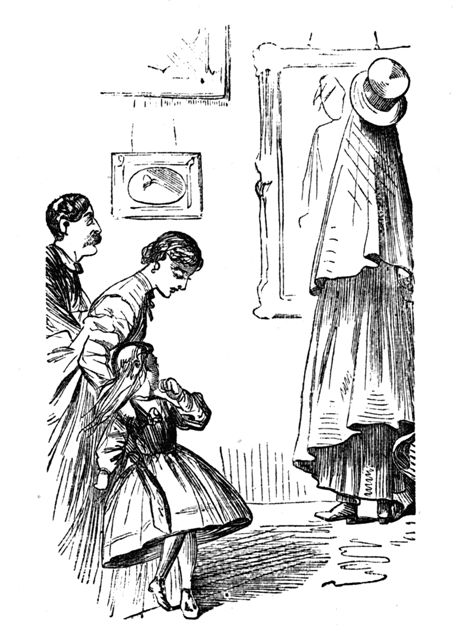
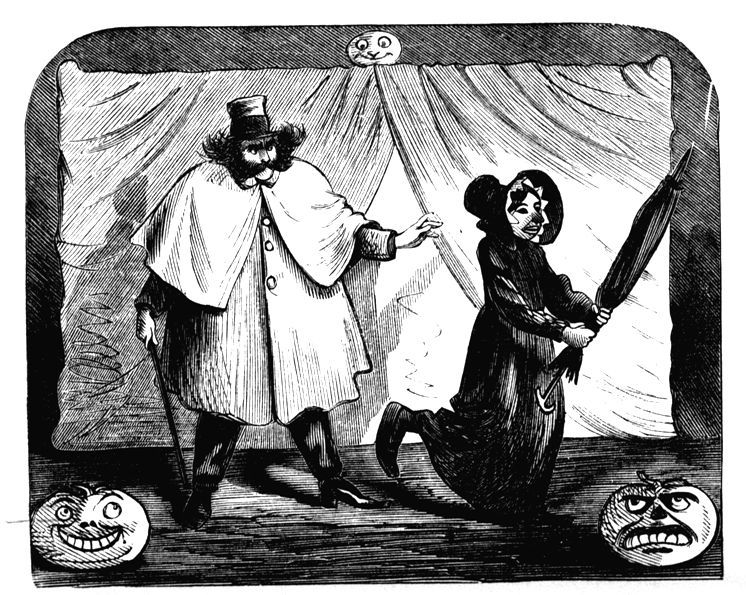
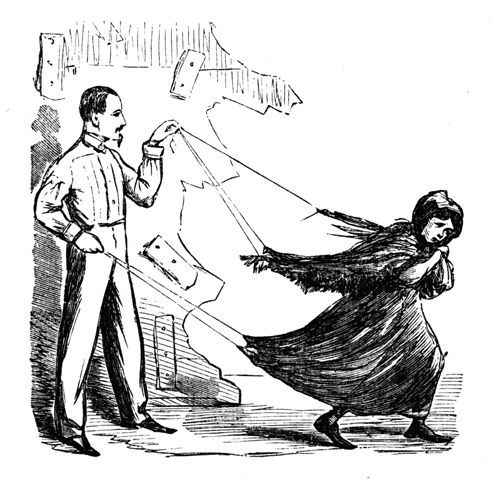
be easily gotten up in any household. In the full-page
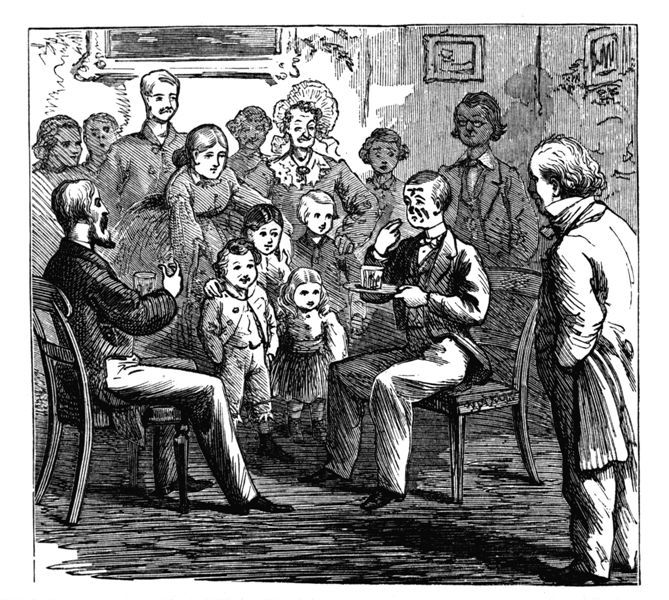
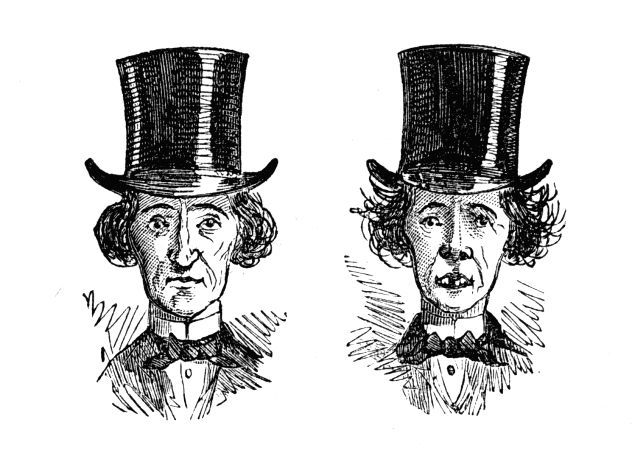
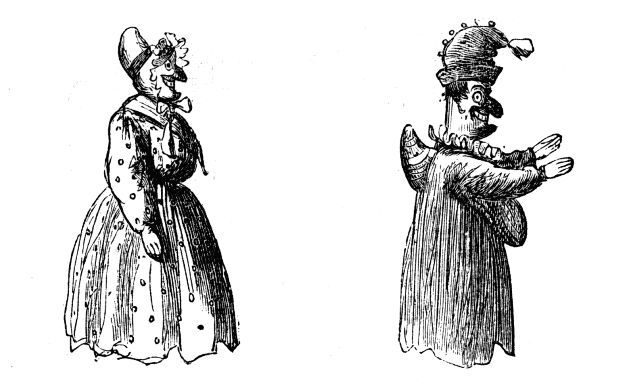
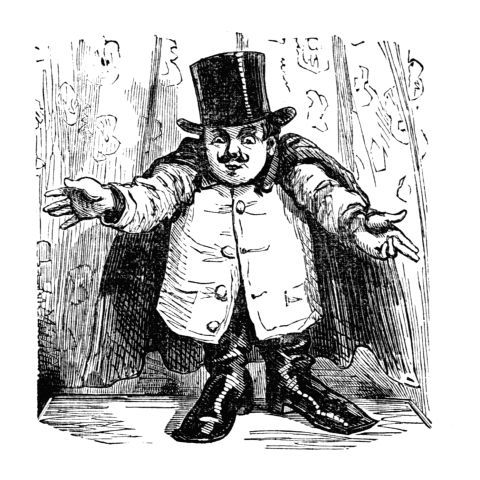
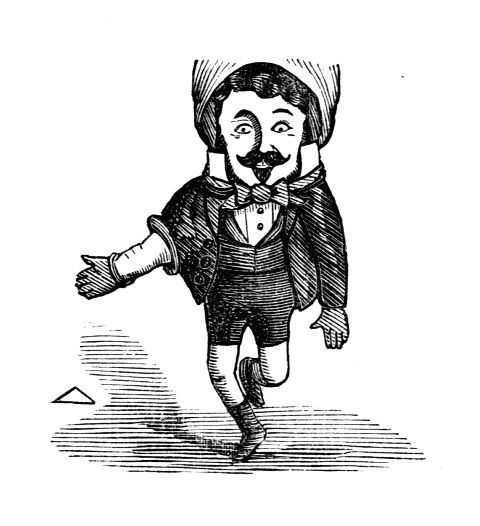
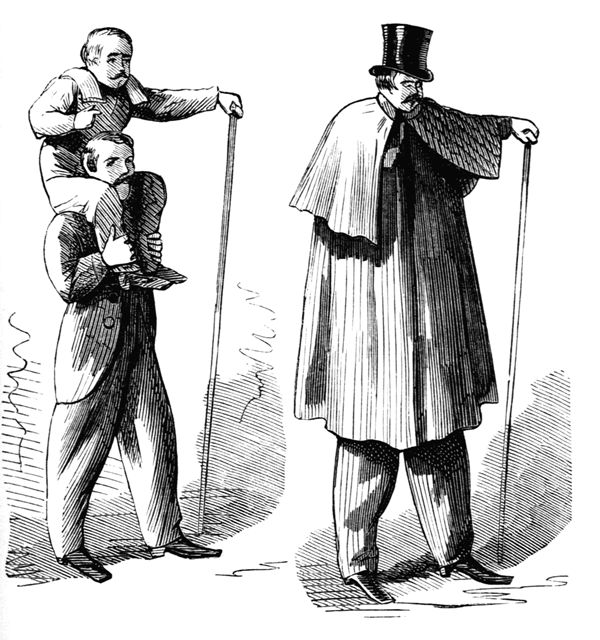
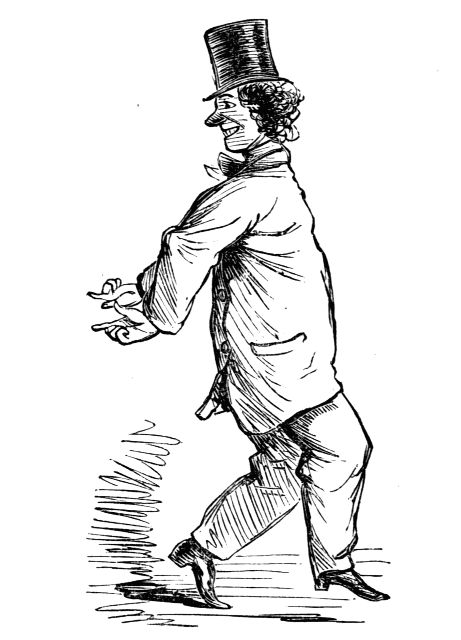
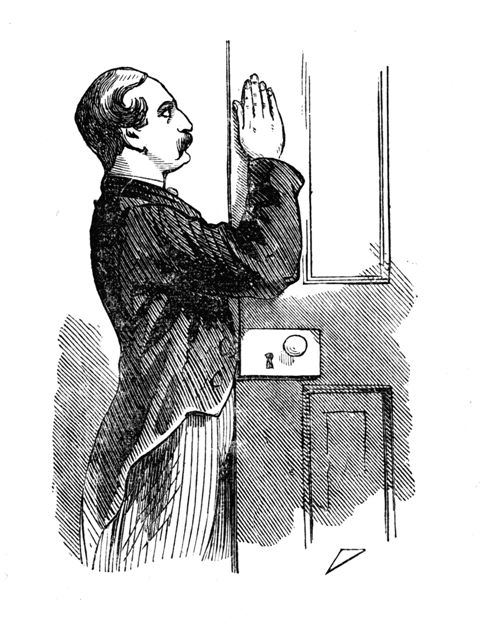
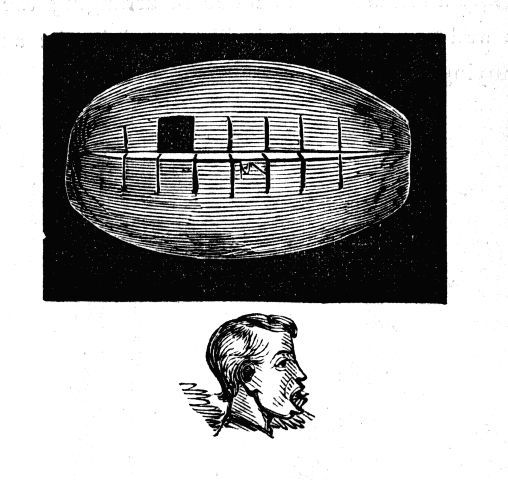
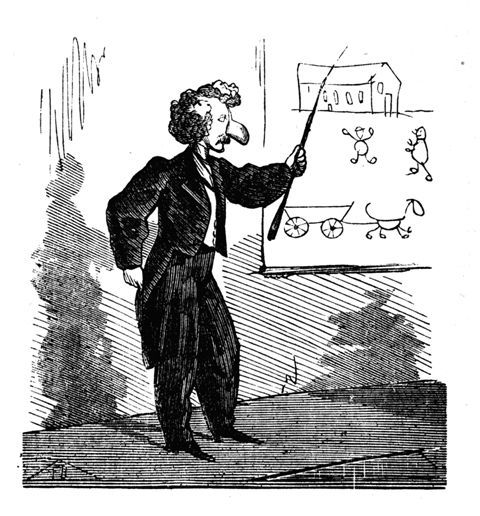
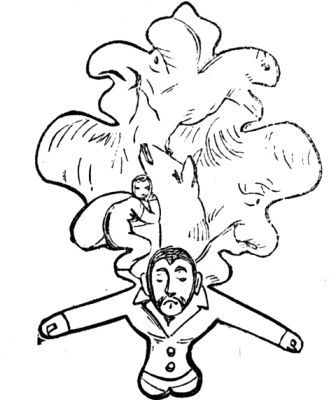
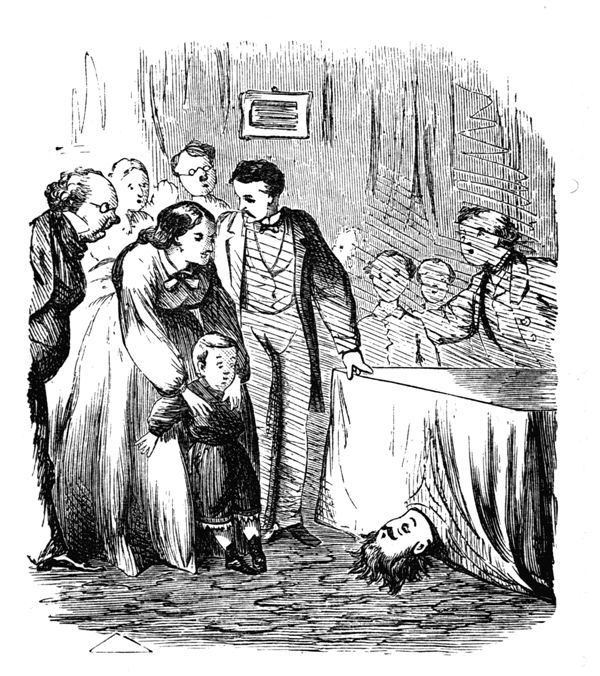
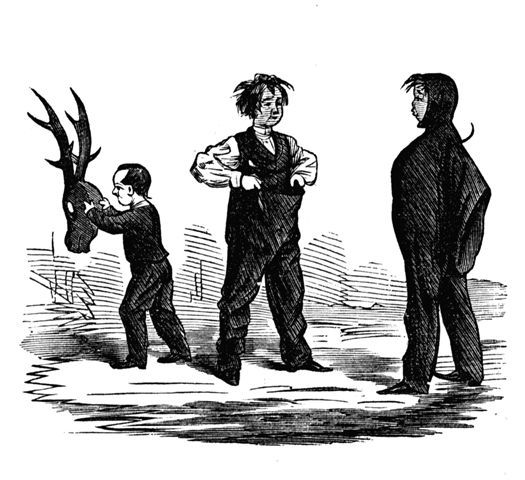
picture you will see our idea of the "make-up"
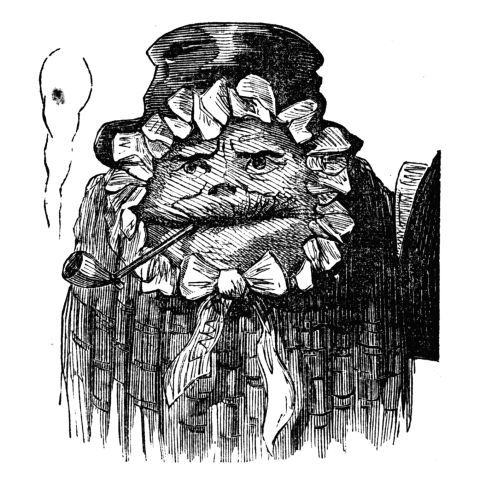
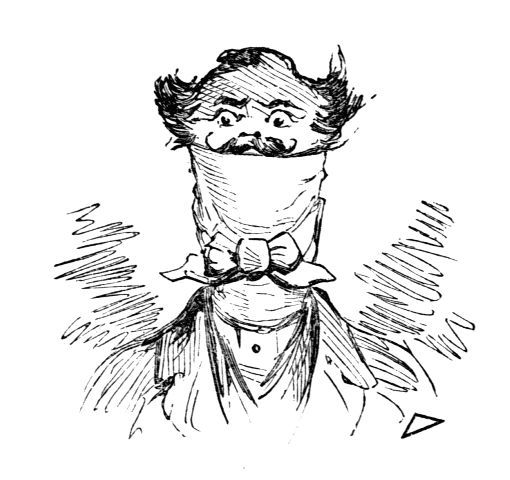
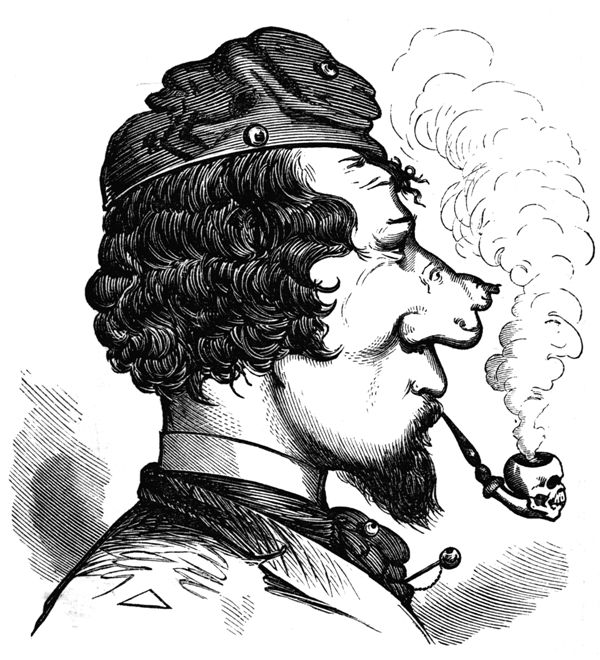
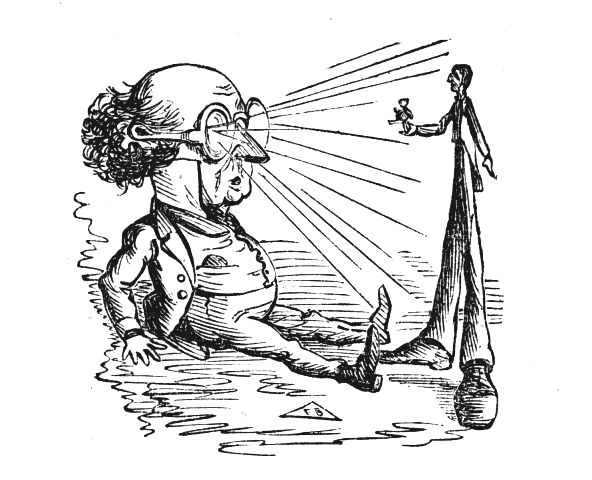
of the Artist, but as Mr. Bullywingle does not
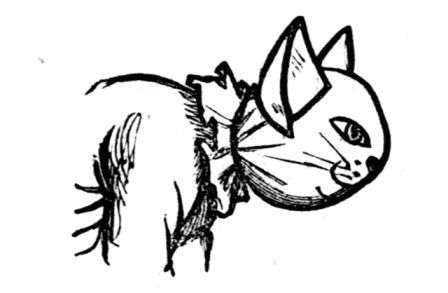
come out so well on so small a scale, we annex a
picture of his head and shoulders as a guide to the
reader. We feel disposed, however, to allow the
largest latitude to the performers as to make-up.
They can modify the dress of the characters according
to circumstances. Another reason we have for
giving the portrait of Mr. Bullywingle is, that a
large copy of it is required in the performance of the
piece. In copying this it is no matter how ludicrously
inaccurate your performance is, provided
you make the face fiery red, the hair white, and
the spectacles green. Indeed, the worse the picture
the funnier the effect.
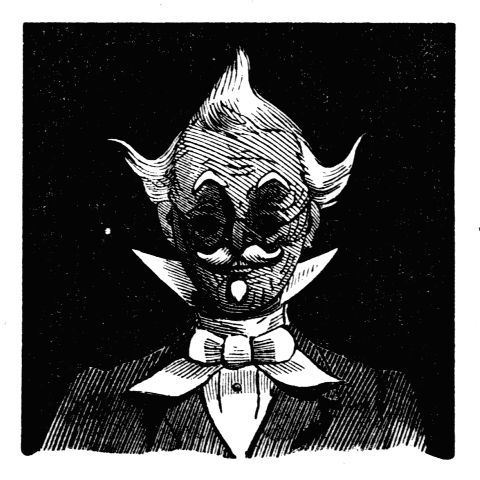
Mr. Bullywingle.—Hat—white, with black band.
Face very red, culminating in a bright crimson on
the nose. The face should be colored with vermilion,
which can be procured in a powdered state
at any color store. If you get it in this state mix
it with water, to which add a very small quantity
of gum or glue. The best plan, however, is, if convenient,
to purchase a cake of vermilion such as is
used for water-colors.
Hair, eyebrows, and moustache must be very
white. The hair and moustache can be made white
by dressing with plenty of pomatum, and then
sprinkling them liberally with flour from the flour
dredger. The imperial and eyebrows should be
painted on the face with flake-white. Procure two
ounces of flake-white (in powder) in any paint store;
mix it carefully with water till it is about as thick
as molasses. A small piece of glue, about the
weight of two beans, should be dissolved in the
water before it is added to the flake-white.
Spectacles—green, which you can either borrow
from a friend, buy at a store, or steal anywhere.
If, however, you are too proud to steal, and you cannot
get the specs any other way, you may cut them
out of card-board and paint the proper color. As
Mr. Bullywingle wears his specs on the end of his
nose, never using them to look through, it is of
little consequence whether they be transparent or
not.
Cravat—large and white.
Shirt collar—large; can be cut out of writing-paper.
Coat—blue, with gilt buttons.
Vest and pants—light; the latter short in the
legs.
Shoes—low.
Mr. Puttyblow (the artist).—Nose red; eyebrows
black, and painted above the natural eyebrows.
This gives the eyebrows a continued elevated appearance,
which is very comical in effect.
The moustache and beard can either be painted
with burnt cork or India-ink, or, which is far better,
made out of curled hair and a little diachylon, as
described in a previous chapter. If you wish to
make the character very comic, you can turn up
the nose with a piece of thread and stick a patch
of court-plaster over one of your teeth, all of which
has been described in earlier chapters.
Cap—something fancy, of bright color if possible.
Coat—anything comical and shabby. The young
man is poor.
Pants—short in the legs.
Miss MacSlasher must be attired in walking costume,
and make herself look as elegant and pretty
as possible. Or in case the ladies won't act, or you
happen to be out of pretty girls, you can get Miss
MacSlasher up as an old lady, and make her look
as comical as you can. You see our play is on a
compensating, self-adjusting principle. Now we
will give you a list of all the things you will require
in the way of "properties," as they are called
in stage parlance. Before doing so, however, we
must impress upon you the necessity of having a
stage manager, otherwise you will surely get into a
state of confusion and spoil the play. It is the
duty of the stage-manager to collect the properties
together and see that they are all in their right
places. He will arrange the stage, and, if desirable,
act as prompter.
Vermilion—To be procured at a paint store.
Flake-white and green paint—paint store.
Card-board for imitation spectacles, and glue—paint
store.
Three or four camel's-hair pencils—paint store.
India-ink or burnt cork.
Pomatum, butter or lard for hair.
Ten cents' worth of diachylon (in lump form, not
plaster—remember this; also remember that the
diachylon must be warmed before the fire to make
it stick), which can be had at any drug store.
Flour for hair can be procured from the kitchen,
if the barrel ain't gin' out.
Green spectacles.
White cravat and large shirt-collar.
Blue or green coat, with bright buttons.
Vest and pantaloons, light in color.
Small piece of court-plaster or black silk, for
tooth.
Curled hair from stuffing of mattresses.
Cap for artist, of bright color.
Coat for artist.
Pants for ditto, legs short.
Slippers for ditto.
Large portrait of Mr. Bullywingle.
Easel or stand for portrait.
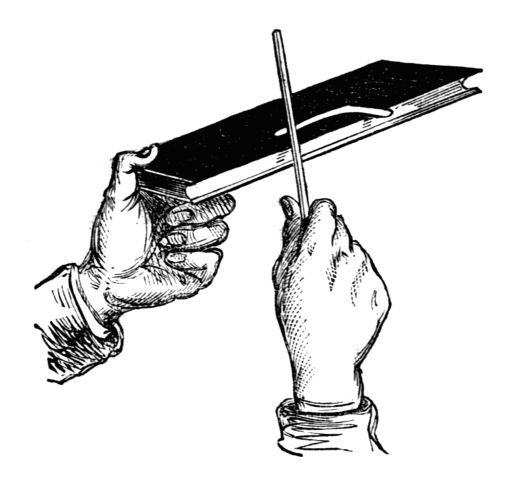
Palette (the palette should be cut out of pasteboard,
the cover of a large book, or something of
that kind—a wooden palette would break when sat
upon); a maul-stick and brushes, pictures, casts,
etc., to give the artist's studio an artistic appearance.
Stale hard loaf of bread.
Knife—palette knife if possible.
Tray with two cups.
Tea-pot containing very weak tea.
Plates, butter, and pieces of crockery, to make a
clatter.
Sheets, comfortable, shawls, or Turkey-red, to
make proscenium and drop-curtain.
Several sheets of tissue-paper, red and blue, to
ornament proscenium.
Lamps to light the stage.
Deeds and legal documents for Mr. Bullywingle.
Umbrella for Mrs. Bullywingle.
White hat with black band.
Towels, or rags, to cover and conceal artist's
breakfast on a chair.
Slice of bread prepared with diachylon or hooked
pins to stick to Mr. Bullywingle's coat-tail.
Dramatis Personæ.
Mr. Puttyblow, an artist.
Mr. Bullywingle, a bachelor who is beloved by women, or thinks himself so.
Miss MacSlasher.
|
Scene.—An artist's studio.
Curtain rises, or is pulled down, and discovers
Mr. Puttyblow seated at an easel opposite a picture
which is so placed that the audience cannot see the
face of it.
Mr. Puttyblow (yawning). Oh—on—on—awe—awe—oo—oo!
Oh, thunder! Oh, pickled thunder,
turnip-tops, trust, tick, and tomatoes! I wish
to goodness, goose-pies, and the goddess of fame,
some one would give me a commission to paint
a picture—one thousand dollars—half cash in
advance, and the balance on completion of
the work—some grand heroic subject, which would
send my name and fame resounding through
the nations of the earth like the mighty avalanche
of the Alps, till the human race with one
voice should stand back and exclaim—"That's
him!"
Now, I think I could paint a picture of Washington
Crossing the Delaware in a style of art equally
creditable to my feelings as an artist and an American
citizen. I'd make Washington—yes—I would
not make him as they generally do, in a great, big,
comfortable boat, with a new suit of clothes, looking
up to heaven, while a lot of other fellows are
shoving the boat through lumps of ice with hooks
and pikes, and things of that kind. No! I'd make
him swimming across, with the stars and stripes
between his teeth and a horse-pistol of the period
behind each ear. That's what I should call something
like a picture. But all this is vain; instead
of painting big pictures, and building my palatial
villa on the Hudson, I am stuck and starved in this
miserable chamber—a poor artist with scarcely
anything to feed upon but tobacco-smoke and my
own ideas. Talking about feed reminds me that I
have had no breakfast yet. Now breakfast is one
of those ideas about which I have my own ideas—namely,
to wit: that you can't continually do without
it—that's to say, not as a steady thing. It grows
monotonous after a time. That tea has been standing
three-quarters of an hour, and ought to be now
fit for human nourishment (pours out tea, which is
quite colorless). Rather weak—I may even go so
far as to say exceedingly weak. It is like Hancock's
veterans, will stand any amount of fire for
any length of time without changing color. But
you are very weak, poor tea; like women, let us
respect your weakness. The butter is strong
enough to take care of you (smells butter). I wonder
whether this butter is not manufactured near
Forty-second street, N. Y. It strikes me I have
smelt something very like it near the soap factory
on the Hudson River Railroad. Where's the knife
(takes knife and loaf)? Ah! here it is (tries to cut
loaf, which resists all his efforts). This loaf is beginning
to get slightly obstinate. Most extraordinary
thing how hard a loaf becomes after you have
kept it for a week or two. However, I ain't the
kind of man to let any darned baker's bread—ever
baked—get the best of me. No! (Takes up
hatchet at one side, places bread on floor, and begins
chopping it. Cuts off a piece which he butters,
and lays upon a chair.) Now, Puttyblow, my boy;
you shall have bread and chops for breakfast.
C-h-e-o-p-s—chops! Chops with a large C. (A
loud knocking is heard at the door.) Oh, thunder!
there's some one at the door—it will never do to
let them see these things around (piles up cups
and saucers on tray and covers them with towels.
He leaves the slice of bread and butter, however, on
the chair). It doesn't look prosperous; and nobody
ever thinks anything of any one who isn't
prosperous. (Seats himself at easel, and pretends
to be busy painting.) Come in!
Enter Mr. Bullywingle.
Mr. B. Ha! I've found a refuge at last, thank
goodness! I'm all in a flutter—she nearly caught
me. It was a dooced close shave. Here am I tormented
to death by women who will insist upon
marrying me. 'Pon my soul it is rather too bad that
a man, because he is rather nice-looking and has a
little money saved up, cannot leave his house without
being pursued by all the women in creation
wanting to marry him. I don't want to marry them.
I don't see any particular fun in dividing all my property,
my time, my comfort, my amusement, with
another individual, besides giving that individual
the life-long privilege of—the life-long right to dictate
the temperature of the apartment in which I
sit, the amount of light which shall illuminate my
chamber; who shall be my associates; where I
shall live; what I shall eat; what I shall drink—there's
the rub! actually putting the power into the
hands of a mortal like yourself to come between
you and your social tod. Oh, it's horrible to think
of! Marriage is a humbug. I wouldn't marry the
Bearded Lady herself. But I wonder what kind of
an office this is I've rushed into—not a lawyer's;
no—doesn't smell of Russia leather. Not a Government
office; no—don't smell any whiskey. Not
p-e-t—yes, r-o—l-e-u-m; there's certainly a smell
of oil around. Ah, oh—yes, I see; it's some kind
of a paint shop. I must trump up some business
with the proprietor as an excuse for coming in.
Wonder, by the way, whether there's anybody
about, after all? Ah! yes, to be sure; bless my
soul, there he is. (Takes a step towards artist, and
coughs. Artist pretends to be deeply engaged in
his art, and does not hear him.) Ahem! ahem!
wonder whether the poor creature is deef and dumb.
Ahem! ah, excuse me, sir, but—ah, that is fine day—ahem!
good-morning, sir.
Artist. Good-morning, sir.
Mr. B. You are a painter, are you not, sir?
Artist. That is my name—ah, that is to say, that
is my profession.
Mr. B. I want you to paint me a sign for my
store.
Artist. A what, sir?
Mr. B. A sign. Jothan H. Bullywingle, wholesale——
Artist. Wholesale fiddlestick!
Mr. B. Wholesale dealer in——
Artist. Sir, I would have you to understand that
I don't paint signs, sir. I am an artist—historical
and portrait delineator.
Mr. B. Oh, ah! yes, exactly; that's what I mean.
I want you to paint my portrait—Jothan H. Bullywingle,
wholesale—no, exactly as you were saying,
my portrait. (Aside)—By Jove, I—I'm in for it.
Artist. Would you like a full face?
Mr. B. (thoughtfully). Why, pretty full.
Artist. Or a side face?
Mr. B. Oh, yes—a side face.
Artist. Or a three-quarter face?
Mr. B. Yes, a three-quarter face. Yes, she was
a blue one, I think, this last one.
Artist (prepares seat). Will you take a seat, Mr.
Bully—Bully——
Mr. B. Wingle.
Artist. Will you take a seat, Mr. Wingle?
Mr. B. Bully, sir.
Artist. Take a seat, Mr. Winglebully.
Mr. B. Yes, yes, certainly. (Aside—I'm regularly
stuck for a portrait.) Certainly, sir; though
you haven't got my name exactly right—not quite
correct, my young friend. My name is Bullywingle.
(Aside—The first one was purple and diamonds.)
[Mr. B. seats himself at opposite side of stage to
artist, who sits down and prepares to paint.]
Artist. Will you smile, sir?
Mr. B. (aside.) Really, a very polite young man.
Thank you, I don't mind if I do—the least drop in
the world; Bourbon, or anything that's handy.
Artist. I mean, sir, will you be pleased to smile
with your mouth?
Mr. B. (aside.) With my mouth? Of course,
with my mouth. Does the young man fancy that I
propose to drink through my nose, like an elephant?
(Aloud.) Oh, yes, I'll smile with my
mouth, of course.
Artist. I perceive you do not understand me, sir.
I allude to the expression.
Mr. B. Oh! I'm perfectly familiar with the expression—perfectly
familiar with the expression.
Artist. Mr. Winglebully, I wish you to assume
an agreeable expression of countenance in order
that I may transfer your beautiful features to my
canvas in a manner satisfactory to yourself, myself,
and mankind generally.
Mr. B. Oh, ah! yes, certainly—exactly—to be
sure—bless my soul—yes. (Mr. B. grins in an exaggerated
manner).
Artist. Ah—yes; that's it—that's it—just so.
A little to the left. I'm afraid—keep your head up—I
cannot give you a very long sitting to-day—I'm
so crowded with sitters. (Mr. B. forgets that he is
sitting for his portrait and begins to look very
melancholy and miserable.) I am obliged to—smile,
if you please. (Mr. B. starts and resumes
his exaggerated grin.) I'm obliged to fix certain
days and hours to receive my friends and patrons,
otherwise they—will you smile, if you please?—otherwise
they would not leave me a—will you
smile, if you please, sir? Look at me and think
of something pleasant. Think of a lady (Mr. B.
looks miserable and frightened). (Aside—He
doesn't look as if he were thinking of a lady, does
he?) Think of something pleasant, now—something
pleasing. Think of Hash (Mr. B. brightens
up). Yes, hash. Keep on thinking of hash, hash,
hash! Good gracious! will you smile, sir? Hash—hash—hash!
Keep smiling—hash—that's it;
hash! There, sir, will you be kind enough to look
at that? You are a little rough and raw (Mr. B.
starts), but, of course, I have only rubbed you in.
You will come out better at the second painting.
Mr. B. (rising and advancing towards the picture).
Oh, yes—yes, very good. The shirt-collar
and the cravat are extremely like; but don't you
think you might alter the rest?
Artist. Well—ah—umph! I don't know. I
think I have hit your eye exactly. (Mr. B. starts
slightly.) The hair is very fair, and I've got hold
of your nose very satisfactorily. (Mr. B. rubs his
nose.) The mouth might look all the better, perhaps,
for a little madder, but——
Mr. B. Oh, dear, no, it's quite mad enough. I
don't wish to have a severe expression of countenance.
Artist. I refer to the color—the pigment.
Mr. B. The color the pig meant. The pig—the
pig. I meant what I said, sir; and if you think to
call me a pig with impunity you are very much mistaken.
Artist. Oh, no—no—no, my dear sir; you mistake
me. We artists use a beautiful pink color
called madder, and I spoke of this as a pigment—no
offence, not for the world. But allow me to
place the picture in a better light; you can hardly
judge of it in its present position. (Turns easel
and picture round facing the audience.) (Aside.)—Now
won't he be an unreasonable old polypus to
object to that as a likeness? (Aloud.)—There, sir,
now you can see it better. (They both sit down in
chairs, the artist on his own palette and Mr. B. on
the slice of bread and butter left by the artist.)
Artist. Now, sir, I think I have caught the expression
of your eyes and spectacles; and as for
the nose, it literally speaks, while the chin and
mouth—
Mr. B. Yes—yes, but I don't think you have
stuck quite closely enough to nature. There is
nothing like sticking to a thing. (Rises and moves
towards picture, showing slice of bread sticking to
his coat-tails. Advances and examines picture
critically.)
Artist. I declare, if the idiotic old grampus has
not been sitting down on my bread and butter. It
is most extraordinary that some people will never
look where they sit down. (Rises to remove bread
and butter, and shows palette sticking to his dressing-gown
behind.) The carelessness of some people
is marvellous—really astonishing.
Mr. B. The shirt-collar is certainly very like;
but don't you think the complexion is a little high?
because I am really rather pale, you know.
Artist (making futile endeavors to remove the
bread and butter with one hand). Ah, yes, perhaps
that might be toned down a little. (Aside.) I'll
whitewash the old brute if he likes. (Aloud.) If
you will be kind enough to take a seat for two
minutes I will try to avail myself of your valuable
suggestion (looks around for his palette). Now,
where on earth can be my palette? (Looks suspiciously
at old Mr. B.) He can't have been sitting
down on that too—and yet I do believe he's stupid
enough for anything. (Looks for palette again.)
No. (At this moment Mr. B. sits down on the
chair where Mr. P. has concealed his breakfast, and
everything goes with a crash.)
Artist. There goes that old porpoise again! All
my breakfast gone—my beautiful tea and my elegant
bread and butter. (To Mr. B., who apologizes.)
Ah, never mind, sir—no consequence;
only a few paint saucers, that's all. No consequence;
take a seat over here. (Seats old gent in
the chair which Mr. B. first occupied, and which
artist has since used.) But my palette—where can
it have gone? Where's that d—d palette? Let
me see; I think I laid it on that chair. Will you
kindly rise for one moment, Mr. Winglebully?
(Looks at Mr. B.'s back.) No! strange—let me
see—oh! ah! yes—I—he sat over there. (A
thought seems to have struck him. He begins to
feel behind his own coat, where he finds the palette.
Produces it—his own fingers covered with paint.)
There it is—I knew I'd put it somewhere. (Here
a knocking is heard at the door. Mr. B. jumps up
and grasps the artist by the hand, getting his own
covered with paint in the operation.)
Mr. B. Here she is! For heaven's sake, conceal
me!
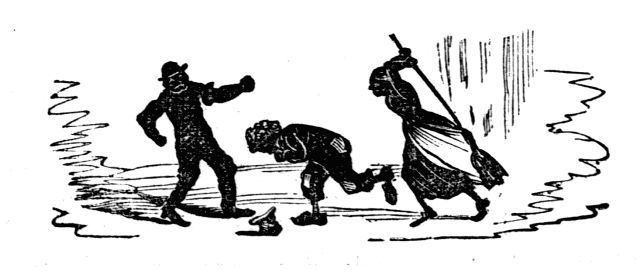
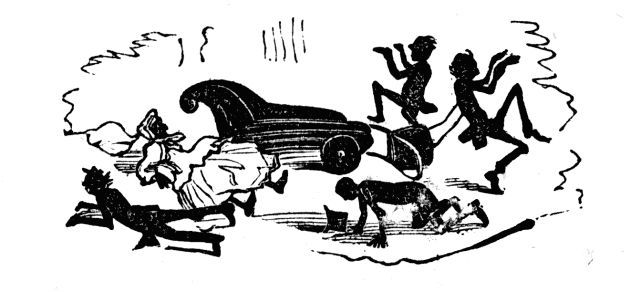
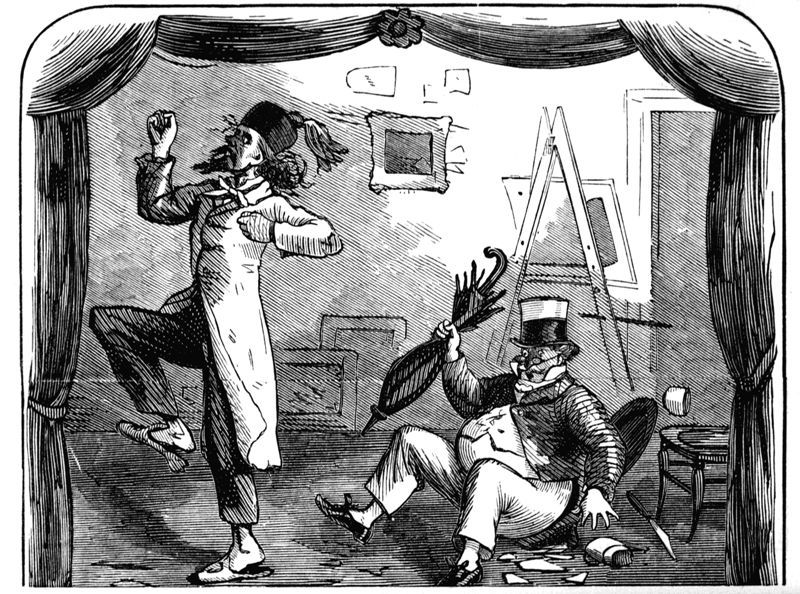 THE DRAMA OF "BULLYWINGLE."—See page 180.
Artist. Here is who?
Mr. B. The blue woman.
Artist. The blue woman?
Mr. B. Yes—they pursue me wherever I go.
It's a blue woman now. Yesterday it was a red
woman. Oh, all sorts of women—black women—green
women—white women—for pity's sake, conceal
me! They'd make a Mormon or polygamist
of me. (Wipes his painted fingers over his face.)
Oh, my dear sir, you would not have me commit
trigamy—you would not—but hide me somewhere—hide
me!
Artist. Here—here, behind the curtain.
Lady enters.
Lady. Is there a gentleman here?
Artist. Em—ah! gentleman? no—no; that is
to say, not exactly.
Lady. This is an artist's studio, is it not?
Artist. Yes, madam; this is an artist's studio.
Lady. There is no other studio in this building?
Artist. This is the only studio in this building.
Will you take a seat, madam?
Lady. I was to meet an elderly gentleman here—my
father—who was going to have his portrait
taken.
Mr. B. (aside.) Her father—that's a deep dodge.
Pretends to be after her father, the artful thing.
Artist. Yes, madam.
Lady. He should have been here some time
ago—that is to say, if I have come to the right
place.
Artist. Ah, yes; this is the right place. (Aside.)
Hooray! here's another job.
Mr. B. (aside.) Send her away! send her away!
Ah, you villain, are you going to betray me?
Lady. You seem to have a great many pretty
pictures here.
Artist. Ah—oh—well, a few little trifles. Are
you fond of art?
Lady. Oh, yes—very.
Artist. I shall be happy to show you some of my
sketches. If you will excuse me for a moment, I
will bring them from the other room.
Lady. Certainly, It will give me great pleasure
to look at anything in the shape of pictures. I
once studied Poonah Painting and Potichomanie myself;
and mamma's uncle, who was a great artist,
and used to draw things with a red-hot poker, said
he couldn't tell my pictures from life, almost—only
I could never learn to do trees. Don't you find
trees very difficult? Mamma's uncle used to say
the only fault with my trees was that they looked
like cabbages. I can paint cabbages very well; but
then they don't look pretty in a picture, you know.
Artist. Indeed, I doubt not your delicate hand
would lend a charm to any object it might portray.
Nature is full of beauties, and there is a world of
loveliness even in a cabbage.
Mr. B. (aside.) In a cabbage-head.
Artist. But I will bring you my portfolio—a few
unworthy sketches which may serve to while away
the moments till the arrival of your estimable
father.
[Exit.
Mr. B. (aside.) Good heaven! He is going to
keep me here all day while he makes a fool of himself
to that young woman. This will never do! I
must escape. I must throw myself on her mercy.
She has an awful vicious expression of countenance,
though. However, she must have the heart of a
woman. Perhaps she has a brother; and how
would she like to have him married against his will
by fifteen women in blue? I will—yes, I will
throw myself on her mercy. I will implore her to
spare me. Poor thing! I shall be sorry to break her
heart—but it must be done.——Courage, Bullywingle—courage!
(Rushes out and throws himself
at her feet.) My good young woman, spare
me! Think of your own brother, and spare me!
[Lady screams and rushes off.
I cannot marry you all. If I did marry you I
should make the red lady miserable for life, and
the green lady would die of jealousy, and the yellow
lady might commit suicide.
Enter Artist, with portfolio, which falls on the floor.
Artist. You venerable reptile, what are you
about! What do you mean, sir? Get up, sir!
I'll knock you down, sir! You've driven away one
of my best customers. (They scuffle.)
Mr. B. But my dear sir—my good young friend,
what was I to do? Hear me—listen—leave go—you'll
tear my coat—let go, or she'll be back, and
then I'm lost! Do you hear, you rascal! You'll
tear my coat—there go my suspenders—there goes
something else! I'll have you arrested for intent
to do grievous bodily battery and commit violent
matrimony—let go!
Artist. You old rascal—you old polypus—you old
humbug—you are ruining me! (Rushes to one
side and returns with club or stick. A fight ensues.
Old gent strikes an attitude with umbrella.)
Mr. B. Come on, Mac what's your name! and
damned be he who first cries hold—enough!
Artist (aside). I'll be hanged if the old buffer
ain't swearing! (Aloud.) By all the powers I'll be
revenged! As sure as my name is Puttyblow I
will be re-ve-n-ged! (Is about to rush at old
gent.)
Mr. B. Pause, rash man! Did you say Puttyblow?
Artist. I did.
Mr. B. Have you a strawberry mark on your left
arm?
Artist. Nature has ornamented me in the manner
you describe.
Mr. B. Are you short-sighted in your left eye?
Artist. Such is my affliction.
Mr. B. Do you snore at nights?
Artist. So I have been informed by the people
over the way, who have sent over several times to
expostulate with me in the most offensive terms
possible.
Mr. B. And sleep late in the morning?
Artist. I do.
Mr. B. (rushing forward.) My long-lost son!
Artist. Excuse me for one moment. Have you
a gooseberry bush on your left arm?
Mr. B. Gooseberry? No—no—not specially.
Artist. Do you wear corns or paper collars?
Mr. B. Well, I've had chilblains.
Artist. Are you subject to hydrophobia?
Mr. B. Well, not precisely; but I've been run
over by a Broadway omnibus.
Artist. Are you in the habit of committing suicide?
Mr. B. Well—I—I—don't know—I travel on the
Hudson River Railroad sometimes.
Artist. Come to my arms, my long-lost father!
[They embrace.
Mr. B. Bless you, my boy—bless you! bless
you!
Enter Lady. Artist sees her, and struggles to
escape from Mr. B.'s grasp.
Artist. Let go—let me go—drat it all, let go.
Mr. B. Bless you, my boy—bless you!
Lady. I have left my portemonnaie in your studio—will
you be kind enough to let me have it?
Mr. B. Young woman, spare me!
Lady (to Artist). Pray protect me from this venerable
ruffian.
Mr. B. (aside.) Venerable ruffian! Come, now,
that is what the boys call rather rough. (Aloud.)
Then you don't love me?
Lady. If you insult me further, I shall inform my
father.
Mr. B. Then you have a father?—wonderful!
Are you sure of it—no deception? What is his
name? Where does he live? Tell me quick—quick—do
not deceive me!
Lady. My father, sir, is General MacSlasher, who
will not allow his daughter to be insulted with impunity.
Mr. B. MacSlasher! The brave MacSlasher,
who married my half-cousin Columbia Ann, of
Pickleville, Indiana?
Lady. Indeed, it is true.
Mr. B. Come to my arms, my long-lost niece!
No, not niece; cousin—second cousin—oh, hang the
relationship! Come to my arms, any way! But hold—you
are the richest heiress in New York. I have the
deeds in my pocket to prove it. By the will of your
late grandfather Grampus you are the sole possessor
of six blocks on Broadway, Trinity Church, Erie
Railroad, two steamboats on the Hudson River that
won't burst, and vast territories on Coney Island.
Artist. Good gracious!
Mr. B. Happy hour—auspicious moment! to
have thus met my son and niece on the same day.
Puttyblow, my son—no longer Puttyblow, but Bullywingle—this
is the lady I have destined for you for
ten long years, if I could only have found you. She
is rich and beautiful. I know you love each other;
and if you don't, make believe you do, or you'll
spoil the play. Bullywingle, junior, embrace your
bride! Take her and be happy! Bless you, my
children—bless you!
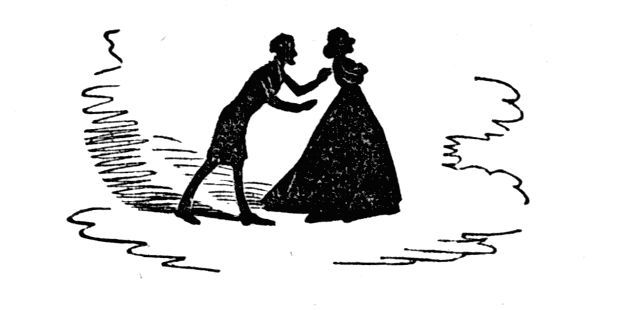
Grand tableau. Mr. Puttyblow and Miss MacSlasher
embrace. Mr. Bullywingle opens his
umbrella, and, standing on one leg, holds it over
them.
 THE
art of
AMUSING
THE
art of
AMUSING