Tom Pierson strode briskly down the hill,
fishing-rod in hand. As long as he had been
in sight of the school he had skulked in the
shadow of the hedges, for he knew that Satterlee
2d was looking for him, and the society
of that youth was the last thing he desired
at present. For Satterlee 2d possessed the
highly erroneous idea that the best way to
catch trout was to make as much noise as possible
and to toss sticks and pebbles into the
brook. And so Tom, a devout disciple of
Izaak Walton, preferred to do without his
chum when he went fishing.
The time was a quarter after four of a late
May afternoon. Tom had tossed the last book
into his desk and slammed the lid just fifteen
minutes before. From the school-hall he had
sneaked to the dormitory, and secured his rod,
line, and flies. Even as he had descended
warily by means of the fire-escape, he had
heard the voice of Satterlee 2d calling his
name in the corridor. He had reached the
brook path undetected by dodging from dormitory
to school-hall and from school-hall to
engine-house, and so to the protecting shadows
of the high hedge that marked the western
limit of the school-grounds. Most of the other
two dozen pupils of Willard’s were down on
the field, busy with balls and bats. But no
form of athletics appealed to Tom Pierson as
did angling, and to-day, with the white clouds
chasing one another across the blue sky and
the alder-bordered brook in sight, he was almost
happy. Almost, but not quite; for even
at sixteen life is not always clear of trouble.
Tom’s trouble was “Old Crusty.” If it were
not for “Old Crusty,” he thought gloomily,
as he swung his pole through the new grass,
he would be quite happy.
“Old Crusty’s” real name, you must
know, was Professor Bailey: he was one of
the two submasters; and as for being old, he
was in truth scarce over forty—a good ten
years younger than Doctor Willard, the head
master, to whom, for some reason, the fellows
never thought of referring as “Old Willard.”
Professor Bailey and Tom had never, from
the first, got on at all well together. The professor
believed Tom quite capable of mastering
mathematics as well as others of his form,
and had scant patience for the boy’s sorry
performances. Tom believed that “Old
Crusty” dealt more severely with him than
with the rest—in short, to use his own expression,
that the professor “had it in for him.”
One thing is certain: the more the submaster
lectured Tom and ridiculed his efforts before
the class, the more he kept him in after school,
the less Tom knew of mathematics, and the
wider grew the breach between pupil and
teacher.
In all other studies Tom was eminently
successful, and there is no doubt but that with
a better understanding between him and the
submaster the former would have made a
creditable showing in the science that was at
present the bane of his life. But, as it was,
Tom hated “Old Crusty” with a great hatred,
while the submaster felt for Tom a large contempt,
if not an absolute aversion. And it
must be acknowledged that Tom gave him sufficient
cause.
A great deal of this passed through Tom’s
mind as he descended the path and reached
the shelter of the low-spreading alders that
marked the course of the brook. But, with
the sound of the bubbling water in his ears,
he put trouble behind him. Laying aside his
coat, he fitted his split-bamboo rod, and studied
the sky and the pool before him. Then he
chose a rather worn brown fly, and cast it
gently into the center of the limpid basin.
Above him the branches almost met, and he
knew from experience that if he hooked a
trout he would have to play him down-stream
before he could land him. Ten minutes
passed, but, save for the inquiring nibble of a
sunfish or similar small fry, he found no encouragement.
The sun went behind a large
cloud, and Tom changed his fly for a bright
red-and-gray one. But even that failed to
entice the trout. He grew impatient, for the
school rules required him to be back in bounds
by half past five. Presently he drew in his
line, donned his coat, and made his way noiselessly
down-stream. When he had gone some
ten yards, creeping from bank to rock and
from rock to bank again, not without more
than once filling his scuffed shoes with water,
he came to a fence, the rails of which reached
straight across the stream, which here narrowed
to a rocky cascade. On the trunk of
a big willow at one side there was a board. On
the board was the legend:
PRIVATE PROPERTY
TRESPASSERS WILL BE PROSECUTED
TO THE FULL EXTENT OF THE LAW
Tom winked at the sign, and climbed the
fence. He did it so nimbly and expeditiously
as to suggest a certain amount of experience.
In truth, Tom had crossed that fence before,
not once but several times, since the trout had
commenced to bite that spring. If it will
make his conduct appear any less heinous, it
may be said in his behalf that he always gave
a fair trial to that part of the brook within the
school-grounds, and only when success failed
him there did he defy the law and become
a trespasser on the estate of Fernwood. It
would be interesting to know whether old
Father Walton always respected “No trespassing”
signs. Whether he did or did not,
he appears to have left as a heritage to his followers
a special code of morals where forbidden
property is concerned; for often a man
who will hold the theft of an apple from a
roadside orchard in utmost horror will not
hesitate to extract a fish from a neighbor’s
brook and bear it off in complacent, untroubled
triumph. If I have dealt at undue length
upon this subject, it is because, for the sake of
my hero, I wish the reader to view such amateur
poaching as his with as lenient an eye as
possible.
Fernwood held one widely celebrated pool,
from which, even when all of the other pools
refused to give up a single fish, the practised
angler could invariably draw at least a trio of
good-sized trout. Toward this ideal spot
Tom Pierson, making his way very quietly
that he might not disturb and so cause unnecessary
trouble to a couple of very alert gardeners,
directed his steps. Once, in spite of
care, his line became entangled, and once he
went to his knees in the icy water. Yet both
these mishaps but whetted his appetite for the
sport ahead. When he had gained a spot a
dozen yards up-stream from the big pool, he
paused, laid aside pole-rod and paraphernalia,
and crept cautiously forward to reconnoiter.
If, he argued very plausibly, discovery was to
fall to his lot, at least it were better to be found
guiltless of fishing-tackle. He crouched still
lower, as, over by a clump of dead willows
within the school bounds, he espied through
the trees the jauntily appareled Satterlee
briskly whipping the surface of the brook with
unsportsmanlike energy and apparent disregard
of results. Tom, however, knew himself
to be unobserved, so felt no fear from that
source. But just as the dark waters of the
pool came into sight between the lapping
branches, a sound, close at hand and unmistakable
as to origin, caused his heart to sink
with disappointment. There would be no fishing
for him to-day, for some one was already
at the pool. The soft click of a running-reel
came plainly to his ears.
He paused motionless, silent, and scowled
darkly in the direction of the unseen angler.
Then he went forward again, peering under
the leaves. At least he would know who it
was that had spoiled his sport. Three steps—four;
then he suddenly stood upright and
gasped loudly. His eyes opened until they
seemed about to pop out of his head, and he
rubbed them vigorously, as though he doubted
their evidence. After a moment he again
stooped, this time sinking almost to his knees,
and never heeding the icy water that well-nigh
benumbed his immersed feet. On the farther
side of the broad pool, in plain sight, stood
“Old Crusty!”
He was hatless and coatless, and palpitant
with the excitement of the sport. His lean
and somewhat sallow face was flushed above
the prominent cheek-bones, and his gray eyes
sparkled brightly in the gloom of the clustering
branches. He stood lithely erect, the
usual studious stoop of the shoulders gone for
the time, and, with one hand firmly grasping
the butt of his rod and the other guarding the
reel, was giving every thought to the playing
of a big trout that, fly in mouth, was darting
and tugging until the slender basswood bent
nearly double. As Tom looked, surprised,
breathless with the excitement of his discovery,
the fish shot under the shelter of an overhanging
boulder, weary and sulky, and the
angler began slowly to reel in his line. Inch
by inch came the trout, now without remonstrance,
now jumping and slashing like ten
fishes, yet ever nearing the captor and the
landing-net. It was a glorious battle, and
Tom, forgetting all else, crept nearer and
nearer through the leaves until, hidden only
by a screen of alder branches, he stood at the
up-stream edge of the basin. At length, resisting
heroically, fighting every inch of the
way, the trout was drawn close in to the flat
rock where stood his exultant captor. The
latter reached a hand softly out and seized the
landing-net. Then, kneeling on the brink of
the pool, with one leg, he made a sudden dip;
there was an instant of swishing, then up came
net and trout, and——
At the end of the pool there was a terrifying
splash, a muttered cry, and Tom, forgetful
of his precarious footing, sat down suddenly
and forcibly on a stone, his legs up to the
knees in water. The landing-net dropped
from the angler’s hand, and the trout, suddenly
restored to his element, dashed madly
off, while the reel screeched loudly as the line
ran out. The professor, white of face, stared
amazedly at Tom. Tom stared defiantly, triumphantly
back at the professor. For a long,
long minute the two gazed at each other across
the sun-flecked water. Then, with a shrug of
his shoulders, “Old Crusty” stooped and recovered
his rod. When he again faced the
boy there was a disagreeable expression about
his mouth.
“Well, Pierson,” he said as he wound up
his line, “you’re better at playing the spy
than at studying your lessons, it seems.”
The blood rushed into Tom’s face, but he
held his tongue. He could well afford to pass
the insult, he argued with savage triumph;
“Old Crusty” was in his power. He had
only to inform Dr. Willard, and, beyond a
doubt, the submaster’s connection with the
school would terminate instantly. The head
master held poaching to be the deadliest of
sins, and poaching on Fernwood especially
heinous. That his enemy was poaching, that
he did not hold permission to whip the big
pool, was evident from the confusion into
which Tom’s sudden entry on to the scene had
thrown him. Yes, “Old Crusty” could vent
his anger to his heart’s content; for, when all
was said, Tom still held the whip-hand. But
then the enormity of the crime with which he
had been charged struck Tom with full force,
like a blow in the face. At Willard’s, as at
all schools, spying, like tale-bearing, was held
by the pupils to be something far beneath contempt.
And “Old Crusty” had called him a
spy! The blood again dyed the boy’s face,
and he clambered to his soaking feet and faced
the submaster angrily.
“It’s a lie!” he said hotly. “I was not
spying. I didn’t follow you here.”
The submaster raised his eyebrows incredulously.
“Is that the truth?” he asked.
“I don’t lie,” answered Tom, with righteous
indignation, glaring hatred across the
pool.
“Ah,” said the other. “In that case I
beg your pardon. I retract my remark, Pierson.”
The line was again taut, and now, apparently
indifferent to the boy’s presence, he began
to play the trout once more, warily, slowly.
Tom looked on from his rock, the intensity of
his anger past. He was forced to acknowledge
that “Old Crusty” had at least apologized
honestly and fairly; he wished he hadn’t:
somehow, he felt at a disadvantage. And
there was the enemy proceeding with his
wicked sport for all the world as though Tom
did not hold his fate in his hand, as it were!
Tom swelled with indignation.
“I suppose you know you’re poaching?”
he asked, presently, breaking the long silence.
The submaster did not turn his head; he
merely drew his brows together as though in
protest at the interruption. Tom scowled.
What a hardened criminal “Old Crusty”
was, to be sure!
The trout had but little fight left in him
now, and his journey back across the pool was
almost without excitement. Only when he
felt the imminence of the shore did he call
upon his flagging strength and make one last
gallant struggle for liberty. To such purpose
did he battle then, however, that the man at
the rod was forced to play out a yard or so of
line. Tom’s interest was again engaged, and,
much against his inclination, he had to acknowledge
that “Old Crusty” was a master
angler. And with that thought came another
and a strange one, and it was just this:
“Why,” he asked himself, “if he can be
as wonderfully patient with a trout as all
that, why can’t he be a little patient with
me?”
Suddenly, with the trout almost under the
bank, the angler paused and looked about him,
at a loss. Tom instantly divined his quandary;
the landing-net was floating on the surface
of the pool fully three yards distant.
Tom grinned with malicious satisfaction for
a moment; but then——
“Will you take the rod a minute?” asked
“Old Crusty,” just as though there was no
enmity between them. “I’ll have to get that
net somehow.”
Tom looked from the net to his soaking
shoes and trousers. There was but one thing
to do.
“I’ll get it,” he answered. “I’m wet
already.”
He threw aside coat and hat, and waded
in. The professor watched him with expressionless
face. Tom secured the runaway net,
and came out, dripping to his armpits, at the
submaster’s side. But when he offered the
net the other only asked anxiously:
“Do you think you can land him? The
leader’s almost cut through, and I’m afraid to
bring him in any farther.”
Tom hesitated, net in hand.
“That will be all right,” continued the
other; “I promise you I’ll never tell that you
had a hand in it.”
Tom flushed.
“I wasn’t thinking of that,” he said.
“Hold him steady, and I’ll get him.”
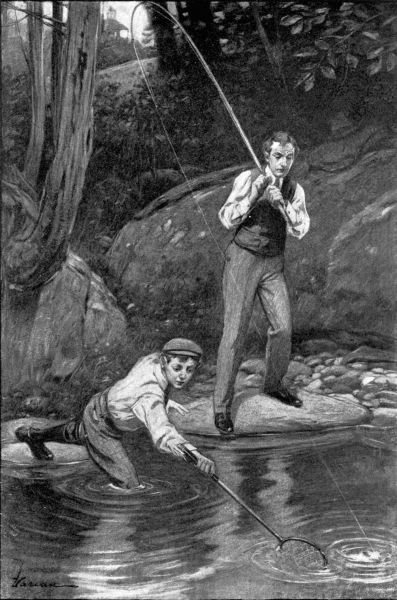
He knelt on the rock and looked for the
trout. It was nearly two yards away and well
under the water. He put one foot over the
edge and groped about until he found a support
for it below the surface. But even then
his arm was too short to get the net to the
fish.
“Can’t you coax him in another foot?”
he asked anxiously.
“I’ll try,” answered “Old Crusty.” “If
the line will hold——”
He wound gingerly. The gleaming sides
of the trout came toward the surface. Tom
reached out with the net, slipped it quietly
into the pool, and moved it toward the prey.
“Now!” whispered the professor, intensely.
Up came the landing-net, and with it,
floundering mightily and casting the glittering
drops into the air, came the captive.
“Well done!” cried the professor, laying
aside his rod. Praise from an enemy is the
sweetest praise of all, and Tom’s heart gave a
bound. The professor seized the trout, took
it from the net, and, laying it upon the bank,
removed the hook from its gasping mouth.
Then, with a finger crooked through its gill,
he held it admiringly aloft.
“Isn’t he a beauty?” he asked.
“You bet!” replied Tom, in awestruck
tones. “The biggest I ever saw in this
stream. Must be two pounds and a half,
sir?”
“Well, two pounds easily,” answered
“Old Crusty,” shutting one eye and hefting
his troutship knowingly.
“What will you do with him?” asked
Tom.
The other smiled. For answer he knelt
again on the rock, and, removing his hold,
allowed the fish to slide from his open palms
back into the pool. Tom’s eyes grew round
with surprise. The trout, after one brief moment
of amazement quite as vast as the boy’s,
scuttled from sight. Tom turned questioning
eyes upon the professor. The latter shrugged
his shoulders and smiled.
“I don’t want him; he would be of no use
to me, Pierson. All I want is the joy of catching
him.”
He turned, donned his hat and coat, and
began to wind up his line, examining the
frayed leader critically. Tom began to feel
uncomfortable; it seemed to him that the truce
should be at an end now, and that he ought
to take his departure. But he didn’t; he
merely stood by and watched. Presently the
professor turned to him again, a rather rueful
smile on his lips.
“Pierson,” he said, “what are you going
to do with me now that you’ve caught me here
where poachers and trespassers are forbidden?”
Tom dropped his gaze, but made no answer.
The submaster thrust the sections of
his rod into a brown leather case and slipped
his fly-book into his coat pocket. Then he
said suddenly:
“Look here, Pierson, I’m going to ask a
favor of you: don’t say anything about this
to the doctor, please.”
Tom’s momentary qualm of pity disappeared.
“Old Crusty” was begging for
mercy! The boy experienced the glow of
proud satisfaction felt by the gladiator of old
when, his foot on the neck of the vanquished
opponent, he heard the crowded Colosseum
burst into applause. But with the elation of
the conqueror was mingled the disappointment
of one who sees the shattering of an idol.
“Old Crusty” had been to him the personification
of injustice and tyranny; but never
once had Tom doubted his honesty or courage.
An enemy he had been, but an honored one.
And now the honesty was stripped away.
“Old Crusty” had not the courage to stand
up like a man and take his punishment, but
had descended so low as to beg his enemy to
aid him in the cowardly concealment of his
crime! And this man had dared to call him
a spy! Tom gulped in an effort to restrain
his angry indignation.
And all the while he had been looking
across the pool, and so was not aware that the
submaster had been studying his face very intently,
or that the submaster’s lips held a
queer little smile oddly at variance with the
character of a detected criminal at the mercy
of his enemy.
The detected criminal continued his specious
pleading.
“You see, Pierson,” he said, “there’s just
one thing that can happen to a person in my
position convicted of poaching, and that’s discharge.
Of course you don’t recognize much
difference between discharge and resignation;
but I do: the difference is apparent when it
comes to obtaining a new position. A discharged
instructor is a hopeless proposition;
one who has resigned may, in the course of
time, find another place. And so what I ask
you to do is to keep quiet and give me time to
resign.”
“Oh!” said Tom. His faith in mankind
was reestablished. He had misjudged the
enemy. After all, “Old Crusty” was worthy
of his hatred. He was very glad. But before
he could find an answer the other went
on:
“If I were a younger man, Pierson, my
chances would be better. But at my time of
life losing my position means a good deal.
You must see that. And—could you give me
until to-morrow evening?”
Tom nodded without looking up. He
wanted to say something, he didn’t at all know
what. But the elation was all gone, and he
felt—oh, miserably mean!
“Thank you,” said the submaster, pleasantly.
“And now I think we’d best go home.
You should get those wet clothes off as soon
as possible.” He looked at his watch. “I
had no idea it was so late,” he muttered.
“We’ll have to hurry.” He moved off along
the edge of the stream, and Tom recovered
coat and hat and followed. He didn’t feel
happy. His thoughts were fixed on matters
other than his footing, and more than once he
went into the brook. Presently he broke the
silence.
“Are you going to—resign, sir?”
“Doesn’t that seem best, Pierson?”
“I—I don’t know,” muttered Tom. There
was another silence, lasting for a few yards.
Then, “I—I wish you wouldn’t, sir,” he said
with a gulp.
“Eh?” The submaster paused, turned,
and faced him in surprise. “What’s that,
Pierson?”
Tom cleared his throat.
“I said—I wished you wouldn’t; resign,
you know.”
“What do you mean?” asked the other.
“Do you want to have me discharged,
or——”
“No, sir, I don’t,” answered the boy, getting
his voice back. “I—I’m not going to
tell at all, sir—ever!”
“How’s that?” asked the submaster, in
puzzled tones. “You don’t like me the least
bit in the world, my boy; in fact, I’m not sure
you don’t hate me heartily. Doesn’t it strike
you that you’ve got your chance now? Get
rid of me, Pierson, and there’ll be no mathematics—for
a while.”
“I don’t want to get rid of you,” muttered
Tom, shamefacedly. “I—I didn’t like you:
you’d never let me; you’ve always been as
hard on me as you could be. I can get those
lessons—I know I can!—if you’ll only not be
down on me. I did hate you, sir”—he looked
up with a gleam of the old defiance—“but I
don’t any longer.”
“Why?” asked “Old Crusty,” after a
moment, very quietly and kindly. Tom shook
his head.
“I don’t know—exactly. I guess because
you’re a good trout fisher, and you begged my
pardon, and—and you treated me like—like—”
He faltered and came to a pause, at
a loss for words. But the other nodded his
head as though he understood.
“I see,” he muttered. Then, “Look here,
Pierson,” he said, “I see that I’ve been mistaken
about you; I’ve been greatly at fault.
I tell you so frankly; and—I’m sorry. If I
were going to remain I think you and I would
get on a lot better together.”
“Yes, sir,” answered Tom, eagerly.
“And—and couldn’t you stay, sir?”
The other was silent a moment, looking
smilingly at the boy’s bent head. At length,
“If I should accept of your—ah—mercy,
Pierson, it would have to be understood that
there was no bargain between us. I think
we’d get on better, you and I, but I wouldn’t
buy your silence. If you ever needed a wigging
or any other punishment I’d give it to
you. Would you agree to that?”
“I don’t want any old bargain, sir,” Tom
cried. “And I’ll take the punishment. I’m—I’m
not a baby!”
“Good! Shake hands. Now let us hurry
home.”
“Yes, sir, but—just a minute, please.”
Tom darted into the wood and came back with
his rod and flies. He did not try to conceal
them, but he looked sheepishly up into the submaster’s
face. This was a study of conflicting
emotions. In the end amusement got the
better of the others, and he viewed Tom with
a broad smile.
“And so there is a pair of us, eh?” he
asked.
“Yes, sir,” answered Tom. The submaster
laughed softly and put one hand companionably
upon the boy’s shoulder.
“Pierson,” he said, “suppose you and I
agree to reform?”
“All right, sir.”
“No more poaching, eh? After this we’ll
stick to our own preserves.”
“Yes, sir. I’m willing if you are.”
“Because, after all, we can’t improve on
that trite old proverb which says that honesty
is the best policy, can we?”
“No, sir,” Tom responded.
They left the thicket together and began
the ascent of the meadow hill. Twilight was
gathering, and a sharp-edged crescent of silver
glowed in the evening sky above the tower
of the school-hall. It was the submaster who
broke the silence first.
“And yet there are fine trout in the big
pool,” he said, musingly.
Tom sighed unconsciously. “Aren’t there,
though?” he asked.
“I took one out one day last spring that
weighed nearly three pounds,” continued the
submaster.
Tom sighed again. “Did you?” he asked
dolefully.
“Yes; and—look here, Pierson, tell me,
how would you like to fish there as often as
you wanted through the trout season?”
“I’d like it!” answered Tom, briefly and
succinctly, wishing, nevertheless, that the submaster
wouldn’t pursue such a harrowing subject.
“Would you? Well, now, I haven’t the
least doubt in the world but that I can obtain
permission for you. Mr. Greenway is a friend
of mine, and while he wouldn’t care to allow
the whole school to go in there, I’m certain
that——”
“A friend of yours?” gasped Tom.
“Then—then——”
The submaster smiled apologetically as he
replied:
“No, Pierson, I wasn’t poaching.”
Tom stared in amazement and dismay.
“But—but you said——”
“No, I didn’t say it, but I allowed you to
think it; and I plead guilty to a measure of
deceit. But I think you’ll forgive it, my boy,
because it has led to—well, to a better understanding
between us. Don’t you think it has?”
“Yes, sir,” answered Tom, wondering but
happy.
“Good; and— Hello, there’s the bell!”
cried the submaster. “Let’s run for it!”
And they did.
The gong clanged, the last man sprang
aboard, and the car trundled away to the accompaniment
of a final lusty cheer from the
crowd which still lingered in front of the hotel.
Then a corner was turned, and the last long-drawn
“Er-r-rskine!” was cut short by intercepting
walls. The throngs were streaming
out to the field where, on the smooth green
diamond, the rival nines of Robinson and
Erskine were to meet in the deciding game of
the season. For a while the car with its dozen
or so passengers followed the crowds, but presently
it swung eastward toward the railroad,
and then made its way through a portion of
Collegetown, which, to one passenger at least,
looked far from attractive.
Ned Brewster shared one of the last seats
with a big leather bat-bag, and gave himself
over to his thoughts. The mere fact of his
presence there in the special trolley-car as a
substitute on the Erskine varsity nine was
alone wonderful enough to keep his thoughts
busy for a week. Even yet he had not altogether
recovered from his surprise.
Ned had played the season through at center
field on the freshman nine, and had made
a name for himself as a batsman. On Thursday
the freshman team had played its last
game, had met with defeat, and had disbanded.
Ned, trotting off the field, his heart bitter with
disappointment at the outcome of the final contest,
had heard his name called, and had turned
to confront “Big Jim” Milford, the varsity
captain.
“I wish you would report at the varsity
table to-night, Brewster,” Milford had said.
Then he had turned abruptly away, perhaps
to avoid smiling outright at the expression of
bewilderment on the freshman’s countenance.
Ned never was certain whether he had made
any verbal response; but he remembered the
way in which his heart had leaped into his
throat and stuck there, as well as the narrow
escape he had had from dashing his brains out
against the locker-house, owing to the fact
that he had covered most of the way thither
at top speed. That had been on Thursday;
to-day, which was Saturday, he was a substitute
on the varsity, with a possibility—just
that and no more—of playing for a minute or
two against Robinson, and so winning his E in
his freshman year, a feat accomplished but
seldom!
Ned had been the only member of the
freshman nine taken on the varsity that
spring. At first this had bothered him; there
were two or three others—notably Barrett,
the freshman captain—who were, in his estimation,
more deserving of the good fortune
than he. But, strange to say, it had been just
those two or three who had shown themselves
honestly glad at his luck, while the poorest
player on the nine had loudly hinted at favoritism.
Since Thursday night Ned had, of
course, made the acquaintance of all the varsity
men, and they had treated him as one of
themselves. But they were all, with the single
exception of Stilson, seniors and juniors, and
Ned knew that a freshman is still a freshman,
even if he does happen to be a varsity substitute.
Hence he avoided all appearance of
trying to force himself upon the others, and
so it was that on his journey to the grounds
he had only a bat-bag for companion.
The closely settled part of town was left
behind now, and the car was speeding over a
smooth, elm-lined avenue. Windows held the
brown banners of Robinson, but not often did
a dash of purple meet the gaze of the Erskine
players. At the farther end of the car McLimmont
and Housel and Lester were gathered
about “Baldy” Simson, the trainer, and
their laughter arose above the talk and whistling
of the rest. Nearer at hand, across the
aisle, sat “Lady” Levett, the big first-baseman.
Ned wondered why he was called
“Lady.” There was nothing ladylike apparent
about him. He was fully six feet one,
broad of shoulder, mighty of chest, deep of
voice, and dark of complexion—a jovial, bellowing
giant whom everybody liked. Beside
Levett sat Page, the head coach, and Hovey,
the manager. Then there were Greene and
Captain Milford beyond, and across from
them Hill and Kesner, both substitutes. In
the seat in front of Ned two big chaps were
talking together. They were Billings and
Stilson, the latter a sophomore.
“I’ll tell you what I’ll do,” Billings was
saying. “If we lose I’ll buy you a dinner at
the Elm Tree Monday night; if we win you
do the same for me.”
“Oh, I don’t bet!”
“Get out! That’s fair, isn’t it, Brownie?”
A little round-faced chap across the aisle
nodded laughingly. His name was Browne
and he played short-stop. He wrote his name
with an e, and so his friends gave him the full
benefit of it.
“Yes, that’s fair,” said Browne. “We’re
bound to lose.”
“Oh, what are you afraid of?” said Stilson.
“No; that’s straight! We haven’t much
show; we can’t hit Dithman.”
“You can’t, maybe,” jeered Stilson.
“I’ll bet you can’t either, my chipper
young friend!”
“I’ll bet I get a hit off him!”
“Oh, one!”
“Well, two, then. Come, now!”
“No; I won’t bet,” answered Browne,
grinning. “If there’s a prize ahead, there’s
no telling what you’ll do; is there, Pete?”
“No; he might even make a run,” responded
Billings. “But it’s going to take
more than two hits to win this game,” he went
on, dropping his voice, “for I’ll just tell you
they’re going to pound Hugh all over the
field.”
“Well, what if they do get a dozen runs
or so?” said Stilson. “Haven’t we got a
mighty batter, imported especially for the occasion,
to win out for us?”
“Whom do you mean?” asked Billings.
“I mean the redoubtable Mr. Brewster, of
course—the freshman Joan of Arc who is to
lead us to vict——”
“Not so loud,” whispered Browne, glancing
at Ned’s crimsoning cheeks.
Stilson swung around and shot a look at
the substitute, then turned back grinning.
“Cleared off nicely, hasn’t it?” he observed,
with elaborate nonchalance.
Ned said to himself, “He’s got it in for
me because he knows that if I play it will be in
his place.”
The car slowed down with much clanging
of gong, and pushed its way through the crowd
before the entrance to the field. Then, with a
final jerk, it came to a stop. “All out, fellows!”
cried Hovey; and Ned followed the
others through the throng, noisy with the
shouts of ticket and score-card venders, to
the gate and dressing-room.
Ned sat on the bench. With him were
Hovey, the manager, who was keeping score,
Hill and Kesner, substitutes like himself, and,
at the farther end, Simson, the trainer, and
Page, the head coach. Page had pulled his
straw hat far over his eyes, but from under
the brim he was watching sharply every incident
of the diamond, the while he talked
with expressionless countenance to “Baldy.”
Back of them the grand stand was purple with
flags and ribbons, but at a little distance on
either side the purple gave place to the brown
of Robinson. Back of third base, at the west
end of the stand, the Robinson College band
held forth brazenly at intervals, making up in
vigor what it lacked in tunefulness. In front
of the spectators the diamond spread deeply
green, save where the base-lines left the dusty
red-brown earth exposed, and marked with
lines and angles of lime, which gleamed snow-white
in the afternoon sunlight. Beyond the
diamond the field stretched, as smooth and
even as a great velvet carpet, to a distant fence
and a line of trees above whose tops a turret
or tower here and there indicated the whereabouts
of town and college.
Ned had sat there on the bench during six
innings, the sun burning his neck and the dust
from the batsman’s box floating into his face.
In those six innings he had seen Erskine struggle
pluckily against defeat—a defeat which
now, with the score 12-6 in Robinson’s favor,
hovered, dark and ominous, above her. Yet
he had not lost hope; perhaps his optimism
was largely due to the fact that he found it
difficult to believe that Fate could be so cruel
as to make the occasion of his first appearance
with the varsity team one of sorrow. He was
only seventeen, and his idea of Fate was a
kind-hearted, motherly old soul with a watchful
interest in his welfare. Yet he was forced
to acknowledge that Fate, or somebody, was
treating him rather shabbily. The first half
of the seventh was as good as over, and still
he kicked his heels idly beneath the bench.
Page didn’t seem to be even aware of his presence.
To be sure, there were Hill and Kesner
in the same box, but that didn’t bring much
comfort. Besides, any one with half an eye
could see that Stilson should have been taken
off long ago; he hadn’t made a single hit, and
already had three errors marked against him.
Ned wondered how his name would look in the
column instead of Stilson’s, and edged along
the bench until he could look over Hovey’s
shoulder. The manager glanced up, smiled
in a perfunctory way, and credited the Robinson
runner with a stolen base. Ned read the
batting list again:
Billings, r. f.
Greene, l. f.
Milford, 2b., Capt.
Lester, p.
Browne, ss.
Housel, c.
McLimmont, 3b.
Levett, 1b.
Stilson, c. f.
There was a sudden burst of applause from
the seats behind, and a red-faced senior with
a wilted collar balanced himself upon the railing
and begged for “one more good one, fellows!”
The first of the seventh was at an
end, and the Erskine players, perspiring and
streaked with dust, trotted in. “Lady”
Levett sank down on the bench beside Ned
with a sigh, and fell to examining the little
finger of his left hand, which looked very red,
and which refused to work in unison with its
companions.
“Hurt?” asked Ned.
“Blame thing’s bust, I guess,” said
“Lady,” disgustedly. “Oh, Baldy, got
some tape there?”
The trainer, wearing the anxious air of a
hen with one chicken, bustled up with his
black bag, and Ned watched the bandaging of
the damaged finger until the sudden calling
of his name by the head coach sent his heart
into his throat and brought him leaping to his
feet with visions of hopes fulfilled. But his
heart subsided again in the instant, for what
Page said was merely:
“Brewster, you go over there and catch
for Greene, will you?” And then, turning
again to the bench, “Kesner, you play left
field next half.”
Ned picked up a catcher’s mitt, and for
the rest of the half caught the balls that the
substitute pitcher sent him as he warmed up
to take Lester’s place. Greene didn’t keep
him so busy, however, that he couldn’t watch
the game. Milford had hit safely to right
field and had reached second on a slow bunt by
Lester. The wavers of the purple flags implored
little Browne to “smash it out!” But
the short-stop never found the ball, and Housel
took his place and lifted the sphere just
over second-baseman’s head into the outfield.
The bases were full. The red-faced senior
was working his arms heroically and begging
in husky tones for more noise. And when, a
minute later, McLimmont took up his bat and
faced the Robinson pitcher, the supporters of
the purple went mad up there on the sun-smitten
stand and drowned the discordant efforts
of the Robinson band.
McLimmont rubbed his hands in the dust,
rubbed the dust off on his trousers, and swung
his bat. Dithman, who had puzzled Erskine
batters all day and had pitched a magnificent
game for six innings, shook himself together.
McLimmont waited. No, thank you, he didn’t
care for that out-shoot, nor for that drop, nor
for— What? A strike, did he say? Well,
perhaps it did go somewhere near the plate,
though to see it coming you’d have thought it
was going to be a passed ball! One and two,
wasn’t it? Thanks; there was no hurry then,
so he’d just let that in-curve alone, wait until
something worth while came along, and—Eh!
what was that? Strike two! Well, well,
well, of all the umpires this fellow must be a
beginner! Never mind that, though. But
he’d have to look sharp now or else——
Crack!
Off sped the ball, and off sped McLimmont.
The former went over first-baseman’s
head; the latter swung around the bag like an
automobile taking a corner, and raced for second,
reaching it on his stomach a second before
the ball. There was rejoicing where the
purple flags fluttered, for Captain Milford
and Lester had scored.
But Erskine’s good fortune ended there.
McLimmont was thrown out while trying to
steal third, and Levett popped a short fly into
the hands of the pitcher. Greene trotted off
to the box, and Ned walked dejectedly back to
the bench. Page stared at him in surprise.
Then, “Didn’t I tell you to play center
field?” he ejaculated.
Ned’s heart turned a somersault and landed
in his throat. He stared dumbly back at the
head coach and shook his head. As he did so
he became aware of Stilson’s presence on the
bench.
“What? Well, get a move on!” said
Page.
Get a move on! Ned went out to center as
though he had knocked a three-bagger and
wanted to get home on it. Little Browne
grinned at him as he sped by.
“Good work, Brewster!” he called, softly.
Over at left, Kesner, happy over his own
good fortune, waved congratulations. In the
Erskine section the desultory hand-clapping
which had accompanied Ned’s departure for
center field died away, and the eighth inning
began with the score 12-8.
From center field the grand stands are
very far away. Ned was glad of it. He felt
particularly happy and wanted to have a good
comfortable grin all to himself. He had won
his E. Nothing else mattered very much now.
So grin he did to his heart’s content, and even
jumped up and down on his toes a few times;
he would have liked to sing or whistle, but
that was out of the question. And then suddenly
he began to wonder whether he had not,
after all, secured the coveted symbol under
false pretense; would he be able to do any better
than Stilson had done? Robinson’s clever
pitcher had fooled man after man; was it
likely that he would succeed where the best
batsmen of the varsity nine had virtually
failed? Or, worse, supposing he showed up
no better here in the outfield than had Stilson!
The sun was low in the west and the
atmosphere was filled with a golden haze; it
seemed to him that it might be very easy to
misjudge a ball in that queer glow. Of a sudden
his heart began to hammer at his ribs sickeningly.
He was afraid—afraid that he would
fail, when the trial came, there with the whole
college looking on! Little shivers ran up his
back, and he clenched his hands till they hurt.
He wished, oh, how he wished it was over!
Then there came the sharp sound of bat
against ball, and in an instant he was racing
in toward second, his thoughts intent upon the
brown speck that sailed high in air, his fears
all forgotten.
Back sped second-baseman, and on went
Ned. “My ball!” he shouted. Milford
hesitated an instant, then gave up the attempt.
“All yours, Brewster!” he shouted back.
“Steady!” Ned finished his run and glanced
up, stepped a little to the left, put up his
hands, and felt the ball thud against his glove.
Then he fielded it to second and trotted back;
and as he went he heard the applause, loud
and hearty, from the stands. After that there
was no more fear. Robinson failed to get a
man past first, and presently he was trotting
in to the bench side by side with Kesner.
“Brewster at bat!” called Hovey, and,
with a sudden throb at his heart, Ned selected
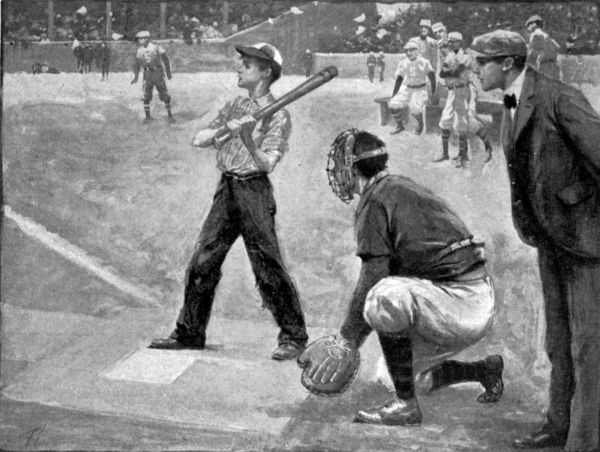
a stick and went to the plate. He stood there
swinging his bat easily, confidently, as one
who is not to be fooled by the ordinary wiles
of the pitcher, a well-built, curly-haired
youngster with blue eyes, and cheeks in which
the red showed through the liberal coating of
tan.
“The best batter the freshmen had,” fellows
whispered one to another.
“Looks as though he knew how, too, eh?
Just you watch him, now!”
And the red-faced senior once more demanded
three long Erskines, three times
three, and three long Erskines for Brewster!
And Ned heard them—he couldn’t very well
have helped it!—and felt very grateful and
proud. And five minutes later he was back
on the bench, frowning miserably at his
knuckles, having been struck out without the
least difficulty by the long-legged Dithman.
The pride was all gone. “But,” he repeated,
silently, “wait until next time! Just wait
until next time!”
Billings found the Robinson pitcher for a
two-bagger, stole third, and came home on a
hit by Greene. Erskine’s spirits rose another
notch. Three more runs to tie the score in
this inning, and then—why, it would be strange
indeed if the purple couldn’t win out! Captain
Milford went to bat in a veritable tempest
of cheers. He looked determined; but so did
his adversary, the redoubtable Dithman.
“We’ve got to tie it this inning,” said
Levett, anxiously. “We’ll never do it next,
when the tail-enders come up.”
“There’s one tail-ender who’s going to hit
that chap in the box next time,” answered
Ned.
“Lady” looked amused.
“You’ll be in luck if it comes around to
you,” he said. “We all will. Oh, thunder!
Another strike!”
A moment later they were on their feet,
and the ball was arching into left field; and
“Big Jim” was plowing his way around first.
But the eighth inning ended right there, for
the ball plumped into left-fielder’s hands.
“Lady” groaned, picked up his big mitt, and
ambled to first, and the ninth inning began
with the score 12 to 9.
Greene was determined that Robinson
should not increase his tally, even to the extent
of making it a baker’s dozen. And he
pitched wonderful ball, striking out the first
two batsmen, allowing the next to make first
on a hit past short-stop, and then bringing the
half to an end by sending three glorious balls
over the corner of the plate one after another,
amid the frantic cheers of the Erskine contingent
and the dismay of the puzzled batsman.
Then the rival nines changed places for the
last time, and Robinson set grimly and determinedly
about the task of keeping Erskine’s
players from crossing the plate again.
And Milford, leaning above Hovey’s shoulder,
viewed the list of batting candidates and
ruefully concluded that she would not have
much trouble doing it.
The stands were emptying and the spectators
were ranging themselves along the base-lines.
The Robinson band had broken out
afresh, and the Robinson cheerers were confident.
The sun was low in the west, and the
shadows of the stands stretched far across the
diamond. Kesner, who had taken Lester’s
place in the batting list, stepped to the plate
and faced Dithman, and the final struggle
was on.
Dithman looked as calmly confident as at
any time during the game, and yet, after
pitching eight innings of excellent ball, it
scarcely seemed likely that he could still
command perfect form. Kesner proved a
foeman worthy of his steel; the most seductive
drops and shoots failed to entice him, and with
three balls against him Dithman was forced
to put the ball over the plate. The second
time he did it, Kesner found it and went to
first on a clean hit into the outfield past third,
and the purple banners flaunted exultantly.
Milford’s face took on an expression of hopefulness
as he dashed to first and whispered
his instructions in Kesner’s ear. Then he
retired to the coaches’ box and put every effort
into getting the runner down to second. But
Fate came to his assistance and saved him
some breath. Dithman lost command of the
dirty brown sphere for one little moment, and
it went wild, striking Greene on the thigh.
And when he limped to first Kesner went on
to second, and there were two on bases, and
Erskine was mad with joy. Milford and
Billings were coaching from opposite corners,
Milford’s bellowing being plainly heard a
quarter of a mile away; he had a good, hearty
voice, and for the first time that day it bothered
the Robinson pitcher. For Housel, waiting
for a chance to make a bunt, was kept busy
getting out of the way of the balls, and after
four of them was given his base.
Erskine’s delight was now of the sort best
expressed by turning somersaults. As somersaults
were out of the question, owing to the
density of the throng, her supporters were
forced to content themselves with jumping up
and down and shouting the last breaths from
their bodies. Bases full and none out! Three
runs would tie the score! Four runs would
win! And they’d get them, of course; there
was no doubt about that—at least, not until
McLimmont had struck out and had turned
back to the bench with miserable face. Then
it was Robinson’s turn to cheer. Erskine
looked doubtful for a moment, then began her
husky shouting again; after all, there was
only one out. But Dithman, rather pale of
face, had himself in hand once more. To the
knowing ones, Levett, who followed McLimmont,
was already as good as out; the way in
which he stood, the manner in which he “went
down” for the balls, proved him nervous and
overanxious. With two strikes and three
balls called on him, he swung at a wretched
out-shoot. A low groan ran along the bench.
Levett himself didn’t groan; he placed his bat
carefully on the ground, kicked it ten yards
away, and said “Confound the luck!” very
forcibly.
“You’re up, Brewster,” called Hovey.
“Two gone! Last man, fellows!” shouted
the Robinson catcher, as Ned tapped the plate.
“Last man!” echoed the second-baseman.
“He’s easy!”
“Make him pitch ’em, Brewster!” called
Milford. The rest was drowned in the sudden
surge of cheers from the Robinson side.
Ned faced the pitcher with an uncomfortable
empty feeling inside of him. He meant to hit
that ball, but he greatly feared he wouldn’t;
he scarcely dared think what a hit meant.
For a moment he wished himself well out of it—wished
that he was back on the bench and
that another had his place and his chance to
win or lose the game. Then the first delivery
sped toward him, and much of his nervousness
vanished.
“Ball!” droned the umpire.
Milford and Levett were coaching again;
it was hard to say whose voice was the loudest.
Down at first Housel was dancing back and
forth on his toes, and back of him Milford,
kneeling on the turf, was roaring: “Two gone,
Jack, remember! Run on anything! Look
out for a passed ball! Now you’re off! Hi,
hi, hi! Look out! He won’t throw! Take a
lead—go on! Watch his arm; go down with
his arm! Now you’re off! Now, now,
now!”
But if this was meant to rattle the pitcher
it failed of its effect. Dithman swung his
arm out, danced forward on his left foot, and
shot the ball away.
“Strike!” said the umpire.
Ned wondered why he had let that ball go
by; he had been sure that it was going to cut
the plate, and yet he had stood by undecided
until it was too late. Well! He gripped his
bat a little tighter, shifted his feet a few
inches, and waited again. Dithman’s expression
of calm unconcern aroused his ire;
just let him get one whack at that ball and he
would show that long-legged pitcher something
to surprise him! A palpable in-shoot
followed, and Ned staggered out of its way.
Then came what was so undoubtedly a ball
that Ned merely smiled at it. Unfortunately
at the last instant it dropped down below his
shoulder, and he waited anxiously for the
verdict.
“Strike two!” called the umpire.
Two and two! Ned’s heart sank. He
shot a glance toward first. Milford was
staring over at him imploringly. Ned gave
a gasp and set his jaws together firmly. The
pitcher had the ball again, and was signaling
to the catcher. Then out shot his arm, the
little one-legged hop followed, and the ball
sped toward the boy at the plate. And his
heart gave a leap, for the delivery was a
straight ball, swift, to be sure, but straight
and true for the plate. Ned took one step
forward, and ball and bat met with a sound
like a pistol-shot, and a pair of purple-stockinged
legs were flashing toward first.
Up, up against the gray-blue sky went the
sphere, and then it seemed to hang for a moment
there, neither rising nor falling. And
all the time the bases were emptying themselves.
Kesner was in ere the ball was well
away, Greene was close behind him, and now
Housel, slower because of his size, was swinging
by third; and from second sped a smaller,
lithe figure with down-bent head and legs
fairly flying. Coaches were shouting wild,
useless words, and none but themselves heard
them; for four thousand voices were shrieking
frenziedly, and four thousand pairs of
eyes were either watching the flight of the far-off
ball, or were fixed anxiously upon the
figure of left-fielder, who, away up near the
fence and the row of trees, was running desperately
back.
Ned reached second, and, for the first time
since he had started around, looked for the
ball, and, as he did so, afar off across the
turf a figure stooped and picked something
from the ground and threw it to center-fielder,
and center-fielder threw it to third-baseman,
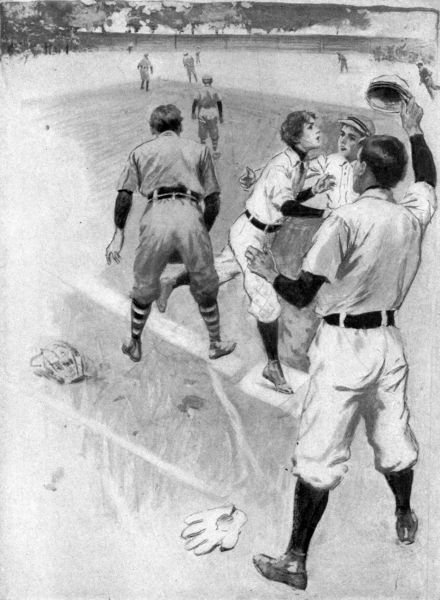
and meanwhile Ned trotted over the plate
into the arms of “Big Jim” Milford, and
Hovey made four big black tallies in the score-book.
Three minutes later and it was all
over, Billings flying out to center field, and the
final score stood 13-12. Erskine owned the
field, and Ned, swaying and slipping dizzily
about on the shoulders of three temporary
lunatics, looked down upon a surging sea of
shouting, distorted faces, and tried his hardest
to appear unconcerned—and was secretly
very, very happy. He had his E; best of all,
he had honestly earned it.