I
THE longevity of the Mule is proverbial. He lives on and on, until his
origin becomes a musty myth, and age erects a tumor on his brow which
betokens superb development of spirituality. The endurance of a
hallucination is perhaps greater still. Our civil war closed more than
thirty years ago. The Mules employed in the army are mostly dead—not
so the hallucinations. These still linger, picturesque but fatiguing.
There still survives in every northern town and village at least one
man who habitually asserts, who is willing to verify by affidavit,
worst of all, who steadfastly believes, that he put down the
rebellion.
The Mules are not supposed to have understood the war, and
consequently can not be expected to hold themselves responsible for
its results. But the man of distorted perspective, who measures the
circumference of the universe by the diameter of his own egotism,
shrinks from no exaltation and shirks no responsibility. He is
festooned with self-complacency, wearing always a fourteenth century
smile of content.
Controversy is welcome to him, as the advent of a bloomer woman to a
social purity club. He relishes argument and he loves to boast. He can
readily maintain that his side was eternally right and the other side
infernally wrong in the war, for that fact is beginning to be somewhat
widely accepted. To establish his own feats is somewhat more
difficult, whether he sing like Miriam or howl like Jeremiah in
narrating them. But he will cheerfully spend a week in marching one of
his deeds past a given point, and skeptics soon discover that it is
cheaper to feed him than to fight him. He may be an ex-major-general,
or possibly an ex-teamster. Sometimes he is an ex-corporal, mellow as
those autumnal days when the golden glory of the sassafras vies with
the persimmon's gaudy crimson. Oftenest perhaps he is an ex-captain,
for does not every war evolve the greatest captain of the age as its
ultimate hero? He may now pass for a respectable citizen, with houses
to let and money to burn, who rashly trusts to his imagination when
his memory is out of focus, and lets the bloody chasm go on yawning
for more gore.
More likely, however, he carries his real estate as well as his
religion in his wife's name, fully persuaded that a rolling stone
gathers no moss but grinds exceeding fine, razors and tomahawks
included. In any event he is a mighty talker before the crowd,
bristling with home thrusts that give out a sizzling sound and an odor
of roast owl. He is a Chimborazo of noise with an ant-hill of
achievement to back it; a miracle of linked hallucinations ludicrously
elongated; an extinct incandescent carbon belching black smoke. His
sole claim to mention in connection with the useful, unpretentious
Mule, is the purely accidental circumstance of their simultaneous
military service. He has no other title to consideration in this
important historical episode.
He is not a typical old soldier, and must not be so classified. He is
an exception. When tests are to be applied he can always prove an
alibi. His mouth was put on soft and spread; the flush on his nose was
acquired at a great expenditure of time and money. He comes to the
front in his community, sage of the flannel lip and velvet eye, in
accordance with a known law that not always the ablest men are heard,
but always the ablest to be heard. He comes to the front with the
persistence of a pardoned anarchist, and the flawless joy of a
yearling who has maxed in math.
Meantime it is one of the everlasting verities that in hands of men
"entirely" great, the calligraph is mightier than the bludgeon. Shall
calligraphs stand dumb and the story of days when God shook the nation
until her lakes foamed over their pebbly shores and her rivers
gurgled with bloody ebullition remain unwrit, in fear of probing
blow-holes in the record of some grand snark in the concatenated order
of hoo hoos? Shall posterity be given over to moral mushiness, lest
some village Goliath of Gath, prone to such nightly exhilaration of
spirits as ends in losing the combination of adjacent streets, get
shrunken into shreds of paper-rag, brain-web and vapor?
Historians of the war have minutely narrated its grand events—events
which rising generations are already reproaching themselves for coming
too late to engage in, being relegated to their own nerveless annals
penciled on the segment of a film. Most classes of participants in
these events have been heard from. Either in plain narrative or
wrathful controversy they have ventured an enormous consumption of
time and eternity. Whether their anger be a dynamite shell or a
soap-bubble, its vocalization is uniformly terrific. The generals and
the majors; the teamsters and the staff; even the drafted men and
substitutes, unstable as the heroine who vowed at first that she would
never consent, and then relented—all these have spoken or can speak
for themselves. Majestically muscled around the mouth, staunchly
nerved in the cheek, they need no rhetorical proxy. Since history has
accepted most of their averments, they modestly consider themselves
endorsed.
There are other classes of participants who must be spoken for—their
merits have not yet become the theme of tropical, topical songs. The
speechless toilers of the conflict, half horse, half devil, half
donkey, stand high on the list of those who should not be forgotten.
We may fling flash-lights of inspection all around the black horizon
of war and find no greater faithfulness, not even in Israel.
Under the cadence of march, murmur of camp, clangor of battle and
reverberating pæans of victory, rumbles the ground tone of all war's
harmonies, the deep contra basso of a melodious bray, reminding us
that justice remains yet to be done to the instrument which made
campaigns successful and battles possible. It is an instrument to
which due credit has never been given, yet which is infinitely more
credit-worthy than many of the boasters, "ablest to be heard," who
make the cackle of their villages noxious to mankind.
That instrument is the Army Mule! Let him who hath ears to hear lend
them now to a belated attempt at vindication. Let the man of prejudice
disinfect his mind and listen. It is naught, saith the buyer, then
goeth his way and boasteth; but an ad valorem tax on dudes has never
been made to yield any revenue.
The name of the original inventor of the Mule is lost in the
immemorial mists. Although, as hereinbefore intimated, his longevity
is a chestnut as old as the Morse alphabet, or older, his nativity is
still a conundrum. No Mule's teeth, with or without gold filling,
glisten among shells of the pliocene period. No Mule elevates his
afterdeck in the granitic formations. None of his petrified footprints
are discernible in those anteglacial basins where Afric's sunny
fountains now sprinkle her shirtless swarms. Hence, although he
possibly antedates all living apostles of lady suffrage, he is
presumably not a pre-Adamite. Perhaps his first discoverer was "that
Anah" who, to his astonishment, "found Mules in the wilderness," where
donkeys had been browsing, etc. See Genesis xxxvi, 24. It is not
permissible to go behind the returns. What we know is that he was
introduced to the American people by anticipation, that is to say,
through his paternal ancestor, by G. Washington, Esq., of Mount Vernon
in Virginia.
Much sarcasm, variegated as Paris green jealousy and red precipitate
wrath could dye it, has been expended on this delicate matter of the
Mule's paternal ancestry. Among other spiteful things it has been
averred that like certain party organizations he has no more ground
for pride of descent than he has for hope of posterity. Let us
promptly concede the validity of the averment. Argue not with one
steeped in kerosene and other fire-waters; matters look ominous when a
disputant opens the discussion with foam on his teeth and noises in
his nostril. Fill blanks as to name of party by majority vote of those
present, and let the proceedings proceed.
It is doubtless true that the speechless, unspeakable Mule, seldom
troubles himself about his heirs, executors or administrators. Why
should he? He is a monstrosity, physical and metaphysical; the ne
plus ultra, the "nothing beyond" of his species. Besides, he has
little of value to bequeath; he is a disinherited prodigal, with
champagne tastes and a root beer revenue, digesting his diet of wild
oats; his assets would scarcely overbalance those of a disbanded Uncle
Tom troupe—one blood hound, one death-bed, and two cakes of imitation
ice. Moreover, truth to tell, he is probably in no special haste to
die. This amiable weakness is shared by certain of our own race.
A hypercritical Boston lady, mistress of the mysteries of nine idioms
and five kinds of angel cake, was heard to declare that she would
rather not die at all than be buried anywhere outside Mount Auburn.
The speechless, discredited Mule, born old, wise and fuzzy, has
little to thank his paternal ancestors for, save phenomenal ears that
not even a lion's skin can hide, as witness Æsop, and a phenomenal
voice that no lion's roar can drown. Both these heritages were
preordained for grand service in an epoch when war should gnash loud
her iron fangs, and shake her crest of bristling bayonets. Vouchsafe
unto the male line gratitude for little else. But as for the female
line, who knows? Possibly it runs back to "Araby the blest," where
horse pedigrees are cherished like a Connecticut coffee pot, until
they fade into genealogical perspectives. Such perspectives, for
example, as make the fine art of heraldic blazonry, frescoing and
retouching precious to the British nobility—some of whom, by the way,
have much less cause than the nameless, unblamable Mule, to canonize
the low-neck and short-sleeve branch of their lineage.
Although we do not know precisely who invented the Mule, it must be
obvious that he is not a historical tenderfoot. He is not a mere
ephemeral product of the county fair season, when alleged acrobats
with leaky balloons monopolize the casualty columns. Neither is he one
of those picturesque gubernatorial giraffes of the populist era, who
come unwanted and go unwept.
Notwithstanding the fact that he is necessarily renewed with each
generation, he belongs to an old family—one, in fact, fairly rancid
with antiquity. He was the unconsidered drudge of the hoariest
ancients, in those days when the average human heart could be readily
split up for floor tiles. He had been promoted thence to the rank of
mail carrier as long ago as when Mordecai the Jew "sent letters by
riders on Mules" from Babylon, after the king had turned the rascals
out with a promptness that compelled the admiration of every taxpayer.
He was bestridden by sprigs of royalty as long ago as when Absolom the
lengthy-locked rode under the boughs of a great oak, wherein his hair
became entangled, "and the Mule that was under him went away,"—thus
sayeth the Scriptures! Unspeakable Mule, fraught with immeasurable
destinies! Had he stood until great David's shear-bearers could come
up and cut loose the best-beloved, the whole current of Israel's
history might have changed, saving vast research to the modern
sensational divine working a heresy advertisement for all there is in
it. Solomon, next-beloved, might never have reigned; his superfluous
seven hundred wives and his indispensable three hundred concubines,
with their lissome, lightsome round of free hand riots, internal and
interminable, might never have been accumulated; neither seen the
sparkle of his three thousand proverbs, nor heard the ripple of his
songs a thousand and five.
It is thus manifest that although this interesting hybrid is virtually
an afterthought, he is not one of those later-day improvements in a
chronic state of apology. This is authentic. It is also reassuring to
such typical, representative citizens weighing three hundred pounds
each as still have misgivings. Had the speechless unspeakable Mule
been simply an unperfected modern invention in the rough, his hair not
yet dry, his effectiveness and hope of glory would have been greatly
lessened. The surviving boasters "ablest to be heard" now on grassy
village streets, with two million major-generals, colonels, first
sergeants and other soldiers, might never have been able to suppress
the most causeless and wicked rebellion ever waged by an army of
barefooted chevaliers, fed on corn meal, sporadic acid and gunpowder,
always in light marching order. N. B. They were always in hard
fighting order likewise, since by an eternal law increment of bile is
superinduced by shrinkage of commissariat.
Almost any mediocre can compile a mass of information from the
cyclopedia. Even the vague enthusiast who goes through the world
wearing an air of crushed strawberry resignation on his face and
shaking hands with one finger can do that. But it is not the
desideratum in a matter of this sort.
People prefer to see things step out with stereoscopic rotundity. Like
the juvenile Lochinvar, they stay not for stone and stop not for air
brakes. They demand the decentralization of apothegms. They desire
sculpture from a chisel that, ignoring down and dimple, cuts thought
and carves breath from the marble, without risk of challenge for
implied bias. In the absence of stone-cutters, let a cyclopedia
furnish from its cold-storage vaults some preliminary fundamentals. If
they be plain, ascertainable, intelligible statements of fact, clothed
in tights as it were, devoid of frills and amplifications, so much the
better—and briefer! I quote:
"The Mule seems to excel both its ancestral species in natural
intelligence. It is remarkable for its powers of muscular endurance.
Its sure-footedness particularly adapts it to mountainous countries.
It has been common from very ancient times in many parts of the East,
and is much used, also, in most of the countries around the
Mediterranean Sea, and in the mountainous parts of South America.
Great care is bestowed on the breeding of Mules in Spain and Italy,
and those of particular districts are highly esteemed. In ancient
times the sons of kings rode on Mules, and they were yoked in
chariots. They are still used to draw the carriages of Italian
cardinals and other ecclesiastical dignitaries."
And more to the same effect.
We respectfully submit that here is a well-buttressed certificate of
character which fully justified the government in assigning to this
useful equine mulatto the important function he performed in putting
down the rebellion.
The average American Mule has not the soft fur, fine as dressed
seal-skin and smooth as coffin varnish, nor the rich shades of
coloring, worn by his pampered kinfolk of Spain or Cyprus or Smyrna.
As to skin, he was, habitually, neither soft nor shining, he was
simply tough. As to color, his muzzle was always whitish, as if fresh
from a meal-tub, but otherwise he was more various than delectable,
sometimes yellow, sometimes dun, sometimes sorrel, but oftenest
darkly, deeply, beautifully bay. Second cousin to the New Mexican
burro, but happily guiltless of any traceable relationship to the
disreputable Texas mustang, his aspect was liable to be as one-sided
as a Louisiana riot—seventeen negroes killed and one white man
slightly wounded.
But texture and color apart, the harmless, unspeakable servitor of our
march and camp was doubtless peer of any the effete monarchies of
Europe or the East can boast. He had no overplus of style about him,
but he was reliable, he was sincere, his muscularity was conceded by
all. His facial angle was a convex curve, which somewhat impaired his
beauty, but not his utility. Some knew him who did not love him; few
named him except to praise after a reasonable acquaintance. His air of
innocent gravity was sometimes mistaken for stupidity—most
inexcusable and fatal error! He could look as imbecile as a rustic fop
playing "Glory Hallelujah" on an accordeon. He could look as guileless
as the youth who murdered his own father and mother and then begged
the judge to have mercy on a poor orphan. He could look as soulful as
a law clerk summing up to a jury of one with his arm around it. He
could look as sober as though his whole intellect were grinding on the
plus and minus of some unsolved problem, like that for example which
the Book of Mormon and Mohammed's Koran and Clark's Commentaries, with
all their attention to detail, have neglected, whether Aaron's golden
calf was a Holstein or a Jersey.
Sleepy or asleep he may have seemed, but let some small darkey imp of
mischief tweak his patient ear, then note how swiftly that magnetic
hoof will lift the tweaker to a pearly seat amidst the celestial
cherubim—direct and speedy circuit of nerve-telephone here manifest,
without the intervention of any dilatory central office. His drooping
lids were thus but the token of a measureless content, which craved
not the mere bric-a-brac and gumdrops of existence. But it was liable
to shift its specific gravity, if any misfit perfume came between the
wind and his nobility, and explode in a sudden touch-and-go style,
rocket-like, trigger-like, flashing.
He could smile like a heavenly blessing. His expressive yawn was
widely eminent; without it no Mule was genuine. His bray, opening
clear and sonorous, like the report of a judiciary committee, rapidly
shaded off into a succession of disembodied shrieks and disemboweled
groans, that sent thrills of suicidal delirium through all the
encircling camps. No further seek his general merits to disclose. They
developed constantly on the sensitive plate of our regard, and we have
waited long for somebody to take off a blue-print of his ground plan
and front elevation. The possessor of many virtues, poor but honest,
with a large circulation but small political influence, sagacious and
serene he stood, thick of head, tough of hide, hard of heel, the
proffered hero of the expressive army shibboleth, "Here's your Mule."
The plutonic, speechless quadruped, Mule, like the platonic
featherless biped, man, after being inspected on the hoof, was obliged
to graduate through the three military degrees of Recruit, Soldier and
Veteran.
We all remember those recruiting days; those first companies of picked
men, mostly picked before they were ripe; when the fray was curtained
behind song and hurrah, the cataract obscured by the rainbow. Who can
forget the wrathful buzz and ferment, the wild tossing and writhing
and moaning of an aroused people; the fierce uprising; the keen
razor-edge of fervor. Then the enrolling and drilling and marching and
evoluting in the moonlit squares and streets; the nocturnal
visitations, with fife and drum, to the verandas of oratorical
patriots for a "night-cap" of glowing speech, alternated with raids on
suspected disloyalists to demand the prompt uphoisting of the star
spangled banner. Saxon and Norman and Dane were we, or Celt or Teuton
in birth or descent, but all of us then crystallized in the alembic of
patriotism into the first generation of unadulterated Americans.
To the blasphemous challenge of secession, our young men, fully
advised of the exceeding preciousness of life and yet thoroughly
instructed how to dare and die, hurled back deathless daring and
defiance. Their eyes, fixed on their idealized leaders, shining like
white statues amid the black wreckage of rebellion, they marched into
the flaming vortex with new, strange implements in their hands and
"hot unutterabilities in their hearts."
These were the boys of '61, the raw recruits of the dawning conflict.
With them went the memory of the girls they left behind them, many of
whom were afterwards lost in the shuffle. But the memory, then
infinitely sweet, was hourly refreshed by a contemplation of the
tangible Testament and pin-cushion. With them went the toe-ache of
tight boots, earthly, sensual, devilish, and a flushed consciousness,
even when drilling in the awkward squad, that the eyes of the universe
were upon them. With them also, or following them, or mayhap meeting
them in the dreamy borderland of Kentucky or Missouri to which he is
fortuitously indigenous, went the harmless, necessary Mule.
He was a child of wrath, with a throat for melody spacious as the
funnel of a cyclone; with dexter and sinister ears of renown; with
eyes foxy but sad, and saddest when he sang. He carried with him the
appetite of a Chippewa maiden clad in cavalry trowsers and a tentfly;
also an inherited capacity to stand indefinitely on one foot and kick
vehemently with all the others. He was reliable as grandfather's clock
and prompt as the railway mail service. He was under a recognizance to
support the constitution of the United States, and stamp out the
Confederacy to the best of his ability.
He was a raw recruit likewise. When men were beating the wrong way
their plowshares into swords, he was out of a job on a dull labor
market and could the better be spared. How much of the issues and
principles at stake his comprehensive intelligence intelligently
comprehended will perhaps never be known. He did not attend crowded
war meetings in country school-houses and waste his rhetoric on the
fetid air. It may fairly be surmised, however, that he knew better
than any northern croaker the futility of trying to repossess our
surrendered fortresses with writs of replevin; knew better than any
southern fire-eater the folly of attempting to build up a republic
with a live negro wriggling under the corner-stone; knew and would
gladly have proclaimed, that no lapse of slip-shod years, no
hoariness of unchallenged usage, no deftest hammerings of forensic
sophistry can ever fashion a vested right out of a ragged wrong.
At all events, whether wittingly or willingly or neither, he became as
potent a factor in the situation militant as when Samson slew a
thousand Philistines with the jawbone of one of his remote ancestors.
He wheeled into line useful, ubiquitous, proud as a deceased
Connemarran with a solid silver door-plate on his pearl-plush casket,
blazoning his immortal virtues—also quite numerous. A total of
450,000 mules and 650,000 horses served in the various armies. In
1864, the forces actually in the field required for artillery, cavalry
and trains one-half as many animals as there were soldiers.
As a recruit, the Mule soon became an object of usurious rates of
interest and concentrated curiosity. He was a drawing card, a
veritable bargain counter or church scandal in his tractile powers.
His fame had preceded him, and his name was a potent talisman for
conjuring ecstatic assemblages. His name pronounced, the sensation
seekers gathered, as in the manipulation of complicated governmental
machinery congress touches the button, and the department clerks do
the rest, subject to approval of the salary and allowance division.
Haled in, unhaltered, from amid the frisking bluegrass felicities of
his pasture primeval, with his tail full of burs and his gaze full of
vinegar, the details of his primary instruction were, as a rule, full
of activity and enthusiasm.
In mischievous impulse he is fertile as those human scalps which raise
hair enough for home consumption, and send a surplus to market twice a
year. His venturesome instructors are wise if they make their
testamentary dispositions in advance, and provide abundant bandages
and plasters, with blank coupons or certified checks attached to
provide for extra dividends. One out-thrust of his right front foot
has been known to reduce a newly uniformed soldier to a state of
nudity from his napless crown to his callous sole, with incidental
contusions of flesh and abrasions of cuticle too hideous for
contemplation.
Enmeshed in surreptitious cordage, the speechless, untamed quadruped
is thrown to the cold, cold ground, where, for a time, he writhes and
struggles, a cheveaux-de-frise of black, gyrating hoofs. If he gets
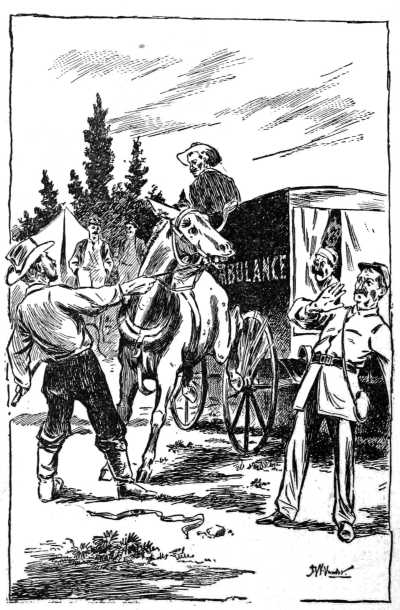
loose, he darts through an ambulance or climbs a tree without
compunction. But he seldom gets loose. When his first wild anger has
been measurably spent and the mercury in him has gone down to the
bulb, five or six bow-legged hirelings of the quartermaster's bureau,
with waffle-iron cast of countenance born of small-pox, simultaneously
proceed to administer disjointed sections of harness to the exterior
of that noble form.
Puck might girdle the earth for forty cents, but he could earn forty
dollars in girthing a cadet Mule. With each contact of strap or buckle
the white of his eye gleams poisonously and his outraged epidermis
gives a sudden convulsive shudder, like a fine lady's bare shoulder
vitalized by a mosquito-bite. But he is helpless and supine as a fat
alderman after a banquet, lying stomach upwards and feebly
gesticulating with his heels. With the final linking together of the
detached tackle into one engirdling gearage, the first step in his
humiliation is completed, and the pantings of his suppressed fury
mingle with the chokings of his self-contempt. From that hour he is a
changed Mule. Man delights him not, nor small boys either. Straps
leave invisible, indelible marks of servitude, as a blow from a parent
leaves a scar on the soul of the child. Harnessed and humiliated,
abased and abashed, the higher regions of pride and independence
wherein he has pranced with all the lofty grace of a thoroughbred,
know him no more forever. Mirabeau had swallowed all formulas. The
Mule recruit has swallowed all traditions, foretaste of much else,
good and bad, he will be obliged to swallow,—but the bridle-bit, of
all fabricated things, alas! he can not swallow.
In this clinging, clanking harness-toggery cribbed and confined, he is
led out to where five shamefaced fellow-martyrs wait to endure with
him the culminating indignity. The Mule units are now to be transmuted
into a Mule team, for the glory of Yankee Doodle, and an entirely
novel programme of acrobatic marvels is to be enacted.
No sooner have the predestined six been, with infinite patience and
circumspection, aligned and coupled and to the monstrous vehicle
deftly attached, than down they all go in a heap, a rolling, plunging
mass of offensive partisanship, in one dusty burial blent. Entangled,
prostrate, writhing like a coil of rattlesnakes; each eager nose, and
active heel, and tufted tail, points all ways at once, like a
mariner's needle in a thunder-storm. In this tumbling, tearing glomer
a philosopher might presciently discern the symbol and essence of
anarchy, the spirit of centrifugality, the revolt against status
quo, the protest of energetic natures against human government, or
self-government, or any other government.
It may confidently be averred that from all vital chaos a new lathed
and plastered order is ever shaping itself and emerging; this is as
certain as that everybody is greater than anybody, and that discipline
is always brought forth by a Cæsarian operation from anarchy. So from
this sour animal effervescence of insurrection miraculously unravels
at last, scathless and satisfied, a melancholy sextette of curbed and
baffled penitents. They are awkward, divergent, unassimilated, to
begin with, and must be pounded and kicked and cursed into homogeneity
later on, but they are uproariously recalcitrant thenceforth never
more.
The Mule recruit has thus rapidly developed into the Mule soldier. He
has been summarily mustered in, with a rope around his lower lip
rasping it to rawness, but without any very searching inquiries as to
his uncertain age, his wholly immaterial sex, his superfluous name, or
his complicated social status.
He has been blacksmithed as to hoof (much against his will), and
veterinaried as to shoulder. He must now march forth in the name of
the Union and emancipation, but must first be introduced to his
commander—and so must you, my beloved. Ye who have blushes to blush
for your species, prepare to blush them now, and then proceed to bury
Cæsar, not to praise him.
The army teamster may be safely diagnosed as a chronic malady of war
times. With such rare and radiant exceptions as the immortal nominee
of the Seattle caucus, who carried a hare-lip and a pure heart, he was
a pestilent metaplasm. He was a product of heterogeneous aggregation
and the survival of misfits. His status was fixed in earliest infancy;
when he was vaccinated, the doctor is suspected of having thrown away
the child and saved the virus capsule. He professed no patriotism; he
pretended to no bravery; he cherished no martial ambitions. He had no
desire to fight. There was no need of an order to show cause why a
temporary injunction should not issue restraining him from carnage.
When his slim sweetheart, the dove-eyed, flat-chested maiden at Onion
creek, a stuttering siren to be courted only on the installment plan,
sent him to the field, it was with full assurance that he was not lost
to her forever—not he! The corn-fed, lank Delilah shrewdly guessed
that her prudent wooer would listen to battle's dissonant thunders
from posts of distant security, and come back unshot, unsabred, but
covered with vicarious glory, which he did. Heaven is merciful to the
idiotic and kind to the cautious. His previous occupations had varied
from cord-wood carpentry to slaughter-house surgery, and he had always
been disposed to shed perspiration with extreme diffidence. He was
mostly red-headed. He had been addicted to excess of raw spirits,
tobacco and other abominations—loving these, his enemies, with a
fine, magnanimous, scriptural, discrimination. He may be relied on to
fill a drunkard's grave some day, probably without even asking the
drunkard's permission; such are his knavish proclivities. His eye was
aglare with hate, every glance a stab. His occasional smile ran
through all the gamut of grins, from the smirk of conceit to the
simper of toadyism. He had a torpid liver and was no trustee of
beauty. His physical development was surprising; even an Englishman
never saw anything equal to it—outside of England. He was strong as
the Kansas zephyr that carried an anvil ten miles and came back next
morning after the hammer. Freckles were his trade-mark and profanity
was the staunch, infallible test of his identity. Huge quadrilateral
oaths, shingled with brimstone and fringed with fire, were the soft
relaxations of his happier hours. Blue, blistering maledictions,
flecked with white foam, marked the approach of his paroxysmal
frenzies, and no postponement on account of the weather.
Cruelty uncloaked and unleavened, lumpy and rocky, was the energizing
motor of his existence. Before he gets three strides into his gait,
his antiphlogistic treatment always insures a dispersion of the Mule's
vitality into the extremeties—hence those kicks. His vocabulary was a
slimy ooze of the gutter, with its wailing stench. His breath was the
whiff of loose-corked, all-night gin shops, stale and stifling. His
typical caress to the Mule was a blow on the bone of the nose with a
neck yoke that settled the animal on his haunches. With a heart false
as a weather bulletin, more selfish than a petroleum trust, and colder
than a funeral with plenty of money and no God in it, his advent
might readily portend that direful apocalyptic sequence: Death on the
pale horse and hell not far behind. He was generally hare-lipped.
To the tender mercies of this losel vile were committed by the decrees
of inscrutable fate the career and destiny of the speechless,
undecipherable Mule, who was often simultaneously off his feed and on
to his driver. He may have been an unattractive, non-magnetic
quadruped, a ragged hammerhead, with a wall eye and an amputated ear;
with yellow, irregular teeth and a surplus of lip. But his redeeming
features were sure to be disclosed in the end. The current acceptation
of the normal order of things in civil life was no criterion here;
there would be scant toleration for the methodical youth who indorsed
his sweetheart's first love-letter "Exhibit A."
Ordinarily, when man, a little lower than the angels, bestrides a Mule
unquestionably possessed of the devil, he starts on a basalt road to
perdition, safe to arrive. Swift as a commuter's kiss at the ferry
gang-plank might be expected the direful finale. But in this zigzag of
military contradictions things are reversed. The man and the beast
have changed places. The semi-seraph and brevet horse have been
subjected to a mysterious transformation of functions, and gravitation
working t'other way lifts things skyward, as it were. The man sinks;
the animal soars—thrusting his jaw out sidewise in a satisfied yawn,
secure in the serenity of his asininity.
By sin pneumonia came into the world, and the docile aboriginal, with
dilapidated undergarments, or none, became a shining mark. The honest,
intelligent Mule restores an equilibrium of virtue lost through his
depraved and dissolute driver. The virtues of the Mule atone for the
vices of the man. He raises the average of merit and sum total of
achievement, so that credit for their joint share in the grand
climacteric will be as enduring as the solemn temples, the great globe
itself.
Man approximated to the Mule ideal of gentility when he began to
suspect that the entire system of army team discipline rested on a
false basis. But that suspicion had not dawned at the close of the war
for the suppression of the rebellion—if, indeed, it has yet dawned.
The platform of the Mule millennial: Six quarts of oats at a feed; a
blanket; two curry-combs of assorted fineness; no spurs; no whip; no
cursing—this was a dim vision of futurity; alluring but delusive as
the seductive rustle of grain in a tin pan, with the ensnaring halter
deftly hidden.
Fortunately for the Mule his epidermis was thick and tough, a
non-conductor of pain, as it were; fortunately for his flagitious
tormentor, likewise for other glowing lights of genus human, he was
speechless. If the Mule could talk! What new aspects would be given to
war-memoirs; what side-gleams would be thrown on historic events; what
showers and floods of reinforcement would be added to the gurgling,
vasty streams of patriotic reminiscence. He had his opinions on the
conduct of the war, and on the character of the warriors, also the
teamsters; but those opinions remain unrecorded and to all intents and
purposes unexpressed. He reserved them, which would be deliciously
sweet of him, don't you know, if it had not been involuntary and
unavoidable.
Out in Oregon, apples grow to the diameter of Daniel Webster's skull,
though with diluted flavor and contradictory aromas, it is claimed;
but the inefficiently tutored Shoshone nevertheless affects his
dejeuner of decayed salmon whose aroma is indisputable and widely
permeative. Arizona, latitude some hundreds of feet below the sea
level, offers a splendid climate in exceptionally large quantities,
where the insidious and terrible tubercle is unknown; but some of her
citizens are accused of entertaining loose opinions as to the strict
enforcement of law, and low, coarse views of the editorial function.
At Spuyten-Duyvel-on-Hudson, the local four hundred, exploiting the
astrakhan hair and chinchilla whiskers inherited from a fused Iroquois
and Rotterdam ancestry, can only be coaxed into activity by an
elaborate expenditure of stimulants; then, however, they will very
cheerfully pump you full of sententious legendary lore while you wait.
In Rhode Island, walk under the mistletoe with a young lady and
tradition will do the rest. In Chicago, hand an attractive widow out
of a cable car, and gossips will supply all necessary additional
ingredients for a five-column sensation. Thus every locality has its
advantages and its drawbacks, its vexations and its compensations. By
parallel lines of illustration it may be demonstrated that what the
Mule lacks in volubility he fully makes up in sagaciousness.
The capacity of this observant, discriminating animal to sit in
judgment on the character of his stridulous driver can scarcely be
subject to reasonable question. The judicial cast of intellect is so
universally associated with solemnity of visage that the terms become
substantially interconvertible, like the principles of a polished
politician. When the Army Mule lowers his head and lifts his eyebrows
and searches profoundly through his stable litter with his
deliberative hoof, the rich trolley-line tenor of his tuneful
meditations were worth a royal largess to read, assimilate and store
away for reference.
The animated dialogue between a truckman and a cab driver in a New
York street blockade is said to embody linguistic traits and miracles
of lexicography peculiar to the atmosphere of that latitude. The
murmurings of a town that is stricken with paralysis at the first
intimations of a whisky famine, are marvelously intense and realistic.
But the Army Mule's honest and unbiased opinion as to the true
character of the army teamster, translated from his equi-asinine
vernacular, and rendered into the anglo-effervescent jargon of the
bivouac, would rattle like a regimental long-roll and yield aroma
rivaling the effluvium of a lime-kiln. His reprobate tormentor, with
no perceptible circulation of blood above the ears, presents
multiplied testimonials of having long been habitually fed on
aqua-fortis, hell-broth and ratsbane. Yet he reveals a cruel coldness
that would freeze the milk in a mother's wasted breast or the marrow
in her infant's fleshless bones. Hideous as is his chimpanzee
conformation of countenance inherited from root-eating ancestors, it
only indexes his whole physical structure—a sour aggregation of
compost, vitalized by a fetid protoplasm. Within his Nova Zembla skull
the pulpy and mysterious growth called brain lies fusty and fumid,
steeped in the vapidity of its own purulence.
Offspring of the exiled offal and offscourings of civilization, he
grew up in the back settlements untaught, untrained, unkempt,
unchristened—not even vaccinated or manicured; and the
unwholesomeness of his exhalations vie with the complexities of his
vocabulary. The bath-room knows him never, nor tooth-brush ever. To
night-shirt, napkin, finger-bowl and fine stationery he is as utterly
alien as the remotest autocrat of Congo's jungles. The Indian has now
become about as bad as the white man can make him. But it is the firm
opinion of the Army Mule that there are lower depths. Somewhere
between the Indian's level and that bottomless perdition, where the
arches of Tophet redden in the glow of its quenchless flame, there is
a midway plaisance tableland, reserved transcendent in its horrors for
the ruminating promenades of the teamster terrific. Somewhat lower
than the Indian; a little higher than satan and his imps—not
much—there is the plane of character assigned with ghoulish gladness
to the hare-lipped caliph of the wagon train, by one best fitted,
through intimate, hourly association, to measure his moral girth and
estimate his mental altitude. There let him roam and range. In years
triumphant of the war era, now fast vanishing into the vague and misty
past, he had his jubilant day. This bog-spawn of humanity, with his
ashes-of-marigold face and his unthatched upper teeth, with his
three-cornered hot temper that scorned life's amenities; this slouchy
man with moist nostrils and an affliction in his left hip, who at one
time hoped to sometime shine as chambermaid to a livery stable but
failed, has run his course.
What a child is taught in the abstract he is liable to practice in the
concrete, as his subjectivity develops into objectivity, his sentiment
into devilment. The Mule driver's unamiable childhood was punctuated
with copious threats that the goblins of desperation would get him if
he didn't watch out. The events of his pseudo war experience fully
verified this dreadful prophecy's prophetic inspiration. The goblins
got him and energized him, until his fury often bade fair to shred the
Mule into his by-products of kip-leather, trousers buttons and
mucilage.
Under such inauspicious guidance and control, the army Mule, luckily
pachydermatous, proceeds to the theater of his sanguinary exploits.
The rich girl is often in danger of falsifying her accounts by
crediting to her personality the charms of her cash. But the cashless,
unsusceptible Mule stands in no peril of such baleful self-deception.
Lowest in rank of created beings assigned a part in the drama, fame
held to him no prismatic rewards for excess of zeal.
He was not built for a general range of cynosure business; homeliness
was his heritage from the day he was foaled. He was unpoetic as a miss
receiving her beau in the parlor with her two younger brothers sitting
in the seat of the scornful hard by. He was unartistic as a Montana
hurricane kite—an iron shutter with a tail made of log-chains. He
was unsymmetric as a court dwarf with scythe-snath spine and a dome on
his shoulder. Hence for the splendid immortality of sculpture he was
ludicrously inapt. And if painting deigned to give him grudged space
it was ever in the burlesque of cartoonage or the dim littleness of
background.
His lucky half-brother, the showy, exaggerated horse, in all classes,
from the pampered ex-trotter with his slim neck and his record, to the
bloated muldoon of the belt-line, jaded but defiant, was an easy
victor in the suit Neigh versus Bray. To him might come sweet
visions of promotion in the life that is and artistic apotheosis in a
glad hereafter. But to the speechless, unapproachable Mule, with
periodical reactions in the hind leg, and hight merely "nigh" or "off"
in the vernacular, promotion never came. Cogitating to himself with
soulful grunts, he could only talk through his head-stall.
Even the sutler's horse, intoed, sway-backed and wheezy, who had
habitually worn a ragged calfskin over his rump as he stood on frosty
nights before the war, tied to a rail fence while his owner talked
politics in the village grocery, claimed superiority. The picturesque
talisman U. S. upon his shoulder was the only badge of honor permitted
to the Army Mule, save when the whip-lash had cut out a slice of his
skin as a souvenir. But even this significant lettering was often so
inexpertly executed as to serve no decorative purpose whatever. It was
infinitely less effective than a bran mash to poultice his internal
pains, or a roached mane to command external admiration. With one foot
over the trace and both eyes blinking, the last state of that Mule was
worse than the first. To him all alleged or attempted adornments were
superfluous and unsatisfying.
Here then was the sine of an arc which did not recognize equality in
the cosine of its supplement. The sorriest horse, though just released
from the duty of transporting miscellaneous triturations of real
estate in a dumpcart, with his alimentary system painfully void of
toothsome internal decoration, outranked the smoothest, softest Mule,
whether young or aged, black or sorrel, dun or gray. Nevertheless the
explanation of the fact that a rat-tailed cat-hammed Mule weighing
five hundred and thirty pounds, saw-backed, sharktoothed, and knobby
with protruding bones from throat-latch to crupper, could draw heavier
loads than a round robust Norman-Percheron horse weighing a ton,
remains to this day unknown, unguessable. Invidious comparison is
gross violation of consanguinity equal to marrying one's widow's
sister. The checked, banged and bitted high steppers of Fairmount
park, dear to the heart of placid quakers because their nerves can
endure the strain of "Curfew Shall Not Toll Tonight," or equivalent
atrocities, will not be involved therein; their pinked tennis-tan
harness, silver trimmed, with monograms at the joints and red stitches
in the tug, constitute a perpetual, effectual bar. There was one glory
of horse and another glory of mule, but no mule differed from another
mule in glory, by any palpable percentage. They had little regard for
the affinity of a somewhat common maternity. But whether rearing,
plunging, kicking, rolling in the mire or pawing at the clouds, they
were all equal. They met upon the level and parted on the square.
The war-horse of the late unpleasantness has been chiseled and painted
in many attitudes—especially that of unsupported suspension in the
atmosphere, with extended nose and carefully adjusted legs. Sheridan's
horse, propelled down the wild, disheveled turnpike by "a terrible
oath" at the rate of five (5) miles per stanza, hangs to the canvas in
a posture unnatural as that of some artillery steed swung by the
breeching from a tree after a caisson explosion. The war-horse has
been sufficiently pictured and carved. But he still lacks his literary
limner. Almost the sole description of him now accessible is that left
by the versatile Orpheus C. Kerr. There is embodied an analysis of
that celebrated Gothic steed presented to this Orpheus by his maiden
aunt and endeared to the saline affections of the mackerel brigade by
several amiable idiosyncrasies. Of whom it is written:
"The beast is fourteen hands high, fourteen hands long, and his
sagacious head is shaped like an old-fashioned pickax. Viewed from
the rear his style of architecture is Gothic, and has a gable end to
which his tail is attached. His eyes are two pearls set in mahogany,
and before he lost his sight were said to be brilliant." And more to
the same effect, intimating a diet of shoe pegs for oats and saw-dust
for millstuffs, save in the rare occasions when he could set his
inflexible teeth into a hay bale with unadulterated joy.
Now, shall such of our children's children as through poverty or other
crime may be debarred admission to war cycloramas be condemned to
surfeit their hunger for knowledge as to the conflict's equestrian
features with job lots of descriptive pinxit like this? Is the war
charger to be cut off thus with no extra allowance for training or
pedigree? Are nice distinctions of gait, between the singlefoot trot
and the rack, which are manifestly matters of original brain power and
painful culture, modified of course by heredity, to be studiously
ignored? In short, is the horse to be thus dismissed into obliquity,
so to speak? If so, what conclusions will posterity deduce as to the
anatomical development of the speechless inferior Mule? If an animal
of fair social position and tenacious of his rank is to be thus
lightly disposed of, what can we claim for one of no rank whatever,
with only the snap of his teeth and the whisk of his tail to attract
attention? The case is critical.
When the kicker in politics dies he stays dead a long time; when an
opportunity passes it may never recur. Opportunities for writing
correct history are slipping by month after month, year after year.
The aged, surviving Mule gets nervous as in the teething period of his
suffering colthood, while our expert historians move off toward the
horizon, clothed in linen ulsters and vain regrets. We have essays
galore on the immorality of trotting and the iniquity of pools. We
have treatises enough on overhead check reins and the cruelty of the
cable slot. But this is a condition, not a theory, which now
reproaches us. Soon it will be too late. If the agitation started here
shall finally result in loosening some corset strings of prejudice and
fixing the neglected, necessary Mule in his true orbit, all will be
well. The opportunities of a grateful country for upholstering his
stomach with the finest and greenest her pastures proffer, will soon
be gone forever. If we can now succeed in calculating his right
ascension and declination, and stamping him on the chart indelibly, we
may pass from recreation to refreshment in full assurance of a duty
well performed.
Then let us agitate! The winner of the sinful and expensive Derby must
not forever flaunt his exclusive title to consideration. The piebald
circus favorite shall no longer monopolize the fondness of our rising
youth. The praiseworthy Mule, hot and foamy perhaps, stung with
gad-flies, thirsty, dusty and cross, but patriotic and persevering
amid all, shall have his long delayed due.
The soldier Mule is in harness, fated to accomplish marvels in the
sweet ultimate, if his longevity holds out; his neo-pagan steersman,
with hare-lip, a hepatized conscience, a peroxide complexion and a
solitaire front tooth cut bias, is in the saddle; all being thus in
readiness the war can now begin. If the speechless miserable Mule
shall unfortunately escape sorosis of the heart, hermitage of the
lungs, and percolation by germicide decoctions, so as to live long
enough, he will become a veteran. But that is anticipation. The near,
dear day will arrive soon enough—alas!
Harnessed and mounted, cursed, cudgeled and spurred he starts on his
weary pilgrimage. His emotions are more complex and profound than
those with which a young woman receives her first information that
there are spring styles in trousers as well as in gowns. For him no
primrose paths of dalliance open beckoning; they fade incoherently
into the dim bedraggled, with no stretch of white satin ribbons to
restrain feminine curiosity.
He travels from Ohio to the gulf, but not in a palace car nor on a
deadhead ticket. Far otherwise. He goes out for an extended starring
tour in the provinces and assists in presenting a magnificent drama,
but only evokes volleys of powerful and prolonged hisses from the guys
of the gallery. He brings up the rear of the most gigantic and
jubilant salvation army since salvation was revealed, but he is not
conceited. He is full of suppressed merit as an egg is of omelet, yet
bashful as the kerchiefless caller who toys with the doily in nervous
embarrassment while the seconds swell into centuries. He officiates in
the conveyance of breadstuffs, otherwise hard-tack, mouldy and
fungous, left over from the Mexican war, and fit only for slumgullion;
of meats with the odor of a sewer-gas eruption; of black molasses, a
sulphuret of glucose, sour as the tartrate of acrimony.
Also desiccated sundries obsolete as a rutabaga turnip, class of '56,
or a weather guess from an anti-bilious almanac for '49, or the
lottery wheel of a fair fakir in the early thirties. Likewise
commissary whisky, vintage of lye, lime and fusel; decanted of all
disgusts; confected for the scum of slums. But none of these have
terror or temptation for him; he knoweth his master's feed box. A
brave, bright, meritorious Mule is he, with a spring in his heel and
healing in his springs.
He blots himself out of the green landscape of his youth, the
asphodel meadows of peace that lie athwart the rustic tavern with its
soft soap, communistic towel and brown sugar. He marches on, marshaled
in double column closed in mass, to slaughters that will all the
multitudinous creeks incarnadine, and fears not. He steps forth with
countenance severe as that of the sterilized milk speculator whose
investment has soured, but heart warm as the modest, efficacious
fritter, dear to the breakfast relish of Hoosier schoolboys when the
frost is on the melon and the fodder's in the stalk. He starts out in
the morning eager as if something of great value were hanging just in
front of him, with a town supervisor reaching for it and a creditor's
meeting in the annex; he trudges along all day with the testy and
sub-acid humor of a Pullman conductor, softened by a thousand
patriotic reflections; he comes in at night on right by file into
line, crisp and beautiful as a sarsaparilla lithograph.
Toil has no fears; he does not care a cigarette for it. After the long
day's exertion, with no nutriment but raw fog for breakfast and
roasted south wind for dinner, with no encouragement but polyglot
epithets from a hare-lipped miracle of mendacity, and frequent
usufruct of hissing whip-lash to his quaking flanks and skinned sides,
he does not despair. One is foolish to waste time trying to throw five
aces with four dice, and the usual rustic system of studying games of
hazard has similar elements of weakness; but there is no weakness
about the character of the seasoned, unchangeable Mule. If a glossary
of battles could be transcribed from the quartermasters' reports of
"actions" where Mules were lost, it would make a fearful and wonderful
record. But no premonitions of battle trouble him now. With a good
hearty roll in the dust and its diatonic accompaniment of snorts,
groans and grunts, he rises refreshed. Then he kicks a few times for
practice with the agility of an antiquated drum-stick from the black
crook ballet, and lies down to rest, supperless but happy. All the
visible universe is action and motion, from the slow dissolving
mountain of granite, to the fleeting, flitting cloud of vapor that
scuds across the sky.
But the Mule sleeps, noiseless and motionless. Into that steep, deep
sleep what dreams might creep! But no! No visions of to-morrow's big
load and high check now vex his royal ribs. No colic phantoms disturb
his illusion of combing his fetlocks in golden stubble—fit function
for his underrated merits. No nightmares come hurling cold hailstones
at his sinless head or murdering "Sweet Marie" in Z minor around his
protesting ears. So he awakens invigorated and steps out into the
purple dawn of next day, fresh as the cold oaken bucket that dangles
no longer in the moss-covered well, and chipper as Sancho Panza's
Dapple—oh! speechless, incredible Mule!
Were not comparisons odious we might unreservedly affirm that he was
fully capable of the zeal displayed by one of our major-generals who,
on or about August 29, 1862, rushed toward the sound of John Pope's
cannon at a hold-the-fort-for-I-am-coming velocity of six miles a day.
We may furthermore safely claim for him devotion at least equal to
that displayed by another major-general, coincidently negatively
pregnant, who drank from the same canteen and simultaneously
telegraphed to Pope from Alexandria, proposing to reinforce him with
every wagon in camp if he would send back cavalry for an escort!
There is a period in every battle when the bravest soldier would
donate liberally to the missionary cause for trustworthy assurance of
scathless emergence. The most valorous among us are at times
conciliatory and pacific as an intimidated husband just emerging from
a domestic cyclone cellar. Human nature is not perpetually keyed up to
the Marco Bozarris pitch. Marvel not then that the astute Lincoln,
when informed that a general and forty Mules had been captured by the
enemy, put on that far-away, lodge-of-sorrow look and plaintively
remarked: "I am sorry to lose the Mules." Generals, brave to the point
of recklessness and beyond it, could be made as easily as bonanza
Christians, who join the church by typewriter and are baptized by
telegraph—but Mules had a specific, ascertainable value.
The Army Mule's market value or cost to the government ranged from
one hundred and fifteen to one hundred and fifty dollars. This price
was established when he was first brought in and exhibited to all
intents and purposes as an article of merchandise. He was then largely
occupied in attempting to conceal exclusive knowledge of certain
secluded green pastures; winking slyly to himself in the excess of his
cunning, all unaware of the multiplex miseries stored away for him in
the immediate future. The price was generally satisfactory, for the
service sighed for him. But the Mule did not receive the money. Far
from it! A part of it went to his loyal owner, so called. We all knew
him. He was suave as a Scotchman who has adopted the manners and
customs of civilization. He was cheerful as the radiant old circuit
rider who preaches to a mixed congregation in a boom suburb, from a
text found in lot 3, block 12, of Timothy's second subdivision. In
every crisis he was first to stay at home and readiest to volunteer
his moral support in putting down insurrection.
After selling a string of Mules he would walk the streets for a week
filled with rum and gladness, bragging in his balmy periods over the
keenness of his sharpness. The remainder of the purchase price, as was
currently suspected, went into the pockets of the purchasing
quartermaster, clothed in white samite, mystic, plunderful—popular
only within restricted areas. None of it went to the Mule. A woman
never looks well in a fault-finding habit; a man never looks well when
detected in prevarication; therefore let us tell the truth: None of it
went to the Mule!
Parenthetically we may remark that this type of financial injustice
has been perpetuated, until the hind quarters of the speechless,
unspeakable survivors would be excusable for rising in their might to
protest emphatically. If the shoe fits spike it, says the farrier; if
the conscience twinges one or more of us here present, it is perhaps
not yet too late to reform. Nearly a thousand men, mostly teamsters,
buglers and hospital stewarts, toothless but terrible, have been
pensioned since the war for lameness caused by the kick of a Mule's
hoof iron, while no Mule has been pensioned for lameness, spavin,
ring-bone, wind-gall or glanders—no, not one. The speechless,
rheumatic Mule, in all his army moods and tenses, acquired no
stiffness of the joints materially differing from the old
civil-service, barnyard variety.
Why then differentiate? Punched by the wagon-tongue or tripped by the
trace chains, when the breeching was fractured on a down grade, the
exposures to rupture or fracture were incessant, with no experts in
attendance to splice the splints. These are facts which no profuseness
of classic allusion to pearly brooks and flowery meads can obscure,
when the sour cream of his experience curdles in his soul. In gushing
eras of reconciliation large populations seemed extremely bent on
pushing things to the whimpering point; the people who were wrong were
with surprising unanimity almost ready to forgive the people who were
right and kiss again with cheers.
In those days the widow of Stonewall Jackson was gallantly escorted
through Boston Common by General Benjamin F. Butler, Governor of
Massachusetts. And she proclaimed with tears in her voice and
patriotism in her heart, that she found in this star-eyed hero an
elegant gentleman as well as an orthodox believer—then immediately
applied for a patent on her discovery. (Some men, like happy dreams,
are too good to be true). Surely the day of jubilee had come. But even
at that time undying animosities and misconceptions prevented an award
of due credit to the crippled, superannuated Army Mules. Little wonder
that so ungrateful an epoch was mostly given over to hybridizing
chrysanthemums and breeding chappies.
And the end is not yet. "Loyal" owners, seedy and snuffy, are still
collecting exaggerated pay from a long enduring government for
unnumbered myriads of mythical Mules alleged to have been confiscated.
The bronzed Kickapoo matron with soiled fingers, straining maple syrup
through the family heirloom blanket for the St. Louis market in the
forests of southern Iowa, has almost ceased to be a picturesque,
typical feature of our civilization. But the war claimant still
lingers, multiplying his lost Mules periodically, as the years glide
by,—while the just claims of the unquestionably loyal Mule himself
are neglected with studious shamelessness. Many persons are said to
think that this is not just, but we may perhaps be pardoned for the
remark that it is a long time between thinks.
Take notice, however, that not all Mules can establish unquestioned
loyalty. Some of them yielded to the strain on their principles and
went over to the enemy, like a rural dupe who is so charmed with the
accomplishments of the shell-game adept that he resolves to embark in
that line of business himself. Loyalty and treason were largely
matters of education and environment. Even the rival little liver
pills are quite the same in their essential, fundamental ingredients;
one is aloes, rhubarb and antimony, while the other is antimony, aloes
and rhubarb; either is equally offensive to a refined and cultured
mucous membrane, and both are warranted to go through by moonlight,
errors and omissions excepted.
A veracious war writer has recorded that in May, 1865, the Confederate
army consisted of Kirby Smith, four Mules and a base drum, moving
rapidly toward Texas. The general's proudest hope then was that he
might be allowed to eke out his future anonymous existence in the
solitudes of Mexico; the chattels were joint and several assets, like
a plug of tobacco in the hands of a threshing crew. In war the
defeated faction must accept the quartermaster's brand, "Inspected and
Condemned," without a murmur, even as in politics he is four times
disarmed who lets his barrel burst. These bonnie blue Mules could be
readily classed as disfranchised and denationalized. They would
clearly come within the fourteenth amendment unless they have been
amnestied by the statute of limitations.
At any rate, the vivid historic pageant ranks next in interest to Saul
of Tarsus riding the Mule's father into Damascus, where he proceeded
to mulch the nursery stock of a new faith and dig a few grubs out of
the roots. The boy with a big apple in his mouth, that he can neither
spit out nor chew nor swallow, is a distressing spectacle; the
twentieth century southerner apologizing for his deluded secessionist
ancestor will command a broad clientage of respectful sympathy.
The Army Mule's strategic value was recognized throughout the whole
corrugated surface of the Kenesaw region, and everywhere else within
the lines of active operation. It was tersely expressed by General
George H. Thomas when he said: "The fate of an army sometimes depends
on a linch-pin." Poetry without a motif is held by experts to be
deficient in verve; an army without a train long as the exordium of a
professional spell-binder was supposed to be impossible. The science
of electrocution is in its infancy, but the death-dealing corset has
been industriously slaughterous for three or four generations.
Erroneous solutions of the transportation problem are responsible for
much needless sacrifice of life and treasure. The army train was a
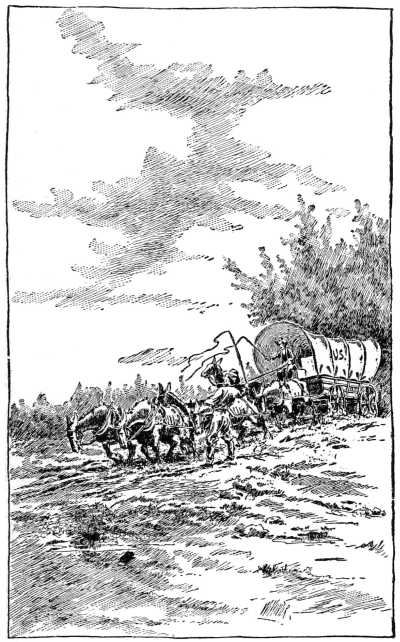
baffling understudy. Six patient, faithful Mules were attached to each
creaking big blue wagon, with a high, white canvas cover. Thirteen
wagons were, during the first two years of the war, allotted to a
regiment of infantry; six to a battery of artillery. Such campaigning
emulated the luxuriousness of a hundred-acre corn-field where every
ear-muff is made of silk. (P. S. It was subsequently abandoned.) One
hundred teams occupy a mile of road. Thus an army of seventy-five
thousand men are followed when marching by a wagon-train eighteen
miles long, hauled by Mules.
A broken linch-pin or king-bolt or hame-strap near the front of this
lumbering procession would bring the whole succedent line promptly to
a halt. Strategy at once impinges against a nonplus. The campaign
comes to a dead stand with a dull thud. The florid, inductive
teamster, with a hare-lip, is pondering profoundly the subjectiveness
of dinnerlessness. He is a hectic, hungry, hairy man, with whiskers on
his wrists; in addition he is deliberate. He repairs the damage very
deliberately. He refreshes himself, meanwhile, with snatches of
ancient melody, rescued from the deluge with Shem and Ham. Also with
frequent volleys of Enfield curses and Gatling blows, discharged at
his speechless, unoffending Mules. Luridity of impiety is a sine qua
non.
The mild, ethereal wickedness of that fossilized beechnut relating to
the dam by a mill site, pales its ineffective glow. It is usually the
dictate of wisdom to leave a wild-eyed cannibal in undisturbed
possession of his warpath; equally so to be very sparing of sneers at
another man's joss. Consequently the driver's amiable diversion is
seldom interfered with. When all damages are repaired the procession
moves on.
Then begins again the long lumbering creak, to continue in melancholy
monotony until another linch-pin breaks or buckle parts asunder.
Eighteen miles of tortured wagons roll on and on; white-arched,
weighty; relics of a thorny, stormy past, yet pregnant with an
illimitable future. They bristle with tent-poles, trail tangled tent
ropes far behind, and exude knapsacks, haversacks, canteens, drums and
drum majors at every pore. They are festooned around and beneath with
clinging mess pans, pendulous camp kettles, and the like
differentiation of iron-mongery. If the weather is fine this creak and
grind and rumble goes on and on, with monotonous, mechanical
steadiness, subject to accidents as aforesaid, until the tuneful,
sagacious Mule sings the long roll, as he instinctively scents
approach to the preordained place of encampment, when welcome night
draws nigh.
This is the poetry of transportation, jolly as a cake-walk,
comfortable as a smoking jacket, easy as reducing the labor question
to an exact science by the acceptance of a generous salary as walking
delegate. But when rains descend and floods come, the scenery shifts;
wagons, muleteers and quadrupeds are indiscriminately plunged into
diluvial quagmires, fathomless as air and shoreless as the
gulf-stream. Then the liquified turnpike spreads over the valleys and
yellow cascades roar down the defenseless ruts.
Then the climax of helpless wretchedness arrives, always fatefully
tumbling on the articulated anatomy of a hapless, cadaverous Mule.
Beneath him even chilled-steel agony can not go. He gathers in all its
multiplex
horrors, computed on the Utah plural family plan. He
would win a Columbian Exposition medal for the most picturesque
collection of miseries—picturesque, variegated and altogether
astonishing. They overwhelm him like a bather submerged in sea waves
twenty feet high, each weighing a thousand tons, half brine and half
sledge-hammer.
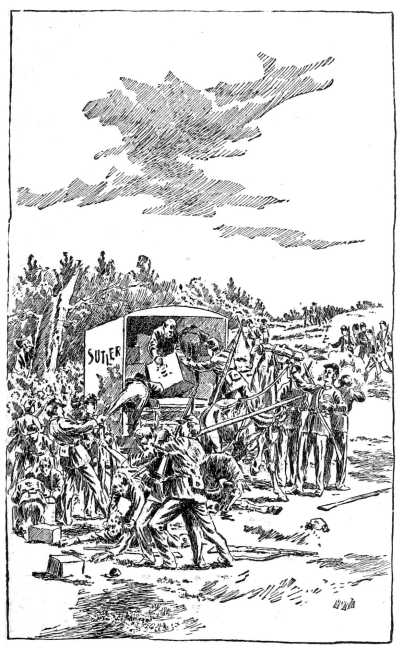
The quenchless, marvelous mule emerges from the mire
and clay, with a whooping-cough wheeze (Page 63)
No man can adequately realize what magnificent folly he is capable of
until he sees his own old love-letters set forth in the cold, cruel
print of some hideous newspaper. No man can fully appreciate the
faithfulness of our devoted animal co-workers until he sees a crucial
test applied. The quenchless, marvelous Mule emerges from the mire and
clay, with a whooping-cough wheeze, driven to preternatural exertions
by redoubled curses and quadrupled scourgings.
His step is quick, short and grasping. The spirit inherited from some
remote Hambletonian antetype flames in his nostrils. He rings a fire
alarm, hoists the grand hailing sign of distress, and defiantly dashes
his toe-calks through to hard pan. He rushes down the
high bluff,
over the muddy flat, across the cold stream, up the steep
bank—lashed, lathered and spurred. With a whisk of his tail that
scatters bullets of mud he springs to the tremendous task. His body is
squat to the earth at times, but his ears always point starward. Every
muscle hisses with the heat of the strain and every nerve is burning;
his whole frame quivers and smokes as he bursts into supremest effort
and brings his freightage to the goal, or dies in his tracks, a
speechless, unsung martyr to the cause. No burial, no monument, no
obituary.
To the Army Mule in camp, if anywhere, rest, rations and felicity
should come. A surplus of excitement is injurious to the nerves, but
life wholly without an atmosphere is in peril from suffocation. Rest
is alleged to be the only unfailing antidote to Dr. Bright's widely
advertised kidney complaint. Camp is recreation in army service as
courting is the play spell of the soul. The farmers in politics,
dedicated to a maximum of talk and a minimum of toil, need no
proclamation from the governor bidding them hold a fast from work in
order to enjoy a feast of discussion.
The free-lunch rounder, with pretzel crumbs on his mustache, loves
above all things to sit easy at his inn. Even the emancipated lady
prays earnestly for deliverance from the fatigues of the conservative,
innocent, purely platonic schottische. Consequently no blame can
justly attach to the worn and worried Mule for standing ever in
readiness to fall in with propositions for honorable repose. Beautiful
are his anticipations of a good time in camp; beautiful as a statue of
hammered brass, and as hollow. The hollowness results from the fact
that no reckoning was made of the hare-lipped despot at the other end
of the picket rope.
Ten pounds of grain and thirty pounds of hay is the daily allowance.
Some pie-plant professor of an agricultural institute, with a
marked-down set of artificial eyebrows hung at oblique angles to his
nose, long ago figured it out on strict mathematical principles of
animal economy. The court records it and the law doth give it. Thrice
happy is the beast that gets it; happy, but rarer than Indians with
side whiskers and ideality. Straw, stalks, tent pins and cracker boxes
are his more reliable provender. These are reinforced with stray bites
now and then, when he can chew himself loose, from a private's
laundered and lively underwear drying on a limb, or from the cold
shoulder of a corporal of the guard.
In the sweet, serene night watches, when slumber's chain had manacled
us, roving Mules may have rubbed noses while hatching a bleak and dark
conspiracy to massacre the brigade and plunder the forage train. But
it came to naught; possibly for lack of leadership. There was no
relief for the oppressed, defrauded Mule. No satiating food for him,
savory as Lyonaise potato softly tinctured with onion. No lollipop
confectionery for him, melting in the mouth like painted butter. Empty
is the nosebag, even as to plebeian oats; empty as the wit of
irreverent soldiers who josh the chaplain and gibe at the Mule.
An agricultural inquirer once wrote to Horace Greeley asking if guano
was good to put on potatoes. The busy editor replied that it might do
for men whose taste had been vitiated by tobacco and rum, but for his
own eating he preferred gravy. This was the cranberry tart retort of
the illustrious journalist, with a tough undercrust of misconception,
it is true. The condiments for the Army Mule's camp banquet were not
of the spice spicy. He has clear memories of a voracity which created
wide vacuum in sundry greenswards, and played havoc with corn cribs
manifold. The voracity remains, but the swards and cribs are far, far
away.
At spasmodic intervals a sympathetic warrior, having burned all the
top rails of an informally confiscated fence, will toss the juicy and
edible bottom rail to the pleading, omniverous Mule, residuary legatee
of camp-fires. This is good average food in times of internecine
strife, when so simple an article as pie is a precious prerogative.
But such well-flavored morsels are too uncertain for standard
sustenance. For shockingly protracted periods, he stands unfed,
neglected, receiving all suggestions with a squeal and a kick, while
the zephyrs disinfect his fur. Pending which, stark, grim skeletons of
all the barked and branchless trees within stretch of his tether
attest the final result of an attempt to adjust his Minnesota appetite
to his Andersonville rations. If watered twice a week he may vote
himself lucky; he has not even the surfeit of a teetotaler's wassail,
where water flows like wine. "A Mule feels chilly in July," says the
Talmud; if his temperature depends on the supply of internal fuel,
there is limited space for astonishment.
Meanwhile an unsanctified teamster, with red hair and hare-lip,
blushing with innocence until his whiskers singe in the heat, enjoys
the encampment episode to the uttermost. In Constantinople public
opinion is gauged by the prevalence of nocturnal conflagrations, and
the number of hanged bakers decorating the street corners next
morning. But in camp there is no concentrated public opinion
sufficiently intense to mete out due retribution to the profligate
castigator of the fodderless, thirsty Mule. He sleeps on ample
bedding of good sweet hay, and has large store of gerrymandered corn
to exchange for toothsome luxuries. His tobacco is of the costliest
brand and he defiantly blows the froth of numerous beers from his
blasphemous lips. He carries a full purse and a steady nerve; also a
bomb-proof conscience void of offense. Bad medicine, he!
The jocundities of life in camp we may gather ad nauseam from the
romances of some of the professors of freehand drawing who enlisted as
army correspondents; but for purposes of authentic history these
narratives are worthless as second-hand champagne corks. The
jocularities referred to have no interest to the solemn, imperturbable
Mule save when he is an object of their malevolence. Then they are
more interesting than enjoyable. The swell imbecile carries an
umbrella under his arm through crowded streets until its tip is
garnished with the eye of some unfortunate fellow wayfarer; the man
who loses the eye fails to see the point of—the joke.
The Mule is not much of a joker himself; but as a victim of practical
jokes, fine, funny or chestnutty, he has become widely celebrated.
His resentment of these preposterous hilarities, all of which are on
the passé social code of roller rinks, has caused much of the
reputation for waspy temper which now attaches to him with the
tenacity of a bachelor girl to the state of single blissfulness.
Temper changes with status, as was ascertained by the enthusiast who
originally named his fiancée Revenge because she was sweet, but now
that she is his wife calls her Delay because she is dangerous.
The city man who would own a farm should have a good income well
assured elsewhere, for it will certainly be needed. The foolhardy
individual who proposes to play tricks on a mule should be well
buttressed with sound accident policies. Beware the irritated
quadruped! Look not into the red mouth of a wild Numidian lion; touch
not the royal Bengal tiger's remotest whisker-tip; avoid the little
black bull with an eye like a razor's edge; make no experiments with
the terminal facilities of the speechless, inscrutible Mule!
His ways are past finding out; his kicks are incalculable,
inexplicable, incomprehensible. He sometimes allows patience to pile
up in ridges on his neck, while the battalions of wrath are debouching
from all quarters into his hoof. Then the eruption breaks out with
torpedo suddenness and with an energy of fury that rivals the
deafening roar which smites the aggregated ear of the magnificent
metropolis, when fire invades the wholesale district.
Blessed is the nation whose annals are uneventful—America is safe
with fifteen million children in the public schools and three thousand
citizens to one soldier. Happy is the bride whom the sun shines on
whether matriculated at Ognotz or merely captivated at Topeka. Joyous
to the weary mechanic the picnic of his labor holiday, with its
lemonade, its orations, and its other things that lull to peaceful
slumber. Halcyon to the Army Mule are monotonous days in camp, when
they bring surcease of torment as well as toil; red-lettered if
therewithal be brought, by rare concatenation, such plethora of long
forage as drowns vicissitude in bright beatitude. In that case he
rounds out radiantly and within the cycle of a very few days develops
beyond recognition. His protrusions disappear like the vanishing lines
of a mineral lode. His rumps accumulate fat and his girth expands with
a facility that is amazing. His eye takes on a new gleam and his bray
acquires a fresh intonation.
Moreover, he is speedily transformed into a bold aristocrat. He
cultivates style and assumes airs of conscious superiority equal to
the contemptuous sniff of a Fifth avenue dog who has smelled some
chance passer-by two or three grades below par. His future may be
uncertain as a Spaniard's veracity or a Frenchman's paternity; but he
lives in the glad and glowing present, with the nonchalance of a
Russian official hunting for fragments of the czar by torchlight,
after a popular demonstration.
Of the Mule in battle, lean is the record's exploitation. There is
little danger that his renown in that line will ever be subversive of
our liberties and other luxuries. Right is forever on the scaffold,
wrong forever on the make, as of old. But the placid, benevolent Mule
never takes up arms against either party—our quartermaster's returns
of uncounted thousands "lost in action" to the contrary
notwithstanding. It even seems difficult to secure credit for such
service as he actually rendered. His occasional sporadic work in
artillery teams is wholly forgotten. His frequent spurts to the
flaming front with ammunition wagons is entirely ignored.
A common, peaceful explosion of powder magazines at home not only
shatters all the windows in the neighborhood, but also shatters the
faith of people for miles around in the doctrine of resurrection of
the body. So the peaceful nature of the Mule is fatal to any
accumulation of reputation bubbles, where bayonets bristle and
saltpeter burns. Were he ten times the tin-clad child of havoc that he
is, the florid, hare-lipped arbiter of his destinies would see to it
carefully that, barring accidents, his opportunities for responding to
long rolls should be few.
The Chicago socialists tendered an olive branch to the police made of
gas-pipe and charged with nitroglycerine in a highly persuasive state
of concentration. But when the red and riotous fume of the
bomb-throwers' breath permeated the haymarket like a pestilence, no
army Mule mingled with the medley of frowzy trousers. No more do we
hear of him at Shiloh or Champion Hill or Cedar Creek.
For offensive purposes the Mule was, in general, harmless as a United
States frigate or a divinity student at a bean-bag festival, or the
ghost of a goose, white, downy and clamorous. The valedictorian of the
last class at the Keeley cure, permeated with a variety of virtuous
joint and several resolutions, could scarcely be more docile. Even the
reproachful Confederate smokehouse could not shake its gory padlock at
the stainless, unimpeachable Mule—although he carried a jimmy equal
to most emergencies, he could, as a rule, readily establish an alibi.
When fodder is really in the shock, and frost is ready to be cleft
from pumpkins with a snow-plow, then such free tubers as have been
produced in sweet charity's name on the Pingree plan should be
harvested without procrastination; delays are perilous at that season
of the year. The evil effects of the shock, however, can be minimized,
by feeding the fodder, in advance, to the harmless, appreciative Mule.
Forewarned is four times armed, or more.
Non-combatants and impedimenta compose the rear of an army when it is
in action. Here assemble great drinkers of alcohol, and vast eaters,
who measurably justify Germany's subsequent discrimination against the
American hog—all of whom let concealment like a chinch-bug prey on
their damaged cheeks, their necks, meanwhile, being given over to the
ravages of the army flea. Here in secure serenity mobilize numerous
excellent subjects for the romantic young woman who yearns for a
lovely debauchee to reform. Here congregate cooks, commissaries and
sutlers—this last with a sage-brush tinge of disappointment in his
aspect, and a Jenness-Miller cut of trousers on his limbs. Here
recreate skulkers who simulate heroes, and sneaks in the garbage of
soldiers, all cumberers of the ground, like a prophet gone to seed in
his own country. Here gather men of Trilby feet and mighty thirst,
who are riotous with repartee, but intensely hostile to all manner of
soft beverage; also cowards, inveterate as the upward tendency of
tartar emetic; moreover, quartermasters' clerks, spouting
bloodthirstiness like a congressional candidate, or some other gas
well; likewise, here in the rear, are mule wagons, mule pack trains,
mule teams, mule drivers and Mules.
When retreating or outflanked the order is varied and rear becomes
front instanter. Then unthinkable confusion reigns. A financial
catastrophe brought on by forty-cent wheat and ten-cent statesmanship
looking at facts through a long-distance binocle, is bad enough. An
explosion of the swear tank for a thought distillery in the higher
realms of journalism is even worse, if possible. But when a Mule dam
breaks, the thundering reverberation of its tumultuous hoofs is a
resonant forecast of pandemonium rampant. Vain and futile then all
ardent aspiration for such quiet as ensues when the wicked cease from
borrowing and the female elocutionist soars and bores no more! Our
cavalry out-posts were broken doses of soothing syrup for the nervous
flanks of the infantry, and often stampeded the front line by their
too precipitate retrogression.
A stampede of Mule teams to the rear had all the spirituel features
and picturesque complications of an arrangement of tariff schedules on
the principle of local option. Attempts at control were hopeless as
piloting a national campaign when the American voter is on the
rampage. It was a chaotic conglomeration of convulsive uproar,
sufficient to whirl down any hope of glory with a sickening slump. The
gentleman from out of town, who, in spite of conspicuous warning,
blows out the gas, makes his exit from sublunary strife in enviable
quietude. No such privileges are extended to the end man of a Mule
rush. In exclusive social circles, the dress may be a dream, and the
bill a nightmare, but in the mixed companionship we are contemplating,
this impromptu display is a veritable delirium tremens of undelineated
horror.
Frederick the Great shouted to a fleeing battle-straggler, "Wretch,
wouldst thou live forever?" and paralyzed him. The unabashed army
teamster, with a sliced upper lip and hair æsthetically matching his
sorrel Mule, sprinting along the broad highway of wrath, pitched
downward at an angle of forty-five degrees toward perdition, would
have admitted the soft impeachment, and pursued his flight, lashing,
blaspheming. He may have been, at home, as consistent a Baptist as
ever yoked a steer, but for this occasion all rules are suspended by
unanimous consent, and precedent tumbles headlong. The coincidence of
a florid girl and a pale horse is always exasperating, at least to the
girl; a hurried retreat in the presence of a menacing enemy, naturally
exasperates to full pitch of desperation the belligerent boss of the
nimble, obedient Mule.
In numberless miscellaneous episodes of a military sphere, the Army
Mule was marked high as to deportment. Though of somewhat irregular
character, even verging at times on the diabolical, he emulated the
standards of the officer and the gentleman. We can afford to mix a
little sentiment with our matter of fact. We can afford to drop a
tear when the object is worth it. We can afford a note of eulogy under
like circumstances, even to an Arizona cayuse fattened on bunch-grass
to the rotundity of a prickly pear.
Yes, certainly, business thrift is commendable, but when it comes to
crossing the lightning-bug with the honey-bee so that the latter can
work at night, we draw the line. Sentiment aside, there is a measure
of truth in the averment that the Army Mule and the army bean put down
the rebellion. The dancing diplomat, with his twisted comprehensions
and his addled complacencies may not appreciate it. Such an one,
having never associated with the speechless, unspeakable Mule, nor,
indeed, had any legitimate business transactions with him, may
possibly still assert that the lion is king of beasts. Far from it!
The lion will serve as a freak, children half price; but for steady
days' works, for genuine aplomb and musical dexterity of wide
longitudinal range, the courteous, dignified Mule was preeminently
peerless.
To hospital and guard-house, Siamese bugbears of honorable service,
he was a stranger. It was never necessary to detail a fatigue squad to
police his ears. The worthy chaplain, fresh from green pastures of
civil life, where he fed the juicy lambs and clubbed the tough old
rams of the flock, found no occasion for reproof to the silent,
orthodox Mule.
No venial dereliction ever subjected him to stoppage of pay or
reduction to the ranks, even when the fodder that he longed for never
came. No court-martial, reeking with pungent odors of staple and fancy
sutlers' goods, ever met to arbitrate his predestinated destiny. You
might tie his tail like a pretzel, or pound his bray in a mortar, yet
would not his serenity depart from him. The proneness of his voice
apparatus to go off at half cock unfitted him for crooked works of
strategy—he could never be relied on either to "lie" in wait or
"steal" on an enemy. How gratefully he turns with a maple-sap thaw in
his aspect, when his neck has been stripped of the blistering harness;
how joyously his eager nostrils sniff the forage from afar. Oh!
grateful, melodious Mule!
A zoological riddle, offspring of amalgam and miscegen as
unclassifiable as a severe case of Debs aggravated by symptoms of
Coxey and Altgeld, he had, nevertheless too much animal self-respect
to ever incur censure for getting humanly drunk. While the giddy whirl
of current events whirls even more giddily, let us remember that
virtue in his favor.
Man's frailty darkens many a sad, sad story—sad as a volume of the
Congressional Record; the Army Mule's frailties were few, his
conquests many. He was amiable after all; even General Butler, the
most illustrious heavenly twin of war times, conceded that much. His
temper was by no means of the cactus order, generally speaking. He
chooses grudges with rare discrimination; it is always safe to suspect
the man that a Mule hates. Patient in toil; silent in suffering;
cogent and cautious as the rule in Shelly's case; serene amid direst
confusion and alarm; heedless of ancient sarcasms decaying or
petrified, he was in no sense a grumbler, and in no unpardonable sense
a kicker. His hours of feed were unstable as the advertising rates of
a poor but honest journalist, yet he was lighter of heart than a
newly married gent rushing the oil can to a corner grocery.
If to his straight enduring back a mountain howitzer was sometimes
strapped and fired without unslinging, he accepted the indignity, went
to grass with the recoil, and rose for the next inning, unruffled as
an expert witness emerging from the labyrinth of a hypothetical
question—oh! dimless, unknowable Mule!
A retired tobacconist adopted for the motto of a fresh coat of arms to
be emblazoned on his carriage panels: "Quid Rides?" Why do you
laugh? After a Saint Petersburg assassination episode it is
comparatively immaterial whether you call the widow czarina or
imperatritza. In these peaceful days, Lincoln's speech at Gettysburg,
translated into the jingling speech of Chinamen, and even into the
jabbering Japanese, which rivals the contortions of the kinetoscope,
opens a new evangel to their narcotic, Oriental souls. Sherman's
marvelous retreat from Atlanta to Savannah is studied by the
strategists of deepest Afgahnistan; alleged busts of John A. Logan
are worshiped as idols in innermost Kamchatka, and spicy narratives we
told to credulous marines are the basis of classic fiction on the
Congo.
Hence nothing is frivolous that lends an added array to the most
luminous chapter of contemporary history—of any history. While in the
matter of beer, the foreigner unquestionably pays the tax, or most of
it, yet as between natives, white-colored may lose and black may win;
'tis hard to tell. Make no mistake as to the intrinsic, historic
importance of the forgotten, unforgetting Mule!
The empty skeptic may come forth with fire in his eye and boiled egg
on his whiskers seeking to overwhelm us with the gorgeousness of his
gush or the sumptuousness of his gall. To empty skeptics, or shallow
scoffers, these simple annals of a lowly career may seem fruitless as
that famous sour apple tree that failed to yield its promised harvest;
hopeless as the perpetual revolutions of a bob-tailed dog chasing the
vacant space where the tail should be; tasteless as fried smelts;
thankless as opening a mint sauce to the free coinage of lamb. The
chappie fellows who flutter at functions and titter at teas may scoff
or scorn. But the eye of calm philosophy ought to beam kindly on a
faithful effort to weave unconsidered trifles of truth into a wreath
of earned, though meager and belated justice, so that even the
wayfaring man, though full, need score no errors.
The speechless, unquenchable Mule was a real factor in those events we
love to commemorate. It is asserted that only one man now survives who
helped whip Lee at Gettysburg, and then marched triumphantly with
Grant into conquered Vicksburg next day. But the Army Mule did both,
and more! He went out with the mob of pinfeather volunteers, who spent
their first callow days principally in vociferous "swearing in," and
their sappy nights at discordant drills in patriotic minstrelsy.
With less recognition than even the barnstormers' encore of addled
carrot and frumescent cabbage, he helped wet-nurse our infant
regiments when they were just getting able to sit up and gaze vacantly
around. With a prodigious faculty in his heels for putting strange
faces in heaven, he held himself in commendable subjection while
incipient legions evolved themselves out of chaos. He passed on,
beaten with many stripes, to that multitudinous aggregation called an
army, where human atoms, swarming and wriggling to the music of brass
bands, like agile mites in a nugget of archaic cheese, united to give
him the frigid shake with a glad hand. The girl, photographed for her
lover with her vail down, that his sister might not recognize the
likeness, was a miracle of modest artifice; thrice proficient in
meritorious cunning, the unassuming, artful Mule.
Unequally yoked in servitude to a cowboy taskmaster, unlovable as the
venerable Smallweed's brimstone, blackbeetle helpmeet, also redheaded,
hare-lipped and stuffed with nitric nine-cornered blasphemy, he plodded
painfully on. Stark and indurate like an Adirondack meadow enameled
with trap rock, he plodded rigidly on. Anhungered and athirst, with no
credit at the sutler's, on he plodded, through hot, white clouds of
drastic turnpike dust, or red and hideous depths of gummy mud,
dragging incredible burdens of those indispensable supplies that
smooth war's wrinkled front and quell its clamoring emptiness. When he
diffidently claimed his share of such supplies, he was given the
marble heart or the dry and dreadful laugh—yea, the juiceless,
mechanical laugh, with daggers in it.
Oh! liberty, what humbugs are nurtured in thy name! Prodded and flayed
until his staggering knees, his welt-fretted haunches and his bloody
nostrils placarded his agony, the Army Mule accepted the wideopen
policy of his castigator and crunched his barmecide feasts, lacerated
and scarified, hoping the brighter day.
Like the intoxicating bewilderment of a reception ball, decorated with
roses, lilies, smilax, palms and electric illumination, come back to
us those grateful reminiscences, crowded with apparitions of the
maligned, mellifluous Mule. Leashed and shackled, foodless in the
drizzly, sleety camp, when our quarrel with destiny was an octave
higher than usual, his cheerful night cries, welcome as suicides to a
coroner, exorcised the blue devils of our dolorous solitude.
While fumes of our priceless coffee floated pleasantly pungent like
the cedar aroma of a moth closet, the tuneful echoes of those night
cries floated also—Mule answering unto Mule in fond, fraternal
recognition. Baptized with fire, adjacent or remote, even if only with
its rumors and reflections, the pattering skirmish shots of distant
action, he at length became a veritable veteran. Like a
thrice-rejected suitor finally made happy, he had been well shaken
before taken. And now, a warrior bold, seasoned to war's alarms, he
could, upon occasion, thirst or seem to thirst for gore, with all the
mad ferocity of a sheep smitten with hydrophobia, or a camel charged
with nitroglycerine. Duplicating the awkwardness of man's debut into
polite society delayed until past the meridian of life, this ardor of
the mettled, military Mule, if late, was touchingly conspicuous.
Marching triumphant home, kneesprung but irrepressible, his large,
luxuriant ears were tremulous with the hysterical emotions of the
hour, and his double-turreted voice was loudest in the wild acclaim of
victory. Long years he lived, it may be, wearing on knightly shoulder
a proud insignia of his service, the indellible brand of honor, which
no humility of avocation could degrade nor purse-proud aristocracy of
money bags, the basest known on earth, contemn with impunity. And when
the end comes, as come it must, even to the longevous Mule, then
speechless and unspeakable at last and eternally, the flag under which
he toiled might be put to worse uses than that of covering his
emaciated frame as it is trundled off to the glue-factory.
I mean no disrespect to the flag.
That flag is our flag! Man has always and everywhere sought in
bannered blazonries the symbol of a sovereign power. Everywhere and in
all times some emblem of a might which confessed no mightier has led
embattled hosts to triumph, and taught heroic spirits how sweet it is
to die. The banner becomes the crystallization of the nation's life,
and the embodiment of her glory, until fighting beneath it is
patriotism, dying for it is immortality, and treachery to it is the
blackest of crimes. Our flag of beauty and renown, descending to us
from stainless sires by a shining pathway, pure as that down which the
holy grail slipped from the opening heavens, won a new lustre in the
hands of our generation. Overlapping each other in the crowding
profusion of their golden legends, every stripe of our banner is
weighty with its battle roll, even as each silver star burns the prime
jewel in a crown of valorous achievement.
Donelson and Shiloh and Vicksburg; Nashville, and Murfreesboro, and
Kenesaw; Winchester and South Mountain and Antietam; Gettysburg and
the Wilderness and Appomatox—these and five hundred more. How the
deathless names gild the resplendent folds of the proud ensign of
liberty! Flag of the continent, rivers and seas; flag of a reunited
country; flag of the glorious past and of the dimless future; flag of
freedom; flag of the world!
Washed in the blood of the brave and the blooming,
Snatched from the altars of insolent foes;
Burning with star-fires, but never consuming,
Flash its broad ribbons of lily and rose.
Let us never cease to cherish the remembrance of the days when we
followed it and fought for it. Among the soft, delicious echoes of
those days which float booming across the ocean of memory will
sometimes come, whether we greet it kindly or coldly, a sunny
recollection of the seductive wink, the tuneful bray and the electric
kick of the Army Mule.