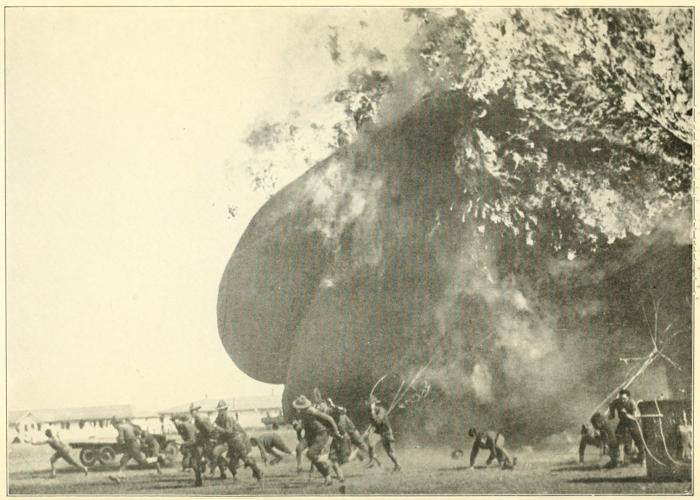
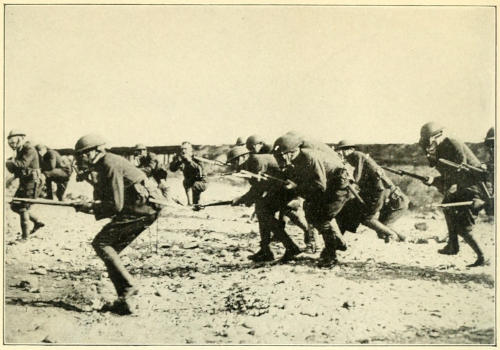
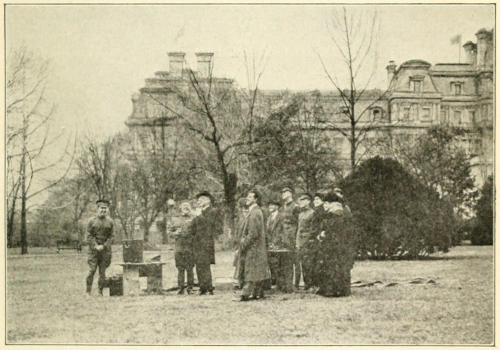
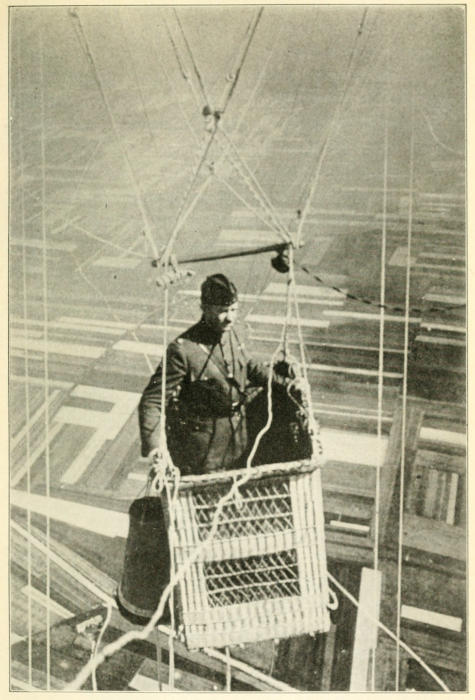
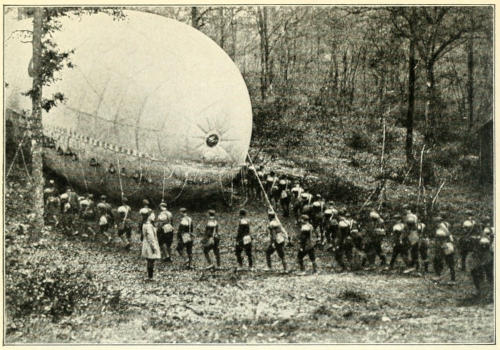
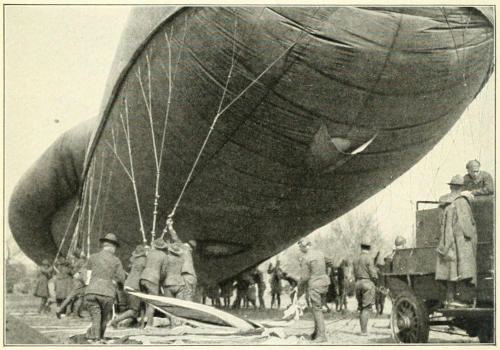
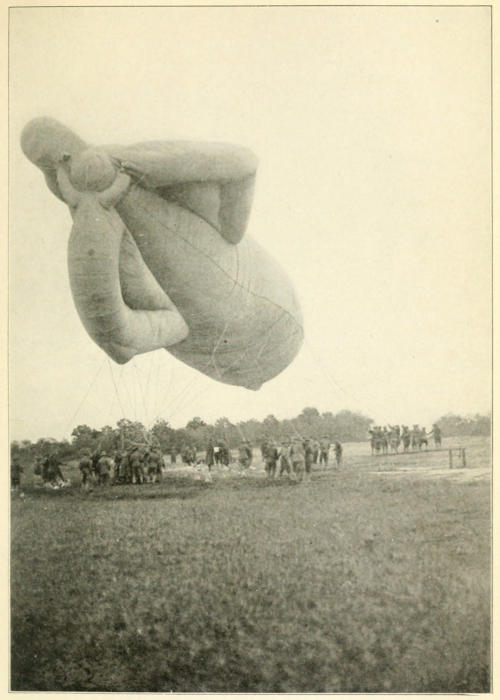
THE BURNING OF AN OBSERVATION BALLOON AT FORT SILL,
OKLAHOMA.
THE ARMY
BEHIND THE ARMY
BY
MAJOR E. ALEXANDER POWELL
U. S. A.
ILLUSTRATED
NEW YORK
CHARLES SCRIBNER’S SONS
1919
Copyright, 1919, by
CHARLES SCRIBNER’S SONS
Published September, 1919
TO
FIVE FRIENDS OF THE A. E. F.
LIEUT.-COL. N. J. WILEY
MAJOR HUGH B. ROWLAND
MAJOR HAMILTON FISH, JR.
LIEUT. WILFORD S. CONROW
LIEUT. KINGDON GOULD
IN MEMORY OF THE DAYS WE SPENT TOGETHER
ON THE BANKS OF THE MARNE
AN ACKNOWLEDGMENT
For the interest they have shown and the assistance
they have given me in the preparation of this
book, I am indebted to many persons. Each chapter
was written with the co-operation of the chief and
subchiefs of the branch of the army with which it
deals, and upon its completion it was by them carefully
read and revised. The statements and figures
are as nearly accurate, therefore, as extreme care can
make them. The Honorable Newton D. Baker, Secretary
of War, authorized the writing of the book and
issued orders that every facility was to be afforded
me for obtaining the necessary material, and the
Honorable Benedict Crowell, Assistant Secretary of
War, who from the beginning took a lively personal
interest in the work, placed at my disposal the great
mass of material which he had collected for his Official
Report. To Major-General William S. Seibert, Director
of the Chemical Warfare Service, to Colonel William
S. Walker, in command of Edgewood Arsenal, and to
Colonel Bradley Dewey, in command of the Gas Defense
Division, I am particularly indebted, as it was
due to their efforts that I was able to undertake the
writing of the book. Major-General William M. Black,
Chief of Engineers, Lieutenant-Colonel Chenoweth,
and Major Evarts Tracy of the Corps of Engineers;
Major-General C. T. Menoher, Director of Military
Aeronautics, Colonel S. M. Davis, Lieutenant-Colonel
H. B. Hersey, and Major H. M. Hickam of the Air
Service; Colonel James L. Walsh, to whose generosity
I am indebted for much of the material relating to
Army Ordnance, Colonel E. M. Shinkle and Major
A. B. Quinton, Jr., of the Ordnance Department;
Major-General George S. Squier, Chief Signal Officer
of the Army, Brigadier-General C. McK. Saltzman
and Lieutenant-Colonel Joseph O. Mauborgne of the
Signal Corps; Major-General M. W. Ireland, Surgeon-General,
and Colonel M. A. De Laney of the Medical
Corps; Brigadier-General Marlborough Churchill, Director
of Military Intelligence, Captain R. G. Martin,
Captain A. R. Townsend, Captain H. M. Dargan,
and Captain J. Stanley Moore, of the Military Intelligence
Division; Major-General Rogers, Quartermaster-General
of the Army; Colonel I. C. Welborn,
Director of the Tank Corps; Brigadier-General Drake,
Director of the Motor Transport Corps; Captain W.
K. Wheatley, Chief of the Historical Section of the
Motor Transport Corps, and W. L. Pollard, Esq.,
Chief of the Historical Branch of Purchase and Storage,
all showed me exceptional courtesy and afforded me
every possible assistance. I welcome this opportunity
to express to them my appreciation. To the Bulletin
of the Spruce Production Division, published by the
Loyal Legion of Loggers and Lumbermen, I am indebted
for a considerable portion of the account of
spruce production in the Pacific Northwest.
Before the war made most Americans as conversant
with the functions of the various branches
of the army as they are with the duties of the gardener
and the cook, the work of the Signal Corps troops was
popularly supposed to consist, in the main, of standing
in full view of the enemy and frantically waving little
red-and-white flags. Don’t you remember those
gaudily colored recruiting posters which depicted a
slender youth in khaki standing on a parapet, a signal-flag
in either outstretched hand, in superb defiance
of the shells which were bursting all about him? This
popular and picturesque conception was still further
fostered at the officers’ training-camps, where the
harassed candidates spent many unhappy hours attempting
to master the technic of semaphore and wig-wag.
Yet, as a matter of fact, during more than four
years of war I do not recall ever having seen a soldier
of any nation attempt to signal by means of flags,
save, perhaps, in the back areas. Had such an attempt
been made under battle conditions the signaler probably
would have provided, in the words of the poet,
“more work for the undertaker, another little job for
the casket-maker.”
By this I do not mean to imply that the changed
conditions brought about by the Great War made
the army signaler a good life-insurance risk. Far from
it! But they did have the effect of making him a trifle
less dashing and picturesque. Instead of recklessly
exposing himself on the parapet of a trench in order
to dash-dot a message which the enemy could have
read with the greatest ease, he dragged himself, foot
by foot, across the steel-swept terrain, a mud-caked
and disreputable figure, on his task of repairing the
tangle of copper strands which linked the infantrymen
in the front-line trenches with the eager guns;
crouching in the meagre shelter afforded by a shell-hole,
with receivers strapped to his ears, he sent his
radio messages into space; carrying on his back a
wicker hamper filled with pigeons, he went forward
with the second wave of an attack; or, by means of a
military edition of the dictaphone device so familiar
to readers of detective stories, he eavesdropped on
the enemy’s strictly private conversations. Even
though he had no opportunity to wave his little flags,
the Signal Corps man never lacked for action and excitement.
If the Air Service is, as it has frequently been
termed, “the eyes of the army,” then the Signal Corps
constitutes the army’s entire nerve-system. Under
the conditions imposed by modern warfare, an army
without aviators would be at least partially blind, but
without signalers it would be bereft of touch, speech,
and hearing. It is the business of the Signal Corps to
operate and maintain all the various systems of message
transmission—telegraphs, telephones, radios,
buzzers, Fullerphones, flags, lamps, panels, heliographs,
pyrotechnics, despatch-riders, pigeons, even dogs—which
enable the Commander-in-Chief to keep in constant
communication with the various units of his
army and which permit of those units keeping in touch
with each other. It was imperative that General
Pershing should be able to pick up his telephone-receiver
in his private car, sidetracked hundreds of miles away
from the battle-front, perhaps, and talk, if he so desired,
with a subaltern of infantry crouching in his
dugout on the edge of No Man’s Land. The Secretary
of War, seated at his desk in Washington, must be
enabled to talk to the commander of a camp on the
Rio Grande or of a cantonment in the Far Northwest.
Though every strand of wire leading to the advanced
positions was cut by the periodic shell-storms, means
had to be provided for the commanders of the troops
holding those positions to call for artillery support,
for reinforcements, for ammunition, or for food. It
was essential to the proper working of the great war-machine
that the chiefs of the Services of Supply at
Tours should be in constant telegraphic and telephonic
communication with the officers in charge of the unloading
of troops and supplies at Bordeaux and Marseilles,
at Brest and St. Nazaire. It was vital that
the Chief of Staff should be kept constantly informed
of conditions at the various ports of embarkation.
All this was made possible by the Signal Corps. But
it was also necessary that these various conversations
should be so safeguarded that there was no possibility
of them being overheard by enemy spies. And the
Signal Corps saw to that too.
When Count von Bernstorff was handed his passports
in the spring of 1917, the Signal Corps consisted
of barely 50 officers and about 2,500 men. When,
nineteen months later, the German delegates, standing
about a table in Marshal Foch’s private car, sullenly
affixed their signatures to the Armistice, the corps
had grown to nearly 2,800 officers and upward of 53,000
men. It comprised at the close of the war seventy-one
field signal battalions, thirty-four telegraph battalions,
twenty replacement and training battalions,
and fifty-two service companies, together with several
pigeon and army radio companies, a photographic section,
and a meteorological section.
Not many people are aware, I imagine, that nearly
a third of the officers and men who wore on their collars
the little crossed flags of the Signal Corps were recruited
from the employees of the two great rival telephone
systems of the United States—the Bell and the Independent.
The former raised and sent to France
twelve complete telegraph battalions; the latter ten
field signal battalions—to say nothing of the great
number of experts, specialists, and telephone-girls who
left the employ of those systems to embark on the
Great Adventure. So you need not be surprised if,
the next time your telephone gets out of order, your
trouble call is answered by a bronzed and wiry youth
who wears in the buttonhole of his rather shabby coat
the tricolored ribbon of the D. S. C.—won, perhaps,
while keeping the communications open at Château-Thierry.
And the operator who says, “Number,
please,” so sweetly, may have been—who knows?—one
of those alert young women in trim blue serge who sat
before the switchboard at Great Headquarters and
handled the messages of the Commander-in-Chief
himself.
For a number of years before the war it was recognized
in Washington that should the United States
ever become involved in a conflict with a first-class
Power, the handful of officers and men who composed
the personnel of the Signal Corps would be utterly
incapable of handling, unaided, the enormous system
of communications which is so essential to the success
of a modern army. It was perfectly evident, moreover,
that should the country suddenly find itself
confronting an emergency, there would be no time to
train officers and men in the highly technical requirements
of the Signal Corps. To insure the success of
the great citizen armies which we would be compelled
to raise with the utmost speed in case of war, it was
essential that there should be available an adequate
supply of men who were already thoroughly trained
in the installation and operation of the two chief forms
of military communication—telegraphs and telephones.
And this trained personnel was at hand in the employees
of the great telephone and telegraph companies.
It was not, however, until June, 1916, when
Congress, tardily awakening to the imminent danger
of sparks falling on our own roof from the great conflagration
in Europe, passed the National Defense
Act, which authorized, among other things, the creation
of the Signal Officers’ Reserve Corps and the Signal
Enlisted Reserve Corps, that the way was opened for
definite action. Shortly thereafter the Bell Telephone
System was approached by the Signal Corps with the
suggestion that a number of reserve Signal Corps units
be recruited from its various subsidiary organizations.
The suggestion met with the hearty approval of the
Bell officials and the work of organization was turned
over to the Bell’s chief engineer, Mr. J. J. Carty, the
foremost telephone expert in the world. In accordance
with the plans drawn up by Mr. Carty, there were
organized from the employees of the New York, New
England, Pennsylvania, Chesapeake and Potomac,
Central Union, Cincinnati, Northwestern, Southwestern,
Southern, Mountain States, and Pacific telephone
companies twelve reserve telegraph battalions. I
might mention, in passing, that Mr. Carty was given
a commission as major, was later promoted to colonel,
was made chief of the telegraphs and telephones of
the A. E. F., and for his invaluable work was awarded
the Distinguished Service Medal.
While the Bell System was devoting its efforts
to the raising of the telegraph battalions, the Chief
Signal Officer of the Army asked the co-operation of
the Bell’s great rival, the United States Independent
Telephone Association, in the organization of a number
of field signal battalions for front-line work. Mr.
F. B. McKinnon, vice-president of the association,
assumed charge of the work and enthusiastically threw
himself and all the agencies at his disposal into the
business of recruiting, ten field battalions eventually
being raised by the Independent System.
But the demand for trained personnel from the
telegraph and telephone companies did not end with
the formation of the units I have just mentioned.
With the declaration of war and the despatch to France
of the first American contingents, it was realized that
their work had only begun. Though the telegraph
and field battalions contained many experts on telegraphy
and telephony, they were formed primarily as
constructive and operative units for comparatively
short lines. But the lines in the A. E. F. did not remain
short, and as they grew in length and in number,
new equipment and different types of technicians had
to be employed. In August, 1917, there came from
France the first call for specialists, to include telephone-repeater
experts, printer-telegraph mechanicians, printing-telegraph
traffic supervisors, and similar highly
trained men. Almost at the same time there was received
a cablegram from General Pershing requesting
the immediate organization in Paris of a Research
and Inspection Department, in order that the best,
latest, and most reliable signal equipment might be
assured for the American troops. To Colonel Carty
was assigned the task of selecting the twelve scientists
to be the officers of the new division and the fifty enlisted
assistants who were necessary to commence the
work. He found them in the remarkable Research
Department of the Western Electric Company, which
is closely allied with the Bell System, Mr. Herbert
Shreeve of the Western Electric being given a commission
as lieutenant-colonel and placed in charge
of the work. The improvements made and the devices
introduced by this division made the signal
system of the A. E. F. one of the marvels of the war.
So wide-spread and reliable were the American communications,
and so efficient the American operators,
that on more than one occasion Marshal Foch, during
his tours of inspection along the battle-front, went
many miles out of his way in order to use the American
wires for important conversations. But so rapid
was the growth of the telegraph and telephone lines
in France that hardly had one requisition for additional
personnel been filled before another was received. Yet
always the great systems of the United States answered
the call, and this despite their crying need for such
personnel at home, where war conditions had enormously
increased their business, and the difficulty
which they were experiencing in making replacements
in their own forces. In fact, of the 2,800 officers commissioned
in the Signal Corps during the war, fully
30 per cent had been trained with the telegraph and
telephone systems, and the percentage of enlisted
men was equally high. The response made by these
great corporations to the nation’s call constitutes, indeed,
one of the most gratifying incidents of the
war.
When the history of the great conflict comes to be
written, the story of the achievements of the telegraph
and field battalions of the Signal Corps will form one
of its most fascinating chapters. Working under the
most trying conditions, in a land with whose customs
they were unfamiliar and whose language they did not
understand, with equipment and material frequently
improvised from whatever was at hand, they covered
France from the seaboard to the Rhine with the network
of their wires; they made it as easy for Great
Headquarters to communicate with a remote outpost
in Alsace or the Argonne as it is for a brokerage house
in Wall Street to communicate with the manager of its
Chicago branch, and it established a standard of speed
and efficiency which will make the French dissatisfied
with their own services for years to come. Their work
was, in the words of General Pershing, “a striking example
of the wisdom of placing highly skilled technical
men in the places where their experience and skill will
count the most.”
LAYING A FIELD TELEGRAPH LINE.
They established a standard of speed and efficiency.
Photograph by Signal Corps, U. S. A.
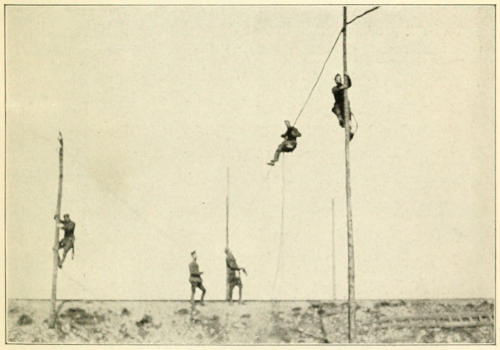
SIGNAL CORPS MEN ERECTING A FIELD TELEPHONE.
Working under the most trying conditions, these men covered France with
the network of wires.
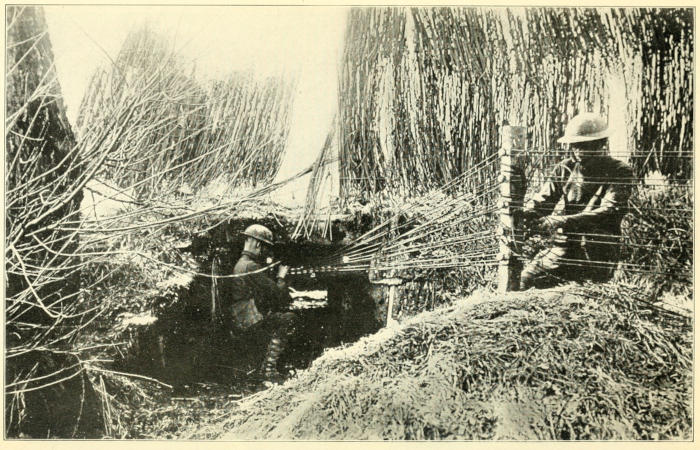
SIGNAL CORPS MEN AT WORK REPAIRING THE TANGLE OF COPPER
WIRES WHICH LINK THE INFANTRY IN THE FRONT-LINE TRENCHES WITH THE GUNS.
Despite the unending stream of men which constantly
flowed Europeward for work on the “A. E. F.
Tel. & Tel. Co.,” as our military telegraphs and telephones
were familiarly known, more were ever needed,
and it was finally decided, though, I believe, with considerable
reluctance on the part of certain old-fashioned
officers in the War Department, to replace the men
operators, wherever possible, with girls. Again the
American systems were called upon, this time to furnish
young women who possessed the necessary technical
experience, and to give them a working knowledge of
French. Imagine the furor of excitement that swept
through every telephone-exchange in the country when
it was learned that girls were wanted for service in the
A. E. F.! Where was the red-blooded, adventure-loving
American girl who could resist such a call?
Soon the company officials as well as the Signal Corps
itself were almost swamped by the flood of applications
that poured in. Then the Signal Corps found itself
confronted by the necessity of educating the applicants;
to do this it had to operate a whole system of boarding-schools
for girls. Such schools were established in
New York, Philadelphia, Chicago, San Francisco, Jersey
City, Atlantic City, and Lancaster, Pa., the candidates
for overseas duty being given intensive courses
in military telephony, French, and European geography,
together with lectures on French manners and
customs, and, I might add (this in a whisper), on their
own behavior, particular emphasis being laid on the
evils of flirting, impertinence, and gum-chewing. Upward
of 200 girls were finally selected, provided with
uniforms and overseas caps of navy serge—which
looked as though they might have been designed by
the technical experts of the Signal Corps—and sent to
France as full-fledged members of the A. E. F. No
pupils at a fashionable girls’ boarding-school were ever
more strictly chaperoned. At Tours quarters were
built for them on an island in the Loire, which was
connected with the mainland by a narrow foot-bridge,
the military police on duty at the end of the bridge
only permitting the girls to “go ashore” when they
were accompanied by a matron or were in pairs. Notwithstanding
the strictness of the regulations under
which they lived and worked, it was a girl’s own fault
if she came home unengaged. Though it goes without
saying that the military authorities took every precaution
against exposing the girls to danger, those who
were on duty in towns near the front, such as Toul, on
numerous occasions tasted the excitement of German
air-raids, one of them being cited in army orders for
remaining at her post and coolly continuing to operate
her switchboard “whence all but she had fled.”
I always liked the true story of the telephone-girl
who, upon her arrival at an American port of debarkation,
informed the landing officer that she was a second
lieutenant.
“But why do you call yourself a second lieutenant?”
he inquired. “No commissions have been given
to telephone-girls.”
“I don’t see what that’s got to do with it,” she
retorted, tossing her head. “I get more pay than a
second lieutenant, and I’ve been of more use to the
army than any second lieutenant that I know.”
In order to assess at their true worth the achievements
of the Signal Corps during the war, it is essential
to realize the amazing number, variety, and magnitude
of the tasks the corps was called upon to perform.
The Signal Corps is a staff department charged with
providing means of communication for the army, both
at home and overseas. According to the present tables
of organization, one field signal battalion is usually
attached to each division, the telegraph battalions
being used as corps or army troops. Generally speaking,
the telegraph battalion maintains communications
in the rear; the field battalion usually operates with
the combat troops at the front. In addition to these
troops, there are numerous special units, such as pigeon
companies, radio companies, photographic and meteorological
sections, which are attached to corps, armies,
or to General Headquarters. In France where hundreds
of miles separated our base ports from our troops
on the firing-line, there devolved upon the Signal Corps
an enormous amount of work in the area known as
the Services of Supply. The magnitude of the telegraph
and telephone systems in the S. O. S. is illustrated
by the fact that when the Armistice was signed,
the Signal Corps in France was operating 96,000 miles
of circuits known as “long lines,” with 282 telephone-exchanges,
and a total of nearly 9,000 stations. The
requirements for wire in the field were even greater.
When our operations were at their height in the
summer of 1918, it was estimated that the Signal
Corps would require 68,000 miles of “outpost wire”
a month for use at the front in connecting telegraph
and telephone systems. Outpost wire is, I ought to
explain, a development of the war. It is composed
of seven fine wires, four of them bronze and three of
them of hard carbon steel, stranded together and
coated first with rubber, then with cotton yarn, and
finally paraffined. This wire is produced in six colors—red,
yellow, green, brown, black, and gray—in order
that it may readily be identified in the field, the red
wire running, for example, to the artillery, the yellow
to regimental headquarters, green to brigade headquarters,
and so on. The enormous amount of this
wire required is explained by the fact that very little
of it was saved, it being out of the question to pick it
up during the hurry and excitement of an advance,
while hundreds of miles of it were destroyed during the
heavy bombardments which usually preceded an
attack.
Within the memory of many of us the size of combat
armies was largely determined by the efficiency and
scope of their signal systems, it being essential that
the forces in the field should be kept within a size
which permitted of communication being maintained
between all units by means of runners, riders, or visual
signals. Those were the days when messengers, often
chosen by lot, crawled through the enemy’s lines at
night in order to bring reinforcements to beleaguered
garrisons; when stories of ambush and massacre or
urgent appeals for ammunition and food were brought
to headquarters by weary riders clinging to the manes
of reeking ponies; or when, in the Indian country, cavalry
columns communicated with each other by means
of heliograph messages flashed from mountain-top to
mountain-top, or signal-fires curling slowly skyward.
But all this changed with the introduction of the
telegraph and the telephone, the communications of an
army thereafter being limited only by the amount of
its wire. A far greater change came, however, with
the introduction of the radio or wireless, whose area
of operations is limited only by the power of the sending
apparatus. Now it should be kept in mind that
each of the systems of military signalling which I have
already enumerated—telegraphs, telephones, radios,
panels, lamps, flags, pigeons, runners, dogs, and the
rest—is an adjunct to the others—when one fails,
another is employed to get the message through. If
the wires of the field telegraph and telephone are cut
by a barrage, the radio is employed; if a shell knocks
out the radio set, the message is intrusted to a pigeon;
should the pigeon fail, a runner attempts to take it
through; and if the runner is killed, the message can
be communicated, either by means of rockets or by
cloth panels spread upon the ground, to the aviators
circling overhead.
Despite the new methods of transmitting messages
produced by the war, the telephone remains the backbone
of the military signal system. Though the portable
telephone instrument used by all front-line troops
was manufactured in the United States for commercial
purposes prior to the war, the switchboard in most
general use by mobile troops was originally developed
by the French, being the only telephone equipment
used by the American forces which was not of American
design. This switchboard, which was built in
units so that it could be expanded from four to twelve
lines, was the “Central” of the front-line dugout, being
so compact that it could be carried as part of the equipment
of a soldier and quickly put into operation. For
the use of the larger field units there was designed a
camp switchboard, with provision for forty wires,
which when in transit resembled a commercial traveller’s
sample-trunk. A third type of switchboard, for
use at headquarters in the zone of combat, but where
extreme portability was not essential, was designed in
units, like a certain popular style of sectional bookcase,
and could readily be increased to any size required.
An important auxiliary to the field-telephone lines was
the buzzerphone, an American device for use where
extraordinary secrecy was imperative, it being impossible
for the German Listening-in Service to eavesdrop
on messages sent by this method.
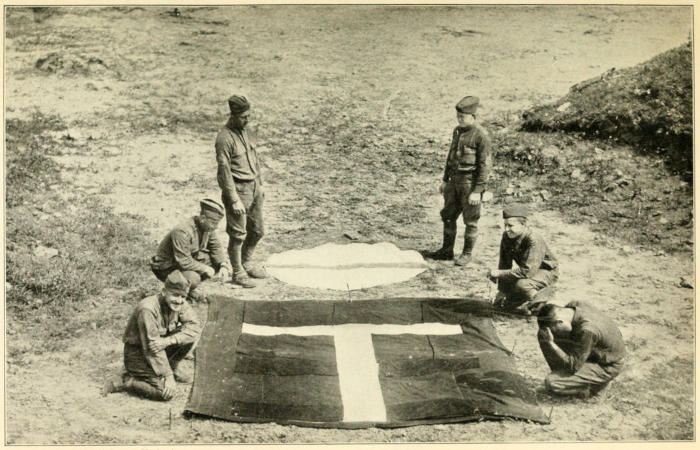
COMMUNICATION BY USE OF PANELS.
When other means of communication is found impracticable, the infantry
can communicate with aviators by means of panels of cloth cut in various
shapes spread upon the ground.
Photograph by Signal Corps, U. S. A.
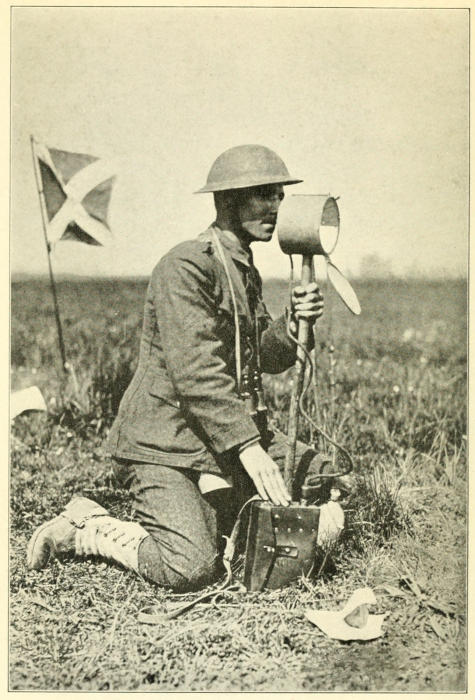
A MEMBER OF THE SIGNAL CORPS SENDING MESSAGES BY MEANS OF
A LAMP.
Prior to the war the “lance-pole” was used exclusively
by American troops in the field, as it permitted
of rapid line construction and served its purpose admirably
in open warfare. The conditions prevailing in
Europe made the use of this pole impracticable, however,
and where poles were used at all they consisted
of very short stakes with special cross-arms, miniature
copies, in fact, of the commercial equipment commonly
used in the United States. The enormous
mileage of the trench-lines called for vast quantities of
insulators, cross-arms, and other special fittings, in all
of which there was great wastage, for though the instruments
used on the military lines usually had a
certain degree of protection, the lines themselves were
constantly exposed to artillery and airplane bombardment.
A factor which greatly complicated the supply
of the front-line forces with wire was the necessity
for maintaining two-way or twisted-pair lines in order
to avoid giving information to the enemy, for the detectors
used in the German listening-posts were so
highly developed that a telegraph or telephone message
sent over a “grounded” or single-conductor line
was to all intents and purposes sent direct to Berlin.
This necessity for a double-conductor line relegated
the old field-wire of open warfare to the scrap-heap,
a long series of experiments being required to produce
a twisted-pair wire which was light enough to permit
of easy portability and rapid laying, strong enough
to stand the strain of heavy traffic and shell-shock,
and withal so well insulated that “leaks” to the ground
might not reveal to the enemy listeners-in facts intended
to be strictly confidential. The enormous demands
for all types of wire and cables which came
both from the A. E. F. and from our allies necessitated
the United States being combed for every foot of available
material and the speeding up of production until
every wire-mill in America was working twenty-four
hours a day. Yet, in spite of labor troubles, housing
problems, and the difficulties of obtaining material
and transportation, the wire-makers at home filled
every requirement of the soldiers overseas.
Of all the varied activities of the Signal Corps,
none was more fascinating or mysterious in its operation
than the work of the Radio Intelligence Sections,
particularly the so-called listening-stations, which, by
means of supersensitive receiving and amplifying instruments
electrically connected with ground-plates
placed as close as possible to the enemy positions,
were enabled to overhear the ground-telegraph operations
of the Germans and the conversation leaking
from defective or non-metallic telephone and telegraph
circuits. This remarkable service, some of whose
achievements would seem to the layman to verge
on the miraculous, combined the discoveries of Ohm,
Volta, and Galvani with the methods of LeCoq and
Sherlock Holmes. These stations could, of course,
operate successfully only under favorable conditions,
the chief requisites being that the enemy’s trenches
should not be too far away and that the intervening
terrain should be free of creeks, gullies, or other features
which might sidetrack the currents which it was desired
to intercept. The listening-stations were usually
situated in the second line of trenches, the ground-plates
being placed about 300 yards apart. In order
to obtain satisfactory results it was necessary that
the ground-plates should be placed as close to the
enemy as possible, the work of installing them, almost
under the noses of the Huns, being one of the most
hazardous duties which the signal troops were called
upon to perform. The men operating the listening-stations
had to remain on duty for a week at a time—a
considerably longer tour of duty than was required,
under ordinary conditions, of the infantrymen. They
were expected to possess a fluent knowledge of German
and to be able to both speak and understand it as well
as they did English, though this requirement was not
always fulfilled toward the end. They were thoroughly
coached, moreover, in German military phrases and
colloquialisms and had to be proficient in recording
ground-telegraphy code, which, though slow, is extremely
difficult to master. It will be seen, therefore,
that the Listening-In Service demanded of its operators
continuous interest and constant vigilance, together
with a sufficiently active imagination to enable them
to piece together the broken or garbled fragments of
messages which their instruments might pick up, and
to deduce from these messages what the enemy was
doing or what he intended to do. Listening-in was
very far from being a one-sided game, however, for
the Germans, who were thoroughly conversant with
its possibilities and limitations, maintained a service
which was nearly, if not fully, equal to our own. The
real superiority of our service lay, not in its equipment,
but in the boyish enthusiasm of its personnel,
many of whom were university undergraduates when
the war began. With them the work never assumed
the aspect of a daily task which had to be performed
whether they liked it or not: they regarded it rather
as a game, interesting, fascinating, exciting. The
quickness with which they grasped the technicalities
of the service was amazing. I knew of one case where
a soldier of a Listening-In Section, wholly without
previous experience in the work, overhearing a telephone
conversation in the enemy’s lines which indicated
that the watches in that sector were being
synchronized, deduced that a raid on the American
trenches was being planned. He promptly acquainted
the divisional intelligence officer with his conclusions,
and when the Germans launched their attack, expecting
to take the verdamte Yankees completely by surprise,
they were greeted by a burst of rifle and machine-gun
fire which almost annihilated them. After the
moving warfare began it was, of course, extremely
difficult to maintain these listening-stations, but when
the advance halted, even for a night, listening-stations
were always established if conditions permitted.
A far-fetched but, as it proved, entirely correct
deduction was made by the operator of a listening-post
whose curiosity was aroused by the sudden change
in the nature of the conversation taking place over
the enemy’s lines, familiarity interspersed with profanity
abruptly giving way to studied politeness. From
this he reasoned that a new division had moved in
during the night. Prisoners captured the next day
verified his deduction. Just before the St. Mihiel
offensive one of our operators noted that the telephone
conversations between the enemy units opposite his
station had almost ceased, presumably because a troop
movement was in progress which they did not dare
to discuss for fear of being overheard, the truth being
that the Germans were quietly withdrawing. Though
he had practically no conversation to guide him, this
by no means discouraged the American listener, who,
by comparing the intensity of the T. P. S. (telegraphie
par sol) signals he overheard, deduced with amazing
accuracy the movements of the retiring troops. In
comparison with such feats of deduction, Sherlock
Holmes’s ability to deduce a stranger’s occupation
from the condition of his finger-nails or the soles of
his boots seems absurdly commonplace, doesn’t it?
A youth in search of excitement beyond that
usually provided by battle could always find it by
joining the Listening-In Service. In March, 1918,
the American troops holding a certain sector were
suddenly ordered to retire to a second line of resistance,
but through an oversight the orders for withdrawal
were not passed on to the Signal Corps men who were
operating the listening-stations out in front. Serenely
unconscious, therefore, of the fact that their comrades
had fallen back and that German raiding-parties were
prowling all about them in the darkness, they remained
at their post throughout the night. It was not until
the American infantry reoccupied their original position
in the morning that the men in the listening-station
learned that for eight hours they had been the only
occupants of the sector.
While crawling over No Man’s Land to repair a
break in a line connecting his station with a ground-plate,
a Signal Corps man discovered a wire leading
straight toward the enemy’s position. Being of an
inquiring turn of mind, he followed it up on hands and
knees until he actually penetrated the German trenches,
where he made the interesting discovery that the
enemy’s listening-station had tapped the same ground
which we were using. Needless to say, he lost no time
in crawling back and changing his ground-plates. This
feat was paralleled by a soldier who followed an American
raid into the German trenches, and, unobserved
during the excitement, succeeded in attaching a wire
to one of their ground-plates which was well within
their lines, and, therefore, presumably in no danger
of being tampered with. By this means he listened-in
on the enemy’s conversations for several days before
his wire was discovered and cut.
Though the work of the Radio-Intercept and
Goniometric Direction-Finding stations lacked in
some measure the danger connected with that of the
ground listening-posts, it nevertheless provided many
interesting incidents in the life of the Signal Corps
man. The function of radio-intercept stations is, as
their name implies, the interception of enemy radio
messages. Goniometric stations are used, on the other
hand, for locating enemy radio-stations, the work being
carried on on much the same principles as flash-ranging,
which I have described at some length in another chapter.
By placing a goniometer—an instrument for
measuring angles—at each end of a base line of known
length, it is a comparatively simple matter to ascertain
the angle of direction of an enemy radio-station, and,
by prolonging the lines of these angles until they intersect,
the location of the station can be approximately
determined. That done, the information was sent to
the artillery, which proceeded to sweep the vicinity
in which the radio-station was known to be with a
hurricane of shell. So highly was this system of radio
detection developed that, after the salient at St. Mihiel
had been cleared of Germans, every radio-station which
our Goniometric Service had located previous to the
attack was verified, the greatest error in location being
approximately 500 yards. In many cases some of
the German wireless equipment was still in the dugouts,
and much interesting printed matter was picked
up. This was the first corroboration of the effectiveness
of our Radio Intelligence work.
Just as the naturalists can reconstruct from a
few bones a prehistoric monster which they have never
seen, so the goniometric experts are able to gain an
amazingly accurate idea of the organization of an army
by locating its radio-stations, for the lines of radio
communication which spread fan-wise from army
headquarters form a sort of skeleton, as it were, of
the army’s organization, the location of the various
stations and their distance from headquarters indicating
quite accurately the position of the corps, divisions,
brigades, regiments, and battalions. This fact was,
of course, as well known to the Germans as to ourselves,
and consequently extraordinary precautions
were taken to prevent the stations from being located.
Such a system of communications is known in military
parlance as a “net,” that serving an army being called
an “army net” and that of a corps a “corps net.”
Just before the American offensive was launched at
St. Mihiel a false corps net was set up considerably
to the east of the point selected for the attack, this
net being operated in as close imitation as possible
of the real thing. Thousands of faked messages were
sent in code, precisely as though the movements of an
army corps depended upon them, and, to add to the
verisimilitude of the proceeding, they were strongly
seasoned with the profane and violent English with
which American radio operators are accustomed to interlard
their conversations. The German goniometric
operators promptly located this network of radio-stations,
and as the messages which were being transmitted
appeared to be perfectly genuine, they naturally
concluded that they had discovered the unsuspected
presence of an American army corps, whereupon
the German High Command took steps to move its
reserves to the area which apparently was threatened.
There is no means of knowing how effective this ingenious
stratagem really proved, but the best answer
would seem to be the surprisingly slight resistance
which we encountered at St. Mihiel.
The operation of the mobile radio-stations which
accompanied the smaller infantry units was always
a most hazardous and trying business, requiring not
only courage but a very high degree of resourcefulness
and self-possession. In one case that I know of a Signal
Corps unit received orders to have a trench radio-station
installed at a certain exposed point by a certain time.
They followed their instructions to the letter, but
when their instruments were set up and they were
ready for business, they discovered, to their extreme
annoyance, that the infantry which was scheduled
to occupy the position had failed to materialize and
that they and their radio set were well in advance of
our lines. From their position in a shell-hole they
called up the regimental commander, reported that
they were located according to instructions, and inquired
what they were expected to do. Whereupon
the infantry lost no time in moving up and occupying
the position which, as the signalers mockingly asserted,
they had been holding for them.
The exigencies of the Great War wrought many
strange and startling transformations. Scientists who
had devoted their entire lives to discovering methods
for prolonging life turned their genius to finding new
and effective ways of taking it; the tractor of the Western
wheat-fields became the tank of the battle-fields
in Flanders; the machinery and chemicals used for
the manufacture of dyestuffs were converted to the
manufacture of poisonous gases—and the dove became
the army carrier-pigeon, bearing, instead of the
olive-branch of peace, messages of battle. Though I
find that many Americans seem to be under the impression
that pigeons were unreliable and comparatively
little used, they were, as a matter of fact, the
most trustworthy of all the systems of message transmission
employed by the fighting armies. When everything
else failed, when the wires of the field telegraph
and telephone had been destroyed by the German
shell-storms, when the radio installations had been
demolished, when the runners had been killed and
the aviators driven back by the air-barrages, it was
the pigeons which took the messages through. The
official accounts of their exploits read like the wildest
fiction. Over 500 birds were used by our troops in
the St. Mihiel offensive alone. Through the messages
brought by pigeons, American Headquarters learned
of the whereabout of Major Whittlesey and his “Lost
Battalion.” How trustworthy were these winged
messengers is proved by the carefully kept records of
the Allied Armies, which show that of the thousands
of messages intrusted to pigeons during the four years
of the war, 96 per cent were delivered.
The use of pigeons as messengers is as old as recorded
history, the Chinese, Egyptians, Greeks, and
Romans all having used birds for this purpose. Word
of the victory at Waterloo was brought to England by
pigeons, and pigeons carried from New York to Washington
the news that Napoleon had signed the treaty
which added Louisiana to the Union. Among the oldest
and most successful pigeon-trainers are the Belgians,
many of the best flying strains used by the
French, British, and American armies having been
developed from Belgian stock. When the Hunnish
hordes swept across Belgium, one of their first
measures was to confiscate or kill all pigeons. For
a Belgian to have in his possession a carrier-pigeon was
for him to risk a court martial and death before a
firing-party. Many of the pigeons taken from the
Belgians were sent back to Germany for breeding purposes,
producing birds which served against their former
masters, but when the Americans established their
watch on the Rhine, they ordered the immediate release
of all pigeons in the area of occupation, thus giving
thousands of feathered exiles a chance to fly back to
their old homes in Flanders.
The Carrier-Pigeon Service of the American Army
is a part of the Signal Corps, being composed of officers
and men who are expert pigeon breeders and handlers,
and who have the ability to impart their knowledge to
others. The pigeon section, which was organized
shortly after our entry into the war, consisted of two
companies with a personnel of 24 officers and about
650 men. The birds used by the army are known to
the fancier as “homers” and are really not carrier-pigeons
at all, the latter being a large, ungainly show-bird
that cannot fly a city block. But our allies persist
in calling homers “carrier-pigeons,” and our military
authorities have adopted the term. The homer
has all the qualities required of a military messenger.
He is a strong, well-built, racy-looking bird, possessed
of indomitable courage. His most characteristic trait
is, of course, his remarkable ability to find his home
when released at great distances from it. This power,
which has been developed by scientific breeding to an
almost uncanny degree, is the asset which makes the
bird of enormous value to the army. Though scientists
have attempted to explain the homing instinct, they
have arrived at different and frequently contradictory
conclusions, it being enough to know that it is an instinct
with which all birds are endowed to a greater
or less degree, and which has been developed in the
homer to a stage where it is limited only by the bird’s
physical endurance. Nature has equipped the pigeon
with numerous air-sacs adjoining the lungs, in which
a reserve supply of warm air is carried and supplied
to the lungs as needed during flight. Over the eye
is a transparent lid, called a “blinder,” which protects
the eye while in flight, and is at the same time
transparent, thus providing a sort of natural goggle.
Well-trained homers have frequently flown 1,000 and
even 1,500 miles, while pigeon-fanciers think no more
of a 500-mile flight than horsemen do of a mile trotted
in 2:30. On clear days a homer pigeon will fly distances
up to 300 miles at a speed close to a mile
a minute, though longer distances are usually covered
at a somewhat lower rate of speed, the birds instinctively
taking advantage of the favoring air-currents
and increasing or decreasing their altitude in order
to obtain the benefit of them.
Long before the Great War it was discovered that
pigeons would “home” to movable lofts as unerringly
as to stationary ones, this being of great importance
from the military point of view because it made it possible
to move the cotes up to within a few miles of the
firing-line. It also made it comparatively easy to
supply the advanced posts with fresh pigeons. It was
found that a week or ten days was usually sufficient to
acquaint the birds with the new location of the loft
and with the surrounding country, moves of twenty-five
miles without the loss of any birds being not at all
uncommon. Each of these mobile lofts was stocked
with seventy-five young birds, six to eight weeks old,
of the best pedigreed stock obtainable. Clasped about
the leg of each bird was a seamless aluminum band
bearing a serial number, the year of birth, and the letters
“U. S. A.” These bands are put on soon after
birth and cannot be removed except by destroying
them. As the birds had never been outside a loft, it
was a comparatively easy matter to settle them in
their new homes. Their early training was devoted to
the development of their flying strength and stamina
and to the habit of quick “trapping,” by which is
meant the entrance of the bird into the loft immediately
upon reaching it, a pigeon that alights on the
ground or roosts on the roof of the loft being considered
most imperfectly trained. They soon learn to trap
without hesitation, a flock of seventy-five birds entering
a loft in from ten to twenty seconds after pitching on
the roof. To overcome the habit of loafing, birds are
fed in the loft after alighting with their favorite grain.
After a month or two of this preliminary training the
birds are “tossed,” to use the phraseology of the
fancier, at increasing distances from the loft, so that
by the time they are five or six months old they are
flying from fifty to seventy-five miles with speed and
certainty. They are then ready for service in the
trenches. Not all, however, are assigned to the infantry.
Every tank crew carries a complement of
pigeons, men from the Pigeon Service are frequently
attached to cavalry units, and birds have been used
successfully from balloons and airplanes. The infantryman
carries his pigeons in a light wicker hamper
strapped to his back, each bird wearing a corselet made
of crinoline stiffened with whalebone and with strings
running to the sides of the basket, thus preventing it
from being tossed about and injured.
As long as the ordinary means of communication
are working satisfactorily, birds are not used. But
when a barrage is laid down and the telephone-wires
are destroyed, resort is had to the pigeons. When an
advance-party has pushed far ahead of the main force
it, too, relies on this method of liaison. In short, when
every other method of liaison has failed or is unavailable,
important messages are intrusted to the birds.
The messages are written on fine tissue-paper, folded
into a small wad, and inserted in the aluminum holder
which is attached to the leg of each pigeon. The bird
is then released, and in spite of the terrific din and
confusion of battle, in spite of the enemy shotgun
squads, composed of expert shots, whose duty it is to
pick off carrier-pigeons, it wings its way through shell
and gas barrages to its loft in the rear of the lines. I
might mention in passing that though birds are frequently
killed while in their baskets by exploding
shells, and others die from long confinement without
food or care in the trenches, those that survive become
accustomed to the roar of cannon and never suffer
from shell-shock. On reaching his loft the bird hurries
into it through an opening which permits of entry
but not of exit, the dropping back of the little door
ringing a bell which announces the arrival of a message
from the front, whereupon eager hands strip the cylinder
from the leg of the bird, the message which it contains
being relayed to headquarters by telephone or
despatch-rider.
The pigeons were not always fortunate enough,
however, to pass through the battle area unscathed,
many birds having succeeded in reaching their lofts
with their messages only to succumb to their wounds.
During the offensive in the Argonne an American pigeon
reached its loft with the leg to which the message was
attached severed and dangling by the ligaments, the
missile that severed the leg having also passed through
the breast-bone. In spite of these injuries and the
great loss of blood the heroic bird flew twenty-five miles
with a message of vital importance. I am glad to say
that the pigeon recovered and was recommended in
due form for the D. S. C. An English bird was struck
by a piece of shrapnel while homeward bound with a
message. Both of its legs were broken and the aluminum
message-holder was embedded in the flesh by
the force of the bullet. But its spirit never faltered.
It struggled on and on, blood dripping from it in an
ever-increasing stream, to fall dead at the feet of the
loft attendants. Another bird was released from a
seaplane which had fallen and was being shelled by a
German destroyer. It rose quickly and circled once
to get its bearings. Shots resounded from the deck
of the destroyer, the bird stopped short in its flight,
and a flurry of falling feathers told their tale, but,
after a short fall, it recovered and valiantly struggled
on. Within thirty minutes after its release three
British destroyers, white waves curling from their
prows and clouds of smoke belching from their funnels,
came racing toward the scene, whereupon the German
turned and fled and the aviators were saved. With
wings and body terribly lacerated the plucky bird had
flown thirteen miles to a naval air-station and given
the alarm. Here is another incident in which a feathered
messenger played a hero’s rôle. A detachment of
French infantry was ordered to hold a certain strategic
position at all costs, thereby affording their main body
time to retire to another position. The Germans, realizing
that the stubborn little band of Frenchmen was
balking them of their prey, launched attack after
attack, until, borne down by sheer weight of numbers,
the defenders were literally engulfed by the wave of
men in gray. Just as all that remained of the detachment
were making their last stand, a blood-stained
pigeon fell exhausted in a French loft behind the lines.
The message which it bore read:
“The Boche are upon us. We are lost, but we
have done good work. Have the artillery open on our
position.”
Little has been said about the work of pigeons in
this country. Over a hundred lofts were established
at the various camps and cantonments, the thousands
of birds which they housed proving of no inconsiderable
value in the training of the troops for fighting
overseas. Everywhere that they were used the birds
showed a dependability which won for them the enthusiastic
admiration of all who were familiar with
their work. Indomitable courage, a gameness which
ends only with death, and a burning love of home are
among the qualities most cherished by Americans, and
nothing possesses them to a greater degree than the
army carrier-pigeon.
Though the Belgians made extensive use of dogs
for hauling machine-guns, and though the French
used them to a certain extent for liaison work and the
British for locating the wounded, they were not utilized
by the American forces overseas. A considerable number
of dogs, most of them police-dogs and Airedales,
were trained at the various camps and cantonments in
this country, however, and had the war continued they
would undoubtedly have proved of real service in certain
forms of work in France. The attitude of the
American soldier toward the subject of dogs is best
expressed by a story which I heard in France. An
American officer, lost at night in No Man’s Land,
sought refuge in a shell-hole. He found, however, that
it already had an occupant, an American doughboy—from
his accent evidently a product of the Bowery—who,
it appeared, was lost like himself. In the periodic
bursts of light afforded by the star-shells the officer
noticed that the man had strapped to his back what
appeared to be a large basket.
“What have you in there?” he inquired curiously.
“Boids, cap’n, boids,” the soldier answered in a
hoarse whisper, adding disgustedly: “An’ that ain’t
the woist of it, cap’n. I hear they’s goin’ to give us
dawgs!”
Though Americans have always been the greatest
photographers in the world, the Yankee abroad being
readily distinguishable by his ever-ready kodak, it is a
rather surprising fact that it needed the World War to
convince the American military authorities of the vital
importance to the army of the camera. Upon our
entry into the war, however, the War Department, following
the example of the European armies, established
a photographic section, with a personnel of forty-odd
officers and nearly 800 men, as a part of the Signal
Corps. The duty of this section was to take pictures,
both still and motion, of every phase of America’s participation
in the war, both on the fighting front in
Europe and in the training-camps at home; for the information
of the intelligence officers of the A. E. F.,
for the guidance of the artillery, for purposes of instruction
in the schools and cantonments, for propaganda
use at home and in foreign countries, and for
illustrating the official history of the great conflict.
The photographic section was divided into two
branches, land and air, the latter being, perhaps, from
a military standpoint, the more important of the two
for the reason that airplanes were used primarily for
reconnaissance work and were, when equipped with
cameras, literally the eyes of the army. The airplane
being the eye of the army, the camera may be said to
have been the pupil of the eye. In order to provide
the large and highly trained personnel required for
this service, there was established at Rochester, New
York, a School of Aerial Photography—the largest in
the world—where candidates received, in addition to
a thorough military training, a course of instruction in
everything relating to modern photography, from the
manufacture of plates and films through the selection
and use of lenses, shutters, and light-filters, to the
printing of the picture itself. In addition to becoming
familiar with these details of commercial photography,
they were instructed in all the special phases of military
photography, such as map-plotting, mosaics, enlargements,
and the study of topography from a negative
made many thousands of feet in the air. As in that
chapter dealing with the Air Service I have described
in considerable detail the methods and instruments
used in aerial photography, it is enough to say here
that the aerial branch of our Photographic Service
attained such a degree of efficiency that, in the closing
months of the war, it became virtually impossible for
the Germans to dig a dozen yards of new trench, to
transfer a platoon, to change the position of a machine-gun,
without being detected by the all-seeing eyes of
our cameras.
The mother school for land photography was
located at Columbia University, in New York, where
the students received the same thorough training which
was given to the aerial operators at Rochester, with
instruction in motion-picture photography added.
The students at this school were the pick of the newspaper
photographers and motion-picture operators of
America. Among them were men who had “snapped”
presidents and potentates, celebrities and notorieties,
prize-fighters, reformers, murderers, prelates, politicians
and statesmen, leaders of society, Society and
near-society; who had “filmed” presidential inaugurations,
Newport weddings, railway disasters, yacht-races,
South Sea cannibals, Mexican revolutions, and
Heaven knows what besides. Their courage and resourcefulness
were precisely the qualities which were
required of army photographers, for there was nowhere
that they would not go, nothing that they would not
do, and the more danger there was in their work the
more it appealed to them. When a new type of gun
was being fired for the first time and the gun crew
took refuge in the bomb-proofs as a precaution against
accident, the army movie-men moved their machines
up close in the hope that if the gun exploded they
would get a picture of the explosion. One of the Signal
Corps operators, Captain Edward N. Cooper, with his
assistant, Sergeant Adrian Duff, while attached to the
Twenty-Sixth Division, crawled out into No Man’s
Land just before an attack was scheduled to take place,
and, though exposed to both German and American
fire, set up their machine in order that the people at
home, seated comfortably in motion-picture theatres,
might actually see the boys going “over the top.”
On another occasion this same young officer became
separated from the troops to which he was attached
and found himself under the fire of a German machine-gun,
but in spite of the hail of bullets he stuck to
his work, made his pictures, and returned to the American
lines herding in front of him a group of Germans
whom he had captured single-handed at the point
of an empty revolver. A camera-man whom the French
Government detailed to accompany me along the
Western Front in 1916 was seriously wounded by a
German shell just as we were leaving Verdun. His
assistant helped me to give first aid to his chief and
then, though the road was being heavily bombarded,
coolly set up his machine and turned the crank while
the wounded man was being lifted into an ambulance.
It is a striking commentary on the scepticism of American
audiences that, when I showed that picture in
the United States, fully half of the people who saw it
insisted that it had been faked. Another officer of
the photographic section who, before our entry into
the war, as the representative of a Chicago newspaper
had accompanied the German Armies during the invasion
of Poland, was present at the capture of Warsaw.
When the Kaiser reviewed the troops after his
triumphal entry into the captured city, the American
pushed his way through the cordon of soldiers and
police agents which surrounded the imperial motor-car,
set up his machine within six feet of the astonished
Emperor, and proceeded to take a “close-up” of the
All Highest, who was so amused by the effrontery
of the performance that he insisted on shaking the
photographer’s hand!
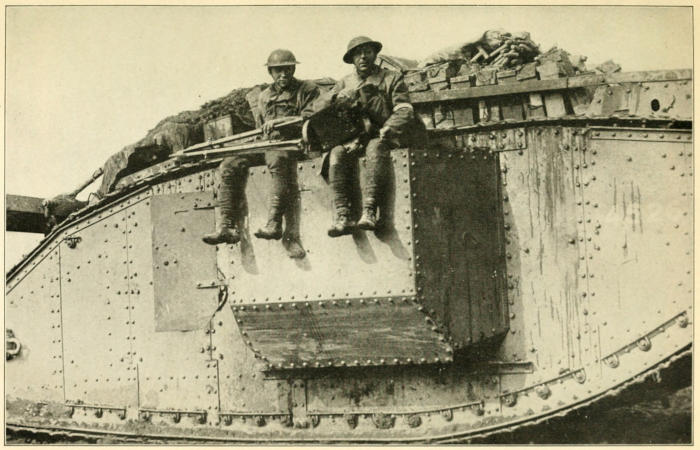
MOTION-PICTURE OPERATORS OF THE PHOTOGRAPHIC SECTION OF
THE SIGNAL CORPS GOING INTO ACTION ON A TANK
There was nowhere they would not go, nothing that they would not do, and
the more danger there was in their work the more it appealed to them.
Photograph by Signal Corps, U. S. A.
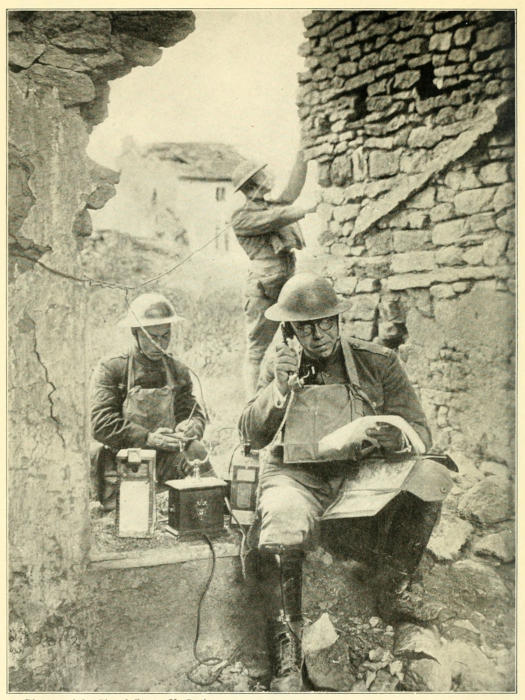
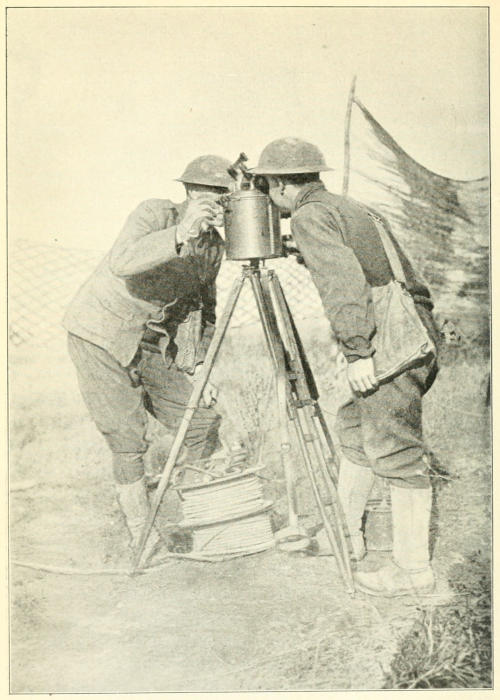
AN OFFICER OF THE SIGNAL CORPS OPERATING A TELEPHONE
AT THE FRONT.
This instrument was so compact that it could be carried as part of the
equipment of a soldier and quickly put into operation.
Photograph by Signal Corps, U. S. A.
Motion-pictures were used in the training of
troops far more generally than the public realized. A
series of pictures taken at the Military Academy at
West Point and exhibited at every camp and cantonment
in the United States did more in a few hours
to acquaint the troops with military etiquette and
the evolutions of the squad, the platoon, and the company
than any number of drills and lectures could
have done. “Animated drawings,” as they are called—like
those of Mutt and Jeff and the Katzenjammer
Kids—were made under the direction of the Signal
Corps for the purpose of familiarizing the men with
the mechanism of the service rifle, the automatic pistol,
and the various types of machine-guns. By running
these pictures slowly, every stage of the operation
of loading and firing was made clear, from the insertion
of the cartridge into the clip or belt to the bullet
leaving the muzzle. But the greatest value of the
motion-picture, when all is said and done, was in keeping
up the morale of the American people by combating
the insidious and undeniably clever propaganda
which was carried on in this country by the Germans.
Enemy agents spread reports that the drafted troops
were being ill-treated in the camps, that they lived
in wretched quarters, were poorly fed, and suffered
from lack of proper clothing. To answer these charges
a score of movie-men were despatched to the various
camps, the pictures which they took and which were
exhibited throughout the country showing the clean
and comfortable barracks, the men seated at their
bountiful and appetizing meals in the mess-halls, the
football and baseball games, the camp theatres, and
the other features of cantonment life, thus providing
a convincing refutation of the German insinuations.
Parents who had heard the widely circulated tales of
the unsanitary and immoral conditions to which their
boys were exposed in France could go to their local
motion-picture houses and see for themselves the clean
dormitories, the Y. M. C. A. and Knights of Columbus
huts, the social gatherings, the splendidly equipped
hospitals, incidents of life in the back areas and in
the trenches, and not infrequently the faces of their
loved ones themselves, sun-bronzed and happy, wearing
“the smile that won’t come off.” If the photographic
section of the army had accomplished nothing
else, its existence would have been justified a thousand
times over by the service which it performed in fighting
the propaganda of the Hun and in bringing cheer
and comfort to the parents, wives, and sweethearts
whom the boys had left behind them.
As a result of the researches and experiments
which it carried on during the war, the Signal Corps
has, in addition to its countless other achievements,
produced several devices which are of such an astounding
nature as to strain almost to the breaking-point
the credulity of the layman. I am not permitting
myself to indulge in the slightest exaggeration when I
assert that these devices place in the hands of the
United States weapons which would render this country
wellnigh invulnerable in the event of our ever becoming
involved in another war. But—and herein lies
their greatest significance and interest—they are, beyond
all question, the most important inventions, so
far as their effect on the peaceful interests of the nation
are concerned, which have been produced since
Morse invented the telegraph, Bell perfected the telephone,
and Marconi amazed us with the wireless.
Imagine the value of a device which permits of a conversation
being carried on between a person on the
ground and an aviator in the clouds as easily as though
they were seated opposite each other at a dinner-table!
Such is the radiotelephone, which I have described in
detail in the chapter on the Air Service but which was
suggested and brought to a state of perfection by officers
of the Signal Corps. Conceive, if you can, of
another device which permits of nineteen separate and
distinct telephone and telegraph messages being transmitted
simultaneously over a single copper wire!
Picture the advance in world-communication made
possible by the discovery, made by General Squier,
the Chief Signal Officer of the Army, that growing
trees can be used as natural antennæ for both sending
and receiving radio messages! And, as a climax to
this amazing list of achievements, let your imagination
attempt to grasp the military and commercial significance
of a device for the sending over telegraph wires
or cables of cipher messages which, though they can
defy any system of deciphering known to science, appear
in plain language at the other end! You may
think, perhaps, that I am overenthusiastic; that I have
used too many adjectives and exclamation-marks.
But suppose that I tell you something about these
inventions. Then, unless I am greatly mistaken, you
will be guilty of adjectives and exclamations yourself.
Owing to the difficulty of constructing in France
enough telegraph and telephone lines to meet the constantly
increasing requirements of the American Expeditionary
Forces, as well as to relieve the great congestion
which prevailed on all of the existing lines,
the scientists of the Signal Corps turned their attention
early in the war to the possibility of sending
several messages simultaneously over a single wire.
Without entering into the details of the long series
of experiments which were conducted by the Signal
Corps, in conjunction with the American Telephone
and Telegraph Company at Camp Alfred Vail, New
Jersey, or attempting to describe in terms which would
be intelligible to the non-technical reader the device
which was finally perfected, it may be said that the
result is accomplished through the application of radio,
the wire serving as a guide for the radio currents and
conducting them with a minimum of power and with
a minimum of interference with other radio communications.
This device has now been brought to such
a state of perfection that eight telegraph messages
and eleven telephone messages can be carried over a
single wire at the same time, the Morse messages being
transmitted by means of the multiplex telegraph apparatus—a
system which was discovered as early as
1910 and is now in general use by the large telegraph
companies—while the telephone conversations are
guided by wireless waves, which serve as carriers for
the voice currents. By placing on ordinary telegraph-wires
wireless waves of very short length or of very
great frequency, officers of the Signal Corps have successfully
conversed over a line from Washington to
Baltimore which was being used at the same time for
the transmission of duplex telegraph messages. Perhaps
the most remarkable feature of the performance
was its extreme simplicity, the feat being accomplished
merely by placing on the line, through proper connecting
condensers, a pair of radiotelephone sets such
as are used for communicating between ground-stations
and airplanes. Whereas it was believed, until very
recently, that it was impracticable to hold more than
four wired-wireless conversations over one wire or
one pair of wires, in addition to whatever ordinary
telephone or telegraph conversation might be on that
wire, the Signal Corps has now demonstrated that it
is not only possible but entirely practicable to hold
ten or more extra telephone conversations without
their interfering with each other. Had this system
been perfected while the war was in progress it would
have meant that ten telephone and two or more telegraph
conversations could have been carried on simultaneously
with a point served only by a single wire.
In other words, by the application of this system one
wire will take the place of ten.
Another phase of science uncovered by the Signal
Corps which figuratively makes the mind of the layman
stand still and gasp is the discovery, due to the
experiments of the Chief Signal Officer, General Squier,
that trees can be used as instruments in the receipt
and transmission of electrical messages, both telegraph
and telephone, both by wire and wireless. Think of
it, my friends! The commonplace tree possesses those
very qualities that men have spent centuries of effort
to embody in a frail spider’s web of wire!
“From the moment an acorn is planted in fertile
soil,” to quote the words of General Squier himself, “it
becomes a ‘detector’ and a ‘receiver’ of electromagnetic
waves, and the marvellous properties of this receiver,
through agencies at present entirely unknown
to us, are such as to vitalize the acorn and to produce
in time the giant oak. In the power of multiplying
plant-cells it may, indeed, be called an incomparable
‘amplifier.’ From this angle of view we may consider
that trees have been pieces of electrical apparatus
from their beginning, and with their manifold chains
of living cells are absorbers, conductors, and radiators
of the long electromagnetic waves as used in the radio
art. For our present purpose we may consider, therefore,
a growing tree as a highly organized piece of living
earth, to be used in the same manner as we now
use the earth as a universal conductor for telephony
and telegraphy and other electrical purposes.”
Not only have telephone conversations, in which
the voice is transmitted just as clearly as by the ordinary
metallic circuit telephone, been carried on from
tree to tree, up to a distance of three miles, in the outskirts
of Washington, but while the war was still in
progress the signal officers, using tree-tops as antennæ,
read messages from ships at sea, from aviators in the
sky, and from the great radio-stations in South America
and Europe. As a result of this discovery, the lofty
and costly towers which are now used for the sending
and receipt of radio messages will no longer be a necessity.
All that will be necessary is to drive a spike in a
tree, attach a wire to the spike, and run the wire to a
radio apparatus, whereupon messages can be received
and sent, the distance covered depending upon the
power of the instrument. The tree telegraph has been
dubbed by General Squier a “floragraph” and the tree
telephone a “floraphone,” while the messages transmitted
over this arboreal system are to be known as
“floragrams.” Though this discovery will in all likelihood
result in an amazing expansion of the world’s
system of communication, and though it will give
radio-towers, thousands of them, in fact, to every village
and to every farm, it does not necessarily mean
that every man who possesses a vine and fig-tree will
be able to sit on his front porch and gossip with his
neighbors.
During the war the offices of the Chief Signal
Officer were literally besieged by persons who claimed
to have invented various systems of message transmission
which could not be tapped, or which, if they
were tapped, could not be understood. It was perfectly
well known to us, of course, that the German
Listening-In Service, particularly in the front-line
trenches, was well organized and extremely efficient,
and that telephone and buzzer conversations held over
our wires were frequently intercepted. It was known,
moreover, that Germany had spies, both in France and
the United States, whose sole duty it was to tap the
governmental telephone and telegraph systems for the
purpose of obtaining military information. Scores of
devices designed to secure the inviolability of the
vitally important messages which were constantly
passing over the wires were submitted to the Signal
Corps. Anxious as they were to obtain a system of
message transmission which could jeer at the efforts
of the enemy’s spies, the experts of the Signal Corps
steadily maintained that such a thing did not exist,
for, as they said with truth, if an instrument could be
devised which could transmit and decode a message,
there was no reason why the Germans could not in
time manufacture one like it, put it on the line, and
thus obtain the information desired.
One of the inventors who approached the Signal
Corps asserted that, though he did not claim to have
a device which would render a message indecipherable,
he had a system which made it impossible for an enemy
agent to tap the wire over which messages were being
transmitted without the sender and receiver being instantly
notified that some one was eavesdropping
upon them, whereupon their conversation would, of
course, cease. “Prove it to us,” said the Signal Corps,
and provided the inventor with an opportunity to
demonstrate his system over a miniature line. Without
the slightest difficulty the military experts tapped
the line and, with the aid of a stenographer, recorded
every message which was sent over it, the quantity of
energy which they withdrew for the purpose being so
minute that the delicate detectors failed to record the
fact that the line had been tampered with.
Another system had as its basic principle the
breaking up of the groups of Morse dots and dashes
which represented the letters of the message, and routing
these mangled fragments over widely separated
wires to the receiving-station, where they were automatically
joined together again so as to form the message
as originally sent. If, for example, it was desired to
send from Hoboken to Washington the message “Transport
Leviathan sails June twenty-fifth,” it was proposed
to make use of two lines, one running, let us say, through
Harrisburg, the other via Wilmington. The message
sent over the Harrisburg wire would be broken up
something after this fashion: “t-a-s-o-t-e-i-t-a-s-i-s-u-e-w-n-y-i-t,”
while the portion going by way of Wilmington
would read: “r-n-p-r-l-v-a-h-n-a-l-j-n-t-e-t-f-f-h.”
To create still further confusion in the mind of any one
who might succeed in intercepting one of these sets of
fragments, it was proposed to superimpose a “camouflage”
message upon the disconnected letters, the characters
of the camouflage message to occupy the spaces
between the characters of the real message. By an
exceedingly ingenious device, these apparently inextricably
intermixed and unrelated letters were automatically
sorted out at the receiving-station and pieced
together, like a jigsaw puzzle, so that the message
appeared precisely as it was sent. Going a step further,
the inventors of this system proposed by the
same means to install a system of telephone communication
whereby the spoken words would be broken up
just as the Morse characters were divided, certain
sounds in each word going over one wire and the remaining
sounds over another, to be joined together at
the receiving-station into a perfectly intelligible conversation.
Here again a wholly separate and extraneous
conversation was superimposed over the sounds
proceeding by each route, so that were either of the
lines tapped the listener-in would be rewarded for his
pains by hearing a torrent of sound which would convince
him that he was listening to a combination of
Choctaw, Chinese, the ravings of John McCullough,
and the symptoms of a severe cold. Notwithstanding
the undeniable ingenuity of this system, the Signal
Corps experts demonstrated, to the unconcealed astonishment
of the inventors, that they could overhear
and understand these crazy-quilt conversations as
readily as though they were being held across a
dinner-table in plain English.
Early in 1918, however, the American Telephone
and Telegraph Company, becoming interested in the
solution of this apparently insoluble problem, produced
a device whereby a message could be transmitted over
a wire in such a form that it was absolutely indecipherable
to any one save the person for whom it was intended.
As originally developed, this system was unable
to do all that was claimed for it, but, thanks to the
co-operation of the Signal Corps, there was finally
produced an electrical device which will transform an
ordinary message into cipher, transmit it with absolute
secrecy, and decode it at the other end—all at the rate
of from forty to seventy words a minute. This may
be said to be the only cipher in existence which is absolutely
indecipherable and at the same time practicable.
As universal peace is not yet within sight, even with
the aid of a telescope, and as this invention would prove
of incalculable value to the United States in the event
of our again becoming involved in war, it is obviously
out of the question to discuss the principle on which
it is based, much less the details of its construction
and operation. It is enough to say that this nation
is now the possessor of a system of code transmission
which can defy all the experts in the world, a message
sent by its means being absolutely indecipherable to
the inventor himself.
Though before the signing of the Armistice this
device was operating between several points in the
United States with complete satisfaction, the apparatus
could not be manufactured in time to permit of its use
overseas before the end of the war. The engineers of
the Signal Corps assert that this device will eventually
be perfected to a degree of commercial practicability
which will make it possible to transmit cipher messages
over cables as well as land lines without the necessity
of manual transmission and without the use of a recorder.
As the machine codes and decodes messages
automatically, the large code-room forces which were
used in Washington during the war, and which are
employed by many of the great banking and commercial
institutions, would no longer be required, thus
doing away entirely with the labor at present involved
in coding and decoding messages and cutting down the
time required for their transmission by many hours.
II “ESSAYONS”
If, the next time you meet an officer of Engineers,
you will observe his uniform closely, you will perceive
that the buttons of his tunic, instead of being
embossed with the arms of the United States, like all
other branches of the service, bear a device consisting
of an eagle, a castle, a rising sun, and the motto “Essayons.”
Like the bow of black velvet, called a
“flash,” which the Royal Welsh Fusiliers have sewn
at the back of their collars to commemorate the fact
that they were the last regiment in the British Army
to wear the pigtail, so the buttons of the Engineers
serve to remind their wearers that the famous organization
is as old as the nation, tracing its history back
to the Corps of Artillerists and Engineers of the Continental
Army.
“Essayons”—“Let us try.” One likes the quiet
confidence of the motto.
“Can you make roads for my guns through the
swamps of the Wilderness?” asked Grant.
“Let us try,” replied the Engineers—and the
roads were built.
“Can you build docks for disembarking ten thousand
men a day and railways to carry those men to
the front?” asked Pershing.
“Let us try,” the Engineers responded—and almost
overnight miles of docks and networks of rails
appeared as though at the wave of a magician’s wand.
“Can you locate the enemy’s guns by their sound?
Can you keep our troops supplied with water? Can
you print maps? Can you make dugouts? Can you
operate search-lights? Can you dredge harbors for
the entrance of our transports? Can you build highways
and keep them in repair? Can you quarry the
stone for those highways? Can you cut a million feet
of lumber a day? Can you design better types of
armored cars, sound-detectors, mobile cranes, portable
sawmills, listening apparatus, mapping cameras, steel
bridges, barbed-wire entanglements, than any in existence?
And, if the necessity arises, can you fight?”
“Essayons,” answered the Engineers—whereupon
all these things were done.
Whenever the army has had work to be done
which no one else knew how to do, they have sent for
the Engineers. Who designed, built, and operated
our tanks before the organization of the Tank Corps?
The Engineers. Who organized the Gas and Flame
Regiment? The Engineers. The Camouflage Corps?
The Engineers, of course. Who did the mining, quarrying,
timber-cutting, well-driving, dock, bridge, road,
railway, and camp building for our armies overseas?
Again, the Engineers. Indeed, I doubt if any organization
of any army in the Great War can show such a
record of varied activities and successful accomplishments
as the Corps of Engineers. One can say of the
American Engineer, as Kipling said of the British
Marine:
“There isn’t a job on the top o’ the earth the beggar don’t know nor do—
You can leave ’im at night on a bald man’s ’ead to paddle ’is own canoe;
...
They think for ’emselves, an’ they steal for ’emselves, an’ they never ask what’s to do,
But they’re camped an’ fed, an’ they’re up an’ fed, before our bugle’s blew.”
The immense importance attached to the work of
the Engineers is strikingly illustrated by the fact that,
whereas the army was increased to 19½ times its pre-war
size, the enormous problems of field fortification,
construction, and transportation, both with and behind
the fighting forces, as well as the direction of
many entirely new phases of warfare, necessitated an
increase of the Corps of Engineers to 131½ times its
strength at the beginning of the war. Prior to July,
1916, the corps consisted of only three battalions, with
a total strength of not over 1,900 men, but when the
Armistice was signed there had been organized, or
were in process of organization, 500 Engineer units,
with a strength of some 312,000 men, or more than
10 per cent of the entire army.
Now it must be kept in mind that in the original
corps of pre-war days the men were trained only as
sappers and not in the countless specialist branches
which were developed by the great conflict. The fundamental
use of sapper troops is, theoretically, at least,
the supervision of technical work during tactical operations.
One regiment of sappers is normally assigned
to each division, is under the immediate command of
the divisional commander, and operates as directed
by him. To this regiment is given the work of organizing
positions for defense, which includes the construction
of trenches, gun-positions, ammunition-dumps,
and dugouts, the repair and maintenance of
roads in the divisional area, the construction of shelters
where required, and the general direction of the work
necessary to keep open the lines of communication
and supply. In open warfare it is customary for the
divisional commander to hold his sapper regiment
in reserve to be used for applying the decisive pressure
or resistance at the moment when it is most needed.
When going forward with the infantry, sapper troops
usually have a definite technical mission, such as the
organization of captured ground, the destruction of
obstacles and the bridging of streams. During a retreat
they are attached to the rear-guard, being charged
with the demolition of bridges, the obstruction of roads,
and the cutting of railway communications. Though
the ranks of the Engineers were filled, for the most
part, with men who were experts and specialists in
certain trades and professions, they were time after
time thrown into the line as combat troops, fighting
shoulder to shoulder with the infantry. On more than
one occasion they showed that, destitute of combat
training though many of them were, they could handle
a rifle or a machine-gun as well as an axe or a spade.
At Cambrai the 11th (railway) Engineers, caught in
the German counter-push, offered a stubborn and
heroic resistance against overwhelming numbers. At
Amiens another railway regiment, the 11th Engineers,
formed a part of the little force with which General
Sandeman Carey blocked the gap in the British line
and thereby prevented the Germans from breaking
through to the Channel ports. For its behavior on
that occasion the regiment was cited by the British
and its commander was decorated. Perhaps you were
not aware that two companies of Engineers fought
alongside the Marines in the Bois de Belleau. And,
when the gray hordes of Hindenburg were reeling back
from the Marne, a report from the Rainbow Division
ended: “Our advance troops, the 117th Engineers,
are pressing the enemy closely.” But the story that
will live longest in the annals of the famous corps is
that of the sergeant of the railway regiment at Cambrai,
who, surrounded by the enemy, refused to surrender
and defended himself with his only weapon, a
crowbar. When they found him, hours later, the crowbar
was still clutched in his dead hand. About him,
with crushed skulls, lay seven Germans.
The innumerable new devices produced by the
Great War, however, required for their operation great
numbers of specially trained men, so that the Corps of
Engineers, from an organization consisting solely of
sapper troops, found itself called upon to do more and
more work in almost every branch of engineering. To
meet these demands men were accordingly trained as
specialists and assigned to specialist regiments and
battalions, so that, when the war ended, the Corps of
Engineers consisted of camouflage, car-repair, crane-operator,
dock-construction, dredging, electrical and
mechanical, forestry, general-construction, highway,
inland-waterway, light-railway construction, shop, and
operation, locomotive-repair, military-mapping, mining,
pontoon park and train, quarry, railway-transportation,
road, sapper, search-light (including antiaircraft),
sound-and-flash-ranging, standard-gauge
railway-construction, operation, shop and maintenance-of-way,
supply, surveying and printing, trades and
storekeepers, transportation and water-supply troops,
organized as needed into companies, battalions, or
regiments.
Now it was realized, from the very beginning, that
the success of our armies in France would depend upon
transportation. And, thanks to the threats of Pancho
Villa, we had at least the framework of a transportation
organization, for when it became necessary to
send troops to the Mexican border in 1916, the War
Department had organized a transportation service of
sorts and had placed Samuel M. Felton, president of
the Chicago Great Western Railway, at the head of it.
Thus it came about that upon our entrance into the
Great War there devolved upon Mr. Felton and his
staff the gigantic task of obtaining in the United States
and shipping to Europe the enormous quantity of
transportation equipment and supplies required for
the use of our forces overseas. In order to ascertain
just what was required in equipment and supplies, a
commission, headed by Colonel William Barclay Parsons,
president of the American Society of Civil Engineers,
and Colonel (then Major) W. J. Wilgus, formerly
vice-president of the New York Central system,
was sent to Europe within less than thirty days after
the declaration of war. Upon the completion of its
preliminary survey of the situation the commission
dispersed, leaving Colonel Wilgus as the sole nucleus
of the American Transportation Service in France,
with Captain L. A. Jenney, formerly chief draftsman
of the New York Central, as his assistant. Sitting
on soap-boxes in an office in the Boulevard Haussman
in Paris, with packing-cases for desks, these two officers
outlined the general policy with respect to military
transportation for the A. E. F. which the conditions
seemed to warrant, and which General Pershing later
adopted, and drew up the first requisition for railway
and port equipment, materials, and tools. Colonel
Wilgus, himself a veteran railroad man, quickly realized
the vastness of the problem which confronted
us and the gravity of the situation resulting from the
dilapidated condition of the French railways and
the appalling shortage of French rolling-stock. He
accordingly informed the War Department that the
American Army must prepare to operate its own
trains, made up of its own locomotives and cars, from
the seaports to the front, over the French railways
under trackage rights. I might add that the principle
of trackage rights, so familiar in America, was entirely
unknown in France, and at first the French railway
officials did not know what Colonel Wilgus was talking
about, for they found it difficult to understand how it
was possible to operate two systems of transportation
over the same tracks at the same time.
The story of how the Engineers, under the direction
of Brigadier-General W. W. Atterbury, formerly
vice-president of the Pennsylvania, Director-General of
Transportation, with Colonel Wilgus as his deputy
and Chief of Staff, built up in France a transportation
system which was one of the marvels of the war, is
outside the province of this narrative, while the story
of the production of railway material in America and
its shipment overseas would require, for its proper telling,
a chapter to itself. It is enough to say that, when
the Armistice was signed, 60,000 men were engaged on
railroad work of various kinds in France; more than a
thousand miles of standard-gauge railway (equal to the
distance by the Pennsylvania from New York to Chicago)
had been laid; upward of 1,300 locomotives (300
more than are owned by the Atchison system) had
been shipped overseas, and, had the war continued,
we would have had in France by July, 1919, enough
American cars to make up a train the caboose of which
would have been leaving Paris when the engine was
entering Berlin.
The Transportation Department had in operation
between Tours, which was the headquarters of the
Services of Supply, and Chaumont, which was the
Great Headquarters, an all-American train, drawn by
an American locomotive, driven by an American engineer,
and, as a final touch, with its sleeping-cars in
charge of former Pullman porters, in khaki, it is true,
but retaining their grins and their whisk-brushes.
Every one in the A. E. F. was inordinately proud of
that train, which stood as a sort of visible proof of
American accomplishment in France. It had been
officially christened the “Atterbury Special” in honor
of the Director-General of Transportation, but the
soldiers had disrespectfully dubbed it the “Attaboy
Special.” One morning, as a group of American congressmen,
on their way up to the front, were standing
on the platform of the Tours station, the special came
roaring in.
“There’s an example of American energy and
promptness for you!” exclaimed one of the politicians
proudly. “What a contrast to those wretched French
trains! Not an hour or so late, as they are, but on
time to the very minute.”
“Pardon me, sir,” said a military policeman who
had overheard the conversation, “that is yesterday’s
train.”
When it was first proposed by the Transportation
Department that locomotives should be shipped to
Europe without being knocked down, the Ship-Building
Board vigorously protested. There were no ships in
existence, the board said, which could stand up under
such an immense concentrated load. But the Engineers
proved that they knew more about the strength
of ships than did the ship-builders, and the locomotives—533
in all—were run out onto the wharves on their
own wheels, picked up as easily as though they were
baby-carriages by the giant gantry cranes, deposited
in the hold—35 to a ship—together with their tenders,
packed in baled hay, and upon arrival at the French
ports were lifted out by the same method, lowered
gently onto the rails, and a few hours later rolled off
for the front under their own steam. The success with
which the Engineers utilized business methods and revised
specifications to meet American manufacturing
conditions is strikingly illustrated by the fact that the
cost of these locomotives, for which the French had
been paying $51,000 each, was brought down to $37,000,
thus saving to the American taxpayer some
seven millions of dollars—a very tidy sum.
And, apropos of rolling-stock, here is a bit of
secret history hitherto unpublished. When Villa’s
raiders were threatening to destroy the railway-lines
paralleling the Mexican border, the Engineer Corps
designed and built a number of self-propelling armored
railway-cars armed with 3-inch rifles, machine-guns,
and search-lights. When the German submarines
began their piratical operations along the Atlantic
seaboard in the spring of 1918, these moving fortresses
were secretly rushed up from the Rio Grande in order
to afford protection to the undefended Jersey coast
towns. It was well for the U-boat commanders that
they did not attempt to shell Long Branch and Atlantic
City as they shelled Scarborough and Broadstairs.
If they had, the Engineers and their armored
cars would have given them the surprise of their lives.
The non-military person does not ordinarily associate
with war such prosaic occupations as lumbering,
quarrying, and highway building. They seem, at least
at first thought, to be in character essentially industrial.
But it must be remembered that the workman
played fully as great a part as the soldier in winning
the Great War. In fact, the combat troops could not
have held the line for a day had it not been for the
labor battalions, which, without incentive or excitement,
glory or reward, and in most cases without
public appreciation, toiled so faithfully and unceasingly
to build the wharves, to unload the ships, to lay
the railways, to construct the roads, and to hurry forward,
in an unending stream, the food for the men
and the food for the guns. It is quite understandable,
once you stop to think about it, that in order to maintain
our great armies in the field, there were required
immense quantities of lumber for building wharves,
barracks, storehouses, hangars, and hospitals, and enormous
amounts of stone, crushed rock, and gravel for
metalling the roads, ballasting the railways, buttressing
the bridges, and making concrete for the fortifications.
When we entered the war the supply of lumber
was not nearly equal to the demands of the Allied
Armies, to say nothing of our own. And, though
there was, of course, plenty of rock and gravel in this
country, we could not spare the tonnage to ship it
overseas, even had such a course been practicable.
(Perhaps it has never occurred to you how vitally important
an item gravel is in military operations. Yet
at one time the Germans threatened the Dutch with
war if the latter persisted in their refusal to permit
German gravel to be shipped across Holland for the
construction of concrete fortifications in Belgium.) In
view of these conditions, it devolved upon the Engineers
to organize and equip special forestry, quarry,
and highway regiments, as well as numerous labor battalions,
and hurry them overseas with orders to obtain
the urgently needed materials from the forests and
quarries of France.
Though Engineer officers of the regular establishment
were, of course, given command of these specialist
regiments, the other officers as well as the soldiers
themselves were recruited from men trained in the
particular sort of work which each regiment was expected
to perform. How to obtain officers of sufficient
experience in these various lines of industry, and in
sufficient numbers, promised at first to be a serious
problem, but it was quickly solved by the Personnel
Division of the Engineers, which had had on file, ever
since the war-clouds first appeared on America’s horizon,
tens of thousands of letters from men trained in
every branch of the engineering profession, offering
their services to the government in case of war.
Hence, when it was decided to raise a forestry regiment,
it was a simple matter to turn to the files and
find the names of thousands of men—mill-owners,
forest-rangers, lumbermen—with their experience and
qualifications carefully listed, who were intimately
familiar with every phase of the industry, from tree to
finished board. The best qualified of these applicants
were offered commissions by telegraph and instructed
to go out into the lumber country and recruit their
companies and battalions from men who had worked
under them or whom they knew. Soon the walls of
every employment-office, bunk-house, and cook-shack
from the pine woods of Maine to the spruce forests of
Washington blossomed with posters calling for axemen,
sawyers, log-drivers, timber-cruisers, mill-operators,
cookees, teamsters, for immediate service overseas.
The response was prompt and startling. From
their camps on the Kennebec and the Androscoggin,
from the Adirondacks, from the pine-clad shores of
Superior and Huron, from the Michigan Peninsula
and the North Woods of Minnesota, from the forested
slopes of the Wind River, the Bitter Roots, and the
Cascades, from the big timber of the Far Nor’west
the lumbermen came pouring in, in mackinaws and
parkas, in moccasins and shoepacks, in knitted toques
and caps of fur, their scanty belongings wrapped in
the blanket-rolls slung across their backs and often
with their axes on their shoulders. Sinewy-limbed,
saddle-colored, horny-handed, tough as the timber of
the forests whence they came, these were the real
pioneers, the conquerors of the wilderness, the last of
the frontiersmen, and Europe will, in all likelihood,
never see their picturesque like again.
The first of the forestry regiments, the 10th Engineers,
sailed for Europe five months after the declaration
of war, followed at short intervals by several similar
organizations. Immediately upon their arrival in
France lumbering operations were begun in the Vosges
and the Pyrenees (so do not be surprised if the next
time you go shooting in Maine or fishing in Michigan
your guide interlards his conversation with French or
Spanish phrases), using French mills at first but later
installing plants of the American type. The enlisted
men of the forestry outfits were, as I have said, for the
most part lumbermen by trade, officered by men
familiar with lumbering in all its details. The result
was a striking illustration of what American energy
and American methods can do, for the official reports
show that mills which, under French management,
were yielding 500 board feet a day, were made to
yield ten times that quantity when operated by
Yankee lumbermen. In the Vosges this work was
carried on so close to the front that the plants were
repeatedly bombed by enemy aircraft and shelled by
enemy artillery, the forestry troops, though listed as
non-combatants, frequently suffering heavy casualties.
It took a high order of courage for these men to go unconcernedly
about their business of tree-felling, hauling,
and sawing with German shells yowling through
the branches and bursting all about them. The sawmills
were of the portable type, however, and when
the fire of the German guns became too accurate and
heavy, the whole plant was packed up and shifted to
a new location. I don’t believe in letting loose upon
my defenseless readers swarms of figures, but it will
serve to give those of them who are familiar with lumbering
some idea of what our forestry regiments accomplished
when I mention that during the month of
October, 1918, alone, they produced 50,000,000 board
feet of sawed lumber, 80,000 cords of firewood, and
enough standard-gauge ties to build a single-track railway
from the Great Lakes to the Gulf.
In raising the quarry, highway, and inland waterway
regiments, the same method was adopted as in
the organization of the forestry battalions. Enormous
quantities of crushed rock were required for concrete
and for the construction and repair of roads, but though
numerous quarries were available in the American
areas, experienced quarrymen and quarrying equipment
were lacking. Accordingly a special quarry regiment,
the 28th Engineers, was organized in the United
States in November, 1917, with a strength of 60 officers
and some 1,500 men. A skeleton organization was
formed by transferring a few officers and a small detachment
of men from a road regiment, the new unit
being raised to strength by giving commissions to
quarry managers and superintendents and filling up
the ranks with drafted quarrymen.
Spreading over almost the whole of France is a
veritable network of navigable rivers and canals, of
which the Engineers availed themselves to the utmost
in the transportation of material and supplies.
Transportation by the inland waterways was in charge
of the 57th Engineers, this regiment being largely
recruited from men who had had experience on the
canals and rivers of the United States. In the days
to come many are the tales that will be told by skippers
of stern-wheelers on the Mississippi and captains
on the Erie Canal of the days when they and their
huskies of the Inland Waterways battalions moved
the supplies for Pershing’s men up the Seine and
through the canals of the Marne and the Rhône.
To the dredging, dock construction, and stevedore
regiments was assigned the gigantic task of dredging
the channels and harbors of the seaports which the
French placed at our disposal, of building wharves and
berths for the reception of American ships, and of the
transferring of the cargoes from ship to shore. The
magnitude of their task is shown by the fact that cargo
shipments grew from 20,000 tons in July, 1917, to
1,000,000 tons in November of the following year,
while the 23 ship-berths which the French Government
originally assigned to us had nearly quadrupled
when the Armistice was signed.
Unless you have marched with armies or trekked
across hot and arid lands, you cannot know what it
is to be thirsty—really thirsty, I mean; so thirsty
that your tongue swells until it all but chokes you or
lolls from your mouth like that of a panting dog.
Water is infinitely more important to the success of
a military operation than arms or ammunition; to
a certain extent it is more important than food; for,
though troops can fight for an amazingly long time on
short rations, or even on no rations at all, they cannot
fight without water. The vital importance of providing
an adequate water-supply was learned by the
French in Algeria and Morocco, by the British in
India and the Sudan, where the deserts were strewn
for miles with the bodies of soldiers who had died
from thirst. In the Cuban campaign our armies had
far more deaths from impure water than from Spanish
bullets. During the Italian offensive on the Carso,
that terrible plateau of sun-scorched rock which lies
beyond the Isonzo, hundreds of men, Italians and Austrians
alike, died from thirst, the Austrians being eventually
compelled to retreat because the Italian artillery
had destroyed the pipe-lines which supplied them with
water. During the fighting on the Western Front during
the last summer of the war, when the semitropic
sun of eastern France beat down on the heavy-laden
backs of the panting, sweating men, when millions of
feet and hoofs ground the roads to powder and filled
eyes, ears, throats, and nostrils with the yellow, choking
dust, when the air reeked with the mingled stenches
of leather, gasoline, sweating horse-flesh, and human
perspiration, and when, as the canteens emptied, the
men peered anxiously over their shoulders for the company
water-carts, thousands realized as never before
the truth of Kipling’s words:
“When it comes to slaughter,
You must do your work on water.”
Now, when a hundred thousand men and thirty-five
thousand animals are crowded into a sector perhaps
three miles wide and seven miles deep, the problem
of keeping those men and animals supplied with
water becomes tremendous. The responsibility for
supplying with water the troops in the field fell upon
the Army Water-Supply Service, which, as might be
expected, was a branch of the Corps of Engineers.
The Water-Supply Service was really a wholesaler of
water, delivery being made at “water-points,” from
which water was drawn directly by men and animals,
the largest customers being, however, the ubiquitous
two-wheel water-carts of the infantry and artillery.
To supply these “water-points” every available source
was utilized, springs developed, deep wells bored, village
wells and cisterns cleaned out, streams purified
and pumping-stations established, the aim being to
provide water within a mile and a half of every consumer
at the front. Ordinarily two gallons of water
per man per day were furnished at the front, this
quantity being sufficient for drinking, cooking, and
lavatory purposes, but during the enormous troop concentrations
incident to the St. Mihiel and Argonne
offensives this quantity had to be materially reduced,
during those periods of stress and action the men having
scant opportunity for either cooking or bathing.
It was impossible, however, to reduce the quantity for
the animals, for each of which eight to ten gallons had
to be provided daily.
Even under battle conditions the purity of the
water was the first consideration, for impure water
can work far more havoc with an army than enemy
shell. In order to provide against this contingency,
mobile laboratories for water-testing purposes moved
in the van of the armies, and during the drives the
Water-Supply troops were provided with poison-testing
kits, for, warned by the experiences of the British in
German Southwest Africa, where wells were systematically
poisoned by the enemy, we took no chances.
Sources of supply were, wherever possible, protected,
it being considered almost as serious an offense for a
soldier to contaminate a water-supply as for him to
sleep on post. Where water was found to be polluted,
the troops, no matter how thirsty, were under no circumstances
permitted to use it until it had been filtered
and sterilized. It is a curious fact that the chlorine
used in gas-shell to kill Germans was used by the
Water-Supply Service in minute quantities to kill an
equally dangerous and far more insidious enemy—the
microbic disease-carriers in the water. Special motor-trucks,
equipped with pumping, filtering, sterilizing,
and testing apparatus, time after time demonstrated
that they were able to get into action and deliver pure
water from a polluted supply within thirty minutes
after their arrival.
In many cases the position of the troops and the
nature of the terrain made it possible to deliver water
only by hauling. This was done by means of trains of
motorized water-tanks and by special tank-cars operating
over the narrow-gauge railway systems, the tank
trucks and cars being emptied into reservoirs built in
strategic positions near the front. A common and
quickly built reservoir consisted of a hole in the ground,
a waterproof canvas lining, and a camouflaged cover.
The lives of the tank-train truck-drivers were hard
and exciting, for though the roads over which they
had to pass in approaching the front were nearly always
subjected to heavy shell-fire, there could be no let-up
in supplying water for the troops on the firing-line.
Most of the activities of the Water-Supply troops were
between the locations of the light artillery and the
heavy artillery, the men consequently working almost
continuously within the areas under enemy bombardment.
On one occasion, during the open warfare incident
to the St. Mihiel offensive, the driver of a water-truck
ventured so close to a German machine-gun
nest that when he came back his tank was found to be
better adapted for road-sprinkling than for water-transportation
purposes.
It is scarcely necessary to remark that enormous
quantities of material were required for the work of
the Water-Supply Service, 60 miles of pipe and 300
gas-driven pumps being used during the St. Mihiel and
Argonne-Meuse operations alone. As there were not
enough Water-Supply troops—the 26th Engineers—for
the needs of the army, it was found necessary to supplement
their numbers with other Engineer units,
motor-truck companies, and pioneer infantry, the
Water-Supply Service of the First Army reaching a
maximum of 3,500 officers and men.
One does not usually associate intelligence work
with water-supply, yet the American Water-Supply
Service had an intelligence section which was as
efficient as that of any branch of the army. Information
regarding the water-supply in the territory behind
the enemy lines was gathered from all available
sources, the Wasserversorgung maps captured from the
Germans affording much valuable data, and the information
thus obtained was published at frequent
intervals, together with maps. The production of
these water-maps finally became so highly developed
that it was possible for the intelligence section of the
Water-Supply Service to place full information at the
disposal of the divisional intelligence officers within
twenty-four hours after it had been received. So rapid
was the American advance in certain sectors that scores
of Boche pumping-plants were captured while still in
operation, and turned to the task of supplying the
thirsty Yanks. I might add that German prisoners,
particularly of the corresponding enemy service, frequently
were as successfully pumped for information
as the wells sunk by the enemy were pumped for
water.
One of the most picturesque and interesting developments
of the war—and, because of the secrecy which
surrounded it, one of the least known—is the work of
the flash and sound ranging section of the Engineer
Corps. For the benefit of the uninitiated—and most
people are uninitiated, so far as this phase of warfare
is concerned—I might explain that flash-ranging means
the location of an enemy gun or battery by the detection
of the flash, and sound-ranging by the location of
the sound. Flash-reading, as it is called, is carried on
by means of two or more observers provided with
powerful telescopes, who are stationed at known distances
apart. By “spotting” the flashes of an enemy
battery and reporting them, together with the exact
direction at which they occur, and by using these readings
as a basis, a simple calculation in triangulation
will give the location of the gun. So highly has this
flash-ranging been developed that a gun can now be
located within five yards, when the “core” of the
flash can be seen. In principle the process is extremely
simple, but in practice it is complicated by the fact
that the observers may not train their telescopes on
the same flash, in which case the gun position calculated
at headquarters from their telephoned reports
will be in error. This difficulty is met, however, by
providing each observer with an outpost switch-set,
by means of which he can flash a miniature light at
the headquarters station at the instant he makes an
observation, just as a light glows on a hotel telephone
switchboard when a guest up-stairs rings for ice-water.
When several of the observers flash their light simultaneously,
it is assumed that they all probably caught
the same flash, and their observations are then plotted.
In other words, the line of sight of each observer is
prolonged on a map until they intersect, the point of
intersection corresponding with the location of the
German gun.
Flash-ranging was also found to be of great value
in checking the ranges of our own guns. If we were
firing at a hidden target, a shell was timed so that it
would burst when at the top of its trajectory. Observers
would “spot” this burst, and if it was reported
as being at the spot where calculations showed that it
should occur, the gunners knew that they had the correct
range.
Sound-ranging was carried on along much the
same lines as flash-ranging, except that the readings
were made by instruments instead of by observers.
Large guns may be camouflaged so that their detection,
either by aerial observation or by the flash of
the gun when fired, is extremely difficult, but there
is no known way to conceal the location of the gun
from sound-ranging instruments, suitably placed and
properly operated. This method became so highly
developed that it was reported that during the latter
months of the war over 80 per cent of the work of
locating gun positions on the British Front was done
by sound-ranging. The instruments used for this
work are of a highly technical nature and for their
successful operation require a skilled personnel. Recording
instruments, so delicate that their use heretofore
had not been dreamed of outside of experimental
laboratories and then only in the hands of men carefully
trained in their operation, were set up on the
firing-line and operated successfully under battle conditions,
even when the air was quivering from heavy
bombardments and the earth was shaking from the
deluge of steel. The sound-receivers, or detecting instruments,
are located well to the front, whereas the
recording instruments are several miles in the rear.
A sound disturbance due to the firing of a gun somewhere
behind the enemy lines is transmitted through
several miles of wire to the recording instrument in the
rear, and the sound records received almost simultaneously
from several detecting instruments are traced
on a sensitized ribbon, or tape of photographic paper,
or on a ribbon of smoked paper, depending on the
type of instrument used. The intervals of time elapsing
between the arrival of the various sound disturbances
is used as a basis for determining the origin of
sound which produced the records. By this means
over 100 new German gun positions were located in
a single day on the British Front. In fact, before the
assault on Messines Ridge the British sound-rangers
had located practically every German battery, so that
the British gunners had their exact range when the
attack was launched. When the Armistice put an
end to hostilities there were in operation along the
American Front some twelve complete American sound-ranging
sections, each covering a front of approximately
five miles.
A sound-ranging section on an active sector of
the American front usually consisted of four officers
and from eighty to a hundred men, one-half of whom
were specially trained in the care of instruments, observation
work, and mathematical computations. On
a stable sector the personnel of the section could, of
course, be considerably reduced.
The principles, methods, and instruments employed
by the sound-ranging section of the Engineers
for locating active enemy batteries or for ranging the
friendly artillery on any objective whose map-location
was known were of an extremely technical nature and
not easy of comprehension by a lay mind. So for the
information of those readers who are technically inclined
I have asked the Engineer officer who was in
charge of sound-ranging in the A. E. F. to explain in
the simplest possible language how the work was done.
Here is his explanation. Make the most of it.
The principle employed by the sound-ranging section
of the Engineers for locating active enemy batteries
or for ranging the friendly artillery on any
objective whose map co-ordinates are known is the
following: The time of arrival of the sound from an
enemy gun (or from the burst of the shells from the
friendly artillery) at three surveyed stations inside the
friendly lines determines the position of the source of
the sound if simple corrections are applied for the
temperature of the air and the direction and velocity
of the wind. For example, if the three surveyed stations
are on an arc of a circle and the sound of the
enemy gun arrives at all three stations at the same
time, then the gun must be at the centre of the circle.
If the sound arrives first at the westernmost station
and last at the easternmost, then the gun must lie to
the westward of the centre. If the sound arrives earliest
at the middle station and later at the flank stations,
then the gun must lie between the centre of the circle
and the stations. In practice six stations are used
to insure greater accuracy, and graphical methods of
computation are employed to shorten the time of
calculation. Accuracies of fifty yards are regarded
as average, and from one to two minutes for calculation
are usually needed.
A somewhat different form of sound-ranging is
used for the detection of aircraft at night. The apparatus
for this aerial sound-ranging consists of large
sound-gathering instruments which are used to direct
search-lights in the location of approaching airplanes.
When a bombing-plane approaches at night the hum
of the motor can be heard at a distance of from one to
three miles or more, depending upon the direction of
the sound and the atmospheric conditions. The direction
of sound, however, particularly when it originates
in the sky, is illusive to the naked ear and search-lights
were obliged to sweep the heavens in the general direction
from which the airplane was believed to be
approaching, in an endeavor to locate it. By the use
of these detectors, however, the sound of an airplane
can be detected at a considerably greater distance than
by the naked ear, and, what is even more important,
its direction can be determined within a very small
angle—less than five degrees. In this way the area
over which the search-light has to sweep is greatly
reduced, and the chances of locating the aerial marauder
are enormously increased.
Extensive experiments have been conducted in this
country by the Engineer Corps in the development
of these aerial sound-detectors. One form consists of
four horns, two in a vertical and two in a horizontal
plant, with listening-tubes leading from the small ends
to the receivers of the observer’s head-set. These
horns are mounted so as to permit rotation on a horizontal
shaft and turning on a plane-table, the whole
being supported on a sort of steel tower which, owing
to its height and the fact that it cannot easily be moved,
affords a rather conspicuous target for the enemy.
The obvious disadvantage of this type is recompensed
in a measure, however, by its accuracy and by the fact
that it will so magnify a sound that the operators can
hear the tick of a watch a hundred and fifty yards
away. This apparatus is, however, large and cumbersome,
and though excellent for seacoast and fortress
defense, is not adapted for use in the field, where extreme
mobility is required. For this latter purpose
paraboloid sound-reflectors have been developed.
These paraboloids are about nine feet in diameter,
made in sectors of material similar to beaver board,
and look like enormous editions of kettles used for
boiling soap. They can be taken down and packed
into small space for transportation, and are easily
set up; being mounted on Ford chassis, they can go
anywhere that a “flivver” can go. The paraboloids,
like the horns, are directed by balancing the sound
so that it is equally audible in both ears. These instruments
have a sensitiveness double that of the unaided
ear and by means of them a sound can be
located to within three degrees.
When the officer in charge of one of these sound-detectors
hears through the receivers of his head-set
the rhythmic hum which denotes an approaching airplane—and
I might mention, parenthetically, that experienced
observers can tell with almost absolute certainty
not only the nationality of the approaching
machine but even the type and power of its engines—he
orders several sound-readings to be taken at definite
intervals of time. With these readings as a basis for
the calculation, the probable location of the airplane
at the end of the next time interval is plotted and the
search-light is flashed in that direction just long enough
to locate the machine. Quick work is required, however,
for the airplane often travels at a hundred miles
or more an hour and may abruptly change its course
at any moment. Then, the plane once spotted, the
beam of the search-light never leaves it, and the waiting
crews of the antiaircraft guns get to work. Experiments
are now being conducted to enable these listening
devices to be used in synchronization with search-lights,
so that, when the light is flashed, the airplane
will be within the beam and no indication of the presence
of the search-light will be given the aviator until
he finds himself illuminated as a spot-light follows the
movements of a dancer on a darkened stage.
In the autumn of 1917 the National Research
Council, at the request of the Chief of Engineers, inaugurated
an extensive series of search-light investigations,
which, thanks to the enthusiastic co-operation of
scientists, manufacturers, and certain government bureaus,
resulted in a number of remarkable developments.
Eighteen different kinds of search-lights were
developed during these experiments, the first being
placed in operation in France in October, 1918. This
represented an entirely new form of light, more powerful
than any heretofore produced by any nation. It
weighs about one-eighth as much as the most powerful
search-light theretofore produced, costs only about
one-third as much, and has about one-quarter the
cubage. Other improvements now in progress give
assurance that its range will be doubled, its cost still
further reduced, and its mobility greatly increased.
And, what is of almost equal importance, the designs
are now becoming so simplified that production need
no longer be confined to highly specialized shops, but
may be distributed over the country to all classes of
machine manufacturers, thus making it possible to
produce a large quantity in a relatively short time.
With this new equipment the United States will possess
a search-light having an effective range approximately
twice that of the best search-light produced
before the war, with four times as great a field. Two
features of the latest types of lamps are particularly
worthy of notice. These are, first, the “dish-pan”
type of light, the chief characteristic of which is that
it has no lens; and, second, the metal mirror, which
is much more easily manufactured, is far less fragile,
costs only a third as much, and possesses almost as
great reflecting qualities as the glass ones.
The search-light used by the American forces for
antiaircraft work is the heavy 60-inch seacoast type—the
largest light known—lightened and modified for
use in the field, with a range of practically 30,000 feet.
As the result of recent experiments it has been found
that the visibility at 12,000 feet was 85 per cent, while
at 15,000 feet, or nearly 3 miles, it was 43 per cent.
In order to obtain these standards of comparison for
visibility for search-lights, an aviator was directed
to fly back and forth through the beam a certain number
of times. If the observers on the ground recorded
the full number of passages across the beam, 100 per
cent was registered, this occurring regularly at 5,000
feet, and in most cases during tests at 8,000 feet. The
percentage of visibility was, in other words, the number
of times the airplane was seen to the number of
times it crossed the beam.
When warfare of movement becomes stabilized
into position or trench warfare, it is almost certain
that, sooner or later, one side or the other will resort
to some form of underground attack. To permit of
this subterranean warfare, certain conditions are requisite:
the lines must be fairly close together, the level
of the ground-water must be deep, and the ground
itself must not be too hard. These obstacles to successful
mining are not insuperable, however, for, preparatory
to their assault on Messines Ridge, the British
drove a tunnel which was a mile in length, and on
the Carso I saw Italian engineers driving their galleries
through solid rock. France and England early recognized
the importance of this form of warfare and
organized their miners accordingly, and, upon our
entrance into the war, we too organized and sent to
France a mining regiment—the 27th Engineers. It
is estimated that by the summer of 1918 there were
upward of 40,000 skilled miners on the Western
Front, these soldiers of the pick and drill having
been brought from the remotest corners of the earth—from
the Yukon, the Rand, and the Congo, from
Mexico, Australia, and California. In my “Vive la
France!” I told, if I remember rightly, of the Cornish
miners, known as “kickers,” who lay on their
backs, as they do in the tin mines in Cornwall, where
the galleries are so low that there is no room to swing
a pick, and kicked away the earth by means of a sort
of spur attached to their heels.
The officers of the American mining regiment were
engineers who had had practical experience in all those
far-off regions where men seek their fortunes in the
earth. One of them, a young lieutenant, was diamond-mining
in the Katanga district of the Congo when
word reached him by native runner that the United
States had decided to take a hand in the Great War.
It took him four months of uninterrupted travel by
horse, wagon, rail, and boat to reach the United States
and offer his services to the Chief of Engineers. Another
of our mining officers was a prisoner of the revolutionists
in Mexico when the rumor penetrated to his
prison cell that the United States had gone to war.
That night he overpowered his guards, scaled the
prison wall, made his way on foot across northern
Mexico, the journey being relieved from monotony
by several hairbreadth escapes from bandit bands,
and reached the border in time to join the Engineers
and go to France with one of the first contingents.
In former wars military mining was almost wholly
confined to siege operations; that is, driving galleries
under fortified positions and blowing them up. But
the Great War developed an entirely new system of
mining tactics, which included frontal and flank attacks,
raids, enveloping movements, and other phases
of war as fought on the surface of the earth. “Unlike
the soldier who fights above ground,” explained a mining
officer, “the miner has to be prepared for attacks
not only against his front and flanks, but for assaults
which may come from overhead or from underneath.
In other words, he has four flanks to defend instead
of two.”
A typical mining position, such as would be prepared
on an active sector of the front, would consist of
an upper level having a series of forked galleries, known
as “feelers,” with geophone listening-posts at their extremities,
and a deeper level, with numerous “fighting
branches” projecting from it, to protect the lower
flank. Just as the sentries in the trenches strained
their eyes to detect any ominous figures in the darkness
of No Man’s Land, so the mining sentinels, crouching
over their geophones in the headings of dim-lit
galleries, strained their ears to catch the faint sounds
which gave warning that the enemy was approaching
underground. The geophone, which has proved of incalculable
value in mining warfare, is an instrument
for augmenting small sounds coming through the
ground. The American geophone, which is a highly
sensitive, extremely simple, and easily portable instrument,
is in no sense an electrical device, resembling,
rather, the stethoscope used by physicians for
testing the lungs. In mining operations two geophones
are used, one for each ear, the instruments
being so sensitive that the sounds caused by a fly walking
on the wooden support of the geophone appear
as loud as the tramp of a horse on the floor of a stable.
If a sentinel on duty in an underground listening-post
caught through his geophone a sound which was more
distinct in, say, his right ear than in his left, he gently
shifted one of the instruments, inch by inch, until the
sound was the same in both ears. Then, by means of
a compass, he took the magnetic bearing of a line perpendicular
to that passing through the two geophones,
which would give the direction from which the sound
came. Meanwhile sentries in the other listening-posts
were doing the same thing, so that, by the co-ordination
of their reports and by triangulation, the enemy’s
gallery could be located within a few yards.
If the mining officer was convinced that the enemy
was driving a gallery for the purpose of putting a mine
under his position, two courses of action would be
open to him. He could remain on the defensive and
check the enemy’s advance by the use of “camouflets,”
this being the name applied to explosive charges
which expend their force laterally, thus destroying the
enemy’s gallery without causing a crater; or he could
resort to strategy and engage the enemy’s attention
at one point by exploding camouflets or by working
noisily, and under cover of this diversion drive a fighting
gallery toward his flank elsewhere. If, instead of
being content to remain on the defensive, the officer in
charge of mining operations decided to assume the
offensive, he would engage the enemy’s attention at
one point, either by exploding camouflets or by working
noisily, and at the same time drive a fighting gallery
toward his adversary’s flank. In this latter case
the most profound silence had, of course, to be enforced
in the fighting branch if the enemy’s geophones
were not to give warning of its approach. No talking
was permitted, the men wore felt-soled shoes and
worked with trowels instead of picks, and the earth
was carried out in cars with rubber tires. So silently
were the operations in the fighting branches conducted
that they would frequently break into the enemy galleries
without the slightest warning, whereupon would
ensue a struggle fought scores of feet beneath the surface
of the earth, by combatants armed with picks,
pistols, bombs, and knives, and illuminated only by
flickering miners’ lamps—a battle so weird and strange
in its character and setting that it seemed like the
creation of a motion-picture writer’s brain.
One of the essentials for the success of a mining
operation is the concealment of the spoil—i. e., the excavated
earth—which, if piled in a heap at the entrance
to the workings, would almost certainly be photographed
by aerial observers, thus informing the enemy,
as unmistakably as though it were announced on a
placard, that a mining gallery was being driven. The
French, in order to hide the spoil from their mining
operations, conceived the ingenious plan of digging a
shallow trench, usually only a few inches deep, and
lining it with black paper, so that when photographed
from an airplane it produced the effect of the black
shadow cast by a trench of customary depth. They
would then distribute the spoil from their subterranean
galleries along the sides of this false trench, so that it
appeared in the photograph to have been thrown up
from it.
Dugouts have become such a commonplace in the
past four years that few, save the miners themselves,
gave much thought to or had more than the haziest
ideas of the time, skill, and labor required in their construction.
Take yourself, for example. You have
read about dugouts and seen pictures of dugouts and
have probably had relatives or friends living in dugouts.
How long, then, think you, would it take a
force of skilled miners to complete a front-line dugout
large enough to accommodate a half-platoon? (For
your information I might explain that such a dugout
is 35 feet long, 9 feet wide, and 6 feet high, with 17 feet
of overhead cover.) Using all the men that could be
employed, and working from nightfall until dawn, it
would require at least three months to complete such
a dugout. If in the rear area, where the men could
be worked continuously in shifts, it could be completed
in about thirty days.
NEW TYPE OF SEARCH-LIGHT USED IN THE AMERICAN ARMY.
The steel tower is collapsible and light and, being mounted on a
motor-truck, is extremely mobile.
Constructing the screen.
The screen as it appeared upon completion.
CAMOUFLAGING A DIVISIONAL HEADQUARTERS IN THE TOUL SECTOR.
A recent and little-advertised development of
trench warfare was the introduction of “mobile
charges.” These consisted of packages of high explosive
in ten, twenty, or thirty pound sizes, which were
used by assaulting troops for destroying dugouts,
much as depth bombs were used by the navy to destroy
submarines. With the increasing use of mobile
charges it became necessary to design dugouts which
would be proof against them. In this work, which
was carried on by the Mining School, extensive use
was made of dogs, experiments having shown that
explosions which will rupture the lung-tissues of a dog
will similarly affect those of a human being. Thanks
to the knowledge thus obtained at the cost of canine
lives, a type of dugout construction was perfected
which afforded the occupants comparative immunity
from mobile charges and hand-grenades. An ingenious
receptacle for this latter form of enemy visiting-card
was the “bomb-pit,” which was a sort of small cistern,
built at the foot of the dugout stairs, into
which a hand-grenade would fall and explode harmlessly.
Though it has no direct relation to the work of
the American Mining School, I might mention, as an
illustration of the part played by miners in the great
conflict, that when the British in 1917 blew off the
entire top of Messines Ridge prior to their assault
on that position, 19 mines, containing a total of
950,000 pounds of ammonal—equivalent to 1,580,000
pounds of dynamite—were exploded simultaneously.
A single one of these mines contained 95,000 pounds
of ammonal and made a crater 186 feet wide and 125
feet deep.
Though few activities of the Engineers were more
important than the work of the Camouflage Section,
and though certainly none was more picturesque or
interesting, it is with some diffidence that I introduce
the subject, for I am perfectly aware that American
readers have been, to make use of a British colloquialism,
“jolly well fed-up” on everything pertaining to
camouflage. The point is, however, that they have
been largely “fed-up” on misinformation. They have
read hundreds of magazine articles and newspaper
stories about fake trees and papier-maché horses and
the like, but of the real work of the Camouflage Corps—which,
as an American general remarked, was “as
practical as machine-guns and as necessary as ammunition”—they
have heretofore been permitted, for
quite obvious reasons, to know next to nothing. Certain
camouflage operations on the American Front were
of such vital importance to the success of our armies
that, far from acquainting the public with them, they
were veiled in the profoundest mystery.
Military camouflage is a development of the
Great War and has, therefore, no history and little literature.
It differs from the purely scientific work of
engineering, which has few variants and in which
nearly all problems can be worked out by formula, in
that it has countless variants of light, color, and position,
and each problem of concealment is an individual
one. Upon the entry of the United States into the
war, much study was devoted to French and British
camouflage methods, both in the factory and in the
field. The British, it was found, did nothing without
the most careful scientific investigation, which included
aerophotography of all materials, while the more careless
and temperamental French relied rather on their
innate artistic sense of form and color. By combining
the best features of both systems and strongly tincturing
them with American energy, ingenuity, and manufacturing
methods, our Camouflage Service soon came
to be recognized as the best equipped and most efficient
in the Allied Armies. At Dijon, in the Department
of the Haute-Marne, we established a huge plant,
known as the Central Camouflage Factory, where a
hundred soldiers and some nine hundred Frenchwomen
were employed in the production of materials,
while at the Army Camouflage School of Fort St.
Menge, near Langres, practical instruction was given
in the use of these materials in the field.
When the war ended, the American Camouflage
Service consisted of a battalion of the 40th Engineers—which
was on the point of being expanded into a
regiment—under the command of Lieutenant-Colonel
H. S. Bennison, with Evarts Tracy, one of the foremost
architects in America, as major. Captain Homer
Saint-Gaudens, a son of the famous sculptor, was in
charge of the camouflage work of the Second Army,
and Captain John Root, whose father was architect of
the Colombian Exposition, was in charge of all camouflage
work for the army artillery, he being largely
responsible for the remarkable developments in this
branch of warfare. The director of the Camouflage
School at Fort St. Menge was Lieutenant Wilford S.
Conrow, the noted portrait-painter. Another officer
of the battalion, Lieutenant Harry Thrasher, a graduate
of the Ecole des Beaux-Arts and a winner of the Prix
de Rome, was killed while doing camouflage work at
Fismes, as was Sergeant Everett Herter, a son of Albert
Herter, the artist. Because of the exacting nature
of its requirements, the Camouflage Service had,
perhaps, a more highly educated enlisted personnel
than any other organization in the army. Among
the men wearing the uniforms of privates in the corps
was the landscape-architect who laid out the grounds
of the San Diego Exposition, the stage-manager for
Maude Adams, the head property-man of the Universal
Film Company, and Louis Tiffany’s chief designer.
One of the instructors at the school was a successful
osteopath who in his younger days had been a scene-painter;
another was a sculptor whose statues may
be seen in many American museums and parks.
Figures are, as a rule, dry reading, but they provide
the best means I know of giving some idea of the
magnitude of our camofleurs’ operations. During the
summer of 1918 the Camouflage Section used materials
per month as follows:
12,000
fish-nets.
50,000
pounds of wire.
700,000
gallons of paint.
2,160,000
square yards of poultry-netting and approximately
1,000
acres of burlap.
The best and most concise rules which I have seen
for the erection of camouflage and for the enforcement
of camouflage discipline are contained in secret instructions
issued in July, 1918, by the commander of
the German First Army. They read as follows:
CAMOUFLAGE
Translation of a German Document (from French IV Army
Bulletin, August 8, 1918)
1st Army
Command of the Aviation Service
Ia-Ib
Army Headquarters,
July 1, 1918.
I. Essential Points in the Construction of Positions.
(a) General.
1. Camouflage will be completed before undertaking
the work.
2. Camouflage will be sufficiently extensive in order
that all the work required may be carried out
under its protection.
3. Faulty installation will be left in place as dummy
work and be begun over again at another point
with the necessary prudence.
(b) Tracks.
1. Tracks must be as few as possible and have a natural
appearance. It is best to avoid all tracks by
building the position on roads already in existence.
2. Provide fixed access for everybody. If necessary,
stake the paths out by means of wire.
3. Extend indispensable tracks beyond the position as
far as the dummy work.
4. Use furrows as paths, do not go across fields.
5. Do not dump materials in the immediate neighborhood
of the position.
(c) Color of the Camouflage.
1. Harmonize the color of the camouflage with the terrain.
Green camouflage in meadows, brown in
ploughed fields, white in quarries.
2. The upper surface of the camouflage will be alternate
light and dark tones; grass, reeds, hay, or branches
fixed in iron wire, etc.
3. Renew the camouflage in proper time; the grass and
branches fade quickly and appear light and not
dark on the photographs.
4. The position must not extend partly over one field
and partly over another, as two fields are seldom
of the same color. The furrows will be reproduced
in the camouflage.
5. Camouflage materials, such as the sod removed and
small trees, will be taken at a distance of at least
three to four hundred meters from the position;
place a dummy work at a sufficient distance in
order that it does not reveal the true position.
(d) Forms of Camouflage.
1. Do not raise the height of the camouflage needlessly;
the higher it is the more shadow it throws. Raise
it by means of posts during the work; bring it
down by day and lay it flat if possible; cover mainly
the entries and exits.
2. Do not make a heap of the earth removed but scatter
it immediately.
3. There must be no fresh cuts visible, as marked contrasts
result from it between the light and dark
surfaces, the latter appearing as deep shadows on
the ground.
4. Avoid regular shapes and rectangular outlines.
5. Do not change natural shapes. Positions in fills and
embankments must not change the form of the
fill or embankment.
6. Use the roads, fills, embankments, slopes, sunken
roads, edges of woods to greater extent. Deceive
the enemy by false tracks ending in woods.
II. Main Instructions for Columns.
(a) Resting columns, location, and nature of halting-places.
The most important thing is that the halting-places
be of irregular form.
1. It is best to distribute the columns irregularly under
trees of gardens, avenues, roads, and courtyards,
even if not very dense.
2. The camouflage of wagons or artillery pieces by
means of branches does not secure them from reconnaissance
by airplanes, when the column is in
the open on light-colored ground, as, for example,
on dry roads. Shadows enlarge in a surprising
manner.
3. In villages, keep close to the houses, walls, enclosures
of gardens and hedges, but, if possible, with
irregular distribution. The best side is always the
north side of houses, walls, etc., on account of the
shadow.
4. In small courtyards the wagons are lined up one beside
the other and the tarpaulins joined in order to
make a roof. This appears as a smooth and very
natural surface on the photograph, which does not
attract the enemy’s attention.
5. Lessen the tracks, if possible. Do not widen the
roads of approach uselessly. Follow the track.
Mark out footpaths, staking them out, if necessary,
by wire.
(b) Troops on foot, wagons, and artillery columns on the
march.
1. Even at night make more use of tracks which are
generally dark; the columns can then with difficulty
be observed by airplanes; on the other hand,
columns on roads which appear light can be seen
even at night.
2. Infantry columns will be divided into small groups
distributed in depth and advance along the shady
side of roads.
3. When airplanes use light projectors at night keep in
the shade of trees or buildings.
III. General Rule.
When surprised by airplanes, either by day or by night, use
all natural shade provided by trees, embankments,
houses, etc., and remain motionless.
By Order of the General Commanding the Army.
Chief of Staff.
(Signed) Faupel, Lieutenant-Colonel.
So great, indeed, was the importance attached to
camouflage by the German High Command that, during
the last year of the war, there was attached to
every German division a “security officer” whose duty
it was to enforce the rigid observance of camouflage
discipline. In many cases these security officers kept
a watch on their respective division from observation-balloons.
They were answerable only to Great Headquarters
and were empowered, I understand, to recommend
the removal of all officers up to and including
generals of division for infraction of the rules for camouflage
discipline as laid down by Ludendorff.
Camouflage, it should be kept in mind, is of two
kinds—negative and positive. Negative camouflage
consists in the concealment of troops, trenches, mine-shafts,
battery positions, ammunition-dumps, hangars,
or other objects, knowledge of whose location must
be kept, if possible, from the enemy. Positive camouflage,
on the contrary, consists in the imitation or suggestion
of troops, trenches, batteries, etc., in certain
locations, when, in reality, there is nothing of the sort
there, in order to deceive and bewilder the enemy. It
occasionally became necessary, for example, to convince
the Germans that a large troop movement was
in progress behind a certain sector of the front, whereas
the real movement was taking place scores of miles
away. If it was desired to suggest a movement by
rail, smoke-pots with clouds of dense black smoke bellying
from them were placed on flat cars and moved
about from point to point on the military railways.
German aviators, observing these columns of smoke
at numerous points along the railways, naturally
assumed that they came from locomotives hauling
troop-laden trains and promptly reported that large
bodies of troops were apparently being moved by rail
behind the American lines. Thereupon the German
commander would rush up his reserves to resist the
attack which he believed to be impending. Or, if it
was desired to imitate a troop movement by road, the
camouflage officer would requisition large numbers of
Fords, which would be driven madly along the roads,
dragging bundles of brush behind them. The great
clouds of dust which thus suddenly appeared on the
highways naturally suggested to the German observers
that the verdamte Yankees were rushing large bodies
of troops to the front by bus or motor-truck. Fooling
Fritz was an amusing game while it lasted.
This latter ruse, I might mention parenthetically,
was not original with the Americans, for President
Diaz, of Mexico, once related to me how, when he and
his little band of patriots were being hotly pursued by
the French forces sent to Mexico to keep Maximilian
on his unstable throne, he ordered his vaqueros to cut
bundles of mesquite and drag them behind them by
their lariats. It was in the dry season, and the dense
clouds of yellow dust thus stirred up convinced the
French commander that the Mexican force was far
stronger than it really was. He thereupon precipitately
abandoned the pursuit and a few weeks later
General Diaz, having gained the breathing-spell necessary
to augment his forces, fought and won the decisive
battle of Puebla.
It has frequently been said that the camera does
not lie, but such assertions were made before the Camouflage
Corps commenced its operations. Thereafter
the negatives brought in by the German airmen began
to prove so unreliable that the officers whose business
it was to interpret them never knew whether they
were telling the truth or not. For example, it frequently
became necessary after heavy bombardments
in which long stretches of entanglements had been destroyed,
to convince the enemy that the wire had been
repaired. This illusion was accomplished by the simple
stratagem of driving stakes into the ground and
festooning them with fish-nets, for, in a photograph
taken from the sky, fish-nets thus arranged are indistinguishable
from wire. If such ruses are to deceive
the enemy, however, as much attention must be paid
to detail in their execution as David Belasco pays to
detail in the production of a play. On a certain British
sector a not overintelligent subaltern was ordered by
his battalion commander to take a working party and
put out some 500 yards of this imitation wire, as there
was reason to believe that the Huns, thinking the sector
unprotected by entanglements, were preparing
to make an attack. Now it is some job, even for a
large and well-trained working party, to put out 500
yards of wire in much under a day. Heedless of such
minor details, however, the lieutenant gayly slammed
in his stakes and spread his fish-nets as fast as his men
could work, “wiring” the 500 yards of front in little
more than an hour. From high in the blue German
airmen photographed the proceeding. When one set
of photographs showed a sector destitute of wire and
another set of pictures, taken an hour later, showed
the same area with a complete system of wire entanglements,
the suspicions of Von Hindenburg’s intelligence
officers were naturally aroused, and the next morning
at dawn the Germans launched their attack. In
camouflage work one can’t afford to be slipshod.
The most elaborate camouflage works can be rendered
utterly useless, however, by the carelessness of a
single soldier, for there is little that escapes the eye of
the airman’s camera, particularly when it was fitted,
as during the latter days of the war, with a stereoscopic
attachment. I remember that in one of the
Champagne sectors the Germans had installed a battery
of heavy guns which were so ingeniously concealed
that the French were unable to locate them. It was
believed that they were hidden somewhere in a fringe
of woods along a stream, but though there was a considerable
area of cultivated land beyond the woods,
the aerophotographs of it showed nothing which would
suggest a path such as would be made by artillerymen
going to and from their guns. One day, however, a
new batch of plates, upon being developed, showed
a dim gray line, faint as the shadow of a hair, leading
across this cultivated area to a small wood on the bank
of the stream, where a battery might easily be concealed.
Upon studying an enlargement of the picture
the intelligence officers became convinced that
the shadowy line on the negative really represented
the trail left by a soldier crossing the field. Proceeding
on the surmise that the soldier was an artilleryman
going up to his gun-position, the French gunners
registered on that particular patch of woods the following
morning, whereupon the fire from the concealed
battery abruptly ceased. German prisoners captured
a few days later explained how the secret of the battery’s
position had been kept so long. The German
security officer had issued orders that the artillerymen
must under no considerations walk across the
fields in order to reach their guns, but that they must
instead follow a much-used highroad until they reached
a bridge over the stream, drop from the bridge into
the water, and wade up the stream until opposite their
position. But one night an artilleryman, in a hurry
to reach his battery and confident that the tracks left
by a single man could do no harm, took a chance and
a short cut across the forbidden field. I have told
you what happened to his battery as a result of his
carelessness. Knowing something of German discipline,
I can imagine what happened to him.
But it was not often that the Germans were caught
napping, and so ingenious were some of their ruses and
stratagems, that it required an intelligence officer with
the imagination of a Sherlock Holmes to keep up with
them. During the operations on the Flanders front
a British aviator brought in some photographs of a
certain area behind the German lines. The intelligence
officer whose duty it was to scrutinize them detected
a suspicious something which he was convinced was
a cleverly camouflaged German battery, but though
it was in the midst of open country there was no suggestion
of a path leading to it. After studying the
photographs for several hours he suddenly exclaimed:
“I have it! They get up to the guns on the covers
of biscuit-boxes.”
“What do you mean?” his chief asked curiously.
“It’s as plain as the nose on your face,” explained
the youngster. “The Boche knows jolly well that if
he walked across that open ground his tracks would
show up in our air photos. So when he wants to get
up to his battery he gets a couple of wooden biscuit-box
covers and ties strings to them. He stands on one
cover and throws the other ahead of him, then stands
on that and drags up the first cover by means of the
string and repeats the operation. Deuced clever of
the beggars, I call it.”
And, as subsequent events proved, the intelligence
officer was right in his deduction. That was precisely
what the Germans had done.
By far the most important work of the Camouflage
Corps was the construction of “flat-tops” and
“false contours.” A flat-top, I should perhaps explain,
is a screen for concealing a gun from enemy
observation. It consists of a fish-net, usually 37 feet
square, into the mesh of which are woven and knotted
narrow strips of burlap of colors to blend with the
vegetation of the region where the flat-top is to be
used. The interwoven burlap becomes gradually
thinner as the edges of the net are approached, so
that no sharply defined shadow may be cast. Every
piece of artillery, large and small, in the A. E. F. had
its own flat-top, which accompanied the gun everywhere,
being stretched above it, like a canopy, when
the piece was in action, at other times being rolled
up and carried on the limber. A somewhat similar
device was also provided for the concealment of machine-guns.
It resembled one of those huge umbrellas
used in summer on delivery-wagons, and, like an umbrella,
it could be quickly raised or lowered. It was
the intention of the Camouflage Corps, had the war
continued, to provide one for every machine-gun.
A false contour can best be described as the prolongation,
by means of burlap spread over a sort of
wire trellis, of a ridge, promontory, or hill. It being
desired to place a battery at the foot of a hill and at
the same time conceal it from enemy observation—which
included photographs taken from enemy airplanes—the
Camouflage Corps would first of all erect
a light wooden framework, something like that of a
grape or rose arbor, but conforming to the general
contour of the hill. Over this framework was stretched
wire netting, which supported, in turn, a finer mesh
of chicken-wire, into which were woven strips of burlap
dyed so as to exactly match the color of the hill
itself. The space beneath this burlap screen provided
perfect concealment for anything up to a battery or
a battalion, while so closely was nature imitated in
the shaping and coloring of the false contour that
photographs taken by enemy flyers would show only
an innocent hillside, with not enough vegetation to
provide cover for a sniper. The burlap used in the
construction of these false contours was frequently
“slashed,” after the fashion of foliage-drops in theatres,
and was dyed in a great variety of shades, all of which
were standardized and could be ordered by number.
There were burlaps slashed and dyed to imitate
ploughed fields, grain-fields, roads, lawns, quarries,
water, rocks, and spring, summer, autumn, and winter
foliage; in short, every phase of nature as found in
the zone of operations.
SUITS KNOWN AS CAGOULES.
These suits are made of burlap and painted to match the vegetation and
were frequently used by American snipers and raiding-parties.
As the enemy had this road under direct observation, traffic along it
was concealed by means of burlap screens.
Photograph by Signal Corps, U. S. A.
An overhead road screen made of burlap strips and chicken wire.
Photograph by Signal Corps, U. S. A.
THE WORK OF THE CAMOUFLAGE CORPS.
The first time I visited the big warehouse of the
Camouflage School at Fort St. Menge, I thought for a
moment that I was back in the old Eden Musée which
used to stand in West 23d Street, for stacked against
the walls were scores of lifelike silhouettes of soldiers
charging with fixed bayonets, while the shelves were
lined with soldiers’ heads beautifully executed in
papier-maché. The silhouettes, which were of painted
canvas mounted on light wooden frames, were used in
the so-called “Chinese attacks”—an idea which we
borrowed from the British. When it was necessary to
ascertain how quickly the enemy could switch on his
artillery-fire in a certain sector, or the location of his
batteries or machine-guns, a hundred or more of these
silhouettes would be carried out into No Man’s Land
under cover of darkness and laid down in front of our
wire in such a manner that they could be pulled upright
by means of cords running back to our trenches. Just
at daybreak, at that hour when objects are still indistinct
and when the nerves of the men in the trenches
are at the greatest tension, a signal would be given,
the cords pulled, and a long line of what appeared to
the startled Germans to be charging Yankees would
suddenly appear in the mist overhanging No Man’s
Land. Instantly the German trenches would crackle
and blaze with musketry, the concealed batteries and
machine-gun nests would betray their positions by
going into action, and by the time the Huns discovered
the hoax that had been played upon them, our observers
had obtained the information which they required.
Sometimes, in order to further chagrin the Boche, the
silhouettes would be left standing.
The papier-maché heads to which I have already
referred were used for the purpose of locating German
snipers. When a sniper became particularly annoying
and defied all attempts to locate him, the camouflage
officer attached to the division would be summoned.
Under his direction a papier-maché effigy of a soldier’s
head, steel helmet and all, made so as to move up and
down in wooden guides, would be set up in that part
of the trench which the sniper had been annoying. At
intervals the head would be slowly raised and lowered,
so that from the outside of the trench it looked precisely
like a soldier peering cautiously over the parapet.
Sooner or later the hidden marksman would send a
bullet through the careless Yankee’s brain. The neat
hole drilled through the papier-maché showed the
exact direction from which the bullet came, and by
inserting in the hole a tiny telescope, no larger than a
pencil, and looking through it by means of a periscope,
the loophole from which the sniper was firing could be
located. In one case a sniper was found to be firing
through a hole bored in the heel of an old boot, apparently
thrown carelessly onto the glacis.
Though I have described at some length the use
of silhouettes and papier-maché heads because they are
picturesque and interesting phases of modern war, it
should be borne in mind that they were designed to
meet exceptional conditions, that they were used infrequently,
and that they were in no sense typical of
the enormously important work of the Camouflage
Service.
In the foregoing pages I have sketched the multitudinous
activities of the Engineers only in the barest
outline. To attempt to compress the story of their
achievements into the limits of a single chapter would
be absurd, so I have dwelt only on the most picturesque
and unusual phases of their work—the high spots, as
it were. There is much that I have left unsaid, not
because it is not worth saying, but because I have no
space in which to set it down. The stories which I
have had, perforce, to leave untold would in themselves
fill a volume. Among their other accomplishments the
Engineers designed a portable steel bridge, made up in
sections so that it could be transported on trucks, and
so designed that it could be bolted together, which
could sustain a load of thirty tons over a span of ninety
feet. These bridges were used all along the fighting
front, as our forces advanced, to replace the bridges
destroyed by the retreating Germans. They had under
construction, when the war ended, a raft designed
for the transportation of the heaviest pieces of mobile
artillery in existence—by means of which, had necessity
required it, we could have ferried our giant howitzers
across the Rhine. The portable floating foot-bridges—passarelles—which
our troops used in crossing
the Meuse and the adjacent canals under fire were invented
by an officer of Engineers. The Engineers
threw one of them across the Canal de l’Est, near Dun-sur-Meuse,
under a shell and machine-gun fire so heavy
that it was twenty-six hours before the infantry could
cross it. The Engineers have invented a very ingenious
and remarkable device whereby search-lights can be
operated from a distance, thus making it possible for
an officer to control a battery of scattered search-lights
just as the man in a signal-tower controls, by means
of levers, the switches in a railway yard. The corps
has perfected a blasting machine for demolition work
which destroyed ruins faster than the Huns could
make them. Military operations are absolutely dependent
upon maps and plenty of them. The Engineers
met the demand by erecting and operating in
France a larger map-producing plant than was possessed
by France herself or any of the Allies. In order
to provide a more rapid means of obtaining topographical
information, Major James W. Bagley, of the Engineers,
invented an aerial cartograph or mapping
camera, which takes three pictures at a time from an
airplane, mapping a strip of territory three and a half
miles wide at 5,000 feet elevation, the series of pictures
thus taken forming a mosaic map of the country over
which the airplane has flown which is as accurate and
far more detailed than a map drawn from surveys.
This invention opens up an entirely new field for the
use of airplanes and a possible revolution in former
methods of mapping. The Engineers likewise produced
portable machine, blacksmith, and lithographic shops,
the capacity of the portable lithographic truck-sets
furnished the 29th Engineers—the Surveying and
Printing Regiment—being greater than that of the
permanent map-reproduction plant of the Geological
Survey in Washington. Mobile sterilizers, water-tanks,
job-presses, photographic laboratories, derricks,
pile-drivers, road-sprinklers, and oilers were all asked
for by the A. E. F., whereupon the Engineers designed
them and shipped them to France.
I fully realize that what I have written in the
preceding pages contains no mention of the supply
work performed by the corps in the United States,
which was so enormous that 27 per cent of all the tonnage
shipped to France up to the signing of the Armistice
was from or for the Engineers. Furthermore, I
have touched only here and there upon the activities
of the corps oversea, where in addition to the enormous
amount of engineering work which had to be
done with the armies, including fighting, the construction
of fortifications, and the building of roads, railways,
and bridges, it executed an incredible amount of
general construction, such as docks and warehouses,
railroad yards and railroad bridges, camps and hospitals,
balloon sheds and airplane hangars, not to mention
the installation of water, heating, lighting, and
sanitary systems. And, bear in mind, the oversea
activities of the Engineers were not confined to France,
but extended to England, Italy, Russia, and Siberia.
“Essayons!” The more I have seen of the work
of the Engineers, the more appropriate seems their
motto.
“Essayons!” There is apparently nothing that
these men with the castles on their collars will not
essay. And everything they essay they accomplish.
III THE GAS-MAKERS
Were you to grow up with a boy who eventually
became widely talked about, watching him pass
from knickerbockers to trousers and from youthful
shyness to burly aggressiveness, the chances are that
you would follow his career with an almost proprietary
interest, and that when you came upon his picture in
The World’s Work or The Police Gazette, according to
whether he had become famous or notorious, you would
display it to your friends, explaining proudly: “Why,
I’ve known him ever since he was a youngster. I always
felt sure that he would attract attention some
day.”
Such, in a manner of speaking, has been my
acquaintance with poison-gas, or toxic-gas, as the
chemists call it. I was in the Ypres salient, on the
British front, when the first gas attack in the history
of warfare was launched against the Africans and
Canadians on April 22, 1915, and that night, in the
hospitals, I saw the earliest victims of gas warfare,
gasping on their cots like fish thrown on the bank to
die. On several occasions during the months which
followed I again encountered the malign creature—on
the Yser, in the Champagne, in Alsace, and on the
Isonzo—and on each succeeding occasion it was more
threatening and was causing greater concern. So
that when, after the United States had been at war a
year or more, I visited the great arsenal at Edgewood,
on the shores of Chesapeake Bay, and was shown the
vast plants devoted to the production of chlorine,
chlorpicrin, phosgene, mustard, and other deadly
gases, and caught the familiar nauseous odor, I felt as
though I were renewing an old and undesirable acquaintance.
I doubt if the Germans started the war with the
intention of utilizing poison-gas, for they did not introduce
it until nine months after the beginning of
hostilities, and even then they apparently failed to
realize the terrible potency of their new weapon, for
they waited twenty-four hours before following it up
with a bayonet attack, evidently fearful that the gas
had not dissipated. As a matter of fact, the gas dissipated
within thirty-five or forty minutes after its
release, though in that time it annihilated 80 per cent
of the French, Canadians, and Senegalese opposing it.
Had the Germans taken instant and vigorous advantage
of the confusion and dismay created by their unexpected
use of chlorine, they could unquestionably have
broken the Allied front, pushed through to the Channel
ports, and changed the entire course of the war. (I
might mention, parenthetically, that the British had
been warned by a deserter, a week before, that the
Germans were making preparations for a gas attack,
but they did not believe him.) But the men in the
spiked helmets failed to take advantage of the Allies’
temporary panic; the latter had time to improvise a
means of defense, and the opportunity of the Germans
to win the war by the use of gas was gone. So effectively,
indeed, did the Allies turn the new weapon to
their own uses that, before the close of 1916, the Germans
were putting out feelers for the purpose of bringing
about a cessation of this form of warfare. Then the
United States entered the war, whereupon all the resources
of American laboratories and chemical manufactories
were directed toward the production of gas
in quantities of which the Germans had never dreamed.
But, even had the Allies been aware of Germany’s
intention to make use of toxic-gases for military purposes,
they would still have been at an enormous disadvantage,
because, as a direct result of her policy
of giving government assistance to certain industries,
Germany had several huge gas-plants, connected with
her dye manufactories, in operation when the war began.
Now phosgene, which is comparatively easy to
produce, is used extensively in the manufacture of dyes,
which explains why the Germans had a virtual monopoly
of it when they decided to utilize it for the
promotion of dying instead of dyeing. The German
Government, it should be remembered, had for years
subsidized the entire chemical industry of the empire,
so that when the war began it had at its disposal
scores of establishments devoted to the production of
dyestuffs and pharmaceutical preparations, in the production
of which certain toxic-gases are an important
factor, which were converted, literally overnight, to
military purposes. Though there is no data regarding
the German gas production available, it was probably
in the neighborhood of 30 tons a day. It may have
reached 50 tons, but certainly not more. Though the
English, realizing how desperate was the situation,
utilized every facility they could command, their total
daily output of toxic-gases never went above 30 tons.
The best the French could do was much below this.
Yet at Edgewood, during the months of September
and October, 1918, when the plant had been in operation
only a few months, the output averaged 140 tons
a day and would have gone much higher had the war
continued. In other words, Edgewood Arsenal alone
produced nearly twice as much gas per day as Germany,
France, and England together.
Now I wish to lay special emphasis on the fact
that when the United States decided to manufacture
gas, and to manufacture it in hitherto undreamed-of
quantities, we were embarking on strange and uncharted
seas. We manufactured almost everything
else under the sun, but of the production of these toxic-gases
we knew little save in theory, because virtually
their only commercial value was in the making of certain
dyes and chemicals, for which we had depended
almost wholly on Germany. It was a new game which
we had to learn—and to learn quickly. We found
ourselves in the position of a baseball-player who is
unexpectedly called upon to bowl in a game of cricket
on which the championship depends. But when word
went out from Washington that chemists were needed
to beat the Germans at their own game, the masters
of the retort and the test-tube left their classrooms
and closed their laboratories and from every corner of
the republic came flocking to the colors. I am using
no mere figure of speech when I assert that the mammoth
gas industry which was built up from nothing
in less than a twelvemonth, knowledge of which was
without question largely contributory to breaking
down the German morale, was the work of American
college professors. Some one, an Englishman, if I
remember rightly, once referred to Germany as “the
land of damned professors.” When their batteries
and battalions were sent reeling back by American-made
gas, the Germans must have felt like applying
the same term to the United States.
Notwithstanding the remarkable standard of
efficiency which it ultimately attained, the Chemical
Warfare Service, or the Gas Service, as it was originally
called, passed through a checkered and stormy formative
period. By the close of 1917, when we had already
been at war for nine months, there was hardly a
branch of the American Army which did not have a
finger in the affairs of gas warfare. The manufacture
of masks was under the direction of the Medical Corps.
Gas and shell production was in the hands of the
Ordnance Department. Alarm devices were produced
by the Signal Corps. The gas and flame troops formed
the 30th Regiment of Engineers. Field-training was
directed by the Sanitary Corps. Research work, an
extremely important phase, was carried out by the
Bureau of Mines, a branch of the Department of the
Interior. And, to complete the decentralization, arrangements
were being made to form a chemical service
section of the National Army for the purpose of conducting
gas operations overseas.
There is nothing to be gained by describing the
long series of misunderstandings, controversies, and
recriminations which constituted the history of gas
warfare during the early months of 1918. It is not
pleasant reading. It is enough to say that the demoralization
resulting from this divided authority,
taken in conjunction with the introduction by the
Germans of mustard and other new gases, and the difficulty
which the English were experiencing in obtaining
a sufficient supply of chlorine, brought about a
situation which caused grave alarm to all who were
familiar with the situation in Europe. The two chief
obstacles in the way of a complete reorganization of
the service were the Ordnance Department, the chief
of which was unwilling to permit all of the gas activities
of Ordnance to be controlled by an external authority,
and the Bureau of Mines, which refused to permit
its chemists and its organization to be absorbed by the
War Department. Though at that time it was impossible
to modify the attitude of the Bureau of Mines
in regard to its control of research, the Chief of Ordnance
did his best to improve conditions within his
own department by placing Colonel William H. Walker,
assistant director of the Gas Service and former professor
of chemical engineering at the Massachusetts
Institute of Technology, in complete control of gas
production, including the operation of the great
plant at Edgewood, the branch factories throughout
the country, and the experimental field at Lakehurst,
New Jersey. The manner in which this college professor
brought order out of chaos at Edgewood and
its related plants, directed the activities of 7,000 soldiers
and 8,000 civilian workmen, settled labor troubles,
obtained material, completed and put into operation
the largest toxic-gas plant in existence, and, by his
insistence on manufacturing at Edgewood all types
of gases, including a large proportion of the basic
chlorine, made the government independent of manufacturers
and contractors, was one of the most remarkable
accomplishments of the war.
In May, 1918, Major-General William L. Sibert,
Corps of Engineers, who had commanded the First
Division in France, was appointed by the President as
director of the Gas Service for the express purpose of
reorganizing that service and placing it on a footing
commensurate with the importance it was now realized
to have. General Sibert promptly took the position
that, if he was to assume this responsibility, there
could be no further divided control; all gas production
and all research work must be in his hands. Ensued
then lengthy discussions between the War Department
and the Department of the Interior, enlivened by newspaper
articles and speeches in Congress, as to whether
the research chemists of the Bureau of Mines should
pass under military control, but General Sibert’s attitude
remained unshaken and, on July 13, 1918, all
branches of the work connected with gas warfare were
placed under his control as chief of the Chemical Warfare
Service, henceforward a complete and separate
branch of the army.
When the United States entered the war, none of
the toxic-gases used by the warring nations, with the
exception of chlorine, had been prepared in this country
except on a very small scale and as laboratory experiments.
The War Department was faced, therefore,
with the immediate problem, not only of developing
methods for the manufacture of these gases on a large
scale, but also of putting these methods into execution.
Gases, the preparation of which even in very small
quantities was prohibited in many laboratories on
account of their highly dangerous character and which,
for the same reason, the Railroad Administration refused
to transport except by special trains, were now to
be produced by the thousands of tons. But how?
There was no suitable machinery for the purpose to
be had in the United States; everything must be designed
and built to order. And where were the thousands
of workmen who would be required to come
from? Why should a man exchange the safety of a
shipyard, where he was getting undreamed-of wages,
for the perils of making poison-gas? It was indeed a
stupendous problem which the government was facing.
Yet there was no time to mull the question over, as a
judge mulls over a point of law, for every day brought
word of an increasing use of gas by the Germans.
It was the original intention to interest existing
chemical firms in the manufacture of the required
gases, with the hope of obtaining from them the entire
supply required. As the project developed, however,
difficulties arose which prevented the carrying out of
this programme. The director-general of railroads
ruled, as I have just said, that the gases could only be
transported by special train movement, and this would
entail great difficulty, delay, and expense. More serious
objections were encountered, however, in the
efforts to enlist the co-operation of the chemical manufacturers.
The methods for the production of toxic-gases
on a large scale were quite unknown, the manufacturers
explained, and to discover and develop satisfactory
processes would necessarily require extended investigations.
The companies also realized that there
would be great danger to the lives of those employed
in the work, that fatalities were almost certain to result,
and they were unwilling to run the risk of the
interminable lawsuits which are usually incidental to
the settlement of such cases. Moreover, only a limited
number of firms had the personnel and the experience
necessary to undertake the difficult problems involved,
and these firms were already crowded with war work
and were unwilling to assume additional responsibility,
particularly of such a character. And, finally, it was
recognized that the manufacture of toxic-gases would
be limited to the duration of the war, and that the
processes involved, as well as the plants necessary for
carrying out these processes, would have little value
after the war was over.
Meanwhile the Ordnance Department had approved
of a plan to utilize a portion of a tract comprising
35,000 acres, near Aberdeen, Maryland, on Chesapeake
Bay, which had just been acquired by the government
for a proving-ground, for erecting a suitable plant
for filling shell with poison-gas—though at that time
it had not been determined where the gas itself was to
come from. As soon as it became evident that the
necessary quantities of gas could not be obtained from
private firms, the War Department decided to erect
and operate its own gas-plants on a peninsula of the
Aberdeen Reservation, known as Gunpowder Neck.
This peninsula, consisting of about 3,500 acres, which
was admirably suited for the purpose by reason of its
remoteness from centres of population, its security, and
its facilities for rail and water transportation, was
named Edgewood Arsenal.
Only those who saw the low-lying, swamp-lined
shores of Gunpowder Neck during the winter and spring
of 1917-1918 can fully picture the obstacles with which
our gas-makers were confronted. Have you ever seen
a Virginia road after the spring rains? Yes? Imagine,
then, this Virginian clay mixed with Mexican adobe and
diluted with New Orleans molasses and you will have
a slight idea of the nature of the soil over which enormous
quantities of material had to be hauled and on
which was erected the greatest manufactory of poison-gas
in the world. It may be recalled, moreover, that
the winter of 1917-1918 was the severest in the memory
of the oldest inhabitant. For weeks on end the
shores of the Chesapeake resembled the shores of
Greenland, but, in spite of cold and mud and rain, in
spite of apparently insurmountable difficulties in obtaining
building materials and in securing transportation
for those materials on the congested railways, in
spite of strikes and labor troubles of every kind, the
work forged steadily ahead, officers and men working
themselves as a negro teamster works his mules. Scores
of miles of roads were built and metalled, a network of
railways was laid down, and over them snorted panting
locomotives hauling endless caravans of freight-cars.
The building sites were illuminated by hundreds of
arc-lights, the working force was divided into shifts,
and the reservation resounded both night and day to
the creak of derricks, the clatter of riveters, and the
rasp of saws. A total of 558 buildings were constructed
on the grounds of the arsenal, including, in addition to
the huge structures of steel and concrete which comprised
the filling and the various chemical plants,
36 cantonments with quarters for 8,400 men, 3 field-hospitals,
a base hospital with more than 400 beds,
bunk-houses for civilian workmen, officers’ barracks,
Y. M. C. A. and Knights of Columbus huts, and one of
the most completely equipped laboratories in the country.
Edgewood is, in reality, a collection of great
manufacturing plants, with all that implies in housing,
sanitation, heating, storage, hospitalization, and other
agencies. And the work was done by men every one
of whom, from the commanding officer down, was in
civil life when the war began. Not a single officer
or man of the Regular Army had any responsibility
for the construction or operation of Edgewood Arsenal
from the day that the ex-professor of chemistry,
Colonel Walker, assumed command, until its operations
were terminated by the Armistice.
Any one who has had practical experience in
manufacturing well knows that it is usually a long
step from laboratory experimentation to factory production,
a step which it often takes months and sometimes
years to make and which is frequently beset
with all manner of difficulties and problems. But
there was no such time at the disposal of the Edgewood
gas-makers. In all their experiments they were
never permitted to slack up on production. The need
was too vital. Our armies in France were clamoring
for gas, gas, gas. There were no existing models for
much of the machinery needed, but the corps of brilliant
young men with whom Colonel Walker had surrounded
himself invented as they went along. Yet,
as a result of the experiments at Edgewood, numerous
new and more economical processes were discovered.
The slow and dangerous water-cooling method of producing
phosgene, as followed in Europe, was supplanted
by an entirely new system and a plant was perfected
which could turn out forty tons of this gas every
twenty-four hours. When the Edgewood plant was put
into operation the government was paying one dollar
and fifty cents a pound for phosgene, but when the
Armistice was signed we were manufacturing it at the
theretofore unheard-of price of ten cents per pound
and would have brought it to an even lower figure had
the production been continued. The systems devised
for filling, painting, and marking the shell were marvels
of mechanical ingenuity. These discoveries were
not intended for commerce. They were the result of
patriotic effort on the part of the workmen to see the
nation excel in the particular thing in which it was
then engaged—war. They were the outgrowth of impatience
over slow and dangerous methods, or a desire
to do the work in hand a little better or a little more
quickly than it had been done before—a quality inherent
in the American character.
It is a remarkable commentary on the efficiency
of the Edgewood organization that notwithstanding
the fact that the manufacture of poison-gases in quantity
was a new industry in the United States, that the
machinery was improvised or designed from the ground
up, that the workmen were without previous experience—many
of the drafted men, mind you, were fresh
from offices, stores, and farms—and that they were
engaged in a peculiarly hazardous occupation, only
four fatalities were directly traceable to poisoning by
gas. This should not be construed as minimizing the
peril attached to the work, however, for, though every
possible precaution was observed in the construction
and operation of the plants, there were 925 casualties
between June and December, 1918, of which 674 were
due to mustard-gas. During the month of August,
when the gases were most volatile as a result of the
excessive heat (during that month the mercury stood
at 106 degrees for three days in succession), and when
the weather caused the soldiers to somewhat relax
their precautions, the hospitals were on several days
filled at the rate of 3½ per cent of the entire force of
the mustard-gas plant, though this rate of casualties
was not maintained, of course, throughout the entire
month. I might add that several of the divisions which
took part in the St. Mihiel offensive sustained a considerably
smaller percentage of losses, which shows
that the dangers of the war were not entirely monopolized
by the men who served in France.
Long before the chemical plants were completed it
became evident that civilian labor could not be utilized
in their operation. Not only was such labor difficult
to obtain, but the wages were abnormally high, the
work was, as a whole, extremely inefficient, and it was
virtually impossible to maintain the discipline and
secrecy imperative to the success of the undertaking.
Moreover, it was found that such civilian labor as was
available could not be depended upon to work in the
chemical plants because of the danger attending the
manufacture of such highly poisonous materials. It
was decided, therefore, to utilize enlisted men. As the
project progressed, increasing numbers of soldiers from
the National Army were detailed to the arsenal, the
force reaching a strength of 7,400 at one time. The
soldiers, no matter how much they disliked the work,
could not quit like the civilian laborers; they had no
option but to obey orders, and so, morning after morning,
they rose at the summons of the bugles in the dim
light of early dawn, hurried through their breakfasts at
the long tables in the mess-halls, and marched to their
respective tasks, whether making chlorine, chlorpicrin,
phosgene, or mustard gas, filling or painting shell,
working in the great refrigerating-plants through which
the shell were passed to be chilled before filling, loading
trains and boats, building roads, digging ditches,
or firing boilers—all for thirty dollars a month. To
the men who wore the blue-and-yellow hat-cords of
the Chemical Warfare Service, the men who performed
their dangerous work without advertisement and without
public recognition, is due the gratitude of the nation.
The chief activities of the great arsenal on the
Chesapeake consisted, as I believe I have already mentioned,
of the manufacture of four types of toxic-gas—chlorine,
chlorpicrin, phosgene, and mustard—and
the filling of shell with these gases. Now I have not
the slightest intention of entering upon a technical
account of the complicated processes by which these
gases were produced. Though no doubt interesting
to chemists, it would make dry reading for others.
It will suffice for the purposes of this book to sketch
in briefest outline, and in simple words, the chief characteristics
of the principal toxic-gases and the methods
followed in their manufacture.
Chlorine, which is the first gas the Germans used
and which is an important constituent of nearly all the
other toxic-gases, is derived from ordinary table-salt.
It is prepared by passing a current of electricity through
a solution of salt, by which process chlorine is liberated
and caustic soda formed. At ordinary temperatures
chlorine is a greenish-yellow gas of strong, suffocating
odor, but by means of cold and pressure it can be
readily condensed to a liquid and is usually shipped in
that form, stored in strong cylinders. The apparatus
in which the salt is decomposed by the electric current
is known as a cell. The salt, upon arrival at the arsenal,
was taken to the brine building and dumped into large
concrete tanks kept partially filled with water, the
resulting brine being drawn off, purified, and pumped
to the cell-house as needed. The interior of this
building was filled with cells, nearly 4,000 in all,
through which was passed a direct current of approximately
260 volts. The chlorine thus extracted from
the brine was liquefied by compressing it through the
agency of a falling column of sulphuric acid and then
cooling the compressed gas by refrigeration. Though
chlorine has long been manufactured in the United
States for chemical purposes, a constant supply of it
was so essential for the preparation of the other gases
that Colonel Walker insisted that it should be produced
at Edgewood, thus making the government independent
of private manufacturers.
Chlorpicrin, while not so poisonous as some of
the other gases, is, nevertheless, an active poison and
has, in addition, pronounced lachrymal (tear-producing)
and nauseating qualities. Though chlorpicrin is
fatal when taken in large quantities, it is almost impossible
to inhale much of it because of its terribly nauseating
effect. The inhalation of four cubic inches of it
causes violent vomiting. Chlorpicrin is produced by
the action of picric acid upon chlorine in the form of
bleaching-powder. The bleaching-powder, after being
diluted with water to the consistency of thick cream,
is mixed with a solution of calcium picrate in large
stills holding 5,000 or more gallons. A jet of live steam
is introduced at the bottom of the still and the reaction
begins at once, the resulting chlorpicrin passing out
of the still into condensers. This mixture of chlorpicrin
and water is then run into tanks. As chlorpicrin
does not dissolve in water, it gradually settles
to the bottom and is drawn off and loaded directly into
the shell.
Phosgene, the next member of the poison-gas
family, is the deadliest of the lung-gases, killing almost
as quickly as cyanogen. It is produced by the
combination of two other gases, chlorine and carbon
monoxide. The reaction is effected in iron boxes,
lined with lead and filled with charcoal, into which a
stream of chlorine and carbon monoxide, mixed in
proper proportion, is introduced. The colorless gas
which results is phosgene. It is condensed to a liquid
by passing it through a condenser surrounded by brine
kept cold by refrigeration and is then either stored in
strong steel containers or run directly into the thirty-pound
cylinders known as Livens’ drums. These
drums are fired from a sort of mortar, called a projector,
and are extremely effective for producing heavy
concentrations of gas up to a range of 1,500 yards.
The compound commonly referred to in chemical
warfare as “mustard-gas” is known to chemists as
dichlorethylsulphide. Its nature is as formidable as
its name. It has a distinctive smell, like garlic rather
than mustard. It has no immediate effect on the eyes,
beyond a slight irritation, but after several hours the
eyes begin to swell and inflame and practically blister,
causing the most intense pain; the nose discharges
freely, and severe coughing and even vomiting ensue.
Direct contact with the spray causes blistering of the
skin so severe that it is virtually burned. Even when
protected by masks and specially made clothing, it is
impossible for troops to remain for more than eight
hours in an area which has been bombarded with
mustard-gas. Dichlorethylsulphide, to use its correct
name, is produced by blowing ethylene-gas into liquid
sulphur monochloride in large iron reaction vessels.
Contrary to the popular impression, this gas contains
no mustard. The details of devices and methods for
introducing the ethylene and sulphur monochloride
into the vessels, the removal of the product, the necessary
agitation and cooling of the mass, and the like,
were frequently changed during the development of
the process and had not reached a final form even
when the Armistice was signed. Nevertheless, when
the war ended, Edgewood was producing 30 tons of
mustard-gas a day and a rapid increase up to 100 tons
daily was practically assured.
Though the Germans began their use of gas by
releasing it from cylinders, depending upon the wind
to carry it over the enemy’s lines, these “cloud attacks,”
as they were called, did not prove satisfactory and were
eventually discontinued, for great difficulty was experienced
in getting the heavy cylinders up to the front
and installing them in the trenches, and favorable winds
could not be depended upon. It seems likely, indeed,
that the Germans failed to recognize the significance
of the meteorological records and charts of northern
France, which show that 75 per cent of the prevailing
winds are from a southerly or southeasterly direction,
thus leaving the Germans only 25 per cent of the time
in which they could use their gas without danger of its
being blown back over their own lines. It was in
order to overcome these meteorological conditions that
the Germans evolved the idea of loading the gas into
shell, usually in the form of liquid, which turned into
gas when it came into contact with the air upon the
explosion of the shell, and firing these shell from guns
or mortars, thus enabling them to place the gas wherever
they desired without reference to the weather. During
the last two years of the war, barring a few isolated
instances, gas was used in no other way.
The filling of shell was, therefore, one of the most
important of Edgewood’s many activities. Let me
explain to you, as simply and briefly as possible, how
the shell were filled with phosgene.
The empty shell, after inspection, were loaded on
trucks together with the required number of loaded
boosters. (A booster, it should be explained, is the cap
or stopper containing a charge of high explosive, usually
TNT or dynamite, which is screwed on the nose of
the shell after it has been filled with gas, much as a metal
top is screwed onto a bottle. Just before firing, a fuse
is inserted in the booster, igniting the explosive, which
in turn shatters the shell, thus releasing the gas.)
The trucks with the empty shell were then run by
electric locomotives to the filling buildings. Here the
shell were transferred to a conveyer, a sort of moving
platform, which slowly moved through a room kept
cold by refrigeration. About thirty minutes was required
for this operation, during which time the shell
were cooled to a temperature of about zero. This
chilling of the shell was made necessary because phosgene
has a low boiling-point. It was imperative, therefore,
that the temperature of the shell be kept considerably
below the boiling-point of phosgene in order that
the latter should remain in liquid form while the filling
was taking place. The chilled shell were then transferred
to trucks and hauled by motor through the filling-tunnel
to the filling-machines. Here the phosgene, kept
in liquid state by refrigeration, was run into the shell
by automatic machines. The truck then carried the
filled shell forward a few feet, at which point the
boosters were screwed into the noses of the shell by
hand. The final closing of the shell was then effected
by motors operated by compressed air. The filled shell
were next conveyed to the shell-dump, where they
were classified and stored for twenty-four hours, nose
down on skids, in order to test them for leaks. The
following day the shell were again placed on conveyers
which carried them through a painting-machine, where
air-brushes gave them a coat of elephant gray and
striped them with the distinctive bands of color which
denoted the type of gas they contained. The methods
followed in filling shell with chlorpicrin were similar
to those for phosgene except that refrigeration was unnecessary.
The peculiar properties of mustard-gas,
however, required an entirely different filling system.
Edgewood Arsenal also had separate plants for filling
the stannic-chloride hand-grenades used for “mopping
up” trenches; for filling both shell and grenades with
white phosphorus for use in forming smoke-screens to
conceal the movements of advancing troops, and for
loading the incendiary drop-bombs used by the Air
Service.
The various plants which I have just described by
no means comprised the whole of Edgewood’s activities,
however, for, in order to obtain a sufficient supply of
bromine, certain compounds of which are excellent
tear-producing materials, a series of brine-wells was
sunk at Midland, Michigan; a plant for the production
of another lachrymator, brombenzyl cyanide, was
erected at Kingsport, Tennessee; and an establishment
for the manufacture of diphenychlorarsine—an
arsenical material used in gas warfare because it produces
violent sneezing, thus causing the troops to remove
their gas-masks and thereby exposing them to
the effects of the toxic-gases used in combination with
the arsenicals—was started at Croyland, Pennsylvania.
As a matter of fact, the great mother-plant on
Chesapeake Bay had branches and ramifications of
which the public had scarcely an inkling, so carefully
were the details of our gas production guarded. I
have already pointed out that it was the original intention
to secure the entire supply of toxic materials
from existing chemical plants, and that it was only
after this plan was found to be unfeasible that the
decision to build government plants was reached.
This decision did not signify, however, that no such
material would be obtained from existing firms. On
the contrary, it was decided to utilize such firms
whenever it was possible to secure their co-operation.
But as the products desired had never been prepared
on a commercial scale in this country, it was impossible
to forecast with accuracy the cost of their manufacture.
As a result, the co-operation of the existing chemical
concerns could be secured only on the condition that
the government would finance the work. These plants,
therefore, though they continued to be operated by
their owners, became in fact government plants, being
financed by the government, representatives of the
War Department being stationed at each establishment
to supervise their administration and look after
the government’s interests. At first they were under
the direction of the trench warfare section of the
Ordnance Department, but, under a later order, they
were made a part of Edgewood Arsenal and placed
under the administration of its commanding officer.
The list of these outside plants, with their official
designation and the product manufactured in each, is
as follows:
Edgewood Arsenal, Niagara Falls Plant: Manufacture
of phosgene.
Edgewood Arsenal, Midland (Mich.) Plant: Sinking
of brine-wells for the purpose of securing
adequate supplies of bromine.
Edgewood Arsenal, Buffalo Plant: Manufacture of
mustard-gas.
Edgewood Arsenal, Bound Brook (N. J.) Plant:
Manufacture of phosgene.
In addition to the above, the following outside
plants were not only built (or were in process of construction
at the date of the Armistice) but were operated
as well by the government. Their location at points
other than Edgewood was decided upon partly because
of the fact that it was thought wise to have at least
two plants for the manufacture of each important
material located at different places, since an accident
at one would in no way interfere with production at the
other. These government-owned establishments were:
Edgewood Arsenal, Stamford (Conn.) Plant: Manufacture
of chlorpicrin.
Edgewood Arsenal, Hastings (N. Y.) Plant: Manufacture
of mustard-gas.
Edgewood Arsenal, Kingsport (Tenn.) Plant: Manufacture
of brombenzyl cyanide.
Edgewood Arsenal, Croyland (Pa.) Plant: Manufacture
of diphenychlorarsine.
In addition to these nine great outlying plants, with
their thousands of workmen, there was the splendidly
equipped Research Department at American University,
on the outskirts of Washington; the Experimental
Field and Proving-Ground near Lakehurst, New Jersey;
and the Army Gas Schools at Camp Kendrick, New
Jersey, and Camp A. A. Humphreys, Virginia.
The tract of land near Lakehurst taken over for
experimental purposes was 5 miles long and 4 wide and
had an area of nearly 14,000 acres. As the nearest
habitation was 2½ miles away no difficulty was experienced
in conducting the highly important experiments
with the necessary secrecy. The camp included
quarters for 50 officers and barracks for 800 men, a
completely equipped chemical laboratory, the staff of
which included expert glass-blowers who could make
every kind of apparatus required, a meteorological
station, commanded by a former official of the Government
Weather Bureau, equipped with the latest apparatus
necessary for making and recording meteorological
observations, a mechanical shop containing
lathes, drills, and tools for making repairs of every
description, an ice-making plant, a post hospital, a
goat hospital, a dog hospital, a dog kitchen, and enclosures
for animals which had to be kept under observation
for long periods. In order to determine the
effects of the various gases on living subjects a large
stock of animals—goats, dogs, cats, rats, mice, guinea-pigs,
and monkeys—had to be kept constantly on
hand. These animals were not obtainable in the
necessary numbers without considerable difficulty,
it being necessary, on one occasion, to send an officer
to Mexico to purchase 1,500 Angora goats, experiments
having shown that the goat possesses powers of resistance
to gas which more nearly approximate those of
a human being than does any other common animal.
Representatives of these various animal types were
placed in trenches modelled after those on the Western
Front and bombarded with different forms of gas-shell,
those which remained alive being subjected to close
observation, sometimes for many days, by the experts
of the Pathological and Physiological Department.
A human note enters into this grim business of preparing
for war in the fact that those animals, particularly
the dogs, which survived such an experiment
were not subjected to it again. I imagine, however,
that the officials of the S. P. C. A. would have entered
a vigorous protest had they been permitted to lift the
veil of secrecy which for many months enveloped the
operations of the Chemical Warfare Service at Lakehurst.
The new methods and devices in gas warfare which
were developed by the great corps of scientists and
laboratory experts attached to the American University
Experiment Station were given practical trials at Lakehurst,
where they were tested under conditions approximating
as nearly as possible those of actual warfare.
Here experiments were carried out to determine
the value of gas-shells bursting in the air instead
of by impact, the value of mixing toxic or lachrymatory
gas with shrapnel, the value of 14-inch naval shell
filled with a combination of high explosive and
toxic substance, and the value of clouds of poison-smoke.
Had the war continued, I imagine that the
results of some of these experiments would have given
the Germans the surprise of their lives.
Though the gas production of Edgewood Arsenal
from August to November, 1918, increased from 450 to
675 tons a week, and though the filling-plant had a
weekly capacity of nearly 1,000 tons, less than 100 tons
of gas was actually filled into shell weekly. This
unfortunate state of affairs was due to the failure of
the Ordnance Department to supply enough, or nearly
enough, shell and boosters to keep pace with the production
of gas. In other words, there was far more
gas than there were shell to put it in, and far more
shell than there were boosters for them. During the
early summer of 1918, large quantities of this surplus
gas were shipped overseas and there loaded into shell,
but later instructions were received to stop all shipments
in bulk except a limited amount of chlorine.
From that time on, the production of gas was limited
by the number of shell and booster available, because
it is impossible to store toxic-gases in any large quantities.
In fact, at all times after the manufacture of
poison-gases began in the United States, the supply
of such materials was not only in excess of the supply
of shell and booster, but the gas-plants could not
be operated to their full capacity because there was
no way of utilizing the maximum output.
Do you remember how often, during the months
immediately following our entrance into the great
conflict, one heard the assertion made that American
inventive genius would eventually produce a weapon
so dreadful, so potent, that it would end the war because
flesh and blood would be unable to withstand
it? It was asserted, with a wealth of circumstantial
detail, that Mr. Edison had been locked up for weeks
in his New Jersey laboratory perfecting a device for
the wholesale slaughter of the Huns which would startle
the world. But, as the war continued on its bloody
course, the public faith in inventors gradually waned
and the American people settled down to a realization
that victory could be achieved only by man-power,
munitions, and food. Yet the persons who talked so
glibly of some startling discovery which would paralyze
the efforts of the enemy and abruptly end the war
little realized how near to the truth their imaginations
led them—for the government actually had in its possession
the secret of a weapon so terrible that, had it been
used, it would probably have ended the war.
The story of how the secret came into the possession
of the government is a curious one. Years ago
a student of chemistry, then living in a foreign country,
while carrying on a series of laboratory experiments,
stumbled upon a chemical combination which
almost cost him his life. It was a compound never
before made, or, at least, never recorded. Later the
chemist came to the United States, but it was not
until he read of the use of toxic-gases by the Germans
that he recalled his all but fatal experiment of many
years before. He kept silence, however, until America’s
entry into the war, when he imparted his formula
to the government. The chemist’s assertions of what
his compound could accomplish were at first received
with considerable scepticism, but this scepticism abruptly
disappeared when the reports from the Research
Division of the Chemical Warfare Service at
American University, where the formula was developed,
were received. So appalling was its nature, indeed,
that the War Department at first refused to permit
the use of the weapon thus strangely placed in its hand
on the ground that the nation using it would be guilty
of inhumanity. But in July, 1918, following the wholesale
use of mustard-gas against our troops by the Germans,
the scruples of those in power disappeared and
orders were given that quantity production of the
new toxic material should immediately be begun.
This super-gas, as it has been termed, was known
to the Chemical Warfare Service as G-34, though it
was more commonly referred to as methyl, a name
which was given it because it in no way suggested the
true character of this newest and deadliest of poisons.
It has also been dubbed “Lewisite” because it was
developed from the original formula to a stage which
made it practicable for military use by Professor W.
Lee Lewis, chief of the Defense Department of the
Research Division of the Chemical Warfare Service.
Methyl, or Lewisite, is an oily, amber-colored liquid,
with an odor which vaguely suggests that of the
geranium. It is somewhat more volatile than mustard-gas,
being comparable in that respect to benzol. Instead
of being inoffensive at first contact, like mustard,
it starts an acute pain which quickly becomes unendurable.
A single drop spilled on the hand will penetrate
to the blood, attacking first the kidneys, then
the heart and lungs. It hardens the cell-tissues of
the lungs and causes simultaneously strangulation
and a weakening of the heart which result in speedy
and violent death. If taken into the lungs by inhalation
in any perceptible quantity it kills almost instantly,
the victim dying in terrible agony. It is estimated
to be seventy-two times deadlier than mustard-gas.
The manufacture of methyl was carried on in an
abandoned motor-car plant at Willoughby, Ohio, a
suburb of Cleveland, the work being in charge of
Colonel F. M. Dorsey, who, before the war, was a
chemical engineer in the employ of the General Electric
Company. Every step in the process of manufacture
was enveloped in the most profound secrecy.
Every workman who entered the stockade surrounding
the plant did so under a voluntary agreement not
to leave the eleven-acre space until the war was won,
though this arrangement was later modified upon the
men promising upon their honor not to divulge the
nature of the product or even the existence of the plant.
All mail was censored and even the use of the word
Willoughby in correspondence was forbidden, letters
for the officers and men connected with the plant being
addressed to a lock-box in Cleveland. There was no
recreation, the work was hard and danger was always
present, the men working with their gas-masks constantly
at the “alert” position. Though none of the
masks designed for protection against chlorpicrin,
phosgene, or mustard were of the slightest avail against
methyl, the safety of the workers was ensured by
specially designed masks and clothing. Had we used
methyl against the Germans, however, it is extremely
unlikely that they would have succeeded in devising
a means of protection against it—at least in time to
save themselves.
The methyl, as manufactured, was loaded into
both shell and drums. The shell, of 155mm. calibre,
contained about ten pounds of the liquid, which becomes
a gas upon contact with the air; the drums,
which held from 350 to 400 pounds each, were to be
dropped from airplanes. It is estimated that half a
hundred of these drums, judiciously distributed, would
exterminate the entire population of Manhattan Island.
When the Armistice was signed methyl was
being produced at the rate of approximately ten tons
a day and the plant at Willoughby was two months
ahead of its schedule, orders having been given that
3,000 tons should be in France, ready for use, by March
1, 1919. It was well for Germany that she quit when
she did. Had methyl been turned loose against the
Huns, civilization would have had its revenge on the
assassins of the Lusitania, on the fiends who ravaged
France and raped Belgium.
Within forty-eight hours after the signing of the
Armistice the work of dismantling the plant at Willoughby
had begun, and ten weeks later its demolition
was complete. A special train, running at night
under heavy guard, carried the hundreds of tons of
methyl which had already been produced, in iron
containers, to Edgewood Arsenal, where it was transferred
to a steamer, taken out to sea, and lowered into
three miles of salt water. But the formulæ and processes
for manufacture still exist, locked away in the
great vaults of the War College in Washington, so,
if the nation is ever again forced to take up arms, it
has at hand the most terrible weapon ever devised
for the purpose of wholesale slaughter.
Notwithstanding the fact that toxic-gases had
been in almost constant use by the European belligerents
for two years before the United States entered
the conflict, the declaration of war found us totally
unprepared to commence the manufacture of the gas-defense
equipment with which every soldier going
overseas must be provided. Such an article as a gas-mask
had never been produced in this country, the
sum total of American knowledge on the subject having
been obtained from the masks brought back as
souvenirs by war correspondents and displayed in
shop-windows and from the pictures in the illustrated
papers. Incredible as it may seem, in view of the enormously
important rôle which gas was playing on the
European battle-fields, only a single American army
officer, Major L. P. Williamson of the Medical Corps,
had studied the subject of gas defense, and he had
done so on his own initiative. Thus it came about
that within a few days after the declaration of war,
the military authorities, confronted by the imperative
necessity of providing our expeditionary forces with
gas-defense equipment, were conducting a frantic search
among the various scientific departments of the government
to discover one possessing the necessary facilities
for handling the problem. The Bureau of Chemistry
did not have the personnel to carry on the work and
the Department of Agriculture did not have the necessary
apparatus, but the Bureau of Mines at Pittsburg
possessed some experience in kindred problems arising
from mine-rescue work, and it also had adequate facilities
for handling the experimental work involved. It
was, therefore, selected for the purpose. The research
facilities at Pittsburg soon proved inadequate, however,
and in the summer of 1917 there was taken over
the American University Experiment Station, near
Washington, where virtually all of the research work
connected with the numerous branches of the Chemical
Warfare Service was conducted. The Research Division,
instead of being dismissed with passing mention,
is deserving of a chapter to itself, the services which
it performed in the development of gases, protective
equipment, and manufacturing processes having been
of enormous assistance in the prosecution of the
war.
When, in May, 1917, the need arose for providing
masks for the first contingent of the American Expeditionary
Forces, the War Department appealed to the
Bureau of Mines to provide 25,000 masks within
three weeks. Emboldened by the valor of ignorance,
the officials of the bureau jauntily undertook the task,
making arrangements for the fabric to be produced
by a rubber company at Akron, Ohio, and for the masks
to be assembled at a factory in Brooklyn. Instead of
producing 25,000 masks in three weeks, however, the
best they could do was to produce 20,000 in two months.
These were immediately shipped overseas. But the
rubberized fabric of which they were made was easily
penetrated by chlorpicrin vapor, therefore affording
very little protection, and they were returned unused.
“The only thing about them which is satisfactory,”
General Pershing is said to have remarked, “is the
strap around the neck.” But the experience thus
gained opened the eyes of the authorities to the gravity
of the problem, so that when, in July, 1917, the army
itself took up the manufacture of gas-masks, it was
with a more complete realization of the magnitude
of the task by which it was confronted. One of the
first steps taken by the War Department, upon assuming
charge of mask production, was to give a
colonel’s commission to Mr. Bradley Dewey, an officer
of the American Can Company, and to place him in
command of the Gas Defense Service, as it was then
called, but which, upon the organization of the Chemical
Warfare Service, became the Gas Defense Division.
Thanks to the energy, resourcefulness, and business
ability of Colonel Dewey, backed by the efficiency
and enthusiasm of the great organization which he
created, the American forces in France were protected
against gas by masks which, as proved by actual field
tests, gave twenty times the protection afforded by those
worn by the Germans.
MAN AND HORSE COMPLETELY PROTECTED AGAINST POISONOUS GAS.
In addition to the mask, the man is wearing an anti-mustard gas suit,
gloves, and boots. The horse is provided with boots and a gas mask.
TYPES OF GAS MASKS USED BY AMERICAN AND EUROPEAN ARMIES.
U. S. Navy Mask (obsolete). U. S. Navy Mask. U. S. C. E.
Respirator. U. S. R. F. H. Respirator. U. S. H. T. Respirator.
U. S. H. T. Respirator. U. S. Model 1919 Respirator.
British Black Veil Mask. British P. H. Helmet. British Box
Respirator. French M. 2 Mask. French Tissot Art. Mask. French
A. R. S. Mask.
German Late-type Mask. Russian Mask. Italian Mask. British
Motor-Corps Mask. U. S. Rear Area Emergency Respirator. U. S.
Connell Mask.
It is essential that a mask, or respirator, to use
its correct name, should remove all traces of gas or
smoke from the air before it reaches the eyes, nose,
or mouth of the wearer. The principal features of
the mask of the “Box Respirator” type, as used by
the American forces throughout the war were:
(a) A canister of metal containing both neutralizing
and absorptive chemicals and a smoke filter.
The air to be breathed passes in through an inlet check
valve and through chemicals and smoke filter.
(b) A flexible rubber-hose through which the
purified air passes from the canister to the face-piece.
(c) A face-piece, effectively covering the eyes,
cheeks, lower forehead, nose, mouth, and chin, provided
with eye-pieces permitting vision and a harness
to hold the face-piece in place.
(d) An exhalation valve which affords easy discharge
of exhaled air and at the same time instantly
closes upon inspiration.
(e) A knapsack slung from the neck or shoulder,
in which the mask and canister are carried.
In the box respirator type, the inhaled air, passing
through the canister and hose, went directly into the
mouth through a rubber mouth-piece, which in this
manner offered protection to the lungs in the event of
the face-piece being damaged or not fitting. The mask
was also provided with a spring and rubber clamp
which closed the nostrils and compelled the wearer
to breathe entirely through the mouth.
While the box respirator was in process of manufacture,
much thought and effort was devoted to developing
a mask which would combine with its safety
and good vision a greater measure of comfort, it being
particularly desired to eliminate the nose-clip and
the mouth-piece, which are the box respirator’s most
uncomfortable features. The starting-point in these
attempts was the French Tissot mask, several modifications
of which were put into production. The best
mask of this type was designed, curiously enough, by
a New York corset manufacturer, Major Waldemar
Kops, whose name was given to his invention, which
is known as the K.T. or Kops-Tissot mask. One hundred
and eighty-nine thousand of the K.T. masks,
which were radically different and far more comfortable
than the box respirator type, had been manufactured
when the Armistice was signed. The total
number of masks produced by the Gas Defense Division
was more than three and a half million.
The mask-makers were confronted at an early
period with the problem of finding a charcoal of sufficient
density to absorb the toxic fumes, the wood-charcoal
which was used in most of the French and
British masks being very far from satisfactory. After
considerable experimentation it was discovered that
a charcoal having sufficient absorptivity could be
produced from the shell of the cocoanut, whereupon
officers were despatched to the Hawaiian Islands and
the British West Indies to arrange for large shipments
of cocoanut-shells to the United States. The supply
thus obtained proved entirely inadequate, however,
whereupon the Chemical Warfare Service issued an
appeal to the American public to save the shells of
Brazil nuts, hickory-nuts, and walnuts, the pits of
peaches, prunes, apricots, and cherries, and the seeds
of dates, the collection of the pits and shells being undertaken
by the Red Cross, the Boy Scouts, and kindred
organizations. Placards and receptacles were put in
public places throughout the country and almost immediately
fruit-pits began to pour in by the ton, every
family making it a point of honor to save its pits “for
the boys fighting overseas,” as they proudly put it.
There were numberless cases of old ladies who sent
in by mail a few peach-pits which they had conscientiously
saved and which they had cleaned as carefully as
though they were jewels. As it required 7 pounds of
pits and shells to make the charcoal for a single mask,
3,500 tons were used in the million masks which we sent
overseas.
1,500 TONS OF PEACH-PITS USED FOR THE MANUFACTURE OF
CHARCOAL FOR USE IN GAS MASKS.
The result of the appeal of the Gas Defense Division for nutshells and
fruit-pits.
TESTING RESPIRATORS OUTSIDE THE GAS CHAMBER.
TESTING GAS MASKS INSIDE THE GAS CHAMBER.
Because it was realized that the slightest flaw
or imperfection in a finished mask might well mean
the death in agony of an American soldier, an extremely
rigid system of inspection was devised. It was
discovered, for example, that all thread holes must be
filled with gelatine, in order to prevent the gas from
being carried through by the thread; that wrinkles in
the band around the face and head permitted gas to
leak inside the face-piece; that the mouth-piece must
be reinforced with bushings so that the soldier would
not bite it in the excitement of a gas attack and thereby
cut off his own breath. Only the most painstaking
and conscientious women—usually those having husbands
or sons at the front—were chosen for the work
of final inspection, and, even after they had examined
each mask in every detail it was again inspected over
a bright light in a dark booth for small pinholes which
might have escaped the ordinary visual inspection.
And, in order to make the inspectors doubly careful,
they were frequently required to go into the gas-chambers
wearing masks chosen at random from those they
themselves had passed. To obtain absolute results
as to the protection afforded by a mask, however,
breathing tests in a gas-chamber had to be employed.
This testing was done by enlisted men of the Gas Defense
Division, who spent many hours each day testing
masks and canisters in the gas-chambers, sometimes
working in a concentration of phosgene as high
as 1 per cent. Without hope of glory or promotion,
without the lure of decorations, these men day after
day, month after month, risked their lives in order
that their fellows at the front might have a better
chance to live. Though they wore silver instead of
gold chevrons, they are as deserving of thanks and
admiration as the men who broke the Hindenburg
line or battled in the Forest of the Argonne.
Though the earlier gas-masks were manufactured
in Brooklyn, and later in Philadelphia, the operations
of the division expanded so rapidly that by November,
1917, it became evident that it was no longer practicable
for a commercial organization to carry on the
manufacture of this new and vitally important article
of equipment in the quantities demanded by the new
army programme, and it was consequently deemed
advisable to establish a government-owned and controlled
organization. In pursuance of this policy, the
work of mask manufacture was transferred in November
to Long Island City, the plant expanding in seven
months from a floor space of 157,000 square feet to
1,000,000 square feet, or 23 acres. When the Armistice
was signed the Gas Defense Division had a personnel
of 274 officers, 2,353 enlisted men, and 13,000 civilians.
Much of the work was done by women, and, as a traitor
could have worked irreparable damage by tampering
with the masks, the employees were selected only after
the closest investigation by the Military Intelligence
Division of their antecedents and affiliations. From
the very outset the officers in charge of mask production
conducted a campaign for efficiency based on
patriotism. The walls of the factory were hung with
copies of a poster depicting a soldier dying from gas
as the result of a defective mask; it bore the grim and
suggestive title “The Last Inspection.” Lectures and
motion-pictures were used to emphasize the horrors
of death by gas. And everywhere were placards bearing
the admonition: “Remember that your carelessness
may cost the life of your husband, your son, your
brother.”
It is not generally appreciated, I think, that gas
warfare has tactics all its own. For example: In
preparing for an infantry attack the Germans were
accustomed to first concentrate all their guns on our
batteries. After a brief but intensive bombardment
of our artillery positions a portion of the German batteries
would abruptly switch their fire onto our infantry,
using, of course, a large proportion of gas-shell.
Meanwhile the German infantry officers had
been notified as to the kinds of gas their batteries were
using, and where. Hence, when the German storming
troops swept forward they did not wear masks, for
their officers knew that a non-persistent gas had been
used against the point which was to be attacked. Our
troops, being ignorant of this, however, had donned
their masks when the first gas-shell came over, and
were, therefore, both fatigued and hampered when they
were called upon to resist the assault.
And here is another example of gas tactics: Word
having reached the French that the Germans were
planning to attack a certain sector near Rheims, the
troops holding this portion of the line were quietly
withdrawn from the front trenches the night before the
attack was to take place, a few autoriflemen being
left to simulate a defense. Before the troops departed,
however, they placed mustard-gas shells, which had
been fitted by the artillery with electrically controlled
fuses, in the dugouts. The French gunners had,
meanwhile, ascertained to a foot the range of the
trenches which were being evacuated. At daybreak
came the expected German attack. As the helmeted
figures came swarming across No Man’s Land in the
dim light of early dawn the few remaining Frenchmen
set off green rockets as a signal to the artillery and
took to their heels. No sooner had the Germans occupied
the evacuated trenches, therefore, than the
French batteries turned loose on them a hurricane of
steel, putting down a barrage which completely cut
them off from their own lines. The Germans naturally
sought shelter from this shell-storm in the deserted
dugouts. At about the same moment a French artillery
officer pressed his finger upon a button, an electric
current leaped along a buried wire, the shells in the
dugouts were blown asunder, liberating the poison-gas—and
the Germans perished almost to a man.
ADVANCING UNDER GAS.
This photograph was not taken in real action but at the Army Gas School
in France.
TRAINING FOR GAS WARFARE.
Troops wearing gas masks charging in open order in practice at Long
Island City.
CUTTING THEIR WAY THROUGH BARBED-WIRE ENTANGLEMENTS WHILE
TRAINING WITH GAS MASKS.
As the result of the experiments at American University,
Lakehurst, and Edgewood, and the experiences
of our troops in the field, several new gases of incredible
deadliness were invented as well as numerous new
methods of using them, many of which would certainly
have been utilized had the war continued. But the
League of Nations being still confined to paper, and
universal disarmament being still in the distant future,
it is as well, I feel, not to particularize about them. It
is enough to say that, thanks to the work of the Chemical
Warfare Service, there are stored away in the vaults
of the War Department certain plans and formulas
which, in the event of another war—which God forbid!—would
give us a weapon of undreamed-of potency
and terror. Speaking from first-hand knowledge, I
can assure any potential enemies of the United States
that the chemical warfare which we are prepared to
wage should the necessity ever arise again would make
our recent gas activities, vast as they were, seem like
a joke.
IV THE “Q. M. C.”
Some years ago there was exhibited at the Grand
Salon in Paris an immense mural painting, intended,
if I remember rightly, for one of the walls of
the Panthéon. I think it was by Détaille, but of that
I am not certain nor does it matter. The canvas,
which reached from floor to ceiling, was of such vast
dimensions that the gallery, huge as it is, did not permit
of a satisfactory perspective; it was characterized,
moreover, by such a wealth of detail that one might
look at it from dawn to dusk and yet not grasp it all.
So in attempting to depict, even in the sketchiest
fashion, the operations and activities of the Quartermaster
Corps, I find myself embarrassed by the same
limitations. The composition is too vast for proper
perspective, too rich in variety and detail to be grasped
by the imagination. The best that I can hope to do,
therefore, in the limited space at my disposal, is to
hurry you along, like the guides who used to conduct
visitors through the galleries of the Vatican in an hour,
pointing out a picturesque feature here and calling your
attention to something of interest there—touching only
on the high spots, as it were.
To begin with, let me give you some conception
of the subject’s magnitude and importance. The total
cost of the war to the United States, plus the estimate
of the amount which would be required to carry it on
to July 1, 1919, was approximately $16,500,000,000,
while the total expenditures and estimates of the
Quartermaster Corps for the same period were something
over $8,500,000,000. Thus it will be seen that
the expenditures and requirements of the Quartermaster
Corps comprised more than half of the total expenditures
and requirements of the entire army. The purchases
which it made were remarkable not only for their unprecedented
volume but for their amazing variety. It
supplied the armies of the United States with practically
everything they required, save only ordnance, its
purchases running all the way from coal to needles,
from lemon-drops to rolling kitchens, from sheet-music
to beef and mutton on the hoof. At one time it constituted
the entire wool trade of the United States, if
not, indeed, of the whole Western Hemisphere, for it
optioned every pound of wool in sight and sent its
agents out with orders to buy up the excess wool of the
earth. It purchased enough cotton goods to make a
sheet which would cover the District of Columbia four
times over. It controlled the leather trade of the
nation. It operated the largest shirt-factory in existence.
It developed the most highly specialized shoe
ever made, purchased 33,000,000 pairs of them, carried
them in 120 sizes, and opened schools to teach its
officers the science of shoe-fitting. By enlisting the
co-operation of a score of universities it established a
great correspondence school for the education of quartermaster
officers. It had other schools, a whole system
of them, where training was given in cooking, baking,
butchery, and coffee-roasting. It purchased every
stock of rubber boots and rain-coats in the United
States. It established and operated farms and truck-gardens
at the various camps and cantonments. By
organizing a Salvage Service for the reclamation of
articles which would otherwise have been thrown away
it saved 151,000,000 of the taxpayers’ dollars. The
army needed horses and mules—thousands and thousands
of them—whereupon the Quartermaster Corps
gave commissions to half a hundred of America’s best-known
sportsmen and gentlemen riders and sent them
to the West, to Spain, to the Argentine, to purchase
animals. General Pershing cabled that he wanted
sheet-music for the 390 bands of the A. E. F., whereupon
the Quartermaster Corps, not being itself musically
inclined, looked about for a man who was. It
was discovered that the most successful composer of
popular music in America had enlisted in the Coast
Guard, but the Quartermaster Corps borrowed him,
told him to select the sort of music that he thought the
boys in France would like, and send it to Pershing.
He did. It cheered up the army overseas and cost the
government $50,000. It was cheap at the price. The
Quartermaster Corps educated manufacturers in the
production of articles strange to their experience, and
in some cases it developed entirely new industries. It
was a shipmaster, a wool-grower, a coal-operator, a
clothier, a builder of vehicles, a school-teacher, a reformer
of labor conditions, an inventor of new products,
and an originator of new methods. To the miners of
Pennsylvania, quarrying coal in the low-roofed galleries
by the light of their flickering lamps, to the fruit-pickers
in the sun-drenched orchards of Hood River
and the Santa Clara, to the pallid clothing-workers,
bending over their machines in the stifling sweat-shops
of the New York Ghetto, to the great manufacturers
of New England, and to the beef barons of the Middle
West, “Quartermaster Corps, United States Army,”
was a phrase to conjure with.
In those casual, comfortable, easy-going days before
the Great War startled us out of our national complacency,
when the work of the army consisted in garrisoning
many small and widely scattered posts and in
doing police duty on the Canal Zone or in “the Islands,”
the Quartermaster Corps, the “Q. M.,” as it was familiarly
called, occupied much the same relation to
our little military establishment that a “general store”
does to a village. By this I mean that it supplied
most of the army’s wants. It was charged, to put it
briefly, with clothing, feeding, housing, and paying the
army, supplying it with horses, harness, vehicles, and,
in short, virtually everything else save only the actual
tools of war. It also manned and operated the steamers
of the Army Transport Service, was charged with
the movement of troops on land, and had jurisdiction
to a large extent over motor transportation, especially
the movement of supplies. Though its business methods
were as antiquated as the quill pen and the copying-press,
like the mules which drew its wagons it
jogged unconcernedly along. If the colonel’s wife
needed some shelves in her kitchen she sent for the
quartermaster and they were put up with neatness
and despatch. When the junior officers at a post
wanted to attend a dance in town the quartermaster
could always be depended upon to provide a conveyance.
The quartermaster ran the post exchanges and
canteens. If there was a delay in the delivery of the
winter’s coal, if the bread was poorly baked, if the milk
was sour, if the men’s shoes did not fit, if there was a
leak in a barracks roof, if a horse developed a spavin,
if the pay-checks were not received on time, it was the
quartermaster who had to take the blame. He was
all things to all men, and if he did not do all things as
well as they might have been done, it was not his fault
so much as the fault of the antiquated and cumbersome
system in which he had been trained.
But upon the outbreak of war this state of affairs
underwent a sudden change. It was no more possible
for the Quartermaster Corps, as it was then organized,
to feed and clothe and transport overseas an army of
5,000,000 men than it would be for a village merchant
to meet the demands which would be made upon him
if oil were discovered in the vicinity and the village
expanded into a city overnight. At the outbreak of
the war the Office of the Quartermaster-General consisted
of five divisions—Administrative, Finance, Supplies,
Construction, and Transportation—but when our
stupendous military programme began to assume definite
form it became increasingly apparent that no single
department could successfully direct so many and
varied activities, and that the Quartermaster Corps
must confine itself to the huge task of purchase and
supply. The first step toward its reorganization along
these lines was the divorce of the Construction Division,
which was made a separate branch of the War
Department under Colonel (later Brigadier-General)
I. W. Littell, who reported directly to the secretary
of war. Though the officers of this division, to which
was assigned the tremendous task of constructing
the camps and cantonments for our new armies, continued
to wear the insignia of the Quartermaster Corps,
and though they were known as construction quartermasters,
they had no connection with the Office of
the Quartermaster-General. During the first year
of the war the Transportation Division operated a
considerable fleet of vessels engaged in the transport
of troops, animals, and supplies, but in April, 1918,
this division was abolished, the entire transportation
service being taken from the Quartermaster Corps
and placed with the Purchase, Storage, and Traffic
Division of the General Staff. The next branch to be
lopped off was the Finance Division, the functions of
which were transferred to the newly organized Office
of the Director of Finance, who assumed charge of
all financial matters for the army. In response to
the constantly increasing demands for motor transport,
a Motor Transport Service was added to the
Quartermaster Corps in April, 1918, but was taken
away from it three months later and established as
a separate branch of the army under the title of the
Motor Transport Corps. This is, however, strictly
an operating unit and should not be confused with
the Motor and Vehicles Division of the Quartermaster
Corps. By this time the “Q. M.” had been so completely
transformed as to be almost unrecognizable
to men who had grown old in the service. Little remained
of the old organization, indeed, save the name,
and even that all but disappeared when, in October,
1918, the Office of the Quartermaster-General was
merged in the newly organized Office of the Director
of Purchase and Storage. By the concluding month
of the war, therefore, the old Quartermaster Corps
had lost all control over construction, finance, and
transportation, so that of its original five divisions
only the Administrative and Supplies remained. The
latter had been expanded, however, into nine purchasing
divisions and there had also been added to
the organization—now commonly referred to as “Purchase
and Storage”—five storage divisions and a Salvage
Division. At the same time that the Office of the
Director of Purchase and Storage assumed the functions
of the Quartermaster Corps it also took over
the procurement activities of the Medical Corps and
of the Corps of Engineers, as well as procuring certain
standardized articles for the Signal Corps and the
Ordnance Department, thus bringing under a single
head all the purchase, storage, and distribution agencies
of the army. In order to make this extremely involved
relationship a little clearer, I ought to explain, perhaps,
that the Office of the Director of Purchase and Storage
is one of the three chief operating branches of the Purchase,
Storage, and Traffic Division of the General
Staff, the others being the Office of the Director of
Traffic and the Office of the Director of Finance.
In the old days the procurement activities of the
army were decentralized to such an extent that every
depot, camp, and post, wherever situated, had charge
of procuring practically everything it used except uniforms,
the procurement being under the direction of
the camp or post quartermaster, as the case might be.
The new organization has produced a system, however,
whereby everything required by the army is purchased
either by the officers in charge of the thirteen General
Supply Zones into which the United States has been
divided, or direct from Washington. It is scarcely necessary
to comment on the enormous saving in time,
money, and labor thus effected. We will now say
“Amen” to this little sermon on organization, which is
a dry subject at best, and turn to more interesting
topics.
Of the countless problems which confronted the
Quartermaster Corps at the outbreak of the war, by
far the most important was that of feeding the army,
for an army, as Napoleon inelegantly but truthfully
put it, travels upon its belly. The American soldier,
like the American small boy, is a prodigious eater and
he is always hungry. He is, moreover, extremely finical
about the quality and variety of his food. He has
been accustomed from boyhood to have unrestricted
access to the cooky jar and the cake-box, and things
were wrong, indeed, when there were not at least three
kinds of mother’s pies on the top shelf in the pantry.
He laughed at danger and jeered at hardships, but in
return he expected a grateful Uncle Sam, as represented
by the Quartermaster Corps, to show the same
consideration for him when it came to a question of
food that his mother had always done. And Uncle
Sam measured up to his expectations. Not only was
the American soldier given all the food that he required—at
the time of the Armistice approximately 10,000,000
pounds of food were being sent every day to the troops
in France—but he had the best food in Europe. In
those lean days of 1918, when it was impossible to
obtain a spoonful of sugar in the smartest restaurants
in Paris, and when the manufacture of pastries of every
description had been prohibited by law, the Yankee
doughboys always had full sugar-bowls and unlimited
quantities of pies, cake, and puddings. Indeed, it is
not the slightest exaggeration to say that the American
enlisted man had a considerably better mess than most
French generals. I know, for I have eaten with both.
Never before has an army been called upon to
send subsistence so great a distance to so many men.
It was obviously impossible to ask France and England
to provide for our rapidly increasing armies from
their own scanty stores, for those countries were already
rationing their civilian populations. The food had,
therefore, to be obtained in the United States, some of
it being transported 6,000 miles before reaching the
mess-tables of the A. E. F. Moreover, in order to
provide against the possibility of the food-ships being
torpedoed or the capture of the base depots, it was
necessary to send two pounds of food where one would
ordinarily have answered. To make things worse, as
the demands for food increased, the available tonnage
decreased. The utmost economy in space became so
imperative, indeed, that inspectors from the Packing
Service Branch were stationed at the various depots
with instructions to pay particular attention to the
thickness of lumber used in the packing-cases and to
insist on the utilization of every cubic foot of spare
space, as, for example, the boilers in rolling kitchens,
which were filled with various articles of subsistence
supplies. Even the marmites—the camp cooking-pots—were
filled with beans, peas, and other dry
stores. When, in the spring of 1918, the Germans
launched that tremendous offensive which has been so
fittingly called “the charge of a nation,” and every
available ton of shipping was required for the transport
of the troops which we were rushing overseas to stem
the Teutonic onslaught, all canned fruits and vegetables—pears,
apples, pineapple, peas, corn, asparagus,
sweet potatoes—were stricken from the lists, such
space as was available being filled with boneless beef,
dried fruits, dehydrated vegetables—and tomatoes! I
do not mean to imply that such mainstays as the “four
B’s”—bread, bacon, beef, and beans—were sacrificed
for the juicy fruit of the tomato-vine, for they were
not, but tomatoes were regarded as such an important
item of the soldier’s menu that, notwithstanding the
poverty of space, their shipments, instead of being
diminished, were increased. In addition to the customary
ways of serving them, thousands of cans were
taken up to the line to relieve the soldier’s thirst, a
quart of tomato juice being more effective than a gallon
of water. Lest you should get the impression, from
what I have just said, that there was a shortage of
beans, I might mention, in passing, that 75,000,000
cans of baked beans with tomato sauce were put in
the hands of the army cooks, and in order to provide
against any possible lack of this stand-by, there was
purchased to supplement them 77,000,000 pounds of
dried beans. I have never heard an American soldier
complain that he did not have enough beans. Foreseeing
the enormous demand which there would be
for prunes and dried apricots and apples, the quartermaster-general
summoned from his ranch in the Santa
Clara Valley of California, where he was living in
pleasant retirement, the foremost authority on dried
fruits in America, informed him of the army’s needs,
and gave him carte blanche to fill them. He sent overseas
enough prunes to have supplied all the boarding-houses
in America for years to come. Coffee was another
important item. The British Army consumed
enormous quantities of tea, the Italians depended
largely upon their cheap native wines, and the French
drank an alleged coffee which was really camouflaged
chicory, but the American troops were given real coffee—the
best that money could buy. Nothing better
illustrates the quality of the food served to our men
than the following telegram, sent by the quartermaster-general
of the A. E. F. to Washington.
“Ship 2,000,000 reserve rations packed in hermetically
sealed galvanized iron cases, 25 to the case,
meat to be substituted in lieu of bacon and choice
George Washington coffee or other similar substitute
in lieu of ground coffee.”
As even the best grades of coffee can be ruined if
improperly prepared, there were established at Camp
Meade and Camp Johnston schools for coffee-roasting.
Here enlisted men were given a course of instruction
in coffee roasting, blending, grinding, and packing, and
upon graduation were sent to the various camps where
coffee-roasting plants had been installed. Thus the
soldier received a fresher and a better cup of coffee
than ever before, and the government made a saving
of from two to three cents a pound, for as the green
coffee was shipped to the camps by the various Zone
Supply officers and was roasted every day, there was
practically no overhead expense incurred.
Beef is, of course, the chief muscle and fat-producing
food, the army allowing 456 pounds of beef per
year for each soldier. This does not mean, however,
that the soldier actually eats that amount of beef
annually, for, just as the currency of the country is
based on the gold standard, the meat ration of the
army is based on the beef standard. It is customary,
therefore, to substitute pork, usually in the form of
bacon, for 30 per cent of the beef ration, twelve ounces
of bacon being equivalent to twenty ounces of beef.
The balance of the meat ration consists for the most
part of fresh beef, when it is procurable, supplemented
by canned beef, corned beef, and canned hash. The
meat-cutting for the army is performed by Butchery
Companies, the personnel of which was trained at
Camp Joseph E. Johnston, near Jacksonville, Florida,
where a practical course of instruction was given in
cutting meat by the so-called “natural-guide method.”
By following this method, which is an expanding rather
than a cutting process, inexperienced men who did not
know a cleaver from a skewer were made into practical
meat-cutters in less than two months. The curriculum
of the School for Butchers also included a course of
intensive training in the boxing of boneless frozen beef
by a method which saved about 32 per cent storage
and cargo space and was used extensively during the
winter months. With the return of peace, graduates
of this unique educational institution, many of them
illiterate, find themselves as well qualified to take up
the butcher’s trade as though they had wielded a
cleaver and worn a white apron all their lives.
In spite of all that has been written by travellers
and novelists about certain American delicacies—the
ham of Virginia, the chicken of Maryland, the pies
and doughnuts of New England, the pompano of New
Orleans—the fact remains that Americans, as a people,
are not good cooks. This assertion may be ridiculed
by some of my readers, but, generally speaking, it is
true. Almost any Frenchman can prepare from the
cheapest materials a well-cooked and tempting meal;
the ability of most Americans in the culinary art is
confined to boiling eggs. A man who spends his days
in an office can sit down to a breakfast consisting of
soggy biscuits, poorly prepared coffee, and an omelet
that looks and tastes as though it were made of chrome
leather, and though it may affect his disposition it
will not seriously affect his work, for when the noon-hour
comes around he can go over to Delmonico’s or
step into Childs’s, as his tastes and pocketbook may
dictate, and restore his balance of digestion by a well-cooked
meal. But the soldier had no such resource.
There were no Delmonicos or Childses at the front.
He had to eat what was given him. And as his vigor
and staying powers depended on his food, it was essential
that that food should be well cooked. To tell the
truth, the Italian débâcle of 1917 was due as much
to poor and insufficient food as it was to Austrian
propaganda, for nothing affects morale like an empty
stomach.
When war was declared the Regular Army and
the National Guard already had, of course, their complements
of experienced cooks and bakers, though in
wholly insufficient numbers, but the huge National
Army had nothing of the sort. One of the earliest and
most pressing problems of the Quartermaster Corps,
therefore, was to train sufficient numbers of men for
this work, which it did by expanding the fourteen
Cooks’ and Bakers’ Schools of the regular establishment
to twenty and by starting new schools at the various
National Army cantonments. Before these schools
could be successfully operated, however, it was necessary
to obtain an adequate staff of instructors, who
themselves had to be trained, the plan being to give at
least one officer in each regiment or separate battalion
sufficient training to make him competent to conduct
a school for cooks and bakers in his own organization.
As a result of this system of culinary education, within
a year after the first American troops set foot in France
the Quartermaster Corps had trained 1,200 instructors
in cooking, 16,000 mess sergeants, and 50,000 cooks, in
addition to which there were 40,000 others who, though
they had not received sufficient training to give them
a cook’s rating, were nevertheless entirely competent
to prepare food. From the soldiers thus trained there
were organized about seven-score Bakery Companies,
more than half of which saw service overseas. Now
that these hundred-odd thousand cooks and bakers
have returned to civil life, there is reason to hope that
there will be manifested a striking improvement in the
quality of the national cooking. It may be that, as a
result of this war-enforced training, we will be able to
look forward to taking a meal in a railway restaurant
or in a small-town hotel without dread and, perhaps,
even with pleasure.
The food for the troops in cantonments, camps,
and rest billets was, of course, prepared in permanent
camp-kitchens, which usually possessed all the facilities
and sometimes a far greater serving capacity than the
kitchens of great hotels. As the front was approached,
however, the problem of preparing food became increasingly
difficult, particularly in the areas which
were being systematically harassed by the enemy’s
artillery and airplanes. To have erected kitchens in
such areas would have been to invite their destruction.
In order to provide hot food for soldiers occupying
these exposed positions, as well as for troops on the
march, recourse was had to rolling kitchens—les cuisines
roulantes, as the French called them. Each kitchen,
which was drawn either by a mule-team or by a tractor,
consisted of a stove and limber. The stove contained
a bake-oven and three kettles, thus permitting
of four kinds of food being prepared simultaneously.
The limber, which was a two-wheeled cart to which
the kitchen was attached, was fitted with four bread-boxes
which could also be used for water, a cook’s
chest containing a set of culinary utensils which would
make a housewife envious, four kettles, and four fireless
cookers. The fireless cooker was, I think, first
used for military purposes on the Italian Front; at
least that was where I first saw it. It was an invaluable
contrivance, as it permitted food to be prepared
many hours in advance in the back areas and yet served
piping hot to the men on the firing-line.
For use under heavy fire or other conditions which
made it impossible to serve the men with hot food
from the rolling kitchens, the trench ration, consisting
of tinned meat, hard bread, and soluble coffee, together
with salt and sugar, was designed. The food was
packed in hermetically sealed, gas-proof, camouflaged
iron containers, each of which held twenty-five rations,
each ration in turn consisting of enough food
to maintain a soldier for one day, sustaining his full
strength and vigor. The food used in the trench ration
was the very best that money could buy. Indeed,
it became a matter of pride with the employees
of the great plants where the trench rations were
prepared to use exceptional care in selecting the ingredients
for them, for it was realized what good food
meant to the tired and mud-caked men who were holding
the Frontier of Freedom. The office force of one
of the big packing-houses learned from a shipping-clerk
that the interstices between the tins in the
packing-cases were being filled with excelsior, so they
took up a collection, to which every one from president
to office-boy contributed, and used the money
to fill those interstices with tobacco and cigarettes.
When the officers of the Subsistence Division heard
of this they thought so well of the idea that orders
were issued that the empty space in all trench-ration
containers should be filled with tobacco thereafter.
Scores of such incidents, trivial enough in themselves,
showed how the hearts and thoughts of the nation
were with the boys who were fighting overseas.
Every American soldier when he went into action
carried in the upper left-hand pocket of his blouse
a small flat tin—no larger than the pocket Bible which
the sob-story writers always place in that same pocket
to stop the fatal bullet—bearing on its lid the legend:
“U. S. Army Emergency Ration. Not to be opened
except by order of an officer, or in extremity.” This
was the American equivalent of the “starvation ration”
of the European armies. To it many a man
caught in a shell-hole between the lines or lost in the
Forest of the Argonne owed his life. Its contents
represented the results of many experiments and much
experience and the combined suggestions of scientists,
food experts, and soldiers. The emergency ration consists
of three rather dubious-looking cakes of prepared
beef combined with a bread compound made of ground
cooked wheat, weighing three ounces each, three
ounces of chocolate, three-quarters of an ounce of fine
salt, and a dram of black pepper. There are almost
as many ways of preparing the ration as there are of
preparing an egg. The bread-and-meat cakes can
be eaten dry—provided one is sufficiently near starvation.
When boiled in three pints of water they make
a palatable soup, and when the water was obtained,
as was frequently the case, from shell-holes and ditches,
the pepper and salt served to disguise the muddy flavor.
Where water was scarce, only a pint of it was needed
to transform the cake into a sort of porridge, something
like cornmeal mush, which could be eaten hot
or cold or which could be sliced and fried, circumstances
and the Germans permitting. The chocolate
could be made into a drink by dissolving it in hot
water, or it could be eaten as candy.
Candy, by the way, formed one of the most acceptable
items of the American soldier’s ration, half
a pound being issued to each man every ten days. In
December, 1918, the Subsistence Division shipped to
the A. E. F. more than 10,000,000 pounds of candy—the
largest exportation of its kind on record. Don’t
get the idea that this was “grocer’s candy”—the kind
that comes in wooden buckets. It was nothing of
the sort. No society girl, sitting in a box at a matinée,
munched better chocolates than the American soldier.
Moreover, the same chocolates which sold for
a dollar a pound in the candy-stores of America could
be bought for forty-eight cents a pound in the canteens
of the A. E. F. Stick-candy and lemon-drops
which ordinarily sold for seventy cents a pound at
home were sold to the soldiers for twenty-eight cents.
I say sold, for the pound and a half of candy which
was a part of every soldier’s ration rarely satisfied
the sweet tooth of the doughboy. Though everything
in the confectionery line from peppermints to caramels
was provided, lemon-drops were the soldier’s favorite.
They were to the Yankee doughboy what gum-drops
were to Doctor Cook’s Esquimaux. They devoured
them at the rate of a hundred tons a month! At the
beginning of the war it was found that most of the
lemon-drops manufactured for the commercial market,
being made of glucose and inferior or imitation fruit
flavors, were not of good enough quality for the soldiers.
So lemon-drops of the most expensive kind—the
kind that they sell in the smart shops on Fifth
Avenue and Tremont Street and Michigan Boulevard—were
adopted as a standard, the recipes for making
them being distributed to a number of candy manufacturers.
Now the lemon-drops for the army are
made from pure granulated sugar and flavored with
an emulsion made from the rind of the lemon. The
sourer they are the better, say the soldiers. So great
became the demand for candy—which, by the way,
is of great value in rebuilding wasted tissues—that
the Chief Quartermaster of the A. E. F. took over a
number of French candy factories and, using American
sugar, manufactured huge quantities of candy
for our troops in France.
Tobacco was a recognized item in the ration of
the A. E. F., statistics showing that 95 per cent of
the men used it in one form or another—which serves
to show how the soldier vote would go should the reformers
ever attempt to saddle the Constitution with
an antitobacco amendment. To men enduring great
physical hardships, obliged to live without the comforts
and frequently without the necessities of life,
and always under the terrific strain imposed by war,
tobacco fills a need which nothing else can satisfy.
In view of this, it was decided to adopt the practice
of our allies and allow each soldier a certain amount
of tobacco a day, the ration being four cigarettes, four
ounces of chewing-tobacco, or four ounces of smoking-tobacco,
and one hundred papers. Though cigars
were not included in the army ration, they could be
purchased at the Quartermaster stores in France at
astonishingly low prices. Havana cigars were sold at
the same price which the government paid for them in
Cuba, there being no tax or import duty, no charge for
transportation, and no middleman’s profit. Smokers
of cigars will appreciate how cheap they were when
I mention that at the commissaries in France I paid
eighteen cents apiece for Corona Coronas. In order
to provide “smokes” for the army, the entire stocks
of several of the largest cigarette and tobacco manufacturers
were commandeered—a fact with which
they quickly acquainted the public in their advertising.
A single purchase consisted of 3,000,000,000 cigarettes—enough
to provide two “fags” for approximately
every human being on the globe. The difference between
the old army and the new was strikingly illustrated
by the difference in their choice of tobacco.
The soldier of the old army was most strongly addicted
to the use of that unlovely article known as
“plug”—thereby giving steady employment to the
spittoon-makers. The men of our new armies, however,
expressed an overwhelming preference for the
cigarette. Thus does tobacco gauge the progress of
civilization!
A close third to tobacco and candy in the affections
of the soldiers was chewing-gum. Three and a half
million packages of the shop-girl’s delight were sent
overseas during the month of January alone. Chewing-gum
has come, indeed, to be regarded as little
short of a necessity for the soldier, both because of its
value as a substitute for water—it is estimated that
250 pounds of chewing-gum will save 100 gallons of
water when it is needed most—and because it is a heat
and energy producer. During intensive drilling, practice
firing, and on marches the more gum a man chews
the less water he drinks—obviously a highly important
consideration, for at the front water is usually scarce
and difficult to obtain. Curiously enough, the consumption
of gum is heavier in winter than in summer,
this doubtless being due, as I have already mentioned,
to the fact that it is a heat-producer. It took the
British, oddly enough, to devise a novel and interesting
use for chewing-gum which was later adopted by certain
of our own commanders. Just before an attack,
when the assaulting battalions were formed up on the
tapes waiting for the word which would send them
over the top, the enemy’s scouts, prowling in No Man’s
Land, frequently detected the presence of the waiting
troops by their subdued chorus of coughing. A British
officer who had been in the United States evolved the
idea of stopping these betraying coughs by giving every
man a stick of chewing-gum. So Messrs. Wrigley,
Beeman, White, and Adams may congratulate themselves
on having “done their bit” toward walloping
the Hun.
My mention of a chorus of coughs naturally suggests
the subject of music, which was another of the
multitudinous activities of the Quartermaster Corps.
By this I do not mean to imply that the “Q. M.”
furnished the army with bands, for it did not, but it
did supply the bands of the army with instruments
and music. Music, you must understand, was one of
the most important factors in the maintenance of that
intangible something called morale. It was a curious
characteristic of the American psychology that when
a homesick soldier heard a band playing “Home, Sweet
Home,” or “When You Come Back,” or “Keep the
Home Fires Burning,” it did not increase his homesickness.
It had, instead, precisely the opposite effect:
it cheered him up! Recognizing this, the military
authorities saw to it that bands were stationed in every
town and hamlet in France where any considerable
body of troops was billeted. By the last summer of
the war we had in France nearly 400 bands, to say
nothing of the musical organizations improvised by
the various units. As a result, the French inhabitants
of the zones in which our armies were operating became
as familiar with “Over There,” “Good Morning,
Mr. Zip-zip-zip,” and particularly with “Oh, How
I Hate to Get Up in the Morning,” which was the
soldier’s favorite because it so satisfyingly expressed
his feelings, as they were with the “Marseillaise.”
The American Army was, indeed, as noticeable for
its musical proclivities as the French Army was for
its total absence of them. Ours was a whistling, singing
army, if ever there was one, though for some reason
it seemed to delight in plaintive, melancholy tunes.
Many and many a time I have heard a column coming
down a road in the darkness, the softly whistled chorus
of “The Long, Long Trail” rising above the clink of
accoutrements and the slog-slog-slog of marching feet.
In the early summer of 1918 the Quartermaster-General
received a cable from General Pershing requesting
that $50,000 worth of sheet-music for the
bands of the A. E. F. be shipped without delay. As
the chief of the purchasing unit, to whom the order
was turned over, did not feel qualified to select the
music for some 3,000,000 of his fighting countrymen,
he delegated the task to a committee consisting of
Lieutenant R. C. Deming, bandmaster at Camp Meigs,
Mr. Ward Stephens, the noted organist and authority
on music, and Irving Berlin, the most famous composer
of popular music in America, who was at that
time a sergeant in the Coast Guard but who was borrowed
from that organization by the Quartermaster
Corps. The selection and classification of this great
mass of music—the largest single order of its kind
ever given—necessitated the committee working almost
night and day for weeks, it being enormously
assisted in its task by the enthusiastic co-operation of
the various music printers and publishers, both of
these trades making great financial sacrifices in order
to promote the pleasure and inspiration of the boys
overseas.
Have you ever gone into one of those huge emporiums
which make a specialty of supplying equipment
for sportsmen, to purchase an outfit preparatory to a
fishing-trip in Canada or a shooting expedition in the
Rockies? If so, you will remember how much time
and thought you devoted to comparing the merits of
the various types of clothing and other equipment
which you were shown. It probably took you the
better part of an hour to decide whether you would
be more comfortable wearing Canadian shoepacks or
hobnailed ankle-boots. You had a long discussion
with the salesman as to the relative merits of whipcord,
Harris tweed, and gabardine. Even making the
choice between a slouch hat and a cloth cap presented
a perplexing problem. But this was only the beginning,
for you had to decide on a rain-coat, a tent, a
cot, blankets, pillows, cartridge-belts, fly-books, cooking
utensils, and heaven knows what besides. And
after you had made your final decision you were probably
far from being satisfied with what you had selected.
Yet this outfit, over which you had spent so
much thought, was, probably, to be used only during
a brief summer’s vacation. Picture, then, the task
faced by the Quartermaster Corps when it was suddenly
called upon to provide complete equipment for
some 4,000,000 men for an indefinite period. At first
thought it might seem easy enough to purchase clothing
for soldiers—a coat, a pair of breeches, an overcoat,
a hat, and a pair of shoes for each man—until
you are reminded that no one of these simple articles
of uniform was standard for civilian use, either in material,
pattern, or color. Everything had to be made
to order. Everything had, moreover, to be better
made than if it were intended for civilian use, for the
men for whom these articles were intended were not
going out to shoot elk or catch trout; they were going
to a country 3,000 miles away for the purpose of killing
Germans, and no one could say how long the business
would take them. It was a Titanic task, this equipping
of the men who took up arms against Germany. The
organization which handled the buying end of it was
roughly as follows: in Washington the Clothing and
Equipage Division of the Office of the Director of Purchase,
where all the activities were centralized; in
Philadelphia a purchasing office, which was a branch
of the great Quartermaster Depot in that city, and
in New York a procurement office which kept constantly
in touch with the raw-material markets of the
world.
The innumerable special-service units which were
constantly being added to the rapidly expanding army
required all sorts of strange, new equipment and
special clothing. The cooks and bakers had to have
cotton aprons and the blacksmiths leather ones. The
linemen of the telegraph battalions had to have special
gloves. Hoods were needed for the motorcycle despatch-riders,
overalls for the men of the stevedore
battalions, helmets for the camp firemen, garments of
fur and leather for the flying-men. The prisoners
began to come streaming in and for them had to be
designed clothing which would insure their speedy
recognition and recapture in case they attempted to
escape. The convalescents at the hospitals needed
special suits. The expeditionary troops sent to Siberia
and the Murman Coast required outfits which would
keep them warm through the long arctic winters.
And uniforms had to be provided for the army’s
women nurses. Besides this vast quantity of clothing
there were tents to be provided, cots, blankets, towels,
shaving outfits, brown-canvas bags for filtering water,
and the blue-denim bags in which the soldiers kept
their personal belongings. These things were not in
existence anywhere; they had to be made from the
outset. To produce them in the enormous quantities
required, not only took the maximum output of all the
factories and mills already engaged in the manufacture
of such articles, but hundreds of other plants had to
change over their machinery in order to meet the
army’s needs, and the Quartermaster Corps had to
send experts to give instruction at these plants in the
new manufacturing processes and methods. Nor was
it enough for the Quartermaster Corps to thus become
itself a manufacturer of clothing and equipment. It
had to manufacture the cloth used in the clothing, and,
going still further, it had to provide the raw cotton
and wool used in making the cloth, as well as the hides
for the leather used in the shoes. And it had to produce
this staggering volume of equipment quickly, for
the Germans would not wait. It was compelled,
moreover, to make its purchases in a market glutted
with orders from the Allied governments and from the
domestic trade. And, to increase the difficulties under
which the corps labored, it had to buy on credit, and
to do so in the face of cash competition, for Congress
did not make sufficient funds available until twelve
weeks after the declaration of war. Nevertheless, the
whole enormous undertaking was successfully carried
through, and, save in rare instances, the soldiers never
lacked for clothing or other Q. M. supplies.
Wool was the most important of the raw products
to be procured, since it entered into the composition
of more items than any other material. Soon after
the declaration of war the Quartermaster Department
estimated that about 100,000,000 pounds of scoured
wool would be required to meet the initial demands of
the army. An inventory of all wool supplies, including
wool ordered from abroad as well as the stocks on
hand in this country, revealed the startling fact that
there was in sight only about 35,000,000 pounds—barely
more than a third of the amount needed. To
insure the procurement of this wool and to head off
speculation in domestic wool prices, for the American
sheep were then about to be sheared, the government
itself, in July, 1917, entered the wool business. It
immediately optioned practically all the wool in the
hands of all the dealers in the United States; it fixed a
price for the domestic supply for the ensuing year; it
arranged to procure the entire 1917 clip if needed; it
took over all wool under import licenses, and it sent its
buyers to South America and the other foreign markets.
There was a wool administrator to buy wool, a wool-purchasing
quartermaster to pay for it, and a wool
distributor to sell it to the government contractors.
Within a year the Clothing and Equipage Division had
absorbed the entire wool trade of the United States.
In fact, there was no wool market again and no public
sale of wool until after the signing of the Armistice.
The largest of the foreign markets which was available
from the standpoint of accessibility was the Argentine.
Australia and New Zealand were, of course,
enormous markets, but the shortage of tonnage made
it impossible to spare many bottoms for the long voyage
to the antipodes. As a result of the shipping situation,
when the fighting ceased there was an appalling
shortage of wool everywhere in the world except in
Australia and New Zealand. America was short of
wool, there was a little in England, France had practically
none, and in Germany and Austria there was
none at all. But Australia and New Zealand had a
billion pounds—and no ships.
At first the better grades of wool appeared to be
adequate to meet the demands of the army, but later
changes were made in the specifications for various
cloths—uniform cloth being increased from 16 to 20
ounces, overcoating from 30 to 32 ounces, shirting
flannel from 8½ to 9½ ounces, and blankets from
3 to 4 pounds—which made it necessary to utilize
grades of wool which previously had been used only
in coarse materials, such as carpet. In order to obtain
the necessary weight and warmth, the lower grades of
wool were blended with the higher grades, though this
frequently entailed a sacrifice of fineness of texture and
appearance. This explains why many of the uniforms
worn by our returning soldiers looked rough and uneven
in color. But the necessary cloth was provided
and it was warm and it wore well. The trouble was
that it was not provided soon enough. During the
autumn of 1917 and the succeeding winter thousands
of our soldiers, both in France and in the camps at
home, did not have sufficient clothing to keep them
dry or warm. Hundreds of American soldiers went
into action wearing British uniforms—even to the
buttons bearing the royal cipher and crown!
The Quartermaster Corps introduced endless economies
in order to save wool. More economical patterns
were made for uniforms. Originally 1.45 yards
of cloth were required to make a pair of wool breeches.
A cheaper cutting pattern reduced this figure to 1.222
yards, thus saving nearly a quarter of a yard of cloth
on every pair. Since the purchases of wool breeches
amounted to 10,300,000 pairs, this single economy
resulted in a saving of over 2,300,000 yards of cloth
on breeches alone. It was also found that cotton linings
could be substituted for the wool facings of coats
and overcoats without sacrificing either serviceability
or warmth. Another important cloth economy came
when the designers of the Clothing and Equipage Division
eliminated the right-hand pocket of the “O. D.”
shirt on the ground that this pocket was not used
enough to justify the additional expense.
Americans have always believed, or pretended to
believe, that, so far as the uniforms of our fighting
forces are concerned, smartness is not essential. This
is a mental attitude which we inherit, no doubt, from
our pioneering forefathers, and which was strengthened
by those Civil and Spanish War generals who
tucked their trousers in their boots, pulled their slouch
hats over their eyes, and wore handkerchiefs instead
of collars. So, when the first contingents of the Expeditionary
Forces set sail for France, we excused
the obvious shortcomings of their uniforms by asserting
that they “looked businesslike and American”—an
assertion which was, however, open to some doubt.
If our soldiers looked military—and they did—it was
not because of their uniforms but in spite of them.
No one recognized more quickly than the Commander-in-Chief
of the A. E. F. that the uniform of the American
soldier was lamentably lacking in smartness, a
lack which was made painfully apparent when it was
contrasted with those worn by the soldiers of the Allied
nations. When, therefore, General Pershing
recommended the adoption of a smarter-looking uniform,
the Clothing and Equipage Division undertook
to design one, with, incidentally, an eye to the saving
of cloth. The coat of the uniform, formerly called
the blouse—a ridiculous and inappropriate designation
which is now obsolete—was cut with new lines
which made it slimmer and more graceful while retaining
all the warmth and comfort of the old garment.
As the soldiers usually filled the patch-pockets of their
old blouses with all sorts of articles they were usually
unsightly bulges, but on the new coat the patch-pocket
is retained only in appearance, the pocket actually
being on the inside. It is not known to most Americans
that the breeches which had been worn by American
soldiers for twenty years or more have been
replaced by trousers so far as the A. E. F. is concerned.
The soldiers themselves were not particularly
enamored of the breeches, which frequently caused
chafing under the knee and always caused a burst of
expletives when a man tried to put them on in a hurry.
Moreover, it was often found impossible for the surgeons
to remove breeches from a man wounded in
the legs without cutting the cloth and thereby ruining
the garment. All these objections have been obviated,
however, by the adoption of trousers, which have the
added value of increased warmth. Following General
Pershing’s recommendations, the overcoat, which was
much too long to be worn in the trenches, was redesigned,
a new garment being evolved which was smarter
and more practical. Other changes are the adoption of
the spiral woollen puttee in place of the canvas legging
and the substitution of the jaunty overseas cap for the
impractical and universally unbecoming campaign hat.
The redesigning of the uniform—which, by the
way, never appeared in the field—accomplished several
surprising economies. Merely by the substitution of
trousers for breeches, the lacings, eyelets, tape, and
stays thus eliminated amounted to 95¼ cents on each
garment, and had the war lasted until July 1, 1919,
would have saved the taxpayer nearly $17,000,000
on orders placed or in sight. The change in the design
of the overcoat saved 62 cents per garment—an
estimated saving, by July 1, of nearly $900,000. It
was found that the service coat could be made for
$1.60 less than the old blouse, which by July 1 would
have effected an economy of close to $5,000,000. The
changes in these three garments not only gave the
American soldier a much better-looking uniform but
it saved the American Government enough money
to build a first-class battleship, and, what was most
important of all, it effected an enormous economy in
the consumption of raw wool, which, once exhausted,
could not be replaced with all the money on earth.
In making its earlier clothing contracts the government
paid the contractor a percentage of the value
of the yardage which he saved by his economy in cutting
and it also permitted him to keep his own clippings.
But later on, when the shortage in wool became more
acute, the cloth issued to the contractor was calculated
more closely, he received no credit for his savings, and
all clippings had to be turned in. These clippings were
sent to the base sorting-plant in New York, where
they were baled and shipped to mills to be used as
reworked wool, in blankets and other articles. From
September, 1917, to December, 1918, this plant handled
over 17,000,000 pounds of wool clippings, the total
sales of which produced $5,500,000.
Wool was not only made up into clothing but it
went into such knit goods as undershirts, drawers,
stockings, gloves, and puttees. This branch of the
war woollen-goods industry found itself confronted
with a serious problem in the lack of suitable machinery,
for though there were numerous manufacturers of
knit goods, their mills had been devoted to the production
of specialties, such as men’s union suits and
women’s underwear. These concerns had, therefore,
to make great changes in their machinery, and sometimes
to remodel their plants, before they could knit
underclothing in the sizes required for the army.
Toward the close of the war every machine in the
United States that could make hosiery was knitting
socks for soldiers.
At one time there was a serious shortage of needles,
which we had formerly obtained from Germany. When
this source of supply was cut off we turned to Japan,
but the Japanese needles proved anything but satisfactory:
they were not properly tempered and their
frequent breakage caused much loss and delay. A
rumor reached the ears of the Quartermaster-General
that there were 10,000,000 knitting-needles in Sweden,
whereupon purchasing agents were despatched to
Scandinavia post-haste. They returned a few weeks
later bringing with them a million needles, which helped
to relieve the situation, the American needle-makers
meanwhile being pushed to the limit.
Though the production of the regulation service
uniform constituted the bulk of the Manufacturing
Branch’s activities, it was by no means the whole of
them. It went into an entirely new field, for example,
when it bought uniforms for the women nurses of the
army. There was a trim little Norfolk suit of navy
blue which cost the government about thirty dollars;
a cotton uniform for indoor wear that cost three dollars;
a long, belted ulster costing in the neighborhood of
twenty-eight dollars; to say nothing of blouses made
from navy-blue silk, jaunty hats of blue velour, stout
tan walking-boots, and hospital shoes of white canvas.
When it came to lingerie, however, the “Q. M.” balked.
It permitted the nurses to purchase that for themselves.
Then there was the special clothing required for
the soldiers fighting on the Siberian steppes and the
frozen wastes around Archangel. These garments
were designed by men who had had experience in the
arctic and were intimately familiar with the peculiar
conditions existing on the world’s remotest battle-line.
Our soldiers in Russia were supplied with caps and
mittens made from muskrat fur, overcoats of moleskin
or of duck lined with sheepskin, Alaskan parkas
with hoods lined with the fur of the wolf, woodsmen’s
heavy knee-length socks, Canadian shoepacks, such
as the trappers and voyageurs wear in the Northern
woods, and special heavy underwear. These outfits,
which cost about a hundred dollars each, were supplied
to approximately 15,000 men.
And, finally, there was the clothing for prisoners
of war and interned enemy aliens. This was not manufactured
for the purpose but, instead, the uniforms discarded
by our own men were dry-cleaned, repaired, and
dyed a special shade of green—a glaring emerald-green—so
that the wearer could be distinguished as a prisoner
as far as the eye could see him. I remember watching
a column of German prisoners leaving the prison
stockade near Atlanta one morning on their way to
work. In the front rank, his red mustache bristling
fiercely, was a peculiarly haughty and insolent head
steward whom I had known in those days, now long
past, when self-respecting persons crossed the Atlantic
on German liners. He was fatter than when I
had last seen him, and in his bright-green prisoner’s uniform
he looked for all the world like an animated cabbage.
There is a certain appropriateness in the fact
that the uniforms with which we supplied our captured
Germans cost the government just thirty cents apiece.
For more than forty years the woollen shirts worn
by American soldiers have been made at the great
Quartermaster Depot at Jeffersonville, in southern
Indiana. In order to give employment to as many
of those who needed it as possible, it has always been
the policy of the depot to distribute the sewing of the
shirts among the women of the community, so, upon
the outbreak of war, there were some 2,000 sewing
operatives working for the government in or near Jeffersonville.
When word was received from Washington
that shirts were required in enormous quantities
and with the least possible delay, appeals were made
by means of posters and through the press to the women
throughout that region to increase the output of shirts
for our soldiers. The response was as quick as it was
gratifying. Women who did not need the money gave
up their duties or their pleasures and turned to sewing.
Soon there was scarcely a woman along that
portion of the Ohio who was not, like the industrious
Sister Susie, sewing shirts for soldiers. The number
of operatives jumped from 2,000 to 20,000 almost overnight;
the yearly output of shirts rose from 600,000
to 8,500,000. The operatives were required to call
at the depot, where unmade garments, which had already
been cut, were issued to them, together with
the necessary trimmings and a completed shirt to be
used as a guide, the garments being sewn at home and
returned to the depot for inspection. In order to care
for the thousands of women who came flocking into
Jeffersonville to secure shirts, first-aid stations had
to be established at the depot. A Sanitary Bureau was
also organized and a corps of sanitary inspectors were
employed to visit the homes of all the operatives to
see that the shirts were being sewn under proper sanitary
conditions. As a further precaution, the shirts
were fumigated upon their return to the depot, thus
insuring the soldier against any risk of contagion from
this source. When the Armistice, was signed the Jeffersonville
Depot was the largest shirt-manufacturing
establishment in the world, and “The Song of the
Shirt” was heard for miles up and down the banks of
the Ohio.
In supplying the army with such articles as sheets,
pillow-cases, towels, gauze, denim, duck, and webbing,
the Cotton Goods Branch of Purchase and Storage
procured over 800,000,000 square yards of cotton textiles—enough
to have covered an area four times the
size of the District of Columbia. It also purchased
enormous quantities of burlap for packing, for bags,
and for the use of the Camouflage Service, as well as
silk for flags, hat-cords, and badges. Though it was
never found necessary to resort to the use of paper
fabrics, the division had in its possession samples of
paper cloth and articles made from it which had been
captured from the enemy. These paper textiles were
carefully analyzed and studied, and had it become
necessary to provide a substitute for cotton, we were
prepared to produce one which would have astonished
the Germans.
One of the characteristics of the equipment of
the European soldier is the number of articles made
of leather. He has leather belts, cross-belts, cartridge-belts,
bandoliers, gun-slings, map-cases, knapsacks,
sword and bayonet scabbards, chin-straps, and not
infrequently his head-gear is likewise made of leather.
Not only is all this leather costly, but it is stiff, heavy,
cracks easily, and requires constant work to keep it
clean. Owing to the extreme scarcity and the almost
prohibitive cost of leather, its use was confined in
the American Army to saddles, bridles, harness, leggings,
and Sam Browne belts, virtually all other articles
of equipment formerly made of leather, such as cartridge-belts,
packs, bandoliers, scabbards, gun-slings,
pistol-holsters, and the like, being made of cotton webbing.
To supply the army’s enormous demand for
these articles it was necessary to convert to the manufacture
of this cotton webbing many plants which had
theretofore been engaged in the production of hose,
cotton belting, and asbestos brake linings. All the
plants thus adapted to the emergency manufacture
of webbing were dependent on purchased yarns which
they had to secure in the open market. In the South,
where most of this yarn was produced, the securing
of power was a very serious problem. Many of the
mills depended upon electricity generated by water-power,
so when this water-power ran very low it was
necessary for the government to step in and allocate
the available power among the mills working on army
contracts according to the most pressing needs. Then
there was the inevitable question of labor. In many
of the plants employees had to be given special courses
of instruction before they could produce the new materials
on which they were set to work. In the South,
particularly, much trouble and delay was caused by
the question of child labor and the working hours for
women and minors, for in its later contracts the government
inserted clauses insisting on the observance
of certain regulations designed to benefit and protect
the workers. In some instances contracts were returned
to the government because of this child-labor
clause, whereupon orders were issued virtually compelling
the mills to produce the goods called for, whether
they wanted to or not. I doubt if any government in
the world, while engaged in a life-and-death struggle,
would have found time to show such solicitude for the
weakest and least influential of its people.
Next to wool, leather was the most essential of
the raw materials required for the equipment of our
soldiers, the Quartermaster Corps purchasing 33,000,000
pairs of shoes, 6,500,000 pairs of gloves, and nearly
3,000,000 leather jerkins, in addition to enormous
quantities of harness, saddlery, and other equipment.
It was early recognized, therefore, that it was as vitally
necessary to save every foot of leather as it was to
conserve every pound of wool, so, in pursuance of this
policy, the Hide and Leather Control Board was formed.
This board not only put a check on the use of leather
for non-military purposes by restricting the variety
of styles in civilian shoes and by similar measures,
but it guaranteed an adequate supply of leather to
those manufacturers engaged on army contracts. It
also maintained a small army of inspectors to examine
the leather at the tanneries as well as the finished products
of the shoe, clothing, and harness factories, thereby
guaranteeing the quality of the material and frequently
improving it. Generally speaking, no action
was taken which affected the hide or leather business
without calling into consultation the members of the
particular trade concerned and coming to an agreement
with them as to the quality and price. This
procedure, which was followed throughout the war,
did much to eliminate all friction and misunderstandings,
and enormously speeded up production.
Hanging always over the heads of the board was
the menace of a leather shortage, and its members lay
awake nights devising plans by which such a calamity
could be averted. To illustrate the seriousness of the
situation, it was estimated in July, 1918, that in
another twelvemonth something like 13,000,000 hides
would be required for the use of the army alone. As
this is the entire output of hides in the United States,
it was realized that were the war to continue through
the winter, there would be no leather left in the United
States by spring. Faced by this critical situation, the
board called to its aid the foremost tanners, shoe and
harness manufacturers in the country, and it was due
to their services in checking up the figures submitted
by the trade, in keeping down the manufacture of non-essential
articles, in unearthing thitherto unsuspected
sources of leather supply, and in introducing more
economical methods of cutting, that during the latter
months of the war the army rarely lacked for leather
equipment. I have already told how great economies
in the consumption of leather were effected by the
substitution of cotton webbing in the manufacture
of certain articles. During the second spring of the
war the women of America suddenly found that they
were no longer able to obtain the extremely high-topped
boots which were then the fashion, while men
had to content themselves with plain instead of
“wing” tipped shoes. The leather thus saved was
used in the manufacture of footwear, gloves, and jerkins
for the men who were offering their lives in the
trenches in order that the people at home who wore
the high-topped boots and the wing-tipped shoes
might continue to live in safety. Many persons have
wondered why officers serving in the United States
were not authorized to wear the Sam Browne belt. I
can give them one of the reasons. It was because the
necessary leather could not be spared for a purpose
which was, after all, purely ornamental. As a result
of this admirable system of supervision and control
the Quartermaster Corps was not only able to fill with
reasonable promptness the requirements of our troops
overseas, but when the Armistice was signed, it had
enough leather equipment, either manufactured or in
process of manufacture, to supply an army of 5,000,000
men.
In none of its innumerable forms of endeavor did
the Quartermaster Corps more strikingly demonstrate
its genius as a manufacturer than in the design and
production of the army shoe. Before the war our soldiers
wore a machine-sewed shoe of russet calf lined
with duck, very similar to civilian footwear of the better
grade. Shortly after the beginning of hostilities,
however, the War Department adopted a new and
much stouter shoe. This new model had a much
heavier upper than the old one, with the flesh or rough
side out and the grain side in, and with no lining, while,
instead of a single sole, as in the old shoe, two heavy
soles were used, the bottoms of which were thickly
studded with hobnails. But even these, formidable in
appearance as they were, did not prove stout enough
to stand up under the incredible wear of trench warfare,
so there was finally developed the so-called
“Pershing shoe.” These really should have been classified
as tanks instead of shoes, for they could go anywhere,
they could withstand any amount of use or
abuse, and they were, literally speaking, armored.
The “Pershing shoe” has three outer soles which are
fastened to an inner sole of outer-sole quality and
thickness, first by nailing, then by screws, and finally
by stitching with heavy linen thread; the toe is reinforced
with a moulded steel plate; both sole and heel
bristle with hobnails, and, as a final touch, the heel
has a heavy steel horseshoe around its edge. It was
by long odds the best shoe worn by any army. In
fact, no such footwear was ever produced before. The
pity was that it did not reach our troops sooner.
Before we had been at war a month a most troublesome
fact came to light in connection with the question
of shoes. It was found that the old schedule of
sizes was entirely wrong and did not begin to meet the
new conditions. In the old army the individual men
were carefully selected according to a certain standard
of measurement, and it was, therefore, a simple matter
to fit them with shoes from a comparatively restricted
range of sizes. But the millions of men who were
called to the colors by the draft represented all types
except the physically defective. In the ranks of the
recruits a 250-pound policeman who had spent the
better part of his life on his feet would be found shoulder
to shoulder with an anæmic-looking little clerk who
had spent most of his life perched on an office-stool.
A man whose feet had always been incased in the
flexible pumps of a professional dancer might find
himself rubbing elbows with a cow-puncher who wore
high-heeled Mexican boots and who had always lived
in the saddle. As the raw levies began to round into
shape at the training-camps, it was found that clerks,
professional men, and others who had not been accustomed
to working in the open air developed in size
with amazing rapidity. This was particularly true
of the men’s feet, for after a few long hikes with a
full pack, a recruit could not squeeze his feet into shoes
of a size which he had theretofore worn with perfect
comfort. This meant that an entire new series of
models and lasts had to be made, running up to unheard-of
sizes, as, for example, 17-EEE! The standard
sizes of the army shoe at present range in length
from 5 to 15 and in width from A to EE, thus making
it necessary to carry each style of shoe in one hundred
and twenty sizes.
Now, no article of clothing can cause such acute
discomfort and so quickly affect a man’s disposition,
and consequently his morale, as an ill-fitting shoe.
The Germans were the first to appreciate the importance
to an army of caring for the men’s feet, and with
their customary thoroughness took steps to prevent
foot-trouble from the very beginning of the war. I
remember remarking, when I was with the Ninth German
Army during the first weeks of the invasion in
1914, that following each regiment of infantry was a
huge motor-truck carrying a complete pedicure establishment—a
sort of chiropodist’s office on wheels.
Whenever a soldier developed a bunion or a corn or an
ingrown nail, whenever his boots pinched his toes or
chafed his heel, he fell out of the ranks and waited for
the pedicure wagon—I don’t remember the German
name for it—to come along, climbed up, sat in a chair,
and the attending chiropodist tended his feet and, if
necessary, issued him another pair of boots. “The
feet of the soldiers?” said a German general to whom
I mentioned the matter. “They no longer belong
to them after the Empire goes to war—they belong
to the Emperor. A soldier is no more permitted to
abuse his feet than he is to abuse his rifle. They must
always be in condition for marching and for fighting
the Emperor’s battles.”
Profiting by the example of our enemy, we exercised
the utmost care in fitting our men with footwear.
As the result of examinations conducted at a number
of training-camps, it was found that out of nearly
60,000 men examined, slightly more than 71 per cent
were wearing shoes which were too long and nearly 10
per cent shoes which were too short, only one man in
five having shoes of the proper size. These figures
were sufficient to demonstrate to the War Department
the necessity for extraordinary care in the fitting of
soldiers’ shoes, and led to the establishment at Camp
Meigs, D. C., and Jefferson Barracks, Mo., of schools
for foot-measuring and shoe-fitting. Two officers from
every camp and cantonment in the United States were
detailed to take this course of instruction, which lasted
five days and consisted of lectures, demonstrations of
the various appliances, and practical training, the latter
being acquired by each officer actually measuring
and fitting a thousand men with army shoes under the
direction of competent instructors.
The coal which was required for heating and cooking
in the various camps and cantonments both in the
United States and France, the coke which was used at
our arsenals in the production of ordnance, the gasoline
which drove our trucks, tractors, tanks, and airplanes,
and the oils which lubricated them, were all
procured through the Fuel Branch of the Fuel and
Forage Division of the Office of the Quartermaster-General,
which in October, 1918, was converted into
the Raw Materials Division of the Office of the Director
of Purchase and Storage, without, however, in any
way affecting its functions. From its creation by the
President in August, 1917, until the close of the war,
the United States Fuel Administration worked in closest
harmony with the Fuel Branch of the Quartermaster
Department in supplying the enormous fuel requirements
of our fighting forces. The procedure was
roughly as follows: The Fuel Branch first ascertained
the probable requirements of every camp, post, and
station for each month of the fiscal year, and upon
receipt of these estimates it would request the Fuel
Administration to allocate to the respective camps the
tonnages required. Pursuant to these requests, the
Fuel Administration would instruct its District Representatives
to place the necessary orders with the various
coal-shippers, the regulation of shipments and
similar matters thenceforth being handled by the District
Representatives directly with the Camp Quartermasters.
With the abolition of the Fuel Administration
at the end of the war, the task of supplying
the army with coal and coke devolved upon the officers
in charge of the various General Supply Zones into
which the United States is now divided.
The prime importance to the army of gasoline
and lubricants was made clear by General Pershing
when he placed them, with food and forage, in the
first division of the automatic supply cable which governed
and controlled the movement of all supplies
that had to go forward daily to the combat troops on
the line. To procure and maintain an adequate supply
of petroleum products, and to devise and standardize
these products, there was created the Oil Branch of
the Fuel and Forage Division of the Quartermaster
Corps. Many interesting problems were successfully
solved by the Oil Branch, which received assistance
of the greatest value from the producers and refiners.
Though the oil producing and refining concerns of the
United States have repeatedly been characterized by
politicians and by the press as “soulless corporations,”
their patriotism throughout the great emergency was
shown by the fact that their interest and efforts did
not end with providing what the government asked
for, but every one connected with them, from their
presidents down, regarded the matter of supplying
the army as a personal responsibility, suggesting many
valuable changes, improvements, and economies based
on their technical knowledge and experience.
For the benefit of those unfamiliar with the oil
industry, I ought to explain that there are many grades
of gasoline, differing in character or in method of production.
Commercial gasoline, for automobile use,
included grades known as “straight-run,” “casing-head,”
“blended,” “pressure still,” and “cracked.”
In order to standardize gasoline for army use the Fuel
and Forage Division worked out, with the co-operation
of the refiners, certain specifications, with the
result that a gasoline called “Quartermaster Specification”
was adopted as a standard fuel. It is known as
“428° gasoline,” and is used for motor cars, trucks,
tanks, and cycles. For aviation purposes three other
grades were produced; two of which, 257° “Fighting
Naphtha” and 302° “Export Aviation,” were furnished
only to the American Expeditionary Forces. “Fighting
Naphtha” is the highest refinement of gasoline ever
produced in quantity, being produced by “rerunning”
Export Aviation and taking off the “cream” of that
extremely high-grade fuel. To distinguish it as the
finest motor-fuel in existence and to prevent its indiscriminate
use, a small amount of aniline dye was added
to color it red. Its use was confined to scout and battle
planes, thus giving our flying-fighters an immense
superiority over those of our allies or of the enemy,
and thereby lending them the confidence which is
required for daring deeds. Indeed, many a Hun flier
was brought to earth, many a D. S. C. was won, as
much by the qualities of the scarlet fuel as by the
courage of the aviator. Who says that there is no
romance in gasoline?
Though this is the greatest horse-breeding nation
in the world, and though Americans fondly think of
themselves as a nation of horsemen, no one of the warring
countries found itself so utterly unprepared in
respect to remounts as the United States. The importance
with which the War Department had regarded
the question is best illustrated by the fact that
at the outbreak of the war remount matters were in
charge of one officer, with two civilian clerks, as a
subsection of the Transportation Branch of the Quartermaster-General’s
Office. For a number of years
prior to the war repeated efforts had been made by
enthusiastic horsemen, both in the army and out of
it, to induce the government to undertake the breeding
of cavalry and artillery mounts on a large scale,
or at least to encourage their breeding by farmers, as
has been done for centuries by certain of the European
nations. But the parsimony of Congress, combined
with the lack of vision of officers high in the military
councils of the nation, blocked all these plans, and
though one or two government studs were established
with animals presented by public-spirited breeders,
so little of real value was accomplished that of the
458,000 animals purchased during the war by the Remount
Service, only about 5,000 were horses bred
specially for military purposes.
Upon the outbreak of the war it became necessary,
therefore, to scour the country for suitable animals,
which had, perforce, to be purchased in the open
market, which had already been gone over with a fine-tooth
comb by British, French, Italians, and Russians,
all of whom had maintained remount commissions in
this country from the very beginning of the conflict.
Fortunately for us, under the circumstances, the requirements
of the Expeditionary Forces were confined
to officers’ mounts, artillery horses and mules, only
one regiment of cavalry, in addition to the headquarters
troops of the various divisions, being sent overseas.
There were, however, demands for large numbers of
horses for the use of the two cavalry divisions which
were in process of organization in this country, and
for the cavalry regiments which were kept on patrol
duty along the Mexican border.
As soon as it became apparent that it would be
necessary for the government to make large purchases
of horses and mules, hundreds of horse-breeders, racing
and hunting men and polo-players offered their services
as purchasing agents. Some fifty of these gentlemen,
as shrewd judges of horse-flesh as the Blue Grass region
of Kentucky, the hunting-fields of Long Island and
Virginia, and the show-rings and race-courses of the
great cities could produce, were given commissions
as captains in the Quartermaster Corps, and were sent
to the headquarters of the various purchasing zones
for a short period of practical instruction in the type
of horse required by the army, and in army methods
generally, before being sent on the road to purchase
animals. How efficiently and conscientiously these
officers, unaccustomed to military methods, performed
their duties is shown by the exceptionally high class
of animals which they purchased and shipped to the
various auxiliary remount depots, where they were
trained and conditioned for army use. As the dearth
of tonnage placed a limit on the number of animals
which could be shipped overseas, a number of remount
officers were sent to Europe, where large purchases of
live stock were made, about 110,000 horses and 10,000
mules being bought from the French, some 12,000
horses and 6,000 mules from the British, and upward
of 12,000 mules—the big, 16-hand Andalusians—in
Spain.
At the beginning of the war there were only three
remount depots in the United States—at Front Royal,
Virginia, Fort Keogh, Montana, and Fort Reno, Oklahoma—together
with auxiliary depots at Fort Bliss
and Fort Sam Houston in Texas, but with the rapid
expansion of the forces it was found necessary to establish
an auxiliary remount depot adjacent to each of
the thirty-three camps and cantonments of the National
Guard and the National Army. This naturally
necessitated an enormous increase in the Remount
Service personnel, which shortly before the Armistice
numbered 400 officers and 19,000 enlisted men. As
the war progressed it became increasingly difficult for
the Remount Service to meet the demands made by
the auxiliary depots for officers, for the available supply
of amateur horsemen who had volunteered their services
quickly became exhausted, many of them going
into other branches of the army. In order to meet
this demand camps were organized at Camp Joseph
E. Johnston, near Jacksonville, Florida, and at Camp
Shelby, Hattiesburg, Mississippi, where enlisted men
who possessed the necessary qualifications were trained
for commissions as officers. There was also established
at Camp Johnston a mobilization camp for the organization
and training of Field Remount Depots, but
as this organization did not prove sufficiently flexible,
there was authorized a smaller unit, known as a Field
Remount Squadron, consisting of 6 officers and 157
enlisted men, it being estimated that one squadron
would be required for every replacement of 400 animals.
And replacements were, of necessity, frequent,
it having been estimated that the average life of a
horse in France was only sixteen days. There were
organized at Camp Johnston a total of sixty-three
Field Remount Squadrons, three wagon companies,
and twelve pack-trains, of which all but seventeen
squadrons saw service abroad. The enlisted personnel
of these squadrons consisted of drafted men who were
carefully selected because of their knowledge of horses,
most of them having been farmers, ranchmen, cow-punchers,
and, in a few cases, jockeys. Provision was
also made for training the enlisted specialists attached
to each squadron, schools being established for horse-shoers,
saddlers, farriers, teamsters, and squadron
clerks. Indeed, there was no more interesting sight
at a cantonment than the Remount Depot, where
bronco-busters, fresh from the ranges, could be seen
breaking unruly horses in the “bull-pens,” while veteran
packers and plainsmen gave instruction to classes of
raw recruits in the art of harnessing and driving a six-horse
“swing” or of throwing the “diamond hitch.”
The chief function of the Quartermaster Corps
might be described, I suppose, as spending. It was,
in fact, barring the Ordnance Department, the greatest
spending agency in America, if not in the world, during
the war. Not many persons are aware, however, I
imagine, that it has a division whose sole purpose is
saving. I refer to the Salvage Division. This was
the only organization in the army which turned waste
into profit. It was a ragpicker, a garbage-collector, a
junk-dealer, and an ole-clothes man combined. While
certain departments of the government seized on the
great emergency to spend money like a drunken sailor,
as the politicians put it, the Salvage Service was as
systematic a saver as the late Russell Sage. And, like
that famous financier, it was able to show something
for its savings—to be exact, something over $100,000,000.
It had a perfect passion for economy. It
saved everything, from the pieces clipped from a soldier’s
overcoat when it was shortened to the food
which he left on his plate. Nothing was too large or
too small to escape it. Indeed, the members of the
Salvage Service should have adopted for their shoulder-badge
a design showing an ever-open eye. If a locomotive
was utterly demolished in a railway wreck
the men of the Salvage Service appeared on the scene
almost before the wheels had stopped turning and
collected the splintered remnants. If a soldier tossed
a pair of worn-out socks into the garbage-barrel, the
Salvage Service fished them out and used them for
something or other. In France it saved and sorted
the millions of sand-bags which lined the parapets of
the trenches; it untangled and rerolled for future
use the millions of feet of twisted, rusted barbed wire
which formed the entanglements in front of the
trenches; it gathered and sorted and sent back for
reloading the empty shells from the field-guns; it
fumigated and cleaned and pressed the soldiers’ uniforms;
it washed their shirts and socks and underwear;
it mended their shoes; it transformed their obsolete
campaign hats into felt slippers, and both in this
country and abroad it collected the waste from the
mess-tables as well as introducing various methods of
food-saving; it operated hundreds of camp and mobile
laundries, where for a dollar a month a soldier could
have washed all the clothing he wished; it ran farms
and truck-gardens at the camps and cantonments in
order to supply the troops with fresh vegetables; it
maintained printing-shops, wagon-repair shops, carpentry-shops,
and paint-shops, and just as the Treasury
Department appealed to the country to “Buy! Buy!
Buy!” so the Salvage Service, by means of posters
and placards, appealed to the army to “Save! Save!
Save!”
In the happy, careless, easy-going days before
the war, the question of repairing the worn shoes and
clothing of the soldiers was not considered of sufficient
importance to merit even passing attention from the
War Department. The army was small, material
was plentiful, and the clothing belonged to the soldier.
The government issued a man a uniform and out of
his pay required him to keep it clean and in repair;
if his clothing did not present a neat appearance, he
received a reprimand or a court martial. When his
shoes wore out he had to have them mended at his
own expense—all out of the munificent salary of fifteen
dollars a month! But under the new system, introduced
at the beginning of the war, the soldier’s clothing
is the property of the government, and the government
undertakes to keep it clean and in repair. And
that is where the work of the Salvage Service comes
in.
AMERICAN SALVAGE DUMP IN FRANCE.
“The salvage service had a perfect passion for economy.”
A WORKROOM IN AN AMERICAN SALVAGE DEPOT IN FRANCE.
The salvage service fumigated, cleaned, pressed the soldiers’ uniforms,
washed their shirts, socks, and underwear. It mended shoes and transformed
campaign hats into felt slippers.
Photograph by Signal Corps, U. S. A.
AN AMERICAN DELOUSING STATION.
The weary men returning from the trenches found the delousing and
fumigating stations set up and awaiting them.
AN AMERICAN LAUNDRY IN OPERATION NEAR THE FRONT.
Each of these units can wash the clothing of 10,000 men, fresh from the
trenches, weekly.
Photograph by Signal Corps, U. S. A.
Within five months after its entry into the war the
United States, profiting by the experience of the Allies,
took steps toward the organization of a branch of the
army which would devote itself to the conservation
and reclamation of articles and materials which would
otherwise be wasted. Pursuant to this policy there
was established in October, 1917, the Conservation
Branch of the Supplies Division of the Quartermaster-General’s
Office with a personnel of two officers and a
stenographer. Within less than a year this little
nucleus had expanded into the huge Salvage Division
of the Office of the Director of Purchase and Storage,
with 500 officers, 20,000 enlisted men, and 2,000 civilian
employees. The work of this division has consisted,
generally speaking, in cleaning, laundering, repairing,
renovating, and otherwise looking after the uniform and
equipment of the American soldier, and in those cases
where the uniform or equipment was too badly damaged
to be worth repairing, the service has devised
means of using the sound material for other purposes.
During the six months beginning April 1, 1918, the
service salvaged nearly 9,250,000 articles of clothing
and equipment. The value of these articles when new
was something over $41,000,000. After their repair it
is estimated that their value was in the neighborhood
of $29,000,000. The total cost of repair was a little
more than $2,500,000, leaving a net saving due to this
salvage operation of about $23,500,000. Quite a tidy
sum. During four months of 1918 the Salvage Service
collected approximately 43,000,000 pounds of junk,
including old metals, iron, rubber, cotton and woollen
rags, rope, paper, leather, and horsehair. About
3,000,000 pounds of this material, having an estimated
value of $769,000, was reissued for army use, while
19,000,000 pounds was sold for $508,000, leaving
23,000,000 pounds still to be disposed of. Had it not
been for the Salvage Service, practically all this would
have gone to waste. In addition this division collected
a great quantity of lumber, mostly odds and ends, of
which $25,000 worth was reissued for army use and
$475,000 worth was sold, leaving approximately 1,750,000
board feet on hand. From May to November,
1918, the Salvage Division collected and sold $300,000
worth of garbage, and nearly $200,000 worth of manure
and condemned hay and straw, to say nothing of dead
animals to the value of $5,000, thus netting upward
of $500,000 from the swill-pail, the manure-pile, and
the bone-yard alone! The American soldier likes to
sit down to his meals with a heaping plate before him,
and as he rarely eats everything on his plate, an enormous
amount of perfectly good material finds its way
to the garbage-barrel. It is estimated that prior to
July, 1918, every man in the camps in the United
States wasted approximately two pounds of food per
day in this fashion. Then the machinery of the Salvage
Service was set in operation, it being estimated
that in five months, on the basis of 1,000,000 men, it
saved nearly a quarter of a billion pounds of foodstuffs.
Another activity of the Salvage Corps was the
operation of hundreds of camp and mobile laundries.
When war was declared the government owned fourteen
small steam-laundries which provided for the
needs of the few hundred men stationed at the posts
where they were located. But with the declaration of
war and the concentration of hundreds of thousands
of men in the various cantonments, the laundry question
assumed such serious proportions that nineteen
cantonment laundries were hastily erected and placed
in operation. The urgent need for these laundries is
illustrated by the fact that on September 1, 1918,
nearly 6,000,000 pieces of clothing were awaiting laundering.
Quite a wash-basket, wasn’t it?
The Mobile Laundry Unit was one of the novelties
introduced by the Great War. Instead of the soldiers
being compelled to take their soiled clothing to the
laundry, the laundry came to them. No matter how
remote the town in which their rest billets might be
located, no matter how exposed it might be to the fire
of the enemy’s long-range guns, the weary men, returning
from the trenches, found the mobile laundry set
up and awaiting them. Each unit consists of a large
steam-tractor and four trailers. When erected for operation
the trailers form a room thirty feet long and
twenty-eight feet wide, with power provided from outside
by the tractor. The trailers contain two large
washing-machines, two extractors, a drying tumbler,
hot and cold water tanks, a pump to lift water from
wells and streams, a soap-tank, and a dynamo for electric
lighting. Each of these units, by operating twenty-four
hours a day, can wash the clothing of ten thousand
men, fresh from the trenches, weekly. So rapidly
and systematically was the work done that when the
men left the “wash-up” and “delousing” stations,
after having rid themselves of the filth and vermin
acquired at the front, they found clean clothing awaiting
them. And clean clothing—and this I say from
experience—means more to the soldier than anything
save a bath and food.
The Salvage Service has been one of the least
advertised, as it has been one of the most efficient,
branches of the army. Probably not one out of a
thousand readers of this book was previously aware of
its existence. Yet during the twelve months of 1918
it saved to the government, either in articles repaired
and reissued or in materials saved and sold, one hundred
and one millions of dollars. (If this does not impress
you, let me remind you that the entire appropriation
for the support of the army for 1898—the year of the
Spanish-American War—was only a little over $70,000,000.)
It has developed what was formerly a liability
into a tremendous asset. It has conserved untold
quantities of raw materials at a time when those materials
were most vitally needed and were most difficult
to obtain. By again and again repairing and using
worn-out clothing and equipment and thereby permitting
the shipment of vital necessities, it saved thousands
of tons of shipping at a time when every ton
counted.
If, in this impressionistic sketch of the activities
of the Salvage Service, and of its parent, the Quartermaster
Corps, I seem to have indulged too freely in the
use of figures, it is because those figures are of vital
concern to you. They represent your dollars, Mr.
Reader; they show where the money from your Liberty
Bonds has gone.
V ORDNANCE
The history of mankind is punctuated by a few
examples of endeavor which, by reason of their
magnitude, cannot be fully comprehended by the
human mind. That phase of America’s part in the
Great War comprised in the work of the Ordnance Department
of the Army is one of them. It has been
termed, and without exaggeration, the greatest effort,
directed by a single head, of all time. It was incomparably
the greatest industrial undertaking that the
world has ever seen. Therein lies the difficulty of
writing an adequate story of ordnance—it is too big,
too complex, for any writer entirely to grasp, for any
reader completely to comprehend. It is like attempting
to describe the grandeur of the Grand Canyon;
so stupendous a thing can neither be translated into
words nor encompassed by the mind. The best that
I can hope to do is to sketch a few of the most salient
features of the great story in barest outline.
First of all, I would wish to convey to you some
conception of the vastness of the organization commonly
referred to as Army Ordnance, the immensity
of the sums which it expended, and the enormous
quantities in which it dealt. It has been said that a
billion is too huge a figure for any one to comprehend.
Scarcely a billion minutes have elapsed since the birth
of Christ. Yet the estimated cost of the ordnance
required to supply our first 5,000,000 men was nearly
thirteen billions of dollars. But that is, after all, merely
an endless caravan of ciphers. Here is another way
of expressing it. Between the signing of the Declaration
of Independence and the declaration of war against
Germany, the sixty-four successive congresses of the
United States appropriated but twenty-six billion
dollars for every purpose of government, including the
cost of five wars, the pensions resulting from those
wars, the upkeep of the Army and Navy, the activities
of the State, Interior, Treasury, Agriculture, Commerce,
and Post-Office Departments, the control of
immigration, the administration of justice, river and
harbor improvements, public buildings and public
works of every description, the salary of every government
employee from the President of the United
States to the keeper of an obscure lighthouse in the
Philippines, these countless items representing in the
aggregate the total expenditures, over a period of more
than seven-score years, of the richest nation in the
world. Thus it will be seen that, had the war continued
for another five months, a single branch of the
army would have expended approximately one-half as
much as the nation expended from its foundation to
the date on which it entered the great conflict. Combine
the wealth of all of America’s millionaires, add
the value of all of America’s railways, throw in the
Standard Oil, the Western Union, the Ford Motor
Company, and the United States Steel Corporation
for good measure, and you will still fall far short of
the staggering total which the United States had
planned to invest in ordnance. Or, if these comparisons
are not sufficiently graphic, the Ordnance Department
would have spent enough in the first two years
of war to have built twenty-four Panama Canals, to
have purchased the entire city of New York, at its assessed
valuation, twice over, or to have built 36,000,000
Ford cars—one for every third person in the United
States. That is the best that I can do to give you a
realization of the immensity of the task assigned to
the Ordnance Department.
Ordnance! No word in the whole lexicon of war
held so much significance for the fighters at the front—and
so little for civilians at home. For ordnance is
the bed-plate of the whole military machine. If it
breaks or gives way the machine instantly stops running.
An army can fight without cavalry, without
aircraft, without tanks, without machine-guns, yes,
even without artillery, but no army can fight, or ever
has fought, without ordnance. It is as essential to
the functioning of an army as oil is to the burning of
a lamp. Behind the belching soixante-quinze, behind
the crackling musketry, behind the lumbering, elephantine
tanks, behind the escadrilles of airplanes, was
the huge organization, its head on the Potomac and
its tentacles reaching westward to the Pacific and eastward
to the Rhine, which provided the fighting-men
with weapons and kept the voracious maws of those
weapons supplied with their steel food. The combat
troops up on the line knew that should the great
Ordnance machine break down, even for an hour, they
would be compelled to retreat or surrender. The generals
knew it. The statesmen and politicians in Paris
knew it, too. And the Germans knew it best of all,
as is testified to by the labor troubles which they fomented
and the fires and explosions which they caused.
You didn’t know that the work of the Ordnance Department
was so important, eh? Yet, if I remember
rightly, you were always asking why the Allies didn’t
end the war by destroying a certain German ordnance
establishment called Krupps.
What is ordnance? It were easier to tell what it
is not. It is artillery of all types and calibres, with
mounts, carriages, and ammunition; small arms of
every description; every kind of explosive used in warfare;
an endless variety of gas-driven, steam-driven,
horse-drawn, and hand-drawn transport; all harness
and horse equipment, save that used by the Quartermaster
Corps; tools, machinery, and material for making
or repairing everything included in the term—in
short, every tool used in the fighter’s trade.
Dawn on the Western Front. Everything is in
readiness for a great infantry attack. For weeks past
the preparations have been in progress. The roads
leading to the front have been ground to powder by
the endless processions of heavy-laden motor-lorries
bringing up food, ammunition, and supplies. The advanced
dumps are piled high with cases of rifle and
machine-gun cartridges, trench-mortar ammunition,
shell of every calibre and kind, all stencilled with the
flaming bomb which is the trade-mark of the Army
Ordnance. Up in the forward observation-posts intelligence
officers are peering anxiously through periscopes
into the fog-hung wastes of No Man’s Land. In the
assembly trenches the storm troops are waiting in
silence on the tapes which mark the positions of the
various units, the faces of the men showing grim and
determined under their steel helmets. Each wears a
belt containing a hundred cartridges in clips; his
bayonet is fixed. The men of the medical detachments,
distinguished by the broad-bladed bolos at
their hips, lean against their up-ended stretchers, waiting
for the beginning of the bloody business which will
stain those stretchers red. The officers, a trifle nervous
and self-conscious, stroll up and down the ranks,
examining their automatics or glancing at the luminous
dials of their wrist-watches to note the approach of
the zero hour. Rifles, bayonets, pistols, bolos, periscopes,
cartridges, together with the clips which hold
them and the belts in which they are carried—all are
ordnance.
A mile or so in the rear the artillery is likewise
waiting, every man at his post. The slim steel projectiles
have been shoved home and the breech-blocks
closed upon them; the barrage-tables have been
worked out to a second, the ranges to a yard; the
lids of the caissons are raised, revealing the brass
heads of the shell waiting in their pigeonholes; the
gunners are grasping the lanyards. Each battery
commander stands motionless, one arm raised high,
eyes glued to his carefully synchronized watch. The
minute-hand, creeping forward slowly—oh, so slowly—rests
at last upon the hour set for the beginning of
the barrage. The upraised arms drop like semaphores,
the watching gunners pull their lanyards, and the
heavens seem to split asunder as tongues of flame
leap from the eager guns. An instant later thunder
and lightning burst above the distant German trenches.
Steel falls upon them as water falls over the precipice
at Niagara. The earth shakes, the air quivers to the
hell of sound. The cannoneers, as though suddenly
awakened from a trance, leap into action. Bearing
in their arms the steel messengers of death, they dash
between the caissons and the guns, sweating like
stokers on a record-breaking liner. Farther to the
rear are the midcalibre pieces, the “four-point-sevens,”
the five and the six inch guns and howitzers, whose
great projectiles go shrieking Rhineward with a noise
like giants tearing mighty strips of linen. Huge howitzers,
streaked like zebras and spotted like giraffes by
the camoufleurs, their ugly snouts pointing toward the
sky, some drawn by panting tractors, others mounted
on the tractors themselves, come plunging and rocking
across the broken and all but impassable terrain
to take up new positions. The dusty roads are lined
for miles with columns of gray trucks laden with ammunition,
for the stream of shell between the dumps
in the rear and the batteries at the front must never,
even for an instant, halt or check. So close are the
trucks that an active man could, it seems, travel for
miles, without ever setting foot to the ground, by leaping
from the tail of one to the hood of another. A
fragment from a German shell shatters a gun and puts
it out of action. As though by magic two great trucks,
tabloid factories on wheels, one a mobile ordnance
repair-shop, the other a storeroom of spare parts, appear
on the scene, and skilled mechanics, wearing on
their collars the bomb insignia of the Ordnance Department,
repair the damaged gun, heedless of the
fact that death is raining all about them, and put it
into action again. From their cleverly camouflaged
positions far in the rear the great 8 inch and 9.2 inch
howitzers, and the 8, 10, 12, and 14 inch guns on railway-mounts
are methodically pounding the enemy’s
back areas, shelling his roads and bridges, destroying his
ammunition-dumps and railroad-stations, their monster
projectiles cleaving the air with a roar like invisible
express-trains. Save only the men themselves, everything—guns
and howitzers, shrapnel and high explosive,
carriages, railway-mounts, tractors, trucks, limbers,
caissons, even the harness on the horses—is ordnance.
A 16-INCH HOWITZER.
Huge howitzers, streaked like zebras and spotted like giraffes, point
their ugly snouts toward the sky.
A 16-INCH HOWITZER ON A RAILWAY MOUNT.
Camouflaged monsters on railway mounts which can drop a ton of explosives
on a given target twenty miles away.
From out of the smoke, so close behind the rolling
barrage that they seem to be moving amid the bursting
shell, a long line of tanks—elephantine monsters
of the Mark VIII type and little, agile, humpbacked
whippets—waddling forward across the welter of No
Man’s Land, wading through ooze and slime, clambering
over heaps of débris, crushing wire entanglements
as easily as though they were made of string, rearing
themselves against the walls of concrete pill-boxes and
then crashing down upon them, straddling in their
stride the yawning chasms of the German trenches,
but always pushing forward, like terrible and ruthless
prehistoric monsters, one-pounders and machine-guns
spurting death from the loopholes in their armored
flanks. Tanks and tank-guns are ordnance, of course.
The barrage abruptly lifts, and the eager infantry,
pouring out of the trenches, sweeps forward with a
roar. Out in front, forming a thin fringe to the leading
wave of the assault, are the autoriflemen, playing
streams of lead on the enemy trenches from their
Brownings and Chauchats as a street-cleaner plays a
stream of water upon the asphalt from his hose. As
the barrage lifts, the Germans, emerging from the dugouts
where they have taken shelter, man their parapets,
but volleys of hand-grenades drive them back again.
Through the wire demolished by the tanks and into
the shell-shattered trenches swarm the cheering Yanks.
Parties of “moppers-up” hasten from dugout to dugout,
calling upon the occupants to come out and surrender,
and when they do not comply, tossing hand
or gas grenades into the entrances or wrecking the
dugouts with mobile charges. The captured positions
are quickly organized. Machine-guns and trench-mortars
are brought up and placed in position. Carts
and voiturettes, ammunition-laden, some drawn by
mules, others by hand, come forward at the double.
An enemy machine-gun nest is located and promptly
demolished by a pair of Stokes mortars, which send
their bombs somersaulting through the air, as a juggler
tosses bottles, in an unending stream. Then the
enemy launches a counter-attack, the gray-clad hordes
advancing doggedly while the rifle-fire crackles along
the trenches and the machine-guns go into action with
a clatter which sounds like a boy drawing a stick along
the palings of a picket fence. Rifle-grenades and shell
from the little 37-mm. infantry cannon burst amid the
advancing Germans, gaps appearing here and there
amid their close-locked ranks as patches appear in a
moth-eaten fur when it is beaten. Before this hail of
death the counter-attack falters, checks, crumbles, and
finally breaks, as an ocean roller dissipates itself against
a concrete pier in futile spray. Everything used in
the assault and in the repulse of the counter-attack—service
and automatic rifles, 37-mm. cannon, rifle, gas
and hand grenades, machine-guns and trench-mortars,
ammunition-carts and voiturettes, mobile charges—is
furnished by the Ordnance Department.
Reports come in that the enemy is reforming his
shattered columns in the shelter of a ridge, preparatory
to launching another attack, whereupon the brigade
commander orders a machine-gun company to open indirect
fire, the rain of bullets mowing down the unseen
and now thoroughly demoralized Germans as effectually
as though they were advancing in close order
across the open. Not only the machine-guns themselves,
the tripods on which they are mounted, the
ammunition, the belts in which it is contained and the
carts in which it is brought up, but the delicate scientific
instruments necessary for indirect fire—panoramic
sights, clinometers, transits, angle-of-sight instruments,
alidades, squares, protractors—are all provided by
Army Ordnance.
Meanwhile, simultaneously with the conflict on
the ground, an aerial battle has been in progress high
in the blue, the German airmen, clearly distinguished
by the huge black crosses painted on the under side of
their planes, attacking the American flyers who are
engaged in locating and photographing the enemy positions
and in directing the fire of the American guns.
To the support of the slow-moving observation and
artillery planes speed the fighters of the escadrilles de
chasse, their stripped machine-guns, synchronized to
fire between the blades of their propellers, blazing
away at the rate of 1,200 shots a minute. Their machine-gun
belts are loaded with tracer, armor-piercing,
and incendiary cartridges in rotation, the first permitting
the gunner to correct his aim by following
the bullet’s flight, the second to pierce the armored
tanks of the enemy machines, the third to set them on
fire by igniting the leaking petrol or to destroy observation-balloons,
while the belts themselves, made
of disintegrating steel links, fall apart as they are fired.
Giant bombing planes, keeping to the upper levels,
head for the German back areas to drop their ugly
eggs, ranging in size from the comparatively small
bombs used against troops in the open to the 1600-pound
monsters which produce craters 100 feet in
diameter and 50 feet deep, upon the enemy’s dumps,
warehouses, roads, bridges, and railway-stations.
Everything save only the airplane itself—the synchronized
machine-gun, the disintegrating belt and
the special ammunition, the bombs in all their varying
sizes, the mechanisms for suspending and releasing
the bombs, the sights to determine the exact moment
for release, even the ingenious electrical heaters for
preventing the lubricating-oil in the guns from freezing
at high altitudes—all these are provided by Army
Ordnance.
Down upon our own back areas swoop raiding
enemy aircraft, tiny specks against the blue, travelling
at 140 miles an hour—the most difficult targets in the
world. But complicated instruments, designed by
Ordnance, are sighted upon them, determining their
altitude, speed, and direction, and taking into account
the windage and the trajectory of the shell, predicting
the exact positions of the planes when our antiaircraft
artillery opens upon them. The slim barrels of a battery
of antiaircraft guns, mounted on motor-trucks
for mobility, are raised to the indicated elevation, and
a salvo of shell goes whining skyward, each projectile
fitted with a special fuse so delicate in action that contact
with the thin fabric of an airplane’s wing is sufficient
to explode it, and yet so designed that it will
not explode if, in loading, it should be accidentally
dropped upon the ground. Ordnance again.
Night falls. The guns are silent. From along the
line of the captured positions rise fireworks like those
which delight the summer multitudes at Coney Island.
Star-shell, fired from Veriy pistols, make graceful fiery
arcs against the purple-velvet sky, bursting, as they
descend, into fountains of sparks which illumine the
positions where the weary Germans are. A night-bombing
plane, prowling above the enemy’s lines, unable
to see its target in the darkness, releases a parachute-flare
which slowly sinks earthward, illuminating
the ground for a radius of a mile as brilliantly as though
it were day. From the American positions colored signal
stars—red, green, white, or “caterpillar” combinations—fall
slowly across the sky, conveying all sorts of
cryptic messages to regimental and brigade headquarters
in the rear, to the aircraft circling above, or to
the patrols scouting in No Man’s Land. All these
pyrotechnics were designed and made by Ordnance.
But the work of Ordnance does not end when
the guns cease firing. Far from it. The wear of
battle on weapons of all kinds is enormous: guns
must be relined and fitted with new recoil mechanisms;
shattered wheels and trails must be replaced; broken
rifles, pistols, bayonets, machine-guns, scabbards, helmets,
trench-knives, periscopes, caissons, limbers,
tractors, trucks, tanks, must be collected and transported
to the rear for repair or salvage. For the maintenance
of its material Army Ordnance had in the
field many special facilities: mobile repair-shops,
miniature machine-shops mounted on trucks to accompany
each division; semiheavy repair-shops
mounted on five-ton trailers to accompany each corps;
heavy semipermanent repair-shops for each army;
railway repair-shops for the railway artillery, each
successively less mobile but of greater capacity. In
addition to this vast equipment for repair work in
the field there were the complete expeditionary base
repair-shops, requiring for their operation a personnel
three times as large as the peace-time organizations
of all the arsenals in the United States put together,
capable of repairing each month 2,000 pistols, 7,000
machine-guns, 50,000 rifles, of overhauling 2,000 motor-vehicles,
and of relining a thousand cannon. Ordnance
once more.
And back of all this was the mammoth organization
created by Army Ordnance in America itself:
arsenals, gun-foundries, rifle and revolver factories,
wagon-plants, ammunition-plants, nitrate-plants, silk-mills,
tanneries, harness and leather-goods factories,
8,000 manufacturing plants in all, in which nearly
4,000,000 workers toiled day and night to produce
the 100,000 separate Ordnance items required by our
armies oversea. Beyond the activities that I have
just sketched, the Ordnance Department didn’t do
much in the war.
Now it must be kept constantly in mind that the
Ordnance problem with which America was confronted
upon her entry into the war was essentially a non-commercial
one. By that I mean that the articles
required by the Ordnance Department had an extremely
restricted use, in many cases, indeed, no use
at all, in the commercial life of the nation. In the
piping times of peace what use did we have for field-guns,
howitzers, machine-guns, automatic rifles, antiaircraft
and railway artillery, shell, caissons, limbers,
synchronizing devices, steel helmets, trench-mortars,
periscopes, tanks, tracer, armor-piercing, and incendiary
ammunition? Unlike the nations of continental
Europe, we not only did not believe in war or anticipate
war, but we deliberately blinded ourselves to
the possibility of becoming involved in war, so that
we were, consequently, wholly unprepared for war
when it came. Hence, having no use for the tools of
war in the pursuits of peace, we had little, if any,
knowledge of how to manufacture them. The European
Powers, on the other hand, having for centuries
sat on a powder-magazine which, as they perfectly
realized, might blow up at any moment, had prepared
themselves to meet the conditions which would inevitably
result from such an explosion by giving government
support to private industry in the manufacture
of war material. Thus were developed such vast
ordnance industries as Krupp in Germany, Schneider-Creusot
in France, Skoda in Austria, Ansaldo in Italy,
which, though operating as private firms in time of
peace, were always under government supervision,
and automatically passed into government control in
time of war. But even the great armaments maintained
by Germany could not utilize in peace-time
the enormous volume of war material produced at
Essen. Yet it was imperative that the huge organization
should be kept intact and ready for the war which
would one day come. In order to maintain its organization
and, so far as possible, its output, Krupp’s was
encouraged, therefore, to seek foreign markets for its
surplus products, Germany’s diplomatic, consular, and
commercial representatives virtually becoming Krupp
sales-agents in every corner of the globe. Thus it
came about that wherever there was a promise of
fighting, whether in China, in Mexico, in Abyssinia, in
Venezuela, or in the Balkans, war material bearing
the trade-mark of the great ironmaster of Essen was
found in the hands of the prospective belligerents. If
they could not pay cash, they were given credit, often
long credit, and, when they did not possess credit, they
usually were given the arms anyway. In this manner
the German ordnance-machine was kept oiled and
active, largely by foreign money, against the day when
Germany would have need for its maximum output
herself. Thus the government at Berlin had at hand,
in time of peace, a tremendous and highly trained industrial
organization which fitted neatly into the German
war-machine in time of war. The same was true,
though in lesser measure, of the great French, Italian,
and Austrian ordnance concerns. We in the United
States, however, had nothing of the sort. The Bethlehem
Steel Company manufactured a limited amount
of artillery, it is true, and the Colt, Winchester, Savage,
and Remington corporations manufactured small
arms, though mainly for sporting purposes, but they
made them without any hope of government encouragement
or co-operation, and they marketed them in
foreign countries without any save the most casual
assistance from our diplomatic and consular officials.
In certain cases, indeed, the government actively discouraged
American arms manufacturers from disposing
of their wares to foreign belligerents.
By the assurance of steady employment and lucrative
remuneration the great European ordnance manufacturers
attracted to their employ men of exceptional
technical ability, thus forming a large and highly
trained personnel with long experience in manufacturing
the tools of war. The traditional policy of the
United States, on the contrary, was to maintain in
government employ a small, a very small, group of
technically trained officers who, according to our careless
American theory, would be able to design and
produce enough ordnance to meet the needs of our
army in the remote and unlikely contingency that we
should ever become involved in war. How ridiculously
inadequate was this personnel will be realized when I
say that there were but ninety-seven officers in the
Ordnance Department at the outbreak of the war.
How enormous were the requirements of the suddenly
embattled nation is strikingly emphasized by the fact
that 11,000 Ordnance officers were required for our
first 5,000,000 men. All other branches of the service
underwent similar expansion to a greater or less extent,
it is true, but whereas Signal Corps officers could
be recruited from the telegraph and telephone companies,
Motor Transport officers from the automobile
industry, Railway Transport officers from the great
railway systems, Medical officers from the ranks of
the country’s surgeons and physicians, Engineer officers
from the various branches of the engineering profession,
Quartermaster officers from the packing and
produce concerns, the clothing manufacturers, and
the building trades, paymasters from the banks and
financial institutions, judge-advocates from the members
of the bar, there was no field of American endeavor
to which the War Department could turn for officers
trained in the highly technical and specialized profession
of ordnance design and manufacture. How could
there be? There had never been any demand for
tanks, for trench-mortars, for airplane drop-bombs.
Ergo, there was no one in this country who possessed
other than a vague and theoretical knowledge of how
to design or manufacture them. Therefore, we had to
set about training men to do these things. And we
could not train these men in a week or a month. Ordnance
designing, remember, requires the very highest
form of mechanical and chemical engineering skill; its
production is a highly specialized industry. A knowledge
of its requirements was confined, as I have explained,
to the ninety-seven Ordnance officers of the
regular establishment and to a handful of highly salaried
experts in the employ of certain private plants;
the facilities for its production were limited to six government
arsenals and to two large private concerns.
The initial problem of Army Ordnance, therefore, was
to disseminate on a nation-wide scale the special
knowledge possessed by this handful of officers and
experts and the special facilities possessed by these
few arsenals and factories. In our endeavor to acquaint
the nation with the requirements of the Ordnance
Department we naturally turned to our Allies,
who freely placed at our disposal the great volume of
special data on the subject which they had collected
during three years of war and which had resulted from
the many costly experiments and investigations which
they had conducted prior to the war—plans, specifications,
working models, secret devices, jealously guarded
formulas, even complete manufacturing processes.
But, even with this great mass of detailed knowledge
at our disposal, its translation into terms comprehensible
to American engineers and practicable for
American manufacturers was in itself a perplexing
problem. The chief obstacles to our use of foreign
designs, specifications, and formulas lay, in the case
of French and Italian designs, in the fact that they
were written in different languages and expressed in
different units of measurement, the principal difficulty
involved in the adoption of English ideas being the
radical differences in the manufacturing practices of
the two nations.
During the early days of the war it was repeatedly
charged, both on the floors of both houses of Congress
and in the editorial columns of newspapers and magazines,
that, owing to a breakdown of the Ordnance
Department, we were compelled to beg from our Allies
war material which they could ill afford to spare. Let
it be clear that I hold no brief for the Ordnance Department,
but, in view of the wide circulation given to
these unfounded assertions, I would like to disprove
them by quotations from two official communications.
The first is a telegram from the mission, headed by
Colonel E. M. House and including Admiral Benson
of the navy and General Tasker H. Bliss of the army,
which was sent to Europe in the fall of 1917 for the
purpose of ascertaining how the American Expeditionary
Forces could most quickly be rendered effective.
It reads:
“The representatives of Great Britain and France
state that their production of artillery, field, medium,
and heavy, is now established on so large a scale that
they are able to equip complete all American divisions
as they arrive in France during the year 1918 with the
best make of British and French guns and howitzers.
With a view, therefore, to expediting and facilitating
the equipment of the American armies in France, and,
second, securing the maximum ultimate development
of the munitions supply with the minimum strain upon
available tonnage, the representatives of Great Britain
and France propose that the field, medium, and heavy
artillery be supplied during 1918, and as long as may
be convenient, from British and French gun factories.”
A SCENE IN AN AMERICAN ARSENAL.
The Ordnance Department effected the most complete mobilization of science
and industry the world has ever seen.
FILLING A POWDER-BAG FOR A 16-INCH GUN.
These offers were, of course, predicated on our
continuing to furnish all raw material, all rough-machined
forgings, and all finished components in
quantities at least equal to those which we had been
shipping to our allies since our entry into the war for
finishing or assembly abroad. By our acceptance of
these offers we not only obtained a breathing spell
which enabled us to plan an ordnance programme
which would insure the maximum production of artillery
and artillery ammunition by the close of 1918,
but the new arrangement, coming into effect at a
period when the submarine sinkings were at their
height, insured us against the possible loss of the raw
material only and not also the time and labor which
we would have had to put into the finished article.
In other words, by this co-operative arrangement we
increased our production to the maximum and reduced
our possible losses to the minimum. How the French
regarded this arrangement is shown by the words of
M. André Tardieu, then French High Commissioner
in the United States:
“From the industrial view-point the unity of effort
created will produce happy results without precedent.
From the financial standpoint it is possible to hope
that the purchase by the United States of French artillery
material will create an improvement in exchange,
much to be desired. From the military point of view
it is evident that uniformity of type of guns and munitions
for armies fighting on the same battle-fields is an
appreciable guarantee of efficiency.”
The adoption for our own manufacturing programme
of the British types of heavy howitzers entailed
no unusual complication, but the adoption of
the French types of field-guns and light howitzers introduced
a factor whose importance the lay mind had
theretofore not fully realized. I refer to the French use
of the metric system, in which, of course, all the plans,
specifications, and drawings furnished us by the French
were figured. One inch = 2.54001 centimetres. The
full significance of this difference in the national units
of measurement is not apparent until one reflects that
not a single standard American drill, reamer, tap, or
die will accurately produce the results demanded by
the specifications on a French drawing. Furthermore,
the French standards for bar stock, for rolled sheets
and plates, for structural steel shapes such as angles
and I-beams, even for rivet-holes and rivet spacing,
are far different from American standards. Given
complete, up-to-date drawings of French material (and
in many cases these were not obtainable), the Ordnance
engineer was immediately confronted with the necessity
of either changing the American shop equipment—drills,
reamers, taps, dies, and the like—to conform
with French standards of measurement, thereby discarding
the advantage of quick procurement of standard
rolled stock, bolts, nuts, rivets, cotter-pins, or of
doing what he did do—translating the centimetres in
which the French specifications were figured into
inches. But this was by no means all. French industrial
practice develops the highly skilled all-round
machinist to whom is left considerable discretion in
determining finished dimensions and in fitting assembled
parts; American industrial practice develops the
machine specialist who works to tolerances—to maximum
and minimum gauges—and whose output accordingly
requires little or no hand-fitting of assembled
parts. The French mechanic always sees the complete
assembled unit; the American confines his attention
to the particular component on which he is engaged
and the gauges which check the accuracy of his work.
So, in translating the French drawings, they had to
be adapted not only to the material phase of American
shop practice, but the personal equation of the American
workman had also to be considered. Tolerances
had to be prescribed, limit gauges had to be provided,
jigs and fixtures, special milling cutters, and a hundred
other tools and instruments had to be designed and
manufactured. But our manufacturing difficulties did
not end even there. Though the French gave us the
drawings of even their most jealously guarded secret
devices, they could not give us that intangible something
which, for want of a better term, I can best describe
as innate mechanical skill of so high an order
that it approaches genius, which is so marked a characteristic
of the best French artisans and mechanics.
Take, for example, the problem involved in the manufacture
of the hydropneumatic recuperator for absorbing
the shock of recoil when a gun is fired—the recoil
mechanism, as it is commonly called. This marvellous
device performs a task equivalent to quietly halting
the flight of a shell from a 75-mm. field-gun before it
has travelled forty inches from the muzzle. So intricate
is the mechanism, so delicately adjusted, that
although it was introduced twenty years ago, it had
never until recently been successfully manufactured
outside of France. Though the Germans captured
hundreds of these famous guns, the combined engineering
skill of Krupp’s, with the model before them, was
never able to manufacture a single one.
The inherent difficulties encountered in producing
these new types of ordnance, great as they were, were
dwarfed, however, by the vastness and variety of the
quantities involved. Let me see if I can make this
clear. Compare the question of ordnance supply with
that of subsistence, for example. A man eats no more
in time of war than he does in peace. Speaking roughly,
it is fifty times as difficult to feed 5,000,000 men as it
is to feed 100,000 men, whether the smaller force represents
peace conditions and the larger one war conditions,
or not. Consequently, the strain thrown upon
the organization charged with the feeding of the army
increased only in direct numerical proportion to the
strength of the army. But, though war did not increase
the demand of the individual infantryman for
food, it enormously increased his demand for small-arms
ammunition. Before the war each infantryman
in the United States Army required 276 cartridges a
year; during the war this jumped to 2,372 cartridges,
an increase of 1,040 per cent. In peace-time each
machine-gun used approximately 6,000 rounds of ammunition;
after the declaration of hostilities each of
these voracious little weapons required 228,875 rounds—an
increase of 4,600 per cent. Likewise, the needs
of the 3-inch field-guns increased 18,200 per cent and
those for 6-inch guns 73,400 per cent over their peace-time
requirements. Here is another way of stating
the same thing. If a pound of bread a day satisfies
a man’s appetite in time of peace, a pound of bread
per day will satisfy it in time of war; but if a pound
of metal represented the ordnance which he required
in time of peace, from 10 to 700 pounds of metal
would represent the ordnance which he will require
upon going to war.
The constantly increasing tendency toward employing
mechanical and chemical means of warfare
produced another difficulty. Before the United States
entered the war, a total of 50 machine-guns was the
standard equipment of an infantry division. But when
the Armistice was signed the tables of organization
gave each division 768 automatic rifles and 262 machine-guns,
an increase in this type of equipment of
more than 2,000 per cent. Furthermore, the General
Staff of the A. E. F. was working on plans for the reorganization
of infantry units which would have increased
the number of automatic rifles in each company
to 24—approximately one for every ten men—and
which would have established a new equipment
of 192 automatic rifles for each artillery brigade. It
is scarcely necessary to point out that every additional
automatic arm, with its insatiable appetite for cartridges,
necessitated a corresponding increase in the
requirements for ammunition and for ammunition
supply.
Before the United States entered the war, practically
all field-artillery, including guns, howitzers, limbers,
caissons, repair-wagons, and the like, was drawn
by horses or mules, the Ordnance Department furnishing
the harness and other horse equipment. The difficulty
in obtaining an adequate supply of animals, however,
together with the high rate of animal mortality,
the constantly increasing weight of the guns, and the
nature of the terrain, made necessary the wholesale
motorization of the artillery, which was proceeding at
an amazing rate when hostilities ended. Guns are now
hauled by tractors; caissons and limbers have been
displaced by motor ammunition-trucks; complete machine-shops,
mounted on motor-trucks, supplant the
old forge-limbers and battery and store wagons; machine-guns,
instead of being packed on mules or drawn
by horses, are usually moved to the front by various
forms of motor transport and are often taken into
action in tanks. Even the large-calibre field-pieces
are now mounted on caterpillar tractors, which not
only provide means of transportation for the guns but
also the means for aiming them. These changes naturally
brought others in their wake. The higher speed
of motor-drawn artillery demanded rubber-tired wheels.
The substitution of the automatic rifle, with its terrific
burst of fire, for the ordinary shoulder rifle, entailed
a tremendous increase in the capacity of the ammunition-trains.
So, as the tools of war became more mechanically
efficient, they became correspondingly more
complicated to manufacture.
Now there were no limitations imposed as to where
these tools should be procured. No one but a fool or
an ignoramus would have insisted that, engaged as we
were in a life-and-death struggle with a savage and
ruthless enemy, we should only procure the weapons
with which to subdue that enemy within our own borders.
If there is a marauder in your grounds, your
chief concern is to get a gun; you do not particularly
care whether it is your own gun or one loaned you by
a neighbor, so long as it will shoot and shoot straight.
The problem of the Ordnance Department, then, was
to procure arms for our armies, to procure them in
sufficient quantities, and to procure them quickly—not
to procure them in America only. To have set any
such limitations on our effort, no matter how flattering
it might have been to national pride, would have
cost untold lives, it would have greatly prolonged the
war, and it might well have produced a different and
far less happy result. So, because our allies were both
able and glad to supply us from their surplus store,
and because it was the only way that we could obtain
immediate delivery of certain things without which
our armies could not fight, we purchased artillery
abroad, as well as ammunition for that artillery; we
also purchased airplanes, automatic rifles, clothing,
food, surgical instruments, medicinal supplies; we
sent our forestry battalions into the French forests
for lumber—they produced 50,000,000 feet in the
month of October, 1917, alone; we quarried their
stone to build our roads; we drew on their reservoirs
for water—all highly proper courses of action, adopted
with the fullest approval of France and England, and,
indeed, at their express suggestion, for the purpose of
utilizing the available ship tonnage of the world to the
best and quickest advantage in effecting the defeat
of our common enemy. Critics have brought the
charge that we purchased ordnance from our allies,
intimating that it was a scandalous proceeding for
which the Ordnance Department should hang its head
in shame. Yet I do not recall that those critics ever
completed the story by stating that we sold to our
allies ordnance and raw materials for ordnance to a
value five times greater than our purchases from them.
But even with free access to and unlimited credit
in the markets of the world, grave questions of priority
had to be decided; the impending exhaustion of the
world’s resources in certain raw materials and certain
classes of skilled labor demanded constantly increasing
consideration. It was of paramount importance, of
course, that our own preparations for war should not
in the slightest degree delay or lessen the assistance
which we had been rendering our allies, and which
they had come to regard as perhaps the most important
factor in calculating their ability to hold the enemy in
check until our military effort could become effective.
Furthermore, there had to be taken into consideration
the demands of the American Navy, which required
heavy forgings and other material, as well as trained
labor, of the very type so necessary for the solution of
the army ordnance problem. On the assumption that
it would be of little avail to build ordnance for use in
the field in France unless there were cargo-ships in
which to transport it and war-ships to protect those
cargo-boats against submarine attack, the requirements
of army ordnance were made secondary to the
demands of our allies, of our navy, and of our merchant
marine.
The supreme difficulty encountered in the solution
of the ordnance problem is best stated in the words
of the Honorable Winston Churchill, then British Minister
of Munitions, in his report to the British War
Council for the year 1917:
“In the fourth year of the war we are no longer
tapping the stored-up resources of national industry
or mobilizing them and applying them for the first
time to war. The magnitude of the effort and of
achievement approximates continually to the limits of
possibility. Already in many directions the frontiers
are in sight. It is therefore not necessary merely to
expand, but to go back over the ground already covered
and by more economical processes, by closer organization,
and by thrifty and harmonious methods to
glean and gather a further reinforcement of war
power.”
The situation in which the British found themselves
in 1917, the critical year of the war, as depicted
by Mr. Churchill, was also, though to an even greater
degree, the situation of the French, and, to a lesser
degree, our own. Due to the gradual but increasing
exhaustion of the world’s resources of raw material
and skilled labor, the production of ordnance, at first
merely a manufacturing problem, became more and
more, as the limit of expansion was produced, a problem
of securing raw materials, skilled labor, and transportation.
The cumulative effect of the difficulties
which I have enumerated produced a task of such
magnitude as to be literally beyond the conception of
the human mind. It involved the mobilization of science
and industry and their co-ordination with the
military establishment to an extent approaching the
limits of human endeavor. Indeed, I am indulging in
no mere peroration, no idle figure of speech, when I
assert that the Army Ordnance effort represented the
application of a greater physical effort than was ever
directed toward the accomplishment of a single purpose
in the history of mankind.
Just as a track meet consists of various events—dashes,
distance runs, broad jumps, high jumps, shot-putting,
and pole-vaults—so there were numerous elements
comprised in the ordnance problem. For Army
Ordnance, the declaration of war was the starter’s
pistol; the meeting of requirements by actual deliveries
the goal. In estimating any accomplishment,
whether it be the time in which a sprinter runs a hundred
yards or a horse trots a mile, the altitude reached
by an aviator or the speed of a transatlantic liner,
it is necessary to take some accomplishment along the
same or similar lines as a standard of comparison. It
is generally admitted by athletes, for example, that
for a man to run a hundred yards in ten seconds is
an excellent performance; for him to run the same
distance in nine seconds would be amazing. If, in
view of this generally accepted standard of what constitutes
a sprinter’s utmost exertion, a critic condemned
a sprinter for not running a hundred yards in
eight seconds, or in seven seconds, that critic would be
branded by all intelligent persons as lacking in knowledge
and judgment. So, in criticising the degree of
success attained by the Ordnance Department during
the war, it would be well for the critics to be quite certain
that they have chosen just standards of comparison,
and that they possess a sufficient knowledge of
the problems involved in ordnance production to
enable them to recognize a record-breaking performance
if they saw one.
Generally speaking, it may be said that those
phases of the ordnance programme which had the
shorter time limits were unqualifiedly successful.
There was never a time when the production of
smokeless powder and high explosives did not equal
our own requirements and still leave us with a surplus
sufficient to provide large quantities for both France
and England.
During the nineteen months of our participation
in the war we produced over 2,500,000 rifles, a quantity
greater than that produced during the same period by
France (1,400,000) or by England (1,970,000), and this
notwithstanding our handicap of a standing start. To
use a fairer method of comparison, the average monthly
production of France during July, August, and September,
1918, was 40,500; of England, 112,821; of the
United States, 233,562. In other words, to again make
use of the athletic simile, not only did America cover a
greater total distance during the same period of time,
but when the race was called off by the signing of the
Armistice we were producing rifles at a rate double
that of England and five times that of France.
Of small-arms ammunition (for pistols, rifles, and
machine-guns) there were produced between April 6,
1917, and November 11, 1918, 2,879,148,000 rounds, a
total equivalent to three cartridges for every minute
which has elapsed since the beginning of the Christian
era! True, this total fell slightly below that of England
(3,486,127,000) and of France (2,983,675,000) for
the same period, but it must be remembered that those
nations had developed highly efficient manufacturing
methods as the result of the experience they had gained
during their nearly three years of war prior to our
entry into the conflict. Notwithstanding their running
start, before the Armistice we attained a speed
in the manufacture of small-arms ammunition double
that of France and 10 per cent greater than England’s.
During that period that we were at war we produced
181,662 machine-guns, a total slightly greater
than that of England (181,404) and slightly less than
that of France (229,238), but here again a comparison
of total production is hardly a fair statement of relative
accomplishment, for in machine-gun manufacture
an enormous length of time is required to build factories,
to equip them with machine tools, to design the
necessary jigs, fixtures, dies, millers, profiles, and the
innumerable limit gauges for testing the precision of
the various parts. A fairer basis of comparison—the
average monthly rate of production during the months
immediately preceding the signing of the Armistice—shows
that America was producing 27,270 machine-guns
and automatic rifles a month—more than twice
as many as France and nearly three times as many as
England.
As to artillery ammunition, let us take the production
of shell for the 75-mm. guns. Of this calibre
we had produced 4,250,000 high-explosive shell, more
than 500,000 gas-shell, and over 7,250,000 shrapnel
when the Armistice was signed. From January 18,
1918, when the first complete American division entered
the line, until firing ceased ten months later, our gunners
used 6,250,000 rounds of 75-mm. ammunition.
Prior to the Armistice we had shipped to France about
8,500,000 shell of this same calibre. Thus it will be
seen that though American gunners admittedly made
use of French-made ammunition from the Franco-American
pool (thereby confirming the worst suspicions
of the army’s critics), each round fired was made good
prior to the signing of the Armistice with 33⅓ per cent
margin.
Of the artillery programme proper, it is difficult
to appraise the performance, for the reason that the
race was called off before it was half run. It will be
forever difficult to establish beyond question whether
the American artillery programme at the time of the
signing of the Armistice was as sufficiently far advanced
as could be reasonably expected under the circumstances.
Any attempt to pass on Ordnance’s accomplishment,
or lack of accomplishment, in this respect
must in justice take into account the best previous
performance along these lines. Of all the countries
engaged in the war the experience of England affords
the closest parallel to that of the United States in
respect to the initial stages of industrial and military
preparation. In determining a standard of performance
in the equipping with artillery of a hastily raised
army by a peace-loving nation, permit me to quote a
few significant sentences from a statement made by
the British Ministry of Munitions:
“It is very difficult to say how long it was before
the British Army was thoroughly equipped with artillery
and ammunition. The ultimate size of the army
aimed at was continually increased during the first
three years of the war, so that the ordnance requirements
were continually increasing. It is probably true
to say that the equipment of the Army as planned
in the early summer of 1915 was completed by September,
1916. As a result, however, of the battle of
Verdun and the early stages of the battle of the
Somme, a great change was made in the standard of
equipment per division of the Army, followed by further
increases in September, 1916. The Army was not
completely equipped on this new scale until spring,
1918.”
Thus it will be seen that it took England nearly
four years to completely equip her army with artillery
and ammunition. On that basis we had two years
and five months to go before incomplete equipment
with American-made artillery could have been condemned,
with justification, as poor performance. The
nineteen months which the war lasted after America’s
entry did not give sufficient time for our industrial
power to make itself fully felt. Even so, I don’t suppose
that any one, save perhaps the profiteers, would
wish the war to have lasted long enough for us to
prove that we could produce artillery as rapidly as
our allies.
It should be kept in mind that proper strategy
demanded an ordnance programme designed to insure
an ultimate overwhelming and continuous rate of production
rather than a lesser rate of production at an
earlier date. What I wish to get across to you (pardon
the slang) is that the primary object of Ordnance
was not to obtain immediate production of enough
artillery and ammunition to equip our little First Contingent,
but to obtain a rate of production which would
provide for the equipment of the army of 5,000,000
men which it had been decided to raise. Now it is
perfectly obvious to any one that a housewife could
buy a stove and bake a dozen loaves of bread in far
less time than would be required to build a bakery and
bake enough bread to feed an entire city. But the
rate of production from the housewife’s oven would
never feed the city. So it was with ordnance. By
the sacrifice of far more important considerations, there
is no doubt that enough guns could have been produced
in a comparatively short time to equip the first
few divisions. In order to do this, time was required
for building plants capable of such a rate of production.
We had to obtain designs and even, in certain
cases, to discard existing designs, in order to get manufacturing
plants on a basis permitting such a rate of
production. It would have been madness to have sacrificed
production in 1920 to force a quicker but far
smaller production in 1918. The Ordnance Department
was not directing its efforts to obtain for American
arms an immediate but isolated success, gratifying
as such a success would have been to American pride;
instead it was building a machine which would make
an ultimate and sweeping victory absolutely certain.
No branch of the army took up its war-task under
such discouraging conditions as the Ordnance Department.
It had 97 officers; it needed 10,000. But
where were they to come from? It was and is impossible
to improvise ordnance experts, like those of pre-war
times, who were required to possess a thorough
knowledge of all phases of ordnance work from design
and development through procurement, production,
and inspection to the supply of troops. But upon
the outbreak of hostilities thousands of engineers,
graduates of the world’s most famous technical institutions
and many of them with wide experience in
their respective branches of the engineering profession,
offered their services to the Ordnance Department,
and it is very largely due to their ability, experience,
and devotion that the solution of many of Ordnance’s
most perplexing problems is due. The industrial field,
too, yielded a generous contribution of its best ability.
To these men were often given strange tasks. They
were called upon to procure materials with which they
were unfamiliar in markets where no readily available
supply existed. They had to design and erect complete
manufacturing plants and to teach manufacturing
methods which they themselves often had first to
learn. Time after time they were ordered to manufacture
articles of which they had never so much as
seen a specimen before they entered the army. A
huge personnel had to be organized to care for the
inspection of this enormous volume of varied material,
to prove it by means of firing tests at Aberdeen and
elsewhere, and to develop it from the first rough model
through all the interminable stages to the point of
successful quantity production.
The advice, wishes, and requirements of our allies
were given full consideration, often at a sacrifice of
natural national pride. On their advice or at their
formally expressed desire, we in many cases undertook
the manufacture of components instead of complete
assembled units: powder for propelling charges and
high explosives for bursting charges of ammunition,
instead of assembled shell complete in smaller quantity;
black or rough-machined forgings for cannon,
projectiles or recuperators in place of the corresponding
finished articles; motors and structural steel work for
standardized tanks for joint use in lieu of a smaller
number of complete units for the use of our armies
alone. We yielded priority on raw material sorely
needed to make our own programme a success, but
even more desperately needed by our allies to stave
off defeat until we should arrive in force.
Every 15 pounds of finished smokeless powder requires
14 pounds of cotton and 700 pounds of mixed
acid for its nitration, so we made the gun-cotton to
the extent of more than 500,000,000 pounds on this
side of the water, thus saving the excess tonnage that
would have been required for the shipment of the raw
materials. A similar condition obtained with regard
to high explosives. Guided by the same sound principle,
we shipped in bulk enough pierced shell blanks
to keep the French and British factories going to the
limit of their capacity, and so on through the endless
list of articles or components required for our common
use. For, be it remembered, it was not our war alone.
AN AMERICAN 75-MM. IN ACTION.
The French admitted that the 75-mm. field gun as built in the United
States in several respects excelled their own famous Soixante-Quinze.
Photograph by Signal Corps, U. S. A.
THE 37-MM. GUN IN ACTION.
This vicious, hard-hitting, and extremely mobile little weapon proved of
enormous value in wiping out machine-gun nests.
The quality of our product is attested by the
almost pathetic eagerness of the poilu to acquire an
American rifle with its beautifully adjusted sights, its
admirable breech mechanism, and its rimless, non-jamming
ammunition; by the universally acknowledged
excellence of the American automatic pistol; by the
purchase by the French Government of 550 155-mm.
howitzers built in America from French designs; by
the cabled request of the French Government for a
continuous supply of 3,000 Browning machine-guns
every month and 50,000,000 cartridges for them, after
witnessing their performance under battle conditions;
by the general order from British General Headquarters
directing that on account of its greater uniformity, and
consequent less danger to the troops advancing under
its protection, only American-made powder be used for
artillery barrages—all these are tributes to American
science, American engineering, and American industry,
as exemplified in American ordnance, by qualified
judges who were backing their opinions with their lives.
American artillery may be roughly divided into
four classes: light, medium, heavy, and railway. The
light artillery consists of two types: the little, hard-hitting
37-mm. infantry-accompanying cannon, operated
by two men, primarily designed for knocking out “pill-boxes”
and machine-gun nests and, with a shortened
barrel, for use in tanks, and the 75-mm. field-gun, an
American adaptation of the famous French soixante-quinze,
which, according to the admission of the French
themselves, it in several respects excelled. Three types
of weapons are included in the medium-calibre class:
the 4.7-inch field-gun, which we had adopted and had
manufactured in small quantities prior to our entrance
into the war; the 155-mm. G. P. F. (Grand Puissance
Filloux), really a big brother of the “seventy-five,”
with correspondingly increased power and range, designed
for interdicting crossroads and harassing the
enemy’s middle areas, and the 155-mm. howitzer, which
with its plunging fire is admirably adapted for trench
and dugout demolition. In mobile heavy artillery we
have the 8-inch and 9.2-inch howitzers, likewise designed
primarily for demolition purposes. And, finally,
the great 8, 10, 12, 14, and 16 inch pieces—guns, howitzers,
and mortars—mounted on and fired from specially
designed railway-trucks suited to the French road-beds—for
incessant pounding of the depots, dumps, headquarters,
and railways far behind the enemy’s lines.
In addition to the above there are, of course, the various
types of antiaircraft artillery, mainly of 75-mm.
calibre, and the trench-mortars, ranging in size from
the 3-inch Stokes, light enough to go over the top
with the first wave of an attack and simple enough to
be fired when supported only by the knees of a squatting
soldier, up to the 240-mm. trench-mortar of position,
whose great shell can blow the stoutest concrete
fortification to smithereens. We also had in use at
various times small numbers of miscellaneous calibres
and types, but, as the result of the policy of reducing
the number of types in order to simplify the problem
of ammunition supply, our artillery had become fairly
well standardized by the closing months of the war.
Years ago—though not nearly so long ago as it
seems—when artillery was still hauled into position by
sweating gun-teams, a veteran ordnance officer, addressing
a scientific society, told his hearers that the
weight of artillery was governed by the limited power
of the horse. As a horse has a sustained pulling power
of only 650 pounds, he explained, it was obvious that
a 6-horse gun-team could not pull a gun and limber
weighing more than 3,900 pounds. “If Divine Providence
had given the horse the speed of the deer and
the power of an elephant,” he added, “we might have
had a far wider and more effective range for our mobile
artillery.” Could that officer have looked a few years
into the future he would have been astonished to see
that, thanks largely to the genius of a Californian
named Holt, there would be substituted for the horse a
curious contrivance known as the caterpillar tractor,
which possesses many times the power of an elephant.
Though the tractor cannot be claimed, by any stretch of
the imagination, to have the speed of a deer, it nevertheless
has sufficient speed to keep pace with the infantry,
or, indeed, should it become necessary, with cavalry.
Few people appear to realize how enormous were
the savings in men, animals, feed, railway facilities, and
ocean tonnage effected by the motorization of our artillery.
The motorization of one 155-mm. howitzer
regiment saved 1,440 horses. One tractor for this
howitzer is the equivalent of sixteen heavy draft-horses
and three riding-horses, yet it is so compact that it
occupies in packing a space of but 360 cubic feet, and
can be operated by two men. Tractors are not only
easier to conceal from enemy observation than horses,
but a shell-burst which would kill every horse in a
battery, would leave an armored tractor uninjured.
Not long ago, at the Aberdeen Proving-Ground, one
of these tractors, on which was mounted an 8-inch
howitzer, sent through a dense wood, ran squarely into
a live locust-tree which was seventeen inches thick at
the base. Before the onslaught of the tractor the tree
went down as though it were made of cardboard, whereupon
the amazing machine crawled over the fallen
trunk, slid into and clambered out of a ravine, emerged
from the wood and took up its firing position—all in
scarcely more time than it takes to tell of it. Before
the war ended virtually every piece of American medium
and heavy artillery was either tractor-mounted
or tractor-drawn, and we were on the road toward
motorizing the field-artillery—the “seventy-fives”—as
well.
AN AMERICAN 75-MM. FIELD GUN. TRACTOR MOUNTED.
Thanks largely to the genius of a Californian named Holt, there has been
substituted for the horse a curious contrivance known us the caterpillar
tractor which possesses many times the power of an elephant.
A 12-INCH RAILWAY GUN IN OPERATION.
Note the shell in flight.
But, though the General Staff of the A. E. F. demanded
mobility for the artillery, it also demanded
increased weight and range. To meet this requirement
there were devised various types of railway-artillery,
ranging in size from 7 to 16 inch, thereby making
available for use on the battle-front numerous guns
from our seacoast fortifications which could not have
been used otherwise. Early in the war the Army borrowed
from the Navy a number of 7-inch naval rifles
on pedestal mounts, for which the Ordnance Department
provided specially designed gun-cars, thus affording
a powerful and yet mobile form of defense for
our coasts in the event of submarine attack. The
next performance worthy of note was the mounting
on railway-cars of ninety-six 8-inch guns taken from
various seacoast fortifications. Both of the above
types of gun, as well as the 12-inch mortars, were
mounted on the so-called Barbette carriage, which
permits of all-round fire at any desired elevation. The
10-inch seacoast rifle and all sizes above it were
mounted on the Batignolles type of carriage, which
depends primarily on the track arrangement for its
direction of fire. Both the Barbette and Batignolles
mounts had, after the initial setting, all the characteristics
of fixed emplacements, but with the added advantage
of being able to advance or retire with a minimum
loss of time. A third type of railway-mount, which
was used very successfully by the French and which
was being adapted for certain of our 10, 12, and 14 inch
guns when the war ended, was the Schneider, or sliding
type of mount. Though this mount also depends upon
the track arrangement for its direction of fire, it has
none of the features of a fixed emplacement, the force
of the recoil being taken up by permitting the entire
mount to slide back on the track during the recoil of
the gun. The “Chilean project,” as it was known, consisted
in mounting six 12-inch guns, which had been
manufactured in the United States for Chile and were
on the point of delivery when they were commandeered
by our government, on special sliding mounts
designed by the Ordnance Department. Still another
venture was the mounting for railway use of a number
of 14-inch guns loaned by the Navy to the War Department.
But the most ambitious project undertaken
by Ordnance in connection with railway-artillery
was the production of the huge 16-inch howitzer, to
manufacture sixty-two of which an entirely new shop
had to be erected by the Midvale Steel Company.
This, the heaviest railway-mount of American design,
weighs, with its gun, nearly a million pounds. The
design and production of a device which would absorb
its recoil of seven million pounds was in itself no inconsiderable
engineering problem. Each of these monster
railway-cannon has its own train, consisting of standard
and narrow-gauge ammunition-cars, as well as cars for
tools, for spare parts, for repair work, and for the crews.
Huge as they are, rivalling in range and power anything
which the Germans had at Metz or the British at
Gibraltar, they are extremely mobile, any one of them
being able to drop its load of high explosive far behind
the enemy’s lines, “pull stakes,” and be miles away
before the enemy could get its range.
A 12-INCH SEACOAST MORTAR ON A RAILWAY MOUNT.
6-INCH SEACOAST RIFLES TAKEN FROM COAST FORTIFICATIONS AND
MOUNTED FOR FIELD USE IN FRANCE.
Speaking of the range of artillery, some truly
amazing results in this field were achieved by Major
Forest Ray Moulton, one of America’s foremost mathematicians,
who was professor of astronomy in the
University of Chicago before he was given a commission
in the Engineering Division of Ordnance and
turned his knowledge of ballistics to military account.
One usually thinks of a professor of astronomy as a
highly impractical person whose mind is absorbed in
comets, meteors, and stars, yet no individual in the
armies of the United States did as much as Doctor
Moulton toward perfecting devices for killing Germans
at long range. Here is a sample of his achievements.
As the result of a series of abstruse calculations he
made a change in the shape of the copper driving-band
on the 6-inch shell, whereby, without adding to the
powder charge and with no modification whatever in
the gun, he increased its range two and a half miles.
What is even more remarkable and important, he so
reduced the variation between successive shots that a
given number of shell will fall into one-eighth the area
formerly covered by their dispersion. Had the war
continued a year or so longer, there is no saying where
Doctor Moulton’s ballistic discoveries would have led.
It was evidently of one of the shell designed by him
that the negro soldier remarked:
“Ah could staht runnin’ at brekfus’-time an’ that
theah shell ’ud git me jes’ when Ah got home foah
suppah.”
Whereupon his companion exclaimed scornfully:
“All one of dem shells wants is jes’ yo’ address,
niggah—jes’ yo’ address.”
No phase of the Ordnance Department’s work
during the war came in for such severe criticism as the
adoption and production of machine-guns. Now it so
happens that I am thoroughly familiar with the details
of the long and bitter controversy which began
with the original rejection by the Ordnance Department
of the Lewis gun and which ended with the
eventual adoption of the Browning. Many of the attacks
made on the War Department by the supporters
of Colonel Lewis, as well as in the editorial columns
of the newspapers, were not justified by the facts and
showed an incomplete knowledge of the circumstances,
yet, as an impartial observer with some inside knowledge
of the situation, I freely admit that for certain
of the criticisms there was ample justification. Let
me remind you, moreover, that the Lewis being considerably
heavier than the Browning machine-rifle and
much lighter than the Browning machine-gun, could
not satisfactorily have taken the place of either. With
which passing comment we will let the machine-gun
controversy rest.
Machine-guns of the so-called heavy type had been
developed to a serviceable stage at the time of the
Spanish-American War, but neither then nor in subsequent
conflicts did they receive anything like the
attention which they attracted immediately after the
outbreak of the war in Europe. The Germans had
apparently realized better than any one else the value
of machine-guns in the kind of fighting which they
expected to be engaged in, having had, it is reported,
50,000 machine-guns when hostilities opened. American
appreciation of the rôle destined to be played
in warfare by machine-guns is best evidenced by the
fact that, when we entered the war, our tables of
organization gave to each regiment four machine-guns!
When war was declared there were on hand in
this country approximately 670 Benet-Mercie machine-rifles,
285 Maxim machine-guns, and 350 Lewis guns
chambered for British ammunition. The machine-gun
manufacturing facilities in the United States were also
more limited than were the facilities for rifle manufacture,
by reason of the fact that England and France
had depended on their domestic resources to supply
the bulk of their machine-guns. As a result there were
only two plants in the United States which were actually
producing machine-guns in quantity when hostilities
began. Six days after our entry into the war the
War Department ordered 1,300 Lewis guns (which
order was subsequently increased) and, in June, 2,500
Colt guns, which were to be used for training purposes.
The first division to be sent abroad was necessarily
armed with the all-but-obsolete Benet-Mercie machine-rifle,
but upon its arrival in France the French Government
offered to equip the division with Hotchkiss
machine-guns and Chauchat machine-rifles—the same
automatic arms which the French had been using for
three years. The offer was thankfully accepted, not
only for the first division but for a number of succeeding
divisions, thus insuring a supply of automatic
weapons for our troops until we were in a position to
supply them ourselves.
The result of a series of machine-gun tests held by
a board appointed by the Secretary of War in May,
1917, proved conclusively that the gun invented by
John M. Browning, a Utah gunsmith who already possessed
a wide reputation as an inventor of automatic
weapons, was the best type of heavy machine-gun
known to the board, and that the light automatic rifle,
also an invention of Browning, was likewise the most
efficient weapon of its type. The Lewis and the Vickers,
both of which had been extensively used by the
British since the opening days of the war, were also
favorably reported upon and it was recommended that
their manufacture be continued. Acting on the recommendation
of the board, the Ordnance Department
immediately increased its orders for Lewis guns, placed
orders with the Colt’s Patent Fire Arms Manufacturing
Company for Browning machine-rifles and machine-guns,
and began the development of large manufacturing
facilities for the last-named types in order that
the quantities required could be produced within the
time specified. Although the Colt Company was the
owner of an exclusive right to build machine-guns and
automatic rifles under the Browning patents, the Ordnance
Department early recognized that no single
plant could hope to produce a sufficient number of
these weapons to meet the constantly increasing requirements
of our armies. Arrangements were therefore
made with the Colt Company and with the inventor,
Mr. Browning, for the surrender of their exclusive
rights, the United States being granted authority
to manufacture these weapons wherever it saw fit
during the period of the war. As a result of this energetic,
action, by the early part of 1918 the Savage
Arms Company at Utica, New York, was producing
Lewis guns of the flexible type for use on aircraft (the
large orders for Lewis ground guns having been diverted
to aircraft use upon the cabled recommendation
of General Pershing); the Marlin-Rockwell Corporation
at New Haven was manufacturing large quantities
of Marlin Aircraft machine-guns of the synchronized
type; the Colt’s Company was building Vickers machine-guns
of the heavy mobile type, while various
factories selected by the Ordnance Department because
of their facilities were energetically tooling up
for the immense production of Browning machine-guns
and automatic rifles which later followed. Early
in March, 1918, the Winchester Repeating Arms Company,
to whom, as the result of the arrangement
already referred to, the Browning plans and specifications
had been turned over, produced the first Browning
rifles, and two months later the New England Westinghouse
Company turned out the first Browning machine-guns.
When the Armistice was signed, the American
Expeditionary Forces had been equipped with 41,348
Browning heavy machine-guns and 48,082 Browning
rifles.
As the Marlin Aircraft machine-gun was available
and was giving a considerable degree of satisfaction,
no particular effort was made to push the development
of the Browning Aircraft machine-gun, as it was feared
that to do so might interfere with the production of
the Browning machine-gun for ground use. Only a
few hundred Browning Aircraft guns had, therefore,
been produced up to the time of the Armistice. These
had, however, been satisfactorily synchronized so as to
fire through the airplane propellers, and had been
speeded up to the amazing rate of fire of 1,300 shots per
minute.
JOHN M. BROWNING, THE INVENTOR OF THE PISTOL, RIFLE, AND
MACHINE GUN WHICH BEARS HIS NAME.
Mr. Browning is holding the automatic rifle which he invented.
Photograph by Signal Corps, U. S. A.
THE BROWNING HEAVY MACHINE GUN.
This, the deadliest weapon of the war, can fire at the rate of 1,000
shots a minute.
Photograph by Signal Corps, U. S. A.
A RIFLE GRENADIER.
His rifle is fitted with a “tromblon” for firing rifle-grenades.
Upon their arrival in Europe the two Browning
weapons created a marked sensation both in the armies
of the Allies and in our own forces. Not only were
they exquisite examples of the gunsmith’s art but they
could pour lead into the enemy at an unheard-of rate,
they were to all intents and purposes fool-proof, and
they proved themselves capable of standing up under
the most trying conditions. The Browning automatic
rifle in particular, as beautifully finished and balanced
as a trap-shooter’s double-barrel, formed a striking
contrast to the clumsy French Chauchat, which looked
as though it had been made by a village blacksmith.
During the summer of 1918 our government was approached
by representatives of England, France, and
Belgium with inquiries as to the possibility of sufficient
Brownings being produced to supply their armies as
well as our own.
The 79th was the first division to enter the line
equipped with Browning automatic rifles and machine-guns.
In view of the various criticisms of these weapons
which have appeared from time to time in the
American press, it seems worth while to quote from
the report of the Ordnance Machine-Gun Officer of
that division:
“The guns went into the front line for the first
time in the night of September 13th. The sector was
quiet and the guns were practically not used at all
until the advance, starting September 26th. In the
action which followed, the guns were used on several
occasions for overhead fire, one company firing 10,000
rounds per gun into a wood in which there were enemy
machine-gun nests, at a range of 2,000 metres. Although
the conditions were extremely unfavorable for
machine-guns on account of rain and mud, the guns
performed well. Machine-gun officers reported that
during the engagement the guns came up to the fullest
expectations, and even though covered with rust and
using muddy ammunition, they functioned whenever
called upon to do so.”
The design and adoption of the Browning gun not
only gave our armies the most efficient and dependable
weapon of its kind in the world, but it saved the American
taxpayer $75,000,000. This figure is based on the
difference in cost to the government of the Browning
and its nearest equivalent, the Vickers—the latter at
a price representing its cost after having been in war
production for three years. The design and adoption
of the Browning automatic rifle gave us far and away
the best weapon of that type possessed by any army,
and it saved the government nearly $13,000,000—not
a very large figure, it is true, compared with war expenditures,
but nevertheless worth saving.
When the war ended we had on hand 52,000
Browning automatic rifles and 29,000 Chauchats—a
total sufficient to arm an army of approximately
3,500,000 men. On the same date there were completed
3,340 Hotchkiss, 9,337 Vickers, and 42,050
Browning guns, thus giving us enough heavy machine-guns
to equip over 200 divisions, or an army of approximately
7,000,000 men. Thus it will be seen that,
no matter what the future has in store for us, it will
be a long time before we will have occasion to worry
about a shortage in machine-guns.
Though less novel and, therefore, less interesting
than certain other products of Ordnance, there were
six items, all produced in stupendous quantities, which
rendered greater service than all the big guns, tanks,
and airplanes put together in nailing down the coffin-lid
on Germany’s dream of world domination. I refer
to rifles, pistols, revolvers, bayonets, helmets, and
small-arms ammunition. They, with the gas-respirator,
the water-bottle, the cartridge-belt, and the pack,
constituted the equipment of the fighting Yank. They
were the infantryman’s tools of trade.
When the news of the sinking of the Lusitania
reached Paris, I heard the then American Ambassador
to France assert, in the words of Mr. William
Jennings Bryan, whose appointee he was, that were
the United States to enter the war, a million men
would spring to arms overnight.
“I’ll admit, Mr. Ambassador,” said a sceptical
listener, “that we might get the million men. But
where would we get the arms?”
“We’d stamp ’em out, sir,” replied the diplomat.
“We’d stamp ’em out the way we stamp out tin plates.”
But, unfortunately, the matter of supplying weapons
for our fighting forces was very far from being as
simple as the ambassador seemed to think, for the
modern high-power service rifle is a delicately adjusted
and highly finished piece of mechanism, to manufacture
which requires the finest quality of materials and
the highest grade of expert workmanship. So, though
we did not realize the dream of the ambassador by producing
arms for a million men overnight, American
Ordnance performed a feat almost as amazing by producing
enough rifles to equip an army of seven million
men in less than fifteen months.
Some years before our entry into the war a parsimonious
Congress reduced the appropriations for the
manufacture of small arms and small-arms ammunition
to such an extent that it was found necessary to shut
down the rifle-plant at the Rock Island Arsenal and to
greatly reduce the output of rifles at the Springfield
Armory and of cartridges at the Frankford Arsenal.
This resulted, as might have been foreseen, in the dispersion
of the large force of highly skilled workmen
who had been in government employ, most of them
seeking occupation with private concerns or turning to
other vocations. When, therefore, our entry into the
Great War made it necessary to take up the manufacture
of small arms and ammunition on an unprecedented
scale, the War Department was dismayed to
find that it did not have nearly enough workmen, and
that, owing to the enormous wages which were then
being paid in other industries, it could not get them.
Thus it became necessary, in order to obtain an immediate
and adequate supply of weapons for the great
new armies which we were raising, to enlist the co-operation
of private manufacturers.
The three leading manufacturers of small arms in
this country—the Winchester Repeating Fire Arms
Company of New Haven, Conn., the Remington Arms-Union
Metallic Cartridge Company of Ilion, N. Y.,
and the Remington Arms Company of Eddystone, Pa.—were
devoting themselves at this time to the manufacture
of the British .303 rifle, the production of
which, however, due to the decrease in the requirements
of the British Government, was gradually slowing
down. But, though these plants had every facility
for turning out in large quantities the British .303
Enfield, it would have required many months for them
to alter their tools and machinery for the manufacture
of the .30-calibre Springfield, which was the standard
arm of the American service. The Ordnance Department
found itself confronted, therefore, by three alternatives.
It could change the equipment of these
plants so as to permit of the manufacture of Springfield
rifles—a proceeding which would have involved a
delay of several months; it could adopt the British
Enfield, which would also have necessitated the adoption
of another calibre of ammunition—an unthinkable
thing in time of war; or it could utilize the facilities of
these three great plants by modifying the British rifle
so that it would take American ammunition. The latter
course was decided on.
The modification consisted in changing the magazine,
chamber, and bore of the Enfield rifle so that it
would take the U. S. service .30-calibre rimless cartridge
instead of the British .303 rim cartridge. So rapidly
were the plans worked out, the drawings and specifications
produced, and sample rifles submitted and tested,
that within less than eight weeks after the declaration
of war orders were given to Winchester and the two
Remington concerns for a million “modified Enfields,”
as the new weapons were called. Putting aside the
keen trade rivalry which had formerly existed, the
three plants virtually operated as one mammoth rifle
factory, so that when one shop found itself short of
parts it was promptly supplied from another where
there was a surplus. The combined factories had so
fully gotten into their stride by the fall of 1918 that,
when the Armistice was signed, they were turning out
approximately 10,000 rifles a day, this being in addition,
remember, to the spare parts which were being manufactured
at all three plants as well as in the government
establishments at Rock Island and Springfield.
The records show that more than 2,500,000 rifles had
been accepted by November 9, 1918. Add to this the
600,000 Springfields and the 160,000 Krag-Jorgensens
which we had on hand at the beginning of the war, the
280,000 rifles which had been manufactured for Russia
but which were taken over by the United States, and
the 20,000 Ross rifles purchased from Canada, and it
will be seen that we had a total of more than 3,500,000
rifles. As only about one-half of the troops in an
American division carry rifles, we had, therefore,
enough weapons to equip an army of 7,000,000 men.
In spite of the endless complications due to the
use by our forces during the early days of the war of
French machine-guns and automatic rifles of a calibre
different from our own, and to the insistent demands
of the Air Service for special types of cartridges—tracer,
armor-piercing, and incendiary—there was never
a time when we did not have enough small-arms ammunition
to supply our forces in the field. I might
mention in this connection that one of the most perplexing
problems which had to be solved by Ordnance
was the manufacture of ammunition which would
function equally well in two rifles—the Springfield and
the Enfield—and in seven different types of machine-gun—the
Benet-Mercie, the Lewis, the Vickers, the
Colt, the Marlin, and the light and heavy Brownings.
In these machine-guns the firing-pin points, or strikers,
are different in shape and size and function differently,
each giving a different weight of blow on the primers
of the cartridge, yet, notwithstanding this handicap,
the success of the American ammunition in this respect
was remarkable. The daily average of small-arms
ammunition manufactured in the United States reached
the enormous total of 14,900,000 completed rounds—a
production equal to that of England and France put
together. The total number of cartridges of all classes
produced up to the end of the war was 3,500,000,000;
enough, if placed tip to primer, to put a girdle of brass
and steel around the globe.
At the outbreak of the war the Colt automatic
pistol, of .45 calibre, was the standard arm of the
American Army. This pistol was manufactured by
Colt’s at Hartford, Conn., and by the government at
the Springfield Armory. The Ordnance Department
quickly realized, however, that even the combined
capacity of these two plants would prove wholly inadequate
to meet the demands of the new armies,
whereupon it obtained permission from the War Department
to supplement the supply of automatics
with arms of other types, particularly Colt and Smith
& Wesson .45-calibre revolvers—the famous “six
shooters” of the plains. These revolvers did not take
the rimless, or cannelured-head, cartridge used in the
pistols, but this difficulty was overcome by means of
a loading-clip, which had the additional advantage of
enabling them to be loaded almost as quickly as an
automatic. The revolver, which is somewhat less
accurate and less powerful than the pistol, and which
is considerably more tiring for the user, was adopted
as an emergency measure only, due to the imperative
necessity of supplying the troops. The demands of
the A. E. F. increased so rapidly, however, that in
the summer of 1918 contracts were let to eight other
firms possessing equipment which could be converted
to the manufacture of pistols and revolvers. It is
interesting to note that among the concerns which
turned from the manufacture of essentially peace-time
devices to the production of implements for killing the
Hun were the Burroughs Adding Machine Company
and the National Cash Register Company. At the
signing of the Armistice, there had been produced a
grand total of 375,000 pistols and 268,000 revolvers,
and the rate of production was rapidly increasing,
thereby bringing us within sight of the day when, in
accordance with the plans of the General Staff, it would
be possible to arm every American soldier with that
characteristically American weapon, the “shooting-
Transcriber’s Note: The end of this paragraph will remain a
mystery, as it was omitted from the original printing (multiple
copies were checked to ascertain this).
Another innovation introduced by the Great War
was the steel helmet, which, barring a few European
heavy cavalry regiments, had not been used by any
civilized army since Cromwell’s time. The British
helmet was originally adopted by our forces as a temporary
expedient, in order to gain time until experiments
would show whether it was possible to produce
a better one. After a lengthy series of tests, however,
it was decided to retain the British model, manufactured
from steel with a considerable manganese alloy,
rolled by an American process. Any possibility of the
position of our troops being betrayed by the reflection
of light from the surfaces of their “tin hats,” as was
occasionally the case with the Germans’ steel head-gear,
was eliminated by dipping the helmet in olive-drab
paint, scattering sawdust over the surface with a
blast of air, and then repainting after the first coat had
hardened, thus producing an extremely coarse sanded
appearance. The netting used in the lining of the
American helmet was, however, a distinct improvement
on the British design, as it lessened the inconvenience
caused by the very considerable weight—slightly
over two pounds—and the small pieces of
rubber around the edge of the lining served to keep the
metal away from the head, so that even relatively large
dents caused by bullets or shell splinters did not reach
the wearer’s skull. The task of designing our helmets
and body armor was intrusted, fittingly enough, to
Major Bashford Dean, who was admirably fitted for
the duty by reason of the fact that he has been for
many years curator of the armor collection in the Metropolitan
Museum of Art. It is a curious fact, and
indicative of the extent to which Army Ordnance converted
to war purposes countless peace industries, that
the steel for our helmets was furnished by the American
Tin Plate Company—no wonder that the soldiers
called them “tin hats”!—the linings were produced by
various shoe manufacturers, and the helmets were
assembled and painted by the Ford Motor Car Company!
I tried to make it clear at the very outset of this
chapter that the story of Ordnance is so stupendous
that the best I could hope to do in such a narrative as
this would be to dwell briefly on its most salient points.
This necessitates my passing by with a few words discoveries
and developments of the greatest interest and
importance, and of dismissing amazing achievements
with a paragraph. Take the Nitrate Division of the
Ordnance Department, for example. Were it to receive
its due, an entire chapter should be devoted
merely to outlining its problems, while a whole book
could be written on how it solved them.
Nitric acid is the basis of all modern explosives.
A country possessing no nitric acid would be virtually
unable to fire a single shot. Before our entry into the
war we depended for our supply of this essential ingredient
upon the sodium-nitrate beds of Chile—the
only country in the world where nitrates have been
found. Germany had done the same, having had the
foresight, moreover, to accumulate a reserve supply
estimated at 375,000 tons. Had she not taken steps,
however, to replenish this enormous stock by producing
nitrates from the air by the so-called “fixation
method,” she would inevitably have been compelled
to capitulate when her supply became exhausted. It
quickly became apparent that if we continued to rely
upon Chile for our supply of nitrates we would be
courting disaster, for Chile, though neutral, had decided
German leanings, and there was always the danger,
therefore, that German diplomacy or threats
might cause her to place an embargo on nitrate exports.
Even had this danger not existed, our available
tonnage was extremely limited and a few torpedoings
of nitrate ships would have stopped our supply,
thereby automatically paralyzing our manufacture of
explosives. It was determined, therefore, to make the
United States wholly independent of any outside source
by the erection of four enormous plants for the manufacture
of nitrates by the synthetic ammonia and cyanamide
processes.
Two of these projects—U. S. Nitrate Plant No. 1,
at Sheffield, Alabama, and U. S. Nitrate Plant No. 2,
on the Tennessee River at Muscle Shoals, Alabama—were
both completed before the signing of the Armistice.
Plant No. 1, which has a capacity of about
22,000 tons of ammonium nitrate a year, cost approximately
$13,000,000. Plant No. 2 makes five times
that amount of ammonium nitrate and cost five times
that sum. Plant No. 3, at East Toledo, Ohio, and
Plant No. 4, at Ancor, near Cincinnati, were about
one-quarter completed when the Armistice was signed,
but, because of the changed conditions governing the
supply of Chilean nitrates as well as the facilities which
we now possess in Alabama for manufacturing them
ourselves, they have been discontinued. In addition
to these enormous projects, a chemical plant was
erected at Saltville, Virginia, at a cost of $2,750,000,
for the manufacture of sodium cyanide to be used in
the production of poison-gas. Though no operations
are now (May, 1919) being carried on at any of these
plants, it is believed that their products will be in wide
demand for farm fertilizers, a project being under consideration
whereby nitrates can be produced at these
plants and sold to farmers at about three-quarters of
the price paid for the Chilean product.
This chapter already so bristles with statistics that
a few more can do no harm. They may open your
eyes, moreover, to the magnitude of our preparations
for producing nitrates—a project which has cost the
American people more than $120,000,000, but of which
not 1 in 10,000 of them has so much as heard. Take
Plant No. 2, at Muscle Shoals, for example. I would
be willing to wager almost anything you please that
you have never heard of Muscle Shoals before. For
your information it is on the Tennessee River, in
northern Alabama, about midway between Nashville
and Chattanooga. The power-house of this plant,
with its capacity of 135,000 horse-power, has the largest
annual output of any steam-power plant in the
world, developing two-thirds as much power as all the
hydroelectric plants at Niagara Falls put together. It
contains a 90,000 horse-power steam-turbine—the largest
ever built. The ammonia-gas plant is the largest
in the world. The liquid-air plant is five times larger
than any other installation of its kind in existence. At
its peak the camp at Muscle Shoals had a total population
of 21,000. One of its score or more of mess-halls
seats 4,000 persons at one time; in it 750 gallons of
soup have been prepared and 2 tons of meat have
been roasted for a single meal. More than a thousand
hogs were raised on the waste from this mess-hall
alone. (Attention of Mr. Hoover!) The camp laundry
washed 6,000 blankets in a single day. That may
give you some idea of the labor and money involved in
preparing to make our own nitrates.
When it is considered that the personnel of the
Ordnance Department, at home and overseas, consisted
of 6,000 officers and nearly 100,000 enlisted men—almost
as many as we had in the entire Regular Army
before the war—and that these officers and men were
called upon to perform work of a highly technical and
specialized nature, it will be seen how important was
the work of the Training Division. Among the innumerable
activities of this division was the Ordnance
Engineering School, where in three months a technically
trained engineer was given an insight into the
design and manufacture of ordnance materials; the
Powder School at Carney’s Point; the Ordnance
Supply School at Fort Hancock, and the Machine-Gun
School at Springfield. In addition to these there was
a school for tractor operators, a school for instruction
in the repair and maintenance of ordnance trucks, another
for the repair and maintenance of railway-artillery,
and still another for training men in the repair
of optical and precision instruments. It is sufficient
for an infantryman to know how to use a pistol, a rifle,
and a machine-gun, but the men who wear on their
collars the insignia of the Ordnance Department have
to know not only how to operate those weapons, and
how to give instruction in their operation to others,
but they have to be familiar with every detail of their
manufacture and repair.
By far the most fascinating feature of Ordnance
activities in America is the great proving-ground at
Aberdeen, Maryland, thirty miles from Baltimore, on
the shores of Chesapeake Bay. On this remote and
jealously guarded reservation is tested every weapon
and device, with the exception of small arms, produced
by the Ordnance Department. During the height of
our war preparations, more shots were fired here in a
single day than were fired at the old proving-grounds
at Sandy Hook in a year. A far greater quantity of
explosive was expended daily than was used in many
of the important battles of the Civil War. Here can
be seen in action every type of American artillery from
the vicious, hard-hitting little 37-mm. infantry cannon
to the camouflaged monsters on railway-mounts,
streaked like zebras and spotted like giraffes, which
can drop a ton of explosive on a given target thirty
miles away. Giant tanks, looking for all the world
like some strange species of prehistoric monster, smash
their way through patches of woodland or take
twelve-foot trenches in their stride; field-guns of all
calibres, camouflaged and tractor-mounted, go rocking
and reeling across the broken fields; airplanes,
circling in the blue, drop their half-ton bombs upon
the targets marked out on the fields below; showers
of shrapnel from the antiaircraft guns burst about
the target parachutes in suddenly unfolding blossoms
of white and scarlet. In the recovery-fields hundreds
of men are at work with pick and shovel retrieving
the fragments from the shell-bursts in order that they
may be studied by the experts in the laboratories.
(In order to facilitate this extremely important work,
there has recently been built a huge concrete reservoir,
known as a “recovery-tank,” into which the shell
are fired, the fragments being recovered by means of
giant magnets.) In the powder-bag department one
can see storerooms filled to the ceiling with rolls of
the heavy silk used for making the bags in which the
propelling charges are contained; in adjoining rooms—“sweat-shops”
they are jokingly called—scores of enlisted
men, trained in the clothing-shops of New York’s
East Side, cut and stitch the silk into cylindrical sacks
in sizes to fit the various calibres of guns, and some
distance away, in small, isolated buildings, other men
fill the sacks with greenish-yellow granules which look
like mildewed macaroni, but which is really smokeless
powder. Over ten thousand miles of this silk was
required for our war programme. And it had to be
the finest quality of silk, for no other material could
be depended upon not to leave smouldering fragments
in the barrel after its discharge, which would mean a
burst gun and death to the crew when the next charge
was inserted. Everything considered, one can get
more thrills and see more things of interest at Aberdeen
than at any place I know.
When time has given it the justice of perspective,
the war-effort of Army Ordnance will be recognized
as the greatest industrial achievement in the history of
mankind. The more one learns of it the more it staggers
the imagination. In nineteen months the Ordnance
Department effected the most complete mobilization
of science and industry the world has ever seen;
it produced munitions of certain classes in unprecedented
quantities; it developed and supplied material
of such superior design and workmanship as to win
the praise of our allies and the grudging admiration of
our enemies; it designed, manufactured, and sent overseas
the best service rifle, the best automatic rifle, the
best pistol, the best machine-gun, the best field-gun,
the best railway-artillery, the best tractor, and the
best motor-truck possessed by any army in the world,
and it stood ready, when the Armistice was signed, to
turn loose on Europe such an avalanche of munitions
as the world had never dreamed of. The American
people seem to have completely overlooked the fact
that we had in full swing, after we had been at war less
than forty weeks, a mightier munitions programme
than Germany could attempt after preparations which
took forty years. But, though the American people
did not realize the stupendous magnitude of their own
effort, the Germans did. It was the news of the programme
adopted by Army Ordnance, and the realization
that it was going through, which, more than any
single factor, perhaps, convinced Germany of the utter
futility of further resistance. The Ordnance Department,
like the biblical prophet, was not without honor
save in its own country.
VI FIGHTERS OF THE SKY
At about the time that the German War Lord, resplendent
in the eagle-crowned helmet and silver
cuirass of the Guard Cuirassiers, was haranguing in
sonorous phrases the punitive expedition which was
about to depart for China, two young mechanics in
greasy overalls were at work in an obscure machine-shop
in an Ohio city on a strange invention which was
destined to prove a far more potent weapon than the
Kaiser’s boasted “shining sword.” Now it is certain
that at this period the All Highest had never heard of
these young mechanics, and though they, of course, had
heard of him, I imagine that to the accounts of his
spectacular doings which appeared almost daily in the
newspapers they paid about as much attention as they
did to the gaudy lithographs on the local bill-boards
which heralded the annual visit of the circus. Yet,
could William of Hohenzollern have looked a dozen
years into the future, he would have seen that these
two silent, earnest, unassuming brothers from the
Middle Western town were destined to have a profounder
effect on the future of the great empire which
he ruled, and, indeed, on the history of the world, than
he and all the princes, soldiers, and statesmen who surrounded
him.
Notwithstanding the jibes and forebodings of the
professional critics, the ponderous sarcasms of senators
and congressmen, and the sensational stories of failure
which have appeared in the press, there are few more
brilliant chapters in our national history than the
story of the airplane. Do you realize, I wonder, that
the airplane is the development of barely a decade?
Had a life-insurance company, ten years ago, learned
that one of its policy-holders was planning to take a
ride in a “flying-machine,” it would promptly have
cancelled his policy. Yet to-day planes carrying the
air-post between the cities of the Eastern seaboard
go booming down the air-lanes as regularly as express-trains
and without attracting much more attention.
The story of the airplane, so far as its relation to
the American Army is concerned, begins on the little
flying-field of Fort Myer, on the Virginia side of the
Potomac, opposite Washington. In the late winter
of 1907 the Signal Corps had issued an advertisement
and specifications for a heavier-than-air flying-machine,
the chief requirement being that it must remain in the
air for an hour without landing. Most of us will remember
the world-wide interest which was aroused by this
promised realization of the dream of the ages. During
the trials the eyes of the world were centred on the
parade-ground at Fort Myer. The President and the
members of his cabinet were in frequent attendance and
even Congress adjourned when it was announced that a
flight would take place. The story of how the strange
contrivance, looking like a combination of a box-kite,
a baby-carriage, and a windmill, which had been
brought on from Dayton by the two sober-faced
brothers, was trundled out onto the field; how, after
skimming along the ground, it rose into the air as
gracefully as a swallow, and how, after fulfilling every
condition imposed by the War Department, the first
machine was purchased by the government, needs no
elaboration here. The most amazing feature of the
affair, barring only the performance of the airplane
itself, was the fact that during the eight years following
the demonstration at Fort Myer the entire appropriations
by the government for military aeronautics amounted
to less than a million dollars. Think of it, my friends!
With the secret of aerial navigation in our hands—a
secret which had been sought for by scientists all
down the ages—Congress devoted less money to its
development during the first eight years than it spent
on many a post-office or government building. But
the astounding apathy which characterized our attitude
toward this epoch-making invention did not extend
to the great European nations. They, always seeking
to obtain military superiority, instantly recognized the
significance and the potentialities of those early flights
at Fort Myer. France, in particular, during the next
few years making marked advances in aircraft design
and construction. Thus it came about that when the
war-cloud burst over Europe in the summer of 1914 the
United States, where the airplane had its birth and
where it had first demonstrated its practicability, possessed
only a few decrepit and almost obsolete training-machines,
while our fliers could almost have been numbered
on the fingers of one’s two hands. Whose was
the fault for this deplorable and inexcusable condition?
A certain amount of blame undeniably attaches to the
army, for in those days many of our higher officers
were graduates of the old Indian-fighting school, who
regarded with doubt and scepticism the claim that these
new-fangled flying-machines could have any real military
value. I think, however, that the real cause of the
neglect in developing the airplane could have been
found in the building with the great white dome
which stands at the far end of Pennsylvania Avenue.
As a direct consequence of our systematic discouragement
of airplane development, when we entered
the war there was no such thing as an aviation
industry in the United States and the number of aeronautical
engineers and designers was so small as to
be practically negligible. In this respect the problem
of developing an air-fleet was unique. The United
States had built ships before, it had manufactured
cannon, rifles, ammunition, it had fed and clothed and
housed armies, and it had at its command thousands
of men qualified to do these things and do them well,
but, barring a handful of experts in Dayton and Buffalo,
there was no one in this country with experience in the
designing or building of either training or fighting
planes. In short, the government was faced with the
problem not merely of developing a new industry, but
of creating it.
In April, 1917, there were being built in the United
States only four makes of aircraft engines that were sufficiently
developed to be of any military value, and
even these were useful only for primary training. We
had no engines suited for service on the battle-front, or,
indeed, even for the advanced training of pilots.
Though the largest engine manufactured in the United
States at this time developed about 220 horse-power,
it had not measured up to the exacting requirements
of combat. The other American-built engines ranged
from 90 to 135 horse-power. It being evident, therefore,
that the existing American engines could be used
only for purposes of preliminary instruction, it was
accordingly decided that their further manufacture
should be limited to the training requirements. As a
result of this decision, by far the greater part of the
primary training of pilots has been conducted with the
Curtis 90 horse-power engine, a quantity production of
which was obtained early in the war, this engine being
particularly valuable owing to the very satisfactory
training-plane which had been designed around it.
Considerable use was also made of the Hall-Scott 100
horse-power engine until the Curtiss motor could be
manufactured in sufficient numbers to meet all demands
for primary training. Two European engines, the
Gnome 100 horse-power and the Hispano-Suiza 150
horse-power, were also being put into production in
the United States at this time. These engines represented
the highest product of European design and engineering
skill, and were in a perfected and standardized
state, at least according to European ideas, when their
manufacture was undertaken in this country. But the
changes involved in adapting them to manufacture by
American methods required so much time, and the
advances made in aeronautical engineering were so
rapid, that before they could be produced in sufficient
numbers they were almost obsolete for service on the
front. These two engines were, however, of unquestioned
value for advanced training purposes, the Hispano-Suiza
in particular playing an important part in
this work. Later another European engine, the 80
horse-power Rhone, was also put into production.
One of the serious mistakes into which the Allies
had fallen at the time the United States entered the war
was the development of such a multiplicity of types of
engines and planes that it was impossible to have a large
number of any one of them. Indeed, by the spring of
1917, there were almost as many types of planes skimming
over the Western Front as there were types of motor-cars
skimming over American roads. As a direct
consequence of this condition, the trained personnel
had grown to such proportions that it was estimated
that from thirty to fifty men were required on the
ground to keep each plane in the air. It was obvious,
therefore, that unless this large number of trained attendants
could be materially reduced, it would be
hopeless to expect to put thousands of fighting planes
into the air within a reasonable time, for, on this basis,
1,000 planes would require from 30,000 to 50,000 men
to take care of them. It was realized, moreover, that
copies of foreign designs could not be made available
in time to answer the insistent demand that America
should put on the front an air force of overwhelming
proportions.
Although, immediately upon the declaration of
war, an aircraft commission had been sent to Europe
for the purpose of gathering first-hand information,
public sentiment would not have permitted the government
to sit idly by and wait with folded hands for this
commission to make its report. What the country
demanded was action with a capital A. Now it is not
generally known, perhaps, that, instead of engines being
designed for certain types of aircraft, the most successful
airplanes are designed around specific engines.
And, as the development of the engine requires the
greatest expenditure of effort and time, some one suggested
that, instead of waiting for the members of the
commission to come home and tell about the European
engines they had seen, to manufacture which under
American conditions might well prove impracticable,
an all-American engine, combining the best features
of the various European types but particularly adapted
for manufacture under domestic conditions, be designed
by the best engineering talent in the country
and immediately placed in production. At a meeting
of representatives of the Signal Corps—which then
had charge of military aeronautics—and the Aircraft
Production Board it was decided to put this suggestion
into immediate execution, at the same time purchasing
in Europe whatever equipment might be available in
order to tide over the period while the all-American
engine was being put into production.
At noon on May 29, Lieutenant-Colonel J. G. Vincent
and Lieutenant-Colonel E. J. Hall, two of the
most brilliant automotive engineers in America, shut
themselves in a room of the New Willard Hotel in
Washington. When they left that room again on the
afternoon of the 31st, though haggard from lack of
sleep, they had in their hands the completed assembly
drawings of an entirely new airplane engine. Thus
was born the famous Liberty engine, about which
hundreds of speeches have been made and thousands
of columns have been written in scepticism, in criticism,
and in praise. As the result of the enthusiastic co-operation
of some ten manufacturers, each of whom
produced those parts for which his factory was best
fitted, the first Liberty, an 8-cylinder, was built in
thirty days. The first 12-cylinder engine completed
its official endurance test eighty-two days from the
time the order for samples was given, the unqualified
success of this test removing the Liberty from the realm
of experimentation to that of established reputation.
In just one year from the day that Lieutenant-Colonels
Hall and Vincent pushed the thumb-tacks into their
drawing-boards in the hotel room, 1,100 Liberty
“twelves” were produced—a remarkable illustration
of the ability and ingenuity of American engineers and
the energy and resourcefulness of American manufacturers.
Thanks to the energetic co-operation of
many manufacturers, more than 14,000 Liberty engines
had been completed when the Armistice was signed.
There are few finer passages in the history of America’s
participation in the war than the story of how our manufacturers
put aside their private interests and their commercial
rivalries and threw themselves and their organizations,
heart and soul, into the work of building
an airplane that would make America mistress of the
skies.
When the signing of the Armistice brought our
efforts to an abrupt conclusion, there had been developed,
tested, and adopted by the army four types of
airplanes, production of which would have started early
in 1919. They were the Lepere, or L. U. S. A. C. II,
a two-seated fighting-plane equipped with a Liberty
engine; the U. S. De Havilland 9-A, a day-bombing
and reconnaissance plane also fitted with the Liberty
engine; the huge Martin bomber, with a gross weight of
nearly 5 tons, driven by two Liberty engines; and the
Loening, a two-seated combat plane fitted with the
300 horse-power Hispano-Suiza engine.
A striking illustration of the new problems and
extraordinary ramifications incident to this great new
industry which so suddenly came into existence in the
United States is the fact that it was found necessary to
despatch an agricultural expert post-haste to India to
purchase enormous quantities of castor-beans, as it
was at first believed that castor-oil was the only satisfactory
lubricant for these new types of high-speed,
high-power engines. India’s stock of castor-beans being
quickly exhausted by the immensity of our demands,
more than 100,000 acres of the bean were
planted in the United States. Meanwhile, research
work with mineral oils was carried on intensively, a
lubricant eventually being developed which proved
satisfactory in practically every airplane engine except
the rotary type, for which castor-oil is still preferred.
But the aircraft problem was by no means solved
with the development and production of the Liberty
engine. Far from it. To build airplanes requires
wood; the best timber in the world is none too good;
and of suitable timber there was a comparatively
limited supply. The best wood known for airplane
construction is the Sitka spruce, which combines the
required qualities of strength, resiliency, and lightness.
This spruce grows mostly in the Pacific Northwest,
along the tide-lands of Washington and Oregon, at a
low elevation. But not all the planes were built of
spruce, fir, as it grows in the Northwest, being largely
used for the heavier wing-beams. Port Orford cedar
was eagerly utilized whenever it could be obtained. It
is of somewhat smaller growth than spruce or fir, but
a straighter-grained wood, harder and more dense
than either of the others. Of this splendid wood there
is, however, only a comparatively small quantity,
2,000,000,000 feet, perhaps, anywhere in the world,
mostly near Coos Bay, on the coast of Oregon. Being
less affected by water than any of the other woods, it
was reserved for use in seaplanes. The government
commandeered the entire supply of Port Orford cedar
for aircraft production, but released it upon the signing
of the armistice.
There is plenty of suitable airplane timber—spruce,
cedar, and fir—in the Far Nor’west—miles and miles
and miles of it. The mountain-slopes are as solid a
black with the evergreens as though a giant had painted
them with soot. “Massed in their black battalions
stand the bleak, barbarian pines.” Foolish men have
tried to destroy these forests. Twenty years ago a
colony of Poles settled amid the virgin forests of the
Olympic Peninsula—a portion of the United States
which to this day remains virtually unexplored.
Timber was not worth a dollar a million feet then.
On the chance that the ground might be tilled if the
timber could be cleared off, the settlers started a fire
that burned over ten square miles and destroyed
timber which, at prevailing prices, would be worth
close to half a million dollars. The great area of
blackened waste which remains is still known as
“The Polander Burn.”
Now spruce, curiously enough, had not been considered
a valuable wood for the ordinary lumber trade;
the lumbermen held it a doubtful asset that was hardly
worth the cutting. As a result of this condition, the
commercial supply was neither large enough nor well
enough selected and prepared to meet our aircraft
requirements when the declaration of war suddenly
made it one of the most desired and most valuable
woods in existence. Thus it came about that, the
lumbermen being unable to supply the demand, the
army had to go instantly into the business of producing
this wood in theretofore undreamed-of quantities.
The work of getting out the spruce fell, rather oddly, to
the men who had been among the first to volunteer
for extrahazardous service in France. Before the war,
when airplanes were looked on merely as toys of the
rich, the supervision of military aeronautics was assigned
to the Signal Corps, on the assumption that if
flying had any part in warfare it would probably be
that of signalling, for which reason, and the more potent
one that no other branch of the service knew what to
do with it, it had to be wished on some one. And of
all the branches of the army, possibly none save the
Flying Section of the Signal Corps—as the Air Service
was then known—had a more adventurous and devil-may-care
personnel. The Signal Corps made its
original appeal to the men who wanted to get out and
do things: to be in front, to wave the little red-and-white
flags under shell-fire, to sound the long yell, to
see the enemy first, to be the eyes and ears and nerves
of the whole army. But, as I have already explained,
the army had to have the spruce in order to carry out
its aviation programme, and aviation was under the
Signal Corps, and it was from the Signal Corps, therefore,
that the men were drawn to go out to the Northwest
and get the spruce. Thus it came about that the
boys who enlisted at the very beginning in order that
they might have the danger and excitement of laying
the field telegraphs and telephones, of dashing madly
along shell-swept roads on roaring motorcycles, of wig-wagging
and semaphoring word of the enemy’s movements
from in front of the armies, were shipped westward
instead of eastward, were given axes instead of
Enfields and peaveys instead of pistols, and fought
their share of the war in the gloomy depths of the primeval
forest, or on the logging railroads and in the
sawmills which they built in bitter cold and driving
rain.
Labor conditions were undeniably bad in the
Northwest at the beginning of the war. There is an old
proverb that “A farm lease is a conspiracy on the part
of the tenant and the absentee landlord to rob the land.”
Lumbering was almost as bad. The owners were avaricious
and arrogant, the men stubborn and defiant. The
owners would not make camp improvements because
“the men would not stay on the job,” and the men
would not stay because “the owners didn’t make things
decent.” And, to make things worse, the paid German
propaganda was rampant, unchecked in the woods, for
the Wilhelmstrasse fully realized how vital it was to
cripple the American air programme. Germany knew
better than we did the war possibilities of the Pacific
Northwest. She couldn’t buy spruce there for her
planes, but she could mobilize her spies and trouble-makers
and hinder the production for and the delivery
of spruce to the United States and her allies. And she
did her worst. Some day there will be told the story,
the “inside” story, of the campaign waged in the Great
Woods by the secret forces of Germany—a campaign
consisting of strikes, I. W. W. demonstrations, forest-fires,
railway wrecks, dynamited bridges, damaged
machinery, infernal machines, shootings, systematic
intimidation, and all the other deviltries of a vicious
and unscrupulous enemy. The spies and secret agents
which Germany planted in the forests of the Northwest
formed a part of the vast army of which the Kaiser
boasted to Ambassador Gerard. But the Hun made a
miscalculation. There were not enough spies; there
were too many Americans.
The War Department has rarely shown greater
wisdom than when it gave a colonel’s commission to
Brice P. Disque, an ex-captain of Regulars who had left
the army to accept the wardenship of the Michigan
State Prison, and put him in charge of spruce production.
Captain Disque had his blanket-roll packed and
aboard ship for service in France when he was called
to Washington, just as the transport was setting sail,
and ordered to go to the Northwest and investigate
lumbering conditions. His report showed that the
right man had been found to direct the Titanic job of
getting out the spruce; he was commissioned a colonel
and later a brigadier-general, and the story of the spruce
production tells the rest.
To the tact and vision of General Disque is due the
creation of that remarkable organization known as the
Loyal Legion of Loggers and Lumbermen, an association
conceived to bring capital and labor together in one
mighty machine driven solely by patriotism. Under
the inspiration thus provided, both sides agreed to submit
their differences to the United States Army, as
represented in the person of General Disque, as final
arbiter. The eight-hour day was agreed to; camp
sanitation and better living conditions of every kind
were demanded; a uniformly liberal wage-scale for all
classes of labor was adopted; a standard mess was arranged
to check the inordinate waste of food in the
lumber-camps; the owners were given profitable prices
for their output under the new conditions, and the
small men were assured of receiving a square deal from
their powerful corporate rivals. Some of these questions
were settled through regular military channels,
but most of them through the medium of the L. L. L. L.
Once a matter could be shown to be reasonable and fair
to every one concerned, it was officially adopted, as by
a majority vote, and business as well as patriotic reasons
demanded that every one should cheerfully acquiesce
in the decision. The Loyal Legion works—for
it has been made permanent—through its local
assemblies; any local disagreement is taken to the district
council—which is formed from local representatives
of both employer and employees, there being eight
of these district councils in the Coast Division and
four in the Inland Empire. Any question which cannot
be settled by a district council goes to the Central Council,
composed of one employer and one employee from
each district; while General Disque, as the head of
the Legion, has been the final arbitrator in such questions
as the Central Council could not settle. Since
this plan was definitely adopted, however, so strong a
spirit of patriotic fairness has been developed on both
sides that nothing has gone to him for settlement or
revision. Nothing could more strongly emphasize the
success of the Legion, which now has a membership of
nearly 130,000, than the fact that at a mass convention,
held shortly after the signing of the Armistice, at which
more than 900 local councils were represented, it was
voted almost unanimously to perpetuate the organization,
to continue the publication of its official bulletin,
and to invite General Disque to continue as the Legion’s
head. Were the people of the Pacific Northwest to
receive no other reward for their sacrifices in the war,
they have reason to feel amply repaid by the creation
of the Loyal Legion and the resultant ending of the
long-standing feud between capital and labor, the expulsion
of the I. W. W.’s and similar discordant and
dangerous elements, the betterment of working and
living conditions for the lumbermen, and the commencement
of an era of peace and prosperity in the
Great Woods.
Unless you have been in the Northwest during the
rainy season you can have no adequate conception of
the difficulties under which the spruce squadrons labored.
The coastal districts of Oregon and Washington
have one of the heaviest rainfalls recorded anywhere
on earth. Unkind people have said of the Pacific
Northwest that it has but two seasons—the rainy season
and August. But that is an exaggeration. The
local newspapers alternately boast of and apologize
for the reputed 180 inches, or 15 feet, of annual precipitation.
With that as a basis for one’s calculations,
the old man who sold the town site of Simescarey, the
terminus of the spruce road which the government
has built into the Olympic Peninsula, has had 450 feet
of water descend upon his head—for the inhabitants of
that region scorn umbrellas—in the thirty years that
he has resided there. After a winter spent in the
Northwest—and having passed one there, I know
whereof I speak—one might easily believe that the
sentry at an Oregon spruce-camp was not joking when
he came in to the commanding officer to report the
damages done by the rain.
“Sir,” he apologized, “I don’t like to be a pessimist,
but things ain’t going right to-day. Most of the fish
in the lake are dead since last night’s rain. The lake
raised so fast that some of ’em got beyond their depth
and was just naturally drowned; the rest couldn’t
swim up fast enough, and bein’ surface fish and not
used to much depth, their bladders busted and there
ain’t a fit fish left in the whole bunch. Every duck
but one is dead, too; the rain beat their heads into a
mush—all but the one that got caught in a steel trap
set for a muskrat and that saved his life—he stayed
under water where it was dry. Believe me, sir, that was
the wettest rain last night I ever see.”
Because, as I have already explained, the lumbermen
did not consider spruce a profitable wood to
handle, few of the spruce forests had been penetrated
by railroads. So Disque and his Legionaries set out
to build railways themselves—13 lines with more than
300 miles of trackage. The forests tapped by these
new lines and their branches have, it is estimated, an
ultimate production of 33,000,000,000 feet of lumber,
a quantity almost beyond the comprehension of the
human brain. In order to visualize it, it must be
translated into commonplace, every-day terms. Let
us assume that it requires 20,000 feet of lumber to
build an average 5 or 6 room house. Taking this as
a basis, the railways built by Disque and his spruce
squadrons have brought within the reach of commerce
enough timber to build almost 2,000,000 of these comfortable
American homes, with sufficient waste wood to
keep them heated for a generation. When the war
ended, 174,000,000 feet of aircraft lumber had been cut
and shipped—enough to build dwellings for the inhabitants
of a good-sized city.
The government planned to have all the airplane
stock from the Northwest cut at the one great cut-up
plant at Vancouver, near Portland. This huge mill,
the largest in the world, was built by the army in forty-five
days and has handled more than a million and a half
feet of lumber in twenty-four hours. But with the
extension of the airplane programme, whereby the
Spruce Division was called upon to furnish stock for all
the Allies, more capacity was required and three
other great plants of almost equal size were planned,
one being ready for opening, one almost completed,
and one projected when the Armistice was signed.
These four huge mills would, it is estimated, have
furnished the United States and her allies with close
to 100,000,000 feet of airplane lumber a month.
The silent, peaceful forests of the Northwest
seemed separated from the war by a million miles,
a score of generations. But when the word was
flashed from Washington to Disque to “Go ahead,” the
primeval silence of the woods was suddenly shattered
by a million bellowing echoes of battle. The war
had come to America. Almost overnight the battle-front
moved 6,000 miles westward—from the forests
of the Argonne to the forests of Oregon. The trucks
were brought in—endless caravans of grunting, straining
monsters; the soldiers came, 30,000 in all; the
loggers, graders, hard-rock men, sawyers, surveyors,
engineers; the pile-drivers, the donkey-engines, the
steam-shovels perched on wheels, the train-loads of
food and tools and powder; the patient, sweating horses
and the creaking wagons, thousands upon thousands of
them. The wood roads were black with traffic; they
fairly smoked with the fierce fight for speed. The
highways were dust in the early fall, where the 5 or 15
ton loads ground the roads to powder. Then the wet
weather came—fogs, mists, drizzles, showers, floods—the
rainy season that grows the incomparable forests of
the Northwest.
They splashed through it all, soldiers and Legionaries
alike; they waded, they swam, they shivered and
swore, and beat their hands over the brush fires—but
the stream of supplies never stopped nor checked. The
railway gangs, following close on the heels of the axemen,
laid their twin lines of steel through the dripping
forest faster than Kitchener laid down his desert railway
to Khartoum, the locomotives crawling one mile,
two miles, deeper into the wilderness each night. Night
and day the forest trails were busy. Shuttling back
and forth, loaded both ways with materials and men,
teams and trucks and trains struggled for speed. Headlights,
lanterns, shouted warnings, guided the night
traffic along the sombre, shut-in ways. Clankings,
clatterings, gasoline coughings, the honk of horns and
the hoot of locomotives filled the air. The silent forest
became a bedlam of sound, of action.
The spruce! The fir! The wings of victory!
Berlin heard it, saw it first. The splitting blasts that
showered the forest lakes with stones, the shouting,
heaving din of the construction-camps, the crash of
the trees as they fell before the axe and saw of the
woodsmen, the whine of the cables through the sheaves
as the huge logs were snaked into position for loading,
the rumble and roar of the heavy-laden log-trains, the
shriek of the giant saws in the mills—all these sounds
fell upon the listening ears at German Great Headquarters
with a growing menace, as ominous as the
tattoo of the machine-guns, as the thunderous blast of
the great Allied cannon, as the victorious cheers of the
charging Yanks. They meant that the spruce was
coming! The planes were coming! A few months
more and the boasted Hindenburg Line would be a joke.
The Germans knew that they could not build trenches
in the clouds. That was the real reason why they
were attacked by yellow fever in the fall of 1918.
The engines and the planes themselves being in
production, the next problem to be solved by the War
Department was to provide our new aerial navy with
armament in the form of machine-guns. Fighting in
the air, it should be remembered, is entirely a development
of the Great War, the adaptation of machine-guns
for airplane use having practically all taken place since
1914. Though the records show that a machine-gun
was successfully fired from an airplane in this country
in 1912, and though the French had a few heavy planes
fitted with mitrailleuses at the outbreak of the war, it
was not until 1915 that machine-guns were carried by
planes on active service. Prior to that time aviators
depended on service and automatic rifles, pistols, shotguns
shooting large shot held together by wires—miniature
editions of the chain-shot used by early sea-fighters—and
also carried darts and grenades to drop
on the enemy. As a matter of fact, in one of the first
aerial combats of the war, which took place on the
Eastern Front between a Russian aviator and an
Austrian, weapons were not used at all. The Russian
determined to wreck his adversary and, in pursuance of
this plan, so manœuvred his plane that the tips of his
wings were just beneath the wings of the Austrian.
He then suddenly elevated that end of his plane,
hoping to upset the Austrian, but the result was that
both machines collided and fell to the ground. Major
Eric T. Bradley, formerly in the British Army but now
an officer of the American Air Service, tells of having
flown over the lines in 1915 armed with a twelve-gauge
double-barrel shotgun loaded with buckshot tied together
with wire, which swished through the air like
the lash of a whip and occasionally hit something—usually
by chance.
The development of methods for controlling
machine-guns so that they can be fired through the
area traversed by the propeller has had a vast effect
on aerial combat, and an understanding of the problems
involved is necessary in order to appreciate the difficulties
which had to be overcome. The various devices
which have been developed for controlling the fire of
a machine-gun so as to cause the bullets to miss the
blades of the propeller are commonly known as synchronizing
or interrupter gears. These terms are, however,
somewhat inaccurate, as it is only occasionally
that the speed of the propeller is equal to the rate of fire
of the gun, which is the condition of synchronization;
moreover, the gun is not interrupted, but is caused to
fire at the proper moment so that the bullet will miss
the propeller-blade. “Gun control” would be a more
descriptive name for the device.
Tractor airplanes—those which have the engine
and propeller in front—were early found to be better
suited to combat work than planes of the “pusher”
type, which have the propeller behind, because they
possess greater manœuvring powers and are better able
to defend themselves. With these planes was developed
the fixed aircraft machine-gun. This gun is
fixed rigidly to the plane, pointing straight ahead,
parallel to the line of flight. The first fixed guns were
mounted on the upper plane so as to shoot over the arc
described by the propeller, but these were not satisfactory
owing to the difficulty in reloading the gun.
To overcome this very obvious disadvantage the gun
was lowered, which brought its line of fire inside the
arc described by the propeller blades. Thus arose the
difficulty caused by shooting into the propeller, to solve
which countless experiments were made and numerous
expedients tried. At first the blades were armored
at the points where the bullets would strike, with steel
of a shape calculated to cause the bullets to glance off,
but this system was never satisfactory. Then the experiment
was tried of wrapping the propeller with
linen to keep it from splintering, as it was found that
several bullets could be fired through a propeller thus
treated without causing it to break. Throughout the
summer of 1915 all of the Nieuport fighting-planes used
by the French were fitted with fixed guns shooting
through the propeller—if a bullet hit the propeller it
either went through it or it wrecked it.
There is considerable disagreement as to who invented
the device for controlling the fire of a machine-gun
so as not to strike the blade of the propeller, but
it is admitted that the Germans were the first to make
any extensive use of it, introducing it on the Fokker
monoplanes, which caused so much damage on the
Western Front in 1915. Shortly thereafter the Allies
adopted similar devices. When the United States entered
the war neither the Ordnance Department nor
the Aviation Section of the Signal Corps had had any
experience worthy of the name with aircraft guns.
And if they were ill-informed on the subject of guns,
they were appallingly ignorant on the subject of gun
controls. A few months of study and experiments
served to materially increase the War Department’s
knowledge along these lines, however, and by the time
the planes were ready to receive the guns we had
adopted a device known as the Constantinisco control.
I should explain, perhaps, that there are two distinct
types of gun control, both of which were in use when
hostilities ceased. One is hydraulic, the other mechanical.
The operation of both types is somewhat
similar. In each case a cam mounted on the shaft of
the engine actuates a plunger which in turn operates
the rest of the mechanism. In the mechanical gun
control the impulse of the cam is transmitted to the
gun through a series of rods, causing the gun to fire at
the exact moment when there is no propeller-blade in
front of the muzzle. In the hydraulic type the impulse
of the cam is transmitted to the gun through a system
of copper tubes containing oil under high pressure.
The hydraulic control, known as the Constantinisco,
was adopted for use on American planes, particularly
the De Havilland 4, which carries two fixed Marlins,
each firing at the rate of 650 shots a minute. By employing
the maximum rate of fire, 1,300 shots could be
fired in a minute through the blades of the propeller,
which would make 1,600 revolutions in the same space
of time—without the blades being struck by a single
bullet.
A machine-gun intended for aerial use must be absolutely
reliable in operation. If a gun jams on the
ground there is usually time to overhaul it or to replace
it. Not so in the air. There a jam or a malfunction
is almost certain to prove disastrous, if not
fatal, to the gunner, who is left completely at the mercy
of his adversary. An aircraft gun must also function
properly in any position in which it is likely to be
placed by the manœuvres of the plane. Likewise, an
intensely high rate of fire is essential. For groundwork
500 shots per minute is reckoned as sufficient for
the machine-gun, for a higher rate of fire would only
result in several bullets hitting the same man. But a
considerably higher rate of fire—up to 1,000 shots a
minute, in fact—is demanded of aircraft guns, this
being necessitated by the great speed at which airplanes
move. The gunner, remember, can train on
his target for only a few seconds, sometimes for only
a fraction of a second, at a time, and it is essential,
therefore, that he should have at his command the
greatest possible volume of fire. Do you appreciate
that, were an airplane flying parallel to, say, a high
board fence, at a speed of 100 miles an hour, and
shooting at right angles at that fence with a gun firing
880 shots a minute, the bullet-marks on the fence would
be ten feet apart?
Single-seater machines carry only fixed guns,
which are mounted with the barrel parallel to the axis
of the airplane. These guns, which are synchronized
so as to shoot through the propeller, are put into action
by a trigger on the “joy-stick” of the plane and are
aimed by pointing the entire airplane at the enemy.
Flexible guns are used only on two-place machines,
being operated by the observer or gunner. They are
carried on the Universal mount, which permits of the
gun being pointed in any direction. All of the flexible
aircraft guns used by the Allies were based on the principle
of the Lewis gun, the invention of a retired American
army officer, Colonel Isaac Lewis. The chief difference
between the ground and aircraft models is that
in the latter the cooling radiator is eliminated, as aircraft
guns are never fired continuously for any length
of time.
When the United States entered the war the
Vickers was the only type of fixed gun in use on either
English or French planes and was used on all the planes
which General Pershing bought in France. When the
Equipment Division of the Signal Corps faced the
machine-gun situation in September, 1917, it was
alarmed to find that the entire production of Vickers
in the United States had already been contracted for
to supply the imperative requirements of the infantry.
There was another gun on the market at this time,
however—the Marlin—and toward its development
for aircraft use the officers of the Signal Corps bent
all their energies. Though the Marlin was adopted
in the face of violent opposition, it resulted in providing
sufficient fixed guns to arm the American planes,
the wisdom of the action being proved by the fact
that up to the time of the Armistice no other fixed
guns were ready for delivery. The Marlin has been
adapted to all American-built planes which carry
fixed or synchronized guns, over 37,000 having been
produced up to December, 1918. This gun shoots .30-calibre
ammunition at the rate of 600 to 650 shots a
minute and is fed from a belt of the disintegrating
metal-link type. In December, 1917, the first order
was placed for Lewis aircraft guns, over 39,000 of
them being delivered to the American Air Service
within the following twelvemonth. A notable improvement
in the aircraft model of the Lewis gun was
an increase in the depth of the magazine pan, so that
each magazine holds 97 cartridges instead of 47 as
previously. The Browning aircraft machine-gun was
just coming into production when the war ended.
This weapon embodies the best features of every
known machine-gun and would probably have replaced
all other types in use. It is a belt-fed gun of the
recoil type—both the Marlin and Lewis are gas-operated—is
as near fool-proof as a machine-gun can be
made, and has the amazing rate of fire of 950 shots a
minute. Of it the inventor is said to have remarked:
“If it had four more parts it could play a tune; if it
had seven more parts it could talk.”
The ammunition for fixed aircraft guns, such as
the Marlin and Browning, is carried in belts containing
a maximum of 500 rounds. In the earlier days of the
war these belts were of woven web, but it was found
that taking care of them, when empty, in the limited
space of the fuselage, was always a source of annoyance
and not infrequently a source of danger to the
aviator. To remedy this a belt was designed and furnished
to the American Expeditionary Forces which
consisted of small metallic links held together by the
cartridges themselves. As the gun fires, the links drop
apart, chutes being provided so that they fall clear of
the airplane. Another minor though interesting feature
of aircraft armament is the small electric heater
which is now provided for the purpose of keeping the
gun warm and thus preventing the oil from congealing
in high altitudes.
Efforts to make the bursts of fire from aircraft
guns of maximum effectiveness have led to the development
of three distinct types of ammunition—tracer,
armor-piercing, and incendiary. The tracer type of
ammunition was developed to assist the gunner in correcting
his aim, and is equally useful by night or day,
as the course of the bullet can be traced by a trail of
white smoke in the daytime and by a bright spark at
night. Armor-piercing ammunition has a projectile
consisting of a hard steel core with a soft nickel casing.
The object of this ammunition, as its name implies, is
to pierce any of the metallic parts of an enemy plane,
particularly the gasoline-tanks or the engine, the soft
nickel casing acting as a lubricant and preventing the
steel core from glancing off. Incendiary ammunition
is loaded with yellow phosphorus. When the cartridge
is fired the rifling in the barrel of the machine-gun
opens a small hole in the case of the projectile, thus
permitting the phosphorus to come in contact with the
air, whereupon it immediately ignites and sets fire to
any inflammable part of a plane which it may hit. It
is customary to load the belts or pans of aircraft
machine-guns with these three types of special ammunition
in a certain sequence, depending upon the notions
of the pilot himself. A sequence commonly used
was, first, the tracer cartridge, which assisted the gunner
in correcting his aim; next, two or three armor-piercing
cartridges, in the hope that they would pierce
the enemy’s gasoline-tank or damage his engine; and
then one or two incendiary cartridges, which if the
gasoline-tank was pierced would ignite the leaking
gasoline and set fire to the machine. This sequence
was continued throughout the loading of the belt or
pan.
Another branch of sky warfare which was being
rapidly developed was aerial bombing. Though bombs
of a sort were used by Italian aviators against the
Arabs during the Libyan campaign, and by American
soldiers of fortune serving with the Villista forces in
northern Mexico, these attempts were so amateurish
and ineffective as to merit no serious consideration.
It may be said that the first bombs dropped from an
aircraft in the history of warfare were those loosed
from the German Zeppelin which raided Antwerp in
August, 1914. I speak with a certain personal knowledge
of my subject, for the first bomb dropped on the
night in question exploded less than a hundred yards
from the window in which I was sitting, demolishing a
house and killing three persons.
Many people seem to be under the impression
that bomb-dropping is about as simple as dropping a
brick out of an upper-story window onto the head of a
man beneath. This is not so. As a matter of fact, it
is extremely difficult to drop a bomb from an airplane
so that it will hit a desired target, for, owing to the
speed at which the plane travels, the bomb when released
does not drop to the ground vertically, but falls
in a parabolic curve, something like that described by
a man who jumps from a street-car when it is in motion.
For this reason the bomb must be released some
moments before the airplane is directly over the target,
the ability of an aviator to determine the exact
moment to pull his release mechanism being acquired
only through long experience. Bomb-sights have recently
been perfected, however, which have largely
eliminated this element of chance. These sights have
numerical scales mathematically calculated, so that
when adjusted for height, air-speed as shown by the
air-speed indicator, and calculated speed of the wind
with or against the airplane, two sighting points are
moved into such a position that if the bomb is dropped
when the desired target comes in line with them, it
will reach its objective—provided, of course, the aviator
has made his calculations and set his sights correctly.
All this sounds rather complicated, I know,
and it is complicated, but if the pilot uses the sight
correctly his chances of hitting his target are enormously
increased. All bombing planes are fitted with
quick-release mechanisms, which hold the bombs firmly
in a vertical or horizontal position, according to the
type and size carried. On the smaller bombing planes,
such as the De Havilland 4, the release mechanisms are
placed underneath the fuselage or the lower wings, but
on the large types, such as the Handley-Page, the
bombs are carried inside the fuselage. By a quick
jerk of a lever the pilot releases his bomb precisely as
a hangman, by jerking a lever, drops the trap on which
the condemned man stands. And the consequences
are usually much the same in both cases.
BOMBING PRACTICE.
An illustration of how the enemy’s lines of communication can be destroyed
by bombs dropped from airplanes.
Photograph by Signal Corps, U. S. A.
EGGS OF DEATH.
Attaching dummy bombs to the rack of a bombing plane.
Photograph by Signal Corps, U. S. A.
PIGEONS HAVE BEEN REPEATEDLY USED WITH SUCCESS FROM BOTH
AIRPLANES AND BALLOONS.
THE EYE IN THE SKY; AN AIRPLANE CAMERA IN OPERATION.
During the offensive in the Argonne the American Photographic Sections
made 100,000 aerophotographs of battle lines in four days.
Photograph by U. S. Air Service.
There were three distinct types of bombs—demolition,
fragmentation, and incendiary—in use by the
American Air Service when the war ended. American
demolition bombs are made in 50, 100, 250, 500,
and 1,000 pound weights, the 100 and 250 pound sizes
being used chiefly. These bombs consist of a light
steel casing filled with TNT or other high explosive
and a detonator separated from the explosive by a
safety-pin. When the bomb is released from the airplane
the safety-pin is automatically pulled out, permitting
the detonator to slide down into such a position
that the bomb will explode the instant it strikes the
ground. These demolition bombs are primarily designed
for use against buildings, fortifications, and
other heavy structures where a high-explosive charge
is desired. Had the war continued long enough to
have permitted of our aviators letting loose a few
1,000-pound bombs on some of the trans-Rhine strongholds,
the Germans would have learned what the San
Francisco earthquake was like. Fragmentation bombs
are considerably smaller, the size most frequently used
weighing twenty pounds. They have a thicker case
than the demolition bombs and are constructed so as
to explode a few inches above the ground. These
bombs are for use against troops in trenches or in the
open and depend upon the scattering of the fragments
for their effect. Incendiary bombs weigh about fifty
pounds and contain charges of oil emulsion, thermite,
and metallic sodium, which burn for several minutes
with the intense heat of a plumber’s blow-lamp. They
are used against ammunition-depots, storehouses, and
other structures of inflammable construction, the purpose
of the metallic sodium being to discourage the
efforts of any one who attempts to put out the fire, as
it explodes violently when water is poured on it.
Comparatively few persons realize, I suppose, that
fireworks almost identical with those we used to set off
on the Fourth of July in the good old days before the
safe-and-sane laws went into effect are utilized in
aerial warfare and form a valuable and often vital
asset for the aviator. Most of these aerial pyrotechnics
resemble in their effects the colored lights and the
Roman candles of our childhood and are used for signalling
from the airplane to the ground and vice versa,
or from one plane to others in the air at the same time.
For this purpose every active service airplane carries
one or more signalling pistols, depending upon the
number of the crew. These rather formidable-appearing
weapons, which look not unlike the big-barrelled
affairs the pirates were wont to carry in their scarlet
sashes, are similar to the Very pistols used in the
trenches; their ammunition consists of cartridges very
similar to shotgun shells, but larger, containing stars of
various colors, like those in Roman candles, and the
necessary powder charge to eject the stars. Three
colors, red, green, and white, are furnished, the color
of the star being indicated on the base of the cartridge,
which is also serrated in such a manner that the aviator
can tell the color by touch when flying at night. By
different combinations of these colors an almost endless
variety of signals can be conveyed. One of the strangest
and most fascinating night sights on the Western
Front was to see these countless stars, scarlet, yellow,
emerald, shot from invisible airplanes, drifting across
the purple velvet of the sky. The stars are clearly
visible in the daytime and were used for many purposes,
such as indicating the position of enemy troops,
the presence of hostile aircraft, requests for assistance
from other planes, and as a means of transmitting
orders from the leader of a squadron to other machines
in formation. At night the signalling pistol is of exceptional
value in aiding the aviator to effect a safe
landing. When approaching his home-field the pilot
fires a light of a prearranged color, and if answered by
a light of a proper color from the ground, he knows
that the field is clear of obstructions and other machines
and safe to land on. Pilots have also used their signalling
pistols for firing into their gasoline-tanks and thus
setting fire to their machines when forced to land in
enemy territory. There are also a few cases on record
of the pilot being able to hold enemy soldiers at bay
with his signalling pistol long enough to prevent them
from extinguishing the fire.
Night-flying is one of the most hazardous duties
of the aviator, the chief danger being in the difficulty
of making a safe landing. Night-landing fields are, as
a rule, well illuminated by flood-lights, but near the
front this was not always advisable or safe, and, owing
to the difficulty of judging the distance of the machine
above the ground in the darkness, accidents were by
no means uncommon. In order to minimize this danger
there was developed the “wing-tip flare,” which
consists of a small cylinder of magnesium material in
a metallic holder, one of which is fitted under each
lower wing of the plane. The flares are ignited by an
electric current and are controlled by push-buttons,
one for each flare, in the pilot’s cockpit. In making a
night-landing, when the pilot judges the plane to be
but a few feet above the ground, he presses one of the
buttons. The flare instantly ignites and for about
fifty seconds burns with a light of approximately
20,000 candle-power, which, reflected on the ground by
the under surface of the wing, enables the pilot to
judge his distance and effect his landing without
trouble.
The requirements of night-bombing have led to
the development of a new and very interesting form of
pyrotechnic known as the “airplane flare.” This flare,
which weighs thirty-five pounds, is contained in a
cylindrical case of sheet-iron about four feet long and
five inches in diameter. The flare consists of an illuminating
charge, capable of giving 32,000 candle-power
for approximately ten minutes, which is attached
to a silk parachute twenty feet in diameter. The
cylinder is attached to the airplane by a light release
mechanism similar to those used for holding bombs.
On the end of the cylinder is a small pinwheel, which,
revolved by the rush of air as the released cylinder
hurtles downward, ignites the illuminating charge and
at the same time detonates a small black-powder
charge sufficient to eject the flare and its tightly rolled
parachute from the case. The parachute immediately
opens and the burning flare descends very slowly, illuminating
a large area of territory underneath almost
as brightly as though it were day. These flares were
used particularly for night-bombing raids, the pilots
thus being enabled to illuminate the objectives so that
they could accurately drop their bombs. On several
occasions, when raiding airplanes were met by heavy
fire from the enemy’s antiaircraft batteries, it was
found that the light from these flares was so dazzling
as to make it impossible for the gunners to take accurate
aim. So wide is the radius illuminated by these
flares, and so intense their light, that it has been found
possible by their aid to obtain aero photographs of
excellent detail even on the darkest nights. I can personally
vouch for the amazing brilliancy of these
flares, for I saw one dropped by the Germans during
one of their air-raids on Paris in the summer of 1918.
It apparently landed on the Pont Alexandre III or in
the Seine, yet both banks of the river, the façades of
the Grand and the Petit Palais, and the Champ Elysées
for several blocks in both directions were almost
as bright as though illuminated by a midday sun.
Standing alone in the Cours de la Reine, I had the
feeling that the Kaiser’s eye was on me and that, having
discovered me, he intended to drop upon me one
of his steel visiting-cards. The brilliancy and unexpectedness
of the glare reminded me of boyhood days
in the Thousand Islands, when the captain of the
Island Wanderer, making his nightly excursions amid
the clustered, cottage-dotted isles, took keen delight
in suddenly turning the beam of his powerful search-light
upon some affectionate pair love-making on the
shore.
It has been said that the airplane is the eye of
the army, and it is equally true that the camera is the
eye of the airplane. Nothing more strikingly emphasizes
the enormous importance attached to pictures
taken from the air, showing the progress of the operations,
than the fact that, during the offensive in the
Argonne, the American photographic sections made
one hundred thousand aero photographs of the battle-lines
in four days.
As aerial photography was an entirely new military
subject at the outbreak of the war in 1914, there
were no precedents to act as guides, nor was there any
special apparatus in existence. Consequently, the entire
art of aerial photography was developed and
brought to its present state of perfection by the Allies
under the incentive of military necessity and after the
war had begun. As trench warfare made aerial photography
not only important but vital to the success
of any proposed operations, the changes and improvements
in the apparatus employed came with incredible
rapidity, practices employed one week becoming obsolete
the next. By April, 1917, the British Air Service
alone had issued approximately 280,000 prints, and
this number was equalled, if not surpassed, by the
French Section Photographique. At the beginning of
the war it was possible to fly at low altitudes and secure
reasonably satisfactory pictures with such cameras,
plates, and lenses as were then available. But as antiaircraft
artillery was developed, the planes were forced
to climb higher to keep out of their range, and owing
to the necessity for longer-focus lenses, special plates,
and color filters to overcome the haze existing between
the camera and the earth, photography at these high
altitudes became increasingly difficult.
When the United States entered the war the British,
French, and Italians were using plates exclusively
and we followed their lead, it not being until some
months later that we turned to films. At this time the
British were using 4 × 5 plates, and cameras equipped
with lenses of from 8 to 12 inch focus. Instead of
making contact prints from these negatives, enlargements
6½ × 8½ were made on glossy paper, it being
claimed that this process gave greater control in
printing. Whether the British system really had all
the advantages claimed for it is open to question, but
in any event we adopted it and followed it through
the first nine months of the war. The great masters
of photography in Rochester were by no means content
to let another nation set the pace for the United
States, however, and in January, 1918, a concern in
that city completed a very remarkable aero camera,
radically different from anything which had been seen
in Europe up to that time, which was promptly
adopted by the War Department. This camera,
which took an 18-cm. by 24-cm. picture, had a focal
length of 20 inches, held a roll of film on which 100
successive exposures could be made, and weighed only
35 pounds. Its most novel feature was the “vacuum
back,” consisting of a perforated sheet which extended
across the top of the chamber and over the face of
which the film passed. A slight air-suction, produced
by a Venturi tube placed where it would catch the
rush of air past the plane, served to hold the film
absolutely flat—for the slightest curvature of its surface
would play havoc with the perspective of a picture
taken from a height, say, of 10,000 feet. This ingenious
instrument was driven by an electric motor which
changed the film and automatically set the shutter,
the observer having only to start the machinery going
and regulate its speed according to the rate of travel
of the airplane in order to obtain a series of pictures
forming a continuous photograph of the territory over
which the machine was passing.
Another picturesque phase of aerial photography
of which the public was permitted to know next to nothing
was the so-called “gun camera,” the invention of
Thornton Pickard, of Altringham, England. This
camera, which was designed for the purpose of training
aerial gunners, imitated as closely as possible a Marlin
aircraft machine-gun, and in order to make a picture it
was necessary for the operator to go through the same
movements as in firing a Marlin gun. The picture
was made through a circular graticule synchronized
with the sight on the fixed machine-gun, so if the film,
upon being developed, showed that the gunner had
scored a “hit” with the camera, he would have been
equally successful with an actual machine-gun. The
gun cameras as developed in the United States were of
two kinds: one, using a regular Brownie film, took one
picture each time the trigger was pulled; the other,
which was virtually a motion-picture camera so constructed
as to exactly replace the magazine on a Lewis
gun, gave a “burst” of exposure with a rapidity equalling
that of a machine-gun firing a burst of shots, and
was used for training aviators in the handling of their
flexibly mounted Lewis guns. The resulting film, or
bromide print, consisted of a string of silhouettes of
the supposed enemy plane, each with an image of the
gun-sights superimposed to show where the gun was
held, with reference to the target, at the instant the
picture was taken.
The enormous numbers of pictures taken from the
skies necessitated a corresponding development and
manufacture of travelling dark rooms, seventy-five
complete units of these machines being built and
shipped overseas. These consisted of mobile photo
laboratories, having all the equipment necessary for
the rapid production of prints in the field, for when
important operations are in progress it is imperative
that the aero photographs reach the staff at the earliest
possible moment after they are taken. The dark
rooms, which were mounted on trucks, were equipped
with apparatus for generating the current used in the
lamps and enlargers, while trailers were fitted with
sinks, tanks, enlarging cameras, and other necessary
photographic apparatus. The fact should not be overlooked,
moreover, that provision had to be made for
training the vast and for the most part inexperienced
personnel of the photographic sections in the countless
new and peculiar phases of taking pictures from the
skies.
In considering the development of military aeronautics
it must be borne in mind that the maximum
altitudes attained by airplanes increased enormously
during the war. In 1914 the record for altitude was
26,246 feet, or slightly less than five miles. By January,
1919, the record had been raised to 30,500 feet, an
increase of more than four-fifths of a mile. In 1915 the
Western Front pilots worked at 7,000 feet without fear
of attack from the ground, and few machines flew at
heights of more than 10,000 feet. In fact, the “ceiling”
with the early equipment was about 12,000 feet.
In the closing months of the war, however, as a result
of the development of the antiaircraft artillery,
it became necessary for aviators to climb to 15,000
feet over the enemy lines, and tactics of the air made
that machine safest which could fly highest.
Now it may not have occurred to you that the
higher you ascend the greater becomes the decrease in
atmospheric pressure. At 19,000 feet the pressure of
the atmosphere is one-half the pressure at sea-level.
That means that a given amount of air in the lungs of
an aviator flying at that height gives only half the
oxygen that it would were he on the ground. It is,
then, the lack of oxygen, and not, as many suppose,
the low pressure itself, which makes men weak and
slow of action at high altitudes. Though these facts
have been determined by medical research, it is a
curious phase of the flyer’s psychology that most aviators
laugh at the idea. Yet any one who has crossed
the Rockies or ascended one of the Alpine peaks by
funicular has noticed that as the altitude increases the
breathing becomes quicker and deeper, the heart beats
faster and faster. But though the pilot may, as he
asserts, continue to feel perfectly fit and well, he is
not as efficient as when near the ground. His reactions
become slower, he is less prompt to judge distances,
to aim his guns, to fire, to manœuvre his plane—and
this despite the fact that he is usually quite
unconscious of any impairment of his faculties. He
will feel dizzy but perfectly happy—autointoxication,
I believe the doctors call it—whereas, as a matter of
fact, he has lost his judgment; and if he attempts to
stay at these altitudes he will gradually pass into a
condition of partial and sometimes total unconsciousness,
lose control of his machine, and come crashing
to the earth.
The imperative necessity of maintaining flyers at
the highest possible efficiency was brought home to
the aviation authorities through studying the reports
of English air-casualties during the first year of the
war. The records divided these as follows: 2 per cent
were due to the enemy, 8 per cent were due to the
plane, and 90 per cent were due to the men, which
clearly indicated that something was radically wrong
with the personnel and that prompt action was necessary.
A thorough study of the situation disclosed the
fact that practically all of the flying personnel was
suffering from what is known to scientists as oxygen
fatigue, caused by flying for many hours a day at high
altitudes where there was not enough oxygen to feed
the body. As a result of this discovery, Lieutenant-Colonel
Dreyer, of the Royal Army Medical Corps,
designed an oxygen apparatus for use by the British
air forces, the manufacture of which was immediately
begun in Paris. So pressing was the need for these
apparatus that an automobile was kept waiting at the
plant where they were being manufactured to rush
each one to the front as soon as it was finished.
An original model of this apparatus was brought
to the United States shortly after we entered the war,
but as it was made entirely by hand, it had to be redesigned
to meet our manufacturing conditions. The
perfected oxygen equipment, as used in the American
Air Service, consists of a small tank, or tanks, according
to the amount of oxygen carried, a pressure device,
a face-mask covering the mouth and nose, and a
tube connecting the mask with the oxygen reservoir.
The American mask has combined with it the interphone
whereby the pilot and observer can converse
with each other while in the air and, in certain cases,
the receiver of the radio telephone. In May, 1918, six
complete apparatus were sent overseas by special messenger
to be tried out under battle conditions, and
when the war ended 5,000 had been manufactured and
accepted. All American military planes flying at an
altitude of over 10,000 feet are now fitted for the installation
of oxygen equipment. This includes day-bombing,
pursuit, and chase planes, and a percentage
of night-bombing and observation machines. So much
importance was attached by the military authorities
to supplying our flying-men with oxygen that a special
oxygen division was organized and sent to France for
the purpose of installing the apparatus in the planes.
Yet, as I have previously remarked, the flyers themselves
persist in regarding the apparatus, probably
because of the discomfort involved in wearing it, with
amused scepticism.
Of all the inventions which have sprung from the
war, none is more amazing, to my way of thinking,
than the radio telephone. Think of standing on the
ground and holding a conversation in a normal tone of
voice with an aviator so high in the sky that you cannot
see his airplane with the naked eye. Think of it!
Before we entered the war, any one save a handful of
enthusiastic scientists would have ridiculed such a
suggestion, yet to-day, at any one of a score of flying-fields,
you can sit at an office desk and converse with
aviators in the clouds as easily as though you were sitting
opposite them at a dinner-table.
RADIO TELEPHONE APPARATUS IN OPERATION ON AN AIRPLANE.
The pilot and observer are able to talk to each other through the same
instrument by means of which they communicate with the ground.
Photograph by Signal Corps, U. S. A.
PRESIDENT WILSON TALKING WITH AN AVIATOR IN THE CLOUDS
BY MEANS OF THE RADIO TELEPHONE.
Photograph by Signal Corps, U. S. A.
A RANGE-FINDER FOR ASCERTAINING THE ALTITUDE AND SPEED OF
AIRPLANES.
One of the most remarkable inventions of the war. This instrument not
only ascertains the altitude and position of an airplane but by means
of an electric connection automatically sets the sights on the
antiaircraft gun.
The enormous advantage which such an invention
would give to the army possessing it was early recognized
by certain electrical engineers and a few scientifically
minded officers of the Signal Corps, and, as a
result of their enthusiasm, before the first contingent
sailed for France work had been begun on the development
of a radiotelephone set for airplanes. There is
no necessity of recounting the innumerable experiments
and heart-breaking failures before the first real successes
were obtained. So far as the radio part of the
problem was concerned, a solution was had in a comparatively
short time. But working this apparatus in
a swift-moving and terrifically noisy airplane was quite
a different matter, it was quickly discovered, from
working it under ordinary conditions on the ground,
the roar of the engine and the rushing air making it
impossible to hear one’s own voice, much less the weak
signals of the receiver. One of the first problems to
be solved, therefore, was to design a head-set which
would exclude these noises while at the same time permitting
the voice of the telephone to be heard. The
answer was found in a form of aviator’s helmet fitting
the head so closely as to exclude virtually all extraneous
sounds save those coming through telephone-receivers
inserted in the helmet so as to fit the ears. No
sooner was this problem solved, however, than another
one demanded solution. A means had been devised
for protecting the receivers from outside noises—but
how about the transmitter? Every one knows how
sensitive the ordinary telephone-transmitter is to extraneous
sounds, so it does not require much imagination
to picture how impossible it would be for the
aviator to make his voice heard in a transmitter alongside
a 200 horse-power airplane engine. But a brilliant
series of experiments, conducted largely by Mr. J. P.
Minton, of the Western Electric Company, resulted in
a form of telephone-transmitter or microphone which
possessed the remarkable quality of being insensible to
engine and wind noises and at the same time highly
responsive to the tones of the voice. With these two
elements in hand it was thought that the problem was
solved, but three more months of unremitting work
were required to perfect the apparatus to a state
where it was practicable for use by others than experts.
At last everything was ready, however, and in
December, 1917, the officials of the Aircraft Production
Board and the joint Army and Navy Technical
Boards announced that they would witness an exhibition
of the apparatus at the Moraine Flying-Field
at Dayton. Two days before the date set for the
demonstration a group of the engineers and mechanics
who had been working over the problem almost night
and day during the preceding six months descended,
with many cases of paraphernalia, on the Ohio town.
Only the enthusiasts who for the preceding half-year
had spent their days working over the problem and
their nights dreaming of it believed that the exhibition
would prove successful. Every one else was
sceptical. The plan was to have two planes, both
carrying radio sets, in the air at the same time, while
the visiting officials listened in at a ground-station
located on the top of a near-by hill. That night the
inventors and their assistants congregated in a room
of the hotel where they were staying and worked out
a scenario and held a rehearsal of the morrow’s programme.
A famous electrical expert represented one
plane and a young engineer represented the other,
while the inventors, sitting in the middle of the room,
gave them their orders and sent them sailing over
beds, chairs, and tables as it was hoped their planes
would manœuvre in the clouds the next day. No one
slept very well that night. The morning was cold
and dismal, in keeping with the spirits of all concerned.
Upon the arrival of the exalted ones, among
whom were several of the foremost scientists and inventors
of America, they were shown the apparatus
installed in the two planes and were told what it was
expected to do. They were then escorted up to the
little station on the hill, where a loud-speaking receiver
had been connected with the wireless apparatus, so
that all could hear without the use of head-sets. The
planes left the ground, and after what seemed an interminable
length of time, there came from the receiver
the first faint sounds which indicated that they were
ready to perform. The officials, with their coat-collars
about their ears, appeared only mildly interested and
several gave unmistakable signs of being bored. Suddenly,
without the slightest warning, out of the horn
of the loud-speaker came the words: “Hello, ground-station!
This is Plane Number One speaking. Do you
get me all right?” The bored expressions on the faces
of the officials changed to expressions of amazement
tinged with awe. Instead of the confusing dash-dot-dash
which they associated with wireless, here was a
human voice coming out of space clear and distinct—yet
the speaker was two miles in the air. Soon the
same signal came from the other plane and the exhibition
was on. Under command from the ground the
planes were manœuvred all over that part of the country.
They climbed and volplaned and circled. They
were sent on scouting expeditions and reported what
they saw as they travelled through the air. Continuous
conversation was carried on, even when the planes
were out of sight, and finally, upon command, they
came tearing down the skies like two huge homing
pigeons and landed where directed. From that moment
the radio telephone was sold to the government.
It was no longer a question as to whether it would
work, but how soon and in what quantity its manufacture
could be started.
The primary object of the airplane telephone is to
make it possible for the commander of an air-squadron
to control the movement of his men in the air just as a
drill-sergeant directs the evolutions of a platoon on the
ground. For this purpose extra-long range is not
required or, indeed, desired, the distance over which
they can talk being purposely limited to two or three
miles, so that the enemy cannot overhear except when
actually engaged in combat. Then it does not matter.
Neither my space nor my knowledge of electrical
engineering are sufficient to permit of explaining in
detail the working of the radio telephone. It is enough
to say that a wind-driven generator supplies electric
current to a couple of vacuum tubes mounted in a
box filled with coils and condensers. These tubes
transform the dynamo current into a high-frequency
alternating current which is fed out into space through
the antenna. This antenna consists of a copper wire
about 200 feet long, which with a lead weight on the
end trails out behind the airplane when it is in flight.
Normally this wire is wound up on a reel, being let out
and wound in as occasion demands. With the special
form of telephone-transmitter already described, the
words of the aviator are impressed on this wire, the
electric waves thus set in motion radiating out into
space, where they are picked up by similar antennæ
either on other planes or on masts on the ground. The
receiving process is the exact reverse of that used in
sending, other vacuum tubes taking the high-frequency
current from the antenna and transforming it so that
it can be heard in the form of speech in the telephone
fitted in the aviator’s helmet or in the loud-speaking
horn on the ground. That is about as near as I can
come to explaining the radio telephone without writing
a book.
One of boyhood’s most joyous recollections is that
of “balloon day” at the county fair, when the great
yellow spheroid in the middle of the race-track enclosure
slowly filled (oh, so slowly, it seemed!), bulged,
tugged at its moorings, and at last rose majestically
skyward, the aeronaut, a lithe figure in spangled tights,
waving down to the sea of upturned faces as he swung
at ease in his cobweb-like trapeze. But, though the
recollection of the balloonist’s skill and daring remains
sharp and clear in our minds, so much space has been
devoted in the war books and the news despatches to
the exploits of the aviators that we seem to have completely
lost sight of the no less hazardous work of
those daring souls who, day after day, in heat and
cold, in snow and drenching rain, sat huddled in their
frail baskets under the swaying gas-bags, often a mile
above the ground, and through their glasses watched
what the enemy was doing, heedless of the repeated
attempts made by the enemy’s gunners and flyers to
bring them down. Though they have received practically
no share of the publicity and praise which has
been showered upon the flying-men, the officers and
men of the Balloon Section of the Air Service deserve
from the public its deepest gratitude and appreciation.
The perilous nature of their work is shown by the fact
that in the last six weeks of the war twenty-one American
balloons were lost, six being destroyed by shell-fire
and fifteen by enemy planes. Its importance is emphasized
by the fact that the Germans gave official
credit to their aviators of one and a half planes for every
balloon brought down.
A SENTINEL OF THE SKIES.
Those daring souls who day after day sat huddled in their frail baskets
and through their glasses watched what the enemy was doing.
AN AMERICAN OBSERVATION BALLOON LEAVING ITS “BED” BEHIND
THE WESTERN FRONT.
A BALLOON COMPANY MANŒUVRING A CAQUOT FROM WINCH POSITION
TO ITS BED.
Photograph by U. S. Air Service.
At the beginning of the war the artillery-fire of
the Allies was directed for the most part by airplanes.
Their work, however, left much to be desired. Though
the plane observers could locate targets fairly well,
they frequently lost touch with their batteries through
the difficulty of sending and receiving wireless or visual
signals from the swiftly moving craft. Thus there
came into use the captive balloon, which by the end of
the war had practically replaced the airplane as a
director of gun-fire wherever possible, thus making the
artillery infinitely more efficient than ever before. Sitting
comfortably aloft, the observer in the basket of
a kite-balloon had the whole panorama of his particular
station spread beneath him like a map in bas-relief,
being able to detect, with the aid of powerful glasses,
anything transpiring within a radius of ten miles or
more. He was constantly in touch with his batteries
by telephone and could not only give the gunners, by
means of co-ordinated maps, the exact location of their
target and the effect of their bursting shells, but could
keep the staff informed of enemy troop movements,
airplane activities, and preparations for impending
attacks. The balloonist became, indeed, a veritable
sentinel of the skies, hovering over the battle-lines
with the persistency and the keen, long-range vision of
a hawk. He played a less spectacular part in the
great drama than the airplane scout or fighter in the
latter’s free and dazzling flights, but his duties were
scarcely less important. Nor did he suffer from ennui
during his stays aloft. When a kite-balloon went up
along the battle-front it at once became the subject of
the keenest attention by the enemy because it was
known to be up on business and was certain to be the
cause of damage unless it was forced down. Long-range,
high-velocity guns were trained on it and, from
the upper levels of the air, planes came swooping down
upon it in their attempts to dash through the screen
of shells from the antiaircraft guns and put an incendiary
bullet into the sausage-shaped, elephant-colored
gas-bag which so insolently defied them. And a bullet
which got home meant the instant ignition of the
highly inflammable hydrogen, the quick destruction of
the balloon and, perhaps, the occupants of the basket
as well, unless they could get away in their parachute.
From the moment the gas leaped into flame until the
fall of the balloon was rarely over fifteen or twenty
seconds, so quick thinking and quick work was called
for if the men in the basket were to jump to safety.
The pilot of the airplane could dodge and swerve and
slip away from the guns by a hundred shrewd devices;
not so the pilot of the kite-balloon anchored to its
windlass. He had to carry on his abstruse mathematical
calculations unconcernedly, his spare moments
being enlivened by watching the flash of an enemy gun
on a distant hill and then waiting twenty or thirty seconds
for the whining messenger of death to reach him,
pondering, meanwhile, on the accuracy of that particular
gunner. As a matter of fact, few direct shell-hits
on a balloon were recorded during the war, most of
the balloons which were brought down having been
accounted for by incendiary bullets from diving planes.
Just as some sportsmen devote their energies to moose
and elk and grizzlies while others specialize on smaller
game, so some of the airplane pilots made a specialty
of hunting “sausages,” and at this thrilling and highly
perilous sport became amazingly expert. When the
Crown Prince’s assaults on Verdun were at their height,
I saw eight French aviators start out to bring down
eight German balloons. Within less than thirty minutes
seven of the drachen had come down in flames—which
shows that a balloonist was not a good life-insurance
risk. The average life of an observation
balloon on the Western Front was estimated to be
about fifteen days. Sometimes it lasted only a few
minutes. There is a record of an American balloon
passing unscathed through the whole period of American
activity on a busy sector, but it was generally considered
that a balloon which has seen five or six months
of ordinary non-war service has done its duty and is
unsafe because of the deterioration of the fabric.
In August, 1914, Germany had perhaps a hundred
kite or “sausage” balloons, France and England a very
few. The German type was known as the “Drachen,”
and consisted of a gas-cylinder of rubberized cloth
about sixty-five feet long and twenty-seven feet in
diameter, with hemispherical ends. For stability a
lobe, about a third of the diameter of the cylinder, was
attached to the underbody of the gas-bag and curved
up around the end. This lobe, made of a lighter fabric
than the bag itself, automatically filled with air as the
balloon ascended and acted as a rudder to hold the
balloon in line. For further stability three tail-cups,
one behind the other, with mouths open to the wind,
were attached to the rear of the balloon.
While the Drachen balloon was a rather clumsy
affair and proved unstable in high winds, its importance
as an adjunct to the artillery was early recognized
by the Allies, for the results of its work daily became
more apparent. Though the armies of France, England,
Italy, and the United States made repeated experiments
in an attempt to evolve a type which should
possess greater stability and permit of higher altitudes
being attained, it remained for Captain Caquot, of the
French Army, to produce a balloon which possessed
both of these qualities, his name now being used as a
designation for the type which he invented and which
was in general used by the Allied armies during the
last year of the war. The Caquot received its greatest
compliment from Germany when her army adopted
this type of balloon and discarded the Drachen.
The Caquot is an elongated gas-bag, ninety-three
feet long and twenty-eight feet in its widest diameter,
made of rubberized cotton cloth and sharply streamlined.
Hydrogen gas is the ascensive power used, lifting
the cable, two men, basket, and all other equipment
to a maximum altitude, in the best weather
conditions, of over 5,000 feet. It has a balloonet, or
air-chamber, within the main body of the gas-envelope,
which as the balloon ascends fills automatically with
air through a simple scoop placed under the nose of
the balloon. The air and gas chambers are separated
by a diaphragm of cloth. When the balloon is fully
inflated this diaphragm rests on the underbody of the
gas-envelope, there being no air in the balloonet.
When the balloon descends, minus the several hundred
feet of hydrogen which has escaped into the air, it
would lose its shape and grow flabby, a condition of considerable
potential danger, were it not for the balloonet,
or air-chamber, coming into play. As the air is driven
in through the scoop, precisely as an air-scoop fixed in
the port-hole of an ocean liner brings air into a cabin,
the diaphragm rises and takes up the lost bulk in the
gas-envelope above. In other words, the escaping gas
is replaced by air by means of what amounts to an
elastic air-envelope below the gas-envelope. Is that
quite clear? Three lobes of rubberized fabric give
stability to the balloon. They are filled automatically
by the wind, if it blows, and, expanding to their full
capacity, act as rudders to hold the balloon steady. If
there is no wind there is, of course, no need for the
lobes and they hang loosely, like elephants’ ears,
Caquots frequently being called “elephants” because
of these drooping lobes.
AN AMERICAN KITE BALLOON ABOUT TO ASCEND.
The lobes of rubberized fabric give stability to the balloon. They are
filled automatically by the wind, if it blows, and, expanding to their
full capacity, act as rudders to hold the balloon steady.
PLANES IN BATTLE FORMATION.
As accurately spaced as the pips on a card; as picturesque as a flock
of geese southwardly bound.
When the United States entered the war we were
practically without this type of aircraft, the only balloon
possessed by our military forces on the Mexican
border having been the gift of an Akron rubber company
to the Ohio National Guard. In April, 1917, the
whole production of military balloons in the United
States was not over two or three a month, but at the
request of the government the various rubber manufacturers
went whole-heartedly into the business of
production, so that when the war ended we were producing
ten balloons a day. Up to November 11 there
had been produced for the United States Army alone
1,025 balloons of all types, 642 of these being the final
Type R Observation Balloon. Propaganda and target
balloons were likewise developed and produced, as
were new-type parachutes, canvas balloon hangars,
and 1,221,582 feet of steel cable—a sufficient length
of single-strand, specially manufactured wire to more
than reach around the globe.
One of the chief difficulties which had to be overcome
was the question of a sufficient supply of cotton
cloth of proper strength and texture, for balloon cloth
was practically unknown in this country when we
entered the war. In order to keep up with the balloon
schedule of the War Department, the manufacturers
required millions of yards of a very high-grade cloth
with a weave of 140 threads to the inch both ways.
At first the wastage due to imperfect balloon cloth was
enormous, frequently running as high as 60 per cent,
but by care and effort this was reduced to perhaps 10
per cent in total from the loom to the balloon. The
wastage was largely caused by “slubs,” knots, and
other imperfections of weaving, which prevented an
even surface for rubberizing and consequently impaired
the strength and gas-holding qualities of the cloth.
Hundreds of inspectors, both factory and government
employees, were necessary to get an approximately
perfect fabric, and all had to be developed for this
work. Indeed, the making of balloon cloth in the
United States amounted to the development of an
entirely new industry, for which thousands of men had
to be specially trained for months. It will give you a
better conception of the magnitude of this new industry,
perhaps, when I tell you that to make ten balloons
a day it was necessary for the cotton-mills to weave
about 600,000 yards of this special balloon cloth a
month, and this required 3,200 looms. It is a tribute
to the skill of the American weavers that reports from
the front stated that the American fabric burnt very
much more slowly than that made in Europe, thus giving
the observer more time to get away in his parachute
and minimizing the danger of the burning balloon falling
on him.
Everything connected with the kite-balloon presented
more or less of a problem because it was new.
The mobile windlass, for example, by which the balloon
was let up and pulled down on its cable, had to be
developed from nothing. But the genius of the American
manufacturer overcame this difficulty as it did
every other in the manufacture of instruments for war.
Though steam was the motive power first used for balloon
windlasses, before the close of the war American
ingenuity had developed both gas and electric windlasses
which were thoroughly efficient. The mobile
windlass could move on the road under its own power
at a speed of twenty miles an hour, and could tow a
balloon in the air at the rate of five miles an hour, or
even better if necessity demanded. The gasoline windlass
has made a record pull-down of 1,600 feet a minute,
bringing down its balloon at a speed more than
three times that of the fastest passenger-elevator.
A sufficient supply of hydrogen gas was, at the beginning,
another of the balloon problems. Hydrogen,
before the war, was a by-product in the manufacture
of commercial oxygen, and only a small quantity was
used in this country. But the sudden demand for
millions of cubic feet of this gas was promptly met by
the establishment of government plants and the expansion
of privately owned ones. Though by far the
greater part of the gas used in balloons at home and
abroad was made at permanent supply stations and
shipped to the points where it was needed, in steel
cylinders, an extremely ingenious type of portable generator
was developed for the manufacture of hydrogen
in the field. When these portable hydrogen generators
were unnecessary or unavailable, the gas shipped from
long distances was stored in high-pressure cylinders or
“nurse balloons,” the latter being simply huge bags of
rubberized fabric, each with a capacity of 5,000 cubic
feet of hydrogen, which were used in the same way as
the ordinary steel gasometers to be seen in any American
city.
Hydrogen is itself an inflammable gas, and when
mixed with air or oxygen is dangerously explosive. It
has, therefore, always been a source of great concern to
balloonists, who had long dreamed of a non-inflammable,
non-explosive gas, sufficiently light to function as
does hydrogen. It was known that helium was such
a gas, but it was, until very recently, so scarce and
costly that its use in balloons had scarcely been given
a serious thought. Not more than 100 cubic feet of
helium had ever been produced up to the time we
started our balloon programme, and it was valued at
$1,700 a cubic foot. Scientific investigators in the
employ of the government discovered about this time,
however, that certain natural gases in the United
States contained limited quantities of helium, and the
problem then resolved itself into one of extracting the
helium from these gases in sufficient quantities, and at
a sufficiently low cost, to make practical its use. Funds
were forthcoming and, under the supervision of the
Navy Department and the Bureau of Mines, the process
of gas liquefaction was put into operation, with the
result that on the day of the Armistice there were on
the docks, ready for shipment overseas, 147,000 cubic
feet of helium with a pre-war value of a quarter of a
billion dollars. Plants were under construction which,
had the war continued, would have produced 50,000
cubic feet of this gas a day at a cost of approximately
ten cents per cubic foot. The importance of this discovery
cannot be overestimated, for it marks the opening
of a new era in lighter-than-airship navigation. In
war it will make the incendiary bullet, which has caused
the destruction of countless balloons, a joke. The
only way to bring down a balloon filled with helium
will be literally to tear it apart by a direct hit with a
high-explosive shell. Under peace conditions, it opens
up undreamed-of possibilities in the development of
new types of dirigible airships, as the danger from
lightning, static electricity, and sparks of any kind has
been entirely eliminated. To cross the Atlantic in a
helium-filled balloon will be safer, so far as danger
from fire is concerned, than to cross the continent in a
train.
Do you remember that hot September afternoon
at the county fair when you sat perched on the white-washed
race-track fence, your face turned skyward,
and watched with fascinated eyes the tiny yellow
globule, high, high in the blue, which you had seen
rise from the ground half an hour before as a giant gas-balloon?
And do you remember how, as you watched,
the band in the grand stand suddenly stopped playing
and an awed hush fell upon the crowd, and you saw a
tiny something detach itself from the yellow globule
and drop into space, at first falling with sickening
speed, then slower, still slower, until the object, which
you knew was a man in pink tights (though sometimes,
in order to heighten the sensation, it was a young and,
of course, beautiful woman), landed quite gently in a
distant field? In those days we little dreamed that
the strange, umbrella-like contrivance which brought
the aeronaut safely to earth would ever be used for
any other purpose than to thrill the admission-paying
multitudes, but the emergencies and necessities provoked
by the Great War turned things with which we
were all familiar to unfamiliar uses, as, for example,
when it converted a farm tractor into a fighting-tank.
Thus it was that the observers came to use parachutes
to escape from their burning balloons just as the inmates
of an office-building dash down the iron fire-escapes
when somebody shouts “Fire!”
At first the individual or one-man parachute was
used to insure the escape of the observer in the basket
from his burning balloon, but though the man escaped,
the valuable maps and records were lost. In order to
save these records there was invented the basket parachute.
This was considerably larger in diameter than
the individual parachute, and when cut away brought
the basket with all that it contained—men, records,
instruments, everything—safely and quickly to the
ground. All the observer had to do was to pull a cord
and he started downward. It was easier than stepping
into an elevator and saying: “Ground floor,
please.” Amazingly few fatalities occurred in the
hundreds of cases in which the individual and basket
parachutes were used in actual war service or in training.
I heard of one balloon observer who was forced
to make four parachute jumps in a single day, and of
another who made three in four hours, two balloons
being burned over his head. Thirty parachute jumps
were made by American observers during the Argonne
offensive alone. Yet the safety of the parachute is
demonstrated beyond all question by the fact that
during the entire time the American forces were in the
field only one death occurred as the direct result of a
parachute drop, and in that particular instance the
burning balloon fell directly on top of the open parachute,
setting it on fire and allowing the observer to
fall the rest of the distance to the earth.
A BASKET PARACHUTE DROP.
The basket parachute brings men, instrument, and records safely to the
ground.
BALLOONIST MAKING A PARACHUTE JUMP FROM AN ALTITUDE OF
7,900 FEET.
TRAINING THE STUDENT AVIATOR.
“By means of a machine known as the Ruggles ‘Orientator,’ he could, while
on the ground, be put through every possible evolution experienced in
actual flying.”
It is interesting to note that the use of parachutes
is relatively new compared even with ballooning. The
man who developed the parachute and who first descended
safely to earth by its means—Thomas S.
Baldwin—now holds a major’s commission in the
American Air Service, and during the war had direct
charge of the inspection of all army balloons and parachutes.
As the result of a life spent in performing
aerial exploits of all kinds, under all conditions and in
all parts of the world, Major Baldwin knows what is
and what is not safe, so that when a balloon or parachute
was sent into action the observer always had the
satisfaction of knowing that the world’s most famous
balloonist had given it his O. K.
Speaking of parachute jumps reminds me of an
incident which actually occurred on one of the American
sectors toward the close of the war. Despite the
fact that only one American balloonist lost his life
in making a parachute jump—and in that case the
fatality was caused by the burning balloon falling on
and setting fire to the parachute—a very considerable
element of risk is involved in the performance. In
fact, it became the custom to recommend a man
making a parachute jump for the Distinguished Service
Cross, or, if he was operating with the French,
for the Croix de Guerre.
Just before the opening of the Argonne offensive
an observation balloon over the American lines was
attacked by a German plane and sent down in flames,
the observer escaping by means of his parachute.
“You’ll get the D. S. C. all right,” his friends
greeted him, as he disentangled himself from the parachute
harness.
“We’re sending up another balloon in a few
minutes,” said the commanding officer. “Want to
try it again?”
“Surest thing you know, sir,” replied the grinning
youngster.
But before the second balloon had been in the
air an hour another enemy plane swooped down upon
it, like a hawk on a chicken-yard, and it too burst into
flame. Again the observer floated to safety beneath
his parachute.
“I guess I’ve got that D. S. C. copper-riveted
this time,” he remarked; but, when a third balloon
ascended, he was in the basket. Once more a German
plane came tearing down the skies, a stream of
bullets ripped the silken gas-bag, and for the third
time that day the observer reached the earth by the
parachute route.
“You’ll probably get the Croix de Guerre as well
as the D. S. C.,” his friends assured him. “The French
are strong for this sort of thing. They may even give
you the Legion of Honor.”
Treading on air, the youngster returned to balloon
headquarters. Tacked on the bulletin-board in
the hallway was a General Order. He paused to
glance at it. This is what he read:
“It is hereby directed that the custom of recommending
officers making parachute jumps for the Distinguished
Service Cross or other decorations be discontinued.”
Though the question of providing proper clothing
for our flying-men and balloon observers did not loom
large when compared with the vast problems involved
in the production of engines, spruce, balloon cloth,
bombs, and machine-guns, it was nevertheless an exceedingly
important one, for an aviator cannot do his
work if he is cold, and it is always bitterly cold in the
higher air-lanes. A man flying at 20,000 feet, say,
suffers more from the cold than he would on the ice-fields
at the North Pole. Aviators are commissioned
officers, and when not at work wear the regular uniform,
which, as in the case of all officers, is furnished by
the officer himself. But the clothing required for work
in the air, being of a highly special character and very
expensive, is loaned to the flyers by the government.
In view of this, it is a source of satisfaction to know
that it was frankly admitted on the front that our
flyers were by far the best and most efficiently equipped
of any nation.
After many tests and much development, the following
outfit was devised: On the head was worn, in
moderate weather, first a woollen hood, or helmet, so
designed as to fit closely over the entire head and
shoulders. In extremely cold weather, or for high-flight
work, there was worn a silk hood of like design
and double thickness, having between its layers an
electrically heated unit connected by copper-wire cables
extending through the suit proper with the generator
on the engine of the plane. Over this silk hood was
worn a soft-leather helmet lined with fur, the face was
entirely covered with a wool-lined leather mask, and
the eyes were protected by goggles. When it was
necessary for the aviator to use the radiotelephone,
however, the fur-lined helmet was replaced by the
radio helmet, a leather affair somewhat similar in design
to the other but so fashioned as to contain the
receivers of a wireless telephone. For high-flight work,
in addition to the above equipment, a rubber oxygen
mask, which contained a transmitter permitting the
wearer to speak as well as hear by wireless, was also
worn. This mask was attached by a flexible tube to
a tank of oxygen carried in the plane, being so arranged
that it automatically fed the aviator with the amount
of oxygen required for the altitude at which he was
flying.
Over the body was worn a one-piece flying suit of
waterproof, airproof material, reaching from throat to
feet, buttoned tightly at wrists and ankles, and lined
throughout with fur. Through these suits, between
the fur and the outer coverings, were placed wire cables
terminating in snap-fasteners at neck, wrists, and
ankles, to which could be attached silk-covered wires
leading to other electrical heating units in the helmets,
gloves, and moccasins, all of which were warmed by
a current drawn from the generator on the engine.
Hence, though our aviators not infrequently flew in a
temperature of thirty degrees below zero, they were as
warm and comfortable as though they were sitting
before a log fire at home—much more comfortable, in
fact, than were their relatives and friends in America
on the fireless Sundays which made uncomfortable the
first winter of the war. On his hands the aviator
wore, in addition to the electrically heated gloves, a
pair of muskrat gauntlets extending nearly to the
elbow; on his feet, over the electrically heated moccasins,
another pair of moccasins, lined with sheepswool,
reaching almost to the knees. It is scarcely necessary
to add that our air-fighters spent more time in dressing
than does a chorus-girl in a comic opera, and that
when they were dressed they looked like a cross between
an Arctic explorer and a deep-sea diver.
The question of obtaining the fur for lining this
clothing presented a perplexing problem, for there
were required vast quantities of pelts or skins of extreme
warmth and sufficiently strong to withstand
rough usage, but not too bulky or heavy. After considerable
investigation it was found that these requirements
were met by the skin of the Nuchwang dog,
which inhabits one of the provinces of north China,
though I have no doubt that sable or ermine would
have answered the purpose equally well had cost been
no consideration. The demands of the American Air
Service required practically all of these skins that
could be had in China and necessitated the lifting of
an embargo to bring them into the United States,
which, thanks to the co-operation of the War Trade
Board, was obtained. The last purchase before the
Armistice was signed called for 500,000 of these dog-skins.
A strange thing, was it not, that the lust for
power of one William Hohenzollern, late of Berlin and
Potsdam, should bring about, among countless other
things, the slaughter of half a million dogs in far-off
China? Though figures are, as a rule, dry things, the
magnitude of the Air Service’s clothing problem can
be better appreciated by my giving a few of them.
The work in hand for air-clothing when the Armistice
was signed involved upward of $5,000,000. Fifty thousand
fur-lined flying suits at $36.25; over a 100,000
leather helmets at $4.50; a like number of leather
coats at prices ranging from $10 to $30, and 80,000
goggles at $3.50 a pair reflect the major items and explain
how the government spent some of the money
which you paid for your Liberty Bonds.
Though in this chapter I have attempted to sketch
the manifold phases of America’s preparation for obtaining
supremacy in the sky, I have purposely left
until the last the most important phase of all—the flying-men
themselves. The personnel side of the Air
Service, including the selection, training, organization,
and operation of the flying forces, developed, within
the year following America’s declaration of war, into
one of the most remarkable educational systems in
this or any other country, with a larger student body
and a more diverse curriculum than any university in
the world. Teaching men to fly, to send messages by
wireless, to operate machine-guns in the air, to gauge
the effectiveness of artillery-fire by its bursts, to read
and make maps, to operate gas-engines, and to travel
hundreds of miles by compass; teaching other men
to read the enemy’s strategy from aerial photographs,
and still others to repair instruments, ignition systems,
propellers, airplane wings, and motors, required a vast
network of schools and flying-fields, a huge force of instructors,
many of whom themselves had to be trained,
and an amazing mass of equipment and curricula.
The pilot is the heart and brain of the whole flying
apparatus. Parts of the airplane may break without
serious result, but when the pilot breaks, even
momentarily, nothing is left to direct the flight. The
man and the machine come crashing to the ground.
The early view that any one who “had the nerve”
could fly caused hundreds of unnecessary deaths and
an enormous avoidable waste of material. The lesson,
for which we paid in bitter and costly experience, was
that it is essential to choose flyers who are especially
fitted for particular work, and then to keep them in
condition to perform their duties at all times by using
the same thought and care which is expended in the
feeding, exercising, and conditioning of a race-horse.
Nature, remember, never intended man to fly in the
same sense that she did not intend him for life in a
submarine. Conditions are unnatural from the time
he leaves the ground until he returns. There are
countless obstacles which he must overcome. He flies
in an atmosphere deficient in that oxygen which is
“the breath of life”; he is subjected in war to the
shell-fire of antiaircraft guns and attack by enemy
aircraft; he travels through space at a speed far exceeding
that of the fastest express-train. In attaining
altitudes and breathing rarefied air, the flyer is shaking
his fist in the face of nature.
It is imperative, therefore, to classify the flyer for
the kind of work he is physically capable of performing.
Some men are not able to fly at higher levels
than a few thousand feet without suffering deleterious
effects, while others may operate at five miles above
the surface of the earth without physical harm. It
is necessary to know a flyer’s limitations before his
training is specialized, for the saving of time and
money, and, indeed, the flyer himself. Just as the
trainer of a varsity track team classifies his available
material into sprinters, distance men, broad jumpers,
high jumpers, and weight throwers, so the director
of a flying-school must classify his material into men
fitted for combat, observation, and bombing. It would
be an obvious waste of time and effort to train a man
for combat work at high altitudes and then discover
that his physical limitations permitted only of his
doing bombing work at comparatively low levels. In
order to accomplish this work of classification, branch
research medical laboratories were established at the
various flying-fields, which, by means of certain standardized
tests, especially the one on the “rebreather”
machine, placed the flyers in their proper categories.
The rebreathing tests were conducted in a room so
designed, by the gradual expulsion of its oxygen, as to
create the exact and various conditions that would
exist at any known altitude. Physicians and physiological
experts, themselves supplied with oxygen
through tubes, remained in the room throughout the
tests, closely observing the effect produced on the
candidate by the gradual decrease of the oxygen supply.
It was soon found that a man’s faculty to respond
to sight, sound, and touch becomes more dormant as
the air becomes more rarefied, and it was to offset this
condition that the oxygen apparatus which I have described
in preceding pages was designed. The effect
of low oxygen upon the mental process varies greatly,
however, according to the individual. He usually
becomes mentally inefficient at an altitude at which
there is as yet no serious failure of his vital bodily functions.
By simple tests of mental alertness during these
rebreathing experiments, such as directing the candidate
to press designated buttons controlling electric
lights of certain colors, controlling a volume of sound
by operating a pedal with his feet, and the like, it was
easy to determine that one flier would lose his mental
alertness at 15,000 feet, while another would retain
full control of his faculties at nearly double that
height.
In order to accomplish the best results, a comprehensive
programme was undertaken, providing for the
standardization of both tests and examiners. Sixty-seven
military units were established, each examining
from ten to sixty applicants a day, there being required,
in addition to the complete physical examination embracing
all the features ordinarily required of men
entering the military service, rigid tests of the special
senses of vision, hearing, and motion sensing. Yet,
despite the severity of the tests to which the candidates
were subjected, the records show that 70.7% of
the applicants qualified. But the work of the surgeons
did not end when they had passed a man as
physically fitted for training as an aviator. On the
contrary, it had only begun. The candidate was not
only kept under the closest medical observation during
his training days, but this observation did not relax
even after he had become a fully fledged flyer with the
silver wings embroidered on his breast, for the “flight
surgeon” who was attached to every squadron was
instructed to keep the flyers physically fit and to carefully
investigate the causes of all such accidents as
might be attributed to the mental or physical failure
of the flyers themselves. Keeping the flyer fit was
by no means as simple a matter as it sounds, for it
included seeing that the men took the necessary
amount of physical exercise, the provision of proper
recreation, watching the state of fatigue of the individual,
making arrangements for leave or furlough,
determining the quantity and nature of their food and
the questions of alcohol and tobacco, and re-examining
them at frequent intervals. Any one who knows how
temperamental many flying-men are inclined to be
will realize that the flight surgeons held no sinecures.
During the last few months of the war an apparatus
was perfected whereby students could acquire flying
experience and training without leaving the ground.
This machine, known as the “Ruggles Orientator,” is
a modification of the universal joint, composed of three
concentric rings so pivoted as to permit the fuselage,
which is pivoted within the innermost ring, to be put
through every possible evolution experienced in actual
flying—the candidate being able to experience, while
safely on the ground, the sensations of nose-diving,
tail-diving, side-slipping, looping the loop, and all the
rest—everything, in fact, except forward progression.
I feel certain that a man of Mr. Ruggles’s amazing
ingenuity could have satisfied both the parent and
child of the ancient verse:
“‘Mother, may I go in to swim?’
‘Yes, my darling daughter.
Hang your hose on a hickory limb,
And don’t go near the water.’”
VII “M. I.”
In writing the story of Military Intelligence I feel
as though I were picking my way along a narrow
and slippery path which is bordered on either side by
precipices and is in places obscured by fog. On the
one hand, I am in danger of unconsciously overemphasizing
the mysterious and sensational aspects of the
subject; on the other, of making it appear more commonplace
and prosaic than it really is. And, at every
few steps, I find my progress hindered by the veil of
secrecy which necessarily enveloped certain activities
of the division during the war, and which it has not
been deemed wise entirely to lift with the return of
peace. And there is still another difficulty. The
public has in a large measure obtained its conceptions
of military intelligence work from the novels of Sir
Arthur Conan Doyle, Mr. Robert W. Chambers, and
Mr. E. Phillips Oppenheim. So, if the pages of this
narrative are not filled with alluring adventuresses of
dazzling beauty, cloaked assassins, secret agents flitting
about the countryside in high-powered cars,
German barons disguised as head waiters, mysterious
signals flashed by night to lurking U-boats, messages
written in invisible ink, and midnight meetings in subterranean
chambers, my readers will be disappointed
and dissatisfied and will probably believe in their
hearts that I am holding something out on them.
The story depends, after all, on the angle from
which you look at it. I know an officer of the Military
Intelligence Division who goes about on tiptoe, figuratively
speaking, with his finger always on his lips. He
is so tight-mouthed that Colonel House seems garrulous
beside him. This officer has been of enormous
service to his country, and the importance of his work
fully justifies the secrecy and mystery with which he
surrounds it, yet his duties have been performed at an
office desk in Washington, with a table of logarithms
at his elbow, and, so far as action and adventure are
concerned, his life has been about as exciting as that of
a professor of mathematics. I know another man,
likewise connected with the Military Intelligence Division,
who, assuming the guise of a workman, succeeded
in obtaining admission to the councils of the I. W. W.
and of criminals operating in the forests of the Northwest,
and who did more than any single person,
perhaps, to unearth the conspiracy which had for its
object the crippling of our airplane programme. For
weeks on end he carried his life in his hands, for, had
his identity been suspected, he would have met a sudden
and mysterious end by knife or bullet. Yet he
speaks of his adventures as casually as though he had
been in no greater danger than a Fifth Avenue policeman.
The fact is that the truth lies somewhere between
the extremes represented by these two instances. The
opportunities which have been afforded me to investigate
the subject lead to the conclusion that, though
Military Intelligence is, in many of its phases, as hard-boiled
and unromantic as Standard Oil, it is nevertheless
thickly sprinkled with incidents and episodes
which would have provided material for the creators
of LeCoq and Sherlock Holmes. Though a fairly careful
perusal of the files of “M. I. D.,” as the Division of
Military Intelligence is commonly referred to in the
army, discloses no evidence that German spies of the
caliber of Karl Lody and Bolo Pasha operated in this
country during the war, they do contain the dossiers
of enemy agents whose personalities and exploits meet
all the requirements for characters in spy fiction. Probably
the nearest approach to the high-class spy, as made
familiar by the articles in the Sunday supplements and
the magazines, was Captain Franz von Rintelen, naval
attaché of the German Embassy in Washington, who is
now enjoying an enforced sojourn in a large stone château
as the guest of the government. Though the
equally notorious Madame Victorica, a titled adventuress
in the pay of the Wilhelmstrasse, filled several of
the specifications of the secret agent of fiction, truth
compels me to destroy certain illusions which the public
has held concerning this lady by stating that she was by
no means young, that she was only passably good-looking,
and that she was so far from clever that her
own boastfulness led to her apprehension. The other
enemy agents who operated in this country were, for
the most part, former privates in the German Army
or petty officers and stewards on German liners, the
most picturesque of the lot, a man named Bode, being
so inefficient that he was dismissed by his own government,
whereupon, being without funds, he surrendered
himself to the American authorities. He will receive
board and lodging at government expense for some
years to come. Though the beautiful young Madame
Storch, who died under mysterious circumstances at
Ellis Island a few days after her arrest, possessed a
certain romantic interest, she and her three companions
were so weak in character and of such small-caliber
intelligence, that it is exceedingly doubtful if the Wilhelmstrasse
ever intrusted them with any important
work or confided to them any important secrets. Let
it be perfectly clear, however, that nothing is further
from my intention than to minimize the deadly gravity
of the German-spy menace in this country during the
war, or to suggest that, had no steps been taken to
check it, it would not have caused the loss of millions
of American dollars and thousands of American lives.
That the national safety was not more gravely imperilled
by these enemy agents was not due to their inefficiency,
or to the weakness of the German espionage
system, but to the efficiency, resourcefulness, and unremitting
vigilance of the Division of Military Intelligence,
which, I might add, frequently carried on its
work under the most disheartening condition.
Military intelligence is the term applied to all such
information as may be of value to the successful prosecution
of a war. The Military Intelligence Division
is that branch of the General Staff which is organized
to secure this information. Its field of inquiry includes
the investigation of active and potential enemies,
allies, and neutrals; their military, political, and economic
condition; their state of mind, their secret activities
at home and abroad, and their strategic and
tactical plans for present or future campaigns. A well-organized
intelligence service provides, moreover, for
estimating and safeguarding the resources of its own
country; for protecting war industries and means of
transportation; for stimulating the morale of its troops
and of the civil population; for frustrating enemy
agents and preventing the dissemination of enemy
propaganda. Thus arises the distinction between the
positive and the negative aspects of the service. The
former, known as Positive Intelligence, concerns itself
with the collection and distribution of information.
It publishes estimates of the military, economic, political,
and psychological status of various countries;
prints maps of enemy districts, with particular reference
to fortifications, harbors, and routes of travel;
deciphers intercepted messages, and translates foreign
documents. The Negative Branch of the service concerns
itself with the frustration of all agents, military
or civil, who are consciously or unconsciously of value
to the enemy. This is known as Counter-Espionage,
or Negative Intelligence. It establishes a system of
propaganda designed to neutralize the propaganda of
the enemy; it detects and causes the arrest of spies
among the troops as well as in the civil population; it
censors news and information given to the public; it
prevents enemy agents from entering or leaving the
country, and it investigates the causes of economic
disturbances and unrest.
Though military intelligence work was undertaken
by the army in 1885, in response to a demand for information
from the Secretary of War, it was not until
the United States found itself an actual belligerent in
the Great War that the immense importance of the
work was fully realized. Incredible as it may seem,
when General Pershing set sail for France in the spring
of 1917, the entire personnel of the Military Intelligence
Section, as it was then called, consisted of four officers
(of which one was myself) and three clerks. Due,
however, to the forcible arguments and the breadth
of vision of its first chief, Colonel Ralph H. Van Deman,
the foundation was laid for the present vast organization,
whose activities expanded, at the demands of
war, until, when the Armistice was signed, they virtually
covered the globe. In addition to the huge military
intelligence personnel in Washington, a carefully organized
intelligence service is maintained in each camp,
post, and station, as well as in the field. Though these
officers are appointed by their respective division or
department commanders, the responsibility for their
instruction and the control of their counter-espionage
activities rest upon the Director of Military Intelligence,
at present (June, 1919) Brigadier-General Marlborough
Churchill. During the war the Military Intelligence
Division maintained the closest liaison with the Director
of Naval Intelligence, the Department of Justice, the
agents of the departments of State, Labor, and the
Treasury, the War Trade Board, the War Industries
Board, the Censorship Board, the National Research
Council, the American Protective League, and the
Council of National Defense, all of these organizations
being able, through the medium of their countless
branches, agents, and correspondents, to provide Military
Intelligence with enormous amounts of valuable
information which it could not otherwise easily have
secured.
The Administrative Branch of the Military Intelligence
Division, referred to, for the sake of convenience,
as M I 1, co-ordinates the activities of the other eleven
sections, six of which, M I 2, M I 5, M I 6, M I 7, M I 8,
and M I 9, form the Positive Branch of the service,
the Negative Branch consisting of M I 3, M I 4,
M I 10, M I 11, and M I 13. The Second Section (M I 2)
is divided in turn into five subsections, four of which—Combat,
Political, Economic, and Psychologic—devote
themselves to the collation of information, the
maintenance of the “Current Estimate,” of which more
hereafter, and the furnishing of special reports. Another
subsection deals with the preparation of military
monographs. M I 5 collects information for the use of
the Positive Branch and supervises the military attachés.
M I 6 concerns itself with the translation of documents
for all branches of the War Department. M I 7
has charge of all maps and photographs, one of its subsections
devoting itself to map construction and another
having the custody of the War Department map
collection. To M I 8 is intrusted the solution of codes
and ciphers, the study of shorthand systems, encoding
and decoding, the compilation of codes, and the maintenance
of a laboratory for the detection of invisible
inks. M I 9 has supervision of the training of intelligence
officers and men for work in the field. Turning
to the Negative Branch of the division, M I 3 is charged
with counter-espionage within the military establishment,
together with collateral activities directly affecting
the army. The eleven subsections of M I 3 deal
with such diverse subjects as the preparation of bulletins,
summaries, and surveys; and of instructions for
intelligence officers, counter-espionage in prison camps,
disciplinary barracks, the District of Columbia, the
various branches of the Staff and Line, and among conscientious
objectors, and the investigation of applicants
for commissions. M I 4 conducts counter-espionage
outside the military service in the United States and
abroad, with particular reference to sabotage and the
protection of plants and means of communication, its
activities covering nearly the entire world. M I 10
is charged with the censorship of letters, books, newspapers,
and periodicals, telegraphs and telephones, and
radiophotographs and motion-pictures, and with a
general supervision of the foreign-language press.
M I 11 passes on passport applications and, in co-operation
with certain other bureaus, has charge of
port control. M I 13 is the Graft and Fraud Section,
its work being principally concerned with criminal activities
which may affect the army. The present Morale
Branch of the General Staff consists, as its name
indicates, in maintaining the morale of the army, which
includes the encouragement and supervision of soldier
publications, military advertising, camp-posters, and
the treatment of the foreign-speaking and negro soldier
problems originated as the Military Morale Section
of Military Intelligence.
M I 2, as I have already explained, is that section
of the Military Intelligence Division whose duty is to
collect, collate, and distribute foreign intelligence, its
Combat Subsection being charged with the preparation,
maintenance, and dissemination of combat and
military information on all countries. The work of the
subsection is classified as “active,” “static,” and “encyclopedic.”
The “active” work consisted, during the
war, of the preparation of material for the Daily Summary
and the Weekly Summary, and of material for
transmission to other governmental departments; the
preparation of Front Summaries and Strength Summaries;
the transmission of a special weekly report to
the American Expeditionary Forces in Siberia; the
establishment and maintenance of line-maps of the
various active fronts in the offices of the Chief of Staff,
the Secretary of State, the War Council, the War College,
and in the House of Representatives. In addition
this subsection was charged with the preparation
of a weekly résumé of the situation on all fronts to be
presented to the heads of the several army bureaus, of
the industrial bureaus, and the military committees
of the Senate and the House. The “static” work consisted
in keeping up to date the combat portion of the
Current Estimate of the Strategic Situation, where was
presented in concise form a wealth of combat, economic,
ethnic, political, and psychologic information
for ready reference by the Chief of Staff and other
general officers who were compelled to keep their
fingers constantly on the pulse of the enemy and Allied
nations. The “encyclopedic” work consisted of the
compilation of military and combat information of a
permanent character.
During the war there were few more interesting
places in Washington—and none, perhaps, more difficult
to obtain access to—than the map-room of the
Military Intelligence Division. On its walls were displayed
every conceivable sort of map and diagrams
depicting the movements of the armies on the various
fronts. Not only were there large-scale maps of the
European fronts on which our troops were fighting,
but there were likewise maps on which rows of tiny
colored flags indicated the positions of the opposing
forces in Russia, Siberia, Macedonia, Mesopotamia,
Palestine, China, German East Africa, German Southwest
Africa, and the Cameroons. These maps recorded,
not only from day to day, but frequently from hour to
hour, the advance or retreat of the lines on the various
fronts, besides representing in graphic form the location
of the enemy forces and indicating any economic
conditions which were of particular interest at the
moment. Thanks to the completeness of our information
and the speed with which it was transmitted from
the battle-fronts to Washington, the Director of Military
Intelligence could sit in his map-room and follow
the progress of a great battle on the Western Front as
readily as the crowd in front of a newspaper office can
follow a battle on a baseball diamond by means of the
automatic score-board.
In addition to the unceasing care and study necessary
for keeping the maps of the various fronts up to
the minute, and for anticipating events so that maps
which might be needed in the near future would be
ready, as, for example, when we first contemplated
sending an expedition to Italy or when we learned that
the British were preparing to invade Palestine, the
staff of the map-room had many other duties. It verified
every name which occurred in the cables which
were constantly being received from every corner of
the globe (and if you have ever seen what a cable
operator can do to geographical names you will appreciate
how far from a sinecure this task was); it answered
periodic letters from the Custodian of Alien
Property requesting information as to the situation
and possession of various enemy-owned estates, and
it dealt with demands for every conceivable sort of
information from every conceivable quarter. For example,
the National Geographic Society asked for the
boundaries of the Ukraine, which the society’s geographic
experts had been unable to determine themselves;
the Naval Intelligence Division inquired about
maps of northern France and where it could obtain
them; the Shipping Board wanted information regarding
French coastwise services. When the Siberian
Expeditionary Force was being organized it became
imperative that its commander should have an English
map of the Trans-Siberian Railway. No such map
had ever been made, but by a stupendous effort the
officers of the subsection succeeded in translating three
sections of the available Russian map. The other sections
were translated by the War College, and the
whole was reproduced by the Military Intelligence
Printing-Office. The work was, of course, hastily done,
and later had to be revised, but for the moment it
served its purpose well, and the Expeditionary Force
was able to take with it the only complete map of that
system in English in existence.
In addition to the great number of combat, strategic,
and physical maps covering the belligerent countries
and the various theatres of war, complete sets of
military maps of the neutral nations were also kept
available, for there was never any certainty as to how
far the conflagration might extend. While hostilities
were in progress the subsection responded to a constant
stream of demands for estimates of the military
situation, of the enemy’s strength and resources, and
for forecasts of his plans. An enormous amount of
information relative to German and Austrian munitions,
tanks, gas, aircraft, artillery, and infantry equipment
was also codified and distributed in pamphlet
form to those branches of the War Department particularly
concerned. Statistical reports, showing, for
example, the percentage of French and British officers
wounded and killed during stated periods, were of
great assistance to the War Department in determining
the number of officers to be assigned to the various
draft contingents and for figuring the replacements
which would be required. A report showing the housing
facilities for planes possessed by the French Air
Service materially aided our own Department of Aeronautics.
The rate of pay for prisoners of war was
fixed by the Adjutant-General’s Department with the
aid of tables furnished by this subsection. Nor did
the work of the subsection end with the signing of the
Armistice. If anything, it increased, for it was called
upon to furnish all sorts of highly technical information
for the use of the peace delegates. The most interesting
and important data thus supplied was a
translation, with copious notes, of a Russian document
describing in great detail the growth of the movement
for the political independence of Siberia, a complete
plan for the organization of voting districts, the composition
of scores of territorial councils and commissions,
and the effect on political life in Siberia of the
revolutions in European Russia.
Long before the entry of the United States into
the war it was recognized that the struggle for the
control of raw materials was fully as important a factor
in the great conflict as the struggle of the armies themselves,
and that the food supply exercised a greater
effect on the morale of a nation than its casualties on
the battle-field. Other factors which, it was realized,
had to be taken into consideration in estimating the
fighting ability and staying powers of a nation were
labor conditions, finance, shipping and ship-building,
all of which bear an intimate relation to the production
of munitions and essential supplies. There existed
government agencies, such as the Department of Commerce
and Labor and the Department of Agriculture, as
well as many others born of the emergency, that were
organized for the purpose of collecting data on all these
subjects, but the results of their activities were not
readily available for the purpose of the General Staff.
As a consequence the need arose for a section of the
Military Intelligence Division to gather, collate, and
co-ordinate such economic information, and, in particular,
to interpret it from the military standpoint. The
Economic Subsection of the Positive Branch was
created, therefore, to supply this need.
The chief, and indeed the most important, function
of the subsection was the compilation and the constant
revision—based on the latest and most accurate
data obtainable—of the economic portion of the Current
Estimate of the Strategic Situation. Dealing as it
did with vital economic conditions in all the countries
of the world; it enabled the high command of the A. E. F.
and the other organizations, both military and civil,
to whom it was distributed, to keep in constant and
intimate touch with the economic situation throughout
the world. This work constituted, in fact, an
up-to-the-minute encyclopedia of the most vital economic
factors as they related to the strategic situation.
The I. W. W. troubles in the spruce forests of the
Northwest, the spread of boll-weevil in the cotton-growing
districts of the South and of hoof-and-mouth
disease on the Texas cattle-ranges, riots in Korea,
revolutions in Russia, the assassination of a dictator
in a Central American republic, a shortage of the
Brazilian coffee crop, a change of government in Chile,
a textile strike in Lowell, Mass., the price of bread in
Bavaria, the increased use of paper clothing and leather
substitutes in Prussia, the speech of a Socialist deputy
in Paris, all were carefully weighed and given due consideration,
the conclusions thus arrived at, when condensed
and put into graphic form, enabling the military
chiefs in Washington to gauge with amazing accuracy
the economic conditions throughout the world and to
forecast the effect which they might be expected to
have on the fighting armies.
Commencing early in 1918, the subsection contributed
to the confidential Weekly Intelligence Summary
specially written articles dealing with particular
phases of the economic situation in various countries,
such as “Germany’s Raw Materials,” “The Food Supplies
of Germany,” “Turkish Finances,” and the like.
These articles, which were frequently accompanied by
specially prepared maps, tables, and diagrams, were
all of a confidential nature, and were of great importance
to a complete understanding of the strategic
situation and its constantly shifting phases. The signing
of the Armistice naturally brought about a sudden
change in the nature of the subsection’s work, its
articles becoming more monographic in character and
dealing with conditions from all points of view but
with particular reference to the future. Such articles
included “The Coal Situation in Germany,” which was
a detailed account of Germany’s use of the coal-fields
which she occupied during the war; “The Left Bank of
the Rhine,” being a comprehensive study of this territory
from the view-point of the effect which its neutralization
would have on the future of Europe; “Economic
Resources of Czecho-Slovakia,” with a valuable
map of railroads and mineral deposits in that newly
born nation; “Palestine,” with an account of the resources,
railroads, and prospects of the “State of Zion”;
“Baltic Ports,” a monograph which showed the necessity
of developing these ports and their hinterlands for
the development of Russia. Upon the despatch of the
American expedition to Siberia, the Economic Subsection
produced a weekly economic report on Russia,
with particular reference to the Asiatic territories,
which was regularly forwarded to the commander of
the expedition at Vladivostok. There were also prepared
for the use of our forces in Siberia monographs
on the food and raw-material resources, the communications,
the industries, and the finances of Russia,
these proving of enormous value to the staff of the expedition,
which was operating in a region of which
next to nothing was known save by a handful of scientists
and explorers. Among the countless other reports
prepared by the subsection perhaps the most important
was the one on the fortifications and the territory surrounding
the great German stronghold of Metz, which,
had the war continued, would have been attacked by
our forces. The completeness and exactitude of the
information contained in this report, which was verified
by persons familiar with the fortress and its environs,
would, I imagine, have given the chiefs of the
German Intelligence Bureau some very uncomfortable
nights, had they known of its existence.
Now, though the non-military person may not have
realized it, an exceedingly important factor in the successful
conduct of operations is an adequate supply of
up-to-date geographical monographs and handbooks,
describing in completest detail the regions where the
operations are taking place. Imagine, for example,
how much difficulty you would experience and how
little information you would obtain if you were to visit
the galleries of the Vatican, the museums of Florence,
or the churches of Venice without a guide-book. As
few of the statues and pictures are labelled, you could
only hazard a guess as to what you were seeing; you
would not know where to go next or how to get there.
The same thing holds almost equally true of armies.
Land an expeditionary force in Patagonia, let us say,
and imagine how helpless it would be if it had no
accurate and detailed information as to the topography
of the country, the size and locations of the
towns and villages, the nature of the crops, and the customs
of the natives. To fill this urgent need there was
created the Military Monograph Subsection. The
gradual evolution in the methods of this subsection
may be summed up by saying that stiff official letters,
the very tone of which was about as reassuring to the
recipient as a court summons, have given place to informal,
friendly communications which immediately
create a bond of personal sympathy between the Intelligence
Division and the person from whom information
is desired; the questionnaires sent out by the subsection
to those believed to have special knowledge
of certain regions have dwindled from ponderous and
forbidding volumes, the mere labor involved in answering
which was appalling, to single pages of easily
comprehended questions; and sets of stereotyped queries
have, wherever possible, been replaced by intimate
personal interviews. In other words, letters which
addressed the recipient as “Sir” were so humanized
that, when the war ended, they frequently began
“Dear Bill.”
The most important work of the Military Monograph
Subsection was the preparation of military handbooks
which described, with almost incredible wealth
of detail, the regions in which our forces were operating
or in which they might operate at some future time,
the volumes being by no means confined to Europe
and Asiatic Russia. The method followed in the preparation
of these small, pocket-sized, linen-covered volumes
was as follows: From standard sources, such as
Baedeker’s and Murray’s guides, the best possible description
of a given region or route is compiled, or,
should guide-books on the region in question be unobtainable,
an account is obtained from some experienced
and reliable traveller. This skeleton is then
enlarged, improved, and brought up to date by the
careful perusal of consular and other reports and of
all sorts of confidential documents issued by our own
and other governments, and by reference to reliable
books of travel. An even more fruitful method of
obtaining new and valuable information is through
interviews with travellers, explorers, mining engineers,
consuls, commercial travellers, sea-captains,
and others who have had opportunities to familiarize
themselves with the regions about which information
is desired. If these men were asked to sit down and
dictate accounts of their observations, the results would
probably, in nine cases out of ten, prove highly unsatisfactory,
but if a written account of the region
under discussion is given them, it invariably acts as a
great stimulus to their memories. Though a man may
not be able to write as good an account from first-hand
knowledge as the intelligence officer has prepared from
material obtained in a library, he is easily able to point
out errors, to suggest additions, and in other ways to
improve the version placed before him. The last and
potentially the most valuable of the methods used in
gathering information for these handbooks is the
employment of the Military Intelligence Division’s
own agents, such as military attachés, diplomatic and
consular officers, and other civilian agents who are
sent to foreign countries with specific instructions as
to the information which it is desired to obtain. I
might add that this has shown itself to be the most
satisfactory source of information for monographs and
handbooks. It is no exaggeration to say that each of
these handbooks—and already a score or more of them
have been completed—represents the combined knowledge
of from forty to a hundred people.
The Siberian handbooks published by M. I. undoubtedly
present the fullest and most accurate date
on routes of transportation in that country to be found
anywhere save only in the archives of the Russian,
Japanese, and German armies. The handbook entitled
Southwestern Russia contains minute descriptions
of all the ports on the Black Sea from Varna, in
Bulgaria, around to Batoum, in the Caucasus. It also
contains such information as would be required by an
expedition in regard to the selection of ports for the
disembarkation of troops and supplies, the garrisoning
of these ports, and their maintenance as bases for operations
in the interior. In August, 1918, when the American
Expeditionary Force was about to set sail for
Vladivostok, the Military Monograph Subsection was
suddenly called upon to furnish the staff of the expedition
with a handbook on eastern Siberia. Though
much of the necessary material was contained in documents
which had not yet been translated, and though
there were available only a few persons who were intimately
acquainted with the region in question, the
subsection, by placing its entire personnel at the task
and by working eighteen hours a day, succeeded in
producing a preliminary but really admirable little
handbook which was mimeographed in time to go
with the expedition. It is scarcely necessary to add
that the preparation of these monographs demanded
men of exceptional ability who possessed wide and
intimate knowledge of the regions whereof they wrote.
In order to provide such a corps of writers, commissions
in the Military Intelligence Division were given
to travellers, explorers, authors, scientists, archæologists,
and others whose work or pleasure had acquainted
them with the world’s far places.
The Propaganda Subsection of Military Intelligence
was formed for the purpose of studying enemy
propaganda, to combat it by means of suitable counter-propaganda,
and to take steps for the dissemination in
the enemy armies and enemy countries of positive propaganda
of our own. Though propaganda, as used by
the United States, was nothing but the truth, it had
been so abused by the Central Powers as to have become
almost a term of reproach, the American Government
steadily opposing its use—at least under that
name—during the earlier months of the war. German
propaganda had, indeed, achieved such an unenviable
name that it was found advisable, in the spring of 1918,
to change the name of this branch to “Psychologic
Subsection.” Misleading and frequently flagrantly
untruthful though their propaganda was, the Central
Powers had made use of it with such marked success,
particularly in Italy—for the disaster at Caporetto was
primarily due to Austrian propaganda introduced into
the Italian lines—that our government was reluctantly
compelled to recognize its efficacy and to initiate propaganda
of its own, this delicate and highly psychological
work being intrusted to a civilian organization—the
Committee on Public Information. Despite the vast
amount of publicity which has been given to the work
of Mr. Creel’s organization, truth compels me to assert
that it was very far from being the success which the
public has been led to believe. Memorandums concerning
the foreign situation, together with comments
and suggestions, were sent almost daily by Military
Intelligence to the committee, thus giving the civilian
organization the military point of view and bringing
to its attention urgent calls for American propaganda
made by its representatives in many parts of the world.
This should have been of great value to the committee,
since through its attachés, agents, and other sources,
Military Intelligence was able to obtain a vast amount
of information about enemy propaganda and morale
which would not otherwise have been accessible to
Mr. Creel’s organization. Although the committee
agreed in general with the Intelligence Division as to
the scope of our propaganda, lack of funds and of experienced
personnel made it unable to act, in the
majority of cases, on the information thus given.
Incredible as it may seem, in view of the immense importance
attached to the use of propaganda by other
nations, it was not until after the Armistice had been
signed that the army was formally authorized to make
use of this potent weapon. I mention this because it
illustrates how difficult it is to obtain a satisfactory
liaison between two such bodies as the Military Intelligence
Division and the Committee on Public Information,
whose respective activities were based on
entirely dissimilar foundations, and who carried on
their work along entirely different lines. This is not
saying, however, that the officers of the Psychologic
Subsection attached to the expeditionary forces in
France were idle all this time; on the contrary, they
succeeded in getting three million leaflets over the
lines.
Early in the spring of 1918 Military Intelligence
recommended the immediate purchase of 6,500 balloons
to be used for distributing great quantities of propaganda
leaflets behind the German front. As, however,
a sufficiently large appropriation could not be obtained,
and as it was feared that there would not be an adequate
supply of gas for the purpose in the A. E. F., it
was finally decided to order only 500 balloons. Though
delivery was promised by November 1, they did not
arrive then, nor were they received before the Armistice
was signed, such few balloons as were used by the
Propaganda Section of the A. E. F. being British ones.
These were paper affairs, about nine feet long and
carrying four pounds of leaflets strung on a slow-burning
12-inch fuse in such a manner that they were
dropped in small bunches, thus securing a wide area
of distribution. But bad weather, the shortage of
hydrogen-gas, the difficulties in transporting the gas-cylinders,
and the rapid changes in the battle-line
combined to make the number of balloons actually
despatched very small. Great expectations were based,
however, on the balloon campaign which was planned
for the winter of 1918-1919 against interior Germany,
particularly the Rhine towns. A large number of
leaflets were also distributed by American aviators,
who, taking their lives in their hands, frequently flew
so low that they could see the Germans picking up the
literature which came fluttering down on them from
the skies.
In order to intelligently distribute propaganda
by balloon, it was first of all necessary to ascertain the
actual state of the enemy’s morale, which was principally
done by questioning prisoners. The officers in
charge of the work—all of whom possessed, of course,
a fluent knowledge of German—after carefully studying
the daily intelligence reports at General Headquarters,
would visit the war-cages near Toul and
Souilly and hold long interviews with prisoners of all
ranks and from all parts of the empire. By this
means it was possible to gauge with a considerable degree
of accuracy the existing conditions beyond the
Rhine and the degree of importance which various sections
of the German people attached to America’s
entry into the war. Arguments which had been suggested
as suitable for propaganda use were tried out
on the prisoners and their effect noted. Specimens of
Allied propaganda were discussed with them and they
were asked to give their opinions of it. A sufficient
knowledge was thus gained of the Teutons’ mental
processes to give the officers of the Propaganda Section
a fairly accurate idea of the sort of arguments
which would make the strongest appeal. The text of
the proposed literature was then prepared and, after
being approved by General Headquarters, was printed
in Paris, the leaflets being sent to the field-stations
which the Propaganda Section had established at
Bar-le-Duc and Toul. As a result of the close liaison
maintained with the Air Service, leaflets were sent to
the various flying-fields for distribution by airplane,
careful records being kept of the areas thus covered.
Almost from the start the liveliest interest was
shown and the heartiest co-operation afforded by all
branches of the army concerned. The Meteorological
Section of the Signal Corps carried on an elaborate
series of experiments to determine the rate of ascension
of the various types of balloons. The G-2’s of many
corps and divisions constantly sent in requests for
propaganda and offered many suggestions. And the
aviators, who were, after all, the ones most directly
concerned, showed not the slightest hesitation in undertaking
the exceedingly dangerous work of distribution,
for more than one German commander announced
that he would execute any flyer captured in the act of
distributing propagandist literature. In only one quarter
was opposition encountered. That was where the
out-of-date conviction was still held that “propaganda
has no place during operations.”
Nearly a score of types of leaflets were distributed
by airplane or balloon. Among the most successful was
one known as the “Prisoner Leaflet,” containing a translation
of an extract from the orders prescribing the
treatment to be accorded by the A. E. F. to prisoners of
war. Appended to it was a list of rations issued to the
American soldier and prescribed for enemy prisoners.
More than a million copies of this leaflet were sent
over the enemy lines. The “Prisoner Post-Card”
leaflet was a variation of the one just described, being
printed in close imitation of the German Feldpostkarte.
This was predicated on the idea that the first interest
of the German soldier was solicitude for his family and
that the Feldpostkarte form was one to which he was
accustomed. A number of these were found on the
persons of prisoners. Another leaflet had a picture
of a file of soldiers rapidly increasing in size, thereby
impressing even the most illiterate of the enemy with
the amazing expansion of the American Army. Still
another contained the German request for an armistice
and President Wilson’s reply. The principal reason
for dropping these over the German troops was the
belief, which proved to be well founded, that their full
import, and indeed even their complete texts, had been
kept from reaching the German soldier. In addition
to the above, the Propaganda Section distributed some
20,000 copies of a leaflet designed to appeal to those
natives of Alsace-Lorraine serving in the German
armies.
The leaflets intended for the Alsace-Lorrainers
were the work of Captain Osamm of the 4th Corps,
and were part of a plan which was to culminate in a
venturesome attempt at fraternization. Captain
Osamm was perfectly familiar with German Army
organization and knew the names of hundreds of
German officers and men in the 224th Division, which
was largely recruited from the natives of Alsace-Lorraine.
After the 224th had been all but snowed
under by the leaflets, and after a sufficient time had
elapsed for the arguments which they contained to
penetrate the German mind, Captain Osamm planned
to crawl out into No Man’s Land, and when within
speaking distance of the German patrols to call out
the names of individuals in that division. He admitted
that he expected to be met by a few bursts of machine-gun
fire, but he was convinced that the patrols would
eventually themselves come forward to meet him,
whereupon, by a verbal reinforcement of the arguments
contained in the leaflets, he expected to bring
about wholesale desertions. He based his assumption
that the enemy would respond to his summons, I
imagine, on the British contention that all Germans
had originally been waiters, and that, if one were to
shout, “Hi, Fritz, bring me a beer!” they would respond
from force of habit. The beginning of active
operations abruptly halted this amazing performance,
however, thereby deeply disappointing the adventurous
captain.
The speed with which events moved during the
last few weeks of the war prevented the trial of a distinctively
American idea, known as The International
Bulletin. This was to be issued in the form of a newspaper,
printed in parallel columns of English and German,
and distributed on both sides of the line. The
intention was for the American forces to honestly
share a newspaper with the Germans! It was believed
that the very frankness of such a proceeding would
serve to diminish the suspicions of the enemy that all
leaflets which fell into their hands were “doctored.”
The bulletin, as planned, was to contain news items,
chiefly concerning the A. E. F., maps, pictures, and
cartoons, the intention being to distribute it in large
numbers among our own troops as well as behind the
enemy lines; then to collect the old copies from the
Americans, together with any comments which the
fun-loving Yanks may have written on the margins,
and send them over to the Boche by balloon.
What were the results of this propaganda offensive?
Making an estimate of how it affected the enemy is
like reporting on the effects of artillery-fire or bombing
raids, for they happened on the other side of the line,
“where visibility was poor.” Any one who has listened
to the interrogation of German prisoners can hardly
fail to have been struck by the wide variance in the
replies given by soldiers from the same unit. Questioned
about the effect of a barrage, for example, one
man would state that it destroyed the German wire,
demolished their trenches, and cut their communications,
and that he and his companions were demoralized
and panic-stricken; while another prisoner, from the
same company, perhaps, would defiantly insist that
the Yankee shell did no great damage, that casualties
were light, and that he never missed a meal or a night’s
sleep. Or, when interrogated in regard to the damage
caused by our bombing squadrons, one prisoner would
insist that, beyond killing a cow and breaking a few
windows, absolutely no harm was done, while another,
visibly shaken by his experiences, would assert that
all that remained of the town in which he was billeted
was a hydrant and two paving-stones. German officers,
when questioned about the effect of our propaganda,
invariably made the stock reply, “The men
laughed at the leaflets,” but the enemy privates generally
admitted that they read and believed the flug
blätter. On the other hand, captured officers frequently
complained about the depressing effect which the leaflets
had on the morale of their men, while many privates
stoutly denied having been influenced by propaganda,
even when the much-thumbed leaflets were found on
their persons. It must be remembered, however, that
no soldier likes to attribute his defeat to pieces of paper;
he prefers to blame it on lack of food, the enemy’s overwhelming
superiority of numbers, and to his preponderance
of artillery and machine-guns. If a historian
ever has an opportunity to delve into the files of the
German Intelligence Bureau, however, I imagine that
he will find ample evidence that the showers of leaflets
falling from the blue played no inconsiderable part in
the collapse of the German war-machine. But, whatever
the results of our efforts in this direction, as revealed
by the light of history, the American people
can be assured that never was a campaign of propaganda
waged with such scrupulous regard for the truth.
Though certain of our allies sent out material for distribution
over the enemy lines which took considerable
liberties with the truth, to put it mildly, and though
the French quite frankly made use of Bolshevistic
arguments, appeals, and promises, the distribution of
our own propaganda leaflets was delayed time after
time in order that the General Staff might sift and
weigh the statements which it contained until they
contained nothing save sincerity and truth.
In the weeks that followed Foch’s great offensive
in the summer of 1918, it became increasingly apparent
to those who were in a position to judge, that German
morale, both in the heart of the empire as well as
at the front, was imperceptibly but none the less
steadily deteriorating. No one realized the significance
of this to the Allied cause better than the chief of the
Psychologic Subsection, who determined to watch the
progress of the movement, just as a physician watches
the progress of a disease, and to indicate its trend by
means of a chart, like those on which nurses record the
variations in the pulse and temperature of their patients.
In pursuance of this plan, which was put into
execution about the 1st of September, 1918, a daily
report was prepared which contained in brief form all
news in any way relating to German morale which
had come in from all sources during the preceding
twenty-four hours. At the end of each week an interpretation
of the drift of these news items was attempted
in a weekly report. Using as a basis for its
estimates material contained in these reports, supplemented
by information obtained from every source
open to Military Intelligence, the subsection worked
out its famous “Chart of German Civilian Morale,”
which, during the closing months of the war, occupied
a conspicuous place on a wall of Secretary Baker’s
office. The chart was drawn on a sheet divided into
cross-sections, each of which represented a day, while
the heavy black line, writhing across the paper like a
dying serpent, showed the wavering morale of Germany’s
civil population. Secondary lines depicted in
graphic form the German military situation, the degree
of political unity in Germany, the situation in
Austria-Hungary, the state of the food supply in the
Central Empires, and the U-boat sinkings. But it
was, of course, the line indicating the state of civilian
morale which most accurately gauged the situation.
Starting in August, 1914 (nearly three years before our
entry into the war), at the top of the chart, the line
runs almost straight until the battle of the Marne,
when there is a sudden drop. It recovers, however,
with the continuance of the German advance, declines
during the winters of 1914-1915 and 1915-1916, only
to ascend again with the coming of spring; falls sharply
after the final reverse at Verdun, drops to a still lower
level than before during the anxious winter of 1917-1918,
rises almost to its highest peak during Hindenburg’s
tremendous onset in the following spring; begins
a gradual decline in ratio to the steady increase in the
strength of the American armies, and finally, beginning
with the defeat of the all-conquering Germans at
Château-Thierry, goes plunging downward until, on
November 11, 1918, the line ends at the bottom of the
chart in the abyss of national despair.
Shortly after the Armistice, when the morale of
Germany’s civil population was no longer of any interest
save to the Germans themselves, the symptoms
of a new and even more alarming disorder became apparent
to the specialists of the Psychologic Subsection,
whereupon, in order to keep this new menace to the
health of the world under observation, a new chart was
started and a fresh series of reports were begun, the
personnel of the section being instructed to immediately
note all movements and manifestations likely to prove
destructive of good order and stable government. On
huge wall-maps of Europe and Asiatic Russia various
kinds of disturbances or threatened disturbances—revolutions,
mutinies, riots, racial and religious troubles,
strikes, labor and political demonstrations—were indicated
by pins of different colors:
Red: Bolshevism, Syndicalist, or Socialist.
Brown: Political revolution, counter-revolution, anti-Bolshevist
or social disturbances.
Blue: Industrial strikes.
Green: Food riots, plundering, or difficult food situation.
White: Racial troubles.
Black: Military mutiny.
Yellow: Disease epidemic.
Each day a report was made out, compiled from
various sources, covering the subject of European disturbances,
these reports being arranged geographically.
Every Friday a weekly summary was prepared in numbered
paragraphs, condensing the daily reports and
giving, if possible, an interpretation of the trend of unrest
during the preceding week. As the most threatening
disturbances during the winter of 1918-1919 were
of a Bolshevist nature, it was deemed advisable to
issue a weekly report on the activities of Trotzky,
Lenine & Co. and their followers.
The Fifth Section of the Military Intelligence Division,
known as M I 5, is charged with the duty of obtaining
positive intelligence, that is, of locating direct
and indirect sources of information; of supervising
military attachés, who, within the limits of their activities,
obtain essential information, and of forwarding
this information to such sections of the Intelligence
Division as may find it of value. Now I am perfectly
aware that the army officers who are attached to the
American embassies and legations in various foreign
countries do not stand particularly high in the estimation
of the American people. They are generally regarded
as men who have been selected for their wealth
and social distinction rather than for their abilities as
soldiers; who have had more experience in ballrooms
than in bombarded cities, and are more successful in
leading cotillions than at leading troops in battle.
As a matter of fact, this estimate of our military attachés
is bitterly unjust. As showing the type of
men who represented the army abroad, I might mention
that our military attaché in England during the
early years of the Great War was Major-General George
S. Squier (then a colonel), chief signal officer of the
army and one of the foremost scientists in America,
if not, indeed, in the world; our attaché at Paris was
Colonel Spencer S. Crosby, one of the most able engineer
officers in the army; while at Berlin our military representative
was Major-General (then Colonel) Joseph
A. Kuhn, who, after organizing, training, and commanding
in action the 79th Division, eventually rose
to the command of an army corps.
Everything considered, the American military
attachés have done more valuable work and received
less recognition for it than almost any class of officers
that I know. They have been placed in the unenviable
position of taking orders from two departments—War
and State; they have been forced, by the very nature
of their duties, to play the rôle of onlookers while their
fellow officers were fighting, and they have repeatedly
been accused of being spies. Though the duties of our
attachés in the capitals of our allies have been largely
ornamental during the war, owing to the fact that they
were virtually superseded in their military functions
by the various American military missions, their work
in the neutral countries of Holland, Denmark, Norway,
Sweden, Spain, and Switzerland was of enormous importance,
for they provided Military Intelligence with
its most reliable and important source of information.
Those officers stationed at The Hague, Copenhagen,
and Berne could look across the barbed wire, figuratively
speaking, and see for themselves what the enemy
was doing. Through all sorts of agents—spies, smugglers,
deserters, refugees, business men whose affairs
took them into the territory of the Central Powers,
and returning travellers—they were able to keep their
fingers constantly on the military and economic pulse
of the enemy, and to report the information thus obtained
to the A. E. F. and to Washington. It goes
without saying that this work called for the exercise
of the highest degree of patience, resourcefulness, and
tact, for they were always surrounded by German
agents, and particularly in those countries where German
sympathizers predominated, the slightest indiscretion
would have resulted in a demand for their recall.
No news that came out of Germany was too
trivial to escape their attention. Every one who
crossed the frontier, from Dutch and Danish bankers
to German deserters, was adroitly questioned and cross-questioned
by the attachés, certain of the information
thus obtained exercising a profound effect on America’s
military policy. For example, our attaché at The
Hague was dining one evening with a Dutch banker
who had just returned from a business trip to Germany.
While chatting over the coffee and cigars the Hollander
remarked that, though he had been the guest of a
German nobleman of great wealth, he had not been
quite as comfortable as on previous visits, owing to
the absence of his host’s butler.
“What has become of old Franz?” the Hollander
had asked his host. “The place isn’t the same without
him.”
“He was called to the colors last week,” was the
answer.
“But surely he is too old for active service,” the
banker protested. “He must be nearer sixty than fifty;
he is blind in one eye and he is crippled with rheumatism.”
“Ach, yes,” admitted the German. “But what
would you? The Fatherland has need of every man.”
This incident, related quite casually over a dinner-table,
though trivial in itself, gave our military attaché—and
through him our Military Intelligence—an
intimation of the enormous depletion of Germany’s
man-power. Taken in conjunction with similar reports
from other sources, it convinced him that Germany
was fast becoming desperately hard up for men.
The attaché in Switzerland, perusing, as was his
custom, the current issues of the German newspapers,
had his attention attracted by an advertisement, inserted
by a citizen of a south German city, offering to
rent a pair of stout leather boots, in good condition,
for six weeks for forty marks. When the equivalent
of ten dollars is demanded for the use of a pair of boots
for six weeks, there is only one conclusion to be drawn.
“Germany must be at the last gasp for leather,” argued
the attaché, and he so informed Washington. His
surmise proved perfectly correct.
Our military representative at The Hague was
materially aided in his quest for information by a
former sergeant in the American Army, who, upon his
discharge, had bought a small truck-farm in southern
Holland, within a few rods of the frontier. His dwelling
was a recognized rendezvous for smugglers and
deserters, the old soldier sending reports of the immensely
important information which he obtained
from them to the attaché at the capital as regularly as,
when stationed at an army post in the Indian country,
he turned in his company reports.
All cable messages sent by the military attachés
to the Military Intelligence Division habitually ended
with the sentence “Pershing informed,” which signified
that the information had also been communicated
to the Commander-in-Chief of the American Expeditionary
Forces. Shortly after the arrival of the former
Kaiser at Amerongen, the newspapers carried circumstantial
accounts of serious political unrest in Holland.
In order to correct the impression thus created, the
attaché at The Hague, who was evidently blessed with
a sense of humor, sent the following message to Washington:
“Everything quiet in Holland. The Kaiser is still
with us. Pershing informed. God also.”
Outside of Tiflis, in the Caucasus, in whose bazaars
eighty languages are commonly spoken, I suppose that
the Sixth Section of Military Intelligence, familiarly
referred to as M I 6, is the nearest modern equivalent
to the Tower of Babel. This section is charged with
translating into English books, periodicals, newspapers,
pamphlets, posters, proclamations, army orders, war
diaries, confidential reports, Heaven only knows what
besides, which appear in pretty much every language
under the sun. The translators at present employed
in the section make translations from the French,
Italian, Spanish, Portuguese, German, Dutch, Dano-Norwegian,
Russian, Swedish, Greek, and Icelandic.
This comprises only a portion of the section’s work,
however, for it also makes translations from Roumanian,
Ukrainian, Czecho-Slovak, Serbo-Croatian,
Slovenian, Albanian, Bulgarian, Polish, Lithuanian,
Lettish, Finnish, Ladino (there’s a strange one!), Hebrew,
Yiddish, Turkish, Armenian, Assyrian, Syriac,
Arabic, Hindustani, Bengali, Chinese, Japanese, Choctaw,
and other North American Indian dialects,
Samoan, a dialect of the Philippine Islands, and Esperanto.
By an ingenious system of filing and indexing
the information thus obtained, the section has
become a sort of clearing-house for data gleaned from
the foreign press.
M I 8 is the Cable and Telegraph Section of Military
Intelligence. A portion of its work consists in
sending and receiving telegrams and cables between the
division and its intelligence officers on duty outside of
Washington, including the military attachés in foreign
countries. By means of special wire connections, remarkably
fast service has been provided, particularly
with the most important centre, Paris, whence messages
in plain text have been delivered in Washington four
hours earlier by the clock than they were despatched,
while code messages have been delivered at approximately
the same time by the clock that they were sent.
As an illustration of the peculiar tricks played by the
change in time, I might mention—though it has nothing
on earth to do with the subject of Military Intelligence—that
the news of the death of Queen Victoria was received
in New York three and a half hours before the
time at which she breathed her last!
By far the greater portion of the enormous amount
of cable correspondence handled by this office has been
in the form of code messages. Since the necessity for
security has required that the code words of each message
be enciphered to prevent the possibility of the
message being intercepted and read by the enemy, it
has been necessary to subject each code message to
two complete translations. It has also been the duty
of this section, in order to insure secrecy and to secure
economy in the transmission of messages, to prepare
five code-books for publication. Few persons realize,
I imagine, that the use of code by the Military Intelligence
Division, the Adjutant-General’s Office, and
other branches of the War Department, as well as by
the American Expeditionary Forces, has resulted in a
saving to the government of at least 50 per cent in the
cost of telegraphic and cable communications. The
use of the Geographical Code has brought about an
even greater economy by eliminating the necessity of
spelling out foreign place names. Though hundreds
of plays, novels, and magazine stories have been based
on the work of code and cipher experts in this and
other countries, the writers have usually painted in
too vivid colors the romantic side of the calling.
Though code and cipher work is frequently productive
of exciting and dramatic moments, it is usually the intellectual
excitement of a chemist who, after weeks of
laborious experiments, discovers a new reaction, rather
than the physical thrill which a detective experiences
when he discovers a clew to a crime.
Because of the enormous number of foreign-born
citizens who were brought into the army by the draft,
or who entered it through the National Guard or as
volunteers, the work of counter-espionage within the
military establishment itself was of vital importance,
for a single traitor in the expeditionary forces might
well have turned victory into disaster. Had it not
been for the vigilance and efficiency of the Third Section
of Military Intelligence, which was charged with
counter-espionage within the military establishment
itself, our hastily recruited and somewhat loosely organized
armies would have afforded countless opportunities
for the operations of enemy agents. I can
give no higher praise to the work of this section than
to say that, though numerous enemy agents succeeded
in gaining admission to the military service in the
United States, they did not succeed in getting overseas,
where they might have done irreparable harm.
So active were our intelligence officers, so carefully did
they investigate the record of every man destined for
service in France, that, of the two and a half million
men in the A. E. F., not a single one, so far as I am
aware, was convicted of espionage.
Every military organization operating independently,
from a division down to a quartermaster depot,
possessed its own counter-espionage organization, built
up within itself for its own protection but operating
according to a general plan and reporting directly to
the Military Intelligence Division in Washington.
During the war there were over 400 intelligence officers
reporting to Military Intelligence, either directly
or through department intelligence officers. In addition
to these, there were special intelligence officers at
certain highly important points: New York, Hoboken,
Philadelphia, Pittsburg, St. Louis, New Orleans, Seattle,
and San Juan, Porto Rico—and twenty-one district
intelligence officers stationed in centres of somewhat
less importance. The privilege of direct communication,
granted by the Secretary of War, enabled the counter-espionage
organization throughout the United States
to be controlled and co-ordinated without interference
by the normal military command, thereby insuring
additional secrecy for its operations and eliminating
the enormous amount of time and red tape involved
in sending communications through the usual military
channels. Each intelligence officer corresponded directly
and freely with every other intelligence officer,
copies of such lateral communications being sent to
Military Intelligence, the files of M. I. thus becoming
a great central reservoir for intelligence information of
every sort. As a result of this organization, the Director
of Military Intelligence, sitting at his desk in
Washington, was the centre of a vast network of intelligence
officers and other agents which covered not only
the whole of the United States but, indeed, the
greater part of the world.
The ever-present problem presented by counter-espionage
work within the army was the determination
of the loyalty of officers and men. Experience proved
that the pro-German was almost certain to reveal
himself sooner or later, or to be reported by some one
who had known him, the loyal rank and file themselves
constituting the most effective counter-espionage service
of all. Investigations of men thus reported frequently
showed, however, that, though the suspect
might have been pro-German before our entrance into
the war, he had been apparently loyal since. If he
was an enlisted man it was usually deemed safe to put
him with line troops and send him to the front, for, even
were he to prove disloyal, his opportunities for acquiring
important information were comparatively few, and his
opportunities for transmitting such information to the
enemy almost infinitesimal. In the case of an officer,
however, the question took on a far graver aspect,
and only after the most searching investigation was
such a man permitted to go overseas.
The activities of the men under investigation assumed
many forms. First in importance, of course,
though not in numbers, were those enemy agents who
had entered the army for the express purpose of acquiring
information for transmission to the enemy.
These were, in plain language, spies, and had they been
caught “with the goods,” they would have been subject
to court martial and execution. In order to silence
the countless stories and rumors which have been circulated,
I will avail myself of this opportunity to state
that not a single American soldier or civilian was executed
for espionage during the entire course of the war.
The bulk of the cases which were investigated concerned
men who, because of their foreign birth, or antecedents,
or sympathies, might have been willing to impart information
of military value to enemy agents. The
most difficult class to deal with, however, was the man
who was spreading stories, with or without thought as
to their effect, which would tend to lower the morale of
the army. The reports upon which investigations were
initiated varied greatly in definiteness, ranging all the
way from specific statements as to a man’s utterances
or acts to a vague rumor that in such and such a place
there was a man, name not given, who should be investigated.
It was the policy of the section, however, to
pursue any clew, no matter how vague, until the guilt
or innocence of the suspect was definitely established.
Where the original information was anonymous, that
point was always sharply emphasized, so that the suspect’s
reputation might not be injured should the allegations
prove to be unfounded, for it was found that
anonymous charges were very frequently made from
motives of spite or revenge or because of some real or
fancied injury. In such cases it was the policy of the
section to push the investigation only far enough to
show their character and then drop them promptly,
without burdening the field intelligence officers or other
investigating agencies with useless work.
The converse of this policy was followed in cases
where the charges appeared to be well grounded, the
man then being kept under surveillance until something,
no matter what, was picked up which would
place him where he could do no harm.
One of the commonest problems was the one presented
by the officer of German extraction who had
been born and bred amid Teutonic influences, and who
was naturally pro-German in sympathy and utterances
before the United States entered the war, but who had
been guilty of no act or utterance since that date which
could be construed as in any degree disloyal, and who,
from a military point of view, was extremely efficient.
Such cases, in the last analysis, always resolved themselves
into the question: “Is he fit to go across?”
Each case was, of course, considered on its own merits.
While it was obviously impossible to lay down a rule-of-thumb
applicable to all, two considerations in the
main governed the decision. In the first place, an
effort was made to obtain the opinions of the officers
serving with the man in question and to learn whether
they would be satisfied to go into action against German
troops with him. If his fellow officers felt that
they could trust him under such circumstances, it was
a fair judgment in his favor. The second consideration
was to ascertain whether his name, lineage, or
appearance would make him unacceptable to our
French allies. If such were likely to be the case, international
courtesy, if nothing else, made it inadvisable
to send him overseas. Surveillance of these men
naturally was continued in France, but the Intelligence
Division of the A. E. F., in reporting that such a case
could be considered closed, frequently said in effect
that any taint of disloyalty which might once have
existed had been burned away by the fire of battle.
The process of having an officer discharged from
the army by authority of Paragraph 9, War Department
Bulletin No. 32 (“The President is hereby authorized
to discharge any officer from the office held
by him under such appointment for any cause which,
in the judgment of the President, would promote the
public service”), was the easiest and most satisfactory
manner of dealing with cases of individuals against
whom it was impossible to obtain sufficient evidence
for conviction by court martial but whose presence
in the army was regarded as constituting a menace
to the national safety. This will explain in some
measure, perhaps, the curt announcements which appeared
from time to time during the course of the war
in Army Orders: “Lieutenant (or Captain, or Colonel)
So-and-So has been discharged for the good of the
Service.” The great drawback, however, to this
method of ridding the army of undesirables was that
it could not be applied to officers of the regular establishment,
as the terms of the Act restricted its application
to Reserve officers and those holding commissions
for the term of the emergency. The policy pursued
by Military Intelligence in the cases of regular officers
suspected of disloyalty—for all suspected officers were
not confined to the National Army or the Reserve
Corps—was to have them assigned to posts where
their opportunities for mischief would be reduced to a
minimum. An officer ordered to duty in the heart of
Alaska, say, was considered about as safe, from the
point of view of Military Intelligence, as though he
were in a cell at Leavenworth.
Among the nearly 700,000 men swept by the first
draft into the cantonments to be fused into a national
army were thousands upon thousands of men of alien
birth, many of them but recently arrived in this country
and all but ignorant of its tongue. It speedily
became apparent that the fusing process was failing
to produce in many of these men, perhaps in the majority
of them, the change necessary to make them into
soldiers. Instead of melting and flowing like the rest
of the metal from which was forged the weapon which
halted the Huns at Château-Thierry and beat them
back in the Argonne, these men of alien birth remained
a hard, unyielding mass, not only obdurate in itself,
but threatening to leave in the finished weapon flaws
that would be fatal when it was subjected to the test
of battle. By the fall of 1917, therefore, the military
authorities had awakened to a realization of the fact
that they were confronted by a serious and difficult
problem—what to do with the foreign-speaking element
of our new armies.
These immigrants, particularly the more recent,
tend to congregate in the industrial centres of the
country, in New York’s teeming “East Side,” in the
mining regions of Pennsylvania, in the manufacturing
cities of New England, and in the Pacific Northwest.
Here they live in swarming communities, speaking
their own languages, reading (if they can) their own
newspapers, attending their own churches, their wants
ministered to by their own doctors, lawyers, bankers,
and tradesmen. From such colonies the drag-net of
the draft drew into the army tens of thousands of
foreign-speaking men. Here, then, was the first and
greatest source of difficulty in transforming these aliens
from many lands into American soldiers—ignorance of
the English language. Unable to understand the orders
which were given them, they were set down as
stupid and surly, and through a lack of judgment in
the selection of the commissioned and non-commissioned
officers put in charge of them, they were frequently
the victims of misunderstanding and ill-treatment.
Four illustrations are typical of a hundred
or more similar incidents in the Depot Brigade at
Camp Gordon:
Private Sobolowski, failing to spell his name, was
struck in the jaw by his sergeant, so successfully
that the jaw was broken and a few teeth were
knocked out. The private went to the hospital
and the sergeant to the guard-house, pending
court-martial proceedings.
Private Pagarzelski replied to his corporal in
Polish, which the corporal considered highly
abusive. The private was court-martialled and
sixty dollars of his pay was forfeited. As a
consequence the man was not only unable to
help his aged mother but was left without a
penny for himself.
Private Sznyder, being on guard duty, misunderstood
the orders repeated to him by the corporal
of the guard, and naturally did not comply with
them. As a result he was arrested and put in
the guard-house, fifty-seven dollars being taken
from him by a corporal, of which only thirty-five
dollars was returned. The corporal took
advantage of his ignorance of English to appropriate
a part of the money.
A Russian was arrested for evasion of military
service. After he had spent six weeks in the
guard-house it was discovered (through an interpreter)
that the man was arrested before he
had received notification of being drafted.
From a counter-espionage point of view such conditions
were distinctly dangerous. The foreign-speaking
soldiers, if not actually affiliated with the enemy,
were, because of their ignorance and credulity, especially
susceptible to the advances of enemy agents
and propagandists. When herded together in a depot
brigade, made surly by the inconsiderate treatment
they received and chafing under the compulsion of
being set at manual labor in this country when their
ambition was to go overseas, they were potentially, if
not actually, ripe for mischief.
Early in 1918 Mr. D. Chauncey Brewer, of Boston,
president of the North American Civic League for
Immigrants, was appointed by the Secretary of War
to take the situation in hand. Under his direction a
corps of field agents commenced operations both in the
camps and cantonments and in the large cities and
industrial centres, collecting information about the
non-English-speaking men taken by the draft. These
agents, who were carefully picked men of foreign extraction
and generally linguists of ability, observed the
general and special influences affecting the foreign-born
groups and investigated propaganda, suspects, complaints
regarding draft evasion, draft boards, soldiers’
allotments, insurance, and the like. They reported on
conditions existing in the camps from information contained
in soldiers’ letters, for many men who were prevented
by their lack of knowledge of English or other
reasons from complaining to their military superiors,
would recite their troubles in their letters to the folks
at home. These agents accounted in various ways for
their presence in the camps, most of them announcing
that they were working for the Associated Charities or
for the North American Civic League for Immigrants.
They established connections with leaders of the foreign
colonies in the larger cities as well as with the poor.
The foreign-language press, its editors and its influence,
good or bad, also demanded their attention. They
reported loyal citizens of integrity and ability who
were later induced by means of correspondence to volunteer
for this kind of service and who could keep
Military Intelligence informed on conditions in their
respective cities when the agent had finished his work
or found it advisable to withdraw. Thus was built up
a large volunteer organization composed of loyal citizens
of foreign birth or extraction, who kept the Intelligence
Division advised of conditions among their respective
groups or races, and to whom the division
could apply for assistance or information in individual
cases or localities. These volunteer assistants included
men in all lines of business and in all professions. The
Boards of Health of cities having large foreign-speaking
populations vouched for loyal foreign-speaking doctors
who, because of the peculiarly confidential relations
they enjoyed with their patients, were able to obtain
information of great value to the section. The same
was true of clergymen of many denominations. The
editors of foreign-language newspapers frequently rendered
highly effective co-operation, and correspondence
was started with a dozen or more school superintendents
in the larger cities with a view to enlisting the
aid of the high-school boys in promoting the morale of
the foreign-speaking colonies.
Reports received from Camp Gordon in April,
1918, indicated serious trouble with the unnaturalized
Russians and Poles, and, in some instances, with the
Italians, all of whom were perfectly willing to fight for
the lands from which they came but not for this one.
Camp Gordon was a replacement camp, and as such
had become a dumping-ground for divisions having
men that they wished to get rid of, a large proportion
of whom were foreigners. Of the 1,500 men of all
nationalities who were transferred to this camp by the
82d Division on the ground of suspected disloyalty,
nearly 1,000 did not speak English. In order to remedy
this dangerous condition, a memorandum was
drawn up by M I 3 and was adopted by the War
Department. This memorandum recommended that
foreign-speaking draftees not having sufficient knowledge
of English to understand the commands be segregated
by nationalities in companies, both the commissioned
and non-commissioned officers of which should
be of the same nationality as their men, or should at
least be familiar with their language, habits, and psychology.
In support of the plan the words of Napoleon
were quoted:
“If I had enough humpbacks in the Army to
make a regiment, enough Negroes to make a battalion,
enough dumb men to make a company, I would so
organize them. No stimulus is more potent than the
pride of men who have a common bond either of race,
nationality, color, or even affliction. Men thus put
together want to show the rest of the Army their extreme
capability.”
The work at Camp Gordon was put in charge of an
officer of Military Intelligence, who had had considerable
experience in social-service work among the foreign-speaking
soldiers at Camps Grant and Custer. Upon
his arrival at Camp Gordon he found that those soldiers
(most of them foreigners) who had been left behind
when troops were sent overseas had been placed in the
5th and 10th Training Battalions of the Depot Brigade.
Forty-one nationalities were represented in this group
of foreigners, classified as Allied Aliens, Neutral Aliens,
and Enemy Aliens, 80 per cent of them being Italians,
Slavs, and Russian Jews. The officer immediately initiated
a study of each nationality and of each individual,
the process of personally interviewing each
man, 976 in all, occupying two weeks. Thousands of
questions and complaints were answered and explanations
made to the men in their native tongue, every
man being recorded and classified according to his
nationality, loyalty, intellect, citizenship, and military
fitness. This done, two companies were formed, one
composed of Slavs—the majority of them Poles—and
the other of Italians. Three officers of Polish extraction
and one of Russian were procured for the Slav
company and two of Italian extraction for the Italian
company. The first week of training and lectures on
discipline resulted in an amazing impetus of spirit and
enthusiasm. Between the Slavs and the Italians arose
the keenest competition for proficiency in drill. So
startling was the change that the battalion commander
and the American officers in charge of the two companies
passed rapidly from discouragement and pessimism
to extreme enthusiasm. An elaborate plan was worked
out for giving the men a working knowledge of English
and a series of lectures were given in their own tongues,
thus acquainting them with the requirements necessary
for service overseas. Special religious services were
arranged for the Italians and the Slavs, their spiritual
needs being ministered to by priests of their own faiths.
The camp diet was modified in order to give them food
which was racially acceptable. Social entertainments
were planned, so that prominent citizens of Atlanta
could meet the foreign-speaking soldiers and make
them feel that they were as dear to the country whose
uniform they were wearing as though they were American-born.
The immediate result of this interesting
experiment was the conversion of potentially dangerous
malcontents into loyal, enthusiastic, and efficient soldiers.
Furthermore, the reaction upon the families of
the soldiers and upon the colonies from which they
came was highly gratifying, for their letters from the
men, filled with their suddenly awakened enthusiasm
for army life and with glowing accounts of the kindness
and consideration which were being shown them,
did much to counteract any latent disloyalty among
the foreign-speaking population. To each new group
of foreigners who entered the battalion the question
was put: “How many of you men are willing to go
abroad and fight?” In most cases the affirmative responses
were pitifully few. In fact, the Slavs practically
all refused to put on identification tags, asserting
that should they be sent abroad they would be as willing
to help the Germans as the Allies. But when,
after a few weeks’ stay in the battalion, the question,
“How many of you men are willing to go abroad and
fight?” was again put to them, the response was as
remarkable as it was thrilling, for practically the
whole battalion stepped forward as one man. Properly
treated, the metal had fused at last. They were
all Americans now.
So successful did the experiment prove at Camp
Gordon that a few months later the same officer was
ordered to introduce his plan at Camp Devens, where
there were approximately 6,000 men who did not
have sufficient knowledge of English to be effectively
trained. In three days he, with proper assistance,
personally examined upward of 2,000 men, and on
the fourth day divided them into four companies,
Company No. 1 consisting of 250 Slavs (three-fourths
of them Poles), Company No. 2 of 230 Italians, Company
No. 3 of 200 Greeks and Albanians, and Company
No. 4 of the same number of Armenians and Syrians.
A number of non-commissioned officers who could
speak the necessary languages were transferred from
the depot brigade and assigned to assist in the training
of the new companies. The results obtained were beyond
all expectations. The spirit and enthusiasm of
the men advanced by leaps and bounds. They entered
into competitive drills as enthusiastically as though
they were schoolboys playing a game. The guard-house,
which, until the introduction of the plan,
had always been full of foreign-speaking soldiers, suddenly
became deserted. From being the worst organization
at the camp, the “Foreign Legion,” as it was
called, became the model battalion.
The plan, followed both at Camp Devens and
Camp Gordon, of providing the foreign-speaking organization
with foreign-speaking non-commissioned officers
of unquestioned loyalty served an additional purpose in
that it provided the Intelligence Division with new
and valuable sources of information, for the non-commissioned
officers, being familiar with the language,
customs, and modes of thought of their men, could
easily detect any undercurrent of disaffection or disloyalty.
Their common speech would at once establish
a bond of sympathy that would be likely to disarm
the suspicions of an enemy agent or sympathizer.
Moreover, the speech and characteristics of peoples
living in close proximity to each other, though divided
by an international frontier, are usually so nearly identical
that no one can distinguish between them save a
person who himself comes from that region. Only a
man who had himself lived on the Russo-German
frontier, for example, would be able to say with certainty
whether a certain soldier came from Russian,
Austrian, or German Poland; from Galicia or Lithuania;
from Transylvania, Besserabia, or the Ukraine.
An incident which occurred at one of the camps illustrates
this principle as applied to the Oriental races.
A civilian agent of the Military Intelligence Division,
who was an Armenian, noticed that a soldier who
claimed to be a Syrian refused to eat pork. Being
perfectly familiar with both Turkish and Syrian customs,
and knowing that the Turks, who are Mohammedans,
are forbidden to eat pork, while the Syrians,
who are Christians, are not, the operative sharply
questioned the pretended Syrian, who at length confessed
that he was a Turk, and, consequently, an
enemy alien. Such a slight indication would have
passed unnoticed save by one familiar with Oriental
customs, and a dangerous enemy agent might thus
have escaped detection.
To M I 4 was intrusted the extremely important
work of counter-espionage among the civilian population.
It investigated the activities of the enemy in
propaganda, in sabotage, and in the establishment of
communications with the home country; it investigated
such of his trade activities and financial transactions
as might impede our successful prosecution of the war;
it discovered enemy influences among political, racial,
and religious groups and in labor organizations, and it
watched persons throughout the nation who, though not
associated with the enemy, were nevertheless engaged
in pacifist, revolutionary, and similar activities which
were likely to interfere with our military operations.
The section operated through many agencies. As a
branch of the War Department, it employed intelligence
officers serving with troops in the various camps
and cantonments, who furnished the section with
much valuable information relative to civilian activities
which reacted upon the army. Similar information
was furnished by the departmental intelligence
officers, stationed at the headquarters of the several
geographical departments of the army, and by the
military attachés in foreign countries. The Department
of Justice, the State Department, and the Office
of Naval Intelligence also actively co-operated with
the section. By the establishment of a system of
counter-espionage in foreign countries the section succeeded
in frustrating many of the German plans at
their source and in counteracting enemy propaganda
which, had it gone unchecked, might have had the
gravest results. The German method of organized
propaganda was well illustrated by the operations of
the Chilean-German League, which was founded in
October, 1916, by Chileans of German descent, its
membership including commercial agents, priests, professors,
physicians, merchants, and school-teachers.
In a circular dated Valparaiso, October 24, 1917, and
marked “Confidential,” the management of the local
branch of the league at Valparaiso announced a meeting
to be held jointly with the representatives of all
German societies of the city for the purpose of founding
a propaganda committee. The necessity for starting
a propaganda on a large scale was pointed out,
and the main object of the league, that of urging the
maintenance of neutrality by the Chilean Government,
was described in detail. The importance to the Allies
of the German ships in Chilean waters was also emphasized,
the circular saying, in part: “... if we succeed
in postponing the rupture of relations by this
propaganda only for weeks, we have aided Germany
and her allies to the extent of millions, harming the
Allies at the same time by millions.” Though the
league succeeded in preventing Chile from joining
the Allies, the vigilance and energy displayed by the
agents of our counter-espionage service in that country
practically nullified the effects of the league’s
propaganda in South America.
From the beginning of the war until its end the
American public was constantly thrilled by the sensational
and usually highly circumstantial accounts
which appeared in the press, particularly the Sunday
supplements, of the operations of German secret agents
in the United States. Every one, I suppose, has heard,
in some one of its many versions, the story of the German
spy who was shot in the telephone-booth of a
New York hotel by a Secret Service operative while
giving a confederate information relative to the sailing
of American transports. Though I have heard that
story related, with minutest detail, in clubs, over dinner-tables,
and in the smoking-compartments of Pullmans,
I never heard any one ask the quite obvious
questions as to why it was necessary for the operative
to shoot the spy instead of taking him alive, or how
the confederate proposed to transmit the information
to Germany. One picturesque version of the story
laid the scene in a crowded New York Subway train,
the Secret Service man having his automatic in his
pocket and firing through the cloth of his coat. Then
there was the equally sensational story of the Hoboken
family in whose employ was a German spy disguised
as a maid of all work. One day she mysteriously disappeared,
and a few hours after her disappearance
Secret Service agents called at the house and searched
the belongings she had left behind her. Their search
was rewarded by discovering, under a false bottom in
her trunk, a complete set of the plans of the defenses
of New York harbor. Variations of that tale placed
its locale in Stamford, Conn., in Chittenango, N. Y.,
in Newton Centre, Mass., in Key West, and in Los
Angeles, while the papers discovered in the mysterious
trunk ranged all the way from drawings of coast-defense
guns to a copy of the German Naval Code. The same
hysteria which led the public to accept these ridiculous
concoctions at their face value, and to beg for more,
caused them to suspect all sorts of well-known persons
of being engaged in espionage activities—the general
commanding a certain American division, a famous
woman aviator, a still more famous prima donna, a
Jewish banker noted for his philanthropies, the chancellor
of a great university, and even the secretary to
the President having been discovered—so the rumors
had it—to be German spies. At one period of the
war, indeed, it was popularly reported that spies were
executed every morning at daybreak on Governor’s
Island. Now I dislike to destroy illusions and to spoil
perfectly good stories, but the dictates of truth compel
me to assert that not a single spy was executed on
Governor’s Island or anywhere else in the United
States, though it is my personal opinion that a few
such executions would have brought to an abrupt end
the series of fires, explosions, strikes, and other cases
of sabotage for which the agents of the Wilhelmstrasse
were responsible. For stating this opinion, quite early
in the war, at a dinner in Boston at which I was a
speaker, I received a mild reprimand from the Adjutant-General
of the Army. On the occasion in question
I remarked, if I remember rightly, that I was
convinced that the most effective method of dealing
with spies was not to intern them but to inter them.
And I am still of the same opinion.
Though Germany had a number of secret agents
operating in the United States—though not nearly
as many as was generally supposed—the only one
of them who measured up to the popular conception
of a spy was a woman known as Madame de Victorica.
In certain respects she came very near to meeting the
specifications for an international adventuress as laid
down in the mystery stories of Messrs. Chambers and
Oppenheim. The results she obtained were, however,
distinctly disappointing—at least from the Wilhelmstrasse
point of view. Her father was the Prussian
general to whom Marshal Bazaine handed his
sword at the surrender of Metz; her mother was a
Prussian countess; her sister was married to a Prussian
nobleman, and her brother was a Jesuit priest
serving as a chaplain in the Austrian Army. Madame
de Victorica has had three husbands—all South Americans.
Two died within a few months after marrying
the handsome adventuress; the third was divorced.
According to her confession, Madame de Victorica
was trained in espionage work at the Naval Intelligence
Bureau in Berlin and was sent to the United
States by the authorities of the Wilhelmstrasse for
the purposes of obtaining military and naval information,
to foment labor troubles, to tamper with the
Roman Catholic clergy, and to lay the plans for a rebellion
in Ireland more successful than the abortive
one of 1916. She memorized a code before leaving
Berlin. The secret ink in which her letters were written
was given her at the Chemical Institute and was
carried in two silk mufflers, the ink being obtained by
saturating them in cold water and wringing them.
Writing in this ink could be developed with iodine tablets,
manufactured by a well-known firm of London
chemists, dissolved in vinegar. Other messages were
transmitted by means of pin-pricking certain letters in
newspapers. Madame de Victorica was unquestionably
a woman of considerable intelligence and social
position; she had had some experience as a journalist,
and was apparently credited by the Germans with
quickness of wit and resourcefulness as an organizer.
This reputation she only partly justified, however, for
she talked indiscreetly on the steamer while coming
over, wasted time and money after her arrival in New
York in buying elaborate gowns, and was an inveterate
user of drugs. As the result of converging lines of
inquiry pursued by Military Intelligence and the Department
of Justice, she was arrested, together with
several of her confederates, in August, 1918. There
you have a thumb-nail sketch, as it were, of the most
dangerous German agent in America. She can thank
her lucky stars that the Wilhelmstrasse sent her to
the United States instead of to France or England, for
had she been caught in either of those countries her
career would have ended not between stone walls but
between a stone wall and a firing-party.
It is easy enough to understand, if not to sympathize,
with the reasons which led Madame de Victorica
to come to the United States in the capacity of a German
spy, for she was, after all, German to the core,
her relatives for generations before her having held
high positions under the Prussian crown. But it is
not easy, indeed it is almost impossible, for a loyal
American to understand how men who were born and
educated in the United States and who had a long line
of American ancestors behind them, could sell their
honor and their loyalty for German gold. It is, however,
a curious and regrettable fact that certain persons
whose disloyalty was proved beyond the shadow
of a doubt were purely American, so far as their birth
and parentage were concerned, their only connections
with Germany being financial ones. Of these I have
particularly in mind three men, all, if I am not mistaken,
possessing university educations, who were journalists
and correspondents of considerable standing
until the discovery of their pro-German activities
blasted their reputations and plunged them into oblivion.
One of them—a correspondent who had seen
service in several wars—was caught in the act of
carrying messages from the Austrian Ambassador in
Washington to Berlin. He was arrested by British
intelligence officers and returned to the United States.
His passport was taken from him, and those who
were once his friends now pass him by without speaking.
Another of these gentry succeeded, in spite of
his German sympathies and affiliations, in obtaining
admission to a training-camp, being given a commission
and sent to France. But, as the result of representations
made by the Intelligence Division, which
was thoroughly familiar with his career, he was
brought back to the United States, subjected to an
official interrogation, confessed, and, though he made
desperate efforts to have the President accept his resignation,
was dismissed from the army “for the good of
the service.” The third of this precious trio went to
Germany as a correspondent, at once constituted
himself a champion of everything German, savagely
attacked the land of his birth, and, upon the fall of
the Kaiser, fled to Sweden, where, so far as I am aware,
he is still living in exile, a real “Man Without a Country.”
The great organization built up by Von Papen
and his fellows for purposes of sabotage made it imperative,
upon the entry of the United States into the
war, that a system should immediately be devised for
the protection of those plants and workers engaged in
the manufacture of munitions. With the declaration
of war the United States became, almost overnight,
the greatest manufacturer of war materials in the
world. In every city in the land factories producing
the tools of the fighter’s trade were running night and
day, and other factories, hundreds of them, began to
spring up as though at the wave of a magician’s wand.
The nation was a-hum with feverish industry from
ocean to ocean. But of what avail was this tremendous
wave of manufacturing activity, of what use the
expenditure of billions in the erection and operation
of plants and factories, unless those plants and factories
were afforded protection against fire and the
acts of enemy agents? To fill this need there was
organized, in July, 1917, the Plant Protection Section
of the Military Intelligence Division.
The system of plant protection provided, first of
all, for a physical examination of the munition factories
of the country with a view to minimizing the
danger of their destruction by fire. Basing their plans
on the estimates of the insurance companies that 85
per cent of all fires are the result of carelessness, the
inspectors sent out by the section insisted, as a measure
essential to the success of their work, on a systematic
and wholesale house-cleaning, the wave of cleanliness
which struck those American plants engaged in the
manufacture of munitions during the first year of the
war being directly traceable to the orders of the Plant
Protection Section. The officers of the section next
turned their attention to measures for the prevention of
sabotage and the fomentation of labor troubles by enemy
agents, which was accomplished by the introduction
of what was known as the “interior organization system.”
This consisted in the establishment within the
plant of a complete espionage system, composed of old
and trusted employees, who worked as Secret Service
agents, and were unknown to one another. In cases
where it was deemed necessary, this body was re-enforced
by trained and experienced operatives from
the Plant Protection Section, who usually obtained
positions as workmen in the plant without the knowledge
of the management. By this means the perpetrators
of many cases of sabotage were discovered, incipient
strikes were prevented, agitators and professional
trouble-makers were kept under surveillance,
and, if their actions warranted, were placed under
arrest, and an unceasing watch kept on the movements
of enemy agents. The campaign of sabotage and destruction
which German sympathizers had been conducting
almost unchecked was abruptly halted, for so
wide-spread and efficient was the section’s organization
that the enemy agent was constantly haunted by the
fear that his most trusted confederate might be a
secret operative who was watching his every action.
Though it never had more than 400 active agents (this
does not include, of course, the enormous number of
volunteer operatives recruited from the workers themselves),
the section extended its protection to more
than 37,000 manufacturing plants, and, during the
period of its war-time operations, made upward of
270,000 recommendations for arrests, investigations,
and prosecutions, or for further plant protection.
Agents of the Plant Protection Section succeeded
in gaining admission to the innermost councils of the
I. W. W. and kindred organizations, and, by thus
obtaining advance notice of any contemplated action,
were successful in averting strikes and labor troubles
which would have caused the loss of millions of dollars,
and, through halting the flow of munitions to the
front, the loss of thousands of American lives. The
success of the section in this phase of its work was
due, first, as I have already explained, to its ability to
obtain advance information of impending trouble, and,
secondly, to the fact that the agents of the section
were in a position to handle a delicate labor situation
in an absolutely impartial manner, taking no sides and
inspiring the confidence of both employers and employees.
Thus it came about that the section was
frequently able to compose differences between capital
and labor when other arbitrators, who did not so completely
hold the confidence of both parties to the dispute,
failed.
After the Armistice the activities of the section
consisted, in the main, in protecting the government
against fraudulent claims presented by manufacturers
and in guarding the great plants and warehouses which
were abandoned upon the cancellation of war contracts.
In one case the section obtained and prepared evidence
for a grand jury which so conclusively showed fraud
on the part of certain manufacturers holding government
contracts, that another concern, which had
already presented claims amounting to $600,000, upon
learning that they were being investigated by agents
of the section, hurriedly withdrew them. Another
example of the efficiency which characterized the work
of the section is illustrated by the case of a concern
engaged in the manufacture of shells, the evidence
presented by the section resulting in the indictment
of the president and ten other officials of the company
for submitting shells to the government for inspection
under fraudulent circumstances.
The difficult, perplexing, and highly delicate work
connected with the various phases of the censorship
was intrusted to the Tenth Section of Military Intelligence,
a number of subsections being established for
the censorship of mail matter, telegraphs and telephones,
radio, books and permanent literature, foreign-language
newspapers, religious and pacifist publications,
photographs, motion-pictures, and mail to or
from prisoners of war.
To assume censorship of the mails was a new
experience to our government, for it was in direct
opposition to American customs and traditions and
was extremely repugnant to a large and influential section
of the American people. It was undertaken, indeed,
only after its necessity had been urgently and
repeatedly emphasized by our allies. Early in the
war France had taken over the censorship of the Swiss
mails, leaving to England the supervision of the mails
to and from Holland and the Scandinavian countries.
Little attention had been paid, however, to the Spanish,
Mexican, and Central and South American mails,
save when they passed through the postal barrier
erected by the Allied censorship around the neutral
states of Europe. The first problem that faced the
American censors, therefore, was to close the channels
of information leading into Germany through Spain,
or out of Germany, via Spain, to the Americas, Spain
being in constant communication with Berlin by a
powerful system of wireless. Upon our entrance into
the war it became imperative to close this gap in the
news blockade which was in force against the enemy.
This done, the only possible way for a German sympathizer
in the western hemisphere to communicate
with Germany was indirectly, through an intermediary
in a neutral country, it becoming necessary for a German
agent in South America, for example, to direct
his communications to some confederate in Holland or
Scandinavia. Such communications, which were usually
disguised as innocent social or business letters, but
in reality contained concealed messages in code, cipher,
or invisible ink, would then be transcribed by the confederate
in the neutral country and forwarded to the
particular bureau of the German Government for
which they were intended, either by special courier or
through ordinary postal channels.
Owing to the peculiar position of the United
States and its distance from the actual battle-front,
about 95 per cent of its postal-censorship work was
negative in character and only 5 per cent positive,
these terms, “negative” and “positive,” being used
in the same sense as they applied to other activities of
Military Intelligence. By far the greater part of the
mail that required censorship was of a nature which
might have caused social unrest, labor troubles, or
even rebellion in this country. Only a comparatively
small number of letters were intercepted which brought
positive information concerning the plans of the enemy
or of neutrals. In studying this positive information
it was necessary for the censors to keep constantly in
mind the fact that the enemy intentionally permitted
false information to be sent out, which, were it taken
at its face value, might lead us to alter our plans or to
relax our efforts. For periods of two or three months,
perhaps longer, immediately preceding each of the
great German offensives, there trickled into the offices
of the censor scores of letters depicting in heartrending
terms the social unrest and the appalling food conditions
in the Fatherland.
Early in 1918 the United States, following the
example of France and England, established large
chemical laboratories in New York and Washington,
where thousands of letters were subjected to tests for
invisible ink. The usual letter-paper which is used
for communications in invisible ink can be given minor
tests without altering its appearance. These preliminary
tests are for the purpose of ascertaining whether
the paper has been moistened or subjected to other
treatment preparatory to the use of invisible ink. In
case the minor tests show the paper has received some
unusual treatment, a major test is given which results
in developing any invisible writing, though it at the
same time affects the texture and color of the stationery
so that it is impossible to restore it to its original
appearance. Practically all mail to or from persons
on the suspect lists kept by England, France, and the
United States was subjected to such examination.
By assuming the censorship of the Spanish, West
Indian, and Latin American mails, the American
authorities were able to break up the trade relations
which up to that time had existed between German
sympathizers in the United States and German forwarding
agents in South America. In the latter
months of the war Germany found herself in desperate
need of rubber in any form for use in electrical devices,
particularly for the construction of electrical apparatus
to be used in torpedoes and submarines. Hence we
find the censorship intercepting suspicious orders for
such goods as dental rubber, tobacco-pouches, rubber
soles and heels. The censorship also intercepted and
confiscated hundreds of tons of German propaganda
literature prepared by German agents in Spain and
intended for distribution in Latin America. Had this
propaganda reached the German agents in South and
Central America to whom it was addressed and had it
been distributed in accordance with their plans, it
would unquestionably have resulted in great social
unrest, political demonstrations, and revolutions, if
not, indeed, in actual war between certain Latin
American countries, thus interrupting our supply of
certain products essential to the manufacture of munitions.
Had the Germans, for example, succeeded in
starting a war between Chile and Bolivia over the
Tacna-Arica question, our supply of Chilean nitrates,
which we imported in enormous quantities, in all probability
would have been cut off. In fact, it was the
likelihood of just such an occurrence which led us to
spend millions of dollars in the erection of nitrate plants
in the United States, thus making us independent of
the Chilean nitrate beds. The censorship was likewise
largely responsible for preventing revolutions which
were planned to take place simultaneously in Cuba
and Mexico. German agents had planned to launch
a revolution in the Oriente province of Cuba with a
view to burning the cane-fields, while at the same time
an insurrection was to break out in the Tampico district
of Mexico, thus providing an excuse for the destruction
of the oil-wells. Had this plan been successful—and
it came much nearer being successful than
most persons realize—our main sources of supply for
oil and sugar would have disappeared. But the plotters
in Cuba were indiscreet enough to discuss their
plans in letters sent to their representatives in the
United States; these letters were intercepted by the
postal censors, and a few days later a transport, loaded
to the gunwales with American Marines, set sail for
Guantanamo. The commander of the Marines had
orders to prevent the peace of the island republic from
being disturbed. And he did. For which we—and
the Cubans—have to thank the postal censors.
It did not take the government long to realize
that, if the cable and postal censorships were to be
made sufficiently water-tight to prevent our military
secrets leaking through to the enemy, it would be
necessary to reinforce them with a censorship of
photographs and motion-picture films. Accordingly,
the Censorship Section of Military Intelligence was
charged, in addition to its numerous other duties,
with the censorship of all pictures taken by military
photographers for the use of the Committee on Public
Information and for other publicity purposes, as well
as of those taken for commercial purposes by private
concerns. In order to keep our own people, as well as
those of the Allied and neutral countries, acquainted
with the progress which the United States was making
in the business of war, scores of cameramen belonging
to the Photographic Section of the Signal Corps were
sent out, at the request of the Committee on Public
Information, to take pictures at the cantonments, training-camps,
and munition factories in this country and
in the theatres of operations overseas. As, however,
there were countless details of our equipment, munitions,
training methods, and the like of which the
enemy must be kept in ignorance, it was imperative
that all such pictures be carefully examined and passed
upon before being released for publication or exhibition.
And, moreover, they must be passed upon by
men who were authorities on the various phases of
the army with which the pictures dealt. That it was
a matter which could not be left with safety to amateurs
was emphasized by an incident which occurred
in October, 1918, when the great Allied offensive was
at its height. One Sunday morning the officers of
the General Staff were astounded to see, in the illustrated
supplement of a New York newspaper, detailed
photographs of the new French howitzers, the very
existence of which up to that time had been one of
the most carefully guarded secrets of the Allies. The
young officer who passed the pictures for publication
explained that, not being an artilleryman, the howitzers
looked like any other guns to him. A few weeks
later the Staff was again surprised and angered to see
another secret—the small tanks which were being
manufactured in this country—revealed in the same
paper. Here was another case of an officer having
passed a photograph dealing with a subject of which
he was ignorant. In order to prevent a repetition of
such blunders, the Censorship Section arranged to
work in close co-operation with the Chief Naval Censor
and with experts in the offices of the Chief of Coast
Artillery, the Chief of Field Artillery, the Chief of
Ordnance, the Director of Military Aeronautics, the
Bureau of Aircraft Production, the quartermaster-general
and the surgeon-general, these experts being
consulted in regard to all pictures relating to their
respective arms of the service. With their assistance
a series of precedents was established and a set of regulations
for the censorship of photographs was evolved.
Among the pictures withheld from the public were
those dealing with new inventions of military significance,
such as radio telephony; with all examples of
military and naval camouflage, and with the various
new types of artillery, especially those on tractor
mounts. Such photographs as were not released were
placed in the archives of the War College to become
a permanent part of the pictorial history of the war,
while those which were passed were turned over to
the Committee on Public Information for distribution
to the various agencies which were in a position to
give them the greatest publicity. There was also an
informal, intimate, and extremely valuable service
which the section was able to perform. As pictures
were received from the A. E. F., a systematic effort
was made to furnish to the relatives and friends of
soldiers serving overseas copies of the photographs
or sections of the films in which their loved ones appeared,
of the hospitals in which they were being
treated, or of the spots where they were buried. As
a result of this official thoughtfulness, comfort was
given to many a lonely wife, many an anxious parent.
A no less important phase of the section’s activities
was the censorship of still and motion pictures
taken for commercial use at home and abroad and
the supervision of the firms and individuals taking
them. When one remembers that “The Birth of a
Nation” is estimated to have been seen by 60,000,000
people, a realization can be had of the enormous possibilities
of the motion-picture for purposes of propaganda
and the necessity of subjecting it to rigid
censorship. Whenever a picture contained a suggestion
of enemy propaganda, or when the policy of a producing
company appeared to be antagonistic to the
interests of the United States, a systematic investigation
was started to determine the loyalty of the
officers of the organization and the source of its financial
backing. If the enemy propaganda was evidently
intentional, steps were immediately taken to prosecute
the producers under the Espionage Act. If, however,
as was usually the case, the fault was due to mere ignorance
or thoughtlessness, a conference with the persons
concerned generally resulted in the alteration or
withdrawal of the offending picture.
Exceptional precautions were observed in the
censoring of films destined for export. This work was
in charge of the Customs Division of the Treasury
Department, the films being viewed by a board composed
of representatives of the Customs, Military and
Naval Intelligence, and the Committee on Public Information.
If a member of this board made any objection
to a film it was sent to the custom-house for
review by another board of censors. If the matter
to be deleted was unimportant, the objectionable parts
were cut out in the projection room. If the film was
approved, a letter of clearance was issued by the
Committee on Public Information and an export
license was then granted by the War Trade Board;
should the film be rejected, the license was, of course,
refused.
In censoring commercial films and photographs,
every effort was made to prevent the export of pictures
which might reveal the war secrets of the United
States, which might be distorted and used as enemy
propaganda, or which might give a wrong impression
of the conditions prevailing in this country. For example,
no pictures dealing with the influenza epidemic
were permitted to leave the country, for the German
Government would almost certainly have used them
as proof that the man-power of America was seriously
impaired, thus encouraging the German people to
prolong their resistance. An export license was refused
to a picture showing the effects of a cyclone in
Tyler, Texas, because, had it reached Germany, it
would, in all probability, have been given a caption
something like this: “American city after bombardment
by German aircraft.” The fact that there were
no German aircraft on this side of the Atlantic would
have made no difference; the credulous German public
would have greeted such a picture with wild applause.
As a matter of fact, thousands of pictures of crumbling
castles in England and of French ruins dating from
the Crusades were used in such manner by the Germans.
For a similar reason, the beautiful poster drawn
by Joseph Pennell for the Fourth Liberty Loan, depicting
New York City in ruins as the result of a raid
by German aircraft, was not permitted to go abroad,
for it would have been only too easy for the German
Government to publish it as an official picture of the
devastation wrought by German airmen in the American
metropolis. I have wondered, indeed, why the
German propaganda bureau did not publish a picture
of Pompeii with a caption to the effect that it was an
Italian city destroyed by the Austrian fleet.
Some curious schemes were perfected by German
agents in the United States to convey messages to
Germany in spite of the censorship. A set of films
depicting cannibal life in the South Seas aroused the
suspicions of the censors because of the irregularity
of the perforations and because of certain mysterious
numbers appearing along the edges. The films were
finally passed for export, but not until the perforations
and numbers had been trimmed off. On another occasion
the censor seized an advertising folder, issued
by a famous New York department store, which contained
a photograph of an exceedingly good-looking
young woman wearing an embroidered blouse and a
plaid skirt, such as the store was offering for sale. The
picture showed the young woman standing beside a
table, holding in one hand a volume which, upon close
inspection, was found to bear the peculiar title The
Laborer’s Catechism. Some bright mind in the Censorship
Section deduced that this title was really the
key to a code message, and that the message itself
was contained in the embroidery on the blouse. The
story, which appeared to have all the elements of a
first-class spy tale, was spoiled, however, by the unromantic
code experts of M I 8, who professed themselves
unable to find any message concealed in the
embroidery. Both the department store and the
photographers who took the picture were entirely
absolved of any attempt to communicate with the
enemy, and the young woman herself was found in
a hospital, desperately ill with influenza. When the
agents of the Department of Justice visited the hospital
some time later for the purpose of interrogating
her, it was found that she had left for parts unknown.
Whether the message was embroidery or imaginary
I do not pretend to say. I merely repeat the story
because it illustrates the extreme caution exercised by
the Censorship Section. Knowing the cunning of
the Teuton, it was taking no chances.
Speaking of false scents in the tracking of spies,
I remember being told in England of an old lady, apparently
a woman of some means, living in a suburb
of London, who was accustomed to write several times
a week to her daughter in Austria. The letters, being
addressed to an enemy country, were, of course, opened
by the censor. Though there was nothing in the communications
themselves which could, by any stretch
of the imagination, be interpreted as treason, the suspicions
of the officials were instantly aroused by the
discovery that each letter contained three new playing-cards.
One letter might contain, for example, the ace
of hearts, the ten of clubs, and the king of diamonds;
in the next letter, posted a few days later, would be
the seven and the nine of spades and the king of
hearts. Here was a code which baffled every expert in
the United Kingdom. British Intelligence, the Censor’s
Bureau, and the Criminal Investigation Department
of Scotland Yard all tried to ferret out the mystery
of the cards, but without success. Every conceivable
test was applied to both the letters and the cards for
codes, ciphers, and invisible writing, but without an
atom of success. At length the old lady, whose every
movement had been shadowed for weeks, was summoned
to Scotland Yard and questioned. When the
chief inquisitor suddenly demanded of her why she
enclosed playing-cards in her letters to her daughter,
she replied: “My daughter is a great bridge-player,
and when I read in the newspapers that it was impossible
to get cards in Austria, I thought I would slip
three or four cards into every letter. In that way,
you see, I would be able to send her a pack every five
or six weeks.”
To another subsection of M I 10 was delegated
the censorship of mail to and from the prisoners of
war in the various internment camps in the United
States. As there were nearly 6,000 of these interned
enemies, and as they were permitted, by the regulations,
to send nearly 40,000 letters and post-cards a
month, no limit being placed on the amount of mail
they could receive, the task of censoring this mass of
correspondence, most of it in languages other than
English, was very far from being a sinecure. The
primary object of this censorship was to prevent the
passing of objectionable communications, such as attacks
on the government or information which might
be of value to the enemy. The censors were also constantly
on the watch to prevent the prisoners from
acting as correspondence intermediaries; that is, from
transmitting messages from Germany to German sympathizers
in the United States, or vice versa. The kind
of paper to be used by the prisoners for their correspondence
was selected by the subsection with a view
to making difficult, if not impossible, the use of secret
inks. Thousands of letters, both to and from the
prisoners, were submitted to chemical tests for invisible
writing, and hundreds of others, which aroused suspicion
because of their peculiar wording or unusual
marking, were examined for possible messages in code.
One prisoner endeavored to communicate with his
wife by writing in lemon-juice under the flap of the
envelope, and at Fort Douglas a scheme was discovered
whereby German sympathizers communicated with
the prisoners by means of dots placed under the letters
of words in newspapers sent into the internment camp.
In the days before the Great War revolutionized
our customs and restricted the amazing liberty of action
which we had enjoyed, it was as easy for any one
who had the price of a ticket in his pocket to leave
the United States as it was for him to leave his own
dwelling. To-day—by which I mean the summer of
1919—it is about as easy for an American to leave
the United States as it is for a convict to leave Sing
Sing. This condition of affairs, so unfamiliar to Americans,
is due to the barrier which has been thrown
around these shores by rigid enforcement of the
passport regulations of the Department of State in
co-operation with the Passport Section of Military
Intelligence. Prior to the passport regulations of
September, 1918, no law of this country required an
American travelling abroad to have a passport. In
fact, the only countries where passports were needed
were Russia and Turkey. But upon the breaking of
the war-cloud in the summer of 1914, passports were
required everywhere, and the person who could not
produce one upon demand, immediately became an
object of suspicion and investigation. Under the regulations
now in force, the Department of State, by its
authority to exercise discretion in the issuance of passports,
is in a position to control travel. And, thanks
to the facilities of M I 11 for investigating the loyalty
and character of applicants, the department is able to
form a remarkably accurate opinion as to whether the
applications it receives should be refused or granted.
It must be perfectly obvious that, had the old
system of non-interference with travel been permitted
to continue, German agents could easily have come
to the United States through neutral countries, gathered
such information as they required, and departed
as they came. When war was declared on April 6,
1917, it was not necessary for Congress to pass a law
restricting travel by alien enemies, for the law was
already in existence, having been framed in 1798, at
a time when France was our enemy instead of our
ally, and handed down to us by the Fathers. As a
result of the authority conferred by this forgotten
statute, the German agent who counted on the law’s
delay, habeas corpus proceedings, and a long-drawn-out
trial by jury, received the surprise of his life, for
he found himself seized by a long, swift arm which,
waiting for neither indictment nor trial, placed him
where he could do no further mischief.
The seaman presented perhaps the most perplexing
problem in the control of travel. He rarely remains
on the same vessel for more than a few voyages and
he seldom has a real home where his antecedents
can be looked up. Moreover, under the Seaman’s
Act, he is permitted, if not, indeed, encouraged, to
desert in an American port in order to be re-engaged
at the higher American rates of pay. So long as seamen
from neutral countries, particularly those adjacent
to Germany, could come ashore at will in American
ports, no really effective control was possible.
So, following the example of England and the advice
of our military attachés in the countries of northern
Europe, an order was issued by the Secretary of State—though
not until seventeen days before the signing
of the Armistice—forbidding seamen from neutral
countries to leave their ships while in American ports.
The presence of naval guards on the vessels insured
the enforcement of the order, which was withdrawn,
however, shortly after the signing of the Armistice.
By an arrangement with the State Department,
all passport applications, both from citizens and aliens,
are referred to M I 11 for investigation. The files
of the Military Intelligence Division now contain a
vast amount of information, much of it of a very detailed
character, concerning persons and business firms
in the United States and foreign countries. By referring
to these files, therefore, or by directing its
agents to make special investigations, it is an easy
matter for the Passport Section to decide whether the
applicant is the sort of a person to whom a passport
should be granted. The passenger-list of every vessel
bound for an American port is cabled to the Passport
Section by the American consul upon the departure
of the vessel from the last port of call. These lists
are checked in the suspect files of the Military Intelligence
Division, and if there is found anything which
makes a passenger objectionable or suspicious, the
intelligence officer at the port where the ship will arrive
is promptly notified, whereupon the passenger in
question is either denied entry to the United States
or placed under arrest, according to his nationality
and other circumstances. A somewhat similar system
of control is in operation along the Mexican and Canadian
borders, the immigration and intelligence officers
who are stationed in the towns along the international
boundaries making it difficult, though by no
means impossible, for undesirables to enter or leave
the country. It will thus be seen that the Passport
Section, aided by a small army of military attachés,
consuls, customs officials, immigration officers, secret
agents, and intelligence police, has succeeded in establishing
a highly effective control of travel, thus preventing
the entry or departure of persons whose expressions
or actions might prove detrimental to the
interests of the United States.
Military control of travel is, of course, a war-time
measure, and with the passing of the emergency
which gave it birth it will almost certainly disappear,
along with most of the other activities of Military
Intelligence. Though I am heartily in favor of completely
restoring the country to a peace-time basis,
and of abolishing the many highly arbitrary measures
made necessary by the war, it seems to me that it
might be a good idea to continue some form of travel
control which would prevent the entry into the United
States of undesirable aliens. We have quite enough
of them as it is.
VIII “TREAT ’EM ROUGH!”
It is rather a curious circumstance that the idea
from which was evolved one of the most formidable
weapons of the war, and one which proved a prime
factor in bringing Germany to her knees, was obtained
by an Englishman in Germany, from under the very
noses of the Germans themselves, who did not have
the vision to recognize its amazing military possibilities.
About a year before the Teutonic wave surged
across the frontiers of France, the representative of
a California manufacturing concern was giving demonstrations
in the larger German cities of a singular device
known as the Holt caterpillar tractor. Though this
contrivance, in spite of its grotesque and clumsy appearance,
could cross ditches and surmount obstacles
with amazing agility, it did not arouse particular interest
among the Germans, for it was intended for
the pursuits of peace, whereas they were even then
seeking new means for making war. But it chanced
that among the onlookers at one of the demonstrations
was an English traveller, who had the imagination to
see in the clumsy machine, as it waddled across an
apparently impassable terrain with the relentlessness
of fate, something more than an agricultural appliance.
Upon his return to England he described the tractor
to Colonel E. D. Swinton, who evinced the liveliest
interest in the subject, closely examining the pictures
and asking countless questions. I might add that
General Swinton, for he has since been promoted, has,
unlike most professional soldiers, a highly developed
imagination, as is shown in the stories he has written,
the best known of which is entitled The Green
Curve. Colonel Swinton, who had served in the
South African campaign, had long had in mind an
idea for an armored fighting-machine, a sort of small
fort on wheels, which could be propelled by its own
power over ground impassable to any other type of
vehicle. The caterpillar tractor gave him the means
of propulsion which he had been seeking. But, as
might have been expected, the hidebound, brassbound
officials of the War Office condemned the suggestion
as fantastic and impractical, it not being until 1915,
when the gloom of despondency overhung the land
and people snatched at straws of hope, that Swinton’s
plans were taken from their pigeonhole for reconsideration
and he was reluctantly given permission to show
what he could do. Upon caterpillar tractors brought
from America he proceeded to mount armored hulls
built according to his own designs, the land battleships
thus created being armed with both field and
machine guns. They were tested under conditions of
the greatest secrecy, the trials proving so successful
that the construction of a considerable number was
immediately authorized. In order that the public
might obtain no hint of the true nature or purpose
of these terrible new weapons they were referred to
as “tanks,” the impression being given that they were
intended for transporting water. Painted in dull colors
and swathed in tarpaulins, fifty tanks were landed at
Le Havre on August 29, 1916, and were moved up to
the Somme front under cover of darkness. At dawn
on September 15, everything being in readiness for
the launching of the great Somme drive, they were
entered in battle on a most astonished foe.
Though I saw one of the tanks in action on this
occasion—it was named, if I am not mistaken, “Crème
de Menthe”—I was not permitted to photograph it or
to write about it. It has repeatedly been asserted
that these tanks were the first vehicles of their kind
in the history of warfare, and that is true, so far as
the method used for their propulsion is concerned, yet
it is interesting to note that, ten years before the Great
Navigator set foot on the beach of San Salvador, Leonardo
da Vinci had written as follows to the Duke Ludovico
Sforza: “I am also building secure and covered
chariots which are invulnerable, and when they advance
with their guns into the midst of the foe, even
the largest army masses must retreat, and behind
them infantry may follow in safety and without opposition.”
Everything considered, the tanks were not of
much assistance to the infantry on the occasion of
their first appearance, though they unquestionably
caused considerable consternation in the German lines.
Owing to delay in production, the British were obliged
to employ at the battle of Arras, on April 9, 1917, tanks
identical with those which had been used on the Somme
and which were, in reality, fit only for training purposes,
having only 8-mm. armor. Nevertheless, two
battalions were launched on a two-kilometre front,
and there is no doubt that they rendered valuable
service, the capture by twelve tanks of a German
stronghold known as “The Harp” being a particularly
noteworthy achievement. Eighty-eight tanks of an
improved model, protected with 12-mm. armor, were
used in the attack on Messines Ridge, June 7, 1917,
but the success of the infantry was so complete on
that occasion that the tanks had only an unimportant
rôle to play. The torrential rains which fell during
the early stages of the Ypres offensive on July 31
turned the battle-field into a broad and treacherous
morass, in which tanks were of but little use. The
following figures, which were doubtless as well known
to Hindenburg as to Haig, explain why the tanks did
not sweep everything before them, as it was confidently
expected that they would do, and why the Germans
were no longer particularly alarmed by their appearance:
Battle of
Tanks in action
Ditched
Hit by shells
First day’s fighting
{
Arras
60
33 (55%)
7 (2%)
{
Messines
88
7 (19%)
4 (5%)
{
Ypres
133
60 (45%)
37 (28%)
It was my understanding at the time that the
use of tanks by the British during the fighting on the
Somme caused great annoyance to the French High
Command, it being asserted that the British had agreed
not to make use of their machines until the tanks which
the French had under construction were ready, when
both armies would make a combined tank attack on
a large scale. How much foundation there was for
this assertion I do not know, but perhaps it was as
well that the British tanks made their début when
they did, for the French did not make use of tanks
until April 16, 1917, when 132 Schneider tanks attacked
between Rheims and the Aisne. “In spite
of the congratulations of the commander-in-chief,”
reads a French report, “the results did not meet expectations,
although wherever tanks were used they
led the infantry beyond the advance of the rest of
the front of attack.”
It would seem that it was not until the British
victory at Cambrai, when 430 tanks were used to lead
a large attack, in the course of which 8,000 prisoners
and 100 guns were taken, that the German High Command
realized that the use of tanks could no longer
be postponed, for shortly thereafter the German Tank
Corps was formed, an Antitank School of Instruction
was established, and orders were placed for a large
number of antitank rifles. The Germans experienced
numerous manufacturing difficulties, however, in the
construction of their tanks, and when Marshal Hindenburg
inspected the first fifteen panzerkraftwagens, as
they were called, at Charleroi, in March, 1918, he
damned them with the faint praise: “They probably
won’t be of much use, but since they are made we
might as well employ them.” This discouraging send-off
apparently had its effect, for the original of the
Elfriede type—Elfriede herself—was ditched and captured
near Villers-Brettoneux a few weeks later. By
contriving to unite in this one model all the faults of
the British and French tanks, the Germans once again
proved the truth of the old saying: “Success has many
imitators, but sometimes they copy only her defects.”
According to a German deserter, the German Tank
Corps in July, 1918, consisted of 25 German tanks and
50 repaired British machines. This same authority
stated that 250 light tanks had been ordered for delivery
in September, 1918, and that in April construction
had been begun on a monster 38 feet long,
weighing 110 tons, carrying four 77-mm. cannon and
13 machine-guns. This formidable war-engine, called a
“Fahrbarer Sefechtsunterstand: ver dunden mit Artillerie
unt Infanterie Beebachtung,” boasted contrivances
for creating artificial mists (probably similar to our
own smoke-producing devices), for laying and covering
its own telephone-wires en route, was equipped with
wireless, and carried a crew of an officer and twenty-eight
men. If this supertank was ever constructed,
it certainly never went into action.
The Germans were more successful, however,
when it came to devising protective measures against
tank attacks. These consisted of trenches of peculiar
construction and design, some of them from 15 to 20
feet wide and 6 to 8 feet in depth; “tank traps,” consisting
of deep pits with camouflaged covers; bridges
so built as not to support a tank’s weight; mine-fields;
special tank observation-posts; Tank Goschutz Batterie,
as the Germans called their groups of 77-mm. antitank
cannon; 55-mm. tank batteries, which were kept in
pits about a thousand metres from the front line and
were only brought up when tanks were signalled;
trench mortars mounted for horizontal fire; machine-guns
firing armor-piercing bullets; hand-grenades
with concentrated charges, and antitank rifles. The
antitank rifle was a single-shot Mauser, mounted on
a bipod, weighing 32 pounds and firing an armor-piercing
ball of 13-mm. caliber. At close range this weapon
penetrated the British heavy and the French light
tanks. Had it been used in groups it might well have
proved extremely formidable, but the unpopularity
it enjoyed because of its heavy recoil combined with
a well-founded reluctance on the part of its users to
await the near approach of a tank, in a large measure
neutralized its effectiveness. Toward the close of the
struggle it seems to have fallen into general disuse,
and when the Armistice was signed the enemy was
preparing to supplant it with a 22-mm. machine-gun,
a few of which had already been used with considerable
success.
When the United States entered the war in April,
1917, the value of the tank as a weapon of offense had
been so thoroughly established that steps were immediately
taken to form a tank organization of our own,
a special regiment—the 65th Engineers—being raised
for the purpose. The units of this regiment were recruited
at Camp Upton, New York; Camp Devens,
Massachusetts; Camp Meade, Maryland; Camp Lee,
Virginia, and Camp Cody, New Mexico, the entire
regiment being assembled in March, 1918, at Camp
Colt, on the battle-field of Gettysburg, which then
became the general concentration and preliminary
training-camp for the tank organization. The tanks
passed from the control of the Corps of Engineers on
March 6, 1918, when the Secretary of War directed
the organization of the Tank Corps as a separate arm
of the service, Lieutenant-Colonel Ira C. Welborn, a
regular infantry officer, being commissioned as colonel
and appointed director of the Tank Corps in the United
States.
The structural organization of the corps, as it
existed at the close of the war, consisted of General
Tank Headquarters, with 15 officers and 60 men; Army
Tank Headquarters (one for each field army), with
7 officers and 27 men; Brigade Headquarters, 4 officers
and 47 men; a Heavy Battalion, with a strength of
68 officers and 778 men; a Light Battalion, consisting
of 20 officers and 375 men; a repair and salvage company,
4 officers and 146 men; a Depot Company, 4
officers and 138 men. To each Army Tank Headquarters
were assigned 5 brigades, each brigade being
composed of 3 battalions, 1 heavy and 2 light, and 1
repair and salvage company. A battalion consists of
three companies, each company having three platoons.
As five fighting-tanks are assigned to each platoon, it
will thus be seen that a field army has 675 tanks at
its disposal.
The commissioned and enlisted personnel of the
Tank Corps was of as high an average, both mentally
and physically, as any organization in the army, not
even excepting the Air Service. About 65 per cent
of the corps were technically trained men—engineers
and machinists—while the remaining 35 per cent was
composed of business and professional men, farmers,
cow-punchers, college undergraduates, and soldiers of
fortune. They came from every section of every State
in the Union. Their versatility was denoted by the
pipings of their overseas caps—blue, red, and yellow—which
denoted that they combined the functions of
infantry, artillery, and cavalry. Several other colors
might appropriately have been added, however, for
the tank men were as familiar with Browning, Lewis,
and Vickers as the machine-gunners, they knew as
much about gas-engines as the Motor Transport Corps,
they were as competent to make repairs as the men
of the Ordnance Department, and in action they took
as many risks as the youngsters on whose breasts were
embroidered the silver wings. They were as keen as
razors and as hard as nails. They were, to use the
phraseology of the plains, fairly “rarin’ to go,” and
they were ready and anxious to fight at the drop of
the hat. In fact, that was why they joined the Tank
Corps—because they believed it offered more opportunities
for Boche-killing than any other branch of
the service.
The training of the tank units was based on infantry
drill, which is the best means of instilling discipline.
This was supplemented, however, by instruction
in the use of machine-guns and tank cannon and
in the operation and maintenance of gas-engines, the
men finally being brought to a point where they were
ready to take up technical and tactical tank training
at the British and French tank-training centres, to
which they were sent as soon as there was accommodation
for them. Thousands of men, trained to the limit
of the facilities in this country, were held at Gettysburg
from April and May until August and September
because of the shortage of tanks and the lack of training
facilities in France. Not until September, in fact,
did any tanks become available for training purposes
in the United States, when there arrived five British
heavy tanks and several light tanks of American manufacture,
thus permitting training to be resumed on a
larger scale. When the Armistice was signed, the Tank
Corps had a total of 20,212 officers and men, of whom
8,183 were serving in Europe. Shortly before the collapse
of Germany preparations had been begun for the
great Allied drive planned for the spring of 1919, steps
being taken to increase the corps to a point where it
could supply tank units for four field armies. The proposed
strength for this purpose was 57,940 officers and
men, it being planned to have this entire force fully
organized, trained, equipped, and in France by the
early spring of 1919.
The programme of tank construction for the
American Army was initiated in February, 1918, but,
owing to the extensive arrangements which had to be
made with numerous manufacturers for the enormous
number of parts required, and to the fact that there
existed in the United States little or no accurate data
regarding tank construction, the first light tank was
not delivered to the Tank Corps in the United States
until the following September. Owing to the more
complicated mechanism of the heavy tanks, none of
them was completed before the signing of the Armistice.
The machines used by the American Tank Corps
units engaged on the Western Front were supplied
by the French and British, no American-built tanks
being employed in active fighting during the war.
THE AMERICAN WHIPPET TANK.
THE MARK V TANK.
A SQUADRON OF WHIPPET TANKS ADVANCING IN BATTLE FORMATION.
Photograph by Signal Corps, U. S. A.
A SQUADRON OF WHIPPET TANKS PARKED AND CAMOUFLAGED TO
CONCEAL THEM FROM ENEMY OBSERVATION.
Photograph by Signal Corps, U. S. A.
After a series of conferences between American,
French, and British tank officers, it was decided that
two types of tanks should be manufactured in the
United States: a heavy model (Mark VIII) and a light
machine (Mark I) known as a “whippet.” The heavy
tank, which weighs thirty-five tons and carries a crew
of one officer and nine men, is armed with two six-pounder
rapid-fire guns and six Browning machine-guns,
and is capable of a speed of from four and one-half
to six miles an hour over ordinary ground. The whippet,
named after a breed of small dog used in England
for racing, was an adaption of the French Renault tank.
It weighs six tons and carries a crew of two men—a
driver and a gunner—and over ordinary ground can
move at a speed of from seven to eight miles an hour.
These, then, were the two types of tanks originally
decided upon, but, as will be seen, the programme
was considerably altered.
When it was decided that the United States should
embark on a programme of tank construction, the
Ordnance Department had only the haziest instructions
to guide it. Owing to the mystery in which the
French and British enshrouded the details of their
tank construction, all that our Ordnance officers knew
about a tank was that it should be able to cross
trenches at least six feet wide, that it should be protected
with armor-plate approximately five-eighths of
an inch thick, and that it should carry one heavy gun
and two or three machine-guns. Two experimental
machines were laid down and work started on them
at once, these models being intended to develop the
possibilities of the gas, electric, and steam systems of
propulsion as well as to ascertain the relative advantages
of very large wheels and a specially articulated
form of caterpillar tread.
At this time the British were using and were interested
in a large tank only. The French had been
using a medium-sized tank, known as the Schneider,
but, as it had not been wholly successful, they had
developed a much smaller two-man machine, called
the Renault, which presented some very decided advantages
and which they eventually adopted as their
only type. While the large British tank had been
reasonably successful in operation, it had certain very
decided limitations which the British themselves recognized,
so, after a thorough investigation of its possibilities
and shortcomings, it was decided to redesign the
large tank rather than to copy the existing model with
its admitted defects. It was furthermore decided that
the work of designing should be done jointly by British
and American engineers, acting under the Anglo-American
agreement drawn up as the result of a
conference at British General Headquarters, which
provided for the joint production by England and the
United States of 1,500 large tanks, England to furnish
the hulls, guns, and ammunition, the United States
to provide the power-plant and driving mechanism.
When the Armistice was signed, approximately 50 per
cent of the work represented by the American components
had been completed, and it was confidently
expected that the entire programme of 1,500 would
have been completed by March. England had about
250 of the hulls ready when the Armistice was signed.
The work of manufacturing the French type of
tank had not progressed satisfactorily, however, this
being partly due to the delay involved in changing
all drawings from the metric system to the American,
and to the difficulty which was experienced in inducing
American concerns to take on the production of
this machine, which is extremely complicated and
difficult to manufacture. It was necessary, therefore,
to divide up manufacturing activities on this
tank between a considerable number of plants. The
original programme called for 4,440 of these small
tanks, of which 209 had been completed by the end
of December, 1918, with 289 more partly completed
and production just getting under way. There was
every reason to believe that the entire number would
have been ready for use by April, 1919.
During the last summer of the war two new types
of tank were developed. One of these was a two-man,
three-ton affair, which the Ford Motor Company
guaranteed to produce at the rate of one hundred a
day. Orders were placed with that concern for 15,000
of these “flivvers” and the first 500 machines would
have been ready for delivery on January 1, but upon
the signing of the Armistice their production was
stopped. The other machine was a successor to the
French Renault, but designed with a view to quantity
production. It carried three men instead of two
and was armed with both a 37-mm. cannon and a machine-gun,
whereas the Renault carried only two men
and one weapon. The cost of production would have
been very much less than the Renault machine and
the weight substantially the same. One thousand of
these had already been ordered and negotiations were
pending for a second thousand—the first to be delivered
in January and the entire two thousand by the end
of March.
In addition to the above activities, the Ordnance
Department had decided to build 1,450 of the large
Mark VIII tanks, including hull, guns, and ammunition,
entirely in this country. In fact, work on the
interior components for this lot of machines was well
under way when the Armistice was signed.
It was perhaps as well for the Germans that they
contracted yellow fever when they did, for had the
war continued long enough to permit of America
launching the avalanche of tanks which she had under
construction, the Huns certainly would have had heart-failure.
I doubt, indeed, if any Americans, save the
handful of officers directly concerned, realize how
tremendous was our tank programme. When the
war ended, orders had actually been placed for 23,390
tanks, representing an outlay of approximately $175,000,000.
This vast fleet of tanks was to be manned
by some 58,000 men—as many as there were in the
entire American Army prior to the war with Spain.
Had these tanks been placed side to side they would have
formed a moving wall of steel forty miles long. Even
the comparatively few Tank Corps units which had
an opportunity to get into action gave the enemy a
taste of what we were preparing for him. Their crest
was an angry cat. Their motto was “Treat ’Em
Rough!” And they did.
IX “GET THERE!”
It may be said, without taking undue liberties with
the truth, that the newest branch of the American
Army, the Motor Transport Corps, owes its existence
to a Mexican bandit named Francisco Villa, sometimes
called “Pancho” for short. You may have heard of
him. Though the officers who wear on their collars the
insignia of the wheel and the winged helmet will probably
disagree with this statement, asserting that their
corps is an outgrowth of the Great War, it is, nevertheless,
a fact that the present huge organization, which
controls all the motor-driven transport of the American
Army, had its beginning in the handful of trucks, barely
a score in all, which ploughed their way across the sands
of Chihuahua in the wake of Pershing’s little punitive
column.
When Villa and his raiders swooped down upon
the border settlement of Columbus on the night of
March 8, 1916, there was not a single organized motor-truck
unit in the army, our officers, most of them
trained in the schools of Indian and Filipino warfare,
insisting that no motor-driven vehicle was as sturdy and
dependable as the old-time escort wagon and its four-mule
team. The refusal of our staff authorities to
recognize the advantages of motor transport is the more
difficult to understand when it is remembered that for
close on four years there had been unfolding before our
eyes the countless object-lessons of civil life and of the
war in Europe, every highway from the North Sea to
the Alps being crowded with the motor-driven vehicles
of the fighting armies.
The present Motor Transport Corps may be said
to have been born when, three days after the Columbus
raid, General Funston, in command of the Southern
Department, telegraphed to Washington for authorization
to form a number of motor-truck companies
for service with the punitive expedition. The War Department
acted promptly. The request was immediately
approved, and within three days twenty-four
trucks had been purchased, a force of civilian drivers
had been recruited, and the entire outfit loaded aboard
special trains. As soon as the trains reached Columbus
the trucks were loaded with supplies and sent across the
border to overtake the expedition, which was already
well into northern Mexico. Notwithstanding the total
absence of anything resembling roads, despite the deep
sand, the extreme heat, and the inexperience of the
drivers, the trucks caught up with the column before
the supplies which it had taken from the United States
were exhausted. From that moment the value of
motor-driven vehicles for military purposes was firmly
established in the minds of American officers, even the
most hidebound old Indian fighters, who disapproved
of everything new on principle, being compelled to admit
that the mule must give way to the motor.
The first two motor-truck units proved so extremely
efficient that the organization of others was
begun, and by June 30 there had been formed fifteen
companies in all. The personnel of these early motor-transport
companies was civilian, the drivers and repair
men being provided by the factories which supplied
the trucks, but it quickly became apparent that
the employment of civilians would not prove satisfactory
because of their lack of discipline and the consequent
difficulty of keeping them under control,
the officers not knowing how to handle civilians.
So, whenever possible, enlisted men who had had
experience with motor vehicles or who possessed some
mechanical aptitude were transferred to the truck
companies to replace the civilians, the latter remaining
on to give instruction in driving and maintenance.
Maintenance is, I might add, perhaps the most important
factor in the successful operation of motor
vehicles, for broken-down cars must be repaired, worn
parts must be replaced, and the vehicles must frequently
be overhauled. In order to maintain in a state
of efficiency the truck trains operating in Mexico, it
was found necessary, therefore, to build repair-shops
and to organize repair crews. Though the personnel
of these shops, like the drivers, was at first largely
civilian, it, too, was gradually replaced by enlisted
men, so it may be said that by the opening of 1917
motor transportation had become a recognized branch
of the military establishment, although it was not until
some time after declaration of war that it was authorized
for the army.
Although, upon our entry into the European war,
preparations were immediately begun for the complete
motorization of the various trains—ammunition,
engineer, sanitary, and supply—which comprise the
divisional trains, each of these sections was still controlled
by the corps or department to which it pertained.
In other words, the ammunition trains were
controlled by the Ordnance Department so far as the
procurement of vehicles and the supply of personnel
was concerned; the engineer trains were under the control
of the Corps of Engineers; the sanitary trains were
under the Medical Corps, and only the supply trains
came under the jurisdiction of the Quartermaster Corps.
It must be understood, however, that the divisional
trains were assigned to and became a part of the division
itself, being, therefore, under the direct command
of the divisional commander. As might have been expected,
this system resulted in inefficiency and confusion
because of municipal officers in control. Instead of all
motor activities being directed by a single head, each
of the staff departments using motor vehicles had its
own ideas and worked along its own lines. Thus, the
Corps of Engineers had designed and was manufacturing
various types of vehicles adapted to engineering
work. The Signal Corps was producing vehicles designed
for carrying radio equipment, photographic
laboratories, and the like. The Medical Corps was
experimenting with various types of ambulances, dental
wagons, and mobile laboratories, while the Ordnance
Department was dividing its allegiance between the
tractor type and the model known as the “Quad”
or four-wheel drive. Thus it was that for many months
after the declaration of war the motor activities of the
army were distributed among several arms of the service,
with the inefficiency and duplication of effort which
invariably results from decentralization.
The necessity for a separate organization to handle
motor transportation was first recognized by the A.
E. F., and in December, 1917, General Pershing issued
a general order creating a Motor Transport Service.
The new service was described as a part of the Quartermaster
Corps, and an assistant to the Chief Quartermaster
was detailed as its chief. For all practical purposes,
however, it became a separate organization.
In the United States the transition was more gradual,
it not being until August, 1918, that the Secretary of
War authorized the creation of a Motor Transport
Corps as a separate and distinct branch of the military
establishment, Colonel Charles B. Drake, who was later
made a brigadier-general, being named as its first chief.
The new organization was built up along the same lines
as the Motor Transport Service, the officers and men
of the latter being transferred to similar positions in the
new corps, thus enabling them to continue the performance
of their duties without interruption or confusion.
The effect was as though the Motor Transport
Service was lifted bodily out of the Quartermaster
Corps, renamed, and made completely independent,
the only visible sign of the change being, however,
that the officers and men changed their Quartermaster
insignia for the winged helmet superimposed upon a
motor-wheel which was adopted as the device of the
new corps.
Under the new order all the motor transportation
of the army, save only tractors used for artillery purposes,
was embraced in the Motor Transport Corps.
The Medical Corps, the Engineer Corps, the Quartermaster
Corps, the Signal Corps, and the Department of
Military Aeronautics, all of which had developed special
types of vehicles for their respective needs, immediately
turned over their equipment to the new organization.
The designing of bodies was left to the
several branches, but the designing of all types of
chassis was included in the functions of the Motor
Transport Corps. Among the duties of the new corps
were the design, procurement, storage, maintenance,
and replacement of all motor vehicles, though a few
weeks later procurement was assigned to the Purchase,
Storage, and Traffic Division of the office of the
Quartermaster-General, with the proviso, however,
that the Motor Transport Corps should prescribe the
type and design of the vehicles supplied to it. The
corps was thus enabled to insist that it be supplied
only with the standardized military truck, the design
of which had been achieved by the Motor Transport
Service in spite of much opposition and after untiring
effort. This arrangement also effectually prevented
the purchase and use of vehicles of many different designs
and put an end to the complicated and extravagant
system of spare parts and supplies inseparable
from the use of a multiplicity of types.
I might mention, in passing, that in the spring of
1917, just prior to our entry into the war, the automotive
engineers of the United States met in Washington
and, putting aside all thought of commercial
rivalry or profit, or, indeed, of everything save patriotism,
designed a motor-truck which combined the best
features of the many trucks which were then being manufactured,
placing at the disposal of the government designs
and patents that were the result of heavy expenditures
of time, money, and talent. This work of
standardization was in charge of Mr. Christian Girl,
who was probably better fitted for the task than any
man in the United States. The result was a standardized
military motor-truck which is generally admitted
to be the most efficient vehicle of its kind in existence.
The efficiency of any motor-transport service, no
matter how well equipped with vehicles, must depend
primarily upon the efficiency of its personnel. The
finest truck that mechanical genius can design and
money can buy can be ruined in a few hours by the
carelessness or ignorance of its driver. It was quickly
realized, therefore, that, if the Motor Transport Corps
was to give efficient service, its officers and men must
be as carefully trained as their fellows in the combatant
branches of the army. The first real training-school
for Motor Transport officers was established by General
Pershing in France, its students being recruited mainly
from Americans who had gone overseas prior to our
entry into the war and had entered the French service
as camion and ambulance drivers. These men possessed
much practical knowledge, gained in actual
warfare, and a large percentage of them were given
commissions in the Motor Transport Service of the A.
E. F. The chief training-centre in the United States
was at Camp Joseph E. Johnston, on the St. John’s
River, near Jacksonville, Fla., and a smaller one was
later organized at Camp Meigs, in the District of Columbia.
Using as a basis of instruction the curriculum
adopted by the A. E. F., the officers and men at these
camps were given a very thorough course of training in
all phases of motor-transport work, including road-training,
tactics, maintenance and repair of cars, and
a certain amount of infantry drill in order to inculcate
discipline. But with the growth of the army increased
training facilities became imperative, it being estimated
that between 20,000 and 30,000 men per month would
be required by the Motor Transport Corps. In fact,
requirements from overseas for men for operations up
to July 1, 1919, was placed at upward of 231,000 officers
and men. In order to train these men and organize
them into the proposed units, it was planned to
establish motor-transport training-centres at Camp
Bowie, Texas; Fort Sheridan, Illinois; Camp Frémont,
California; Camp Wheeler, Georgia, and Camp Taylor,
Kentucky, which, in conjunction with the schools
already in operation at Camp Joseph E. Johnston and
Camp Meigs, and other schools which had been established
by the Committee of Education and Special
Training, would have given a total monthly training
capacity of 23,800 men. The signing of the Armistice
put an abrupt end to this enormous training programme,
but plans have already been perfected for the formation
of a Motor Transport Reserve Corps, which, it is believed,
will result in providing a large number of officers
trained in motor-transport duties and ready for immediate
service in the event that the United States should
again go to war.
About six weeks before the signing of the Armistice
a spectacular campaign was inaugurated in order
to obtain for the corps recruits possessing the necessary
technical and mechanical training. Officers and
civilians were sent to the principal cities in the United
States to open recruiting offices, though no funds were
appropriated for office rent, clerical hire, supplies, or
advertising, each recruiting officer being expected to
exercise his ingenuity in procuring all of the above
without cost to the government. But thanks to the
co-operation and assistance rendered by the local Chambers
of Commerce and Boards of Trade, and to the patriotism
of the automobile manufacturers and newspapers,
the campaign proved, in spite of the lack of
funds, a remarkable success, there being received more
than 50,000 applications for enlistment.
Shortly after the beginning of hostilities steps
were taken toward the establishment of three great
motor-transport centres: Camp Holabird, about twenty
miles from Baltimore, on the shores of Chesapeake Bay;
Camp Jessup, at Atlanta, Ga., and Camp Normoyle.
The huge assembly and repair shops erected at these
camps are perhaps the most complete plants of their
kind in existence, being of permanent construction
and adapted to the needs of the army for many years
to come. At each of these camps storage facilities
have been provided for the vast number of motor vehicles
which will not be required under peace conditions,
but which will be kept in constant readiness for
use in an emergency. Practically all motor vehicles
destined for service overseas passed through Camp
Holabird, where they were uncrated, assembled, put
in thorough running order, inspected, registered, and
finally loaded aboard ship for transport to France.
During the last summer of the war, when the shipment
of motor vehicles was at its height, Camp Holabird
was worth journeying a considerable ways to see, there
being literally acres of vehicles, ranging all the way
from huge artillery repair trucks, veritable machine-shops
on wheels, to “flivvers” which unsuccessfully
attempted to conceal their identity beneath coats of
olive-drab. The paint-shops were, incidentally, one of
the most interesting features of the camps, the paint
being sprayed on the vehicles by means of air-brushes
and a hose in little more time than it takes to tell about
it. Thanks to this ingenious method, it did not take
very much longer to paint a motor car or a truck than
it does to polish a pair of shoes. Then there were the
trimming-shops, where tops, curtains, boots, and cushions
were turned out by the thousand; the supply
depots, whose huge steel and concrete buildings were
stacked to the ceilings with incredible quantities of
tires, tubes, lamps, and other accessories; the repair-shops,
with their forges, lathes, and travelling cranes;
and the spare-parts department, where, thanks to a
remarkably ingenious card-index system, there could be
obtained without confusion or delay any duplicate
part that might be called for, whether it was a new rear
axle for a mobile repair-shop or a tiny cotter-pin for
a motorcycle. Though these great shops had been in
operation only a few months when the war ended, and
though their personnel had been obtained anywhere,
everywhere, almost at a moment’s notice, they were
probably, everything considered, the best organized
and most efficient plants of their kind in the world.
The Motor Transport Corps naturally resolves itself
into two main branches: Park Service and Field
Service. The first of these branches is subdivided, in
turn, into four general types of parks: Reception, Organization,
Replacement, and Repair. The Reception
Park was usually established at, or near, a base port
for the purpose of receiving motor vehicles for shipment
abroad. Here the vehicles were uncrated, assembled,
registered, and put in running condition.
This done, the vehicle was sent on to an Organization
Park, where vehicles and men first met, the latter
coming from one of the Motor Transport Corps schools;
here the various units were organized, and the personnel
and material held in readiness for assignment.
The function of a Replacement Park is, as its name
signifies, to fill any deficiencies in equipment or personnel.
Though this scheme of organization was quite
generally adhered to in the A. E. F., each camp in the
United States devoted to motor-transport activities
may be said to have combined the functions of Reception,
Organization, and Replacement Parks under a
single head.
MOBILE MACHINE-SHOP OPERATING IN A VILLAGE UNDER SHELL
FIRE.
Photograph by Signal Corps, U. S. A.
SUPPLY OF MOTOR TIRES.
Photograph by Signal Corps, U. S. A.
A MOTOR-CAR WRECKED RETURNING FROM THE FRONT LINES.
This means a job for the wrecking crew.
Photograph by Signal Corps, U. S. A.
The present organization of the Field Service units
of the Motor Transport Corps is as follows: the personnel
of a motor-transport company consists of a
first lieutenant, a second lieutenant, eight sergeants,
forty-four privates (ten first-class), and two cooks;
the equipment consists of a light open motor-car, a
motorcycle with side-car, twenty-nine cargo trucks,
including one for light repair and one for company
supply, two tank trucks, and a rolling kitchen. A
motorcycle company has a first lieutenant, a second
lieutenant, six sergeants, a corporal, thirty privates,
first-class, and a cook, together with thirty-two motorcycles
with side-cars, and two cargo trucks. A headquarters
motor command is in charge of a captain, who
has two first lieutenants, a second lieutenant, five sergeants,
four corporals, and two privates, first-class;
the rolling-stock includes two heavy motor-cars, two
light closed cars, one light open car, one cargo truck,
and two motorcycles with side-cars. Though there
are no tables of organization for the larger units of the
Motor Transport Corps, a Supply Train is composed
of a headquarters motor command and not less than
two or more than six motor-transport companies.
So much space has been devoted in the newspapers
and magazines to the exploits of the combatant arms
of the service that the public has heard little, if anything,
of the less spectacular but no less arduous and
important work of the men who wore the purple hat-cords
of the M. T. C.
It was their endurance and resourcefulness which
made possible the transfer by road to the St. Mihiel
and Argonne sectors, in nineteen days, of more than
half a million men, and this in spite of the unprecedented
congestion as a result of the preparations in
progress for the great offensives. It was the tireless,
iron-hard drivers of the M. T. C. who got forward the
food for the men and the food for the guns. It was
the despatch-riders of the corps who, jeering at death,
delivered the vital messages which were intrusted to
them, tearing down the steel-swept, shell-pocked roads
at express-train speed on their roaring motorcycles.
No mud was too deep, no shell-storm too violent, no
road too dangerous to stop the men of the M. T. C.
They went wherever their wheels could find traction—and
in some places where they could not. They did
not possess so much as a bowing acquaintance with
either fatigue or fear. They were the newest corps in
the army and they made their own traditions. They
were as unconventional in their methods of doing things
as the old-time army teamster, the stage-coach driver,
and the pony-express rider, whose qualities they have
inherited and whose lineal descendants they are.
When in doubt they stepped on the accelerator, for the
motto of the Motor Transport Corps is “Get There!”
X MENDERS OF MEN
Beneath the crest of the British Royal Artillery
appears the word “Ubique”—“Everywhere.” It
is a motto which might more fittingly be applied to the
Medical Department of our own army, however, for
that corps has its representatives in every branch of
the service—on land, afloat, and in the air. It directed
the designing and production of our first gas-masks
and from it was drawn the nucleus of our original
Gas Defense Service. It provided the medical
staffs for the hospital ships and for the army transports.
By means of the ingenious system of tests
which it devised, it selected our flying-men, determined
on the form of aviation work for which they were
mentally and physically fitted, and, by a system of
unceasing observation, kept them constantly in condition
to fight the Boche in the skies. It organized an
ambulance service which won the admiration of the
world. No battery or battalion went into action
without its quota of medical officers, who shared all the
perils and privations of their comrades of the line and
worked longer. Only two units in the American Army
were granted by the French the coveted distinction of
wearing the fourragère: one of them was an Air Service
squadron, the other a unit of the Sanitary Corps
of the Army Medical Department. Our medical officers
were actually the first in the field and the first to
sustain wounds; the first American killed after the
declaration of war was a medical officer.
A list of the Medical Department’s activities would
include the Dental Corps, the Sanitary Corps, the
Veterinary Corps, the Nurse Corps; laboratories for
the study and prevention of infectious diseases; organizations
for the isolation and the special care of the
tuberculous, the insane, the victims of war neuroses;
convalescent centres and sanatoria; a division of
psychology for gauging the mental capabilities of the
army’s enlisted personnel; a division of physical reconstruction
for the rehabilitation of the sick and
wounded; a hospital division which planned and
equipped hospitals to meet the constantly increasing
needs of the army; a motion-picture industry which
enabled the staffs of the various hospitals to see depicted
on a screen the latest methods of surgery and
medicine and which also illustrated to the soldier
the danger of breaking sanitary regulations; the publication
of a chain of hospital papers to strengthen the
morale of the soldier patients; a system, working in co-operation
with the War Risk Insurance Bureau and the
Adjutant-General’s Office, designed to expedite the
settlement of war claims, and a remarkable statistical
classification of the sick and wounded, including
a complete medical history of each individual case.
To this array of extraordinary activities must be added,
of course, the features usual to any well-organized medical
department: services of internal medicine and
surgery working in the closest harmony in every hospital
unit; divisions of head surgery (including eye, ear,
nose, and throat), orthopedics, urology, and Roentgenology;
and finally that vast organization for the
care of the wounded whose operations began with the
stretcher-bearers out in No Man’s Land and ended only
when the men had passed out of the great general hospitals
in the homeland with the wound-chevrons on
their sleeves.
When, in the past, we have been suddenly confronted
by the necessity of making war, we have had
to do our organizing after the beginning of hostilities.
And, though the titanic conflict had been in progress for
more than two years and a half before we entered it,
we ran true to form, being as unprepared for war from
a medical standpoint as we were from an ordnance,
an artillery, or an aviation, point of view. Barring
the superficial experience gained by some of our medical
officers during the mobilization on the Mexican border,
our medical preparations were all made after war had
been declared. This unpreparedness was not the fault
of the heads of the Medical Department, mind you;
it was not due to carelessness or lack of foresight, but
was, instead, the logical result of a deliberate policy
of those who held that to be prepared for war was to invite
war. When the war-cloud broke, it became necessary,
therefore, to build overnight, and virtually from
the ground up, a mammoth and highly complex organization.
When war was declared, the Medical Department,
including the Medical Corps, the Dental
Corps, the Veterinary Corps, and their respective
reserves, had barely 700 commissioned officers on duty
in the United States and its possessions. Though the
regular Medical Corps included many officers whose
achievements had contributed very largely to the
prevention of disease and the amelioration of suffering
in all parts of the world—it has been said of former
Surgeon-General Gorgas that he “made the Canal
possible and the tropics habitable”—and though these
officers were skilled in preventive medicine, field sanitation,
and other phases of the work of the army surgeon,
there was, after all, only a handful of them. It became
necessary, therefore, to provide, on the instant, not only
for an enormously augmented personnel but also for new
and unconsidered conditions. An ambulance service
had to be organized and vehicles for it had to be designed
and manufactured; hospital trains had to be
built—there was only one in the United States when the
war began; antiseptic methods in field surgery had to
be devised as a substitute for the complete surgical
cleanliness possible only under peace conditions; a
system had to be devised and put in operation which
would insure the prompt collection of the wounded on
the battle-field and their rapid evacuation; measures
had to be taken for the reconstruction of the severely
wounded and their training for future efficiency in civil
life.
Beginning, as I have already said, with a peace-time
personnel of barely 700 officers, and a peace-time
organization, the Medical Department expanded as the
army expanded, until, when the Armistice was signed, it
was serving 4,000,000 American soldiers at home and
overseas and had, in addition, spread its safeguards
over millions more of the civil population on both sides
of the Atlantic. Several years prior to the war there
had been organized a Medical Reserve Corps which included
in its membership many prominent physicians
and surgeons. The National Guards of the several
States also had their respective medical organizations.
The Medical Department at the outbreak of the war
consisted, therefore, of nine corps: the Medical Corps,
the Medical Reserve Corps, the Medical Corps of the
National Guard, the Dental Corps, the Dental Reserve
Corps, the Dental Corps of the National Guard, the
Veterinary Corps, the Veterinary Reserve Corps, and
the Veterinary Corps of the National Guard, to which
were added before the war had been in progress a month
a Medical Corps, National Army, a Veterinary Corps,
National Army, a Sanitary Corps, and an Ambulance
Corps, making a total of thirteen distinct services in
the Medical Department. By the act of August 7,
1917, however, all of the above were merged into the
Medical Corps, United States Army, thereby greatly
simplifying administration. But it was quickly realized
that, even by calling to the colors every medical
officer in the Reserve Corps and the National Guard, the
personnel would still fall far short of the number required
to provide for the proper care and treatment of
the enormous armies which were rapidly being placed
in the field, for already the Secretary of War had made
his celebrated remark: “Why stop with an army of
5,000,000 men?” Some conception of the problem
confronting the surgeon-general may be had when I
explain that the Medical Department was expected to
furnish each infantry division with approximately 111
officers and 1,400 enlisted men. In addition, an enormous
number of medical officers was required for the
camp, base, and general hospitals which were springing
up like mushrooms, almost in a night, throughout the
land. In order to obtain these officers it became necessary,
therefore, to appeal to the medical profession of
the United States and to the various medical societies,
the American Medical Association taking a particularly
energetic and enthusiastic part in the work of recruiting.
The response of the medical men of America was as
prompt as it was gratifying. Specialists whose names
were as familiar to the public as those of Cabinet officers
and who for a single operation received fees equal to
the annual salary of an ambassador; obscure country
practitioners who made their daily rounds in mud-bespattered
buggies and who, as often as not, received
their pay—when they received it at all—in produce;
prosperous middle-aged physicians with established
and lucrative city practices; struggling young internes;
lecturers on medicine and surgery at universities and
colleges, put aside their private affairs and offered
their services to the nation. So universal was the response,
indeed, that numerous communities found
themselves facing the prospect of being wholly without
medical attendance, for all their physicians were in or
were trying to get into khaki.
The same patriotic enthusiasm was shown by the
dental profession. At the outbreak of the war there
were only 86 dental officers in the Regular Army, this
number being based upon the ratio of one dentist to
each thousand enlisted men. And, though the importance
of a clean, healthy mouth was fully recognized
as being essential in maintaining the health of the individual
soldier, no Dental Reserve Corps existed at
this time. It was evident from the very beginning,
therefore, that, in order to care for the teeth of millions
of fighting-men, it would be necessary to strain to the
very limit the resources of the dental profession.
Moreover, before the war had been in progress half a
year, it was found necessary to raise the authorized
quota of one dentist to every thousand men to one
dentist to every 500 men. But the dentists lagged
not a whit behind their fellows of the medical profession,
so that when Germany threw up her hands and
cried “Kamerad!” there were 6,284 officers in the
Dental Corps.
When the Secretary of State intimated to the German
Ambassador that his immediate departure for
the Fatherland would cause no tears, there were barely
400 members of the Army Nurse Corps, 170 of whom
were reserve nurses, having been called into active
service as a result of the mobilization on the border.
Yet when the war ended, the corps carried on its rolls
the names of 21,480 nurses, nearly half of whom were
serving overseas. As long as a veteran of the Great
War lives, the work of these young women will be referred
to with something akin to reverence. They displayed
a courage, self-sacrifice, and devotion beyond all
praise. Among them were capable, experienced executives
who wore on the breasts of their trim blue jackets
ribbons showing that they had seen previous service
in Cuba, in the Philippines, and on the Mexican border.
Others, hundreds upon hundreds of them, came from
the hospitals of the larger cities. But by far the greater
number of them were graduate nurses who left assured
and lucrative private employment for the fatigues, the
discomforts, and ofttimes the dangers, of army work.
Nurses with wide executive experience were brought
into the service as chief nurses of the great army hospitals,
some of which had from 300 to 600 nurses on
their staffs while the influenza epidemic was at its
height. Their work in this emergency requires no comment,
for they were untiring in their efforts, taking no
heed of the number of hours they worked and frequently
staying at their posts until they dropped from exhaustion.
During the epidemic 127 nurses died in this
country and 35 overseas from influenza or pneumonia
resulting from it. Though a number of American
nurses have been decorated by foreign governments, our
own government has seen fit to recognize the heroism of
only four: Miss Beatrice McDonald, who received the
D. S. C. for staying by her patients when the hospital
in which she was on duty was bombed by German airmen,
though severely wounded herself, Miss Helen
G. McClelland, Miss Isabelle Stambaugh, and Miss
Julia Stimson, who received the D. S. M.
Meanwhile the enlisted personnel had increased
enormously. At the outbreak of the war there were in
the Medical Department approximately 6,900 men.
During the nineteen months of hostilities this force
steadily expanded, the recruits including medical
students, pharmacists, and others of a medical turn
of mind. Not every one in the corps had had experience
in medicine or kindred subjects, however; the chief
orderly at the hospital in which I was in France had
been one of the editors of Vanity Fair, another had been
engaged in the importing business, and one of the enlisted
men at Fort McHenry Hospital, Baltimore, was
a motion-picture actor whose features are known to
“movie” fans all over the United States. The Medical
Corps reached its maximum strength in November,
1918, when its records showed a total of 264,181 officers
and men. Thus it will be seen that the personnel of
the Medical Corps alone at the close of the Great War
was much greater than that of the entire Regular Army
before the beginning of hostilities.
The Medical Corps naturally divides itself into two
main branches: the Division of Surgery and the Division
of Internal Medicine. The latter, as its name
indicates, deals almost entirely with non-surgical
diseases and conditions; in other words, medicine as
distinguished from the knife. One of the principal
functions of the Division of Internal Medicine consisted
in obtaining, training, if necessary, and assigning
to duty in the various hospitals and camps expert
examiners in diseases of the heart and lungs, these
officers being charged with the duty of determining the
fitness of recruits for military service and their condition
on discharge, with special reference to heart
disease and tuberculosis. This latter phase of their
work assumed such important proportions, however,
that it was eventually taken over by a separate division.
Another function of the division was to obtain
mature and highly trained internists of long experience
to serve as Chiefs of Medical Service in base and
general hospitals, these officers, who included many of
the ablest physicians in the United States, being responsible
for the professional care of all medical patients.
For a time a school was maintained to train
these medical chiefs, practically all of whom were
fresh from civil practice, in the details of army-hospital
administration. Younger men, usually with little or
no hospital experience and, therefore, less highly qualified,
were assigned to serve under the medical chiefs
as ward surgeons in direct charge of sick soldiers. A
small number of highly experienced men were also
brought into the service as medical consultants, their
duties being to visit the various hospitals and to maintain
helpful and sympathetic relations between the
medical staffs and the surgeon-general in Washington.
The above is, of course, merely a hasty sketch of the
great work done by the medical internists. The vast
majority of them were desperately anxious for service
in France and moved heaven and earth to obtain overseas
assignments, being bitterly disappointed when they
found that the needs of the army required that they
should remain on duty in the homeland. By comparison
with those of their fellows who were serving within
sound and often within range of the guns, domestic
service seemed quiet and prosaic. But, as a matter of
fact, there was nothing commonplace about it at any
time. The nearest approach to it was after the Armistice,
when the main impulse and motive for military
service, the winning of the war, became a thing of the
past. But during the continuance of the war the
medical officer, whether his duties kept him on the firing-line
itself, in the camp and base hospitals in the
rear, far from the thunder of the cannon, or at the cantonments
on this side of the Atlantic, never had reason
to complain of his work being monotonous or uninteresting,
for every day, almost every hour, indeed,
brought new experiences and new problems. I doubt
if there is a single officer who wore the uniform of the
Medical Corps who will not willingly admit that his
army work better fitted him for civil practice and afforded
him a deeper understanding of the needs of
suffering humanity.
The great and crowded days of the medical internist
in the United States came with the influenza epidemic.
Thrilling, trying, and tragic was this period.
At first in driblets, then in streams which increased
with appalling rapidity, the men poured into the hospitals.
In civil life a hospital with 250 beds is considered
a very considerable institution and one of which
the community it serves has reason to boast, yet the
great base hospitals, sometimes with as many as 2,500
beds, were literally swamped with new cases, occasionally
as many as 1,000 “flu” patients being brought in
during a single day. These men had to be cared for
and carried through. But how? Not only were there
not enough hospitals in the land to hold them, but the
medical profession, already drained of its practitioners
by the demands of the army overseas, was unable to
find enough, or nearly enough, physicians, nurses, and
attendants, for the influenza, remember, showed no
discrimination, attacking soldiers and civilians alike.
When the epidemic descended upon the cantonments,
barracks near the hospitals were taken over by the
medical authorities, the well men being evacuated to
tents in favor of the sick. In many instances buildings
which did not have a stick of furniture in them in the
morning were ready to receive patients by mid-afternoon.
In the meantime cots, pillows, sheets, and blankets,
three or four to each cot, had been moved in.
Medicines, glasses, and all the other paraphernalia
of modern medicine had been obtained. Fires had been
started. Cooks, stoves, cooking utensils, food, and
dishes appeared as at the wave of a magician’s wand.
Medical officers and nurses had been assigned and had
reported for duty. The Red Cross and other war service
agencies were on hand. Arrangements had been
made to care for the clothing and valuables of the
patients and a hundred other details had received
attention. And all this, mind you, in a few short hours.
Surgical officers volunteered for medical service. Officers
from the training-camps of the Medical Corps were
sent by tens and twenties to help out. Every city,
town, and village between the oceans was combed for
nurses. There were not enough ambulances to transport
the sick, so private motor-cars, taxicabs, even
motor-trucks, were pressed into use. The drivers sat
at their steering-wheels day and night until they could
no longer keep their eyes open. Medical officers were
on duty from daybreak until long after midnight, day
after day, week after week. Nurses and orderlies kept
at their work until they dropped from sheer exhaustion.
This was the home equivalent of battle service. No
sterner, no more gallant, resistance to the Hun assaults
was ever made by the men on the firing-line in France
than the battle which was waged against an equally
formidable, equally treacherous, enemy by the men
and women who wore on their sleeves the silver chevrons
of home service.
The Division of Tuberculosis is one of the four
branches of the Division of Internal Medicine, it being
the only division that has to do with a single disease.
This is due to the fact that tuberculosis is admitted the
world over to be the most prevalent disease known, one
out of every seven of the earth’s inhabitants dying from
some form of it. In order to detect the presence and
combat the spread in the army of the Great White
Plague, the Medical Corps very early in the war took
steps to standardize the chest examinations of soldiers,
all recruits being examined upon their arrival at the
camps according to the standard thus devised by doctors
who were specialists in tubercular troubles. These
measures resulted in excluding from the army about
80,000 cases of active tuberculosis. Had the methods
pursued in former wars been adhered to, a considerable
proportion of these would undoubtedly have escaped
detection, and, as tuberculosis is a highly communicable
disease, thousands of perfectly healthy men would
have become infected. Most of these tubercular cases
would have had their disease aggravated by field service,
and, moreover, the resources of the Medical Corps
would have been heavily taxed had it been called upon
to treat so large a number of patients. Soldiers who
were suspected of having tuberculosis, or who developed
it while in the service, were examined by specialists,
who confirmed or rejected the original diagnosis, those
who were found to have the disease being immediately
sent to special hospitals or sanatoria for treatment.
The location of these sanatoria in such recognized and
widely scattered health resorts as Asheville, North
Carolina, Denver, Colorado, the Catskill Mountains,
Arizona, and New Mexico enabled the medical authorities
to send the soldier patients to regions which, as
experience has taught, promote recovery from the disease,
and which were at the same time as close as possible
to their homes. Patients sent to these hospitals
were not discharged from the service until they were
cured or until the maximum improvement had been
obtained. Thus soldiers received treatment which few
civilians could afford, no multimillionaire being able to
purchase better medical attention than that which
Uncle Sam gave his boys. As tuberculosis is a chronic
disease, and as a certain number of cases will relapse
after its progress has apparently been arrested, special
efforts were made to teach the patients how to live in
order to prevent further retrogression, particular emphasis
also being laid on the necessity of observing the
sanitary precautions which will prevent the transmission
of the tubercular germs from the patient to the
members of his family.
Though for a number of years prior to the war there
had been a steadily increasing appreciation of the importance
of neurology and psychiatry in the organization
of a fighting-machine, the theories which had been
evolved along these lines were never put into practice,
at least on a large scale, until America’s entry into the
great conflict, when there was organized the Neuropsychiatric
Section of the Division of Internal Medicine.
When the section was created, about fifty neuropsychiatric
officers were commissioned; when the
Armistice was signed, this number had risen to nearly
700. The chief function of the section was the exclusion
from the army, by means of special tests, of men who,
because of mental and nervous diseases, were considered
unfit for military service. At first this section was
treated with open derision or contemptuous tolerance
by certain of the narrow-minded or the prejudiced—for
the Medical Corps, like all other branches of the
army, is not without its fogies who regard with suspicion
anything that is new. The best proof of the success of
its work, however, is the fact that it discovered the
presence in the army, at home and overseas, of more
than 72,000 men suffering from nervous and mental
disorders, every one of whom was a potential menace
to our success as long as he remained in active service.
Thanks to the simple but highly effective tests which
the psychiatrists devised, certain men were discovered
to be moral perverts; the tests showed that others, if
exposed to the strain of battle, probably would have
suffered mental collapse, and that still others did not
possess a sufficiently developed mentality to understand
or to carry out orders. Imagine how grave a
menace a single pervert might have proved to the
morals of the men with whom he was associated in the
intimacy of army life. Picture the danger to the success
of a military operation of a single soldier who did
not possess sufficient intelligence to understand the
orders which were given him or the courage to carry
them out. Such men were of far greater potential
danger to the welfare of the army than were those
suffering from tuberculosis. By means of the psychiatric
tests given at the camps and cantonments, more
than 1 per cent of all the men brought into the army
by the draft were discovered to be mentally unfit and
were at once rejected. On the other hand, many
drafted men were found to possess exceptional mental
qualifications and were thus marked out for assignments
where their special aptitudes would prove of the
greatest value, in many cases being recommended for
the officers’ training-camps. This was the first war in
which mental tests have been employed. Men with
undeveloped minds, unstable nervous systems, or inadequate
self-control are very bad risks for armies.
They are unknown quantities and their behavior in
moments of stress cannot be relied upon. Such men
may cause disaster in action, they are liable to shell-shock,
and they are likely to swell the lists of pension
claimants. But the psychological tests, though they
did not entirely eliminate these dangers, certainly reduced
them to a minimum, enabling line-officers to
equalize the mental strength of their commands by the
reassignment or transfer of men to less exacting duties,
or, in the case of those who were actually feeble-minded,
securing their discharge from the army and returning
them to their homes.
To the Division of Laboratories and Infectious
Diseases were assigned the duties of ascertaining the
causes of communicable diseases and of establishing
methods for their control. The immensely important
work of this division was handled by five sections, as
follows: (1) The Section of Laboratories, whose duty
it was to furnish and train personnel, supervise the work
of the laboratories, and standardize the equipment.
(2) The Section of Epidemiology, which followed the
progress of disease and recommended measures of control.
(3) The Section of Urology and Dermatology,
which was specially charged with the treatment of venereal
disease. (4) The Section on Combating Venereal
Diseases, which elaborated and executed measures for
educating the soldier on this subject, for the enforcement
of legal measures against immoral conditions, and
for venereal prophylaxis or early treatment. (5) The
Army Medical Museum, which collected pathological
material and other specimens of interest to medical
men, the scope of its activities being greatly enlarged
by the formation of an organization for collecting material
in the field.
The problems handled by the Division of Laboratories
and Infectious Diseases were both varied
and vitally important in preventing wastage of troops.
The view held by the experts of the division that the
enteric group of diseases, which wrought such havoc in
other wars, could be controlled by typhoid and paratyphoid
inoculation and by adequate sanitary measures,
was confirmed by the fact that, though typhoid
occurred in the devastated and extremely insanitary
regions along the Western Front, it never became a
serious menace to the American Army. With the practical
elimination of the enteric diseases, the respiratory
diseases provided the most important problem for the
Medical Department. The most vigorous measures
were pursued in studying and attempting to control
the incidence and mortality of respiratory diseases,
and many facts were ascertained which proved of great
value during the period of operations and which,
when the lessons to be drawn from them have received
sufficient study, will eventually place in our hands more
adequate means of control. Epidemic cerebrospinal
meningitis is another disease which always has to be
feared when troops are mobilized. Infection is transmitted
by the discharges from the respiratory passages,
usually being disseminated by “carriers,” who spread
the disease without having it themselves. In order to
detect these “carriers,” any one of whom might unintentionally
create as much havoc as an enemy agent in
a munitions plant, hundreds of thousands of men were
examined, our knowledge of the methods by which the
disease is transmitted being thereby greatly increased.
The problem presented by the venereal diseases has
always been of vital interest to all armies and the fight
against this class of infections has been vigorously waged
in the American Army for many years. With the passage
of the Draft Act it became evident that it would be
necessary to extend the fight to the civilian population
not only because it was a source of infection of the army
but in order to diminish the occurrence of these diseases
among drafted men. To accomplish this a close alliance
was formed between the Section on Combating
Venereal Diseases of the Medical Department and the
War Department’s Commission on Training Camp Activities.
The methods pursued in preventing venereal
diseases aimed, first, at diminishing exposure to infection,
and, second, at giving medical treatment to soldiers
who have been exposed in order to prevent the development
of the disease. One of the most immediately
effective measures in preventing exposure was the repression
of prostitution and its ally, the liquor traffic, in
the neighborhood of army camps and to a lesser degree
throughout the country. The surgeon-general assigned
specially qualified officers of the Sanitary Corps, mostly
lawyers, to the Law Enforcement Division of the
Commission on Training Camp Activities, with orders
to see that the federal and local laws against prostitution
and liquor-selling were rigidly enforced. The results
exceeded all expectations. In a year and a half
about 130 red-light districts were closed at the instigation
of these officers working in the name of the Law
Enforcement Division. Street-walking and the connivance
of lodging-house and hotel-keepers, taxicab
drivers, and others was kept down. Trained women
social workers, experts in the management of reformatories
and detention houses, and civilian investigators
co-operated with the military authorities in the work.
Seven hundred and fifty cities and towns were investigated
and a thorough clean-up was made in 453.
As a result of this work, it is estimated that to-day not
more than five openly recognized red-light districts remain
in the whole United States. It has repeatedly been asserted
that military life is conducive to immorality and
that the army reeks with venereal diseases. This
charge is effectually disposed of by the statement that
of a total of approximately 225,000 cases of venereal
disease found to exist in the army, 200,000 were contracted
before enlistment.
FIELD-HOSPITAL.
AN INFECTIOUS WARD.
CLEAR, FILTERED, DISINFECTED WATER.
Complete water-purification plant and laboratory on truck, known as the
“steri-lab.”
WATER STATION ON THE WESTERN FRONT.
The hose of a “steri-lab” can be seen in the foreground.
The Division of Surgery is subdivided into sections
of General Surgery, Orthopedic Surgery, Head
Surgery, and Genito-Urinary Surgery. In each of the
forty-five army hospitals in the United States a surgical
service is maintained, the chief surgeon and his assistants
having practically the same freedom of judgment
in deciding upon the kind of treatment that is to be
pursued that they would exercise in civilian institutions.
To some extent, however, the matter of treatment is
governed by the rules laid down in the Army Medical
Manual and the regulations established by the Surgeon-General’s
Office. Thus, each month a duplicate of the
record of every operation performed, a list of the patients
who have died and the reasons for their deaths,
and a list of the supplies used by the surgical service
must be sent to Washington. In addition, the hospital
must report upon the number of patients received from
overseas and the character of their injuries, and the
number of cases of peripheral nerve, empyema, fractures,
osteomyelitis, etc., which are in the hospital,
together with the classification of the stage of the disease,
that is, whether it is improving, whether it is stationary,
or whether it will require operation. In this
way the Division of Surgery is enabled to maintain a
supervision over the operation of each hospital without
interfering with its actual workings. In other
words, the surgical service is permitted to exercise its
own judgment untrammelled and without interference,
but it must render a faithful report of all its doings.
These monthly returns are carefully scrutinized in
Washington and the work of the entire surgical personnel
is carefully watched and card-catalogued.
Monthly reports from the various commanding officers
and from consultants, as well as information picked up
here and there, are entered on these cards, so that no
officer can remain for any length of time in the surgical
service without the department knowing exactly what
he is doing and having a very accurate estimate of his
ability.
When war was declared, the army possessed in the
United States two hospitals for general cases, one for
tuberculosis, one for rheumatism, and 113 post hospitals,
with a total capacity of 6,665 beds. In order to
meet the anticipated needs of our great new armies a
vast programme of hospital construction was started
in August, 1917, and, though it was greatly curtailed
after the sudden collapse of the German war-machine,
by March, 1919, the Medical Department had at its
disposal in the United States alone a total of 130,564
beds. In other words, the capacity of our army hospitals
was increased 1,850 per cent in twenty months—a
record which is, I imagine, without parallel in the
history of medicine. The total number of medical
officers, nurses, and enlisted men on duty in these
hospitals during the period of the war was equal to the
population of Albany, New York, and the number of
cases which were treated—2,000,000 in all—was equivalent
to the total population of Chicago. These
gigantic hospitals, with their cool, clean wards, their
ridge ventilation, their wide corridors, their elaborate
heating, lighting, water, and fire-fighting systems, are
not surpassed by any civil hospitals of their size in the
world. To realize this, one has only to visit them.
Indeed, it is not the slightest exaggeration to say that
the American soldier received the most expensive kind
of medical treatment, in hospitals of the finest type,
at the hands of physicians and surgeons many of whom
had given up princely incomes and leisurely lives in
order to work eighteen hours out of the twenty-four at
a captain’s or major’s pay.
It did not take the Medical Department many
months to realize that it not only had on its hands
thousands of sick and wounded soldiers but it also had
the great American public—and the public required the
most careful and tactful handling. Before we had been
at war a year every conceivable sort of rumor in regard
to the way in which the men in the hospitals were being
treated was making the rounds. It was whispered
that they did not get enough to eat, that they were
not properly clad, that the physicians played poker and
the nurses danced while their patients lay dying, that
out-of-date methods of treatment were the rule, that
the medical officers were incapable or overbearing.
No rumor seemed too fantastic to receive credence.
One woman alighted from her limousine at the entrance
to the Walter Reed Hospital in Washington and
asked to be shown the “basket cases.” Upon being
asked by the puzzled attendants what she meant, she
explained that she wished to see the soldiers who had
lost both legs and arms, and who, she understood, were
kept in baskets! And she was quite frankly sceptical
when assured that neither at Walter Reed nor at any
other military hospital in the United States was there
a soldier who had lost both of his legs and both of his
arms. In order to combat such ridiculous and harmful
stories, to keep the public informed of the splendid
treatment which the soldiers were receiving, and to
cheer up the depressed and lonely soldiers themselves,
the Publicity Section of the Surgeon-General’s Office
established a series of hospital papers which covered
the entire country. The Come-Back, edited and
published at the Walter Reed Hospital, Washington,
D. C., jumped in one issue to the ranks of the big dailies
and steadily held its place in everything—news, editorials,
cartoons, advertising, and circulation—that
makes a successful newspaper. The Right About,
published by the patients of Debarkation Hospital
No. 3, located in the former Greenhut store in New York
City, soon ran up a circulation of more than 50,000—at
five cents a copy, too. Among the other papers was
The Trouble Buster, published at Fort McHenry
Hospital, Baltimore; The Ward Healer, at General
Hospital No. 12, Biltmore, North Carolina; The Pill
Box, at Debarkation Hospital No. 1, Ellis Island;
The Reclaimer, General Hospital No. 34, East Norfolk,
Massachusetts; The Stimulant, General Hospital
No. 19, Lakewood, New Jersey, and a score or
more of others with equally amusing names. The
joyous, humorous, American spirit of these papers set
a fashion of good cheer and sportsmanship among the
patients, their attitude being characterized by the slogan
shouted from the top of the first page of one of
them: “The Come-Back chirps so loud that nobody
has the nerve to growl.”
Even before the first of the constantly growing
streams of wounded began to trickle home from France,
it was recognized by the Medical Department that a
system must be devised and put into operation whereby
these men, instead of being mended and turned loose to
shift for themselves as best they could, must be carried
along, receiving treatment and pay, until they had attained
the maximum degree of physical and functional
restoration. For a quarter of a century after the close
of the Civil War the streets of American cities were
filled with disabled men who eked out their scanty pensions
by selling shoe-laces, pencils, novelties, or by begging,
because no intelligent measures had been taken to
refit them for their former occupations or to fit them
for new ones. It was determined that this condition
must not occur again. The plan for physical reconstruction
of the soldiers, as ultimately adopted, was
simple, direct, and effective. It involved primarily
the establishment of an administrative organization
known as the Division of Physical Reconstruction, divided
into departments of physiotherapy and education.
Certain subdepartments were also made necessary
by the special requirements of those soldiers who
had lost their speech, their hearing, or their sight.
The sympathy and interest aroused by this work
throughout the country quickly drew into it as officers
or advisers many men eminent in those walks of life
which best fitted them for the exacting duties demanded
by this service. The work of physical reconstruction
has been eminently successful in its effect upon the disabled
soldier, bringing him to a realization that, however
great and disheartening his impairment, he might
hope for usefulness, happiness, and self-support in the
future, and in many cases leading to the adoption of a
new and better vocation and a better standing in life.
I knew one man who had had both legs blown off by a
shell at Château-Thierry. He was a young, fine-looking,
exceptionally intelligent fellow, but, with the
prospect of spending the rest of his days in a wheel-chair
staring him in the face, he had sunk to the depths
of misery and discouragement. But one day one of
the experts of the reconstruction service sat down beside
his bed, offered him a cigarette, and started a
conversation.
“What did you do before you went into the
army?” the reconstructionist inquired.
“I was a carpenter,” the man answered. “Made
good money, too. But I guess the only thing I’ll be
good for in the future will be peddling shoe-laces,” he
added bitterly. “No one wants a legless man.”
“Ever have any other occupation?”
“No. I always wanted to be an architect, but my
people didn’t have the money to send me to college, so I
went to work after I finished high school.”
“Would you like to take up architecture now if
you could get the training?” the reconstruction expert
asked.
“Would I?” the soldier gasped incredulously.
“Would I? Say, friend, what’s the use of hitting a
fellow when he’s down and out?”
“You’re not down and out,” was the cheery answer.
“Not by a damned sight! If you want to be an architect,
Uncle Sam is ready to give you a chance. He
will give you an education, and pay you while you are
getting it, and then he will get you a job. Don’t get
the idea into your head that he has forgotten what he
owes you boys who have fought for him.”
The last time I saw that soldier he had already
commenced his architectural education.
“If he keeps on as well as he has begun,” one of his
instructors told me, “he will make several times as
much money without any legs as he did with them.”
The educational work starts at the bedside as soon
as the patient feels the need of some activity or diversion.
Each patient is treated as an individual, an educational
activity being selected for him which will have
the greatest curative effect and will at the same time
present the greatest interest and incentive because of
the future usefulness which it holds out to him. Simple
crafts, light, desultory, and diverting, gradually
give place to more exacting, more purposeful studies
and occupations. For one man the series may be bead-work,
mechanical drafting, wood-shop, carpentry; for
another, knitting, basketry, penmanship, and accounting;
for the illiterate it may be some textile project
followed by instruction in reading and writing. Since
the work began, 75,000 men have been enrolled in some
form of educational work in fifty hospitals. Many have
regained control of palsied muscles, limbered up stiffened
joints, revived dulled mental sensibilities, steadied
shaken nerves, or obtained improved physical tone by
the application of these methods. To thousands the
educational service has brought the discovery that, in
spite of the handicap of their disabilities, they possess
unsuspected ability in certain lines of useful and profitable
endeavor, thus substituting hope for despair and
showing them the way to a useful and contented future.
M—— was illiterate; in fact, he could not sign the
pay-roll or read the simplest orders; he was bedridden
with wounds in his shoulder and arm. He came from
a remote mountain community, where the need of even
a rudimentary knowledge of the three R’s was not
deemed necessary. For thirty minutes a day for six
weeks he studied reading, writing, and arithmetic.
When he was ready for discharge from hospital he was
able to write short letters, though he found spelling
puzzling. In reading he made unusual progress, though
his oral inflection left something to be desired. His
greatest pleasure was to receive a letter from his
brother, who had had five years’ schooling but could
not write as well as M—— himself, or to write to his
mother instead of being compelled to ask the other
boys to write his letters for him.
Many of the soldiers are country boys and will
go back to farming when they leave the hospital. For
them there are courses in farm accounting and work in
the gas-engine shop and with the hospital’s tractor.
Clerks who were unable to obtain promotion because
they did not understand stenography and typewriting
are learning those branches, and some are taking courses
in the newest systems of cataloguing and bookkeeping.
A boy who had lost both legs above the knee became
proficient in Spanish in order that he might assist
his brother in the management of a ranch near the
Mexican border. Others are taught woodworking,
gardening, the operation and repair of gas-engines,
shoe repairing, oxyacetylene welding, printing, electrical
mechanics, lettering, and drawing. One day
there was brought into the reconstruction hospital at
Colonia, New Jersey, a boy whose hands had been
taken off at the wrists. For five weeks he had been
fed and cared for by any one who happened to be near.
He was helpless and despondent. The able and energetic
woman in charge of the educational work in his
ward suggested that if a spoon was fastened to the
stump of his right arm he would be able to feed himself.
At first he said that he couldn’t, but she insisted on
his making the attempt. The very next day he called
to the sergeant who had told him that dinner was
ready: “I can wait on myself now.” Then he devised
a way to light his own cigarettes. Before long they had
rigged up a device by which brushes could be fastened
to his arms and he was set to work painting toys and
boxes. And he did it remarkably well, everything
considered. And, what was much more important, he
whistled as he worked.
I doubt if any branch of the army did more efficient
work in its respective line, and received less credit from
the public, than the Veterinary Corps. This lack of
appreciation was due, in the first place, to public ignorance
of the duties of the corps and of the character of
its personnel. Most people associate a veterinarian
with the old-time country horse-doctor, of rough manners
and still rougher speech, who was known to every
man and boy in the countryside as “Doc.” The army
veterinarian is a different genus altogether. He is usually
as smart in appearance and as well-set-up as any
officer of the line; he is more often than not a university
graduate, and his methods of treatment are as modern
and scientific as those of a surgeon or a medical specialist.
The impression also seems to prevail that, as a
result of the wholesale motorization of artillery and
transport and the enormous use of aircraft, animals
played but a small part in the Great War, and that
consequently the army veterinarian enjoyed something
akin to a sinecure. As a matter of fact, nothing could
be further from the truth. Probably you were not
aware that when the war ended, the United States Army
possessed close to half a million horses and mules—the
exact figure was, I believe, about 470,000—and was
purchasing hundreds of more daily. Not only was the
task of inspecting and supervising the care of this great
body of animals an enormous one, but, as a result of
the extreme scarcity of horse-flesh—for buyers for the
European armies had almost drained the markets of
the world before we entered the war—and because of
the lack of tonnage, the animals of the A. E. F. were, as
a divisional commander expressed it in a general order,
“worth their weight in gold.”
Prior to 1916 there were only about 75 veterinarians
in the entire army, but with the passage during
that year of the National Defense Act the number of
veterinarians at the call of the government was materially
increased by the creation of the Veterinary
Reserve Corps. The Veterinary Corps, like other
branches of the service, kept pace with the expansion of
the army, and when the Armistice was signed it had
on duty 2,200 officers and an enlisted force of more than
21,000 men.
When an animal is first led before a purchasing
commission its relation to the Veterinary Corps begins.
Every horse and mule must be examined by a veterinary
officer for soundness and freedom from physical
defects before it can be purchased. As soon as the
purchased animals have arrived at the various remount
depots they become the objects of unceasing attention
by the Veterinary Corps, whose duty it is to keep them
free from disease and in the highest state of efficiency.
This work includes the sanitary inspection of stables,
picket-lines, forage and bedding, methods of feeding,
watering, grooming, and shoeing, the detection and segregation
of communicable diseases and the establishment
of proper quarantine regulations, the care and
treatment of all sick animals, the operation of veterinary
hospitals, the investigation of the cause and cure
of equine diseases, and the keeping of records. Another
important duty of the corps in France was the
prompt evacuation of all wounded animals in order
that they might not hinder the mobility of the troops
or engage the attention of the men. In order to facilitate
the evacuation of sick and wounded animals from
the Zone of the Advance, 21 veterinary hospital
organizations—each consisting of 7 officers and 300 men,
and each having a capacity of 1,000 sick animals—were
trained, organized, and sent overseas. There were
also sent to France 2 base veterinary hospitals with a
capacity of 500 animals each. Besides this, every cantonment
in the United States had its own veterinary
hospital, varying in capacity from 200 to 600 animals
each. As a result of the scientific methods of sanitation
and treatment introduced by the Veterinary Corps,
the mortality among animals was enormously reduced
(in the early days of the war the British estimated that
the average life of a horse in France was only sixteen
days), thousands of disabled horses which in former
wars would have been shot were evacuated, mended,
and sent back to the front for further service, and millions
of dollars were saved to the American taxpayer.
Even more important than its care of the animals
of the army was the work of the Veterinary Corps in
protecting the men by guarding the purity of their
meat and dairy supplies. The activities of the Meat
and Dairy Inspection Service include the inspection of
meats purchased for the use of the army at the time
of their receipt, while in storage, and upon issue to
troops; inspection of storehouses, refrigerators, and
methods of operation in handling food therein; inspection
of slaughter-houses, butcher-shops, and packing-houses;
ante-mortem and post-mortem inspection for
soundness and suitability for human food of animals
slaughtered; inspection of cows and dairies providing
milk, butter, and cheese for the use of the troops.
Some conception of the extent and importance of the
work of the Meat Inspection Service can be had by remembering
that when the war ended, the Packing-House
Products Branch of the Office of the Director of
Purchase and Storage was purchasing for the use of
the army an average of from 15,000,000 to 19,000,000
pounds of meat products weekly. And every carcass,
if not every pound, had to be inspected and passed by
the Veterinary Corps before it reached the mess-tables
of the army. That, in spite of the incredible quantities
of meat products which had to be purchased for the use
of our forces in the field, and the great distances between
the abattoirs and the zone of operations, there
was no repetition of the “embalmed-beef” scandal
which sullied the history of the war with Spain was due
to the efficiency and unremitting vigilance of the men
who wore on their collars the insignia of the Veterinary
Corps.
I am perfectly aware that the medical officers who
do me the honor to read this chapter will criticise me
for the omissions I have made. And such criticism is
justified. I have dismissed such important phases of
the work of the Medical Corps as the Division of
Surgery with a few paragraphs; to the Dental Corps
and the Nurse Corps I have been able to devote but a
few lines; the Sanitary Corps, the Ambulance Service,
and a score of other branches I have merely mentioned.
Of the marvellous work performed by our medical officers
in plastic surgery, in bone grafting, in the disinfection
of wounds, in orthopedics, in the treatment of
the blind, the shell-shocked, and the insane, I have
written nothing—the subject is too great, the space at
my disposal too limited to even attempt it. The most
that I can hope to do in the limits of a single chapter
is to give my readers the same fleeting, cursory view of
the achievements of the Medical Department that one
obtains of a countryside from an airplane.
If America’s losses in the greatest of wars were
relatively slight—and they were slight when compared
with the appalling casualties suffered by most of the
other warring nations—the reason is not to be found in
the superiority of American strategy, in the ability of
American commanders, or in the excellence of American
weapons, but in the efficiency, self-sacrifice, and
devotion of the officers, nurses, and men who wore the
caduceus of the Army Medical Department. And I
know whereof I speak, for I have not only visited
French, British, Belgian, Italian, even German, hospitals
all the way from La Panne to Montfalcone, thus
affording me standards of comparison, but I spent
nearly three months in an American hospital on the
Marne, I came home on an American hospital-ship, and
for nearly three months more I was under the care of
army medical officers in the United States. In dressing-stations,
field, camp, base, debarkation, and general
hospitals I have watched the Medical Department at
its work, and the first-hand knowledge thus gained
gives me the right to assert that it was the most efficient
service of its kind possessed by any army. To its
officers and men, and to the devoted women of the Army
Nurse Corps, I lift my hat in gratitude and admiration.
The American Army and the American people owe them
a debt which they can never fully pay.