The meanings of the words in this Glossary are given either from comparison
of various scattered entries in contemporary documents or from the following
works:—
Boeheim. Waffenkunde. 1890.
Cotgrave. Dictionarie of the French and English Tongues. 1611. C.
Du Cange. Glossaire Français. Edit. 1879.
Florio. A Worlde of Woordes. 1598. F.
Gay. Glossaire Archéologique, A-G (never completed). 1887. G.
Harford. English Military Discipline. 1680. H.
Meyrick. Antient Armour (glossary). 1842.
Roquefort. Glossaire de la Langue Romaine. 1808. R.
Valencia. Catalogue of Real Armeria, Madrid.
Where no reference letter is given the meaning given is that generally accepted
at the present day.
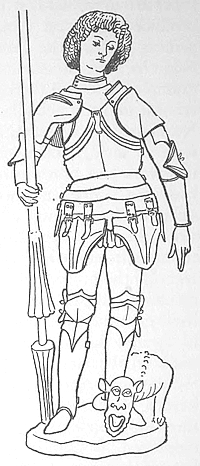
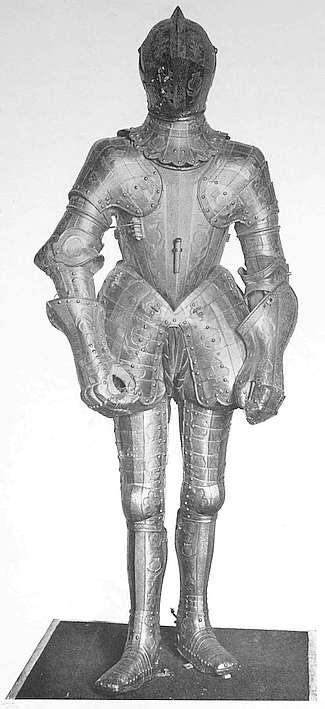
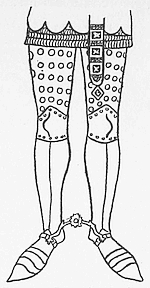
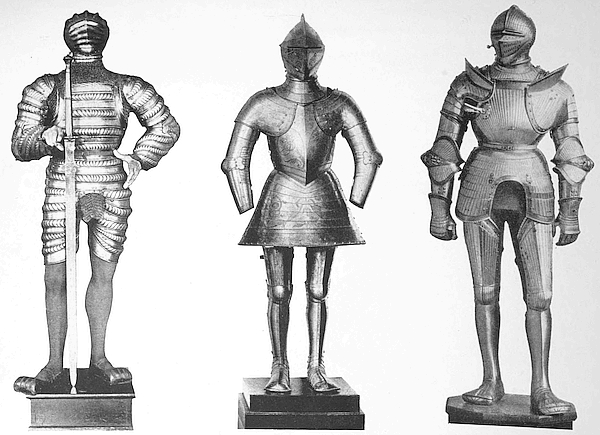
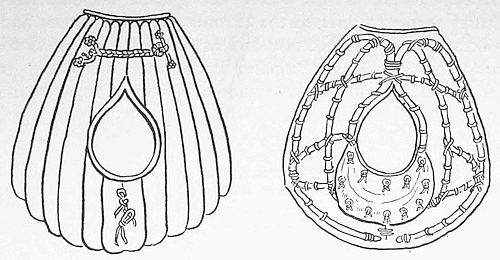
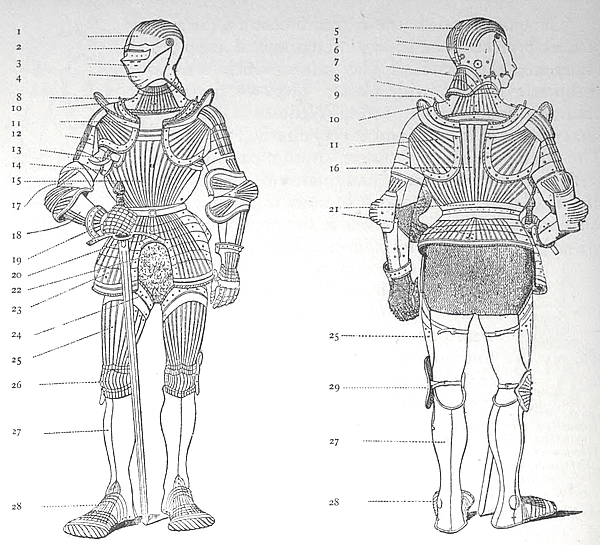
The names of the different parts of the suit of plate armour are given in English;
French, German, and Italian and Spanish are given on pp. 110, 111.
A
Abzug, Germ. the trigger of a gun.
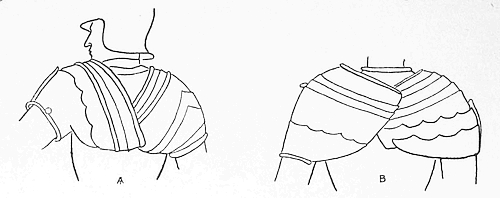
Achsel, Germ. see pauldron.
Achselhohlscheibe, Germ. see rondel.
Achselschilde, Germ. see ailette.
Acroc, a hook or clasp.
Adargue, a heart-shaped buckler, G.
Affust, } gun-carriage.
Afut, }
Agaric, tinder used with flint-lock gun.
Agier, O.F. darts.
Aguinia, machines or engines of war.
Aguzo, It. the point of the spear.
Aiguilettes, tags at the ends of laces for fastening the
various pieces of armour.
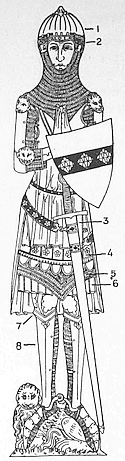
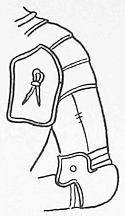
Ailettes, wing-like pieces of plate or cuir-bouilly worn on
the shoulders. Very rare and seldom seen on monuments. XIII-XIV cent.
Aketon, see gambeson.
Alabarda, It. halberd.
Alaguès, Halaguès, O.F. soldiers of fortune, free-lances, R.
Alarica, a heavy triangular-pointed spear.
Alberc, Germ. see hauberk.
Alberia, a shield without armorial bearings.
Alborium, a bow of hazel, XI cent.
Alemèle, Fr. the lame or blade of the sword.
Alemella, It. a knife or dagger, XIV cent.
Alfange, Sp. cutlass.
Alferanna, Sp. a banner.
Algier, O.F. dart.
Allecret, a variety of half-armour, end of XVI cent.
Almarada, Sp. a stiletto or dagger.
Almayne rivet, suit of light half-armour, XVI cent.
Almete, Sp. a close, round helmet, armet.
Alzo, It. the “sight” of the firearm.
Amadue, Fr. see agaric.
Ameure, a dagger.
Amorce, priming.
Amorcoir, Fr. powder-flask.
Amussette, Fr. a breech-loading musket, XVIII cent.
Anelace, a broad-bladed dagger, early XIV cent.
Angon, a javelin used in the VI cent. The head was heavy and
the top part of the shaft thin, so that it bent on impact and thus
hampered the stricken man, G.
Animes, a cuirass of horizontal lames, R.
Antebrachia, see vambrace.
Antela, see poitrel.
Antia, the handle of a buckler.
Anzerdecke, Germ. see barde.
Appogiar, the cantle of the saddle.
Arbalest, a crossbow.
Arbalest à cric, a heavy crossbow used in sieges.
Arbalest à cranequin, a crossbow drawn with a windlass.
Arbrier, the tiller of a crossbow.
Arcabuz, Sp. see arquebus.
Archet de fer, the moulded ring on the breech of a cannon, base-ring.
Archegaye, a staff sharpened at both ends carried by estradiots, XV cent.
Archibuso, It. see arquebus.
Arcioni, It. the fore and aft peaks of the saddle.
Arcon, the saddle-bow.
Arescuel, the grip of a lance, R.
Arest de lance, vamplate, later the lance-rest, G.
Arganello, It. the windlass of a crossbow.
Argolets, French mounted arquebussiers, XVI-XVII cent., R.
Arma bianca, It. } sword.
Arme blanche, Fr. }
Armacudium, an indefinite weapon of offence.
Arma d’asta, It. any long-shafted weapon.
Armatoste, Sp. the windlass of a crossbow.
Armes à l’épreuve, pistol-proof armour.
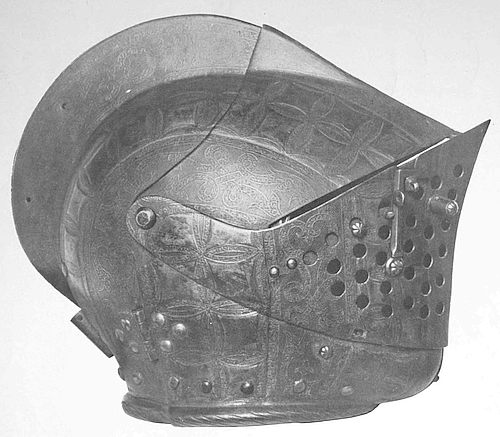
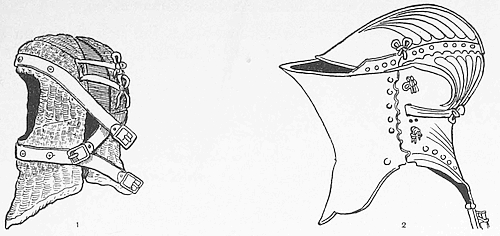
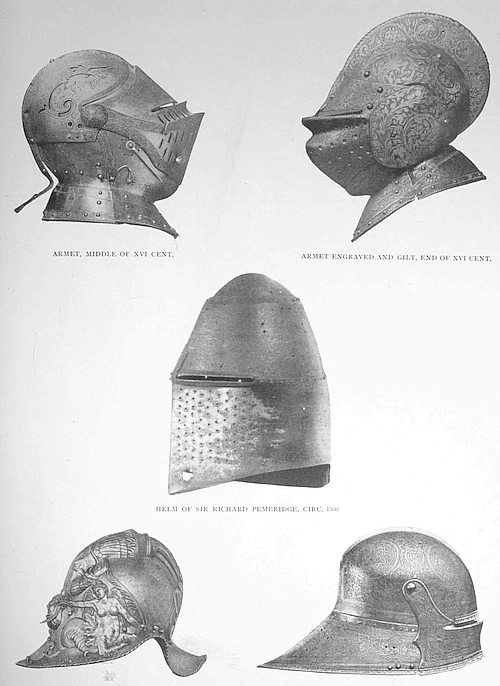
Armet, a close helmet with bevor and movable visor.
Armil, see surcoat.
Armin, an ornamental hand-grip for the pike made of velvet or leather.
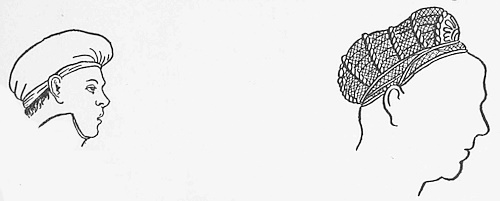
Arming-bonett, a padded cap worn under the helmet.
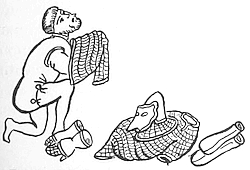
Arming-doublet, worn under the armour.
Arming-hose, long hose worn under leg-armour.
Arming-points, laces for tying on parts of the suit of armour.
Arming-sword, a short sword worn on the right side.
Armkachen, Germ. elbow-cops.
Armoyer, O.F. armourer, maker of sword-hilts, R.
Armröhen, Germ. cannon of the vambrace.
Armrust, Germ. crossbow.
Armure cannelée, Fr. fluted armour.
Armzeug, Germ. brassard.
Arnesi, It. harness as used for “armour.”
Arquebus, a musket of XVI cent.
Arrêt, Fr. small decorated tabs used on straps for armour and
horse-furniture, G.
Arrêt de lance, Fr. lance-rest.
Arrière-bras, Fr. see rerebrace.
Arrière-hilt, the counter-guard or knuckle-bow of the sword.
Asbergo, a breastplate or cuirass, a vamplate, F.
Asper, aspar, the “grip” of the lance.
Aspergès, O.F. a mace, R; see holy-water sprinkle.
Astile, It. the shaft of a lance.
Astonne, a lance, R.
Astregal, a moulding on a cannon.
Atilt, the position in which the lance was held in charging.
Attry, O.E. artillery.
Auber, see alborium.
Ausfatz, Germ. the “sight” of a firearm.
Avance, Fr. the front peak of the burgonet.
Avant-bras, see vambrace.
Avant plat, see vamplate.
Aventail, breathing aperture in helmet, the earliest form of visor.
Azza, It. a long-shafted axe.
Azzimino, It. fine inlay work on Oriental weapons, F.
B
Bacchetta, It. a ramrod.
Back-sword, sword with single-edged blade.
Bacul, O.F. crupper of horse-trappings, R.
Bacyn, see bascinet.
Badelaire, Fr. a short cutlass.
Bagonet, } a dagger fitted to the musket, circ. 1672.
Bayonet, }
Bagordare, O.It. to hold a burlesque tournament.
Baguette, ramrod, also brayette, q.v.
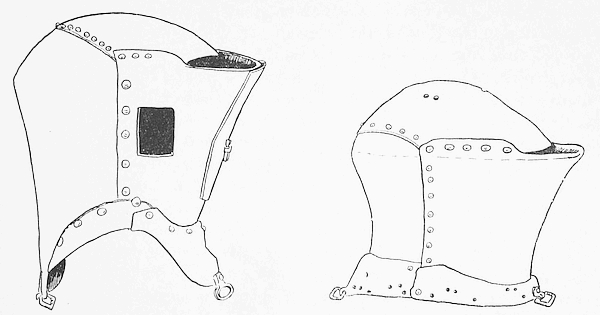
Bainbergs, shin-defences of metal or cuir-bouilly.
Baldrick, } an ornamented belt to carry the sword, XIV cent.
Bawdric, }
Balestra, It. see arbalest.
Balloch knife, a knife or dagger with balls instead of quillons, XV-XVI cent.
Balayn, } whalebone used for crests or the swords for tourneys.
Balon, }
Balottera, a stone bow, F.
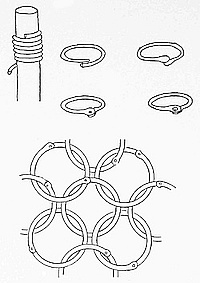
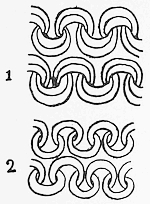
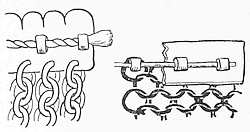
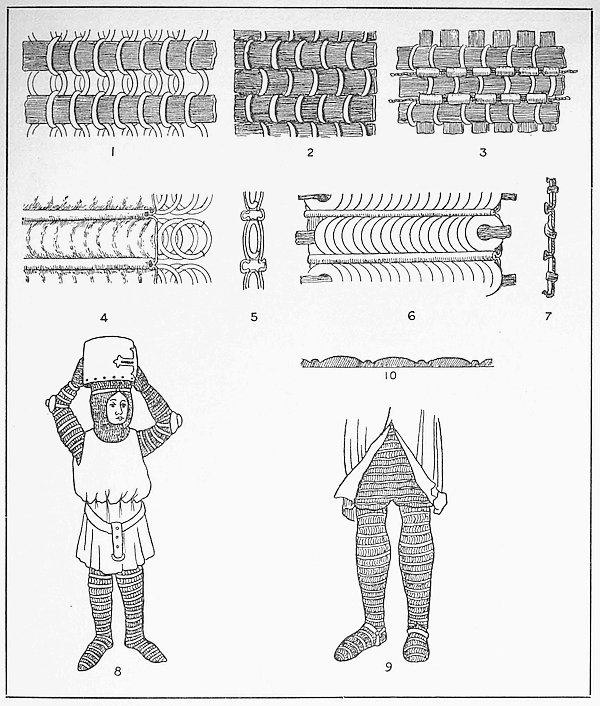
Banded mail, mail formed of rings through which a leathern thong
was passed horizontally on the hauberk.
Bandes, Fr. see lames.
Bandes de bout d’affust, trail-plate of a cannon, H.
Bandes de dessus, axle-tree bands, cape squares, H.
Bandolier, musketeer’s belt to carry gun-charges in separate cases
of wood or metal.
Bannerets, those knighted on the field of battle and entitled to carry banners.
Banquelets, Fr. strips of decorated metal on a sword-belt to keep
the belt rigid, G.
Barbazzale, It. the “grummet” of a bridle.
Barbera, Sp. see mentonière.
Barbière, Fr. }
Barbote, Sp. } see bevor.
Barbotto, It. }
Barbuta, a piece of head-armour, a bevor, F.
Barbute, } a form of bascinet of unknown type, also a light horseman.
Barbet, }
Bardes, } horse-armour.
Barding, }
Barde de crinière, Fr. see crinet.
Bardiche, a variety of pole-axe.
Barducium, see morning star.
Barthaube, Germ. chin-guard of plate.
Barriers, the division of wood which separated combatants
in foot-jousts, also the jousts themselves.
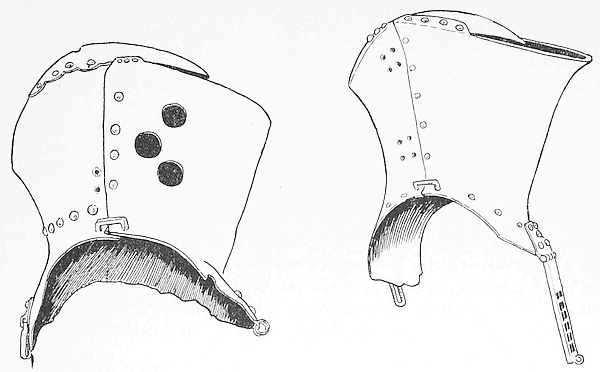
Bascinet, a light helmet of ovoid form tapering to a point at
the summit, worn with or without a visor, XIII-XV cent.
Bascuette, O.E. see bascinet.
Base, O.F. a short sword or cutlass, R.
Bases, skirts of fabric or, in armour, of plate, XVI cent.
Basilard, a curved civilian sword, XIV cent.
Bask sword, a stout, single-edged blade.
Bassinet, Fr. priming-pan of a firelock.
Bastard sword, a long sword for cut and thrust with grip
sufficiently long for two hands, or a blunted sword for practice.
Baston, a mace or club with polygonally cut head.
Baston, gros, O.F. large ordnance, R.
Battecul, see garde-rein.
Batticuli, taces or loin-guards of plate, F.
Bauchreifen, Germ. see taces.
Baudik, see baldrick.
Baudrier, Fr. cross-belt.
Bavier, Fr. } see bevor.
Baviera, It. }
Bergaman, O.F. a cutlass or dagger from Bergamo, R.
Bear-paw, } a form of solleret with obtuse point.
Bec du cane, }
Becco di corvo, It. see martel de fer.
Bec de faucon, Fr. a war-hammer.
Beckenhaube, Germ. see bascinet.
Beinröhren, Germ. see jambe.
Beintaschen, Germ. see tassets.
Beinzeug, Germ. see cuissard.
Beringt, Germ. ringed mail.
Beruier, Fr. a light head-piece with ear-flaps and chin-strap,
XV cent., G.
Besagues, O.E. small plates to protect the armpits, any small
plates of metal.
Bessa, a pickaxe used by pioneers, XV cent.
Beavor, } chin-piece of an armet or a sallad.
Bevor, }
Bicoquet, Fr. a species of bascinet with neck and chin piece,
XV cent., G.
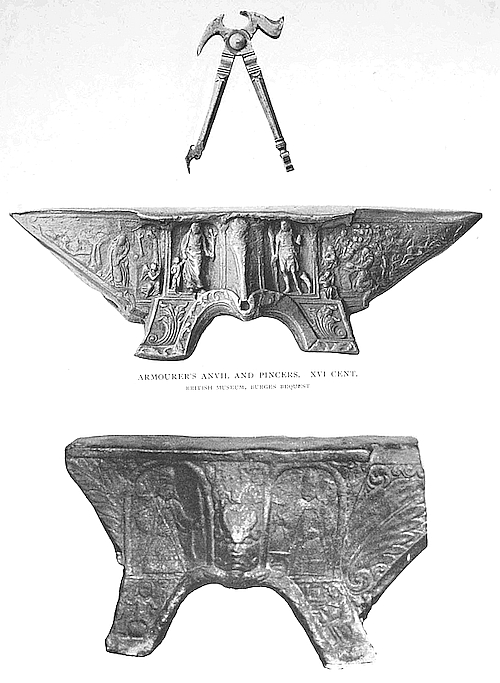
Bicorn, } small anvil.
Bickiron, }
Bigateno, O.F. a javelin or dart, R.
Bilbo, a small rapier.
Bill, a weapon with scythe-like blade and six-foot shaft.
Billette, F., see toggle.
Biro, O.F., a dart, javelin, or arrow, R.
Bisacuta, } the military pick or two-edged axe, XIII-XIV cent.
Bisague, O.F., }
Bishop’s mantle, a cape of mail.
Blacon, O.F., a buckler or shield, R.
Blanc haubert, Fr., coat of mail.
Blanchon, O.F., a kind of pike, R.
Blank wafte, Germ. see arme blanche.
Boetes, boxes, H.
Bohordicum, a burlesque joust in which sham lances (bohours) were used.
Bombarde, an early form of ordnance resembling a mortar.
Bonbicinium, see bascinet.
Bordon, }
Bordonasse, } a lance used for jousting.
Borto, }
Boson, an arrow with a blunt point.
Bossoirs, the bosses on the peytral of a horse.
Botafogo, Sp. see linstock.
Botta a, It. } armour proof against sword, axe, or lance blow.
Botte à, Fr. }
Botte cassée, Fr., armour proof against all weapons, “high proof.”
Botton, a button or buckle for fastening the gorget to the breast-piece.
Bouche, the hole cut in the corner of the shield through which
to point the lance; also the circular hole in the vamplate.
Boucles, Fr. see genouillière.
Boudrier, Fr. see bandolier.
Bougeran, } buckram used for tournament armour.
Bougran, }
Bougon, } blunt-headed arrow for shooting game.
Boujon, }
Bougeon, }
Boujon, } a crossbow quarrel, R.
Boulon, }
Bourdonasse, Fr. see bordon.
Bourlet, Fr. a coif.
Bourlet, Fr. the swell of the muzzle of a cannon.
Bourlette, Fr. a mace.
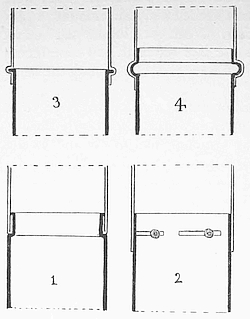
Bourrelet, à, Fr. a method of attaching two plates together
sliding in burrs or slots.
Boutefeu, Fr. linstock.
Bouterolle, Fr. the chape of a sword.
Boutreaux, Fr. the pendent strips of leather or fabric which
decorated the horse-trappings of the XV-XVI cent., G.
Bracciale, It. brassard.
Bracciaiuola, It. a small shield with arm-guard and
“sword-breaker” in one piece.
Bracciali, It. see brassard.
Bracconnière, Fr. see taces.
Bracelet, Fr. the ring of metal which joined the vambrace to
the rerebrace, the elbow-cop, C.
Bracer, a leathern wrist-guard used by archers of the long-bow.
Bracheta, O.It. } see brayette.
Braghetta, }
Brandistocco, It. a three-pronged spear, a swine-feather.
Braquemart, a short, broad-bladed cutting sword.
Brasalot, O.F. see elbow-cop.
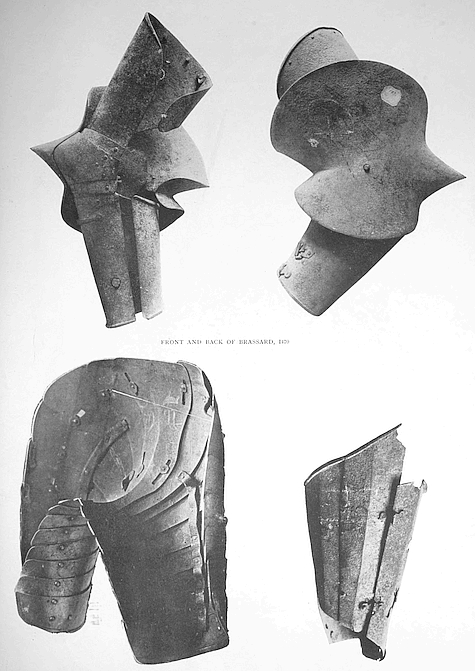
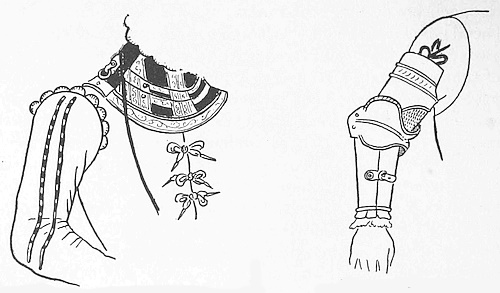
Brassard, the whole arm-defence, including vambrace, elbow-cop,
and rerebrace.
Brasselet, see bracer.
Bratspiess, Germ. see ranseur.
Brayette, O.F. for codpiece.
Brazale, Sp. brassard.
Brechenmesser, Germ. see falcione.
Brechränder, Germ, neck-guards on the pauldrons.
Bretelles, Fr. straps for joining breast and back pieces.
Briccola, O.It. a tiller or crossbow to shoot stones or arrows, F.
Brichette, armour for loins and hips.
Brichette, } breast-armour, XV cent.
Brikette, }
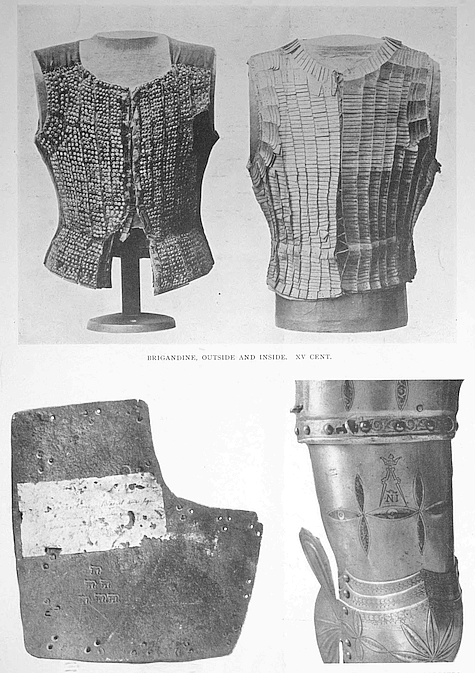
Brigandine, a body-defence of small plates riveted to a cover
and lining of fabric.
Briquet, Fr. a sword of cutlass form, early XIX cent.
Brise-cuirass, Fr. a short, strong dagger.
Brise-épée, Fr. see sword-breaker.
Brochiero, It. a small buckler used for sword and buckler fights.
Broigne, a shirt of mail.
Broke, O.F. a kind of dagger, R.
Broquel, Sp. see rondache.
Brújula, Sp. see visor.
Brunt, O.E. the front or peytral of a horse-trapper.
Brustpanzer, Germ. see peytral.
Brustschild mit schönbart, Germ, tilting-breastplate with mentonière.
Bruststück, Germ. breastplate.
Brygandyrons, see brigandine.
Budrière, It. cross-belt for a sword.
Bufe, a movable bevor used with an open casqe.
Bufeta, Sp. neck-guards on a pauldron.
Buffa, the buffe or face-plate of a burgonet.
Bufle, a coat of buff leather.
Buffetin, Fr. see colletto.
Burdo, see borto.
Bukel, Germ. see rondache.
Burghera, a gorget, F.
Burgonet, a light, open helmet, generally found with ear-flaps
and sometimes a face-guard, XVI-XVII cent.
Burr, the iron ring on the lance below the “grip” to prevent the
hand slipping back.
Buttafuoco, It. see linstock.
Buttière, Fr. a type of arquebus.
Buzo, It. see quarrel.
C
Cabasset, a helmet with narrow brim all round, XVI cent.
Cairelli, O.It. see quarrel.
Caissia, It. a case or quiver for arrows.
Calce, the vamplate of a lance, also the butt end, also stockings, F.
Caliver, a short firelock.
Calote, a skull-cap worn under the hat by cavalry, XVII cent.
Caltrop, a ball with four spikes placed on the ground to receive cavalry.
Calva, Sp. skull or bowl of a helmet.
Camaglio, It. see camail.
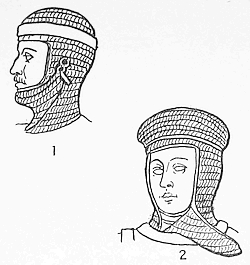
Camail, a hood or tippet of chain mail, XIV-XV cent.
Camba, O.It. see jambs.
Camberia, see jambières.
Camisado, It. the wearing of white shorts over armour for night attacks.
Campane, { O.F. the part of the horse-trappings on the
Campanelle, { haunches, decorated with large bells, XV-XVI cent.
Cambrasia, O.It. a dart or arrow, F.
Cannon, the tubular vambrace.
Cantle, the rear peak of the saddle.
Capel de nerfs, a whalebone or leather helmet, XIV cent.
Capelina, It. a skull-cap of steel.
Capellum, the sword sheath or scabbard.
Caperuza, Sp. see chapel-de-fer.
Carcasse, Fr. a bomb.
Carcasse, It. a quiver.
Cardelli, It. see quarrel.
Cargan, a collar or gorget of mail.
Carnet, the visor.
Carousella, } a mimic fight with clay balls and shields.
Carousel, }
Carquois, Fr. a quiver.
Carreau, Fr. see quarrel.
Cartouche, Fr., a charge of powder and shot wrapped up in paper; a cartridge.
Casque, open helmet, often of classical design, late XVI cent.
Casquetel, an open head-piece with brim and back peak reaching far
down the neck, XVII cent.
Cassa, It. the stock of a firearm.
Castle, O.E. a variety of helmet.
Cataffratto, } a mail-clad horse.
Cataphractus eques, }
Cataye, O.F. a javelin or a catapult, R.
Catchpole, a long-handled spring fork used to catch the opposing
knight round the neck and unhorse him.
Catocio, the charge of powder for musket or cannon, F.
Caxeo, } Sp. see casque.
Caxa, }
Cazoleta, Sp. the “pan” of the arquebus.
Celada de engole, Sp. a helm worn for foot-jousts with
axe, sword, or spear.
Celata, It. see sallad.
Celata da incastro, It. see armet.
Celata Veneziana, It. a Venetian form of sallad with a nose-piece, XV cent.
Cerbatane, some kind of ordnance, G.
Cerveliera, It. a metal skull-cap, a secrete.
Cervicale, Fr. see crinet, G.
Cesello, It. repoussé-work used in the decoration of armour.
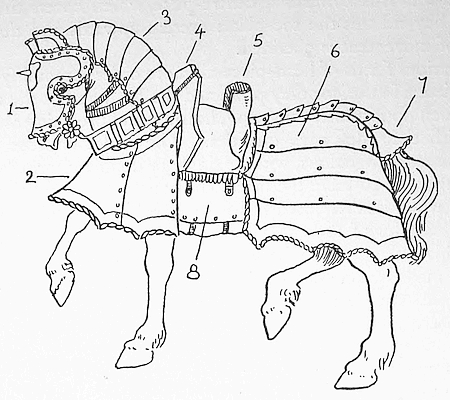
Chamfron, }
Chanfrein, } defence of plate for the horse’s head.
Chanfron, }
Champ-clos, O.F. see lists.
Chape, the metal tip at the lower end of a sword or dagger sheath.
Chapel d’acier, Fr. a steel war-hat.
Chapel-de-fer, Fr. a broad-brimmed helmet used from XII to XVI cent.
Chapel de Montauban, Fr. a steel war-hat made at Montauban, XIV cent.
Chapewe, see chapel-de-fer.
Chapras, the brass badge worn by a messenger.
Chard, the string of a sling.
Charnel, O.E. the bolt that fixed the tilting-helm to the breastplate.
Chausses, covering for the lower leg and foot of chain mail.
Chaussons, trews or breeches of chain mail.
Cheeks, the strips of iron that fix the pike-head to the shaft.
Cheminée, Fr. the nipple of a gun.
Cherval, a gorget.
Chastones, rivets.
Chianetta, a helmet, F.
Chiave da mota, It. key for a wheel-lock.
Chien, Fr., cock of a firelock.
Chiodo da voltare, It. a turning-rivet.
Choque, some kind of firearm, variety unknown.
Cimier, the crest on the helm.
Cinquedea, It. a short, broad-bladed dagger for ceremonial use,
made in Venice and Verona, five fingers (cinque ditta) wide at
the base.
Ciseau, a blunt-headed quarrel for the crossbow, G.
Clavel, O.F., a lace for fastening the coif of mail or the hauberk, G.
Clavones, rivets.
Claid heamh, a sword, Gaelic.
Claid mor, a broadsword, Gaelic.
Claid crom, a sabre, Gaelic.
Claid caol, a small sword, Gaelic.
Claymore, a Scottish two-hand sword (see above). The modern use of
the word is erroneous.
Clef, trigger.
Clevengi, studs to fasten the fendace or gorget.
Clibanion, a jack of scale armour, G.
Clipeus, It. a circular shield.
Clous perdus, Fr., false and useless rivet-heads found in XVII-cent. armour.
Cnémide, Fr. see jambs.
Coche, the notch of an arrow, the nut of a crossbow, C.
Coda di gambero, It. see lobster-tail.
Codole, Sp. elbow-cop.
Codpiece, a piece of plate to protect the fore-body.
Coif de mailes, hood of chain mail, see camail.
Colichemarde, swords invented by Königsmark about 1661–86.
Colet, }
Coletin, } Fr. a gorget, also a jerkin.
Collettin, }
Colletto, It. a buff coat.
Collo, It. see crinet.
Colodrillo, Sp. the plate of the helmet that covered the nape of the neck.
Coltellaccio, It. see cutlass.
Cophia, a coif of mail.
Coppo, It. the skull of a helm or helmet.
Corale, see cuisses.
Coracina, Sp. cuirass.
Corium, armour composed of leather.
Cornel, } O.E. the rosette or button fixed on the
Coronall, } tip of the lance in some forms of tilting.
Corpel, O.F. the hilt of a sword, R.
Corregge, It. see bretelles.
Corseque, Fr. a species of partizan, G.
Corsesca, It. see ranseur.
Cosciale, }
Coscioni, } see cuissard.
Costale, }
Coschewes, O.E. see cuisses.
Costa, It. the wings on the head of the war-mace.
Coat-armour, see surcoat.
Coterel, O.F. a large knife, R.
Cotta di maglia, It. a coat of mail.
Cottyngyre, cold-chisel.
Coude, }
Coudière, } elbow-pieces of plate.
Coute, }
Coup de poing, Fr. a small pistol.
Coursel, Fr. windlass for a crossbow, G.
Coussart, a demi-glaive, XV cent.
Coustile, Fr. a knife and possibly a staff-weapon with cutting
point, G.
Coustil à croc, } short, single-handed sword with two-edged blade.
Coutel, }
Couvrenuque, Fr. the neck-plate of the back of the armet or sallad.
Cracowes, } sometimes used for poleynes and also
Crakoes, } for pointed shoes, XIV cent.
Crampon, a bolt for attaching the helm to the cuirass.
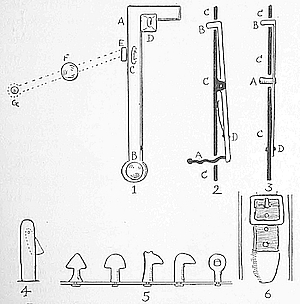
Cranequin, the wheel and ratchet machine for bending the crossbow.
Cravates, French mounted militia.
Cresta, It. }
Cresteria, Sp. } crest of a helmet.
Crête, Fr. }
Crête-échelle, a support fixed from helm to back-plate to take
the shock when tilting.
Crêtu, O.F. a sword-breaker, R.
Crinet, armour for the horse’s neck.
Crochets de retraits, trail-hooks of a cannon, H.
Crinière, see crinet.
Croissante, see moton.
Crosse, the butt of a gun or a crossbow.
Croupière, armour for the hinder part of a horse.
Cubitiera, It. elbow-cop.
Cubrenuca, Sp. see couvrenuque.
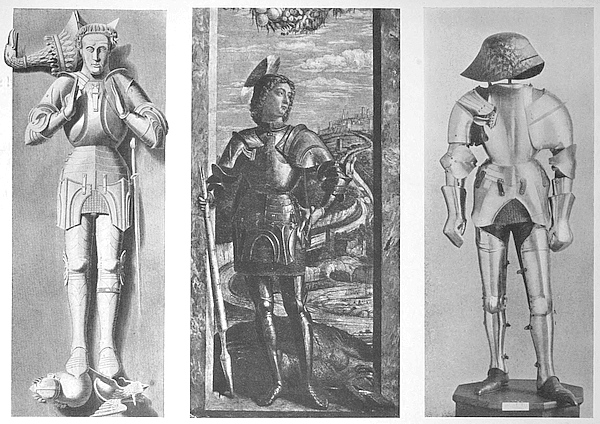
Cuirass, body-armour, originally of leather, afterwards of plate.
Cuir-bouilly, } defences for horse and man made of
Cure-buly, } boiled and moulded leather.
Cuissards, leg-armour, comprising cuisses and knee-cops and jambs.
Cuishe, }
Cuisse, } thigh-pieces of plate.
Cuyshe, }
Cuissots, see cuisse.
Culasse, the breech of a gun.
Culet, kilt or skirt.
Cullotes, Fr. breeches.
Culverin, a hand-gun or light piece of ordnance, XV, XVII cent.
Curatt, see cuirass.
Curtale, O.It., a variety of cannon, F.
Curtana, the blunted “sword of Mercy” used at the Coronation.
Curtelaxe, O.E. for cutlass.
Ciclaton, } a tight-fitting surcoat shorter in front
Cyclas, } than behind, XIV cent.
Cyseau, O.F. an arrow or dart, R.
D
Daburge, a ceremonial mace.
Dag, Tag, a short pistol, XVI-XVII cent.
Dague à couillettes, Fr. see balloch knife.
Dague à oreilles, a dagger with the pommel fashioned like two circular wings.
Dague à rognons, Fr. a dagger with kidney-shaped projections above
the quillons.
Dague à ruelle, Fr. a dagger with thumb-ring.
Dard, Sp. javelin.
Degen, Germ. sword, dagger.
Demi-poulaine, pointed sollerets of medium length.
Demy-teste, O.E. a steel skull-cap, C.
Destrier, a war-horse.
Détente, Fr. the trigger.
Diechlinge, } Germ. see cuisse.
Dieling, }
Dilge, Germ. leg-guard for jousts.
Dobbles, O.E. probably moulds or patterns on which armour was made.
Dolch, Germ. poniard.
Dolequin, a dagger, R.
Doloire, a short-handled axe, G.
Dolon, O.E. a club, R.
Dorso, It. the back of a gauntlet.
Dos, Sp. back-plate of a cuirass.
Dossière, Fr. the back-piece of the cuirass.
Dussack, Hungarian and German sword of cutlass form.
E
Écrevisse, Fr. see lobster-tail.
Écu, Fr. shield.
Écouvillon, sponge of a cannon.
Eisenkappe, Germ. a skull-cap of steel.
Eisenschuhe, Germ. see sollerets.
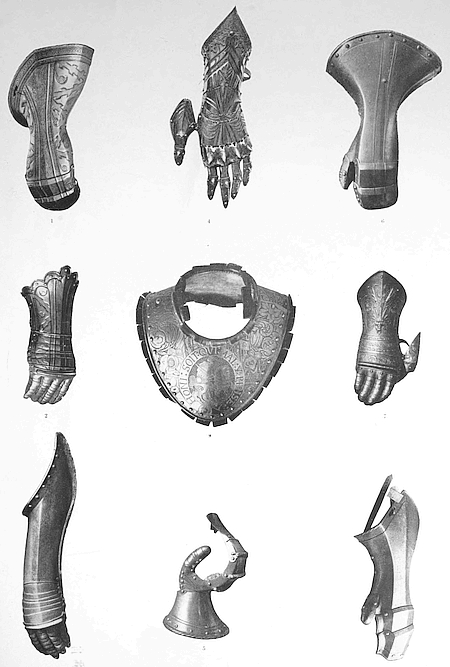
Elbow-cops, elbow-pieces of plate armour.
Elbow gauntlet, a metal or leather glove with cuff reaching to
the elbow, XVI, XVII cent.
Elingue, O.F. a sling, R.
Ellenbogenkachel, Germ. see coude.
Elmo di giostra, It. a tilting-helm.
Elsa, }
Elso, } the hilt of a sword or dagger, F.
Elza, }
Enarmes, the loops for holding a shield.
Encoche, see coche.
Enlace, see anelace.
Épaulière, } shoulder-defence, of plate.
Éspalière, }
Épaule-de-Monton, Fr. see poldermitton.
Épieu, a spear; a spear with crossbar or toggle, G.
Esca, It. tinder.
Escarcelas, Sp. tassets.
Escarpes, Sp. sollerets.
Esclaivine, O.F. a dart, R.
Escopette, a pistol or carbine with a firelock, C.
Espada, Sp. a long sword.
Espadin, Sp. a short sword.
Espaldar, Sp. pauldron.
Espare, O.F. a dart, R.
Espieu, see épieu.
Espingardier, an arquebussier, C.
Esponton, Fr. see spontoon.
Espringale, a siege crossbow on wheels, a piece of siege ordnance, G.
Espuello, Sp. spur.
Estival, leg-armour for a horse; exceedingly rare in MSS.; only
one example of this armour exists, in Brussels.
Estoc, a thrusting sword.
Estradiots, Greek horsemen, temp. Charles VIII.
Estramaçon, the edge of a sword, a sword-cut.
Étoupin, a quick-match.
Étrière, a military flail, G.
Étrier, Fr. stirrup.
Exsil, O.F. the scabbard of a sword, R.
F
Falcione, It. see falk.
Falda, It. see taces.
Falarique, an arrow headed with tow, for incendiary purposes, G.
Faldaje, Sp. taces.
Falk, a primitive weapon formed of a scythe-blade fixed on a pole; a glaive.
Falsaguarda, Sp. the wings on the blade of the two-hand sword.
Fan-plate, the “wing” on the outside of the knee-cop.
Fauchard, see glaive.
Faucre, Fr. a lance-rest.
Fautre, Fr. thigh-armour.
Faux, see falk.
Feather-staff, a staff in which are concealed spikes released by a spring.
Federzapfen, Germ. spring-pins to which the pauldrons are hung, XVI cent.
Fendace, a species of gorget, XV cent.
Feure, O.F. a scabbard, R.
Fiancali, It. see tasset, also flanchard.
Fioreti, It. a thrusting foil.
Flail, the military flail was like the agricultural implement, but
as a weapon of war the thresher was of iron instead of wood.
Flambard, } a two-hand sword with wavy blade.
Flamberge, }
Flamberg, Germ. rapier with wavy blade.
Flanchard, O.E. }
Flancoîs, Fr. } armour for the flanks of a horse.
Flankenpanzer, Germ. }
Flanqueras, Sp. }
Flaon, Fr. a wedge fastened to the breast-piece which took the
shock of the shield; see poire.
Fleau, Fr. military flail.
Flechière, see flanchard.
Fletcher, a maker of arrows.
Fleuret, thrusting foil.
Flight, an arrow for distance shooting.
Flo, O.E. arrow.
Forcina, It. a gun-fork.
Forconi, It. a military fork for escalades.
Fornimento, It. the hilt of a sword.
Fouchard, see glaive.
Fouloir, the rammer of a cannon.
Framée, O.F. a mallet or mace, R.
Francesca, It. a battle-axe or pole-axe.
Francisque, a long-handled axe, R.
Freccia, It. an arrow.
Freiturnier, Germ. a joust run without a barrier, XVI cent.
Frête, O.F. a variety of arrows, R.
Frog, the hanger of a sword-belt.
Fronde, Fr. a sling.
Frontale, It. see chamfron.
Fronteau, F. see chamfron.
Fueille, the blade of a sword, C.
Fusetto, It. see misericorde.
Fusil, short musket with a firelock.
Fussturnier, Germ. joust on foot, XVI cent.
Fust, the stock of a firearm.
G
Gadlings, knuckle or finger spikes fixed to the gauntlet.
Gagnepain, { Gay derives this from canepin, sheep or goat leather, hence a
Gaynpayne, { glove of leather, mail, or plate. Meyrick explains it as a sword.
Galapentin, O.F. a sword or sabre, R.
Galea, It. a helm.
Gambeson, a quilted tunic, XI cent.
Gambiera, It. see jambs.
Gardaignes, O.F. arms, clothing, etc., R.
Garde-de-bras, reinforcing piece for the left arm, used in tilting.
Garde-faude, Fr. see codpiece.
Garde-ferre, O.F. the rest of the lock of the arquebus (pan cover?), C.
Garde-collet, Fr. neck-guards on the pauldron.
Garde-rein, E.Fr. loin-guard of armour.
Garde-queue, Fr. the tail-guard of a horse.
Garrock, } used for the quarrel of the crossbow
Garrot, } and also for the lever.
Gaudichet, O.F. a mail shirt.
Gaveloc, }
Gaveloche, } a species of javelin.
Gavelot, }
Gavette, It. the string of the crossbow.
Genestare, O.F. a javelin, R.
Gedritts, a German form of joust in which the challenger fought
two opponents in succession.
Gefingerte handschuh, Germ. gauntlet with separate articulated fingers.
Geldière, O.F. a kind of lance, R.
Genetaire, a javelin, XV. cent.
Genouillières, jointed knee-pieces of plate.
Gentilhomme, a wooden cannon bristling with spikes, XVI cent., G.
Gesäfreifen, Germ. rein or loin guard.
Gestech, various forms of the joust as practised in Germany, run
without barriers.
Ghiazarino, It. see jazerant.
Gibet, a military mace.
Gibicière, Fr. a cartridge box, also pouch.
Ginocchietti, see genouillière.
Gisarme, a staff weapon of the glaive order.
Giostra, It. joust.
Glaive, a species of bill with a large blade.
Glazing-wheel, polishing-wheel for armour plates.
Gliedschirm, Germ. see codpiece.
Goat’s-foot, a lever for bending the crossbow.
Godbert, see hauberk.
Godendar, } a species of short club at the top of
Goedendag, } which is a spike, XIII-XIV cent.
Goudendar, }
Goie, } a hedging-bill, C.
Goy, }
Goiz, O.F. a sword, R.
Gola, Sp. } gorget.
Goletta, It. }
Gonpillon, Fr. see holy-water sprinkle.
Gonfanon, Fr. a flag or standard.
Gorget, }
Gorgiera, It. } a wide plate collar to protect the
Gorjal, Sp. } throat, XVIII cent.; purely ornamental.
Gougerit, Fr. }
Gossets, see gussets.
Graffe, Fr. a small dagger.
Grand-guard, reinforcing piece for tilting, worn on the left shoulder.
Grano d’orzo, It. chain mail closed with a rivet.
Grappes, Fr. { a toothed ring on the “grip” of the lance which
Grappers, { held the weapon firmly against the wood or lead
Grates, { block behind the lance rest.
Greave, }
Greve, Fr. } shin-defence, of plate.
Greba, Sp. }
Gronda, It. see couvrenuque.
Groppa, It. } see crupper.
Grupera, Sp. }
Guanciali, It. ear-flaps of a burgonet.
Guardabrazos, Sp. see pauldron.
Guardacorda, It. see garde-queue.
Guardacuore, It. see mentonière.
Guardagoletta, It. the neck-guards on the pauldrons.
Guarda-o-rodillera, Sp. knee-cop.
Guardastanca, It. see grand-guard.
Guige, the strap round the neck to carry the shield, XII cent.
Guiterre, O.F. a small buckler of leather, R.
Gusset, pieces of chain mail, tied with points to the “haustement”
to cover those portions of the body not protected with plate armour;
they were usually eight in number, viz. for armpits, inner side of elbows,
knees and insteps.
Guyders, straps to fasten the various pieces that went to make up
the suit of plate armour, also gussets.
Gynours, the servers of catapults and the like siege engines.
H
Hackbuss, see arquebus.
Hake, demi-hake, O.E. the former an arquebus, the latter a short
firearm, XVI cent.
Hagbuttes, arquebus.
Haketon, see gambeson.
Halacret, see alacret.
Halagues, crossbowmen, R.
{ a long-shafted weapon with crescent-shaped
Halebarde, { blade on one side and a hook or spur on the other,
Halbert, { surmounted by a spear-head; sometimes found with
Harlbart, { double blade, XV and XVI cent.
Halsberge, Germ. see gorget.
Hampe, the staff of a halbert or pike.
Hand and half sword, see bastard sword.
Hansart, O.F. a missile weapon of the javelin order, R.
Harnischekappe, Germ. the padded cap worn under the tilting-helm.
Hars, O.F. a bow, R.
Harthstake, a rake or poker for the forge.
Haubergeon, } short { shirt of chain mail, XI to XII cent.
Hauberk, } long {
Haulse-col, } Fr. see gorget.
Hausse-col, }
Hausecol de mailes, Fr. see standard of mail.
Haustement, Fr. a close-fitting undergarment to which the hose
and the chausses were fastened with points.
Haute barde, Fr. a high-peaked saddle.
Haute cloueure, Fr. high-proof armour, especially mail.
Hauste, O.F. the staff of a pike, R.
Heaume, a heavy helm without movable visor and only an eye-slit
or occularium, mostly used for tilting.
Hendeure, Fr. the “grip” of the sword.
Hentzen, Germ. mitten gauntlets.
Hinterarm, Germ. see rerebrace.
Hinterfluge, Germ. the back-plate of the pauldron.
Hinterschurz, Germ. see garde-rein.
Hobilers, common light-horse troopers.
Hoguines, see cuisse.
Holy-water sprinkle, a shaft of wood fitted with an iron
spike-studded ball, XVI cent.
Horse-gay, a demi-lance, XV cent.
Hosting harness, armour for war as distinct from that of the joust.
Hufken, a light head-piece worn by archers, XVI cent.
Huque, long surcoat worn over the armour, XV cent.
Huvette, Fr. a head-piece of leather or cloth stiffened with
wicker or metal, XIV cent.
Hwitel, Anglo-Saxon, knife.
I
Imbracciatura, It. see enarmes.
Imbricated mail, see jazerant.
J
Jack, a loose-fitting tunic of leather, either quilted or
reinforced with plates of metal or horn.
Jambers, } see jambs.
Jambeux, }
Jamboys, skirts of plate, XVI cent., see bases.
Jambs, armour for the lower leg.
Janetaire, see javelin.
Jarnac, Brassard à la, a jointless arm-piece of plate reaching
from shoulder to wrist.
Jarnac, Coup de, a cut on the back of the leg or a “hamstringing cut.”
Jazerant, body-armour made of small plates, of the brigandine type.
Jeddartstaff, a long-shafted axe.
Jupon, a short surcoat, XIV-XV cent.
Justes of peace, jousts at barriers.
K
Kamm, Germ. the crest or ridge of the helmet as distinct from the
heraldic crest.
Kamfhandschuhe, Germ. gauntlet.
Kehlstück, Germ. the neck-plate in the front of an armet.
Kettyl-hat, a wide-brimmed steel war-hat, XIV cent.
Kinnreff, Germ. bevor.
Knee-cops, { knee-defences of plate, first worn
Kniebuckel, Germ. { over chain-mail chaussons, and
Kniestück, Germ. { afterwards with complete plate armour.
Knuckle-bow, the part of the sword-guard that protects the knuckle.
Kragen, Germ. gorget.
Krebs, Germ. see tasset.
L
Lama, It. sword-blade.
Lama a biscia, It. see flamberge.
Lamboys, see jamboys.
Lambrequin, a species of hood of cloth attached to the helmet with
“points,” and falling down at the back to protect the wearer from heat and rain.
Lames, narrow strips of steel riveted together horizontally as in the taces.
Lance a böete, a lance with blunted point.
Lance de carrière, a lance for tilting at the ring, C.
Lance a rouèt, or courtoise, blunted lances for tournaments, R.
Lance-rest, an adjustable hook or rest fixed on the right side of
the breastplate.
Lancegay, } O.F. a short spear, hence light horseman, R.
Launcegay, }
Lanciotto, It. javelin.
Lansquenette, } a broad-bladed double-edged
Landsknecht, } sword, and also German mercenary
Lanzichenecco, It. } infantry, XVI cent.
Leva, It. see goat’s-foot lever.
Lendenplatte, Germ. a large cuisse for tilting.
Lingua di bue, It. see cinquedea.
Linstock, a combination of pike and match-holder, used by gunners
for firing cannon.
Lobster-tail, back peak of a helmet, or cuisses, made of
overlapping lames like a lobster-shell, XVII cent.
Lochaber axe, a long-shafted axe. Scottish, XVII, XVIII cent.
Locket, the metal socket at the top of the sword sheath with
button for hanging to the belt.
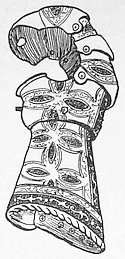
Locking gauntlet, a gauntlet of plate in which the finger-plates
lap over and fasten to a pin on the wrist, used for fighting at barriers,
XVI cent.
Loque, O.F. a quarter-staff, R.
Luchet, O.F. an iron pike, R.
Luneta, Sp. rondel.
Lunette, Fr. open sword-guard, late XVII cent.
M
Maglia gazzarrina, It. see jazerant.
Maglia piatta, It. see ringed mail.
Mähenpanzer, Germ. see crinet.
Maillet, Fr. a martel de fer, XIV cent.
Mainfaire, } a right-hand gauntlet.
Manifer, }
Main gauche, dagger used with the left hand when the right hand
held the sword.
Maleus, a falchion, F.
Mamillières, circular plates worn over the breast to hold chains
to which the sword and dagger were attached, XIV cent.
Mancina, It. see main gauche.
Manetta, It. the trigger of a gun, also a spanner.
Manezza di ferro, an arming-gauntlet, F.
Manicle, gauntlet.
Manico, It. the grip of a sword.
Manoglia, It. the handle of a small buckler.
Manopla, Sp. } gauntlet.
Manople, It. }
Manteau d’armes, a rigid cape-like shield fixed to the left breast
and shoulder for tilting.
Mantling, see lambrequin.
Martel de fer, Fr. } a war-hammer used by horse and foot.
Martello d’arme, It. }
Martinetto, } It. see cranequin.
Martinello, }
Mascled, mail, { lozenge-shaped plates of metal, sometimes
Macled, mail, { overlapping, sewn upon a tunic of leather or
{ quilted linen, XI, XII cent. (Meyrick).
Massüe, Fr. a mace or club.
Matchlock, a firearm with touch-hole and fired with a match, early XV cent.
Mattucashlass, a Scottish dagger carried under the armpit.
Maule, a mace or club.
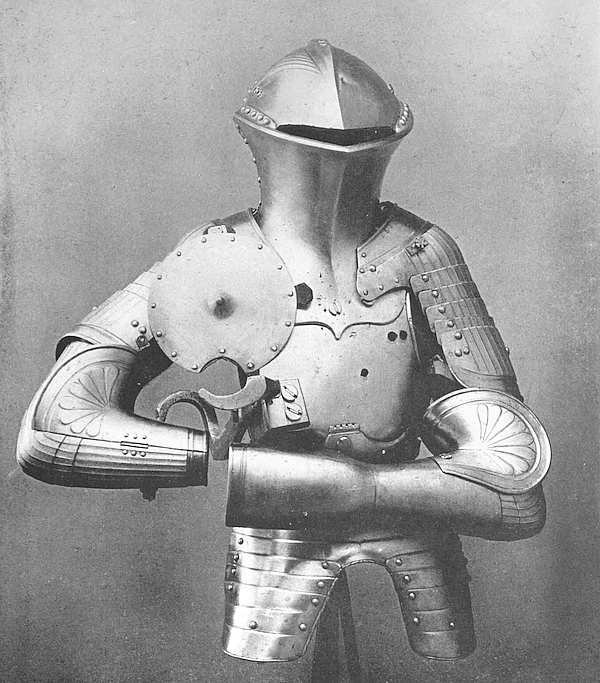
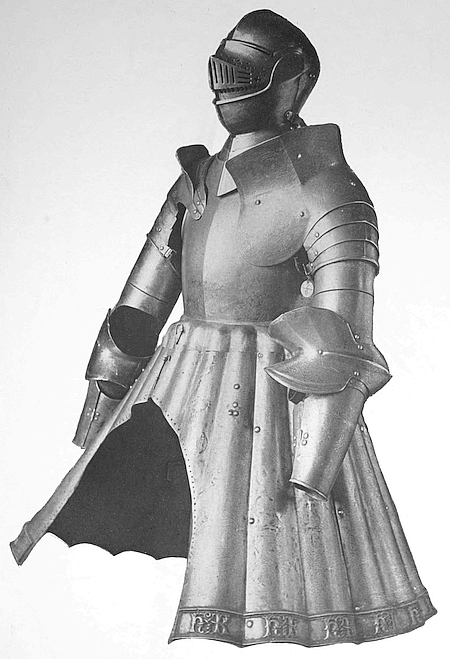
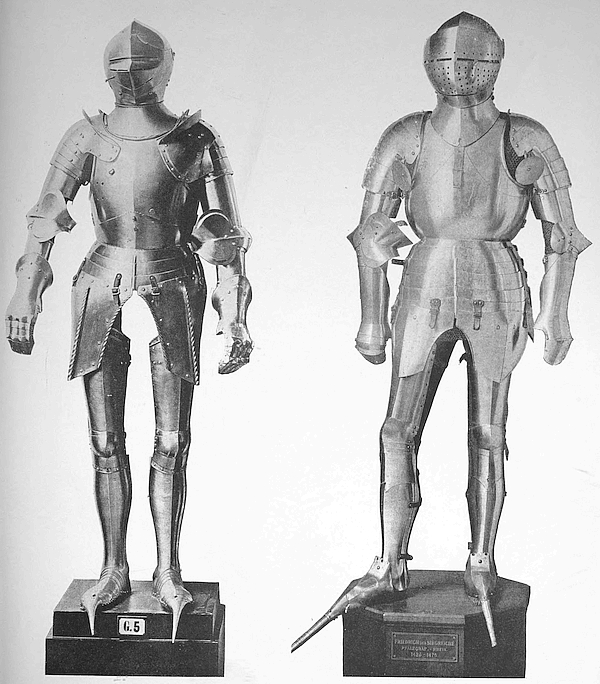
Maximilian armour, a style of plate armour distinguished by shallow
vertical flutings, said to have been devised by the Emperor Maximilian I, XVI cent.
Mazza d’arme, It. war-mace.
Mazzafrustro, It. see flail, also morning star.
Méche soufrée, a slow-match.
Mell, see maule.
Mentonière, a piece used with the sallad to protect chin and breast.
Merlette, O.F. a sergeant’s staff, R.
Meris, O.F. a javelin, R.
Meusel, Germ, see elbow-cop.
Mezail, Fr. visor.
Miccia, It. a gun-match.
Migerat, O.F. a dart or arrow, R.
Minion, a four-pounder, XVI cent.
Misericorde, short dagger used for the coup de grâce.
Missodor, O.F. a war horse, R.
Mitten-gauntlet, } gauntlet in which the fingers are
Mittene, It. } not separate.
Moresca, It. see taces.
Morion, light helmet with crest and inverted crescent brim, latter
end of XV cent.
Morning star, a spike-studded ball hung by a chain from a short
staff, XIV-XV cent.
Morso, It. the horse’s bit.
Moschetto, It. see matchlock.
Mostardo, a musket, F.
Moton, plates to protect the armpits, especially the right, XIV cent.
Moulinet, the windlass used for drawing the crossbow.
Moyenne, see minion.
Murice, a caltrop, F.
Musacchino, see pauldrons.
Muschettæ, It. projectiles used with the crossbow.
Muserag, a missile weapon of some kind, F.
Musoliera, It. a horse-muzzle.
N
Nackenschirm, Germ. neck-plate at the back of an armet.
Naide, anvil.
Naitoules, some appliance for closing rivets.
Nasal, a bar of steel fixed or movable on the front of the helmet
to protect the nose, in more general use during XI cent., revived
afterwards in XVII cent.
Neighletts, the metal tags of the arming-points.
Nowchys, embossed buckles and ornaments for armour, XV cent.
Noyeau, the core of a gun.
O
Oberarmzeug, Germ. rerebrace.
Occularium, the eye-slit in the helm.
Oreillettes, ear-pieces, found in the later forms of the casque and burgonet.
Orle, the wreath or twisted scarf worn on the helmet immediately
beneath the crest.
Oriflamme, the ancient banner of the Abbey of S. Denis used by
the kings of France.
Ospergum, see hauberk.
Ottone, It. brass or latten, used for edging armour, etc., F.
P
Paefustum, a battle-axe, XV cent.
Palet, a small skull-cap of cuir-bouilly or steel.
Palettes, circular plates to protect the armpits.
Panart, O.F., a large knife, R.
Panache, Fr. the plume of feathers on the helmet.
Pansier, Fr. the lower portion of the cuirass when it is formed of two pieces.
Panzer, body-armour, XI-XIV cent.
Panziera, It. see codpiece.
Parement, a surcoat or ceremonial dress of rich fabric.
Parma, It. a small shield or buckler.
Partigiana, It. { a long-shafted weapon with broad-pointed blade,
Partizan, { in form allied to the pike and the halbert.
Partlet, O.E. gorget, F.
Pas d’âne, Fr. loops of bar steel immediately over the cross-hilt of the sword.
Pasguard, a reinforcing piece for the left elbow, used in tilting.
Passe-garde, Fr. the French, following Meyrick, use this word
wrongly for neck-guards.
Passadoux, a Gascon arrow, C.
Passe, the rack for stringing the crossbow, C.
Passot, O.F. a dagger, R.
Patelet, a padded vest worn under armour, XVI cent.
Patrel, see poitrel.
Patron, a case for pistol cartridges.
Patula, a short sword or dagger.
Pauldrons, shoulder-pieces of plate.
Pavade, a long dagger.
Pavache, Fr. }
Pavesche, } a large shield used by bowmen.
Pavise, }
Pavois d’assout, O.F. }
Pavon, a large triangular flag.
Peascod, a form of breastplate made with a central ridge, and
pointed slightly downward at the lower extremity, XVII cent.
Pectoral, a breast defence of mail. See also peytral.
Pell, } a sharpened stake used by the Norman peasants.
Pill, }
Pellegrina di maglia, It. mail cape or collar.
Pennacchiera, It. } see porte-panache.
Penacho, Sp. }
Pennon, a pointed banner used by knights bachelor and esquires.
Pentina, O.I. a short pike, F.
Pertuisan, Fr. partizan.
Peto, Sp. breastplate.
Petail matres, a large-headed dart or arrow, R.
Petronel, a short firearm fired with a flint or pyrites (the common
explanation that it was discharged held at the chest is erroneous).
Pettiera, It. see peytral.
Petto, It. breastplate.
Peytral, the breastplate of a horse.
Pezonaras, Sp. see bossoirs.
Pfeifenharnisch, Germ. embossed armour to imitate
puffed silk or velvet, XVI cent.
Pheon, a barbed javelin used by the sergeant-at-arms.
Picca, It. see pike.
Picière, Fr. see peytral.
Pieces of advantage, reinforcing pieces for the joust.
Pied de biche, Fr. see goat’s-foot lever.
Pied de chèvre, a crowbar.
Pike, a long-shafted weapon used by footmen only. It had a
lance-like head, and was shod at the butt-end with iron for fixing in
the ground to receive cavalry, XIV-XVIII cent.
Pike-guard, a ridge of metal set upright on the pauldrons, on the
left side, erroneously called pasguard.
Pile, the head of the arrow.
Pistolese, a large dagger or knife, F.
Pizane, Fr. breastplate.
Placard, } a reinforcing breastplate, XVI-XVII cent.
Placcate, }
Plater, the maker of armour plates as distinct from the armourer
who made up the plates into armour.
Platner, Germ. armourer.
Plastron, the upper portion of the cuirass when it is formed of two pieces.
Plastron-de-fer, a defence of plate, usually circular, worn on the
breast under or over the hauberk.
Plates, Pair of, back and breast plates, XIV-XV cent.
Platine, Fr. the lock of a firelock.
Plommée, Fr. a leaden mace; also holy-water sprinkler.
Poignard, a dagger.
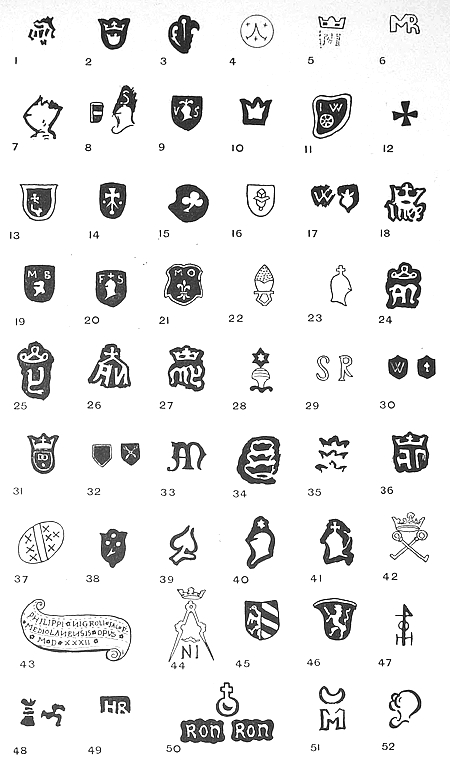
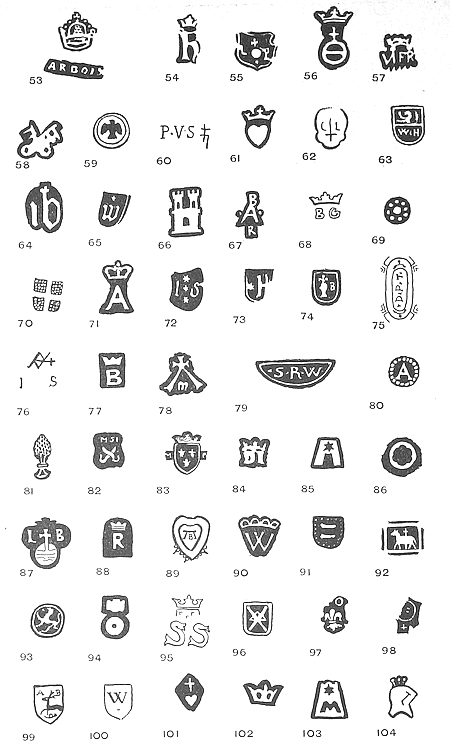
Poinçon, the stamp or trade-mark of the armourer.
Points, laces for securing the gussets of mail to the undergarment,
and also the lambrequin to the helm.
Poire, Fr. a pear-shaped button through which the laces passed that
held the shield to the left breast, XVI cent.
Poitrel, breast-armour for a horse.
Poldermitton, a defence for the inner bend of the right arm, used in the joust.
Pole-axe, a long-shafted axe with beak and spear point.
Poleynes, see knee-cops, XIII-XIV cent.
Polion, some part of the crossbow.
Pommel, the finishing knob of the sword-grip; also the fore peak of the saddle.
Pompes, see poleynes.
Pontale, the chape of a sword or dagger; also the tag on an
arming-point or lance, F.
Porte-panache, Fr. the plume-holder on the helmet.
Posolino, It. see croupière.
Pot, a broad-brimmed helmet worn by pikemen, XVII cent.
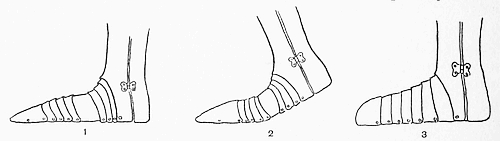
Poulaine, À la, sollerets with extremely pointed toes, XIV cent.
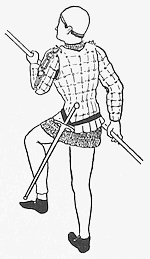
Pourpoint, a padded and quilted garment of leather or linen.
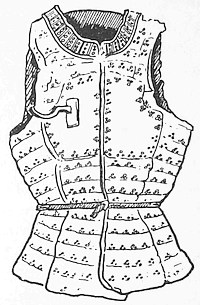
Pourpointerie, quilted material with metal studs at the
intersection of the quilting seams.
Pryke-spur, a spur with a single point and no rowel.
Pugio, } It. a small dagger.
Pugnale, }
Pully-pieces, } see poleynes.
Putty-pieces, }
Pusane, } see pizane.
Puzane, }
Q
Quadrelle, It. a small mace with leaf-like projections, also quarrel.
Quarrel, the bolt or projectile used with the crossbow.
Quetyll, O.E. a knife.
Queue, a projecting hook on the back-piece of the cuirass to take
the butt-end of the lance when held in rest.
Quijotes, Sp. see cuisse.
Quillions, the cross-hilt of the sword.
R
Raillon, O.F. a kind of arrow, R.
Rainoise, an unknown type of arquebus.
Ranfort, the reinforce ring of a cannon.
Ranseur, a large trident with sharpened blades set on a long shaft;
a species of partizan.
Rennen, German jousting courses with sharp spear-head.
Rennhutschraube, Germ. see crête-échelle.
Rerebrace, armour for the upper arm.
Rest of advantage, some detail of armour forbidden in jousts of the
XVI cent.; possibly some kind of lance-rest.
Resta } lance-rest.
Restra de muelle, Sp. }
Ricasso, the squaring of the base of the sword-blade next above
the quillons.
Ringed mail, formed of flat rings sewn side by side on a tunic of
leather or quilted linen, XI cent.
Rivet, a suit of armour; afterwards the small nails that hold it together.
Rochet, the blunt lance-point for jousting.
Rodete, O.F. a spur, R.
Roelle, O.F. a buckler or small shield.
Roncone, It. see gisarme.
Rondache, a circular shield, XV-XVI cent.
Rondel, } circular plate protecting the armpit;
Rondelle, Fr. } also at the back of early armets.
Rondel of the guard, possibly a vamplate.
Ross-stirn, Germ. see chamfron.
Rodela, } a circular shield.
Rotela, It. }
Rotellina da bracciale, It. rondel.
Rüchenstück, Germ. back-plate of the cuirass.
Rüsthaken, Germ. lance-rest.
Rustred mail, see banded mail (Meyrick).
Rustung, Germ. armour.
S
Sabataynes, } O.E. see sollerets.
Sabatons, }
Sacheboute, O.F. a horseman’s lance, R.
Sagetta, a casque or helmet, F.
Salade, } helmet with wide brim at the back, worn
Salett, } with or without visor and mentonière,
Sallad, } XVI cent.
Sautoir, O.F. stirrup.
Sbalzo, It. see cesello.
Scarpa a becco d’anatra, It. see bear-paw.
Scarpa a punta articolata, It. see poulaine.
Scarpa a piè d’orso, It. see bear-paw.
Scarsellone, It. see tasset.
Schale, } Germ. sallad.
Schalern, }
Schamkapsel, Germ. see bravette.
Scheitelstuck, Germ. skull of the helmet.
Schembart, Germ. the lower part of the visor, the ventail.
Schenkelschiene, Germ. see cuishe.
Schiavona, It. a basket-hilted cut-and-thrust sword.
Schiena, It. the back-plate of the cuirass.
Schiessprügel, Germ, see holy-water sprinkle.
Schiniere, It. see jambs.
Schioppo, O.I. a dag or pistol, F.
Schlaeger, Germ. student’s fencing-sword.
Schulterschild, Germ. see grand-guard.
Schulterschild mit Rand, Germ. a pauldron with neck-guard attached.
Schwanzel, } Germ. the tail-guard of a horse.
Schwanzriempanzer, }
Schwebescheibe, Germ. see vamplate.
Sciabola, It. sabre.
Scudo, It. a triangular shield.
Scure d’arme, It. battle-axe.
Seax, a dagger.
Secreta, } a thin steel cap worn under the hat, XVI-XVII cent.
Secrete, }
Sella d’arme, It. war-saddle.
Semitarge, O.F. a scimitar, R.
Serpentina, It. the cock of a matchlock.
Setzschild, Germ. see pavise.
Shaffron, see chamfron.
Sharfrennen, Germ. variety of joust with sharp-pointed lances, XVI cent.
Sharfrennentarsche, Germ. a shield-like reinforcing piece for the above joust.
Shell-guard, a form of sword-guard.
Sfondagiaco, It. see misericorde.
Sisarmes, see gisarme.
Slaughsword, a two-hand sword carried by the whiffler, IV cent.
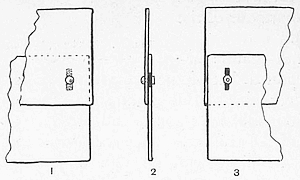
Sliding rivet, a rivet fixed on the upper plate and moving in a
slot on the lower plate.
Snaphaunce, an early form of flint-lock in which the pan has to
be uncovered before firing.
Sockets, a thigh-defence similar to the German diechling.
Soffione, It. a musket or caliver.
Sollerets, shoes of laminated plate, usually pointed.
Spada, It. sword.
Spadone, It. a long sword.
Spadroon, flat-bladed sword for cut-and-thrust.
Spallacci, It. pauldrons.
Spallière, Fr. see pauldrons.
Spasmo, O.It. a dart or javelin, F.
Spetum, } see ranseur.
Spiede, It. }
Spight, a short or flight arrow.
Spigo, O.It. the plume-holder of a helmet, F.
Splint armour, narrow overlapping plates as opposed to armour made
of large plates.
Spright, a wooden arrow discharged from a gun.
Springal, see espringale.
Spontoon, a half-pike carried by officers, XVIII cent.
Squarcina, O.It. a short sword or cutlass, F.
Staffa, It. stirrup.
Standard of mail, a collar of chain mail, XV cent.
Stecca, It. the locket of a dagger.
Steccata, It. the place of combat for duels.
Stechhelm, Germ. heavy tilting-helm.
Stechen, Germ. jousting course with coronal-tipped lances.
Stechtarsche, Germ. a ribbed tilting-shield used in the “gestech” courses.
Stinchieri, O.It. armour for the shin, F.
Stirnstulp, Germ. the upper part of the visor of an armet.
Stithe, O.E. anvil.
Striscia, It. rapier.
Sturmhaube, Germ. see burgonet.
Sturmwand, Germ. see pavise.
Supeters, O.E. see sollerets.
Surcoat, a garment worn over the armour to protect it from sun and
rain, and usually blazoned heraldically.
Sword-breaker, a short heavy sword with back edge toothed for
breaking opponent’s sword, XVI cent.
Swyn-feather, see feather-staff.
T
Tabard, the armorially emblazoned coat worn by heralds; see also surcoat.
Taces, laminated plates at the lower edge of the cuirass.
Tache, O.E. strap.
Talevas, Sp. shield.
Tapul, the vertical ridge in the centre of some forms of breast-piece.
Tarcaire, O.F. a quiver, R.
Targe, a small circular shield.
Tarques, O.F. some kind of engine of war, R.
Tartsche, Germ. a small shield or targe.
Tartschen, Germ. see ailettes.
Tassets, plates, usually lozenge-shaped, attached by strap and
buckle to the taces to protect the upper or front surface of the thigh.
Taurea, O.It. a buckler of bull’s hide, F.
Tegulated armour, overlapping tile-like square plates, end of
XII cent. (Meyrick).
Tertiare, to “third” the pike, i.e. to shorten either for
shouldering or for receiving cavalry.
Tesa, It. the shade or brim of the burgonet.
Tester, O.E. } see chanfron.
Testiera, It. }
Testière, Fr. a metal skull-cap; also the chanfron of a horse.
Têtrière, Fr. see tester.
Thyrtel, } O.E. knife or dagger.
Thwyrtel, }
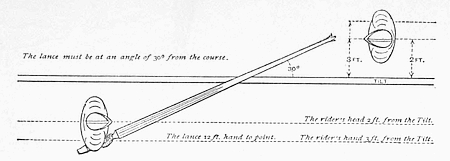
Tilt, the barrier used to separate knights when jousting, XIV cent.
and onwards; first, a stretched cloth; later, of wood.
Timbre, Fr. the skull of a helmet.
Tiloles, Arbalest à, Fr. windlass crossbow.
Toggle, the cross-bar of a boar-spear. In modern use a button for
joining two ends of a strap or thong.
Toile, see tilt.
Tolys, O.E. tools.
Touch-box, probably a box for flint and steel carried by the musket.
Tourney, { a contest of many knights in the lists as opposed
Tournois, Fr. { to the joust or single combat at barriers.
Tournicle d’eschaille, Fr. a small tunic or a large gorget composed
of overlapping scale armour.
Toyle, a contrivance fixed over the right cuisse to hold the lance
when carried upright; a lance bucket.
Trubrico, Sp. blunderbuss.
Traguardo, It. see visor.
Trapper, horse-trappings of fabric or mail.
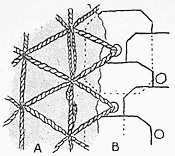
Trellised armour, quilted linen or leather with leather bands sewn
trellis-wise and having studs of metal in the trellis openings (Meyrick).
Tresses, plaited laces or arming-points.
Trilobed scales, triple scales in one piece sewn upon the brigandine.
Trombone, It. a heavy pistol, blunderbuss.
Trousse, Fr. a quiver.
Trumelière, Fr. see jamb.
Tuck, see estoc.
Tuile, Fr. see tassets.
Tuilette, Fr. small tassets as on tomb of Rich. Beauchamp, Earl of Warwick.
Turcasso, It. quiver.
Turves, probably a turban or orle worn on the helmet.
U
Umbo, the boss upon a shield.
Umbril, the shade or brim of head-pieces of XVII cent.
Uncin, war pickaxe.
Uncino, O.It. a broad-pointed arrow, a hook, F.
Unterarmzeug, Germ. vambrace.
Usbergo, O.It. breastplate, vamplate, F.
V
Vambrace, the plate defence for the fore-arm.
Vamplate, a circular shield through which the tilting and war
lances were fixed above the grip.
Vedoil, a weapon used by foot-soldiers, possibly a voulge.
Velette, O.It. a horse-soldier’s coat, F.
Venetian sallad, a sallad of the XV-XVI cent.; formed like the
ancient Greek helmet with fixed visor, but evolved from the bascinet.
Ventaglio, It. } the lower part of the visor when it is
Ventail, Fr. } made in two parts.
Ventalle, Sp. }
Vervelles, the staples on the bascinet to which the carvail was laced.
Vireton, an arrow for the crossbow with curving wings, to produce
a spinning motion.
Visera, It. } that part of the helmet, movable or fixed,
Visor, } which protects the eyes.
Vista, Sp. }
Volant-piece, reinforcing piece for the tilt to protect the breast
and lower half of the face; possibly a spring breastplate.
Volet, the round disc at the back of the armet.
Volet, Fr. an arrow or dart.
Vor-arm, Germ. see vambrace.
Vorderfluge, Germ. the front plate of the pauldron.
Vorhelm, Germ. see placcate.
Voulge, a weapon somewhat similar to the Lochaber axe; used mostly
by the peasants.
Voyders, see gussets.
Voyding knife, a knife for disembowelling deer.
Vuiders, } see gussets.
Vuyders, }
W
Wafter, English dummy blade for fencing, XVI cent.
Wambais, see gambeson.
Wappen rock, Germ. a cloak decorated heraldically.
Welsches gestech, German name for the Italian course of jousting
over the tilt or barrier with blunted lance.
Whiffler, a two-hand swordsman who cleared the way in processions.
Wifle, a practice-sword, possibly a two-hander.
Winbrede, } see gagnepain.
Wynbred, }
Wire hat, see coif.
Z
Zucchetto, It. a species of burgonet, XVII cent.
Zweyhander, Germ. two-handed sword.