When we parted company with the Hope there was
among the crew of the America but one thought,
one idea, and that the capture of other craft belonging to
the St. Thomas fleet.
The richly laden ship had but whetted the appetite of
the men for more, and some of the most sanguine
believed we might remain in the midst of the fleet, seizing
a vessel here and there, until we no longer had men
enough on board to make up a prize-crew.
That we would succeed in capturing one or more other
craft out of all the number that had left port seemed
absolutely certain, even though the convoying sloops-of-war
came across us while we were at our work, for, as
Captain Ropes had said, we could make it exceeding lively
for either the Ringdove or the Scorpion.
The men were so busily occupied with figuring up the
amount of prize-money which had been, and was to be,
earned, that they had no time to spend on possible ghosts,
omens of any kind, or such happenings as had nearly converted
honest Yankee sailors into mutineers.
It seemed to Simon and me that the danger from this
source had disappeared entirely; but we were so seriously
disturbed as to be wofully frightened over what might
happen if the prisoners concluded to make an effort
toward capturing the ship.
We speculated long and in vain trying to decide why
the captain should have thus neglected to take some steps
toward recapturing the Britisher who was lurking in the
America’s hold awaiting an opportunity to free his fellow.
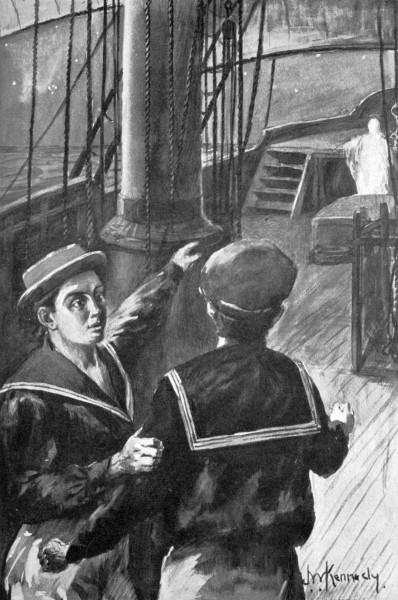
Now we were positive this fellow had played the ghost
by appearing in the fore-hatchway, as well as by shouting
his senseless warning; but how he had contrived to bring
himself into view, when the night was so dark that the
lookouts could not distinguish objects at a distance of two
yards, was more than we could conjecture.
Simon and I had remained constantly on watch from
the moment we discovered one of the prisoners to be
missing, and since our having warned the captain not less
than three of the sailors were also on duty in the hold.
At no time did both of us lads sleep during the same
moment. We divided ourselves into two watches, and
indulged in naps lasting no more than an hour.
Since we could thus rest as well in the daytime as at
night, neither of us felt any evil effects from remaining
constantly on the alert.
Never once during all this time did we either hear or
see the prisoner who remained hidden somewhere in the
hold, nor could we make certain, now that there were so
many captives, whether those in the brig got more food
than sufficed for their number.
It was only reasonable to believe, however, that the
Britishers found ample opportunity to feed their comrade
from the allowance dealt out, and also that he was ready
to open an attack whenever the proper time had come.
On this day after we parted company with the Hope,
praying that the prize-crew might succeed in taking her
to an American port, where she could be sold for our
benefit, it seemed necessary we two lads should exercise
more vigilance than ever before, because the excitement
among our crew was so great that those detailed for duty
as prisoners’ guard gave heed to what was going on above,
rather than to watching the throng of enemies which was
so rapidly increasing in size.
The brig was no longer large enough to admit of all lying
down to sleep at the same time, and it was certain some
different arrangement must be made when night came.
Once we should be forced to give certain of the number
free run of the hold, the danger to ourselves would be
vastly increased, so Simon and I argued.
Because of the fact that we were in the immediate vicinity
of a large fleet, some sail of which we hoped to capture,
word had been passed to the effect that the prisoners
would not be allowed to come on deck for exercise until
further orders, and when this was made known to the
Britishers they became so bold as to indulge in open
threats of what they were able to do.
Some of the most reckless declared they could leave the
brig at will, and that the America would be their prize in
due course of time.
Simon and I discussed the advisability of going again to
the captain, and would have done so but for fear of being
laughed at as cowards who were afraid of unarmed and
imprisoned men.
It was hardly probable Captain Ropes had forgotten
the report we made, and it seemed certain he would take
some steps to shun the danger when, in his opinion, the
time was ripe for such a move.
As I have already said, the excitement among our crew
was so great that it seemed impossible for those detailed
as guard to remain below; but one or the other of the
three men was constantly running on deck to learn if a
sail had hove in sight.
Thus it was we came to know that, about an hour before
sunset, the lookout had sighted a heavily laden brig, and
the America was put about in full chase.
Perhaps because of this fact no attempt was made to
provide better accommodations for the prisoners.
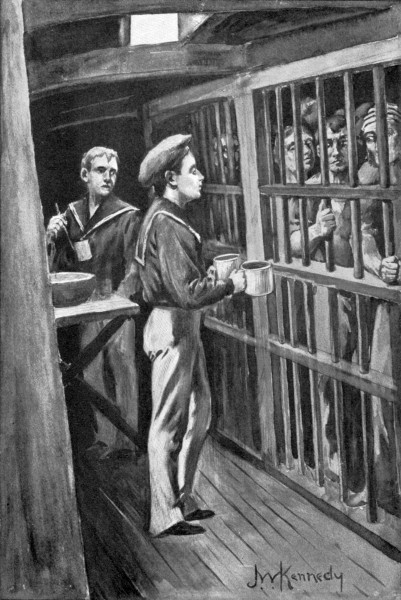
They were forced to remain packed in the prison, many
of them unable to lie down, and their threats and insubordination
increased to an alarming degree.
“We shall have trouble before morning,” Simon said, in
a tone of studied carelessness to one of the sentinels,
hoping thereby to put the man more on his guard; but
the latter replied, indifferently:
“Don’t get fancies into your head, lad. Them ’ere
Britishers are where they can’t work any mischief, no
matter how ripe they may be for it. When you’ve seen
as many prisoners aboard ship as have come my way, you
won’t bother yourself about what is possible for them to
do while they’re unarmed an’ packed in snug as those
fellows are.”
Fortunately, my comrade and I had not become so
familiar with privateering as to render us careless, else the
good ship America would never have sailed into a Yankee
port with the stars and stripes flying, and this much
Captain Ropes has said time and time again.
Although we knew our muskets were in proper condition,
Simon insisted they be discharged and reloaded, in
order that we might be certain they were in working
order, and he took both weapons on deck, where, after
having received permission from Mr. Fernald, he emptied
them.
When he returned, and while we were charging the
weapons, the lad told me that the brig was yet in sight to
the southward, and we stood every chance of overhauling
her unless the wind should fail.
Just at that time, however, we gave very little heed to
the possibility of another capture.
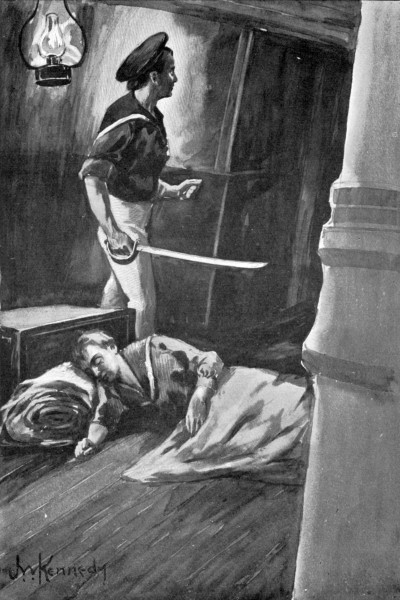
In the hold of the America we were confronted by such
a situation as taxed our courage to the utmost.
While it was yet daylight we tried to sleep; but in vain,
and after supper had been served we sat against the bulkhead,
where none could come upon us from the rear,
watching closely the snugly packed throng of Britishers
as cats watch a lot of rats.
With all our precautions, the decisive moment came
when we were least expecting it.
It was about ten o’clock at night. Two of the guard
were on deck, having been drawn there by news that
the chase was being rapidly overhauled, when I saw a man
suddenly spring out of what had appeared to be a solid
stanchion, as it looked to me, and before I had time to
raise a cry the door of the brig was thrown open, the
prisoners pouring out like swarming bees.
The sailor, who should have been on the alert, was
standing near the foot of the ladder, waiting to learn from
his two comrades who had gone on deck as to the chances
of our coming up with the chase, and not until I cried out
did he realise his danger.
By that time, the Britishers were upon him, and he
went down like a man of straw, apparently trampled under
their feet, as the foremost made a rush for the gun-deck,
knowing full well that there would be found arms in
plenty.
As a rule, I am a coward; but at that moment, my
hand never so much as quivered, while I took careful aim
at the leader, and he fell off the ladder at the same instant
the report of my musket rang out, knocking down those
who were immediately below him.
In a twinkling the entire mob had turned on us lads.
They came as does a foaming wave, seeking to engulf whosoever
shall have lingered on the sands, and involuntarily
I closed my eyes while raising the musket like a club,
in order to shut out that blow which seemingly would
deprive me of life.
Fortunately, Simon’s musket was loaded, and he dropped
the foremost in his tracks while the infuriated men were a
dozen paces distant, thereby checking the advance ever so
slightly, and in that brief interval I gathered my senses
once more.
It seemed certain I would be killed, and with this belief
came such courage as I had never believed could be mine.
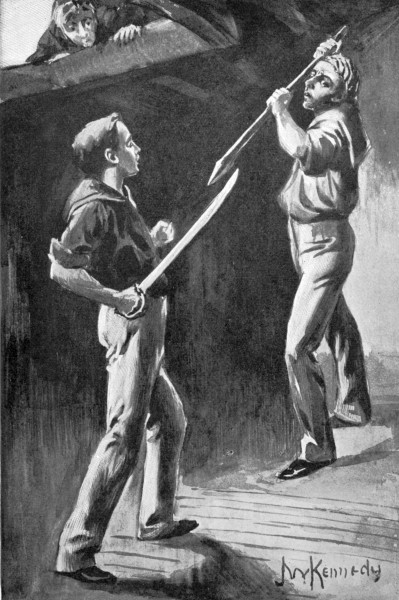
Swinging the musket above my head, I rushed straight
toward the pale-faced man I had seen apparently coming
out of the solid stanchion, and not until I had taken two
or three paces toward him did he show his weapon.
He—and it could be none other than the man who had
played the part of ghost—had possessed himself of a
boarding-pike, and I understood from the gleam in his eyes
that he counted on running me through.
I brought down the musket with a force that would
have floored him like an ox; but he was prepared for such
an attack, and my weapon was splintered on the deck
timbers, leaving me with arms so numb that, even though
my life depended upon the movement, I could not raise
such fragments as my hands still clutched.
In another instant the boarding-pike would have found
its way through my body, and then, as if the blow had
been delivered over my shoulder, I saw the butt of a
musket fall full upon the fellow’s head, crushing him to
the deck.
Some of the men who were loitering on the gun-deck
have declared I yelled like a maniac for help; but of that
I have no knowledge.
When the battle was over,—and it proved to be such a
battle as I hope never to take part in again,—I was
not conscious of having uttered the slightest cry from the
moment when the prisoners swarmed out of the brig.
I only know that I struck again and again with the
barrel of the musket, which was all of the weapon remaining
in my hands, and before me it seemed as if hundreds
upon hundreds of infuriated Britishers were pressing forward,
intent only on delivering a fatal blow.
What has been set down above is not quite true, for I
remember that Simon Ropes stood by my side, fighting
manfully, and doing twice the execution that was within
my power, for his weapon was uninjured, and the butt of it
fell on more than one man’s head, crushing it to a pulp, or
seeming to do so.
It is said that we were in the hold keeping back the
desperate Britishers no more than three minutes, but it
seemed to me as if a full hour passed before I saw
dimly a file of sailors, armed with muskets and cutlasses,
descending the ladder, shooting with careful aim as they
came.
Then it was as if a veil fell suddenly over my eyes;
sparks of seeming fire danced beneath my eyelids, and I
knew no more.
When consciousness returned I was in the cockpit being
attended to by the surgeon, and Simon Ropes, bandaged
and wrapped in white cloth until only a comrade would
recognise him, lay still as death.
“Is he dead?” I managed to ask, although the simple
act of moving my tongue caused pain.
“Not a bit of it, lad. Both he and you will live many
a long day yet, unless it so chances that you foolishly
stand in the path of a British ball when it comes aboard,”
the stern-visaged yet kindly doctor said, in a cheery tone.
“You two lads are rather the worse for wear, I’ll admit;
but you’ve proven yourselves men on this night, and,
what’s more, have saved the America. But for you I
doubt not that all hands of us would now be dead, or in
the brig with our late prisoners as guards over us.”
“Did we indeed do as much, sir?” I asked, despite the
pain, for the words sounded very sweet in my ears.
“It is a fact, and Captain Ropes himself said as much
not ten minutes ago. What is more, the ghost has been
discovered.”
“Ay, sir, Simon and I have known without seeing him,
these ten days past; but how was he discovered?”
“Joshua Seabury came upon his hiding-place quite by
accident, after the scrimmage was over, and the Britishers
packed in the brig once more. There, also, was found
that with which he clothed himself when the men saw the
form so plainly although the night was dark.”
“What was it, sir?” I cried, eagerly, trying to rise on
my elbow, but falling back with a groan immediately
afterward.
“Neither more nor less than a piece of white bunting,
beneath which he admits having carried a lantern found
on the gun-deck while all hands were above. The light
shining through the thin fabric disclosed his form, and yet
was sufficiently thick to hide the shape of the flame.”
“Do all the crew know this, sir?”
“You may be sure they do. Captain Ropes took
good care it should be no secret, and there’s not a man
aboard who is not ashamed to admit he ever believed in a
ghost.”
When this brief conversation had come to an end I was
assailed by a sensation of faintness which overpowered me,
and could only close my eyes in utter helplessness.
Simon Ropes and I were yet in the cockpit when the
America captured her fifth prize, the British brig Dart,
laden with rum and cotton, and carrying eight guns.
While we lay below unable to move, the enemy had
been overhauled, submitting without attempting to strike
a blow, and we were the richer by just so much prize-money
in prospect.
Although not a gun had been fired, two of the prisoners
lost their lives.
It seems, as we heard later from Master Joshua, that
our third officer, Mr. Sparhawk, together with Thomas
Fuller, a boatswain’s mate, had been among those sent to
board the prize. On returning to the America in order to
make a report, they brought with them five prisoners;
their boat was stove under the America’s counter, and two
of the Britishers were drowned.
Anthony Caulfield, an able seaman who understood navigation,
was put in charge of the prize, together with eight
of our men. And twenty prisoners were added to the
number in the hold.
The Dart was headed for Salem without delay, and our
ship cruised back and forth, hoping to sight yet other
vessels of the fleet.
Simon and I were not seriously wounded. The prisoners
had had no weapons, therefore our only injuries came from
blows with bare fists, save the one on my head which was
caused by the barrel of my own musket, that had been
wrested from my grasp.
Within eight and forty hours we were able to go on
deck, and then, to our great surprise, we learned that the
America was steering a course which would speedily bring
her into Salem Harbour.
It had been necessary to part with so many of the crew
in order to man the prizes, that we were short-handed, and
there was nothing left for us save to make the home port
as soon as possible, that we might take on board those who
had probably arrived there in advance of us.
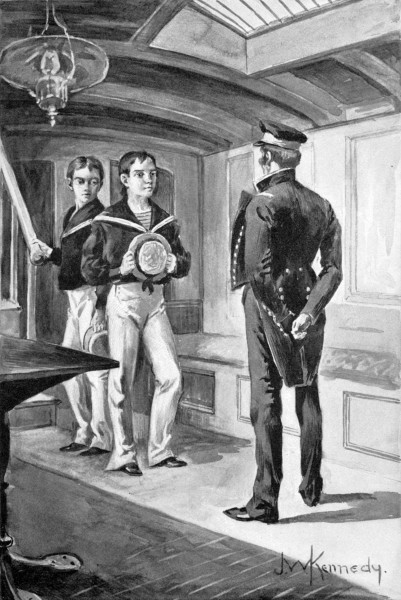
Captain Ropes ordered us lads into his cabin immediately
we made our appearance on the spar-deck in company
with the surgeon, and, once there, he spoke such
words of praise as cause my ears to tingle even at this late
day.
He appeared to believe that we had indeed saved the
ship from being captured by the prisoners, and declared
that when the prize-money was distributed our shares
should be the same as those of the gunners.
There were many other promises given by him voluntarily;
but I do not propose to set them down here, for
they were all made good when we sailed aboard the
America on her second cruise, and that yarn shall be spun
at some future time if I decide to put in writing, for the
pleasure of Simon Ropes and myself, all which befell us
then.
It is enough now if I say it was the captain’s orders
that we two lads live aft during the homeward voyage, and
right well did we enjoy ourselves when our wounds were
so far healed that they ceased to give us pain.
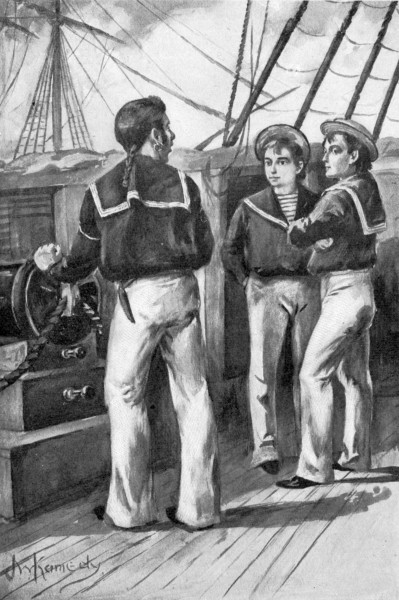
We often indulged in a chat with Master Joshua; but
neither of us ever broached the subject of omens, and I
observed with no slight amusement that he claimed to
have known from the moment we weighed anchor in Salem
Harbour that our cruise would be most prosperous.
And it was prosperous; we had taken five rich prizes in
a few over one hundred days, which was more than the
majority of privateersmen could say.
Every man Jack of us would have dollars in plenty once
the captured vessels were sold, and, what was far better,
could say with good truth that we had done even more
than our share in inflicting injury upon the enemy.
We talked all these things over while the America was
driven swiftly by favouring winds toward the Massachusetts
coast, never dreaming but that we had come to an end of
taking prizes until after going ashore at Salem.
Therefore it was we were almost astonished when, the
voyage being more than half completed, the lookouts
announced that a sail was in sight, and the information
was given in a tone which told plainly the belief of the
men that another Britisher was within our grasp.
It was on the sixteenth day of December, when we
were near the Western Islands, that this sail came in view
from the southeast.
We in the cabin were making a long story of breakfast
as a means of passing the time, when the lookout hailed,
and he who has ever served on a privateer knows full well
the excitement which was immediately after apparent on
our decks.
I might fill page after page with an account of what was
said or done from eight o’clock on that morning until
nearly noon, when we had the Britisher close under our
guns, for we could sail nearly two miles to her one; but so
much has already been set down here concerning a chase
that I shall say, without further preamble, it was quickly
at an end once we came within range.
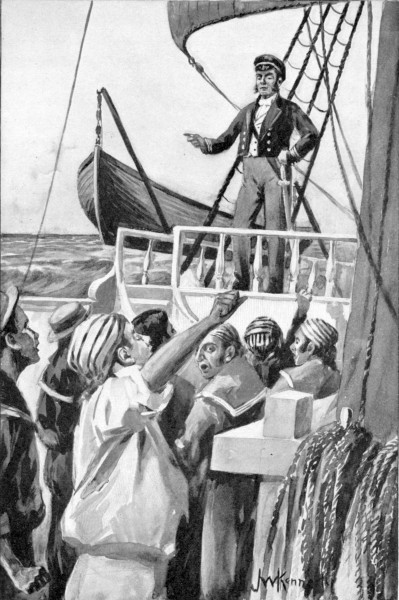
It was the brig Euphemia, of Glasgow, bound for Gibraltar
from La Guayra, with four hundred thousand pounds
of coffee on board, which we had overhauled, and, although
the Britisher carried ten guns and was manned by thirty-five
men, she submitted to capture as peacefully as if she
had been a child.
We had only to fire a shot across her bows after she
was beneath our guns, and the deed was done.
That valuable cargo and staunch vessel was ours without
further parley, and would serve to swell the amount of
prize-money until our men’s heads swam with thinking of
the good hard dollars which would be theirs once we made
Salem again.
This last capture rejoiced me more than had any of the
others; not particularly on account of the rich cargo, but
because she had fallen into our hands so easily, and when
we believed we had done, for the time being, with capturing
Britishers.
The king, who claimed the right to overhaul our vessels
in order to impress Yankees under the subterfuge that
they had once been Englishmen, would soon learn how
much of blood and treasure it was necessary to spend in
the effort to make good the claim, if indeed he ever could.
Well, we made a prize of the Euphemia; displaced
Captain John Gray, who commanded her when she left La
Guayra, by our boatswain’s mate, Archibald S. Dennis,
and threw on board eleven men to take the places of the
twenty-one sailors and two officers we made prisoners.
The remainder of the crew promised to obey faithfully
the new master, and were allowed to remain aboard the
craft they had counted on taking into a British port.
Four hundred thousand pounds of coffee is not to be
picked up on the ocean every day, and it can well be fancied
that our crew, what was left of them, made exceeding
merry over the capture; but any one of them might have
been reduced to a state of shame had the cook but whispered
in his ear the single word “ghost.”
After we were on our course once more, in company
with the prize, which we did not count on losing sight of,
all hands came to understand why Captain Ropes, who had
the name of being most greedy when Britishers were to be
captured, was so willing to steer for the home port before
we had been at sea four months.
The truth leaked out when we were put on an allowance
of three and one-half pints of water per day for each man,
including the officers, and before we sighted Baker’s
Island once more every man Jack of us knew what it was
to be thirsty.
The prisoners, despite all they would have done, were
given the same amount of water as Captain Ropes himself
had, and this fact was some consolation to me as I thought
of what such a throng must suffer in the narrow confines
of the brig.
Neither Simon Ropes nor I felt hardly toward them
because of the injuries they had inflicted upon us.
In fact, it seemed only natural they should attempt to
capture the ship, when what seemed a favourable opportunity
presented itself, and I have no doubt but that we
two lads, barring the possibility of our being too cowardly,
would have made a similar effort under like circumstances.
We longed for water as a miser longs for gold, prisoners
and Americans alike, before we reached port, and never
again will I say that money can buy all which is needed in
this world.
We sailed proudly up past Baker’s Island, one hundred
and twenty-two days after having passed it outward bound,
and in that time we had captured six prizes that were afterward
valued at one hundred and fifty-eight thousand dollars.
Show me a privateer afloat during the war just ended,
which made more valuable captures, or was more successful
in getting her prizes into port!
The James and Charlotte was carried by Mr. Tibbetts
safely into Salem Harbour. The Benjamin put into Nantucket,
after having been chased for fifty-two hours by a
British sloop-of-war, and, later, was sold at auction in
Boston. Mr. Proctor ran the Ralph Nickerson into
Marblehead, where her cargo of lumber found a ready
sale, and Mr. Valpey successfully piloted the Hope into
Boston Bay. The Dart arrived at Salem without mishap,
and her merchandise is remembered to this day by the
people of the eastern coast, while the Euphemia was
chased, but succeeded in gaining the harbour of Portland,
Maine, three days after we arrived at the home port.
We had not lost a single prize, which was another
matter to give us more than our share of pride, and from
the hour our anchor was dropped on the seventh day of
January, in the year 1813, the fame of the America spread
from Maine to South Carolina.
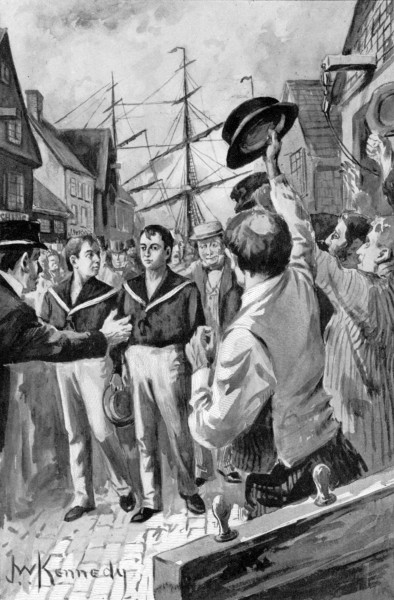
Captain Ropes took good care that the people of Salem
should know what Simon and I had done when the prisoners
attempted to capture the ship, and as we went ashore
it was with difficulty we could make our way to the head
of the dock, because of the throngs which were bent on
showing their appreciation of our services.
I should have had sufficient courage to explain that on
my part it was all an accident; that if there had been any
idea in my mind of the danger which threatened, I might
not have remained in the hold of the ship to check the
rush; but even though I had screamed at the full strength
of my lungs none would have heard, so great was the uproar,
or, hearing, would have taken heed after Simon’s
father had given his account of the affair.
As a matter of fact, I hardly realised that I was receiving
praise which had not been earned; the thought of
being clasped in my mother’s arms once more, knowing
she was convinced I had done my full duty, was so great
that all else passed unheeded, and until her dear arms
folded me closely to her breast I did not fully understand
what part I was playing in this reception given by the good
people of Salem.
I came to appreciate it fully, however, at a later day,
and to be exceeding proud of its being said on every street
corner concerning Simon Ropes and myself, that we had
shown ourselves to be the equal of any who sailed from
Salem on board the armed ship America.
THE END.
Transcriber’s Notes:
Punctuation and spelling inaccuracies were silently corrected.
Archaic and variable spelling has been preserved.
Variations in hyphenation and compound words have been preserved.