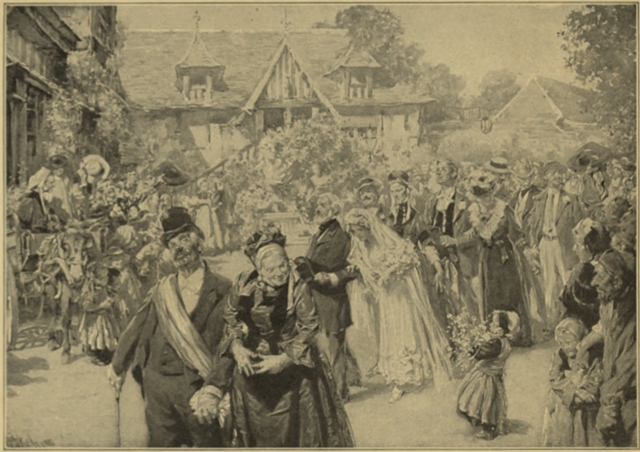
One of the delights of dressing by our
open windows at this season is to catch
the aroma of Mignon’s roasting coffee. This
morning it is particularly delicious. The dry
smell of the soil that gave it birth is fast
merging into that marvellous perfume which
makes it immortal. The psychological moment
is arriving; in common parlance it is
just on the “burn”—another turn and the
fire will have its revenge. But Mignon’s vigil
has never ceased—into the air it goes, the soft
breeze catching and cooling it, and then there
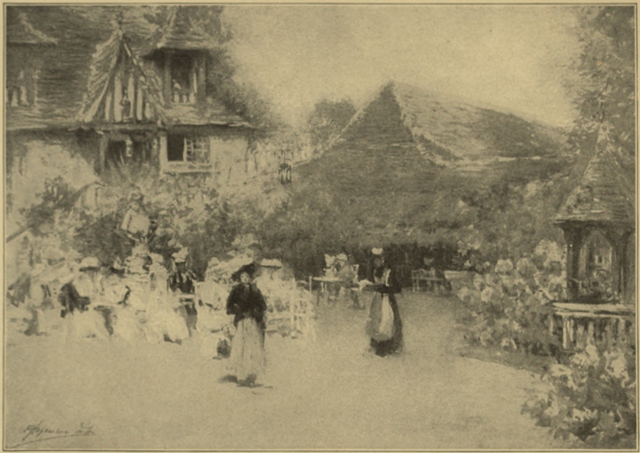
pours out, flooding the garden, the flowers, and
the roofs, its new aroma and with it its new
life.
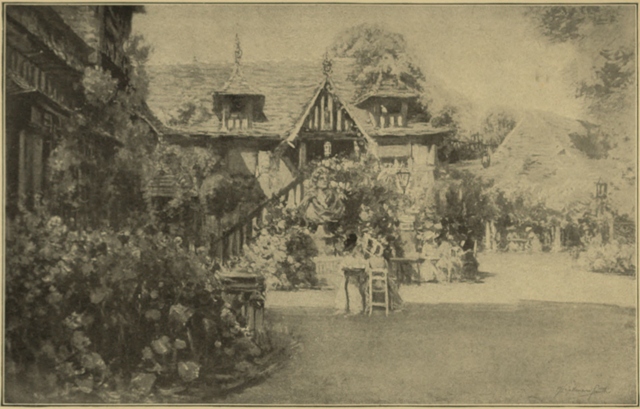 Flooding the garden, the flowers, and the roofs
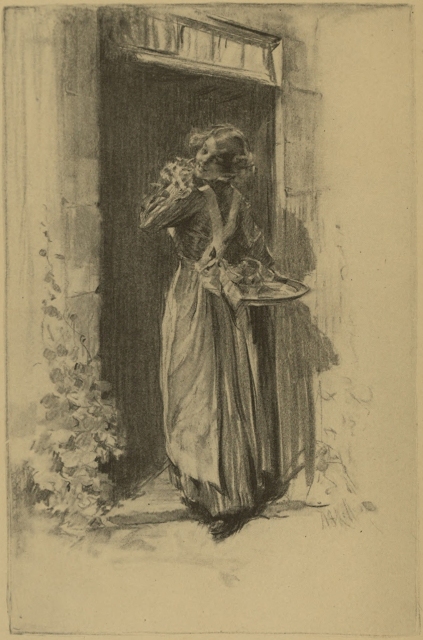
And the memories it calls up—this pungent,
fragrant, spicy perfume: memories of the cup
I drank in that old posada outside the gate
of Valencia and the girl who served it, and
the matador who stood by the window and
scowled; memories of my own toy copper
coffee-pot, with its tiny blue cup and saucer
which Luigi, my gondolier, brings and pours
himself; memories of the thimblefuls in shallow
china cups hardly bigger than an acorn
shell, that Yusef, my dragoman, laid beside
my easel in the patio of the Pigeon Mosque
in Stamboul, when the priests forbade me to
paint.
Yes!—a wonderful aroma this which our
pretty, joyous Mignon is scattering broadcast
over the court-yard, hastening every man’s
toilette that he may get down the earlier where
Leà is waiting for him with the big cups, the
crescents, the pats of freshly churned butter,
and the pitcher of milk boiling-hot from
Pierre’s fire.
Another of the pleasures of the open window
is being able to hear what goes on in the court-yard.
To-day the ever-spontaneous and delightful
Louis, as usual, is monopolizing all the
talk, with Lemois and Mignon for audience,
he having insisted on the open garden for his
early cup, which the good Leà has brought,
her scuffling sabots marking a track across the
well-raked gravel. The conversation is at long
range—Louis sitting immediately under my
window and Lemois, within reach of the kitchen
door at the other side of the court, busying
himself with his larder spread out on a table.
“Monsieur Lemois! Oh, Monsieur Lemois!”
Louis called; “will you be good enough to pay
attention! What about eggs?—can I have a
couple of soft-boiled?”
“Why, of course you can have eggs! Leà,
tell Pierre to——”
“Yes, I know, but will it endanger the life
of the chickens inside? After your sermon last
night, and Herbert’s penguin yarn, I don’t
intend that any living thing shall suffer because
of my appetite—not if I can help it.”
Lemois shrugged his shoulders in laughter,
and kept on with his work, painting a still-life
picture on his table-top—a string of silver
onions for high lights and a brace of pheasants
with a background of green turnip-tops for
darks. To see Lemois spread his marketing
thus deliberately on his canvas of a kitchen
table is a lesson in color and composition.
You get, too, some idea as to why he was able
to reproduce in real paint the “Bayeux” tapestry
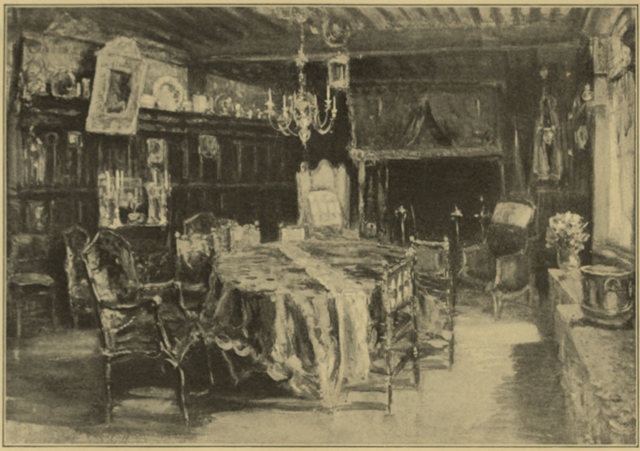
on the walls of the “Gallerie” and arrange
the Marmouset as he has done.
My ear next became aware of a certain
silence in the direction of the coffee-roaster
which had ceased its rhythm—the coffee is
roasted fresh every morning. I glanced out
and discovered our Mignon standing erect
beside her roaster with flushed cheeks and
dancing eyes. Next I caught sight of young
Gaston, his bronze, weather-beaten face turned
toward the girl, his eyes roaming around the
court-yard. In his sunburned hand he clutched
a letter. He was evidently inquiring of Mignon
as to whom he should give it.
“Who’s it for?” shouted Louis, who, as
godfather to Mignon’s romance, had also been
watching the little comedy in delight. “All
private correspondence read by the cruel parent!
I am the cruel parent—bring it over
here! What!—not for me? Oh!—for the High-Muck-a-Muck.”
The shout now came over his
left shoulder. “Here’s a letter for you, High-Muck,
from Marc, so this piscatorial Romeo
announces. Shall I send it up?”
“No—open and read it,” I shouted back.
Louis slit the envelope with his thumb-nail
and absorbed its contents.
“Well!—I’ll be—No, I won’t, but Marc
ought. What do you think he’s been and
gone and done, the idiot!”
“Give it up!”
“Invited a friend of his—a young—the Marquise
de la Caux—to dine with us to-night.
Says she’s the real thing and the most wonderful
woman he knows. Doesn’t that make
your hair curl up backward! He’s coming
down with her in her motor—be here at seven
precisely. A marquise! Well!—if that doesn’t
take the cake! I’ll bet she’s Marc’s latest
mash!”
Herbert put his head out of an adjoining
window. “What’s the matter?”
“Matter! Why that lunatic Marc is going
to bring a woman down to dinner—one of those
fine things from St. Germain. She’s got a château
above Buezval. Marc stayed there last
night instead of showing up here.”
“Very glad of it, why not?” called Herbert,
drawing in his head.
Lemois, who had heard the entire outbreak,
nodded to himself as if in assent, looked at
Gaston for a moment, and, without adding a
word of any kind, disappeared in the kitchen.
What he thought of it all nobody knew.
There was no doubt as to the seriousness of
the impending catastrophe. Marc, in his enthusiasm,
had lost all sense of propriety, and
was about to introduce among us an element
we had hitherto avoided. Indeed, one of the
enticing comforts at the Inn was its entire freedom
from petticoat government of any kind.
A woman of quality, raised as she had been,
would mean dress-coats and white ties for dinner
and the restraint that comes with the mingling
of the sexes, and we disliked both—that is,
when on our outings.
By this time the news had penetrated to
the other rooms, producing various comments.
Herbert, with his head again out of the window,
advanced the opinion that the hospitality
of madame la marquise had been so overwhelming,
and her beauty and charm so compelling,
that Marc’s only way out was to
introduce her among us. Louis kept his nose
in the air. Brierley, from the opposite side of
the court, indulged in a running fire of good-natured
criticism in which Marc was described
as the prize imbecile who needed a keeper. As
for me, sitting on the window-sill watching the
by-plays going on below—especially Louis, who
demanded an immediate answer for Gaston—there
was nothing left, of course, but a—“Why
certainly, Louis, any friend of Marc’s will be
most welcome, and say that we dine at seven.”
And yet before the day was over—so subtly
does the feminine make its appeal—that despite
our assumed disgust, each and every man
of us had resolved to do his prettiest to make
the distinguished lady’s visit a happy one. As a
woman of the world she would, of course, overlook
the crudities of our toilettes. And then,
as we soon reasoned to ourselves, why shouldn’t
our bachelor reunions be enlivened, at least for
once, by a charming woman of twenty-five—Marc
never bothered himself with any older—who
would bring with her all the perfume, dash,
and chic of the upper world and whose toilette
in contrast with our own dull clothes would be
all the more entrancing? This, now that we
thought about it, was really the touch the
Marmouset needed.
It was funny to see how everybody set to
work without a word to his fellow. Herbert
made a special raid through the garden and
nipped off the choicest October roses—buds
mostly—as befitted our guest. Louis, succumbing
to the general expectancy, occupied
himself in painting the menus on which Watteau
cupids swinging from garlands were most
pronounced. Brierley, pretending it was for
himself, spent half the morning tuning up the
spinet with a bed-key, in case this rarest of
women could sing, or should want any one
else to, while Lemois, with that same dry smile
which his face always wears when his mind is
occupied with something that amuses him, ordered
Pierre to begin at once the preparation
of his most famous dish, Poulet Vallée d’Auge,
spending the rest of the morning in putting a
final polish on his entire George III coffee service—something
he never did except for persons,
as he remarked, of “exceptional quality.”
Not to be outdone in courtesy I unhooked
the great iron key of the wine-cellar from its
nail in Pierre’s kitchen, and swinging back the
old door on its rusty hinges, drew from among
the cobwebs a bottle of Chablis, our heavier
Burgundies being, of course, too heating for so
dainty a creature. This I carried in my own
hands to the Marmouset, preserving its long-time
horizontal so as not to arouse a grain of
the sediment of years, tucking it at last into a
crib of a basket for a short nap, only to be
again awakened when my lady’s glass was ready.
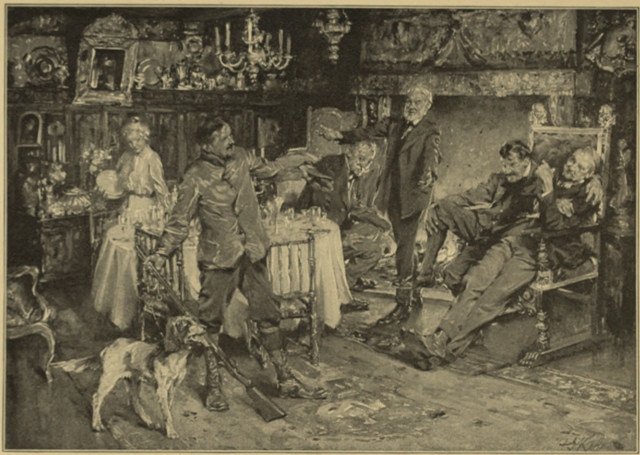
When the glad hour arrived and we were
drawn up to receive her—every man in his best
outfit—best he had—with a rosebud in his button-hole—and
she emerged from the darkness
and stood in the light of the overhead candles—long,
lank Marc bowing and scraping
at her side, there escaped from each one of us,
all but Lemois, a half-smothered groan which
sounded like a faint wail.
What we saw was not a paragon of delicate
beauty, nor a vision of surpassing loveliness,
but a parallelogram stood up on end, fifty or
more years of age, one unbroken perpendicular
line from her shoulders to her feet—or rather
to a brown velvet, close-fitting skirt that reached
to her shoe-tops—which were stout as a man’s
and apparently as big. About her shoulders
was a reefing jacket, also of brown velvet, fastened
with big horn buttons; above this came
a loose cherry-red scarf of finest silk in perfect
harmony with the brown of the velvet; above
this again was a head surmounted by a mass
of fluffy, partly gray hair, parted on one side—as
Rosa Bonheur wore hers. Then came two
brilliant agate eyes, two ruddy cheeks, and a
sunny, happy mouth filled with pearl-white teeth.
One smile—and it came with the radiance
of a flashlight—and all misgivings vanished.
There was no question of her charm, of
her refinement, or of her birth. Neither was
there any question as to her thorough knowledge
of the world.
“I knew you were all down here for a good
time,” she began in soft, low, musical tones,
when the introductions were over, “and would
understand if I came just as I was. I have
been hunting all day—tramping the fields with
my dogs—and I would not even stop to rearrange
my hair. It was so good of you to let
me come; and I love this room—its atmosphere
is so well bred, and it is never so charming as
when the firelight dances about it. Ah, Monsieur
Lemois! I see some new things. Where
did you get that duck of a sauce-boat?—and
another Italian mirror! But then there is no
use trying to keep up with you. My agent
offered what I thought was three times its
value for that bit of Satsuma, and I nearly
broke my heart over it—and here it is! You
really should be locked up as a public nuisance!”
We turned instinctively toward Lemois, remembering
his queer, dry smile when he referred
to her coming, but his only reply to her
comment was a low bow to the woman of rank,
with the customary commonplace, that all of
his curios were at her disposal if she would
permit him to send them to her, and with this
left the room.
“And now where shall I sit?” she bubbled
on. “Next to you, I hope, my dear Monsieur
Herbert. You do not know me—never
heard of me, perhaps—but I know all about
you and the wonderful things you have accomplished.
And you too, Monsieur Louis. I
remember your first success as I do those of
most of the young men who have won their
medals for twenty years back. And you,
Monsieur Brierley—and—can I say it?—Monsieur
High-Muck”—and she nodded gayly at
me. “And now you will all please give your
imagination free rein. Try and remember that
I am not a hideous old woman in corduroys
and high boots, but a most delightful and bewitching
demoiselle; and please remember, too,
that I can wear a décolleté gown if I please,
only I don’t please, and haven’t pleased for
ten years or more.”
Her perfect poise and freedom from all conventionality
put us at once at our ease, making
us forget she had only been among us a few
minutes.
“And how clever you are to have chosen
this room for these delightful meetings, of which
Monsieur Marc has told me,” she continued,
her eyes wandering again over the several objects,
while her personality completely dominated
everything. “Nobody but Lemois would
have brought them all together. What a genius
he is! Think of his putting that wooden
angel where its golden crown can become an
aureole in the candle-light: he has done that
since my last visit. And that other one—really
the rarest thing he owns—in the dark
corner by the fireplace. May I tell you
about it before he comes back? It is of the
fifteenth century, and is called the ‘Bella
Nigra’—the Black Virgin. Look at it, all of
you, while I hold the candle. You see the
face is black, the legend running, ‘I am beautiful
though black because the sun has looked
at me so long.’ You notice, too, that she
has neither arms nor legs—a symbol of nobility,
showing she need neither work nor walk,
and the triple crown means that she is Queen
of Heaven, Earth, and Sea. Why he pokes
her in a dark corner I cannot imagine, except
that it is just like him to do the queerest
things—and say them too. And yet, he is
such a dear—and so funny! You cannot think
what funny things he does and says until you
watch him as I have. Why is it, Monsieur
Brierley, that you have never put him into one
of your books—you who write such charming
stories of our coast? Only this summer something
occurred which I laugh over every time
I think of it. The Cabourg races were on
and the court-yard outside was packed with
people who had come for luncheon before the
Prix Lagrange was run. They were making a
good deal of noise—a thing the old gentleman
hates, especially from loudly dressed women.
I was at the next table, sheltered from the
others, and was enjoying the curious spectacle—such
people always interest me—when I noticed
Monsieur Lemois rubbing his hands together,
talking to himself, his eyes fixed on
the group. I knew one of his storms was
brewing, and was wondering what would happen,
when I saw him start forward as another
uproarious laugh escaped one of the most
boisterous.
“‘Mademoiselle,’ he said in his softest and
most courteous tone, hat in hand, bowing first
to her and then to her male companions; ‘mademoiselle,
I love to hear you laugh; I built
this place for laughter, but when you laughed
so very loud a moment ago my flowers were so
ashamed they hung their heads,’ and then he
kept on bowing, his hat still in his hand, his
face calm, his manner scrupulously polite. Nobody
was offended. They seemed to think it was
some kind of a compliment; the rebuked woman
even turned her head toward the big hydrangeas
as if trying to find out how they really felt
about it. Oh!—he is too delicious for words.”
And so it went on until before the dinner
was over she had captured every man in the
room—both by what she said and the way she
said it—her eyes flashing like a revolving
light, now dim, now brilliant with the thoughts
behind them, her white teeth gleaming as she
talked. Marc seemed beside himself with pride
and happiness. “Never was there such a
woman,” he was pouring into Herbert’s ear;
“and you should see her pictures and her stables
and her gun-room. Really the most extraordinary
creature I have ever known! Does
just as she pleases—a tramp one day and a
duchess the next. And you should watch her
at the head of her table in her château—then
you will know what a real ‘Grande Dame’ is.”
While the others were crowding about her,
Marc eager to anticipate her every wish in the
way of cushions, footstools, and the like, I went
to find Lemois, who was just outside, his hands
laden with a tray of cordials.
“You know her then?”
“Oh, for years,” he whispered back. “I
did not tell you, for I wanted to see your surprise
and surrender. It is always the same
story with her. She does not live here except
for a month or so in the autumn, when
the small villa on the bluff above Buezval—two
miles from here—is opened; a little box
of a place filled with costly bric-à-brac. Her
great château—the one in which she really
lives—is on an estate of some thousands of
acres near Rouen, and is stocked with big game—boar
and deer. The marquis—and a great
gentleman he was—died some twenty years
ago. Madame paints, carves ivories, binds
books, shoots, fishes, speaks five languages,
has lived all over the world and knows everybody
worth knowing. No one in her youth
was more beautiful, but the figure has gone,
as you see—and it is such a pity, for it was
superb; only the eyes and the teeth are left—and
the smile. That was always her greatest
charm, and still is—except her charities, which
never cease.”
Her musical voice was still vibrating through
the room as I re-entered.
“No, I don’t agree with you, Monsieur Herbert,”
she was saying. “It is shameful that
we do not keep closer to the usages and requirements
of the old régime. In my time a
woman would have excited comment who did
not wear her finest gown and her choicest
jewels in so select a company as this; and
often very extraordinary things happened when
any one defied the mandate. I remember one
very queer instance which I wish I could tell
you about—and it resulted in all sorts of dreadful
complications. I became so adept a fibber
in consequence that I wasn’t able to speak the
truth for months afterward—and all because
this most charming girl wouldn’t wear a low
gown at one of our dinners.”
Herbert beat the air with his hand. “Keep
still, everybody—madame la marquise is going
to tell us a story.”
“Madame la marquise is going to do nothing
of the kind. She has enough sins of her
own to answer for without betraying those of
this poor girl.”
“Hold up your hands and swear secrecy,
every one of you!” cried Louis.
“But who will absolve me from breaking the
commandment? You will never have any respect
for me again—you remember the rule—all
liars shall have their portion—don’t you?”
“If madame will permit me,” said Lemois
with a low bow, “I will be her father-confessor,
for I alone of all this group know how good she
really is.”
“Very well, I take you at your word, Fra
Lemois, and to prove how good you are, you
shall send me the Satsuma with your compliments,
and pick from my collection anything
that pleases you. But you must first let me
have a cigarette. Wait”—she twisted back
her arm and drew a gold case from the side
pocket of her jacket—“yes, I have one of my
own—one I rolled myself, and I cure my own
tobacco too, if you please. No! no more Burgundy”
(she had declined my carefully selected
Chablis and had drank the heavier wine with
the rest of us). “That Romanée Conti I
know, and it generally gets into my head,
and I don’t like anything in my head except
what I put there myself. What did you want
me to do? Oh, yes, tell you that story of my
youth.
“Well, one day my dear husband received a
letter from an English officer, a dear friend
of his with whom he had had the closest relations
when they were both stationed in Borneo.
This letter told us that his daughter, whom,
as we knew, had been captured by the Dyaks
when she was a child of eight, had been found
some three years before by a scouting party
and returned to the English agent at the
principal seaport, the name of which I forget.
Since that time she had been living with a
relative, who had sent her to school. She had
now completed her education, the letter went
on to say, and was on her way back to England
to join him, he being an invalided officer
on half-pay. Before reaching him he wanted
her to see something of the world, particularly
of French life, and knew of no one with whom
he would be more willing to trust her than
ourselves. She was just grown—in her eighteenth
year—and, although she had passed
seven years of her life among a wild tribe, was
still an English girl of prepossessing appearance.
“Well, she came—a beautifully formed,
graceful creature, with flashing black eyes, a
clear skin, and with a certain barbaric litheness
when she moved that always reminded me of a
panther, it was so measured, and had such
meaning in it. She brought some expensive
clothes, but no décolleté dresses of any kind,
which surprised me, and when I offered to lend
her my own—we were of about the same size—she
refused politely but firmly, which surprised
me all the more, and went right on wearing her
high-necked gowns, which, while good in themselves—for
her people were not poor—were not
exactly the kind of toilettes my husband and
my guests had been accustomed to—certainly
not at dinners of twenty.
“At every other function she was superb,
and for each one had the proper outfit and of
the best make. She rode well, danced well,
sang like a bird, could shoot and hunt with
any of us, and, with the exception of this curious
whim—for her form was faultless—was
one of the most delightful creatures who ever
stayed with us—and we had had, as you
may suppose, a good many. The subjects she
avoided were her captivity and the personnel
of those with whom she had lived. When
pressed she would answer that she had told
the story so often she was tired of it; had
banished it from her mind and wished everybody
else would.
“Then the expected happened. Indeed I
had begun to wonder why it had not happened
before. A young Frenchman, the only son of
one of our oldest families, a man of birth and
fortune, fell madly in love with her. The
mother was up in arms, and so was the father.
She was without title, and, so far as they knew,
without fortune in her own right; was English,
and the match could not and should not take
place.
“How the girl felt about it we could not
find out. Sometimes she would see him alone,
generally in the dusk of the evening on the
lawn, but though she was English, and we had
given the full limit of her freedom, she always
kept within sight of the veranda. At other
times she refused to see him altogether, sending
word she was ill, or engaged, or had friends,
all of which I found extraordinary. This went
on until matters reached a crisis. She knew
she must either send him about his business or
succumb: this was her problem. His problem
was to win her whether or no; if not here,
then in England, where he would follow her;
and he took no pains to conceal it. His persistence
was met by a firm refusal, and finally by
a command to leave her alone. The dismissal
was given one night after dinner when they
were together for a few minutes in the library,
after which, so my maid told me, she went to
her room and threw herself on her bed in an
agony of tears.
“But there is nothing for sheer obstinacy
like a Frenchman in love. Indeed he was too
far gone to believe a word she said or take no
for an answer, and as my grounds were next to
his mother’s, and the two families most intimate,
he still kept up his visits to the house,
where, I must say, he was always welcome,
for my husband and I liked him extremely,
and he deserved it. His mother, objecting to
the marriage, wanted to keep him away. She
insisted—all this I heard afterward—that the
girl was half savage and looked and moved like
one; that she had doubtless been brought up
among a lawless tribe who robbed every one
around them; that there was no knowing what
such a girl had done and would not do, and
that she would rather see her son lying dead
at her feet—the usual motherly exaggeration—than
see him her victim. This brought him
at last to his senses, for he came to me one day
and wanted me to tell him what I knew of her
antecedents as well as the story of her captivity
and life with the savages. This was a difficult
situation to face, and I at first refused to discuss
her private affairs. Then I knew any
mystery would only make him the more crazy,
and so I told him what I knew, omitting the
more intimate details. Strange to say, Frenchman-like,
it only maddened him the more—so
much so that he again waylaid her and asked
her some questions which made her blaze like
coals of fire, and again the poor girl went to
bed in a flood of tears.
“Then the most puzzling and inexplicable
thing happened. I had a very deep topaz of
which I was passionately fond—one given me
by my dear husband shortly after we were married.
I generally kept it in my small jewel
case, to which only my maid and I had the key.
This night when I opened it the jewel was gone.
My maid said she remembered distinctly my
putting it, together with the chain, in the box,
for my guest was with me at the time and had
begged me to wear it because of its rich color,
which she always said matched my eyes. At
first I said nothing to any one—not even my
husband—and waited; then I watched my
maid; then my butler, about whom I did not
know much, and who was in love with the
maid, and might have tempted her to steal it.
And, last of all—why I could not tell, and cannot
to this day, except for that peculiar pantherlike
movement about my guest—I watched
the girl herself. But nothing came of it.
“Then I began to talk. I told my husband;
I told the young man’s mother, my intimate
friend, who told her son, she accusing the girl, of
course, without a scintilla of proof; I told my
butler, my maid—I told everybody who could
in any way help to advertise my loss and the
reward I was willing to pay for its recovery.
Still nothing resulted and the week passed without
a trace of the jewel or the thief.
“One morning just after luncheon, when I
was alone in my little boudoir and my husband
and the young man were having their coffee
and cigarettes on the veranda outside, the girl
walked in, made sure that no one was within
hearing, and held out her hand. In the palm
was my lost topaz.
“‘Here is your jewel,’ she said calmly; ‘I
stole it, and now I have brought it back.’
“‘You!’ I gasped. ‘Why?’
“‘To disgust him and make him hate me so
that he will never see me again. I love him
too much to give myself to him. In my madness
I thought of this.’
“‘And you want him to know it!’ I cried
out. I could hardly get my breath, the shock
was so great.
“‘Yes—here!—NOW!’ She stepped to the
door. ‘Monsieur,’ she called, ‘I have something
to tell you. I have just brought back
her jewel—I stole it! Now come, madame,
to my room and I will tell you the rest!’
“I followed her upstairs, leaving the horror-stricken
young man dazed and speechless. She
shut the door, locked it, and faced me.
“‘I have lied to both of you, madame. I
did not steal your jewel; nobody stole it. I
found it a few minutes ago under the edge of
the rug where it had rolled; you dropped it in
my room the night you wore it. In my agony
to find some way out I seized on this. It
came to me in a flash and I ran downstairs
clutching it in my hand, knowing I would be
lost if I hesitated a moment. It is over now.
He will never see me again!’
“I stood half paralyzed at the situation; she
erect before me, her eyes blazing, her figure
stretched to the utmost, like an animal in pain.
“‘And you deliberately told him you were
a thief!’ I at last managed to stammer out.
‘Why?’
“‘Because it was the only way to escape—it
was the only way out. I never want him
to think of me in any other light—I want to
be dead to him forever! Nothing else would
have done; I should have yielded, for I could
no longer master my love for him. Look!’
“She was fumbling at her dress, loosening
the top buttons close under her chin; then she
ripped it clear, exposing her neck and back.
“‘This is what was done to me when I was
a child!’
“I leaned forward to see the closer. The
poor child was one mass of hideous tattoo
from her throat to her stays!
“‘Now you know the whole story,’ she
sobbed, her eyes streaming tears; ‘my heart
is broken but I am satisfied. I could have
stood anything but his loathing.’
“With this she fastened her dress and walked
slowly out of the room, her head down, her
whole figure one of abject misery.”
Madame leaned forward, picked up her goblet
of water, and remarking that walking in the
wind always made her thirsty, drained its
contents. Then she turned her head to hide
her tears.
“A most extraordinary story, madame. Did
the young fellow ever speak of the theft?”
asked Herbert, the first of her listeners to
speak.
“No,” she answered slowly, in the effort to
regain her composure, “he loved her too much
to hear anything against her. He knew she
had stolen it, for he had heard it from her own
lips.”
“And you never tried to clear her character?”
“How could I? It was her secret, not mine.
To divulge it would have led to her other and
more terrible secret, and that I was pledged to
keep. She is dead, poor girl, or I would not
have told you now.”
“And what did you do, may I ask?” inquired
Brierley.
“Nothing, except tell fibs. After she had
gone the following morning I excused her to
him, of course, on every ground that I could
think of. I argued that she had a peculiar
nature; that owing to her captivity she had perhaps
lost that fine sense of what was her own
and what was another’s; that she had many
splendid qualities; that she had only yielded to
an impulse, just as a Bedouin does who steals
an Arab horse and who, on second thought,
returns it. That I had forgiven her, and had
told her so, and as proof of it had tried, without
avail, to make her keep the topaz. Only
my husband knew the truth. ‘Let it stay as
it is, my dear,’ he said to me; ‘that girl has
more knowledge of human nature than I credited
her with. Once that young lover of hers
had learned the cruel truth he wouldn’t have
lived with her another hour.’”
“I think I should have told him,” remarked
Louis slowly; the story seemed to have strangely
moved him. “If he really loved her he’d have
worn green spectacles and taken her as she was—I
would. Bad business, this separating lovers.”
“No, you wouldn’t, Louis,” remarked Herbert,
“if you’d ever seen her neck. I know
something of that tattoo, although mine was
voluntary, and only covered a part of my arm.
Madame did just right. There are times when
one must tell anything but the truth.”
Everybody looked at the speaker in astonishment.
Of all men in the world he kept closest
to the exact hair-line; indeed, one of Herbert’s
peculiarities, as I have said, was his always
understating rather than overstating a fact.
“Yes,” he continued, “the only way out is
to ‘lie like a gentleman,’ as the saying is, and
be done with it. I’ve been through it myself
and know. Your story, madame, has brought
it all back to me.”
“It’s about a girl, of course,” remarked Louis,
flashing a smile around the circle, “and your
best girl, of course. Have a drop of cognac,
old man,” and he filled Herbert’s tiny glass.
“It may help you tell the whole truth before
you get through.”
“No,” returned Herbert calmly, pushing the
cognac from him, a peculiar tenderness in his
voice; “not my best girl, Louis, but a gray-haired
woman of sixty—one I shall never
forget.”
Madame laid her hand quickly on Herbert’s
arm; she had caught the note in his voice.
“Oh! I’m so glad!” she said. “I love stories
of old women; I always have. Please go
on.”
“If I could have made her young again,
madame, you would perhaps have liked my
story better.”
“Why? Is it very sad?”
“Yes and no. It is not, I must say, exactly
an after-dinner story, and but that it
illustrates precisely how difficult it is sometimes
to speak the truth, I would not tell it
at all. Shall I go on?”
“Yes, please do,” she pleaded, a tremor now
in her own voice. It was astonishing how simple
and girlish she could be when her sympathies
were aroused.
“My gray-haired woman had an only son,
a man but a few years younger than myself,
a member of my own party, who had died
some miles from our camp at Bangala, and
it accordingly devolved upon me not only to
notify his people of his death, but to forward
to them the few trinkets and things he had
left behind. As I was so soon to return to
London I wrote his people that I would bring
them with me.
“He was a fine young fellow, cool-headed,
afraid of nothing, and was a great help to me
and very popular with every one in the camp.
Having been sent out by the company to
which I belonged, as were many others during
the first years of our stay on the Congo,
he had already mastered both the language
and the ways of the natives. When a powwow
was to be held I always sent him to conduct
it if I could not go myself. I did so, too,
when he had to teach the natives a lesson—lessons
they needed and never forgot, for he
was as plucky as he was politic.
“I knew nothing of his people except that
he was a Belgian whose mother, Madame
Brion, occupied a villa outside of Brussels,
where she lived with a married daughter.
“On presenting my card I was shown into
a small library where the young woman received
me with tender cordiality, and, after
closing the door so that we might not be overheard,
she gave me an outline of the ordeal
I was about to go through. With her eyes
brimming tears she told me how her mother
had only allowed her son to leave home because
of the pressure brought to bear upon
her by his uncle, who was interested in the
company; how she daily, almost hourly,
blamed herself for his death; how, during the
years of his absence, she had lived on his letters,
and when mine came, telling her of his
end, she had sat dazed and paralyzed for
hours, the open page in her lap—no word escaping
her—no tears—only the dull pain of a
grief which seemed to freeze the blood in her
veins. Since that time she had counted the
days to my coming, that she might hear the
details of his last illness and suffering.
“You can imagine how I felt. I have never
been able to face a woman when she is broken
down with grief, and but that she was expecting
me every minute, and had set her heart on
my coming, I think I should have been cowardly
enough to have left the house.
“When the servant returned, I was conducted
up the broad staircase and into a small
room hung with wonderful embroideries and
pictures and filled with flowers. In one corner
on an easel was Brion’s portrait in the
uniform of an officer, while all about were
other portraits—some taken when he was a
child, others as a boy—a kind of sanctuary,
really, in which the mother worshipped this
one idol of her life.”
Herbert stopped, drew the tiny glass of
cognac toward him, sipped its contents slowly,
the tenderness of tone increasing as he went on:
“She greeted me simply and kindly, and led
me to a seat on the sofa beside her, where she
thanked me for the trouble I had taken, her
soft blue eyes fixed on mine, her gentle, high-bred
features illumined with her gratitude, her
silver-gray hair forming an aureole in the light
of the window behind her, as she poured out
her heart. Then followed question after question;
she wanting every incident, every word
he had uttered; what his nursing had been—all
the things a mother would want to know.
Altogether it was the severest ordeal I had been
through since I left home—and I have had some
trying ones.
“For three hours I sat there, giving her minute
accounts of his illness, his partial recovery,
his relapse; what remedies I had used; how he
failed after the fourth day; how his delirium
had set in, and how at the last he had passed
peacefully away. Next I described the funeral,
giving a succinct account of the preparations;
how we buried him on a little hill near a spring,
putting a fence around the grave to keep any
one from walking over it. Then came up the
question of a small head-stone. This she insisted
she would order cut at once and sent out
to me—or perhaps one could be made ready
so that I might take it with me. All this I
promised, of course, even to taking it with me
were there time, which, after all, I was able
to do, for my steamer was delayed. And so I
left her, her hands on my shoulders, her eyes
fixed on mine in gratitude for all I had done for
her dead son.”
“Oh!—the poor, dear lady!” cried madame
la marquise, greatly moved, her hands tight
clasped together. “Yes, I believe you—nothing
in all your experience could have been as
painful!”
Brierley raised his head and looked at Herbert:
“Rather a tight place, old man, awful tight
place,” and his voice trembled. “But where
does the lie come in? You told her the truth,
after all.”
“Told her the truth! I thought you understood.
Why I lied straight through! There
was no grave—there never had been! Her son
and his three black carriers had been trapped
by cannibals and eaten.”
Madame started from her chair and clutched
Herbert’s hand.
“Oh!—how terrible! No! you could not
have told her!—I would never have liked you
again if you had told her. Oh! I am so glad
you didn’t!”
“There was nothing else to do, madame,”
said Herbert thoughtfully, his eyes gazing into
space as if the recital had again brought the
scene before him.
“Pray God she never found out!” said the
marquise under her breath.
“That has always been my consolation, madame.
So far as I know she never did find
out. She is dead now.”
“And I wish we had never found out either!”
groaned Louis. “Why in the world do you
want to make goose-flesh crawl all over a fellow!
An awful, frightful story. I say, Herbert,
if you’ve got any more horrors keep ’em
for another night. I move we have a rest.
Drag out that spinet, Brierley, and give us
some music.”
“No, please don’t!” cried the marquise.
“Tell us another. I wish this one of Monsieur
Herbert’s was in print, so that I could
read it over and over. Think how banal is
our fiction; how we are forever digging in the
same dry ground, turning up the same trivialities—affairs
of the heart, domestic difficulties—thin,
tawdry romances of olden times, all the
characters masquerading in modern thought—all
false and stupid. Oh! how sick I am of it
all! But this epic of Monsieur Herbert means
the clash of races, the meeting of two civilizations,
the world turning back, as it were, to
measure swords with that from which it sprung.
And think, too, how rare it is to meet a man
who in his own life has lived them both—the
savage and the civilized. So please, Monsieur
Herbert, tell us another—something about the
savage himself. You know so many things and
you are so human.”
“He doesn’t open his lips, madame, until
I get some fresh air!” cried Louis. “Throw
back that door, Lemois, and let these hobgoblins
out! No more African horrors of any
kind! Ladies and gentlemen, you will now
hear the distinguished spinetist, Herr Brierley,
of Pont du Sable, play one of his soul-stirring
melodies! Up with you, Brierley, and
take the taste out of our mouths!”