SOME OF ITS PHYSICAL FEATURES
The evolution of the Argentine Republic of
to-day from the position of an obscure Spanish
dependency laboring under the disabilities of
colonial government, into one of the great
countries of the world whose watchwords are
"progress" and "freedom," may be said to
date from May 25, 1810, when the people of
Buenos Aires declared their independence and
established the United Provinces of the River
Plate. From that date forward, until May
25, 1853, when the Federal Constitution of
the Argentine Republic was proclaimed at
Santa Fé and even to a later period, the history
of that country bears many points of
resemblance to the early history of the United
States. Just as the United States had to subdue
savage Indians, to enter into war and to
offer great sacrifices to develop the resources
of vast uninhabited territories in order to establish
the principles of liberty and justice,
the Argentine Republic has successfully conquered
the same difficulties and, to-day, is
inviting the rest of the world to add to its developments
and to share its wealth. In the
disposition of its territories, in its form of
government and in its constitution and laws,
the Argentine Republic has modelled its policy
upon that of the United States.
Situated in the southern portion of South
America, the Republic, which is divided into
fourteen Provinces (States) and ten National
Territories, is bounded on the north by Bolivia,
Paraguay and Brazil; on the east by Paraguay,
Brazil and Uruguay; and on the south
and west by Chile. It embraces the most important
sections of the vast estuary of the River
Plate, with its entire line of coast on the Atlantic
Ocean. Within its extensive areas, covering
about 1,150,000 square miles, the possibilities
of production are practically unlimited
owing to the wealth of the soil and the variety
of its climate, which includes the sub-tropical,
the temperate and the cold regions. Yet, in
none of these is to be found the extreme, as may
be judged by health statistics and by the figures
of the rates of mortality and longevity, which
are respectively lower and higher than in any
country of Europe.
Geographically, the Argentine Republic may
be divided into three sections: the western, or
Andine, the Pampean, and the Mesopotamian.
The western is mountainous and comprises the
long strip sheltered by the Cordillera of the
Andes and its ramifications. It contains
numerous valleys of varied character and
abounds in mineral wealth. The northern and
Andine provinces and the western part of the
southern territories are included in this division.
The Pampean section embraces the southern
and central part of the Republic from the
eastern portions of the Province of Salta, with
the Territories of Formosa and the Chaco,
down to the territories in the south; they include
the plains stretching south and extending
through the rich Provinces of Santa Fé
and Buenos Aires. This section, as its name
indicates, is one vast plain rolling towards the
south-east. It is crossed by innumerable rivers
and streams which descend from the Andes,
and either lose themselves in the Pampa, or
become tributaries of the great river system of
the Paraná, or flow on till they join the Atlantic
Ocean. In this section there are some
few isolated ranges of hills, besides numerous
lakes and lagoons with swamps and salt
marshes, while a rich and varied vegetation
gives sustenance to millions of cattle. The
Mesopotamian section lies between the Rivers
Paraná and Uruguay and comprises the
Provinces of Entre Rios and Corrientes, and
the territory of Misiones. At its southern extremity
is the beautiful delta of the Paraná
studded with islands of rich soil and fertile
vegetation. Advancing northwards, the land
becomes undulating with tree-clad hill slopes,
intersected by a network of rivulets and
streams which water rich meadows and woodland
and stretch to the north over a great
part of the Province of Corrientes. Here the
land dips in a remarkable manner, forming
great lagoons and marshes and once more
changes its character in the Territory of
Misiones, where hills abound, covered with forests
which extend far inland. There are also
various systems and ranges of mountains, the
principal chain being that of the Andes, which
extends from north to south as far as Tierra
del Fuego, and constitutes a giant boundary
wall between Argentina and Chile; but even
the barrier created by this great chain of
mountains—at some points of a height approaching
15,000 feet—to rapid communication
between the two countries has been removed
by the opening of railway communication
which now permits of the journey from
one side of the mountains to the other, to be
performed, during the greater part of the year,
in a comparatively few hours.
Other physical features of the Argentine
Republic have been so much more fully referred
to elsewhere in these pages that it is
merely necessary for the purposes of this
brief sketch to make some reference to the Constitution
in its relation to national progress.
As stated above, the Federal Constitution of
the Argentine Republic is almost a counterpart
of the American Constitution and is based
upon the broadest principles of liberty and
justice, with even fewer limitations in regard
to foreign residents than are imposed by the
Constitution of the United States. Nor is
there any doubt that in an almost equal degree
to its great natural resources, the remarkable
development and advance of the Republic
is due to its liberal Constitution and to the
legislation enacted in terms of its provisions.
The principles it embodies have been carried
into practice in all its laws. In that Republic
there is perfect religious and civil freedom;
there are no restrictions upon healthy immigration,
or upon the nationality of land owners.
The right is accorded to every inhabitant,
native or foreign, to engage in any lawful commerce
or occupation, to petition the authorities,
to enter, remain upon, travel over, or leave
Argentine territory at will; and to use and
dispose of property and to form part of any
society or association having lawful purposes.
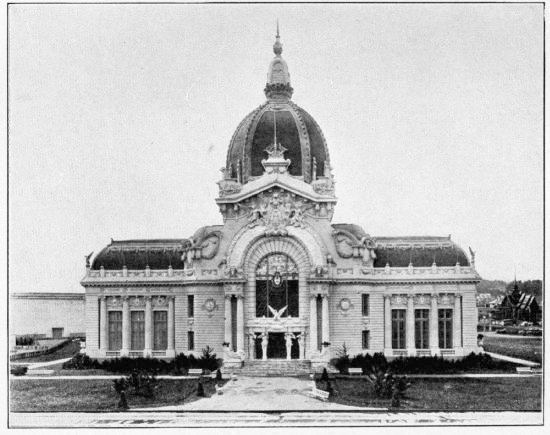
THE ARGENTINE PAVILION AT THE PANAMA PACIFIC EXPOSITION
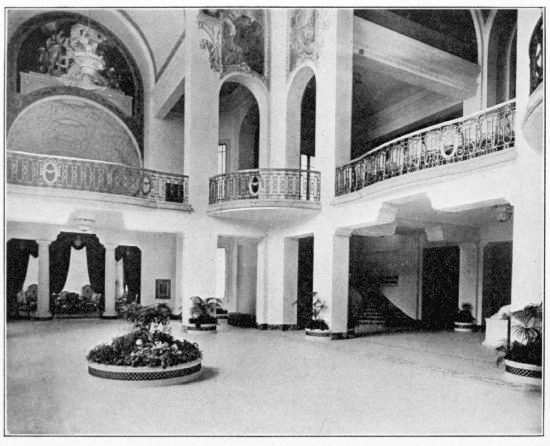
INTERIOR VIEW OF THE ARGENTINE PAVILION AT THE PANAMA
PACIFIC EXPOSITION
Under its provisions the right of property is
inviolate and prerogatives of blood, of birth,
or titles of nobility are not recognized, all men
being equal under the law. The composition
of the judiciary, the executive and the legislative
branches of government, differs only from
that of the United States in that all judges are
appointed and not elected.
Each of the fourteen Provinces of the Republic
has its own Constitution, which cannot
be in conflict with the Federal Constitution
which provides a necessarily limited degree of
autonomy in the government of the Provinces.
The Federal Constitution prohibits the State
Government from usurping such functions of
the Federal Government as entering into treaties
with foreign Powers, enacting laws affecting
interstate or foreign commerce, navigation,
citizenship, naturalization, the coining
of money, or the establishment of custom
houses. The organization of its tribunals and
the creation of its own laws and forms of
procedure is an absolute State right; but the
Federal, Civil, Commercial, Penal and Mining
Laws are in force throughout the Republic,
the Custom Houses and Tariffs being also
under the supreme control of the Federal
Government. These restricted autonomous
powers were wisely provided to prevent the
conflict of laws which is of frequent occurrence
under other Federal systems. The
protection of the moral and material interests
of foreign residents of the Republic, or of
foreigners having interests therein, is scrupulously
enforced by the Courts according to the
Constitution where such questions are involved;
and frequent decisions have been given
by the Federal Tribunals in that direction in
order to maintain the inviolability of the Constitution
which was framed in the interest of
the Argentine nation and of "all the people of
the world who may reside in Argentine territory."
THE PROGRESS OF TWO DECADES
In the succeeding review of the progress
achieved by the Argentine Republic during the
past twenty years, by a comparison of the
facts and figures relating largely to commercial
movement, uniformity of date has been
overlooked and particular years have been selected,
in some cases, for the reason that official
figures have not been available to equalize
the comparisons, although most of the
figures given are embraced within the period
named.
The factors which, in a material sense, contribute
chiefly to the progress of a nation, are
its sources of production, its means of communication
both within and beyond its territories,
its domestic and fiscal legislation and
the labor and enterprise of its people. It is
therefore to these matters that it is principally
intended to draw attention, in so far as
they pertain to the national industries, to home
and foreign trade, to railways, to ports and
shipping, to finance and to the general advance
in all matters of a kindred nature; and as this
purpose will be better served by a straight-forward
and concise formulation of official
figures shorn of all comment which might tend
to obscure their real significance, the form in
which they are presented will convey, at a
glance, the extraordinary growth of the Argentine
Republic:
AREA UNDER CULTIVATION
The area under cultivation in 1892
for Wheat, Linseed, Corn, Alfalfa, and
similar products totalled 3,700,000 hectares
(250 hectares being equal to
nearly one square mile) and in 1912
to 22,987,726 hectares, showing an increase
of the cultivated areas of more
than six times the extent of twenty years
previously.
EXPORTS AND IMPORTS
In 1895 the total exports of the Argentine
Republic amounted to $120,067,790,
and the total imports for the same year
to $95,096,438, whilst in 1913 the value
of the exports reached $483,504,547, and
the imports $421,352,542.[A]
MILEAGE OF RAILWAYS
In 1895 the total length of railways
in operation was 8,820 miles and in 1913
21,000 miles, with many thousands more
projected and since placed under construction.
TONNAGE OF SHIPPING
The aggregate tonnage of vessels entered
at and cleared from Argentine ports
in the year 1900 was 25,241,618, whilst
in 1913 the total tonnage was 56,604,833.79.
POPULATION
The national census of 1869 gave the
population of the country as 1,830,214,
whereof the city of Buenos Aires had 187,346
inhabitants. According to the census
of 1895, the total population amounted
to 3,954,911, with that of the capital at
663,854. A new census, taken May,
1913, is now being compiled, but from figures
supplied we know the population of
the city was at that time 1,560,000 inhabitants.
According to the Division of Statistical
and Rural Economy, the entire
population of the Republic in 1911 was
estimated to be 7,467,878. The latter
figures are necessarily based upon incomplete
returns and have probably been estimated
upon a ratio of increase established
by earlier calculations; but all indications
point to the probability that on the completion
of the new census, during the present
year, the total population of the Republic
will approach 10,000,000.
INVESTMENT OF FOREIGN CAPITAL
The investment of foreign capital in
the Argentine Republic has assumed far
greater proportions during the past
twenty years than in any other corresponding
period since its formation. As
one example of importance, it may be
stated that the total capital invested in
private and government-owned railways
in the year 1895 amounted to $485,360,121,
whilst in 1913 the capital employed
in railways operating in the Argentine
Republic reached $1,210,475,331, of which
over ninety per cent is British. In 1895
the foreign capital invested in the Republic,
including, at that time, about
$400,000,000 of External National Debt,
barely exceeded $1,000,000,000. An official
estimate of foreign capital invested in
the country at the end of 1910 gave the
following figures:
| | $Gold |
| 1. | Loans and various Argentine Bonds | 691,831,000 |
| 2. | Railways | 804,413,000 |
| 3. | Banks | 37,541,000 |
| 4. | Ports | 22,164,000 |
| 5. | Street car lines | 91,576,000 |
| 6. | Freezing plants | 8,392,000 |
| 7. | Gas and electric companies,
water works and sanitary works | 58,035,000 |
| 8. | Land and loan companies | 160,800,000 |
| 9. | Other companies | 41,650,000 |
| 10. | Mortgages and properties | 150,000,000 |
| 11. | Commerce and credit | 200,000,000 |
| | Grand total | $2,266,402,000 |
GOLD RESERVES
The vast increase in exports during
latter years has naturally attracted considerable
imports of gold; and, as showing
the wealth and stability of the Republic,
it may be mentioned that the Conversion
Fund created by law in 1901 to
secure the national issues of paper and
nickel currency (which was then to consist
of appropriations from certain
sources of revenue until a total of $30,000,000
had been obtained) showed at
December 31st, 1913, gold reserves in the
Caja de Conversion to be $233,197,727,
or considerably more than 60 per cent.
of the entire issues of paper and nickel
currency.
CUSTOM HOUSE REVENUE
The Custom House Revenue on import
duties for 1903 amounted to $37,191,857,
and in 1913 to $98,978,745.
When it is remembered that the Argentine
Republic covers an area of about one-third
of the United States and that up to the present
time not nearly one-fifth of its productive
soil has been placed under cultivation, the
figures relating to its production will leave little
doubt that the world, in the not distant
future, will find in that favored land one of
the main sources of its food supply. But it is
not alone in the development of the agricultural
and pastoral industries that the great
advance of the Republic is to be noted. In
every form of national activity the forward
march of the Argentine Republic has made itself
felt far beyond its own borders; while
from a purely commercial point of view it has
become a centre of universal interest and has
added materially to the enrichment of the commerce
of many of the countries of Europe.
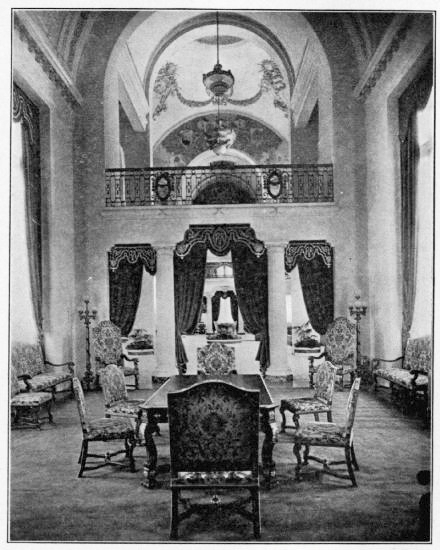
ONE OF THE RECEPTION ROOMS OF THE ARGENTINE
PAVILION AT THE PANAMA PACIFIC EXPOSITION
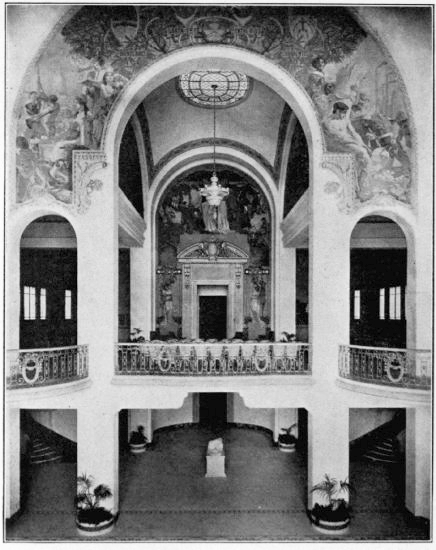
ANOTHER INTERIOR VIEW OF THE ARGENTINE PAVILION
AT THE PANAMA PACIFIC EXPOSITION WHERE THE
ARTISTIC RICHNESS OF THE MURAL DECORATIONS
CAN BE APPRECIATED
In legislation there have been many notable
advances during the past twenty years and, in
some cases, examples worthy of being followed
by older communities. Amongst the
most important legislative measures, those
dealing with immigration, colonization, electoral
reform, land settlement, education, labor,
animal and sanitary laws, may be singled out
for special mention. The immigration laws
have been framed, since their inception, with a
view to inviting foreigners to share in the development
and enjoyment of the national
wealth. No restrictions are imposed upon the
entry of immigrants other than those which
have for their object the exclusion of the criminal
classes or persons who are physically or
mentally unsound. Not only can the immigrant
acquire rich government land on conditions unequalled
in other new countries, but provision
is also made for the supply of the necessary
funds to furnish the colonist with implements
and other equipment to enable him to reap an
ample reward for his labors. The naturalization
laws impose no difficulties in the acquisition
of citizenship, although there is absolute
freedom on the part of the alien resident to
hold land and property and to enjoy all the
privileges conferred upon inborn citizens, except
that of voting at Congressional or Presidential
elections. Even certain public positions
may be held by foreigners without naturalization.
In electoral matters, the law recently
passed to enforce compulsory voting at
elections has already produced excellent results
and has succeeded in removing attempts
at coercion and the exercise of undue influence
in the return of candidates for elective
offices; and most of these legislative reforms
have been effected during the past twenty
years.
Although not precisely within the period
under review, the enactment of the Conversion
Law of 1891 has had such far-reaching effects
upon the financial situation and general
stability of the Republic that it should not
be omitted from a record of national legislation
dating from even four years later. Prior
to the passage of that law, violent fluctuations
in the premium of gold, induced by speculation,
led to so much disturbance of commerce
as to render it necessary to place the national
currency on a more substantial basis. With
that object in view an average was taken and
the value of paper currency was fixed by the
law at 44 per cent of the value of gold, in
other words, making $227.27, currency, equal
to $100 gold. The law further provided for
the establishment of a Conversion Fund, which
was to be formed by the appropriation of certain
sources of revenue and to be added to by
annual increments until it reached a total of
$30,000,000 gold, which with the gold reserves
then existing and to be accumulated were to
be employed exclusively for the public exchange
of gold and paper at the rate fixed.
As shown in the figures relating to gold reserves,
the accumulation of gold held in the
Caja de Conversion for the purposes of the law,
at December 31, 1913, amounted to $233,197,727,
representing upwards to 60 per cent
of the entire national currency in circulation,
a proportion not exceeded by any other country
of the world; and with the resumption of
exports upon a normal scale, which will constantly
bring more gold to the Republic, the
relation of gold reserves to currency issues will,
in a comparatively short time, be such as to
justify the creation of a definite and exclusive
gold standard as the monetary system of the
Republic.
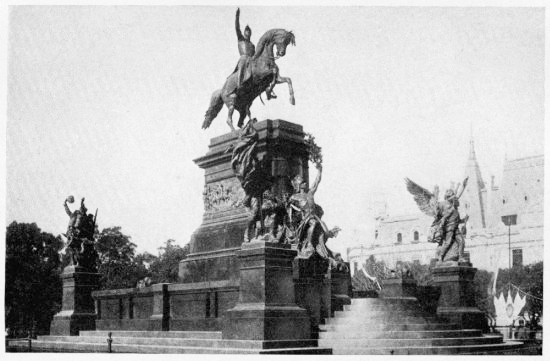
STATUE OF GENERAL SAN MARTIN, BUENOS AIRES
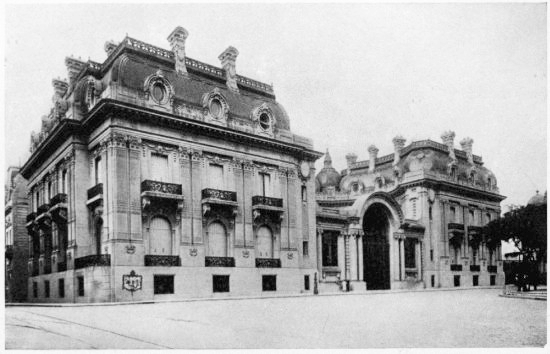
ONE OF THE PALATIAL RESIDENCES IN BUENOS AIRES
The Argentine Republic has achieved many
triumphs in diplomacy and many legitimately
claim to have made new international law for
all the countries of the American continent.
One of the most important steps yet taken in
this direction was the formulation, in 1902,
of the now universally accepted doctrine establishing
the principle that contractual debts by
Sovereign States to foreign private subjects,
or citizens, should not be collected by the employment
of armed forces. This doctrine was
propounded by the then Argentine Minister of
Foreign Affairs in a Note addressed to the
United States Government as the result of the
occupation, at that time, of the territorial
waters of an independent state by the warships
of some of the European Powers, for the
avowed purpose of compelling payment to their
subject of claims for damages and for the
fulfilment of the service of a national debt due
to foreign creditors and then in default. This
Note aroused world-wide attention and the subject
was dealt with diplomatically by many of
the countries of Europe which had commercial
relations with the Latin-American Republics.
It formed the subject of frequent discussion at
various Pan-American Congresses, and was
particularly favored in the United States,
where, subject to certain slight modifications,
it was regarded as a logical pendant to the
Monroe Doctrine. At the Second International
Peace Conference at the Hague, in 1907,
the Doctrine was submitted for the approval of
the Conference by the American Delegation
with slight modifications and was accepted,
without dissent, by the Delegates of all the
countries represented. It is not necessary here
to enter into a discussion of the merits or importance
of this Argentine doctrine. Suffice it
to add, however, that the negation of its main
purpose would be to endanger the existence of
the Monroe Doctrine by shattering the principal
object with which that policy was conceived
and established.
Another great international movement in
which the Argentine Republic assumed a leading
part and which is likely to have far-reaching
effects in advancing the friendly relations
of the United States with the sister American
Republics, was the recent mediation of the
"A. B. C." Powers (Argentine, Brazil and
Chile). The events of that particular time are
too fresh in the memory of the American public
to need description of detail. It is sufficient
to say that the mediation referred to
averted a war which would probably have involved
the sacrifice of countless lives and of
countless millions. But the initiation of the
policy of mediation entered into on that occasion
has even more importance than that
which attaches to it as having prevented a
great and unnecessary war. It has served,
firstly, to show that the great advance made
by the leading South American Republics is
not merely an advance made for selfish purposes,
but for the benefit of the whole of the
Latin nations of the American continent. The
great statesmen of those countries, whilst
recognizing the occasionally intemperate political
acts which take place in some of the lesser
Republics, have placed a cloak of protection
around the weaker sisters of their countries to
prevent attacks upon their national independence
and sovereignty. By their offer of mediation
in the critical situation which had then
arisen on this continent, they also gave birth
to a policy which, independently of its humane
aspect, is calculated to secure the real objects
of legitimate Pan-Americanism. The United
States has invariably exhibited a spirit of justice
and of generosity in all its relations with the
other American Republics, and the "A. B. C."
mediation has not only strengthened this
wise policy on the part of the United States,
but has demonstrated the capacity and the influence,
without actual intervention, of the
most important Latin Republics to save the
less advanced countries from a sacrifice of
their national independence.
Still another step of diplomatic importance
has recently been taken by the Argentine Ambassador
at Washington by a submission of a
lengthy resolution to the governing body of
the Pan-American Union (consisting of the
Secretary of State of the United States and
the Ambassadors and Ministers of the other
twenty American Republics) with a view to
providing means for the restriction of hostilities
by belligerents in neutral waters. This
course was adopted in consequence of the hardships
and difficulties imposed on the South
American Republics and on other neutral countries
through the present war in Europe and
through the prevailing indefinite character of
the international rules and of international law
in the definition of the respective rights of neutrals
and belligerents. Whilst it would be difficult
to assume that any reforms will be effected
during the continuance of the present
war in Europe or immediately thereafter, it is
reasonable to suppose that the substantive
portions of the Argentine Ambassador's resolution
will influence succeeding international
Conferences to so regulate these vital matters
as to confine naval operations within limits
which, in future wars, will not place so heavy
a burden upon the coastal and oversea trade
of neutral countries.
In its relations with the different countries
of the world the Republic enjoys the most
friendly intercourse and shares the privileges
accorded to the great Powers in international
commercial treaties. It has never failed to
fulfil its national obligations either at home or
abroad; it has no ambitions for territorial expansion
and desires only to maintain internal
and external peace in order to extend the country's
material prosperity and the welfare of
its inhabitants.
PRIMARY EDUCATION
Primary Education owes its present state
of development to that master Patriot, Pedagogue
and President of the Republic, Domingo
F. Sarmiento, who as a personal friend and
student of the noted American Educator had
every opportunity to introduce the best that
he considered practicable into the educational
system of Argentina.
The education of youth of Argentina is the
concern of state authorities who work in harmony
with the educational bodies of its cities,
towns and villages. The exception to it consists
in the control of the Primary schools of
the Federal city of Buenos Aires by the National
Board of Education, together with some
other exceptions to be mentioned later on.
One of the more recent and far-reaching developments
of this Federal control is the fact,
that in some of the provinces (States) Primary
schools are established and subsidized by the
Federal Government, where local conditions are
equal to the needs of popular education.
Argentina maintains therefore in some of
the provinces the regular State controlled as
well as Federal Government controlled Primary
schools; likewise are many of the Special type
schools controlled by the National Government.
In 1894 there were 3000 Primary schools,
Public and Private, which increased during the
next twenty years to 7877 schools; likewise
did the teaching force of these schools grow
from 7800 to over 26,000 teachers. The pupils
attending these Primary schools in 1894 numbered
280,000, whereas in 1914 the attendance
increased to 890,000 pupils. The expenditures
incurred for the maintenance of these schools
show an even more remarkable increase of
service and efficiency. The total expenses for
Primary Education in 1894 were 9,370,000
pesos; in 1914 the expenditures rose to a figure,
six times that of 1894, 56,635,000 pesos.
In 1894 the Normal schools, 35 in number,
had an enrollment of 1376 pupils, preparing
themselves for the teaching career in Primary
schools; in the year of 1914 the number of
Normal schools increased to over 70 in number
and the enrollment to 8970 students, more
than six times of its enrollment twenty years
ago. During this same period the expenditures
in this particular department of public education
rose from 2,000,000 pesos to that of
10,000,000 pesos.
SECONDARY EDUCATION
The Secondary schools are responding also
to the modern demands of a democratic conception
of education. From mere preparatory
institutions for the Universities they are fast
becoming schools of advanced education to an
increasing number of men and women.
In 1894 the students of Secondary schools
numbered 3000, which number rose to 10,000
in 1914, the expenditures having increased
from 1,000,000 pesos to nearly 6,000,000 pesos
in the year of 1914.
TECHNICAL EDUCATION
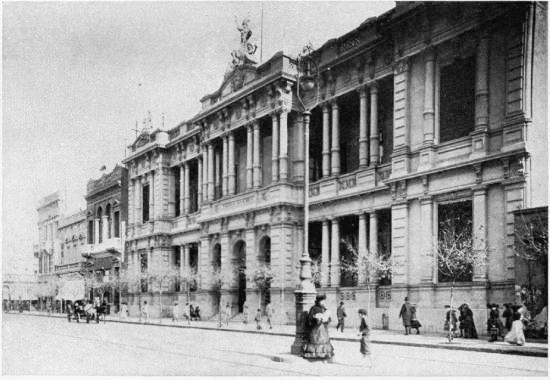
PRESIDENT ROCA SCHOOL, BUENOS AIRES
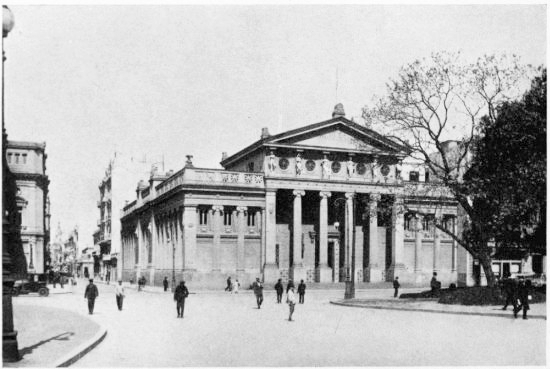
THE RODRIGUEZ PEÑA SCHOOL, BUENOS AIRES
Technical education is also a matter of recent
development, there having been organized and
are maintained in flourishing condition two
distinct types of technical schools. One kind
provides technical training in the various trades
for young men from 12 to 15 years, while the
second type serve to train the young men for
positions as foremen and superintendents. For
this purpose these schools give a more extensive
and intensive instruction along theoretical and
practical science as far as it applies to these
various trades. There are 4 large schools of
each one of these two types, supported and
controlled by the National Government at a
yearly expense of 1½ millions of pesos. In
addition to these, there are 15 Trade schools
for girls, also under the control of the National
Government, giving instructions in the trades
wherein girls predominate, such as millinery,
dressmaking, flower-making, telegraph operators,
stenographers and typewriters, glove-making,
and so forth.
COMMERCIAL EDUCATION
Of recent development and also under control
of the National Government are the Commercial
schools for men and women, which provide
adequate modern instruction in salesmanship
and bookkeeping and all other affiliated
activities of commerce. These schools graduate
pupils with the rank of Bachelors of Commercial
Science and also train the certified
Public Accountants. A more recent addition
to the scope of these schools is the Degree of
Doctor, given for advanced work in Economic
Sciences. The National Government spends
about 1½ millions of pesos for this branch of
education.
AGRICULTURAL EDUCATION
Agricultural education in Argentina is of a
twofold type, general and special. The Special
or so-called REGIONAL schools, look towards the
education of future workers in special fields,
such as, for example, the sugar industries of
Tucuman. These schools specialize on the intelligent
development of special industries all
over Argentina. The curriculum of all these
schools is intensely practical, but cover and
maintain a sufficient scientific background as
these practical studies require in the various
industrial fields. These schools are also under
the control of the National Government,
through the Department of Agriculture.
The schools which provide for the thorough
scientific instruction underlying all agricultural
occupations are under the control of the
National Universities of Buenos Aires and
La Plata. The annual cost of all agricultural
schools is about 3½ millions of pesos, including
the expenses incurred in the maintenance of
experimental stations, class excursions and
University extension teaching.
MILITARY EDUCATION
Military education comprises 7 Army and 9
Navy schools for machinists, mechanics, electricians,
the officers of the Army and the Navy,
Pilots, Seamen and so forth, to which 2 million
pesos were devoted in 1914. Practical instruction
is offered in warships and particularly in
the Training-ship Presidente Sarmiento, which
visited the Panama-Pacific International Exposition
at San Francisco during the month
of May of 1915, during her 15th cruise of instruction.
UNIVERSITY EDUCATION
The Universities of Argentina maintain the
traditional faculties of Jurisprudence, Belles
Lettres and Philosophy, Pure and Applied
Science, to which recently have been added such
departments as Pedagogics, Agriculture, and
other newer departments. The enlargement of
the activities of these Universities, especially
the creation of the University of La Plata, is
proof of Argentina's advancement in this field.
The La Plata University has been instrumental
in the exchange of Professors and has encouraged
in many ways the visits of public men of
note of Europe and North America, thus recognizing
the desirability of maintaining and fostering
the most pleasant relations between
Europe and the United States of America.
Recent statistics show that the University
at Buenos Aires had on its register 1,051 students
in the Law Faculty; 210 in that of Philosophy
and Letters; 2,501 of Medicine; and
602 of Exact Sciences. The La Plata University,
according to the same figures, had 2,184
students, and the University of Córdova 584.
In point of fact, in all the liberal arts and
professions, the Argentine Republic takes one
of the first places. Literature, Music and Art
are also at a very high standard and it is perhaps
appropriate to mention here in regard to
music that not only is its study general throughout
the country but, that in Buenos Aires
alone, there are upwards of sixty Conservatories
of Music where instruction is received in the
higher branches.
In regard to the national defences, Article
21 of the Constitution provides for compulsory
service by all Argentine citizens in defence of
the country. The regular army, though comparatively
small, has attained a high state of
efficiency, which may also be said of the reserve
forces. During latter years considerable
and important additions have been made to
the Argentine Navy, notably by the recent construction
in the United States of the Rivadavia
and the Moreno, which, to-day, without doubt,
are among the finest battleships afloat. In other
naval matters, such as gunnery, dry docks,
naval bases, armaments, repairing shops and
technical instruction, there has been a remarkable
advance in the last twenty years.
While the figures given here in connection
with Argentine exports indicate increased production
for home consumption, it is also desirable
to demonstrate the progress made by
the Republic in latter years in the establishment
and development of national industries,
as well as in exported articles. The new era
of industrial expansion which set in about the
year 1903, shows equally remarkable advance
in regard to industries already then established
and the creation of others which in time will
assume considerable importance. Metallurgical
industries have made rapid strides not only
in numbers but also in the value and extent
of their production; and, there is little doubt,
that as the exploitation of the many iron and
copper mines to be found in the Republic is
proceeded with, this branch of national industry
will attain still greater proportions. Other
new industries for which the Republic offers
a most suitable field are those of Cotton, Tobacco,
Textile Fabrics, Oils, Rice, Silk and
Forestal productions. Some of these have
been largely extended during the last ten or
twelve years, notably those pertaining to the
production of hard-woods and their extracts,
furniture and other wood manufactures. The
latter industries especially are likely to receive
a great impetus through the action of the Government
in devising efficient means for new
methods of exploitation and conservation of
the forests, as foreshadowed in the Message of
the President to Congress in 1913.
To demonstrate the extraordinary development
of the stock breeding industry, it is only
necessary to state that according to the last
Agricultural and Livestock Census taken in
1908, the Republic was shown to possess 29,116,625
head of cattle, 67,211,754 sheep, 3,945,036
goats, and 7,531,376 horses, being an
increase over the census of 1895 of approximately
30 per cent in the number of head of
cattle and of nearly 50 per cent in the number
of horses. This numerical increase, however,
does not fully express the high degree of
development reached in this national industry
and particularly in regard to cattle and horses.
In the years intervening between those two censuses,
hundreds of millions of dollars were expended
on the purchase and importation of
pedigree stock, which have placed Argentine
bred animals on a standard of equality with
many of those raised in the old countries. This
may be seen by the values stated in the respective
years named. In 1895 the stock of
cattle was valued at $221,000,000 and in 1908
at $410,000,000, whilst the horses were valued
in the first census at $26,000,000, the value
given in 1908 was over $90,000,000.
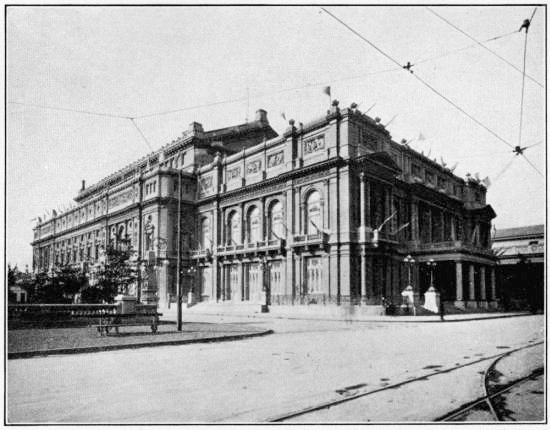
COLON THEATRE (TEATRO COLON), BUENOS AIRES, ONE OF THE
FINEST OPERA HOUSES IN THE WORLD
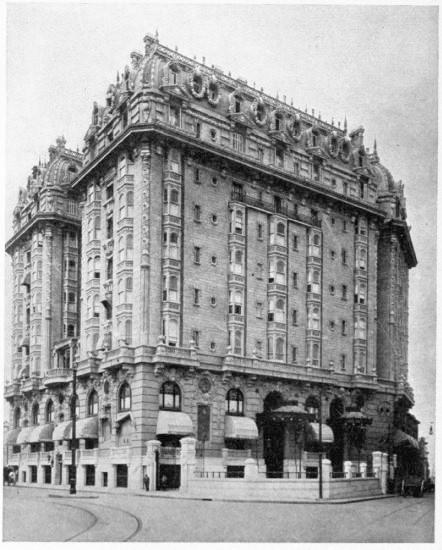
PLAZA HOTEL, BUENOS AIRES
The founding in 1858 of the Argentine
Rural Society by a group of social spirited
breeders and land owners, was the starting point
of the expansion of this industry and owing to
the ideas and methods introduced by that Association,
it was found necessary in more recent
years to create the Ministry of Agriculture,
which includes within its sphere of operations
not only the governmental control of the agricultural
and pastoral industries, but also the
entire range of the Republic's foreign commerce.
The annual shows of the Rural Society in
Buenos Aires attract visitors from all parts
of Europe and it has been conceded that for
the variety and all-round quality of the animals
exhibited, they excel the regularly established
shows of Europe. At the 1913 exhibition
of the Argentine Rural Society, the locally-bred
champion Short-horn Bull, "Americus,"
created a world's record by realizing the
unprecedented price of about $35,000 ($80,000
currency), whilst even larger sums have been
obtained for yearlings produced in the country.
Nor is this surprising when it is stated that
Argentine breeders have paid the highest
known prices for pure pedigree stock, in
which general statement may be included the
payment of more than $150,000 each for three
famous Derby winners. The breeds of cattle
most encouraged in Argentina are Shorthorns
and Herefords, Lincolns predominating in
Sheep and Clydesdales and Percherons in
Horses. Still, there are hundreds of millions
of acres of rich pasture lands not yet stocked,
so that when the time comes to place these
vast areas under cultivation, the number of
animals that could be maintained is almost illimitable.
It should be further added that the
climatic conditions of the country permit of
all its animals being reared in the open; and
as showing the possibilities awaiting those who
enter this field of national industry, it may be
pointed out that in hundreds of cases where
land has been rented and cultivated for the
purpose of fattening cattle, the lessees have
been enabled within a very few years to become
absolute owners of the land as a result of
their profitable operations.
The Dairy and Flour industries have likewise
shown great improvement, whilst considerable
promise is held out by the establishment
and development of other industries, such as
the cultivation and export of fruits, the breeding
and fattening of hogs, poultry farming,
bee-culture and the manufacture of vegetable
and animal oil products.
The vigilant economic policy undertaken by
the present government of the Republic is
likely to exercise a very beneficial effect upon
the future of these and other industries when
normal conditions are restored. The questions
of roads, canals, ports, transport charges
and other matters which affect the development
of commerce were all being considered with a
view to improvement prior to the outbreak of
war; and even at the present time work is proceeding
for the deepening of existing channels
and the extension of ports and docks. Immigration
has necessarily been checked through
the war, but when this disturbing element no
longer exists, renewed vigor will be applied to
a general extension of industrial establishments
in every direction where the natural resources
of the Republic can be made available.
THE ARGENTINE REPUBLIC IN THE SAN FRANCISCO
EXPOSITION
Of all the great Expositions held in the
United States to celebrate some distinct occurrence
or achievement in the history of the
country, none has assumed the importance or
splendour of the World's Fair at San Francisco,
created to commemorate America's immeasurable
service to the cause of humanity
by the construction of the Panama Canal to
link up the Atlantic and Pacific oceans. Conceived
and decided upon in times of general
peace, most of the nations of the earth were
invited to participate; and though laboring at
the time under certain difficulties induced by
universally disturbed economic conditions,
many of the countries subordinated these considerations
to the higher purpose of cementing
the bonds of international friendship by accepting
the invitation of the United States to
take part in the great Exposition of San Francisco,
formed to crown the colossal work initiated
by Ferdinand de Lesseps and carried
into execution by American skill, labor and
courage. Not least amongst the countries willing
to make sacrifices to share in this noble
work was the Argentine Republic which, in
the face of many obstacles to adequate representation,
at once entered into the spirit of the
undertaking and after assembling its leading
authorities in all the branches of national arts
and industries, decided to assume its appropriate
part in the glorification of the American
Continent by the effort to show that the nations
of the south were advancing step by step
with the great Republic of the north. Preliminary
action was at once taken to organize influential
committees representing all the States
and Territories of the Republic, an immense
sum of money was voted by Congress and full
preparations were set on foot to secure a practical
and eloquent manifestation of the phenomenal
progress and of the social and political
economy of the Argentine Republic. No
sooner had these measures been adopted than a
series of perturbations, culminating in the outbreak
of the war in Europe, occurred to create
an unfavorable ambient and to sow doubts
and mistrust forshadowing failure for the
great enterprise. In spite, however, of the
fears and even of the opposition thus created,
the Argentine Government through its organized
Committees proceeded uninterruptedly
with the completion of its plans and has been
able to organize the most important representation
it has yet had in any foreign Exposition.
The Argentine section of the International
Exposition of San Francisco admittedly holds
high rank in every aspect of its participation,
not excluding the magnificence of its Pavilion
and the area of space allotted to Argentine
exhibits, which reflect the indisputable importance
and advance of the Republic. The
spaces occupied in the various Palaces of the
Exposition embrace an area of 3,000 square
meters which, added to the 4,000 meters occupied
by the Pavilion and Garden, gives a total
area of 7,000 square meters and constitutes a
space record over all previous exhibitions in
which the Argentine Republic has so far assisted.
The areas excluding the Pavilion and
Garden are divided as follows:
| (1) | Agriculture | 1,140 | square | meters |
| (2) | Various Products | 550 | " | " |
| (3) | Food Products | 385 | " | " |
| (4) | Education and Social Economy | 320 | " | " |
| (5) | Liberal Arts | 230 | " | " |
| (6) | Mining and Metallurgy | 215 | " | " |
| (7) | Fine Arts | 160 | " | " |
| | Total | 3,000 | " | " |
The Argentine Pavilion, which has been accorded
a prominent position amongst other
palatial constructions of the Exposition, conveys
an expressive idea of the higher standard
of national art, both from the architectural
and decorative standpoints. In the centre portion
of the Pavilion there is a beautiful Conference
Hall and a spacious gallery in which
there will be kinetoscopic and dioramic exhibitions
of characteristic views of national life
and activity and of some of the natural beauty
spots of the country, such as the Iguazú
Falls, the Nahuel Huapi and others. There is
a Buffet for the testing and tasting of exclusively
Argentine products, whilst other surrounding
installations include a Library of national
authors, a Reading Room, an Information
Bureau, a Reception Hall and the various
offices of the Commission. The principal
frontage of the Pavilion is composed of two
high laterals which coil on a central figure
crowned by a handsome dome reaching to a
height of 50 meters. Approach is obtained by
a wide "stoop" which gives access to a porch
adorned with caryatides forming a vestibule,
the porch being decorated with a symbolic
"vitrail" and enclosed in an imposing arch 21
meters high. On the right and left of this entrance
there are two sculptured plaques, respectively,
representing the profiles of San
Martin and Washington, and throughout the
graceful halls and buildings, all designed by
Argentine architects and constructed by
Argentine workmen, there are beautiful and
graphic pictorial representations of the Port
and City of Buenos Aires, of the Campo de
Mayo, of the Puerto Militar, of the Immigrant
Hotel and the natural fields and forests of
Quebracho.
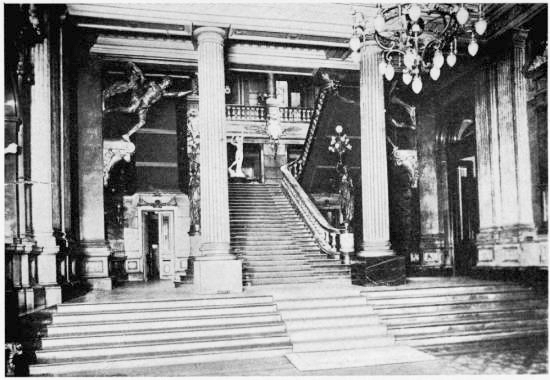
MARBLE AND ONYX ENTRANCE AND STAIRCASE OF THE JOCKEY CLUB,
BUENOS AIRES
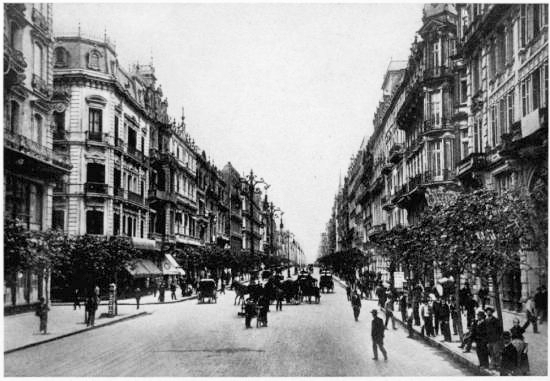
THE MAY AVENUE (AVENIDA DE MAYO), BUENOS AIRES
The main divisions of Argentine exhibits
have been sub-divided into so many departments
and classifications as to render it difficult
within the necessarily brief limits of this
work to describe in detail the character of each
of the sub-divisions and of the respective
exhibits they contain. It will, therefore, suffice
for the object in view to furnish merely
an outline of the plans adopted by the Argentine
Commission to demonstrate the high
grade of excellence and perfection of the national
products and industries. The most important
of the buildings comprising the Argentine
section is the Palace of Agriculture,
which covers an area of about 1,400 square meters
and embraces a collection of about 2,000
samples of classified products covering the entire
field of agriculture, including those of the
crops of 1913-1914 and 1914-1915. In each
sample of the collection there is specified the
name of the product, the weight and measure
in kilos and hectolitres, the weight in pounds
per bushel, the output in pounds per acre, the
zone of production, the name of the exhibitor
and, in many cases, indications of the nature
of the soil and other physical conditions. The
arrangement of the exhibition of the various
products has been moreover much simplified by
the adoption of the plan of enclosing them in
boxes with glass covers, giving to each product
a unit of measure in a square of 15 centimeters,
thus permitting the sample, once placed in
its original packing, to remain unchanged and
to be easily removed and classified, whilst by
this arrangement space has been economized
and facilities given for the addition of photographs
and explanatory notes which serve
the double purpose of giving useful information
and decorative effect.
Other features of interest in this section
comprise a collection of tobaccos cultivated in
Argentina and on a wall of about 3 square
meters in dimension there is exhibited a large
illustration of a national tobacco manufactory
in full operation. Considerable attention has
been devoted to this particular department,
one cabinet alone having cost $6,000 to construct.
In the section set apart for textile
products, there is an artistically arranged exhibition
of samples of wool consisting of about
300 separate collections contributed in more,
or less, equal proportion by public bodies and
individual producers. The beautiful cabinet
containing these samples also has a number of
photographic views relating to the products
shown as well as pictorial reproductions of
sheep-shearing and other mechanical operations
as carried out on the larger farms of the Republic.
There are likewise shown here many
classified samples of cotton and a variety of
vegetable fibres.
The collection of woods and other forestal
products is another centre of attraction for
visitors and gives a clear idea of the riches
enclosed in Argentine forests. The collection
consists of upwards of a thousand samples
representing, in their varied forms, a hundred
classes of different woods. In addition to the
great variety of this exhibit, its interest has
been added to by the contribution of a number
of maps and photographic views by the Forest
Department of the Ministry of Agriculture.
To make the Agricultural Section of the Argentine
Republic more attractive and of added
practical value, a number of the official Departments
of the Republic have contributed
statistics, plans and graphic illustrations pertaining
to the methods and progress of this
branch of industry. The drawings, paintings
and statistics shown by the Board of Rural
Economy demonstrate the enormous growth
and progress made in this direction, whilst the
exhibits of the Argentine Meteorological Office
and the National Board of Agriculture furnish
every necessary detail in regard to climatic
and meteorological conditions and the
provision made against agricultural plagues.
Added to all this, there is a collection of photographic
views relating to pastoral and agricultural
production which may be considered
to excel both in detail and variety.
The development of other Argentine national
industries is to be seen in the Palace of Industry,
which occupies a rectangular space of
30 meters frontage by 18 deep, on the Central
Avenue. In this section are shown samples of
a great variety of articles produced in the
numerous factories devoted to the production
of cloth, shoes, hats, decorative ornaments,
electric light fittings, crockery, construction
material, tools, implements, mechanical products,
glassware, matches, tannery, saddlery and
many others. As in all the other Argentine
sections, the exhibition is made more complete
by the display of splendid photographs which
assist in demonstrating the rapid advance in
the number and character of Argentine manufactures.
The justification of the description of the
Argentine Republic as the "universal provider"
of foodstuffs is to be found in the section assigned
to such products, notwithstanding the
absence of an exhibition of chilled and frozen
meats, together with some of their by-products,
as a result of circumstances which have temporarily
impeded the operations of the great
packing houses. The vast proportions of this
branch of industry may be gathered from the
admirable collection of photographs displayed.
The regrettable fact that the Argentine Republic
is unable to offer any practical demonstration
of its meat-producing capacity
through circumstances over which neither the
country nor the producers had any control is,
to some extent, however, compensated for by
the large and interesting exhibition of many of
its other leading food products. The milling
industry is amply represented by samples of
excellent quality from the raw material down
to such by-products as biscuits, nutritious
pastes, sweets, candies and all the other articles
made from it. Here important space is
also given to such articles of general consumption,
as preserved fruits, condensed milk, sterilized
and antiseptic, lard, cheese, conserved
vegetables, etc. Beverages, wines, beer and
liqueurs are abundantly represented, whilst
there are numerous exhibits of other alcoholic
products, oils and vinegars. A prominent feature
of this section is the diorama illustrating
field sports and fishing and an interesting collection
of embalmed animals, particularly birds
and fishes, of many different species and dimensions.
In the Mineral and Metallurgy Department
of the Exposition, the Argentine Republic has
an effective display of a general collection of
minerals and three special exhibits of petroleum
and combustibles, borates, salts and materials
for construction. In regard to these,
more attention has been given to the object of
securing typical samples which demonstrate
the character of the various ore deposits, than
to the consideration of the actual number of
samples. In the collection of petroleum and
combustibles, there are samples from the following
deposits: Commodore Rivadavia, Laguna
de la Brea, Cerro Buitres, San Rafael,
Cacheta, Covunco (Neuquen), Cerro Sotena,
Challaco, Mina Carmelo (Salta), Yacuiba,
Garrapatal (Jujuy). This collection contains
39 different samples, with specific details and
statistics especially tabulated in every case.
The exhibition of marbles and stones for purposes
of construction is most complete. Here
are to be seen the famous marble onyx of San
Luis and of San Rafael, the marbles from the
Sierras of Cordoba (represented by 15 varieties),
and specimens of the large granites of
Sierras Bajas, Olavarría, etc. There is also a
collection of mineral waters in which are included
those mostly used in the thermal establishments
of Rosario de la Frontera; whilst, as
a decorative contribution to the exhibition
there is a plastic representation of the Sierras
of Famatina, showing a part of its wonderful
aerial railway, together with an admirable
series of photographs, maps, and diagrams embracing
practically every branch of the mineral
and metallurgical industries.
The designation of "Palace of Liberal Arts"
is a somewhat inadequate description of the
Argentine exhibits of Liberal Arts in the generic
sense of the words, as, in addition to the
branches of study usually embodied in that
classification, there are included under that
head many exhibits of a scientific and technical
character which, for the demonstration they
afford of national progress in the direction referred
to, might well have formed a separate
collection. Here are to be seen a complete
series of drawings, maps, statistics and plans
of works graphically depicting, with full details,
the principal river systems and general
workings of the rivers and ports of the Republic,
all prepared by the Department of Public
Works. Nearly every technical division of
the Government Departments is represented in
this section, many of the exhibits having been
sent by the General Board of Railways, the
Board of Bridges and Roads, the Board of Architecture,
the Board of Health, the Board of
the Capital and various Divisions of the War
Cabinet, each unit containing photographs,
plans and diagrams indicating the advance
that has been made in all these important public
works. Amongst other features of interest
contained in this section, special mention
should be made of the representation of the
National and Foreign Press, which furnishes
unquestionable evidence of the high state of
efficiency and general excellence as well as the
enterprise of Argentine journalism. Here also
are the exhibits of the literary, scientific and
educational works produced in the Republic
and the contributions of the National Centre
of Engineers, of the Argentine Graphic Institute,
of the Central Society of Architecture, of
the Society of Architects and Construction of
Works, etc., etc., all combining to illustrate
the high degree of Argentine progress in the
field of Liberal Arts.
In an earlier chapter reference is made to
the great advance made by the Argentine Republic,
in recent years, in the development of
education, to which cause successive Governments
have given ever-increasing thought and
attention, whilst Congress has, year by year,
sympathetically supported the Government
policy by augmented money votes for the addition
to the number and the improvement of
educational institutions. In the Palace of
Education and Social Economy which was voluntarily
accorded a place of honor by the Exposition
Commission amongst the principal
Palaces of the Fair, there has been formed a
collection of detailed exhibits pertaining to Argentine
national education which points to the
very great importance given to this subject by
the authorities of the Republic. The efforts
of every official element in educational matters
have been brought into play with a result that
leaves no doubt, either as to the desire for, or
the standard of culture in the Argentine Republic.
This exhibition, moreover, is not only
an effective exponent of national progress but
will also serve to remove an easily understood,
though generally prevailing ignorance in many
foreign countries of true conditions in Argentina.
In order to add perfect completeness to
the educational exhibits, a new departure has
been made to show full details of every branch
of teaching, official and private, primary, secondary,
university, commercial, industrial,
agricultural, professional, etc., etc., for all
classes and ages, by means of plans, statistics
and some 6,000 photographs representing 150
leading institutions and upwards of 100,000
students and pupils whose physical characteristics
at once reveal the predomination of the
higher European types. As may be imagined,
these illustrations represent the scholarly activities
of the country in their widest aspect
and are not merely photographs of special
groups of children such as are frequently
shown in educational exhibitions. The statistics,
which form an instructive addition to the
pictorial matter, have been so compiled and
tabulated as to make their full value and significance
easy of comprehension and there is
every reason to believe that those which accompany
the illustrations of the agricultural
sections and experimental stations will be of
special interest to the majority of American
visitors to the Exposition.
In regard to the group of exhibits corresponding
to the section of Social Economy contained
in the same artistically arranged building,
much detail is furnished concerning many
of the social and charitable institutions of the
Republic, in reference to which there is an absence
of information abroad. The co-operation
of the Argentine Social Museum and other important
public bodies has enabled the Commission
to present a comprehensive exhibition of
views and of the methods of operation of the
various national Associations established, as
asylums, refuges, hospitals, poor-houses and
other organizations for the protection of women
and children and for the prevention of crime,
as well as demonstrations of the work performed
by these bodies, some of which also
have for their purpose the extension of social
improvement, of public order, economy, hygiene,
labor, the construction of dwellings and
other objects of public advantage. In this
section there is also an exhibition of works of
arts produced by Argentine artists embracing
a careful selection of paintings and examples
of sculpture representative and characteristic,
in every sense, of national art; and with a view
to demonstrating the artistic progress of the
country, this collection is made up of only recent
works, not one of which has previously
been shown in any foreign Exposition.
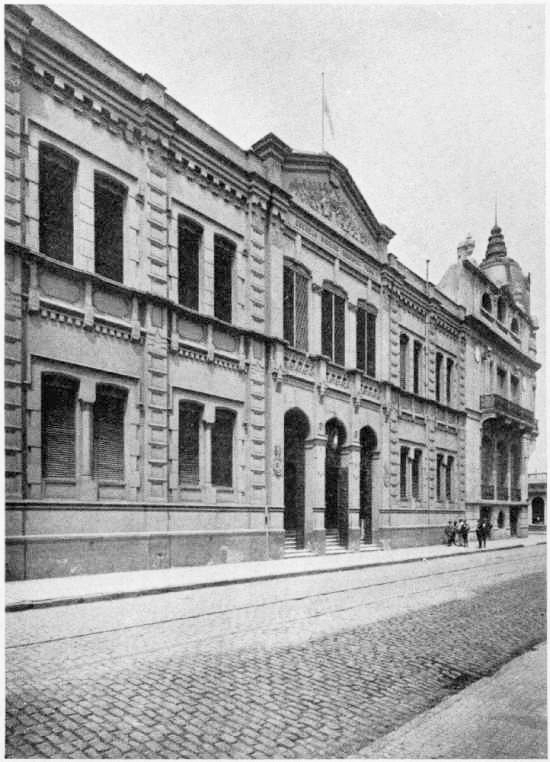
SARMIENTO SCHOOL, BUENOS AIRES
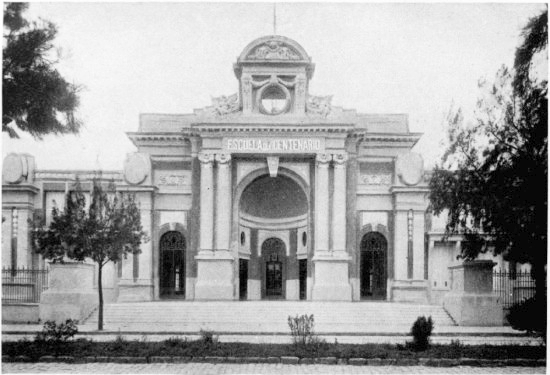
THE CENTURY SCHOOL (ESCUELA DEL CENTENARIO)
This shadowy outline of the nature and quality
of the Argentine exhibits at the San Francisco
Exposition, though utterly incomplete
as a description of their importance and value,
will convey a general idea of the position attained
by the Argentine Republic in all those
moral and material factors which go to make
up a great nation; and if to these elements are
added the initiative and beneficial labors of Argentina
in the international sphere, a sense of
pride should be awakened in the hearts of all
Americans that in the arts of peace, the widely
separated, though great, countries of the
American Continent, stand out as shining examples,
worthy of emulation even by many
countries of the old world.
INTERCHANGE OF COMMERCE
In 1895 the exports from the United States
to the Argentine Republic amounted in value
to $6,686,999 and the imports from that country
to $8,947,165. In 1912 the exports from
the United States amounted to $53,158,179
and the imports to $29,847,016. These figures
sufficiently indicate the results likely to follow
the active campaign of the manufacturers and
commercial bodies in this country, recently initiated
as a consequence of the war. The conditions
arising out of the great upheaval
caused by that world disaster have furnished
the occasion for the exercise of an effort without
parallel in the United States in any previous
attempt to secure a larger share of South
American trade. In this movement the Argentine
Republic must necessarily be the main objective,
owing to the vastness of its resources
and commercial activities. Yet, although
there is no doubt that the United States should
and will constitute a still greater source of
supply to that country of manufactured products,
machinery and other articles, not only
during the war, but for a long period after its
close, it is necessary to consider that in order
to secure a permanent extension of international
trade upon a scale of magnitude apparently
justified by superficial conditions, serious
attention should be given to matters of
reciprocal interests and the past relations of
the Argentine Republic with the European
countries to which it has freely opened its
markets.
In this connection the words "reciprocal interests"
must be taken rather in a literal sense
than in the sense of reciprocity, as that expression
is usually understood when applied to international
treaties. Even though the question
of tariffs does not now form so insuperable
an obstacle to a large interchange of commerce
between the two countries as was formerly the
case, the fact that the balance of Argentine's
trade with the leading countries of Europe has
always been in her favor, renders it a condition
precedent to a permanent expansion of
international commerce that there must be a
greater quality of interest than exists at present.
In other words, the United States must
offer corresponding advantages to the Argentine
Republic to attract a transfer of a considerable
share of her commerce from European
competitors.
In the instances of Great Britain, Germany
and France, with which countries the Argentine
Republic has always transacted the
greater part of her foreign trade, there has
not only been a steady and ever-increasing
growth in the consumption of Argentine national
products, but those countries have likewise
furnished huge amounts of capital for the
establishment on Argentine soil of industrial
and commercial undertakings, which, by their
own necessities, create a natural extension of
commercial interchange. It must also be remembered
that the main products of the Argentine
Republic are also the main products
of the United States, where they are protected
by High Tariffs, whereas, in Great Britain,
which is Argentina's principal customer, there
are no duties upon the imports of foodstuffs.
In these circumstances it is obvious that some
means must be found whereby the interests of
Argentina in her commercial relations with the
United States must be made more reciprocal,
either by the introduction of American capital
for the development of local industries, or by
the remission, at least, of a substantial portion
of the duties now imposed upon Argentine exports
to the United States.
The enormous growth of population which
has changed the position of the United States
from an exporting to a consuming country, so
far as foodstuffs are concerned, will, doubtless,
in course of time, considerably ameliorate the
restrictive conditions which have heretofore
operated as a barrier to large exports of Argentine
products to this country. On the
other hand, the production of the Argentine
Republic, by reason of the largely increased
area placed under cultivation year after year,
maintains her exporting capacity at a constantly
higher level. Thus, given equal conditions
in other respects, the United States
might ultimately become as free a market for
Argentina's meat and grain as any of the countries
of Europe. Under similar circumstances
as those indicated, there could also be infinitely
larger imports of raw material which could
subsequently be re-sold to the Argentine Republic
in manufactured form.
The countries which have hitherto occupied
the first place in Argentine foreign trade are
those which not only gave initial impulse to the
development of national industries by the
founding of banks and the construction of railways,
but likewise by the creation of adequate
steamship services. There are to-day upwards
of 33,000 kilometers of railway in operation
in the Republic, with an aggregate capital of
considerably over $2,000,000,000, more than
90 per cent, of which is entirely British, whilst
the oversea communications are conducted by
regular and rapid services of steamships flying
the flags of the maritime countries of
Europe. The great traction companies in the
capital and the provinces are British; the street
electric railways established on an important
scale throughout the Republic are British; the
foremost Light and Power concerns are German;
with the exception of the National Bank
of the Republic and the branch of the National
City Bank of New York recently opened, the
banking interests are largely European, whilst
the great majority of the principal industrial
and commercial enterprises are also European.
Of the $400,000,000 of the Argentine External
Debt, practically the whole of the issues making
up this vast sum are in the hands of European
investors and, in normal times, as further
capital is called for to meet the requirements
of any of the established enterprises, or of
others formed on similar lines, it is invariably
forthcoming from Europe; and to these advantages
which the Argentine Republic enjoys
in her commercial relations with the older countries,
there is the additional fact that she derives
all her immigration from northern and
southern Europe.
Let us now examine the American interests,
the most encouraging features of which are the
establishment of a branch bank of the National
City Bank of New York and the unqualified
success in the United States of the loans recently
made by that enterprising institution
and other American bankers to the Argentine
Republic. These two factors point to the realization,
by those who are best able to judge,
of the necessity for a new basis of intercourse
in the future; and that this fact is understood
in the Argentine Republic may be seen by the
appreciative opinions of the press and the public
authorities of that country. In other forms
of industrial or commercial enterprises, American
interests are comparatively insignificant.
The acquisition and establishment of local
freezing plants by the American packing
houses, though important in extent, involve
considerations of too controversial a character
to be dealt with in this survey of the commercial
relations of the two countries. It is considered
desirable, therefore, to treat only of
such branches of industry, commerce and
finance as embrace the general field of foreign
enterprise. The only American interest in
railways is in the Argentine Railway Company,
which consists of a combination of three or
four minor lines in the north and north-eastern
provinces, with a small proportion of American
capital. In the great cattle raising and agricultural
industries there is little or no American
capital employed and it is also conspicuous
by its absence from the lengthy list of
land, mortgage and finance companies established
in the Republic. It is true that there
are many manufacturing concerns of the
United States represented by agencies, but
apart from the Customs revenue this representation
brings to the country it is in no sense
a contributor to its development.
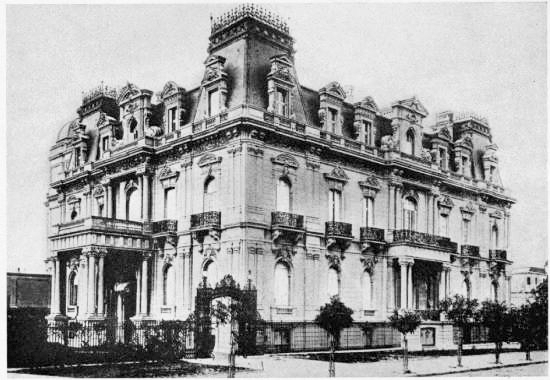
ANOTHER PRIVATE RESIDENCE IN BUENOS AIRES
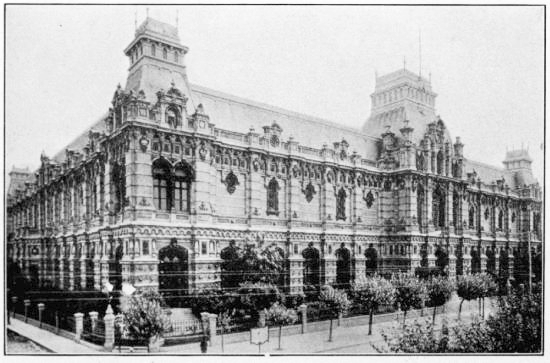
WATER WORKS BUILDING, BUENOS AIRES
An impartial examination of these circumstances
raises the question as to how, without
some changes in the directions pointed to,
the United States may hope to share with
Europe, on anything like equal terms, the
profitable and ever-growing trade of the Argentine
Republic? To sum up the situation,
it may be asked, in what way can the United
States equalize the advantages which Europe
offers to the Argentine Republic by way of
the purchase of her products, the large and
constant supply of capital and the labor of its
emigrants? There are many articles of merchandise
and items of machinery in regard to
which Europe cannot successfully compete
with the United States, notwithstanding the
greater facilities for transportation; but there
are also numberless articles of American production
which could find a ready market in
Argentine if the surrounding conditions approached
a greater measure of equality.
An analysis of the figures of the foreign
trade of the Argentine Republic for the past
twenty years establishes the fact that the
United States is in a position to successfully
compete with Europe in many
lines far beyond the limits already reached;
and there is certainly no lack of effort or inclination
on the part of American manufacturers
to enter into such competition. It is therefore
reasonable to assume that there are other
causes operating to check a growth in the
volume of American trade with the Argentine
Republic.
There are no laws in the Argentine Republic,
either of a fiscal or domestic nature, which
are calculated to affect ruling market prices,
or which admit of inequality of treatment.
Tariffs are based upon a reciprocal policy, the
tariff laws of the Argentine Republic being
so framed as to permit the Executive to relax
and reduce in favor of those countries
which accord similar treatment to her national
products. Credits are intrinsically sound and
in ordinary periods are usually regulated with
foreign countries by purchase at ninety, or one
hundred-and-twenty days' sight drafts. In the
discussion of this point it may also be urged
that the statements so generally made in regard
to the alleged long credit demanded by
Argentine buyers owe their origin to the conditions
prevailing in regard to shipping matters
in days gone by, when the steamship services
between North and South America were
more irregular and far less rapid than is the
case to-day. It was no fault of the Argentine
importer that merchandise was frequently
tied up for weeks together in an American
port and that the trip took much longer than
it now does. Yet, those delays caused the exporter
to wait weeks and frequently months
longer than was necessary to receive his money.
Hence, the currency of the statement that
long credit is an indispensable condition to
trading with Argentine. At the present moment
the Argentine Republic is gradually recovering
from the effects of a financial and
commercial crisis brought about through conditions
which it had no power to change; and,
in order to secure immediate results, it may be
necessary at the present time to extend the
customary terms of credit, but this may be done
with perfect safety and with commensurate
profit if the exporter avails himself of the
services created by the National City Bank of
New York and others for the investigation of
prospective buyers.
Irrespective, however, of all other conditions,
satisfactory banking and shipping facilities
are essential requirements of an extended commerce
between the United States and the Argentine
Republic. The establishment of an
American bank has paved the way for the removal
of many of the difficulties hitherto imposed
on the American exporter, but there still
remains the important question of ocean transport.
The service of steamships now in regular
operation between North and South American
ports is wholly inadequate to support a
rapidly developing trade unless the ships now
running are substituted by vessels of adequate
speed and capacity. To secure this object
some provision would have to be made to cover
the increased cost of construction and of operation
of the larger vessels and also to overcome
the difficulty of return cargoes. Practically
all of the European steamships trading with
South America carry full return cargoes, but
owing to the reasons already given and principally
because of the fact that the shipments
from Argentina to the United States are at
present limited to a small number of products,
the services established between North and
South America cannot compete in the matter
of freight until they are placed on a similar
footing as the European lines in regard to return
cargoes, which, under existing conditions,
are unavailable and must remain so until either
the laws or the needs of the United States will
permit of larger and more general imports
from the Argentine Republic.
The figures already given in the relation to
the trade of the United States with the Argentine
Republic show a considerable balance,
almost amounting to forty per cent in favor
of the former. Now let us see what are the
proportions of Argentine trade with some of
the countries of Europe. Argentine imports
from the United Kingdom in 1912 amounted
to $118,669,226, and her exports to $121,373,858.
In the same year her exports to
Germany amounted to $53,995,175, and her
imports to $63,941,503. To France the exports
were valued at $36,052,009, and her imports
$37,618,578. To Belgium her exports
totalled $37,258,225, and her imports $20,370,530.
These figures speak for themselves
and taken in conjunction with the other solid
inducements offered by the countries of Europe
in return for the benefits of a larger trade with
the Argentine Republic, should form a subject
for serious consideration in the effort to secure
for the United States a proportionate
share of Argentine commerce.
THE CITY OF BUENOS AIRES
Favored by nature and by the conditions
under which it was founded, the City of Buenos
Aires from its earliest days has been endowed
with elements which have considerably influenced
the vast growth and development that
have made it the leading Latin city of the new
world. Situated on the banks of the River
Plate and at the gateway of the Atlantic, nature
has largely contributed towards making
it a great commercial centre. At the time of
its foundation, it attracted but few of the adventurers,
who, in their quest of gold, migrated
to other parts of South America, the wealth
of the soil and the abundance of the flocks and
herds having brought to its shores a less turbulent
and more laborious class of immigrants
who sought a new home and a new outlet for
their activities in the "City of Good Airs."
The pure European origin and the commercial
spirit of the new inhabitants soon produced
changes in pre-existing conditions and in marking
out the path for the present Argentine
metropolis to become the hub of South America.
Founded in 1535 by Pedro de Mendoza,
and subsequently destroyed and twice depopulated,
the modern rise of the capital of what
is now the Argentine Republic may be said to
date from 1824, after the formulation of the
Monroe Doctrine and the recognition of the
independence of the people of Buenos Aires by
the United States and Great Britain. At about
that time efforts were initiated to provide the
means of facilitating the transport of its products
to foreign markets and in order to establish
the necessary facilities for that purpose,
Buenos Aires raised (in England) its first loan
of $5,000,000. To that comparatively small
financial transaction may be traced the reasons
for the enormous investment of foreign capital—chiefly
British—which has since enabled the
country to serve humanity by the increasing
development of its numerous sources of wealth.
Following this preliminary introduction of foreign
capital, there was established a regular
line of sailing packets between Buenos Aires
and Montevideo and, later, a line of steamers
between Buenos Aires and Rio de Janeiro,
which progressive measures were added to an
official bank and, within the next thirty years, a
line of railway extending in a westerly direction
from the capital.
These were the beginnings of the evolution
of modern Buenos Aires, which now properly
ranks as the second Latin city of the world.
Nor is it by any means alone to material progress
that the City of Buenos Aires owes its
present proud position. The spirit and qualities
of its early founders are manifested to-day
in the outward expression of all the attributes
of a highly civilized and enlightened community.
The architecture and adornments of the
city, the culture, education and manners of
the inhabitants, their inborn courtesy and generous
instincts combine to explain the admiration
which all who visit the city never fail to
entertain and express. The cosmopolitan
character of the population, the palatial residences—the
broad and spacious avenues, museums,
libraries, art galleries and other unmistakable
signs of the high degree of culture of
the citizens, fully justify the description of
Buenos Aires as the Paris of the western hemisphere.
Originally built up on Spanish lines of single-story
houses and narrow streets, the mason
has been superseded by the architect and many
of the old narrow thoroughfares by wide and
beautiful avenues intersecting the central portions
of the city. The domestic architecture
of the time of Rozas was gradually succeeded
by the introduction of the architectural
beauty of the period of the Renaissance and
subsequently by the various Grecian orders, culminating
in the advent of European architects
and artists who evolved many unique and distinct
styles which are to-day illustrated in
a number of the imposing and artistic
edifices that adorn the city and, with
the surrounding parks, trees, gardens, flowerbeds
and running waters, both in the centre
and in the suburbs, reveal a panorama of unsurpassing
beauty. Many of the ancient
houses with flat roofs and severely simple
facades have been substituted by highly
ornamented dwellings of two, three, or more
stories; and, with a desire to add to the embellishment
of the city, the Municipality offers
a gold medal and a diploma to the architect,
and an immunity from payment of the building
tax to the owner, of the building for the most
artistic façade, the jury being composed of
representatives of different bodies exercising
authority in relation to such matters as architecture,
surveys, public works, engineering
and fine arts. By the employment of these
methods, Buenos Aires, in recent years, has
made notable advance in architecture, not only
in regard to private dwellings, but also in its
public buildings and the unquestionable increase
in number and quality of the monuments,
statues, and sculptural groups dotted over
every part of the city. During the last twenty
years there have been constructed new avenues
and thoroughfares of great width and length
lined by handsome buildings, paved with asphalt
and lighted with huge electric globes,
whilst the Municipality has spared no expense
in widening many existing streets to meet the
growing demands of the population and to give
more light and air to quarters of the city which
are densely inhabited.
The æsthetic side of the city of Buenos
Aires is to be found in its splendid museums,
art galleries and public and private libraries,
of which there are many of unquestionable
merit. Amongst these, special mention should
be made of the Natural History Museum,
which is of great interest from the point of
view of educational value and intellectual progress.
The Zoological, Botanical, Mineral,
Archeological and Ethnographical specimens,
numbering many thousands, have been classified
on a scientific basis by eminent authorities
over a period of many years and form a collection
of objects and curiosities of nature unexcelled
for their variety and interest. The
National Historical Museum possesses a collection
of historic trophies and works, manuscripts,
ancient coins and other objects, over
4,000 in number. Here are also halls and galleries,
containing portraits of the Viceroys,
pictures of naval and military battles, trophies
of the war with Great Britain, the room in
which San Martin lived and died, furniture,
uniforms, arms, decorations and a variety of
other articles of great historic interest. On
the same order and limited to its expressed
purpose, there is a Museum of Arms which
contains a collection of weapons with records
of their authenticity attached. In this collection
there are many specimens of rare
weapons and accoutrements of different periods
ranging from the fourteenth to the eighteenth
centuries. There are, besides, many
flags and other articles associated with the
wars of different periods. Of much more recent
date and, perhaps, also of greater practical
interest, is the Natural Agricultural Museum,
the objects of which are to promote the
knowledge of agriculture by instructive exhibits
and to demonstrate the measures best
adapted to the scientific methods of cultivation
and to overcome the natural drawbacks besetting
that branch of national industry. The
collection comprises upwards of twenty thousand
specimens of agricultural products of
every description as well as statistics and information
pertaining to rural economy.
The libraries of the city are both extensive
and numerous and contain in addition to modern
works of importance in different languages
bibliographical treasures of different periods
representing the world's various cycles of
literature.
The public and private art galleries of the
city with their varied collections embrace a
great number of old masters and of modern
productions in painting, sculpture, pottery,
engraving and every form of art representing
all known periods and all nations. First
amongst these exhibitions is the Museum of Fine
Arts, which contains a number of important
works collected and arranged with great skill
and taste, whilst many of the private galleries
have been especially erected in the palaces of
wealthy residents for the purpose of housing
some of the priceless objects which are to be
found in the capital of the Argentine Republic.
A feature of striking interest in the life of
Buenos Aires is the number and excellence of
the many hospitals, asylums and other charitable
organizations established to provide for
the afflicted and poorer classes of the community.
Apart from those endowed by the various
foreign colonies residing in the city, the
majority of these institutions are largely supported
by State aid in form of appropriation
or specific revenues. On the other hand, vast
sums are privately subscribed to those not entirely
of an official character.
As a great commercial centre, the aspect
and movement of the city are equally striking.
The port, docks, railroad depots, wharves,
warehouses, street railways, lighting and other
signs of industrial activity abound in every direction
and make Buenos Aires to the Argentine
Republic what New York is to the United
States. It is, moreover, the principal mart for
the agricultural and pastoral products of
many of the leading ranches of the Republic
and draws to its periodical sales of wool, hides,
cattle and sheep, buyers from many foreign
countries.
Buenos Aires, like many other great capitals,
is confronted with the difficulty of a congestion
of traffic owing to the large increase
of population and the narrowness of the
streets in the older sections of the city, but this
problem is being gradually solved by the construction
of new broad diagonal avenues and
by the building of subways which are now being
rapidly extended. With all these evidences
of progress on every side, it will not be a
surprising revelation to add that Buenos Aires
possesses some of the greatest newspapers,
one of the finest Opera Houses and the
finest Club Houses in the world. There are
other large and flourishing cities in the Republic,
such as Rosario, Santa Fé, Córdova, La
Plata (capital of the province of Buenos
Aires) and Bahia Blanca, but the City of
Buenos Aires is the brain and heart of the Republic
and must always maintain its supremacy
as the leading metropolis of Latin America.
END


