Health of the Natives.—Their Diseases.—Captain N. prescribes a
Remedy.—Their superstitious Notions.—Mr. Osborn prescribes
for the Sick.—A fatal Case.—They surround Mr. O. with threatening
Gestures.—Native Remedy for Nose Bleeding and Sore
Eyes.—Burial Ceremony.—Marriages.—General Appearance of
the Natives.—Their Character.—Their Habits of Industry.—Property.—Language.—Icebergs.—Their
Formation.—The
Distance to which Icebergs float.—Their Magnitude.—Field Ice.—The
sudden Disappearance of Ice.—How accounted for.—Icy
Vapor.—Poisoning.
So far as we could learn, they had the usual
share of health with other communities. A good
proportion of them reached an advanced age in
life; and some, we should judge from their appearance,
were much older than the oldest among
our own countrymen.
One of the most common diseases among the
natives appeared to be that of worms—originating,
probably, from the character of their diet.
Their medicinal preparations were but few and
simple.
Captain Norton had in his possession a package
of wormwood, which he picked up on the
shore near the wreck. Though it had been saturated
with salt water, yet, from time to time, he
administered a strong drink of it for the above
disease, with complete success. As proof of
their appreciation of his services, they would put
a dried crow's head upon his arm. His success
went so far, that he had as many crows' heads
as could be strung from his wrist to his elbow.
Captain Norton, however, was wisely cautious
in one respect, and that was, he would not prescribe
in any given case of sickness, unless he
was well convinced there was no immediate danger
to the patient, or that he could afford some
temporary relief.
Their superstitious notions were such that, if
any prescription should fail, and the patient
should not recover, they would suppose at once
that the proposed remedy was the cause of death.
It required great prudence, therefore, to manage,
not only the sick, but also those who were well.
A case occurred of a very trifling character at
first, but finally it proved fatal. The face of a
person, a woman, was somewhat swelled; the
cause of it, so far as we could ascertain, originated
in a defective tooth.
Mr. Osborn acted the part of a physician at
this time. He applied a poultice of sea bread,
in order to reduce the inflammation, which he
supposed it would shortly do.
The woman, however, did not get immediately
better; and her friends took the poultice off, and
in the place of it they tied a string very tight
round her chin, in order, as they believed, to prevent
the disease or swelling from going downwards.
The string rather increased the inflammation;
and then it was taken off, and placed
still lower down, until the swelling had very
much increased, and had reached her breast.
The string was now tied tighter than ever, until
it became embedded in the flesh.
Since Mr. Osborn's remedy had failed to benefit
her, the natives, from their appearance and
gestures, supposed that the poultice was an injury,
instead of an advantage, to the woman.
They therefore gathered round Mr. Osborn in
the most threatening attitude, and he greatly
feared they were about to injure or kill him. At
any rate, he learned one important lesson—to
be more cautious, in future, in prescribing remedies
to the sick among the natives. They were
superstitious, and therefore unreasonable.
The natives were subject to nose bleeding;
the excessively cold weather was doubtless the
chief cause of it. The remedy which they employed,
and in use among them, was the application
of a frosty stone, or piece of ice to the back
of the neck.
Sore eyes were quite prevalent among them,
more so in some seasons of the year than in
others. This disease is caused by the reflection
of sunlight upon an almost boundless surface of
snow and ice. The simple remedy, in ordinary
cases among them, was in making a slight incision
with a thorn or some sharp instrument in
the flesh, directly between the eyes, so as to draw
several drops of blood. The effect of this treatment
was to reduce the inflammation, and thus
carry off the soreness from the eyes.
In some instances, however, the eyes of the
natives had wholly run out.
This, in many respects, was very peculiar, and
quite different from the great majority of semi-barbarous
or half-civilized tribes and nations.
When one dies, a wife, for example,—as this
instance did occur in one of the huts,—the
following ceremonies were observed to take
place:—
Immediately on the death of the person, or
just before death took place, the relatives and
friends gathered in the hut, and commenced a
most bitter and vociferous wailing or mourning.
The usual means to expel the disease, whatever
it might be, had been employed in vain.
Several skins, stretched over hoops varying in
size, had been broken by furious beating, accompanied
with fantastic gesticulations and almost
unearthly sounds, if possible, to cure the patient.
But all to no purpose. They now found that
death was approaching; and since every effort
of theirs had not benefited her, they pronounced
her incurable, and proceeded at once to terminate
her existence. She was not permitted to
die wholly from the natural effects of the disease;
but a small cord was placed round her
neck, and gradually drawn closer and closer by
those who stood on each side of her, until life
became extinct. During the last scene, she gave
various presents to her relatives and friends.
She died with singular indifference, and without
a groan.
Whether all the sick, who, they supposed,
would not recover, were thus put to death, as in
the foregoing instance, may be a question. Yet,
in so far as could be ascertained from observation
and from conversation with the natives, it is the
opinion of those who lived with them for several
months that this was generally the case.
Soon after, all the remaining property which
she possessed—her clothing, needles, combs,
beads, &c., besides some tobacco—was sewed
up with her in the dress she usually wore, or in
which she died. A new sled was then made for
the deceased, and two of the best dogs in the
family were selected to bear away the corpse.
Instead of carrying the body out of the ordinary
doorway, an opening was made through the side
of the hut sufficiently large for the body to pass
and those accompanying it. The relatives and
friends followed the remains to the place of the
dead, two or three miles distant, upon some hill
side. There it remained untouched for five days.
The face only of the deceased was exposed. On
the return of the family connections to the hut,
one of the dogs was killed. During the five days
which intervened, the husband forsook the hut
altogether, and all other huts, and wandered about
from place to place, living in temporary exile
from all connection with his former home, or
family and friends. And during this time, also,
food was carried to the dead body, and also
placed outside the hut, on the supposition that
she would need it.
On the sixth day, the deceased was visited
again by the relatives for the purpose of disposing
of what was left of her remains. The crows
and beasts of prey had nearly or quite completed
the work of destroying every vestige of the body.
Thus, in a very short time, nothing remained but
here and there a bone mingled indiscriminately
with others in the place of the dead.
The company then returned to the hut, and
another scene of wailing and mourning ensued.
During this last act, the hut was surrounded by
the relatives of the deceased; and all at once, at
a given signal, the whole company rose up, and
pulled the hut down, and removed it to another
place. Before it was erected again, however, the
second dog was killed, and its blood sprinkled
over the newly-selected spot.
With the change in the locality of the hut a
new order of things took place. The husband
assumed his former relations to the family, and
ceremonies were at an end respecting the deceased.
From what could be learned from the natives,
they supposed that, in leaving the face of the
deceased uncovered, the crows would pick out
her eyes, and then she would be unable to find
her way back to the hut. The opening made in
the side of the hut, through which to carry the
corpse, was another superstitious idea. They
believed she would not enter the hut again, if
she was not carried out by the door. The removal
of the hut to a new place was in accordance
with their notions that she would be unable
to find it again.
They have a general belief of an existence
after death; yet so crude, ill-defined, and dark
was this belief, that it stands allied with the
grossest forms of paganism and idolatry. The
glorious gospel of Christ, "which brings life and
immortality to light," finds no place in their
hopes for the future, nor does it afford any consolation
to them on their pilgrimage to the tomb.
They are living, as the apostle said the heathen
did in his day, "having no hope, and without
God in the world."
They are polygamists. They have as many
wives as they see fit to take, or as they can support.
They have a custom among them of temporarily
exchanging their wives with each other.
The evils of polygamy were obvious among the
natives, in the jealousy, contention, wrath, and
fighting observable between the different wives.
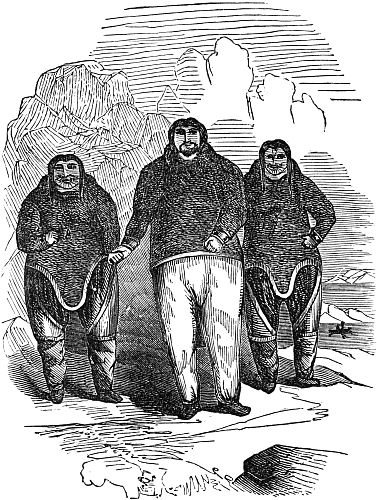
From their appearance, we should judge they
belonged to the race of Esquimaux. In stature,
they are rather below medium height, thick set,
strongly built, muscles fully developed, and capable
of great endurance; and in complexion, copper
color. Their countenances are far from being
prepossessing; high cheek bones, flat noses, and
large mouths.
A stranger, upon first sight, would be led to
infer from their general appearance that they
were fierce, cruel, and prepared for any act of
barbarity. What they would become, if injured
or abused, we had no opportunity of knowing.
Nor did we discover in them any unfriendly feelings
towards other settlements or tribes, whether
near or more remote, or that of late years there
had been any contention, or fighting, or war between
the different tribes in that region. They
had instruments of war, such as bows and arrows,
lances, clubs, &c.; but they probably needed
them in destroying the savage beasts, and
especially bears, that infest the country.
We found them kind and hospitable to us, or
otherwise we all must have perished. They
treated us, we believe, according to their knowledge
and circumstances, with more than ordinary
attention.
They exhibited love and sympathy towards
the members of their respective families, and
were particularly affectionate to their children.
As to their moral character, we could not discover
that they had any idea of the one God, the
Maker and Upholder of all things and beings,
nor of Providence, nor of accountability, nor of
moral right and moral wrong.
They believed, however, as all heathen idolaters
and pagans do, that there were superior divinities.
They seemed to fear evil spirits, if they
had no reverence for good ones. They had an
idea that somewhere, in some remote mountain
in the interior, their god lived, and that the dead
would in some way or other go thither; though
they never gave us their views particularly upon
this subject. They had no idols nor household
gods. They paid profound homage to the crow,
and regarded it in some sort as sacred. They
wore crows' heads as amulets upon their persons.
With the exception of the kindness they manifested
towards us, and natural affection towards
their children and to one another, in their social
habits, intellectual ignorance, and moral darkness,
they must be classed among the most degraded
of the human race.
Their habits of industry correspond with the
general features of their character. Thus fishing,
hunting, making sleds, training dogs in their
teams, running races, occasional traffic with tribes
in the interior, &c., constitute the principal routine
of their employments and amusements. Their
manner of life presented no inducement for them
to labor beyond their present necessities. By the
way, the females had a large part of the necessary
work to perform.
Their property consisted chiefly in dogs and
huts. He who owned the best dog teams, and
had possession in huts, was considered the most
wealthy man. The head man of the settlement
was supposed not only to possess the greatest
amount of property, but he excelled in bodily
strength. With these qualifications, he commanded
the greatest influence, and was acknowledged
as the head and leader of the settlement.
We found some among the natives who were
considered rich,—rich in dogs and dog teams,
&c.,—and others that were poor.
It is quite probable that all, or nearly all, the
tribes or settlements on the shores of the Arctic,
both on the Asiatic and American sides, have a
common language, though differing, as we found,
in some words, and also in pronunciation. The
language is that of the Esquimaux race.
Those with whom we lived, and other settlements
or tribes on the Asiatic coast with whom
we have had any acquaintance, from East Cape
to the north as far as our wreck, have no written
language. We could not learn from them that
any one had ever attempted to instruct them, or
reduce their language to some system, or that
any teacher in religion had ever visited them.
Without a written language, or books, or teachers,
or oral instruction in some form, the certain
results must invariably be, that from age to age,
they will continue in the same condition of mental
ignorance, moral blindness, and physical degradation.
It was the opinion of Mr. Abram Osborn, Jr.,
who became a proficient in the language of the
natives, and could converse with them with ease
and fluency, that it was simple, and he believed
could be readily reduced to some systematic
form. The method he resorted to, in order to
acquire the language, was simply this: when he
heard a native word, he would write it, according
to its sound, upon a piece of copper, and
place opposite to it its English definition. He
made inquiries of the natives as to the meaning
of their words, and what they called certain
things. In this manner he became very familiar
with all the terms and phrases which they used.
The following are a few specimens of native
language. English words are placed in the
first column, and the Esquimaux in the second.
| ENGLISH. |
ESQUIMAUX. |
| Dog, |
Attat. |
| Sled, |
Woncoose. |
| Deer, |
Korong. |
| Fox, |
Tricokadlekin. |
| Legs, |
Mingara. |
| Feet, |
Partakou. |
| Fingers, |
Riddlegus. |
| Arms, |
Mingukou. |
| Hands, |
Mungit. |
| Head, |
Eloout. |
| Hair, |
Kidweed. |
| Nose, |
Yacka. |
| Sick, |
Atke. |
| Death, |
Youedlin. |
| Striking, to kill, |
Kittegerayouedlin. |
| Wrestling, |
Mupperrudle. |
| Dancing and frolicking, |
Katepangarrakim. |
| Soup, |
Opanga. |
| Hat, |
Yarang. |
| Spear, |
Poegan. |
| Arrow, |
Kekimbo. |
| Whale, |
Draow. |
| Boat, |
Atuat. |
| Ship, |
Laloutoutline. |
| Snow, |
Addledadle. |
| Ice, |
Retinute. |
| Water, |
Memut. |
| Skin, |
Naglegin. |
| Walrus, |
Redica. |
| Woman, |
Youan. |
| Seal, |
Mamut. |
| Hill, |
Youket. |
| Mountain, |
Nutamut. |
| Seamen, |
Raumkidlins. |
| Father, |
Etletuen. |
| Mother, |
Etlita. |
| Son, |
Youakek. |
| Ocean, |
Numaumkimmemut. |
| Land, |
Nuteskin. |
| Sea shore, beach, |
Nutanute. |
| Jacket, |
Eran. |
| Cap, |
Kile. |
| Shoes, |
Pomeat. |
| "O dear me," |
Hokeenonkanum. |
| Mad, |
Anguenipo. |
| Trousers, |
Konitre. |
| NUMBERS. |
| One, |
Ennan. |
| Two, |
Gera. |
| Three, |
Giro. |
| Four, |
Gerack. |
| Five, |
Miltingum. |
| Six, |
Ennan Miltingum. |
| Seven, |
Gera Miltingum. |
| Eight, |
Amgrokim. |
| Nine, |
Conizinkin. |
| Ten, |
Mingitkim. |
| Twelve, |
Mingitkim Gera Parole. |
| Thirteen, |
Mingitkim Giro Parole. |
| Fourteen, |
Mingitkim Gerack Parole. |
| Fifteen, |
Kiddegitten. |
| Sixteen, |
Kiddegitten Ennan Parole. |
| Seventeen, |
Kiddegitten Gera Parole. |
| Eighteen, |
Kiddegitten Giro Parole. |
| Nineteen, |
Kiddegitten Gerack Parole. |
| Twenty, |
Kalekin. |
| Thirty, |
Kalekin Mingitkim Parole. |
| Forty, |
Gerack Kalekim. |
| Fifty, |
Miltingum Mingitkim Parole. |
| Sixty, |
Gera Kalekim Mingitkim Parole. |
| Seventy, |
Giro Kalekim Mingitkim Parole. |
| Eighty, |
Gerack Kalekim. |
| Ninety, |
Gerack Kalekim Mingitkim Parole. |
| One Hundred, |
Miltingum Kalekin, |
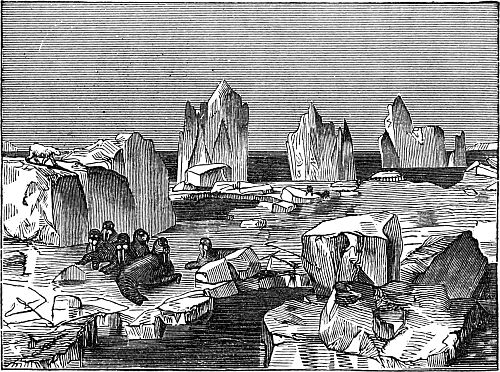
Some of the most remarkable phenomena seen
in the Northern Ocean, and the manner of their
formation, are icebergs. They are greatly feared
by seamen, and a contact with them would be
equivalent to striking a rock. They are formed
far up in the polar region during the intense and
protracted cold of winter; and in the change of
the season in summer, though ice is always accumulating
in high latitudes, they drift with the
currents into lower latitudes, where they melt,
and finally disappear. They are of varied dimensions,
indicating by these facts somewhat the
sources whence they come, and wearing every
conceivable exterior form.
They are formed by the falling of snow over
steep and high cliffs on the borders of the sea;
"little by little the incrustations on the shore
and cliffs increase to the size of mountains, and
then, being torn away from their fastenings,
either by the winds, or by their own weight, or
by the action of the sea beating against their
bases or undermining them, are swept into the
ocean, where they continue to accumulate by the
falling of snow and frozen water, and finally resemble
great islands."
Large masses of ice, which take the form of
bergs, are formed along the rocky-bound coast
of the Arctic.
On the fall of the tide, after the ocean has
been frozen over, the localities of the rocks and
ledges are clearly observable. When the tide
rises, the superincumbent mass is lifted up, and
a new layer is formed underneath. This process
goes on with the rise and fall of the tides and
the accumulation of ice, until vast ridges, broken
and dislocated, assuming every variety of appearance,
are thus pressed up to a great height.
We observed the gradual rise of one of these
immense piles of ice not far from our winter
quarters. It appeared to be more than twenty-five
feet above the ordinary ice around it.
The cliffs upon whose sides we have seen icebergs
form rise to the enormous height of two
to four hundred feet. And the shore was so
bold, and the depth of water so great at their
bases, that a ship would probably strike her yards
against their precipitous sides before she would
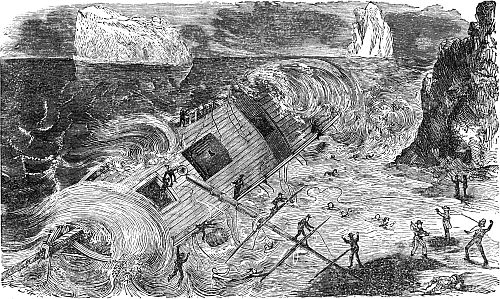
ground. A vessel, therefore, being dashed against
those adamantine walls in a gale of wind, would
instantly fly to pieces, and not a seaman would
be saved.
"The distance to which icebergs float from
the polar regions on the opposite sides of the line
is, as may be supposed, very different. Their
extreme limit in the northern hemisphere is
judged to be about lat. 40°, though they are occasionally
seen in lat. 42° N., near the termination
of the great bank of Newfoundland, and at the
Azores, lat. 42° N., to which they have sometimes
drifted from Baffin's Bay.
"But in the other hemisphere, they have been
seen, within the last few years, at different points
off the Cape of Good Hope, between lat. 36° and
39°. One of these was two miles in circumference
and one hundred and fifty feet high, appearing
like chalk when the sun was obscured, and
having the lustre of refined sugar when the sun
was shining upon it. Others rose from two hundred
and fifty to three hundred feet above the
level of the water, and were therefore of great
volume below; since it is ascertained by experiments
on the buoyancy of ice floating in sea
water, that for every cubic foot seen above, there
must at least be eight cubic feet below water."
Captain Sir John Ross saw several icebergs in
Baffin's Bay aground in water fifteen hundred
feet deep! Many of them are driven down into
Hudson's Bay, and, accumulating there, diffuse
excessive cold over the entire continent; so that
Captain Franklin reports that, at the mouth of
Haye's River, which lies in the same latitude as
the north of Prussia or the south of Scotland,
ice is found every where, in digging wells, in
summer, at the depth of four feet. "It is a well-known
fact that, every four or five years, a large
number of icebergs floating from Greenland
double Cape Langaness, and are stranded on the
west coast of Iceland. The inhabitants are then
aware that their crops of hay will fail in consequence
of fogs, which are generated almost incessantly;
and the dearth of food is not confined
to the land, for the temperature of the water is
so changed that the fish entirely desert the
coast."
As to the relative thickness of common field
ice where it remained unbroken through the winter,
we found it varied from ten to twenty-five
feet in thickness. We had an opportunity of
judging, from the fact that we examined several
openings which the natives had made in the ice
off East Cape for the purpose of taking seal.
The sudden disappearance of large and extended
tracts of ice in the northern seas, in addition
to its being carried away by the force of
currents towards the south, is attributed by many
to its sinking. How ice should sink, when its
specific gravity is lighter than water, is a question
for the speculative to discuss—unless there
be some other preponderating element mingled
with it, such as fragments of rock, sand, or
gravel.
Whalemen have frequently affirmed that they
have not only been surrounded by fields or large
tracts of ice at night, but in the morning it had
wholly disappeared from the surface of the water.
Therefore many have arrived at the conclusion,
that in certain states of the ice, in the process
of breaking up and thawing, it actually sinks
below the surface of the water, if not to the
bottom.
There was another phenomenon which we observed.
During the coldest season of the year,
and in certain states of the atmosphere, the air
deposits its moisture in the form of frozen fog.
It has the appearance of a fine gossamer netting
or icicles, and these are dispersed through the
atmosphere, and so extremely minute that they
seem to pierce and excoriate the skin; and, especially
when the wind blew, it was impossible
to face this storm of icy vapor. We have seen
a deposition of this frost from four to six inches
during the space of twelve hours.
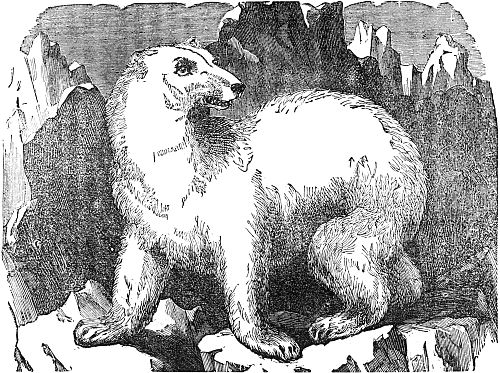
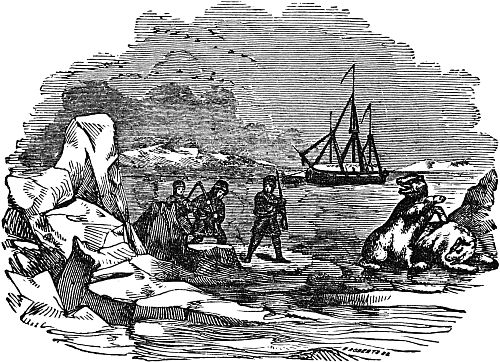
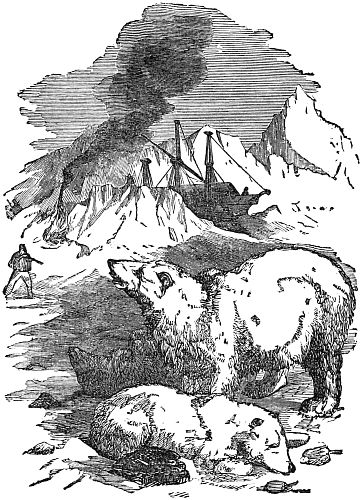
We observed that the natives ate all parts of
the bear except the liver. Experience had probably
taught them that it was not proper to eat,
or, it may be, they had seen the fatal effects of
eating it among themselves.
A bear, during the early part of winter, was
brought into the settlement, which the natives
had killed. Some of our company concluded to
make a mess out of the liver, and invite others
to partake of the dainty. It was eaten, and the
consequences were nearly fatal to all of us who
partook of it. It produced distress in our stomachs
and diarrhœa.
We find the following in Dr. Kane's "Arctic
Explorations:" "When I was out in the Advance,
with Captain De Haven, I satisfied myself
that it was a vulgar prejudice to regard the liver
of the bear as poisonous. I ate of it freely myself,
and succeeded in making it a favorite dish
with the mess. But I find to my cost that it
may be more savory than safe. The cub's liver
was my supper last night; and to-day I have the
symptoms of poison in full measure—vertigo,
diarrhœa, and their concomitants."
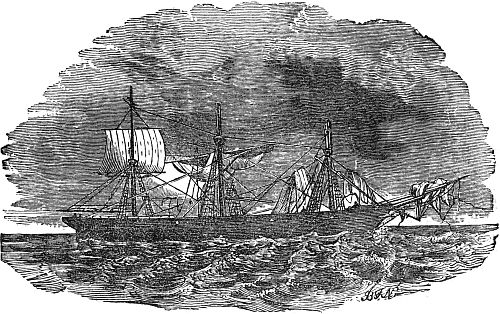
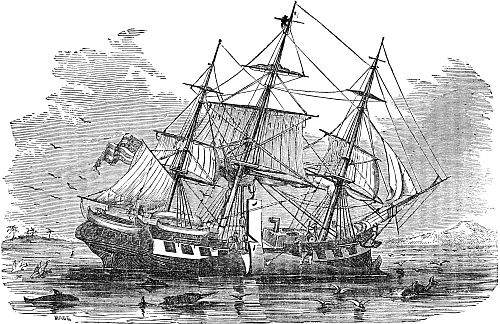
A Ship after a Gale.
 Please address the Publishers,