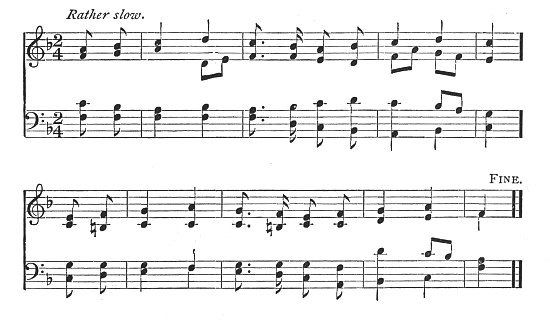
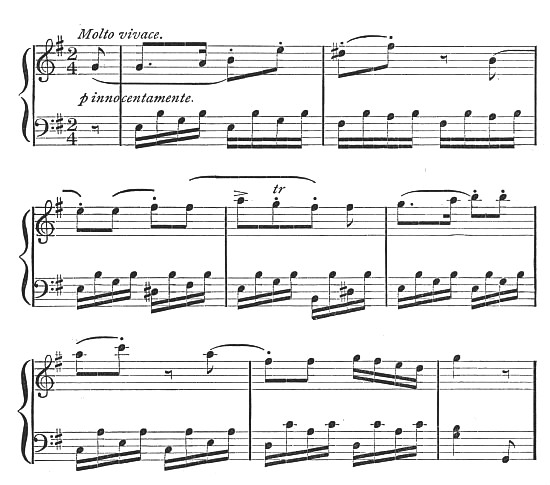
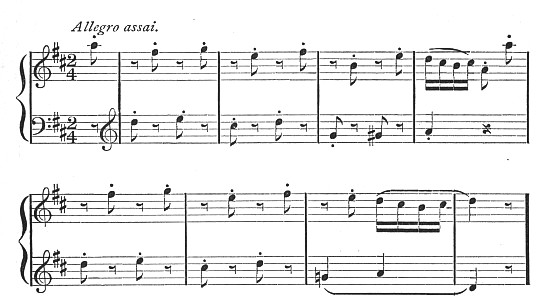
By Thomas Whitney Surette and Daniel Gregory Mason
SUPPLEMENTARY VOLUME OF MUSICAL ILLUSTRATIONS $1.00
VOL. II.
GREAT MODERN COMPOSERS CLOTH $1.50
By Daniel Gregory Mason
VOL. III.
SHORT STUDIES IN GREAT MASTERPIECES
By Daniel Gregory Mason
OTHER WORKS
BY
DANIEL GREGORY MASON
A GUIDE TO MUSIC. A BOOK FOR BEGINNERS CLOTH $1.25
ORCHESTRAL INSTRUMENTS AND WHAT THEY DO, WITH TWENTY-SEVEN ILLUSTRATIONS AND ORCHESTRAL CHARTCLOTH $1.25
THE APPRECIATION OF MUSIC
VOLUME I
BY
THOMAS WHITNEY SURETTE
AND
DANIEL GREGORY MASON
NINTH EDITION
Supplementary Volume of Musical Illustrations
Price $1.00
NEW YORK
THE H. W. GRAY CO.
SOLE AGENTS FOR NOVELLO & CO., LTD.
COPYRIGHT, 1907, BY
THE H. W. GRAY COMPANY
The Knickerbocker Press, New York
PREFATORY NOTE.
This book has been prepared in order to provide readers
who wish to listen to music intelligently, yet without going
into technicalities, with a simple and practical guide to
musical appreciation written from the listener's rather
than from the professional musician's standpoint.
The authors believe that there is at the present moment
a genuine need for such a book. Teachers in schools,
colleges, and universities, educators in all parts of the
country, and the music-loving public generally, are every
day realizing more vividly the importance of applying to
music the kind of study which has long been fruitfully
pursued in the other arts; and with the adoption, in 1906,
by the College Entrance Examination Board, of musical
appreciation as a subject which may be offered for entrance
to college, this mode of studying music has established
itself firmly in our educational system. Yet its progress
is still hampered by the lack of suitable text-books. The
existing books are for the most part either too technical
to be easily followed by the general reader, or so rhapsodical
and impressionistic as to be of no use to him.
In the following pages an effort has been made, first,
to present to the reader in clear and untechnical language
an account of the evolution of musical art from the primitive
folk-song up to the symphony of Beethoven; second,
to illustrate all the steps of this evolution by carefully
chosen musical examples, in the form of short quotations
in the text and of complete pieces printed in a supplement;
third, to facilitate the study of these examples by means
of detailed analysis, measure by measure, in many cases
put into the shape of tabular views; and fourth, to mark
out the lines of further study by suggesting collateral reading.
Too much stress cannot be laid on the fact that the
music itself is the central point of the scheme of study, to
which the reader must return over and over again. Carefully
attentive, concentrated listening to the typical pieces
presented in the supplement is the essence of the work, to
which the reading of the text is to be considered merely
as an aid. These pieces are for the most part not beyond
the reach of a pianist of moderate ability.
At the same time, the authors have realized that some
readers who might profit much by such study will not be
able to play, or have played for them, even these pieces.
For them, however, the music will still be accessible through
mechanical instruments.
In view of the fact that one of the chief difficulties in
the study of musical appreciation is the unfamiliarity of
classical music to the ordinary student, the use of an instrument
by the students themselves should form an important
part of the work in classes where this book is used as a
text-book. It is hoped that with such practical laboratory
work by all members of the class, and with the help of
collateral reading done outside the class under the direction
of the teacher, and tested by written papers on assigned
topics, the course of study outlined here will be found well-suited
to the needs of schools and colleges, as well as of
general readers.
CHAPTER I. ELEMENTS OF MUSICAL FORM. — I. INTRODUCTORY . — II. WHAT TO NOTICE FIRST. — III. MUSICAL MOTIVES. — IV. WHAT THE COMPOSER DOES WITH HIS MOTIVES. — V. THE FIRST STEPS AS REVEALED BY HISTORY. — VI. A SPANISH FOLK-SONG. — VII. BALANCE OF PHRASES. — VIII. SUMMARY.
Of the thousands of people who consider themselves
lovers of music, it is surprising how few have any real appreciation
of it. It is safe to say that out of any score of persons
gathered to hear music, whether it be hymn, song, oratorio,
opera, or symphony, ten are not listening at all, but are
looking at the others, or at the performers, or at the scenery
or programme, or are lost in their own thoughts. Five
more are basking in the sound as a dog basks in the sun—enjoying
it in a sleepy, languid way, but not actively following
it at all. For them music is, as a noted critic has said,
"a drowsy reverie, relieved by nervous thrills." Then
there are one or two to whom the music is bringing pictures
or stories: visions of trees, cascades, mountains, and rivers
fill their minds, or they dream of princesses in old castles,
set free from magic slumber by brave heroes from afar.
Perhaps also there is one who takes a merely scientific interest
in the music: he is so busy analysing themes and labelling
motives that he forgets to enjoy. Only two out of the
twenty are left, then, who are actively following the melodies,
living over again the thoughts of the composer, really
appreciating, by vigorous and delightful attention, the
beauties of the music itself.
Can we not, you and I, join the ranks of these true lovers
of music? Can we not learn to free our minds of all side
issues as we listen—to forget audience, performers, and
scene, to forget princesses and heroes, to forget everything
except this unique experience that is unfolding itself before
our ears? Can we not, arousing ourselves from our drowsy
reverie, follow with active co-operation and vivid pleasure
each tone and phrase of the music, for itself alone?
One thing is sure: Unless we can do so, we shall miss
the keenest enjoyment that music has to offer. For this
enjoyment is not passive, but active. It is not enough to
place ourselves in a room where music is going on; we must
by concentrated attention; absorb and mentally digest it.
Without the help of the alert mind, the ear can no more
hear than the eye can see. Sir Isaac Newton, asked how he
had made his wonderful discoveries, answered, "By intending
my mind." In no other way can the lover of music
penetrate its mysteries.
Knowledge of musical technicalities, on the other hand,
is not necessary to appreciation, any more than knowledge
of the nature of pigments or the laws of perspective is necessary
to the appreciation of a picture. Such technical knowledge
we may dispense with, if only we are willing to work
for our musical pleasure by giving active attention, and if
we have some guidance as to what to listen for among so
many and such at first confusing impressions. Such guidance
to awakened attention, such untechnical direction
what to listen for, it is the object of this book to give.
It is no wonder, when one stops to think of it, that
music, in spite of its deeply stirring effect upon us, often
defeats our best efforts to understand what it is all about,
and leaves us after it is over with the uncomfortable sense
that we have had only a momentary pleasure, and can take
nothing definite away with us. It is as if we had been present
at some important event, without having the least idea
why it was important, or what was its real meaning. All of
us, at one time or another, must have had this experience.
And, indeed, how could it be otherwise? Music gives us
nothing that we can see with our eyes or touch with our
hands. It does not even give our ears definite words that
we can follow and understand. It offers us only sounds,
soft or loud, long or short, high or low, that flow on inexorably,
and that too often come to an end without leaving
any tangible impressions behind them. No wonder we are
often bewildered by an experience so peculiar and so fleeting.
Yet these sounds, subtle as they are, have a sense, a logic,
an order of their own; and if we can only learn how to
approach them, we can get at this inner orderliness that
makes them into "music." The process of perception
which we have to learn here is somewhat akin to certain
more familiar processes. For example, what comes to our
eyes from the outer world is simply a mass of impressions
of differently colored and shaped spots of light; only gradually,
as we grow out of infancy, do we learn that one group
of these spots of light shows us "a house," another "a tree,"
and so on. Similarly words, as we easily realize in the case
of a foreign language, are to the untrained ear mere isolated
sounds of one kind or another; only with practice do we
learn to connect groups of them into intelligible sentences.
So it is with music. The sounds are at first mere sounds,
separate, fragmentary, unrelated. Only after we have
learned to group them into definite melodies, as we group
spots of lights into houses or trees, and words into sentences,
do they become music for us. To approach sounds in
such a way as to "make sense" of them—that is the
art of listening to music.
The first step in making sense of any unfamiliar thing is
to get quite clearly in mind its central subject or subjects,
as, for example, the fundamental idea of a poem, the main
contention of an essay, the characters of a novel, the text of
a sermon. All music worthy of the name has its own kind
of subjects; and if we can learn to take note of, remember,
and recognize them, we shall be well on the road to understanding
what at first seems so intangible and bewildering.
A possible confusion, due to the use of terms, must here
be guarded against. The word "subject" is used in a
special sense, in music, to mean an entire theme or melody,
of many measures' duration—thus we speak of "the first
subject of Beethoven's Fifth Symphony," meaning the
entire contents of measures 6-21. Now this is obviously
a different meaning of the word "subject" from the general
one we use when we speak of the subject of a poem or a
picture, as the fundamental idea about which it all centers.
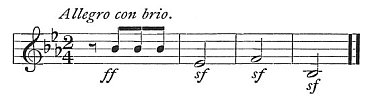
This long musical "subject" all centers about a little idea
of four notes, announced in the first two measures of the
symphony:
But as we are already using the word "subject" to mean
something else, we must have another name for this brief
characteristic bit out of which so much is made, and for
this the word "motive" is used. Here again there is a
difference of usage which must be noted. When we speak
of a "motive" or "leading motive" of Wagner, we mean
not a short group of this kind, but an entire melody associated
with some special character or idea; e. g., "the Siegfried
motive." Let us here, however, keep the word
"motive" to mean a short characteristic group of tones
or "figure," and the word "subject" to mean a complete
melody or theme built up out of one or more motives.
The smallest elements into which we can analyze the
subject-matter of music are "motives"—that is, bits of tune,
groups of from two to a dozen tones, which have an individuality
of their own, so that one of them cannot possibly be
confused with another.
"Yankee Doodle," for instance, begins with a motive of
seven notes, which is quite individual, and wholly different
from the motive of six notes at the beginning of "God Save
the King," or the motive of five notes at the beginning of the
"Blue Danube" waltz. The three motives are so different
that nobody of ordinary musical intelligence would confound
them one with another, any more than he would confound
the subject of Longfellow's "Psalm of Life" with
that of Browning's "Incident of the French Camp," or the
characters in "Dombey and Son" with those in "Tom
Jones." The whole musical individuality of each of the
three tunes grows out of the individuality of its special
motive.
Here, evidently, is a matter of primary importance to
the would-be intelligent music lover. If he can learn to
distinguish with certainty whatever "motives" he hears,
half the battle is already gained.
Four points will be noticeable in any motive he may
hear. Its notes will vary as to (1) length, (2) accent, (3)
meter or grouping into regular measures of two, three, or
four notes, and (4) pitch. If he can once form the habit
of noticing them, he will have no further difficulty in recognizing
the themes of any music, and, what is even more
important, following the various evolutions through which
they pass as the composer works out his ideas. The
importance of such active participation in the composer's
thought cannot be exaggerated. Without it there cannot
be any true appreciation of music; through it alone does the
listener emerge from "drowsy reverie, relieved by nervous
thrills" into the clear daylight of genuine artistic enjoyment.
Let us put ourselves now in the place of a composer
who has thought of certain motives, and who wishes to
make them into a complete piece of music. What shall we
do next with these scraps of melody, attractive but fragmentary?
Now, one thing we can see at once from our
knowledge of arts other than music. We must somehow
or other keep repeating our central ideas, or our piece will
wander off into mazes and fail to have any unity or intelligibility;
yet we must also vary these repetitions, or they
will become monotonous, and the finished piece will have
no variety or sustained interest. The poet must keep
harking back to the main theme of his poem, or it will
degenerate into an incoherent rhapsody; but he must present
new phases of the root idea, or he will simply repeat himself
and bore his readers. The architect, having chosen
a certain kind of column, say, for his building, must not
place next to it another style of column, from a different
country and period, or his building will become a mess, a
medley, a nightmare; but neither must he make his entire
building one long colonnade of exactly similar columns,
for then it would be hopelessly dull. In short, every artist
has to solve in his own way the problem of combining
unity of general impression with variety of detail. Without
either one of these essentials, no art can be beautiful.
Here we are, then, with our motive and with the problem
before us of repeating it with modifications sufficient
to lend it a new interest, but not radical enough to hide its
identity.
If we are making our music for several voices or instruments,
or for several parts all played on one instrument
like the organ or the piano, we can let these different
voices or parts sound the motive in succession. If, while
the new voice takes the motive, the voice previously brought
in goes on with something new, then we shall have a very
agreeable mingling of unity and variety. This is the
method used in all canons, fugues, inventions, and so on,
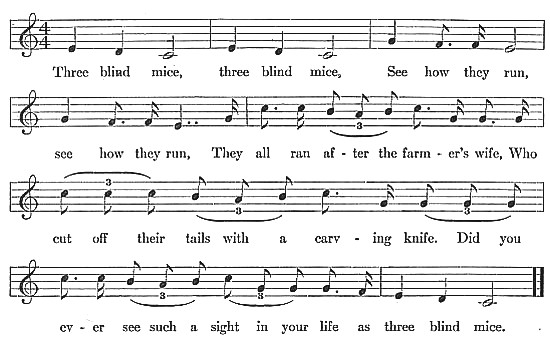
and in vocal rounds. For an example, take the round
called "Three Blind Mice" (see Figure I).
Three blind mice, three blind mice, See how they run,
see how they run, They all ran af - ter the farm - er's wife, Who
cut off their tails with a carv - ing knife. Did you
ev - er see such a sight in your life as three blind mice.
One person, A, begins this melody alone, and sings it
through. When he has reached the third measure, B
strikes in at the beginning. When B in his turn has reached
the third measure (A being now at the fifth), C comes in
in the same way. In a word, the three people sing the
same tune in rotation (whence the name, "round"). And
the tune, of course, is so contrived that all its different
sections, sounded simultaneously by the various voices,
merge in harmony. This kind of literal repetition by one
part of what another has just done is called "imitation,"
and is a fundamental principle of all that great department
of music known as the "polyphonic," or many-voiced.
But now, notice another kind of repetition in this little
tune. Measures 3 and 4 practically repeat, though at a
different place in the scale, the three-note motive of measures
1 and 2. (In order to conform to the words, the
second note is now divided into two, but this is an unimportant
alteration.) The naturalness of this kind of
repetition is obvious. Having begun with our motive in
one place, it easily occurs to us to go on by repeating it,
in the same voice, but higher or lower in pitch than at first.
The mere fact that it is higher or lower gives it the agreeable
novelty we desire, yet it remains perfectly recognizable.
We may call this sort of repetition, which, like "imitation,"
is of the greatest utility to the composer, "transposition,"
to indicate that the motive is shifted to a new place or
pitch.
But suppose we do not wish either to imitate or to transpose
our motive, is there any other way in which we can
effectively repeat it? Yes:—we can follow its first appearance
with something else, entirely different, and after this
interval of contrast, come back again and restate our motive
just as it was at first. Looking at "Three Blind Mice"
again, we see that this device, as well as the other two, is
used there. After the fifth, sixth, and seventh measures,
which contain the contrast, the eighth measure returns
literally to the original motive of three notes, thus rounding
out and completing the tune. This third kind of repetition,
which may be called "restatement after contrast,"
or simply "restatement," is also widely in use in all kinds
of music. A most familiar instance occurs in "Way Down
upon the Suwanee River."
Let us keep distinctly in mind, in all our study, these
three modes of repetition, which are of radical importance
to musical design: 1st, the imitation of a motive in a different
"voice" or "part"; 2d, the transposition of a motive, in
the same voice, to a higher or lower place in the scale;
3d, the restatement of a motive already once stated, after
an intervening contrast. We shall constantly see these
kinds of repetition—imitation, transposition, and restatement—used
by the great composers to give their music
that unity in variety, that variety in unity, without which
music can be neither intelligible nor beautiful.
It must not be thought that these ways of varying
musical motives without destroying their identity were
quickly found out by musicians. On the contrary, it took
centuries, literally centuries, to discover these devices that
seem to us so simple. All savage races are musically like
children; they cannot keep more than one or two short bits
of tune in mind at the same time, and these they simply
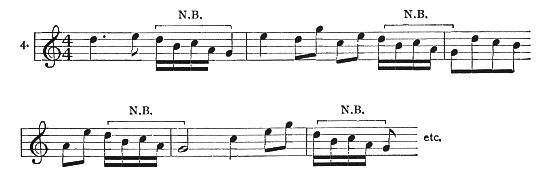
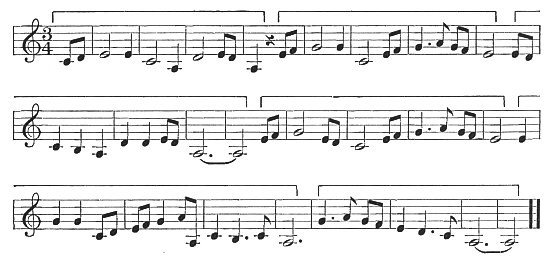
repeat monotonously. The first two examples in Figure II,
taken from Sir Hubert Parry's "The Evolution of the Art
of Music," give an idea of the first stage of the savage
musician.
The first is from Australia, the second from Tongataboo.
Both are made of a single motive endlessly repeated
without relief.
In a slightly higher stage, two motives are used, but with
little more skill. Number 3, in Figure II, is an example.
Then come tunes in which one or more motives, repeated
literally, are still the main feature of the design, but in which
a certain amount of variety is introduced between the
repetitions (see Number 4, in Figure II, a Russian tune).
Here the little characteristic figure of four short notes and a
long, marked N.B., is agreeably relieved by other material.
From such primitive music as this to the beautiful
"folk-song" of the modern nations is a long step indeed.
Even in the simplest real folk-songs, the means of varied
repetition of ideas that we have been discussing are used
with an ingenuity which places them on an infinitely higher
level than these primitive efforts of savages. It is true that
in folk-songs, which were sung by a single voice instead of a
group of voices, the device of "imitation" was used hardly
at all:—that is available only where there are several
different voices to imitate one another. But in order to see
what good use was made of "transposition" and "restatement"
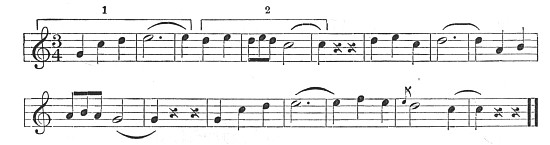
we need take only a single example, from Galicia
in Spain (see Figure III). Let us examine this tune in some
detail, as a preparation for a further study of folk-songs in
a later article.
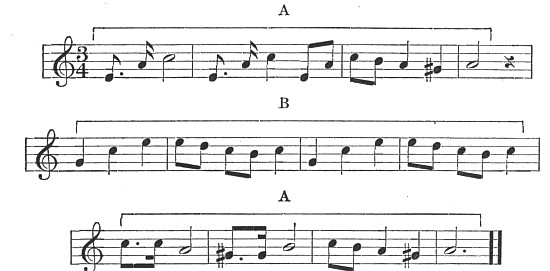
In the sixth and seventh measures, (1) is so altered and
transposed that it ends on D instead of on C, and in the
eighth, ninth, and tenth measures (2) is transposed so as to
end on G instead of on C. By these transpositions the
important element of contrast is introduced, and when therefore
we have, at the end, the two motives given again almost
exactly as to first, we get, by this restatement after contrast,
a delightful sense of unity and completeness. The means
here are wonderfully simple, but the effect is truly artistic.
An important principle of musical design is introduced
to our notice by this little melody. It will be observed that
it divides itself into three equal parts: the statement, measures
1-5; the contrast, measures 6-10; and the restatement,
measures 11-15. (We may represent these by the letters
A, B, and A.) Now these three parts, being of equal length
and similar material, balance each other just as lines in
poetry do. One makes us expect another, which, when it
comes, fulfills our expectation. Thus we get the impression
of regularity, order, symmetry. This element of symmetry,
or the balancing of one phrase of melody by another,
like the balancing of one line of poetry by another, as in the
verses
"The lowing herd winds slowly o'er the lea,
And leaves the world to darkness and to me."
is a most important one, as we shall soon see, in all modern
music.
This balance of one large section of a melody by another
is often referred to by the term "rhythm," owing to its analogy
with "rhythm" in architecture (in the symmetry, for
example, of two halves of a building). But it is simpler to
keep the word rhythm, in music, to mean rather a characteristic
combination of tones, as regards their relative length
and accent, as, "the rhythm of the first motive in Beethoven's
Fifth Symphony" (see motive quoted on page
5). In the present articles the word will be used in this
latter sense.
In this chapter we have seen how music, in spite of its
subtle, intangible nature, has certain definite features called
"motives," which we can learn to recognize and follow by
noticing the length, accent, metrical arrangement, and
movement "up" or "down," of the tones of which they
are composed.
We have seen that these primary motives are worked up
into complete pieces of music by being repeated with such
alterations as serve to vary them pleasantly without disguising
them beyond recognition. The chief kinds of modified
repetition we have noticed are "imitation," "transposition,"
and "restatement after contrast." All of these we have seen
illustrated in "Three Blind Mice."
We have remarked how very gradually musicians got
away from monotonous harping on their ideas by using these
devices. In connection with the Spanish folk-song, we have
noted that, although imitation was not available, transposition
and restatement were most effectively used.
Finally, we have seen that music, like poetry, has its
larger balance of phrases, by which whole parts of a melody
are set off against one another and made to balance, just as
lines do in verse.
In succeeding chapters we shall trace out all these
principles in more detail.
SUGGESTIONS FOR COLLATERAL READING.
Parry: "The Evolution of the Art of Music," Chapters
I and II; Dickinson: "The Study of the History of
Music," Chapter I; Grove: "Dictionary of Music and
Musicians," article "Form."
CHAPTER II. FOLK-SONGS. — I. FOLK-SONGS AND ART SONGS. — II. AN ENGLISH FOLK-SONG. — III. KEY AND MODULATION. — IV. BARBARA ALLEN. — V. NATIONAL CHARACTERISTICS IN FOLK-SONGS. — VI. AN IRISH FOLK-SONG . — VII. A GERMAN FOLK-SONG . — VIII. SUMMARY.
In the first chapter we have traced the evolution of the
formal element in music, the element through which it
gradually attained coherence. We have seen that this element
is an expression of that common sense which rules in
all things; that the various expedients adopted in music as
means of keeping the central idea before the listener, and,
at the same time, providing him with sufficient variety to
retain his interest, are dictated by that sense of fitness that
operates everywhere in life. And these simple formal principles,
so conceived, will be found to underlie the larger
musical forms that will engage our attention in succeeding
chapters.
Let us always keep in mind that, while the psychological
effect of music remains a considerable mystery, and the
appreciation of great music must be a personal and individual
act involving a certain receptivity and sensitiveness to
musical impressions, yet the perception of the logic or sense
in a piece of music is a long step towards understanding it,
and one of the best means of cultivating that receptivity and
sensitiveness.
Folk-songs have been described by an eminent writer[1]
as "the first essays made by man in distributing his notes
so as to express his feelings in terms of design." We shall
shortly examine some typical folk-songs in order to see how
this design gradually became larger and more various, and
how, through this process, the foundations were laid for the
masterpieces of modern instrumental music. We shall see
that this advance has accompanied an advance in civilization;
that as men's lives have become better ordered, as
higher standards of living and thinking have appeared, the
sense of beauty has grown until, finally, this steady progress
has resulted in the creation of certain permanent types. It
must be kept in mind, however, that these primitive types
are largely the result of instinctive effort, and not of conscious
musical knowledge. The science of music, as we
know it, did not exist when these songs were written.
In order to distinguish between Folk-songs and songs
like those of Schubert and Schumann, musicians call the
latter "Art" songs. The folk-song is a na?e product,
springing almost unconsciously from the hearts of simple
people, and not intended to convey any such definite
expression of the meaning of the words as is conveyed in
modern songs. While there are specimens[2] of the art song
that closely approach the simplicity and beauty of the folk-song,
the art song in general is not only of wider range and
of wider application to men's thoughts and feelings, but
it also has, as an integral part of it, an accompaniment of
which the folk-song, in its pure state, is entirely devoid.
A further distinguishing characteristic of the folk-song
is that it is often composed in one of the old ecclesiastical
"modes."
These modes were old forms of the scale that existed
before our modern harmonic system came into use. The
following English folk-song, called "Salisbury Plain," is
in the "Aeolian" mode.
This song is written in the scale represented by the
white keys of a pianoforte beginning on A, and the peculiarly
quaint effect of it is due to the unusual intervals of that
scale as compared with our common scale forms. There
are various modes[3] called "Phrygian," "Dorian," etc.,
each having its own peculiar quality. This quaintness and
characteristic quality to be observed in modal folk-songs
almost entirely disappears when an accompaniment of
modern harmony is added, as is often done.
Folk-songs occupied a much more important place
in the lives of the people who used them than is commonly
supposed. When we consider that at the time the earliest
of them were written few people could read or write, that
books were printed in Latin, and that there were no newspapers,
railways, or telegraphs, we can understand how
large a part these old songs played in the scheme of life.
The strolling singer was the newspaper of the time.
Furthermore, the general illiteracy of the people made of
the folk-song a natural vent for their feelings. With a
limited vocabulary at their disposal, it was natural that they
should use the song as a medium of expression for their
joys and sorrows. Gesture was also part of their language,
and in a modified way, as a means of expression, may be
said to have performed something of the function of song.
Many of the oldest melodies existed as an adjunct to dancing
and religious ceremonials, and were, therefore, to some
extent utilitarian. But so intimate was their relation to the
ideas and feelings of the people who used them that, in
spite of the crudeness and simplicity of the medium employed,
the songs of the various nations are entirely distinct
from each other, and to a remarkable degree express the
characteristics of the people who produced them.
The songs used with this chapter are chosen chiefly to
illustrate the various methods (already described) of attaining
variety and unity in music. If little space is devoted
here to other considerations, the reader must bear in mind
that our purpose is to lead him finally to as complete an
appreciation as possible of the masterpieces of instrumental
music, and that this appreciation must begin with a
perception of the relationships between the various parts
of a primitive piece of music.
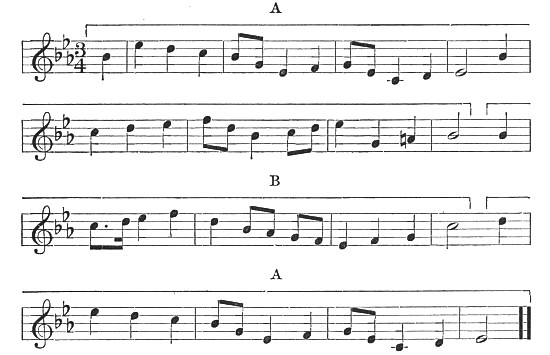
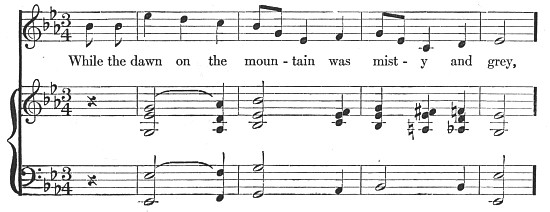
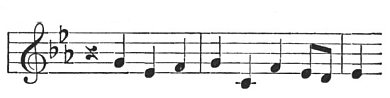
In Figure V is shown the old English song "Polly Oliver."[4]
This is a traditional song handed down without any
record of its origin, from generation to generation. Its
unknown composer has managed very deftly to make it
hang together. A good deal is made, in particular, of the
characteristic little motive of three notes which first occurs
at the beginning of the third measure.[5] In the very next
measure, the fourth, this is "transposed" to a lower position.
Going on, we find it coming in again, most effectively,
in measure 7, this time transposed upwards; and it occurs
again twice at the end of the melody. Thus a certain
unity is given to the entire tune. Again, the device of
repetition after contrast is well used. After measures 1-9,
which state the main idea of the melody, measures 9-13
come in with a pronounced contrast; but this is immediately
followed up, in measures 13-17, by a literal repetition of
the first four measures, which serves to round out and
satisfactorily complete the whole. We thus see illustrated
once more the scheme of form which, in the last chapter,
we denoted by the letters A-B-A.
This song presents a further element of form by means
of which much variety is imparted to music.
It will be noticed that the first phrase of "Polly Oliver"
(measures 1-5) moves about the tone E-flat and ends upon
it with the effect of coming to rest, and that the second
phrase (measures 5-9) similarly moves about and comes
to rest on the tone B-flat. The last phrase (13-17), like
the first, moves about E-flat. This moving about a certain
tone, which is, so to speak, the center of gravity of the
whole phrase, is called by musicians "being in the key of"
that tone; and when the center of gravity changes, musicians
say that the piece "modulates" from one key to another.
Thus, this first phrase is in the key of E-flat, the second
modulates to the key of B-flat, and the song later modulates
back again to the key of E-flat. Here we have another
very important principle in modern music, the principle
of "key" or "tonality,"—important because it makes
possible a great deal of variety that still does not interfere
with unity. By putting the first part of a piece in one key,
the second part in another, and finally the last part in the
original key, we can get much diversity of effect, and at the
same time end with the same impression with which we
began. We shall only gradually appreciate the immense
value to the musician of this arrangement of keys.
A further element of form is found in "Polly Oliver,"
namely, the balance of phrases. This balance of phrases
one against another is derived ultimately from the timed
motions of the body in dancing, or from the meter of the four
line verse to which the music was sung. And this balance of
phrases, derived from these elemental sources, still dominates
in the melodies of the great masters, although it is
managed with constantly increasing freedom and elasticity,
so that we find in modern music little of that sing-song
mechanical regularity which we may note in most folk-songs
and dances.
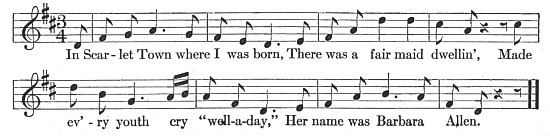
Let us now examine another old English song, "Barbara
Allen."
This also is a traditional song. The words celebrate
the emotion of unrequited love, a favorite subject with the
old ballad writers. In the music, we shall find a further
illustration of the use of the devices already referred to.
We note first of all that there is throughout the melody a
constant use of one rhythmic motive. This figure appears
in the first four notes of the song, and is found at the beginning
of every other measure save the fifth and the last.
While these transpositions are not so literal as is that at the
beginning of "Polly Oliver," they are nevertheless sufficiently
close to serve the purpose of preserving unity while still providing
variety. The tune is held together by this insistence
on the motive; there is considerable variety in the melody
of the various phrases, but through it all runs this persistent
rhythm.
Although "Barbara Allen" does not, strictly speaking,
contain a modulation, since there is in the melody no note
foreign to the key in which the song is written, yet the first
and last phrases center round D, the key-note, while the
second phrase (to the words "There was a fair maid
dwellin'") centers round and comes to rest on A, thus producing
the effect of a half pause, as if punctuated with a
semicolon.
A very important point should be noted in reference to
these half pauses or modulations in a melody, namely, that
they usually occur on the fifth note of the scale of the original
key, called by musicians the "dominant." In the three
songs we have considered thus far the second phrase has so
ended. This modulation to the dominant is the most common
one in music, and we shall often have occasion to refer
to it in later chapters.
Finally, a comparison of the third phrase of the music—"there
was a fair maid dwellin'"—with the last—"her
name was Barbara Allen"—will reveal a considerable
similarity in both rhythm and melodic contour or curve.
By means of this similarity, and by the return, in the last
phrase, to the original key, our sense of proportion is satisfied
and a certain logic is imparted to the tune. It should
also be noticed that the melody is a perfect example of that
balance of phrases already referred to, the two halves (1-5
and 5-9) being of precisely the same length.
"Barbara Allen" is like many other English tunes in
being straightforward, positive, and, in a measure, unromantic.
It lacks the soft, undulating, and poetic element to
be observed in the Spanish folk-song (see Chapter I), but
has a vigor and somewhat matter-of-fact quality characteristic
of the race that produced it. The story was evidently
popular in the olden time, as many versions of it
with different music have been found all over England. All
the important events of the times were celebrated in song.
There were, for example, many songs about Napoleon and
the danger of an invasion of England, such as "Boney's
Lamentation." Songs were written about political affairs
and about religion, and there were many dealing with popular
characters such as Robin Hood. Celebrated criminals
became the subjects of songs, while poaching and other lawless
acts committed by the peasants—which in those days
were punished with the greatest severity—were frequently
used as the basis for the strolling singers' ballads. Such
titles as "Here's adieu to all Judges and Juries," "The
Gallant Poachers," and "Botany Bay" are frequently to
be found.
From a perusal of a large number of the old songs one
gathers a quite comprehensive idea of the ways of life and
the thoughts and feelings of the people of "Merrie England."
A kind of rude philosophy seems to have evolved
itself out of the mass of common sentiment. And the verses,
rude as they are, have a characteristic directness and vigor
that gives them a value of their own.
Plain, definite narrative characterizes most of the English
songs. The name of the hero and heroine are usually
given with the greatest accuracy, as are all the other details
of the story. One old English song, for example, begins as
follows:
"'Twas the eighteenth of August,
The eighth month of the year."
while another is entitled:
"The Three Butchers; or, Gibson, Wilson, and Johnson."
Still another begins:
"Eli Sykes, in the town of Batley,
Killed his sweetheart, Hannah Brooke."
This quality is in marked contrast to the more romantic
and poetic element to be found in the songs of many European
nations. This energetic and straightforward quality
in old English melodies does not prevent them from being
beautiful; they are true to human nature and unspoiled by
sophistry.
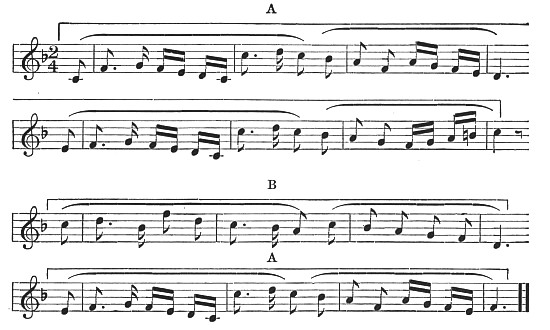
Our next illustration is an Irish song called "The Flight
of the Earls," one of the most beautiful of melodies. (See
Figure VII.)
In this illustration the curved lines represent
the phrases and correspond to the lines of the poem,
while the brackets show the larger formal structure of
the melody, A being the statement, or clause of assertion,
B the clause of contrast, and A the restatement. A mere
glance at this music will show how certain phrases are used
throughout to hold the melody together. The first and
second measures,[6] for example, contain a phrase of which
one part or the other will be found in almost every measure
of the song. The first half of the song ends at 9 with a
modulation to the fifth above, or dominant, while the "restatement
after contrast" (beginning on the last note of
measure 13) is quite clear.
Certain details may be pointed out for the benefit of the
student. The first phrase, ending on the note D (5), gives
a sense of being poised for a moment before proceeding to
the next note, D not being a point of rest such as is supplied
by the C with which the second phrase ends—at 9. The
same device is used at the end of the third phrase (13).
The clause of contrast (9-13), while based on the rhythm
of the motive of three notes at the beginning of the song,
is distinguished from either of the other two parts by the
absence of the characteristic sixteenth-note figure of measure
two.
This song justifies all that we have said about the poetic
beauty of folk-songs. Within its short compass are contained
elements of perfection that may well astonish those
who look on folk-songs as immaterial to the development
of the art of music. For this melody is as complete and
perfect an expression of that natural idealism that seems
to have animated human beings from the earliest times as
is the present day music of our own ideals.
The next illustration is a well known German folk-song
called "Sister Fair."
This melody is one of great beauty and tenderness.
Like many other German folk-songs, it is full of quiet
sentiment, not over-strained, but sweet and wholesome.
It contains certain formal elements with which we are
already familiar: (1) "Repetition," between the first motive
in measures 1 and 2, between measures 5-6 and 7-8, and
between measures 3-4 and 11-12; (2) "transposition,"
where the motive in measure 9 is inverted in measure 10
(this is an imitation of rhythm but not of melody); (3)
"restatement after contrast," the last four measures being,
in effect, a repetition of the first four with the first motive
from measure 9 inverted; (4) "modulation," the first
phrase being in A-minor, the second in C-major, and the
last in A-minor again. This is a particularly clear example
of a modulation, as the three phrases distinctly centre
round their respective key-notes, or tonal centres. It
should be noted that the modulation is not to the fifth
above the key-note, as in most of the other examples, but to
the third above. This is common in songs in the minor key.
Quite a distinct charm is imparted to the first phrase
of this melody by the use at the end of measure 2 of the
little rhythmic figure that has already appeared at the
beginning of the first and second measures. There is an
unexpected charm in this shifting of a motive from one part
of a measure to another. We shall see this device of musical
construction in many of the larger works that are dealt
with in later chapters.
There are a great many beautiful German folk-songs
which would be well worth study here did space
permit. The student is referred to such collections as
Reimann's "Das Deutsche Lied," where the best of them
will be found.
In this brief study of folk-songs we have noted that
the stream of pure native melody was independent of the
art-song and followed its own natural channel, but that, in
spite of its limitation, presents to us some well developed
formal types.
We have seen how important a part modulation plays
in the plan of a piece of music, and how, by means of a
change of key, a new kind of variety may be imparted to
a melody.
We have observed how closely the old songs reflect the
characteristics of the people who produced them, and how
intimate was the connection between the songs—with the
verses to which they were set—and the thoughts and feelings
of those who used them.
In studying the German folk-song we have observed a
subtle element of form, namely, the shifting of a motive
from one part of a measure to another.
In the next chapter we shall take up the study of simple
polyphonic pieces, such as have already been referred to in
dealing with the round, "Three Blind Mice."
SUGGESTIONS FOR COLLATERAL READING.
Parry: "The Evolution of the Art of Music,"
Chapter III; Grove's "Dictionary of Music and
Musicians," articles "Song" and "Form."
FOOTNOTES:
[1] Sir Hubert Parry in "The Evolution of the Art of Music."
[6] The partial measure at the beginning is counted as one.
CHAPTER III. THE POLYPHONIC MUSIC OF BACH. — I. WHAT IS "POLYPHONY ?" — II. AN INVENTION BY BACH . — E XAMPLE FOR A NALYSIS , No. 1. — III. A FUGUE BY BACH . — E XAMPLE FOR A NALYSIS , No. 2.
We have seen in the last chapter some typical examples
of folk-songs, which have served to give us an impression
of folk-music in general, since it always conforms, in all
essentials, to the type they illustrate. Folk-music is generally
simple and unsophisticated in expression; it is generally
cast in short and obvious forms; and it generally consists
of a single melody, either sung alone or accompanied,
on some primitive instrument, by a few of the commonest
chords.
The prominence given to a single melody by music of this
type, however, makes it unsuitable for groups of different
voices, such as a vocal quartet or a chorus; and therefore
when musicians began to pay attention to music intended
for church use they had to work out a different
style, in which several parts, sung by the various voices,
could be strongly individualized. This led to what is
called the "polyphonic," or "many-voiced" style. Another
reason why the ecclesiastical style always remained unlike the
secular was that the learned church musicians disdained
any use of those methods which grew up in connection with
folk-songs and dances, considering them profane or vulgar.
Had they been willing to study them, they might have
added much vitality to church music; but they maintained
an attitude of aloofness and of contempt for the popular
music.
The peculiarity of the polyphonic style is that that
portion of the music which accompanies the chief melody
is no longer a series of chords as in folk-music, but a tissue
of secondary melodies, like the chief one, and hardly less
important. (This arises, as we have just suggested, from
the necessity of giving each of the four voices or groups of
voices,—soprano, alto, tenor, and bass,—something
individual and interesting to do.) The difference between
the two styles is apparent even to the eye, on the printed
page. A folk-song, or any other piece in "homophonic"
or "one-voiced" style, has the characteristic appearance
of a line of notes on top (the melody), with groups of other
notes hanging down from it here and there, like clothes
from a clothes line (the accompaniment). A Bach fugue,
in print, presents the appearance of four (or more) interlacing
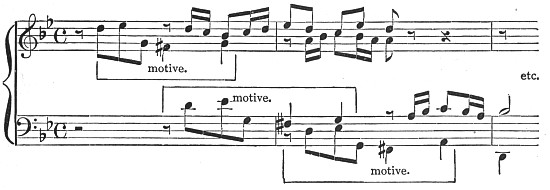
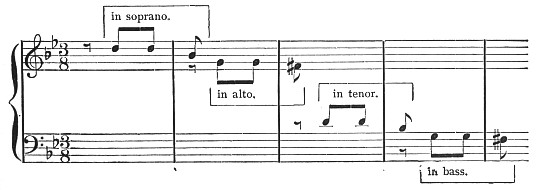
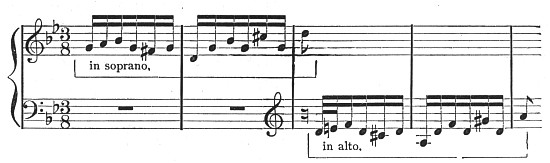
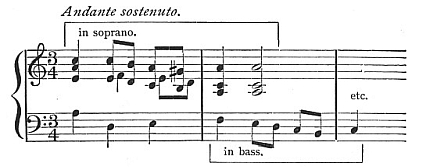
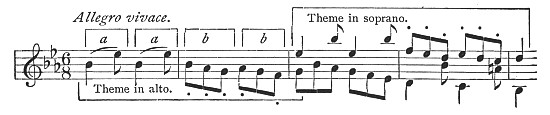
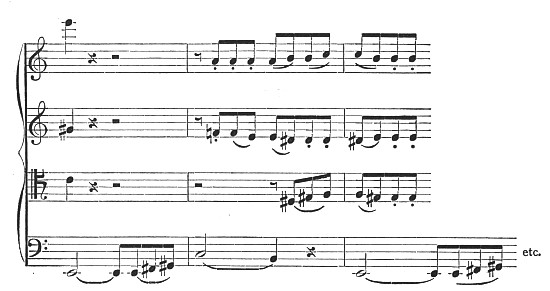
lines of notes. (See Figure IX.)
FIGURE IX. DIFFERENCE BETWEEN "HOMOPHONIC" AND "POLYPHONIC" STYLE.
Historically speaking, the first great culmination of the
polyphonic style is found in the ecclesiastical choruses of
Palestrina (1528-1594); but it was not until somewhat later
that this style was applied to instrumental music. In the
inventions, canons, preludes, toccatas, and fugues of
Johann Sebastian Bach (1685-1750), we get the first great
examples of polyphony as applied, not to merely ecclesiastical
music, but to music which by its secular character and
its variety of emotional expression is universal in scope.
Such is the ingenuity and the perfection of detail in
Bach's works in the polyphonic style that a life-time might
be spent in studying them. They have that delicacy of
inner adjustment more usually found in the works of nature
than in those of man; their melodies grow out of their motive
germs as plants put forth leaves and flowers; their separate
voices fit into one another like the crystals in a bit of quartz;
and the whole fabric of the music stands on its elemental
harmonies as solidly as the mountains on their granite bases.
We can hope to see as little of this august country of Bach's
mind by analyzing a few pieces as a man may see of the
hills and moors in a day's excursion—but, nevertheless, a
beginning must be made.
The essential features of this music may be seen in even
so simple a piece as the Invention in F-major, number 7, in
the two-voiced inventions, though it is written for only
two voices and is but thirty-four measures long.
Bach: Two-voice Invention No. VIII., in F-Major.
The subject or theme of this invention is a melody of
two measures' length, first given out by the soprano, and
consists of two motives or characteristic figures, one in
eighth-notes, staccato, making a series of leaps, thus:
Notice how charmingly the staccato and the legato are contrasted
in these motives.
The entire invention is made out of this subject by means
of those methods of varied repetition discussed in Chapter
I., especially "imitation" and "transposition." For example,
the lower voice, which we will call the bass, "imitates,"
almost exactly, through the first eleven measures,
what the soprano says a measure before it. On the other
hand, in measure 12 the bass starts the ball a-rolling by
giving the subject (this time in the key of C), and the
soprano takes its turn at imitating. Then, from measure
29 to the end, it is again the soprano which leads and
the bass which imitates. The student should trace out
these imitations in detail, admiring the skill with which
they are made always harmonious.
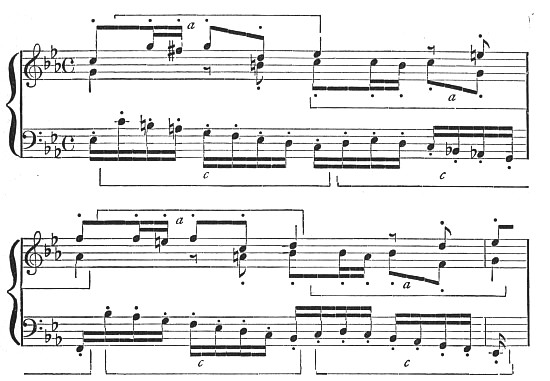
There are many instances of transposition also, most of
them carried out so systematically that they form what
musicians call "sequences."
A sequence is a series of transpositions of a motive,
shifting it in pitch either upward or downward, and carried
out systematically through several repetitions. Examples:
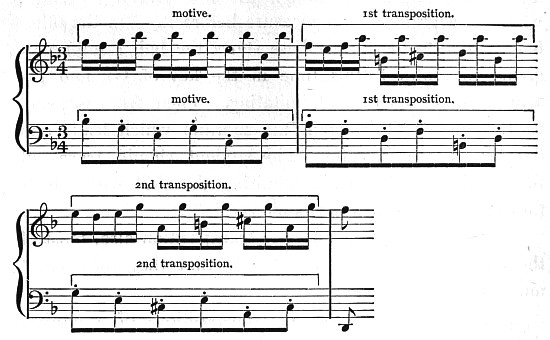
measures 4, 5, and 6, transposition of the motive in soprano,
three repetitions; measures 21, 22, 23, transposition of motives
of both voices, three repetitions; measures 24, 25,
transposition of motives of both voices, two repetitions.
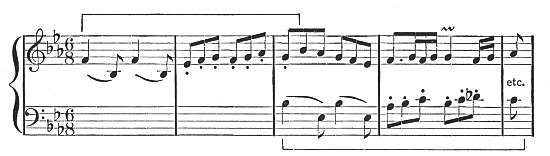
The second of these sequences is shown in Figure X.
It will be noted what a strong sense of regular, orderly
progress these sequences impart to the melodies.
It is interesting to see that the same general scheme of
keys is embodied in this invention that we have observed
in folk-songs: i. e., the modulation to the "dominant" in
the middle (measure 12), and the return at the end to the
original key. This divides the piece into two unequal
halves, the first making an excursion away from the home
key, the second returning home—much as the King of
France, with twenty thousand men, marched up the hill
and then marched down again. Such a two-part structure
is observable in thousands of short pieces, and is called by
musicians "binary form."
FIGURE X. "Sequence" from Bach's Invention in F-Major.
The difference in texture between this piece and any
folk-song or dance will best be appreciated by playing over
the bass part alone, when it will be seen that, far from being
mere "filling" or accompaniment, it is a delightful melody
in itself, almost as interesting as its more prominent companion.
Indeed, in the whole invention there are only two
tones (the C and the A in the final chord) which are not
melodically necessary. Such is the splendid economy and
clearness of Bach's musical thinking.
Before going further, the reader should examine for himself
several typical inventions, as, for example, No. I, in
C-major; No. II, in C-minor; No. X, in G-major, and No.
XIII, in A-minor, in this set by Bach, noting in each case:
(1) the individuality of the motives used, (2) the imitations
from voice to voice, (3) the sequences, (4) the modulations,
(5) the polyphonic character, as evidenced by the self-sufficiency
and melodic interest of the bass, and (6) the structural
division of the entire invention into more or less distinct
sections.
The same general method of composing that is exemplified
in the inventions we see applied on a larger scale in
the fugues of Bach.
The definition of a fugue given by some wag—"a
piece of music in which one voice after another comes in,
and one listener after another goes out"—is true only when
the listeners are uneducated. For a trained ear there is no
keener pleasure than following the windings of a well written
fugue. It is, at the same time, true that a fugue presents especial
difficulties to the ear, because of its intricately interwoven
melodies. In a folk-song there is not only but one
melody, with nothing to distract the attention from it, but it is
composed in definite phrases of equal length, like the lines in
poetry, with a pause at the end of each, in which the mind
of the listener can take breath, so to speak, and rest a
moment before renewing attention. Not so in the fugue,
where the bits of tune occur all through the whole range of
the music, are of varying lengths and character, and overlap
in such a way that there are few if any moments of complete
rest for the attention. Perhaps this is the chief reason why
fugues have the reputation of being "dry."
As is suggested by the derivation of the word "fugue,"
from the Latin "fuga," a flight, the characteristic peculiarity
of the form is the entrance, one after another, of the
several voices, which thus seem to pursue or chase one
another, to go through a sort of musical game of "tag," in
which first one and then another is "It." First one voice
begins with the "subject" of the fugue, in the "tonic" key
(key in which the piece is written). Next enters a second
voice, "imitating" the first, but presenting the subject not
in the "tonic," but in the "dominant" key. Then a third,
once more in the tonic, and finally the fourth, again in the
dominant. After these entrances all four voices proceed to
play with the subject, transposing it in all sorts of ingenious
ways, and straying off at times into episodes, generally in
"sequence" form, but finally coming back, towards the end
of the fugue, with renewed energy to the subject itself. All
this may be seen in such an example as the Fugue in C-minor
in Bach's "Well-Tempered Clavichord."
Bach: Fugue No. 2, C-minor, in three voices. "Well-Tempered
Clavichord." Book 1. [7]
Like all the fugues in Bach's "Well-Tempered Clavichord,"
this fugue is preceded by a prelude, in free style,
like a series of embroideries on chords, intended to prepare
the nearer for the more active musical enjoyment of the
fugue to come. Parry, in the "Oxford History of Music,"
says of the Prelude of Bach and Handel: "It might be a
simple series of harmonies such as a player might extemporize
before beginning the Suite or the Fugue, [such is the
case in the present prelude]; or, its theme might be
treated in a continuous consistently homogeneous movement
unrestricted as to length, but never losing sight of the
subject" ... etc.
A fugal subject is usually longer and more pretentious
than an invention subject, and more nearly approaches
what we should call a complete melody. It may contain
several motives. Moreover, while the second voice is
"answering" the subject, the first voice continues with
further melody, and if this is of definite, individual character
it may easily assume almost as great importance as the subject
itself, in which case we may give it the name of "counter-subject."
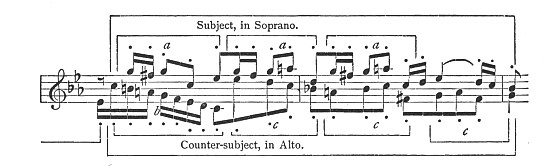
In Figure XI the subject and counter-subject
of this fugue are shown. The long brackets show
subject and counter-subject; the short brackets show the
three chief motives, marked a, b, and c. The simplicity of
the melodic material is noticeable. Motive a, which, with
its three repetitions, forms most of the subject, consists of
five tones, in a charming and unforgettable rhythm of two
shorts and three longs. Motive b is simply a descending
scale, in equal short notes. Motive c is four equal long
notes. Play the subject and counter-subject through separately,
several times, and get them well "by heart" before
going farther.
This fugue is a wonderful example of what a master-composer
can make out of simple materials; the whole
piece is built from these three motives. Our analysis may
conveniently be made in tabular form, the student being
expected to trace out the development for himself, measure
by measure.
FIGURE XIa. A SEQUENCE FROM BACH'S FUGUE IN C-MINOR.
The general form of this fugue illustrates the same
principles of modulation, and of restatement of subject after
contrast, that we noticed in the folk-songs and in the invention.
This may be tabulated thus:
IV. GENERAL QUALITIES OF BACH'S WORK.
TABLE SHOWING STRUCTURE OF FUGUE IN C-MINOR.
A.
B.
A.
STATEMENT.
CONTRAST.
RESTATEMENT.
Measures 1-10 in key of
Measures 11-19 in various keys,
Measures 20-31 in
C-minor.
beginning with E-flat.
C-minor.
The modulation in this case, however, is not to the
"dominant" key, but to what is called the "relative
major" key, as is usual in pieces written in minor keys,
(see the folk-song, "Sister Fair," in Chapter II), the
reason being that the relative major affords the most
natural contrast to a minor key, just as the dominant
affords the most natural contrast to a major key.
The conclusion is emphasized by the finely rugged statement
of the subject in Bass at measure 26.
The treatment of this fugue, for all its consummate
skill, is comparatively simple. It does not employ the more
subtle devices often employed in fugues, of which may be
mentioned the following:
1. "Inversion:" The subject turned upside down,
while retaining its identity by means of its rhythm.
FIGURE XIII. THE DEVICES OF "AUGMENTATION" AND "DIMINUTION."
2. "Augmentation and Diminution:" The length of
the notes doubled or halved, while their relative length, or
rhythm, is carefully maintained. (Figure XIII.)
3. "Shifted rhythm:"[8] The subject shifted as regards
its position in the measure, so that all the accents fall
differently.
4. "Stretto:" The imitation of the subject by a second
voice occurring prematurely, before the first voice has completed
the subject, frequently with highly dramatic effect.
(b) in Figure IX is an example of stretto.
These devices are mentioned here not only because they
occur in many fugues, but because they are used in the symphonic
music of Mozart and Beethoven, as we shall later
have occasion to see.
Perhaps the most exacting of all tests applicable to music
is the test of economy. Are there superfluous tones that
do not enrich the harmony? Are there unnecessary subjects
not needed to fill the scheme of design? If so, no
matter how beautiful the music, it is defective as art. Bach
bears this test victoriously. There is not a note of his
writing which one would willingly sacrifice. There is not
a melody that is not needed. Each subject is not merely
introduced and dismissed, but is developed to the utmost,
so that all that was implicit in its germ becomes explicit
in its final form. There is no confusion of the outline, no
overcrowding of the canvas, no blotchiness in the color.
As Giotto proved his supremacy among draughtsmen by
the apparently simple but really enormously difficult feat
of drawing a complete, perfect circle with one stroke of the
pencil, so Bach constantly proves his supremacy among
musicians by making two voices satisfy the ear like an
orchestra. And this purity of texture is quite compatible
with the utmost richness. Indeed, Bach's polyphonic scores
are inimitably rich, since each voice sings its own melody,
and the melodies all interplay harmoniously like the lines
of a well-composed picture. Those who call Bach's fugues
dry make an astonishing confession of their own insensibility
or crudity of taste. Bach's melodies are not, to be
sure, like "Annie Laurie" or "Home, Sweet Home."
But neither is daylight like candle light; yet we do
not call it darkness because it is diffused through all
the atmosphere instead of concentrated in a single visible
ray.
Bach's daring has been the subject of the endless
admiration of students. Especially in the matter of harmony
he did things in the eighteenth century, and entirely
on his own responsibility, that whole schools of composers
band together with a sense of revolutionary courage
to do in the twentieth. He is truly one of the most modern
of composers, and will always remain so. Composers who
might have been his grandsons are now antiquated, while
he is always contemporary with the best musical thought.
Brahms, irritated at Rubinstein's persistent patronizing
of "Papa Haydn" in his book, "A Conversation on Music,"
remarked in his dry way: "Rubinstein will soon be Great-grandfather
Rubinstein, but Haydn will then be still Papa
Haydn." The same might be said even more truly of
Bach, who will always be the father of musicians.
Another way in which Bach is modern is in the variety
of his musical expression. It is not only that his range of
different species of works is so great, reaching from the
ecstatically tender and exalted religious choral compositions,
such as cantatas, motets, oratorios, and passions,
through the grand and monumental organ toccatas and
fugues, to the intimate, colloquial suites and sonatas for
orchestra and for clavichord; it is even more wonderful that
in a single work, such as the "Well-Tempered Clavichord,"
he knows how to sound the whole gamut of human feeling,
from the deep and sombre passions of the soul to the homely
gaiety or bantering humor of an idle moment.[9] Bach might
have boasted, had it been in his nature to boast, that in this
work he had not only written in every key known to
musicians, but in every mood known to men. It is the
musical "Com?ie Humaine."
Bach lived quietly and in almost complete obscurity;
for the last quarter-century of his life he held a post as
teacher of music and church-music director in Leipsic.
He travelled little, sought no worldly fame, took no pains to
secure performances of his works, and, above all, made
no compromise with the popular taste of his day. He produced
his great compositions, one after another, in the
regular day's work, for performance in his church or
by local orchestras and players. He never pined for
a recognition that in the nature of things he could
not have; he wrote the music that seemed good to him,
and thought that his responsibility ended there, and that
his reward lay there. The cynic who said "Every man has
his price" was evidently not acquainted with the life of
Bach. Steadily ignoring those temptations to prostitute
his genius for the public's pleasure, which so materially
affected the life course of his great contemporary Handel,
he followed his own ideals with an undivided mind. As
always happens in such cases, since it takes decades for
the world to comprehend a sincere individual, or even
centuries if his individuality is deep and unique, he was not
appreciated in his life-time, nor for many years after his
death.
Indeed, he is not appreciated now, for a man can be
appreciated only by his equals. But we have at last got
an inkling of the treasure that still lies hidden away in
Bach; and while Handel and the other idols of the age
sound daily more thin and archaic, Bach grows ever richer
as the understanding we bring to him increases, and still
holds out his promise of novel and perennial artistic
delights.
SUGGESTIONS FOR COLLATERAL READING.
W. R. Spalding: "Tonal Counterpoint." Edward
Dickinson: "Study of the History of Music," Chapter XX.
C. H. H. Parry: "Evolution of the Art of Music,"
Chapter VIII.
FOOTNOTES:
[7] Number the measures, and call the voices soprano, alto, and bass.
[8] The reader should examine the example of shifted rhythm given in the second
chapter in dealing with the German song, "Sister Fair."
[9] In Book I, for example, Fugue II is as light and delicate as XII is serious and
earnest; XVI is pathetic, XVII vigorous and rugged, XVIII thoughtful and mystical,
etc.
CHAPTER IV. THE DANCE AND ITS DEVELOPMENT. — I. MUSICAL CHARACTER OF DANCES. — II. PRIMITIVE DANCES. — E XAMPLE FOR A NALYSIS , No. 3. — III. A BACH GAVOTTE. — E XAMPLE FOR A NALYSIS , No. 4.
In the last chapter we studied the most important
applications of the "polyphonic" style, which originated in
music for voices, to the music of instruments. We saw how
in such music the attention of the composer was divided
among several equally important voices or parts, and how
much he made of the principle of imitation; and in connection
with the fugue we remarked that the very complex interweaving
of the different voices in such music, one beginning
before another leaves off, and all together making an
intricate web, presented certain difficulties to the listener
accustomed to the more modern style, in which a single
voice has the melody, and stops short at regular intervals,
giving the hearer a chance to draw breath, as it were, and
renew attention for what is coming next. Listening to
modern music is like reading a series of short sentences,
each clearly and definitely ended by its own full stop.
Listening to the old polyphony is more like reading one of
those long and involved sentences of De Quincey or Walter
Pater, in which the clauses are intricately interwoven and
mutually dependent, so that we can get the sense only by
a long-sustained effort of attention.
This more involved style, suitable to voices, but less
natural to instruments, had historically a very long life.
Much of the instrumental music of the sixteenth, seventeenth,
and eighteenth centuries was in fact nothing but
a transference to instruments of music really conceived for
voices. Thus, for example, in the sixteenth century,
when madrigals and canzonas, which were compositions
for voices in the polyphonic style but of a more secular
character than church music, were exceedingly popular, the
composers for stringed instruments and for the then very
fashionable lutes, "when they wanted something of a
superior order, ... simply played madrigals, or wrote
music in imitation of any of the varieties of choral music,
not realizing that without the human tones ... which
gave expression to the rising and falling of the melodic
material, the effect was pointless and flat."[10] Even Bach
and Handel, in the eighteenth century, were, by their deeply-rooted
habit of thinking vocally, in some degree hampered
in the search for a purely instrumental style. Instrumental
music, having to get along without words, must find
some principle of coherence, some kind of definite design,
which will make it intelligible without the help of words, and
enable it to stand on its own feet.
And here comes in the importance of folk-song, and of
the folk-dance which grew up beside it, to our modern instrumental
music. For both song and dance pointed the way
to such a principle of independent intelligibility, through
definite balance of phrases (see Chapter I), and through
contrasts and resemblances of key in the various phrases and
sections of a composition. Music intended to accompany
songs or dances had to consist of balanced phrases of equal
length—in the case of songs, because it had to reproduce
the verse structure of the words, which of course were composed
in regular stanzas of equal lines, and in the case of
dances, because it had to afford a basis for symmetrical
movements of the body. And when once it was thus divided
up into equal phrases, it took musicians but a short time to
find that these phrases could be effectively contrasted, and
made the parts of larger musical organisms, by being put
into different keys (as we have seen in the instances of modulation
cited in Chapters II and III). How vital these
principles of structure in balanced phrases and sections, and
of contrast of keys, are to the entire modern development
of music, we shall realize fully only as we proceed.
Again, both song and dance have proved supremely
important to the development of the homophonic style (one
melody, with accompaniment not itself melodic). In the
case of song the reason is obvious. A song rendered by a
solo voice, with instrumental accompaniment, naturally
takes the homophonic style, since it would be highly artificial
to make the subordinate element in the combination as
prominent as the chief one. Dance is less inevitably homophonic
than song; indeed many dances, as we shall see, are
to a greater or less degree polyphonic; but nevertheless the
tendency toward homophony is always apparent. In the
first place, the interweaving of many melodies would tend
to obscure the division into definite phrases, since an inner
melody might sometimes fill up the pause in the main one,
as we saw it constantly doing in the fugue. Secondly, the
mode of performing dances tends to give prominence to a
single melody. The old dances were generally played by
one melodic instrument, such as a violin or hautboy, accompanied
by chords on an instrument of the lute or guitar
family, and frequently by a drum to strengthen the accents.
Such a combination affords but one prominent "voice," and
does not lend itself naturally to polyphonic writing.
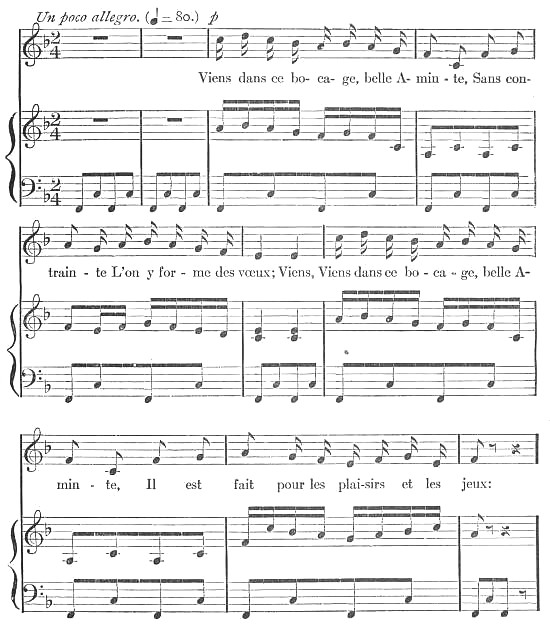
Viens dans ce bo- ca- ge, belle A- min - te,
Sans contrain - te L'on y for - me des vœux; Viens,
Viens dans ce bo - ca - ge, belle A- min - te,
Il est fait pour les plai-sirs et les jeux:
The "Tambourin," for instance, an old French dance
of Provence, was played by one performer, the melody with
one hand on the "galoubet," a kind of pipe or flageolet, and
the accompanying rhythm with the other on a small drum.
The quotation in Figure XV, taken from Wekerlin's collection,
"Echos du Temps Pass?" (Vol. III), is a good
example of this ancient dance. In this arrangement for
piano, the left hand imitates the drum, and the right
hand the "galoubet" or pipe. This quotation illustrates
the common use of dance melodies in songs. Many
primitive airs were so used in the olden times.
The rude dances which spring up spontaneously in all
communities, savage as well as civilized, and of which we
in America have examples in the war-dances of Indians and
the cake-walks of negroes, are thus seen to be pregnant of
influence on developed musical art, no less than the folk-songs
which we discussed in the second chapter, and the more
academic music in the polyphonic style which we treated
in the third. Both songs and dances, indeed, sometimes
enter into artistic music even in their crude form, but in most
cases composers treat them with a certain freedom, and in
various ways enhance their effectiveness, as Haydn, for
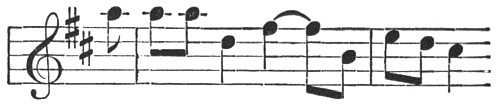
instance, treats the Croatian folk-tune "Jur Postaje," in
the Andante of his "Paukenwirbel" Symphony. In Figure
XVI the reader will see both the crude form of the tune and
the shape into which Haydn moulds it for his purposes.
In the long process of development which songs and dances
thus undergo at the hands of composers, they of course lose
to some extent their contrasting characters, until in modern
music the dance and the song elements are as inextricably
interwoven as the warp and the woof of a well-made
fabric.
As imitation is only slightly available in homophonic
music, the unity so vital to all art is attained in dances chiefly
by transpositions of motives, often in systematic "sequences,"
by more or less exact balance of phrases, and by restatement
after contrast. In crude examples these means are crudely
used; in the work of masters they are treated with more
subtlety and elasticity; but always a careful analysis will
discover them. It will now prove enlightening to compare,
from this point of view, three dance tunes of very different
degrees of merit.
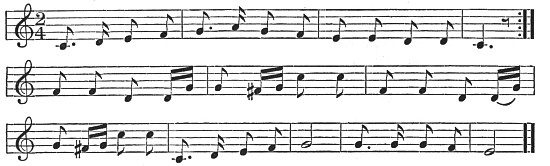
FIGURE XVII.
A "Branle" or "Brawl" from Arbeau's Orchesographie, (1545).
Figure XVII shows an ancient "Branle" or "Brawl"
of the sixteenth century, taken from Arbeau's "Orchesographie,"
published in 1545.
The strong meter, causing a distinct accent on the first
note of each measure, will at once be noted, especially if
it be contrasted with the more moderate accentuation of the
folk-songs of Chapter II. Such strong meter is naturally
characteristic of all dance tunes, intended as they are to
guide and stimulate the regular steps of the dancer.
The phrase balance, though marked, is not absolutely
regular, but the two two-measure phrases at the beginning
and the single one at the end suffice to give an impression
of pronounced symmetry. The six-measure phrase after
the double-bar is generated by the sequential treatment of
the little motive of measure 5.
This sequence (measures 5, 6, 7, 8, 9) is worthy of note
because of the excessive length to which it is carried. Five
repetitions are too many, and grow monotonous. A more
skilful composer would have secured his unity without so
great a sacrifice of variety—in a word, he would have
treated a device good in itself with less crudity.
The exact repetition of measures 3-4 at the end is an
effective use of restatement after contrast. Although the
whole of the original theme is not given, there is enough of
it to give the sense of orderliness in design.
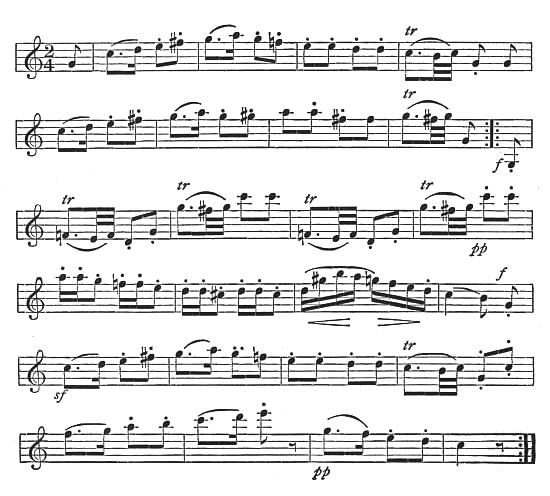
A Gavotte in F-major by Arcangelo Corelli (1653-1713),
the famous violin virtuoso of the seventeenth century,
printed in Augener's edition of Pieces by Corelli, will
illustrate a distinctly higher stage in the treatment of a
dance form. This is well worth a brief analysis.
Corelli: Gavotte in F-Major.
Here the phrase balance, though entirely satisfying to
the sense of rhythm, is much more elastic than in the brawl.
The measure-lengths of the phrases are not all the same;
they are as follows: 1, 1, 2, 1, 1, 1, 2, 2. This gives the tune
an agreeable variety.
It will be noted, however, that the sequence is still
treated rather fumblingly. In the three measures after
the double-bar, the same motive is repeated thrice, each time
higher than before, and to a fastidious ear the third repetition
grows slightly wearisome.
On the whole, nevertheless, the gain in elasticity and
freedom over the last example is marked.
The general structure and scheme of modulation in this
little Gavotte of Corelli deserves careful attention, because
it is in these respects typical of a very great number, indeed
of the majority of the short dances of the seventeenth
and eighteenth centuries. It is divided into two distinct
halves, and while each deals with the same musical material,
the two are strongly contrasted in the matter of key. The
first begins in the home key and leaves it to end in a contrasted
key, in the present case the "dominant." The
second, beginning in the dominant, modulates back again
to the home key, and ends there. This scheme, called by
musicians "binary" or "two-part" form, is a very simple
and natural one for short pieces of this kind, and is to be
found in thousands of the movements of Corelli, Scarlatti,
Couperin, Rameau, Purcell, Handel, Bach, and other
masters of their day. It is even more common than the
"ternary" form to which we shall come in a moment.
If the reader will now compare with these two dances
the Gavotte in the sixth English Suite of J. S. Bach, who
had the advantage of living half a century later than Corelli
(besides being an immeasurably greater genius), he will
be amazed to see the power and originality with which a
master can treat a traditional form.[11]
Bach: Gavotte in D-Minor from the Sixth English Suite.
Before looking at matters of detail, we must notice the
structure of the piece as a whole, since it is not only highly
interesting in itself, but is an example—the first we have
had on a large scale—of a type of construction that is
perhaps more popular with musicians of all schools than
any other.
This structural type is nothing but an application to
an entire piece of that three-part form which we have seen
in little in the Galician folk-song of Chapter I and in
"Polly Oliver" in Chapter II, and to which we may now
give the name of "ternary form," to distinguish it from
the "binary form" discussed in Chapter III. Bach here
writes two distinct gavottes, repeating the first after the
second: so that Gavotte I is a statement, Gavotte II a
contrast (emphasized by change of key from minor to
major), and the repeated Gavotte I a restatement. This
practice is very frequent in Bach's suites, where we often
find two courantes, two bourr?s, two passepieds, two
minuets, etc., combined in this way, the function of the second
being to afford contrast to the first. In some instances
the second of the pair is called "trio," probably because
the earliest examples were written in three-voice harmony,
or "musette," from the French word for "bagpipe," in
reference to the drone bass imitating that instrument.
(This is the case in the present gavotte, where the gavotte II
bears the alternative name of musette.)
In the sonatas and symphonies of Haydn, Mozart, and
Beethoven, as we shall see later, this three-section structure
is found in the minuet with trio, and in the scherzo with
trio. Nor is it less common in modern music, occurring
notably in the marches of Schubert, many of the short
pieces of Schumann, in the polonaises and some of the
nocturnes of Chopin, in the rhapsodies and intermezzos
of Brahms, and in the lyric pieces of Grieg. Indeed, its
naturalness and clearness inevitably commend it to all
composers.
Looking more closely we see, again, that the same
scheme is used by Bach in each of the two gavottes, considered
separately. In the first, we note the structure A =
measures 1-10, B = measures 11-27, A = measures 27-35;
in the second we find, A = measures 1-10, B = measures
11-19, A = measures 19-28. The student should verify
this analysis for himself.
Proceeding now to details, we notice first that Bach,
supreme master of polyphony that he is, writes even a
gavotte in such a way that each of its voices has its own
melodic value. The gavotte itself is in three voices throughout,
and the musette in two, and while these voices are not
so purely melodic as in an invention or a fugue, and there
is little strict imitation, yet the general effect is polyphonic
rather than homophonic. In measures 27-31 the alto
voice even has the theme.
The phrase balance is freer than even Corelli's, because
Bach's mind is quicker to seize upon and work out the
latent possibilities of his melodies. All begins regularly
enough: the first four phrases are each two measures in
length; but after the double-bar the "plot begins to thicken."
First we find two more phrases just like the preceding ones
(measures 11-13 and 13-15); but in the next phrase,
begun in the same way, in measure 15, the yeast of Bach's
fancy begins to work, and the melody broadens out in a
series of evolutions, first in the soprano and later in the alto,
not coming again to a point of rest (end of a phrase) until
measure 23. This extension of a phrase through the germination
or blossoming of the thought (in this case it all
comes from the bit of melody in measure 7) is a matter of
supreme importance in composition, and this instance of
it, as well as another in measures 23-27, should be carefully
studied by any one who desires to understand music.
The power thus to develop or draw forth the hidden potentialities
of his motives is one of the most important of all
the gifts which go to make a composer. Still further
instances of it should now be found by the student himself
in the musette.
The artistic freedom and felicity of Bach's way of working
is further illustrated by the manner in which, while
using the general principle of the sequence as a means of
giving his music unity of idea, he avoids those overliteral,
mechanical transpositions of motive which we found in the
more primitive dances. There is just the contrast here that
there is between a poor speaker, who keeps repeating the
same word or phrase with futile emphasis, and the man of
real eloquence, who follows a train of thought no less closely,
but manages constantly to cast his ideas in new phraseology
and fresh figures of speech, so that the variety of what he
says is quite as striking as its fundamental unity.
The element of variety introduced into the contrast-section
of the gavotte (11-27), by the free modulation
through several keys, should also be remarked. The plan
of modulation is different from any we have yet had.
Instead of beginning in the relative major (which would be
the key of F), the section begins in the dominant minor (A-minor).
A good many keys are then touched upon before
the tonic or home key is reached at the restatement (27-35),
which, by a charming subtlety, begins with the theme
in the alto instead of the soprano voice.
In all these matters we detect the workings of an original
and inventive mind, which, far from being hampered by
working in a traditional form, is stimulated to constantly
new solutions of old problems, and so produces a piece of
music at once perfectly clear and fascinatingly interesting.
In the next chapter we shall see how composers combined
groups of such dances as this, with other pieces of a
different character, into those suites which were the most
popular forms of instrumental music in the eighteenth
century.
SUGGESTIONS FOR COLLATERAL READING.
Grove's Dictionary: article "Rhythm," and articles
under names of various dances, as "Gavotte," "Allemande,"
"Courante," "Minuet," "Gigue," etc.
Other examples of dances may be found in a collection of
twenty-five old gavottes, published by Breitkopf and H?tel,
and in a volume of miscellaneous old dances in the Litolff
Edition.
FOOTNOTES:
[10] Parry: Evolution of the Art of Music, page 115.
[11] For this analysis, number all the measures and parts of measures consecutively,
which will give 35 measure numbers in the Gavotte proper, and 28 in the second Gavotte
or Musette.
CHAPTER V. THE SUITE. — I. DERIVATION OF THE SUITE. — II. THE SUITES OF BACH. — E XAMPLE FOR A NALYSIS , No. 5.
Once musicians had begun to realize how dances could
be developed into finished pieces, like the gavotte of Bach,
which we discussed in the last chapter, they were quick to
avail themselves of this advantage by combining several
such dances into a group, thus making a composition of
some length and dignity and yet of popular, easily comprehensible
style. Such compositions, known in England as
"Lessons," in France as "Ordres," and in Germany as
"Suites" and "Partitas," became numerous in the seventeenth
and eighteenth centuries.
The first historical step in the development of the suite
was taken when the great violin-makers of Cremona and
Brescia, in Italy, brought the violin to a wonderful mechanical
perfection early in the seventeenth century. Virtuosos
on this brilliant instrument were not slow to appear, and
they dazzled their audiences with pieces known as sonatas,
though having little in common with what we nowadays
call a sonata. Their sonata da chiesa, or church sonata,
was a group of pieces, all polyphonic in character and
derived from the old choral madrigals and canzonas; the
sonata da ballo, or dance sonata, was a group of dance tunes;
the sonata da camera, or chamber sonata, combined both
types. Gradually the first become obsolete, and the second
and third took respectively the names suite and partita,
although the nomenclature was inexact, as suites often contained
movements of strict and severe polyphonic style as
well as dances. The greatest of the violin virtuosos was
Arcangelo Corelli, whose "sonatas" retain their charm
even for our modern ears, as may be seen from the sample
of his work studied in the last chapter.
About the end of the seventeenth century the keyed instruments,
such as the harpsichord, the clavichord, the spinet,
and other precursors of our modern pianoforte, first reached
the degree of mechanical perfection which enabled them to
rival the violin; and it was accordingly not until then that
important pieces for such keyed instruments began to be
written. At the end of the seventeenth and the beginning
of the eighteenth centuries, however, we find interesting
music for these instruments by composers of several nations.
In France Couperin (1668-1733) wrote what he called
"Ordres," short series of pieces "in dance style, piquant in
rhythm, melodiously graceful, profusely embroidered with
embellishment;"[12] and he was followed by Rameau (1683-1764)
with similar works. A curious whim of these French
masters was the appending of picturesque titles to their
pieces, such as "The Tambourine," "The Hen," "The
Return of the Birds," etc.—a practice which anticipates
the program music of to-day.
Italy had one extraordinary genius in this department
of music, Domenico Scarlatti (1683-1757). He was a
most brilliant performer on the harpsichord, delighted in
all feats of agility, and loved to surprise and astonish his
audience. In short he was a virtuoso, and his performances
must have created the kind of sensation in the seventeenth
century that Liszt's did in the nineteenth. "For vivacity,
wit, irony, mischief, mockery, and all the category of human
traits which Beethoven's scherzo served so brilliantly to
express," says Parry, "the world had to wait for a full century
to see Scarlatti's equal again." Some of the preludes,
sarabandes, minuets, courantes, etc., composed by him, still
retain their interest. His beautiful Pastorale in E-minor, and
his "Cat fugue," written on a theme played by a pet cat running
across the keyboard, are sometimes heard in recitals.
It was in the hands of the German masters, Bach and
Handel,[13] however, that the suite reached its highest state.
These two great composers, born in the same year, 1685,
possessed not only the sense of technical effect which made
Scarlatti great, and the high spirits, enthusiasm, and sense
of proportion which are needed for the production of idealized
dance movements such as Couperin and Rameau have
given us, but they had great musical learning, and much
experience in the use of the strict choral style of polyphonic
writing, which they showed by introducing into their suites
certain movements much more serious in style and exalted
in sentiment than dances. The English and French Suites,
so called, of Bach, and the Twelve Harpsichord Suites, or
"Lessons," as they were called in England, of Handel,
deserve to rank among the great masterpieces of musical art.
The six English and six French Suites of Bach, which
deserve a more detailed study than any others, consist
generally of from five to eight separate pieces or movements.
The first, derived from the severer type of the sonata da
chiesa, and thus, more remotely, from the choral madrigal
and canzona (see above), is always more intricate and
elaborate than the others. In the English Suite it is a long
contrapuntal prelude, with imitations and sequences such
as we studied in the invention and the fugue. In the French
Suites it is an allemande, less elaborate but still dignified
and impressive. We see this to be appropriate when we
remember that the hearer is best able to follow intricacies
when his mind is fresh and unjaded.
Bach: Prelude to English Suite, No. 3, in G-Minor.
The Motives: The thematic material out of which this
prelude is developed is very simple, consisting of just two
motives, which we will call (a) and (b).
Note the effective contrast between the bold, assertive
character of motive (a) and the more graceful character of
(b).
Structure: The prelude divides itself into seven clearly
marked sections, each ended by a well-marked cadence.
Let us examine these briefly in turn.
Section I, measures 1-32, key of G-minor: Founded on motive (a), with many
sequences which the reader should now be able to trace for himself.
Section II, measures 33-66: Begins in G-minor, modulates to B-flat major, the
"relative major." Motive (b) in soprano, measures 33-34; in alto, measures 35-36; in
bass, measures 43-44. Motive (a), measures 35, 36, 37 (alto), 38, 39, 43, 44, 53, 54, etc.
Section III, measures 67-98, key of B-flat: An almost exact copy of Section I, in a
different key.
Section IV, measures 99-124: Begins in B-flat major, modulates to D-minor, the
"dominant" of the original key. Both motives tossed about from voice to voice. (The
reader should locate each instance for himself.)
Section V, measures 125-160: Begins in D-minor, modulates to E-flat major, thus
giving variety of key in the middle part of the composition, which we begin to see is an
important principle of form. (Compare the Gavotte of the last chapter.) Very similar in
treatment to Section II.
Section VI, measures 161-179: Modulates back from E-flat major to the home key,
thus preparing the way for the final statements and conclusion. In measures 175-178
the insistence of the bass on the tone D, the "dominant" of the original key, will be
noticed. Such an insistence on one tone is called a "pedal point," because so frequently
found in the pedal part of organ music, and serves admirably here to prepare the mind
for the triumphant return to G-minor in the final section. The rest of Section VI is made
up of sequences, thus: 162-165, 166-169, 170-173; and then, 173, 174, 175, 176, 177, 178.
Section VII, measures 180-213: Almost entirely in the home-key, thus emphasizing
the sense of finality. The bulk of this section is furthermore identical with Section I,
thus affording a fine example of the principle of restatement after contrast.
Altogether this is a most interesting movement. In
the great effect made with simple means we recognize again,
as we did in the case of the invention and the fugue, the splendid
power of Bach's mind. The principles of imitation of
motives from voice to voice, of transpositions of a single
motive in a single voice giving rise to the many sequences,
and of restatement after contrast, all discussed in the first
chapter, are illustrated more brilliantly than by any
other composition we have thus far examined. Finally,
in the variety of key of Section V, placed in the middle
of the piece, and in the unity of key of the first and last
sections, we get a striking anticipation of a principle of
construction which we shall later see to be at the root of the
most important of modern forms, the sonata-form.
After listening to such a movement as this we naturally
wish to relax a little; and we are, therefore, pleased to hear
a series of dances of various rhythms and qualities of expression,
cast in simple "binary" or "ternary" forms, and either
frankly homophonic in style or not too elaborately polyphonic.
It is impossible to describe in detail here all the
dances found in suites, but the table on page 68 will give
an idea of the more important ones.
The gavotte studied in the preceding chapter gives an
excellent general impression of the livelier dances used,
which may be farther defined by a glance at such typical
pieces as the bourr?s of the first and second English Suites,
and the gavottes of the third English and fifth French
Suites. There is generally also to be found in Bach's
suites, introduced for the sake of contrast and in order to
represent the more emotional side of musical expression, a
sarabande or other such slow, stately, and sometimes truly
noble movement. Let us take, as an example of this
element, the Sarabande from the second English Suite.
III. THE HISTORIC IMPORTANCE OF THE SUITE.
FIGURE XIX. THE CHIEF DANCES USED IN SUITES
NAME
ORIGIN
METER
FORM
CHARACTER
Allemande
German
4-4
Usually "binary"
Brisk, fluent.
Courante
French
3-2 or 3-4
" "binary"
Merry, energetic.
Sarabande
Spanish
3-2, 3-4
" "binary"
Stately, serious, sometimes noble.
Bourr?
French
4-4, 2-4
" "ternary"
Lively.
Gavotte
French
4-4
" "ternary"
Moderately quick, well-marked.
Minuet
French
3-8, 3-4
" "ternary"
Well-regulated gaiety, courtly.
Passepied
French
3-4
Animated, brisk.
Loure
Old French
6-4
Slow, stately.
Anglaise
French
2-4
Lively, energetic.
Polonaise
Polish
3-4
Dignified, but animated.
Pavane
French
2-4
Stately.
Rigaudon
French
2-4, 4-4
Very lively, gay.
Gigue
Doubtful
6-8, 12-8
" "binary"
Very rollicking and merry.
EXAMPLE FOR ANALYSIS, No. 6. Bach: Sarabande in A-Minor from English Suite II
The melodic germ from which the piece is developed is
the following very serious and earnest phrase:
a phrase in which great depth of almost tragic feeling is
expressed. Against this is set, for the sake of relief, the
lighter and more suave melody of measures 5 and 6,
treated in freely sequential fashion. The whole sarabande
is built from these two brief melodic figures.
This sarabande serves as an admirable illustration of
the type of beauty common in the music of Bach. Its
phraseology, if we may use the term, is quite different from
that in use in the music of to-day; it is full of quaint and
archaic turns of musical speech—formal sequences, little
motives that sound to us almost mechanical. It is like an
etching of D?rer's, full of detail, each line carefully drawn,
and the whole picture instinct with life. Thus its type of
beauty differs so materially from that to which we are
accustomed that it often fails in its appeal. Only by using
our imagination are we able to project ourselves, so to
speak, into another milieu, another time, another point of
view. And this is the test with which any archaic work of
art confronts us. Without imagination in the beholder a
picture by Botticelli, for example, is a curiosity rather than
a work of art. Its strange allegory, its quaint idea of landscape,
its figures with their unusual posing—all these are
beautiful or merely curious according as we look at them.
"Beauty is in the eye of the beholder."
The repetition at a higher pitch of the main motive in
measures 3-4 is highly poignant; and throughout the expression
is intensified by the use of rich and often complex
harmony, as particularly in the last four measures of all.
Notwithstanding the earnest and impassioned character
of this sarabande, its derivation from the dance is clearly
revealed in the regularity of the balance of phrases consisting
of equal measure groups, which divide up as follows:
2, 2, 4, 4 (double-bar); 2, 2, 4, 2, 2, 4. The symmetry is
much more precise than in an invention or a fugue.
The form is binary or two-part. Part one, measures
1-12, begins in A-minor and ends in the "relative major,"
the key of C. Part two, measures 13-28, begins (with the
original motive) in C-major, and returns to A-minor.
The sequence of measures 23-24, with measures 21-22,
is very beautiful and deserves special notice.
Following the sarabande the reader will observe a more
florid version of it, bearing the caption, "Les agr?ents de
la m?e Sarabande"—"Ornaments for the same Sarabande."
This is an example of the practice, common in
Bach's day, of weaving a net-work of grace-notes, trills, and
other decorations about a melody, a practice due in part to
the natural fondness of all musicians for "effect," and in
part to the fact that the instruments of that day were so
small and poor that a tone could only be sustained by being
struck many times. This custom of ornamenting melodies
with all manner of embroidery gave rise to the "theme and
variations," a form which we shall study later.
All the other English Suites of Bach contain very beautiful
sarabandes; those in the French Suites are less interesting,
though the first contains a fine example.
All of Bach's twelve suites end with gay and vigorous
gigues, the most rollicking of all the dances used. This is
natural enough, in view of the desirability of closing the
suite with an impression of energetic vitality. These gigues
are in the headlong 6-8 or 12-8 meter; they are polyphonic
in texture, and constructed in the binary form. Often-times
a high degree of contrapuntal skill is shown in their
composition, but usually this does not interfere with their
light and almost careless character. A curious feature of
most of them is that in the second half the motive is inverted
or turned upside down.
EXAMPLE FOR ANALYSIS, No. 7.
Bach: Gigue, from French Suite IV in E-Flat.
Theme of Gigue, Bach's French Suite IV, and its Inversion.
The gay little theme is composed of two motives, as
indicated in Figure XXI, in which the long brackets show
the theme and its imitation by the second voice to enter,
and the short brackets show its component motives, of
contrasting character. In measures 5 and 6 the theme
is again imitated by the third voice (left hand part). In
the course of the development a still more lively figure
makes its appearance in measures 19, 23, 24 and 25.
The now familiar sequences are found at every
turn. The form is binary (Part I, measures 1-26;
Part II, measures 27-60). The inversion of the theme,
shown in Figure XXI, makes the subject of the second half.
The key-system is perfectly simple. Part I modulates from
the tonic, E-flat, to the dominant, B-flat; Part II begins
there and returns to the home-key.
In the course of the eighteenth century the suite gradually
waned in popularity, and gave place to the more highly
organic sonata. Modern suites, notable among which are
such delightful works as Bizet's "L'Arlesienne," Grieg's
"Peer Gynt," Dvor?'s Suite for small orchestra, opus. 39,
Tschaikowsky's "Nut-Cracker Suite," and Brahms's "Serenades"
for orchestra, are, after all, exceptional and infrequent,
and not the inevitable mould in which the composer
casts his ideas.
But the historical importance of the suite was great, and
it fell into disuse only after its lessons had been thoroughly
learned. Through it musicians developed the dance element
which must always be one of the two main strands
of all music; through it they learned to substitute for the
ancient polyphonic style which is suitable to voices the
homophonic style best adapted to the capacities and
the limitations of instruments; and through it they became
familiar with those simple binary and ternary forms in which
such instrumental music is most conveniently and effectively
cast.
Thus the suite formed the bridge between, on the one
hand, (a) crude folk-songs, (b) primitive dances, and (c)
strict polyphonic forms such as the invention and the fugue,
and on the other, the sonatas, quartets, concertos, and
symphonies of Haydn, Mozart, and Beethoven.
SUGGESTIONS FOR COLLATERAL READING.
Dickinson: "The Study of the History of Music,"
Chapters XIII and XIV. Parry: "Evolution of the Art
of Music," Chapters VIII and IX; Mason: "Beethoven
and His Forerunners," Chapter IV.
FOOTNOTES:
[12] Edward Dickinson, "The Study of the History of Music," page 84.
[13] Handel, though he lived in England, was in his music a German.
CHAPTER VI. THE RONDO. — I. DERIVATION OF THE RONDO. — II. A RONDO BY COUPERIN. — E XAMPLE FOR A NALYSIS , No. 8.
The study of the suite contained in the last
chapter has brought us for the first time into contact with
a cyclic form. We have seen that, as instruments
developed, as the technique of playing them advanced,
and as the themes and their harmonies became more plastic,
composers naturally sought some larger plan than that
afforded by a single dance form; they thus arrived at the
suite. But the suite was inclined to be monotonous. The
same key was used for all the separate movements, there
was an almost invariable stated length for each, and the
rhythms were too insistent to admit of great variety of
expression. So composers began to experiment with other
forms, chief among which was the sonata.[14]
Through all the rest of this book we shall be dealing
directly or indirectly with the musical forms that go to
make up the complete sonata. In the present chapter we
shall deal with one of its simplest and most primitive types
of structure, the rondo.
Sonatas were written as far back as the seventeenth
century. Kuhnau's celebrated "Bible Sonatas," crude
attempts at program music, are among the notable
examples of primitive sonatas. These were indeed "sound-pieces,"
but their resemblance to a real sonata, as we understand
the term, is slight. Bach and Handel each wrote
sonatas; and some of Bach's are masterly examples of
the then prevailing style. His sonata for violin and piano
in F-minor (number V in Peters' edition) may be studied
as an example of the form. It contains four movements,
the first, second, and fourth of which are purely polyphonic,
the third being one of those beautiful meditative pieces
of a somewhat rhapsodical style in which Bach seems
to have specially delighted. Italian contemporaries of
Bach also wrote sonatas, and some of those by D. Scarlatti
(1683-1757) and A. Corelli (1653-1713) were of considerable
importance in the development of the form. All these
early specimens, however, were either vague and indeterminate
in form, or were hampered in their expression by the
old polyphonic methods. The modern sonata first begins
to emerge in the work of Philip Emanuel Bach, son of John
Sebastian, and his compositions in this style will be the
subject of a later chapter.
Our investigations into the formal element of early
dance music have thus far revealed two plans, "binary"
and "ternary," i. e., two-part and three-part. For such
short pieces as the inventions of Bach, and for many of
the separate dances in suites, the two-part form was
adequate, but when instrumental music began to develop
on broader lines, so that each of the halves was extended
to a considerable length, the advantage of the three-part
form with its "restatement after contrast" was readily
perceived, and it came to be frequently used.
Among the early experiments in form we find a kind
of extension of ternary form by the repetition of its separate
parts. Such pieces sometimes consist of but one stable
phrase (A) with alternating phrases of an indefinite
character, while others alternate two set phrases, as: A, B,
A, B, A, B, A, etc. The one fixed principle in these pieces
seems to be that they should end with the phrase with
which they began. In primitive songs this fixed part
constituted the chorus, with which the solo melody alternated,
having, of course, different words for each verse.
FIGURE XXII. NOUEL DE LAS FLOUS. (CAROL OF THE FLOWERS)
Chorus.
Come with us, sweet flowers, and worship Christ the Lord,
Let your perfumes hover round the Babe adored.
1st & 2nd Sopranos.
Chorus.
Come with us, &c. (D.C.)
1. Modest violet, hiding in the grassy shade,
Thou canst say how humble He for us is made.
Come with us, &c.
2. Lily fair, low bending in the sun's warm light,
Thou dost tell that He is pure as thou art white.
Come with us, &c.
3. As thou, Pansy, shinest forth in bright array,
So doth He His majesty to man display.
Come with us, &c.
4. As thou, Rose, wide-opening dost thy scent impart,
So His love expanding, draws each sinful heart.
Come with us, &c.
"The question is sometimes raised whether in the
primitive carol the chorus began, or whether, as in many
of our own popular songs, it waited until the end of the
first solo verse. Probably the former is of the greater
antiquity; in any case, it is from it that the rondo[15]
is derived."—Hadow, "Sonata Form."
An example of this primitive type of carol will be found
in Figure XXII.
This is an ancient carol from the old province of
Bas-Quercy (now Lot-et-Garonne) in the southwestern
part of France.
The obvious weakness of this form, when applied to
instrumental music, is its monotony. One would soon
weary of a bald repetition over and over again of two phrases
or two melodies to which no variety was imparted, such
as the change of words supplies in the foregoing carol.
In order to avoid this disadvantage the natural step to
take would be to impart, by some means or other, variety
to the music; and this was soon perceived by composers.
The idea of a fixed part remained, i. e., the chief musical
idea was retained in its original form, but the secondary
melodies were varied. Once this change had taken place
the rondo became a frequent medium of musical expression.
Specimens of the early rondo may be found in Purcell's
song, "I Attempt from Love's Sickness to Fly," and
in Bach's, "Passepied en Rondeau," from the fifth
English Suite. The formula for these two pieces is
A, B, A, C, A.
Another interesting point is the plan of the harmony
of the contrasting sections in the rondo. The first of these
(B) would naturally follow the prevailing custom for
"sections of contrast," and be in the dominant, or, if the
piece were in minor, in the relative major (see Chapter II.);
but the second (C) offered a further means of variety,
and the instinct of composers led them to treat it in a free
manner and not confine it to any one key. Each of the
examples of rondo form referred to above adopts this
method of procedure.
While this early form of the rondo possessed a certain
charm, it was somewhat rigid in effect, since the various
sections were separated from each other by a full close or
complete pause. They were like little blocks that fitted
together into a definite, if somewhat stiff pattern.
The primitive rondo was chiefly cultivated by the
French harpsichord composers of the early eighteenth
century, of whom Couperin (1668-1733) and Rameau
(1683-1764) were the most distinguished. Reference has
been made in our chapter on "The Suite" to the "Ordres"
of these composers, and to the perfecting, at the end of
the seventeenth century, of the instrument for which they
were written, the harpsichord. The strings of the harpsichord
were not struck by hammers, as in the modern
pianoforte, but plucked by quills, as the strings of a banjo
are plucked by the fingers of the player. It has been said
of the harpsichord that it produced "a scratch with a tone
at the end of it." The tone produced in this primitive
way was weak and of brief duration, so that composers
not only had to keep re-enforcing a tone by striking it again,
as in the trills and other ornaments so characteristic of
their music, but had to avoid altogether any long sustained
passages such as are common in modern music. They
had also to substitute for the polyphonic style, the entire
effectiveness of which depends upon the sustainment of
its melodies, a homophonic or one-voiced style which,
while distinct from that usual in modern piano music,
was historically an important factor in its development.
Couperin: "Les Moissonneurs" ("The Harvesters").
This na?e and delightful piece is a good example of
the prevailing style of French domestic music in the
eighteenth century. It is notable for its character of
elegance; it is salon music, but at the same time it reveals
a certain mimetic quality common among the French.
The swing of its rhythm seems to catch a little of the idea
conveyed by the title. Couperin's pieces have been called
"a sort of refined ballet music," and they are, as a whole,
based on well defined rhythmic movement. But we may
trace in them the gradual progress away from dance forms
and towards a freer and more idealized expression.
Couperin was called by his contemporaries "Le Grand,"
and was an important figure in the musical life of Paris
during the reign of Louis XIV. His influence extended
beyond France; even John Sebastian Bach adopts some
of his methods in writing his French suites.
"Les Moissonneurs" may be formally tabulated as
follows:
III. FROM COUPERIN TO MOZART. — IV. A RONDO BY MOZART. — E XAMPLE FOR A NALYSIS , No. 9.
FIGURE XXIII. STRUCTURAL PLAN OF COUPERIN'S "LES MOISSONEURS."
Entirely in tonic key with pause
at end. (The key is B-flat major.)
B
10-14
Modulating to the dominant
and ending thereon.
A
15-23
An exact repetition of the first A.
C
24-32
Entirely in relative minor key
with pause at end.
A
33-41
An exact repetition of the first A.
D
42-56
Beginning in tonic; modulating to
C minor and back again.
A
57-65
An exact repetition of the first A.
An examination of this rondo will reveal that the
subsidiary portions—B. C. and D.—are episodes rather
than distinct themes. Their melodies, instead of being
entirely new as in the more highly developed rondos of
Haydn and Mozart, are either literal copies of the chief
melody, or close imitations of it, in related keys; so that
the chief variety imparted by them is a variety of harmony.
The plan of these harmonies should be carefully noted,
particularly the use of the home key in the section marked
D. This method of unifying a melody or a whole piece,
by coming back to the original key at the end, embodying
as it does an important ?thetic principle, has been pointed
out several times already. We may say, then, that the
structure of this piece is "harmonic" rather than "thematic."
In all instrumental music of any consequence this
harmonic element is of great importance.
The use of the word "Couplet" to describe the episodes
seems to indicate the derivation of these rondos from the
old song and chorus like the "Carol of the Flowers." In
fact, one gets from this piece a decided impression as of
a fixed[17] part in somewhat rigid form, and with comparatively
full "harmonies," alternating with verses (couplets)
in which the right hand plays, as it were, a solo melody
against an unobtrusive accompaniment.
This form of the rondo[18] persisted until the time of
Haydn and Mozart, and our next example for analysis
is from that period. During the century that elapsed
between Couperin and Mozart the piano was so perfected
as to displace the harpsichord. The invention of the
damper pedal entirely changed the style of writing for
the piano, and the necessity for filling out the melody with
elaborate ornamentation no longer existed. The greater
power and better action of the new instruments also afforded
composers a much wider scope.
But more important still, during this century Philip
Emanuel Bach (1714-1788) had written some pianoforte
works that advanced the art into a new realm. In the
eighth chapter we shall study one of his pianoforte sonatas,
but it may be said here that both Haydn and Mozart freely
acknowledged their great debt to him. This study is
postponed for the moment because he did not affect the
form of the rondo.
Franz Josef Haydn (1732-1809), who spent many
years as Kapellmeister to Prince Esterhazy and who, in
consequence, lived more or less isolated from the world,
made many interesting experiments with musical forms.
He may be said to be the father of the symphony and
the string quartet, and several of his piano sonatas contain
movements that are obviously attempts at creating new
forms or combining old ones in new ways.
His ninth[19] piano sonata, for example, has for its finale
a curious and interesting combination of the rondo and
the variation form, while the finale to the third sonata is
marked "Tempo di Minuetto." Such experiments are
always to be found when we examine the work of creative
minds.
Haydn's sonatas thus provide us with a link in the
chain that binds Mozart to his predecessors. The foregoing
quotation from Haydn's second sonata will illustrate the
primitive nature of some of his rondo themes (Figure XXIV).
This theme is, in effect, a jolly dance tune without pretensions
to dignity, and against it is placed a conventional
pattern accompaniment.
Another rondo theme from Haydn may be cited to illustrate
his gentle humor.
These two quotations illustrate the childlike na?et?
of Haydn's nature. He is never tragic; his pieces are
like delightful pictures of rural life painted by an artist
who was himself country born and bred and who feels
the natural charm of the simplest, commonest things.
Haydn's pictures are flooded with sunlight.
Wolfgang Amadeus Mozart (1756-1791), aside from
his supreme greatness as a composer, represents the culmination
of what is called the "Classical" period. The
tendency away from strict polyphony and towards a free
homophonic style has already been noted. It was the
peasant-born Haydn who first subordinated polyphony,
producing long instrumental pieces based on song melodies.
His symphonies and string quartets are bubbling over with
melodiousness. Often frankly adopting folk tunes, or inventing
themes in the same style, he produced great works
that depend hardly at all on the interweaving of themes,
but have as their basis rather the exposition of single melodies
as the raison d'?re of the music. Not by any means
lacking in erudition, Haydn turns to na?e melody as his
natural means of expression.
Along with this element, and as a component part of
what we call "classic," is that perfection of form and style
that particularly distinguishes the music of Mozart.
"His works are often cited as the most perfect illustrations
of the classic idea in music,—this term referring
in a general way to the absence of individualism in conformity
to a general type of style and form, na?et? as
opposed to self-consciousness, symmetry of outline, highest
finish of detail, purity of sound, loftiness and serenity of
mood."—Dickinson, "The Study of the History of Music."
Mozart: Rondo from Piano Sonata in B-flat major.
This rondo is the last of the three movements of this
characteristic sonata. Mozart's piano sonatas seldom have
more than three movements, and of these the rondo is
last, the plan being to present the more highly organized
movements first, and to end, as in the suite, with a bright
and cheerful piece. The rondos of this period were lively
and rhythmically energetic. While not essentially dance-like,
they nevertheless were ultimately derived from the
dance, and lacked the meditative and sentimental qualities
to be found in slow movements. It is from one of these
two sources—the dance tune and the folk-song—that
all these sonata movements sprang. Contributory streams
entered here and there—the polyphonic influence is discernible;
Italian opera lends its fluent vocal style and
occasionally its love of display in elaborate cadenzas; and,
of course, the idiom of the piano—the peculiar manner
of writing that the instrument requires—is always present.
The first theme of this movement, for example, suggests
motion; one can almost imagine the opening section
(measures 1-16) as suited to the first evolution in a dance,
and the second (beginning at measure 16) as the strain
intended for a new set of dancers, while the chords in
measure 17 quite vividly suggest the steps of a dance.
The left hand part is largely in the familiar idiom of the
piano of Mozart's time, though there is occasionally polyphonic
treatment—as in measures 1-8. The various
divisions of the piece are strongly marked by cadences,
sometimes preceded by formal patterns of scales, or other
meaningless passages, as at 144-147, such as Wagner
likened to "the clatter of dishes at a royal banquet."
Sequences, so familiar in the music of Bach, frequently
appear here, and were, indeed, a part of the phraseology
of the time. The passage between measures 189 and 193
is, in this respect, especially notable because of the harsh
dissonance between E-flat and D at measure 191.
The cadenza is an interesting and unusual factor in
this rondo. A cadenza always occurred in certain types
of operatic arias, and in the concerto was introduced to
display the skill of the performer, but it is unusual to find
one in a rondo.
FIGURE XXVII.
STRUCTURAL PLAN OF MOZART'S RONDO IN B-FLAT MAJOR.
Section
Measures
Notes
A
1-24
Chief theme in two sections (1-8 and 9-24),
the last slightly extended.
B
24-40
First contrasting theme in dominant. Measures
36-40 constitute a codetta to this section.
A
41-64
Chief theme as before, but modulating (62)
to the relative minor.
C
64-111
Second contrasting theme in two parts: 1st in
G-minor (64-75), 2nd in E-flat major (76-90).
This section is concluded by a passage in
C-minor based on motive from chief theme, and
by a codetta (105-111) similar to that in B.
A
112-148
Chief theme as before, but extended.
B
148-172
First contrasting theme now in tonic,
and with an extended codetta.
A
173-224
Free treatment of chief theme, and other material:
motive from codetta extensively used (179-196);
cadenza (198); epilogue, or coda (213).
This rondo flows on happily from beginning to end
without touching either great heights or depths. It is a
good example of a style of piano music intended more for
the domestic circle than for the concert room. It shows that
"absence of individualism in conformity to a general type
of style and form" referred to by Dickinson, i. e., one does
not feel in listening to it the obtrusion of a personal point
of view; there are no idiosyncrasies such as are continually
appearing in more modern music. There is here also
that "purity of sound" that characterizes Mozart's music.
There are no elisions, no subtleties of musical language,
no suggested meanings such as one finds, for example,
in Schumann. There is the same placidity, the same
clearness of meaning, the same lucidity of diction that
we find in the poetry of Mozart's day. Musical language
was not then overlaid with secondary significance as it
has since become.
An examination of Figure XXVII will reveal a considerable
advance in this rondo over that of Couperin.
The last section (A) in particular fulfills its office of providing,
as it were, a kind of denouement to the whole piece;
the interest is skillfully made to center or come to a climax
here, and the stiff angularity that characterizes the older
rondo is conspicuously absent. And while the scheme of
harmonies in this rondo has many elements in common
with that of "Les Moissonneurs," there are here excursions,
by the way, into other keys giving variety and warmth
of color. But, most important of all, the recurrence of the
first contrasting theme (at measure 148) in the tonic key
after having first appeared in the dominant (measure 24)
gives to this piece a real strength, or stoutness of construction.
It is as though there were certain strands in the
fabric that run entirely through it and make it firm, whereas
the Couperin rondo seems to be made by putting together
a series of little blocks.
Another important point of contrast between these two
rondos is in the matter of themes. Where Couperin has
only one, which he presents in a variety of charming forms,
but from which little that is new is evolved, Mozart has
three distinct contrasting themes, and a little codetta motive;
and all these germinate, even if but slightly, into new
musical developments. The codetta passage, in particular,
sprouts and blossoms (179-196) in a most delightful manner,
the little germ having first appeared (36) as an
unpromising and monotonous succession of single notes.
We referred at some length, in the chapter on "The
Dance and Its Development," to this germination of musical
thought as of the greatest importance in composition. The
reader will readily understand that the highest form of an
art like music, in which the element of time enters as a
vital matter—in which the message of the composer comes
to us in successive sounds—must depend on something
more than the beauty of its several and successive melodies.
In the first place, the limit of such a succession would soon
be reached; the mind, after having taken in a certain number
of melodies, would lose track of the first ones and be
left in utter confusion. The obvious device of repeating
the first phrase or melody at the point where, otherwise,
this confusion would result, has been the determining
motive of many of the simple forms we have thus far studied.
But this, after all, is a primitive method, and it is obvious
that its possibilities are limited. The rondo is, in effect,
the furthest point to which this plan can go.
The fundamental quality in anything living—be it
the state, the church, the family or the human body—is
organism, the relation of all the parts to the whole. So in
the greatest music as in the greatest literature, everything
germinates from certain fundamental ideas, and nothing is
extraneous. This rondo of Mozart represents a certain
tendency of his to string beautiful melodies together—for
his fund of melodies was well nigh inexhaustible. But
he was too great a master not to see the weakness of such a
procedure, and in works like his G-minor symphony he
has left nearly perfect examples of this higher form of
musical development;—perfect, that is, within his own
horizon—a wider view was to unfold itself from that
height to which Beethoven finally struggled.
SUGGESTIONS FOR COLLATERAL READING.
Parry: "The Evolution of the Art of Music," pp. 52
and 241. Dickinson: "The Study of the History of Music,"
Chapter XIV. Goetschius: "The Homophonic Forms of
Musical Composition," p. 203. Mason: "Beethoven and
His Forerunners," Chapter IV. Hadow: "Sonata Form,"
Chapter IX.
LIST OF SUPPLEMENTARY PIECES FOR STUDY.
Haydn: Finale of Sonata in D-major, No. 7 (Schirmer
Ed.).Finale of Sonata in D-major, No. 9 (Schirmer Ed.).Mozart: Finale of Sonata in F-major, No. 17 (Schirmer Ed.).
FOOTNOTES:
[14] Sonata, originally from Italian "Suonare," to sound, as Cantata was from Italian
"Cantare," to sing. Later the word Sonata took on a more precise meaning, which we
shall study in later chapters.
[15] The name "Rondo" (Fr. "Rondeau") is derived from "round," and its application
to pieces of the type we are considering was due to the constant recurrence of one principal
melody.
[16] The first partial measure and all the other half measures where the double bars occur are counted separately, making 65 measures
in the whole piece.
[17] The fixed part (A) in the Rondo of this period usually entered but three times instead
of four as is the case here. Couperin's "La Bandoline" (in "Les Maitres du Clavecin")
is another example of the extended form of the Rondo.
[18] Pauer's "Alte Meister" (Breitkopf and H?tel) contains several interesting Rondeaus
by Couperin and Rameau. "Les Maitres du Clavecin," edited by Kohler (Litolff),
Vols. X and XI, may also be consulted.
[19]
The numbers referred to here are those of the Schirmer edition.
CHAPTER VII. THE VARIATION FORM—THE MINUET. — I. VARIATIONS BY JOHN BULL. — II. A GAVOTTE AND VARIATIONS BY RAMEAU. — III. HANDEL'S "HARMONIOUS BLACKSMITH." — E XAMPLE FOR A NALYSIS , No. 10. — IV. HAYDN'S ANDANTE WITH VARIATIONS IN F-MINOR. — E XAMPLE FOR A NALYSIS , No. 11. — V. THE MINUET.
The process of musical development we have been
considering in previous chapters has tended gradually but
surely towards freedom of expression and, at the same
time, definiteness of form. As this process has advanced,
melodies have become less and less constrained, yet the
forms themselves have crystallized into certain accepted
types. The ideal of all this progress was unity and variety;
in other words, composers felt the desire to expand their
powers of expression and saw that this expansion must in
the nature of things conform to certain ?thetic principles
and obey certain laws. Mere luxuriance of speech without
order or system means confusion; but order and system
without living feeling means aridity. These two elements
must go hand in hand, and in the music of masters like
Bach, Beethoven, and Brahms they do.
The so-called variation form admirably illustrates
these tendencies. From its very beginning down to the
present day there has been a constant re-adjustment of
its expressiveness and its formal interest; a constant attempt
to strike the right balance between the two qualities. The
form is almost as old as music itself. From the earliest
times composers have felt the necessity of varying their
tunes by one device or another. Even before the other
primitive forms had crystallized, crude variations existed,
and we find old hymn tunes or popular songs repeated over
and over again with elaborate changes of phraseology or
with contrapuntal devices. Certain arid processes—such
as writing a tune backwards—were sometimes employed,
and a study of the whole range of the variation form in its
early stages reveals a constant fluctuation.
Among the most interesting of these early attempts
to solve the problem are certain pieces by the English
composers for the harpsichord who lived in the latter part
of the sixteenth century. John Bull (1563-1628), a
chorister in the Chapel Royal of Queen Elizabeth, was
one of the most famous of these, and he has left us several
pieces in variation form, one of which, "Courante Jewel,"
is well worth our attention.
The courante (Fr. courir, to run) is one of the old
dance forms that became imbedded in the suite, where it
followed the opening[20] Allemande. This particular example
of the courante illustrates the habit, common at that time,
of writing pieces based on well known dance rhythms such
as we have studied in Chapters IV and V. Composers
attempted to provide further interest in their pieces by
giving them special titles. We find, for example, one of
Byrd's harpsichord pieces called "Galiardo, Mrs. Mary
Brownlo," and one of Bull's entitled "Pavana, St. Thomas
Wake." This tendency in English music towards definiteness
of idea, and away from all that is vague, has been
already noted in our chapter on "Folk Songs."
The "Courante Jewel" is an interesting example of a
form of variation that has now become practically obsolete.
It consists of four separate melodies, each immediately
followed by its variation. The plan might be expressed
by the following formula: A, a; B, b; C, c; D, d, the large
letters representing the themes and the small letters the
variations. The first theme begins as follows:
FIGURE XXVIII. From first theme of Bull's "Courante Jewel."
The complete theme is sixteen measures long and is
divided off into phrases of regular length. This is immediately
followed by the variation, the corresponding portion
of which will be found in Figure XXIX.
This little piece illustrates what has been already said
about freedom of expression. It does not impress us as
strictly dance music; it is manifestly written for its own
sake and represents that natural tendency to create something
beautiful which underlies art everywhere. But in
respect of order and design we find here a decided weakness.
Four separate and successive ideas, each followed
by an elaboration of itself, would make a poor model for
any art. One feels a sense of vagueness after listening
to a piece so constructed; no single idea dominates; one
longs for some point upon which the attention may be
centered.
Pauer's "Alte Meister," Vol. I, contains another
interesting experiment in the variation form, a "Gavotte
and Variations" by Rameau (1683-1764). The opening
phrase of this Gavotte runs as follows:
In the variation of the above, which will be found in
Figure XXXII, the theme is presented less definitely than
in the original, while the upper part in sixteenth notes
makes a kind of free counterpoint.
FIGURE XXXII. First phrase of Variation by Rameau.
What has been said in our last chapter of Couperin's
harpsichord pieces applies to these variations of Rameau.
There is in them a kind of refinement and delicacy that
characterizes all the French music of that period. The
theme itself is less na?e than that of the "Courante Jewel,"
and more suggestive of the slow movement themes of the
sonatas of later composers. In fact, this has in it little of
the real Gavotte, its meditative quality is too strong and its
rhythms too weak.
These two compositions admirably illustrate the general
striving for some ordered means of expression in secular
music that characterizes the seventeenth century. It was
a time of groping. Sacred music had largely occupied
the attention of composers, and few paths had been opened
for those who desired other means of expression, so that
the problem of secularization was the all-important one.
It must also be kept in mind that this particular advance
could not take place until musical instruments and the
technique of playing them had been perfected. As late
as 1571 Ammerbach's "Orgel oder Instrument Tabulatur"
was published, forbidding the use of either the thumb or
little finger in organ playing, and writers of the seventeenth
century speak of certain uses of the thumb in playing as
"daring innovations." Couperin in his "L'Art de Toucher
le Clavecin," published in Paris in 1717, advocates a system
of fingering that still uses the thumb in a clumsy manner,
and it was not until John Sebastian Bach's method of
tuning by "equal temperament" and his new system of
fingering came into use that music for the harpsichord and
clavichord was freed from the old incubus of an awkward
mechanical technique. For it is obvious that an art can
never reach anything like perfection as long as its working
materials are inadequate. In piano playing, for example,
one could not use chords spread out far beyond the grasp
of the hands until the sustaining pedal had been invented.
While these conditions existed, composers naturally turned
their attention to sacred music and to the opera, where
there were fewer limitations.
Among the many examples of the variation form produced
in the time of Couperin and Rameau the most
important are those of Bach and Handel. Since we are
here dealing with the precursors of the sonata and symphony
and with the development of homophonic music, we shall
not discuss Bach's celebrated "Goldberg Variations," which
are masterly examples of his intricate and vivid polyphony,
but shall turn to a set of variations in more modern form
by Handel. The reader may, however, consult the second
Sarabande accompanying Chapter V for an example of
Bach's method of elaborating a given theme.
Our chapter on the suite has given the order in which
the various dances usually appeared, and mention was
there made of the exceptions occasionally to be found among
the works of adventurous composers.
George Frederic Handel (1685-1759) composed a set
of "Suites de Pi?es pour le Clavecin" containing several
movements not usually found in the suite form. Among
these are "Allegros," "Prestos," and "Arias con Variazioni,"
while in Handel's "Sonatas" are to be found
sarabandes, gavottes, and bourre?. In other words, the
suite and the sonata, as conceived by Handel, are more
or less convertible forms; it is not until the next generation
that the modern sonata begins to emerge in the pianoforte
works of Philip Emanuel Bach. (See Chapter VIII.)
These distinctive pieces represent the groping of composers
after some new and more flexible medium of expression than
that provided by stiff dance forms. And this same fundamental
principle of growth is what, many years later, led
Beethoven to enlarge the scope of the sonata, and still
later produced the symphonic poem of Liszt and other
modern composers.
Each phase of an art has its culmination where a medium
becomes perfected—and therefore exhausted; where the
flower blooms and dies. This point is reached when some
great master unites in his works two essential qualities
complementary to each other, namely, the idea and its
formal investiture. Such a point was reached in Bach's
Fugues, in Mozart's Symphonies, and in Beethoven's
String Quartets; in all these the two great elements of
perfection were united. In Mozart's G-minor Symphony,
for example, the thing said, and the manner of saying it—the
design, the orchestral expression, etc.—are identical,
but in the instrumental works of Handel the matter was
still in process.
"The Harmonious Blacksmith" is in the fifth of the
"Suites de Pi?es pour le Clavecin," commonly known as
"Lessons," and composed for Princess Anne, Handel's
royal pupil, daughter of the Prince of Wales. This suite
consisted of the following pieces:—I. Prelude, II. Allemande,
III. Courante, IV. Air.
Handel: "The Harmonious Blacksmith," from the
Fifth Suite for Clavichord.
The biographies of Handel give several versions of the
story supposed to be connected with this little piece. It
seems to be quite certain that the composer never used the
title, and that it has one at all is probably due to the fact
that the public seems to like a piece better if it is supposed
to be "about" something. Many similar uses of supposititious
titles will occur to the reader, as, for example, the
"Moonlight" sonata of Beethoven, and the "Rain-drop"
prelude of Chopin, neither of which grotesque names was
ever sanctioned by the composer. If this tune of Handel's
ever was sung by a burly smith at his forge he was indeed
an "harmonious" blacksmith. In any case, it is a matter
of record that the identical anvil was finally "discovered"
by a Mr. Clark and found a resting place as a curio in an
"Egyptian Hall" in London.
The tune itself has qualities familiar enough to students
of Handel's instrumental music. Its final cadence, in
particular, is thoroughly Handelian, and all through it
there is that decisive and assertive manner that characterizes
the melodies of this great man. There is nothing of
the mystic about Handel; his oratorios and nearly all
his smaller pieces have a straightforward and uncompromising
style. He never gropes; his music speaks of an
unfaltering self-confidence, unclouded by doubts.
The methods of treatment in the variations is a simple
one. The harmonies remain the same throughout, while
the melody is changed in various ways. In variation I,
for example, the first two notes of the original melody have
been made into an arpeggio, or broken chord, and this
treatment persists throughout. In variation II the melody
loses something of its physiognomy, and is only suggested
by occasional notes in the upper or lower part for the right
hand, while the left hand plays a familiar pattern accompaniment.
Variation III plays lightly with the original
theme, hovering around it with delicate scale passages.
This variation illustrates an important principle of
musical appreciation. Played by itself, without reference
to what has preceded it, it would be so lacking in definiteness
as to be uninteresting; its connection with the original
theme, however, lends to it a certain charm and significance.
So in the longer instrumental pieces of the great masters
who followed Handel, we find whole sections whose meaning
depends on their relation to what has preceded them,
and our appreciation of the significance of such passages
is in exact proportion to our powers of co-ordinating in our
own minds these various sections of a work, often separated
from each other by a considerable lapse of time.
The fourth variation is like an inversion of the third, the
left hand now taking the rapid scale passages. Variation
V is the least definite of them all, being made of scales
played against chords that dimly outline the original melody.
"The Harmonious Blacksmith" is not a highly developed
piece of music, for it lacks one essential element—in
an instrumental piece as long as this there should be
some germination. The several variations of this melody
are merely slightly altered versions of the original idea;
in highly developed specimens of this form each variation
is a new creation germinated from the parent thought.
Reference has already been made in our chapter on
"The Rondo" to the great advance in pianoforte music
brought about by Philip Emanuel Bach and Haydn, but
Haydn's Andante with Variations in F-minor is still more
mature than any of the pieces to which we referred. In fact,
this Andante is Haydn's most charming pianoforte piece,
uniting as it does the best of his qualities. It is the first
composition in homophonic style we have studied in which
the interest of the listener is constantly engaged from
beginning to end. There are here no bald repetitions,
as in the Rondo of Mozart, no meaningless accompaniment
figures, no conventional endings, but from first to
last Haydn tempts us onward by constantly unfolding
new beauties, yet never leaves us vaguely wandering,
doubtful of our starting point. In short, this andante is
a fine example of a well organized piece of music; it is full
of variety, yet its unity is unmistakable.
Haydn: Andante with Variations in F-Minor.
It is unusual for a variation theme to be in two distinct
parts, as is the case here. The chief theme in F-minor is
followed by a "trio" theme in F-major of quite a distinct
character. This is one of the many interesting experiments
of Haydn in devising new forms or combining old
ones. The weakness of this arrangement is that the whole
theme is a little too long; it lacks the conciseness that is
necessary to a theme that is to be treated in a long series
of variations. The trio theme is also less interesting than
the first theme and does not lend itself so readily to
variations.
An important principle of musical development is
involved here. It will be found from an examination of
the music of the great composers that the most perfect
lyric melodies do not germinate, whereas themes like the
first theme of this andante, the first theme of Beethoven's
Fifth Symphony—which are not by any means beautiful
lyric melodies—are pregnant with possibilities. Any
perfect melody like "Annie Laurie," for example, is a
complete thing; nothing can be added to it or taken away
from it. The two themes just mentioned, on the contrary,
are made up of motives which are characterized by
some individual quality and which contain certain potentialities
that are realized only as the piece progresses. And
in general it may be noted that the distinctly lyric composers,
such as Schubert, Schumann, and Grieg, have not been
conspicuously successful in those larger forms where this
principle is most operative.
The little motive of five notes with which the right
hand part of the andante by Haydn begins illustrates
this. There is hardly a measure of the original theme
and of its variations in which this motive is not heard,
and the variety Haydn imparts to it is quite remarkable.
The trio theme, on the other hand, is more lyric—more
song-like, and, as a consequence, we find the variations
consist of elaborate ornamentations of the theme rather
than of new ideas germinated from it.
Variation I is a particularly interesting example of
Haydn's style. The syncopation in the right hand part,
with its delicacy of utterance, and its occasional tender
poignancy (as at measure 52) gives to this portion of the
piece an unusual charm. The transposition of the syncopation
to the left hand (at measure 56) is particularly
interesting because of the delicate dissonances that result.
The passage at measures 83-88 might almost have been
written by Rameau or Couperin, so full is it of trills and
other ornaments. This is in the old harpsichord style of
the generation before Haydn.
Variation II preserves the harmony of the original
theme, but supplants its melody by a fluent and interesting
passage in sixteenth notes that passes at will from one
hand to the other.
These two free variations, through which the original
theme has dimly shone, are now succeeded by a finale,
so called, in which the theme is presented in its simple
form as if to bring the listener home again after his excursions
afield. And here, it should be specially noted,
Haydn omits all reference to the trio theme, as if conscious
of its inferiority. The whole finale (from measure 147) is
a kind of dramatic summing up of the story, and serves much
the same purpose as that of the restatement in ternary form.
The passage between measures 195 and 200 is an interesting
example of a process common in pure music. Here
the motive of three notes (in right hand), derived from the
original five note motive in measure 1, gradually loses its
physiognomy until its characteristic outline has entirely
disappeared and it has become a purely conventional figure.
A celebrated example of this process is shown in Figure
XXXIII from the first movement of Beethoven's String
Quartet, op. 59, No. 1.
First phrase of Theme from Beethoven's Quartet, op. 59, No. 1.
The passage from which the second of the quotations
is taken is one of the most beautiful in all chamber music,
and the whole development section in this wonderful movement
will repay the closest study.
Haydn's andante ends with a few tender allusions to
the persistent motive of the original theme, which faintly
echoes in pathetic cadence. Such passages endear Haydn
to us because of their genuineness. There is nothing
false in his sentiment; he is always straightforward, he
always writes unaffectedly. Among the great composers
he stands apart as a simple-hearted man, who was without
guile, and who retained to the end of his life the same
childlike na?et?.
The general characteristics of dances like the minuet,
gavotte, etc., have been referred to in Chapter IV, where
the inclusion of the minuet in the sonata and symphony of
the classical period was noted. We are here chiefly concerned
with the effect of this inclusion on the minuet itself
and with its status in the group of movements that made
up the cyclic form.
The minuet is a dance of French origin, characterized
by stateliness and grace. The earliest music written for
it consisted of one melody containing two eight measure
phrases. These were gradually lengthened, and finally a
second minuet was added as in the gavotte. Bach used
the minuet sparingly in his suites. The reader is referred
to the fourth English Suite, which contains a minuet
followed by minuet II, not called "Trio." Handel occasionally
incorporates the minuet in his suites and frequently
uses it as the last movement in his oratorio overtures.
All these old minuets were in slow tempo, but the
desire for freedom of expression impelled composers not
only to expand them in various ways, but, finally, to
increase their speed. This important change was doubtless
largely inspired by the desire for contrast in the movements
of the symphony, for in the sonatas of Haydn and
Mozart we find the middle movement usually an andante
or adagio, and when the minuet[21] is incorporated it is in
slow tempo.
Practically all the minuets of Bach and Handel as well
as those of the Haydn-Mozart-Beethoven period were
written in what we have called "simple ternary form,"
the second minuet, or trio, constituting the middle section,
B. Occasionally a minuet with two trios appears, in
which case the form becomes A, B, A, C, A. Marches
(which are commonly in simple ternary form) are quite
frequently written with two trios, the most familiar example
being the well known wedding march by Mendelssohn.
The symphonic minuet is the only relic of the suite
retained in the sonata and symphony. The changes it
underwent through this promotion from the ranks of the
old dances were not only changes of tempo, but of spirit
or essence. For whereas it had been demure, conventional,
and stately, as if pervaded by a kind of courtly grace, it
became in Haydn's time a wayward, humorous, and even
frolicsome member of musical society, and provided a
certain lightness and spontaneity much needed in the sober
symphonic family.
The reader is urged to consult any of the minuets to
be found in the string quartets or symphonies of Haydn
and Mozart. These popular short movements are so
available in arrangements for the piano that it is not thought
necessary to incorporate one here.
SUGGESTIONS FOR COLLATERAL READING.
Grove's Dictionary: articles "Minuet," "Sonata," and
"Symphony." Shedlock: "The Pianoforte Sonata." Mason:
"Beethoven and His Forerunners."
FOOTNOTES:
[20] In Bach's English Suites a Prelude is placed before the Allemande.
[21] See the Minuet in Haydn's piano sonata in E-flat (No. 3 in Schirmer edition) and
the Minuet in Mozart's well known piano sonata in A-major (with the Theme and
Variations).
CHAPTER VIII SONATA-FORM I. — I. COMPOSITE NATURE OF THE SONATA. — II. ESSENTIALS OF SONATA-FORM. — III. A SONATA BY PHILIP EMANUEL BACH. — E XAMPLE FOR A NALYSIS , No. 12.
Undoubtedly the most important of all musical forms
to-day is the sonata, as will easily be recognized if we
remember that not only the pieces which bear this name
as a title, but also the numerous symphonies, overtures,
concertos, and trios, quartets, quintets, and so on, are
examples of this form. The symphony is simply a sonata,
on a large scale, for orchestra; the overture is a similar
piece for orchestra, in one movement; the concerto is, as it
were, a symphony with a solo instrument emphasized or
placed in the foreground; trios, quartets, quintets, etc.,
are sonatas for various groups of string and wind instruments.
Thus it will be seen that the bulk of all instrumental
music is cast in this ever available and useful form
of the sonata.
At this point, however, a confusion is likely to arise from
the fact that the term "sonata" is used in two senses.
It means sometimes a complete piece of music in three or
more distinct movements; at other times it means a scheme
or plan of musical structure exemplified in one or more of
these movements, usually the first. When used in this
sense it is generally coupled with the word "form": this is
the way in which we shall use it here, letting "sonata-form"
mean this peculiar type of musical structure, to be described
in detail presently, while using "sonata" alone to name a
complete composition of which one or more movements
are in "sonata-form."
The sonata, as written by Philip Emanuel Bach,
Haydn, Mozart, Beethoven, and modern composers, usually
contains some movements in forms more primitive than
"sonata-form," and already familiar to us. Thus the
minuet, which often appears as the second or third movement
of a sonata, has changed little since Mozart's day;
the rondo, frequently used in the finale of a sonata, remains
in all essentials as it is presented in the last diagram of
Chapter VI; and the theme and variations, so far as its
formal plan is concerned, has remained very much as
Haydn left it, although, in common with the rondo, it has
been vastly enriched in content and diversified in style
by the genius of Beethoven.
The element of true novelty in sonatas is to be found,
not in these primitive movements, but rather in those
movements which are in "sonata-form," and which show
a breadth of conception and an elaboration in development
never found in simple lyric forms like the minuet. This
breadth and elaboration is always the result of a germination
of musical thought, such as we have already often
mentioned, and by virtue of which alone a composition
can take on real grandeur of proportions. The essentials
of sonata-form are (1) the presentation of two or more
themes or subjects in that section known as the Exposition,
and symbolized in our diagrams by the letter A; (2) the
evolution of these themes, by means of melodic germination,
in that section known as the Development, and
symbolized by B; and (3) the restatement of the original
themes, rounding out the movement symmetrically, in the
section known as the Recapitulation, and symbolized
again by A on account of its practical identity with the
Exposition. It matters not which movement of a sonata
takes this characteristic form, whether, as in the majority
of cases, it is the first (whence the term "first-movement
form," often used as a synonym for "sonata-form") or the
slow movement, as often happens, or the finale. Wherever
sonata-form exists we find this three-part sectional
structure, resulting from the natural germination in the
middle section of the musical ideas stated in the first,
followed by their restatement in the third section.
The reader may ask at this point, in what respect
such a form differs from the simple ternary form illustrated
in a minuet, for example, wherein the second section
usually contains some development of the theme, and the
third some recapitulation. The answer is that in the
sonata-form the enlargement of the proportions throughout
results, first, in the substitution of complete and more or
less contrasting themes, for the rather slight musical subject
of a minuet, and second, in the substitution of a long
and elaborate development of these themes for the rather
casual and superficial modification of the subject which
forms the second section of a minuet. Moreover, in the
sonata-form a novel feature is the contrast introduced by
making the first section embody duality of key (first theme
in tonic, second in related key) while the third section, by
presenting both themes in the tonic, embodies unity of key.
Nevertheless it remains true that sonata-form is, both
logically and historically, a development of such simple
forms as we have in the minuet, as is indicated by the name
of "developed ternary form" often given to it.[22]
Sonata-form is thus but an extreme application of
certain essential principles of structure exemplified in
simple ways in other more primitive musical forms, and
for that matter in many other departments of life. It is
perhaps not over-fanciful to discover the same principles
in the construction of a novel, in which we often find:
first, the presentation of certain characters, more or less
in antagonism; second, the development of the plot and of
the characters themselves; and third, the reconciliation
of the characters in the denouement. Similarly, a sermon
consists of (1) the assertion of a text or subject of discourse,
(2) the illustration of its truth by examples and other
elucidations of what is implied in it, and (3) a final restatement
of it with the greater force made possible by its discussion.
Or again, we may see striking analogies to the
artistic form we are considering in such processes of nature
as the budding, flowering, and death of a plant, or in human
life with its youth, its period of activity, and its time of
retrospect.
Sonata-form, historically speaking, first takes definite
shape in the work of Philip Emanuel Bach (1714-1788), the
most distinguished of the sons of the great Sebastian Bach.
Though not a man of the highest creative genius, C. P. E.
Bach possessed an ingenuity and a pioneering spirit which
led him to make innovations so important that Haydn and
Mozart freely acknowledged their debt to him. Feeling
that music in the polyphonic style had reached its full
development, he was original and adventurous enough to
seek new means of expression and a novel combination
of features of style already familiar.
In order to understand the situation that confronted
him we must put aside temporarily the impressions we
have received from the Andante of Haydn and the Rondo
of Mozart, since both these compositions were produced
at a time when his influence had already made itself felt.
He had to face the problem of writing instrumental music
that should be free from the constraining influence of the
dance, of polyphonic style, and of the elaborately ornamented
style of operatic music. He had also to find out
how to unify a long piece of instrumental music by co-ordinating
all its parts. The only solution of these problems
lay in inventing what might be called pure instrumental
melody: i. e., melody that was essentially expressive in the
particular medium employed—the piano, the violin, the
orchestra—and that was unhampered either by strict
poetic or dance forms, or by the peculiar phraseology of
polyphony. He did not, to be sure, entirely achieve this;
we find evidences of both the older styles in his music.
But an examination of any instrumental masterpiece of
Beethoven will reveal how much he owed to the pioneer
labors of C. P. E. Bach.
We must here caution the reader against the supposition
that music at this particular time leaped suddenly
forward. The tendencies that we have been speaking of
were latent long before Philip Emanuel Bach appeared,
and there was no strict line of demarcation where one kind
of music stopped and another began. Organic development
never progresses in that way; each phase of it begins
slowly, becomes eventually operative, and dies as slowly as it
began. And there were other composers working at that
time on the same problems; composers who were of considerable
importance then, but whose names are now forgotten.
Philip Emanuel Bach: Piano Sonata[23]in F-Minor, First
Movement.
This Sonata has three movements: 1. Fast (Allegro
assai); 2. Slow (Andante cantabile); 3. Slow (Andantino
grazioso). The third of these is marked "attacca" to
indicate that the usual pause between the movements
is to be omitted. In the second and third movements the
themes themselves and their treatment reveal the tentative
nature of Bach's efforts. Each of these themes is over-embellished;
each has something of the vagueness usual
in piano music of his time, and yet there is a distinct tendency
towards definite, strophic melody such as is common
in the sonatas of Haydn and Mozart.
But the first movement of this sonata of Philip Emanuel
Bach's is quite remarkable. Its theme is definite, its
phraseology clear and concise, and its form well rounded.
In fact a comparison of the opening measures with those
of the theme from Beethoven's first sonata will reveal a
decided similarity. Beethoven's theme is constructed from
a figure or phrase, ascending like an arpeggio higher and
higher, until a climax is reached, after which the melody
dies down to a pause or half cadence on the dominant
chord. This is precisely what happens with the theme of
Philip Emanuel Bach, although the second half of the theme
is more regular than Beethoven's, the complete melody
being in what might be called "verse form," each two-measure
phrase corresponding to a line of verse.
More important still, however, is the quality of the
melody itself. It is distinctly in the style suitable for the
piano; there is no evidence of the old song melody, nor of
polyphonic phraseology, nor of dance tunes. This is,
in short, one of the earliest examples of pure pianoforte
music, using the term in a modern sense. Another interesting
point in this movement is the presence of two
contrasting themes in the Exposition. "The principle of
alternately stating two contrasting themes, which found its
ultimate expression in the successive presentation of first
and second subjects, had been familiar to the musical
world as long as minuets and trios, gavottes, musettes,
and the like, had been in vogue, but the process by which
the two subjects are allowed to be interwoven with each
other, or to generate, as it were, new material having its
origin in something that has gone before, opened out a
world of fresh possibilities to the composers of the later
times, and gave them opportunities which had been altogether
withheld from Bach and his contemporaries." "Oxford
History of Music," Vol. IV, p. 141. The two themes
constitute the material out of which the whole movement
grows or germinates, so that they somewhat resemble
characters in a story, and this analogy is further carried
out in the quality of the themes themselves, the first being
usually vigorous and to a certain degree non-lyric, while
the second is lyric and more sentimental; as if one were
masculine and the other feminine.
But in this movement of Philip Emanuel Bach's Sonata
the second theme is hardly more than an embryo. It
begins at measure 16, and occupies only ten measures,
the last five of which are somewhat vague and rhapsodical.
Thus its entire effect is somewhat indefinite, and if we
compare it with the second theme of any modern sonata
we shall realize that it is very imperfectly individualized.
The second theme did not become an essential and distinct
element of sonata-form until somewhat later; in
Philip Emanuel Bach, and even in many movements of
Haydn, it remains completely subordinate to its more important
companion, the first theme. Following the second
theme—at measure 26—a coda ensues. This important
factor in musical form has been already referred to in our
chapters on "The Rondo" and "The Variation." Its
office here is the same as in former examples, namely, to
round out this part of the movement properly and to
emphasize the close of the first section.
The exposition (A) extends through measure 34
and is concluded with a double-bar. During the period
from Philip Emanuel Bach to Mozart this portion of the
movement was always repeated in order to make it perfectly
familiar to the listener. The development section
begins immediately after the double-bar and extends to
the point where the first theme returns in its original form;
in this movement that point is reached at measure 66.
We have already pointed out certain simple methods of
generation in music, as in the Bach Gavotte discussed in
Chapter IV, but we now have to consider the growth of a
long section of a composition from certain germs contained
in the original theme. And this brings up an important
question: How do musical themes generate? In the Bach
Gavotte a brief phrase of one measure duration blossoms
out into a passage six measures long. This may be observed
by reference to Figure XXXIV, in which (a) represents the
original phrase and (b) the expansion of it.
This development, however, is hardly more than an
extension of the original phrase. For the purposes of
sonata-form something more radical and far reaching, something
more like new creation is necessary. Without going
into detail[24] we may be content with pointing out the essential
principle of this more radical development. Analysis
shows that it always depends on the selection of certain
salient characteristics of the original themes and representation
of them under new guises, or under new conditions.
Just as a novelist develops his characters by letting
their fundamental peculiarities manifest themselves in all
sorts of ways and among all kinds of circumstances, meanwhile
paying but scant attention to their more accidental
or superficial traits, so the composer of a sonata seizes
upon whatever is individual in his themes—a strong
rhythm, a peculiar turn of phrase, a striking bit of
harmony—and repeats and insists upon it tirelessly, with
whatever variation of minor details his ingenuity may
suggest. An examination of this process of generation in
the works of Haydn and Mozart will make these important
points clear. In Figure XXXV (a), is shown a brief quotation
from the beginning of the first movement of Haydn's
Symphony in D-major. Although this theme has no pronounced
rhythmic figures the four repeated notes in measure
3 are unusual in a simple melody of this type, and Haydn
chooses them (with the first two notes in the next measure)
as the first subject of his development section.
At b in the above quotation will be found a short passage
from the beginning of the development section of the same
movement. This passage illustrates the detachment of
a characteristic motive in a melody, and here the use of it
in various keys as a means of setting forth, as it were, its
latent possibilities. Here a certain element in the theme
is freed and takes on an existence of its own, and until the
very end of the section we hear it over and over again in
different parts of the orchestra.
The methods of germination employed by Haydn in
the foregoing illustration were typical of his time. Mozart
commonly relies, in his development sections, on the interest
provided by presenting some salient motive in a variety
of keys and with polyphonic treatment. Examples of this
are to be found in Figure XXXVI, containing (a) the original
motive from the first movement of his string quartet in C-major,
dedicated to Haydn, and (b), (c), short excerpts
from the development section of the same movement.
It will be observed that in (b), the viola imitates the
first violin while the second violin and 'cello reiterate the
four eighth-notes of the original motive, and that, in (c),
the 'cello takes the motive, while each of the three upper
parts sounds the eighth-notes, staccato; the contrasts of key
should also be observed. This is a very concise and logical
example of the methods of generation employed by Haydn
and Mozart.
The first theme of the movement by Philip Emanuel
Bach has two salient qualities: it progresses by leaps upward,
and it has a peculiarly noticeable rhythm. These
two properties are brought into play almost immediately.
After a brief statement of the opening phrase of the
theme (36-39) in the relative major key—as if to tell us
what is to be the subject of this part of the movement—the
composer proceeds to evolve a passage (40-44) with
chords (in the right hand) in the rhythm of the theme, and
against them (in the left hand) a passage containing the
leaps upward. This is further varied by free changes in
harmony.
The initial phrase of the first theme and a brief quotation
from this passage in the development section are
shown in Figure XXXVII.
This development is, however, all too short. After
measure 44 the music becomes discursive, showing no
longer any definite bearing on the original subject matter.
This discursiveness is a natural characteristic of the formative
period in the evolution of sonata-form, before composers
had learned the necessity of a close logical development
throughout.
The "restatement after contrast" in sonata-form is commonly
known as the "recapitulation." In the early specimens
of the form the recapitulation was, except in its
harmonies, almost identical with the exposition. Here
the first theme is reduced to one half its original length,
which is rather an unusual abbreviation. Mr. Hadow, in
his "Sonata Form," lays down the following rule for this
portion of the movement: "The recapitulation should
not contain any noticeably fresh material; it should follow
the main thought of the exposition with no important
parentheses or divergences, and, when it varies, should do
so in a manner which does not obscure the subjects, but
only sets them in a new light."
In Figure XXXVIII is shown the foregoing plan in the
form of a diagram. This should be compared with the
similar diagrams in Chapter IX.
IV. HARMONY AS A PART OF DESIGN. — V. SUMMARY.
FIGURE XXXVIII.
TABULAR VIEW OF SONATA-FORM, OR FIRST-MOVEMENT FORM.
A
Exposition
B
Development
A
Recapitulation
Introduction (optional)
Theme I, usually followed
by a short transition, or link
Theme II in contrasting key
This section is based on
themes already presented
in the Exposition
Theme I.
Transition (?)
Theme II in tonic or home key
Coda
Coda
(Duality of harmony)
(Plurality of Harmony)
(Unity of Harmony)
There remains to be considered the important factor
of harmony, or arrangement of keys. This arrangement is
shown in the diagram, Figure XXXVIII; but the principle
involved is an important one, and the mere statement of
Duality, Plurality and Unity hardly suffices to explain it.
There seems to be no doubt that the subtle uses composers
make of harmony are less intelligible to the average listener
than are the uses of themes. A theme represents, as it
were, a line, and since it is the tune that, for most listeners,
constitutes the music the attention of the listeners is readily
drawn to changes which materially affect it. Harmonic
design, on the other hand—the setting of one key or series
of keys against another—is often only dimly recognized,
if at all, although it is of the greatest importance in all
modern music. In sonata-form the harmonic plan
(described above by the terms Duality, Plurality and
Unity) adds an important element since it unifies the last
section by stating both first and second theme in the same
key. And in the middle, or development section, the
freedom of harmonic progression—the multitude of keys—gives
great variety and enables the composer freely to
indulge his fancy.
In the present movement Bach chooses at times certain
remote keys that impart to this section of the piece a charm
of their own. The passage beginning on the second beat
of measure 54 illustrates this: the four measures that follow
are all in the remote key of F-flat major. (The reader should
examine each of the modulations that occurs in the development
section.) However unconscious of the charm of
harmonic variety the average listener may be, he would
surely be conscious of monotony were the piece all in one
or even two keys. And since the tendency of the music of
to-day is to exalt harmony at the expense of melody, it is
desirable that the student should pay particular attention
to these early phases of harmonic structure, so as to be able
to appreciate this important element in modern music. In
fact the whole progress of music since Haydn has been
steadily onward towards a free use of the different keys,
and as our ears have become accustomed to new combinations
of chords, we have gradually come to feel the beauty
that lies in glowing musical colors, and to accept them as
a legitimate means of expression. In our chapters on
Beethoven this phase of musical development will receive
fuller attention.
In this movement of C. P. E. Bach, despite its many crudities,
there is taken a long step toward the establishment of
modern sonata-form. The main divisions of the form,
exposition, development, and recapitulation, appear
clearly; solid harmonic structure is attained by the sequence
of duality, plurality, and unity; there are two contrasting
themes, though the second is rudimentary; the general
principle of development of themes through insistence on
salient features is illustrated; and the whole movement is
written in a style well suited to the piano, and emancipated
from the influence of polyphony and of the short dance
and song forms.
In the next chapter we shall see how Haydn and Mozart
proceeded to build more elaborate structures on the foundation
thus laid by C. P. E. Bach.
SUGGESTIONS FOR COLLATERAL READING.
Dickinson: "The Study of the History of Music,"
Chapter XIV. Grove: "Dictionary of Music," articles on
"Bach, Philip Emanuel," "Sonata," "Form." C. H. H.
Parry: "Evolution of the Art of Music," Chapters VII
and IX (Appleton). "Oxford History of Music,"
Volume IV.
FOOTNOTES:
[22] It will be noted that there are three names for this one type of structure: "Sonata-form,"
"First-movement form," and "Developed ternary form."
[24] See Hadow's "Sonata-Form" (Novello) Chapter VII, for a discussion of the various
methods of theme-development.
CHAPTER IX. SONATA-FORM II. — I. HAYDN AND THE SONATA-FORM.
The type of musical structure which first took on
definite shape in the work of Philip Emanuel Bach, the
type which may be defined as consisting essentially of
the exposition, development, and restatement of two contrasted
themes, and to which the name of sonata-form is
given, was not reduced to perfect clearness until the
time of Haydn (1732-1809), who because of his labors in
this field is often called "The father of the symphony."[25]
Having the inestimable advantage of being concert-master,
for a period of thirty years (1761-1791), to the princely
house of the Esterhazys, where he had a small but good
orchestra under his direction, and was expected constantly
to produce new pieces for it to play, he was practically
forced to write an astonishing amount of music, in all of
which this form figured prominently. Hardly one of his
hundred and twenty-five symphonies, and his seventy-seven
string quartets, etc., is without one or more examples
of sonata-form. Such constant practice enabled him to
carry it far beyond the rather indeterminate state in which
Philip Emanuel Bach left it, and to crystallize it as a structural
type for all time.
Among the most important advances made by Haydn
over the practice of his predecessor, as we saw it illustrated
in the last chapter, were (1) the greater importance and
individuality given to the second theme[26]; (2) the abolishment
of merely rhapsodical passages, and the substitution
of successions of chords marking off unmistakably the
various sections of the movement; (3) increased definition
at the end of the exposition section, in the "codetta,"
which, in some instances, even has a definite theme or
themes of its own, called conclusion-themes; (4) greater
clearness in the key-system of the whole movement, according
to the principle of Duality-Plurality-Unity already
discussed; (5) increased importance and extent of the coda,
which sometimes grows to the proportions of a fourth section
to the movement; (6) use of an introduction, generally
in slow time and of a stately character, preparing the mind
for serious attention. It will be noted that all these
advances are in the direction of making the form more
definite, clear-cut, and readily intelligible, as it was most
important that it should be made in its early existence
until it was perfectly familiar to the audience. Increased
variety came later, in the work of Mozart and Beethoven,
and could come only after the typical structure was thoroughly
understood by the public. Thus Haydn's function
was that of a systematizer, an establisher of sure foundations
on which more elaborate and free superstructures
may later be built; and for this work his clear, simple,
well-disciplined mind and his thorough rather than brilliant
artistic technique admirably fitted him.
These points will be made clear by an analysis of an
example of sonata-form, taken from the "Surprise" Symphony
which he wrote for London audiences in 1791,
toward the close of his career.
The general structure, as regards both themes and
larger sections, may be conveniently shown in tabular
form, thus:—
E XAMPLE FOR A NALYSIS , No. 13. — II. MOZART AND THE SONATA-FORM. — E XAMPLE FOR A NALYSIS , No. 14.
TABULAR VIEW OF STRUCTURE OF THE FIRST MOVEMENT OF
HAYDN'S "SURPRISE" SYMPHONY.
Main Divisions.
Themes.
Measures.
Slow Introduction
1-17
Exposition (A)
First theme, G-major
18-22
Passage work
22-39
First theme, repeated
40-44
Duality of Harmony
Transition to key of D-major (Dominant)
44-67
Second theme, D-major
67-80
Third, or Conclusion theme, D-major
81-93
"Cadences," emphasizing close in this key
93-108
Development (B)
Plurality of Harmony
109-156
Recapitulation (A)
First theme, G-major
156-160
Passage work
160-185
Second theme, now in G-major
185-196
Unity of Harmony
Further working of First theme
196-231
Conclusion theme, now in G-major
231-244
"Cadences," emphasizing the home key of G-major
244-259
Haydn:[27]"Surprise Symphony" the first movement.
Two-hand piano arrangement of twelve Symphonies of Haydn.
The first thing that strikes us about the general character
of this movement is its admirable clearness, in which
it is representative of all Haydn's work. In spite of its
being so much larger and more complex than the sonata
of Philip Emanuel Bach, its structure is so obvious that a
child could hardly go astray in following it. This is in
large measure due to the pains the composer takes to
emphasize each key and each change of key by means of
scale-passages and chords. (See, for example, measures
59-67, emphasizing the key of D-major, and the entire
conclusion-portions of both the exposition and the recapitulation
(67-108) and (185-259), one insisting on D-major,
the other on G-major.) Such passages as these have been
much criticised for their conventionality and lack of melodic
interest, but when we realize how they punctuate the
movement, so to speak, and what a perfect clearness they
give it, we realize how important they were to the early
stage of development of the sonata-form, when its principles
had not become as universally familiar as they are
now. They are an immense advance over the vague rhapsodizings
of Philip Emanuel Bach in parallel places.
The key-relationships of the movement follow the usual
practice. In the exposition we find duality of key: G-major
and D-major. In the development there is ample plurality.
In the recapitulation the home key, G-major,
dominates throughout.
Haydn's second theme, though more definite than
Philip Emanuel Bach's, is still somewhat lacking in individuality.
It is hardly more than a string of chords and
scales having more tonal interest than melodic life. It is
certainly far from being a lyrical melody strikingly contrasted
with the more energetic first theme. The conclusion
theme, full of Haydnish amiability, grace, and good
cheer, is much more definitely melodious.
Another symptom of the crudity inseparable from early
stages of artistic evolution is the shortness and rather
mediocre interest of the development section. The first
theme is briefly but monotonously treated in measures
109-126. Then comes (127-132) a little playing, in the
bass, with the small figure which first appeared in (44-45):
The rhythmic figure thus established is made to do duty
in the extended modulation that immediately follows
(136-143), after which comes (144-155) a reminiscence
of the passage first used just before the second theme;
and with this Haydn returns to his first theme and enters
on the recapitulation. It is thus almost as if, after stating
his themes, he was at a loss what to do with them, and
after a brief dalliance, from which little novelty results,
hurried on to the restatement, much as an unimaginative
preacher tries to make up by the vehemence with which
he reasserts his text for his failure to give it vivid illustration
and suggestive elucidation. In Beethoven's symphonies
the development is usually the point of greatest
interest. But it is of course not fair to expect of a pioneer
the last fruits of culture. Haydn lays down in such movements
as the present one the essential principles of form
in instrumental music; to have done that, with whatever
minor shortcomings, is a sufficient claim upon our admiration
and gratitude.
The shortcomings of Haydn's work are those natural
to his circumstances as a pioneer and to certain emotional
limitations of his temperament. Compared with
Beethoven he is lacking both in profundity of feeling and in
variety of style; he is less brilliant and less polished than
Mozart. But on the other hand, Haydn has a homely
simplicity, a sort of childlike charm, all his own; he lives
in a world of artistic truth untainted by sophistry, uncomplicated
by oversubtlety; he is always clear, sincere,
straightforward, and he often rises to nobility and true
dignity. Above all, he has the peculiar merit of having
taken up a sort of music which was fragmentary and immature,
and of having elevated it into a new, an essentially
modern, and an infinitely promising type of art. Such a
fundamental work can never be discredited by the more
brilliant exploits of later workers who have the indispensable
advantage of building upon it.
Though Haydn (1732-1809) was not only by many
years the senior of Mozart (1756-1791), but also outlived
him, the relations between the two were most cordial and
close. Haydn had done much of his best work before
1788, when Mozart wrote his three greatest symphonies,
and so may be said to have served as Mozart's model.
Yet he in turn learned much from his younger but more
brilliant friend, and did not write his own greatest symphonies
(the twelve so-called "Salomon" symphonies,
which were written for Salomon, a London orchestral conductor,
in 1791 and 1794, and of which the "Surprise" is
one) until after Mozart's untimely death. How thoroughly
each man respected the other, we know from their own
words. Mozart in dedicating his six finest string quartets
to Haydn, said: "It was due from me, for it was from
him that I learned how quartets should be written." As
for Haydn, he once put an end to an argument on the
merits and defects of "Don Giovanni" by remarking:
"I cannot decide the questions in dispute, but this I know,
that Mozart is the greatest composer in the world."
Mozart not only had the great advantage of building
on Haydn's secure foundations, but he brought to the
task a genius much more supreme than his predecessor's.
From his earliest composition, a minuet written when
he was only five years old,[28] to the three great symphonies
in G-minor, E-flat major, and C-major ("Jupiter")
produced at the end of his career, a movement from the
first of which we shall presently study, all his work shows a
spontaneity of inspiration, a graciousness of melody, a
stoutness and symmetry of musical construction, a finish
of style, a depth of emotional expression, and a classical
lucidity and purity, perhaps not to be found all together
in the work of any other musician. Especially does he
excel Haydn in profundity of feeling, versatility of resource,
and a certain aristocratic distinction. All these qualities
are shown in his great G-minor Symphony, one of his
supreme masterpieces.
Mozart: Symphony in G-minor, the first movement.[29]
III. MOZART'S ARTISTIC SKILL.
TABULAR VIEW OF THE STRUCTURE OF THE FIRST MOVEMENT OF
MOZART'S G-MINOR SYMPHONY.
Main Divisions.
Themes.
Measures.
Exposition (A)
1-100
comprising
First theme
1-27
Transition, on a subsidiary theme
28-42
Second theme, in relative major key
44-72
Duality of Harmony
Conclusion theme, built on first theme
72-88
Cadence formulas emphasizing the key of B-flat
88-99
Modulation
100.
Development Section,
or Free Fantasia (B)
101-165
Modulation continued
101-103
First theme in various keys
104-115
Plurality of Harmony
First theme, alternating between bass
and treble, with contrapuntal treatment
of the transition theme in "diminution."
115-134
Cadence in dominant of original key emphasized
135-138
Rhythm of First theme variously used
139-165
Recapitulation (A)
165-293
First theme
165-191
Unity of Harmony
Transition, on subsidiary theme
191-225
Second theme, in G-minor (tonic)
227-260
Conclusion theme, First theme
260-275
Cadences-formulas, emphasizing G-minor
275-285
Coda
On First theme
286-299
There is no slow introduction, as in Haydn's "Surprise"
Symphony, but there is a short coda. A little
detailed comparison with the Haydn movement will prove
interesting. There is none of the rather meaningless
passage work which Haydn uses in his transition from the
first to the second theme; instead there is a subsidiary
theme (measures 28-42) which in spite of its secondary
formal importance is vigorous, strongly characterized music.
Instead of an entirely new theme for conclusion (Haydn,
81-93) we find an adaptation of the characteristic rhythm
of the first theme (72-88) fulfilling the function of conclusion
theme—to emphasize the close of the first section
of the movement—by harping constantly on the tonic
and dominant chords. This adaptation of familiar matter
to a new purpose is ingenious. The return to the first
theme, after the development section, is beautifully managed.
Over a held D in the bass, beginning at measure
160, the upper voices weave a gradually descending passage
out of the motive of the first theme (three notes only). There
is a slight retarding, a sense of decreasing momentum,
until, with the unobtrusive entrance of the theme in
measure 165, a new start is taken, and the recapitulation
goes merrily onward. The apparently unpremeditated
nature of this entrance (though of course it was carefully
planned) is charming.
In the recapitulation, the subsidiary theme which
first appeared at 28-42, enters at 191, and is made the
subject of a considerable episode. It appears in the bass
at 198. Note the sequence at 202-203, and 204-205.
The second theme, on its second appearance (227), is not
only put in the tonic key of G, but is changed from major
to minor. This gives rise to an interesting change in its
expression. Instead of being merely tender and ingenuous,
as its first and major form was, it takes on now a certain
air of mystery and of resignation or controlled pathos.
The conclusion theme (260) is also now put into the minor
mode. The coda is short, and contains first a final suggestion
of the main subject of the movement, and the
necessary cadences for closing it firmly in the home key.
This movement affords a remarkable example of
Mozart's power to infuse endless variety into the details
of his work, without ever impairing its coherence and
fundamental unity. He shows here, in short, that remarkable
fecundity of imagination, constantly subordinated to
the demands of clearness and musical logic, which gives
all his music a fascinating variety that never degenerates
into miscellaneousness.
For convenience in analysis, we may briefly examine
first the elements of variety and later the underlying unity
(though it should be remembered throughout that in the
work itself the two qualities are intertwined, so to speak,
and affect us co-operatively). Thus in the capital matter
of rhythm, for example, the real master of construction
always takes care to maintain the unity of the fundamental
meter with which he starts out, and builds up a variety of
rhythms on this uniform basis by making different themes
group the elementary beats in different ways: as Mozart,
in this movement, keeps his measure of four quarter-notes
throughout, but makes the rhythm of his first theme out
of quarters and eighths, and that of his second theme largely
out of dotted halves and quarters. An actual change of
measure in a new theme, such as we find in many modern
composers, is often a sign of deficient mental concentration,
a kind of incoherence in which variety is secured at the
expense of unity. The true masters drive their unity and
their variety, so to speak, abreast.
Note then in the first place, the contrasts between the
three chief themes of the movement, viz.: the first theme,
the subsidiary theme that does duty in the transition (28-42),
and the second theme. Their rhythmic diversity may be
noted at a glance in the following comparative table, in
which the rhythm only of four measures of each theme is
set down.
A reference back to the first movement of the Haydn
"Surprise" Symphony will show Mozart's advance in
respect of rhythmical diversity.
A parallel advance in diversity of style is noteworthy.
Haydn's movement is steadily homophonic in style, and
grows somewhat monotonous for that reason. Mozart
sets off against his homophonic exposition section a delightfully
clean-cut and vigorous polyphonic passage founded
on the first theme in the development section of the movement
(115-134), and another similar passage in the
recapitulation (the new treatment of the subsidiary,
191-217.).
Again, Mozart uses skillfully the possibilities for variety
opened up to the composer by modulation and setting off
against one another of different keys. A radical and fascinating
change of coloring is also obtained by transposing
the second and conclusion themes, on their final appearance
(227 and 260), from major to minor. They are
thus exhibited, as it were, in a new light, while retaining
their essential character sufficiently to be perfectly recognizable.
Underneath all this charming play of fancy, the fundamental
plan of the movement is as clear as the outline of
a mountain range under all the luxuriant foliage that
clothes its slopes. This clearness of form is due chiefly
to two causes, a fine logic in the use of themes, and a careful
adjustment of keys. The closeness with which Mozart
sticks to his thematic texts may in some cases at first sight
escape us, but when we come to realize it through careful
dissection, we cannot but be profoundly impressed by
the intellectual grasp it indicates. Thus, the passage
at measures 66-67 is not new, but is made from that of
48-49 inverted. The conclusion theme (72-88) is not
made from new matter, as is usual with Haydn, but is
derived from the little three-note motive of the first theme.
The entire development is wrought out of new manipulations
of the same theme, as is also the coda. The long
transition in the recapitulation (191-225) is made entirely
from the subsidiary. There is here, in a word, none of
that "clattering of the dishes" between the courses. The
economy of the master is everywhere observable; irrelevancies
are excluded; there is no superfluity, no surplusage,
no prolixity and wordiness. Every measure fulfils its
purpose in the simplest and most direct way, and justifies
its presence by its reference to the essential thematic ideas
of the work.
Unity of key is secured by a careful observation of the
main traditions of the sonata-form in the matter of the
distribution of tonalities. The exposition shows the customary
quality of key, tonic (G-minor) being contrasted
with relative major (B-flat major).[30] The development,
as we have already seen, exemplifies plurality of key.
The recapitulation emphasizes throughout the home key
of G-minor, thus ending the movement with the fitting
impression of tonal unity. A glance at measures 38-42,
72-99, 134-138, 146-165, 221-225, and 260-307 will show
how much pains Mozart has taken to emphasize his keys
at all important points in the design. The emphasis, as
in the case of Haydn, is superfluous for modern ears, but
was very necessary for the audiences addressed by the
early advocates of so complex a scheme of musical design.
Altogether then, we see in such a movement as the
present, Mozart taking the sonata-form a step in advance
of where Haydn had left it, and while preserving its essential
outline, filling it with the wealth of detail which his
luxuriant fancy suggested. Later it will become clear
that he was thus preparing it for the still further elaboration
of an even greater master of construction—Beethoven.
SUGGESTIONS FOR COLLATERAL READING.
D. G. Mason: "Beethoven and His Forerunners,"
Chapters V and VI. C. H. H. Parry: "The Evolution
of the Art of Music," Chapter XI. E. Dickinson: "The
Study of the History of Music," Chapters XXIV and
XXV. W. H. Hadow: "Sonata Form."
FOOTNOTES:
[25] A symphony, as we have seen, is only a sonata, on a large scale, for orchestra.
[26] Even in Haydn, however, the second themes remain generally rather rudimentary
(see the analysis of his "Surprise Symphony," later in this chapter). In many cases his
second theme is hardly more than a variant of the first; as for example in the two pianoforte
sonatas in E-flat major. In the first movement of his "Paukenwirbel" Symphony,
however, there is a very distinct second theme, and in many other movements the student
will note a marked tendency toward definition.
[27] Published for piano, two or four hands, by Peters, Leipzig. For convenience of
reference number all measures, and parts of measures, consecutively. The numbers will
run to 258.
[28] See Mason's "Beethoven and His Forerunners," page 218.
[29] Arrangement for piano, two hands, in the Peters edition. Number the measures
throughout. There are three hundred and seven. The general structure will be seen at a
glance in the appended tabular view.
[30] This is according to custom in movements written in minor keys. The second theme
is in such cases usually put in the relative major instead of in the dominant. (See the
chapter on "Folk-Song.")
CHAPTER X. THE SLOW MOVEMENT. — I. VARIETIES OF FORM. — II. SLOW MOVEMENTS OF PIANOFORTE SONATAS. — III. THE STRING QUARTET. — E XAMPLE FOR A NALYSIS , No. 15. — IV. GENERAL CHARACTERISTICS. — V. FORM OF HAYDN'S ADAGIO.
In the classical sonata the usual arrangement of movements
was as follows: (1) Allegro (in "Sonata-form"):
(2) Adagio or Minuet: (3) Finale (usually a rondo).
Occasionally—as in Mozart's Piano Sonata in A-major—the
slow movement, in the form of a theme
and variations, was placed at the beginning, and in that
case the order would be (1) Theme and Variations, (2)
Minuet (3) Finale. The symphony, which, it must be
remembered, was a sonata on a large scale—always
began with a movement in sonata-form, and had four
movements. Although the sonata was subject to many
outside influences—most important of which were polyphony
and the old overture and other operatic forms—its
two main sources were dance tunes and folk-songs.
The evolution of the dance tune through Bach's polyphonic
gavottes, sarabandes, etc., has already been traced
in Chapters IV, V, and VI, and the influence of the dance
on the first movement in Chapters VIII and IX.
The slow movement is ultimately derived from the
folk-song, and, while more subject to operatic influence
than were the other movements, it still retains something
of that simple lyric quality that distinguished it in its primitive
form. Unlike the other movements of the sonata and
symphony, however, the slow movement has no settled
form: i. e., while we speak of first-movement, or sonata-form,
of the rondo form, and of the minuet form, we do not
speak thus of "slow movement form." For in the slow
movement style rather than form is of greatest importance.
On account of its slow tempo it is shorter than the first
movement, and consequently not so dependent for intelligibility
on formal structure. Its themes, also, are song-like
in character, and song themes, being in themselves
complete, do not lend themselves readily to development—do
not generate new material—as has already been pointed
out. As a consequence the slow movement is usually written
in what we call a "sectional" form: i. e., a series of
sections following one another according to whatever order
or system the composer may choose. The most common
use is, however, the form employed in the minuet. But in
slow movements the long song themes, somewhat elegiac in
style and full of sentiment, make the mood of each section
of supreme importance, and throw the formal element into
the background. So that, while the slow movement usually
falls under some one of the common forms already discussed,
it often modifies them in one way or another.
There are rare instances of developed ternary form in
the slow movements of Mozart's pianoforte sonatas. The
Andante of the Sonata in B-flat (no. 10 in Schirmer's edition),
has a development section. It comprises only nineteen measures,
however, and its effect as a section germinating from
the exposition is somewhat lessened by the scheme of
repeats, which is as follows: A :⎜⎜: B. A. :⎜⎜. The use
of rondo form in the slow movement will be discussed in a
later chapter.
Reference has already been made in Chapters VI and
VII to the lack of sustaining power in the tone of the pianoforte
of Haydn and Mozart's day, and the consequent use
of ornament in their pianoforte music. In Figure XLI
(a) is shown the beginning of the andante of Mozart's
sonata referred to above, and at (b) will be found the corresponding
portion of the restatement in the same movement.
These two quotations should be compared with the
corresponding portions of the two pieces that serve as examples
for analysis with this chapter. This comparison
will reveal how much more highly ornamented was the
music written for the piano than that for instruments with
sustained tone.
It will be observed that this quotation from Mozart is in
strophic form; each phrase of two measures constitutes,
as it were, a poetic line, the second of which closes with
a half cadence, and the last with a full cadence or period.
In this respect it follows the old folk-song type, and, indeed,
that model serves for the great majority of lyric themes
in sonatas and symphonies. But in its initial qualities
this melody shows a great advance over tunes like "Barbara
Alien" and "Polly Oliver," an advance due to the flexibility
to which both melody and harmony had attained
in Mozart's time, and to that freedom of technique provided
by the piano as compared with the voice.
These quotations from Mozart are from a sonata movement
which is, on the whole, above the formal average of
the pianoforte pieces of that period. Many of them were
excessively ornamented. In Figure XLII are shown two
quotations from a sonata of Haydn, in the latter of which
the ornaments are profuse.
In spite of the somewhat artificial atmosphere that
surrounds much of the pianoforte music of this period there
is, in the best specimens of it, a charming formal beauty.
It is within its own sphere genuine and true to life. One
has to consider the kind of society that it represents, as well
as the status of music in that society. The art was not,
at that time, free enough, nor practical enough, to deal with
deep emotions; people looked on it as a refined sort of
amusement. Not until Beethoven had written his music
did its possibilities as a vehicle for deep human feeling
and experience become evident.
It was not until the time of Haydn that the string
quartet[31] came into being; a fact for which we may easily
account by examining the instrumental parts of orchestral
compositions before Haydn's time. We shall find the
'cello, for example, playing for the most part merely the
bass notes that support the superstructure of the orchestra,
and consequently entirely unaccustomed to individual
parts of any difficulty. Another obstacle in the path of
the string quartet was the slow development of the viola,
which only gradually emerged from the older and more
cumbersome types, such as the viola d'amour and viola
da braccio. Haydn began by writing little quartets of
the simplest possible kind—the first movement of the
first quartet contains only twenty-four measures—but
by constant practice throughout his long life he attained
a complete mastery of the form. In his early quartets
he usually wrote five movements, two of them minuets,
but he soon settled on the regular four movement form
which has remained ever since as the usually accepted
model.
Haydn: Adagio in E-flat major from the String Quartet[32]in G-major, op. 77, No. 1.
This Adagio is thoroughly characteristic of Haydn's
best style of writing. It is without the elaborate and
somewhat diffuse treatment we observed in the trio of
his "Andante with Variations" (See Chapter VII), nor
does it depend for its effect on the much more artistic use
of ornament employed by Mozart in the Andante quoted
in Figure XLI. Almost everything in this composition
germinates from the two motives given out in measures 1-2
and 3-4, and it should be noted that each of these motives
is sufficiently pronounced in character to serve the purposes
of generation, and that the theme, as a whole, is not by
any means a perfect lyric melody such as will be found
in our second example for analysis.
The first of these motives (see Figure XLIII, measures
1-2) is easily traced throughout the whole composition,
since the changes that are made in it are largely changes
in key, but the second motive (measures 3-4) almost immediately
evolves into something new. This may be
observed in measure 11, where the rhythm of the passage
at measure 3 is changed, the melody being given to the
left hand. The second part (or stanza) of the melody,
beginning at measure 13, uses chiefly the phrase from
measure 2, which will be found again in the dominant—to
which key this section tends—at measures 21-22.
Even the passage at 23 is an elaboration of that at 11, and
this same original motive is lengthened into a delightful
bit of by-play at measures 35-37. The close in C-major
at 42, with its accents transferred to the fourth beat of
the measure, should be noted, while the sudden change of
key after the pause was, at that time, almost a revolutionary
modulation, and sounds more like Beethoven than Haydn
(see, for example, the sudden and complete change of key
in the coda of the first movement of the "Eroica" Symphony).
The use of the motive from measure 2 at 45-54
and the gradual elimination of its melodic quality until
only its rhythm remains (53-54) is an interesting example
of a familiar process in music (see Chapter VIII). This
gradual dying away and ceasing of motion is also a familiar
process at this point in a movement, providing as it does a
sense of expectancy and preparation for the re-entrance of
the main theme. The restatement begins at measure 55
and as is customary retains the original key instead of modulating
to the dominant as did the first section. The coda
begins at 82 and, according to Haydn's usual plan, presents
a kind of reminiscence of the main subject, as if in tender
farewell.
While this movement does not reach the heights of
lyric beauty attained by Mozart in the Andante which
we shall analyze in a moment, it is, nevertheless, a
thoroughly interesting and really beautiful piece of music.
Our attention is constantly enlisted by fresh glimpses of
the theme, or by new harmonies; the ornamentation all
grows naturally out of the structure and is not laid on
for its own sake, and the melody itself is expressive and
tender. Furthermore, the themes and their treatment
are characterized by a perfect adaptability to the string
quartet, for even in the pianoforte version, we can observe
how interesting is the part given to each instrument. Here,
just as in a perfect story or a perfect poem, there is nothing
redundant, nothing that has not some part in the main purpose
of the work. And this combination of placid beauty
with perfection of form makes what is called the "Classic"
in music. Especially do we find here an entire absence of
those perfunctory passages that occur in the movement of
the "Surprise" Symphony discussed in the last chapter.
Taken as a whole, this piece is immeasurably finer
than any movement of its kind produced up to that time,
save alone those of Mozart; and the advance is not only in
method but in the essence of the idea itself. There is a
geniality and warmth about this music that marks a new era.
Bach was more profound, but more isolated; here we have
simple human sentiment and a kind of na?e charm that
distinguished Haydn's music from that of all other composers.
This Adagio of Haydn is a good illustration of what
we have called "sectional form." It may be tabulated
as follows:
VI. MOZART AND THE CLASSIC STYLE. — E XAMPLE FOR A NALYSIS , No. 16. — VII. FORM OF MOZART'S ANDANTE.
TABULAR VIEW OF SECTIONS IN HAYDN'S ADAGIO.
1
2
3
4
Section in E-flat
measures 1-16
Section in the
dominant (B-flat) 16-30
Section of free
modulation 30-54
Double Section
in E-flat 55-82
Coda 83-91
Duality
Duality
Plurality
Unity
Section four contains practically the same material as
Sections 1 and 2, with its last half in the tonic instead of
the dominant. It will be observed that the harmonic
plan of the movement is that of "sonata-form," but that
the first two sections (which would constitute the exposition)
are not repeated, as was the invariable custom in Haydn's
first movements. Yet the resemblance is quite close, for
the third part is like a development section and the fourth
like a restatement. Still there is not here that decided
difference between the three sections of exposition, development,
and recapitulation that is essential to sonata-form.
The slow movements of the symphonies and string
quartets of Mozart, who represents the culmination of the
classic type in music, are thoroughly characteristic of the
ideals of the classical period. Unlike the rustic Haydn,
Mozart was accustomed from his childhood to the atmosphere
of courts and lived in the favor of princes. His
music is never brusque, nor does it have the homely wit
and sentiment of Haydn—it does not smack of the soil—but
it possesses a certain ideal beauty and elegance, a certain
finesse and finely pointed wit that were beyond
Haydn's powers. Yet these ideally beautiful compositions
of Mozart are absolutely spontaneous. We are
never admitted into his work-shop; we never trace a sign
of his labor; his music seems to have sprung full born
from his brain. He is the type of the consummate artist
who deals with the language of music as easily as an ordinary
mortal deals with his native tongue. He was not a
philosopher like Bach, nor a great man like Beethoven.
We find no evidences of his having been, outside his music,
particularly distinguished from his fellows, for his improvidence
and fondness for amusement are matters of record.
When we think of Beethoven's music we think of Beethoven;
Mozart and his art are distinct and separate.[33]
At this point the question naturally arises: "Just what
do we mean by classic beauty?" In a general way a book,
a picture or a piece of music becomes a "classic" when it
is universally accepted as a model of its kind. In this
sense Grey's "Elegy in a Country Churchyard" is a classic;
so are Lincoln's Gettysburg Address, the Sistine Madonna,
and the Apollo Belvedere. The same term is applied to
Beethoven's Fifth Symphony, and to Schumann's "Tr?merei."
These works of art represent many varieties
of mood, of style, and of structure, and the application to
them all of the term "classic" is a very broad usage.
"Classic," as opposed to "Romantic," in music, means
something quite different and much more definite. It
refers to purity of outline and simplicity of harmony;
to pure beauty of sound as opposed to luxuriance or the
poignancy produced by dissonances; to clear and translucent
colors and definite lines curved in beauty, rather
than to picturesqueness. Classical music tells its story
clearly and definitely and does not depend on suggestion,
as does, for example, the romantic music of Schumann.
Our illustrations from Haydn have revealed how this
classic spirit gradually approached its culmination. In his
Andante with Variations there is something of the classic
spirit, though the occasional diffuse ornamentation of the
trio theme mars the purity of the composition. In the
movement from the "Surprise" Symphony there is too
much that is rustic to admit of its being considered altogether
classic. But a fine example of the classic type is
afforded by the first movement of Mozart's G-minor Symphony,
discussed in Chapter IX. The distinction may be
made still more clear by reference to Figure XLIV, containing
(a) the opening phrases of the Finale of Tschaikowsky's
"Path?ique" Symphony, and (b) a short quotation
from Schumann's Novelette, op. 21, No. 1.
The poignancy of the passage from Tschaikowsky is
remarkable, and the opening chord, modulating at once
to another key than the tonic, produces a feeling of unrest
which is further intensified, as the piece proceeds, by harsh
dissonances. The quotation from Schumann's Novelette
is notable for its brusqueness, and for the roughness of
its dissonances. Effects like these would not have been
tolerated in Mozart's time, and illustrate the tendency
of music to become more personal and to seek to express
a wider range of human feeling. A comparison of these
two quotations with the opening of the andante by Mozart
will reveal how far apart are the ideals of classic and
romantic music.
Mozart: Andante from String Quartet[34]in C-major, dedicated
to Haydn.
In Chapter IX reference has been made to the influence
of Haydn and Mozart on each other. Mozart
undoubtedly profited by Haydn's labors in the quartet form,
and Haydn, in turn, shows in his latest quartets that he
had learned something from his younger contemporary.
Ever since this form came into being it has been a favorite
one with composers, for in it they are able to express
musical ideas in all their purity and divested of extraneous
influences. For this reason the quartet became the medium
for their most advanced ideas. Both Mozart and Beethoven
wrote quartets that were far in advance of their time, and
that were subjected to harsh criticism by their contemporaries.
The introduction to the quartet from which
this andante is taken is a case in point. The harmonies,
within the space of a few measures, wander far from the
home key, and commit what were then unpardonable
sins of cacophony. A brief quotation from the beginning
of this introduction is shown in Figure XLV. The harsh
dissonances between the A-flat in the first measure of the
viola part and the succeeding A-natural in the first violin
part should be noted.
The vague harmonies of this introduction serve as an
admirable foil to the bright opening of the first movement.
The ?thetic purpose they serve is one of which Beethoven
also made constant use when he desired to enhance the
charm of a passage by vivid contrast of color. The opening
theme of the movement (shown at (b) in Figure XLV)
will be seen to be foreshadowed in the introduction
(Figure XLV (a); viola part, measure 3, first violin part,
measures 4-5). From the point of view of both harmony
and thematic development this introduction is therefore
extremely modern.
Of this andante by Mozart we can say unreservedly
that it is a perfect specimen of pure classic beauty. Its
translucent harmonies, its exquisite curve of melody, its
clear outlines, all make it a model of its kind. The chief
theme, extending to measure 12 (see Figure XLVI), should
be compared with those of Handel, Haydn and Mozart shown
in previous chapters. This comparison will reveal an important
element in the present theme, namely, the element of
organization. In our earliest musical examples quoted in
the first two chapters there was a conspicuous lack of
variety. "Three Blind Mice" contented itself with two
motives, which were repeated over and over again.
"Barbara Allen" was made up of one rhythmic figure,
constantly reiterated, and even in the themes of Philip
Emanuel Bach and Haydn there were many rhythmic
repetitions. In the Haydn quartet movement there were but
two motives, and while they were used with the greatest
skill, the theme itself was entirely constructed from them.
In Mozart's theme, on the contrary, there is hardly a single
repetition of rhythm. An examination of the melody
will reveal how great a variety is imparted to it by the
many different rhythmic figures. Yet there is no sense
of vagueness about it; it holds together firmly. This
quality distinguishes all highly organized melodies, and is
never found in folk-music. The same element may be observed
in a developed language in which words have come
to be flexible in their meaning, and more or less complicated
sentences are possible. In this theme one does not get
the sense of what the composer is trying to say until the
melody ends; in simple themes, made up by repeating the
same motive, one can foresee the end long before it is
reached. Themes like this beautiful one of Mozart are
possible only after art has become well developed, and
after people in general have become sufficiently familiar
with the phraseology of music to be able to follow complicated
musical sentences.
A further charm is added to this movement by the free
and flowing counterpoint of the several parts. This is
an essential element in the string quartet, since without
it, there being little variety in the tone of the four instruments,
monotony would result.
Here, as in the Haydn slow movement, we find another
example of sectional form. It may be tabulated as
follows:
TABULAR VIEW OF SECTIONS IN MOZART'S ANDANTE.
I.
II.
Modulating from tonic to dominant
and containing theme I, episode theme
(13) and theme II (26), 1-44.
Modulating from dominant back to
tonic with the same succession of themes.
Coda (102), 54-114.
The sub-divisions of the above should be carefully
noted (as indicated by the entrance of the different themes).
These sub-divisions break the piece up into smaller sections,
each distinct from the others. A particularly interesting
and beautiful effect is produced in the coda (measures
103-5) by the augmentation of the phrase from measures
1-2, which is reproduced in longer notes against a familiar
counterpoint.[35]
SUGGESTIONS FOR COLLATERAL READING.
C. H. H. Parry: "The Evolution of the Art of Music,"
Chapters XI and XII. W. H. Hadow: "Sonata Form,"
Chapter X. D. G. Mason: "Beethoven and His Forerunners,"
Chapters V and VI.
FOOTNOTES:
[31] The instruments employed in the string quartet are two violins (first and second)
viola, and violoncello.
[32] Published in miniature score, Payne edition, price 20 cents. This quartet also
appears among Haydn's works in the form of a sonata for violin and piano.
[33] See Mason's "Beethoven and his Forerunners," pages 232-240.
[34] Published in miniature score, Payne edition, price 20 cents.
[35] A reference to the full score of this movement will reveal certain crossings of the lower
instruments over the upper by which interesting effects of tone color are produced.
CHAPTER XI. BEETHOVEN—I . — I. GENERAL CHARACTER OF BEETHOVEN'S WORK. — II. A NALYSIS OF A B EETHOVEN S ONATA . E XAMPLE FOR A NALYSIS , No. 17.
The reader who has attentively followed the story of
the long and gradual development of music from the folk-song
and peasant dance up to the point we have now
reached, cannot but have been impressed by the character
of preparation for some supreme achievement of which
this development seems to partake throughout. All the
laborious steps lead on toward a goal which even in the
splendid work of Haydn and Mozart is not quite reached.
Haydn crystallizes the form and style of instrumental
music; Mozart adds his peculiar aristocratic grace of manner
and classical beauty of substance, yet even in his work
there remains a certain coldness and conventionality—the
body of the art is perfect, but the spiritual passion of modern
music as we know it is still lacking. Even during the life-times
of these great musicians, however, the supreme genius
who was to bring to its perfect flowering the plant they had
so carefully tended was preparing for his work. In 1791,
when Mozart died, and when Haydn made his first journey
to London to produce his Salomon symphonies, Ludwig
van Beethoven, born in 1770, was just entering on his young
manhood.
In order to understand the character and work of Beethoven,
it is necessary constantly to bear in mind the two-sided
truth that the greatest men are those who combine
the utmost receptivity and teachableness with a perfect
self-dependence and fearless initiative. Beethoven, who
is equally remarkable for both, could never have done what
he did had he lacked either. Had he been merely "original"
he could not have securely founded himself on the
work of his predecessors, and, therefore, would probably
not have surpassed them. Had he been content always to
imitate, had he never ventured beyond what was sanctioned
by tradition, he would never have inaugurated a
new epoch in music. It becomes, therefore, a matter
of great interest to trace these opposed but complementary
traits of docility and unconventionality, first in his character,
and secondly in his music.
In what has been written of Beethoven, his eccentricities
have been so dwelt upon that his capacity for laborious
study has hardly been appreciated. It is true that he was
a restive pupil. He was taught for a while by Haydn, but
soon quarreled with him. His teacher in counterpoint, the
learned pedagogue Albrechtsberger, said of him: "He will
never do anything according to rule; he has learnt nothing."
But Beethoven was essentially self-taught; and in his efforts,
under his own guidance, to master all the technical difficulties
of his art, he showed the most inexhaustible patience
and subjected himself to the most tireless labor. Never
did the veriest dolt drudge more faithfully at the A, B, C
of his art than the "divine Beethoven." We have proof
of this in his sketch-books, many of which have been edited
and printed by Nottebohm. In them we see him jotting
down his ideas, often surprisingly trite in the first instance,
and then returning, day after day, to the task of developing
them into the perfect themes of his finished compositions.
Nothing could be more salutary to those who fancy that
musical creation is entirely a matter of "inspiration" than
a perusal of these endless pages in which Beethoven slowly
and painfully separates the pure metal from the ore of his
thought and refines it to complete purity.[36]
Beethoven's wonderful certainty of touch, economy of
material, and logical coherence of ideas were doubtless
attainable only by this laborious method of working. He
learned, by careful imitation, all that the models left by
his predecessors could teach him before he ventured to
push beyond them. Yet even in his early 'prentice work,
like the first two symphonies and the earlier piano sonatas,
in which the influence of Haydn and Mozart are constantly
evident, there is a vigor of execution, a ruggedness
of style, and a depth of feeling, that are all his own. In
other words, his strong originality was already coloring all
that he did; even when he imitated, it was with a subtle
difference.
Later, as his powers developed and self-confidence grew,
he became more and more indifferent to tradition, more and
more singly bent on following his own genius wherever it
might lead him. A strong dramatic instinct began to possess
him, showing itself in a love for sudden changes of harmony
and rhythm, for unexpected transitions from loud to
soft or from soft to loud, and in other such eccentricities.
His rhythms became more striking, his melodies broader
and more various, his harmonies and modulations so daring
and unprecedented that the conservatives of the day held
up their hands in horror. His sense of musical structure,
of that combining of themes in long movements which is
akin to the architect's combination of pillars, arches, windows,
buttresses and colonnades in great buildings, became
so powerful and unerring that he created works of vaster
proportions and more subtle symmetry than had ever been
dreamed of before—so great and complex that they could
be followed only by the highly trained ear and mind.
Such were the works of his maturity. Later still, as he
became more and more thrown in upon himself by poverty,
pride, the terrible affliction of deafness, and the failure of
his contemporaries to understand him, he came to live
entirely in his own ideal world, and his music became more
and more markedly individual, and in some cases almost
perversely so. His latest works are not thoroughly understood,
even to-day, except after the most patient, exhaustive
study.
The customary division of Beethoven's artistic life into
three periods[37] is based on these internal differences observable
in his works. Those of the first period, extending to
about 1803, of which the most important are the piano
sonatas up to opus 53, the first three piano concertos, the
string quartets, opus 18, and the first and second symphonies,
show him under the influence of Haydn and Mozart,
though already more poignant, impassioned, and forcible
than his models.
In the second period, the period of full and vigorous
maturity, extending from 1803 to 1813, he throws off all
restricting traditions, and stands forth a heroic figure, the
like of which music had never seen, and may never see
again. The compositions of this decade, among which may
be specially mentioned the piano sonatas from the "Waldstein"
to opus 90, the fourth and fifth piano concertos, the
unique concerto for violin, the string quartets, opus 59 and
opus 74, the overtures "Coriolanus" and "Egmont," the
opera "Fidelio," the great Mass in C, and above all the six
magnificent symphonies from the "Eroica" to the eighth,
are among the supreme achievements of human art. They
combine the utmost variety of form and style with a perfect
unity; they are models of structure for all time; and as to
expression, one knows not what to marvel at most, their
rugged virility and intensity of passion, their deep pathos
and tender sentiment, their moods of effervescent merriment,
humor, and whimsical perversity, or their almost
superhuman moments of mystical elevation.
The third period, extending from 1813 to Beethoven's
death in 1827, is as we have said characterized by an almost
excessive individuality, and is difficult to relate to the normal
progress of musical art. Nevertheless it contains some of
his greatest works—notably the Ninth Symphony, the
Mass in D, and the final sonatas and quartets. The
detailed study of it falls outside the province of this book.
With this brief and necessarily cursory survey of Beethoven's
achievement in its entirety, we may pass on to the
examination of a single typical work, hoping in the course
of it to make clearer to the student the two main facts about
Beethoven on which we have been trying to insist: his
indebtedness to his predecessors in the matters of general
structure and style, and the indomitable originality by virtue
of which all that he does is infused with a novel beauty
and an unparalleled profundity of feeling. We shall choose
for our first example one of the finest compositions of his
first period—the "Path?ique Sonata," for piano, opus 13,
taking up in later chapters some typical examples of his
more advanced style.
Beethoven: Piano Sonata, Opus 13. First movement.
It will be noted that Beethoven adds to the three traditional
sections of the sonata-form an introduction in slow
tempo (of which we saw an earlier example in Haydn's
"Surprise" Symphony) and a brief coda, based on the main
material of the movement, to round out the complete movement
satisfactorily. In his later work both of these additional
sections came often to figure very prominently, the
increased development he gave to them being indeed one of
his most important contributions to sonata-form. We shall
see in his Fifth Symphony a fine example of his treatment
of the coda, which raises it to a dignity equal to that
of the other organic sections. The introduction of the
Fourth Symphony extends to thirty-eight measures of slow
tempo, that of the Seventh Symphony to sixty-two measures,
with great variety of treatment.
The general structure of this movement, which is in extended
sonata-form, is shown in the following tabular view:
E XAMPLE FOR A NALYSIS , No. 18. — E XAMPLE FOR A NALYSIS , No. 19.
TABULAR VIEW OF STRUCTURE OF FIRST MOVEMENT
OF THE PATH?IQUE SONATA.
Sections.
Themes.
Measures.
Slow Introduction
1-10
Exposition (A)
First theme, C minor
11-27
Transition, based on first theme
27-50
Duality of
Second theme, E-flat minor
51-88
Harmony
Codetta or Conclusion section, E-flat major
89-134
Consisting of
Conclusion-theme I
89-112
Conclusion-theme II
113-120
Reminiscence of theme I
121-134
Development (B)
Introduction-motive
135-138
Plurality of
Theme I and Introduction-motive treated
139-196
Harmony
Recapitulation (A)
First theme, C minor
197-209
New transition
209-222
Unity of
Second theme, F minor
223-254
Harmony
Codetta, C minor
255-296
Coda
297-312
Consisting of
Introduction motive
297-300
First theme, reminiscence
301-311
The motive of the introduction, shown in Figure XLVII,
is a deeply expressive bit of melody which at once establishes
the mood to which the sonata owes its name of
"Pathetic." How incisive and seizing is this very first
measure! What a different world it takes us into—a
romantic world of personal feeling—from the classic realms
of Haydn and Mozart! The emotion thus suggested at the
outset becomes deeper, too, as we proceed, first with the
higher utterance of the same motive in the second measure,
and then with the fragments of it in the third and fourth,
urging us on to a climax on the high A-flat. Finally, in the
fifth and succeeding measures, the pulsating rhythm of the
accompaniment adds a still greater agitation, while the
melody climbs ever higher and higher until it reaches the F
of measure 9, after which it dies away in preparation for the
main theme. The intensity of Beethoven's expression, by
which his claim to the title of "romantic" is most surely
indicated, could hardly be better shown than by this brief
introduction of ten measures.
The body of the movement begins energetically, yet
sombrely, with the first theme, in minor key and strongly
pronounced rhythm. This merges quickly in the transition
(27-50), which is neither a bit of empty passage-work
as often with Haydn, nor a new melody as with
Mozart, but contains constant references to the main theme
(35-37, 39-41, 43-45). The second theme is both more
lyrical in character and more extended than the first. It is
not in the traditional key of the relative major (see Chapters
II and III), but oscillates between E-flat minor and D-flat,
coming into E-flat major (the relative of C-minor) only as
it closes and debouches into the first conclusion theme (89-112).
The closing section or codetta is, however, almost
entirely in E-flat, and is moreover fairly long and important.
It consists of two independent themes and of a reminiscence
of the first theme at measures 121-135. A fine instance of
melodic germination is found in the first conclusion theme,
where the gradually rising melody twice builds itself up into
a long phrase of eight measures (93-100, and 105-112) with
splendidly sustained effect. The great variety of rhythm
embodied in the codetta should be especially noticed.
The development begins with a restatement of the poignant
introduction-motive, so managed that it leads into the
remote key of E-minor. Now begins, with the resumption
of the allegro tempo, a rather short but most interesting
treatment of the first theme, continued with an ingenious
variant of the introduction-motive (measures 142-143, 148-149:
see Figure XLVII (b)), followed by the transference
of the fragment of the first theme to the bass, where it is
thrice repeated, amid constant modulation. Then, in the
measure following 169, comes one of those inimitably hushed,
mysterious passages so peculiar to Beethoven, through
which, like fountains from a sombre pool, rise fragments of
the first theme. Then, with a rapidly descending passage,
the movement plunges into its recapitulation.
This section the reader will have no difficulty in analyzing
for himself, not failing to note the felicity with which a
new transition, from first to second themes (209-222), is
made to germinate from the last two measures of the main
theme. The coda, very brief, contains nothing but a final
announcement of fragments of the introduction-motive and
a single sentence of the first theme.
Beethoven: Piano Sonata, opus 13. Second movement.
This slow movement, a beautiful adagio cantabile in
Beethoven's tranquilly serious mood, takes on the sectional
form of the rondo, consisting of a theme (A), an episode
(B), recurrence of the theme (A), a second episode (C),
second recurrence of the theme (A), and brief codetta.
The theme itself, filling only eight measures, but repeated
at a higher pitch in the second eight measures, is a fine
example of the variety in unity of Beethoven's melodies,
secured only after much laborious sketching. It is shown in
Figure XLVIII, and should be examined carefully. Almost
every measure of it presents a new rhythm, so that there is
none of the monotony of those themes which endlessly repeat
a single rhythmic figure. (Compare the tunes of primitive
savages shown in Chapter I.) Yet the whole melody is so
deftly composed that its final impression of unity is perfect.
The sequence form which the harmonies of the last four measures
take contributes in no small degree to this impression
of unity.
The theme being in the key of A-flat, both episodes are
planned to give variety of key, the first (B—measures 17-28)
being in the relative minor, F-minor, and the second (C—measures
37-50), beginning in A-flat minor and modulating,
through E-major, back to the home-key.
With the third entrance of the main theme, the accompaniment
takes the more animated rhythm of triplets; and
these continue through the brief but delightful codetta (66-73).
Beethoven: Piano Sonata, opus 13. Third movement.[38]
This movement is an example of rondo form, being, like
the Mozart rondo we have already studied, based on the
alternation of a chief theme, with sections containing other
material. The tabular view on the next page exhibits the
complete structure.
The first theme, sprightly and energetic, and recalling
in its melodic curve the second theme of the first movement,
is in strophic form, with its last half repeated, and the
cadence extended for greater emphasis. The sequences in
measures 6-7 and 10-11 should be noted. The transition
also starts off with a sequence, measures 23-26, corresponding
to 19-22. Our old familiar, the device of imitation,
also figures in measures 38 and 39. It is interesting to see
Beethoven using these tools of the polyphonic style (see
Chapters I and III) in a work so far removed from it, and
with such ingratiating freshness.
III. SUMMARY.
TABULAR VIEW OF THE STRUCTURE OF THE FINALE
OF THE PATH?IQUE SONATA.
Sections.
Themes.
Measures.
A.
First theme, C-minor
1-18
Transition
19-26
B.
Second theme, E-flat major
26-44
44-52
Transition (on motive from close of second theme)
52-62
A.
First theme, C-minor
62-79
C.
Third theme, A-flat
80-108
Florid passage work
108-121
A.
First theme, C-major
121-135
B.
Second theme, C-minor
135-154
Closing theme (codetta)
155-171
A.
First theme, C-minor
172-183
Codetta, extended
183-203
Final suggestions of first theme
203-211
The second theme enters for only eight measures, after
which the gay little imitations are again resorted to, and
carry us to the re-entrance of the main theme.
The episode (C), based on a new theme in the key of
A-flat major, for the sake of the harmonic variety so essential
to the middle part of a movement, is again in sequence
form, and in strict polyphonic style, first with two voices
and later with three. In measures 100-103 we have the
theme in the right hand, and set against it in the left a
staccato counterpoint in eighth-notes; in the next four measures
this scheme is just reversed. A rather florid passage,
which may be compared to the cadenza in the rondo from
Mozart analyzed in Chapter VI, leads over to the return of
the first theme.
The appearance of the second theme, on its return, in
the key of C-major instead of E-flat major, imparts organic
solidity to the movement by its insistence on the tonic key,
as in similar cases in the sonata-form (compare again Chapter
VI). It is also this time made to germinate into eight
additional measures (see Figure XLIX).
In the final section A (172-end) the little motive of the
transitions does further duty, and a new figure is introduced
in measure 194. After the pause of measures 202-203, we
have brief hints, piano, of the main theme, and then with
one of the sudden fortissimos Beethoven loves so well, a
precipitous downward scale ends the movement with vigor.
The "Path?ique Sonata" illustrates most vividly the
general truths about its composer's first period which we
have tried to bring out above. The similarity to the style
of Haydn and Mozart is most striking. Not only do we find
the general types of structure developed by them applied
with great fidelity, but there are many details of style, such
as the accompaniment figures and the ornamentation, which
recall them. Yet the strings, so to speak, are all tightened,
there is not a trace of flabbiness or diffuseness, everything
irrelevant is omitted, and the style is at once more varied
and more unified than theirs. The vigor and individuality
of all the themes is consummate; the organic beauty of such
themes as that of the Adagio is supreme. The transitions
are notable for their pertinency and derivation from the
thematic materials of the movement—there are no empty
scales and arpeggios. The developments give the impression
of inevitability, of growing from the primary motives
as naturally as plants grow from their seeds. Contrast in
rhythm, in melody, in harmony, and in style (as exemplified
in the use of polyphonic style in the finale) abounds.
There is never a dull moment, yet interest is never secured
at the expense of unity. Above all, the virility, profundity,
and earnestness of the expression, surprise us; there is here
none of the detachment, the cool remoteness, of classic art;
every note throbs with personal feeling—music has left
the innocence and transparent gaiety of childhood behind
it, and begun to speak with the deeper and more moving,
if less serene, accents of maturity.
In the next chapters we shall trace this progress further.
SUGGESTIONS FOR COLLATERAL READING.
E. Dickinson: "The Study of the History of Music," Chapter
XXVI. C. H. H. Parry: "The Evolution of the Art of
Music," Chapter XII. D. G. Mason: "Beethoven and His
Forerunners," Chapters VII, VIII, and IX.
FOOTNOTES:
[36] See for quotations from the sketch-books, Mason's "Beethoven and His Forerunners,"
pp. 304-314. Several of the complete sketch-books, edited by Nottebohm, are published
by Breitkopf and H?tel.
[37] See Von Lenz's "Beethoven et ses trois styles."
[38] In numbering the measures, begin with the first (partial) measure, even though it
is incomplete.
CHAPTER XII. BEETHOVEN—II. — I. FORM AND CONTENT. — II. BEETHOVEN'S STYLE. — E XAMPLE FOR A NALYSIS , No. 20.
Our study of the Path?ique Sonata has shown how
closely Beethoven followed the models of Haydn and
Mozart, at the same time infusing into them a new spirit.
The first movement of that sonata does not differ materially
in form from the first movement of Mozart's G-minor
Symphony, discussed in Chapter IX, yet Beethoven takes
us into a new world, far removed from that world of pure
impersonal beauty in which Mozart dwelt. Beethoven is
the man struggling, fighting, working out his own individuality,
learning through bitter experience; Mozart is the
artist not so much turning his own experience into music,
as creating outside himself imperishable works of an almost
superhuman beauty. In many of Beethoven's works there
is this same regularity of form coupled with freedom of
expression. The brusqueness of his style led his contemporaries
to think him an iconoclast; and it was not till many
years after works like the Fifth Symphony were produced
that the public began to understand how orthodox they are.
This free individual expression, now a characteristic of
art generally and evident enough in all phases of human
life—this assertion of the personal point of view—began
with Beethoven and has been increasing ever since his day,
until we now have music in which certain phrases or themes
no longer please us as beautiful sounds, but exist for some
ulterior and individual purpose.
This change was perhaps only a part of that more general
transformation of society by which the composer, who
had previously been subject to the favor of princely patrons,
became an independent individual, living in direct contact
with the public at large. Music, thus freed and given an
independent existence, became an expressive art and took
deeper root in human experience. It lost, in this process,
something of that calm, ethereal beauty it had possessed,
but it gained greatly in expressiveness. In Beethoven's
hands it became plastic; he enlarged the range of harmonic
combinations far beyond that of Mozart, and created themes
that were of wider application to human feeling. In illustration
of this there will be found in Figure L, (a) a quotation
from the slow movement of Beethoven's piano sonata,
op. 2, no. 2, and in (b) a quotation from the slow movement
of his sonata, op. 10, no. 3. These should be compared with
the theme from Mozart's piano sonata in Figure XLI.
The difference between the themes of Beethoven and
that of Mozart is in their content rather than in their form.
The purpose of Mozart's theme is beauty; the purpose
of Beethoven's themes is expressiveness, the conveyance of
deep emotion. They are lacking in one essential quality
of melodic beauty, namely, outline, or curve.[39] These two
quotations are not representative of Beethoven's lyric
genius, for he has left us many fine melodies, but
they reveal a general tendency of his to seek in music
an outlet for his deepest thoughts and feelings, and to sacrifice,
if necessary, that beauty of outline that characterizes
Mozart's finest tunes.
One peculiarity of Beethoven's music, due to his constant
search after expressiveness rather than mere formal
symmetry, is a unity and conciseness of style notably
superior to that of Mozart. Many of his themes lack the
perfect balance of phrases, in exact thesis and antithesis,
found in Mozart's, their structure resulting rather from
a logical development of the leading motive, which, by a
favorite device of his, presses on, in constant repetition
and with increasing vigor, to an emotional climax. The
contrast between this method of treating a theme and
the method of Mozart may be seen in Figure LI.
In the quotation from Mozart's symphony it will be
observed that the two-measure phrases exactly balance
each other, but that the second phrase is melodically unrelated
to the first, and is, furthermore, a somewhat trivial
figure. One feels in listening to the whole theme that
the real significance of it lies in the opening phrase, and
this conclusion is justified by reference to the development
section of the movement, where the composer altogether
discards the second phrase. The style of this theme
is, therefore, largely dictated by the convention of perfect
phrase balance. The style of the two Beethoven themes,
on the contrary, is vigorous and terse. The outward
symmetry is dictated by the inner sense.
In the sonata theme Beethoven presses home his idea
with greater and greater intensity until the climax is reached,
after which the tension is gradually abated; in the theme
from the string quartet an almost identical method is
pursued. For a further illustration of the terseness of
Beethoven's style reference may be made to the development
sections of this sonata and string quartet, where
most interesting use is made of the short motives from
which these themes are derived. These methods of writing
give evidence of the fine economy Beethoven continually
displays. There is, in his music, nothing redundant—no
unnecessary word—and it is this quality of style that
produces such an effect of life and vigor.
Beethoven carries out these methods in whole movements,
and even in complete symphonies. We have
already seen how, in the Path?ique Sonata, a theme in
the finale is derived from one in the first movement, but a
much more interesting example of the process[40] may be
found in the Fifth Symphony.
In Figure LII will be found quotations from the three
themes of the first movement of the Fifth Symphony, and
from the secondary theme of the scherzo.
It will be observed that the first motive in theme I—consisting
of three short notes followed by a long one—is
the germ from which both the conclusion theme and
scherzo theme spring, and that the same motive serves
as the bass to the second theme. This motive, in fact,
dominates the entire first movement, the extraordinary
vitality of which is largely due to the incisive quality of
the motive itself and to the occasional thunderous proclamations
of it by the entire orchestra. Here we have the
virility of Beethoven's style admirably illustrated; no time
is given to platitudes, no single measure wanders away from
the chief issues. At times this first motive is extended into
a succession of loud chords from the full orchestra; again
the prevailing two-measure rhythm is interrupted by a
measure of silence that shifts the accents dramatically from
one place to another, dislocating the whole passage.[42] This
intensity of utterance—each phrase hammered home—gives
to the whole work a quite unique place among
symphonies.
The complete movement may be tabulated as follows:
III. THE DRAMATIC ELEMENT IN BEETHOVEN'S MUSIC. — IV. THE SIGNIFICANCE OF THE FIRST MOVEMENT OF THE FIFTH SYMPHONY.
TABULAR VIEW OF STRUCTURE OF FIRST MOVEMENT OF
BEETHOVEN'S FIFTH SYMPHONY.
Sections.
Themes.
Measures.
Introduction.
On motive from theme I
1-5
Exposition (A)
First theme, C-minor
6-56
Transition consisting of a chord of modulation
58
Duality of
Introduction to theme II based on original motive
59-62
Harmony
Second theme in E-flat major
63-95
Codetta or Conclusion-section consisting of
Conclusion-theme.
95-119
Reminiscence of theme I
110-124
Development (B)
Motive from theme I treated
125-179
Introduction to theme II lengthened and treated
in sequence (G-minor and C-minor)
179-195
Plurality of
Harmony
Half note phrase pass the same extended into long
passage finally losing its contour and retaining only its rhythm
195-240
Recapitulation (A)
Further treatment of theme I
240-252
First theme, C-minor
253-300
Transition leading to C-major
302
Unity of
Introduction to theme II
303-306
Harmony
Second theme in C-major
307-346
Conclusion—theme C-major
346-374
Coda
Theme I treated
374-397
Introduction to theme II with new counterpoint
398-406
Motive from the same in diminution (basses)
406-415
Motive from theme II treated
416-469
Motive from theme I treated
469-502
The foregoing table should be compared with those in
Chapters VIII and IX in order to get a comprehensive
view of the gradual development of sonata-form. It
will be seen that Beethoven destroys nothing, but that
the changes he makes in the older models are changes such
as the nature of his themes and the length of the movement
demand. The chief difference in themes is that the first
theme is less lyric than those of Mozart, and more suited
to development; a better contrast between themes I and II
is thereby provided. The coda is extended far beyond that
of the old model, and becomes an important part of the
structure—important, because at this stage of the development
of sonata form (audiences having become accustomed
to listening to long pieces of pure music) the repetition of
the whole first section (A) is a little too obvious, and the
introduction of a dramatic coda after the recapitulation
section provides fresh interest at the point where it is most
needed.
Sir Hubert Parry[43] writes of Beethoven's innovations in
this phase of musical development as follows: "It was his
good fortune that the sonata-form had been so perfectly
organized and that the musical public had been made so
perfectly familiar with it, that they were ready to follow
every suggestion and indication of the principle of form;
and even to grasp what he aimed at when he purposely
presumed on their familiarity with it to build fresh subtleties
and new devices upon the well known lines; and even
to emphasize the points by making progressions in directions
which seemed to ignore them."
But most important of all is the close reasoning (if we
may use the term) displayed throughout this movement.
There is hardly a single note in it that has not some direct
bearing on the subject matter, the two chords in the transitions
being the only portions not derived from the themes
proper. With all these elements of strength, and the added
cohesion resulting from the similarity of themes, this movement
stands as a model of what a symphonic first movement
should be.
We have referred in Chapter VIII to that process of
development whereby a theme becomes gradually changed,
losing its physiognomy little by little until it is only a shadow
of its former self. In the quotation in Figure LIII this process
might almost be said to be the opposite of development, since
the theme is gradually denuded of its melodic curve, until
nothing but its rhythm remains; but the effect, at least, is
to produce something quite new out of a germinal motive,
and to relieve, for a moment, that insistence on melody
that characterizes the first section. The device is a favorite
one with Beethoven, and in this movement he makes
interesting use of it. The passage begins at measure
195 ((a) in the figure) with the phrase used to introduce the
second theme, as if it intended going on with the theme as
before, but instead there enters a long passage of half-notes,
(b), in which the outline of the half-note phrase is preserved
for a while, after which the rhythm only is retained, and the
passage becomes a series of chords floating mysteriously,
and dimly outlined as in a cloud ((c) in the figure). The
original motive crashes through (measure 228) for a
moment, the soft chords sound again, and then the whole
orchestra rushes rapidly to the end of the section.
The effect of this cessation of the rapid movement
that has thus far animated the music is very dramatic,
and the startling interruption of its peaceful flow by the
loud chords at measures 228-231—as if they were impatient
to begin the turmoil again—gives the whole passage a
peculiarly vivid effect. This device is analogous to that
employed in the novel when the author prepares his readers,
by a page or two of peaceful narrative, for his most dramatic
episode. The significance of this passage is, of
course, due to its connection with the introductory phrase
from which it sprang, but it should be noted that the
whole passage is a re-creation from the original motive and
not a restatement of it in another key. And its position
in the movement is exactly at the point where some relief
is needed from what might otherwise be a too great insistence
on the first theme, and just before the beginning
of the recapitulation, where the first theme is to appear in
its original form. It will be found that such passages are
usually placed in this position.
The themes in Beethoven's finest works are not only
hammered out, as it were, from the rough metal, but we
may say of them—as we cannot say of those of Haydn's
and Mozart's—that they are pregnant with possibilities
which are not fully realized until the composition is finished.
With Haydn and Mozart the development section is usually
a string of different versions of the original theme—as
is the latter's G-minor symphony, first and last movements.
With Beethoven the development section reveals
what was latent in the original theme, but what had not
been before realized. In the development section of the
Fifth Symphony he not only convinces us by his logic, but
overpowers us by the sweep of his eloquence.
It is impossible to express in words the significance
of this music, but it runs almost the complete gamut of
human feeling. The opening theme is so incisive and
has such a tremendous energy that it takes us into a new
world. If we compare it with Mozart's first movement
themes we realize at once that it deals with things that
music had never attempted to express before. The second
theme is not by any means a fine melody, being made up
of a constantly reiterated phrase, but it has an appealing
beauty of its own that we would not exchange for perfection.
Occasionally the terrible asserts itself, as in those
ominous chords with empty fifths in the coda (measures
481-482), while the whole movement seems to have been
struck off at white heat.
That this was not the case, however, but that on the
contrary even the first theme itself took its present shape
only after a laborious effort of the composer's mind, we
know from the evidence of his sketch-book. The theme
first appears there in the following form.
This commonplace theme evidently lay generating in
Beethoven's mind for a long period. Various sketches on
it appear from time to time, and it was only after much
thought that it finally emerged in its permanent form.
This was always his method of composition. Unlike
Mozart, who wrote music with the utmost fluency and
rapidity, Beethoven rewrote his themes many times before
they satisfied him, and the process caused him actual mental
agony. With him composing was a struggle, a fight;
he stamped, and sang, and shouted over the composition
of some of his larger works, and finally emerged from his
solitude exhausted.
There is no doubt but that Beethoven was affected by
the prevailing social unrest of his time—by the revolutionary
ideas that were then stirring. Although we cannot
attempt to translate into words the significance of the fifth
symphony, there is no mistaking its language as that of
independence and freedom from conventional shackles.
"Writing in a period of revolution," says Mr. Hadow,[44]
"himself an ardent revolutionary, he broke in upon the
politeness of the Austrian court with an eloquence as tempestuous
as that of Mirabeau or Danton." So that, looking
at his music as a whole, we are not only struck by its
significance, but by the close relation in which it stands to
the life of Beethoven's period. Never before had music
been so untrammeled, so free. The medium itself—harmony,
melody, rhythm—had become more plastic, and
the old incubus of tradition had been thrown off. Not
only that, but the various elements in composition
were fused for the first time in Beethoven's music. Polyphony
takes its place as a means and not an end; pure
melody—even folk-melody—becomes a part of the larger
scheme in which its beauty is set off against contrasting
elements—and is thereby enhanced; rhythm becomes a
means of expression in itself, and not merely a vehicle; harmony
is made an important part of the general design, and
its latent possibilities as a means of expression are realized.
All these threads were gathered together by Beethoven,
and woven into the complex fabric of his music. Great
men are usually born at just the right moment, and Beethoven
was no exception to the rule; for he found the art at
just the point where a master spirit was needed to take its
various elements and fuse them. Under his hands all the
inessential parts dropped away, and the essentials were
placed in such relation to each other that a completely
organic work of art resulted.
SUGGESTIONS FOR COLLATERAL READING.
"Oxford History" Vol. III: Chapters X and XI. Grove's
"Beethoven and His Nine Symphonies." Grove's "Dictionary
of Music and Musicians:" articles "Beethoven,"
"Symphony," and "Form." Mason's "Beethoven and His
Forerunners," Chapters VII, VIII, and IX.
FOOTNOTES:
[39] An examination of any one of the best folk-songs quoted in Chapter II, or the melodies
of Bach, Handel, Haydn or Mozart quoted in succeeding chapters, will show how important
an element of melody is this curve or outline.
[40] The themes in the minuet and finale of Haydn's "Emperor" quartet have a slight
similarity of contour.
[41] Published for piano, two or four hands, by Peters, Leipzig. For convenience of
reference, number all measures and parts of measures consecutively.
[42] The presence of measure 389—which is silent—has been a subject of discussion
among musicians: it is sometimes omitted in performance.
[43] "Evolution of the Art of Music," Chapter XII.
CHAPTER XIII. BEETHOVEN—III. — I. THE SLOW MOVEMENT BEFORE BEETHOVEN. — II. THE SLOW MOVEMENTS OF BEETHOVEN'S EARLY SYMPHONIES. — E XAMPLE FOR A NALYSIS , No. 21.
The slow movements of the sonatas and symphonies
of Haydn and Mozart were essentially lyric pieces in which
the composer relied for his effect on the beauty of his
melodies. These melodies, usually two in number, were
varied by being presented in different keys and by being
ornamented with passing-notes, scale passages, trills, etc.
Each section was clearly separated from the others by
cadence chords, so that the total effect was of a series of
separate divisions, each, as it were, independent and complete
in itself. There are, of course, exceptions to this
method of procedure, particularly in the string quartets
of Haydn and Mozart, which are more highly developed
than is usual in their piano sonatas, but as a general rule
this was their way of treating slow movements.
This lyric, sectional form of slow movement served
as a foil to the more involved first movement. The
lovely, serene melodies were not disturbed by passion,
nor sacrificed for picturesque effect of any kind. In the
string quartets and symphonies they were enlivened by a
certain amount of polyphony (see Chapter X), and in the
piano sonatas they occasionally departed from the simple
regular form, but they seldom dealt with tragedy and
seldom presented any evidence of that idiosyncrasy and
intense individuality that marks the slow movement of
later times.
The early sonatas and symphonies of Beethoven are
largely constructed on the old model. The first piano
sonata, referred to in Chapter XII, has a sectional slow
movement that might almost have been written by Mozart.
The slow movement of the first symphony is simplicity
itself, both in form and content; and even the adagio of
the Path?ique Sonata (see Chapter XI) is a straightforward
sectional piece with a lyric melody presented several
times, with varying accompaniment, and with the usual
contrasting middle section.
In Figure LV is shown the first theme of the
andante of the first symphony, (a) themes from the larghetto
of the second symphony, (b) and (e) and portions
of the middle section of the same (c), (d), (f), and (g).
Each of these themes is distinctly strophic; each has
perfect phrase balance, charm of contour or outline, and
simplicity of harmonization. Not so highly organized as
the theme from the Path?ique Sonata (see Chapter XI,
Figure XLVII) they resemble the themes of the older
masters, but bear, nevertheless, some evidence of the individuality
that so fully characterizes Beethoven's later
music. But in the treatment of the theme from the
second symphony that individuality is clearly manifested.
Instead of a mere restatement varied by new harmonization
or by elaboration of the theme itself, there is a free
play of fancy, one or two short motives from the first theme
being tossed about in the orchestra from one instrument to
another in delightful by-play.
All sorts of devices are resorted to to keep the interest
of the listener at its height. The chief motive (Figure LV,
(b)) passes from calm serenity to playfulness, and again to
splendid sonorous grandeur; a phrase from this same
motive becomes the subject of an almost crabbed discussion
(Figure LV, (d)), while the charming secondary
theme (Figure LV, (e)), whose whimsical gayety animates
the early part of the movement, is given a plaintive
quality by a change to minor (Figure LV, (f)) and the
touching contrapuntal phrases that are set against it. A
little later a single phrase from the same theme becomes
the subject of a bit of vigorous by-play between the different
instruments (Figure LV, (g)).
Thus the slow movement, even in Beethoven's early
works, becomes vivified by his intense individuality. In
his more mature compositions in this form the whole body
of the music pulsates with life—no single part stagnates.
Beethoven: The Fifth Symphony, Slow movement.
We have already pointed out in Chapter X that the slow
movement is usually written in some sectional form. Beethoven
followed the old models in this respect in the majority
of his slow movements, but his enrichment of the content of
the music and his skill in avoiding conventional endings
and other platitudes makes his pieces less rigid in effect
than those of Haydn and Mozart. He was particularly
fond of leaving his listeners until the last moment in doubt
of the ultimate conclusion of a passage, leading them away
from his point and coming back to it by an unexpected
modulation or turn of phrase; he frequently ends the section
of a movement with one or two brusque chords suddenly
inserted after a passage full of sentiment. In short,
his sectional movements are less obvious in design, and
more flowing and continuous, than was the custom before
his day.
The andante of the Fifth Symphony is in free variation
form, the divisions—unlike those in the variations referred
to in Chapter VII—not being clearly marked nor regular in
form. The theme has two parts, but Beethoven skillfully
avoids that prolixity sometimes evident in Haydn's
"Andante with Variations;" nor does he lengthen his two
themes to such an extent as to make them a little doubtful
as proper subjects for variation treatment, as did Haydn.
Furthermore, although the second part of Beethoven's theme
is a better subject than Haydn's "Trio" theme, being more
terse and more characteristic, Beethoven presents it in
nearly its original form each time it appears, making the
first and more important subject serve as the basis of his
variations. Such changes as do occur in the second theme
will be noted later. The complete movement may be
tabulated as follows:
III. INDIVIDUALITY OF THE ANDANTE OF THE FIFTH SYMPHONY. — IV. THE HARMONIC PLAN. — V. THE UNIVERSALITY OF BEETHOVEN'S GENIUS.
TABULAR VIEW OF STRUCTURE OF THE ANDANTE OF THE
FIFTH SYMPHONY.[45]
Sections.
Themes.
Measures.
1.
Theme I in A-flat major
1-23
Theme II in A-flat and C-major
23-50
2.
First variation of theme I, A-flat major
50-72
Second part of theme I as before but with
more elaborate accompaniment
72-99
3.
Second variation of theme I, A-flat major
(theme given out three times: cellos, violins and basses)
99-124
Episode, founded on initial motive from theme I
124-148
Theme II in C-major (first two phrases lengthened)
148-158
Episode, founded on motive from theme I
158-167
Theme I in A-flat minor
167-177
Transition passage leading to return of theme I
177-186
4.
Theme I, A-flat major
186-206
5.
Coda
206-248
The foregoing table may be compared with that of
the Haydn variations in Chapter VII. While the general
scheme is the same—for the two themes are in each case
presented several times—the Beethoven variations are
much more concise, and at the same time much more fully
expressive and illustrative of the original theme. Haydn's
variations are na?e; Beethoven's are conscious. Beethoven
presents his themes from widely different points of view;
Haydn presents charmingly elaborate versions of the same
melodies. "Composers did not for a long while," says
Parry,[46] "find out the device of making the same tune
or 'theme' appear in different lights, so as to make studies
of different aspects of the same story under changing conditions,
as in Robert Browning's Ring and the Book."
These entirely distinct presentations of the original
idea give to this movement an especial charm, placing it
far above any of Haydn's or Mozart's variations.
The peculiar charm of this andante lies not so much in
its melodies, beautiful as they are, as in the individuality
of their treatment. The first version of the theme as it
appears in Beethoven's sketch-book is shown in Figure
LVI (a), and at (b) is given the first part of the completed
theme.
It will be observed that the original idea was somewhat
mechanical in its rhythm, and lacked that variety imparted
to the completed theme by the tied note at the beginning
of measure 3 and at the middle of measure 5. Beethoven's
original intention must have been quite at variance in other
ways with what he finally evolved, for he marks his first
sketch, "Andante quasi Minuetto," i. e. "in the style of the
minuet," and of this there is left no evidence whatever.
Each variation of this theme is quite distinct from the
original, particularly in its mood. While the original
theme has a calm and even pensive beauty, full of sentiment,
the two variations of it are less serious and, at times,
verge on the humorous and playful (as at measure 108),
or on the grotesque (as at measure 115). But in the episodes
that occur between the variations—in the transitions
or links between the different parts—Beethoven's fancy
has fullest play. He ranges all the way from comedy to
tragedy, from delicate gaiety to lumbering, Brobdingnagian
heaviness. Simple raillery seizes him when, at measure
160, he allows the violin to take up the familiar motive
and toss it to the basses and take it back again, or when he
amuses himself with weaving thirds up and down (134),
crossing and recrossing, spinning out the little three-note
motive into a fine web, which is finally torn apart as the
whole orchestra thunders out the secondary theme (148).
These two passages (portions of which are shown in
Figure LVII) in their freedom from restraint and their
expression of the composer's idiosyncrasies, are quite beyond
what had ever been attempted before. We see
working here a mind full of resource and capable of
sounding the greatest depths of the subject.
And this highly imaginative method of treating the
transitions or connecting passages is one of the fundamental
differences between the variations of Haydn and
Mozart and those of Beethoven "A priori,"[47] says Mr. Hadow,
"it would be easy to conjecture that the variation form is
unsatisfactory. It affords little scope for structural organization,
little for episode or adventure, it seems to have
no higher aim than that of telling the same story in the
largest possible number of different words. Indeed, composers
before Beethoven are often in evident straits to
maintain its interest." An examination of any set of
variations by an inferior composer will reveal just the
defects Mr. Hadow refers to. But Beethoven not only
tells the story in quite different words, but finds opportunity
for all sorts of interesting episodes and adventures,
so that the structural weakness of the form is quite lost
sight of. With him the connecting passages skillfully
avoid too great stress on pure melody—with which the
listeners would otherwise be surfeited—and, at the same
time, they never degenerate into unmeaning passages of
empty chords and scales such as often occurred in the
music of Haydn and Mozart.
The recurrence in the same key of the theme in the
variation form gives to it a certain monotony of harmonization
unless the episodes are treated with great harmonic
freedom. As was pointed out in Chapter II, harmony
sometimes becomes an important element of structure,
particularly in the rondo and variation forms, and in Haydn's
and Mozart's variations the harmonic plan is not sufficiently
varied to provide this much needed contrast. Beethoven,
however, always much more free in the use of modulation
than his predecessors, imparts to these variations almost
at the outset great variety of key, and in all his episodes
ranges freely about, unhampered by limitations. In measure
28, for example, he suddenly starts towards the key
of B-flat minor, only to emerge a moment later in C-major.
The passage, beginning at measure 39, not only provides
that relief from too great insistence on melody which we
have already referred to as characteristic of his episodes,
but its harmonies are purposely vague, leaving us in doubt
until the last moment as to their ultimate conclusion.
An interesting and beautiful effect is again produced, at
measures 167-177, by the changes of key, while the scale
passages that follow introduce further harmonic variety.
At measure 206 begins a passage that seems to intend the
key of D-flat, but again our expectations are not realized.
So that the total impression we receive from the harmony
of this movement is of a more complete unity and variety
than is produced by the themes themselves.
It must also be noted in general that this freedom of
harmony is one of the signs of advancement in the art
of music, and that at the present time the combination of
chords is much less restricted than was the case in Beethoven's
day. And this steady advance has been as
steadily opposed by theorists. When we remember that
Monteverde (1567-1643) was bitterly criticised for introducing
in a chord the unprepared dominant seventh, making
thereby a dissonance almost as familiar to modern ears as is the
simple major triad—we can easily realize how difficult it was
for people in Beethoven's time to understand his far-reaching
modulations. The steady progress is further illustrated by
Wagner's music-dramas, which were considered when they
first appeared as almost cacophonous in their harmonization,
but which now seem perfectly simple and normal.
A piece of music like this is a human document. It
embraces so many phases of human feeling, and it places
them all, as it were, in such proper focus that we feel in
listening to it as though we had come in contact with elemental
human experience. This music is not unapproachably
grand; we hear in it echoes of our own strivings, hopes,
and despairs. And it is this sense of proportion, this wideness
of vision, that makes Beethoven's music so universal.
For in the last analysis the effect of any work of art depends
on the artist's sense of values; a fine situation in a novel is
all the finer for being set against a proper background; a
tragedy must have moments of relief; beauty alone, whether
in a painting or a piece of music, soon palls upon us; in the
greatest works of art this sense of values—this feeling for
proportion—is always present to save the situation (whatever
it may be) from the deadly sin of being uninteresting.
Beethoven continually gives evidence of his mastery
over this important element in composition. The beauty
of his melodies never palls. Before that point is reached
there is some sudden change of feeling, some unexpected turn
of melody or modulation, some brusque expression that shocks
us out of our dream. He is particularly fond of the latter
device, and frequently lulls us into a fancied quiet only to
awaken us abruptly when we least expect it. With him
everything has its proportionate value, so that we get a
clearly defined impression of the whole work, just as in a
fine novel the values are so carefully preserved that we feel
the locality of every incident, and come to know the characters
as we know our own friends.
One who is thoroughly familiar with the andante of the
Fifth Symphony feels this quality as predominant. We are
not enraptured by the theme itself, as we are by that of
Mozart's andante from the string quartet (referred to in
Chapter X), but we feel the charm of incident and by-play,
we are just as much interested in the connecting passages
as we are in any other part of the piece; and we think of
it all as we do of a finely written play, where one incident
hangs on another, and nothing happens that does not bear
on the plot.
Thus, judging music from the standpoint of universal
human feeling, Beethoven reaches the highest point in its
development. No other composer, before or since, has
equalled him in this particular, and the more we study
him the more we find in him. Repeated hearings do not
dim the luster of his genius, nor have the great composers
who have followed him had as broad a survey of human
life as he possessed.
SUGGESTIONS FOR COLLATERAL READING.
Hadow: "Oxford History," Vol. V. Parry: "Studies of
Great Composers." Mason: "Beethoven and His Forerunners,"
Chapters VII, VIII, and IX.
FOOTNOTES:
[45] Number the measures and parts of measures consecutively from beginning to end—making
248 measures in all.
CHAPTER XIV. BEETHOVEN—IV. — I. BEETHOVEN'S HUMOR. — II. SCHERZOS FROM BEETHOVEN'S SONATAS. E XAMPLE FOR A NALYSIS , No. 22.[1] — E XAMPLE FOR A NALYSIS , No. 23. — III. THE SCHERZOS OF BEETHOVEN'S SYMPHONIES. — E XAMPLE FOR A NALYSIS , No. 24. — IV. GENERAL SUMMARY.
One of Beethoven's most prominent characteristics,
without a special consideration of which no account of
him would be at all complete, was his humor. In the
three foregoing chapters we have had passing glimpses of
it: we have noted his distaste for the obvious, the trite,
the conventional, and his fondness for breaking in on the
tranquillity of his audience, sometimes in danger of lapsing
into inattentive dullness, with all manner of shocks and
surprises—clashing chords in the midst of soft passages,
unexpected modulations to distant keys, piquant interruptions
of rhythm, long holds, sudden spasms of wild speed.
All such tricks were dear to him as means of avoiding the
monotony which is the one unpardonable sin of an artist,
and of attaining constant novelty and a kaleidoscopic
diversity of effect. None of his predecessors, and perhaps
none of his successors, carried to such lengths as he did
this peculiar kind of musical humor. It is one of the most
essentially "Beethovenish" of all his qualities.
The particular form of movement in which his humor
attained its freest scope (though it is hardly ever entirely
absent in anything that he wrote) was the minuet of his
earlier, and the scherzo of his later sonatas and symphonies.
The minuet of Haydn and Mozart, which we have discussed
in Chapter VII, though not entirely lacking in the element
of whim and perversity which gives rise to humor, was
primarily stately, formal, and suave. When we listen to a
minuet of this old school, our mind's eye conjures up the
picture of a group of eighteenth century dames and cavaliers,
hoop-skirted and bewigged, gravely going through
the set evolutions of their dance with unfailing dignity and
courtly grace. From such a scene a Beethoven scherzo
whisks us in a moment to some merry gathering of peasants,
where all is wild conviviality, boisterous rejoicing, and
unrestrained high spirits.
Doubtless this contrast was in some measure due, as
Sir George Grove points out in an interesting passage,
to the differences of the social conditions under which the
composers lived. "The musicians of the eighteenth century,"
he says, "were too commonly the domestic servants
of archbishops and princes, wore powder and pigtails,
and swords, and court dresses, and gold lace, dined at the
servants' table, and could be discharged at a moment's
notice like ordinary lackeys. Being thus forced to regulate
their conduct by etiquette, they could not suddenly change
all their habits when they came to make their music, or
give their thoughts and feelings the free and natural vent
which they would have had, but for the habits engendered
by the perpetual curb and restraint of their social position.
But Beethoven had set such social rules and restrictions
at naught. It was his nature, one of the most characteristic
things in him, to be free and unrestrained. Almost
with his first appearance in Vienna he behaved as the
equal of everyone he met, and after he had begun to feel
his own way his music is constantly showing the independence
of his mind."[48]
Whatever the causes of this mental independence of
Beethoven, whatever part of it was due to changed social
conditions, and what to his purely personal character,
there is ample testimony to its existence in his biography.
The man who could throw a badly cooked stew at the
head of the waiter, who could in a fit of temper publicly
shake his fist under the window of one of his best friends
and patrons, who could haughtily refuse to make the
ordinary salutations to his emperor and empress on a chance
meeting, lest he appear servile, and who when he was
asked whether he were of noble blood answered proudly
that his nobility lay in his head and in his heart, was not
likely to pay exaggerated respect to traditions, whether
in life or in art. Indeed, perhaps the deepest secret of his
greatness was that while, as his sketch-books signally prove,
he spared no pains or labor to conform his work to those
great natural laws which are above all individual wills,
he paid not the slightest respect to mere rules and conventions,
and held especially in contempt the arbitrary codes
of pedants and pedagogues. "It is not allowed?" he
inquired quizzically, when some such dogmatist objected
to a passage he had written: "Very well, then, I allow it."
Little wonder is it, then, that such a daring spirit, such
a hater of the timid and the droning, such a passionate
lover of the individual, the striking, the bizarre, and even
the grotesque, found a congenial task in infusing humor
and irresponsibility into the classic minuet. This form,
already the lightest part of the sonata and symphony,
already consecrated to the expression of the composer's
gayest and most graceful thoughts, needed only to be made
plastic enough to include fantasy and banter in order to
give free scope to Beethoven's most frolicsome moods.
To the task of thus aerating the symphonic minuet he
applied himself very early. Take, as an instance, the
minuet of the very first piano sonata, opus 2, number 1.
As a whole it breathes the polite graciousness of Mozart.
The first cadence, especially, recalls the sweetly formal
manner of the old school. (See Figure LVIII(a).) Yet
a moment later Beethoven begins to play with this very
cadence in true scherzo fashion, like a cat with a mouse,
twice pawing it gently, so to speak, and then pouncing on
it with fury: ((b) in the same figure.)
In the other two sonatas bearing the same opus number
he adopts the name scherzo—which is an Italian word
meaning "joke" or "jest"—and with it introduces still
more of the playful spirit; and as the sonatas progress we
find this tendency growing, until in opus 26 and opus 28
we have full-fledged, though rather brief, examples of the
real Beethoven scherzo. Let us look at these more carefully.
Beethoven: Scherzo[49]from the Twelfth Sonata, opus 26.
We note first of all that though the time-signature is
three-four, as in the old minuet, the pace is much more
rapid—"allegro molto"—so that a sense of bustle and
restless activity is substituted for the well-bred deliberateness
of the minuet. This acceleration of time is observable
in most of the scherzos.
Again, the theme (measures 1-17) is of most energetic
character, which is even further intensified, on its re-entrance
in the bass at measure 46, by a rushing accompaniment
in eighth-notes.
A characteristic passage precedes this return of the
theme. To make the excitement more welcome when it
comes Beethoven has one of his "lulls" for sixteen measures
(31-46), during which the motion dies out and all
seems to stagnate for a moment. This sort of quiescence,
in which one takes breath for a new access of energy, is
always consummately managed by Beethoven, who has
made the "lull" a famous device.
The trio calls for no particular comment. It is in
binary form, while the scherzo itself is ternary.
Beethoven: Scherzo from the Fifteenth Sonata, opus 28.
The tempo is again brisk—"allegro vivace."
The theme is exceedingly whimsical: long notes jumping
down through four octaves—first single notes, then thirds,
then sixths—followed each time by a quaint little cadence
in which the staccato touch is prominent.
The section of contrast after the double-bar (measures
33-48) takes the form of a sequence, in which the left
hand part carries the original theme.
In the return of the theme we find one of those violent
dynamic contrasts so beloved by Beethoven, the theme in
measures 49-53 being sounded in a mild piano and then,
without warning, in measures 58-61, pealed forth fortissimo
in large chords.
The trio is again inconspicuous, save for its charming
harmonization.
These two scherzos give a good idea of how Beethoven
gives play to his whimsicality in his piano sonatas,[50] but
to get the Beethoven scherzo at its highest power we must
go to the symphonies. There he has all the wondrous
potentialities of instrumental coloring to fire his imagination,
and a canvas broad enough to afford scope for endless
ingenuity. It is a fascinating study to trace out how he
gradually advanced in the power to utilize all these possibilities.
The third movement of the first symphony, though
called "Minuetto," is marked "allegro molto e vivace,"
and with its spirited theme, fascinating harmonies, and
striking rhythms, is essentially a scherzo. Perhaps the
most interesting single feature of it is the completely
Beethovenish means adopted for getting back to the theme
and the home key of C-major after the section of contrast.
The passage is shown in Figure LIX, and merits careful
study. From D-flat major, a key far distant from C,
return is made by imperceptible degrees. At the same
time there is a crescendo of power, until finally the theme
breaks out vigorously in the home-key. It will be noted
that the brief phrases played by the left hand in this passage
are made from the first two notes of the theme itself.
Thus closely does Beethoven stick to his text.
The forcible syncopated rhythms and dissonant harmonies
near the end of this movement also deserve notice.
They give it a rugged character strangely at variance with
its title of "minuet."
In the second symphony the name scherzo is adopted,
and the phials of mirth are freely opened. Sudden alternations
of loud and soft are especially conspicuous, as will
be seen by referring to the theme, quoted in (a) in Figure
LX. Each new measure, here, brings something unexpected
and deliciously piquant.
Violent shifts of accent on to ordinarily unimportant
parts of the measure will be noticed in the twenty-first and
twenty-fifth measures, affording relief from what might
without them become monotonous.
A little later, after the reappearance of the theme,
Beethoven indulges in one of those passages which puzzle
us and pique our curiosity (Figure LX (b).) Where is he
going? we ask ourselves, what will he do next? But after
a few moments' suspense, in which the music seems to
be spinning about in an eddy, so to speak, it falls into the
current again, and all goes cheerfully to the end.
In the trio, the student should note the whimsicality
of the long hold on an F-sharp through six entire measures,
pianissimo, followed by a sudden loud chord on A.
Indeed, the prankishness of the entire movement is
inexhaustible.
We do not reach the full stature of the Beethoven scherzo,
however, until we get to that of the third or "Eroica"
symphony. In this wonderful movement we have a perfect
masterpiece of irresistible, tireless, kaleidoscopic humor,
a great epic of irresponsibility which must be ranked with
such unique expressions of the humorous spirit in literature
as Shakespeare's Falstaff plays, Sterne's "Sentimental
Journey," or Stevenson's "New Arabian Nights." Well
may Sir George Grove say of it, that it is "perhaps the
most Beethovenish of all his compositions," and that in it
"the tragedy and comedy of life are startlingly combined."
It begins with a stealthy, soft succession of staccato
chords in the strings, uniformly pianissimo and yet most
insistent in rhythm. Against this is presently outlined
the most piquant little theme by the oboe ((a) in Figure
LXI); the chords go on again, and then sounds above
them once more this incisive little theme. In the contrast
section after the double-bar comes first more playing with
the rapid soft chords, and then a charming bit of "imitation"
of the theme from one voice to another ((b) in Figure
LXI). The note D is finally reached in this way, and then
Beethoven, instead of making some trite and uninteresting
modulation back to E-flat, whither he wishes to go in order
to begin his restatement, simply goes on sounding D for
ten measures, piano, and then without warning drops
down to B-flat, pianissimo, for four measures, and therewith
proceeds with his theme again. The mystery and
charm of this return to key are indescribable; the persistent
pianissimo adds much to its extraordinary effectiveness.
Now, however, with the return of the theme, we at
last get a good ear-filling fortissimo, the whole orchestra
taking part in a vigorous game of musical tag (the theme
made into a canon—(c) in Figure LXI). A fine climax
is reached in a passage of bold leaping melody in the strings,
in which the accents are dramatically placed on the second
instead of the first beats of the measures, followed and
completed by staccato chords on the wood-wind instruments
((d) in Figure LXI). This is enormously vigorous,
and makes a fitting culmination for this first part of the
movement, besides giving an opportunity for still greater
effect later, as we shall see in a moment. After it, a cadence
is soon reached, though not before the strings and wood-wind
instruments have had a brief whimsical dialogue on
the subject of the staccato chords.
So far all is bantering merriment, iridescent color, and
energetic high spirits. But in the trio, one of the most
wonderful of all Beethoven's strokes of genius, the mood
changes, and while the quick three-four measure is still
felt underneath, the long notes, and the deep mellow tones
of the horns, give an almost tragic quality to the music.
The theme, given out by three horns alone, with a brief
cadence by the strings, does not reach its full stature until
its recurrence near the end of the trio. In its second phrase
the lowest horn reaches, and holds for two measures, a D-flat
which is of almost unearthly solemnity of effect. This
passage repays careful study, so wonderfully does it use the
simplest means to gain the highest beauty. Sir George
Grove well says of it: "If ever horns talked like flesh and
blood, they do it here."
The scherzo, on its return, goes on much as at first.
Yet Beethoven still has one last shot in reserve, as we
suggested a moment back. When he comes to that splendidly
proud passage of descending leaps in the strings
(Figure LXI, d.), instead of repeating it, as he did at first,
in the same rhythm, he suddenly transforms it into even
half notes, which crash downwards like an avalanche,
quite irresistible. (See Figure LXII.) The effect is again
indescribable in words; its gigantesque vigor is of a kind
to be found nowhere but in Beethoven, and in him only
in his inspired moments.
In this wonderful movement the Beethoven scherzo first
reaches its full stature. It may be questioned whether he
ever achieved anything finer.
Yet in its own way the scherzo of the Fifth Symphony[51]
is equally original and characteristic, and as we have already
analyzed two movements of that symphony we will now
make a detailed analysis of this movement too.
Beethoven: Scherzo from the Fifth Symphony.
This scherzo is interlinked with the finale, into which
it is merged by a famous passage derived from the scherzo
itself, and leading up from the softest pianissimo to a grand
outburst of the full orchestra. We shall, however, end
our analysis where this passage begins. The complete
scherzo, therefore, omitting this link-passage, will have
three hundred and thirty measures, which should be numbered
continuously for easy reference (counting the first
partial measure as one, as well as the incomplete measures
at the beginning of the trio).
The theme is of a very curious character, certainly
nothing like the usual bustling scherzo theme, but on the
contrary mysterious, vague, groping. Berlioz says of it:
"It is as fascinating as the gaze of a mesmerizer." After
seventeen measures of this, a more energetic, rhythmic
theme succeeds (20-45) given out by the horns, fortissimo,
with rugged chords in accompaniment, in which we recognize
a new variant of that motive of three short notes and
a long, which was so prominent in the first movement (see
Chapter XII). The remainder of the scherzo proper is
worked up out of these two contrasting strains, thus:
46-71, from the first, mysterious one; 72-97, from the second,
energetic one; 98-133, beginning softly in mystery
with the first, and later (116) continuing with it a new,
more lively melody (note how the phrase of measures 3
and 4 persists in the bass all through this part); 134-141,
concluding cadence, on the second strain.
The trio, measures 142 to 238, is irresistibly ludicrous
in the elephantine antics through which the unwieldy
double-basses are put. They announce (142-148) a scrambling
fugue theme, which is "answered"—in imitation—several
times at higher pitches (measures 148, 154, 156)
by the other and more agile stringed instruments. A
sonorous close is reached at the double bar.
Then comes a most grotesque and amusing passage,
in which, three several times, these poor lumbering double
basses hurl themselves upon the theme, twice only to give
up in despair after the first measure and pause as if for
breath. The effect of this brave attack and utter failure
to "keep up the pace" is irresistibly comic. But the third
time proverbially never fails, and in the measures following
168 they hold to their effort with bull-dog tenacity, and
succeed in reaching a safe haven in the G of measure 173.
Thereupon the theme enters once more above them, and
is once more carried through an exciting fugal chase, the
entrances, which the student should trace out carefully,
occurring in measures 176, 180, 182, and 184, each time a
little higher up. The cadence is reached in 200, and the
entire passage from the inept onslaughts of the basses is
almost literally repeated (200-227), except that now it
becomes quieter and quieter, and finally leads back to the
mysterious scherzo theme (239-257).
This time the ruggedness of the second strain of the
scherzo has all disappeared, and it remains delicate, almost
ethereal, through measures 258 to 330, with which the
scherzo proper ends. As has been stated, no complete
pause is reached before the finale, but instead of the cadence
we have placed at the end, there is a long passage leading
over into the splendid march-like theme of the last movement.
How this passage is made out of the themes of
the scherzo itself will be seen by referring to Figure LXIII.
With this scherzo from the Fifth Symphony we may
take our farewell of Beethoven for the present, and also
of the art in which he represents one of the great culminating
points. After him it seemed to musicians for a while
as if the triumphs of organic musical structure could no
further go, and they turned their attention in other directions,
and sought for other kinds of interest. But to follow
them on these new paths is not a part of our present undertaking.
We have now followed the continuous and unbroken
course of the development of music from the most primitive
sounds grouped together in rude patterns by savages, up
to the symphonies of Beethoven, which must always remain
among its most wonderful and perfect monuments. We
have seen how all music, which has any beauty or interest,
is based on certain short characteristic groups of tones
called motives, and how these are made to take on variety,
without losing unity, by being "imitated," "transposed,"
"restated after contrast," "inverted," "augmented" or
"diminished," "shifted in rhythm," and otherwise manipulated.
We have examined simple cases of this treatment
of musical ideas in representative folk-songs. We
have seen how the polyphonic style of Bach, in which these
bits of melody occur everywhere throughout the tissue of
the music, arose and reached its perfection. We have
studied the simple dances which, adopted by the musicians
of the seventeenth and eighteenth centuries, were
developed by them and combined in "suites." Then,
proceeding to a higher stage of artistic evolution, we have
examined the various plans which composers devised for
making longer pieces in which variety and unity were still
able to coexist—such forms as the minuet, the theme
and variations, the rondo, and the sonata-form. In conclusion,
we have analyzed representative examples of
music composed in these typical forms during the great
classical period of Haydn, Mozart, and Beethoven.
Yet all this study and analysis, which may often have
seemed to the reader uselessly detailed and dully scientific,
has been made with an ulterior aim in view, and unless
that aim has been in some degree attained, our work has
been futile indeed. The great object of musical analysis
must always be to concentrate the attention of the music-lover,
to focus his mind as well as his ears on the melodies,
and their developments, which he hears, and so eventually
to increase his pleasure in music, and to help him to substitute
for that "drowsy reverie, relieved by nervous thrills,"
an active, joyful, vigorous co-operation with composers,
through which alone he can truly appreciate their art.
That, and that alone, is the object of the analytic study
of music. For what shall it profit a man if he can tell a
second theme from a transition-passage, or a minuet from
a set of variations, if he has not meanwhile, through this
exercise, got into vital contact with the music itself? But
that he can do, no matter how great his natural sensibility
to sound, only by learning how to listen.
FOOTNOTES:
[48] Grove's "Beethoven and His Nine Symphonies," page 35.
[49] For convenience of reference number the measures and partial measures consecutively.
There will be 69 in the scherzo proper, and 31 in the trio.
[50] The student should also study the interesting scherzo of the Eighteenth Sonata, which
is not in minuet form but in regular sonata-form. It is carried out with immense spirit.
[51]
The Fourth Symphony has again, like the First, a minuet, though a most active one.
NOVELLO & CO.'S
Music Primers and Educational Series
EDITED BY
JOHN STAINER and C. HUBERT H. PARRY
A Complete Library in Itself
1.
The Pianoforte E. Pauer
$1.00
2.
The Rudiments of Music W. H. Cummings
.50
3.
The Organ J. Stainer
1.00
4.
The Harmonium King Hall
1.00
5.
Singing (Paper boards, $2.50) A. Randegger
2.00
6.
Speech in Song (Singer's Pronouncing Primer) A. J. Ellis, F. R. S.
1.00
7.
Musical Forms E. Pauer
.75
8.
Harmony J. Stainer
.75
9.
Counterpoint J. F. Bridge
.75
10.
Fugue James Higgs
1.00
11.
Scientific Basis of Music W. H. Stone
.50
12.
Double Counterpoint J. F. Bridge
1.00
13.
Church Choir Training Rev. J. Troutbeck
.50
14.
Plain Song Rev. T. Helmore
1.00
15.
Instrumentation E. Prout
.75
16.
The Elements of the Beautiful in Music E. Pauer
.50
17.
The Violin Berthold Tours
.75
18.
Tonic Sol-fa J. Curwen
.50
19.
Lancashire Sol-fa James Greenwood
.50
20.
Composition J. Stainer
1.00
21.
Musical Terms Stainer and Barrett
.50
22.
The Violoncello Jules de Swert
1.00
23.
Two-part Exercise (396) James Greenwood
.50
24.
Double Scales Franklin Taylor
.50
25.
Musical Expression Mathias Lussy
1.50
26.
Solfeggi (Paper boards, $2.50) Florence Marshall
2.00
27.
Organ Accompaniment J. F. Bridge
1.00
28.
The Cornet H. Brett
1.00
29.
Musical Dictation. Part I. Dr. Ritter
.50
30.
Musical Dictation. Part II. Dr. Ritter
1.00
31.
Modulation James Higgs
1.00
32.
Double Bass A. C. White
1.50
32A.
Appendix to Double Bass A. C. White
1.50
33.
Extemporization F. J. Sawyer
1.00
34.
Analysis of Form H. A. Harding
1.00
35.
500 Fugue Subjects and Answers A. W. Marchant
(Paper boards, $3.00)
1.50
36.
Hand Gymnastics T. Ridley Prentice
.75
37.
Musical Ornamentation. Part I. E. Dannreuther
2.50
37A.
Musical Ornamentation. Part II. (Paper boards, $3.00) E. Dannreuther
2.50
38.
Transposition J. Warriner
1.00
39.
The Art of Training Choir Boys G. C. Martin
1.50
39A.
Double. (Exercises only) G. C. Martin
.50
40.
Biographical Dictionary of Musicians W. H. Cummings
1.00
41.
Examples in Strict Counterpoint. Part I. Gordon Saunders
1.50
41A.
Examples in Strict Counterpoint. Part II. Gordon Saunders
1.50
42.
Summary of Musical History C. H. H. Parry
1.00
43.
Musical Gestures J. F. Bridge
1.00
43A.
Rudiments in Rhyme J. F. Bridge
.35
44.
Basses and Melodies Ralph Dunstan
1.25
45.
First Steps at the Pianoforte. Francesco Berger
1.25
46.
A Dictionary of Pianists and Composers for the Pianoforte E. Pauer
1.00
47.
Organ Pedal Technique. Part I. B. W. Horner
1.00
47A.
Organ Pedal Technique. Part II. B. W. Horner
1.00
48.
Twelve Trios by Albrechtsberger A. W. Marchant
.75
49.
Fifty Three-part Studies J. E. Vernham
.75
50.
Choral Society Vocalisation J. Stainer
1.00
50A.
Choral Society, the Exercises arranged and adapted for Female Voices A. W. Marchant
.75
51.
Two-part Solfeggi James Higgs
.50
52.
Short History of the Pianoforte A. J. Hipkins
1.25
53.
Scales and Arpeggios Franklin Taylor
1.00
54.
Sonata-Form W. H. Hadow
1.25
55.
A Dictionary of Violin Makers C. Stainer
1.25
56.
The Forty-eight Preludes and Fugues of J. S. Bach
(or in 4 parts, 50 cents each) F. Iliffe
1.50
57.
Appendix to "Analysis of Form" H. A. Harding
.25
58.
Harmonization of Melodies J. E. Vernham
.50
59.
"Braille" Music Notation (Boards) E. Watson
3.75
60.
Five-part Harmony F. E. Gladstone
1.00
61.
The Viola Berthold Tours
1.00
62.
Harmonics and Resultants C. E. Lowe
.50
63.
Breathing for Voice Production (Cloth) H. H. Hulbert
1.00
64.
The Choir-boy's Elements of Music G. J. Bennett
.50
65.
First Steps for the Violin E. Kreuz
.75
65A.
First Steps for the Violin, Part II.
The pieces for Violin, with Pianoforte accompaniment E. Kreuz
1.25
66.
Score-Reading Exercises Emily R. Daymond
.75
66A.
Ditto. Book II Emily R. Daymond
.75
67.
A Method of Singing J. Stockhausen
2.00
68.
A Treatise on Strict Counterpoint. Part I F. E. Gladstone
.75
69.
A Treatise on Strict Counterpoint. Part II F. E. Gladstone
.75
70.
Examination Questions and How to Work Them Cuthbert Harris
1.00
71.
Voice Culture for Children. Part I. Instructions James Bates
.75
72.
Voice Culture for Children. Part 11. Exercises James Bates
.75
73.
Voice Culture for Children. Part III. Appendix James Bates
(The 3 Parts complete) 1.75 Paper Boards, $2.25)
.30
73A.
Voice Culture for Children in Tonic Sol-fa Notation James Bates
.15
74.
The Choir-boy's Guide to the Cathedral Psalter Ernest Newton
.35
75.
Twelve Elementary Duets for Pianoforte Emma Mundella
.50
76.
Harmony for Schools F. E. Gladstone
1.25
77.
Key to ditto
.75
78.
Elementary Score Reading A. H. Peppin
.75
79.
Figured-Bass Playing J. R. Tobin
.75
80.
Tenor Voice Exercises E. D. Palmer
.50
81.
Three-part Studies Hugh Blair
.35
82.
Music in its Relation to the Intellect and the Emotions John Stainer
.50
83.
A Military Band Primer George Miller
1.00
84.
Equal Temperament H. Spain
.50
85.
Guide to Solo Singing G. Garcia
1.00
86.
Theory of Music J. A. O'Neill
.50
87.
Self-help for Singers D. C. Taylor
1.00
Any of the above may be had strongly bound in boards, price 25 cents each extra,
with the exception of Nos. 5, 26, 37, 37a and 56, which are 50 cents each extra, and
Nos. 43a, 47a, 51, 57, 65, 65a, 66, 66a, 73, 77, 79, 80, 81, 84 and 86, which are only
published in paper covers.
School Libraries and Conservatories supplied at a special price.
H. W. GRAY CO., 2 West 45th Street, New York
SOLE AGENTS FOR
NOVELLO & CO., LIMITED
TRANSCRIBER'S NOTES:
A number of words in this book have both hyphenated and
non-hyphenated variants. It was also detected that some words have two
different spellings, both of which are correct. For the words with both
variants present the one used more times has been kept.
Obvious punctuation and other printing errors have been
corrected.
It was noted that the label FIGURE XXXVIII was used in two
different places in the original book. The label was used in page 124 and in page 132 of
the original. In this transcription the latter was changed to FIGURE
XXXVIIIa. The reference made in the text to the latter figure was
consistently changed to take into account the modification made.
During the formatting process some of the tables have been transposed
from their original lay-out due to their width. This was done to avoid
excessively long lines or unsupported display.
The musical examples that are discussed in the book can be heard by
clicking on the [Listen] tab. This is only possible in the HTML version
of the book. The scores that appear in the original book have been
included as images.
In some cases the scores that were used to generate the music
files differ slightly from the original scores. Those differences are
due to modifications that were made during the process of creating the
musical archives. These modifications were made to correct obvious
mistakes in the original scores, to indicate times and to make musical
notation more consistent with criteria currently used. These scores are
included as png images, and can be seen by clicking on the [PNG] tag in
the HTML version of the book.