Every seedling of the pomological apples is a new
variety. Some of these seedlings are so good that they
are named and introduced into cultivation. They are
grafted on other stocks, and become part of the great
inheritance of desirable apples.
It is to be expected that in the long processes of time
in many countries the number of varieties will accumulate
to high numbers. No one knows all the kinds that
have been named and propagated, but they run into many
thousands. No one book contains them all, although
some of the manuals are voluminous. Varieties drop out
of existence, being no longer propagated; new varieties
come in.
So the lists of varieties gradually change. A list of
one hundred years ago would contain many names
strange to us. Thus, of the sixty apples in "A Select List
of Fruit-Trees" by Bernard M'Mahon, published in "The
American Gardener's Calendar," in 1806, not more than
six or eight would be understandable to a planter of the
present day.
With the standardizing of practices in the commercial
growing of fruits, the tendency is to reduce the number
of varieties to small proportions; it is these varieties that
the nurserymen propagate. Here and there over the
country are still trees of the extra-quality but uncommercial
varieties known to a former generation. If the
amateur now wants to grow these varieties, he must find
cions as best he can by patient correspondence, and graft
them on his own trees. When I planted an orchard
twenty-five years ago, I found cions of Jefferis here, of
Dyer there, of Mother, Swaar and Chenango in other
places.
In the enlarged edition of Downing's "Fruits and
Fruit-Trees of America," 1872, are descriptions of 1856
varieties, of which 1099 are American in origin, 585 foreign,
172 of origin unknown. The lists are not only
much smaller in these days, but the foreign element tends
to pass out. With the introduction of the Russian apples
for the cold North in the latter part of the past century,
the importation of foreign varieties practically ceased,
as it ceased also for the pears at an earlier date with the
introductions of Manning, Wilder and others. The epoch
of the "testing" of varieties passed away, and with it
has gone an appreciative attitude toward fruits and even
toward life that constitutes a sad lack in our day.
About thirty years ago (1892) I compiled an inventory
of all the varieties of apple-trees sold in North
America, as listed in the ninety-five nurserymen's
catalogues that came to my hand. The inventory contains
878 varieties. In the present year, however, perhaps
not more than 100 varieties are handled by nurserymen
in Eastern United States. Probably the dealer and
grower would consider even this small number much too
great. The highly developed standardized business of the
present day, aiming at quantity-production, naturally reduces
the variety of products, whether in manufacturing
or horticulture, and aims at uniformity. Under the influence
of this leadership, we are losing many of the old
products, varieties of apples among the rest.
Why do we need so many kinds of apples? Because
there are so many folks. A person has a right to gratify
his legitimate tastes. If he wants twenty or forty kinds
of apples for his personal use, running from Early Harvest
to Roxbury Russet, he should be accorded the privilege.
Some place should be provided where he may
obtain trees or cions. There is merit in variety itself.
It provides more points of contact with life, and leads
away from uniformity and monotony.
The leading varieties of apples, that have become
dominant over wide regions, have been great benefactors
to man. The original tree should be carefully preserved
till the last, by historical or other societies; and then a
monument should be placed at the spot. Monuments
have been erected to the Baldwin, Northern Spy, McIntosh
and other apples. We should never lose our
touch with the origins of men, events, notable achievements,
outstanding products of nature.
I fear it is now a habit with many fruit-growers to
minimize the interest in varieties, placing the emphasis
on tillage, spraying and management of plantations. Yet,
the only reason why we expend all the labor is that
we may grow a given kind of apple; the variety is the
final purpose.
In this little book we cannot discuss varieties at
length. There are special books on this fascinating subject.
But we may have before us a compiled list by way
of interesting suggestion. The list is sorted from the
Catalogue of Fruits of the American Pomological Society,
1901, the last year in which the catalogue was published
with quality rated on a scale of 10. On such a scale,
Ben Davis ranks 4-5; Baldwin, 5-6; Wealthy and York
Imperial, 6-7; Rhode Island Greening, 7-8; Northern
Spy, 8-9; Yellow Newtown (Albermarle Pippin) 9-10.
There is no apple in the entire catalogue of 324 kinds
(not including crab-apples) rated wholly lower than 4
in quality except one alone and this is grown for cider
only, although several varieties of minor importance bear
the marks 3-4. Only two varieties are rated exclusively
10, the Garden Royal, a Massachusetts summer-fall apple,
little known to planters, and the familiar Esopus Spitzenberg.
Of course judgments differ widely in these matters,
as there are no inflexible criteria for the scoring of
quality; yet this extensive list is probably our soundest
approach to the subject.
The varieties in the catalogue of the American Pomological
Society are starred if "known to succeed in
a given district" and double-starred "if highly successful."
North America is thrown into nineteen districts
for the purposes of this catalogue (which comprises
other fruits besides apples). For our purposes we may
combine them into six more or less indefinite great regions:
n. e., the northeastern part of the country, Delaware
and Pennsylvania to eastern Canada; s. e., the parts
south of this area and mostly east of the Mississippi;
n. c., north central, from Kansas and Missouri north;
s. w., Texas to Arizona; mt., the mountain states of the
Rockies west to the Sierras, including of course much
high plains country; pac., the Pacific slope, Washington
to southern California.
Of the varieties starred and double-starred in these
various geographical regions there are 107; these are
listed herewith. Of course the intervening twenty years
might change the rating of some of these apples, other
varieties have come to the front, and certain ones of
these older worthies are receding still further into the
background; but the exhibit is suggestive none the less.
Arkansas—n.e., s.e., n.c., s.w., mt.
Bailey (Sweet)—n.e., s.e., n.c., mt.
Baker—n.e.
Baldwin—n.e., s.e., n.c., mt., s.w., pac.
Beach—s.e.
Belle Bonne—n.e.
Ben Davis—n.e., s.e., n.c., s.w., mt., pac.
Bietigheimer—n.e., s.e., n.c., mt.
Bledsoe—s.e.
Blenheim—n.e., n.c.
Blue Pearmain—n.e., s.e., n.c., mt.
Bough, Sweet—n.e., s.e., n.c., mt.
Bryan—s.e., mt.
Buckingham—n.e., s.e., n.c.
Canada Reinette—n.e., n.c., mt.
Clayton—n.e., s.e., n.c., mt.
Clyde—n.e., n.c.
Cogswell—n.e.
Cooper—n.e., s.e., n.c., mt.
Cracking—s.e., n.c.
Doyle—s.e.
Early Pennock—n.e., s.e., n.c., mt.
Esopus (Spitzenburg)—n.e., s.e., n.c., mt., pac.
Ewalt—n.e., s.e., mt.
Fallawater—n.e., s.e., n.c., mt.
Fall Harvey—n.e., mt.
Fall Jenneting—n.e., s.e., n.c., mt.
Fall Orange—n.e., s.e., n.c.
Fall Pippin—n.e., s.e., n.c., s.w., mt.
Fanny—n.e., s.e., n.c., s.w.
Farrar—s.e.
Foundling—n.e.
Gano—n.e., s.e., n.c., s.w., mt.
Gilbert—s.e.
Golding—n.e., s.e., n.c., mt.
Gravenstein—n.e., s.e., n.c., mt., s.w., pac.
Hagloe—n.e., s.e.
Hoover—s.e., n.c., mt., pac.
Hopewell—n.c.
Horse—n.e., s.e., n.c.
Hubbardston—n.e., s.e., n.c., s.w.
Hunge—s.e.
Huntsman—s.e., n.c., s.w., mt.
Isham (Sweet)—n.c.
Jacobs Sweet—n.e.
Kent—n.e., s.e., n.c.
Kernodle—s.e.
Lady Sweet—n.e., mt.
Lankford—n.e., s.e.
Lawver—n.e., s.e., n.c., mt.
Lilly (of Kent)—n.e.
Lowe—s.e.
Lowell—n.e., s.e., n.c., mt.
McAfee—n.e., s.e, mt.
McCuller—s.e.
McMahon—n.e., n.c., mt.
Magog—n.e.
Maverack—s.e.
Milwaukee—n.c.
Minister—n.e., s.e., n.c.
Monmouth—s.e., n.c., mt.
Newell—n.c.
Nickajack—n.e., s.e., n.c., mt.
Northern Spy—n.e., s.e., n.c., mt., pac.
Northwestern (Greening)—n.e., n.c., mt.
Oconee—n.e., s.e.
Ohio Nonpareil—n.e., s.e.
Ohio Pippin—n.e., s.e., n.c.
Ortley—n.e., s.e., n.c., mt.
Paragon—n.e., s.e., n.c., mt.
Patten (Greening)—n.c.
Pease—n.e.
Peck (Pleasant)—n.e., s.e., n.c., mt.
Peter—n.c.
Pewaukee—n.e., s.e., n.c., mt.
Porter—n.e., s.e., n.c., mt.
Pumpkin Sweet—n.e., s.e., n.c.
Quince—n.e., n.c.
Ramsdell (Sweet)—n.e., s.e., n.c., mt.
Red Astrachan—n.e., s.e., n.c., s.w., mt., pac.
Rhode Island (Greening)—n.e., s.e., n.c., s.w., mt., pac.
Ridge (Pippin)—n.e.
Rolfe—n.e.
Rome—n.e., s.e., n.c., s.w., mt.
Stark—n.e., s.e., n.c., s.w., mt.
Starkey—n.e., s.e.
Stayman Winesap—n.e., s.e., n.c.
Sterling—n.e., n.c.
Summer King—n.e., s.e.
Swaar—n.e., n.c., mt., pac.
Taunton—s.e.
Titovka—n.e., mt.
Tompkins King—n.e., s.e., mt., pac.
Twenty Ounce—n.e., s.e., s.w., mt.
Utter—n.c.
Vanhoy—n.e., s.e.
Virginia Greening—s.e., mt.
Washington (Strawberry)—n.e., s.e., mt.
Watson—s.e.
White Pippin—n.e., s.e., n.c., mt., pac.
Wine—n.e., s.e., n.c., mt.
Wistal—s.e., s.w.
Wolf River—n.e., s.e., n.c., mt.
Yellow Bellflower—n.e., s.e., s.w., mt., pac.
Yellow Newtown—n.e., s.e., n.c., s.w., mt., pac.
Yopp—s.e.
York Imperial—n.e., s.e., n.c., s.w., mt.
There are many odd varieties of apple not found in
any list but about which questions are likely to arise.
One of these is the Sweet-and-Sour. There is an old
ribbed variety of this name, the ribs having an acid flesh
and the furrows sweetish; it is little known and of no
special value. Apples are sometimes found that are
sweetish on one side and sourish on the other. The
reasons for this kind of variation are no more understood
than are those responsible for variance in color or shape
or durability. One yet sometimes hears the pleasant
fable that sweet-and-sour apples are produced by splitting
the bud when the tree was propagated.
The Surprise is a small whitish apple with light
red flesh. It is indeed a surprise to bite into such
an apple, but it has little merit. It is an early winter
variety.
One is frequently asked about the Sheepnose apple,
particularly by older people who remember it from early
days and who deplore its infrequency in these latter
times. The sheepnose shape—long-conical—is an infrequent
variation, as apples go, and apparently none of
these forms chances to have sufficient merit to keep it in
the lists. The name is often applied to the Black Gilliflower,
an old apple more than three inches long, dark
red, of light weight perhaps because of the large core,
ripening late in autumn to midwinter. It seems to be
specially prized by children, perhaps in part because of
its unusual shape and in part by its aromatic fragrance;
but it is not a high-class apple, and is now little seen.
With the Rambo, Vandevere, some of the russets, Early
Harvest, Jersey Sweet and other old worthies, it probably
will pass away unless rescued here and there by the amateur.
To the lover of choice fruit nothing is old; every succeeding
crop is as choice and new as is the new year itself,
and one waits for it again and again.
One hears of seedless and no-core apples, as also of
pears. The core is present but greatly reduced in size,
and the seeds may be few and small. I have also raised
practically seedless tomatoes. All these are infrequent
variations that may be propagated by asexual parts (cuttings,
cions), but as yet none of them has any outstanding
value.
The reader will now ask me about the water-core
apples, so much sought and prized by youngsters. The
water-core is not characteristic of a variety, although
occurring in some varieties more frequently than in others.
It is a physiological condition, supposed to be associated
with a relatively low transpiration (evaporation) so that
excess water is held in the fruit. In certain seasons this
condition is marked, and also in cloudy regions and often
on young trees that have an over-supply of moisture. Yet
such cores occur in old trees and sometimes with more
or less regularity. What the physiological inability may
be in such cases to dispose of excess moisture appears to
be undetermined.
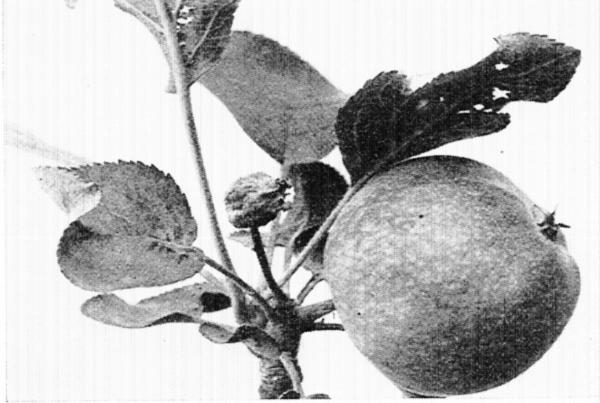
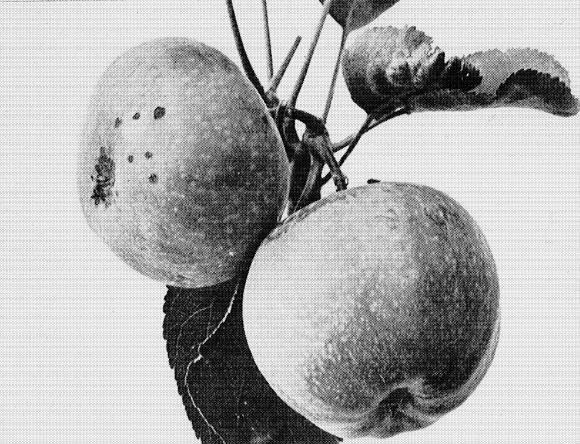
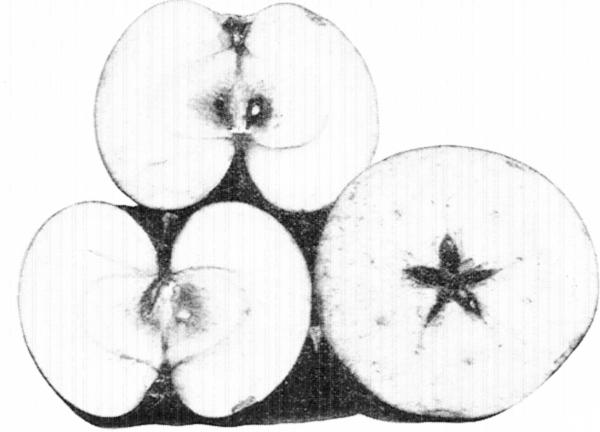
Now and then one finds a double apple, with two fruits
grown solidly together, two blossom ends and a single
stem. A seedling tree I knew as a boy bore such apples
frequently, sometimes a score of them among the crop of
the year. This, of course, is a malformation or teratological
state. Apparently two flowers coalesce to form
these fruits. On the tree of which I speak, the two fruits
were about equal in size, making a large, widened, edible
apple, but I have known of other cases in which a diminutive
undeveloped fruit is attached to the side of a
normal one.
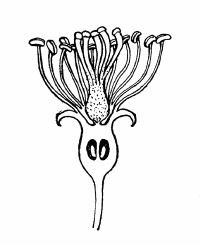
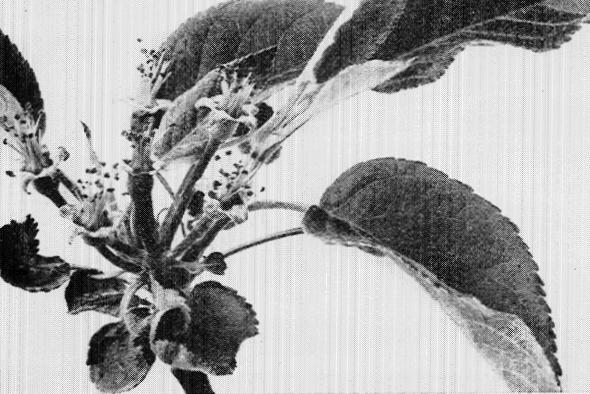
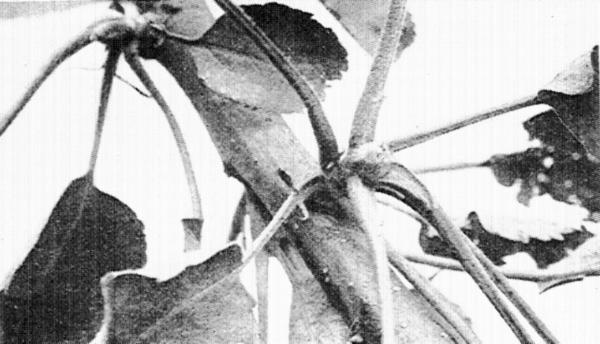
Perhaps the oddest of them all is the "Bloomless
apple." It is said to have no flowers. In fact, however,
the flowers are present but they lack showy petals and
are therefore not conspicuous. The bloomless apple is
a monstrous state, the cause of which is unknown. Now
and then a tree is reported. It was described at least as
long ago as 1768, and in 1770 Muenchhausen called it
Pyrus apetala (the petalless pyrus). The flowers have no
stamens, and apparently they are pollinated from any other
apples in the vicinity. In 1785, Moench described it as
Pyrus dioica (the diœcious pyrus, sexes separated on
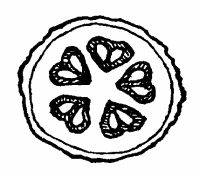
different plants). The ovary is also malformed, having six
or seven and sometimes probably more cells, and bearing
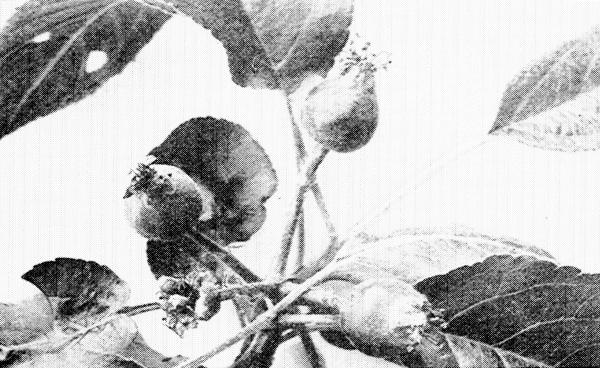
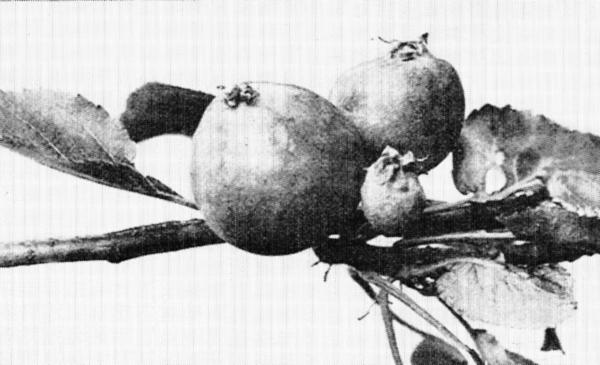
ten to fifteen styles. The resulting fruit has a core character
unknown in other apples but approached in certain
apple-like fruits, as the medlar. The fruit has a hole or
opening from the calyx (which is open) into the core; and
the core is roughly double, one series above the other. The
fruit, in such specimens as I have seen or read about, has
no horticultural merit; but it is a curiosity of great botanical
interest. It appears now and then in widely separated places,
the trees probably having originated as chance seedlings.
The fruits from the different originations are not always
the same in size and form, but the flowers apparently all
have the same malformed character.
The apple is preeminently the home fruit. It is not
transitory. It spans every season. In an indifferent cellar
I keep apples till apples come again. The apple stands up,
keeps well on the table. Children may handle it. In color
and form it satisfies any taste. Its rondure is perfect. The
cavity is deep, graceful and well moulded, holding the good
stem securely. The basin is a natural summit and termination
of the curvatures, bringing all the lines together,
finishing them in the ornaments of the remaining calyx. The
fruit adapts itself to the hand. The fingers close pleasantly
over it, fitting its figure. It has a solid feel. The flesh of a
good apple is crisp, breaking, melting, coolly acid or mildly
sweet. It has a fracture, as one bites it, possessed by no
other fruit. One likes to feel the snap and break of it.
There is a stability about it that satisfies; it holds its shape
till the last bite. One likes to linger on an apple, to sit
by a fireside to eat it, to munch it waiting on a log when
there is no hurry, to have another apple with which to invite
a friend.
Now I am not thinking of the Ben Davis apple or any of
its kind. I do not want to be doomed to one variety of
apple, or even to half a dozen kinds, and particularly I do
not want a poor one. There are enough good apples, if
we can get them. The days of the amateur fruit-growers
seem to be passing. At least we do not hear much of them
in society or in many of the meetings of horticulturists.
There may be many reasons, but two are evident: we give
the public indifferent fruits, and thereby neither educate the
taste or stimulate the desire for more; we do not provide
them places from which they can get plants of many of the
choicest things. Yet on a good amateur interest in fruits
depends, in the end, the real success of commercial fruit-growing.
Just now we are trying to increase the consumption
of apples, to lead the people to eat an apple a day: it
cannot be accomplished by customary commercial methods.
To eat an apple a day is a question of affections and
emotions.
We have had great riches in our varieties of apples. It
has been a vast resource to have a small home plantation
of many good varieties, each perfect in its season. The great
commercial apple-growing has been carried to high perfection
of organization and care. More perfect apples are
put on the market, in proportion to numbers, than ever before,—carefully
grown and graded and handled. I have
watched this American development with growing pride.
The quantity-production makes for greater perfection of
product, but it does not make for variety and human interest,
nor for high-quality varieties. We shall still improve
it. Masterful men will perfect organizations. The high character
and attainment of the commanding fruit-growers,
nurserymen and dealers are good augury for the future.
But all this is not sufficient. Quantity-production will be
an increasing source of wealth, but it cannot satisfy the
soul.
The objects and productions of high intrinsic merit are
preserved by the amateur. It is so in art and letters. It
is necessarily so. A body of amateurs is an essential background
to the development of science. The late Professor
Pickering, renowned astronomer, encouraged the amateur
societies of star-observers, and others. The amateurs in
the background, disinterested and unselfish, support appropriations
by legislatures for even abstruse public work.
The amateur is the embodiment of the best in the common
life, the conservator of aspirations, the fulfillment of democratic
freedom. I hope pomology will not lag in this
respect. In all lines I hope that professionalism will not
subjugate the man who follows a subject for the love of it
rather than for the gain of it or for the pride of it. In
horticulture, when we lose the amateur, who, as the word
means, is the lover, we lose the ideals.
Naturally, the nurseryman cannot grow trees of all the
good apples that may be wanted. The experiment stations
cannot maintain living museums of them, for their function
is to investigate rather than to preserve. Arboretums
are concerned with other activities. Is there not some person
of means, desiring to do good to his successors, ready
now to establish a fructicetum in perpetuum for the purpose
of preserving a single tree of at least one hundred of
the choicest apples, to the end that a record may be kept
and that amateurs may be supplied with cions thereof?