THE APOTHECARY in Eighteenth-Century WILLIAMSBURG — The Apothecary in Eighteenth-Century Williamsburg
Being an Account of his medical and chirurgical Services, as well as of his trade Practices as a Chymist
Williamsburg Craft Series
WILLIAMSBURG Published by Colonial Williamsburg MCMXC
1
Of the first 225 men sent over from
London to settle at Jamestown in 1607 and
1608, seven were practitioners of medicine—as
it was then practiced: Walter Russell,
Gent., was a “Doctour of Physicke,” which
is to say that he had studied at a university and earned a
degree in medicine; Thomas Wotton, Will Wilkinson, and
Post Ginnat were listed as surgeons—“chirurgeon” as
it then appeared; Thomas Field and John Harford bore
the label of apothecaries; and the seventh was “Tho:
Cowper the Barber.”
Plainly, the Virginia Company of London, numbering
several prominent medical men among its backers, wanted
its adventurers to the New World to have the best of
medical care. Unfortunately for about four of every five
settlers in the first few years at Jamestown, the best was
not enough to avert wholesale mortality from sickness,
Indian arrows, and “meere famine.” That some of the
medical men shared the fate of their patients seems likely
in the absence of later information about most of them.
Medical theories and practices at the beginning of the
seventeenth century were largely those that had prevailed
since the time of Galen, a Greek physician who died about
two centuries after Christ. According to Galen, the four
elements of Aristotelian science—fire, water, air, and
2
earth—comprised the four major humors of the human
body: blood, phlegm, yellow bile, and black bile. Blood
was held to be moist and warm, phlegm was moist and
cool, yellow bile dry and warm, and black bile dry and cold.
Sickness, in the theory of Galen, was caused by one or
more of these humors becoming impure or out of place
or out of balance. Treatment thus consisted of removing
or diminishing the offending humor by purging, bleeding,
vomiting, blistering, urinating, sweating, or salivating;
on the other hand, a deficient humor was to be restored
by diet and drugs. Galen classed drugs according to their
warm, cold, moist, or dry qualities. For instance, pepper
was a heating drug, good for chills, while cucumber was
a cool one, to be given in case of fever.
Galenism had been subjected to attack in the sixteenth
century by Paracelsus and Vesalius, but its appeal was
logical and remained strong in seventeenth-century England.
(In fact, some survivals can be found in twentieth-century
folk medicine.) Dr. Lawrence Bohun (or Boone), who
came over in 1610 and returned to England in 1611, spent
some of the year investigating medicinal sources in Virginia.
He discovered a white clay—and shipped some to England—that
he claimed could absorb and expel poisons from the
body. Among vegetable remedies, Bohun experimented
with sassafras and found “Galbanum mechoacon, otherwise
called rubarbum alum, to be of service in cold moist
bodies, for the purginge of fleame [phlegm] and superfluous
matter.”
WHAT IS AN APOTHECARY?
Already it will be evident that the practice of medicine
in seventeenth-century England, and hence in the first
American colonies, was not neatly confined to the licensed
graduates of accredited medical schools. Quite the contrary.
In fact, Henry VIII had complained that all kinds
of ignorant people got into the act, including “Smiths,
Weavers, and Women.”
3
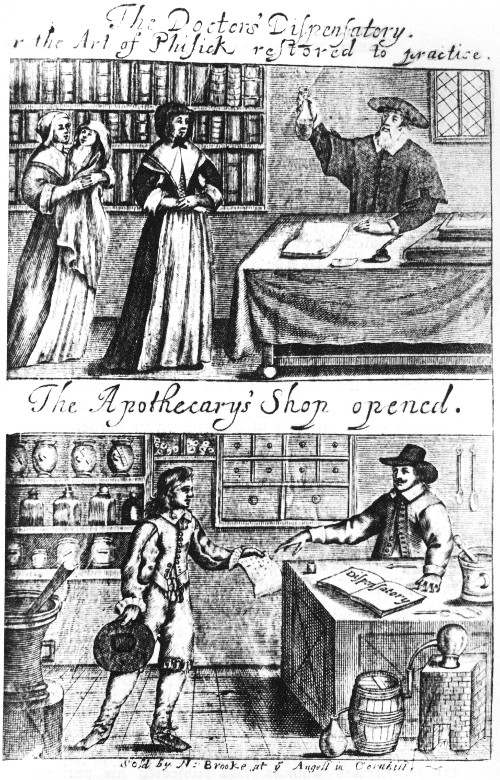
In the upper half of this woodcut from The Expert Doctor’s Dispensary, published in
London in 1657, a learned physician is shown conducting a urinalysis. He simply holds the
flask of liquid to the light for visual examination. Below, a customer presents what appears
to be a written prescription to be filled by the apothecary.
4
Two centuries of legal and parliamentary pulling and
hauling, plus the consequence of some natural developments,
left the situation in England somewhat stabilized—but
not necessarily logical. The barbers, chartered as a
guild in 1462 and authorized to practice surgery, included
both barbers and surgeons in growing disharmony until
they were formally divorced in 1745.
The apothecaries—the word originally meant shopkeeper—joined
the guild of grocers at one time but shortly
broke away to form their own guild in 1617. Meantime,
the physicians, organized in the College of Physicians,
obtained the right to keep watch on the apothecaries.
Physicians, who had to have as much as 14 years training
and four degrees from Oxford or Cambridge, were
naturally not abundant. Being learned men, they would
not stoop to the indignity of such menial work as performing
surgical operations or compounding medicines. The
former was the province of the surgeon or barber-surgeon,
the latter was the specialty of the apothecary.
But the scarcity of physicians, especially in rural areas,
left a medical gap that the apothecaries, trained through
apprenticeship and many times more numerous, naturally
moved to fill. In 1727 English law finally recognized and
legalized the fact that for most people the apothecary-surgeon
was the only available practitioner of medicine.
In turn, the business of purveying drugs and compounding
medicines passed from the apothecaries to the wholesale
druggists and pharmaceutical chemists.
As it was transferred to America the trade of apothecary—it
was neither a craft nor a profession in any strict sense—was
probably much like that of the rural apothecary-surgeon
of seventeenth-century England. The apothecary
still made his living primarily from the provision of drugs
and medical preparations; but he also performed amputations,
dressed wounds, and subjected his patients to
the normal medical treatments of the day.
5
ALL THAT THE LAW ALLOWS
Virginia was the only colony that tried to draw legislative
boundaries around the various aspects of medical practice.
The effort came in 1736 in the form of “an Act for Regulating
the Fees and Accounts of the Practicers of Phisic.”
On two grounds the act deserves to be quoted at some
length. For one thing, it throws a good light on the state
of medical practice at that time. For another, it affords
undeniable parallels to some current problems in the cost
of medicines and medical care, and to the role of government
in serving the interests of the “consumer.”
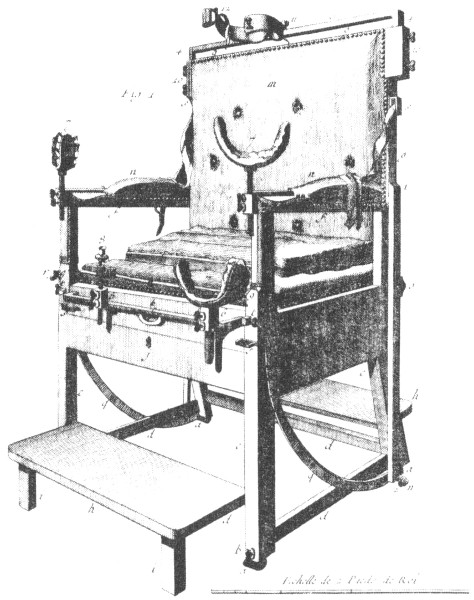
An eighteenth-century operating chair, fully equipped with tilting back, padded
adjustable supports, and straps to keep the patient from writhing away from the
knife. Anesthesia was limited to strong doses of spirituous liquors; antisepsis was
unknown. The illustration is taken from Denis Diderot’s famous encyclopedia of
arts and sciences.
The first section of the act recited certain abuses, especially
of the surgeons and apothecaries:
I. Whereas the practice of phisic in this colony, is most
commonly taken up and followed, by surgeons, apothecaries,
or such as have only served apprenticeships to
those trades, who often prove very unskilful in the art
of a phisician; and yet do demand excessive fees, and
exact unreasonable prices for the medicines which they
6
administer, and do too often, for the sake of making
up long and expensive bills, load their patients with
greater quantities thereof, than are necessary or useful,
concealing all their compositions, as well to prevent the
discovery of their practice, as of the true value of what
they administer: which is become a grievance, dangerous
and intolerable, as well to the poorer sort of people as
others, & doth require the most effectual remedy that
the nature of the thing will admit.
The second section then proceeded to emphasize the
chief distinction between the apprentice-trained apothecary-surgeons
and the university-educated physicians by allowing
the latter to charge twice as much for their services
as the former could. If the apothecaries and surgeons
felt—as well they might have—that the difference in fees
was an insult to them, it did not last long. The law was
not renewed at the following session of the Assembly;
perhaps its backers, the physicians, had seen their
patients flock to the lower-priced practicers.
Although Virginia was the only colony to set medical
fees by law, the practice of legislative price fixing in other
areas of the economy was as common in colonial America as
it was in England. In Virginia, to be specific, not only
prices and quantities but in some cases even qualities
of goods and services offered to the public by tavernkeepers,
shoemakers, millers, and ferrymen were regulated by law.
The economic philosophy and terminology of laissez faire
were among the alien isms imported after 1776. During
the colonial years, government rarely hesitated to act in
the economic field where the need was felt.
From this particular Virginia law of 1736 it would appear
that some if not all medical charges had gotten well out
of line—the correct line, of course, being what the people
and their elected representatives thought was reasonable:
II. BE it therefore enacted, ...
That from and after the passing of this
act, no practicer in phisic, in any action or
7
suit whatsoever, hereafter to be commenced
in any court of record in this colony, shall
recover, for visiting any sick person, more
than the rates hereafter mentioned: that
is to say,
Surgeons and apothecaries, who have
served an apprenticeship to those trades,
shall be allowed,
£
s
d
For every visit, and prescription, in town, or within five miles
00
5
00
For every mile, above five, and under ten
00
1
00
For a visit, of ten miles
00
10
00
And for every mile, above ten
00
00
06
With an allowance for all ferriages in their journeys.
To Surgeons, For a simple fracture, and the cure thereof
02
00
00
For a compound fracture, and the cure thereof
04
00
00
But those persons who have studied phisic
in any university, and taken any degree
therein, shall be allowed,
For every visit, and prescription, in any town, or within five miles
00
10
00
If above five miles, for every mile more, under ten
00
1
00
For a visit, if not above ten miles
1
00
00
And for every mile, above ten
00
1
00
With an allowance of ferriages, as before.
Lest it appear that all Williamsburg “practicers” made
a habit of charging excessive fees, the generous treatment
an earlier doctor gave at least one of his patients must be
set down. George Hume, a Scottish merchant who came
to Virginia about 1722 and soon caught all the prevalent
ills, found the place “only good for doctors and ministers
who have very good encouragem’nt here.” One of
the “common distempers” that afflicted Hume was dysentery,
then called the flux. He was laid so low that Dr.
8
John Brown all but despaired of his life. Hume’s gratitude
for being cured was doubtless enhanced by the fact—carefully
reported to his Scottish relatives—that “ye Dr.
took nothing for my druggs.”
The third section of the act, specifying exactly what
the “practicer of phisic” should set forth in his bill, bears
if least a faint augury of modern food-and-drug labeling
legislation:
III. And to the end the true value of the medicines administered
by any practicer in phisic, may be better
known, and judged of, Be it further enacted, by the
authority aforesaid, That whenever any pills, bolus,
portion, draught, electuary, decoction, or any medicines,
in any form whatsoever, shall be administered
to any sick person, the person administering the same
shall, at the same time, deliver in his bill, expressing
every particular thing made up therein; or if the medicine
administered, be a simple, or compound, directed
in the dispensatories, the true name thereof shall be
expressed in the same bill, together with the quantities
and prices, in both cases. And in failure thereof, such
practicer, or any apothecary, making up the prescription
of another, shall be nonsuited, in any action or suit
hereafter commenced, which shall be grounded upon
such bill or bills: Nor shall any book, or account, of
any practicer in phisic, or any apothecary, be permitted
to be given in evidence, before a court; unless the
articles therein contained, be charged according to
the directions of this act.
This final section reveals that some differentiation between
the branches of the medical profession had already
begun in America. The tip-off is the phrase that imposes
on “any apothecary making up the prescription of another”
the same requirements as on physicians who make up their
own prescriptions.
THE DOCTORS OF WILLIAMSBURG
If competition tends to keep prices low, fees charged in
and around the capital city in the early eighteenth century
should have been at the rock bottom level. Governor
Gooch in 1729 reported to London that Williamsburg
abounded in physicians. The same year young Adam
Cunningham gave up his brief effort to establish himself
in practice as a doctor:
9
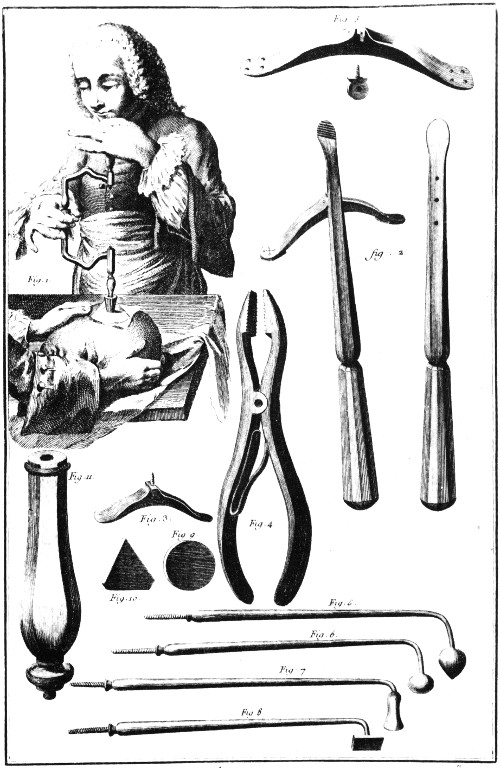
Another illustration from the Diderot encyclopedia shows the operation of trepanning
a skull and some surgical tools in common use in the eighteenth century, in colonial
America as well as in Europe.
10
Williamsburg [he wrote] is but a small Village containing
not more than 60 families, at most; and in and about
this City are no less than 25 or 30 phisitians, and of that
number not above 2 capable of living handsomly. So that I
did not think it proper to stay, in a place where so many
of my profession are lickely to starve.
Little is known about any of these “phisitians,” not
even the names of most. It seems fairly sure, however,
that a number were quacks. Gooch had complained in
the same letter about the “unskilfulness of practioners in
this country” but was gullible enough himself to pay 60
pounds from public funds and give freedom to a Negro
slave for the secret of the latter’s alleged cure of venereal
diseases. It turned out to be a decoction of roots and barks,
which the Governor avowed to be “a certain Remedy
here” and sent samples so the College of Physicians could
try its effect in England.
Most of Gooch’s abundant physicians almost certainly
made up their own prescriptions. From 1622 at Jamestown
until 1731 in Williamsburg no mention of an apothecary
in Virginia has been found in historical records. In
the latter year, however, there were four shops purveying
drugs and compounding medicines in Williamsburg. The
proprietors of two were doctors—Dr. George Gilmer and
Dr. Kenneth McKenzie; the other two were druggists or
“chymists”—Thomas Wharton and Thomas Goodwin.
Goodwin did not remain independent long. After about
two years he joined Dr. Robert Davidson, mayor of Williamsburg,
in a partnership that was itself dissolved in
two years by the death of Dr. Davidson. Thomas Wharton,
on the other hand, kept shop in Williamsburg for some
eleven years. He had arrived in Virginia about 1703 as an
11
indentured servant to a Dr. Richard Wright and had
acquired by the time of his death in 1746 not only a pharmaceutical
business, but the title of “Doctor.” He willed his
drugs, medicines, and shop utensils to Dr. McKenzie.
SHOPKEEPER EXTRAORDINARY
The fourth named practicer, George Gilmer, Sr., deserves
extended attention. He comes as close as any one person
to being a typical Williamsburg apothecary-surgeon-physician
of his time, though his extramedical career was far
from typical.
Born in Edinburgh in 1700, Gilmer studied medicine
there, then practiced with one of London’s leading doctors,
whose daughter he married. Possibly the death of his
young wife moved him to ship for America; at the age of
31 he arrived in Virginia to practice medicine and manage
the affairs of a land company. He married again and
must have prospered, because in four years’ time he was
able to purchase for £155 three choice lots near the Governor’s
Palace in Williamsburg.
These three lots, on which the rambling St. George
Tucker House has stood since 1788, were described in
1735 as “the Lotts and Land whereon the Bowling Green
formerly was, the Dwelling House and Kitchen of William
Levingston and the House call’d the Play House.” The
last, of course, was the first theater in the English colonies,
and Gilmer later sold it to the mayor and aldermen of
Williamsburg to be used as a city hall and courthouse.
It was a particularly convenient arrangement for one of
the aldermen who was to become mayor himself a year
later, none other than Dr. George Gilmer.
Gilmer’s career as an apothecary-surgeon-physician
was not without its ups and downs. Soon after buying the
property on Palace Green, he was giving away samples of
rattlesnake root on behalf of Dr. John Tennent, who maintained
it would cure pleurisy, the gout, rheumatism, and
mad-dog bites.
12
At the same time the Virginia Gazette, Williamsburg’s
new weekly, carried the news that “on Monday Morning
last, dy’d, at Mr. Geo. Gilmer’s, in this City, Mrs. Susanna
Skaife, ... and was decently interr’d on Wensday. And, on
Thursday Morning also dy’d, the Rev. Mr. John Skaife, her
Husband, after a tedious Indisposition.” It would appear
that at least Mrs. Skaife was a bed patient in Dr. Gilmer’s
home; this was a usual way of caring for serious illnesses
before the day of hospitals.
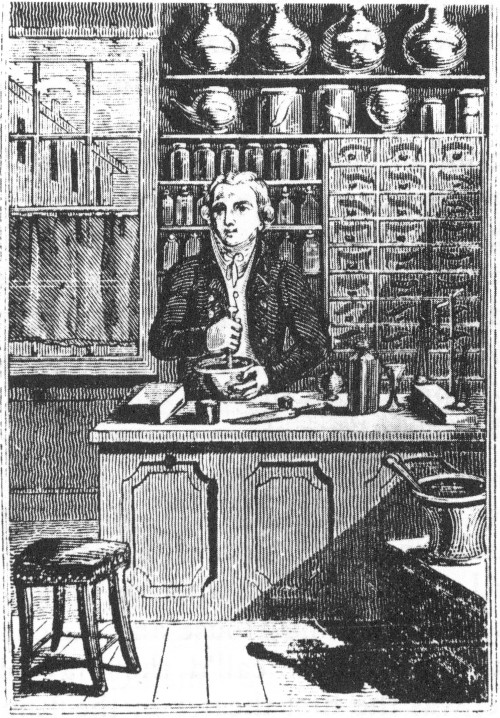
Surrounded by the equipment of his craft, this young apothecary is making up a
prescription of some kind, probably for pills. The illustration traces back to a London
publication, The Book of Trades or Library of Useful Arts, first American
edition published in 1807 by J. Johnson and for sale in his bookstore in Philadelphia
and in Richmond, Virginia.
13
Soon thereafter, Gilmer found it necessary to insert the
following advertisement in the Virginia Gazette:
Williamsburg May 26, 1737.
There being a Report industriously spread about the
Country, of George Gilmer’s Death, by some well-meaning
People, and of his being so much in Debt, that nothing from
England would be sent him this Year, if alive.
To obviate such scandalous and groundless Reports, I
take this Opportunity to acquaint all my Friends, that I can
now, better than ever, supply them with all manner of
Chymical and Galenical Medicines, truly and faithfully prepared,
and at as cheap Rates as can be had from England.
Also Double-refin’d, Single refin’d, and Lump Sugars, Cinnamon,
Cloves, Mace, Nutmegs, Bateman’s Drops, Squire’s
Elixir, Anderson’s Pills, Sweet Oil, &c. at reasonable Rates;
at my Old Shop, near the Governor’s.
George Gilmer
Nine years later Gilmer was so much alive and active
as to be mayor of the city, the owner of a new four-wheeled
chaise, and once more a bridegroom. On the death of
his second wife, Gilmer had promptly married his next-door
neighbor. The third Mrs. Gilmer was Harrison
Blair, daughter of Dr. Archibald Blair and sister of the
Hon. John Blair of the governor’s council. The apothecary’s
star was rising.
He was still, of course, a shopkeeper. His “Old Shop
near the Governor’s” stood at the very edge of Palace
Green, a frame building of about 20 feet square. Every
year or so he advertised the arrival from England of a
shipment of drugs, medicines, spices, and groceries—to be
sold at the shop, wholesale or retail, and at reasonable rates.
Archaeological excavations on the site of the first theater,
and extending north of it onto the adjacent Brush-Everard
House property, yielded quantities of Dr. Gilmer’s domestic
and pharmaceutical rubbish. The latter included delftware
ointment pots and drug jars, glass medicine phials
and fragments of carboys, bottles for Pyrmont mineral
water, a brass pestle, and, inexplicably, a human jaw. Just
how, or if, that related to Gilmer’s shop remains open to
conjecture, but it is evident from the quantity of pharmaceutical
artifacts recovered that Dr. Gilmer’s business was
as extensive as his 1737 advertisement claimed.
14
Indeed, Gilmer was no ordinary shopkeeper. His social
status—doubtless bolstered by that of his wife’s family—was
great enough that he could be among the first to
entertain the newly appointed Governor Dinwiddie. One
suspects that either the ambitious Dr. Gilmer or his well-born
wife decided that his house on Palace Street fell
short of such prestigious demands. Six months after the
dinner for Dinwiddie, the apothecary was having his
dining room wainscoted, with a marble fireplace, a mirror
over the mantel, and a cabinet to contain the set of new
china his wife had ordered from London.
About the same time Dr. Gilmer, who gave himself perhaps
facetiously the title of “colonel,” became part owner
of the Raleigh Tavern. The deed by which he and Colonel
Chiswell bought the famous inn for £700 testified that
he had gained that ultimate accolade of social and economic
status in colonial Virginia, the designation “Geo
Gilmer Gent.”
In the letters he wrote to London, Gilmer seems to refer
to himself not as a doctor or surgeon, but as an apothecary,
and his name in public documents as well as in private
records most often appears not as Dr. Gilmer but as Mr.
Gilmer. He was doubtless prouder of being known as a
gentleman and a colonel; the title of doctor was often
held in poor esteem. William Byrd II wrote in 1706 that
“here be some men indeed that are call’d Doctors: but
they are generally discarded Surgeons of Ships, that know
nothing above the very common Remedys.” As late as
1783 Dr. Johann Schoepf, writing of his travels through
the former colonies, asserted that “in America every man
who drives the curing trade is known without distinction
as Doctor, as elsewhere every person who makes verses
is a poet—so there are both black doctors and brown, and
quacks in abundance.”
THE EDUCATION OF AN APOTHECARY
Apprenticeship was the usual form of training for all
15
colonial occupations, with the possible exception of the
ministry at one end of the scale and ordinary farming at
the other. Medicine was not an exception; practitioners
normally took apprentices for the same reasons that cabinetmakers
or blacksmiths did. The beginning apprentice
performed the unskilled and some of the semiskilled duties
of the establishment, learning as he did so. As he acquired
knowledge, he could give the doctor more and more assistance
in his practice.
The doctor generally undertook, if there was a formal
indenture, to teach the apprentice the “art and mystery
of physic, surgery, and pharmacy,” or words to that
effect. Sometimes, however, he agreed to teach only the
art of the apothecary. In either event, the apprentice was
taught to compound medicines as directed by his master,
to search the woods for medicinal plants, and probably to
keep books and collect fees. Even an apprentice apothecary
might in time be called on to assist—or perhaps even
take over—such routine treatments as bleeding. Most
likely he also had to spend his evenings reading whatever
medical or pharmaceutical works the doctor had on hand—from
Hippocrates to the latest edition of the Edinburgh
Pharmacopoeia.
On completing this apprenticeship—which in most cases
probably fell short of the English norm of seven years—the
young man could set up in the “curing trade”, for himself,
with no more credentials than his master’s certificate to
the effect that he had served a certain term and had studied
certain books. Or he could go to Edinburgh or London
for further study at a university or in a hospital.
16
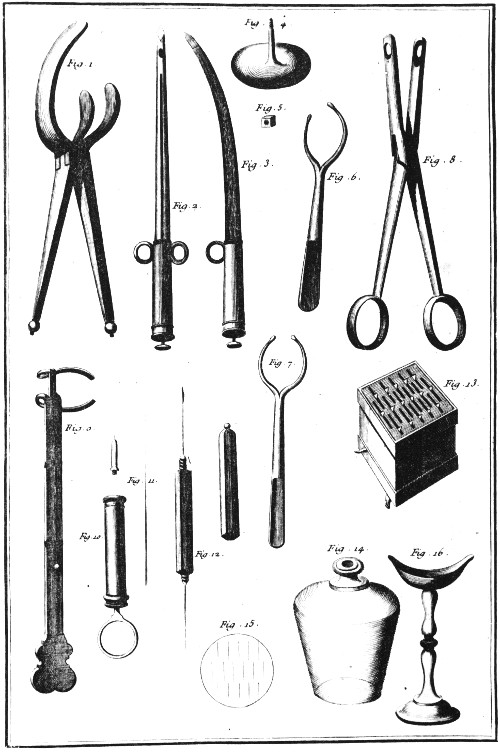
Another plate from Diderot’s encyclopedia shows a variety of instruments used by eighteenth-century
apothecary-surgeons. Notice the box-like device with 16 small knives that can
be pressed against the skin and triggered to make simultaneous incisions for bleeding a
patient. One of these gadgets can be seen at the Apothecary Shop in Williamsburg.
17
In any event, there was no requirement that a dealer in
drugs or a practicer of medicine must have a degree, a
license, or any other recommendation than his own assurance
of good results to the sick who applied to him. Some
practitioners were on the modest side in offering their
services; some were wholly unrestrained—even guaranteeing
to cure cancer! The contrast stands out sharply in these
two advertisements from the Virginia Gazette, the first
in 1771 by Dr. William Stark of the town of Blandford,
the second five years later by a quack who did not even
bother to give himself the title of doctor.
The Subscriber having been bred to Physick in his
younger Years, and having attended particularly to this
Study for these three Years past, now proposes to practise
on the most moderate Terms. He cannot with Sincerity
boast of having attained the Ne plus ultra of the Aesculapian
Art, nor yet of acquiring any superior Degree of Knowledge
in this Science; but flatters himself that, by a vigilant
and due Attention to the Indications and Efforts of Nature
in those sick Persons who should, through Choice or Necessity,
be committed to his Care, he may be able to afford
them proper and timely Assistance.
* * *
Thomas Johnson, of Brunswick, Who is well known for
his Abilities in the Cure of the Flux, gives Notice that he
also cures the following Disorders, viz. the Spleen, Cholic,
Asthma, and any Kind of Fevers, lingering Disorders, bad
Coughs, Scurvy, any Kind of running Humours or scorbutic
Disorders, the Yaws and French Disorder, without Salivation,
sore Legs, Dropsy, Scurvy in the Gums, and has the
greatest Reason to believe he can cure the Consumption if
timely applied to.
LINES OF SUCCESSION
In a very direct and personal way, each generation
of Williamsburg physician-apothecary trained its successor.
Two particularly illustrative lines began with Dr. George
Gilmer.
At one time in 1745 it appears that Gilmer had an
apprentice by the name of James Carter. A few years
later Carter opened an apothecary shop of his own at the
sign of the Unicorn’s Horn, next door to the Raleigh
Tavern in Williamsburg. Carter in turn took Andrew
Anderson as apprentice, and in due time when Anderson
had attain the status of “doctor,” took him into partnership.
18
This combination lasted only two years, and James
Carter later formed a partnership with his brother William,
a physician. After another few years James sold his share
of the apothecary shop to William but apparently continued
independently to practice medicine until his death
in 1794.
Gilmer, of course, had long since taken another apprentice
in young James Carter’s place. Billy Pasteur was the
son of the barber and wigmaker, who could not afford to
send his son abroad for medical study. But at the end of
his apprenticeship, Pasteur did go to London with the
help of Dr. Gilmer for a year’s study at St. Thomas’s
Hospital. He returned to Williamsburg and opened shop
just after his benefactor’s death. It would seem probable
that he took over Gilmer’s shop before building his own,
though the record does not say.
Pasteur, in his own turn, had at least two apprentices
who later practiced in Williamsburg. The second, Robert
Nicolson, shortly moved his apothecary shop and medical
practice to Yorktown, thereby taking himself out of this
narrative. His predecessor, John Minson Galt, remained
in Williamsburg and in the medical profession until 1808.
Like Dr. Gilmer, who educated his own son, George Gilmer,
Jr., in medicine, John Minson Galt launched two of his
sons into medicine via apprenticeship.
A son of Samuel Galt, the silversmith, John Minson
Galt was apprenticed at the age of 14 to William Pasteur,
who himself had just set up shop and was only half a dozen
years older. The apprenticeship appears to have lasted a
full term of seven years. It was followed by two years of
medicine in London. There the young man studied the
theory and practice of physic under Dr. Hugh Smith,
midwifery under Dr. Colin McKenzie, and surgery,
anatomy, and operations at St. Thomas’s Hospital. Galt
is also said to have attended the College of William and
Mary—presumably before going abroad—and to have
pursued his medical studies in Edinburgh and Paris as
19
well as in London. All of this made John Minson Galt
undoubtedly the best educated apothecary-surgeon of eighteenth-century
Williamsburg.
On his return to Williamsburg in 1769 he bought “a
box of Surgeon’s Instruments,” married Judith Craig, and
announced his intention to open shop at “the Brick House,
opposite the Coffee House when he gets his utensils fixed.”
The Virginia Gazette’s notice of the marriage was short and
full of confident optimism:
This evening Doctor JOHN MINSON GALT, of this
city, was married to Miss JUDITH CRAIG, eldest
daughter of Mr. ALEXANDER CRAIG. The mutual
affection and familiarity of disposition in this agreeable
pair, afford the strongest assurance of their enjoying the
highest felicity in the nuptial state.
In setting up shop as an apothecary-surgeon in Williamsburg,
Galt was not exactly filling a vacuum. In fact, the
same issue of the Gazette in which he announced himself
carried long advertisements by two other apothecaries.
One was Galt’s former master and benefactor, William
Pasteur; the other was “Andrew Anderson, Surgeon and
Man-Midwife,” also just launching in practice. Altogether
the ads occupy a little over one whole column of the paper,
and each consists almost solely of a list of the items available
at that shop.
It is interesting to notice that William Pasteur had
imported a new supply of goods in the same ship with
Galt’s “compleat assortment,” and just in time:
The subscriber having had but very few medicines left
in his shop before this order came to hand, will now be
able to furnish his friends and customers with every thing
fresh and genuine. Gentlemen practitioners, and others, may
depend on being supplied at a very low advance.
The final assurance echoes Pasteur’s earlier complaint
written his London agents to the effect that “tiss hardly
worth our while to import medicines for sale we are Oblige
to sell at a low advance on acct of our confounded druggist
20
here....” The “confounded druggist,” William Biers, was
having his own difficulties making a living, however, and
soon sold out to the partnership of James Carter and
Andrew Anderson.
Colonial Williamsburg owns several of Dr. Galt’s account
books, including the one for the years 1770 to 1775, before
he joined Pasteur. One of the early entries shows a charge
against Thomas Glass of ten shillings for “visiting &c.”
The corresponding credit entry shows that the bill was
paid in cash seven years and five months later! Patients
were as lax about paying their doctor’s bills then as now,
and although most of Dr. Galt’s patients paid in cash, he
also took wood, hay, and oats. On one instance he wrote
off a debt with an equal credit “for the Runaway.”
What is surely the most provocative entry occurs opposite
February 29, 1772, a Leap Year Day. On that
date appears a debit against a Mr. Bowyer of 10 shillings
for “attendce in the night.” On the credit side are these
words in Galt’s hand: “Twas sewed on by a Girl who I
shou’d be happy with.” Does this mean that in three
short years the “mutual affection and familiarity of disposition”
of John and Judith had worn away? The account
book does not answer.
Notice that Galt’s charge of 10 shillings for visiting a
patient was the very sum permitted by law in 1736—three
and a half decades earlier. For amputating Mr. Parson’s
finger and dressing it he charged £3 4s 6d, and the same
amount to Mr. Cardwell for “laying open Child’s leg &c.”
There is but a single entry for bleeding, and in this case
the patient was a Negro. Dr. Galt, unlike most of his
colleagues, seems not to have favored phlebotomy. The
great number of entries simply mention visiting, attendance,
or advice, with prescriptions by the score of cathartics,
emetics, purges, etc.
PASTEUR & GALT
It must have been a source of gratification to John
21
Minson Galt when the well-established Pasteur invited
the younger man to become his partner. The announcement
of the new firm read as follows:
WILLIAMSBURG, April 15, 1775.
THE Subscribers having this Day entered into Partnership,
beg Leave to acquaint the Public in general, and their
Friends and Neighbours in particular, that they intend
practicing Physic and Surgery to their fullest Extent; and
that they intend also, as soon as the Situation of the Times
will admit, to keep full and complete Assortments of Drugs
and Medicines, which they will endeavour to procure of the
very best in Quality, and will take Care to have them fresh
by making several Importations in the Year. It is proposed
that John M. Galt shall pay his particular Attention to
Surgery, to whom our Friends are desired to apply on all
such occasions, but will be advised and assisted by W.
Pasteur in all difficult Cases. They both desire to make their
most grateful Acknowledgments to their Friends and Customers
for the many Favours and Civilities they have received,
and hope, by this Union, they will be enabled to
carry on their Business to the entire Satisfaction of their
Friends; as, on their Part, the strictest Assiduity and Attention
shall be observed.
PASTEUR & GALT
Only a few days after this announcement appeared, the
spark of revolution flared out in both Lexington, Massachusetts,
and Williamsburg, Virginia. As it happened,
Dr. Pasteur was to play a minor role and a momentary one
on the Williamsburg stage. Governor Dunmore’s surreptitious
removal of the colony’s gunpowder from the
Magazine was detected and there was an immediate
reaction from the populace, some under arms. Attending
a patient in the Palace, Dr. Pasteur was twice accosted by
the Governor and made the bearer of angry messages to
the Speaker of the House of Burgesses and “the Gentlemen
of the Town.” Should he be attacked, His Lordship blustered,
“he would declare freedom to the slaves & reduce the
city of Williamsburg to ashes.”
22
What actually followed was that Dunmore and his family
fled the Palace, never to return, and Pasteur became the
next mayor of Williamsburg. It should be mentioned that
he and John Minson Galt were already members of the
Committee of Safety for the city when they formed their
partnership. The sympathies of both were clearly on the
patriot side.
The partners very shortly were able to advertise the
importation of the usual wide assortment of drugs and
medicines for sale in their shop on Duke of Gloucester
Street. And a few surviving bills indicate that they did
not lack for medical and surgical business. Dr. Pasteur,
it would seem, did not share his younger colleague’s aversion
to phlebotomy, as the following excerpt from a Pasteur
& Galt bill to Henry Morse Esq. in 1775 shows:
April
14
To bleeding Vomit & Chamomile Flowers
. . 7 . . 6
21
To Brimstone & Antimony
. . 1 . . 3
22
To Purge Honey & Barley
. . 4 . .
25
To Purge 2/6. 26 Sugar Candy 1/3
. . 3 . . 9
29
To bleeding & Pectoral Mixture
. . 8 . . 6
30
To Visiting Mixture & Sago
. . 9 . . 9
May
4
To Pectoral Mixture
. . 6 . . 6
11
To 1 lb Balsam Honey
. . 6 . . 3
19
To 1 lb Do. 6/3 25 Honey 1/0
31st Cons. Roses 2/
. . 9 . . 3
June
1
To 1 lb Balsam Honey
. . 6 . . 3
6
To Lenitive Electary & Salope
. . 3 . . 6
15
To Castor Oil & Honey
. . 6 . .
16
To Febrifuge & Bitter Decoctions
. .12 . .
22
To Attendce & Bleedg in the Night
. .10 . .
23
To Honey & Oxymel Squills
. . 2 . . 6
July
10
To Honey 1/ 10th Capillaire & Sago 5/6
. . 6 . . 6
August
20
To Vomit & Chamomile Flowers
. . 2 . . 6
21
To Febrifuge Decoction repeated
. .10 . .
L 5. 16 . 6
The partnership lasted only three years, for reasons
23
not now discernable, and William Pasteur gave notice to
the public that “I purpose commencing oyster merchant”
at his landing on King’s Creek between Williamsburg and
Yorktown. Galt, on the other hand, continued to practice
medicine, serving as a senior surgeon to the Continental
military hospital in Williamsburg, joining in partnership
with Dr. Philip Barraud, and becoming visiting physician
to the public hospital for the insane and a member of its
board of directors. He held both offices until his death in
1808. Yet as late as 1794 he was identified in court records
as “Apothecary, of the City of Williamsburg.”
THE APOTHECARY SHOP
The Pasteur-Galt apothecary shop on Duke of Gloucester
Street in Williamsburg is a reconstruction. Its size
and location are determined with certainty not only from
an eighteenth-century town map, but also by eighteenth-century
foundations excavated on the site. The land was
owned by Dr. William Pasteur from 1760 until 1778, during
which time he probably built the shop. When he and
John Minson Galt dissolved their partnership, he sold the
property to Galt, who transferred it to his son at the end
of the century.
No record survives as to the exact appearance, outside
or inside, of the Pasteur-Galt shop. Some apothecary shops
apparently had as many as three rooms: the front shop, the
doctor’s office and operating room, and possibly a sort of
laboratory where the apprentice compounded medicines.
The Pasteur-Galt shop has been reconstructed with two,
the preparative work being done in full view of the public.
As to the content of the shop, ample evidence comes
from almost any advertisement of Galt, Pasteur, or for
that matter of just about any apothecary in colonial
America at any time during the eighteenth century.
They all published for their prospective customers lengthy
lists of items just imported, and the lists bear a marked
resemblance from place to place and from time to time.
24
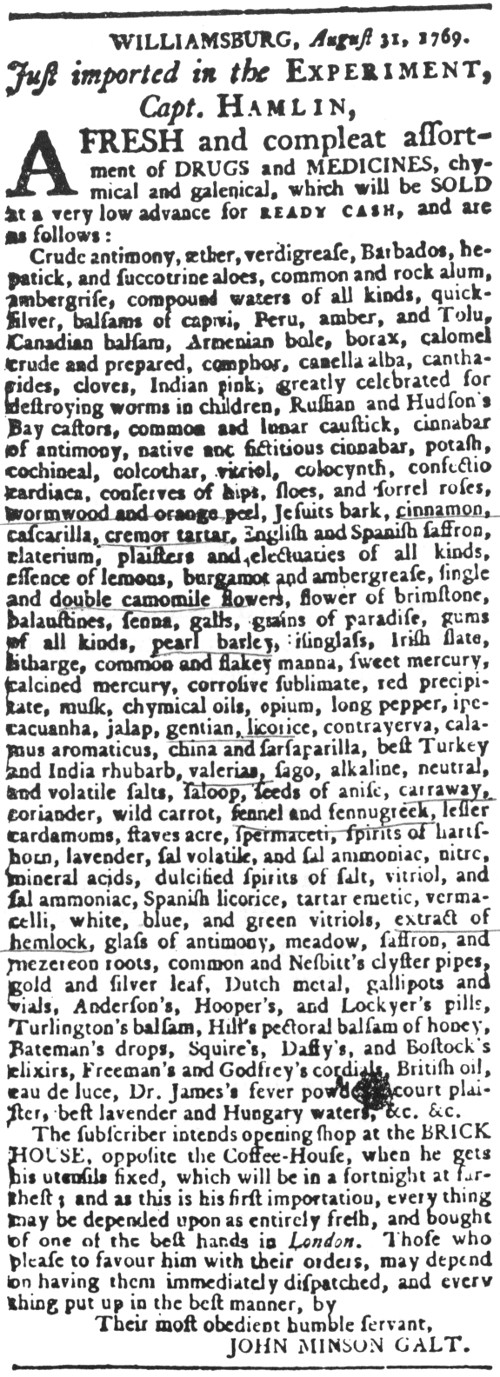
WILLIAMSBURG, August 31, 1769.
Just imported in theExperiment,
Capt.Hamlin,
A FRESH and compleat assortment
of DRUGS and MEDICINES, chymical
and galenical, which will be SOLD
at very low advance for READY CASH, and are
as follows:
Crude antimony, æther, verdigrease, Barbados, hepatick,
and succotrine aloes, common and rock alum,
ambergrise, compound waters of all kinds, quicksilver,
balsams of capri, Peru, amber, and Tolu,
Canadian balsam, Armenian bole, borax, calomel
crude and prepared, comphor, camella alba, cantharides,
cloves, Indian pink, greatly celebrated for
destroying worms in children, Russian and Hudson’s
Bay castors, common and lunar caustick, cinnabar
of antimony, native and fictitious cinnabar, potash,
cochineal, colcothar, vitriol, colocynth, confectio
cardiaca, conserves of hips, sloes, and sorrel roses,
wormwood and orange peel, Jesuits bark, cinnamon,
cascarilla, cremor tartar, English and Spanish saffron,
claterium, plaisters and electuaries of all kinds,
essence of lemons, burgamot and ambergrease, single
and double camomile flowers, flower of brimstone,
balaustines, fenna, galls, grains of paradise, gums
of all kinds, pearl barley, isinglass, Irish slate,
litharge, common and flakey manna, sweet mercury,
calcined mercury, corrosive sublimate, red precipitate,
musk, chymical oils, opium, long pepper, ipecacuanha,
jalap, gentian, licorice, contrayerva, calamus
aromaticus, china and sarsaparilla, best Turkey
and India rhubarb, valerian, sago, alkaline, neutral,
and volatile salts, saloop, seeds of anise, carraway,
coriander, wild carrot, fennel and fennugreek, lesser
cardamoms, staves acre, spermaceti, spirits of hartshorn,
lavender, sal volatile, and sal ammoniac, nitre,
mineral acids, dulcified spirits of salt, vitriol, and
sal ammoniac, Spanish licorice, tartar emetic, vermacelli,
white, blue, and green vitriols, extract of
hemlock, glass of antimony, meadow, saffron, and
mezereon roots, common and Nesbitt’s clyster pipes,
gold and silver leaf, Dutch metal, gallipots and
vials, Anderson’s, Hooper’s, and Lockyer’s pills,
Turlington’s balsam, Hill’s pectoral balsam of honey,
Bateman’s drops, Squire’s, Daffy’s, and Bostock’s
elixirs, Freeman’s and Godfrey’s cordials British oil,
eau de luce, Dr. James’s fever powder, court plaister,
best lavender and Hungary water, &c. &c.
The subscriber intends opening shop at the BRICK
HOUSE, opposite the Coffee-House, when he gets
his utensils fixed, which will be in a fortnight at farthest;
and as this is his first importation, every thing
may be depended upon as entirely fresh, and bought
of one of the best hands in London. Those who
please to favour him with their orders, may depend
on having them immediately dispatched, and every
thing put up in the best manner, by
Their most obedient humble servant,JOHN MINSON GALT.
25
An apt example is the advertisement placed in the Virginia
Gazette of September 21, 1769, by John Minson Galt at the
outset of his long career (preceding page).
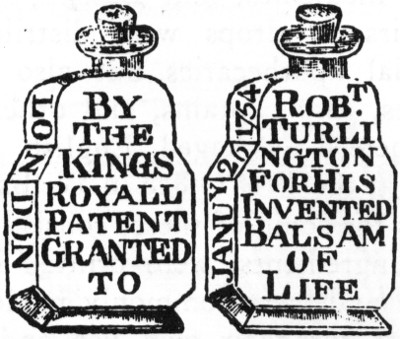
Turlington’s Balsam of Lifebottles as pictured in a brochure dated 1755-1757,
preserved in the Pennsylvania Historical Society, Philadelphia, Pa. According to
Turlington, the bottle was adopted in 1754 “to prevent the villainy of some persons
who, buying up my empty bottles, have basely and wickedly put therein a vile
spurious counterfeit sort.”
LONDON
By The Kings Royall Patent Granted to
JANUY 26 1754
Rob.t Turlington For His Invented Balsam of Life
Analysis of the Galt or any other advertisement of the
time shows that the contents of a colonial apothecary
shop fell into five categories: plant materials, animal extracts,
metals and metallic derivatives, medical equipment,
and prepared elixirs, pills, and the like.
Among the most popular of the prepared medicines—judging
from the many advertisements of Dr. John Minson
Galt in the years 1772-1774—were Dr. Keyser’s celebrated
anti-venereal pills. These were backed by testimonials
of two English and three French dukes, and Galt published
lengthy accounts avowing that “the Patient is most
effectually cured without any Inconvenience to himself,
or being exposed to the Shame and Confusion of his Disaster
being known to the nicest Observer.”
Not only were they supposed to cure syphilis, but “the
happy effects of Keyser’s pills have often been proved in
white Swellings, asthmas, Suppressions of the Urine, in
the Palsy, Apoplexies, Sciaticks, in the Green Sickness,
and more especially in the Yaws.”
“Mrs. Rednapp’s red fit drops” were among Dr. Pasteur’s
26
favorite patent medicines, and Daffy’s, Stoughton’s, and
Bateman’s elixirs or drops were distributed not only
by most colonial apothecaries but also by the keepers
of general stores, ship captains, and others. In 1771 no
fewer than nineteen packaged English medicines were
offered for sale at the Post Office in Williamsburg!
The formulas for some of these, consisting of twenty or
more separate ingredients, were printed in the principal
pharmacopoeias and were commonly made up by doctors
and apothecaries for their own use and for sale. Dr.
Pasteur and Dr. James Carter both ordered quantities of
empty bottles for Stoughton’s and Daffy’s compounds.
Dependence on imported patent medicines was a development
that several observers deplored. Dr. Schoepf, for
instance, thought American physicians should patriotically
discontinue “making use almost wholly of foreign medicines,
with which in large measure they might easily
dispense, if they were willing to give their attention to
home-products, informing themselves more exactly of the
properties and uses of the stock of domestic medicines
already known.”
Jefferson in his Notes on the State of Virginia had listed
twenty-one medicinal plants native to the state, and others
before him had commented on the abundance of simple
remedies afforded by the woods and marshes of tidewater
Virginia. Indeed, it appears that colonial medical men in
the seventeenth century had gathered the largest part of
their own medicines close at hand, and that the growing
importation of patent mixtures was matched by an increasing
export of native drugs.
By the middle of the eighteenth century considerable
quantities of at least eight medicinal plants were being
shipped to England from Virginia, among them ipecacuanha,
sassafras, balsam of Tolu, ginseng, and snakeroot. The
last two formed the bulk of the export; of them more in
a moment.
27
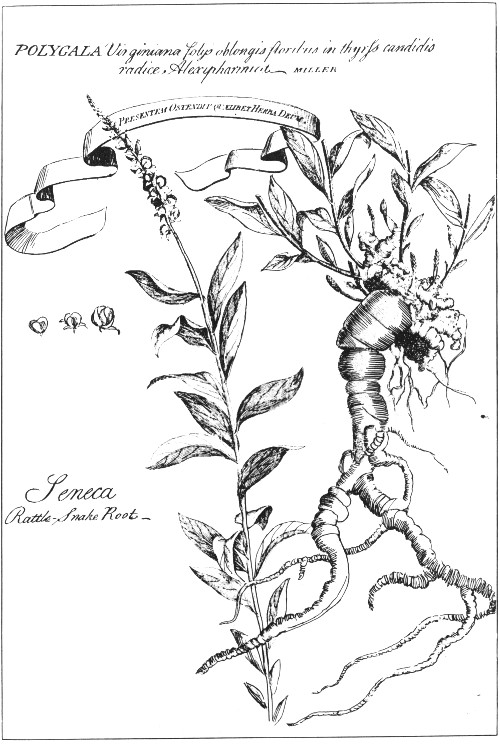
Seneca rattlesnake root or Polygala Virginiana was a mainstay of medical treatment in
eighteenth-century Virginia. The original source of this drawing has not been identified.
28
However, if there were in colonial towns “some apothecaries
shops wainscotted or papered with advertisements,
recommending quack medicines,” a large number of rural
practitioners preferred to make up their remedies. “I do
not apply to the Apothecaries Shops for my Means,” said
the advertisement of one such, “I compact my own medicines
myself. The produce of Virginia Earth, with a few
trifles besides, supports my Body, ... and many others
besides, without bleeding, sweating, physicking, or Bitters.”
Whether used from conviction that such means were
better, or because the imported medicines were too expensive,
the result was the same: such mild cures were less
likely to interfere with the healing course of nature than
did the complex, often drastic, and sometimes revolting
compounds of the leading English physicians.
From inventories of the estates of deceased apothecaries
as well as from their newspaper advertisements comes
evidence as to the equipment they kept and used in their
shops. The remarkable thing is to see how little the
essential items have changed over the course of the centuries—alike
before and since the colonial era.
The mortar and pestle, traditional symbol of the apothecary’s
calling and often used as the sign of his shop, was to
be found in Williamsburg shops in many sizes and materials.
The largest recorded was a bell-metal mortar and iron
pestle belonging to Dr. Thomas Wharton and weighing
168 pounds. Wharton also owned a large marble mortar
and pestle, two small ones of marble, and a “Porphrey
Stone & Muller.” Later in the century, as the medical
profession learned that toxic quantities of metal dust
could come from the use of metal mortars, ceramic and
glass became widely used.
Glass and ceramic containers by the hundreds were
also used to store simple ingredients and compounds for
sale. Dr. Pasteur at one time, for instance, ordered 246
white glass vials ranging in capacity from two drams to
twelve ounces. Dr. Alexander Middleton, whose tory sympathies
cost him his Williamsburg shop and contents
29
during the Revolution, listed more than fifty dozen bottles,
from one ounce size to two gallons, along with dozens of
pill pots, ointment pots, and syrup pots. Glass seems to
have been the most common type of container, with earthenware
“gallipots” probably second.
Among the articles with which the Williamsburg shop
is furnished are a number that belonged to the first Dr.
Galt that have been obtained from his descendants or
generously loaned by them to Colonial Williamsburg. The
largest is the secretary-bookcase that stands in the back
office, the most numerous are the scores of glass bottles
and cardboard pillboxes that cluster on one section of the
shelves, and perhaps the most interesting are his diplomas
in anatomy, surgery, and midwifery that hang on the wall.
Vying with the last name is the account book displaying a
charge of 7 shillings against Patrick Henry—but no entry
to show that the bill was ever paid.
It would require more space than is here available to
describe, or even to list, all the articles in the shop today,
and to identify all the drugs, herbs, powders, and compounds
that would have been contained in the numerous bottles,
jars, boxes, and drawers of the shop. The quantity and
variety, however, may be taken as typical of a well provided
apothecary shop of colonial America.
One should note in particular the surgical instruments
in their velvet-lined cases. These have been collected
from various sources—including one case of lancets and
a set of scales from the Galt family—and are of the period.
Dr. Alexander Middleton claimed to have been deprived
in the Revolution of instruments for amputating, trepanning,
lithotomy, cupping, couching, dissecting, dentistry,
and midwifery. The estate of Dr. Kenneth McKenzie
of Williamsburg inventoried three sets of instruments for
amputating, trepanning, and lithotomy.
The McKenzie inventory also listed the medical books
in Dr. McKenzie’s library. There were more than seventy
titles, of which all but a few were medical treatises, some
30
of them in several volumes. Among them were listed
James’ Dispensatory and Shaw’s Dispensatory. These,
along with Bate’s Dispensatory and the London Dispensatory
were among the most widely read, owned, and used books
in the colony, and not alone by doctors or apothecaries.
One or more was almost certain to be in the library of
every planter of tidewater Virginia, a kind of “What to
do till the Doctor comes” manual for the home treatment
of the planter himself, his wife and children, his relatives
and neighbors, and his slaves. These dispensatories
avoided the need or cost of a doctor’s services unless the
trouble was so serious as to need “expert” attention.
This was by no means such an unwise system as at
first glance may appear. After all, the doctor would
probably dose with the same medicines from the same
dispensatory, and with the same result. And while quacks
were plentiful, well-trained physicians were extremely
scarce, especially in rural areas where pay was sure to be
slow and skimpy.
In view of the general state of medical knowledge and
practice throughout the eighteenth century—bleeding
being always a foremost treatment of numerous ailments—it
seems likely that the liberal use of native herbs,
being for the most part harmless, was probably the
safest and most effective course of medication. Surely
human and animal excreta, mashed-up insects, and the
like, which were not uncommon in London prescriptions,
could not have been more curative than rattlesnake root and
ginseng, whose praises were sung by the famous William
Byrd II:
The Earth has never produced any vegetable so friendly
to man as Ginseng. Nor do I say this at Random, or by the
strength of my Faith, but by my own Experience. I have
found it very cordial and reviving after great Fatigue, it
warms the Blood, frisks the Spirits strengthens the Stomach
and comforts the Bowels exceedingly. All this it performs
31
with out any of those naughty Effects that might make men
too troublesome and impertinent to their poor Wives.
Then as for the Rattlesnake Root the Reputation of it
encreases every day. The Tincture of it has done Wonders
in the Gout.... By its purging, its deuretick, and diaphoretick
Qualities it is of great use in the Dropsy ... of great Efficacy
in Pleuretick Feaver ... [and] a Specifick against
worms....
For the Bite of a mad Dog, ... it may perhaps be as Sure
a Remedy; as for the Bite of a Rattlesnake.
32
A List of Williamsburg Apothecaries
This list includes only those medical practitioners of
eighteenth-century Williamsburg who operated apothecary
shops. It does not include physicians who may have
made up and dispensed their own prescriptions but did
not operate a shop.
Andrew Anderson (1768-1771)
Anderson studied medicine in England after
serving an apprenticeship with Dr. James Carter.
Anderson returned to Williamsburg in 1768 and
formed a partnership with Dr. Carter and they
purchased the shop of William Biers. Anderson
moved to New Kent County in 1771 and in
1774 married Betsey Burnet, “an agreeable young
Lady, with a handsome Fortune.”
Robert Anderson (1764)
Anderson advertised his apothecary shop in Williamsburg
in 1764.
William Biers (1765-1768)
Biers operated a druggist shop in Williamsburg
from about 1765 to 1768 when he sold his business
to Dr. Carter and Dr. Anderson. In 1769
Biers announced his intention to leave the colony.
33
James Carter (1751-1779)
Dr. Carter opened his apothecary shop, “the
Unicorn’s Horn,” in Williamsburg in 1751 and
operated it until 1779 when he sold it to his
brother William Carter. James continued to
practice medicine in Williamsburg until his death
in 1794.
William Carter (1773-1784)
In 1771 William Carter established his medical
practice in Gloucester County. In 1773 he came
to Williamsburg and formed a partnership with
his brother James. Six years later he purchased
his brother’s share of “the Unicorn’s Horn,” and
in 1784 he moved to Richmond where he opened
another apothecary shop.
Robert Davidson (1737-1739)
Dr. Davidson, mayor of Williamsburg, operated
a druggist shop in partnership with Thomas
Goodwin from 1737 to 1739 when Davidson died.
John Minson Galt (1769-1808)
After studying medicine in England, Galt opened
his apothecary shop in 1769. From 1775 until
1778 he operated a shop in partnership with Dr.
William Pasteur. In 1795 Galt was appointed
visiting physician to the hospital for the insane
and in 1799 he was appointed a member of the
court of directors for the hospital.
George Gilmer, Sr. (1731-1757)
A graduate of the University of Edinburgh, Dr.
Gilmer established an apothecary shop in Williamsburg
in 1731. He operated the shop in
connection with a successful medical practice
until his death in 1757.
George Gilmer, Jr. (1766-1771)
After completing his medical studies in England,
Gilmer returned to Williamsburg in 1766 and
34
opened his apothecary shop. In 1771 he moved
to Charlottesville and established a successful
practice.
Thomas Goodwin (1735-1739)
Goodwin owned a druggist shop in Williamsburg
and apparently did not engage in a medical
practice. From 1737 to 1739 he conducted the
shop in partnership with Dr. Robert Davidson.
Peter Hay (1744-1766)
Dr. Hay conducted an apothecary shop in Williamsburg
from 1744 until his death in 1766
when he was described as “one of our most
eminent physicians.”
Kenneth McKenzie (1732-1755)
Dr. McKenzie owned an apothecary shop in
Williamsburg from 1732 until his death in 1755.
Alexander Middleton (1776)
Dr. Middleton operated an apothecary shop in
Williamsburg in 1776. Middleton, a tory, was
forced to leave Virginia during the Revolutionary
War.
Robert Nicolson (1779-1783)
Dr. Nicolson served his apprenticeship with
Dr. Pasteur and then studied medicine in England.
He returned to Williamsburg in 1779 and opened
his apothecary shop. After the Revolutionary
War he moved his shop to Yorktown where he
practiced medicine until his death in 1798.
William Pasteur (1757-1791)
After the completion of his apprenticeship with
Dr. George Gilmer, Sr., Pasteur studied in England
for about a year. He returned to Williamsburg
in 1757 and established an apothecary shop.
From 1775 to 1778 he operated the shop in
partnership with John Minson Galt.
35
George Pitt (1744-1768)
Dr. Pitt, born in 1724 in England and “bred a
Surgeon,” established his apothecary shop in
Williamsburg in 1744 at the “Sign of the Rhinoceros.”
In 1768 he closed his shop and returned to
England. He later came back to Virginia but no
longer engaged in medicine or pharmacy. In 1776
Pitt, a tory, left Virginia again. He died later that
year in England.
Thomas Wharton (1735-1746)
Wharton arrived in Virginia about 1703 as an
indentured servant to Dr. Richard Wright. By
1735 Wharton had established an apothecary shop
in Williamsburg, which he operated until his
death in 1746. He left his drugs, medicines, and
shop utensils to Dr. McKenzie.
36
Suggestions for Further Reading
Whitfield J. Bell, Jr., The Colonial Physician & Other
Essays. New York: Science History Publications, 1975.
——, “Medical Practice in Colonial America,” in Symposium
on Colonial Medicine. Williamsburg: Jamestown-Williamsburg-Yorktown
Celebration Commission
and the Virginia 350th Anniversary Commission, 1957.
John B. Blake, Public Health in the Town of Boston, 1630-1822.
Cambridge, Mass.: Harvard University Press,
1959.
Wyndham B. Blanton, Medicine in Virginia in the Eighteenth
Century. Richmond: Garrett and Massie, 1931.
——, Medicine in Virginia in the Seventeenth Century.
Richmond: William Byrd Press, 1930.
John Duffy, A History of Public Health in New York
City, 1625-1866. New York: Russell Sage Foundation,
1968.
Harold B. Gill, Jr., The Apothecary in Colonial Virginia.
Williamsburg: Colonial Williamsburg Foundation, 1972.
George B. Griffenhagen, Drug Supplies in the American
Revolution. Washington, D. C.: Contributions from the
Museum of History and Technology, Bulletin No. 225,
1961.
——, Tools of the Apothecary. Washington, D. C.:
American Pharmaceutical Association, 1957.
Patrick Henderson, “Smallpox and Patriotism: The Norfolk
Riots, 1768-1769.” Virginia Magazine of History
and Biography, LXXIII (October 1965), pp. 413-424.
Thomas P. Hughes, Medicine in Virginia, 1607-1699.
Williamsburg: Virginia 350th Anniversary Celebration
Corporation, 1957.
37
Thomas Jefferson, Notes on the State of Virginia, ed. William
Peden. Chapel Hill: University of North Carolina
Press, 1955.
Edward Kremers and George Urdang, History of Pharmacy:
A Guide and a Survey. Philadelphia: J. B. Lippincott
Co., 1951.
Geoffrey Marks and William K. Beatty, “The Virginia
Colony,” in The Story of Medicine in America. New
York: Charles Scribner’s Sons, 1973.
Benjamin Rush, The Autobiography of Benjamin Rush, ed.
George W. Corner. Princeton: Princeton University
Press, 1948.
Richard Harrison Shryock, Medicine and Society in America:
1660-1860. New York: New York University
Press, 1960.
C. J. S. Thompson, The Mystery and Art of the Apothecary.
Philadelphia: J. B. Lippincott Co., 1929.
Surry Wood, The Old Apothecary Shop. Watkins Glen,
N.Y.: Century House, 1956.
The Apothecary in Eighteenth-Century Williamsburg was
first published in 1965 and previously reprinted in 1968,
1970, 1973, 1978, 1982, 1984, 1985, 1986, 1987, 1988, and
1990. Written by Thomas K. Ford, now retired as editor of
Colonial Williamsburg publications, it is based largely on a
monograph by Harold B. Gill, Jr. That study has been
published as The Apothecary in Colonial Virginia (Williamsburg,
Virginia, 1972).
Transcriber’s Notes
Retained publication information from the printed edition: this eBook is public-domain in the country of publication.
Silently corrected a few palpable typos.
In the text versions only, text in italics is delimited by _underscores_.